10 Best Sales Reporting Software in 2026: Dashboards, Custom Metrics, CRM Sync, and Executive Views
Written by
Ishan Chhabra
Last Updated :
August 8, 2026
Skim in :
13
mins
In this article
Revenue teams love Oliv
Here’s why:
All your deal data unified (from 30+ tools and tabs).
Insights are delivered to you directly, no digging.
AI agents automate tasks for you.
Thank you! Your submission has been received!
Oops! Something went wrong while submitting the form.
Meet Oliv’s AI Agents
Hi! I’m, Deal Driver
I track deals, flag risks, send weekly pipeline updates and give sales managers full visibility into deal progress
Hi! I’m, CRM Manager
I maintain CRM hygiene by updating core, custom and qualification fields all without your team lifting a finger
Hi! I’m, Forecaster
I build accurate forecasts based on real deal movement and tell you which deals to pull in to hit your number
Hi! I’m, Coach
I believe performance fuels revenue. I spot skill gaps, score calls and build coaching plans to help every rep level up
Hi! I’m, Prospector
I dig into target accounts to surface the right contacts, tailor and time outreach so you always strike when it counts
Hi! I’m, Pipeline tracker
I call reps to get deal updates, and deliver a real-time, CRM-synced roll-up view of deal progress
Hi! I’m, Analyst
I answer complex pipeline questions, uncover deal patterns, and build reports that guide strategic decisions
TL;DR
The ten platforms worth shortlisting in 2026 are Oliv AI, Gong, Clari, Salesloft, People.ai, Salesforce Sales Cloud, HubSpot Sales Hub, Aviso, Terret, and InsightSquared.
Every tool is scored out of 100 on answer quality, data resolution, custom metrics, traceability, and pricing transparency, then mapped to stars in 20-point bands.
Reporting rarely fails at the chart layer. It fails when activity maps to the wrong opportunity and when executives ask why, not what.
Price the stack total, not the line item: annual platform fees, paid read-only seats, and licence-per-forecast-node costs decide the real number.
December 2025 reshaped leverage, with Clari and Salesloft merging and Gartner publishing its first Revenue Action Orchestration Magic Quadrant.
Traceability is a scoring criterion, not a footnote, because an AI-generated answer you cannot reproduce next quarter is not a report.
Q1. What are the 10 best sales reporting software tools for revenue teams in 2026? [toc=1. Best Tools Ranked]
The ten sales reporting platforms worth shortlisting in 2026 are Oliv AI, Gong, Clari, Salesloft, People.ai, Salesforce Sales Cloud reporting, HubSpot Sales Hub, Aviso, Terret (formerly BoostUp), and InsightSquared. Oliv AI leads because it answers why a number moved from the underlying record, not from a filtered view, and it ships per-field traceability with free view-only seats.
📉 Why your shortlist exists in the first place
You are not shopping because your charts look bad. You are shopping because leadership keeps asking "why," and the dashboard only answers "what."
I hear the same sentence in almost every RevOps call. Ask the CRM what closes this quarter, then ask the team, and you get two different numbers.
That gap is structural. Reports inherit CRM data that decays the moment a rep stops logging, and no extra chart repairs it.
🧭 The ten tools, in ranked order
Oliv AI
Gong
Clari
Salesloft
People.ai
Salesforce Sales Cloud reporting
HubSpot Sales Hub
Aviso
Terret (formerly BoostUp)
InsightSquared
📊 Sales reporting software compared at a glance
Sales Reporting Software Compared at a Glance (2026)
#
Tool
Rating
Entry price per seat
CRM fit
Custom metrics
Export freedom
Best for
1
Oliv AI
⭐⭐⭐⭐⭐
$19, Forecast tier $49, $0 platform fee
Salesforce, HubSpot, Dynamics, 70+ apps
Agent-built, plus per-field CRM writeback
Full open export, no lock-in
Teams that need explanations, not just views
2
Gong
⭐⭐⭐⭐
Quoted, not published
Salesforce, Dynamics, Zoho
Data Studio metrics, forecast boards
Reviewers report bulk export limits
Conversation-led pipeline and forecast reporting
3
Clari
⭐⭐⭐½
Quoted, not published
Salesforce-centric
Limited custom reporting per reviewers
Standard exports
Enterprise forecast hierarchy and inspection
4
Salesloft
⭐⭐⭐
Quoted, not published
Salesforce, Dynamics
Cadence and activity analytics
Standard exports
Engagement activity reporting
5
People.ai
⭐⭐⭐
Quoted, not published
Salesforce, Dynamics
Activity capture models
Standard exports
Activity data hygiene at enterprise scale
6
Salesforce Sales Cloud
⭐⭐⭐½
Bundled with CRM edition
Native
Reports and dashboards builder
Native exports and API
Single-system reporting on clean data
7
HubSpot Sales Hub
⭐⭐⭐½
Free tier, paid tiers above
Native
Custom report builder on paid tiers
Native exports and API
SMB and mid-market HubSpot shops
8
Aviso
⭐⭐
Quoted, not published
Salesforce
Forecast views and filters
Reviewers report export issues
Forecast-first teams on a budget
9
Terret (formerly BoostUp)
⭐⭐½
Quoted, not published
Salesforce
Forecast and pipeline views
Verify before purchase
Buyers tracking a renamed vendor
10
InsightSquared
⭐⭐½
Quoted, not published
Salesforce
Prebuilt analytics library
Verify before purchase
Legacy analytics estates
Ratings follow the rubric in the next section. Where a vendor does not publish list pricing, I have written "quoted, not published" instead of guessing.
🔍 How a RevOps lead should read this table
Read it right to left. Start with the job to be done, then check export freedom, then price.
Three vendors here need live verification before you sign anything. Aviso, Terret, and InsightSquared have all seen ownership or naming churn, so confirm status, pricing, and roadmap directly.
1.1 Oliv AI [toc=1.1 Oliv AI]
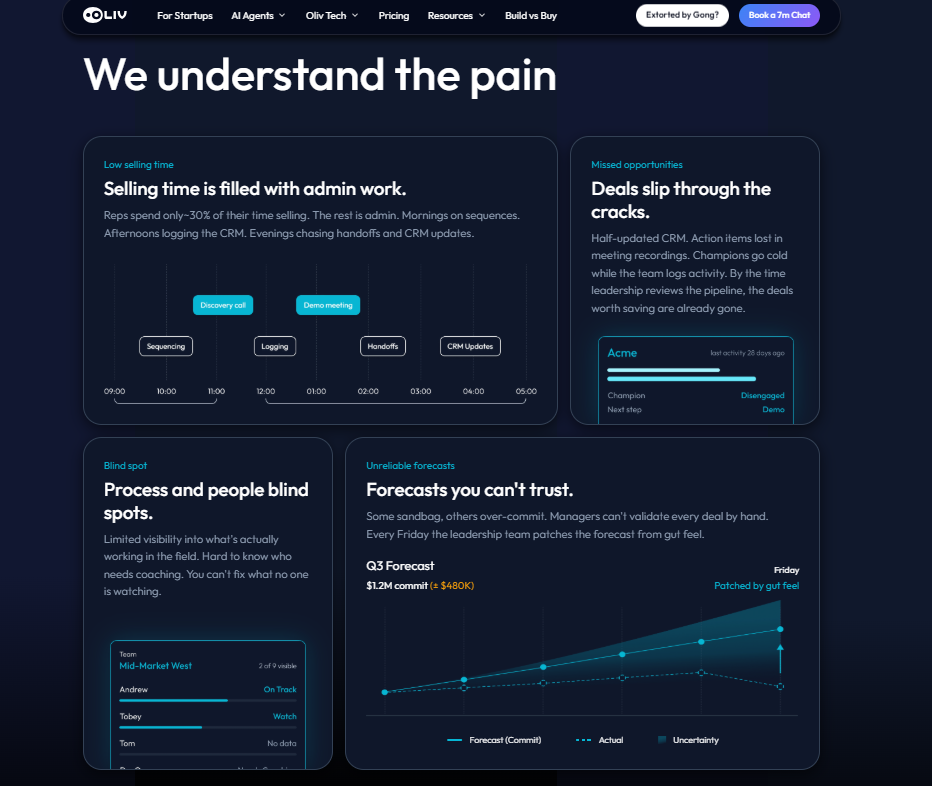
Oliv AI panels quantify reporting pain for revenue teams: 30% selling time, half-updated CRM records, limited field visibility, and a $1.2M Q3 forecast patched by gut feel.
Oliv AI is an AI-native revenue intelligence and revenue orchestration platform for B2B revenue teams. It runs agents on a continuously updated context graph of every account and opportunity. For reporting buyers, the relevant shift is simple. You ask a question and get an answer built from the record, instead of opening a filtered view.
⚙️ What it actually does for reporting
Oliv AI's object graph resolves each activity to the right account, contact, deal, renewal, or expansion. That mapping decides whether a report is correct at all.
Most reporting tools inherit rule-based activity mapping, which looks up an email domain and stops there. That breaks when one account exists three times, or when a call covers two opportunities.
I will hedge one thing honestly. Oliv AI's own measurements point to strong field accuracy, though I would still run your messiest quarter through it before believing any vendor, including us.
🧩 Key features worth checking in a trial
Analyst agent for natural-language questions such as why deals stall in proposal.
Deal Driver agent that flags at-risk deals without a manual review pass.
Forecast agent for weekly and monthly roll-ups.
CRM updates proposed with the exact conversation moment that triggered them.
Per-field accept, edit, or reject, with a reason you can trace.
70+ integrations, including Salesforce, HubSpot, Zoom, and Google Meet.
💰 Pricing and implementation
Oliv AI publishes a per-seat ladder rather than quoting on request. Conversation intelligence starts at $19, Enable is $29, Engage is $39, Forecast is $49, and Retain is $79, all per seat per month.
The platform fee is $0 and view-only seats are free. That matters in reporting, because most of the org only reads the output. Full details sit on the Oliv pricing page.
Implementation is handled by in-house forward deployed engineers. Reviewers describe setup in days rather than quarters.
🗓️ Product update timeline
Oliv AI Product Update Timeline
Period
What shipped
Primary source
Through 2025
Conversation intelligence, CRM auto-fill, deal views, and coaching scorecards ran as the core app surface for revenue teams.
Context Graph published as three layers, Object Graph for AI entity resolution, Intent Graph running 100+ fine-tuned revenue SLMs, and Process Graph encoding company playbooks.
✅ Answers "why" questions from the underlying record. ✅ Entity resolution built for messy, duplicated CRMs. ✅ Published price ladder, $0 platform fee, free view-only seats. ✅ Full open export policy with no data lock-in. ❌ Dashboard customization is still catching up to legacy BI depth. ❌ Some users report occasional slowness. ❌ Mobile experience lags the desktop platform.
🎯 Best use case
A 25 to 200 rep B2B team where RevOps owns the board number, the CRM has duplicate records, and the CRO keeps asking why the forecast moved.
🗣️ What real users say
"The Analyst agent allows me to understand everything I need with just one click, eliminating the long wait time I used to have with RevOps to get answers. The Driver agent watches all my deals and flags any that are at risk, so I don't have to spend hours listening to recordings in tools like Gong and Clari." - Verified reviewer, revenue team user,Oliv AI G2 - Verified Review, 17 Jun 2026, 4.5 stars
"I like how it makes forecasting and pipeline reviews easier, keeping everything up to date and the CRM hygienic... I'd love to see few more options to customize dashboards and reports for different teams." - Verified reviewer, sales operations user,Oliv AI G2 - Verified Review, 26 Jun 2026, 4.5 stars
"The main downside is that the analytics could be more customizable. It's a minor issue, but having more flexibility in how I view and configure analytics would make it even better." - Verified reviewer, sales leader,Oliv AI G2 - Verified Review, 8 Jul 2026, 5 stars
Oliv AI ranks first here for one narrow reason, not a general one. The Forecast tier at $49 per seat per month pairs question-and-answer reporting with an object graph that maps activity to the correct opportunity, and free view-only seats keep the whole org reading the same number.
1.2 Gong [toc=1.2 Gong]
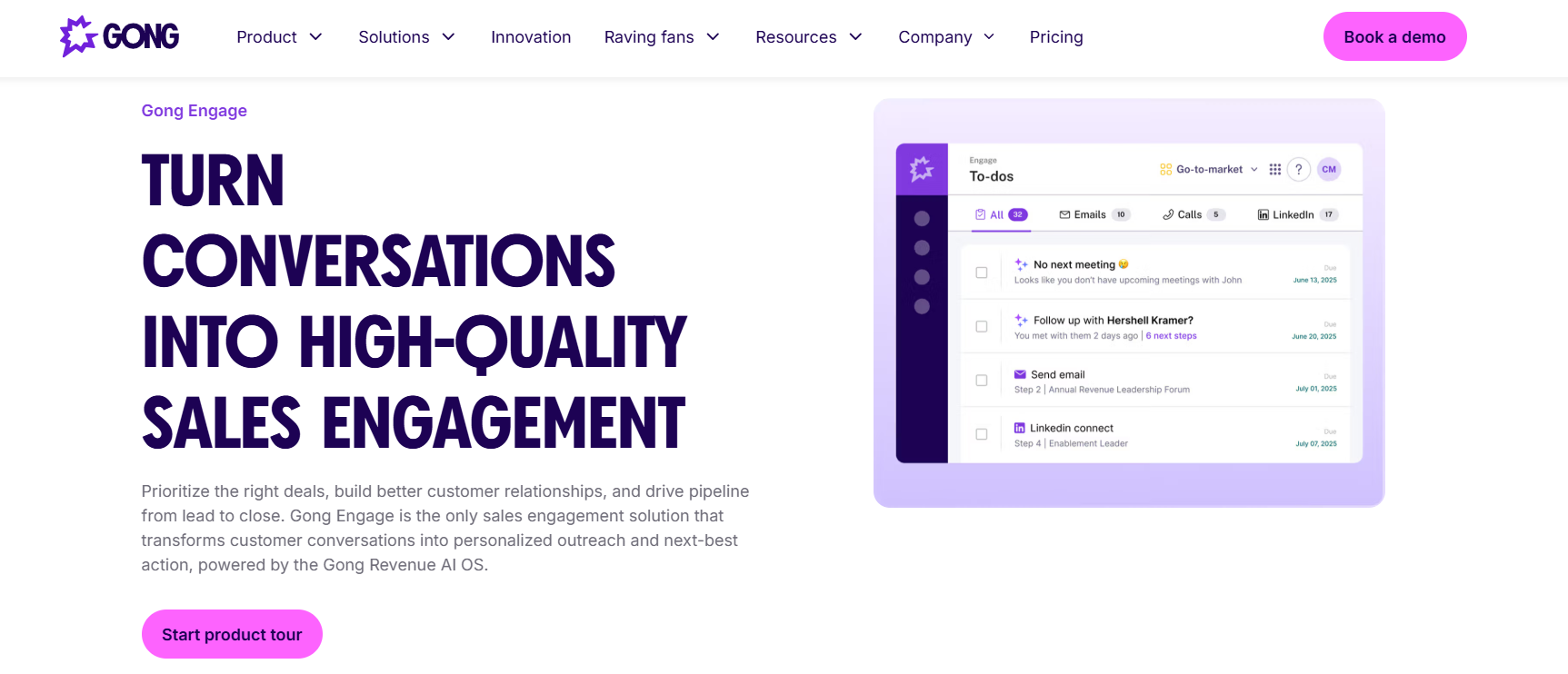
Gong Engage interface prioritises deals through next-best-action to-dos across email, calls, and LinkedIn, tying conversation data into pipeline reporting and engagement analytics for revenue teams.
Gong is the reference point in this category, and pretending otherwise would waste your time. Reporting sits on top of a very deep conversation intelligence layer, with deal boards, forecast boards, and a Data Studio metric builder.
🏆 Where Gong genuinely leads
Gartner's first Magic Quadrant for Revenue Action Orchestration, published in December 2025, placed Gong highest on both axes and first across all four use cases, including pipeline and forecast management. That is a real result, and it should shape your shortlist.
Commercially, Gong reported ARR topping $500 million with growth above 55% year over year in its May 2026 announcement.
🧩 Key features for reporting buyers
Revenue Analytics dashboards built on custom metrics.
Configurable forecast boards covering new business, renewals, upsells, and net revenue.
Data Extractor, which maps AI-extracted fields from conversations into the CRM.
AI Theme Spotter for pattern analysis across tens of thousands of calls.
Gong Data Cloud with Snowflake connectivity for BI teams.
💰 Pricing and implementation
Gong does not publish list pricing, and no primary source discloses seat costs. Oliv AI's own comparison page cites Gong Foundation at $133 per seat per month and a platform fee starting at $5,000, and I am flagging that as our figure rather than independent analysis.
Implementation is heavier than a notetaker rollout. Reviewers describe tracker and keyword setup as the fiddly part.
🗓️ Product update timeline
Gong Product Update Timeline
Period
What shipped
Primary source
2024 into 2025
Revenue Analytics with configurable dashboards, Smart Tracker accuracy work, Gong Assistant, Agent Studio, and automated AI call scorecards.
Gong monthly updates
Dec 2025 to May 2026
Data Extractor for CRM field mapping, AI Theme Spotter, Gong for Salesforce v3, Mission Andromeda with Gong Enable, and Data Studio related-object metrics.
Mission Andromeda launch
Announced as coming
Bidirectional MCP server connections and brief generation through the Gong API, letting external AI platforms query accounts and deals.
What's new in Gong
✅ Pros and ❌ cons
✅ Deepest conversation dataset feeding pipeline reporting. ✅ Strong analyst validation and fast release cadence. ✅ Forecast boards cover multiple revenue streams. ❌ Reviewers report bulk export and data access limits. ❌ Some data download capability sits behind a plan upgrade. ❌ Tracker setup and real-time integrations take time.
🎯 Best use case
Larger revenue orgs where call coaching and conversation analytics are the primary spend, and reporting rides along on that investment.
🗣️ What real users say
"I cannot download all the data myself unless we upgrade the plan, which isn't ideal and results in me not fully utilizing Gong. The requirement to download snippets one by one using copy and paste is particularly annoying." - Verified reviewer, revenue team user,Gong - G2 Verified Review, 3 Oct 2025, 3 stars
"The fact that you cant't edit a recording (to only share a portion with a client, and the fact that if you stop working with thew tool you lose the data." - Verified reviewer, sales user,Gong - G2 Verified Review, 19 Mar 2026, 3 stars
"Design is user friendly and ensure the elements are visible and with no confusion... Real Time integrations can be time consuming." - Verified reviewer, sales user,Gong - G2 Verified Review, 21 Apr 2026, 2.5 stars
Oliv AI takes a different position on the same problem. Where Gong's reporting depth grows with its conversation dataset, Oliv AI ties every reported number back to a resolved object and a traceable field change, and it commits to full open export so the data leaves when you do.
1.3 Clari [toc=1.3 Clari]
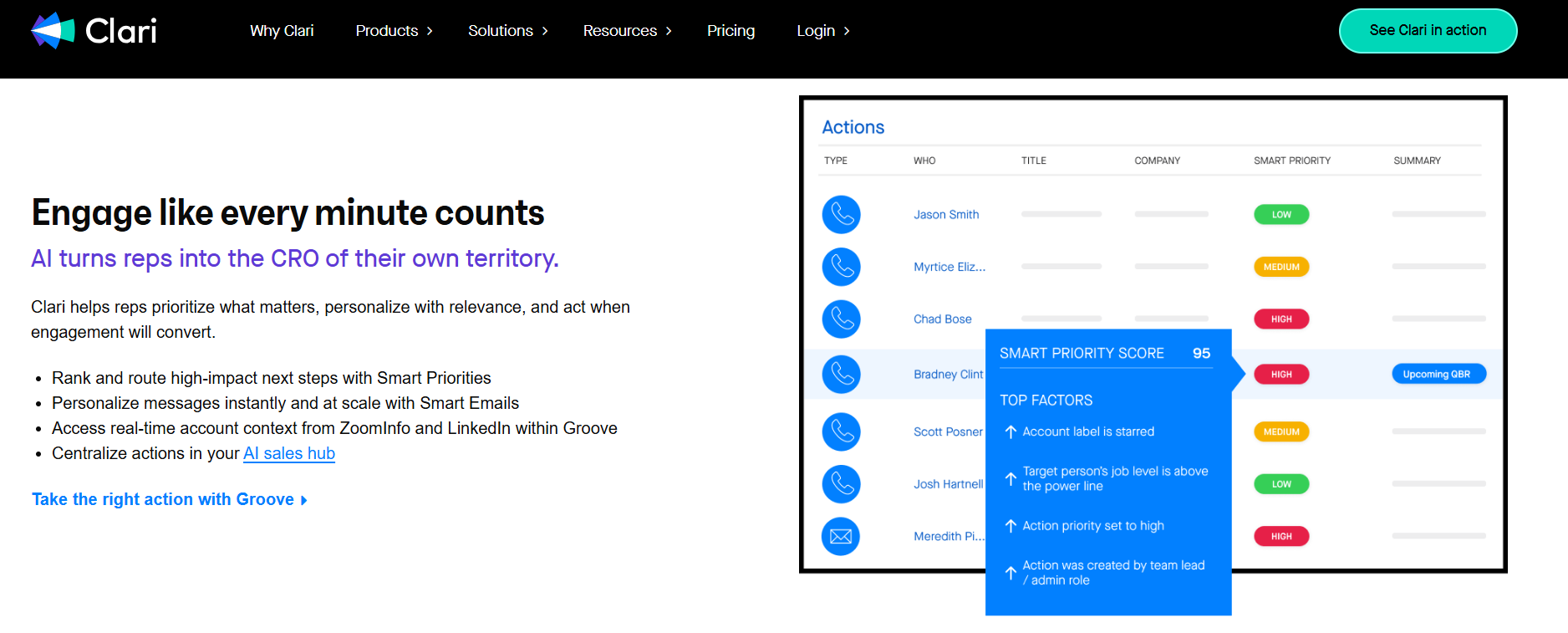
Clari prioritises rep actions with Smart Priority scoring, surfacing the factors behind each ranking so managers can trace how pipeline recommendations and engagement reporting were calculated.
Clari is the enterprise forecasting standard, and it earned that position honestly. Forecast hierarchy, inspection views, and weekly roll-ups are its strongest surface. Reporting buyers should judge it on custom reporting and writeback, not on forecast polish.
🧮 What Clari does for reporting
Clari pulls CRM data into forecast boards, pipeline views, and out-of-the-box analytics. Reviewers consistently praise week-over-week opportunity analysis.
The friction shows up when you want a metric Clari did not ship. Custom reporting is limited, and Salesforce writeback has real gaps for MEDDIC-style fields.
🧩 Key features
Forecast hierarchy with node-level submissions.
Inspection and waterfall views for pipeline movement.
Copilot conversation intelligence with battlecards.
Groove-based engagement and cadence analytics.
💰 Pricing and implementation
Clari does not publish list pricing. One structural cost is worth checking early. Reviewers report a separate Clari user per node in the forecast hierarchy, each requiring its own Salesforce licence.
Implementation is generally described as smooth. Reporting customization is where the time goes.
🗓️ Product update timeline
Clari Product Update Timeline
Period
What shipped
Primary source
2023 through mid-2025
Groove acquisition added sales engagement to the platform, and Copilot brought conversation intelligence alongside forecasting and inspection views.
Clari acquires Groove
Aug 2025 to Mar 2026
Merger with Salesloft announced, then the first cross-platform release shipped AI emails from Clari, Salesloft task creation, and Salesloft follow-up sends.
March 2026 release notes
Expected next
Deeper Clari and Salesloft release-train convergence around Revenue Context, with agent workflows spanning forecasting, engagement, and inspection.
Clari and Salesloft merger
✅ Best-in-class forecast hierarchy and inspection. ✅ Strong week-over-week opportunity analysis. ✅ Recognised Leader in the December 2025 Gartner Revenue Action Orchestration Magic Quadrant. ❌ Reviewers report no custom reporting. ❌ Salesforce writeback gaps, including MEDDIC values. ❌ Licence cost multiplies across forecast hierarchy nodes.
Enterprise teams where the weekly forecast call is the main artefact, and Salesforce is the single system of record.
🗣️ What real users say
"The conversation intelligence tool is lacking... There's no custom reporting. The CRM writeback is not good; we cannot send MEDDIC values back to Salesforce or update fields in Salesforce from the conversation intelligence." - Verified reviewer, revenue operations user,Clari - G2 Verified Review, 13 Jul 2026, 1.5 stars
"Clari forecasting is simple, easy to use, and well integrated with SFDC... The AI features are immature, team activity is poorly designed, and it doesn't integrate well with other popular business systems today." - Verified reviewer, sales leader,Clari - G2 Verified Review, 10 Oct 2025, 3 stars
"The real-time coaching and 'Battlecards' are game-changers... The 'Live Coaching' prompts can occasionally be a bit sensitive." - Verified reviewer, customer success user,Clari - G2 Verified Review, 8 Apr 2026, 4 stars
1.4 Salesloft [toc=1.4 Salesloft]
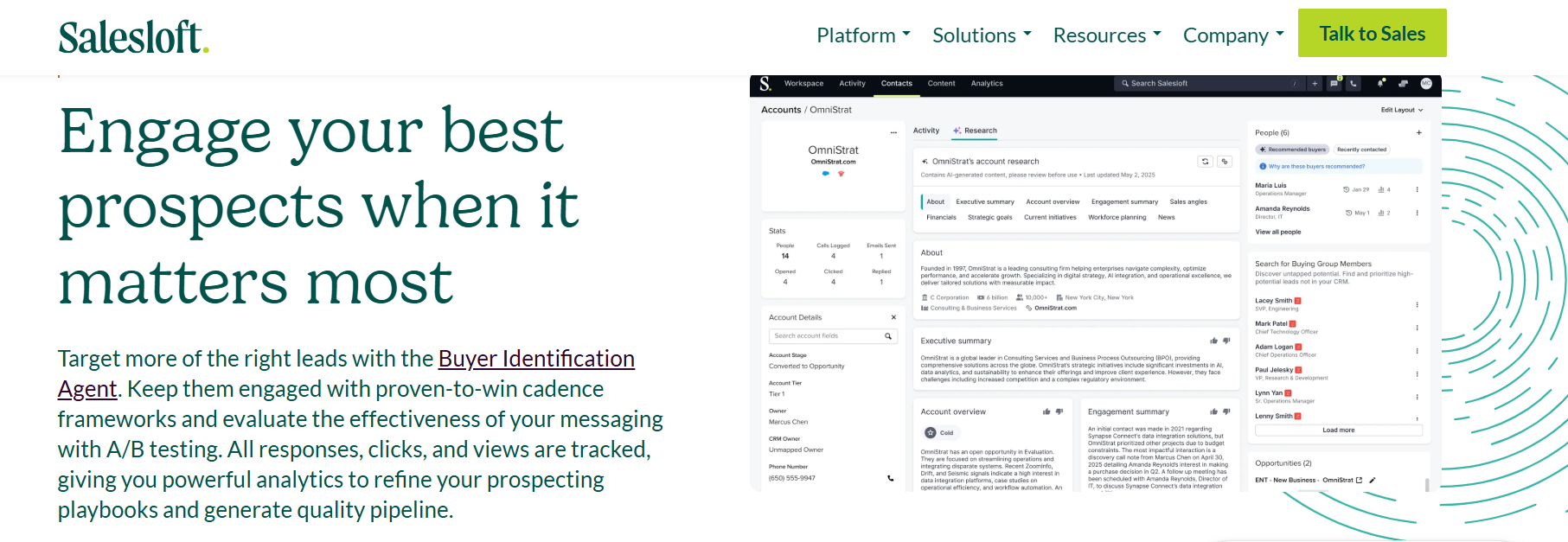
Salesloft account view combines logged calls, opens, clicks, AI account research, and buying-group recommendations, feeding cadence analytics and prospecting reports that sales managers review weekly.
Salesloft is an engagement platform first, and a reporting tool second. Its analytics cover cadences, activity, and email performance. Since the Clari merger, it sits inside a larger revenue platform.
📈 What Salesloft reports on
Cadence performance, rep activity volume, email engagement, and dialer outcomes. That is genuinely useful for pipeline generation reporting.
It is not built to answer executive questions about why a forecast moved. Treat it as an activity layer feeding your reporting, not the reporting layer itself.
Cadences with step-level analytics.
Dialer and conversation logging.
Salesforce and Microsoft Dynamics sync.
Shared reporting surface with Clari after the merger.
Salesloft does not publish list pricing. Reviewers describe integration as the hard part, with recurring complaints about setup, sync reliability, and browser extension behaviour.
Salesloft Product Update Timeline
Period
What shipped
Primary source
Through mid-2025
Cadences, templates, dialer, and activity analytics ran as a standalone sales engagement platform with Salesforce and Dynamics sync.
Clari and Salesloft merger notice
Dec 2025 to Mar 2026
Merger completed, and the first joint release added AI email sending from Clari, Salesloft task creation, and Salesloft-routed follow-ups.
March 2026 release notes
Expected next
Continued consolidation of the two release trains, with engagement data feeding Clari forecasting and inspection rather than reporting separately.
Clari product updates hub
✅ Mature cadence and activity analytics. ✅ Now bundled inside a larger revenue platform. ✅ Recognised in the December 2025 Gartner Magic Quadrant. ❌ Reviewers report clunky UX and setup difficulty. ❌ Data connectivity and email metrics flagged as unreliable. ❌ Limited conditional logic in automations.
Outbound-heavy teams that need activity reporting, and are already committed to the Clari platform.
"Analytics/metrics are faulty like email opens... Data updates like contact information sometimes does not update." - Verified reviewer, sales development user,Salesloft - G2 Verified Review, 26 Mar 2025, 1.5 stars
"Salesloft helps organize outreach at scale and keeps follow-ups from falling through the cracks... I often have trouble logging meetings, and certain features feel clunky or overly manual." - Verified reviewer, account executive,Salesloft - G2 Verified Review, 22 Jul 2025, 2.5 stars
1.5 People.ai [toc=1.5 People.ai]
People.ai solves a narrow, unglamorous, and genuinely important problem. It captures activity data and maps it to CRM objects, so reports run on complete data rather than what reps logged.
🔌 Why it matters for reporting
If your reports are wrong because activity is missing, People.ai attacks the cause. That is a different job from building the dashboard.
The 2026 direction is worth noting. People.ai added a Model Context Protocol integration so AI agents like Claude and Copilot can query its data layer directly.
Pricing is quoted, not published. Deployments are typically enterprise-scale, and the value depends on how dirty your existing activity data is.
People.ai Product Update Timeline
Period
What shipped
Primary source
Through 2025
Activity capture, contact discovery, and CRM data enrichment ran as the SalesAI Platform foundation for enterprise revenue teams.
People.ai newsroom
Feb 2026
Answer Platform gained a Model Context Protocol integration, connecting structured CRM records and unstructured conversation data to external AI agents.
People.ai MCP announcement
Expected next
Wider agent interoperability, with People.ai positioning as the data layer feeding third-party AI workflows rather than owning the interface.
People.ai platform page
✅ Fixes activity completeness at the source. ✅ Open to external AI agents through MCP. ✅ Recognised in the December 2025 Gartner Magic Quadrant. ❌ Not a dashboarding or executive reporting product. ❌ Pricing is opaque. ❌ Value depends heavily on CRM object hygiene.
Large enterprises where activity data completeness, not visualization, is the reporting bottleneck.
Salesforce is the system your reports run on, and it is a legitimate answer for many teams. Reports and dashboards are included, governed, and familiar to every admin you hire.
🏗️ When native reporting is enough
If every number lives in Salesforce, and definitions are stable, native reporting is often correct. Adding a layer on top of clean data buys you very little.
The limit is activity association. Rule-based capture misfires when duplicate accounts exist, and every downstream report inherits that error.
Reporting is bundled into your Sales Cloud edition, so the marginal cost is admin time. Advanced analytics sit behind higher editions and add-ons.
Salesforce Sales Cloud Reporting Update Timeline
Period
What shipped
Primary source
Through 2025
Reports, dashboards, collaborative forecasts, Pipeline Inspection, and Einstein Activity Capture formed the native reporting stack.
Salesforce release notes
Current cycle
Agentforce expanded agent capabilities across the platform, with continued investment in Einstein forecasting and analytics surfaces.
Agentforce documentation
Expected next
Tighter coupling of agents with native reporting objects, following the published seasonal release cadence.
Salesforce release notes
✅ No extra licence for core reporting. ✅ Governed, auditable, and admin-familiar. ✅ Native exports and full API access. ❌ Activity association is rule-based and breaks on duplicates. ❌ Cross-system blending needs a BI tool. ❌ Report building is admin work, not self-serve for most reps.
Teams with clean, single-system data and a capable Salesforce admin.
1.7 HubSpot Sales Hub [toc=1.7 HubSpot Sales Hub]
HubSpot is the pragmatic answer for growing teams. Reporting is native, reasonably fast to configure, and available on a free tier before you commit budget.
🚀 Where HubSpot reporting fits
Prebuilt sales reports cover pipeline, deal stage, rep activity, and revenue. The custom report builder unlocks on paid tiers.
Depth is the trade-off. Complex, multi-object reporting hits limits sooner than a dedicated analytics platform.
A free tier exists, and paid tiers scale by seat and feature depth. Setup is measured in hours for standard reports.
HubSpot Sales Hub Reporting Update Timeline
Period
What shipped
Primary source
Through 2025
Sales dashboards, custom report builder, forecasting, and deal pipeline analytics ran natively inside Sales Hub tiers.
HubSpot product updates
Current cycle
Continued expansion of AI features and reporting configurability across HubSpot's tiered plans.
HubSpot sales reporting
Expected next
Further AI-assisted reporting and forecasting inside the native CRM, per the published changelog cadence.
HubSpot changelog
✅ Free entry point with usable reports. ✅ No integration layer for HubSpot-native data. ✅ Fast to configure without specialist admins. ❌ Advanced custom reporting is gated by tier. ❌ Multi-object depth is limited. ❌ Cross-system blending still needs BI.
SMB and mid-market teams running on HubSpot who want reporting without a second vendor.
1.8 Aviso [toc=1.8 Aviso]
Aviso targets AI-driven forecasting and pipeline analytics. The proposition is reasonable, and the buyer feedback is the harshest in this list.
⚠️ What the reviews consistently flag
Performance, Salesforce sync reliability, and export fidelity come up repeatedly. One reviewer reports that exporting loses all customizations and filters.
I would only shortlist Aviso after a hands-on trial using your own data volume. Ask specifically about export behaviour and segment-switching speed.
Verify roadmap directly with the vendor, since no dated public release notes surfaced during this review.
Aviso platform
✅ Owner and segment filtering suits one-to-one reviews. ✅ Forecast-first design. ❌ Reviewers report slow performance when switching segments. ❌ Exports lose customizations and filters. ❌ Salesforce sync reliability complaints.
Budget-constrained forecast teams willing to run a rigorous pilot first.
"Extremely slow performance, especially when switching between segments. Exporting data loses all customisations and filters. Analytics are ineffective and add no real value." - Verified reviewer, sales user,Aviso - G2 Verified Review, 24 Jun 2025, 0 stars
"The solution is slow, often times it doens't sync with SFDC, the reports are terrible and don't represent what is being pulled by the data." - Verified reviewer, sales operations user,Aviso - G2 Verified Review, 18 Feb 2025, 0 stars
"I like being able to filter by group on the left-hand side. I often filter by the owner name so that I can easily zero in on one individual when I'm doing a one-on-one or through my forecast call." - Verified reviewer, sales manager,Aviso - G2 Verified Review, 8 Dec 2025, 3 stars
1.9 Terret (formerly BoostUp) [toc=1.9 Terret]
If you are searching for BoostUp, you are now evaluating Terret. The company rebranded on 9 September 2025 and repositioned from a forecasting tool to an agent-based revenue platform.
🔄 What the rename actually changed
BoostUp was a forecasting and deal-inspection product. Terret launched a Virtual Revenue Fleet of interconnected agents spanning pipeline generation through forecast.
Check contract continuity before you buy. Reviews and documentation are split across both names, and the app still carries legacy URLs.
Agent fleet covering pipeline, execution, and expansion.
Terret does not publish an official list price. Third-party reviews cite pricing from around $79 per user per month, so verify current terms directly with the vendor before budgeting.
Terret (formerly BoostUp) Product Update Timeline
Period
What shipped
Primary source
Through mid-2025
BoostUp ran as a mid-market forecasting platform with pipeline analytics, deal risk scoring, and conversation intelligence.
BoostUp rebrand announcement
Sep 2025
Rebranded as Terret and launched the Virtual Revenue Fleet, an integrated set of AI agents across sales, success, and revenue operations.
Welcome to Terret
Expected next
Continued agent expansion on the platform built with MongoDB, Cloudflare, and Mistral, positioned as answer-to-action rather than reporting.
Terret blog
✅ Forecasting lineage going back to 2018. ✅ Agent fleet is generally available, not roadmap. ✅ Named enterprise customers in the rebrand announcement. ❌ Brand and URL confusion after the rename. ❌ No published official price list. ❌ Review history is split across two names.
Mid-market teams that want forecasting plus agent automation, and are comfortable diligencing a recently renamed vendor.
1.10 InsightSquared [toc=1.10 InsightSquared]
InsightSquared is the legacy analytics option here, and the important fact is corporate, not technical. Mediafly acquired it, and the capability now sits inside the Mediafly suite.
🏛️ What buyers should verify first
Confirm the current product name, contract entity, and support model before shortlisting. Public sources describe it as rebranded within Mediafly's revenue intelligence line.
The underlying strength was always prebuilt analytics depth. That library still suits teams who want reports out of the box rather than a builder.
Pricing is quoted, not published. Third-party category guides place the Mediafly cluster in the mid tier on annual per-user cost, so treat that as directional only.
InsightSquared Product Update Timeline
Period
What shipped
Primary source
2022 through 2023
Mediafly completed the InsightSquared acquisition and merged revenue intelligence with sales enablement and content engagement data.
Mediafly acquisition page
Since integration
Capability now sits inside the Mediafly revenue intelligence suite, combining activity, content engagement, and pipeline health in one dashboard.
Mediafly revenue intelligence
Expected next
Confirm the roadmap with Mediafly directly, as standalone InsightSquared release notes are no longer maintained publicly.
Mediafly
✅ Deep prebuilt analytics library. ✅ Bundled with sales enablement and content analytics. ✅ Long operating history in forecasting. ❌ Standalone brand no longer maintained. ❌ Public roadmap visibility is poor. ❌ Requires vendor confirmation on naming and support.
Organisations already inside the Mediafly suite, or those inheriting a legacy InsightSquared estate.
Oliv AI sits at the top of this list for a structural reason rather than a feature count. Across these ten, the common failure is a report inheriting activity mapped to the wrong opportunity, and most vendors here still resolve that with rule-based lookups. Oliv AI resolves it with an object graph, then shows the field-level reason behind every CRM change, and lets you export everything.
1.3 Clari [toc=1.3 Clari]
Clari is the enterprise forecasting standard, and it earned that position honestly. Forecast hierarchy, inspection views, and weekly roll-ups are its strongest surface. Reporting buyers should judge it on custom reporting and writeback, not on forecast polish.
🧮 What Clari does for reporting
Clari pulls CRM data into forecast boards, pipeline views, and out-of-the-box analytics. Reviewers consistently praise week-over-week opportunity analysis.
The friction shows up when you want a metric Clari did not ship. Custom reporting is limited, and Salesforce writeback has real gaps for MEDDIC-style fields.
🧩 Key features
Forecast hierarchy with node-level submissions.
Inspection and waterfall views for pipeline movement.
Copilot conversation intelligence with battlecards.
Groove-based engagement and cadence analytics.
💰 Pricing and implementation
Clari does not publish list pricing. One structural cost is worth checking early. Reviewers report a separate Clari user per node in the forecast hierarchy, each requiring its own Salesforce licence.
Implementation is generally described as smooth. Reporting customization is where the time goes.
🗓️ Product update timeline
Clari Product Update Timeline
Period
What shipped
Primary source
2023 through mid-2025
Groove acquisition added sales engagement to the platform, and Copilot brought conversation intelligence alongside forecasting and inspection views.
Clari acquires Groove
Aug 2025 to Mar 2026
Merger with Salesloft announced, then the first cross-platform release shipped AI emails from Clari, Salesloft task creation, and Salesloft follow-up sends.
March 2026 release notes
Expected next
Deeper Clari and Salesloft release-train convergence around Revenue Context, with agent workflows spanning forecasting, engagement, and inspection.
Clari and Salesloft merger
✅ Pros and ❌ cons
✅ Best-in-class forecast hierarchy and inspection. ✅ Strong week-over-week opportunity analysis. ✅ Recognised Leader in the December 2025 Gartner Revenue Action Orchestration Magic Quadrant. ❌ Reviewers report no custom reporting. ❌ Salesforce writeback gaps, including MEDDIC values. ❌ Licence cost multiplies across forecast hierarchy nodes.
🎯 Best use case
Enterprise teams where the weekly forecast call is the main artefact, and Salesforce is the single system of record.
🗣️ What real users say
"The conversation intelligence tool is lacking... There's no custom reporting. The CRM writeback is not good; we cannot send MEDDIC values back to Salesforce or update fields in Salesforce from the conversation intelligence." Verified reviewer, revenue operations user,Clari - G2 Verified Review, 13 Jul 2026, 1.5 stars
"Clari forecasting is simple, easy to use, and well integrated with SFDC... The AI features are immature, team activity is poorly designed, and it doesn't integrate well with other popular business systems today." Verified reviewer, sales leader,Clari - G2 Verified Review, 10 Oct 2025, 3 stars
"The real-time coaching and 'Battlecards' are game-changers... The 'Live Coaching' prompts can occasionally be a bit sensitive." Verified reviewer, customer success user,Clari - G2 Verified Review, 8 Apr 2026, 4 stars
1.4 Salesloft [toc=1.4 Salesloft]
Salesloft is an engagement platform first, and a reporting tool second. Its analytics cover cadences, activity, and email performance. Since the Clari merger, it sits inside a larger revenue platform.
📈 What Salesloft reports on
Cadence performance, rep activity volume, email engagement, and dialer outcomes. That is genuinely useful for pipeline generation reporting.
It is not built to answer executive questions about why a forecast moved. Treat it as an activity layer feeding your reporting, not the reporting layer itself.
🧩 Key features
Cadences with step-level analytics.
Dialer and conversation logging.
Salesforce and Microsoft Dynamics sync.
Shared reporting surface with Clari after the merger.
💰 Pricing and implementation
Salesloft does not publish list pricing. Reviewers describe integration as the hard part, with recurring complaints about setup, sync reliability, and browser extension behaviour.
🗓️ Product update timeline
Salesloft Product Update Timeline
Period
What shipped
Primary source
Through mid-2025
Cadences, templates, dialer, and activity analytics ran as a standalone sales engagement platform with Salesforce and Dynamics sync.
Clari and Salesloft merger notice
Dec 2025 to Mar 2026
Merger completed, and the first joint release added AI email sending from Clari, Salesloft task creation, and Salesloft-routed follow-ups.
March 2026 release notes
Expected next
Continued consolidation of the two release trains, with engagement data feeding Clari forecasting and inspection rather than reporting separately.
Clari product updates hub
✅ Pros and ❌ cons
✅ Mature cadence and activity analytics. ✅ Now bundled inside a larger revenue platform. ✅ Recognised in the December 2025 Gartner Magic Quadrant. ❌ Reviewers report clunky UX and setup difficulty. ❌ Data connectivity and email metrics flagged as unreliable. ❌ Limited conditional logic in automations.
🎯 Best use case
Outbound-heavy teams that need activity reporting, and are already committed to the Clari platform.
🗣️ What real users say
"Analytics/metrics are faulty like email opens... Data updates like contact information sometimes does not update." Verified reviewer, sales development user,Salesloft - G2 Verified Review, 26 Mar 2025, 1.5 stars
"Salesloft helps organize outreach at scale and keeps follow-ups from falling through the cracks... I often have trouble logging meetings, and certain features feel clunky or overly manual." Verified reviewer, account executive,Salesloft - G2 Verified Review, 22 Jul 2025, 2.5 stars
1.5 People.ai [toc=1.5 People.ai]
People.ai solves a narrow, unglamorous, and genuinely important problem. It captures activity data and maps it to CRM objects, so reports run on complete data rather than what reps logged.
🔌 Why it matters for reporting
If your reports are wrong because activity is missing, People.ai attacks the cause. That is a different job from building the dashboard.
The 2026 direction is worth noting. People.ai added a Model Context Protocol integration so AI agents like Claude and Copilot can query its data layer directly.
Pricing is quoted, not published. Deployments are typically enterprise-scale, and the value depends on how dirty your existing activity data is.
🗓️ Product update timeline
People.ai Product Update Timeline
Period
What shipped
Primary source
Through 2025
Activity capture, contact discovery, and CRM data enrichment ran as the SalesAI Platform foundation for enterprise revenue teams.
People.ai newsroom
Feb 2026
Answer Platform gained a Model Context Protocol integration, connecting structured CRM records and unstructured conversation data to external AI agents.
People.ai MCP announcement
Expected next
Wider agent interoperability, with People.ai positioning as the data layer feeding third-party AI workflows rather than owning the interface.
People.ai platform page
✅ Pros and ❌ cons
✅ Fixes activity completeness at the source. ✅ Open to external AI agents through MCP. ✅ Recognised in the December 2025 Gartner Magic Quadrant. ❌ Not a dashboarding or executive reporting product. ❌ Pricing is opaque. ❌ Value depends heavily on CRM object hygiene.
🎯 Best use case
Large enterprises where activity data completeness, not visualization, is the reporting bottleneck.
Salesforce is the system your reports run on, and it is a legitimate answer for many teams. Reports and dashboards are included, governed, and familiar to every admin you hire.
🏗️ When native reporting is enough
If every number lives in Salesforce, and definitions are stable, native reporting is often correct. Adding a layer on top of clean data buys you very little.
The limit is activity association. Rule-based capture misfires when duplicate accounts exist, and every downstream report inherits that error.
Reporting is bundled into your Sales Cloud edition, so the marginal cost is admin time. Advanced analytics sit behind higher editions and add-ons.
🗓️ Product update timeline
Salesforce Sales Cloud Reporting Update Timeline
Period
What shipped
Primary source
Through 2025
Reports, dashboards, collaborative forecasts, Pipeline Inspection, and Einstein Activity Capture formed the native reporting stack.
Salesforce release notes
Current cycle
Agentforce expanded agent capabilities across the platform, with continued investment in Einstein forecasting and analytics surfaces.
Agentforce documentation
Expected next
Tighter coupling of agents with native reporting objects, following the published seasonal release cadence.
Salesforce release notes
✅ Pros and ❌ cons
✅ No extra licence for core reporting. ✅ Governed, auditable, and admin-familiar. ✅ Native exports and full API access. ❌ Activity association is rule-based and breaks on duplicates. ❌ Cross-system blending needs a BI tool. ❌ Report building is admin work, not self-serve for most reps.
🎯 Best use case
Teams with clean, single-system data and a capable Salesforce admin.
1.7 HubSpot Sales Hub [toc=1.7 HubSpot Sales Hub]
HubSpot is the pragmatic answer for growing teams. Reporting is native, reasonably fast to configure, and available on a free tier before you commit budget.
🚀 Where HubSpot reporting fits
Prebuilt sales reports cover pipeline, deal stage, rep activity, and revenue. The custom report builder unlocks on paid tiers.
Depth is the trade-off. Complex, multi-object reporting hits limits sooner than a dedicated analytics platform.
A free tier exists, and paid tiers scale by seat and feature depth. Setup is measured in hours for standard reports.
🗓️ Product update timeline
HubSpot Sales Hub Reporting Update Timeline
Period
What shipped
Primary source
Through 2025
Sales dashboards, custom report builder, forecasting, and deal pipeline analytics ran natively inside Sales Hub tiers.
HubSpot product updates
Current cycle
Continued expansion of AI features and reporting configurability across HubSpot's tiered plans.
HubSpot sales reporting
Expected next
Further AI-assisted reporting and forecasting inside the native CRM, per the published changelog cadence.
HubSpot changelog
✅ Pros and ❌ cons
✅ Free entry point with usable reports. ✅ No integration layer for HubSpot-native data. ✅ Fast to configure without specialist admins. ❌ Advanced custom reporting is gated by tier. ❌ Multi-object depth is limited. ❌ Cross-system blending still needs BI.
🎯 Best use case
SMB and mid-market teams running on HubSpot who want reporting without a second vendor.
1.8 Aviso [toc=1.8 Aviso]
Aviso targets AI-driven forecasting and pipeline analytics. The proposition is reasonable, and the buyer feedback is the harshest in this list.
⚠️ What the reviews consistently flag
Performance, Salesforce sync reliability, and export fidelity come up repeatedly. One reviewer reports that exporting loses all customizations and filters.
I would only shortlist Aviso after a hands-on trial using your own data volume. Ask specifically about export behaviour and segment-switching speed.
Verify roadmap directly with the vendor, since no dated public release notes surfaced during this review.
Aviso platform
✅ Pros and ❌ cons
✅ Owner and segment filtering suits one-to-one reviews. ✅ Forecast-first design. ❌ Reviewers report slow performance when switching segments. ❌ Exports lose customizations and filters. ❌ Salesforce sync reliability complaints.
🎯 Best use case
Budget-constrained forecast teams willing to run a rigorous pilot first.
🗣️ What real users say
"Extremely slow performance, especially when switching between segments. Exporting data loses all customisations and filters. Analytics are ineffective and add no real value." Verified reviewer, sales user,Aviso - G2 Verified Review, 24 Jun 2025, 0 stars
"The solution is slow, often times it doens't sync with SFDC, the reports are terrible and don't represent what is being pulled by the data." Verified reviewer, sales operations user,Aviso - G2 Verified Review, 18 Feb 2025, 0 stars
"I like being able to filter by group on the left-hand side. I often filter by the owner name so that I can easily zero in on one individual when I'm doing a one-on-one or through my forecast call." Verified reviewer, sales manager,Aviso - G2 Verified Review, 8 Dec 2025, 3 stars
1.9 Terret (formerly BoostUp) [toc=1.9 Terret]
If you are searching for BoostUp, you are now evaluating Terret. The company rebranded on 9 September 2025 and repositioned from a forecasting tool to an agent-based revenue platform.
🔄 What the rename actually changed
BoostUp was a forecasting and deal-inspection product. Terret launched a Virtual Revenue Fleet of interconnected agents spanning pipeline generation through forecast.
Check contract continuity before you buy. Reviews and documentation are split across both names, and the app still carries legacy URLs.
Agent fleet covering pipeline, execution, and expansion.
💰 Pricing and implementation
Terret does not publish an official list price. Third-party reviews cite pricing from around $79 per user per month, so verify current terms directly with the vendor before budgeting.
🗓️ Product update timeline
Terret (formerly BoostUp) Product Update Timeline
Period
What shipped
Primary source
Through mid-2025
BoostUp ran as a mid-market forecasting platform with pipeline analytics, deal risk scoring, and conversation intelligence.
BoostUp rebrand announcement
Sep 2025
Rebranded as Terret and launched the Virtual Revenue Fleet, an integrated set of AI agents across sales, success, and revenue operations.
Welcome to Terret
Expected next
Continued agent expansion on the platform built with MongoDB, Cloudflare, and Mistral, positioned as answer-to-action rather than reporting.
Terret blog
✅ Pros and ❌ cons
✅ Forecasting lineage going back to 2018. ✅ Agent fleet is generally available, not roadmap. ✅ Named enterprise customers in the rebrand announcement. ❌ Brand and URL confusion after the rename. ❌ No published official price list. ❌ Review history is split across two names.
🎯 Best use case
Mid-market teams that want forecasting plus agent automation, and are comfortable diligencing a recently renamed vendor.
1.10 InsightSquared [toc=1.10 InsightSquared]
InsightSquared is the legacy analytics option here, and the important fact is corporate, not technical. Mediafly acquired it, and the capability now sits inside the Mediafly suite.
🏛️ What buyers should verify first
Confirm the current product name, contract entity, and support model before shortlisting. Public sources describe it as rebranded within Mediafly's revenue intelligence line.
The underlying strength was always prebuilt analytics depth. That library still suits teams who want reports out of the box rather than a builder.
Pricing is quoted, not published. Third-party category guides place the Mediafly cluster in the mid tier on annual per-user cost, so treat that as directional only.
🗓️ Product update timeline
InsightSquared Product Update Timeline
Period
What shipped
Primary source
2022 through 2023
Mediafly completed the InsightSquared acquisition and merged revenue intelligence with sales enablement and content engagement data.
Mediafly acquisition page
Since integration
Capability now sits inside the Mediafly revenue intelligence suite, combining activity, content engagement, and pipeline health in one dashboard.
Mediafly revenue intelligence
Expected next
Confirm the roadmap with Mediafly directly, as standalone InsightSquared release notes are no longer maintained publicly.
Mediafly
✅ Pros and ❌ cons
✅ Deep prebuilt analytics library. ✅ Bundled with sales enablement and content analytics. ✅ Long operating history in forecasting. ❌ Standalone brand no longer maintained. ❌ Public roadmap visibility is poor. ❌ Requires vendor confirmation on naming and support.
🎯 Best use case
Organisations already inside the Mediafly suite, or those inheriting a legacy InsightSquared estate.
Oliv AI sits at the top of this list for a structural reason rather than a feature count. Across these ten, the common failure is a report inheriting activity mapped to the wrong opportunity, and most vendors here still resolve that with rule-based lookups. Oliv AI resolves it with an object graph, then shows the field-level reason behind every CRM change, and lets you export everything, which is the same argument made in our revenue intelligence platform comparison for RevOps.
Q2. How were these sales reporting tools scored and ranked? [toc=2. Scoring Methodology]
Each tool was scored out of 100 across five weighted criteria: Answer Quality and Explainability (25%), Data Resolution and CRM Sync Accuracy (25%), Custom Metrics and Executive Views (20%), Traceability and Export Freedom (15%), and Pricing and Seat Transparency (15%). Scores map to stars in 20-point bands, so 81 to 100 earns five stars.
🧪 Why these five criteria, and not a feature count
Feature counts reward the vendor with the longest datasheet. They tell you nothing about whether a number holds up in a board meeting.
Gartner's own sales analytics research found that 58% of sales leaders say business and data complexity makes analytics hard to interpret, and that analytics value concentrates in coaching, opportunity qualification, and forecasting. So the rubric scores whether reporting drives an action, not how many chart types exist, which is the same standard we apply in our revenue performance analytics work.
Oliv AI measures the same thing internally by tracking how many proposed CRM field updates get accepted, edited, or rejected by a human. That accept rate is a cleaner signal than dashboard count.
⚖️ The weights, and what each one punishes
Scoring Weights for Sales Reporting Software
Criterion
Weight
Rewards
Penalises
Answer Quality and Explainability
25%
Explaining why a number moved, with evidence
Filtered views that only restate what happened
Data Resolution and CRM Sync Accuracy
25%
Correct activity-to-opportunity mapping
Rule-based lookups that break on duplicate accounts
Dashboard breadth carries zero weight on its own. Traceability carries 15% because an answer you cannot reproduce next quarter is not a report.
⭐ How stars are assigned
Star Rating Bands Used in This Review
Score
Stars
Reading
0 to 20
⭐
Do not shortlist without a strong specific reason
21 to 40
⭐⭐
Trial only, with a scripted pilot
41 to 60
⭐⭐⭐
Fits a narrow use case
61 to 80
⭐⭐⭐⭐
Strong contender for most teams
81 to 100
⭐⭐⭐⭐⭐
Shortlist first
Oliv AI scores 5 stars on this rubric, and the traceability weight is where the gap opens. Every proposed CRM update surfaces with the exact conversation moment that triggered it.
⚠️ Where this scoring is weak, honestly
Two limits are worth naming before you lean on these numbers. Several scores rest on vendor-published documentation and dated third-party reviews, not hands-on testing in your data.
The second limit is the counter-argument I take seriously. A reporting incumbent would say governed metrics, a defined semantic layer, and audit trails are exactly what a natural-language answer struggles to deliver.
I think that argument is right, which is why it became a scored criterion rather than a footnote. Where a vendor cannot show reproducibility, that costs points, a theme we unpack in our guide to AI CRM trust and governance.
🔁 How to re-run this rubric on your own shortlist
Rewrite the five weights to match your actual pain, keeping the total at 100.
Score each vendor in a live trial using one messy quarter of your own data.
Ask every vendor to export the same report twice, thirty days apart.
Record who owns each metric definition before you compare outputs.
Oliv AI publishes its full per-seat ladder from $19 to $79 with a $0 platform fee, which is why it scores well on the transparency criterion. That figure comes from our own pricing page, not independent analysis.
Q3. CRM-native reports, BI tools, or a dedicated reporting layer, which one do you actually need? [toc=3. CRM-Native vs Dedicated]
CRM-native reports are enough while every number lives in one system and the questions stay descriptive. A BI tool wins when you must blend CRM with billing, product, and finance data. A dedicated reporting or answering layer earns its licence only when the constraint is data resolution and explanation, not visualisation.
🏗️ The three architectures, and when each is correct
Native CRM reporting is the default, and it is genuinely fine for a lot of teams. Salesforce reports, dashboards, and collaborative forecasts cost nothing extra beyond admin time.
A business intelligence tool, meaning a general analytics platform like Looker or Power BI, wins when the number spans systems. Pipeline plus billing plus product usage is a BI job, not a CRM job.
A dedicated layer only makes sense for a third case. That case is when the data feeding the report is wrong, or when the question is "why" rather than "what", which is the distinction we draw in revenue intelligence versus conversation intelligence.
🙋 "We already have Salesforce reports, Einstein, and a BI tool"
This is the fairest objection in the category, and I hear it in most first calls. You are right to resist paying twice for charts.
Here is the part that usually gets skipped. Einstein Activity Capture associates activity using rule-based matching, and that misfires when the same account exists three times, a limitation we cover in our breakdown of Salesforce Einstein features.
Ask Oliv AI to place a call that touched two open opportunities, and it reasons across open accounts, relationship history, and conversation context instead of matching an email domain.
🧯 Why another chart does not fix it
A report is a rendering of the record underneath. If the record is wrong, the chart is confidently wrong.
The second half is harder. A CRO asking why the forecast slipped is not asking for a filter, and no dashboard answers that question by design.
One mid-market CRO put it plainly in our research: he had to explain to a board why a $2M revenue stack could not say why they were missing quota. That is a reporting failure nobody can visualise their way out of.
🪜 The reporting maturity ladder
The Sales Reporting Maturity Ladder
Stage
What you run on
The trigger to move up
1. Spreadsheet roll-ups
Exports stitched by hand each Friday
The roll-up takes longer than the analysis
2. CRM-native reporting
Salesforce or HubSpot reports and dashboards
Two systems start disagreeing on the same metric
3. RevOps analytics or BI
Blended CRM, billing, product, and finance data
Definitions drift, and nobody owns the metric dictionary
4. Context-aware revenue operations
Resolved records plus an answering layer
Every exec question starts with "why"
Most teams I meet are stuck between stage two and stage three. They have outgrown native reports but have not fixed the data underneath, so BI just renders the same errors faster.
🧭 How to place yourself in one afternoon
Count how many systems hold a number that appears in your board deck.
Pull three closed-lost deals and check which opportunity their calls mapped to.
Ask two people to define win rate independently, then compare.
Time how long the last board view took to rebuild after a vendor update.
If the first three tests pass cleanly, stay where you are and save the money.
Oliv AI sits on top of Salesforce, HubSpot, or Dynamics rather than beside them, resolving each activity to the right account, opportunity, renewal, or expansion before any number reaches a dashboard. The CRM stays the system of record. Nothing gets replaced.
Q4. Why do your CRM and your team give two different answers about what will close this quarter? [toc=4. Why Numbers Disagree]
Because CRM reporting depends on reps logging what happened, and it stops being current the moment they do not. Add duplicate accounts, stale stages, and weighted formulas nobody can trace, and the system carries one number while the team carries another. The gap is structural, not a matter of rep discipline.
📅 The Monday morning version of this problem
You open the pipeline report before the forecast call. It says $2.1M commit.
Then the AEs talk, and the real number lands somewhere near $1.6M. Nobody is lying, and nobody is being sloppy.
🔎 Three causes, in the order they usually bite
Data decay. Fields age between the conversation and the CRM update. Reps update stages when a deal is going well and go quiet when it is not.
Wrong-object mapping. When one account exists three times, activity attaches to whichever record the rule matched first. Every downstream report inherits that error silently.
Opaque weighting. Reviewers describe reporting where the weighted number cannot be traced back to its calculation. If you cannot show the math, you cannot defend the forecast, which is why we push evidence-based forecast commits.
Oliv AI attacks the first two at the source, proposing CRM field updates with the exact conversation moment that triggered them.
🆚 What each architecture returns for the same question
Ask this: why are deals getting stuck in proposal in the last two quarters?
Dashboard Output Versus Answering Layer Output
A dashboard returns
An answering layer returns
Proposal-stage ageing rose from 18 to 31 days
Procurement entered later than in prior quarters
Stage conversion fell 12 points
A competitor was named in 9 of 14 stalled deals
A filtered list of stuck opportunities
Pricing objections raised in week two, unanswered
No cause, no evidence trail
The specific calls and emails behind each claim
The left column is not useless. It is just the start of the work, and the exec asking already saw it.
🤔 Where I would push back on my own argument
Oliv AI's read is that the category has been optimising the wrong layer for a decade, though I hold that loosely. A generated answer you cannot reproduce next quarter is worse than a boring chart you can.
So the test is not whether the answer sounds smart. The test is whether it shows its records, the same bar we set for AI deal intelligence.
🗣️ What real users report about the underlying failure
"The CRM writeback is not good; we cannot send MEDDIC values back to Salesforce or update fields in Salesforce from the conversation intelligence. The AI is not as flexible as we need it to be." Verified reviewer, revenue operations user,Clari - G2 Verified Review, 13 Jul 2026, 1.5 stars
"Data updates like contact information sometimes does not update. Analytics/metrics are faulty like email opens." Verified reviewer, sales development user,Salesloft - G2 Verified Review, 26 Mar 2025, 1.5 stars
"Being able to sequence our steps, along with integration with Nooks/Salesforce... limitations of getting data back into salesforce." Verified reviewer, sales user,Gong - G2 Verified Review, 21 May 2026, 3 stars
🧰 Three tests to run inside any trial
Load one messy quarter, then check where calls from a duplicated account landed.
Ask the tool why a specific deal slipped, and demand the source records.
Change one field, then trace who changed it, when, and on what evidence.
Run those three before you look at a single dashboard screenshot, and pair them with a CRM data quality audit.
Oliv AI's Analyst agent answers these questions from the resolved record rather than a filtered view, and each proposed field change carries a reason you can accept, edit, or reject. The argument for why dashboards stopped being enough is covered separately in The Death of SaaS Dashboards.
Q5. Which metrics, custom reports and executive views should the tool actually deliver? [toc=5. Metrics and Executive Views]
Track revenue, quota attainment, pipeline value, win rate, conversion rate, average deal size, sales-cycle length, pipeline velocity, forecast accuracy, and rep activity. Then test the plumbing: can custom metrics be defined once and reused, are Salesforce formula fields supported, how many groupings does one view allow, and do views survive a vendor update?
🎯 The metric set, split by who reads it
Every metric needs an owner and a decision attached. A number nobody acts on is overhead.
Sales Reporting Metrics by Reader and Decision
Reader
Metrics they need
The decision it drives
Rep
Quota attainment, activity, deal-stage ageing
What to work today
Frontline manager
Win rate, conversion, cycle length
Who to coach this week
RevOps
Pipeline velocity, forecast accuracy, data completeness
Where the process leaks
CRO
Coverage, commit versus best case, segment trends
Where to move headcount and spend
Board
Revenue, growth rate, variance to plan
Whether the plan still holds
Gartner's sales analytics research puts the return in coaching, opportunity qualification, and forecasting. Score tools against those three, not against chart variety, and treat the coaching leg as its own workstream alongside your sales productivity metrics.
🔧 Eight questions to ask in the demo
Ask these live, with your own data loaded. Vendors answer differently when the screen is shared.
Can I define a custom metric once, then reuse it across every view?
Do you read Salesforce formula fields natively?
How many groupings does a single view allow?
Do my saved views survive your next platform update?
What writes back to the CRM, and at what field level?
How fresh is the data, and what is the sync interval?
Can a view-only user open this report without a paid seat?
Can I export the underlying dataset, not just the rendered chart?
Oliv AI connects to 70+ tools, including Salesforce, HubSpot, and Dynamics, and proposes field-level updates rather than overwriting records silently. The wider integration pattern is covered in our note on RevOps integrations across CRM, Slack, and email.
🏛️ Building a board view that survives the quarter
The weekend rebuild happens because definitions are unstable, not because charts are slow. Fix the definitions first.
Write a metric dictionary. One owner, one source system, one definition per number.
Template the board view, and freeze the layout.
Automate the roll-up so nobody assembles it by hand.
Attach a written variance explanation to every figure.
Version it, so last quarter's view is still reproducible.
"The conversation intelligence tool is lacking... There's no custom reporting. The CRM writeback is not good; we cannot send MEDDIC values back to Salesforce." Verified reviewer, revenue operations user,Clari - G2 Verified Review, 13 Jul 2026, 1.5 stars
"Exporting data loses all customisations and filters. Analytics are ineffective and add no real value." Verified reviewer, sales user,Aviso - G2 Verified Review, 24 Jun 2025, 0 stars
"I like how it makes forecasting and pipeline reviews easier, keeping everything up to date and the CRM hygienic... I'd love to see few more options to customize dashboards and reports for different teams." Verified reviewer, sales operations user,Oliv AI G2 - Verified Review, 26 Jun 2026, 4.5 stars
That last one is our own gap, and I am not going to pretend otherwise. Dashboard configurability is where Oliv AI is still behind legacy BI depth.
Oliv AI keeps board views readable across the whole org because view-only seats are free and the platform fee is $0. In reporting, most people only read, so seat economics decide who actually sees the number.
Q6. Can you reproduce, audit and defend an AI-generated number in a board meeting? [toc=6. Traceability and Governance]
Only if three conditions hold: every answer exposes the records it was built from, every proposed data change carries an inspectable reason, and you can export the underlying data without vendor permission. Add role-based access, audit logs, retention terms, and SOC 2 and GDPR evidence. Where a vendor cannot substantiate reproducibility, score it down rather than footnote it.
🧱 The incumbent's argument, at full strength
A reporting incumbent would say this, and they would be right. Governed metrics, a defined semantic layer, and audit trails give you consistency you can defend.
An answer you cannot reproduce next quarter is not a report. It is an opinion with good formatting.
I take that seriously enough that Oliv AI weights traceability at 15% in the rubric earlier in this piece, above pricing transparency.
🔍 What traceability has to look like in practice
Reproducibility is not a promise. It is a set of artefacts you can open.
The source records behind each claim, listed and clickable.
Per-field change history, with who or what changed it.
The reason for the change, tied to a specific conversation moment.
A frozen version of last quarter's view.
A raw dataset export, not a rendered chart.
Ask Oliv AI to propose a CRM update, and the update arrives with the exact moment in the conversation that triggered it, accepted, edited, or rejected per field. That mechanism is the same one behind our CRM data strategy for revenue predictability.
🔐 The governance surface most listicles skip
Reporting pulls conversation data, so the security review is not optional. Run these checks before procurement does.
Governance Checks Before You Sign a Reporting Contract
Control
What to ask for
Why it matters here
Access
Row-level and role-based permissions
Reps should not see the whole board view
Audit
Immutable logs of reads and writes
You will be asked who changed a number
Retention
Deletion and residency terms in writing
Regional data rules and customer contracts
Certification
SOC 2 Type II report, GDPR terms
Security review will demand both
Consent
Recording notice and participant awareness
Two-party consent states and EU rules
Exit
Full export policy, no lock-in
Your data should leave when you do
Oliv AI is SOC 2 Type II certified, GDPR and CCPA compliant, with AES-256 encryption at rest and TLS 1.2 or higher in transit. The buyer-side checklist for all of this sits in our mid-market revenue AI governance guide.
⏰ Autonomous agents and the August 2026 deadline
If your reporting tool acts, not just reports, the compliance question changes. Obligations for high-risk AI systems under the EU AI Act apply from 2 August 2026, covering risk management, data quality, logging, technical documentation, cybersecurity, and human oversight.
Most sales reporting will not be classified as high risk. I would still document your agent inventory now, because the audit question arrives before the classification does, and our AI CRM trust and risk evaluation framework gives you the template.
Oliv AI's governance splits into data governance and spend governance, with each agent set to auto-run or approval-required.
🗣️ Where buyers hit the export wall
"I cannot download all the data myself unless we upgrade the plan... The requirement to download snippets one by one using copy and paste is particularly annoying." Verified reviewer, revenue team user,Gong - G2 Verified Review, 3 Oct 2025, 3 stars
"The fact that you cant't edit a recording... and the fact that if you stop working with thew tool you lose the data." Verified reviewer, sales user,Gong - G2 Verified Review, 19 Mar 2026, 3 stars
Oliv AI answers the reproducibility objection with per-field reasons, approval gating on agent actions, and a full open export policy with no data lock-in. Where a claim cannot be substantiated, we would rather state the limit than overclaim it.
Q7. What does sales reporting software really cost, and what changes at renewal in a consolidating market? [toc=7. Cost and Renewal Leverage]
Price the stack total, not the line item. Three costs hide inside most quotes: the annual platform fee, whether view-only users consume a paid seat, and whether each node in a forecast hierarchy needs its own licence in both the reporting tool and the CRM. Then add implementation time and the adoption cost of a view nobody opens.
💰 The three costs that never appear in the quote
Platform fees are the first. They land annually, regardless of seat count, and they are negotiable more often than vendors admit.
Seat classification is the second. In reporting, most of the org only reads, so a paid read-only seat quietly doubles your bill.
Hierarchy licensing is the third. Reviewers report reporting tools that need a separate user per forecast node, each also consuming a CRM licence, which is one of the biggest drivers behind revenue tech stack consolidation.
💸 Build the three-year number, not the monthly one
Three-Year Cost Model for Sales Reporting Software
Line item
What to capture
Common mistake
Seats
Editor versus read-only split
Assuming everyone needs an editor seat
Platform fee
Annual, per instance
Left out of the comparison entirely
CRM licences
Extra seats the tool forces
Counted in the CRM budget, not this one
Implementation
Weeks to first trusted report
Treated as free because it is internal
Adoption
Training, rebuild cycles after updates
Invisible until the views reset
Oliv AI publishes $19 to $79 per seat with a $0 platform fee, and view-only seats are free, per our published pricing. That figure is our own, not independent analysis, and you can pressure-test it against our guide to reducing sales tech stack costs.
⏰ Implementation and adoption are real line items
Time to first trusted report is the number I would negotiate on. Not features, not seats.
A tool that produces a defensible board view in week two beats one that needs a quarter of configuration. Ask for that commitment in writing.
📰 What consolidation did to your leverage
Two things happened in December 2025. Clari and Salesloft merged at roughly $450M combined ARR, and Gartner published its first Magic Quadrant for Revenue Action Orchestration.
Reporting is being absorbed into platforms rather than sold as a standalone layer. That changes roadmap risk, and it changes who has leverage at renewal.
I could be reading this too strongly, but my view is that standalone reporting seats get repriced upward inside bundles over the next two renewal cycles, a shift we track in the future of revenue intelligence.
🤝 Three questions for your next renewal call
Which capabilities in my current contract have moved to credit-based or usage billing?
What happens to my saved views and custom metrics after the platform merge?
Can I export my full historical dataset today, without a support ticket?
Ask the third one first. The answer tells you how much leverage you actually have.
🗣️ What buyers say about cost and value
"It's great to have a singular place for all revenue data, and its integration with different tools makes it convenient... It's more affordable compared to other options we previously used." Verified reviewer, account executive,Oliv AI G2 - Verified Review, 23 Jun 2026, 4.5 stars
"Design is user friendly and ensure the elements are visible and with no confusion... Real Time integrations can be time consuming." Verified reviewer, sales user,Gong - G2 Verified Review, 21 Apr 2026, 2.5 stars
"Mandated by business, nothing else. Product is just poorly built... No internal support or training provided." Verified reviewer, sales user,Aviso - G2 Verified Review, 24 Jun 2025, 0 stars
Oliv AI's Analyst agent and Forecast tier at $49 per seat per month exist for the problem this article covered, which is that a dashboard answers "what" while the exec team asks "why". Where my head is right now is simple. The next two years turn reporting seats into agent budget, and I would like to hear whether your renewal math already says the same thing.
Q1. What are the 10 best sales reporting software tools for revenue teams in 2026? [toc=1. Best Tools Ranked]
The ten sales reporting platforms worth shortlisting in 2026 are Oliv AI, Gong, Clari, Salesloft, People.ai, Salesforce Sales Cloud reporting, HubSpot Sales Hub, Aviso, Terret (formerly BoostUp), and InsightSquared. Oliv AI leads because it answers why a number moved from the underlying record, not from a filtered view, and it ships per-field traceability with free view-only seats.
📉 Why your shortlist exists in the first place
You are not shopping because your charts look bad. You are shopping because leadership keeps asking "why," and the dashboard only answers "what."
I hear the same sentence in almost every RevOps call. Ask the CRM what closes this quarter, then ask the team, and you get two different numbers.
That gap is structural. Reports inherit CRM data that decays the moment a rep stops logging, and no extra chart repairs it.
🧭 The ten tools, in ranked order
Oliv AI
Gong
Clari
Salesloft
People.ai
Salesforce Sales Cloud reporting
HubSpot Sales Hub
Aviso
Terret (formerly BoostUp)
InsightSquared
📊 Sales reporting software compared at a glance
Sales Reporting Software Compared at a Glance (2026)
#
Tool
Rating
Entry price per seat
CRM fit
Custom metrics
Export freedom
Best for
1
Oliv AI
⭐⭐⭐⭐⭐
$19, Forecast tier $49, $0 platform fee
Salesforce, HubSpot, Dynamics, 70+ apps
Agent-built, plus per-field CRM writeback
Full open export, no lock-in
Teams that need explanations, not just views
2
Gong
⭐⭐⭐⭐
Quoted, not published
Salesforce, Dynamics, Zoho
Data Studio metrics, forecast boards
Reviewers report bulk export limits
Conversation-led pipeline and forecast reporting
3
Clari
⭐⭐⭐½
Quoted, not published
Salesforce-centric
Limited custom reporting per reviewers
Standard exports
Enterprise forecast hierarchy and inspection
4
Salesloft
⭐⭐⭐
Quoted, not published
Salesforce, Dynamics
Cadence and activity analytics
Standard exports
Engagement activity reporting
5
People.ai
⭐⭐⭐
Quoted, not published
Salesforce, Dynamics
Activity capture models
Standard exports
Activity data hygiene at enterprise scale
6
Salesforce Sales Cloud
⭐⭐⭐½
Bundled with CRM edition
Native
Reports and dashboards builder
Native exports and API
Single-system reporting on clean data
7
HubSpot Sales Hub
⭐⭐⭐½
Free tier, paid tiers above
Native
Custom report builder on paid tiers
Native exports and API
SMB and mid-market HubSpot shops
8
Aviso
⭐⭐
Quoted, not published
Salesforce
Forecast views and filters
Reviewers report export issues
Forecast-first teams on a budget
9
Terret (formerly BoostUp)
⭐⭐½
Quoted, not published
Salesforce
Forecast and pipeline views
Verify before purchase
Buyers tracking a renamed vendor
10
InsightSquared
⭐⭐½
Quoted, not published
Salesforce
Prebuilt analytics library
Verify before purchase
Legacy analytics estates
Ratings follow the rubric in the next section. Where a vendor does not publish list pricing, I have written "quoted, not published" instead of guessing.
🔍 How a RevOps lead should read this table
Read it right to left. Start with the job to be done, then check export freedom, then price.
Three vendors here need live verification before you sign anything. Aviso, Terret, and InsightSquared have all seen ownership or naming churn, so confirm status, pricing, and roadmap directly.
1.1 Oliv AI [toc=1.1 Oliv AI]
Oliv AI panels quantify reporting pain for revenue teams: 30% selling time, half-updated CRM records, limited field visibility, and a $1.2M Q3 forecast patched by gut feel.
Oliv AI is an AI-native revenue intelligence and revenue orchestration platform for B2B revenue teams. It runs agents on a continuously updated context graph of every account and opportunity. For reporting buyers, the relevant shift is simple. You ask a question and get an answer built from the record, instead of opening a filtered view.
⚙️ What it actually does for reporting
Oliv AI's object graph resolves each activity to the right account, contact, deal, renewal, or expansion. That mapping decides whether a report is correct at all.
Most reporting tools inherit rule-based activity mapping, which looks up an email domain and stops there. That breaks when one account exists three times, or when a call covers two opportunities.
I will hedge one thing honestly. Oliv AI's own measurements point to strong field accuracy, though I would still run your messiest quarter through it before believing any vendor, including us.
🧩 Key features worth checking in a trial
Analyst agent for natural-language questions such as why deals stall in proposal.
Deal Driver agent that flags at-risk deals without a manual review pass.
Forecast agent for weekly and monthly roll-ups.
CRM updates proposed with the exact conversation moment that triggered them.
Per-field accept, edit, or reject, with a reason you can trace.
70+ integrations, including Salesforce, HubSpot, Zoom, and Google Meet.
💰 Pricing and implementation
Oliv AI publishes a per-seat ladder rather than quoting on request. Conversation intelligence starts at $19, Enable is $29, Engage is $39, Forecast is $49, and Retain is $79, all per seat per month.
The platform fee is $0 and view-only seats are free. That matters in reporting, because most of the org only reads the output. Full details sit on the Oliv pricing page.
Implementation is handled by in-house forward deployed engineers. Reviewers describe setup in days rather than quarters.
🗓️ Product update timeline
Oliv AI Product Update Timeline
Period
What shipped
Primary source
Through 2025
Conversation intelligence, CRM auto-fill, deal views, and coaching scorecards ran as the core app surface for revenue teams.
Context Graph published as three layers, Object Graph for AI entity resolution, Intent Graph running 100+ fine-tuned revenue SLMs, and Process Graph encoding company playbooks.
✅ Answers "why" questions from the underlying record. ✅ Entity resolution built for messy, duplicated CRMs. ✅ Published price ladder, $0 platform fee, free view-only seats. ✅ Full open export policy with no data lock-in. ❌ Dashboard customization is still catching up to legacy BI depth. ❌ Some users report occasional slowness. ❌ Mobile experience lags the desktop platform.
🎯 Best use case
A 25 to 200 rep B2B team where RevOps owns the board number, the CRM has duplicate records, and the CRO keeps asking why the forecast moved.
🗣️ What real users say
"The Analyst agent allows me to understand everything I need with just one click, eliminating the long wait time I used to have with RevOps to get answers. The Driver agent watches all my deals and flags any that are at risk, so I don't have to spend hours listening to recordings in tools like Gong and Clari." - Verified reviewer, revenue team user,Oliv AI G2 - Verified Review, 17 Jun 2026, 4.5 stars
"I like how it makes forecasting and pipeline reviews easier, keeping everything up to date and the CRM hygienic... I'd love to see few more options to customize dashboards and reports for different teams." - Verified reviewer, sales operations user,Oliv AI G2 - Verified Review, 26 Jun 2026, 4.5 stars
"The main downside is that the analytics could be more customizable. It's a minor issue, but having more flexibility in how I view and configure analytics would make it even better." - Verified reviewer, sales leader,Oliv AI G2 - Verified Review, 8 Jul 2026, 5 stars
Oliv AI ranks first here for one narrow reason, not a general one. The Forecast tier at $49 per seat per month pairs question-and-answer reporting with an object graph that maps activity to the correct opportunity, and free view-only seats keep the whole org reading the same number.
1.2 Gong [toc=1.2 Gong]
Gong Engage interface prioritises deals through next-best-action to-dos across email, calls, and LinkedIn, tying conversation data into pipeline reporting and engagement analytics for revenue teams.
Gong is the reference point in this category, and pretending otherwise would waste your time. Reporting sits on top of a very deep conversation intelligence layer, with deal boards, forecast boards, and a Data Studio metric builder.
🏆 Where Gong genuinely leads
Gartner's first Magic Quadrant for Revenue Action Orchestration, published in December 2025, placed Gong highest on both axes and first across all four use cases, including pipeline and forecast management. That is a real result, and it should shape your shortlist.
Commercially, Gong reported ARR topping $500 million with growth above 55% year over year in its May 2026 announcement.
🧩 Key features for reporting buyers
Revenue Analytics dashboards built on custom metrics.
Configurable forecast boards covering new business, renewals, upsells, and net revenue.
Data Extractor, which maps AI-extracted fields from conversations into the CRM.
AI Theme Spotter for pattern analysis across tens of thousands of calls.
Gong Data Cloud with Snowflake connectivity for BI teams.
💰 Pricing and implementation
Gong does not publish list pricing, and no primary source discloses seat costs. Oliv AI's own comparison page cites Gong Foundation at $133 per seat per month and a platform fee starting at $5,000, and I am flagging that as our figure rather than independent analysis.
Implementation is heavier than a notetaker rollout. Reviewers describe tracker and keyword setup as the fiddly part.
🗓️ Product update timeline
Gong Product Update Timeline
Period
What shipped
Primary source
2024 into 2025
Revenue Analytics with configurable dashboards, Smart Tracker accuracy work, Gong Assistant, Agent Studio, and automated AI call scorecards.
Gong monthly updates
Dec 2025 to May 2026
Data Extractor for CRM field mapping, AI Theme Spotter, Gong for Salesforce v3, Mission Andromeda with Gong Enable, and Data Studio related-object metrics.
Mission Andromeda launch
Announced as coming
Bidirectional MCP server connections and brief generation through the Gong API, letting external AI platforms query accounts and deals.
What's new in Gong
✅ Pros and ❌ cons
✅ Deepest conversation dataset feeding pipeline reporting. ✅ Strong analyst validation and fast release cadence. ✅ Forecast boards cover multiple revenue streams. ❌ Reviewers report bulk export and data access limits. ❌ Some data download capability sits behind a plan upgrade. ❌ Tracker setup and real-time integrations take time.
🎯 Best use case
Larger revenue orgs where call coaching and conversation analytics are the primary spend, and reporting rides along on that investment.
🗣️ What real users say
"I cannot download all the data myself unless we upgrade the plan, which isn't ideal and results in me not fully utilizing Gong. The requirement to download snippets one by one using copy and paste is particularly annoying." - Verified reviewer, revenue team user,Gong - G2 Verified Review, 3 Oct 2025, 3 stars
"The fact that you cant't edit a recording (to only share a portion with a client, and the fact that if you stop working with thew tool you lose the data." - Verified reviewer, sales user,Gong - G2 Verified Review, 19 Mar 2026, 3 stars
"Design is user friendly and ensure the elements are visible and with no confusion... Real Time integrations can be time consuming." - Verified reviewer, sales user,Gong - G2 Verified Review, 21 Apr 2026, 2.5 stars
Oliv AI takes a different position on the same problem. Where Gong's reporting depth grows with its conversation dataset, Oliv AI ties every reported number back to a resolved object and a traceable field change, and it commits to full open export so the data leaves when you do.
1.3 Clari [toc=1.3 Clari]
Clari prioritises rep actions with Smart Priority scoring, surfacing the factors behind each ranking so managers can trace how pipeline recommendations and engagement reporting were calculated.
Clari is the enterprise forecasting standard, and it earned that position honestly. Forecast hierarchy, inspection views, and weekly roll-ups are its strongest surface. Reporting buyers should judge it on custom reporting and writeback, not on forecast polish.
🧮 What Clari does for reporting
Clari pulls CRM data into forecast boards, pipeline views, and out-of-the-box analytics. Reviewers consistently praise week-over-week opportunity analysis.
The friction shows up when you want a metric Clari did not ship. Custom reporting is limited, and Salesforce writeback has real gaps for MEDDIC-style fields.
🧩 Key features
Forecast hierarchy with node-level submissions.
Inspection and waterfall views for pipeline movement.
Copilot conversation intelligence with battlecards.
Groove-based engagement and cadence analytics.
💰 Pricing and implementation
Clari does not publish list pricing. One structural cost is worth checking early. Reviewers report a separate Clari user per node in the forecast hierarchy, each requiring its own Salesforce licence.
Implementation is generally described as smooth. Reporting customization is where the time goes.
🗓️ Product update timeline
Clari Product Update Timeline
Period
What shipped
Primary source
2023 through mid-2025
Groove acquisition added sales engagement to the platform, and Copilot brought conversation intelligence alongside forecasting and inspection views.
Clari acquires Groove
Aug 2025 to Mar 2026
Merger with Salesloft announced, then the first cross-platform release shipped AI emails from Clari, Salesloft task creation, and Salesloft follow-up sends.
March 2026 release notes
Expected next
Deeper Clari and Salesloft release-train convergence around Revenue Context, with agent workflows spanning forecasting, engagement, and inspection.
Clari and Salesloft merger
✅ Best-in-class forecast hierarchy and inspection. ✅ Strong week-over-week opportunity analysis. ✅ Recognised Leader in the December 2025 Gartner Revenue Action Orchestration Magic Quadrant. ❌ Reviewers report no custom reporting. ❌ Salesforce writeback gaps, including MEDDIC values. ❌ Licence cost multiplies across forecast hierarchy nodes.
Enterprise teams where the weekly forecast call is the main artefact, and Salesforce is the single system of record.
🗣️ What real users say
"The conversation intelligence tool is lacking... There's no custom reporting. The CRM writeback is not good; we cannot send MEDDIC values back to Salesforce or update fields in Salesforce from the conversation intelligence." - Verified reviewer, revenue operations user,Clari - G2 Verified Review, 13 Jul 2026, 1.5 stars
"Clari forecasting is simple, easy to use, and well integrated with SFDC... The AI features are immature, team activity is poorly designed, and it doesn't integrate well with other popular business systems today." - Verified reviewer, sales leader,Clari - G2 Verified Review, 10 Oct 2025, 3 stars
"The real-time coaching and 'Battlecards' are game-changers... The 'Live Coaching' prompts can occasionally be a bit sensitive." - Verified reviewer, customer success user,Clari - G2 Verified Review, 8 Apr 2026, 4 stars
1.4 Salesloft [toc=1.4 Salesloft]
Salesloft account view combines logged calls, opens, clicks, AI account research, and buying-group recommendations, feeding cadence analytics and prospecting reports that sales managers review weekly.
Salesloft is an engagement platform first, and a reporting tool second. Its analytics cover cadences, activity, and email performance. Since the Clari merger, it sits inside a larger revenue platform.
📈 What Salesloft reports on
Cadence performance, rep activity volume, email engagement, and dialer outcomes. That is genuinely useful for pipeline generation reporting.
It is not built to answer executive questions about why a forecast moved. Treat it as an activity layer feeding your reporting, not the reporting layer itself.
Cadences with step-level analytics.
Dialer and conversation logging.
Salesforce and Microsoft Dynamics sync.
Shared reporting surface with Clari after the merger.
Salesloft does not publish list pricing. Reviewers describe integration as the hard part, with recurring complaints about setup, sync reliability, and browser extension behaviour.
Salesloft Product Update Timeline
Period
What shipped
Primary source
Through mid-2025
Cadences, templates, dialer, and activity analytics ran as a standalone sales engagement platform with Salesforce and Dynamics sync.
Clari and Salesloft merger notice
Dec 2025 to Mar 2026
Merger completed, and the first joint release added AI email sending from Clari, Salesloft task creation, and Salesloft-routed follow-ups.
March 2026 release notes
Expected next
Continued consolidation of the two release trains, with engagement data feeding Clari forecasting and inspection rather than reporting separately.
Clari product updates hub
✅ Mature cadence and activity analytics. ✅ Now bundled inside a larger revenue platform. ✅ Recognised in the December 2025 Gartner Magic Quadrant. ❌ Reviewers report clunky UX and setup difficulty. ❌ Data connectivity and email metrics flagged as unreliable. ❌ Limited conditional logic in automations.
Outbound-heavy teams that need activity reporting, and are already committed to the Clari platform.
"Analytics/metrics are faulty like email opens... Data updates like contact information sometimes does not update." - Verified reviewer, sales development user,Salesloft - G2 Verified Review, 26 Mar 2025, 1.5 stars
"Salesloft helps organize outreach at scale and keeps follow-ups from falling through the cracks... I often have trouble logging meetings, and certain features feel clunky or overly manual." - Verified reviewer, account executive,Salesloft - G2 Verified Review, 22 Jul 2025, 2.5 stars
1.5 People.ai [toc=1.5 People.ai]
People.ai solves a narrow, unglamorous, and genuinely important problem. It captures activity data and maps it to CRM objects, so reports run on complete data rather than what reps logged.
🔌 Why it matters for reporting
If your reports are wrong because activity is missing, People.ai attacks the cause. That is a different job from building the dashboard.
The 2026 direction is worth noting. People.ai added a Model Context Protocol integration so AI agents like Claude and Copilot can query its data layer directly.
Pricing is quoted, not published. Deployments are typically enterprise-scale, and the value depends on how dirty your existing activity data is.
People.ai Product Update Timeline
Period
What shipped
Primary source
Through 2025
Activity capture, contact discovery, and CRM data enrichment ran as the SalesAI Platform foundation for enterprise revenue teams.
People.ai newsroom
Feb 2026
Answer Platform gained a Model Context Protocol integration, connecting structured CRM records and unstructured conversation data to external AI agents.
People.ai MCP announcement
Expected next
Wider agent interoperability, with People.ai positioning as the data layer feeding third-party AI workflows rather than owning the interface.
People.ai platform page
✅ Fixes activity completeness at the source. ✅ Open to external AI agents through MCP. ✅ Recognised in the December 2025 Gartner Magic Quadrant. ❌ Not a dashboarding or executive reporting product. ❌ Pricing is opaque. ❌ Value depends heavily on CRM object hygiene.
Large enterprises where activity data completeness, not visualization, is the reporting bottleneck.
Salesforce is the system your reports run on, and it is a legitimate answer for many teams. Reports and dashboards are included, governed, and familiar to every admin you hire.
🏗️ When native reporting is enough
If every number lives in Salesforce, and definitions are stable, native reporting is often correct. Adding a layer on top of clean data buys you very little.
The limit is activity association. Rule-based capture misfires when duplicate accounts exist, and every downstream report inherits that error.
Reporting is bundled into your Sales Cloud edition, so the marginal cost is admin time. Advanced analytics sit behind higher editions and add-ons.
Salesforce Sales Cloud Reporting Update Timeline
Period
What shipped
Primary source
Through 2025
Reports, dashboards, collaborative forecasts, Pipeline Inspection, and Einstein Activity Capture formed the native reporting stack.
Salesforce release notes
Current cycle
Agentforce expanded agent capabilities across the platform, with continued investment in Einstein forecasting and analytics surfaces.
Agentforce documentation
Expected next
Tighter coupling of agents with native reporting objects, following the published seasonal release cadence.
Salesforce release notes
✅ No extra licence for core reporting. ✅ Governed, auditable, and admin-familiar. ✅ Native exports and full API access. ❌ Activity association is rule-based and breaks on duplicates. ❌ Cross-system blending needs a BI tool. ❌ Report building is admin work, not self-serve for most reps.
Teams with clean, single-system data and a capable Salesforce admin.
1.7 HubSpot Sales Hub [toc=1.7 HubSpot Sales Hub]
HubSpot is the pragmatic answer for growing teams. Reporting is native, reasonably fast to configure, and available on a free tier before you commit budget.
🚀 Where HubSpot reporting fits
Prebuilt sales reports cover pipeline, deal stage, rep activity, and revenue. The custom report builder unlocks on paid tiers.
Depth is the trade-off. Complex, multi-object reporting hits limits sooner than a dedicated analytics platform.
A free tier exists, and paid tiers scale by seat and feature depth. Setup is measured in hours for standard reports.
HubSpot Sales Hub Reporting Update Timeline
Period
What shipped
Primary source
Through 2025
Sales dashboards, custom report builder, forecasting, and deal pipeline analytics ran natively inside Sales Hub tiers.
HubSpot product updates
Current cycle
Continued expansion of AI features and reporting configurability across HubSpot's tiered plans.
HubSpot sales reporting
Expected next
Further AI-assisted reporting and forecasting inside the native CRM, per the published changelog cadence.
HubSpot changelog
✅ Free entry point with usable reports. ✅ No integration layer for HubSpot-native data. ✅ Fast to configure without specialist admins. ❌ Advanced custom reporting is gated by tier. ❌ Multi-object depth is limited. ❌ Cross-system blending still needs BI.
SMB and mid-market teams running on HubSpot who want reporting without a second vendor.
1.8 Aviso [toc=1.8 Aviso]
Aviso targets AI-driven forecasting and pipeline analytics. The proposition is reasonable, and the buyer feedback is the harshest in this list.
⚠️ What the reviews consistently flag
Performance, Salesforce sync reliability, and export fidelity come up repeatedly. One reviewer reports that exporting loses all customizations and filters.
I would only shortlist Aviso after a hands-on trial using your own data volume. Ask specifically about export behaviour and segment-switching speed.
Verify roadmap directly with the vendor, since no dated public release notes surfaced during this review.
Aviso platform
✅ Owner and segment filtering suits one-to-one reviews. ✅ Forecast-first design. ❌ Reviewers report slow performance when switching segments. ❌ Exports lose customizations and filters. ❌ Salesforce sync reliability complaints.
Budget-constrained forecast teams willing to run a rigorous pilot first.
"Extremely slow performance, especially when switching between segments. Exporting data loses all customisations and filters. Analytics are ineffective and add no real value." - Verified reviewer, sales user,Aviso - G2 Verified Review, 24 Jun 2025, 0 stars
"The solution is slow, often times it doens't sync with SFDC, the reports are terrible and don't represent what is being pulled by the data." - Verified reviewer, sales operations user,Aviso - G2 Verified Review, 18 Feb 2025, 0 stars
"I like being able to filter by group on the left-hand side. I often filter by the owner name so that I can easily zero in on one individual when I'm doing a one-on-one or through my forecast call." - Verified reviewer, sales manager,Aviso - G2 Verified Review, 8 Dec 2025, 3 stars
1.9 Terret (formerly BoostUp) [toc=1.9 Terret]
If you are searching for BoostUp, you are now evaluating Terret. The company rebranded on 9 September 2025 and repositioned from a forecasting tool to an agent-based revenue platform.
🔄 What the rename actually changed
BoostUp was a forecasting and deal-inspection product. Terret launched a Virtual Revenue Fleet of interconnected agents spanning pipeline generation through forecast.
Check contract continuity before you buy. Reviews and documentation are split across both names, and the app still carries legacy URLs.
Agent fleet covering pipeline, execution, and expansion.
Terret does not publish an official list price. Third-party reviews cite pricing from around $79 per user per month, so verify current terms directly with the vendor before budgeting.
Terret (formerly BoostUp) Product Update Timeline
Period
What shipped
Primary source
Through mid-2025
BoostUp ran as a mid-market forecasting platform with pipeline analytics, deal risk scoring, and conversation intelligence.
BoostUp rebrand announcement
Sep 2025
Rebranded as Terret and launched the Virtual Revenue Fleet, an integrated set of AI agents across sales, success, and revenue operations.
Welcome to Terret
Expected next
Continued agent expansion on the platform built with MongoDB, Cloudflare, and Mistral, positioned as answer-to-action rather than reporting.
Terret blog
✅ Forecasting lineage going back to 2018. ✅ Agent fleet is generally available, not roadmap. ✅ Named enterprise customers in the rebrand announcement. ❌ Brand and URL confusion after the rename. ❌ No published official price list. ❌ Review history is split across two names.
Mid-market teams that want forecasting plus agent automation, and are comfortable diligencing a recently renamed vendor.
1.10 InsightSquared [toc=1.10 InsightSquared]
InsightSquared is the legacy analytics option here, and the important fact is corporate, not technical. Mediafly acquired it, and the capability now sits inside the Mediafly suite.
🏛️ What buyers should verify first
Confirm the current product name, contract entity, and support model before shortlisting. Public sources describe it as rebranded within Mediafly's revenue intelligence line.
The underlying strength was always prebuilt analytics depth. That library still suits teams who want reports out of the box rather than a builder.
Pricing is quoted, not published. Third-party category guides place the Mediafly cluster in the mid tier on annual per-user cost, so treat that as directional only.
InsightSquared Product Update Timeline
Period
What shipped
Primary source
2022 through 2023
Mediafly completed the InsightSquared acquisition and merged revenue intelligence with sales enablement and content engagement data.
Mediafly acquisition page
Since integration
Capability now sits inside the Mediafly revenue intelligence suite, combining activity, content engagement, and pipeline health in one dashboard.
Mediafly revenue intelligence
Expected next
Confirm the roadmap with Mediafly directly, as standalone InsightSquared release notes are no longer maintained publicly.
Mediafly
✅ Deep prebuilt analytics library. ✅ Bundled with sales enablement and content analytics. ✅ Long operating history in forecasting. ❌ Standalone brand no longer maintained. ❌ Public roadmap visibility is poor. ❌ Requires vendor confirmation on naming and support.
Organisations already inside the Mediafly suite, or those inheriting a legacy InsightSquared estate.
Oliv AI sits at the top of this list for a structural reason rather than a feature count. Across these ten, the common failure is a report inheriting activity mapped to the wrong opportunity, and most vendors here still resolve that with rule-based lookups. Oliv AI resolves it with an object graph, then shows the field-level reason behind every CRM change, and lets you export everything.
1.3 Clari [toc=1.3 Clari]
Clari is the enterprise forecasting standard, and it earned that position honestly. Forecast hierarchy, inspection views, and weekly roll-ups are its strongest surface. Reporting buyers should judge it on custom reporting and writeback, not on forecast polish.
🧮 What Clari does for reporting
Clari pulls CRM data into forecast boards, pipeline views, and out-of-the-box analytics. Reviewers consistently praise week-over-week opportunity analysis.
The friction shows up when you want a metric Clari did not ship. Custom reporting is limited, and Salesforce writeback has real gaps for MEDDIC-style fields.
🧩 Key features
Forecast hierarchy with node-level submissions.
Inspection and waterfall views for pipeline movement.
Copilot conversation intelligence with battlecards.
Groove-based engagement and cadence analytics.
💰 Pricing and implementation
Clari does not publish list pricing. One structural cost is worth checking early. Reviewers report a separate Clari user per node in the forecast hierarchy, each requiring its own Salesforce licence.
Implementation is generally described as smooth. Reporting customization is where the time goes.
🗓️ Product update timeline
Clari Product Update Timeline
Period
What shipped
Primary source
2023 through mid-2025
Groove acquisition added sales engagement to the platform, and Copilot brought conversation intelligence alongside forecasting and inspection views.
Clari acquires Groove
Aug 2025 to Mar 2026
Merger with Salesloft announced, then the first cross-platform release shipped AI emails from Clari, Salesloft task creation, and Salesloft follow-up sends.
March 2026 release notes
Expected next
Deeper Clari and Salesloft release-train convergence around Revenue Context, with agent workflows spanning forecasting, engagement, and inspection.
Clari and Salesloft merger
✅ Pros and ❌ cons
✅ Best-in-class forecast hierarchy and inspection. ✅ Strong week-over-week opportunity analysis. ✅ Recognised Leader in the December 2025 Gartner Revenue Action Orchestration Magic Quadrant. ❌ Reviewers report no custom reporting. ❌ Salesforce writeback gaps, including MEDDIC values. ❌ Licence cost multiplies across forecast hierarchy nodes.
🎯 Best use case
Enterprise teams where the weekly forecast call is the main artefact, and Salesforce is the single system of record.
🗣️ What real users say
"The conversation intelligence tool is lacking... There's no custom reporting. The CRM writeback is not good; we cannot send MEDDIC values back to Salesforce or update fields in Salesforce from the conversation intelligence." Verified reviewer, revenue operations user,Clari - G2 Verified Review, 13 Jul 2026, 1.5 stars
"Clari forecasting is simple, easy to use, and well integrated with SFDC... The AI features are immature, team activity is poorly designed, and it doesn't integrate well with other popular business systems today." Verified reviewer, sales leader,Clari - G2 Verified Review, 10 Oct 2025, 3 stars
"The real-time coaching and 'Battlecards' are game-changers... The 'Live Coaching' prompts can occasionally be a bit sensitive." Verified reviewer, customer success user,Clari - G2 Verified Review, 8 Apr 2026, 4 stars
1.4 Salesloft [toc=1.4 Salesloft]
Salesloft is an engagement platform first, and a reporting tool second. Its analytics cover cadences, activity, and email performance. Since the Clari merger, it sits inside a larger revenue platform.
📈 What Salesloft reports on
Cadence performance, rep activity volume, email engagement, and dialer outcomes. That is genuinely useful for pipeline generation reporting.
It is not built to answer executive questions about why a forecast moved. Treat it as an activity layer feeding your reporting, not the reporting layer itself.
🧩 Key features
Cadences with step-level analytics.
Dialer and conversation logging.
Salesforce and Microsoft Dynamics sync.
Shared reporting surface with Clari after the merger.
💰 Pricing and implementation
Salesloft does not publish list pricing. Reviewers describe integration as the hard part, with recurring complaints about setup, sync reliability, and browser extension behaviour.
🗓️ Product update timeline
Salesloft Product Update Timeline
Period
What shipped
Primary source
Through mid-2025
Cadences, templates, dialer, and activity analytics ran as a standalone sales engagement platform with Salesforce and Dynamics sync.
Clari and Salesloft merger notice
Dec 2025 to Mar 2026
Merger completed, and the first joint release added AI email sending from Clari, Salesloft task creation, and Salesloft-routed follow-ups.
March 2026 release notes
Expected next
Continued consolidation of the two release trains, with engagement data feeding Clari forecasting and inspection rather than reporting separately.
Clari product updates hub
✅ Pros and ❌ cons
✅ Mature cadence and activity analytics. ✅ Now bundled inside a larger revenue platform. ✅ Recognised in the December 2025 Gartner Magic Quadrant. ❌ Reviewers report clunky UX and setup difficulty. ❌ Data connectivity and email metrics flagged as unreliable. ❌ Limited conditional logic in automations.
🎯 Best use case
Outbound-heavy teams that need activity reporting, and are already committed to the Clari platform.
🗣️ What real users say
"Analytics/metrics are faulty like email opens... Data updates like contact information sometimes does not update." Verified reviewer, sales development user,Salesloft - G2 Verified Review, 26 Mar 2025, 1.5 stars
"Salesloft helps organize outreach at scale and keeps follow-ups from falling through the cracks... I often have trouble logging meetings, and certain features feel clunky or overly manual." Verified reviewer, account executive,Salesloft - G2 Verified Review, 22 Jul 2025, 2.5 stars
1.5 People.ai [toc=1.5 People.ai]
People.ai solves a narrow, unglamorous, and genuinely important problem. It captures activity data and maps it to CRM objects, so reports run on complete data rather than what reps logged.
🔌 Why it matters for reporting
If your reports are wrong because activity is missing, People.ai attacks the cause. That is a different job from building the dashboard.
The 2026 direction is worth noting. People.ai added a Model Context Protocol integration so AI agents like Claude and Copilot can query its data layer directly.
Pricing is quoted, not published. Deployments are typically enterprise-scale, and the value depends on how dirty your existing activity data is.
🗓️ Product update timeline
People.ai Product Update Timeline
Period
What shipped
Primary source
Through 2025
Activity capture, contact discovery, and CRM data enrichment ran as the SalesAI Platform foundation for enterprise revenue teams.
People.ai newsroom
Feb 2026
Answer Platform gained a Model Context Protocol integration, connecting structured CRM records and unstructured conversation data to external AI agents.
People.ai MCP announcement
Expected next
Wider agent interoperability, with People.ai positioning as the data layer feeding third-party AI workflows rather than owning the interface.
People.ai platform page
✅ Pros and ❌ cons
✅ Fixes activity completeness at the source. ✅ Open to external AI agents through MCP. ✅ Recognised in the December 2025 Gartner Magic Quadrant. ❌ Not a dashboarding or executive reporting product. ❌ Pricing is opaque. ❌ Value depends heavily on CRM object hygiene.
🎯 Best use case
Large enterprises where activity data completeness, not visualization, is the reporting bottleneck.
Salesforce is the system your reports run on, and it is a legitimate answer for many teams. Reports and dashboards are included, governed, and familiar to every admin you hire.
🏗️ When native reporting is enough
If every number lives in Salesforce, and definitions are stable, native reporting is often correct. Adding a layer on top of clean data buys you very little.
The limit is activity association. Rule-based capture misfires when duplicate accounts exist, and every downstream report inherits that error.
Reporting is bundled into your Sales Cloud edition, so the marginal cost is admin time. Advanced analytics sit behind higher editions and add-ons.
🗓️ Product update timeline
Salesforce Sales Cloud Reporting Update Timeline
Period
What shipped
Primary source
Through 2025
Reports, dashboards, collaborative forecasts, Pipeline Inspection, and Einstein Activity Capture formed the native reporting stack.
Salesforce release notes
Current cycle
Agentforce expanded agent capabilities across the platform, with continued investment in Einstein forecasting and analytics surfaces.
Agentforce documentation
Expected next
Tighter coupling of agents with native reporting objects, following the published seasonal release cadence.
Salesforce release notes
✅ Pros and ❌ cons
✅ No extra licence for core reporting. ✅ Governed, auditable, and admin-familiar. ✅ Native exports and full API access. ❌ Activity association is rule-based and breaks on duplicates. ❌ Cross-system blending needs a BI tool. ❌ Report building is admin work, not self-serve for most reps.
🎯 Best use case
Teams with clean, single-system data and a capable Salesforce admin.
1.7 HubSpot Sales Hub [toc=1.7 HubSpot Sales Hub]
HubSpot is the pragmatic answer for growing teams. Reporting is native, reasonably fast to configure, and available on a free tier before you commit budget.
🚀 Where HubSpot reporting fits
Prebuilt sales reports cover pipeline, deal stage, rep activity, and revenue. The custom report builder unlocks on paid tiers.
Depth is the trade-off. Complex, multi-object reporting hits limits sooner than a dedicated analytics platform.
A free tier exists, and paid tiers scale by seat and feature depth. Setup is measured in hours for standard reports.
🗓️ Product update timeline
HubSpot Sales Hub Reporting Update Timeline
Period
What shipped
Primary source
Through 2025
Sales dashboards, custom report builder, forecasting, and deal pipeline analytics ran natively inside Sales Hub tiers.
HubSpot product updates
Current cycle
Continued expansion of AI features and reporting configurability across HubSpot's tiered plans.
HubSpot sales reporting
Expected next
Further AI-assisted reporting and forecasting inside the native CRM, per the published changelog cadence.
HubSpot changelog
✅ Pros and ❌ cons
✅ Free entry point with usable reports. ✅ No integration layer for HubSpot-native data. ✅ Fast to configure without specialist admins. ❌ Advanced custom reporting is gated by tier. ❌ Multi-object depth is limited. ❌ Cross-system blending still needs BI.
🎯 Best use case
SMB and mid-market teams running on HubSpot who want reporting without a second vendor.
1.8 Aviso [toc=1.8 Aviso]
Aviso targets AI-driven forecasting and pipeline analytics. The proposition is reasonable, and the buyer feedback is the harshest in this list.
⚠️ What the reviews consistently flag
Performance, Salesforce sync reliability, and export fidelity come up repeatedly. One reviewer reports that exporting loses all customizations and filters.
I would only shortlist Aviso after a hands-on trial using your own data volume. Ask specifically about export behaviour and segment-switching speed.
Verify roadmap directly with the vendor, since no dated public release notes surfaced during this review.
Aviso platform
✅ Pros and ❌ cons
✅ Owner and segment filtering suits one-to-one reviews. ✅ Forecast-first design. ❌ Reviewers report slow performance when switching segments. ❌ Exports lose customizations and filters. ❌ Salesforce sync reliability complaints.
🎯 Best use case
Budget-constrained forecast teams willing to run a rigorous pilot first.
🗣️ What real users say
"Extremely slow performance, especially when switching between segments. Exporting data loses all customisations and filters. Analytics are ineffective and add no real value." Verified reviewer, sales user,Aviso - G2 Verified Review, 24 Jun 2025, 0 stars
"The solution is slow, often times it doens't sync with SFDC, the reports are terrible and don't represent what is being pulled by the data." Verified reviewer, sales operations user,Aviso - G2 Verified Review, 18 Feb 2025, 0 stars
"I like being able to filter by group on the left-hand side. I often filter by the owner name so that I can easily zero in on one individual when I'm doing a one-on-one or through my forecast call." Verified reviewer, sales manager,Aviso - G2 Verified Review, 8 Dec 2025, 3 stars
1.9 Terret (formerly BoostUp) [toc=1.9 Terret]
If you are searching for BoostUp, you are now evaluating Terret. The company rebranded on 9 September 2025 and repositioned from a forecasting tool to an agent-based revenue platform.
🔄 What the rename actually changed
BoostUp was a forecasting and deal-inspection product. Terret launched a Virtual Revenue Fleet of interconnected agents spanning pipeline generation through forecast.
Check contract continuity before you buy. Reviews and documentation are split across both names, and the app still carries legacy URLs.
Agent fleet covering pipeline, execution, and expansion.
💰 Pricing and implementation
Terret does not publish an official list price. Third-party reviews cite pricing from around $79 per user per month, so verify current terms directly with the vendor before budgeting.
🗓️ Product update timeline
Terret (formerly BoostUp) Product Update Timeline
Period
What shipped
Primary source
Through mid-2025
BoostUp ran as a mid-market forecasting platform with pipeline analytics, deal risk scoring, and conversation intelligence.
BoostUp rebrand announcement
Sep 2025
Rebranded as Terret and launched the Virtual Revenue Fleet, an integrated set of AI agents across sales, success, and revenue operations.
Welcome to Terret
Expected next
Continued agent expansion on the platform built with MongoDB, Cloudflare, and Mistral, positioned as answer-to-action rather than reporting.
Terret blog
✅ Pros and ❌ cons
✅ Forecasting lineage going back to 2018. ✅ Agent fleet is generally available, not roadmap. ✅ Named enterprise customers in the rebrand announcement. ❌ Brand and URL confusion after the rename. ❌ No published official price list. ❌ Review history is split across two names.
🎯 Best use case
Mid-market teams that want forecasting plus agent automation, and are comfortable diligencing a recently renamed vendor.
1.10 InsightSquared [toc=1.10 InsightSquared]
InsightSquared is the legacy analytics option here, and the important fact is corporate, not technical. Mediafly acquired it, and the capability now sits inside the Mediafly suite.
🏛️ What buyers should verify first
Confirm the current product name, contract entity, and support model before shortlisting. Public sources describe it as rebranded within Mediafly's revenue intelligence line.
The underlying strength was always prebuilt analytics depth. That library still suits teams who want reports out of the box rather than a builder.
Pricing is quoted, not published. Third-party category guides place the Mediafly cluster in the mid tier on annual per-user cost, so treat that as directional only.
🗓️ Product update timeline
InsightSquared Product Update Timeline
Period
What shipped
Primary source
2022 through 2023
Mediafly completed the InsightSquared acquisition and merged revenue intelligence with sales enablement and content engagement data.
Mediafly acquisition page
Since integration
Capability now sits inside the Mediafly revenue intelligence suite, combining activity, content engagement, and pipeline health in one dashboard.
Mediafly revenue intelligence
Expected next
Confirm the roadmap with Mediafly directly, as standalone InsightSquared release notes are no longer maintained publicly.
Mediafly
✅ Pros and ❌ cons
✅ Deep prebuilt analytics library. ✅ Bundled with sales enablement and content analytics. ✅ Long operating history in forecasting. ❌ Standalone brand no longer maintained. ❌ Public roadmap visibility is poor. ❌ Requires vendor confirmation on naming and support.
🎯 Best use case
Organisations already inside the Mediafly suite, or those inheriting a legacy InsightSquared estate.
Oliv AI sits at the top of this list for a structural reason rather than a feature count. Across these ten, the common failure is a report inheriting activity mapped to the wrong opportunity, and most vendors here still resolve that with rule-based lookups. Oliv AI resolves it with an object graph, then shows the field-level reason behind every CRM change, and lets you export everything, which is the same argument made in our revenue intelligence platform comparison for RevOps.
Q2. How were these sales reporting tools scored and ranked? [toc=2. Scoring Methodology]
Each tool was scored out of 100 across five weighted criteria: Answer Quality and Explainability (25%), Data Resolution and CRM Sync Accuracy (25%), Custom Metrics and Executive Views (20%), Traceability and Export Freedom (15%), and Pricing and Seat Transparency (15%). Scores map to stars in 20-point bands, so 81 to 100 earns five stars.
🧪 Why these five criteria, and not a feature count
Feature counts reward the vendor with the longest datasheet. They tell you nothing about whether a number holds up in a board meeting.
Gartner's own sales analytics research found that 58% of sales leaders say business and data complexity makes analytics hard to interpret, and that analytics value concentrates in coaching, opportunity qualification, and forecasting. So the rubric scores whether reporting drives an action, not how many chart types exist, which is the same standard we apply in our revenue performance analytics work.
Oliv AI measures the same thing internally by tracking how many proposed CRM field updates get accepted, edited, or rejected by a human. That accept rate is a cleaner signal than dashboard count.
⚖️ The weights, and what each one punishes
Scoring Weights for Sales Reporting Software
Criterion
Weight
Rewards
Penalises
Answer Quality and Explainability
25%
Explaining why a number moved, with evidence
Filtered views that only restate what happened
Data Resolution and CRM Sync Accuracy
25%
Correct activity-to-opportunity mapping
Rule-based lookups that break on duplicate accounts
Dashboard breadth carries zero weight on its own. Traceability carries 15% because an answer you cannot reproduce next quarter is not a report.
⭐ How stars are assigned
Star Rating Bands Used in This Review
Score
Stars
Reading
0 to 20
⭐
Do not shortlist without a strong specific reason
21 to 40
⭐⭐
Trial only, with a scripted pilot
41 to 60
⭐⭐⭐
Fits a narrow use case
61 to 80
⭐⭐⭐⭐
Strong contender for most teams
81 to 100
⭐⭐⭐⭐⭐
Shortlist first
Oliv AI scores 5 stars on this rubric, and the traceability weight is where the gap opens. Every proposed CRM update surfaces with the exact conversation moment that triggered it.
⚠️ Where this scoring is weak, honestly
Two limits are worth naming before you lean on these numbers. Several scores rest on vendor-published documentation and dated third-party reviews, not hands-on testing in your data.
The second limit is the counter-argument I take seriously. A reporting incumbent would say governed metrics, a defined semantic layer, and audit trails are exactly what a natural-language answer struggles to deliver.
I think that argument is right, which is why it became a scored criterion rather than a footnote. Where a vendor cannot show reproducibility, that costs points, a theme we unpack in our guide to AI CRM trust and governance.
🔁 How to re-run this rubric on your own shortlist
Rewrite the five weights to match your actual pain, keeping the total at 100.
Score each vendor in a live trial using one messy quarter of your own data.
Ask every vendor to export the same report twice, thirty days apart.
Record who owns each metric definition before you compare outputs.
Oliv AI publishes its full per-seat ladder from $19 to $79 with a $0 platform fee, which is why it scores well on the transparency criterion. That figure comes from our own pricing page, not independent analysis.
Q3. CRM-native reports, BI tools, or a dedicated reporting layer, which one do you actually need? [toc=3. CRM-Native vs Dedicated]
CRM-native reports are enough while every number lives in one system and the questions stay descriptive. A BI tool wins when you must blend CRM with billing, product, and finance data. A dedicated reporting or answering layer earns its licence only when the constraint is data resolution and explanation, not visualisation.
🏗️ The three architectures, and when each is correct
Native CRM reporting is the default, and it is genuinely fine for a lot of teams. Salesforce reports, dashboards, and collaborative forecasts cost nothing extra beyond admin time.
A business intelligence tool, meaning a general analytics platform like Looker or Power BI, wins when the number spans systems. Pipeline plus billing plus product usage is a BI job, not a CRM job.
A dedicated layer only makes sense for a third case. That case is when the data feeding the report is wrong, or when the question is "why" rather than "what", which is the distinction we draw in revenue intelligence versus conversation intelligence.
🙋 "We already have Salesforce reports, Einstein, and a BI tool"
This is the fairest objection in the category, and I hear it in most first calls. You are right to resist paying twice for charts.
Here is the part that usually gets skipped. Einstein Activity Capture associates activity using rule-based matching, and that misfires when the same account exists three times, a limitation we cover in our breakdown of Salesforce Einstein features.
Ask Oliv AI to place a call that touched two open opportunities, and it reasons across open accounts, relationship history, and conversation context instead of matching an email domain.
🧯 Why another chart does not fix it
A report is a rendering of the record underneath. If the record is wrong, the chart is confidently wrong.
The second half is harder. A CRO asking why the forecast slipped is not asking for a filter, and no dashboard answers that question by design.
One mid-market CRO put it plainly in our research: he had to explain to a board why a $2M revenue stack could not say why they were missing quota. That is a reporting failure nobody can visualise their way out of.
🪜 The reporting maturity ladder
The Sales Reporting Maturity Ladder
Stage
What you run on
The trigger to move up
1. Spreadsheet roll-ups
Exports stitched by hand each Friday
The roll-up takes longer than the analysis
2. CRM-native reporting
Salesforce or HubSpot reports and dashboards
Two systems start disagreeing on the same metric
3. RevOps analytics or BI
Blended CRM, billing, product, and finance data
Definitions drift, and nobody owns the metric dictionary
4. Context-aware revenue operations
Resolved records plus an answering layer
Every exec question starts with "why"
Most teams I meet are stuck between stage two and stage three. They have outgrown native reports but have not fixed the data underneath, so BI just renders the same errors faster.
🧭 How to place yourself in one afternoon
Count how many systems hold a number that appears in your board deck.
Pull three closed-lost deals and check which opportunity their calls mapped to.
Ask two people to define win rate independently, then compare.
Time how long the last board view took to rebuild after a vendor update.
If the first three tests pass cleanly, stay where you are and save the money.
Oliv AI sits on top of Salesforce, HubSpot, or Dynamics rather than beside them, resolving each activity to the right account, opportunity, renewal, or expansion before any number reaches a dashboard. The CRM stays the system of record. Nothing gets replaced.
Q4. Why do your CRM and your team give two different answers about what will close this quarter? [toc=4. Why Numbers Disagree]
Because CRM reporting depends on reps logging what happened, and it stops being current the moment they do not. Add duplicate accounts, stale stages, and weighted formulas nobody can trace, and the system carries one number while the team carries another. The gap is structural, not a matter of rep discipline.
📅 The Monday morning version of this problem
You open the pipeline report before the forecast call. It says $2.1M commit.
Then the AEs talk, and the real number lands somewhere near $1.6M. Nobody is lying, and nobody is being sloppy.
🔎 Three causes, in the order they usually bite
Data decay. Fields age between the conversation and the CRM update. Reps update stages when a deal is going well and go quiet when it is not.
Wrong-object mapping. When one account exists three times, activity attaches to whichever record the rule matched first. Every downstream report inherits that error silently.
Opaque weighting. Reviewers describe reporting where the weighted number cannot be traced back to its calculation. If you cannot show the math, you cannot defend the forecast, which is why we push evidence-based forecast commits.
Oliv AI attacks the first two at the source, proposing CRM field updates with the exact conversation moment that triggered them.
🆚 What each architecture returns for the same question
Ask this: why are deals getting stuck in proposal in the last two quarters?
Dashboard Output Versus Answering Layer Output
A dashboard returns
An answering layer returns
Proposal-stage ageing rose from 18 to 31 days
Procurement entered later than in prior quarters
Stage conversion fell 12 points
A competitor was named in 9 of 14 stalled deals
A filtered list of stuck opportunities
Pricing objections raised in week two, unanswered
No cause, no evidence trail
The specific calls and emails behind each claim
The left column is not useless. It is just the start of the work, and the exec asking already saw it.
🤔 Where I would push back on my own argument
Oliv AI's read is that the category has been optimising the wrong layer for a decade, though I hold that loosely. A generated answer you cannot reproduce next quarter is worse than a boring chart you can.
So the test is not whether the answer sounds smart. The test is whether it shows its records, the same bar we set for AI deal intelligence.
🗣️ What real users report about the underlying failure
"The CRM writeback is not good; we cannot send MEDDIC values back to Salesforce or update fields in Salesforce from the conversation intelligence. The AI is not as flexible as we need it to be." Verified reviewer, revenue operations user,Clari - G2 Verified Review, 13 Jul 2026, 1.5 stars
"Data updates like contact information sometimes does not update. Analytics/metrics are faulty like email opens." Verified reviewer, sales development user,Salesloft - G2 Verified Review, 26 Mar 2025, 1.5 stars
"Being able to sequence our steps, along with integration with Nooks/Salesforce... limitations of getting data back into salesforce." Verified reviewer, sales user,Gong - G2 Verified Review, 21 May 2026, 3 stars
🧰 Three tests to run inside any trial
Load one messy quarter, then check where calls from a duplicated account landed.
Ask the tool why a specific deal slipped, and demand the source records.
Change one field, then trace who changed it, when, and on what evidence.
Run those three before you look at a single dashboard screenshot, and pair them with a CRM data quality audit.
Oliv AI's Analyst agent answers these questions from the resolved record rather than a filtered view, and each proposed field change carries a reason you can accept, edit, or reject. The argument for why dashboards stopped being enough is covered separately in The Death of SaaS Dashboards.
Q5. Which metrics, custom reports and executive views should the tool actually deliver? [toc=5. Metrics and Executive Views]
Track revenue, quota attainment, pipeline value, win rate, conversion rate, average deal size, sales-cycle length, pipeline velocity, forecast accuracy, and rep activity. Then test the plumbing: can custom metrics be defined once and reused, are Salesforce formula fields supported, how many groupings does one view allow, and do views survive a vendor update?
🎯 The metric set, split by who reads it
Every metric needs an owner and a decision attached. A number nobody acts on is overhead.
Sales Reporting Metrics by Reader and Decision
Reader
Metrics they need
The decision it drives
Rep
Quota attainment, activity, deal-stage ageing
What to work today
Frontline manager
Win rate, conversion, cycle length
Who to coach this week
RevOps
Pipeline velocity, forecast accuracy, data completeness
Where the process leaks
CRO
Coverage, commit versus best case, segment trends
Where to move headcount and spend
Board
Revenue, growth rate, variance to plan
Whether the plan still holds
Gartner's sales analytics research puts the return in coaching, opportunity qualification, and forecasting. Score tools against those three, not against chart variety, and treat the coaching leg as its own workstream alongside your sales productivity metrics.
🔧 Eight questions to ask in the demo
Ask these live, with your own data loaded. Vendors answer differently when the screen is shared.
Can I define a custom metric once, then reuse it across every view?
Do you read Salesforce formula fields natively?
How many groupings does a single view allow?
Do my saved views survive your next platform update?
What writes back to the CRM, and at what field level?
How fresh is the data, and what is the sync interval?
Can a view-only user open this report without a paid seat?
Can I export the underlying dataset, not just the rendered chart?
Oliv AI connects to 70+ tools, including Salesforce, HubSpot, and Dynamics, and proposes field-level updates rather than overwriting records silently. The wider integration pattern is covered in our note on RevOps integrations across CRM, Slack, and email.
🏛️ Building a board view that survives the quarter
The weekend rebuild happens because definitions are unstable, not because charts are slow. Fix the definitions first.
Write a metric dictionary. One owner, one source system, one definition per number.
Template the board view, and freeze the layout.
Automate the roll-up so nobody assembles it by hand.
Attach a written variance explanation to every figure.
Version it, so last quarter's view is still reproducible.
"The conversation intelligence tool is lacking... There's no custom reporting. The CRM writeback is not good; we cannot send MEDDIC values back to Salesforce." Verified reviewer, revenue operations user,Clari - G2 Verified Review, 13 Jul 2026, 1.5 stars
"Exporting data loses all customisations and filters. Analytics are ineffective and add no real value." Verified reviewer, sales user,Aviso - G2 Verified Review, 24 Jun 2025, 0 stars
"I like how it makes forecasting and pipeline reviews easier, keeping everything up to date and the CRM hygienic... I'd love to see few more options to customize dashboards and reports for different teams." Verified reviewer, sales operations user,Oliv AI G2 - Verified Review, 26 Jun 2026, 4.5 stars
That last one is our own gap, and I am not going to pretend otherwise. Dashboard configurability is where Oliv AI is still behind legacy BI depth.
Oliv AI keeps board views readable across the whole org because view-only seats are free and the platform fee is $0. In reporting, most people only read, so seat economics decide who actually sees the number.
Q6. Can you reproduce, audit and defend an AI-generated number in a board meeting? [toc=6. Traceability and Governance]
Only if three conditions hold: every answer exposes the records it was built from, every proposed data change carries an inspectable reason, and you can export the underlying data without vendor permission. Add role-based access, audit logs, retention terms, and SOC 2 and GDPR evidence. Where a vendor cannot substantiate reproducibility, score it down rather than footnote it.
🧱 The incumbent's argument, at full strength
A reporting incumbent would say this, and they would be right. Governed metrics, a defined semantic layer, and audit trails give you consistency you can defend.
An answer you cannot reproduce next quarter is not a report. It is an opinion with good formatting.
I take that seriously enough that Oliv AI weights traceability at 15% in the rubric earlier in this piece, above pricing transparency.
🔍 What traceability has to look like in practice
Reproducibility is not a promise. It is a set of artefacts you can open.
The source records behind each claim, listed and clickable.
Per-field change history, with who or what changed it.
The reason for the change, tied to a specific conversation moment.
A frozen version of last quarter's view.
A raw dataset export, not a rendered chart.
Ask Oliv AI to propose a CRM update, and the update arrives with the exact moment in the conversation that triggered it, accepted, edited, or rejected per field. That mechanism is the same one behind our CRM data strategy for revenue predictability.
🔐 The governance surface most listicles skip
Reporting pulls conversation data, so the security review is not optional. Run these checks before procurement does.
Governance Checks Before You Sign a Reporting Contract
Control
What to ask for
Why it matters here
Access
Row-level and role-based permissions
Reps should not see the whole board view
Audit
Immutable logs of reads and writes
You will be asked who changed a number
Retention
Deletion and residency terms in writing
Regional data rules and customer contracts
Certification
SOC 2 Type II report, GDPR terms
Security review will demand both
Consent
Recording notice and participant awareness
Two-party consent states and EU rules
Exit
Full export policy, no lock-in
Your data should leave when you do
Oliv AI is SOC 2 Type II certified, GDPR and CCPA compliant, with AES-256 encryption at rest and TLS 1.2 or higher in transit. The buyer-side checklist for all of this sits in our mid-market revenue AI governance guide.
⏰ Autonomous agents and the August 2026 deadline
If your reporting tool acts, not just reports, the compliance question changes. Obligations for high-risk AI systems under the EU AI Act apply from 2 August 2026, covering risk management, data quality, logging, technical documentation, cybersecurity, and human oversight.
Most sales reporting will not be classified as high risk. I would still document your agent inventory now, because the audit question arrives before the classification does, and our AI CRM trust and risk evaluation framework gives you the template.
Oliv AI's governance splits into data governance and spend governance, with each agent set to auto-run or approval-required.
🗣️ Where buyers hit the export wall
"I cannot download all the data myself unless we upgrade the plan... The requirement to download snippets one by one using copy and paste is particularly annoying." Verified reviewer, revenue team user,Gong - G2 Verified Review, 3 Oct 2025, 3 stars
"The fact that you cant't edit a recording... and the fact that if you stop working with thew tool you lose the data." Verified reviewer, sales user,Gong - G2 Verified Review, 19 Mar 2026, 3 stars
Oliv AI answers the reproducibility objection with per-field reasons, approval gating on agent actions, and a full open export policy with no data lock-in. Where a claim cannot be substantiated, we would rather state the limit than overclaim it.
Q7. What does sales reporting software really cost, and what changes at renewal in a consolidating market? [toc=7. Cost and Renewal Leverage]
Price the stack total, not the line item. Three costs hide inside most quotes: the annual platform fee, whether view-only users consume a paid seat, and whether each node in a forecast hierarchy needs its own licence in both the reporting tool and the CRM. Then add implementation time and the adoption cost of a view nobody opens.
💰 The three costs that never appear in the quote
Platform fees are the first. They land annually, regardless of seat count, and they are negotiable more often than vendors admit.
Seat classification is the second. In reporting, most of the org only reads, so a paid read-only seat quietly doubles your bill.
Hierarchy licensing is the third. Reviewers report reporting tools that need a separate user per forecast node, each also consuming a CRM licence, which is one of the biggest drivers behind revenue tech stack consolidation.
💸 Build the three-year number, not the monthly one
Three-Year Cost Model for Sales Reporting Software
Line item
What to capture
Common mistake
Seats
Editor versus read-only split
Assuming everyone needs an editor seat
Platform fee
Annual, per instance
Left out of the comparison entirely
CRM licences
Extra seats the tool forces
Counted in the CRM budget, not this one
Implementation
Weeks to first trusted report
Treated as free because it is internal
Adoption
Training, rebuild cycles after updates
Invisible until the views reset
Oliv AI publishes $19 to $79 per seat with a $0 platform fee, and view-only seats are free, per our published pricing. That figure is our own, not independent analysis, and you can pressure-test it against our guide to reducing sales tech stack costs.
⏰ Implementation and adoption are real line items
Time to first trusted report is the number I would negotiate on. Not features, not seats.
A tool that produces a defensible board view in week two beats one that needs a quarter of configuration. Ask for that commitment in writing.
📰 What consolidation did to your leverage
Two things happened in December 2025. Clari and Salesloft merged at roughly $450M combined ARR, and Gartner published its first Magic Quadrant for Revenue Action Orchestration.
Reporting is being absorbed into platforms rather than sold as a standalone layer. That changes roadmap risk, and it changes who has leverage at renewal.
I could be reading this too strongly, but my view is that standalone reporting seats get repriced upward inside bundles over the next two renewal cycles, a shift we track in the future of revenue intelligence.
🤝 Three questions for your next renewal call
Which capabilities in my current contract have moved to credit-based or usage billing?
What happens to my saved views and custom metrics after the platform merge?
Can I export my full historical dataset today, without a support ticket?
Ask the third one first. The answer tells you how much leverage you actually have.
🗣️ What buyers say about cost and value
"It's great to have a singular place for all revenue data, and its integration with different tools makes it convenient... It's more affordable compared to other options we previously used." Verified reviewer, account executive,Oliv AI G2 - Verified Review, 23 Jun 2026, 4.5 stars
"Design is user friendly and ensure the elements are visible and with no confusion... Real Time integrations can be time consuming." Verified reviewer, sales user,Gong - G2 Verified Review, 21 Apr 2026, 2.5 stars
"Mandated by business, nothing else. Product is just poorly built... No internal support or training provided." Verified reviewer, sales user,Aviso - G2 Verified Review, 24 Jun 2025, 0 stars
Oliv AI's Analyst agent and Forecast tier at $49 per seat per month exist for the problem this article covered, which is that a dashboard answers "what" while the exec team asks "why". Where my head is right now is simple. The next two years turn reporting seats into agent budget, and I would like to hear whether your renewal math already says the same thing.
Q1. What are the 10 best sales reporting software tools for revenue teams in 2026? [toc=1. Best Tools Ranked]
The ten sales reporting platforms worth shortlisting in 2026 are Oliv AI, Gong, Clari, Salesloft, People.ai, Salesforce Sales Cloud reporting, HubSpot Sales Hub, Aviso, Terret (formerly BoostUp), and InsightSquared. Oliv AI leads because it answers why a number moved from the underlying record, not from a filtered view, and it ships per-field traceability with free view-only seats.
📉 Why your shortlist exists in the first place
You are not shopping because your charts look bad. You are shopping because leadership keeps asking "why," and the dashboard only answers "what."
I hear the same sentence in almost every RevOps call. Ask the CRM what closes this quarter, then ask the team, and you get two different numbers.
That gap is structural. Reports inherit CRM data that decays the moment a rep stops logging, and no extra chart repairs it.
🧭 The ten tools, in ranked order
Oliv AI
Gong
Clari
Salesloft
People.ai
Salesforce Sales Cloud reporting
HubSpot Sales Hub
Aviso
Terret (formerly BoostUp)
InsightSquared
📊 Sales reporting software compared at a glance
Sales Reporting Software Compared at a Glance (2026)
#
Tool
Rating
Entry price per seat
CRM fit
Custom metrics
Export freedom
Best for
1
Oliv AI
⭐⭐⭐⭐⭐
$19, Forecast tier $49, $0 platform fee
Salesforce, HubSpot, Dynamics, 70+ apps
Agent-built, plus per-field CRM writeback
Full open export, no lock-in
Teams that need explanations, not just views
2
Gong
⭐⭐⭐⭐
Quoted, not published
Salesforce, Dynamics, Zoho
Data Studio metrics, forecast boards
Reviewers report bulk export limits
Conversation-led pipeline and forecast reporting
3
Clari
⭐⭐⭐½
Quoted, not published
Salesforce-centric
Limited custom reporting per reviewers
Standard exports
Enterprise forecast hierarchy and inspection
4
Salesloft
⭐⭐⭐
Quoted, not published
Salesforce, Dynamics
Cadence and activity analytics
Standard exports
Engagement activity reporting
5
People.ai
⭐⭐⭐
Quoted, not published
Salesforce, Dynamics
Activity capture models
Standard exports
Activity data hygiene at enterprise scale
6
Salesforce Sales Cloud
⭐⭐⭐½
Bundled with CRM edition
Native
Reports and dashboards builder
Native exports and API
Single-system reporting on clean data
7
HubSpot Sales Hub
⭐⭐⭐½
Free tier, paid tiers above
Native
Custom report builder on paid tiers
Native exports and API
SMB and mid-market HubSpot shops
8
Aviso
⭐⭐
Quoted, not published
Salesforce
Forecast views and filters
Reviewers report export issues
Forecast-first teams on a budget
9
Terret (formerly BoostUp)
⭐⭐½
Quoted, not published
Salesforce
Forecast and pipeline views
Verify before purchase
Buyers tracking a renamed vendor
10
InsightSquared
⭐⭐½
Quoted, not published
Salesforce
Prebuilt analytics library
Verify before purchase
Legacy analytics estates
Ratings follow the rubric in the next section. Where a vendor does not publish list pricing, I have written "quoted, not published" instead of guessing.
🔍 How a RevOps lead should read this table
Read it right to left. Start with the job to be done, then check export freedom, then price.
Three vendors here need live verification before you sign anything. Aviso, Terret, and InsightSquared have all seen ownership or naming churn, so confirm status, pricing, and roadmap directly.
1.1 Oliv AI [toc=1.1 Oliv AI]
Oliv AI panels quantify reporting pain for revenue teams: 30% selling time, half-updated CRM records, limited field visibility, and a $1.2M Q3 forecast patched by gut feel.
Oliv AI is an AI-native revenue intelligence and revenue orchestration platform for B2B revenue teams. It runs agents on a continuously updated context graph of every account and opportunity. For reporting buyers, the relevant shift is simple. You ask a question and get an answer built from the record, instead of opening a filtered view.
⚙️ What it actually does for reporting
Oliv AI's object graph resolves each activity to the right account, contact, deal, renewal, or expansion. That mapping decides whether a report is correct at all.
Most reporting tools inherit rule-based activity mapping, which looks up an email domain and stops there. That breaks when one account exists three times, or when a call covers two opportunities.
I will hedge one thing honestly. Oliv AI's own measurements point to strong field accuracy, though I would still run your messiest quarter through it before believing any vendor, including us.
🧩 Key features worth checking in a trial
Analyst agent for natural-language questions such as why deals stall in proposal.
Deal Driver agent that flags at-risk deals without a manual review pass.
Forecast agent for weekly and monthly roll-ups.
CRM updates proposed with the exact conversation moment that triggered them.
Per-field accept, edit, or reject, with a reason you can trace.
70+ integrations, including Salesforce, HubSpot, Zoom, and Google Meet.
💰 Pricing and implementation
Oliv AI publishes a per-seat ladder rather than quoting on request. Conversation intelligence starts at $19, Enable is $29, Engage is $39, Forecast is $49, and Retain is $79, all per seat per month.
The platform fee is $0 and view-only seats are free. That matters in reporting, because most of the org only reads the output. Full details sit on the Oliv pricing page.
Implementation is handled by in-house forward deployed engineers. Reviewers describe setup in days rather than quarters.
🗓️ Product update timeline
Oliv AI Product Update Timeline
Period
What shipped
Primary source
Through 2025
Conversation intelligence, CRM auto-fill, deal views, and coaching scorecards ran as the core app surface for revenue teams.
Context Graph published as three layers, Object Graph for AI entity resolution, Intent Graph running 100+ fine-tuned revenue SLMs, and Process Graph encoding company playbooks.
✅ Answers "why" questions from the underlying record. ✅ Entity resolution built for messy, duplicated CRMs. ✅ Published price ladder, $0 platform fee, free view-only seats. ✅ Full open export policy with no data lock-in. ❌ Dashboard customization is still catching up to legacy BI depth. ❌ Some users report occasional slowness. ❌ Mobile experience lags the desktop platform.
🎯 Best use case
A 25 to 200 rep B2B team where RevOps owns the board number, the CRM has duplicate records, and the CRO keeps asking why the forecast moved.
🗣️ What real users say
"The Analyst agent allows me to understand everything I need with just one click, eliminating the long wait time I used to have with RevOps to get answers. The Driver agent watches all my deals and flags any that are at risk, so I don't have to spend hours listening to recordings in tools like Gong and Clari." - Verified reviewer, revenue team user,Oliv AI G2 - Verified Review, 17 Jun 2026, 4.5 stars
"I like how it makes forecasting and pipeline reviews easier, keeping everything up to date and the CRM hygienic... I'd love to see few more options to customize dashboards and reports for different teams." - Verified reviewer, sales operations user,Oliv AI G2 - Verified Review, 26 Jun 2026, 4.5 stars
"The main downside is that the analytics could be more customizable. It's a minor issue, but having more flexibility in how I view and configure analytics would make it even better." - Verified reviewer, sales leader,Oliv AI G2 - Verified Review, 8 Jul 2026, 5 stars
Oliv AI ranks first here for one narrow reason, not a general one. The Forecast tier at $49 per seat per month pairs question-and-answer reporting with an object graph that maps activity to the correct opportunity, and free view-only seats keep the whole org reading the same number.
1.2 Gong [toc=1.2 Gong]
Gong Engage interface prioritises deals through next-best-action to-dos across email, calls, and LinkedIn, tying conversation data into pipeline reporting and engagement analytics for revenue teams.
Gong is the reference point in this category, and pretending otherwise would waste your time. Reporting sits on top of a very deep conversation intelligence layer, with deal boards, forecast boards, and a Data Studio metric builder.
🏆 Where Gong genuinely leads
Gartner's first Magic Quadrant for Revenue Action Orchestration, published in December 2025, placed Gong highest on both axes and first across all four use cases, including pipeline and forecast management. That is a real result, and it should shape your shortlist.
Commercially, Gong reported ARR topping $500 million with growth above 55% year over year in its May 2026 announcement.
🧩 Key features for reporting buyers
Revenue Analytics dashboards built on custom metrics.
Configurable forecast boards covering new business, renewals, upsells, and net revenue.
Data Extractor, which maps AI-extracted fields from conversations into the CRM.
AI Theme Spotter for pattern analysis across tens of thousands of calls.
Gong Data Cloud with Snowflake connectivity for BI teams.
💰 Pricing and implementation
Gong does not publish list pricing, and no primary source discloses seat costs. Oliv AI's own comparison page cites Gong Foundation at $133 per seat per month and a platform fee starting at $5,000, and I am flagging that as our figure rather than independent analysis.
Implementation is heavier than a notetaker rollout. Reviewers describe tracker and keyword setup as the fiddly part.
🗓️ Product update timeline
Gong Product Update Timeline
Period
What shipped
Primary source
2024 into 2025
Revenue Analytics with configurable dashboards, Smart Tracker accuracy work, Gong Assistant, Agent Studio, and automated AI call scorecards.
Gong monthly updates
Dec 2025 to May 2026
Data Extractor for CRM field mapping, AI Theme Spotter, Gong for Salesforce v3, Mission Andromeda with Gong Enable, and Data Studio related-object metrics.
Mission Andromeda launch
Announced as coming
Bidirectional MCP server connections and brief generation through the Gong API, letting external AI platforms query accounts and deals.
What's new in Gong
✅ Pros and ❌ cons
✅ Deepest conversation dataset feeding pipeline reporting. ✅ Strong analyst validation and fast release cadence. ✅ Forecast boards cover multiple revenue streams. ❌ Reviewers report bulk export and data access limits. ❌ Some data download capability sits behind a plan upgrade. ❌ Tracker setup and real-time integrations take time.
🎯 Best use case
Larger revenue orgs where call coaching and conversation analytics are the primary spend, and reporting rides along on that investment.
🗣️ What real users say
"I cannot download all the data myself unless we upgrade the plan, which isn't ideal and results in me not fully utilizing Gong. The requirement to download snippets one by one using copy and paste is particularly annoying." - Verified reviewer, revenue team user,Gong - G2 Verified Review, 3 Oct 2025, 3 stars
"The fact that you cant't edit a recording (to only share a portion with a client, and the fact that if you stop working with thew tool you lose the data." - Verified reviewer, sales user,Gong - G2 Verified Review, 19 Mar 2026, 3 stars
"Design is user friendly and ensure the elements are visible and with no confusion... Real Time integrations can be time consuming." - Verified reviewer, sales user,Gong - G2 Verified Review, 21 Apr 2026, 2.5 stars
Oliv AI takes a different position on the same problem. Where Gong's reporting depth grows with its conversation dataset, Oliv AI ties every reported number back to a resolved object and a traceable field change, and it commits to full open export so the data leaves when you do.
1.3 Clari [toc=1.3 Clari]
Clari prioritises rep actions with Smart Priority scoring, surfacing the factors behind each ranking so managers can trace how pipeline recommendations and engagement reporting were calculated.
Clari is the enterprise forecasting standard, and it earned that position honestly. Forecast hierarchy, inspection views, and weekly roll-ups are its strongest surface. Reporting buyers should judge it on custom reporting and writeback, not on forecast polish.
🧮 What Clari does for reporting
Clari pulls CRM data into forecast boards, pipeline views, and out-of-the-box analytics. Reviewers consistently praise week-over-week opportunity analysis.
The friction shows up when you want a metric Clari did not ship. Custom reporting is limited, and Salesforce writeback has real gaps for MEDDIC-style fields.
🧩 Key features
Forecast hierarchy with node-level submissions.
Inspection and waterfall views for pipeline movement.
Copilot conversation intelligence with battlecards.
Groove-based engagement and cadence analytics.
💰 Pricing and implementation
Clari does not publish list pricing. One structural cost is worth checking early. Reviewers report a separate Clari user per node in the forecast hierarchy, each requiring its own Salesforce licence.
Implementation is generally described as smooth. Reporting customization is where the time goes.
🗓️ Product update timeline
Clari Product Update Timeline
Period
What shipped
Primary source
2023 through mid-2025
Groove acquisition added sales engagement to the platform, and Copilot brought conversation intelligence alongside forecasting and inspection views.
Clari acquires Groove
Aug 2025 to Mar 2026
Merger with Salesloft announced, then the first cross-platform release shipped AI emails from Clari, Salesloft task creation, and Salesloft follow-up sends.
March 2026 release notes
Expected next
Deeper Clari and Salesloft release-train convergence around Revenue Context, with agent workflows spanning forecasting, engagement, and inspection.
Clari and Salesloft merger
✅ Best-in-class forecast hierarchy and inspection. ✅ Strong week-over-week opportunity analysis. ✅ Recognised Leader in the December 2025 Gartner Revenue Action Orchestration Magic Quadrant. ❌ Reviewers report no custom reporting. ❌ Salesforce writeback gaps, including MEDDIC values. ❌ Licence cost multiplies across forecast hierarchy nodes.
Enterprise teams where the weekly forecast call is the main artefact, and Salesforce is the single system of record.
🗣️ What real users say
"The conversation intelligence tool is lacking... There's no custom reporting. The CRM writeback is not good; we cannot send MEDDIC values back to Salesforce or update fields in Salesforce from the conversation intelligence." - Verified reviewer, revenue operations user,Clari - G2 Verified Review, 13 Jul 2026, 1.5 stars
"Clari forecasting is simple, easy to use, and well integrated with SFDC... The AI features are immature, team activity is poorly designed, and it doesn't integrate well with other popular business systems today." - Verified reviewer, sales leader,Clari - G2 Verified Review, 10 Oct 2025, 3 stars
"The real-time coaching and 'Battlecards' are game-changers... The 'Live Coaching' prompts can occasionally be a bit sensitive." - Verified reviewer, customer success user,Clari - G2 Verified Review, 8 Apr 2026, 4 stars
1.4 Salesloft [toc=1.4 Salesloft]
Salesloft account view combines logged calls, opens, clicks, AI account research, and buying-group recommendations, feeding cadence analytics and prospecting reports that sales managers review weekly.
Salesloft is an engagement platform first, and a reporting tool second. Its analytics cover cadences, activity, and email performance. Since the Clari merger, it sits inside a larger revenue platform.
📈 What Salesloft reports on
Cadence performance, rep activity volume, email engagement, and dialer outcomes. That is genuinely useful for pipeline generation reporting.
It is not built to answer executive questions about why a forecast moved. Treat it as an activity layer feeding your reporting, not the reporting layer itself.
Cadences with step-level analytics.
Dialer and conversation logging.
Salesforce and Microsoft Dynamics sync.
Shared reporting surface with Clari after the merger.
Salesloft does not publish list pricing. Reviewers describe integration as the hard part, with recurring complaints about setup, sync reliability, and browser extension behaviour.
Salesloft Product Update Timeline
Period
What shipped
Primary source
Through mid-2025
Cadences, templates, dialer, and activity analytics ran as a standalone sales engagement platform with Salesforce and Dynamics sync.
Clari and Salesloft merger notice
Dec 2025 to Mar 2026
Merger completed, and the first joint release added AI email sending from Clari, Salesloft task creation, and Salesloft-routed follow-ups.
March 2026 release notes
Expected next
Continued consolidation of the two release trains, with engagement data feeding Clari forecasting and inspection rather than reporting separately.
Clari product updates hub
✅ Mature cadence and activity analytics. ✅ Now bundled inside a larger revenue platform. ✅ Recognised in the December 2025 Gartner Magic Quadrant. ❌ Reviewers report clunky UX and setup difficulty. ❌ Data connectivity and email metrics flagged as unreliable. ❌ Limited conditional logic in automations.
Outbound-heavy teams that need activity reporting, and are already committed to the Clari platform.
"Analytics/metrics are faulty like email opens... Data updates like contact information sometimes does not update." - Verified reviewer, sales development user,Salesloft - G2 Verified Review, 26 Mar 2025, 1.5 stars
"Salesloft helps organize outreach at scale and keeps follow-ups from falling through the cracks... I often have trouble logging meetings, and certain features feel clunky or overly manual." - Verified reviewer, account executive,Salesloft - G2 Verified Review, 22 Jul 2025, 2.5 stars
1.5 People.ai [toc=1.5 People.ai]
People.ai solves a narrow, unglamorous, and genuinely important problem. It captures activity data and maps it to CRM objects, so reports run on complete data rather than what reps logged.
🔌 Why it matters for reporting
If your reports are wrong because activity is missing, People.ai attacks the cause. That is a different job from building the dashboard.
The 2026 direction is worth noting. People.ai added a Model Context Protocol integration so AI agents like Claude and Copilot can query its data layer directly.
Pricing is quoted, not published. Deployments are typically enterprise-scale, and the value depends on how dirty your existing activity data is.
People.ai Product Update Timeline
Period
What shipped
Primary source
Through 2025
Activity capture, contact discovery, and CRM data enrichment ran as the SalesAI Platform foundation for enterprise revenue teams.
People.ai newsroom
Feb 2026
Answer Platform gained a Model Context Protocol integration, connecting structured CRM records and unstructured conversation data to external AI agents.
People.ai MCP announcement
Expected next
Wider agent interoperability, with People.ai positioning as the data layer feeding third-party AI workflows rather than owning the interface.
People.ai platform page
✅ Fixes activity completeness at the source. ✅ Open to external AI agents through MCP. ✅ Recognised in the December 2025 Gartner Magic Quadrant. ❌ Not a dashboarding or executive reporting product. ❌ Pricing is opaque. ❌ Value depends heavily on CRM object hygiene.
Large enterprises where activity data completeness, not visualization, is the reporting bottleneck.
Salesforce is the system your reports run on, and it is a legitimate answer for many teams. Reports and dashboards are included, governed, and familiar to every admin you hire.
🏗️ When native reporting is enough
If every number lives in Salesforce, and definitions are stable, native reporting is often correct. Adding a layer on top of clean data buys you very little.
The limit is activity association. Rule-based capture misfires when duplicate accounts exist, and every downstream report inherits that error.
Reporting is bundled into your Sales Cloud edition, so the marginal cost is admin time. Advanced analytics sit behind higher editions and add-ons.
Salesforce Sales Cloud Reporting Update Timeline
Period
What shipped
Primary source
Through 2025
Reports, dashboards, collaborative forecasts, Pipeline Inspection, and Einstein Activity Capture formed the native reporting stack.
Salesforce release notes
Current cycle
Agentforce expanded agent capabilities across the platform, with continued investment in Einstein forecasting and analytics surfaces.
Agentforce documentation
Expected next
Tighter coupling of agents with native reporting objects, following the published seasonal release cadence.
Salesforce release notes
✅ No extra licence for core reporting. ✅ Governed, auditable, and admin-familiar. ✅ Native exports and full API access. ❌ Activity association is rule-based and breaks on duplicates. ❌ Cross-system blending needs a BI tool. ❌ Report building is admin work, not self-serve for most reps.
Teams with clean, single-system data and a capable Salesforce admin.
1.7 HubSpot Sales Hub [toc=1.7 HubSpot Sales Hub]
HubSpot is the pragmatic answer for growing teams. Reporting is native, reasonably fast to configure, and available on a free tier before you commit budget.
🚀 Where HubSpot reporting fits
Prebuilt sales reports cover pipeline, deal stage, rep activity, and revenue. The custom report builder unlocks on paid tiers.
Depth is the trade-off. Complex, multi-object reporting hits limits sooner than a dedicated analytics platform.
A free tier exists, and paid tiers scale by seat and feature depth. Setup is measured in hours for standard reports.
HubSpot Sales Hub Reporting Update Timeline
Period
What shipped
Primary source
Through 2025
Sales dashboards, custom report builder, forecasting, and deal pipeline analytics ran natively inside Sales Hub tiers.
HubSpot product updates
Current cycle
Continued expansion of AI features and reporting configurability across HubSpot's tiered plans.
HubSpot sales reporting
Expected next
Further AI-assisted reporting and forecasting inside the native CRM, per the published changelog cadence.
HubSpot changelog
✅ Free entry point with usable reports. ✅ No integration layer for HubSpot-native data. ✅ Fast to configure without specialist admins. ❌ Advanced custom reporting is gated by tier. ❌ Multi-object depth is limited. ❌ Cross-system blending still needs BI.
SMB and mid-market teams running on HubSpot who want reporting without a second vendor.
1.8 Aviso [toc=1.8 Aviso]
Aviso targets AI-driven forecasting and pipeline analytics. The proposition is reasonable, and the buyer feedback is the harshest in this list.
⚠️ What the reviews consistently flag
Performance, Salesforce sync reliability, and export fidelity come up repeatedly. One reviewer reports that exporting loses all customizations and filters.
I would only shortlist Aviso after a hands-on trial using your own data volume. Ask specifically about export behaviour and segment-switching speed.
Verify roadmap directly with the vendor, since no dated public release notes surfaced during this review.
Aviso platform
✅ Owner and segment filtering suits one-to-one reviews. ✅ Forecast-first design. ❌ Reviewers report slow performance when switching segments. ❌ Exports lose customizations and filters. ❌ Salesforce sync reliability complaints.
Budget-constrained forecast teams willing to run a rigorous pilot first.
"Extremely slow performance, especially when switching between segments. Exporting data loses all customisations and filters. Analytics are ineffective and add no real value." - Verified reviewer, sales user,Aviso - G2 Verified Review, 24 Jun 2025, 0 stars
"The solution is slow, often times it doens't sync with SFDC, the reports are terrible and don't represent what is being pulled by the data." - Verified reviewer, sales operations user,Aviso - G2 Verified Review, 18 Feb 2025, 0 stars
"I like being able to filter by group on the left-hand side. I often filter by the owner name so that I can easily zero in on one individual when I'm doing a one-on-one or through my forecast call." - Verified reviewer, sales manager,Aviso - G2 Verified Review, 8 Dec 2025, 3 stars
1.9 Terret (formerly BoostUp) [toc=1.9 Terret]
If you are searching for BoostUp, you are now evaluating Terret. The company rebranded on 9 September 2025 and repositioned from a forecasting tool to an agent-based revenue platform.
🔄 What the rename actually changed
BoostUp was a forecasting and deal-inspection product. Terret launched a Virtual Revenue Fleet of interconnected agents spanning pipeline generation through forecast.
Check contract continuity before you buy. Reviews and documentation are split across both names, and the app still carries legacy URLs.
Agent fleet covering pipeline, execution, and expansion.
Terret does not publish an official list price. Third-party reviews cite pricing from around $79 per user per month, so verify current terms directly with the vendor before budgeting.
Terret (formerly BoostUp) Product Update Timeline
Period
What shipped
Primary source
Through mid-2025
BoostUp ran as a mid-market forecasting platform with pipeline analytics, deal risk scoring, and conversation intelligence.
BoostUp rebrand announcement
Sep 2025
Rebranded as Terret and launched the Virtual Revenue Fleet, an integrated set of AI agents across sales, success, and revenue operations.
Welcome to Terret
Expected next
Continued agent expansion on the platform built with MongoDB, Cloudflare, and Mistral, positioned as answer-to-action rather than reporting.
Terret blog
✅ Forecasting lineage going back to 2018. ✅ Agent fleet is generally available, not roadmap. ✅ Named enterprise customers in the rebrand announcement. ❌ Brand and URL confusion after the rename. ❌ No published official price list. ❌ Review history is split across two names.
Mid-market teams that want forecasting plus agent automation, and are comfortable diligencing a recently renamed vendor.
1.10 InsightSquared [toc=1.10 InsightSquared]
InsightSquared is the legacy analytics option here, and the important fact is corporate, not technical. Mediafly acquired it, and the capability now sits inside the Mediafly suite.
🏛️ What buyers should verify first
Confirm the current product name, contract entity, and support model before shortlisting. Public sources describe it as rebranded within Mediafly's revenue intelligence line.
The underlying strength was always prebuilt analytics depth. That library still suits teams who want reports out of the box rather than a builder.
Pricing is quoted, not published. Third-party category guides place the Mediafly cluster in the mid tier on annual per-user cost, so treat that as directional only.
InsightSquared Product Update Timeline
Period
What shipped
Primary source
2022 through 2023
Mediafly completed the InsightSquared acquisition and merged revenue intelligence with sales enablement and content engagement data.
Mediafly acquisition page
Since integration
Capability now sits inside the Mediafly revenue intelligence suite, combining activity, content engagement, and pipeline health in one dashboard.
Mediafly revenue intelligence
Expected next
Confirm the roadmap with Mediafly directly, as standalone InsightSquared release notes are no longer maintained publicly.
Mediafly
✅ Deep prebuilt analytics library. ✅ Bundled with sales enablement and content analytics. ✅ Long operating history in forecasting. ❌ Standalone brand no longer maintained. ❌ Public roadmap visibility is poor. ❌ Requires vendor confirmation on naming and support.
Organisations already inside the Mediafly suite, or those inheriting a legacy InsightSquared estate.
Oliv AI sits at the top of this list for a structural reason rather than a feature count. Across these ten, the common failure is a report inheriting activity mapped to the wrong opportunity, and most vendors here still resolve that with rule-based lookups. Oliv AI resolves it with an object graph, then shows the field-level reason behind every CRM change, and lets you export everything.
1.3 Clari [toc=1.3 Clari]
Clari is the enterprise forecasting standard, and it earned that position honestly. Forecast hierarchy, inspection views, and weekly roll-ups are its strongest surface. Reporting buyers should judge it on custom reporting and writeback, not on forecast polish.
🧮 What Clari does for reporting
Clari pulls CRM data into forecast boards, pipeline views, and out-of-the-box analytics. Reviewers consistently praise week-over-week opportunity analysis.
The friction shows up when you want a metric Clari did not ship. Custom reporting is limited, and Salesforce writeback has real gaps for MEDDIC-style fields.
🧩 Key features
Forecast hierarchy with node-level submissions.
Inspection and waterfall views for pipeline movement.
Copilot conversation intelligence with battlecards.
Groove-based engagement and cadence analytics.
💰 Pricing and implementation
Clari does not publish list pricing. One structural cost is worth checking early. Reviewers report a separate Clari user per node in the forecast hierarchy, each requiring its own Salesforce licence.
Implementation is generally described as smooth. Reporting customization is where the time goes.
🗓️ Product update timeline
Clari Product Update Timeline
Period
What shipped
Primary source
2023 through mid-2025
Groove acquisition added sales engagement to the platform, and Copilot brought conversation intelligence alongside forecasting and inspection views.
Clari acquires Groove
Aug 2025 to Mar 2026
Merger with Salesloft announced, then the first cross-platform release shipped AI emails from Clari, Salesloft task creation, and Salesloft follow-up sends.
March 2026 release notes
Expected next
Deeper Clari and Salesloft release-train convergence around Revenue Context, with agent workflows spanning forecasting, engagement, and inspection.
Clari and Salesloft merger
✅ Pros and ❌ cons
✅ Best-in-class forecast hierarchy and inspection. ✅ Strong week-over-week opportunity analysis. ✅ Recognised Leader in the December 2025 Gartner Revenue Action Orchestration Magic Quadrant. ❌ Reviewers report no custom reporting. ❌ Salesforce writeback gaps, including MEDDIC values. ❌ Licence cost multiplies across forecast hierarchy nodes.
🎯 Best use case
Enterprise teams where the weekly forecast call is the main artefact, and Salesforce is the single system of record.
🗣️ What real users say
"The conversation intelligence tool is lacking... There's no custom reporting. The CRM writeback is not good; we cannot send MEDDIC values back to Salesforce or update fields in Salesforce from the conversation intelligence." Verified reviewer, revenue operations user,Clari - G2 Verified Review, 13 Jul 2026, 1.5 stars
"Clari forecasting is simple, easy to use, and well integrated with SFDC... The AI features are immature, team activity is poorly designed, and it doesn't integrate well with other popular business systems today." Verified reviewer, sales leader,Clari - G2 Verified Review, 10 Oct 2025, 3 stars
"The real-time coaching and 'Battlecards' are game-changers... The 'Live Coaching' prompts can occasionally be a bit sensitive." Verified reviewer, customer success user,Clari - G2 Verified Review, 8 Apr 2026, 4 stars
1.4 Salesloft [toc=1.4 Salesloft]
Salesloft is an engagement platform first, and a reporting tool second. Its analytics cover cadences, activity, and email performance. Since the Clari merger, it sits inside a larger revenue platform.
📈 What Salesloft reports on
Cadence performance, rep activity volume, email engagement, and dialer outcomes. That is genuinely useful for pipeline generation reporting.
It is not built to answer executive questions about why a forecast moved. Treat it as an activity layer feeding your reporting, not the reporting layer itself.
🧩 Key features
Cadences with step-level analytics.
Dialer and conversation logging.
Salesforce and Microsoft Dynamics sync.
Shared reporting surface with Clari after the merger.
💰 Pricing and implementation
Salesloft does not publish list pricing. Reviewers describe integration as the hard part, with recurring complaints about setup, sync reliability, and browser extension behaviour.
🗓️ Product update timeline
Salesloft Product Update Timeline
Period
What shipped
Primary source
Through mid-2025
Cadences, templates, dialer, and activity analytics ran as a standalone sales engagement platform with Salesforce and Dynamics sync.
Clari and Salesloft merger notice
Dec 2025 to Mar 2026
Merger completed, and the first joint release added AI email sending from Clari, Salesloft task creation, and Salesloft-routed follow-ups.
March 2026 release notes
Expected next
Continued consolidation of the two release trains, with engagement data feeding Clari forecasting and inspection rather than reporting separately.
Clari product updates hub
✅ Pros and ❌ cons
✅ Mature cadence and activity analytics. ✅ Now bundled inside a larger revenue platform. ✅ Recognised in the December 2025 Gartner Magic Quadrant. ❌ Reviewers report clunky UX and setup difficulty. ❌ Data connectivity and email metrics flagged as unreliable. ❌ Limited conditional logic in automations.
🎯 Best use case
Outbound-heavy teams that need activity reporting, and are already committed to the Clari platform.
🗣️ What real users say
"Analytics/metrics are faulty like email opens... Data updates like contact information sometimes does not update." Verified reviewer, sales development user,Salesloft - G2 Verified Review, 26 Mar 2025, 1.5 stars
"Salesloft helps organize outreach at scale and keeps follow-ups from falling through the cracks... I often have trouble logging meetings, and certain features feel clunky or overly manual." Verified reviewer, account executive,Salesloft - G2 Verified Review, 22 Jul 2025, 2.5 stars
1.5 People.ai [toc=1.5 People.ai]
People.ai solves a narrow, unglamorous, and genuinely important problem. It captures activity data and maps it to CRM objects, so reports run on complete data rather than what reps logged.
🔌 Why it matters for reporting
If your reports are wrong because activity is missing, People.ai attacks the cause. That is a different job from building the dashboard.
The 2026 direction is worth noting. People.ai added a Model Context Protocol integration so AI agents like Claude and Copilot can query its data layer directly.
Pricing is quoted, not published. Deployments are typically enterprise-scale, and the value depends on how dirty your existing activity data is.
🗓️ Product update timeline
People.ai Product Update Timeline
Period
What shipped
Primary source
Through 2025
Activity capture, contact discovery, and CRM data enrichment ran as the SalesAI Platform foundation for enterprise revenue teams.
People.ai newsroom
Feb 2026
Answer Platform gained a Model Context Protocol integration, connecting structured CRM records and unstructured conversation data to external AI agents.
People.ai MCP announcement
Expected next
Wider agent interoperability, with People.ai positioning as the data layer feeding third-party AI workflows rather than owning the interface.
People.ai platform page
✅ Pros and ❌ cons
✅ Fixes activity completeness at the source. ✅ Open to external AI agents through MCP. ✅ Recognised in the December 2025 Gartner Magic Quadrant. ❌ Not a dashboarding or executive reporting product. ❌ Pricing is opaque. ❌ Value depends heavily on CRM object hygiene.
🎯 Best use case
Large enterprises where activity data completeness, not visualization, is the reporting bottleneck.
Salesforce is the system your reports run on, and it is a legitimate answer for many teams. Reports and dashboards are included, governed, and familiar to every admin you hire.
🏗️ When native reporting is enough
If every number lives in Salesforce, and definitions are stable, native reporting is often correct. Adding a layer on top of clean data buys you very little.
The limit is activity association. Rule-based capture misfires when duplicate accounts exist, and every downstream report inherits that error.
Reporting is bundled into your Sales Cloud edition, so the marginal cost is admin time. Advanced analytics sit behind higher editions and add-ons.
🗓️ Product update timeline
Salesforce Sales Cloud Reporting Update Timeline
Period
What shipped
Primary source
Through 2025
Reports, dashboards, collaborative forecasts, Pipeline Inspection, and Einstein Activity Capture formed the native reporting stack.
Salesforce release notes
Current cycle
Agentforce expanded agent capabilities across the platform, with continued investment in Einstein forecasting and analytics surfaces.
Agentforce documentation
Expected next
Tighter coupling of agents with native reporting objects, following the published seasonal release cadence.
Salesforce release notes
✅ Pros and ❌ cons
✅ No extra licence for core reporting. ✅ Governed, auditable, and admin-familiar. ✅ Native exports and full API access. ❌ Activity association is rule-based and breaks on duplicates. ❌ Cross-system blending needs a BI tool. ❌ Report building is admin work, not self-serve for most reps.
🎯 Best use case
Teams with clean, single-system data and a capable Salesforce admin.
1.7 HubSpot Sales Hub [toc=1.7 HubSpot Sales Hub]
HubSpot is the pragmatic answer for growing teams. Reporting is native, reasonably fast to configure, and available on a free tier before you commit budget.
🚀 Where HubSpot reporting fits
Prebuilt sales reports cover pipeline, deal stage, rep activity, and revenue. The custom report builder unlocks on paid tiers.
Depth is the trade-off. Complex, multi-object reporting hits limits sooner than a dedicated analytics platform.
A free tier exists, and paid tiers scale by seat and feature depth. Setup is measured in hours for standard reports.
🗓️ Product update timeline
HubSpot Sales Hub Reporting Update Timeline
Period
What shipped
Primary source
Through 2025
Sales dashboards, custom report builder, forecasting, and deal pipeline analytics ran natively inside Sales Hub tiers.
HubSpot product updates
Current cycle
Continued expansion of AI features and reporting configurability across HubSpot's tiered plans.
HubSpot sales reporting
Expected next
Further AI-assisted reporting and forecasting inside the native CRM, per the published changelog cadence.
HubSpot changelog
✅ Pros and ❌ cons
✅ Free entry point with usable reports. ✅ No integration layer for HubSpot-native data. ✅ Fast to configure without specialist admins. ❌ Advanced custom reporting is gated by tier. ❌ Multi-object depth is limited. ❌ Cross-system blending still needs BI.
🎯 Best use case
SMB and mid-market teams running on HubSpot who want reporting without a second vendor.
1.8 Aviso [toc=1.8 Aviso]
Aviso targets AI-driven forecasting and pipeline analytics. The proposition is reasonable, and the buyer feedback is the harshest in this list.
⚠️ What the reviews consistently flag
Performance, Salesforce sync reliability, and export fidelity come up repeatedly. One reviewer reports that exporting loses all customizations and filters.
I would only shortlist Aviso after a hands-on trial using your own data volume. Ask specifically about export behaviour and segment-switching speed.
Verify roadmap directly with the vendor, since no dated public release notes surfaced during this review.
Aviso platform
✅ Pros and ❌ cons
✅ Owner and segment filtering suits one-to-one reviews. ✅ Forecast-first design. ❌ Reviewers report slow performance when switching segments. ❌ Exports lose customizations and filters. ❌ Salesforce sync reliability complaints.
🎯 Best use case
Budget-constrained forecast teams willing to run a rigorous pilot first.
🗣️ What real users say
"Extremely slow performance, especially when switching between segments. Exporting data loses all customisations and filters. Analytics are ineffective and add no real value." Verified reviewer, sales user,Aviso - G2 Verified Review, 24 Jun 2025, 0 stars
"The solution is slow, often times it doens't sync with SFDC, the reports are terrible and don't represent what is being pulled by the data." Verified reviewer, sales operations user,Aviso - G2 Verified Review, 18 Feb 2025, 0 stars
"I like being able to filter by group on the left-hand side. I often filter by the owner name so that I can easily zero in on one individual when I'm doing a one-on-one or through my forecast call." Verified reviewer, sales manager,Aviso - G2 Verified Review, 8 Dec 2025, 3 stars
1.9 Terret (formerly BoostUp) [toc=1.9 Terret]
If you are searching for BoostUp, you are now evaluating Terret. The company rebranded on 9 September 2025 and repositioned from a forecasting tool to an agent-based revenue platform.
🔄 What the rename actually changed
BoostUp was a forecasting and deal-inspection product. Terret launched a Virtual Revenue Fleet of interconnected agents spanning pipeline generation through forecast.
Check contract continuity before you buy. Reviews and documentation are split across both names, and the app still carries legacy URLs.
Agent fleet covering pipeline, execution, and expansion.
💰 Pricing and implementation
Terret does not publish an official list price. Third-party reviews cite pricing from around $79 per user per month, so verify current terms directly with the vendor before budgeting.
🗓️ Product update timeline
Terret (formerly BoostUp) Product Update Timeline
Period
What shipped
Primary source
Through mid-2025
BoostUp ran as a mid-market forecasting platform with pipeline analytics, deal risk scoring, and conversation intelligence.
BoostUp rebrand announcement
Sep 2025
Rebranded as Terret and launched the Virtual Revenue Fleet, an integrated set of AI agents across sales, success, and revenue operations.
Welcome to Terret
Expected next
Continued agent expansion on the platform built with MongoDB, Cloudflare, and Mistral, positioned as answer-to-action rather than reporting.
Terret blog
✅ Pros and ❌ cons
✅ Forecasting lineage going back to 2018. ✅ Agent fleet is generally available, not roadmap. ✅ Named enterprise customers in the rebrand announcement. ❌ Brand and URL confusion after the rename. ❌ No published official price list. ❌ Review history is split across two names.
🎯 Best use case
Mid-market teams that want forecasting plus agent automation, and are comfortable diligencing a recently renamed vendor.
1.10 InsightSquared [toc=1.10 InsightSquared]
InsightSquared is the legacy analytics option here, and the important fact is corporate, not technical. Mediafly acquired it, and the capability now sits inside the Mediafly suite.
🏛️ What buyers should verify first
Confirm the current product name, contract entity, and support model before shortlisting. Public sources describe it as rebranded within Mediafly's revenue intelligence line.
The underlying strength was always prebuilt analytics depth. That library still suits teams who want reports out of the box rather than a builder.
Pricing is quoted, not published. Third-party category guides place the Mediafly cluster in the mid tier on annual per-user cost, so treat that as directional only.
🗓️ Product update timeline
InsightSquared Product Update Timeline
Period
What shipped
Primary source
2022 through 2023
Mediafly completed the InsightSquared acquisition and merged revenue intelligence with sales enablement and content engagement data.
Mediafly acquisition page
Since integration
Capability now sits inside the Mediafly revenue intelligence suite, combining activity, content engagement, and pipeline health in one dashboard.
Mediafly revenue intelligence
Expected next
Confirm the roadmap with Mediafly directly, as standalone InsightSquared release notes are no longer maintained publicly.
Mediafly
✅ Pros and ❌ cons
✅ Deep prebuilt analytics library. ✅ Bundled with sales enablement and content analytics. ✅ Long operating history in forecasting. ❌ Standalone brand no longer maintained. ❌ Public roadmap visibility is poor. ❌ Requires vendor confirmation on naming and support.
🎯 Best use case
Organisations already inside the Mediafly suite, or those inheriting a legacy InsightSquared estate.
Oliv AI sits at the top of this list for a structural reason rather than a feature count. Across these ten, the common failure is a report inheriting activity mapped to the wrong opportunity, and most vendors here still resolve that with rule-based lookups. Oliv AI resolves it with an object graph, then shows the field-level reason behind every CRM change, and lets you export everything, which is the same argument made in our revenue intelligence platform comparison for RevOps.
Q2. How were these sales reporting tools scored and ranked? [toc=2. Scoring Methodology]
Each tool was scored out of 100 across five weighted criteria: Answer Quality and Explainability (25%), Data Resolution and CRM Sync Accuracy (25%), Custom Metrics and Executive Views (20%), Traceability and Export Freedom (15%), and Pricing and Seat Transparency (15%). Scores map to stars in 20-point bands, so 81 to 100 earns five stars.
🧪 Why these five criteria, and not a feature count
Feature counts reward the vendor with the longest datasheet. They tell you nothing about whether a number holds up in a board meeting.
Gartner's own sales analytics research found that 58% of sales leaders say business and data complexity makes analytics hard to interpret, and that analytics value concentrates in coaching, opportunity qualification, and forecasting. So the rubric scores whether reporting drives an action, not how many chart types exist, which is the same standard we apply in our revenue performance analytics work.
Oliv AI measures the same thing internally by tracking how many proposed CRM field updates get accepted, edited, or rejected by a human. That accept rate is a cleaner signal than dashboard count.
⚖️ The weights, and what each one punishes
Scoring Weights for Sales Reporting Software
Criterion
Weight
Rewards
Penalises
Answer Quality and Explainability
25%
Explaining why a number moved, with evidence
Filtered views that only restate what happened
Data Resolution and CRM Sync Accuracy
25%
Correct activity-to-opportunity mapping
Rule-based lookups that break on duplicate accounts
Dashboard breadth carries zero weight on its own. Traceability carries 15% because an answer you cannot reproduce next quarter is not a report.
⭐ How stars are assigned
Star Rating Bands Used in This Review
Score
Stars
Reading
0 to 20
⭐
Do not shortlist without a strong specific reason
21 to 40
⭐⭐
Trial only, with a scripted pilot
41 to 60
⭐⭐⭐
Fits a narrow use case
61 to 80
⭐⭐⭐⭐
Strong contender for most teams
81 to 100
⭐⭐⭐⭐⭐
Shortlist first
Oliv AI scores 5 stars on this rubric, and the traceability weight is where the gap opens. Every proposed CRM update surfaces with the exact conversation moment that triggered it.
⚠️ Where this scoring is weak, honestly
Two limits are worth naming before you lean on these numbers. Several scores rest on vendor-published documentation and dated third-party reviews, not hands-on testing in your data.
The second limit is the counter-argument I take seriously. A reporting incumbent would say governed metrics, a defined semantic layer, and audit trails are exactly what a natural-language answer struggles to deliver.
I think that argument is right, which is why it became a scored criterion rather than a footnote. Where a vendor cannot show reproducibility, that costs points, a theme we unpack in our guide to AI CRM trust and governance.
🔁 How to re-run this rubric on your own shortlist
Rewrite the five weights to match your actual pain, keeping the total at 100.
Score each vendor in a live trial using one messy quarter of your own data.
Ask every vendor to export the same report twice, thirty days apart.
Record who owns each metric definition before you compare outputs.
Oliv AI publishes its full per-seat ladder from $19 to $79 with a $0 platform fee, which is why it scores well on the transparency criterion. That figure comes from our own pricing page, not independent analysis.
Q3. CRM-native reports, BI tools, or a dedicated reporting layer, which one do you actually need? [toc=3. CRM-Native vs Dedicated]
CRM-native reports are enough while every number lives in one system and the questions stay descriptive. A BI tool wins when you must blend CRM with billing, product, and finance data. A dedicated reporting or answering layer earns its licence only when the constraint is data resolution and explanation, not visualisation.
🏗️ The three architectures, and when each is correct
Native CRM reporting is the default, and it is genuinely fine for a lot of teams. Salesforce reports, dashboards, and collaborative forecasts cost nothing extra beyond admin time.
A business intelligence tool, meaning a general analytics platform like Looker or Power BI, wins when the number spans systems. Pipeline plus billing plus product usage is a BI job, not a CRM job.
A dedicated layer only makes sense for a third case. That case is when the data feeding the report is wrong, or when the question is "why" rather than "what", which is the distinction we draw in revenue intelligence versus conversation intelligence.
🙋 "We already have Salesforce reports, Einstein, and a BI tool"
This is the fairest objection in the category, and I hear it in most first calls. You are right to resist paying twice for charts.
Here is the part that usually gets skipped. Einstein Activity Capture associates activity using rule-based matching, and that misfires when the same account exists three times, a limitation we cover in our breakdown of Salesforce Einstein features.
Ask Oliv AI to place a call that touched two open opportunities, and it reasons across open accounts, relationship history, and conversation context instead of matching an email domain.
🧯 Why another chart does not fix it
A report is a rendering of the record underneath. If the record is wrong, the chart is confidently wrong.
The second half is harder. A CRO asking why the forecast slipped is not asking for a filter, and no dashboard answers that question by design.
One mid-market CRO put it plainly in our research: he had to explain to a board why a $2M revenue stack could not say why they were missing quota. That is a reporting failure nobody can visualise their way out of.
🪜 The reporting maturity ladder
The Sales Reporting Maturity Ladder
Stage
What you run on
The trigger to move up
1. Spreadsheet roll-ups
Exports stitched by hand each Friday
The roll-up takes longer than the analysis
2. CRM-native reporting
Salesforce or HubSpot reports and dashboards
Two systems start disagreeing on the same metric
3. RevOps analytics or BI
Blended CRM, billing, product, and finance data
Definitions drift, and nobody owns the metric dictionary
4. Context-aware revenue operations
Resolved records plus an answering layer
Every exec question starts with "why"
Most teams I meet are stuck between stage two and stage three. They have outgrown native reports but have not fixed the data underneath, so BI just renders the same errors faster.
🧭 How to place yourself in one afternoon
Count how many systems hold a number that appears in your board deck.
Pull three closed-lost deals and check which opportunity their calls mapped to.
Ask two people to define win rate independently, then compare.
Time how long the last board view took to rebuild after a vendor update.
If the first three tests pass cleanly, stay where you are and save the money.
Oliv AI sits on top of Salesforce, HubSpot, or Dynamics rather than beside them, resolving each activity to the right account, opportunity, renewal, or expansion before any number reaches a dashboard. The CRM stays the system of record. Nothing gets replaced.
Q4. Why do your CRM and your team give two different answers about what will close this quarter? [toc=4. Why Numbers Disagree]
Because CRM reporting depends on reps logging what happened, and it stops being current the moment they do not. Add duplicate accounts, stale stages, and weighted formulas nobody can trace, and the system carries one number while the team carries another. The gap is structural, not a matter of rep discipline.
📅 The Monday morning version of this problem
You open the pipeline report before the forecast call. It says $2.1M commit.
Then the AEs talk, and the real number lands somewhere near $1.6M. Nobody is lying, and nobody is being sloppy.
🔎 Three causes, in the order they usually bite
Data decay. Fields age between the conversation and the CRM update. Reps update stages when a deal is going well and go quiet when it is not.
Wrong-object mapping. When one account exists three times, activity attaches to whichever record the rule matched first. Every downstream report inherits that error silently.
Opaque weighting. Reviewers describe reporting where the weighted number cannot be traced back to its calculation. If you cannot show the math, you cannot defend the forecast, which is why we push evidence-based forecast commits.
Oliv AI attacks the first two at the source, proposing CRM field updates with the exact conversation moment that triggered them.
🆚 What each architecture returns for the same question
Ask this: why are deals getting stuck in proposal in the last two quarters?
Dashboard Output Versus Answering Layer Output
A dashboard returns
An answering layer returns
Proposal-stage ageing rose from 18 to 31 days
Procurement entered later than in prior quarters
Stage conversion fell 12 points
A competitor was named in 9 of 14 stalled deals
A filtered list of stuck opportunities
Pricing objections raised in week two, unanswered
No cause, no evidence trail
The specific calls and emails behind each claim
The left column is not useless. It is just the start of the work, and the exec asking already saw it.
🤔 Where I would push back on my own argument
Oliv AI's read is that the category has been optimising the wrong layer for a decade, though I hold that loosely. A generated answer you cannot reproduce next quarter is worse than a boring chart you can.
So the test is not whether the answer sounds smart. The test is whether it shows its records, the same bar we set for AI deal intelligence.
🗣️ What real users report about the underlying failure
"The CRM writeback is not good; we cannot send MEDDIC values back to Salesforce or update fields in Salesforce from the conversation intelligence. The AI is not as flexible as we need it to be." Verified reviewer, revenue operations user,Clari - G2 Verified Review, 13 Jul 2026, 1.5 stars
"Data updates like contact information sometimes does not update. Analytics/metrics are faulty like email opens." Verified reviewer, sales development user,Salesloft - G2 Verified Review, 26 Mar 2025, 1.5 stars
"Being able to sequence our steps, along with integration with Nooks/Salesforce... limitations of getting data back into salesforce." Verified reviewer, sales user,Gong - G2 Verified Review, 21 May 2026, 3 stars
🧰 Three tests to run inside any trial
Load one messy quarter, then check where calls from a duplicated account landed.
Ask the tool why a specific deal slipped, and demand the source records.
Change one field, then trace who changed it, when, and on what evidence.
Run those three before you look at a single dashboard screenshot, and pair them with a CRM data quality audit.
Oliv AI's Analyst agent answers these questions from the resolved record rather than a filtered view, and each proposed field change carries a reason you can accept, edit, or reject. The argument for why dashboards stopped being enough is covered separately in The Death of SaaS Dashboards.
Q5. Which metrics, custom reports and executive views should the tool actually deliver? [toc=5. Metrics and Executive Views]
Track revenue, quota attainment, pipeline value, win rate, conversion rate, average deal size, sales-cycle length, pipeline velocity, forecast accuracy, and rep activity. Then test the plumbing: can custom metrics be defined once and reused, are Salesforce formula fields supported, how many groupings does one view allow, and do views survive a vendor update?
🎯 The metric set, split by who reads it
Every metric needs an owner and a decision attached. A number nobody acts on is overhead.
Sales Reporting Metrics by Reader and Decision
Reader
Metrics they need
The decision it drives
Rep
Quota attainment, activity, deal-stage ageing
What to work today
Frontline manager
Win rate, conversion, cycle length
Who to coach this week
RevOps
Pipeline velocity, forecast accuracy, data completeness
Where the process leaks
CRO
Coverage, commit versus best case, segment trends
Where to move headcount and spend
Board
Revenue, growth rate, variance to plan
Whether the plan still holds
Gartner's sales analytics research puts the return in coaching, opportunity qualification, and forecasting. Score tools against those three, not against chart variety, and treat the coaching leg as its own workstream alongside your sales productivity metrics.
🔧 Eight questions to ask in the demo
Ask these live, with your own data loaded. Vendors answer differently when the screen is shared.
Can I define a custom metric once, then reuse it across every view?
Do you read Salesforce formula fields natively?
How many groupings does a single view allow?
Do my saved views survive your next platform update?
What writes back to the CRM, and at what field level?
How fresh is the data, and what is the sync interval?
Can a view-only user open this report without a paid seat?
Can I export the underlying dataset, not just the rendered chart?
Oliv AI connects to 70+ tools, including Salesforce, HubSpot, and Dynamics, and proposes field-level updates rather than overwriting records silently. The wider integration pattern is covered in our note on RevOps integrations across CRM, Slack, and email.
🏛️ Building a board view that survives the quarter
The weekend rebuild happens because definitions are unstable, not because charts are slow. Fix the definitions first.
Write a metric dictionary. One owner, one source system, one definition per number.
Template the board view, and freeze the layout.
Automate the roll-up so nobody assembles it by hand.
Attach a written variance explanation to every figure.
Version it, so last quarter's view is still reproducible.
"The conversation intelligence tool is lacking... There's no custom reporting. The CRM writeback is not good; we cannot send MEDDIC values back to Salesforce." Verified reviewer, revenue operations user,Clari - G2 Verified Review, 13 Jul 2026, 1.5 stars
"Exporting data loses all customisations and filters. Analytics are ineffective and add no real value." Verified reviewer, sales user,Aviso - G2 Verified Review, 24 Jun 2025, 0 stars
"I like how it makes forecasting and pipeline reviews easier, keeping everything up to date and the CRM hygienic... I'd love to see few more options to customize dashboards and reports for different teams." Verified reviewer, sales operations user,Oliv AI G2 - Verified Review, 26 Jun 2026, 4.5 stars
That last one is our own gap, and I am not going to pretend otherwise. Dashboard configurability is where Oliv AI is still behind legacy BI depth.
Oliv AI keeps board views readable across the whole org because view-only seats are free and the platform fee is $0. In reporting, most people only read, so seat economics decide who actually sees the number.
Q6. Can you reproduce, audit and defend an AI-generated number in a board meeting? [toc=6. Traceability and Governance]
Only if three conditions hold: every answer exposes the records it was built from, every proposed data change carries an inspectable reason, and you can export the underlying data without vendor permission. Add role-based access, audit logs, retention terms, and SOC 2 and GDPR evidence. Where a vendor cannot substantiate reproducibility, score it down rather than footnote it.
🧱 The incumbent's argument, at full strength
A reporting incumbent would say this, and they would be right. Governed metrics, a defined semantic layer, and audit trails give you consistency you can defend.
An answer you cannot reproduce next quarter is not a report. It is an opinion with good formatting.
I take that seriously enough that Oliv AI weights traceability at 15% in the rubric earlier in this piece, above pricing transparency.
🔍 What traceability has to look like in practice
Reproducibility is not a promise. It is a set of artefacts you can open.
The source records behind each claim, listed and clickable.
Per-field change history, with who or what changed it.
The reason for the change, tied to a specific conversation moment.
A frozen version of last quarter's view.
A raw dataset export, not a rendered chart.
Ask Oliv AI to propose a CRM update, and the update arrives with the exact moment in the conversation that triggered it, accepted, edited, or rejected per field. That mechanism is the same one behind our CRM data strategy for revenue predictability.
🔐 The governance surface most listicles skip
Reporting pulls conversation data, so the security review is not optional. Run these checks before procurement does.
Governance Checks Before You Sign a Reporting Contract
Control
What to ask for
Why it matters here
Access
Row-level and role-based permissions
Reps should not see the whole board view
Audit
Immutable logs of reads and writes
You will be asked who changed a number
Retention
Deletion and residency terms in writing
Regional data rules and customer contracts
Certification
SOC 2 Type II report, GDPR terms
Security review will demand both
Consent
Recording notice and participant awareness
Two-party consent states and EU rules
Exit
Full export policy, no lock-in
Your data should leave when you do
Oliv AI is SOC 2 Type II certified, GDPR and CCPA compliant, with AES-256 encryption at rest and TLS 1.2 or higher in transit. The buyer-side checklist for all of this sits in our mid-market revenue AI governance guide.
⏰ Autonomous agents and the August 2026 deadline
If your reporting tool acts, not just reports, the compliance question changes. Obligations for high-risk AI systems under the EU AI Act apply from 2 August 2026, covering risk management, data quality, logging, technical documentation, cybersecurity, and human oversight.
Most sales reporting will not be classified as high risk. I would still document your agent inventory now, because the audit question arrives before the classification does, and our AI CRM trust and risk evaluation framework gives you the template.
Oliv AI's governance splits into data governance and spend governance, with each agent set to auto-run or approval-required.
🗣️ Where buyers hit the export wall
"I cannot download all the data myself unless we upgrade the plan... The requirement to download snippets one by one using copy and paste is particularly annoying." Verified reviewer, revenue team user,Gong - G2 Verified Review, 3 Oct 2025, 3 stars
"The fact that you cant't edit a recording... and the fact that if you stop working with thew tool you lose the data." Verified reviewer, sales user,Gong - G2 Verified Review, 19 Mar 2026, 3 stars
Oliv AI answers the reproducibility objection with per-field reasons, approval gating on agent actions, and a full open export policy with no data lock-in. Where a claim cannot be substantiated, we would rather state the limit than overclaim it.
Q7. What does sales reporting software really cost, and what changes at renewal in a consolidating market? [toc=7. Cost and Renewal Leverage]
Price the stack total, not the line item. Three costs hide inside most quotes: the annual platform fee, whether view-only users consume a paid seat, and whether each node in a forecast hierarchy needs its own licence in both the reporting tool and the CRM. Then add implementation time and the adoption cost of a view nobody opens.
💰 The three costs that never appear in the quote
Platform fees are the first. They land annually, regardless of seat count, and they are negotiable more often than vendors admit.
Seat classification is the second. In reporting, most of the org only reads, so a paid read-only seat quietly doubles your bill.
Hierarchy licensing is the third. Reviewers report reporting tools that need a separate user per forecast node, each also consuming a CRM licence, which is one of the biggest drivers behind revenue tech stack consolidation.
💸 Build the three-year number, not the monthly one
Three-Year Cost Model for Sales Reporting Software
Line item
What to capture
Common mistake
Seats
Editor versus read-only split
Assuming everyone needs an editor seat
Platform fee
Annual, per instance
Left out of the comparison entirely
CRM licences
Extra seats the tool forces
Counted in the CRM budget, not this one
Implementation
Weeks to first trusted report
Treated as free because it is internal
Adoption
Training, rebuild cycles after updates
Invisible until the views reset
Oliv AI publishes $19 to $79 per seat with a $0 platform fee, and view-only seats are free, per our published pricing. That figure is our own, not independent analysis, and you can pressure-test it against our guide to reducing sales tech stack costs.
⏰ Implementation and adoption are real line items
Time to first trusted report is the number I would negotiate on. Not features, not seats.
A tool that produces a defensible board view in week two beats one that needs a quarter of configuration. Ask for that commitment in writing.
📰 What consolidation did to your leverage
Two things happened in December 2025. Clari and Salesloft merged at roughly $450M combined ARR, and Gartner published its first Magic Quadrant for Revenue Action Orchestration.
Reporting is being absorbed into platforms rather than sold as a standalone layer. That changes roadmap risk, and it changes who has leverage at renewal.
I could be reading this too strongly, but my view is that standalone reporting seats get repriced upward inside bundles over the next two renewal cycles, a shift we track in the future of revenue intelligence.
🤝 Three questions for your next renewal call
Which capabilities in my current contract have moved to credit-based or usage billing?
What happens to my saved views and custom metrics after the platform merge?
Can I export my full historical dataset today, without a support ticket?
Ask the third one first. The answer tells you how much leverage you actually have.
🗣️ What buyers say about cost and value
"It's great to have a singular place for all revenue data, and its integration with different tools makes it convenient... It's more affordable compared to other options we previously used." Verified reviewer, account executive,Oliv AI G2 - Verified Review, 23 Jun 2026, 4.5 stars
"Design is user friendly and ensure the elements are visible and with no confusion... Real Time integrations can be time consuming." Verified reviewer, sales user,Gong - G2 Verified Review, 21 Apr 2026, 2.5 stars
"Mandated by business, nothing else. Product is just poorly built... No internal support or training provided." Verified reviewer, sales user,Aviso - G2 Verified Review, 24 Jun 2025, 0 stars
Oliv AI's Analyst agent and Forecast tier at $49 per seat per month exist for the problem this article covered, which is that a dashboard answers "what" while the exec team asks "why". Where my head is right now is simple. The next two years turn reporting seats into agent budget, and I would like to hear whether your renewal math already says the same thing.
Q1. What are the 10 best sales reporting software tools for revenue teams in 2026? [toc=1. Best Tools Ranked]
The ten sales reporting platforms worth shortlisting in 2026 are Oliv AI, Gong, Clari, Salesloft, People.ai, Salesforce Sales Cloud reporting, HubSpot Sales Hub, Aviso, Terret (formerly BoostUp), and InsightSquared. Oliv AI leads because it answers why a number moved from the underlying record, not from a filtered view, and it ships per-field traceability with free view-only seats.
📉 Why your shortlist exists in the first place
You are not shopping because your charts look bad. You are shopping because leadership keeps asking "why," and the dashboard only answers "what."
I hear the same sentence in almost every RevOps call. Ask the CRM what closes this quarter, then ask the team, and you get two different numbers.
That gap is structural. Reports inherit CRM data that decays the moment a rep stops logging, and no extra chart repairs it.
🧭 The ten tools, in ranked order
Oliv AI
Gong
Clari
Salesloft
People.ai
Salesforce Sales Cloud reporting
HubSpot Sales Hub
Aviso
Terret (formerly BoostUp)
InsightSquared
📊 Sales reporting software compared at a glance
Sales Reporting Software Compared at a Glance (2026)
#
Tool
Rating
Entry price per seat
CRM fit
Custom metrics
Export freedom
Best for
1
Oliv AI
⭐⭐⭐⭐⭐
$19, Forecast tier $49, $0 platform fee
Salesforce, HubSpot, Dynamics, 70+ apps
Agent-built, plus per-field CRM writeback
Full open export, no lock-in
Teams that need explanations, not just views
2
Gong
⭐⭐⭐⭐
Quoted, not published
Salesforce, Dynamics, Zoho
Data Studio metrics, forecast boards
Reviewers report bulk export limits
Conversation-led pipeline and forecast reporting
3
Clari
⭐⭐⭐½
Quoted, not published
Salesforce-centric
Limited custom reporting per reviewers
Standard exports
Enterprise forecast hierarchy and inspection
4
Salesloft
⭐⭐⭐
Quoted, not published
Salesforce, Dynamics
Cadence and activity analytics
Standard exports
Engagement activity reporting
5
People.ai
⭐⭐⭐
Quoted, not published
Salesforce, Dynamics
Activity capture models
Standard exports
Activity data hygiene at enterprise scale
6
Salesforce Sales Cloud
⭐⭐⭐½
Bundled with CRM edition
Native
Reports and dashboards builder
Native exports and API
Single-system reporting on clean data
7
HubSpot Sales Hub
⭐⭐⭐½
Free tier, paid tiers above
Native
Custom report builder on paid tiers
Native exports and API
SMB and mid-market HubSpot shops
8
Aviso
⭐⭐
Quoted, not published
Salesforce
Forecast views and filters
Reviewers report export issues
Forecast-first teams on a budget
9
Terret (formerly BoostUp)
⭐⭐½
Quoted, not published
Salesforce
Forecast and pipeline views
Verify before purchase
Buyers tracking a renamed vendor
10
InsightSquared
⭐⭐½
Quoted, not published
Salesforce
Prebuilt analytics library
Verify before purchase
Legacy analytics estates
Ratings follow the rubric in the next section. Where a vendor does not publish list pricing, I have written "quoted, not published" instead of guessing.
🔍 How a RevOps lead should read this table
Read it right to left. Start with the job to be done, then check export freedom, then price.
Three vendors here need live verification before you sign anything. Aviso, Terret, and InsightSquared have all seen ownership or naming churn, so confirm status, pricing, and roadmap directly.
1.1 Oliv AI [toc=1.1 Oliv AI]
Oliv AI panels quantify reporting pain for revenue teams: 30% selling time, half-updated CRM records, limited field visibility, and a $1.2M Q3 forecast patched by gut feel.
Oliv AI is an AI-native revenue intelligence and revenue orchestration platform for B2B revenue teams. It runs agents on a continuously updated context graph of every account and opportunity. For reporting buyers, the relevant shift is simple. You ask a question and get an answer built from the record, instead of opening a filtered view.
⚙️ What it actually does for reporting
Oliv AI's object graph resolves each activity to the right account, contact, deal, renewal, or expansion. That mapping decides whether a report is correct at all.
Most reporting tools inherit rule-based activity mapping, which looks up an email domain and stops there. That breaks when one account exists three times, or when a call covers two opportunities.
I will hedge one thing honestly. Oliv AI's own measurements point to strong field accuracy, though I would still run your messiest quarter through it before believing any vendor, including us.
🧩 Key features worth checking in a trial
Analyst agent for natural-language questions such as why deals stall in proposal.
Deal Driver agent that flags at-risk deals without a manual review pass.
Forecast agent for weekly and monthly roll-ups.
CRM updates proposed with the exact conversation moment that triggered them.
Per-field accept, edit, or reject, with a reason you can trace.
70+ integrations, including Salesforce, HubSpot, Zoom, and Google Meet.
💰 Pricing and implementation
Oliv AI publishes a per-seat ladder rather than quoting on request. Conversation intelligence starts at $19, Enable is $29, Engage is $39, Forecast is $49, and Retain is $79, all per seat per month.
The platform fee is $0 and view-only seats are free. That matters in reporting, because most of the org only reads the output. Full details sit on the Oliv pricing page.
Implementation is handled by in-house forward deployed engineers. Reviewers describe setup in days rather than quarters.
🗓️ Product update timeline
Oliv AI Product Update Timeline
Period
What shipped
Primary source
Through 2025
Conversation intelligence, CRM auto-fill, deal views, and coaching scorecards ran as the core app surface for revenue teams.
Context Graph published as three layers, Object Graph for AI entity resolution, Intent Graph running 100+ fine-tuned revenue SLMs, and Process Graph encoding company playbooks.
✅ Answers "why" questions from the underlying record. ✅ Entity resolution built for messy, duplicated CRMs. ✅ Published price ladder, $0 platform fee, free view-only seats. ✅ Full open export policy with no data lock-in. ❌ Dashboard customization is still catching up to legacy BI depth. ❌ Some users report occasional slowness. ❌ Mobile experience lags the desktop platform.
🎯 Best use case
A 25 to 200 rep B2B team where RevOps owns the board number, the CRM has duplicate records, and the CRO keeps asking why the forecast moved.
🗣️ What real users say
"The Analyst agent allows me to understand everything I need with just one click, eliminating the long wait time I used to have with RevOps to get answers. The Driver agent watches all my deals and flags any that are at risk, so I don't have to spend hours listening to recordings in tools like Gong and Clari." - Verified reviewer, revenue team user,Oliv AI G2 - Verified Review, 17 Jun 2026, 4.5 stars
"I like how it makes forecasting and pipeline reviews easier, keeping everything up to date and the CRM hygienic... I'd love to see few more options to customize dashboards and reports for different teams." - Verified reviewer, sales operations user,Oliv AI G2 - Verified Review, 26 Jun 2026, 4.5 stars
"The main downside is that the analytics could be more customizable. It's a minor issue, but having more flexibility in how I view and configure analytics would make it even better." - Verified reviewer, sales leader,Oliv AI G2 - Verified Review, 8 Jul 2026, 5 stars
Oliv AI ranks first here for one narrow reason, not a general one. The Forecast tier at $49 per seat per month pairs question-and-answer reporting with an object graph that maps activity to the correct opportunity, and free view-only seats keep the whole org reading the same number.
1.2 Gong [toc=1.2 Gong]
Gong Engage interface prioritises deals through next-best-action to-dos across email, calls, and LinkedIn, tying conversation data into pipeline reporting and engagement analytics for revenue teams.
Gong is the reference point in this category, and pretending otherwise would waste your time. Reporting sits on top of a very deep conversation intelligence layer, with deal boards, forecast boards, and a Data Studio metric builder.
🏆 Where Gong genuinely leads
Gartner's first Magic Quadrant for Revenue Action Orchestration, published in December 2025, placed Gong highest on both axes and first across all four use cases, including pipeline and forecast management. That is a real result, and it should shape your shortlist.
Commercially, Gong reported ARR topping $500 million with growth above 55% year over year in its May 2026 announcement.
🧩 Key features for reporting buyers
Revenue Analytics dashboards built on custom metrics.
Configurable forecast boards covering new business, renewals, upsells, and net revenue.
Data Extractor, which maps AI-extracted fields from conversations into the CRM.
AI Theme Spotter for pattern analysis across tens of thousands of calls.
Gong Data Cloud with Snowflake connectivity for BI teams.
💰 Pricing and implementation
Gong does not publish list pricing, and no primary source discloses seat costs. Oliv AI's own comparison page cites Gong Foundation at $133 per seat per month and a platform fee starting at $5,000, and I am flagging that as our figure rather than independent analysis.
Implementation is heavier than a notetaker rollout. Reviewers describe tracker and keyword setup as the fiddly part.
🗓️ Product update timeline
Gong Product Update Timeline
Period
What shipped
Primary source
2024 into 2025
Revenue Analytics with configurable dashboards, Smart Tracker accuracy work, Gong Assistant, Agent Studio, and automated AI call scorecards.
Gong monthly updates
Dec 2025 to May 2026
Data Extractor for CRM field mapping, AI Theme Spotter, Gong for Salesforce v3, Mission Andromeda with Gong Enable, and Data Studio related-object metrics.
Mission Andromeda launch
Announced as coming
Bidirectional MCP server connections and brief generation through the Gong API, letting external AI platforms query accounts and deals.
What's new in Gong
✅ Pros and ❌ cons
✅ Deepest conversation dataset feeding pipeline reporting. ✅ Strong analyst validation and fast release cadence. ✅ Forecast boards cover multiple revenue streams. ❌ Reviewers report bulk export and data access limits. ❌ Some data download capability sits behind a plan upgrade. ❌ Tracker setup and real-time integrations take time.
🎯 Best use case
Larger revenue orgs where call coaching and conversation analytics are the primary spend, and reporting rides along on that investment.
🗣️ What real users say
"I cannot download all the data myself unless we upgrade the plan, which isn't ideal and results in me not fully utilizing Gong. The requirement to download snippets one by one using copy and paste is particularly annoying." - Verified reviewer, revenue team user,Gong - G2 Verified Review, 3 Oct 2025, 3 stars
"The fact that you cant't edit a recording (to only share a portion with a client, and the fact that if you stop working with thew tool you lose the data." - Verified reviewer, sales user,Gong - G2 Verified Review, 19 Mar 2026, 3 stars
"Design is user friendly and ensure the elements are visible and with no confusion... Real Time integrations can be time consuming." - Verified reviewer, sales user,Gong - G2 Verified Review, 21 Apr 2026, 2.5 stars
Oliv AI takes a different position on the same problem. Where Gong's reporting depth grows with its conversation dataset, Oliv AI ties every reported number back to a resolved object and a traceable field change, and it commits to full open export so the data leaves when you do.
1.3 Clari [toc=1.3 Clari]
Clari prioritises rep actions with Smart Priority scoring, surfacing the factors behind each ranking so managers can trace how pipeline recommendations and engagement reporting were calculated.
Clari is the enterprise forecasting standard, and it earned that position honestly. Forecast hierarchy, inspection views, and weekly roll-ups are its strongest surface. Reporting buyers should judge it on custom reporting and writeback, not on forecast polish.
🧮 What Clari does for reporting
Clari pulls CRM data into forecast boards, pipeline views, and out-of-the-box analytics. Reviewers consistently praise week-over-week opportunity analysis.
The friction shows up when you want a metric Clari did not ship. Custom reporting is limited, and Salesforce writeback has real gaps for MEDDIC-style fields.
🧩 Key features
Forecast hierarchy with node-level submissions.
Inspection and waterfall views for pipeline movement.
Copilot conversation intelligence with battlecards.
Groove-based engagement and cadence analytics.
💰 Pricing and implementation
Clari does not publish list pricing. One structural cost is worth checking early. Reviewers report a separate Clari user per node in the forecast hierarchy, each requiring its own Salesforce licence.
Implementation is generally described as smooth. Reporting customization is where the time goes.
🗓️ Product update timeline
Clari Product Update Timeline
Period
What shipped
Primary source
2023 through mid-2025
Groove acquisition added sales engagement to the platform, and Copilot brought conversation intelligence alongside forecasting and inspection views.
Clari acquires Groove
Aug 2025 to Mar 2026
Merger with Salesloft announced, then the first cross-platform release shipped AI emails from Clari, Salesloft task creation, and Salesloft follow-up sends.
March 2026 release notes
Expected next
Deeper Clari and Salesloft release-train convergence around Revenue Context, with agent workflows spanning forecasting, engagement, and inspection.
Clari and Salesloft merger
✅ Best-in-class forecast hierarchy and inspection. ✅ Strong week-over-week opportunity analysis. ✅ Recognised Leader in the December 2025 Gartner Revenue Action Orchestration Magic Quadrant. ❌ Reviewers report no custom reporting. ❌ Salesforce writeback gaps, including MEDDIC values. ❌ Licence cost multiplies across forecast hierarchy nodes.
Enterprise teams where the weekly forecast call is the main artefact, and Salesforce is the single system of record.
🗣️ What real users say
"The conversation intelligence tool is lacking... There's no custom reporting. The CRM writeback is not good; we cannot send MEDDIC values back to Salesforce or update fields in Salesforce from the conversation intelligence." - Verified reviewer, revenue operations user,Clari - G2 Verified Review, 13 Jul 2026, 1.5 stars
"Clari forecasting is simple, easy to use, and well integrated with SFDC... The AI features are immature, team activity is poorly designed, and it doesn't integrate well with other popular business systems today." - Verified reviewer, sales leader,Clari - G2 Verified Review, 10 Oct 2025, 3 stars
"The real-time coaching and 'Battlecards' are game-changers... The 'Live Coaching' prompts can occasionally be a bit sensitive." - Verified reviewer, customer success user,Clari - G2 Verified Review, 8 Apr 2026, 4 stars
1.4 Salesloft [toc=1.4 Salesloft]
Salesloft account view combines logged calls, opens, clicks, AI account research, and buying-group recommendations, feeding cadence analytics and prospecting reports that sales managers review weekly.
Salesloft is an engagement platform first, and a reporting tool second. Its analytics cover cadences, activity, and email performance. Since the Clari merger, it sits inside a larger revenue platform.
📈 What Salesloft reports on
Cadence performance, rep activity volume, email engagement, and dialer outcomes. That is genuinely useful for pipeline generation reporting.
It is not built to answer executive questions about why a forecast moved. Treat it as an activity layer feeding your reporting, not the reporting layer itself.
Cadences with step-level analytics.
Dialer and conversation logging.
Salesforce and Microsoft Dynamics sync.
Shared reporting surface with Clari after the merger.
Salesloft does not publish list pricing. Reviewers describe integration as the hard part, with recurring complaints about setup, sync reliability, and browser extension behaviour.
Salesloft Product Update Timeline
Period
What shipped
Primary source
Through mid-2025
Cadences, templates, dialer, and activity analytics ran as a standalone sales engagement platform with Salesforce and Dynamics sync.
Clari and Salesloft merger notice
Dec 2025 to Mar 2026
Merger completed, and the first joint release added AI email sending from Clari, Salesloft task creation, and Salesloft-routed follow-ups.
March 2026 release notes
Expected next
Continued consolidation of the two release trains, with engagement data feeding Clari forecasting and inspection rather than reporting separately.
Clari product updates hub
✅ Mature cadence and activity analytics. ✅ Now bundled inside a larger revenue platform. ✅ Recognised in the December 2025 Gartner Magic Quadrant. ❌ Reviewers report clunky UX and setup difficulty. ❌ Data connectivity and email metrics flagged as unreliable. ❌ Limited conditional logic in automations.
Outbound-heavy teams that need activity reporting, and are already committed to the Clari platform.
"Analytics/metrics are faulty like email opens... Data updates like contact information sometimes does not update." - Verified reviewer, sales development user,Salesloft - G2 Verified Review, 26 Mar 2025, 1.5 stars
"Salesloft helps organize outreach at scale and keeps follow-ups from falling through the cracks... I often have trouble logging meetings, and certain features feel clunky or overly manual." - Verified reviewer, account executive,Salesloft - G2 Verified Review, 22 Jul 2025, 2.5 stars
1.5 People.ai [toc=1.5 People.ai]
People.ai solves a narrow, unglamorous, and genuinely important problem. It captures activity data and maps it to CRM objects, so reports run on complete data rather than what reps logged.
🔌 Why it matters for reporting
If your reports are wrong because activity is missing, People.ai attacks the cause. That is a different job from building the dashboard.
The 2026 direction is worth noting. People.ai added a Model Context Protocol integration so AI agents like Claude and Copilot can query its data layer directly.
Pricing is quoted, not published. Deployments are typically enterprise-scale, and the value depends on how dirty your existing activity data is.
People.ai Product Update Timeline
Period
What shipped
Primary source
Through 2025
Activity capture, contact discovery, and CRM data enrichment ran as the SalesAI Platform foundation for enterprise revenue teams.
People.ai newsroom
Feb 2026
Answer Platform gained a Model Context Protocol integration, connecting structured CRM records and unstructured conversation data to external AI agents.
People.ai MCP announcement
Expected next
Wider agent interoperability, with People.ai positioning as the data layer feeding third-party AI workflows rather than owning the interface.
People.ai platform page
✅ Fixes activity completeness at the source. ✅ Open to external AI agents through MCP. ✅ Recognised in the December 2025 Gartner Magic Quadrant. ❌ Not a dashboarding or executive reporting product. ❌ Pricing is opaque. ❌ Value depends heavily on CRM object hygiene.
Large enterprises where activity data completeness, not visualization, is the reporting bottleneck.
Salesforce is the system your reports run on, and it is a legitimate answer for many teams. Reports and dashboards are included, governed, and familiar to every admin you hire.
🏗️ When native reporting is enough
If every number lives in Salesforce, and definitions are stable, native reporting is often correct. Adding a layer on top of clean data buys you very little.
The limit is activity association. Rule-based capture misfires when duplicate accounts exist, and every downstream report inherits that error.
Reporting is bundled into your Sales Cloud edition, so the marginal cost is admin time. Advanced analytics sit behind higher editions and add-ons.
Salesforce Sales Cloud Reporting Update Timeline
Period
What shipped
Primary source
Through 2025
Reports, dashboards, collaborative forecasts, Pipeline Inspection, and Einstein Activity Capture formed the native reporting stack.
Salesforce release notes
Current cycle
Agentforce expanded agent capabilities across the platform, with continued investment in Einstein forecasting and analytics surfaces.
Agentforce documentation
Expected next
Tighter coupling of agents with native reporting objects, following the published seasonal release cadence.
Salesforce release notes
✅ No extra licence for core reporting. ✅ Governed, auditable, and admin-familiar. ✅ Native exports and full API access. ❌ Activity association is rule-based and breaks on duplicates. ❌ Cross-system blending needs a BI tool. ❌ Report building is admin work, not self-serve for most reps.
Teams with clean, single-system data and a capable Salesforce admin.
1.7 HubSpot Sales Hub [toc=1.7 HubSpot Sales Hub]
HubSpot is the pragmatic answer for growing teams. Reporting is native, reasonably fast to configure, and available on a free tier before you commit budget.
🚀 Where HubSpot reporting fits
Prebuilt sales reports cover pipeline, deal stage, rep activity, and revenue. The custom report builder unlocks on paid tiers.
Depth is the trade-off. Complex, multi-object reporting hits limits sooner than a dedicated analytics platform.
A free tier exists, and paid tiers scale by seat and feature depth. Setup is measured in hours for standard reports.
HubSpot Sales Hub Reporting Update Timeline
Period
What shipped
Primary source
Through 2025
Sales dashboards, custom report builder, forecasting, and deal pipeline analytics ran natively inside Sales Hub tiers.
HubSpot product updates
Current cycle
Continued expansion of AI features and reporting configurability across HubSpot's tiered plans.
HubSpot sales reporting
Expected next
Further AI-assisted reporting and forecasting inside the native CRM, per the published changelog cadence.
HubSpot changelog
✅ Free entry point with usable reports. ✅ No integration layer for HubSpot-native data. ✅ Fast to configure without specialist admins. ❌ Advanced custom reporting is gated by tier. ❌ Multi-object depth is limited. ❌ Cross-system blending still needs BI.
SMB and mid-market teams running on HubSpot who want reporting without a second vendor.
1.8 Aviso [toc=1.8 Aviso]
Aviso targets AI-driven forecasting and pipeline analytics. The proposition is reasonable, and the buyer feedback is the harshest in this list.
⚠️ What the reviews consistently flag
Performance, Salesforce sync reliability, and export fidelity come up repeatedly. One reviewer reports that exporting loses all customizations and filters.
I would only shortlist Aviso after a hands-on trial using your own data volume. Ask specifically about export behaviour and segment-switching speed.
Verify roadmap directly with the vendor, since no dated public release notes surfaced during this review.
Aviso platform
✅ Owner and segment filtering suits one-to-one reviews. ✅ Forecast-first design. ❌ Reviewers report slow performance when switching segments. ❌ Exports lose customizations and filters. ❌ Salesforce sync reliability complaints.
Budget-constrained forecast teams willing to run a rigorous pilot first.
"Extremely slow performance, especially when switching between segments. Exporting data loses all customisations and filters. Analytics are ineffective and add no real value." - Verified reviewer, sales user,Aviso - G2 Verified Review, 24 Jun 2025, 0 stars
"The solution is slow, often times it doens't sync with SFDC, the reports are terrible and don't represent what is being pulled by the data." - Verified reviewer, sales operations user,Aviso - G2 Verified Review, 18 Feb 2025, 0 stars
"I like being able to filter by group on the left-hand side. I often filter by the owner name so that I can easily zero in on one individual when I'm doing a one-on-one or through my forecast call." - Verified reviewer, sales manager,Aviso - G2 Verified Review, 8 Dec 2025, 3 stars
1.9 Terret (formerly BoostUp) [toc=1.9 Terret]
If you are searching for BoostUp, you are now evaluating Terret. The company rebranded on 9 September 2025 and repositioned from a forecasting tool to an agent-based revenue platform.
🔄 What the rename actually changed
BoostUp was a forecasting and deal-inspection product. Terret launched a Virtual Revenue Fleet of interconnected agents spanning pipeline generation through forecast.
Check contract continuity before you buy. Reviews and documentation are split across both names, and the app still carries legacy URLs.
Agent fleet covering pipeline, execution, and expansion.
Terret does not publish an official list price. Third-party reviews cite pricing from around $79 per user per month, so verify current terms directly with the vendor before budgeting.
Terret (formerly BoostUp) Product Update Timeline
Period
What shipped
Primary source
Through mid-2025
BoostUp ran as a mid-market forecasting platform with pipeline analytics, deal risk scoring, and conversation intelligence.
BoostUp rebrand announcement
Sep 2025
Rebranded as Terret and launched the Virtual Revenue Fleet, an integrated set of AI agents across sales, success, and revenue operations.
Welcome to Terret
Expected next
Continued agent expansion on the platform built with MongoDB, Cloudflare, and Mistral, positioned as answer-to-action rather than reporting.
Terret blog
✅ Forecasting lineage going back to 2018. ✅ Agent fleet is generally available, not roadmap. ✅ Named enterprise customers in the rebrand announcement. ❌ Brand and URL confusion after the rename. ❌ No published official price list. ❌ Review history is split across two names.
Mid-market teams that want forecasting plus agent automation, and are comfortable diligencing a recently renamed vendor.
1.10 InsightSquared [toc=1.10 InsightSquared]
InsightSquared is the legacy analytics option here, and the important fact is corporate, not technical. Mediafly acquired it, and the capability now sits inside the Mediafly suite.
🏛️ What buyers should verify first
Confirm the current product name, contract entity, and support model before shortlisting. Public sources describe it as rebranded within Mediafly's revenue intelligence line.
The underlying strength was always prebuilt analytics depth. That library still suits teams who want reports out of the box rather than a builder.
Pricing is quoted, not published. Third-party category guides place the Mediafly cluster in the mid tier on annual per-user cost, so treat that as directional only.
InsightSquared Product Update Timeline
Period
What shipped
Primary source
2022 through 2023
Mediafly completed the InsightSquared acquisition and merged revenue intelligence with sales enablement and content engagement data.
Mediafly acquisition page
Since integration
Capability now sits inside the Mediafly revenue intelligence suite, combining activity, content engagement, and pipeline health in one dashboard.
Mediafly revenue intelligence
Expected next
Confirm the roadmap with Mediafly directly, as standalone InsightSquared release notes are no longer maintained publicly.
Mediafly
✅ Deep prebuilt analytics library. ✅ Bundled with sales enablement and content analytics. ✅ Long operating history in forecasting. ❌ Standalone brand no longer maintained. ❌ Public roadmap visibility is poor. ❌ Requires vendor confirmation on naming and support.
Organisations already inside the Mediafly suite, or those inheriting a legacy InsightSquared estate.
Oliv AI sits at the top of this list for a structural reason rather than a feature count. Across these ten, the common failure is a report inheriting activity mapped to the wrong opportunity, and most vendors here still resolve that with rule-based lookups. Oliv AI resolves it with an object graph, then shows the field-level reason behind every CRM change, and lets you export everything.
1.3 Clari [toc=1.3 Clari]
Clari is the enterprise forecasting standard, and it earned that position honestly. Forecast hierarchy, inspection views, and weekly roll-ups are its strongest surface. Reporting buyers should judge it on custom reporting and writeback, not on forecast polish.
🧮 What Clari does for reporting
Clari pulls CRM data into forecast boards, pipeline views, and out-of-the-box analytics. Reviewers consistently praise week-over-week opportunity analysis.
The friction shows up when you want a metric Clari did not ship. Custom reporting is limited, and Salesforce writeback has real gaps for MEDDIC-style fields.
🧩 Key features
Forecast hierarchy with node-level submissions.
Inspection and waterfall views for pipeline movement.
Copilot conversation intelligence with battlecards.
Groove-based engagement and cadence analytics.
💰 Pricing and implementation
Clari does not publish list pricing. One structural cost is worth checking early. Reviewers report a separate Clari user per node in the forecast hierarchy, each requiring its own Salesforce licence.
Implementation is generally described as smooth. Reporting customization is where the time goes.
🗓️ Product update timeline
Clari Product Update Timeline
Period
What shipped
Primary source
2023 through mid-2025
Groove acquisition added sales engagement to the platform, and Copilot brought conversation intelligence alongside forecasting and inspection views.
Clari acquires Groove
Aug 2025 to Mar 2026
Merger with Salesloft announced, then the first cross-platform release shipped AI emails from Clari, Salesloft task creation, and Salesloft follow-up sends.
March 2026 release notes
Expected next
Deeper Clari and Salesloft release-train convergence around Revenue Context, with agent workflows spanning forecasting, engagement, and inspection.
Clari and Salesloft merger
✅ Pros and ❌ cons
✅ Best-in-class forecast hierarchy and inspection. ✅ Strong week-over-week opportunity analysis. ✅ Recognised Leader in the December 2025 Gartner Revenue Action Orchestration Magic Quadrant. ❌ Reviewers report no custom reporting. ❌ Salesforce writeback gaps, including MEDDIC values. ❌ Licence cost multiplies across forecast hierarchy nodes.
🎯 Best use case
Enterprise teams where the weekly forecast call is the main artefact, and Salesforce is the single system of record.
🗣️ What real users say
"The conversation intelligence tool is lacking... There's no custom reporting. The CRM writeback is not good; we cannot send MEDDIC values back to Salesforce or update fields in Salesforce from the conversation intelligence." Verified reviewer, revenue operations user,Clari - G2 Verified Review, 13 Jul 2026, 1.5 stars
"Clari forecasting is simple, easy to use, and well integrated with SFDC... The AI features are immature, team activity is poorly designed, and it doesn't integrate well with other popular business systems today." Verified reviewer, sales leader,Clari - G2 Verified Review, 10 Oct 2025, 3 stars
"The real-time coaching and 'Battlecards' are game-changers... The 'Live Coaching' prompts can occasionally be a bit sensitive." Verified reviewer, customer success user,Clari - G2 Verified Review, 8 Apr 2026, 4 stars
1.4 Salesloft [toc=1.4 Salesloft]
Salesloft is an engagement platform first, and a reporting tool second. Its analytics cover cadences, activity, and email performance. Since the Clari merger, it sits inside a larger revenue platform.
📈 What Salesloft reports on
Cadence performance, rep activity volume, email engagement, and dialer outcomes. That is genuinely useful for pipeline generation reporting.
It is not built to answer executive questions about why a forecast moved. Treat it as an activity layer feeding your reporting, not the reporting layer itself.
🧩 Key features
Cadences with step-level analytics.
Dialer and conversation logging.
Salesforce and Microsoft Dynamics sync.
Shared reporting surface with Clari after the merger.
💰 Pricing and implementation
Salesloft does not publish list pricing. Reviewers describe integration as the hard part, with recurring complaints about setup, sync reliability, and browser extension behaviour.
🗓️ Product update timeline
Salesloft Product Update Timeline
Period
What shipped
Primary source
Through mid-2025
Cadences, templates, dialer, and activity analytics ran as a standalone sales engagement platform with Salesforce and Dynamics sync.
Clari and Salesloft merger notice
Dec 2025 to Mar 2026
Merger completed, and the first joint release added AI email sending from Clari, Salesloft task creation, and Salesloft-routed follow-ups.
March 2026 release notes
Expected next
Continued consolidation of the two release trains, with engagement data feeding Clari forecasting and inspection rather than reporting separately.
Clari product updates hub
✅ Pros and ❌ cons
✅ Mature cadence and activity analytics. ✅ Now bundled inside a larger revenue platform. ✅ Recognised in the December 2025 Gartner Magic Quadrant. ❌ Reviewers report clunky UX and setup difficulty. ❌ Data connectivity and email metrics flagged as unreliable. ❌ Limited conditional logic in automations.
🎯 Best use case
Outbound-heavy teams that need activity reporting, and are already committed to the Clari platform.
🗣️ What real users say
"Analytics/metrics are faulty like email opens... Data updates like contact information sometimes does not update." Verified reviewer, sales development user,Salesloft - G2 Verified Review, 26 Mar 2025, 1.5 stars
"Salesloft helps organize outreach at scale and keeps follow-ups from falling through the cracks... I often have trouble logging meetings, and certain features feel clunky or overly manual." Verified reviewer, account executive,Salesloft - G2 Verified Review, 22 Jul 2025, 2.5 stars
1.5 People.ai [toc=1.5 People.ai]
People.ai solves a narrow, unglamorous, and genuinely important problem. It captures activity data and maps it to CRM objects, so reports run on complete data rather than what reps logged.
🔌 Why it matters for reporting
If your reports are wrong because activity is missing, People.ai attacks the cause. That is a different job from building the dashboard.
The 2026 direction is worth noting. People.ai added a Model Context Protocol integration so AI agents like Claude and Copilot can query its data layer directly.
Pricing is quoted, not published. Deployments are typically enterprise-scale, and the value depends on how dirty your existing activity data is.
🗓️ Product update timeline
People.ai Product Update Timeline
Period
What shipped
Primary source
Through 2025
Activity capture, contact discovery, and CRM data enrichment ran as the SalesAI Platform foundation for enterprise revenue teams.
People.ai newsroom
Feb 2026
Answer Platform gained a Model Context Protocol integration, connecting structured CRM records and unstructured conversation data to external AI agents.
People.ai MCP announcement
Expected next
Wider agent interoperability, with People.ai positioning as the data layer feeding third-party AI workflows rather than owning the interface.
People.ai platform page
✅ Pros and ❌ cons
✅ Fixes activity completeness at the source. ✅ Open to external AI agents through MCP. ✅ Recognised in the December 2025 Gartner Magic Quadrant. ❌ Not a dashboarding or executive reporting product. ❌ Pricing is opaque. ❌ Value depends heavily on CRM object hygiene.
🎯 Best use case
Large enterprises where activity data completeness, not visualization, is the reporting bottleneck.
Salesforce is the system your reports run on, and it is a legitimate answer for many teams. Reports and dashboards are included, governed, and familiar to every admin you hire.
🏗️ When native reporting is enough
If every number lives in Salesforce, and definitions are stable, native reporting is often correct. Adding a layer on top of clean data buys you very little.
The limit is activity association. Rule-based capture misfires when duplicate accounts exist, and every downstream report inherits that error.
Reporting is bundled into your Sales Cloud edition, so the marginal cost is admin time. Advanced analytics sit behind higher editions and add-ons.
🗓️ Product update timeline
Salesforce Sales Cloud Reporting Update Timeline
Period
What shipped
Primary source
Through 2025
Reports, dashboards, collaborative forecasts, Pipeline Inspection, and Einstein Activity Capture formed the native reporting stack.
Salesforce release notes
Current cycle
Agentforce expanded agent capabilities across the platform, with continued investment in Einstein forecasting and analytics surfaces.
Agentforce documentation
Expected next
Tighter coupling of agents with native reporting objects, following the published seasonal release cadence.
Salesforce release notes
✅ Pros and ❌ cons
✅ No extra licence for core reporting. ✅ Governed, auditable, and admin-familiar. ✅ Native exports and full API access. ❌ Activity association is rule-based and breaks on duplicates. ❌ Cross-system blending needs a BI tool. ❌ Report building is admin work, not self-serve for most reps.
🎯 Best use case
Teams with clean, single-system data and a capable Salesforce admin.
1.7 HubSpot Sales Hub [toc=1.7 HubSpot Sales Hub]
HubSpot is the pragmatic answer for growing teams. Reporting is native, reasonably fast to configure, and available on a free tier before you commit budget.
🚀 Where HubSpot reporting fits
Prebuilt sales reports cover pipeline, deal stage, rep activity, and revenue. The custom report builder unlocks on paid tiers.
Depth is the trade-off. Complex, multi-object reporting hits limits sooner than a dedicated analytics platform.
A free tier exists, and paid tiers scale by seat and feature depth. Setup is measured in hours for standard reports.
🗓️ Product update timeline
HubSpot Sales Hub Reporting Update Timeline
Period
What shipped
Primary source
Through 2025
Sales dashboards, custom report builder, forecasting, and deal pipeline analytics ran natively inside Sales Hub tiers.
HubSpot product updates
Current cycle
Continued expansion of AI features and reporting configurability across HubSpot's tiered plans.
HubSpot sales reporting
Expected next
Further AI-assisted reporting and forecasting inside the native CRM, per the published changelog cadence.
HubSpot changelog
✅ Pros and ❌ cons
✅ Free entry point with usable reports. ✅ No integration layer for HubSpot-native data. ✅ Fast to configure without specialist admins. ❌ Advanced custom reporting is gated by tier. ❌ Multi-object depth is limited. ❌ Cross-system blending still needs BI.
🎯 Best use case
SMB and mid-market teams running on HubSpot who want reporting without a second vendor.
1.8 Aviso [toc=1.8 Aviso]
Aviso targets AI-driven forecasting and pipeline analytics. The proposition is reasonable, and the buyer feedback is the harshest in this list.
⚠️ What the reviews consistently flag
Performance, Salesforce sync reliability, and export fidelity come up repeatedly. One reviewer reports that exporting loses all customizations and filters.
I would only shortlist Aviso after a hands-on trial using your own data volume. Ask specifically about export behaviour and segment-switching speed.
Verify roadmap directly with the vendor, since no dated public release notes surfaced during this review.
Aviso platform
✅ Pros and ❌ cons
✅ Owner and segment filtering suits one-to-one reviews. ✅ Forecast-first design. ❌ Reviewers report slow performance when switching segments. ❌ Exports lose customizations and filters. ❌ Salesforce sync reliability complaints.
🎯 Best use case
Budget-constrained forecast teams willing to run a rigorous pilot first.
🗣️ What real users say
"Extremely slow performance, especially when switching between segments. Exporting data loses all customisations and filters. Analytics are ineffective and add no real value." Verified reviewer, sales user,Aviso - G2 Verified Review, 24 Jun 2025, 0 stars
"The solution is slow, often times it doens't sync with SFDC, the reports are terrible and don't represent what is being pulled by the data." Verified reviewer, sales operations user,Aviso - G2 Verified Review, 18 Feb 2025, 0 stars
"I like being able to filter by group on the left-hand side. I often filter by the owner name so that I can easily zero in on one individual when I'm doing a one-on-one or through my forecast call." Verified reviewer, sales manager,Aviso - G2 Verified Review, 8 Dec 2025, 3 stars
1.9 Terret (formerly BoostUp) [toc=1.9 Terret]
If you are searching for BoostUp, you are now evaluating Terret. The company rebranded on 9 September 2025 and repositioned from a forecasting tool to an agent-based revenue platform.
🔄 What the rename actually changed
BoostUp was a forecasting and deal-inspection product. Terret launched a Virtual Revenue Fleet of interconnected agents spanning pipeline generation through forecast.
Check contract continuity before you buy. Reviews and documentation are split across both names, and the app still carries legacy URLs.
Agent fleet covering pipeline, execution, and expansion.
💰 Pricing and implementation
Terret does not publish an official list price. Third-party reviews cite pricing from around $79 per user per month, so verify current terms directly with the vendor before budgeting.
🗓️ Product update timeline
Terret (formerly BoostUp) Product Update Timeline
Period
What shipped
Primary source
Through mid-2025
BoostUp ran as a mid-market forecasting platform with pipeline analytics, deal risk scoring, and conversation intelligence.
BoostUp rebrand announcement
Sep 2025
Rebranded as Terret and launched the Virtual Revenue Fleet, an integrated set of AI agents across sales, success, and revenue operations.
Welcome to Terret
Expected next
Continued agent expansion on the platform built with MongoDB, Cloudflare, and Mistral, positioned as answer-to-action rather than reporting.
Terret blog
✅ Pros and ❌ cons
✅ Forecasting lineage going back to 2018. ✅ Agent fleet is generally available, not roadmap. ✅ Named enterprise customers in the rebrand announcement. ❌ Brand and URL confusion after the rename. ❌ No published official price list. ❌ Review history is split across two names.
🎯 Best use case
Mid-market teams that want forecasting plus agent automation, and are comfortable diligencing a recently renamed vendor.
1.10 InsightSquared [toc=1.10 InsightSquared]
InsightSquared is the legacy analytics option here, and the important fact is corporate, not technical. Mediafly acquired it, and the capability now sits inside the Mediafly suite.
🏛️ What buyers should verify first
Confirm the current product name, contract entity, and support model before shortlisting. Public sources describe it as rebranded within Mediafly's revenue intelligence line.
The underlying strength was always prebuilt analytics depth. That library still suits teams who want reports out of the box rather than a builder.
Pricing is quoted, not published. Third-party category guides place the Mediafly cluster in the mid tier on annual per-user cost, so treat that as directional only.
🗓️ Product update timeline
InsightSquared Product Update Timeline
Period
What shipped
Primary source
2022 through 2023
Mediafly completed the InsightSquared acquisition and merged revenue intelligence with sales enablement and content engagement data.
Mediafly acquisition page
Since integration
Capability now sits inside the Mediafly revenue intelligence suite, combining activity, content engagement, and pipeline health in one dashboard.
Mediafly revenue intelligence
Expected next
Confirm the roadmap with Mediafly directly, as standalone InsightSquared release notes are no longer maintained publicly.
Mediafly
✅ Pros and ❌ cons
✅ Deep prebuilt analytics library. ✅ Bundled with sales enablement and content analytics. ✅ Long operating history in forecasting. ❌ Standalone brand no longer maintained. ❌ Public roadmap visibility is poor. ❌ Requires vendor confirmation on naming and support.
🎯 Best use case
Organisations already inside the Mediafly suite, or those inheriting a legacy InsightSquared estate.
Oliv AI sits at the top of this list for a structural reason rather than a feature count. Across these ten, the common failure is a report inheriting activity mapped to the wrong opportunity, and most vendors here still resolve that with rule-based lookups. Oliv AI resolves it with an object graph, then shows the field-level reason behind every CRM change, and lets you export everything, which is the same argument made in our revenue intelligence platform comparison for RevOps.
Q2. How were these sales reporting tools scored and ranked? [toc=2. Scoring Methodology]
Each tool was scored out of 100 across five weighted criteria: Answer Quality and Explainability (25%), Data Resolution and CRM Sync Accuracy (25%), Custom Metrics and Executive Views (20%), Traceability and Export Freedom (15%), and Pricing and Seat Transparency (15%). Scores map to stars in 20-point bands, so 81 to 100 earns five stars.
🧪 Why these five criteria, and not a feature count
Feature counts reward the vendor with the longest datasheet. They tell you nothing about whether a number holds up in a board meeting.
Gartner's own sales analytics research found that 58% of sales leaders say business and data complexity makes analytics hard to interpret, and that analytics value concentrates in coaching, opportunity qualification, and forecasting. So the rubric scores whether reporting drives an action, not how many chart types exist, which is the same standard we apply in our revenue performance analytics work.
Oliv AI measures the same thing internally by tracking how many proposed CRM field updates get accepted, edited, or rejected by a human. That accept rate is a cleaner signal than dashboard count.
⚖️ The weights, and what each one punishes
Scoring Weights for Sales Reporting Software
Criterion
Weight
Rewards
Penalises
Answer Quality and Explainability
25%
Explaining why a number moved, with evidence
Filtered views that only restate what happened
Data Resolution and CRM Sync Accuracy
25%
Correct activity-to-opportunity mapping
Rule-based lookups that break on duplicate accounts
Dashboard breadth carries zero weight on its own. Traceability carries 15% because an answer you cannot reproduce next quarter is not a report.
⭐ How stars are assigned
Star Rating Bands Used in This Review
Score
Stars
Reading
0 to 20
⭐
Do not shortlist without a strong specific reason
21 to 40
⭐⭐
Trial only, with a scripted pilot
41 to 60
⭐⭐⭐
Fits a narrow use case
61 to 80
⭐⭐⭐⭐
Strong contender for most teams
81 to 100
⭐⭐⭐⭐⭐
Shortlist first
Oliv AI scores 5 stars on this rubric, and the traceability weight is where the gap opens. Every proposed CRM update surfaces with the exact conversation moment that triggered it.
⚠️ Where this scoring is weak, honestly
Two limits are worth naming before you lean on these numbers. Several scores rest on vendor-published documentation and dated third-party reviews, not hands-on testing in your data.
The second limit is the counter-argument I take seriously. A reporting incumbent would say governed metrics, a defined semantic layer, and audit trails are exactly what a natural-language answer struggles to deliver.
I think that argument is right, which is why it became a scored criterion rather than a footnote. Where a vendor cannot show reproducibility, that costs points, a theme we unpack in our guide to AI CRM trust and governance.
🔁 How to re-run this rubric on your own shortlist
Rewrite the five weights to match your actual pain, keeping the total at 100.
Score each vendor in a live trial using one messy quarter of your own data.
Ask every vendor to export the same report twice, thirty days apart.
Record who owns each metric definition before you compare outputs.
Oliv AI publishes its full per-seat ladder from $19 to $79 with a $0 platform fee, which is why it scores well on the transparency criterion. That figure comes from our own pricing page, not independent analysis.
Q3. CRM-native reports, BI tools, or a dedicated reporting layer, which one do you actually need? [toc=3. CRM-Native vs Dedicated]
CRM-native reports are enough while every number lives in one system and the questions stay descriptive. A BI tool wins when you must blend CRM with billing, product, and finance data. A dedicated reporting or answering layer earns its licence only when the constraint is data resolution and explanation, not visualisation.
🏗️ The three architectures, and when each is correct
Native CRM reporting is the default, and it is genuinely fine for a lot of teams. Salesforce reports, dashboards, and collaborative forecasts cost nothing extra beyond admin time.
A business intelligence tool, meaning a general analytics platform like Looker or Power BI, wins when the number spans systems. Pipeline plus billing plus product usage is a BI job, not a CRM job.
A dedicated layer only makes sense for a third case. That case is when the data feeding the report is wrong, or when the question is "why" rather than "what", which is the distinction we draw in revenue intelligence versus conversation intelligence.
🙋 "We already have Salesforce reports, Einstein, and a BI tool"
This is the fairest objection in the category, and I hear it in most first calls. You are right to resist paying twice for charts.
Here is the part that usually gets skipped. Einstein Activity Capture associates activity using rule-based matching, and that misfires when the same account exists three times, a limitation we cover in our breakdown of Salesforce Einstein features.
Ask Oliv AI to place a call that touched two open opportunities, and it reasons across open accounts, relationship history, and conversation context instead of matching an email domain.
🧯 Why another chart does not fix it
A report is a rendering of the record underneath. If the record is wrong, the chart is confidently wrong.
The second half is harder. A CRO asking why the forecast slipped is not asking for a filter, and no dashboard answers that question by design.
One mid-market CRO put it plainly in our research: he had to explain to a board why a $2M revenue stack could not say why they were missing quota. That is a reporting failure nobody can visualise their way out of.
🪜 The reporting maturity ladder
The Sales Reporting Maturity Ladder
Stage
What you run on
The trigger to move up
1. Spreadsheet roll-ups
Exports stitched by hand each Friday
The roll-up takes longer than the analysis
2. CRM-native reporting
Salesforce or HubSpot reports and dashboards
Two systems start disagreeing on the same metric
3. RevOps analytics or BI
Blended CRM, billing, product, and finance data
Definitions drift, and nobody owns the metric dictionary
4. Context-aware revenue operations
Resolved records plus an answering layer
Every exec question starts with "why"
Most teams I meet are stuck between stage two and stage three. They have outgrown native reports but have not fixed the data underneath, so BI just renders the same errors faster.
🧭 How to place yourself in one afternoon
Count how many systems hold a number that appears in your board deck.
Pull three closed-lost deals and check which opportunity their calls mapped to.
Ask two people to define win rate independently, then compare.
Time how long the last board view took to rebuild after a vendor update.
If the first three tests pass cleanly, stay where you are and save the money.
Oliv AI sits on top of Salesforce, HubSpot, or Dynamics rather than beside them, resolving each activity to the right account, opportunity, renewal, or expansion before any number reaches a dashboard. The CRM stays the system of record. Nothing gets replaced.
Q4. Why do your CRM and your team give two different answers about what will close this quarter? [toc=4. Why Numbers Disagree]
Because CRM reporting depends on reps logging what happened, and it stops being current the moment they do not. Add duplicate accounts, stale stages, and weighted formulas nobody can trace, and the system carries one number while the team carries another. The gap is structural, not a matter of rep discipline.
📅 The Monday morning version of this problem
You open the pipeline report before the forecast call. It says $2.1M commit.
Then the AEs talk, and the real number lands somewhere near $1.6M. Nobody is lying, and nobody is being sloppy.
🔎 Three causes, in the order they usually bite
Data decay. Fields age between the conversation and the CRM update. Reps update stages when a deal is going well and go quiet when it is not.
Wrong-object mapping. When one account exists three times, activity attaches to whichever record the rule matched first. Every downstream report inherits that error silently.
Opaque weighting. Reviewers describe reporting where the weighted number cannot be traced back to its calculation. If you cannot show the math, you cannot defend the forecast, which is why we push evidence-based forecast commits.
Oliv AI attacks the first two at the source, proposing CRM field updates with the exact conversation moment that triggered them.
🆚 What each architecture returns for the same question
Ask this: why are deals getting stuck in proposal in the last two quarters?
Dashboard Output Versus Answering Layer Output
A dashboard returns
An answering layer returns
Proposal-stage ageing rose from 18 to 31 days
Procurement entered later than in prior quarters
Stage conversion fell 12 points
A competitor was named in 9 of 14 stalled deals
A filtered list of stuck opportunities
Pricing objections raised in week two, unanswered
No cause, no evidence trail
The specific calls and emails behind each claim
The left column is not useless. It is just the start of the work, and the exec asking already saw it.
🤔 Where I would push back on my own argument
Oliv AI's read is that the category has been optimising the wrong layer for a decade, though I hold that loosely. A generated answer you cannot reproduce next quarter is worse than a boring chart you can.
So the test is not whether the answer sounds smart. The test is whether it shows its records, the same bar we set for AI deal intelligence.
🗣️ What real users report about the underlying failure
"The CRM writeback is not good; we cannot send MEDDIC values back to Salesforce or update fields in Salesforce from the conversation intelligence. The AI is not as flexible as we need it to be." Verified reviewer, revenue operations user,Clari - G2 Verified Review, 13 Jul 2026, 1.5 stars
"Data updates like contact information sometimes does not update. Analytics/metrics are faulty like email opens." Verified reviewer, sales development user,Salesloft - G2 Verified Review, 26 Mar 2025, 1.5 stars
"Being able to sequence our steps, along with integration with Nooks/Salesforce... limitations of getting data back into salesforce." Verified reviewer, sales user,Gong - G2 Verified Review, 21 May 2026, 3 stars
🧰 Three tests to run inside any trial
Load one messy quarter, then check where calls from a duplicated account landed.
Ask the tool why a specific deal slipped, and demand the source records.
Change one field, then trace who changed it, when, and on what evidence.
Run those three before you look at a single dashboard screenshot, and pair them with a CRM data quality audit.
Oliv AI's Analyst agent answers these questions from the resolved record rather than a filtered view, and each proposed field change carries a reason you can accept, edit, or reject. The argument for why dashboards stopped being enough is covered separately in The Death of SaaS Dashboards.
Q5. Which metrics, custom reports and executive views should the tool actually deliver? [toc=5. Metrics and Executive Views]
Track revenue, quota attainment, pipeline value, win rate, conversion rate, average deal size, sales-cycle length, pipeline velocity, forecast accuracy, and rep activity. Then test the plumbing: can custom metrics be defined once and reused, are Salesforce formula fields supported, how many groupings does one view allow, and do views survive a vendor update?
🎯 The metric set, split by who reads it
Every metric needs an owner and a decision attached. A number nobody acts on is overhead.
Sales Reporting Metrics by Reader and Decision
Reader
Metrics they need
The decision it drives
Rep
Quota attainment, activity, deal-stage ageing
What to work today
Frontline manager
Win rate, conversion, cycle length
Who to coach this week
RevOps
Pipeline velocity, forecast accuracy, data completeness
Where the process leaks
CRO
Coverage, commit versus best case, segment trends
Where to move headcount and spend
Board
Revenue, growth rate, variance to plan
Whether the plan still holds
Gartner's sales analytics research puts the return in coaching, opportunity qualification, and forecasting. Score tools against those three, not against chart variety, and treat the coaching leg as its own workstream alongside your sales productivity metrics.
🔧 Eight questions to ask in the demo
Ask these live, with your own data loaded. Vendors answer differently when the screen is shared.
Can I define a custom metric once, then reuse it across every view?
Do you read Salesforce formula fields natively?
How many groupings does a single view allow?
Do my saved views survive your next platform update?
What writes back to the CRM, and at what field level?
How fresh is the data, and what is the sync interval?
Can a view-only user open this report without a paid seat?
Can I export the underlying dataset, not just the rendered chart?
Oliv AI connects to 70+ tools, including Salesforce, HubSpot, and Dynamics, and proposes field-level updates rather than overwriting records silently. The wider integration pattern is covered in our note on RevOps integrations across CRM, Slack, and email.
🏛️ Building a board view that survives the quarter
The weekend rebuild happens because definitions are unstable, not because charts are slow. Fix the definitions first.
Write a metric dictionary. One owner, one source system, one definition per number.
Template the board view, and freeze the layout.
Automate the roll-up so nobody assembles it by hand.
Attach a written variance explanation to every figure.
Version it, so last quarter's view is still reproducible.
"The conversation intelligence tool is lacking... There's no custom reporting. The CRM writeback is not good; we cannot send MEDDIC values back to Salesforce." Verified reviewer, revenue operations user,Clari - G2 Verified Review, 13 Jul 2026, 1.5 stars
"Exporting data loses all customisations and filters. Analytics are ineffective and add no real value." Verified reviewer, sales user,Aviso - G2 Verified Review, 24 Jun 2025, 0 stars
"I like how it makes forecasting and pipeline reviews easier, keeping everything up to date and the CRM hygienic... I'd love to see few more options to customize dashboards and reports for different teams." Verified reviewer, sales operations user,Oliv AI G2 - Verified Review, 26 Jun 2026, 4.5 stars
That last one is our own gap, and I am not going to pretend otherwise. Dashboard configurability is where Oliv AI is still behind legacy BI depth.
Oliv AI keeps board views readable across the whole org because view-only seats are free and the platform fee is $0. In reporting, most people only read, so seat economics decide who actually sees the number.
Q6. Can you reproduce, audit and defend an AI-generated number in a board meeting? [toc=6. Traceability and Governance]
Only if three conditions hold: every answer exposes the records it was built from, every proposed data change carries an inspectable reason, and you can export the underlying data without vendor permission. Add role-based access, audit logs, retention terms, and SOC 2 and GDPR evidence. Where a vendor cannot substantiate reproducibility, score it down rather than footnote it.
🧱 The incumbent's argument, at full strength
A reporting incumbent would say this, and they would be right. Governed metrics, a defined semantic layer, and audit trails give you consistency you can defend.
An answer you cannot reproduce next quarter is not a report. It is an opinion with good formatting.
I take that seriously enough that Oliv AI weights traceability at 15% in the rubric earlier in this piece, above pricing transparency.
🔍 What traceability has to look like in practice
Reproducibility is not a promise. It is a set of artefacts you can open.
The source records behind each claim, listed and clickable.
Per-field change history, with who or what changed it.
The reason for the change, tied to a specific conversation moment.
A frozen version of last quarter's view.
A raw dataset export, not a rendered chart.
Ask Oliv AI to propose a CRM update, and the update arrives with the exact moment in the conversation that triggered it, accepted, edited, or rejected per field. That mechanism is the same one behind our CRM data strategy for revenue predictability.
🔐 The governance surface most listicles skip
Reporting pulls conversation data, so the security review is not optional. Run these checks before procurement does.
Governance Checks Before You Sign a Reporting Contract
Control
What to ask for
Why it matters here
Access
Row-level and role-based permissions
Reps should not see the whole board view
Audit
Immutable logs of reads and writes
You will be asked who changed a number
Retention
Deletion and residency terms in writing
Regional data rules and customer contracts
Certification
SOC 2 Type II report, GDPR terms
Security review will demand both
Consent
Recording notice and participant awareness
Two-party consent states and EU rules
Exit
Full export policy, no lock-in
Your data should leave when you do
Oliv AI is SOC 2 Type II certified, GDPR and CCPA compliant, with AES-256 encryption at rest and TLS 1.2 or higher in transit. The buyer-side checklist for all of this sits in our mid-market revenue AI governance guide.
⏰ Autonomous agents and the August 2026 deadline
If your reporting tool acts, not just reports, the compliance question changes. Obligations for high-risk AI systems under the EU AI Act apply from 2 August 2026, covering risk management, data quality, logging, technical documentation, cybersecurity, and human oversight.
Most sales reporting will not be classified as high risk. I would still document your agent inventory now, because the audit question arrives before the classification does, and our AI CRM trust and risk evaluation framework gives you the template.
Oliv AI's governance splits into data governance and spend governance, with each agent set to auto-run or approval-required.
🗣️ Where buyers hit the export wall
"I cannot download all the data myself unless we upgrade the plan... The requirement to download snippets one by one using copy and paste is particularly annoying." Verified reviewer, revenue team user,Gong - G2 Verified Review, 3 Oct 2025, 3 stars
"The fact that you cant't edit a recording... and the fact that if you stop working with thew tool you lose the data." Verified reviewer, sales user,Gong - G2 Verified Review, 19 Mar 2026, 3 stars
Oliv AI answers the reproducibility objection with per-field reasons, approval gating on agent actions, and a full open export policy with no data lock-in. Where a claim cannot be substantiated, we would rather state the limit than overclaim it.
Q7. What does sales reporting software really cost, and what changes at renewal in a consolidating market? [toc=7. Cost and Renewal Leverage]
Price the stack total, not the line item. Three costs hide inside most quotes: the annual platform fee, whether view-only users consume a paid seat, and whether each node in a forecast hierarchy needs its own licence in both the reporting tool and the CRM. Then add implementation time and the adoption cost of a view nobody opens.
💰 The three costs that never appear in the quote
Platform fees are the first. They land annually, regardless of seat count, and they are negotiable more often than vendors admit.
Seat classification is the second. In reporting, most of the org only reads, so a paid read-only seat quietly doubles your bill.
Hierarchy licensing is the third. Reviewers report reporting tools that need a separate user per forecast node, each also consuming a CRM licence, which is one of the biggest drivers behind revenue tech stack consolidation.
💸 Build the three-year number, not the monthly one
Three-Year Cost Model for Sales Reporting Software
Line item
What to capture
Common mistake
Seats
Editor versus read-only split
Assuming everyone needs an editor seat
Platform fee
Annual, per instance
Left out of the comparison entirely
CRM licences
Extra seats the tool forces
Counted in the CRM budget, not this one
Implementation
Weeks to first trusted report
Treated as free because it is internal
Adoption
Training, rebuild cycles after updates
Invisible until the views reset
Oliv AI publishes $19 to $79 per seat with a $0 platform fee, and view-only seats are free, per our published pricing. That figure is our own, not independent analysis, and you can pressure-test it against our guide to reducing sales tech stack costs.
⏰ Implementation and adoption are real line items
Time to first trusted report is the number I would negotiate on. Not features, not seats.
A tool that produces a defensible board view in week two beats one that needs a quarter of configuration. Ask for that commitment in writing.
📰 What consolidation did to your leverage
Two things happened in December 2025. Clari and Salesloft merged at roughly $450M combined ARR, and Gartner published its first Magic Quadrant for Revenue Action Orchestration.
Reporting is being absorbed into platforms rather than sold as a standalone layer. That changes roadmap risk, and it changes who has leverage at renewal.
I could be reading this too strongly, but my view is that standalone reporting seats get repriced upward inside bundles over the next two renewal cycles, a shift we track in the future of revenue intelligence.
🤝 Three questions for your next renewal call
Which capabilities in my current contract have moved to credit-based or usage billing?
What happens to my saved views and custom metrics after the platform merge?
Can I export my full historical dataset today, without a support ticket?
Ask the third one first. The answer tells you how much leverage you actually have.
🗣️ What buyers say about cost and value
"It's great to have a singular place for all revenue data, and its integration with different tools makes it convenient... It's more affordable compared to other options we previously used." Verified reviewer, account executive,Oliv AI G2 - Verified Review, 23 Jun 2026, 4.5 stars
"Design is user friendly and ensure the elements are visible and with no confusion... Real Time integrations can be time consuming." Verified reviewer, sales user,Gong - G2 Verified Review, 21 Apr 2026, 2.5 stars
"Mandated by business, nothing else. Product is just poorly built... No internal support or training provided." Verified reviewer, sales user,Aviso - G2 Verified Review, 24 Jun 2025, 0 stars
Oliv AI's Analyst agent and Forecast tier at $49 per seat per month exist for the problem this article covered, which is that a dashboard answers "what" while the exec team asks "why". Where my head is right now is simple. The next two years turn reporting seats into agent budget, and I would like to hear whether your renewal math already says the same thing.
FAQ's
What is the difference between sales reporting software and a revenue intelligence platform?
Sales reporting software renders numbers that already exist in your CRM. A revenue intelligence platform builds the underlying record first, then reports on it.
The practical difference shows up in three places:
Data source. Reporting tools read what reps logged. Revenue intelligence captures calls, emails, and activity, then resolves each one to the right account and opportunity.
Question type. A report answers what happened. An intelligence layer answers why it happened, with the source records attached.
Output. Reporting ends at a dashboard. Intelligence platforms increasingly propose CRM updates and next actions.
Oliv AI sits in the second category, running agents on a continuously updated context graph of every account and opportunity rather than on a filtered view.
For most mid-market teams, the honest test is simple. If your dashboards are accurate and your only complaint is presentation, buy reporting. If two systems disagree on the same forecast number, the constraint is data resolution, not visualisation. We break the distinction down further in our guide to revenue intelligence versus conversation intelligence, which also covers where call-recording tools stop being enough.
Do I need separate sales reporting software if I already have Salesforce reports and Einstein?
Not always. Native Salesforce reporting is genuinely sufficient when every number lives in one system and the definitions are stable.
Three signals suggest you have outgrown it:
The same account exists two or three times, so activity attaches to whichever record the rule matched first.
Your board deck pulls numbers from billing, product usage, or finance as well as the CRM.
Leadership keeps asking why a number moved, and the report can only show that it moved.
Einstein Activity Capture associates activity using rule-based matching, which is fast and cheap but fragile on duplicated records. Every downstream report inherits that error silently.
Oliv AI runs on top of Salesforce rather than replacing it, resolving each activity to the right account, contact, deal, renewal, or expansion before any number reaches a dashboard. Nothing gets ripped out.
Before adding a second licence, run one afternoon of diligence. Pull three closed-lost deals and check which opportunity their calls mapped to. If the mapping is clean, save the money. If it is not, no additional chart will fix it. Our breakdown of Salesforce Einstein features covers where the native stack ends.
How much does sales reporting software cost per seat in 2026?
Most vendors in this category quote on request rather than publishing list pricing, so the honest answer is that the sticker price is only part of the number.
Three costs hide inside a typical quote:
Annual platform fee. Charged regardless of seat count, and more negotiable than vendors admit.
Seat classification. In reporting, most of the organisation only reads the output. A paid read-only seat quietly doubles the bill.
Hierarchy licensing. Reviewers report tools that need a separate user per forecast node, each also consuming a CRM licence.
Oliv AI publishes a per-seat ladder from $19 to $79 with a $0 platform fee, and view-only seats are free. That figure comes from our own pricing page, not independent analysis.
Build the three-year number instead of the monthly one. Include implementation weeks, training, and the rebuild cycles that follow vendor updates, because those land on RevOps rather than the software budget. Then compare against the full stack you already run, not one line item. Our analysis of how to reduce sales tech stack costs walks through that calculation.
Why do my CRM and my sales team give two different forecast numbers?
Because CRM reporting depends on reps logging what happened, and it stops being current the moment they do not. The gap is structural, not a discipline problem.
Three causes usually account for it:
Data decay. Fields age between the conversation and the CRM update. Reps update stages when a deal is going well and go quiet when it is not.
Wrong-object mapping. With duplicate accounts, activity attaches to the wrong opportunity and every downstream report inherits the error.
Opaque weighting. If the weighted number cannot be traced back to its calculation, nobody can defend it in a forecast call.
Oliv AI attacks the first two at the source, proposing CRM field updates with the exact conversation moment that triggered them, accepted, edited, or rejected per field.
The fastest diagnostic is to load one messy quarter into any trial, then check where calls from a duplicated account landed. If they landed wrong, the reporting layer was never the problem. Teams that fix this at the record level see the forecast conversation change shape, which we cover in running evidence-based forecast commits.
Can I export my reporting data, or am I locked into the vendor's interface?
Export freedom varies widely, and it is one of the least examined criteria in this category. Ask about it before you sign, not at renewal.
Verified reviewers describe real friction across incumbents. One notes that full data download requires a plan upgrade, and that snippets must be copied one at a time. Another reports losing access to historical data after leaving the platform.
Four checks are worth running in the trial:
Can you export the underlying dataset, not just the rendered chart?
Is bulk export gated behind a higher tier?
Does the export preserve your filters and customisations?
Can you retrieve your full history without opening a support ticket?
Oliv AI operates a full open export policy with no data lock-in, and handles migration from existing tools as part of onboarding.
Treat export as leverage rather than a technicality. The vendor that makes it easy for your data to leave has the weakest incentive to reprice you at renewal. If you are already evaluating a switch, our notes on migrating away from Gong cover what to request in writing first.
Can an AI-generated sales report be reproduced and defended in a board meeting?
Only if three conditions hold. Every answer must expose the records it was built from, every proposed data change must carry an inspectable reason, and you must be able to export the underlying data without vendor permission.
The counter-argument deserves a fair hearing. Reporting incumbents point out that governed metrics, a defined semantic layer, and audit trails give board-grade consistency that a natural-language answer struggles to match. An answer you cannot reproduce next quarter is not a report.
Practical artefacts to demand:
Source records behind each claim, listed and clickable.
Per-field change history showing who or what changed it.
A frozen version of last quarter's view.
Immutable audit logs of reads and writes.
Oliv AI is SOC 2 Type II certified, GDPR and CCPA compliant, with per-field reasons tied to the conversation moment and approval gating on agent actions.
Add governance to the same review. Row-level access, retention terms, residency, and recording consent all belong in the security questionnaire, especially where autonomous agents act on the data. Our AI CRM trust and governance evaluation framework lists the questions to send procurement.
What changed for Clari and Salesloft customers after the December 2025 merger?
Two things happened in the same month, and together they reshaped buyer leverage in this category.
Clari and Salesloft merged at roughly $450M combined ARR. In the same period, Gartner published its first Magic Quadrant for Revenue Action Orchestration, formally merging sales engagement, conversation intelligence, and revenue intelligence into a single category.
What that means for existing customers:
Roadmap risk. Two release trains are converging, so saved views, custom metrics, and integrations need re-verification.
Packaging risk. Reporting is being absorbed into platforms rather than sold standalone, which tends to push bundle pricing upward.
Renewal timing. Consolidation reduces the number of independent alternatives, so leverage is highest before the next cycle, not during it.
Three questions belong on your next renewal call. Which contracted capabilities have moved to credit-based billing, what happens to saved views after the merge, and can you export your full historical dataset today?
Oliv AI publishes its per-seat ladder openly, which makes the bundle comparison easier to run. For a deeper look at the trade-offs, see our comparison of Clari alternatives.
Enjoyed the read? Join our founder for a quick 7-minute chat — no pitch, just a real conversation on how we’re rethinking RevOps with AI.
Revenue teams love Oliv
Here’s why:
All your deal data unified (from 30+ tools and tabs).
Insights are delivered to you directly, no digging.
AI agents automate tasks for you.
Thank you! Your submission has been received!
Oops! Something went wrong while submitting the form.
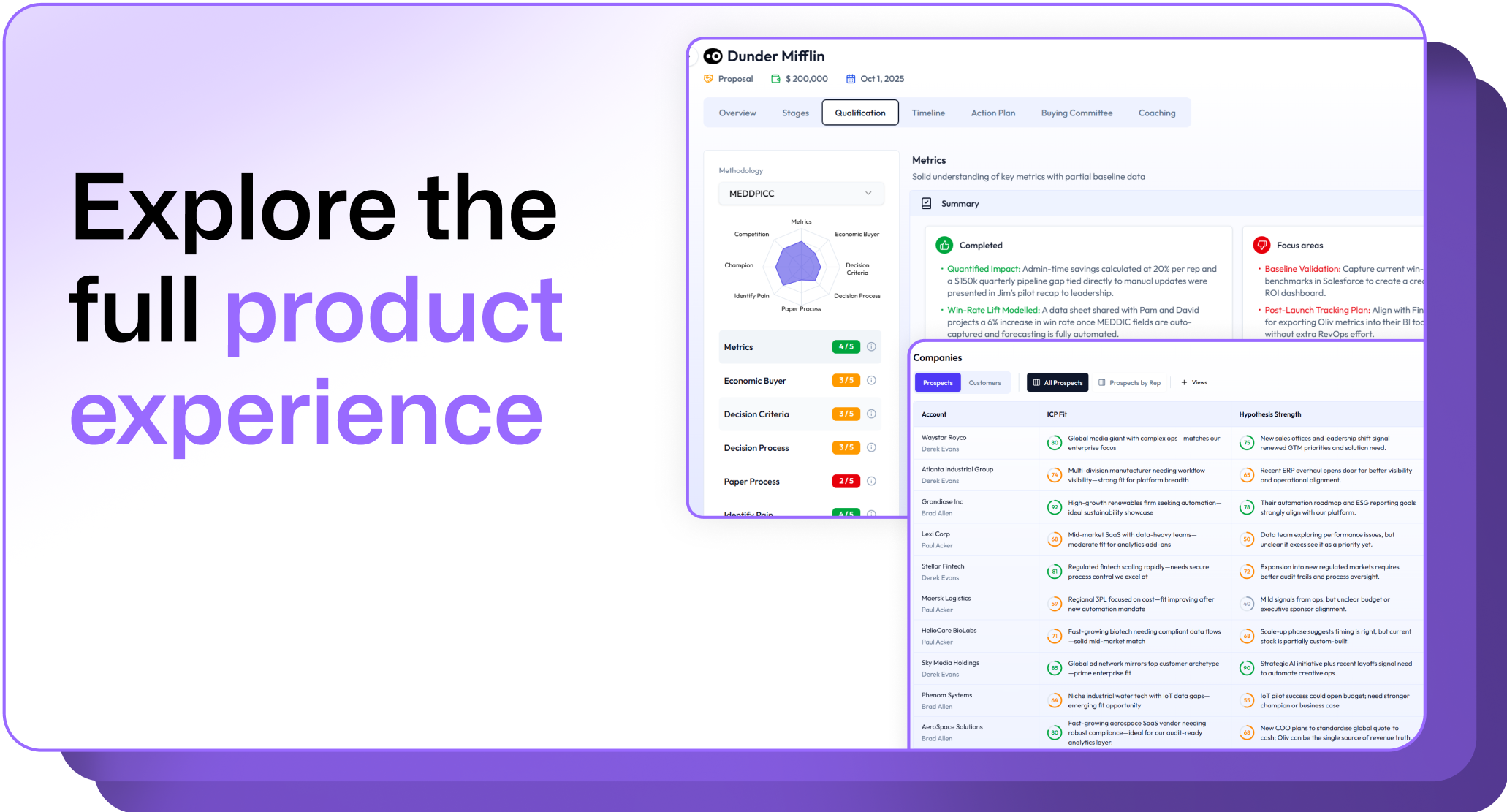
.avif)
.png)