Can You Trust AI With Your CRM? A RevOps Guide to Evaluating AI Risk, Governance, and Data Safety
Written by
Ishan Chhabra
Last Updated :
April 3, 2026
Skim in :
14
mins
In this article
Revenue teams love Oliv
Here’s why:
All your deal data unified (from 30+ tools and tabs).
Insights are delivered to you directly, no digging.
AI agents automate tasks for you.
Thank you! Your submission has been received!
Oops! Something went wrong while submitting the form.
Meet Oliv’s AI Agents
Hi! I’m, Deal Driver
I track deals, flag risks, send weekly pipeline updates and give sales managers full visibility into deal progress
Hi! I’m, CRM Manager
I maintain CRM hygiene by updating core, custom and qualification fields all without your team lifting a finger
Hi! I’m, Forecaster
I build accurate forecasts based on real deal movement and tell you which deals to pull in to hit your number
Hi! I’m, Coach
I believe performance fuels revenue. I spot skill gaps, score calls and build coaching plans to help every rep level up
Hi! I’m, Prospector
I dig into target accounts to surface the right contacts, tailor and time outreach so you always strike when it counts
Hi! I’m, Pipeline tracker
I call reps to get deal updates, and deliver a real-time, CRM-synced roll-up view of deal progress
Hi! I’m, Analyst
I answer complex pipeline questions, uncover deal patterns, and build reports that guide strategic decisions
TL;DR
Less than half of CRM data is trustworthy because reps skip manual entry, and deploying AI on dirty data amplifies errors at scale.
AI writing to CRMs carries real risks like breaking Salesforce automations, but tiered approval workflows and human-in-the-loop systems mitigate them.
Gong, Clari, and Salesforce Agentforce all have governance gaps around data portability, hallucination prevention, and implementation timelines that RevOps teams must evaluate.
Grounding LLMs via fine-tuned models, workspace constraints, and RAG with evidence trails prevents hallucinations far better than legacy keyword matching.
A practical 30-60-90 day governance roadmap moves teams from CRM audit and risk mapping through controlled pilot to full-scale AI automation with measurable ROI.
Oliv delivers a 5-minute setup, suggest-only nudge workflows, full open data export, SOC 2 Type II plus GDPR plus CCPA compliance, and 91% lower TCO than legacy stacks.
Q1: Why Is Less Than Half of Your CRM Data Trustworthy and Why Does AI Make It Worse? [toc=CRM Data Trust Crisis]
Your CRM is supposed to be the single source of truth for revenue, but in practice, it is anything but. Industry research consistently shows that up to 91% of CRM data is incomplete, and roughly 76% of users report less than half their records are accurate enough to act on. For a Director of RevOps or Head of Sales, this is not a "data hygiene project." It is a foundational revenue risk that undermines every forecast, territory plan, and board report you produce.
⚠️ Why Traditional SaaS Made This Problem Inevitable
CRMs were designed in a pre-AI era with one fatal dependency: manual data entry by reps. Sales professionals view documentation as administrative policing, something "not critical to the act of selling." Fields get left blank or filled with placeholder text just to clear a stage-gate. Meanwhile, legacy tools like Clari still rely on managers sitting with reps every Thursday and Friday to manually hear "the story of a deal" and update spreadsheets.
"Clari is a tool for sales leaders, it adds no value to reps as far as I can see." Msoave, r/sales Reddit Thread
"It can be overwhelming to set up trackers. AI training is a bit laborious to get it to do what you want." Trafford J., Senior Director, Revenue Enablement Gong G2 Verified Review
❌ The AI Amplification Paradox
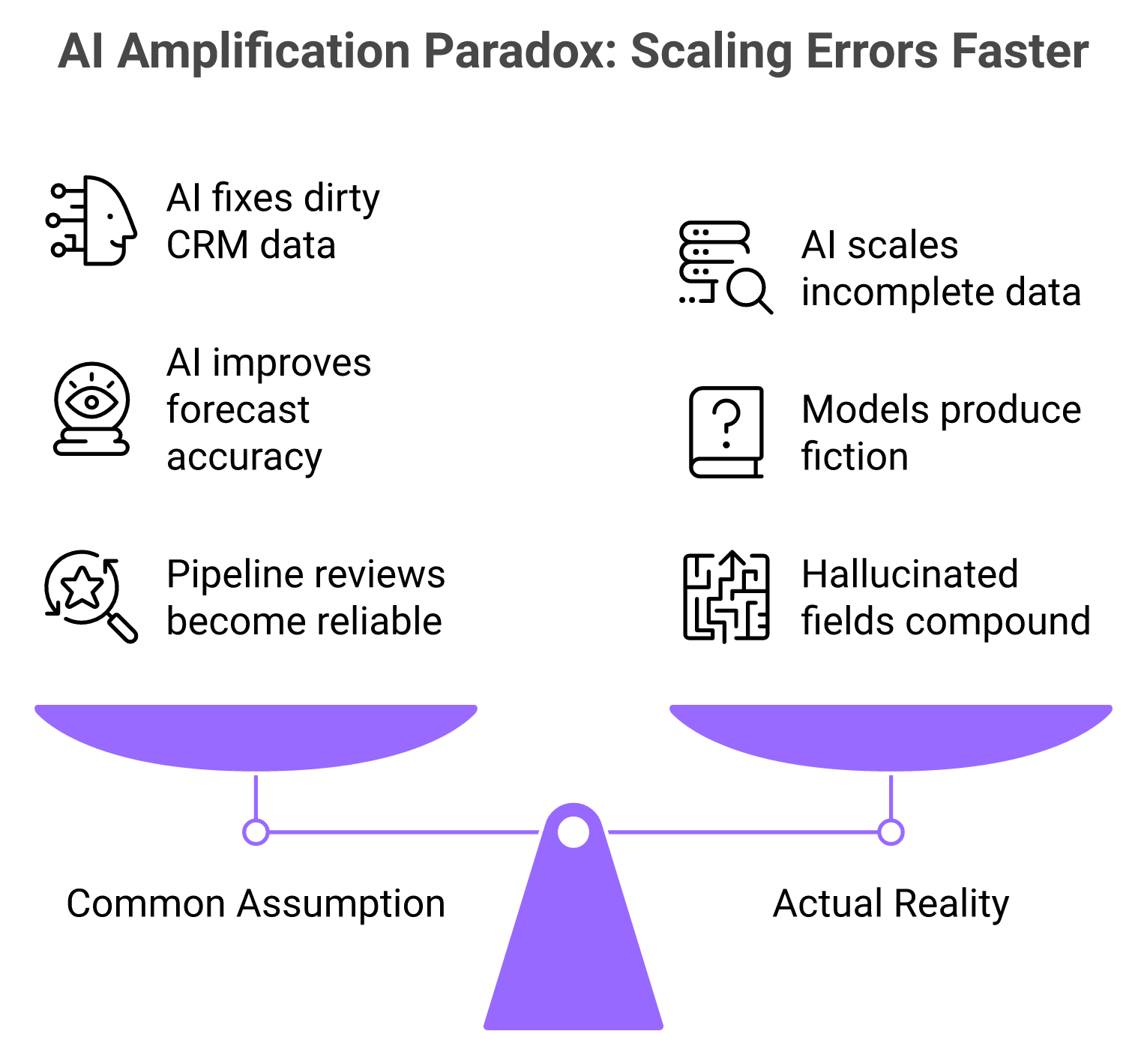
AI does not fix broken CRM data — it scales the problem faster, producing confidently wrong forecasts and pipeline reports.
Here is the uncomfortable truth about 2026: AI does not fix broken CRM data. It scales the problem faster. When you train AI models on incomplete records, you get confidently wrong forecasts, misrouted leads, and territory plans built on fiction. AI without clean data simply accelerates broken go-to-market foundations. Every hallucinated field update, every miscategorized deal stage, compounds downstream, affecting pipeline reviews, compensation, and board-level reporting simultaneously.
✅ How Oliv Solves It: The Unbiased Observer
Oliv approaches CRM hygiene from the opposite direction. Instead of asking reps to enter data, our CRM Manager Agent captures it autonomously from conversations, including calls, emails, Slack threads, and LinkedIn signals, and maps it to the correct CRM fields. Trained on 100+ sales methodologies (MEDDPICC, BANT, SPICED), it auto-populates up to 100 custom fields from conversation context. The Data Cleanser Agent deduplicates and normalizes records weekly, proactively flagging anomalies for RevOps review.
Every field update includes a timestamped evidence trail. Click any property to see exactly which call clip, email snippet, or web signal led to that value. No guesswork. No rep stories. Just evidence.
"Before switching to Oliv, cleaning up messy CRM fields and guessing at forecasts used to swallow half my week. Oliv fixes the data as it happens and drops a forecast I can actually bank on." Darius Kim, Head of RevOps at Driftloop
Q2: What Are the Real Risks of Letting AI Write to Your CRM? [toc=AI CRM Write Risks]
If you are a RevOps leader, you have probably spent years building validation rules, automated flows, and Slack alerts inside Salesforce, including intricate logic like "If Stage = Closed-Won, trigger renewal workflow and notify CS." The thought of an autonomous AI agent writing directly to those fields triggers a legitimate fear: one misconfigured update can cascade across CRM, marketing automation, finance systems, and ops dashboards before anyone notices.
⚠️ The Legacy Approach: Write First, Ask Questions Later
Many early "autonomous" tools write directly to the database without a review layer. The result? Dirty data that breaks downstream reporting, fires incorrect Slack notifications, and misaligns territory assignments. Salesforce's own ecosystem amplifies this risk. SalesforceBen explicitly warns that data hygiene is non-negotiable before deploying AI agents, because agents inherit whatever data quality problems already exist.
"If you're considering switching platforms and have six months or less on your contract, start engaging the Gong API documentation immediately to download all of your call data in a usable format... their current solution is far from convenient or accessible." Neel P., Sales Operations Manager Gong G2 Verified Review
"Clari should find ways to differentiate from the native Salesforce features... it's sometimes difficult if you don't have a strong RevOps/RevTech team to maintain validation rules in both Salesforce and Clari instances." Dan J. Clari G2 Verified Review
📌 The AI-to-CRM Write Risk Matrix
Not all CRM write operations carry equal risk. A practical governance approach tiers them:
AI-to-CRM Write Risk Matrix
Risk Tier
Operation Type
Example
Governance Requirement
⭐ Tier 1
Read-only enrichment
Append LinkedIn data to contact
Low: auto-execute with logging
Tier 2
Contact/field creation
Create new contact from call
Medium: validate against duplicates
⚠️ Tier 3
Stage progression / picklist updates
Move deal to "Negotiation"
High: triggers flows; requires approval
❌ Tier 4
Mass operations / deletion
Bulk field reassignment
Critical: human approval + rollback plan
✅ How Oliv Governs CRM Writes: The Nudge Workflow
Oliv follows a Human-in-the-Loop (HITL) governance model. Rather than writing directly to your CRM, the agent drafts the update and sends a Slack or email nudge to the rep to verify and approve before any data is pushed. Oliv is trained on 100+ sales methodologies and respects your existing picklist values, validation criteria, and workflow rules, ensuring updates align with your Salesforce logic rather than overriding it.
Role-Based Access Control (RBAC) ensures agents only operate within their assigned workspace. Teams start with suggest-only mode and graduate to auto-execute after proven accuracy, a graduated autonomy model that matches the risk-tiering framework above.
Q3: How Should RevOps Evaluate AI Governance Frameworks for CRM Tools? [toc=AI Governance Evaluation]
AI governance for CRM is not a checkbox exercise. It is the set of policies, access controls, and monitoring systems that ensure AI tools read from and write to your revenue data accurately, securely, and in regulatory compliance. With the EU AI Act entering enforcement phases in 2026, governance has moved from a theoretical best practice to a daily operational requirement for any organization using AI agents in their revenue stack.
❌ Where Legacy Vendors Fall Short
Most established tools were not built with governance-by-design. Gong operates as a one-way integration. It pulls data in from calls and emails but makes structured export back to the CRM difficult. Salesforce Agentforce requires months of implementation and custom data modeling, and its chat-focused UX means governance controls are bolted on rather than native. Clari's forecasting remains largely rep-driven, with managers still running manual Thursday/Friday roll-up sessions.
"Gong's support team has stated... 'we remain committed to assisting your team within these existing product parameters.' This means no further customization or support is available if you need bulk access to your call data." Neel P., Sales Operations Manager Gong G2 Verified Review
"Its biggest handicap is that it does not allow for data storage or data migration. You can't really input the data from Einstein into another platform." Director of Sales Operations Salesforce Einstein Gartner Verified Review
📌 The Three-Pillar Evaluation Framework
When vetting any AI CRM vendor, RevOps leaders should evaluate across three governance pillars:
Three-Pillar AI Governance Evaluation Framework
Pillar
What to Evaluate
Key Questions
Data Governance
Access controls, encryption (AES-256 at rest, TLS 1.2+ in transit), field-level security
Who can access what data? Is it encrypted end-to-end?
Risk Management
Hallucination controls, bias detection, model drift monitoring
How does the AI prevent false outputs? Is there a confidence threshold?
Can I trace every AI action back to its source? Is there an immutable log?
✅ How Oliv Satisfies All Three Pillars
Oliv is built with governance-by-design. We hold SOC 2 Type II, GDPR, and CCPA certifications. Access is controlled through RBAC with a custom scorecard builder, and detailed audit logs maintain an immutable record of every AI action for internal governance. Our AI operates within a secure customer data workspace, grounded exclusively on your accounts, emails, and meetings, with a full open export policy ensuring you are never locked in. The Analyst Agent serves as your governance reporting layer, letting you query AI activity across the entire pipeline in plain English.
Q4: How Do AI Platforms Ground LLMs to Prevent CRM Hallucinations? [toc=Preventing CRM Hallucinations]
When an AI tool "hallucinates" an Economic Buyer who was never mentioned, or fabricates a project budget from a casual comment, the consequences for RevOps go far beyond an embarrassing meeting. It is a legal liability and a forecasting disaster. CX Today's research confirms the root cause is not usually the model itself; it is the data the model was grounded on (or not grounded on). For revenue teams, ungrounded AI turns your CRM into a fiction engine.
❌ Why Keyword Trackers and Generic LLMs Fail
Gong's Smart Trackers represent first-generation machine learning. They rely on keyword matching to flag concepts like "budget" or "timeline." The problem? A keyword system cannot distinguish between a prospect saying "We have budget allocated for Q3" and "I just blew my budget on a family holiday." This produces data noise that passes for intelligence.
Generic GPTs and chat-based AI tools compound the problem. They hallucinate because they pull from their broad training data rather than the specific reality of your deals. Without workspace constraints, even retrieval-augmented generation (RAG) systems can surface irrelevant context.
"It's too complicated, and not intuitive at all... understanding the pipeline management portion of it is almost impossible. Some people figure it out, but I think most just fumble through." John S., Senior Account Executive Gong G2 Verified Review
"The software doesn't have the capability of identifying words/phrases that are similar to what you're looking for or understand context, so if you don't tell it exactly what you're looking for then you'll miss out." Director of Sales Operations Chorus Gartner Verified Review
📌 Modern Grounding Techniques: Beyond Basic RAG
RAG has proven effective. Benchmarks show it reduces hallucination rates by 40 to 71%. But RAG alone is not production-grade for CRM operations. Enterprise-ready grounding requires three additional layers:
Preventing CRM hallucinations requires three reinforcing layers: fine-tuned models, workspace constraints, and traceable evidence trails.
Fine-tuned models trained on domain-specific sales data, not general knowledge
Workspace constraints that limit the AI's context window to your organization's actual records
Evidence trails that make every AI output traceable back to a specific source artifact
✅ How Oliv Grounds Every CRM Update
Oliv operates with 100 fine-tuned models built exclusively for sales, each designed to extract specific signals like competitor mentions, churn risks, or feature requests. The AI is workspace-constrained: when updating a CRM field, it only operates within the context of your specific accounts, emails, meetings, and Slack threads. It never pulls from its general internal knowledge.
The result is 100% evidence-based qualification. Every field update comes with a Clear Data Trail. Click any property to see the exact call clip, email snippet, or LinkedIn signal that led to that value. Unlike Gong's activity-level understanding that operates meeting-by-meeting, Oliv stitches context across calls, emails, Slack, and Telegram to build a continuous deal narrative, catching signals that single-channel tools miss entirely.
Q5: What Compliance Frameworks Apply to AI in Your CRM? (SOC 2, GDPR, EU AI Act) [toc=CRM AI Compliance Frameworks]
If you are deploying AI agents that read from or write to your CRM, compliance is no longer optional. It is an operational reality with measurable penalties. Here is a practical mapping of the frameworks that directly affect AI-in-CRM use cases in 2026.
📌 EU AI Act: Full Enforcement Arrives August 2026
The EU AI Act is the world's first comprehensive AI regulation, and its most substantial obligations take effect by August 2, 2026. The Act classifies AI systems into four risk tiers:
EU AI Act Risk Tiers for CRM AI Systems
Risk Tier
Description
CRM AI Example
Obligation
❌ Unacceptable
Banned practices
Social scoring of prospects
Prohibited entirely
⚠️ High-Risk
Strict compliance required
AI-driven lead scoring affecting creditworthiness
Conformity assessments, technical documentation, human oversight
Limited Risk
Transparency rules
AI chatbots interacting with prospects
Disclosure that the user is interacting with AI
⭐ Minimal Risk
Largely unregulated
AI meeting transcription
Voluntary best practices
Penalties can reach 35 million euros or 7% of global annual turnover, whichever is higher. For RevOps teams, this means any AI system that influences deal qualification, pipeline scoring, or automated outreach should be assessed against the Act's high-risk criteria before deployment.
📌 SOC 2 Type II: The B2B Buyer's Baseline
Roughly 66% of B2B buyers now require a SOC 2 report before considering a vendor. SOC 2 Type II audits whether security controls work over a sustained period (typically 6 to 12 months) across five Trust Service Criteria:
Security: Access controls, encryption, and intrusion detection
Availability: System uptime and disaster recovery
Processing Integrity: Accurate, complete data processing
Confidentiality: Restricted access to sensitive data
Privacy: Personal data handling aligned with policies
In 2026, SOC 2 also requires AI-specific governance frameworks, including data lineage tracking, model governance policies, and explainable AI controls.
📌 GDPR, CCPA, and NIST AI RMF
GDPR applies to any AI processing personal data of EU residents, requiring data minimization, right to erasure, and breach notification within 72 hours.
CCPA grants California consumers the right to know what data AI systems collect and to request deletion.
NIST AI RMF provides a voluntary four-function framework (Govern, Map, Measure, and Manage) designed to help organizations identify, assess, and mitigate AI risks in a structured, repeatable process.
✅ How Oliv Simplifies Compliance
Oliv holds SOC 2 Type II, GDPR, and CCPA certifications out of the box, with AES-256 encryption at rest, TLS 1.2+ in transit, RBAC, and immutable audit logs. Rather than requiring months of custom compliance configuration, Oliv's governance-by-design architecture means RevOps teams can deploy with confidence that regulatory requirements are met from day one.
Q6: Why Did Your Chat-Based AI Initiative Fail and What Should Replace It? [toc=Chat-Based AI Failure]
If your team piloted a chat-based AI tool and watched adoption flatline within weeks, you are not alone. Revenue teams are suffering from what industry practitioners call "Note-Taker Fatigue" and "App Fatigue." Reps juggling 15 to 20 calls daily simply do not have the bandwidth to open another window, craft a prompt, and wait for an AI to return a useful answer. When AI adds friction instead of removing it, adoption is dead on arrival.
❌ The Chat-First Approach: Wrong UX for Sales
Salesforce Agentforce exemplifies the fundamental flaw of chat-based AI in revenue workflows. The rep must manually engage with the agent, typing queries, reviewing responses, and deciding what to do with the output. This is not embedded in the business process; it is layered on top of it. It is the digital equivalent of adding another meeting to fix the problem of too many meetings.
"It can be complex to set up and often requires skilled administrators or developers to customize and integrate properly, which adds time and cost... the user interface, though improved with Lightning, may still feel clunky or unintuitive to some agents, leading to slower adoption." Verified User in Marketing and Advertising Salesforce Agentforce G2 Verified Review
"The UI felt a bit clunky at times, especially when trying to manage multiple prompts or agent versions... it does take some trial and error and patience to really get it working the way you want." Ayushmaan Y., Senior Associate Salesforce Agentforce G2 Verified Review
⭐ The Paradigm Shift: From "Talk to a Bot" to "Jobs to Be Done"
The 2026 AI paradigm does not ask users to interact. It identifies the job (update the CRM, draft a follow-up, research the prospect) and performs it autonomously. The measure of great AI is not a slick chat interface. It is invisibility. If the rep does not notice the AI is working, that is the highest form of adoption.
✅ How Oliv Delivers an "Invisible UI"
Oliv does not ask reps to chat. Our agents work where your team already lives, in Slack, Email, and CRM properties:
The Researcher Agent delivers prep notes to Slack 30 minutes before a call, requiring zero effort from the rep
The CRM Manager Agent auto-populates fields post-call and sends a nudge for approval
The Deal Driver Agent delivers a Sunset Summary to the manager's inbox every evening
⏰ Setup takes 5 minutes (connect calendar + CRM). Core value is realized in 1 to 2 days, compared to Gong's 8 to 24 week implementation requiring 40 to 140 admin hours. When AI shows up proactively in the tools reps already use, adoption is not a project. It is automatic.
Q7: How Do Gong, Clari, and Salesforce Agentforce Handle AI Governance Differently? [toc=Vendor Governance Comparison]
Most RevOps teams evaluating AI for their CRM are already using, or actively comparing, Gong, Clari, or Salesforce Agentforce. The relevant question in 2026 is not "does it have AI?" It is "can I trust its AI with my revenue data?" Here is how each platform approaches governance, and where the gaps are.
❌ Gong: Strong CI, Weak Portability
Gong excels at conversation intelligence but operates as a one-way integration. It pulls data from calls, emails, and meetings into its own ecosystem but makes structured export back to the CRM difficult. Its Smart Trackers rely on V1 keyword matching, and processing takes 20 to 30 minutes post-call. Platform fees range from $5K to $50K annually, with implementation requiring 8 to 24 weeks.
"Gong offers valuable insights into call data and sales interactions... however, their current solution is far from convenient or accessible. It requires downloading calls individually, which is impractical and inefficient for a large volume of data." Neel P., Sales Operations Manager Gong G2 Verified Review
❌ Clari and Agentforce: Manual Layers and Chat Dependency
Clari's forecasting still relies on rep-driven, manual roll-up sessions every Thursday and Friday. Salesforce Agentforce is chat-focused and better suited for B2C support use cases, requiring months of custom data modeling and implementation.
"Adoption is low because of the lack of knowledge on the subject as AI is a new field. Customers are finding issues in deploying and using agents in Salesforce." Anusha T., Web Developer Salesforce Agentforce G2 Verified Review
"It is really just a glorified SFDC overlay. Actually, Salesforce has built most of the forecasting functionality by now anyway so I'm not sure where they fit." conaldinho11, r/SalesOperations Reddit Thread
✅ Governance Comparison: Oliv vs. Legacy Platforms
AI Governance Comparison: Gong vs. Clari vs. Agentforce vs. Oliv
Governance Dimension
Gong
Clari
Agentforce
Oliv AI
Hallucination Control
V1 keyword trackers
N/A (not generative)
General LLM; chat-based
100 fine-tuned, workspace-constrained models
Human-in-the-Loop
Manual call review
Manual Thursday/Friday roll-ups
Rep must initiate chat
Nudge workflow (Slack/email approval)
Data Export
Individual call download only
Limited
Separate AWS instances
Full CSV dump + open CRM export
Compliance Certs
SOC 2
SOC 2
SOC 2, GDPR (Trust Layer)
SOC 2 Type II, GDPR, CCPA
Setup Time
8 to 24 weeks
Weeks to months
Months of custom modeling
⏰ 5 minutes
CRM Write Format
Unstructured notes/activity blocks
Salesforce overlay
Chat-initiated
Structured object/field updates
💰 TCO comparison: Stacking Gong (~$160/user/mo) + Clari (~$100/user/mo) creates a $500+/user/month revenue stack. Oliv replaces both at a 91% lower TCO.
Q8: What Happens to Your Data If You Leave an AI CRM Vendor? [toc=Data Portability Risks]
Vendor lock-in is one of the most underestimated risks in the revenue tech stack. When years of conversation context, deal evolution patterns, and coaching intelligence are trapped inside a platform, switching costs become prohibitive, not because of licensing, but because your data becomes a hostage. For Directors of RevOps, this question needs to be answered before signing, not after.
❌ How Legacy Vendors Make Leaving Difficult
Gong's export experience has become a well-documented frustration. Users report that bulk data export is not natively supported. You are limited to downloading calls individually, which is impractical at scale. Salesforce Einstein stores certain data (e.g., captured emails) in separate AWS instances that are unusable for downstream reporting and hard to port upon exit.
"This lack of flexibility has required us to engage our development team at additional cost, adding significant operational and opportunity costs just to extract data we already own." Neel P., Sales Operations Manager Gong G2 Verified Review
"Its biggest handicap is that it does not allow for data storage or data migration. You can't really input the data from Einstein into another platform." Director of Sales Operations Salesforce Einstein Gartner Verified Review
📌 The Data Portability Evaluation Checklist
Before signing with any AI CRM vendor, RevOps leaders should verify these six criteria:
✅ Full CSV/JSON export of all records, fields, and AI-generated insights
✅ Meeting/recording export with metadata (timestamps, attendees, and tags)
✅ Open API for BI dashboard integration (Tableau, PowerBI, and Looker)
❌ No proprietary data formats that lock you into their ecosystem
✅ Contractual exit clause with timeline guarantees (30-day max)
✅ Free migration support: data migration should not be an upsell
✅ How Oliv Ensures You Are Never Locked In
Oliv is built on a "Data Portability and Transparency" philosophy. Upon termination, we provide a full CSV dump of all meetings, recordings, and AI-generated data in open, usable formats. But more importantly, Oliv's architecture ensures you do not need to export at all in an emergency. All AI-generated insights (MEDDIC fields, summaries, and stakeholder maps) live permanently inside your Salesforce or HubSpot properties as structured field updates, not siloed in a separate platform.
For BI integration, the Analyst Agent lets teams query pipeline data in plain English and export results directly to dashboards. Oliv also offers free historical data migration for teams moving from Gong, ensuring zero loss of context during transition.
Q9: What's the Smallest POC That Proves AI CRM Value to Your CRO and CFO? [toc=Smallest AI CRM POC]
CFOs in 2026 are firmly in the "Trough of Disillusionment" when it comes to AI spend. They have watched multi-year data cleanup projects burn through budgets with little to show for it. They are not interested in "transformative potential." They want quantifiable ROI within weeks, not quarters. For a Director of RevOps trying to get executive buy-in, the challenge is not proving AI is useful. It is designing a proof of concept so fast and so measurable that leadership cannot say no.
❌ The Legacy "Implementation Tax"
Traditional revenue intelligence platforms demand enormous upfront investment before value materializes. Gong implementation typically takes 8 to 24 weeks and requires 40 to 140 admin hours just to configure trackers, scorecards, and integrations. Setup fees alone can range from $7,500 to $30,000, before a single call is analyzed. By the time the POC starts producing data, budget patience has expired and the CFO has moved on.
"It can be overwhelming to set up trackers. AI training is a bit laborious to get it to do what you want." Trafford J., Senior Director, Revenue Enablement Gong G2 Verified Review
"The additional products like forecast or engage come at an additional cost. Would be great to see these tools rolled into the core offering." Scott T., Director of Sales Gong G2 Verified Review
⭐ The "Rapid Time-to-Value" POC Design
An effective AI CRM pilot should prove three things in under two weeks:
Data accuracy lift: measurable improvement in CRM field completion rates
Time saved: hours returned to reps and managers per week
Adoption rate: usage without formal training sessions
If the tool requires a training program to achieve adoption, the POC has already failed the test for an autonomous, agentic solution.
✅ Oliv's 5-Call POC
Oliv offers a radically different approach to proving value. Share 5 to 10 existing Gong or Fireflies recordings along with a list of your target CRM fields. Oliv runs its analysis and demonstrates exactly how it would have populated those fields and drafted follow-up actions. ⏰ Technical setup takes 5 minutes: connect your calendar and CRM. Core value is realized in 1 to 2 days, not months. Full custom model building for your specific methodology (MEDDPICC, BANT, SPICED) is completed in 2 to 4 weeks.
📌 POC Scorecard Template for CRO/CFO
POC Scorecard Template for CRO/CFO
KPI
Before Oliv
After Oliv (Target)
CRM field completion rate
Baseline audit
90%+ auto-populated
Hours saved per manager/week
0
5 to 8 hours
Forecast accuracy improvement
Baseline
Measurable lift in 2 weeks
Rep adoption rate (no training)
N/A
80%+ in first week
💰 Present this scorecard alongside the TCO comparison. Stacking legacy tools costs $500+/user/month, while Oliv delivers at 91% lower TCO. The business case writes itself.
Q10: How Do You Build a Human-in-the-Loop Approval Workflow for AI CRM Updates? [toc=Human-in-the-Loop Workflow]
Deploying AI agents that write to your CRM without a structured approval workflow is a governance risk most RevOps teams cannot afford. Here is a practical guide to designing a graduated autonomy system, from suggest-only to auto-execute, with the role-based permissions and audit trails your organization needs.
Step 1: Map Your CRM Write Operations by Risk Tier
Before configuring any workflow, categorize every AI-to-CRM write operation:
Reps approve Tier 1 and 2 via quick nudge (Slack/email)
Managers approve Tier 3 stage progressions
RevOps admins approve Tier 4 mass operations
System admins maintain override and rollback authority
Step 3: Design the Nudge-and-Approve Workflow
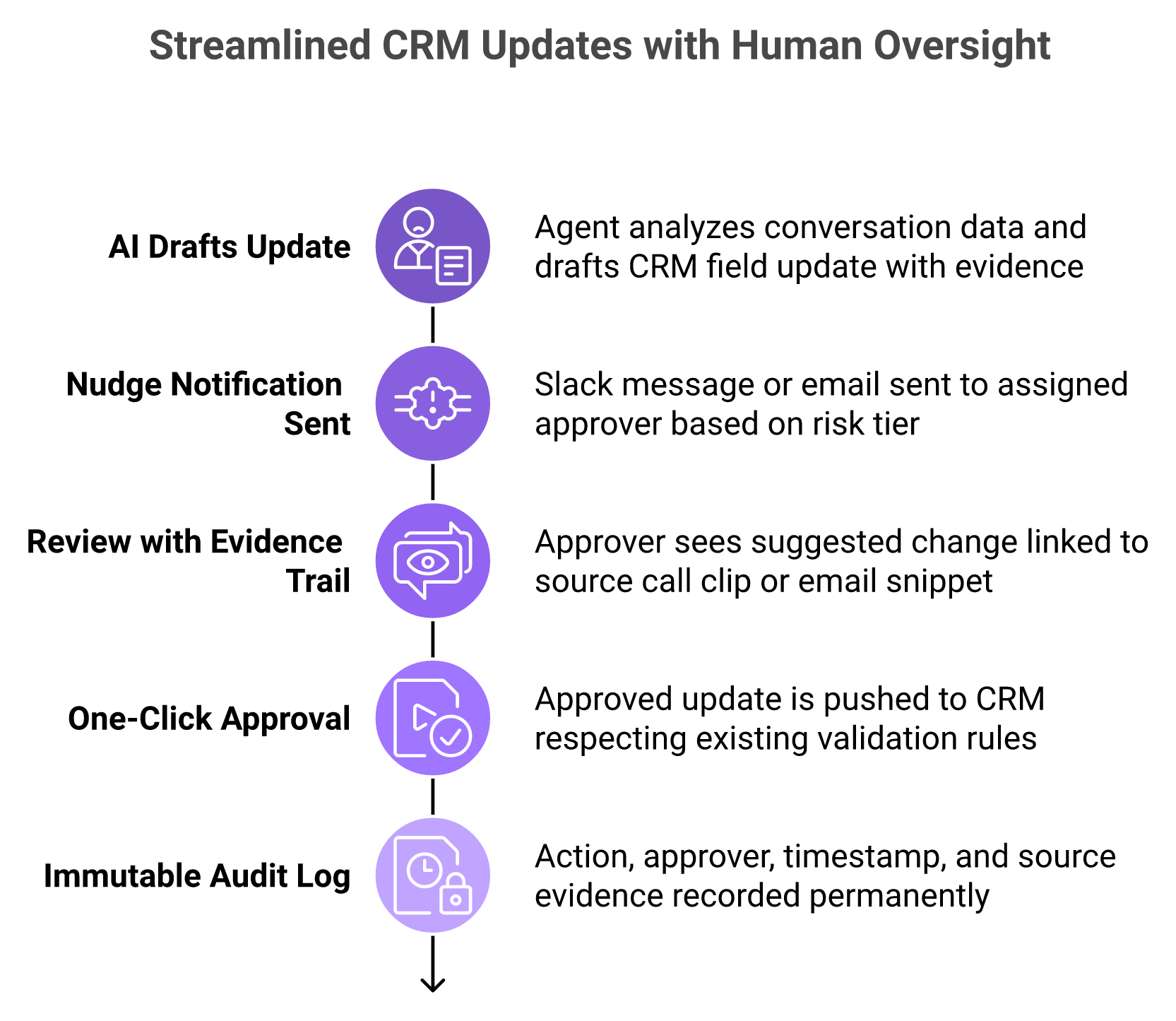
The ideal workflow follows a draft, notify, approve, write, and log sequence:
The Nudge-and-Approve workflow ensures every AI-generated CRM update passes through a structured review before writing to your database.
AI agent drafts the CRM update based on conversation data
A nudge notification (Slack message or email) is sent to the assigned approver
Approver reviews the suggested change with supporting evidence
One-click approval pushes the update to the CRM
An immutable audit log records the action, approver, timestamp, and source evidence
"Clari should find ways to differentiate from the native Salesforce features... it's sometimes difficult if you don't have a strong RevOps/RevTech team to maintain validation rules in both Salesforce and Clari instances." Dan J. Clari G2 Verified Review
"Lots of clicking to get select the right options. UX needs improvement. Everything opens in new browser tabs clustering the browser." Verified User in Consulting Salesforce Agentforce G2 Verified Review
Step 4: Graduate from Suggest-Only to Auto-Execute
Track approval rates over 2 to 4 weeks. When a specific operation type reaches 95%+ approval rate, graduate it to auto-execute with logging. This builds organizational trust incrementally.
✅ How Oliv Simplifies This
Oliv's Nudge Workflow implements this entire framework natively, drafting updates, sending Slack/email nudges for approval, respecting existing picklist values and validation rules, and maintaining a full audit trail. Teams start in suggest-only mode and graduate to auto-execute after proven accuracy, requiring zero custom workflow engineering. This AI-Native Revenue Orchestration approach eliminates the need for RevOps teams to build governance infrastructure from scratch.
Q11: What Does an AI CRM Governance Roadmap Look Like? (30-60-90 Day Plan) [toc=30-60-90 Day Governance Plan]
Implementing AI governance for your CRM is not a one-time project. It is a phased rollout. Here is a practical 30-60-90 day roadmap with specific milestones and governance checkpoints that any RevOps team can adapt.
A practical 30-60-90 day roadmap takes RevOps teams from CRM audit through controlled pilot to full-scale AI automation with measurable ROI.
📌 Days 1 to 30: Audit and Foundation
The first month focuses on understanding your current state and establishing baselines.
Days 1 to 30: Audit and Foundation Milestones
Week
Milestone
Deliverable
Week 1
CRM Trust Audit: Measure field completion rates, data freshness, and duplicate percentage
Baseline data quality scorecard
Week 2
Risk Mapping: Categorize all AI write operations into Tier 1 to 4
AI-to-CRM Write Risk Matrix
Week 3
Vendor Compliance Review: Verify SOC 2, GDPR, and CCPA certifications; review data export policies
Compliance verification checklist
Week 4
RBAC Design: Define role-based access controls and approval workflows
RBAC documentation + workflow diagram
"Some users may find Clari's analytics and forecasting tools complex, requiring significant onboarding and training." Bharat K., Revenue Operations Manager Clari G2 Verified Review
⏰ Days 31 to 60: Controlled Pilot
Deploy AI agents in suggest-only mode with a limited team (5 to 10 reps).
Select one deal stage or pipeline segment for the pilot
Activate the Nudge Workflow: AI suggests CRM updates, and reps approve/reject via Slack
Track approval rates, rejection reasons, and false positive rates weekly
Run parallel forecasting: compare AI-assisted forecast vs. manual Thursday/Friday roll-ups
Conduct weekly governance reviews with RevOps and Sales Management
"I find the setup process challenging, especially when migrating fields from Salesforce, as it can't handle formula fields directly. This requires creating and maintaining duplicate fields, which adds complexity and workload." Josiah R., Head of Sales Operations Clari G2 Verified Review
✅ Days 61 to 90: Scale and Automate
With pilot data in hand, expand to the full team and graduate proven operations to auto-execute.
Promote Tier 1 and 2 operations to auto-execute (95%+ approval rate threshold)
Expand to all reps and pipeline segments
Activate advanced agents: Forecast Agent for pipeline reviews, and Analyst Agent for governance reporting
Present CRO/CFO report: before vs. after metrics on data quality, time savings, and forecast accuracy
Establish quarterly governance review cadence
Oliv's architecture compresses this timeline significantly. The 5-minute setup and suggest-only default means Day 1 of a pilot can begin within hours, not weeks. Full custom model building completes in 2 to 4 weeks, putting most teams at the "Scale and Automate" phase within 45 days rather than 90.
Q12: AI CRM Trust Checklist: 10 Questions to Ask Every Vendor Before You Sign [toc=Vendor Trust Checklist]
Before committing budget to any AI CRM platform, use this checklist to evaluate governance, risk management, data portability, and compliance. These ten questions synthesize every governance dimension covered in this guide into a single, actionable vendor evaluation tool.
🔒 Data Governance and Security
1. What compliance certifications do you hold? Minimum: SOC 2 Type II, GDPR, and CCPA. Ask for the most recent audit report date and scope.
2. How is data encrypted at rest and in transit? Look for AES-256 encryption at rest and TLS 1.2+ in transit. Confirm field-level security controls exist.
3. What role-based access controls (RBAC) are available? Can you restrict which agents/users access which accounts, fields, and operations?
⚠️ Hallucination and Risk Controls
4. How does your AI prevent hallucinations in CRM fields? Keyword matching is not sufficient. Look for fine-tuned models, workspace constraints, and RAG with evidence trails.
5. Is there a human-in-the-loop approval workflow? Can you configure suggest-only mode? Does the system send nudge notifications before writing to the CRM?
"We've had a disappointing experience with Gong Engage... The tool is slow, buggy, and creates an excessive administrative burden on the user side." Verified Reviewer Gong G2 Verified Review
💰 Data Portability and Lock-In
6. Can I export all data in open formats (CSV/JSON) upon termination? Demand a contractual SLA for full data export within 30 days. Proprietary formats are a red flag.
7. Does AI-generated data live in my CRM or your silo? Insights should be written to actual CRM objects and properties, not trapped in the vendor's platform as unstructured notes.
"The lack of robust data export options has made it hard to justify the platform's cost, especially as it falls short of meeting practical data management needs." Neel P., Sales Operations Manager Gong G2 Verified Review
⏰ Implementation and Adoption
8. What is the realistic setup time and admin burden? If the answer is "8 to 24 weeks," you are looking at a pre-agentic SaaS tool, not an AI-native platform.
9. Does the system require reps to change their workflow? The best AI is invisible. If reps need to open a new app or learn prompt engineering, adoption will fail.
📌 Auditability
10. Can I trace every AI action back to its source evidence? Every field update should link to a specific call clip, email snippet, or signal. If the vendor cannot show a clear data trail, the AI is a black box.
✅ Oliv satisfies all ten criteria: SOC 2 Type II + GDPR + CCPA certified, fine-tuned workspace-constrained models with evidence trails, HITL Nudge Workflow, full open data export, structured CRM object updates, 5-minute setup, and invisible agentic delivery, making it the governance benchmark for AI-Native Revenue Orchestration platforms.
Q1: Why Is Less Than Half of Your CRM Data Trustworthy and Why Does AI Make It Worse? [toc=CRM Data Trust Crisis]
Your CRM is supposed to be the single source of truth for revenue, but in practice, it is anything but. Industry research consistently shows that up to 91% of CRM data is incomplete, and roughly 76% of users report less than half their records are accurate enough to act on. For a Director of RevOps or Head of Sales, this is not a "data hygiene project." It is a foundational revenue risk that undermines every forecast, territory plan, and board report you produce.
⚠️ Why Traditional SaaS Made This Problem Inevitable
CRMs were designed in a pre-AI era with one fatal dependency: manual data entry by reps. Sales professionals view documentation as administrative policing, something "not critical to the act of selling." Fields get left blank or filled with placeholder text just to clear a stage-gate. Meanwhile, legacy tools like Clari still rely on managers sitting with reps every Thursday and Friday to manually hear "the story of a deal" and update spreadsheets.
"Clari is a tool for sales leaders, it adds no value to reps as far as I can see." Msoave, r/sales Reddit Thread
"It can be overwhelming to set up trackers. AI training is a bit laborious to get it to do what you want." Trafford J., Senior Director, Revenue Enablement Gong G2 Verified Review
❌ The AI Amplification Paradox
AI does not fix broken CRM data — it scales the problem faster, producing confidently wrong forecasts and pipeline reports.
Here is the uncomfortable truth about 2026: AI does not fix broken CRM data. It scales the problem faster. When you train AI models on incomplete records, you get confidently wrong forecasts, misrouted leads, and territory plans built on fiction. AI without clean data simply accelerates broken go-to-market foundations. Every hallucinated field update, every miscategorized deal stage, compounds downstream, affecting pipeline reviews, compensation, and board-level reporting simultaneously.
✅ How Oliv Solves It: The Unbiased Observer
Oliv approaches CRM hygiene from the opposite direction. Instead of asking reps to enter data, our CRM Manager Agent captures it autonomously from conversations, including calls, emails, Slack threads, and LinkedIn signals, and maps it to the correct CRM fields. Trained on 100+ sales methodologies (MEDDPICC, BANT, SPICED), it auto-populates up to 100 custom fields from conversation context. The Data Cleanser Agent deduplicates and normalizes records weekly, proactively flagging anomalies for RevOps review.
Every field update includes a timestamped evidence trail. Click any property to see exactly which call clip, email snippet, or web signal led to that value. No guesswork. No rep stories. Just evidence.
"Before switching to Oliv, cleaning up messy CRM fields and guessing at forecasts used to swallow half my week. Oliv fixes the data as it happens and drops a forecast I can actually bank on." Darius Kim, Head of RevOps at Driftloop
Q2: What Are the Real Risks of Letting AI Write to Your CRM? [toc=AI CRM Write Risks]
If you are a RevOps leader, you have probably spent years building validation rules, automated flows, and Slack alerts inside Salesforce, including intricate logic like "If Stage = Closed-Won, trigger renewal workflow and notify CS." The thought of an autonomous AI agent writing directly to those fields triggers a legitimate fear: one misconfigured update can cascade across CRM, marketing automation, finance systems, and ops dashboards before anyone notices.
⚠️ The Legacy Approach: Write First, Ask Questions Later
Many early "autonomous" tools write directly to the database without a review layer. The result? Dirty data that breaks downstream reporting, fires incorrect Slack notifications, and misaligns territory assignments. Salesforce's own ecosystem amplifies this risk. SalesforceBen explicitly warns that data hygiene is non-negotiable before deploying AI agents, because agents inherit whatever data quality problems already exist.
"If you're considering switching platforms and have six months or less on your contract, start engaging the Gong API documentation immediately to download all of your call data in a usable format... their current solution is far from convenient or accessible." Neel P., Sales Operations Manager Gong G2 Verified Review
"Clari should find ways to differentiate from the native Salesforce features... it's sometimes difficult if you don't have a strong RevOps/RevTech team to maintain validation rules in both Salesforce and Clari instances." Dan J. Clari G2 Verified Review
📌 The AI-to-CRM Write Risk Matrix
Not all CRM write operations carry equal risk. A practical governance approach tiers them:
AI-to-CRM Write Risk Matrix
Risk Tier
Operation Type
Example
Governance Requirement
⭐ Tier 1
Read-only enrichment
Append LinkedIn data to contact
Low: auto-execute with logging
Tier 2
Contact/field creation
Create new contact from call
Medium: validate against duplicates
⚠️ Tier 3
Stage progression / picklist updates
Move deal to "Negotiation"
High: triggers flows; requires approval
❌ Tier 4
Mass operations / deletion
Bulk field reassignment
Critical: human approval + rollback plan
✅ How Oliv Governs CRM Writes: The Nudge Workflow
Oliv follows a Human-in-the-Loop (HITL) governance model. Rather than writing directly to your CRM, the agent drafts the update and sends a Slack or email nudge to the rep to verify and approve before any data is pushed. Oliv is trained on 100+ sales methodologies and respects your existing picklist values, validation criteria, and workflow rules, ensuring updates align with your Salesforce logic rather than overriding it.
Role-Based Access Control (RBAC) ensures agents only operate within their assigned workspace. Teams start with suggest-only mode and graduate to auto-execute after proven accuracy, a graduated autonomy model that matches the risk-tiering framework above.
Q3: How Should RevOps Evaluate AI Governance Frameworks for CRM Tools? [toc=AI Governance Evaluation]
AI governance for CRM is not a checkbox exercise. It is the set of policies, access controls, and monitoring systems that ensure AI tools read from and write to your revenue data accurately, securely, and in regulatory compliance. With the EU AI Act entering enforcement phases in 2026, governance has moved from a theoretical best practice to a daily operational requirement for any organization using AI agents in their revenue stack.
❌ Where Legacy Vendors Fall Short
Most established tools were not built with governance-by-design. Gong operates as a one-way integration. It pulls data in from calls and emails but makes structured export back to the CRM difficult. Salesforce Agentforce requires months of implementation and custom data modeling, and its chat-focused UX means governance controls are bolted on rather than native. Clari's forecasting remains largely rep-driven, with managers still running manual Thursday/Friday roll-up sessions.
"Gong's support team has stated... 'we remain committed to assisting your team within these existing product parameters.' This means no further customization or support is available if you need bulk access to your call data." Neel P., Sales Operations Manager Gong G2 Verified Review
"Its biggest handicap is that it does not allow for data storage or data migration. You can't really input the data from Einstein into another platform." Director of Sales Operations Salesforce Einstein Gartner Verified Review
📌 The Three-Pillar Evaluation Framework
When vetting any AI CRM vendor, RevOps leaders should evaluate across three governance pillars:
Three-Pillar AI Governance Evaluation Framework
Pillar
What to Evaluate
Key Questions
Data Governance
Access controls, encryption (AES-256 at rest, TLS 1.2+ in transit), field-level security
Who can access what data? Is it encrypted end-to-end?
Risk Management
Hallucination controls, bias detection, model drift monitoring
How does the AI prevent false outputs? Is there a confidence threshold?
Can I trace every AI action back to its source? Is there an immutable log?
✅ How Oliv Satisfies All Three Pillars
Oliv is built with governance-by-design. We hold SOC 2 Type II, GDPR, and CCPA certifications. Access is controlled through RBAC with a custom scorecard builder, and detailed audit logs maintain an immutable record of every AI action for internal governance. Our AI operates within a secure customer data workspace, grounded exclusively on your accounts, emails, and meetings, with a full open export policy ensuring you are never locked in. The Analyst Agent serves as your governance reporting layer, letting you query AI activity across the entire pipeline in plain English.
Q4: How Do AI Platforms Ground LLMs to Prevent CRM Hallucinations? [toc=Preventing CRM Hallucinations]
When an AI tool "hallucinates" an Economic Buyer who was never mentioned, or fabricates a project budget from a casual comment, the consequences for RevOps go far beyond an embarrassing meeting. It is a legal liability and a forecasting disaster. CX Today's research confirms the root cause is not usually the model itself; it is the data the model was grounded on (or not grounded on). For revenue teams, ungrounded AI turns your CRM into a fiction engine.
❌ Why Keyword Trackers and Generic LLMs Fail
Gong's Smart Trackers represent first-generation machine learning. They rely on keyword matching to flag concepts like "budget" or "timeline." The problem? A keyword system cannot distinguish between a prospect saying "We have budget allocated for Q3" and "I just blew my budget on a family holiday." This produces data noise that passes for intelligence.
Generic GPTs and chat-based AI tools compound the problem. They hallucinate because they pull from their broad training data rather than the specific reality of your deals. Without workspace constraints, even retrieval-augmented generation (RAG) systems can surface irrelevant context.
"It's too complicated, and not intuitive at all... understanding the pipeline management portion of it is almost impossible. Some people figure it out, but I think most just fumble through." John S., Senior Account Executive Gong G2 Verified Review
"The software doesn't have the capability of identifying words/phrases that are similar to what you're looking for or understand context, so if you don't tell it exactly what you're looking for then you'll miss out." Director of Sales Operations Chorus Gartner Verified Review
📌 Modern Grounding Techniques: Beyond Basic RAG
RAG has proven effective. Benchmarks show it reduces hallucination rates by 40 to 71%. But RAG alone is not production-grade for CRM operations. Enterprise-ready grounding requires three additional layers:
Preventing CRM hallucinations requires three reinforcing layers: fine-tuned models, workspace constraints, and traceable evidence trails.
Fine-tuned models trained on domain-specific sales data, not general knowledge
Workspace constraints that limit the AI's context window to your organization's actual records
Evidence trails that make every AI output traceable back to a specific source artifact
✅ How Oliv Grounds Every CRM Update
Oliv operates with 100 fine-tuned models built exclusively for sales, each designed to extract specific signals like competitor mentions, churn risks, or feature requests. The AI is workspace-constrained: when updating a CRM field, it only operates within the context of your specific accounts, emails, meetings, and Slack threads. It never pulls from its general internal knowledge.
The result is 100% evidence-based qualification. Every field update comes with a Clear Data Trail. Click any property to see the exact call clip, email snippet, or LinkedIn signal that led to that value. Unlike Gong's activity-level understanding that operates meeting-by-meeting, Oliv stitches context across calls, emails, Slack, and Telegram to build a continuous deal narrative, catching signals that single-channel tools miss entirely.
Q5: What Compliance Frameworks Apply to AI in Your CRM? (SOC 2, GDPR, EU AI Act) [toc=CRM AI Compliance Frameworks]
If you are deploying AI agents that read from or write to your CRM, compliance is no longer optional. It is an operational reality with measurable penalties. Here is a practical mapping of the frameworks that directly affect AI-in-CRM use cases in 2026.
📌 EU AI Act: Full Enforcement Arrives August 2026
The EU AI Act is the world's first comprehensive AI regulation, and its most substantial obligations take effect by August 2, 2026. The Act classifies AI systems into four risk tiers:
EU AI Act Risk Tiers for CRM AI Systems
Risk Tier
Description
CRM AI Example
Obligation
❌ Unacceptable
Banned practices
Social scoring of prospects
Prohibited entirely
⚠️ High-Risk
Strict compliance required
AI-driven lead scoring affecting creditworthiness
Conformity assessments, technical documentation, human oversight
Limited Risk
Transparency rules
AI chatbots interacting with prospects
Disclosure that the user is interacting with AI
⭐ Minimal Risk
Largely unregulated
AI meeting transcription
Voluntary best practices
Penalties can reach 35 million euros or 7% of global annual turnover, whichever is higher. For RevOps teams, this means any AI system that influences deal qualification, pipeline scoring, or automated outreach should be assessed against the Act's high-risk criteria before deployment.
📌 SOC 2 Type II: The B2B Buyer's Baseline
Roughly 66% of B2B buyers now require a SOC 2 report before considering a vendor. SOC 2 Type II audits whether security controls work over a sustained period (typically 6 to 12 months) across five Trust Service Criteria:
Security: Access controls, encryption, and intrusion detection
Availability: System uptime and disaster recovery
Processing Integrity: Accurate, complete data processing
Confidentiality: Restricted access to sensitive data
Privacy: Personal data handling aligned with policies
In 2026, SOC 2 also requires AI-specific governance frameworks, including data lineage tracking, model governance policies, and explainable AI controls.
📌 GDPR, CCPA, and NIST AI RMF
GDPR applies to any AI processing personal data of EU residents, requiring data minimization, right to erasure, and breach notification within 72 hours.
CCPA grants California consumers the right to know what data AI systems collect and to request deletion.
NIST AI RMF provides a voluntary four-function framework (Govern, Map, Measure, and Manage) designed to help organizations identify, assess, and mitigate AI risks in a structured, repeatable process.
✅ How Oliv Simplifies Compliance
Oliv holds SOC 2 Type II, GDPR, and CCPA certifications out of the box, with AES-256 encryption at rest, TLS 1.2+ in transit, RBAC, and immutable audit logs. Rather than requiring months of custom compliance configuration, Oliv's governance-by-design architecture means RevOps teams can deploy with confidence that regulatory requirements are met from day one.
Q6: Why Did Your Chat-Based AI Initiative Fail and What Should Replace It? [toc=Chat-Based AI Failure]
If your team piloted a chat-based AI tool and watched adoption flatline within weeks, you are not alone. Revenue teams are suffering from what industry practitioners call "Note-Taker Fatigue" and "App Fatigue." Reps juggling 15 to 20 calls daily simply do not have the bandwidth to open another window, craft a prompt, and wait for an AI to return a useful answer. When AI adds friction instead of removing it, adoption is dead on arrival.
❌ The Chat-First Approach: Wrong UX for Sales
Salesforce Agentforce exemplifies the fundamental flaw of chat-based AI in revenue workflows. The rep must manually engage with the agent, typing queries, reviewing responses, and deciding what to do with the output. This is not embedded in the business process; it is layered on top of it. It is the digital equivalent of adding another meeting to fix the problem of too many meetings.
"It can be complex to set up and often requires skilled administrators or developers to customize and integrate properly, which adds time and cost... the user interface, though improved with Lightning, may still feel clunky or unintuitive to some agents, leading to slower adoption." Verified User in Marketing and Advertising Salesforce Agentforce G2 Verified Review
"The UI felt a bit clunky at times, especially when trying to manage multiple prompts or agent versions... it does take some trial and error and patience to really get it working the way you want." Ayushmaan Y., Senior Associate Salesforce Agentforce G2 Verified Review
⭐ The Paradigm Shift: From "Talk to a Bot" to "Jobs to Be Done"
The 2026 AI paradigm does not ask users to interact. It identifies the job (update the CRM, draft a follow-up, research the prospect) and performs it autonomously. The measure of great AI is not a slick chat interface. It is invisibility. If the rep does not notice the AI is working, that is the highest form of adoption.
✅ How Oliv Delivers an "Invisible UI"
Oliv does not ask reps to chat. Our agents work where your team already lives, in Slack, Email, and CRM properties:
The Researcher Agent delivers prep notes to Slack 30 minutes before a call, requiring zero effort from the rep
The CRM Manager Agent auto-populates fields post-call and sends a nudge for approval
The Deal Driver Agent delivers a Sunset Summary to the manager's inbox every evening
⏰ Setup takes 5 minutes (connect calendar + CRM). Core value is realized in 1 to 2 days, compared to Gong's 8 to 24 week implementation requiring 40 to 140 admin hours. When AI shows up proactively in the tools reps already use, adoption is not a project. It is automatic.
Q7: How Do Gong, Clari, and Salesforce Agentforce Handle AI Governance Differently? [toc=Vendor Governance Comparison]
Most RevOps teams evaluating AI for their CRM are already using, or actively comparing, Gong, Clari, or Salesforce Agentforce. The relevant question in 2026 is not "does it have AI?" It is "can I trust its AI with my revenue data?" Here is how each platform approaches governance, and where the gaps are.
❌ Gong: Strong CI, Weak Portability
Gong excels at conversation intelligence but operates as a one-way integration. It pulls data from calls, emails, and meetings into its own ecosystem but makes structured export back to the CRM difficult. Its Smart Trackers rely on V1 keyword matching, and processing takes 20 to 30 minutes post-call. Platform fees range from $5K to $50K annually, with implementation requiring 8 to 24 weeks.
"Gong offers valuable insights into call data and sales interactions... however, their current solution is far from convenient or accessible. It requires downloading calls individually, which is impractical and inefficient for a large volume of data." Neel P., Sales Operations Manager Gong G2 Verified Review
❌ Clari and Agentforce: Manual Layers and Chat Dependency
Clari's forecasting still relies on rep-driven, manual roll-up sessions every Thursday and Friday. Salesforce Agentforce is chat-focused and better suited for B2C support use cases, requiring months of custom data modeling and implementation.
"Adoption is low because of the lack of knowledge on the subject as AI is a new field. Customers are finding issues in deploying and using agents in Salesforce." Anusha T., Web Developer Salesforce Agentforce G2 Verified Review
"It is really just a glorified SFDC overlay. Actually, Salesforce has built most of the forecasting functionality by now anyway so I'm not sure where they fit." conaldinho11, r/SalesOperations Reddit Thread
✅ Governance Comparison: Oliv vs. Legacy Platforms
AI Governance Comparison: Gong vs. Clari vs. Agentforce vs. Oliv
Governance Dimension
Gong
Clari
Agentforce
Oliv AI
Hallucination Control
V1 keyword trackers
N/A (not generative)
General LLM; chat-based
100 fine-tuned, workspace-constrained models
Human-in-the-Loop
Manual call review
Manual Thursday/Friday roll-ups
Rep must initiate chat
Nudge workflow (Slack/email approval)
Data Export
Individual call download only
Limited
Separate AWS instances
Full CSV dump + open CRM export
Compliance Certs
SOC 2
SOC 2
SOC 2, GDPR (Trust Layer)
SOC 2 Type II, GDPR, CCPA
Setup Time
8 to 24 weeks
Weeks to months
Months of custom modeling
⏰ 5 minutes
CRM Write Format
Unstructured notes/activity blocks
Salesforce overlay
Chat-initiated
Structured object/field updates
💰 TCO comparison: Stacking Gong (~$160/user/mo) + Clari (~$100/user/mo) creates a $500+/user/month revenue stack. Oliv replaces both at a 91% lower TCO.
Q8: What Happens to Your Data If You Leave an AI CRM Vendor? [toc=Data Portability Risks]
Vendor lock-in is one of the most underestimated risks in the revenue tech stack. When years of conversation context, deal evolution patterns, and coaching intelligence are trapped inside a platform, switching costs become prohibitive, not because of licensing, but because your data becomes a hostage. For Directors of RevOps, this question needs to be answered before signing, not after.
❌ How Legacy Vendors Make Leaving Difficult
Gong's export experience has become a well-documented frustration. Users report that bulk data export is not natively supported. You are limited to downloading calls individually, which is impractical at scale. Salesforce Einstein stores certain data (e.g., captured emails) in separate AWS instances that are unusable for downstream reporting and hard to port upon exit.
"This lack of flexibility has required us to engage our development team at additional cost, adding significant operational and opportunity costs just to extract data we already own." Neel P., Sales Operations Manager Gong G2 Verified Review
"Its biggest handicap is that it does not allow for data storage or data migration. You can't really input the data from Einstein into another platform." Director of Sales Operations Salesforce Einstein Gartner Verified Review
📌 The Data Portability Evaluation Checklist
Before signing with any AI CRM vendor, RevOps leaders should verify these six criteria:
✅ Full CSV/JSON export of all records, fields, and AI-generated insights
✅ Meeting/recording export with metadata (timestamps, attendees, and tags)
✅ Open API for BI dashboard integration (Tableau, PowerBI, and Looker)
❌ No proprietary data formats that lock you into their ecosystem
✅ Contractual exit clause with timeline guarantees (30-day max)
✅ Free migration support: data migration should not be an upsell
✅ How Oliv Ensures You Are Never Locked In
Oliv is built on a "Data Portability and Transparency" philosophy. Upon termination, we provide a full CSV dump of all meetings, recordings, and AI-generated data in open, usable formats. But more importantly, Oliv's architecture ensures you do not need to export at all in an emergency. All AI-generated insights (MEDDIC fields, summaries, and stakeholder maps) live permanently inside your Salesforce or HubSpot properties as structured field updates, not siloed in a separate platform.
For BI integration, the Analyst Agent lets teams query pipeline data in plain English and export results directly to dashboards. Oliv also offers free historical data migration for teams moving from Gong, ensuring zero loss of context during transition.
Q9: What's the Smallest POC That Proves AI CRM Value to Your CRO and CFO? [toc=Smallest AI CRM POC]
CFOs in 2026 are firmly in the "Trough of Disillusionment" when it comes to AI spend. They have watched multi-year data cleanup projects burn through budgets with little to show for it. They are not interested in "transformative potential." They want quantifiable ROI within weeks, not quarters. For a Director of RevOps trying to get executive buy-in, the challenge is not proving AI is useful. It is designing a proof of concept so fast and so measurable that leadership cannot say no.
❌ The Legacy "Implementation Tax"
Traditional revenue intelligence platforms demand enormous upfront investment before value materializes. Gong implementation typically takes 8 to 24 weeks and requires 40 to 140 admin hours just to configure trackers, scorecards, and integrations. Setup fees alone can range from $7,500 to $30,000, before a single call is analyzed. By the time the POC starts producing data, budget patience has expired and the CFO has moved on.
"It can be overwhelming to set up trackers. AI training is a bit laborious to get it to do what you want." Trafford J., Senior Director, Revenue Enablement Gong G2 Verified Review
"The additional products like forecast or engage come at an additional cost. Would be great to see these tools rolled into the core offering." Scott T., Director of Sales Gong G2 Verified Review
⭐ The "Rapid Time-to-Value" POC Design
An effective AI CRM pilot should prove three things in under two weeks:
Data accuracy lift: measurable improvement in CRM field completion rates
Time saved: hours returned to reps and managers per week
Adoption rate: usage without formal training sessions
If the tool requires a training program to achieve adoption, the POC has already failed the test for an autonomous, agentic solution.
✅ Oliv's 5-Call POC
Oliv offers a radically different approach to proving value. Share 5 to 10 existing Gong or Fireflies recordings along with a list of your target CRM fields. Oliv runs its analysis and demonstrates exactly how it would have populated those fields and drafted follow-up actions. ⏰ Technical setup takes 5 minutes: connect your calendar and CRM. Core value is realized in 1 to 2 days, not months. Full custom model building for your specific methodology (MEDDPICC, BANT, SPICED) is completed in 2 to 4 weeks.
📌 POC Scorecard Template for CRO/CFO
POC Scorecard Template for CRO/CFO
KPI
Before Oliv
After Oliv (Target)
CRM field completion rate
Baseline audit
90%+ auto-populated
Hours saved per manager/week
0
5 to 8 hours
Forecast accuracy improvement
Baseline
Measurable lift in 2 weeks
Rep adoption rate (no training)
N/A
80%+ in first week
💰 Present this scorecard alongside the TCO comparison. Stacking legacy tools costs $500+/user/month, while Oliv delivers at 91% lower TCO. The business case writes itself.
Q10: How Do You Build a Human-in-the-Loop Approval Workflow for AI CRM Updates? [toc=Human-in-the-Loop Workflow]
Deploying AI agents that write to your CRM without a structured approval workflow is a governance risk most RevOps teams cannot afford. Here is a practical guide to designing a graduated autonomy system, from suggest-only to auto-execute, with the role-based permissions and audit trails your organization needs.
Step 1: Map Your CRM Write Operations by Risk Tier
Before configuring any workflow, categorize every AI-to-CRM write operation:
Reps approve Tier 1 and 2 via quick nudge (Slack/email)
Managers approve Tier 3 stage progressions
RevOps admins approve Tier 4 mass operations
System admins maintain override and rollback authority
Step 3: Design the Nudge-and-Approve Workflow
The ideal workflow follows a draft, notify, approve, write, and log sequence:
The Nudge-and-Approve workflow ensures every AI-generated CRM update passes through a structured review before writing to your database.
AI agent drafts the CRM update based on conversation data
A nudge notification (Slack message or email) is sent to the assigned approver
Approver reviews the suggested change with supporting evidence
One-click approval pushes the update to the CRM
An immutable audit log records the action, approver, timestamp, and source evidence
"Clari should find ways to differentiate from the native Salesforce features... it's sometimes difficult if you don't have a strong RevOps/RevTech team to maintain validation rules in both Salesforce and Clari instances." Dan J. Clari G2 Verified Review
"Lots of clicking to get select the right options. UX needs improvement. Everything opens in new browser tabs clustering the browser." Verified User in Consulting Salesforce Agentforce G2 Verified Review
Step 4: Graduate from Suggest-Only to Auto-Execute
Track approval rates over 2 to 4 weeks. When a specific operation type reaches 95%+ approval rate, graduate it to auto-execute with logging. This builds organizational trust incrementally.
✅ How Oliv Simplifies This
Oliv's Nudge Workflow implements this entire framework natively, drafting updates, sending Slack/email nudges for approval, respecting existing picklist values and validation rules, and maintaining a full audit trail. Teams start in suggest-only mode and graduate to auto-execute after proven accuracy, requiring zero custom workflow engineering. This AI-Native Revenue Orchestration approach eliminates the need for RevOps teams to build governance infrastructure from scratch.
Q11: What Does an AI CRM Governance Roadmap Look Like? (30-60-90 Day Plan) [toc=30-60-90 Day Governance Plan]
Implementing AI governance for your CRM is not a one-time project. It is a phased rollout. Here is a practical 30-60-90 day roadmap with specific milestones and governance checkpoints that any RevOps team can adapt.
A practical 30-60-90 day roadmap takes RevOps teams from CRM audit through controlled pilot to full-scale AI automation with measurable ROI.
📌 Days 1 to 30: Audit and Foundation
The first month focuses on understanding your current state and establishing baselines.
Days 1 to 30: Audit and Foundation Milestones
Week
Milestone
Deliverable
Week 1
CRM Trust Audit: Measure field completion rates, data freshness, and duplicate percentage
Baseline data quality scorecard
Week 2
Risk Mapping: Categorize all AI write operations into Tier 1 to 4
AI-to-CRM Write Risk Matrix
Week 3
Vendor Compliance Review: Verify SOC 2, GDPR, and CCPA certifications; review data export policies
Compliance verification checklist
Week 4
RBAC Design: Define role-based access controls and approval workflows
RBAC documentation + workflow diagram
"Some users may find Clari's analytics and forecasting tools complex, requiring significant onboarding and training." Bharat K., Revenue Operations Manager Clari G2 Verified Review
⏰ Days 31 to 60: Controlled Pilot
Deploy AI agents in suggest-only mode with a limited team (5 to 10 reps).
Select one deal stage or pipeline segment for the pilot
Activate the Nudge Workflow: AI suggests CRM updates, and reps approve/reject via Slack
Track approval rates, rejection reasons, and false positive rates weekly
Run parallel forecasting: compare AI-assisted forecast vs. manual Thursday/Friday roll-ups
Conduct weekly governance reviews with RevOps and Sales Management
"I find the setup process challenging, especially when migrating fields from Salesforce, as it can't handle formula fields directly. This requires creating and maintaining duplicate fields, which adds complexity and workload." Josiah R., Head of Sales Operations Clari G2 Verified Review
✅ Days 61 to 90: Scale and Automate
With pilot data in hand, expand to the full team and graduate proven operations to auto-execute.
Promote Tier 1 and 2 operations to auto-execute (95%+ approval rate threshold)
Expand to all reps and pipeline segments
Activate advanced agents: Forecast Agent for pipeline reviews, and Analyst Agent for governance reporting
Present CRO/CFO report: before vs. after metrics on data quality, time savings, and forecast accuracy
Establish quarterly governance review cadence
Oliv's architecture compresses this timeline significantly. The 5-minute setup and suggest-only default means Day 1 of a pilot can begin within hours, not weeks. Full custom model building completes in 2 to 4 weeks, putting most teams at the "Scale and Automate" phase within 45 days rather than 90.
Q12: AI CRM Trust Checklist: 10 Questions to Ask Every Vendor Before You Sign [toc=Vendor Trust Checklist]
Before committing budget to any AI CRM platform, use this checklist to evaluate governance, risk management, data portability, and compliance. These ten questions synthesize every governance dimension covered in this guide into a single, actionable vendor evaluation tool.
🔒 Data Governance and Security
1. What compliance certifications do you hold? Minimum: SOC 2 Type II, GDPR, and CCPA. Ask for the most recent audit report date and scope.
2. How is data encrypted at rest and in transit? Look for AES-256 encryption at rest and TLS 1.2+ in transit. Confirm field-level security controls exist.
3. What role-based access controls (RBAC) are available? Can you restrict which agents/users access which accounts, fields, and operations?
⚠️ Hallucination and Risk Controls
4. How does your AI prevent hallucinations in CRM fields? Keyword matching is not sufficient. Look for fine-tuned models, workspace constraints, and RAG with evidence trails.
5. Is there a human-in-the-loop approval workflow? Can you configure suggest-only mode? Does the system send nudge notifications before writing to the CRM?
"We've had a disappointing experience with Gong Engage... The tool is slow, buggy, and creates an excessive administrative burden on the user side." Verified Reviewer Gong G2 Verified Review
💰 Data Portability and Lock-In
6. Can I export all data in open formats (CSV/JSON) upon termination? Demand a contractual SLA for full data export within 30 days. Proprietary formats are a red flag.
7. Does AI-generated data live in my CRM or your silo? Insights should be written to actual CRM objects and properties, not trapped in the vendor's platform as unstructured notes.
"The lack of robust data export options has made it hard to justify the platform's cost, especially as it falls short of meeting practical data management needs." Neel P., Sales Operations Manager Gong G2 Verified Review
⏰ Implementation and Adoption
8. What is the realistic setup time and admin burden? If the answer is "8 to 24 weeks," you are looking at a pre-agentic SaaS tool, not an AI-native platform.
9. Does the system require reps to change their workflow? The best AI is invisible. If reps need to open a new app or learn prompt engineering, adoption will fail.
📌 Auditability
10. Can I trace every AI action back to its source evidence? Every field update should link to a specific call clip, email snippet, or signal. If the vendor cannot show a clear data trail, the AI is a black box.
✅ Oliv satisfies all ten criteria: SOC 2 Type II + GDPR + CCPA certified, fine-tuned workspace-constrained models with evidence trails, HITL Nudge Workflow, full open data export, structured CRM object updates, 5-minute setup, and invisible agentic delivery, making it the governance benchmark for AI-Native Revenue Orchestration platforms.
Q1: Why Is Less Than Half of Your CRM Data Trustworthy and Why Does AI Make It Worse? [toc=CRM Data Trust Crisis]
Your CRM is supposed to be the single source of truth for revenue, but in practice, it is anything but. Industry research consistently shows that up to 91% of CRM data is incomplete, and roughly 76% of users report less than half their records are accurate enough to act on. For a Director of RevOps or Head of Sales, this is not a "data hygiene project." It is a foundational revenue risk that undermines every forecast, territory plan, and board report you produce.
⚠️ Why Traditional SaaS Made This Problem Inevitable
CRMs were designed in a pre-AI era with one fatal dependency: manual data entry by reps. Sales professionals view documentation as administrative policing, something "not critical to the act of selling." Fields get left blank or filled with placeholder text just to clear a stage-gate. Meanwhile, legacy tools like Clari still rely on managers sitting with reps every Thursday and Friday to manually hear "the story of a deal" and update spreadsheets.
"Clari is a tool for sales leaders, it adds no value to reps as far as I can see." Msoave, r/sales Reddit Thread
"It can be overwhelming to set up trackers. AI training is a bit laborious to get it to do what you want." Trafford J., Senior Director, Revenue Enablement Gong G2 Verified Review
❌ The AI Amplification Paradox
AI does not fix broken CRM data — it scales the problem faster, producing confidently wrong forecasts and pipeline reports.
Here is the uncomfortable truth about 2026: AI does not fix broken CRM data. It scales the problem faster. When you train AI models on incomplete records, you get confidently wrong forecasts, misrouted leads, and territory plans built on fiction. AI without clean data simply accelerates broken go-to-market foundations. Every hallucinated field update, every miscategorized deal stage, compounds downstream, affecting pipeline reviews, compensation, and board-level reporting simultaneously.
✅ How Oliv Solves It: The Unbiased Observer
Oliv approaches CRM hygiene from the opposite direction. Instead of asking reps to enter data, our CRM Manager Agent captures it autonomously from conversations, including calls, emails, Slack threads, and LinkedIn signals, and maps it to the correct CRM fields. Trained on 100+ sales methodologies (MEDDPICC, BANT, SPICED), it auto-populates up to 100 custom fields from conversation context. The Data Cleanser Agent deduplicates and normalizes records weekly, proactively flagging anomalies for RevOps review.
Every field update includes a timestamped evidence trail. Click any property to see exactly which call clip, email snippet, or web signal led to that value. No guesswork. No rep stories. Just evidence.
"Before switching to Oliv, cleaning up messy CRM fields and guessing at forecasts used to swallow half my week. Oliv fixes the data as it happens and drops a forecast I can actually bank on." Darius Kim, Head of RevOps at Driftloop
Q2: What Are the Real Risks of Letting AI Write to Your CRM? [toc=AI CRM Write Risks]
If you are a RevOps leader, you have probably spent years building validation rules, automated flows, and Slack alerts inside Salesforce, including intricate logic like "If Stage = Closed-Won, trigger renewal workflow and notify CS." The thought of an autonomous AI agent writing directly to those fields triggers a legitimate fear: one misconfigured update can cascade across CRM, marketing automation, finance systems, and ops dashboards before anyone notices.
⚠️ The Legacy Approach: Write First, Ask Questions Later
Many early "autonomous" tools write directly to the database without a review layer. The result? Dirty data that breaks downstream reporting, fires incorrect Slack notifications, and misaligns territory assignments. Salesforce's own ecosystem amplifies this risk. SalesforceBen explicitly warns that data hygiene is non-negotiable before deploying AI agents, because agents inherit whatever data quality problems already exist.
"If you're considering switching platforms and have six months or less on your contract, start engaging the Gong API documentation immediately to download all of your call data in a usable format... their current solution is far from convenient or accessible." Neel P., Sales Operations Manager Gong G2 Verified Review
"Clari should find ways to differentiate from the native Salesforce features... it's sometimes difficult if you don't have a strong RevOps/RevTech team to maintain validation rules in both Salesforce and Clari instances." Dan J. Clari G2 Verified Review
📌 The AI-to-CRM Write Risk Matrix
Not all CRM write operations carry equal risk. A practical governance approach tiers them:
AI-to-CRM Write Risk Matrix
Risk Tier
Operation Type
Example
Governance Requirement
⭐ Tier 1
Read-only enrichment
Append LinkedIn data to contact
Low: auto-execute with logging
Tier 2
Contact/field creation
Create new contact from call
Medium: validate against duplicates
⚠️ Tier 3
Stage progression / picklist updates
Move deal to "Negotiation"
High: triggers flows; requires approval
❌ Tier 4
Mass operations / deletion
Bulk field reassignment
Critical: human approval + rollback plan
✅ How Oliv Governs CRM Writes: The Nudge Workflow
Oliv follows a Human-in-the-Loop (HITL) governance model. Rather than writing directly to your CRM, the agent drafts the update and sends a Slack or email nudge to the rep to verify and approve before any data is pushed. Oliv is trained on 100+ sales methodologies and respects your existing picklist values, validation criteria, and workflow rules, ensuring updates align with your Salesforce logic rather than overriding it.
Role-Based Access Control (RBAC) ensures agents only operate within their assigned workspace. Teams start with suggest-only mode and graduate to auto-execute after proven accuracy, a graduated autonomy model that matches the risk-tiering framework above.
Q3: How Should RevOps Evaluate AI Governance Frameworks for CRM Tools? [toc=AI Governance Evaluation]
AI governance for CRM is not a checkbox exercise. It is the set of policies, access controls, and monitoring systems that ensure AI tools read from and write to your revenue data accurately, securely, and in regulatory compliance. With the EU AI Act entering enforcement phases in 2026, governance has moved from a theoretical best practice to a daily operational requirement for any organization using AI agents in their revenue stack.
❌ Where Legacy Vendors Fall Short
Most established tools were not built with governance-by-design. Gong operates as a one-way integration. It pulls data in from calls and emails but makes structured export back to the CRM difficult. Salesforce Agentforce requires months of implementation and custom data modeling, and its chat-focused UX means governance controls are bolted on rather than native. Clari's forecasting remains largely rep-driven, with managers still running manual Thursday/Friday roll-up sessions.
"Gong's support team has stated... 'we remain committed to assisting your team within these existing product parameters.' This means no further customization or support is available if you need bulk access to your call data." Neel P., Sales Operations Manager Gong G2 Verified Review
"Its biggest handicap is that it does not allow for data storage or data migration. You can't really input the data from Einstein into another platform." Director of Sales Operations Salesforce Einstein Gartner Verified Review
📌 The Three-Pillar Evaluation Framework
When vetting any AI CRM vendor, RevOps leaders should evaluate across three governance pillars:
Three-Pillar AI Governance Evaluation Framework
Pillar
What to Evaluate
Key Questions
Data Governance
Access controls, encryption (AES-256 at rest, TLS 1.2+ in transit), field-level security
Who can access what data? Is it encrypted end-to-end?
Risk Management
Hallucination controls, bias detection, model drift monitoring
How does the AI prevent false outputs? Is there a confidence threshold?
Can I trace every AI action back to its source? Is there an immutable log?
✅ How Oliv Satisfies All Three Pillars
Oliv is built with governance-by-design. We hold SOC 2 Type II, GDPR, and CCPA certifications. Access is controlled through RBAC with a custom scorecard builder, and detailed audit logs maintain an immutable record of every AI action for internal governance. Our AI operates within a secure customer data workspace, grounded exclusively on your accounts, emails, and meetings, with a full open export policy ensuring you are never locked in. The Analyst Agent serves as your governance reporting layer, letting you query AI activity across the entire pipeline in plain English.
Q4: How Do AI Platforms Ground LLMs to Prevent CRM Hallucinations? [toc=Preventing CRM Hallucinations]
When an AI tool "hallucinates" an Economic Buyer who was never mentioned, or fabricates a project budget from a casual comment, the consequences for RevOps go far beyond an embarrassing meeting. It is a legal liability and a forecasting disaster. CX Today's research confirms the root cause is not usually the model itself; it is the data the model was grounded on (or not grounded on). For revenue teams, ungrounded AI turns your CRM into a fiction engine.
❌ Why Keyword Trackers and Generic LLMs Fail
Gong's Smart Trackers represent first-generation machine learning. They rely on keyword matching to flag concepts like "budget" or "timeline." The problem? A keyword system cannot distinguish between a prospect saying "We have budget allocated for Q3" and "I just blew my budget on a family holiday." This produces data noise that passes for intelligence.
Generic GPTs and chat-based AI tools compound the problem. They hallucinate because they pull from their broad training data rather than the specific reality of your deals. Without workspace constraints, even retrieval-augmented generation (RAG) systems can surface irrelevant context.
"It's too complicated, and not intuitive at all... understanding the pipeline management portion of it is almost impossible. Some people figure it out, but I think most just fumble through." John S., Senior Account Executive Gong G2 Verified Review
"The software doesn't have the capability of identifying words/phrases that are similar to what you're looking for or understand context, so if you don't tell it exactly what you're looking for then you'll miss out." Director of Sales Operations Chorus Gartner Verified Review
📌 Modern Grounding Techniques: Beyond Basic RAG
RAG has proven effective. Benchmarks show it reduces hallucination rates by 40 to 71%. But RAG alone is not production-grade for CRM operations. Enterprise-ready grounding requires three additional layers:
Preventing CRM hallucinations requires three reinforcing layers: fine-tuned models, workspace constraints, and traceable evidence trails.
Fine-tuned models trained on domain-specific sales data, not general knowledge
Workspace constraints that limit the AI's context window to your organization's actual records
Evidence trails that make every AI output traceable back to a specific source artifact
✅ How Oliv Grounds Every CRM Update
Oliv operates with 100 fine-tuned models built exclusively for sales, each designed to extract specific signals like competitor mentions, churn risks, or feature requests. The AI is workspace-constrained: when updating a CRM field, it only operates within the context of your specific accounts, emails, meetings, and Slack threads. It never pulls from its general internal knowledge.
The result is 100% evidence-based qualification. Every field update comes with a Clear Data Trail. Click any property to see the exact call clip, email snippet, or LinkedIn signal that led to that value. Unlike Gong's activity-level understanding that operates meeting-by-meeting, Oliv stitches context across calls, emails, Slack, and Telegram to build a continuous deal narrative, catching signals that single-channel tools miss entirely.
Q5: What Compliance Frameworks Apply to AI in Your CRM? (SOC 2, GDPR, EU AI Act) [toc=CRM AI Compliance Frameworks]
If you are deploying AI agents that read from or write to your CRM, compliance is no longer optional. It is an operational reality with measurable penalties. Here is a practical mapping of the frameworks that directly affect AI-in-CRM use cases in 2026.
📌 EU AI Act: Full Enforcement Arrives August 2026
The EU AI Act is the world's first comprehensive AI regulation, and its most substantial obligations take effect by August 2, 2026. The Act classifies AI systems into four risk tiers:
EU AI Act Risk Tiers for CRM AI Systems
Risk Tier
Description
CRM AI Example
Obligation
❌ Unacceptable
Banned practices
Social scoring of prospects
Prohibited entirely
⚠️ High-Risk
Strict compliance required
AI-driven lead scoring affecting creditworthiness
Conformity assessments, technical documentation, human oversight
Limited Risk
Transparency rules
AI chatbots interacting with prospects
Disclosure that the user is interacting with AI
⭐ Minimal Risk
Largely unregulated
AI meeting transcription
Voluntary best practices
Penalties can reach 35 million euros or 7% of global annual turnover, whichever is higher. For RevOps teams, this means any AI system that influences deal qualification, pipeline scoring, or automated outreach should be assessed against the Act's high-risk criteria before deployment.
📌 SOC 2 Type II: The B2B Buyer's Baseline
Roughly 66% of B2B buyers now require a SOC 2 report before considering a vendor. SOC 2 Type II audits whether security controls work over a sustained period (typically 6 to 12 months) across five Trust Service Criteria:
Security: Access controls, encryption, and intrusion detection
Availability: System uptime and disaster recovery
Processing Integrity: Accurate, complete data processing
Confidentiality: Restricted access to sensitive data
Privacy: Personal data handling aligned with policies
In 2026, SOC 2 also requires AI-specific governance frameworks, including data lineage tracking, model governance policies, and explainable AI controls.
📌 GDPR, CCPA, and NIST AI RMF
GDPR applies to any AI processing personal data of EU residents, requiring data minimization, right to erasure, and breach notification within 72 hours.
CCPA grants California consumers the right to know what data AI systems collect and to request deletion.
NIST AI RMF provides a voluntary four-function framework (Govern, Map, Measure, and Manage) designed to help organizations identify, assess, and mitigate AI risks in a structured, repeatable process.
✅ How Oliv Simplifies Compliance
Oliv holds SOC 2 Type II, GDPR, and CCPA certifications out of the box, with AES-256 encryption at rest, TLS 1.2+ in transit, RBAC, and immutable audit logs. Rather than requiring months of custom compliance configuration, Oliv's governance-by-design architecture means RevOps teams can deploy with confidence that regulatory requirements are met from day one.
Q6: Why Did Your Chat-Based AI Initiative Fail and What Should Replace It? [toc=Chat-Based AI Failure]
If your team piloted a chat-based AI tool and watched adoption flatline within weeks, you are not alone. Revenue teams are suffering from what industry practitioners call "Note-Taker Fatigue" and "App Fatigue." Reps juggling 15 to 20 calls daily simply do not have the bandwidth to open another window, craft a prompt, and wait for an AI to return a useful answer. When AI adds friction instead of removing it, adoption is dead on arrival.
❌ The Chat-First Approach: Wrong UX for Sales
Salesforce Agentforce exemplifies the fundamental flaw of chat-based AI in revenue workflows. The rep must manually engage with the agent, typing queries, reviewing responses, and deciding what to do with the output. This is not embedded in the business process; it is layered on top of it. It is the digital equivalent of adding another meeting to fix the problem of too many meetings.
"It can be complex to set up and often requires skilled administrators or developers to customize and integrate properly, which adds time and cost... the user interface, though improved with Lightning, may still feel clunky or unintuitive to some agents, leading to slower adoption." Verified User in Marketing and Advertising Salesforce Agentforce G2 Verified Review
"The UI felt a bit clunky at times, especially when trying to manage multiple prompts or agent versions... it does take some trial and error and patience to really get it working the way you want." Ayushmaan Y., Senior Associate Salesforce Agentforce G2 Verified Review
⭐ The Paradigm Shift: From "Talk to a Bot" to "Jobs to Be Done"
The 2026 AI paradigm does not ask users to interact. It identifies the job (update the CRM, draft a follow-up, research the prospect) and performs it autonomously. The measure of great AI is not a slick chat interface. It is invisibility. If the rep does not notice the AI is working, that is the highest form of adoption.
✅ How Oliv Delivers an "Invisible UI"
Oliv does not ask reps to chat. Our agents work where your team already lives, in Slack, Email, and CRM properties:
The Researcher Agent delivers prep notes to Slack 30 minutes before a call, requiring zero effort from the rep
The CRM Manager Agent auto-populates fields post-call and sends a nudge for approval
The Deal Driver Agent delivers a Sunset Summary to the manager's inbox every evening
⏰ Setup takes 5 minutes (connect calendar + CRM). Core value is realized in 1 to 2 days, compared to Gong's 8 to 24 week implementation requiring 40 to 140 admin hours. When AI shows up proactively in the tools reps already use, adoption is not a project. It is automatic.
Q7: How Do Gong, Clari, and Salesforce Agentforce Handle AI Governance Differently? [toc=Vendor Governance Comparison]
Most RevOps teams evaluating AI for their CRM are already using, or actively comparing, Gong, Clari, or Salesforce Agentforce. The relevant question in 2026 is not "does it have AI?" It is "can I trust its AI with my revenue data?" Here is how each platform approaches governance, and where the gaps are.
❌ Gong: Strong CI, Weak Portability
Gong excels at conversation intelligence but operates as a one-way integration. It pulls data from calls, emails, and meetings into its own ecosystem but makes structured export back to the CRM difficult. Its Smart Trackers rely on V1 keyword matching, and processing takes 20 to 30 minutes post-call. Platform fees range from $5K to $50K annually, with implementation requiring 8 to 24 weeks.
"Gong offers valuable insights into call data and sales interactions... however, their current solution is far from convenient or accessible. It requires downloading calls individually, which is impractical and inefficient for a large volume of data." Neel P., Sales Operations Manager Gong G2 Verified Review
❌ Clari and Agentforce: Manual Layers and Chat Dependency
Clari's forecasting still relies on rep-driven, manual roll-up sessions every Thursday and Friday. Salesforce Agentforce is chat-focused and better suited for B2C support use cases, requiring months of custom data modeling and implementation.
"Adoption is low because of the lack of knowledge on the subject as AI is a new field. Customers are finding issues in deploying and using agents in Salesforce." Anusha T., Web Developer Salesforce Agentforce G2 Verified Review
"It is really just a glorified SFDC overlay. Actually, Salesforce has built most of the forecasting functionality by now anyway so I'm not sure where they fit." conaldinho11, r/SalesOperations Reddit Thread
✅ Governance Comparison: Oliv vs. Legacy Platforms
AI Governance Comparison: Gong vs. Clari vs. Agentforce vs. Oliv
Governance Dimension
Gong
Clari
Agentforce
Oliv AI
Hallucination Control
V1 keyword trackers
N/A (not generative)
General LLM; chat-based
100 fine-tuned, workspace-constrained models
Human-in-the-Loop
Manual call review
Manual Thursday/Friday roll-ups
Rep must initiate chat
Nudge workflow (Slack/email approval)
Data Export
Individual call download only
Limited
Separate AWS instances
Full CSV dump + open CRM export
Compliance Certs
SOC 2
SOC 2
SOC 2, GDPR (Trust Layer)
SOC 2 Type II, GDPR, CCPA
Setup Time
8 to 24 weeks
Weeks to months
Months of custom modeling
⏰ 5 minutes
CRM Write Format
Unstructured notes/activity blocks
Salesforce overlay
Chat-initiated
Structured object/field updates
💰 TCO comparison: Stacking Gong (~$160/user/mo) + Clari (~$100/user/mo) creates a $500+/user/month revenue stack. Oliv replaces both at a 91% lower TCO.
Q8: What Happens to Your Data If You Leave an AI CRM Vendor? [toc=Data Portability Risks]
Vendor lock-in is one of the most underestimated risks in the revenue tech stack. When years of conversation context, deal evolution patterns, and coaching intelligence are trapped inside a platform, switching costs become prohibitive, not because of licensing, but because your data becomes a hostage. For Directors of RevOps, this question needs to be answered before signing, not after.
❌ How Legacy Vendors Make Leaving Difficult
Gong's export experience has become a well-documented frustration. Users report that bulk data export is not natively supported. You are limited to downloading calls individually, which is impractical at scale. Salesforce Einstein stores certain data (e.g., captured emails) in separate AWS instances that are unusable for downstream reporting and hard to port upon exit.
"This lack of flexibility has required us to engage our development team at additional cost, adding significant operational and opportunity costs just to extract data we already own." Neel P., Sales Operations Manager Gong G2 Verified Review
"Its biggest handicap is that it does not allow for data storage or data migration. You can't really input the data from Einstein into another platform." Director of Sales Operations Salesforce Einstein Gartner Verified Review
📌 The Data Portability Evaluation Checklist
Before signing with any AI CRM vendor, RevOps leaders should verify these six criteria:
✅ Full CSV/JSON export of all records, fields, and AI-generated insights
✅ Meeting/recording export with metadata (timestamps, attendees, and tags)
✅ Open API for BI dashboard integration (Tableau, PowerBI, and Looker)
❌ No proprietary data formats that lock you into their ecosystem
✅ Contractual exit clause with timeline guarantees (30-day max)
✅ Free migration support: data migration should not be an upsell
✅ How Oliv Ensures You Are Never Locked In
Oliv is built on a "Data Portability and Transparency" philosophy. Upon termination, we provide a full CSV dump of all meetings, recordings, and AI-generated data in open, usable formats. But more importantly, Oliv's architecture ensures you do not need to export at all in an emergency. All AI-generated insights (MEDDIC fields, summaries, and stakeholder maps) live permanently inside your Salesforce or HubSpot properties as structured field updates, not siloed in a separate platform.
For BI integration, the Analyst Agent lets teams query pipeline data in plain English and export results directly to dashboards. Oliv also offers free historical data migration for teams moving from Gong, ensuring zero loss of context during transition.
Q9: What's the Smallest POC That Proves AI CRM Value to Your CRO and CFO? [toc=Smallest AI CRM POC]
CFOs in 2026 are firmly in the "Trough of Disillusionment" when it comes to AI spend. They have watched multi-year data cleanup projects burn through budgets with little to show for it. They are not interested in "transformative potential." They want quantifiable ROI within weeks, not quarters. For a Director of RevOps trying to get executive buy-in, the challenge is not proving AI is useful. It is designing a proof of concept so fast and so measurable that leadership cannot say no.
❌ The Legacy "Implementation Tax"
Traditional revenue intelligence platforms demand enormous upfront investment before value materializes. Gong implementation typically takes 8 to 24 weeks and requires 40 to 140 admin hours just to configure trackers, scorecards, and integrations. Setup fees alone can range from $7,500 to $30,000, before a single call is analyzed. By the time the POC starts producing data, budget patience has expired and the CFO has moved on.
"It can be overwhelming to set up trackers. AI training is a bit laborious to get it to do what you want." Trafford J., Senior Director, Revenue Enablement Gong G2 Verified Review
"The additional products like forecast or engage come at an additional cost. Would be great to see these tools rolled into the core offering." Scott T., Director of Sales Gong G2 Verified Review
⭐ The "Rapid Time-to-Value" POC Design
An effective AI CRM pilot should prove three things in under two weeks:
Data accuracy lift: measurable improvement in CRM field completion rates
Time saved: hours returned to reps and managers per week
Adoption rate: usage without formal training sessions
If the tool requires a training program to achieve adoption, the POC has already failed the test for an autonomous, agentic solution.
✅ Oliv's 5-Call POC
Oliv offers a radically different approach to proving value. Share 5 to 10 existing Gong or Fireflies recordings along with a list of your target CRM fields. Oliv runs its analysis and demonstrates exactly how it would have populated those fields and drafted follow-up actions. ⏰ Technical setup takes 5 minutes: connect your calendar and CRM. Core value is realized in 1 to 2 days, not months. Full custom model building for your specific methodology (MEDDPICC, BANT, SPICED) is completed in 2 to 4 weeks.
📌 POC Scorecard Template for CRO/CFO
POC Scorecard Template for CRO/CFO
KPI
Before Oliv
After Oliv (Target)
CRM field completion rate
Baseline audit
90%+ auto-populated
Hours saved per manager/week
0
5 to 8 hours
Forecast accuracy improvement
Baseline
Measurable lift in 2 weeks
Rep adoption rate (no training)
N/A
80%+ in first week
💰 Present this scorecard alongside the TCO comparison. Stacking legacy tools costs $500+/user/month, while Oliv delivers at 91% lower TCO. The business case writes itself.
Q10: How Do You Build a Human-in-the-Loop Approval Workflow for AI CRM Updates? [toc=Human-in-the-Loop Workflow]
Deploying AI agents that write to your CRM without a structured approval workflow is a governance risk most RevOps teams cannot afford. Here is a practical guide to designing a graduated autonomy system, from suggest-only to auto-execute, with the role-based permissions and audit trails your organization needs.
Step 1: Map Your CRM Write Operations by Risk Tier
Before configuring any workflow, categorize every AI-to-CRM write operation:
Reps approve Tier 1 and 2 via quick nudge (Slack/email)
Managers approve Tier 3 stage progressions
RevOps admins approve Tier 4 mass operations
System admins maintain override and rollback authority
Step 3: Design the Nudge-and-Approve Workflow
The ideal workflow follows a draft, notify, approve, write, and log sequence:
The Nudge-and-Approve workflow ensures every AI-generated CRM update passes through a structured review before writing to your database.
AI agent drafts the CRM update based on conversation data
A nudge notification (Slack message or email) is sent to the assigned approver
Approver reviews the suggested change with supporting evidence
One-click approval pushes the update to the CRM
An immutable audit log records the action, approver, timestamp, and source evidence
"Clari should find ways to differentiate from the native Salesforce features... it's sometimes difficult if you don't have a strong RevOps/RevTech team to maintain validation rules in both Salesforce and Clari instances." Dan J. Clari G2 Verified Review
"Lots of clicking to get select the right options. UX needs improvement. Everything opens in new browser tabs clustering the browser." Verified User in Consulting Salesforce Agentforce G2 Verified Review
Step 4: Graduate from Suggest-Only to Auto-Execute
Track approval rates over 2 to 4 weeks. When a specific operation type reaches 95%+ approval rate, graduate it to auto-execute with logging. This builds organizational trust incrementally.
✅ How Oliv Simplifies This
Oliv's Nudge Workflow implements this entire framework natively, drafting updates, sending Slack/email nudges for approval, respecting existing picklist values and validation rules, and maintaining a full audit trail. Teams start in suggest-only mode and graduate to auto-execute after proven accuracy, requiring zero custom workflow engineering. This AI-Native Revenue Orchestration approach eliminates the need for RevOps teams to build governance infrastructure from scratch.
Q11: What Does an AI CRM Governance Roadmap Look Like? (30-60-90 Day Plan) [toc=30-60-90 Day Governance Plan]
Implementing AI governance for your CRM is not a one-time project. It is a phased rollout. Here is a practical 30-60-90 day roadmap with specific milestones and governance checkpoints that any RevOps team can adapt.
A practical 30-60-90 day roadmap takes RevOps teams from CRM audit through controlled pilot to full-scale AI automation with measurable ROI.
📌 Days 1 to 30: Audit and Foundation
The first month focuses on understanding your current state and establishing baselines.
Days 1 to 30: Audit and Foundation Milestones
Week
Milestone
Deliverable
Week 1
CRM Trust Audit: Measure field completion rates, data freshness, and duplicate percentage
Baseline data quality scorecard
Week 2
Risk Mapping: Categorize all AI write operations into Tier 1 to 4
AI-to-CRM Write Risk Matrix
Week 3
Vendor Compliance Review: Verify SOC 2, GDPR, and CCPA certifications; review data export policies
Compliance verification checklist
Week 4
RBAC Design: Define role-based access controls and approval workflows
RBAC documentation + workflow diagram
"Some users may find Clari's analytics and forecasting tools complex, requiring significant onboarding and training." Bharat K., Revenue Operations Manager Clari G2 Verified Review
⏰ Days 31 to 60: Controlled Pilot
Deploy AI agents in suggest-only mode with a limited team (5 to 10 reps).
Select one deal stage or pipeline segment for the pilot
Activate the Nudge Workflow: AI suggests CRM updates, and reps approve/reject via Slack
Track approval rates, rejection reasons, and false positive rates weekly
Run parallel forecasting: compare AI-assisted forecast vs. manual Thursday/Friday roll-ups
Conduct weekly governance reviews with RevOps and Sales Management
"I find the setup process challenging, especially when migrating fields from Salesforce, as it can't handle formula fields directly. This requires creating and maintaining duplicate fields, which adds complexity and workload." Josiah R., Head of Sales Operations Clari G2 Verified Review
✅ Days 61 to 90: Scale and Automate
With pilot data in hand, expand to the full team and graduate proven operations to auto-execute.
Promote Tier 1 and 2 operations to auto-execute (95%+ approval rate threshold)
Expand to all reps and pipeline segments
Activate advanced agents: Forecast Agent for pipeline reviews, and Analyst Agent for governance reporting
Present CRO/CFO report: before vs. after metrics on data quality, time savings, and forecast accuracy
Establish quarterly governance review cadence
Oliv's architecture compresses this timeline significantly. The 5-minute setup and suggest-only default means Day 1 of a pilot can begin within hours, not weeks. Full custom model building completes in 2 to 4 weeks, putting most teams at the "Scale and Automate" phase within 45 days rather than 90.
Q12: AI CRM Trust Checklist: 10 Questions to Ask Every Vendor Before You Sign [toc=Vendor Trust Checklist]
Before committing budget to any AI CRM platform, use this checklist to evaluate governance, risk management, data portability, and compliance. These ten questions synthesize every governance dimension covered in this guide into a single, actionable vendor evaluation tool.
🔒 Data Governance and Security
1. What compliance certifications do you hold? Minimum: SOC 2 Type II, GDPR, and CCPA. Ask for the most recent audit report date and scope.
2. How is data encrypted at rest and in transit? Look for AES-256 encryption at rest and TLS 1.2+ in transit. Confirm field-level security controls exist.
3. What role-based access controls (RBAC) are available? Can you restrict which agents/users access which accounts, fields, and operations?
⚠️ Hallucination and Risk Controls
4. How does your AI prevent hallucinations in CRM fields? Keyword matching is not sufficient. Look for fine-tuned models, workspace constraints, and RAG with evidence trails.
5. Is there a human-in-the-loop approval workflow? Can you configure suggest-only mode? Does the system send nudge notifications before writing to the CRM?
"We've had a disappointing experience with Gong Engage... The tool is slow, buggy, and creates an excessive administrative burden on the user side." Verified Reviewer Gong G2 Verified Review
💰 Data Portability and Lock-In
6. Can I export all data in open formats (CSV/JSON) upon termination? Demand a contractual SLA for full data export within 30 days. Proprietary formats are a red flag.
7. Does AI-generated data live in my CRM or your silo? Insights should be written to actual CRM objects and properties, not trapped in the vendor's platform as unstructured notes.
"The lack of robust data export options has made it hard to justify the platform's cost, especially as it falls short of meeting practical data management needs." Neel P., Sales Operations Manager Gong G2 Verified Review
⏰ Implementation and Adoption
8. What is the realistic setup time and admin burden? If the answer is "8 to 24 weeks," you are looking at a pre-agentic SaaS tool, not an AI-native platform.
9. Does the system require reps to change their workflow? The best AI is invisible. If reps need to open a new app or learn prompt engineering, adoption will fail.
📌 Auditability
10. Can I trace every AI action back to its source evidence? Every field update should link to a specific call clip, email snippet, or signal. If the vendor cannot show a clear data trail, the AI is a black box.
✅ Oliv satisfies all ten criteria: SOC 2 Type II + GDPR + CCPA certified, fine-tuned workspace-constrained models with evidence trails, HITL Nudge Workflow, full open data export, structured CRM object updates, 5-minute setup, and invisible agentic delivery, making it the governance benchmark for AI-Native Revenue Orchestration platforms.
Q1: Why Is Less Than Half of Your CRM Data Trustworthy and Why Does AI Make It Worse? [toc=CRM Data Trust Crisis]
Your CRM is supposed to be the single source of truth for revenue, but in practice, it is anything but. Industry research consistently shows that up to 91% of CRM data is incomplete, and roughly 76% of users report less than half their records are accurate enough to act on. For a Director of RevOps or Head of Sales, this is not a "data hygiene project." It is a foundational revenue risk that undermines every forecast, territory plan, and board report you produce.
⚠️ Why Traditional SaaS Made This Problem Inevitable
CRMs were designed in a pre-AI era with one fatal dependency: manual data entry by reps. Sales professionals view documentation as administrative policing, something "not critical to the act of selling." Fields get left blank or filled with placeholder text just to clear a stage-gate. Meanwhile, legacy tools like Clari still rely on managers sitting with reps every Thursday and Friday to manually hear "the story of a deal" and update spreadsheets.
"Clari is a tool for sales leaders, it adds no value to reps as far as I can see." Msoave, r/sales Reddit Thread
"It can be overwhelming to set up trackers. AI training is a bit laborious to get it to do what you want." Trafford J., Senior Director, Revenue Enablement Gong G2 Verified Review
❌ The AI Amplification Paradox
AI does not fix broken CRM data — it scales the problem faster, producing confidently wrong forecasts and pipeline reports.
Here is the uncomfortable truth about 2026: AI does not fix broken CRM data. It scales the problem faster. When you train AI models on incomplete records, you get confidently wrong forecasts, misrouted leads, and territory plans built on fiction. AI without clean data simply accelerates broken go-to-market foundations. Every hallucinated field update, every miscategorized deal stage, compounds downstream, affecting pipeline reviews, compensation, and board-level reporting simultaneously.
✅ How Oliv Solves It: The Unbiased Observer
Oliv approaches CRM hygiene from the opposite direction. Instead of asking reps to enter data, our CRM Manager Agent captures it autonomously from conversations, including calls, emails, Slack threads, and LinkedIn signals, and maps it to the correct CRM fields. Trained on 100+ sales methodologies (MEDDPICC, BANT, SPICED), it auto-populates up to 100 custom fields from conversation context. The Data Cleanser Agent deduplicates and normalizes records weekly, proactively flagging anomalies for RevOps review.
Every field update includes a timestamped evidence trail. Click any property to see exactly which call clip, email snippet, or web signal led to that value. No guesswork. No rep stories. Just evidence.
"Before switching to Oliv, cleaning up messy CRM fields and guessing at forecasts used to swallow half my week. Oliv fixes the data as it happens and drops a forecast I can actually bank on." Darius Kim, Head of RevOps at Driftloop
Q2: What Are the Real Risks of Letting AI Write to Your CRM? [toc=AI CRM Write Risks]
If you are a RevOps leader, you have probably spent years building validation rules, automated flows, and Slack alerts inside Salesforce, including intricate logic like "If Stage = Closed-Won, trigger renewal workflow and notify CS." The thought of an autonomous AI agent writing directly to those fields triggers a legitimate fear: one misconfigured update can cascade across CRM, marketing automation, finance systems, and ops dashboards before anyone notices.
⚠️ The Legacy Approach: Write First, Ask Questions Later
Many early "autonomous" tools write directly to the database without a review layer. The result? Dirty data that breaks downstream reporting, fires incorrect Slack notifications, and misaligns territory assignments. Salesforce's own ecosystem amplifies this risk. SalesforceBen explicitly warns that data hygiene is non-negotiable before deploying AI agents, because agents inherit whatever data quality problems already exist.
"If you're considering switching platforms and have six months or less on your contract, start engaging the Gong API documentation immediately to download all of your call data in a usable format... their current solution is far from convenient or accessible." Neel P., Sales Operations Manager Gong G2 Verified Review
"Clari should find ways to differentiate from the native Salesforce features... it's sometimes difficult if you don't have a strong RevOps/RevTech team to maintain validation rules in both Salesforce and Clari instances." Dan J. Clari G2 Verified Review
📌 The AI-to-CRM Write Risk Matrix
Not all CRM write operations carry equal risk. A practical governance approach tiers them:
AI-to-CRM Write Risk Matrix
Risk Tier
Operation Type
Example
Governance Requirement
⭐ Tier 1
Read-only enrichment
Append LinkedIn data to contact
Low: auto-execute with logging
Tier 2
Contact/field creation
Create new contact from call
Medium: validate against duplicates
⚠️ Tier 3
Stage progression / picklist updates
Move deal to "Negotiation"
High: triggers flows; requires approval
❌ Tier 4
Mass operations / deletion
Bulk field reassignment
Critical: human approval + rollback plan
✅ How Oliv Governs CRM Writes: The Nudge Workflow
Oliv follows a Human-in-the-Loop (HITL) governance model. Rather than writing directly to your CRM, the agent drafts the update and sends a Slack or email nudge to the rep to verify and approve before any data is pushed. Oliv is trained on 100+ sales methodologies and respects your existing picklist values, validation criteria, and workflow rules, ensuring updates align with your Salesforce logic rather than overriding it.
Role-Based Access Control (RBAC) ensures agents only operate within their assigned workspace. Teams start with suggest-only mode and graduate to auto-execute after proven accuracy, a graduated autonomy model that matches the risk-tiering framework above.
Q3: How Should RevOps Evaluate AI Governance Frameworks for CRM Tools? [toc=AI Governance Evaluation]
AI governance for CRM is not a checkbox exercise. It is the set of policies, access controls, and monitoring systems that ensure AI tools read from and write to your revenue data accurately, securely, and in regulatory compliance. With the EU AI Act entering enforcement phases in 2026, governance has moved from a theoretical best practice to a daily operational requirement for any organization using AI agents in their revenue stack.
❌ Where Legacy Vendors Fall Short
Most established tools were not built with governance-by-design. Gong operates as a one-way integration. It pulls data in from calls and emails but makes structured export back to the CRM difficult. Salesforce Agentforce requires months of implementation and custom data modeling, and its chat-focused UX means governance controls are bolted on rather than native. Clari's forecasting remains largely rep-driven, with managers still running manual Thursday/Friday roll-up sessions.
"Gong's support team has stated... 'we remain committed to assisting your team within these existing product parameters.' This means no further customization or support is available if you need bulk access to your call data." Neel P., Sales Operations Manager Gong G2 Verified Review
"Its biggest handicap is that it does not allow for data storage or data migration. You can't really input the data from Einstein into another platform." Director of Sales Operations Salesforce Einstein Gartner Verified Review
📌 The Three-Pillar Evaluation Framework
When vetting any AI CRM vendor, RevOps leaders should evaluate across three governance pillars:
Three-Pillar AI Governance Evaluation Framework
Pillar
What to Evaluate
Key Questions
Data Governance
Access controls, encryption (AES-256 at rest, TLS 1.2+ in transit), field-level security
Who can access what data? Is it encrypted end-to-end?
Risk Management
Hallucination controls, bias detection, model drift monitoring
How does the AI prevent false outputs? Is there a confidence threshold?
Can I trace every AI action back to its source? Is there an immutable log?
✅ How Oliv Satisfies All Three Pillars
Oliv is built with governance-by-design. We hold SOC 2 Type II, GDPR, and CCPA certifications. Access is controlled through RBAC with a custom scorecard builder, and detailed audit logs maintain an immutable record of every AI action for internal governance. Our AI operates within a secure customer data workspace, grounded exclusively on your accounts, emails, and meetings, with a full open export policy ensuring you are never locked in. The Analyst Agent serves as your governance reporting layer, letting you query AI activity across the entire pipeline in plain English.
Q4: How Do AI Platforms Ground LLMs to Prevent CRM Hallucinations? [toc=Preventing CRM Hallucinations]
When an AI tool "hallucinates" an Economic Buyer who was never mentioned, or fabricates a project budget from a casual comment, the consequences for RevOps go far beyond an embarrassing meeting. It is a legal liability and a forecasting disaster. CX Today's research confirms the root cause is not usually the model itself; it is the data the model was grounded on (or not grounded on). For revenue teams, ungrounded AI turns your CRM into a fiction engine.
❌ Why Keyword Trackers and Generic LLMs Fail
Gong's Smart Trackers represent first-generation machine learning. They rely on keyword matching to flag concepts like "budget" or "timeline." The problem? A keyword system cannot distinguish between a prospect saying "We have budget allocated for Q3" and "I just blew my budget on a family holiday." This produces data noise that passes for intelligence.
Generic GPTs and chat-based AI tools compound the problem. They hallucinate because they pull from their broad training data rather than the specific reality of your deals. Without workspace constraints, even retrieval-augmented generation (RAG) systems can surface irrelevant context.
"It's too complicated, and not intuitive at all... understanding the pipeline management portion of it is almost impossible. Some people figure it out, but I think most just fumble through." John S., Senior Account Executive Gong G2 Verified Review
"The software doesn't have the capability of identifying words/phrases that are similar to what you're looking for or understand context, so if you don't tell it exactly what you're looking for then you'll miss out." Director of Sales Operations Chorus Gartner Verified Review
📌 Modern Grounding Techniques: Beyond Basic RAG
RAG has proven effective. Benchmarks show it reduces hallucination rates by 40 to 71%. But RAG alone is not production-grade for CRM operations. Enterprise-ready grounding requires three additional layers:
Preventing CRM hallucinations requires three reinforcing layers: fine-tuned models, workspace constraints, and traceable evidence trails.
Fine-tuned models trained on domain-specific sales data, not general knowledge
Workspace constraints that limit the AI's context window to your organization's actual records
Evidence trails that make every AI output traceable back to a specific source artifact
✅ How Oliv Grounds Every CRM Update
Oliv operates with 100 fine-tuned models built exclusively for sales, each designed to extract specific signals like competitor mentions, churn risks, or feature requests. The AI is workspace-constrained: when updating a CRM field, it only operates within the context of your specific accounts, emails, meetings, and Slack threads. It never pulls from its general internal knowledge.
The result is 100% evidence-based qualification. Every field update comes with a Clear Data Trail. Click any property to see the exact call clip, email snippet, or LinkedIn signal that led to that value. Unlike Gong's activity-level understanding that operates meeting-by-meeting, Oliv stitches context across calls, emails, Slack, and Telegram to build a continuous deal narrative, catching signals that single-channel tools miss entirely.
Q5: What Compliance Frameworks Apply to AI in Your CRM? (SOC 2, GDPR, EU AI Act) [toc=CRM AI Compliance Frameworks]
If you are deploying AI agents that read from or write to your CRM, compliance is no longer optional. It is an operational reality with measurable penalties. Here is a practical mapping of the frameworks that directly affect AI-in-CRM use cases in 2026.
📌 EU AI Act: Full Enforcement Arrives August 2026
The EU AI Act is the world's first comprehensive AI regulation, and its most substantial obligations take effect by August 2, 2026. The Act classifies AI systems into four risk tiers:
EU AI Act Risk Tiers for CRM AI Systems
Risk Tier
Description
CRM AI Example
Obligation
❌ Unacceptable
Banned practices
Social scoring of prospects
Prohibited entirely
⚠️ High-Risk
Strict compliance required
AI-driven lead scoring affecting creditworthiness
Conformity assessments, technical documentation, human oversight
Limited Risk
Transparency rules
AI chatbots interacting with prospects
Disclosure that the user is interacting with AI
⭐ Minimal Risk
Largely unregulated
AI meeting transcription
Voluntary best practices
Penalties can reach 35 million euros or 7% of global annual turnover, whichever is higher. For RevOps teams, this means any AI system that influences deal qualification, pipeline scoring, or automated outreach should be assessed against the Act's high-risk criteria before deployment.
📌 SOC 2 Type II: The B2B Buyer's Baseline
Roughly 66% of B2B buyers now require a SOC 2 report before considering a vendor. SOC 2 Type II audits whether security controls work over a sustained period (typically 6 to 12 months) across five Trust Service Criteria:
Security: Access controls, encryption, and intrusion detection
Availability: System uptime and disaster recovery
Processing Integrity: Accurate, complete data processing
Confidentiality: Restricted access to sensitive data
Privacy: Personal data handling aligned with policies
In 2026, SOC 2 also requires AI-specific governance frameworks, including data lineage tracking, model governance policies, and explainable AI controls.
📌 GDPR, CCPA, and NIST AI RMF
GDPR applies to any AI processing personal data of EU residents, requiring data minimization, right to erasure, and breach notification within 72 hours.
CCPA grants California consumers the right to know what data AI systems collect and to request deletion.
NIST AI RMF provides a voluntary four-function framework (Govern, Map, Measure, and Manage) designed to help organizations identify, assess, and mitigate AI risks in a structured, repeatable process.
✅ How Oliv Simplifies Compliance
Oliv holds SOC 2 Type II, GDPR, and CCPA certifications out of the box, with AES-256 encryption at rest, TLS 1.2+ in transit, RBAC, and immutable audit logs. Rather than requiring months of custom compliance configuration, Oliv's governance-by-design architecture means RevOps teams can deploy with confidence that regulatory requirements are met from day one.
Q6: Why Did Your Chat-Based AI Initiative Fail and What Should Replace It? [toc=Chat-Based AI Failure]
If your team piloted a chat-based AI tool and watched adoption flatline within weeks, you are not alone. Revenue teams are suffering from what industry practitioners call "Note-Taker Fatigue" and "App Fatigue." Reps juggling 15 to 20 calls daily simply do not have the bandwidth to open another window, craft a prompt, and wait for an AI to return a useful answer. When AI adds friction instead of removing it, adoption is dead on arrival.
❌ The Chat-First Approach: Wrong UX for Sales
Salesforce Agentforce exemplifies the fundamental flaw of chat-based AI in revenue workflows. The rep must manually engage with the agent, typing queries, reviewing responses, and deciding what to do with the output. This is not embedded in the business process; it is layered on top of it. It is the digital equivalent of adding another meeting to fix the problem of too many meetings.
"It can be complex to set up and often requires skilled administrators or developers to customize and integrate properly, which adds time and cost... the user interface, though improved with Lightning, may still feel clunky or unintuitive to some agents, leading to slower adoption." Verified User in Marketing and Advertising Salesforce Agentforce G2 Verified Review
"The UI felt a bit clunky at times, especially when trying to manage multiple prompts or agent versions... it does take some trial and error and patience to really get it working the way you want." Ayushmaan Y., Senior Associate Salesforce Agentforce G2 Verified Review
⭐ The Paradigm Shift: From "Talk to a Bot" to "Jobs to Be Done"
The 2026 AI paradigm does not ask users to interact. It identifies the job (update the CRM, draft a follow-up, research the prospect) and performs it autonomously. The measure of great AI is not a slick chat interface. It is invisibility. If the rep does not notice the AI is working, that is the highest form of adoption.
✅ How Oliv Delivers an "Invisible UI"
Oliv does not ask reps to chat. Our agents work where your team already lives, in Slack, Email, and CRM properties:
The Researcher Agent delivers prep notes to Slack 30 minutes before a call, requiring zero effort from the rep
The CRM Manager Agent auto-populates fields post-call and sends a nudge for approval
The Deal Driver Agent delivers a Sunset Summary to the manager's inbox every evening
⏰ Setup takes 5 minutes (connect calendar + CRM). Core value is realized in 1 to 2 days, compared to Gong's 8 to 24 week implementation requiring 40 to 140 admin hours. When AI shows up proactively in the tools reps already use, adoption is not a project. It is automatic.
Q7: How Do Gong, Clari, and Salesforce Agentforce Handle AI Governance Differently? [toc=Vendor Governance Comparison]
Most RevOps teams evaluating AI for their CRM are already using, or actively comparing, Gong, Clari, or Salesforce Agentforce. The relevant question in 2026 is not "does it have AI?" It is "can I trust its AI with my revenue data?" Here is how each platform approaches governance, and where the gaps are.
❌ Gong: Strong CI, Weak Portability
Gong excels at conversation intelligence but operates as a one-way integration. It pulls data from calls, emails, and meetings into its own ecosystem but makes structured export back to the CRM difficult. Its Smart Trackers rely on V1 keyword matching, and processing takes 20 to 30 minutes post-call. Platform fees range from $5K to $50K annually, with implementation requiring 8 to 24 weeks.
"Gong offers valuable insights into call data and sales interactions... however, their current solution is far from convenient or accessible. It requires downloading calls individually, which is impractical and inefficient for a large volume of data." Neel P., Sales Operations Manager Gong G2 Verified Review
❌ Clari and Agentforce: Manual Layers and Chat Dependency
Clari's forecasting still relies on rep-driven, manual roll-up sessions every Thursday and Friday. Salesforce Agentforce is chat-focused and better suited for B2C support use cases, requiring months of custom data modeling and implementation.
"Adoption is low because of the lack of knowledge on the subject as AI is a new field. Customers are finding issues in deploying and using agents in Salesforce." Anusha T., Web Developer Salesforce Agentforce G2 Verified Review
"It is really just a glorified SFDC overlay. Actually, Salesforce has built most of the forecasting functionality by now anyway so I'm not sure where they fit." conaldinho11, r/SalesOperations Reddit Thread
✅ Governance Comparison: Oliv vs. Legacy Platforms
AI Governance Comparison: Gong vs. Clari vs. Agentforce vs. Oliv
Governance Dimension
Gong
Clari
Agentforce
Oliv AI
Hallucination Control
V1 keyword trackers
N/A (not generative)
General LLM; chat-based
100 fine-tuned, workspace-constrained models
Human-in-the-Loop
Manual call review
Manual Thursday/Friday roll-ups
Rep must initiate chat
Nudge workflow (Slack/email approval)
Data Export
Individual call download only
Limited
Separate AWS instances
Full CSV dump + open CRM export
Compliance Certs
SOC 2
SOC 2
SOC 2, GDPR (Trust Layer)
SOC 2 Type II, GDPR, CCPA
Setup Time
8 to 24 weeks
Weeks to months
Months of custom modeling
⏰ 5 minutes
CRM Write Format
Unstructured notes/activity blocks
Salesforce overlay
Chat-initiated
Structured object/field updates
💰 TCO comparison: Stacking Gong (~$160/user/mo) + Clari (~$100/user/mo) creates a $500+/user/month revenue stack. Oliv replaces both at a 91% lower TCO.
Q8: What Happens to Your Data If You Leave an AI CRM Vendor? [toc=Data Portability Risks]
Vendor lock-in is one of the most underestimated risks in the revenue tech stack. When years of conversation context, deal evolution patterns, and coaching intelligence are trapped inside a platform, switching costs become prohibitive, not because of licensing, but because your data becomes a hostage. For Directors of RevOps, this question needs to be answered before signing, not after.
❌ How Legacy Vendors Make Leaving Difficult
Gong's export experience has become a well-documented frustration. Users report that bulk data export is not natively supported. You are limited to downloading calls individually, which is impractical at scale. Salesforce Einstein stores certain data (e.g., captured emails) in separate AWS instances that are unusable for downstream reporting and hard to port upon exit.
"This lack of flexibility has required us to engage our development team at additional cost, adding significant operational and opportunity costs just to extract data we already own." Neel P., Sales Operations Manager Gong G2 Verified Review
"Its biggest handicap is that it does not allow for data storage or data migration. You can't really input the data from Einstein into another platform." Director of Sales Operations Salesforce Einstein Gartner Verified Review
📌 The Data Portability Evaluation Checklist
Before signing with any AI CRM vendor, RevOps leaders should verify these six criteria:
✅ Full CSV/JSON export of all records, fields, and AI-generated insights
✅ Meeting/recording export with metadata (timestamps, attendees, and tags)
✅ Open API for BI dashboard integration (Tableau, PowerBI, and Looker)
❌ No proprietary data formats that lock you into their ecosystem
✅ Contractual exit clause with timeline guarantees (30-day max)
✅ Free migration support: data migration should not be an upsell
✅ How Oliv Ensures You Are Never Locked In
Oliv is built on a "Data Portability and Transparency" philosophy. Upon termination, we provide a full CSV dump of all meetings, recordings, and AI-generated data in open, usable formats. But more importantly, Oliv's architecture ensures you do not need to export at all in an emergency. All AI-generated insights (MEDDIC fields, summaries, and stakeholder maps) live permanently inside your Salesforce or HubSpot properties as structured field updates, not siloed in a separate platform.
For BI integration, the Analyst Agent lets teams query pipeline data in plain English and export results directly to dashboards. Oliv also offers free historical data migration for teams moving from Gong, ensuring zero loss of context during transition.
Q9: What's the Smallest POC That Proves AI CRM Value to Your CRO and CFO? [toc=Smallest AI CRM POC]
CFOs in 2026 are firmly in the "Trough of Disillusionment" when it comes to AI spend. They have watched multi-year data cleanup projects burn through budgets with little to show for it. They are not interested in "transformative potential." They want quantifiable ROI within weeks, not quarters. For a Director of RevOps trying to get executive buy-in, the challenge is not proving AI is useful. It is designing a proof of concept so fast and so measurable that leadership cannot say no.
❌ The Legacy "Implementation Tax"
Traditional revenue intelligence platforms demand enormous upfront investment before value materializes. Gong implementation typically takes 8 to 24 weeks and requires 40 to 140 admin hours just to configure trackers, scorecards, and integrations. Setup fees alone can range from $7,500 to $30,000, before a single call is analyzed. By the time the POC starts producing data, budget patience has expired and the CFO has moved on.
"It can be overwhelming to set up trackers. AI training is a bit laborious to get it to do what you want." Trafford J., Senior Director, Revenue Enablement Gong G2 Verified Review
"The additional products like forecast or engage come at an additional cost. Would be great to see these tools rolled into the core offering." Scott T., Director of Sales Gong G2 Verified Review
⭐ The "Rapid Time-to-Value" POC Design
An effective AI CRM pilot should prove three things in under two weeks:
Data accuracy lift: measurable improvement in CRM field completion rates
Time saved: hours returned to reps and managers per week
Adoption rate: usage without formal training sessions
If the tool requires a training program to achieve adoption, the POC has already failed the test for an autonomous, agentic solution.
✅ Oliv's 5-Call POC
Oliv offers a radically different approach to proving value. Share 5 to 10 existing Gong or Fireflies recordings along with a list of your target CRM fields. Oliv runs its analysis and demonstrates exactly how it would have populated those fields and drafted follow-up actions. ⏰ Technical setup takes 5 minutes: connect your calendar and CRM. Core value is realized in 1 to 2 days, not months. Full custom model building for your specific methodology (MEDDPICC, BANT, SPICED) is completed in 2 to 4 weeks.
📌 POC Scorecard Template for CRO/CFO
POC Scorecard Template for CRO/CFO
KPI
Before Oliv
After Oliv (Target)
CRM field completion rate
Baseline audit
90%+ auto-populated
Hours saved per manager/week
0
5 to 8 hours
Forecast accuracy improvement
Baseline
Measurable lift in 2 weeks
Rep adoption rate (no training)
N/A
80%+ in first week
💰 Present this scorecard alongside the TCO comparison. Stacking legacy tools costs $500+/user/month, while Oliv delivers at 91% lower TCO. The business case writes itself.
Q10: How Do You Build a Human-in-the-Loop Approval Workflow for AI CRM Updates? [toc=Human-in-the-Loop Workflow]
Deploying AI agents that write to your CRM without a structured approval workflow is a governance risk most RevOps teams cannot afford. Here is a practical guide to designing a graduated autonomy system, from suggest-only to auto-execute, with the role-based permissions and audit trails your organization needs.
Step 1: Map Your CRM Write Operations by Risk Tier
Before configuring any workflow, categorize every AI-to-CRM write operation:
Reps approve Tier 1 and 2 via quick nudge (Slack/email)
Managers approve Tier 3 stage progressions
RevOps admins approve Tier 4 mass operations
System admins maintain override and rollback authority
Step 3: Design the Nudge-and-Approve Workflow
The ideal workflow follows a draft, notify, approve, write, and log sequence:
The Nudge-and-Approve workflow ensures every AI-generated CRM update passes through a structured review before writing to your database.
AI agent drafts the CRM update based on conversation data
A nudge notification (Slack message or email) is sent to the assigned approver
Approver reviews the suggested change with supporting evidence
One-click approval pushes the update to the CRM
An immutable audit log records the action, approver, timestamp, and source evidence
"Clari should find ways to differentiate from the native Salesforce features... it's sometimes difficult if you don't have a strong RevOps/RevTech team to maintain validation rules in both Salesforce and Clari instances." Dan J. Clari G2 Verified Review
"Lots of clicking to get select the right options. UX needs improvement. Everything opens in new browser tabs clustering the browser." Verified User in Consulting Salesforce Agentforce G2 Verified Review
Step 4: Graduate from Suggest-Only to Auto-Execute
Track approval rates over 2 to 4 weeks. When a specific operation type reaches 95%+ approval rate, graduate it to auto-execute with logging. This builds organizational trust incrementally.
✅ How Oliv Simplifies This
Oliv's Nudge Workflow implements this entire framework natively, drafting updates, sending Slack/email nudges for approval, respecting existing picklist values and validation rules, and maintaining a full audit trail. Teams start in suggest-only mode and graduate to auto-execute after proven accuracy, requiring zero custom workflow engineering. This AI-Native Revenue Orchestration approach eliminates the need for RevOps teams to build governance infrastructure from scratch.
Q11: What Does an AI CRM Governance Roadmap Look Like? (30-60-90 Day Plan) [toc=30-60-90 Day Governance Plan]
Implementing AI governance for your CRM is not a one-time project. It is a phased rollout. Here is a practical 30-60-90 day roadmap with specific milestones and governance checkpoints that any RevOps team can adapt.
A practical 30-60-90 day roadmap takes RevOps teams from CRM audit through controlled pilot to full-scale AI automation with measurable ROI.
📌 Days 1 to 30: Audit and Foundation
The first month focuses on understanding your current state and establishing baselines.
Days 1 to 30: Audit and Foundation Milestones
Week
Milestone
Deliverable
Week 1
CRM Trust Audit: Measure field completion rates, data freshness, and duplicate percentage
Baseline data quality scorecard
Week 2
Risk Mapping: Categorize all AI write operations into Tier 1 to 4
AI-to-CRM Write Risk Matrix
Week 3
Vendor Compliance Review: Verify SOC 2, GDPR, and CCPA certifications; review data export policies
Compliance verification checklist
Week 4
RBAC Design: Define role-based access controls and approval workflows
RBAC documentation + workflow diagram
"Some users may find Clari's analytics and forecasting tools complex, requiring significant onboarding and training." Bharat K., Revenue Operations Manager Clari G2 Verified Review
⏰ Days 31 to 60: Controlled Pilot
Deploy AI agents in suggest-only mode with a limited team (5 to 10 reps).
Select one deal stage or pipeline segment for the pilot
Activate the Nudge Workflow: AI suggests CRM updates, and reps approve/reject via Slack
Track approval rates, rejection reasons, and false positive rates weekly
Run parallel forecasting: compare AI-assisted forecast vs. manual Thursday/Friday roll-ups
Conduct weekly governance reviews with RevOps and Sales Management
"I find the setup process challenging, especially when migrating fields from Salesforce, as it can't handle formula fields directly. This requires creating and maintaining duplicate fields, which adds complexity and workload." Josiah R., Head of Sales Operations Clari G2 Verified Review
✅ Days 61 to 90: Scale and Automate
With pilot data in hand, expand to the full team and graduate proven operations to auto-execute.
Promote Tier 1 and 2 operations to auto-execute (95%+ approval rate threshold)
Expand to all reps and pipeline segments
Activate advanced agents: Forecast Agent for pipeline reviews, and Analyst Agent for governance reporting
Present CRO/CFO report: before vs. after metrics on data quality, time savings, and forecast accuracy
Establish quarterly governance review cadence
Oliv's architecture compresses this timeline significantly. The 5-minute setup and suggest-only default means Day 1 of a pilot can begin within hours, not weeks. Full custom model building completes in 2 to 4 weeks, putting most teams at the "Scale and Automate" phase within 45 days rather than 90.
Q12: AI CRM Trust Checklist: 10 Questions to Ask Every Vendor Before You Sign [toc=Vendor Trust Checklist]
Before committing budget to any AI CRM platform, use this checklist to evaluate governance, risk management, data portability, and compliance. These ten questions synthesize every governance dimension covered in this guide into a single, actionable vendor evaluation tool.
🔒 Data Governance and Security
1. What compliance certifications do you hold? Minimum: SOC 2 Type II, GDPR, and CCPA. Ask for the most recent audit report date and scope.
2. How is data encrypted at rest and in transit? Look for AES-256 encryption at rest and TLS 1.2+ in transit. Confirm field-level security controls exist.
3. What role-based access controls (RBAC) are available? Can you restrict which agents/users access which accounts, fields, and operations?
⚠️ Hallucination and Risk Controls
4. How does your AI prevent hallucinations in CRM fields? Keyword matching is not sufficient. Look for fine-tuned models, workspace constraints, and RAG with evidence trails.
5. Is there a human-in-the-loop approval workflow? Can you configure suggest-only mode? Does the system send nudge notifications before writing to the CRM?
"We've had a disappointing experience with Gong Engage... The tool is slow, buggy, and creates an excessive administrative burden on the user side." Verified Reviewer Gong G2 Verified Review
💰 Data Portability and Lock-In
6. Can I export all data in open formats (CSV/JSON) upon termination? Demand a contractual SLA for full data export within 30 days. Proprietary formats are a red flag.
7. Does AI-generated data live in my CRM or your silo? Insights should be written to actual CRM objects and properties, not trapped in the vendor's platform as unstructured notes.
"The lack of robust data export options has made it hard to justify the platform's cost, especially as it falls short of meeting practical data management needs." Neel P., Sales Operations Manager Gong G2 Verified Review
⏰ Implementation and Adoption
8. What is the realistic setup time and admin burden? If the answer is "8 to 24 weeks," you are looking at a pre-agentic SaaS tool, not an AI-native platform.
9. Does the system require reps to change their workflow? The best AI is invisible. If reps need to open a new app or learn prompt engineering, adoption will fail.
📌 Auditability
10. Can I trace every AI action back to its source evidence? Every field update should link to a specific call clip, email snippet, or signal. If the vendor cannot show a clear data trail, the AI is a black box.
✅ Oliv satisfies all ten criteria: SOC 2 Type II + GDPR + CCPA certified, fine-tuned workspace-constrained models with evidence trails, HITL Nudge Workflow, full open data export, structured CRM object updates, 5-minute setup, and invisible agentic delivery, making it the governance benchmark for AI-Native Revenue Orchestration platforms.
FAQ's
How do RevOps teams evaluate whether an AI CRM platform is trustworthy?
We recommend evaluating AI CRM trustworthiness across four dimensions: data governance, hallucination controls, data portability, and implementation burden.
Start with a CRM Trust Audit. Measure your current field completion rates, data freshness, and duplicate percentages to establish a baseline. If less than half your CRM data is reliable today, any AI tool you deploy will amplify those errors unless it can autonomously fix data quality at the source.
Next, assess the vendor's compliance certifications. At minimum, look for SOC 2 Type II, GDPR, and CCPA. Ask for the most recent audit report date and scope. Verify that data is encrypted with AES-256 at rest and TLS 1.2+ in transit.
Then evaluate hallucination prevention. Keyword matching is not sufficient. Look for fine-tuned models with workspace constraints and retrieval-augmented generation (RAG) that links every CRM field update to source evidence like a specific call clip or email snippet.
Finally, test data portability. Demand a contractual SLA for full data export in open formats (CSV/JSON) within 30 days of termination. We built Oliv with all of these principles from day one. Read more about our platform to see how we satisfy all ten criteria on the AI CRM Trust Checklist.
What are the biggest risks of letting AI write directly to your CRM?
Letting AI write to your CRM without proper safeguards introduces three categories of risk: data corruption, automation chain reactions, and governance liability.
The most immediate risk is that an AI agent changes a deal stage or picklist value, which then triggers downstream Salesforce automations, approval chains, or revenue recognition workflows. A single incorrect stage progression could fire off automated emails, reassign territories, or misstate your forecast.
The second risk is hallucinated data. Generic LLMs can fabricate plausible-sounding CRM entries that look correct but are not grounded in actual conversation evidence. Over time, this poisons your reporting and forecasting models.
The third risk is compliance exposure. Without immutable audit trails showing exactly what was changed, by whom, and based on what evidence, you face regulatory and internal governance risks.
The solution is a tiered approval system. We categorize all CRM write operations into four risk tiers, from auto-execute with logging for low-risk enrichment to dual-approval requirements for mass operations. Explore our live product sandbox to see how our Nudge Workflow implements this graduated autonomy natively.
How do fine-tuned LLMs prevent hallucinations in CRM fields?
Hallucination prevention in CRM contexts requires three technical layers working together: fine-tuned models, workspace constraints, and retrieval-augmented generation (RAG) with evidence trails.
Fine-tuned models are trained specifically on sales conversation patterns and CRM field structures, so they understand the difference between a prospect casually mentioning a competitor versus actively evaluating one. This contextual reasoning is far more reliable than legacy keyword-matching systems.
Workspace constraints restrict the AI's output space to your organization's actual picklist values, field formats, and validation rules. The model cannot invent a deal stage that does not exist in your CRM schema.
RAG with evidence trails ensures every AI-generated CRM update links back to a specific source, whether that is a call recording timestamp, an email snippet, or a meeting transcript. If an update cannot be traced to evidence, it is not written.
We built Oliv with 100 fine-tuned models operating within secure customer data workspaces. Every field update includes a clickable evidence trail so managers can verify accuracy in seconds. Book a quick demo with our team to see our grounded AI in action on your own CRM data.
What compliance certifications should an AI CRM platform have in 2026?
At minimum, any AI platform writing to your CRM should hold SOC 2 Type II, GDPR, and CCPA certifications. These are table stakes, not differentiators.
SOC 2 Type II verifies that the vendor maintains robust security controls over an extended audit period, not just at a single point in time. GDPR and CCPA ensure that personal data processing meets privacy requirements across jurisdictions.
Beyond certifications, evaluate these technical controls:
Encryption: AES-256 at rest and TLS 1.2+ in transit with field-level security controls
Role-Based Access Controls (RBAC): Can you restrict which agents and users access which accounts, fields, and operations?
Audit trails: Every AI action should be traceable to its source evidence with an immutable log of the action, approver, timestamp, and data source
EU AI Act readiness: As high-risk AI regulation expands, verify the vendor's roadmap for Article 14 human oversight requirements
We hold SOC 2 Type II, GDPR, and CCPA certifications and provide full RBAC, evidence-linked audit trails, and field-level encryption. Read more about our platform to review our complete security architecture.
What does a 30-60-90 day AI CRM governance roadmap look like?
A practical AI CRM governance roadmap breaks into three phases: Audit and Foundation (Days 1 to 30), Controlled Pilot (Days 31 to 60), and Scale and Automate (Days 61 to 90).
Days 1 to 30: Conduct a CRM Trust Audit measuring field completion rates and data freshness. Map all AI write operations into risk tiers. Verify vendor compliance certifications and design your RBAC framework and approval workflows.
Days 31 to 60: Deploy AI agents in suggest-only mode with 5 to 10 reps on a single pipeline segment. Track approval rates, rejection reasons, and false positive rates weekly. Run parallel forecasting to compare AI-assisted accuracy against manual roll-ups.
Days 61 to 90: Promote operations with 95%+ approval rates to auto-execute. Expand to all reps, activate advanced agents for forecasting and governance reporting, and present a before-versus-after report to your CRO and CFO.
We designed Oliv to compress this timeline significantly. Our 5-minute setup and suggest-only default means Day 1 of a pilot begins within hours, and most teams reach the Scale phase within 45 days. Start a free trial to begin your audit today.
How does Oliv compare to Gong and Clari on AI governance and data portability?
When we evaluated the governance postures of Gong, Clari, and Salesforce Agentforce against our AI CRM Trust Checklist, significant gaps emerged in data portability, hallucination controls, and implementation burden.
Data Portability: Gong requires downloading call recordings individually with no bulk export capability, effectively creating UI lock-in. Clari stores forecasting intelligence in its own interface rather than writing structured data back to CRM objects. Oliv maintains a full open export policy, delivering complete CSV dumps of all meetings, recordings, and AI-generated data upon termination.
Hallucination Prevention: Gong's Smart Trackers rely on keyword-matching, which cannot distinguish contextual intent. Clari layers analytics over existing CRM data but does not autonomously enrich or validate fields. Oliv uses 100 fine-tuned LLMs with workspace constraints and RAG evidence trails to ground every CRM update in source data.
Implementation: Gong typically requires 8 to 24 weeks and 40 to 140 admin hours. Clari demands complex Salesforce field migration. Oliv's technical setup takes 5 minutes, with core value in 1 to 2 days.
We built Oliv as an AI-Native Revenue Orchestration platform specifically to close these governance gaps. See our pricing plans to understand how we deliver 91% lower TCO alongside stronger governance.
What is the fastest way to prove AI CRM value to a CFO and CRO?
CFOs in 2026 have watched multi-year data cleanup projects burn through budgets with little to show for it. They want quantifiable ROI within weeks, not quarters. The fastest approach is a 5-Call POC designed to prove three things in under two weeks: data accuracy lift, time saved, and adoption rate without formal training.
Here is how it works with Oliv:
Share 5 to 10 existing call recordings (from Gong, Fireflies, or any platform) along with your target CRM fields
We run our analysis and demonstrate exactly how those fields would have been auto-populated, plus drafted follow-up actions
Technical setup takes 5 minutes: connect your calendar and CRM
Core value is realized in 1 to 2 days
Present a simple POC scorecard to your CRO and CFO: CRM field completion rate (target 90%+ auto-populated), hours saved per manager per week (target 5 to 8), forecast accuracy improvement (measurable lift in 2 weeks), and rep adoption rate without training (target 80%+ in first week).
Stack this alongside a TCO comparison showing legacy tools at $500+/user/month versus Oliv at 91% lower cost, and the business case writes itself. Book a quick demo with our team to run your own 5-Call POC this week.
Enjoyed the read? Join our founder for a quick 7-minute chat — no pitch, just a real conversation on how we’re rethinking RevOps with AI.
Revenue teams love Oliv
Here’s why:
All your deal data unified (from 30+ tools and tabs).
Insights are delivered to you directly, no digging.
AI agents automate tasks for you.
Thank you! Your submission has been received!
Oops! Something went wrong while submitting the form.
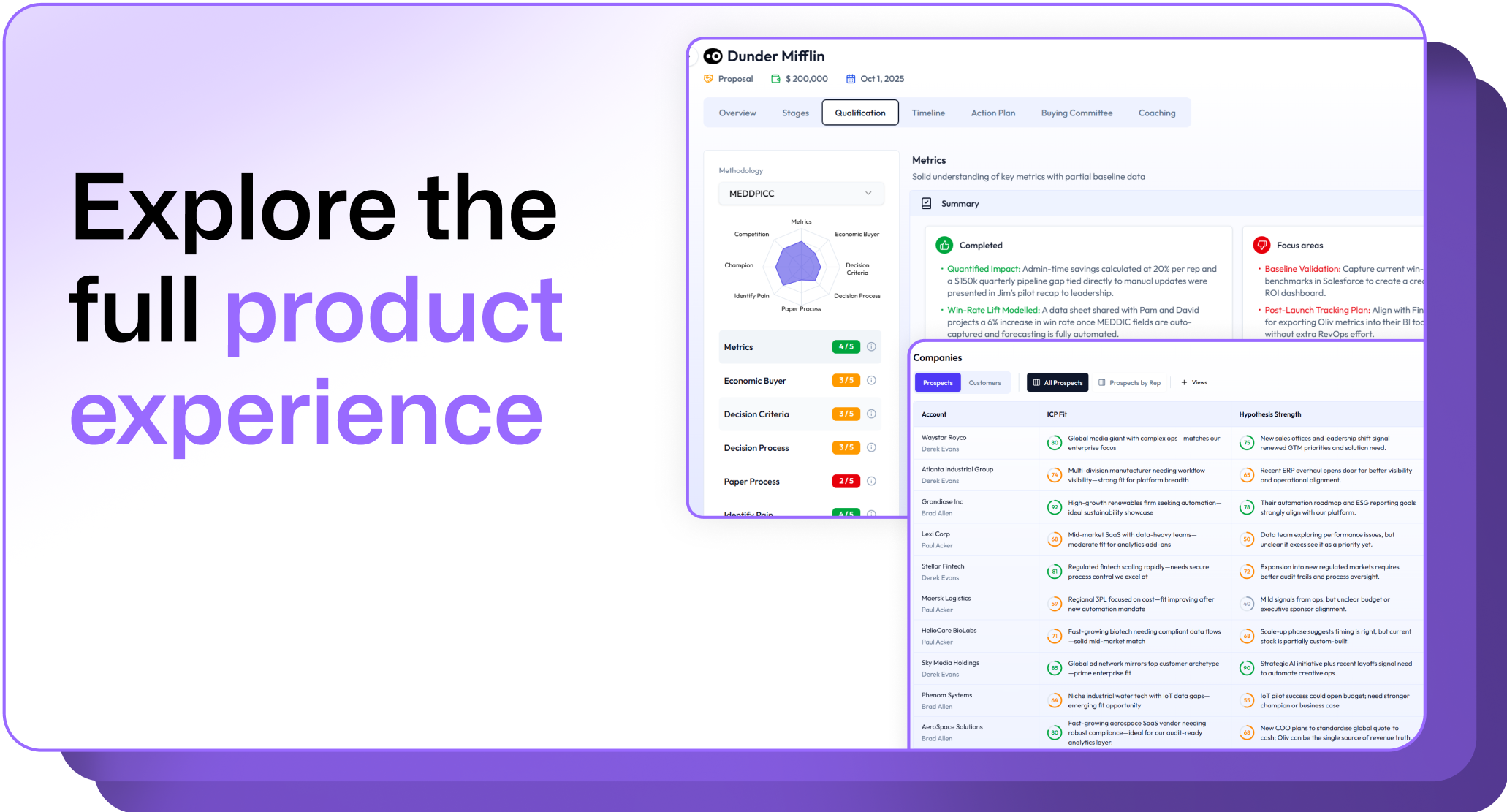
.avif)
.png)