Should You Buy Revenue AI? Honest Answers to Every CRO and VP Sales Objection
Written by
Ishan Chhabra
Last Updated :
April 9, 2026
Skim in :
13
mins
In this article
Still got questions?
Come discuss this article with me.
Hi, I'm Ishan, Founder and CEO of Oliv.
I'm always up for a conversation about revenue intelligence, AI agents, or what's actually working (and what's not) across revenue teams.
I'd love to hear your perspective.
Thank you! Your submission has been received!
Oops! Something went wrong while submitting the form.
Meet Oliv’s AI Agents
Hi! I’m, Deal Driver
I track deals, flag risks, send weekly pipeline updates and give sales managers full visibility into deal progress
Hi! I’m, CRM Manager
I maintain CRM hygiene by updating core, custom and qualification fields all without your team lifting a finger
Hi! I’m, Forecaster
I build accurate forecasts based on real deal movement and tell you which deals to pull in to hit your number
Hi! I’m, Coach
I believe performance fuels revenue. I spot skill gaps, score calls and build coaching plans to help every rep level up
Hi! I’m, Prospector
I dig into target accounts to surface the right contacts, tailor and time outreach so you always strike when it counts
Hi! I’m, Pipeline tracker
I call reps to get deal updates, and deliver a real-time, CRM-synced roll-up view of deal progress
Hi! I’m, Analyst
I answer complex pipeline questions, uncover deal patterns, and build reports that guide strategic decisions
TL;DR
Revenue AI adoption is accelerating in 2026 as CROs face 46% pressure to show AI-driven revenue gains, but 27% cite budget constraints and data quality as barriers.
Oliv replaces a $500+/user/month Gong + Clari stack with a single AI-native platform at 91% lower TCO, delivering execution rather than just intelligence dashboards.
Human-in-the-loop governance, grounded LLMs, and transparent evidence trails solve the top CRO fears around AI hallucination, rep trust, and CRM data accuracy.
Oliv deploys in days with zero adoption curve since agents work inside Slack, Gmail, and HubSpot, eliminating the timing objection for mid-quarter tool switches.
Full open export and CRM-agnostic architecture guarantee data portability, solving vendor lock-in fears that plague Gong and Salesforce Einstein users.
The article addresses 13 real objections from CROs and VPs of Sales, covering ROI proof frameworks, CFO business cases, deal risk detection, coaching trend measurement, and AI pilot strategies.
Q1: Why Is Every CRO Asking "Should We Buy Revenue AI?" in 2026? [toc=The 2026 Revenue AI Question]
The revenue technology landscape is experiencing what industry insiders call a "tectonic plate movement." Ninety-one percent of organizations now report some form of AI adoption, yet only 41% can demonstrate measurable ROI. This gap, the 2026 GenAI Divide, is not theoretical. It surfaces in every board meeting where a CRO must defend last quarter's tech spend. The pressure is real: budgets are tightening, CFOs demand P&L evidence, and the promise of "AI-powered revenue growth" has yet to materialize for the majority.
⚠️ The Legacy Tooling Trap
The skepticism is justified. First-generation revenue intelligence platforms, Gong, Clari, Chorus, were built on decade-old codebases and later retrofitted with AI features. The result? Dashboards without decisions. These tools ingested calls, flagged keywords, and produced reports, but left every consequential action, CRM updates, follow-ups, and risk escalation, to already-overburdened humans.
"It can be overwhelming to set up trackers. AI training is a bit laborious to get it to do what you want." Trafford J., Senior Director, Revenue Enablement Gong G2 Verified Review
"There's so much in Gong, that we don't use everything. Gong's deal forecasting we don't use." Karel Bos, Head of Sales Gong TrustRadius Verified Review
The Paradigm Shift: From SaaS to Agentic Workforce
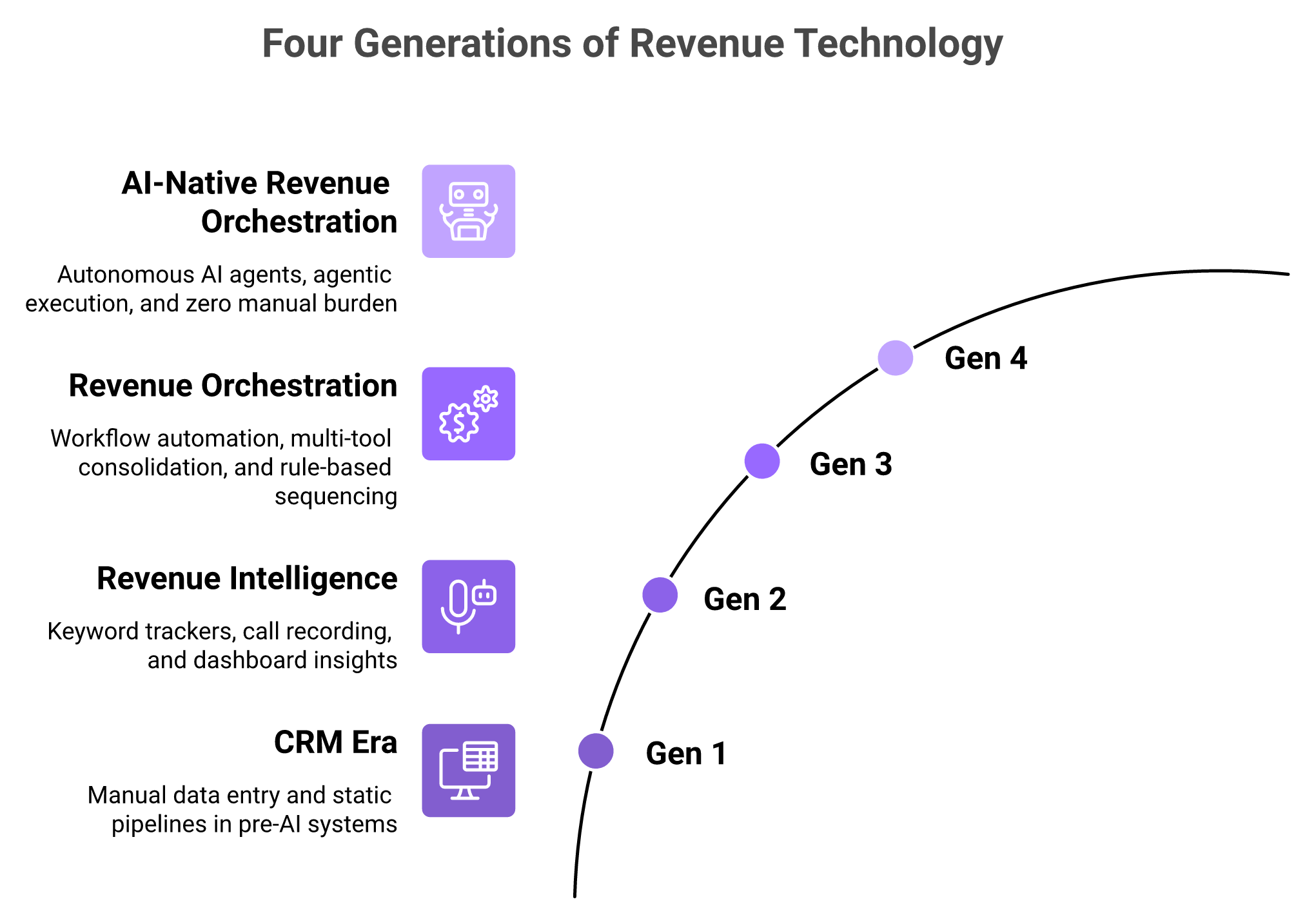
Revenue technology has evolved through four distinct generations, with AI-native orchestration replacing manual dashboards with autonomous agent execution.
The industry has moved from Generation 2 (Revenue Intelligence) to Generation 4 (AI-Native Revenue Orchestration). As Oliv AI founder Ishan Chhabra frames it: "SaaS is a dirty word." Modern revenue leaders no longer want another application they have to adopt, train for, and manually operate. They want an agentic workforce that performs Jobs to be Done autonomously, including CRM hygiene, deal risk detection, follow-up execution, and coaching prep.
✅ Where Oliv Fits in the New Paradigm
Oliv is built for this Gen-4 reality. Instead of displaying intelligence for humans to act on, Oliv's AI agents execute the work directly, populating MEDDPICC fields, drafting follow-up emails, flagging at-risk deals, and generating coaching briefs. The platform is not another tab to open; it operates within the tools revenue teams already use: Slack, Gmail, HubSpot, and Salesforce.
This article is a handbook for the structural skepticism that CROs and VPs of Sales carry into every vendor evaluation. Twelve real objections, answered honestly, with evidence, not marketing.
Q2: Do We Really Need AI for Sales, or Should We Just Hire Better Reps and Managers? [toc=Hire Reps vs. Buy AI]
This is the most emotionally charged objection in every CRO's toolkit. Leaders who built careers hiring, mentoring, and scaling world-class teams bristle at the suggestion that technology should replace headcount investment. The instinct is understandable, as great reps win deals, not dashboards. But the objection misidentifies the problem.
❌ The RevOps Debt Problem
The issue isn't that your reps are bad. It's that your best reps are spending roughly 80% of their time on activities that generate zero pipeline. CRM updates, post-call summaries, account research, and internal Slack threads about deal status constitute the "RevOps Debt" that compounds with every new hire. Adding headcount to a broken, manual process doesn't scale productivity; it scales the administrative burden.
Think of it this way: buying Gong and Clari is like purchasing an expensive treadmill. The equipment looks impressive, but your team still has to do all the running. Manual auditing, data entry, and forecast roll-ups all remain on the rep's shoulders.
"Gong is a really powerful tool but it's probably the highest-end option on the market, and now we're stuck with a tool that works technically but isn't the right business decision." Iris P., Head of Marketing, Sales & Partnerships Gong G2 Verified Review
The AI-Era Reframe: Leverage, Not Replacement
Revenue teams equipped with AI achieve 3 to 15% revenue growth and 10 to 20% higher sales ROI, not by eliminating reps, but by returning selling hours to them. The question isn't "hire vs. buy." It's: "How do we make every hire 2x more productive from Day 1?"
✅ How Oliv Agents Act as Your Team's Force Multiplier
Instead of a treadmill, Oliv operates like a personal trainer and a nutritionist for every rep:
Research Agent prepares account briefs before every call, eliminating 30+ minutes of manual prep per meeting
Deal Driver Agent flags at-risk deals in real time, removing the need for managers to manually audit pipeline
Coach Agent builds personalized skill-development plans per rep based on 100% call analysis, not the 2% sample managers typically review
💰 The Headcount Math
For a 100-user team, automating post-call wrap-ups and Mutual Action Plan (MAP) updates saves reps 2 to 3 hours per week each. That's the productive equivalent of hiring 7 to 10 additional AEs, without a single recruiter call or ramp cycle.
"Clari is a tool for sales leaders, it adds no value to reps as far as I can see." Msoave, r/sales Reddit Thread
Q3: How Do I Prove Time Savings from AI Automation to My CFO and Leadership? [toc=Proving ROI to Your CFO]
In 2026, telling your CFO "we saved the team some time" earns an eye-roll, not a budget extension. Financial leaders demand P&L-connected proof, including pipeline created, deals accelerated, and revenue retained. The "time saved" narrative fails because it doesn't connect to the only metric a CFO cares about: cash impact.
❌ The "Dashboard Digging" Problem with Legacy Tools
Gong and Clari report activity metrics, such as calls logged, emails tracked, and keywords flagged, but leave managers to manually connect those data points to revenue outcomes. The result is what practitioners call "Dashboard Digging." Managers spend evenings listening to call recordings at 2x speed just to stay informed, then manually compile the patterns they heard into coaching notes and forecast adjustments.
The additional cost compounds when teams stack tools: Gong for conversation intelligence + Clari for forecasting + Outreach for engagement = $500+ per user per month, with fragmented insights spread across three separate dashboards.
✅ The Hard ROI vs. Soft ROI Framework
A CFO-ready business case separates two categories:
Oliv replaces manual call review with Sunset Summaries (daily) and Portfolio Recaps (weekly), saving managers one full day per week. Reps save 2 to 3 hours per week on CRM updates and follow-up drafts. For a 100-user team over three years, the net benefit reaches $9.7M through 35% higher win rates and compressed sales cycles.
⏰ The CFO One-Pager Template
Structure your pilot business case as: Baseline Metric then Pilot Metric then Delta then Annualized Revenue Impact. If CRM field completion jumped from 40% to 92% during an 8-week pilot, calculate the downstream impact on forecast accuracy and deal velocity. That's the number your CFO approves.
Q4: What's the Fastest Way to Prove an AI Pilot Before Committing Company-Wide? [toc=Fastest AI Pilot Framework]
The majority of enterprise AI pilots fail to deliver measurable P&L impact. CFOs are right to be skeptical. They've been burned by multi-year "data cleanup" projects and six-figure implementation engagements that never shipped a single actionable insight. The "Trough of Disillusionment" around AI is not irrational; it's the rational response to overpromised pilots.
❌ The Implementation Tax of Legacy Platforms
Gong implementation typically takes 8 to 24 weeks and requires 40 to 140 admin hours just to configure trackers, build libraries, and align permissions. Professional service fees add $10K to $30K before a single call is analyzed at scale.
"We've had a disappointing experience with Gong Engage... After requesting training for over 10 new hires, this is the response we received from their Professional Services team: 'The time has come for our Professional Services team to roll off and formally bring this engagement to a close.'" Anonymous Reviewer Gong G2 Verified Review
"Since we purchased our package, the support model has changed drastically, which is infuriating." Elspeth C., Chief Commercial Officer Gong G2 Verified Review
⏰ The Modern Pilot Standard
A valid AI pilot should generate real pipeline data, not demos, not sandbox environments, and not "potential" projections. Structure it in two phases:
Weeks 1 to 4: Establish hard baselines (CRM field completion rate, average post-call admin time, forecast accuracy, and deal cycle length)
Weeks 5 to 8: Measure AI-assisted performance against the same metrics, using a conservative scenario model
✅ Oliv's 5-Call POC: Proof in Days, Not Quarters
Oliv flips the pilot timeline entirely:
Share 5 to 10 recordings and your CRM field list
Oliv demonstrates live how it populates MEDDPICC fields, drafts follow-up emails, and detects deal risk immediately
Technical setup takes 5 minutes. Custom model building for your specific revenue process takes 2 to 4 weeks
There is no 8-week tracker configuration period. No professional services invoice. No waiting for a consultant to understand your sales methodology.
The Decision Framework
If Oliv doesn't outperform your baseline on at least two hard ROI metrics within 30 days, the business case doesn't proceed, and you have data either way. That's the confidence of a platform built for instant time-to-value, not one that needs months of setup to demonstrate anything meaningful.
Q5: How Does Revenue AI Extract Churn Risk and Feature Request Signals from Calls? [toc=Churn Risk Signal Extraction]
Revenue teams are drowning in unstructured data. A champion quietly souring on your product, a competitor being actively evaluated, a feature request that signals expansion opportunity, these critical signals are buried inside 45-minute call recordings and side-thread emails. Human bandwidth limits managers to reviewing roughly 2% of calls, creating a massive visibility gap where the signals that matter most go unheard.
❌ The "Dumb Keyword Tracker" Problem
First-generation conversation intelligence tools, Gong, Chorus, rely on V1 Machine Learning keyword spotting. A tracker flags the word "budget" even when a prospect discusses a personal holiday. It flags "Salesforce" whether the mention is a genuine competitive threat or a prospect saying "I used to work at Salesforce." These systems cannot distinguish between a competitor mentioned in passing and an active evaluation.
Building keyword collections from scratch is also time-consuming and creates significant admin overhead whenever new categories need to be created. The result: noisy alerts, false positives, and managers clicking through irrelevant flags instead of acting on real signals.
"AI is not great yet, the product still feels like it's at its infancy and needs to be developed further." Annabelle H., Voluntary Director, Board of Directors Gong G2 Verified Review
"The software doesn't have the capability of identifying words/phrases that are similar to what you're looking for or understand context, so if you don't tell it exactly what you're looking for then you'll miss out." Director of Sales Operations Chorus Gartner Verified Review
The Generative AI Leap: Intent Over Keywords
Generative AI reasoning, specifically Chain-of-Thought analysis, enables contextual understanding of sentiment and intent. Instead of matching isolated words, these systems analyze conversation flow, speaker dynamics, and thematic progression to determine what a statement actually means within the broader deal context.
✅ How Oliv's Intelligence Layer Works
Oliv uses 100+ fine-tuned LLMs that understand the nuance of intent, recognizing when a stakeholder raises a routine technical objection versus when a deal is genuinely at risk:
Intent-Aware Monitoring: Oliv identifies whether a competitor mention signals active evaluation or casual reference, eliminating the false-positive noise that plagues keyword systems
Automated CRM Extraction: Oliv auto-populates "Churn Risk" or "Feature Request" fields directly in HubSpot or Salesforce, backed by timestamped meeting clips as evidence
⭐ The Practical Difference
A keyword system flags "Salesforce" 40 times in a week across your team's calls. Oliv identifies the one instance where a prospect says "We've been evaluating Salesforce as an alternative" and surfaces only that, with the exact timestamp and context for your manager to act on immediately.
Q6: Can Revenue AI Track Rep Improvement Over Time, Where Are the Trend Lines? [toc=Rep Improvement Trend Tracking]
Standard sales coaching is subjective, inconsistent, and suffers from chronically poor coverage. A manager delivers feedback during a monthly one-on-one, but rarely has the bandwidth to track whether the rep actually implemented that feedback on subsequent calls. The result: coaching conversations feel productive in the moment but produce stagnant win rates over time.
❌ Why Legacy CI Falls Short on Coaching Measurement
Traditional conversation intelligence requires managers to manually review and score calls, a process that's practically impossible at scale. Gong and Clari measure activity volume ("calls made," "emails sent") rather than the progression of skill. There is no automated way to see whether a rep's objection handling improved from January to March, or whether a new hire's discovery questions are sharpening week over week.
"It's too complicated, and not intuitive at all. Using it is very...discomforting. Searching for calls is not easy, moving around in the calls is not easy, and understanding the pipeline management portion of it is almost impossible." John S., Senior Account Executive Gong G2 Verified Review
"I find the AI call scoring to be gimmicky and provides little value, but that might be because I have not done enough to set up my scoring templates?" Miles W., Senior Manager, Customer Success Avoma G2 Verified Review
⏰ The AI-Era Shift: From 2% Sampling to 100% Analysis
AI-powered coaching platforms analyze every call, not just the 2% a manager can manually review. This creates a "Measurement to Practice" feedback loop: identify a gap, prescribe targeted practice, and measure whether the behavior changed on subsequent calls. Gartner reports that AI-powered coaching can reduce ramp time by up to 30%, while organizations see win rate increases of up to 25%.
✅ How Oliv's Coach Agent Builds Trend Lines
Oliv's Coach Agent automatically analyzes 100% of calls to build a longitudinal picture of each rep's development:
Personalized Coaching Plans: The agent identifies where each seller struggles individually, objection handling, positioning, and discovery depth, and generates tailored improvement recommendations
Skill-Gap Maps: Weekly and monthly visual reports show managers exactly how reps are improving against their specific skill goals over time
💰 The Manager Time Dividend
Instead of spending 3 to 4 hours per week manually reviewing calls and compiling coaching notes, managers receive a pre-built coaching brief showing exactly which reps improved and where intervention is still needed, all backed by timestamped evidence from actual calls.
Q7: How Do I Detect Real Deal Risk vs. Slow-but-Fine Deals Automatically? [toc=Real vs. Fake Deal Risk]
Pipeline reviews are built on a dangerous assumption: that activity equals engagement. Organizations suffer from what practitioners call "Fake Coverage," where pipeline looks healthy based on rep activity, but underneath, prospects have gone quiet while reps continue sending follow-ups into the void. This is the root cause of forecast misses that blindside leadership every quarter.
❌ The Activity Bias in Legacy Deal Scoring
Gong measures deal health primarily by activity volume, including emails sent, calls logged, and meetings scheduled. It cannot distinguish between a rep actively chasing a ghosted prospect and a meaningful two-way engagement. This activity bias is why forecast accuracy for most organizations stalls at 60 to 70%.
"Gong has become the single source of truth for our sales team. From deal management to forecasting it's been really easy to gain adoption across the team." Scott T., Director of Sales Gong G2 Verified Review
However, even positive users acknowledge the gap:
"There's so much in Gong, that we don't use everything. Gong's deal forecasting we don't use." Karel Bos, Head of Sales Gong TrustRadius Verified Review
The AI-Era Standard: Content Over Count
Contextual deal analysis examines the substance and cadence of interactions, not just volume. It determines whether key stakeholders are genuinely participating, whether buying signals are progressing, or whether the deal has stalled despite high surface-level activity.
Content Analysis: The AI examines the actual content of emails, call transcripts, and Slack messages to assess whether the Economic Buyer is actively participating or has disengaged
Engagement Decay Detection: Oliv identifies when the last substantive two-way exchange with the decision-maker occurred, regardless of how many one-way follow-ups the rep has sent since
Real-Time Flagging: Risks surface daily, not in Friday pipeline reviews, giving managers time to intervene before deals slip
⚠️ The Signal Behind the Noise
Consider a rep who logs 15 touchpoints this month on a mid-market deal. Dashboards show green. But Oliv identifies that the last meaningful two-way exchange with the VP buyer was 23 days ago, and every subsequent touch was a one-way follow-up. That's real risk hiding behind activity noise, and it's the difference between a confident forecast and a Q4 surprise.
Q8: What If the AI Hallucinates a Deal Risk and We Pull Resources from a Good Deal? [toc=AI Hallucination Safeguards]
This is the trust objection that keeps CROs awake at night, and it deserves a direct answer. Global business losses from AI hallucinations reached $67.4 billion in 2024, and 47% of business executives have made major decisions based on unverified AI-generated content. In a sales context, a false deal-risk flag could divert your best SE from a healthy opportunity and tank a quarter.
❌ Why General-Purpose AI Hallucinates in Sales Contexts
General-purpose AI models hallucinate because they rely on broad training data rather than your company's specific reality. When applied to deal analysis, they may infer risk patterns from generic sales scenarios that don't match your market, your sales cycle, or your buyer behavior. Firms report an average of 2.3 significant AI-driven errors per quarter, with individual incident costs ranging from $50,000 to $2.1 million.
"Chorus has been an okay experience, will be moving to Gong next term, Used Clari before it was awful... We just keep playing hot potato with vendors and it can be frustrating." Justin S., Senior Marketing Operations Specialist Chorus G2 Verified Review
The Industry Response: Grounded Reasoning + Human-in-the-Loop
The industry is converging on three safeguards against hallucination in high-stakes contexts:
AI Hallucination Safeguards for Revenue Teams
Safeguard
How It Works
Grounded Reasoning (RAG)
AI retrieves answers only from your verified company data, not general knowledge
Human-in-the-Loop (HITL)
AI flags, human confirms, no autonomous action on critical decisions
Evidence Logging
Every output links to the source data that generated it, enabling instant verification
✅ How Oliv's "Grounded Reasoning" Eliminates Guesswork
Oliv addresses hallucination at the architecture level, not as an afterthought:
Workspace Constraints: Oliv builds fine-tuned LLMs that operate exclusively within your company's data lake, including calls, emails, and CRM records. It never pulls from general knowledge when analyzing deal risk
Evidence Logs: Every risk flag includes a direct link to the exact timestamped audio clip or email snippet that triggered the alert, and managers verify the "why" in seconds, not hours
Learning from Overrides: When a manager dismisses a false flag, the system incorporates that feedback, improving accuracy over time
⭐ The Verification Loop in Practice
Oliv presents evidence, then the manager confirms or dismisses in seconds, and then the model learns. This is fundamentally different from a system that presents a risk score with no explanation, because a number without evidence is just another thing to worry about, not something you can act on.
Q9: If AI Agents Work in the Background, How Do Reps Trust What Was Updated? [toc=Rep Trust in AI Updates]
Reps live in a paradox: they're terrified of dropping the ball on next steps, yet they view CRM updates as administrative policing. Full automation sounds appealing in a boardroom, but on the floor, reps won't rely on a system they can't verify. If an AI silently updates a deal stage, edits a next-step field, or drafts a follow-up without the rep's awareness, trust collapses, and so does adoption.
❌ The Wrong UX: Chat-Based Bots and Alert Overload
Salesforce Agentforce takes a chat-first approach, requiring reps to manually "talk to a bot" inside the Salesforce interface to get work done. It's a separate interaction layer that lives outside the daily selling flow, not embedded in the tools reps already use.
"It can be complex to set up and often requires skilled administrators or developers to customize and integrate properly, which adds time and cost. The user interface, though improved with Lightning, may still feel clunky or unintuitive to some agents, leading to slower adoption." Verified User in Marketing and Advertising Agentforce G2 Verified Review
"Lots of clicking to get select the right options. UX needs improvement. Everything opens in a new browser tabs clustering the browser. Lots of jumping back and forth between tabs to enable settings." Verified User in Consulting Agentforce G2 Verified Review
Meanwhile, Gong pushes Slack alerts throughout the day, including keyword flags, activity notifications, and deal updates, but still requires reps to manually enter the actual CRM data. Intelligence without execution creates noise, not trust.
The AI-Era Principle: Human-in-the-Loop Governance
Effective AI automation doesn't bypass humans; it drafts the work and asks for approval. The industry term is "Human-in-the-Loop" (HITL), where agents perform the heavy lifting, but humans remain the final checkpoint on anything that touches the CRM or goes to a customer.
✅ How Oliv's "Nudge" Workflow Builds Rep Trust
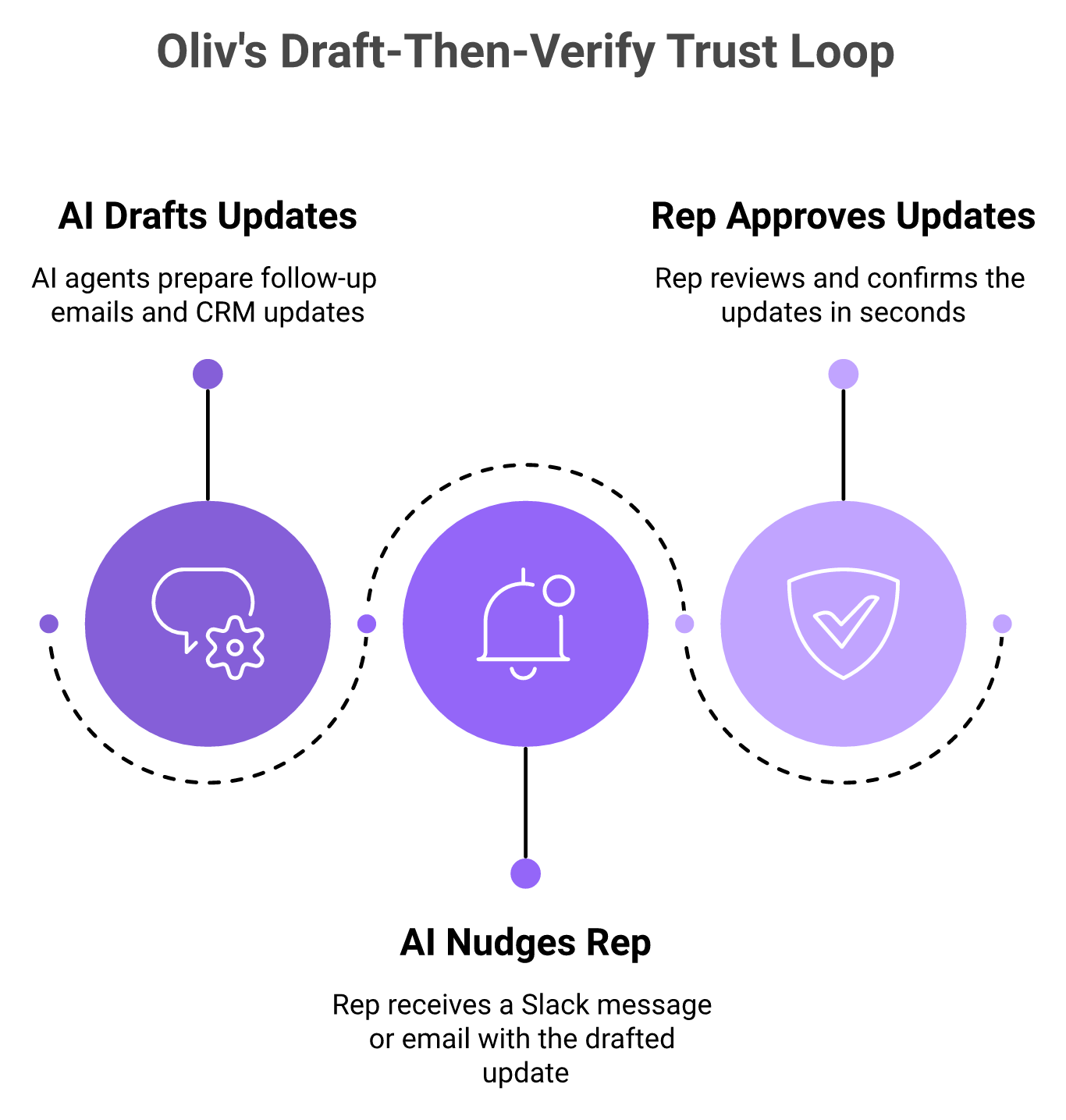
Oliv's nudge workflow earns rep trust by drafting CRM updates, surfacing evidence, and letting humans approve in seconds.
Oliv's agents follow a draft-then-verify model embedded in tools reps already live in:
Draft in Background: After every call, agents prepare follow-up emails, CRM field updates (MEDDPICC, next steps, and stakeholder changes), and business case documents
Nudge to Verify: The rep receives a Slack message or email with the drafted update and a clear data trail, linked back to the exact moment in the call that generated it
Approve in Seconds: The rep reviews, edits if needed, and confirms, taking 10 seconds instead of 10 minutes of manual entry
⭐ Trust Through Transparency
Every update carries a transparent evidence trail, so reps know exactly why the AI recommended each change. Trust isn't assumed; it's earned through visibility.
Q10: How Do I Prove to Leadership That Tool Noise Is Killing Productivity? [toc=Proving Tool Noise Costs]
Modern sales reps use 10+ tools daily. Meetings routinely have five note-takers running simultaneously but produce zero completed tasks afterward. This is "Note-Taker Fatigue" meets "Noisy Platform Syndrome," and it's a productivity drain that rarely appears on any leadership dashboard because no one is measuring the cost of context-switching.
❌ The Stack Penalty: When More Tools Mean Less Output
The typical enterprise revenue stack layers Gong (conversation intelligence) + Clari (forecasting) + Outreach (engagement) at a combined cost exceeding $500 per user per month. Each tool generates its own alerts, dashboards, and workflows, and none of them talk to each other natively.
"The additional products like forecast or engage come at an additional cost. Would be great to see these tools rolled into the core offering." Scott T., Director of Sales Gong G2 Verified Review
"The core tool itself is good enough but the sale entailed overcomplicating the forecasting process so you needed Clari... It is really just a glorified SFDC overlay. Actually, Salesforce has built most of the forecasting functionality by now anyway so I'm not sure where they fit into that whole overcrowded Martech space." conaldinho11, r/SalesOperations Reddit Thread
⏰ How to Quantify the Productivity Tax
Use this three-step framework to quantify the annual cost of tool noise and context-switching for your revenue team.
Build the business case with this framework:
Audit tool-switching time: Track how many minutes per day reps spend navigating between platforms (avg. 30 to 45 min for most teams)
Calculate alert-triage cost: Count weekly notifications per rep across all tools and estimate time spent reviewing vs. acting
Multiply by fully loaded cost per hour: A rep earning $150K OTE with benefits costs roughly $90/hour. Multiply by wasted hours across the team
That number is your "Productivity Tax," the annual cost leadership can act on.
✅ Oliv: One Platform, Double the Functionality
Oliv replaces the three-tool stack with a single AI-native data platform. The difference is architectural:
Legacy tools provide Intelligence, they show you data and expect humans to act on it
Oliv provides Execution, agents perform the CRM updates, draft the follow-ups, flag the risks, and generate coaching briefs autonomously
💸 The TCO Comparison
For a 100-user team over 3 years: the Gong + Clari stack costs approximately $789,300 versus $68,400 on Oliv, a 91% lower total cost of ownership for double the functional coverage.
Q11: Can I Leave and Keep My Data, and What Happens If We Switch CRMs? [toc=Data Portability and CRM Migration]
Data is the lifeblood of every revenue organization, yet it routinely becomes trapped in proprietary silos. Revenue leaders evaluating any new platform ask two non-negotiable questions: "Can I export everything if I leave?" and "What happens to my historical context if we migrate CRMs?" Both questions reveal the same underlying fear: vendor lock-in that holds your intelligence hostage.
❌ The One-Way Integration Problem
Gong acts as a "holder of data," pulling call recordings, transcripts, and insights into its own universe. Exporting that intelligence back to the CRM in a structured, reportable format is far from straightforward.
"Our experience has been impacted by significant data access limitations, especially concerning data portability and bulk export capabilities... their current solution is far from convenient or accessible, it requires downloading calls individually, which is impractical and inefficient for a large volume of data." Neel P., Sales Operations Manager Gong G2 Verified Review
"This lack of flexibility has required us to engage our development team at additional cost, adding significant operational and opportunity costs just to extract data we already own." Neel P., Sales Operations Manager Gong G2 Verified Review
Salesforce Einstein Activity Capture (EAC) presents a different version of the same problem. It redacts data unnecessarily and stores emails in separate AWS instances that are unusable for downstream reporting.
The Modern Portability Standard
Modern AI platforms should maintain the CRM as the Single Source of Truth, not create a parallel database that holds data hostage. Every insight generated should live where your team already works: HubSpot or Salesforce.
✅ Oliv's Data Portability Architecture
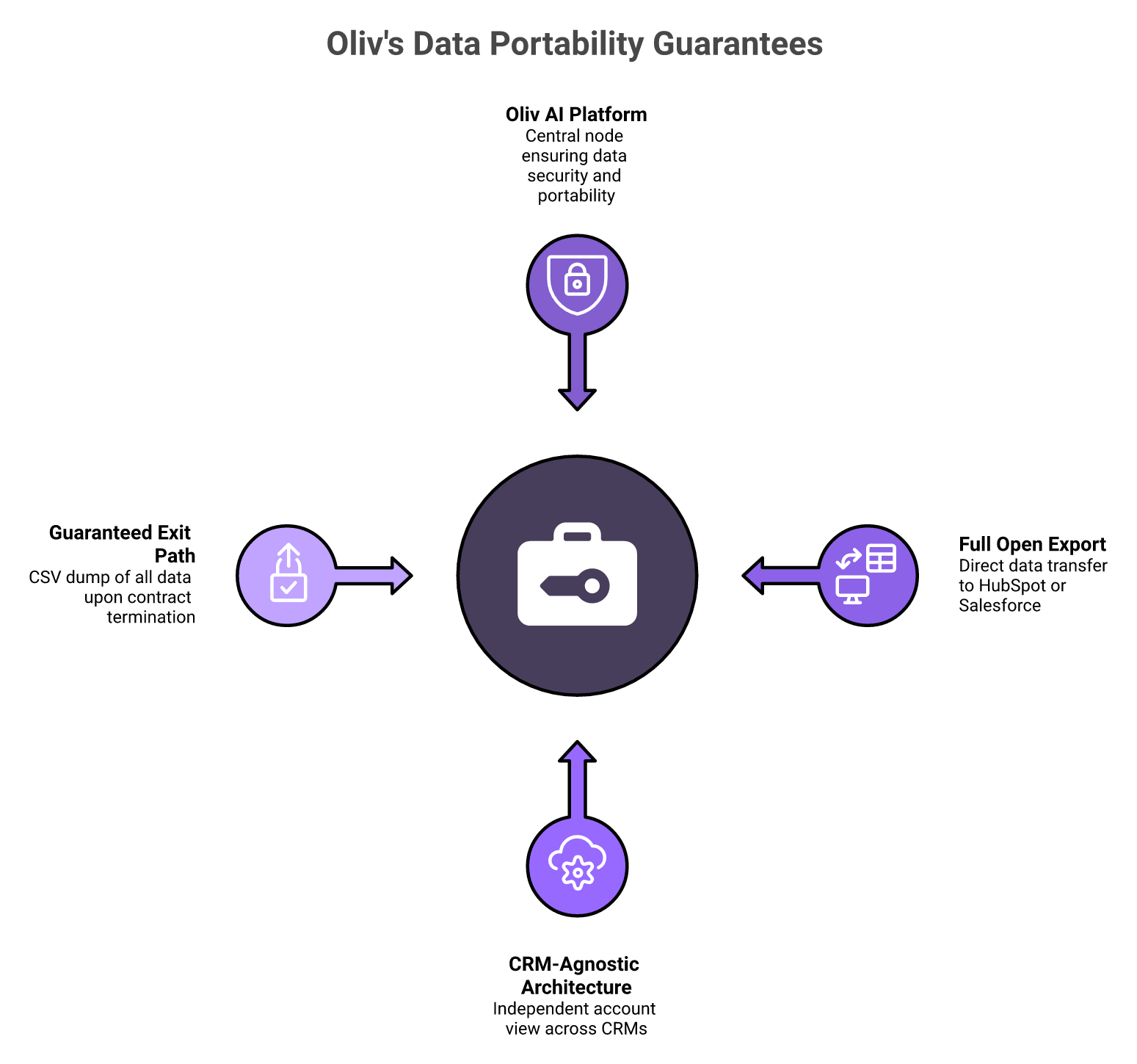
Oliv's architecture is built on three non-negotiable data portability guarantees that eliminate vendor lock-in.
Oliv is built on three data portability guarantees:
Full Open Export: All insights, including MEDDPICC fields, call summaries, stakeholder maps, and coaching notes, are pushed directly into HubSpot or Salesforce properties, not stored in a proprietary silo
CRM-Agnostic Architecture: Oliv maintains a 360-degree account view from calls, emails, and Slack independently of any single CRM. When you switch from HubSpot to Salesforce (or vice versa), Oliv re-syncs its grounded deal history to the new platform, with no data loss and no broken associations
Guaranteed Exit Path: Upon contract termination, Oliv provides a full CSV dump of all meetings, recordings, and structured insights in a usable format
⭐ The CRM Migration Use Case
Growth-stage companies frequently migrate from HubSpot to Salesforce as they scale. With legacy tools, this means months of data mapping and inevitable context loss. With Oliv, the intelligence layer simply re-maps to the new CRM. Your deal history, stakeholder evolution, and coaching data travel with you intact.
Q12: Is It the Wrong Time to Switch Tools When We're Trying to Hit Q4 Numbers? [toc=Switching Tools During Q4]
This is the final objection, and often the most effective one at killing deals. "We can't disrupt the team mid-quarter" sounds pragmatic and responsible. But in most cases, it masks a deeper anxiety: the fear that any tool change will slow the team down at the worst possible moment.
❌ Why the Timing Objection Is Valid, for Legacy Tools
Switching from Gong or Clari genuinely is a multi-month disruption. Tracker reconfiguration, permission mapping, workflow redesign, and retraining all consume cycles that frontline teams can't afford during a critical quarter.
"It was a big mistake on our part to commit to a two year term. Gong is a really powerful tool but it's probably the highest end option on the market, and now we're stuck with a tool that works technically but isn't the right business decision." Iris P., Head of Marketing, Sales & Partnerships Gong G2 Verified Review
"The Omnibar is very click intensive to accomplish basic tasks compared to its competitors. The Omnibar is very slow and lags quite often... I could not recommend this product to any sales rep in any industry." Verified User in Computer Software Clari G2 Verified Review
⚠️ The Real Risk: Standing Still
The timing objection assumes that the current state is stable. It isn't. Every week without real-time deal risk detection is another week of preventable forecast misses, surprise slippage, and pipeline reviews that surface problems too late to fix. The cost of inaction compounds, especially in Q4, when every deal matters.
✅ Oliv's "Invisible UI": Zero Disruption by Design
Oliv eliminates the timing objection because there is no adoption curve:
Reps continue living in HubSpot, Slack, and Gmail. They don't learn a new app, open a new tab, or attend training sessions
Agents work in the background of existing workflows, drafting CRM updates, flagging risks, and preparing coaching briefs without requiring any behavior change from reps
The Deal Driver Agent flags at-risk deals daily, giving managers real-time intervention capability instead of discovering problems in the next weekly pipeline review
💰 The Q4 Reframe
The question isn't whether you can afford to switch during Q4. It's whether you can afford not to have real-time deal intelligence when every deal matters most. Oliv doesn't require a "switch" at all. It layers onto your existing workflow and starts delivering value from the first week, while your team focuses on what they should be doing: closing.
Q1: Why Is Every CRO Asking "Should We Buy Revenue AI?" in 2026? [toc=The 2026 Revenue AI Question]
The revenue technology landscape is experiencing what industry insiders call a "tectonic plate movement." Ninety-one percent of organizations now report some form of AI adoption, yet only 41% can demonstrate measurable ROI. This gap, the 2026 GenAI Divide, is not theoretical. It surfaces in every board meeting where a CRO must defend last quarter's tech spend. The pressure is real: budgets are tightening, CFOs demand P&L evidence, and the promise of "AI-powered revenue growth" has yet to materialize for the majority.
⚠️ The Legacy Tooling Trap
The skepticism is justified. First-generation revenue intelligence platforms, Gong, Clari, Chorus, were built on decade-old codebases and later retrofitted with AI features. The result? Dashboards without decisions. These tools ingested calls, flagged keywords, and produced reports, but left every consequential action, CRM updates, follow-ups, and risk escalation, to already-overburdened humans.
"It can be overwhelming to set up trackers. AI training is a bit laborious to get it to do what you want." Trafford J., Senior Director, Revenue Enablement Gong G2 Verified Review
"There's so much in Gong, that we don't use everything. Gong's deal forecasting we don't use." Karel Bos, Head of Sales Gong TrustRadius Verified Review
The Paradigm Shift: From SaaS to Agentic Workforce
Revenue technology has evolved through four distinct generations, with AI-native orchestration replacing manual dashboards with autonomous agent execution.
The industry has moved from Generation 2 (Revenue Intelligence) to Generation 4 (AI-Native Revenue Orchestration). As Oliv AI founder Ishan Chhabra frames it: "SaaS is a dirty word." Modern revenue leaders no longer want another application they have to adopt, train for, and manually operate. They want an agentic workforce that performs Jobs to be Done autonomously, including CRM hygiene, deal risk detection, follow-up execution, and coaching prep.
✅ Where Oliv Fits in the New Paradigm
Oliv is built for this Gen-4 reality. Instead of displaying intelligence for humans to act on, Oliv's AI agents execute the work directly, populating MEDDPICC fields, drafting follow-up emails, flagging at-risk deals, and generating coaching briefs. The platform is not another tab to open; it operates within the tools revenue teams already use: Slack, Gmail, HubSpot, and Salesforce.
This article is a handbook for the structural skepticism that CROs and VPs of Sales carry into every vendor evaluation. Twelve real objections, answered honestly, with evidence, not marketing.
Q2: Do We Really Need AI for Sales, or Should We Just Hire Better Reps and Managers? [toc=Hire Reps vs. Buy AI]
This is the most emotionally charged objection in every CRO's toolkit. Leaders who built careers hiring, mentoring, and scaling world-class teams bristle at the suggestion that technology should replace headcount investment. The instinct is understandable, as great reps win deals, not dashboards. But the objection misidentifies the problem.
❌ The RevOps Debt Problem
The issue isn't that your reps are bad. It's that your best reps are spending roughly 80% of their time on activities that generate zero pipeline. CRM updates, post-call summaries, account research, and internal Slack threads about deal status constitute the "RevOps Debt" that compounds with every new hire. Adding headcount to a broken, manual process doesn't scale productivity; it scales the administrative burden.
Think of it this way: buying Gong and Clari is like purchasing an expensive treadmill. The equipment looks impressive, but your team still has to do all the running. Manual auditing, data entry, and forecast roll-ups all remain on the rep's shoulders.
"Gong is a really powerful tool but it's probably the highest-end option on the market, and now we're stuck with a tool that works technically but isn't the right business decision." Iris P., Head of Marketing, Sales & Partnerships Gong G2 Verified Review
The AI-Era Reframe: Leverage, Not Replacement
Revenue teams equipped with AI achieve 3 to 15% revenue growth and 10 to 20% higher sales ROI, not by eliminating reps, but by returning selling hours to them. The question isn't "hire vs. buy." It's: "How do we make every hire 2x more productive from Day 1?"
✅ How Oliv Agents Act as Your Team's Force Multiplier
Instead of a treadmill, Oliv operates like a personal trainer and a nutritionist for every rep:
Research Agent prepares account briefs before every call, eliminating 30+ minutes of manual prep per meeting
Deal Driver Agent flags at-risk deals in real time, removing the need for managers to manually audit pipeline
Coach Agent builds personalized skill-development plans per rep based on 100% call analysis, not the 2% sample managers typically review
💰 The Headcount Math
For a 100-user team, automating post-call wrap-ups and Mutual Action Plan (MAP) updates saves reps 2 to 3 hours per week each. That's the productive equivalent of hiring 7 to 10 additional AEs, without a single recruiter call or ramp cycle.
"Clari is a tool for sales leaders, it adds no value to reps as far as I can see." Msoave, r/sales Reddit Thread
Q3: How Do I Prove Time Savings from AI Automation to My CFO and Leadership? [toc=Proving ROI to Your CFO]
In 2026, telling your CFO "we saved the team some time" earns an eye-roll, not a budget extension. Financial leaders demand P&L-connected proof, including pipeline created, deals accelerated, and revenue retained. The "time saved" narrative fails because it doesn't connect to the only metric a CFO cares about: cash impact.
❌ The "Dashboard Digging" Problem with Legacy Tools
Gong and Clari report activity metrics, such as calls logged, emails tracked, and keywords flagged, but leave managers to manually connect those data points to revenue outcomes. The result is what practitioners call "Dashboard Digging." Managers spend evenings listening to call recordings at 2x speed just to stay informed, then manually compile the patterns they heard into coaching notes and forecast adjustments.
The additional cost compounds when teams stack tools: Gong for conversation intelligence + Clari for forecasting + Outreach for engagement = $500+ per user per month, with fragmented insights spread across three separate dashboards.
✅ The Hard ROI vs. Soft ROI Framework
A CFO-ready business case separates two categories:
Oliv replaces manual call review with Sunset Summaries (daily) and Portfolio Recaps (weekly), saving managers one full day per week. Reps save 2 to 3 hours per week on CRM updates and follow-up drafts. For a 100-user team over three years, the net benefit reaches $9.7M through 35% higher win rates and compressed sales cycles.
⏰ The CFO One-Pager Template
Structure your pilot business case as: Baseline Metric then Pilot Metric then Delta then Annualized Revenue Impact. If CRM field completion jumped from 40% to 92% during an 8-week pilot, calculate the downstream impact on forecast accuracy and deal velocity. That's the number your CFO approves.
Q4: What's the Fastest Way to Prove an AI Pilot Before Committing Company-Wide? [toc=Fastest AI Pilot Framework]
The majority of enterprise AI pilots fail to deliver measurable P&L impact. CFOs are right to be skeptical. They've been burned by multi-year "data cleanup" projects and six-figure implementation engagements that never shipped a single actionable insight. The "Trough of Disillusionment" around AI is not irrational; it's the rational response to overpromised pilots.
❌ The Implementation Tax of Legacy Platforms
Gong implementation typically takes 8 to 24 weeks and requires 40 to 140 admin hours just to configure trackers, build libraries, and align permissions. Professional service fees add $10K to $30K before a single call is analyzed at scale.
"We've had a disappointing experience with Gong Engage... After requesting training for over 10 new hires, this is the response we received from their Professional Services team: 'The time has come for our Professional Services team to roll off and formally bring this engagement to a close.'" Anonymous Reviewer Gong G2 Verified Review
"Since we purchased our package, the support model has changed drastically, which is infuriating." Elspeth C., Chief Commercial Officer Gong G2 Verified Review
⏰ The Modern Pilot Standard
A valid AI pilot should generate real pipeline data, not demos, not sandbox environments, and not "potential" projections. Structure it in two phases:
Weeks 1 to 4: Establish hard baselines (CRM field completion rate, average post-call admin time, forecast accuracy, and deal cycle length)
Weeks 5 to 8: Measure AI-assisted performance against the same metrics, using a conservative scenario model
✅ Oliv's 5-Call POC: Proof in Days, Not Quarters
Oliv flips the pilot timeline entirely:
Share 5 to 10 recordings and your CRM field list
Oliv demonstrates live how it populates MEDDPICC fields, drafts follow-up emails, and detects deal risk immediately
Technical setup takes 5 minutes. Custom model building for your specific revenue process takes 2 to 4 weeks
There is no 8-week tracker configuration period. No professional services invoice. No waiting for a consultant to understand your sales methodology.
The Decision Framework
If Oliv doesn't outperform your baseline on at least two hard ROI metrics within 30 days, the business case doesn't proceed, and you have data either way. That's the confidence of a platform built for instant time-to-value, not one that needs months of setup to demonstrate anything meaningful.
Q5: How Does Revenue AI Extract Churn Risk and Feature Request Signals from Calls? [toc=Churn Risk Signal Extraction]
Revenue teams are drowning in unstructured data. A champion quietly souring on your product, a competitor being actively evaluated, a feature request that signals expansion opportunity, these critical signals are buried inside 45-minute call recordings and side-thread emails. Human bandwidth limits managers to reviewing roughly 2% of calls, creating a massive visibility gap where the signals that matter most go unheard.
❌ The "Dumb Keyword Tracker" Problem
First-generation conversation intelligence tools, Gong, Chorus, rely on V1 Machine Learning keyword spotting. A tracker flags the word "budget" even when a prospect discusses a personal holiday. It flags "Salesforce" whether the mention is a genuine competitive threat or a prospect saying "I used to work at Salesforce." These systems cannot distinguish between a competitor mentioned in passing and an active evaluation.
Building keyword collections from scratch is also time-consuming and creates significant admin overhead whenever new categories need to be created. The result: noisy alerts, false positives, and managers clicking through irrelevant flags instead of acting on real signals.
"AI is not great yet, the product still feels like it's at its infancy and needs to be developed further." Annabelle H., Voluntary Director, Board of Directors Gong G2 Verified Review
"The software doesn't have the capability of identifying words/phrases that are similar to what you're looking for or understand context, so if you don't tell it exactly what you're looking for then you'll miss out." Director of Sales Operations Chorus Gartner Verified Review
The Generative AI Leap: Intent Over Keywords
Generative AI reasoning, specifically Chain-of-Thought analysis, enables contextual understanding of sentiment and intent. Instead of matching isolated words, these systems analyze conversation flow, speaker dynamics, and thematic progression to determine what a statement actually means within the broader deal context.
✅ How Oliv's Intelligence Layer Works
Oliv uses 100+ fine-tuned LLMs that understand the nuance of intent, recognizing when a stakeholder raises a routine technical objection versus when a deal is genuinely at risk:
Intent-Aware Monitoring: Oliv identifies whether a competitor mention signals active evaluation or casual reference, eliminating the false-positive noise that plagues keyword systems
Automated CRM Extraction: Oliv auto-populates "Churn Risk" or "Feature Request" fields directly in HubSpot or Salesforce, backed by timestamped meeting clips as evidence
⭐ The Practical Difference
A keyword system flags "Salesforce" 40 times in a week across your team's calls. Oliv identifies the one instance where a prospect says "We've been evaluating Salesforce as an alternative" and surfaces only that, with the exact timestamp and context for your manager to act on immediately.
Q6: Can Revenue AI Track Rep Improvement Over Time, Where Are the Trend Lines? [toc=Rep Improvement Trend Tracking]
Standard sales coaching is subjective, inconsistent, and suffers from chronically poor coverage. A manager delivers feedback during a monthly one-on-one, but rarely has the bandwidth to track whether the rep actually implemented that feedback on subsequent calls. The result: coaching conversations feel productive in the moment but produce stagnant win rates over time.
❌ Why Legacy CI Falls Short on Coaching Measurement
Traditional conversation intelligence requires managers to manually review and score calls, a process that's practically impossible at scale. Gong and Clari measure activity volume ("calls made," "emails sent") rather than the progression of skill. There is no automated way to see whether a rep's objection handling improved from January to March, or whether a new hire's discovery questions are sharpening week over week.
"It's too complicated, and not intuitive at all. Using it is very...discomforting. Searching for calls is not easy, moving around in the calls is not easy, and understanding the pipeline management portion of it is almost impossible." John S., Senior Account Executive Gong G2 Verified Review
"I find the AI call scoring to be gimmicky and provides little value, but that might be because I have not done enough to set up my scoring templates?" Miles W., Senior Manager, Customer Success Avoma G2 Verified Review
⏰ The AI-Era Shift: From 2% Sampling to 100% Analysis
AI-powered coaching platforms analyze every call, not just the 2% a manager can manually review. This creates a "Measurement to Practice" feedback loop: identify a gap, prescribe targeted practice, and measure whether the behavior changed on subsequent calls. Gartner reports that AI-powered coaching can reduce ramp time by up to 30%, while organizations see win rate increases of up to 25%.
✅ How Oliv's Coach Agent Builds Trend Lines
Oliv's Coach Agent automatically analyzes 100% of calls to build a longitudinal picture of each rep's development:
Personalized Coaching Plans: The agent identifies where each seller struggles individually, objection handling, positioning, and discovery depth, and generates tailored improvement recommendations
Skill-Gap Maps: Weekly and monthly visual reports show managers exactly how reps are improving against their specific skill goals over time
💰 The Manager Time Dividend
Instead of spending 3 to 4 hours per week manually reviewing calls and compiling coaching notes, managers receive a pre-built coaching brief showing exactly which reps improved and where intervention is still needed, all backed by timestamped evidence from actual calls.
Q7: How Do I Detect Real Deal Risk vs. Slow-but-Fine Deals Automatically? [toc=Real vs. Fake Deal Risk]
Pipeline reviews are built on a dangerous assumption: that activity equals engagement. Organizations suffer from what practitioners call "Fake Coverage," where pipeline looks healthy based on rep activity, but underneath, prospects have gone quiet while reps continue sending follow-ups into the void. This is the root cause of forecast misses that blindside leadership every quarter.
❌ The Activity Bias in Legacy Deal Scoring
Gong measures deal health primarily by activity volume, including emails sent, calls logged, and meetings scheduled. It cannot distinguish between a rep actively chasing a ghosted prospect and a meaningful two-way engagement. This activity bias is why forecast accuracy for most organizations stalls at 60 to 70%.
"Gong has become the single source of truth for our sales team. From deal management to forecasting it's been really easy to gain adoption across the team." Scott T., Director of Sales Gong G2 Verified Review
However, even positive users acknowledge the gap:
"There's so much in Gong, that we don't use everything. Gong's deal forecasting we don't use." Karel Bos, Head of Sales Gong TrustRadius Verified Review
The AI-Era Standard: Content Over Count
Contextual deal analysis examines the substance and cadence of interactions, not just volume. It determines whether key stakeholders are genuinely participating, whether buying signals are progressing, or whether the deal has stalled despite high surface-level activity.
Content Analysis: The AI examines the actual content of emails, call transcripts, and Slack messages to assess whether the Economic Buyer is actively participating or has disengaged
Engagement Decay Detection: Oliv identifies when the last substantive two-way exchange with the decision-maker occurred, regardless of how many one-way follow-ups the rep has sent since
Real-Time Flagging: Risks surface daily, not in Friday pipeline reviews, giving managers time to intervene before deals slip
⚠️ The Signal Behind the Noise
Consider a rep who logs 15 touchpoints this month on a mid-market deal. Dashboards show green. But Oliv identifies that the last meaningful two-way exchange with the VP buyer was 23 days ago, and every subsequent touch was a one-way follow-up. That's real risk hiding behind activity noise, and it's the difference between a confident forecast and a Q4 surprise.
Q8: What If the AI Hallucinates a Deal Risk and We Pull Resources from a Good Deal? [toc=AI Hallucination Safeguards]
This is the trust objection that keeps CROs awake at night, and it deserves a direct answer. Global business losses from AI hallucinations reached $67.4 billion in 2024, and 47% of business executives have made major decisions based on unverified AI-generated content. In a sales context, a false deal-risk flag could divert your best SE from a healthy opportunity and tank a quarter.
❌ Why General-Purpose AI Hallucinates in Sales Contexts
General-purpose AI models hallucinate because they rely on broad training data rather than your company's specific reality. When applied to deal analysis, they may infer risk patterns from generic sales scenarios that don't match your market, your sales cycle, or your buyer behavior. Firms report an average of 2.3 significant AI-driven errors per quarter, with individual incident costs ranging from $50,000 to $2.1 million.
"Chorus has been an okay experience, will be moving to Gong next term, Used Clari before it was awful... We just keep playing hot potato with vendors and it can be frustrating." Justin S., Senior Marketing Operations Specialist Chorus G2 Verified Review
The Industry Response: Grounded Reasoning + Human-in-the-Loop
The industry is converging on three safeguards against hallucination in high-stakes contexts:
AI Hallucination Safeguards for Revenue Teams
Safeguard
How It Works
Grounded Reasoning (RAG)
AI retrieves answers only from your verified company data, not general knowledge
Human-in-the-Loop (HITL)
AI flags, human confirms, no autonomous action on critical decisions
Evidence Logging
Every output links to the source data that generated it, enabling instant verification
✅ How Oliv's "Grounded Reasoning" Eliminates Guesswork
Oliv addresses hallucination at the architecture level, not as an afterthought:
Workspace Constraints: Oliv builds fine-tuned LLMs that operate exclusively within your company's data lake, including calls, emails, and CRM records. It never pulls from general knowledge when analyzing deal risk
Evidence Logs: Every risk flag includes a direct link to the exact timestamped audio clip or email snippet that triggered the alert, and managers verify the "why" in seconds, not hours
Learning from Overrides: When a manager dismisses a false flag, the system incorporates that feedback, improving accuracy over time
⭐ The Verification Loop in Practice
Oliv presents evidence, then the manager confirms or dismisses in seconds, and then the model learns. This is fundamentally different from a system that presents a risk score with no explanation, because a number without evidence is just another thing to worry about, not something you can act on.
Q9: If AI Agents Work in the Background, How Do Reps Trust What Was Updated? [toc=Rep Trust in AI Updates]
Reps live in a paradox: they're terrified of dropping the ball on next steps, yet they view CRM updates as administrative policing. Full automation sounds appealing in a boardroom, but on the floor, reps won't rely on a system they can't verify. If an AI silently updates a deal stage, edits a next-step field, or drafts a follow-up without the rep's awareness, trust collapses, and so does adoption.
❌ The Wrong UX: Chat-Based Bots and Alert Overload
Salesforce Agentforce takes a chat-first approach, requiring reps to manually "talk to a bot" inside the Salesforce interface to get work done. It's a separate interaction layer that lives outside the daily selling flow, not embedded in the tools reps already use.
"It can be complex to set up and often requires skilled administrators or developers to customize and integrate properly, which adds time and cost. The user interface, though improved with Lightning, may still feel clunky or unintuitive to some agents, leading to slower adoption." Verified User in Marketing and Advertising Agentforce G2 Verified Review
"Lots of clicking to get select the right options. UX needs improvement. Everything opens in a new browser tabs clustering the browser. Lots of jumping back and forth between tabs to enable settings." Verified User in Consulting Agentforce G2 Verified Review
Meanwhile, Gong pushes Slack alerts throughout the day, including keyword flags, activity notifications, and deal updates, but still requires reps to manually enter the actual CRM data. Intelligence without execution creates noise, not trust.
The AI-Era Principle: Human-in-the-Loop Governance
Effective AI automation doesn't bypass humans; it drafts the work and asks for approval. The industry term is "Human-in-the-Loop" (HITL), where agents perform the heavy lifting, but humans remain the final checkpoint on anything that touches the CRM or goes to a customer.
✅ How Oliv's "Nudge" Workflow Builds Rep Trust
Oliv's nudge workflow earns rep trust by drafting CRM updates, surfacing evidence, and letting humans approve in seconds.
Oliv's agents follow a draft-then-verify model embedded in tools reps already live in:
Draft in Background: After every call, agents prepare follow-up emails, CRM field updates (MEDDPICC, next steps, and stakeholder changes), and business case documents
Nudge to Verify: The rep receives a Slack message or email with the drafted update and a clear data trail, linked back to the exact moment in the call that generated it
Approve in Seconds: The rep reviews, edits if needed, and confirms, taking 10 seconds instead of 10 minutes of manual entry
⭐ Trust Through Transparency
Every update carries a transparent evidence trail, so reps know exactly why the AI recommended each change. Trust isn't assumed; it's earned through visibility.
Q10: How Do I Prove to Leadership That Tool Noise Is Killing Productivity? [toc=Proving Tool Noise Costs]
Modern sales reps use 10+ tools daily. Meetings routinely have five note-takers running simultaneously but produce zero completed tasks afterward. This is "Note-Taker Fatigue" meets "Noisy Platform Syndrome," and it's a productivity drain that rarely appears on any leadership dashboard because no one is measuring the cost of context-switching.
❌ The Stack Penalty: When More Tools Mean Less Output
The typical enterprise revenue stack layers Gong (conversation intelligence) + Clari (forecasting) + Outreach (engagement) at a combined cost exceeding $500 per user per month. Each tool generates its own alerts, dashboards, and workflows, and none of them talk to each other natively.
"The additional products like forecast or engage come at an additional cost. Would be great to see these tools rolled into the core offering." Scott T., Director of Sales Gong G2 Verified Review
"The core tool itself is good enough but the sale entailed overcomplicating the forecasting process so you needed Clari... It is really just a glorified SFDC overlay. Actually, Salesforce has built most of the forecasting functionality by now anyway so I'm not sure where they fit into that whole overcrowded Martech space." conaldinho11, r/SalesOperations Reddit Thread
⏰ How to Quantify the Productivity Tax
Use this three-step framework to quantify the annual cost of tool noise and context-switching for your revenue team.
Build the business case with this framework:
Audit tool-switching time: Track how many minutes per day reps spend navigating between platforms (avg. 30 to 45 min for most teams)
Calculate alert-triage cost: Count weekly notifications per rep across all tools and estimate time spent reviewing vs. acting
Multiply by fully loaded cost per hour: A rep earning $150K OTE with benefits costs roughly $90/hour. Multiply by wasted hours across the team
That number is your "Productivity Tax," the annual cost leadership can act on.
✅ Oliv: One Platform, Double the Functionality
Oliv replaces the three-tool stack with a single AI-native data platform. The difference is architectural:
Legacy tools provide Intelligence, they show you data and expect humans to act on it
Oliv provides Execution, agents perform the CRM updates, draft the follow-ups, flag the risks, and generate coaching briefs autonomously
💸 The TCO Comparison
For a 100-user team over 3 years: the Gong + Clari stack costs approximately $789,300 versus $68,400 on Oliv, a 91% lower total cost of ownership for double the functional coverage.
Q11: Can I Leave and Keep My Data, and What Happens If We Switch CRMs? [toc=Data Portability and CRM Migration]
Data is the lifeblood of every revenue organization, yet it routinely becomes trapped in proprietary silos. Revenue leaders evaluating any new platform ask two non-negotiable questions: "Can I export everything if I leave?" and "What happens to my historical context if we migrate CRMs?" Both questions reveal the same underlying fear: vendor lock-in that holds your intelligence hostage.
❌ The One-Way Integration Problem
Gong acts as a "holder of data," pulling call recordings, transcripts, and insights into its own universe. Exporting that intelligence back to the CRM in a structured, reportable format is far from straightforward.
"Our experience has been impacted by significant data access limitations, especially concerning data portability and bulk export capabilities... their current solution is far from convenient or accessible, it requires downloading calls individually, which is impractical and inefficient for a large volume of data." Neel P., Sales Operations Manager Gong G2 Verified Review
"This lack of flexibility has required us to engage our development team at additional cost, adding significant operational and opportunity costs just to extract data we already own." Neel P., Sales Operations Manager Gong G2 Verified Review
Salesforce Einstein Activity Capture (EAC) presents a different version of the same problem. It redacts data unnecessarily and stores emails in separate AWS instances that are unusable for downstream reporting.
The Modern Portability Standard
Modern AI platforms should maintain the CRM as the Single Source of Truth, not create a parallel database that holds data hostage. Every insight generated should live where your team already works: HubSpot or Salesforce.
✅ Oliv's Data Portability Architecture
Oliv's architecture is built on three non-negotiable data portability guarantees that eliminate vendor lock-in.
Oliv is built on three data portability guarantees:
Full Open Export: All insights, including MEDDPICC fields, call summaries, stakeholder maps, and coaching notes, are pushed directly into HubSpot or Salesforce properties, not stored in a proprietary silo
CRM-Agnostic Architecture: Oliv maintains a 360-degree account view from calls, emails, and Slack independently of any single CRM. When you switch from HubSpot to Salesforce (or vice versa), Oliv re-syncs its grounded deal history to the new platform, with no data loss and no broken associations
Guaranteed Exit Path: Upon contract termination, Oliv provides a full CSV dump of all meetings, recordings, and structured insights in a usable format
⭐ The CRM Migration Use Case
Growth-stage companies frequently migrate from HubSpot to Salesforce as they scale. With legacy tools, this means months of data mapping and inevitable context loss. With Oliv, the intelligence layer simply re-maps to the new CRM. Your deal history, stakeholder evolution, and coaching data travel with you intact.
Q12: Is It the Wrong Time to Switch Tools When We're Trying to Hit Q4 Numbers? [toc=Switching Tools During Q4]
This is the final objection, and often the most effective one at killing deals. "We can't disrupt the team mid-quarter" sounds pragmatic and responsible. But in most cases, it masks a deeper anxiety: the fear that any tool change will slow the team down at the worst possible moment.
❌ Why the Timing Objection Is Valid, for Legacy Tools
Switching from Gong or Clari genuinely is a multi-month disruption. Tracker reconfiguration, permission mapping, workflow redesign, and retraining all consume cycles that frontline teams can't afford during a critical quarter.
"It was a big mistake on our part to commit to a two year term. Gong is a really powerful tool but it's probably the highest end option on the market, and now we're stuck with a tool that works technically but isn't the right business decision." Iris P., Head of Marketing, Sales & Partnerships Gong G2 Verified Review
"The Omnibar is very click intensive to accomplish basic tasks compared to its competitors. The Omnibar is very slow and lags quite often... I could not recommend this product to any sales rep in any industry." Verified User in Computer Software Clari G2 Verified Review
⚠️ The Real Risk: Standing Still
The timing objection assumes that the current state is stable. It isn't. Every week without real-time deal risk detection is another week of preventable forecast misses, surprise slippage, and pipeline reviews that surface problems too late to fix. The cost of inaction compounds, especially in Q4, when every deal matters.
✅ Oliv's "Invisible UI": Zero Disruption by Design
Oliv eliminates the timing objection because there is no adoption curve:
Reps continue living in HubSpot, Slack, and Gmail. They don't learn a new app, open a new tab, or attend training sessions
Agents work in the background of existing workflows, drafting CRM updates, flagging risks, and preparing coaching briefs without requiring any behavior change from reps
The Deal Driver Agent flags at-risk deals daily, giving managers real-time intervention capability instead of discovering problems in the next weekly pipeline review
💰 The Q4 Reframe
The question isn't whether you can afford to switch during Q4. It's whether you can afford not to have real-time deal intelligence when every deal matters most. Oliv doesn't require a "switch" at all. It layers onto your existing workflow and starts delivering value from the first week, while your team focuses on what they should be doing: closing.
Q1: Why Is Every CRO Asking "Should We Buy Revenue AI?" in 2026? [toc=The 2026 Revenue AI Question]
The revenue technology landscape is experiencing what industry insiders call a "tectonic plate movement." Ninety-one percent of organizations now report some form of AI adoption, yet only 41% can demonstrate measurable ROI. This gap, the 2026 GenAI Divide, is not theoretical. It surfaces in every board meeting where a CRO must defend last quarter's tech spend. The pressure is real: budgets are tightening, CFOs demand P&L evidence, and the promise of "AI-powered revenue growth" has yet to materialize for the majority.
⚠️ The Legacy Tooling Trap
The skepticism is justified. First-generation revenue intelligence platforms, Gong, Clari, Chorus, were built on decade-old codebases and later retrofitted with AI features. The result? Dashboards without decisions. These tools ingested calls, flagged keywords, and produced reports, but left every consequential action, CRM updates, follow-ups, and risk escalation, to already-overburdened humans.
"It can be overwhelming to set up trackers. AI training is a bit laborious to get it to do what you want." Trafford J., Senior Director, Revenue Enablement Gong G2 Verified Review
"There's so much in Gong, that we don't use everything. Gong's deal forecasting we don't use." Karel Bos, Head of Sales Gong TrustRadius Verified Review
The Paradigm Shift: From SaaS to Agentic Workforce
Revenue technology has evolved through four distinct generations, with AI-native orchestration replacing manual dashboards with autonomous agent execution.
The industry has moved from Generation 2 (Revenue Intelligence) to Generation 4 (AI-Native Revenue Orchestration). As Oliv AI founder Ishan Chhabra frames it: "SaaS is a dirty word." Modern revenue leaders no longer want another application they have to adopt, train for, and manually operate. They want an agentic workforce that performs Jobs to be Done autonomously, including CRM hygiene, deal risk detection, follow-up execution, and coaching prep.
✅ Where Oliv Fits in the New Paradigm
Oliv is built for this Gen-4 reality. Instead of displaying intelligence for humans to act on, Oliv's AI agents execute the work directly, populating MEDDPICC fields, drafting follow-up emails, flagging at-risk deals, and generating coaching briefs. The platform is not another tab to open; it operates within the tools revenue teams already use: Slack, Gmail, HubSpot, and Salesforce.
This article is a handbook for the structural skepticism that CROs and VPs of Sales carry into every vendor evaluation. Twelve real objections, answered honestly, with evidence, not marketing.
Q2: Do We Really Need AI for Sales, or Should We Just Hire Better Reps and Managers? [toc=Hire Reps vs. Buy AI]
This is the most emotionally charged objection in every CRO's toolkit. Leaders who built careers hiring, mentoring, and scaling world-class teams bristle at the suggestion that technology should replace headcount investment. The instinct is understandable, as great reps win deals, not dashboards. But the objection misidentifies the problem.
❌ The RevOps Debt Problem
The issue isn't that your reps are bad. It's that your best reps are spending roughly 80% of their time on activities that generate zero pipeline. CRM updates, post-call summaries, account research, and internal Slack threads about deal status constitute the "RevOps Debt" that compounds with every new hire. Adding headcount to a broken, manual process doesn't scale productivity; it scales the administrative burden.
Think of it this way: buying Gong and Clari is like purchasing an expensive treadmill. The equipment looks impressive, but your team still has to do all the running. Manual auditing, data entry, and forecast roll-ups all remain on the rep's shoulders.
"Gong is a really powerful tool but it's probably the highest-end option on the market, and now we're stuck with a tool that works technically but isn't the right business decision." Iris P., Head of Marketing, Sales & Partnerships Gong G2 Verified Review
The AI-Era Reframe: Leverage, Not Replacement
Revenue teams equipped with AI achieve 3 to 15% revenue growth and 10 to 20% higher sales ROI, not by eliminating reps, but by returning selling hours to them. The question isn't "hire vs. buy." It's: "How do we make every hire 2x more productive from Day 1?"
✅ How Oliv Agents Act as Your Team's Force Multiplier
Instead of a treadmill, Oliv operates like a personal trainer and a nutritionist for every rep:
Research Agent prepares account briefs before every call, eliminating 30+ minutes of manual prep per meeting
Deal Driver Agent flags at-risk deals in real time, removing the need for managers to manually audit pipeline
Coach Agent builds personalized skill-development plans per rep based on 100% call analysis, not the 2% sample managers typically review
💰 The Headcount Math
For a 100-user team, automating post-call wrap-ups and Mutual Action Plan (MAP) updates saves reps 2 to 3 hours per week each. That's the productive equivalent of hiring 7 to 10 additional AEs, without a single recruiter call or ramp cycle.
"Clari is a tool for sales leaders, it adds no value to reps as far as I can see." Msoave, r/sales Reddit Thread
Q3: How Do I Prove Time Savings from AI Automation to My CFO and Leadership? [toc=Proving ROI to Your CFO]
In 2026, telling your CFO "we saved the team some time" earns an eye-roll, not a budget extension. Financial leaders demand P&L-connected proof, including pipeline created, deals accelerated, and revenue retained. The "time saved" narrative fails because it doesn't connect to the only metric a CFO cares about: cash impact.
❌ The "Dashboard Digging" Problem with Legacy Tools
Gong and Clari report activity metrics, such as calls logged, emails tracked, and keywords flagged, but leave managers to manually connect those data points to revenue outcomes. The result is what practitioners call "Dashboard Digging." Managers spend evenings listening to call recordings at 2x speed just to stay informed, then manually compile the patterns they heard into coaching notes and forecast adjustments.
The additional cost compounds when teams stack tools: Gong for conversation intelligence + Clari for forecasting + Outreach for engagement = $500+ per user per month, with fragmented insights spread across three separate dashboards.
✅ The Hard ROI vs. Soft ROI Framework
A CFO-ready business case separates two categories:
Oliv replaces manual call review with Sunset Summaries (daily) and Portfolio Recaps (weekly), saving managers one full day per week. Reps save 2 to 3 hours per week on CRM updates and follow-up drafts. For a 100-user team over three years, the net benefit reaches $9.7M through 35% higher win rates and compressed sales cycles.
⏰ The CFO One-Pager Template
Structure your pilot business case as: Baseline Metric then Pilot Metric then Delta then Annualized Revenue Impact. If CRM field completion jumped from 40% to 92% during an 8-week pilot, calculate the downstream impact on forecast accuracy and deal velocity. That's the number your CFO approves.
Q4: What's the Fastest Way to Prove an AI Pilot Before Committing Company-Wide? [toc=Fastest AI Pilot Framework]
The majority of enterprise AI pilots fail to deliver measurable P&L impact. CFOs are right to be skeptical. They've been burned by multi-year "data cleanup" projects and six-figure implementation engagements that never shipped a single actionable insight. The "Trough of Disillusionment" around AI is not irrational; it's the rational response to overpromised pilots.
❌ The Implementation Tax of Legacy Platforms
Gong implementation typically takes 8 to 24 weeks and requires 40 to 140 admin hours just to configure trackers, build libraries, and align permissions. Professional service fees add $10K to $30K before a single call is analyzed at scale.
"We've had a disappointing experience with Gong Engage... After requesting training for over 10 new hires, this is the response we received from their Professional Services team: 'The time has come for our Professional Services team to roll off and formally bring this engagement to a close.'" Anonymous Reviewer Gong G2 Verified Review
"Since we purchased our package, the support model has changed drastically, which is infuriating." Elspeth C., Chief Commercial Officer Gong G2 Verified Review
⏰ The Modern Pilot Standard
A valid AI pilot should generate real pipeline data, not demos, not sandbox environments, and not "potential" projections. Structure it in two phases:
Weeks 1 to 4: Establish hard baselines (CRM field completion rate, average post-call admin time, forecast accuracy, and deal cycle length)
Weeks 5 to 8: Measure AI-assisted performance against the same metrics, using a conservative scenario model
✅ Oliv's 5-Call POC: Proof in Days, Not Quarters
Oliv flips the pilot timeline entirely:
Share 5 to 10 recordings and your CRM field list
Oliv demonstrates live how it populates MEDDPICC fields, drafts follow-up emails, and detects deal risk immediately
Technical setup takes 5 minutes. Custom model building for your specific revenue process takes 2 to 4 weeks
There is no 8-week tracker configuration period. No professional services invoice. No waiting for a consultant to understand your sales methodology.
The Decision Framework
If Oliv doesn't outperform your baseline on at least two hard ROI metrics within 30 days, the business case doesn't proceed, and you have data either way. That's the confidence of a platform built for instant time-to-value, not one that needs months of setup to demonstrate anything meaningful.
Q5: How Does Revenue AI Extract Churn Risk and Feature Request Signals from Calls? [toc=Churn Risk Signal Extraction]
Revenue teams are drowning in unstructured data. A champion quietly souring on your product, a competitor being actively evaluated, a feature request that signals expansion opportunity, these critical signals are buried inside 45-minute call recordings and side-thread emails. Human bandwidth limits managers to reviewing roughly 2% of calls, creating a massive visibility gap where the signals that matter most go unheard.
❌ The "Dumb Keyword Tracker" Problem
First-generation conversation intelligence tools, Gong, Chorus, rely on V1 Machine Learning keyword spotting. A tracker flags the word "budget" even when a prospect discusses a personal holiday. It flags "Salesforce" whether the mention is a genuine competitive threat or a prospect saying "I used to work at Salesforce." These systems cannot distinguish between a competitor mentioned in passing and an active evaluation.
Building keyword collections from scratch is also time-consuming and creates significant admin overhead whenever new categories need to be created. The result: noisy alerts, false positives, and managers clicking through irrelevant flags instead of acting on real signals.
"AI is not great yet, the product still feels like it's at its infancy and needs to be developed further." Annabelle H., Voluntary Director, Board of Directors Gong G2 Verified Review
"The software doesn't have the capability of identifying words/phrases that are similar to what you're looking for or understand context, so if you don't tell it exactly what you're looking for then you'll miss out." Director of Sales Operations Chorus Gartner Verified Review
The Generative AI Leap: Intent Over Keywords
Generative AI reasoning, specifically Chain-of-Thought analysis, enables contextual understanding of sentiment and intent. Instead of matching isolated words, these systems analyze conversation flow, speaker dynamics, and thematic progression to determine what a statement actually means within the broader deal context.
✅ How Oliv's Intelligence Layer Works
Oliv uses 100+ fine-tuned LLMs that understand the nuance of intent, recognizing when a stakeholder raises a routine technical objection versus when a deal is genuinely at risk:
Intent-Aware Monitoring: Oliv identifies whether a competitor mention signals active evaluation or casual reference, eliminating the false-positive noise that plagues keyword systems
Automated CRM Extraction: Oliv auto-populates "Churn Risk" or "Feature Request" fields directly in HubSpot or Salesforce, backed by timestamped meeting clips as evidence
⭐ The Practical Difference
A keyword system flags "Salesforce" 40 times in a week across your team's calls. Oliv identifies the one instance where a prospect says "We've been evaluating Salesforce as an alternative" and surfaces only that, with the exact timestamp and context for your manager to act on immediately.
Q6: Can Revenue AI Track Rep Improvement Over Time, Where Are the Trend Lines? [toc=Rep Improvement Trend Tracking]
Standard sales coaching is subjective, inconsistent, and suffers from chronically poor coverage. A manager delivers feedback during a monthly one-on-one, but rarely has the bandwidth to track whether the rep actually implemented that feedback on subsequent calls. The result: coaching conversations feel productive in the moment but produce stagnant win rates over time.
❌ Why Legacy CI Falls Short on Coaching Measurement
Traditional conversation intelligence requires managers to manually review and score calls, a process that's practically impossible at scale. Gong and Clari measure activity volume ("calls made," "emails sent") rather than the progression of skill. There is no automated way to see whether a rep's objection handling improved from January to March, or whether a new hire's discovery questions are sharpening week over week.
"It's too complicated, and not intuitive at all. Using it is very...discomforting. Searching for calls is not easy, moving around in the calls is not easy, and understanding the pipeline management portion of it is almost impossible." John S., Senior Account Executive Gong G2 Verified Review
"I find the AI call scoring to be gimmicky and provides little value, but that might be because I have not done enough to set up my scoring templates?" Miles W., Senior Manager, Customer Success Avoma G2 Verified Review
⏰ The AI-Era Shift: From 2% Sampling to 100% Analysis
AI-powered coaching platforms analyze every call, not just the 2% a manager can manually review. This creates a "Measurement to Practice" feedback loop: identify a gap, prescribe targeted practice, and measure whether the behavior changed on subsequent calls. Gartner reports that AI-powered coaching can reduce ramp time by up to 30%, while organizations see win rate increases of up to 25%.
✅ How Oliv's Coach Agent Builds Trend Lines
Oliv's Coach Agent automatically analyzes 100% of calls to build a longitudinal picture of each rep's development:
Personalized Coaching Plans: The agent identifies where each seller struggles individually, objection handling, positioning, and discovery depth, and generates tailored improvement recommendations
Skill-Gap Maps: Weekly and monthly visual reports show managers exactly how reps are improving against their specific skill goals over time
💰 The Manager Time Dividend
Instead of spending 3 to 4 hours per week manually reviewing calls and compiling coaching notes, managers receive a pre-built coaching brief showing exactly which reps improved and where intervention is still needed, all backed by timestamped evidence from actual calls.
Q7: How Do I Detect Real Deal Risk vs. Slow-but-Fine Deals Automatically? [toc=Real vs. Fake Deal Risk]
Pipeline reviews are built on a dangerous assumption: that activity equals engagement. Organizations suffer from what practitioners call "Fake Coverage," where pipeline looks healthy based on rep activity, but underneath, prospects have gone quiet while reps continue sending follow-ups into the void. This is the root cause of forecast misses that blindside leadership every quarter.
❌ The Activity Bias in Legacy Deal Scoring
Gong measures deal health primarily by activity volume, including emails sent, calls logged, and meetings scheduled. It cannot distinguish between a rep actively chasing a ghosted prospect and a meaningful two-way engagement. This activity bias is why forecast accuracy for most organizations stalls at 60 to 70%.
"Gong has become the single source of truth for our sales team. From deal management to forecasting it's been really easy to gain adoption across the team." Scott T., Director of Sales Gong G2 Verified Review
However, even positive users acknowledge the gap:
"There's so much in Gong, that we don't use everything. Gong's deal forecasting we don't use." Karel Bos, Head of Sales Gong TrustRadius Verified Review
The AI-Era Standard: Content Over Count
Contextual deal analysis examines the substance and cadence of interactions, not just volume. It determines whether key stakeholders are genuinely participating, whether buying signals are progressing, or whether the deal has stalled despite high surface-level activity.
Content Analysis: The AI examines the actual content of emails, call transcripts, and Slack messages to assess whether the Economic Buyer is actively participating or has disengaged
Engagement Decay Detection: Oliv identifies when the last substantive two-way exchange with the decision-maker occurred, regardless of how many one-way follow-ups the rep has sent since
Real-Time Flagging: Risks surface daily, not in Friday pipeline reviews, giving managers time to intervene before deals slip
⚠️ The Signal Behind the Noise
Consider a rep who logs 15 touchpoints this month on a mid-market deal. Dashboards show green. But Oliv identifies that the last meaningful two-way exchange with the VP buyer was 23 days ago, and every subsequent touch was a one-way follow-up. That's real risk hiding behind activity noise, and it's the difference between a confident forecast and a Q4 surprise.
Q8: What If the AI Hallucinates a Deal Risk and We Pull Resources from a Good Deal? [toc=AI Hallucination Safeguards]
This is the trust objection that keeps CROs awake at night, and it deserves a direct answer. Global business losses from AI hallucinations reached $67.4 billion in 2024, and 47% of business executives have made major decisions based on unverified AI-generated content. In a sales context, a false deal-risk flag could divert your best SE from a healthy opportunity and tank a quarter.
❌ Why General-Purpose AI Hallucinates in Sales Contexts
General-purpose AI models hallucinate because they rely on broad training data rather than your company's specific reality. When applied to deal analysis, they may infer risk patterns from generic sales scenarios that don't match your market, your sales cycle, or your buyer behavior. Firms report an average of 2.3 significant AI-driven errors per quarter, with individual incident costs ranging from $50,000 to $2.1 million.
"Chorus has been an okay experience, will be moving to Gong next term, Used Clari before it was awful... We just keep playing hot potato with vendors and it can be frustrating." Justin S., Senior Marketing Operations Specialist Chorus G2 Verified Review
The Industry Response: Grounded Reasoning + Human-in-the-Loop
The industry is converging on three safeguards against hallucination in high-stakes contexts:
AI Hallucination Safeguards for Revenue Teams
Safeguard
How It Works
Grounded Reasoning (RAG)
AI retrieves answers only from your verified company data, not general knowledge
Human-in-the-Loop (HITL)
AI flags, human confirms, no autonomous action on critical decisions
Evidence Logging
Every output links to the source data that generated it, enabling instant verification
✅ How Oliv's "Grounded Reasoning" Eliminates Guesswork
Oliv addresses hallucination at the architecture level, not as an afterthought:
Workspace Constraints: Oliv builds fine-tuned LLMs that operate exclusively within your company's data lake, including calls, emails, and CRM records. It never pulls from general knowledge when analyzing deal risk
Evidence Logs: Every risk flag includes a direct link to the exact timestamped audio clip or email snippet that triggered the alert, and managers verify the "why" in seconds, not hours
Learning from Overrides: When a manager dismisses a false flag, the system incorporates that feedback, improving accuracy over time
⭐ The Verification Loop in Practice
Oliv presents evidence, then the manager confirms or dismisses in seconds, and then the model learns. This is fundamentally different from a system that presents a risk score with no explanation, because a number without evidence is just another thing to worry about, not something you can act on.
Q9: If AI Agents Work in the Background, How Do Reps Trust What Was Updated? [toc=Rep Trust in AI Updates]
Reps live in a paradox: they're terrified of dropping the ball on next steps, yet they view CRM updates as administrative policing. Full automation sounds appealing in a boardroom, but on the floor, reps won't rely on a system they can't verify. If an AI silently updates a deal stage, edits a next-step field, or drafts a follow-up without the rep's awareness, trust collapses, and so does adoption.
❌ The Wrong UX: Chat-Based Bots and Alert Overload
Salesforce Agentforce takes a chat-first approach, requiring reps to manually "talk to a bot" inside the Salesforce interface to get work done. It's a separate interaction layer that lives outside the daily selling flow, not embedded in the tools reps already use.
"It can be complex to set up and often requires skilled administrators or developers to customize and integrate properly, which adds time and cost. The user interface, though improved with Lightning, may still feel clunky or unintuitive to some agents, leading to slower adoption." Verified User in Marketing and Advertising Agentforce G2 Verified Review
"Lots of clicking to get select the right options. UX needs improvement. Everything opens in a new browser tabs clustering the browser. Lots of jumping back and forth between tabs to enable settings." Verified User in Consulting Agentforce G2 Verified Review
Meanwhile, Gong pushes Slack alerts throughout the day, including keyword flags, activity notifications, and deal updates, but still requires reps to manually enter the actual CRM data. Intelligence without execution creates noise, not trust.
The AI-Era Principle: Human-in-the-Loop Governance
Effective AI automation doesn't bypass humans; it drafts the work and asks for approval. The industry term is "Human-in-the-Loop" (HITL), where agents perform the heavy lifting, but humans remain the final checkpoint on anything that touches the CRM or goes to a customer.
✅ How Oliv's "Nudge" Workflow Builds Rep Trust
Oliv's nudge workflow earns rep trust by drafting CRM updates, surfacing evidence, and letting humans approve in seconds.
Oliv's agents follow a draft-then-verify model embedded in tools reps already live in:
Draft in Background: After every call, agents prepare follow-up emails, CRM field updates (MEDDPICC, next steps, and stakeholder changes), and business case documents
Nudge to Verify: The rep receives a Slack message or email with the drafted update and a clear data trail, linked back to the exact moment in the call that generated it
Approve in Seconds: The rep reviews, edits if needed, and confirms, taking 10 seconds instead of 10 minutes of manual entry
⭐ Trust Through Transparency
Every update carries a transparent evidence trail, so reps know exactly why the AI recommended each change. Trust isn't assumed; it's earned through visibility.
Q10: How Do I Prove to Leadership That Tool Noise Is Killing Productivity? [toc=Proving Tool Noise Costs]
Modern sales reps use 10+ tools daily. Meetings routinely have five note-takers running simultaneously but produce zero completed tasks afterward. This is "Note-Taker Fatigue" meets "Noisy Platform Syndrome," and it's a productivity drain that rarely appears on any leadership dashboard because no one is measuring the cost of context-switching.
❌ The Stack Penalty: When More Tools Mean Less Output
The typical enterprise revenue stack layers Gong (conversation intelligence) + Clari (forecasting) + Outreach (engagement) at a combined cost exceeding $500 per user per month. Each tool generates its own alerts, dashboards, and workflows, and none of them talk to each other natively.
"The additional products like forecast or engage come at an additional cost. Would be great to see these tools rolled into the core offering." Scott T., Director of Sales Gong G2 Verified Review
"The core tool itself is good enough but the sale entailed overcomplicating the forecasting process so you needed Clari... It is really just a glorified SFDC overlay. Actually, Salesforce has built most of the forecasting functionality by now anyway so I'm not sure where they fit into that whole overcrowded Martech space." conaldinho11, r/SalesOperations Reddit Thread
⏰ How to Quantify the Productivity Tax
Use this three-step framework to quantify the annual cost of tool noise and context-switching for your revenue team.
Build the business case with this framework:
Audit tool-switching time: Track how many minutes per day reps spend navigating between platforms (avg. 30 to 45 min for most teams)
Calculate alert-triage cost: Count weekly notifications per rep across all tools and estimate time spent reviewing vs. acting
Multiply by fully loaded cost per hour: A rep earning $150K OTE with benefits costs roughly $90/hour. Multiply by wasted hours across the team
That number is your "Productivity Tax," the annual cost leadership can act on.
✅ Oliv: One Platform, Double the Functionality
Oliv replaces the three-tool stack with a single AI-native data platform. The difference is architectural:
Legacy tools provide Intelligence, they show you data and expect humans to act on it
Oliv provides Execution, agents perform the CRM updates, draft the follow-ups, flag the risks, and generate coaching briefs autonomously
💸 The TCO Comparison
For a 100-user team over 3 years: the Gong + Clari stack costs approximately $789,300 versus $68,400 on Oliv, a 91% lower total cost of ownership for double the functional coverage.
Q11: Can I Leave and Keep My Data, and What Happens If We Switch CRMs? [toc=Data Portability and CRM Migration]
Data is the lifeblood of every revenue organization, yet it routinely becomes trapped in proprietary silos. Revenue leaders evaluating any new platform ask two non-negotiable questions: "Can I export everything if I leave?" and "What happens to my historical context if we migrate CRMs?" Both questions reveal the same underlying fear: vendor lock-in that holds your intelligence hostage.
❌ The One-Way Integration Problem
Gong acts as a "holder of data," pulling call recordings, transcripts, and insights into its own universe. Exporting that intelligence back to the CRM in a structured, reportable format is far from straightforward.
"Our experience has been impacted by significant data access limitations, especially concerning data portability and bulk export capabilities... their current solution is far from convenient or accessible, it requires downloading calls individually, which is impractical and inefficient for a large volume of data." Neel P., Sales Operations Manager Gong G2 Verified Review
"This lack of flexibility has required us to engage our development team at additional cost, adding significant operational and opportunity costs just to extract data we already own." Neel P., Sales Operations Manager Gong G2 Verified Review
Salesforce Einstein Activity Capture (EAC) presents a different version of the same problem. It redacts data unnecessarily and stores emails in separate AWS instances that are unusable for downstream reporting.
The Modern Portability Standard
Modern AI platforms should maintain the CRM as the Single Source of Truth, not create a parallel database that holds data hostage. Every insight generated should live where your team already works: HubSpot or Salesforce.
✅ Oliv's Data Portability Architecture
Oliv's architecture is built on three non-negotiable data portability guarantees that eliminate vendor lock-in.
Oliv is built on three data portability guarantees:
Full Open Export: All insights, including MEDDPICC fields, call summaries, stakeholder maps, and coaching notes, are pushed directly into HubSpot or Salesforce properties, not stored in a proprietary silo
CRM-Agnostic Architecture: Oliv maintains a 360-degree account view from calls, emails, and Slack independently of any single CRM. When you switch from HubSpot to Salesforce (or vice versa), Oliv re-syncs its grounded deal history to the new platform, with no data loss and no broken associations
Guaranteed Exit Path: Upon contract termination, Oliv provides a full CSV dump of all meetings, recordings, and structured insights in a usable format
⭐ The CRM Migration Use Case
Growth-stage companies frequently migrate from HubSpot to Salesforce as they scale. With legacy tools, this means months of data mapping and inevitable context loss. With Oliv, the intelligence layer simply re-maps to the new CRM. Your deal history, stakeholder evolution, and coaching data travel with you intact.
Q12: Is It the Wrong Time to Switch Tools When We're Trying to Hit Q4 Numbers? [toc=Switching Tools During Q4]
This is the final objection, and often the most effective one at killing deals. "We can't disrupt the team mid-quarter" sounds pragmatic and responsible. But in most cases, it masks a deeper anxiety: the fear that any tool change will slow the team down at the worst possible moment.
❌ Why the Timing Objection Is Valid, for Legacy Tools
Switching from Gong or Clari genuinely is a multi-month disruption. Tracker reconfiguration, permission mapping, workflow redesign, and retraining all consume cycles that frontline teams can't afford during a critical quarter.
"It was a big mistake on our part to commit to a two year term. Gong is a really powerful tool but it's probably the highest end option on the market, and now we're stuck with a tool that works technically but isn't the right business decision." Iris P., Head of Marketing, Sales & Partnerships Gong G2 Verified Review
"The Omnibar is very click intensive to accomplish basic tasks compared to its competitors. The Omnibar is very slow and lags quite often... I could not recommend this product to any sales rep in any industry." Verified User in Computer Software Clari G2 Verified Review
⚠️ The Real Risk: Standing Still
The timing objection assumes that the current state is stable. It isn't. Every week without real-time deal risk detection is another week of preventable forecast misses, surprise slippage, and pipeline reviews that surface problems too late to fix. The cost of inaction compounds, especially in Q4, when every deal matters.
✅ Oliv's "Invisible UI": Zero Disruption by Design
Oliv eliminates the timing objection because there is no adoption curve:
Reps continue living in HubSpot, Slack, and Gmail. They don't learn a new app, open a new tab, or attend training sessions
Agents work in the background of existing workflows, drafting CRM updates, flagging risks, and preparing coaching briefs without requiring any behavior change from reps
The Deal Driver Agent flags at-risk deals daily, giving managers real-time intervention capability instead of discovering problems in the next weekly pipeline review
💰 The Q4 Reframe
The question isn't whether you can afford to switch during Q4. It's whether you can afford not to have real-time deal intelligence when every deal matters most. Oliv doesn't require a "switch" at all. It layers onto your existing workflow and starts delivering value from the first week, while your team focuses on what they should be doing: closing.
Q1: Why Is Every CRO Asking "Should We Buy Revenue AI?" in 2026? [toc=The 2026 Revenue AI Question]
The revenue technology landscape is experiencing what industry insiders call a "tectonic plate movement." Ninety-one percent of organizations now report some form of AI adoption, yet only 41% can demonstrate measurable ROI. This gap, the 2026 GenAI Divide, is not theoretical. It surfaces in every board meeting where a CRO must defend last quarter's tech spend. The pressure is real: budgets are tightening, CFOs demand P&L evidence, and the promise of "AI-powered revenue growth" has yet to materialize for the majority.
⚠️ The Legacy Tooling Trap
The skepticism is justified. First-generation revenue intelligence platforms, Gong, Clari, Chorus, were built on decade-old codebases and later retrofitted with AI features. The result? Dashboards without decisions. These tools ingested calls, flagged keywords, and produced reports, but left every consequential action, CRM updates, follow-ups, and risk escalation, to already-overburdened humans.
"It can be overwhelming to set up trackers. AI training is a bit laborious to get it to do what you want." Trafford J., Senior Director, Revenue Enablement Gong G2 Verified Review
"There's so much in Gong, that we don't use everything. Gong's deal forecasting we don't use." Karel Bos, Head of Sales Gong TrustRadius Verified Review
The Paradigm Shift: From SaaS to Agentic Workforce
Revenue technology has evolved through four distinct generations, with AI-native orchestration replacing manual dashboards with autonomous agent execution.
The industry has moved from Generation 2 (Revenue Intelligence) to Generation 4 (AI-Native Revenue Orchestration). As Oliv AI founder Ishan Chhabra frames it: "SaaS is a dirty word." Modern revenue leaders no longer want another application they have to adopt, train for, and manually operate. They want an agentic workforce that performs Jobs to be Done autonomously, including CRM hygiene, deal risk detection, follow-up execution, and coaching prep.
✅ Where Oliv Fits in the New Paradigm
Oliv is built for this Gen-4 reality. Instead of displaying intelligence for humans to act on, Oliv's AI agents execute the work directly, populating MEDDPICC fields, drafting follow-up emails, flagging at-risk deals, and generating coaching briefs. The platform is not another tab to open; it operates within the tools revenue teams already use: Slack, Gmail, HubSpot, and Salesforce.
This article is a handbook for the structural skepticism that CROs and VPs of Sales carry into every vendor evaluation. Twelve real objections, answered honestly, with evidence, not marketing.
Q2: Do We Really Need AI for Sales, or Should We Just Hire Better Reps and Managers? [toc=Hire Reps vs. Buy AI]
This is the most emotionally charged objection in every CRO's toolkit. Leaders who built careers hiring, mentoring, and scaling world-class teams bristle at the suggestion that technology should replace headcount investment. The instinct is understandable, as great reps win deals, not dashboards. But the objection misidentifies the problem.
❌ The RevOps Debt Problem
The issue isn't that your reps are bad. It's that your best reps are spending roughly 80% of their time on activities that generate zero pipeline. CRM updates, post-call summaries, account research, and internal Slack threads about deal status constitute the "RevOps Debt" that compounds with every new hire. Adding headcount to a broken, manual process doesn't scale productivity; it scales the administrative burden.
Think of it this way: buying Gong and Clari is like purchasing an expensive treadmill. The equipment looks impressive, but your team still has to do all the running. Manual auditing, data entry, and forecast roll-ups all remain on the rep's shoulders.
"Gong is a really powerful tool but it's probably the highest-end option on the market, and now we're stuck with a tool that works technically but isn't the right business decision." Iris P., Head of Marketing, Sales & Partnerships Gong G2 Verified Review
The AI-Era Reframe: Leverage, Not Replacement
Revenue teams equipped with AI achieve 3 to 15% revenue growth and 10 to 20% higher sales ROI, not by eliminating reps, but by returning selling hours to them. The question isn't "hire vs. buy." It's: "How do we make every hire 2x more productive from Day 1?"
✅ How Oliv Agents Act as Your Team's Force Multiplier
Instead of a treadmill, Oliv operates like a personal trainer and a nutritionist for every rep:
Research Agent prepares account briefs before every call, eliminating 30+ minutes of manual prep per meeting
Deal Driver Agent flags at-risk deals in real time, removing the need for managers to manually audit pipeline
Coach Agent builds personalized skill-development plans per rep based on 100% call analysis, not the 2% sample managers typically review
💰 The Headcount Math
For a 100-user team, automating post-call wrap-ups and Mutual Action Plan (MAP) updates saves reps 2 to 3 hours per week each. That's the productive equivalent of hiring 7 to 10 additional AEs, without a single recruiter call or ramp cycle.
"Clari is a tool for sales leaders, it adds no value to reps as far as I can see." Msoave, r/sales Reddit Thread
Q3: How Do I Prove Time Savings from AI Automation to My CFO and Leadership? [toc=Proving ROI to Your CFO]
In 2026, telling your CFO "we saved the team some time" earns an eye-roll, not a budget extension. Financial leaders demand P&L-connected proof, including pipeline created, deals accelerated, and revenue retained. The "time saved" narrative fails because it doesn't connect to the only metric a CFO cares about: cash impact.
❌ The "Dashboard Digging" Problem with Legacy Tools
Gong and Clari report activity metrics, such as calls logged, emails tracked, and keywords flagged, but leave managers to manually connect those data points to revenue outcomes. The result is what practitioners call "Dashboard Digging." Managers spend evenings listening to call recordings at 2x speed just to stay informed, then manually compile the patterns they heard into coaching notes and forecast adjustments.
The additional cost compounds when teams stack tools: Gong for conversation intelligence + Clari for forecasting + Outreach for engagement = $500+ per user per month, with fragmented insights spread across three separate dashboards.
✅ The Hard ROI vs. Soft ROI Framework
A CFO-ready business case separates two categories:
Oliv replaces manual call review with Sunset Summaries (daily) and Portfolio Recaps (weekly), saving managers one full day per week. Reps save 2 to 3 hours per week on CRM updates and follow-up drafts. For a 100-user team over three years, the net benefit reaches $9.7M through 35% higher win rates and compressed sales cycles.
⏰ The CFO One-Pager Template
Structure your pilot business case as: Baseline Metric then Pilot Metric then Delta then Annualized Revenue Impact. If CRM field completion jumped from 40% to 92% during an 8-week pilot, calculate the downstream impact on forecast accuracy and deal velocity. That's the number your CFO approves.
Q4: What's the Fastest Way to Prove an AI Pilot Before Committing Company-Wide? [toc=Fastest AI Pilot Framework]
The majority of enterprise AI pilots fail to deliver measurable P&L impact. CFOs are right to be skeptical. They've been burned by multi-year "data cleanup" projects and six-figure implementation engagements that never shipped a single actionable insight. The "Trough of Disillusionment" around AI is not irrational; it's the rational response to overpromised pilots.
❌ The Implementation Tax of Legacy Platforms
Gong implementation typically takes 8 to 24 weeks and requires 40 to 140 admin hours just to configure trackers, build libraries, and align permissions. Professional service fees add $10K to $30K before a single call is analyzed at scale.
"We've had a disappointing experience with Gong Engage... After requesting training for over 10 new hires, this is the response we received from their Professional Services team: 'The time has come for our Professional Services team to roll off and formally bring this engagement to a close.'" Anonymous Reviewer Gong G2 Verified Review
"Since we purchased our package, the support model has changed drastically, which is infuriating." Elspeth C., Chief Commercial Officer Gong G2 Verified Review
⏰ The Modern Pilot Standard
A valid AI pilot should generate real pipeline data, not demos, not sandbox environments, and not "potential" projections. Structure it in two phases:
Weeks 1 to 4: Establish hard baselines (CRM field completion rate, average post-call admin time, forecast accuracy, and deal cycle length)
Weeks 5 to 8: Measure AI-assisted performance against the same metrics, using a conservative scenario model
✅ Oliv's 5-Call POC: Proof in Days, Not Quarters
Oliv flips the pilot timeline entirely:
Share 5 to 10 recordings and your CRM field list
Oliv demonstrates live how it populates MEDDPICC fields, drafts follow-up emails, and detects deal risk immediately
Technical setup takes 5 minutes. Custom model building for your specific revenue process takes 2 to 4 weeks
There is no 8-week tracker configuration period. No professional services invoice. No waiting for a consultant to understand your sales methodology.
The Decision Framework
If Oliv doesn't outperform your baseline on at least two hard ROI metrics within 30 days, the business case doesn't proceed, and you have data either way. That's the confidence of a platform built for instant time-to-value, not one that needs months of setup to demonstrate anything meaningful.
Q5: How Does Revenue AI Extract Churn Risk and Feature Request Signals from Calls? [toc=Churn Risk Signal Extraction]
Revenue teams are drowning in unstructured data. A champion quietly souring on your product, a competitor being actively evaluated, a feature request that signals expansion opportunity, these critical signals are buried inside 45-minute call recordings and side-thread emails. Human bandwidth limits managers to reviewing roughly 2% of calls, creating a massive visibility gap where the signals that matter most go unheard.
❌ The "Dumb Keyword Tracker" Problem
First-generation conversation intelligence tools, Gong, Chorus, rely on V1 Machine Learning keyword spotting. A tracker flags the word "budget" even when a prospect discusses a personal holiday. It flags "Salesforce" whether the mention is a genuine competitive threat or a prospect saying "I used to work at Salesforce." These systems cannot distinguish between a competitor mentioned in passing and an active evaluation.
Building keyword collections from scratch is also time-consuming and creates significant admin overhead whenever new categories need to be created. The result: noisy alerts, false positives, and managers clicking through irrelevant flags instead of acting on real signals.
"AI is not great yet, the product still feels like it's at its infancy and needs to be developed further." Annabelle H., Voluntary Director, Board of Directors Gong G2 Verified Review
"The software doesn't have the capability of identifying words/phrases that are similar to what you're looking for or understand context, so if you don't tell it exactly what you're looking for then you'll miss out." Director of Sales Operations Chorus Gartner Verified Review
The Generative AI Leap: Intent Over Keywords
Generative AI reasoning, specifically Chain-of-Thought analysis, enables contextual understanding of sentiment and intent. Instead of matching isolated words, these systems analyze conversation flow, speaker dynamics, and thematic progression to determine what a statement actually means within the broader deal context.
✅ How Oliv's Intelligence Layer Works
Oliv uses 100+ fine-tuned LLMs that understand the nuance of intent, recognizing when a stakeholder raises a routine technical objection versus when a deal is genuinely at risk:
Intent-Aware Monitoring: Oliv identifies whether a competitor mention signals active evaluation or casual reference, eliminating the false-positive noise that plagues keyword systems
Automated CRM Extraction: Oliv auto-populates "Churn Risk" or "Feature Request" fields directly in HubSpot or Salesforce, backed by timestamped meeting clips as evidence
⭐ The Practical Difference
A keyword system flags "Salesforce" 40 times in a week across your team's calls. Oliv identifies the one instance where a prospect says "We've been evaluating Salesforce as an alternative" and surfaces only that, with the exact timestamp and context for your manager to act on immediately.
Q6: Can Revenue AI Track Rep Improvement Over Time, Where Are the Trend Lines? [toc=Rep Improvement Trend Tracking]
Standard sales coaching is subjective, inconsistent, and suffers from chronically poor coverage. A manager delivers feedback during a monthly one-on-one, but rarely has the bandwidth to track whether the rep actually implemented that feedback on subsequent calls. The result: coaching conversations feel productive in the moment but produce stagnant win rates over time.
❌ Why Legacy CI Falls Short on Coaching Measurement
Traditional conversation intelligence requires managers to manually review and score calls, a process that's practically impossible at scale. Gong and Clari measure activity volume ("calls made," "emails sent") rather than the progression of skill. There is no automated way to see whether a rep's objection handling improved from January to March, or whether a new hire's discovery questions are sharpening week over week.
"It's too complicated, and not intuitive at all. Using it is very...discomforting. Searching for calls is not easy, moving around in the calls is not easy, and understanding the pipeline management portion of it is almost impossible." John S., Senior Account Executive Gong G2 Verified Review
"I find the AI call scoring to be gimmicky and provides little value, but that might be because I have not done enough to set up my scoring templates?" Miles W., Senior Manager, Customer Success Avoma G2 Verified Review
⏰ The AI-Era Shift: From 2% Sampling to 100% Analysis
AI-powered coaching platforms analyze every call, not just the 2% a manager can manually review. This creates a "Measurement to Practice" feedback loop: identify a gap, prescribe targeted practice, and measure whether the behavior changed on subsequent calls. Gartner reports that AI-powered coaching can reduce ramp time by up to 30%, while organizations see win rate increases of up to 25%.
✅ How Oliv's Coach Agent Builds Trend Lines
Oliv's Coach Agent automatically analyzes 100% of calls to build a longitudinal picture of each rep's development:
Personalized Coaching Plans: The agent identifies where each seller struggles individually, objection handling, positioning, and discovery depth, and generates tailored improvement recommendations
Skill-Gap Maps: Weekly and monthly visual reports show managers exactly how reps are improving against their specific skill goals over time
💰 The Manager Time Dividend
Instead of spending 3 to 4 hours per week manually reviewing calls and compiling coaching notes, managers receive a pre-built coaching brief showing exactly which reps improved and where intervention is still needed, all backed by timestamped evidence from actual calls.
Q7: How Do I Detect Real Deal Risk vs. Slow-but-Fine Deals Automatically? [toc=Real vs. Fake Deal Risk]
Pipeline reviews are built on a dangerous assumption: that activity equals engagement. Organizations suffer from what practitioners call "Fake Coverage," where pipeline looks healthy based on rep activity, but underneath, prospects have gone quiet while reps continue sending follow-ups into the void. This is the root cause of forecast misses that blindside leadership every quarter.
❌ The Activity Bias in Legacy Deal Scoring
Gong measures deal health primarily by activity volume, including emails sent, calls logged, and meetings scheduled. It cannot distinguish between a rep actively chasing a ghosted prospect and a meaningful two-way engagement. This activity bias is why forecast accuracy for most organizations stalls at 60 to 70%.
"Gong has become the single source of truth for our sales team. From deal management to forecasting it's been really easy to gain adoption across the team." Scott T., Director of Sales Gong G2 Verified Review
However, even positive users acknowledge the gap:
"There's so much in Gong, that we don't use everything. Gong's deal forecasting we don't use." Karel Bos, Head of Sales Gong TrustRadius Verified Review
The AI-Era Standard: Content Over Count
Contextual deal analysis examines the substance and cadence of interactions, not just volume. It determines whether key stakeholders are genuinely participating, whether buying signals are progressing, or whether the deal has stalled despite high surface-level activity.
Content Analysis: The AI examines the actual content of emails, call transcripts, and Slack messages to assess whether the Economic Buyer is actively participating or has disengaged
Engagement Decay Detection: Oliv identifies when the last substantive two-way exchange with the decision-maker occurred, regardless of how many one-way follow-ups the rep has sent since
Real-Time Flagging: Risks surface daily, not in Friday pipeline reviews, giving managers time to intervene before deals slip
⚠️ The Signal Behind the Noise
Consider a rep who logs 15 touchpoints this month on a mid-market deal. Dashboards show green. But Oliv identifies that the last meaningful two-way exchange with the VP buyer was 23 days ago, and every subsequent touch was a one-way follow-up. That's real risk hiding behind activity noise, and it's the difference between a confident forecast and a Q4 surprise.
Q8: What If the AI Hallucinates a Deal Risk and We Pull Resources from a Good Deal? [toc=AI Hallucination Safeguards]
This is the trust objection that keeps CROs awake at night, and it deserves a direct answer. Global business losses from AI hallucinations reached $67.4 billion in 2024, and 47% of business executives have made major decisions based on unverified AI-generated content. In a sales context, a false deal-risk flag could divert your best SE from a healthy opportunity and tank a quarter.
❌ Why General-Purpose AI Hallucinates in Sales Contexts
General-purpose AI models hallucinate because they rely on broad training data rather than your company's specific reality. When applied to deal analysis, they may infer risk patterns from generic sales scenarios that don't match your market, your sales cycle, or your buyer behavior. Firms report an average of 2.3 significant AI-driven errors per quarter, with individual incident costs ranging from $50,000 to $2.1 million.
"Chorus has been an okay experience, will be moving to Gong next term, Used Clari before it was awful... We just keep playing hot potato with vendors and it can be frustrating." Justin S., Senior Marketing Operations Specialist Chorus G2 Verified Review
The Industry Response: Grounded Reasoning + Human-in-the-Loop
The industry is converging on three safeguards against hallucination in high-stakes contexts:
AI Hallucination Safeguards for Revenue Teams
Safeguard
How It Works
Grounded Reasoning (RAG)
AI retrieves answers only from your verified company data, not general knowledge
Human-in-the-Loop (HITL)
AI flags, human confirms, no autonomous action on critical decisions
Evidence Logging
Every output links to the source data that generated it, enabling instant verification
✅ How Oliv's "Grounded Reasoning" Eliminates Guesswork
Oliv addresses hallucination at the architecture level, not as an afterthought:
Workspace Constraints: Oliv builds fine-tuned LLMs that operate exclusively within your company's data lake, including calls, emails, and CRM records. It never pulls from general knowledge when analyzing deal risk
Evidence Logs: Every risk flag includes a direct link to the exact timestamped audio clip or email snippet that triggered the alert, and managers verify the "why" in seconds, not hours
Learning from Overrides: When a manager dismisses a false flag, the system incorporates that feedback, improving accuracy over time
⭐ The Verification Loop in Practice
Oliv presents evidence, then the manager confirms or dismisses in seconds, and then the model learns. This is fundamentally different from a system that presents a risk score with no explanation, because a number without evidence is just another thing to worry about, not something you can act on.
Q9: If AI Agents Work in the Background, How Do Reps Trust What Was Updated? [toc=Rep Trust in AI Updates]
Reps live in a paradox: they're terrified of dropping the ball on next steps, yet they view CRM updates as administrative policing. Full automation sounds appealing in a boardroom, but on the floor, reps won't rely on a system they can't verify. If an AI silently updates a deal stage, edits a next-step field, or drafts a follow-up without the rep's awareness, trust collapses, and so does adoption.
❌ The Wrong UX: Chat-Based Bots and Alert Overload
Salesforce Agentforce takes a chat-first approach, requiring reps to manually "talk to a bot" inside the Salesforce interface to get work done. It's a separate interaction layer that lives outside the daily selling flow, not embedded in the tools reps already use.
"It can be complex to set up and often requires skilled administrators or developers to customize and integrate properly, which adds time and cost. The user interface, though improved with Lightning, may still feel clunky or unintuitive to some agents, leading to slower adoption." Verified User in Marketing and Advertising Agentforce G2 Verified Review
"Lots of clicking to get select the right options. UX needs improvement. Everything opens in a new browser tabs clustering the browser. Lots of jumping back and forth between tabs to enable settings." Verified User in Consulting Agentforce G2 Verified Review
Meanwhile, Gong pushes Slack alerts throughout the day, including keyword flags, activity notifications, and deal updates, but still requires reps to manually enter the actual CRM data. Intelligence without execution creates noise, not trust.
The AI-Era Principle: Human-in-the-Loop Governance
Effective AI automation doesn't bypass humans; it drafts the work and asks for approval. The industry term is "Human-in-the-Loop" (HITL), where agents perform the heavy lifting, but humans remain the final checkpoint on anything that touches the CRM or goes to a customer.
✅ How Oliv's "Nudge" Workflow Builds Rep Trust
Oliv's nudge workflow earns rep trust by drafting CRM updates, surfacing evidence, and letting humans approve in seconds.
Oliv's agents follow a draft-then-verify model embedded in tools reps already live in:
Draft in Background: After every call, agents prepare follow-up emails, CRM field updates (MEDDPICC, next steps, and stakeholder changes), and business case documents
Nudge to Verify: The rep receives a Slack message or email with the drafted update and a clear data trail, linked back to the exact moment in the call that generated it
Approve in Seconds: The rep reviews, edits if needed, and confirms, taking 10 seconds instead of 10 minutes of manual entry
⭐ Trust Through Transparency
Every update carries a transparent evidence trail, so reps know exactly why the AI recommended each change. Trust isn't assumed; it's earned through visibility.
Q10: How Do I Prove to Leadership That Tool Noise Is Killing Productivity? [toc=Proving Tool Noise Costs]
Modern sales reps use 10+ tools daily. Meetings routinely have five note-takers running simultaneously but produce zero completed tasks afterward. This is "Note-Taker Fatigue" meets "Noisy Platform Syndrome," and it's a productivity drain that rarely appears on any leadership dashboard because no one is measuring the cost of context-switching.
❌ The Stack Penalty: When More Tools Mean Less Output
The typical enterprise revenue stack layers Gong (conversation intelligence) + Clari (forecasting) + Outreach (engagement) at a combined cost exceeding $500 per user per month. Each tool generates its own alerts, dashboards, and workflows, and none of them talk to each other natively.
"The additional products like forecast or engage come at an additional cost. Would be great to see these tools rolled into the core offering." Scott T., Director of Sales Gong G2 Verified Review
"The core tool itself is good enough but the sale entailed overcomplicating the forecasting process so you needed Clari... It is really just a glorified SFDC overlay. Actually, Salesforce has built most of the forecasting functionality by now anyway so I'm not sure where they fit into that whole overcrowded Martech space." conaldinho11, r/SalesOperations Reddit Thread
⏰ How to Quantify the Productivity Tax
Use this three-step framework to quantify the annual cost of tool noise and context-switching for your revenue team.
Build the business case with this framework:
Audit tool-switching time: Track how many minutes per day reps spend navigating between platforms (avg. 30 to 45 min for most teams)
Calculate alert-triage cost: Count weekly notifications per rep across all tools and estimate time spent reviewing vs. acting
Multiply by fully loaded cost per hour: A rep earning $150K OTE with benefits costs roughly $90/hour. Multiply by wasted hours across the team
That number is your "Productivity Tax," the annual cost leadership can act on.
✅ Oliv: One Platform, Double the Functionality
Oliv replaces the three-tool stack with a single AI-native data platform. The difference is architectural:
Legacy tools provide Intelligence, they show you data and expect humans to act on it
Oliv provides Execution, agents perform the CRM updates, draft the follow-ups, flag the risks, and generate coaching briefs autonomously
💸 The TCO Comparison
For a 100-user team over 3 years: the Gong + Clari stack costs approximately $789,300 versus $68,400 on Oliv, a 91% lower total cost of ownership for double the functional coverage.
Q11: Can I Leave and Keep My Data, and What Happens If We Switch CRMs? [toc=Data Portability and CRM Migration]
Data is the lifeblood of every revenue organization, yet it routinely becomes trapped in proprietary silos. Revenue leaders evaluating any new platform ask two non-negotiable questions: "Can I export everything if I leave?" and "What happens to my historical context if we migrate CRMs?" Both questions reveal the same underlying fear: vendor lock-in that holds your intelligence hostage.
❌ The One-Way Integration Problem
Gong acts as a "holder of data," pulling call recordings, transcripts, and insights into its own universe. Exporting that intelligence back to the CRM in a structured, reportable format is far from straightforward.
"Our experience has been impacted by significant data access limitations, especially concerning data portability and bulk export capabilities... their current solution is far from convenient or accessible, it requires downloading calls individually, which is impractical and inefficient for a large volume of data." Neel P., Sales Operations Manager Gong G2 Verified Review
"This lack of flexibility has required us to engage our development team at additional cost, adding significant operational and opportunity costs just to extract data we already own." Neel P., Sales Operations Manager Gong G2 Verified Review
Salesforce Einstein Activity Capture (EAC) presents a different version of the same problem. It redacts data unnecessarily and stores emails in separate AWS instances that are unusable for downstream reporting.
The Modern Portability Standard
Modern AI platforms should maintain the CRM as the Single Source of Truth, not create a parallel database that holds data hostage. Every insight generated should live where your team already works: HubSpot or Salesforce.
✅ Oliv's Data Portability Architecture
Oliv's architecture is built on three non-negotiable data portability guarantees that eliminate vendor lock-in.
Oliv is built on three data portability guarantees:
Full Open Export: All insights, including MEDDPICC fields, call summaries, stakeholder maps, and coaching notes, are pushed directly into HubSpot or Salesforce properties, not stored in a proprietary silo
CRM-Agnostic Architecture: Oliv maintains a 360-degree account view from calls, emails, and Slack independently of any single CRM. When you switch from HubSpot to Salesforce (or vice versa), Oliv re-syncs its grounded deal history to the new platform, with no data loss and no broken associations
Guaranteed Exit Path: Upon contract termination, Oliv provides a full CSV dump of all meetings, recordings, and structured insights in a usable format
⭐ The CRM Migration Use Case
Growth-stage companies frequently migrate from HubSpot to Salesforce as they scale. With legacy tools, this means months of data mapping and inevitable context loss. With Oliv, the intelligence layer simply re-maps to the new CRM. Your deal history, stakeholder evolution, and coaching data travel with you intact.
Q12: Is It the Wrong Time to Switch Tools When We're Trying to Hit Q4 Numbers? [toc=Switching Tools During Q4]
This is the final objection, and often the most effective one at killing deals. "We can't disrupt the team mid-quarter" sounds pragmatic and responsible. But in most cases, it masks a deeper anxiety: the fear that any tool change will slow the team down at the worst possible moment.
❌ Why the Timing Objection Is Valid, for Legacy Tools
Switching from Gong or Clari genuinely is a multi-month disruption. Tracker reconfiguration, permission mapping, workflow redesign, and retraining all consume cycles that frontline teams can't afford during a critical quarter.
"It was a big mistake on our part to commit to a two year term. Gong is a really powerful tool but it's probably the highest end option on the market, and now we're stuck with a tool that works technically but isn't the right business decision." Iris P., Head of Marketing, Sales & Partnerships Gong G2 Verified Review
"The Omnibar is very click intensive to accomplish basic tasks compared to its competitors. The Omnibar is very slow and lags quite often... I could not recommend this product to any sales rep in any industry." Verified User in Computer Software Clari G2 Verified Review
⚠️ The Real Risk: Standing Still
The timing objection assumes that the current state is stable. It isn't. Every week without real-time deal risk detection is another week of preventable forecast misses, surprise slippage, and pipeline reviews that surface problems too late to fix. The cost of inaction compounds, especially in Q4, when every deal matters.
✅ Oliv's "Invisible UI": Zero Disruption by Design
Oliv eliminates the timing objection because there is no adoption curve:
Reps continue living in HubSpot, Slack, and Gmail. They don't learn a new app, open a new tab, or attend training sessions
Agents work in the background of existing workflows, drafting CRM updates, flagging risks, and preparing coaching briefs without requiring any behavior change from reps
The Deal Driver Agent flags at-risk deals daily, giving managers real-time intervention capability instead of discovering problems in the next weekly pipeline review
💰 The Q4 Reframe
The question isn't whether you can afford to switch during Q4. It's whether you can afford not to have real-time deal intelligence when every deal matters most. Oliv doesn't require a "switch" at all. It layers onto your existing workflow and starts delivering value from the first week, while your team focuses on what they should be doing: closing.
FAQ's
How do I justify the ROI of revenue AI to my CFO?
Justifying revenue AI spend to your CFO requires a structured business case built on measurable outcomes, not feature comparisons. We recommend starting with the Productivity Tax framework: audit how many minutes per day reps spend switching between tools (typically 30 to 45 minutes), calculate the alert-triage cost across all platforms, and multiply by the fully loaded cost per hour.
For a rep earning $150K OTE, that is roughly $90/hour. Multiply wasted hours across your team and you have the annual cost of inaction. Layer in forecast accuracy improvements, reduced CRM decay, and time saved on manual follow-ups to build a compelling financial narrative.
With Oliv's AI-native revenue platform, we provide a before-and-after metrics framework that tracks pipeline velocity, manager hours saved, and CRM hygiene improvements from week one. Our customers typically prove time savings of one full day per manager per week within the first month, translating directly to revenue-generating hours recovered.
The key is framing AI not as a new expense but as a consolidation play. Our platform replaces Gong + Clari at 91% lower total cost of ownership, giving your CFO both cost savings and performance uplift in a single line item.
What are the most common objections CROs face when buying revenue AI?
We have identified 13 recurring objections that CROs and VPs of Sales encounter when evaluating revenue AI. These objections span four categories: financial justification, technical trust, operational disruption, and vendor lock-in.
Financial: "Can I prove time savings to my CFO?" and "Should we just hire better reps instead?"
Technical trust: "What if the AI hallucinates deal risks?" and "How do reps trust what was updated?"
Operational: "Is it the wrong time to switch tools mid-quarter?" and "How do I prove tool noise is killing productivity?"
Vendor lock-in: "Can I leave and keep my data?" and "What happens if we switch CRMs?"
Each objection has a valid concern behind it. The difference is whether your platform creates more work to address them or eliminates them by design. At Oliv, we built our product experience around these exact objections, from transparent evidence trails that prevent hallucination panic to zero-disruption deployment that removes the timing excuse.
The strongest response to any objection is a live pilot. We recommend a focused 30-day proof of concept on a single team to generate data that answers every concern with evidence, not promises.
How does revenue AI detect real deal risk versus slow-but-healthy pipeline?
One of the biggest fears CROs have is false positives, where AI flags a healthy deal as at-risk, causing the team to pull resources from a good opportunity. Legacy tools like Gong rely on keyword-based Smart Trackers that cannot distinguish context. A prospect mentioning a competitor in passing triggers the same alert as active competitive evaluation.
We solve this with fine-tuned LLMs trained on over 100 sales methodologies that understand nuanced business context. Our Deal Driver Agent analyzes signals across calls, emails, Slack, and CRM activity to build a 360-degree risk profile. It detects patterns like stakeholder disengagement, stalled next steps, or shifting decision criteria rather than relying on single keyword matches.
Every risk flag includes a transparent evidence trail linked back to the exact moment in a call or email that triggered it. Reps and managers can verify the reasoning in seconds. If the AI is wrong, the human overrides it. This human-in-the-loop model ensures that risk detection improves over time as your team validates or corrects each flag, creating a learning loop unique to your organization's deal patterns.
Is it worth buying revenue AI or should we hire more sales reps instead?
This is the most common framing objection we hear from VPs of Sales. The logic seems sound: "For the price of an AI platform, I could hire another rep who actually closes deals." But the math tells a different story.
A single new rep costs $150K+ in OTE, plus 3 to 6 months of ramp time before they contribute pipeline. During ramp, they consume manager coaching hours, CRM onboarding, and enablement resources. Meanwhile, your existing team continues losing 30 to 45 minutes per day to tool-switching, manual CRM updates, and follow-up drafting.
Revenue AI does not replace reps. It multiplies their output. With Oliv's platform, every rep on your team gets autonomous CRM hygiene, AI-drafted follow-ups, real-time deal intelligence, and proactive risk alerts without adding headcount or training burden.
The right framing is not "hire vs. buy" but rather "how do I make my current team perform like a team twice its size?" We consistently see teams shorten sales cycles and recover one full manager-day per week. That is capacity you cannot replicate with a single hire, no matter how talented they are.
How can I reduce sales tool noise and prove the productivity cost to leadership?
Modern sales teams stack 10+ tools daily. The typical enterprise revenue stack layers Gong, Clari, and Outreach at a combined cost exceeding $500 per user per month. Each tool generates its own alerts, dashboards, and workflows, and none talk to each other natively. We call this the "Productivity Tax," and it rarely appears on any leadership dashboard.
To quantify it, we recommend a three-step framework. First, audit tool-switching time by tracking minutes per day reps spend navigating between platforms. Second, count weekly notifications per rep and estimate time spent reviewing versus acting. Third, multiply by your fully loaded cost per hour across the team. That total is the annual cost leadership can act on.
Oliv eliminates this tax by replacing the three-tool stack with a single AI-native revenue orchestration platform. Instead of intelligence dashboards that expect humans to act, our agents perform the CRM updates, draft follow-ups, flag risks, and generate coaching briefs autonomously. For a 100-user team over 3 years, the Gong + Clari stack costs approximately $789,300 versus $68,400 on Oliv.
How long does it take to implement Oliv and migrate from Gong or Clari?
This is the question that separates legacy tools from AI-native platforms. Switching from Gong or Clari typically involves 3 to 6 months of tracker reconfiguration, permission mapping, workflow redesign, and team retraining. That is why the "wrong time to switch" objection kills so many deals.
Oliv eliminates the implementation barrier entirely. Our baseline configuration takes just 5 minutes, and core value is realized within 1 to 2 days. Full customization, including complex model building and workflow integration, typically takes 2 to 4 weeks. There is no adoption curve because reps continue working in HubSpot, Slack, and Gmail. They do not learn a new app, open a new tab, or attend training sessions.
For teams migrating from Gong specifically, we provide free data migration services to import historical recordings and metadata at no additional cost. Our CRM-agnostic architecture also means that if you switch from HubSpot to Salesforce during migration, Oliv re-syncs your grounded deal history to the new platform with no data loss.
How does Oliv compare to Gong and Clari on total cost of ownership and ROI?
The total cost of ownership comparison is where the architectural difference between legacy tools and AI-native platforms becomes impossible to ignore. Gong pricing ranges from $160 to $250 per user per month, with mandatory annual platform fees between $5,000 and $50,000. Adding Clari for forecasting pushes combined costs above $500 per user per month.
Oliv's modular pricing starts at $19 per user per month for baseline intelligence, with individual agents purchasable based on team needs. For a 100-user team over 3 years, the Gong + Clari stack costs approximately $789,300 versus $68,400 on Oliv, representing a 91% lower TCO for double the functional coverage.
But cost alone is not the full story. Legacy tools provide intelligence; they show you dashboards and expect humans to act. Oliv provides execution, where agents autonomously update CRM fields, draft follow-ups, generate unbiased forecasts, and flag at-risk deals daily. That means your ROI calculation includes both direct savings and recovered revenue capacity.
We recommend running a free trial on a single team to generate your own before-and-after metrics. Most teams see measurable impact within the first week, giving you hard data to present at your next budget review.
Enjoyed the read? Join our founder for a quick 7-minute chat — no pitch, just a real conversation on how we’re rethinking RevOps with AI.
Still got questions?
Come discuss this article with me.
Hi, I'm Ishan, Founder and CEO of Oliv.
I'm always up for a conversation about revenue intelligence, AI agents, or what's actually working (and what's not) across revenue teams.
I'd love to hear your perspective.
Thank you! Your submission has been received!
Oops! Something went wrong while submitting the form.
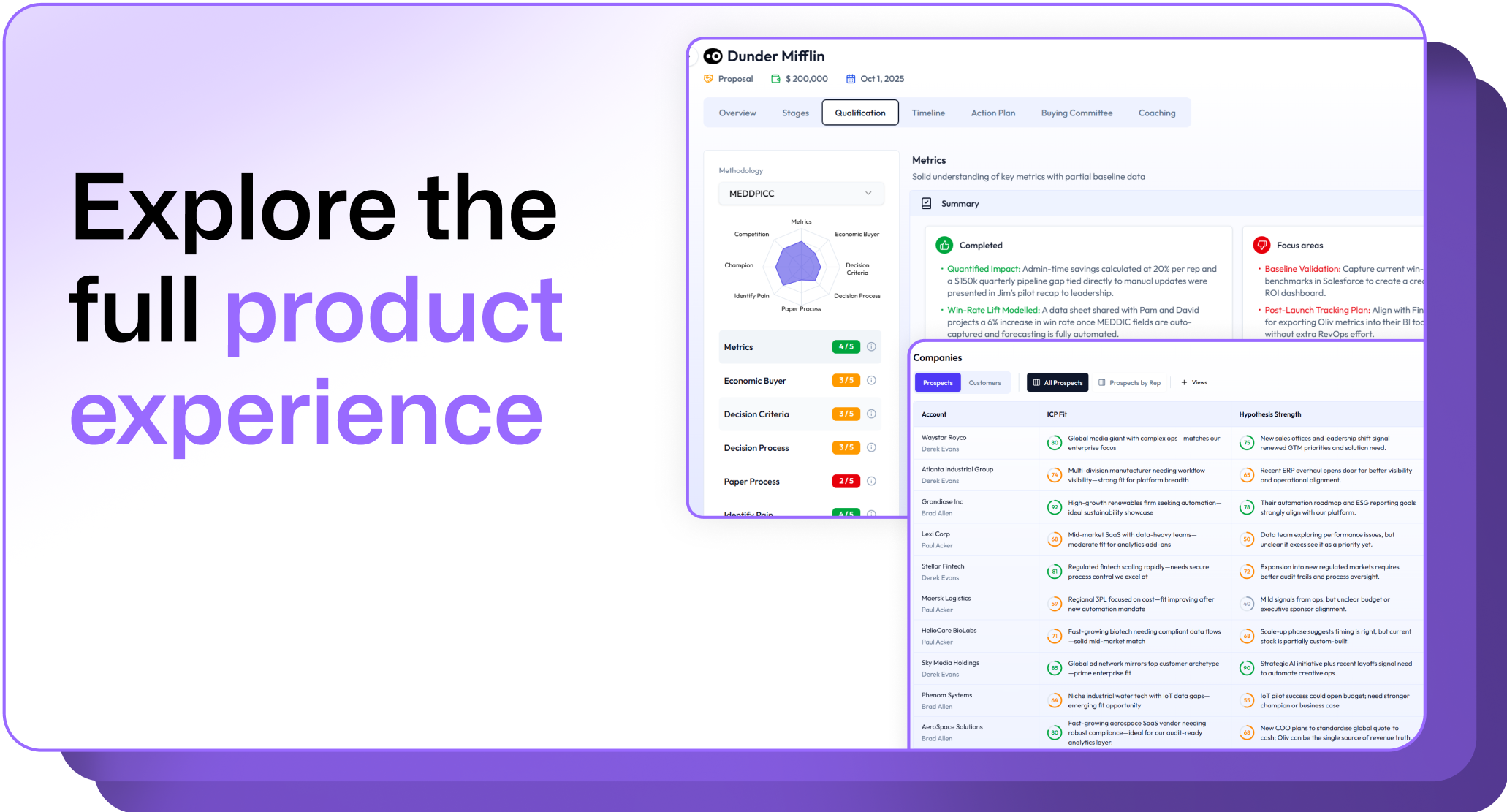
.avif)
.png)