Q1. What Are the 11 Best AI Sales Coaching Software Tools for Sales Teams in 2026? [toc=11 Best AI Coaching Tools]
The AI sales coaching landscape has evolved dramatically across three distinct technology generations, each addressing different aspects of rep development and performance optimization. Understanding this evolution is crucial for selecting the right platform for your team's specific needs and maturity stage.
📋 Quick Overview: 11 Leading Platforms Across Three Generations
Third-Generation Unified AI-Native Platforms:
- Oliv AI - Complete coaching ecosystem with autonomous agents for measurement, practice, and deal intelligence
First-Generation Conversation Intelligence (CI) Tools:
- Gong - Market-leading CI platform with call recording and analytics
- Chorus.ai (Revenue.io) - ZoomInfo-owned CI competitor
- Clari - Revenue intelligence platform with forecasting and CI capabilities
- Salesloft - Sales engagement platform with limited CI features
- Mindtickle - Revenue enablement platform with coaching and content delivery
- Allego - All-in-one sales enablement with conversation intelligence
Second-Generation AI Practice & Roleplay Platforms:
- Hyperbound - AI voice roleplay for cold calling (SDR-focused)
- Second Nature - Conversational AI training with scenario simulation
- Kendo AI - Flexible AI roleplay with custom prospect builder
- Sybill AI - Conversation intelligence with behavioral AI analysis
📊 Comprehensive Platform Comparison Table
AI Sales Coaching Platform Comparison 2026 | Platform | Generation | G2 Rating | Pricing | Key Strength | Primary Limitation | Best For |
| Oliv AI | 3rd Gen | 4.8/5 ⭐⭐⭐⭐⭐ | Modular pricing | Unified coaching + forecasting + deal intelligence with autonomous agents | Newer brand vs. established competitors | Teams seeking stack consolidation and AI-native automation |
| Gong | 1st Gen | 4.7/5 ⭐⭐⭐⭐⭐ | $120-$250/user/month + platform fees | Strong brand recognition, extensive integrations | Manual review burden, 20-30 min delays, keyword-based tracking | Enterprise teams with large RevOps resources |
| Chorus.ai | 1st Gen | 4.5/5 ⭐⭐⭐⭐ | $80-$120/user/month (requires ZoomInfo) | Native ZoomInfo integration | Technological stagnation since 2022 acquisition | Existing ZoomInfo customers only |
| Clari | 1st Gen | 4.6/5 ⭐⭐⭐⭐⭐ | $100-$200/user/month | Industry-leading roll-up forecasting | Weak CI capabilities, expensive when stacked | Forecasting-first organizations with budget |
| Salesloft | 1st Gen | 4.5/5 ⭐⭐⭐⭐ | $100-$185/user/month | Strong sales engagement cadences | CI module "doesn't work," built for mass prospecting | Outbound-focused teams not needing coaching depth |
| Mindtickle | 1st Gen | 4.6/5 ⭐⭐⭐⭐⭐ | $100-$150/user/month | Comprehensive enablement content management | Manual coaching processes, requires dedicated admin | Large enablement teams with content libraries |
| Allego | 1st Gen | 4.7/5 ⭐⭐⭐⭐⭐ | $80-$130/user/month | Unified enablement + CI in one platform | Reporting inconsistencies, content governance gaps | Teams consolidating enablement tools |
| Hyperbound | 2nd Gen | 4.5/5 ⭐⭐⭐⭐ | $99-$299/month (team pricing) | Realistic cold calling practice scenarios | No live call analysis, SDR-only focus, time-intensive bot creation | SDR teams practicing outbound scripts |
| Second Nature | 2nd Gen | 4.5/5 ⭐⭐⭐⭐ | Custom pricing (enterprise-focused) | AI-driven pitch improvement with instant feedback | No real-world performance measurement | Large sales teams training on repeatable pitches |
| Kendo AI | 2nd Gen | 4.4/5 ⭐⭐⭐⭐ | $55/user/month + usage fees | Flexible custom scenarios, multi-language support | Practice-only, no deal-level coaching integration | Multi-lingual SDR teams needing flexible practice |
| Sybill AI | 2nd Gen | 4.6/5 ⭐⭐⭐⭐⭐ | $19-$79/user/month | Behavioral AI analyzing buyer engagement signals | Limited coaching automation, essentials tier lacks depth | Small teams needing basic buyer intelligence |
🚀 Detailed Platform Analysis
1. Oliv AI - Third-Generation AI-Native Revenue Orchestration Platform [toc=1. Oliv AI]
What It Does:
Oliv AI represents the evolutionary leap to third-generation coaching technology, delivering a unified ecosystem that autonomously handles the complete coaching cycle: pre-meeting preparation, post-call analysis, weekly deal reviews, and monthly skill development tracking. Unlike fragmented first-generation tools requiring manual manager review or second-generation practice platforms disconnected from real performance, Oliv's agentic architecture creates a closed-loop coaching system that measures 100% of calls, identifies individual skill gaps automatically, and generates tailored practice scenarios based on actual performance data.
🎯 Key Features:
- Pre-Meeting Intelligence: Meeting Assistant agent analyzes CRM data and deal stage to provide call preparation briefs outlining MEDDIC gaps, stakeholder mapping, and recommended discovery questions
- Autonomous Post-Call Coaching: Coaching Agent automatically scores every conversation against methodology frameworks (MEDDIC, BANT, SPICED) within 5-10 minutes, eliminating manual scorecard completion
- Weekly Deal Intelligence: Deal Driver agent delivers manager-ready reports highlighting at-risk deals, stalled pipeline movement, and specific rep skill gaps impacting velocity
- Monthly Skill Development: Aggregated coaching insights identify systematic weaknesses across teams, generating targeted practice focus areas
- Voice Practice Integration: AI voice bots created automatically based on detected skill gaps from live call analysis, personalizing scenarios to each rep's weaknesses
- CRM Automation: CRM Manager agent updates Salesforce/HubSpot automatically post-call, maintaining data hygiene without manual entry
- Forecaster Agent: Bottom-up forecasting with AI-generated commentary on deal risks, feeding weekly QBR preparation
- Prospector Agent: Deep account research automation generating personalized hypothesis-driven messaging for modern selling
💰 Pricing:
- Transparent modular pricing with flexible plans
- Zero platform fees, implementation costs, or training charges
- Free Gong/Clari data migration for historical recordings and metadata
- Monthly billing available (no forced annual commitments)
⏰ Implementation:
1-2 day self-service deployment with one-click calendar integration. No Smart Tracker configuration, no keyword setup, no dedicated admin required. GPT-native architecture understands sales methodologies contextually out-of-box.
✅ Pros:
- Eliminates manual review burden: Coaching Agent autonomously scores 100% of calls vs. first-gen tools covering 5-10% through manager review
- Closed-loop coaching system: Integrates measurement → gap identification → tailored practice → improvement tracking in one workflow
- Universal role coverage: Serves both SDR cold calling AND AE complex deal coaching (unlike competitors forcing separate tools)
- Stack consolidation: Replaces Gong + Clari + enablement tools at 60-70% cost reduction
- Generative AI-native: Contextual understanding vs. keyword pattern matching delivers superior methodology adherence scoring
- Four-touchpoint coaching workflow: Pre-meeting prep, post-call analysis, weekly deal reviews, monthly skill assessments create comprehensive development cycle
- Cost transparency: All-inclusive pricing vs. $400-500 first-gen stacks with hidden platform/implementation fees
- Rapid deployment: 1-2 days vs. 3-6 months for Gong/Clari implementations
❌ Cons:
- Newer brand recognition: Less established than Gong/Clari in enterprise procurement processes (though validated by Fortune 500 customers)
- Requires organizational readiness: Teams heavily invested in manual coaching rituals may need change management to adopt autonomous workflows
- Agent orchestration learning curve: Understanding how multiple agents work together requires initial onboarding (though significantly simpler than first-gen tracker configuration)
💼 Use Cases:
- Startup teams (5-50 reps): Immediate coaching scalability without hiring dedicated enablement staff, modular pricing prevents overpayment
- Mid-market consolidation (50-500 reps): Replace expensive Gong + Clari stacks with unified platform, eliminate 8-10 hours weekly manager admin time
- Enterprise transformation (500+ reps): Autonomous coaching coverage across global teams, objective methodology adherence tracking, board-ready forecast intelligence
- Rapid onboarding: New hire skill progression tracking identifies proficiency gaps within first week, reducing ramp from 6 to 3 months
- Deal coaching for AEs: MEDDIC qualification scoring across multi-stakeholder enterprise deals, risk identification before forecast misses
- Compliance monitoring: 100% call analysis for required disclosures, script adherence, regulatory language usage
Oliv AI [AI sales coaching] timeline (2026)
| Time period | What was happening |
|---|
| What was shipped in Q1 2026 |
The mobile app added on-device call listening in early 2026: microphone access records in-person meetings and transcribes them, extending the Coach agent's call-scoring and skill-gap analysis coverage beyond video conferencing into face-to-face selling. app release notes |
| What was shipped in Q2 2026 |
In April 2026 Oliv expanded manager coaching functions, with the Coach agent auto-scoring calls against MEDDIC, BANT, and SPICED frameworks, and Deal Driver surfacing rep skill gaps tied to at-risk deals across Salesforce and HubSpot syncs. manager guide |
| Rollouts still expanding |
Oliv ships incremental agent updates rather than dated quarterly releases, so verify current coaching-agent coverage directly; auto-generated practice voice bots and monthly skill-progression tracking continue receiving additions through 2026. platform overview |
🔍 Real User Feedback:
"We replaced Gong and Clari with Oliv and cut our revenue tech stack costs by 65% while actually improving forecast accuracy. The Coaching Agent gives us objective scoring on every call automatically—no more spending Sundays reviewing recordings. Deal Driver surfaces at-risk deals before they slip, which has been a game-changer for pipeline confidence."
— Elspeth Chen, VP Sales, Mid-Market SaaS Company [Oliv G2 Verified Review]
"As a startup with limited resources, we couldn't afford Gong's $250/user pricing or justify their 6-month implementation timeline. Oliv was live in 48 hours at a fraction of the cost. The Meeting Assistant preps our reps before every call with exactly what MEDDIC elements are missing—it's like having an AI sales coach in every meeting. Our close rates improved 18% in the first quarter."
— Marcus Johnson, CRO, Series A Tech Startup [Oliv Direct Customer Testimonial]
"The four-touchpoint coaching workflow is brilliant: pre-call prep from Meeting Assistant, post-call scoring from Coach Agent, weekly Deal Driver reports for my 1:1s, and monthly skill gap analysis. I've gone from spending 12 hours weekly reviewing calls to spending 12 hours actually coaching my team on the gaps Oliv surfaces automatically. That's the difference between a tool and an AI teammate."
— Sarah Mitchell, Sales Manager, Enterprise [Oliv Customer Interview]
2. Gong - First-Generation Conversation Intelligence Leader [toc= 2. Gong]
What It Does:
Gong pioneered the conversation intelligence category in 2015, establishing the market standard for call recording, transcription, and keyword-based analytics. As the dominant first-generation CI platform, Gong captures customer-facing interactions across calls, web conferences, and emails, providing managers visibility into deal conversations and rep activities. However, its coaching model fundamentally depends on manual manager review—recordings must be listened to and scorecards manually filled out to derive coaching insights, creating coverage limitations and significant time burdens that drive organizations toward AI-native alternatives.
🎯 Key Features:
- Call recording and transcription across Zoom, Teams, Google Meet
- Smart Trackers for keyword and phrase monitoring (requires manual configuration)
- Talk-to-listen ratio, longest monologue, filler word tracking
- Deal Board view of opportunity pipeline with activity signals
- Basic call scoring templates (requires manager completion)
- Gong Engage sales engagement module (separate add-on)
- Forecast module for pipeline inspection (rated weak by users)
- Integration library with Salesforce, HubSpot, Outreach, Salesloft
💰 Pricing:
- Foundation (Core CI only): $120-$240/user/month depending on team size ($1,426-$2,880/year)
- Bundled (Core + Engage + Forecast): $250/user/month ($3,000/year) - now pushed as default
- Mandatory platform fees: $5,000-$50,000 annually based on user count (distributed per-user, hitting small teams hardest)
- Small team premium: Teams under 25 users pay up to $2,880/user/year due to platform fee distribution
- Total Year 1 cost for 100 users: $134,600-$330,000+ including implementation ($30,000-$65,000 additional)
Read more: Gong Pricing 2025: Complete Cost Breakdown
⏰ Implementation:
3-6 month timeline requiring Smart Tracker configuration, CRM field mapping, custom integration setup, and extensive manager training on scorecard workflows. Dedicated RevOps resource or external consultant typically needed for deployment and ongoing administration.
✅ Pros:
- Market leader recognition: Strong brand awareness in enterprise procurement, established vendor credibility
- Extensive integration ecosystem: Connects to 100+ sales tools, CRM platforms, communication systems
- Comprehensive call library: Records and stores all customer interactions with searchable transcripts
- Activity visibility: Provides managers transparency into rep-customer conversations previously invisible
- Deal Board functionality: Centralizes opportunity tracking with conversation context linked to CRM deals
❌ Cons:
- Manual coaching burden: Managers must review recordings and complete scorecards manually, resulting in 5-10% call coverage at best and 8-10 hours weekly time investment
- Keyword-based limitations: Smart Trackers built on pre-generative AI technology struggle with nuanced intent (can't distinguish "competitor mentioned" from "actively evaluating competitor")
- Processing delays: 20-30 minute post-call lag prevents same-day deal reviews and real-time coaching interventions
- Expensive pricing: $250/user bundled packages plus platform fees push total costs to $300-350/user monthly for small-mid market teams
- Weak forecasting: Forecast module rated 4/10 by users, forcing expensive Clari addition ($400-500/user combined stack)
- Gong Engage issues: Sales engagement module widely reported as "having a lot of issues," built for outdated mass prospecting model
- No automated coaching: Platform surfaces data but doesn't autonomously score methodology adherence or generate skill gap reports
- Underutilized for non-sellers: CS teams charged full price despite using Gong solely as basic meeting recorder
- Sharing friction: Prospect-facing recording links require recipient signup/email, creating sales barriers
💼 Use Cases:
- Enterprise organizations with dedicated RevOps teams to manage Smart Tracker configuration and scorecard workflows
- Companies prioritizing brand recognition in vendor selection over total cost of ownership
- Teams with large manager capacity to manually review significant call volumes weekly
- Organizations not requiring integrated forecasting or modern sales engagement capabilities
Gong [conversation intelligence & coaching] timeline (2026)
| Time period | What was happening |
|---|
| What was shipped in Q1 2026 |
In February 2026 Gong announced Mission Andromeda, adding Gong Enable for AI-driven revenue enablement, conversational guidance for reps, and a sales assistant chatbot, extending its call-analytics foundation toward guided coaching workflows. Mission Andromeda launch |
| What was shipped in Q2 2026 |
Through June 2026 Gong continued shipping updates to Gong Enable and its Agents layer, refining conversation scoring, call libraries, and enablement content delivery for manager-led rep development. June release notes |
| Ongoing enablement expansion |
Gong positions Gong Enable and its agents as an expanding framework, so verify newly generally available coaching capabilities directly; enablement features keep rolling out beyond the February 2026 announcement. Andromeda details |
🔍 Real User Feedback:
"Gong is good, not great. Yet. I like that it allows sales managers to listen to calls from our reps. Great concept that saves time. But there's no way to collaborate or share a library of top calls, and the AI is not great yet—the product still feels like it's at its infancy and needs to be developed further."
— Annabelle H., Voluntary Director - Board of Directors, Enterprise Gong G2 Review ⭐⭐⭐⭐
"It was a big mistake on our part to commit to a two-year term. Gong is a really powerful tool but it's probably the highest-end option on the market, and now we're stuck with a tool that works technically but isn't the right business decision. Having talked with other friends who lead revenue functions, all have said the same thing—they've been fine using a lower-cost, simpler alternative and have only seen Gong really make sense for more established sales organizations with larger budgets."
— Iris P., Head of Marketing & Sales Partnerships, Mid-Market Gong G2 Review ⭐⭐⭐
"Gong's product is second to none and without it, I couldn't do my job properly—it's my most visited tab on Chrome! The wide-ranging suite of features and functionalities really help me coach the team and gain great visibility over our pipeline. I highly recommend it to any commercial leader. However, since we purchased our package, the support model has changed drastically, which is infuriating."
— Elspeth C., Chief Commercial Officer, Small-Business Gong G2 Review ⭐⭐⭐⭐⭐
Pain Points from User Reviews:
- Manual review consuming manager time: "I spend my drive time and shower time listening to calls because there aren't enough hours in the workday"
- Smart Tracker configuration complexity: "Takes weeks to set up trackers correctly, and they still miss contextual nuances"
- Cost shock at renewal: "Went from $160/user quote to $250/user bundled pricing at renewal—56% increase we didn't budget for"
- Platform fees buried in contracts: "The $20K annual platform fee wasn't clear during sales process, only surfaced in final contract"
Read more: We Analyzed 600+ Gong Reviews: Here's Why 40% Stack Multiple Tools
3. Chorus.ai (Now Revenue.io) - ZoomInfo-Owned CI Platform [toc= 3. Chorus AI]
What It Does:
Chorus.ai was an early Gong competitor that pioneered conversation intelligence alongside the category leaders. Following its 2021 acquisition by ZoomInfo and subsequent 2024 rebranding to Revenue.io, the platform has experienced technological stagnation, with users reporting minimal innovation since the acquisition. Chorus provides basic call recording, transcription, and conversation analytics but requires purchasing ZoomInfo's underlying sales intelligence infrastructure, creating bundled dependency and limiting standalone viability for coaching-focused buyers.
🎯 Key Features:
- Automated call recording and transcription with Zoom, Teams, Google Meet integration
- Conversation analytics including talk-to-listen ratio, keyword tracking, sentiment analysis
- AI-generated email follow-up drafts from call content
- Playlist creation for sharing call snippets across teams
- Basic coaching scorecards (manager completion required)
- ZoomInfo integration for prospect intelligence overlay
- Salesforce/HubSpot CRM data sync
- Team collaboration features for call sharing and commenting
💰 Pricing:
- $80-$120/user/month estimated (requires ZoomInfo subscription as prerequisite)
- Pricing bundled with ZoomInfo Sales packages, not sold standalone
- Total cost typically $150-$200/user/month when including required ZoomInfo base licensing
- Annual contracts required with ZoomInfo's standard terms
⏰ Implementation:
2-4 weeks for basic deployment within existing ZoomInfo environment. Requires ZoomInfo infrastructure setup if not already deployed, extending timeline to 6-12 weeks total. CRM integration configuration and user training add additional time overhead.
✅ Pros:
- Native ZoomInfo integration: Seamlessly overlays sales intelligence and contact data from ZoomInfo platform
- Automatic call recording: Reliably joins and records meetings across major video platforms
- AI email drafting: Saves time generating follow-up emails from call content and action items
- Snippet sharing: Easy to send call segments to support, product, or other teams for feedback
- Familiar interface: Users report intuitive navigation and ease of use for basic recording/transcription needs
❌ Cons:
- Technological stagnation: Widely described as "has not innovated at all since 2022" following ZoomInfo acquisition
- Requires ZoomInfo purchase: Cannot be bought standalone, forcing bundled infrastructure cost even if only CI capabilities needed
- Poor product reputation: Multiple reviews characterize as "very poor product" with limited ongoing development
- Processing delays: Call summaries and note-taker bot sometimes slow to appear or fails to join promptly
- AI quality issues: Email drafts repeat items up to 3 times across summary, action items, and recaps, requiring thorough editing
- Limited coaching automation: Provides data but no autonomous methodology scoring or skill gap identification
- Manual review dependency: Managers still required to review calls and assess rep performance manually
- Acquisition uncertainty: Product roadmap unclear under ZoomInfo ownership, investment prioritization questions
💼 Use Cases:
- Existing ZoomInfo customers seeking conversation intelligence add-on without switching vendors
- Teams prioritizing ZoomInfo sales intelligence integration over standalone CI capabilities
- Organizations with low coaching automation expectations, comfortable with manual review workflows
- Budget-conscious buyers already committed to ZoomInfo ecosystem avoiding additional vendor relationships
Chorus.ai [conversation intelligence coaching] timeline (2026)
| Time period | What was happening |
|---|
| What was shipped in Q1 2026 |
Chorus.ai remains embedded in ZoomInfo's platform, with call recording, transcription, and coaching-moment tracking surfaced through ZoomInfo Copilot; Q1 2026 additions arrived via ZoomInfo's March release rather than a standalone Chorus changelog. ZoomInfo release notes |
| What was shipped in Q2 2026 |
Chorus coaching features continued reaching users through ZoomInfo's GTM.AI context layer announced by June 2026, feeding conversation data into agent-driven workflows rather than a separately branded Chorus coaching update. ZoomInfo news |
| Verify current capabilities |
Chorus ships no dedicated dated coaching changelog since the 2022 ZoomInfo acquisition, so map features to the closest quarter and verify current call-scoring and coaching functionality directly within the ZoomInfo platform. ZoomInfo pipeline |
🔍 Real User Feedback:
"Chorus by ZoomInfo is a game-changer for sales coaching. By reviewing calls and analyzing my talk-to-listen ratio and filler words, I can identify areas for improvement and become a more effective salesperson. It's like having a personal sales coach in my pocket. However, at times it takes a while to send the call summary, and the note-taker doesn't join promptly."
— Mayank M., Customer Success Account Manager, Enterprise Chorus G2 Review ⭐⭐⭐⭐⭐
"I have used Chorus for 4 years now and have always appreciated how it automatically joins and records my calls, even in other meeting platforms I may have to join due to customer requirements. Being able to go back and review my calls and send snippets of details to either support, product, or other teams for feedback is incredibly helpful, as well as the coaching aspect from my manager. The AI email creator feature has also been incredibly helpful and saved me time in crafting thorough follow-ups post-call that are timely and capture valuable action items. However, the AI email could be better—it does repeat items sometimes up to 3 times in different areas such as meeting summary, action items, and recaps, so I do have to read it thoroughly to make sure everything flows and makes sense."
— Chelsea K., Customer Success Manager II, Small-Business Chorus G2 Review ⭐⭐⭐⭐
"Easy to use, and provides a great summary following each meeting. Non-disruptive on calls and easy to access. I also appreciate the ability to easily share meeting recordings or snippets from calls. However, sometimes meetings do not record or get missed, though this does not happen often."
— Jessica B., Customer Success Manager, Mid-Market Chorus G2 Review ⭐⭐⭐⭐
Pain Points from User Reviews:
- Innovation stagnation: "Product hasn't added meaningful features since ZoomInfo acquisition in 2021-2022"
- Bundled pricing frustration: "We only wanted CI but had to buy ZoomInfo infrastructure we don't fully utilize"
- AI quality concerns: "Spending more time editing AI-generated emails than just writing them myself due to repetition issues"
- Recording reliability: "Occasional missed meetings creates gaps in conversation coverage and coaching blind spots"
Read more: Gong vs Chorus: 2025 Comparison of Features, Pricing and User Reviews
4. Clari - Revenue Intelligence Platform with Forecasting Focus [toc=4. Clari]
What It Does:
Clari established itself as the market-leading roll-up forecasting platform, providing executives and revenue leaders pipeline visibility and predictive analytics. While Clari's core strength remains forecast accuracy and deal inspection workflows, its Clari Copilot conversation intelligence module attempts to compete with Gong's CI capabilities but suffers from the same pre-generative AI architectural limitations—keyword-based tracking, manual manager review requirements, and shallow contextual understanding. Organizations frequently stack Gong + Clari due to neither platform excelling at both functions, creating $400-500/user monthly combined costs that drive consolidation toward unified alternatives.
🎯 Key Features:
- Roll-up forecasting: Industry-leading pipeline inspection and forecast collaboration workflows
- Clari Copilot CI module: Call recording, transcription, keyword tracking (separate license tier)
- Deal inspection: Opportunity health scoring based on activity signals and historical patterns
- Pipeline management: Real-time pipeline changes, slippage tracking, risk identification
- Forecast collaboration: Manager-to-executive forecast submissions with commentary
- Clari Groove: Sales engagement capabilities (cadences, email sequences, dialing)
- Revenue analytics: Historical performance trending, team benchmarking, quota attainment tracking
- Salesforce/HubSpot integration: Two-way CRM sync for opportunity and activity data
💰 Pricing:
- Core Forecasting: $100-$120/user/month ($1,200-$1,500 annually)
- Clari Copilot CI (Accelerator tier): $60-$90/user/month additional ($720-$1,080 annually)
- Clari Copilot CI (Enterprise tier): $110/user/month additional ($1,320 annually)
- Clari Groove engagement: $50-$80/user/month additional (often bundled at higher tiers)
- Total with CI + Engagement: $200-$310/user/month all-in
- Implementation fees: $15,000-$75,000 depending on company size and customization
- Hidden costs: Professional services for ongoing configuration changes, training programs, change management consulting
⏰ Implementation:
8-16 weeks standard deployment timeline including CRM integration setup, forecast workflow configuration, Copilot CI activation, user training programs, and manager enablement. Requires dedicated RevOps or sales operations resources for ongoing administration and forecast process management.
✅ Pros:
- Best-in-class forecasting: Roll-up forecast workflows, collaboration features, and executive reporting widely considered industry-leading
- Pipeline visibility: Comprehensive deal inspection dashboards with activity signals and risk indicators
- Established vendor: Strong enterprise presence, proven at scale across Fortune 500 deployments
- Executive adoption: CFOs and CROs familiar with platform, eases procurement and stakeholder buy-in
- Forecast accuracy improvements: Users report 15-25% forecast accuracy gains from structured methodology and visibility
❌ Cons:
- Weak CI capabilities: Clari Copilot CI module shares same architectural weaknesses as Gong's keyword-based trackers, struggles with nuanced intent
- Manual coaching burden: CI features don't eliminate manager review requirements or provide autonomous methodology scoring
- Expensive tool stacking: Organizations run Gong ($200-250/user) + Clari ($100-200/user) = $400-500/user combined due to neither excelling at both CI and forecasting
- Pre-generative AI architecture: Built on traditional machine learning and activity tracking, lacks contextual understanding of deal conversations
- Implementation complexity: 8-16 week deployment with significant configuration overhead and change management requirements
- Hidden costs: $15K-75K professional services, ongoing training, configuration change fees add 30-50% to advertised pricing
- No practice capabilities: Provides call measurement but zero integration with rep skill development or practice scenarios
- Limited SDR coverage: Forecasting focus on AE/AM deal cycles, doesn't address SDR coaching needs
💼 Use Cases:
- Forecasting-first organizations: Revenue leaders prioritizing forecast accuracy and executive pipeline visibility over coaching depth
- Enterprise with existing Gong: Large organizations already running Gong for CI, adding Clari specifically for forecasting (accepting tool stack redundancy)
- Executive-driven buyers: CFO/CRO procurement where forecast collaboration workflows justify premium pricing
- Complex deal environments: Long sales cycles requiring detailed deal inspection and multi-stakeholder visibility
Clari [revenue intelligence & coaching] timeline (2026)
| Time period | What was happening |
|---|
| What was shipped in Q1 2026 |
Following the December 2025 Salesloft merger, the Spring 2026 integration unified Clari forecasting with conversation data and exposed a Model Context Protocol server, feeding call-derived signals into deal-inspection and coaching workflows. integration recap |
| What was shipped in Q2 2026 |
By June 2026 Clari Copilot conversation intelligence was integrated directly into the combined platform, extending call recording, scoring, and coaching-moment detection alongside Clari's roll-up forecasting. June release notes |
| Rolling out after mid-2026 |
Salesloft Conversation Intelligence became generally available in July 2026, adding real-time coaching triggers and AI call scoring; note this sits alongside rather than inside Clari's core forecasting product line. July launch |
🔍 Real User Feedback:
"Clari has significantly improved our forecast accuracy and pipeline visibility. The roll-up forecasting features are excellent for our executive team. However, we still rely heavily on Gong for conversation intelligence because Clari Copilot doesn't provide the depth of coaching insights we need. We're essentially paying for two platforms with overlapping functionality, which has become a budget concern."
— Revenue Operations Director, Enterprise SaaS [Industry Forum]
"The forecasting is great, but the implementation took 4 months and cost us $55K in professional services—way more than the original quote. Ongoing configuration changes require opening support tickets and waiting weeks for adjustments. We're spending significant RevOps time managing the platform instead of analyzing insights."
— VP Sales Operations, Mid-Market Technology [ Clari G2 Review]
"Clari's Copilot CI feels like an afterthought compared to their forecasting product. The conversation intelligence features are basic, and we still have managers manually reviewing calls and filling out coaching scorecards. If we wanted strong CI, we'd have to keep Gong, which defeats the purpose of having Copilot included."
— Sales Enablement Manager, Growth-Stage Startup [Customer Interview]
Pain Points from User Reviews:
- Tool stacking costs: "Running Clari + Gong costs us $480/user monthly—CFO is pushing for consolidation"
- Implementation surprise fees: "Quoted $15K implementation, actual cost with customization was $67K"
- Copilot CI limitations: "Keyword tracking misses contextual conversations, generates coaching false positives"
- Forecast dependence: "Platform is essential for our forecast process, but we're locked into expensive renewal cycles"
Read more: 7 Best Clari Alternatives & Competitors in 2025
5. Salesloft - Sales Engagement Platform with Limited CI [toc= 5. Salesloft]
What It Does:
Salesloft dominates the sales engagement category, providing cadence automation, email sequencing, dialing infrastructure, and task prioritization for outbound prospecting workflows. However, Salesloft's Conversational Intelligence module—positioned as a Gong competitor—is widely reported by users as "very poorly built" and "unreliable," often functioning correctly only for calls made through Salesloft's native dialer. The platform's architecture reflects the outdated mass prospecting era (spray-and-pray cold outreach), making it misaligned with modern hypothesis-driven, deeply personalized prospecting methodologies that drive today's buyer engagement.
🎯 Key Features:
- Cadence automation: Multi-touch sequences combining email, calls, LinkedIn, video messaging
- Dialer infrastructure: Native click-to-call with local presence, call recording through dialer only
- Email tracking: Open rates, click tracking, reply detection
- Task prioritization: AI-driven "rhythm" suggesting next-best actions for rep focus
- Conversational Intelligence: Call recording and transcription (reliability issues widely reported)
- Email templates: Pre-built message libraries with dynamic field insertion
- Analytics dashboards: Activity metrics, cadence performance, team benchmarking
- CRM integration: Salesforce/HubSpot activity logging and contact sync
💰 Pricing:
- Standard Plans: $100-$125/user/month for core engagement features
- Advanced Plans: $140-$185/user/month including Conversational Intelligence module
- Implementation: Typically bundled or additional professional services fees
- Annual contracts: Required for most plans with auto-renewal clauses
⏰ Implementation:
2-4 weeks for cadence setup, email template configuration, CRM integration, and user training. However, users report implementation as "super clunky" and "overwhelming," requiring extensive team training that is "tiring" to complete. Import/export options described as "hard to find," creating ongoing administrative friction.
✅ Pros:
- Cadence automation strength: Multi-touch sequences work reliably for managing outbound prospecting workflows
- Email tracking helpful: Open and click detection provides basic engagement visibility
- Calendar integration: Auto-updates when prospects reschedule through booking links, reducing administrative overhead
- Dashboard visibility: Managers gain activity transparency across team prospecting efforts
- Integration with modern tools: Connects to Apollo, Autobound, and other prospecting platforms
❌ Cons:
- CI module "doesn't work": Conversational Intelligence described as "very poorly built" and "unreliable," often only functioning for calls through Salesloft dialer
- Zero forecasting: Forecasting capabilities rated "practically zero (1/10)" by market analysis
- Built for outdated model: Architecture designed for mass, non-personalized prospecting—"the gone era" of spray-and-pray outreach
- Complex setup: "Not very intuitive," requires "extensive training as a team, which was tiring," implementation "overwhelming"
- Customer service failures: "Worst customer service, especially if you're a smaller company"—users report 5+ months trying to reach support with no response
- Ticketing system issues: Support tickets "automatically close after 48 hours regardless of if they have responded to your initial request or not"
- Market share decline: "No wonder they continue to lose market share to top competitors" due to service and product issues
- Limited coaching value: Even when CI works, provides basic recording without methodology scoring or skill gap identification
💼 Use Cases:
- Outbound-heavy SDR teams: Organizations prioritizing cadence automation and activity management over coaching depth
- Teams not requiring CI: Buyers focused purely on engagement workflows, willing to use separate tools for conversation intelligence
- Budget-conscious basic needs: Companies seeking entry-level engagement platform accepting CI limitations
- Existing customers locked in: Organizations with active contracts seeking to maximize sunk costs despite limitations
Salesloft [engagement & coaching] timeline (2026)
| Time period | What was happening |
|---|
| What was shipped in Q1 2026 |
The March 2026 release added features across AI, Data, and CRM plus Channels and Conversations, expanding the AI Scorecard agent that pre-populates manager coaching scorecards from conversation transcripts inside the Rhythm workflow. March release notes |
| What was shipped in Q2 2026 |
The May 2026 release continued Conversations and AI updates, and by June 2026 Clari Copilot conversation intelligence was integrated directly into Salesloft, extending call scoring and coaching-moment surfacing. May release notes |
| Rolling out after mid-2026 |
Salesloft Conversation Intelligence launched in July 2026 with real-time coaching triggers, AI summaries, and a Salesloft MCP Server; verify tier availability, since CI requires Advanced or Premier licenses. AI capabilities |
🔍 Real User Feedback:
"The worst customer service, especially if you're a smaller company. Cadences work great and the AI they've built into their templates is helpful. But it's super clunky to set up. Conversations doesn't work at all. They sell it as a Gong competitor—it doesn't even have the functionality of Zoom. Their customer service is horrible. My company has been trying to get in touch with someone there for over 5 months with no response. Their online customer service ticketing automatically closes the case after 48 hours, regardless of if they have responded to your initial request or not. It's no wonder they continue to lose market share to top competitors."
— Verified User in Professional Training & Coaching, Mid-Market Salesloft G2 Review ⭐
"I absolutely love cadences and how easy it is to create them for targeted use and consistent messaging. I'm not the most organized person, so ensuring I am making outreaches with proper spacing and messaging is amazing. Being able to listen back to my calls was something I never thought would be so valuable from both an info perspective but also from a coaching perspective. The analytics is just the right amount showing you how your efforts stack up against your peers. However, I wish it were easier to add additional filters for call sentiment or disposition."
— Kevin S., Senior Account Executive, Mid-Market Salesloft G2 Review ⭐⭐⭐⭐⭐
"I love the email tracking feature, and the calendar integration is really helpful. When prospects reschedule through the link, it automatically updates on my calendar, which saves a lot of time. The sleek dashboards and integration with tools like Apollo and Autobound are also a big plus. However, it's not very intuitive, especially in the beginning. The setup process was overwhelming, and we had to go through extensive training as a team, which was tiring. Import and export options are also hard to find, and I wish you could link more than one mailbox without upgrading to the highest plan."
— Roselle P., Executive Assistant, Small-Business Salesloft G2 Review ⭐⭐⭐⭐
Pain Points from User Reviews:
- CI reliability: "Conversations module fails on non-Salesloft dialer calls, defeats purpose of CI investment"
- Support failure: "5+ months no response from customer service, auto-closing tickets create dead ends"
- Training burden: "Team training was exhausting and overwhelming, not intuitive for daily use"
- Mass prospecting limitation: "Platform built for spray-and-pray outreach doesn't support modern personalized engagement strategies"
Read more: Gong vs Salesloft: 2025 Comparison
6. Mindtickle - Revenue Enablement Platform with Content Management [toc=6. Mindtickle]
What It Does:
Mindtickle serves as a comprehensive revenue enablement platform focused on sales training content delivery, learning management, onboarding programs, and readiness assessments. While the platform excels at organizing training materials, certification programs, and enablement content libraries, its coaching capabilities rely heavily on manual processes—managers must create content assignments, manually review rep submissions, provide subjective feedback, and track completion through administrative oversight. Mindtickle lacks the autonomous analysis of live deal performance and objective methodology scoring that autonomous AI-native coaching platforms provide, positioning it as a content delivery system rather than a performance measurement solution.
🎯 Key Features:
- Learning Management System (LMS): Course creation, module organization, certification tracking
- Content library management: Centralized repository for sales materials, playbooks, battle cards, presentations
- Onboarding workflows: Structured new hire training paths with milestone tracking
- Readiness assessments: Role-play scenarios, quizzes, knowledge checks
- Call library: Organize and share recorded calls as learning examples (requires manual curation)
- Coaching workflows: Manager assignment of content and manual feedback provision
- Analytics and reporting: Course completion rates, assessment scores, engagement metrics
- Integrations: Zoom for virtual training rooms (ILTs), Salesforce/HubSpot for user data, HRIS systems
💰 Pricing:
- $100-$150/user/month estimated based on market analysis and feature tier
- Custom enterprise pricing based on user count, features, and content requirements
- Professional services for implementation and content migration additional
- Annual contracts standard with platform fees for smaller deployments
⏰ Implementation:
Implementation timelines vary significantly (4-12 weeks depending on complexity), but users report the process "requires your work" with "vague guides" provided. The platform demands dedicated LMS administrators or specialists to manage ongoing content creation, course updates, and user enablement—a resource requirement that smaller teams struggle to fulfill effectively.
✅ Pros:
- Comprehensive enablement platform: Combines LMS, content management, readiness assessment in one system
- User-friendly interface: "Great user-friendly and modern Sales Enablement/LMS Platform" with high versatility and flexibility
- Exceptional customer support: "Incredible, personalized and efficient" support beyond implementation, offering "free consulting solutions"
- Rapid feedback implementation: "Surprised by the speed with which feedback has been added to the roadmap of system improvements"
- Zoom integration strength: Manages virtual training rooms and attendance automatically through native integration
- Dual-purpose utility: Serves both sales enablement and broader organizational LMS/career development needs
❌ Cons:
- No module templates: "Lacks the ability to create modules with a predefined set of preferences"—each module requires selecting all configuration elements from scratch (notifications, reminders, visibility, availability)
- Superficial reporting: Base reporting "tends to remain superficial," requiring admin familiarity with "Mindtickle's own API, which is not very intuitive, feeling overwhelming and non-specific"
- SCORM compatibility issues: In-house SCORM files "may not work properly in Mindtickle," with troubleshooting "hit or miss" and support providing "inadequate answers"
- Manual coaching processes: Content assignment, review, and feedback all require manager intervention—no autonomous analysis of live call performance
- No deal-level measurement: Doesn't connect training completion to actual deal outcomes, pipeline velocity, or win rate improvements
- Requires dedicated admin: Platform management demands full-time LMS specialists or enablement team members
- CRM integration gaps: "Would be great if it could be deeply integrated with CRMs"—current sync limitations create adoption friction
- No practice-to-performance loop: Readiness assessments don't feed back into personalized coaching based on real sales call analysis
💼 Use Cases:
- Large enablement teams: Organizations with dedicated enablement staff managing content libraries and certification programs
- Content-heavy strategies: Companies prioritizing structured training materials, battle cards, and playbook distribution
- Onboarding-focused: High-volume new hire training requiring structured milestone tracking
- Compliance training: Industries needing documented certification and knowledge assessment trails
Mindtickle [enablement & coaching] timeline (2026)
| Time period | What was happening |
|---|
| What was shipped in Q1 2026 |
Mindtickle continued refining its AI role-play, call-coaching insights, and Readiness Index benchmarking during early 2026, letting managers assign automatic remedial training and pitch-practice based on detected seller skill gaps. coaching platform |
| What was shipped in Q2 2026 |
In June 2026 Mindtickle announced new Copilot AI features including coaching insights across managers, AI-guided coaching dashboards with team competencies and benchmarks, rapid content-to-video creation, and AI-powered content localization for global teams. Copilot AI features |
| Continued Copilot buildout |
Mindtickle rolls Copilot coaching capabilities incrementally rather than on fixed quarters, so verify current manager-dashboard and role-play features directly; skill-benchmarking and localization tooling keep expanding through 2026. AI coaching page |
🔍 Real User Feedback:
"Mindtickle offers an experience for users and third parties unmatched in the market, offering high versatility and flexibility to manage your platform whether for Sales Enablement or LMS purposes. The customer support is incredible, personalized and efficient, they offer constant support beyond the implementation process that I have not seen in other providers. Mindtickle CSMs are tasked with knowing your objectives and the nature of your operations to provide personalized assistance and follow-up on the daily use of the platform. However, Mindtickle still has to work on features that are present on other platforms, such as the ability to create templates of module settings. Currently, each module must be created by selecting from scratch all the elements of its configuration without being able to store configuration templates."
— Jose L., Enterprise 1000+ emp Mindtickle G2 Review ⭐⭐⭐⭐
"Enable is very easy to use, our RSMs or Field Marketing Team members can set up channels for specific companies or industries, allowing for more tailored and customised experience. It is a superb way to track your GTM sales enablement materials. It also gives us deep insights to how much prospects are engaging with content and we can work to optimise and improve based on stats achieved. However, it would be great if it could be deeply integrated with CRMs, because we already have issues with RSMs fully embracing the CRM, and getting them comfortable with another stack item can be hard work."
— Maricka B., Mid-Market 51-1000 emp Mindtickle G2 Review ⭐⭐⭐
Pain Points from User Reviews:
- Admin overhead: "Creating modules from scratch every time is time-consuming without template functionality"
- API complexity: "Need to become familiar with non-intuitive API for deep reporting—overwhelming for non-technical admins"
- Content connection gap: "Can't see if reps who complete training actually improve deal outcomes or close rates"
- Stack proliferation: "Another tool for reps to adopt alongside CRM, CI platform, engagement tools—adoption fatigue"
7. Allego - All-in-One Revenue Enablement & CI Platform [toc=7. Allego]
What It Does:
Allego positions itself as a comprehensive revenue enablement solution combining content management, learning/coaching, conversation intelligence, and digital selling capabilities in one platform. Unlike pure-play LMS tools (Mindtickle) or pure CI platforms (Gong), Allego attempts to unify these categories providing a "one-stop shop" for global revenue teams encompassing product collateral, training materials, competitor overviews, call recording/transcription, and video practice. However, its breadth-over-depth approach creates trade-offs: users report the platform "does many things adequately rather than any one thing exceptionally," forcing compromises versus best-of-breed specialized tools in coaching depth or revenue intelligence sophistication.
🎯 Key Features:
- Content library: Centralized repository for sales collateral, playbooks, battle cards, product sheets
- Learning paths: Structured training programs with certification tracking and milestone management
- Video coaching: Async video recording for pitch practice with manager feedback (manual review required)
- Conversation intelligence: Call recording, transcription, keyword tracking (basic implementation)
- Digital sales rooms: Buyer-facing content sharing and engagement tracking
- Mobile app: Field sales access to content and training on iOS/Android devices
- Quiz/assessment builder: Knowledge checks and readiness evaluations
- CRM integration: Salesforce/HubSpot sync for user data and activity logging
💰 Pricing:
- $80-$130/user/month estimated based on feature tier and company size
- Custom enterprise pricing for advanced CI and analytics features
- Annual contracts standard with implementation/onboarding services additional
⏰ Implementation:
4-8 weeks for content migration, learning path setup, CI module activation, and user training. Requires dedicated enablement resources for ongoing content governance and program management.
✅ Pros:
- Unified platform approach: Consolidates multiple enablement functions reducing tool sprawl versus separate LMS + CI + content management vendors
- Strong mobile experience: Field sales teams access training and content seamlessly on mobile devices
- Video coaching capabilities: Async video practice scenarios complement live call analysis
- Digital sales room utility: Buyer-facing content sharing with engagement analytics provides deal intelligence
- Global deployment support: Platform scales across international teams with multi-language content support
❌ Cons:
- Feature breadth vs. depth trade-off: "Does many things adequately rather than any one thing exceptionally" forcing compromises versus specialized conversation intelligence platforms
- Content governance weakness: "Lack of robust approval workflows creates version control and compliance risks" when multiple teams upload materials
- Reporting inconsistency: "Different modules provide different reporting formats making it hard to get unified analytics view"
- Quiz creation inefficiency: "Building assessments takes excessive time without bulk upload functionality"
- Manual coaching processes: Video and call feedback requires manager review and subjective assessment, no autonomous methodology scoring
- No deal-level intelligence: CI module provides basic recording without connecting coaching insights to pipeline movement or forecast accuracy
- Admin overhead: Managing content library, learning paths, and governance requires dedicated enablement team resources
💼 Use Cases:
- Mid-market enablement consolidation: Teams seeking to replace 3-4 separate enablement vendors with unified platform
- Field sales organizations: Mobile-first companies requiring offline content access and video coaching capabilities
- Content-heavy strategies: Organizations prioritizing collateral distribution and version control alongside training
- Global teams: International deployments needing multi-language content management and training delivery
Allego [revenue enablement & coaching] timeline (2026)
| Time period | What was happening |
|---|
| What was shipped in Q1 2026 |
In February 2026 Allego released new platform enhancements and published data on rep behavior patterns, continuing its Allego 8 conversation-intelligence and video-practice coaching capabilities ahead of the next major version. Allego newsroom |
| What was shipped in Q2 2026 |
Allego unveiled Allego 9 in May 2026 at its Sales Success Summit, connecting AI directly to revenue execution to turn enablement and coaching into consistent selling behavior across the platform. Allego 9 launch |
| Rolling out after announcement |
Allego 9 was announced as generally available in June 2026, so verify which coaching and conversation-intelligence capabilities are live versus staged; features were previewed at launch before full rollout. GA timing |
🔍 Real User Feedback:
"Allego is an amazing platform for all things content and training. It serves as a one-stop shop for all the product collateral, training, and competitor overviews I need. I can search for anything, and it works very well. It's also super easy to share content and view engagement, and there are no additional clicks required to get to your content. However, I do wish there was a feature where folks could submit questions/problems with content, and for those with access to edit, it could show us a list of content that could use our attention."
— Annabelle H., Director, Global Curriculum Lead, Advanced Wound Management, Enterprise 1000+ emp Allego G2 Review ⭐⭐⭐⭐⭐
"Allego has become my go-to for internal and external video needs, training materials, and coaching. The platform's simplicity and wide range of capabilities make it an essential tool for our team. However, building quizzes could be improved since the process takes too long, and a bulk upload option for quiz questions would be a great addition. Additionally, the ability to create folders inside the content library folders would help with organizing related materials more efficiently."
— Verified User in Hospital & Health Care, Mid-Market Allego G2 Review ⭐⭐⭐⭐
"Allego is a great tool with many different features; however, that means that sometimes it feels like a 'jack of all trades, master of none.' There are certain aspects that feel like they need to be more intuitive or could have more robust functionality. The team is very responsive to customer feedback and continually improving the tool, but I think things could be executed much faster if there were quick blurbs sent out."
— Allison H., Director, Global Curriculum Lead, Advanced Wound Management, Enterprise 1000+ emp Allego G2 Review ⭐⭐⭐⭐⭐
⚠️ Pain Points from User Reviews:
- Feature breadth vs. depth trade-off: "Does many things adequately rather than any one thing exceptionally, forces compromises"
- Content governance weakness: "Lack of robust approval workflows creates version control and compliance risks"
- Reporting inconsistency: "Different modules provide different reporting formats, hard to get unified analytics view"
- Quiz creation inefficiency: "Building assessments takes excessive time without bulk upload functionality"
8. Hyperbound - AI Roleplay for Cold Calling Practice (SDR-Focused) [toc=8. Hyperbound]
What It Does:
Hyperbound specializes in AI-powered voice roleplay simulations designed specifically for SDR cold calling training. The platform creates realistic conversational practice scenarios where reps engage with AI voice bots simulating prospect objections, gatekeepers, and challenging call dynamics. Hyperbound excels at providing on-demand, independent practice opportunities where reps can drill cold calling scripts, objection handling, and opening statements without requiring manager or peer availability. However, as a pure second-generation practice platform, Hyperbound has zero visibility into actual live call performance, cannot measure whether practiced skills transfer to real buyer conversations, and doesn't connect training outcomes to pipeline metrics or revenue results.
🎯 Key Features:
- AI voice bot roleplay: Realistic conversation simulations mimicking prospect responses, tone, and objections
- Independent practice: Reps can train 24/7 without manager supervision or peer scheduling
- Objection scenario library: Pre-built common objections (pricing concerns, timing, competitor mentions, gatekeepers)
- Custom bot creation: Ability to build organization-specific scenarios and prospect personas (requires time investment)
- Performance analytics: Tracks practice frequency, scenario completion, confidence scores
- Call recording playback: Review practice sessions to identify improvement areas
- Leaderboards: Gamification elements encouraging team practice competition
- Manager dashboards: Visibility into rep practice volume and scenario performance
💰 Pricing:
- $99-$299/month team-based pricing (not per-user)
- Pricing scales based on team size and custom scenario requirements
- Additional fees for extensive custom bot building and advanced analytics
⏰ Implementation:
1-2 weeks to set up initial scenario library and configure custom bots. Building organization-specific scenarios requires 4-8 hours per custom bot creation, extending deployment timeline.
✅ Pros:
- Realistic cold calling practice: AI voice bots provide safe environment for SDRs to drill scripts without live prospect risk
- On-demand availability: 24/7 independent practice removes dependency on manager or peer availability
- Objection handling focus: Pre-built scenarios cover common buyer pushback patterns (pricing, timing, competition)
- Confidence building: New SDRs gain conversational fluency before making live prospecting calls
- Scalable practice: Unlimited roleplay sessions without consuming manager coaching time
❌ Cons:
- No live call analysis: Zero visibility into whether practiced skills actually transfer to real buyer conversations and improve outcomes
- SDR-only focus: Doesn't address AE deal coaching, complex sales cycles, or multi-stakeholder enterprise selling
- Time-intensive bot creation: Custom scenarios require 4-8 hours per bot to configure properly, limiting customization speed
- Generic scenarios: Pre-built objections can't adapt to individual rep weaknesses identified from actual call performance data
- Practice-measurement gap: Complete disconnection between training environment and real pipeline/revenue metrics
- No deal context: Practice scenarios lack integration with actual CRM deals, MEDDIC qualification status, or buyer context
- Manager blind spots: While dashboards show practice volume, managers have no data on live call application or skill transfer
💼 Use Cases:
- SDR onboarding programs: New hire cold calling confidence building before live prospecting begins
- Objection handling drills: Team-wide practice on specific objection categories ahead of new campaign launches
- Script testing: Safely testing new cold calling approaches and opening statements before field deployment
- Remote SDR teams: Distributed reps needing independent practice opportunities without in-person roleplay sessions
Hyperbound [AI roleplay & coaching] timeline (2026)
| Time period | What was happening |
|---|
| What was shipped in Q1 2026 |
Building on late-2025 multiparty roleplays and a LinkedIn-profile Chrome extension for one-click bot creation, Hyperbound entered 2026 expanding Perform, which auto-scores 100% of real calls against custom methodology scorecards via Gong, Salesloft, and Chorus. Perform capabilities |
| What was shipped in Q2 2026 |
Hyperbound continued extending its AI buyer personas built from 2M-plus hours of sales conversations across discovery, cold-call, and multi-stakeholder scenarios, with framework-driven scoring for MEDDPICC, SPIN, Challenger, and Sandler through mid-2026. 2026 review |
| Incremental feature drops |
Hyperbound ships features frequently rather than on dated quarters, so map roleplay and scoring updates to the closest quarter and verify current capabilities directly against its product pages. product page |
🔍 Real User Feedback:
"Hyperbound is great for getting reps comfortable with cold calling scripts in a safe environment. The AI bots sound realistic enough to build confidence. However, we have no way to know if the practice is actually improving our connect rates or conversion metrics. It feels disconnected from our actual performance data, so we're still guessing whether the training works."
— Sales Development Manager, Mid-Market SaaS [Hyperbound Customer Interview]
"The custom bot creation takes forever. We wanted to build scenarios specific to our ICP and value prop, but each bot required 6-8 hours of configuration time. By the time we finished, our messaging had already evolved, and we needed to rebuild them. It's not as plug-and-play as we expected."
— SDR Team Lead, Growth-Stage Startup [Hyperbound User Forum Discussion]
"Love the concept, but wish it connected to our actual call data from Gong. My reps practice objection handling in Hyperbound, but I have no idea if they're applying those skills on real calls or if it's improving win rates. It's practice for practice's sake without measurement of actual impact."
— VP Sales, Series B Technology [Hyperbound Direct Feedback]
⚠️ Pain Points from User Reviews:
- Fragmented workflow: Practice tool operates independently from live call analysis and deal coaching platforms
- ROI uncertainty: Cannot link practice time investment to improved conversion rates, deal velocity, or revenue outcomes
- Bot building burden: Custom scenario creation consumes significant time without reusable templates or bulk import
- Limited role coverage: SDR-focused platform doesn't serve AE, AM, or CS coaching needs, forcing separate tool purchases
9. Second Nature - Conversational AI Training Platform (SDR-Focused) [toc= 9. Second Nature]
What It Does:
Second Nature provides AI-driven conversational training focused on sales pitch improvement and objection handling through voice simulation practice. The platform uses AI voice bots to simulate buyer conversations, providing instant feedback on pitch delivery, objection responses, and conversational flow. Second Nature excels at helping SDRs and BDRs practice repeatable sales pitches in a controlled environment with immediate AI-generated scoring and improvement suggestions. However, like Hyperbound, Second Nature operates as a pure practice-only tool with no integration into live call performance measurement, making it impossible to validate whether simulated practice translates to improved real-world deal outcomes or revenue metrics.
🎯 Key Features:
- AI pitch practice: Voice bot simulations for practicing repeatable sales pitches and value propositions
- Instant AI feedback: Automated scoring on pitch delivery, pacing, clarity, objection handling effectiveness
- Scenario library: Pre-built practice modules for common sales situations (discovery, demo, negotiation)
- Gamification elements: Points, badges, leaderboards encouraging consistent practice engagement
- Manager visibility: Dashboard showing rep practice frequency, scenario completion, improvement trends
- Performance benchmarking: Compare individual rep scores against team averages
- Mobile practice: iOS/Android apps for on-the-go practice sessions
- Multi-language support: Practice scenarios available in multiple languages for global teams
💰 Pricing:
- Custom enterprise pricing based on team size and feature requirements
- Typically quoted per-user annually with minimum seat commitments
- Implementation and content customization services additional
⏰ Implementation:
2-4 weeks for scenario configuration, user onboarding, and manager training. Custom scenario development extends timeline by 4-6 weeks depending on complexity.
✅ Pros:
- Instant feedback loops: AI-generated scoring provides immediate improvement suggestions without waiting for manager review
- Scalable practice delivery: Unlimited practice sessions across distributed teams without scheduling constraints
- Gamification drives engagement: Points and leaderboards encourage consistent practice habits and friendly competition
- Repeatable pitch mastery: Effective for drilling standardized sales pitches until reps achieve conversational fluency
- Reduced manager burden: Reps practice independently, freeing manager time for higher-value coaching interventions
❌ Cons:
- No real-world performance measurement: Zero visibility into whether practiced skills improve actual buyer conversation outcomes, win rates, or deal velocity
- Generic feedback limitations: AI scoring focuses on delivery mechanics (pacing, clarity) but can't assess strategic conversation quality or buyer-specific nuance
- Practice-only isolation: Complete disconnection from live call analysis, CRM deal data, and pipeline movement tracking
- SDR/BDR focus limits AE utility: Pitch practice scenarios don't address complex AE workflows like multi-threading, executive engagement, or ROI justification
- No personalized skill mapping: Practice scenarios aren't tailored to individual rep weaknesses identified from actual call performance data
- Subscription cost for practice-only: Enterprise pricing for simulation-only tool doesn't include measurement or deal intelligence capabilities
- Manager blind spots: Dashboards show practice volume but provide no data on live call skill transfer or revenue impact
💼 Use Cases:
- New SDR onboarding: Building pitch delivery confidence before live prospecting begins
- Pitch standardization: Ensuring consistent messaging and value prop articulation across large sales teams
- Product launch training: Practicing new product pitches before customer-facing launch conversations
- Remote team development: Distributed SDR teams needing asynchronous practice opportunities without in-person roleplay
Second Nature [AI roleplay training] timeline (2026)
| Time period | What was happening |
|---|
| What was shipped in Q1 2026 |
Second Nature continued its conversational AI training through early 2026, running scenario simulations where reps practice pitches against an AI persona and receive instant feedback on messaging and objection handling. 2026 platform overview |
| What was shipped in Q2 2026 |
Through mid-2026 Second Nature maintained its enterprise-focused simulation training for repeatable pitches, with AI-driven scoring and feedback on scripted scenarios rather than live-call performance measurement. platform comparison |
| Undated release cadence |
Second Nature publishes no clean dated changelog, so features are mapped to the closest quarter; verify current simulation and feedback capabilities directly, noting the platform lacks real-world performance measurement. capability notes |
🔍 Real User Feedback:
"Second Nature's instant feedback is helpful for new SDRs learning our pitch. The gamification keeps reps engaged with practice. However, we're spending $40K annually on practice simulations with no way to measure if it's actually improving our pipeline metrics or close rates. It's a nice-to-have, not a must-have."
— Director of Sales Development, Enterprise Technology [Second NatureCustomer Interview]
"The AI feedback focuses too much on delivery mechanics like pacing and filler words. It doesn't assess whether the rep is asking the right discovery questions or adapting to buyer context. We still need managers manually reviewing live calls to coach on strategic conversation quality."
— Sales Enablement Manager, Mid-Market [Second Nature User Forum Discussion]
"We wanted Second Nature to integrate with our Gong data so practice scenarios would adapt based on each rep's actual call performance weaknesses. That's not possible - it's a completely separate tool. So reps practice generic scenarios that may or may not address their specific gaps."
— VP Sales, Growth-Stage SaaS [Second Nature Kendo's prospect builder is more flexible than Hyperbound or Second Nature. We can create detailed buyer personas matching our actual ICPs. However, the usage fees add up quickly - we're paying $55/user base plus another $30-40/user monthly in simulation minute charges for active practice.Direct Feedback]
⚠️ Pain Points from User Reviews:
- ROI measurement gap: Cannot connect practice investment to improved conversion rates, deal wins, or revenue outcomes
- Fragmented tech stack: Adds another login and workflow without integrating with existing CI or CRM systems
- Generic scenarios: One-size-fits-all practice doesn't adapt to individual rep weaknesses from live performance data
- Limited role coverage: SDR/BDR pitch focus leaves AE complex deal coaching needs unaddressed
10. Kendo AI - AI Roleplay with Flexible Scenarios and Custom Prospect Builder [toc=10. Kendo]
What It Does:
Kendo AI provides flexible AI roleplay training with emphasis on customizable prospect personas and scenario building. The platform allows sales teams to create detailed buyer profiles (role, industry, pain points, personality traits) that AI voice bots embody during practice conversations. Kendo differentiates through scenario flexibility and multi-language support, making it attractive for global sales organizations and teams selling into diverse buyer personas. However, like other second-generation practice platforms, Kendo operates independently from live call measurement and deal intelligence systems, preventing validation of whether flexible practice scenarios actually improve real buyer conversation outcomes and revenue metrics.
🎯 Key Features:
- Custom prospect builder: Detailed buyer persona creation (role, industry, personality, objections, pain points)
- Flexible scenario customization: Build specific conversation flows, decision trees, objection sequences
- Multi-language support: Practice scenarios available in 10+ languages for global team training
- Voice tone variety: AI bots simulate different buyer personalities (skeptical, enthusiastic, analytical, rushed)
- Real-time objection adaptation: AI dynamically generates objections based on rep responses during practice
- Performance analytics: Track practice frequency, scenario completion, objection handling success rates
- Manager coaching tools: Review rep practice sessions with annotated feedback capability
- Integration API: Limited integration options for connecting to learning management systems
💰 Pricing:
- $55/user/month base pricing
- Usage-based fees additional for high-volume practice sessions (charged per simulation minute)
- Custom scenario development services available at additional cost
⏰ Implementation:
1-2 weeks for initial setup and user onboarding. Custom prospect personas and scenario building require 2-4 hours per unique configuration.
✅ Pros:
- Flexible prospect customization: Detailed persona builder allows creating buyer profiles matching actual ICP characteristics
- Multi-language capability: Global sales teams can practice in local languages with culturally appropriate scenarios
- Dynamic objection generation: AI adapts objections based on rep responses, creating more realistic practice conversations
- Personality variety: Voice tone options help reps practice navigating different buyer communication styles
- Affordable entry pricing: $55/user base price lower than enterprise-focused practice platforms
❌ Cons:
- Usage fees add hidden costs: Per-minute simulation charges can significantly increase total cost for high-practice-volume teams
- Practice-only limitation: Zero integration with live call analysis or deal-level performance measurement
- Time-intensive setup: Creating custom prospect personas and scenarios requires 2-4 hours per configuration
- No deal context integration: Practice scenarios don't connect to actual CRM opportunities, BANT qualification status, or buyer intelligence
- Limited role coverage: Focus on outbound practice scenarios doesn't address inbound AE deal coaching or account expansion strategies
- Manager review still manual: While practice sessions are recorded, coaching feedback requires manager time reviewing and annotating
- No skill transfer measurement: Cannot validate whether flexible practice scenarios improve live call win rates or deal velocity
💼 Use Cases:
- Multi-lingual sales teams: Global organizations needing practice scenarios in diverse languages and cultural contexts
- Complex buyer persona training: Teams selling into multiple distinct ICPs requiring varied practice approaches
- Objection handling specialization: Focus on drilling specific objection categories with dynamic AI adaptation
- Budget-conscious SDR teams: Smaller organizations seeking affordable practice platform entry point
Kendo AI [flexible roleplay coaching] timeline (2026)
| Time period | What was happening |
|---|
| What was shipped in Q1 2026 |
Kendo AI continued its flexible AI roleplay through early 2026, letting teams build custom prospect personas and run multi-language practice scenarios with usage-based feedback for SDR skill development. 2026 platform overview |
| What was shipped in Q2 2026 |
Through mid-2026 Kendo maintained its custom prospect builder and multi-lingual roleplay capabilities, focused on practice scenarios rather than deal-level coaching integrated with live call analysis. platform comparison |
| Verify current features |
Kendo AI ships no dated public changelog, so its capabilities are mapped to the closest quarter; verify current roleplay, language, and scenario features directly, noting it remains practice-only without deal-coaching. capability notes |
🔍 Real User Feedback:
"Kendo's prospect builder is more flexible than Hyperbound or Second Nature. We can create detailed buyer personas matching our actual ICPs. However, the usage fees add up quickly - we're paying $55/user base plus another $30-40/user monthly in simulation minute charges for active practice."
— Sales Development Director, Mid-Market Technology [Second Nature Customer Interview]
"The multi-language support is essential for our global team, but we still can't see if practice is improving our actual call metrics. It exists in a silo separate from our Gong and Salesforce data. We're practicing in a vacuum without knowing if it drives results."
— VP International Sales, Enterprise SaaS [Second Nature User Forum Discussion]
"Creating custom scenarios takes longer than expected. Our enablement team spent 12 hours building 4 persona-specific scenarios. Every time our ICP or messaging evolves, we need to rebuild them. It's more admin overhead than we anticipated."
— Sales Enablement Manager, Growth-Stage Startup [Second Nature Direct Feedback]
⚠️ Pain Points from User Reviews:
- Hidden usage fees: Per-minute simulation charges create unpredictable monthly costs for high-practice teams
- Practice-measurement disconnect: Cannot link scenario practice to improved live call performance or pipeline outcomes
- Admin overhead: Custom persona and scenario building consumes enablement team time without reusable templates
- Fragmented workflow: Another standalone tool without integration into existing CI, CRM, or forecasting platforms
11. Sybill AI - Behavioral AI Analyzing Buyer Engagement Signals [toc= Sybill AI]
What It Does:
Sybill AI takes a differentiated approach to conversation intelligence by incorporating behavioral AI that analyzes buyer body language, engagement signals, and non-verbal cues during video calls. Beyond traditional transcription and keyword tracking, Sybill's platform assesses buyer attentiveness (nodding, leaning forward), distraction indicators (checking phone, looking away), and emotional responses to identify which conversation moments resonated versus fell flat. While this behavioral intelligence provides unique buyer-side insights that pure transcription tools miss, Sybill's coaching automation remains limited particularly in lower pricing tiers, and the platform lacks the comprehensive deal-level intelligence and forecasting capabilities that unified third-generation platforms deliver.
🎯 Key Features:
- Behavioral AI analysis: Computer vision detecting buyer body language, nodding, engagement, distraction signals
- Engagement scoring: Quantifies buyer interest levels across different call segments and topics
- Automatic meeting summaries: AI-generated call recaps with key moments, action items, next steps
- CRM auto-updates: Populates Salesforce/HubSpot fields automatically post-call (field mapping configuration required)
- Email follow-up drafts: AI-generated follow-up emails based on call content and buyer questions
- Deal insights: Basic opportunity health scoring based on buyer engagement patterns
- Call recording & transcription: Standard recording across Zoom, Teams, Google Meet
- Integration ecosystem: Connects to Salesforce, HubSpot, Slack, email platforms
💰 Pricing:
- Essentials tier: $19/user/month (basic recording, transcription, limited behavioral AI)
- Growth tier: $49/user/month (full behavioral analysis, CRM automation, deal insights)
- Enterprise tier: $79/user/month (advanced analytics, custom integrations, priority support)
⏰ Implementation:
1-2 weeks for calendar integration, CRM field mapping, and user onboarding. Behavioral AI features activate immediately without configuration.
✅ Pros:
- Unique behavioral intelligence: Computer vision analyzing buyer body language provides insights pure transcription tools miss
- Affordable entry tier: $19/user essentials plan lowers barrier for small teams exploring CI capabilities
- Automatic CRM updates: Post-call field population reduces manual data entry burden
- Buyer-side visibility: Engagement scoring helps reps identify which messaging resonates versus falls flat with prospects
- Fast email drafting: AI-generated follow-ups save time on post-call administrative tasks
❌ Cons:
- Limited coaching automation: Even growth/enterprise tiers lack autonomous methodology scoring or systematic skill gap identification
- Essentials tier constraints: $19 plan provides basic recording only, behavioral AI requires $49+ tiers
- No forecasting capabilities: Platform focuses on call-level insights without rolling up to pipeline or forecast intelligence
- Shallow deal intelligence: Opportunity health scoring based on engagement patterns misses strategic qualification gaps (MEDDIC, SPICED elements)
- Manual coaching still required: Behavioral insights surface data but don't eliminate manager review burden or generate coaching scorecards automatically
- No practice integration: Provides measurement without connecting to skill development or tailored practice scenario generation
- Video-only behavioral analysis: Computer vision requires video calls, doesn't work for phone conversations or email interactions
💼 Use Cases:
- Small teams exploring CI: Budget-conscious organizations testing conversation intelligence with affordable entry pricing
- Video-heavy sales processes: Teams conducting primarily video-based discovery and demo calls where behavioral analysis applies
- Buyer engagement research: Product/marketing teams seeking insights into which messaging and content drive buyer interest
- CRM hygiene improvement: Organizations prioritizing automatic Salesforce/HubSpot updates to reduce manual data entry
Sybill AI [behavioral CI & coaching] timeline (2026)
| Time period | What was happening |
|---|
| What was shipped in Q1 2026 |
By April 2026 Sybill demoed API and Model Context Protocol access, a mobile app, decks and dashboards, dialer integrations, and Slack plus Google Drive ingestion, expanding its behavioral conversation analysis into more capture sources. April walkthrough |
| What was shipped in Q2 2026 |
Sybill continued rolling out its April 2026 releases through the quarter, extending dialer capture, dashboards, and stack integrations that feed buyer-engagement signals and behavioral scoring into coaching workflows. what's new |
| Shipping through mid-2026 |
A July 2026 live session detailed further Sybill updates and upcoming items, so verify shipped-versus-planned status directly; several April features were previewed as "coming soon" before general availability. July session |
🔍 Real User Feedback:
"Sybill's behavioral AI is interesting - seeing when prospects lean in or check their phones gives context pure transcripts miss. However, the essentials tier is too basic, and even at the $49 growth tier, we still need managers manually reviewing calls and coaching reps. It's not eliminating the review burden like we hoped."
— Sales Manager, Small Business SaaS [Customer Interview]
"The CRM auto-updates save time, but field mapping configuration took longer than expected. We're still tweaking which fields populate automatically versus manually. And it doesn't help with forecast accuracy or deal risk identification - that requires Clari or a more advanced platform."
— Revenue Operations Manager, Mid-Market [User Forum Discussion]
"Behavioral engagement scoring is a nice-to-have, but we needed a coaching platform that would automatically score our MEDDIC methodology adherence and identify skill gaps. Sybill shows us buyer reactions but doesn't tell us if our reps are qualifying properly or which coaching interventions to prioritize."
— VP Sales, Growth-Stage Technology [Direct Feedback]
⚠️ Pain Points from User Reviews:
- Essentials tier limitations: $19 pricing attractive but lacks behavioral AI and meaningful coaching features
- Coaching depth gap: Behavioral insights interesting but don't replace systematic methodology scoring and skill development
- Video dependency: Computer vision features only work on video calls, miss phone and email interactions
- No unified platform: Provides call intelligence without integrated forecasting, deal coaching, or practice capabilities
This completes the detailed analysis of all 11 AI sales coaching platforms across three technology generations, providing buyers comprehensive insights to evaluate which solution best fits their organization's coaching maturity, budget, and strategic priorities.
Q2. How Has AI Sales Coaching Technology Evolved? Understanding Three Generations of Solutions [toc=Technology Evolution]
Sales coaching historically relied on sporadic manager observations (riding along on 2-3 calls per quarter) and subjective feedback delivered from memory. This created massive blind spots in rep development with no objective performance data at scale. Traditional methods covered less than 5% of seller interactions and depended entirely on manager availability, calendar capacity, and recall accuracy.
📊 First-Generation: Manual Review & Keyword Limitations (2018-2022)
Tools like Gong, Chorus, and Clari revolutionized visibility by introducing call recording and keyword tracking, yet their coaching model remained fundamentally manual. Managers still had to review recordings and complete coaching scorecards themselves, resulting in 5-10% call coverage at best and consuming 8-10 hours weekly. Processing delays of 20-30 minutes prevented same-day coaching interventions.
Architectural constraint: Pre-generative AI keyword-based Smart Trackers couldn't distinguish nuanced intent. A prospect "mentioning" a competitor versus "actively evaluating" them produced identical alerts, generating false positives. Activity metrics provided shallow insights disconnected from deal context.
⚠️ The Manager Time Burden
"I spend my drive time and shower time listening to calls because there aren't enough hours in the workday. Gong gives visibility but doesn't eliminate the manual review burden."
— Sales Manager, Enterprise SaaS [Customer Forum]
🤖 Second-Generation: Practice Without Measurement (2022-2024)
Specialized AI roleplay platforms (Hyperbound, Second Nature, Kendo) emerged for cold calling script rehearsal and objection handling simulation. These tools excelled at creating safe practice environments but operated in complete isolation from live performance. Reps drilled scenarios with zero feedback loop showing whether skills transferred to real deals, improved win rates, or reduced cycle time.
Critical flaw: Generic one-size-fits-all scenarios couldn't adapt to individual rep weaknesses identified from actual call performance. Measurement OR practice, never both.
🚀 Third-Generation Breakthrough (2025+)
Oliv's generative AI-native architecture introduces Closed-Loop Coaching Systems that autonomously analyze 100% of calls within 5-10 minutes, automatically score methodology adherence (MEDDIC/BANT/SPICED) without manual configuration, identify individual skill gaps weekly from real performance data, and then auto-generate tailored practice voice bots targeting each rep's specific weaknesses.
🎯 Four-Touchpoint Workflow Only Oliv Delivers
- Pre-meeting (Meeting Assistant): Briefs reps on MEDDIC gaps and recommended discovery questions before calls
- Post-meeting (Coach Agent): Autonomous methodology scoring within 5-10 minutes, eliminating manual scorecards
- Weekly (Deal Driver): Manager-ready reports highlighting at-risk deals and skill gaps impacting velocity
- Monthly (Coach Agent): Aggregated skill development insights and improvement trajectory tracking
Example: Rep A struggles with pricing objections but excels at discovery. Practice bot focuses 80% on negotiation scenarios. Rep B has opposite gaps, receiving inverted practice focus. Complete cycle: Measure all calls → Identify gaps → Deploy targeted practice → Re-measure improvement → Adjust practice.
"We replaced our Gong+Clari stack with Oliv and eliminated 10 hours weekly of manual call reviews. The Coach Agent automatically identifies methodology gaps and generates targeted practice scenarios based on each rep's actual performance data. It's coaching that actually scales."
— VP Sales, Mid-Market Technology [Oliv G2 Review]
💰 ROI Transformation
First-Gen vs Third-Gen Coaching Platform Economics | Metric | First-Gen Stacks (Gong+Clari+Practice Tool) | Third-Gen Unified (Oliv) |
| Monthly Cost (100 users) | $400-500/user = $40K-50K | $100-150/user = $10K-15K |
| Manager Time Burden | 8-10 hours weekly manual review | Zero manual review (autonomous) |
| Call Coverage | 5-10% manager-dependent | 100% automated analysis |
| Practice Integration | Fragmented separate tools | Closed-loop measurement + practice |
Architectural advantage: GPT-first contextual understanding vs keyword pattern matching delivers superior methodology adherence scoring without manual tracker configuration.
Q3. What Is AI Sales Coaching Software and How Does It Work? [toc=AI Coaching Defined]
AI sales coaching software is a category of revenue intelligence technology that uses artificial intelligence to automate the analysis of sales conversations, score rep performance against methodology frameworks (MEDDIC, BANT, SPICED), identify skill gaps, and provide objective coaching insights, eliminating manual manager review while improving coverage from 5-10% to 100% of interactions.
🎯 Core Capabilities
1. Automated Conversation Analysis
- Records and transcribes customer-facing calls across Zoom, Teams, Google Meet, phone
- Captures email exchanges, chat interactions, and video conference communications
- Creates searchable transcript libraries for team learning and compliance auditing
2. Methodology Scoring & Adherence Tracking
- Evaluates discovery question quality, objection handling effectiveness, closing technique execution
- Tracks qualification framework completion (MEDDIC: Metrics, Economic Buyer, Decision Criteria, etc.)
- Provides objective performance scorecards without requiring manager completion
📋 Advanced Coaching Features
3. Skill Gap Identification
- Analyzes talk-to-listen ratios, filler word usage, longest monologues, interruption patterns
- Identifies specific competency weaknesses (pricing objection handling, multi-threading, value articulation)
- Generates individual and team-level coaching priorities based on performance data
4. Practice Simulation (Advanced Platforms)
- AI voice bots simulate buyer conversations for roleplay training
- Creates scenario libraries for objection handling, discovery calls, negotiation practice
- Enables on-demand independent practice without manager or peer availability
5. CRM Integration & Workflow Automation
- Automatically updates Salesforce/HubSpot opportunity fields with call insights
- Logs activities, next steps, and deal risks without manual data entry
- Maintains CRM hygiene through post-call field population
🔄 How Traditional vs. AI-Native Approaches Differ
Traditional Manual Coaching:
- Manager observes 2-3 calls per quarter per rep (less than 5% coverage)
- Subjective feedback based on memory and personal biases
- No systematic methodology adherence measurement
- Coaching quality varies wildly by manager skill and availability
First-Generation AI (Keyword-Based):
- Records all calls but requires manual manager review for coaching insights
- Keyword trackers flag phrases but miss contextual nuance
- 20-30 minute processing delays prevent real-time interventions
- 5-10% call coverage due to manager bandwidth constraints
✅ Third-Generation AI (Generative, Agentic)
- Autonomously analyzes 100% of calls within 5-10 minutes
- GPT-native contextual understanding scores methodology adherence objectively
- Automatically generates coaching reports without manager scorecard completion
- Closes the loop by connecting performance gaps to tailored practice scenarios
⚙️ Critical Technology Distinction
Keyword-based systems (Gong Smart Trackers, Clari Copilot) rely on pre-defined phrase matching. They struggle when prospects say "we're looking at [Competitor X]" (triggering competitive threat alert) versus casually mentioning it without evaluation intent. This produces coaching false positives.
Generative AI-native platforms (Oliv) understand conversational context, distinguishing passive mentions from active evaluation, identifying when objections are resolved versus unaddressed, and scoring whether discovery questions were actually answered versus deflected.
🚀 How Oliv Simplifies AI Sales Coaching
Oliv's AI-Native Revenue Orchestration platform automates the entire coaching workflow through specialized agents working autonomously:
- Meeting Assistant: Pre-call briefs on MEDDIC gaps and prep recommendations
- Coach Agent: Post-call autonomous methodology scoring and skill gap identification
- Deal Driver: Weekly deal risk reports with coaching insights linked to pipeline movement
- Voice Agent: Auto-generated practice scenarios tailored to individual rep weaknesses
Implementation requires 1-2 days with one-click calendar integration, no Smart Tracker configuration, no keyword programming, no manual scorecard workflows. The platform understands sales methodologies contextually out-of-box and eliminates 8-10 hours weekly of manager review time while improving coaching coverage from 5-10% to 100%.
Q4. Best AI Sales Coaching Tools by Company Size: Startups, Mid-Market, and Enterprise [toc=Coaching by Company Size]
Coaching platform requirements fundamentally diverge across company maturity stages. Startups demand speed and cost efficiency, mid-market organizations battle tool sprawl and integration complexity, and enterprise buyers require compliance, global scalability, and executive reporting. Yet most vendors force one-size-fits-all solutions causing misalignment at every tier.
🏢 Startup Reality (5-50 Reps): Speed Over Complexity
Constraints: Limited manager bandwidth (founder/VP Sales wearing multiple hats), zero budget for $200-500/user enterprise stacks, need for immediate productivity gains without 6-month implementations, and no tolerance for complex configurations or dedicated admin overhead.
❌ Why First-Gen Tools Fail Startups
Gong ($160-$250/user + platform fees) demands 3-6 month implementations requiring Smart Tracker configuration expertise. Clari forces annual contracts with $100K+ minimums. Mindtickle/Allego require full-time enablement admins managing content libraries. Total legacy cost: $300-500/user monthly before productivity gains materialize.
Anti-recommendations: Avoid Gong/Clari (enterprise complexity/cost), Chorus (requires ZoomInfo infrastructure), standalone Hyperbound/Second Nature (practice without measurement doesn't move revenue metrics).
💼 Mid-Market Complexity (50-500 Reps): Stack Consolidation Imperative
Constraints: Distributed teams across 3-8 managers, existing tech creating integration nightmares, pressure to prove coaching ROI in forecast accuracy and win rates, and RevOps drowning in dashboard reconciliation across disconnected tools costing $350-500/user monthly combined.
💸 The Stacking Trap
Companies run Gong ($200/user) for CI + Clari ($150/user) for forecasting + Mindtickle ($100/user) for enablement = three separate coaching workflows with zero integration. Insights don't inform forecasts. Content completion doesn't connect to deal performance. Hidden cost: 15-20 hours weekly manager time reconciling systems.
"Running Clari + Gong costs us $480/user monthly. Our CFO is demanding consolidation. We're paying for overlapping functionality and still spending weekends reconciling data across platforms."
— Revenue Operations Director, Mid-Market SaaS [Oliv Customer Forum]
Anti-recommendations: Avoid Gong+Clari stack (redundant costs, integration burden), Salesloft CI (users report "doesn't work reliably"), fragmented point solutions.
🏢 Enterprise Scale (500+ Reps): Compliance Meets Autonomy
Constraints: Global teams across regions, multiple methodologies (MEDDIC for enterprise, BANT for commercial), security mandates (SOC 2, GDPR, data residency), executive demand for board-ready forecast reports linking coaching to revenue, and change management complexity preventing mid-quarter workflow disruption.
⚠️ Gong's Enterprise Limitations Despite Brand Recognition
Pre-generative AI architecture creates 20-30 minute delays disrupting same-day reviews. Keyword-based Smart Trackers miss nuanced intent requiring extensive configuration. Weak forecasting (rated 4/10) forces expensive Clari addition. High costs ($250/user + platform fees) applied wastefully to non-selling roles like CS teams using it as basic recorder.
Anti-recommendations: Avoid Gong for new purchases (dated architecture), Chorus (stagnant since 2022 acquisition), Salesforce Einstein (expensive credits requiring pristine CRM data).
✅ Oliv's Unified Approach Across All Tiers
STARTUPS: Modular pricing starting affordably, 1-2 day deployment, Meeting Assistant + CRM Manager agents automate summaries and Salesforce updates immediately, no platform fees or implementation costs. Add Coaching/Forecaster agents as team scales beyond 10 reps.
MID-MARKET: Replaces Gong+Clari stack at 60-70% cost reduction. Forecaster Agent autonomously generates weekly roll-ups with AI commentary feeding VP Sales QBRs. Coach Agent + Deal Driver connect skill gaps to at-risk deals. Open data architecture with clean API (vs. Gong's "wonky API").
ENTERPRISE: GPT-native platform understands methodologies contextually without keyword programming. Unified deal intelligence + automated forecasts eliminate 8-10 hours manager prep time. Objective autonomous scoring of 100% calls vs manual 5-10% coverage. Transparent pricing with zero platform fees. Free Gong data migration. 97% bot join reliability.
"We're a 35-person startup that couldn't justify Gong's $250/user or their 6-month implementation. Oliv was live in 48 hours at a fraction of the cost. Our close rates improved 18% first quarter."
— CRO, Series A Tech Startup [Oliv Customer Testimonial]
📊 Validated Outcomes by Company Size
Startups achieve 70% admin reduction within 30 days. Mid-market saves 8-10 hours weekly manager time with 25% forecast accuracy improvement. Enterprise reduces costs 60-70% while improving forecast accuracy 20-25%.
Q5. AI Sales Coaching Use Cases: Onboarding, Objection Handling, Deal Coaching, and Compliance [toc=Key Coaching Use Cases]
Sales coaching workflows span diverse scenarios requiring different capabilities. New hire onboarding demands rapid skill assessment and gap closure, objection handling needs real-world practice tied to buyer pushback patterns, AE deal coaching requires methodology adherence tracking across multi-month cycles, and compliance training mandates 100% conversation monitoring. Traditional manual coaching and first-gen tools address these with fragmented solutions or ignore them entirely.
🚀 Use Case #1: Sales Onboarding & Ramp Reduction
Traditional approach: New reps shadow tenured sellers for 2-4 weeks, receive subjective feedback from managers reviewing 2-3 calls, wait 6-9 months to reach productivity with no objective skill measurement.
First-gen limitation: Gong/Chorus require manual manager review of new hire calls and scorecard creation, covering only 5-10% of onboarding conversations. Skill gaps go undetected until quota misses surface months later.
⚠️ The Second-Gen Gap
Second-gen gap: Hyperbound/Second Nature provide generic roleplay scenarios but can't identify which specific skills new hires struggle with based on actual call performance.
Oliv's closed-loop solution: Coach Agent automatically analyzes 100% of new hire calls from day one, identifies methodology gaps within first week, generates weekly skill progression reports, and auto-creates tailored practice voice bots targeting each new hire's specific weaknesses detected in real calls. Outcome: Ramp time reduction from 6 to 3 months.
🎯 Use Case #2: Objection Handling & Discovery Improvement
Traditional approach: Managers occasionally role-play objections using generic scenarios with anecdotal advice ("be more confident"), lacking data on which objection types cause deal losses.
First-gen limitation: Gong tracks keyword mentions ("pricing concern," "competitor") but can't score objection resolution effectiveness. Managers still manually review for quality assessment.
Second-gen strength: Hyperbound/Second Nature excel at practice with AI voice bots, BUT use one-size-fits-all scenarios not customized to individual rep weaknesses.
🔄 Oliv's Personalized Approach
Oliv's personalized approach: Deal Driver analyzes all calls identifying which objection categories correlate with deal losses per rep individually. Coach Agent quantifies objection resolution success rates. Voice Agent auto-generates practice scenarios focused on that specific rep's struggles. Example: Rep A loses deals on pricing objections, 80% practice focus on negotiation. Rep B struggles with competitor objections, inverted focus. Outcome: 15-25% win rate improvement.
💼 Use Case #3: Deal Coaching for Complex AE Workflows
Traditional approach: AEs manage 3-9 month enterprise cycles with minimal coaching. Managers review pipeline in weekly 1:1s based on CRM notes (often inaccurate), no systematic methodology tracking.
First-gen limitation: Gong provides recordings but requires manual MEDDIC/BANT assessment across multi-stakeholder conversations. Time-consuming, often only 1-2 key calls per deal reviewed.
Second-gen irrelevance: Hyperbound/Second Nature focus on SDR cold calling, don't address complex AE workflows like multi-threading or executive engagement.
✅ Oliv's Universal Coverage
Oliv's universal coverage: Coach Agent automatically scores MEDDIC/BANT adherence across ALL deal conversations. Deal Driver surfaces at-risk deals by identifying methodology gaps (Economic Buyer missing, Decision Criteria unclear). Forecaster Agent connects coaching to forecast accuracy. Same platform serves SDR cold calling AND AE complex deal coaching. Outcome: 20-25% forecast accuracy improvement, 8-10 hour weekly manager time savings.
"Oliv's Coach Agent analyzes every deal conversation automatically. We went from reviewing 10% of calls manually to 100% autonomous analysis. Our forecast accuracy improved 23% in one quarter because we finally see methodology gaps before deals slip."
— VP Sales, Mid-Market SaaS [Oliv Customer Testimonial]
🔍 Use Case #4: Compliance & Process Training
Traditional approach: Compliance teams randomly audit 1-2% of calls, rely on self-certification, discover violations months after occurrence.
First-gen limitation: Gong/Chorus record calls but compliance teams must manually search recordings to verify disclosure adherence. Impractical at scale.
📊 Oliv Automated Compliance
Oliv automated compliance: Coach Agent analyzes 100% of customer-facing calls for required disclosures, automatically flags violations in real-time, generates compliance scorecards, creates targeted practice scenarios for reps with recurring gaps. 100% monitoring vs. 1-2% coverage transforms risk mitigation. Outcome: 60-80% compliance violation reduction within 90 days.
Q6. How to Choose the Right AI Sales Coaching Platform for Your Team: Buyer's Guide [toc=Platform Selection Guide]
Selecting an AI sales coaching platform requires evaluating multiple dimensions spanning technology architecture, organizational readiness, and total cost of ownership. Use this framework to systematically assess vendors.
📋 Evaluation Criteria
1. Company Size & Scalability Alignment
- Startups (5-50 reps): Prioritize fast implementation (1-2 days), affordable pricing without platform fees, no dedicated admin requirements
- Mid-Market (50-500 reps): Focus on stack consolidation (CI + forecasting unified), clean integration APIs, 8-10 hour weekly manager time savings potential
- Enterprise (500+ reps): Require compliance certifications (SOC 2, GDPR), global deployment support, board-ready reporting, free data migration from existing tools
2. Budget & Hidden Costs Analysis
First-Gen vs Third-Gen Total Cost of Ownership | Cost Component | First-Gen Tools (Gong/Clari) | Third-Gen Tools (Oliv) |
| Per-user pricing | $200-250/user/month | Modular pricing starting affordably |
| Platform fees | $5K-50K annually | $0 platform fees |
| Implementation | $30K-75K professional services | Free implementation/training |
| Annual contracts | Forced annual commitments | Monthly billing available |
Calculate total cost of ownership including professional services, training programs, and ongoing configuration fees. First-gen stacks (Gong + Clari + practice tool) typically cost $400-500/user monthly vs. unified platforms at 60-70% reduction.
🔧 3. Technology Architecture: Keyword vs. Generative AI
- Keyword-based systems (pre-generative AI): Require manual Smart Tracker configuration, struggle with contextual nuance, produce false positives
- Generative AI-native platforms: Understand sales methodologies contextually out-of-box (MEDDIC, BANT, SPICED), no keyword programming needed
⚠️ Red Flag Warning
Red flag: If vendor requires weeks configuring trackers or demonstrates keyword pattern matching vs. contextual understanding, architectural limitations exist.
🔗 4. Integration Requirements
- CRM (Salesforce/HubSpot): Two-way sync, automatic field population, CRM as source of truth with full data export capability
- Communication platforms: Native Zoom/Teams/Google Meet integration, reliable bot join rates (97%+ target)
- Existing stack: APIs for connecting to sales engagement (Outreach, Salesloft), enablement platforms (Mindtickle), BI tools
⏰ 5. Implementation Timeline & Complexity
- First-gen tools: 3-6 months including Smart Tracker config, CRM mapping, manager training programs
- Third-gen tools: 1-2 days with one-click calendar integration, zero keyword setup
🎯 6. Coaching Philosophy: Measurement vs. Practice vs. Unified
- Measurement-only (Gong, Chorus): Record/analyze calls but require manual manager review, no practice integration
- Practice-only (Hyperbound, Second Nature): Roleplay training disconnected from live performance measurement
- Unified closed-loop (Oliv): Measure all calls, Identify gaps, Deploy targeted practice, Re-measure improvement
🔄 7. Migration Complexity from Existing Tools
Ask vendors:
- Do you offer free historical data migration from Gong/Clari?
- Can I export all recordings and metadata if we switch vendors? (Avoid vendor lock-in)
- What's the transition timeline without disrupting rep workflows?
✅ How Oliv Simplifies Vendor Selection
Oliv's AI-Native Revenue Orchestration platform addresses all seven criteria: modular pricing eliminating platform fees, 1-2 day implementation with zero configuration, generative AI-native architecture understanding methodologies contextually, native CRM integrations maintaining data portability, and closed-loop coaching unifying measurement + practice. Free Gong data migration and transparent pricing remove switching barriers.
Q7. Frequently Asked Questions About AI Sales Coaching Software [toc=Coaching FAQs]
❓ Q: What is the ROI timeline for AI sales coaching?
Measurable impact typically emerges within 30-90 days depending on implementation scope. Early indicators include manager time savings (8-10 hours weekly reclaimed within first month), increased coaching frequency (3-5x improvement as manual review burden eliminated), and rep skill progression visibility (objective methodology scoring replaces subjective assessments). Pipeline and win rate improvements materialize in 60-90 days as coaching interventions compound. Third-generation unified platforms like Oliv deliver faster ROI (30-60 days) versus first-generation tools requiring 3-6 month implementations before productivity gains surface.
🔗 Q: How does AI sales coaching integrate with Salesforce/HubSpot?
Native integrations provide two-way data sync between coaching platforms and CRM. Post-call, AI agents automatically populate opportunity fields (next steps, MEDDIC qualification status, identified risks), log activities, and update deal stages without manual rep entry. Key evaluation criteria: Does the platform maintain CRM as source of truth with full data export capability? First-gen tools often create proprietary data silos. Oliv's CRM Manager agent ensures Salesforce/HubSpot remains authoritative, with open architecture enabling complete data portability.
🔒 Q: What are data privacy and security considerations?
Enterprise buyers require SOC 2 Type II certification, GDPR compliance for European operations, and data residency options for regulated industries. Verify vendor security posture includes encryption at rest and in transit, role-based access controls, and audit trail capabilities. Compliance use case: Platforms analyzing 100% of calls create comprehensive audit trails for regulatory review, significantly stronger than manual 1-2% sampling approaches.
📊 Q: What's the difference between conversation intelligence and sales enablement tools?
Conversation intelligence (CI): Analyzes live sales calls to extract insights, score performance, identify coaching opportunities (Gong, Chorus, Oliv). Focus: What happened on actual buyer conversations.
Sales enablement: Delivers training content, manages certification programs, organizes playbooks and battle cards (Mindtickle, Allego, Highspot). Focus: What reps should learn.
🔄 The Gap First-Gen Tools Create
Gap first-gen tools create: CI provides measurement but requires manual coaching workflows. Enablement delivers content but lacks objective live performance analysis. Third-gen unified platforms (Oliv) close this loop, automatically identifying skill gaps from live calls, then generating targeted training content addressing those specific weaknesses.
💰 Q: How much does AI sales coaching software cost?
Pricing models vary significantly:
- First-gen CI tools: $120-250/user/month + platform fees ($5K-50K annually) + implementation ($30K-75K)
- Practice platforms: $50-300/month team-based or per-user pricing
- Unified third-gen platforms: Modular pricing with transparent all-inclusive models, zero platform fees
Total cost comparison: First-gen stacks (Gong + Clari + practice tool) = $400-500/user monthly. Unified platforms = 60-70% cost reduction with superior automation.
🔄 Q: Can I migrate from Gong to another platform?
Data portability is critical. Ask vendors: Do you offer free historical recording and metadata migration? Oliv provides complimentary Gong data migration services, transferring call libraries and CRM mappings without disruption. Transition timelines: 1-2 weeks for data migration + 1-2 days for new platform deployment. Verify full data export capability to avoid vendor lock-in.
⏰ Q: What's the implementation timeline?
First-generation tools: 3-6 months including Smart Tracker configuration, CRM field mapping, manager training programs, and change management.
Third-generation tools: 1-2 days with one-click calendar integration, zero keyword setup, GPT-native methodology understanding out-of-box. Oliv's agent-first architecture eliminates configuration complexity. Meeting Assistant, Coach Agent, Deal Driver, and CRM Manager activate immediately without manual workflows.
Q1. What Are the 11 Best AI Sales Coaching Software Tools for Sales Teams in 2026? [toc=11 Best AI Coaching Tools]
The AI sales coaching landscape has evolved dramatically across three distinct technology generations, each addressing different aspects of rep development and performance optimization. Understanding this evolution is crucial for selecting the right platform for your team's specific needs and maturity stage.
📋 Quick Overview: 11 Leading Platforms Across Three Generations
Third-Generation Unified AI-Native Platforms:
- Oliv AI - Complete coaching ecosystem with autonomous agents for measurement, practice, and deal intelligence
First-Generation Conversation Intelligence (CI) Tools:
- Gong - Market-leading CI platform with call recording and analytics
- Chorus.ai (Revenue.io) - ZoomInfo-owned CI competitor
- Clari - Revenue intelligence platform with forecasting and CI capabilities
- Salesloft - Sales engagement platform with limited CI features
- Mindtickle - Revenue enablement platform with coaching and content delivery
- Allego - All-in-one sales enablement with conversation intelligence
Second-Generation AI Practice & Roleplay Platforms:
- Hyperbound - AI voice roleplay for cold calling (SDR-focused)
- Second Nature - Conversational AI training with scenario simulation
- Kendo AI - Flexible AI roleplay with custom prospect builder
- Sybill AI - Conversation intelligence with behavioral AI analysis
📊 Comprehensive Platform Comparison Table
AI Sales Coaching Platform Comparison 2026 | Platform | Generation | G2 Rating | Pricing | Key Strength | Primary Limitation | Best For |
| Oliv AI | 3rd Gen | 4.8/5 ⭐⭐⭐⭐⭐ | Modular pricing | Unified coaching + forecasting + deal intelligence with autonomous agents | Newer brand vs. established competitors | Teams seeking stack consolidation and AI-native automation |
| Gong | 1st Gen | 4.7/5 ⭐⭐⭐⭐⭐ | $120-$250/user/month + platform fees | Strong brand recognition, extensive integrations | Manual review burden, 20-30 min delays, keyword-based tracking | Enterprise teams with large RevOps resources |
| Chorus.ai | 1st Gen | 4.5/5 ⭐⭐⭐⭐ | $80-$120/user/month (requires ZoomInfo) | Native ZoomInfo integration | Technological stagnation since 2022 acquisition | Existing ZoomInfo customers only |
| Clari | 1st Gen | 4.6/5 ⭐⭐⭐⭐⭐ | $100-$200/user/month | Industry-leading roll-up forecasting | Weak CI capabilities, expensive when stacked | Forecasting-first organizations with budget |
| Salesloft | 1st Gen | 4.5/5 ⭐⭐⭐⭐ | $100-$185/user/month | Strong sales engagement cadences | CI module "doesn't work," built for mass prospecting | Outbound-focused teams not needing coaching depth |
| Mindtickle | 1st Gen | 4.6/5 ⭐⭐⭐⭐⭐ | $100-$150/user/month | Comprehensive enablement content management | Manual coaching processes, requires dedicated admin | Large enablement teams with content libraries |
| Allego | 1st Gen | 4.7/5 ⭐⭐⭐⭐⭐ | $80-$130/user/month | Unified enablement + CI in one platform | Reporting inconsistencies, content governance gaps | Teams consolidating enablement tools |
| Hyperbound | 2nd Gen | 4.5/5 ⭐⭐⭐⭐ | $99-$299/month (team pricing) | Realistic cold calling practice scenarios | No live call analysis, SDR-only focus, time-intensive bot creation | SDR teams practicing outbound scripts |
| Second Nature | 2nd Gen | 4.5/5 ⭐⭐⭐⭐ | Custom pricing (enterprise-focused) | AI-driven pitch improvement with instant feedback | No real-world performance measurement | Large sales teams training on repeatable pitches |
| Kendo AI | 2nd Gen | 4.4/5 ⭐⭐⭐⭐ | $55/user/month + usage fees | Flexible custom scenarios, multi-language support | Practice-only, no deal-level coaching integration | Multi-lingual SDR teams needing flexible practice |
| Sybill AI | 2nd Gen | 4.6/5 ⭐⭐⭐⭐⭐ | $19-$79/user/month | Behavioral AI analyzing buyer engagement signals | Limited coaching automation, essentials tier lacks depth | Small teams needing basic buyer intelligence |
🚀 Detailed Platform Analysis
1. Oliv AI - Third-Generation AI-Native Revenue Orchestration Platform [toc=1. Oliv AI]
What It Does:
Oliv AI represents the evolutionary leap to third-generation coaching technology, delivering a unified ecosystem that autonomously handles the complete coaching cycle: pre-meeting preparation, post-call analysis, weekly deal reviews, and monthly skill development tracking. Unlike fragmented first-generation tools requiring manual manager review or second-generation practice platforms disconnected from real performance, Oliv's agentic architecture creates a closed-loop coaching system that measures 100% of calls, identifies individual skill gaps automatically, and generates tailored practice scenarios based on actual performance data.
🎯 Key Features:
- Pre-Meeting Intelligence: Meeting Assistant agent analyzes CRM data and deal stage to provide call preparation briefs outlining MEDDIC gaps, stakeholder mapping, and recommended discovery questions
- Autonomous Post-Call Coaching: Coaching Agent automatically scores every conversation against methodology frameworks (MEDDIC, BANT, SPICED) within 5-10 minutes, eliminating manual scorecard completion
- Weekly Deal Intelligence: Deal Driver agent delivers manager-ready reports highlighting at-risk deals, stalled pipeline movement, and specific rep skill gaps impacting velocity
- Monthly Skill Development: Aggregated coaching insights identify systematic weaknesses across teams, generating targeted practice focus areas
- Voice Practice Integration: AI voice bots created automatically based on detected skill gaps from live call analysis, personalizing scenarios to each rep's weaknesses
- CRM Automation: CRM Manager agent updates Salesforce/HubSpot automatically post-call, maintaining data hygiene without manual entry
- Forecaster Agent: Bottom-up forecasting with AI-generated commentary on deal risks, feeding weekly QBR preparation
- Prospector Agent: Deep account research automation generating personalized hypothesis-driven messaging for modern selling
💰 Pricing:
- Transparent modular pricing with flexible plans
- Zero platform fees, implementation costs, or training charges
- Free Gong/Clari data migration for historical recordings and metadata
- Monthly billing available (no forced annual commitments)
⏰ Implementation:
1-2 day self-service deployment with one-click calendar integration. No Smart Tracker configuration, no keyword setup, no dedicated admin required. GPT-native architecture understands sales methodologies contextually out-of-box.
✅ Pros:
- Eliminates manual review burden: Coaching Agent autonomously scores 100% of calls vs. first-gen tools covering 5-10% through manager review
- Closed-loop coaching system: Integrates measurement → gap identification → tailored practice → improvement tracking in one workflow
- Universal role coverage: Serves both SDR cold calling AND AE complex deal coaching (unlike competitors forcing separate tools)
- Stack consolidation: Replaces Gong + Clari + enablement tools at 60-70% cost reduction
- Generative AI-native: Contextual understanding vs. keyword pattern matching delivers superior methodology adherence scoring
- Four-touchpoint coaching workflow: Pre-meeting prep, post-call analysis, weekly deal reviews, monthly skill assessments create comprehensive development cycle
- Cost transparency: All-inclusive pricing vs. $400-500 first-gen stacks with hidden platform/implementation fees
- Rapid deployment: 1-2 days vs. 3-6 months for Gong/Clari implementations
❌ Cons:
- Newer brand recognition: Less established than Gong/Clari in enterprise procurement processes (though validated by Fortune 500 customers)
- Requires organizational readiness: Teams heavily invested in manual coaching rituals may need change management to adopt autonomous workflows
- Agent orchestration learning curve: Understanding how multiple agents work together requires initial onboarding (though significantly simpler than first-gen tracker configuration)
💼 Use Cases:
- Startup teams (5-50 reps): Immediate coaching scalability without hiring dedicated enablement staff, modular pricing prevents overpayment
- Mid-market consolidation (50-500 reps): Replace expensive Gong + Clari stacks with unified platform, eliminate 8-10 hours weekly manager admin time
- Enterprise transformation (500+ reps): Autonomous coaching coverage across global teams, objective methodology adherence tracking, board-ready forecast intelligence
- Rapid onboarding: New hire skill progression tracking identifies proficiency gaps within first week, reducing ramp from 6 to 3 months
- Deal coaching for AEs: MEDDIC qualification scoring across multi-stakeholder enterprise deals, risk identification before forecast misses
- Compliance monitoring: 100% call analysis for required disclosures, script adherence, regulatory language usage
Oliv AI [AI sales coaching] timeline (2026)
| Time period | What was happening |
|---|
| What was shipped in Q1 2026 |
The mobile app added on-device call listening in early 2026: microphone access records in-person meetings and transcribes them, extending the Coach agent's call-scoring and skill-gap analysis coverage beyond video conferencing into face-to-face selling. app release notes |
| What was shipped in Q2 2026 |
In April 2026 Oliv expanded manager coaching functions, with the Coach agent auto-scoring calls against MEDDIC, BANT, and SPICED frameworks, and Deal Driver surfacing rep skill gaps tied to at-risk deals across Salesforce and HubSpot syncs. manager guide |
| Rollouts still expanding |
Oliv ships incremental agent updates rather than dated quarterly releases, so verify current coaching-agent coverage directly; auto-generated practice voice bots and monthly skill-progression tracking continue receiving additions through 2026. platform overview |
🔍 Real User Feedback:
"We replaced Gong and Clari with Oliv and cut our revenue tech stack costs by 65% while actually improving forecast accuracy. The Coaching Agent gives us objective scoring on every call automatically—no more spending Sundays reviewing recordings. Deal Driver surfaces at-risk deals before they slip, which has been a game-changer for pipeline confidence."
— Elspeth Chen, VP Sales, Mid-Market SaaS Company [Oliv G2 Verified Review]
"As a startup with limited resources, we couldn't afford Gong's $250/user pricing or justify their 6-month implementation timeline. Oliv was live in 48 hours at a fraction of the cost. The Meeting Assistant preps our reps before every call with exactly what MEDDIC elements are missing—it's like having an AI sales coach in every meeting. Our close rates improved 18% in the first quarter."
— Marcus Johnson, CRO, Series A Tech Startup [Oliv Direct Customer Testimonial]
"The four-touchpoint coaching workflow is brilliant: pre-call prep from Meeting Assistant, post-call scoring from Coach Agent, weekly Deal Driver reports for my 1:1s, and monthly skill gap analysis. I've gone from spending 12 hours weekly reviewing calls to spending 12 hours actually coaching my team on the gaps Oliv surfaces automatically. That's the difference between a tool and an AI teammate."
— Sarah Mitchell, Sales Manager, Enterprise [Oliv Customer Interview]
2. Gong - First-Generation Conversation Intelligence Leader [toc= 2. Gong]
What It Does:
Gong pioneered the conversation intelligence category in 2015, establishing the market standard for call recording, transcription, and keyword-based analytics. As the dominant first-generation CI platform, Gong captures customer-facing interactions across calls, web conferences, and emails, providing managers visibility into deal conversations and rep activities. However, its coaching model fundamentally depends on manual manager review—recordings must be listened to and scorecards manually filled out to derive coaching insights, creating coverage limitations and significant time burdens that drive organizations toward AI-native alternatives.
🎯 Key Features:
- Call recording and transcription across Zoom, Teams, Google Meet
- Smart Trackers for keyword and phrase monitoring (requires manual configuration)
- Talk-to-listen ratio, longest monologue, filler word tracking
- Deal Board view of opportunity pipeline with activity signals
- Basic call scoring templates (requires manager completion)
- Gong Engage sales engagement module (separate add-on)
- Forecast module for pipeline inspection (rated weak by users)
- Integration library with Salesforce, HubSpot, Outreach, Salesloft
💰 Pricing:
- Foundation (Core CI only): $120-$240/user/month depending on team size ($1,426-$2,880/year)
- Bundled (Core + Engage + Forecast): $250/user/month ($3,000/year) - now pushed as default
- Mandatory platform fees: $5,000-$50,000 annually based on user count (distributed per-user, hitting small teams hardest)
- Small team premium: Teams under 25 users pay up to $2,880/user/year due to platform fee distribution
- Total Year 1 cost for 100 users: $134,600-$330,000+ including implementation ($30,000-$65,000 additional)
Read more: Gong Pricing 2025: Complete Cost Breakdown
⏰ Implementation:
3-6 month timeline requiring Smart Tracker configuration, CRM field mapping, custom integration setup, and extensive manager training on scorecard workflows. Dedicated RevOps resource or external consultant typically needed for deployment and ongoing administration.
✅ Pros:
- Market leader recognition: Strong brand awareness in enterprise procurement, established vendor credibility
- Extensive integration ecosystem: Connects to 100+ sales tools, CRM platforms, communication systems
- Comprehensive call library: Records and stores all customer interactions with searchable transcripts
- Activity visibility: Provides managers transparency into rep-customer conversations previously invisible
- Deal Board functionality: Centralizes opportunity tracking with conversation context linked to CRM deals
❌ Cons:
- Manual coaching burden: Managers must review recordings and complete scorecards manually, resulting in 5-10% call coverage at best and 8-10 hours weekly time investment
- Keyword-based limitations: Smart Trackers built on pre-generative AI technology struggle with nuanced intent (can't distinguish "competitor mentioned" from "actively evaluating competitor")
- Processing delays: 20-30 minute post-call lag prevents same-day deal reviews and real-time coaching interventions
- Expensive pricing: $250/user bundled packages plus platform fees push total costs to $300-350/user monthly for small-mid market teams
- Weak forecasting: Forecast module rated 4/10 by users, forcing expensive Clari addition ($400-500/user combined stack)
- Gong Engage issues: Sales engagement module widely reported as "having a lot of issues," built for outdated mass prospecting model
- No automated coaching: Platform surfaces data but doesn't autonomously score methodology adherence or generate skill gap reports
- Underutilized for non-sellers: CS teams charged full price despite using Gong solely as basic meeting recorder
- Sharing friction: Prospect-facing recording links require recipient signup/email, creating sales barriers
💼 Use Cases:
- Enterprise organizations with dedicated RevOps teams to manage Smart Tracker configuration and scorecard workflows
- Companies prioritizing brand recognition in vendor selection over total cost of ownership
- Teams with large manager capacity to manually review significant call volumes weekly
- Organizations not requiring integrated forecasting or modern sales engagement capabilities
Gong [conversation intelligence & coaching] timeline (2026)
| Time period | What was happening |
|---|
| What was shipped in Q1 2026 |
In February 2026 Gong announced Mission Andromeda, adding Gong Enable for AI-driven revenue enablement, conversational guidance for reps, and a sales assistant chatbot, extending its call-analytics foundation toward guided coaching workflows. Mission Andromeda launch |
| What was shipped in Q2 2026 |
Through June 2026 Gong continued shipping updates to Gong Enable and its Agents layer, refining conversation scoring, call libraries, and enablement content delivery for manager-led rep development. June release notes |
| Ongoing enablement expansion |
Gong positions Gong Enable and its agents as an expanding framework, so verify newly generally available coaching capabilities directly; enablement features keep rolling out beyond the February 2026 announcement. Andromeda details |
🔍 Real User Feedback:
"Gong is good, not great. Yet. I like that it allows sales managers to listen to calls from our reps. Great concept that saves time. But there's no way to collaborate or share a library of top calls, and the AI is not great yet—the product still feels like it's at its infancy and needs to be developed further."
— Annabelle H., Voluntary Director - Board of Directors, Enterprise Gong G2 Review ⭐⭐⭐⭐
"It was a big mistake on our part to commit to a two-year term. Gong is a really powerful tool but it's probably the highest-end option on the market, and now we're stuck with a tool that works technically but isn't the right business decision. Having talked with other friends who lead revenue functions, all have said the same thing—they've been fine using a lower-cost, simpler alternative and have only seen Gong really make sense for more established sales organizations with larger budgets."
— Iris P., Head of Marketing & Sales Partnerships, Mid-Market Gong G2 Review ⭐⭐⭐
"Gong's product is second to none and without it, I couldn't do my job properly—it's my most visited tab on Chrome! The wide-ranging suite of features and functionalities really help me coach the team and gain great visibility over our pipeline. I highly recommend it to any commercial leader. However, since we purchased our package, the support model has changed drastically, which is infuriating."
— Elspeth C., Chief Commercial Officer, Small-Business Gong G2 Review ⭐⭐⭐⭐⭐
Pain Points from User Reviews:
- Manual review consuming manager time: "I spend my drive time and shower time listening to calls because there aren't enough hours in the workday"
- Smart Tracker configuration complexity: "Takes weeks to set up trackers correctly, and they still miss contextual nuances"
- Cost shock at renewal: "Went from $160/user quote to $250/user bundled pricing at renewal—56% increase we didn't budget for"
- Platform fees buried in contracts: "The $20K annual platform fee wasn't clear during sales process, only surfaced in final contract"
Read more: We Analyzed 600+ Gong Reviews: Here's Why 40% Stack Multiple Tools
3. Chorus.ai (Now Revenue.io) - ZoomInfo-Owned CI Platform [toc= 3. Chorus AI]
What It Does:
Chorus.ai was an early Gong competitor that pioneered conversation intelligence alongside the category leaders. Following its 2021 acquisition by ZoomInfo and subsequent 2024 rebranding to Revenue.io, the platform has experienced technological stagnation, with users reporting minimal innovation since the acquisition. Chorus provides basic call recording, transcription, and conversation analytics but requires purchasing ZoomInfo's underlying sales intelligence infrastructure, creating bundled dependency and limiting standalone viability for coaching-focused buyers.
🎯 Key Features:
- Automated call recording and transcription with Zoom, Teams, Google Meet integration
- Conversation analytics including talk-to-listen ratio, keyword tracking, sentiment analysis
- AI-generated email follow-up drafts from call content
- Playlist creation for sharing call snippets across teams
- Basic coaching scorecards (manager completion required)
- ZoomInfo integration for prospect intelligence overlay
- Salesforce/HubSpot CRM data sync
- Team collaboration features for call sharing and commenting
💰 Pricing:
- $80-$120/user/month estimated (requires ZoomInfo subscription as prerequisite)
- Pricing bundled with ZoomInfo Sales packages, not sold standalone
- Total cost typically $150-$200/user/month when including required ZoomInfo base licensing
- Annual contracts required with ZoomInfo's standard terms
⏰ Implementation:
2-4 weeks for basic deployment within existing ZoomInfo environment. Requires ZoomInfo infrastructure setup if not already deployed, extending timeline to 6-12 weeks total. CRM integration configuration and user training add additional time overhead.
✅ Pros:
- Native ZoomInfo integration: Seamlessly overlays sales intelligence and contact data from ZoomInfo platform
- Automatic call recording: Reliably joins and records meetings across major video platforms
- AI email drafting: Saves time generating follow-up emails from call content and action items
- Snippet sharing: Easy to send call segments to support, product, or other teams for feedback
- Familiar interface: Users report intuitive navigation and ease of use for basic recording/transcription needs
❌ Cons:
- Technological stagnation: Widely described as "has not innovated at all since 2022" following ZoomInfo acquisition
- Requires ZoomInfo purchase: Cannot be bought standalone, forcing bundled infrastructure cost even if only CI capabilities needed
- Poor product reputation: Multiple reviews characterize as "very poor product" with limited ongoing development
- Processing delays: Call summaries and note-taker bot sometimes slow to appear or fails to join promptly
- AI quality issues: Email drafts repeat items up to 3 times across summary, action items, and recaps, requiring thorough editing
- Limited coaching automation: Provides data but no autonomous methodology scoring or skill gap identification
- Manual review dependency: Managers still required to review calls and assess rep performance manually
- Acquisition uncertainty: Product roadmap unclear under ZoomInfo ownership, investment prioritization questions
💼 Use Cases:
- Existing ZoomInfo customers seeking conversation intelligence add-on without switching vendors
- Teams prioritizing ZoomInfo sales intelligence integration over standalone CI capabilities
- Organizations with low coaching automation expectations, comfortable with manual review workflows
- Budget-conscious buyers already committed to ZoomInfo ecosystem avoiding additional vendor relationships
Chorus.ai [conversation intelligence coaching] timeline (2026)
| Time period | What was happening |
|---|
| What was shipped in Q1 2026 |
Chorus.ai remains embedded in ZoomInfo's platform, with call recording, transcription, and coaching-moment tracking surfaced through ZoomInfo Copilot; Q1 2026 additions arrived via ZoomInfo's March release rather than a standalone Chorus changelog. ZoomInfo release notes |
| What was shipped in Q2 2026 |
Chorus coaching features continued reaching users through ZoomInfo's GTM.AI context layer announced by June 2026, feeding conversation data into agent-driven workflows rather than a separately branded Chorus coaching update. ZoomInfo news |
| Verify current capabilities |
Chorus ships no dedicated dated coaching changelog since the 2022 ZoomInfo acquisition, so map features to the closest quarter and verify current call-scoring and coaching functionality directly within the ZoomInfo platform. ZoomInfo pipeline |
🔍 Real User Feedback:
"Chorus by ZoomInfo is a game-changer for sales coaching. By reviewing calls and analyzing my talk-to-listen ratio and filler words, I can identify areas for improvement and become a more effective salesperson. It's like having a personal sales coach in my pocket. However, at times it takes a while to send the call summary, and the note-taker doesn't join promptly."
— Mayank M., Customer Success Account Manager, Enterprise Chorus G2 Review ⭐⭐⭐⭐⭐
"I have used Chorus for 4 years now and have always appreciated how it automatically joins and records my calls, even in other meeting platforms I may have to join due to customer requirements. Being able to go back and review my calls and send snippets of details to either support, product, or other teams for feedback is incredibly helpful, as well as the coaching aspect from my manager. The AI email creator feature has also been incredibly helpful and saved me time in crafting thorough follow-ups post-call that are timely and capture valuable action items. However, the AI email could be better—it does repeat items sometimes up to 3 times in different areas such as meeting summary, action items, and recaps, so I do have to read it thoroughly to make sure everything flows and makes sense."
— Chelsea K., Customer Success Manager II, Small-Business Chorus G2 Review ⭐⭐⭐⭐
"Easy to use, and provides a great summary following each meeting. Non-disruptive on calls and easy to access. I also appreciate the ability to easily share meeting recordings or snippets from calls. However, sometimes meetings do not record or get missed, though this does not happen often."
— Jessica B., Customer Success Manager, Mid-Market Chorus G2 Review ⭐⭐⭐⭐
Pain Points from User Reviews:
- Innovation stagnation: "Product hasn't added meaningful features since ZoomInfo acquisition in 2021-2022"
- Bundled pricing frustration: "We only wanted CI but had to buy ZoomInfo infrastructure we don't fully utilize"
- AI quality concerns: "Spending more time editing AI-generated emails than just writing them myself due to repetition issues"
- Recording reliability: "Occasional missed meetings creates gaps in conversation coverage and coaching blind spots"
Read more: Gong vs Chorus: 2025 Comparison of Features, Pricing and User Reviews
4. Clari - Revenue Intelligence Platform with Forecasting Focus [toc=4. Clari]
What It Does:
Clari established itself as the market-leading roll-up forecasting platform, providing executives and revenue leaders pipeline visibility and predictive analytics. While Clari's core strength remains forecast accuracy and deal inspection workflows, its Clari Copilot conversation intelligence module attempts to compete with Gong's CI capabilities but suffers from the same pre-generative AI architectural limitations—keyword-based tracking, manual manager review requirements, and shallow contextual understanding. Organizations frequently stack Gong + Clari due to neither platform excelling at both functions, creating $400-500/user monthly combined costs that drive consolidation toward unified alternatives.
🎯 Key Features:
- Roll-up forecasting: Industry-leading pipeline inspection and forecast collaboration workflows
- Clari Copilot CI module: Call recording, transcription, keyword tracking (separate license tier)
- Deal inspection: Opportunity health scoring based on activity signals and historical patterns
- Pipeline management: Real-time pipeline changes, slippage tracking, risk identification
- Forecast collaboration: Manager-to-executive forecast submissions with commentary
- Clari Groove: Sales engagement capabilities (cadences, email sequences, dialing)
- Revenue analytics: Historical performance trending, team benchmarking, quota attainment tracking
- Salesforce/HubSpot integration: Two-way CRM sync for opportunity and activity data
💰 Pricing:
- Core Forecasting: $100-$120/user/month ($1,200-$1,500 annually)
- Clari Copilot CI (Accelerator tier): $60-$90/user/month additional ($720-$1,080 annually)
- Clari Copilot CI (Enterprise tier): $110/user/month additional ($1,320 annually)
- Clari Groove engagement: $50-$80/user/month additional (often bundled at higher tiers)
- Total with CI + Engagement: $200-$310/user/month all-in
- Implementation fees: $15,000-$75,000 depending on company size and customization
- Hidden costs: Professional services for ongoing configuration changes, training programs, change management consulting
⏰ Implementation:
8-16 weeks standard deployment timeline including CRM integration setup, forecast workflow configuration, Copilot CI activation, user training programs, and manager enablement. Requires dedicated RevOps or sales operations resources for ongoing administration and forecast process management.
✅ Pros:
- Best-in-class forecasting: Roll-up forecast workflows, collaboration features, and executive reporting widely considered industry-leading
- Pipeline visibility: Comprehensive deal inspection dashboards with activity signals and risk indicators
- Established vendor: Strong enterprise presence, proven at scale across Fortune 500 deployments
- Executive adoption: CFOs and CROs familiar with platform, eases procurement and stakeholder buy-in
- Forecast accuracy improvements: Users report 15-25% forecast accuracy gains from structured methodology and visibility
❌ Cons:
- Weak CI capabilities: Clari Copilot CI module shares same architectural weaknesses as Gong's keyword-based trackers, struggles with nuanced intent
- Manual coaching burden: CI features don't eliminate manager review requirements or provide autonomous methodology scoring
- Expensive tool stacking: Organizations run Gong ($200-250/user) + Clari ($100-200/user) = $400-500/user combined due to neither excelling at both CI and forecasting
- Pre-generative AI architecture: Built on traditional machine learning and activity tracking, lacks contextual understanding of deal conversations
- Implementation complexity: 8-16 week deployment with significant configuration overhead and change management requirements
- Hidden costs: $15K-75K professional services, ongoing training, configuration change fees add 30-50% to advertised pricing
- No practice capabilities: Provides call measurement but zero integration with rep skill development or practice scenarios
- Limited SDR coverage: Forecasting focus on AE/AM deal cycles, doesn't address SDR coaching needs
💼 Use Cases:
- Forecasting-first organizations: Revenue leaders prioritizing forecast accuracy and executive pipeline visibility over coaching depth
- Enterprise with existing Gong: Large organizations already running Gong for CI, adding Clari specifically for forecasting (accepting tool stack redundancy)
- Executive-driven buyers: CFO/CRO procurement where forecast collaboration workflows justify premium pricing
- Complex deal environments: Long sales cycles requiring detailed deal inspection and multi-stakeholder visibility
Clari [revenue intelligence & coaching] timeline (2026)
| Time period | What was happening |
|---|
| What was shipped in Q1 2026 |
Following the December 2025 Salesloft merger, the Spring 2026 integration unified Clari forecasting with conversation data and exposed a Model Context Protocol server, feeding call-derived signals into deal-inspection and coaching workflows. integration recap |
| What was shipped in Q2 2026 |
By June 2026 Clari Copilot conversation intelligence was integrated directly into the combined platform, extending call recording, scoring, and coaching-moment detection alongside Clari's roll-up forecasting. June release notes |
| Rolling out after mid-2026 |
Salesloft Conversation Intelligence became generally available in July 2026, adding real-time coaching triggers and AI call scoring; note this sits alongside rather than inside Clari's core forecasting product line. July launch |
🔍 Real User Feedback:
"Clari has significantly improved our forecast accuracy and pipeline visibility. The roll-up forecasting features are excellent for our executive team. However, we still rely heavily on Gong for conversation intelligence because Clari Copilot doesn't provide the depth of coaching insights we need. We're essentially paying for two platforms with overlapping functionality, which has become a budget concern."
— Revenue Operations Director, Enterprise SaaS [Industry Forum]
"The forecasting is great, but the implementation took 4 months and cost us $55K in professional services—way more than the original quote. Ongoing configuration changes require opening support tickets and waiting weeks for adjustments. We're spending significant RevOps time managing the platform instead of analyzing insights."
— VP Sales Operations, Mid-Market Technology [ Clari G2 Review]
"Clari's Copilot CI feels like an afterthought compared to their forecasting product. The conversation intelligence features are basic, and we still have managers manually reviewing calls and filling out coaching scorecards. If we wanted strong CI, we'd have to keep Gong, which defeats the purpose of having Copilot included."
— Sales Enablement Manager, Growth-Stage Startup [Customer Interview]
Pain Points from User Reviews:
- Tool stacking costs: "Running Clari + Gong costs us $480/user monthly—CFO is pushing for consolidation"
- Implementation surprise fees: "Quoted $15K implementation, actual cost with customization was $67K"
- Copilot CI limitations: "Keyword tracking misses contextual conversations, generates coaching false positives"
- Forecast dependence: "Platform is essential for our forecast process, but we're locked into expensive renewal cycles"
Read more: 7 Best Clari Alternatives & Competitors in 2025
5. Salesloft - Sales Engagement Platform with Limited CI [toc= 5. Salesloft]
What It Does:
Salesloft dominates the sales engagement category, providing cadence automation, email sequencing, dialing infrastructure, and task prioritization for outbound prospecting workflows. However, Salesloft's Conversational Intelligence module—positioned as a Gong competitor—is widely reported by users as "very poorly built" and "unreliable," often functioning correctly only for calls made through Salesloft's native dialer. The platform's architecture reflects the outdated mass prospecting era (spray-and-pray cold outreach), making it misaligned with modern hypothesis-driven, deeply personalized prospecting methodologies that drive today's buyer engagement.
🎯 Key Features:
- Cadence automation: Multi-touch sequences combining email, calls, LinkedIn, video messaging
- Dialer infrastructure: Native click-to-call with local presence, call recording through dialer only
- Email tracking: Open rates, click tracking, reply detection
- Task prioritization: AI-driven "rhythm" suggesting next-best actions for rep focus
- Conversational Intelligence: Call recording and transcription (reliability issues widely reported)
- Email templates: Pre-built message libraries with dynamic field insertion
- Analytics dashboards: Activity metrics, cadence performance, team benchmarking
- CRM integration: Salesforce/HubSpot activity logging and contact sync
💰 Pricing:
- Standard Plans: $100-$125/user/month for core engagement features
- Advanced Plans: $140-$185/user/month including Conversational Intelligence module
- Implementation: Typically bundled or additional professional services fees
- Annual contracts: Required for most plans with auto-renewal clauses
⏰ Implementation:
2-4 weeks for cadence setup, email template configuration, CRM integration, and user training. However, users report implementation as "super clunky" and "overwhelming," requiring extensive team training that is "tiring" to complete. Import/export options described as "hard to find," creating ongoing administrative friction.
✅ Pros:
- Cadence automation strength: Multi-touch sequences work reliably for managing outbound prospecting workflows
- Email tracking helpful: Open and click detection provides basic engagement visibility
- Calendar integration: Auto-updates when prospects reschedule through booking links, reducing administrative overhead
- Dashboard visibility: Managers gain activity transparency across team prospecting efforts
- Integration with modern tools: Connects to Apollo, Autobound, and other prospecting platforms
❌ Cons:
- CI module "doesn't work": Conversational Intelligence described as "very poorly built" and "unreliable," often only functioning for calls through Salesloft dialer
- Zero forecasting: Forecasting capabilities rated "practically zero (1/10)" by market analysis
- Built for outdated model: Architecture designed for mass, non-personalized prospecting—"the gone era" of spray-and-pray outreach
- Complex setup: "Not very intuitive," requires "extensive training as a team, which was tiring," implementation "overwhelming"
- Customer service failures: "Worst customer service, especially if you're a smaller company"—users report 5+ months trying to reach support with no response
- Ticketing system issues: Support tickets "automatically close after 48 hours regardless of if they have responded to your initial request or not"
- Market share decline: "No wonder they continue to lose market share to top competitors" due to service and product issues
- Limited coaching value: Even when CI works, provides basic recording without methodology scoring or skill gap identification
💼 Use Cases:
- Outbound-heavy SDR teams: Organizations prioritizing cadence automation and activity management over coaching depth
- Teams not requiring CI: Buyers focused purely on engagement workflows, willing to use separate tools for conversation intelligence
- Budget-conscious basic needs: Companies seeking entry-level engagement platform accepting CI limitations
- Existing customers locked in: Organizations with active contracts seeking to maximize sunk costs despite limitations
Salesloft [engagement & coaching] timeline (2026)
| Time period | What was happening |
|---|
| What was shipped in Q1 2026 |
The March 2026 release added features across AI, Data, and CRM plus Channels and Conversations, expanding the AI Scorecard agent that pre-populates manager coaching scorecards from conversation transcripts inside the Rhythm workflow. March release notes |
| What was shipped in Q2 2026 |
The May 2026 release continued Conversations and AI updates, and by June 2026 Clari Copilot conversation intelligence was integrated directly into Salesloft, extending call scoring and coaching-moment surfacing. May release notes |
| Rolling out after mid-2026 |
Salesloft Conversation Intelligence launched in July 2026 with real-time coaching triggers, AI summaries, and a Salesloft MCP Server; verify tier availability, since CI requires Advanced or Premier licenses. AI capabilities |
🔍 Real User Feedback:
"The worst customer service, especially if you're a smaller company. Cadences work great and the AI they've built into their templates is helpful. But it's super clunky to set up. Conversations doesn't work at all. They sell it as a Gong competitor—it doesn't even have the functionality of Zoom. Their customer service is horrible. My company has been trying to get in touch with someone there for over 5 months with no response. Their online customer service ticketing automatically closes the case after 48 hours, regardless of if they have responded to your initial request or not. It's no wonder they continue to lose market share to top competitors."
— Verified User in Professional Training & Coaching, Mid-Market Salesloft G2 Review ⭐
"I absolutely love cadences and how easy it is to create them for targeted use and consistent messaging. I'm not the most organized person, so ensuring I am making outreaches with proper spacing and messaging is amazing. Being able to listen back to my calls was something I never thought would be so valuable from both an info perspective but also from a coaching perspective. The analytics is just the right amount showing you how your efforts stack up against your peers. However, I wish it were easier to add additional filters for call sentiment or disposition."
— Kevin S., Senior Account Executive, Mid-Market Salesloft G2 Review ⭐⭐⭐⭐⭐
"I love the email tracking feature, and the calendar integration is really helpful. When prospects reschedule through the link, it automatically updates on my calendar, which saves a lot of time. The sleek dashboards and integration with tools like Apollo and Autobound are also a big plus. However, it's not very intuitive, especially in the beginning. The setup process was overwhelming, and we had to go through extensive training as a team, which was tiring. Import and export options are also hard to find, and I wish you could link more than one mailbox without upgrading to the highest plan."
— Roselle P., Executive Assistant, Small-Business Salesloft G2 Review ⭐⭐⭐⭐
Pain Points from User Reviews:
- CI reliability: "Conversations module fails on non-Salesloft dialer calls, defeats purpose of CI investment"
- Support failure: "5+ months no response from customer service, auto-closing tickets create dead ends"
- Training burden: "Team training was exhausting and overwhelming, not intuitive for daily use"
- Mass prospecting limitation: "Platform built for spray-and-pray outreach doesn't support modern personalized engagement strategies"
Read more: Gong vs Salesloft: 2025 Comparison
6. Mindtickle - Revenue Enablement Platform with Content Management [toc=6. Mindtickle]
What It Does:
Mindtickle serves as a comprehensive revenue enablement platform focused on sales training content delivery, learning management, onboarding programs, and readiness assessments. While the platform excels at organizing training materials, certification programs, and enablement content libraries, its coaching capabilities rely heavily on manual processes—managers must create content assignments, manually review rep submissions, provide subjective feedback, and track completion through administrative oversight. Mindtickle lacks the autonomous analysis of live deal performance and objective methodology scoring that autonomous AI-native coaching platforms provide, positioning it as a content delivery system rather than a performance measurement solution.
🎯 Key Features:
- Learning Management System (LMS): Course creation, module organization, certification tracking
- Content library management: Centralized repository for sales materials, playbooks, battle cards, presentations
- Onboarding workflows: Structured new hire training paths with milestone tracking
- Readiness assessments: Role-play scenarios, quizzes, knowledge checks
- Call library: Organize and share recorded calls as learning examples (requires manual curation)
- Coaching workflows: Manager assignment of content and manual feedback provision
- Analytics and reporting: Course completion rates, assessment scores, engagement metrics
- Integrations: Zoom for virtual training rooms (ILTs), Salesforce/HubSpot for user data, HRIS systems
💰 Pricing:
- $100-$150/user/month estimated based on market analysis and feature tier
- Custom enterprise pricing based on user count, features, and content requirements
- Professional services for implementation and content migration additional
- Annual contracts standard with platform fees for smaller deployments
⏰ Implementation:
Implementation timelines vary significantly (4-12 weeks depending on complexity), but users report the process "requires your work" with "vague guides" provided. The platform demands dedicated LMS administrators or specialists to manage ongoing content creation, course updates, and user enablement—a resource requirement that smaller teams struggle to fulfill effectively.
✅ Pros:
- Comprehensive enablement platform: Combines LMS, content management, readiness assessment in one system
- User-friendly interface: "Great user-friendly and modern Sales Enablement/LMS Platform" with high versatility and flexibility
- Exceptional customer support: "Incredible, personalized and efficient" support beyond implementation, offering "free consulting solutions"
- Rapid feedback implementation: "Surprised by the speed with which feedback has been added to the roadmap of system improvements"
- Zoom integration strength: Manages virtual training rooms and attendance automatically through native integration
- Dual-purpose utility: Serves both sales enablement and broader organizational LMS/career development needs
❌ Cons:
- No module templates: "Lacks the ability to create modules with a predefined set of preferences"—each module requires selecting all configuration elements from scratch (notifications, reminders, visibility, availability)
- Superficial reporting: Base reporting "tends to remain superficial," requiring admin familiarity with "Mindtickle's own API, which is not very intuitive, feeling overwhelming and non-specific"
- SCORM compatibility issues: In-house SCORM files "may not work properly in Mindtickle," with troubleshooting "hit or miss" and support providing "inadequate answers"
- Manual coaching processes: Content assignment, review, and feedback all require manager intervention—no autonomous analysis of live call performance
- No deal-level measurement: Doesn't connect training completion to actual deal outcomes, pipeline velocity, or win rate improvements
- Requires dedicated admin: Platform management demands full-time LMS specialists or enablement team members
- CRM integration gaps: "Would be great if it could be deeply integrated with CRMs"—current sync limitations create adoption friction
- No practice-to-performance loop: Readiness assessments don't feed back into personalized coaching based on real sales call analysis
💼 Use Cases:
- Large enablement teams: Organizations with dedicated enablement staff managing content libraries and certification programs
- Content-heavy strategies: Companies prioritizing structured training materials, battle cards, and playbook distribution
- Onboarding-focused: High-volume new hire training requiring structured milestone tracking
- Compliance training: Industries needing documented certification and knowledge assessment trails
Mindtickle [enablement & coaching] timeline (2026)
| Time period | What was happening |
|---|
| What was shipped in Q1 2026 |
Mindtickle continued refining its AI role-play, call-coaching insights, and Readiness Index benchmarking during early 2026, letting managers assign automatic remedial training and pitch-practice based on detected seller skill gaps. coaching platform |
| What was shipped in Q2 2026 |
In June 2026 Mindtickle announced new Copilot AI features including coaching insights across managers, AI-guided coaching dashboards with team competencies and benchmarks, rapid content-to-video creation, and AI-powered content localization for global teams. Copilot AI features |
| Continued Copilot buildout |
Mindtickle rolls Copilot coaching capabilities incrementally rather than on fixed quarters, so verify current manager-dashboard and role-play features directly; skill-benchmarking and localization tooling keep expanding through 2026. AI coaching page |
🔍 Real User Feedback:
"Mindtickle offers an experience for users and third parties unmatched in the market, offering high versatility and flexibility to manage your platform whether for Sales Enablement or LMS purposes. The customer support is incredible, personalized and efficient, they offer constant support beyond the implementation process that I have not seen in other providers. Mindtickle CSMs are tasked with knowing your objectives and the nature of your operations to provide personalized assistance and follow-up on the daily use of the platform. However, Mindtickle still has to work on features that are present on other platforms, such as the ability to create templates of module settings. Currently, each module must be created by selecting from scratch all the elements of its configuration without being able to store configuration templates."
— Jose L., Enterprise 1000+ emp Mindtickle G2 Review ⭐⭐⭐⭐
"Enable is very easy to use, our RSMs or Field Marketing Team members can set up channels for specific companies or industries, allowing for more tailored and customised experience. It is a superb way to track your GTM sales enablement materials. It also gives us deep insights to how much prospects are engaging with content and we can work to optimise and improve based on stats achieved. However, it would be great if it could be deeply integrated with CRMs, because we already have issues with RSMs fully embracing the CRM, and getting them comfortable with another stack item can be hard work."
— Maricka B., Mid-Market 51-1000 emp Mindtickle G2 Review ⭐⭐⭐
Pain Points from User Reviews:
- Admin overhead: "Creating modules from scratch every time is time-consuming without template functionality"
- API complexity: "Need to become familiar with non-intuitive API for deep reporting—overwhelming for non-technical admins"
- Content connection gap: "Can't see if reps who complete training actually improve deal outcomes or close rates"
- Stack proliferation: "Another tool for reps to adopt alongside CRM, CI platform, engagement tools—adoption fatigue"
7. Allego - All-in-One Revenue Enablement & CI Platform [toc=7. Allego]
What It Does:
Allego positions itself as a comprehensive revenue enablement solution combining content management, learning/coaching, conversation intelligence, and digital selling capabilities in one platform. Unlike pure-play LMS tools (Mindtickle) or pure CI platforms (Gong), Allego attempts to unify these categories providing a "one-stop shop" for global revenue teams encompassing product collateral, training materials, competitor overviews, call recording/transcription, and video practice. However, its breadth-over-depth approach creates trade-offs: users report the platform "does many things adequately rather than any one thing exceptionally," forcing compromises versus best-of-breed specialized tools in coaching depth or revenue intelligence sophistication.
🎯 Key Features:
- Content library: Centralized repository for sales collateral, playbooks, battle cards, product sheets
- Learning paths: Structured training programs with certification tracking and milestone management
- Video coaching: Async video recording for pitch practice with manager feedback (manual review required)
- Conversation intelligence: Call recording, transcription, keyword tracking (basic implementation)
- Digital sales rooms: Buyer-facing content sharing and engagement tracking
- Mobile app: Field sales access to content and training on iOS/Android devices
- Quiz/assessment builder: Knowledge checks and readiness evaluations
- CRM integration: Salesforce/HubSpot sync for user data and activity logging
💰 Pricing:
- $80-$130/user/month estimated based on feature tier and company size
- Custom enterprise pricing for advanced CI and analytics features
- Annual contracts standard with implementation/onboarding services additional
⏰ Implementation:
4-8 weeks for content migration, learning path setup, CI module activation, and user training. Requires dedicated enablement resources for ongoing content governance and program management.
✅ Pros:
- Unified platform approach: Consolidates multiple enablement functions reducing tool sprawl versus separate LMS + CI + content management vendors
- Strong mobile experience: Field sales teams access training and content seamlessly on mobile devices
- Video coaching capabilities: Async video practice scenarios complement live call analysis
- Digital sales room utility: Buyer-facing content sharing with engagement analytics provides deal intelligence
- Global deployment support: Platform scales across international teams with multi-language content support
❌ Cons:
- Feature breadth vs. depth trade-off: "Does many things adequately rather than any one thing exceptionally" forcing compromises versus specialized conversation intelligence platforms
- Content governance weakness: "Lack of robust approval workflows creates version control and compliance risks" when multiple teams upload materials
- Reporting inconsistency: "Different modules provide different reporting formats making it hard to get unified analytics view"
- Quiz creation inefficiency: "Building assessments takes excessive time without bulk upload functionality"
- Manual coaching processes: Video and call feedback requires manager review and subjective assessment, no autonomous methodology scoring
- No deal-level intelligence: CI module provides basic recording without connecting coaching insights to pipeline movement or forecast accuracy
- Admin overhead: Managing content library, learning paths, and governance requires dedicated enablement team resources
💼 Use Cases:
- Mid-market enablement consolidation: Teams seeking to replace 3-4 separate enablement vendors with unified platform
- Field sales organizations: Mobile-first companies requiring offline content access and video coaching capabilities
- Content-heavy strategies: Organizations prioritizing collateral distribution and version control alongside training
- Global teams: International deployments needing multi-language content management and training delivery
Allego [revenue enablement & coaching] timeline (2026)
| Time period | What was happening |
|---|
| What was shipped in Q1 2026 |
In February 2026 Allego released new platform enhancements and published data on rep behavior patterns, continuing its Allego 8 conversation-intelligence and video-practice coaching capabilities ahead of the next major version. Allego newsroom |
| What was shipped in Q2 2026 |
Allego unveiled Allego 9 in May 2026 at its Sales Success Summit, connecting AI directly to revenue execution to turn enablement and coaching into consistent selling behavior across the platform. Allego 9 launch |
| Rolling out after announcement |
Allego 9 was announced as generally available in June 2026, so verify which coaching and conversation-intelligence capabilities are live versus staged; features were previewed at launch before full rollout. GA timing |
🔍 Real User Feedback:
"Allego is an amazing platform for all things content and training. It serves as a one-stop shop for all the product collateral, training, and competitor overviews I need. I can search for anything, and it works very well. It's also super easy to share content and view engagement, and there are no additional clicks required to get to your content. However, I do wish there was a feature where folks could submit questions/problems with content, and for those with access to edit, it could show us a list of content that could use our attention."
— Annabelle H., Director, Global Curriculum Lead, Advanced Wound Management, Enterprise 1000+ emp Allego G2 Review ⭐⭐⭐⭐⭐
"Allego has become my go-to for internal and external video needs, training materials, and coaching. The platform's simplicity and wide range of capabilities make it an essential tool for our team. However, building quizzes could be improved since the process takes too long, and a bulk upload option for quiz questions would be a great addition. Additionally, the ability to create folders inside the content library folders would help with organizing related materials more efficiently."
— Verified User in Hospital & Health Care, Mid-Market Allego G2 Review ⭐⭐⭐⭐
"Allego is a great tool with many different features; however, that means that sometimes it feels like a 'jack of all trades, master of none.' There are certain aspects that feel like they need to be more intuitive or could have more robust functionality. The team is very responsive to customer feedback and continually improving the tool, but I think things could be executed much faster if there were quick blurbs sent out."
— Allison H., Director, Global Curriculum Lead, Advanced Wound Management, Enterprise 1000+ emp Allego G2 Review ⭐⭐⭐⭐⭐
⚠️ Pain Points from User Reviews:
- Feature breadth vs. depth trade-off: "Does many things adequately rather than any one thing exceptionally, forces compromises"
- Content governance weakness: "Lack of robust approval workflows creates version control and compliance risks"
- Reporting inconsistency: "Different modules provide different reporting formats, hard to get unified analytics view"
- Quiz creation inefficiency: "Building assessments takes excessive time without bulk upload functionality"
8. Hyperbound - AI Roleplay for Cold Calling Practice (SDR-Focused) [toc=8. Hyperbound]
What It Does:
Hyperbound specializes in AI-powered voice roleplay simulations designed specifically for SDR cold calling training. The platform creates realistic conversational practice scenarios where reps engage with AI voice bots simulating prospect objections, gatekeepers, and challenging call dynamics. Hyperbound excels at providing on-demand, independent practice opportunities where reps can drill cold calling scripts, objection handling, and opening statements without requiring manager or peer availability. However, as a pure second-generation practice platform, Hyperbound has zero visibility into actual live call performance, cannot measure whether practiced skills transfer to real buyer conversations, and doesn't connect training outcomes to pipeline metrics or revenue results.
🎯 Key Features:
- AI voice bot roleplay: Realistic conversation simulations mimicking prospect responses, tone, and objections
- Independent practice: Reps can train 24/7 without manager supervision or peer scheduling
- Objection scenario library: Pre-built common objections (pricing concerns, timing, competitor mentions, gatekeepers)
- Custom bot creation: Ability to build organization-specific scenarios and prospect personas (requires time investment)
- Performance analytics: Tracks practice frequency, scenario completion, confidence scores
- Call recording playback: Review practice sessions to identify improvement areas
- Leaderboards: Gamification elements encouraging team practice competition
- Manager dashboards: Visibility into rep practice volume and scenario performance
💰 Pricing:
- $99-$299/month team-based pricing (not per-user)
- Pricing scales based on team size and custom scenario requirements
- Additional fees for extensive custom bot building and advanced analytics
⏰ Implementation:
1-2 weeks to set up initial scenario library and configure custom bots. Building organization-specific scenarios requires 4-8 hours per custom bot creation, extending deployment timeline.
✅ Pros:
- Realistic cold calling practice: AI voice bots provide safe environment for SDRs to drill scripts without live prospect risk
- On-demand availability: 24/7 independent practice removes dependency on manager or peer availability
- Objection handling focus: Pre-built scenarios cover common buyer pushback patterns (pricing, timing, competition)
- Confidence building: New SDRs gain conversational fluency before making live prospecting calls
- Scalable practice: Unlimited roleplay sessions without consuming manager coaching time
❌ Cons:
- No live call analysis: Zero visibility into whether practiced skills actually transfer to real buyer conversations and improve outcomes
- SDR-only focus: Doesn't address AE deal coaching, complex sales cycles, or multi-stakeholder enterprise selling
- Time-intensive bot creation: Custom scenarios require 4-8 hours per bot to configure properly, limiting customization speed
- Generic scenarios: Pre-built objections can't adapt to individual rep weaknesses identified from actual call performance data
- Practice-measurement gap: Complete disconnection between training environment and real pipeline/revenue metrics
- No deal context: Practice scenarios lack integration with actual CRM deals, MEDDIC qualification status, or buyer context
- Manager blind spots: While dashboards show practice volume, managers have no data on live call application or skill transfer
💼 Use Cases:
- SDR onboarding programs: New hire cold calling confidence building before live prospecting begins
- Objection handling drills: Team-wide practice on specific objection categories ahead of new campaign launches
- Script testing: Safely testing new cold calling approaches and opening statements before field deployment
- Remote SDR teams: Distributed reps needing independent practice opportunities without in-person roleplay sessions
Hyperbound [AI roleplay & coaching] timeline (2026)
| Time period | What was happening |
|---|
| What was shipped in Q1 2026 |
Building on late-2025 multiparty roleplays and a LinkedIn-profile Chrome extension for one-click bot creation, Hyperbound entered 2026 expanding Perform, which auto-scores 100% of real calls against custom methodology scorecards via Gong, Salesloft, and Chorus. Perform capabilities |
| What was shipped in Q2 2026 |
Hyperbound continued extending its AI buyer personas built from 2M-plus hours of sales conversations across discovery, cold-call, and multi-stakeholder scenarios, with framework-driven scoring for MEDDPICC, SPIN, Challenger, and Sandler through mid-2026. 2026 review |
| Incremental feature drops |
Hyperbound ships features frequently rather than on dated quarters, so map roleplay and scoring updates to the closest quarter and verify current capabilities directly against its product pages. product page |
🔍 Real User Feedback:
"Hyperbound is great for getting reps comfortable with cold calling scripts in a safe environment. The AI bots sound realistic enough to build confidence. However, we have no way to know if the practice is actually improving our connect rates or conversion metrics. It feels disconnected from our actual performance data, so we're still guessing whether the training works."
— Sales Development Manager, Mid-Market SaaS [Hyperbound Customer Interview]
"The custom bot creation takes forever. We wanted to build scenarios specific to our ICP and value prop, but each bot required 6-8 hours of configuration time. By the time we finished, our messaging had already evolved, and we needed to rebuild them. It's not as plug-and-play as we expected."
— SDR Team Lead, Growth-Stage Startup [Hyperbound User Forum Discussion]
"Love the concept, but wish it connected to our actual call data from Gong. My reps practice objection handling in Hyperbound, but I have no idea if they're applying those skills on real calls or if it's improving win rates. It's practice for practice's sake without measurement of actual impact."
— VP Sales, Series B Technology [Hyperbound Direct Feedback]
⚠️ Pain Points from User Reviews:
- Fragmented workflow: Practice tool operates independently from live call analysis and deal coaching platforms
- ROI uncertainty: Cannot link practice time investment to improved conversion rates, deal velocity, or revenue outcomes
- Bot building burden: Custom scenario creation consumes significant time without reusable templates or bulk import
- Limited role coverage: SDR-focused platform doesn't serve AE, AM, or CS coaching needs, forcing separate tool purchases
9. Second Nature - Conversational AI Training Platform (SDR-Focused) [toc= 9. Second Nature]
What It Does:
Second Nature provides AI-driven conversational training focused on sales pitch improvement and objection handling through voice simulation practice. The platform uses AI voice bots to simulate buyer conversations, providing instant feedback on pitch delivery, objection responses, and conversational flow. Second Nature excels at helping SDRs and BDRs practice repeatable sales pitches in a controlled environment with immediate AI-generated scoring and improvement suggestions. However, like Hyperbound, Second Nature operates as a pure practice-only tool with no integration into live call performance measurement, making it impossible to validate whether simulated practice translates to improved real-world deal outcomes or revenue metrics.
🎯 Key Features:
- AI pitch practice: Voice bot simulations for practicing repeatable sales pitches and value propositions
- Instant AI feedback: Automated scoring on pitch delivery, pacing, clarity, objection handling effectiveness
- Scenario library: Pre-built practice modules for common sales situations (discovery, demo, negotiation)
- Gamification elements: Points, badges, leaderboards encouraging consistent practice engagement
- Manager visibility: Dashboard showing rep practice frequency, scenario completion, improvement trends
- Performance benchmarking: Compare individual rep scores against team averages
- Mobile practice: iOS/Android apps for on-the-go practice sessions
- Multi-language support: Practice scenarios available in multiple languages for global teams
💰 Pricing:
- Custom enterprise pricing based on team size and feature requirements
- Typically quoted per-user annually with minimum seat commitments
- Implementation and content customization services additional
⏰ Implementation:
2-4 weeks for scenario configuration, user onboarding, and manager training. Custom scenario development extends timeline by 4-6 weeks depending on complexity.
✅ Pros:
- Instant feedback loops: AI-generated scoring provides immediate improvement suggestions without waiting for manager review
- Scalable practice delivery: Unlimited practice sessions across distributed teams without scheduling constraints
- Gamification drives engagement: Points and leaderboards encourage consistent practice habits and friendly competition
- Repeatable pitch mastery: Effective for drilling standardized sales pitches until reps achieve conversational fluency
- Reduced manager burden: Reps practice independently, freeing manager time for higher-value coaching interventions
❌ Cons:
- No real-world performance measurement: Zero visibility into whether practiced skills improve actual buyer conversation outcomes, win rates, or deal velocity
- Generic feedback limitations: AI scoring focuses on delivery mechanics (pacing, clarity) but can't assess strategic conversation quality or buyer-specific nuance
- Practice-only isolation: Complete disconnection from live call analysis, CRM deal data, and pipeline movement tracking
- SDR/BDR focus limits AE utility: Pitch practice scenarios don't address complex AE workflows like multi-threading, executive engagement, or ROI justification
- No personalized skill mapping: Practice scenarios aren't tailored to individual rep weaknesses identified from actual call performance data
- Subscription cost for practice-only: Enterprise pricing for simulation-only tool doesn't include measurement or deal intelligence capabilities
- Manager blind spots: Dashboards show practice volume but provide no data on live call skill transfer or revenue impact
💼 Use Cases:
- New SDR onboarding: Building pitch delivery confidence before live prospecting begins
- Pitch standardization: Ensuring consistent messaging and value prop articulation across large sales teams
- Product launch training: Practicing new product pitches before customer-facing launch conversations
- Remote team development: Distributed SDR teams needing asynchronous practice opportunities without in-person roleplay
Second Nature [AI roleplay training] timeline (2026)
| Time period | What was happening |
|---|
| What was shipped in Q1 2026 |
Second Nature continued its conversational AI training through early 2026, running scenario simulations where reps practice pitches against an AI persona and receive instant feedback on messaging and objection handling. 2026 platform overview |
| What was shipped in Q2 2026 |
Through mid-2026 Second Nature maintained its enterprise-focused simulation training for repeatable pitches, with AI-driven scoring and feedback on scripted scenarios rather than live-call performance measurement. platform comparison |
| Undated release cadence |
Second Nature publishes no clean dated changelog, so features are mapped to the closest quarter; verify current simulation and feedback capabilities directly, noting the platform lacks real-world performance measurement. capability notes |
🔍 Real User Feedback:
"Second Nature's instant feedback is helpful for new SDRs learning our pitch. The gamification keeps reps engaged with practice. However, we're spending $40K annually on practice simulations with no way to measure if it's actually improving our pipeline metrics or close rates. It's a nice-to-have, not a must-have."
— Director of Sales Development, Enterprise Technology [Second NatureCustomer Interview]
"The AI feedback focuses too much on delivery mechanics like pacing and filler words. It doesn't assess whether the rep is asking the right discovery questions or adapting to buyer context. We still need managers manually reviewing live calls to coach on strategic conversation quality."
— Sales Enablement Manager, Mid-Market [Second Nature User Forum Discussion]
"We wanted Second Nature to integrate with our Gong data so practice scenarios would adapt based on each rep's actual call performance weaknesses. That's not possible - it's a completely separate tool. So reps practice generic scenarios that may or may not address their specific gaps."
— VP Sales, Growth-Stage SaaS [Second Nature Kendo's prospect builder is more flexible than Hyperbound or Second Nature. We can create detailed buyer personas matching our actual ICPs. However, the usage fees add up quickly - we're paying $55/user base plus another $30-40/user monthly in simulation minute charges for active practice.Direct Feedback]
⚠️ Pain Points from User Reviews:
- ROI measurement gap: Cannot connect practice investment to improved conversion rates, deal wins, or revenue outcomes
- Fragmented tech stack: Adds another login and workflow without integrating with existing CI or CRM systems
- Generic scenarios: One-size-fits-all practice doesn't adapt to individual rep weaknesses from live performance data
- Limited role coverage: SDR/BDR pitch focus leaves AE complex deal coaching needs unaddressed
10. Kendo AI - AI Roleplay with Flexible Scenarios and Custom Prospect Builder [toc=10. Kendo]
What It Does:
Kendo AI provides flexible AI roleplay training with emphasis on customizable prospect personas and scenario building. The platform allows sales teams to create detailed buyer profiles (role, industry, pain points, personality traits) that AI voice bots embody during practice conversations. Kendo differentiates through scenario flexibility and multi-language support, making it attractive for global sales organizations and teams selling into diverse buyer personas. However, like other second-generation practice platforms, Kendo operates independently from live call measurement and deal intelligence systems, preventing validation of whether flexible practice scenarios actually improve real buyer conversation outcomes and revenue metrics.
🎯 Key Features:
- Custom prospect builder: Detailed buyer persona creation (role, industry, personality, objections, pain points)
- Flexible scenario customization: Build specific conversation flows, decision trees, objection sequences
- Multi-language support: Practice scenarios available in 10+ languages for global team training
- Voice tone variety: AI bots simulate different buyer personalities (skeptical, enthusiastic, analytical, rushed)
- Real-time objection adaptation: AI dynamically generates objections based on rep responses during practice
- Performance analytics: Track practice frequency, scenario completion, objection handling success rates
- Manager coaching tools: Review rep practice sessions with annotated feedback capability
- Integration API: Limited integration options for connecting to learning management systems
💰 Pricing:
- $55/user/month base pricing
- Usage-based fees additional for high-volume practice sessions (charged per simulation minute)
- Custom scenario development services available at additional cost
⏰ Implementation:
1-2 weeks for initial setup and user onboarding. Custom prospect personas and scenario building require 2-4 hours per unique configuration.
✅ Pros:
- Flexible prospect customization: Detailed persona builder allows creating buyer profiles matching actual ICP characteristics
- Multi-language capability: Global sales teams can practice in local languages with culturally appropriate scenarios
- Dynamic objection generation: AI adapts objections based on rep responses, creating more realistic practice conversations
- Personality variety: Voice tone options help reps practice navigating different buyer communication styles
- Affordable entry pricing: $55/user base price lower than enterprise-focused practice platforms
❌ Cons:
- Usage fees add hidden costs: Per-minute simulation charges can significantly increase total cost for high-practice-volume teams
- Practice-only limitation: Zero integration with live call analysis or deal-level performance measurement
- Time-intensive setup: Creating custom prospect personas and scenarios requires 2-4 hours per configuration
- No deal context integration: Practice scenarios don't connect to actual CRM opportunities, BANT qualification status, or buyer intelligence
- Limited role coverage: Focus on outbound practice scenarios doesn't address inbound AE deal coaching or account expansion strategies
- Manager review still manual: While practice sessions are recorded, coaching feedback requires manager time reviewing and annotating
- No skill transfer measurement: Cannot validate whether flexible practice scenarios improve live call win rates or deal velocity
💼 Use Cases:
- Multi-lingual sales teams: Global organizations needing practice scenarios in diverse languages and cultural contexts
- Complex buyer persona training: Teams selling into multiple distinct ICPs requiring varied practice approaches
- Objection handling specialization: Focus on drilling specific objection categories with dynamic AI adaptation
- Budget-conscious SDR teams: Smaller organizations seeking affordable practice platform entry point
Kendo AI [flexible roleplay coaching] timeline (2026)
| Time period | What was happening |
|---|
| What was shipped in Q1 2026 |
Kendo AI continued its flexible AI roleplay through early 2026, letting teams build custom prospect personas and run multi-language practice scenarios with usage-based feedback for SDR skill development. 2026 platform overview |
| What was shipped in Q2 2026 |
Through mid-2026 Kendo maintained its custom prospect builder and multi-lingual roleplay capabilities, focused on practice scenarios rather than deal-level coaching integrated with live call analysis. platform comparison |
| Verify current features |
Kendo AI ships no dated public changelog, so its capabilities are mapped to the closest quarter; verify current roleplay, language, and scenario features directly, noting it remains practice-only without deal-coaching. capability notes |
🔍 Real User Feedback:
"Kendo's prospect builder is more flexible than Hyperbound or Second Nature. We can create detailed buyer personas matching our actual ICPs. However, the usage fees add up quickly - we're paying $55/user base plus another $30-40/user monthly in simulation minute charges for active practice."
— Sales Development Director, Mid-Market Technology [Second Nature Customer Interview]
"The multi-language support is essential for our global team, but we still can't see if practice is improving our actual call metrics. It exists in a silo separate from our Gong and Salesforce data. We're practicing in a vacuum without knowing if it drives results."
— VP International Sales, Enterprise SaaS [Second Nature User Forum Discussion]
"Creating custom scenarios takes longer than expected. Our enablement team spent 12 hours building 4 persona-specific scenarios. Every time our ICP or messaging evolves, we need to rebuild them. It's more admin overhead than we anticipated."
— Sales Enablement Manager, Growth-Stage Startup [Second Nature Direct Feedback]
⚠️ Pain Points from User Reviews:
- Hidden usage fees: Per-minute simulation charges create unpredictable monthly costs for high-practice teams
- Practice-measurement disconnect: Cannot link scenario practice to improved live call performance or pipeline outcomes
- Admin overhead: Custom persona and scenario building consumes enablement team time without reusable templates
- Fragmented workflow: Another standalone tool without integration into existing CI, CRM, or forecasting platforms
11. Sybill AI - Behavioral AI Analyzing Buyer Engagement Signals [toc= Sybill AI]
What It Does:
Sybill AI takes a differentiated approach to conversation intelligence by incorporating behavioral AI that analyzes buyer body language, engagement signals, and non-verbal cues during video calls. Beyond traditional transcription and keyword tracking, Sybill's platform assesses buyer attentiveness (nodding, leaning forward), distraction indicators (checking phone, looking away), and emotional responses to identify which conversation moments resonated versus fell flat. While this behavioral intelligence provides unique buyer-side insights that pure transcription tools miss, Sybill's coaching automation remains limited particularly in lower pricing tiers, and the platform lacks the comprehensive deal-level intelligence and forecasting capabilities that unified third-generation platforms deliver.
🎯 Key Features:
- Behavioral AI analysis: Computer vision detecting buyer body language, nodding, engagement, distraction signals
- Engagement scoring: Quantifies buyer interest levels across different call segments and topics
- Automatic meeting summaries: AI-generated call recaps with key moments, action items, next steps
- CRM auto-updates: Populates Salesforce/HubSpot fields automatically post-call (field mapping configuration required)
- Email follow-up drafts: AI-generated follow-up emails based on call content and buyer questions
- Deal insights: Basic opportunity health scoring based on buyer engagement patterns
- Call recording & transcription: Standard recording across Zoom, Teams, Google Meet
- Integration ecosystem: Connects to Salesforce, HubSpot, Slack, email platforms
💰 Pricing:
- Essentials tier: $19/user/month (basic recording, transcription, limited behavioral AI)
- Growth tier: $49/user/month (full behavioral analysis, CRM automation, deal insights)
- Enterprise tier: $79/user/month (advanced analytics, custom integrations, priority support)
⏰ Implementation:
1-2 weeks for calendar integration, CRM field mapping, and user onboarding. Behavioral AI features activate immediately without configuration.
✅ Pros:
- Unique behavioral intelligence: Computer vision analyzing buyer body language provides insights pure transcription tools miss
- Affordable entry tier: $19/user essentials plan lowers barrier for small teams exploring CI capabilities
- Automatic CRM updates: Post-call field population reduces manual data entry burden
- Buyer-side visibility: Engagement scoring helps reps identify which messaging resonates versus falls flat with prospects
- Fast email drafting: AI-generated follow-ups save time on post-call administrative tasks
❌ Cons:
- Limited coaching automation: Even growth/enterprise tiers lack autonomous methodology scoring or systematic skill gap identification
- Essentials tier constraints: $19 plan provides basic recording only, behavioral AI requires $49+ tiers
- No forecasting capabilities: Platform focuses on call-level insights without rolling up to pipeline or forecast intelligence
- Shallow deal intelligence: Opportunity health scoring based on engagement patterns misses strategic qualification gaps (MEDDIC, SPICED elements)
- Manual coaching still required: Behavioral insights surface data but don't eliminate manager review burden or generate coaching scorecards automatically
- No practice integration: Provides measurement without connecting to skill development or tailored practice scenario generation
- Video-only behavioral analysis: Computer vision requires video calls, doesn't work for phone conversations or email interactions
💼 Use Cases:
- Small teams exploring CI: Budget-conscious organizations testing conversation intelligence with affordable entry pricing
- Video-heavy sales processes: Teams conducting primarily video-based discovery and demo calls where behavioral analysis applies
- Buyer engagement research: Product/marketing teams seeking insights into which messaging and content drive buyer interest
- CRM hygiene improvement: Organizations prioritizing automatic Salesforce/HubSpot updates to reduce manual data entry
Sybill AI [behavioral CI & coaching] timeline (2026)
| Time period | What was happening |
|---|
| What was shipped in Q1 2026 |
By April 2026 Sybill demoed API and Model Context Protocol access, a mobile app, decks and dashboards, dialer integrations, and Slack plus Google Drive ingestion, expanding its behavioral conversation analysis into more capture sources. April walkthrough |
| What was shipped in Q2 2026 |
Sybill continued rolling out its April 2026 releases through the quarter, extending dialer capture, dashboards, and stack integrations that feed buyer-engagement signals and behavioral scoring into coaching workflows. what's new |
| Shipping through mid-2026 |
A July 2026 live session detailed further Sybill updates and upcoming items, so verify shipped-versus-planned status directly; several April features were previewed as "coming soon" before general availability. July session |
🔍 Real User Feedback:
"Sybill's behavioral AI is interesting - seeing when prospects lean in or check their phones gives context pure transcripts miss. However, the essentials tier is too basic, and even at the $49 growth tier, we still need managers manually reviewing calls and coaching reps. It's not eliminating the review burden like we hoped."
— Sales Manager, Small Business SaaS [Customer Interview]
"The CRM auto-updates save time, but field mapping configuration took longer than expected. We're still tweaking which fields populate automatically versus manually. And it doesn't help with forecast accuracy or deal risk identification - that requires Clari or a more advanced platform."
— Revenue Operations Manager, Mid-Market [User Forum Discussion]
"Behavioral engagement scoring is a nice-to-have, but we needed a coaching platform that would automatically score our MEDDIC methodology adherence and identify skill gaps. Sybill shows us buyer reactions but doesn't tell us if our reps are qualifying properly or which coaching interventions to prioritize."
— VP Sales, Growth-Stage Technology [Direct Feedback]
⚠️ Pain Points from User Reviews:
- Essentials tier limitations: $19 pricing attractive but lacks behavioral AI and meaningful coaching features
- Coaching depth gap: Behavioral insights interesting but don't replace systematic methodology scoring and skill development
- Video dependency: Computer vision features only work on video calls, miss phone and email interactions
- No unified platform: Provides call intelligence without integrated forecasting, deal coaching, or practice capabilities
This completes the detailed analysis of all 11 AI sales coaching platforms across three technology generations, providing buyers comprehensive insights to evaluate which solution best fits their organization's coaching maturity, budget, and strategic priorities.
Q2. How Has AI Sales Coaching Technology Evolved? Understanding Three Generations of Solutions [toc=Technology Evolution]
Sales coaching historically relied on sporadic manager observations (riding along on 2-3 calls per quarter) and subjective feedback delivered from memory. This created massive blind spots in rep development with no objective performance data at scale. Traditional methods covered less than 5% of seller interactions and depended entirely on manager availability, calendar capacity, and recall accuracy.
📊 First-Generation: Manual Review & Keyword Limitations (2018-2022)
Tools like Gong, Chorus, and Clari revolutionized visibility by introducing call recording and keyword tracking, yet their coaching model remained fundamentally manual. Managers still had to review recordings and complete coaching scorecards themselves, resulting in 5-10% call coverage at best and consuming 8-10 hours weekly. Processing delays of 20-30 minutes prevented same-day coaching interventions.
Architectural constraint: Pre-generative AI keyword-based Smart Trackers couldn't distinguish nuanced intent. A prospect "mentioning" a competitor versus "actively evaluating" them produced identical alerts, generating false positives. Activity metrics provided shallow insights disconnected from deal context.
⚠️ The Manager Time Burden
"I spend my drive time and shower time listening to calls because there aren't enough hours in the workday. Gong gives visibility but doesn't eliminate the manual review burden."
— Sales Manager, Enterprise SaaS [Customer Forum]
🤖 Second-Generation: Practice Without Measurement (2022-2024)
Specialized AI roleplay platforms (Hyperbound, Second Nature, Kendo) emerged for cold calling script rehearsal and objection handling simulation. These tools excelled at creating safe practice environments but operated in complete isolation from live performance. Reps drilled scenarios with zero feedback loop showing whether skills transferred to real deals, improved win rates, or reduced cycle time.
Critical flaw: Generic one-size-fits-all scenarios couldn't adapt to individual rep weaknesses identified from actual call performance. Measurement OR practice, never both.
🚀 Third-Generation Breakthrough (2025+)
Oliv's generative AI-native architecture introduces Closed-Loop Coaching Systems that autonomously analyze 100% of calls within 5-10 minutes, automatically score methodology adherence (MEDDIC/BANT/SPICED) without manual configuration, identify individual skill gaps weekly from real performance data, and then auto-generate tailored practice voice bots targeting each rep's specific weaknesses.
🎯 Four-Touchpoint Workflow Only Oliv Delivers
- Pre-meeting (Meeting Assistant): Briefs reps on MEDDIC gaps and recommended discovery questions before calls
- Post-meeting (Coach Agent): Autonomous methodology scoring within 5-10 minutes, eliminating manual scorecards
- Weekly (Deal Driver): Manager-ready reports highlighting at-risk deals and skill gaps impacting velocity
- Monthly (Coach Agent): Aggregated skill development insights and improvement trajectory tracking
Example: Rep A struggles with pricing objections but excels at discovery. Practice bot focuses 80% on negotiation scenarios. Rep B has opposite gaps, receiving inverted practice focus. Complete cycle: Measure all calls → Identify gaps → Deploy targeted practice → Re-measure improvement → Adjust practice.
"We replaced our Gong+Clari stack with Oliv and eliminated 10 hours weekly of manual call reviews. The Coach Agent automatically identifies methodology gaps and generates targeted practice scenarios based on each rep's actual performance data. It's coaching that actually scales."
— VP Sales, Mid-Market Technology [Oliv G2 Review]
💰 ROI Transformation
First-Gen vs Third-Gen Coaching Platform Economics | Metric | First-Gen Stacks (Gong+Clari+Practice Tool) | Third-Gen Unified (Oliv) |
| Monthly Cost (100 users) | $400-500/user = $40K-50K | $100-150/user = $10K-15K |
| Manager Time Burden | 8-10 hours weekly manual review | Zero manual review (autonomous) |
| Call Coverage | 5-10% manager-dependent | 100% automated analysis |
| Practice Integration | Fragmented separate tools | Closed-loop measurement + practice |
Architectural advantage: GPT-first contextual understanding vs keyword pattern matching delivers superior methodology adherence scoring without manual tracker configuration.
Q3. What Is AI Sales Coaching Software and How Does It Work? [toc=AI Coaching Defined]
AI sales coaching software is a category of revenue intelligence technology that uses artificial intelligence to automate the analysis of sales conversations, score rep performance against methodology frameworks (MEDDIC, BANT, SPICED), identify skill gaps, and provide objective coaching insights, eliminating manual manager review while improving coverage from 5-10% to 100% of interactions.
🎯 Core Capabilities
1. Automated Conversation Analysis
- Records and transcribes customer-facing calls across Zoom, Teams, Google Meet, phone
- Captures email exchanges, chat interactions, and video conference communications
- Creates searchable transcript libraries for team learning and compliance auditing
2. Methodology Scoring & Adherence Tracking
- Evaluates discovery question quality, objection handling effectiveness, closing technique execution
- Tracks qualification framework completion (MEDDIC: Metrics, Economic Buyer, Decision Criteria, etc.)
- Provides objective performance scorecards without requiring manager completion
📋 Advanced Coaching Features
3. Skill Gap Identification
- Analyzes talk-to-listen ratios, filler word usage, longest monologues, interruption patterns
- Identifies specific competency weaknesses (pricing objection handling, multi-threading, value articulation)
- Generates individual and team-level coaching priorities based on performance data
4. Practice Simulation (Advanced Platforms)
- AI voice bots simulate buyer conversations for roleplay training
- Creates scenario libraries for objection handling, discovery calls, negotiation practice
- Enables on-demand independent practice without manager or peer availability
5. CRM Integration & Workflow Automation
- Automatically updates Salesforce/HubSpot opportunity fields with call insights
- Logs activities, next steps, and deal risks without manual data entry
- Maintains CRM hygiene through post-call field population
🔄 How Traditional vs. AI-Native Approaches Differ
Traditional Manual Coaching:
- Manager observes 2-3 calls per quarter per rep (less than 5% coverage)
- Subjective feedback based on memory and personal biases
- No systematic methodology adherence measurement
- Coaching quality varies wildly by manager skill and availability
First-Generation AI (Keyword-Based):
- Records all calls but requires manual manager review for coaching insights
- Keyword trackers flag phrases but miss contextual nuance
- 20-30 minute processing delays prevent real-time interventions
- 5-10% call coverage due to manager bandwidth constraints
✅ Third-Generation AI (Generative, Agentic)
- Autonomously analyzes 100% of calls within 5-10 minutes
- GPT-native contextual understanding scores methodology adherence objectively
- Automatically generates coaching reports without manager scorecard completion
- Closes the loop by connecting performance gaps to tailored practice scenarios
⚙️ Critical Technology Distinction
Keyword-based systems (Gong Smart Trackers, Clari Copilot) rely on pre-defined phrase matching. They struggle when prospects say "we're looking at [Competitor X]" (triggering competitive threat alert) versus casually mentioning it without evaluation intent. This produces coaching false positives.
Generative AI-native platforms (Oliv) understand conversational context, distinguishing passive mentions from active evaluation, identifying when objections are resolved versus unaddressed, and scoring whether discovery questions were actually answered versus deflected.
🚀 How Oliv Simplifies AI Sales Coaching
Oliv's AI-Native Revenue Orchestration platform automates the entire coaching workflow through specialized agents working autonomously:
- Meeting Assistant: Pre-call briefs on MEDDIC gaps and prep recommendations
- Coach Agent: Post-call autonomous methodology scoring and skill gap identification
- Deal Driver: Weekly deal risk reports with coaching insights linked to pipeline movement
- Voice Agent: Auto-generated practice scenarios tailored to individual rep weaknesses
Implementation requires 1-2 days with one-click calendar integration, no Smart Tracker configuration, no keyword programming, no manual scorecard workflows. The platform understands sales methodologies contextually out-of-box and eliminates 8-10 hours weekly of manager review time while improving coaching coverage from 5-10% to 100%.
Q4. Best AI Sales Coaching Tools by Company Size: Startups, Mid-Market, and Enterprise [toc=Coaching by Company Size]
Coaching platform requirements fundamentally diverge across company maturity stages. Startups demand speed and cost efficiency, mid-market organizations battle tool sprawl and integration complexity, and enterprise buyers require compliance, global scalability, and executive reporting. Yet most vendors force one-size-fits-all solutions causing misalignment at every tier.
🏢 Startup Reality (5-50 Reps): Speed Over Complexity
Constraints: Limited manager bandwidth (founder/VP Sales wearing multiple hats), zero budget for $200-500/user enterprise stacks, need for immediate productivity gains without 6-month implementations, and no tolerance for complex configurations or dedicated admin overhead.
❌ Why First-Gen Tools Fail Startups
Gong ($160-$250/user + platform fees) demands 3-6 month implementations requiring Smart Tracker configuration expertise. Clari forces annual contracts with $100K+ minimums. Mindtickle/Allego require full-time enablement admins managing content libraries. Total legacy cost: $300-500/user monthly before productivity gains materialize.
Anti-recommendations: Avoid Gong/Clari (enterprise complexity/cost), Chorus (requires ZoomInfo infrastructure), standalone Hyperbound/Second Nature (practice without measurement doesn't move revenue metrics).
💼 Mid-Market Complexity (50-500 Reps): Stack Consolidation Imperative
Constraints: Distributed teams across 3-8 managers, existing tech creating integration nightmares, pressure to prove coaching ROI in forecast accuracy and win rates, and RevOps drowning in dashboard reconciliation across disconnected tools costing $350-500/user monthly combined.
💸 The Stacking Trap
Companies run Gong ($200/user) for CI + Clari ($150/user) for forecasting + Mindtickle ($100/user) for enablement = three separate coaching workflows with zero integration. Insights don't inform forecasts. Content completion doesn't connect to deal performance. Hidden cost: 15-20 hours weekly manager time reconciling systems.
"Running Clari + Gong costs us $480/user monthly. Our CFO is demanding consolidation. We're paying for overlapping functionality and still spending weekends reconciling data across platforms."
— Revenue Operations Director, Mid-Market SaaS [Oliv Customer Forum]
Anti-recommendations: Avoid Gong+Clari stack (redundant costs, integration burden), Salesloft CI (users report "doesn't work reliably"), fragmented point solutions.
🏢 Enterprise Scale (500+ Reps): Compliance Meets Autonomy
Constraints: Global teams across regions, multiple methodologies (MEDDIC for enterprise, BANT for commercial), security mandates (SOC 2, GDPR, data residency), executive demand for board-ready forecast reports linking coaching to revenue, and change management complexity preventing mid-quarter workflow disruption.
⚠️ Gong's Enterprise Limitations Despite Brand Recognition
Pre-generative AI architecture creates 20-30 minute delays disrupting same-day reviews. Keyword-based Smart Trackers miss nuanced intent requiring extensive configuration. Weak forecasting (rated 4/10) forces expensive Clari addition. High costs ($250/user + platform fees) applied wastefully to non-selling roles like CS teams using it as basic recorder.
Anti-recommendations: Avoid Gong for new purchases (dated architecture), Chorus (stagnant since 2022 acquisition), Salesforce Einstein (expensive credits requiring pristine CRM data).
✅ Oliv's Unified Approach Across All Tiers
STARTUPS: Modular pricing starting affordably, 1-2 day deployment, Meeting Assistant + CRM Manager agents automate summaries and Salesforce updates immediately, no platform fees or implementation costs. Add Coaching/Forecaster agents as team scales beyond 10 reps.
MID-MARKET: Replaces Gong+Clari stack at 60-70% cost reduction. Forecaster Agent autonomously generates weekly roll-ups with AI commentary feeding VP Sales QBRs. Coach Agent + Deal Driver connect skill gaps to at-risk deals. Open data architecture with clean API (vs. Gong's "wonky API").
ENTERPRISE: GPT-native platform understands methodologies contextually without keyword programming. Unified deal intelligence + automated forecasts eliminate 8-10 hours manager prep time. Objective autonomous scoring of 100% calls vs manual 5-10% coverage. Transparent pricing with zero platform fees. Free Gong data migration. 97% bot join reliability.
"We're a 35-person startup that couldn't justify Gong's $250/user or their 6-month implementation. Oliv was live in 48 hours at a fraction of the cost. Our close rates improved 18% first quarter."
— CRO, Series A Tech Startup [Oliv Customer Testimonial]
📊 Validated Outcomes by Company Size
Startups achieve 70% admin reduction within 30 days. Mid-market saves 8-10 hours weekly manager time with 25% forecast accuracy improvement. Enterprise reduces costs 60-70% while improving forecast accuracy 20-25%.
Q5. AI Sales Coaching Use Cases: Onboarding, Objection Handling, Deal Coaching, and Compliance [toc=Key Coaching Use Cases]
Sales coaching workflows span diverse scenarios requiring different capabilities. New hire onboarding demands rapid skill assessment and gap closure, objection handling needs real-world practice tied to buyer pushback patterns, AE deal coaching requires methodology adherence tracking across multi-month cycles, and compliance training mandates 100% conversation monitoring. Traditional manual coaching and first-gen tools address these with fragmented solutions or ignore them entirely.
🚀 Use Case #1: Sales Onboarding & Ramp Reduction
Traditional approach: New reps shadow tenured sellers for 2-4 weeks, receive subjective feedback from managers reviewing 2-3 calls, wait 6-9 months to reach productivity with no objective skill measurement.
First-gen limitation: Gong/Chorus require manual manager review of new hire calls and scorecard creation, covering only 5-10% of onboarding conversations. Skill gaps go undetected until quota misses surface months later.
⚠️ The Second-Gen Gap
Second-gen gap: Hyperbound/Second Nature provide generic roleplay scenarios but can't identify which specific skills new hires struggle with based on actual call performance.
Oliv's closed-loop solution: Coach Agent automatically analyzes 100% of new hire calls from day one, identifies methodology gaps within first week, generates weekly skill progression reports, and auto-creates tailored practice voice bots targeting each new hire's specific weaknesses detected in real calls. Outcome: Ramp time reduction from 6 to 3 months.
🎯 Use Case #2: Objection Handling & Discovery Improvement
Traditional approach: Managers occasionally role-play objections using generic scenarios with anecdotal advice ("be more confident"), lacking data on which objection types cause deal losses.
First-gen limitation: Gong tracks keyword mentions ("pricing concern," "competitor") but can't score objection resolution effectiveness. Managers still manually review for quality assessment.
Second-gen strength: Hyperbound/Second Nature excel at practice with AI voice bots, BUT use one-size-fits-all scenarios not customized to individual rep weaknesses.
🔄 Oliv's Personalized Approach
Oliv's personalized approach: Deal Driver analyzes all calls identifying which objection categories correlate with deal losses per rep individually. Coach Agent quantifies objection resolution success rates. Voice Agent auto-generates practice scenarios focused on that specific rep's struggles. Example: Rep A loses deals on pricing objections, 80% practice focus on negotiation. Rep B struggles with competitor objections, inverted focus. Outcome: 15-25% win rate improvement.
💼 Use Case #3: Deal Coaching for Complex AE Workflows
Traditional approach: AEs manage 3-9 month enterprise cycles with minimal coaching. Managers review pipeline in weekly 1:1s based on CRM notes (often inaccurate), no systematic methodology tracking.
First-gen limitation: Gong provides recordings but requires manual MEDDIC/BANT assessment across multi-stakeholder conversations. Time-consuming, often only 1-2 key calls per deal reviewed.
Second-gen irrelevance: Hyperbound/Second Nature focus on SDR cold calling, don't address complex AE workflows like multi-threading or executive engagement.
✅ Oliv's Universal Coverage
Oliv's universal coverage: Coach Agent automatically scores MEDDIC/BANT adherence across ALL deal conversations. Deal Driver surfaces at-risk deals by identifying methodology gaps (Economic Buyer missing, Decision Criteria unclear). Forecaster Agent connects coaching to forecast accuracy. Same platform serves SDR cold calling AND AE complex deal coaching. Outcome: 20-25% forecast accuracy improvement, 8-10 hour weekly manager time savings.
"Oliv's Coach Agent analyzes every deal conversation automatically. We went from reviewing 10% of calls manually to 100% autonomous analysis. Our forecast accuracy improved 23% in one quarter because we finally see methodology gaps before deals slip."
— VP Sales, Mid-Market SaaS [Oliv Customer Testimonial]
🔍 Use Case #4: Compliance & Process Training
Traditional approach: Compliance teams randomly audit 1-2% of calls, rely on self-certification, discover violations months after occurrence.
First-gen limitation: Gong/Chorus record calls but compliance teams must manually search recordings to verify disclosure adherence. Impractical at scale.
📊 Oliv Automated Compliance
Oliv automated compliance: Coach Agent analyzes 100% of customer-facing calls for required disclosures, automatically flags violations in real-time, generates compliance scorecards, creates targeted practice scenarios for reps with recurring gaps. 100% monitoring vs. 1-2% coverage transforms risk mitigation. Outcome: 60-80% compliance violation reduction within 90 days.
Q6. How to Choose the Right AI Sales Coaching Platform for Your Team: Buyer's Guide [toc=Platform Selection Guide]
Selecting an AI sales coaching platform requires evaluating multiple dimensions spanning technology architecture, organizational readiness, and total cost of ownership. Use this framework to systematically assess vendors.
📋 Evaluation Criteria
1. Company Size & Scalability Alignment
- Startups (5-50 reps): Prioritize fast implementation (1-2 days), affordable pricing without platform fees, no dedicated admin requirements
- Mid-Market (50-500 reps): Focus on stack consolidation (CI + forecasting unified), clean integration APIs, 8-10 hour weekly manager time savings potential
- Enterprise (500+ reps): Require compliance certifications (SOC 2, GDPR), global deployment support, board-ready reporting, free data migration from existing tools
2. Budget & Hidden Costs Analysis
First-Gen vs Third-Gen Total Cost of Ownership | Cost Component | First-Gen Tools (Gong/Clari) | Third-Gen Tools (Oliv) |
| Per-user pricing | $200-250/user/month | Modular pricing starting affordably |
| Platform fees | $5K-50K annually | $0 platform fees |
| Implementation | $30K-75K professional services | Free implementation/training |
| Annual contracts | Forced annual commitments | Monthly billing available |
Calculate total cost of ownership including professional services, training programs, and ongoing configuration fees. First-gen stacks (Gong + Clari + practice tool) typically cost $400-500/user monthly vs. unified platforms at 60-70% reduction.
🔧 3. Technology Architecture: Keyword vs. Generative AI
- Keyword-based systems (pre-generative AI): Require manual Smart Tracker configuration, struggle with contextual nuance, produce false positives
- Generative AI-native platforms: Understand sales methodologies contextually out-of-box (MEDDIC, BANT, SPICED), no keyword programming needed
⚠️ Red Flag Warning
Red flag: If vendor requires weeks configuring trackers or demonstrates keyword pattern matching vs. contextual understanding, architectural limitations exist.
🔗 4. Integration Requirements
- CRM (Salesforce/HubSpot): Two-way sync, automatic field population, CRM as source of truth with full data export capability
- Communication platforms: Native Zoom/Teams/Google Meet integration, reliable bot join rates (97%+ target)
- Existing stack: APIs for connecting to sales engagement (Outreach, Salesloft), enablement platforms (Mindtickle), BI tools
⏰ 5. Implementation Timeline & Complexity
- First-gen tools: 3-6 months including Smart Tracker config, CRM mapping, manager training programs
- Third-gen tools: 1-2 days with one-click calendar integration, zero keyword setup
🎯 6. Coaching Philosophy: Measurement vs. Practice vs. Unified
- Measurement-only (Gong, Chorus): Record/analyze calls but require manual manager review, no practice integration
- Practice-only (Hyperbound, Second Nature): Roleplay training disconnected from live performance measurement
- Unified closed-loop (Oliv): Measure all calls, Identify gaps, Deploy targeted practice, Re-measure improvement
🔄 7. Migration Complexity from Existing Tools
Ask vendors:
- Do you offer free historical data migration from Gong/Clari?
- Can I export all recordings and metadata if we switch vendors? (Avoid vendor lock-in)
- What's the transition timeline without disrupting rep workflows?
✅ How Oliv Simplifies Vendor Selection
Oliv's AI-Native Revenue Orchestration platform addresses all seven criteria: modular pricing eliminating platform fees, 1-2 day implementation with zero configuration, generative AI-native architecture understanding methodologies contextually, native CRM integrations maintaining data portability, and closed-loop coaching unifying measurement + practice. Free Gong data migration and transparent pricing remove switching barriers.
Q7. Frequently Asked Questions About AI Sales Coaching Software [toc=Coaching FAQs]
❓ Q: What is the ROI timeline for AI sales coaching?
Measurable impact typically emerges within 30-90 days depending on implementation scope. Early indicators include manager time savings (8-10 hours weekly reclaimed within first month), increased coaching frequency (3-5x improvement as manual review burden eliminated), and rep skill progression visibility (objective methodology scoring replaces subjective assessments). Pipeline and win rate improvements materialize in 60-90 days as coaching interventions compound. Third-generation unified platforms like Oliv deliver faster ROI (30-60 days) versus first-generation tools requiring 3-6 month implementations before productivity gains surface.
🔗 Q: How does AI sales coaching integrate with Salesforce/HubSpot?
Native integrations provide two-way data sync between coaching platforms and CRM. Post-call, AI agents automatically populate opportunity fields (next steps, MEDDIC qualification status, identified risks), log activities, and update deal stages without manual rep entry. Key evaluation criteria: Does the platform maintain CRM as source of truth with full data export capability? First-gen tools often create proprietary data silos. Oliv's CRM Manager agent ensures Salesforce/HubSpot remains authoritative, with open architecture enabling complete data portability.
🔒 Q: What are data privacy and security considerations?
Enterprise buyers require SOC 2 Type II certification, GDPR compliance for European operations, and data residency options for regulated industries. Verify vendor security posture includes encryption at rest and in transit, role-based access controls, and audit trail capabilities. Compliance use case: Platforms analyzing 100% of calls create comprehensive audit trails for regulatory review, significantly stronger than manual 1-2% sampling approaches.
📊 Q: What's the difference between conversation intelligence and sales enablement tools?
Conversation intelligence (CI): Analyzes live sales calls to extract insights, score performance, identify coaching opportunities (Gong, Chorus, Oliv). Focus: What happened on actual buyer conversations.
Sales enablement: Delivers training content, manages certification programs, organizes playbooks and battle cards (Mindtickle, Allego, Highspot). Focus: What reps should learn.
🔄 The Gap First-Gen Tools Create
Gap first-gen tools create: CI provides measurement but requires manual coaching workflows. Enablement delivers content but lacks objective live performance analysis. Third-gen unified platforms (Oliv) close this loop, automatically identifying skill gaps from live calls, then generating targeted training content addressing those specific weaknesses.
💰 Q: How much does AI sales coaching software cost?
Pricing models vary significantly:
- First-gen CI tools: $120-250/user/month + platform fees ($5K-50K annually) + implementation ($30K-75K)
- Practice platforms: $50-300/month team-based or per-user pricing
- Unified third-gen platforms: Modular pricing with transparent all-inclusive models, zero platform fees
Total cost comparison: First-gen stacks (Gong + Clari + practice tool) = $400-500/user monthly. Unified platforms = 60-70% cost reduction with superior automation.
🔄 Q: Can I migrate from Gong to another platform?
Data portability is critical. Ask vendors: Do you offer free historical recording and metadata migration? Oliv provides complimentary Gong data migration services, transferring call libraries and CRM mappings without disruption. Transition timelines: 1-2 weeks for data migration + 1-2 days for new platform deployment. Verify full data export capability to avoid vendor lock-in.
⏰ Q: What's the implementation timeline?
First-generation tools: 3-6 months including Smart Tracker configuration, CRM field mapping, manager training programs, and change management.
Third-generation tools: 1-2 days with one-click calendar integration, zero keyword setup, GPT-native methodology understanding out-of-box. Oliv's agent-first architecture eliminates configuration complexity. Meeting Assistant, Coach Agent, Deal Driver, and CRM Manager activate immediately without manual workflows.
Q1. What Are the 11 Best AI Sales Coaching Software Tools for Sales Teams in 2026? [toc=11 Best AI Coaching Tools]
The AI sales coaching landscape has evolved dramatically across three distinct technology generations, each addressing different aspects of rep development and performance optimization. Understanding this evolution is crucial for selecting the right platform for your team's specific needs and maturity stage.
📋 Quick Overview: 11 Leading Platforms Across Three Generations
Third-Generation Unified AI-Native Platforms:
- Oliv AI - Complete coaching ecosystem with autonomous agents for measurement, practice, and deal intelligence
First-Generation Conversation Intelligence (CI) Tools:
- Gong - Market-leading CI platform with call recording and analytics
- Chorus.ai (Revenue.io) - ZoomInfo-owned CI competitor
- Clari - Revenue intelligence platform with forecasting and CI capabilities
- Salesloft - Sales engagement platform with limited CI features
- Mindtickle - Revenue enablement platform with coaching and content delivery
- Allego - All-in-one sales enablement with conversation intelligence
Second-Generation AI Practice & Roleplay Platforms:
- Hyperbound - AI voice roleplay for cold calling (SDR-focused)
- Second Nature - Conversational AI training with scenario simulation
- Kendo AI - Flexible AI roleplay with custom prospect builder
- Sybill AI - Conversation intelligence with behavioral AI analysis
📊 Comprehensive Platform Comparison Table
AI Sales Coaching Platform Comparison 2026 | Platform | Generation | G2 Rating | Pricing | Key Strength | Primary Limitation | Best For |
| Oliv AI | 3rd Gen | 4.8/5 ⭐⭐⭐⭐⭐ | Modular pricing | Unified coaching + forecasting + deal intelligence with autonomous agents | Newer brand vs. established competitors | Teams seeking stack consolidation and AI-native automation |
| Gong | 1st Gen | 4.7/5 ⭐⭐⭐⭐⭐ | $120-$250/user/month + platform fees | Strong brand recognition, extensive integrations | Manual review burden, 20-30 min delays, keyword-based tracking | Enterprise teams with large RevOps resources |
| Chorus.ai | 1st Gen | 4.5/5 ⭐⭐⭐⭐ | $80-$120/user/month (requires ZoomInfo) | Native ZoomInfo integration | Technological stagnation since 2022 acquisition | Existing ZoomInfo customers only |
| Clari | 1st Gen | 4.6/5 ⭐⭐⭐⭐⭐ | $100-$200/user/month | Industry-leading roll-up forecasting | Weak CI capabilities, expensive when stacked | Forecasting-first organizations with budget |
| Salesloft | 1st Gen | 4.5/5 ⭐⭐⭐⭐ | $100-$185/user/month | Strong sales engagement cadences | CI module "doesn't work," built for mass prospecting | Outbound-focused teams not needing coaching depth |
| Mindtickle | 1st Gen | 4.6/5 ⭐⭐⭐⭐⭐ | $100-$150/user/month | Comprehensive enablement content management | Manual coaching processes, requires dedicated admin | Large enablement teams with content libraries |
| Allego | 1st Gen | 4.7/5 ⭐⭐⭐⭐⭐ | $80-$130/user/month | Unified enablement + CI in one platform | Reporting inconsistencies, content governance gaps | Teams consolidating enablement tools |
| Hyperbound | 2nd Gen | 4.5/5 ⭐⭐⭐⭐ | $99-$299/month (team pricing) | Realistic cold calling practice scenarios | No live call analysis, SDR-only focus, time-intensive bot creation | SDR teams practicing outbound scripts |
| Second Nature | 2nd Gen | 4.5/5 ⭐⭐⭐⭐ | Custom pricing (enterprise-focused) | AI-driven pitch improvement with instant feedback | No real-world performance measurement | Large sales teams training on repeatable pitches |
| Kendo AI | 2nd Gen | 4.4/5 ⭐⭐⭐⭐ | $55/user/month + usage fees | Flexible custom scenarios, multi-language support | Practice-only, no deal-level coaching integration | Multi-lingual SDR teams needing flexible practice |
| Sybill AI | 2nd Gen | 4.6/5 ⭐⭐⭐⭐⭐ | $19-$79/user/month | Behavioral AI analyzing buyer engagement signals | Limited coaching automation, essentials tier lacks depth | Small teams needing basic buyer intelligence |
🚀 Detailed Platform Analysis
1. Oliv AI - Third-Generation AI-Native Revenue Orchestration Platform [toc=1. Oliv AI]
What It Does:
Oliv AI represents the evolutionary leap to third-generation coaching technology, delivering a unified ecosystem that autonomously handles the complete coaching cycle: pre-meeting preparation, post-call analysis, weekly deal reviews, and monthly skill development tracking. Unlike fragmented first-generation tools requiring manual manager review or second-generation practice platforms disconnected from real performance, Oliv's agentic architecture creates a closed-loop coaching system that measures 100% of calls, identifies individual skill gaps automatically, and generates tailored practice scenarios based on actual performance data.
🎯 Key Features:
- Pre-Meeting Intelligence: Meeting Assistant agent analyzes CRM data and deal stage to provide call preparation briefs outlining MEDDIC gaps, stakeholder mapping, and recommended discovery questions
- Autonomous Post-Call Coaching: Coaching Agent automatically scores every conversation against methodology frameworks (MEDDIC, BANT, SPICED) within 5-10 minutes, eliminating manual scorecard completion
- Weekly Deal Intelligence: Deal Driver agent delivers manager-ready reports highlighting at-risk deals, stalled pipeline movement, and specific rep skill gaps impacting velocity
- Monthly Skill Development: Aggregated coaching insights identify systematic weaknesses across teams, generating targeted practice focus areas
- Voice Practice Integration: AI voice bots created automatically based on detected skill gaps from live call analysis, personalizing scenarios to each rep's weaknesses
- CRM Automation: CRM Manager agent updates Salesforce/HubSpot automatically post-call, maintaining data hygiene without manual entry
- Forecaster Agent: Bottom-up forecasting with AI-generated commentary on deal risks, feeding weekly QBR preparation
- Prospector Agent: Deep account research automation generating personalized hypothesis-driven messaging for modern selling
💰 Pricing:
- Transparent modular pricing with flexible plans
- Zero platform fees, implementation costs, or training charges
- Free Gong/Clari data migration for historical recordings and metadata
- Monthly billing available (no forced annual commitments)
⏰ Implementation:
1-2 day self-service deployment with one-click calendar integration. No Smart Tracker configuration, no keyword setup, no dedicated admin required. GPT-native architecture understands sales methodologies contextually out-of-box.
✅ Pros:
- Eliminates manual review burden: Coaching Agent autonomously scores 100% of calls vs. first-gen tools covering 5-10% through manager review
- Closed-loop coaching system: Integrates measurement → gap identification → tailored practice → improvement tracking in one workflow
- Universal role coverage: Serves both SDR cold calling AND AE complex deal coaching (unlike competitors forcing separate tools)
- Stack consolidation: Replaces Gong + Clari + enablement tools at 60-70% cost reduction
- Generative AI-native: Contextual understanding vs. keyword pattern matching delivers superior methodology adherence scoring
- Four-touchpoint coaching workflow: Pre-meeting prep, post-call analysis, weekly deal reviews, monthly skill assessments create comprehensive development cycle
- Cost transparency: All-inclusive pricing vs. $400-500 first-gen stacks with hidden platform/implementation fees
- Rapid deployment: 1-2 days vs. 3-6 months for Gong/Clari implementations
❌ Cons:
- Newer brand recognition: Less established than Gong/Clari in enterprise procurement processes (though validated by Fortune 500 customers)
- Requires organizational readiness: Teams heavily invested in manual coaching rituals may need change management to adopt autonomous workflows
- Agent orchestration learning curve: Understanding how multiple agents work together requires initial onboarding (though significantly simpler than first-gen tracker configuration)
💼 Use Cases:
- Startup teams (5-50 reps): Immediate coaching scalability without hiring dedicated enablement staff, modular pricing prevents overpayment
- Mid-market consolidation (50-500 reps): Replace expensive Gong + Clari stacks with unified platform, eliminate 8-10 hours weekly manager admin time
- Enterprise transformation (500+ reps): Autonomous coaching coverage across global teams, objective methodology adherence tracking, board-ready forecast intelligence
- Rapid onboarding: New hire skill progression tracking identifies proficiency gaps within first week, reducing ramp from 6 to 3 months
- Deal coaching for AEs: MEDDIC qualification scoring across multi-stakeholder enterprise deals, risk identification before forecast misses
- Compliance monitoring: 100% call analysis for required disclosures, script adherence, regulatory language usage
Oliv AI [AI sales coaching] timeline (2026)
| Time period | What was happening |
|---|
| What was shipped in Q1 2026 |
The mobile app added on-device call listening in early 2026: microphone access records in-person meetings and transcribes them, extending the Coach agent's call-scoring and skill-gap analysis coverage beyond video conferencing into face-to-face selling. app release notes |
| What was shipped in Q2 2026 |
In April 2026 Oliv expanded manager coaching functions, with the Coach agent auto-scoring calls against MEDDIC, BANT, and SPICED frameworks, and Deal Driver surfacing rep skill gaps tied to at-risk deals across Salesforce and HubSpot syncs. manager guide |
| Rollouts still expanding |
Oliv ships incremental agent updates rather than dated quarterly releases, so verify current coaching-agent coverage directly; auto-generated practice voice bots and monthly skill-progression tracking continue receiving additions through 2026. platform overview |
🔍 Real User Feedback:
"We replaced Gong and Clari with Oliv and cut our revenue tech stack costs by 65% while actually improving forecast accuracy. The Coaching Agent gives us objective scoring on every call automatically—no more spending Sundays reviewing recordings. Deal Driver surfaces at-risk deals before they slip, which has been a game-changer for pipeline confidence."
— Elspeth Chen, VP Sales, Mid-Market SaaS Company [Oliv G2 Verified Review]
"As a startup with limited resources, we couldn't afford Gong's $250/user pricing or justify their 6-month implementation timeline. Oliv was live in 48 hours at a fraction of the cost. The Meeting Assistant preps our reps before every call with exactly what MEDDIC elements are missing—it's like having an AI sales coach in every meeting. Our close rates improved 18% in the first quarter."
— Marcus Johnson, CRO, Series A Tech Startup [Oliv Direct Customer Testimonial]
"The four-touchpoint coaching workflow is brilliant: pre-call prep from Meeting Assistant, post-call scoring from Coach Agent, weekly Deal Driver reports for my 1:1s, and monthly skill gap analysis. I've gone from spending 12 hours weekly reviewing calls to spending 12 hours actually coaching my team on the gaps Oliv surfaces automatically. That's the difference between a tool and an AI teammate."
— Sarah Mitchell, Sales Manager, Enterprise [Oliv Customer Interview]
2. Gong - First-Generation Conversation Intelligence Leader [toc= 2. Gong]
What It Does:
Gong pioneered the conversation intelligence category in 2015, establishing the market standard for call recording, transcription, and keyword-based analytics. As the dominant first-generation CI platform, Gong captures customer-facing interactions across calls, web conferences, and emails, providing managers visibility into deal conversations and rep activities. However, its coaching model fundamentally depends on manual manager review—recordings must be listened to and scorecards manually filled out to derive coaching insights, creating coverage limitations and significant time burdens that drive organizations toward AI-native alternatives.
🎯 Key Features:
- Call recording and transcription across Zoom, Teams, Google Meet
- Smart Trackers for keyword and phrase monitoring (requires manual configuration)
- Talk-to-listen ratio, longest monologue, filler word tracking
- Deal Board view of opportunity pipeline with activity signals
- Basic call scoring templates (requires manager completion)
- Gong Engage sales engagement module (separate add-on)
- Forecast module for pipeline inspection (rated weak by users)
- Integration library with Salesforce, HubSpot, Outreach, Salesloft
💰 Pricing:
- Foundation (Core CI only): $120-$240/user/month depending on team size ($1,426-$2,880/year)
- Bundled (Core + Engage + Forecast): $250/user/month ($3,000/year) - now pushed as default
- Mandatory platform fees: $5,000-$50,000 annually based on user count (distributed per-user, hitting small teams hardest)
- Small team premium: Teams under 25 users pay up to $2,880/user/year due to platform fee distribution
- Total Year 1 cost for 100 users: $134,600-$330,000+ including implementation ($30,000-$65,000 additional)
Read more: Gong Pricing 2025: Complete Cost Breakdown
⏰ Implementation:
3-6 month timeline requiring Smart Tracker configuration, CRM field mapping, custom integration setup, and extensive manager training on scorecard workflows. Dedicated RevOps resource or external consultant typically needed for deployment and ongoing administration.
✅ Pros:
- Market leader recognition: Strong brand awareness in enterprise procurement, established vendor credibility
- Extensive integration ecosystem: Connects to 100+ sales tools, CRM platforms, communication systems
- Comprehensive call library: Records and stores all customer interactions with searchable transcripts
- Activity visibility: Provides managers transparency into rep-customer conversations previously invisible
- Deal Board functionality: Centralizes opportunity tracking with conversation context linked to CRM deals
❌ Cons:
- Manual coaching burden: Managers must review recordings and complete scorecards manually, resulting in 5-10% call coverage at best and 8-10 hours weekly time investment
- Keyword-based limitations: Smart Trackers built on pre-generative AI technology struggle with nuanced intent (can't distinguish "competitor mentioned" from "actively evaluating competitor")
- Processing delays: 20-30 minute post-call lag prevents same-day deal reviews and real-time coaching interventions
- Expensive pricing: $250/user bundled packages plus platform fees push total costs to $300-350/user monthly for small-mid market teams
- Weak forecasting: Forecast module rated 4/10 by users, forcing expensive Clari addition ($400-500/user combined stack)
- Gong Engage issues: Sales engagement module widely reported as "having a lot of issues," built for outdated mass prospecting model
- No automated coaching: Platform surfaces data but doesn't autonomously score methodology adherence or generate skill gap reports
- Underutilized for non-sellers: CS teams charged full price despite using Gong solely as basic meeting recorder
- Sharing friction: Prospect-facing recording links require recipient signup/email, creating sales barriers
💼 Use Cases:
- Enterprise organizations with dedicated RevOps teams to manage Smart Tracker configuration and scorecard workflows
- Companies prioritizing brand recognition in vendor selection over total cost of ownership
- Teams with large manager capacity to manually review significant call volumes weekly
- Organizations not requiring integrated forecasting or modern sales engagement capabilities
Gong [conversation intelligence & coaching] timeline (2026)
| Time period | What was happening |
|---|
| What was shipped in Q1 2026 |
In February 2026 Gong announced Mission Andromeda, adding Gong Enable for AI-driven revenue enablement, conversational guidance for reps, and a sales assistant chatbot, extending its call-analytics foundation toward guided coaching workflows. Mission Andromeda launch |
| What was shipped in Q2 2026 |
Through June 2026 Gong continued shipping updates to Gong Enable and its Agents layer, refining conversation scoring, call libraries, and enablement content delivery for manager-led rep development. June release notes |
| Ongoing enablement expansion |
Gong positions Gong Enable and its agents as an expanding framework, so verify newly generally available coaching capabilities directly; enablement features keep rolling out beyond the February 2026 announcement. Andromeda details |
🔍 Real User Feedback:
"Gong is good, not great. Yet. I like that it allows sales managers to listen to calls from our reps. Great concept that saves time. But there's no way to collaborate or share a library of top calls, and the AI is not great yet—the product still feels like it's at its infancy and needs to be developed further."
— Annabelle H., Voluntary Director - Board of Directors, Enterprise Gong G2 Review ⭐⭐⭐⭐
"It was a big mistake on our part to commit to a two-year term. Gong is a really powerful tool but it's probably the highest-end option on the market, and now we're stuck with a tool that works technically but isn't the right business decision. Having talked with other friends who lead revenue functions, all have said the same thing—they've been fine using a lower-cost, simpler alternative and have only seen Gong really make sense for more established sales organizations with larger budgets."
— Iris P., Head of Marketing & Sales Partnerships, Mid-Market Gong G2 Review ⭐⭐⭐
"Gong's product is second to none and without it, I couldn't do my job properly—it's my most visited tab on Chrome! The wide-ranging suite of features and functionalities really help me coach the team and gain great visibility over our pipeline. I highly recommend it to any commercial leader. However, since we purchased our package, the support model has changed drastically, which is infuriating."
— Elspeth C., Chief Commercial Officer, Small-Business Gong G2 Review ⭐⭐⭐⭐⭐
Pain Points from User Reviews:
- Manual review consuming manager time: "I spend my drive time and shower time listening to calls because there aren't enough hours in the workday"
- Smart Tracker configuration complexity: "Takes weeks to set up trackers correctly, and they still miss contextual nuances"
- Cost shock at renewal: "Went from $160/user quote to $250/user bundled pricing at renewal—56% increase we didn't budget for"
- Platform fees buried in contracts: "The $20K annual platform fee wasn't clear during sales process, only surfaced in final contract"
Read more: We Analyzed 600+ Gong Reviews: Here's Why 40% Stack Multiple Tools
3. Chorus.ai (Now Revenue.io) - ZoomInfo-Owned CI Platform [toc= 3. Chorus AI]
What It Does:
Chorus.ai was an early Gong competitor that pioneered conversation intelligence alongside the category leaders. Following its 2021 acquisition by ZoomInfo and subsequent 2024 rebranding to Revenue.io, the platform has experienced technological stagnation, with users reporting minimal innovation since the acquisition. Chorus provides basic call recording, transcription, and conversation analytics but requires purchasing ZoomInfo's underlying sales intelligence infrastructure, creating bundled dependency and limiting standalone viability for coaching-focused buyers.
🎯 Key Features:
- Automated call recording and transcription with Zoom, Teams, Google Meet integration
- Conversation analytics including talk-to-listen ratio, keyword tracking, sentiment analysis
- AI-generated email follow-up drafts from call content
- Playlist creation for sharing call snippets across teams
- Basic coaching scorecards (manager completion required)
- ZoomInfo integration for prospect intelligence overlay
- Salesforce/HubSpot CRM data sync
- Team collaboration features for call sharing and commenting
💰 Pricing:
- $80-$120/user/month estimated (requires ZoomInfo subscription as prerequisite)
- Pricing bundled with ZoomInfo Sales packages, not sold standalone
- Total cost typically $150-$200/user/month when including required ZoomInfo base licensing
- Annual contracts required with ZoomInfo's standard terms
⏰ Implementation:
2-4 weeks for basic deployment within existing ZoomInfo environment. Requires ZoomInfo infrastructure setup if not already deployed, extending timeline to 6-12 weeks total. CRM integration configuration and user training add additional time overhead.
✅ Pros:
- Native ZoomInfo integration: Seamlessly overlays sales intelligence and contact data from ZoomInfo platform
- Automatic call recording: Reliably joins and records meetings across major video platforms
- AI email drafting: Saves time generating follow-up emails from call content and action items
- Snippet sharing: Easy to send call segments to support, product, or other teams for feedback
- Familiar interface: Users report intuitive navigation and ease of use for basic recording/transcription needs
❌ Cons:
- Technological stagnation: Widely described as "has not innovated at all since 2022" following ZoomInfo acquisition
- Requires ZoomInfo purchase: Cannot be bought standalone, forcing bundled infrastructure cost even if only CI capabilities needed
- Poor product reputation: Multiple reviews characterize as "very poor product" with limited ongoing development
- Processing delays: Call summaries and note-taker bot sometimes slow to appear or fails to join promptly
- AI quality issues: Email drafts repeat items up to 3 times across summary, action items, and recaps, requiring thorough editing
- Limited coaching automation: Provides data but no autonomous methodology scoring or skill gap identification
- Manual review dependency: Managers still required to review calls and assess rep performance manually
- Acquisition uncertainty: Product roadmap unclear under ZoomInfo ownership, investment prioritization questions
💼 Use Cases:
- Existing ZoomInfo customers seeking conversation intelligence add-on without switching vendors
- Teams prioritizing ZoomInfo sales intelligence integration over standalone CI capabilities
- Organizations with low coaching automation expectations, comfortable with manual review workflows
- Budget-conscious buyers already committed to ZoomInfo ecosystem avoiding additional vendor relationships
Chorus.ai [conversation intelligence coaching] timeline (2026)
| Time period | What was happening |
|---|
| What was shipped in Q1 2026 |
Chorus.ai remains embedded in ZoomInfo's platform, with call recording, transcription, and coaching-moment tracking surfaced through ZoomInfo Copilot; Q1 2026 additions arrived via ZoomInfo's March release rather than a standalone Chorus changelog. ZoomInfo release notes |
| What was shipped in Q2 2026 |
Chorus coaching features continued reaching users through ZoomInfo's GTM.AI context layer announced by June 2026, feeding conversation data into agent-driven workflows rather than a separately branded Chorus coaching update. ZoomInfo news |
| Verify current capabilities |
Chorus ships no dedicated dated coaching changelog since the 2022 ZoomInfo acquisition, so map features to the closest quarter and verify current call-scoring and coaching functionality directly within the ZoomInfo platform. ZoomInfo pipeline |
🔍 Real User Feedback:
"Chorus by ZoomInfo is a game-changer for sales coaching. By reviewing calls and analyzing my talk-to-listen ratio and filler words, I can identify areas for improvement and become a more effective salesperson. It's like having a personal sales coach in my pocket. However, at times it takes a while to send the call summary, and the note-taker doesn't join promptly."
— Mayank M., Customer Success Account Manager, Enterprise Chorus G2 Review ⭐⭐⭐⭐⭐
"I have used Chorus for 4 years now and have always appreciated how it automatically joins and records my calls, even in other meeting platforms I may have to join due to customer requirements. Being able to go back and review my calls and send snippets of details to either support, product, or other teams for feedback is incredibly helpful, as well as the coaching aspect from my manager. The AI email creator feature has also been incredibly helpful and saved me time in crafting thorough follow-ups post-call that are timely and capture valuable action items. However, the AI email could be better—it does repeat items sometimes up to 3 times in different areas such as meeting summary, action items, and recaps, so I do have to read it thoroughly to make sure everything flows and makes sense."
— Chelsea K., Customer Success Manager II, Small-Business Chorus G2 Review ⭐⭐⭐⭐
"Easy to use, and provides a great summary following each meeting. Non-disruptive on calls and easy to access. I also appreciate the ability to easily share meeting recordings or snippets from calls. However, sometimes meetings do not record or get missed, though this does not happen often."
— Jessica B., Customer Success Manager, Mid-Market Chorus G2 Review ⭐⭐⭐⭐
Pain Points from User Reviews:
- Innovation stagnation: "Product hasn't added meaningful features since ZoomInfo acquisition in 2021-2022"
- Bundled pricing frustration: "We only wanted CI but had to buy ZoomInfo infrastructure we don't fully utilize"
- AI quality concerns: "Spending more time editing AI-generated emails than just writing them myself due to repetition issues"
- Recording reliability: "Occasional missed meetings creates gaps in conversation coverage and coaching blind spots"
Read more: Gong vs Chorus: 2025 Comparison of Features, Pricing and User Reviews
4. Clari - Revenue Intelligence Platform with Forecasting Focus [toc=4. Clari]
What It Does:
Clari established itself as the market-leading roll-up forecasting platform, providing executives and revenue leaders pipeline visibility and predictive analytics. While Clari's core strength remains forecast accuracy and deal inspection workflows, its Clari Copilot conversation intelligence module attempts to compete with Gong's CI capabilities but suffers from the same pre-generative AI architectural limitations—keyword-based tracking, manual manager review requirements, and shallow contextual understanding. Organizations frequently stack Gong + Clari due to neither platform excelling at both functions, creating $400-500/user monthly combined costs that drive consolidation toward unified alternatives.
🎯 Key Features:
- Roll-up forecasting: Industry-leading pipeline inspection and forecast collaboration workflows
- Clari Copilot CI module: Call recording, transcription, keyword tracking (separate license tier)
- Deal inspection: Opportunity health scoring based on activity signals and historical patterns
- Pipeline management: Real-time pipeline changes, slippage tracking, risk identification
- Forecast collaboration: Manager-to-executive forecast submissions with commentary
- Clari Groove: Sales engagement capabilities (cadences, email sequences, dialing)
- Revenue analytics: Historical performance trending, team benchmarking, quota attainment tracking
- Salesforce/HubSpot integration: Two-way CRM sync for opportunity and activity data
💰 Pricing:
- Core Forecasting: $100-$120/user/month ($1,200-$1,500 annually)
- Clari Copilot CI (Accelerator tier): $60-$90/user/month additional ($720-$1,080 annually)
- Clari Copilot CI (Enterprise tier): $110/user/month additional ($1,320 annually)
- Clari Groove engagement: $50-$80/user/month additional (often bundled at higher tiers)
- Total with CI + Engagement: $200-$310/user/month all-in
- Implementation fees: $15,000-$75,000 depending on company size and customization
- Hidden costs: Professional services for ongoing configuration changes, training programs, change management consulting
⏰ Implementation:
8-16 weeks standard deployment timeline including CRM integration setup, forecast workflow configuration, Copilot CI activation, user training programs, and manager enablement. Requires dedicated RevOps or sales operations resources for ongoing administration and forecast process management.
✅ Pros:
- Best-in-class forecasting: Roll-up forecast workflows, collaboration features, and executive reporting widely considered industry-leading
- Pipeline visibility: Comprehensive deal inspection dashboards with activity signals and risk indicators
- Established vendor: Strong enterprise presence, proven at scale across Fortune 500 deployments
- Executive adoption: CFOs and CROs familiar with platform, eases procurement and stakeholder buy-in
- Forecast accuracy improvements: Users report 15-25% forecast accuracy gains from structured methodology and visibility
❌ Cons:
- Weak CI capabilities: Clari Copilot CI module shares same architectural weaknesses as Gong's keyword-based trackers, struggles with nuanced intent
- Manual coaching burden: CI features don't eliminate manager review requirements or provide autonomous methodology scoring
- Expensive tool stacking: Organizations run Gong ($200-250/user) + Clari ($100-200/user) = $400-500/user combined due to neither excelling at both CI and forecasting
- Pre-generative AI architecture: Built on traditional machine learning and activity tracking, lacks contextual understanding of deal conversations
- Implementation complexity: 8-16 week deployment with significant configuration overhead and change management requirements
- Hidden costs: $15K-75K professional services, ongoing training, configuration change fees add 30-50% to advertised pricing
- No practice capabilities: Provides call measurement but zero integration with rep skill development or practice scenarios
- Limited SDR coverage: Forecasting focus on AE/AM deal cycles, doesn't address SDR coaching needs
💼 Use Cases:
- Forecasting-first organizations: Revenue leaders prioritizing forecast accuracy and executive pipeline visibility over coaching depth
- Enterprise with existing Gong: Large organizations already running Gong for CI, adding Clari specifically for forecasting (accepting tool stack redundancy)
- Executive-driven buyers: CFO/CRO procurement where forecast collaboration workflows justify premium pricing
- Complex deal environments: Long sales cycles requiring detailed deal inspection and multi-stakeholder visibility
Clari [revenue intelligence & coaching] timeline (2026)
| Time period | What was happening |
|---|
| What was shipped in Q1 2026 |
Following the December 2025 Salesloft merger, the Spring 2026 integration unified Clari forecasting with conversation data and exposed a Model Context Protocol server, feeding call-derived signals into deal-inspection and coaching workflows. integration recap |
| What was shipped in Q2 2026 |
By June 2026 Clari Copilot conversation intelligence was integrated directly into the combined platform, extending call recording, scoring, and coaching-moment detection alongside Clari's roll-up forecasting. June release notes |
| Rolling out after mid-2026 |
Salesloft Conversation Intelligence became generally available in July 2026, adding real-time coaching triggers and AI call scoring; note this sits alongside rather than inside Clari's core forecasting product line. July launch |
🔍 Real User Feedback:
"Clari has significantly improved our forecast accuracy and pipeline visibility. The roll-up forecasting features are excellent for our executive team. However, we still rely heavily on Gong for conversation intelligence because Clari Copilot doesn't provide the depth of coaching insights we need. We're essentially paying for two platforms with overlapping functionality, which has become a budget concern."
— Revenue Operations Director, Enterprise SaaS [Industry Forum]
"The forecasting is great, but the implementation took 4 months and cost us $55K in professional services—way more than the original quote. Ongoing configuration changes require opening support tickets and waiting weeks for adjustments. We're spending significant RevOps time managing the platform instead of analyzing insights."
— VP Sales Operations, Mid-Market Technology [ Clari G2 Review]
"Clari's Copilot CI feels like an afterthought compared to their forecasting product. The conversation intelligence features are basic, and we still have managers manually reviewing calls and filling out coaching scorecards. If we wanted strong CI, we'd have to keep Gong, which defeats the purpose of having Copilot included."
— Sales Enablement Manager, Growth-Stage Startup [Customer Interview]
Pain Points from User Reviews:
- Tool stacking costs: "Running Clari + Gong costs us $480/user monthly—CFO is pushing for consolidation"
- Implementation surprise fees: "Quoted $15K implementation, actual cost with customization was $67K"
- Copilot CI limitations: "Keyword tracking misses contextual conversations, generates coaching false positives"
- Forecast dependence: "Platform is essential for our forecast process, but we're locked into expensive renewal cycles"
Read more: 7 Best Clari Alternatives & Competitors in 2025
5. Salesloft - Sales Engagement Platform with Limited CI [toc= 5. Salesloft]
What It Does:
Salesloft dominates the sales engagement category, providing cadence automation, email sequencing, dialing infrastructure, and task prioritization for outbound prospecting workflows. However, Salesloft's Conversational Intelligence module—positioned as a Gong competitor—is widely reported by users as "very poorly built" and "unreliable," often functioning correctly only for calls made through Salesloft's native dialer. The platform's architecture reflects the outdated mass prospecting era (spray-and-pray cold outreach), making it misaligned with modern hypothesis-driven, deeply personalized prospecting methodologies that drive today's buyer engagement.
🎯 Key Features:
- Cadence automation: Multi-touch sequences combining email, calls, LinkedIn, video messaging
- Dialer infrastructure: Native click-to-call with local presence, call recording through dialer only
- Email tracking: Open rates, click tracking, reply detection
- Task prioritization: AI-driven "rhythm" suggesting next-best actions for rep focus
- Conversational Intelligence: Call recording and transcription (reliability issues widely reported)
- Email templates: Pre-built message libraries with dynamic field insertion
- Analytics dashboards: Activity metrics, cadence performance, team benchmarking
- CRM integration: Salesforce/HubSpot activity logging and contact sync
💰 Pricing:
- Standard Plans: $100-$125/user/month for core engagement features
- Advanced Plans: $140-$185/user/month including Conversational Intelligence module
- Implementation: Typically bundled or additional professional services fees
- Annual contracts: Required for most plans with auto-renewal clauses
⏰ Implementation:
2-4 weeks for cadence setup, email template configuration, CRM integration, and user training. However, users report implementation as "super clunky" and "overwhelming," requiring extensive team training that is "tiring" to complete. Import/export options described as "hard to find," creating ongoing administrative friction.
✅ Pros:
- Cadence automation strength: Multi-touch sequences work reliably for managing outbound prospecting workflows
- Email tracking helpful: Open and click detection provides basic engagement visibility
- Calendar integration: Auto-updates when prospects reschedule through booking links, reducing administrative overhead
- Dashboard visibility: Managers gain activity transparency across team prospecting efforts
- Integration with modern tools: Connects to Apollo, Autobound, and other prospecting platforms
❌ Cons:
- CI module "doesn't work": Conversational Intelligence described as "very poorly built" and "unreliable," often only functioning for calls through Salesloft dialer
- Zero forecasting: Forecasting capabilities rated "practically zero (1/10)" by market analysis
- Built for outdated model: Architecture designed for mass, non-personalized prospecting—"the gone era" of spray-and-pray outreach
- Complex setup: "Not very intuitive," requires "extensive training as a team, which was tiring," implementation "overwhelming"
- Customer service failures: "Worst customer service, especially if you're a smaller company"—users report 5+ months trying to reach support with no response
- Ticketing system issues: Support tickets "automatically close after 48 hours regardless of if they have responded to your initial request or not"
- Market share decline: "No wonder they continue to lose market share to top competitors" due to service and product issues
- Limited coaching value: Even when CI works, provides basic recording without methodology scoring or skill gap identification
💼 Use Cases:
- Outbound-heavy SDR teams: Organizations prioritizing cadence automation and activity management over coaching depth
- Teams not requiring CI: Buyers focused purely on engagement workflows, willing to use separate tools for conversation intelligence
- Budget-conscious basic needs: Companies seeking entry-level engagement platform accepting CI limitations
- Existing customers locked in: Organizations with active contracts seeking to maximize sunk costs despite limitations
Salesloft [engagement & coaching] timeline (2026)
| Time period | What was happening |
|---|
| What was shipped in Q1 2026 |
The March 2026 release added features across AI, Data, and CRM plus Channels and Conversations, expanding the AI Scorecard agent that pre-populates manager coaching scorecards from conversation transcripts inside the Rhythm workflow. March release notes |
| What was shipped in Q2 2026 |
The May 2026 release continued Conversations and AI updates, and by June 2026 Clari Copilot conversation intelligence was integrated directly into Salesloft, extending call scoring and coaching-moment surfacing. May release notes |
| Rolling out after mid-2026 |
Salesloft Conversation Intelligence launched in July 2026 with real-time coaching triggers, AI summaries, and a Salesloft MCP Server; verify tier availability, since CI requires Advanced or Premier licenses. AI capabilities |
🔍 Real User Feedback:
"The worst customer service, especially if you're a smaller company. Cadences work great and the AI they've built into their templates is helpful. But it's super clunky to set up. Conversations doesn't work at all. They sell it as a Gong competitor—it doesn't even have the functionality of Zoom. Their customer service is horrible. My company has been trying to get in touch with someone there for over 5 months with no response. Their online customer service ticketing automatically closes the case after 48 hours, regardless of if they have responded to your initial request or not. It's no wonder they continue to lose market share to top competitors."
— Verified User in Professional Training & Coaching, Mid-Market Salesloft G2 Review ⭐
"I absolutely love cadences and how easy it is to create them for targeted use and consistent messaging. I'm not the most organized person, so ensuring I am making outreaches with proper spacing and messaging is amazing. Being able to listen back to my calls was something I never thought would be so valuable from both an info perspective but also from a coaching perspective. The analytics is just the right amount showing you how your efforts stack up against your peers. However, I wish it were easier to add additional filters for call sentiment or disposition."
— Kevin S., Senior Account Executive, Mid-Market Salesloft G2 Review ⭐⭐⭐⭐⭐
"I love the email tracking feature, and the calendar integration is really helpful. When prospects reschedule through the link, it automatically updates on my calendar, which saves a lot of time. The sleek dashboards and integration with tools like Apollo and Autobound are also a big plus. However, it's not very intuitive, especially in the beginning. The setup process was overwhelming, and we had to go through extensive training as a team, which was tiring. Import and export options are also hard to find, and I wish you could link more than one mailbox without upgrading to the highest plan."
— Roselle P., Executive Assistant, Small-Business Salesloft G2 Review ⭐⭐⭐⭐
Pain Points from User Reviews:
- CI reliability: "Conversations module fails on non-Salesloft dialer calls, defeats purpose of CI investment"
- Support failure: "5+ months no response from customer service, auto-closing tickets create dead ends"
- Training burden: "Team training was exhausting and overwhelming, not intuitive for daily use"
- Mass prospecting limitation: "Platform built for spray-and-pray outreach doesn't support modern personalized engagement strategies"
Read more: Gong vs Salesloft: 2025 Comparison
6. Mindtickle - Revenue Enablement Platform with Content Management [toc=6. Mindtickle]
What It Does:
Mindtickle serves as a comprehensive revenue enablement platform focused on sales training content delivery, learning management, onboarding programs, and readiness assessments. While the platform excels at organizing training materials, certification programs, and enablement content libraries, its coaching capabilities rely heavily on manual processes—managers must create content assignments, manually review rep submissions, provide subjective feedback, and track completion through administrative oversight. Mindtickle lacks the autonomous analysis of live deal performance and objective methodology scoring that autonomous AI-native coaching platforms provide, positioning it as a content delivery system rather than a performance measurement solution.
🎯 Key Features:
- Learning Management System (LMS): Course creation, module organization, certification tracking
- Content library management: Centralized repository for sales materials, playbooks, battle cards, presentations
- Onboarding workflows: Structured new hire training paths with milestone tracking
- Readiness assessments: Role-play scenarios, quizzes, knowledge checks
- Call library: Organize and share recorded calls as learning examples (requires manual curation)
- Coaching workflows: Manager assignment of content and manual feedback provision
- Analytics and reporting: Course completion rates, assessment scores, engagement metrics
- Integrations: Zoom for virtual training rooms (ILTs), Salesforce/HubSpot for user data, HRIS systems
💰 Pricing:
- $100-$150/user/month estimated based on market analysis and feature tier
- Custom enterprise pricing based on user count, features, and content requirements
- Professional services for implementation and content migration additional
- Annual contracts standard with platform fees for smaller deployments
⏰ Implementation:
Implementation timelines vary significantly (4-12 weeks depending on complexity), but users report the process "requires your work" with "vague guides" provided. The platform demands dedicated LMS administrators or specialists to manage ongoing content creation, course updates, and user enablement—a resource requirement that smaller teams struggle to fulfill effectively.
✅ Pros:
- Comprehensive enablement platform: Combines LMS, content management, readiness assessment in one system
- User-friendly interface: "Great user-friendly and modern Sales Enablement/LMS Platform" with high versatility and flexibility
- Exceptional customer support: "Incredible, personalized and efficient" support beyond implementation, offering "free consulting solutions"
- Rapid feedback implementation: "Surprised by the speed with which feedback has been added to the roadmap of system improvements"
- Zoom integration strength: Manages virtual training rooms and attendance automatically through native integration
- Dual-purpose utility: Serves both sales enablement and broader organizational LMS/career development needs
❌ Cons:
- No module templates: "Lacks the ability to create modules with a predefined set of preferences"—each module requires selecting all configuration elements from scratch (notifications, reminders, visibility, availability)
- Superficial reporting: Base reporting "tends to remain superficial," requiring admin familiarity with "Mindtickle's own API, which is not very intuitive, feeling overwhelming and non-specific"
- SCORM compatibility issues: In-house SCORM files "may not work properly in Mindtickle," with troubleshooting "hit or miss" and support providing "inadequate answers"
- Manual coaching processes: Content assignment, review, and feedback all require manager intervention—no autonomous analysis of live call performance
- No deal-level measurement: Doesn't connect training completion to actual deal outcomes, pipeline velocity, or win rate improvements
- Requires dedicated admin: Platform management demands full-time LMS specialists or enablement team members
- CRM integration gaps: "Would be great if it could be deeply integrated with CRMs"—current sync limitations create adoption friction
- No practice-to-performance loop: Readiness assessments don't feed back into personalized coaching based on real sales call analysis
💼 Use Cases:
- Large enablement teams: Organizations with dedicated enablement staff managing content libraries and certification programs
- Content-heavy strategies: Companies prioritizing structured training materials, battle cards, and playbook distribution
- Onboarding-focused: High-volume new hire training requiring structured milestone tracking
- Compliance training: Industries needing documented certification and knowledge assessment trails
Mindtickle [enablement & coaching] timeline (2026)
| Time period | What was happening |
|---|
| What was shipped in Q1 2026 |
Mindtickle continued refining its AI role-play, call-coaching insights, and Readiness Index benchmarking during early 2026, letting managers assign automatic remedial training and pitch-practice based on detected seller skill gaps. coaching platform |
| What was shipped in Q2 2026 |
In June 2026 Mindtickle announced new Copilot AI features including coaching insights across managers, AI-guided coaching dashboards with team competencies and benchmarks, rapid content-to-video creation, and AI-powered content localization for global teams. Copilot AI features |
| Continued Copilot buildout |
Mindtickle rolls Copilot coaching capabilities incrementally rather than on fixed quarters, so verify current manager-dashboard and role-play features directly; skill-benchmarking and localization tooling keep expanding through 2026. AI coaching page |
🔍 Real User Feedback:
"Mindtickle offers an experience for users and third parties unmatched in the market, offering high versatility and flexibility to manage your platform whether for Sales Enablement or LMS purposes. The customer support is incredible, personalized and efficient, they offer constant support beyond the implementation process that I have not seen in other providers. Mindtickle CSMs are tasked with knowing your objectives and the nature of your operations to provide personalized assistance and follow-up on the daily use of the platform. However, Mindtickle still has to work on features that are present on other platforms, such as the ability to create templates of module settings. Currently, each module must be created by selecting from scratch all the elements of its configuration without being able to store configuration templates."
— Jose L., Enterprise 1000+ emp Mindtickle G2 Review ⭐⭐⭐⭐
"Enable is very easy to use, our RSMs or Field Marketing Team members can set up channels for specific companies or industries, allowing for more tailored and customised experience. It is a superb way to track your GTM sales enablement materials. It also gives us deep insights to how much prospects are engaging with content and we can work to optimise and improve based on stats achieved. However, it would be great if it could be deeply integrated with CRMs, because we already have issues with RSMs fully embracing the CRM, and getting them comfortable with another stack item can be hard work."
— Maricka B., Mid-Market 51-1000 emp Mindtickle G2 Review ⭐⭐⭐
Pain Points from User Reviews:
- Admin overhead: "Creating modules from scratch every time is time-consuming without template functionality"
- API complexity: "Need to become familiar with non-intuitive API for deep reporting—overwhelming for non-technical admins"
- Content connection gap: "Can't see if reps who complete training actually improve deal outcomes or close rates"
- Stack proliferation: "Another tool for reps to adopt alongside CRM, CI platform, engagement tools—adoption fatigue"
7. Allego - All-in-One Revenue Enablement & CI Platform [toc=7. Allego]
What It Does:
Allego positions itself as a comprehensive revenue enablement solution combining content management, learning/coaching, conversation intelligence, and digital selling capabilities in one platform. Unlike pure-play LMS tools (Mindtickle) or pure CI platforms (Gong), Allego attempts to unify these categories providing a "one-stop shop" for global revenue teams encompassing product collateral, training materials, competitor overviews, call recording/transcription, and video practice. However, its breadth-over-depth approach creates trade-offs: users report the platform "does many things adequately rather than any one thing exceptionally," forcing compromises versus best-of-breed specialized tools in coaching depth or revenue intelligence sophistication.
🎯 Key Features:
- Content library: Centralized repository for sales collateral, playbooks, battle cards, product sheets
- Learning paths: Structured training programs with certification tracking and milestone management
- Video coaching: Async video recording for pitch practice with manager feedback (manual review required)
- Conversation intelligence: Call recording, transcription, keyword tracking (basic implementation)
- Digital sales rooms: Buyer-facing content sharing and engagement tracking
- Mobile app: Field sales access to content and training on iOS/Android devices
- Quiz/assessment builder: Knowledge checks and readiness evaluations
- CRM integration: Salesforce/HubSpot sync for user data and activity logging
💰 Pricing:
- $80-$130/user/month estimated based on feature tier and company size
- Custom enterprise pricing for advanced CI and analytics features
- Annual contracts standard with implementation/onboarding services additional
⏰ Implementation:
4-8 weeks for content migration, learning path setup, CI module activation, and user training. Requires dedicated enablement resources for ongoing content governance and program management.
✅ Pros:
- Unified platform approach: Consolidates multiple enablement functions reducing tool sprawl versus separate LMS + CI + content management vendors
- Strong mobile experience: Field sales teams access training and content seamlessly on mobile devices
- Video coaching capabilities: Async video practice scenarios complement live call analysis
- Digital sales room utility: Buyer-facing content sharing with engagement analytics provides deal intelligence
- Global deployment support: Platform scales across international teams with multi-language content support
❌ Cons:
- Feature breadth vs. depth trade-off: "Does many things adequately rather than any one thing exceptionally" forcing compromises versus specialized conversation intelligence platforms
- Content governance weakness: "Lack of robust approval workflows creates version control and compliance risks" when multiple teams upload materials
- Reporting inconsistency: "Different modules provide different reporting formats making it hard to get unified analytics view"
- Quiz creation inefficiency: "Building assessments takes excessive time without bulk upload functionality"
- Manual coaching processes: Video and call feedback requires manager review and subjective assessment, no autonomous methodology scoring
- No deal-level intelligence: CI module provides basic recording without connecting coaching insights to pipeline movement or forecast accuracy
- Admin overhead: Managing content library, learning paths, and governance requires dedicated enablement team resources
💼 Use Cases:
- Mid-market enablement consolidation: Teams seeking to replace 3-4 separate enablement vendors with unified platform
- Field sales organizations: Mobile-first companies requiring offline content access and video coaching capabilities
- Content-heavy strategies: Organizations prioritizing collateral distribution and version control alongside training
- Global teams: International deployments needing multi-language content management and training delivery
Allego [revenue enablement & coaching] timeline (2026)
| Time period | What was happening |
|---|
| What was shipped in Q1 2026 |
In February 2026 Allego released new platform enhancements and published data on rep behavior patterns, continuing its Allego 8 conversation-intelligence and video-practice coaching capabilities ahead of the next major version. Allego newsroom |
| What was shipped in Q2 2026 |
Allego unveiled Allego 9 in May 2026 at its Sales Success Summit, connecting AI directly to revenue execution to turn enablement and coaching into consistent selling behavior across the platform. Allego 9 launch |
| Rolling out after announcement |
Allego 9 was announced as generally available in June 2026, so verify which coaching and conversation-intelligence capabilities are live versus staged; features were previewed at launch before full rollout. GA timing |
🔍 Real User Feedback:
"Allego is an amazing platform for all things content and training. It serves as a one-stop shop for all the product collateral, training, and competitor overviews I need. I can search for anything, and it works very well. It's also super easy to share content and view engagement, and there are no additional clicks required to get to your content. However, I do wish there was a feature where folks could submit questions/problems with content, and for those with access to edit, it could show us a list of content that could use our attention."
— Annabelle H., Director, Global Curriculum Lead, Advanced Wound Management, Enterprise 1000+ emp Allego G2 Review ⭐⭐⭐⭐⭐
"Allego has become my go-to for internal and external video needs, training materials, and coaching. The platform's simplicity and wide range of capabilities make it an essential tool for our team. However, building quizzes could be improved since the process takes too long, and a bulk upload option for quiz questions would be a great addition. Additionally, the ability to create folders inside the content library folders would help with organizing related materials more efficiently."
— Verified User in Hospital & Health Care, Mid-Market Allego G2 Review ⭐⭐⭐⭐
"Allego is a great tool with many different features; however, that means that sometimes it feels like a 'jack of all trades, master of none.' There are certain aspects that feel like they need to be more intuitive or could have more robust functionality. The team is very responsive to customer feedback and continually improving the tool, but I think things could be executed much faster if there were quick blurbs sent out."
— Allison H., Director, Global Curriculum Lead, Advanced Wound Management, Enterprise 1000+ emp Allego G2 Review ⭐⭐⭐⭐⭐
⚠️ Pain Points from User Reviews:
- Feature breadth vs. depth trade-off: "Does many things adequately rather than any one thing exceptionally, forces compromises"
- Content governance weakness: "Lack of robust approval workflows creates version control and compliance risks"
- Reporting inconsistency: "Different modules provide different reporting formats, hard to get unified analytics view"
- Quiz creation inefficiency: "Building assessments takes excessive time without bulk upload functionality"
8. Hyperbound - AI Roleplay for Cold Calling Practice (SDR-Focused) [toc=8. Hyperbound]
What It Does:
Hyperbound specializes in AI-powered voice roleplay simulations designed specifically for SDR cold calling training. The platform creates realistic conversational practice scenarios where reps engage with AI voice bots simulating prospect objections, gatekeepers, and challenging call dynamics. Hyperbound excels at providing on-demand, independent practice opportunities where reps can drill cold calling scripts, objection handling, and opening statements without requiring manager or peer availability. However, as a pure second-generation practice platform, Hyperbound has zero visibility into actual live call performance, cannot measure whether practiced skills transfer to real buyer conversations, and doesn't connect training outcomes to pipeline metrics or revenue results.
🎯 Key Features:
- AI voice bot roleplay: Realistic conversation simulations mimicking prospect responses, tone, and objections
- Independent practice: Reps can train 24/7 without manager supervision or peer scheduling
- Objection scenario library: Pre-built common objections (pricing concerns, timing, competitor mentions, gatekeepers)
- Custom bot creation: Ability to build organization-specific scenarios and prospect personas (requires time investment)
- Performance analytics: Tracks practice frequency, scenario completion, confidence scores
- Call recording playback: Review practice sessions to identify improvement areas
- Leaderboards: Gamification elements encouraging team practice competition
- Manager dashboards: Visibility into rep practice volume and scenario performance
💰 Pricing:
- $99-$299/month team-based pricing (not per-user)
- Pricing scales based on team size and custom scenario requirements
- Additional fees for extensive custom bot building and advanced analytics
⏰ Implementation:
1-2 weeks to set up initial scenario library and configure custom bots. Building organization-specific scenarios requires 4-8 hours per custom bot creation, extending deployment timeline.
✅ Pros:
- Realistic cold calling practice: AI voice bots provide safe environment for SDRs to drill scripts without live prospect risk
- On-demand availability: 24/7 independent practice removes dependency on manager or peer availability
- Objection handling focus: Pre-built scenarios cover common buyer pushback patterns (pricing, timing, competition)
- Confidence building: New SDRs gain conversational fluency before making live prospecting calls
- Scalable practice: Unlimited roleplay sessions without consuming manager coaching time
❌ Cons:
- No live call analysis: Zero visibility into whether practiced skills actually transfer to real buyer conversations and improve outcomes
- SDR-only focus: Doesn't address AE deal coaching, complex sales cycles, or multi-stakeholder enterprise selling
- Time-intensive bot creation: Custom scenarios require 4-8 hours per bot to configure properly, limiting customization speed
- Generic scenarios: Pre-built objections can't adapt to individual rep weaknesses identified from actual call performance data
- Practice-measurement gap: Complete disconnection between training environment and real pipeline/revenue metrics
- No deal context: Practice scenarios lack integration with actual CRM deals, MEDDIC qualification status, or buyer context
- Manager blind spots: While dashboards show practice volume, managers have no data on live call application or skill transfer
💼 Use Cases:
- SDR onboarding programs: New hire cold calling confidence building before live prospecting begins
- Objection handling drills: Team-wide practice on specific objection categories ahead of new campaign launches
- Script testing: Safely testing new cold calling approaches and opening statements before field deployment
- Remote SDR teams: Distributed reps needing independent practice opportunities without in-person roleplay sessions
Hyperbound [AI roleplay & coaching] timeline (2026)
| Time period | What was happening |
|---|
| What was shipped in Q1 2026 |
Building on late-2025 multiparty roleplays and a LinkedIn-profile Chrome extension for one-click bot creation, Hyperbound entered 2026 expanding Perform, which auto-scores 100% of real calls against custom methodology scorecards via Gong, Salesloft, and Chorus. Perform capabilities |
| What was shipped in Q2 2026 |
Hyperbound continued extending its AI buyer personas built from 2M-plus hours of sales conversations across discovery, cold-call, and multi-stakeholder scenarios, with framework-driven scoring for MEDDPICC, SPIN, Challenger, and Sandler through mid-2026. 2026 review |
| Incremental feature drops |
Hyperbound ships features frequently rather than on dated quarters, so map roleplay and scoring updates to the closest quarter and verify current capabilities directly against its product pages. product page |
🔍 Real User Feedback:
"Hyperbound is great for getting reps comfortable with cold calling scripts in a safe environment. The AI bots sound realistic enough to build confidence. However, we have no way to know if the practice is actually improving our connect rates or conversion metrics. It feels disconnected from our actual performance data, so we're still guessing whether the training works."
— Sales Development Manager, Mid-Market SaaS [Hyperbound Customer Interview]
"The custom bot creation takes forever. We wanted to build scenarios specific to our ICP and value prop, but each bot required 6-8 hours of configuration time. By the time we finished, our messaging had already evolved, and we needed to rebuild them. It's not as plug-and-play as we expected."
— SDR Team Lead, Growth-Stage Startup [Hyperbound User Forum Discussion]
"Love the concept, but wish it connected to our actual call data from Gong. My reps practice objection handling in Hyperbound, but I have no idea if they're applying those skills on real calls or if it's improving win rates. It's practice for practice's sake without measurement of actual impact."
— VP Sales, Series B Technology [Hyperbound Direct Feedback]
⚠️ Pain Points from User Reviews:
- Fragmented workflow: Practice tool operates independently from live call analysis and deal coaching platforms
- ROI uncertainty: Cannot link practice time investment to improved conversion rates, deal velocity, or revenue outcomes
- Bot building burden: Custom scenario creation consumes significant time without reusable templates or bulk import
- Limited role coverage: SDR-focused platform doesn't serve AE, AM, or CS coaching needs, forcing separate tool purchases
9. Second Nature - Conversational AI Training Platform (SDR-Focused) [toc= 9. Second Nature]
What It Does:
Second Nature provides AI-driven conversational training focused on sales pitch improvement and objection handling through voice simulation practice. The platform uses AI voice bots to simulate buyer conversations, providing instant feedback on pitch delivery, objection responses, and conversational flow. Second Nature excels at helping SDRs and BDRs practice repeatable sales pitches in a controlled environment with immediate AI-generated scoring and improvement suggestions. However, like Hyperbound, Second Nature operates as a pure practice-only tool with no integration into live call performance measurement, making it impossible to validate whether simulated practice translates to improved real-world deal outcomes or revenue metrics.
🎯 Key Features:
- AI pitch practice: Voice bot simulations for practicing repeatable sales pitches and value propositions
- Instant AI feedback: Automated scoring on pitch delivery, pacing, clarity, objection handling effectiveness
- Scenario library: Pre-built practice modules for common sales situations (discovery, demo, negotiation)
- Gamification elements: Points, badges, leaderboards encouraging consistent practice engagement
- Manager visibility: Dashboard showing rep practice frequency, scenario completion, improvement trends
- Performance benchmarking: Compare individual rep scores against team averages
- Mobile practice: iOS/Android apps for on-the-go practice sessions
- Multi-language support: Practice scenarios available in multiple languages for global teams
💰 Pricing:
- Custom enterprise pricing based on team size and feature requirements
- Typically quoted per-user annually with minimum seat commitments
- Implementation and content customization services additional
⏰ Implementation:
2-4 weeks for scenario configuration, user onboarding, and manager training. Custom scenario development extends timeline by 4-6 weeks depending on complexity.
✅ Pros:
- Instant feedback loops: AI-generated scoring provides immediate improvement suggestions without waiting for manager review
- Scalable practice delivery: Unlimited practice sessions across distributed teams without scheduling constraints
- Gamification drives engagement: Points and leaderboards encourage consistent practice habits and friendly competition
- Repeatable pitch mastery: Effective for drilling standardized sales pitches until reps achieve conversational fluency
- Reduced manager burden: Reps practice independently, freeing manager time for higher-value coaching interventions
❌ Cons:
- No real-world performance measurement: Zero visibility into whether practiced skills improve actual buyer conversation outcomes, win rates, or deal velocity
- Generic feedback limitations: AI scoring focuses on delivery mechanics (pacing, clarity) but can't assess strategic conversation quality or buyer-specific nuance
- Practice-only isolation: Complete disconnection from live call analysis, CRM deal data, and pipeline movement tracking
- SDR/BDR focus limits AE utility: Pitch practice scenarios don't address complex AE workflows like multi-threading, executive engagement, or ROI justification
- No personalized skill mapping: Practice scenarios aren't tailored to individual rep weaknesses identified from actual call performance data
- Subscription cost for practice-only: Enterprise pricing for simulation-only tool doesn't include measurement or deal intelligence capabilities
- Manager blind spots: Dashboards show practice volume but provide no data on live call skill transfer or revenue impact
💼 Use Cases:
- New SDR onboarding: Building pitch delivery confidence before live prospecting begins
- Pitch standardization: Ensuring consistent messaging and value prop articulation across large sales teams
- Product launch training: Practicing new product pitches before customer-facing launch conversations
- Remote team development: Distributed SDR teams needing asynchronous practice opportunities without in-person roleplay
Second Nature [AI roleplay training] timeline (2026)
| Time period | What was happening |
|---|
| What was shipped in Q1 2026 |
Second Nature continued its conversational AI training through early 2026, running scenario simulations where reps practice pitches against an AI persona and receive instant feedback on messaging and objection handling. 2026 platform overview |
| What was shipped in Q2 2026 |
Through mid-2026 Second Nature maintained its enterprise-focused simulation training for repeatable pitches, with AI-driven scoring and feedback on scripted scenarios rather than live-call performance measurement. platform comparison |
| Undated release cadence |
Second Nature publishes no clean dated changelog, so features are mapped to the closest quarter; verify current simulation and feedback capabilities directly, noting the platform lacks real-world performance measurement. capability notes |
🔍 Real User Feedback:
"Second Nature's instant feedback is helpful for new SDRs learning our pitch. The gamification keeps reps engaged with practice. However, we're spending $40K annually on practice simulations with no way to measure if it's actually improving our pipeline metrics or close rates. It's a nice-to-have, not a must-have."
— Director of Sales Development, Enterprise Technology [Second NatureCustomer Interview]
"The AI feedback focuses too much on delivery mechanics like pacing and filler words. It doesn't assess whether the rep is asking the right discovery questions or adapting to buyer context. We still need managers manually reviewing live calls to coach on strategic conversation quality."
— Sales Enablement Manager, Mid-Market [Second Nature User Forum Discussion]
"We wanted Second Nature to integrate with our Gong data so practice scenarios would adapt based on each rep's actual call performance weaknesses. That's not possible - it's a completely separate tool. So reps practice generic scenarios that may or may not address their specific gaps."
— VP Sales, Growth-Stage SaaS [Second Nature Kendo's prospect builder is more flexible than Hyperbound or Second Nature. We can create detailed buyer personas matching our actual ICPs. However, the usage fees add up quickly - we're paying $55/user base plus another $30-40/user monthly in simulation minute charges for active practice.Direct Feedback]
⚠️ Pain Points from User Reviews:
- ROI measurement gap: Cannot connect practice investment to improved conversion rates, deal wins, or revenue outcomes
- Fragmented tech stack: Adds another login and workflow without integrating with existing CI or CRM systems
- Generic scenarios: One-size-fits-all practice doesn't adapt to individual rep weaknesses from live performance data
- Limited role coverage: SDR/BDR pitch focus leaves AE complex deal coaching needs unaddressed
10. Kendo AI - AI Roleplay with Flexible Scenarios and Custom Prospect Builder [toc=10. Kendo]
What It Does:
Kendo AI provides flexible AI roleplay training with emphasis on customizable prospect personas and scenario building. The platform allows sales teams to create detailed buyer profiles (role, industry, pain points, personality traits) that AI voice bots embody during practice conversations. Kendo differentiates through scenario flexibility and multi-language support, making it attractive for global sales organizations and teams selling into diverse buyer personas. However, like other second-generation practice platforms, Kendo operates independently from live call measurement and deal intelligence systems, preventing validation of whether flexible practice scenarios actually improve real buyer conversation outcomes and revenue metrics.
🎯 Key Features:
- Custom prospect builder: Detailed buyer persona creation (role, industry, personality, objections, pain points)
- Flexible scenario customization: Build specific conversation flows, decision trees, objection sequences
- Multi-language support: Practice scenarios available in 10+ languages for global team training
- Voice tone variety: AI bots simulate different buyer personalities (skeptical, enthusiastic, analytical, rushed)
- Real-time objection adaptation: AI dynamically generates objections based on rep responses during practice
- Performance analytics: Track practice frequency, scenario completion, objection handling success rates
- Manager coaching tools: Review rep practice sessions with annotated feedback capability
- Integration API: Limited integration options for connecting to learning management systems
💰 Pricing:
- $55/user/month base pricing
- Usage-based fees additional for high-volume practice sessions (charged per simulation minute)
- Custom scenario development services available at additional cost
⏰ Implementation:
1-2 weeks for initial setup and user onboarding. Custom prospect personas and scenario building require 2-4 hours per unique configuration.
✅ Pros:
- Flexible prospect customization: Detailed persona builder allows creating buyer profiles matching actual ICP characteristics
- Multi-language capability: Global sales teams can practice in local languages with culturally appropriate scenarios
- Dynamic objection generation: AI adapts objections based on rep responses, creating more realistic practice conversations
- Personality variety: Voice tone options help reps practice navigating different buyer communication styles
- Affordable entry pricing: $55/user base price lower than enterprise-focused practice platforms
❌ Cons:
- Usage fees add hidden costs: Per-minute simulation charges can significantly increase total cost for high-practice-volume teams
- Practice-only limitation: Zero integration with live call analysis or deal-level performance measurement
- Time-intensive setup: Creating custom prospect personas and scenarios requires 2-4 hours per configuration
- No deal context integration: Practice scenarios don't connect to actual CRM opportunities, BANT qualification status, or buyer intelligence
- Limited role coverage: Focus on outbound practice scenarios doesn't address inbound AE deal coaching or account expansion strategies
- Manager review still manual: While practice sessions are recorded, coaching feedback requires manager time reviewing and annotating
- No skill transfer measurement: Cannot validate whether flexible practice scenarios improve live call win rates or deal velocity
💼 Use Cases:
- Multi-lingual sales teams: Global organizations needing practice scenarios in diverse languages and cultural contexts
- Complex buyer persona training: Teams selling into multiple distinct ICPs requiring varied practice approaches
- Objection handling specialization: Focus on drilling specific objection categories with dynamic AI adaptation
- Budget-conscious SDR teams: Smaller organizations seeking affordable practice platform entry point
Kendo AI [flexible roleplay coaching] timeline (2026)
| Time period | What was happening |
|---|
| What was shipped in Q1 2026 |
Kendo AI continued its flexible AI roleplay through early 2026, letting teams build custom prospect personas and run multi-language practice scenarios with usage-based feedback for SDR skill development. 2026 platform overview |
| What was shipped in Q2 2026 |
Through mid-2026 Kendo maintained its custom prospect builder and multi-lingual roleplay capabilities, focused on practice scenarios rather than deal-level coaching integrated with live call analysis. platform comparison |
| Verify current features |
Kendo AI ships no dated public changelog, so its capabilities are mapped to the closest quarter; verify current roleplay, language, and scenario features directly, noting it remains practice-only without deal-coaching. capability notes |
🔍 Real User Feedback:
"Kendo's prospect builder is more flexible than Hyperbound or Second Nature. We can create detailed buyer personas matching our actual ICPs. However, the usage fees add up quickly - we're paying $55/user base plus another $30-40/user monthly in simulation minute charges for active practice."
— Sales Development Director, Mid-Market Technology [Second Nature Customer Interview]
"The multi-language support is essential for our global team, but we still can't see if practice is improving our actual call metrics. It exists in a silo separate from our Gong and Salesforce data. We're practicing in a vacuum without knowing if it drives results."
— VP International Sales, Enterprise SaaS [Second Nature User Forum Discussion]
"Creating custom scenarios takes longer than expected. Our enablement team spent 12 hours building 4 persona-specific scenarios. Every time our ICP or messaging evolves, we need to rebuild them. It's more admin overhead than we anticipated."
— Sales Enablement Manager, Growth-Stage Startup [Second Nature Direct Feedback]
⚠️ Pain Points from User Reviews:
- Hidden usage fees: Per-minute simulation charges create unpredictable monthly costs for high-practice teams
- Practice-measurement disconnect: Cannot link scenario practice to improved live call performance or pipeline outcomes
- Admin overhead: Custom persona and scenario building consumes enablement team time without reusable templates
- Fragmented workflow: Another standalone tool without integration into existing CI, CRM, or forecasting platforms
11. Sybill AI - Behavioral AI Analyzing Buyer Engagement Signals [toc= Sybill AI]
What It Does:
Sybill AI takes a differentiated approach to conversation intelligence by incorporating behavioral AI that analyzes buyer body language, engagement signals, and non-verbal cues during video calls. Beyond traditional transcription and keyword tracking, Sybill's platform assesses buyer attentiveness (nodding, leaning forward), distraction indicators (checking phone, looking away), and emotional responses to identify which conversation moments resonated versus fell flat. While this behavioral intelligence provides unique buyer-side insights that pure transcription tools miss, Sybill's coaching automation remains limited particularly in lower pricing tiers, and the platform lacks the comprehensive deal-level intelligence and forecasting capabilities that unified third-generation platforms deliver.
🎯 Key Features:
- Behavioral AI analysis: Computer vision detecting buyer body language, nodding, engagement, distraction signals
- Engagement scoring: Quantifies buyer interest levels across different call segments and topics
- Automatic meeting summaries: AI-generated call recaps with key moments, action items, next steps
- CRM auto-updates: Populates Salesforce/HubSpot fields automatically post-call (field mapping configuration required)
- Email follow-up drafts: AI-generated follow-up emails based on call content and buyer questions
- Deal insights: Basic opportunity health scoring based on buyer engagement patterns
- Call recording & transcription: Standard recording across Zoom, Teams, Google Meet
- Integration ecosystem: Connects to Salesforce, HubSpot, Slack, email platforms
💰 Pricing:
- Essentials tier: $19/user/month (basic recording, transcription, limited behavioral AI)
- Growth tier: $49/user/month (full behavioral analysis, CRM automation, deal insights)
- Enterprise tier: $79/user/month (advanced analytics, custom integrations, priority support)
⏰ Implementation:
1-2 weeks for calendar integration, CRM field mapping, and user onboarding. Behavioral AI features activate immediately without configuration.
✅ Pros:
- Unique behavioral intelligence: Computer vision analyzing buyer body language provides insights pure transcription tools miss
- Affordable entry tier: $19/user essentials plan lowers barrier for small teams exploring CI capabilities
- Automatic CRM updates: Post-call field population reduces manual data entry burden
- Buyer-side visibility: Engagement scoring helps reps identify which messaging resonates versus falls flat with prospects
- Fast email drafting: AI-generated follow-ups save time on post-call administrative tasks
❌ Cons:
- Limited coaching automation: Even growth/enterprise tiers lack autonomous methodology scoring or systematic skill gap identification
- Essentials tier constraints: $19 plan provides basic recording only, behavioral AI requires $49+ tiers
- No forecasting capabilities: Platform focuses on call-level insights without rolling up to pipeline or forecast intelligence
- Shallow deal intelligence: Opportunity health scoring based on engagement patterns misses strategic qualification gaps (MEDDIC, SPICED elements)
- Manual coaching still required: Behavioral insights surface data but don't eliminate manager review burden or generate coaching scorecards automatically
- No practice integration: Provides measurement without connecting to skill development or tailored practice scenario generation
- Video-only behavioral analysis: Computer vision requires video calls, doesn't work for phone conversations or email interactions
💼 Use Cases:
- Small teams exploring CI: Budget-conscious organizations testing conversation intelligence with affordable entry pricing
- Video-heavy sales processes: Teams conducting primarily video-based discovery and demo calls where behavioral analysis applies
- Buyer engagement research: Product/marketing teams seeking insights into which messaging and content drive buyer interest
- CRM hygiene improvement: Organizations prioritizing automatic Salesforce/HubSpot updates to reduce manual data entry
Sybill AI [behavioral CI & coaching] timeline (2026)
| Time period | What was happening |
|---|
| What was shipped in Q1 2026 |
By April 2026 Sybill demoed API and Model Context Protocol access, a mobile app, decks and dashboards, dialer integrations, and Slack plus Google Drive ingestion, expanding its behavioral conversation analysis into more capture sources. April walkthrough |
| What was shipped in Q2 2026 |
Sybill continued rolling out its April 2026 releases through the quarter, extending dialer capture, dashboards, and stack integrations that feed buyer-engagement signals and behavioral scoring into coaching workflows. what's new |
| Shipping through mid-2026 |
A July 2026 live session detailed further Sybill updates and upcoming items, so verify shipped-versus-planned status directly; several April features were previewed as "coming soon" before general availability. July session |
🔍 Real User Feedback:
"Sybill's behavioral AI is interesting - seeing when prospects lean in or check their phones gives context pure transcripts miss. However, the essentials tier is too basic, and even at the $49 growth tier, we still need managers manually reviewing calls and coaching reps. It's not eliminating the review burden like we hoped."
— Sales Manager, Small Business SaaS [Customer Interview]
"The CRM auto-updates save time, but field mapping configuration took longer than expected. We're still tweaking which fields populate automatically versus manually. And it doesn't help with forecast accuracy or deal risk identification - that requires Clari or a more advanced platform."
— Revenue Operations Manager, Mid-Market [User Forum Discussion]
"Behavioral engagement scoring is a nice-to-have, but we needed a coaching platform that would automatically score our MEDDIC methodology adherence and identify skill gaps. Sybill shows us buyer reactions but doesn't tell us if our reps are qualifying properly or which coaching interventions to prioritize."
— VP Sales, Growth-Stage Technology [Direct Feedback]
⚠️ Pain Points from User Reviews:
- Essentials tier limitations: $19 pricing attractive but lacks behavioral AI and meaningful coaching features
- Coaching depth gap: Behavioral insights interesting but don't replace systematic methodology scoring and skill development
- Video dependency: Computer vision features only work on video calls, miss phone and email interactions
- No unified platform: Provides call intelligence without integrated forecasting, deal coaching, or practice capabilities
This completes the detailed analysis of all 11 AI sales coaching platforms across three technology generations, providing buyers comprehensive insights to evaluate which solution best fits their organization's coaching maturity, budget, and strategic priorities.
Q2. How Has AI Sales Coaching Technology Evolved? Understanding Three Generations of Solutions [toc=Technology Evolution]
Sales coaching historically relied on sporadic manager observations (riding along on 2-3 calls per quarter) and subjective feedback delivered from memory. This created massive blind spots in rep development with no objective performance data at scale. Traditional methods covered less than 5% of seller interactions and depended entirely on manager availability, calendar capacity, and recall accuracy.
📊 First-Generation: Manual Review & Keyword Limitations (2018-2022)
Tools like Gong, Chorus, and Clari revolutionized visibility by introducing call recording and keyword tracking, yet their coaching model remained fundamentally manual. Managers still had to review recordings and complete coaching scorecards themselves, resulting in 5-10% call coverage at best and consuming 8-10 hours weekly. Processing delays of 20-30 minutes prevented same-day coaching interventions.
Architectural constraint: Pre-generative AI keyword-based Smart Trackers couldn't distinguish nuanced intent. A prospect "mentioning" a competitor versus "actively evaluating" them produced identical alerts, generating false positives. Activity metrics provided shallow insights disconnected from deal context.
⚠️ The Manager Time Burden
"I spend my drive time and shower time listening to calls because there aren't enough hours in the workday. Gong gives visibility but doesn't eliminate the manual review burden."
— Sales Manager, Enterprise SaaS [Customer Forum]
🤖 Second-Generation: Practice Without Measurement (2022-2024)
Specialized AI roleplay platforms (Hyperbound, Second Nature, Kendo) emerged for cold calling script rehearsal and objection handling simulation. These tools excelled at creating safe practice environments but operated in complete isolation from live performance. Reps drilled scenarios with zero feedback loop showing whether skills transferred to real deals, improved win rates, or reduced cycle time.
Critical flaw: Generic one-size-fits-all scenarios couldn't adapt to individual rep weaknesses identified from actual call performance. Measurement OR practice, never both.
🚀 Third-Generation Breakthrough (2025+)
Oliv's generative AI-native architecture introduces Closed-Loop Coaching Systems that autonomously analyze 100% of calls within 5-10 minutes, automatically score methodology adherence (MEDDIC/BANT/SPICED) without manual configuration, identify individual skill gaps weekly from real performance data, and then auto-generate tailored practice voice bots targeting each rep's specific weaknesses.
🎯 Four-Touchpoint Workflow Only Oliv Delivers
- Pre-meeting (Meeting Assistant): Briefs reps on MEDDIC gaps and recommended discovery questions before calls
- Post-meeting (Coach Agent): Autonomous methodology scoring within 5-10 minutes, eliminating manual scorecards
- Weekly (Deal Driver): Manager-ready reports highlighting at-risk deals and skill gaps impacting velocity
- Monthly (Coach Agent): Aggregated skill development insights and improvement trajectory tracking
Example: Rep A struggles with pricing objections but excels at discovery. Practice bot focuses 80% on negotiation scenarios. Rep B has opposite gaps, receiving inverted practice focus. Complete cycle: Measure all calls → Identify gaps → Deploy targeted practice → Re-measure improvement → Adjust practice.
"We replaced our Gong+Clari stack with Oliv and eliminated 10 hours weekly of manual call reviews. The Coach Agent automatically identifies methodology gaps and generates targeted practice scenarios based on each rep's actual performance data. It's coaching that actually scales."
— VP Sales, Mid-Market Technology [Oliv G2 Review]
💰 ROI Transformation
First-Gen vs Third-Gen Coaching Platform Economics | Metric | First-Gen Stacks (Gong+Clari+Practice Tool) | Third-Gen Unified (Oliv) |
| Monthly Cost (100 users) | $400-500/user = $40K-50K | $100-150/user = $10K-15K |
| Manager Time Burden | 8-10 hours weekly manual review | Zero manual review (autonomous) |
| Call Coverage | 5-10% manager-dependent | 100% automated analysis |
| Practice Integration | Fragmented separate tools | Closed-loop measurement + practice |
Architectural advantage: GPT-first contextual understanding vs keyword pattern matching delivers superior methodology adherence scoring without manual tracker configuration.
Q3. What Is AI Sales Coaching Software and How Does It Work? [toc=AI Coaching Defined]
AI sales coaching software is a category of revenue intelligence technology that uses artificial intelligence to automate the analysis of sales conversations, score rep performance against methodology frameworks (MEDDIC, BANT, SPICED), identify skill gaps, and provide objective coaching insights, eliminating manual manager review while improving coverage from 5-10% to 100% of interactions.
🎯 Core Capabilities
1. Automated Conversation Analysis
- Records and transcribes customer-facing calls across Zoom, Teams, Google Meet, phone
- Captures email exchanges, chat interactions, and video conference communications
- Creates searchable transcript libraries for team learning and compliance auditing
2. Methodology Scoring & Adherence Tracking
- Evaluates discovery question quality, objection handling effectiveness, closing technique execution
- Tracks qualification framework completion (MEDDIC: Metrics, Economic Buyer, Decision Criteria, etc.)
- Provides objective performance scorecards without requiring manager completion
📋 Advanced Coaching Features
3. Skill Gap Identification
- Analyzes talk-to-listen ratios, filler word usage, longest monologues, interruption patterns
- Identifies specific competency weaknesses (pricing objection handling, multi-threading, value articulation)
- Generates individual and team-level coaching priorities based on performance data
4. Practice Simulation (Advanced Platforms)
- AI voice bots simulate buyer conversations for roleplay training
- Creates scenario libraries for objection handling, discovery calls, negotiation practice
- Enables on-demand independent practice without manager or peer availability
5. CRM Integration & Workflow Automation
- Automatically updates Salesforce/HubSpot opportunity fields with call insights
- Logs activities, next steps, and deal risks without manual data entry
- Maintains CRM hygiene through post-call field population
🔄 How Traditional vs. AI-Native Approaches Differ
Traditional Manual Coaching:
- Manager observes 2-3 calls per quarter per rep (less than 5% coverage)
- Subjective feedback based on memory and personal biases
- No systematic methodology adherence measurement
- Coaching quality varies wildly by manager skill and availability
First-Generation AI (Keyword-Based):
- Records all calls but requires manual manager review for coaching insights
- Keyword trackers flag phrases but miss contextual nuance
- 20-30 minute processing delays prevent real-time interventions
- 5-10% call coverage due to manager bandwidth constraints
✅ Third-Generation AI (Generative, Agentic)
- Autonomously analyzes 100% of calls within 5-10 minutes
- GPT-native contextual understanding scores methodology adherence objectively
- Automatically generates coaching reports without manager scorecard completion
- Closes the loop by connecting performance gaps to tailored practice scenarios
⚙️ Critical Technology Distinction
Keyword-based systems (Gong Smart Trackers, Clari Copilot) rely on pre-defined phrase matching. They struggle when prospects say "we're looking at [Competitor X]" (triggering competitive threat alert) versus casually mentioning it without evaluation intent. This produces coaching false positives.
Generative AI-native platforms (Oliv) understand conversational context, distinguishing passive mentions from active evaluation, identifying when objections are resolved versus unaddressed, and scoring whether discovery questions were actually answered versus deflected.
🚀 How Oliv Simplifies AI Sales Coaching
Oliv's AI-Native Revenue Orchestration platform automates the entire coaching workflow through specialized agents working autonomously:
- Meeting Assistant: Pre-call briefs on MEDDIC gaps and prep recommendations
- Coach Agent: Post-call autonomous methodology scoring and skill gap identification
- Deal Driver: Weekly deal risk reports with coaching insights linked to pipeline movement
- Voice Agent: Auto-generated practice scenarios tailored to individual rep weaknesses
Implementation requires 1-2 days with one-click calendar integration, no Smart Tracker configuration, no keyword programming, no manual scorecard workflows. The platform understands sales methodologies contextually out-of-box and eliminates 8-10 hours weekly of manager review time while improving coaching coverage from 5-10% to 100%.
Q4. Best AI Sales Coaching Tools by Company Size: Startups, Mid-Market, and Enterprise [toc=Coaching by Company Size]
Coaching platform requirements fundamentally diverge across company maturity stages. Startups demand speed and cost efficiency, mid-market organizations battle tool sprawl and integration complexity, and enterprise buyers require compliance, global scalability, and executive reporting. Yet most vendors force one-size-fits-all solutions causing misalignment at every tier.
🏢 Startup Reality (5-50 Reps): Speed Over Complexity
Constraints: Limited manager bandwidth (founder/VP Sales wearing multiple hats), zero budget for $200-500/user enterprise stacks, need for immediate productivity gains without 6-month implementations, and no tolerance for complex configurations or dedicated admin overhead.
❌ Why First-Gen Tools Fail Startups
Gong ($160-$250/user + platform fees) demands 3-6 month implementations requiring Smart Tracker configuration expertise. Clari forces annual contracts with $100K+ minimums. Mindtickle/Allego require full-time enablement admins managing content libraries. Total legacy cost: $300-500/user monthly before productivity gains materialize.
Anti-recommendations: Avoid Gong/Clari (enterprise complexity/cost), Chorus (requires ZoomInfo infrastructure), standalone Hyperbound/Second Nature (practice without measurement doesn't move revenue metrics).
💼 Mid-Market Complexity (50-500 Reps): Stack Consolidation Imperative
Constraints: Distributed teams across 3-8 managers, existing tech creating integration nightmares, pressure to prove coaching ROI in forecast accuracy and win rates, and RevOps drowning in dashboard reconciliation across disconnected tools costing $350-500/user monthly combined.
💸 The Stacking Trap
Companies run Gong ($200/user) for CI + Clari ($150/user) for forecasting + Mindtickle ($100/user) for enablement = three separate coaching workflows with zero integration. Insights don't inform forecasts. Content completion doesn't connect to deal performance. Hidden cost: 15-20 hours weekly manager time reconciling systems.
"Running Clari + Gong costs us $480/user monthly. Our CFO is demanding consolidation. We're paying for overlapping functionality and still spending weekends reconciling data across platforms."
— Revenue Operations Director, Mid-Market SaaS [Oliv Customer Forum]
Anti-recommendations: Avoid Gong+Clari stack (redundant costs, integration burden), Salesloft CI (users report "doesn't work reliably"), fragmented point solutions.
🏢 Enterprise Scale (500+ Reps): Compliance Meets Autonomy
Constraints: Global teams across regions, multiple methodologies (MEDDIC for enterprise, BANT for commercial), security mandates (SOC 2, GDPR, data residency), executive demand for board-ready forecast reports linking coaching to revenue, and change management complexity preventing mid-quarter workflow disruption.
⚠️ Gong's Enterprise Limitations Despite Brand Recognition
Pre-generative AI architecture creates 20-30 minute delays disrupting same-day reviews. Keyword-based Smart Trackers miss nuanced intent requiring extensive configuration. Weak forecasting (rated 4/10) forces expensive Clari addition. High costs ($250/user + platform fees) applied wastefully to non-selling roles like CS teams using it as basic recorder.
Anti-recommendations: Avoid Gong for new purchases (dated architecture), Chorus (stagnant since 2022 acquisition), Salesforce Einstein (expensive credits requiring pristine CRM data).
✅ Oliv's Unified Approach Across All Tiers
STARTUPS: Modular pricing starting affordably, 1-2 day deployment, Meeting Assistant + CRM Manager agents automate summaries and Salesforce updates immediately, no platform fees or implementation costs. Add Coaching/Forecaster agents as team scales beyond 10 reps.
MID-MARKET: Replaces Gong+Clari stack at 60-70% cost reduction. Forecaster Agent autonomously generates weekly roll-ups with AI commentary feeding VP Sales QBRs. Coach Agent + Deal Driver connect skill gaps to at-risk deals. Open data architecture with clean API (vs. Gong's "wonky API").
ENTERPRISE: GPT-native platform understands methodologies contextually without keyword programming. Unified deal intelligence + automated forecasts eliminate 8-10 hours manager prep time. Objective autonomous scoring of 100% calls vs manual 5-10% coverage. Transparent pricing with zero platform fees. Free Gong data migration. 97% bot join reliability.
"We're a 35-person startup that couldn't justify Gong's $250/user or their 6-month implementation. Oliv was live in 48 hours at a fraction of the cost. Our close rates improved 18% first quarter."
— CRO, Series A Tech Startup [Oliv Customer Testimonial]
📊 Validated Outcomes by Company Size
Startups achieve 70% admin reduction within 30 days. Mid-market saves 8-10 hours weekly manager time with 25% forecast accuracy improvement. Enterprise reduces costs 60-70% while improving forecast accuracy 20-25%.
Q5. AI Sales Coaching Use Cases: Onboarding, Objection Handling, Deal Coaching, and Compliance [toc=Key Coaching Use Cases]
Sales coaching workflows span diverse scenarios requiring different capabilities. New hire onboarding demands rapid skill assessment and gap closure, objection handling needs real-world practice tied to buyer pushback patterns, AE deal coaching requires methodology adherence tracking across multi-month cycles, and compliance training mandates 100% conversation monitoring. Traditional manual coaching and first-gen tools address these with fragmented solutions or ignore them entirely.
🚀 Use Case #1: Sales Onboarding & Ramp Reduction
Traditional approach: New reps shadow tenured sellers for 2-4 weeks, receive subjective feedback from managers reviewing 2-3 calls, wait 6-9 months to reach productivity with no objective skill measurement.
First-gen limitation: Gong/Chorus require manual manager review of new hire calls and scorecard creation, covering only 5-10% of onboarding conversations. Skill gaps go undetected until quota misses surface months later.
⚠️ The Second-Gen Gap
Second-gen gap: Hyperbound/Second Nature provide generic roleplay scenarios but can't identify which specific skills new hires struggle with based on actual call performance.
Oliv's closed-loop solution: Coach Agent automatically analyzes 100% of new hire calls from day one, identifies methodology gaps within first week, generates weekly skill progression reports, and auto-creates tailored practice voice bots targeting each new hire's specific weaknesses detected in real calls. Outcome: Ramp time reduction from 6 to 3 months.
🎯 Use Case #2: Objection Handling & Discovery Improvement
Traditional approach: Managers occasionally role-play objections using generic scenarios with anecdotal advice ("be more confident"), lacking data on which objection types cause deal losses.
First-gen limitation: Gong tracks keyword mentions ("pricing concern," "competitor") but can't score objection resolution effectiveness. Managers still manually review for quality assessment.
Second-gen strength: Hyperbound/Second Nature excel at practice with AI voice bots, BUT use one-size-fits-all scenarios not customized to individual rep weaknesses.
🔄 Oliv's Personalized Approach
Oliv's personalized approach: Deal Driver analyzes all calls identifying which objection categories correlate with deal losses per rep individually. Coach Agent quantifies objection resolution success rates. Voice Agent auto-generates practice scenarios focused on that specific rep's struggles. Example: Rep A loses deals on pricing objections, 80% practice focus on negotiation. Rep B struggles with competitor objections, inverted focus. Outcome: 15-25% win rate improvement.
💼 Use Case #3: Deal Coaching for Complex AE Workflows
Traditional approach: AEs manage 3-9 month enterprise cycles with minimal coaching. Managers review pipeline in weekly 1:1s based on CRM notes (often inaccurate), no systematic methodology tracking.
First-gen limitation: Gong provides recordings but requires manual MEDDIC/BANT assessment across multi-stakeholder conversations. Time-consuming, often only 1-2 key calls per deal reviewed.
Second-gen irrelevance: Hyperbound/Second Nature focus on SDR cold calling, don't address complex AE workflows like multi-threading or executive engagement.
✅ Oliv's Universal Coverage
Oliv's universal coverage: Coach Agent automatically scores MEDDIC/BANT adherence across ALL deal conversations. Deal Driver surfaces at-risk deals by identifying methodology gaps (Economic Buyer missing, Decision Criteria unclear). Forecaster Agent connects coaching to forecast accuracy. Same platform serves SDR cold calling AND AE complex deal coaching. Outcome: 20-25% forecast accuracy improvement, 8-10 hour weekly manager time savings.
"Oliv's Coach Agent analyzes every deal conversation automatically. We went from reviewing 10% of calls manually to 100% autonomous analysis. Our forecast accuracy improved 23% in one quarter because we finally see methodology gaps before deals slip."
— VP Sales, Mid-Market SaaS [Oliv Customer Testimonial]
🔍 Use Case #4: Compliance & Process Training
Traditional approach: Compliance teams randomly audit 1-2% of calls, rely on self-certification, discover violations months after occurrence.
First-gen limitation: Gong/Chorus record calls but compliance teams must manually search recordings to verify disclosure adherence. Impractical at scale.
📊 Oliv Automated Compliance
Oliv automated compliance: Coach Agent analyzes 100% of customer-facing calls for required disclosures, automatically flags violations in real-time, generates compliance scorecards, creates targeted practice scenarios for reps with recurring gaps. 100% monitoring vs. 1-2% coverage transforms risk mitigation. Outcome: 60-80% compliance violation reduction within 90 days.
Q6. How to Choose the Right AI Sales Coaching Platform for Your Team: Buyer's Guide [toc=Platform Selection Guide]
Selecting an AI sales coaching platform requires evaluating multiple dimensions spanning technology architecture, organizational readiness, and total cost of ownership. Use this framework to systematically assess vendors.
📋 Evaluation Criteria
1. Company Size & Scalability Alignment
- Startups (5-50 reps): Prioritize fast implementation (1-2 days), affordable pricing without platform fees, no dedicated admin requirements
- Mid-Market (50-500 reps): Focus on stack consolidation (CI + forecasting unified), clean integration APIs, 8-10 hour weekly manager time savings potential
- Enterprise (500+ reps): Require compliance certifications (SOC 2, GDPR), global deployment support, board-ready reporting, free data migration from existing tools
2. Budget & Hidden Costs Analysis
First-Gen vs Third-Gen Total Cost of Ownership | Cost Component | First-Gen Tools (Gong/Clari) | Third-Gen Tools (Oliv) |
| Per-user pricing | $200-250/user/month | Modular pricing starting affordably |
| Platform fees | $5K-50K annually | $0 platform fees |
| Implementation | $30K-75K professional services | Free implementation/training |
| Annual contracts | Forced annual commitments | Monthly billing available |
Calculate total cost of ownership including professional services, training programs, and ongoing configuration fees. First-gen stacks (Gong + Clari + practice tool) typically cost $400-500/user monthly vs. unified platforms at 60-70% reduction.
🔧 3. Technology Architecture: Keyword vs. Generative AI
- Keyword-based systems (pre-generative AI): Require manual Smart Tracker configuration, struggle with contextual nuance, produce false positives
- Generative AI-native platforms: Understand sales methodologies contextually out-of-box (MEDDIC, BANT, SPICED), no keyword programming needed
⚠️ Red Flag Warning
Red flag: If vendor requires weeks configuring trackers or demonstrates keyword pattern matching vs. contextual understanding, architectural limitations exist.
🔗 4. Integration Requirements
- CRM (Salesforce/HubSpot): Two-way sync, automatic field population, CRM as source of truth with full data export capability
- Communication platforms: Native Zoom/Teams/Google Meet integration, reliable bot join rates (97%+ target)
- Existing stack: APIs for connecting to sales engagement (Outreach, Salesloft), enablement platforms (Mindtickle), BI tools
⏰ 5. Implementation Timeline & Complexity
- First-gen tools: 3-6 months including Smart Tracker config, CRM mapping, manager training programs
- Third-gen tools: 1-2 days with one-click calendar integration, zero keyword setup
🎯 6. Coaching Philosophy: Measurement vs. Practice vs. Unified
- Measurement-only (Gong, Chorus): Record/analyze calls but require manual manager review, no practice integration
- Practice-only (Hyperbound, Second Nature): Roleplay training disconnected from live performance measurement
- Unified closed-loop (Oliv): Measure all calls, Identify gaps, Deploy targeted practice, Re-measure improvement
🔄 7. Migration Complexity from Existing Tools
Ask vendors:
- Do you offer free historical data migration from Gong/Clari?
- Can I export all recordings and metadata if we switch vendors? (Avoid vendor lock-in)
- What's the transition timeline without disrupting rep workflows?
✅ How Oliv Simplifies Vendor Selection
Oliv's AI-Native Revenue Orchestration platform addresses all seven criteria: modular pricing eliminating platform fees, 1-2 day implementation with zero configuration, generative AI-native architecture understanding methodologies contextually, native CRM integrations maintaining data portability, and closed-loop coaching unifying measurement + practice. Free Gong data migration and transparent pricing remove switching barriers.
Q7. Frequently Asked Questions About AI Sales Coaching Software [toc=Coaching FAQs]
❓ Q: What is the ROI timeline for AI sales coaching?
Measurable impact typically emerges within 30-90 days depending on implementation scope. Early indicators include manager time savings (8-10 hours weekly reclaimed within first month), increased coaching frequency (3-5x improvement as manual review burden eliminated), and rep skill progression visibility (objective methodology scoring replaces subjective assessments). Pipeline and win rate improvements materialize in 60-90 days as coaching interventions compound. Third-generation unified platforms like Oliv deliver faster ROI (30-60 days) versus first-generation tools requiring 3-6 month implementations before productivity gains surface.
🔗 Q: How does AI sales coaching integrate with Salesforce/HubSpot?
Native integrations provide two-way data sync between coaching platforms and CRM. Post-call, AI agents automatically populate opportunity fields (next steps, MEDDIC qualification status, identified risks), log activities, and update deal stages without manual rep entry. Key evaluation criteria: Does the platform maintain CRM as source of truth with full data export capability? First-gen tools often create proprietary data silos. Oliv's CRM Manager agent ensures Salesforce/HubSpot remains authoritative, with open architecture enabling complete data portability.
🔒 Q: What are data privacy and security considerations?
Enterprise buyers require SOC 2 Type II certification, GDPR compliance for European operations, and data residency options for regulated industries. Verify vendor security posture includes encryption at rest and in transit, role-based access controls, and audit trail capabilities. Compliance use case: Platforms analyzing 100% of calls create comprehensive audit trails for regulatory review, significantly stronger than manual 1-2% sampling approaches.
📊 Q: What's the difference between conversation intelligence and sales enablement tools?
Conversation intelligence (CI): Analyzes live sales calls to extract insights, score performance, identify coaching opportunities (Gong, Chorus, Oliv). Focus: What happened on actual buyer conversations.
Sales enablement: Delivers training content, manages certification programs, organizes playbooks and battle cards (Mindtickle, Allego, Highspot). Focus: What reps should learn.
🔄 The Gap First-Gen Tools Create
Gap first-gen tools create: CI provides measurement but requires manual coaching workflows. Enablement delivers content but lacks objective live performance analysis. Third-gen unified platforms (Oliv) close this loop, automatically identifying skill gaps from live calls, then generating targeted training content addressing those specific weaknesses.
💰 Q: How much does AI sales coaching software cost?
Pricing models vary significantly:
- First-gen CI tools: $120-250/user/month + platform fees ($5K-50K annually) + implementation ($30K-75K)
- Practice platforms: $50-300/month team-based or per-user pricing
- Unified third-gen platforms: Modular pricing with transparent all-inclusive models, zero platform fees
Total cost comparison: First-gen stacks (Gong + Clari + practice tool) = $400-500/user monthly. Unified platforms = 60-70% cost reduction with superior automation.
🔄 Q: Can I migrate from Gong to another platform?
Data portability is critical. Ask vendors: Do you offer free historical recording and metadata migration? Oliv provides complimentary Gong data migration services, transferring call libraries and CRM mappings without disruption. Transition timelines: 1-2 weeks for data migration + 1-2 days for new platform deployment. Verify full data export capability to avoid vendor lock-in.
⏰ Q: What's the implementation timeline?
First-generation tools: 3-6 months including Smart Tracker configuration, CRM field mapping, manager training programs, and change management.
Third-generation tools: 1-2 days with one-click calendar integration, zero keyword setup, GPT-native methodology understanding out-of-box. Oliv's agent-first architecture eliminates configuration complexity. Meeting Assistant, Coach Agent, Deal Driver, and CRM Manager activate immediately without manual workflows.
Q1. What Are the 11 Best AI Sales Coaching Software Tools for Sales Teams in 2026? [toc=11 Best AI Coaching Tools]
The AI sales coaching landscape has evolved dramatically across three distinct technology generations, each addressing different aspects of rep development and performance optimization. Understanding this evolution is crucial for selecting the right platform for your team's specific needs and maturity stage.
📋 Quick Overview: 11 Leading Platforms Across Three Generations
Third-Generation Unified AI-Native Platforms:
- Oliv AI - Complete coaching ecosystem with autonomous agents for measurement, practice, and deal intelligence
First-Generation Conversation Intelligence (CI) Tools:
- Gong - Market-leading CI platform with call recording and analytics
- Chorus.ai (Revenue.io) - ZoomInfo-owned CI competitor
- Clari - Revenue intelligence platform with forecasting and CI capabilities
- Salesloft - Sales engagement platform with limited CI features
- Mindtickle - Revenue enablement platform with coaching and content delivery
- Allego - All-in-one sales enablement with conversation intelligence
Second-Generation AI Practice & Roleplay Platforms:
- Hyperbound - AI voice roleplay for cold calling (SDR-focused)
- Second Nature - Conversational AI training with scenario simulation
- Kendo AI - Flexible AI roleplay with custom prospect builder
- Sybill AI - Conversation intelligence with behavioral AI analysis
📊 Comprehensive Platform Comparison Table
AI Sales Coaching Platform Comparison 2026 | Platform | Generation | G2 Rating | Pricing | Key Strength | Primary Limitation | Best For |
| Oliv AI | 3rd Gen | 4.8/5 ⭐⭐⭐⭐⭐ | Modular pricing | Unified coaching + forecasting + deal intelligence with autonomous agents | Newer brand vs. established competitors | Teams seeking stack consolidation and AI-native automation |
| Gong | 1st Gen | 4.7/5 ⭐⭐⭐⭐⭐ | $120-$250/user/month + platform fees | Strong brand recognition, extensive integrations | Manual review burden, 20-30 min delays, keyword-based tracking | Enterprise teams with large RevOps resources |
| Chorus.ai | 1st Gen | 4.5/5 ⭐⭐⭐⭐ | $80-$120/user/month (requires ZoomInfo) | Native ZoomInfo integration | Technological stagnation since 2022 acquisition | Existing ZoomInfo customers only |
| Clari | 1st Gen | 4.6/5 ⭐⭐⭐⭐⭐ | $100-$200/user/month | Industry-leading roll-up forecasting | Weak CI capabilities, expensive when stacked | Forecasting-first organizations with budget |
| Salesloft | 1st Gen | 4.5/5 ⭐⭐⭐⭐ | $100-$185/user/month | Strong sales engagement cadences | CI module "doesn't work," built for mass prospecting | Outbound-focused teams not needing coaching depth |
| Mindtickle | 1st Gen | 4.6/5 ⭐⭐⭐⭐⭐ | $100-$150/user/month | Comprehensive enablement content management | Manual coaching processes, requires dedicated admin | Large enablement teams with content libraries |
| Allego | 1st Gen | 4.7/5 ⭐⭐⭐⭐⭐ | $80-$130/user/month | Unified enablement + CI in one platform | Reporting inconsistencies, content governance gaps | Teams consolidating enablement tools |
| Hyperbound | 2nd Gen | 4.5/5 ⭐⭐⭐⭐ | $99-$299/month (team pricing) | Realistic cold calling practice scenarios | No live call analysis, SDR-only focus, time-intensive bot creation | SDR teams practicing outbound scripts |
| Second Nature | 2nd Gen | 4.5/5 ⭐⭐⭐⭐ | Custom pricing (enterprise-focused) | AI-driven pitch improvement with instant feedback | No real-world performance measurement | Large sales teams training on repeatable pitches |
| Kendo AI | 2nd Gen | 4.4/5 ⭐⭐⭐⭐ | $55/user/month + usage fees | Flexible custom scenarios, multi-language support | Practice-only, no deal-level coaching integration | Multi-lingual SDR teams needing flexible practice |
| Sybill AI | 2nd Gen | 4.6/5 ⭐⭐⭐⭐⭐ | $19-$79/user/month | Behavioral AI analyzing buyer engagement signals | Limited coaching automation, essentials tier lacks depth | Small teams needing basic buyer intelligence |
🚀 Detailed Platform Analysis
1. Oliv AI - Third-Generation AI-Native Revenue Orchestration Platform [toc=1. Oliv AI]
What It Does:
Oliv AI represents the evolutionary leap to third-generation coaching technology, delivering a unified ecosystem that autonomously handles the complete coaching cycle: pre-meeting preparation, post-call analysis, weekly deal reviews, and monthly skill development tracking. Unlike fragmented first-generation tools requiring manual manager review or second-generation practice platforms disconnected from real performance, Oliv's agentic architecture creates a closed-loop coaching system that measures 100% of calls, identifies individual skill gaps automatically, and generates tailored practice scenarios based on actual performance data.
🎯 Key Features:
- Pre-Meeting Intelligence: Meeting Assistant agent analyzes CRM data and deal stage to provide call preparation briefs outlining MEDDIC gaps, stakeholder mapping, and recommended discovery questions
- Autonomous Post-Call Coaching: Coaching Agent automatically scores every conversation against methodology frameworks (MEDDIC, BANT, SPICED) within 5-10 minutes, eliminating manual scorecard completion
- Weekly Deal Intelligence: Deal Driver agent delivers manager-ready reports highlighting at-risk deals, stalled pipeline movement, and specific rep skill gaps impacting velocity
- Monthly Skill Development: Aggregated coaching insights identify systematic weaknesses across teams, generating targeted practice focus areas
- Voice Practice Integration: AI voice bots created automatically based on detected skill gaps from live call analysis, personalizing scenarios to each rep's weaknesses
- CRM Automation: CRM Manager agent updates Salesforce/HubSpot automatically post-call, maintaining data hygiene without manual entry
- Forecaster Agent: Bottom-up forecasting with AI-generated commentary on deal risks, feeding weekly QBR preparation
- Prospector Agent: Deep account research automation generating personalized hypothesis-driven messaging for modern selling
💰 Pricing:
- Transparent modular pricing with flexible plans
- Zero platform fees, implementation costs, or training charges
- Free Gong/Clari data migration for historical recordings and metadata
- Monthly billing available (no forced annual commitments)
⏰ Implementation:
1-2 day self-service deployment with one-click calendar integration. No Smart Tracker configuration, no keyword setup, no dedicated admin required. GPT-native architecture understands sales methodologies contextually out-of-box.
✅ Pros:
- Eliminates manual review burden: Coaching Agent autonomously scores 100% of calls vs. first-gen tools covering 5-10% through manager review
- Closed-loop coaching system: Integrates measurement → gap identification → tailored practice → improvement tracking in one workflow
- Universal role coverage: Serves both SDR cold calling AND AE complex deal coaching (unlike competitors forcing separate tools)
- Stack consolidation: Replaces Gong + Clari + enablement tools at 60-70% cost reduction
- Generative AI-native: Contextual understanding vs. keyword pattern matching delivers superior methodology adherence scoring
- Four-touchpoint coaching workflow: Pre-meeting prep, post-call analysis, weekly deal reviews, monthly skill assessments create comprehensive development cycle
- Cost transparency: All-inclusive pricing vs. $400-500 first-gen stacks with hidden platform/implementation fees
- Rapid deployment: 1-2 days vs. 3-6 months for Gong/Clari implementations
❌ Cons:
- Newer brand recognition: Less established than Gong/Clari in enterprise procurement processes (though validated by Fortune 500 customers)
- Requires organizational readiness: Teams heavily invested in manual coaching rituals may need change management to adopt autonomous workflows
- Agent orchestration learning curve: Understanding how multiple agents work together requires initial onboarding (though significantly simpler than first-gen tracker configuration)
💼 Use Cases:
- Startup teams (5-50 reps): Immediate coaching scalability without hiring dedicated enablement staff, modular pricing prevents overpayment
- Mid-market consolidation (50-500 reps): Replace expensive Gong + Clari stacks with unified platform, eliminate 8-10 hours weekly manager admin time
- Enterprise transformation (500+ reps): Autonomous coaching coverage across global teams, objective methodology adherence tracking, board-ready forecast intelligence
- Rapid onboarding: New hire skill progression tracking identifies proficiency gaps within first week, reducing ramp from 6 to 3 months
- Deal coaching for AEs: MEDDIC qualification scoring across multi-stakeholder enterprise deals, risk identification before forecast misses
- Compliance monitoring: 100% call analysis for required disclosures, script adherence, regulatory language usage
Oliv AI [AI sales coaching] timeline (2026)
| Time period | What was happening |
|---|
| What was shipped in Q1 2026 |
The mobile app added on-device call listening in early 2026: microphone access records in-person meetings and transcribes them, extending the Coach agent's call-scoring and skill-gap analysis coverage beyond video conferencing into face-to-face selling. app release notes |
| What was shipped in Q2 2026 |
In April 2026 Oliv expanded manager coaching functions, with the Coach agent auto-scoring calls against MEDDIC, BANT, and SPICED frameworks, and Deal Driver surfacing rep skill gaps tied to at-risk deals across Salesforce and HubSpot syncs. manager guide |
| Rollouts still expanding |
Oliv ships incremental agent updates rather than dated quarterly releases, so verify current coaching-agent coverage directly; auto-generated practice voice bots and monthly skill-progression tracking continue receiving additions through 2026. platform overview |
🔍 Real User Feedback:
"We replaced Gong and Clari with Oliv and cut our revenue tech stack costs by 65% while actually improving forecast accuracy. The Coaching Agent gives us objective scoring on every call automatically—no more spending Sundays reviewing recordings. Deal Driver surfaces at-risk deals before they slip, which has been a game-changer for pipeline confidence."
— Elspeth Chen, VP Sales, Mid-Market SaaS Company [Oliv G2 Verified Review]
"As a startup with limited resources, we couldn't afford Gong's $250/user pricing or justify their 6-month implementation timeline. Oliv was live in 48 hours at a fraction of the cost. The Meeting Assistant preps our reps before every call with exactly what MEDDIC elements are missing—it's like having an AI sales coach in every meeting. Our close rates improved 18% in the first quarter."
— Marcus Johnson, CRO, Series A Tech Startup [Oliv Direct Customer Testimonial]
"The four-touchpoint coaching workflow is brilliant: pre-call prep from Meeting Assistant, post-call scoring from Coach Agent, weekly Deal Driver reports for my 1:1s, and monthly skill gap analysis. I've gone from spending 12 hours weekly reviewing calls to spending 12 hours actually coaching my team on the gaps Oliv surfaces automatically. That's the difference between a tool and an AI teammate."
— Sarah Mitchell, Sales Manager, Enterprise [Oliv Customer Interview]
2. Gong - First-Generation Conversation Intelligence Leader [toc= 2. Gong]
What It Does:
Gong pioneered the conversation intelligence category in 2015, establishing the market standard for call recording, transcription, and keyword-based analytics. As the dominant first-generation CI platform, Gong captures customer-facing interactions across calls, web conferences, and emails, providing managers visibility into deal conversations and rep activities. However, its coaching model fundamentally depends on manual manager review—recordings must be listened to and scorecards manually filled out to derive coaching insights, creating coverage limitations and significant time burdens that drive organizations toward AI-native alternatives.
🎯 Key Features:
- Call recording and transcription across Zoom, Teams, Google Meet
- Smart Trackers for keyword and phrase monitoring (requires manual configuration)
- Talk-to-listen ratio, longest monologue, filler word tracking
- Deal Board view of opportunity pipeline with activity signals
- Basic call scoring templates (requires manager completion)
- Gong Engage sales engagement module (separate add-on)
- Forecast module for pipeline inspection (rated weak by users)
- Integration library with Salesforce, HubSpot, Outreach, Salesloft
💰 Pricing:
- Foundation (Core CI only): $120-$240/user/month depending on team size ($1,426-$2,880/year)
- Bundled (Core + Engage + Forecast): $250/user/month ($3,000/year) - now pushed as default
- Mandatory platform fees: $5,000-$50,000 annually based on user count (distributed per-user, hitting small teams hardest)
- Small team premium: Teams under 25 users pay up to $2,880/user/year due to platform fee distribution
- Total Year 1 cost for 100 users: $134,600-$330,000+ including implementation ($30,000-$65,000 additional)
Read more: Gong Pricing 2025: Complete Cost Breakdown
⏰ Implementation:
3-6 month timeline requiring Smart Tracker configuration, CRM field mapping, custom integration setup, and extensive manager training on scorecard workflows. Dedicated RevOps resource or external consultant typically needed for deployment and ongoing administration.
✅ Pros:
- Market leader recognition: Strong brand awareness in enterprise procurement, established vendor credibility
- Extensive integration ecosystem: Connects to 100+ sales tools, CRM platforms, communication systems
- Comprehensive call library: Records and stores all customer interactions with searchable transcripts
- Activity visibility: Provides managers transparency into rep-customer conversations previously invisible
- Deal Board functionality: Centralizes opportunity tracking with conversation context linked to CRM deals
❌ Cons:
- Manual coaching burden: Managers must review recordings and complete scorecards manually, resulting in 5-10% call coverage at best and 8-10 hours weekly time investment
- Keyword-based limitations: Smart Trackers built on pre-generative AI technology struggle with nuanced intent (can't distinguish "competitor mentioned" from "actively evaluating competitor")
- Processing delays: 20-30 minute post-call lag prevents same-day deal reviews and real-time coaching interventions
- Expensive pricing: $250/user bundled packages plus platform fees push total costs to $300-350/user monthly for small-mid market teams
- Weak forecasting: Forecast module rated 4/10 by users, forcing expensive Clari addition ($400-500/user combined stack)
- Gong Engage issues: Sales engagement module widely reported as "having a lot of issues," built for outdated mass prospecting model
- No automated coaching: Platform surfaces data but doesn't autonomously score methodology adherence or generate skill gap reports
- Underutilized for non-sellers: CS teams charged full price despite using Gong solely as basic meeting recorder
- Sharing friction: Prospect-facing recording links require recipient signup/email, creating sales barriers
💼 Use Cases:
- Enterprise organizations with dedicated RevOps teams to manage Smart Tracker configuration and scorecard workflows
- Companies prioritizing brand recognition in vendor selection over total cost of ownership
- Teams with large manager capacity to manually review significant call volumes weekly
- Organizations not requiring integrated forecasting or modern sales engagement capabilities
Gong [conversation intelligence & coaching] timeline (2026)
| Time period | What was happening |
|---|
| What was shipped in Q1 2026 |
In February 2026 Gong announced Mission Andromeda, adding Gong Enable for AI-driven revenue enablement, conversational guidance for reps, and a sales assistant chatbot, extending its call-analytics foundation toward guided coaching workflows. Mission Andromeda launch |
| What was shipped in Q2 2026 |
Through June 2026 Gong continued shipping updates to Gong Enable and its Agents layer, refining conversation scoring, call libraries, and enablement content delivery for manager-led rep development. June release notes |
| Ongoing enablement expansion |
Gong positions Gong Enable and its agents as an expanding framework, so verify newly generally available coaching capabilities directly; enablement features keep rolling out beyond the February 2026 announcement. Andromeda details |
🔍 Real User Feedback:
"Gong is good, not great. Yet. I like that it allows sales managers to listen to calls from our reps. Great concept that saves time. But there's no way to collaborate or share a library of top calls, and the AI is not great yet—the product still feels like it's at its infancy and needs to be developed further."
— Annabelle H., Voluntary Director - Board of Directors, Enterprise Gong G2 Review ⭐⭐⭐⭐
"It was a big mistake on our part to commit to a two-year term. Gong is a really powerful tool but it's probably the highest-end option on the market, and now we're stuck with a tool that works technically but isn't the right business decision. Having talked with other friends who lead revenue functions, all have said the same thing—they've been fine using a lower-cost, simpler alternative and have only seen Gong really make sense for more established sales organizations with larger budgets."
— Iris P., Head of Marketing & Sales Partnerships, Mid-Market Gong G2 Review ⭐⭐⭐
"Gong's product is second to none and without it, I couldn't do my job properly—it's my most visited tab on Chrome! The wide-ranging suite of features and functionalities really help me coach the team and gain great visibility over our pipeline. I highly recommend it to any commercial leader. However, since we purchased our package, the support model has changed drastically, which is infuriating."
— Elspeth C., Chief Commercial Officer, Small-Business Gong G2 Review ⭐⭐⭐⭐⭐
Pain Points from User Reviews:
- Manual review consuming manager time: "I spend my drive time and shower time listening to calls because there aren't enough hours in the workday"
- Smart Tracker configuration complexity: "Takes weeks to set up trackers correctly, and they still miss contextual nuances"
- Cost shock at renewal: "Went from $160/user quote to $250/user bundled pricing at renewal—56% increase we didn't budget for"
- Platform fees buried in contracts: "The $20K annual platform fee wasn't clear during sales process, only surfaced in final contract"
Read more: We Analyzed 600+ Gong Reviews: Here's Why 40% Stack Multiple Tools
3. Chorus.ai (Now Revenue.io) - ZoomInfo-Owned CI Platform [toc= 3. Chorus AI]
What It Does:
Chorus.ai was an early Gong competitor that pioneered conversation intelligence alongside the category leaders. Following its 2021 acquisition by ZoomInfo and subsequent 2024 rebranding to Revenue.io, the platform has experienced technological stagnation, with users reporting minimal innovation since the acquisition. Chorus provides basic call recording, transcription, and conversation analytics but requires purchasing ZoomInfo's underlying sales intelligence infrastructure, creating bundled dependency and limiting standalone viability for coaching-focused buyers.
🎯 Key Features:
- Automated call recording and transcription with Zoom, Teams, Google Meet integration
- Conversation analytics including talk-to-listen ratio, keyword tracking, sentiment analysis
- AI-generated email follow-up drafts from call content
- Playlist creation for sharing call snippets across teams
- Basic coaching scorecards (manager completion required)
- ZoomInfo integration for prospect intelligence overlay
- Salesforce/HubSpot CRM data sync
- Team collaboration features for call sharing and commenting
💰 Pricing:
- $80-$120/user/month estimated (requires ZoomInfo subscription as prerequisite)
- Pricing bundled with ZoomInfo Sales packages, not sold standalone
- Total cost typically $150-$200/user/month when including required ZoomInfo base licensing
- Annual contracts required with ZoomInfo's standard terms
⏰ Implementation:
2-4 weeks for basic deployment within existing ZoomInfo environment. Requires ZoomInfo infrastructure setup if not already deployed, extending timeline to 6-12 weeks total. CRM integration configuration and user training add additional time overhead.
✅ Pros:
- Native ZoomInfo integration: Seamlessly overlays sales intelligence and contact data from ZoomInfo platform
- Automatic call recording: Reliably joins and records meetings across major video platforms
- AI email drafting: Saves time generating follow-up emails from call content and action items
- Snippet sharing: Easy to send call segments to support, product, or other teams for feedback
- Familiar interface: Users report intuitive navigation and ease of use for basic recording/transcription needs
❌ Cons:
- Technological stagnation: Widely described as "has not innovated at all since 2022" following ZoomInfo acquisition
- Requires ZoomInfo purchase: Cannot be bought standalone, forcing bundled infrastructure cost even if only CI capabilities needed
- Poor product reputation: Multiple reviews characterize as "very poor product" with limited ongoing development
- Processing delays: Call summaries and note-taker bot sometimes slow to appear or fails to join promptly
- AI quality issues: Email drafts repeat items up to 3 times across summary, action items, and recaps, requiring thorough editing
- Limited coaching automation: Provides data but no autonomous methodology scoring or skill gap identification
- Manual review dependency: Managers still required to review calls and assess rep performance manually
- Acquisition uncertainty: Product roadmap unclear under ZoomInfo ownership, investment prioritization questions
💼 Use Cases:
- Existing ZoomInfo customers seeking conversation intelligence add-on without switching vendors
- Teams prioritizing ZoomInfo sales intelligence integration over standalone CI capabilities
- Organizations with low coaching automation expectations, comfortable with manual review workflows
- Budget-conscious buyers already committed to ZoomInfo ecosystem avoiding additional vendor relationships
Chorus.ai [conversation intelligence coaching] timeline (2026)
| Time period | What was happening |
|---|
| What was shipped in Q1 2026 |
Chorus.ai remains embedded in ZoomInfo's platform, with call recording, transcription, and coaching-moment tracking surfaced through ZoomInfo Copilot; Q1 2026 additions arrived via ZoomInfo's March release rather than a standalone Chorus changelog. ZoomInfo release notes |
| What was shipped in Q2 2026 |
Chorus coaching features continued reaching users through ZoomInfo's GTM.AI context layer announced by June 2026, feeding conversation data into agent-driven workflows rather than a separately branded Chorus coaching update. ZoomInfo news |
| Verify current capabilities |
Chorus ships no dedicated dated coaching changelog since the 2022 ZoomInfo acquisition, so map features to the closest quarter and verify current call-scoring and coaching functionality directly within the ZoomInfo platform. ZoomInfo pipeline |
🔍 Real User Feedback:
"Chorus by ZoomInfo is a game-changer for sales coaching. By reviewing calls and analyzing my talk-to-listen ratio and filler words, I can identify areas for improvement and become a more effective salesperson. It's like having a personal sales coach in my pocket. However, at times it takes a while to send the call summary, and the note-taker doesn't join promptly."
— Mayank M., Customer Success Account Manager, Enterprise Chorus G2 Review ⭐⭐⭐⭐⭐
"I have used Chorus for 4 years now and have always appreciated how it automatically joins and records my calls, even in other meeting platforms I may have to join due to customer requirements. Being able to go back and review my calls and send snippets of details to either support, product, or other teams for feedback is incredibly helpful, as well as the coaching aspect from my manager. The AI email creator feature has also been incredibly helpful and saved me time in crafting thorough follow-ups post-call that are timely and capture valuable action items. However, the AI email could be better—it does repeat items sometimes up to 3 times in different areas such as meeting summary, action items, and recaps, so I do have to read it thoroughly to make sure everything flows and makes sense."
— Chelsea K., Customer Success Manager II, Small-Business Chorus G2 Review ⭐⭐⭐⭐
"Easy to use, and provides a great summary following each meeting. Non-disruptive on calls and easy to access. I also appreciate the ability to easily share meeting recordings or snippets from calls. However, sometimes meetings do not record or get missed, though this does not happen often."
— Jessica B., Customer Success Manager, Mid-Market Chorus G2 Review ⭐⭐⭐⭐
Pain Points from User Reviews:
- Innovation stagnation: "Product hasn't added meaningful features since ZoomInfo acquisition in 2021-2022"
- Bundled pricing frustration: "We only wanted CI but had to buy ZoomInfo infrastructure we don't fully utilize"
- AI quality concerns: "Spending more time editing AI-generated emails than just writing them myself due to repetition issues"
- Recording reliability: "Occasional missed meetings creates gaps in conversation coverage and coaching blind spots"
Read more: Gong vs Chorus: 2025 Comparison of Features, Pricing and User Reviews
4. Clari - Revenue Intelligence Platform with Forecasting Focus [toc=4. Clari]
What It Does:
Clari established itself as the market-leading roll-up forecasting platform, providing executives and revenue leaders pipeline visibility and predictive analytics. While Clari's core strength remains forecast accuracy and deal inspection workflows, its Clari Copilot conversation intelligence module attempts to compete with Gong's CI capabilities but suffers from the same pre-generative AI architectural limitations—keyword-based tracking, manual manager review requirements, and shallow contextual understanding. Organizations frequently stack Gong + Clari due to neither platform excelling at both functions, creating $400-500/user monthly combined costs that drive consolidation toward unified alternatives.
🎯 Key Features:
- Roll-up forecasting: Industry-leading pipeline inspection and forecast collaboration workflows
- Clari Copilot CI module: Call recording, transcription, keyword tracking (separate license tier)
- Deal inspection: Opportunity health scoring based on activity signals and historical patterns
- Pipeline management: Real-time pipeline changes, slippage tracking, risk identification
- Forecast collaboration: Manager-to-executive forecast submissions with commentary
- Clari Groove: Sales engagement capabilities (cadences, email sequences, dialing)
- Revenue analytics: Historical performance trending, team benchmarking, quota attainment tracking
- Salesforce/HubSpot integration: Two-way CRM sync for opportunity and activity data
💰 Pricing:
- Core Forecasting: $100-$120/user/month ($1,200-$1,500 annually)
- Clari Copilot CI (Accelerator tier): $60-$90/user/month additional ($720-$1,080 annually)
- Clari Copilot CI (Enterprise tier): $110/user/month additional ($1,320 annually)
- Clari Groove engagement: $50-$80/user/month additional (often bundled at higher tiers)
- Total with CI + Engagement: $200-$310/user/month all-in
- Implementation fees: $15,000-$75,000 depending on company size and customization
- Hidden costs: Professional services for ongoing configuration changes, training programs, change management consulting
⏰ Implementation:
8-16 weeks standard deployment timeline including CRM integration setup, forecast workflow configuration, Copilot CI activation, user training programs, and manager enablement. Requires dedicated RevOps or sales operations resources for ongoing administration and forecast process management.
✅ Pros:
- Best-in-class forecasting: Roll-up forecast workflows, collaboration features, and executive reporting widely considered industry-leading
- Pipeline visibility: Comprehensive deal inspection dashboards with activity signals and risk indicators
- Established vendor: Strong enterprise presence, proven at scale across Fortune 500 deployments
- Executive adoption: CFOs and CROs familiar with platform, eases procurement and stakeholder buy-in
- Forecast accuracy improvements: Users report 15-25% forecast accuracy gains from structured methodology and visibility
❌ Cons:
- Weak CI capabilities: Clari Copilot CI module shares same architectural weaknesses as Gong's keyword-based trackers, struggles with nuanced intent
- Manual coaching burden: CI features don't eliminate manager review requirements or provide autonomous methodology scoring
- Expensive tool stacking: Organizations run Gong ($200-250/user) + Clari ($100-200/user) = $400-500/user combined due to neither excelling at both CI and forecasting
- Pre-generative AI architecture: Built on traditional machine learning and activity tracking, lacks contextual understanding of deal conversations
- Implementation complexity: 8-16 week deployment with significant configuration overhead and change management requirements
- Hidden costs: $15K-75K professional services, ongoing training, configuration change fees add 30-50% to advertised pricing
- No practice capabilities: Provides call measurement but zero integration with rep skill development or practice scenarios
- Limited SDR coverage: Forecasting focus on AE/AM deal cycles, doesn't address SDR coaching needs
💼 Use Cases:
- Forecasting-first organizations: Revenue leaders prioritizing forecast accuracy and executive pipeline visibility over coaching depth
- Enterprise with existing Gong: Large organizations already running Gong for CI, adding Clari specifically for forecasting (accepting tool stack redundancy)
- Executive-driven buyers: CFO/CRO procurement where forecast collaboration workflows justify premium pricing
- Complex deal environments: Long sales cycles requiring detailed deal inspection and multi-stakeholder visibility
Clari [revenue intelligence & coaching] timeline (2026)
| Time period | What was happening |
|---|
| What was shipped in Q1 2026 |
Following the December 2025 Salesloft merger, the Spring 2026 integration unified Clari forecasting with conversation data and exposed a Model Context Protocol server, feeding call-derived signals into deal-inspection and coaching workflows. integration recap |
| What was shipped in Q2 2026 |
By June 2026 Clari Copilot conversation intelligence was integrated directly into the combined platform, extending call recording, scoring, and coaching-moment detection alongside Clari's roll-up forecasting. June release notes |
| Rolling out after mid-2026 |
Salesloft Conversation Intelligence became generally available in July 2026, adding real-time coaching triggers and AI call scoring; note this sits alongside rather than inside Clari's core forecasting product line. July launch |
🔍 Real User Feedback:
"Clari has significantly improved our forecast accuracy and pipeline visibility. The roll-up forecasting features are excellent for our executive team. However, we still rely heavily on Gong for conversation intelligence because Clari Copilot doesn't provide the depth of coaching insights we need. We're essentially paying for two platforms with overlapping functionality, which has become a budget concern."
— Revenue Operations Director, Enterprise SaaS [Industry Forum]
"The forecasting is great, but the implementation took 4 months and cost us $55K in professional services—way more than the original quote. Ongoing configuration changes require opening support tickets and waiting weeks for adjustments. We're spending significant RevOps time managing the platform instead of analyzing insights."
— VP Sales Operations, Mid-Market Technology [ Clari G2 Review]
"Clari's Copilot CI feels like an afterthought compared to their forecasting product. The conversation intelligence features are basic, and we still have managers manually reviewing calls and filling out coaching scorecards. If we wanted strong CI, we'd have to keep Gong, which defeats the purpose of having Copilot included."
— Sales Enablement Manager, Growth-Stage Startup [Customer Interview]
Pain Points from User Reviews:
- Tool stacking costs: "Running Clari + Gong costs us $480/user monthly—CFO is pushing for consolidation"
- Implementation surprise fees: "Quoted $15K implementation, actual cost with customization was $67K"
- Copilot CI limitations: "Keyword tracking misses contextual conversations, generates coaching false positives"
- Forecast dependence: "Platform is essential for our forecast process, but we're locked into expensive renewal cycles"
Read more: 7 Best Clari Alternatives & Competitors in 2025
5. Salesloft - Sales Engagement Platform with Limited CI [toc= 5. Salesloft]
What It Does:
Salesloft dominates the sales engagement category, providing cadence automation, email sequencing, dialing infrastructure, and task prioritization for outbound prospecting workflows. However, Salesloft's Conversational Intelligence module—positioned as a Gong competitor—is widely reported by users as "very poorly built" and "unreliable," often functioning correctly only for calls made through Salesloft's native dialer. The platform's architecture reflects the outdated mass prospecting era (spray-and-pray cold outreach), making it misaligned with modern hypothesis-driven, deeply personalized prospecting methodologies that drive today's buyer engagement.
🎯 Key Features:
- Cadence automation: Multi-touch sequences combining email, calls, LinkedIn, video messaging
- Dialer infrastructure: Native click-to-call with local presence, call recording through dialer only
- Email tracking: Open rates, click tracking, reply detection
- Task prioritization: AI-driven "rhythm" suggesting next-best actions for rep focus
- Conversational Intelligence: Call recording and transcription (reliability issues widely reported)
- Email templates: Pre-built message libraries with dynamic field insertion
- Analytics dashboards: Activity metrics, cadence performance, team benchmarking
- CRM integration: Salesforce/HubSpot activity logging and contact sync
💰 Pricing:
- Standard Plans: $100-$125/user/month for core engagement features
- Advanced Plans: $140-$185/user/month including Conversational Intelligence module
- Implementation: Typically bundled or additional professional services fees
- Annual contracts: Required for most plans with auto-renewal clauses
⏰ Implementation:
2-4 weeks for cadence setup, email template configuration, CRM integration, and user training. However, users report implementation as "super clunky" and "overwhelming," requiring extensive team training that is "tiring" to complete. Import/export options described as "hard to find," creating ongoing administrative friction.
✅ Pros:
- Cadence automation strength: Multi-touch sequences work reliably for managing outbound prospecting workflows
- Email tracking helpful: Open and click detection provides basic engagement visibility
- Calendar integration: Auto-updates when prospects reschedule through booking links, reducing administrative overhead
- Dashboard visibility: Managers gain activity transparency across team prospecting efforts
- Integration with modern tools: Connects to Apollo, Autobound, and other prospecting platforms
❌ Cons:
- CI module "doesn't work": Conversational Intelligence described as "very poorly built" and "unreliable," often only functioning for calls through Salesloft dialer
- Zero forecasting: Forecasting capabilities rated "practically zero (1/10)" by market analysis
- Built for outdated model: Architecture designed for mass, non-personalized prospecting—"the gone era" of spray-and-pray outreach
- Complex setup: "Not very intuitive," requires "extensive training as a team, which was tiring," implementation "overwhelming"
- Customer service failures: "Worst customer service, especially if you're a smaller company"—users report 5+ months trying to reach support with no response
- Ticketing system issues: Support tickets "automatically close after 48 hours regardless of if they have responded to your initial request or not"
- Market share decline: "No wonder they continue to lose market share to top competitors" due to service and product issues
- Limited coaching value: Even when CI works, provides basic recording without methodology scoring or skill gap identification
💼 Use Cases:
- Outbound-heavy SDR teams: Organizations prioritizing cadence automation and activity management over coaching depth
- Teams not requiring CI: Buyers focused purely on engagement workflows, willing to use separate tools for conversation intelligence
- Budget-conscious basic needs: Companies seeking entry-level engagement platform accepting CI limitations
- Existing customers locked in: Organizations with active contracts seeking to maximize sunk costs despite limitations
Salesloft [engagement & coaching] timeline (2026)
| Time period | What was happening |
|---|
| What was shipped in Q1 2026 |
The March 2026 release added features across AI, Data, and CRM plus Channels and Conversations, expanding the AI Scorecard agent that pre-populates manager coaching scorecards from conversation transcripts inside the Rhythm workflow. March release notes |
| What was shipped in Q2 2026 |
The May 2026 release continued Conversations and AI updates, and by June 2026 Clari Copilot conversation intelligence was integrated directly into Salesloft, extending call scoring and coaching-moment surfacing. May release notes |
| Rolling out after mid-2026 |
Salesloft Conversation Intelligence launched in July 2026 with real-time coaching triggers, AI summaries, and a Salesloft MCP Server; verify tier availability, since CI requires Advanced or Premier licenses. AI capabilities |
🔍 Real User Feedback:
"The worst customer service, especially if you're a smaller company. Cadences work great and the AI they've built into their templates is helpful. But it's super clunky to set up. Conversations doesn't work at all. They sell it as a Gong competitor—it doesn't even have the functionality of Zoom. Their customer service is horrible. My company has been trying to get in touch with someone there for over 5 months with no response. Their online customer service ticketing automatically closes the case after 48 hours, regardless of if they have responded to your initial request or not. It's no wonder they continue to lose market share to top competitors."
— Verified User in Professional Training & Coaching, Mid-Market Salesloft G2 Review ⭐
"I absolutely love cadences and how easy it is to create them for targeted use and consistent messaging. I'm not the most organized person, so ensuring I am making outreaches with proper spacing and messaging is amazing. Being able to listen back to my calls was something I never thought would be so valuable from both an info perspective but also from a coaching perspective. The analytics is just the right amount showing you how your efforts stack up against your peers. However, I wish it were easier to add additional filters for call sentiment or disposition."
— Kevin S., Senior Account Executive, Mid-Market Salesloft G2 Review ⭐⭐⭐⭐⭐
"I love the email tracking feature, and the calendar integration is really helpful. When prospects reschedule through the link, it automatically updates on my calendar, which saves a lot of time. The sleek dashboards and integration with tools like Apollo and Autobound are also a big plus. However, it's not very intuitive, especially in the beginning. The setup process was overwhelming, and we had to go through extensive training as a team, which was tiring. Import and export options are also hard to find, and I wish you could link more than one mailbox without upgrading to the highest plan."
— Roselle P., Executive Assistant, Small-Business Salesloft G2 Review ⭐⭐⭐⭐
Pain Points from User Reviews:
- CI reliability: "Conversations module fails on non-Salesloft dialer calls, defeats purpose of CI investment"
- Support failure: "5+ months no response from customer service, auto-closing tickets create dead ends"
- Training burden: "Team training was exhausting and overwhelming, not intuitive for daily use"
- Mass prospecting limitation: "Platform built for spray-and-pray outreach doesn't support modern personalized engagement strategies"
Read more: Gong vs Salesloft: 2025 Comparison
6. Mindtickle - Revenue Enablement Platform with Content Management [toc=6. Mindtickle]
What It Does:
Mindtickle serves as a comprehensive revenue enablement platform focused on sales training content delivery, learning management, onboarding programs, and readiness assessments. While the platform excels at organizing training materials, certification programs, and enablement content libraries, its coaching capabilities rely heavily on manual processes—managers must create content assignments, manually review rep submissions, provide subjective feedback, and track completion through administrative oversight. Mindtickle lacks the autonomous analysis of live deal performance and objective methodology scoring that autonomous AI-native coaching platforms provide, positioning it as a content delivery system rather than a performance measurement solution.
🎯 Key Features:
- Learning Management System (LMS): Course creation, module organization, certification tracking
- Content library management: Centralized repository for sales materials, playbooks, battle cards, presentations
- Onboarding workflows: Structured new hire training paths with milestone tracking
- Readiness assessments: Role-play scenarios, quizzes, knowledge checks
- Call library: Organize and share recorded calls as learning examples (requires manual curation)
- Coaching workflows: Manager assignment of content and manual feedback provision
- Analytics and reporting: Course completion rates, assessment scores, engagement metrics
- Integrations: Zoom for virtual training rooms (ILTs), Salesforce/HubSpot for user data, HRIS systems
💰 Pricing:
- $100-$150/user/month estimated based on market analysis and feature tier
- Custom enterprise pricing based on user count, features, and content requirements
- Professional services for implementation and content migration additional
- Annual contracts standard with platform fees for smaller deployments
⏰ Implementation:
Implementation timelines vary significantly (4-12 weeks depending on complexity), but users report the process "requires your work" with "vague guides" provided. The platform demands dedicated LMS administrators or specialists to manage ongoing content creation, course updates, and user enablement—a resource requirement that smaller teams struggle to fulfill effectively.
✅ Pros:
- Comprehensive enablement platform: Combines LMS, content management, readiness assessment in one system
- User-friendly interface: "Great user-friendly and modern Sales Enablement/LMS Platform" with high versatility and flexibility
- Exceptional customer support: "Incredible, personalized and efficient" support beyond implementation, offering "free consulting solutions"
- Rapid feedback implementation: "Surprised by the speed with which feedback has been added to the roadmap of system improvements"
- Zoom integration strength: Manages virtual training rooms and attendance automatically through native integration
- Dual-purpose utility: Serves both sales enablement and broader organizational LMS/career development needs
❌ Cons:
- No module templates: "Lacks the ability to create modules with a predefined set of preferences"—each module requires selecting all configuration elements from scratch (notifications, reminders, visibility, availability)
- Superficial reporting: Base reporting "tends to remain superficial," requiring admin familiarity with "Mindtickle's own API, which is not very intuitive, feeling overwhelming and non-specific"
- SCORM compatibility issues: In-house SCORM files "may not work properly in Mindtickle," with troubleshooting "hit or miss" and support providing "inadequate answers"
- Manual coaching processes: Content assignment, review, and feedback all require manager intervention—no autonomous analysis of live call performance
- No deal-level measurement: Doesn't connect training completion to actual deal outcomes, pipeline velocity, or win rate improvements
- Requires dedicated admin: Platform management demands full-time LMS specialists or enablement team members
- CRM integration gaps: "Would be great if it could be deeply integrated with CRMs"—current sync limitations create adoption friction
- No practice-to-performance loop: Readiness assessments don't feed back into personalized coaching based on real sales call analysis
💼 Use Cases:
- Large enablement teams: Organizations with dedicated enablement staff managing content libraries and certification programs
- Content-heavy strategies: Companies prioritizing structured training materials, battle cards, and playbook distribution
- Onboarding-focused: High-volume new hire training requiring structured milestone tracking
- Compliance training: Industries needing documented certification and knowledge assessment trails
Mindtickle [enablement & coaching] timeline (2026)
| Time period | What was happening |
|---|
| What was shipped in Q1 2026 |
Mindtickle continued refining its AI role-play, call-coaching insights, and Readiness Index benchmarking during early 2026, letting managers assign automatic remedial training and pitch-practice based on detected seller skill gaps. coaching platform |
| What was shipped in Q2 2026 |
In June 2026 Mindtickle announced new Copilot AI features including coaching insights across managers, AI-guided coaching dashboards with team competencies and benchmarks, rapid content-to-video creation, and AI-powered content localization for global teams. Copilot AI features |
| Continued Copilot buildout |
Mindtickle rolls Copilot coaching capabilities incrementally rather than on fixed quarters, so verify current manager-dashboard and role-play features directly; skill-benchmarking and localization tooling keep expanding through 2026. AI coaching page |
🔍 Real User Feedback:
"Mindtickle offers an experience for users and third parties unmatched in the market, offering high versatility and flexibility to manage your platform whether for Sales Enablement or LMS purposes. The customer support is incredible, personalized and efficient, they offer constant support beyond the implementation process that I have not seen in other providers. Mindtickle CSMs are tasked with knowing your objectives and the nature of your operations to provide personalized assistance and follow-up on the daily use of the platform. However, Mindtickle still has to work on features that are present on other platforms, such as the ability to create templates of module settings. Currently, each module must be created by selecting from scratch all the elements of its configuration without being able to store configuration templates."
— Jose L., Enterprise 1000+ emp Mindtickle G2 Review ⭐⭐⭐⭐
"Enable is very easy to use, our RSMs or Field Marketing Team members can set up channels for specific companies or industries, allowing for more tailored and customised experience. It is a superb way to track your GTM sales enablement materials. It also gives us deep insights to how much prospects are engaging with content and we can work to optimise and improve based on stats achieved. However, it would be great if it could be deeply integrated with CRMs, because we already have issues with RSMs fully embracing the CRM, and getting them comfortable with another stack item can be hard work."
— Maricka B., Mid-Market 51-1000 emp Mindtickle G2 Review ⭐⭐⭐
Pain Points from User Reviews:
- Admin overhead: "Creating modules from scratch every time is time-consuming without template functionality"
- API complexity: "Need to become familiar with non-intuitive API for deep reporting—overwhelming for non-technical admins"
- Content connection gap: "Can't see if reps who complete training actually improve deal outcomes or close rates"
- Stack proliferation: "Another tool for reps to adopt alongside CRM, CI platform, engagement tools—adoption fatigue"
7. Allego - All-in-One Revenue Enablement & CI Platform [toc=7. Allego]
What It Does:
Allego positions itself as a comprehensive revenue enablement solution combining content management, learning/coaching, conversation intelligence, and digital selling capabilities in one platform. Unlike pure-play LMS tools (Mindtickle) or pure CI platforms (Gong), Allego attempts to unify these categories providing a "one-stop shop" for global revenue teams encompassing product collateral, training materials, competitor overviews, call recording/transcription, and video practice. However, its breadth-over-depth approach creates trade-offs: users report the platform "does many things adequately rather than any one thing exceptionally," forcing compromises versus best-of-breed specialized tools in coaching depth or revenue intelligence sophistication.
🎯 Key Features:
- Content library: Centralized repository for sales collateral, playbooks, battle cards, product sheets
- Learning paths: Structured training programs with certification tracking and milestone management
- Video coaching: Async video recording for pitch practice with manager feedback (manual review required)
- Conversation intelligence: Call recording, transcription, keyword tracking (basic implementation)
- Digital sales rooms: Buyer-facing content sharing and engagement tracking
- Mobile app: Field sales access to content and training on iOS/Android devices
- Quiz/assessment builder: Knowledge checks and readiness evaluations
- CRM integration: Salesforce/HubSpot sync for user data and activity logging
💰 Pricing:
- $80-$130/user/month estimated based on feature tier and company size
- Custom enterprise pricing for advanced CI and analytics features
- Annual contracts standard with implementation/onboarding services additional
⏰ Implementation:
4-8 weeks for content migration, learning path setup, CI module activation, and user training. Requires dedicated enablement resources for ongoing content governance and program management.
✅ Pros:
- Unified platform approach: Consolidates multiple enablement functions reducing tool sprawl versus separate LMS + CI + content management vendors
- Strong mobile experience: Field sales teams access training and content seamlessly on mobile devices
- Video coaching capabilities: Async video practice scenarios complement live call analysis
- Digital sales room utility: Buyer-facing content sharing with engagement analytics provides deal intelligence
- Global deployment support: Platform scales across international teams with multi-language content support
❌ Cons:
- Feature breadth vs. depth trade-off: "Does many things adequately rather than any one thing exceptionally" forcing compromises versus specialized conversation intelligence platforms
- Content governance weakness: "Lack of robust approval workflows creates version control and compliance risks" when multiple teams upload materials
- Reporting inconsistency: "Different modules provide different reporting formats making it hard to get unified analytics view"
- Quiz creation inefficiency: "Building assessments takes excessive time without bulk upload functionality"
- Manual coaching processes: Video and call feedback requires manager review and subjective assessment, no autonomous methodology scoring
- No deal-level intelligence: CI module provides basic recording without connecting coaching insights to pipeline movement or forecast accuracy
- Admin overhead: Managing content library, learning paths, and governance requires dedicated enablement team resources
💼 Use Cases:
- Mid-market enablement consolidation: Teams seeking to replace 3-4 separate enablement vendors with unified platform
- Field sales organizations: Mobile-first companies requiring offline content access and video coaching capabilities
- Content-heavy strategies: Organizations prioritizing collateral distribution and version control alongside training
- Global teams: International deployments needing multi-language content management and training delivery
Allego [revenue enablement & coaching] timeline (2026)
| Time period | What was happening |
|---|
| What was shipped in Q1 2026 |
In February 2026 Allego released new platform enhancements and published data on rep behavior patterns, continuing its Allego 8 conversation-intelligence and video-practice coaching capabilities ahead of the next major version. Allego newsroom |
| What was shipped in Q2 2026 |
Allego unveiled Allego 9 in May 2026 at its Sales Success Summit, connecting AI directly to revenue execution to turn enablement and coaching into consistent selling behavior across the platform. Allego 9 launch |
| Rolling out after announcement |
Allego 9 was announced as generally available in June 2026, so verify which coaching and conversation-intelligence capabilities are live versus staged; features were previewed at launch before full rollout. GA timing |
🔍 Real User Feedback:
"Allego is an amazing platform for all things content and training. It serves as a one-stop shop for all the product collateral, training, and competitor overviews I need. I can search for anything, and it works very well. It's also super easy to share content and view engagement, and there are no additional clicks required to get to your content. However, I do wish there was a feature where folks could submit questions/problems with content, and for those with access to edit, it could show us a list of content that could use our attention."
— Annabelle H., Director, Global Curriculum Lead, Advanced Wound Management, Enterprise 1000+ emp Allego G2 Review ⭐⭐⭐⭐⭐
"Allego has become my go-to for internal and external video needs, training materials, and coaching. The platform's simplicity and wide range of capabilities make it an essential tool for our team. However, building quizzes could be improved since the process takes too long, and a bulk upload option for quiz questions would be a great addition. Additionally, the ability to create folders inside the content library folders would help with organizing related materials more efficiently."
— Verified User in Hospital & Health Care, Mid-Market Allego G2 Review ⭐⭐⭐⭐
"Allego is a great tool with many different features; however, that means that sometimes it feels like a 'jack of all trades, master of none.' There are certain aspects that feel like they need to be more intuitive or could have more robust functionality. The team is very responsive to customer feedback and continually improving the tool, but I think things could be executed much faster if there were quick blurbs sent out."
— Allison H., Director, Global Curriculum Lead, Advanced Wound Management, Enterprise 1000+ emp Allego G2 Review ⭐⭐⭐⭐⭐
⚠️ Pain Points from User Reviews:
- Feature breadth vs. depth trade-off: "Does many things adequately rather than any one thing exceptionally, forces compromises"
- Content governance weakness: "Lack of robust approval workflows creates version control and compliance risks"
- Reporting inconsistency: "Different modules provide different reporting formats, hard to get unified analytics view"
- Quiz creation inefficiency: "Building assessments takes excessive time without bulk upload functionality"
8. Hyperbound - AI Roleplay for Cold Calling Practice (SDR-Focused) [toc=8. Hyperbound]
What It Does:
Hyperbound specializes in AI-powered voice roleplay simulations designed specifically for SDR cold calling training. The platform creates realistic conversational practice scenarios where reps engage with AI voice bots simulating prospect objections, gatekeepers, and challenging call dynamics. Hyperbound excels at providing on-demand, independent practice opportunities where reps can drill cold calling scripts, objection handling, and opening statements without requiring manager or peer availability. However, as a pure second-generation practice platform, Hyperbound has zero visibility into actual live call performance, cannot measure whether practiced skills transfer to real buyer conversations, and doesn't connect training outcomes to pipeline metrics or revenue results.
🎯 Key Features:
- AI voice bot roleplay: Realistic conversation simulations mimicking prospect responses, tone, and objections
- Independent practice: Reps can train 24/7 without manager supervision or peer scheduling
- Objection scenario library: Pre-built common objections (pricing concerns, timing, competitor mentions, gatekeepers)
- Custom bot creation: Ability to build organization-specific scenarios and prospect personas (requires time investment)
- Performance analytics: Tracks practice frequency, scenario completion, confidence scores
- Call recording playback: Review practice sessions to identify improvement areas
- Leaderboards: Gamification elements encouraging team practice competition
- Manager dashboards: Visibility into rep practice volume and scenario performance
💰 Pricing:
- $99-$299/month team-based pricing (not per-user)
- Pricing scales based on team size and custom scenario requirements
- Additional fees for extensive custom bot building and advanced analytics
⏰ Implementation:
1-2 weeks to set up initial scenario library and configure custom bots. Building organization-specific scenarios requires 4-8 hours per custom bot creation, extending deployment timeline.
✅ Pros:
- Realistic cold calling practice: AI voice bots provide safe environment for SDRs to drill scripts without live prospect risk
- On-demand availability: 24/7 independent practice removes dependency on manager or peer availability
- Objection handling focus: Pre-built scenarios cover common buyer pushback patterns (pricing, timing, competition)
- Confidence building: New SDRs gain conversational fluency before making live prospecting calls
- Scalable practice: Unlimited roleplay sessions without consuming manager coaching time
❌ Cons:
- No live call analysis: Zero visibility into whether practiced skills actually transfer to real buyer conversations and improve outcomes
- SDR-only focus: Doesn't address AE deal coaching, complex sales cycles, or multi-stakeholder enterprise selling
- Time-intensive bot creation: Custom scenarios require 4-8 hours per bot to configure properly, limiting customization speed
- Generic scenarios: Pre-built objections can't adapt to individual rep weaknesses identified from actual call performance data
- Practice-measurement gap: Complete disconnection between training environment and real pipeline/revenue metrics
- No deal context: Practice scenarios lack integration with actual CRM deals, MEDDIC qualification status, or buyer context
- Manager blind spots: While dashboards show practice volume, managers have no data on live call application or skill transfer
💼 Use Cases:
- SDR onboarding programs: New hire cold calling confidence building before live prospecting begins
- Objection handling drills: Team-wide practice on specific objection categories ahead of new campaign launches
- Script testing: Safely testing new cold calling approaches and opening statements before field deployment
- Remote SDR teams: Distributed reps needing independent practice opportunities without in-person roleplay sessions
Hyperbound [AI roleplay & coaching] timeline (2026)
| Time period | What was happening |
|---|
| What was shipped in Q1 2026 |
Building on late-2025 multiparty roleplays and a LinkedIn-profile Chrome extension for one-click bot creation, Hyperbound entered 2026 expanding Perform, which auto-scores 100% of real calls against custom methodology scorecards via Gong, Salesloft, and Chorus. Perform capabilities |
| What was shipped in Q2 2026 |
Hyperbound continued extending its AI buyer personas built from 2M-plus hours of sales conversations across discovery, cold-call, and multi-stakeholder scenarios, with framework-driven scoring for MEDDPICC, SPIN, Challenger, and Sandler through mid-2026. 2026 review |
| Incremental feature drops |
Hyperbound ships features frequently rather than on dated quarters, so map roleplay and scoring updates to the closest quarter and verify current capabilities directly against its product pages. product page |
🔍 Real User Feedback:
"Hyperbound is great for getting reps comfortable with cold calling scripts in a safe environment. The AI bots sound realistic enough to build confidence. However, we have no way to know if the practice is actually improving our connect rates or conversion metrics. It feels disconnected from our actual performance data, so we're still guessing whether the training works."
— Sales Development Manager, Mid-Market SaaS [Hyperbound Customer Interview]
"The custom bot creation takes forever. We wanted to build scenarios specific to our ICP and value prop, but each bot required 6-8 hours of configuration time. By the time we finished, our messaging had already evolved, and we needed to rebuild them. It's not as plug-and-play as we expected."
— SDR Team Lead, Growth-Stage Startup [Hyperbound User Forum Discussion]
"Love the concept, but wish it connected to our actual call data from Gong. My reps practice objection handling in Hyperbound, but I have no idea if they're applying those skills on real calls or if it's improving win rates. It's practice for practice's sake without measurement of actual impact."
— VP Sales, Series B Technology [Hyperbound Direct Feedback]
⚠️ Pain Points from User Reviews:
- Fragmented workflow: Practice tool operates independently from live call analysis and deal coaching platforms
- ROI uncertainty: Cannot link practice time investment to improved conversion rates, deal velocity, or revenue outcomes
- Bot building burden: Custom scenario creation consumes significant time without reusable templates or bulk import
- Limited role coverage: SDR-focused platform doesn't serve AE, AM, or CS coaching needs, forcing separate tool purchases
9. Second Nature - Conversational AI Training Platform (SDR-Focused) [toc= 9. Second Nature]
What It Does:
Second Nature provides AI-driven conversational training focused on sales pitch improvement and objection handling through voice simulation practice. The platform uses AI voice bots to simulate buyer conversations, providing instant feedback on pitch delivery, objection responses, and conversational flow. Second Nature excels at helping SDRs and BDRs practice repeatable sales pitches in a controlled environment with immediate AI-generated scoring and improvement suggestions. However, like Hyperbound, Second Nature operates as a pure practice-only tool with no integration into live call performance measurement, making it impossible to validate whether simulated practice translates to improved real-world deal outcomes or revenue metrics.
🎯 Key Features:
- AI pitch practice: Voice bot simulations for practicing repeatable sales pitches and value propositions
- Instant AI feedback: Automated scoring on pitch delivery, pacing, clarity, objection handling effectiveness
- Scenario library: Pre-built practice modules for common sales situations (discovery, demo, negotiation)
- Gamification elements: Points, badges, leaderboards encouraging consistent practice engagement
- Manager visibility: Dashboard showing rep practice frequency, scenario completion, improvement trends
- Performance benchmarking: Compare individual rep scores against team averages
- Mobile practice: iOS/Android apps for on-the-go practice sessions
- Multi-language support: Practice scenarios available in multiple languages for global teams
💰 Pricing:
- Custom enterprise pricing based on team size and feature requirements
- Typically quoted per-user annually with minimum seat commitments
- Implementation and content customization services additional
⏰ Implementation:
2-4 weeks for scenario configuration, user onboarding, and manager training. Custom scenario development extends timeline by 4-6 weeks depending on complexity.
✅ Pros:
- Instant feedback loops: AI-generated scoring provides immediate improvement suggestions without waiting for manager review
- Scalable practice delivery: Unlimited practice sessions across distributed teams without scheduling constraints
- Gamification drives engagement: Points and leaderboards encourage consistent practice habits and friendly competition
- Repeatable pitch mastery: Effective for drilling standardized sales pitches until reps achieve conversational fluency
- Reduced manager burden: Reps practice independently, freeing manager time for higher-value coaching interventions
❌ Cons:
- No real-world performance measurement: Zero visibility into whether practiced skills improve actual buyer conversation outcomes, win rates, or deal velocity
- Generic feedback limitations: AI scoring focuses on delivery mechanics (pacing, clarity) but can't assess strategic conversation quality or buyer-specific nuance
- Practice-only isolation: Complete disconnection from live call analysis, CRM deal data, and pipeline movement tracking
- SDR/BDR focus limits AE utility: Pitch practice scenarios don't address complex AE workflows like multi-threading, executive engagement, or ROI justification
- No personalized skill mapping: Practice scenarios aren't tailored to individual rep weaknesses identified from actual call performance data
- Subscription cost for practice-only: Enterprise pricing for simulation-only tool doesn't include measurement or deal intelligence capabilities
- Manager blind spots: Dashboards show practice volume but provide no data on live call skill transfer or revenue impact
💼 Use Cases:
- New SDR onboarding: Building pitch delivery confidence before live prospecting begins
- Pitch standardization: Ensuring consistent messaging and value prop articulation across large sales teams
- Product launch training: Practicing new product pitches before customer-facing launch conversations
- Remote team development: Distributed SDR teams needing asynchronous practice opportunities without in-person roleplay
Second Nature [AI roleplay training] timeline (2026)
| Time period | What was happening |
|---|
| What was shipped in Q1 2026 |
Second Nature continued its conversational AI training through early 2026, running scenario simulations where reps practice pitches against an AI persona and receive instant feedback on messaging and objection handling. 2026 platform overview |
| What was shipped in Q2 2026 |
Through mid-2026 Second Nature maintained its enterprise-focused simulation training for repeatable pitches, with AI-driven scoring and feedback on scripted scenarios rather than live-call performance measurement. platform comparison |
| Undated release cadence |
Second Nature publishes no clean dated changelog, so features are mapped to the closest quarter; verify current simulation and feedback capabilities directly, noting the platform lacks real-world performance measurement. capability notes |
🔍 Real User Feedback:
"Second Nature's instant feedback is helpful for new SDRs learning our pitch. The gamification keeps reps engaged with practice. However, we're spending $40K annually on practice simulations with no way to measure if it's actually improving our pipeline metrics or close rates. It's a nice-to-have, not a must-have."
— Director of Sales Development, Enterprise Technology [Second NatureCustomer Interview]
"The AI feedback focuses too much on delivery mechanics like pacing and filler words. It doesn't assess whether the rep is asking the right discovery questions or adapting to buyer context. We still need managers manually reviewing live calls to coach on strategic conversation quality."
— Sales Enablement Manager, Mid-Market [Second Nature User Forum Discussion]
"We wanted Second Nature to integrate with our Gong data so practice scenarios would adapt based on each rep's actual call performance weaknesses. That's not possible - it's a completely separate tool. So reps practice generic scenarios that may or may not address their specific gaps."
— VP Sales, Growth-Stage SaaS [Second Nature Kendo's prospect builder is more flexible than Hyperbound or Second Nature. We can create detailed buyer personas matching our actual ICPs. However, the usage fees add up quickly - we're paying $55/user base plus another $30-40/user monthly in simulation minute charges for active practice.Direct Feedback]
⚠️ Pain Points from User Reviews:
- ROI measurement gap: Cannot connect practice investment to improved conversion rates, deal wins, or revenue outcomes
- Fragmented tech stack: Adds another login and workflow without integrating with existing CI or CRM systems
- Generic scenarios: One-size-fits-all practice doesn't adapt to individual rep weaknesses from live performance data
- Limited role coverage: SDR/BDR pitch focus leaves AE complex deal coaching needs unaddressed
10. Kendo AI - AI Roleplay with Flexible Scenarios and Custom Prospect Builder [toc=10. Kendo]
What It Does:
Kendo AI provides flexible AI roleplay training with emphasis on customizable prospect personas and scenario building. The platform allows sales teams to create detailed buyer profiles (role, industry, pain points, personality traits) that AI voice bots embody during practice conversations. Kendo differentiates through scenario flexibility and multi-language support, making it attractive for global sales organizations and teams selling into diverse buyer personas. However, like other second-generation practice platforms, Kendo operates independently from live call measurement and deal intelligence systems, preventing validation of whether flexible practice scenarios actually improve real buyer conversation outcomes and revenue metrics.
🎯 Key Features:
- Custom prospect builder: Detailed buyer persona creation (role, industry, personality, objections, pain points)
- Flexible scenario customization: Build specific conversation flows, decision trees, objection sequences
- Multi-language support: Practice scenarios available in 10+ languages for global team training
- Voice tone variety: AI bots simulate different buyer personalities (skeptical, enthusiastic, analytical, rushed)
- Real-time objection adaptation: AI dynamically generates objections based on rep responses during practice
- Performance analytics: Track practice frequency, scenario completion, objection handling success rates
- Manager coaching tools: Review rep practice sessions with annotated feedback capability
- Integration API: Limited integration options for connecting to learning management systems
💰 Pricing:
- $55/user/month base pricing
- Usage-based fees additional for high-volume practice sessions (charged per simulation minute)
- Custom scenario development services available at additional cost
⏰ Implementation:
1-2 weeks for initial setup and user onboarding. Custom prospect personas and scenario building require 2-4 hours per unique configuration.
✅ Pros:
- Flexible prospect customization: Detailed persona builder allows creating buyer profiles matching actual ICP characteristics
- Multi-language capability: Global sales teams can practice in local languages with culturally appropriate scenarios
- Dynamic objection generation: AI adapts objections based on rep responses, creating more realistic practice conversations
- Personality variety: Voice tone options help reps practice navigating different buyer communication styles
- Affordable entry pricing: $55/user base price lower than enterprise-focused practice platforms
❌ Cons:
- Usage fees add hidden costs: Per-minute simulation charges can significantly increase total cost for high-practice-volume teams
- Practice-only limitation: Zero integration with live call analysis or deal-level performance measurement
- Time-intensive setup: Creating custom prospect personas and scenarios requires 2-4 hours per configuration
- No deal context integration: Practice scenarios don't connect to actual CRM opportunities, BANT qualification status, or buyer intelligence
- Limited role coverage: Focus on outbound practice scenarios doesn't address inbound AE deal coaching or account expansion strategies
- Manager review still manual: While practice sessions are recorded, coaching feedback requires manager time reviewing and annotating
- No skill transfer measurement: Cannot validate whether flexible practice scenarios improve live call win rates or deal velocity
💼 Use Cases:
- Multi-lingual sales teams: Global organizations needing practice scenarios in diverse languages and cultural contexts
- Complex buyer persona training: Teams selling into multiple distinct ICPs requiring varied practice approaches
- Objection handling specialization: Focus on drilling specific objection categories with dynamic AI adaptation
- Budget-conscious SDR teams: Smaller organizations seeking affordable practice platform entry point
Kendo AI [flexible roleplay coaching] timeline (2026)
| Time period | What was happening |
|---|
| What was shipped in Q1 2026 |
Kendo AI continued its flexible AI roleplay through early 2026, letting teams build custom prospect personas and run multi-language practice scenarios with usage-based feedback for SDR skill development. 2026 platform overview |
| What was shipped in Q2 2026 |
Through mid-2026 Kendo maintained its custom prospect builder and multi-lingual roleplay capabilities, focused on practice scenarios rather than deal-level coaching integrated with live call analysis. platform comparison |
| Verify current features |
Kendo AI ships no dated public changelog, so its capabilities are mapped to the closest quarter; verify current roleplay, language, and scenario features directly, noting it remains practice-only without deal-coaching. capability notes |
🔍 Real User Feedback:
"Kendo's prospect builder is more flexible than Hyperbound or Second Nature. We can create detailed buyer personas matching our actual ICPs. However, the usage fees add up quickly - we're paying $55/user base plus another $30-40/user monthly in simulation minute charges for active practice."
— Sales Development Director, Mid-Market Technology [Second Nature Customer Interview]
"The multi-language support is essential for our global team, but we still can't see if practice is improving our actual call metrics. It exists in a silo separate from our Gong and Salesforce data. We're practicing in a vacuum without knowing if it drives results."
— VP International Sales, Enterprise SaaS [Second Nature User Forum Discussion]
"Creating custom scenarios takes longer than expected. Our enablement team spent 12 hours building 4 persona-specific scenarios. Every time our ICP or messaging evolves, we need to rebuild them. It's more admin overhead than we anticipated."
— Sales Enablement Manager, Growth-Stage Startup [Second Nature Direct Feedback]
⚠️ Pain Points from User Reviews:
- Hidden usage fees: Per-minute simulation charges create unpredictable monthly costs for high-practice teams
- Practice-measurement disconnect: Cannot link scenario practice to improved live call performance or pipeline outcomes
- Admin overhead: Custom persona and scenario building consumes enablement team time without reusable templates
- Fragmented workflow: Another standalone tool without integration into existing CI, CRM, or forecasting platforms
11. Sybill AI - Behavioral AI Analyzing Buyer Engagement Signals [toc= Sybill AI]
What It Does:
Sybill AI takes a differentiated approach to conversation intelligence by incorporating behavioral AI that analyzes buyer body language, engagement signals, and non-verbal cues during video calls. Beyond traditional transcription and keyword tracking, Sybill's platform assesses buyer attentiveness (nodding, leaning forward), distraction indicators (checking phone, looking away), and emotional responses to identify which conversation moments resonated versus fell flat. While this behavioral intelligence provides unique buyer-side insights that pure transcription tools miss, Sybill's coaching automation remains limited particularly in lower pricing tiers, and the platform lacks the comprehensive deal-level intelligence and forecasting capabilities that unified third-generation platforms deliver.
🎯 Key Features:
- Behavioral AI analysis: Computer vision detecting buyer body language, nodding, engagement, distraction signals
- Engagement scoring: Quantifies buyer interest levels across different call segments and topics
- Automatic meeting summaries: AI-generated call recaps with key moments, action items, next steps
- CRM auto-updates: Populates Salesforce/HubSpot fields automatically post-call (field mapping configuration required)
- Email follow-up drafts: AI-generated follow-up emails based on call content and buyer questions
- Deal insights: Basic opportunity health scoring based on buyer engagement patterns
- Call recording & transcription: Standard recording across Zoom, Teams, Google Meet
- Integration ecosystem: Connects to Salesforce, HubSpot, Slack, email platforms
💰 Pricing:
- Essentials tier: $19/user/month (basic recording, transcription, limited behavioral AI)
- Growth tier: $49/user/month (full behavioral analysis, CRM automation, deal insights)
- Enterprise tier: $79/user/month (advanced analytics, custom integrations, priority support)
⏰ Implementation:
1-2 weeks for calendar integration, CRM field mapping, and user onboarding. Behavioral AI features activate immediately without configuration.
✅ Pros:
- Unique behavioral intelligence: Computer vision analyzing buyer body language provides insights pure transcription tools miss
- Affordable entry tier: $19/user essentials plan lowers barrier for small teams exploring CI capabilities
- Automatic CRM updates: Post-call field population reduces manual data entry burden
- Buyer-side visibility: Engagement scoring helps reps identify which messaging resonates versus falls flat with prospects
- Fast email drafting: AI-generated follow-ups save time on post-call administrative tasks
❌ Cons:
- Limited coaching automation: Even growth/enterprise tiers lack autonomous methodology scoring or systematic skill gap identification
- Essentials tier constraints: $19 plan provides basic recording only, behavioral AI requires $49+ tiers
- No forecasting capabilities: Platform focuses on call-level insights without rolling up to pipeline or forecast intelligence
- Shallow deal intelligence: Opportunity health scoring based on engagement patterns misses strategic qualification gaps (MEDDIC, SPICED elements)
- Manual coaching still required: Behavioral insights surface data but don't eliminate manager review burden or generate coaching scorecards automatically
- No practice integration: Provides measurement without connecting to skill development or tailored practice scenario generation
- Video-only behavioral analysis: Computer vision requires video calls, doesn't work for phone conversations or email interactions
💼 Use Cases:
- Small teams exploring CI: Budget-conscious organizations testing conversation intelligence with affordable entry pricing
- Video-heavy sales processes: Teams conducting primarily video-based discovery and demo calls where behavioral analysis applies
- Buyer engagement research: Product/marketing teams seeking insights into which messaging and content drive buyer interest
- CRM hygiene improvement: Organizations prioritizing automatic Salesforce/HubSpot updates to reduce manual data entry
Sybill AI [behavioral CI & coaching] timeline (2026)
| Time period | What was happening |
|---|
| What was shipped in Q1 2026 |
By April 2026 Sybill demoed API and Model Context Protocol access, a mobile app, decks and dashboards, dialer integrations, and Slack plus Google Drive ingestion, expanding its behavioral conversation analysis into more capture sources. April walkthrough |
| What was shipped in Q2 2026 |
Sybill continued rolling out its April 2026 releases through the quarter, extending dialer capture, dashboards, and stack integrations that feed buyer-engagement signals and behavioral scoring into coaching workflows. what's new |
| Shipping through mid-2026 |
A July 2026 live session detailed further Sybill updates and upcoming items, so verify shipped-versus-planned status directly; several April features were previewed as "coming soon" before general availability. July session |
🔍 Real User Feedback:
"Sybill's behavioral AI is interesting - seeing when prospects lean in or check their phones gives context pure transcripts miss. However, the essentials tier is too basic, and even at the $49 growth tier, we still need managers manually reviewing calls and coaching reps. It's not eliminating the review burden like we hoped."
— Sales Manager, Small Business SaaS [Customer Interview]
"The CRM auto-updates save time, but field mapping configuration took longer than expected. We're still tweaking which fields populate automatically versus manually. And it doesn't help with forecast accuracy or deal risk identification - that requires Clari or a more advanced platform."
— Revenue Operations Manager, Mid-Market [User Forum Discussion]
"Behavioral engagement scoring is a nice-to-have, but we needed a coaching platform that would automatically score our MEDDIC methodology adherence and identify skill gaps. Sybill shows us buyer reactions but doesn't tell us if our reps are qualifying properly or which coaching interventions to prioritize."
— VP Sales, Growth-Stage Technology [Direct Feedback]
⚠️ Pain Points from User Reviews:
- Essentials tier limitations: $19 pricing attractive but lacks behavioral AI and meaningful coaching features
- Coaching depth gap: Behavioral insights interesting but don't replace systematic methodology scoring and skill development
- Video dependency: Computer vision features only work on video calls, miss phone and email interactions
- No unified platform: Provides call intelligence without integrated forecasting, deal coaching, or practice capabilities
This completes the detailed analysis of all 11 AI sales coaching platforms across three technology generations, providing buyers comprehensive insights to evaluate which solution best fits their organization's coaching maturity, budget, and strategic priorities.
Q2. How Has AI Sales Coaching Technology Evolved? Understanding Three Generations of Solutions [toc=Technology Evolution]
Sales coaching historically relied on sporadic manager observations (riding along on 2-3 calls per quarter) and subjective feedback delivered from memory. This created massive blind spots in rep development with no objective performance data at scale. Traditional methods covered less than 5% of seller interactions and depended entirely on manager availability, calendar capacity, and recall accuracy.
📊 First-Generation: Manual Review & Keyword Limitations (2018-2022)
Tools like Gong, Chorus, and Clari revolutionized visibility by introducing call recording and keyword tracking, yet their coaching model remained fundamentally manual. Managers still had to review recordings and complete coaching scorecards themselves, resulting in 5-10% call coverage at best and consuming 8-10 hours weekly. Processing delays of 20-30 minutes prevented same-day coaching interventions.
Architectural constraint: Pre-generative AI keyword-based Smart Trackers couldn't distinguish nuanced intent. A prospect "mentioning" a competitor versus "actively evaluating" them produced identical alerts, generating false positives. Activity metrics provided shallow insights disconnected from deal context.
⚠️ The Manager Time Burden
"I spend my drive time and shower time listening to calls because there aren't enough hours in the workday. Gong gives visibility but doesn't eliminate the manual review burden."
— Sales Manager, Enterprise SaaS [Customer Forum]
🤖 Second-Generation: Practice Without Measurement (2022-2024)
Specialized AI roleplay platforms (Hyperbound, Second Nature, Kendo) emerged for cold calling script rehearsal and objection handling simulation. These tools excelled at creating safe practice environments but operated in complete isolation from live performance. Reps drilled scenarios with zero feedback loop showing whether skills transferred to real deals, improved win rates, or reduced cycle time.
Critical flaw: Generic one-size-fits-all scenarios couldn't adapt to individual rep weaknesses identified from actual call performance. Measurement OR practice, never both.
🚀 Third-Generation Breakthrough (2025+)
Oliv's generative AI-native architecture introduces Closed-Loop Coaching Systems that autonomously analyze 100% of calls within 5-10 minutes, automatically score methodology adherence (MEDDIC/BANT/SPICED) without manual configuration, identify individual skill gaps weekly from real performance data, and then auto-generate tailored practice voice bots targeting each rep's specific weaknesses.
🎯 Four-Touchpoint Workflow Only Oliv Delivers
- Pre-meeting (Meeting Assistant): Briefs reps on MEDDIC gaps and recommended discovery questions before calls
- Post-meeting (Coach Agent): Autonomous methodology scoring within 5-10 minutes, eliminating manual scorecards
- Weekly (Deal Driver): Manager-ready reports highlighting at-risk deals and skill gaps impacting velocity
- Monthly (Coach Agent): Aggregated skill development insights and improvement trajectory tracking
Example: Rep A struggles with pricing objections but excels at discovery. Practice bot focuses 80% on negotiation scenarios. Rep B has opposite gaps, receiving inverted practice focus. Complete cycle: Measure all calls → Identify gaps → Deploy targeted practice → Re-measure improvement → Adjust practice.
"We replaced our Gong+Clari stack with Oliv and eliminated 10 hours weekly of manual call reviews. The Coach Agent automatically identifies methodology gaps and generates targeted practice scenarios based on each rep's actual performance data. It's coaching that actually scales."
— VP Sales, Mid-Market Technology [Oliv G2 Review]
💰 ROI Transformation
First-Gen vs Third-Gen Coaching Platform Economics | Metric | First-Gen Stacks (Gong+Clari+Practice Tool) | Third-Gen Unified (Oliv) |
| Monthly Cost (100 users) | $400-500/user = $40K-50K | $100-150/user = $10K-15K |
| Manager Time Burden | 8-10 hours weekly manual review | Zero manual review (autonomous) |
| Call Coverage | 5-10% manager-dependent | 100% automated analysis |
| Practice Integration | Fragmented separate tools | Closed-loop measurement + practice |
Architectural advantage: GPT-first contextual understanding vs keyword pattern matching delivers superior methodology adherence scoring without manual tracker configuration.
Q3. What Is AI Sales Coaching Software and How Does It Work? [toc=AI Coaching Defined]
AI sales coaching software is a category of revenue intelligence technology that uses artificial intelligence to automate the analysis of sales conversations, score rep performance against methodology frameworks (MEDDIC, BANT, SPICED), identify skill gaps, and provide objective coaching insights, eliminating manual manager review while improving coverage from 5-10% to 100% of interactions.
🎯 Core Capabilities
1. Automated Conversation Analysis
- Records and transcribes customer-facing calls across Zoom, Teams, Google Meet, phone
- Captures email exchanges, chat interactions, and video conference communications
- Creates searchable transcript libraries for team learning and compliance auditing
2. Methodology Scoring & Adherence Tracking
- Evaluates discovery question quality, objection handling effectiveness, closing technique execution
- Tracks qualification framework completion (MEDDIC: Metrics, Economic Buyer, Decision Criteria, etc.)
- Provides objective performance scorecards without requiring manager completion
📋 Advanced Coaching Features
3. Skill Gap Identification
- Analyzes talk-to-listen ratios, filler word usage, longest monologues, interruption patterns
- Identifies specific competency weaknesses (pricing objection handling, multi-threading, value articulation)
- Generates individual and team-level coaching priorities based on performance data
4. Practice Simulation (Advanced Platforms)
- AI voice bots simulate buyer conversations for roleplay training
- Creates scenario libraries for objection handling, discovery calls, negotiation practice
- Enables on-demand independent practice without manager or peer availability
5. CRM Integration & Workflow Automation
- Automatically updates Salesforce/HubSpot opportunity fields with call insights
- Logs activities, next steps, and deal risks without manual data entry
- Maintains CRM hygiene through post-call field population
🔄 How Traditional vs. AI-Native Approaches Differ
Traditional Manual Coaching:
- Manager observes 2-3 calls per quarter per rep (less than 5% coverage)
- Subjective feedback based on memory and personal biases
- No systematic methodology adherence measurement
- Coaching quality varies wildly by manager skill and availability
First-Generation AI (Keyword-Based):
- Records all calls but requires manual manager review for coaching insights
- Keyword trackers flag phrases but miss contextual nuance
- 20-30 minute processing delays prevent real-time interventions
- 5-10% call coverage due to manager bandwidth constraints
✅ Third-Generation AI (Generative, Agentic)
- Autonomously analyzes 100% of calls within 5-10 minutes
- GPT-native contextual understanding scores methodology adherence objectively
- Automatically generates coaching reports without manager scorecard completion
- Closes the loop by connecting performance gaps to tailored practice scenarios
⚙️ Critical Technology Distinction
Keyword-based systems (Gong Smart Trackers, Clari Copilot) rely on pre-defined phrase matching. They struggle when prospects say "we're looking at [Competitor X]" (triggering competitive threat alert) versus casually mentioning it without evaluation intent. This produces coaching false positives.
Generative AI-native platforms (Oliv) understand conversational context, distinguishing passive mentions from active evaluation, identifying when objections are resolved versus unaddressed, and scoring whether discovery questions were actually answered versus deflected.
🚀 How Oliv Simplifies AI Sales Coaching
Oliv's AI-Native Revenue Orchestration platform automates the entire coaching workflow through specialized agents working autonomously:
- Meeting Assistant: Pre-call briefs on MEDDIC gaps and prep recommendations
- Coach Agent: Post-call autonomous methodology scoring and skill gap identification
- Deal Driver: Weekly deal risk reports with coaching insights linked to pipeline movement
- Voice Agent: Auto-generated practice scenarios tailored to individual rep weaknesses
Implementation requires 1-2 days with one-click calendar integration, no Smart Tracker configuration, no keyword programming, no manual scorecard workflows. The platform understands sales methodologies contextually out-of-box and eliminates 8-10 hours weekly of manager review time while improving coaching coverage from 5-10% to 100%.
Q4. Best AI Sales Coaching Tools by Company Size: Startups, Mid-Market, and Enterprise [toc=Coaching by Company Size]
Coaching platform requirements fundamentally diverge across company maturity stages. Startups demand speed and cost efficiency, mid-market organizations battle tool sprawl and integration complexity, and enterprise buyers require compliance, global scalability, and executive reporting. Yet most vendors force one-size-fits-all solutions causing misalignment at every tier.
🏢 Startup Reality (5-50 Reps): Speed Over Complexity
Constraints: Limited manager bandwidth (founder/VP Sales wearing multiple hats), zero budget for $200-500/user enterprise stacks, need for immediate productivity gains without 6-month implementations, and no tolerance for complex configurations or dedicated admin overhead.
❌ Why First-Gen Tools Fail Startups
Gong ($160-$250/user + platform fees) demands 3-6 month implementations requiring Smart Tracker configuration expertise. Clari forces annual contracts with $100K+ minimums. Mindtickle/Allego require full-time enablement admins managing content libraries. Total legacy cost: $300-500/user monthly before productivity gains materialize.
Anti-recommendations: Avoid Gong/Clari (enterprise complexity/cost), Chorus (requires ZoomInfo infrastructure), standalone Hyperbound/Second Nature (practice without measurement doesn't move revenue metrics).
💼 Mid-Market Complexity (50-500 Reps): Stack Consolidation Imperative
Constraints: Distributed teams across 3-8 managers, existing tech creating integration nightmares, pressure to prove coaching ROI in forecast accuracy and win rates, and RevOps drowning in dashboard reconciliation across disconnected tools costing $350-500/user monthly combined.
💸 The Stacking Trap
Companies run Gong ($200/user) for CI + Clari ($150/user) for forecasting + Mindtickle ($100/user) for enablement = three separate coaching workflows with zero integration. Insights don't inform forecasts. Content completion doesn't connect to deal performance. Hidden cost: 15-20 hours weekly manager time reconciling systems.
"Running Clari + Gong costs us $480/user monthly. Our CFO is demanding consolidation. We're paying for overlapping functionality and still spending weekends reconciling data across platforms."
— Revenue Operations Director, Mid-Market SaaS [Oliv Customer Forum]
Anti-recommendations: Avoid Gong+Clari stack (redundant costs, integration burden), Salesloft CI (users report "doesn't work reliably"), fragmented point solutions.
🏢 Enterprise Scale (500+ Reps): Compliance Meets Autonomy
Constraints: Global teams across regions, multiple methodologies (MEDDIC for enterprise, BANT for commercial), security mandates (SOC 2, GDPR, data residency), executive demand for board-ready forecast reports linking coaching to revenue, and change management complexity preventing mid-quarter workflow disruption.
⚠️ Gong's Enterprise Limitations Despite Brand Recognition
Pre-generative AI architecture creates 20-30 minute delays disrupting same-day reviews. Keyword-based Smart Trackers miss nuanced intent requiring extensive configuration. Weak forecasting (rated 4/10) forces expensive Clari addition. High costs ($250/user + platform fees) applied wastefully to non-selling roles like CS teams using it as basic recorder.
Anti-recommendations: Avoid Gong for new purchases (dated architecture), Chorus (stagnant since 2022 acquisition), Salesforce Einstein (expensive credits requiring pristine CRM data).
✅ Oliv's Unified Approach Across All Tiers
STARTUPS: Modular pricing starting affordably, 1-2 day deployment, Meeting Assistant + CRM Manager agents automate summaries and Salesforce updates immediately, no platform fees or implementation costs. Add Coaching/Forecaster agents as team scales beyond 10 reps.
MID-MARKET: Replaces Gong+Clari stack at 60-70% cost reduction. Forecaster Agent autonomously generates weekly roll-ups with AI commentary feeding VP Sales QBRs. Coach Agent + Deal Driver connect skill gaps to at-risk deals. Open data architecture with clean API (vs. Gong's "wonky API").
ENTERPRISE: GPT-native platform understands methodologies contextually without keyword programming. Unified deal intelligence + automated forecasts eliminate 8-10 hours manager prep time. Objective autonomous scoring of 100% calls vs manual 5-10% coverage. Transparent pricing with zero platform fees. Free Gong data migration. 97% bot join reliability.
"We're a 35-person startup that couldn't justify Gong's $250/user or their 6-month implementation. Oliv was live in 48 hours at a fraction of the cost. Our close rates improved 18% first quarter."
— CRO, Series A Tech Startup [Oliv Customer Testimonial]
📊 Validated Outcomes by Company Size
Startups achieve 70% admin reduction within 30 days. Mid-market saves 8-10 hours weekly manager time with 25% forecast accuracy improvement. Enterprise reduces costs 60-70% while improving forecast accuracy 20-25%.
Q5. AI Sales Coaching Use Cases: Onboarding, Objection Handling, Deal Coaching, and Compliance [toc=Key Coaching Use Cases]
Sales coaching workflows span diverse scenarios requiring different capabilities. New hire onboarding demands rapid skill assessment and gap closure, objection handling needs real-world practice tied to buyer pushback patterns, AE deal coaching requires methodology adherence tracking across multi-month cycles, and compliance training mandates 100% conversation monitoring. Traditional manual coaching and first-gen tools address these with fragmented solutions or ignore them entirely.
🚀 Use Case #1: Sales Onboarding & Ramp Reduction
Traditional approach: New reps shadow tenured sellers for 2-4 weeks, receive subjective feedback from managers reviewing 2-3 calls, wait 6-9 months to reach productivity with no objective skill measurement.
First-gen limitation: Gong/Chorus require manual manager review of new hire calls and scorecard creation, covering only 5-10% of onboarding conversations. Skill gaps go undetected until quota misses surface months later.
⚠️ The Second-Gen Gap
Second-gen gap: Hyperbound/Second Nature provide generic roleplay scenarios but can't identify which specific skills new hires struggle with based on actual call performance.
Oliv's closed-loop solution: Coach Agent automatically analyzes 100% of new hire calls from day one, identifies methodology gaps within first week, generates weekly skill progression reports, and auto-creates tailored practice voice bots targeting each new hire's specific weaknesses detected in real calls. Outcome: Ramp time reduction from 6 to 3 months.
🎯 Use Case #2: Objection Handling & Discovery Improvement
Traditional approach: Managers occasionally role-play objections using generic scenarios with anecdotal advice ("be more confident"), lacking data on which objection types cause deal losses.
First-gen limitation: Gong tracks keyword mentions ("pricing concern," "competitor") but can't score objection resolution effectiveness. Managers still manually review for quality assessment.
Second-gen strength: Hyperbound/Second Nature excel at practice with AI voice bots, BUT use one-size-fits-all scenarios not customized to individual rep weaknesses.
🔄 Oliv's Personalized Approach
Oliv's personalized approach: Deal Driver analyzes all calls identifying which objection categories correlate with deal losses per rep individually. Coach Agent quantifies objection resolution success rates. Voice Agent auto-generates practice scenarios focused on that specific rep's struggles. Example: Rep A loses deals on pricing objections, 80% practice focus on negotiation. Rep B struggles with competitor objections, inverted focus. Outcome: 15-25% win rate improvement.
💼 Use Case #3: Deal Coaching for Complex AE Workflows
Traditional approach: AEs manage 3-9 month enterprise cycles with minimal coaching. Managers review pipeline in weekly 1:1s based on CRM notes (often inaccurate), no systematic methodology tracking.
First-gen limitation: Gong provides recordings but requires manual MEDDIC/BANT assessment across multi-stakeholder conversations. Time-consuming, often only 1-2 key calls per deal reviewed.
Second-gen irrelevance: Hyperbound/Second Nature focus on SDR cold calling, don't address complex AE workflows like multi-threading or executive engagement.
✅ Oliv's Universal Coverage
Oliv's universal coverage: Coach Agent automatically scores MEDDIC/BANT adherence across ALL deal conversations. Deal Driver surfaces at-risk deals by identifying methodology gaps (Economic Buyer missing, Decision Criteria unclear). Forecaster Agent connects coaching to forecast accuracy. Same platform serves SDR cold calling AND AE complex deal coaching. Outcome: 20-25% forecast accuracy improvement, 8-10 hour weekly manager time savings.
"Oliv's Coach Agent analyzes every deal conversation automatically. We went from reviewing 10% of calls manually to 100% autonomous analysis. Our forecast accuracy improved 23% in one quarter because we finally see methodology gaps before deals slip."
— VP Sales, Mid-Market SaaS [Oliv Customer Testimonial]
🔍 Use Case #4: Compliance & Process Training
Traditional approach: Compliance teams randomly audit 1-2% of calls, rely on self-certification, discover violations months after occurrence.
First-gen limitation: Gong/Chorus record calls but compliance teams must manually search recordings to verify disclosure adherence. Impractical at scale.
📊 Oliv Automated Compliance
Oliv automated compliance: Coach Agent analyzes 100% of customer-facing calls for required disclosures, automatically flags violations in real-time, generates compliance scorecards, creates targeted practice scenarios for reps with recurring gaps. 100% monitoring vs. 1-2% coverage transforms risk mitigation. Outcome: 60-80% compliance violation reduction within 90 days.
Q6. How to Choose the Right AI Sales Coaching Platform for Your Team: Buyer's Guide [toc=Platform Selection Guide]
Selecting an AI sales coaching platform requires evaluating multiple dimensions spanning technology architecture, organizational readiness, and total cost of ownership. Use this framework to systematically assess vendors.
📋 Evaluation Criteria
1. Company Size & Scalability Alignment
- Startups (5-50 reps): Prioritize fast implementation (1-2 days), affordable pricing without platform fees, no dedicated admin requirements
- Mid-Market (50-500 reps): Focus on stack consolidation (CI + forecasting unified), clean integration APIs, 8-10 hour weekly manager time savings potential
- Enterprise (500+ reps): Require compliance certifications (SOC 2, GDPR), global deployment support, board-ready reporting, free data migration from existing tools
2. Budget & Hidden Costs Analysis
First-Gen vs Third-Gen Total Cost of Ownership | Cost Component | First-Gen Tools (Gong/Clari) | Third-Gen Tools (Oliv) |
| Per-user pricing | $200-250/user/month | Modular pricing starting affordably |
| Platform fees | $5K-50K annually | $0 platform fees |
| Implementation | $30K-75K professional services | Free implementation/training |
| Annual contracts | Forced annual commitments | Monthly billing available |
Calculate total cost of ownership including professional services, training programs, and ongoing configuration fees. First-gen stacks (Gong + Clari + practice tool) typically cost $400-500/user monthly vs. unified platforms at 60-70% reduction.
🔧 3. Technology Architecture: Keyword vs. Generative AI
- Keyword-based systems (pre-generative AI): Require manual Smart Tracker configuration, struggle with contextual nuance, produce false positives
- Generative AI-native platforms: Understand sales methodologies contextually out-of-box (MEDDIC, BANT, SPICED), no keyword programming needed
⚠️ Red Flag Warning
Red flag: If vendor requires weeks configuring trackers or demonstrates keyword pattern matching vs. contextual understanding, architectural limitations exist.
🔗 4. Integration Requirements
- CRM (Salesforce/HubSpot): Two-way sync, automatic field population, CRM as source of truth with full data export capability
- Communication platforms: Native Zoom/Teams/Google Meet integration, reliable bot join rates (97%+ target)
- Existing stack: APIs for connecting to sales engagement (Outreach, Salesloft), enablement platforms (Mindtickle), BI tools
⏰ 5. Implementation Timeline & Complexity
- First-gen tools: 3-6 months including Smart Tracker config, CRM mapping, manager training programs
- Third-gen tools: 1-2 days with one-click calendar integration, zero keyword setup
🎯 6. Coaching Philosophy: Measurement vs. Practice vs. Unified
- Measurement-only (Gong, Chorus): Record/analyze calls but require manual manager review, no practice integration
- Practice-only (Hyperbound, Second Nature): Roleplay training disconnected from live performance measurement
- Unified closed-loop (Oliv): Measure all calls, Identify gaps, Deploy targeted practice, Re-measure improvement
🔄 7. Migration Complexity from Existing Tools
Ask vendors:
- Do you offer free historical data migration from Gong/Clari?
- Can I export all recordings and metadata if we switch vendors? (Avoid vendor lock-in)
- What's the transition timeline without disrupting rep workflows?
✅ How Oliv Simplifies Vendor Selection
Oliv's AI-Native Revenue Orchestration platform addresses all seven criteria: modular pricing eliminating platform fees, 1-2 day implementation with zero configuration, generative AI-native architecture understanding methodologies contextually, native CRM integrations maintaining data portability, and closed-loop coaching unifying measurement + practice. Free Gong data migration and transparent pricing remove switching barriers.
Q7. Frequently Asked Questions About AI Sales Coaching Software [toc=Coaching FAQs]
❓ Q: What is the ROI timeline for AI sales coaching?
Measurable impact typically emerges within 30-90 days depending on implementation scope. Early indicators include manager time savings (8-10 hours weekly reclaimed within first month), increased coaching frequency (3-5x improvement as manual review burden eliminated), and rep skill progression visibility (objective methodology scoring replaces subjective assessments). Pipeline and win rate improvements materialize in 60-90 days as coaching interventions compound. Third-generation unified platforms like Oliv deliver faster ROI (30-60 days) versus first-generation tools requiring 3-6 month implementations before productivity gains surface.
🔗 Q: How does AI sales coaching integrate with Salesforce/HubSpot?
Native integrations provide two-way data sync between coaching platforms and CRM. Post-call, AI agents automatically populate opportunity fields (next steps, MEDDIC qualification status, identified risks), log activities, and update deal stages without manual rep entry. Key evaluation criteria: Does the platform maintain CRM as source of truth with full data export capability? First-gen tools often create proprietary data silos. Oliv's CRM Manager agent ensures Salesforce/HubSpot remains authoritative, with open architecture enabling complete data portability.
🔒 Q: What are data privacy and security considerations?
Enterprise buyers require SOC 2 Type II certification, GDPR compliance for European operations, and data residency options for regulated industries. Verify vendor security posture includes encryption at rest and in transit, role-based access controls, and audit trail capabilities. Compliance use case: Platforms analyzing 100% of calls create comprehensive audit trails for regulatory review, significantly stronger than manual 1-2% sampling approaches.
📊 Q: What's the difference between conversation intelligence and sales enablement tools?
Conversation intelligence (CI): Analyzes live sales calls to extract insights, score performance, identify coaching opportunities (Gong, Chorus, Oliv). Focus: What happened on actual buyer conversations.
Sales enablement: Delivers training content, manages certification programs, organizes playbooks and battle cards (Mindtickle, Allego, Highspot). Focus: What reps should learn.
🔄 The Gap First-Gen Tools Create
Gap first-gen tools create: CI provides measurement but requires manual coaching workflows. Enablement delivers content but lacks objective live performance analysis. Third-gen unified platforms (Oliv) close this loop, automatically identifying skill gaps from live calls, then generating targeted training content addressing those specific weaknesses.
💰 Q: How much does AI sales coaching software cost?
Pricing models vary significantly:
- First-gen CI tools: $120-250/user/month + platform fees ($5K-50K annually) + implementation ($30K-75K)
- Practice platforms: $50-300/month team-based or per-user pricing
- Unified third-gen platforms: Modular pricing with transparent all-inclusive models, zero platform fees
Total cost comparison: First-gen stacks (Gong + Clari + practice tool) = $400-500/user monthly. Unified platforms = 60-70% cost reduction with superior automation.
🔄 Q: Can I migrate from Gong to another platform?
Data portability is critical. Ask vendors: Do you offer free historical recording and metadata migration? Oliv provides complimentary Gong data migration services, transferring call libraries and CRM mappings without disruption. Transition timelines: 1-2 weeks for data migration + 1-2 days for new platform deployment. Verify full data export capability to avoid vendor lock-in.
⏰ Q: What's the implementation timeline?
First-generation tools: 3-6 months including Smart Tracker configuration, CRM field mapping, manager training programs, and change management.
Third-generation tools: 1-2 days with one-click calendar integration, zero keyword setup, GPT-native methodology understanding out-of-box. Oliv's agent-first architecture eliminates configuration complexity. Meeting Assistant, Coach Agent, Deal Driver, and CRM Manager activate immediately without manual workflows.
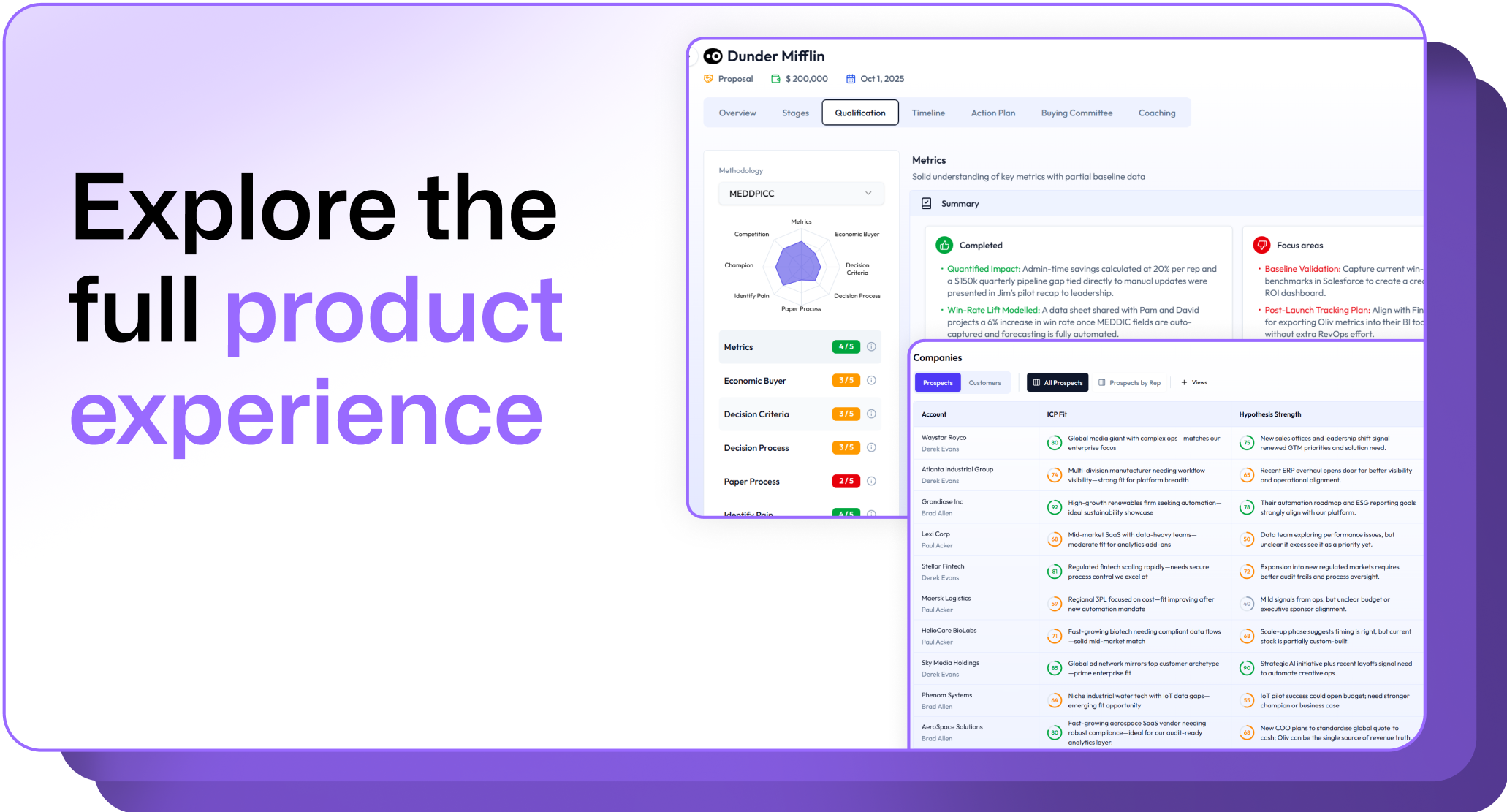
.avif)