VP of Sales Pipeline Blind Spots: Why Deals Slip Without Warning and How to Fix It in 2026
Written by
Ishan Chhabra
Last Updated :
March 12, 2026
Skim in :
8
mins
In this article
Still got questions?
Come discuss this article with me.
Hi, I'm Ishan, Founder and CEO of Oliv.
I'm always up for a conversation about revenue intelligence, AI agents, or what's actually working (and what's not) across revenue teams.
I'd love to hear your perspective.
Thank you! Your submission has been received!
Oops! Something went wrong while submitting the form.
Meet Oliv’s AI Agents
Hi! I’m, Deal Driver
I track deals, flag risks, send weekly pipeline updates and give sales managers full visibility into deal progress
Hi! I’m, CRM Manager
I maintain CRM hygiene by updating core, custom and qualification fields all without your team lifting a finger
Hi! I’m, Forecaster
I build accurate forecasts based on real deal movement and tell you which deals to pull in to hit your number
Hi! I’m, Coach
I believe performance fuels revenue. I spot skill gaps, score calls and build coaching plans to help every rep level up
Hi! I’m, Prospector
I dig into target accounts to surface the right contacts, tailor and time outreach so you always strike when it counts
Hi! I’m, Pipeline tracker
I call reps to get deal updates, and deliver a real-time, CRM-synced roll-up view of deal progress
Hi! I’m, Analyst
I answer complex pipeline questions, uncover deal patterns, and build reports that guide strategic decisions
TL;DR
Pipeline blind spots from dirty CRM data cause 67% forecast inaccuracy, costing mid-market teams $1.2M+ quarterly.
Legacy tools like Gong and Clari add reporting layers but never solve the underlying data-integrity crisis.
Rep-driven pipeline reviews are curated highlight reels; AI enables bottom-up deal forensics with evidence links.
At 40+ reps, exception-based reviews powered by AI reclaim 6 hours/week for VPs versus legacy walkthroughs.
Multi-channel signal stitching (calls, email, Slack, LinkedIn) detects stakeholder drift and sentiment contradictions invisible to meeting-only tools.
Instant deployment, free data migration, and full open export policies eliminate the mid-quarter tool-switching risk.
Q1. What Are Pipeline Blind Spots and Why Do They Cause Deals to Slip Without Warning? [toc=Pipeline Blind Spots Defined]
It's Monday morning. You walk into the forecast call confident in your commit number and within ten minutes, three "locked" deals have silently slipped past close date. No warning from your CRM. No alert from your tech stack. This is the reality of pipeline blind spots: the invisible gaps between what your CRM displays and the actual state of buyer engagement. With average B2B forecast accuracy hovering around 67%, these blind spots cost mid-market companies millions in misallocated resources every quarter.
How pipeline blind spots form: dirty data cascades through every layer of the forecast, and legacy tools only add reporting on top of the broken foundation.
⚠️ Why Legacy Systems Created This Problem
The root cause is architectural. CRMs like Salesforce were built as manual databases in a pre-AI era, entirely dependent on reps entering data. But in high-velocity B2B sales, reps prioritize closing over record-keeping, creating a foundation of "dirty data" that makes every pipeline view unreliable. Generation-one revenue intelligence tools attempted to fix this but only added a reporting layer on top of the broken foundation:
Gong captures meeting-level intelligence but misses the 50% of deal activity happening in email, Slack, and LinkedIn.
Clari consolidates forecast roll-ups but still depends on manager-adjusted numbers, with humans manually "coloring" deal health.
"Before Gong we had a lack of visibility across our deals because information was siloed in several places like CRM, Email, Zoom, phone." — Scott T., Director of Sales · Gong G2 Verified Review
✅ The AI-Era Shift: Autonomous Data Capture
Generative AI and agentic automation now make it possible to capture, stitch, and reason across every deal interaction, including calls, emails, Slack threads, and LinkedIn signals, without any rep intervention. The CRM becomes fully autonomous, eliminating the dirty-data problem at its source rather than building dashboards on top of it.
Oliv.ai's AI-Native Data Platform is built on this principle. The CRM Manager Agent auto-populates qualification fields from conversational context, trained on 100+ sales methodologies (MEDDPICC, BANT, SPICED). The Deal Driver Agent reviews every deal in the pipeline daily to surface objective risk signals. Pipeline visibility shifts from "what reps chose to enter" to "what actually happened across every channel."
💰 The Cost of Inaction
The math is unforgiving. A 12% slip rate across 50 reps carrying $200K average ACV compounds to $1.2M+ in quarterly forecast misses before accounting for wasted marketing spend, misallocated headcount, and eroded board confidence.
"Would prefer to have a summary analytics page that says: based on your starting pipeline, slippage rate, tendency to pull in deals, and historical conversion rates per stage, this is where we predict you'll land. Clari attempts to do this but doesn't give you a true breakdown... You have to click around through the different modules and extract the different pieces, ultimately putting it in an Excel." — Natalie O., Sales Operations Manager · Clari G2 Verified Review
Legacy tools are CCTV footage you review after the break-in. Oliv is the intelligent security detail that prevents it.
Q2. Why Does Your Pipeline Review Feel Like You're Only Seeing the Deals Reps Want to Show You? [toc=The Rep Filter Problem]
You're not paranoid. Your pipeline review is a curated highlight reel. Reps naturally surface the deals they're confident about and bury stalled ones to avoid scrutiny. Managers, lacking independent data, are forced to trust a multi-layered chain of human bias: Rep to Manager to Director to VP. At every level, "happy ears" inflate confidence and "sandbagging" masks risk, and by the time information reaches the VP, reality has been filtered beyond recognition.
❌ The "Discovery Event" Trap
In the traditional model, pipeline reviews become discovery events where managers spend 45 to 60 minutes per rep just "hearing the story" of each deal. Legacy tools don't solve this; they reinforce it:
Gong provides call recordings but still requires hours of manual auditing to extract deal-level truth. Its pipeline management features are notoriously hard to operationalize.
Clari relies on activity-based signals (emails sent, meetings held), but 10 emails to an unresponsive prospect registers as "high activity" rather than a dead deal.
"Understanding the pipeline management portion of it is almost impossible. Some people figure it out, but I think most just fumble through and tell tall tales about how easy it is for them to use." — John S., Senior Account Executive · Gong G2 Verified Review
"I have to maintain my own separate spreadsheet to track deals because I can only capture what my leaders want to see about a deal, revenue, close date, etc." — Verified User in HR, Enterprise · Clari G2 Verified Review
✅ From Storytelling to Deal Forensics
AI can now perform bottom-up deal inspection using conversational signals, not rep summaries. Every qualification field becomes traceable to a timestamped snippet: the exact moment a prospect confirmed budget, named a competitor, or raised an objection.
Oliv.ai's Forecaster Agent inspects every deal line-by-line and provides "Unbiased AI Commentary" alongside the rep's own assessment. If a rep marks a deal as "Commit" but the AI detects no scheduled next steps and unresolved objections, the discrepancy is flagged automatically to the VP. Pipeline reviews transform from update events into strategy events, where the agenda starts with "here's what the AI found" instead of "tell me about your deals."
⏰ The Rep Filter in Practice
"Clari is a tool for sales leaders, it adds no value to reps as far as I can see." — Msoave · r/sales Reddit Thread
When tools serve only leadership, reps disengage, and disengaged reps stop updating. Oliv reverses this dynamic by removing the administrative burden entirely, so the CRM reflects reality whether the rep updates it or not. This is the core principle behind AI-Native Revenue Orchestration: intelligence flows autonomously, not through human compliance.
Q3. How Should You Restructure Pipeline Reviews After Scaling Past 40 Reps? [toc=Scaling Past 40 Reps]
At 40 reps, your pipeline review cadence hits a wall. What worked at 15 reps, the VP sitting in on every review, personally gut-checking deals, becomes physically impossible. Managers now spend 20% of their weekly productivity (one full day) just decoding deal narratives because CRM data alone is meaningless. The VP can no longer attend every review, creating a dangerous information gap between the front line and the forecast.
❌ Why Legacy Tools Can't Scale the Review
Gong buries leadership in data at this stage. "Noisy alerts" fire across 40 pipelines with no unified prioritization, forcing managers to "dashboard dig" for the signal buried in the noise. Gong understands the meeting level but not the deal level; it cannot stitch together the context of 40 different reps' pipelines without manual intervention.
Clari's roll-up forecasting is still a manual process in a software wrapper. Managers sit with reps for one to two hours per deal to manually input deal "color."
"It can be overwhelming to set up trackers. AI training is a bit laborious to get it to do what you want." — Trafford J., Senior Director, Revenue Enablement · Gong G2 Verified Review
"I would like easier access to training to enable me to better forecast, pull data and access dashboards. As it stands I have had no training." — Edwin M., Senior Director Legal · Clari G2 Verified Review
✅ The Exception-Based Review Model
The restructured model flips the default: instead of "update me on every deal," the agenda becomes "AI flags the exceptions; humans strategize the fixes." Pipeline reviews should be risk-first, with AI pre-screening every deal against methodology criteria, including MEDDPICC gaps, stakeholder silence, and MAP milestone misses.
Oliv.ai operationalizes this through the Deal Driver Agent, which reviews the full pipeline daily and delivers:
⭐ Sunset Summary (evening): which deals moved, stalled, or need intervention
⭐ Morning Brief (pre-meeting): prep notes delivered 30 minutes before every call
Managers walk into reviews already knowing which 5 of 40 deals are at risk, skipping the update phase entirely and jumping to strategy. The Coach Agent enforces consistent review rubrics across all managers, so pipeline data is standardized organization-wide.
The shift from 8-hour narrative-driven reviews to 2-hour exception-based strategy sessions powered by AI deal inspection
⏰ Before vs. After: The VP's Weekly Time Reclaimed
VP Weekly Time: Legacy Reviews vs. Oliv-Powered Reviews
Metric
❌ Before (Legacy)
✅ After (Oliv)
Review format
60-min full pipeline walkthroughs
15-min exception-based strategy sessions
VP weekly time
8 managers x 60 min = 8 hrs/week
8 managers x 15 min = 2 hrs/week
Net time reclaimed
-
6 hours/week for strategic selling
Pipeline reviews shouldn't consume your week. They should sharpen it.
Q4. How Do Mid-Market VPs Manage Deal Risk Across 100+ Reps Without Attending Every Review? [toc=Managing 100+ Reps at Scale]
At 100+ reps, the VP of Sales is completely disconnected from the reality of individual deals. You're forced to trust a multi-layered bias chain, Rep to Manager to Director to VP, where "happy ears" and "sandbagging" compound at every level. There is no independent, objective verification of deal health at this scale. Manual auditing isn't just inefficient; it's physically impossible.
❌ Where Legacy Tools Break at Enterprise Scale
Each generation-one tool introduces its own failure mode at 100+ seats:
Gong's Smart Trackers rely on keyword matching. They flag a "competitor mention" but cannot reason whether the prospect is actively evaluating or casually referencing. At scale, this creates thousands of noise alerts with no prioritization.
Salesforce Einstein uses brittle rule-based logic for object association that gets "confused" by duplicate accounts or multiple opportunities, delivering a fractured pipeline view.
Clari at 100+ users costs ~$250/user/month, totaling over $250K/year, yet managers still manually color-code deal health in every review.
"The additional products like forecast or engage come at an additional cost. Would be great to see these tools rolled into the core offering." — Scott T., Director of Sales · Gong G2 Verified Review
"There's so much in Gong that we don't use everything. Gong's deal forecasting we don't use." — Karel Bos, Head of Sales · Gong TrustRadius Verified Review
✅ Agentic Intelligence That Scales Without Manual Intervention
The alternative is an AI-native platform that monitors all 100+ pipelines in real-time, surfaces risk autonomously, and lets the VP interrogate pipeline data in plain English, without attending a single meeting.
Oliv.ai delivers this through a coordinated multi-agent stack:
Total Cost of Ownership: Legacy Stacks vs. Oliv.ai (100 Users)
Stack
Est. Annual Cost (100 Users)
Data Entry Solved?
Gong + Clari
~$500/user/month ($600K+/yr)
❌ No
Salesforce Einstein + Add-ons
~$500+/user/month
❌ No
Oliv.ai (modular agents)
Fraction of legacy stacks
✅ Yes, autonomous CRM
You don't need a bigger dashboard. You need an intelligent security detail that patrols every deal while you focus on strategy. Learn more about how AI-native platforms reduce tech stack costs.
Q5. What's the Best Way to Run Evidence-Based Pipeline Reviews? [toc=Evidence-Based Pipeline Reviews]
An evidence-based pipeline review means every deal stage, qualification field, and risk assessment is traceable to a specific buyer interaction, a call snippet, an email sentence, a Slack message. This eliminates the "creative writing" problem where reps summarize unstructured conversations into rigid CRM fields, losing the nuances of risk that determine whether a deal closes or slips.
❌ The Evidence Gap in Legacy Tools
Current tools provide data without traceability:
Gong logs summaries as unstructured "notes" or "activities" in the CRM, useful for reading but impossible to use for structured reporting or automated risk scoring.
Clari relies on activity-based signals (e.g., "10 emails sent"). These are inherently naive; ten emails to an unresponsive prospect is a sign of a dead deal, yet legacy RI tools often signal it as "high activity."
"I find the setup process challenging, especially when migrating fields from Salesforce, as it can't handle formula fields directly. This requires creating and maintaining duplicate fields, which adds complexity." — Josiah R., Head of Sales Operations · Clari G2 Verified Review
✅ The "Trust-First" Pipeline Model
In a Trust-First model, every MEDDPICC/BANT field auto-populated by AI includes a clickable evidence link. Managers can see the exact timestamped call snippet or specific email sentence where a prospect committed to a budget, named a decision-maker, or raised a timeline objection.
Oliv.ai's CRM Manager Agent populates methodology fields from conversational context, trained on 100+ frameworks, with each field backed by an evidence trail. The Deal Driver then cross-references stage claims against actual buyer signals: if a deal is marked "Negotiation" but no pricing discussion has occurred in any channel, it flags the inconsistency automatically.
Stakeholder engagement heat check: who's active vs. silent
1 min
4
MAP milestone status: are buyer-owned actions on track
1 min
5
Strategy and next steps: what specific action closes the gap
2 min
"The dashboarding and reporting can be limited based on what you are looking to do. Hopefully they will come out with advancements there." — Sarah J., Senior Manager, Revenue Operations · Clari G2 Verified Review
Reviews anchored in conversational truth, not rep opinion, are the new standard for pipeline confidence.
Q6. How Does an AI Deal Driver Decide Which Deals Need Your Attention Today? [toc=AI Deal Prioritization Logic]
Sales managers receive dozens of notifications daily from legacy tools, competitor mentions, call completions, email opens, but none answer the only question that matters: "Which deal is about to slip, and what should I do about it?" The signal-to-noise ratio is broken, and the result is alert fatigue where the one deal that's actually dying gets buried under a flood of low-priority pings.
❌ Why Legacy Alerting Creates More Noise Than Signal
Gong's alerts are keyword-triggered. A "competitor mention" fires whether the prospect is actively evaluating or casually referencing a name in passing; the system can't distinguish intent.
Salesforce Agentforce agents are "chat-focused"; the VP must manually query the agent and copy-paste insights into their workflow. They don't proactively push prioritized intelligence.
"Gong is strong at conversation intelligence, but that's where its usefulness ends... The tool is slow, buggy, and creates an excessive administrative burden on the user side." — Anonymous Reviewer · Gong G2 Verified Review
✅ Specification Engineering: Intent Over Activity
A next-generation deal driver doesn't just track activity volume; it tracks intent, resonance, and methodology compliance. It reasons across multiple signals simultaneously, trained on 100+ sales methodologies, to determine if a deal genuinely needs intervention.
The Deal Driver inspects every deal daily against four risk dimensions, delivering prioritized intelligence via Sunset Summary and Morning Brief.
Oliv.ai's Deal Driver Agent flags a deal when:
A key outcome of the current stage (e.g., "Technical Validation") hasn't been met despite a call happening
The Economic Buyer has gone silent for more than 7 days
A competitor mention received low resonance from the prospect
A Mutual Action Plan (MAP) milestone is overdue
⭐ Intelligence That Arrives Where You Work
The Deal Driver delivers proactive intelligence without requiring a single dashboard login:
Morning Brief (pre-meeting): flags today's important meetings with prep notes delivered 30 minutes before each call
"AI is not great yet, the product still feels like it's at its infancy and needs to be developed further." — Annabelle H., Voluntary Director, Board of Directors · Gong G2 Verified Review
With Oliv, intelligence arrives in Slack or email, not behind another login wall. You're always prepared, never surprised.
Q7. Can AI Detect When a Key Stakeholder Goes Dark or When Email Sentiment Contradicts Call Optimism? [toc=Multi-Channel Blind Spots]
Two of the most dangerous pipeline blind spots are nearly invisible to traditional tools:
Stakeholder drift: a deal looks healthy because the rep talks to a champion, but the economic buyer has quietly left the company or shifted priorities.
Sentiment divergence: a prospect is positive on calls but raises budget concerns or competitor evaluations in follow-up emails.
Both are invisible to meeting-only conversation intelligence tools.
❌ The Channel Gap: Why Meeting Recorders Miss Half the Deal
Traditional CI tools like Gong and Chorus are fundamentally meeting recorders. They capture call sentiment accurately but miss the 50% of deal activity that happens in email, Slack, LinkedIn, and Telegram. Gong logs "email sent" as an activity but does not read the sentiment or objections within that email to update deal health.
"I use Gong software to record my calls and quickly get a summary of our exchanges... Having the ability to search for information globally via Gong home and not at the account level [is a limitation]." — Arnaud Desage, KAM · Gong TrustRadius Verified Review
"Some of the features that are reported don't actually tell me where that information is coming from." — Jezni W., Sales Account Executive · Clari G2 Verified Review
Legacy conversation intelligence captures calls. Oliv stitches every channel into a unified deal narrative that detects sentiment contradictions across touchpoints.
✅ Multi-Channel Intelligence: The New Standard
AI must stitch together signals from every buyer touchpoint, including calls, emails, Slack threads, and LinkedIn activity, to build a unified deal narrative that evolves in real-time.
Oliv.ai's AI Data Platform reads email context and Slack back-and-forth, not just call transcripts. If a prospect is positive on a call but raises budget objections in a follow-up email, Oliv identifies the contradiction and marks the deal "At Risk."
As a LinkedIn Partner, Oliv monitors external triggers in real-time:
⚠️ A key stakeholder changes their title: immediate notification to account owner and VP
⚠️ A previously active stakeholder stops responding across all channels: flagged even if the rep is still having "happy" discovery calls with lower-level staff
⭐ Breadth vs. Depth Visibility
Beyond individual deal risk, Oliv surfaces whether reps are engaging the full buying committee or just recycling the same champion contact, a pattern that legacy tools structurally cannot detect. This breadth-versus-depth insight is what separates pipeline confidence from pipeline theater. Learn more about how revenue intelligence platforms are evolving to close these multi-channel gaps.
Q8. How Do You Enforce Consistent Pipeline Review Standards and Track Win/Loss Trends Across All Managers? [toc=Methodology Enforcement at Scale]
Organizations invest $150K+ in methodology consultancies like Force Management or Winning by Design to train managers on frameworks like MEDDIC and MEDDPICC, but the training doesn't stick. Every manager runs reviews differently. A "qualified" deal in EMEA may not meet the same bar as one in North America, making cross-team pipeline comparisons meaningless and rendering aggregate forecasts unreliable.
❌ Why Legacy Tools Can't Enforce Standards
The root cause is structural: legacy CRM fields are free-text or dropdowns that allow subjective interpretation. Each tool adds a layer of inconsistency rather than solving it:
Gong's scorecard feature requires manual scoring by managers, which is exactly the bottleneck you're trying to eliminate. Setting up trackers is "overwhelming" and "AI training is a bit laborious to get it to do what you want."
Clari doesn't enforce methodology at all. It rolls up whatever numbers managers submit, regardless of whether those numbers reflect consistent qualification standards.
"It can be overwhelming to set up trackers. AI training is a bit laborious to get it to do what you want." — Trafford J., Senior Director, Revenue Enablement · Gong G2 Verified Review
"Clari should find ways to differentiate from the native Salesforce features (e.g. Pipeline Inspection, Forecasting) in order to remain competitive in the long-run." — Dan J., Mid-Market · Clari G2 Verified Review
✅ AI-Enforced Methodology Compliance
An agentic system can be trained on your specific review rubric and then automatically score every deal against that standard, ensuring consistency without adding manager workload. The consultancy defines the standard; AI enforces it at scale without human policing.
Oliv.ai's Coach Agent can be trained on just three calls to internalize a company's unique qualification rubric. It then auto-scores deals against custom templates across every team and region. A "qualified" deal in APAC is held to the identical bar as one in North America, automatically, every time.
⭐ Weekly Win/Loss Trend Visibility
The Forecaster Agent generates a weekly one-page pipeline progress report with visual heat maps showing:
Weekly Pipeline Progress Report: Key Metrics
Metric
What It Reveals
Deals progressed
Forward pipeline momentum by stage
Deals won/lost
Win rate trends and close-rate shifts
At-risk clusters
Stage-specific bottlenecks across teams
Breadth vs. depth
Are reps touching the whole book or recycling accounts
Reports are delivered as a presentation-ready deck (Google Slides/PPT) every Monday, stitching data across Slack, email, and even unrecorded calls via the Voice Agent.
"The analytics modules still needs some work IMO to provide a valuable deliverable. All the pieces are there but missing the story line." — Natalie O., Sales Operations Manager · Clari G2 Verified Review
Methodology consultancies and Oliv are a "match made in heaven"; one defines the standard, the other enforces it autonomously. Explore how sales methodology automation works in practice.
Q9. How Do You Switch Pipeline Tools Mid-Quarter Without Losing Deal Visibility? [toc=Mid-Quarter Tool Migration]
Switching revenue tools mid-quarter feels like changing engines on a moving plane. VPs worry about 3 to 6 month implementation gaps where visibility into current deals evaporates, historical context disappears, and reps resist yet another tool change. This fear, justified by legacy vendor lock-in mechanics, keeps organizations trapped in underperforming tech stacks long past their expiration date.
❌ Legacy Lock-In Mechanics
Gong's implementation is a "very complex cycle" taking 3 to 6 months. Beyond time, the financial burden is significant: platform fees range from $5K to $50K, with implementation costs adding $10K to $30K on top. Critically, Gong provides "one-way integrations"; data flows in, but exporting structured data back out is notoriously difficult.
"Gong's current solution is far from convenient or accessible; it requires downloading calls individually, which is impractical and inefficient for a large volume of data." — Neel P., Sales Operations Manager · Gong G2 Verified Review
"This lack of flexibility has required us to engage our development team at additional cost, adding significant operational and opportunity costs just to extract data we already own." — Neel P., Sales Operations Manager · Gong G2 Verified Review
✅ The Modern Standard: Instant Deployment + Open Export
A VP evaluating platforms in 2026 should demand three non-negotiables: instant configuration, free historical data migration, and a full open export policy. You should never lose deal context because you switched vendors.
⭐ Oliv's Zero-Risk Migration Path
Oliv.ai eliminates migration risk through radical transparency:
⏰ 5-minute baseline configuration: 1 to 2 days to full value
✅ Free migration of all historical Gong recordings and metadata
✅ Full open export policy: upon contract termination, you receive a complete CSV dump of every meeting and recording
💰 No platform fees on entry-level tiers
✅ Zero UI lock-in by design
"It was a big mistake on our part to commit to a two year term. Gong is a really powerful tool but it's probably the highest end option on the market, and now we're stuck." — Iris P., Head of Marketing, Sales and Partnerships · Gong G2 Verified Review
💡 Practical Migration Tip
Time the switch to coincide with your Gong renewal window (typically 90 days before contract end). Run Oliv in parallel for two weeks to validate before cutting over; instant deployment makes this low-risk. You keep full pipeline visibility from day one, and if anything doesn't fit, your data is always yours to take. See how Oliv compares directly in a Gong vs. Oliv breakdown.
Q10. What Should a VP of Sales Look For in a Modern Deal Intelligence Platform? [toc=Deal Intelligence Buyer's Checklist]
The shift from "SaaS you log into" to "agents that work for you" has fundamentally changed the evaluation criteria for deal intelligence platforms. Below is a buyer's checklist organized by the capabilities that matter most to VPs of Sales, Revenue Operations leaders, and front-line managers evaluating tooling in 2026.
Multi-channel signal stitching (calls + email + Slack)
Meeting-only intelligence that misses 50% of activity
Alerting Model
Proactive push to Slack/email, no login required
Dashboard-dependent; user must query the system
Methodology Compliance
Auto-scoring against MEDDPICC/BANT with evidence links
Manual scorecard creation by managers
Forecasting
Bottom-up, AI-generated roll-ups with unbiased commentary
Manager-submitted numbers without independent verification
Data Portability
Full open export; complete CSV dump on termination
One-way integrations; individual call downloads only
Implementation
Minutes to configure, days to value
3 to 6 month deployment cycles with five-figure fees
Pricing Model
Modular, pay only for the agents you need
Bundled suites that force payment for unused features
"It is really just a glorified SFDC overlay. Actually, Salesforce has built most of the forecasting functionality by now anyway so I'm not sure where they fit into that whole overcrowded Martech space." — conaldinho11 · r/SalesOperations Reddit Thread
"The pricing is probably the biggest obstacle and hence we are looking to change." — Miodrag, Enterprise Account Executive · Gong Verified LinkedIn Review
Key Questions to Ask During Demos
Does the platform push intelligence to me, or do I have to log in and pull it?
Can I see the conversational evidence behind every CRM field, with a clickable link to the source?
What happens to my data if I cancel the contract?
How long from contract signing to first actionable insight?
Does the system score deals against my custom methodology, automatically, across all teams?
Oliv.ai meets every criterion in the checklist above through its modular agent architecture, allowing VPs to start with recording and layer on Deal Driver, Forecaster, Coach, and Analyst agents as their needs scale. Learn more about the best AI sales tools available in 2026.
Q11. Frequently Asked Questions About Pipeline Blind Spots and Deal Slippage [toc=Pipeline Blind Spots FAQ]
What Is Deal Slippage vs. a Lost Deal?
Deal slippage occurs when a deal's expected close date pushes beyond the forecasted quarter; the opportunity is still alive but delayed. A lost deal, by contrast, is one where the prospect explicitly chose a competitor, went with an internal solution, or decided not to buy. The key distinction: slipped deals still carry revenue potential but erode forecast accuracy and pipeline confidence.
What Is a Healthy Deal Slippage Rate?
Most B2B organizations see slippage rates between 20 to 40% of pipeline value per quarter. Rates below 20% typically indicate strong qualification discipline and methodology enforcement. Rates above 40% signal systemic issues, usually poor stage definitions, inconsistent qualification criteria, or multi-threading failures where reps rely on a single champion without engaging the economic buyer.
How Often Should You Run Pipeline Reviews?
Best practice is a weekly cadence at the team level and a bi-weekly or monthly cadence at the VP/CRO level. However, the more important question is how you run them. Traditional hour-long reviews where reps narrate deal updates are being replaced by 7-minute evidence-based reviews where AI pre-surfaces risk signals and managers focus exclusively on strategy.
"I have to maintain my own separate spreadsheet to track deals because I can only capture what my leaders want to see about a deal." — Verified User in Human Resources, Enterprise · Clari G2 Verified Review
What Is Pipeline Coverage Ratio and Why Does It Matter?
Pipeline coverage ratio measures total pipeline value divided by quota target. A healthy ratio is typically 3 to 4x for mid-market B2B sales. However, raw coverage can be misleading if the pipeline includes stalled deals or opportunities inflated by "happy ears." AI-driven deal health scoring provides a weighted coverage ratio that accounts for actual buyer engagement and methodology compliance.
Can AI Actually Replace Manual Pipeline Reviews?
AI doesn't replace pipeline reviews; it transforms them from "discovery events" into "strategy events." Instead of managers spending 20% of their week learning what happened, AI surfaces exactly which deals moved, which stalled, and why. The human role shifts from data collection to strategic coaching and intervention.
"Clari is a tool for sales leaders, it adds no value to reps as far as I can see." — Msoave · r/sales Reddit Thread
Oliv.ai's autonomous agents handle pipeline monitoring, CRM updates, and risk detection continuously, freeing leadership to focus on the strategic decisions that actually move revenue. Discover how AI-Native Revenue Orchestration platforms are redefining pipeline management.
Q1. What Are Pipeline Blind Spots and Why Do They Cause Deals to Slip Without Warning? [toc=Pipeline Blind Spots Defined]
It's Monday morning. You walk into the forecast call confident in your commit number and within ten minutes, three "locked" deals have silently slipped past close date. No warning from your CRM. No alert from your tech stack. This is the reality of pipeline blind spots: the invisible gaps between what your CRM displays and the actual state of buyer engagement. With average B2B forecast accuracy hovering around 67%, these blind spots cost mid-market companies millions in misallocated resources every quarter.
How pipeline blind spots form: dirty data cascades through every layer of the forecast, and legacy tools only add reporting on top of the broken foundation.
⚠️ Why Legacy Systems Created This Problem
The root cause is architectural. CRMs like Salesforce were built as manual databases in a pre-AI era, entirely dependent on reps entering data. But in high-velocity B2B sales, reps prioritize closing over record-keeping, creating a foundation of "dirty data" that makes every pipeline view unreliable. Generation-one revenue intelligence tools attempted to fix this but only added a reporting layer on top of the broken foundation:
Gong captures meeting-level intelligence but misses the 50% of deal activity happening in email, Slack, and LinkedIn.
Clari consolidates forecast roll-ups but still depends on manager-adjusted numbers, with humans manually "coloring" deal health.
"Before Gong we had a lack of visibility across our deals because information was siloed in several places like CRM, Email, Zoom, phone." — Scott T., Director of Sales · Gong G2 Verified Review
✅ The AI-Era Shift: Autonomous Data Capture
Generative AI and agentic automation now make it possible to capture, stitch, and reason across every deal interaction, including calls, emails, Slack threads, and LinkedIn signals, without any rep intervention. The CRM becomes fully autonomous, eliminating the dirty-data problem at its source rather than building dashboards on top of it.
Oliv.ai's AI-Native Data Platform is built on this principle. The CRM Manager Agent auto-populates qualification fields from conversational context, trained on 100+ sales methodologies (MEDDPICC, BANT, SPICED). The Deal Driver Agent reviews every deal in the pipeline daily to surface objective risk signals. Pipeline visibility shifts from "what reps chose to enter" to "what actually happened across every channel."
💰 The Cost of Inaction
The math is unforgiving. A 12% slip rate across 50 reps carrying $200K average ACV compounds to $1.2M+ in quarterly forecast misses before accounting for wasted marketing spend, misallocated headcount, and eroded board confidence.
"Would prefer to have a summary analytics page that says: based on your starting pipeline, slippage rate, tendency to pull in deals, and historical conversion rates per stage, this is where we predict you'll land. Clari attempts to do this but doesn't give you a true breakdown... You have to click around through the different modules and extract the different pieces, ultimately putting it in an Excel." — Natalie O., Sales Operations Manager · Clari G2 Verified Review
Legacy tools are CCTV footage you review after the break-in. Oliv is the intelligent security detail that prevents it.
Q2. Why Does Your Pipeline Review Feel Like You're Only Seeing the Deals Reps Want to Show You? [toc=The Rep Filter Problem]
You're not paranoid. Your pipeline review is a curated highlight reel. Reps naturally surface the deals they're confident about and bury stalled ones to avoid scrutiny. Managers, lacking independent data, are forced to trust a multi-layered chain of human bias: Rep to Manager to Director to VP. At every level, "happy ears" inflate confidence and "sandbagging" masks risk, and by the time information reaches the VP, reality has been filtered beyond recognition.
❌ The "Discovery Event" Trap
In the traditional model, pipeline reviews become discovery events where managers spend 45 to 60 minutes per rep just "hearing the story" of each deal. Legacy tools don't solve this; they reinforce it:
Gong provides call recordings but still requires hours of manual auditing to extract deal-level truth. Its pipeline management features are notoriously hard to operationalize.
Clari relies on activity-based signals (emails sent, meetings held), but 10 emails to an unresponsive prospect registers as "high activity" rather than a dead deal.
"Understanding the pipeline management portion of it is almost impossible. Some people figure it out, but I think most just fumble through and tell tall tales about how easy it is for them to use." — John S., Senior Account Executive · Gong G2 Verified Review
"I have to maintain my own separate spreadsheet to track deals because I can only capture what my leaders want to see about a deal, revenue, close date, etc." — Verified User in HR, Enterprise · Clari G2 Verified Review
✅ From Storytelling to Deal Forensics
AI can now perform bottom-up deal inspection using conversational signals, not rep summaries. Every qualification field becomes traceable to a timestamped snippet: the exact moment a prospect confirmed budget, named a competitor, or raised an objection.
Oliv.ai's Forecaster Agent inspects every deal line-by-line and provides "Unbiased AI Commentary" alongside the rep's own assessment. If a rep marks a deal as "Commit" but the AI detects no scheduled next steps and unresolved objections, the discrepancy is flagged automatically to the VP. Pipeline reviews transform from update events into strategy events, where the agenda starts with "here's what the AI found" instead of "tell me about your deals."
⏰ The Rep Filter in Practice
"Clari is a tool for sales leaders, it adds no value to reps as far as I can see." — Msoave · r/sales Reddit Thread
When tools serve only leadership, reps disengage, and disengaged reps stop updating. Oliv reverses this dynamic by removing the administrative burden entirely, so the CRM reflects reality whether the rep updates it or not. This is the core principle behind AI-Native Revenue Orchestration: intelligence flows autonomously, not through human compliance.
Q3. How Should You Restructure Pipeline Reviews After Scaling Past 40 Reps? [toc=Scaling Past 40 Reps]
At 40 reps, your pipeline review cadence hits a wall. What worked at 15 reps, the VP sitting in on every review, personally gut-checking deals, becomes physically impossible. Managers now spend 20% of their weekly productivity (one full day) just decoding deal narratives because CRM data alone is meaningless. The VP can no longer attend every review, creating a dangerous information gap between the front line and the forecast.
❌ Why Legacy Tools Can't Scale the Review
Gong buries leadership in data at this stage. "Noisy alerts" fire across 40 pipelines with no unified prioritization, forcing managers to "dashboard dig" for the signal buried in the noise. Gong understands the meeting level but not the deal level; it cannot stitch together the context of 40 different reps' pipelines without manual intervention.
Clari's roll-up forecasting is still a manual process in a software wrapper. Managers sit with reps for one to two hours per deal to manually input deal "color."
"It can be overwhelming to set up trackers. AI training is a bit laborious to get it to do what you want." — Trafford J., Senior Director, Revenue Enablement · Gong G2 Verified Review
"I would like easier access to training to enable me to better forecast, pull data and access dashboards. As it stands I have had no training." — Edwin M., Senior Director Legal · Clari G2 Verified Review
✅ The Exception-Based Review Model
The restructured model flips the default: instead of "update me on every deal," the agenda becomes "AI flags the exceptions; humans strategize the fixes." Pipeline reviews should be risk-first, with AI pre-screening every deal against methodology criteria, including MEDDPICC gaps, stakeholder silence, and MAP milestone misses.
Oliv.ai operationalizes this through the Deal Driver Agent, which reviews the full pipeline daily and delivers:
⭐ Sunset Summary (evening): which deals moved, stalled, or need intervention
⭐ Morning Brief (pre-meeting): prep notes delivered 30 minutes before every call
Managers walk into reviews already knowing which 5 of 40 deals are at risk, skipping the update phase entirely and jumping to strategy. The Coach Agent enforces consistent review rubrics across all managers, so pipeline data is standardized organization-wide.
The shift from 8-hour narrative-driven reviews to 2-hour exception-based strategy sessions powered by AI deal inspection
⏰ Before vs. After: The VP's Weekly Time Reclaimed
VP Weekly Time: Legacy Reviews vs. Oliv-Powered Reviews
Metric
❌ Before (Legacy)
✅ After (Oliv)
Review format
60-min full pipeline walkthroughs
15-min exception-based strategy sessions
VP weekly time
8 managers x 60 min = 8 hrs/week
8 managers x 15 min = 2 hrs/week
Net time reclaimed
-
6 hours/week for strategic selling
Pipeline reviews shouldn't consume your week. They should sharpen it.
Q4. How Do Mid-Market VPs Manage Deal Risk Across 100+ Reps Without Attending Every Review? [toc=Managing 100+ Reps at Scale]
At 100+ reps, the VP of Sales is completely disconnected from the reality of individual deals. You're forced to trust a multi-layered bias chain, Rep to Manager to Director to VP, where "happy ears" and "sandbagging" compound at every level. There is no independent, objective verification of deal health at this scale. Manual auditing isn't just inefficient; it's physically impossible.
❌ Where Legacy Tools Break at Enterprise Scale
Each generation-one tool introduces its own failure mode at 100+ seats:
Gong's Smart Trackers rely on keyword matching. They flag a "competitor mention" but cannot reason whether the prospect is actively evaluating or casually referencing. At scale, this creates thousands of noise alerts with no prioritization.
Salesforce Einstein uses brittle rule-based logic for object association that gets "confused" by duplicate accounts or multiple opportunities, delivering a fractured pipeline view.
Clari at 100+ users costs ~$250/user/month, totaling over $250K/year, yet managers still manually color-code deal health in every review.
"The additional products like forecast or engage come at an additional cost. Would be great to see these tools rolled into the core offering." — Scott T., Director of Sales · Gong G2 Verified Review
"There's so much in Gong that we don't use everything. Gong's deal forecasting we don't use." — Karel Bos, Head of Sales · Gong TrustRadius Verified Review
✅ Agentic Intelligence That Scales Without Manual Intervention
The alternative is an AI-native platform that monitors all 100+ pipelines in real-time, surfaces risk autonomously, and lets the VP interrogate pipeline data in plain English, without attending a single meeting.
Oliv.ai delivers this through a coordinated multi-agent stack:
Total Cost of Ownership: Legacy Stacks vs. Oliv.ai (100 Users)
Stack
Est. Annual Cost (100 Users)
Data Entry Solved?
Gong + Clari
~$500/user/month ($600K+/yr)
❌ No
Salesforce Einstein + Add-ons
~$500+/user/month
❌ No
Oliv.ai (modular agents)
Fraction of legacy stacks
✅ Yes, autonomous CRM
You don't need a bigger dashboard. You need an intelligent security detail that patrols every deal while you focus on strategy. Learn more about how AI-native platforms reduce tech stack costs.
Q5. What's the Best Way to Run Evidence-Based Pipeline Reviews? [toc=Evidence-Based Pipeline Reviews]
An evidence-based pipeline review means every deal stage, qualification field, and risk assessment is traceable to a specific buyer interaction, a call snippet, an email sentence, a Slack message. This eliminates the "creative writing" problem where reps summarize unstructured conversations into rigid CRM fields, losing the nuances of risk that determine whether a deal closes or slips.
❌ The Evidence Gap in Legacy Tools
Current tools provide data without traceability:
Gong logs summaries as unstructured "notes" or "activities" in the CRM, useful for reading but impossible to use for structured reporting or automated risk scoring.
Clari relies on activity-based signals (e.g., "10 emails sent"). These are inherently naive; ten emails to an unresponsive prospect is a sign of a dead deal, yet legacy RI tools often signal it as "high activity."
"I find the setup process challenging, especially when migrating fields from Salesforce, as it can't handle formula fields directly. This requires creating and maintaining duplicate fields, which adds complexity." — Josiah R., Head of Sales Operations · Clari G2 Verified Review
✅ The "Trust-First" Pipeline Model
In a Trust-First model, every MEDDPICC/BANT field auto-populated by AI includes a clickable evidence link. Managers can see the exact timestamped call snippet or specific email sentence where a prospect committed to a budget, named a decision-maker, or raised a timeline objection.
Oliv.ai's CRM Manager Agent populates methodology fields from conversational context, trained on 100+ frameworks, with each field backed by an evidence trail. The Deal Driver then cross-references stage claims against actual buyer signals: if a deal is marked "Negotiation" but no pricing discussion has occurred in any channel, it flags the inconsistency automatically.
Stakeholder engagement heat check: who's active vs. silent
1 min
4
MAP milestone status: are buyer-owned actions on track
1 min
5
Strategy and next steps: what specific action closes the gap
2 min
"The dashboarding and reporting can be limited based on what you are looking to do. Hopefully they will come out with advancements there." — Sarah J., Senior Manager, Revenue Operations · Clari G2 Verified Review
Reviews anchored in conversational truth, not rep opinion, are the new standard for pipeline confidence.
Q6. How Does an AI Deal Driver Decide Which Deals Need Your Attention Today? [toc=AI Deal Prioritization Logic]
Sales managers receive dozens of notifications daily from legacy tools, competitor mentions, call completions, email opens, but none answer the only question that matters: "Which deal is about to slip, and what should I do about it?" The signal-to-noise ratio is broken, and the result is alert fatigue where the one deal that's actually dying gets buried under a flood of low-priority pings.
❌ Why Legacy Alerting Creates More Noise Than Signal
Gong's alerts are keyword-triggered. A "competitor mention" fires whether the prospect is actively evaluating or casually referencing a name in passing; the system can't distinguish intent.
Salesforce Agentforce agents are "chat-focused"; the VP must manually query the agent and copy-paste insights into their workflow. They don't proactively push prioritized intelligence.
"Gong is strong at conversation intelligence, but that's where its usefulness ends... The tool is slow, buggy, and creates an excessive administrative burden on the user side." — Anonymous Reviewer · Gong G2 Verified Review
✅ Specification Engineering: Intent Over Activity
A next-generation deal driver doesn't just track activity volume; it tracks intent, resonance, and methodology compliance. It reasons across multiple signals simultaneously, trained on 100+ sales methodologies, to determine if a deal genuinely needs intervention.
The Deal Driver inspects every deal daily against four risk dimensions, delivering prioritized intelligence via Sunset Summary and Morning Brief.
Oliv.ai's Deal Driver Agent flags a deal when:
A key outcome of the current stage (e.g., "Technical Validation") hasn't been met despite a call happening
The Economic Buyer has gone silent for more than 7 days
A competitor mention received low resonance from the prospect
A Mutual Action Plan (MAP) milestone is overdue
⭐ Intelligence That Arrives Where You Work
The Deal Driver delivers proactive intelligence without requiring a single dashboard login:
Morning Brief (pre-meeting): flags today's important meetings with prep notes delivered 30 minutes before each call
"AI is not great yet, the product still feels like it's at its infancy and needs to be developed further." — Annabelle H., Voluntary Director, Board of Directors · Gong G2 Verified Review
With Oliv, intelligence arrives in Slack or email, not behind another login wall. You're always prepared, never surprised.
Q7. Can AI Detect When a Key Stakeholder Goes Dark or When Email Sentiment Contradicts Call Optimism? [toc=Multi-Channel Blind Spots]
Two of the most dangerous pipeline blind spots are nearly invisible to traditional tools:
Stakeholder drift: a deal looks healthy because the rep talks to a champion, but the economic buyer has quietly left the company or shifted priorities.
Sentiment divergence: a prospect is positive on calls but raises budget concerns or competitor evaluations in follow-up emails.
Both are invisible to meeting-only conversation intelligence tools.
❌ The Channel Gap: Why Meeting Recorders Miss Half the Deal
Traditional CI tools like Gong and Chorus are fundamentally meeting recorders. They capture call sentiment accurately but miss the 50% of deal activity that happens in email, Slack, LinkedIn, and Telegram. Gong logs "email sent" as an activity but does not read the sentiment or objections within that email to update deal health.
"I use Gong software to record my calls and quickly get a summary of our exchanges... Having the ability to search for information globally via Gong home and not at the account level [is a limitation]." — Arnaud Desage, KAM · Gong TrustRadius Verified Review
"Some of the features that are reported don't actually tell me where that information is coming from." — Jezni W., Sales Account Executive · Clari G2 Verified Review
Legacy conversation intelligence captures calls. Oliv stitches every channel into a unified deal narrative that detects sentiment contradictions across touchpoints.
✅ Multi-Channel Intelligence: The New Standard
AI must stitch together signals from every buyer touchpoint, including calls, emails, Slack threads, and LinkedIn activity, to build a unified deal narrative that evolves in real-time.
Oliv.ai's AI Data Platform reads email context and Slack back-and-forth, not just call transcripts. If a prospect is positive on a call but raises budget objections in a follow-up email, Oliv identifies the contradiction and marks the deal "At Risk."
As a LinkedIn Partner, Oliv monitors external triggers in real-time:
⚠️ A key stakeholder changes their title: immediate notification to account owner and VP
⚠️ A previously active stakeholder stops responding across all channels: flagged even if the rep is still having "happy" discovery calls with lower-level staff
⭐ Breadth vs. Depth Visibility
Beyond individual deal risk, Oliv surfaces whether reps are engaging the full buying committee or just recycling the same champion contact, a pattern that legacy tools structurally cannot detect. This breadth-versus-depth insight is what separates pipeline confidence from pipeline theater. Learn more about how revenue intelligence platforms are evolving to close these multi-channel gaps.
Q8. How Do You Enforce Consistent Pipeline Review Standards and Track Win/Loss Trends Across All Managers? [toc=Methodology Enforcement at Scale]
Organizations invest $150K+ in methodology consultancies like Force Management or Winning by Design to train managers on frameworks like MEDDIC and MEDDPICC, but the training doesn't stick. Every manager runs reviews differently. A "qualified" deal in EMEA may not meet the same bar as one in North America, making cross-team pipeline comparisons meaningless and rendering aggregate forecasts unreliable.
❌ Why Legacy Tools Can't Enforce Standards
The root cause is structural: legacy CRM fields are free-text or dropdowns that allow subjective interpretation. Each tool adds a layer of inconsistency rather than solving it:
Gong's scorecard feature requires manual scoring by managers, which is exactly the bottleneck you're trying to eliminate. Setting up trackers is "overwhelming" and "AI training is a bit laborious to get it to do what you want."
Clari doesn't enforce methodology at all. It rolls up whatever numbers managers submit, regardless of whether those numbers reflect consistent qualification standards.
"It can be overwhelming to set up trackers. AI training is a bit laborious to get it to do what you want." — Trafford J., Senior Director, Revenue Enablement · Gong G2 Verified Review
"Clari should find ways to differentiate from the native Salesforce features (e.g. Pipeline Inspection, Forecasting) in order to remain competitive in the long-run." — Dan J., Mid-Market · Clari G2 Verified Review
✅ AI-Enforced Methodology Compliance
An agentic system can be trained on your specific review rubric and then automatically score every deal against that standard, ensuring consistency without adding manager workload. The consultancy defines the standard; AI enforces it at scale without human policing.
Oliv.ai's Coach Agent can be trained on just three calls to internalize a company's unique qualification rubric. It then auto-scores deals against custom templates across every team and region. A "qualified" deal in APAC is held to the identical bar as one in North America, automatically, every time.
⭐ Weekly Win/Loss Trend Visibility
The Forecaster Agent generates a weekly one-page pipeline progress report with visual heat maps showing:
Weekly Pipeline Progress Report: Key Metrics
Metric
What It Reveals
Deals progressed
Forward pipeline momentum by stage
Deals won/lost
Win rate trends and close-rate shifts
At-risk clusters
Stage-specific bottlenecks across teams
Breadth vs. depth
Are reps touching the whole book or recycling accounts
Reports are delivered as a presentation-ready deck (Google Slides/PPT) every Monday, stitching data across Slack, email, and even unrecorded calls via the Voice Agent.
"The analytics modules still needs some work IMO to provide a valuable deliverable. All the pieces are there but missing the story line." — Natalie O., Sales Operations Manager · Clari G2 Verified Review
Methodology consultancies and Oliv are a "match made in heaven"; one defines the standard, the other enforces it autonomously. Explore how sales methodology automation works in practice.
Q9. How Do You Switch Pipeline Tools Mid-Quarter Without Losing Deal Visibility? [toc=Mid-Quarter Tool Migration]
Switching revenue tools mid-quarter feels like changing engines on a moving plane. VPs worry about 3 to 6 month implementation gaps where visibility into current deals evaporates, historical context disappears, and reps resist yet another tool change. This fear, justified by legacy vendor lock-in mechanics, keeps organizations trapped in underperforming tech stacks long past their expiration date.
❌ Legacy Lock-In Mechanics
Gong's implementation is a "very complex cycle" taking 3 to 6 months. Beyond time, the financial burden is significant: platform fees range from $5K to $50K, with implementation costs adding $10K to $30K on top. Critically, Gong provides "one-way integrations"; data flows in, but exporting structured data back out is notoriously difficult.
"Gong's current solution is far from convenient or accessible; it requires downloading calls individually, which is impractical and inefficient for a large volume of data." — Neel P., Sales Operations Manager · Gong G2 Verified Review
"This lack of flexibility has required us to engage our development team at additional cost, adding significant operational and opportunity costs just to extract data we already own." — Neel P., Sales Operations Manager · Gong G2 Verified Review
✅ The Modern Standard: Instant Deployment + Open Export
A VP evaluating platforms in 2026 should demand three non-negotiables: instant configuration, free historical data migration, and a full open export policy. You should never lose deal context because you switched vendors.
⭐ Oliv's Zero-Risk Migration Path
Oliv.ai eliminates migration risk through radical transparency:
⏰ 5-minute baseline configuration: 1 to 2 days to full value
✅ Free migration of all historical Gong recordings and metadata
✅ Full open export policy: upon contract termination, you receive a complete CSV dump of every meeting and recording
💰 No platform fees on entry-level tiers
✅ Zero UI lock-in by design
"It was a big mistake on our part to commit to a two year term. Gong is a really powerful tool but it's probably the highest end option on the market, and now we're stuck." — Iris P., Head of Marketing, Sales and Partnerships · Gong G2 Verified Review
💡 Practical Migration Tip
Time the switch to coincide with your Gong renewal window (typically 90 days before contract end). Run Oliv in parallel for two weeks to validate before cutting over; instant deployment makes this low-risk. You keep full pipeline visibility from day one, and if anything doesn't fit, your data is always yours to take. See how Oliv compares directly in a Gong vs. Oliv breakdown.
Q10. What Should a VP of Sales Look For in a Modern Deal Intelligence Platform? [toc=Deal Intelligence Buyer's Checklist]
The shift from "SaaS you log into" to "agents that work for you" has fundamentally changed the evaluation criteria for deal intelligence platforms. Below is a buyer's checklist organized by the capabilities that matter most to VPs of Sales, Revenue Operations leaders, and front-line managers evaluating tooling in 2026.
Multi-channel signal stitching (calls + email + Slack)
Meeting-only intelligence that misses 50% of activity
Alerting Model
Proactive push to Slack/email, no login required
Dashboard-dependent; user must query the system
Methodology Compliance
Auto-scoring against MEDDPICC/BANT with evidence links
Manual scorecard creation by managers
Forecasting
Bottom-up, AI-generated roll-ups with unbiased commentary
Manager-submitted numbers without independent verification
Data Portability
Full open export; complete CSV dump on termination
One-way integrations; individual call downloads only
Implementation
Minutes to configure, days to value
3 to 6 month deployment cycles with five-figure fees
Pricing Model
Modular, pay only for the agents you need
Bundled suites that force payment for unused features
"It is really just a glorified SFDC overlay. Actually, Salesforce has built most of the forecasting functionality by now anyway so I'm not sure where they fit into that whole overcrowded Martech space." — conaldinho11 · r/SalesOperations Reddit Thread
"The pricing is probably the biggest obstacle and hence we are looking to change." — Miodrag, Enterprise Account Executive · Gong Verified LinkedIn Review
Key Questions to Ask During Demos
Does the platform push intelligence to me, or do I have to log in and pull it?
Can I see the conversational evidence behind every CRM field, with a clickable link to the source?
What happens to my data if I cancel the contract?
How long from contract signing to first actionable insight?
Does the system score deals against my custom methodology, automatically, across all teams?
Oliv.ai meets every criterion in the checklist above through its modular agent architecture, allowing VPs to start with recording and layer on Deal Driver, Forecaster, Coach, and Analyst agents as their needs scale. Learn more about the best AI sales tools available in 2026.
Q11. Frequently Asked Questions About Pipeline Blind Spots and Deal Slippage [toc=Pipeline Blind Spots FAQ]
What Is Deal Slippage vs. a Lost Deal?
Deal slippage occurs when a deal's expected close date pushes beyond the forecasted quarter; the opportunity is still alive but delayed. A lost deal, by contrast, is one where the prospect explicitly chose a competitor, went with an internal solution, or decided not to buy. The key distinction: slipped deals still carry revenue potential but erode forecast accuracy and pipeline confidence.
What Is a Healthy Deal Slippage Rate?
Most B2B organizations see slippage rates between 20 to 40% of pipeline value per quarter. Rates below 20% typically indicate strong qualification discipline and methodology enforcement. Rates above 40% signal systemic issues, usually poor stage definitions, inconsistent qualification criteria, or multi-threading failures where reps rely on a single champion without engaging the economic buyer.
How Often Should You Run Pipeline Reviews?
Best practice is a weekly cadence at the team level and a bi-weekly or monthly cadence at the VP/CRO level. However, the more important question is how you run them. Traditional hour-long reviews where reps narrate deal updates are being replaced by 7-minute evidence-based reviews where AI pre-surfaces risk signals and managers focus exclusively on strategy.
"I have to maintain my own separate spreadsheet to track deals because I can only capture what my leaders want to see about a deal." — Verified User in Human Resources, Enterprise · Clari G2 Verified Review
What Is Pipeline Coverage Ratio and Why Does It Matter?
Pipeline coverage ratio measures total pipeline value divided by quota target. A healthy ratio is typically 3 to 4x for mid-market B2B sales. However, raw coverage can be misleading if the pipeline includes stalled deals or opportunities inflated by "happy ears." AI-driven deal health scoring provides a weighted coverage ratio that accounts for actual buyer engagement and methodology compliance.
Can AI Actually Replace Manual Pipeline Reviews?
AI doesn't replace pipeline reviews; it transforms them from "discovery events" into "strategy events." Instead of managers spending 20% of their week learning what happened, AI surfaces exactly which deals moved, which stalled, and why. The human role shifts from data collection to strategic coaching and intervention.
"Clari is a tool for sales leaders, it adds no value to reps as far as I can see." — Msoave · r/sales Reddit Thread
Oliv.ai's autonomous agents handle pipeline monitoring, CRM updates, and risk detection continuously, freeing leadership to focus on the strategic decisions that actually move revenue. Discover how AI-Native Revenue Orchestration platforms are redefining pipeline management.
Q1. What Are Pipeline Blind Spots and Why Do They Cause Deals to Slip Without Warning? [toc=Pipeline Blind Spots Defined]
It's Monday morning. You walk into the forecast call confident in your commit number and within ten minutes, three "locked" deals have silently slipped past close date. No warning from your CRM. No alert from your tech stack. This is the reality of pipeline blind spots: the invisible gaps between what your CRM displays and the actual state of buyer engagement. With average B2B forecast accuracy hovering around 67%, these blind spots cost mid-market companies millions in misallocated resources every quarter.
How pipeline blind spots form: dirty data cascades through every layer of the forecast, and legacy tools only add reporting on top of the broken foundation.
⚠️ Why Legacy Systems Created This Problem
The root cause is architectural. CRMs like Salesforce were built as manual databases in a pre-AI era, entirely dependent on reps entering data. But in high-velocity B2B sales, reps prioritize closing over record-keeping, creating a foundation of "dirty data" that makes every pipeline view unreliable. Generation-one revenue intelligence tools attempted to fix this but only added a reporting layer on top of the broken foundation:
Gong captures meeting-level intelligence but misses the 50% of deal activity happening in email, Slack, and LinkedIn.
Clari consolidates forecast roll-ups but still depends on manager-adjusted numbers, with humans manually "coloring" deal health.
"Before Gong we had a lack of visibility across our deals because information was siloed in several places like CRM, Email, Zoom, phone." — Scott T., Director of Sales · Gong G2 Verified Review
✅ The AI-Era Shift: Autonomous Data Capture
Generative AI and agentic automation now make it possible to capture, stitch, and reason across every deal interaction, including calls, emails, Slack threads, and LinkedIn signals, without any rep intervention. The CRM becomes fully autonomous, eliminating the dirty-data problem at its source rather than building dashboards on top of it.
Oliv.ai's AI-Native Data Platform is built on this principle. The CRM Manager Agent auto-populates qualification fields from conversational context, trained on 100+ sales methodologies (MEDDPICC, BANT, SPICED). The Deal Driver Agent reviews every deal in the pipeline daily to surface objective risk signals. Pipeline visibility shifts from "what reps chose to enter" to "what actually happened across every channel."
💰 The Cost of Inaction
The math is unforgiving. A 12% slip rate across 50 reps carrying $200K average ACV compounds to $1.2M+ in quarterly forecast misses before accounting for wasted marketing spend, misallocated headcount, and eroded board confidence.
"Would prefer to have a summary analytics page that says: based on your starting pipeline, slippage rate, tendency to pull in deals, and historical conversion rates per stage, this is where we predict you'll land. Clari attempts to do this but doesn't give you a true breakdown... You have to click around through the different modules and extract the different pieces, ultimately putting it in an Excel." — Natalie O., Sales Operations Manager · Clari G2 Verified Review
Legacy tools are CCTV footage you review after the break-in. Oliv is the intelligent security detail that prevents it.
Q2. Why Does Your Pipeline Review Feel Like You're Only Seeing the Deals Reps Want to Show You? [toc=The Rep Filter Problem]
You're not paranoid. Your pipeline review is a curated highlight reel. Reps naturally surface the deals they're confident about and bury stalled ones to avoid scrutiny. Managers, lacking independent data, are forced to trust a multi-layered chain of human bias: Rep to Manager to Director to VP. At every level, "happy ears" inflate confidence and "sandbagging" masks risk, and by the time information reaches the VP, reality has been filtered beyond recognition.
❌ The "Discovery Event" Trap
In the traditional model, pipeline reviews become discovery events where managers spend 45 to 60 minutes per rep just "hearing the story" of each deal. Legacy tools don't solve this; they reinforce it:
Gong provides call recordings but still requires hours of manual auditing to extract deal-level truth. Its pipeline management features are notoriously hard to operationalize.
Clari relies on activity-based signals (emails sent, meetings held), but 10 emails to an unresponsive prospect registers as "high activity" rather than a dead deal.
"Understanding the pipeline management portion of it is almost impossible. Some people figure it out, but I think most just fumble through and tell tall tales about how easy it is for them to use." — John S., Senior Account Executive · Gong G2 Verified Review
"I have to maintain my own separate spreadsheet to track deals because I can only capture what my leaders want to see about a deal, revenue, close date, etc." — Verified User in HR, Enterprise · Clari G2 Verified Review
✅ From Storytelling to Deal Forensics
AI can now perform bottom-up deal inspection using conversational signals, not rep summaries. Every qualification field becomes traceable to a timestamped snippet: the exact moment a prospect confirmed budget, named a competitor, or raised an objection.
Oliv.ai's Forecaster Agent inspects every deal line-by-line and provides "Unbiased AI Commentary" alongside the rep's own assessment. If a rep marks a deal as "Commit" but the AI detects no scheduled next steps and unresolved objections, the discrepancy is flagged automatically to the VP. Pipeline reviews transform from update events into strategy events, where the agenda starts with "here's what the AI found" instead of "tell me about your deals."
⏰ The Rep Filter in Practice
"Clari is a tool for sales leaders, it adds no value to reps as far as I can see." — Msoave · r/sales Reddit Thread
When tools serve only leadership, reps disengage, and disengaged reps stop updating. Oliv reverses this dynamic by removing the administrative burden entirely, so the CRM reflects reality whether the rep updates it or not. This is the core principle behind AI-Native Revenue Orchestration: intelligence flows autonomously, not through human compliance.
Q3. How Should You Restructure Pipeline Reviews After Scaling Past 40 Reps? [toc=Scaling Past 40 Reps]
At 40 reps, your pipeline review cadence hits a wall. What worked at 15 reps, the VP sitting in on every review, personally gut-checking deals, becomes physically impossible. Managers now spend 20% of their weekly productivity (one full day) just decoding deal narratives because CRM data alone is meaningless. The VP can no longer attend every review, creating a dangerous information gap between the front line and the forecast.
❌ Why Legacy Tools Can't Scale the Review
Gong buries leadership in data at this stage. "Noisy alerts" fire across 40 pipelines with no unified prioritization, forcing managers to "dashboard dig" for the signal buried in the noise. Gong understands the meeting level but not the deal level; it cannot stitch together the context of 40 different reps' pipelines without manual intervention.
Clari's roll-up forecasting is still a manual process in a software wrapper. Managers sit with reps for one to two hours per deal to manually input deal "color."
"It can be overwhelming to set up trackers. AI training is a bit laborious to get it to do what you want." — Trafford J., Senior Director, Revenue Enablement · Gong G2 Verified Review
"I would like easier access to training to enable me to better forecast, pull data and access dashboards. As it stands I have had no training." — Edwin M., Senior Director Legal · Clari G2 Verified Review
✅ The Exception-Based Review Model
The restructured model flips the default: instead of "update me on every deal," the agenda becomes "AI flags the exceptions; humans strategize the fixes." Pipeline reviews should be risk-first, with AI pre-screening every deal against methodology criteria, including MEDDPICC gaps, stakeholder silence, and MAP milestone misses.
Oliv.ai operationalizes this through the Deal Driver Agent, which reviews the full pipeline daily and delivers:
⭐ Sunset Summary (evening): which deals moved, stalled, or need intervention
⭐ Morning Brief (pre-meeting): prep notes delivered 30 minutes before every call
Managers walk into reviews already knowing which 5 of 40 deals are at risk, skipping the update phase entirely and jumping to strategy. The Coach Agent enforces consistent review rubrics across all managers, so pipeline data is standardized organization-wide.
The shift from 8-hour narrative-driven reviews to 2-hour exception-based strategy sessions powered by AI deal inspection
⏰ Before vs. After: The VP's Weekly Time Reclaimed
VP Weekly Time: Legacy Reviews vs. Oliv-Powered Reviews
Metric
❌ Before (Legacy)
✅ After (Oliv)
Review format
60-min full pipeline walkthroughs
15-min exception-based strategy sessions
VP weekly time
8 managers x 60 min = 8 hrs/week
8 managers x 15 min = 2 hrs/week
Net time reclaimed
-
6 hours/week for strategic selling
Pipeline reviews shouldn't consume your week. They should sharpen it.
Q4. How Do Mid-Market VPs Manage Deal Risk Across 100+ Reps Without Attending Every Review? [toc=Managing 100+ Reps at Scale]
At 100+ reps, the VP of Sales is completely disconnected from the reality of individual deals. You're forced to trust a multi-layered bias chain, Rep to Manager to Director to VP, where "happy ears" and "sandbagging" compound at every level. There is no independent, objective verification of deal health at this scale. Manual auditing isn't just inefficient; it's physically impossible.
❌ Where Legacy Tools Break at Enterprise Scale
Each generation-one tool introduces its own failure mode at 100+ seats:
Gong's Smart Trackers rely on keyword matching. They flag a "competitor mention" but cannot reason whether the prospect is actively evaluating or casually referencing. At scale, this creates thousands of noise alerts with no prioritization.
Salesforce Einstein uses brittle rule-based logic for object association that gets "confused" by duplicate accounts or multiple opportunities, delivering a fractured pipeline view.
Clari at 100+ users costs ~$250/user/month, totaling over $250K/year, yet managers still manually color-code deal health in every review.
"The additional products like forecast or engage come at an additional cost. Would be great to see these tools rolled into the core offering." — Scott T., Director of Sales · Gong G2 Verified Review
"There's so much in Gong that we don't use everything. Gong's deal forecasting we don't use." — Karel Bos, Head of Sales · Gong TrustRadius Verified Review
✅ Agentic Intelligence That Scales Without Manual Intervention
The alternative is an AI-native platform that monitors all 100+ pipelines in real-time, surfaces risk autonomously, and lets the VP interrogate pipeline data in plain English, without attending a single meeting.
Oliv.ai delivers this through a coordinated multi-agent stack:
Total Cost of Ownership: Legacy Stacks vs. Oliv.ai (100 Users)
Stack
Est. Annual Cost (100 Users)
Data Entry Solved?
Gong + Clari
~$500/user/month ($600K+/yr)
❌ No
Salesforce Einstein + Add-ons
~$500+/user/month
❌ No
Oliv.ai (modular agents)
Fraction of legacy stacks
✅ Yes, autonomous CRM
You don't need a bigger dashboard. You need an intelligent security detail that patrols every deal while you focus on strategy. Learn more about how AI-native platforms reduce tech stack costs.
Q5. What's the Best Way to Run Evidence-Based Pipeline Reviews? [toc=Evidence-Based Pipeline Reviews]
An evidence-based pipeline review means every deal stage, qualification field, and risk assessment is traceable to a specific buyer interaction, a call snippet, an email sentence, a Slack message. This eliminates the "creative writing" problem where reps summarize unstructured conversations into rigid CRM fields, losing the nuances of risk that determine whether a deal closes or slips.
❌ The Evidence Gap in Legacy Tools
Current tools provide data without traceability:
Gong logs summaries as unstructured "notes" or "activities" in the CRM, useful for reading but impossible to use for structured reporting or automated risk scoring.
Clari relies on activity-based signals (e.g., "10 emails sent"). These are inherently naive; ten emails to an unresponsive prospect is a sign of a dead deal, yet legacy RI tools often signal it as "high activity."
"I find the setup process challenging, especially when migrating fields from Salesforce, as it can't handle formula fields directly. This requires creating and maintaining duplicate fields, which adds complexity." — Josiah R., Head of Sales Operations · Clari G2 Verified Review
✅ The "Trust-First" Pipeline Model
In a Trust-First model, every MEDDPICC/BANT field auto-populated by AI includes a clickable evidence link. Managers can see the exact timestamped call snippet or specific email sentence where a prospect committed to a budget, named a decision-maker, or raised a timeline objection.
Oliv.ai's CRM Manager Agent populates methodology fields from conversational context, trained on 100+ frameworks, with each field backed by an evidence trail. The Deal Driver then cross-references stage claims against actual buyer signals: if a deal is marked "Negotiation" but no pricing discussion has occurred in any channel, it flags the inconsistency automatically.
Stakeholder engagement heat check: who's active vs. silent
1 min
4
MAP milestone status: are buyer-owned actions on track
1 min
5
Strategy and next steps: what specific action closes the gap
2 min
"The dashboarding and reporting can be limited based on what you are looking to do. Hopefully they will come out with advancements there." — Sarah J., Senior Manager, Revenue Operations · Clari G2 Verified Review
Reviews anchored in conversational truth, not rep opinion, are the new standard for pipeline confidence.
Q6. How Does an AI Deal Driver Decide Which Deals Need Your Attention Today? [toc=AI Deal Prioritization Logic]
Sales managers receive dozens of notifications daily from legacy tools, competitor mentions, call completions, email opens, but none answer the only question that matters: "Which deal is about to slip, and what should I do about it?" The signal-to-noise ratio is broken, and the result is alert fatigue where the one deal that's actually dying gets buried under a flood of low-priority pings.
❌ Why Legacy Alerting Creates More Noise Than Signal
Gong's alerts are keyword-triggered. A "competitor mention" fires whether the prospect is actively evaluating or casually referencing a name in passing; the system can't distinguish intent.
Salesforce Agentforce agents are "chat-focused"; the VP must manually query the agent and copy-paste insights into their workflow. They don't proactively push prioritized intelligence.
"Gong is strong at conversation intelligence, but that's where its usefulness ends... The tool is slow, buggy, and creates an excessive administrative burden on the user side." — Anonymous Reviewer · Gong G2 Verified Review
✅ Specification Engineering: Intent Over Activity
A next-generation deal driver doesn't just track activity volume; it tracks intent, resonance, and methodology compliance. It reasons across multiple signals simultaneously, trained on 100+ sales methodologies, to determine if a deal genuinely needs intervention.
The Deal Driver inspects every deal daily against four risk dimensions, delivering prioritized intelligence via Sunset Summary and Morning Brief.
Oliv.ai's Deal Driver Agent flags a deal when:
A key outcome of the current stage (e.g., "Technical Validation") hasn't been met despite a call happening
The Economic Buyer has gone silent for more than 7 days
A competitor mention received low resonance from the prospect
A Mutual Action Plan (MAP) milestone is overdue
⭐ Intelligence That Arrives Where You Work
The Deal Driver delivers proactive intelligence without requiring a single dashboard login:
Morning Brief (pre-meeting): flags today's important meetings with prep notes delivered 30 minutes before each call
"AI is not great yet, the product still feels like it's at its infancy and needs to be developed further." — Annabelle H., Voluntary Director, Board of Directors · Gong G2 Verified Review
With Oliv, intelligence arrives in Slack or email, not behind another login wall. You're always prepared, never surprised.
Q7. Can AI Detect When a Key Stakeholder Goes Dark or When Email Sentiment Contradicts Call Optimism? [toc=Multi-Channel Blind Spots]
Two of the most dangerous pipeline blind spots are nearly invisible to traditional tools:
Stakeholder drift: a deal looks healthy because the rep talks to a champion, but the economic buyer has quietly left the company or shifted priorities.
Sentiment divergence: a prospect is positive on calls but raises budget concerns or competitor evaluations in follow-up emails.
Both are invisible to meeting-only conversation intelligence tools.
❌ The Channel Gap: Why Meeting Recorders Miss Half the Deal
Traditional CI tools like Gong and Chorus are fundamentally meeting recorders. They capture call sentiment accurately but miss the 50% of deal activity that happens in email, Slack, LinkedIn, and Telegram. Gong logs "email sent" as an activity but does not read the sentiment or objections within that email to update deal health.
"I use Gong software to record my calls and quickly get a summary of our exchanges... Having the ability to search for information globally via Gong home and not at the account level [is a limitation]." — Arnaud Desage, KAM · Gong TrustRadius Verified Review
"Some of the features that are reported don't actually tell me where that information is coming from." — Jezni W., Sales Account Executive · Clari G2 Verified Review
Legacy conversation intelligence captures calls. Oliv stitches every channel into a unified deal narrative that detects sentiment contradictions across touchpoints.
✅ Multi-Channel Intelligence: The New Standard
AI must stitch together signals from every buyer touchpoint, including calls, emails, Slack threads, and LinkedIn activity, to build a unified deal narrative that evolves in real-time.
Oliv.ai's AI Data Platform reads email context and Slack back-and-forth, not just call transcripts. If a prospect is positive on a call but raises budget objections in a follow-up email, Oliv identifies the contradiction and marks the deal "At Risk."
As a LinkedIn Partner, Oliv monitors external triggers in real-time:
⚠️ A key stakeholder changes their title: immediate notification to account owner and VP
⚠️ A previously active stakeholder stops responding across all channels: flagged even if the rep is still having "happy" discovery calls with lower-level staff
⭐ Breadth vs. Depth Visibility
Beyond individual deal risk, Oliv surfaces whether reps are engaging the full buying committee or just recycling the same champion contact, a pattern that legacy tools structurally cannot detect. This breadth-versus-depth insight is what separates pipeline confidence from pipeline theater. Learn more about how revenue intelligence platforms are evolving to close these multi-channel gaps.
Q8. How Do You Enforce Consistent Pipeline Review Standards and Track Win/Loss Trends Across All Managers? [toc=Methodology Enforcement at Scale]
Organizations invest $150K+ in methodology consultancies like Force Management or Winning by Design to train managers on frameworks like MEDDIC and MEDDPICC, but the training doesn't stick. Every manager runs reviews differently. A "qualified" deal in EMEA may not meet the same bar as one in North America, making cross-team pipeline comparisons meaningless and rendering aggregate forecasts unreliable.
❌ Why Legacy Tools Can't Enforce Standards
The root cause is structural: legacy CRM fields are free-text or dropdowns that allow subjective interpretation. Each tool adds a layer of inconsistency rather than solving it:
Gong's scorecard feature requires manual scoring by managers, which is exactly the bottleneck you're trying to eliminate. Setting up trackers is "overwhelming" and "AI training is a bit laborious to get it to do what you want."
Clari doesn't enforce methodology at all. It rolls up whatever numbers managers submit, regardless of whether those numbers reflect consistent qualification standards.
"It can be overwhelming to set up trackers. AI training is a bit laborious to get it to do what you want." — Trafford J., Senior Director, Revenue Enablement · Gong G2 Verified Review
"Clari should find ways to differentiate from the native Salesforce features (e.g. Pipeline Inspection, Forecasting) in order to remain competitive in the long-run." — Dan J., Mid-Market · Clari G2 Verified Review
✅ AI-Enforced Methodology Compliance
An agentic system can be trained on your specific review rubric and then automatically score every deal against that standard, ensuring consistency without adding manager workload. The consultancy defines the standard; AI enforces it at scale without human policing.
Oliv.ai's Coach Agent can be trained on just three calls to internalize a company's unique qualification rubric. It then auto-scores deals against custom templates across every team and region. A "qualified" deal in APAC is held to the identical bar as one in North America, automatically, every time.
⭐ Weekly Win/Loss Trend Visibility
The Forecaster Agent generates a weekly one-page pipeline progress report with visual heat maps showing:
Weekly Pipeline Progress Report: Key Metrics
Metric
What It Reveals
Deals progressed
Forward pipeline momentum by stage
Deals won/lost
Win rate trends and close-rate shifts
At-risk clusters
Stage-specific bottlenecks across teams
Breadth vs. depth
Are reps touching the whole book or recycling accounts
Reports are delivered as a presentation-ready deck (Google Slides/PPT) every Monday, stitching data across Slack, email, and even unrecorded calls via the Voice Agent.
"The analytics modules still needs some work IMO to provide a valuable deliverable. All the pieces are there but missing the story line." — Natalie O., Sales Operations Manager · Clari G2 Verified Review
Methodology consultancies and Oliv are a "match made in heaven"; one defines the standard, the other enforces it autonomously. Explore how sales methodology automation works in practice.
Q9. How Do You Switch Pipeline Tools Mid-Quarter Without Losing Deal Visibility? [toc=Mid-Quarter Tool Migration]
Switching revenue tools mid-quarter feels like changing engines on a moving plane. VPs worry about 3 to 6 month implementation gaps where visibility into current deals evaporates, historical context disappears, and reps resist yet another tool change. This fear, justified by legacy vendor lock-in mechanics, keeps organizations trapped in underperforming tech stacks long past their expiration date.
❌ Legacy Lock-In Mechanics
Gong's implementation is a "very complex cycle" taking 3 to 6 months. Beyond time, the financial burden is significant: platform fees range from $5K to $50K, with implementation costs adding $10K to $30K on top. Critically, Gong provides "one-way integrations"; data flows in, but exporting structured data back out is notoriously difficult.
"Gong's current solution is far from convenient or accessible; it requires downloading calls individually, which is impractical and inefficient for a large volume of data." — Neel P., Sales Operations Manager · Gong G2 Verified Review
"This lack of flexibility has required us to engage our development team at additional cost, adding significant operational and opportunity costs just to extract data we already own." — Neel P., Sales Operations Manager · Gong G2 Verified Review
✅ The Modern Standard: Instant Deployment + Open Export
A VP evaluating platforms in 2026 should demand three non-negotiables: instant configuration, free historical data migration, and a full open export policy. You should never lose deal context because you switched vendors.
⭐ Oliv's Zero-Risk Migration Path
Oliv.ai eliminates migration risk through radical transparency:
⏰ 5-minute baseline configuration: 1 to 2 days to full value
✅ Free migration of all historical Gong recordings and metadata
✅ Full open export policy: upon contract termination, you receive a complete CSV dump of every meeting and recording
💰 No platform fees on entry-level tiers
✅ Zero UI lock-in by design
"It was a big mistake on our part to commit to a two year term. Gong is a really powerful tool but it's probably the highest end option on the market, and now we're stuck." — Iris P., Head of Marketing, Sales and Partnerships · Gong G2 Verified Review
💡 Practical Migration Tip
Time the switch to coincide with your Gong renewal window (typically 90 days before contract end). Run Oliv in parallel for two weeks to validate before cutting over; instant deployment makes this low-risk. You keep full pipeline visibility from day one, and if anything doesn't fit, your data is always yours to take. See how Oliv compares directly in a Gong vs. Oliv breakdown.
Q10. What Should a VP of Sales Look For in a Modern Deal Intelligence Platform? [toc=Deal Intelligence Buyer's Checklist]
The shift from "SaaS you log into" to "agents that work for you" has fundamentally changed the evaluation criteria for deal intelligence platforms. Below is a buyer's checklist organized by the capabilities that matter most to VPs of Sales, Revenue Operations leaders, and front-line managers evaluating tooling in 2026.
Multi-channel signal stitching (calls + email + Slack)
Meeting-only intelligence that misses 50% of activity
Alerting Model
Proactive push to Slack/email, no login required
Dashboard-dependent; user must query the system
Methodology Compliance
Auto-scoring against MEDDPICC/BANT with evidence links
Manual scorecard creation by managers
Forecasting
Bottom-up, AI-generated roll-ups with unbiased commentary
Manager-submitted numbers without independent verification
Data Portability
Full open export; complete CSV dump on termination
One-way integrations; individual call downloads only
Implementation
Minutes to configure, days to value
3 to 6 month deployment cycles with five-figure fees
Pricing Model
Modular, pay only for the agents you need
Bundled suites that force payment for unused features
"It is really just a glorified SFDC overlay. Actually, Salesforce has built most of the forecasting functionality by now anyway so I'm not sure where they fit into that whole overcrowded Martech space." — conaldinho11 · r/SalesOperations Reddit Thread
"The pricing is probably the biggest obstacle and hence we are looking to change." — Miodrag, Enterprise Account Executive · Gong Verified LinkedIn Review
Key Questions to Ask During Demos
Does the platform push intelligence to me, or do I have to log in and pull it?
Can I see the conversational evidence behind every CRM field, with a clickable link to the source?
What happens to my data if I cancel the contract?
How long from contract signing to first actionable insight?
Does the system score deals against my custom methodology, automatically, across all teams?
Oliv.ai meets every criterion in the checklist above through its modular agent architecture, allowing VPs to start with recording and layer on Deal Driver, Forecaster, Coach, and Analyst agents as their needs scale. Learn more about the best AI sales tools available in 2026.
Q11. Frequently Asked Questions About Pipeline Blind Spots and Deal Slippage [toc=Pipeline Blind Spots FAQ]
What Is Deal Slippage vs. a Lost Deal?
Deal slippage occurs when a deal's expected close date pushes beyond the forecasted quarter; the opportunity is still alive but delayed. A lost deal, by contrast, is one where the prospect explicitly chose a competitor, went with an internal solution, or decided not to buy. The key distinction: slipped deals still carry revenue potential but erode forecast accuracy and pipeline confidence.
What Is a Healthy Deal Slippage Rate?
Most B2B organizations see slippage rates between 20 to 40% of pipeline value per quarter. Rates below 20% typically indicate strong qualification discipline and methodology enforcement. Rates above 40% signal systemic issues, usually poor stage definitions, inconsistent qualification criteria, or multi-threading failures where reps rely on a single champion without engaging the economic buyer.
How Often Should You Run Pipeline Reviews?
Best practice is a weekly cadence at the team level and a bi-weekly or monthly cadence at the VP/CRO level. However, the more important question is how you run them. Traditional hour-long reviews where reps narrate deal updates are being replaced by 7-minute evidence-based reviews where AI pre-surfaces risk signals and managers focus exclusively on strategy.
"I have to maintain my own separate spreadsheet to track deals because I can only capture what my leaders want to see about a deal." — Verified User in Human Resources, Enterprise · Clari G2 Verified Review
What Is Pipeline Coverage Ratio and Why Does It Matter?
Pipeline coverage ratio measures total pipeline value divided by quota target. A healthy ratio is typically 3 to 4x for mid-market B2B sales. However, raw coverage can be misleading if the pipeline includes stalled deals or opportunities inflated by "happy ears." AI-driven deal health scoring provides a weighted coverage ratio that accounts for actual buyer engagement and methodology compliance.
Can AI Actually Replace Manual Pipeline Reviews?
AI doesn't replace pipeline reviews; it transforms them from "discovery events" into "strategy events." Instead of managers spending 20% of their week learning what happened, AI surfaces exactly which deals moved, which stalled, and why. The human role shifts from data collection to strategic coaching and intervention.
"Clari is a tool for sales leaders, it adds no value to reps as far as I can see." — Msoave · r/sales Reddit Thread
Oliv.ai's autonomous agents handle pipeline monitoring, CRM updates, and risk detection continuously, freeing leadership to focus on the strategic decisions that actually move revenue. Discover how AI-Native Revenue Orchestration platforms are redefining pipeline management.
Q1. What Are Pipeline Blind Spots and Why Do They Cause Deals to Slip Without Warning? [toc=Pipeline Blind Spots Defined]
It's Monday morning. You walk into the forecast call confident in your commit number and within ten minutes, three "locked" deals have silently slipped past close date. No warning from your CRM. No alert from your tech stack. This is the reality of pipeline blind spots: the invisible gaps between what your CRM displays and the actual state of buyer engagement. With average B2B forecast accuracy hovering around 67%, these blind spots cost mid-market companies millions in misallocated resources every quarter.
How pipeline blind spots form: dirty data cascades through every layer of the forecast, and legacy tools only add reporting on top of the broken foundation.
⚠️ Why Legacy Systems Created This Problem
The root cause is architectural. CRMs like Salesforce were built as manual databases in a pre-AI era, entirely dependent on reps entering data. But in high-velocity B2B sales, reps prioritize closing over record-keeping, creating a foundation of "dirty data" that makes every pipeline view unreliable. Generation-one revenue intelligence tools attempted to fix this but only added a reporting layer on top of the broken foundation:
Gong captures meeting-level intelligence but misses the 50% of deal activity happening in email, Slack, and LinkedIn.
Clari consolidates forecast roll-ups but still depends on manager-adjusted numbers, with humans manually "coloring" deal health.
"Before Gong we had a lack of visibility across our deals because information was siloed in several places like CRM, Email, Zoom, phone." — Scott T., Director of Sales · Gong G2 Verified Review
✅ The AI-Era Shift: Autonomous Data Capture
Generative AI and agentic automation now make it possible to capture, stitch, and reason across every deal interaction, including calls, emails, Slack threads, and LinkedIn signals, without any rep intervention. The CRM becomes fully autonomous, eliminating the dirty-data problem at its source rather than building dashboards on top of it.
Oliv.ai's AI-Native Data Platform is built on this principle. The CRM Manager Agent auto-populates qualification fields from conversational context, trained on 100+ sales methodologies (MEDDPICC, BANT, SPICED). The Deal Driver Agent reviews every deal in the pipeline daily to surface objective risk signals. Pipeline visibility shifts from "what reps chose to enter" to "what actually happened across every channel."
💰 The Cost of Inaction
The math is unforgiving. A 12% slip rate across 50 reps carrying $200K average ACV compounds to $1.2M+ in quarterly forecast misses before accounting for wasted marketing spend, misallocated headcount, and eroded board confidence.
"Would prefer to have a summary analytics page that says: based on your starting pipeline, slippage rate, tendency to pull in deals, and historical conversion rates per stage, this is where we predict you'll land. Clari attempts to do this but doesn't give you a true breakdown... You have to click around through the different modules and extract the different pieces, ultimately putting it in an Excel." — Natalie O., Sales Operations Manager · Clari G2 Verified Review
Legacy tools are CCTV footage you review after the break-in. Oliv is the intelligent security detail that prevents it.
Q2. Why Does Your Pipeline Review Feel Like You're Only Seeing the Deals Reps Want to Show You? [toc=The Rep Filter Problem]
You're not paranoid. Your pipeline review is a curated highlight reel. Reps naturally surface the deals they're confident about and bury stalled ones to avoid scrutiny. Managers, lacking independent data, are forced to trust a multi-layered chain of human bias: Rep to Manager to Director to VP. At every level, "happy ears" inflate confidence and "sandbagging" masks risk, and by the time information reaches the VP, reality has been filtered beyond recognition.
❌ The "Discovery Event" Trap
In the traditional model, pipeline reviews become discovery events where managers spend 45 to 60 minutes per rep just "hearing the story" of each deal. Legacy tools don't solve this; they reinforce it:
Gong provides call recordings but still requires hours of manual auditing to extract deal-level truth. Its pipeline management features are notoriously hard to operationalize.
Clari relies on activity-based signals (emails sent, meetings held), but 10 emails to an unresponsive prospect registers as "high activity" rather than a dead deal.
"Understanding the pipeline management portion of it is almost impossible. Some people figure it out, but I think most just fumble through and tell tall tales about how easy it is for them to use." — John S., Senior Account Executive · Gong G2 Verified Review
"I have to maintain my own separate spreadsheet to track deals because I can only capture what my leaders want to see about a deal, revenue, close date, etc." — Verified User in HR, Enterprise · Clari G2 Verified Review
✅ From Storytelling to Deal Forensics
AI can now perform bottom-up deal inspection using conversational signals, not rep summaries. Every qualification field becomes traceable to a timestamped snippet: the exact moment a prospect confirmed budget, named a competitor, or raised an objection.
Oliv.ai's Forecaster Agent inspects every deal line-by-line and provides "Unbiased AI Commentary" alongside the rep's own assessment. If a rep marks a deal as "Commit" but the AI detects no scheduled next steps and unresolved objections, the discrepancy is flagged automatically to the VP. Pipeline reviews transform from update events into strategy events, where the agenda starts with "here's what the AI found" instead of "tell me about your deals."
⏰ The Rep Filter in Practice
"Clari is a tool for sales leaders, it adds no value to reps as far as I can see." — Msoave · r/sales Reddit Thread
When tools serve only leadership, reps disengage, and disengaged reps stop updating. Oliv reverses this dynamic by removing the administrative burden entirely, so the CRM reflects reality whether the rep updates it or not. This is the core principle behind AI-Native Revenue Orchestration: intelligence flows autonomously, not through human compliance.
Q3. How Should You Restructure Pipeline Reviews After Scaling Past 40 Reps? [toc=Scaling Past 40 Reps]
At 40 reps, your pipeline review cadence hits a wall. What worked at 15 reps, the VP sitting in on every review, personally gut-checking deals, becomes physically impossible. Managers now spend 20% of their weekly productivity (one full day) just decoding deal narratives because CRM data alone is meaningless. The VP can no longer attend every review, creating a dangerous information gap between the front line and the forecast.
❌ Why Legacy Tools Can't Scale the Review
Gong buries leadership in data at this stage. "Noisy alerts" fire across 40 pipelines with no unified prioritization, forcing managers to "dashboard dig" for the signal buried in the noise. Gong understands the meeting level but not the deal level; it cannot stitch together the context of 40 different reps' pipelines without manual intervention.
Clari's roll-up forecasting is still a manual process in a software wrapper. Managers sit with reps for one to two hours per deal to manually input deal "color."
"It can be overwhelming to set up trackers. AI training is a bit laborious to get it to do what you want." — Trafford J., Senior Director, Revenue Enablement · Gong G2 Verified Review
"I would like easier access to training to enable me to better forecast, pull data and access dashboards. As it stands I have had no training." — Edwin M., Senior Director Legal · Clari G2 Verified Review
✅ The Exception-Based Review Model
The restructured model flips the default: instead of "update me on every deal," the agenda becomes "AI flags the exceptions; humans strategize the fixes." Pipeline reviews should be risk-first, with AI pre-screening every deal against methodology criteria, including MEDDPICC gaps, stakeholder silence, and MAP milestone misses.
Oliv.ai operationalizes this through the Deal Driver Agent, which reviews the full pipeline daily and delivers:
⭐ Sunset Summary (evening): which deals moved, stalled, or need intervention
⭐ Morning Brief (pre-meeting): prep notes delivered 30 minutes before every call
Managers walk into reviews already knowing which 5 of 40 deals are at risk, skipping the update phase entirely and jumping to strategy. The Coach Agent enforces consistent review rubrics across all managers, so pipeline data is standardized organization-wide.
The shift from 8-hour narrative-driven reviews to 2-hour exception-based strategy sessions powered by AI deal inspection
⏰ Before vs. After: The VP's Weekly Time Reclaimed
VP Weekly Time: Legacy Reviews vs. Oliv-Powered Reviews
Metric
❌ Before (Legacy)
✅ After (Oliv)
Review format
60-min full pipeline walkthroughs
15-min exception-based strategy sessions
VP weekly time
8 managers x 60 min = 8 hrs/week
8 managers x 15 min = 2 hrs/week
Net time reclaimed
-
6 hours/week for strategic selling
Pipeline reviews shouldn't consume your week. They should sharpen it.
Q4. How Do Mid-Market VPs Manage Deal Risk Across 100+ Reps Without Attending Every Review? [toc=Managing 100+ Reps at Scale]
At 100+ reps, the VP of Sales is completely disconnected from the reality of individual deals. You're forced to trust a multi-layered bias chain, Rep to Manager to Director to VP, where "happy ears" and "sandbagging" compound at every level. There is no independent, objective verification of deal health at this scale. Manual auditing isn't just inefficient; it's physically impossible.
❌ Where Legacy Tools Break at Enterprise Scale
Each generation-one tool introduces its own failure mode at 100+ seats:
Gong's Smart Trackers rely on keyword matching. They flag a "competitor mention" but cannot reason whether the prospect is actively evaluating or casually referencing. At scale, this creates thousands of noise alerts with no prioritization.
Salesforce Einstein uses brittle rule-based logic for object association that gets "confused" by duplicate accounts or multiple opportunities, delivering a fractured pipeline view.
Clari at 100+ users costs ~$250/user/month, totaling over $250K/year, yet managers still manually color-code deal health in every review.
"The additional products like forecast or engage come at an additional cost. Would be great to see these tools rolled into the core offering." — Scott T., Director of Sales · Gong G2 Verified Review
"There's so much in Gong that we don't use everything. Gong's deal forecasting we don't use." — Karel Bos, Head of Sales · Gong TrustRadius Verified Review
✅ Agentic Intelligence That Scales Without Manual Intervention
The alternative is an AI-native platform that monitors all 100+ pipelines in real-time, surfaces risk autonomously, and lets the VP interrogate pipeline data in plain English, without attending a single meeting.
Oliv.ai delivers this through a coordinated multi-agent stack:
Total Cost of Ownership: Legacy Stacks vs. Oliv.ai (100 Users)
Stack
Est. Annual Cost (100 Users)
Data Entry Solved?
Gong + Clari
~$500/user/month ($600K+/yr)
❌ No
Salesforce Einstein + Add-ons
~$500+/user/month
❌ No
Oliv.ai (modular agents)
Fraction of legacy stacks
✅ Yes, autonomous CRM
You don't need a bigger dashboard. You need an intelligent security detail that patrols every deal while you focus on strategy. Learn more about how AI-native platforms reduce tech stack costs.
Q5. What's the Best Way to Run Evidence-Based Pipeline Reviews? [toc=Evidence-Based Pipeline Reviews]
An evidence-based pipeline review means every deal stage, qualification field, and risk assessment is traceable to a specific buyer interaction, a call snippet, an email sentence, a Slack message. This eliminates the "creative writing" problem where reps summarize unstructured conversations into rigid CRM fields, losing the nuances of risk that determine whether a deal closes or slips.
❌ The Evidence Gap in Legacy Tools
Current tools provide data without traceability:
Gong logs summaries as unstructured "notes" or "activities" in the CRM, useful for reading but impossible to use for structured reporting or automated risk scoring.
Clari relies on activity-based signals (e.g., "10 emails sent"). These are inherently naive; ten emails to an unresponsive prospect is a sign of a dead deal, yet legacy RI tools often signal it as "high activity."
"I find the setup process challenging, especially when migrating fields from Salesforce, as it can't handle formula fields directly. This requires creating and maintaining duplicate fields, which adds complexity." — Josiah R., Head of Sales Operations · Clari G2 Verified Review
✅ The "Trust-First" Pipeline Model
In a Trust-First model, every MEDDPICC/BANT field auto-populated by AI includes a clickable evidence link. Managers can see the exact timestamped call snippet or specific email sentence where a prospect committed to a budget, named a decision-maker, or raised a timeline objection.
Oliv.ai's CRM Manager Agent populates methodology fields from conversational context, trained on 100+ frameworks, with each field backed by an evidence trail. The Deal Driver then cross-references stage claims against actual buyer signals: if a deal is marked "Negotiation" but no pricing discussion has occurred in any channel, it flags the inconsistency automatically.
Stakeholder engagement heat check: who's active vs. silent
1 min
4
MAP milestone status: are buyer-owned actions on track
1 min
5
Strategy and next steps: what specific action closes the gap
2 min
"The dashboarding and reporting can be limited based on what you are looking to do. Hopefully they will come out with advancements there." — Sarah J., Senior Manager, Revenue Operations · Clari G2 Verified Review
Reviews anchored in conversational truth, not rep opinion, are the new standard for pipeline confidence.
Q6. How Does an AI Deal Driver Decide Which Deals Need Your Attention Today? [toc=AI Deal Prioritization Logic]
Sales managers receive dozens of notifications daily from legacy tools, competitor mentions, call completions, email opens, but none answer the only question that matters: "Which deal is about to slip, and what should I do about it?" The signal-to-noise ratio is broken, and the result is alert fatigue where the one deal that's actually dying gets buried under a flood of low-priority pings.
❌ Why Legacy Alerting Creates More Noise Than Signal
Gong's alerts are keyword-triggered. A "competitor mention" fires whether the prospect is actively evaluating or casually referencing a name in passing; the system can't distinguish intent.
Salesforce Agentforce agents are "chat-focused"; the VP must manually query the agent and copy-paste insights into their workflow. They don't proactively push prioritized intelligence.
"Gong is strong at conversation intelligence, but that's where its usefulness ends... The tool is slow, buggy, and creates an excessive administrative burden on the user side." — Anonymous Reviewer · Gong G2 Verified Review
✅ Specification Engineering: Intent Over Activity
A next-generation deal driver doesn't just track activity volume; it tracks intent, resonance, and methodology compliance. It reasons across multiple signals simultaneously, trained on 100+ sales methodologies, to determine if a deal genuinely needs intervention.
The Deal Driver inspects every deal daily against four risk dimensions, delivering prioritized intelligence via Sunset Summary and Morning Brief.
Oliv.ai's Deal Driver Agent flags a deal when:
A key outcome of the current stage (e.g., "Technical Validation") hasn't been met despite a call happening
The Economic Buyer has gone silent for more than 7 days
A competitor mention received low resonance from the prospect
A Mutual Action Plan (MAP) milestone is overdue
⭐ Intelligence That Arrives Where You Work
The Deal Driver delivers proactive intelligence without requiring a single dashboard login:
Morning Brief (pre-meeting): flags today's important meetings with prep notes delivered 30 minutes before each call
"AI is not great yet, the product still feels like it's at its infancy and needs to be developed further." — Annabelle H., Voluntary Director, Board of Directors · Gong G2 Verified Review
With Oliv, intelligence arrives in Slack or email, not behind another login wall. You're always prepared, never surprised.
Q7. Can AI Detect When a Key Stakeholder Goes Dark or When Email Sentiment Contradicts Call Optimism? [toc=Multi-Channel Blind Spots]
Two of the most dangerous pipeline blind spots are nearly invisible to traditional tools:
Stakeholder drift: a deal looks healthy because the rep talks to a champion, but the economic buyer has quietly left the company or shifted priorities.
Sentiment divergence: a prospect is positive on calls but raises budget concerns or competitor evaluations in follow-up emails.
Both are invisible to meeting-only conversation intelligence tools.
❌ The Channel Gap: Why Meeting Recorders Miss Half the Deal
Traditional CI tools like Gong and Chorus are fundamentally meeting recorders. They capture call sentiment accurately but miss the 50% of deal activity that happens in email, Slack, LinkedIn, and Telegram. Gong logs "email sent" as an activity but does not read the sentiment or objections within that email to update deal health.
"I use Gong software to record my calls and quickly get a summary of our exchanges... Having the ability to search for information globally via Gong home and not at the account level [is a limitation]." — Arnaud Desage, KAM · Gong TrustRadius Verified Review
"Some of the features that are reported don't actually tell me where that information is coming from." — Jezni W., Sales Account Executive · Clari G2 Verified Review
Legacy conversation intelligence captures calls. Oliv stitches every channel into a unified deal narrative that detects sentiment contradictions across touchpoints.
✅ Multi-Channel Intelligence: The New Standard
AI must stitch together signals from every buyer touchpoint, including calls, emails, Slack threads, and LinkedIn activity, to build a unified deal narrative that evolves in real-time.
Oliv.ai's AI Data Platform reads email context and Slack back-and-forth, not just call transcripts. If a prospect is positive on a call but raises budget objections in a follow-up email, Oliv identifies the contradiction and marks the deal "At Risk."
As a LinkedIn Partner, Oliv monitors external triggers in real-time:
⚠️ A key stakeholder changes their title: immediate notification to account owner and VP
⚠️ A previously active stakeholder stops responding across all channels: flagged even if the rep is still having "happy" discovery calls with lower-level staff
⭐ Breadth vs. Depth Visibility
Beyond individual deal risk, Oliv surfaces whether reps are engaging the full buying committee or just recycling the same champion contact, a pattern that legacy tools structurally cannot detect. This breadth-versus-depth insight is what separates pipeline confidence from pipeline theater. Learn more about how revenue intelligence platforms are evolving to close these multi-channel gaps.
Q8. How Do You Enforce Consistent Pipeline Review Standards and Track Win/Loss Trends Across All Managers? [toc=Methodology Enforcement at Scale]
Organizations invest $150K+ in methodology consultancies like Force Management or Winning by Design to train managers on frameworks like MEDDIC and MEDDPICC, but the training doesn't stick. Every manager runs reviews differently. A "qualified" deal in EMEA may not meet the same bar as one in North America, making cross-team pipeline comparisons meaningless and rendering aggregate forecasts unreliable.
❌ Why Legacy Tools Can't Enforce Standards
The root cause is structural: legacy CRM fields are free-text or dropdowns that allow subjective interpretation. Each tool adds a layer of inconsistency rather than solving it:
Gong's scorecard feature requires manual scoring by managers, which is exactly the bottleneck you're trying to eliminate. Setting up trackers is "overwhelming" and "AI training is a bit laborious to get it to do what you want."
Clari doesn't enforce methodology at all. It rolls up whatever numbers managers submit, regardless of whether those numbers reflect consistent qualification standards.
"It can be overwhelming to set up trackers. AI training is a bit laborious to get it to do what you want." — Trafford J., Senior Director, Revenue Enablement · Gong G2 Verified Review
"Clari should find ways to differentiate from the native Salesforce features (e.g. Pipeline Inspection, Forecasting) in order to remain competitive in the long-run." — Dan J., Mid-Market · Clari G2 Verified Review
✅ AI-Enforced Methodology Compliance
An agentic system can be trained on your specific review rubric and then automatically score every deal against that standard, ensuring consistency without adding manager workload. The consultancy defines the standard; AI enforces it at scale without human policing.
Oliv.ai's Coach Agent can be trained on just three calls to internalize a company's unique qualification rubric. It then auto-scores deals against custom templates across every team and region. A "qualified" deal in APAC is held to the identical bar as one in North America, automatically, every time.
⭐ Weekly Win/Loss Trend Visibility
The Forecaster Agent generates a weekly one-page pipeline progress report with visual heat maps showing:
Weekly Pipeline Progress Report: Key Metrics
Metric
What It Reveals
Deals progressed
Forward pipeline momentum by stage
Deals won/lost
Win rate trends and close-rate shifts
At-risk clusters
Stage-specific bottlenecks across teams
Breadth vs. depth
Are reps touching the whole book or recycling accounts
Reports are delivered as a presentation-ready deck (Google Slides/PPT) every Monday, stitching data across Slack, email, and even unrecorded calls via the Voice Agent.
"The analytics modules still needs some work IMO to provide a valuable deliverable. All the pieces are there but missing the story line." — Natalie O., Sales Operations Manager · Clari G2 Verified Review
Methodology consultancies and Oliv are a "match made in heaven"; one defines the standard, the other enforces it autonomously. Explore how sales methodology automation works in practice.
Q9. How Do You Switch Pipeline Tools Mid-Quarter Without Losing Deal Visibility? [toc=Mid-Quarter Tool Migration]
Switching revenue tools mid-quarter feels like changing engines on a moving plane. VPs worry about 3 to 6 month implementation gaps where visibility into current deals evaporates, historical context disappears, and reps resist yet another tool change. This fear, justified by legacy vendor lock-in mechanics, keeps organizations trapped in underperforming tech stacks long past their expiration date.
❌ Legacy Lock-In Mechanics
Gong's implementation is a "very complex cycle" taking 3 to 6 months. Beyond time, the financial burden is significant: platform fees range from $5K to $50K, with implementation costs adding $10K to $30K on top. Critically, Gong provides "one-way integrations"; data flows in, but exporting structured data back out is notoriously difficult.
"Gong's current solution is far from convenient or accessible; it requires downloading calls individually, which is impractical and inefficient for a large volume of data." — Neel P., Sales Operations Manager · Gong G2 Verified Review
"This lack of flexibility has required us to engage our development team at additional cost, adding significant operational and opportunity costs just to extract data we already own." — Neel P., Sales Operations Manager · Gong G2 Verified Review
✅ The Modern Standard: Instant Deployment + Open Export
A VP evaluating platforms in 2026 should demand three non-negotiables: instant configuration, free historical data migration, and a full open export policy. You should never lose deal context because you switched vendors.
⭐ Oliv's Zero-Risk Migration Path
Oliv.ai eliminates migration risk through radical transparency:
⏰ 5-minute baseline configuration: 1 to 2 days to full value
✅ Free migration of all historical Gong recordings and metadata
✅ Full open export policy: upon contract termination, you receive a complete CSV dump of every meeting and recording
💰 No platform fees on entry-level tiers
✅ Zero UI lock-in by design
"It was a big mistake on our part to commit to a two year term. Gong is a really powerful tool but it's probably the highest end option on the market, and now we're stuck." — Iris P., Head of Marketing, Sales and Partnerships · Gong G2 Verified Review
💡 Practical Migration Tip
Time the switch to coincide with your Gong renewal window (typically 90 days before contract end). Run Oliv in parallel for two weeks to validate before cutting over; instant deployment makes this low-risk. You keep full pipeline visibility from day one, and if anything doesn't fit, your data is always yours to take. See how Oliv compares directly in a Gong vs. Oliv breakdown.
Q10. What Should a VP of Sales Look For in a Modern Deal Intelligence Platform? [toc=Deal Intelligence Buyer's Checklist]
The shift from "SaaS you log into" to "agents that work for you" has fundamentally changed the evaluation criteria for deal intelligence platforms. Below is a buyer's checklist organized by the capabilities that matter most to VPs of Sales, Revenue Operations leaders, and front-line managers evaluating tooling in 2026.
Multi-channel signal stitching (calls + email + Slack)
Meeting-only intelligence that misses 50% of activity
Alerting Model
Proactive push to Slack/email, no login required
Dashboard-dependent; user must query the system
Methodology Compliance
Auto-scoring against MEDDPICC/BANT with evidence links
Manual scorecard creation by managers
Forecasting
Bottom-up, AI-generated roll-ups with unbiased commentary
Manager-submitted numbers without independent verification
Data Portability
Full open export; complete CSV dump on termination
One-way integrations; individual call downloads only
Implementation
Minutes to configure, days to value
3 to 6 month deployment cycles with five-figure fees
Pricing Model
Modular, pay only for the agents you need
Bundled suites that force payment for unused features
"It is really just a glorified SFDC overlay. Actually, Salesforce has built most of the forecasting functionality by now anyway so I'm not sure where they fit into that whole overcrowded Martech space." — conaldinho11 · r/SalesOperations Reddit Thread
"The pricing is probably the biggest obstacle and hence we are looking to change." — Miodrag, Enterprise Account Executive · Gong Verified LinkedIn Review
Key Questions to Ask During Demos
Does the platform push intelligence to me, or do I have to log in and pull it?
Can I see the conversational evidence behind every CRM field, with a clickable link to the source?
What happens to my data if I cancel the contract?
How long from contract signing to first actionable insight?
Does the system score deals against my custom methodology, automatically, across all teams?
Oliv.ai meets every criterion in the checklist above through its modular agent architecture, allowing VPs to start with recording and layer on Deal Driver, Forecaster, Coach, and Analyst agents as their needs scale. Learn more about the best AI sales tools available in 2026.
Q11. Frequently Asked Questions About Pipeline Blind Spots and Deal Slippage [toc=Pipeline Blind Spots FAQ]
What Is Deal Slippage vs. a Lost Deal?
Deal slippage occurs when a deal's expected close date pushes beyond the forecasted quarter; the opportunity is still alive but delayed. A lost deal, by contrast, is one where the prospect explicitly chose a competitor, went with an internal solution, or decided not to buy. The key distinction: slipped deals still carry revenue potential but erode forecast accuracy and pipeline confidence.
What Is a Healthy Deal Slippage Rate?
Most B2B organizations see slippage rates between 20 to 40% of pipeline value per quarter. Rates below 20% typically indicate strong qualification discipline and methodology enforcement. Rates above 40% signal systemic issues, usually poor stage definitions, inconsistent qualification criteria, or multi-threading failures where reps rely on a single champion without engaging the economic buyer.
How Often Should You Run Pipeline Reviews?
Best practice is a weekly cadence at the team level and a bi-weekly or monthly cadence at the VP/CRO level. However, the more important question is how you run them. Traditional hour-long reviews where reps narrate deal updates are being replaced by 7-minute evidence-based reviews where AI pre-surfaces risk signals and managers focus exclusively on strategy.
"I have to maintain my own separate spreadsheet to track deals because I can only capture what my leaders want to see about a deal." — Verified User in Human Resources, Enterprise · Clari G2 Verified Review
What Is Pipeline Coverage Ratio and Why Does It Matter?
Pipeline coverage ratio measures total pipeline value divided by quota target. A healthy ratio is typically 3 to 4x for mid-market B2B sales. However, raw coverage can be misleading if the pipeline includes stalled deals or opportunities inflated by "happy ears." AI-driven deal health scoring provides a weighted coverage ratio that accounts for actual buyer engagement and methodology compliance.
Can AI Actually Replace Manual Pipeline Reviews?
AI doesn't replace pipeline reviews; it transforms them from "discovery events" into "strategy events." Instead of managers spending 20% of their week learning what happened, AI surfaces exactly which deals moved, which stalled, and why. The human role shifts from data collection to strategic coaching and intervention.
"Clari is a tool for sales leaders, it adds no value to reps as far as I can see." — Msoave · r/sales Reddit Thread
Oliv.ai's autonomous agents handle pipeline monitoring, CRM updates, and risk detection continuously, freeing leadership to focus on the strategic decisions that actually move revenue. Discover how AI-Native Revenue Orchestration platforms are redefining pipeline management.
FAQ's
What are pipeline blind spots and why do they cause deal slippage?
Pipeline blind spots are the invisible gaps between what your CRM displays and the actual state of buyer engagement. They exist because CRMs were built as manual databases that depend entirely on reps entering data. When reps prioritize selling over record-keeping, the result is "dirty data" that makes pipeline views unreliable.
These blind spots cause deals to slip because leadership makes forecast decisions based on incomplete information. A deal can appear healthy in the CRM while the actual buyer engagement tells a different story, with unresolved objections, silent stakeholders, or missed milestones hiding beneath the surface.
We solve this with our AI-Native Data Platform that autonomously captures and stitches signals across calls, emails, Slack, and LinkedIn, eliminating the data-entry dependency at its source.
Why do pipeline reviews feel like curated highlight reels?
Reps naturally surface deals they're confident about and bury stalled ones to avoid scrutiny. This is not malicious; it's a structural incentive problem. Managers, lacking independent data, are forced to trust a multi-layered chain of human bias where "happy ears" inflate confidence at every level.
Legacy tools reinforce this dynamic. Call recordings still require hours of manual auditing, and activity-based signals (like email counts) are naive; ten emails to an unresponsive prospect registers as "high activity" rather than a dead deal.
Our Forecaster Agent performs bottom-up deal inspection using conversational signals, providing "Unbiased AI Commentary" alongside the rep's assessment so discrepancies surface automatically.
What is the real cost of pipeline blind spots for mid-market sales teams?
The cost compounds faster than most VPs realize. A 12% deal slippage rate across 50 reps carrying $200K average ACV translates to $1.2M+ in quarterly forecast misses. That figure doesn't include downstream impacts: wasted marketing spend on pipeline that never closes, misallocated headcount plans, and eroded board confidence.
Beyond financial loss, blind spots create a "trust deficit" in the forecast. When leadership can't rely on pipeline data, every decision, from hiring to territory planning, becomes guesswork.
We built our platform to make every CRM data point traceable to actual buyer interactions, restoring the forecast confidence that drives sound business decisions.
How should VPs restructure pipeline reviews after scaling past 40 reps?
At 40 reps, the traditional model breaks. Managers spend 20% of their weekly productivity decoding deal narratives, and VPs can no longer attend every review. The key restructure is shifting from "update me on every deal" to "AI flags the exceptions; humans strategize the fixes."
This means running risk-first reviews where AI pre-screens every deal against methodology criteria: MEDDPICC gaps, stakeholder silence, and MAP milestone misses. Managers walk in already knowing which 5 of 40 deals need attention.
Our Deal Driver Agent delivers a Sunset Summary every evening and a Morning Brief before each meeting, enabling 15-minute exception-based reviews that replace 60-minute walkthroughs.
How does an AI deal driver decide which deals need attention today?
Legacy alerting systems create noise rather than signal. Keyword-triggered alerts fire on every competitor mention without distinguishing active evaluation from casual reference. The result is alert fatigue where the one genuinely at-risk deal gets buried.
Our Deal Driver uses what we call "Specification Engineering." Trained on 100+ sales methodologies, it flags deals based on intent and resonance, not just activity volume. It surfaces a deal when:
A key stage outcome hasn't been met despite meetings happening
The Economic Buyer has gone silent for more than 7 days
A MAP milestone is overdue
Intelligence arrives via Slack and email through proactive daily summaries, not behind another dashboard login.
Can AI detect when a key stakeholder goes dark or email sentiment contradicts call optimism?
These are two of the most dangerous blind spots, and traditional meeting recorders miss both entirely. Conversation intelligence tools capture call sentiment but ignore the 50% of deal activity in email, Slack, and LinkedIn. A prospect may sound positive on a call but raise budget objections in a follow-up email.
As a LinkedIn Partner, we monitor external triggers in real-time. If a key stakeholder changes roles or leaves the prospect company, we immediately notify the account owner and VP. We also read email and Slack context to identify sentiment contradictions across channels.
What is evidence-based pipeline management and how does it work?
Evidence-based pipeline management means every CRM field, deal stage, and risk assessment is traceable to a specific buyer interaction, whether that's a call snippet, email sentence, or Slack message. This eliminates the "creative writing" problem where reps summarize complex conversations into rigid dropdown fields, losing the nuances that determine whether a deal closes or slips.
In practice, a manager can click any qualification field and see the exact timestamped moment a prospect committed to budget, named a decision-maker, or raised an objection.
Our CRM Manager Agent populates MEDDPICC/BANT fields from conversational context with clickable evidence links, anchoring every review in conversational truth rather than rep opinion.
Enjoyed the read? Join our founder for a quick 7-minute chat — no pitch, just a real conversation on how we’re rethinking RevOps with AI.
Still got questions?
Come discuss this article with me.
Hi, I'm Ishan, Founder and CEO of Oliv.
I'm always up for a conversation about revenue intelligence, AI agents, or what's actually working (and what's not) across revenue teams.
I'd love to hear your perspective.
Thank you! Your submission has been received!
Oops! Something went wrong while submitting the form.
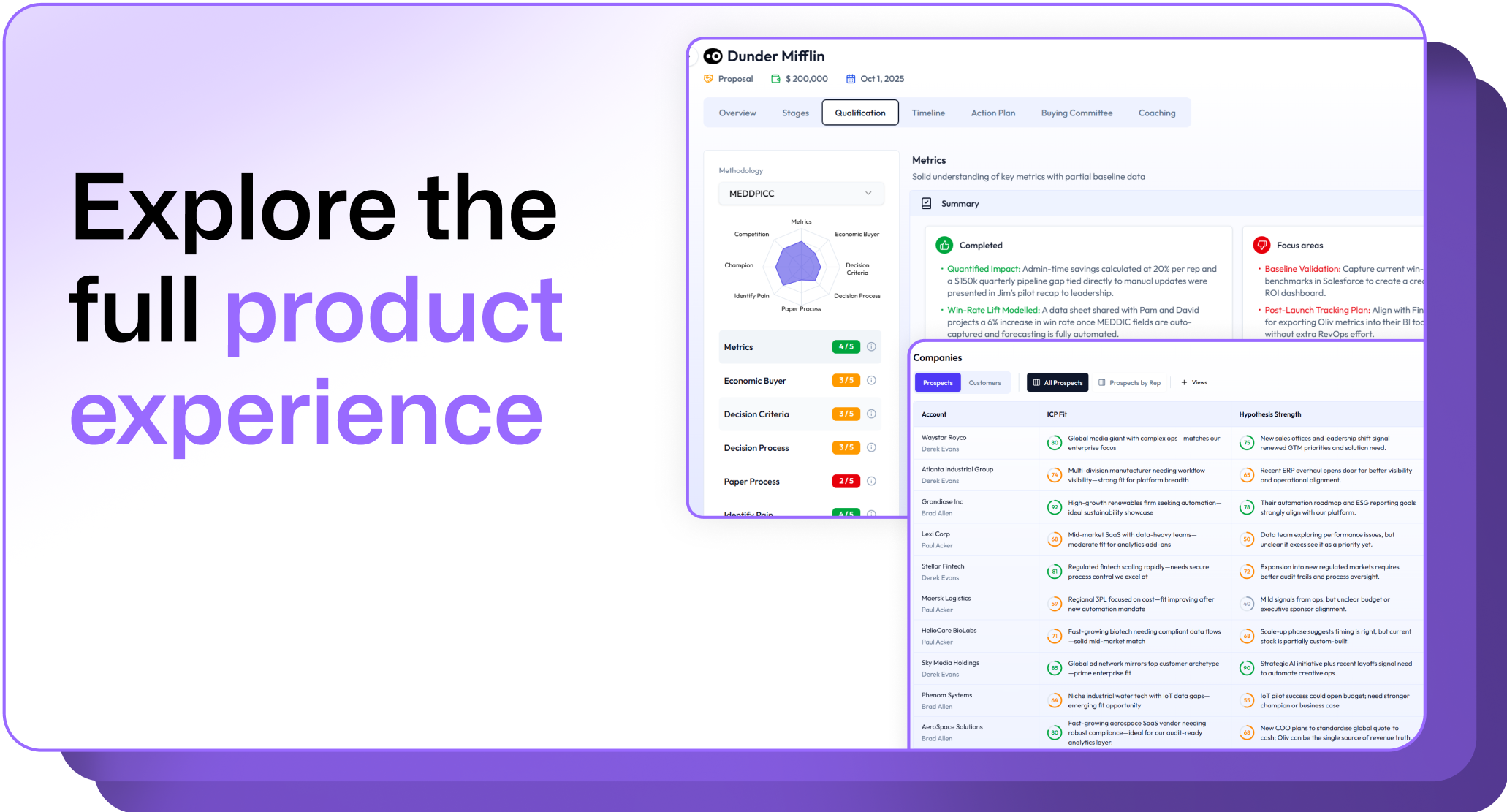
.avif)
.png)








.png)
.png)
.png)