Deal Intelligence Software: How AI Predicts Pipeline Risks & Prevents Deal Slippage
Written by
Ishan Chhabra
Last Updated :
December 27, 2025
Skim in :
12
mins
In this article
Revenue teams love Oliv
Here’s why:
All your deal data unified (from 30+ tools and tabs).
Insights are delivered to you directly, no digging.
AI agents automate tasks for you.
Thank you! Your submission has been received!
Oops! Something went wrong while submitting the form.
Meet Oliv’s AI Agents
Hi! I’m, Deal Driver
I track deals, flag risks, send weekly pipeline updates and give sales managers full visibility into deal progress
Hi! I’m, CRM Manager
I maintain CRM hygiene by updating core, custom and qualification fields all without your team lifting a finger
Hi! I’m, Forecaster
I build accurate forecasts based on real deal movement and tell you which deals to pull in to hit your number
Hi! I’m, Coach
I believe performance fuels revenue. I spot skill gaps, score calls and build coaching plans to help every rep level up
Hi! I’m, Prospector
I dig into target accounts to surface the right contacts, tailor and time outreach so you always strike when it counts
Hi! I’m, Pipeline tracker
I call reps to get deal updates, and deliver a real-time, CRM-synced roll-up view of deal progress
Hi! I’m, Analyst
I answer complex pipeline questions, uncover deal patterns, and build reports that guide strategic decisions
TL;DR
✅ Deal Intelligence transcends meeting recordings by synthesizing 100+ signals across emails, CRM, calls, and support tickets into unified 360° deal health views.
✅ AI-native platforms improve forecast accuracy 25-40% through bottom-up deal inspection vs. biased rep self-assessment, detecting risks 3+ weeks earlier.
✅ Automated qualification frameworks (MEDDPICC, BANT) eliminate manual CRM data entry, extracting signals from conversation context to maintain "spotless" pipeline data.
✅ Agentic architecture autonomously executes tasks (CRM updates, forecast generation, risk alerts) vs. passive dashboards requiring manual interpretation and follow-up.
✅ Modern platforms deploy in 5-10 minutes with modular pricing (pay-per-agent) vs. legacy 8-24 week implementations costing $500/user/month when stacking tools.
✅ Role-specific intelligence delivery (reps get CRM automation, managers get risk alerts, RevOps get strategic analytics) drives 80%+ adoption vs. one-size-fits-all dashboards.
Q1. What Exactly Is Deal Intelligence Software? [toc=Definition & Overview]
Deal Intelligence Software is a category of revenue technology that provides comprehensive, 360-degree visibility across the entire deal lifecycle by consolidating data from every sales touchpoint including calls, emails, meetings, CRM records, support tickets, and external web signals into a unified platform. Unlike traditional Conversational Intelligence (CI) tools that focus solely on meeting-level documentation, Deal Intelligence synthesizes cross-channel activities to deliver predictive insights, automated risk detection, and actionable recommendations that help sales teams close deals faster and more predictably.
📊 Meeting Intelligence vs. Deal Intelligence
The distinction between Meeting Intelligence and Deal Intelligence represents a fundamental shift in how revenue teams approach pipeline management. Meeting Intelligence now largely commoditized by free native features in Zoom, Microsoft Teams, and Google Meet focuses on recording, transcribing, and analyzing individual sales conversations. These tools capture what was said in isolated interactions but lack the connective tissue to understand broader deal health.
Deal Intelligence platforms elevate this capability by stitching together signals from:
Call recordings and transcripts across all conferencing platforms
Email exchanges between sellers and buying committees
CRM activity data including opportunity updates and field changes
Calendar engagement patterns showing meeting cadence and stakeholder participation
Support ticket interactions revealing customer pain points
External web data such as company news, funding rounds, and personnel changes
This comprehensive data aggregation enables the software to perform deal health scoring, pipeline risk analysis, and predictive forecasting that isolated meeting recordings simply cannot achieve.
✅ Core Capabilities Defined
Deal Intelligence platforms perform three essential functions. First, they automate qualification framework extraction analyzing conversations to populate MEDDPICC, BANT, or custom methodology fields without manual rep input. Second, they identify at-risk deals proactively by monitoring engagement velocity, stakeholder mapping completeness, and buyer responsiveness patterns. Third, they generate predictive forecasts using bottom-up deal inspection rather than rep-driven subjective assessments.
"Before Gong we had a lack of visibility across our deals because information was siloed in several places like CRM, Email, Zoom, phone. Now all of this is centralized in one view." Scott T., Director of Sales, G2 Verified Review
⚠️ The Evolution From Documentation to Orchestration
Three-generation timeline illustrating progression from keyword-based call recording tools through rule-based automation attempts to autonomous AI agent execution for comprehensive pipeline management.
The market is transitioning from "documentation-heavy" Conversational Intelligence to AI-Native Revenue Orchestration. First-generation CI tools (2015-2022) like Gong and Chorus provided keyword-based call recording a valuable but now commoditized capability. The current generation of Deal Intelligence goes beyond passive observation to active orchestration, where AI agents autonomously update CRM fields, generate follow-up recommendations, and predict which deals require immediate intervention.
How Oliv.ai Simplifies Deal Intelligence: Oliv.ai represents the next evolution by offering AI agents that don't just analyze deals they execute tasks autonomously. The platform consolidates 100+ data points from every sales activity into a unified deal view, then deploys specialized agents to handle CRM updates, stakeholder tracking, and forecast generation without manual human effort, transforming Deal Intelligence from an insights dashboard into an autonomous revenue engine.
Q2. How Has Deal Intelligence Evolved from CRM Reports to AI Agents? [toc=Evolution & History]
Sales technology has progressed through distinct generations, each addressing deeper layers of revenue operations complexity. Understanding this evolution reveals why modern teams are abandoning legacy platforms in favor of AI-native solutions that reduce rather than increase manual workload.
📅 First Generation (2015-2022): The Conversational Intelligence Era
The First Generation focused on baseline Conversational Intelligence, where platforms like Gong and Chorus dominated by providing call recording, transcription, and keyword-based "Smart Trackers". These tools represented a breakthrough sales managers could finally listen to customer conversations without shadowing reps on every call, and new hires could ramp faster by studying top performer recordings.
However, CI tools suffered from fundamental limitations. Their keyword-based trackers used V1 Machine Learning that often flagged irrelevant mentions for instance, triggering a "budget" alert when a prospect discussed their holiday shopping budget rather than deal financials. More critically, these platforms became commoditized as Zoom, Teams, and Google Meet added free native recording capabilities, making it increasingly difficult to justify premium pricing for documentation alone.
"It was a big mistake on our part to commit to a two year term. Gong is a really powerful tool but it's probably the highest end option on the market... I don't think Gong did anything wrong here, it's just far from the right fit for us." Iris P., Head of Marketing, Sales & Partnerships, G2 Verified Review
❌ Second Generation (2022-2025): The False Promise of Automation
The Second Generation attempted autonomous workflows through "Revenue Orchestration," but solutions remained constrained by rule-based logic and fragmented data silos. Platforms like Clari added forecasting layers, but the process remained heavily manual managers still spent Thursdays and Fridays updating spreadsheets with reps before Monday forecasting calls. Gong introduced "Deal Boards" to centralize information, yet users reported needing to "click through ten screens just to find something useful".
This generation exposed a critical flaw: these tools required heavy human adoption, training, and manual input to deliver value. The sentiment emerged that "SaaS is a dirty word" because traditional software platforms added documentation layers without reducing the actual work burden on revenue teams.
✅ Third Generation (2025 and Beyond): AI-Native Revenue Orchestration
The Third Generation AI-Native Revenue Orchestration represents a paradigm shift from passive reporting to autonomous execution. Modern Deal Intelligence platforms don't just document activities or provide dashboards; they deploy AI agents that consolidate 100+ data points from every sales touchpoint (emails, calls, meetings, CRM updates, support tickets, web signals) into unified 360-degree deal views, then autonomously execute tasks.
This evolution addresses the "Trough of Disillusionment" with first-generation AI tools that promised automation but delivered more manual work. Instead of requiring reps to log into separate platforms and interpret insights, AI agents deliver intelligence "where you live" directly in Slack or email and handle execution automatically.
🚀 Oliv.ai: The Agentic Revolution
Oliv.ai embodies this third-generation shift with a workforce of specialized AI agents. The CRM Manager agent automatically enriches accounts and updates qualification fields (MEDDPICC, BANT) by analyzing conversation context across 100+ sales methodologies eliminating manual data entry. The Deal Driver agent proactively flags at-risk deals requiring attention daily, providing weekly pipeline breakdowns that let managers rescue deals before they slip. The Forecaster agent generates unbiased bottom-up roll-ups with AI commentary, predicting slippage based on real conversation signals rather than rep optimism.
Unlike legacy SaaS platforms you must "adopt," Oliv's agents autonomously do the work for you updating CRM fields, creating Mutual Action Plans, generating forecasts without requiring dashboards, training sessions, or manual intervention.
Q3. How Does Deal Intelligence Software Actually Work? [toc=Technical Architecture]
Deal Intelligence platforms operate through a three-layer architecture that transforms raw sales activity data into predictive insights and automated actions. Understanding this technical framework clarifies how modern systems differ fundamentally from legacy documentation tools.
Five-stage horizontal process flow depicting modern deal intelligence architecture: multi-source data gathering, AI-powered NLP analysis, output generation creating health scores, action execution automating CRM updates, and Oliv.ai's agentic layer.
🔄 Layer 1: Multi-Source Data Ingestion
The foundation of Deal Intelligence is comprehensive data aggregation. Modern platforms connect to every system where sales interactions occur:
Communication channels: Zoom, Microsoft Teams, Google Meet, phone systems (Aircall, Dialpad), email (Gmail, Outlook), and messaging platforms (Slack, Microsoft Teams chat)
CRM systems: Salesforce, HubSpot, Microsoft Dynamics, with bi-directional sync capturing opportunity updates, stage progressions, and field changes
Customer support platforms: Zendesk, Intercom, Freshdesk, revealing post-sale pain points
External web data: Company news feeds, funding announcements, personnel changes, competitive intelligence
This multi-channel ingestion creates a unified data lake representing the complete customer journey from first prospecting touch through closed-won and renewal cycles.
🧠 Layer 2: AI-Powered Analysis and Pattern Recognition
Raw data becomes actionable intelligence through multiple analytical processes:
Natural Language Processing (NLP): Advanced models analyze conversation transcripts to extract qualification signals (budget authority, decision criteria, pain points, timelines) and automatically populate sales methodology frameworks like MEDDPICC or BANT without manual rep input.
Stakeholder Mapping: AI identifies all participants in the buying committee, tracks their engagement patterns, and flags single-threaded deals where only one contact has been engaged after 30+ days a high-risk indicator.
Engagement Velocity Tracking: The system monitors response times, meeting frequency, and email open rates to calculate deal momentum. Algorithms detect when velocity stalls (e.g., >48-hour email response delays) and correlate these slowdowns with increased slip risk.
Sentiment and Objection Detection: Beyond keyword matching, generative AI models assess tone, identify concerns (pricing hesitations, competitive mentions, technical blockers), and surface objections that might otherwise hide in lengthy call transcripts.
Predictive Forecasts: Bottom-up pipeline inspection generating unbiased roll-ups with AI commentary on expected slippage and pull-ins
Automated CRM Updates: Direct field population maintaining data accuracy without rep manual entry
Next-Step Recommendations: Contextual guidance on which deals need attention and what actions to take
"No way to collaborate / share a library of top calls, AI is not great (yet) the product still feels like its at its infancy and needs to be developed further." Annabelle H., Voluntary Director, G2 Verified Review
⚡ How Oliv.ai's Architecture Differs
Oliv.ai's three-layer approach emphasizes autonomous execution over passive reporting. The Baseline Layer provides free recording and transcription to commoditize legacy CI. The Intelligence Layer delivers deal-level context through MEDDPICC scorecards and stakeholder mapping extracted from 100+ data sources. The Agentic Layer is where differentiation occurs specialized agents like CRM Manager, Deal Driver, and the unique Voice Agent (which calls reps nightly to capture context missed in recorded meetings) autonomously execute tasks rather than requiring humans to interpret dashboards and manually take action. This architecture shifts Deal Intelligence from an insights tool to an autonomous revenue workforce.
Q4. What Are the Proven Benefits of Deal Intelligence? [Statistics & ROI] [toc=Business Benefits]
Deal Intelligence platforms deliver measurable business outcomes across forecasting accuracy, risk mitigation, win rates, and operational efficiency. Understanding these quantified impacts helps revenue leaders build business cases for adoption.
Traditional forecasting relies on rep self-assessment and subjective CRM stage updates, creating inflated pipelines where "commit" deals frequently slip. AI-powered Deal Intelligence analyzes objective signals email response velocity, stakeholder engagement completeness, MEDDPICC qualification depth to predict outcomes independently of rep optimism.
Organizations implementing AI-native health scoring report 25-40% higher forecast accuracy compared to manual rep-driven approaches. This improvement stems from bottom-up deal inspection where algorithms autonomously evaluate every opportunity rather than trusting rep sentiment. Sales managers at companies like Sprinto note that legacy forecasting remained "rep-driven and biased," with reps "showing only what they want managers to see" during weekly reviews.
"Clari has a great team that is responsive and supportive... I like their deal analytics and forecasting modules that overlay on our Salesforce intelligence and insights." Dan J., Mid-Market Company, G2 Verified Review
⏰ Earlier Risk Detection (3+ Weeks Advantage)
Deal Intelligence platforms identify at-risk opportunities 3+ weeks earlier than traditional manual pipeline reviews by continuously monitoring engagement patterns, velocity stalls, and stakeholder mapping gaps. This early warning system allows managers to intervene before deals become unrecoverable.
Key risk signals include:
>48-hour email response delays correlating with 60% higher slip risk
Single-stakeholder engagement after 30 days signaling disqualification risk
Missed Mutual Action Plan milestones indicating deal momentum loss
Velocity stalls where meeting frequency drops or next steps go undefined
By surfacing hidden risks proactively, Deal Intelligence prevents the painful phenomenon of "commit" deals pushing to future quarters. Organizations report 40% fewer slipped deals when using AI-native platforms that flag warning signals automatically rather than relying on managers to manually audit calls.
This reduction stems from continuous deal auditing where AI agents monitor 100+ data points across every sales activity emails, calls, meetings, CRM updates, support tickets identifying gaps invisible to human managers burdened by reviewing dozens of concurrent deals.
⚡ Manager Time Savings (60-70% Reduction in Pipeline Review Time)
Sales managers traditionally spend hours on "late-night call reviews" or listen to recordings while driving because manual auditing is the only way to maintain pipeline visibility. Deal Intelligence automates this continuous monitoring, surfacing only deals requiring human attention.
Organizations report 60-70% reduction in manager pipeline review time because AI agents handle the heavy lifting of deal inspection, flagging risks automatically rather than requiring managers to listen to every call and read every email thread.
"I like that Gong allows sales managers to listen to calls from our reps. Great concept that saves time (ie managers are now doing call quality, not need for call quality specialists)." Annabelle H., Voluntary Director, G2 Verified Review
✅ Higher Win Rates Through Data-Driven Coaching
Deal Intelligence enables managers to identify winning behaviors and replicate them across teams. By analyzing top performers' conversation patterns talk-to-listen ratios, objection handling techniques, discovery question depth platforms provide coaching insights that improve rep effectiveness.
Additionally, automated MEDDPICC/BANT extraction ensures qualification rigor, preventing under-qualified deals from consuming sales capacity. This qualification discipline increases overall win rates by focusing efforts on viable opportunities.
🚀 Oliv.ai's ROI Advantage
Oliv.ai accelerates time-to-value with 5-minute configuration versus the 8-24 weeks required for platforms like Gong. The modular agent architecture allows teams to deploy specific capabilities (CRM Manager for reps, Deal Driver for managers, Forecaster for RevOps) without paying for unused features, addressing the cost concerns of stacking multiple platforms. Organizations using Oliv report the quantified benefits above while eliminating the manual adoption burden plaguing legacy SaaS tools.
Q5. How to Identify Deal Risks Before They Impact Your Pipeline? [Warning Signals Table] [toc=Warning Signals]
Proactive risk detection requires monitoring specific behavioral signals that correlate with deal deterioration. Revenue teams often lose visibility when deals enter what sales managers call "the silent zone" where activity metrics decline but reps remain optimistic about close dates.
Meeting frequency drops by 50%+ within 2-week period
No calendar holds for follow-up conversations post-demo
Champion ghosting after previously consistent weekly touchpoints
2. Stakeholder Mapping Gaps
Single-threaded deals (only 1 contact engaged after 30+ days) = disqualify signal
Economic buyer absence from discovery or demo conversations
No executive-level engagement in enterprise deals (>$50K ACV)
Decision-maker title changes without re-establishing contact
3. Qualification Framework Incompleteness
MEDDPICC scores below 60% after 3+ customer interactions
Undefined budget authority beyond day 45 of sales cycle
Vague timelines ("sometime this quarter") without specific business event triggers
No documented pain tied to measurable business impact
4. Competitive and Timeline Indicators
Competitor mentions increasing in frequency across calls
Timeline pushes exceeding 2 weeks from original close date
Missed Mutual Action Plan milestones without reschedule
Pricing objections surfacing late in cycle (post-proposal stage)
"As a Series B startup we rely on the intelligence and insights from Gong to understand and scale what's working, and to better understand real risk and opportunity."
Deal Risk Warning Signals and Intervention Windows
Warning Signal
Risk Level
Slip Probability
Intervention Window
>48hr response delay
🔴 High
60%
72 hours
Single stakeholder after 30 days
🔴 High
75%
Immediate
MEDDPICC <40% completion
🟠 Medium
45%
1-2 weeks
Timeline push (2+ weeks)
🟠 Medium
50%
1 week
Competitor mentioned 3+ times
🟡 Moderate
35%
2-3 weeks
Meeting frequency -30%
🟡 Moderate
30%
2 weeks
"It's too complicated, and not intuitive at all. Using it is very...discomforting. Searching for calls is not easy, moving around in the calls is not easy, and understanding the pipeline management portion of it is almost impossible." John S., Senior Account Executive, G2 Verified Review
✅ Automated Detection Advantages
Manual pipeline reviews miss early warning signs because managers cannot audit every email thread, calendar pattern, and conversation across dozens of concurrent deals. Deal Intelligence platforms monitor these signals continuously, flagging at-risk opportunities 3+ weeks earlier than traditional weekly forecast calls.
How Oliv.ai Simplifies Risk Detection: Oliv.ai's Deal Driver agent performs continuous monitoring across 100+ behavioral signals, automatically surfacing at-risk deals in daily Slack digests without requiring managers to log into dashboards. The platform doesn't just flag risks it provides contextual recommendations (e.g., "Schedule executive alignment call within 48 hours" or "Update MEDDPICC Pain and Champion fields before Friday forecast call") that transform alerts into actionable interventions.
Q6. What Is Deal Health Scoring and How Does It Predict Outcomes? [toc=Health Scoring]
Traditional forecasting relies on rep self-assessment a subjective process where optimism bias and incomplete deal visibility create inflated pipelines. Deal health scoring transforms forecasting into an objective science by analyzing behavioral signals that correlate with win rates, independent of rep sentiment.
📉 The Rep-Driven Forecasting Problem
Sales managers like Suraj at Sprinto describe a chronic issue: "The rep is driving the conversation, showing only what they want the manager to see while hiding stalled deals." Weekly pipeline reviews become performance theater where reps defend optimistic stage progressions without addressing underlying deal health deterioration.
Legacy platforms like Clari require manual manager roll-ups a time-intensive process where managers spend Thursdays and Fridays consolidating rep spreadsheets before Monday forecasting calls. This approach remains heavily rep-driven and biased, lacking visibility into the behavioral signals that actually predict outcomes.
"What I find least helpful is that some of the features that are reported don't actually tell me where that information is coming from. I.e. Where my weighted number is coming from or how it is being calculated would be helpful." Jezni W., Sales Account Executive, G2 Verified Review
🧠 AI-Powered Objective Health Assessment
Modern Deal Intelligence platforms calculate health scores by analyzing multiple objective dimensions invisible to manual review:
MEDDPICC Qualification Completeness: Percentage of methodology fields populated from actual conversation context (not manual rep entry)
Engagement Velocity Trends: Response time patterns, meeting frequency consistency, calendar hold rates for next steps
Buying Committee Mapping: Identification of champions, economic buyers, technical evaluators, and blockers with sentiment analysis per role
These signals are weighted algorithmically based on historical win/loss correlation, creating composite scores (typically 0-100) that predict close probability independently of rep optimism.
AI-native health scoring demonstrates 25-40% higher forecast accuracy compared to manual rep-driven approaches by performing bottom-up deal inspection where algorithms autonomously evaluate every opportunity rather than trusting aggregated rep sentiment.
This shift enables RevOps teams to allocate resources strategically, intervening 3+ weeks earlier on at-risk deals before they become unrecoverable. Instead of reactive "why did this slip?" post-mortems, managers receive proactive "this will slip unless..." interventions with specific remediation actions.
🚀 Oliv.ai's Forecaster Agent Advantage
We've built the Forecaster agent to eliminate the manual forecasting burden entirely. Instead of requiring managers to consolidate spreadsheets and interpret rep updates, Forecaster performs autonomous bottom-up roll-ups with AI commentary predicting slippage and pull-ins based on real conversation signals not rep sentiment.
The agent analyzes every deal continuously, generating unbiased weekly forecasts that surface hidden risks (e.g., "Deal XYZ shows 68% health score but economic buyer hasn't engaged in 18 days recommend executive alignment call"). This transforms forecasting from a stressful "Monday tradition" into a continuous, data-driven process where managers rescue deals proactively rather than reacting to surprises.
Q7. How Does Deal Intelligence Automate Sales Qualification Frameworks Like MEDDPICC? [toc=Automated Qualification]
Manual qualification data entry represents one of sales operations' most persistent challenges. Reps neglect CRM updates due to time constraints and perceived administrative burden, creating what industry experts call "dirty data" that undermines strategic decision-making.
❌ The Manual Qualification Burden
Legacy CRM systems depend on reps to manually populate opportunity scorecards after every customer interaction. However, sources highlight that "CRM as a product has failed" because this manual approach creates systematic data quality issues:
Delayed updates: Reps batch CRM work to end-of-week, losing contextual details from earlier conversations
Incomplete qualification: Time pressure leads to minimal field completion (e.g., "Budget: TBD" or "Pain: Cost reduction")
Subjective interpretation: Different reps extract different signals from identical conversations
Gaming behavior: Reps inflate qualification scores to move deals forward in stage-gated processes
Deal Intelligence platforms solve this by analyzing unstructured conversation data call transcripts, email threads, meeting notes to automatically extract qualification signals and populate methodology frameworks without manual rep intervention.
MEDDPICC Automation Example:
Metrics: AI identifies quantified pain statements ("We're losing $2M annually to manual processes")
Economic Buyer: NLP recognizes decision-maker participation and budget authority discussions
Decision Criteria: Extracts evaluation requirements from discovery conversations
Decision Process: Maps timeline, approval layers, and procurement steps mentioned in calls
Champion: Detects internal advocates based on engagement patterns and advocacy language
Competition: Flags competitor mentions with sentiment analysis (threat vs. dismissed)
Platforms like Oliv.ai are trained on 100+ sales methodologies, enabling customization beyond MEDDPICC to support BANT, SPIN, Challenger, SPICED, or proprietary frameworks.
Automated extraction delivers dual benefits: CRM hygiene and rep enablement. Sales managers gain confidence in pipeline data because qualification depth becomes consistent across all reps, while frontline sellers receive real-time coaching prompts (e.g., "Economic buyer not identified schedule executive alignment call") that improve discovery rigor.
Organizations report that Deal Intelligence platforms eliminate the "meaningless data" problem by ensuring Opportunity Scorecards reflect actual conversation context rather than rushed manual entries, enabling accurate forecasting and strategic resource allocation.
How Oliv.ai Automates Qualification: Our CRM Manager agent analyzes every sales conversation to automatically populate MEDDPICC, BANT, and custom qualification fields in real-time, keeping CRM data "spotless" without rep manual work. The agent doesn't just fill fields it provides confidence scores per criterion and flags gaps requiring attention, transforming CRM from an administrative burden into a strategic asset that guides sellers toward high-quality deals.
Q8. What Are the Key Features of Modern Deal Intelligence Platforms? [Integration Hub Concept] [toc=Key Features]
Contemporary Deal Intelligence platforms transcend isolated point solutions by functioning as the "connective tissue" that unifies fragmented sales technology stacks. Understanding core capabilities reveals how modern systems differ from legacy documentation tools.
🔄 Comprehensive Data Aggregation (360° View)
Modern platforms integrate with every system where sales interactions occur:
External: Web data feeds (funding, personnel changes, competitive intelligence)
This consolidation creates unified deal views synthesizing 100+ data points from every touchpoint eliminating the information silos described by users where "information was siloed in several places like CRM, Email, Zoom, phone".
"Before Gong we had a lack of visibility across our deals because information was siloed in several places like CRM, Email, Zoom, phone. Now all of this is centralized in one view via the Gong deal boards." Scott T., Director of Sales, G2 Verified Review
📊 Core Analytical Capabilities
Hub-and-spoke diagram illustrating five interconnected deal intelligence capabilities: health scoring with velocity trends, risk alert systems for engagement drops, stakeholder mapping, conversation intelligence, and automated CRM enrichment.
CRM remains single source of truth (not data holder competing with Salesforce)
Bi-directional sync ensures updates flow seamlessly between systems
Universal data layer eliminates need for point-to-point integrations between tools
Consolidated intelligence surfaces insights impossible when tools operate independently
"While Gong offers valuable insights into call data and sales interactions, our experience has been impacted by significant data access limitations, especially concerning data portability and bulk export capabilities." Neel P., Sales Operations Manager, G2 Verified Review
✅ Modular vs. One-Size-Fits-All
Legacy platforms bundle features into expensive unified licenses, forcing organizations to pay for unused capabilities. Modern systems offer modular architectures where teams deploy specific agents for specific roles e.g., conversation intelligence for reps, forecast automation for managers, strategic analytics for RevOps.
How Oliv.ai Serves as Integration Hub: We position as the connective layer unifying your existing stack pulling data from all sources while maintaining your CRM as the single source of truth through open bi-directional sync. Our agent architecture deploys targeted capabilities (CRM Manager for data hygiene, Deal Driver for risk monitoring, Forecaster for predictive roll-ups) without requiring wholesale platform replacement, delivering 5-minute setup versus the 8-24 weeks traditional implementations demand.
Q9. Deal Intelligence for Different Sales Roles: How Do Managers, AEs, and RevOps Use It Differently? [toc=Role-Specific Usage]
Sales technology adoption fails when platforms apply one-size-fits-all interfaces across roles with fundamentally different operational needs. Account Executives managing 15-20 concurrent deals require different intelligence than managers overseeing 150+ opportunities across 8 reps, yet legacy platforms force both personas to navigate identical dashboards.
❌ The One-Size-Fits-All Problem
Traditional CI platforms like Gong provide unified dashboards where all roles reps, managers, RevOps must "dig through" the same interface to extract relevant insights. This creates systematic adoption friction as each persona faces irrelevant information overload.
Sales managers report needing to "click through ten screens just to find something useful" when reviewing pipeline health, while reps complain about "dashboard fatigue" from navigating features designed for management visibility rather than task completion. RevOps teams struggle to extract strategic patterns when interfaces prioritize individual deal inspection over cross-pipeline analytics.
"It's too complicated, and not intuitive at all. Using it is very...discomforting. Searching for calls is not easy, moving around in the calls is not easy, and understanding the pipeline management portion of it is almost impossible." John S., Senior Account Executive, G2 Verified Review
Bundled pricing compounds this misalignment organizations pay for comprehensive licenses covering features entire teams won't use. Gong's Forecast and Engage modules add cost regardless of whether frontline AEs need forecasting capabilities, while stacking Gong + Clari approaches $500 per user per month with significant capability overlap.
✅ Role-Specific Intelligence Requirements
Modern Deal Intelligence recognizes that each persona needs distinct workflows:
Account Executives (Frontline Reps):
Automated next-step recommendations eliminating manual "what do I do next?" analysis
CRM auto-population removing administrative data entry burden
Quick deal context retrieval before customer calls without dashboard navigation
Compliance alerts for methodology completion (MEDDPICC gaps requiring attention)
We've designed a role-targeted agent deployment model where each persona activates only the capabilities they need. CRM Manager eliminates rep data entry by automatically populating Opportunity Scorecards from conversation context across 100+ sales methodologies reps never log into a separate platform.
Deal Driver provides managers with daily Slack digests flagging at-risk deals with specific intervention recommendations (e.g., "Schedule executive alignment for Deal XYZ within 48 hours"), eliminating manual pipeline auditing. The Analyst agent enables RevOps to query pipelines in plain English ("Show me deals stalled in Legal Review >30 days"), delivering strategic insights without requiring SQL or dashboard configuration.
This modular approach addresses the cost concerns of bundled platforms teams "pay-for-what-you-use" by deploying specific agents for specific roles rather than purchasing unused enterprise licenses. Organizations report 80%+ rep engagement because agents deliver intelligence "where you live" (Slack/Email) rather than requiring separate platform logins that disrupt workflow.
"Clari makes it extremely easy to quickly get the information I need across many different teams and opportunities. It is all organized very nearly and the interface is so clean and simple to work with." Kevin W., Manager Solution Engineering, G2 Verified Review
Q10. What Should You Look for When Choosing Deal Intelligence Software? [Agentic vs. Passive Intelligence] [toc=Buyer's Guide]
Selecting Deal Intelligence platforms requires evaluating capabilities beyond surface-level feature lists. Revenue leaders should assess how systems fundamentally approach intelligence generation and action execution.
Side-by-side visual contrasting modern deal intelligence advantages like 360° data aggregation and bi-directional sync against legacy platform limitations including manual exports and complex analytics.
📊 Critical Evaluation Criteria
1. Data Source Breadth (360° vs. Meeting-Only Coverage)
Comprehensive platforms aggregate signals from:
✅ Communication channels (Zoom, Teams, email, phone, Slack)
✅ Support interactions (Zendesk, Intercom tickets)
✅ External web data (funding, personnel changes, competitive intelligence)
Legacy CI tools focus narrowly on meeting recordings, missing 70%+ of customer touchpoints that inform deal health.
2. CRM Integration Depth (Bi-Directional vs. One-Way Sync)
Evaluate whether platforms:
✅ Maintain CRM as single source of truth (not competing data holder)
✅ Enable bi-directional field sync (updates flow both directions)
✅ Support custom field mapping for proprietary methodologies
❌ Require manual data exports or API development for extraction
"While Gong offers valuable insights into call data and sales interactions, our experience has been impacted by significant data access limitations, especially concerning data portability and bulk export capabilities." Neel P., Sales Operations Manager, G2 Verified Review
⚡ Agentic Action vs. Passive Insights
The fundamental differentiation lies in execution approach:
Passive Intelligence (Traditional SaaS):
Provides insights dashboards requiring human interpretation
Flags risks but requires manual follow-up action
Delivers data requiring managers to decide next steps
Adds documentation layers without reducing workload
Support for 100+ sales methodologies (MEDDPICC, BANT, SPIN, Challenger, custom frameworks)
Fine-tuning capabilities on organization-specific data vs. generic pre-trained models
White-glove configuration services vs. self-service-only setup
Hallucination prevention through grounded LLMs vs. generic AI responses
How Oliv.ai Addresses Buyer Criteria: Oliv.ai delivers 360° data aggregation across all sales touchpoints while maintaining CRM as the single source of truth through open bi-directional sync. Our agentic architecture autonomously executes tasks rather than providing passive dashboards, with 5-minute configuration versus 8-24 week traditional implementations. Modular pricing enables role-targeted deployment without paying for unused enterprise features, while free data migration services eliminate switching friction from legacy platforms.
Q11. How to Implement Deal Intelligence: Getting Started and Measuring Success [toc=Implementation Guide]
Successful Deal Intelligence deployment requires structured implementation frameworks and clear success metrics that justify investment and guide optimization.
⏰ Phase 1: Rapid Configuration (Week 1)
Technical Setup Steps:
Integration Connections (Day 1-2)
Connect CRM (Salesforce, HubSpot, Dynamics) with field mapping
Authorize communication platforms (Zoom, Teams, Meet, email)
Link sales engagement tools (Outreach, Salesloft, dialers)
Set role-specific agent permissions (rep vs. manager views)
Conduct 30-minute walkthrough sessions
Modern AI-native platforms complete this in 5-10 minutes with pre-configured templates versus legacy systems requiring 8-24 weeks for tracker setup, training data collection, and dashboard customization.
📈 Phase 2: Adoption Strategies (Weeks 2-4)
"Where-You-Live" Delivery Approach:
Maximize engagement by delivering intelligence directly in existing workflows rather than requiring separate platform logins:
Daily Slack digests with at-risk deal alerts
Email summaries of weekly pipeline changes
Calendar notifications for methodology gaps before customer calls
CRM-embedded health scores visible in opportunity records
Organizations report 80%+ rep adoption when agents deliver insights in Slack/Email versus <40% adoption for dashboard-dependent platforms requiring separate logins.
How Oliv.ai Accelerates Implementation: Oliv.ai's instant configuration (5 minutes) eliminates multi-month implementations through pre-trained models fine-tuned on your data within 2-4 weeks. We provide free complete migration services importing historical Gong recordings and metadata at no additional cost while agents deliver intelligence directly in Slack/Email rather than requiring dashboard training. This approach achieves 80%+ adoption in the first month versus the industry-standard 6-12 month ramp periods for legacy platforms.
Q1. What Exactly Is Deal Intelligence Software? [toc=Definition & Overview]
Deal Intelligence Software is a category of revenue technology that provides comprehensive, 360-degree visibility across the entire deal lifecycle by consolidating data from every sales touchpoint including calls, emails, meetings, CRM records, support tickets, and external web signals into a unified platform. Unlike traditional Conversational Intelligence (CI) tools that focus solely on meeting-level documentation, Deal Intelligence synthesizes cross-channel activities to deliver predictive insights, automated risk detection, and actionable recommendations that help sales teams close deals faster and more predictably.
📊 Meeting Intelligence vs. Deal Intelligence
The distinction between Meeting Intelligence and Deal Intelligence represents a fundamental shift in how revenue teams approach pipeline management. Meeting Intelligence now largely commoditized by free native features in Zoom, Microsoft Teams, and Google Meet focuses on recording, transcribing, and analyzing individual sales conversations. These tools capture what was said in isolated interactions but lack the connective tissue to understand broader deal health.
Deal Intelligence platforms elevate this capability by stitching together signals from:
Call recordings and transcripts across all conferencing platforms
Email exchanges between sellers and buying committees
CRM activity data including opportunity updates and field changes
Calendar engagement patterns showing meeting cadence and stakeholder participation
Support ticket interactions revealing customer pain points
External web data such as company news, funding rounds, and personnel changes
This comprehensive data aggregation enables the software to perform deal health scoring, pipeline risk analysis, and predictive forecasting that isolated meeting recordings simply cannot achieve.
✅ Core Capabilities Defined
Deal Intelligence platforms perform three essential functions. First, they automate qualification framework extraction analyzing conversations to populate MEDDPICC, BANT, or custom methodology fields without manual rep input. Second, they identify at-risk deals proactively by monitoring engagement velocity, stakeholder mapping completeness, and buyer responsiveness patterns. Third, they generate predictive forecasts using bottom-up deal inspection rather than rep-driven subjective assessments.
"Before Gong we had a lack of visibility across our deals because information was siloed in several places like CRM, Email, Zoom, phone. Now all of this is centralized in one view." Scott T., Director of Sales, G2 Verified Review
⚠️ The Evolution From Documentation to Orchestration
Three-generation timeline illustrating progression from keyword-based call recording tools through rule-based automation attempts to autonomous AI agent execution for comprehensive pipeline management.
The market is transitioning from "documentation-heavy" Conversational Intelligence to AI-Native Revenue Orchestration. First-generation CI tools (2015-2022) like Gong and Chorus provided keyword-based call recording a valuable but now commoditized capability. The current generation of Deal Intelligence goes beyond passive observation to active orchestration, where AI agents autonomously update CRM fields, generate follow-up recommendations, and predict which deals require immediate intervention.
How Oliv.ai Simplifies Deal Intelligence: Oliv.ai represents the next evolution by offering AI agents that don't just analyze deals they execute tasks autonomously. The platform consolidates 100+ data points from every sales activity into a unified deal view, then deploys specialized agents to handle CRM updates, stakeholder tracking, and forecast generation without manual human effort, transforming Deal Intelligence from an insights dashboard into an autonomous revenue engine.
Q2. How Has Deal Intelligence Evolved from CRM Reports to AI Agents? [toc=Evolution & History]
Sales technology has progressed through distinct generations, each addressing deeper layers of revenue operations complexity. Understanding this evolution reveals why modern teams are abandoning legacy platforms in favor of AI-native solutions that reduce rather than increase manual workload.
📅 First Generation (2015-2022): The Conversational Intelligence Era
The First Generation focused on baseline Conversational Intelligence, where platforms like Gong and Chorus dominated by providing call recording, transcription, and keyword-based "Smart Trackers". These tools represented a breakthrough sales managers could finally listen to customer conversations without shadowing reps on every call, and new hires could ramp faster by studying top performer recordings.
However, CI tools suffered from fundamental limitations. Their keyword-based trackers used V1 Machine Learning that often flagged irrelevant mentions for instance, triggering a "budget" alert when a prospect discussed their holiday shopping budget rather than deal financials. More critically, these platforms became commoditized as Zoom, Teams, and Google Meet added free native recording capabilities, making it increasingly difficult to justify premium pricing for documentation alone.
"It was a big mistake on our part to commit to a two year term. Gong is a really powerful tool but it's probably the highest end option on the market... I don't think Gong did anything wrong here, it's just far from the right fit for us." Iris P., Head of Marketing, Sales & Partnerships, G2 Verified Review
❌ Second Generation (2022-2025): The False Promise of Automation
The Second Generation attempted autonomous workflows through "Revenue Orchestration," but solutions remained constrained by rule-based logic and fragmented data silos. Platforms like Clari added forecasting layers, but the process remained heavily manual managers still spent Thursdays and Fridays updating spreadsheets with reps before Monday forecasting calls. Gong introduced "Deal Boards" to centralize information, yet users reported needing to "click through ten screens just to find something useful".
This generation exposed a critical flaw: these tools required heavy human adoption, training, and manual input to deliver value. The sentiment emerged that "SaaS is a dirty word" because traditional software platforms added documentation layers without reducing the actual work burden on revenue teams.
✅ Third Generation (2025 and Beyond): AI-Native Revenue Orchestration
The Third Generation AI-Native Revenue Orchestration represents a paradigm shift from passive reporting to autonomous execution. Modern Deal Intelligence platforms don't just document activities or provide dashboards; they deploy AI agents that consolidate 100+ data points from every sales touchpoint (emails, calls, meetings, CRM updates, support tickets, web signals) into unified 360-degree deal views, then autonomously execute tasks.
This evolution addresses the "Trough of Disillusionment" with first-generation AI tools that promised automation but delivered more manual work. Instead of requiring reps to log into separate platforms and interpret insights, AI agents deliver intelligence "where you live" directly in Slack or email and handle execution automatically.
🚀 Oliv.ai: The Agentic Revolution
Oliv.ai embodies this third-generation shift with a workforce of specialized AI agents. The CRM Manager agent automatically enriches accounts and updates qualification fields (MEDDPICC, BANT) by analyzing conversation context across 100+ sales methodologies eliminating manual data entry. The Deal Driver agent proactively flags at-risk deals requiring attention daily, providing weekly pipeline breakdowns that let managers rescue deals before they slip. The Forecaster agent generates unbiased bottom-up roll-ups with AI commentary, predicting slippage based on real conversation signals rather than rep optimism.
Unlike legacy SaaS platforms you must "adopt," Oliv's agents autonomously do the work for you updating CRM fields, creating Mutual Action Plans, generating forecasts without requiring dashboards, training sessions, or manual intervention.
Q3. How Does Deal Intelligence Software Actually Work? [toc=Technical Architecture]
Deal Intelligence platforms operate through a three-layer architecture that transforms raw sales activity data into predictive insights and automated actions. Understanding this technical framework clarifies how modern systems differ fundamentally from legacy documentation tools.
Five-stage horizontal process flow depicting modern deal intelligence architecture: multi-source data gathering, AI-powered NLP analysis, output generation creating health scores, action execution automating CRM updates, and Oliv.ai's agentic layer.
🔄 Layer 1: Multi-Source Data Ingestion
The foundation of Deal Intelligence is comprehensive data aggregation. Modern platforms connect to every system where sales interactions occur:
Communication channels: Zoom, Microsoft Teams, Google Meet, phone systems (Aircall, Dialpad), email (Gmail, Outlook), and messaging platforms (Slack, Microsoft Teams chat)
CRM systems: Salesforce, HubSpot, Microsoft Dynamics, with bi-directional sync capturing opportunity updates, stage progressions, and field changes
Customer support platforms: Zendesk, Intercom, Freshdesk, revealing post-sale pain points
External web data: Company news feeds, funding announcements, personnel changes, competitive intelligence
This multi-channel ingestion creates a unified data lake representing the complete customer journey from first prospecting touch through closed-won and renewal cycles.
🧠 Layer 2: AI-Powered Analysis and Pattern Recognition
Raw data becomes actionable intelligence through multiple analytical processes:
Natural Language Processing (NLP): Advanced models analyze conversation transcripts to extract qualification signals (budget authority, decision criteria, pain points, timelines) and automatically populate sales methodology frameworks like MEDDPICC or BANT without manual rep input.
Stakeholder Mapping: AI identifies all participants in the buying committee, tracks their engagement patterns, and flags single-threaded deals where only one contact has been engaged after 30+ days a high-risk indicator.
Engagement Velocity Tracking: The system monitors response times, meeting frequency, and email open rates to calculate deal momentum. Algorithms detect when velocity stalls (e.g., >48-hour email response delays) and correlate these slowdowns with increased slip risk.
Sentiment and Objection Detection: Beyond keyword matching, generative AI models assess tone, identify concerns (pricing hesitations, competitive mentions, technical blockers), and surface objections that might otherwise hide in lengthy call transcripts.
Predictive Forecasts: Bottom-up pipeline inspection generating unbiased roll-ups with AI commentary on expected slippage and pull-ins
Automated CRM Updates: Direct field population maintaining data accuracy without rep manual entry
Next-Step Recommendations: Contextual guidance on which deals need attention and what actions to take
"No way to collaborate / share a library of top calls, AI is not great (yet) the product still feels like its at its infancy and needs to be developed further." Annabelle H., Voluntary Director, G2 Verified Review
⚡ How Oliv.ai's Architecture Differs
Oliv.ai's three-layer approach emphasizes autonomous execution over passive reporting. The Baseline Layer provides free recording and transcription to commoditize legacy CI. The Intelligence Layer delivers deal-level context through MEDDPICC scorecards and stakeholder mapping extracted from 100+ data sources. The Agentic Layer is where differentiation occurs specialized agents like CRM Manager, Deal Driver, and the unique Voice Agent (which calls reps nightly to capture context missed in recorded meetings) autonomously execute tasks rather than requiring humans to interpret dashboards and manually take action. This architecture shifts Deal Intelligence from an insights tool to an autonomous revenue workforce.
Q4. What Are the Proven Benefits of Deal Intelligence? [Statistics & ROI] [toc=Business Benefits]
Deal Intelligence platforms deliver measurable business outcomes across forecasting accuracy, risk mitigation, win rates, and operational efficiency. Understanding these quantified impacts helps revenue leaders build business cases for adoption.
Traditional forecasting relies on rep self-assessment and subjective CRM stage updates, creating inflated pipelines where "commit" deals frequently slip. AI-powered Deal Intelligence analyzes objective signals email response velocity, stakeholder engagement completeness, MEDDPICC qualification depth to predict outcomes independently of rep optimism.
Organizations implementing AI-native health scoring report 25-40% higher forecast accuracy compared to manual rep-driven approaches. This improvement stems from bottom-up deal inspection where algorithms autonomously evaluate every opportunity rather than trusting rep sentiment. Sales managers at companies like Sprinto note that legacy forecasting remained "rep-driven and biased," with reps "showing only what they want managers to see" during weekly reviews.
"Clari has a great team that is responsive and supportive... I like their deal analytics and forecasting modules that overlay on our Salesforce intelligence and insights." Dan J., Mid-Market Company, G2 Verified Review
⏰ Earlier Risk Detection (3+ Weeks Advantage)
Deal Intelligence platforms identify at-risk opportunities 3+ weeks earlier than traditional manual pipeline reviews by continuously monitoring engagement patterns, velocity stalls, and stakeholder mapping gaps. This early warning system allows managers to intervene before deals become unrecoverable.
Key risk signals include:
>48-hour email response delays correlating with 60% higher slip risk
Single-stakeholder engagement after 30 days signaling disqualification risk
Missed Mutual Action Plan milestones indicating deal momentum loss
Velocity stalls where meeting frequency drops or next steps go undefined
By surfacing hidden risks proactively, Deal Intelligence prevents the painful phenomenon of "commit" deals pushing to future quarters. Organizations report 40% fewer slipped deals when using AI-native platforms that flag warning signals automatically rather than relying on managers to manually audit calls.
This reduction stems from continuous deal auditing where AI agents monitor 100+ data points across every sales activity emails, calls, meetings, CRM updates, support tickets identifying gaps invisible to human managers burdened by reviewing dozens of concurrent deals.
⚡ Manager Time Savings (60-70% Reduction in Pipeline Review Time)
Sales managers traditionally spend hours on "late-night call reviews" or listen to recordings while driving because manual auditing is the only way to maintain pipeline visibility. Deal Intelligence automates this continuous monitoring, surfacing only deals requiring human attention.
Organizations report 60-70% reduction in manager pipeline review time because AI agents handle the heavy lifting of deal inspection, flagging risks automatically rather than requiring managers to listen to every call and read every email thread.
"I like that Gong allows sales managers to listen to calls from our reps. Great concept that saves time (ie managers are now doing call quality, not need for call quality specialists)." Annabelle H., Voluntary Director, G2 Verified Review
✅ Higher Win Rates Through Data-Driven Coaching
Deal Intelligence enables managers to identify winning behaviors and replicate them across teams. By analyzing top performers' conversation patterns talk-to-listen ratios, objection handling techniques, discovery question depth platforms provide coaching insights that improve rep effectiveness.
Additionally, automated MEDDPICC/BANT extraction ensures qualification rigor, preventing under-qualified deals from consuming sales capacity. This qualification discipline increases overall win rates by focusing efforts on viable opportunities.
🚀 Oliv.ai's ROI Advantage
Oliv.ai accelerates time-to-value with 5-minute configuration versus the 8-24 weeks required for platforms like Gong. The modular agent architecture allows teams to deploy specific capabilities (CRM Manager for reps, Deal Driver for managers, Forecaster for RevOps) without paying for unused features, addressing the cost concerns of stacking multiple platforms. Organizations using Oliv report the quantified benefits above while eliminating the manual adoption burden plaguing legacy SaaS tools.
Q5. How to Identify Deal Risks Before They Impact Your Pipeline? [Warning Signals Table] [toc=Warning Signals]
Proactive risk detection requires monitoring specific behavioral signals that correlate with deal deterioration. Revenue teams often lose visibility when deals enter what sales managers call "the silent zone" where activity metrics decline but reps remain optimistic about close dates.
Meeting frequency drops by 50%+ within 2-week period
No calendar holds for follow-up conversations post-demo
Champion ghosting after previously consistent weekly touchpoints
2. Stakeholder Mapping Gaps
Single-threaded deals (only 1 contact engaged after 30+ days) = disqualify signal
Economic buyer absence from discovery or demo conversations
No executive-level engagement in enterprise deals (>$50K ACV)
Decision-maker title changes without re-establishing contact
3. Qualification Framework Incompleteness
MEDDPICC scores below 60% after 3+ customer interactions
Undefined budget authority beyond day 45 of sales cycle
Vague timelines ("sometime this quarter") without specific business event triggers
No documented pain tied to measurable business impact
4. Competitive and Timeline Indicators
Competitor mentions increasing in frequency across calls
Timeline pushes exceeding 2 weeks from original close date
Missed Mutual Action Plan milestones without reschedule
Pricing objections surfacing late in cycle (post-proposal stage)
"As a Series B startup we rely on the intelligence and insights from Gong to understand and scale what's working, and to better understand real risk and opportunity."
Deal Risk Warning Signals and Intervention Windows
Warning Signal
Risk Level
Slip Probability
Intervention Window
>48hr response delay
🔴 High
60%
72 hours
Single stakeholder after 30 days
🔴 High
75%
Immediate
MEDDPICC <40% completion
🟠 Medium
45%
1-2 weeks
Timeline push (2+ weeks)
🟠 Medium
50%
1 week
Competitor mentioned 3+ times
🟡 Moderate
35%
2-3 weeks
Meeting frequency -30%
🟡 Moderate
30%
2 weeks
"It's too complicated, and not intuitive at all. Using it is very...discomforting. Searching for calls is not easy, moving around in the calls is not easy, and understanding the pipeline management portion of it is almost impossible." John S., Senior Account Executive, G2 Verified Review
✅ Automated Detection Advantages
Manual pipeline reviews miss early warning signs because managers cannot audit every email thread, calendar pattern, and conversation across dozens of concurrent deals. Deal Intelligence platforms monitor these signals continuously, flagging at-risk opportunities 3+ weeks earlier than traditional weekly forecast calls.
How Oliv.ai Simplifies Risk Detection: Oliv.ai's Deal Driver agent performs continuous monitoring across 100+ behavioral signals, automatically surfacing at-risk deals in daily Slack digests without requiring managers to log into dashboards. The platform doesn't just flag risks it provides contextual recommendations (e.g., "Schedule executive alignment call within 48 hours" or "Update MEDDPICC Pain and Champion fields before Friday forecast call") that transform alerts into actionable interventions.
Q6. What Is Deal Health Scoring and How Does It Predict Outcomes? [toc=Health Scoring]
Traditional forecasting relies on rep self-assessment a subjective process where optimism bias and incomplete deal visibility create inflated pipelines. Deal health scoring transforms forecasting into an objective science by analyzing behavioral signals that correlate with win rates, independent of rep sentiment.
📉 The Rep-Driven Forecasting Problem
Sales managers like Suraj at Sprinto describe a chronic issue: "The rep is driving the conversation, showing only what they want the manager to see while hiding stalled deals." Weekly pipeline reviews become performance theater where reps defend optimistic stage progressions without addressing underlying deal health deterioration.
Legacy platforms like Clari require manual manager roll-ups a time-intensive process where managers spend Thursdays and Fridays consolidating rep spreadsheets before Monday forecasting calls. This approach remains heavily rep-driven and biased, lacking visibility into the behavioral signals that actually predict outcomes.
"What I find least helpful is that some of the features that are reported don't actually tell me where that information is coming from. I.e. Where my weighted number is coming from or how it is being calculated would be helpful." Jezni W., Sales Account Executive, G2 Verified Review
🧠 AI-Powered Objective Health Assessment
Modern Deal Intelligence platforms calculate health scores by analyzing multiple objective dimensions invisible to manual review:
MEDDPICC Qualification Completeness: Percentage of methodology fields populated from actual conversation context (not manual rep entry)
Engagement Velocity Trends: Response time patterns, meeting frequency consistency, calendar hold rates for next steps
Buying Committee Mapping: Identification of champions, economic buyers, technical evaluators, and blockers with sentiment analysis per role
These signals are weighted algorithmically based on historical win/loss correlation, creating composite scores (typically 0-100) that predict close probability independently of rep optimism.
AI-native health scoring demonstrates 25-40% higher forecast accuracy compared to manual rep-driven approaches by performing bottom-up deal inspection where algorithms autonomously evaluate every opportunity rather than trusting aggregated rep sentiment.
This shift enables RevOps teams to allocate resources strategically, intervening 3+ weeks earlier on at-risk deals before they become unrecoverable. Instead of reactive "why did this slip?" post-mortems, managers receive proactive "this will slip unless..." interventions with specific remediation actions.
🚀 Oliv.ai's Forecaster Agent Advantage
We've built the Forecaster agent to eliminate the manual forecasting burden entirely. Instead of requiring managers to consolidate spreadsheets and interpret rep updates, Forecaster performs autonomous bottom-up roll-ups with AI commentary predicting slippage and pull-ins based on real conversation signals not rep sentiment.
The agent analyzes every deal continuously, generating unbiased weekly forecasts that surface hidden risks (e.g., "Deal XYZ shows 68% health score but economic buyer hasn't engaged in 18 days recommend executive alignment call"). This transforms forecasting from a stressful "Monday tradition" into a continuous, data-driven process where managers rescue deals proactively rather than reacting to surprises.
Q7. How Does Deal Intelligence Automate Sales Qualification Frameworks Like MEDDPICC? [toc=Automated Qualification]
Manual qualification data entry represents one of sales operations' most persistent challenges. Reps neglect CRM updates due to time constraints and perceived administrative burden, creating what industry experts call "dirty data" that undermines strategic decision-making.
❌ The Manual Qualification Burden
Legacy CRM systems depend on reps to manually populate opportunity scorecards after every customer interaction. However, sources highlight that "CRM as a product has failed" because this manual approach creates systematic data quality issues:
Delayed updates: Reps batch CRM work to end-of-week, losing contextual details from earlier conversations
Incomplete qualification: Time pressure leads to minimal field completion (e.g., "Budget: TBD" or "Pain: Cost reduction")
Subjective interpretation: Different reps extract different signals from identical conversations
Gaming behavior: Reps inflate qualification scores to move deals forward in stage-gated processes
Deal Intelligence platforms solve this by analyzing unstructured conversation data call transcripts, email threads, meeting notes to automatically extract qualification signals and populate methodology frameworks without manual rep intervention.
MEDDPICC Automation Example:
Metrics: AI identifies quantified pain statements ("We're losing $2M annually to manual processes")
Economic Buyer: NLP recognizes decision-maker participation and budget authority discussions
Decision Criteria: Extracts evaluation requirements from discovery conversations
Decision Process: Maps timeline, approval layers, and procurement steps mentioned in calls
Champion: Detects internal advocates based on engagement patterns and advocacy language
Competition: Flags competitor mentions with sentiment analysis (threat vs. dismissed)
Platforms like Oliv.ai are trained on 100+ sales methodologies, enabling customization beyond MEDDPICC to support BANT, SPIN, Challenger, SPICED, or proprietary frameworks.
Automated extraction delivers dual benefits: CRM hygiene and rep enablement. Sales managers gain confidence in pipeline data because qualification depth becomes consistent across all reps, while frontline sellers receive real-time coaching prompts (e.g., "Economic buyer not identified schedule executive alignment call") that improve discovery rigor.
Organizations report that Deal Intelligence platforms eliminate the "meaningless data" problem by ensuring Opportunity Scorecards reflect actual conversation context rather than rushed manual entries, enabling accurate forecasting and strategic resource allocation.
How Oliv.ai Automates Qualification: Our CRM Manager agent analyzes every sales conversation to automatically populate MEDDPICC, BANT, and custom qualification fields in real-time, keeping CRM data "spotless" without rep manual work. The agent doesn't just fill fields it provides confidence scores per criterion and flags gaps requiring attention, transforming CRM from an administrative burden into a strategic asset that guides sellers toward high-quality deals.
Q8. What Are the Key Features of Modern Deal Intelligence Platforms? [Integration Hub Concept] [toc=Key Features]
Contemporary Deal Intelligence platforms transcend isolated point solutions by functioning as the "connective tissue" that unifies fragmented sales technology stacks. Understanding core capabilities reveals how modern systems differ from legacy documentation tools.
🔄 Comprehensive Data Aggregation (360° View)
Modern platforms integrate with every system where sales interactions occur:
External: Web data feeds (funding, personnel changes, competitive intelligence)
This consolidation creates unified deal views synthesizing 100+ data points from every touchpoint eliminating the information silos described by users where "information was siloed in several places like CRM, Email, Zoom, phone".
"Before Gong we had a lack of visibility across our deals because information was siloed in several places like CRM, Email, Zoom, phone. Now all of this is centralized in one view via the Gong deal boards." Scott T., Director of Sales, G2 Verified Review
📊 Core Analytical Capabilities
Hub-and-spoke diagram illustrating five interconnected deal intelligence capabilities: health scoring with velocity trends, risk alert systems for engagement drops, stakeholder mapping, conversation intelligence, and automated CRM enrichment.
CRM remains single source of truth (not data holder competing with Salesforce)
Bi-directional sync ensures updates flow seamlessly between systems
Universal data layer eliminates need for point-to-point integrations between tools
Consolidated intelligence surfaces insights impossible when tools operate independently
"While Gong offers valuable insights into call data and sales interactions, our experience has been impacted by significant data access limitations, especially concerning data portability and bulk export capabilities." Neel P., Sales Operations Manager, G2 Verified Review
✅ Modular vs. One-Size-Fits-All
Legacy platforms bundle features into expensive unified licenses, forcing organizations to pay for unused capabilities. Modern systems offer modular architectures where teams deploy specific agents for specific roles e.g., conversation intelligence for reps, forecast automation for managers, strategic analytics for RevOps.
How Oliv.ai Serves as Integration Hub: We position as the connective layer unifying your existing stack pulling data from all sources while maintaining your CRM as the single source of truth through open bi-directional sync. Our agent architecture deploys targeted capabilities (CRM Manager for data hygiene, Deal Driver for risk monitoring, Forecaster for predictive roll-ups) without requiring wholesale platform replacement, delivering 5-minute setup versus the 8-24 weeks traditional implementations demand.
Q9. Deal Intelligence for Different Sales Roles: How Do Managers, AEs, and RevOps Use It Differently? [toc=Role-Specific Usage]
Sales technology adoption fails when platforms apply one-size-fits-all interfaces across roles with fundamentally different operational needs. Account Executives managing 15-20 concurrent deals require different intelligence than managers overseeing 150+ opportunities across 8 reps, yet legacy platforms force both personas to navigate identical dashboards.
❌ The One-Size-Fits-All Problem
Traditional CI platforms like Gong provide unified dashboards where all roles reps, managers, RevOps must "dig through" the same interface to extract relevant insights. This creates systematic adoption friction as each persona faces irrelevant information overload.
Sales managers report needing to "click through ten screens just to find something useful" when reviewing pipeline health, while reps complain about "dashboard fatigue" from navigating features designed for management visibility rather than task completion. RevOps teams struggle to extract strategic patterns when interfaces prioritize individual deal inspection over cross-pipeline analytics.
"It's too complicated, and not intuitive at all. Using it is very...discomforting. Searching for calls is not easy, moving around in the calls is not easy, and understanding the pipeline management portion of it is almost impossible." John S., Senior Account Executive, G2 Verified Review
Bundled pricing compounds this misalignment organizations pay for comprehensive licenses covering features entire teams won't use. Gong's Forecast and Engage modules add cost regardless of whether frontline AEs need forecasting capabilities, while stacking Gong + Clari approaches $500 per user per month with significant capability overlap.
✅ Role-Specific Intelligence Requirements
Modern Deal Intelligence recognizes that each persona needs distinct workflows:
Account Executives (Frontline Reps):
Automated next-step recommendations eliminating manual "what do I do next?" analysis
CRM auto-population removing administrative data entry burden
Quick deal context retrieval before customer calls without dashboard navigation
Compliance alerts for methodology completion (MEDDPICC gaps requiring attention)
We've designed a role-targeted agent deployment model where each persona activates only the capabilities they need. CRM Manager eliminates rep data entry by automatically populating Opportunity Scorecards from conversation context across 100+ sales methodologies reps never log into a separate platform.
Deal Driver provides managers with daily Slack digests flagging at-risk deals with specific intervention recommendations (e.g., "Schedule executive alignment for Deal XYZ within 48 hours"), eliminating manual pipeline auditing. The Analyst agent enables RevOps to query pipelines in plain English ("Show me deals stalled in Legal Review >30 days"), delivering strategic insights without requiring SQL or dashboard configuration.
This modular approach addresses the cost concerns of bundled platforms teams "pay-for-what-you-use" by deploying specific agents for specific roles rather than purchasing unused enterprise licenses. Organizations report 80%+ rep engagement because agents deliver intelligence "where you live" (Slack/Email) rather than requiring separate platform logins that disrupt workflow.
"Clari makes it extremely easy to quickly get the information I need across many different teams and opportunities. It is all organized very nearly and the interface is so clean and simple to work with." Kevin W., Manager Solution Engineering, G2 Verified Review
Q10. What Should You Look for When Choosing Deal Intelligence Software? [Agentic vs. Passive Intelligence] [toc=Buyer's Guide]
Selecting Deal Intelligence platforms requires evaluating capabilities beyond surface-level feature lists. Revenue leaders should assess how systems fundamentally approach intelligence generation and action execution.
Side-by-side visual contrasting modern deal intelligence advantages like 360° data aggregation and bi-directional sync against legacy platform limitations including manual exports and complex analytics.
📊 Critical Evaluation Criteria
1. Data Source Breadth (360° vs. Meeting-Only Coverage)
Comprehensive platforms aggregate signals from:
✅ Communication channels (Zoom, Teams, email, phone, Slack)
✅ Support interactions (Zendesk, Intercom tickets)
✅ External web data (funding, personnel changes, competitive intelligence)
Legacy CI tools focus narrowly on meeting recordings, missing 70%+ of customer touchpoints that inform deal health.
2. CRM Integration Depth (Bi-Directional vs. One-Way Sync)
Evaluate whether platforms:
✅ Maintain CRM as single source of truth (not competing data holder)
✅ Enable bi-directional field sync (updates flow both directions)
✅ Support custom field mapping for proprietary methodologies
❌ Require manual data exports or API development for extraction
"While Gong offers valuable insights into call data and sales interactions, our experience has been impacted by significant data access limitations, especially concerning data portability and bulk export capabilities." Neel P., Sales Operations Manager, G2 Verified Review
⚡ Agentic Action vs. Passive Insights
The fundamental differentiation lies in execution approach:
Passive Intelligence (Traditional SaaS):
Provides insights dashboards requiring human interpretation
Flags risks but requires manual follow-up action
Delivers data requiring managers to decide next steps
Adds documentation layers without reducing workload
Support for 100+ sales methodologies (MEDDPICC, BANT, SPIN, Challenger, custom frameworks)
Fine-tuning capabilities on organization-specific data vs. generic pre-trained models
White-glove configuration services vs. self-service-only setup
Hallucination prevention through grounded LLMs vs. generic AI responses
How Oliv.ai Addresses Buyer Criteria: Oliv.ai delivers 360° data aggregation across all sales touchpoints while maintaining CRM as the single source of truth through open bi-directional sync. Our agentic architecture autonomously executes tasks rather than providing passive dashboards, with 5-minute configuration versus 8-24 week traditional implementations. Modular pricing enables role-targeted deployment without paying for unused enterprise features, while free data migration services eliminate switching friction from legacy platforms.
Q11. How to Implement Deal Intelligence: Getting Started and Measuring Success [toc=Implementation Guide]
Successful Deal Intelligence deployment requires structured implementation frameworks and clear success metrics that justify investment and guide optimization.
⏰ Phase 1: Rapid Configuration (Week 1)
Technical Setup Steps:
Integration Connections (Day 1-2)
Connect CRM (Salesforce, HubSpot, Dynamics) with field mapping
Authorize communication platforms (Zoom, Teams, Meet, email)
Link sales engagement tools (Outreach, Salesloft, dialers)
Set role-specific agent permissions (rep vs. manager views)
Conduct 30-minute walkthrough sessions
Modern AI-native platforms complete this in 5-10 minutes with pre-configured templates versus legacy systems requiring 8-24 weeks for tracker setup, training data collection, and dashboard customization.
📈 Phase 2: Adoption Strategies (Weeks 2-4)
"Where-You-Live" Delivery Approach:
Maximize engagement by delivering intelligence directly in existing workflows rather than requiring separate platform logins:
Daily Slack digests with at-risk deal alerts
Email summaries of weekly pipeline changes
Calendar notifications for methodology gaps before customer calls
CRM-embedded health scores visible in opportunity records
Organizations report 80%+ rep adoption when agents deliver insights in Slack/Email versus <40% adoption for dashboard-dependent platforms requiring separate logins.
How Oliv.ai Accelerates Implementation: Oliv.ai's instant configuration (5 minutes) eliminates multi-month implementations through pre-trained models fine-tuned on your data within 2-4 weeks. We provide free complete migration services importing historical Gong recordings and metadata at no additional cost while agents deliver intelligence directly in Slack/Email rather than requiring dashboard training. This approach achieves 80%+ adoption in the first month versus the industry-standard 6-12 month ramp periods for legacy platforms.
Q1. What Exactly Is Deal Intelligence Software? [toc=Definition & Overview]
Deal Intelligence Software is a category of revenue technology that provides comprehensive, 360-degree visibility across the entire deal lifecycle by consolidating data from every sales touchpoint including calls, emails, meetings, CRM records, support tickets, and external web signals into a unified platform. Unlike traditional Conversational Intelligence (CI) tools that focus solely on meeting-level documentation, Deal Intelligence synthesizes cross-channel activities to deliver predictive insights, automated risk detection, and actionable recommendations that help sales teams close deals faster and more predictably.
📊 Meeting Intelligence vs. Deal Intelligence
The distinction between Meeting Intelligence and Deal Intelligence represents a fundamental shift in how revenue teams approach pipeline management. Meeting Intelligence now largely commoditized by free native features in Zoom, Microsoft Teams, and Google Meet focuses on recording, transcribing, and analyzing individual sales conversations. These tools capture what was said in isolated interactions but lack the connective tissue to understand broader deal health.
Deal Intelligence platforms elevate this capability by stitching together signals from:
Call recordings and transcripts across all conferencing platforms
Email exchanges between sellers and buying committees
CRM activity data including opportunity updates and field changes
Calendar engagement patterns showing meeting cadence and stakeholder participation
Support ticket interactions revealing customer pain points
External web data such as company news, funding rounds, and personnel changes
This comprehensive data aggregation enables the software to perform deal health scoring, pipeline risk analysis, and predictive forecasting that isolated meeting recordings simply cannot achieve.
✅ Core Capabilities Defined
Deal Intelligence platforms perform three essential functions. First, they automate qualification framework extraction analyzing conversations to populate MEDDPICC, BANT, or custom methodology fields without manual rep input. Second, they identify at-risk deals proactively by monitoring engagement velocity, stakeholder mapping completeness, and buyer responsiveness patterns. Third, they generate predictive forecasts using bottom-up deal inspection rather than rep-driven subjective assessments.
"Before Gong we had a lack of visibility across our deals because information was siloed in several places like CRM, Email, Zoom, phone. Now all of this is centralized in one view." Scott T., Director of Sales, G2 Verified Review
⚠️ The Evolution From Documentation to Orchestration
Three-generation timeline illustrating progression from keyword-based call recording tools through rule-based automation attempts to autonomous AI agent execution for comprehensive pipeline management.
The market is transitioning from "documentation-heavy" Conversational Intelligence to AI-Native Revenue Orchestration. First-generation CI tools (2015-2022) like Gong and Chorus provided keyword-based call recording a valuable but now commoditized capability. The current generation of Deal Intelligence goes beyond passive observation to active orchestration, where AI agents autonomously update CRM fields, generate follow-up recommendations, and predict which deals require immediate intervention.
How Oliv.ai Simplifies Deal Intelligence: Oliv.ai represents the next evolution by offering AI agents that don't just analyze deals they execute tasks autonomously. The platform consolidates 100+ data points from every sales activity into a unified deal view, then deploys specialized agents to handle CRM updates, stakeholder tracking, and forecast generation without manual human effort, transforming Deal Intelligence from an insights dashboard into an autonomous revenue engine.
Q2. How Has Deal Intelligence Evolved from CRM Reports to AI Agents? [toc=Evolution & History]
Sales technology has progressed through distinct generations, each addressing deeper layers of revenue operations complexity. Understanding this evolution reveals why modern teams are abandoning legacy platforms in favor of AI-native solutions that reduce rather than increase manual workload.
📅 First Generation (2015-2022): The Conversational Intelligence Era
The First Generation focused on baseline Conversational Intelligence, where platforms like Gong and Chorus dominated by providing call recording, transcription, and keyword-based "Smart Trackers". These tools represented a breakthrough sales managers could finally listen to customer conversations without shadowing reps on every call, and new hires could ramp faster by studying top performer recordings.
However, CI tools suffered from fundamental limitations. Their keyword-based trackers used V1 Machine Learning that often flagged irrelevant mentions for instance, triggering a "budget" alert when a prospect discussed their holiday shopping budget rather than deal financials. More critically, these platforms became commoditized as Zoom, Teams, and Google Meet added free native recording capabilities, making it increasingly difficult to justify premium pricing for documentation alone.
"It was a big mistake on our part to commit to a two year term. Gong is a really powerful tool but it's probably the highest end option on the market... I don't think Gong did anything wrong here, it's just far from the right fit for us." Iris P., Head of Marketing, Sales & Partnerships, G2 Verified Review
❌ Second Generation (2022-2025): The False Promise of Automation
The Second Generation attempted autonomous workflows through "Revenue Orchestration," but solutions remained constrained by rule-based logic and fragmented data silos. Platforms like Clari added forecasting layers, but the process remained heavily manual managers still spent Thursdays and Fridays updating spreadsheets with reps before Monday forecasting calls. Gong introduced "Deal Boards" to centralize information, yet users reported needing to "click through ten screens just to find something useful".
This generation exposed a critical flaw: these tools required heavy human adoption, training, and manual input to deliver value. The sentiment emerged that "SaaS is a dirty word" because traditional software platforms added documentation layers without reducing the actual work burden on revenue teams.
✅ Third Generation (2025 and Beyond): AI-Native Revenue Orchestration
The Third Generation AI-Native Revenue Orchestration represents a paradigm shift from passive reporting to autonomous execution. Modern Deal Intelligence platforms don't just document activities or provide dashboards; they deploy AI agents that consolidate 100+ data points from every sales touchpoint (emails, calls, meetings, CRM updates, support tickets, web signals) into unified 360-degree deal views, then autonomously execute tasks.
This evolution addresses the "Trough of Disillusionment" with first-generation AI tools that promised automation but delivered more manual work. Instead of requiring reps to log into separate platforms and interpret insights, AI agents deliver intelligence "where you live" directly in Slack or email and handle execution automatically.
🚀 Oliv.ai: The Agentic Revolution
Oliv.ai embodies this third-generation shift with a workforce of specialized AI agents. The CRM Manager agent automatically enriches accounts and updates qualification fields (MEDDPICC, BANT) by analyzing conversation context across 100+ sales methodologies eliminating manual data entry. The Deal Driver agent proactively flags at-risk deals requiring attention daily, providing weekly pipeline breakdowns that let managers rescue deals before they slip. The Forecaster agent generates unbiased bottom-up roll-ups with AI commentary, predicting slippage based on real conversation signals rather than rep optimism.
Unlike legacy SaaS platforms you must "adopt," Oliv's agents autonomously do the work for you updating CRM fields, creating Mutual Action Plans, generating forecasts without requiring dashboards, training sessions, or manual intervention.
Q3. How Does Deal Intelligence Software Actually Work? [toc=Technical Architecture]
Deal Intelligence platforms operate through a three-layer architecture that transforms raw sales activity data into predictive insights and automated actions. Understanding this technical framework clarifies how modern systems differ fundamentally from legacy documentation tools.
Five-stage horizontal process flow depicting modern deal intelligence architecture: multi-source data gathering, AI-powered NLP analysis, output generation creating health scores, action execution automating CRM updates, and Oliv.ai's agentic layer.
🔄 Layer 1: Multi-Source Data Ingestion
The foundation of Deal Intelligence is comprehensive data aggregation. Modern platforms connect to every system where sales interactions occur:
Communication channels: Zoom, Microsoft Teams, Google Meet, phone systems (Aircall, Dialpad), email (Gmail, Outlook), and messaging platforms (Slack, Microsoft Teams chat)
CRM systems: Salesforce, HubSpot, Microsoft Dynamics, with bi-directional sync capturing opportunity updates, stage progressions, and field changes
Customer support platforms: Zendesk, Intercom, Freshdesk, revealing post-sale pain points
External web data: Company news feeds, funding announcements, personnel changes, competitive intelligence
This multi-channel ingestion creates a unified data lake representing the complete customer journey from first prospecting touch through closed-won and renewal cycles.
🧠 Layer 2: AI-Powered Analysis and Pattern Recognition
Raw data becomes actionable intelligence through multiple analytical processes:
Natural Language Processing (NLP): Advanced models analyze conversation transcripts to extract qualification signals (budget authority, decision criteria, pain points, timelines) and automatically populate sales methodology frameworks like MEDDPICC or BANT without manual rep input.
Stakeholder Mapping: AI identifies all participants in the buying committee, tracks their engagement patterns, and flags single-threaded deals where only one contact has been engaged after 30+ days a high-risk indicator.
Engagement Velocity Tracking: The system monitors response times, meeting frequency, and email open rates to calculate deal momentum. Algorithms detect when velocity stalls (e.g., >48-hour email response delays) and correlate these slowdowns with increased slip risk.
Sentiment and Objection Detection: Beyond keyword matching, generative AI models assess tone, identify concerns (pricing hesitations, competitive mentions, technical blockers), and surface objections that might otherwise hide in lengthy call transcripts.
Predictive Forecasts: Bottom-up pipeline inspection generating unbiased roll-ups with AI commentary on expected slippage and pull-ins
Automated CRM Updates: Direct field population maintaining data accuracy without rep manual entry
Next-Step Recommendations: Contextual guidance on which deals need attention and what actions to take
"No way to collaborate / share a library of top calls, AI is not great (yet) the product still feels like its at its infancy and needs to be developed further." Annabelle H., Voluntary Director, G2 Verified Review
⚡ How Oliv.ai's Architecture Differs
Oliv.ai's three-layer approach emphasizes autonomous execution over passive reporting. The Baseline Layer provides free recording and transcription to commoditize legacy CI. The Intelligence Layer delivers deal-level context through MEDDPICC scorecards and stakeholder mapping extracted from 100+ data sources. The Agentic Layer is where differentiation occurs specialized agents like CRM Manager, Deal Driver, and the unique Voice Agent (which calls reps nightly to capture context missed in recorded meetings) autonomously execute tasks rather than requiring humans to interpret dashboards and manually take action. This architecture shifts Deal Intelligence from an insights tool to an autonomous revenue workforce.
Q4. What Are the Proven Benefits of Deal Intelligence? [Statistics & ROI] [toc=Business Benefits]
Deal Intelligence platforms deliver measurable business outcomes across forecasting accuracy, risk mitigation, win rates, and operational efficiency. Understanding these quantified impacts helps revenue leaders build business cases for adoption.
Traditional forecasting relies on rep self-assessment and subjective CRM stage updates, creating inflated pipelines where "commit" deals frequently slip. AI-powered Deal Intelligence analyzes objective signals email response velocity, stakeholder engagement completeness, MEDDPICC qualification depth to predict outcomes independently of rep optimism.
Organizations implementing AI-native health scoring report 25-40% higher forecast accuracy compared to manual rep-driven approaches. This improvement stems from bottom-up deal inspection where algorithms autonomously evaluate every opportunity rather than trusting rep sentiment. Sales managers at companies like Sprinto note that legacy forecasting remained "rep-driven and biased," with reps "showing only what they want managers to see" during weekly reviews.
"Clari has a great team that is responsive and supportive... I like their deal analytics and forecasting modules that overlay on our Salesforce intelligence and insights." Dan J., Mid-Market Company, G2 Verified Review
⏰ Earlier Risk Detection (3+ Weeks Advantage)
Deal Intelligence platforms identify at-risk opportunities 3+ weeks earlier than traditional manual pipeline reviews by continuously monitoring engagement patterns, velocity stalls, and stakeholder mapping gaps. This early warning system allows managers to intervene before deals become unrecoverable.
Key risk signals include:
>48-hour email response delays correlating with 60% higher slip risk
Single-stakeholder engagement after 30 days signaling disqualification risk
Missed Mutual Action Plan milestones indicating deal momentum loss
Velocity stalls where meeting frequency drops or next steps go undefined
By surfacing hidden risks proactively, Deal Intelligence prevents the painful phenomenon of "commit" deals pushing to future quarters. Organizations report 40% fewer slipped deals when using AI-native platforms that flag warning signals automatically rather than relying on managers to manually audit calls.
This reduction stems from continuous deal auditing where AI agents monitor 100+ data points across every sales activity emails, calls, meetings, CRM updates, support tickets identifying gaps invisible to human managers burdened by reviewing dozens of concurrent deals.
⚡ Manager Time Savings (60-70% Reduction in Pipeline Review Time)
Sales managers traditionally spend hours on "late-night call reviews" or listen to recordings while driving because manual auditing is the only way to maintain pipeline visibility. Deal Intelligence automates this continuous monitoring, surfacing only deals requiring human attention.
Organizations report 60-70% reduction in manager pipeline review time because AI agents handle the heavy lifting of deal inspection, flagging risks automatically rather than requiring managers to listen to every call and read every email thread.
"I like that Gong allows sales managers to listen to calls from our reps. Great concept that saves time (ie managers are now doing call quality, not need for call quality specialists)." Annabelle H., Voluntary Director, G2 Verified Review
✅ Higher Win Rates Through Data-Driven Coaching
Deal Intelligence enables managers to identify winning behaviors and replicate them across teams. By analyzing top performers' conversation patterns talk-to-listen ratios, objection handling techniques, discovery question depth platforms provide coaching insights that improve rep effectiveness.
Additionally, automated MEDDPICC/BANT extraction ensures qualification rigor, preventing under-qualified deals from consuming sales capacity. This qualification discipline increases overall win rates by focusing efforts on viable opportunities.
🚀 Oliv.ai's ROI Advantage
Oliv.ai accelerates time-to-value with 5-minute configuration versus the 8-24 weeks required for platforms like Gong. The modular agent architecture allows teams to deploy specific capabilities (CRM Manager for reps, Deal Driver for managers, Forecaster for RevOps) without paying for unused features, addressing the cost concerns of stacking multiple platforms. Organizations using Oliv report the quantified benefits above while eliminating the manual adoption burden plaguing legacy SaaS tools.
Q5. How to Identify Deal Risks Before They Impact Your Pipeline? [Warning Signals Table] [toc=Warning Signals]
Proactive risk detection requires monitoring specific behavioral signals that correlate with deal deterioration. Revenue teams often lose visibility when deals enter what sales managers call "the silent zone" where activity metrics decline but reps remain optimistic about close dates.
Meeting frequency drops by 50%+ within 2-week period
No calendar holds for follow-up conversations post-demo
Champion ghosting after previously consistent weekly touchpoints
2. Stakeholder Mapping Gaps
Single-threaded deals (only 1 contact engaged after 30+ days) = disqualify signal
Economic buyer absence from discovery or demo conversations
No executive-level engagement in enterprise deals (>$50K ACV)
Decision-maker title changes without re-establishing contact
3. Qualification Framework Incompleteness
MEDDPICC scores below 60% after 3+ customer interactions
Undefined budget authority beyond day 45 of sales cycle
Vague timelines ("sometime this quarter") without specific business event triggers
No documented pain tied to measurable business impact
4. Competitive and Timeline Indicators
Competitor mentions increasing in frequency across calls
Timeline pushes exceeding 2 weeks from original close date
Missed Mutual Action Plan milestones without reschedule
Pricing objections surfacing late in cycle (post-proposal stage)
"As a Series B startup we rely on the intelligence and insights from Gong to understand and scale what's working, and to better understand real risk and opportunity."
Deal Risk Warning Signals and Intervention Windows
Warning Signal
Risk Level
Slip Probability
Intervention Window
>48hr response delay
🔴 High
60%
72 hours
Single stakeholder after 30 days
🔴 High
75%
Immediate
MEDDPICC <40% completion
🟠 Medium
45%
1-2 weeks
Timeline push (2+ weeks)
🟠 Medium
50%
1 week
Competitor mentioned 3+ times
🟡 Moderate
35%
2-3 weeks
Meeting frequency -30%
🟡 Moderate
30%
2 weeks
"It's too complicated, and not intuitive at all. Using it is very...discomforting. Searching for calls is not easy, moving around in the calls is not easy, and understanding the pipeline management portion of it is almost impossible." John S., Senior Account Executive, G2 Verified Review
✅ Automated Detection Advantages
Manual pipeline reviews miss early warning signs because managers cannot audit every email thread, calendar pattern, and conversation across dozens of concurrent deals. Deal Intelligence platforms monitor these signals continuously, flagging at-risk opportunities 3+ weeks earlier than traditional weekly forecast calls.
How Oliv.ai Simplifies Risk Detection: Oliv.ai's Deal Driver agent performs continuous monitoring across 100+ behavioral signals, automatically surfacing at-risk deals in daily Slack digests without requiring managers to log into dashboards. The platform doesn't just flag risks it provides contextual recommendations (e.g., "Schedule executive alignment call within 48 hours" or "Update MEDDPICC Pain and Champion fields before Friday forecast call") that transform alerts into actionable interventions.
Q6. What Is Deal Health Scoring and How Does It Predict Outcomes? [toc=Health Scoring]
Traditional forecasting relies on rep self-assessment a subjective process where optimism bias and incomplete deal visibility create inflated pipelines. Deal health scoring transforms forecasting into an objective science by analyzing behavioral signals that correlate with win rates, independent of rep sentiment.
📉 The Rep-Driven Forecasting Problem
Sales managers like Suraj at Sprinto describe a chronic issue: "The rep is driving the conversation, showing only what they want the manager to see while hiding stalled deals." Weekly pipeline reviews become performance theater where reps defend optimistic stage progressions without addressing underlying deal health deterioration.
Legacy platforms like Clari require manual manager roll-ups a time-intensive process where managers spend Thursdays and Fridays consolidating rep spreadsheets before Monday forecasting calls. This approach remains heavily rep-driven and biased, lacking visibility into the behavioral signals that actually predict outcomes.
"What I find least helpful is that some of the features that are reported don't actually tell me where that information is coming from. I.e. Where my weighted number is coming from or how it is being calculated would be helpful." Jezni W., Sales Account Executive, G2 Verified Review
🧠 AI-Powered Objective Health Assessment
Modern Deal Intelligence platforms calculate health scores by analyzing multiple objective dimensions invisible to manual review:
MEDDPICC Qualification Completeness: Percentage of methodology fields populated from actual conversation context (not manual rep entry)
Engagement Velocity Trends: Response time patterns, meeting frequency consistency, calendar hold rates for next steps
Buying Committee Mapping: Identification of champions, economic buyers, technical evaluators, and blockers with sentiment analysis per role
These signals are weighted algorithmically based on historical win/loss correlation, creating composite scores (typically 0-100) that predict close probability independently of rep optimism.
AI-native health scoring demonstrates 25-40% higher forecast accuracy compared to manual rep-driven approaches by performing bottom-up deal inspection where algorithms autonomously evaluate every opportunity rather than trusting aggregated rep sentiment.
This shift enables RevOps teams to allocate resources strategically, intervening 3+ weeks earlier on at-risk deals before they become unrecoverable. Instead of reactive "why did this slip?" post-mortems, managers receive proactive "this will slip unless..." interventions with specific remediation actions.
🚀 Oliv.ai's Forecaster Agent Advantage
We've built the Forecaster agent to eliminate the manual forecasting burden entirely. Instead of requiring managers to consolidate spreadsheets and interpret rep updates, Forecaster performs autonomous bottom-up roll-ups with AI commentary predicting slippage and pull-ins based on real conversation signals not rep sentiment.
The agent analyzes every deal continuously, generating unbiased weekly forecasts that surface hidden risks (e.g., "Deal XYZ shows 68% health score but economic buyer hasn't engaged in 18 days recommend executive alignment call"). This transforms forecasting from a stressful "Monday tradition" into a continuous, data-driven process where managers rescue deals proactively rather than reacting to surprises.
Q7. How Does Deal Intelligence Automate Sales Qualification Frameworks Like MEDDPICC? [toc=Automated Qualification]
Manual qualification data entry represents one of sales operations' most persistent challenges. Reps neglect CRM updates due to time constraints and perceived administrative burden, creating what industry experts call "dirty data" that undermines strategic decision-making.
❌ The Manual Qualification Burden
Legacy CRM systems depend on reps to manually populate opportunity scorecards after every customer interaction. However, sources highlight that "CRM as a product has failed" because this manual approach creates systematic data quality issues:
Delayed updates: Reps batch CRM work to end-of-week, losing contextual details from earlier conversations
Incomplete qualification: Time pressure leads to minimal field completion (e.g., "Budget: TBD" or "Pain: Cost reduction")
Subjective interpretation: Different reps extract different signals from identical conversations
Gaming behavior: Reps inflate qualification scores to move deals forward in stage-gated processes
Deal Intelligence platforms solve this by analyzing unstructured conversation data call transcripts, email threads, meeting notes to automatically extract qualification signals and populate methodology frameworks without manual rep intervention.
MEDDPICC Automation Example:
Metrics: AI identifies quantified pain statements ("We're losing $2M annually to manual processes")
Economic Buyer: NLP recognizes decision-maker participation and budget authority discussions
Decision Criteria: Extracts evaluation requirements from discovery conversations
Decision Process: Maps timeline, approval layers, and procurement steps mentioned in calls
Champion: Detects internal advocates based on engagement patterns and advocacy language
Competition: Flags competitor mentions with sentiment analysis (threat vs. dismissed)
Platforms like Oliv.ai are trained on 100+ sales methodologies, enabling customization beyond MEDDPICC to support BANT, SPIN, Challenger, SPICED, or proprietary frameworks.
Automated extraction delivers dual benefits: CRM hygiene and rep enablement. Sales managers gain confidence in pipeline data because qualification depth becomes consistent across all reps, while frontline sellers receive real-time coaching prompts (e.g., "Economic buyer not identified schedule executive alignment call") that improve discovery rigor.
Organizations report that Deal Intelligence platforms eliminate the "meaningless data" problem by ensuring Opportunity Scorecards reflect actual conversation context rather than rushed manual entries, enabling accurate forecasting and strategic resource allocation.
How Oliv.ai Automates Qualification: Our CRM Manager agent analyzes every sales conversation to automatically populate MEDDPICC, BANT, and custom qualification fields in real-time, keeping CRM data "spotless" without rep manual work. The agent doesn't just fill fields it provides confidence scores per criterion and flags gaps requiring attention, transforming CRM from an administrative burden into a strategic asset that guides sellers toward high-quality deals.
Q8. What Are the Key Features of Modern Deal Intelligence Platforms? [Integration Hub Concept] [toc=Key Features]
Contemporary Deal Intelligence platforms transcend isolated point solutions by functioning as the "connective tissue" that unifies fragmented sales technology stacks. Understanding core capabilities reveals how modern systems differ from legacy documentation tools.
🔄 Comprehensive Data Aggregation (360° View)
Modern platforms integrate with every system where sales interactions occur:
External: Web data feeds (funding, personnel changes, competitive intelligence)
This consolidation creates unified deal views synthesizing 100+ data points from every touchpoint eliminating the information silos described by users where "information was siloed in several places like CRM, Email, Zoom, phone".
"Before Gong we had a lack of visibility across our deals because information was siloed in several places like CRM, Email, Zoom, phone. Now all of this is centralized in one view via the Gong deal boards." Scott T., Director of Sales, G2 Verified Review
📊 Core Analytical Capabilities
Hub-and-spoke diagram illustrating five interconnected deal intelligence capabilities: health scoring with velocity trends, risk alert systems for engagement drops, stakeholder mapping, conversation intelligence, and automated CRM enrichment.
CRM remains single source of truth (not data holder competing with Salesforce)
Bi-directional sync ensures updates flow seamlessly between systems
Universal data layer eliminates need for point-to-point integrations between tools
Consolidated intelligence surfaces insights impossible when tools operate independently
"While Gong offers valuable insights into call data and sales interactions, our experience has been impacted by significant data access limitations, especially concerning data portability and bulk export capabilities." Neel P., Sales Operations Manager, G2 Verified Review
✅ Modular vs. One-Size-Fits-All
Legacy platforms bundle features into expensive unified licenses, forcing organizations to pay for unused capabilities. Modern systems offer modular architectures where teams deploy specific agents for specific roles e.g., conversation intelligence for reps, forecast automation for managers, strategic analytics for RevOps.
How Oliv.ai Serves as Integration Hub: We position as the connective layer unifying your existing stack pulling data from all sources while maintaining your CRM as the single source of truth through open bi-directional sync. Our agent architecture deploys targeted capabilities (CRM Manager for data hygiene, Deal Driver for risk monitoring, Forecaster for predictive roll-ups) without requiring wholesale platform replacement, delivering 5-minute setup versus the 8-24 weeks traditional implementations demand.
Q9. Deal Intelligence for Different Sales Roles: How Do Managers, AEs, and RevOps Use It Differently? [toc=Role-Specific Usage]
Sales technology adoption fails when platforms apply one-size-fits-all interfaces across roles with fundamentally different operational needs. Account Executives managing 15-20 concurrent deals require different intelligence than managers overseeing 150+ opportunities across 8 reps, yet legacy platforms force both personas to navigate identical dashboards.
❌ The One-Size-Fits-All Problem
Traditional CI platforms like Gong provide unified dashboards where all roles reps, managers, RevOps must "dig through" the same interface to extract relevant insights. This creates systematic adoption friction as each persona faces irrelevant information overload.
Sales managers report needing to "click through ten screens just to find something useful" when reviewing pipeline health, while reps complain about "dashboard fatigue" from navigating features designed for management visibility rather than task completion. RevOps teams struggle to extract strategic patterns when interfaces prioritize individual deal inspection over cross-pipeline analytics.
"It's too complicated, and not intuitive at all. Using it is very...discomforting. Searching for calls is not easy, moving around in the calls is not easy, and understanding the pipeline management portion of it is almost impossible." John S., Senior Account Executive, G2 Verified Review
Bundled pricing compounds this misalignment organizations pay for comprehensive licenses covering features entire teams won't use. Gong's Forecast and Engage modules add cost regardless of whether frontline AEs need forecasting capabilities, while stacking Gong + Clari approaches $500 per user per month with significant capability overlap.
✅ Role-Specific Intelligence Requirements
Modern Deal Intelligence recognizes that each persona needs distinct workflows:
Account Executives (Frontline Reps):
Automated next-step recommendations eliminating manual "what do I do next?" analysis
CRM auto-population removing administrative data entry burden
Quick deal context retrieval before customer calls without dashboard navigation
Compliance alerts for methodology completion (MEDDPICC gaps requiring attention)
We've designed a role-targeted agent deployment model where each persona activates only the capabilities they need. CRM Manager eliminates rep data entry by automatically populating Opportunity Scorecards from conversation context across 100+ sales methodologies reps never log into a separate platform.
Deal Driver provides managers with daily Slack digests flagging at-risk deals with specific intervention recommendations (e.g., "Schedule executive alignment for Deal XYZ within 48 hours"), eliminating manual pipeline auditing. The Analyst agent enables RevOps to query pipelines in plain English ("Show me deals stalled in Legal Review >30 days"), delivering strategic insights without requiring SQL or dashboard configuration.
This modular approach addresses the cost concerns of bundled platforms teams "pay-for-what-you-use" by deploying specific agents for specific roles rather than purchasing unused enterprise licenses. Organizations report 80%+ rep engagement because agents deliver intelligence "where you live" (Slack/Email) rather than requiring separate platform logins that disrupt workflow.
"Clari makes it extremely easy to quickly get the information I need across many different teams and opportunities. It is all organized very nearly and the interface is so clean and simple to work with." Kevin W., Manager Solution Engineering, G2 Verified Review
Q10. What Should You Look for When Choosing Deal Intelligence Software? [Agentic vs. Passive Intelligence] [toc=Buyer's Guide]
Selecting Deal Intelligence platforms requires evaluating capabilities beyond surface-level feature lists. Revenue leaders should assess how systems fundamentally approach intelligence generation and action execution.
Side-by-side visual contrasting modern deal intelligence advantages like 360° data aggregation and bi-directional sync against legacy platform limitations including manual exports and complex analytics.
📊 Critical Evaluation Criteria
1. Data Source Breadth (360° vs. Meeting-Only Coverage)
Comprehensive platforms aggregate signals from:
✅ Communication channels (Zoom, Teams, email, phone, Slack)
✅ Support interactions (Zendesk, Intercom tickets)
✅ External web data (funding, personnel changes, competitive intelligence)
Legacy CI tools focus narrowly on meeting recordings, missing 70%+ of customer touchpoints that inform deal health.
2. CRM Integration Depth (Bi-Directional vs. One-Way Sync)
Evaluate whether platforms:
✅ Maintain CRM as single source of truth (not competing data holder)
✅ Enable bi-directional field sync (updates flow both directions)
✅ Support custom field mapping for proprietary methodologies
❌ Require manual data exports or API development for extraction
"While Gong offers valuable insights into call data and sales interactions, our experience has been impacted by significant data access limitations, especially concerning data portability and bulk export capabilities." Neel P., Sales Operations Manager, G2 Verified Review
⚡ Agentic Action vs. Passive Insights
The fundamental differentiation lies in execution approach:
Passive Intelligence (Traditional SaaS):
Provides insights dashboards requiring human interpretation
Flags risks but requires manual follow-up action
Delivers data requiring managers to decide next steps
Adds documentation layers without reducing workload
Support for 100+ sales methodologies (MEDDPICC, BANT, SPIN, Challenger, custom frameworks)
Fine-tuning capabilities on organization-specific data vs. generic pre-trained models
White-glove configuration services vs. self-service-only setup
Hallucination prevention through grounded LLMs vs. generic AI responses
How Oliv.ai Addresses Buyer Criteria: Oliv.ai delivers 360° data aggregation across all sales touchpoints while maintaining CRM as the single source of truth through open bi-directional sync. Our agentic architecture autonomously executes tasks rather than providing passive dashboards, with 5-minute configuration versus 8-24 week traditional implementations. Modular pricing enables role-targeted deployment without paying for unused enterprise features, while free data migration services eliminate switching friction from legacy platforms.
Q11. How to Implement Deal Intelligence: Getting Started and Measuring Success [toc=Implementation Guide]
Successful Deal Intelligence deployment requires structured implementation frameworks and clear success metrics that justify investment and guide optimization.
⏰ Phase 1: Rapid Configuration (Week 1)
Technical Setup Steps:
Integration Connections (Day 1-2)
Connect CRM (Salesforce, HubSpot, Dynamics) with field mapping
Authorize communication platforms (Zoom, Teams, Meet, email)
Link sales engagement tools (Outreach, Salesloft, dialers)
Set role-specific agent permissions (rep vs. manager views)
Conduct 30-minute walkthrough sessions
Modern AI-native platforms complete this in 5-10 minutes with pre-configured templates versus legacy systems requiring 8-24 weeks for tracker setup, training data collection, and dashboard customization.
📈 Phase 2: Adoption Strategies (Weeks 2-4)
"Where-You-Live" Delivery Approach:
Maximize engagement by delivering intelligence directly in existing workflows rather than requiring separate platform logins:
Daily Slack digests with at-risk deal alerts
Email summaries of weekly pipeline changes
Calendar notifications for methodology gaps before customer calls
CRM-embedded health scores visible in opportunity records
Organizations report 80%+ rep adoption when agents deliver insights in Slack/Email versus <40% adoption for dashboard-dependent platforms requiring separate logins.
How Oliv.ai Accelerates Implementation: Oliv.ai's instant configuration (5 minutes) eliminates multi-month implementations through pre-trained models fine-tuned on your data within 2-4 weeks. We provide free complete migration services importing historical Gong recordings and metadata at no additional cost while agents deliver intelligence directly in Slack/Email rather than requiring dashboard training. This approach achieves 80%+ adoption in the first month versus the industry-standard 6-12 month ramp periods for legacy platforms.
Q1. What Exactly Is Deal Intelligence Software? [toc=Definition & Overview]
Deal Intelligence Software is a category of revenue technology that provides comprehensive, 360-degree visibility across the entire deal lifecycle by consolidating data from every sales touchpoint including calls, emails, meetings, CRM records, support tickets, and external web signals into a unified platform. Unlike traditional Conversational Intelligence (CI) tools that focus solely on meeting-level documentation, Deal Intelligence synthesizes cross-channel activities to deliver predictive insights, automated risk detection, and actionable recommendations that help sales teams close deals faster and more predictably.
📊 Meeting Intelligence vs. Deal Intelligence
The distinction between Meeting Intelligence and Deal Intelligence represents a fundamental shift in how revenue teams approach pipeline management. Meeting Intelligence now largely commoditized by free native features in Zoom, Microsoft Teams, and Google Meet focuses on recording, transcribing, and analyzing individual sales conversations. These tools capture what was said in isolated interactions but lack the connective tissue to understand broader deal health.
Deal Intelligence platforms elevate this capability by stitching together signals from:
Call recordings and transcripts across all conferencing platforms
Email exchanges between sellers and buying committees
CRM activity data including opportunity updates and field changes
Calendar engagement patterns showing meeting cadence and stakeholder participation
Support ticket interactions revealing customer pain points
External web data such as company news, funding rounds, and personnel changes
This comprehensive data aggregation enables the software to perform deal health scoring, pipeline risk analysis, and predictive forecasting that isolated meeting recordings simply cannot achieve.
✅ Core Capabilities Defined
Deal Intelligence platforms perform three essential functions. First, they automate qualification framework extraction analyzing conversations to populate MEDDPICC, BANT, or custom methodology fields without manual rep input. Second, they identify at-risk deals proactively by monitoring engagement velocity, stakeholder mapping completeness, and buyer responsiveness patterns. Third, they generate predictive forecasts using bottom-up deal inspection rather than rep-driven subjective assessments.
"Before Gong we had a lack of visibility across our deals because information was siloed in several places like CRM, Email, Zoom, phone. Now all of this is centralized in one view." Scott T., Director of Sales, G2 Verified Review
⚠️ The Evolution From Documentation to Orchestration
Three-generation timeline illustrating progression from keyword-based call recording tools through rule-based automation attempts to autonomous AI agent execution for comprehensive pipeline management.
The market is transitioning from "documentation-heavy" Conversational Intelligence to AI-Native Revenue Orchestration. First-generation CI tools (2015-2022) like Gong and Chorus provided keyword-based call recording a valuable but now commoditized capability. The current generation of Deal Intelligence goes beyond passive observation to active orchestration, where AI agents autonomously update CRM fields, generate follow-up recommendations, and predict which deals require immediate intervention.
How Oliv.ai Simplifies Deal Intelligence: Oliv.ai represents the next evolution by offering AI agents that don't just analyze deals they execute tasks autonomously. The platform consolidates 100+ data points from every sales activity into a unified deal view, then deploys specialized agents to handle CRM updates, stakeholder tracking, and forecast generation without manual human effort, transforming Deal Intelligence from an insights dashboard into an autonomous revenue engine.
Q2. How Has Deal Intelligence Evolved from CRM Reports to AI Agents? [toc=Evolution & History]
Sales technology has progressed through distinct generations, each addressing deeper layers of revenue operations complexity. Understanding this evolution reveals why modern teams are abandoning legacy platforms in favor of AI-native solutions that reduce rather than increase manual workload.
📅 First Generation (2015-2022): The Conversational Intelligence Era
The First Generation focused on baseline Conversational Intelligence, where platforms like Gong and Chorus dominated by providing call recording, transcription, and keyword-based "Smart Trackers". These tools represented a breakthrough sales managers could finally listen to customer conversations without shadowing reps on every call, and new hires could ramp faster by studying top performer recordings.
However, CI tools suffered from fundamental limitations. Their keyword-based trackers used V1 Machine Learning that often flagged irrelevant mentions for instance, triggering a "budget" alert when a prospect discussed their holiday shopping budget rather than deal financials. More critically, these platforms became commoditized as Zoom, Teams, and Google Meet added free native recording capabilities, making it increasingly difficult to justify premium pricing for documentation alone.
"It was a big mistake on our part to commit to a two year term. Gong is a really powerful tool but it's probably the highest end option on the market... I don't think Gong did anything wrong here, it's just far from the right fit for us." Iris P., Head of Marketing, Sales & Partnerships, G2 Verified Review
❌ Second Generation (2022-2025): The False Promise of Automation
The Second Generation attempted autonomous workflows through "Revenue Orchestration," but solutions remained constrained by rule-based logic and fragmented data silos. Platforms like Clari added forecasting layers, but the process remained heavily manual managers still spent Thursdays and Fridays updating spreadsheets with reps before Monday forecasting calls. Gong introduced "Deal Boards" to centralize information, yet users reported needing to "click through ten screens just to find something useful".
This generation exposed a critical flaw: these tools required heavy human adoption, training, and manual input to deliver value. The sentiment emerged that "SaaS is a dirty word" because traditional software platforms added documentation layers without reducing the actual work burden on revenue teams.
✅ Third Generation (2025 and Beyond): AI-Native Revenue Orchestration
The Third Generation AI-Native Revenue Orchestration represents a paradigm shift from passive reporting to autonomous execution. Modern Deal Intelligence platforms don't just document activities or provide dashboards; they deploy AI agents that consolidate 100+ data points from every sales touchpoint (emails, calls, meetings, CRM updates, support tickets, web signals) into unified 360-degree deal views, then autonomously execute tasks.
This evolution addresses the "Trough of Disillusionment" with first-generation AI tools that promised automation but delivered more manual work. Instead of requiring reps to log into separate platforms and interpret insights, AI agents deliver intelligence "where you live" directly in Slack or email and handle execution automatically.
🚀 Oliv.ai: The Agentic Revolution
Oliv.ai embodies this third-generation shift with a workforce of specialized AI agents. The CRM Manager agent automatically enriches accounts and updates qualification fields (MEDDPICC, BANT) by analyzing conversation context across 100+ sales methodologies eliminating manual data entry. The Deal Driver agent proactively flags at-risk deals requiring attention daily, providing weekly pipeline breakdowns that let managers rescue deals before they slip. The Forecaster agent generates unbiased bottom-up roll-ups with AI commentary, predicting slippage based on real conversation signals rather than rep optimism.
Unlike legacy SaaS platforms you must "adopt," Oliv's agents autonomously do the work for you updating CRM fields, creating Mutual Action Plans, generating forecasts without requiring dashboards, training sessions, or manual intervention.
Q3. How Does Deal Intelligence Software Actually Work? [toc=Technical Architecture]
Deal Intelligence platforms operate through a three-layer architecture that transforms raw sales activity data into predictive insights and automated actions. Understanding this technical framework clarifies how modern systems differ fundamentally from legacy documentation tools.
Five-stage horizontal process flow depicting modern deal intelligence architecture: multi-source data gathering, AI-powered NLP analysis, output generation creating health scores, action execution automating CRM updates, and Oliv.ai's agentic layer.
🔄 Layer 1: Multi-Source Data Ingestion
The foundation of Deal Intelligence is comprehensive data aggregation. Modern platforms connect to every system where sales interactions occur:
Communication channels: Zoom, Microsoft Teams, Google Meet, phone systems (Aircall, Dialpad), email (Gmail, Outlook), and messaging platforms (Slack, Microsoft Teams chat)
CRM systems: Salesforce, HubSpot, Microsoft Dynamics, with bi-directional sync capturing opportunity updates, stage progressions, and field changes
Customer support platforms: Zendesk, Intercom, Freshdesk, revealing post-sale pain points
External web data: Company news feeds, funding announcements, personnel changes, competitive intelligence
This multi-channel ingestion creates a unified data lake representing the complete customer journey from first prospecting touch through closed-won and renewal cycles.
🧠 Layer 2: AI-Powered Analysis and Pattern Recognition
Raw data becomes actionable intelligence through multiple analytical processes:
Natural Language Processing (NLP): Advanced models analyze conversation transcripts to extract qualification signals (budget authority, decision criteria, pain points, timelines) and automatically populate sales methodology frameworks like MEDDPICC or BANT without manual rep input.
Stakeholder Mapping: AI identifies all participants in the buying committee, tracks their engagement patterns, and flags single-threaded deals where only one contact has been engaged after 30+ days a high-risk indicator.
Engagement Velocity Tracking: The system monitors response times, meeting frequency, and email open rates to calculate deal momentum. Algorithms detect when velocity stalls (e.g., >48-hour email response delays) and correlate these slowdowns with increased slip risk.
Sentiment and Objection Detection: Beyond keyword matching, generative AI models assess tone, identify concerns (pricing hesitations, competitive mentions, technical blockers), and surface objections that might otherwise hide in lengthy call transcripts.
Predictive Forecasts: Bottom-up pipeline inspection generating unbiased roll-ups with AI commentary on expected slippage and pull-ins
Automated CRM Updates: Direct field population maintaining data accuracy without rep manual entry
Next-Step Recommendations: Contextual guidance on which deals need attention and what actions to take
"No way to collaborate / share a library of top calls, AI is not great (yet) the product still feels like its at its infancy and needs to be developed further." Annabelle H., Voluntary Director, G2 Verified Review
⚡ How Oliv.ai's Architecture Differs
Oliv.ai's three-layer approach emphasizes autonomous execution over passive reporting. The Baseline Layer provides free recording and transcription to commoditize legacy CI. The Intelligence Layer delivers deal-level context through MEDDPICC scorecards and stakeholder mapping extracted from 100+ data sources. The Agentic Layer is where differentiation occurs specialized agents like CRM Manager, Deal Driver, and the unique Voice Agent (which calls reps nightly to capture context missed in recorded meetings) autonomously execute tasks rather than requiring humans to interpret dashboards and manually take action. This architecture shifts Deal Intelligence from an insights tool to an autonomous revenue workforce.
Q4. What Are the Proven Benefits of Deal Intelligence? [Statistics & ROI] [toc=Business Benefits]
Deal Intelligence platforms deliver measurable business outcomes across forecasting accuracy, risk mitigation, win rates, and operational efficiency. Understanding these quantified impacts helps revenue leaders build business cases for adoption.
Traditional forecasting relies on rep self-assessment and subjective CRM stage updates, creating inflated pipelines where "commit" deals frequently slip. AI-powered Deal Intelligence analyzes objective signals email response velocity, stakeholder engagement completeness, MEDDPICC qualification depth to predict outcomes independently of rep optimism.
Organizations implementing AI-native health scoring report 25-40% higher forecast accuracy compared to manual rep-driven approaches. This improvement stems from bottom-up deal inspection where algorithms autonomously evaluate every opportunity rather than trusting rep sentiment. Sales managers at companies like Sprinto note that legacy forecasting remained "rep-driven and biased," with reps "showing only what they want managers to see" during weekly reviews.
"Clari has a great team that is responsive and supportive... I like their deal analytics and forecasting modules that overlay on our Salesforce intelligence and insights." Dan J., Mid-Market Company, G2 Verified Review
⏰ Earlier Risk Detection (3+ Weeks Advantage)
Deal Intelligence platforms identify at-risk opportunities 3+ weeks earlier than traditional manual pipeline reviews by continuously monitoring engagement patterns, velocity stalls, and stakeholder mapping gaps. This early warning system allows managers to intervene before deals become unrecoverable.
Key risk signals include:
>48-hour email response delays correlating with 60% higher slip risk
Single-stakeholder engagement after 30 days signaling disqualification risk
Missed Mutual Action Plan milestones indicating deal momentum loss
Velocity stalls where meeting frequency drops or next steps go undefined
By surfacing hidden risks proactively, Deal Intelligence prevents the painful phenomenon of "commit" deals pushing to future quarters. Organizations report 40% fewer slipped deals when using AI-native platforms that flag warning signals automatically rather than relying on managers to manually audit calls.
This reduction stems from continuous deal auditing where AI agents monitor 100+ data points across every sales activity emails, calls, meetings, CRM updates, support tickets identifying gaps invisible to human managers burdened by reviewing dozens of concurrent deals.
⚡ Manager Time Savings (60-70% Reduction in Pipeline Review Time)
Sales managers traditionally spend hours on "late-night call reviews" or listen to recordings while driving because manual auditing is the only way to maintain pipeline visibility. Deal Intelligence automates this continuous monitoring, surfacing only deals requiring human attention.
Organizations report 60-70% reduction in manager pipeline review time because AI agents handle the heavy lifting of deal inspection, flagging risks automatically rather than requiring managers to listen to every call and read every email thread.
"I like that Gong allows sales managers to listen to calls from our reps. Great concept that saves time (ie managers are now doing call quality, not need for call quality specialists)." Annabelle H., Voluntary Director, G2 Verified Review
✅ Higher Win Rates Through Data-Driven Coaching
Deal Intelligence enables managers to identify winning behaviors and replicate them across teams. By analyzing top performers' conversation patterns talk-to-listen ratios, objection handling techniques, discovery question depth platforms provide coaching insights that improve rep effectiveness.
Additionally, automated MEDDPICC/BANT extraction ensures qualification rigor, preventing under-qualified deals from consuming sales capacity. This qualification discipline increases overall win rates by focusing efforts on viable opportunities.
🚀 Oliv.ai's ROI Advantage
Oliv.ai accelerates time-to-value with 5-minute configuration versus the 8-24 weeks required for platforms like Gong. The modular agent architecture allows teams to deploy specific capabilities (CRM Manager for reps, Deal Driver for managers, Forecaster for RevOps) without paying for unused features, addressing the cost concerns of stacking multiple platforms. Organizations using Oliv report the quantified benefits above while eliminating the manual adoption burden plaguing legacy SaaS tools.
Q5. How to Identify Deal Risks Before They Impact Your Pipeline? [Warning Signals Table] [toc=Warning Signals]
Proactive risk detection requires monitoring specific behavioral signals that correlate with deal deterioration. Revenue teams often lose visibility when deals enter what sales managers call "the silent zone" where activity metrics decline but reps remain optimistic about close dates.
Meeting frequency drops by 50%+ within 2-week period
No calendar holds for follow-up conversations post-demo
Champion ghosting after previously consistent weekly touchpoints
2. Stakeholder Mapping Gaps
Single-threaded deals (only 1 contact engaged after 30+ days) = disqualify signal
Economic buyer absence from discovery or demo conversations
No executive-level engagement in enterprise deals (>$50K ACV)
Decision-maker title changes without re-establishing contact
3. Qualification Framework Incompleteness
MEDDPICC scores below 60% after 3+ customer interactions
Undefined budget authority beyond day 45 of sales cycle
Vague timelines ("sometime this quarter") without specific business event triggers
No documented pain tied to measurable business impact
4. Competitive and Timeline Indicators
Competitor mentions increasing in frequency across calls
Timeline pushes exceeding 2 weeks from original close date
Missed Mutual Action Plan milestones without reschedule
Pricing objections surfacing late in cycle (post-proposal stage)
"As a Series B startup we rely on the intelligence and insights from Gong to understand and scale what's working, and to better understand real risk and opportunity."
Deal Risk Warning Signals and Intervention Windows
Warning Signal
Risk Level
Slip Probability
Intervention Window
>48hr response delay
🔴 High
60%
72 hours
Single stakeholder after 30 days
🔴 High
75%
Immediate
MEDDPICC <40% completion
🟠 Medium
45%
1-2 weeks
Timeline push (2+ weeks)
🟠 Medium
50%
1 week
Competitor mentioned 3+ times
🟡 Moderate
35%
2-3 weeks
Meeting frequency -30%
🟡 Moderate
30%
2 weeks
"It's too complicated, and not intuitive at all. Using it is very...discomforting. Searching for calls is not easy, moving around in the calls is not easy, and understanding the pipeline management portion of it is almost impossible." John S., Senior Account Executive, G2 Verified Review
✅ Automated Detection Advantages
Manual pipeline reviews miss early warning signs because managers cannot audit every email thread, calendar pattern, and conversation across dozens of concurrent deals. Deal Intelligence platforms monitor these signals continuously, flagging at-risk opportunities 3+ weeks earlier than traditional weekly forecast calls.
How Oliv.ai Simplifies Risk Detection: Oliv.ai's Deal Driver agent performs continuous monitoring across 100+ behavioral signals, automatically surfacing at-risk deals in daily Slack digests without requiring managers to log into dashboards. The platform doesn't just flag risks it provides contextual recommendations (e.g., "Schedule executive alignment call within 48 hours" or "Update MEDDPICC Pain and Champion fields before Friday forecast call") that transform alerts into actionable interventions.
Q6. What Is Deal Health Scoring and How Does It Predict Outcomes? [toc=Health Scoring]
Traditional forecasting relies on rep self-assessment a subjective process where optimism bias and incomplete deal visibility create inflated pipelines. Deal health scoring transforms forecasting into an objective science by analyzing behavioral signals that correlate with win rates, independent of rep sentiment.
📉 The Rep-Driven Forecasting Problem
Sales managers like Suraj at Sprinto describe a chronic issue: "The rep is driving the conversation, showing only what they want the manager to see while hiding stalled deals." Weekly pipeline reviews become performance theater where reps defend optimistic stage progressions without addressing underlying deal health deterioration.
Legacy platforms like Clari require manual manager roll-ups a time-intensive process where managers spend Thursdays and Fridays consolidating rep spreadsheets before Monday forecasting calls. This approach remains heavily rep-driven and biased, lacking visibility into the behavioral signals that actually predict outcomes.
"What I find least helpful is that some of the features that are reported don't actually tell me where that information is coming from. I.e. Where my weighted number is coming from or how it is being calculated would be helpful." Jezni W., Sales Account Executive, G2 Verified Review
🧠 AI-Powered Objective Health Assessment
Modern Deal Intelligence platforms calculate health scores by analyzing multiple objective dimensions invisible to manual review:
MEDDPICC Qualification Completeness: Percentage of methodology fields populated from actual conversation context (not manual rep entry)
Engagement Velocity Trends: Response time patterns, meeting frequency consistency, calendar hold rates for next steps
Buying Committee Mapping: Identification of champions, economic buyers, technical evaluators, and blockers with sentiment analysis per role
These signals are weighted algorithmically based on historical win/loss correlation, creating composite scores (typically 0-100) that predict close probability independently of rep optimism.
AI-native health scoring demonstrates 25-40% higher forecast accuracy compared to manual rep-driven approaches by performing bottom-up deal inspection where algorithms autonomously evaluate every opportunity rather than trusting aggregated rep sentiment.
This shift enables RevOps teams to allocate resources strategically, intervening 3+ weeks earlier on at-risk deals before they become unrecoverable. Instead of reactive "why did this slip?" post-mortems, managers receive proactive "this will slip unless..." interventions with specific remediation actions.
🚀 Oliv.ai's Forecaster Agent Advantage
We've built the Forecaster agent to eliminate the manual forecasting burden entirely. Instead of requiring managers to consolidate spreadsheets and interpret rep updates, Forecaster performs autonomous bottom-up roll-ups with AI commentary predicting slippage and pull-ins based on real conversation signals not rep sentiment.
The agent analyzes every deal continuously, generating unbiased weekly forecasts that surface hidden risks (e.g., "Deal XYZ shows 68% health score but economic buyer hasn't engaged in 18 days recommend executive alignment call"). This transforms forecasting from a stressful "Monday tradition" into a continuous, data-driven process where managers rescue deals proactively rather than reacting to surprises.
Q7. How Does Deal Intelligence Automate Sales Qualification Frameworks Like MEDDPICC? [toc=Automated Qualification]
Manual qualification data entry represents one of sales operations' most persistent challenges. Reps neglect CRM updates due to time constraints and perceived administrative burden, creating what industry experts call "dirty data" that undermines strategic decision-making.
❌ The Manual Qualification Burden
Legacy CRM systems depend on reps to manually populate opportunity scorecards after every customer interaction. However, sources highlight that "CRM as a product has failed" because this manual approach creates systematic data quality issues:
Delayed updates: Reps batch CRM work to end-of-week, losing contextual details from earlier conversations
Incomplete qualification: Time pressure leads to minimal field completion (e.g., "Budget: TBD" or "Pain: Cost reduction")
Subjective interpretation: Different reps extract different signals from identical conversations
Gaming behavior: Reps inflate qualification scores to move deals forward in stage-gated processes
Deal Intelligence platforms solve this by analyzing unstructured conversation data call transcripts, email threads, meeting notes to automatically extract qualification signals and populate methodology frameworks without manual rep intervention.
MEDDPICC Automation Example:
Metrics: AI identifies quantified pain statements ("We're losing $2M annually to manual processes")
Economic Buyer: NLP recognizes decision-maker participation and budget authority discussions
Decision Criteria: Extracts evaluation requirements from discovery conversations
Decision Process: Maps timeline, approval layers, and procurement steps mentioned in calls
Champion: Detects internal advocates based on engagement patterns and advocacy language
Competition: Flags competitor mentions with sentiment analysis (threat vs. dismissed)
Platforms like Oliv.ai are trained on 100+ sales methodologies, enabling customization beyond MEDDPICC to support BANT, SPIN, Challenger, SPICED, or proprietary frameworks.
Automated extraction delivers dual benefits: CRM hygiene and rep enablement. Sales managers gain confidence in pipeline data because qualification depth becomes consistent across all reps, while frontline sellers receive real-time coaching prompts (e.g., "Economic buyer not identified schedule executive alignment call") that improve discovery rigor.
Organizations report that Deal Intelligence platforms eliminate the "meaningless data" problem by ensuring Opportunity Scorecards reflect actual conversation context rather than rushed manual entries, enabling accurate forecasting and strategic resource allocation.
How Oliv.ai Automates Qualification: Our CRM Manager agent analyzes every sales conversation to automatically populate MEDDPICC, BANT, and custom qualification fields in real-time, keeping CRM data "spotless" without rep manual work. The agent doesn't just fill fields it provides confidence scores per criterion and flags gaps requiring attention, transforming CRM from an administrative burden into a strategic asset that guides sellers toward high-quality deals.
Q8. What Are the Key Features of Modern Deal Intelligence Platforms? [Integration Hub Concept] [toc=Key Features]
Contemporary Deal Intelligence platforms transcend isolated point solutions by functioning as the "connective tissue" that unifies fragmented sales technology stacks. Understanding core capabilities reveals how modern systems differ from legacy documentation tools.
🔄 Comprehensive Data Aggregation (360° View)
Modern platforms integrate with every system where sales interactions occur:
External: Web data feeds (funding, personnel changes, competitive intelligence)
This consolidation creates unified deal views synthesizing 100+ data points from every touchpoint eliminating the information silos described by users where "information was siloed in several places like CRM, Email, Zoom, phone".
"Before Gong we had a lack of visibility across our deals because information was siloed in several places like CRM, Email, Zoom, phone. Now all of this is centralized in one view via the Gong deal boards." Scott T., Director of Sales, G2 Verified Review
📊 Core Analytical Capabilities
Hub-and-spoke diagram illustrating five interconnected deal intelligence capabilities: health scoring with velocity trends, risk alert systems for engagement drops, stakeholder mapping, conversation intelligence, and automated CRM enrichment.
CRM remains single source of truth (not data holder competing with Salesforce)
Bi-directional sync ensures updates flow seamlessly between systems
Universal data layer eliminates need for point-to-point integrations between tools
Consolidated intelligence surfaces insights impossible when tools operate independently
"While Gong offers valuable insights into call data and sales interactions, our experience has been impacted by significant data access limitations, especially concerning data portability and bulk export capabilities." Neel P., Sales Operations Manager, G2 Verified Review
✅ Modular vs. One-Size-Fits-All
Legacy platforms bundle features into expensive unified licenses, forcing organizations to pay for unused capabilities. Modern systems offer modular architectures where teams deploy specific agents for specific roles e.g., conversation intelligence for reps, forecast automation for managers, strategic analytics for RevOps.
How Oliv.ai Serves as Integration Hub: We position as the connective layer unifying your existing stack pulling data from all sources while maintaining your CRM as the single source of truth through open bi-directional sync. Our agent architecture deploys targeted capabilities (CRM Manager for data hygiene, Deal Driver for risk monitoring, Forecaster for predictive roll-ups) without requiring wholesale platform replacement, delivering 5-minute setup versus the 8-24 weeks traditional implementations demand.
Q9. Deal Intelligence for Different Sales Roles: How Do Managers, AEs, and RevOps Use It Differently? [toc=Role-Specific Usage]
Sales technology adoption fails when platforms apply one-size-fits-all interfaces across roles with fundamentally different operational needs. Account Executives managing 15-20 concurrent deals require different intelligence than managers overseeing 150+ opportunities across 8 reps, yet legacy platforms force both personas to navigate identical dashboards.
❌ The One-Size-Fits-All Problem
Traditional CI platforms like Gong provide unified dashboards where all roles reps, managers, RevOps must "dig through" the same interface to extract relevant insights. This creates systematic adoption friction as each persona faces irrelevant information overload.
Sales managers report needing to "click through ten screens just to find something useful" when reviewing pipeline health, while reps complain about "dashboard fatigue" from navigating features designed for management visibility rather than task completion. RevOps teams struggle to extract strategic patterns when interfaces prioritize individual deal inspection over cross-pipeline analytics.
"It's too complicated, and not intuitive at all. Using it is very...discomforting. Searching for calls is not easy, moving around in the calls is not easy, and understanding the pipeline management portion of it is almost impossible." John S., Senior Account Executive, G2 Verified Review
Bundled pricing compounds this misalignment organizations pay for comprehensive licenses covering features entire teams won't use. Gong's Forecast and Engage modules add cost regardless of whether frontline AEs need forecasting capabilities, while stacking Gong + Clari approaches $500 per user per month with significant capability overlap.
✅ Role-Specific Intelligence Requirements
Modern Deal Intelligence recognizes that each persona needs distinct workflows:
Account Executives (Frontline Reps):
Automated next-step recommendations eliminating manual "what do I do next?" analysis
CRM auto-population removing administrative data entry burden
Quick deal context retrieval before customer calls without dashboard navigation
Compliance alerts for methodology completion (MEDDPICC gaps requiring attention)
We've designed a role-targeted agent deployment model where each persona activates only the capabilities they need. CRM Manager eliminates rep data entry by automatically populating Opportunity Scorecards from conversation context across 100+ sales methodologies reps never log into a separate platform.
Deal Driver provides managers with daily Slack digests flagging at-risk deals with specific intervention recommendations (e.g., "Schedule executive alignment for Deal XYZ within 48 hours"), eliminating manual pipeline auditing. The Analyst agent enables RevOps to query pipelines in plain English ("Show me deals stalled in Legal Review >30 days"), delivering strategic insights without requiring SQL or dashboard configuration.
This modular approach addresses the cost concerns of bundled platforms teams "pay-for-what-you-use" by deploying specific agents for specific roles rather than purchasing unused enterprise licenses. Organizations report 80%+ rep engagement because agents deliver intelligence "where you live" (Slack/Email) rather than requiring separate platform logins that disrupt workflow.
"Clari makes it extremely easy to quickly get the information I need across many different teams and opportunities. It is all organized very nearly and the interface is so clean and simple to work with." Kevin W., Manager Solution Engineering, G2 Verified Review
Q10. What Should You Look for When Choosing Deal Intelligence Software? [Agentic vs. Passive Intelligence] [toc=Buyer's Guide]
Selecting Deal Intelligence platforms requires evaluating capabilities beyond surface-level feature lists. Revenue leaders should assess how systems fundamentally approach intelligence generation and action execution.
Side-by-side visual contrasting modern deal intelligence advantages like 360° data aggregation and bi-directional sync against legacy platform limitations including manual exports and complex analytics.
📊 Critical Evaluation Criteria
1. Data Source Breadth (360° vs. Meeting-Only Coverage)
Comprehensive platforms aggregate signals from:
✅ Communication channels (Zoom, Teams, email, phone, Slack)
✅ Support interactions (Zendesk, Intercom tickets)
✅ External web data (funding, personnel changes, competitive intelligence)
Legacy CI tools focus narrowly on meeting recordings, missing 70%+ of customer touchpoints that inform deal health.
2. CRM Integration Depth (Bi-Directional vs. One-Way Sync)
Evaluate whether platforms:
✅ Maintain CRM as single source of truth (not competing data holder)
✅ Enable bi-directional field sync (updates flow both directions)
✅ Support custom field mapping for proprietary methodologies
❌ Require manual data exports or API development for extraction
"While Gong offers valuable insights into call data and sales interactions, our experience has been impacted by significant data access limitations, especially concerning data portability and bulk export capabilities." Neel P., Sales Operations Manager, G2 Verified Review
⚡ Agentic Action vs. Passive Insights
The fundamental differentiation lies in execution approach:
Passive Intelligence (Traditional SaaS):
Provides insights dashboards requiring human interpretation
Flags risks but requires manual follow-up action
Delivers data requiring managers to decide next steps
Adds documentation layers without reducing workload
Support for 100+ sales methodologies (MEDDPICC, BANT, SPIN, Challenger, custom frameworks)
Fine-tuning capabilities on organization-specific data vs. generic pre-trained models
White-glove configuration services vs. self-service-only setup
Hallucination prevention through grounded LLMs vs. generic AI responses
How Oliv.ai Addresses Buyer Criteria: Oliv.ai delivers 360° data aggregation across all sales touchpoints while maintaining CRM as the single source of truth through open bi-directional sync. Our agentic architecture autonomously executes tasks rather than providing passive dashboards, with 5-minute configuration versus 8-24 week traditional implementations. Modular pricing enables role-targeted deployment without paying for unused enterprise features, while free data migration services eliminate switching friction from legacy platforms.
Q11. How to Implement Deal Intelligence: Getting Started and Measuring Success [toc=Implementation Guide]
Successful Deal Intelligence deployment requires structured implementation frameworks and clear success metrics that justify investment and guide optimization.
⏰ Phase 1: Rapid Configuration (Week 1)
Technical Setup Steps:
Integration Connections (Day 1-2)
Connect CRM (Salesforce, HubSpot, Dynamics) with field mapping
Authorize communication platforms (Zoom, Teams, Meet, email)
Link sales engagement tools (Outreach, Salesloft, dialers)
Set role-specific agent permissions (rep vs. manager views)
Conduct 30-minute walkthrough sessions
Modern AI-native platforms complete this in 5-10 minutes with pre-configured templates versus legacy systems requiring 8-24 weeks for tracker setup, training data collection, and dashboard customization.
📈 Phase 2: Adoption Strategies (Weeks 2-4)
"Where-You-Live" Delivery Approach:
Maximize engagement by delivering intelligence directly in existing workflows rather than requiring separate platform logins:
Daily Slack digests with at-risk deal alerts
Email summaries of weekly pipeline changes
Calendar notifications for methodology gaps before customer calls
CRM-embedded health scores visible in opportunity records
Organizations report 80%+ rep adoption when agents deliver insights in Slack/Email versus <40% adoption for dashboard-dependent platforms requiring separate logins.
How Oliv.ai Accelerates Implementation: Oliv.ai's instant configuration (5 minutes) eliminates multi-month implementations through pre-trained models fine-tuned on your data within 2-4 weeks. We provide free complete migration services importing historical Gong recordings and metadata at no additional cost while agents deliver intelligence directly in Slack/Email rather than requiring dashboard training. This approach achieves 80%+ adoption in the first month versus the industry-standard 6-12 month ramp periods for legacy platforms.
FAQ's
What is Deal Intelligence software and how does it differ from Conversational Intelligence tools?
Deal Intelligence software provides comprehensive, 360-degree visibility across the entire deal lifecycle by consolidating data from every sales touchpoint—including calls, emails, meetings, CRM records, support tickets, and external web signals—into unified platforms that predict risks and automate actions. This fundamentally differs from Conversational Intelligence (CI) tools like meeting recorders, which focus narrowly on documenting individual sales conversations.
While CI has become commoditized through free features in Zoom, Teams, and Google Meet, Deal Intelligence synthesizes cross-channel activities to deliver predictive insights impossible from isolated call transcripts. We aggregate 100+ behavioral signals—email response velocity, stakeholder engagement completeness, MEDDPICC qualification depth, buying committee mapping—to calculate deal health scores and forecast outcomes independently of rep sentiment.
The evolution represents a shift from passive documentation to active orchestration: instead of providing dashboards for managers to interpret, modern platforms deploy AI agents that autonomously flag at-risk deals, update CRM fields, and generate forecasts. Explore our AI-native platform to see how Deal Intelligence moves beyond recording what was said to executing what needs to happen next.
How does Deal Intelligence identify at-risk deals before they slip from your pipeline?
We monitor four critical warning signal categories that correlate with deal deterioration: engagement velocity (>48-hour response delays = 60% higher slip risk), stakeholder mapping gaps (single-threaded deals after 30 days signal disqualification), qualification incompleteness (MEDDPICC scores below 60%), and competitive/timeline indicators (repeated competitor mentions, milestone misses, pricing objections surfacing late-cycle).
Modern platforms continuously analyze these behavioral patterns across every sales activity—emails, calls, calendar engagement, CRM updates—identifying risks 3+ weeks earlier than traditional weekly pipeline reviews. Instead of requiring managers to manually audit dozens of concurrent deals, AI agents surface only opportunities requiring human intervention with specific remediation recommendations.
For example, when deal velocity stalls (meeting frequency drops 50%+ within two weeks) or economic buyers disengage for 18+ days, we automatically flag the risk and suggest corrective actions like scheduling executive alignment calls within 48 hours. This proactive monitoring prevents the painful phenomenon of "commit" deals pushing to future quarters, with organizations reporting 40% fewer slipped deals. See our pricing for role-specific agents that automate continuous risk detection without manual effort.
What is deal health scoring and how accurately does it predict close rates?
Deal health scoring transforms forecasting from subjective rep self-assessment into objective science by analyzing multiple behavioral dimensions: stakeholder engagement breadth (multi-threading depth, decision-maker participation), MEDDPICC qualification completeness extracted from conversation context, engagement velocity trends (response times, meeting frequency), and buying committee sentiment per role. These signals are algorithmically weighted based on historical win/loss correlation to generate composite scores (0-100) predicting close probability independently of rep optimism.
AI-native health scoring demonstrates 25-40% higher forecast accuracy compared to manual rep-driven approaches through bottom-up deal inspection—where algorithms autonomously evaluate every opportunity rather than trusting aggregated rep sentiment. This addresses the chronic issue sales managers describe: "The rep is driving the conversation, showing only what they want the manager to see while hiding stalled deals."
We generate unbiased weekly forecasts with AI commentary predicting slippage and pull-ins based on real conversation signals, not rep sentiment. Instead of managers spending Thursdays and Fridays consolidating spreadsheets before Monday forecasting calls, our agents handle autonomous bottom-up roll-ups that surface hidden risks 3+ weeks earlier. Book a demo to see how health scoring eliminates forecast bias and enables proactive deal rescue.
How does Deal Intelligence automate MEDDPICC and BANT qualification frameworks?
We analyze unstructured conversation data—call transcripts, email threads, meeting notes—to automatically extract qualification signals and populate methodology frameworks without manual rep intervention. For MEDDPICC: AI identifies quantified pain statements for Metrics ("We're losing $2M annually"), recognizes decision-maker participation for Economic Buyer, extracts evaluation requirements for Decision Criteria, maps approval timelines for Decision Process, categorizes pain severity for Identify Pain, detects internal advocates through engagement patterns for Champion, and flags competitor mentions with sentiment analysis for Competition.
This automated extraction solves the chronic "CRM as a product has failed" problem where reps neglect data entry due to time constraints, creating "dirty data" that undermines strategic decisions. We're trained on 100+ sales methodologies—supporting BANT, SPIN, Challenger, SPICED, and proprietary frameworks—ensuring qualification depth becomes consistent across all reps without rushed manual entries.
The dual benefit: sales managers gain confidence in pipeline data accuracy while frontline sellers receive real-time coaching prompts ("Economic buyer not identified—schedule executive alignment call") that improve discovery rigor. Organizations report eliminating the "meaningless data" problem as Opportunity Scorecards automatically reflect actual conversation context. Start your trial to experience zero-effort CRM hygiene that transforms qualification from an administrative burden into a strategic asset.
What are the proven ROI benefits of implementing Deal Intelligence software?
Organizations implementing AI-native Deal Intelligence report four quantified business outcomes: 25-40% improved forecast accuracy by moving from rep self-assessment to bottom-up AI inspection, 3+ weeks earlier risk detection through continuous behavioral monitoring vs. weekly manual reviews, 40% reduction in deal slippage via proactive intervention before deals become unrecoverable, and 60-70% manager time savings by eliminating late-night call auditing and manual pipeline reviews.
These improvements stem from addressing root causes: dirty CRM data gets automatically maintained through conversation-context extraction, biased forecasting gets replaced by objective health scoring analyzing 100+ signals, and manager burnout gets alleviated by AI agents surfacing only deals requiring human attention with specific remediation actions.
Beyond efficiency gains, Deal Intelligence enables data-driven coaching by analyzing top performers' conversation patterns—talk-to-listen ratios, objection handling, discovery depth—to replicate winning behaviors across teams. Automated qualification rigor also increases win rates by preventing under-qualified deals from consuming sales capacity. We deliver these outcomes with 5-minute configuration vs. the 8-24 weeks legacy platforms require, accelerating time-to-value while addressing the cost concerns of stacking multiple tools at $500/user/month. Explore our sandbox to experience the ROI impact firsthand without lengthy implementations.
How do different sales roles (AEs, managers, RevOps) use Deal Intelligence differently?
Modern platforms deliver role-specific intelligence because one-size-fits-all dashboards create adoption friction—Account Executives managing 15-20 deals need different capabilities than managers overseeing 150+ opportunities. AEs receive automated next-step recommendations, CRM auto-population eliminating data entry, quick deal context retrieval before customer calls, and compliance alerts for MEDDPICC gaps. Sales managers get proactive at-risk deal alerts surfacing hidden pipeline risks, coaching insights identifying rep skill gaps, weekly summaries delivered directly in Slack/Email without login requirements, and forecast accuracy tracking with AI commentary. RevOps gains cross-pipeline pattern analysis answering strategic questions, win/loss intelligence from aggregate conversations, methodology adoption metrics, and tech stack optimization insights.
This modular architecture addresses the core problem with legacy platforms: organizations pay for bundled enterprise licenses covering features entire teams won't use, with Gong's Forecast and Engage modules adding cost regardless of whether frontline AEs need forecasting. We enable role-targeted deployment where teams pay-for-what-you-use by activating specific agents for specific personas—CRM Manager for reps, Deal Driver for managers, Analyst for RevOps.
Organizations report 80%+ rep engagement because agents deliver intelligence "where you live" (Slack/Email) rather than requiring separate platform logins that disrupt workflow. The contrast: legacy dashboard-dependent platforms achieve <40% adoption because reps and managers must "click through ten screens" to extract relevant insights. See our pricing for modular agent deployment that aligns costs with role-specific value delivery.
What should you evaluate when choosing a Deal Intelligence platform in 2025?
Assess five critical dimensions beyond surface-level features: Data source breadth—comprehensive platforms aggregate signals from communication (Zoom, email, Slack), CRM, sales engagement tools, support tickets, and external web data, not just meeting recordings that miss 70%+ of customer touchpoints. CRM integration depth—verify bi-directional sync maintaining CRM as single source of truth vs. one-way integrations creating competing data holders, and confirm custom field mapping for proprietary methodologies.
Agentic vs. passive architecture—differentiate platforms that autonomously execute tasks (CRM updates, forecast generation, follow-up creation) from those providing insights dashboards requiring manual interpretation and action. The fundamental shift: agentic intelligence reduces manual work while passive intelligence adds documentation layers. Time-to-value and pricing—compare instant configuration (5-10 minutes) with pre-trained models vs. multi-month implementations (8-24 weeks) requiring extensive tracker setup, and evaluate modular agents (pay-for-what-you-use) vs. bundled enterprise licenses forcing payment for unused capabilities.
Customization capabilities—ensure support for 100+ sales methodologies (MEDDPICC, BANT, SPIN, custom frameworks), fine-tuning on organization-specific data vs. generic models, and hallucination prevention through grounded LLMs. We address all five criteria: 360° data aggregation with open bi-directional CRM sync, autonomous agent execution vs. passive dashboards, 5-minute setup, modular role-targeted pricing, and zero hallucinations through fine-tuned models. Book a demo to evaluate how agentic architecture delivers tangible workload reduction vs. more dashboards to monitor.
Enjoyed the read? Join our founder for a quick 7-minute chat — no pitch, just a real conversation on how we’re rethinking RevOps with AI.
Revenue teams love Oliv
Here’s why:
All your deal data unified (from 30+ tools and tabs).
Insights are delivered to you directly, no digging.
AI agents automate tasks for you.
Thank you! Your submission has been received!
Oops! Something went wrong while submitting the form.
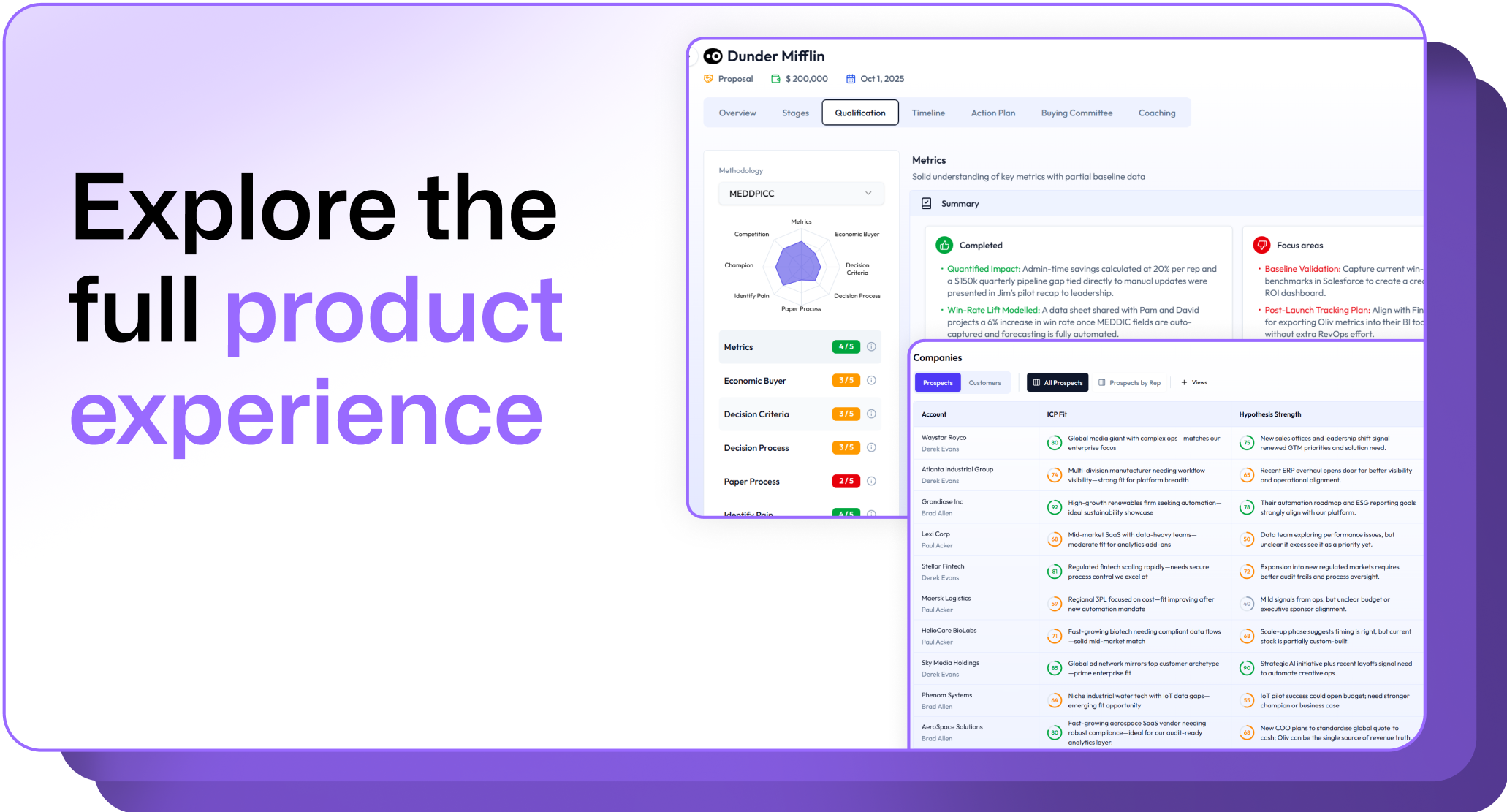
.avif)
.png)







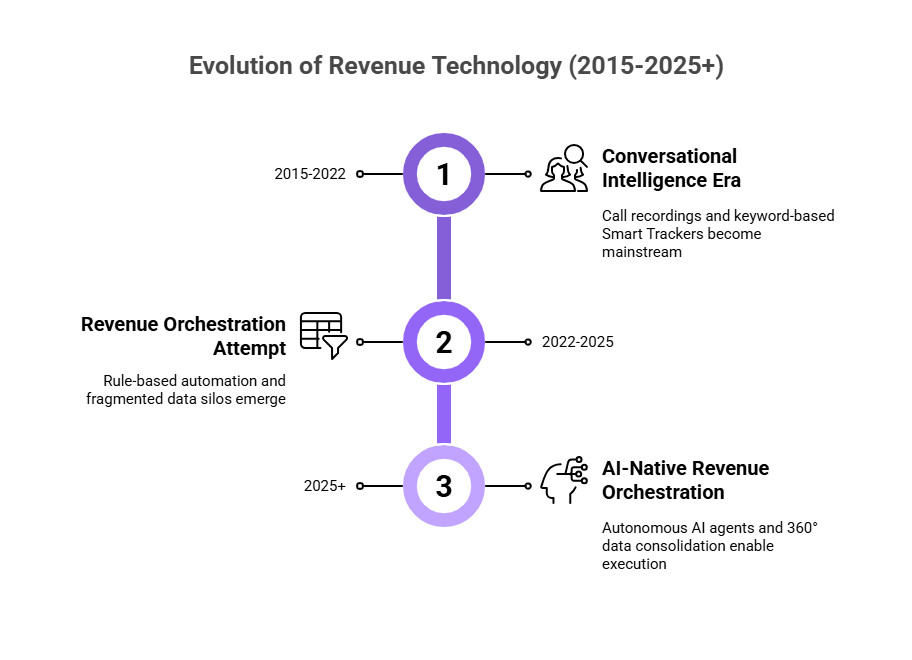
.png)
.png)
.png)
.png)