Gainsight vs ChurnZero in 2026: Which Fits Teams Without CS Ops?
Written by
Ishan Chhabra
Last Updated :
February 9, 2026
Skim in :
7
mins
In this article
Revenue teams love Oliv
Here’s why:
All your deal data unified (from 30+ tools and tabs).
Insights are delivered to you directly, no digging.
AI agents automate tasks for you.
Thank you! Your submission has been received!
Oops! Something went wrong while submitting the form.
Meet Oliv’s AI Agents
Hi! I’m, Deal Driver
I track deals, flag risks, send weekly pipeline updates and give sales managers full visibility into deal progress
Hi! I’m, CRM Manager
I maintain CRM hygiene by updating core, custom and qualification fields all without your team lifting a finger
Hi! I’m, Forecaster
I build accurate forecasts based on real deal movement and tell you which deals to pull in to hit your number
Hi! I’m, Coach
I believe performance fuels revenue. I spot skill gaps, score calls and build coaching plans to help every rep level up
Hi! I’m, Prospector
I dig into target accounts to surface the right contacts, tailor and time outreach so you always strike when it counts
Hi! I’m, Pipeline tracker
I call reps to get deal updates, and deliver a real-time, CRM-synced roll-up view of deal progress
Hi! I’m, Analyst
I answer complex pipeline questions, uncover deal patterns, and build reports that guide strategic decisions
TL;DR
Gainsight leads on enterprise depth but requires dedicated CS Ops to unlock its full potential.
ChurnZero deploys faster (4-8 weeks) with stronger usability, but still needs technical resources for setup.
Year 1 TCO including admin FTE: Gainsight $90K-$140K, ChurnZero $60K-$99K, Oliv.ai $23K-$58K.
Both platforms made aggressive AI investments in 2025, but 80% of CS teams remain in AI's experimental stage.
ChurnZero wins on native in-app engagement; Gainsight wins on Salesforce-native architecture and analytics depth.
For teams with zero CS Ops, AI-native platforms eliminate configuration debt and deliver value in days, not months.
Q1: What Are Gainsight and ChurnZero - And Why Is This Comparison Different in 2026? [toc=Platform Overview & 2026 Context]
Both Gainsight and ChurnZero are customer success management (CSM) platforms designed to help B2B SaaS companies reduce churn, drive product adoption, and grow revenue from existing customers. Both earned Leader status in the 2025 Gartner® Magic Quadrant™ for Customer Success Management Platforms - for the second consecutive year - placing them at the top of a rapidly maturing category where "generative AI capabilities and in-app conversational AI assistants are now expected" (Gartner, 2025).
Visual comparison of Gainsight and ChurnZero CS platforms in 2026: Gainsight offers enterprise depth with Salesforce-native architecture while ChurnZero leads in mid-market usability and in-app engagement.
⭐ Where Each Platform Stands in 2026
But "Leader" doesn't mean identical. The two platforms occupy different zones within that quadrant and serve different buyer profiles:
Gainsight vs ChurnZero: 2026 Market Positioning
Dimension
Gainsight
ChurnZero
Gartner MQ 2025
Leader - highest on Ability to Execute, furthest on Completeness of Vision
Leader - 2nd consecutive year
Forrester Wave Q4 2025
Leader - recognized for vision and product ecosystem
Strong Performer
G2 Rating
4.4/5 (863+ reviews)
4.75/5 (654+ reviews)
G2 Ease of Use
Trails ChurnZero in head-to-head
Leads the category
Core Positioning
Enterprise-grade CS platform with deep analytics, journey orchestration, and Salesforce-native architecture
Mid-market-focused platform emphasizing real-time engagement, usability, and in-app digital experiences
Native build: AI Marketplace with 12+ purpose-built agents
Gainsight's CEO Chuck Ganapathi describes the platform's direction as "bringing the best of human relationships, digital scale, and both augmented and autonomous agents together." ChurnZero's co-founder You Mon Tsang positions their platform as "the system of execution CS leaders need - uniting data, workflows, and automation so renewals, adoption, and expansion compound."
⚠️ Why This Comparison Is Different
Most "Gainsight vs ChurnZero" articles follow the same playbook: feature table, pricing guess, and a verdict that pivots to pitching a third product. This article takes a different approach.
The lens here is operational reality - specifically, what happens when your team doesn't have a dedicated CS Ops specialist to configure, calibrate, and maintain whichever platform you choose. That's not an edge case. Industry benchmarks suggest 37% of companies still lack a formal customer success strategy, and many mid-market CS teams operate with three to ten people - with no room for a full-time platform admin.
The question isn't just "which platform has better features?" It's: which platform can your team actually run?
That's what the rest of this comparison evaluates - feature by feature, workflow by workflow, dollar by dollar.
Q2: How Do Gainsight and ChurnZero Compare on Core CS Features? [toc=Feature Comparison]
Both platforms cover the full spectrum of customer success - but they build those capabilities differently. For lean teams, the gap between "feature exists" and "feature works without an admin" is what matters.
✅ Side-by-Side Feature Comparison
Core CS Features: Gainsight vs ChurnZero for Teams Without Dedicated CS Ops
Deep BI-grade analytics. Flexible but needs data architecture knowledge.
Standard dashboards with limited customization on defaults.
⚠️ Gainsight: powerful but admin-gated. ChurnZero: accessible but constrained.
💡 The Pattern
Gainsight consistently offers more depth - but that depth is locked behind configuration complexity that assumes a CS Ops admin. ChurnZero delivers faster initial setup at the cost of a lower ceiling.
For teams wanting to skip the admin dependency entirely, AI-native platforms like Oliv.ai deploy specialized agents (Health Monitor, MAP Manager, QBR Builder) that perform this work autonomously - no configuration required.
Q3: What Does It Really Take to Run Either Platform Without a Dedicated CS Ops Team? [toc=Operational Burden Reality]
This is the question most comparison articles skip - and the one that matters most if your team doesn't include a full-time platform admin. Both platforms deliver strong capabilities on paper, but every feature carries an operational cost that falls on someone.
⚠️ The "Minimum Viable Admin" Problem
Both platforms assume ongoing operational ownership - someone to configure workflows, calibrate health scores, and troubleshoot integrations. When that someone doesn't exist, features degrade silently: health scores drift, playbooks fire on stale logic, and dashboards show data nobody trusts.
❌ Gainsight's Operational Burden
Rules Engine & Bionic Rules - weekly hands-on admin work to configure and debug data transformations
Scorecard Calibration - health scores need periodic recalibration as customer behavior evolves
⏰ Typical implementation: 4-8 weeks, though user-reported timelines stretch to ~3 months when resources are thin.
✅ The AI-Native Alternative
Platforms like Oliv.ai were built from day one for this exact buyer profile. Instead of requiring someone to configure health scores and map CRM fields, Oliv deploys AI agents that handle it autonomously:
Health Monitor Agent - scans accounts weekly for anomalies, alerts CSMs before risk peaks
MAP Manager Agent - creates and updates mutual action plans after every interaction
⏰ Setup: 5 minutes. Core value: 1-2 days - not months.
Q4: How Do Ease of Use and Implementation Timelines Actually Compare? [toc=Usability & Implementation]
Usability scores and implementation timelines become make-or-break factors when the CSM or CS lead is the admin. Here's how both platforms stack up on hard data - and what it means for teams running without dedicated CS Ops.
⭐ Usability Scores: Head-to-Head
Gainsight vs ChurnZero: Usability & User Ratings Comparison
Metric
Gainsight
ChurnZero
G2 Overall Rating
4.4/5 (863+ reviews)
4.75/5 (654+ reviews)
G2 Ease of Use
Trails in head-to-head
Category leader
G2 Ease of Setup
Frequently cited as complex
Simpler initial deployment
Gartner Peer Insights
4.4/5
4.6/5 (highest in category)
Top G2 Pros
Organized dashboards (97 mentions), centralized data (54)
Ease of use (150 mentions), helpfulness (104), support (97)
Top G2 Cons
Non-intuitive interface (23), missing features (22), steep learning curve (20)
If your CS lead is pulling double duty as platform admin, ChurnZero's lower setup friction gives you a faster start. But neither platform eliminates the admin burden entirely - they differ on where that burden lands on the timeline. ChurnZero front-loads usability; Gainsight front-loads configuration debt.
For context, AI-native platforms like Oliv.ai collapse this timeline entirely: baseline configuration takes 5 minutes, core value is realized within 1-2 days, and ongoing maintenance is handled by autonomous AI agents - not a human admin pulling double duty.
Q5: Can AI Replace Your CS Ops Team? How Both Platforms Handle Automation in 2026 [toc=AI Automation Capabilities]
The 2025 Gartner Magic Quadrant made it official: "generative AI capabilities and in-app conversational AI assistants are now expected" in customer success platforms. Both Gainsight and ChurnZero responded with aggressive AI investments throughout 2025. But the real question for lean teams is sharper: can either platform's AI actually replace the need for a CS Ops specialist?
⚠️ Gainsight's AI Strategy: Acquisition-Led
Gainsight built its 2025 AI moat through acquisition:
Staircase AI (acquired Aug 2024) - sentiment analysis across emails, support tickets, and meetings to detect early churn risk
UpdateAI (acquired Jul 2025) - meeting intelligence with AI-generated summaries, action items, and CRM sync
Skilljar (acquired Apr 2025) - AI-powered customer education with agentic learning delivery at scale
✅ The combined vision is powerful - what Gainsight calls "Atlas Agents" for autonomous adoption recovery and renewal support. ❌ But these are bolt-on acquisitions layered onto legacy architecture. Integration and configuration still assume CS Ops oversight, and the admin community has noted the gap:
"There is an excessive focus on AI at the expense of addressing basic features, parity issues, and stability problems. The admin community has been requesting these basic improvements for years, yet we are repeatedly told that AI will solve this." Verified User, Computer Software, Enterprise (1000+ emp.) - G2 Verified Review
⚠️ ChurnZero's AI Strategy: Native Agent Suite
ChurnZero took a build-native approach with its AI Marketplace - a credit-based system where teams deploy, test, and scale AI agents without long implementation cycles:
✅ More natively integrated than Gainsight's approach. Credits are transparent and scalable. ❌ Still requires the underlying platform to be properly configured - segments, ChurnScores, and data integrations must be set up by someone before AI agents can act on them.
✅ The AI-Native Alternative: Agents From Day One
Platforms like Oliv.ai don't layer AI onto existing workflow tools - they replace the workflow with AI. Oliv runs 100+ fine-tuned LLMs purpose-built for revenue workflows, deploying agents that detect signals AND act autonomously:
Health Monitor Agent - scans accounts for usage and support anomalies weekly, no scorecard configuration needed
Retention Forecaster Agent - predicts churn without requiring admin-built rules or data pipelines
MAP Manager Agent - generates and updates mutual action plans after every customer interaction
No marketplace, no credits, no configuration. AI-native by design means CS Ops dependency is eliminated at the architecture level - not patched at the feature level.
⏰ ChurnZero's own data shows 80% of CS teams remain in the "experimental stage" of AI adoption. Oliv skips the experiment - agents are production-ready at onboarding.
Q6: What's the True Cost - Including the CS Ops Overhead Nobody Talks About? [toc=True Cost Analysis]
Neither Gainsight nor ChurnZero publishes transparent pricing on their websites. Industry estimates place both in the $10K-$25K+/year range for mid-market teams. But license cost is only one line item - and for teams without dedicated CS Ops, it's rarely even the most expensive one.
💰 The Hidden Cost Model
The true total cost of ownership (TCO) stacks four layers most comparison articles ignore:
Implementation services - $5K-$15K for professional services covering initial setup, data migration, and Salesforce/CRM mapping
CS Ops admin burden - a dedicated CS Ops hire runs $60K-$90K/year; if absorbed by existing staff, expect 15-20 hrs/week of diverted CSM capacity that isn't spent on actual customers
Integration maintenance + training - ongoing cost of keeping CRM sync, product usage data pipelines, and team certifications current; stacking tools (CS platform + Gong + analytics) can push per-user cost above $500/month
These hidden layers are why teams often experience sticker shock after Year 1, not during procurement.
Iceberg visual showing the true total cost of ownership for CS platforms like Gainsight and ChurnZero, including hidden costs beyond license fees such as implementation, admin burden, and integration maintenance.
Total Cost of Ownership: Gainsight vs ChurnZero vs Oliv.ai
Cost Component
Gainsight + Admin FTE
ChurnZero + Admin FTE
Oliv.ai (No Admin FTE)
Annual License
$15K-$25K
$12K-$25K
Modular ($19-$120/user/mo)
Implementation
$10K-$15K
$5K-$8K
Self-service (included)
CS Ops Admin (Year 1)
$60K-$90K (FTE) or 15-20 hrs/wk absorbed
$40K-$60K (part-time or absorbed)
$0 - agents handle ops tasks
Training & Certification
$2K-$5K
$1K-$3K
Minimal - 5-min onboarding
Integration Maintenance
$3K-$5K
$2K-$3K
Included (auto-sync)
Year 1 All-In Estimate
$90K-$140K
$60K-$99K
$23K-$58K
✅ Why This Matters for Lean Teams
The TCO gap becomes the decisive argument. Gainsight and ChurnZero are powerful platforms - but their cost model assumes you have the operational infrastructure to support them. For teams without that infrastructure, Oliv.ai's modular pricing and zero admin overhead deliver up to 91% lower TCO versus legacy stacks, with full open data export to eliminate vendor lock-in and future cost surprise.
Q7: Which Platform Fits Your Tech Stack - CRM, Dialers, and Communication Tools? [toc=Integration Ecosystem]
For teams without a dedicated integration specialist, the question isn't just "does it integrate?" - it's "how much work does the integration actually require to set up and maintain?" Here's the full ecosystem comparison for 2026.
✅ Integration Ecosystem: Head-to-Head
Gainsight vs ChurnZero: Integration Ecosystem Comparison
Integration Category
Gainsight
ChurnZero
Primary CRM
Salesforce-native (bi-directional, real-time, covers standard + custom objects)
Salesforce, HubSpot (native connectors for both)
Secondary CRMs
Microsoft Dynamics, HubSpot (available but less deep)
Microsoft Dynamics, Zoho (via API)
Communication
Slack integration, Email sync, Zoom auto-logging via UpdateAI
Slack, Email; Jira integration for cross-functional workflows
Product Analytics
Gainsight PX (separate product for in-app analytics)
Native in-app usage tracking (bundled in core platform)
Support Platforms
Zendesk, Freshdesk, ServiceNow
Zendesk, Freshdesk, Intercom
Customer Education
Skilljar by Gainsight (acquired Apr 2025)
Third-party LMS via API
Meeting Intelligence
UpdateAI by Gainsight (acquired Jul 2025)
Third-party (Gong, Chorus) via integration
Product Feedback
Productboard, Aha! integrations for CSQL tracking
Limited - manual or API-based
Data Warehouse
Connectors to Snowflake, BigQuery
API-based export; Google Sheets Live Export
⚠️ The Salesforce Factor
Gainsight's deepest competitive advantage is its Salesforce-native architecture - bi-directional, real-time sync covering standard and custom objects, with data kept behind Salesforce's firewall. For Salesforce-heavy enterprises, this is a major security and workflow advantage that ChurnZero can't fully replicate.
ChurnZero counters with broader out-of-box CRM flexibility - HubSpot native support is stronger - plus bundled product analytics that Gainsight charges separately for via its PX product. The Google Sheets Live Export is also a standout for teams that extend dashboards outside the platform.
Both platforms require dedicated effort to set up and maintain integrations - Gainsight more so due to its deeper Salesforce coupling and separate products (PX, Skilljar, UpdateAI). ChurnZero's integrations are lighter but narrower in scope.
For teams wanting CRM sync without the integration tax, Oliv.ai supports multi-CRM connectivity (Salesforce, HubSpot), plus Slack, Telegram, and dialer integrations - all configured in minutes with zero custom API work required.
Q8: What Do Real CS Teams Without Dedicated Ops Say About Each Platform? [toc=Real User Feedback]
The most honest evaluation comes from teams operating these platforms without a full-time CS Ops admin. Below are verified G2 reviews organized by evaluation theme - not by platform - to surface patterns that matter for lean teams.
Pattern: Both platforms demand upfront investment. ChurnZero's onboarding is faster but still has complexity; Gainsight requires cross-functional resource commitments many lean teams can't make.
Pattern: Gainsight's complexity frustrates admins who double as CSMs. ChurnZero is simpler day-to-day, but admin-level configuration often requires Support tickets rather than self-service.
❌ Theme 3: Feature Underutilization Without an Admin
Pattern: Without someone to calibrate, configure, and champion the platform, both tools suffer from underutilization - the features exist, but nobody unlocks their full value.
💡 The Takeaway
These aren't cherry-picked outliers - they reflect structural realities of running CS platforms without dedicated ops. For teams that recognize this admin gap but can't fill it, AI-native platforms like Oliv.ai were built to close it by design, not by adding another hire.
Q9: How to Choose the Right CS Platform When You Don't Have CS Ops: A Decision Framework [toc=Decision Framework]
After evaluating features, operational burden, AI capabilities, cost, and user evidence, the decision comes down to one variable: how much CS Ops capacity does your team actually have? Not aspirationally. Not next quarter. Right now.
✅ The Decision Matrix
CS Platform Selection Framework by Team Profile
Buyer Profile
Recommended Platform
Why
Red Flags to Watch
Enterprise CS team with 2+ CS Ops FTEs
Gainsight
Unmatched depth in journey orchestration, analytics, and Salesforce-native architecture. Worth the complexity when you have the team to operate it.
❌ No Salesforce admin AND no CS Ops hire planned = Gainsight will underperform its potential.
Mid-market team with 1 fractional CS Ops resource
ChurnZero
Faster deployment, better usability scores, native in-app engagement. Right balance of capability and manageable admin overhead.
❌ No developer for JavaScript SDK / API setup = product usage tracking won't work.
Lean team with 0 dedicated CS Ops
Oliv.ai
AI agents handle health scoring, CRM updates, and action plans autonomously. No configuration, no admin FTE, value in 1-2 days.
❌ Team needs mature journey orchestration with complex conditional workflows = not yet Oliv's strength.
Team wanting simplicity over depth
Vitally, Custify, or Planhat
Lighter-weight alternatives with lower complexity but they trade capability for ease and may not scale past 50 accounts/CSM.
⚠️ Limited AI automation; you may outgrow them within 12-18 months.
If your leadership has mandated AI adoption but prior implementations (chatbots, generic GPTs) saw low adoption, an AI-native platform offers a higher probability of success because the agents work autonomously. There's no adoption curve to manage. Oliv.ai's 5-minute setup and agent-first architecture serves this profile directly.
⚠️ The Bottom Line
Legacy CS tools are like manually reviewed CCTV footage - powerful if someone watches it 24/7, useless if nobody does. Oliv.ai is the 24/7 intelligent security detail that wakes you up with exactly what action to take next. Want to see how AI agents can replace your CS Ops dependency? Talk to the Oliv.ai team and evaluate in days, not quarters.
Q10: FAQ: Gainsight vs ChurnZero for Teams Without CS Ops [toc=FAQ]
Can you use Gainsight without a dedicated CS Ops team?
Technically yes, but expect significant underutilization. Gainsight's rules engine, Journey Orchestrator, and scorecard calibration require ongoing admin expertise. Without CS Ops, health scores drift, playbooks fire on stale logic, and implementation timelines stretch beyond 6 months. G2 reviewers consistently flag "dedicated resources" as a prerequisite.
Is ChurnZero easier to implement than Gainsight for small CS teams?
Yes. ChurnZero's standard deployment takes 4-8 weeks versus Gainsight's 3-6 months. G2's ease-of-use scores consistently favor ChurnZero (4.75 vs. 4.4 overall), and CSMs can manage basic Plays and Segments without admin help. However, advanced automation, product usage tracking (JavaScript SDK), and reporting still require technical support.
How long does Gainsight take to implement without dedicated resources?
User-reported timelines indicate 6+ months when internal resources are thin. One reviewer noted: "Implementation took us a good 6 months, and now we cannot consider switching because of how entrenched we are." Teams without a Salesforce admin and CS Ops specialist should budget 6-9 months for full deployment.
What is the total cost of Gainsight vs ChurnZero including admin staffing?
For a 10-person CS team in Year 1: Gainsight all-in (license + implementation + admin FTE) runs approximately $90K-$140K. ChurnZero comes in at $60K-$99K. AI-native alternatives like Oliv.ai which eliminate the admin FTE requirement range from $23K-$58K for the same team size.
Which customer success platform has better AI automation in 2026?
ChurnZero's native AI Marketplace (12+ named agents, credit-based activation) is more tightly integrated than Gainsight's acquisition-led approach (Staircase AI, UpdateAI, Skilljar). However, both still require the underlying platform to be configured by someone with operational expertise. AI-native platforms like Oliv.ai bypass this dependency entirely.
Do I need a developer to set up ChurnZero?
Yes, for full functionality. ChurnZero's real-time product usage tracking requires a JavaScript SDK installation, and API integrations for CRM data mapping often need developer involvement. Basic account management and email features work without developer support, but the platform's core value - usage-based health scoring and automated Plays - depends on that technical setup.
What are the best CS platform alternatives for teams without CS Ops?
Beyond Gainsight and ChurnZero, teams without CS Ops should evaluate: Oliv.ai (AI-native, zero admin), Vitally (lightweight, fast setup), Custify (mid-market focused, simpler), and Planhat (European-based, modular). Each trades depth for accessibility - the right choice depends on whether you prioritize intelligence (Oliv.ai) or simplified workflows (Vitally/Custify).
Can AI agents replace a CS Ops hire in 2026?
For core operational tasks - health score calibration, CRM hygiene, meeting summarization, action plan generation - yes. Oliv.ai's agents autonomously handle these workflows without configuration. For complex journey orchestration with multi-branch conditional logic, human CS Ops expertise still adds value. The practical answer: AI agents can eliminate 70-80% of the CS Ops workload, making a full-time hire optional for most mid-market teams.
Q1: What Are Gainsight and ChurnZero - And Why Is This Comparison Different in 2026? [toc=Platform Overview & 2026 Context]
Both Gainsight and ChurnZero are customer success management (CSM) platforms designed to help B2B SaaS companies reduce churn, drive product adoption, and grow revenue from existing customers. Both earned Leader status in the 2025 Gartner® Magic Quadrant™ for Customer Success Management Platforms - for the second consecutive year - placing them at the top of a rapidly maturing category where "generative AI capabilities and in-app conversational AI assistants are now expected" (Gartner, 2025).
Visual comparison of Gainsight and ChurnZero CS platforms in 2026: Gainsight offers enterprise depth with Salesforce-native architecture while ChurnZero leads in mid-market usability and in-app engagement.
⭐ Where Each Platform Stands in 2026
But "Leader" doesn't mean identical. The two platforms occupy different zones within that quadrant and serve different buyer profiles:
Gainsight vs ChurnZero: 2026 Market Positioning
Dimension
Gainsight
ChurnZero
Gartner MQ 2025
Leader - highest on Ability to Execute, furthest on Completeness of Vision
Leader - 2nd consecutive year
Forrester Wave Q4 2025
Leader - recognized for vision and product ecosystem
Strong Performer
G2 Rating
4.4/5 (863+ reviews)
4.75/5 (654+ reviews)
G2 Ease of Use
Trails ChurnZero in head-to-head
Leads the category
Core Positioning
Enterprise-grade CS platform with deep analytics, journey orchestration, and Salesforce-native architecture
Mid-market-focused platform emphasizing real-time engagement, usability, and in-app digital experiences
Native build: AI Marketplace with 12+ purpose-built agents
Gainsight's CEO Chuck Ganapathi describes the platform's direction as "bringing the best of human relationships, digital scale, and both augmented and autonomous agents together." ChurnZero's co-founder You Mon Tsang positions their platform as "the system of execution CS leaders need - uniting data, workflows, and automation so renewals, adoption, and expansion compound."
⚠️ Why This Comparison Is Different
Most "Gainsight vs ChurnZero" articles follow the same playbook: feature table, pricing guess, and a verdict that pivots to pitching a third product. This article takes a different approach.
The lens here is operational reality - specifically, what happens when your team doesn't have a dedicated CS Ops specialist to configure, calibrate, and maintain whichever platform you choose. That's not an edge case. Industry benchmarks suggest 37% of companies still lack a formal customer success strategy, and many mid-market CS teams operate with three to ten people - with no room for a full-time platform admin.
The question isn't just "which platform has better features?" It's: which platform can your team actually run?
That's what the rest of this comparison evaluates - feature by feature, workflow by workflow, dollar by dollar.
Q2: How Do Gainsight and ChurnZero Compare on Core CS Features? [toc=Feature Comparison]
Both platforms cover the full spectrum of customer success - but they build those capabilities differently. For lean teams, the gap between "feature exists" and "feature works without an admin" is what matters.
✅ Side-by-Side Feature Comparison
Core CS Features: Gainsight vs ChurnZero for Teams Without Dedicated CS Ops
Deep BI-grade analytics. Flexible but needs data architecture knowledge.
Standard dashboards with limited customization on defaults.
⚠️ Gainsight: powerful but admin-gated. ChurnZero: accessible but constrained.
💡 The Pattern
Gainsight consistently offers more depth - but that depth is locked behind configuration complexity that assumes a CS Ops admin. ChurnZero delivers faster initial setup at the cost of a lower ceiling.
For teams wanting to skip the admin dependency entirely, AI-native platforms like Oliv.ai deploy specialized agents (Health Monitor, MAP Manager, QBR Builder) that perform this work autonomously - no configuration required.
Q3: What Does It Really Take to Run Either Platform Without a Dedicated CS Ops Team? [toc=Operational Burden Reality]
This is the question most comparison articles skip - and the one that matters most if your team doesn't include a full-time platform admin. Both platforms deliver strong capabilities on paper, but every feature carries an operational cost that falls on someone.
⚠️ The "Minimum Viable Admin" Problem
Both platforms assume ongoing operational ownership - someone to configure workflows, calibrate health scores, and troubleshoot integrations. When that someone doesn't exist, features degrade silently: health scores drift, playbooks fire on stale logic, and dashboards show data nobody trusts.
❌ Gainsight's Operational Burden
Rules Engine & Bionic Rules - weekly hands-on admin work to configure and debug data transformations
Scorecard Calibration - health scores need periodic recalibration as customer behavior evolves
⏰ Typical implementation: 4-8 weeks, though user-reported timelines stretch to ~3 months when resources are thin.
✅ The AI-Native Alternative
Platforms like Oliv.ai were built from day one for this exact buyer profile. Instead of requiring someone to configure health scores and map CRM fields, Oliv deploys AI agents that handle it autonomously:
Health Monitor Agent - scans accounts weekly for anomalies, alerts CSMs before risk peaks
MAP Manager Agent - creates and updates mutual action plans after every interaction
⏰ Setup: 5 minutes. Core value: 1-2 days - not months.
Q4: How Do Ease of Use and Implementation Timelines Actually Compare? [toc=Usability & Implementation]
Usability scores and implementation timelines become make-or-break factors when the CSM or CS lead is the admin. Here's how both platforms stack up on hard data - and what it means for teams running without dedicated CS Ops.
⭐ Usability Scores: Head-to-Head
Gainsight vs ChurnZero: Usability & User Ratings Comparison
Metric
Gainsight
ChurnZero
G2 Overall Rating
4.4/5 (863+ reviews)
4.75/5 (654+ reviews)
G2 Ease of Use
Trails in head-to-head
Category leader
G2 Ease of Setup
Frequently cited as complex
Simpler initial deployment
Gartner Peer Insights
4.4/5
4.6/5 (highest in category)
Top G2 Pros
Organized dashboards (97 mentions), centralized data (54)
Ease of use (150 mentions), helpfulness (104), support (97)
Top G2 Cons
Non-intuitive interface (23), missing features (22), steep learning curve (20)
If your CS lead is pulling double duty as platform admin, ChurnZero's lower setup friction gives you a faster start. But neither platform eliminates the admin burden entirely - they differ on where that burden lands on the timeline. ChurnZero front-loads usability; Gainsight front-loads configuration debt.
For context, AI-native platforms like Oliv.ai collapse this timeline entirely: baseline configuration takes 5 minutes, core value is realized within 1-2 days, and ongoing maintenance is handled by autonomous AI agents - not a human admin pulling double duty.
Q5: Can AI Replace Your CS Ops Team? How Both Platforms Handle Automation in 2026 [toc=AI Automation Capabilities]
The 2025 Gartner Magic Quadrant made it official: "generative AI capabilities and in-app conversational AI assistants are now expected" in customer success platforms. Both Gainsight and ChurnZero responded with aggressive AI investments throughout 2025. But the real question for lean teams is sharper: can either platform's AI actually replace the need for a CS Ops specialist?
⚠️ Gainsight's AI Strategy: Acquisition-Led
Gainsight built its 2025 AI moat through acquisition:
Staircase AI (acquired Aug 2024) - sentiment analysis across emails, support tickets, and meetings to detect early churn risk
UpdateAI (acquired Jul 2025) - meeting intelligence with AI-generated summaries, action items, and CRM sync
Skilljar (acquired Apr 2025) - AI-powered customer education with agentic learning delivery at scale
✅ The combined vision is powerful - what Gainsight calls "Atlas Agents" for autonomous adoption recovery and renewal support. ❌ But these are bolt-on acquisitions layered onto legacy architecture. Integration and configuration still assume CS Ops oversight, and the admin community has noted the gap:
"There is an excessive focus on AI at the expense of addressing basic features, parity issues, and stability problems. The admin community has been requesting these basic improvements for years, yet we are repeatedly told that AI will solve this." Verified User, Computer Software, Enterprise (1000+ emp.) - G2 Verified Review
⚠️ ChurnZero's AI Strategy: Native Agent Suite
ChurnZero took a build-native approach with its AI Marketplace - a credit-based system where teams deploy, test, and scale AI agents without long implementation cycles:
✅ More natively integrated than Gainsight's approach. Credits are transparent and scalable. ❌ Still requires the underlying platform to be properly configured - segments, ChurnScores, and data integrations must be set up by someone before AI agents can act on them.
✅ The AI-Native Alternative: Agents From Day One
Platforms like Oliv.ai don't layer AI onto existing workflow tools - they replace the workflow with AI. Oliv runs 100+ fine-tuned LLMs purpose-built for revenue workflows, deploying agents that detect signals AND act autonomously:
Health Monitor Agent - scans accounts for usage and support anomalies weekly, no scorecard configuration needed
Retention Forecaster Agent - predicts churn without requiring admin-built rules or data pipelines
MAP Manager Agent - generates and updates mutual action plans after every customer interaction
No marketplace, no credits, no configuration. AI-native by design means CS Ops dependency is eliminated at the architecture level - not patched at the feature level.
⏰ ChurnZero's own data shows 80% of CS teams remain in the "experimental stage" of AI adoption. Oliv skips the experiment - agents are production-ready at onboarding.
Q6: What's the True Cost - Including the CS Ops Overhead Nobody Talks About? [toc=True Cost Analysis]
Neither Gainsight nor ChurnZero publishes transparent pricing on their websites. Industry estimates place both in the $10K-$25K+/year range for mid-market teams. But license cost is only one line item - and for teams without dedicated CS Ops, it's rarely even the most expensive one.
💰 The Hidden Cost Model
The true total cost of ownership (TCO) stacks four layers most comparison articles ignore:
Implementation services - $5K-$15K for professional services covering initial setup, data migration, and Salesforce/CRM mapping
CS Ops admin burden - a dedicated CS Ops hire runs $60K-$90K/year; if absorbed by existing staff, expect 15-20 hrs/week of diverted CSM capacity that isn't spent on actual customers
Integration maintenance + training - ongoing cost of keeping CRM sync, product usage data pipelines, and team certifications current; stacking tools (CS platform + Gong + analytics) can push per-user cost above $500/month
These hidden layers are why teams often experience sticker shock after Year 1, not during procurement.
Iceberg visual showing the true total cost of ownership for CS platforms like Gainsight and ChurnZero, including hidden costs beyond license fees such as implementation, admin burden, and integration maintenance.
Total Cost of Ownership: Gainsight vs ChurnZero vs Oliv.ai
Cost Component
Gainsight + Admin FTE
ChurnZero + Admin FTE
Oliv.ai (No Admin FTE)
Annual License
$15K-$25K
$12K-$25K
Modular ($19-$120/user/mo)
Implementation
$10K-$15K
$5K-$8K
Self-service (included)
CS Ops Admin (Year 1)
$60K-$90K (FTE) or 15-20 hrs/wk absorbed
$40K-$60K (part-time or absorbed)
$0 - agents handle ops tasks
Training & Certification
$2K-$5K
$1K-$3K
Minimal - 5-min onboarding
Integration Maintenance
$3K-$5K
$2K-$3K
Included (auto-sync)
Year 1 All-In Estimate
$90K-$140K
$60K-$99K
$23K-$58K
✅ Why This Matters for Lean Teams
The TCO gap becomes the decisive argument. Gainsight and ChurnZero are powerful platforms - but their cost model assumes you have the operational infrastructure to support them. For teams without that infrastructure, Oliv.ai's modular pricing and zero admin overhead deliver up to 91% lower TCO versus legacy stacks, with full open data export to eliminate vendor lock-in and future cost surprise.
Q7: Which Platform Fits Your Tech Stack - CRM, Dialers, and Communication Tools? [toc=Integration Ecosystem]
For teams without a dedicated integration specialist, the question isn't just "does it integrate?" - it's "how much work does the integration actually require to set up and maintain?" Here's the full ecosystem comparison for 2026.
✅ Integration Ecosystem: Head-to-Head
Gainsight vs ChurnZero: Integration Ecosystem Comparison
Integration Category
Gainsight
ChurnZero
Primary CRM
Salesforce-native (bi-directional, real-time, covers standard + custom objects)
Salesforce, HubSpot (native connectors for both)
Secondary CRMs
Microsoft Dynamics, HubSpot (available but less deep)
Microsoft Dynamics, Zoho (via API)
Communication
Slack integration, Email sync, Zoom auto-logging via UpdateAI
Slack, Email; Jira integration for cross-functional workflows
Product Analytics
Gainsight PX (separate product for in-app analytics)
Native in-app usage tracking (bundled in core platform)
Support Platforms
Zendesk, Freshdesk, ServiceNow
Zendesk, Freshdesk, Intercom
Customer Education
Skilljar by Gainsight (acquired Apr 2025)
Third-party LMS via API
Meeting Intelligence
UpdateAI by Gainsight (acquired Jul 2025)
Third-party (Gong, Chorus) via integration
Product Feedback
Productboard, Aha! integrations for CSQL tracking
Limited - manual or API-based
Data Warehouse
Connectors to Snowflake, BigQuery
API-based export; Google Sheets Live Export
⚠️ The Salesforce Factor
Gainsight's deepest competitive advantage is its Salesforce-native architecture - bi-directional, real-time sync covering standard and custom objects, with data kept behind Salesforce's firewall. For Salesforce-heavy enterprises, this is a major security and workflow advantage that ChurnZero can't fully replicate.
ChurnZero counters with broader out-of-box CRM flexibility - HubSpot native support is stronger - plus bundled product analytics that Gainsight charges separately for via its PX product. The Google Sheets Live Export is also a standout for teams that extend dashboards outside the platform.
Both platforms require dedicated effort to set up and maintain integrations - Gainsight more so due to its deeper Salesforce coupling and separate products (PX, Skilljar, UpdateAI). ChurnZero's integrations are lighter but narrower in scope.
For teams wanting CRM sync without the integration tax, Oliv.ai supports multi-CRM connectivity (Salesforce, HubSpot), plus Slack, Telegram, and dialer integrations - all configured in minutes with zero custom API work required.
Q8: What Do Real CS Teams Without Dedicated Ops Say About Each Platform? [toc=Real User Feedback]
The most honest evaluation comes from teams operating these platforms without a full-time CS Ops admin. Below are verified G2 reviews organized by evaluation theme - not by platform - to surface patterns that matter for lean teams.
Pattern: Both platforms demand upfront investment. ChurnZero's onboarding is faster but still has complexity; Gainsight requires cross-functional resource commitments many lean teams can't make.
Pattern: Gainsight's complexity frustrates admins who double as CSMs. ChurnZero is simpler day-to-day, but admin-level configuration often requires Support tickets rather than self-service.
❌ Theme 3: Feature Underutilization Without an Admin
Pattern: Without someone to calibrate, configure, and champion the platform, both tools suffer from underutilization - the features exist, but nobody unlocks their full value.
💡 The Takeaway
These aren't cherry-picked outliers - they reflect structural realities of running CS platforms without dedicated ops. For teams that recognize this admin gap but can't fill it, AI-native platforms like Oliv.ai were built to close it by design, not by adding another hire.
Q9: How to Choose the Right CS Platform When You Don't Have CS Ops: A Decision Framework [toc=Decision Framework]
After evaluating features, operational burden, AI capabilities, cost, and user evidence, the decision comes down to one variable: how much CS Ops capacity does your team actually have? Not aspirationally. Not next quarter. Right now.
✅ The Decision Matrix
CS Platform Selection Framework by Team Profile
Buyer Profile
Recommended Platform
Why
Red Flags to Watch
Enterprise CS team with 2+ CS Ops FTEs
Gainsight
Unmatched depth in journey orchestration, analytics, and Salesforce-native architecture. Worth the complexity when you have the team to operate it.
❌ No Salesforce admin AND no CS Ops hire planned = Gainsight will underperform its potential.
Mid-market team with 1 fractional CS Ops resource
ChurnZero
Faster deployment, better usability scores, native in-app engagement. Right balance of capability and manageable admin overhead.
❌ No developer for JavaScript SDK / API setup = product usage tracking won't work.
Lean team with 0 dedicated CS Ops
Oliv.ai
AI agents handle health scoring, CRM updates, and action plans autonomously. No configuration, no admin FTE, value in 1-2 days.
❌ Team needs mature journey orchestration with complex conditional workflows = not yet Oliv's strength.
Team wanting simplicity over depth
Vitally, Custify, or Planhat
Lighter-weight alternatives with lower complexity but they trade capability for ease and may not scale past 50 accounts/CSM.
⚠️ Limited AI automation; you may outgrow them within 12-18 months.
If your leadership has mandated AI adoption but prior implementations (chatbots, generic GPTs) saw low adoption, an AI-native platform offers a higher probability of success because the agents work autonomously. There's no adoption curve to manage. Oliv.ai's 5-minute setup and agent-first architecture serves this profile directly.
⚠️ The Bottom Line
Legacy CS tools are like manually reviewed CCTV footage - powerful if someone watches it 24/7, useless if nobody does. Oliv.ai is the 24/7 intelligent security detail that wakes you up with exactly what action to take next. Want to see how AI agents can replace your CS Ops dependency? Talk to the Oliv.ai team and evaluate in days, not quarters.
Q10: FAQ: Gainsight vs ChurnZero for Teams Without CS Ops [toc=FAQ]
Can you use Gainsight without a dedicated CS Ops team?
Technically yes, but expect significant underutilization. Gainsight's rules engine, Journey Orchestrator, and scorecard calibration require ongoing admin expertise. Without CS Ops, health scores drift, playbooks fire on stale logic, and implementation timelines stretch beyond 6 months. G2 reviewers consistently flag "dedicated resources" as a prerequisite.
Is ChurnZero easier to implement than Gainsight for small CS teams?
Yes. ChurnZero's standard deployment takes 4-8 weeks versus Gainsight's 3-6 months. G2's ease-of-use scores consistently favor ChurnZero (4.75 vs. 4.4 overall), and CSMs can manage basic Plays and Segments without admin help. However, advanced automation, product usage tracking (JavaScript SDK), and reporting still require technical support.
How long does Gainsight take to implement without dedicated resources?
User-reported timelines indicate 6+ months when internal resources are thin. One reviewer noted: "Implementation took us a good 6 months, and now we cannot consider switching because of how entrenched we are." Teams without a Salesforce admin and CS Ops specialist should budget 6-9 months for full deployment.
What is the total cost of Gainsight vs ChurnZero including admin staffing?
For a 10-person CS team in Year 1: Gainsight all-in (license + implementation + admin FTE) runs approximately $90K-$140K. ChurnZero comes in at $60K-$99K. AI-native alternatives like Oliv.ai which eliminate the admin FTE requirement range from $23K-$58K for the same team size.
Which customer success platform has better AI automation in 2026?
ChurnZero's native AI Marketplace (12+ named agents, credit-based activation) is more tightly integrated than Gainsight's acquisition-led approach (Staircase AI, UpdateAI, Skilljar). However, both still require the underlying platform to be configured by someone with operational expertise. AI-native platforms like Oliv.ai bypass this dependency entirely.
Do I need a developer to set up ChurnZero?
Yes, for full functionality. ChurnZero's real-time product usage tracking requires a JavaScript SDK installation, and API integrations for CRM data mapping often need developer involvement. Basic account management and email features work without developer support, but the platform's core value - usage-based health scoring and automated Plays - depends on that technical setup.
What are the best CS platform alternatives for teams without CS Ops?
Beyond Gainsight and ChurnZero, teams without CS Ops should evaluate: Oliv.ai (AI-native, zero admin), Vitally (lightweight, fast setup), Custify (mid-market focused, simpler), and Planhat (European-based, modular). Each trades depth for accessibility - the right choice depends on whether you prioritize intelligence (Oliv.ai) or simplified workflows (Vitally/Custify).
Can AI agents replace a CS Ops hire in 2026?
For core operational tasks - health score calibration, CRM hygiene, meeting summarization, action plan generation - yes. Oliv.ai's agents autonomously handle these workflows without configuration. For complex journey orchestration with multi-branch conditional logic, human CS Ops expertise still adds value. The practical answer: AI agents can eliminate 70-80% of the CS Ops workload, making a full-time hire optional for most mid-market teams.
Q1: What Are Gainsight and ChurnZero - And Why Is This Comparison Different in 2026? [toc=Platform Overview & 2026 Context]
Both Gainsight and ChurnZero are customer success management (CSM) platforms designed to help B2B SaaS companies reduce churn, drive product adoption, and grow revenue from existing customers. Both earned Leader status in the 2025 Gartner® Magic Quadrant™ for Customer Success Management Platforms - for the second consecutive year - placing them at the top of a rapidly maturing category where "generative AI capabilities and in-app conversational AI assistants are now expected" (Gartner, 2025).
Visual comparison of Gainsight and ChurnZero CS platforms in 2026: Gainsight offers enterprise depth with Salesforce-native architecture while ChurnZero leads in mid-market usability and in-app engagement.
⭐ Where Each Platform Stands in 2026
But "Leader" doesn't mean identical. The two platforms occupy different zones within that quadrant and serve different buyer profiles:
Gainsight vs ChurnZero: 2026 Market Positioning
Dimension
Gainsight
ChurnZero
Gartner MQ 2025
Leader - highest on Ability to Execute, furthest on Completeness of Vision
Leader - 2nd consecutive year
Forrester Wave Q4 2025
Leader - recognized for vision and product ecosystem
Strong Performer
G2 Rating
4.4/5 (863+ reviews)
4.75/5 (654+ reviews)
G2 Ease of Use
Trails ChurnZero in head-to-head
Leads the category
Core Positioning
Enterprise-grade CS platform with deep analytics, journey orchestration, and Salesforce-native architecture
Mid-market-focused platform emphasizing real-time engagement, usability, and in-app digital experiences
Native build: AI Marketplace with 12+ purpose-built agents
Gainsight's CEO Chuck Ganapathi describes the platform's direction as "bringing the best of human relationships, digital scale, and both augmented and autonomous agents together." ChurnZero's co-founder You Mon Tsang positions their platform as "the system of execution CS leaders need - uniting data, workflows, and automation so renewals, adoption, and expansion compound."
⚠️ Why This Comparison Is Different
Most "Gainsight vs ChurnZero" articles follow the same playbook: feature table, pricing guess, and a verdict that pivots to pitching a third product. This article takes a different approach.
The lens here is operational reality - specifically, what happens when your team doesn't have a dedicated CS Ops specialist to configure, calibrate, and maintain whichever platform you choose. That's not an edge case. Industry benchmarks suggest 37% of companies still lack a formal customer success strategy, and many mid-market CS teams operate with three to ten people - with no room for a full-time platform admin.
The question isn't just "which platform has better features?" It's: which platform can your team actually run?
That's what the rest of this comparison evaluates - feature by feature, workflow by workflow, dollar by dollar.
Q2: How Do Gainsight and ChurnZero Compare on Core CS Features? [toc=Feature Comparison]
Both platforms cover the full spectrum of customer success - but they build those capabilities differently. For lean teams, the gap between "feature exists" and "feature works without an admin" is what matters.
✅ Side-by-Side Feature Comparison
Core CS Features: Gainsight vs ChurnZero for Teams Without Dedicated CS Ops
Deep BI-grade analytics. Flexible but needs data architecture knowledge.
Standard dashboards with limited customization on defaults.
⚠️ Gainsight: powerful but admin-gated. ChurnZero: accessible but constrained.
💡 The Pattern
Gainsight consistently offers more depth - but that depth is locked behind configuration complexity that assumes a CS Ops admin. ChurnZero delivers faster initial setup at the cost of a lower ceiling.
For teams wanting to skip the admin dependency entirely, AI-native platforms like Oliv.ai deploy specialized agents (Health Monitor, MAP Manager, QBR Builder) that perform this work autonomously - no configuration required.
Q3: What Does It Really Take to Run Either Platform Without a Dedicated CS Ops Team? [toc=Operational Burden Reality]
This is the question most comparison articles skip - and the one that matters most if your team doesn't include a full-time platform admin. Both platforms deliver strong capabilities on paper, but every feature carries an operational cost that falls on someone.
⚠️ The "Minimum Viable Admin" Problem
Both platforms assume ongoing operational ownership - someone to configure workflows, calibrate health scores, and troubleshoot integrations. When that someone doesn't exist, features degrade silently: health scores drift, playbooks fire on stale logic, and dashboards show data nobody trusts.
❌ Gainsight's Operational Burden
Rules Engine & Bionic Rules - weekly hands-on admin work to configure and debug data transformations
Scorecard Calibration - health scores need periodic recalibration as customer behavior evolves
⏰ Typical implementation: 4-8 weeks, though user-reported timelines stretch to ~3 months when resources are thin.
✅ The AI-Native Alternative
Platforms like Oliv.ai were built from day one for this exact buyer profile. Instead of requiring someone to configure health scores and map CRM fields, Oliv deploys AI agents that handle it autonomously:
Health Monitor Agent - scans accounts weekly for anomalies, alerts CSMs before risk peaks
MAP Manager Agent - creates and updates mutual action plans after every interaction
⏰ Setup: 5 minutes. Core value: 1-2 days - not months.
Q4: How Do Ease of Use and Implementation Timelines Actually Compare? [toc=Usability & Implementation]
Usability scores and implementation timelines become make-or-break factors when the CSM or CS lead is the admin. Here's how both platforms stack up on hard data - and what it means for teams running without dedicated CS Ops.
⭐ Usability Scores: Head-to-Head
Gainsight vs ChurnZero: Usability & User Ratings Comparison
Metric
Gainsight
ChurnZero
G2 Overall Rating
4.4/5 (863+ reviews)
4.75/5 (654+ reviews)
G2 Ease of Use
Trails in head-to-head
Category leader
G2 Ease of Setup
Frequently cited as complex
Simpler initial deployment
Gartner Peer Insights
4.4/5
4.6/5 (highest in category)
Top G2 Pros
Organized dashboards (97 mentions), centralized data (54)
Ease of use (150 mentions), helpfulness (104), support (97)
Top G2 Cons
Non-intuitive interface (23), missing features (22), steep learning curve (20)
If your CS lead is pulling double duty as platform admin, ChurnZero's lower setup friction gives you a faster start. But neither platform eliminates the admin burden entirely - they differ on where that burden lands on the timeline. ChurnZero front-loads usability; Gainsight front-loads configuration debt.
For context, AI-native platforms like Oliv.ai collapse this timeline entirely: baseline configuration takes 5 minutes, core value is realized within 1-2 days, and ongoing maintenance is handled by autonomous AI agents - not a human admin pulling double duty.
Q5: Can AI Replace Your CS Ops Team? How Both Platforms Handle Automation in 2026 [toc=AI Automation Capabilities]
The 2025 Gartner Magic Quadrant made it official: "generative AI capabilities and in-app conversational AI assistants are now expected" in customer success platforms. Both Gainsight and ChurnZero responded with aggressive AI investments throughout 2025. But the real question for lean teams is sharper: can either platform's AI actually replace the need for a CS Ops specialist?
⚠️ Gainsight's AI Strategy: Acquisition-Led
Gainsight built its 2025 AI moat through acquisition:
Staircase AI (acquired Aug 2024) - sentiment analysis across emails, support tickets, and meetings to detect early churn risk
UpdateAI (acquired Jul 2025) - meeting intelligence with AI-generated summaries, action items, and CRM sync
Skilljar (acquired Apr 2025) - AI-powered customer education with agentic learning delivery at scale
✅ The combined vision is powerful - what Gainsight calls "Atlas Agents" for autonomous adoption recovery and renewal support. ❌ But these are bolt-on acquisitions layered onto legacy architecture. Integration and configuration still assume CS Ops oversight, and the admin community has noted the gap:
"There is an excessive focus on AI at the expense of addressing basic features, parity issues, and stability problems. The admin community has been requesting these basic improvements for years, yet we are repeatedly told that AI will solve this." Verified User, Computer Software, Enterprise (1000+ emp.) - G2 Verified Review
⚠️ ChurnZero's AI Strategy: Native Agent Suite
ChurnZero took a build-native approach with its AI Marketplace - a credit-based system where teams deploy, test, and scale AI agents without long implementation cycles:
✅ More natively integrated than Gainsight's approach. Credits are transparent and scalable. ❌ Still requires the underlying platform to be properly configured - segments, ChurnScores, and data integrations must be set up by someone before AI agents can act on them.
✅ The AI-Native Alternative: Agents From Day One
Platforms like Oliv.ai don't layer AI onto existing workflow tools - they replace the workflow with AI. Oliv runs 100+ fine-tuned LLMs purpose-built for revenue workflows, deploying agents that detect signals AND act autonomously:
Health Monitor Agent - scans accounts for usage and support anomalies weekly, no scorecard configuration needed
Retention Forecaster Agent - predicts churn without requiring admin-built rules or data pipelines
MAP Manager Agent - generates and updates mutual action plans after every customer interaction
No marketplace, no credits, no configuration. AI-native by design means CS Ops dependency is eliminated at the architecture level - not patched at the feature level.
⏰ ChurnZero's own data shows 80% of CS teams remain in the "experimental stage" of AI adoption. Oliv skips the experiment - agents are production-ready at onboarding.
Q6: What's the True Cost - Including the CS Ops Overhead Nobody Talks About? [toc=True Cost Analysis]
Neither Gainsight nor ChurnZero publishes transparent pricing on their websites. Industry estimates place both in the $10K-$25K+/year range for mid-market teams. But license cost is only one line item - and for teams without dedicated CS Ops, it's rarely even the most expensive one.
💰 The Hidden Cost Model
The true total cost of ownership (TCO) stacks four layers most comparison articles ignore:
Implementation services - $5K-$15K for professional services covering initial setup, data migration, and Salesforce/CRM mapping
CS Ops admin burden - a dedicated CS Ops hire runs $60K-$90K/year; if absorbed by existing staff, expect 15-20 hrs/week of diverted CSM capacity that isn't spent on actual customers
Integration maintenance + training - ongoing cost of keeping CRM sync, product usage data pipelines, and team certifications current; stacking tools (CS platform + Gong + analytics) can push per-user cost above $500/month
These hidden layers are why teams often experience sticker shock after Year 1, not during procurement.
Iceberg visual showing the true total cost of ownership for CS platforms like Gainsight and ChurnZero, including hidden costs beyond license fees such as implementation, admin burden, and integration maintenance.
Total Cost of Ownership: Gainsight vs ChurnZero vs Oliv.ai
Cost Component
Gainsight + Admin FTE
ChurnZero + Admin FTE
Oliv.ai (No Admin FTE)
Annual License
$15K-$25K
$12K-$25K
Modular ($19-$120/user/mo)
Implementation
$10K-$15K
$5K-$8K
Self-service (included)
CS Ops Admin (Year 1)
$60K-$90K (FTE) or 15-20 hrs/wk absorbed
$40K-$60K (part-time or absorbed)
$0 - agents handle ops tasks
Training & Certification
$2K-$5K
$1K-$3K
Minimal - 5-min onboarding
Integration Maintenance
$3K-$5K
$2K-$3K
Included (auto-sync)
Year 1 All-In Estimate
$90K-$140K
$60K-$99K
$23K-$58K
✅ Why This Matters for Lean Teams
The TCO gap becomes the decisive argument. Gainsight and ChurnZero are powerful platforms - but their cost model assumes you have the operational infrastructure to support them. For teams without that infrastructure, Oliv.ai's modular pricing and zero admin overhead deliver up to 91% lower TCO versus legacy stacks, with full open data export to eliminate vendor lock-in and future cost surprise.
Q7: Which Platform Fits Your Tech Stack - CRM, Dialers, and Communication Tools? [toc=Integration Ecosystem]
For teams without a dedicated integration specialist, the question isn't just "does it integrate?" - it's "how much work does the integration actually require to set up and maintain?" Here's the full ecosystem comparison for 2026.
✅ Integration Ecosystem: Head-to-Head
Gainsight vs ChurnZero: Integration Ecosystem Comparison
Integration Category
Gainsight
ChurnZero
Primary CRM
Salesforce-native (bi-directional, real-time, covers standard + custom objects)
Salesforce, HubSpot (native connectors for both)
Secondary CRMs
Microsoft Dynamics, HubSpot (available but less deep)
Microsoft Dynamics, Zoho (via API)
Communication
Slack integration, Email sync, Zoom auto-logging via UpdateAI
Slack, Email; Jira integration for cross-functional workflows
Product Analytics
Gainsight PX (separate product for in-app analytics)
Native in-app usage tracking (bundled in core platform)
Support Platforms
Zendesk, Freshdesk, ServiceNow
Zendesk, Freshdesk, Intercom
Customer Education
Skilljar by Gainsight (acquired Apr 2025)
Third-party LMS via API
Meeting Intelligence
UpdateAI by Gainsight (acquired Jul 2025)
Third-party (Gong, Chorus) via integration
Product Feedback
Productboard, Aha! integrations for CSQL tracking
Limited - manual or API-based
Data Warehouse
Connectors to Snowflake, BigQuery
API-based export; Google Sheets Live Export
⚠️ The Salesforce Factor
Gainsight's deepest competitive advantage is its Salesforce-native architecture - bi-directional, real-time sync covering standard and custom objects, with data kept behind Salesforce's firewall. For Salesforce-heavy enterprises, this is a major security and workflow advantage that ChurnZero can't fully replicate.
ChurnZero counters with broader out-of-box CRM flexibility - HubSpot native support is stronger - plus bundled product analytics that Gainsight charges separately for via its PX product. The Google Sheets Live Export is also a standout for teams that extend dashboards outside the platform.
Both platforms require dedicated effort to set up and maintain integrations - Gainsight more so due to its deeper Salesforce coupling and separate products (PX, Skilljar, UpdateAI). ChurnZero's integrations are lighter but narrower in scope.
For teams wanting CRM sync without the integration tax, Oliv.ai supports multi-CRM connectivity (Salesforce, HubSpot), plus Slack, Telegram, and dialer integrations - all configured in minutes with zero custom API work required.
Q8: What Do Real CS Teams Without Dedicated Ops Say About Each Platform? [toc=Real User Feedback]
The most honest evaluation comes from teams operating these platforms without a full-time CS Ops admin. Below are verified G2 reviews organized by evaluation theme - not by platform - to surface patterns that matter for lean teams.
Pattern: Both platforms demand upfront investment. ChurnZero's onboarding is faster but still has complexity; Gainsight requires cross-functional resource commitments many lean teams can't make.
Pattern: Gainsight's complexity frustrates admins who double as CSMs. ChurnZero is simpler day-to-day, but admin-level configuration often requires Support tickets rather than self-service.
❌ Theme 3: Feature Underutilization Without an Admin
Pattern: Without someone to calibrate, configure, and champion the platform, both tools suffer from underutilization - the features exist, but nobody unlocks their full value.
💡 The Takeaway
These aren't cherry-picked outliers - they reflect structural realities of running CS platforms without dedicated ops. For teams that recognize this admin gap but can't fill it, AI-native platforms like Oliv.ai were built to close it by design, not by adding another hire.
Q9: How to Choose the Right CS Platform When You Don't Have CS Ops: A Decision Framework [toc=Decision Framework]
After evaluating features, operational burden, AI capabilities, cost, and user evidence, the decision comes down to one variable: how much CS Ops capacity does your team actually have? Not aspirationally. Not next quarter. Right now.
✅ The Decision Matrix
CS Platform Selection Framework by Team Profile
Buyer Profile
Recommended Platform
Why
Red Flags to Watch
Enterprise CS team with 2+ CS Ops FTEs
Gainsight
Unmatched depth in journey orchestration, analytics, and Salesforce-native architecture. Worth the complexity when you have the team to operate it.
❌ No Salesforce admin AND no CS Ops hire planned = Gainsight will underperform its potential.
Mid-market team with 1 fractional CS Ops resource
ChurnZero
Faster deployment, better usability scores, native in-app engagement. Right balance of capability and manageable admin overhead.
❌ No developer for JavaScript SDK / API setup = product usage tracking won't work.
Lean team with 0 dedicated CS Ops
Oliv.ai
AI agents handle health scoring, CRM updates, and action plans autonomously. No configuration, no admin FTE, value in 1-2 days.
❌ Team needs mature journey orchestration with complex conditional workflows = not yet Oliv's strength.
Team wanting simplicity over depth
Vitally, Custify, or Planhat
Lighter-weight alternatives with lower complexity but they trade capability for ease and may not scale past 50 accounts/CSM.
⚠️ Limited AI automation; you may outgrow them within 12-18 months.
If your leadership has mandated AI adoption but prior implementations (chatbots, generic GPTs) saw low adoption, an AI-native platform offers a higher probability of success because the agents work autonomously. There's no adoption curve to manage. Oliv.ai's 5-minute setup and agent-first architecture serves this profile directly.
⚠️ The Bottom Line
Legacy CS tools are like manually reviewed CCTV footage - powerful if someone watches it 24/7, useless if nobody does. Oliv.ai is the 24/7 intelligent security detail that wakes you up with exactly what action to take next. Want to see how AI agents can replace your CS Ops dependency? Talk to the Oliv.ai team and evaluate in days, not quarters.
Q10: FAQ: Gainsight vs ChurnZero for Teams Without CS Ops [toc=FAQ]
Can you use Gainsight without a dedicated CS Ops team?
Technically yes, but expect significant underutilization. Gainsight's rules engine, Journey Orchestrator, and scorecard calibration require ongoing admin expertise. Without CS Ops, health scores drift, playbooks fire on stale logic, and implementation timelines stretch beyond 6 months. G2 reviewers consistently flag "dedicated resources" as a prerequisite.
Is ChurnZero easier to implement than Gainsight for small CS teams?
Yes. ChurnZero's standard deployment takes 4-8 weeks versus Gainsight's 3-6 months. G2's ease-of-use scores consistently favor ChurnZero (4.75 vs. 4.4 overall), and CSMs can manage basic Plays and Segments without admin help. However, advanced automation, product usage tracking (JavaScript SDK), and reporting still require technical support.
How long does Gainsight take to implement without dedicated resources?
User-reported timelines indicate 6+ months when internal resources are thin. One reviewer noted: "Implementation took us a good 6 months, and now we cannot consider switching because of how entrenched we are." Teams without a Salesforce admin and CS Ops specialist should budget 6-9 months for full deployment.
What is the total cost of Gainsight vs ChurnZero including admin staffing?
For a 10-person CS team in Year 1: Gainsight all-in (license + implementation + admin FTE) runs approximately $90K-$140K. ChurnZero comes in at $60K-$99K. AI-native alternatives like Oliv.ai which eliminate the admin FTE requirement range from $23K-$58K for the same team size.
Which customer success platform has better AI automation in 2026?
ChurnZero's native AI Marketplace (12+ named agents, credit-based activation) is more tightly integrated than Gainsight's acquisition-led approach (Staircase AI, UpdateAI, Skilljar). However, both still require the underlying platform to be configured by someone with operational expertise. AI-native platforms like Oliv.ai bypass this dependency entirely.
Do I need a developer to set up ChurnZero?
Yes, for full functionality. ChurnZero's real-time product usage tracking requires a JavaScript SDK installation, and API integrations for CRM data mapping often need developer involvement. Basic account management and email features work without developer support, but the platform's core value - usage-based health scoring and automated Plays - depends on that technical setup.
What are the best CS platform alternatives for teams without CS Ops?
Beyond Gainsight and ChurnZero, teams without CS Ops should evaluate: Oliv.ai (AI-native, zero admin), Vitally (lightweight, fast setup), Custify (mid-market focused, simpler), and Planhat (European-based, modular). Each trades depth for accessibility - the right choice depends on whether you prioritize intelligence (Oliv.ai) or simplified workflows (Vitally/Custify).
Can AI agents replace a CS Ops hire in 2026?
For core operational tasks - health score calibration, CRM hygiene, meeting summarization, action plan generation - yes. Oliv.ai's agents autonomously handle these workflows without configuration. For complex journey orchestration with multi-branch conditional logic, human CS Ops expertise still adds value. The practical answer: AI agents can eliminate 70-80% of the CS Ops workload, making a full-time hire optional for most mid-market teams.
Q1: What Are Gainsight and ChurnZero - And Why Is This Comparison Different in 2026? [toc=Platform Overview & 2026 Context]
Both Gainsight and ChurnZero are customer success management (CSM) platforms designed to help B2B SaaS companies reduce churn, drive product adoption, and grow revenue from existing customers. Both earned Leader status in the 2025 Gartner® Magic Quadrant™ for Customer Success Management Platforms - for the second consecutive year - placing them at the top of a rapidly maturing category where "generative AI capabilities and in-app conversational AI assistants are now expected" (Gartner, 2025).
Visual comparison of Gainsight and ChurnZero CS platforms in 2026: Gainsight offers enterprise depth with Salesforce-native architecture while ChurnZero leads in mid-market usability and in-app engagement.
⭐ Where Each Platform Stands in 2026
But "Leader" doesn't mean identical. The two platforms occupy different zones within that quadrant and serve different buyer profiles:
Gainsight vs ChurnZero: 2026 Market Positioning
Dimension
Gainsight
ChurnZero
Gartner MQ 2025
Leader - highest on Ability to Execute, furthest on Completeness of Vision
Leader - 2nd consecutive year
Forrester Wave Q4 2025
Leader - recognized for vision and product ecosystem
Strong Performer
G2 Rating
4.4/5 (863+ reviews)
4.75/5 (654+ reviews)
G2 Ease of Use
Trails ChurnZero in head-to-head
Leads the category
Core Positioning
Enterprise-grade CS platform with deep analytics, journey orchestration, and Salesforce-native architecture
Mid-market-focused platform emphasizing real-time engagement, usability, and in-app digital experiences
Native build: AI Marketplace with 12+ purpose-built agents
Gainsight's CEO Chuck Ganapathi describes the platform's direction as "bringing the best of human relationships, digital scale, and both augmented and autonomous agents together." ChurnZero's co-founder You Mon Tsang positions their platform as "the system of execution CS leaders need - uniting data, workflows, and automation so renewals, adoption, and expansion compound."
⚠️ Why This Comparison Is Different
Most "Gainsight vs ChurnZero" articles follow the same playbook: feature table, pricing guess, and a verdict that pivots to pitching a third product. This article takes a different approach.
The lens here is operational reality - specifically, what happens when your team doesn't have a dedicated CS Ops specialist to configure, calibrate, and maintain whichever platform you choose. That's not an edge case. Industry benchmarks suggest 37% of companies still lack a formal customer success strategy, and many mid-market CS teams operate with three to ten people - with no room for a full-time platform admin.
The question isn't just "which platform has better features?" It's: which platform can your team actually run?
That's what the rest of this comparison evaluates - feature by feature, workflow by workflow, dollar by dollar.
Q2: How Do Gainsight and ChurnZero Compare on Core CS Features? [toc=Feature Comparison]
Both platforms cover the full spectrum of customer success - but they build those capabilities differently. For lean teams, the gap between "feature exists" and "feature works without an admin" is what matters.
✅ Side-by-Side Feature Comparison
Core CS Features: Gainsight vs ChurnZero for Teams Without Dedicated CS Ops
Deep BI-grade analytics. Flexible but needs data architecture knowledge.
Standard dashboards with limited customization on defaults.
⚠️ Gainsight: powerful but admin-gated. ChurnZero: accessible but constrained.
💡 The Pattern
Gainsight consistently offers more depth - but that depth is locked behind configuration complexity that assumes a CS Ops admin. ChurnZero delivers faster initial setup at the cost of a lower ceiling.
For teams wanting to skip the admin dependency entirely, AI-native platforms like Oliv.ai deploy specialized agents (Health Monitor, MAP Manager, QBR Builder) that perform this work autonomously - no configuration required.
Q3: What Does It Really Take to Run Either Platform Without a Dedicated CS Ops Team? [toc=Operational Burden Reality]
This is the question most comparison articles skip - and the one that matters most if your team doesn't include a full-time platform admin. Both platforms deliver strong capabilities on paper, but every feature carries an operational cost that falls on someone.
⚠️ The "Minimum Viable Admin" Problem
Both platforms assume ongoing operational ownership - someone to configure workflows, calibrate health scores, and troubleshoot integrations. When that someone doesn't exist, features degrade silently: health scores drift, playbooks fire on stale logic, and dashboards show data nobody trusts.
❌ Gainsight's Operational Burden
Rules Engine & Bionic Rules - weekly hands-on admin work to configure and debug data transformations
Scorecard Calibration - health scores need periodic recalibration as customer behavior evolves
⏰ Typical implementation: 4-8 weeks, though user-reported timelines stretch to ~3 months when resources are thin.
✅ The AI-Native Alternative
Platforms like Oliv.ai were built from day one for this exact buyer profile. Instead of requiring someone to configure health scores and map CRM fields, Oliv deploys AI agents that handle it autonomously:
Health Monitor Agent - scans accounts weekly for anomalies, alerts CSMs before risk peaks
MAP Manager Agent - creates and updates mutual action plans after every interaction
⏰ Setup: 5 minutes. Core value: 1-2 days - not months.
Q4: How Do Ease of Use and Implementation Timelines Actually Compare? [toc=Usability & Implementation]
Usability scores and implementation timelines become make-or-break factors when the CSM or CS lead is the admin. Here's how both platforms stack up on hard data - and what it means for teams running without dedicated CS Ops.
⭐ Usability Scores: Head-to-Head
Gainsight vs ChurnZero: Usability & User Ratings Comparison
Metric
Gainsight
ChurnZero
G2 Overall Rating
4.4/5 (863+ reviews)
4.75/5 (654+ reviews)
G2 Ease of Use
Trails in head-to-head
Category leader
G2 Ease of Setup
Frequently cited as complex
Simpler initial deployment
Gartner Peer Insights
4.4/5
4.6/5 (highest in category)
Top G2 Pros
Organized dashboards (97 mentions), centralized data (54)
Ease of use (150 mentions), helpfulness (104), support (97)
Top G2 Cons
Non-intuitive interface (23), missing features (22), steep learning curve (20)
If your CS lead is pulling double duty as platform admin, ChurnZero's lower setup friction gives you a faster start. But neither platform eliminates the admin burden entirely - they differ on where that burden lands on the timeline. ChurnZero front-loads usability; Gainsight front-loads configuration debt.
For context, AI-native platforms like Oliv.ai collapse this timeline entirely: baseline configuration takes 5 minutes, core value is realized within 1-2 days, and ongoing maintenance is handled by autonomous AI agents - not a human admin pulling double duty.
Q5: Can AI Replace Your CS Ops Team? How Both Platforms Handle Automation in 2026 [toc=AI Automation Capabilities]
The 2025 Gartner Magic Quadrant made it official: "generative AI capabilities and in-app conversational AI assistants are now expected" in customer success platforms. Both Gainsight and ChurnZero responded with aggressive AI investments throughout 2025. But the real question for lean teams is sharper: can either platform's AI actually replace the need for a CS Ops specialist?
⚠️ Gainsight's AI Strategy: Acquisition-Led
Gainsight built its 2025 AI moat through acquisition:
Staircase AI (acquired Aug 2024) - sentiment analysis across emails, support tickets, and meetings to detect early churn risk
UpdateAI (acquired Jul 2025) - meeting intelligence with AI-generated summaries, action items, and CRM sync
Skilljar (acquired Apr 2025) - AI-powered customer education with agentic learning delivery at scale
✅ The combined vision is powerful - what Gainsight calls "Atlas Agents" for autonomous adoption recovery and renewal support. ❌ But these are bolt-on acquisitions layered onto legacy architecture. Integration and configuration still assume CS Ops oversight, and the admin community has noted the gap:
"There is an excessive focus on AI at the expense of addressing basic features, parity issues, and stability problems. The admin community has been requesting these basic improvements for years, yet we are repeatedly told that AI will solve this." Verified User, Computer Software, Enterprise (1000+ emp.) - G2 Verified Review
⚠️ ChurnZero's AI Strategy: Native Agent Suite
ChurnZero took a build-native approach with its AI Marketplace - a credit-based system where teams deploy, test, and scale AI agents without long implementation cycles:
✅ More natively integrated than Gainsight's approach. Credits are transparent and scalable. ❌ Still requires the underlying platform to be properly configured - segments, ChurnScores, and data integrations must be set up by someone before AI agents can act on them.
✅ The AI-Native Alternative: Agents From Day One
Platforms like Oliv.ai don't layer AI onto existing workflow tools - they replace the workflow with AI. Oliv runs 100+ fine-tuned LLMs purpose-built for revenue workflows, deploying agents that detect signals AND act autonomously:
Health Monitor Agent - scans accounts for usage and support anomalies weekly, no scorecard configuration needed
Retention Forecaster Agent - predicts churn without requiring admin-built rules or data pipelines
MAP Manager Agent - generates and updates mutual action plans after every customer interaction
No marketplace, no credits, no configuration. AI-native by design means CS Ops dependency is eliminated at the architecture level - not patched at the feature level.
⏰ ChurnZero's own data shows 80% of CS teams remain in the "experimental stage" of AI adoption. Oliv skips the experiment - agents are production-ready at onboarding.
Q6: What's the True Cost - Including the CS Ops Overhead Nobody Talks About? [toc=True Cost Analysis]
Neither Gainsight nor ChurnZero publishes transparent pricing on their websites. Industry estimates place both in the $10K-$25K+/year range for mid-market teams. But license cost is only one line item - and for teams without dedicated CS Ops, it's rarely even the most expensive one.
💰 The Hidden Cost Model
The true total cost of ownership (TCO) stacks four layers most comparison articles ignore:
Implementation services - $5K-$15K for professional services covering initial setup, data migration, and Salesforce/CRM mapping
CS Ops admin burden - a dedicated CS Ops hire runs $60K-$90K/year; if absorbed by existing staff, expect 15-20 hrs/week of diverted CSM capacity that isn't spent on actual customers
Integration maintenance + training - ongoing cost of keeping CRM sync, product usage data pipelines, and team certifications current; stacking tools (CS platform + Gong + analytics) can push per-user cost above $500/month
These hidden layers are why teams often experience sticker shock after Year 1, not during procurement.
Iceberg visual showing the true total cost of ownership for CS platforms like Gainsight and ChurnZero, including hidden costs beyond license fees such as implementation, admin burden, and integration maintenance.
Total Cost of Ownership: Gainsight vs ChurnZero vs Oliv.ai
Cost Component
Gainsight + Admin FTE
ChurnZero + Admin FTE
Oliv.ai (No Admin FTE)
Annual License
$15K-$25K
$12K-$25K
Modular ($19-$120/user/mo)
Implementation
$10K-$15K
$5K-$8K
Self-service (included)
CS Ops Admin (Year 1)
$60K-$90K (FTE) or 15-20 hrs/wk absorbed
$40K-$60K (part-time or absorbed)
$0 - agents handle ops tasks
Training & Certification
$2K-$5K
$1K-$3K
Minimal - 5-min onboarding
Integration Maintenance
$3K-$5K
$2K-$3K
Included (auto-sync)
Year 1 All-In Estimate
$90K-$140K
$60K-$99K
$23K-$58K
✅ Why This Matters for Lean Teams
The TCO gap becomes the decisive argument. Gainsight and ChurnZero are powerful platforms - but their cost model assumes you have the operational infrastructure to support them. For teams without that infrastructure, Oliv.ai's modular pricing and zero admin overhead deliver up to 91% lower TCO versus legacy stacks, with full open data export to eliminate vendor lock-in and future cost surprise.
Q7: Which Platform Fits Your Tech Stack - CRM, Dialers, and Communication Tools? [toc=Integration Ecosystem]
For teams without a dedicated integration specialist, the question isn't just "does it integrate?" - it's "how much work does the integration actually require to set up and maintain?" Here's the full ecosystem comparison for 2026.
✅ Integration Ecosystem: Head-to-Head
Gainsight vs ChurnZero: Integration Ecosystem Comparison
Integration Category
Gainsight
ChurnZero
Primary CRM
Salesforce-native (bi-directional, real-time, covers standard + custom objects)
Salesforce, HubSpot (native connectors for both)
Secondary CRMs
Microsoft Dynamics, HubSpot (available but less deep)
Microsoft Dynamics, Zoho (via API)
Communication
Slack integration, Email sync, Zoom auto-logging via UpdateAI
Slack, Email; Jira integration for cross-functional workflows
Product Analytics
Gainsight PX (separate product for in-app analytics)
Native in-app usage tracking (bundled in core platform)
Support Platforms
Zendesk, Freshdesk, ServiceNow
Zendesk, Freshdesk, Intercom
Customer Education
Skilljar by Gainsight (acquired Apr 2025)
Third-party LMS via API
Meeting Intelligence
UpdateAI by Gainsight (acquired Jul 2025)
Third-party (Gong, Chorus) via integration
Product Feedback
Productboard, Aha! integrations for CSQL tracking
Limited - manual or API-based
Data Warehouse
Connectors to Snowflake, BigQuery
API-based export; Google Sheets Live Export
⚠️ The Salesforce Factor
Gainsight's deepest competitive advantage is its Salesforce-native architecture - bi-directional, real-time sync covering standard and custom objects, with data kept behind Salesforce's firewall. For Salesforce-heavy enterprises, this is a major security and workflow advantage that ChurnZero can't fully replicate.
ChurnZero counters with broader out-of-box CRM flexibility - HubSpot native support is stronger - plus bundled product analytics that Gainsight charges separately for via its PX product. The Google Sheets Live Export is also a standout for teams that extend dashboards outside the platform.
Both platforms require dedicated effort to set up and maintain integrations - Gainsight more so due to its deeper Salesforce coupling and separate products (PX, Skilljar, UpdateAI). ChurnZero's integrations are lighter but narrower in scope.
For teams wanting CRM sync without the integration tax, Oliv.ai supports multi-CRM connectivity (Salesforce, HubSpot), plus Slack, Telegram, and dialer integrations - all configured in minutes with zero custom API work required.
Q8: What Do Real CS Teams Without Dedicated Ops Say About Each Platform? [toc=Real User Feedback]
The most honest evaluation comes from teams operating these platforms without a full-time CS Ops admin. Below are verified G2 reviews organized by evaluation theme - not by platform - to surface patterns that matter for lean teams.
Pattern: Both platforms demand upfront investment. ChurnZero's onboarding is faster but still has complexity; Gainsight requires cross-functional resource commitments many lean teams can't make.
Pattern: Gainsight's complexity frustrates admins who double as CSMs. ChurnZero is simpler day-to-day, but admin-level configuration often requires Support tickets rather than self-service.
❌ Theme 3: Feature Underutilization Without an Admin
Pattern: Without someone to calibrate, configure, and champion the platform, both tools suffer from underutilization - the features exist, but nobody unlocks their full value.
💡 The Takeaway
These aren't cherry-picked outliers - they reflect structural realities of running CS platforms without dedicated ops. For teams that recognize this admin gap but can't fill it, AI-native platforms like Oliv.ai were built to close it by design, not by adding another hire.
Q9: How to Choose the Right CS Platform When You Don't Have CS Ops: A Decision Framework [toc=Decision Framework]
After evaluating features, operational burden, AI capabilities, cost, and user evidence, the decision comes down to one variable: how much CS Ops capacity does your team actually have? Not aspirationally. Not next quarter. Right now.
✅ The Decision Matrix
CS Platform Selection Framework by Team Profile
Buyer Profile
Recommended Platform
Why
Red Flags to Watch
Enterprise CS team with 2+ CS Ops FTEs
Gainsight
Unmatched depth in journey orchestration, analytics, and Salesforce-native architecture. Worth the complexity when you have the team to operate it.
❌ No Salesforce admin AND no CS Ops hire planned = Gainsight will underperform its potential.
Mid-market team with 1 fractional CS Ops resource
ChurnZero
Faster deployment, better usability scores, native in-app engagement. Right balance of capability and manageable admin overhead.
❌ No developer for JavaScript SDK / API setup = product usage tracking won't work.
Lean team with 0 dedicated CS Ops
Oliv.ai
AI agents handle health scoring, CRM updates, and action plans autonomously. No configuration, no admin FTE, value in 1-2 days.
❌ Team needs mature journey orchestration with complex conditional workflows = not yet Oliv's strength.
Team wanting simplicity over depth
Vitally, Custify, or Planhat
Lighter-weight alternatives with lower complexity but they trade capability for ease and may not scale past 50 accounts/CSM.
⚠️ Limited AI automation; you may outgrow them within 12-18 months.
If your leadership has mandated AI adoption but prior implementations (chatbots, generic GPTs) saw low adoption, an AI-native platform offers a higher probability of success because the agents work autonomously. There's no adoption curve to manage. Oliv.ai's 5-minute setup and agent-first architecture serves this profile directly.
⚠️ The Bottom Line
Legacy CS tools are like manually reviewed CCTV footage - powerful if someone watches it 24/7, useless if nobody does. Oliv.ai is the 24/7 intelligent security detail that wakes you up with exactly what action to take next. Want to see how AI agents can replace your CS Ops dependency? Talk to the Oliv.ai team and evaluate in days, not quarters.
Q10: FAQ: Gainsight vs ChurnZero for Teams Without CS Ops [toc=FAQ]
Can you use Gainsight without a dedicated CS Ops team?
Technically yes, but expect significant underutilization. Gainsight's rules engine, Journey Orchestrator, and scorecard calibration require ongoing admin expertise. Without CS Ops, health scores drift, playbooks fire on stale logic, and implementation timelines stretch beyond 6 months. G2 reviewers consistently flag "dedicated resources" as a prerequisite.
Is ChurnZero easier to implement than Gainsight for small CS teams?
Yes. ChurnZero's standard deployment takes 4-8 weeks versus Gainsight's 3-6 months. G2's ease-of-use scores consistently favor ChurnZero (4.75 vs. 4.4 overall), and CSMs can manage basic Plays and Segments without admin help. However, advanced automation, product usage tracking (JavaScript SDK), and reporting still require technical support.
How long does Gainsight take to implement without dedicated resources?
User-reported timelines indicate 6+ months when internal resources are thin. One reviewer noted: "Implementation took us a good 6 months, and now we cannot consider switching because of how entrenched we are." Teams without a Salesforce admin and CS Ops specialist should budget 6-9 months for full deployment.
What is the total cost of Gainsight vs ChurnZero including admin staffing?
For a 10-person CS team in Year 1: Gainsight all-in (license + implementation + admin FTE) runs approximately $90K-$140K. ChurnZero comes in at $60K-$99K. AI-native alternatives like Oliv.ai which eliminate the admin FTE requirement range from $23K-$58K for the same team size.
Which customer success platform has better AI automation in 2026?
ChurnZero's native AI Marketplace (12+ named agents, credit-based activation) is more tightly integrated than Gainsight's acquisition-led approach (Staircase AI, UpdateAI, Skilljar). However, both still require the underlying platform to be configured by someone with operational expertise. AI-native platforms like Oliv.ai bypass this dependency entirely.
Do I need a developer to set up ChurnZero?
Yes, for full functionality. ChurnZero's real-time product usage tracking requires a JavaScript SDK installation, and API integrations for CRM data mapping often need developer involvement. Basic account management and email features work without developer support, but the platform's core value - usage-based health scoring and automated Plays - depends on that technical setup.
What are the best CS platform alternatives for teams without CS Ops?
Beyond Gainsight and ChurnZero, teams without CS Ops should evaluate: Oliv.ai (AI-native, zero admin), Vitally (lightweight, fast setup), Custify (mid-market focused, simpler), and Planhat (European-based, modular). Each trades depth for accessibility - the right choice depends on whether you prioritize intelligence (Oliv.ai) or simplified workflows (Vitally/Custify).
Can AI agents replace a CS Ops hire in 2026?
For core operational tasks - health score calibration, CRM hygiene, meeting summarization, action plan generation - yes. Oliv.ai's agents autonomously handle these workflows without configuration. For complex journey orchestration with multi-branch conditional logic, human CS Ops expertise still adds value. The practical answer: AI agents can eliminate 70-80% of the CS Ops workload, making a full-time hire optional for most mid-market teams.
FAQ's
What is the main difference between Gainsight and ChurnZero in 2026?
Both platforms earned Gartner Leader status in 2025, but they serve very different buyer profiles. Gainsight is built for enterprise CS teams with dedicated operations staff, offering deep journey orchestration, Salesforce-native architecture, and advanced analytics that represent the most complete vision in the category. ChurnZero targets mid-market teams with stronger usability scores (4.75 vs. 4.4 on G2), faster deployment timelines of 4 to 8 weeks versus Gainsight's 3 to 6 months, and native in-app engagement capabilities bundled into the core platform.
The real differentiator in 2026 is operational overhead rather than features alone. Gainsight's power requires a full-time CS Ops admin to configure, calibrate, and maintain. ChurnZero is lighter but still assumes someone handles platform setup and ongoing administration. For teams with zero CS Ops headcount, we built our AI agents to handle health scoring, CRM updates, and action plans autonomously, so your CSMs spend time on customers rather than platform configuration and maintenance.
What is the total cost of Gainsight vs ChurnZero including admin overhead?
Gainsight's total cost of ownership for a 10-person CS team runs $90K to $140K in Year 1 when you factor in license fees ($15K to $25K), implementation services ($10K to $15K), and the CS Ops admin FTE ($60K to $90K). ChurnZero is lighter at $60K to $99K all-in, with lower implementation costs of $5K to $8K and a smaller admin footprint that can be handled part-time.
What most comparison articles miss is the hidden overhead that accumulates: integration maintenance, training and certification costs, and the 15 to 20 hours per week of CSM capacity silently diverted to platform admin tasks instead of customer-facing work. We designed our modular pricing to eliminate that entire admin layer as a structural advantage. With no mandatory platform fees and zero CS Ops dependency, our customers typically see Year 1 all-in costs of $23K to $58K for the same team size. Read our detailed breakdown of CS platform pricing for the full comparison.
Is ChurnZero easier to implement than Gainsight for small CS teams?
ChurnZero is measurably easier to deploy than Gainsight. Vendor-stated timelines are 4 to 8 weeks versus Gainsight's 3 to 6 months, and G2 reviewers consistently confirm this gap. ChurnZero's ease-of-use score leads the category at 4.75 out of 5, and CSMs can manage basic Plays and Segments without dedicated admin help, which matters significantly for lean teams.
That said, ChurnZero still requires developer resources for JavaScript SDK installation and API integrations for product usage tracking. Without that technical setup, the platform's core value proposition around usage-based health scoring and automated Plays doesn't function fully. Gainsight's implementation timeline stretches further because of Salesforce object mapping and rules engine configuration, which G2 reviewers have described as "a nightmare" without dedicated resources.
We took a fundamentally different approach: our platform requires 5 minutes of setup and delivers core value in 1 to 2 days, with no developer involvement, no JavaScript tracking, and no CRM mapping required.
How do Gainsight and ChurnZero AI capabilities compare in 2026?
Both platforms invested heavily in AI during 2025, but their approaches differ fundamentally at the architecture level. Gainsight pursued an acquisition-led strategy, bringing in Staircase AI for sentiment analysis, UpdateAI for meeting intelligence, and Skilljar for customer education. These are powerful capabilities, but they are bolt-on acquisitions layered onto legacy architecture that still requires CS Ops oversight to configure and integrate properly.
ChurnZero built a native AI Marketplace with 12+ purpose-built agents covering data analysis, signal detection, and workflow automation through a transparent credit-based system. It is more tightly integrated than Gainsight's approach, but still depends on the underlying platform being properly configured by someone with operational expertise before agents can function.
We built our platform with AI at the foundation rather than the feature layer. Our agents run on 100+ fine-tuned LLMs and handle health monitoring, retention forecasting, and mutual action plan creation autonomously from onboarding day one. Learn more about our AI-native approach to revenue intelligence.
Can you run Gainsight effectively without a dedicated CS Ops team?
Gainsight's rules engine, Journey Orchestrator, and scorecard calibration all require ongoing admin expertise that goes beyond basic CS knowledge. G2 reviewers consistently describe implementation as "a nightmare" without dedicated resources, with timelines stretching to 6+ months. Without active CS Ops management, health scores drift as customer behavior evolves, playbooks fire on stale logic, and dashboards show data nobody trusts.
The platform can technically function without CS Ops, but expect significant feature underutilization across advanced capabilities. One G2 reviewer noted: "We are having a hard time with our CSMs adopting and trusting Gainsight," which is a common pattern when nobody is responsible for platform calibration and training.
If your team doesn't include a Salesforce admin and a CS Ops specialist, budget 6 to 9 months for full deployment and accept that advanced capabilities like Dynamic JO branching may go unused. Alternatively, explore platforms where AI agents handle the operational workload that traditionally falls on a CS Ops hire.
Which platform has better CRM integrations for teams without an integration specialist?
Gainsight's Salesforce-native architecture provides bi-directional, real-time sync covering standard and custom objects, with data kept behind Salesforce's firewall. This is a significant security and workflow advantage for Salesforce-heavy enterprises that ChurnZero cannot fully replicate with its connector-based approach.
ChurnZero counters with stronger HubSpot native support and bundled product analytics that Gainsight charges separately for through its PX product. ChurnZero also offers unique features like Google Sheets Live Export for teams extending dashboards outside the platform, and Jira integration for cross-functional workflows involving product and engineering teams.
Both platforms require dedicated effort to maintain integrations over time, particularly Gainsight due to its deeper Salesforce coupling and separate acquired products including PX, Skilljar, and UpdateAI. We support multi-CRM connectivity for both Salesforce and HubSpot, plus Slack, Telegram, and dialer integrations, all configured in minutes without custom API work.
How should I choose between Gainsight, ChurnZero, and AI-native alternatives?
The decision maps cleanly to CS Ops capacity rather than feature lists. Enterprise teams with 2+ CS Ops FTEs should choose Gainsight for its unmatched depth in journey orchestration and Salesforce-native analytics. Mid-market teams with one fractional CS Ops resource fit ChurnZero's balance of capability and manageable overhead. Lean teams with zero dedicated CS Ops are the exact profile we built our platform to serve.
Critical red flags to watch before committing: choosing Gainsight without a Salesforce admin means the platform will consistently underperform its potential. Choosing ChurnZero without a developer for JavaScript SDK setup means product usage tracking won't function properly. And if your team needs mature journey orchestration with complex conditional workflows, that is not yet our core strength.
We win on speed, insight, and usability rather than feature parity, so explore our platform if those priorities match your team's needs.
Enjoyed the read? Join our founder for a quick 7-minute chat — no pitch, just a real conversation on how we’re rethinking RevOps with AI.
Revenue teams love Oliv
Here’s why:
All your deal data unified (from 30+ tools and tabs).
Insights are delivered to you directly, no digging.
AI agents automate tasks for you.
Thank you! Your submission has been received!
Oops! Something went wrong while submitting the form.
.avif)
.png)







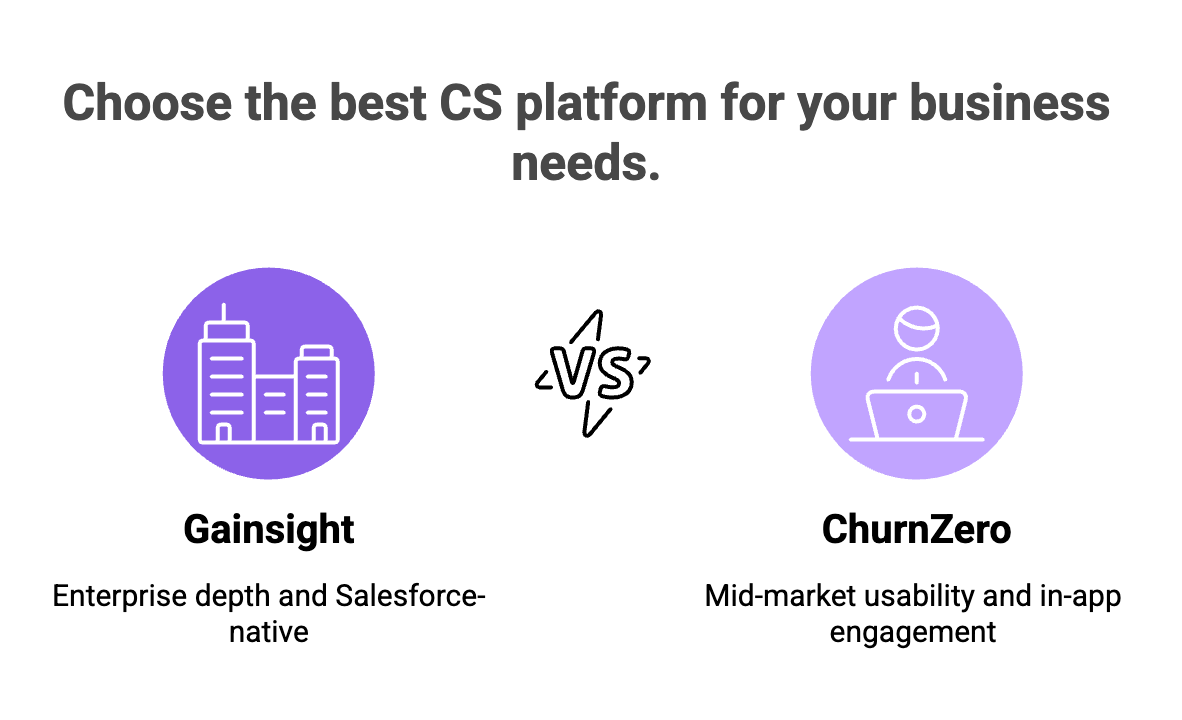
.png)