Best Customer Success Platforms in 2026: 10 Tools Tested and Scored
Written by
Ishan Chhabra
Last Updated :
February 10, 2026
Skim in :
11
mins
In this article
Still got questions?
Come discuss this article with me.
Hi, I'm Ishan, Founder and CEO of Oliv.
I'm always up for a conversation about revenue intelligence, AI agents, or what's actually working (and what's not) across revenue teams.
I'd love to hear your perspective.
Thank you! Your submission has been received!
Oops! Something went wrong while submitting the form.
Meet Oliv’s AI Agents
Hi! I’m, Deal Driver
I track deals, flag risks, send weekly pipeline updates and give sales managers full visibility into deal progress
Hi! I’m, CRM Manager
I maintain CRM hygiene by updating core, custom and qualification fields all without your team lifting a finger
Hi! I’m, Forecaster
I build accurate forecasts based on real deal movement and tell you which deals to pull in to hit your number
Hi! I’m, Coach
I believe performance fuels revenue. I spot skill gaps, score calls and build coaching plans to help every rep level up
Hi! I’m, Prospector
I dig into target accounts to surface the right contacts, tailor and time outreach so you always strike when it counts
Hi! I’m, Pipeline tracker
I call reps to get deal updates, and deliver a real-time, CRM-synced roll-up view of deal progress
Hi! I’m, Analyst
I answer complex pipeline questions, uncover deal patterns, and build reports that guide strategic decisions
TL;DR
Oliv AI (74/80) leads as the only AI-native CSP with autonomous agents that execute work, not just display dashboards.
Gainsight ($60K to $105K+ annual TCO) remains the enterprise standard but demands dedicated admins and 6-month implementations.
ChurnZero suits mid-market teams with structured playbooks, though CRM data transfer creates workarounds.
Legacy CSP architecture (Gen 1 and Gen 2) hits a ceiling: bolting AI onto old foundations adds noise, not value.
True platform cost includes implementation fees, admin headcount, and add-on escalation, not just per-seat pricing.
Stage-fit matters most: a $50K enterprise CSP at a seed-stage startup wastes budget; a lightweight tool at scale collapses under complexity.
Q1: What Are the 10 Best Customer Success Platforms in 2026? [toc=10 Best CS Platforms]
Customer success platforms (CSPs) have become the operational backbone of post-sale revenue teams. But the category is splitting fast: one side still runs on legacy dashboards and manual workflows; the other is moving toward AI-native agents that autonomously execute the work. The 10 platforms below span that full spectrum, from enterprise incumbents to the emerging generation of agentic CS tools.
Here is the quick-reference list, followed by a detailed comparison table and in-depth reviews of each platform.
The 10 Best Customer Success Platforms at a Glance
Oliv AI - Best for AI-native, agentic customer success (mid-market to enterprise)
Gainsight - Best for large enterprise CS operations with dedicated admin teams
ChurnZero - Best for structured mid-market CS workflows and playbooks
Totango - Best for modular enterprise CS with SuccessBLOC templates
Planhat - Best for data-driven European CS teams managing complex portfolios
Custify - Best for small-to-midsize teams seeking affordable CS automation
ClientSuccess - Best for relationship-focused CS teams with simple account structures
Vitally - Best for productivity-first B2B SaaS CS teams wanting modern UX
Freshdesk - Best for support-first teams that need ticketing with basic CS capabilities
HubSpot Service Hub - Best for teams already embedded in the HubSpot ecosystem
Comprehensive Comparison Table
Best Customer Success Platforms in 2026: Feature and Pricing Comparison
Health scoring, workflow automation; AI add-ons priced separately
2 to 4 weeks
SMB to mid-market
Freshdesk
Support-first ticketing + CS
⭐⭐⭐⭐
$79/user/mo (CS module)
Freddy AI for ticket summarization; limited CS-specific AI
1 to 3 weeks
SMB to mid-market
HubSpot Service Hub
All-in-one HubSpot ecosystem
⭐⭐⭐⭐
$15/mo (Starter); $90/mo (Professional)
Basic AI chatbot; workflow automation
1 to 4 weeks
Startup to mid-market
1. Oliv AI: The Leader in AI-Native Revenue Orchestration
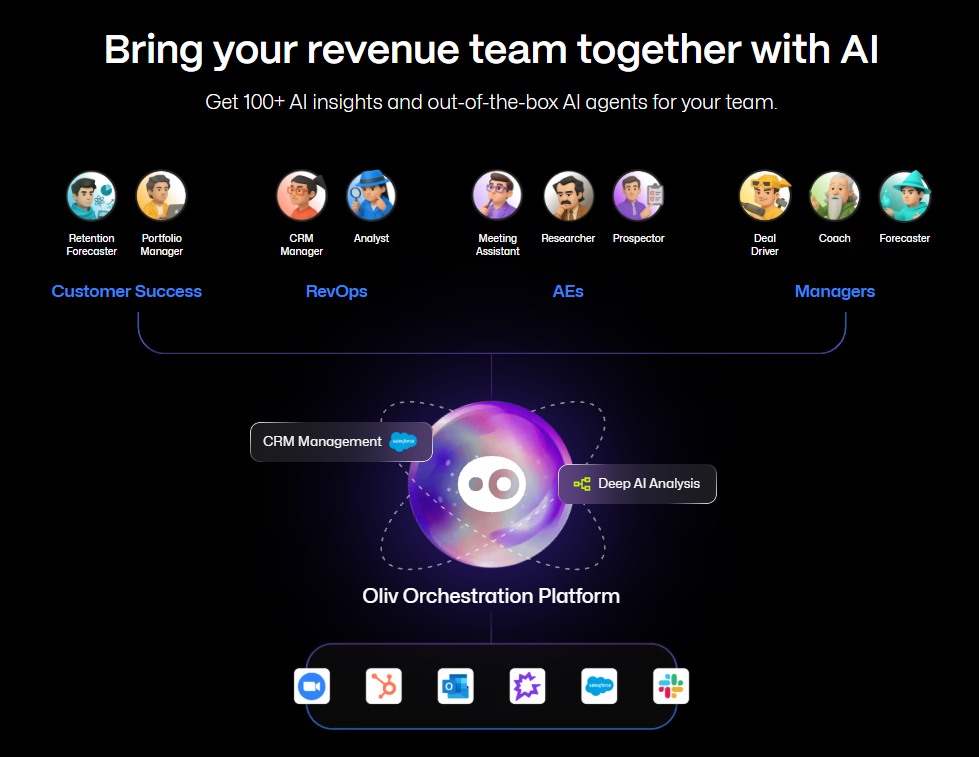
Oliv AI orchestration platform overview featuring purpose-built AI agents including Retention Forecaster, CRM Manager, Analyst, and Meeting Assistant across revenue teams.
What it does: Oliv AI is the only generative AI-native customer success platform built on an agentic architecture. Rather than providing dashboards for CSMs to manually interpret, Oliv deploys autonomous AI agents that execute the work, updating CRM fields, drafting QBR decks, flagging churn risk, and building handoff packets, without waiting for a human to click.
Architecture: Oliv operates on a three-layer model:
Baseline Layer (Documentation): Recording, transcription, and summarization across all customer touchpoints, calls, emails, support tickets, Slack, and Telegram
Intelligence Layer (Context): Stitches multi-channel data into a 360-degree account view, giving CSMs a unified customer history instead of fragmented signals
Agentic Layer (Execution): Proactive agents that autonomously perform tasks based on the intelligence layer's insights
Key Agents Powering Oliv AI
Health Monitor - Automatically scans accounts weekly using usage data, support tickets, and survey signals to alert CSMs before churn risk escalates
QBR Builder - Drafts data-rich Quarterly Business Review decks by pulling live customer outcomes, eliminating hours of manual preparation
Retention Forecaster - Tracks renewal risk across the entire portfolio, identifying risk factors early and prioritizing CSM attention
Handoff Hank - Builds automated handoff packets to prevent context loss during the AE-to-CSM transition
CRM Manager - Automatically updates standard and custom properties in HubSpot or Salesforce, not just notes, but real structured data
The Analyst - An "ask-me-anything" strategic engine that answers questions across the entire pipeline in plain English
Voice Agent - Calls reps for a nightly context update, capturing insights that never surface in formal meetings
Oliv AI Pricing and Setup
Pricing: Starts at $19/user/month with modular "pay-for-what-you-use" pricing. No mandatory platform fees, no hidden add-ons for unused features. Free data migration for teams switching from legacy platforms.
Implementation: Initial setup in 5 minutes. Full customization and model fine-tuning in 2 to 4 weeks. Historical data import at no additional cost.
✅ Generative AI-native architecture - agents do the work, not just display data
✅ 5-minute setup with free migration - fastest time-to-value in the category
✅ Modular pricing eliminates "shelfware" costs common with bundled legacy platforms
✅ Multi-channel signal stitching - calls, emails, tickets, Slack unified into one view
✅ Revenue-connected CS - ties customer health directly to NRR and expansion outcomes
❌ Newer entrant - smaller community and ecosystem compared to legacy incumbents
❌ Best suited for teams ready to adopt an agent-first workflow model
2. Gainsight: The Enterprise Legacy Standard
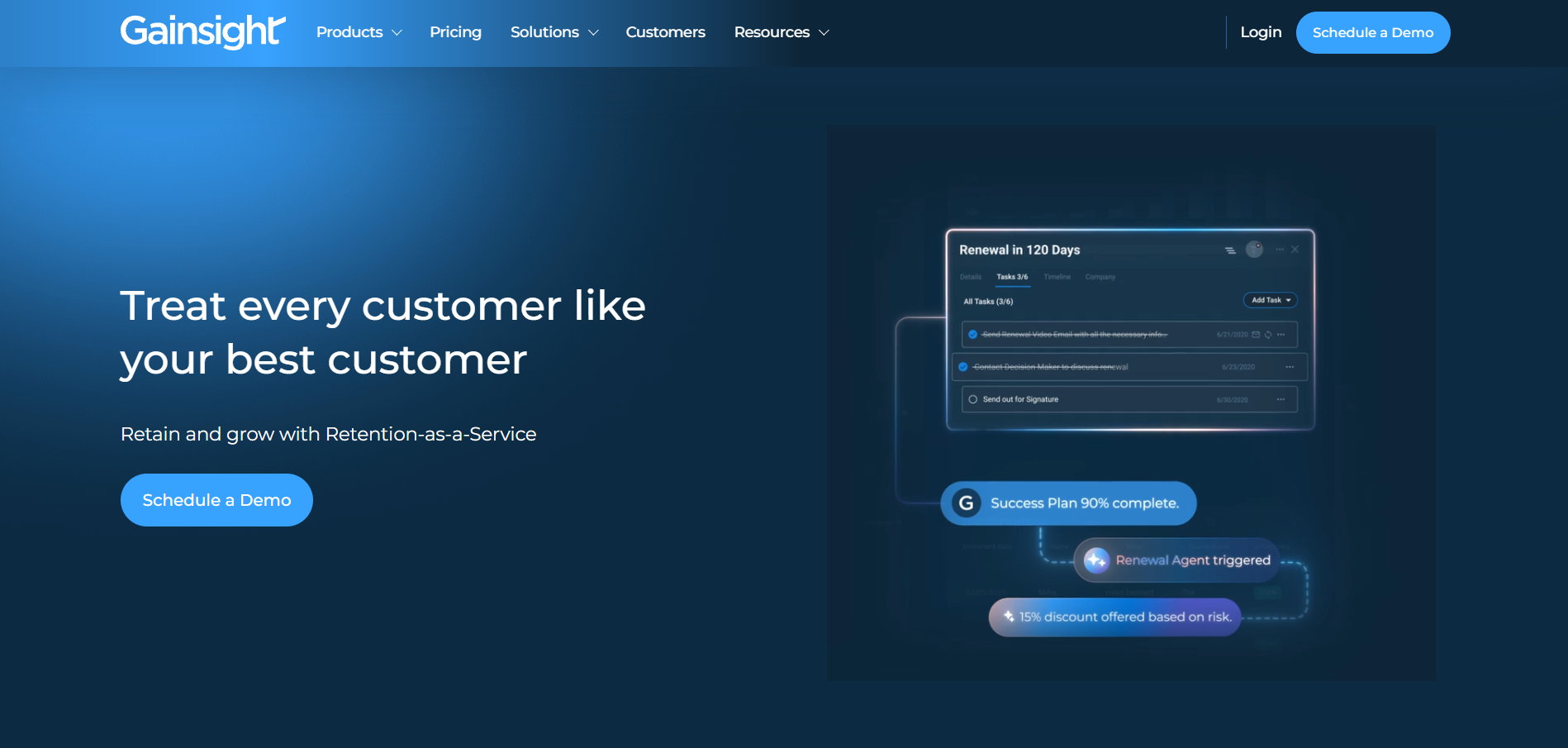
Gainsight homepage displaying its Retention-as-a-Service positioning with renewal agent triggers, success plans, and enterprise customer management capabilities.
What it does: Gainsight is the most established enterprise CSP, offering health scores, journey orchestration, playbooks, and deep Salesforce integration. It remains the default choice for large CS organizations with 50+ CSMs and dedicated admin teams.
Key Features: Configurable health scoring, rules engine, journey orchestrator (JO), data designer, NPS/survey management, C360 dashboards, Salesforce-native deployment.
Gainsight Pricing and Implementation
Pricing: Essentials starts at ~$2,400/user/year (median for 10 users); Enterprise tier reaches ~$4,200/user/year. Implementation fees can run $50K to $120K+ depending on complexity, with 5 to 10% annual uplifts.
Implementation: Typically 6 weeks to 6 months, requiring dedicated Gainsight admins, Salesforce admins, and engineering support.
✅ 🏢 Deep enterprise feature set with extensive data manipulation capabilities
✅ 🔗 Strongest Salesforce-native integration in the category
✅ 👥 Active admin community (official and unofficial) for peer support
❌ 💰 High TCO - platform fees, implementation costs, and annual uplifts add up fast
❌ ⏱️ Steep learning curve - implementation "is a nightmare" without dedicated admin resources
"Consider the costs and implementation time. Implementation took us a good 6 months, and now we cannot consider switching because of how entrenched we are with it, even though it is obscenely expensive." — Verified User, Telecommunications G2 Verified Review
"There is an excessive focus on AI at the expense of addressing basic features, parity issues, and stability problems." — Alberto S., Enterprise, 1000+ emp. G2 Verified Review
3. ChurnZero: The Mid-Market Playbook Standard
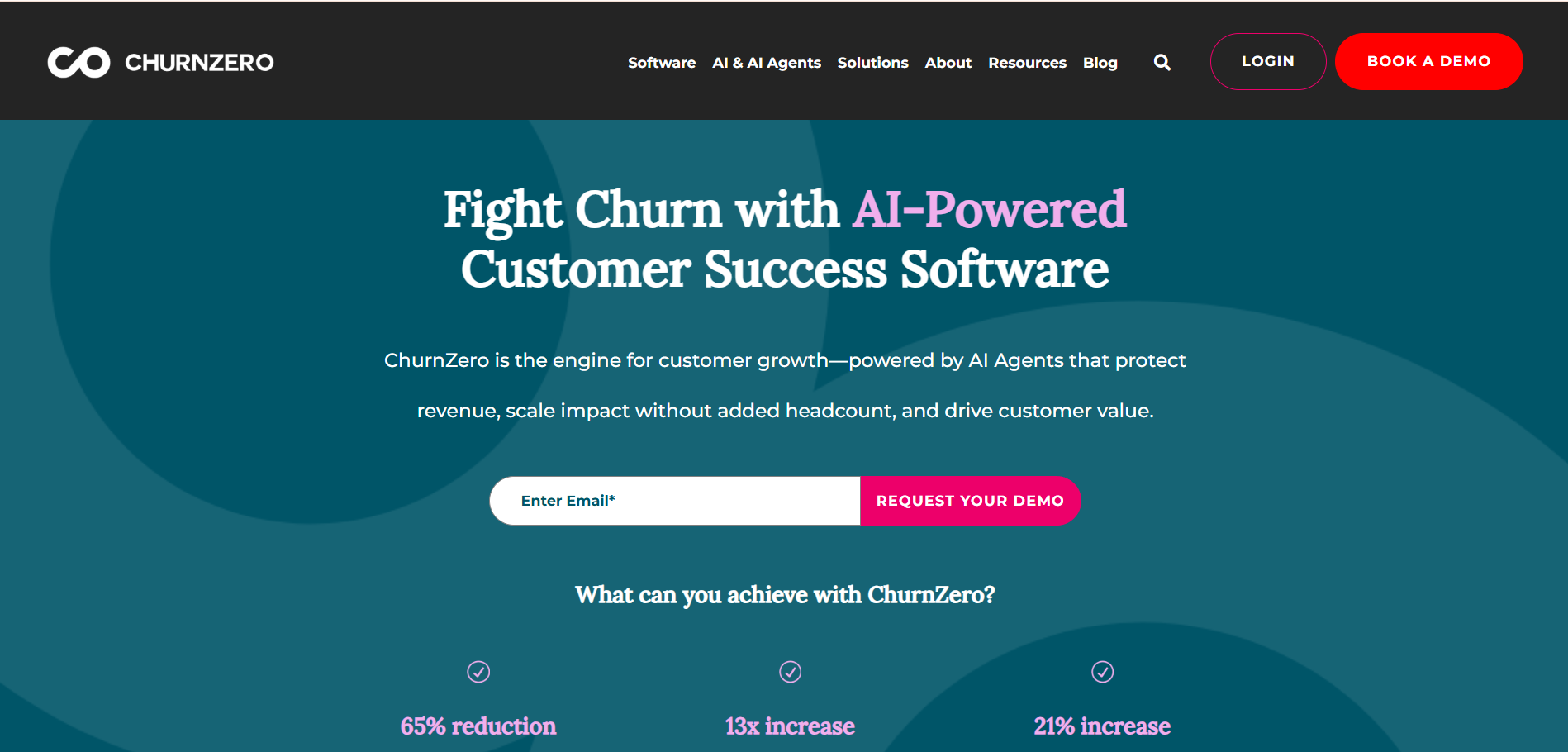
ChurnZero homepage showcasing its AI-powered customer success software designed to fight churn, protect revenue, and scale impact for mid-market CS teams.
What it does: ChurnZero provides mid-market CS teams with lifecycle tracking, automated playbooks, health scoring, and in-app engagement tools. It is purpose-built by CS practitioners and excels at structured workflow automation.
Key Features: Real-time health scores with usage-stat integration, automated plays and journeys, in-app guides, task management, Salesforce and NetSuite integration.
ChurnZero Pricing and Deployment
Pricing: Custom pricing (contact sales). Users report costs escalate as features and scale increase.
Implementation: 4 to 12 weeks. Simpler initial deployment than Gainsight, but data transfer workarounds are common.
✅ 🎯 Built by CS experts - intuitive for frontline CSMs managing a book of business
✅ 📊 Strong health scoring with flexible usage-stat integration
✅ 🤝 Responsive support team and dedicated CSMs
❌ 📉 Reporting is not intuitive - users need multiple dashboards to get desired data (41 G2 mentions)
❌ ⚙️ Playbook creation is time-consuming relative to competitors; cannot duplicate other users' playbooks
"ChurnZero allows us to consolidate all the pertinent data points from all our systems into one spot for CSMs. It's a one-stop-shop so they don't have to navigate to 10 different systems." — Amanda E., Director of CS Ops, Mid-Market G2 Verified Review
"Setting up our ChurnZero instance has involved a significant amount of manual administration. The data transfer from our CRM is not straightforward, which has forced us to create numerous workarounds." — Brandon O., Client Education Manager, Mid-Market G2 Verified Review
4. Totango: Modular Enterprise CS with SuccessBLOCs
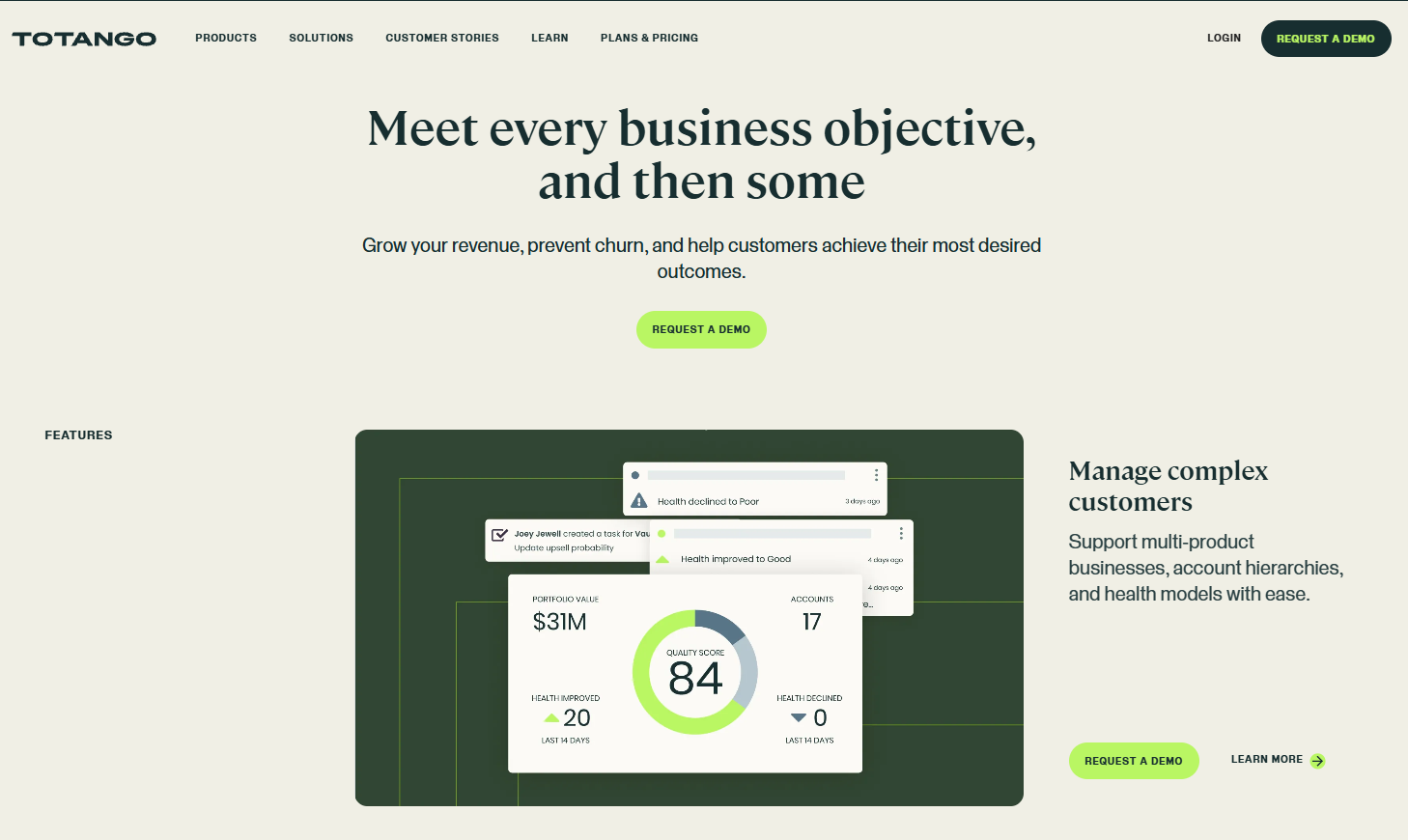
Totango homepage featuring portfolio health scoring, account hierarchy management, and quality score dashboards designed for enterprise customer success operations.
What it does: Totango offers a modular customer success platform built around "SuccessBLOCs", pre-built templates for common CS workflows like onboarding, adoption, renewal, and expansion. It targets mid-market to enterprise teams that want prescriptive guidance on CS motions.
Pricing: Custom pricing (contact sales). The free Community edition offers limited features; paid plans scale with usage and modules.
Implementation: 4 to 8 weeks. Users report it was "really easy to implement" compared to Gainsight, though a "steep learning curve for both front-end and backend" exists.
✅ 📋 SuccessBLOC templates provide clear, prescriptive CS playbooks out of the box
✅ 📈 User-friendly interface with effective customer health monitoring
✅ 🔄 Helpful for scaling downmarket accounts at volume
❌ 🔀 Data inconsistencies - fields appear in some filters but not in account views
❌ 🧩 Limited hierarchy support - struggles with complex parent/child account structures
❌ 🔔 No real-time notification system - relies on daily summaries instead of proactive alerts
"Totango is very user-friendly and easy to navigate. We use the tool every day either by logging in or by using Connect via Outlook." — Aurelia F., Director of Customer Success EMEA, Mid-Market G2 Verified Review
"I find Totango sometimes incoherent, as there are fields that appear in certain filters or pages but not in the main account overview." — Crow S., CSM, Mid-Market G2 Verified Review
5. Planhat: Data-Driven Portfolio Management
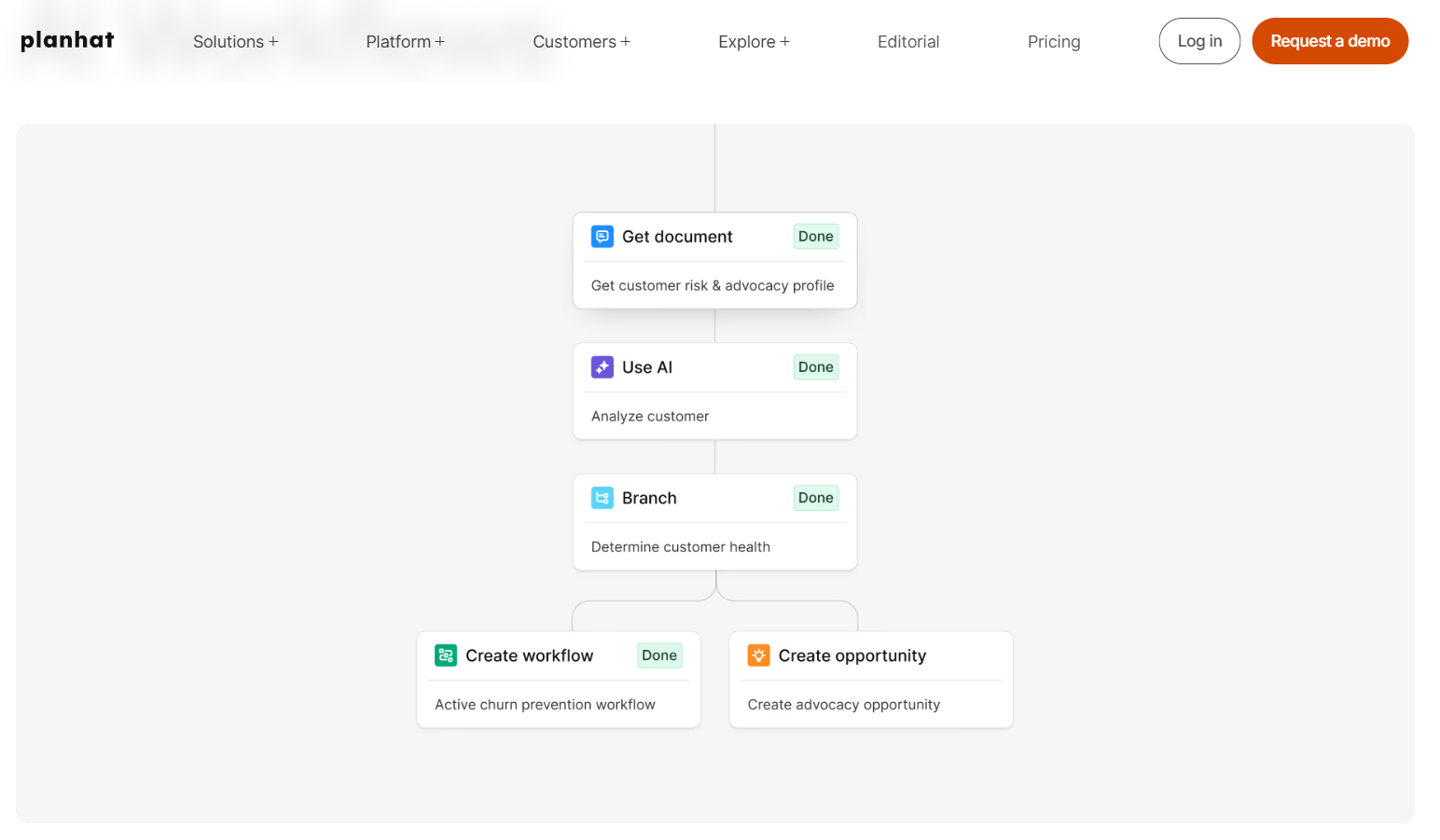
Planhat platform interface displaying AI-driven customer analysis workflow with automated branching for churn prevention and advocacy opportunity creation.
What it does: Planhat is a customer success and revenue intelligence platform recognized as a Leader in the 2025 Gartner Magic Quadrant for Customer Success Management Platforms. It positions itself as the "system of action" for revenue teams focused on net revenue retention.
❌ 🗄️ Data model is "the most bizarre one I have faced" - linking data objects requires complex workarounds
❌ 📖 Documentation is outdated and refers to old UI, making self-service difficult
❌ 🐞 Multiple users report persistent bugs and unreliable integrations
"Workflows are perhaps the most used feature. Ability to create views to a data object helps to understand the data." — Verified User, Information Services, Mid-Market G2 Verified Review
"The entire tool is super buggy, most integrations do not work as intended. We went back to using Google Sheets for our calculations." — Verified User, Computer Software, Small Business G2 Verified Review
6. Custify: Affordable CS for Small Teams
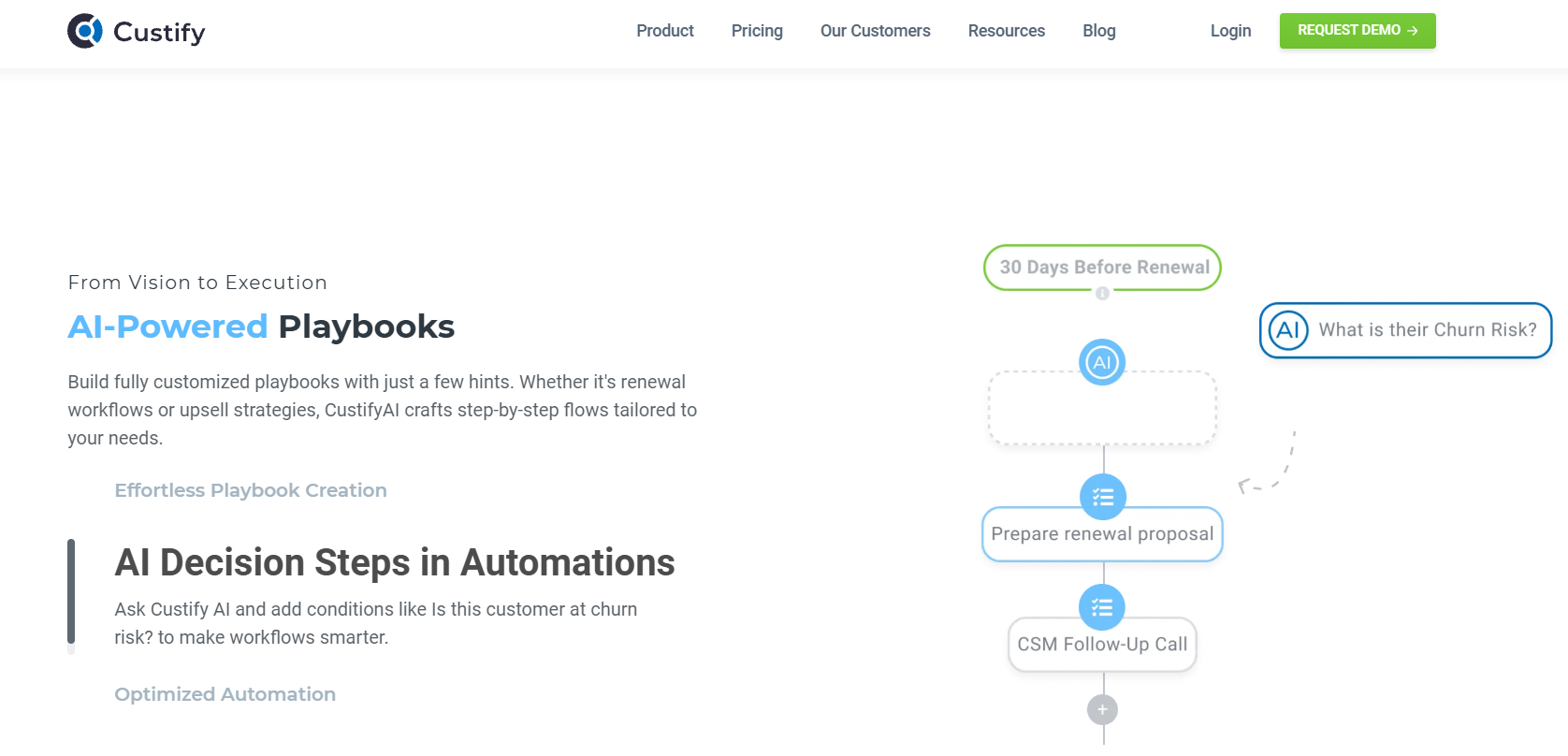
Custify platform showcasing AI-powered playbook creation with automated decision steps for renewal workflows, churn risk assessment, and CSM follow-up actions.
What it does: Custify provides small-to-midsize CS teams with health scoring, lifecycle management, playbooks, and survey automation. It is designed as a simpler, more affordable alternative to enterprise CSPs for teams that need to replace spreadsheets without enterprise complexity.
Key Features: Health scores, lifecycles and playbooks, automated NPS/CSAT surveys, task management, basic segmentation, data aggregation from multiple sources.
Custify Pricing and Onboarding
Pricing: Custom pricing (contact sales). Positioned as a budget-friendly option for SMBs.
Implementation: 2 to 4 weeks. Quick Slack-based support. Setup is straightforward for basic use cases.
✅ 💰 Budget-friendly entry point for teams replacing spreadsheets
✅ 📋 Good for automating NPS/CSAT surveys and basic lifecycle playbooks
✅ 🤝 Responsive support via Slack; listens to user feedback for improvements
❌ 🖥️ UX is "not very intuitive" - dashboards and reports are cumbersome
❌ 📧 Email module is send-only (no reply or forward), limiting it to outbound outreach
❌ 📊 Weak analytics and reporting - functions as an operational tool, not an insight engine
"A young platform with the right focus, Customer Success perspective, and a bright future ahead." — Verified User, Computer Software, Small Business G2 Verified Review
"Custify is helpful for gathering health scores, however there are a lot of bugs and we lost months of data." — Verified User, Computer Software, Small Business G2 Verified Review
7. Client Success: Relationship-Focused CS
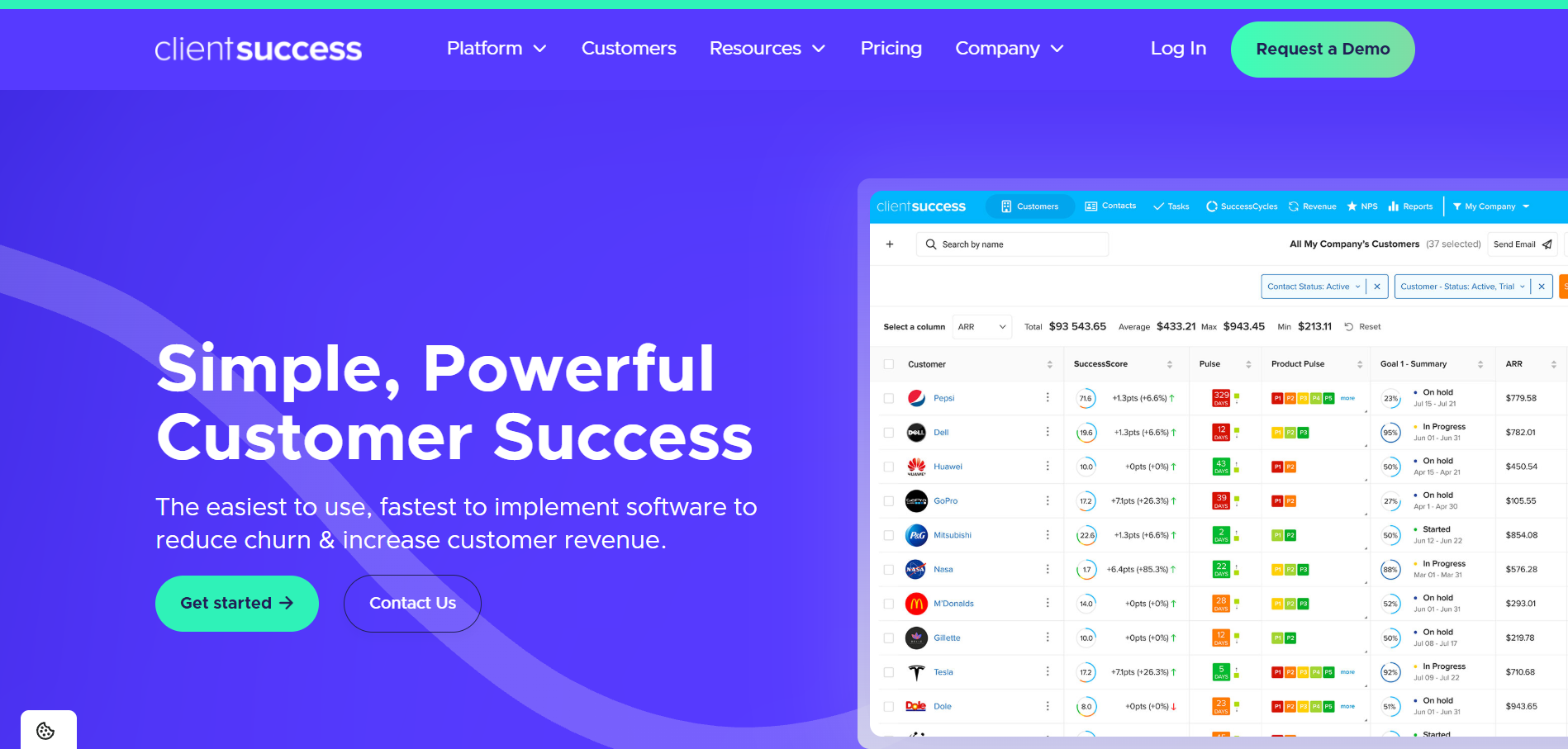
ClientSuccess platform interface showing customer portfolio view with SuccessScores, product pulse ratings, and ARR tracking for simple renewal management.
What it does: ClientSuccess targets small-to-midsize CS teams that prioritize relationship tracking and simplicity over enterprise-grade configuration. It offers renewal management, pulse scoring, email integration, and a clean visual interface.
Key Features: Pulse scoring (manual health check), success cycles, email/Gmail integration, Salesforce and Slack integration, renewal tracking, revenue reporting.
Client Success Pricing and Support
Pricing: Custom pricing (contact sales). Users report it as mid-range relative to Gainsight and ChurnZero.
Implementation: 2 to 4 weeks. Initial setup support is generally praised, but ongoing account management has been inconsistent.
✅ 🎨 Clean, visually appealing interface that CSMs find easy to navigate
✅ 📧 Email integration (Gmail) provides inline communication tracking per account
✅ 🔄 Good for simple account structures and basic renewal tracking
❌ 🔧 Limited feature set - users report upgrading to Gainsight when complexity grows
❌ 🛠️ "7 to 8 Account Managers in the last year" - inconsistent customer support
❌ 📤 No bulk CSV upload; relies on support team for data imports
"ClientSuccess was a great tool that offered all the basic features expected from a CRM... which is why we ended up changing to Gainsight." — Xander K., Customer Success Manager, Mid-Market G2 Verified Review
"I like that you can integrate your emails so that you have the communication threads within the client's dashboard. But the reminder features don't work." — CJ C., Director of Client Services, Mid-Market G2 Verified Review
8. Vitally: Productivity-First Modern CS
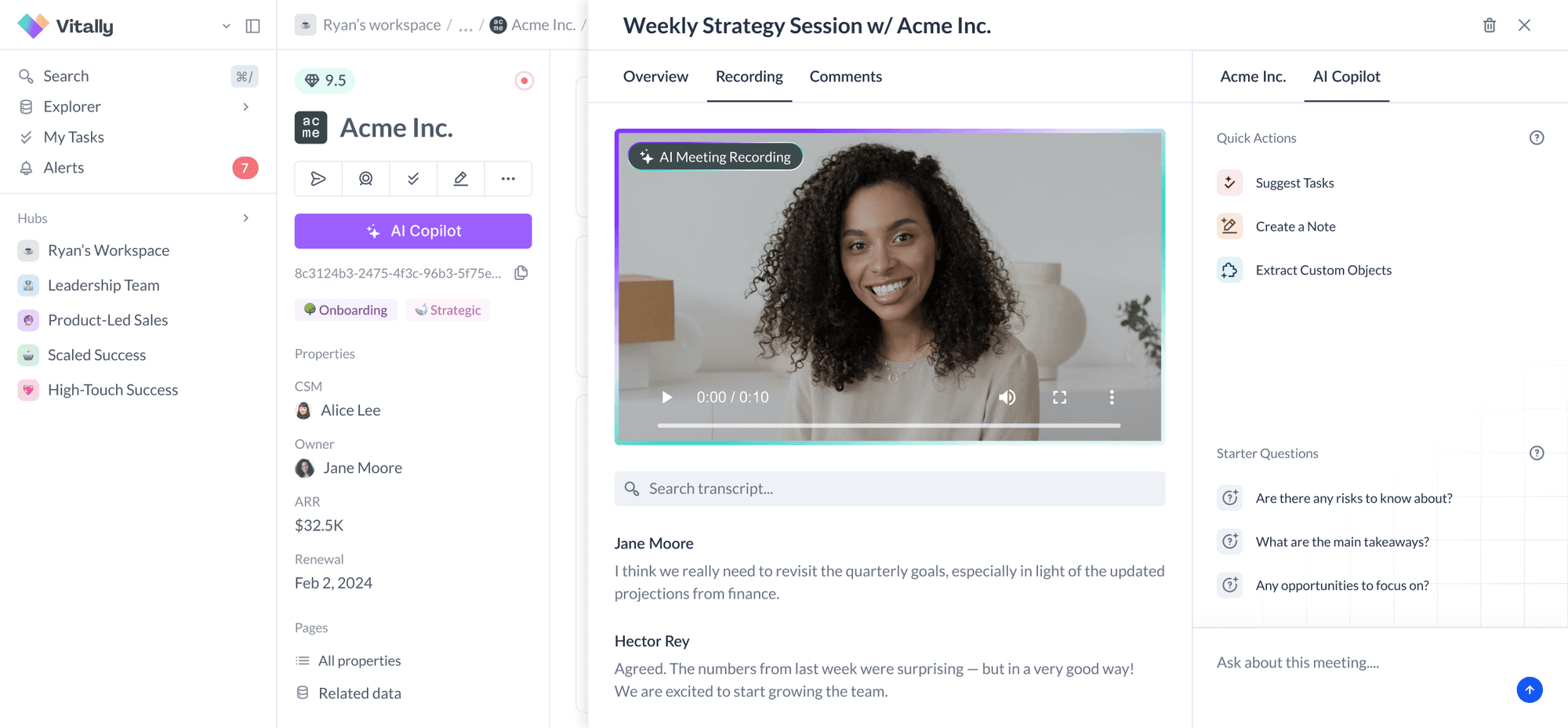
Vitally platform interface displaying account health scoring, AI copilot sidebar with quick actions, and integrated meeting recording with transcript search.
What it does: Vitally is a modern CSP that combines customer health scoring, workflow automation, and real-time dashboards in a consumer-grade UI. It positions itself as a productivity-first alternative to legacy platforms like Gainsight and Totango with an "All Features, All Plans" packaging model.
Pricing: Starts at ~$299/month (base). AI features are priced as add-ons. Scales with seats and account volume rather than feature gates.
Implementation: 2 to 4 weeks. Faster than enterprise incumbents, though some users report onboarding specialists being "spread thin."
✅ 🎯 Modern, consumer-grade UI that teams actually enjoy using
✅ 📊 Robust, customizable reporting with accurate CS KPI tracking
✅ 🔓 "All Features, All Plans" - no feature gating behind tiers
❌ 💲 AI add-ons are "far above industry standards" and don't deliver clear ROI
❌ 📝 Docs feature is "unusable, jumping all over the page" when adding elements
❌ 🏗️ Secondary features feel "half baked" with poor troubleshooting guidance
"Vitally allows us to track all revenue sources, customer usage, onboarding, and health in one place. Its reliable for CS KPIs." — Elden D., Senior Customer Success Manager, Small Business G2 Verified Review
"A lot of secondary features are half baked. The AI features, while nice, are very high priced and the cost does not allow for ROI." — Elden D., Senior Customer Success Manager, Small Business G2 Verified Review
9. Freshdesk: Support-First Ticketing with CS Capabilities
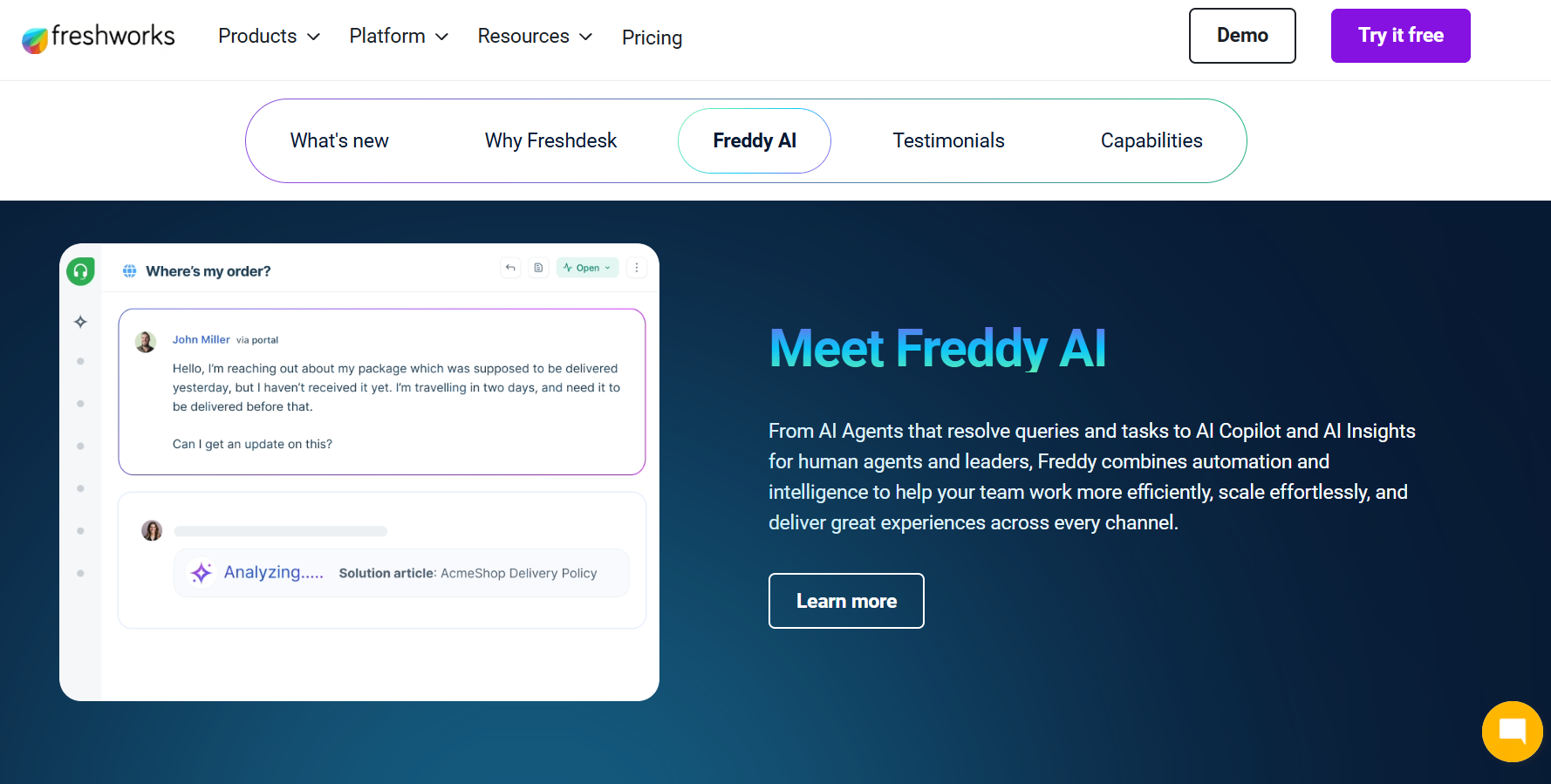
Freshdesk by Freshworks homepage highlighting Freddy AI with automated query resolution, AI copilot for agents, and intelligent insights for support leaders.
What it does: Freshdesk (Freshworks) is primarily a help desk and ticketing platform that extends into customer success through its Freshdesk Customer Success module. It excels at reactive support workflows, centralizing tickets from multiple channels, but offers limited proactive CS capabilities.
Pricing: Freshdesk Customer Success module starts at ~$79/user/month. Core ticketing plans range from free to $79/agent/month. AI add-ons cost extra.
Implementation: 1 to 3 weeks. Users praise how easy it is to "find a ticket" and get started. Setup for basic ticketing is straightforward; complex rule logic can require manual fixes.
✅ 🎫 Best-in-class ticketing - reliable, cost-effective, and efficient at core help desk functions
✅ 🤖 Freddy AI summarizes tickets and suggests responses, saving agent time
✅ 🔗 Good inter-team collaboration features for managing cross-department dependencies
❌ 🔄 Product integration across Freshworks suite is "incredibly confusing" for omnichannel setups
❌ 🧠 AI summarization is "not yet up to the mark" - lacks precision for complex tickets
❌ 📈 Limited proactive CS capabilities - no native health scoring, churn prediction, or sales forecasting
"While setting up rules was initially easy, we later discovered the logic didn't meet our needs, and we had to manually fix over 300 rules." — Tonya S., Customer Service Analyst, Small Business G2 Verified Review
10. HubSpot Service Hub: The All-in-One Ecosystem Play
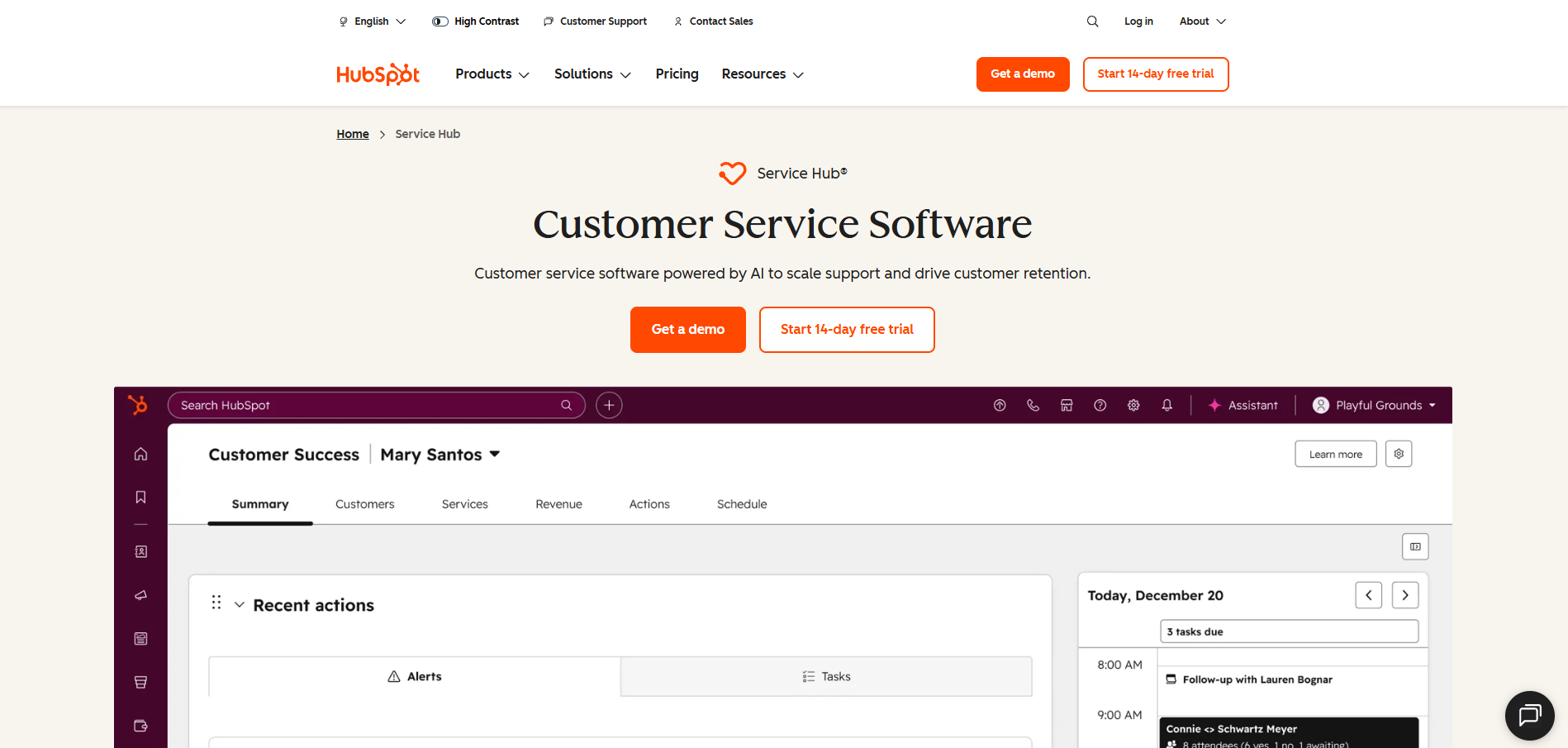
HubSpot Service Hub customer success workspace showing account summary view with recent alerts, scheduled tasks, and AI-powered customer retention features.
What it does: HubSpot Service Hub extends HubSpot's CRM into customer service and basic CS capabilities, ticketing, knowledge base, customer portal, feedback surveys, and service analytics. Its strongest advantage is seamless integration with HubSpot's Marketing and Sales Hubs, creating a unified customer record across the entire lifecycle.
Pricing: Starter at $15/month; Professional at $90/month (includes knowledge base, customer portal, SLA management). Enterprise scales higher. Mandatory onboarding fees ($1,500+) for Professional and above. Add-on costs can escalate quickly.
Implementation: 1 to 4 weeks. Users praise how easily features can be configured "without having an expert in the software to guide you." The learning curve is moderate for the full suite.
✅ 🔗 Seamless CRM integration - sales, marketing, and service in one platform
✅ 🛠️ Easy self-service setup without requiring admin expertise
✅ 📬 Unified inbox consolidates customer requests from multiple channels
❌ 💲 "Pricing climbs fast once you need the good stuff" - advanced features locked behind expensive tiers
❌ 🎫 Ticketing UI "feels messy and unintuitive" - hard to search old tickets at scale
❌ 🤖 AI chatbot "spits out bland replies that you have to tweak anyway to sound real"
"As a sales manager, HubSpot Service Hub bridges sales and support seamlessly by layering tickets on CRM data, giving me instant insights into post-sale issues and upsell opportunities." — Manikandan M., Team Lead, Enterprise G2 Verified Review
"The ticketing UI feels messy and unintuitive, making it hard to search for old tickets. The mobile app has limitations, and the desktop version is more functional." — Pratiyush S., Team Leader, Mid-Market G2 Verified Review
The Bottom Line on CS Platforms in 2026
The CSP market in 2026 is no longer a one-size-fits-all category. Legacy platforms like Gainsight and ChurnZero remain powerful for teams with the admin resources to configure and maintain them. But for CS organizations that want signals over dashboards and execution over configuration, AI-native platforms like Oliv AI represent a fundamentally different approach, one where the platform does the work instead of just displaying it.
For teams evaluating the broader revenue intelligence software landscape, the question is no longer "which dashboard is prettiest?" It is: does your platform inform, or does it act? If your team still spends hours on manual CRM updates before every QBR, exploring AI-native revenue orchestration platforms is the logical next step.
Whether you are a VP of CS comparing sales intelligence platforms or a frontline CSM tired of toggling between 10 systems, the shift from configuration-heavy dashboards to AI-powered sales tools is reshaping what "customer success" actually looks like in 2026.
Q2: How We Tested: Our Evaluation Methodology and Scoring Rubric [toc=Evaluation Methodology]
Why Most "Best CSP" Lists Fall Short
The majority of customer success platform roundups follow the same formula: aggregate G2 star ratings, repackage vendor marketing, and rank alphabetically. That approach looks objective, but it tells a buyer almost nothing about how a platform actually performs inside a live revenue workflow, where data quality, adoption friction, and time-to-value determine whether the tool earns its keep or becomes expensive shelfware.
The Problem with Surface-Level Reviews
Legacy review methodology compares tools on feature checklists without testing real workflows. The result? Teams purchase platforms that look impressive on paper but require six-month implementations, dedicated admins, and extensive manual data entry before producing a single actionable insight. Gainsight users on G2 repeatedly cite implementations that "took a good 6 months" and now feel locked in despite the tool being "obscenely expensive". ChurnZero admins report that "the data transfer from our CRM is not straightforward, which has forced us to create numerous workarounds". Feature-count comparisons miss these realities entirely.
Our 8-Dimension Weighted Rubric ✅
We evaluated every platform against eight weighted dimensions designed to reflect what actually drives retention outcomes for mid-market and enterprise CS teams:
8-Dimension Weighted Evaluation Rubric
Dimension
Weight
What We Measured
Health Scoring Depth
15%
Automated vs. manual inputs; multi-signal vs. single-source
AI & Automation
15%
Generative copilots, agentic execution, or basic rule-based logic
Integration Ecosystem
12%
Native connectors to Salesforce, HubSpot, Snowflake, Slack, Segment
Time-to-Value
13%
Days from sign-up to first live health score or automated alert
Pricing Transparency
10%
Published pricing, hidden platform fees, add-on escalation patterns
Scalability
12%
Performance from 50 accounts to 10,000+ without admin overhead growth
UX / Adoption Curve
13%
CSM adoption rate within 30 days; admin dependency for daily use
Security & Compliance
10%
SOC 2, GDPR, data residency, SSO, role-based access
The Critical Distinction: Does It Do the Work or Just Show the Data?
Our rubric specifically tests whether a platform executes tasks autonomously (updating CRM fields, drafting QBR decks, sending proactive alerts) or merely surfaces dashboards that require a CSM to interpret and act on manually. This is the dividing line between legacy dashboard-first CSPs and the emerging category of AI-native revenue orchestration platforms like Oliv AI, which deploys agents such as Health Monitor and QBR Builder that perform the work rather than just displaying it.
Scoring Scale and Data Sources 📊
Each platform was scored 1 to 10 per dimension, for a maximum of 80 points. Our data sources included:
Hands-on trials of each platform's core workflows
500+ G2 and Capterra reviews analyzed for recurring themes (not cherry-picked quotes)
Vendor documentation and publicly available API/integration specs
Pricing verified via Vendr benchmarking data and direct vendor outreach
"We run into limitations or bugs every week and that is unacceptable." - Daniel K., CS Operations Manager, Mid-Market G2 Verified Review
"Custify is helpful for gathering health scores, however there are a lot of bugs and we lost months of data." - Verified User, Computer Software, Small Business G2 Verified Review
This methodology ensures every recommendation in the sections that follow is grounded in tested workflows, not vendor promises.
Q3: The 10 Best Customer Success Platforms: In-Depth Reviews [toc=In-Depth Platform Reviews]
The individual deep-dive profiles below distill each platform's core strengths, operational limitations, and ideal buyer fit. Platforms are ordered by architectural generation: AI-native first, legacy enterprise second, mid-market third, and lightweight/niche tools last. Each profile's rubric score corresponds to the 8-dimension framework outlined in Q2. For complete feature, pricing, and integration comparisons, refer to the tables in Q4.
Platform Ranking Overview
Detailed individual platform reviews, including key features, pricing, implementation timelines, pros/cons, use cases, and real user feedback, are covered comprehensively in Q1 above. The profiles follow this structure:
Customer Success Platform Rubric Scores and Categories
#
Platform
Category
Rubric Score (/80)
Best For
1
Oliv AI
AI-Native Revenue Orchestration
74/80
Agentic CS; modern, leaner teams wanting signals over dashboards
2
Gainsight
Legacy Enterprise
58/80
Large CS orgs (50+ CSMs) with dedicated admin resources
3
ChurnZero
Mid-Market Playbook
55/80
Structured lifecycle automation with usage tracking
4
Totango
Modular Enterprise
53/80
SuccessBLOC-driven teams wanting prescriptive CS motions
5
Planhat
Data-Driven Portfolio
52/80
European CS teams managing multi-product portfolios
6
Custify
Affordable SMB
45/80
Small teams replacing spreadsheets on a budget
7
ClientSuccess
Relationship CS
43/80
Simple account structures focused on renewal tracking
8
Vitally
Productivity-First
54/80
Product-led SaaS teams wanting modern UX and fast onboarding
9
Freshdesk
Support-First
46/80
Ticketing-centric teams needing basic CS bolt-on
10
HubSpot Service Hub
Ecosystem Play
50/80
Teams already embedded in the HubSpot CRM ecosystem
How to Read These Scores
⭐ 70+ - AI-native platform with autonomous execution, minimal admin overhead, and fast time-to-value
✅ 55 to 69 - Established platform; powerful when fully configured, but requires significant admin investment and longer implementation timelines
⚠️ 45 to 54 - Functional for core CS workflows; gaps in AI depth, integration breadth, or scalability
❌ Below 45 - Suitable for narrow use cases; limited automation and reporting depth
"It was a great tool that offered all of the basic features expected from a CRM... which is why we ended up changing to Gainsight." - Xander K., Customer Success Manager, Mid-Market G2 Verified Review
Each platform's full profile, including key features, pricing, implementation, pros, cons, use case, and real user feedback, is detailed in Q1 above. The sections that follow (Q4 onward) add comparative tables and strategic context to help narrow your shortlist.
Q4: Customer Success Platform Comparison: Features, Pricing, and Integrations [toc=Feature and Pricing Comparison]
Feature Matrix
Customer Success Platform Feature Matrix
Capability
Oliv AI
Gainsight
ChurnZero
Totango
Planhat
Custify
ClientSuccess
Vitally
Freshdesk
HubSpot Service Hub
Health Scoring
✅ Auto
✅ Manual config
✅ Usage-based
✅ Configurable
✅ Configurable
✅ Basic
✅ Pulse (manual)
✅ Flexible
❌
⚠️ Basic
AI Copilot / Agents
✅ Generative
⚠️ Bolt-on (Staircase)
⚠️ Emerging
⚠️ Limited
❌
❌
❌
⚠️ Paid add-on
⚠️ Freddy AI
⚠️ Basic chatbot
Playbooks / Automation
✅ Agentic
✅ JO + Rules Engine
✅ Plays + Journeys
✅ SuccessPlays
✅ Workflows
✅ Lifecycles
⚠️ Success Cycles
✅ Automations
✅ Ticket rules
✅ Workflows
In-App Engagement
❌
✅ PX module
✅ Guides + walkthroughs
⚠️ Limited
⚠️ Customer portals
❌
❌
❌
❌
⚠️ Knowledge base
Revenue / NRR Tracking
✅ Native
✅ Revenue reporting
⚠️ Basic
⚠️ Basic
✅ Revenue mgmt
⚠️ Basic
✅ Renewal tracking
⚠️ Basic
❌
⚠️ Basic
QBR Automation
✅ QBR Builder agent
❌ Manual
❌ Manual
❌ Manual
❌ Manual
❌
❌
❌
❌
❌
CRM Auto-Update
✅ CRM Manager agent
❌
❌
❌
❌
❌
❌
❌
❌
⚠️ Native CRM
✅ = Native / robust | ⚠️ = Partial / add-on | ❌ = Not available
Q5: Legacy CSPs vs. AI-Native Platforms: What's Actually Changed in 2026? [toc=Legacy vs AI-Native CSPs]
Three Generations of CS Technology
Customer success technology has moved through three distinct architectural generations. Generation 1 (2015 to 2022) focused on data collection, recording calls, tracking usage, building dashboards. Generation 2 (2022 to 2025) added rule-based automation: playbooks, journey orchestration, and health score formulas. Generation 3 (2025+), AI-Native Revenue Orchestration, introduces autonomous agents that execute work rather than merely surfacing data. Most platforms on this list were born in Gen 1 or Gen 2. Their underlying architecture determines what AI can and cannot do on top of it.
Where Legacy CSPs Hit Their Ceiling
Gainsight, ChurnZero, and Totango remain powerful for teams with the admin resources to configure and maintain them. However, their configuration-first architecture means months of setup, dedicated admins, and constant manual data feeding. G2 reviewers consistently cite "buggy workflows," "steep learning curves," and an "excessive focus on AI at the expense of fixing basic features". Bolting AI onto a legacy foundation often produces more noise than signal, an experience the industry now calls the "trough of disillusionment." Buyers are fatigued by tools that add more work than they subtract.
"There is an excessive focus on AI at the expense of addressing basic features, parity issues, and stability problems." - Alberto S., Enterprise (1,000+ emp.) G2 Verified Review
What Real AI in Customer Success Looks Like ✅
The meaningful distinction is not "has AI" versus "doesn't have AI", it's whether the platform does the work or merely shows the data. Real AI in CS means:
Autonomous execution: drafting QBRs, updating CRM fields, sending proactive alerts without human initiation
Cross-signal stitching: calls + emails + tickets + usage data unified into a single health picture
Most legacy platforms offer, at best, a chatbot or basic summarization, not autonomous task completion. For teams exploring how revenue intelligence platforms are evolving beyond dashboards, this is the architectural shift to watch.
How Oliv AI Bridges the Gap
Oliv AI was built from the ground up as a Gen 3 platform. We deploy purpose-built agents that execute the jobs legacy CSPs require a CSM + admin + BI analyst to replicate manually:
Health Monitor - auto-scans accounts weekly across usage, support tickets, and survey data
QBR Builder - drafts data-rich review decks from live customer outcomes
Retention Forecaster - tracks renewal risk across the entire portfolio, a capability that separates true AI sales forecasting from static dashboards
CRM Manager - autonomously updates standard and custom CRM fields
The Analyst - answers pipeline questions in plain English, functioning as a built-in sales intelligence platform for CS teams
The Treadmill Analogy 🏋️
"Relying on traditional CSP dashboards is like buying a high-end treadmill, expensive, but your team still does all the running. Switching to an agentic platform is like hiring a personal trainer who does the planning, monitoring, and heavy lifting for you."
For revenue leaders evaluating whether to stay on a legacy platform or move toward the next generation, the real question is not which tool has the longest feature list. It is whether your platform informs your team or acts on their behalf. Exploring the full spectrum of best AI sales tools can help contextualize where customer success technology sits within the broader revenue orchestration movement.
Q6: Which Customer Success Platform Fits Your Company Size? [toc=Platform by Company Size]
The Stage-Fit Problem 🎯
Choosing a customer success platform that mismatches your company stage is the most costly error in the category. An enterprise-grade CSP at a 30-person startup burns cash on features no one configures; a lightweight tool at enterprise scale collapses under account hierarchy complexity and data volume. The right platform is the one that fits your operational capacity today while scaling with your revenue trajectory.
Startup / Seed Stage (1 to 50 Employees, <$5M ARR)
Teams of 1 to 5 CSMs managing fewer than 500 accounts need fast setup, low cost, and signal-first intelligence, not months of configuration.
Best Customer Success Platforms for Startups
Platform
Why It Fits
Watch Out For
HubSpot Service Hub
Native CRM integration if already in HubSpot; $15/mo Starter
Advanced features locked behind $90+/mo tiers
Custify
Affordable; basic health scoring and lifecycle playbooks
UX is "not very intuitive"; weak analytics
Oliv AI
$19/user/mo; 5-minute setup; agents compensate for lean headcount
Newer ecosystem; fewer third-party templates
Growth / Mid-Market (50 to 500 Employees, $5M to $100M ARR)
Teams of 5 to 25 CSMs managing 500 to 5,000 accounts. Automation, integration depth, and speed without a dedicated admin are essential.
ChurnZero: Structured playbooks and usage-based health scoring; built by CS practitioners. Expect 4 to 12 weeks of setup and manual data-transfer workarounds.
Vitally: Modern UX with "All Features, All Plans" packaging; fast onboarding. AI add-ons are priced separately and may limit ROI.
Oliv AI: Agentic execution without admin overhead; modular pricing scales with actual usage. Health Monitor and Retention Forecaster automate the work that mid-market teams typically lack headcount to do manually.
Enterprise (500+ Employees, $100M+ ARR) 🏢
Teams of 25 to 200+ CSMs managing 5,000+ accounts. Governance, complex hierarchy support, and deep BI are non-negotiable.
Gainsight: The gold standard for complex enterprise CS ops with deep Salesforce integration. Requires dedicated admins and $50K+ platform fees.
Totango: Modular enterprise alternative with SuccessBLOC templates; easier initial implementation than Gainsight but limited hierarchy support.
Planhat: Strong in European multi-region deployments; Gartner Magic Quadrant Leader. Data model complexity frustrates some users.
Oliv AI: Serves enterprise teams that want intelligence and speed without the configuration tax. The "double functionality at half the price" angle applies when replacing stacked legacy tools, similar to how modern revenue intelligence platforms consolidate multiple point solutions.
The ROI Anchor 💰
Mid-market teams switching from legacy CSPs to Oliv's agentic model report a 91% cost reduction over three years (100-user benchmark) and a 9 to 12 month payback period when utilization exceeds 75%.
"We have 3 people that manage 700 accounts. Gainsight makes it easy to keep organized, but consider the costs and implementation time." - Verified User, Telecommunications G2 Verified Review
"ChurnZero allows us to consolidate all pertinent data points from all our systems into one spot. It's a one-stop-shop so CSMs don't have to navigate 10 different systems." - Amanda E., Director of CS Ops, Mid-Market G2 Verified Review
Q7: How Long Does It Take to Implement a Customer Success Platform? [toc=Implementation Timeline]
The Hidden Cost Nobody Budgets For ⏰
Implementation time is the shadow line-item in every CSP purchase. Every week spent configuring workflows, mapping fields, and training users is a week of unmonitored churn risk and delayed ROI. Yet most buyers focus on feature lists during evaluation and only discover the implementation burden after signing the contract.
Legacy CSP Implementation Reality
Established platforms offer powerful capabilities, but extracting value requires significant upfront investment:
"Implementation is a nightmare" without dedicated resources
ChurnZero
4 to 12 weeks
Moderate; data transfer creates workarounds
"Setting up involved significant manual administration"
Totango
4 to 8 weeks
Moderate; steep learning curve for SuccessBLOCs
"Admin permissions limited; need support for complex issues"
Planhat
4 to 8 weeks
Moderate to heavy; documentation refers to old UI
"Documentation is basically useless"
ClientSuccess
2 to 4 weeks
Low initially; limited scale-up support
"7 to 8 Account Managers in the last year"
Vitally
2 to 4 weeks
Low; onboarding specialists may be spread thin
"Onboarding specialist gave poor advice, was slow to respond"
Custify
2 to 4 weeks
Low; Slack-based support
Quick for basics; limited for complex use cases
Freshdesk
1 to 3 weeks
Low for ticketing; complex rule logic needs manual fixes
"We had to manually fix over 300 rules"
HubSpot Service Hub
1 to 4 weeks
Low; self-service configuration
Mandatory $1,500+ onboarding fee for Professional tier
The AI-Era Benchmark ⚡
Modern platforms should deliver first insights within days, not months. The difference lies in architecture: legacy CSPs require manual configuration of every field, workflow, and playbook, while AI-native platforms ingest existing CRM, email, and call data to start generating signals immediately.
Oliv AI's Time-to-Value Advantage
Initial setup: Configured in 5 minutes, connect your CRM and calendar, and agents begin ingesting data
Full customization: Model fine-tuning and custom agent workflows completed in 2 to 4 weeks
Free data migration: Historical recordings and metadata imported at no additional cost
Day-one signals: Health Monitor and Retention Forecaster start surfacing account risk from the first data sync
"The implementation/integration is a nightmare. You really need dedicated resources to manage and administer this tool." - Verified User, IT Services, Mid-Market G2 Verified Review (on Gainsight)
"Freshdesk makes it easy to find a ticket... the initial setup was simple and without many complications." - Kaddiel G., Product Manager, Mid-Market G2 Verified Review
Q8: Can a CRM or Help Desk Replace a Customer Success Platform? [toc=CRM vs Help Desk vs CSP]
The Most Common Buyer Shortcut 🔀
Many teams try to stretch their CRM (Salesforce, HubSpot) or help desk (Zendesk, Freshdesk) into a customer success tool by adding custom fields, reports, and workflows. For very small teams with fewer than 200 accounts, this can work temporarily. But it breaks down predictably as the portfolio scales.
Why CRMs Break for Customer Success
CRMs were designed for pipeline management, tracking deals from lead to close. They lack native health scoring, lifecycle automation, and proactive churn alerting. The result is "dirty data" because CSMs neglect manual updates when the tool wasn't built for their workflows. As one sales leader put it: a CRM tells you what a customer bought; it cannot tell you if they'll renew.
❌ No automated health scoring from usage, support, or sentiment signals
❌ No lifecycle playbooks or renewal journey automation
❌ No proactive alerting, reactive reporting only
❌ Manual CRM entry leads to data decay within weeks
"Essentially Gainsight allows you to set CTAs, but you can do this from a main CRM. Since Gainsight is a CS tool, sales teams won't use it, and you end up adding an additional system to work out of." - Verified User, Computer Software, Mid-Market G2 Verified Review
Why Help Desks Aren't Enough 🎫
Zendesk and Freshdesk excel at reactive ticket resolution but lack proactive account intelligence. They solve "customer has a problem" but miss "customer is silently churning." There is no native renewal forecasting, expansion tracking, or account health trending, the core capabilities that define a CSP.
"Freshdesk delivers on its core value: ticketing. We're not going to speak to advanced capabilities like AI automation. A help desk needs to get the basics right, and Freshdesk does just that." - Will V., CTO, Small Business G2 Verified Review
Why Traditional CSPs Add Their Own Burden
Dedicated CSPs solve the health-scoring and lifecycle gaps, but they layer another system on top of CRM and help desk, creating data silos and admin overhead. G2 reviewers consistently describe the frustration of maintaining three separate platforms that don't talk to each other natively.
The Agentic Alternative ✅
Oliv AI eliminates the "another system to maintain" problem by embedding intelligence directly into the tools CS teams already use. CRM Manager autonomously updates HubSpot/Salesforce fields so the CRM stays clean without manual entry. Health Monitor ingests data from CRM, support tickets, and call transcripts to deliver health scoring that neither CRMs nor help desks can provide, without requiring a separate dashboard to check. This approach aligns with how modern AI sales tools work across the revenue org.
The real question isn't CRM vs. help desk vs. CSP, it's whether your CS stack does the work for you or creates more work to manage.
Q9: How Do Customer Success Platforms Drive Revenue Outcomes? [toc=CSP Revenue Impact]
CS as a Revenue Function, Not a Cost Center 💵
Customer success has historically been measured by NPS and CSAT, lagging indicators disconnected from the P&L. In 2026, CS leaders are expected to own net revenue retention (NRR), expansion revenue, and renewal forecasting. Yet most CSPs were built in an era when CS was a "post-sale support function," not a revenue engine.
The Traditional Revenue Gap
Legacy platforms can display renewal dates and health scores, but connecting those signals to actual revenue forecasts requires manual QBRs, spreadsheet exports, and cross-referencing with CRM pipeline reports. The workflow looks like this:
CSM checks health score in the CSP
Exports data to a spreadsheet
Cross-references with Salesforce renewal opportunity
Manually drafts a QBR deck in PowerPoint
Presents to the customer with stale, snapshot-in-time data
This process is repeated for every account, every quarter. At scale, it's unsustainable.
"I often have to create multiple dashboards to get the data I want." - Alison B., Customer Operations Manager, Mid-Market G2 Verified Review (on ChurnZero)
"Even basic features, like easily viewing my portfolio, are lacking, so I end up using spreadsheets instead." - Verified User, IT Services, Mid-Market G2 Verified Review (on Gainsight)
The New Standard: Signal-to-Revenue Connection 📊
Modern CS platforms must connect customer signals, usage patterns, sentiment shifts, support ticket velocity, directly to revenue outcomes:
Customer Signals Connected to Revenue Outcomes
Signal
Revenue Outcome
Legacy Approach
AI-Native Approach
Declining usage
Churn risk → NRR impact
Manual health check; CSM intuition
Automated Health Monitor flags risk weekly
Champion departure
Renewal risk → revenue at stake
Discovered too late, often at QBR
Handoff Hank detects contact changes instantly
Support ticket spike
Expansion blocker
Help desk resolves tickets in isolation
Cross-signal stitching links tickets to account health
We built Oliv's intelligence layer to connect every customer signal directly to revenue impact:
Retention Forecaster: Tracks renewal risk across the entire portfolio, identifying revenue at stake before the renewal conversation begins, leveraging AI sales forecasting capabilities
QBR Builder: Auto-generates data-rich review decks that quantify customer ROI, turning every QBR from a manual exercise into a revenue conversation
The Analyst: Answers revenue questions ("Which accounts have the highest expansion potential?") in plain English across the entire pipeline
Teams using unified AI-native tools report 35% higher win rates with agentic deal alerts, 25% higher forecast accuracy versus siloed SaaS, and 2 to 3 hours saved per rep per week on CRM updates alone.
Q10: How to Choose the Right Customer Success Platform for Your Team [toc=Choosing the Right CSP]
Step 1: Define Your Primary Objective 🎯
Platform Shortlist by Primary Objective
If Your Top Priority Is...
Then Prioritize...
Shortlist
Reducing churn with proactive alerts
Automated health scoring + signal stitching
Oliv AI, ChurnZero, Gainsight
Scaling onboarding across segments
Playbooks + journey orchestration
ChurnZero, Totango, Vitally
NRR and expansion revenue tracking
Revenue intelligence + QBR automation
Oliv AI, Gainsight, Planhat
Replacing spreadsheets fast on a budget
Low cost + fast time-to-value
Custify, HubSpot Service Hub, Oliv AI
Enterprise governance and complex hierarchies
Deep SFDC integration + role-based access
Gainsight, Totango
Step 2: Match Your Team Profile 👥
Solo CSM or team of 1 to 3: Choose a platform where agents or automation compensate for lean headcount. Avoid enterprise tools that demand a dedicated admin. Best fits: Oliv AI, Custify, HubSpot Service Hub.
Mid-market team of 5 to 25 CSMs: You need automation depth without admin dependency. Evaluate ChurnZero (structured playbooks), Vitally (modern UX), or Oliv AI (agentic execution with modular pricing).
Enterprise team of 25 to 200+: Governance, audit trails, and hierarchy support are non-negotiable. Evaluate Gainsight or Totango, but pressure-test implementation timelines against your tolerance for 6+ month deployments.
Step 3: Pressure-Test These Five Questions ❓
How long until first actionable insight? If the answer is "after implementation completes," the platform is dashboard-first, not intelligence-first.
Does the platform do the work or show the work? Dashboards inform; agents execute. Understand which model matches your team's capacity.
What is the true TCO at 25 users? Include platform fees, implementation costs, required admin headcount, and add-on pricing for AI features.
What happens when your CRM data is incomplete? Legacy CSPs that depend on manual CRM entry inherit its data-quality problems. AI-native platforms that ingest signals from calls, emails, and tickets bypass this dependency.
Can you run a meaningful pilot in under two weeks? If the vendor requires a 6-week proof-of-concept, that reflects the ongoing admin burden you'll carry.
Step 4: Run a Structured Evaluation ✅
Request a 14-day trial with your actual CRM data, not a demo sandbox
Test with 3 to 5 real accounts across health states (healthy, at-risk, churning)
Measure time-to-first-insight: how many days until the platform surfaces something your team didn't already know?
Involve both CSMs and CS Ops in evaluation, front-line adoption matters as much as admin configuration
"Evaluate if this product will bring actual value or if it will slow teams down by adding an additional tool to check and work in." - Verified User, Computer Software, Mid-Market G2 Verified Review
"All customer information is in one place, and unlike our Sales system, CSMs can quickly set up customized dashboards without costly consultants." - Nancy S., Director of Customer Success, Mid-Market G2 Verified Review
Q11: Frequently Asked Questions About Customer Success Platforms [toc=CSP FAQs]
What is the difference between a CSP, CRM, and help desk?
A CRM (Salesforce, HubSpot) manages sales pipeline and contact records. A help desk (Zendesk, Freshdesk) handles reactive support tickets. A customer success platform sits between both, proactively monitoring account health, automating lifecycle journeys, and predicting churn before it happens. CRMs track what was sold; help desks resolve what broke; CSPs ensure what was promised gets delivered.
How much does customer success software cost in 2026? 💰
Pricing varies widely by company stage. Startup-friendly options start at $200 to $500/month; mid-market platforms range from $1,000 to $5,000/month; enterprise solutions require custom quotes and often add $30K to $120K in platform and implementation fees. Oliv AI starts at $19/user/month with modular, pay-for-what-you-use pricing. For teams evaluating total cost of ownership across revenue intelligence platforms, implementation costs and admin overhead often exceed the sticker price by 2x to 3x.
What is a customer health score?
A customer health score is a composite metric, typically numerical (1 to 100), letter-graded (A to F), or color-coded (green/yellow/red), that aggregates product usage, engagement frequency, support interactions, NPS responses, and payment history into a single indicator of account risk or opportunity. Legacy CSPs require manual configuration of these inputs; AI-native platforms like Oliv AI auto-generate health scores by stitching signals from CRM, calls, emails, and support tickets.
ChurnZero vs. Gainsight: which is better?
It depends on your scale. Gainsight is the enterprise standard with deep Salesforce integration and powerful data manipulation, but requires dedicated admins and 6+ month implementations. ChurnZero is built for mid-market teams with simpler deployment (4 to 12 weeks) and strong usage-based health scoring, but reporting and integrations can feel limited at scale. Both are configuration-first platforms that demand significant manual setup. Teams exploring alternatives to either should consider the broader landscape of AI-native revenue orchestration tools that reduce admin dependency.
"As an admin, everything is more complicated than it should be. I end up building something multiple times." - Verified User, Computer Software, Mid-Market G2 Verified Review (on Gainsight)
How long does CSP implementation take? ⏱️
Enterprise platforms like Gainsight average 6 weeks to 6 months; mid-market tools like ChurnZero take 4 to 12 weeks; modern platforms like Vitally and Oliv AI can deliver first insights within days to 2 weeks. The key variable is whether the platform requires manual data mapping and admin configuration before producing value, or whether it can ingest existing signals autonomously. For teams that have experienced painful rollouts with legacy tools, understanding how AI sales tools approach onboarding differently can inform your evaluation. Platforms built on AI-native revenue orchestration architectures typically bypass the traditional implementation bottleneck by connecting directly to existing data sources like CRM, email, and calendar without requiring manual field mapping.
Q1: What Are the 10 Best Customer Success Platforms in 2026? [toc=10 Best CS Platforms]
Customer success platforms (CSPs) have become the operational backbone of post-sale revenue teams. But the category is splitting fast: one side still runs on legacy dashboards and manual workflows; the other is moving toward AI-native agents that autonomously execute the work. The 10 platforms below span that full spectrum, from enterprise incumbents to the emerging generation of agentic CS tools.
Here is the quick-reference list, followed by a detailed comparison table and in-depth reviews of each platform.
The 10 Best Customer Success Platforms at a Glance
Oliv AI - Best for AI-native, agentic customer success (mid-market to enterprise)
Gainsight - Best for large enterprise CS operations with dedicated admin teams
ChurnZero - Best for structured mid-market CS workflows and playbooks
Totango - Best for modular enterprise CS with SuccessBLOC templates
Planhat - Best for data-driven European CS teams managing complex portfolios
Custify - Best for small-to-midsize teams seeking affordable CS automation
ClientSuccess - Best for relationship-focused CS teams with simple account structures
Vitally - Best for productivity-first B2B SaaS CS teams wanting modern UX
Freshdesk - Best for support-first teams that need ticketing with basic CS capabilities
HubSpot Service Hub - Best for teams already embedded in the HubSpot ecosystem
Comprehensive Comparison Table
Best Customer Success Platforms in 2026: Feature and Pricing Comparison
Health scoring, workflow automation; AI add-ons priced separately
2 to 4 weeks
SMB to mid-market
Freshdesk
Support-first ticketing + CS
⭐⭐⭐⭐
$79/user/mo (CS module)
Freddy AI for ticket summarization; limited CS-specific AI
1 to 3 weeks
SMB to mid-market
HubSpot Service Hub
All-in-one HubSpot ecosystem
⭐⭐⭐⭐
$15/mo (Starter); $90/mo (Professional)
Basic AI chatbot; workflow automation
1 to 4 weeks
Startup to mid-market
1. Oliv AI: The Leader in AI-Native Revenue Orchestration
Oliv AI orchestration platform overview featuring purpose-built AI agents including Retention Forecaster, CRM Manager, Analyst, and Meeting Assistant across revenue teams.
What it does: Oliv AI is the only generative AI-native customer success platform built on an agentic architecture. Rather than providing dashboards for CSMs to manually interpret, Oliv deploys autonomous AI agents that execute the work, updating CRM fields, drafting QBR decks, flagging churn risk, and building handoff packets, without waiting for a human to click.
Architecture: Oliv operates on a three-layer model:
Baseline Layer (Documentation): Recording, transcription, and summarization across all customer touchpoints, calls, emails, support tickets, Slack, and Telegram
Intelligence Layer (Context): Stitches multi-channel data into a 360-degree account view, giving CSMs a unified customer history instead of fragmented signals
Agentic Layer (Execution): Proactive agents that autonomously perform tasks based on the intelligence layer's insights
Key Agents Powering Oliv AI
Health Monitor - Automatically scans accounts weekly using usage data, support tickets, and survey signals to alert CSMs before churn risk escalates
QBR Builder - Drafts data-rich Quarterly Business Review decks by pulling live customer outcomes, eliminating hours of manual preparation
Retention Forecaster - Tracks renewal risk across the entire portfolio, identifying risk factors early and prioritizing CSM attention
Handoff Hank - Builds automated handoff packets to prevent context loss during the AE-to-CSM transition
CRM Manager - Automatically updates standard and custom properties in HubSpot or Salesforce, not just notes, but real structured data
The Analyst - An "ask-me-anything" strategic engine that answers questions across the entire pipeline in plain English
Voice Agent - Calls reps for a nightly context update, capturing insights that never surface in formal meetings
Oliv AI Pricing and Setup
Pricing: Starts at $19/user/month with modular "pay-for-what-you-use" pricing. No mandatory platform fees, no hidden add-ons for unused features. Free data migration for teams switching from legacy platforms.
Implementation: Initial setup in 5 minutes. Full customization and model fine-tuning in 2 to 4 weeks. Historical data import at no additional cost.
✅ Generative AI-native architecture - agents do the work, not just display data
✅ 5-minute setup with free migration - fastest time-to-value in the category
✅ Modular pricing eliminates "shelfware" costs common with bundled legacy platforms
✅ Multi-channel signal stitching - calls, emails, tickets, Slack unified into one view
✅ Revenue-connected CS - ties customer health directly to NRR and expansion outcomes
❌ Newer entrant - smaller community and ecosystem compared to legacy incumbents
❌ Best suited for teams ready to adopt an agent-first workflow model
2. Gainsight: The Enterprise Legacy Standard
Gainsight homepage displaying its Retention-as-a-Service positioning with renewal agent triggers, success plans, and enterprise customer management capabilities.
What it does: Gainsight is the most established enterprise CSP, offering health scores, journey orchestration, playbooks, and deep Salesforce integration. It remains the default choice for large CS organizations with 50+ CSMs and dedicated admin teams.
Key Features: Configurable health scoring, rules engine, journey orchestrator (JO), data designer, NPS/survey management, C360 dashboards, Salesforce-native deployment.
Gainsight Pricing and Implementation
Pricing: Essentials starts at ~$2,400/user/year (median for 10 users); Enterprise tier reaches ~$4,200/user/year. Implementation fees can run $50K to $120K+ depending on complexity, with 5 to 10% annual uplifts.
Implementation: Typically 6 weeks to 6 months, requiring dedicated Gainsight admins, Salesforce admins, and engineering support.
✅ 🏢 Deep enterprise feature set with extensive data manipulation capabilities
✅ 🔗 Strongest Salesforce-native integration in the category
✅ 👥 Active admin community (official and unofficial) for peer support
❌ 💰 High TCO - platform fees, implementation costs, and annual uplifts add up fast
❌ ⏱️ Steep learning curve - implementation "is a nightmare" without dedicated admin resources
"Consider the costs and implementation time. Implementation took us a good 6 months, and now we cannot consider switching because of how entrenched we are with it, even though it is obscenely expensive." — Verified User, Telecommunications G2 Verified Review
"There is an excessive focus on AI at the expense of addressing basic features, parity issues, and stability problems." — Alberto S., Enterprise, 1000+ emp. G2 Verified Review
3. ChurnZero: The Mid-Market Playbook Standard
ChurnZero homepage showcasing its AI-powered customer success software designed to fight churn, protect revenue, and scale impact for mid-market CS teams.
What it does: ChurnZero provides mid-market CS teams with lifecycle tracking, automated playbooks, health scoring, and in-app engagement tools. It is purpose-built by CS practitioners and excels at structured workflow automation.
Key Features: Real-time health scores with usage-stat integration, automated plays and journeys, in-app guides, task management, Salesforce and NetSuite integration.
ChurnZero Pricing and Deployment
Pricing: Custom pricing (contact sales). Users report costs escalate as features and scale increase.
Implementation: 4 to 12 weeks. Simpler initial deployment than Gainsight, but data transfer workarounds are common.
✅ 🎯 Built by CS experts - intuitive for frontline CSMs managing a book of business
✅ 📊 Strong health scoring with flexible usage-stat integration
✅ 🤝 Responsive support team and dedicated CSMs
❌ 📉 Reporting is not intuitive - users need multiple dashboards to get desired data (41 G2 mentions)
❌ ⚙️ Playbook creation is time-consuming relative to competitors; cannot duplicate other users' playbooks
"ChurnZero allows us to consolidate all the pertinent data points from all our systems into one spot for CSMs. It's a one-stop-shop so they don't have to navigate to 10 different systems." — Amanda E., Director of CS Ops, Mid-Market G2 Verified Review
"Setting up our ChurnZero instance has involved a significant amount of manual administration. The data transfer from our CRM is not straightforward, which has forced us to create numerous workarounds." — Brandon O., Client Education Manager, Mid-Market G2 Verified Review
4. Totango: Modular Enterprise CS with SuccessBLOCs
Totango homepage featuring portfolio health scoring, account hierarchy management, and quality score dashboards designed for enterprise customer success operations.
What it does: Totango offers a modular customer success platform built around "SuccessBLOCs", pre-built templates for common CS workflows like onboarding, adoption, renewal, and expansion. It targets mid-market to enterprise teams that want prescriptive guidance on CS motions.
Pricing: Custom pricing (contact sales). The free Community edition offers limited features; paid plans scale with usage and modules.
Implementation: 4 to 8 weeks. Users report it was "really easy to implement" compared to Gainsight, though a "steep learning curve for both front-end and backend" exists.
✅ 📋 SuccessBLOC templates provide clear, prescriptive CS playbooks out of the box
✅ 📈 User-friendly interface with effective customer health monitoring
✅ 🔄 Helpful for scaling downmarket accounts at volume
❌ 🔀 Data inconsistencies - fields appear in some filters but not in account views
❌ 🧩 Limited hierarchy support - struggles with complex parent/child account structures
❌ 🔔 No real-time notification system - relies on daily summaries instead of proactive alerts
"Totango is very user-friendly and easy to navigate. We use the tool every day either by logging in or by using Connect via Outlook." — Aurelia F., Director of Customer Success EMEA, Mid-Market G2 Verified Review
"I find Totango sometimes incoherent, as there are fields that appear in certain filters or pages but not in the main account overview." — Crow S., CSM, Mid-Market G2 Verified Review
5. Planhat: Data-Driven Portfolio Management
Planhat platform interface displaying AI-driven customer analysis workflow with automated branching for churn prevention and advocacy opportunity creation.
What it does: Planhat is a customer success and revenue intelligence platform recognized as a Leader in the 2025 Gartner Magic Quadrant for Customer Success Management Platforms. It positions itself as the "system of action" for revenue teams focused on net revenue retention.
❌ 🗄️ Data model is "the most bizarre one I have faced" - linking data objects requires complex workarounds
❌ 📖 Documentation is outdated and refers to old UI, making self-service difficult
❌ 🐞 Multiple users report persistent bugs and unreliable integrations
"Workflows are perhaps the most used feature. Ability to create views to a data object helps to understand the data." — Verified User, Information Services, Mid-Market G2 Verified Review
"The entire tool is super buggy, most integrations do not work as intended. We went back to using Google Sheets for our calculations." — Verified User, Computer Software, Small Business G2 Verified Review
6. Custify: Affordable CS for Small Teams
Custify platform showcasing AI-powered playbook creation with automated decision steps for renewal workflows, churn risk assessment, and CSM follow-up actions.
What it does: Custify provides small-to-midsize CS teams with health scoring, lifecycle management, playbooks, and survey automation. It is designed as a simpler, more affordable alternative to enterprise CSPs for teams that need to replace spreadsheets without enterprise complexity.
Key Features: Health scores, lifecycles and playbooks, automated NPS/CSAT surveys, task management, basic segmentation, data aggregation from multiple sources.
Custify Pricing and Onboarding
Pricing: Custom pricing (contact sales). Positioned as a budget-friendly option for SMBs.
Implementation: 2 to 4 weeks. Quick Slack-based support. Setup is straightforward for basic use cases.
✅ 💰 Budget-friendly entry point for teams replacing spreadsheets
✅ 📋 Good for automating NPS/CSAT surveys and basic lifecycle playbooks
✅ 🤝 Responsive support via Slack; listens to user feedback for improvements
❌ 🖥️ UX is "not very intuitive" - dashboards and reports are cumbersome
❌ 📧 Email module is send-only (no reply or forward), limiting it to outbound outreach
❌ 📊 Weak analytics and reporting - functions as an operational tool, not an insight engine
"A young platform with the right focus, Customer Success perspective, and a bright future ahead." — Verified User, Computer Software, Small Business G2 Verified Review
"Custify is helpful for gathering health scores, however there are a lot of bugs and we lost months of data." — Verified User, Computer Software, Small Business G2 Verified Review
7. Client Success: Relationship-Focused CS
ClientSuccess platform interface showing customer portfolio view with SuccessScores, product pulse ratings, and ARR tracking for simple renewal management.
What it does: ClientSuccess targets small-to-midsize CS teams that prioritize relationship tracking and simplicity over enterprise-grade configuration. It offers renewal management, pulse scoring, email integration, and a clean visual interface.
Key Features: Pulse scoring (manual health check), success cycles, email/Gmail integration, Salesforce and Slack integration, renewal tracking, revenue reporting.
Client Success Pricing and Support
Pricing: Custom pricing (contact sales). Users report it as mid-range relative to Gainsight and ChurnZero.
Implementation: 2 to 4 weeks. Initial setup support is generally praised, but ongoing account management has been inconsistent.
✅ 🎨 Clean, visually appealing interface that CSMs find easy to navigate
✅ 📧 Email integration (Gmail) provides inline communication tracking per account
✅ 🔄 Good for simple account structures and basic renewal tracking
❌ 🔧 Limited feature set - users report upgrading to Gainsight when complexity grows
❌ 🛠️ "7 to 8 Account Managers in the last year" - inconsistent customer support
❌ 📤 No bulk CSV upload; relies on support team for data imports
"ClientSuccess was a great tool that offered all the basic features expected from a CRM... which is why we ended up changing to Gainsight." — Xander K., Customer Success Manager, Mid-Market G2 Verified Review
"I like that you can integrate your emails so that you have the communication threads within the client's dashboard. But the reminder features don't work." — CJ C., Director of Client Services, Mid-Market G2 Verified Review
8. Vitally: Productivity-First Modern CS
Vitally platform interface displaying account health scoring, AI copilot sidebar with quick actions, and integrated meeting recording with transcript search.
What it does: Vitally is a modern CSP that combines customer health scoring, workflow automation, and real-time dashboards in a consumer-grade UI. It positions itself as a productivity-first alternative to legacy platforms like Gainsight and Totango with an "All Features, All Plans" packaging model.
Pricing: Starts at ~$299/month (base). AI features are priced as add-ons. Scales with seats and account volume rather than feature gates.
Implementation: 2 to 4 weeks. Faster than enterprise incumbents, though some users report onboarding specialists being "spread thin."
✅ 🎯 Modern, consumer-grade UI that teams actually enjoy using
✅ 📊 Robust, customizable reporting with accurate CS KPI tracking
✅ 🔓 "All Features, All Plans" - no feature gating behind tiers
❌ 💲 AI add-ons are "far above industry standards" and don't deliver clear ROI
❌ 📝 Docs feature is "unusable, jumping all over the page" when adding elements
❌ 🏗️ Secondary features feel "half baked" with poor troubleshooting guidance
"Vitally allows us to track all revenue sources, customer usage, onboarding, and health in one place. Its reliable for CS KPIs." — Elden D., Senior Customer Success Manager, Small Business G2 Verified Review
"A lot of secondary features are half baked. The AI features, while nice, are very high priced and the cost does not allow for ROI." — Elden D., Senior Customer Success Manager, Small Business G2 Verified Review
9. Freshdesk: Support-First Ticketing with CS Capabilities
Freshdesk by Freshworks homepage highlighting Freddy AI with automated query resolution, AI copilot for agents, and intelligent insights for support leaders.
What it does: Freshdesk (Freshworks) is primarily a help desk and ticketing platform that extends into customer success through its Freshdesk Customer Success module. It excels at reactive support workflows, centralizing tickets from multiple channels, but offers limited proactive CS capabilities.
Pricing: Freshdesk Customer Success module starts at ~$79/user/month. Core ticketing plans range from free to $79/agent/month. AI add-ons cost extra.
Implementation: 1 to 3 weeks. Users praise how easy it is to "find a ticket" and get started. Setup for basic ticketing is straightforward; complex rule logic can require manual fixes.
✅ 🎫 Best-in-class ticketing - reliable, cost-effective, and efficient at core help desk functions
✅ 🤖 Freddy AI summarizes tickets and suggests responses, saving agent time
✅ 🔗 Good inter-team collaboration features for managing cross-department dependencies
❌ 🔄 Product integration across Freshworks suite is "incredibly confusing" for omnichannel setups
❌ 🧠 AI summarization is "not yet up to the mark" - lacks precision for complex tickets
❌ 📈 Limited proactive CS capabilities - no native health scoring, churn prediction, or sales forecasting
"While setting up rules was initially easy, we later discovered the logic didn't meet our needs, and we had to manually fix over 300 rules." — Tonya S., Customer Service Analyst, Small Business G2 Verified Review
10. HubSpot Service Hub: The All-in-One Ecosystem Play
HubSpot Service Hub customer success workspace showing account summary view with recent alerts, scheduled tasks, and AI-powered customer retention features.
What it does: HubSpot Service Hub extends HubSpot's CRM into customer service and basic CS capabilities, ticketing, knowledge base, customer portal, feedback surveys, and service analytics. Its strongest advantage is seamless integration with HubSpot's Marketing and Sales Hubs, creating a unified customer record across the entire lifecycle.
Pricing: Starter at $15/month; Professional at $90/month (includes knowledge base, customer portal, SLA management). Enterprise scales higher. Mandatory onboarding fees ($1,500+) for Professional and above. Add-on costs can escalate quickly.
Implementation: 1 to 4 weeks. Users praise how easily features can be configured "without having an expert in the software to guide you." The learning curve is moderate for the full suite.
✅ 🔗 Seamless CRM integration - sales, marketing, and service in one platform
✅ 🛠️ Easy self-service setup without requiring admin expertise
✅ 📬 Unified inbox consolidates customer requests from multiple channels
❌ 💲 "Pricing climbs fast once you need the good stuff" - advanced features locked behind expensive tiers
❌ 🎫 Ticketing UI "feels messy and unintuitive" - hard to search old tickets at scale
❌ 🤖 AI chatbot "spits out bland replies that you have to tweak anyway to sound real"
"As a sales manager, HubSpot Service Hub bridges sales and support seamlessly by layering tickets on CRM data, giving me instant insights into post-sale issues and upsell opportunities." — Manikandan M., Team Lead, Enterprise G2 Verified Review
"The ticketing UI feels messy and unintuitive, making it hard to search for old tickets. The mobile app has limitations, and the desktop version is more functional." — Pratiyush S., Team Leader, Mid-Market G2 Verified Review
The Bottom Line on CS Platforms in 2026
The CSP market in 2026 is no longer a one-size-fits-all category. Legacy platforms like Gainsight and ChurnZero remain powerful for teams with the admin resources to configure and maintain them. But for CS organizations that want signals over dashboards and execution over configuration, AI-native platforms like Oliv AI represent a fundamentally different approach, one where the platform does the work instead of just displaying it.
For teams evaluating the broader revenue intelligence software landscape, the question is no longer "which dashboard is prettiest?" It is: does your platform inform, or does it act? If your team still spends hours on manual CRM updates before every QBR, exploring AI-native revenue orchestration platforms is the logical next step.
Whether you are a VP of CS comparing sales intelligence platforms or a frontline CSM tired of toggling between 10 systems, the shift from configuration-heavy dashboards to AI-powered sales tools is reshaping what "customer success" actually looks like in 2026.
Q2: How We Tested: Our Evaluation Methodology and Scoring Rubric [toc=Evaluation Methodology]
Why Most "Best CSP" Lists Fall Short
The majority of customer success platform roundups follow the same formula: aggregate G2 star ratings, repackage vendor marketing, and rank alphabetically. That approach looks objective, but it tells a buyer almost nothing about how a platform actually performs inside a live revenue workflow, where data quality, adoption friction, and time-to-value determine whether the tool earns its keep or becomes expensive shelfware.
The Problem with Surface-Level Reviews
Legacy review methodology compares tools on feature checklists without testing real workflows. The result? Teams purchase platforms that look impressive on paper but require six-month implementations, dedicated admins, and extensive manual data entry before producing a single actionable insight. Gainsight users on G2 repeatedly cite implementations that "took a good 6 months" and now feel locked in despite the tool being "obscenely expensive". ChurnZero admins report that "the data transfer from our CRM is not straightforward, which has forced us to create numerous workarounds". Feature-count comparisons miss these realities entirely.
Our 8-Dimension Weighted Rubric ✅
We evaluated every platform against eight weighted dimensions designed to reflect what actually drives retention outcomes for mid-market and enterprise CS teams:
8-Dimension Weighted Evaluation Rubric
Dimension
Weight
What We Measured
Health Scoring Depth
15%
Automated vs. manual inputs; multi-signal vs. single-source
AI & Automation
15%
Generative copilots, agentic execution, or basic rule-based logic
Integration Ecosystem
12%
Native connectors to Salesforce, HubSpot, Snowflake, Slack, Segment
Time-to-Value
13%
Days from sign-up to first live health score or automated alert
Pricing Transparency
10%
Published pricing, hidden platform fees, add-on escalation patterns
Scalability
12%
Performance from 50 accounts to 10,000+ without admin overhead growth
UX / Adoption Curve
13%
CSM adoption rate within 30 days; admin dependency for daily use
Security & Compliance
10%
SOC 2, GDPR, data residency, SSO, role-based access
The Critical Distinction: Does It Do the Work or Just Show the Data?
Our rubric specifically tests whether a platform executes tasks autonomously (updating CRM fields, drafting QBR decks, sending proactive alerts) or merely surfaces dashboards that require a CSM to interpret and act on manually. This is the dividing line between legacy dashboard-first CSPs and the emerging category of AI-native revenue orchestration platforms like Oliv AI, which deploys agents such as Health Monitor and QBR Builder that perform the work rather than just displaying it.
Scoring Scale and Data Sources 📊
Each platform was scored 1 to 10 per dimension, for a maximum of 80 points. Our data sources included:
Hands-on trials of each platform's core workflows
500+ G2 and Capterra reviews analyzed for recurring themes (not cherry-picked quotes)
Vendor documentation and publicly available API/integration specs
Pricing verified via Vendr benchmarking data and direct vendor outreach
"We run into limitations or bugs every week and that is unacceptable." - Daniel K., CS Operations Manager, Mid-Market G2 Verified Review
"Custify is helpful for gathering health scores, however there are a lot of bugs and we lost months of data." - Verified User, Computer Software, Small Business G2 Verified Review
This methodology ensures every recommendation in the sections that follow is grounded in tested workflows, not vendor promises.
Q3: The 10 Best Customer Success Platforms: In-Depth Reviews [toc=In-Depth Platform Reviews]
The individual deep-dive profiles below distill each platform's core strengths, operational limitations, and ideal buyer fit. Platforms are ordered by architectural generation: AI-native first, legacy enterprise second, mid-market third, and lightweight/niche tools last. Each profile's rubric score corresponds to the 8-dimension framework outlined in Q2. For complete feature, pricing, and integration comparisons, refer to the tables in Q4.
Platform Ranking Overview
Detailed individual platform reviews, including key features, pricing, implementation timelines, pros/cons, use cases, and real user feedback, are covered comprehensively in Q1 above. The profiles follow this structure:
Customer Success Platform Rubric Scores and Categories
#
Platform
Category
Rubric Score (/80)
Best For
1
Oliv AI
AI-Native Revenue Orchestration
74/80
Agentic CS; modern, leaner teams wanting signals over dashboards
2
Gainsight
Legacy Enterprise
58/80
Large CS orgs (50+ CSMs) with dedicated admin resources
3
ChurnZero
Mid-Market Playbook
55/80
Structured lifecycle automation with usage tracking
4
Totango
Modular Enterprise
53/80
SuccessBLOC-driven teams wanting prescriptive CS motions
5
Planhat
Data-Driven Portfolio
52/80
European CS teams managing multi-product portfolios
6
Custify
Affordable SMB
45/80
Small teams replacing spreadsheets on a budget
7
ClientSuccess
Relationship CS
43/80
Simple account structures focused on renewal tracking
8
Vitally
Productivity-First
54/80
Product-led SaaS teams wanting modern UX and fast onboarding
9
Freshdesk
Support-First
46/80
Ticketing-centric teams needing basic CS bolt-on
10
HubSpot Service Hub
Ecosystem Play
50/80
Teams already embedded in the HubSpot CRM ecosystem
How to Read These Scores
⭐ 70+ - AI-native platform with autonomous execution, minimal admin overhead, and fast time-to-value
✅ 55 to 69 - Established platform; powerful when fully configured, but requires significant admin investment and longer implementation timelines
⚠️ 45 to 54 - Functional for core CS workflows; gaps in AI depth, integration breadth, or scalability
❌ Below 45 - Suitable for narrow use cases; limited automation and reporting depth
"It was a great tool that offered all of the basic features expected from a CRM... which is why we ended up changing to Gainsight." - Xander K., Customer Success Manager, Mid-Market G2 Verified Review
Each platform's full profile, including key features, pricing, implementation, pros, cons, use case, and real user feedback, is detailed in Q1 above. The sections that follow (Q4 onward) add comparative tables and strategic context to help narrow your shortlist.
Q4: Customer Success Platform Comparison: Features, Pricing, and Integrations [toc=Feature and Pricing Comparison]
Feature Matrix
Customer Success Platform Feature Matrix
Capability
Oliv AI
Gainsight
ChurnZero
Totango
Planhat
Custify
ClientSuccess
Vitally
Freshdesk
HubSpot Service Hub
Health Scoring
✅ Auto
✅ Manual config
✅ Usage-based
✅ Configurable
✅ Configurable
✅ Basic
✅ Pulse (manual)
✅ Flexible
❌
⚠️ Basic
AI Copilot / Agents
✅ Generative
⚠️ Bolt-on (Staircase)
⚠️ Emerging
⚠️ Limited
❌
❌
❌
⚠️ Paid add-on
⚠️ Freddy AI
⚠️ Basic chatbot
Playbooks / Automation
✅ Agentic
✅ JO + Rules Engine
✅ Plays + Journeys
✅ SuccessPlays
✅ Workflows
✅ Lifecycles
⚠️ Success Cycles
✅ Automations
✅ Ticket rules
✅ Workflows
In-App Engagement
❌
✅ PX module
✅ Guides + walkthroughs
⚠️ Limited
⚠️ Customer portals
❌
❌
❌
❌
⚠️ Knowledge base
Revenue / NRR Tracking
✅ Native
✅ Revenue reporting
⚠️ Basic
⚠️ Basic
✅ Revenue mgmt
⚠️ Basic
✅ Renewal tracking
⚠️ Basic
❌
⚠️ Basic
QBR Automation
✅ QBR Builder agent
❌ Manual
❌ Manual
❌ Manual
❌ Manual
❌
❌
❌
❌
❌
CRM Auto-Update
✅ CRM Manager agent
❌
❌
❌
❌
❌
❌
❌
❌
⚠️ Native CRM
✅ = Native / robust | ⚠️ = Partial / add-on | ❌ = Not available
Q5: Legacy CSPs vs. AI-Native Platforms: What's Actually Changed in 2026? [toc=Legacy vs AI-Native CSPs]
Three Generations of CS Technology
Customer success technology has moved through three distinct architectural generations. Generation 1 (2015 to 2022) focused on data collection, recording calls, tracking usage, building dashboards. Generation 2 (2022 to 2025) added rule-based automation: playbooks, journey orchestration, and health score formulas. Generation 3 (2025+), AI-Native Revenue Orchestration, introduces autonomous agents that execute work rather than merely surfacing data. Most platforms on this list were born in Gen 1 or Gen 2. Their underlying architecture determines what AI can and cannot do on top of it.
Where Legacy CSPs Hit Their Ceiling
Gainsight, ChurnZero, and Totango remain powerful for teams with the admin resources to configure and maintain them. However, their configuration-first architecture means months of setup, dedicated admins, and constant manual data feeding. G2 reviewers consistently cite "buggy workflows," "steep learning curves," and an "excessive focus on AI at the expense of fixing basic features". Bolting AI onto a legacy foundation often produces more noise than signal, an experience the industry now calls the "trough of disillusionment." Buyers are fatigued by tools that add more work than they subtract.
"There is an excessive focus on AI at the expense of addressing basic features, parity issues, and stability problems." - Alberto S., Enterprise (1,000+ emp.) G2 Verified Review
What Real AI in Customer Success Looks Like ✅
The meaningful distinction is not "has AI" versus "doesn't have AI", it's whether the platform does the work or merely shows the data. Real AI in CS means:
Autonomous execution: drafting QBRs, updating CRM fields, sending proactive alerts without human initiation
Cross-signal stitching: calls + emails + tickets + usage data unified into a single health picture
Most legacy platforms offer, at best, a chatbot or basic summarization, not autonomous task completion. For teams exploring how revenue intelligence platforms are evolving beyond dashboards, this is the architectural shift to watch.
How Oliv AI Bridges the Gap
Oliv AI was built from the ground up as a Gen 3 platform. We deploy purpose-built agents that execute the jobs legacy CSPs require a CSM + admin + BI analyst to replicate manually:
Health Monitor - auto-scans accounts weekly across usage, support tickets, and survey data
QBR Builder - drafts data-rich review decks from live customer outcomes
Retention Forecaster - tracks renewal risk across the entire portfolio, a capability that separates true AI sales forecasting from static dashboards
CRM Manager - autonomously updates standard and custom CRM fields
The Analyst - answers pipeline questions in plain English, functioning as a built-in sales intelligence platform for CS teams
The Treadmill Analogy 🏋️
"Relying on traditional CSP dashboards is like buying a high-end treadmill, expensive, but your team still does all the running. Switching to an agentic platform is like hiring a personal trainer who does the planning, monitoring, and heavy lifting for you."
For revenue leaders evaluating whether to stay on a legacy platform or move toward the next generation, the real question is not which tool has the longest feature list. It is whether your platform informs your team or acts on their behalf. Exploring the full spectrum of best AI sales tools can help contextualize where customer success technology sits within the broader revenue orchestration movement.
Q6: Which Customer Success Platform Fits Your Company Size? [toc=Platform by Company Size]
The Stage-Fit Problem 🎯
Choosing a customer success platform that mismatches your company stage is the most costly error in the category. An enterprise-grade CSP at a 30-person startup burns cash on features no one configures; a lightweight tool at enterprise scale collapses under account hierarchy complexity and data volume. The right platform is the one that fits your operational capacity today while scaling with your revenue trajectory.
Startup / Seed Stage (1 to 50 Employees, <$5M ARR)
Teams of 1 to 5 CSMs managing fewer than 500 accounts need fast setup, low cost, and signal-first intelligence, not months of configuration.
Best Customer Success Platforms for Startups
Platform
Why It Fits
Watch Out For
HubSpot Service Hub
Native CRM integration if already in HubSpot; $15/mo Starter
Advanced features locked behind $90+/mo tiers
Custify
Affordable; basic health scoring and lifecycle playbooks
UX is "not very intuitive"; weak analytics
Oliv AI
$19/user/mo; 5-minute setup; agents compensate for lean headcount
Newer ecosystem; fewer third-party templates
Growth / Mid-Market (50 to 500 Employees, $5M to $100M ARR)
Teams of 5 to 25 CSMs managing 500 to 5,000 accounts. Automation, integration depth, and speed without a dedicated admin are essential.
ChurnZero: Structured playbooks and usage-based health scoring; built by CS practitioners. Expect 4 to 12 weeks of setup and manual data-transfer workarounds.
Vitally: Modern UX with "All Features, All Plans" packaging; fast onboarding. AI add-ons are priced separately and may limit ROI.
Oliv AI: Agentic execution without admin overhead; modular pricing scales with actual usage. Health Monitor and Retention Forecaster automate the work that mid-market teams typically lack headcount to do manually.
Enterprise (500+ Employees, $100M+ ARR) 🏢
Teams of 25 to 200+ CSMs managing 5,000+ accounts. Governance, complex hierarchy support, and deep BI are non-negotiable.
Gainsight: The gold standard for complex enterprise CS ops with deep Salesforce integration. Requires dedicated admins and $50K+ platform fees.
Totango: Modular enterprise alternative with SuccessBLOC templates; easier initial implementation than Gainsight but limited hierarchy support.
Planhat: Strong in European multi-region deployments; Gartner Magic Quadrant Leader. Data model complexity frustrates some users.
Oliv AI: Serves enterprise teams that want intelligence and speed without the configuration tax. The "double functionality at half the price" angle applies when replacing stacked legacy tools, similar to how modern revenue intelligence platforms consolidate multiple point solutions.
The ROI Anchor 💰
Mid-market teams switching from legacy CSPs to Oliv's agentic model report a 91% cost reduction over three years (100-user benchmark) and a 9 to 12 month payback period when utilization exceeds 75%.
"We have 3 people that manage 700 accounts. Gainsight makes it easy to keep organized, but consider the costs and implementation time." - Verified User, Telecommunications G2 Verified Review
"ChurnZero allows us to consolidate all pertinent data points from all our systems into one spot. It's a one-stop-shop so CSMs don't have to navigate 10 different systems." - Amanda E., Director of CS Ops, Mid-Market G2 Verified Review
Q7: How Long Does It Take to Implement a Customer Success Platform? [toc=Implementation Timeline]
The Hidden Cost Nobody Budgets For ⏰
Implementation time is the shadow line-item in every CSP purchase. Every week spent configuring workflows, mapping fields, and training users is a week of unmonitored churn risk and delayed ROI. Yet most buyers focus on feature lists during evaluation and only discover the implementation burden after signing the contract.
Legacy CSP Implementation Reality
Established platforms offer powerful capabilities, but extracting value requires significant upfront investment:
"Implementation is a nightmare" without dedicated resources
ChurnZero
4 to 12 weeks
Moderate; data transfer creates workarounds
"Setting up involved significant manual administration"
Totango
4 to 8 weeks
Moderate; steep learning curve for SuccessBLOCs
"Admin permissions limited; need support for complex issues"
Planhat
4 to 8 weeks
Moderate to heavy; documentation refers to old UI
"Documentation is basically useless"
ClientSuccess
2 to 4 weeks
Low initially; limited scale-up support
"7 to 8 Account Managers in the last year"
Vitally
2 to 4 weeks
Low; onboarding specialists may be spread thin
"Onboarding specialist gave poor advice, was slow to respond"
Custify
2 to 4 weeks
Low; Slack-based support
Quick for basics; limited for complex use cases
Freshdesk
1 to 3 weeks
Low for ticketing; complex rule logic needs manual fixes
"We had to manually fix over 300 rules"
HubSpot Service Hub
1 to 4 weeks
Low; self-service configuration
Mandatory $1,500+ onboarding fee for Professional tier
The AI-Era Benchmark ⚡
Modern platforms should deliver first insights within days, not months. The difference lies in architecture: legacy CSPs require manual configuration of every field, workflow, and playbook, while AI-native platforms ingest existing CRM, email, and call data to start generating signals immediately.
Oliv AI's Time-to-Value Advantage
Initial setup: Configured in 5 minutes, connect your CRM and calendar, and agents begin ingesting data
Full customization: Model fine-tuning and custom agent workflows completed in 2 to 4 weeks
Free data migration: Historical recordings and metadata imported at no additional cost
Day-one signals: Health Monitor and Retention Forecaster start surfacing account risk from the first data sync
"The implementation/integration is a nightmare. You really need dedicated resources to manage and administer this tool." - Verified User, IT Services, Mid-Market G2 Verified Review (on Gainsight)
"Freshdesk makes it easy to find a ticket... the initial setup was simple and without many complications." - Kaddiel G., Product Manager, Mid-Market G2 Verified Review
Q8: Can a CRM or Help Desk Replace a Customer Success Platform? [toc=CRM vs Help Desk vs CSP]
The Most Common Buyer Shortcut 🔀
Many teams try to stretch their CRM (Salesforce, HubSpot) or help desk (Zendesk, Freshdesk) into a customer success tool by adding custom fields, reports, and workflows. For very small teams with fewer than 200 accounts, this can work temporarily. But it breaks down predictably as the portfolio scales.
Why CRMs Break for Customer Success
CRMs were designed for pipeline management, tracking deals from lead to close. They lack native health scoring, lifecycle automation, and proactive churn alerting. The result is "dirty data" because CSMs neglect manual updates when the tool wasn't built for their workflows. As one sales leader put it: a CRM tells you what a customer bought; it cannot tell you if they'll renew.
❌ No automated health scoring from usage, support, or sentiment signals
❌ No lifecycle playbooks or renewal journey automation
❌ No proactive alerting, reactive reporting only
❌ Manual CRM entry leads to data decay within weeks
"Essentially Gainsight allows you to set CTAs, but you can do this from a main CRM. Since Gainsight is a CS tool, sales teams won't use it, and you end up adding an additional system to work out of." - Verified User, Computer Software, Mid-Market G2 Verified Review
Why Help Desks Aren't Enough 🎫
Zendesk and Freshdesk excel at reactive ticket resolution but lack proactive account intelligence. They solve "customer has a problem" but miss "customer is silently churning." There is no native renewal forecasting, expansion tracking, or account health trending, the core capabilities that define a CSP.
"Freshdesk delivers on its core value: ticketing. We're not going to speak to advanced capabilities like AI automation. A help desk needs to get the basics right, and Freshdesk does just that." - Will V., CTO, Small Business G2 Verified Review
Why Traditional CSPs Add Their Own Burden
Dedicated CSPs solve the health-scoring and lifecycle gaps, but they layer another system on top of CRM and help desk, creating data silos and admin overhead. G2 reviewers consistently describe the frustration of maintaining three separate platforms that don't talk to each other natively.
The Agentic Alternative ✅
Oliv AI eliminates the "another system to maintain" problem by embedding intelligence directly into the tools CS teams already use. CRM Manager autonomously updates HubSpot/Salesforce fields so the CRM stays clean without manual entry. Health Monitor ingests data from CRM, support tickets, and call transcripts to deliver health scoring that neither CRMs nor help desks can provide, without requiring a separate dashboard to check. This approach aligns with how modern AI sales tools work across the revenue org.
The real question isn't CRM vs. help desk vs. CSP, it's whether your CS stack does the work for you or creates more work to manage.
Q9: How Do Customer Success Platforms Drive Revenue Outcomes? [toc=CSP Revenue Impact]
CS as a Revenue Function, Not a Cost Center 💵
Customer success has historically been measured by NPS and CSAT, lagging indicators disconnected from the P&L. In 2026, CS leaders are expected to own net revenue retention (NRR), expansion revenue, and renewal forecasting. Yet most CSPs were built in an era when CS was a "post-sale support function," not a revenue engine.
The Traditional Revenue Gap
Legacy platforms can display renewal dates and health scores, but connecting those signals to actual revenue forecasts requires manual QBRs, spreadsheet exports, and cross-referencing with CRM pipeline reports. The workflow looks like this:
CSM checks health score in the CSP
Exports data to a spreadsheet
Cross-references with Salesforce renewal opportunity
Manually drafts a QBR deck in PowerPoint
Presents to the customer with stale, snapshot-in-time data
This process is repeated for every account, every quarter. At scale, it's unsustainable.
"I often have to create multiple dashboards to get the data I want." - Alison B., Customer Operations Manager, Mid-Market G2 Verified Review (on ChurnZero)
"Even basic features, like easily viewing my portfolio, are lacking, so I end up using spreadsheets instead." - Verified User, IT Services, Mid-Market G2 Verified Review (on Gainsight)
The New Standard: Signal-to-Revenue Connection 📊
Modern CS platforms must connect customer signals, usage patterns, sentiment shifts, support ticket velocity, directly to revenue outcomes:
Customer Signals Connected to Revenue Outcomes
Signal
Revenue Outcome
Legacy Approach
AI-Native Approach
Declining usage
Churn risk → NRR impact
Manual health check; CSM intuition
Automated Health Monitor flags risk weekly
Champion departure
Renewal risk → revenue at stake
Discovered too late, often at QBR
Handoff Hank detects contact changes instantly
Support ticket spike
Expansion blocker
Help desk resolves tickets in isolation
Cross-signal stitching links tickets to account health
We built Oliv's intelligence layer to connect every customer signal directly to revenue impact:
Retention Forecaster: Tracks renewal risk across the entire portfolio, identifying revenue at stake before the renewal conversation begins, leveraging AI sales forecasting capabilities
QBR Builder: Auto-generates data-rich review decks that quantify customer ROI, turning every QBR from a manual exercise into a revenue conversation
The Analyst: Answers revenue questions ("Which accounts have the highest expansion potential?") in plain English across the entire pipeline
Teams using unified AI-native tools report 35% higher win rates with agentic deal alerts, 25% higher forecast accuracy versus siloed SaaS, and 2 to 3 hours saved per rep per week on CRM updates alone.
Q10: How to Choose the Right Customer Success Platform for Your Team [toc=Choosing the Right CSP]
Step 1: Define Your Primary Objective 🎯
Platform Shortlist by Primary Objective
If Your Top Priority Is...
Then Prioritize...
Shortlist
Reducing churn with proactive alerts
Automated health scoring + signal stitching
Oliv AI, ChurnZero, Gainsight
Scaling onboarding across segments
Playbooks + journey orchestration
ChurnZero, Totango, Vitally
NRR and expansion revenue tracking
Revenue intelligence + QBR automation
Oliv AI, Gainsight, Planhat
Replacing spreadsheets fast on a budget
Low cost + fast time-to-value
Custify, HubSpot Service Hub, Oliv AI
Enterprise governance and complex hierarchies
Deep SFDC integration + role-based access
Gainsight, Totango
Step 2: Match Your Team Profile 👥
Solo CSM or team of 1 to 3: Choose a platform where agents or automation compensate for lean headcount. Avoid enterprise tools that demand a dedicated admin. Best fits: Oliv AI, Custify, HubSpot Service Hub.
Mid-market team of 5 to 25 CSMs: You need automation depth without admin dependency. Evaluate ChurnZero (structured playbooks), Vitally (modern UX), or Oliv AI (agentic execution with modular pricing).
Enterprise team of 25 to 200+: Governance, audit trails, and hierarchy support are non-negotiable. Evaluate Gainsight or Totango, but pressure-test implementation timelines against your tolerance for 6+ month deployments.
Step 3: Pressure-Test These Five Questions ❓
How long until first actionable insight? If the answer is "after implementation completes," the platform is dashboard-first, not intelligence-first.
Does the platform do the work or show the work? Dashboards inform; agents execute. Understand which model matches your team's capacity.
What is the true TCO at 25 users? Include platform fees, implementation costs, required admin headcount, and add-on pricing for AI features.
What happens when your CRM data is incomplete? Legacy CSPs that depend on manual CRM entry inherit its data-quality problems. AI-native platforms that ingest signals from calls, emails, and tickets bypass this dependency.
Can you run a meaningful pilot in under two weeks? If the vendor requires a 6-week proof-of-concept, that reflects the ongoing admin burden you'll carry.
Step 4: Run a Structured Evaluation ✅
Request a 14-day trial with your actual CRM data, not a demo sandbox
Test with 3 to 5 real accounts across health states (healthy, at-risk, churning)
Measure time-to-first-insight: how many days until the platform surfaces something your team didn't already know?
Involve both CSMs and CS Ops in evaluation, front-line adoption matters as much as admin configuration
"Evaluate if this product will bring actual value or if it will slow teams down by adding an additional tool to check and work in." - Verified User, Computer Software, Mid-Market G2 Verified Review
"All customer information is in one place, and unlike our Sales system, CSMs can quickly set up customized dashboards without costly consultants." - Nancy S., Director of Customer Success, Mid-Market G2 Verified Review
Q11: Frequently Asked Questions About Customer Success Platforms [toc=CSP FAQs]
What is the difference between a CSP, CRM, and help desk?
A CRM (Salesforce, HubSpot) manages sales pipeline and contact records. A help desk (Zendesk, Freshdesk) handles reactive support tickets. A customer success platform sits between both, proactively monitoring account health, automating lifecycle journeys, and predicting churn before it happens. CRMs track what was sold; help desks resolve what broke; CSPs ensure what was promised gets delivered.
How much does customer success software cost in 2026? 💰
Pricing varies widely by company stage. Startup-friendly options start at $200 to $500/month; mid-market platforms range from $1,000 to $5,000/month; enterprise solutions require custom quotes and often add $30K to $120K in platform and implementation fees. Oliv AI starts at $19/user/month with modular, pay-for-what-you-use pricing. For teams evaluating total cost of ownership across revenue intelligence platforms, implementation costs and admin overhead often exceed the sticker price by 2x to 3x.
What is a customer health score?
A customer health score is a composite metric, typically numerical (1 to 100), letter-graded (A to F), or color-coded (green/yellow/red), that aggregates product usage, engagement frequency, support interactions, NPS responses, and payment history into a single indicator of account risk or opportunity. Legacy CSPs require manual configuration of these inputs; AI-native platforms like Oliv AI auto-generate health scores by stitching signals from CRM, calls, emails, and support tickets.
ChurnZero vs. Gainsight: which is better?
It depends on your scale. Gainsight is the enterprise standard with deep Salesforce integration and powerful data manipulation, but requires dedicated admins and 6+ month implementations. ChurnZero is built for mid-market teams with simpler deployment (4 to 12 weeks) and strong usage-based health scoring, but reporting and integrations can feel limited at scale. Both are configuration-first platforms that demand significant manual setup. Teams exploring alternatives to either should consider the broader landscape of AI-native revenue orchestration tools that reduce admin dependency.
"As an admin, everything is more complicated than it should be. I end up building something multiple times." - Verified User, Computer Software, Mid-Market G2 Verified Review (on Gainsight)
How long does CSP implementation take? ⏱️
Enterprise platforms like Gainsight average 6 weeks to 6 months; mid-market tools like ChurnZero take 4 to 12 weeks; modern platforms like Vitally and Oliv AI can deliver first insights within days to 2 weeks. The key variable is whether the platform requires manual data mapping and admin configuration before producing value, or whether it can ingest existing signals autonomously. For teams that have experienced painful rollouts with legacy tools, understanding how AI sales tools approach onboarding differently can inform your evaluation. Platforms built on AI-native revenue orchestration architectures typically bypass the traditional implementation bottleneck by connecting directly to existing data sources like CRM, email, and calendar without requiring manual field mapping.
Q1: What Are the 10 Best Customer Success Platforms in 2026? [toc=10 Best CS Platforms]
Customer success platforms (CSPs) have become the operational backbone of post-sale revenue teams. But the category is splitting fast: one side still runs on legacy dashboards and manual workflows; the other is moving toward AI-native agents that autonomously execute the work. The 10 platforms below span that full spectrum, from enterprise incumbents to the emerging generation of agentic CS tools.
Here is the quick-reference list, followed by a detailed comparison table and in-depth reviews of each platform.
The 10 Best Customer Success Platforms at a Glance
Oliv AI - Best for AI-native, agentic customer success (mid-market to enterprise)
Gainsight - Best for large enterprise CS operations with dedicated admin teams
ChurnZero - Best for structured mid-market CS workflows and playbooks
Totango - Best for modular enterprise CS with SuccessBLOC templates
Planhat - Best for data-driven European CS teams managing complex portfolios
Custify - Best for small-to-midsize teams seeking affordable CS automation
ClientSuccess - Best for relationship-focused CS teams with simple account structures
Vitally - Best for productivity-first B2B SaaS CS teams wanting modern UX
Freshdesk - Best for support-first teams that need ticketing with basic CS capabilities
HubSpot Service Hub - Best for teams already embedded in the HubSpot ecosystem
Comprehensive Comparison Table
Best Customer Success Platforms in 2026: Feature and Pricing Comparison
Health scoring, workflow automation; AI add-ons priced separately
2 to 4 weeks
SMB to mid-market
Freshdesk
Support-first ticketing + CS
⭐⭐⭐⭐
$79/user/mo (CS module)
Freddy AI for ticket summarization; limited CS-specific AI
1 to 3 weeks
SMB to mid-market
HubSpot Service Hub
All-in-one HubSpot ecosystem
⭐⭐⭐⭐
$15/mo (Starter); $90/mo (Professional)
Basic AI chatbot; workflow automation
1 to 4 weeks
Startup to mid-market
1. Oliv AI: The Leader in AI-Native Revenue Orchestration
Oliv AI orchestration platform overview featuring purpose-built AI agents including Retention Forecaster, CRM Manager, Analyst, and Meeting Assistant across revenue teams.
What it does: Oliv AI is the only generative AI-native customer success platform built on an agentic architecture. Rather than providing dashboards for CSMs to manually interpret, Oliv deploys autonomous AI agents that execute the work, updating CRM fields, drafting QBR decks, flagging churn risk, and building handoff packets, without waiting for a human to click.
Architecture: Oliv operates on a three-layer model:
Baseline Layer (Documentation): Recording, transcription, and summarization across all customer touchpoints, calls, emails, support tickets, Slack, and Telegram
Intelligence Layer (Context): Stitches multi-channel data into a 360-degree account view, giving CSMs a unified customer history instead of fragmented signals
Agentic Layer (Execution): Proactive agents that autonomously perform tasks based on the intelligence layer's insights
Key Agents Powering Oliv AI
Health Monitor - Automatically scans accounts weekly using usage data, support tickets, and survey signals to alert CSMs before churn risk escalates
QBR Builder - Drafts data-rich Quarterly Business Review decks by pulling live customer outcomes, eliminating hours of manual preparation
Retention Forecaster - Tracks renewal risk across the entire portfolio, identifying risk factors early and prioritizing CSM attention
Handoff Hank - Builds automated handoff packets to prevent context loss during the AE-to-CSM transition
CRM Manager - Automatically updates standard and custom properties in HubSpot or Salesforce, not just notes, but real structured data
The Analyst - An "ask-me-anything" strategic engine that answers questions across the entire pipeline in plain English
Voice Agent - Calls reps for a nightly context update, capturing insights that never surface in formal meetings
Oliv AI Pricing and Setup
Pricing: Starts at $19/user/month with modular "pay-for-what-you-use" pricing. No mandatory platform fees, no hidden add-ons for unused features. Free data migration for teams switching from legacy platforms.
Implementation: Initial setup in 5 minutes. Full customization and model fine-tuning in 2 to 4 weeks. Historical data import at no additional cost.
✅ Generative AI-native architecture - agents do the work, not just display data
✅ 5-minute setup with free migration - fastest time-to-value in the category
✅ Modular pricing eliminates "shelfware" costs common with bundled legacy platforms
✅ Multi-channel signal stitching - calls, emails, tickets, Slack unified into one view
✅ Revenue-connected CS - ties customer health directly to NRR and expansion outcomes
❌ Newer entrant - smaller community and ecosystem compared to legacy incumbents
❌ Best suited for teams ready to adopt an agent-first workflow model
2. Gainsight: The Enterprise Legacy Standard
Gainsight homepage displaying its Retention-as-a-Service positioning with renewal agent triggers, success plans, and enterprise customer management capabilities.
What it does: Gainsight is the most established enterprise CSP, offering health scores, journey orchestration, playbooks, and deep Salesforce integration. It remains the default choice for large CS organizations with 50+ CSMs and dedicated admin teams.
Key Features: Configurable health scoring, rules engine, journey orchestrator (JO), data designer, NPS/survey management, C360 dashboards, Salesforce-native deployment.
Gainsight Pricing and Implementation
Pricing: Essentials starts at ~$2,400/user/year (median for 10 users); Enterprise tier reaches ~$4,200/user/year. Implementation fees can run $50K to $120K+ depending on complexity, with 5 to 10% annual uplifts.
Implementation: Typically 6 weeks to 6 months, requiring dedicated Gainsight admins, Salesforce admins, and engineering support.
✅ 🏢 Deep enterprise feature set with extensive data manipulation capabilities
✅ 🔗 Strongest Salesforce-native integration in the category
✅ 👥 Active admin community (official and unofficial) for peer support
❌ 💰 High TCO - platform fees, implementation costs, and annual uplifts add up fast
❌ ⏱️ Steep learning curve - implementation "is a nightmare" without dedicated admin resources
"Consider the costs and implementation time. Implementation took us a good 6 months, and now we cannot consider switching because of how entrenched we are with it, even though it is obscenely expensive." — Verified User, Telecommunications G2 Verified Review
"There is an excessive focus on AI at the expense of addressing basic features, parity issues, and stability problems." — Alberto S., Enterprise, 1000+ emp. G2 Verified Review
3. ChurnZero: The Mid-Market Playbook Standard
ChurnZero homepage showcasing its AI-powered customer success software designed to fight churn, protect revenue, and scale impact for mid-market CS teams.
What it does: ChurnZero provides mid-market CS teams with lifecycle tracking, automated playbooks, health scoring, and in-app engagement tools. It is purpose-built by CS practitioners and excels at structured workflow automation.
Key Features: Real-time health scores with usage-stat integration, automated plays and journeys, in-app guides, task management, Salesforce and NetSuite integration.
ChurnZero Pricing and Deployment
Pricing: Custom pricing (contact sales). Users report costs escalate as features and scale increase.
Implementation: 4 to 12 weeks. Simpler initial deployment than Gainsight, but data transfer workarounds are common.
✅ 🎯 Built by CS experts - intuitive for frontline CSMs managing a book of business
✅ 📊 Strong health scoring with flexible usage-stat integration
✅ 🤝 Responsive support team and dedicated CSMs
❌ 📉 Reporting is not intuitive - users need multiple dashboards to get desired data (41 G2 mentions)
❌ ⚙️ Playbook creation is time-consuming relative to competitors; cannot duplicate other users' playbooks
"ChurnZero allows us to consolidate all the pertinent data points from all our systems into one spot for CSMs. It's a one-stop-shop so they don't have to navigate to 10 different systems." — Amanda E., Director of CS Ops, Mid-Market G2 Verified Review
"Setting up our ChurnZero instance has involved a significant amount of manual administration. The data transfer from our CRM is not straightforward, which has forced us to create numerous workarounds." — Brandon O., Client Education Manager, Mid-Market G2 Verified Review
4. Totango: Modular Enterprise CS with SuccessBLOCs
Totango homepage featuring portfolio health scoring, account hierarchy management, and quality score dashboards designed for enterprise customer success operations.
What it does: Totango offers a modular customer success platform built around "SuccessBLOCs", pre-built templates for common CS workflows like onboarding, adoption, renewal, and expansion. It targets mid-market to enterprise teams that want prescriptive guidance on CS motions.
Pricing: Custom pricing (contact sales). The free Community edition offers limited features; paid plans scale with usage and modules.
Implementation: 4 to 8 weeks. Users report it was "really easy to implement" compared to Gainsight, though a "steep learning curve for both front-end and backend" exists.
✅ 📋 SuccessBLOC templates provide clear, prescriptive CS playbooks out of the box
✅ 📈 User-friendly interface with effective customer health monitoring
✅ 🔄 Helpful for scaling downmarket accounts at volume
❌ 🔀 Data inconsistencies - fields appear in some filters but not in account views
❌ 🧩 Limited hierarchy support - struggles with complex parent/child account structures
❌ 🔔 No real-time notification system - relies on daily summaries instead of proactive alerts
"Totango is very user-friendly and easy to navigate. We use the tool every day either by logging in or by using Connect via Outlook." — Aurelia F., Director of Customer Success EMEA, Mid-Market G2 Verified Review
"I find Totango sometimes incoherent, as there are fields that appear in certain filters or pages but not in the main account overview." — Crow S., CSM, Mid-Market G2 Verified Review
5. Planhat: Data-Driven Portfolio Management
Planhat platform interface displaying AI-driven customer analysis workflow with automated branching for churn prevention and advocacy opportunity creation.
What it does: Planhat is a customer success and revenue intelligence platform recognized as a Leader in the 2025 Gartner Magic Quadrant for Customer Success Management Platforms. It positions itself as the "system of action" for revenue teams focused on net revenue retention.
❌ 🗄️ Data model is "the most bizarre one I have faced" - linking data objects requires complex workarounds
❌ 📖 Documentation is outdated and refers to old UI, making self-service difficult
❌ 🐞 Multiple users report persistent bugs and unreliable integrations
"Workflows are perhaps the most used feature. Ability to create views to a data object helps to understand the data." — Verified User, Information Services, Mid-Market G2 Verified Review
"The entire tool is super buggy, most integrations do not work as intended. We went back to using Google Sheets for our calculations." — Verified User, Computer Software, Small Business G2 Verified Review
6. Custify: Affordable CS for Small Teams
Custify platform showcasing AI-powered playbook creation with automated decision steps for renewal workflows, churn risk assessment, and CSM follow-up actions.
What it does: Custify provides small-to-midsize CS teams with health scoring, lifecycle management, playbooks, and survey automation. It is designed as a simpler, more affordable alternative to enterprise CSPs for teams that need to replace spreadsheets without enterprise complexity.
Key Features: Health scores, lifecycles and playbooks, automated NPS/CSAT surveys, task management, basic segmentation, data aggregation from multiple sources.
Custify Pricing and Onboarding
Pricing: Custom pricing (contact sales). Positioned as a budget-friendly option for SMBs.
Implementation: 2 to 4 weeks. Quick Slack-based support. Setup is straightforward for basic use cases.
✅ 💰 Budget-friendly entry point for teams replacing spreadsheets
✅ 📋 Good for automating NPS/CSAT surveys and basic lifecycle playbooks
✅ 🤝 Responsive support via Slack; listens to user feedback for improvements
❌ 🖥️ UX is "not very intuitive" - dashboards and reports are cumbersome
❌ 📧 Email module is send-only (no reply or forward), limiting it to outbound outreach
❌ 📊 Weak analytics and reporting - functions as an operational tool, not an insight engine
"A young platform with the right focus, Customer Success perspective, and a bright future ahead." — Verified User, Computer Software, Small Business G2 Verified Review
"Custify is helpful for gathering health scores, however there are a lot of bugs and we lost months of data." — Verified User, Computer Software, Small Business G2 Verified Review
7. Client Success: Relationship-Focused CS
ClientSuccess platform interface showing customer portfolio view with SuccessScores, product pulse ratings, and ARR tracking for simple renewal management.
What it does: ClientSuccess targets small-to-midsize CS teams that prioritize relationship tracking and simplicity over enterprise-grade configuration. It offers renewal management, pulse scoring, email integration, and a clean visual interface.
Key Features: Pulse scoring (manual health check), success cycles, email/Gmail integration, Salesforce and Slack integration, renewal tracking, revenue reporting.
Client Success Pricing and Support
Pricing: Custom pricing (contact sales). Users report it as mid-range relative to Gainsight and ChurnZero.
Implementation: 2 to 4 weeks. Initial setup support is generally praised, but ongoing account management has been inconsistent.
✅ 🎨 Clean, visually appealing interface that CSMs find easy to navigate
✅ 📧 Email integration (Gmail) provides inline communication tracking per account
✅ 🔄 Good for simple account structures and basic renewal tracking
❌ 🔧 Limited feature set - users report upgrading to Gainsight when complexity grows
❌ 🛠️ "7 to 8 Account Managers in the last year" - inconsistent customer support
❌ 📤 No bulk CSV upload; relies on support team for data imports
"ClientSuccess was a great tool that offered all the basic features expected from a CRM... which is why we ended up changing to Gainsight." — Xander K., Customer Success Manager, Mid-Market G2 Verified Review
"I like that you can integrate your emails so that you have the communication threads within the client's dashboard. But the reminder features don't work." — CJ C., Director of Client Services, Mid-Market G2 Verified Review
8. Vitally: Productivity-First Modern CS
Vitally platform interface displaying account health scoring, AI copilot sidebar with quick actions, and integrated meeting recording with transcript search.
What it does: Vitally is a modern CSP that combines customer health scoring, workflow automation, and real-time dashboards in a consumer-grade UI. It positions itself as a productivity-first alternative to legacy platforms like Gainsight and Totango with an "All Features, All Plans" packaging model.
Pricing: Starts at ~$299/month (base). AI features are priced as add-ons. Scales with seats and account volume rather than feature gates.
Implementation: 2 to 4 weeks. Faster than enterprise incumbents, though some users report onboarding specialists being "spread thin."
✅ 🎯 Modern, consumer-grade UI that teams actually enjoy using
✅ 📊 Robust, customizable reporting with accurate CS KPI tracking
✅ 🔓 "All Features, All Plans" - no feature gating behind tiers
❌ 💲 AI add-ons are "far above industry standards" and don't deliver clear ROI
❌ 📝 Docs feature is "unusable, jumping all over the page" when adding elements
❌ 🏗️ Secondary features feel "half baked" with poor troubleshooting guidance
"Vitally allows us to track all revenue sources, customer usage, onboarding, and health in one place. Its reliable for CS KPIs." — Elden D., Senior Customer Success Manager, Small Business G2 Verified Review
"A lot of secondary features are half baked. The AI features, while nice, are very high priced and the cost does not allow for ROI." — Elden D., Senior Customer Success Manager, Small Business G2 Verified Review
9. Freshdesk: Support-First Ticketing with CS Capabilities
Freshdesk by Freshworks homepage highlighting Freddy AI with automated query resolution, AI copilot for agents, and intelligent insights for support leaders.
What it does: Freshdesk (Freshworks) is primarily a help desk and ticketing platform that extends into customer success through its Freshdesk Customer Success module. It excels at reactive support workflows, centralizing tickets from multiple channels, but offers limited proactive CS capabilities.
Pricing: Freshdesk Customer Success module starts at ~$79/user/month. Core ticketing plans range from free to $79/agent/month. AI add-ons cost extra.
Implementation: 1 to 3 weeks. Users praise how easy it is to "find a ticket" and get started. Setup for basic ticketing is straightforward; complex rule logic can require manual fixes.
✅ 🎫 Best-in-class ticketing - reliable, cost-effective, and efficient at core help desk functions
✅ 🤖 Freddy AI summarizes tickets and suggests responses, saving agent time
✅ 🔗 Good inter-team collaboration features for managing cross-department dependencies
❌ 🔄 Product integration across Freshworks suite is "incredibly confusing" for omnichannel setups
❌ 🧠 AI summarization is "not yet up to the mark" - lacks precision for complex tickets
❌ 📈 Limited proactive CS capabilities - no native health scoring, churn prediction, or sales forecasting
"While setting up rules was initially easy, we later discovered the logic didn't meet our needs, and we had to manually fix over 300 rules." — Tonya S., Customer Service Analyst, Small Business G2 Verified Review
10. HubSpot Service Hub: The All-in-One Ecosystem Play
HubSpot Service Hub customer success workspace showing account summary view with recent alerts, scheduled tasks, and AI-powered customer retention features.
What it does: HubSpot Service Hub extends HubSpot's CRM into customer service and basic CS capabilities, ticketing, knowledge base, customer portal, feedback surveys, and service analytics. Its strongest advantage is seamless integration with HubSpot's Marketing and Sales Hubs, creating a unified customer record across the entire lifecycle.
Pricing: Starter at $15/month; Professional at $90/month (includes knowledge base, customer portal, SLA management). Enterprise scales higher. Mandatory onboarding fees ($1,500+) for Professional and above. Add-on costs can escalate quickly.
Implementation: 1 to 4 weeks. Users praise how easily features can be configured "without having an expert in the software to guide you." The learning curve is moderate for the full suite.
✅ 🔗 Seamless CRM integration - sales, marketing, and service in one platform
✅ 🛠️ Easy self-service setup without requiring admin expertise
✅ 📬 Unified inbox consolidates customer requests from multiple channels
❌ 💲 "Pricing climbs fast once you need the good stuff" - advanced features locked behind expensive tiers
❌ 🎫 Ticketing UI "feels messy and unintuitive" - hard to search old tickets at scale
❌ 🤖 AI chatbot "spits out bland replies that you have to tweak anyway to sound real"
"As a sales manager, HubSpot Service Hub bridges sales and support seamlessly by layering tickets on CRM data, giving me instant insights into post-sale issues and upsell opportunities." — Manikandan M., Team Lead, Enterprise G2 Verified Review
"The ticketing UI feels messy and unintuitive, making it hard to search for old tickets. The mobile app has limitations, and the desktop version is more functional." — Pratiyush S., Team Leader, Mid-Market G2 Verified Review
The Bottom Line on CS Platforms in 2026
The CSP market in 2026 is no longer a one-size-fits-all category. Legacy platforms like Gainsight and ChurnZero remain powerful for teams with the admin resources to configure and maintain them. But for CS organizations that want signals over dashboards and execution over configuration, AI-native platforms like Oliv AI represent a fundamentally different approach, one where the platform does the work instead of just displaying it.
For teams evaluating the broader revenue intelligence software landscape, the question is no longer "which dashboard is prettiest?" It is: does your platform inform, or does it act? If your team still spends hours on manual CRM updates before every QBR, exploring AI-native revenue orchestration platforms is the logical next step.
Whether you are a VP of CS comparing sales intelligence platforms or a frontline CSM tired of toggling between 10 systems, the shift from configuration-heavy dashboards to AI-powered sales tools is reshaping what "customer success" actually looks like in 2026.
Q2: How We Tested: Our Evaluation Methodology and Scoring Rubric [toc=Evaluation Methodology]
Why Most "Best CSP" Lists Fall Short
The majority of customer success platform roundups follow the same formula: aggregate G2 star ratings, repackage vendor marketing, and rank alphabetically. That approach looks objective, but it tells a buyer almost nothing about how a platform actually performs inside a live revenue workflow, where data quality, adoption friction, and time-to-value determine whether the tool earns its keep or becomes expensive shelfware.
The Problem with Surface-Level Reviews
Legacy review methodology compares tools on feature checklists without testing real workflows. The result? Teams purchase platforms that look impressive on paper but require six-month implementations, dedicated admins, and extensive manual data entry before producing a single actionable insight. Gainsight users on G2 repeatedly cite implementations that "took a good 6 months" and now feel locked in despite the tool being "obscenely expensive". ChurnZero admins report that "the data transfer from our CRM is not straightforward, which has forced us to create numerous workarounds". Feature-count comparisons miss these realities entirely.
Our 8-Dimension Weighted Rubric ✅
We evaluated every platform against eight weighted dimensions designed to reflect what actually drives retention outcomes for mid-market and enterprise CS teams:
8-Dimension Weighted Evaluation Rubric
Dimension
Weight
What We Measured
Health Scoring Depth
15%
Automated vs. manual inputs; multi-signal vs. single-source
AI & Automation
15%
Generative copilots, agentic execution, or basic rule-based logic
Integration Ecosystem
12%
Native connectors to Salesforce, HubSpot, Snowflake, Slack, Segment
Time-to-Value
13%
Days from sign-up to first live health score or automated alert
Pricing Transparency
10%
Published pricing, hidden platform fees, add-on escalation patterns
Scalability
12%
Performance from 50 accounts to 10,000+ without admin overhead growth
UX / Adoption Curve
13%
CSM adoption rate within 30 days; admin dependency for daily use
Security & Compliance
10%
SOC 2, GDPR, data residency, SSO, role-based access
The Critical Distinction: Does It Do the Work or Just Show the Data?
Our rubric specifically tests whether a platform executes tasks autonomously (updating CRM fields, drafting QBR decks, sending proactive alerts) or merely surfaces dashboards that require a CSM to interpret and act on manually. This is the dividing line between legacy dashboard-first CSPs and the emerging category of AI-native revenue orchestration platforms like Oliv AI, which deploys agents such as Health Monitor and QBR Builder that perform the work rather than just displaying it.
Scoring Scale and Data Sources 📊
Each platform was scored 1 to 10 per dimension, for a maximum of 80 points. Our data sources included:
Hands-on trials of each platform's core workflows
500+ G2 and Capterra reviews analyzed for recurring themes (not cherry-picked quotes)
Vendor documentation and publicly available API/integration specs
Pricing verified via Vendr benchmarking data and direct vendor outreach
"We run into limitations or bugs every week and that is unacceptable." - Daniel K., CS Operations Manager, Mid-Market G2 Verified Review
"Custify is helpful for gathering health scores, however there are a lot of bugs and we lost months of data." - Verified User, Computer Software, Small Business G2 Verified Review
This methodology ensures every recommendation in the sections that follow is grounded in tested workflows, not vendor promises.
Q3: The 10 Best Customer Success Platforms: In-Depth Reviews [toc=In-Depth Platform Reviews]
The individual deep-dive profiles below distill each platform's core strengths, operational limitations, and ideal buyer fit. Platforms are ordered by architectural generation: AI-native first, legacy enterprise second, mid-market third, and lightweight/niche tools last. Each profile's rubric score corresponds to the 8-dimension framework outlined in Q2. For complete feature, pricing, and integration comparisons, refer to the tables in Q4.
Platform Ranking Overview
Detailed individual platform reviews, including key features, pricing, implementation timelines, pros/cons, use cases, and real user feedback, are covered comprehensively in Q1 above. The profiles follow this structure:
Customer Success Platform Rubric Scores and Categories
#
Platform
Category
Rubric Score (/80)
Best For
1
Oliv AI
AI-Native Revenue Orchestration
74/80
Agentic CS; modern, leaner teams wanting signals over dashboards
2
Gainsight
Legacy Enterprise
58/80
Large CS orgs (50+ CSMs) with dedicated admin resources
3
ChurnZero
Mid-Market Playbook
55/80
Structured lifecycle automation with usage tracking
4
Totango
Modular Enterprise
53/80
SuccessBLOC-driven teams wanting prescriptive CS motions
5
Planhat
Data-Driven Portfolio
52/80
European CS teams managing multi-product portfolios
6
Custify
Affordable SMB
45/80
Small teams replacing spreadsheets on a budget
7
ClientSuccess
Relationship CS
43/80
Simple account structures focused on renewal tracking
8
Vitally
Productivity-First
54/80
Product-led SaaS teams wanting modern UX and fast onboarding
9
Freshdesk
Support-First
46/80
Ticketing-centric teams needing basic CS bolt-on
10
HubSpot Service Hub
Ecosystem Play
50/80
Teams already embedded in the HubSpot CRM ecosystem
How to Read These Scores
⭐ 70+ - AI-native platform with autonomous execution, minimal admin overhead, and fast time-to-value
✅ 55 to 69 - Established platform; powerful when fully configured, but requires significant admin investment and longer implementation timelines
⚠️ 45 to 54 - Functional for core CS workflows; gaps in AI depth, integration breadth, or scalability
❌ Below 45 - Suitable for narrow use cases; limited automation and reporting depth
"It was a great tool that offered all of the basic features expected from a CRM... which is why we ended up changing to Gainsight." - Xander K., Customer Success Manager, Mid-Market G2 Verified Review
Each platform's full profile, including key features, pricing, implementation, pros, cons, use case, and real user feedback, is detailed in Q1 above. The sections that follow (Q4 onward) add comparative tables and strategic context to help narrow your shortlist.
Q4: Customer Success Platform Comparison: Features, Pricing, and Integrations [toc=Feature and Pricing Comparison]
Feature Matrix
Customer Success Platform Feature Matrix
Capability
Oliv AI
Gainsight
ChurnZero
Totango
Planhat
Custify
ClientSuccess
Vitally
Freshdesk
HubSpot Service Hub
Health Scoring
✅ Auto
✅ Manual config
✅ Usage-based
✅ Configurable
✅ Configurable
✅ Basic
✅ Pulse (manual)
✅ Flexible
❌
⚠️ Basic
AI Copilot / Agents
✅ Generative
⚠️ Bolt-on (Staircase)
⚠️ Emerging
⚠️ Limited
❌
❌
❌
⚠️ Paid add-on
⚠️ Freddy AI
⚠️ Basic chatbot
Playbooks / Automation
✅ Agentic
✅ JO + Rules Engine
✅ Plays + Journeys
✅ SuccessPlays
✅ Workflows
✅ Lifecycles
⚠️ Success Cycles
✅ Automations
✅ Ticket rules
✅ Workflows
In-App Engagement
❌
✅ PX module
✅ Guides + walkthroughs
⚠️ Limited
⚠️ Customer portals
❌
❌
❌
❌
⚠️ Knowledge base
Revenue / NRR Tracking
✅ Native
✅ Revenue reporting
⚠️ Basic
⚠️ Basic
✅ Revenue mgmt
⚠️ Basic
✅ Renewal tracking
⚠️ Basic
❌
⚠️ Basic
QBR Automation
✅ QBR Builder agent
❌ Manual
❌ Manual
❌ Manual
❌ Manual
❌
❌
❌
❌
❌
CRM Auto-Update
✅ CRM Manager agent
❌
❌
❌
❌
❌
❌
❌
❌
⚠️ Native CRM
✅ = Native / robust | ⚠️ = Partial / add-on | ❌ = Not available
Q5: Legacy CSPs vs. AI-Native Platforms: What's Actually Changed in 2026? [toc=Legacy vs AI-Native CSPs]
Three Generations of CS Technology
Customer success technology has moved through three distinct architectural generations. Generation 1 (2015 to 2022) focused on data collection, recording calls, tracking usage, building dashboards. Generation 2 (2022 to 2025) added rule-based automation: playbooks, journey orchestration, and health score formulas. Generation 3 (2025+), AI-Native Revenue Orchestration, introduces autonomous agents that execute work rather than merely surfacing data. Most platforms on this list were born in Gen 1 or Gen 2. Their underlying architecture determines what AI can and cannot do on top of it.
Where Legacy CSPs Hit Their Ceiling
Gainsight, ChurnZero, and Totango remain powerful for teams with the admin resources to configure and maintain them. However, their configuration-first architecture means months of setup, dedicated admins, and constant manual data feeding. G2 reviewers consistently cite "buggy workflows," "steep learning curves," and an "excessive focus on AI at the expense of fixing basic features". Bolting AI onto a legacy foundation often produces more noise than signal, an experience the industry now calls the "trough of disillusionment." Buyers are fatigued by tools that add more work than they subtract.
"There is an excessive focus on AI at the expense of addressing basic features, parity issues, and stability problems." - Alberto S., Enterprise (1,000+ emp.) G2 Verified Review
What Real AI in Customer Success Looks Like ✅
The meaningful distinction is not "has AI" versus "doesn't have AI", it's whether the platform does the work or merely shows the data. Real AI in CS means:
Autonomous execution: drafting QBRs, updating CRM fields, sending proactive alerts without human initiation
Cross-signal stitching: calls + emails + tickets + usage data unified into a single health picture
Most legacy platforms offer, at best, a chatbot or basic summarization, not autonomous task completion. For teams exploring how revenue intelligence platforms are evolving beyond dashboards, this is the architectural shift to watch.
How Oliv AI Bridges the Gap
Oliv AI was built from the ground up as a Gen 3 platform. We deploy purpose-built agents that execute the jobs legacy CSPs require a CSM + admin + BI analyst to replicate manually:
Health Monitor - auto-scans accounts weekly across usage, support tickets, and survey data
QBR Builder - drafts data-rich review decks from live customer outcomes
Retention Forecaster - tracks renewal risk across the entire portfolio, a capability that separates true AI sales forecasting from static dashboards
CRM Manager - autonomously updates standard and custom CRM fields
The Analyst - answers pipeline questions in plain English, functioning as a built-in sales intelligence platform for CS teams
The Treadmill Analogy 🏋️
"Relying on traditional CSP dashboards is like buying a high-end treadmill, expensive, but your team still does all the running. Switching to an agentic platform is like hiring a personal trainer who does the planning, monitoring, and heavy lifting for you."
For revenue leaders evaluating whether to stay on a legacy platform or move toward the next generation, the real question is not which tool has the longest feature list. It is whether your platform informs your team or acts on their behalf. Exploring the full spectrum of best AI sales tools can help contextualize where customer success technology sits within the broader revenue orchestration movement.
Q6: Which Customer Success Platform Fits Your Company Size? [toc=Platform by Company Size]
The Stage-Fit Problem 🎯
Choosing a customer success platform that mismatches your company stage is the most costly error in the category. An enterprise-grade CSP at a 30-person startup burns cash on features no one configures; a lightweight tool at enterprise scale collapses under account hierarchy complexity and data volume. The right platform is the one that fits your operational capacity today while scaling with your revenue trajectory.
Startup / Seed Stage (1 to 50 Employees, <$5M ARR)
Teams of 1 to 5 CSMs managing fewer than 500 accounts need fast setup, low cost, and signal-first intelligence, not months of configuration.
Best Customer Success Platforms for Startups
Platform
Why It Fits
Watch Out For
HubSpot Service Hub
Native CRM integration if already in HubSpot; $15/mo Starter
Advanced features locked behind $90+/mo tiers
Custify
Affordable; basic health scoring and lifecycle playbooks
UX is "not very intuitive"; weak analytics
Oliv AI
$19/user/mo; 5-minute setup; agents compensate for lean headcount
Newer ecosystem; fewer third-party templates
Growth / Mid-Market (50 to 500 Employees, $5M to $100M ARR)
Teams of 5 to 25 CSMs managing 500 to 5,000 accounts. Automation, integration depth, and speed without a dedicated admin are essential.
ChurnZero: Structured playbooks and usage-based health scoring; built by CS practitioners. Expect 4 to 12 weeks of setup and manual data-transfer workarounds.
Vitally: Modern UX with "All Features, All Plans" packaging; fast onboarding. AI add-ons are priced separately and may limit ROI.
Oliv AI: Agentic execution without admin overhead; modular pricing scales with actual usage. Health Monitor and Retention Forecaster automate the work that mid-market teams typically lack headcount to do manually.
Enterprise (500+ Employees, $100M+ ARR) 🏢
Teams of 25 to 200+ CSMs managing 5,000+ accounts. Governance, complex hierarchy support, and deep BI are non-negotiable.
Gainsight: The gold standard for complex enterprise CS ops with deep Salesforce integration. Requires dedicated admins and $50K+ platform fees.
Totango: Modular enterprise alternative with SuccessBLOC templates; easier initial implementation than Gainsight but limited hierarchy support.
Planhat: Strong in European multi-region deployments; Gartner Magic Quadrant Leader. Data model complexity frustrates some users.
Oliv AI: Serves enterprise teams that want intelligence and speed without the configuration tax. The "double functionality at half the price" angle applies when replacing stacked legacy tools, similar to how modern revenue intelligence platforms consolidate multiple point solutions.
The ROI Anchor 💰
Mid-market teams switching from legacy CSPs to Oliv's agentic model report a 91% cost reduction over three years (100-user benchmark) and a 9 to 12 month payback period when utilization exceeds 75%.
"We have 3 people that manage 700 accounts. Gainsight makes it easy to keep organized, but consider the costs and implementation time." - Verified User, Telecommunications G2 Verified Review
"ChurnZero allows us to consolidate all pertinent data points from all our systems into one spot. It's a one-stop-shop so CSMs don't have to navigate 10 different systems." - Amanda E., Director of CS Ops, Mid-Market G2 Verified Review
Q7: How Long Does It Take to Implement a Customer Success Platform? [toc=Implementation Timeline]
The Hidden Cost Nobody Budgets For ⏰
Implementation time is the shadow line-item in every CSP purchase. Every week spent configuring workflows, mapping fields, and training users is a week of unmonitored churn risk and delayed ROI. Yet most buyers focus on feature lists during evaluation and only discover the implementation burden after signing the contract.
Legacy CSP Implementation Reality
Established platforms offer powerful capabilities, but extracting value requires significant upfront investment:
"Implementation is a nightmare" without dedicated resources
ChurnZero
4 to 12 weeks
Moderate; data transfer creates workarounds
"Setting up involved significant manual administration"
Totango
4 to 8 weeks
Moderate; steep learning curve for SuccessBLOCs
"Admin permissions limited; need support for complex issues"
Planhat
4 to 8 weeks
Moderate to heavy; documentation refers to old UI
"Documentation is basically useless"
ClientSuccess
2 to 4 weeks
Low initially; limited scale-up support
"7 to 8 Account Managers in the last year"
Vitally
2 to 4 weeks
Low; onboarding specialists may be spread thin
"Onboarding specialist gave poor advice, was slow to respond"
Custify
2 to 4 weeks
Low; Slack-based support
Quick for basics; limited for complex use cases
Freshdesk
1 to 3 weeks
Low for ticketing; complex rule logic needs manual fixes
"We had to manually fix over 300 rules"
HubSpot Service Hub
1 to 4 weeks
Low; self-service configuration
Mandatory $1,500+ onboarding fee for Professional tier
The AI-Era Benchmark ⚡
Modern platforms should deliver first insights within days, not months. The difference lies in architecture: legacy CSPs require manual configuration of every field, workflow, and playbook, while AI-native platforms ingest existing CRM, email, and call data to start generating signals immediately.
Oliv AI's Time-to-Value Advantage
Initial setup: Configured in 5 minutes, connect your CRM and calendar, and agents begin ingesting data
Full customization: Model fine-tuning and custom agent workflows completed in 2 to 4 weeks
Free data migration: Historical recordings and metadata imported at no additional cost
Day-one signals: Health Monitor and Retention Forecaster start surfacing account risk from the first data sync
"The implementation/integration is a nightmare. You really need dedicated resources to manage and administer this tool." - Verified User, IT Services, Mid-Market G2 Verified Review (on Gainsight)
"Freshdesk makes it easy to find a ticket... the initial setup was simple and without many complications." - Kaddiel G., Product Manager, Mid-Market G2 Verified Review
Q8: Can a CRM or Help Desk Replace a Customer Success Platform? [toc=CRM vs Help Desk vs CSP]
The Most Common Buyer Shortcut 🔀
Many teams try to stretch their CRM (Salesforce, HubSpot) or help desk (Zendesk, Freshdesk) into a customer success tool by adding custom fields, reports, and workflows. For very small teams with fewer than 200 accounts, this can work temporarily. But it breaks down predictably as the portfolio scales.
Why CRMs Break for Customer Success
CRMs were designed for pipeline management, tracking deals from lead to close. They lack native health scoring, lifecycle automation, and proactive churn alerting. The result is "dirty data" because CSMs neglect manual updates when the tool wasn't built for their workflows. As one sales leader put it: a CRM tells you what a customer bought; it cannot tell you if they'll renew.
❌ No automated health scoring from usage, support, or sentiment signals
❌ No lifecycle playbooks or renewal journey automation
❌ No proactive alerting, reactive reporting only
❌ Manual CRM entry leads to data decay within weeks
"Essentially Gainsight allows you to set CTAs, but you can do this from a main CRM. Since Gainsight is a CS tool, sales teams won't use it, and you end up adding an additional system to work out of." - Verified User, Computer Software, Mid-Market G2 Verified Review
Why Help Desks Aren't Enough 🎫
Zendesk and Freshdesk excel at reactive ticket resolution but lack proactive account intelligence. They solve "customer has a problem" but miss "customer is silently churning." There is no native renewal forecasting, expansion tracking, or account health trending, the core capabilities that define a CSP.
"Freshdesk delivers on its core value: ticketing. We're not going to speak to advanced capabilities like AI automation. A help desk needs to get the basics right, and Freshdesk does just that." - Will V., CTO, Small Business G2 Verified Review
Why Traditional CSPs Add Their Own Burden
Dedicated CSPs solve the health-scoring and lifecycle gaps, but they layer another system on top of CRM and help desk, creating data silos and admin overhead. G2 reviewers consistently describe the frustration of maintaining three separate platforms that don't talk to each other natively.
The Agentic Alternative ✅
Oliv AI eliminates the "another system to maintain" problem by embedding intelligence directly into the tools CS teams already use. CRM Manager autonomously updates HubSpot/Salesforce fields so the CRM stays clean without manual entry. Health Monitor ingests data from CRM, support tickets, and call transcripts to deliver health scoring that neither CRMs nor help desks can provide, without requiring a separate dashboard to check. This approach aligns with how modern AI sales tools work across the revenue org.
The real question isn't CRM vs. help desk vs. CSP, it's whether your CS stack does the work for you or creates more work to manage.
Q9: How Do Customer Success Platforms Drive Revenue Outcomes? [toc=CSP Revenue Impact]
CS as a Revenue Function, Not a Cost Center 💵
Customer success has historically been measured by NPS and CSAT, lagging indicators disconnected from the P&L. In 2026, CS leaders are expected to own net revenue retention (NRR), expansion revenue, and renewal forecasting. Yet most CSPs were built in an era when CS was a "post-sale support function," not a revenue engine.
The Traditional Revenue Gap
Legacy platforms can display renewal dates and health scores, but connecting those signals to actual revenue forecasts requires manual QBRs, spreadsheet exports, and cross-referencing with CRM pipeline reports. The workflow looks like this:
CSM checks health score in the CSP
Exports data to a spreadsheet
Cross-references with Salesforce renewal opportunity
Manually drafts a QBR deck in PowerPoint
Presents to the customer with stale, snapshot-in-time data
This process is repeated for every account, every quarter. At scale, it's unsustainable.
"I often have to create multiple dashboards to get the data I want." - Alison B., Customer Operations Manager, Mid-Market G2 Verified Review (on ChurnZero)
"Even basic features, like easily viewing my portfolio, are lacking, so I end up using spreadsheets instead." - Verified User, IT Services, Mid-Market G2 Verified Review (on Gainsight)
The New Standard: Signal-to-Revenue Connection 📊
Modern CS platforms must connect customer signals, usage patterns, sentiment shifts, support ticket velocity, directly to revenue outcomes:
Customer Signals Connected to Revenue Outcomes
Signal
Revenue Outcome
Legacy Approach
AI-Native Approach
Declining usage
Churn risk → NRR impact
Manual health check; CSM intuition
Automated Health Monitor flags risk weekly
Champion departure
Renewal risk → revenue at stake
Discovered too late, often at QBR
Handoff Hank detects contact changes instantly
Support ticket spike
Expansion blocker
Help desk resolves tickets in isolation
Cross-signal stitching links tickets to account health
We built Oliv's intelligence layer to connect every customer signal directly to revenue impact:
Retention Forecaster: Tracks renewal risk across the entire portfolio, identifying revenue at stake before the renewal conversation begins, leveraging AI sales forecasting capabilities
QBR Builder: Auto-generates data-rich review decks that quantify customer ROI, turning every QBR from a manual exercise into a revenue conversation
The Analyst: Answers revenue questions ("Which accounts have the highest expansion potential?") in plain English across the entire pipeline
Teams using unified AI-native tools report 35% higher win rates with agentic deal alerts, 25% higher forecast accuracy versus siloed SaaS, and 2 to 3 hours saved per rep per week on CRM updates alone.
Q10: How to Choose the Right Customer Success Platform for Your Team [toc=Choosing the Right CSP]
Step 1: Define Your Primary Objective 🎯
Platform Shortlist by Primary Objective
If Your Top Priority Is...
Then Prioritize...
Shortlist
Reducing churn with proactive alerts
Automated health scoring + signal stitching
Oliv AI, ChurnZero, Gainsight
Scaling onboarding across segments
Playbooks + journey orchestration
ChurnZero, Totango, Vitally
NRR and expansion revenue tracking
Revenue intelligence + QBR automation
Oliv AI, Gainsight, Planhat
Replacing spreadsheets fast on a budget
Low cost + fast time-to-value
Custify, HubSpot Service Hub, Oliv AI
Enterprise governance and complex hierarchies
Deep SFDC integration + role-based access
Gainsight, Totango
Step 2: Match Your Team Profile 👥
Solo CSM or team of 1 to 3: Choose a platform where agents or automation compensate for lean headcount. Avoid enterprise tools that demand a dedicated admin. Best fits: Oliv AI, Custify, HubSpot Service Hub.
Mid-market team of 5 to 25 CSMs: You need automation depth without admin dependency. Evaluate ChurnZero (structured playbooks), Vitally (modern UX), or Oliv AI (agentic execution with modular pricing).
Enterprise team of 25 to 200+: Governance, audit trails, and hierarchy support are non-negotiable. Evaluate Gainsight or Totango, but pressure-test implementation timelines against your tolerance for 6+ month deployments.
Step 3: Pressure-Test These Five Questions ❓
How long until first actionable insight? If the answer is "after implementation completes," the platform is dashboard-first, not intelligence-first.
Does the platform do the work or show the work? Dashboards inform; agents execute. Understand which model matches your team's capacity.
What is the true TCO at 25 users? Include platform fees, implementation costs, required admin headcount, and add-on pricing for AI features.
What happens when your CRM data is incomplete? Legacy CSPs that depend on manual CRM entry inherit its data-quality problems. AI-native platforms that ingest signals from calls, emails, and tickets bypass this dependency.
Can you run a meaningful pilot in under two weeks? If the vendor requires a 6-week proof-of-concept, that reflects the ongoing admin burden you'll carry.
Step 4: Run a Structured Evaluation ✅
Request a 14-day trial with your actual CRM data, not a demo sandbox
Test with 3 to 5 real accounts across health states (healthy, at-risk, churning)
Measure time-to-first-insight: how many days until the platform surfaces something your team didn't already know?
Involve both CSMs and CS Ops in evaluation, front-line adoption matters as much as admin configuration
"Evaluate if this product will bring actual value or if it will slow teams down by adding an additional tool to check and work in." - Verified User, Computer Software, Mid-Market G2 Verified Review
"All customer information is in one place, and unlike our Sales system, CSMs can quickly set up customized dashboards without costly consultants." - Nancy S., Director of Customer Success, Mid-Market G2 Verified Review
Q11: Frequently Asked Questions About Customer Success Platforms [toc=CSP FAQs]
What is the difference between a CSP, CRM, and help desk?
A CRM (Salesforce, HubSpot) manages sales pipeline and contact records. A help desk (Zendesk, Freshdesk) handles reactive support tickets. A customer success platform sits between both, proactively monitoring account health, automating lifecycle journeys, and predicting churn before it happens. CRMs track what was sold; help desks resolve what broke; CSPs ensure what was promised gets delivered.
How much does customer success software cost in 2026? 💰
Pricing varies widely by company stage. Startup-friendly options start at $200 to $500/month; mid-market platforms range from $1,000 to $5,000/month; enterprise solutions require custom quotes and often add $30K to $120K in platform and implementation fees. Oliv AI starts at $19/user/month with modular, pay-for-what-you-use pricing. For teams evaluating total cost of ownership across revenue intelligence platforms, implementation costs and admin overhead often exceed the sticker price by 2x to 3x.
What is a customer health score?
A customer health score is a composite metric, typically numerical (1 to 100), letter-graded (A to F), or color-coded (green/yellow/red), that aggregates product usage, engagement frequency, support interactions, NPS responses, and payment history into a single indicator of account risk or opportunity. Legacy CSPs require manual configuration of these inputs; AI-native platforms like Oliv AI auto-generate health scores by stitching signals from CRM, calls, emails, and support tickets.
ChurnZero vs. Gainsight: which is better?
It depends on your scale. Gainsight is the enterprise standard with deep Salesforce integration and powerful data manipulation, but requires dedicated admins and 6+ month implementations. ChurnZero is built for mid-market teams with simpler deployment (4 to 12 weeks) and strong usage-based health scoring, but reporting and integrations can feel limited at scale. Both are configuration-first platforms that demand significant manual setup. Teams exploring alternatives to either should consider the broader landscape of AI-native revenue orchestration tools that reduce admin dependency.
"As an admin, everything is more complicated than it should be. I end up building something multiple times." - Verified User, Computer Software, Mid-Market G2 Verified Review (on Gainsight)
How long does CSP implementation take? ⏱️
Enterprise platforms like Gainsight average 6 weeks to 6 months; mid-market tools like ChurnZero take 4 to 12 weeks; modern platforms like Vitally and Oliv AI can deliver first insights within days to 2 weeks. The key variable is whether the platform requires manual data mapping and admin configuration before producing value, or whether it can ingest existing signals autonomously. For teams that have experienced painful rollouts with legacy tools, understanding how AI sales tools approach onboarding differently can inform your evaluation. Platforms built on AI-native revenue orchestration architectures typically bypass the traditional implementation bottleneck by connecting directly to existing data sources like CRM, email, and calendar without requiring manual field mapping.
Q1: What Are the 10 Best Customer Success Platforms in 2026? [toc=10 Best CS Platforms]
Customer success platforms (CSPs) have become the operational backbone of post-sale revenue teams. But the category is splitting fast: one side still runs on legacy dashboards and manual workflows; the other is moving toward AI-native agents that autonomously execute the work. The 10 platforms below span that full spectrum, from enterprise incumbents to the emerging generation of agentic CS tools.
Here is the quick-reference list, followed by a detailed comparison table and in-depth reviews of each platform.
The 10 Best Customer Success Platforms at a Glance
Oliv AI - Best for AI-native, agentic customer success (mid-market to enterprise)
Gainsight - Best for large enterprise CS operations with dedicated admin teams
ChurnZero - Best for structured mid-market CS workflows and playbooks
Totango - Best for modular enterprise CS with SuccessBLOC templates
Planhat - Best for data-driven European CS teams managing complex portfolios
Custify - Best for small-to-midsize teams seeking affordable CS automation
ClientSuccess - Best for relationship-focused CS teams with simple account structures
Vitally - Best for productivity-first B2B SaaS CS teams wanting modern UX
Freshdesk - Best for support-first teams that need ticketing with basic CS capabilities
HubSpot Service Hub - Best for teams already embedded in the HubSpot ecosystem
Comprehensive Comparison Table
Best Customer Success Platforms in 2026: Feature and Pricing Comparison
Health scoring, workflow automation; AI add-ons priced separately
2 to 4 weeks
SMB to mid-market
Freshdesk
Support-first ticketing + CS
⭐⭐⭐⭐
$79/user/mo (CS module)
Freddy AI for ticket summarization; limited CS-specific AI
1 to 3 weeks
SMB to mid-market
HubSpot Service Hub
All-in-one HubSpot ecosystem
⭐⭐⭐⭐
$15/mo (Starter); $90/mo (Professional)
Basic AI chatbot; workflow automation
1 to 4 weeks
Startup to mid-market
1. Oliv AI: The Leader in AI-Native Revenue Orchestration
Oliv AI orchestration platform overview featuring purpose-built AI agents including Retention Forecaster, CRM Manager, Analyst, and Meeting Assistant across revenue teams.
What it does: Oliv AI is the only generative AI-native customer success platform built on an agentic architecture. Rather than providing dashboards for CSMs to manually interpret, Oliv deploys autonomous AI agents that execute the work, updating CRM fields, drafting QBR decks, flagging churn risk, and building handoff packets, without waiting for a human to click.
Architecture: Oliv operates on a three-layer model:
Baseline Layer (Documentation): Recording, transcription, and summarization across all customer touchpoints, calls, emails, support tickets, Slack, and Telegram
Intelligence Layer (Context): Stitches multi-channel data into a 360-degree account view, giving CSMs a unified customer history instead of fragmented signals
Agentic Layer (Execution): Proactive agents that autonomously perform tasks based on the intelligence layer's insights
Key Agents Powering Oliv AI
Health Monitor - Automatically scans accounts weekly using usage data, support tickets, and survey signals to alert CSMs before churn risk escalates
QBR Builder - Drafts data-rich Quarterly Business Review decks by pulling live customer outcomes, eliminating hours of manual preparation
Retention Forecaster - Tracks renewal risk across the entire portfolio, identifying risk factors early and prioritizing CSM attention
Handoff Hank - Builds automated handoff packets to prevent context loss during the AE-to-CSM transition
CRM Manager - Automatically updates standard and custom properties in HubSpot or Salesforce, not just notes, but real structured data
The Analyst - An "ask-me-anything" strategic engine that answers questions across the entire pipeline in plain English
Voice Agent - Calls reps for a nightly context update, capturing insights that never surface in formal meetings
Oliv AI Pricing and Setup
Pricing: Starts at $19/user/month with modular "pay-for-what-you-use" pricing. No mandatory platform fees, no hidden add-ons for unused features. Free data migration for teams switching from legacy platforms.
Implementation: Initial setup in 5 minutes. Full customization and model fine-tuning in 2 to 4 weeks. Historical data import at no additional cost.
✅ Generative AI-native architecture - agents do the work, not just display data
✅ 5-minute setup with free migration - fastest time-to-value in the category
✅ Modular pricing eliminates "shelfware" costs common with bundled legacy platforms
✅ Multi-channel signal stitching - calls, emails, tickets, Slack unified into one view
✅ Revenue-connected CS - ties customer health directly to NRR and expansion outcomes
❌ Newer entrant - smaller community and ecosystem compared to legacy incumbents
❌ Best suited for teams ready to adopt an agent-first workflow model
2. Gainsight: The Enterprise Legacy Standard
Gainsight homepage displaying its Retention-as-a-Service positioning with renewal agent triggers, success plans, and enterprise customer management capabilities.
What it does: Gainsight is the most established enterprise CSP, offering health scores, journey orchestration, playbooks, and deep Salesforce integration. It remains the default choice for large CS organizations with 50+ CSMs and dedicated admin teams.
Key Features: Configurable health scoring, rules engine, journey orchestrator (JO), data designer, NPS/survey management, C360 dashboards, Salesforce-native deployment.
Gainsight Pricing and Implementation
Pricing: Essentials starts at ~$2,400/user/year (median for 10 users); Enterprise tier reaches ~$4,200/user/year. Implementation fees can run $50K to $120K+ depending on complexity, with 5 to 10% annual uplifts.
Implementation: Typically 6 weeks to 6 months, requiring dedicated Gainsight admins, Salesforce admins, and engineering support.
✅ 🏢 Deep enterprise feature set with extensive data manipulation capabilities
✅ 🔗 Strongest Salesforce-native integration in the category
✅ 👥 Active admin community (official and unofficial) for peer support
❌ 💰 High TCO - platform fees, implementation costs, and annual uplifts add up fast
❌ ⏱️ Steep learning curve - implementation "is a nightmare" without dedicated admin resources
"Consider the costs and implementation time. Implementation took us a good 6 months, and now we cannot consider switching because of how entrenched we are with it, even though it is obscenely expensive." — Verified User, Telecommunications G2 Verified Review
"There is an excessive focus on AI at the expense of addressing basic features, parity issues, and stability problems." — Alberto S., Enterprise, 1000+ emp. G2 Verified Review
3. ChurnZero: The Mid-Market Playbook Standard
ChurnZero homepage showcasing its AI-powered customer success software designed to fight churn, protect revenue, and scale impact for mid-market CS teams.
What it does: ChurnZero provides mid-market CS teams with lifecycle tracking, automated playbooks, health scoring, and in-app engagement tools. It is purpose-built by CS practitioners and excels at structured workflow automation.
Key Features: Real-time health scores with usage-stat integration, automated plays and journeys, in-app guides, task management, Salesforce and NetSuite integration.
ChurnZero Pricing and Deployment
Pricing: Custom pricing (contact sales). Users report costs escalate as features and scale increase.
Implementation: 4 to 12 weeks. Simpler initial deployment than Gainsight, but data transfer workarounds are common.
✅ 🎯 Built by CS experts - intuitive for frontline CSMs managing a book of business
✅ 📊 Strong health scoring with flexible usage-stat integration
✅ 🤝 Responsive support team and dedicated CSMs
❌ 📉 Reporting is not intuitive - users need multiple dashboards to get desired data (41 G2 mentions)
❌ ⚙️ Playbook creation is time-consuming relative to competitors; cannot duplicate other users' playbooks
"ChurnZero allows us to consolidate all the pertinent data points from all our systems into one spot for CSMs. It's a one-stop-shop so they don't have to navigate to 10 different systems." — Amanda E., Director of CS Ops, Mid-Market G2 Verified Review
"Setting up our ChurnZero instance has involved a significant amount of manual administration. The data transfer from our CRM is not straightforward, which has forced us to create numerous workarounds." — Brandon O., Client Education Manager, Mid-Market G2 Verified Review
4. Totango: Modular Enterprise CS with SuccessBLOCs
Totango homepage featuring portfolio health scoring, account hierarchy management, and quality score dashboards designed for enterprise customer success operations.
What it does: Totango offers a modular customer success platform built around "SuccessBLOCs", pre-built templates for common CS workflows like onboarding, adoption, renewal, and expansion. It targets mid-market to enterprise teams that want prescriptive guidance on CS motions.
Pricing: Custom pricing (contact sales). The free Community edition offers limited features; paid plans scale with usage and modules.
Implementation: 4 to 8 weeks. Users report it was "really easy to implement" compared to Gainsight, though a "steep learning curve for both front-end and backend" exists.
✅ 📋 SuccessBLOC templates provide clear, prescriptive CS playbooks out of the box
✅ 📈 User-friendly interface with effective customer health monitoring
✅ 🔄 Helpful for scaling downmarket accounts at volume
❌ 🔀 Data inconsistencies - fields appear in some filters but not in account views
❌ 🧩 Limited hierarchy support - struggles with complex parent/child account structures
❌ 🔔 No real-time notification system - relies on daily summaries instead of proactive alerts
"Totango is very user-friendly and easy to navigate. We use the tool every day either by logging in or by using Connect via Outlook." — Aurelia F., Director of Customer Success EMEA, Mid-Market G2 Verified Review
"I find Totango sometimes incoherent, as there are fields that appear in certain filters or pages but not in the main account overview." — Crow S., CSM, Mid-Market G2 Verified Review
5. Planhat: Data-Driven Portfolio Management
Planhat platform interface displaying AI-driven customer analysis workflow with automated branching for churn prevention and advocacy opportunity creation.
What it does: Planhat is a customer success and revenue intelligence platform recognized as a Leader in the 2025 Gartner Magic Quadrant for Customer Success Management Platforms. It positions itself as the "system of action" for revenue teams focused on net revenue retention.
❌ 🗄️ Data model is "the most bizarre one I have faced" - linking data objects requires complex workarounds
❌ 📖 Documentation is outdated and refers to old UI, making self-service difficult
❌ 🐞 Multiple users report persistent bugs and unreliable integrations
"Workflows are perhaps the most used feature. Ability to create views to a data object helps to understand the data." — Verified User, Information Services, Mid-Market G2 Verified Review
"The entire tool is super buggy, most integrations do not work as intended. We went back to using Google Sheets for our calculations." — Verified User, Computer Software, Small Business G2 Verified Review
6. Custify: Affordable CS for Small Teams
Custify platform showcasing AI-powered playbook creation with automated decision steps for renewal workflows, churn risk assessment, and CSM follow-up actions.
What it does: Custify provides small-to-midsize CS teams with health scoring, lifecycle management, playbooks, and survey automation. It is designed as a simpler, more affordable alternative to enterprise CSPs for teams that need to replace spreadsheets without enterprise complexity.
Key Features: Health scores, lifecycles and playbooks, automated NPS/CSAT surveys, task management, basic segmentation, data aggregation from multiple sources.
Custify Pricing and Onboarding
Pricing: Custom pricing (contact sales). Positioned as a budget-friendly option for SMBs.
Implementation: 2 to 4 weeks. Quick Slack-based support. Setup is straightforward for basic use cases.
✅ 💰 Budget-friendly entry point for teams replacing spreadsheets
✅ 📋 Good for automating NPS/CSAT surveys and basic lifecycle playbooks
✅ 🤝 Responsive support via Slack; listens to user feedback for improvements
❌ 🖥️ UX is "not very intuitive" - dashboards and reports are cumbersome
❌ 📧 Email module is send-only (no reply or forward), limiting it to outbound outreach
❌ 📊 Weak analytics and reporting - functions as an operational tool, not an insight engine
"A young platform with the right focus, Customer Success perspective, and a bright future ahead." — Verified User, Computer Software, Small Business G2 Verified Review
"Custify is helpful for gathering health scores, however there are a lot of bugs and we lost months of data." — Verified User, Computer Software, Small Business G2 Verified Review
7. Client Success: Relationship-Focused CS
ClientSuccess platform interface showing customer portfolio view with SuccessScores, product pulse ratings, and ARR tracking for simple renewal management.
What it does: ClientSuccess targets small-to-midsize CS teams that prioritize relationship tracking and simplicity over enterprise-grade configuration. It offers renewal management, pulse scoring, email integration, and a clean visual interface.
Key Features: Pulse scoring (manual health check), success cycles, email/Gmail integration, Salesforce and Slack integration, renewal tracking, revenue reporting.
Client Success Pricing and Support
Pricing: Custom pricing (contact sales). Users report it as mid-range relative to Gainsight and ChurnZero.
Implementation: 2 to 4 weeks. Initial setup support is generally praised, but ongoing account management has been inconsistent.
✅ 🎨 Clean, visually appealing interface that CSMs find easy to navigate
✅ 📧 Email integration (Gmail) provides inline communication tracking per account
✅ 🔄 Good for simple account structures and basic renewal tracking
❌ 🔧 Limited feature set - users report upgrading to Gainsight when complexity grows
❌ 🛠️ "7 to 8 Account Managers in the last year" - inconsistent customer support
❌ 📤 No bulk CSV upload; relies on support team for data imports
"ClientSuccess was a great tool that offered all the basic features expected from a CRM... which is why we ended up changing to Gainsight." — Xander K., Customer Success Manager, Mid-Market G2 Verified Review
"I like that you can integrate your emails so that you have the communication threads within the client's dashboard. But the reminder features don't work." — CJ C., Director of Client Services, Mid-Market G2 Verified Review
8. Vitally: Productivity-First Modern CS
Vitally platform interface displaying account health scoring, AI copilot sidebar with quick actions, and integrated meeting recording with transcript search.
What it does: Vitally is a modern CSP that combines customer health scoring, workflow automation, and real-time dashboards in a consumer-grade UI. It positions itself as a productivity-first alternative to legacy platforms like Gainsight and Totango with an "All Features, All Plans" packaging model.
Pricing: Starts at ~$299/month (base). AI features are priced as add-ons. Scales with seats and account volume rather than feature gates.
Implementation: 2 to 4 weeks. Faster than enterprise incumbents, though some users report onboarding specialists being "spread thin."
✅ 🎯 Modern, consumer-grade UI that teams actually enjoy using
✅ 📊 Robust, customizable reporting with accurate CS KPI tracking
✅ 🔓 "All Features, All Plans" - no feature gating behind tiers
❌ 💲 AI add-ons are "far above industry standards" and don't deliver clear ROI
❌ 📝 Docs feature is "unusable, jumping all over the page" when adding elements
❌ 🏗️ Secondary features feel "half baked" with poor troubleshooting guidance
"Vitally allows us to track all revenue sources, customer usage, onboarding, and health in one place. Its reliable for CS KPIs." — Elden D., Senior Customer Success Manager, Small Business G2 Verified Review
"A lot of secondary features are half baked. The AI features, while nice, are very high priced and the cost does not allow for ROI." — Elden D., Senior Customer Success Manager, Small Business G2 Verified Review
9. Freshdesk: Support-First Ticketing with CS Capabilities
Freshdesk by Freshworks homepage highlighting Freddy AI with automated query resolution, AI copilot for agents, and intelligent insights for support leaders.
What it does: Freshdesk (Freshworks) is primarily a help desk and ticketing platform that extends into customer success through its Freshdesk Customer Success module. It excels at reactive support workflows, centralizing tickets from multiple channels, but offers limited proactive CS capabilities.
Pricing: Freshdesk Customer Success module starts at ~$79/user/month. Core ticketing plans range from free to $79/agent/month. AI add-ons cost extra.
Implementation: 1 to 3 weeks. Users praise how easy it is to "find a ticket" and get started. Setup for basic ticketing is straightforward; complex rule logic can require manual fixes.
✅ 🎫 Best-in-class ticketing - reliable, cost-effective, and efficient at core help desk functions
✅ 🤖 Freddy AI summarizes tickets and suggests responses, saving agent time
✅ 🔗 Good inter-team collaboration features for managing cross-department dependencies
❌ 🔄 Product integration across Freshworks suite is "incredibly confusing" for omnichannel setups
❌ 🧠 AI summarization is "not yet up to the mark" - lacks precision for complex tickets
❌ 📈 Limited proactive CS capabilities - no native health scoring, churn prediction, or sales forecasting
"While setting up rules was initially easy, we later discovered the logic didn't meet our needs, and we had to manually fix over 300 rules." — Tonya S., Customer Service Analyst, Small Business G2 Verified Review
10. HubSpot Service Hub: The All-in-One Ecosystem Play
HubSpot Service Hub customer success workspace showing account summary view with recent alerts, scheduled tasks, and AI-powered customer retention features.
What it does: HubSpot Service Hub extends HubSpot's CRM into customer service and basic CS capabilities, ticketing, knowledge base, customer portal, feedback surveys, and service analytics. Its strongest advantage is seamless integration with HubSpot's Marketing and Sales Hubs, creating a unified customer record across the entire lifecycle.
Pricing: Starter at $15/month; Professional at $90/month (includes knowledge base, customer portal, SLA management). Enterprise scales higher. Mandatory onboarding fees ($1,500+) for Professional and above. Add-on costs can escalate quickly.
Implementation: 1 to 4 weeks. Users praise how easily features can be configured "without having an expert in the software to guide you." The learning curve is moderate for the full suite.
✅ 🔗 Seamless CRM integration - sales, marketing, and service in one platform
✅ 🛠️ Easy self-service setup without requiring admin expertise
✅ 📬 Unified inbox consolidates customer requests from multiple channels
❌ 💲 "Pricing climbs fast once you need the good stuff" - advanced features locked behind expensive tiers
❌ 🎫 Ticketing UI "feels messy and unintuitive" - hard to search old tickets at scale
❌ 🤖 AI chatbot "spits out bland replies that you have to tweak anyway to sound real"
"As a sales manager, HubSpot Service Hub bridges sales and support seamlessly by layering tickets on CRM data, giving me instant insights into post-sale issues and upsell opportunities." — Manikandan M., Team Lead, Enterprise G2 Verified Review
"The ticketing UI feels messy and unintuitive, making it hard to search for old tickets. The mobile app has limitations, and the desktop version is more functional." — Pratiyush S., Team Leader, Mid-Market G2 Verified Review
The Bottom Line on CS Platforms in 2026
The CSP market in 2026 is no longer a one-size-fits-all category. Legacy platforms like Gainsight and ChurnZero remain powerful for teams with the admin resources to configure and maintain them. But for CS organizations that want signals over dashboards and execution over configuration, AI-native platforms like Oliv AI represent a fundamentally different approach, one where the platform does the work instead of just displaying it.
For teams evaluating the broader revenue intelligence software landscape, the question is no longer "which dashboard is prettiest?" It is: does your platform inform, or does it act? If your team still spends hours on manual CRM updates before every QBR, exploring AI-native revenue orchestration platforms is the logical next step.
Whether you are a VP of CS comparing sales intelligence platforms or a frontline CSM tired of toggling between 10 systems, the shift from configuration-heavy dashboards to AI-powered sales tools is reshaping what "customer success" actually looks like in 2026.
Q2: How We Tested: Our Evaluation Methodology and Scoring Rubric [toc=Evaluation Methodology]
Why Most "Best CSP" Lists Fall Short
The majority of customer success platform roundups follow the same formula: aggregate G2 star ratings, repackage vendor marketing, and rank alphabetically. That approach looks objective, but it tells a buyer almost nothing about how a platform actually performs inside a live revenue workflow, where data quality, adoption friction, and time-to-value determine whether the tool earns its keep or becomes expensive shelfware.
The Problem with Surface-Level Reviews
Legacy review methodology compares tools on feature checklists without testing real workflows. The result? Teams purchase platforms that look impressive on paper but require six-month implementations, dedicated admins, and extensive manual data entry before producing a single actionable insight. Gainsight users on G2 repeatedly cite implementations that "took a good 6 months" and now feel locked in despite the tool being "obscenely expensive". ChurnZero admins report that "the data transfer from our CRM is not straightforward, which has forced us to create numerous workarounds". Feature-count comparisons miss these realities entirely.
Our 8-Dimension Weighted Rubric ✅
We evaluated every platform against eight weighted dimensions designed to reflect what actually drives retention outcomes for mid-market and enterprise CS teams:
8-Dimension Weighted Evaluation Rubric
Dimension
Weight
What We Measured
Health Scoring Depth
15%
Automated vs. manual inputs; multi-signal vs. single-source
AI & Automation
15%
Generative copilots, agentic execution, or basic rule-based logic
Integration Ecosystem
12%
Native connectors to Salesforce, HubSpot, Snowflake, Slack, Segment
Time-to-Value
13%
Days from sign-up to first live health score or automated alert
Pricing Transparency
10%
Published pricing, hidden platform fees, add-on escalation patterns
Scalability
12%
Performance from 50 accounts to 10,000+ without admin overhead growth
UX / Adoption Curve
13%
CSM adoption rate within 30 days; admin dependency for daily use
Security & Compliance
10%
SOC 2, GDPR, data residency, SSO, role-based access
The Critical Distinction: Does It Do the Work or Just Show the Data?
Our rubric specifically tests whether a platform executes tasks autonomously (updating CRM fields, drafting QBR decks, sending proactive alerts) or merely surfaces dashboards that require a CSM to interpret and act on manually. This is the dividing line between legacy dashboard-first CSPs and the emerging category of AI-native revenue orchestration platforms like Oliv AI, which deploys agents such as Health Monitor and QBR Builder that perform the work rather than just displaying it.
Scoring Scale and Data Sources 📊
Each platform was scored 1 to 10 per dimension, for a maximum of 80 points. Our data sources included:
Hands-on trials of each platform's core workflows
500+ G2 and Capterra reviews analyzed for recurring themes (not cherry-picked quotes)
Vendor documentation and publicly available API/integration specs
Pricing verified via Vendr benchmarking data and direct vendor outreach
"We run into limitations or bugs every week and that is unacceptable." - Daniel K., CS Operations Manager, Mid-Market G2 Verified Review
"Custify is helpful for gathering health scores, however there are a lot of bugs and we lost months of data." - Verified User, Computer Software, Small Business G2 Verified Review
This methodology ensures every recommendation in the sections that follow is grounded in tested workflows, not vendor promises.
Q3: The 10 Best Customer Success Platforms: In-Depth Reviews [toc=In-Depth Platform Reviews]
The individual deep-dive profiles below distill each platform's core strengths, operational limitations, and ideal buyer fit. Platforms are ordered by architectural generation: AI-native first, legacy enterprise second, mid-market third, and lightweight/niche tools last. Each profile's rubric score corresponds to the 8-dimension framework outlined in Q2. For complete feature, pricing, and integration comparisons, refer to the tables in Q4.
Platform Ranking Overview
Detailed individual platform reviews, including key features, pricing, implementation timelines, pros/cons, use cases, and real user feedback, are covered comprehensively in Q1 above. The profiles follow this structure:
Customer Success Platform Rubric Scores and Categories
#
Platform
Category
Rubric Score (/80)
Best For
1
Oliv AI
AI-Native Revenue Orchestration
74/80
Agentic CS; modern, leaner teams wanting signals over dashboards
2
Gainsight
Legacy Enterprise
58/80
Large CS orgs (50+ CSMs) with dedicated admin resources
3
ChurnZero
Mid-Market Playbook
55/80
Structured lifecycle automation with usage tracking
4
Totango
Modular Enterprise
53/80
SuccessBLOC-driven teams wanting prescriptive CS motions
5
Planhat
Data-Driven Portfolio
52/80
European CS teams managing multi-product portfolios
6
Custify
Affordable SMB
45/80
Small teams replacing spreadsheets on a budget
7
ClientSuccess
Relationship CS
43/80
Simple account structures focused on renewal tracking
8
Vitally
Productivity-First
54/80
Product-led SaaS teams wanting modern UX and fast onboarding
9
Freshdesk
Support-First
46/80
Ticketing-centric teams needing basic CS bolt-on
10
HubSpot Service Hub
Ecosystem Play
50/80
Teams already embedded in the HubSpot CRM ecosystem
How to Read These Scores
⭐ 70+ - AI-native platform with autonomous execution, minimal admin overhead, and fast time-to-value
✅ 55 to 69 - Established platform; powerful when fully configured, but requires significant admin investment and longer implementation timelines
⚠️ 45 to 54 - Functional for core CS workflows; gaps in AI depth, integration breadth, or scalability
❌ Below 45 - Suitable for narrow use cases; limited automation and reporting depth
"It was a great tool that offered all of the basic features expected from a CRM... which is why we ended up changing to Gainsight." - Xander K., Customer Success Manager, Mid-Market G2 Verified Review
Each platform's full profile, including key features, pricing, implementation, pros, cons, use case, and real user feedback, is detailed in Q1 above. The sections that follow (Q4 onward) add comparative tables and strategic context to help narrow your shortlist.
Q4: Customer Success Platform Comparison: Features, Pricing, and Integrations [toc=Feature and Pricing Comparison]
Feature Matrix
Customer Success Platform Feature Matrix
Capability
Oliv AI
Gainsight
ChurnZero
Totango
Planhat
Custify
ClientSuccess
Vitally
Freshdesk
HubSpot Service Hub
Health Scoring
✅ Auto
✅ Manual config
✅ Usage-based
✅ Configurable
✅ Configurable
✅ Basic
✅ Pulse (manual)
✅ Flexible
❌
⚠️ Basic
AI Copilot / Agents
✅ Generative
⚠️ Bolt-on (Staircase)
⚠️ Emerging
⚠️ Limited
❌
❌
❌
⚠️ Paid add-on
⚠️ Freddy AI
⚠️ Basic chatbot
Playbooks / Automation
✅ Agentic
✅ JO + Rules Engine
✅ Plays + Journeys
✅ SuccessPlays
✅ Workflows
✅ Lifecycles
⚠️ Success Cycles
✅ Automations
✅ Ticket rules
✅ Workflows
In-App Engagement
❌
✅ PX module
✅ Guides + walkthroughs
⚠️ Limited
⚠️ Customer portals
❌
❌
❌
❌
⚠️ Knowledge base
Revenue / NRR Tracking
✅ Native
✅ Revenue reporting
⚠️ Basic
⚠️ Basic
✅ Revenue mgmt
⚠️ Basic
✅ Renewal tracking
⚠️ Basic
❌
⚠️ Basic
QBR Automation
✅ QBR Builder agent
❌ Manual
❌ Manual
❌ Manual
❌ Manual
❌
❌
❌
❌
❌
CRM Auto-Update
✅ CRM Manager agent
❌
❌
❌
❌
❌
❌
❌
❌
⚠️ Native CRM
✅ = Native / robust | ⚠️ = Partial / add-on | ❌ = Not available
Q5: Legacy CSPs vs. AI-Native Platforms: What's Actually Changed in 2026? [toc=Legacy vs AI-Native CSPs]
Three Generations of CS Technology
Customer success technology has moved through three distinct architectural generations. Generation 1 (2015 to 2022) focused on data collection, recording calls, tracking usage, building dashboards. Generation 2 (2022 to 2025) added rule-based automation: playbooks, journey orchestration, and health score formulas. Generation 3 (2025+), AI-Native Revenue Orchestration, introduces autonomous agents that execute work rather than merely surfacing data. Most platforms on this list were born in Gen 1 or Gen 2. Their underlying architecture determines what AI can and cannot do on top of it.
Where Legacy CSPs Hit Their Ceiling
Gainsight, ChurnZero, and Totango remain powerful for teams with the admin resources to configure and maintain them. However, their configuration-first architecture means months of setup, dedicated admins, and constant manual data feeding. G2 reviewers consistently cite "buggy workflows," "steep learning curves," and an "excessive focus on AI at the expense of fixing basic features". Bolting AI onto a legacy foundation often produces more noise than signal, an experience the industry now calls the "trough of disillusionment." Buyers are fatigued by tools that add more work than they subtract.
"There is an excessive focus on AI at the expense of addressing basic features, parity issues, and stability problems." - Alberto S., Enterprise (1,000+ emp.) G2 Verified Review
What Real AI in Customer Success Looks Like ✅
The meaningful distinction is not "has AI" versus "doesn't have AI", it's whether the platform does the work or merely shows the data. Real AI in CS means:
Autonomous execution: drafting QBRs, updating CRM fields, sending proactive alerts without human initiation
Cross-signal stitching: calls + emails + tickets + usage data unified into a single health picture
Most legacy platforms offer, at best, a chatbot or basic summarization, not autonomous task completion. For teams exploring how revenue intelligence platforms are evolving beyond dashboards, this is the architectural shift to watch.
How Oliv AI Bridges the Gap
Oliv AI was built from the ground up as a Gen 3 platform. We deploy purpose-built agents that execute the jobs legacy CSPs require a CSM + admin + BI analyst to replicate manually:
Health Monitor - auto-scans accounts weekly across usage, support tickets, and survey data
QBR Builder - drafts data-rich review decks from live customer outcomes
Retention Forecaster - tracks renewal risk across the entire portfolio, a capability that separates true AI sales forecasting from static dashboards
CRM Manager - autonomously updates standard and custom CRM fields
The Analyst - answers pipeline questions in plain English, functioning as a built-in sales intelligence platform for CS teams
The Treadmill Analogy 🏋️
"Relying on traditional CSP dashboards is like buying a high-end treadmill, expensive, but your team still does all the running. Switching to an agentic platform is like hiring a personal trainer who does the planning, monitoring, and heavy lifting for you."
For revenue leaders evaluating whether to stay on a legacy platform or move toward the next generation, the real question is not which tool has the longest feature list. It is whether your platform informs your team or acts on their behalf. Exploring the full spectrum of best AI sales tools can help contextualize where customer success technology sits within the broader revenue orchestration movement.
Q6: Which Customer Success Platform Fits Your Company Size? [toc=Platform by Company Size]
The Stage-Fit Problem 🎯
Choosing a customer success platform that mismatches your company stage is the most costly error in the category. An enterprise-grade CSP at a 30-person startup burns cash on features no one configures; a lightweight tool at enterprise scale collapses under account hierarchy complexity and data volume. The right platform is the one that fits your operational capacity today while scaling with your revenue trajectory.
Startup / Seed Stage (1 to 50 Employees, <$5M ARR)
Teams of 1 to 5 CSMs managing fewer than 500 accounts need fast setup, low cost, and signal-first intelligence, not months of configuration.
Best Customer Success Platforms for Startups
Platform
Why It Fits
Watch Out For
HubSpot Service Hub
Native CRM integration if already in HubSpot; $15/mo Starter
Advanced features locked behind $90+/mo tiers
Custify
Affordable; basic health scoring and lifecycle playbooks
UX is "not very intuitive"; weak analytics
Oliv AI
$19/user/mo; 5-minute setup; agents compensate for lean headcount
Newer ecosystem; fewer third-party templates
Growth / Mid-Market (50 to 500 Employees, $5M to $100M ARR)
Teams of 5 to 25 CSMs managing 500 to 5,000 accounts. Automation, integration depth, and speed without a dedicated admin are essential.
ChurnZero: Structured playbooks and usage-based health scoring; built by CS practitioners. Expect 4 to 12 weeks of setup and manual data-transfer workarounds.
Vitally: Modern UX with "All Features, All Plans" packaging; fast onboarding. AI add-ons are priced separately and may limit ROI.
Oliv AI: Agentic execution without admin overhead; modular pricing scales with actual usage. Health Monitor and Retention Forecaster automate the work that mid-market teams typically lack headcount to do manually.
Enterprise (500+ Employees, $100M+ ARR) 🏢
Teams of 25 to 200+ CSMs managing 5,000+ accounts. Governance, complex hierarchy support, and deep BI are non-negotiable.
Gainsight: The gold standard for complex enterprise CS ops with deep Salesforce integration. Requires dedicated admins and $50K+ platform fees.
Totango: Modular enterprise alternative with SuccessBLOC templates; easier initial implementation than Gainsight but limited hierarchy support.
Planhat: Strong in European multi-region deployments; Gartner Magic Quadrant Leader. Data model complexity frustrates some users.
Oliv AI: Serves enterprise teams that want intelligence and speed without the configuration tax. The "double functionality at half the price" angle applies when replacing stacked legacy tools, similar to how modern revenue intelligence platforms consolidate multiple point solutions.
The ROI Anchor 💰
Mid-market teams switching from legacy CSPs to Oliv's agentic model report a 91% cost reduction over three years (100-user benchmark) and a 9 to 12 month payback period when utilization exceeds 75%.
"We have 3 people that manage 700 accounts. Gainsight makes it easy to keep organized, but consider the costs and implementation time." - Verified User, Telecommunications G2 Verified Review
"ChurnZero allows us to consolidate all pertinent data points from all our systems into one spot. It's a one-stop-shop so CSMs don't have to navigate 10 different systems." - Amanda E., Director of CS Ops, Mid-Market G2 Verified Review
Q7: How Long Does It Take to Implement a Customer Success Platform? [toc=Implementation Timeline]
The Hidden Cost Nobody Budgets For ⏰
Implementation time is the shadow line-item in every CSP purchase. Every week spent configuring workflows, mapping fields, and training users is a week of unmonitored churn risk and delayed ROI. Yet most buyers focus on feature lists during evaluation and only discover the implementation burden after signing the contract.
Legacy CSP Implementation Reality
Established platforms offer powerful capabilities, but extracting value requires significant upfront investment:
"Implementation is a nightmare" without dedicated resources
ChurnZero
4 to 12 weeks
Moderate; data transfer creates workarounds
"Setting up involved significant manual administration"
Totango
4 to 8 weeks
Moderate; steep learning curve for SuccessBLOCs
"Admin permissions limited; need support for complex issues"
Planhat
4 to 8 weeks
Moderate to heavy; documentation refers to old UI
"Documentation is basically useless"
ClientSuccess
2 to 4 weeks
Low initially; limited scale-up support
"7 to 8 Account Managers in the last year"
Vitally
2 to 4 weeks
Low; onboarding specialists may be spread thin
"Onboarding specialist gave poor advice, was slow to respond"
Custify
2 to 4 weeks
Low; Slack-based support
Quick for basics; limited for complex use cases
Freshdesk
1 to 3 weeks
Low for ticketing; complex rule logic needs manual fixes
"We had to manually fix over 300 rules"
HubSpot Service Hub
1 to 4 weeks
Low; self-service configuration
Mandatory $1,500+ onboarding fee for Professional tier
The AI-Era Benchmark ⚡
Modern platforms should deliver first insights within days, not months. The difference lies in architecture: legacy CSPs require manual configuration of every field, workflow, and playbook, while AI-native platforms ingest existing CRM, email, and call data to start generating signals immediately.
Oliv AI's Time-to-Value Advantage
Initial setup: Configured in 5 minutes, connect your CRM and calendar, and agents begin ingesting data
Full customization: Model fine-tuning and custom agent workflows completed in 2 to 4 weeks
Free data migration: Historical recordings and metadata imported at no additional cost
Day-one signals: Health Monitor and Retention Forecaster start surfacing account risk from the first data sync
"The implementation/integration is a nightmare. You really need dedicated resources to manage and administer this tool." - Verified User, IT Services, Mid-Market G2 Verified Review (on Gainsight)
"Freshdesk makes it easy to find a ticket... the initial setup was simple and without many complications." - Kaddiel G., Product Manager, Mid-Market G2 Verified Review
Q8: Can a CRM or Help Desk Replace a Customer Success Platform? [toc=CRM vs Help Desk vs CSP]
The Most Common Buyer Shortcut 🔀
Many teams try to stretch their CRM (Salesforce, HubSpot) or help desk (Zendesk, Freshdesk) into a customer success tool by adding custom fields, reports, and workflows. For very small teams with fewer than 200 accounts, this can work temporarily. But it breaks down predictably as the portfolio scales.
Why CRMs Break for Customer Success
CRMs were designed for pipeline management, tracking deals from lead to close. They lack native health scoring, lifecycle automation, and proactive churn alerting. The result is "dirty data" because CSMs neglect manual updates when the tool wasn't built for their workflows. As one sales leader put it: a CRM tells you what a customer bought; it cannot tell you if they'll renew.
❌ No automated health scoring from usage, support, or sentiment signals
❌ No lifecycle playbooks or renewal journey automation
❌ No proactive alerting, reactive reporting only
❌ Manual CRM entry leads to data decay within weeks
"Essentially Gainsight allows you to set CTAs, but you can do this from a main CRM. Since Gainsight is a CS tool, sales teams won't use it, and you end up adding an additional system to work out of." - Verified User, Computer Software, Mid-Market G2 Verified Review
Why Help Desks Aren't Enough 🎫
Zendesk and Freshdesk excel at reactive ticket resolution but lack proactive account intelligence. They solve "customer has a problem" but miss "customer is silently churning." There is no native renewal forecasting, expansion tracking, or account health trending, the core capabilities that define a CSP.
"Freshdesk delivers on its core value: ticketing. We're not going to speak to advanced capabilities like AI automation. A help desk needs to get the basics right, and Freshdesk does just that." - Will V., CTO, Small Business G2 Verified Review
Why Traditional CSPs Add Their Own Burden
Dedicated CSPs solve the health-scoring and lifecycle gaps, but they layer another system on top of CRM and help desk, creating data silos and admin overhead. G2 reviewers consistently describe the frustration of maintaining three separate platforms that don't talk to each other natively.
The Agentic Alternative ✅
Oliv AI eliminates the "another system to maintain" problem by embedding intelligence directly into the tools CS teams already use. CRM Manager autonomously updates HubSpot/Salesforce fields so the CRM stays clean without manual entry. Health Monitor ingests data from CRM, support tickets, and call transcripts to deliver health scoring that neither CRMs nor help desks can provide, without requiring a separate dashboard to check. This approach aligns with how modern AI sales tools work across the revenue org.
The real question isn't CRM vs. help desk vs. CSP, it's whether your CS stack does the work for you or creates more work to manage.
Q9: How Do Customer Success Platforms Drive Revenue Outcomes? [toc=CSP Revenue Impact]
CS as a Revenue Function, Not a Cost Center 💵
Customer success has historically been measured by NPS and CSAT, lagging indicators disconnected from the P&L. In 2026, CS leaders are expected to own net revenue retention (NRR), expansion revenue, and renewal forecasting. Yet most CSPs were built in an era when CS was a "post-sale support function," not a revenue engine.
The Traditional Revenue Gap
Legacy platforms can display renewal dates and health scores, but connecting those signals to actual revenue forecasts requires manual QBRs, spreadsheet exports, and cross-referencing with CRM pipeline reports. The workflow looks like this:
CSM checks health score in the CSP
Exports data to a spreadsheet
Cross-references with Salesforce renewal opportunity
Manually drafts a QBR deck in PowerPoint
Presents to the customer with stale, snapshot-in-time data
This process is repeated for every account, every quarter. At scale, it's unsustainable.
"I often have to create multiple dashboards to get the data I want." - Alison B., Customer Operations Manager, Mid-Market G2 Verified Review (on ChurnZero)
"Even basic features, like easily viewing my portfolio, are lacking, so I end up using spreadsheets instead." - Verified User, IT Services, Mid-Market G2 Verified Review (on Gainsight)
The New Standard: Signal-to-Revenue Connection 📊
Modern CS platforms must connect customer signals, usage patterns, sentiment shifts, support ticket velocity, directly to revenue outcomes:
Customer Signals Connected to Revenue Outcomes
Signal
Revenue Outcome
Legacy Approach
AI-Native Approach
Declining usage
Churn risk → NRR impact
Manual health check; CSM intuition
Automated Health Monitor flags risk weekly
Champion departure
Renewal risk → revenue at stake
Discovered too late, often at QBR
Handoff Hank detects contact changes instantly
Support ticket spike
Expansion blocker
Help desk resolves tickets in isolation
Cross-signal stitching links tickets to account health
We built Oliv's intelligence layer to connect every customer signal directly to revenue impact:
Retention Forecaster: Tracks renewal risk across the entire portfolio, identifying revenue at stake before the renewal conversation begins, leveraging AI sales forecasting capabilities
QBR Builder: Auto-generates data-rich review decks that quantify customer ROI, turning every QBR from a manual exercise into a revenue conversation
The Analyst: Answers revenue questions ("Which accounts have the highest expansion potential?") in plain English across the entire pipeline
Teams using unified AI-native tools report 35% higher win rates with agentic deal alerts, 25% higher forecast accuracy versus siloed SaaS, and 2 to 3 hours saved per rep per week on CRM updates alone.
Q10: How to Choose the Right Customer Success Platform for Your Team [toc=Choosing the Right CSP]
Step 1: Define Your Primary Objective 🎯
Platform Shortlist by Primary Objective
If Your Top Priority Is...
Then Prioritize...
Shortlist
Reducing churn with proactive alerts
Automated health scoring + signal stitching
Oliv AI, ChurnZero, Gainsight
Scaling onboarding across segments
Playbooks + journey orchestration
ChurnZero, Totango, Vitally
NRR and expansion revenue tracking
Revenue intelligence + QBR automation
Oliv AI, Gainsight, Planhat
Replacing spreadsheets fast on a budget
Low cost + fast time-to-value
Custify, HubSpot Service Hub, Oliv AI
Enterprise governance and complex hierarchies
Deep SFDC integration + role-based access
Gainsight, Totango
Step 2: Match Your Team Profile 👥
Solo CSM or team of 1 to 3: Choose a platform where agents or automation compensate for lean headcount. Avoid enterprise tools that demand a dedicated admin. Best fits: Oliv AI, Custify, HubSpot Service Hub.
Mid-market team of 5 to 25 CSMs: You need automation depth without admin dependency. Evaluate ChurnZero (structured playbooks), Vitally (modern UX), or Oliv AI (agentic execution with modular pricing).
Enterprise team of 25 to 200+: Governance, audit trails, and hierarchy support are non-negotiable. Evaluate Gainsight or Totango, but pressure-test implementation timelines against your tolerance for 6+ month deployments.
Step 3: Pressure-Test These Five Questions ❓
How long until first actionable insight? If the answer is "after implementation completes," the platform is dashboard-first, not intelligence-first.
Does the platform do the work or show the work? Dashboards inform; agents execute. Understand which model matches your team's capacity.
What is the true TCO at 25 users? Include platform fees, implementation costs, required admin headcount, and add-on pricing for AI features.
What happens when your CRM data is incomplete? Legacy CSPs that depend on manual CRM entry inherit its data-quality problems. AI-native platforms that ingest signals from calls, emails, and tickets bypass this dependency.
Can you run a meaningful pilot in under two weeks? If the vendor requires a 6-week proof-of-concept, that reflects the ongoing admin burden you'll carry.
Step 4: Run a Structured Evaluation ✅
Request a 14-day trial with your actual CRM data, not a demo sandbox
Test with 3 to 5 real accounts across health states (healthy, at-risk, churning)
Measure time-to-first-insight: how many days until the platform surfaces something your team didn't already know?
Involve both CSMs and CS Ops in evaluation, front-line adoption matters as much as admin configuration
"Evaluate if this product will bring actual value or if it will slow teams down by adding an additional tool to check and work in." - Verified User, Computer Software, Mid-Market G2 Verified Review
"All customer information is in one place, and unlike our Sales system, CSMs can quickly set up customized dashboards without costly consultants." - Nancy S., Director of Customer Success, Mid-Market G2 Verified Review
Q11: Frequently Asked Questions About Customer Success Platforms [toc=CSP FAQs]
What is the difference between a CSP, CRM, and help desk?
A CRM (Salesforce, HubSpot) manages sales pipeline and contact records. A help desk (Zendesk, Freshdesk) handles reactive support tickets. A customer success platform sits between both, proactively monitoring account health, automating lifecycle journeys, and predicting churn before it happens. CRMs track what was sold; help desks resolve what broke; CSPs ensure what was promised gets delivered.
How much does customer success software cost in 2026? 💰
Pricing varies widely by company stage. Startup-friendly options start at $200 to $500/month; mid-market platforms range from $1,000 to $5,000/month; enterprise solutions require custom quotes and often add $30K to $120K in platform and implementation fees. Oliv AI starts at $19/user/month with modular, pay-for-what-you-use pricing. For teams evaluating total cost of ownership across revenue intelligence platforms, implementation costs and admin overhead often exceed the sticker price by 2x to 3x.
What is a customer health score?
A customer health score is a composite metric, typically numerical (1 to 100), letter-graded (A to F), or color-coded (green/yellow/red), that aggregates product usage, engagement frequency, support interactions, NPS responses, and payment history into a single indicator of account risk or opportunity. Legacy CSPs require manual configuration of these inputs; AI-native platforms like Oliv AI auto-generate health scores by stitching signals from CRM, calls, emails, and support tickets.
ChurnZero vs. Gainsight: which is better?
It depends on your scale. Gainsight is the enterprise standard with deep Salesforce integration and powerful data manipulation, but requires dedicated admins and 6+ month implementations. ChurnZero is built for mid-market teams with simpler deployment (4 to 12 weeks) and strong usage-based health scoring, but reporting and integrations can feel limited at scale. Both are configuration-first platforms that demand significant manual setup. Teams exploring alternatives to either should consider the broader landscape of AI-native revenue orchestration tools that reduce admin dependency.
"As an admin, everything is more complicated than it should be. I end up building something multiple times." - Verified User, Computer Software, Mid-Market G2 Verified Review (on Gainsight)
How long does CSP implementation take? ⏱️
Enterprise platforms like Gainsight average 6 weeks to 6 months; mid-market tools like ChurnZero take 4 to 12 weeks; modern platforms like Vitally and Oliv AI can deliver first insights within days to 2 weeks. The key variable is whether the platform requires manual data mapping and admin configuration before producing value, or whether it can ingest existing signals autonomously. For teams that have experienced painful rollouts with legacy tools, understanding how AI sales tools approach onboarding differently can inform your evaluation. Platforms built on AI-native revenue orchestration architectures typically bypass the traditional implementation bottleneck by connecting directly to existing data sources like CRM, email, and calendar without requiring manual field mapping.
FAQ's
What are the best customer success platforms in 2026?
We tested 10 customer success platforms against an 8-dimension weighted rubric covering health scoring, AI depth, integration ecosystem, time-to-value, pricing transparency, scalability, UX adoption, and security compliance. Each platform was scored 1 to 10 per dimension for a maximum of 80 points.
The top-scoring platforms are Oliv AI (74/80), Gainsight (58/80), ChurnZero (55/80), Vitally (54/80), and Totango (53/80). Our evaluation is based on hands-on workflow testing, 500+ G2 and Capterra reviews analyzed for recurring themes, vendor documentation, and Vendr-verified pricing data.
The critical differentiator across all 10 platforms is whether the tool executes work autonomously or merely surfaces dashboards that require manual interpretation. Explore our full feature comparison.
How much does customer success software cost in 2026?
Pricing varies dramatically by company stage and platform tier. Startup-friendly options like Custify and HubSpot Service Hub start at $200 to $500/month. Mid-market tools such as ChurnZero range from $39,000 to $65,000 in annual TCO for 25 users. Enterprise platforms like Gainsight can reach $60,000 to $105,000+ annually, with implementation adding $30K to $120K on top.
We price our agents at $19/user/month with modular, pay-for-what-you-use packaging and no platform fees. The real cost comparison must include implementation fees, required admin headcount, and AI add-on escalation. See our transparent pricing.
What is the difference between a CSP, a CRM, and a help desk?
A CRM (Salesforce, HubSpot) manages sales pipeline and contact records. A help desk (Zendesk, Freshdesk) handles reactive support tickets. A customer success platform sits between both, proactively monitoring account health, automating lifecycle journeys, and predicting churn before it happens.
CRMs track what was sold; help desks resolve what broke; CSPs ensure what was promised gets delivered. Many teams try to stretch their CRM into a CS tool, but this breaks down as the portfolio scales because CRMs lack native health scoring, lifecycle playbooks, and proactive alerting. We built our platform to embed intelligence into the tools teams already use, so the CRM stays clean without adding another system. Start a free trial to see the difference.
How long does it take to implement a customer success platform?
Implementation timelines range from days to six months depending on the platform's architectural generation. Enterprise legacy tools like Gainsight average 6 weeks to 6 months and require dedicated admins plus engineering support. Mid-market platforms like ChurnZero take 4 to 12 weeks with moderate admin dependency. Lightweight tools like Vitally and Custify deploy in 2 to 4 weeks.
We designed our platform for 5-minute initial setup: connect your CRM and calendar, and our agents begin ingesting data on day one. Full customization and model fine-tuning completes in 2 to 4 weeks, with free data migration included. The key question is whether the platform requires manual field mapping before producing value or starts generating signals immediately. Book a demo to see our onboarding process.
What is a customer health score and how do platforms calculate it?
A customer health score is a composite metric, typically numerical (1 to 100), letter-graded (A to F), or color-coded (green/yellow/red), that aggregates product usage, engagement frequency, support interactions, NPS responses, and payment history into a single indicator of account risk or opportunity.
Legacy CSPs require manual configuration of these inputs, meaning admins must define which signals feed the score and maintain the model as business logic changes. Our Health Monitor agent auto-generates health scores by stitching signals from CRM data, call transcripts, email engagement, and support tickets. This eliminates the configuration bottleneck and delivers multi-signal scoring from day one without dedicated admin resources. Explore our platform features.
Which customer success platform is best for mid-market SaaS teams?
Mid-market teams of 5 to 25 CSMs managing 500 to 5,000 accounts need automation depth without admin dependency. Our article testing identified three strong mid-market fits: ChurnZero for structured playbook automation and usage-based health scoring, Vitally for modern UX with fast onboarding, and Oliv AI for agentic execution with modular pricing.
The key evaluation criteria at this stage are time-to-first-insight (can you get value in under two weeks?), true TCO including admin overhead, and whether the platform scales without requiring proportional admin headcount growth. We specifically designed our modular pricing so mid-market teams pay only for the agents they use, avoiding the enterprise price trap. Compare our plans.
ChurnZero vs. Gainsight: which customer success platform is better?
It depends on your scale and admin capacity. Gainsight is the enterprise standard with deep Salesforce integration and powerful data manipulation, but requires dedicated admins, $50K+ platform fees, and implementations averaging 6 weeks to 6 months. ChurnZero is built for mid-market teams with simpler deployment (4 to 12 weeks) and strong usage-based health scoring, but reporting and CRM data transfer can feel limited at scale.
Both are configuration-first platforms that demand significant manual setup before producing value. G2 reviewers of both tools consistently cite "buggy workflows," "steep learning curves," and workarounds as ongoing friction points. We offer a third path: agentic execution that bypasses the configuration bottleneck entirely. See how we compare.
Enjoyed the read? Join our founder for a quick 7-minute chat — no pitch, just a real conversation on how we’re rethinking RevOps with AI.
Still got questions?
Come discuss this article with me.
Hi, I'm Ishan, Founder and CEO of Oliv.
I'm always up for a conversation about revenue intelligence, AI agents, or what's actually working (and what's not) across revenue teams.
I'd love to hear your perspective.
Thank you! Your submission has been received!
Oops! Something went wrong while submitting the form.
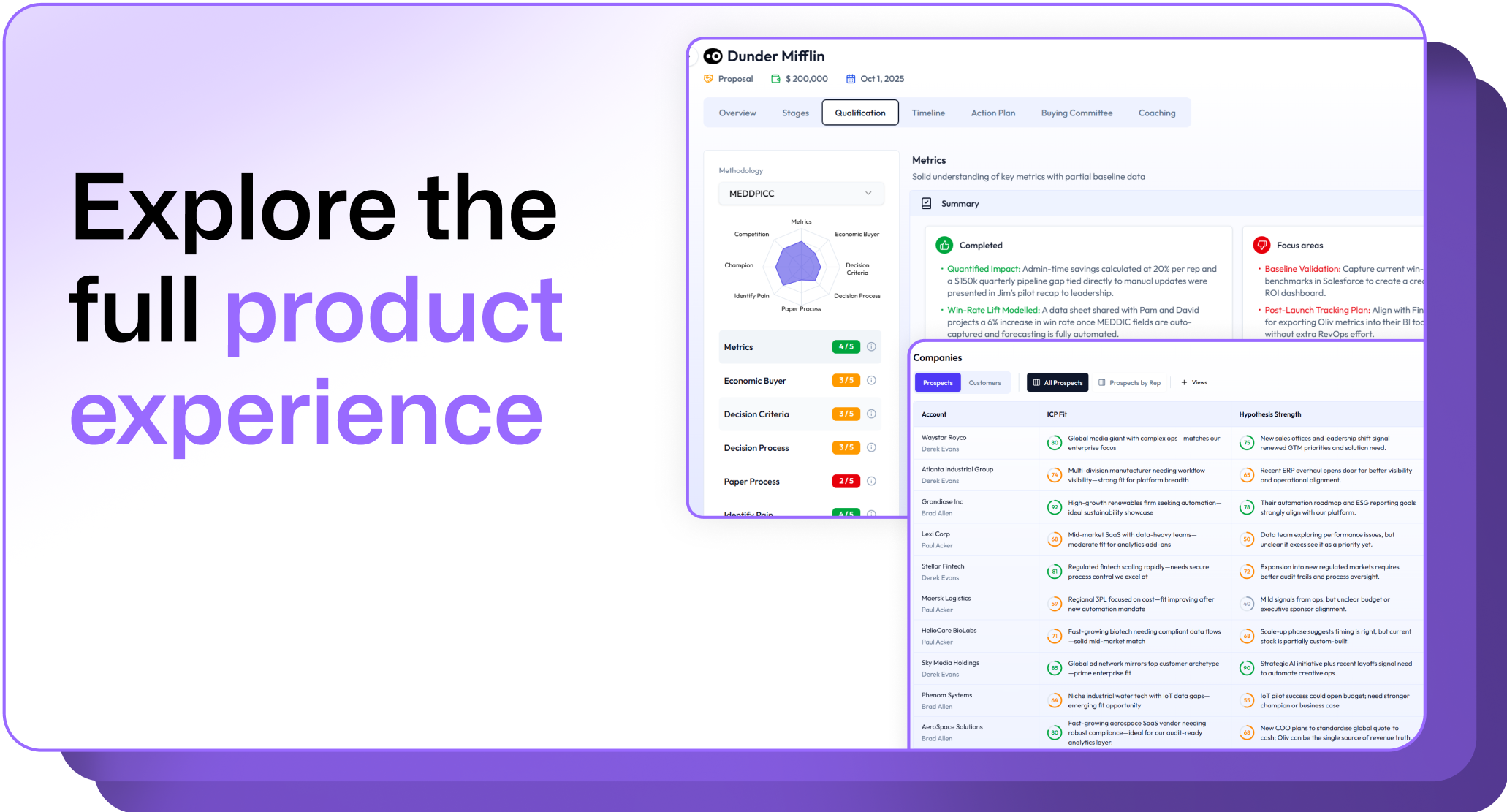
.avif)
.png)