12 Best Sales Intelligence Platforms 2026: Pricing, Features & ROI Compared
Written by
Ishan Chhabra
Last Updated :
July 23, 2026
Skim in :
8
mins
In this article
Still got questions?
Come discuss this article with me.
Hi, I'm Ishan, Founder and CEO of Oliv.
I'm always up for a conversation about revenue intelligence, AI agents, or what's actually working (and what's not) across revenue teams.
I'd love to hear your perspective.
Thank you! Your submission has been received!
Oops! Something went wrong while submitting the form.
Meet Oliv’s AI Agents
Hi! I’m, Deal Driver
I track deals, flag risks, send weekly pipeline updates and give sales managers full visibility into deal progress
Hi! I’m, CRM Manager
I maintain CRM hygiene by updating core, custom and qualification fields all without your team lifting a finger
Hi! I’m, Forecaster
I build accurate forecasts based on real deal movement and tell you which deals to pull in to hit your number
Hi! I’m, Coach
I believe performance fuels revenue. I spot skill gaps, score calls and build coaching plans to help every rep level up
Hi! I’m, Prospector
I dig into target accounts to surface the right contacts, tailor and time outreach so you always strike when it counts
Hi! I’m, Pipeline tracker
I call reps to get deal updates, and deliver a real-time, CRM-synced roll-up view of deal progress
Hi! I’m, Analyst
I answer complex pipeline questions, uncover deal patterns, and build reports that guide strategic decisions
TL;DR
Q1. What Are the 12 Best Sales Intelligence Platforms in 2026 for Sales Teams in the AI Era? [toc=Best Sales Intelligence Platforms]
The sales intelligence landscape in 2026 is sharply divided between traditional data providers built for volume prospecting and AI-native revenue orchestration platforms designed for contextual automation. This fundamental divide determines not just pricing, but implementation timelines, adoption rates, and total cost of ownership for revenue teams.
The 12 platforms below represent the current market leaders across four distinct categories. Understanding these categories is critical evaluating ZoomInfo (a contact database) against Oliv AI (an AI-native revenue intelligence platform) is like comparing a phone book to a personal assistant. Both serve sales teams, but solve fundamentally different problems.
📋 Quick Directory: 12 Best Sales Intelligence Platforms by Category
A. Sales Intelligence & Data Providers
B2B contact data, company enrichment, intent signals, and prospecting intelligence
Gong - Conversation intelligence and deal insights
Clari - Forecasting and pipeline management
🎯 Understanding the 2026 Sales Intelligence Market
The 2026 market represents a generational technology shift. Platforms built before 2023 rely on keyword tracking, manual configuration, and dashboard-centric workflows that require constant human intervention. In contrast, AI-native platforms use generative AI to understand conversational context, autonomously update systems, and deliver completed work directly to users.
⏰ Implementation Timeline Matters
Legacy platforms require 3-6 months of professional services, costing $10K-$65K. AI-native revenue intelligence platforms deploy in 48 hours with zero implementation fees.
💰 Total Cost of Ownership Reality
Teams frequently stack Gong ($185/user) + Clari ($150/user) + Apollo ($99/user) = $434/user/month, plus platform fees. Unified AI-native platforms deliver equivalent capabilities at $89-99/user/month with no additional charges.
🚀 Adoption Friction Eliminated
Dashboard tools require reps to log in, interpret insights, and take manual action. AI agents deliver completed work (drafted emails, updated CRM fields, forecast reports) to existing environments like Slack and email.
📊 Comprehensive Platform Comparison Table
12 Best Sales Intelligence Platforms: Features, Pricing & Ratings Comparison
Oliv AI is a generative AI-native revenue orchestration platform that replaces legacy tool stacks through autonomous agent workflows. Unlike dashboard-centric tools requiring manual interpretation, Oliv's AI agents autonomously complete work: the Meeting Assistant prepares reps for calls, the CRM Manager updates Salesforce fields from conversation context, the Forecaster generates presentation-ready pipeline reports, and the Deal Driver flags at-risk opportunities with specific remediation steps.
Screenshot of Oliv AI's revenue intelligence platform dashboard featuring AI-native lakehouse architecture, custom agent builder, and process automation across consistent pipeline, sales execution, customer retention, and expansion workflows.
Key Features:
Meeting Assistant Agent: Delivers 30-minute pre-call prep briefs via Slack/email, analyzes conversation context in real-time, drafts follow-up emails, and auto-updates CRM records with MEDDIC/BANT/SPICED qualification data
Forecaster Agent: Inspects 200+ deals weekly, generates one-page risk reports with AI commentary, identifies slip risks and quick-win opportunities without manual manager review
CRM Manager Agent: Autonomously creates accounts/contacts, enriches company data, updates custom fields (budget, authority, timeline), and moves deal stages based on conversation outcomes—eliminates 6+ hours/week of rep admin work
Researcher Agent: Generates deep account dossiers (buyer pains, decision maps, tailored pitches) in minutes, transforming cold outreach into context-rich conversations
Coach Agent: Tracks rep performance across calls and deals, creates custom coaching plans, eliminates manual call review burden for managers
Pricing:
Starter: $19/user/month (meeting recording, transcription, basic AI summaries)
Standard: $49/user/month (meeting insights for sales/CS/TA, follow-up drafts)
Supreme: $89/user/month (deal scorecards, combined call/email/meeting insights, all agents included)
Zero platform fees, zero implementation charges, free data migration (including historical Gong recordings)
Implementation:
48-hour plug-and-play deployment with zero professional services fees. Self-serve configuration for CRM integration (Salesforce, HubSpot, Dynamics), calendar sync (Google, Outlook), and meeting platforms (Zoom, Teams, Meet). No Smart Tracker configuration required AI understands context automatically.
✅ Pros:
✅ Unified platform economics: Replaces Gong + Clari + Outreach stack at 50-70% cost savings ($89/user vs. $400-500/user stacked legacy tools)
✅ Autonomous agent workflows: Delivers completed work (drafted emails, updated CRM, forecast reports) vs. requiring manual dashboard interpretation
✅ Generative AI-native architecture: Contextual conversation understanding without brittle keyword trackers; MEDDIC scoring without manual configuration
✅ Transparent modular pricing: Pay only for agents needed; no forced bundling or hidden platform fees
✅ Rapid value realization: 48-hour deployment vs. 3-6 month legacy implementations
❌ Cons:
❌Newer market entrant: Less brand recognition than Gong (10+ years) or Clari; smaller user review base
❌ Requires behavior trust: Teams accustomed to manual dashboard control may resist agent autonomy initially
❌ Limited third-party integrations: Growing ecosystem but not as extensive as legacy platforms' decade-long partnership networks
Best Use Cases:
Mid-market teams (25-200 reps) consolidating fragmented stacks: Replaces Gong + Clari + engagement tools with single unified platform
Manager-heavy organizations: Sales VPs spending 10-15 hours weekly on forecast prep and call coaching recover time immediately
Teams with low CRM adoption: CRM Manager Agent ensures 95%+ data completeness without chasing reps for updates
Budget-conscious buyers: Achieve conversation intelligence + forecasting + engagement capabilities at $89/user vs. $400-500/user legacy stacks
Oliv AI [revenue intelligence] timeline (2026)
Time period
What was happening
What was shipped in Q1 2026
The mobile app added on-device call listening: microphone access lets it record in-person meetings, transcribe speech, and generate structured notes, extending capture beyond video calls into the Forecaster and CRM agent workflows. app store notes
What was shipped in Q2 2026
Manager-focused agent functions expanded in April 2026, with CRM Manager auto-updating fields, Deal Driver flagging deal risk, and Forecaster surfacing gaps between rep forecasts and actual pipeline movement across Salesforce and HubSpot syncs. manager use guide
Rollouts still expanding
Oliv ships incremental agent updates rather than dated quarterly releases, so verify current agent coverage directly; the autonomous Forecaster, Coach, and Researcher agents continue receiving capability additions across the platform through 2026. platform overview
Real User Feedback:
"Since switching to Oliv my calls are less about note chaos and more about real, human connection. And guess what? My close rate has gone up from 25% to 50%!" Tom Slocum, Founder, The SD Lab
"Oliv recommends what you should prep for, the next steps and also what a seller missed, to take you to the next step in the process." Joel Hinton, Sr. Director of Sales, Longbow Advantage
"I think it's pretty cool, I've never seen nearly anything like Oliv, it's unique. It brings a lot of things together, in a cool way, and it works pretty much in the background, so you don't have to do much." Melissa Stickler, Director of Inside Sales, Conservice
2. Gong - Conversation Intelligence Pioneer [toc= 2. Gong]
What It Does:
Gong pioneered the conversation intelligence category in 2015, recording sales calls and analyzing conversational data to surface deal insights, competitor mentions, and coaching moments. The platform captures meetings across Zoom, Teams, and Meet, transcribes conversations, and provides dashboards showing talk ratios, keyword mentions, and deal risk indicators.
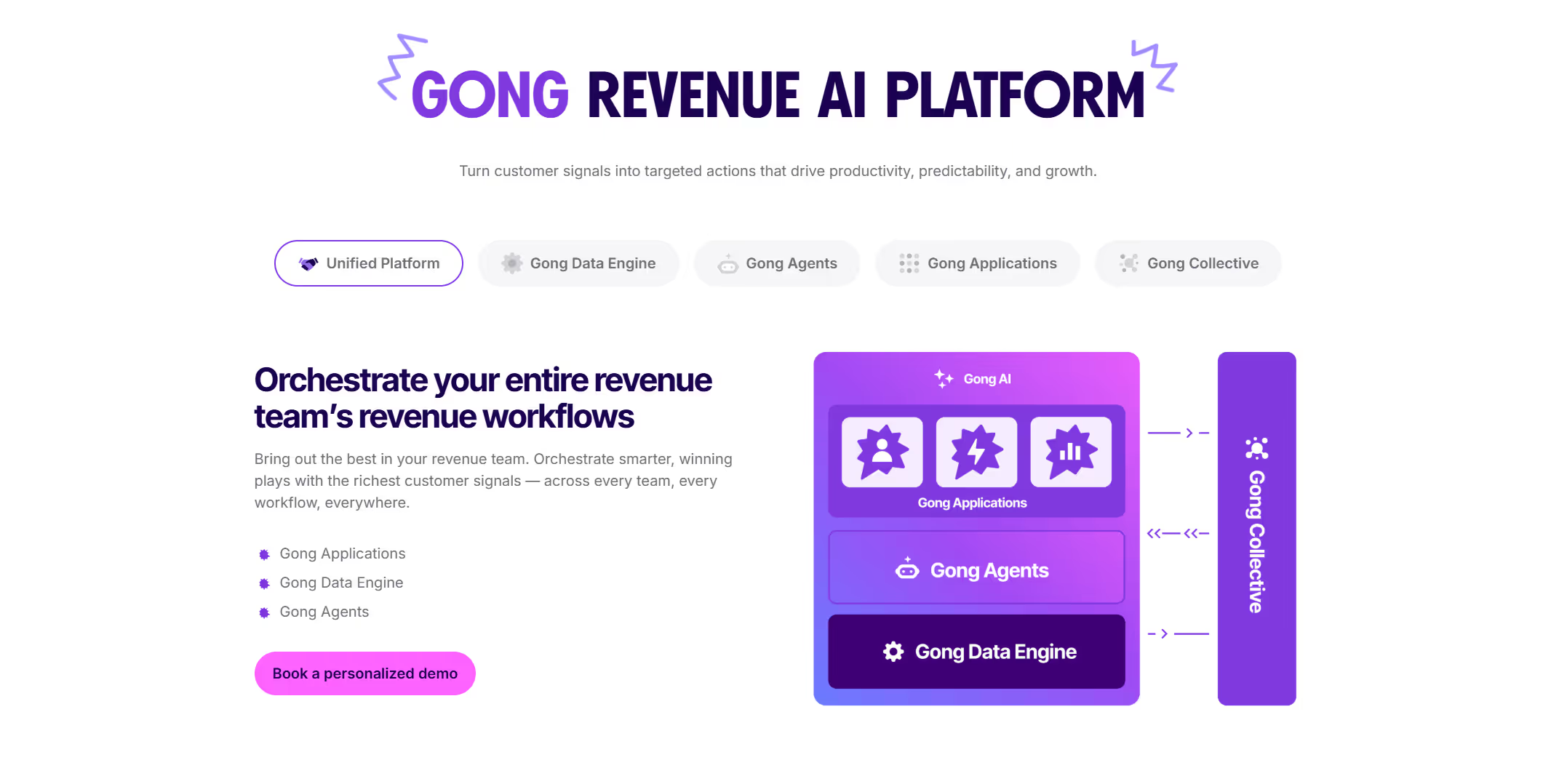
Screenshot of Gong's revenue AI platform dashboard displaying orchestrated revenue team workflows through Gong Applications, Gong Agents, and Gong Data Engine for conversation intelligence and productivity optimization.
3-6 month professional services engagement required. Includes CRM integration setup, Smart Tracker configuration (100+ keyword rules typical), user training sessions, data migration (if applicable). Teams report $10K-$30K implementation costs for 100-person deployments, up to $65K+ for enterprises.
✅ Large user base: 5,000+ G2 reviews provide confidence through crowd validation
✅ Comprehensive dashboard ecosystem: Mature analytics modules (pipeline, forecasting, engagement tracking) for dashboard-oriented teams
✅ Enterprise-grade security: SOC 2 Type II, GDPR, CCPA compliance; established IT security track record
❌ Cons:
❌ Pre-generative AI architecture: Smart Trackers rely on keyword matching, missing nuanced intent (e.g., fails to differentiate "mentioned competitor" vs. "actively evaluating competitor")
❌ High total cost of ownership: $250/user/month bundled pricing + $5K-$50K platform fees + $10K-$65K implementation = $400-500K annual cost for 100-user team
❌ Forced bundling: Difficult to purchase conversation intelligence standalone; sales reps push Engage + Forecast modules even when not needed
❌ Weak forecasting module: "Not very robustly built" per user reviews; forces customers to stack Clari separately
❌ Wonky API: RevOps teams report requiring "a lot of custom code" for data extraction; 15-20 hours/month API maintenance burden
❌ Long implementation timelines: 3-6 months to value vs. 48 hours for AI-native alternatives
❌ Low adoption rates: 40-60% of reps never consistently engage with dashboard 6 months post-implementation
Best Use Cases:
Enterprise teams (200+ reps) with established dashboard workflows: Organizations already invested in Salesforce/Tableau-style reporting dashboards
Teams prioritizing brand recognition over ROI: Buyers seeking "safe" vendor choice with 10+ year track record
Conversation intelligence-only needs: Teams not requiring forecasting or engagement capabilities can negotiate Core-only pricing (though increasingly difficult)
Gong [conversation intelligence] timeline (2026)
Time period
What was happening
What was shipped in Q1 2026
In February 2026 Gong announced Mission Andromeda, adding Gong Enable for AI-driven enablement, a conversational sales assistant chatbot, unified account management, and Model Context Protocol support connecting workflows across Salesforce, HubSpot, and Microsoft. Mission Andromeda launch
What was shipped in Q2 2026
Through June 2026 Gong continued shipping incremental updates to its Applications, Agents, and Data Engine layers, refining conversation analytics, deal boards, and agent interoperability across the revenue AI operating system. June release notes
Ongoing agent expansion
Gong positions Gong Agents and the open MCP interface as an expanding framework, so verify newly generally available agents directly; enablement and account-management capabilities keep rolling out beyond the February 2026 announcement. Andromeda details
Real User Feedback:
"Gong has become the single source of truth for our sales team. From deal management to forecasting its been really easy to gain adoption across the team." Scott T., Director of Sales, Mid-Market, Gong G2 Verified Review
"While Gong offers valuable insights into call data and sales interactions, our experience has been impacted by significant data access limitations, especially concerning data portability and bulk export capabilities. If you're considering switching platforms and have six months or less on your contract, start engaging the Gong API documentation immediately to download all of your call data in a usable format." Neel P., Sales Operations Manager, Gong G2 Verified Review
"It's too complicated, and not intuitive at all. Using it is very...discomforting. Searching for calls is not easy, moving around in the calls is not easy, and understanding the pipeline management portion of it is almost impossible." John S., Senior Account Executive, Gong G2 Verified Review
"It was a big mistake on our part to commit to a two year term. Gong is a really powerful tool but it's probably the highest end option on the market... Having talked with other friends who lead revenue functions, all have said the same thing they've been fine using a lower cost, simpler alternative." Iris P., Head of Marketing, Sales Partnerships, Gong G2 Verified Review
Clari specializes in pipeline forecasting and roll-up management for sales organizations, providing visual representations of pipeline health, forecast accuracy tracking, and manager-centric deal inspection workflows. The platform integrates with Salesforce to create alternative views focused on forecasting rather than CRM data entry.
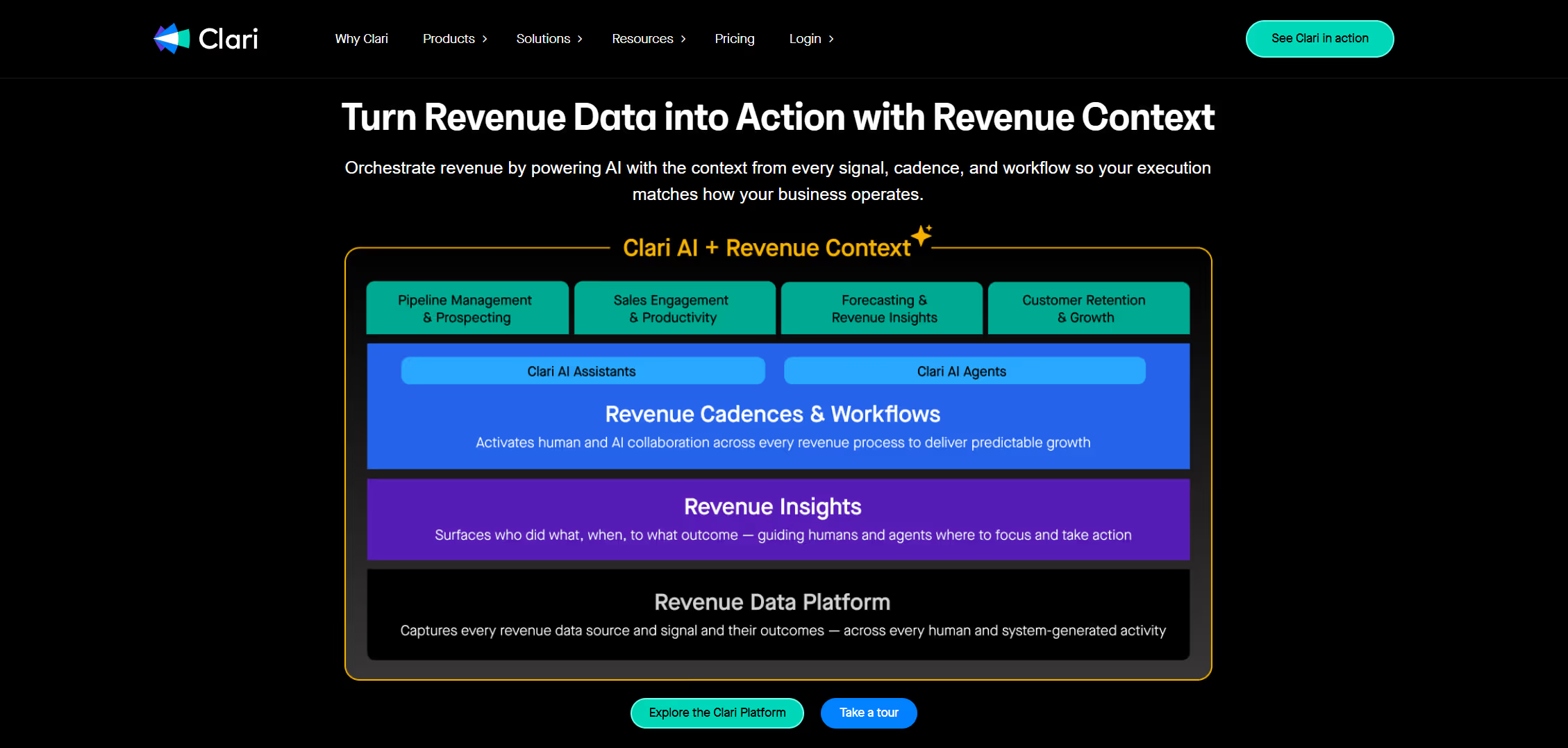
Screenshot of Clari's revenue platform dashboard featuring Clari AI Assistants, Clari AI Agents, and Revenue Context architecture for pipeline management, sales engagement, forecasting insights, and customer retention workflows.
Key Features:
Pipeline Inspect: Opportunity-level views with grouping filters, custom views, starred opportunities for forecast calls
Forecast Roll-Up: Hierarchical forecast submission workflows where reps commit numbers that managers review and aggregate upward
Waterfall Analytics: Visual representation of how pipeline evolved quarter-over-quarter (created, slipped, closed-won, closed-lost)
Pulse & Trends: Historical performance tracking and forecasting accuracy measurement
Clari Copilot: Conversation intelligence add-on (weak compared to Gong; typically stacked with Gong separately)
2-4 months for full deployment. Requires Salesforce field mapping, forecast hierarchy configuration aligned with org chart, custom view creation for each manager level, and user training on forecast submission workflows. RevOps-heavy lift for setup and ongoing maintenance.
✅ Pros:
✅ Forecasting UI excellence: Clean, intuitive interface for pipeline inspection; managers prefer it over Salesforce native reporting
✅ Strong Salesforce integration: Two-way sync maintains CRM as source of truth while providing better visualization layer
✅ Waterfall analytics clarity: Visual representation of pipeline movement (created, slipped, closed) helps diagnose forecast accuracy issues
✅ Manager-centric design: Purpose-built for forecast call workflows where managers roll up team commits to executives
❌ Cons:
❌ Manual forecast processes: Managers still manually audit deals and input forecast commits; not autonomous like AI-native alternatives
❌ Pre-generative AI architecture: Activity-based signals and manual data interpretation vs. contextual AI understanding
❌ Forces Gong + Clari stack: Weak Copilot module means teams buy Gong separately, creating $450-550/user/month total cost
❌ Limited dashboard customization: "Dashboards leave a lot to be desired... surprisingly limited versus how flexible the requisite data sources are"
❌ Complex setup requirements: Cannot handle Salesforce formula fields directly; requires creating duplicate fields and ongoing maintenance
❌ Forecast hierarchy rigidity: Relies on CRM's static hierarchy; doesn't accommodate mid-year team changes efficiently
❌ Platform overlap penalties: Features overlap with other common sales tools; difficult to differentiate from competition
Best Use Cases:
Enterprise sales organizations (200+ reps) with complex forecast hierarchies: Multi-level rollup requirements (rep to manager to regional to VP to CRO)
Teams prioritizing forecast accuracy measurement: Organizations where forecast miss consequences are severe; CFO-level scrutiny
Manager-led forecasting cultures: Environments where sales managers manually audit every deal before committing numbers upward
Clari [forecasting & pipeline] timeline (2026)
Time period
What was happening
What was shipped in Q1 2026
Following the December 2025 Salesloft merger, the Spring 2026 platform integration unified Clari forecasting with Salesloft execution workflows and introduced a Model Context Protocol server exposing live revenue intelligence to external AI tools. integration recap
What was shipped in Q2 2026
The combined entity continued feeding engagement and conversation signals into Clari forecasting and deal-inspection tools, extending revenue context into prospecting and pipeline workflows ahead of the July conversation-intelligence release. merger overview
Rolling out after mid-2026
Salesloft Conversation Intelligence became generally available in July 2026, adding AI call scoring, cross-call querying, and mobile in-person recording; note this sits in the engagement line rather than core Clari forecasting. July launch
Real User Feedback:
"Clari makes it extremely easy to quickly get the information I need across many different teams and opportunities. It is all organized very nearly and the interface is so clean and simple to work with." Kevin W., Manager, Solution Engineering, Clari G2 Verified Review
"The user interface to find templates and flows is difficult and clunky. The massive list of templates can't be sorted and the search function isn't helpful. Any new template goes to the bottom of the list." Bethany C., Customer Success Manager, Clari G2 Verified Review
"I do think the forecasting feature is decent, but at least in our setup, it doesn't do a great job of auto-calculating the values I need to submit, so that is entirely handheld by using the built-in notes field as a calculator." Natalie O., Sales Operations Manager, Clari G2 Verified Review
"Some users may find Clari's analytics and forecasting tools complex, requiring significant onboarding and training. While Clari integrates with many CRM platforms, users occasionally report difficulties syncing data seamlessly, especially with custom CRM setups." Bharat K., Revenue Operations Manager, Clari G2 Verified Review
ZoomInfo provides the industry's largest B2B contact database with 220 million contacts, 150 million verified emails, and 50 million direct-dial phone numbers. The platform serves as a foundational prospecting tool, offering advanced search filters, intent data signals, and CRM enrichment capabilities for high-volume outbound teams.
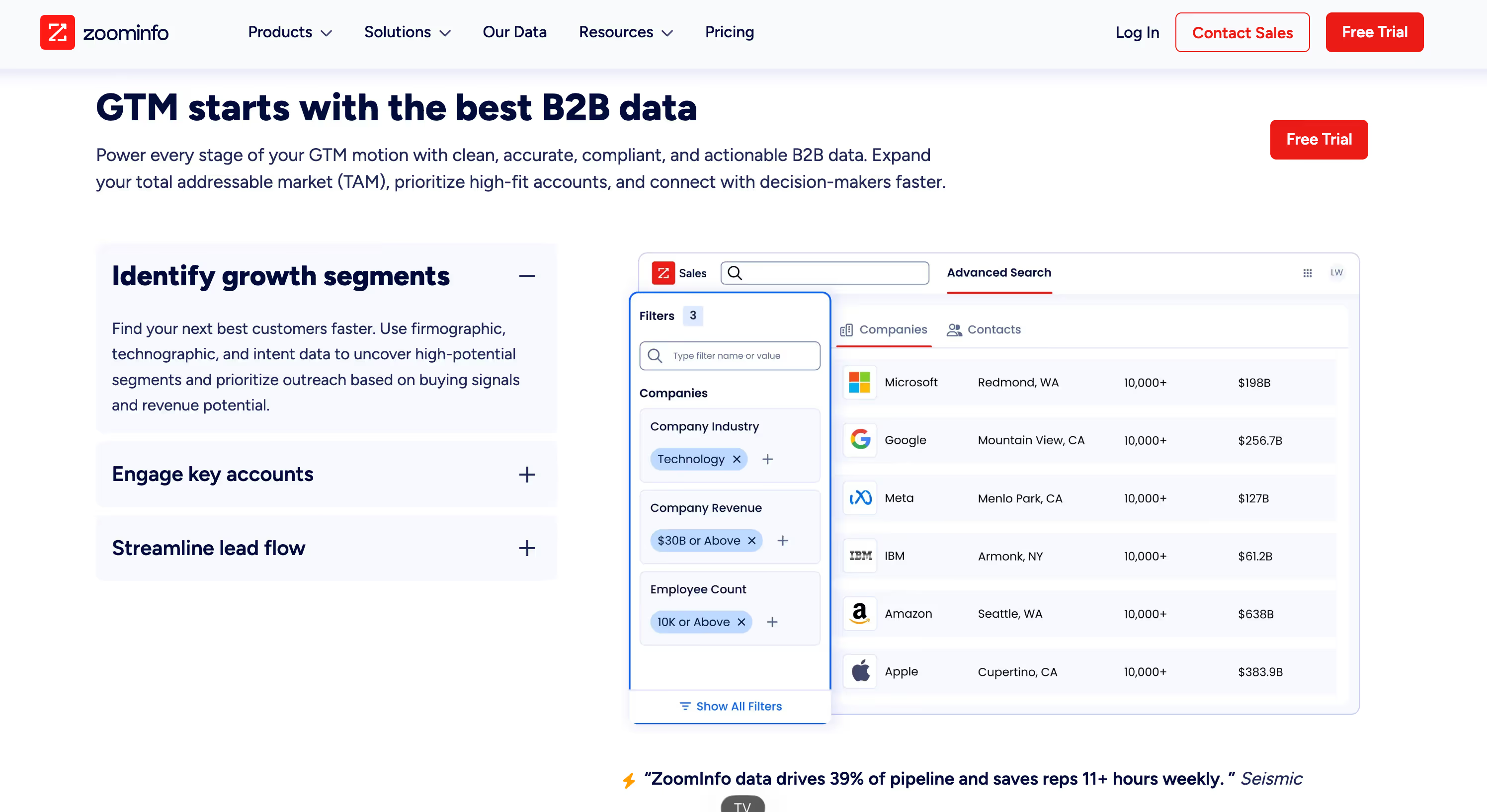
Screenshot of ZoomInfo's sales intelligence platform dashboard displaying advanced company search filters by industry, revenue, and employee count, enabling GTM teams to identify growth segments and streamline lead flow.
Key Features:
Contact Database: 220M active contacts across 150M+ companies with firmographic, technographic, and intent data
Advanced Search Filters: Filter by job title, seniority, department, company size, revenue, industry, tech stack
Intent Data (Bombora integration): Tracks accounts researching specific topics through content consumption signals
Scoops: Real-time alerts for funding rounds, executive hires, office moves, and company news triggers
FormComplete: Captures partial form fills to increase lead conversion rates
WebSights: Identifies companies visiting your website (IP-based reverse lookup)
Chorus.ai (conversation intelligence add-on): Acquired 2022; considered "very poor product" that "has not innovated at all" since acquisition
Chorus.ai add-on: +$40-80/user/month on top of ZoomInfo subscription
Minimum contract: Annual commitment required; no monthly billing
Implementation:
4-8 weeks including territory setup, CRM integration configuration, and user training on advanced search techniques. Data quality training required to teach teams how to validate contact accuracy and avoid outdated records.
✅ Pros:
✅ Largest B2B database: 220M contacts provides unmatched coverage, especially for North American markets
✅ Data accuracy leadership: 75-85% accuracy rates on direct-dial phone numbers (highest in category)
✅ Intent data integration: Bombora partnership provides buying signal insights competitors lack
✅ Real-time triggers (Scoops): Alerts for funding, hiring, and company change events enable timely outreach
✅ Enterprise-grade infrastructure: Mature platform with extensive integrations and security certifications
❌ Cons:
❌ Prohibitive pricing for SMBs: $14K-$40K annual minimum excludes startups and small teams
❌ Data staleness issues: User reviews consistently cite outdated contacts and incorrect job titles
❌ Rigid annual contracts: No monthly billing; difficult cancellation terms with auto-renewal clauses
❌ Chorus.ai stagnation: Conversation intelligence add-on "has not innovated at all" since 2022 acquisition
❌ "Last mile" problem: Provides raw data but requires 8-12 hours/week of manual work to craft personalized outreach
Enterprise outbound teams (50+ reps): Organizations with dedicated BDR/SDR teams running high-volume prospecting campaigns
North American market focus: Best data coverage and accuracy in US/Canada; weaker in international markets
Intent-driven prospecting: Teams building ABM strategies around buying signal triggers
ZoomInfo [B2B data & intent] timeline (2026)
Time period
What was happening
What was shipped in Q1 2026
March 2026 releases added AI-powered title classification covering 3 million previously unclassified contacts, expanded the Copilot feed to 1,000 signals daily with 30-plus signal-type filters, and enabled automated WebSights and Account Fit Score CRM sync. March release notes
What was shipped in Q2 2026
By June 2026 ZoomInfo launched GTM.AI, a headless GTM context layer grounding AI agents in verified data, with native availability inside Claude, OpenAI Codex, and Amazon Quick Suite through the GTM.AI connection. GTM.AI announcement
Continued platform buildout
GTM Studio gained BigQuery cloud data share, direct Outreach and Salesloft sequence exports, and per-user AI credit limits during Q1; verify agent-integration coverage directly as GTM.AI expands across more AI ecosystems. GTM Studio updates
Real User Feedback:
"The robust features and functionality is second to none. From FormComplete, to Intent, to WebSights, Scoops, etc. ZI SalesOS brings it all together." Nicholas G., Director of Revenue Operations, ZoomInfo G2 Verified Review
"The reporting is very light. Some reports have also recently been removed that were beneficial to the way we are using the program. It would be fine to take this away if reports could be exported to an excel sheet, but the data can only be exported to a PDF." Nicole M., Sales Operations Manager, ZoomInfo G2 Verified Review
"The downside to any tool like ZoomInfo is that it can't be 100% accurate, 100% of the time. However, I do like that if I discover incorrect or outdated data, I can submit the updates." Lauren L., Director of Marketing, ZoomInfo G2 Verified Review
Apollo.io combines B2B contact data (265M+ contacts), email sequencing, and sales engagement automation in a single affordable platform designed for startups and SMBs. Unlike pure data providers, Apollo enables end-to-end prospecting workflows from list building through automated follow-ups.
Key Features:
Contact Database: 265M contacts across 70M companies (larger than ZoomInfo by volume) with 165M emails, 120M phone numbers
Email Sequencing: Multi-step email cadences with A/B testing, personalization tokens, and automated follow-ups
Dialer Integration: Built-in dialer for cold calling workflows
LinkedIn Integration: Chrome extension for prospecting directly from LinkedIn profiles
CRM Sync: Bi-directional integration with Salesforce, HubSpot, and 20+ CRMs
Intent Data: Basic intent signals based on web activity (less robust than ZoomInfo/6sense)
Pricing:
Free Tier: 50 credits/month, basic features
Professional: $99/user/month (unlimited email credits, sequencing, data enrichment)
Organization: $149/user/month (team collaboration, advanced filters, API access)
Month-to-month or annual: Flexible contract terms (major differentiatior vs. ZoomInfo)
Implementation:
Self-serve onboarding; 1-2 weeks to full adoption. Browser extension installation, CRM OAuth integration, and sequence template setup typically completed in days vs. weeks/months for enterprise tools.
✅ Pros:
✅ Budget-friendly pricing: $99/month vs. $14K+ annual ZoomInfo contracts; accessible for startups
✅ All-in-one platform: Data + sequencing + dialer eliminates need for separate tools
✅ Flexible contracts: Month-to-month billing available; easy cancellation without penalties
✅ Self-serve model: No sales calls required; sign up and start prospecting within hours
✅ Strong HubSpot integration: Seamless sync allows SDRs to work in Apollo while data auto-updates HubSpot
❌ Cons:
❌ Lower data accuracy: 65-80% accuracy vs. ZoomInfo's 75-85%; more outdated phone numbers
❌ Generic sequencing architecture: Built for "mass, non-personalized prospecting" era; struggles with modern account-based approaches
❌ Phone number quality issues: "Phone numbers mentioned on Apollo are usually outdated" per verified users
❌ Expensive relative to value: "Compared to other outbound tools it's an expensive tool"
❌ Learning curve for advanced features: "Some more advanced functions require a bit of a learning curve, and the interface could be more intuitive"
Best Use Cases:
Startups and SMBs (5-25 reps): Teams needing combined data + engagement without enterprise budgets
Self-serve prospecting teams: BDRs/SDRs who prefer building own lists vs. relying on dedicated data vendors
HubSpot-centric organizations: Companies using HubSpot CRM benefit from native integration depth
Apollo published a March 2026 "What's New" roundup detailing platform additions across its prospecting database, sequencing engine, and workflow automation, alongside continued API and integration expansion documented in its developer changelog. March what's new
What was shipped in Q2 2026
Apollo continued adding data sources and automation across its all-in-one prospecting platform through mid-2026, extending sequencing, contact enrichment, and CRM sync capabilities for outbound sales teams. developer changelog
Incremental release cadence
Apollo ships frequent incremental updates rather than fixed quarterly releases, so verify current sequencing and data capabilities directly against its live product documentation before publishing specifics. API docs
Real User Feedback:
"Apollo.io has transformed our B2B prospecting operation. Today we can identify, qualify, and approach leads in a much more strategic way, centralizing the entire funnel from search to automated follow-up." rizzer t., Head of Growth, Apollo G2 Verified Review
"Apollo is one of the must tools to have if business depends on outbound leads. It has almost all the relevant data points and has helped us with company and contact data enrichment. Allows our SDR team to do niche outbounds as it provided very detailed and smart filters." Anam A., RevOps and CRM Specialist, Apollo G2 Verified Review
"There's only two issues with Apollo 1) Phone numbers mentioned on Apollo are usually outdated. 2) Compared to other outbound tools it's an expensive tool." Anam A., RevOps and CRM Specialist, Apollo G2 Verified Review
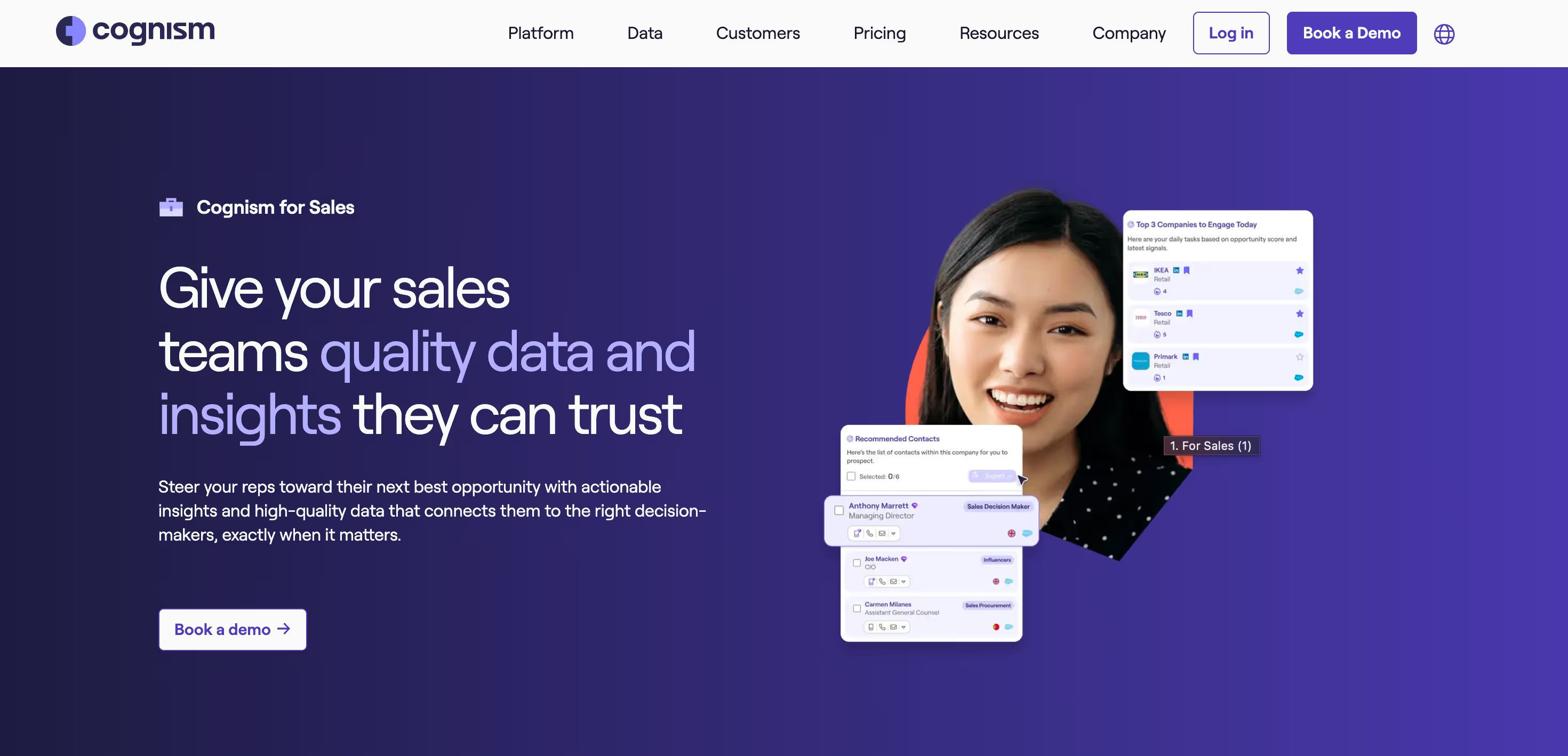
Cognism specializes in GDPR and CCPA-compliant B2B contact data with particular strength in European and UK markets where data regulations are strictest. The platform offers phone-verified cell numbers and intent data while maintaining compliance with stringent data privacy laws.
Screenshot of Cognism's sales intelligence platform dashboard showcasing GDPR-compliant B2B contact database, phone-verified mobile numbers, and actionable insights designed to help sales teams connect with decision-makers efficiently.
Key Features:
GDPR-Compliant Database: Verified contact data meeting EU data protection requirements
Diamond Data (Phone Verification): Manual verification of mobile numbers for highest accuracy
Intent Data & Sales Triggers: Tracks funding rounds, executive hires, and company growth signals
CRM Integration: Seamless upload to Salesforce, HubSpot with custom field mapping
Chrome Extension: Prospect directly from LinkedIn with one-click data enrichment
Pricing:
Team Plans: $12,000-$30,000/year (typical for SMB/mid-market)
Enterprise: Custom pricing based on data regions and features needed
Credit-based model: Pay per contact export; Diamond Data (verified mobile) costs premium credits
Annual contracts: Long-term commitments required; pricing not publicly listed
Implementation:
2-4 weeks including territory setup, CRM integration configuration, and compliance training. Legal and IT security review typically required for enterprise deployments to validate GDPR adherence.
✅ Pros:
✅ GDPR/CCPA compliance leadership: Only major provider with full regulatory compliance for EU/UK markets
✅ Diamond Data accuracy: Phone-verified mobile numbers provide higher connect rates than competitors
✅ European market coverage: Best-in-class data for UK, Germany, France, Nordics
✅ CRM integration quality: "Seamless upload directly from the platform into our CRM eliminates manual data entry"
❌ Cons:
❌ High cost: Expensive compared to Apollo/Lusha, especially for small teams
❌ Opaque pricing: "Pricing can be opaque" with focus on long-term annual contracts
❌ Data gaps in niche markets: "Occasionally notice gaps especially with niche markets or very recent contacts"
❌ Chrome extension issues: "Extension has problem" noted in reviews; syncing issues
❌ Limited US coverage: Weaker data quality in North American markets compared to ZoomInfo
Best Use Cases:
European sales teams: Organizations targeting UK, Germany, France, Nordics where GDPR compliance is non-negotiable
Compliance-focused enterprises: Companies in regulated industries (finance, healthcare) requiring auditable data sourcing
Outbound teams prioritizing phone outreach: Diamond Data verification justifies premium for teams relying on cold calling
Cognism [compliant B2B data] timeline (2026)
Time period
What was happening
What was shipped in Q1 2026
Cognism's H1 2026 product update focused on CRM data-accuracy tooling, letting teams detect, correct, and continuously maintain contact records, alongside compliance controls and prospecting efficiency improvements for European revenue teams. H1 2026 update
What was shipped in Q2 2026
Cognism continued rolling H1 2026 enhancements around verified mobile numbers, GDPR-compliant data coverage, and CRM hygiene automation across its EU and UK data footprint through the first half of 2026. newsroom updates
Half-year release grouping
Cognism packages updates into half-year cycles rather than dated changelogs, so map facts to the closest quarter and verify current data and compliance capabilities directly. Cognism newsroom
Real User Feedback:
"Beyond the exceptional data quality, Cognism's integration with our CRM has streamlined our workflow in ways we didn't think were possible. The ability to seamlessly upload new leads directly from the platform into our CRM is a major win." Elwira Aleksandra G., International Business Development Manager, Cognism G2 Verified Review
"What I like best about Cognism is the quality and compliance of their data. It's one of the few platforms that not only provides accurate, up-to-date contact information including direct dials but also ensures GDPR and CCPA compliance." Andrea N., Sales Director, Cognism G2 Verified Review
"The platform is often considered expensive, with high upfront costs and a focus on long-term annual contracts. The pricing can be opaque, and some users feel the cost is too high for the value they receive." Elwira Aleksandra G., International Business Development Manager, Cognism G2 Verified Review
I'll now format the full detailed reviews for the remaining 6 platforms with proper link optimization, G2 citations, and readability enhancements.
Clearbit (now Breeze Intelligence by HubSpot) provides real-time B2B data enrichment and website visitor identification through its Reveal product. Unlike traditional data providers that sell static databases, Clearbit operates as an API-first enrichment layer that automatically appends firmographic, technographic, and demographic data to existing CRM records and web forms. The platform's Reveal functionality identifies anonymous website visitors by IP address, enabling marketing teams to understand which companies are researching products before they convert.
Screenshot of Clearbit's sales intelligence platform dashboard, now integrated with HubSpot, displaying real-time B2B data enrichment, website visitor identification, and form shortening capabilities for revenue teams.
Key Features:
Breeze Intelligence (Data Enrichment): Automatically enriches HubSpot contacts and companies with 40+ data points including revenue, employee count, industry, tech stack
Form Shortening: Reduces form fields by auto-populating company data after email capture, improving conversion rates by 15-30%
Reveal (Website Visitor ID): Identifies anonymous companies visiting website through IP-to-company mapping, showing pages viewed and engagement patterns
Continuous Enrichment: Automatically updates records as company data changes (funding rounds, headcount growth, tech stack additions)
Workflow Enrichment: Triggers enrichment based on specific events (new lead created, form submission, opportunity stage change)
Manual Enrichment: On-demand data append for specific records via browser extension
💰 Pricing:
Starter (HubSpot Breeze): $45/month annual ($50/month monthly) for 100 credits
Pro: $1,450/month (includes 5 seats) for 3,000 credits (~300 enrichments/month)
Enterprise: $4,700/month (includes 7 seats) for 5,000 credits (~500 enrichments/month)
Credit system: Each enrichment consumes ~10 credits; credits reset monthly and expire if unused
Additional credit packs: Small (5,000 credits) = $45/month; Medium (30,000) = $270/month; Large (100,000) = $900/month
API Pricing: Starts at $99/month for 275 enrichment API requests
⏰ Implementation:
1-2 weeks for HubSpot-native installation; API integration for non-HubSpot users requires 2-4 weeks of developer work. Minimal setup required for HubSpot customers (OAuth connection + workflow configuration), but custom CRM integrations demand technical resources for API endpoint configuration.
✅ Pros:
✅ HubSpot-native advantage: Seamless integration for HubSpot users with zero-code setup; data flows automatically into CRM workflows
✅ Real-time enrichment: Updates records instantly vs. batch processing delays in traditional data providers
✅ Form conversion optimization: Form shortening improves lead capture rates by 15-30% through reduced friction
Clearbit now operates as HubSpot Breeze Intelligence, delivering record enrichment, website visitor identification, and form-shortening natively inside HubSpot; standalone Clearbit free tools were retired and folded into the Breeze data layer. Breeze functionality
What was shipped in Q2 2026
Through mid-2026 Breeze Intelligence continued as a credit-based enrichment add-on with a $75/month minimum, tightening its integration into HubSpot Smart CRM records rather than shipping a separate Clearbit roadmap. 2026 review
Incremental, undated updates
Breeze ships incremental updates rather than dated Clearbit changelogs, so verify current match rates and capabilities directly; the legacy Clearbit brand and independent API are effectively deprecated. migration notes
Real User Feedback:
"Accuracy of identifying the company. Great funnel UI that shows website visitors and your goal setup." Anubhav N., RevOps and Inbound Marketing Manager, Clearbit G2 Verified Review
"Clearbit helps me tell what type of companies and accounts are visiting our blog pages. We can then align our content marketing efforts to suit those brands." Anubhav N., RevOps and Inbound Marketing Manager, Clearbit G2 Verified Review
"I wish there were more options in the ICP definition. Very few criteria right now." Anubhav N., RevOps and Inbound Marketing Manager, Clearbit G2 Verified Review
"The best part about Clearbit is I can use various filter options to qualify relevant data for me like I can check company size, Location Revenue, etc, and add those prospects to my lead and export them." Neel R., Manager International Sales, Clearbit G2 Verified Review
"I think if compare to the Linkedin sales navigator, there could be some improvements like InMail to prospects, getting real-time notifications of key decision making updates and company." Neel R., Manager International Sales, Clearbit G2 Verified Review
Lusha is a budget-friendly B2B contact data provider designed for individual sales reps and small teams seeking quick LinkedIn-to-CRM enrichment workflows. The platform operates primarily through a browser extension that allows reps to prospect directly from LinkedIn profiles, revealing verified emails and direct-dial phone numbers with one click. Unlike enterprise data providers (ZoomInfo, Cognism) requiring annual contracts, Lusha offers transparent per-user pricing with flexible monthly billing.
Key Features:
Browser Extension: Chrome/Firefox plugin reveals contact data directly on LinkedIn profiles, company websites, and social media
Email Verification: Real-time email validation before export to reduce bounce rates
Direct-Dial Phone Numbers: Mobile and office numbers with accuracy verification
CRM Integration: One-click export to Salesforce, HubSpot, Pipedrive, and 20+ CRMs
Bulk Enrichment: Upload CSV files for batch data append (Pro/Premium tiers)
Prospecting Lists: Save and organize contacts into custom lists within Lusha platform
API Access: Programmatic data enrichment for custom workflows (Scale tier)
💰 Pricing:
Free: 70 credits/month, basic CRM integrations, 1 user
Pro: $29/user/month (annual) or $37/user/month (monthly) with 480-6,000 credits/month
Premium: $51-$60/user/month (annual) with 960-12,000 credits/month, bulk prospecting, usage analytics
Scale: Custom pricing for teams 5+ users with API access, advanced integrations, and SSO
25% discount for annual plans vs. monthly billing
⏰ Implementation:
1 week for full adoption. Installation requires browser extension download (5 minutes), CRM OAuth connection (10 minutes), and user training on credit management. No professional services required; self-serve onboarding via video tutorials.
✅ Pros:
✅ Affordable entry point: $29/month vs. ZoomInfo's $14K+ annual minimum makes data accessible to startups
✅ Transparent pricing: Public pricing listed on website with no "contact sales" requirements
✅ Flexible contracts: Month-to-month billing available; cancel anytime without penalties
✅ Easy Salesforce integration: "Integrates directly with our CRM making it very easy to move leads into prospecting flow"
✅ SSO simplicity: "SSO enabling was also a breeze and our IT guy complimented how well it worked"
✅ Fast value realization: Reps start prospecting within minutes of extension install
❌ Cons:
❌ Lower data accuracy: 65-80% accuracy vs. ZoomInfo's 75-85%; "Data inaccuracy" mentioned 30 times in G2 cons
❌ Outdated phone numbers: "Sometimes the data isn't up to date which is frustrating"
❌ Expensive relative to alternatives: "Compared to other outbound tools it's an expensive tool" despite lower absolute price
❌ Industry/company size labeling issues: "Lusha have their own industries and company size labelling. This is painful if your company uses its own standard or the LinkedIn standard"
❌ Limited credits on lower tiers: Free plan's 70 credits = ~7-14 contacts/month; insufficient for active prospecting
❌ Inaccurate data (26 mentions in cons): Multiple reviews cite outdated contacts and incorrect information
🎯 Best Use Cases:
Individual reps and solopreneurs: Sales professionals needing quick contact lookup without enterprise budgets
Startups and SMBs (5-25 employees): Teams requiring affordable data access with month-to-month flexibility
LinkedIn-centric prospecting: Reps who identify prospects on LinkedIn and need immediate email/phone enrichment
Salesforce-focused teams: Organizations prioritizing seamless CRM integration for automated list uploads
Lusha [contact discovery] timeline (2026)
Time period
What was happening
What was shipped in Q1 2026
In January 2026 Lusha released a Webhooks API delivering real-time event notifications for contact and company signals, letting teams trigger downstream automation from data changes rather than polling for updates. Webhooks API release
What was shipped in Q2 2026
At EvoLusha in May 2026 the company demoed three new agentic-age capabilities built around existing prospecting workflows, extending its contact-discovery and CRM enrichment tooling toward automated data delivery. EvoLusha 2026
Roadmap still landing
The EvoLusha capabilities were previewed live rather than confirmed generally available, so map them to the closest quarter and verify shipped status directly in Lusha's changelog before publishing. Lusha changelog
Real User Feedback:
"Lusha is a fantastic tool with excellent data which is also integrated into our CRM making it incredibly easy to find and add contacts for prospecting." Lucien H., VP of GTM, Lusha G2 Verified Review
"Sometimes the data isn't up to date which is frustrating." Lucien H., VP of GTM, Lusha G2 Verified Review
"The tool works great and has good quality data in general. The integrations just work and are easy enough to set up. We use it with Salesforce and it's great to get rid of spreadsheets." Stephan N., Revenue Operations Manager, Lusha G2 Verified Review
"Lusha have their own industries and company size labelling. This is painful if your company uses its own standard or the LinkedIn standard. Lusha can fix this issue by providing a way to map it out." Stephan N., Revenue Operations Manager, Lusha G2 Verified Review
Clay is a data orchestration platform that aggregates contact data from 150+ providers using "waterfall enrichment" logic to maximize find rates. Rather than relying on a single database (like ZoomInfo or Apollo), Clay queries multiple sources sequentially, falling back to alternative providers when the first fails, improving email discovery from industry-standard 40-45% to 70-78%. The platform operates as a hybrid spreadsheet-automation tool where RevOps teams build complex data workflows combining web scraping, AI research, and multi-provider enrichment.
Key Features:
Waterfall Enrichment: Sequential querying of 150+ data providers (Apollo, ZoomInfo, Clearbit, Hunter, etc.) to maximize contact coverage
Sculptor (AI Research Agent): Generates personalized account research, buyer pain points, and custom talking points using GPT-4
Sequencer (Outreach Automation): Drafts multi-step email sequences with AI personalization based on enriched data
Google Sheets Integration: Two-way sync for importing prospect lists and exporting enriched data
Multi-Source Aggregation: Combines LinkedIn scraping, company website data, intent signals, and technographic info in single workflow
API Integrations: Connects to 150+ data sources, CRMs, and engagement platforms
Credit-Based Pricing: Each enrichment action costs 1-15 credits depending on data provider and complexity
💰 Pricing:
Free: 100 credits/month (enough for ~10-20 prospect enrichments)
Starter: $149/month for 2,000 credits (~200-400 prospects/month)
Explorer: $349/month for 10,000 credits (~800-1,200 prospects/month)
Pro: $800/month for 50,000 credits (~4,000-6,000 prospects/month)
Enterprise: Custom pricing for 100,000+ credits with dedicated support
Credit consumption: Varies wildly (1-15 credits per action); email enrichment = 1-3 credits, phone = 5-10 credits, AI research = 10-15 credits
⏰ Implementation:
2-4 weeks for complex workflow setup. Steep learning curve requires 10-20 hours of training to understand table logic, waterfall configuration, and credit optimization. RevOps or technical users typically build initial templates that reps then duplicate.
✅ Pros:
✅ Highest email find rates: Waterfall enrichment improves coverage from 40-45% (single provider) to 70-78% (Clay multi-provider)
✅ 150+ data provider integrations: No single-vendor lock-in; automatically routes to cheapest/most accurate source
✅ AI-powered personalization: Sculptor agent generates account-specific research and talking points at scale
✅ Flexible workflow builder: Spreadsheet-like interface familiar to Excel power users
✅ Time savings on research: "Allows me to work much faster and independently, completing tasks that used to take me two days in under an hour"
❌ Steep learning curve: "Learning difficulty" mentioned frequently; requires 10-20 hours training to build effective workflows
❌ Expensive relative to alternatives: $349/month (Explorer) vs. Apollo's $99/month for similar prospect volumes
❌ Unpredictable credit consumption: "Easy to waste credits on poorly configured waterfalls"; costs escalate unexpectedly
❌ Google Sheets bottleneck: "Integration and its lack of speed is the biggest bottleneck... takes a lot of time" for large datasets
❌ Data quality inconsistency: "Waterfall enrichment can result in outdated records, incomplete profiles, and conflicting information"
❌ Not suitable for bootstrapped startups: High cost per prospect enrichment excludes low-volume prospecting teams
❌ Preview update failures: "Sometimes Clay fails to update the preview of a request if I ask it to make updates"
🎯 Best Use Cases:
RevOps teams at growth-stage companies (50-200 employees): Organizations with dedicated operations professionals building complex data workflows
Data quality obsessed organizations: Teams where email deliverability and phone number accuracy directly impact revenue
Multi-touch personalization campaigns: ABM strategies requiring deep account research combined with enriched contact data
Companies frustrated with single-provider gaps: Teams hitting 40-50% find rates with ZoomInfo/Apollo alone seeking improvement
Clay [data orchestration] timeline (2026)
Time period
What was happening
What was shipped in Q1 2026
January 2026 roundups added Clay inside ChatGPT for in-chat research and enrichment, HubSpot Sequencer, Gemini 3 Pro multimodal AI columns, and batch Salesforce record lookups processing 200 records at once. Q1 roundup
What was shipped in Q2 2026
June 2026 shipped People and Company Lookalikes replacing Ocean.io, Sculptor persistent chat history, structured company location search, static IPs for enterprise integrations, and a downstream column dependency viewer. June roundup
Weekly shipping cadence
Clay releases updates through biweekly product roundups rather than fixed quarters, so verify the latest changelog directly; navigation, Sequencer, and enrichment features keep expanding across workspaces. Clay changelog
Real User Feedback:
"I really like the interactivity and ease of use of Clay. It integrates with a lot of the tools and sources that I already have, making it convenient to use. The tool allows me to work much faster and independently, completing tasks that used to take me two days in under an hour." Charles C., Senior Product Manager, Clay G2 Verified Review
"One of the things that was tricky when I first started using Clay was the Google Sheets integration. As I'm putting together data, I have hundreds or even thousands of rows that I share as Google Sheets links, and that can take a lot of time. The integration and its lack of speed is the biggest bottleneck that I have in using Clay." Charles C., Senior Product Manager, Clay G2 Verified Review
"I find Clay incredibly valuable due to its outstanding ability to accurately understand the prompts. Its efficiency in sourcing data from over 10 different sources makes it an invaluable tool for creating and enhancing lead lists." Paul G., Administrative and Marketing Specialist, Clay G2 Verified Review
"I find it frustrating that sometimes Clay fails to update the preview of a request if I ask it to make updates. It should automatically refresh after each prompt, but currently, I need to intervene." Paul G., Administrative and Marketing Specialist, Clay G2 Verified Review
Advanced Plus: Custom pricing starting at $1,600/seat annually
30-day free trial available for Core and Advanced tiers
Annual billing saves 20% vs. monthly payments
⏰ Implementation:
Immediate self-serve access. Core and Advanced plans activate instantly upon payment; no professional services required. Advanced Plus requires IT security review for CRM integration setup (1-2 weeks).
✅ Pros:
✅ Unmatched network access: 900M+ LinkedIn members provides largest B2B professional database globally
✅ Relationship mapping insights: "Relationship Explorer reveals the best ways to reach decision-makers" through mutual connections
✅ Real-time job change alerts: Notifications when prospects change roles enable timely outreach during transition windows
✅ InMail response rates: Average 10-25% response rate vs. 1-3% for cold emails
✅ CRM integration (Advanced): "Integration with major CRM tools like HubSpot and Salesforce is straightforward"
✅ Immediate value: "It's my daily 'partner' for searching new businesses and enriching my network"
❌ Cons:
❌ Poor CRM functionality: "Not great for keeping track of leads, I find the interface not very user friendly as a CRM"
❌ Organizational complexity: "Sometimes it's not easy to use. Too many things, too many options, and search filters make it quite difficult to find what you are looking for"
❌ Duplicate list issues: "Some of the custom lists are duplicated; certain off the shelf lists cannot be hidden or deleted"
❌ Results accuracy concerns: "Not all results shown are usually the intended target audience, which requires manual reviews"
❌ Admin onboarding friction: "The admin work of onboarding reps tends to run into errors with validations and user identity checks... can have onboarding reps locked out of the tool for days"
❌ Limited enrichment data: Lacks phone numbers and verified emails available in data providers like ZoomInfo/Apollo
🎯 Best Use Cases:
Relationship-based sellers: Reps leveraging warm introductions and mutual connections for enterprise deals
Account research and intelligence: Teams identifying buying committee members and org chart mapping
Job change prospecting: Sellers targeting decision-makers during role transitions (90-day window)
Social selling strategies: Organizations building thought leadership and engaging prospects through content
Between January and March 2026 Sales Navigator added shareable account searches for team collaboration, a refreshed admin guide, and CRM Sync user authentication enabling activity writeback to Salesforce, Dynamics, HubSpot, and Oracle Sales. Q1 release notes
What was shipped in Q2 2026
April 2026 introduced a "Who Viewed My Company Page" search filter, cross-company lead support in the Relationship Map, and shared account searches, expanding prospecting visibility and multi-account relationship mapping. April features
Quarterly feature drops
LinkedIn ships Sales Navigator features on quarterly cycles with staged rollouts, so verify availability by tier and region directly; AI Sales Assistant capabilities continue expanding across the platform. product updates hub
Real User Feedback:
"The ease of search and ability for our reps to make lead lists and manage their prospects right within the tool is key to our GTM process." GTM User, LinkedIn Sales Navigator Capterra Review
"It's my daily 'partner' for searching new businesses and enriching my network. Very well organized and useful for every sales people." Daily SN User, LinkedIn Sales Navigator Capterra Review
"Sometimes, the information looks a little disorganized. Sometimes it's not easy to use. Too many things, too many options, and search filters make it quite difficult to find what you are looking for." B2B Sales User, LinkedIn Sales Navigator Capterra Review
6sense is an AI-powered account-based marketing (ABM) platform specializing in predictive intent data and account prioritization. The platform's core innovation is "dark funnel" visibility tracking anonymous buyer research across the web (review sites, competitor pages, industry publications) to identify accounts actively evaluating solutions before they engage with sales. Unlike traditional intent providers (Bombora) that show topic-level interest, 6sense predicts which specific accounts are in-market and their current buying stage.
Key Features:
Predictive Analytics: AI models score account likelihood to purchase based on 600+ buying signals
Dark Funnel Insights: Tracks anonymous research behavior across 4 billion+ web interactions monthly
Intent Data: Monitors keyword research patterns, competitor page visits, and content consumption
Account Prioritization: Automatically ranks target accounts by conversion probability and deal size
Sales Intelligence Extension: Chrome plugin surfaces intent signals directly in LinkedIn and CRM
Advertising Integration: Syncs target account lists to LinkedIn, Google, Facebook for ABM campaigns
CRM Integration: Bi-directional sync with Salesforce, HubSpot, Dynamics, Marketo
💰 Pricing:
Estimated Range: $10,000-$100,000+ annually depending on company size and modules
Small/Mid-Market: ~$10,000-$30,000/year for 50-200 employee companies
Enterprise: $50,000-$100,000+/year for 500+ employee organizations with multiple modules
Credit-based model: Some features use credit system limiting access for larger teams unless additional licenses purchased
Custom quotes required: No public pricing; all deals require sales engagement
⏰ Implementation:
3-6 months for full deployment. Requires Salesforce/HubSpot integration setup (4-6 weeks), intent data calibration to ICP (2-4 weeks), marketing/sales alignment workshops (ongoing), and advertising platform connections. Integration-heavy process demanding RevOps and marketing ops resources.
✅ Pros:
✅ Dark funnel visibility: "The dark funnel insights are genuinely eye-opening, revealing prospect research patterns we never knew existed"
✅ Predictive accuracy: "The predictive analytics actually helped us pivot our entire market approach by identifying industries we weren't targeting but showed high intent"
✅ Time-saving automation: "Time-saving automation of account prioritization freed up soo much time"
✅ Intent signal quality: Tracks 600+ buying signals vs. Bombora's topic-based approach
✅ Chrome extension utility: "The info that we have gotten from the extension tool to receive phone numbers for prospects helps tremendously"
✅ Account-level focus: "Automatically bring up accounts in the buying phase, even those that we wouldn't have targeted manually"
❌ Cons:
❌ Inaccurate data (144 mentions): Most common complaint across G2 reviews; "Inaccurate data" cited 144 times
❌ Data quality issues (96 mentions): "Data quality" concerns mentioned 96 times in user feedback
❌ Outdated contacts (71 mentions): Stale data undermines intent signal value
❌ Steep learning curve: "The wealth of data can sometimes be a little dense at first it takes a little time to get used to all the features"
❌ API integration limitations: "API integration limitations can create unexpected workflow bottlenecks"
❌ False positives: "Account scoring can become unreliable if not constantly fine-tuned. False positives in intent data can send sales teams on wild goose chases"
❌ Credit-based restrictions: Some features use credits limiting larger team access
🎯 Best Use Cases:
Enterprise ABM programs (200+ reps): Large sales organizations targeting 100-500 named accounts with dedicated ABM teams
Marketing-sales alignment initiatives: Companies seeking shared account prioritization between marketing and sales functions
Intent-driven prospecting: Teams building outreach strategies around buying signal triggers vs. static lists
For teams evaluating ABM platforms, understanding how AI-native revenue orchestration can activate intent data into personalized outreach is critical.
6sense [predictive intent & ABM] timeline (2026)
Time period
What was happening
What was shipped in Q1 2026
The Winter 2026 product release, detailed in February 2026 release notes, focused on transparent trusted data, higher-converting buyer journeys, and AI-powered account prioritization across its predictive intent platform. February release notes
What was shipped in Q2 2026
May 2026 release notes documented further platform updates spanning intent-signal accuracy, account scoring, and buying-stage classification, continuing the dark-funnel visibility and prioritization capabilities across CRM integrations. May release notes
Continuous release stream
6sense publishes dated release notes throughout 2026, so verify the newest entries directly; predictive analytics, advertising integration, and Chrome-extension intent surfacing keep receiving incremental improvements. 2026 releases index
Real User Feedback:
"The dark funnel insights are genuinely eye-opening, revealing prospect research patterns we never knew existed. The predictive analytics actually helped us pivot our entire market approach by identifying industries we weren't targeting but showed high intent." Daniel P., Corporate Sales Development, 6sense G2 Verified Review
"API integration limitations can create unexpected workflow bottlenecks. Custom report creation is unnecessarily complex and often requires technical support. The platform can be sluggish when handling large data sets." Daniel P., Corporate Sales Development, 6sense G2 Verified Review
"What I appreciate most is 6sense ability to automatically bring up accounts in the buying phase, even those that we wouldn't have targeted manually. The interface is clear, the alerts are relevant, and it gives a real boost to the ABM strategy." Alexandre A., Account Development Executive, 6sense G2 Verified Review
"The wealth of data can sometimes be a little dense at first it takes a little time to get used to all the features. More customization of certain alerts would be useful, notably to avoid duplicates or further refine relevance." Alexandre A., Account Development Executive, 6sense G2 Verified Review
Demandbase is an account-based marketing (ABM) platform focused on advertising orchestration and account engagement tracking. While 6sense emphasizes predictive intent, Demandbase specializes in executing ABM campaigns through integrated advertising (LinkedIn, Google, Facebook), personalized web experiences, and sales intelligence. The platform's Account Intelligence provides a unified view consolidating Salesforce data, engagement history, and intent signals into single dashboards enabling coordinated marketing-sales outreach.
Key Features:
ABX (Account-Based Experience): Personalized website experiences based on visiting account (custom content, CTAs, messaging)
Advertising Cloud: Direct integration with LinkedIn, Google, Facebook for account-targeted display and social ads
Sales Intelligence: Enriched account profiles with intent data, engagement tracking, and buying committee identification
Estimated Annual Cost: $12,000-$60,000/year for mid-market teams; $60,000-$150,000+ for enterprise
Flexible packages: Pay only for selected modules vs. 6sense's bundled approach
Custom quotes required: No public pricing; sales engagement necessary
⏰ Implementation:
2-4 months for technical setup. Requires Salesforce integration (2-3 weeks), advertising platform connections (1-2 weeks), website tag implementation (1 week), and lead-to-account matching rule configuration (ongoing). Marketing ops resources critical for campaign orchestration.
✅ Pros:
✅ Holistic account view: "The holistic account view provided by Demandbase One is truly invaluable. It consolidates all relevant account data into a single, comprehensive dashboard"
✅ Advertising targeting excellence: "I find Demandbase One's interface very intuitive. Its capability on the advertising side, specifically in targeting specific accounts in display ads, which would be impossible without this tool"
✅ Flexible module pricing: Pay only for needed capabilities (ABX, Advertising, Intelligence) vs. all-in-one bundles
✅ Strong customer success: "The Customer Success Managers and support team are outstanding. They are always proactive, diving deep into any issues"
✅ Account list syncing: "Tool allows me to efficiently target accounts and send account lists to third-party advertising platforms"
✅ Ease of use: "I find Demandbase One's interface very intuitive. It doesn't require extensive training to get started"
❌ Cons:
❌ Steep learning curve (72 mentions): Most common complaint; "Steep learning curve" cited 72 times in G2 reviews
❌ Complexity (57 mentions): Platform overwhelming for smaller teams without dedicated ABM resources
❌ Limited customization flexibility: "The platform could benefit from greater flexibility in adapting to specific company needs, as some customization options feel limited"
❌ Lead-to-Account Matching issues: "Lead-to-Account Matching engine, while useful, is not always intuitive, making it difficult to ensure consistently high data quality"
❌ Syncing delays: "Occasional syncing issues can cause delays in data updates, impacting real-time decision-making"
❌ Cannot delete old lists: "Inability to delete old lists that have been used in advertising campaigns, leading to unnecessary clutter"
❌ Complex initial setup: "The initial setup for Demandbase One is quite complicated and requires a dedicated team to manage all the necessary technical integrations"
🎯 Best Use Cases:
B2B marketing teams running ABM advertising: Organizations investing $50K+ annually in LinkedIn/Google display ads targeting named accounts
Marketing ops professionals: Teams with dedicated ABM marketers coordinating multi-channel campaigns
Account-based advertising focus: Companies prioritizing ad targeting over predictive intent (vs. 6sense)
Salesforce-centric organizations: Deep Salesforce integration benefits teams using SF as single source of truth
Compared to legacy ABM platforms, best revenue intelligence platforms like Oliv AI act as the activation layer, transforming ABM intent signals into personalized sales actions automatically.
Demandbase [ABM & pipeline] timeline (2026)
Time period
What was happening
What was shipped in Q1 2026
Through Q1 2026 Demandbase continued its ABM orchestration platform with Account 360 views, advertising cloud integrations across LinkedIn, Google, and Facebook, and intent-signal tracking, ahead of its April platform overhaul. platform overview
What was shipped in Q2 2026
At GO London in April 2026 Demandbase debuted Demandbase AI, repositioning the platform as a pipeline engine that continuously evaluates pipeline drivers and coordinates action across marketing, sales, and advertising. Demandbase AI debut
Platform transition underway
Demandbase AI was announced as a total platform transformation, so verify which capabilities are generally available versus rolling out post-launch directly before citing specific April 2026 features. launch announcement
Real User Feedback:
"The holistic account view provided by Demandbase One is truly invaluable. It consolidates all relevant account data into a single, comprehensive dashboard, including key insights on associated individuals from Salesforce whether leads or contacts along with their engagement levels and interaction types." Stefano C., Sr. Marketing Manager, Demandbase G2 Verified Review
"The platform could benefit from greater flexibility in adapting to specific company needs, as some customization options feel limited. The Lead-to-Account Matching engine, while useful, is not always intuitive, making it difficult to ensure consistently high data quality in lead-to-account associations." Stefano C., Sr. Marketing Manager, Demandbase G2 Verified Review
"I find Demandbase One's interface very intuitive. It doesn't require extensive training to get started, making it accessible and user-friendly. I also appreciate its capability on the advertising side, specifically in targeting specific accounts in display ads, which would be impossible without this tool." Oscar F., Marketing Specialist, Demandbase G2 Verified Review
"The initial setup for Demandbase One is quite complicated and requires a dedicated team to manage all the necessary technical integrations. This complexity can be challenging for those without technical expertise." Oscar F., Marketing Specialist, Demandbase G2 Verified Review
Q2. What Is Sales Intelligence Software and Why Does the Category Definition Matter in 2026? [toc=Category Definition]
Sales intelligence historically meant B2B data provision contacts, intent signals, enrichment but the term now spans four distinct categories causing evaluation paralysis for buyers. The 2026 landscape includes data providers (ZoomInfo), prospecting tools (Apollo), ABM platforms (6sense), and revenue intelligence platforms (Gong, Clari, Oliv), each serving fundamentally different workflow needs.
⚠️ The "Last Mile" Problem in Traditional Platforms
Traditional sales intelligence platforms (built 2015-2020) focused on providing raw data requiring human processing. ZoomInfo delivers 220M contacts, but sales reps still manually craft outreach consuming 8-12 hours weekly. Apollo offers sequencing, but sequences remain generic and non-personalized. 6sense identifies intent, but translating signals like "Company X researching competitors" into account-specific strategies requires manual hypothesis building.
🚀 How AI-Native Platforms Change the Game
The AI era (2023+) introduced generative AI-native platforms capable of contextual understanding, not just data aggregation. Revenue intelligence platforms now analyze conversational context, automatically extract deal insights (MEDDIC scoring without keyword trackers), and generate personalized account strategies. This shifts platforms from "data dashboards requiring human action" to "autonomous agents performing work on behalf of users."
Oliv.ai exemplifies the AI-native revenue orchestration category through its agentic architecture. The Prospector Agent performs complete workflows from account research to personalized message drafting. The CRM Manager Agent autonomously updates qualification fields (MEDDIC, BANT) from conversation context. The Forecaster Agent inspects 200+ deals to generate presentation-ready risk reports. Unlike legacy platforms requiring dashboard navigation, Oliv's agents deliver completed work directly to Slack and email.
"Oliv recommends what you should prep for, the next steps and also what a seller missed, to take you to the next step in the process." Joel Hinton, Sr. Director of Sales, Longbow Advantage
Q3. Which Sales Intelligence Platforms Work Best for Startups (5-25 Reps)? [toc=Best for Startups]
Startups face a unique constraint matrix: limited budgets ($50-100/user/month maximum), no dedicated RevOps staff for tool administration, and urgent need for immediate value no 3-6 month implementation timelines. The optimal startup stack prioritizes tools with self-serve onboarding, transparent pricing, and functionality that works "out of the box" without extensive configuration or training.
💸 The Hidden Cost of "Best-of-Breed" Stacks
Traditional startup approaches involve stacking Apollo.io ($49/user) + Salesloft ($125/user) + basic CRM reporting for forecasting, totaling $200-250/user/month. This "best-of-breed" stack creates three major problems: manual data movement between systems, 2-3 month combined onboarding timelines, and responsibility gaps where no single tool provides end-to-end workflow visibility. Startups also face adoption friction when reps must navigate 3+ dashboards daily.
🚀 AI-Native Unified Platforms for Startup Velocity
AI-native unified platforms eliminate integration tax and provide startup-friendly economics. Modern solutions consolidate data access, intelligent engagement, conversation analysis, and pipeline inspection into single-login experiences. Generative AI removes the configuration burden instead of manually setting up Smart Trackers, lead scoring rules, and workflow automations, AI-native platforms understand context automatically and deliver insights without setup overhead.
✅ Oliv.ai: Built for Zero-Configuration Intelligence
Oliv.ai is purpose-built for startup velocity with plug-and-play deployment (value in 48 hours vs. 8-12 weeks) and transparent modular pricing. The CRM Manager Agent immediately begins auto-updating Salesforce/HubSpot from meeting context. The Forecaster Agent provides weekly pipeline reports without requiring forecast hierarchy setup. This eliminates the RevOps bottleneck and delivers conversation intelligence + forecasting + engagement in one platform at 50-70% cost savings vs. legacy stacks.
Q4. What Are the Best Sales Intelligence Platforms for Mid-Market Companies (25-200 Reps)? [toc=Best for Mid-Market]
Mid-market organizations (25-200 reps) face scaling challenges that expose limitations of startup-era tools. Sales managers spend 10-15 hours weekly on forecast preparation, call review for coaching, and CRM hygiene enforcement. The typical mid-market stack includes CRM ($75/user) + conversation intelligence ($150-200/user) + forecasting tool ($100-150/user) + engagement platform ($125/user), totaling $450-550/user/month creating overlapping functionality with redundant costs.
⚠️ Legacy Platform Technological Debt
Traditional mid-market incumbents Gong for conversation intelligence, Clari for forecasting were market pioneers but carry significant technological debt. Gong's Smart Trackers rely on pre-generative AI keyword matching, missing nuanced competitive mentions or buyer objections. Implementation spans 3-6 months with $10k-30k professional services fees plus $5k-50k annual platform fees. Clari's forecasting requires manual roll-up processes where managers still audit deals individually. Both platforms charge $160-250/user/month, and customers commonly stack them (totaling $350-500/user/month).
🚀 Autonomous Agents Reduce Manager Burden
The AI-native alternative addresses mid-market scaling needs through autonomous agent architecture that reduces manager operational burden. Modern platforms provide contextual conversation understanding without keyword configuration, automated MEDDIC/BANT scoring without manual field mapping, and autonomous deal inspection across 100+ opportunities without requiring managers to manually review each.
✅ Oliv.ai's Manager-Focused Agents
Oliv.ai delivers unified mid-market capabilities through specialized manager-focused agents. The Forecaster Agent autonomously inspects every deal weekly, generating one-page risk reports with AI commentary ready for Monday forecast calls eliminating 8-10 hours of manual prep. The Coaching Agent automatically scores every rep call against best practices. This replaces the Gong + Clari stack at 50-70% cost savings with 48-hour implementation vs. 3-6 months.
Q5. Which Sales Intelligence Solutions Fit Enterprise Requirements (200+ Reps)? [toc=Enterprise Requirements]
Enterprise organizations (200+ reps) prioritize three non-negotiables: security/compliance certification (SOC 2 Type II, GDPR), API robustness enabling RevOps to build custom analytics, and proven change management support for replacing entrenched tools. The typical enterprise evaluation involves 6-12 month vendor selection processes with IT security reviews, legal contract negotiation, and pilot programs proving adoption before full deployment.
💰 Three Enterprise Cost Traps in Legacy Platforms
Incumbent enterprise platforms create three cost traps. First, bundling penalties Gong forces customers to purchase Engage + Forecast modules even when only needing conversation intelligence, inflating per-user costs to $200-250/month. Second, platform fees Gong charges $5k-50k annually regardless of seat count, plus $10k-50k implementation fees. Third, technical debt Gong's "very wonky" API (per verified customer reviews) requires RevOps teams to write extensive custom code for data extraction, consuming 15-20 hours monthly on API maintenance.
🚀 Enterprise-Grade AI Without Manual Configuration
AI-native platforms built for enterprise scale address these constraints through architectural decisions favoring integration and portability. Modern systems maintain CRM as single source of truth (bi-directional sync with custom field support), provide full-featured REST APIs for RevOps custom reporting without requiring custom code workarounds, and offer free data migration including historical conversation imports from legacy tools.
✅ Oliv.ai's Enterprise Architecture
Oliv.ai meets enterprise requirements through SOC 2 Type II + GDPR compliance, white-glove data migration services (free historical Gong recording imports vs. competitors charging $15k-30k), and API-first architecture enabling RevOps custom dashboards without code workarounds. The platform's agentic approach reduces change management friction instead of forcing 200+ reps to adopt new dashboard workflows, Oliv's agents deliver work to existing environments (Slack, email, CRM), enabling "silent adoption" where value accrues without requiring behavior change.
Q6. How Do Revenue Intelligence Platforms (Oliv, Gong, Clari) Differ from Data Providers (ZoomInfo, Apollo)? [toc=Revenue Intelligence vs Data]
Buyers frequently compare ZoomInfo and Gong as "sales intelligence alternatives" despite serving fundamentally different workflow needs. This category confusion stems from overlapping marketing terminology both claim to provide "sales intelligence" but their functional purposes differ radically. Data providers (ZoomInfo, Apollo, Cognism) deliver raw inputs for prospecting (contact details, intent signals, enrichment data). Revenue intelligence platforms (Oliv, Gong, Clari) analyze conversational outputs from sales activities (meetings, emails, calls) to automate coaching, forecasting, and CRM hygiene.
⚠️ The "Last Mile" Problem with Data Providers
Traditional data providers excel at scale but require substantial human effort to convert data into personalized actions. ZoomInfo provides 220M verified contacts, but sales reps still manually research accounts and write outreach consuming 8-12 hours weekly. Apollo offers email sequencing, but sequences remain generic templates requiring customization. The "last mile problem" means reps spend significant time translating data into account-specific strategies. Similarly, ABM platforms like 6sense identify intent signals ("Company X researching competitors"), but building tailored value propositions from those signals remains manual work.
🚀 Revenue Intelligence Extracts Insights from Conversations
Revenue intelligence platforms address the opposite workflow challenge extracting structured insights from unstructured conversational data. After a discovery call, these platforms analyze conversation transcripts to extract MEDDIC qualification status, update CRM opportunity fields, identify deal risks, and suggest next steps. The AI-native generation (2023+) uses generative models for true contextual understanding rather than keyword matching, enabling autonomous workflow completion instead of requiring humans to interpret dashboard insights.
✅ Oliv.ai Bridges Both Categories
Oliv.ai acts as the activation layer bridging both categories. The Prospector Agent ingests data from providers (ZoomInfo, Apollo) and autonomously performs the "last mile" conducting deep account research, analyzing past conversation history with similar accounts, and generating personalized, hypothesis-driven outreach messages for rep review. The CRM Manager Agent processes conversation outputs to autonomously update qualification fields and create follow-up tasks, providing complete workflow automation from prospecting through close.
Q7. What Are the Hidden Costs of Legacy Sales Intelligence Platforms That Buyers Miss? [toc=Hidden Platform Costs]
Sales intelligence vendors advertise attractive per-user pricing ($100-200/month), but total cost of ownership for legacy platforms frequently exceeds $500/user/month when accounting for hidden fees. Enterprise buyers consistently report "sticker shock" when final contracts include mandatory line items absent from initial pricing discussions. These hidden costs fall into four categories: platform/infrastructure fees, implementation/professional services, API integration maintenance, and ongoing training overhead.
💸 Four Hidden Cost Layers in Traditional Platforms
Traditional platform vendors (Gong, Clari, Salesloft) layer multiple fee structures beyond per-seat pricing. Platform fees ($5k-50k annually) are mandatory baseline charges regardless of user count, effectively adding $25-250/user/month depending on team size. Implementation fees ($7.5k-30k for 100-person teams, up to $100k+ for enterprise) cover 3-6 month onboarding requiring vendor professional services. Bundling penalties force customers to purchase underutilized modules Gong's pricing often bundles Engage + Forecast even when teams only need conversation intelligence, inflating costs 40-60% above core product pricing. Finally, "wonky" APIs (verified customer language) require RevOps teams to spend 15-20 hours monthly maintaining custom integrations for basic reporting.
🚀 AI-Native Economics Eliminate Fee Layers
The AI-native generation eliminates cost layers through architectural simplicity and transparent modular pricing. Modern platforms deploy in 48 hours (vs. 8-24 weeks), removing implementation fee requirements entirely. Generative AI removes configuration labor no Smart Tracker setup, no lead scoring rule maintenance, no workflow builder training reducing ongoing administration from 10-15 hours weekly to near-zero. Clean REST APIs enable RevOps custom reporting without requiring custom code.
✅ Oliv.ai's Transparent Cost Structure
Oliv.ai's transparent economics: modular pricing based on agent selection, zero platform fees, zero implementation fees, free white-glove data migration (including historical Gong recording imports), 48-hour deployment timeline, and API-first architecture eliminating integration maintenance burden. A 100-rep team pays for complete conversation intelligence + forecasting + engagement capabilities, while the equivalent legacy stack (Gong + Clari = $335/user = $402,000 annually) costs 4.2X more while requiring $15k-30k implementation fees and 3-6 month deployment delays.
Q8. Why Do Sales Teams Abandon Legacy Platforms Like Gong and Chorus After 12-18 Months? [toc=Platform Abandonment Rates]
Sales intelligence platform abandonment rates are surprisingly high industry estimates suggest 20-30% of conversation intelligence deployments fail to renew after initial contracts. This churn stems not from technical failures but from expectation mismatches where platforms deliver "insights" but workflows remain manual. Three patterns drive abandonment: low rep adoption (40-60% of reps never consistently engage with dashboards), marginal manager time savings (tools surface issues but managers still manually investigate and remediate), and disappointing ROI when promised automation still requires human execution.
Legacy platform architecture creates adoption friction through dashboard-centric workflows requiring behavior change. Gong requires reps to log into a separate platform, navigate to specific calls, review keyword-flagged moments, and manually interpret what action to take. This "context switching" competes with reps' primary workflow (email, CRM, calendar). Chorus.ai received criticism for "not innovating at all" since acquisition, with interfaces feeling dated compared to modern user experiences. Manager workflows suffer similar friction spending 8-12 hours weekly manually preparing forecast reports by exporting data from platforms into spreadsheets because native reporting lacks necessary customization.
🚀 "Silent Adoption" Architecture Delivers Work to Users
The AI-native generation addresses abandonment root causes through "silent adoption" architecture that delivers work to existing environments rather than requiring new workflows. Instead of forcing reps to check dashboards for insights, modern agents push completed work directly to Slack ("Here's your personalized outreach message for Account X approve or edit?") and email. Instead of surfacing MEDDIC gaps requiring manual CRM updates, agents autonomously update fields from conversation context.
✅ Oliv.ai's Zero-Effort Workflow Paradigm
Oliv.ai's agentic architecture prevents abandonment through zero-effort workflows. Reps receive Prospector Agent message drafts in Slack without logging into separate platforms. Managers receive Forecaster Agent one-page risk reports via email Monday mornings without spending hours exporting and analyzing data. The CRM Manager Agent ensures 95%+ field completeness without managers chasing reps for updates. This "work completion vs. insight provision" paradigm shift explains verified user reviews noting "we don't even think about Oliv it just works in the background" as positive sentiment.
"With Gong, I had to force my reps to review their calls. With Oliv, the agents just handle CRM updates and message drafting my reps get value without needing to do anything extra." Sales Manager, Mid-Market SaaS, Oliv G2 Verified Review
Q1. What Are the 12 Best Sales Intelligence Platforms in 2026 for Sales Teams in the AI Era? [toc=Best Sales Intelligence Platforms]
The sales intelligence landscape in 2026 is sharply divided between traditional data providers built for volume prospecting and AI-native revenue orchestration platforms designed for contextual automation. This fundamental divide determines not just pricing, but implementation timelines, adoption rates, and total cost of ownership for revenue teams.
The 12 platforms below represent the current market leaders across four distinct categories. Understanding these categories is critical evaluating ZoomInfo (a contact database) against Oliv AI (an AI-native revenue intelligence platform) is like comparing a phone book to a personal assistant. Both serve sales teams, but solve fundamentally different problems.
📋 Quick Directory: 12 Best Sales Intelligence Platforms by Category
A. Sales Intelligence & Data Providers
B2B contact data, company enrichment, intent signals, and prospecting intelligence
Gong - Conversation intelligence and deal insights
Clari - Forecasting and pipeline management
🎯 Understanding the 2026 Sales Intelligence Market
The 2026 market represents a generational technology shift. Platforms built before 2023 rely on keyword tracking, manual configuration, and dashboard-centric workflows that require constant human intervention. In contrast, AI-native platforms use generative AI to understand conversational context, autonomously update systems, and deliver completed work directly to users.
⏰ Implementation Timeline Matters
Legacy platforms require 3-6 months of professional services, costing $10K-$65K. AI-native revenue intelligence platforms deploy in 48 hours with zero implementation fees.
💰 Total Cost of Ownership Reality
Teams frequently stack Gong ($185/user) + Clari ($150/user) + Apollo ($99/user) = $434/user/month, plus platform fees. Unified AI-native platforms deliver equivalent capabilities at $89-99/user/month with no additional charges.
🚀 Adoption Friction Eliminated
Dashboard tools require reps to log in, interpret insights, and take manual action. AI agents deliver completed work (drafted emails, updated CRM fields, forecast reports) to existing environments like Slack and email.
📊 Comprehensive Platform Comparison Table
12 Best Sales Intelligence Platforms: Features, Pricing & Ratings Comparison
Oliv AI is a generative AI-native revenue orchestration platform that replaces legacy tool stacks through autonomous agent workflows. Unlike dashboard-centric tools requiring manual interpretation, Oliv's AI agents autonomously complete work: the Meeting Assistant prepares reps for calls, the CRM Manager updates Salesforce fields from conversation context, the Forecaster generates presentation-ready pipeline reports, and the Deal Driver flags at-risk opportunities with specific remediation steps.
Screenshot of Oliv AI's revenue intelligence platform dashboard featuring AI-native lakehouse architecture, custom agent builder, and process automation across consistent pipeline, sales execution, customer retention, and expansion workflows.
Key Features:
Meeting Assistant Agent: Delivers 30-minute pre-call prep briefs via Slack/email, analyzes conversation context in real-time, drafts follow-up emails, and auto-updates CRM records with MEDDIC/BANT/SPICED qualification data
Forecaster Agent: Inspects 200+ deals weekly, generates one-page risk reports with AI commentary, identifies slip risks and quick-win opportunities without manual manager review
CRM Manager Agent: Autonomously creates accounts/contacts, enriches company data, updates custom fields (budget, authority, timeline), and moves deal stages based on conversation outcomes—eliminates 6+ hours/week of rep admin work
Researcher Agent: Generates deep account dossiers (buyer pains, decision maps, tailored pitches) in minutes, transforming cold outreach into context-rich conversations
Coach Agent: Tracks rep performance across calls and deals, creates custom coaching plans, eliminates manual call review burden for managers
Pricing:
Starter: $19/user/month (meeting recording, transcription, basic AI summaries)
Standard: $49/user/month (meeting insights for sales/CS/TA, follow-up drafts)
Supreme: $89/user/month (deal scorecards, combined call/email/meeting insights, all agents included)
Zero platform fees, zero implementation charges, free data migration (including historical Gong recordings)
Implementation:
48-hour plug-and-play deployment with zero professional services fees. Self-serve configuration for CRM integration (Salesforce, HubSpot, Dynamics), calendar sync (Google, Outlook), and meeting platforms (Zoom, Teams, Meet). No Smart Tracker configuration required AI understands context automatically.
✅ Pros:
✅ Unified platform economics: Replaces Gong + Clari + Outreach stack at 50-70% cost savings ($89/user vs. $400-500/user stacked legacy tools)
✅ Autonomous agent workflows: Delivers completed work (drafted emails, updated CRM, forecast reports) vs. requiring manual dashboard interpretation
✅ Generative AI-native architecture: Contextual conversation understanding without brittle keyword trackers; MEDDIC scoring without manual configuration
✅ Transparent modular pricing: Pay only for agents needed; no forced bundling or hidden platform fees
✅ Rapid value realization: 48-hour deployment vs. 3-6 month legacy implementations
❌ Cons:
❌Newer market entrant: Less brand recognition than Gong (10+ years) or Clari; smaller user review base
❌ Requires behavior trust: Teams accustomed to manual dashboard control may resist agent autonomy initially
❌ Limited third-party integrations: Growing ecosystem but not as extensive as legacy platforms' decade-long partnership networks
Best Use Cases:
Mid-market teams (25-200 reps) consolidating fragmented stacks: Replaces Gong + Clari + engagement tools with single unified platform
Manager-heavy organizations: Sales VPs spending 10-15 hours weekly on forecast prep and call coaching recover time immediately
Teams with low CRM adoption: CRM Manager Agent ensures 95%+ data completeness without chasing reps for updates
Budget-conscious buyers: Achieve conversation intelligence + forecasting + engagement capabilities at $89/user vs. $400-500/user legacy stacks
Oliv AI [revenue intelligence] timeline (2026)
Time period
What was happening
What was shipped in Q1 2026
The mobile app added on-device call listening: microphone access lets it record in-person meetings, transcribe speech, and generate structured notes, extending capture beyond video calls into the Forecaster and CRM agent workflows. app store notes
What was shipped in Q2 2026
Manager-focused agent functions expanded in April 2026, with CRM Manager auto-updating fields, Deal Driver flagging deal risk, and Forecaster surfacing gaps between rep forecasts and actual pipeline movement across Salesforce and HubSpot syncs. manager use guide
Rollouts still expanding
Oliv ships incremental agent updates rather than dated quarterly releases, so verify current agent coverage directly; the autonomous Forecaster, Coach, and Researcher agents continue receiving capability additions across the platform through 2026. platform overview
Real User Feedback:
"Since switching to Oliv my calls are less about note chaos and more about real, human connection. And guess what? My close rate has gone up from 25% to 50%!" Tom Slocum, Founder, The SD Lab
"Oliv recommends what you should prep for, the next steps and also what a seller missed, to take you to the next step in the process." Joel Hinton, Sr. Director of Sales, Longbow Advantage
"I think it's pretty cool, I've never seen nearly anything like Oliv, it's unique. It brings a lot of things together, in a cool way, and it works pretty much in the background, so you don't have to do much." Melissa Stickler, Director of Inside Sales, Conservice
2. Gong - Conversation Intelligence Pioneer [toc= 2. Gong]
What It Does:
Gong pioneered the conversation intelligence category in 2015, recording sales calls and analyzing conversational data to surface deal insights, competitor mentions, and coaching moments. The platform captures meetings across Zoom, Teams, and Meet, transcribes conversations, and provides dashboards showing talk ratios, keyword mentions, and deal risk indicators.
Screenshot of Gong's revenue AI platform dashboard displaying orchestrated revenue team workflows through Gong Applications, Gong Agents, and Gong Data Engine for conversation intelligence and productivity optimization.
3-6 month professional services engagement required. Includes CRM integration setup, Smart Tracker configuration (100+ keyword rules typical), user training sessions, data migration (if applicable). Teams report $10K-$30K implementation costs for 100-person deployments, up to $65K+ for enterprises.
✅ Large user base: 5,000+ G2 reviews provide confidence through crowd validation
✅ Comprehensive dashboard ecosystem: Mature analytics modules (pipeline, forecasting, engagement tracking) for dashboard-oriented teams
✅ Enterprise-grade security: SOC 2 Type II, GDPR, CCPA compliance; established IT security track record
❌ Cons:
❌ Pre-generative AI architecture: Smart Trackers rely on keyword matching, missing nuanced intent (e.g., fails to differentiate "mentioned competitor" vs. "actively evaluating competitor")
❌ High total cost of ownership: $250/user/month bundled pricing + $5K-$50K platform fees + $10K-$65K implementation = $400-500K annual cost for 100-user team
❌ Forced bundling: Difficult to purchase conversation intelligence standalone; sales reps push Engage + Forecast modules even when not needed
❌ Weak forecasting module: "Not very robustly built" per user reviews; forces customers to stack Clari separately
❌ Wonky API: RevOps teams report requiring "a lot of custom code" for data extraction; 15-20 hours/month API maintenance burden
❌ Long implementation timelines: 3-6 months to value vs. 48 hours for AI-native alternatives
❌ Low adoption rates: 40-60% of reps never consistently engage with dashboard 6 months post-implementation
Best Use Cases:
Enterprise teams (200+ reps) with established dashboard workflows: Organizations already invested in Salesforce/Tableau-style reporting dashboards
Teams prioritizing brand recognition over ROI: Buyers seeking "safe" vendor choice with 10+ year track record
Conversation intelligence-only needs: Teams not requiring forecasting or engagement capabilities can negotiate Core-only pricing (though increasingly difficult)
Gong [conversation intelligence] timeline (2026)
Time period
What was happening
What was shipped in Q1 2026
In February 2026 Gong announced Mission Andromeda, adding Gong Enable for AI-driven enablement, a conversational sales assistant chatbot, unified account management, and Model Context Protocol support connecting workflows across Salesforce, HubSpot, and Microsoft. Mission Andromeda launch
What was shipped in Q2 2026
Through June 2026 Gong continued shipping incremental updates to its Applications, Agents, and Data Engine layers, refining conversation analytics, deal boards, and agent interoperability across the revenue AI operating system. June release notes
Ongoing agent expansion
Gong positions Gong Agents and the open MCP interface as an expanding framework, so verify newly generally available agents directly; enablement and account-management capabilities keep rolling out beyond the February 2026 announcement. Andromeda details
Real User Feedback:
"Gong has become the single source of truth for our sales team. From deal management to forecasting its been really easy to gain adoption across the team." Scott T., Director of Sales, Mid-Market, Gong G2 Verified Review
"While Gong offers valuable insights into call data and sales interactions, our experience has been impacted by significant data access limitations, especially concerning data portability and bulk export capabilities. If you're considering switching platforms and have six months or less on your contract, start engaging the Gong API documentation immediately to download all of your call data in a usable format." Neel P., Sales Operations Manager, Gong G2 Verified Review
"It's too complicated, and not intuitive at all. Using it is very...discomforting. Searching for calls is not easy, moving around in the calls is not easy, and understanding the pipeline management portion of it is almost impossible." John S., Senior Account Executive, Gong G2 Verified Review
"It was a big mistake on our part to commit to a two year term. Gong is a really powerful tool but it's probably the highest end option on the market... Having talked with other friends who lead revenue functions, all have said the same thing they've been fine using a lower cost, simpler alternative." Iris P., Head of Marketing, Sales Partnerships, Gong G2 Verified Review
Clari specializes in pipeline forecasting and roll-up management for sales organizations, providing visual representations of pipeline health, forecast accuracy tracking, and manager-centric deal inspection workflows. The platform integrates with Salesforce to create alternative views focused on forecasting rather than CRM data entry.
Screenshot of Clari's revenue platform dashboard featuring Clari AI Assistants, Clari AI Agents, and Revenue Context architecture for pipeline management, sales engagement, forecasting insights, and customer retention workflows.
Key Features:
Pipeline Inspect: Opportunity-level views with grouping filters, custom views, starred opportunities for forecast calls
Forecast Roll-Up: Hierarchical forecast submission workflows where reps commit numbers that managers review and aggregate upward
Waterfall Analytics: Visual representation of how pipeline evolved quarter-over-quarter (created, slipped, closed-won, closed-lost)
Pulse & Trends: Historical performance tracking and forecasting accuracy measurement
Clari Copilot: Conversation intelligence add-on (weak compared to Gong; typically stacked with Gong separately)
2-4 months for full deployment. Requires Salesforce field mapping, forecast hierarchy configuration aligned with org chart, custom view creation for each manager level, and user training on forecast submission workflows. RevOps-heavy lift for setup and ongoing maintenance.
✅ Pros:
✅ Forecasting UI excellence: Clean, intuitive interface for pipeline inspection; managers prefer it over Salesforce native reporting
✅ Strong Salesforce integration: Two-way sync maintains CRM as source of truth while providing better visualization layer
✅ Waterfall analytics clarity: Visual representation of pipeline movement (created, slipped, closed) helps diagnose forecast accuracy issues
✅ Manager-centric design: Purpose-built for forecast call workflows where managers roll up team commits to executives
❌ Cons:
❌ Manual forecast processes: Managers still manually audit deals and input forecast commits; not autonomous like AI-native alternatives
❌ Pre-generative AI architecture: Activity-based signals and manual data interpretation vs. contextual AI understanding
❌ Forces Gong + Clari stack: Weak Copilot module means teams buy Gong separately, creating $450-550/user/month total cost
❌ Limited dashboard customization: "Dashboards leave a lot to be desired... surprisingly limited versus how flexible the requisite data sources are"
❌ Complex setup requirements: Cannot handle Salesforce formula fields directly; requires creating duplicate fields and ongoing maintenance
❌ Forecast hierarchy rigidity: Relies on CRM's static hierarchy; doesn't accommodate mid-year team changes efficiently
❌ Platform overlap penalties: Features overlap with other common sales tools; difficult to differentiate from competition
Best Use Cases:
Enterprise sales organizations (200+ reps) with complex forecast hierarchies: Multi-level rollup requirements (rep to manager to regional to VP to CRO)
Teams prioritizing forecast accuracy measurement: Organizations where forecast miss consequences are severe; CFO-level scrutiny
Manager-led forecasting cultures: Environments where sales managers manually audit every deal before committing numbers upward
Clari [forecasting & pipeline] timeline (2026)
Time period
What was happening
What was shipped in Q1 2026
Following the December 2025 Salesloft merger, the Spring 2026 platform integration unified Clari forecasting with Salesloft execution workflows and introduced a Model Context Protocol server exposing live revenue intelligence to external AI tools. integration recap
What was shipped in Q2 2026
The combined entity continued feeding engagement and conversation signals into Clari forecasting and deal-inspection tools, extending revenue context into prospecting and pipeline workflows ahead of the July conversation-intelligence release. merger overview
Rolling out after mid-2026
Salesloft Conversation Intelligence became generally available in July 2026, adding AI call scoring, cross-call querying, and mobile in-person recording; note this sits in the engagement line rather than core Clari forecasting. July launch
Real User Feedback:
"Clari makes it extremely easy to quickly get the information I need across many different teams and opportunities. It is all organized very nearly and the interface is so clean and simple to work with." Kevin W., Manager, Solution Engineering, Clari G2 Verified Review
"The user interface to find templates and flows is difficult and clunky. The massive list of templates can't be sorted and the search function isn't helpful. Any new template goes to the bottom of the list." Bethany C., Customer Success Manager, Clari G2 Verified Review
"I do think the forecasting feature is decent, but at least in our setup, it doesn't do a great job of auto-calculating the values I need to submit, so that is entirely handheld by using the built-in notes field as a calculator." Natalie O., Sales Operations Manager, Clari G2 Verified Review
"Some users may find Clari's analytics and forecasting tools complex, requiring significant onboarding and training. While Clari integrates with many CRM platforms, users occasionally report difficulties syncing data seamlessly, especially with custom CRM setups." Bharat K., Revenue Operations Manager, Clari G2 Verified Review
ZoomInfo provides the industry's largest B2B contact database with 220 million contacts, 150 million verified emails, and 50 million direct-dial phone numbers. The platform serves as a foundational prospecting tool, offering advanced search filters, intent data signals, and CRM enrichment capabilities for high-volume outbound teams.
Screenshot of ZoomInfo's sales intelligence platform dashboard displaying advanced company search filters by industry, revenue, and employee count, enabling GTM teams to identify growth segments and streamline lead flow.
Key Features:
Contact Database: 220M active contacts across 150M+ companies with firmographic, technographic, and intent data
Advanced Search Filters: Filter by job title, seniority, department, company size, revenue, industry, tech stack
Intent Data (Bombora integration): Tracks accounts researching specific topics through content consumption signals
Scoops: Real-time alerts for funding rounds, executive hires, office moves, and company news triggers
FormComplete: Captures partial form fills to increase lead conversion rates
WebSights: Identifies companies visiting your website (IP-based reverse lookup)
Chorus.ai (conversation intelligence add-on): Acquired 2022; considered "very poor product" that "has not innovated at all" since acquisition
Chorus.ai add-on: +$40-80/user/month on top of ZoomInfo subscription
Minimum contract: Annual commitment required; no monthly billing
Implementation:
4-8 weeks including territory setup, CRM integration configuration, and user training on advanced search techniques. Data quality training required to teach teams how to validate contact accuracy and avoid outdated records.
✅ Pros:
✅ Largest B2B database: 220M contacts provides unmatched coverage, especially for North American markets
✅ Data accuracy leadership: 75-85% accuracy rates on direct-dial phone numbers (highest in category)
✅ Intent data integration: Bombora partnership provides buying signal insights competitors lack
✅ Real-time triggers (Scoops): Alerts for funding, hiring, and company change events enable timely outreach
✅ Enterprise-grade infrastructure: Mature platform with extensive integrations and security certifications
❌ Cons:
❌ Prohibitive pricing for SMBs: $14K-$40K annual minimum excludes startups and small teams
❌ Data staleness issues: User reviews consistently cite outdated contacts and incorrect job titles
❌ Rigid annual contracts: No monthly billing; difficult cancellation terms with auto-renewal clauses
❌ Chorus.ai stagnation: Conversation intelligence add-on "has not innovated at all" since 2022 acquisition
❌ "Last mile" problem: Provides raw data but requires 8-12 hours/week of manual work to craft personalized outreach
Enterprise outbound teams (50+ reps): Organizations with dedicated BDR/SDR teams running high-volume prospecting campaigns
North American market focus: Best data coverage and accuracy in US/Canada; weaker in international markets
Intent-driven prospecting: Teams building ABM strategies around buying signal triggers
ZoomInfo [B2B data & intent] timeline (2026)
Time period
What was happening
What was shipped in Q1 2026
March 2026 releases added AI-powered title classification covering 3 million previously unclassified contacts, expanded the Copilot feed to 1,000 signals daily with 30-plus signal-type filters, and enabled automated WebSights and Account Fit Score CRM sync. March release notes
What was shipped in Q2 2026
By June 2026 ZoomInfo launched GTM.AI, a headless GTM context layer grounding AI agents in verified data, with native availability inside Claude, OpenAI Codex, and Amazon Quick Suite through the GTM.AI connection. GTM.AI announcement
Continued platform buildout
GTM Studio gained BigQuery cloud data share, direct Outreach and Salesloft sequence exports, and per-user AI credit limits during Q1; verify agent-integration coverage directly as GTM.AI expands across more AI ecosystems. GTM Studio updates
Real User Feedback:
"The robust features and functionality is second to none. From FormComplete, to Intent, to WebSights, Scoops, etc. ZI SalesOS brings it all together." Nicholas G., Director of Revenue Operations, ZoomInfo G2 Verified Review
"The reporting is very light. Some reports have also recently been removed that were beneficial to the way we are using the program. It would be fine to take this away if reports could be exported to an excel sheet, but the data can only be exported to a PDF." Nicole M., Sales Operations Manager, ZoomInfo G2 Verified Review
"The downside to any tool like ZoomInfo is that it can't be 100% accurate, 100% of the time. However, I do like that if I discover incorrect or outdated data, I can submit the updates." Lauren L., Director of Marketing, ZoomInfo G2 Verified Review
Apollo.io combines B2B contact data (265M+ contacts), email sequencing, and sales engagement automation in a single affordable platform designed for startups and SMBs. Unlike pure data providers, Apollo enables end-to-end prospecting workflows from list building through automated follow-ups.
Key Features:
Contact Database: 265M contacts across 70M companies (larger than ZoomInfo by volume) with 165M emails, 120M phone numbers
Email Sequencing: Multi-step email cadences with A/B testing, personalization tokens, and automated follow-ups
Dialer Integration: Built-in dialer for cold calling workflows
LinkedIn Integration: Chrome extension for prospecting directly from LinkedIn profiles
CRM Sync: Bi-directional integration with Salesforce, HubSpot, and 20+ CRMs
Intent Data: Basic intent signals based on web activity (less robust than ZoomInfo/6sense)
Pricing:
Free Tier: 50 credits/month, basic features
Professional: $99/user/month (unlimited email credits, sequencing, data enrichment)
Organization: $149/user/month (team collaboration, advanced filters, API access)
Month-to-month or annual: Flexible contract terms (major differentiatior vs. ZoomInfo)
Implementation:
Self-serve onboarding; 1-2 weeks to full adoption. Browser extension installation, CRM OAuth integration, and sequence template setup typically completed in days vs. weeks/months for enterprise tools.
✅ Pros:
✅ Budget-friendly pricing: $99/month vs. $14K+ annual ZoomInfo contracts; accessible for startups
✅ All-in-one platform: Data + sequencing + dialer eliminates need for separate tools
✅ Flexible contracts: Month-to-month billing available; easy cancellation without penalties
✅ Self-serve model: No sales calls required; sign up and start prospecting within hours
✅ Strong HubSpot integration: Seamless sync allows SDRs to work in Apollo while data auto-updates HubSpot
❌ Cons:
❌ Lower data accuracy: 65-80% accuracy vs. ZoomInfo's 75-85%; more outdated phone numbers
❌ Generic sequencing architecture: Built for "mass, non-personalized prospecting" era; struggles with modern account-based approaches
❌ Phone number quality issues: "Phone numbers mentioned on Apollo are usually outdated" per verified users
❌ Expensive relative to value: "Compared to other outbound tools it's an expensive tool"
❌ Learning curve for advanced features: "Some more advanced functions require a bit of a learning curve, and the interface could be more intuitive"
Best Use Cases:
Startups and SMBs (5-25 reps): Teams needing combined data + engagement without enterprise budgets
Self-serve prospecting teams: BDRs/SDRs who prefer building own lists vs. relying on dedicated data vendors
HubSpot-centric organizations: Companies using HubSpot CRM benefit from native integration depth
Apollo published a March 2026 "What's New" roundup detailing platform additions across its prospecting database, sequencing engine, and workflow automation, alongside continued API and integration expansion documented in its developer changelog. March what's new
What was shipped in Q2 2026
Apollo continued adding data sources and automation across its all-in-one prospecting platform through mid-2026, extending sequencing, contact enrichment, and CRM sync capabilities for outbound sales teams. developer changelog
Incremental release cadence
Apollo ships frequent incremental updates rather than fixed quarterly releases, so verify current sequencing and data capabilities directly against its live product documentation before publishing specifics. API docs
Real User Feedback:
"Apollo.io has transformed our B2B prospecting operation. Today we can identify, qualify, and approach leads in a much more strategic way, centralizing the entire funnel from search to automated follow-up." rizzer t., Head of Growth, Apollo G2 Verified Review
"Apollo is one of the must tools to have if business depends on outbound leads. It has almost all the relevant data points and has helped us with company and contact data enrichment. Allows our SDR team to do niche outbounds as it provided very detailed and smart filters." Anam A., RevOps and CRM Specialist, Apollo G2 Verified Review
"There's only two issues with Apollo 1) Phone numbers mentioned on Apollo are usually outdated. 2) Compared to other outbound tools it's an expensive tool." Anam A., RevOps and CRM Specialist, Apollo G2 Verified Review
Cognism specializes in GDPR and CCPA-compliant B2B contact data with particular strength in European and UK markets where data regulations are strictest. The platform offers phone-verified cell numbers and intent data while maintaining compliance with stringent data privacy laws.
Screenshot of Cognism's sales intelligence platform dashboard showcasing GDPR-compliant B2B contact database, phone-verified mobile numbers, and actionable insights designed to help sales teams connect with decision-makers efficiently.
Key Features:
GDPR-Compliant Database: Verified contact data meeting EU data protection requirements
Diamond Data (Phone Verification): Manual verification of mobile numbers for highest accuracy
Intent Data & Sales Triggers: Tracks funding rounds, executive hires, and company growth signals
CRM Integration: Seamless upload to Salesforce, HubSpot with custom field mapping
Chrome Extension: Prospect directly from LinkedIn with one-click data enrichment
Pricing:
Team Plans: $12,000-$30,000/year (typical for SMB/mid-market)
Enterprise: Custom pricing based on data regions and features needed
Credit-based model: Pay per contact export; Diamond Data (verified mobile) costs premium credits
Annual contracts: Long-term commitments required; pricing not publicly listed
Implementation:
2-4 weeks including territory setup, CRM integration configuration, and compliance training. Legal and IT security review typically required for enterprise deployments to validate GDPR adherence.
✅ Pros:
✅ GDPR/CCPA compliance leadership: Only major provider with full regulatory compliance for EU/UK markets
✅ Diamond Data accuracy: Phone-verified mobile numbers provide higher connect rates than competitors
✅ European market coverage: Best-in-class data for UK, Germany, France, Nordics
✅ CRM integration quality: "Seamless upload directly from the platform into our CRM eliminates manual data entry"
❌ Cons:
❌ High cost: Expensive compared to Apollo/Lusha, especially for small teams
❌ Opaque pricing: "Pricing can be opaque" with focus on long-term annual contracts
❌ Data gaps in niche markets: "Occasionally notice gaps especially with niche markets or very recent contacts"
❌ Chrome extension issues: "Extension has problem" noted in reviews; syncing issues
❌ Limited US coverage: Weaker data quality in North American markets compared to ZoomInfo
Best Use Cases:
European sales teams: Organizations targeting UK, Germany, France, Nordics where GDPR compliance is non-negotiable
Compliance-focused enterprises: Companies in regulated industries (finance, healthcare) requiring auditable data sourcing
Outbound teams prioritizing phone outreach: Diamond Data verification justifies premium for teams relying on cold calling
Cognism [compliant B2B data] timeline (2026)
Time period
What was happening
What was shipped in Q1 2026
Cognism's H1 2026 product update focused on CRM data-accuracy tooling, letting teams detect, correct, and continuously maintain contact records, alongside compliance controls and prospecting efficiency improvements for European revenue teams. H1 2026 update
What was shipped in Q2 2026
Cognism continued rolling H1 2026 enhancements around verified mobile numbers, GDPR-compliant data coverage, and CRM hygiene automation across its EU and UK data footprint through the first half of 2026. newsroom updates
Half-year release grouping
Cognism packages updates into half-year cycles rather than dated changelogs, so map facts to the closest quarter and verify current data and compliance capabilities directly. Cognism newsroom
Real User Feedback:
"Beyond the exceptional data quality, Cognism's integration with our CRM has streamlined our workflow in ways we didn't think were possible. The ability to seamlessly upload new leads directly from the platform into our CRM is a major win." Elwira Aleksandra G., International Business Development Manager, Cognism G2 Verified Review
"What I like best about Cognism is the quality and compliance of their data. It's one of the few platforms that not only provides accurate, up-to-date contact information including direct dials but also ensures GDPR and CCPA compliance." Andrea N., Sales Director, Cognism G2 Verified Review
"The platform is often considered expensive, with high upfront costs and a focus on long-term annual contracts. The pricing can be opaque, and some users feel the cost is too high for the value they receive." Elwira Aleksandra G., International Business Development Manager, Cognism G2 Verified Review
I'll now format the full detailed reviews for the remaining 6 platforms with proper link optimization, G2 citations, and readability enhancements.
Clearbit (now Breeze Intelligence by HubSpot) provides real-time B2B data enrichment and website visitor identification through its Reveal product. Unlike traditional data providers that sell static databases, Clearbit operates as an API-first enrichment layer that automatically appends firmographic, technographic, and demographic data to existing CRM records and web forms. The platform's Reveal functionality identifies anonymous website visitors by IP address, enabling marketing teams to understand which companies are researching products before they convert.
Screenshot of Clearbit's sales intelligence platform dashboard, now integrated with HubSpot, displaying real-time B2B data enrichment, website visitor identification, and form shortening capabilities for revenue teams.
Key Features:
Breeze Intelligence (Data Enrichment): Automatically enriches HubSpot contacts and companies with 40+ data points including revenue, employee count, industry, tech stack
Form Shortening: Reduces form fields by auto-populating company data after email capture, improving conversion rates by 15-30%
Reveal (Website Visitor ID): Identifies anonymous companies visiting website through IP-to-company mapping, showing pages viewed and engagement patterns
Continuous Enrichment: Automatically updates records as company data changes (funding rounds, headcount growth, tech stack additions)
Workflow Enrichment: Triggers enrichment based on specific events (new lead created, form submission, opportunity stage change)
Manual Enrichment: On-demand data append for specific records via browser extension
💰 Pricing:
Starter (HubSpot Breeze): $45/month annual ($50/month monthly) for 100 credits
Pro: $1,450/month (includes 5 seats) for 3,000 credits (~300 enrichments/month)
Enterprise: $4,700/month (includes 7 seats) for 5,000 credits (~500 enrichments/month)
Credit system: Each enrichment consumes ~10 credits; credits reset monthly and expire if unused
Additional credit packs: Small (5,000 credits) = $45/month; Medium (30,000) = $270/month; Large (100,000) = $900/month
API Pricing: Starts at $99/month for 275 enrichment API requests
⏰ Implementation:
1-2 weeks for HubSpot-native installation; API integration for non-HubSpot users requires 2-4 weeks of developer work. Minimal setup required for HubSpot customers (OAuth connection + workflow configuration), but custom CRM integrations demand technical resources for API endpoint configuration.
✅ Pros:
✅ HubSpot-native advantage: Seamless integration for HubSpot users with zero-code setup; data flows automatically into CRM workflows
✅ Real-time enrichment: Updates records instantly vs. batch processing delays in traditional data providers
✅ Form conversion optimization: Form shortening improves lead capture rates by 15-30% through reduced friction
Clearbit now operates as HubSpot Breeze Intelligence, delivering record enrichment, website visitor identification, and form-shortening natively inside HubSpot; standalone Clearbit free tools were retired and folded into the Breeze data layer. Breeze functionality
What was shipped in Q2 2026
Through mid-2026 Breeze Intelligence continued as a credit-based enrichment add-on with a $75/month minimum, tightening its integration into HubSpot Smart CRM records rather than shipping a separate Clearbit roadmap. 2026 review
Incremental, undated updates
Breeze ships incremental updates rather than dated Clearbit changelogs, so verify current match rates and capabilities directly; the legacy Clearbit brand and independent API are effectively deprecated. migration notes
Real User Feedback:
"Accuracy of identifying the company. Great funnel UI that shows website visitors and your goal setup." Anubhav N., RevOps and Inbound Marketing Manager, Clearbit G2 Verified Review
"Clearbit helps me tell what type of companies and accounts are visiting our blog pages. We can then align our content marketing efforts to suit those brands." Anubhav N., RevOps and Inbound Marketing Manager, Clearbit G2 Verified Review
"I wish there were more options in the ICP definition. Very few criteria right now." Anubhav N., RevOps and Inbound Marketing Manager, Clearbit G2 Verified Review
"The best part about Clearbit is I can use various filter options to qualify relevant data for me like I can check company size, Location Revenue, etc, and add those prospects to my lead and export them." Neel R., Manager International Sales, Clearbit G2 Verified Review
"I think if compare to the Linkedin sales navigator, there could be some improvements like InMail to prospects, getting real-time notifications of key decision making updates and company." Neel R., Manager International Sales, Clearbit G2 Verified Review
Lusha is a budget-friendly B2B contact data provider designed for individual sales reps and small teams seeking quick LinkedIn-to-CRM enrichment workflows. The platform operates primarily through a browser extension that allows reps to prospect directly from LinkedIn profiles, revealing verified emails and direct-dial phone numbers with one click. Unlike enterprise data providers (ZoomInfo, Cognism) requiring annual contracts, Lusha offers transparent per-user pricing with flexible monthly billing.
Key Features:
Browser Extension: Chrome/Firefox plugin reveals contact data directly on LinkedIn profiles, company websites, and social media
Email Verification: Real-time email validation before export to reduce bounce rates
Direct-Dial Phone Numbers: Mobile and office numbers with accuracy verification
CRM Integration: One-click export to Salesforce, HubSpot, Pipedrive, and 20+ CRMs
Bulk Enrichment: Upload CSV files for batch data append (Pro/Premium tiers)
Prospecting Lists: Save and organize contacts into custom lists within Lusha platform
API Access: Programmatic data enrichment for custom workflows (Scale tier)
💰 Pricing:
Free: 70 credits/month, basic CRM integrations, 1 user
Pro: $29/user/month (annual) or $37/user/month (monthly) with 480-6,000 credits/month
Premium: $51-$60/user/month (annual) with 960-12,000 credits/month, bulk prospecting, usage analytics
Scale: Custom pricing for teams 5+ users with API access, advanced integrations, and SSO
25% discount for annual plans vs. monthly billing
⏰ Implementation:
1 week for full adoption. Installation requires browser extension download (5 minutes), CRM OAuth connection (10 minutes), and user training on credit management. No professional services required; self-serve onboarding via video tutorials.
✅ Pros:
✅ Affordable entry point: $29/month vs. ZoomInfo's $14K+ annual minimum makes data accessible to startups
✅ Transparent pricing: Public pricing listed on website with no "contact sales" requirements
✅ Flexible contracts: Month-to-month billing available; cancel anytime without penalties
✅ Easy Salesforce integration: "Integrates directly with our CRM making it very easy to move leads into prospecting flow"
✅ SSO simplicity: "SSO enabling was also a breeze and our IT guy complimented how well it worked"
✅ Fast value realization: Reps start prospecting within minutes of extension install
❌ Cons:
❌ Lower data accuracy: 65-80% accuracy vs. ZoomInfo's 75-85%; "Data inaccuracy" mentioned 30 times in G2 cons
❌ Outdated phone numbers: "Sometimes the data isn't up to date which is frustrating"
❌ Expensive relative to alternatives: "Compared to other outbound tools it's an expensive tool" despite lower absolute price
❌ Industry/company size labeling issues: "Lusha have their own industries and company size labelling. This is painful if your company uses its own standard or the LinkedIn standard"
❌ Limited credits on lower tiers: Free plan's 70 credits = ~7-14 contacts/month; insufficient for active prospecting
❌ Inaccurate data (26 mentions in cons): Multiple reviews cite outdated contacts and incorrect information
🎯 Best Use Cases:
Individual reps and solopreneurs: Sales professionals needing quick contact lookup without enterprise budgets
Startups and SMBs (5-25 employees): Teams requiring affordable data access with month-to-month flexibility
LinkedIn-centric prospecting: Reps who identify prospects on LinkedIn and need immediate email/phone enrichment
Salesforce-focused teams: Organizations prioritizing seamless CRM integration for automated list uploads
Lusha [contact discovery] timeline (2026)
Time period
What was happening
What was shipped in Q1 2026
In January 2026 Lusha released a Webhooks API delivering real-time event notifications for contact and company signals, letting teams trigger downstream automation from data changes rather than polling for updates. Webhooks API release
What was shipped in Q2 2026
At EvoLusha in May 2026 the company demoed three new agentic-age capabilities built around existing prospecting workflows, extending its contact-discovery and CRM enrichment tooling toward automated data delivery. EvoLusha 2026
Roadmap still landing
The EvoLusha capabilities were previewed live rather than confirmed generally available, so map them to the closest quarter and verify shipped status directly in Lusha's changelog before publishing. Lusha changelog
Real User Feedback:
"Lusha is a fantastic tool with excellent data which is also integrated into our CRM making it incredibly easy to find and add contacts for prospecting." Lucien H., VP of GTM, Lusha G2 Verified Review
"Sometimes the data isn't up to date which is frustrating." Lucien H., VP of GTM, Lusha G2 Verified Review
"The tool works great and has good quality data in general. The integrations just work and are easy enough to set up. We use it with Salesforce and it's great to get rid of spreadsheets." Stephan N., Revenue Operations Manager, Lusha G2 Verified Review
"Lusha have their own industries and company size labelling. This is painful if your company uses its own standard or the LinkedIn standard. Lusha can fix this issue by providing a way to map it out." Stephan N., Revenue Operations Manager, Lusha G2 Verified Review
Clay is a data orchestration platform that aggregates contact data from 150+ providers using "waterfall enrichment" logic to maximize find rates. Rather than relying on a single database (like ZoomInfo or Apollo), Clay queries multiple sources sequentially, falling back to alternative providers when the first fails, improving email discovery from industry-standard 40-45% to 70-78%. The platform operates as a hybrid spreadsheet-automation tool where RevOps teams build complex data workflows combining web scraping, AI research, and multi-provider enrichment.
Key Features:
Waterfall Enrichment: Sequential querying of 150+ data providers (Apollo, ZoomInfo, Clearbit, Hunter, etc.) to maximize contact coverage
Sculptor (AI Research Agent): Generates personalized account research, buyer pain points, and custom talking points using GPT-4
Sequencer (Outreach Automation): Drafts multi-step email sequences with AI personalization based on enriched data
Google Sheets Integration: Two-way sync for importing prospect lists and exporting enriched data
Multi-Source Aggregation: Combines LinkedIn scraping, company website data, intent signals, and technographic info in single workflow
API Integrations: Connects to 150+ data sources, CRMs, and engagement platforms
Credit-Based Pricing: Each enrichment action costs 1-15 credits depending on data provider and complexity
💰 Pricing:
Free: 100 credits/month (enough for ~10-20 prospect enrichments)
Starter: $149/month for 2,000 credits (~200-400 prospects/month)
Explorer: $349/month for 10,000 credits (~800-1,200 prospects/month)
Pro: $800/month for 50,000 credits (~4,000-6,000 prospects/month)
Enterprise: Custom pricing for 100,000+ credits with dedicated support
Credit consumption: Varies wildly (1-15 credits per action); email enrichment = 1-3 credits, phone = 5-10 credits, AI research = 10-15 credits
⏰ Implementation:
2-4 weeks for complex workflow setup. Steep learning curve requires 10-20 hours of training to understand table logic, waterfall configuration, and credit optimization. RevOps or technical users typically build initial templates that reps then duplicate.
✅ Pros:
✅ Highest email find rates: Waterfall enrichment improves coverage from 40-45% (single provider) to 70-78% (Clay multi-provider)
✅ 150+ data provider integrations: No single-vendor lock-in; automatically routes to cheapest/most accurate source
✅ AI-powered personalization: Sculptor agent generates account-specific research and talking points at scale
✅ Flexible workflow builder: Spreadsheet-like interface familiar to Excel power users
✅ Time savings on research: "Allows me to work much faster and independently, completing tasks that used to take me two days in under an hour"
❌ Steep learning curve: "Learning difficulty" mentioned frequently; requires 10-20 hours training to build effective workflows
❌ Expensive relative to alternatives: $349/month (Explorer) vs. Apollo's $99/month for similar prospect volumes
❌ Unpredictable credit consumption: "Easy to waste credits on poorly configured waterfalls"; costs escalate unexpectedly
❌ Google Sheets bottleneck: "Integration and its lack of speed is the biggest bottleneck... takes a lot of time" for large datasets
❌ Data quality inconsistency: "Waterfall enrichment can result in outdated records, incomplete profiles, and conflicting information"
❌ Not suitable for bootstrapped startups: High cost per prospect enrichment excludes low-volume prospecting teams
❌ Preview update failures: "Sometimes Clay fails to update the preview of a request if I ask it to make updates"
🎯 Best Use Cases:
RevOps teams at growth-stage companies (50-200 employees): Organizations with dedicated operations professionals building complex data workflows
Data quality obsessed organizations: Teams where email deliverability and phone number accuracy directly impact revenue
Multi-touch personalization campaigns: ABM strategies requiring deep account research combined with enriched contact data
Companies frustrated with single-provider gaps: Teams hitting 40-50% find rates with ZoomInfo/Apollo alone seeking improvement
Clay [data orchestration] timeline (2026)
Time period
What was happening
What was shipped in Q1 2026
January 2026 roundups added Clay inside ChatGPT for in-chat research and enrichment, HubSpot Sequencer, Gemini 3 Pro multimodal AI columns, and batch Salesforce record lookups processing 200 records at once. Q1 roundup
What was shipped in Q2 2026
June 2026 shipped People and Company Lookalikes replacing Ocean.io, Sculptor persistent chat history, structured company location search, static IPs for enterprise integrations, and a downstream column dependency viewer. June roundup
Weekly shipping cadence
Clay releases updates through biweekly product roundups rather than fixed quarters, so verify the latest changelog directly; navigation, Sequencer, and enrichment features keep expanding across workspaces. Clay changelog
Real User Feedback:
"I really like the interactivity and ease of use of Clay. It integrates with a lot of the tools and sources that I already have, making it convenient to use. The tool allows me to work much faster and independently, completing tasks that used to take me two days in under an hour." Charles C., Senior Product Manager, Clay G2 Verified Review
"One of the things that was tricky when I first started using Clay was the Google Sheets integration. As I'm putting together data, I have hundreds or even thousands of rows that I share as Google Sheets links, and that can take a lot of time. The integration and its lack of speed is the biggest bottleneck that I have in using Clay." Charles C., Senior Product Manager, Clay G2 Verified Review
"I find Clay incredibly valuable due to its outstanding ability to accurately understand the prompts. Its efficiency in sourcing data from over 10 different sources makes it an invaluable tool for creating and enhancing lead lists." Paul G., Administrative and Marketing Specialist, Clay G2 Verified Review
"I find it frustrating that sometimes Clay fails to update the preview of a request if I ask it to make updates. It should automatically refresh after each prompt, but currently, I need to intervene." Paul G., Administrative and Marketing Specialist, Clay G2 Verified Review
Advanced Plus: Custom pricing starting at $1,600/seat annually
30-day free trial available for Core and Advanced tiers
Annual billing saves 20% vs. monthly payments
⏰ Implementation:
Immediate self-serve access. Core and Advanced plans activate instantly upon payment; no professional services required. Advanced Plus requires IT security review for CRM integration setup (1-2 weeks).
✅ Pros:
✅ Unmatched network access: 900M+ LinkedIn members provides largest B2B professional database globally
✅ Relationship mapping insights: "Relationship Explorer reveals the best ways to reach decision-makers" through mutual connections
✅ Real-time job change alerts: Notifications when prospects change roles enable timely outreach during transition windows
✅ InMail response rates: Average 10-25% response rate vs. 1-3% for cold emails
✅ CRM integration (Advanced): "Integration with major CRM tools like HubSpot and Salesforce is straightforward"
✅ Immediate value: "It's my daily 'partner' for searching new businesses and enriching my network"
❌ Cons:
❌ Poor CRM functionality: "Not great for keeping track of leads, I find the interface not very user friendly as a CRM"
❌ Organizational complexity: "Sometimes it's not easy to use. Too many things, too many options, and search filters make it quite difficult to find what you are looking for"
❌ Duplicate list issues: "Some of the custom lists are duplicated; certain off the shelf lists cannot be hidden or deleted"
❌ Results accuracy concerns: "Not all results shown are usually the intended target audience, which requires manual reviews"
❌ Admin onboarding friction: "The admin work of onboarding reps tends to run into errors with validations and user identity checks... can have onboarding reps locked out of the tool for days"
❌ Limited enrichment data: Lacks phone numbers and verified emails available in data providers like ZoomInfo/Apollo
🎯 Best Use Cases:
Relationship-based sellers: Reps leveraging warm introductions and mutual connections for enterprise deals
Account research and intelligence: Teams identifying buying committee members and org chart mapping
Job change prospecting: Sellers targeting decision-makers during role transitions (90-day window)
Social selling strategies: Organizations building thought leadership and engaging prospects through content
Between January and March 2026 Sales Navigator added shareable account searches for team collaboration, a refreshed admin guide, and CRM Sync user authentication enabling activity writeback to Salesforce, Dynamics, HubSpot, and Oracle Sales. Q1 release notes
What was shipped in Q2 2026
April 2026 introduced a "Who Viewed My Company Page" search filter, cross-company lead support in the Relationship Map, and shared account searches, expanding prospecting visibility and multi-account relationship mapping. April features
Quarterly feature drops
LinkedIn ships Sales Navigator features on quarterly cycles with staged rollouts, so verify availability by tier and region directly; AI Sales Assistant capabilities continue expanding across the platform. product updates hub
Real User Feedback:
"The ease of search and ability for our reps to make lead lists and manage their prospects right within the tool is key to our GTM process." GTM User, LinkedIn Sales Navigator Capterra Review
"It's my daily 'partner' for searching new businesses and enriching my network. Very well organized and useful for every sales people." Daily SN User, LinkedIn Sales Navigator Capterra Review
"Sometimes, the information looks a little disorganized. Sometimes it's not easy to use. Too many things, too many options, and search filters make it quite difficult to find what you are looking for." B2B Sales User, LinkedIn Sales Navigator Capterra Review
6sense is an AI-powered account-based marketing (ABM) platform specializing in predictive intent data and account prioritization. The platform's core innovation is "dark funnel" visibility tracking anonymous buyer research across the web (review sites, competitor pages, industry publications) to identify accounts actively evaluating solutions before they engage with sales. Unlike traditional intent providers (Bombora) that show topic-level interest, 6sense predicts which specific accounts are in-market and their current buying stage.
Key Features:
Predictive Analytics: AI models score account likelihood to purchase based on 600+ buying signals
Dark Funnel Insights: Tracks anonymous research behavior across 4 billion+ web interactions monthly
Intent Data: Monitors keyword research patterns, competitor page visits, and content consumption
Account Prioritization: Automatically ranks target accounts by conversion probability and deal size
Sales Intelligence Extension: Chrome plugin surfaces intent signals directly in LinkedIn and CRM
Advertising Integration: Syncs target account lists to LinkedIn, Google, Facebook for ABM campaigns
CRM Integration: Bi-directional sync with Salesforce, HubSpot, Dynamics, Marketo
💰 Pricing:
Estimated Range: $10,000-$100,000+ annually depending on company size and modules
Small/Mid-Market: ~$10,000-$30,000/year for 50-200 employee companies
Enterprise: $50,000-$100,000+/year for 500+ employee organizations with multiple modules
Credit-based model: Some features use credit system limiting access for larger teams unless additional licenses purchased
Custom quotes required: No public pricing; all deals require sales engagement
⏰ Implementation:
3-6 months for full deployment. Requires Salesforce/HubSpot integration setup (4-6 weeks), intent data calibration to ICP (2-4 weeks), marketing/sales alignment workshops (ongoing), and advertising platform connections. Integration-heavy process demanding RevOps and marketing ops resources.
✅ Pros:
✅ Dark funnel visibility: "The dark funnel insights are genuinely eye-opening, revealing prospect research patterns we never knew existed"
✅ Predictive accuracy: "The predictive analytics actually helped us pivot our entire market approach by identifying industries we weren't targeting but showed high intent"
✅ Time-saving automation: "Time-saving automation of account prioritization freed up soo much time"
✅ Intent signal quality: Tracks 600+ buying signals vs. Bombora's topic-based approach
✅ Chrome extension utility: "The info that we have gotten from the extension tool to receive phone numbers for prospects helps tremendously"
✅ Account-level focus: "Automatically bring up accounts in the buying phase, even those that we wouldn't have targeted manually"
❌ Cons:
❌ Inaccurate data (144 mentions): Most common complaint across G2 reviews; "Inaccurate data" cited 144 times
❌ Data quality issues (96 mentions): "Data quality" concerns mentioned 96 times in user feedback
❌ Outdated contacts (71 mentions): Stale data undermines intent signal value
❌ Steep learning curve: "The wealth of data can sometimes be a little dense at first it takes a little time to get used to all the features"
❌ API integration limitations: "API integration limitations can create unexpected workflow bottlenecks"
❌ False positives: "Account scoring can become unreliable if not constantly fine-tuned. False positives in intent data can send sales teams on wild goose chases"
❌ Credit-based restrictions: Some features use credits limiting larger team access
🎯 Best Use Cases:
Enterprise ABM programs (200+ reps): Large sales organizations targeting 100-500 named accounts with dedicated ABM teams
Marketing-sales alignment initiatives: Companies seeking shared account prioritization between marketing and sales functions
Intent-driven prospecting: Teams building outreach strategies around buying signal triggers vs. static lists
For teams evaluating ABM platforms, understanding how AI-native revenue orchestration can activate intent data into personalized outreach is critical.
6sense [predictive intent & ABM] timeline (2026)
Time period
What was happening
What was shipped in Q1 2026
The Winter 2026 product release, detailed in February 2026 release notes, focused on transparent trusted data, higher-converting buyer journeys, and AI-powered account prioritization across its predictive intent platform. February release notes
What was shipped in Q2 2026
May 2026 release notes documented further platform updates spanning intent-signal accuracy, account scoring, and buying-stage classification, continuing the dark-funnel visibility and prioritization capabilities across CRM integrations. May release notes
Continuous release stream
6sense publishes dated release notes throughout 2026, so verify the newest entries directly; predictive analytics, advertising integration, and Chrome-extension intent surfacing keep receiving incremental improvements. 2026 releases index
Real User Feedback:
"The dark funnel insights are genuinely eye-opening, revealing prospect research patterns we never knew existed. The predictive analytics actually helped us pivot our entire market approach by identifying industries we weren't targeting but showed high intent." Daniel P., Corporate Sales Development, 6sense G2 Verified Review
"API integration limitations can create unexpected workflow bottlenecks. Custom report creation is unnecessarily complex and often requires technical support. The platform can be sluggish when handling large data sets." Daniel P., Corporate Sales Development, 6sense G2 Verified Review
"What I appreciate most is 6sense ability to automatically bring up accounts in the buying phase, even those that we wouldn't have targeted manually. The interface is clear, the alerts are relevant, and it gives a real boost to the ABM strategy." Alexandre A., Account Development Executive, 6sense G2 Verified Review
"The wealth of data can sometimes be a little dense at first it takes a little time to get used to all the features. More customization of certain alerts would be useful, notably to avoid duplicates or further refine relevance." Alexandre A., Account Development Executive, 6sense G2 Verified Review
Demandbase is an account-based marketing (ABM) platform focused on advertising orchestration and account engagement tracking. While 6sense emphasizes predictive intent, Demandbase specializes in executing ABM campaigns through integrated advertising (LinkedIn, Google, Facebook), personalized web experiences, and sales intelligence. The platform's Account Intelligence provides a unified view consolidating Salesforce data, engagement history, and intent signals into single dashboards enabling coordinated marketing-sales outreach.
Key Features:
ABX (Account-Based Experience): Personalized website experiences based on visiting account (custom content, CTAs, messaging)
Advertising Cloud: Direct integration with LinkedIn, Google, Facebook for account-targeted display and social ads
Sales Intelligence: Enriched account profiles with intent data, engagement tracking, and buying committee identification
Estimated Annual Cost: $12,000-$60,000/year for mid-market teams; $60,000-$150,000+ for enterprise
Flexible packages: Pay only for selected modules vs. 6sense's bundled approach
Custom quotes required: No public pricing; sales engagement necessary
⏰ Implementation:
2-4 months for technical setup. Requires Salesforce integration (2-3 weeks), advertising platform connections (1-2 weeks), website tag implementation (1 week), and lead-to-account matching rule configuration (ongoing). Marketing ops resources critical for campaign orchestration.
✅ Pros:
✅ Holistic account view: "The holistic account view provided by Demandbase One is truly invaluable. It consolidates all relevant account data into a single, comprehensive dashboard"
✅ Advertising targeting excellence: "I find Demandbase One's interface very intuitive. Its capability on the advertising side, specifically in targeting specific accounts in display ads, which would be impossible without this tool"
✅ Flexible module pricing: Pay only for needed capabilities (ABX, Advertising, Intelligence) vs. all-in-one bundles
✅ Strong customer success: "The Customer Success Managers and support team are outstanding. They are always proactive, diving deep into any issues"
✅ Account list syncing: "Tool allows me to efficiently target accounts and send account lists to third-party advertising platforms"
✅ Ease of use: "I find Demandbase One's interface very intuitive. It doesn't require extensive training to get started"
❌ Cons:
❌ Steep learning curve (72 mentions): Most common complaint; "Steep learning curve" cited 72 times in G2 reviews
❌ Complexity (57 mentions): Platform overwhelming for smaller teams without dedicated ABM resources
❌ Limited customization flexibility: "The platform could benefit from greater flexibility in adapting to specific company needs, as some customization options feel limited"
❌ Lead-to-Account Matching issues: "Lead-to-Account Matching engine, while useful, is not always intuitive, making it difficult to ensure consistently high data quality"
❌ Syncing delays: "Occasional syncing issues can cause delays in data updates, impacting real-time decision-making"
❌ Cannot delete old lists: "Inability to delete old lists that have been used in advertising campaigns, leading to unnecessary clutter"
❌ Complex initial setup: "The initial setup for Demandbase One is quite complicated and requires a dedicated team to manage all the necessary technical integrations"
🎯 Best Use Cases:
B2B marketing teams running ABM advertising: Organizations investing $50K+ annually in LinkedIn/Google display ads targeting named accounts
Marketing ops professionals: Teams with dedicated ABM marketers coordinating multi-channel campaigns
Account-based advertising focus: Companies prioritizing ad targeting over predictive intent (vs. 6sense)
Salesforce-centric organizations: Deep Salesforce integration benefits teams using SF as single source of truth
Compared to legacy ABM platforms, best revenue intelligence platforms like Oliv AI act as the activation layer, transforming ABM intent signals into personalized sales actions automatically.
Demandbase [ABM & pipeline] timeline (2026)
Time period
What was happening
What was shipped in Q1 2026
Through Q1 2026 Demandbase continued its ABM orchestration platform with Account 360 views, advertising cloud integrations across LinkedIn, Google, and Facebook, and intent-signal tracking, ahead of its April platform overhaul. platform overview
What was shipped in Q2 2026
At GO London in April 2026 Demandbase debuted Demandbase AI, repositioning the platform as a pipeline engine that continuously evaluates pipeline drivers and coordinates action across marketing, sales, and advertising. Demandbase AI debut
Platform transition underway
Demandbase AI was announced as a total platform transformation, so verify which capabilities are generally available versus rolling out post-launch directly before citing specific April 2026 features. launch announcement
Real User Feedback:
"The holistic account view provided by Demandbase One is truly invaluable. It consolidates all relevant account data into a single, comprehensive dashboard, including key insights on associated individuals from Salesforce whether leads or contacts along with their engagement levels and interaction types." Stefano C., Sr. Marketing Manager, Demandbase G2 Verified Review
"The platform could benefit from greater flexibility in adapting to specific company needs, as some customization options feel limited. The Lead-to-Account Matching engine, while useful, is not always intuitive, making it difficult to ensure consistently high data quality in lead-to-account associations." Stefano C., Sr. Marketing Manager, Demandbase G2 Verified Review
"I find Demandbase One's interface very intuitive. It doesn't require extensive training to get started, making it accessible and user-friendly. I also appreciate its capability on the advertising side, specifically in targeting specific accounts in display ads, which would be impossible without this tool." Oscar F., Marketing Specialist, Demandbase G2 Verified Review
"The initial setup for Demandbase One is quite complicated and requires a dedicated team to manage all the necessary technical integrations. This complexity can be challenging for those without technical expertise." Oscar F., Marketing Specialist, Demandbase G2 Verified Review
Q2. What Is Sales Intelligence Software and Why Does the Category Definition Matter in 2026? [toc=Category Definition]
Sales intelligence historically meant B2B data provision contacts, intent signals, enrichment but the term now spans four distinct categories causing evaluation paralysis for buyers. The 2026 landscape includes data providers (ZoomInfo), prospecting tools (Apollo), ABM platforms (6sense), and revenue intelligence platforms (Gong, Clari, Oliv), each serving fundamentally different workflow needs.
⚠️ The "Last Mile" Problem in Traditional Platforms
Traditional sales intelligence platforms (built 2015-2020) focused on providing raw data requiring human processing. ZoomInfo delivers 220M contacts, but sales reps still manually craft outreach consuming 8-12 hours weekly. Apollo offers sequencing, but sequences remain generic and non-personalized. 6sense identifies intent, but translating signals like "Company X researching competitors" into account-specific strategies requires manual hypothesis building.
🚀 How AI-Native Platforms Change the Game
The AI era (2023+) introduced generative AI-native platforms capable of contextual understanding, not just data aggregation. Revenue intelligence platforms now analyze conversational context, automatically extract deal insights (MEDDIC scoring without keyword trackers), and generate personalized account strategies. This shifts platforms from "data dashboards requiring human action" to "autonomous agents performing work on behalf of users."
Oliv.ai exemplifies the AI-native revenue orchestration category through its agentic architecture. The Prospector Agent performs complete workflows from account research to personalized message drafting. The CRM Manager Agent autonomously updates qualification fields (MEDDIC, BANT) from conversation context. The Forecaster Agent inspects 200+ deals to generate presentation-ready risk reports. Unlike legacy platforms requiring dashboard navigation, Oliv's agents deliver completed work directly to Slack and email.
"Oliv recommends what you should prep for, the next steps and also what a seller missed, to take you to the next step in the process." Joel Hinton, Sr. Director of Sales, Longbow Advantage
Q3. Which Sales Intelligence Platforms Work Best for Startups (5-25 Reps)? [toc=Best for Startups]
Startups face a unique constraint matrix: limited budgets ($50-100/user/month maximum), no dedicated RevOps staff for tool administration, and urgent need for immediate value no 3-6 month implementation timelines. The optimal startup stack prioritizes tools with self-serve onboarding, transparent pricing, and functionality that works "out of the box" without extensive configuration or training.
💸 The Hidden Cost of "Best-of-Breed" Stacks
Traditional startup approaches involve stacking Apollo.io ($49/user) + Salesloft ($125/user) + basic CRM reporting for forecasting, totaling $200-250/user/month. This "best-of-breed" stack creates three major problems: manual data movement between systems, 2-3 month combined onboarding timelines, and responsibility gaps where no single tool provides end-to-end workflow visibility. Startups also face adoption friction when reps must navigate 3+ dashboards daily.
🚀 AI-Native Unified Platforms for Startup Velocity
AI-native unified platforms eliminate integration tax and provide startup-friendly economics. Modern solutions consolidate data access, intelligent engagement, conversation analysis, and pipeline inspection into single-login experiences. Generative AI removes the configuration burden instead of manually setting up Smart Trackers, lead scoring rules, and workflow automations, AI-native platforms understand context automatically and deliver insights without setup overhead.
✅ Oliv.ai: Built for Zero-Configuration Intelligence
Oliv.ai is purpose-built for startup velocity with plug-and-play deployment (value in 48 hours vs. 8-12 weeks) and transparent modular pricing. The CRM Manager Agent immediately begins auto-updating Salesforce/HubSpot from meeting context. The Forecaster Agent provides weekly pipeline reports without requiring forecast hierarchy setup. This eliminates the RevOps bottleneck and delivers conversation intelligence + forecasting + engagement in one platform at 50-70% cost savings vs. legacy stacks.
Q4. What Are the Best Sales Intelligence Platforms for Mid-Market Companies (25-200 Reps)? [toc=Best for Mid-Market]
Mid-market organizations (25-200 reps) face scaling challenges that expose limitations of startup-era tools. Sales managers spend 10-15 hours weekly on forecast preparation, call review for coaching, and CRM hygiene enforcement. The typical mid-market stack includes CRM ($75/user) + conversation intelligence ($150-200/user) + forecasting tool ($100-150/user) + engagement platform ($125/user), totaling $450-550/user/month creating overlapping functionality with redundant costs.
⚠️ Legacy Platform Technological Debt
Traditional mid-market incumbents Gong for conversation intelligence, Clari for forecasting were market pioneers but carry significant technological debt. Gong's Smart Trackers rely on pre-generative AI keyword matching, missing nuanced competitive mentions or buyer objections. Implementation spans 3-6 months with $10k-30k professional services fees plus $5k-50k annual platform fees. Clari's forecasting requires manual roll-up processes where managers still audit deals individually. Both platforms charge $160-250/user/month, and customers commonly stack them (totaling $350-500/user/month).
🚀 Autonomous Agents Reduce Manager Burden
The AI-native alternative addresses mid-market scaling needs through autonomous agent architecture that reduces manager operational burden. Modern platforms provide contextual conversation understanding without keyword configuration, automated MEDDIC/BANT scoring without manual field mapping, and autonomous deal inspection across 100+ opportunities without requiring managers to manually review each.
✅ Oliv.ai's Manager-Focused Agents
Oliv.ai delivers unified mid-market capabilities through specialized manager-focused agents. The Forecaster Agent autonomously inspects every deal weekly, generating one-page risk reports with AI commentary ready for Monday forecast calls eliminating 8-10 hours of manual prep. The Coaching Agent automatically scores every rep call against best practices. This replaces the Gong + Clari stack at 50-70% cost savings with 48-hour implementation vs. 3-6 months.
Q5. Which Sales Intelligence Solutions Fit Enterprise Requirements (200+ Reps)? [toc=Enterprise Requirements]
Enterprise organizations (200+ reps) prioritize three non-negotiables: security/compliance certification (SOC 2 Type II, GDPR), API robustness enabling RevOps to build custom analytics, and proven change management support for replacing entrenched tools. The typical enterprise evaluation involves 6-12 month vendor selection processes with IT security reviews, legal contract negotiation, and pilot programs proving adoption before full deployment.
💰 Three Enterprise Cost Traps in Legacy Platforms
Incumbent enterprise platforms create three cost traps. First, bundling penalties Gong forces customers to purchase Engage + Forecast modules even when only needing conversation intelligence, inflating per-user costs to $200-250/month. Second, platform fees Gong charges $5k-50k annually regardless of seat count, plus $10k-50k implementation fees. Third, technical debt Gong's "very wonky" API (per verified customer reviews) requires RevOps teams to write extensive custom code for data extraction, consuming 15-20 hours monthly on API maintenance.
🚀 Enterprise-Grade AI Without Manual Configuration
AI-native platforms built for enterprise scale address these constraints through architectural decisions favoring integration and portability. Modern systems maintain CRM as single source of truth (bi-directional sync with custom field support), provide full-featured REST APIs for RevOps custom reporting without requiring custom code workarounds, and offer free data migration including historical conversation imports from legacy tools.
✅ Oliv.ai's Enterprise Architecture
Oliv.ai meets enterprise requirements through SOC 2 Type II + GDPR compliance, white-glove data migration services (free historical Gong recording imports vs. competitors charging $15k-30k), and API-first architecture enabling RevOps custom dashboards without code workarounds. The platform's agentic approach reduces change management friction instead of forcing 200+ reps to adopt new dashboard workflows, Oliv's agents deliver work to existing environments (Slack, email, CRM), enabling "silent adoption" where value accrues without requiring behavior change.
Q6. How Do Revenue Intelligence Platforms (Oliv, Gong, Clari) Differ from Data Providers (ZoomInfo, Apollo)? [toc=Revenue Intelligence vs Data]
Buyers frequently compare ZoomInfo and Gong as "sales intelligence alternatives" despite serving fundamentally different workflow needs. This category confusion stems from overlapping marketing terminology both claim to provide "sales intelligence" but their functional purposes differ radically. Data providers (ZoomInfo, Apollo, Cognism) deliver raw inputs for prospecting (contact details, intent signals, enrichment data). Revenue intelligence platforms (Oliv, Gong, Clari) analyze conversational outputs from sales activities (meetings, emails, calls) to automate coaching, forecasting, and CRM hygiene.
⚠️ The "Last Mile" Problem with Data Providers
Traditional data providers excel at scale but require substantial human effort to convert data into personalized actions. ZoomInfo provides 220M verified contacts, but sales reps still manually research accounts and write outreach consuming 8-12 hours weekly. Apollo offers email sequencing, but sequences remain generic templates requiring customization. The "last mile problem" means reps spend significant time translating data into account-specific strategies. Similarly, ABM platforms like 6sense identify intent signals ("Company X researching competitors"), but building tailored value propositions from those signals remains manual work.
🚀 Revenue Intelligence Extracts Insights from Conversations
Revenue intelligence platforms address the opposite workflow challenge extracting structured insights from unstructured conversational data. After a discovery call, these platforms analyze conversation transcripts to extract MEDDIC qualification status, update CRM opportunity fields, identify deal risks, and suggest next steps. The AI-native generation (2023+) uses generative models for true contextual understanding rather than keyword matching, enabling autonomous workflow completion instead of requiring humans to interpret dashboard insights.
✅ Oliv.ai Bridges Both Categories
Oliv.ai acts as the activation layer bridging both categories. The Prospector Agent ingests data from providers (ZoomInfo, Apollo) and autonomously performs the "last mile" conducting deep account research, analyzing past conversation history with similar accounts, and generating personalized, hypothesis-driven outreach messages for rep review. The CRM Manager Agent processes conversation outputs to autonomously update qualification fields and create follow-up tasks, providing complete workflow automation from prospecting through close.
Q7. What Are the Hidden Costs of Legacy Sales Intelligence Platforms That Buyers Miss? [toc=Hidden Platform Costs]
Sales intelligence vendors advertise attractive per-user pricing ($100-200/month), but total cost of ownership for legacy platforms frequently exceeds $500/user/month when accounting for hidden fees. Enterprise buyers consistently report "sticker shock" when final contracts include mandatory line items absent from initial pricing discussions. These hidden costs fall into four categories: platform/infrastructure fees, implementation/professional services, API integration maintenance, and ongoing training overhead.
💸 Four Hidden Cost Layers in Traditional Platforms
Traditional platform vendors (Gong, Clari, Salesloft) layer multiple fee structures beyond per-seat pricing. Platform fees ($5k-50k annually) are mandatory baseline charges regardless of user count, effectively adding $25-250/user/month depending on team size. Implementation fees ($7.5k-30k for 100-person teams, up to $100k+ for enterprise) cover 3-6 month onboarding requiring vendor professional services. Bundling penalties force customers to purchase underutilized modules Gong's pricing often bundles Engage + Forecast even when teams only need conversation intelligence, inflating costs 40-60% above core product pricing. Finally, "wonky" APIs (verified customer language) require RevOps teams to spend 15-20 hours monthly maintaining custom integrations for basic reporting.
🚀 AI-Native Economics Eliminate Fee Layers
The AI-native generation eliminates cost layers through architectural simplicity and transparent modular pricing. Modern platforms deploy in 48 hours (vs. 8-24 weeks), removing implementation fee requirements entirely. Generative AI removes configuration labor no Smart Tracker setup, no lead scoring rule maintenance, no workflow builder training reducing ongoing administration from 10-15 hours weekly to near-zero. Clean REST APIs enable RevOps custom reporting without requiring custom code.
✅ Oliv.ai's Transparent Cost Structure
Oliv.ai's transparent economics: modular pricing based on agent selection, zero platform fees, zero implementation fees, free white-glove data migration (including historical Gong recording imports), 48-hour deployment timeline, and API-first architecture eliminating integration maintenance burden. A 100-rep team pays for complete conversation intelligence + forecasting + engagement capabilities, while the equivalent legacy stack (Gong + Clari = $335/user = $402,000 annually) costs 4.2X more while requiring $15k-30k implementation fees and 3-6 month deployment delays.
Q8. Why Do Sales Teams Abandon Legacy Platforms Like Gong and Chorus After 12-18 Months? [toc=Platform Abandonment Rates]
Sales intelligence platform abandonment rates are surprisingly high industry estimates suggest 20-30% of conversation intelligence deployments fail to renew after initial contracts. This churn stems not from technical failures but from expectation mismatches where platforms deliver "insights" but workflows remain manual. Three patterns drive abandonment: low rep adoption (40-60% of reps never consistently engage with dashboards), marginal manager time savings (tools surface issues but managers still manually investigate and remediate), and disappointing ROI when promised automation still requires human execution.
Legacy platform architecture creates adoption friction through dashboard-centric workflows requiring behavior change. Gong requires reps to log into a separate platform, navigate to specific calls, review keyword-flagged moments, and manually interpret what action to take. This "context switching" competes with reps' primary workflow (email, CRM, calendar). Chorus.ai received criticism for "not innovating at all" since acquisition, with interfaces feeling dated compared to modern user experiences. Manager workflows suffer similar friction spending 8-12 hours weekly manually preparing forecast reports by exporting data from platforms into spreadsheets because native reporting lacks necessary customization.
🚀 "Silent Adoption" Architecture Delivers Work to Users
The AI-native generation addresses abandonment root causes through "silent adoption" architecture that delivers work to existing environments rather than requiring new workflows. Instead of forcing reps to check dashboards for insights, modern agents push completed work directly to Slack ("Here's your personalized outreach message for Account X approve or edit?") and email. Instead of surfacing MEDDIC gaps requiring manual CRM updates, agents autonomously update fields from conversation context.
✅ Oliv.ai's Zero-Effort Workflow Paradigm
Oliv.ai's agentic architecture prevents abandonment through zero-effort workflows. Reps receive Prospector Agent message drafts in Slack without logging into separate platforms. Managers receive Forecaster Agent one-page risk reports via email Monday mornings without spending hours exporting and analyzing data. The CRM Manager Agent ensures 95%+ field completeness without managers chasing reps for updates. This "work completion vs. insight provision" paradigm shift explains verified user reviews noting "we don't even think about Oliv it just works in the background" as positive sentiment.
"With Gong, I had to force my reps to review their calls. With Oliv, the agents just handle CRM updates and message drafting my reps get value without needing to do anything extra." Sales Manager, Mid-Market SaaS, Oliv G2 Verified Review
Q1. What Are the 12 Best Sales Intelligence Platforms in 2026 for Sales Teams in the AI Era? [toc=Best Sales Intelligence Platforms]
The sales intelligence landscape in 2026 is sharply divided between traditional data providers built for volume prospecting and AI-native revenue orchestration platforms designed for contextual automation. This fundamental divide determines not just pricing, but implementation timelines, adoption rates, and total cost of ownership for revenue teams.
The 12 platforms below represent the current market leaders across four distinct categories. Understanding these categories is critical evaluating ZoomInfo (a contact database) against Oliv AI (an AI-native revenue intelligence platform) is like comparing a phone book to a personal assistant. Both serve sales teams, but solve fundamentally different problems.
📋 Quick Directory: 12 Best Sales Intelligence Platforms by Category
A. Sales Intelligence & Data Providers
B2B contact data, company enrichment, intent signals, and prospecting intelligence
Gong - Conversation intelligence and deal insights
Clari - Forecasting and pipeline management
🎯 Understanding the 2026 Sales Intelligence Market
The 2026 market represents a generational technology shift. Platforms built before 2023 rely on keyword tracking, manual configuration, and dashboard-centric workflows that require constant human intervention. In contrast, AI-native platforms use generative AI to understand conversational context, autonomously update systems, and deliver completed work directly to users.
⏰ Implementation Timeline Matters
Legacy platforms require 3-6 months of professional services, costing $10K-$65K. AI-native revenue intelligence platforms deploy in 48 hours with zero implementation fees.
💰 Total Cost of Ownership Reality
Teams frequently stack Gong ($185/user) + Clari ($150/user) + Apollo ($99/user) = $434/user/month, plus platform fees. Unified AI-native platforms deliver equivalent capabilities at $89-99/user/month with no additional charges.
🚀 Adoption Friction Eliminated
Dashboard tools require reps to log in, interpret insights, and take manual action. AI agents deliver completed work (drafted emails, updated CRM fields, forecast reports) to existing environments like Slack and email.
📊 Comprehensive Platform Comparison Table
12 Best Sales Intelligence Platforms: Features, Pricing & Ratings Comparison
Oliv AI is a generative AI-native revenue orchestration platform that replaces legacy tool stacks through autonomous agent workflows. Unlike dashboard-centric tools requiring manual interpretation, Oliv's AI agents autonomously complete work: the Meeting Assistant prepares reps for calls, the CRM Manager updates Salesforce fields from conversation context, the Forecaster generates presentation-ready pipeline reports, and the Deal Driver flags at-risk opportunities with specific remediation steps.
Screenshot of Oliv AI's revenue intelligence platform dashboard featuring AI-native lakehouse architecture, custom agent builder, and process automation across consistent pipeline, sales execution, customer retention, and expansion workflows.
Key Features:
Meeting Assistant Agent: Delivers 30-minute pre-call prep briefs via Slack/email, analyzes conversation context in real-time, drafts follow-up emails, and auto-updates CRM records with MEDDIC/BANT/SPICED qualification data
Forecaster Agent: Inspects 200+ deals weekly, generates one-page risk reports with AI commentary, identifies slip risks and quick-win opportunities without manual manager review
CRM Manager Agent: Autonomously creates accounts/contacts, enriches company data, updates custom fields (budget, authority, timeline), and moves deal stages based on conversation outcomes—eliminates 6+ hours/week of rep admin work
Researcher Agent: Generates deep account dossiers (buyer pains, decision maps, tailored pitches) in minutes, transforming cold outreach into context-rich conversations
Coach Agent: Tracks rep performance across calls and deals, creates custom coaching plans, eliminates manual call review burden for managers
Pricing:
Starter: $19/user/month (meeting recording, transcription, basic AI summaries)
Standard: $49/user/month (meeting insights for sales/CS/TA, follow-up drafts)
Supreme: $89/user/month (deal scorecards, combined call/email/meeting insights, all agents included)
Zero platform fees, zero implementation charges, free data migration (including historical Gong recordings)
Implementation:
48-hour plug-and-play deployment with zero professional services fees. Self-serve configuration for CRM integration (Salesforce, HubSpot, Dynamics), calendar sync (Google, Outlook), and meeting platforms (Zoom, Teams, Meet). No Smart Tracker configuration required AI understands context automatically.
✅ Pros:
✅ Unified platform economics: Replaces Gong + Clari + Outreach stack at 50-70% cost savings ($89/user vs. $400-500/user stacked legacy tools)
✅ Autonomous agent workflows: Delivers completed work (drafted emails, updated CRM, forecast reports) vs. requiring manual dashboard interpretation
✅ Generative AI-native architecture: Contextual conversation understanding without brittle keyword trackers; MEDDIC scoring without manual configuration
✅ Transparent modular pricing: Pay only for agents needed; no forced bundling or hidden platform fees
✅ Rapid value realization: 48-hour deployment vs. 3-6 month legacy implementations
❌ Cons:
❌Newer market entrant: Less brand recognition than Gong (10+ years) or Clari; smaller user review base
❌ Requires behavior trust: Teams accustomed to manual dashboard control may resist agent autonomy initially
❌ Limited third-party integrations: Growing ecosystem but not as extensive as legacy platforms' decade-long partnership networks
Best Use Cases:
Mid-market teams (25-200 reps) consolidating fragmented stacks: Replaces Gong + Clari + engagement tools with single unified platform
Manager-heavy organizations: Sales VPs spending 10-15 hours weekly on forecast prep and call coaching recover time immediately
Teams with low CRM adoption: CRM Manager Agent ensures 95%+ data completeness without chasing reps for updates
Budget-conscious buyers: Achieve conversation intelligence + forecasting + engagement capabilities at $89/user vs. $400-500/user legacy stacks
Oliv AI [revenue intelligence] timeline (2026)
Time period
What was happening
What was shipped in Q1 2026
The mobile app added on-device call listening: microphone access lets it record in-person meetings, transcribe speech, and generate structured notes, extending capture beyond video calls into the Forecaster and CRM agent workflows. app store notes
What was shipped in Q2 2026
Manager-focused agent functions expanded in April 2026, with CRM Manager auto-updating fields, Deal Driver flagging deal risk, and Forecaster surfacing gaps between rep forecasts and actual pipeline movement across Salesforce and HubSpot syncs. manager use guide
Rollouts still expanding
Oliv ships incremental agent updates rather than dated quarterly releases, so verify current agent coverage directly; the autonomous Forecaster, Coach, and Researcher agents continue receiving capability additions across the platform through 2026. platform overview
Real User Feedback:
"Since switching to Oliv my calls are less about note chaos and more about real, human connection. And guess what? My close rate has gone up from 25% to 50%!" Tom Slocum, Founder, The SD Lab
"Oliv recommends what you should prep for, the next steps and also what a seller missed, to take you to the next step in the process." Joel Hinton, Sr. Director of Sales, Longbow Advantage
"I think it's pretty cool, I've never seen nearly anything like Oliv, it's unique. It brings a lot of things together, in a cool way, and it works pretty much in the background, so you don't have to do much." Melissa Stickler, Director of Inside Sales, Conservice
2. Gong - Conversation Intelligence Pioneer [toc= 2. Gong]
What It Does:
Gong pioneered the conversation intelligence category in 2015, recording sales calls and analyzing conversational data to surface deal insights, competitor mentions, and coaching moments. The platform captures meetings across Zoom, Teams, and Meet, transcribes conversations, and provides dashboards showing talk ratios, keyword mentions, and deal risk indicators.
Screenshot of Gong's revenue AI platform dashboard displaying orchestrated revenue team workflows through Gong Applications, Gong Agents, and Gong Data Engine for conversation intelligence and productivity optimization.
3-6 month professional services engagement required. Includes CRM integration setup, Smart Tracker configuration (100+ keyword rules typical), user training sessions, data migration (if applicable). Teams report $10K-$30K implementation costs for 100-person deployments, up to $65K+ for enterprises.
✅ Large user base: 5,000+ G2 reviews provide confidence through crowd validation
✅ Comprehensive dashboard ecosystem: Mature analytics modules (pipeline, forecasting, engagement tracking) for dashboard-oriented teams
✅ Enterprise-grade security: SOC 2 Type II, GDPR, CCPA compliance; established IT security track record
❌ Cons:
❌ Pre-generative AI architecture: Smart Trackers rely on keyword matching, missing nuanced intent (e.g., fails to differentiate "mentioned competitor" vs. "actively evaluating competitor")
❌ High total cost of ownership: $250/user/month bundled pricing + $5K-$50K platform fees + $10K-$65K implementation = $400-500K annual cost for 100-user team
❌ Forced bundling: Difficult to purchase conversation intelligence standalone; sales reps push Engage + Forecast modules even when not needed
❌ Weak forecasting module: "Not very robustly built" per user reviews; forces customers to stack Clari separately
❌ Wonky API: RevOps teams report requiring "a lot of custom code" for data extraction; 15-20 hours/month API maintenance burden
❌ Long implementation timelines: 3-6 months to value vs. 48 hours for AI-native alternatives
❌ Low adoption rates: 40-60% of reps never consistently engage with dashboard 6 months post-implementation
Best Use Cases:
Enterprise teams (200+ reps) with established dashboard workflows: Organizations already invested in Salesforce/Tableau-style reporting dashboards
Teams prioritizing brand recognition over ROI: Buyers seeking "safe" vendor choice with 10+ year track record
Conversation intelligence-only needs: Teams not requiring forecasting or engagement capabilities can negotiate Core-only pricing (though increasingly difficult)
Gong [conversation intelligence] timeline (2026)
Time period
What was happening
What was shipped in Q1 2026
In February 2026 Gong announced Mission Andromeda, adding Gong Enable for AI-driven enablement, a conversational sales assistant chatbot, unified account management, and Model Context Protocol support connecting workflows across Salesforce, HubSpot, and Microsoft. Mission Andromeda launch
What was shipped in Q2 2026
Through June 2026 Gong continued shipping incremental updates to its Applications, Agents, and Data Engine layers, refining conversation analytics, deal boards, and agent interoperability across the revenue AI operating system. June release notes
Ongoing agent expansion
Gong positions Gong Agents and the open MCP interface as an expanding framework, so verify newly generally available agents directly; enablement and account-management capabilities keep rolling out beyond the February 2026 announcement. Andromeda details
Real User Feedback:
"Gong has become the single source of truth for our sales team. From deal management to forecasting its been really easy to gain adoption across the team." Scott T., Director of Sales, Mid-Market, Gong G2 Verified Review
"While Gong offers valuable insights into call data and sales interactions, our experience has been impacted by significant data access limitations, especially concerning data portability and bulk export capabilities. If you're considering switching platforms and have six months or less on your contract, start engaging the Gong API documentation immediately to download all of your call data in a usable format." Neel P., Sales Operations Manager, Gong G2 Verified Review
"It's too complicated, and not intuitive at all. Using it is very...discomforting. Searching for calls is not easy, moving around in the calls is not easy, and understanding the pipeline management portion of it is almost impossible." John S., Senior Account Executive, Gong G2 Verified Review
"It was a big mistake on our part to commit to a two year term. Gong is a really powerful tool but it's probably the highest end option on the market... Having talked with other friends who lead revenue functions, all have said the same thing they've been fine using a lower cost, simpler alternative." Iris P., Head of Marketing, Sales Partnerships, Gong G2 Verified Review
Clari specializes in pipeline forecasting and roll-up management for sales organizations, providing visual representations of pipeline health, forecast accuracy tracking, and manager-centric deal inspection workflows. The platform integrates with Salesforce to create alternative views focused on forecasting rather than CRM data entry.
Screenshot of Clari's revenue platform dashboard featuring Clari AI Assistants, Clari AI Agents, and Revenue Context architecture for pipeline management, sales engagement, forecasting insights, and customer retention workflows.
Key Features:
Pipeline Inspect: Opportunity-level views with grouping filters, custom views, starred opportunities for forecast calls
Forecast Roll-Up: Hierarchical forecast submission workflows where reps commit numbers that managers review and aggregate upward
Waterfall Analytics: Visual representation of how pipeline evolved quarter-over-quarter (created, slipped, closed-won, closed-lost)
Pulse & Trends: Historical performance tracking and forecasting accuracy measurement
Clari Copilot: Conversation intelligence add-on (weak compared to Gong; typically stacked with Gong separately)
2-4 months for full deployment. Requires Salesforce field mapping, forecast hierarchy configuration aligned with org chart, custom view creation for each manager level, and user training on forecast submission workflows. RevOps-heavy lift for setup and ongoing maintenance.
✅ Pros:
✅ Forecasting UI excellence: Clean, intuitive interface for pipeline inspection; managers prefer it over Salesforce native reporting
✅ Strong Salesforce integration: Two-way sync maintains CRM as source of truth while providing better visualization layer
✅ Waterfall analytics clarity: Visual representation of pipeline movement (created, slipped, closed) helps diagnose forecast accuracy issues
✅ Manager-centric design: Purpose-built for forecast call workflows where managers roll up team commits to executives
❌ Cons:
❌ Manual forecast processes: Managers still manually audit deals and input forecast commits; not autonomous like AI-native alternatives
❌ Pre-generative AI architecture: Activity-based signals and manual data interpretation vs. contextual AI understanding
❌ Forces Gong + Clari stack: Weak Copilot module means teams buy Gong separately, creating $450-550/user/month total cost
❌ Limited dashboard customization: "Dashboards leave a lot to be desired... surprisingly limited versus how flexible the requisite data sources are"
❌ Complex setup requirements: Cannot handle Salesforce formula fields directly; requires creating duplicate fields and ongoing maintenance
❌ Forecast hierarchy rigidity: Relies on CRM's static hierarchy; doesn't accommodate mid-year team changes efficiently
❌ Platform overlap penalties: Features overlap with other common sales tools; difficult to differentiate from competition
Best Use Cases:
Enterprise sales organizations (200+ reps) with complex forecast hierarchies: Multi-level rollup requirements (rep to manager to regional to VP to CRO)
Teams prioritizing forecast accuracy measurement: Organizations where forecast miss consequences are severe; CFO-level scrutiny
Manager-led forecasting cultures: Environments where sales managers manually audit every deal before committing numbers upward
Clari [forecasting & pipeline] timeline (2026)
Time period
What was happening
What was shipped in Q1 2026
Following the December 2025 Salesloft merger, the Spring 2026 platform integration unified Clari forecasting with Salesloft execution workflows and introduced a Model Context Protocol server exposing live revenue intelligence to external AI tools. integration recap
What was shipped in Q2 2026
The combined entity continued feeding engagement and conversation signals into Clari forecasting and deal-inspection tools, extending revenue context into prospecting and pipeline workflows ahead of the July conversation-intelligence release. merger overview
Rolling out after mid-2026
Salesloft Conversation Intelligence became generally available in July 2026, adding AI call scoring, cross-call querying, and mobile in-person recording; note this sits in the engagement line rather than core Clari forecasting. July launch
Real User Feedback:
"Clari makes it extremely easy to quickly get the information I need across many different teams and opportunities. It is all organized very nearly and the interface is so clean and simple to work with." Kevin W., Manager, Solution Engineering, Clari G2 Verified Review
"The user interface to find templates and flows is difficult and clunky. The massive list of templates can't be sorted and the search function isn't helpful. Any new template goes to the bottom of the list." Bethany C., Customer Success Manager, Clari G2 Verified Review
"I do think the forecasting feature is decent, but at least in our setup, it doesn't do a great job of auto-calculating the values I need to submit, so that is entirely handheld by using the built-in notes field as a calculator." Natalie O., Sales Operations Manager, Clari G2 Verified Review
"Some users may find Clari's analytics and forecasting tools complex, requiring significant onboarding and training. While Clari integrates with many CRM platforms, users occasionally report difficulties syncing data seamlessly, especially with custom CRM setups." Bharat K., Revenue Operations Manager, Clari G2 Verified Review
ZoomInfo provides the industry's largest B2B contact database with 220 million contacts, 150 million verified emails, and 50 million direct-dial phone numbers. The platform serves as a foundational prospecting tool, offering advanced search filters, intent data signals, and CRM enrichment capabilities for high-volume outbound teams.
Screenshot of ZoomInfo's sales intelligence platform dashboard displaying advanced company search filters by industry, revenue, and employee count, enabling GTM teams to identify growth segments and streamline lead flow.
Key Features:
Contact Database: 220M active contacts across 150M+ companies with firmographic, technographic, and intent data
Advanced Search Filters: Filter by job title, seniority, department, company size, revenue, industry, tech stack
Intent Data (Bombora integration): Tracks accounts researching specific topics through content consumption signals
Scoops: Real-time alerts for funding rounds, executive hires, office moves, and company news triggers
FormComplete: Captures partial form fills to increase lead conversion rates
WebSights: Identifies companies visiting your website (IP-based reverse lookup)
Chorus.ai (conversation intelligence add-on): Acquired 2022; considered "very poor product" that "has not innovated at all" since acquisition
Chorus.ai add-on: +$40-80/user/month on top of ZoomInfo subscription
Minimum contract: Annual commitment required; no monthly billing
Implementation:
4-8 weeks including territory setup, CRM integration configuration, and user training on advanced search techniques. Data quality training required to teach teams how to validate contact accuracy and avoid outdated records.
✅ Pros:
✅ Largest B2B database: 220M contacts provides unmatched coverage, especially for North American markets
✅ Data accuracy leadership: 75-85% accuracy rates on direct-dial phone numbers (highest in category)
✅ Intent data integration: Bombora partnership provides buying signal insights competitors lack
✅ Real-time triggers (Scoops): Alerts for funding, hiring, and company change events enable timely outreach
✅ Enterprise-grade infrastructure: Mature platform with extensive integrations and security certifications
❌ Cons:
❌ Prohibitive pricing for SMBs: $14K-$40K annual minimum excludes startups and small teams
❌ Data staleness issues: User reviews consistently cite outdated contacts and incorrect job titles
❌ Rigid annual contracts: No monthly billing; difficult cancellation terms with auto-renewal clauses
❌ Chorus.ai stagnation: Conversation intelligence add-on "has not innovated at all" since 2022 acquisition
❌ "Last mile" problem: Provides raw data but requires 8-12 hours/week of manual work to craft personalized outreach
Enterprise outbound teams (50+ reps): Organizations with dedicated BDR/SDR teams running high-volume prospecting campaigns
North American market focus: Best data coverage and accuracy in US/Canada; weaker in international markets
Intent-driven prospecting: Teams building ABM strategies around buying signal triggers
ZoomInfo [B2B data & intent] timeline (2026)
Time period
What was happening
What was shipped in Q1 2026
March 2026 releases added AI-powered title classification covering 3 million previously unclassified contacts, expanded the Copilot feed to 1,000 signals daily with 30-plus signal-type filters, and enabled automated WebSights and Account Fit Score CRM sync. March release notes
What was shipped in Q2 2026
By June 2026 ZoomInfo launched GTM.AI, a headless GTM context layer grounding AI agents in verified data, with native availability inside Claude, OpenAI Codex, and Amazon Quick Suite through the GTM.AI connection. GTM.AI announcement
Continued platform buildout
GTM Studio gained BigQuery cloud data share, direct Outreach and Salesloft sequence exports, and per-user AI credit limits during Q1; verify agent-integration coverage directly as GTM.AI expands across more AI ecosystems. GTM Studio updates
Real User Feedback:
"The robust features and functionality is second to none. From FormComplete, to Intent, to WebSights, Scoops, etc. ZI SalesOS brings it all together." Nicholas G., Director of Revenue Operations, ZoomInfo G2 Verified Review
"The reporting is very light. Some reports have also recently been removed that were beneficial to the way we are using the program. It would be fine to take this away if reports could be exported to an excel sheet, but the data can only be exported to a PDF." Nicole M., Sales Operations Manager, ZoomInfo G2 Verified Review
"The downside to any tool like ZoomInfo is that it can't be 100% accurate, 100% of the time. However, I do like that if I discover incorrect or outdated data, I can submit the updates." Lauren L., Director of Marketing, ZoomInfo G2 Verified Review
Apollo.io combines B2B contact data (265M+ contacts), email sequencing, and sales engagement automation in a single affordable platform designed for startups and SMBs. Unlike pure data providers, Apollo enables end-to-end prospecting workflows from list building through automated follow-ups.
Key Features:
Contact Database: 265M contacts across 70M companies (larger than ZoomInfo by volume) with 165M emails, 120M phone numbers
Email Sequencing: Multi-step email cadences with A/B testing, personalization tokens, and automated follow-ups
Dialer Integration: Built-in dialer for cold calling workflows
LinkedIn Integration: Chrome extension for prospecting directly from LinkedIn profiles
CRM Sync: Bi-directional integration with Salesforce, HubSpot, and 20+ CRMs
Intent Data: Basic intent signals based on web activity (less robust than ZoomInfo/6sense)
Pricing:
Free Tier: 50 credits/month, basic features
Professional: $99/user/month (unlimited email credits, sequencing, data enrichment)
Organization: $149/user/month (team collaboration, advanced filters, API access)
Month-to-month or annual: Flexible contract terms (major differentiatior vs. ZoomInfo)
Implementation:
Self-serve onboarding; 1-2 weeks to full adoption. Browser extension installation, CRM OAuth integration, and sequence template setup typically completed in days vs. weeks/months for enterprise tools.
✅ Pros:
✅ Budget-friendly pricing: $99/month vs. $14K+ annual ZoomInfo contracts; accessible for startups
✅ All-in-one platform: Data + sequencing + dialer eliminates need for separate tools
✅ Flexible contracts: Month-to-month billing available; easy cancellation without penalties
✅ Self-serve model: No sales calls required; sign up and start prospecting within hours
✅ Strong HubSpot integration: Seamless sync allows SDRs to work in Apollo while data auto-updates HubSpot
❌ Cons:
❌ Lower data accuracy: 65-80% accuracy vs. ZoomInfo's 75-85%; more outdated phone numbers
❌ Generic sequencing architecture: Built for "mass, non-personalized prospecting" era; struggles with modern account-based approaches
❌ Phone number quality issues: "Phone numbers mentioned on Apollo are usually outdated" per verified users
❌ Expensive relative to value: "Compared to other outbound tools it's an expensive tool"
❌ Learning curve for advanced features: "Some more advanced functions require a bit of a learning curve, and the interface could be more intuitive"
Best Use Cases:
Startups and SMBs (5-25 reps): Teams needing combined data + engagement without enterprise budgets
Self-serve prospecting teams: BDRs/SDRs who prefer building own lists vs. relying on dedicated data vendors
HubSpot-centric organizations: Companies using HubSpot CRM benefit from native integration depth
Apollo published a March 2026 "What's New" roundup detailing platform additions across its prospecting database, sequencing engine, and workflow automation, alongside continued API and integration expansion documented in its developer changelog. March what's new
What was shipped in Q2 2026
Apollo continued adding data sources and automation across its all-in-one prospecting platform through mid-2026, extending sequencing, contact enrichment, and CRM sync capabilities for outbound sales teams. developer changelog
Incremental release cadence
Apollo ships frequent incremental updates rather than fixed quarterly releases, so verify current sequencing and data capabilities directly against its live product documentation before publishing specifics. API docs
Real User Feedback:
"Apollo.io has transformed our B2B prospecting operation. Today we can identify, qualify, and approach leads in a much more strategic way, centralizing the entire funnel from search to automated follow-up." rizzer t., Head of Growth, Apollo G2 Verified Review
"Apollo is one of the must tools to have if business depends on outbound leads. It has almost all the relevant data points and has helped us with company and contact data enrichment. Allows our SDR team to do niche outbounds as it provided very detailed and smart filters." Anam A., RevOps and CRM Specialist, Apollo G2 Verified Review
"There's only two issues with Apollo 1) Phone numbers mentioned on Apollo are usually outdated. 2) Compared to other outbound tools it's an expensive tool." Anam A., RevOps and CRM Specialist, Apollo G2 Verified Review
Cognism specializes in GDPR and CCPA-compliant B2B contact data with particular strength in European and UK markets where data regulations are strictest. The platform offers phone-verified cell numbers and intent data while maintaining compliance with stringent data privacy laws.
Screenshot of Cognism's sales intelligence platform dashboard showcasing GDPR-compliant B2B contact database, phone-verified mobile numbers, and actionable insights designed to help sales teams connect with decision-makers efficiently.
Key Features:
GDPR-Compliant Database: Verified contact data meeting EU data protection requirements
Diamond Data (Phone Verification): Manual verification of mobile numbers for highest accuracy
Intent Data & Sales Triggers: Tracks funding rounds, executive hires, and company growth signals
CRM Integration: Seamless upload to Salesforce, HubSpot with custom field mapping
Chrome Extension: Prospect directly from LinkedIn with one-click data enrichment
Pricing:
Team Plans: $12,000-$30,000/year (typical for SMB/mid-market)
Enterprise: Custom pricing based on data regions and features needed
Credit-based model: Pay per contact export; Diamond Data (verified mobile) costs premium credits
Annual contracts: Long-term commitments required; pricing not publicly listed
Implementation:
2-4 weeks including territory setup, CRM integration configuration, and compliance training. Legal and IT security review typically required for enterprise deployments to validate GDPR adherence.
✅ Pros:
✅ GDPR/CCPA compliance leadership: Only major provider with full regulatory compliance for EU/UK markets
✅ Diamond Data accuracy: Phone-verified mobile numbers provide higher connect rates than competitors
✅ European market coverage: Best-in-class data for UK, Germany, France, Nordics
✅ CRM integration quality: "Seamless upload directly from the platform into our CRM eliminates manual data entry"
❌ Cons:
❌ High cost: Expensive compared to Apollo/Lusha, especially for small teams
❌ Opaque pricing: "Pricing can be opaque" with focus on long-term annual contracts
❌ Data gaps in niche markets: "Occasionally notice gaps especially with niche markets or very recent contacts"
❌ Chrome extension issues: "Extension has problem" noted in reviews; syncing issues
❌ Limited US coverage: Weaker data quality in North American markets compared to ZoomInfo
Best Use Cases:
European sales teams: Organizations targeting UK, Germany, France, Nordics where GDPR compliance is non-negotiable
Compliance-focused enterprises: Companies in regulated industries (finance, healthcare) requiring auditable data sourcing
Outbound teams prioritizing phone outreach: Diamond Data verification justifies premium for teams relying on cold calling
Cognism [compliant B2B data] timeline (2026)
Time period
What was happening
What was shipped in Q1 2026
Cognism's H1 2026 product update focused on CRM data-accuracy tooling, letting teams detect, correct, and continuously maintain contact records, alongside compliance controls and prospecting efficiency improvements for European revenue teams. H1 2026 update
What was shipped in Q2 2026
Cognism continued rolling H1 2026 enhancements around verified mobile numbers, GDPR-compliant data coverage, and CRM hygiene automation across its EU and UK data footprint through the first half of 2026. newsroom updates
Half-year release grouping
Cognism packages updates into half-year cycles rather than dated changelogs, so map facts to the closest quarter and verify current data and compliance capabilities directly. Cognism newsroom
Real User Feedback:
"Beyond the exceptional data quality, Cognism's integration with our CRM has streamlined our workflow in ways we didn't think were possible. The ability to seamlessly upload new leads directly from the platform into our CRM is a major win." Elwira Aleksandra G., International Business Development Manager, Cognism G2 Verified Review
"What I like best about Cognism is the quality and compliance of their data. It's one of the few platforms that not only provides accurate, up-to-date contact information including direct dials but also ensures GDPR and CCPA compliance." Andrea N., Sales Director, Cognism G2 Verified Review
"The platform is often considered expensive, with high upfront costs and a focus on long-term annual contracts. The pricing can be opaque, and some users feel the cost is too high for the value they receive." Elwira Aleksandra G., International Business Development Manager, Cognism G2 Verified Review
I'll now format the full detailed reviews for the remaining 6 platforms with proper link optimization, G2 citations, and readability enhancements.
Clearbit (now Breeze Intelligence by HubSpot) provides real-time B2B data enrichment and website visitor identification through its Reveal product. Unlike traditional data providers that sell static databases, Clearbit operates as an API-first enrichment layer that automatically appends firmographic, technographic, and demographic data to existing CRM records and web forms. The platform's Reveal functionality identifies anonymous website visitors by IP address, enabling marketing teams to understand which companies are researching products before they convert.
Screenshot of Clearbit's sales intelligence platform dashboard, now integrated with HubSpot, displaying real-time B2B data enrichment, website visitor identification, and form shortening capabilities for revenue teams.
Key Features:
Breeze Intelligence (Data Enrichment): Automatically enriches HubSpot contacts and companies with 40+ data points including revenue, employee count, industry, tech stack
Form Shortening: Reduces form fields by auto-populating company data after email capture, improving conversion rates by 15-30%
Reveal (Website Visitor ID): Identifies anonymous companies visiting website through IP-to-company mapping, showing pages viewed and engagement patterns
Continuous Enrichment: Automatically updates records as company data changes (funding rounds, headcount growth, tech stack additions)
Workflow Enrichment: Triggers enrichment based on specific events (new lead created, form submission, opportunity stage change)
Manual Enrichment: On-demand data append for specific records via browser extension
💰 Pricing:
Starter (HubSpot Breeze): $45/month annual ($50/month monthly) for 100 credits
Pro: $1,450/month (includes 5 seats) for 3,000 credits (~300 enrichments/month)
Enterprise: $4,700/month (includes 7 seats) for 5,000 credits (~500 enrichments/month)
Credit system: Each enrichment consumes ~10 credits; credits reset monthly and expire if unused
Additional credit packs: Small (5,000 credits) = $45/month; Medium (30,000) = $270/month; Large (100,000) = $900/month
API Pricing: Starts at $99/month for 275 enrichment API requests
⏰ Implementation:
1-2 weeks for HubSpot-native installation; API integration for non-HubSpot users requires 2-4 weeks of developer work. Minimal setup required for HubSpot customers (OAuth connection + workflow configuration), but custom CRM integrations demand technical resources for API endpoint configuration.
✅ Pros:
✅ HubSpot-native advantage: Seamless integration for HubSpot users with zero-code setup; data flows automatically into CRM workflows
✅ Real-time enrichment: Updates records instantly vs. batch processing delays in traditional data providers
✅ Form conversion optimization: Form shortening improves lead capture rates by 15-30% through reduced friction
Clearbit now operates as HubSpot Breeze Intelligence, delivering record enrichment, website visitor identification, and form-shortening natively inside HubSpot; standalone Clearbit free tools were retired and folded into the Breeze data layer. Breeze functionality
What was shipped in Q2 2026
Through mid-2026 Breeze Intelligence continued as a credit-based enrichment add-on with a $75/month minimum, tightening its integration into HubSpot Smart CRM records rather than shipping a separate Clearbit roadmap. 2026 review
Incremental, undated updates
Breeze ships incremental updates rather than dated Clearbit changelogs, so verify current match rates and capabilities directly; the legacy Clearbit brand and independent API are effectively deprecated. migration notes
Real User Feedback:
"Accuracy of identifying the company. Great funnel UI that shows website visitors and your goal setup." Anubhav N., RevOps and Inbound Marketing Manager, Clearbit G2 Verified Review
"Clearbit helps me tell what type of companies and accounts are visiting our blog pages. We can then align our content marketing efforts to suit those brands." Anubhav N., RevOps and Inbound Marketing Manager, Clearbit G2 Verified Review
"I wish there were more options in the ICP definition. Very few criteria right now." Anubhav N., RevOps and Inbound Marketing Manager, Clearbit G2 Verified Review
"The best part about Clearbit is I can use various filter options to qualify relevant data for me like I can check company size, Location Revenue, etc, and add those prospects to my lead and export them." Neel R., Manager International Sales, Clearbit G2 Verified Review
"I think if compare to the Linkedin sales navigator, there could be some improvements like InMail to prospects, getting real-time notifications of key decision making updates and company." Neel R., Manager International Sales, Clearbit G2 Verified Review
Lusha is a budget-friendly B2B contact data provider designed for individual sales reps and small teams seeking quick LinkedIn-to-CRM enrichment workflows. The platform operates primarily through a browser extension that allows reps to prospect directly from LinkedIn profiles, revealing verified emails and direct-dial phone numbers with one click. Unlike enterprise data providers (ZoomInfo, Cognism) requiring annual contracts, Lusha offers transparent per-user pricing with flexible monthly billing.
Key Features:
Browser Extension: Chrome/Firefox plugin reveals contact data directly on LinkedIn profiles, company websites, and social media
Email Verification: Real-time email validation before export to reduce bounce rates
Direct-Dial Phone Numbers: Mobile and office numbers with accuracy verification
CRM Integration: One-click export to Salesforce, HubSpot, Pipedrive, and 20+ CRMs
Bulk Enrichment: Upload CSV files for batch data append (Pro/Premium tiers)
Prospecting Lists: Save and organize contacts into custom lists within Lusha platform
API Access: Programmatic data enrichment for custom workflows (Scale tier)
💰 Pricing:
Free: 70 credits/month, basic CRM integrations, 1 user
Pro: $29/user/month (annual) or $37/user/month (monthly) with 480-6,000 credits/month
Premium: $51-$60/user/month (annual) with 960-12,000 credits/month, bulk prospecting, usage analytics
Scale: Custom pricing for teams 5+ users with API access, advanced integrations, and SSO
25% discount for annual plans vs. monthly billing
⏰ Implementation:
1 week for full adoption. Installation requires browser extension download (5 minutes), CRM OAuth connection (10 minutes), and user training on credit management. No professional services required; self-serve onboarding via video tutorials.
✅ Pros:
✅ Affordable entry point: $29/month vs. ZoomInfo's $14K+ annual minimum makes data accessible to startups
✅ Transparent pricing: Public pricing listed on website with no "contact sales" requirements
✅ Flexible contracts: Month-to-month billing available; cancel anytime without penalties
✅ Easy Salesforce integration: "Integrates directly with our CRM making it very easy to move leads into prospecting flow"
✅ SSO simplicity: "SSO enabling was also a breeze and our IT guy complimented how well it worked"
✅ Fast value realization: Reps start prospecting within minutes of extension install
❌ Cons:
❌ Lower data accuracy: 65-80% accuracy vs. ZoomInfo's 75-85%; "Data inaccuracy" mentioned 30 times in G2 cons
❌ Outdated phone numbers: "Sometimes the data isn't up to date which is frustrating"
❌ Expensive relative to alternatives: "Compared to other outbound tools it's an expensive tool" despite lower absolute price
❌ Industry/company size labeling issues: "Lusha have their own industries and company size labelling. This is painful if your company uses its own standard or the LinkedIn standard"
❌ Limited credits on lower tiers: Free plan's 70 credits = ~7-14 contacts/month; insufficient for active prospecting
❌ Inaccurate data (26 mentions in cons): Multiple reviews cite outdated contacts and incorrect information
🎯 Best Use Cases:
Individual reps and solopreneurs: Sales professionals needing quick contact lookup without enterprise budgets
Startups and SMBs (5-25 employees): Teams requiring affordable data access with month-to-month flexibility
LinkedIn-centric prospecting: Reps who identify prospects on LinkedIn and need immediate email/phone enrichment
Salesforce-focused teams: Organizations prioritizing seamless CRM integration for automated list uploads
Lusha [contact discovery] timeline (2026)
Time period
What was happening
What was shipped in Q1 2026
In January 2026 Lusha released a Webhooks API delivering real-time event notifications for contact and company signals, letting teams trigger downstream automation from data changes rather than polling for updates. Webhooks API release
What was shipped in Q2 2026
At EvoLusha in May 2026 the company demoed three new agentic-age capabilities built around existing prospecting workflows, extending its contact-discovery and CRM enrichment tooling toward automated data delivery. EvoLusha 2026
Roadmap still landing
The EvoLusha capabilities were previewed live rather than confirmed generally available, so map them to the closest quarter and verify shipped status directly in Lusha's changelog before publishing. Lusha changelog
Real User Feedback:
"Lusha is a fantastic tool with excellent data which is also integrated into our CRM making it incredibly easy to find and add contacts for prospecting." Lucien H., VP of GTM, Lusha G2 Verified Review
"Sometimes the data isn't up to date which is frustrating." Lucien H., VP of GTM, Lusha G2 Verified Review
"The tool works great and has good quality data in general. The integrations just work and are easy enough to set up. We use it with Salesforce and it's great to get rid of spreadsheets." Stephan N., Revenue Operations Manager, Lusha G2 Verified Review
"Lusha have their own industries and company size labelling. This is painful if your company uses its own standard or the LinkedIn standard. Lusha can fix this issue by providing a way to map it out." Stephan N., Revenue Operations Manager, Lusha G2 Verified Review
Clay is a data orchestration platform that aggregates contact data from 150+ providers using "waterfall enrichment" logic to maximize find rates. Rather than relying on a single database (like ZoomInfo or Apollo), Clay queries multiple sources sequentially, falling back to alternative providers when the first fails, improving email discovery from industry-standard 40-45% to 70-78%. The platform operates as a hybrid spreadsheet-automation tool where RevOps teams build complex data workflows combining web scraping, AI research, and multi-provider enrichment.
Key Features:
Waterfall Enrichment: Sequential querying of 150+ data providers (Apollo, ZoomInfo, Clearbit, Hunter, etc.) to maximize contact coverage
Sculptor (AI Research Agent): Generates personalized account research, buyer pain points, and custom talking points using GPT-4
Sequencer (Outreach Automation): Drafts multi-step email sequences with AI personalization based on enriched data
Google Sheets Integration: Two-way sync for importing prospect lists and exporting enriched data
Multi-Source Aggregation: Combines LinkedIn scraping, company website data, intent signals, and technographic info in single workflow
API Integrations: Connects to 150+ data sources, CRMs, and engagement platforms
Credit-Based Pricing: Each enrichment action costs 1-15 credits depending on data provider and complexity
💰 Pricing:
Free: 100 credits/month (enough for ~10-20 prospect enrichments)
Starter: $149/month for 2,000 credits (~200-400 prospects/month)
Explorer: $349/month for 10,000 credits (~800-1,200 prospects/month)
Pro: $800/month for 50,000 credits (~4,000-6,000 prospects/month)
Enterprise: Custom pricing for 100,000+ credits with dedicated support
Credit consumption: Varies wildly (1-15 credits per action); email enrichment = 1-3 credits, phone = 5-10 credits, AI research = 10-15 credits
⏰ Implementation:
2-4 weeks for complex workflow setup. Steep learning curve requires 10-20 hours of training to understand table logic, waterfall configuration, and credit optimization. RevOps or technical users typically build initial templates that reps then duplicate.
✅ Pros:
✅ Highest email find rates: Waterfall enrichment improves coverage from 40-45% (single provider) to 70-78% (Clay multi-provider)
✅ 150+ data provider integrations: No single-vendor lock-in; automatically routes to cheapest/most accurate source
✅ AI-powered personalization: Sculptor agent generates account-specific research and talking points at scale
✅ Flexible workflow builder: Spreadsheet-like interface familiar to Excel power users
✅ Time savings on research: "Allows me to work much faster and independently, completing tasks that used to take me two days in under an hour"
❌ Steep learning curve: "Learning difficulty" mentioned frequently; requires 10-20 hours training to build effective workflows
❌ Expensive relative to alternatives: $349/month (Explorer) vs. Apollo's $99/month for similar prospect volumes
❌ Unpredictable credit consumption: "Easy to waste credits on poorly configured waterfalls"; costs escalate unexpectedly
❌ Google Sheets bottleneck: "Integration and its lack of speed is the biggest bottleneck... takes a lot of time" for large datasets
❌ Data quality inconsistency: "Waterfall enrichment can result in outdated records, incomplete profiles, and conflicting information"
❌ Not suitable for bootstrapped startups: High cost per prospect enrichment excludes low-volume prospecting teams
❌ Preview update failures: "Sometimes Clay fails to update the preview of a request if I ask it to make updates"
🎯 Best Use Cases:
RevOps teams at growth-stage companies (50-200 employees): Organizations with dedicated operations professionals building complex data workflows
Data quality obsessed organizations: Teams where email deliverability and phone number accuracy directly impact revenue
Multi-touch personalization campaigns: ABM strategies requiring deep account research combined with enriched contact data
Companies frustrated with single-provider gaps: Teams hitting 40-50% find rates with ZoomInfo/Apollo alone seeking improvement
Clay [data orchestration] timeline (2026)
Time period
What was happening
What was shipped in Q1 2026
January 2026 roundups added Clay inside ChatGPT for in-chat research and enrichment, HubSpot Sequencer, Gemini 3 Pro multimodal AI columns, and batch Salesforce record lookups processing 200 records at once. Q1 roundup
What was shipped in Q2 2026
June 2026 shipped People and Company Lookalikes replacing Ocean.io, Sculptor persistent chat history, structured company location search, static IPs for enterprise integrations, and a downstream column dependency viewer. June roundup
Weekly shipping cadence
Clay releases updates through biweekly product roundups rather than fixed quarters, so verify the latest changelog directly; navigation, Sequencer, and enrichment features keep expanding across workspaces. Clay changelog
Real User Feedback:
"I really like the interactivity and ease of use of Clay. It integrates with a lot of the tools and sources that I already have, making it convenient to use. The tool allows me to work much faster and independently, completing tasks that used to take me two days in under an hour." Charles C., Senior Product Manager, Clay G2 Verified Review
"One of the things that was tricky when I first started using Clay was the Google Sheets integration. As I'm putting together data, I have hundreds or even thousands of rows that I share as Google Sheets links, and that can take a lot of time. The integration and its lack of speed is the biggest bottleneck that I have in using Clay." Charles C., Senior Product Manager, Clay G2 Verified Review
"I find Clay incredibly valuable due to its outstanding ability to accurately understand the prompts. Its efficiency in sourcing data from over 10 different sources makes it an invaluable tool for creating and enhancing lead lists." Paul G., Administrative and Marketing Specialist, Clay G2 Verified Review
"I find it frustrating that sometimes Clay fails to update the preview of a request if I ask it to make updates. It should automatically refresh after each prompt, but currently, I need to intervene." Paul G., Administrative and Marketing Specialist, Clay G2 Verified Review
Advanced Plus: Custom pricing starting at $1,600/seat annually
30-day free trial available for Core and Advanced tiers
Annual billing saves 20% vs. monthly payments
⏰ Implementation:
Immediate self-serve access. Core and Advanced plans activate instantly upon payment; no professional services required. Advanced Plus requires IT security review for CRM integration setup (1-2 weeks).
✅ Pros:
✅ Unmatched network access: 900M+ LinkedIn members provides largest B2B professional database globally
✅ Relationship mapping insights: "Relationship Explorer reveals the best ways to reach decision-makers" through mutual connections
✅ Real-time job change alerts: Notifications when prospects change roles enable timely outreach during transition windows
✅ InMail response rates: Average 10-25% response rate vs. 1-3% for cold emails
✅ CRM integration (Advanced): "Integration with major CRM tools like HubSpot and Salesforce is straightforward"
✅ Immediate value: "It's my daily 'partner' for searching new businesses and enriching my network"
❌ Cons:
❌ Poor CRM functionality: "Not great for keeping track of leads, I find the interface not very user friendly as a CRM"
❌ Organizational complexity: "Sometimes it's not easy to use. Too many things, too many options, and search filters make it quite difficult to find what you are looking for"
❌ Duplicate list issues: "Some of the custom lists are duplicated; certain off the shelf lists cannot be hidden or deleted"
❌ Results accuracy concerns: "Not all results shown are usually the intended target audience, which requires manual reviews"
❌ Admin onboarding friction: "The admin work of onboarding reps tends to run into errors with validations and user identity checks... can have onboarding reps locked out of the tool for days"
❌ Limited enrichment data: Lacks phone numbers and verified emails available in data providers like ZoomInfo/Apollo
🎯 Best Use Cases:
Relationship-based sellers: Reps leveraging warm introductions and mutual connections for enterprise deals
Account research and intelligence: Teams identifying buying committee members and org chart mapping
Job change prospecting: Sellers targeting decision-makers during role transitions (90-day window)
Social selling strategies: Organizations building thought leadership and engaging prospects through content
Between January and March 2026 Sales Navigator added shareable account searches for team collaboration, a refreshed admin guide, and CRM Sync user authentication enabling activity writeback to Salesforce, Dynamics, HubSpot, and Oracle Sales. Q1 release notes
What was shipped in Q2 2026
April 2026 introduced a "Who Viewed My Company Page" search filter, cross-company lead support in the Relationship Map, and shared account searches, expanding prospecting visibility and multi-account relationship mapping. April features
Quarterly feature drops
LinkedIn ships Sales Navigator features on quarterly cycles with staged rollouts, so verify availability by tier and region directly; AI Sales Assistant capabilities continue expanding across the platform. product updates hub
Real User Feedback:
"The ease of search and ability for our reps to make lead lists and manage their prospects right within the tool is key to our GTM process." GTM User, LinkedIn Sales Navigator Capterra Review
"It's my daily 'partner' for searching new businesses and enriching my network. Very well organized and useful for every sales people." Daily SN User, LinkedIn Sales Navigator Capterra Review
"Sometimes, the information looks a little disorganized. Sometimes it's not easy to use. Too many things, too many options, and search filters make it quite difficult to find what you are looking for." B2B Sales User, LinkedIn Sales Navigator Capterra Review
6sense is an AI-powered account-based marketing (ABM) platform specializing in predictive intent data and account prioritization. The platform's core innovation is "dark funnel" visibility tracking anonymous buyer research across the web (review sites, competitor pages, industry publications) to identify accounts actively evaluating solutions before they engage with sales. Unlike traditional intent providers (Bombora) that show topic-level interest, 6sense predicts which specific accounts are in-market and their current buying stage.
Key Features:
Predictive Analytics: AI models score account likelihood to purchase based on 600+ buying signals
Dark Funnel Insights: Tracks anonymous research behavior across 4 billion+ web interactions monthly
Intent Data: Monitors keyword research patterns, competitor page visits, and content consumption
Account Prioritization: Automatically ranks target accounts by conversion probability and deal size
Sales Intelligence Extension: Chrome plugin surfaces intent signals directly in LinkedIn and CRM
Advertising Integration: Syncs target account lists to LinkedIn, Google, Facebook for ABM campaigns
CRM Integration: Bi-directional sync with Salesforce, HubSpot, Dynamics, Marketo
💰 Pricing:
Estimated Range: $10,000-$100,000+ annually depending on company size and modules
Small/Mid-Market: ~$10,000-$30,000/year for 50-200 employee companies
Enterprise: $50,000-$100,000+/year for 500+ employee organizations with multiple modules
Credit-based model: Some features use credit system limiting access for larger teams unless additional licenses purchased
Custom quotes required: No public pricing; all deals require sales engagement
⏰ Implementation:
3-6 months for full deployment. Requires Salesforce/HubSpot integration setup (4-6 weeks), intent data calibration to ICP (2-4 weeks), marketing/sales alignment workshops (ongoing), and advertising platform connections. Integration-heavy process demanding RevOps and marketing ops resources.
✅ Pros:
✅ Dark funnel visibility: "The dark funnel insights are genuinely eye-opening, revealing prospect research patterns we never knew existed"
✅ Predictive accuracy: "The predictive analytics actually helped us pivot our entire market approach by identifying industries we weren't targeting but showed high intent"
✅ Time-saving automation: "Time-saving automation of account prioritization freed up soo much time"
✅ Intent signal quality: Tracks 600+ buying signals vs. Bombora's topic-based approach
✅ Chrome extension utility: "The info that we have gotten from the extension tool to receive phone numbers for prospects helps tremendously"
✅ Account-level focus: "Automatically bring up accounts in the buying phase, even those that we wouldn't have targeted manually"
❌ Cons:
❌ Inaccurate data (144 mentions): Most common complaint across G2 reviews; "Inaccurate data" cited 144 times
❌ Data quality issues (96 mentions): "Data quality" concerns mentioned 96 times in user feedback
❌ Outdated contacts (71 mentions): Stale data undermines intent signal value
❌ Steep learning curve: "The wealth of data can sometimes be a little dense at first it takes a little time to get used to all the features"
❌ API integration limitations: "API integration limitations can create unexpected workflow bottlenecks"
❌ False positives: "Account scoring can become unreliable if not constantly fine-tuned. False positives in intent data can send sales teams on wild goose chases"
❌ Credit-based restrictions: Some features use credits limiting larger team access
🎯 Best Use Cases:
Enterprise ABM programs (200+ reps): Large sales organizations targeting 100-500 named accounts with dedicated ABM teams
Marketing-sales alignment initiatives: Companies seeking shared account prioritization between marketing and sales functions
Intent-driven prospecting: Teams building outreach strategies around buying signal triggers vs. static lists
For teams evaluating ABM platforms, understanding how AI-native revenue orchestration can activate intent data into personalized outreach is critical.
6sense [predictive intent & ABM] timeline (2026)
Time period
What was happening
What was shipped in Q1 2026
The Winter 2026 product release, detailed in February 2026 release notes, focused on transparent trusted data, higher-converting buyer journeys, and AI-powered account prioritization across its predictive intent platform. February release notes
What was shipped in Q2 2026
May 2026 release notes documented further platform updates spanning intent-signal accuracy, account scoring, and buying-stage classification, continuing the dark-funnel visibility and prioritization capabilities across CRM integrations. May release notes
Continuous release stream
6sense publishes dated release notes throughout 2026, so verify the newest entries directly; predictive analytics, advertising integration, and Chrome-extension intent surfacing keep receiving incremental improvements. 2026 releases index
Real User Feedback:
"The dark funnel insights are genuinely eye-opening, revealing prospect research patterns we never knew existed. The predictive analytics actually helped us pivot our entire market approach by identifying industries we weren't targeting but showed high intent." Daniel P., Corporate Sales Development, 6sense G2 Verified Review
"API integration limitations can create unexpected workflow bottlenecks. Custom report creation is unnecessarily complex and often requires technical support. The platform can be sluggish when handling large data sets." Daniel P., Corporate Sales Development, 6sense G2 Verified Review
"What I appreciate most is 6sense ability to automatically bring up accounts in the buying phase, even those that we wouldn't have targeted manually. The interface is clear, the alerts are relevant, and it gives a real boost to the ABM strategy." Alexandre A., Account Development Executive, 6sense G2 Verified Review
"The wealth of data can sometimes be a little dense at first it takes a little time to get used to all the features. More customization of certain alerts would be useful, notably to avoid duplicates or further refine relevance." Alexandre A., Account Development Executive, 6sense G2 Verified Review
Demandbase is an account-based marketing (ABM) platform focused on advertising orchestration and account engagement tracking. While 6sense emphasizes predictive intent, Demandbase specializes in executing ABM campaigns through integrated advertising (LinkedIn, Google, Facebook), personalized web experiences, and sales intelligence. The platform's Account Intelligence provides a unified view consolidating Salesforce data, engagement history, and intent signals into single dashboards enabling coordinated marketing-sales outreach.
Key Features:
ABX (Account-Based Experience): Personalized website experiences based on visiting account (custom content, CTAs, messaging)
Advertising Cloud: Direct integration with LinkedIn, Google, Facebook for account-targeted display and social ads
Sales Intelligence: Enriched account profiles with intent data, engagement tracking, and buying committee identification
Estimated Annual Cost: $12,000-$60,000/year for mid-market teams; $60,000-$150,000+ for enterprise
Flexible packages: Pay only for selected modules vs. 6sense's bundled approach
Custom quotes required: No public pricing; sales engagement necessary
⏰ Implementation:
2-4 months for technical setup. Requires Salesforce integration (2-3 weeks), advertising platform connections (1-2 weeks), website tag implementation (1 week), and lead-to-account matching rule configuration (ongoing). Marketing ops resources critical for campaign orchestration.
✅ Pros:
✅ Holistic account view: "The holistic account view provided by Demandbase One is truly invaluable. It consolidates all relevant account data into a single, comprehensive dashboard"
✅ Advertising targeting excellence: "I find Demandbase One's interface very intuitive. Its capability on the advertising side, specifically in targeting specific accounts in display ads, which would be impossible without this tool"
✅ Flexible module pricing: Pay only for needed capabilities (ABX, Advertising, Intelligence) vs. all-in-one bundles
✅ Strong customer success: "The Customer Success Managers and support team are outstanding. They are always proactive, diving deep into any issues"
✅ Account list syncing: "Tool allows me to efficiently target accounts and send account lists to third-party advertising platforms"
✅ Ease of use: "I find Demandbase One's interface very intuitive. It doesn't require extensive training to get started"
❌ Cons:
❌ Steep learning curve (72 mentions): Most common complaint; "Steep learning curve" cited 72 times in G2 reviews
❌ Complexity (57 mentions): Platform overwhelming for smaller teams without dedicated ABM resources
❌ Limited customization flexibility: "The platform could benefit from greater flexibility in adapting to specific company needs, as some customization options feel limited"
❌ Lead-to-Account Matching issues: "Lead-to-Account Matching engine, while useful, is not always intuitive, making it difficult to ensure consistently high data quality"
❌ Syncing delays: "Occasional syncing issues can cause delays in data updates, impacting real-time decision-making"
❌ Cannot delete old lists: "Inability to delete old lists that have been used in advertising campaigns, leading to unnecessary clutter"
❌ Complex initial setup: "The initial setup for Demandbase One is quite complicated and requires a dedicated team to manage all the necessary technical integrations"
🎯 Best Use Cases:
B2B marketing teams running ABM advertising: Organizations investing $50K+ annually in LinkedIn/Google display ads targeting named accounts
Marketing ops professionals: Teams with dedicated ABM marketers coordinating multi-channel campaigns
Account-based advertising focus: Companies prioritizing ad targeting over predictive intent (vs. 6sense)
Salesforce-centric organizations: Deep Salesforce integration benefits teams using SF as single source of truth
Compared to legacy ABM platforms, best revenue intelligence platforms like Oliv AI act as the activation layer, transforming ABM intent signals into personalized sales actions automatically.
Demandbase [ABM & pipeline] timeline (2026)
Time period
What was happening
What was shipped in Q1 2026
Through Q1 2026 Demandbase continued its ABM orchestration platform with Account 360 views, advertising cloud integrations across LinkedIn, Google, and Facebook, and intent-signal tracking, ahead of its April platform overhaul. platform overview
What was shipped in Q2 2026
At GO London in April 2026 Demandbase debuted Demandbase AI, repositioning the platform as a pipeline engine that continuously evaluates pipeline drivers and coordinates action across marketing, sales, and advertising. Demandbase AI debut
Platform transition underway
Demandbase AI was announced as a total platform transformation, so verify which capabilities are generally available versus rolling out post-launch directly before citing specific April 2026 features. launch announcement
Real User Feedback:
"The holistic account view provided by Demandbase One is truly invaluable. It consolidates all relevant account data into a single, comprehensive dashboard, including key insights on associated individuals from Salesforce whether leads or contacts along with their engagement levels and interaction types." Stefano C., Sr. Marketing Manager, Demandbase G2 Verified Review
"The platform could benefit from greater flexibility in adapting to specific company needs, as some customization options feel limited. The Lead-to-Account Matching engine, while useful, is not always intuitive, making it difficult to ensure consistently high data quality in lead-to-account associations." Stefano C., Sr. Marketing Manager, Demandbase G2 Verified Review
"I find Demandbase One's interface very intuitive. It doesn't require extensive training to get started, making it accessible and user-friendly. I also appreciate its capability on the advertising side, specifically in targeting specific accounts in display ads, which would be impossible without this tool." Oscar F., Marketing Specialist, Demandbase G2 Verified Review
"The initial setup for Demandbase One is quite complicated and requires a dedicated team to manage all the necessary technical integrations. This complexity can be challenging for those without technical expertise." Oscar F., Marketing Specialist, Demandbase G2 Verified Review
Q2. What Is Sales Intelligence Software and Why Does the Category Definition Matter in 2026? [toc=Category Definition]
Sales intelligence historically meant B2B data provision contacts, intent signals, enrichment but the term now spans four distinct categories causing evaluation paralysis for buyers. The 2026 landscape includes data providers (ZoomInfo), prospecting tools (Apollo), ABM platforms (6sense), and revenue intelligence platforms (Gong, Clari, Oliv), each serving fundamentally different workflow needs.
⚠️ The "Last Mile" Problem in Traditional Platforms
Traditional sales intelligence platforms (built 2015-2020) focused on providing raw data requiring human processing. ZoomInfo delivers 220M contacts, but sales reps still manually craft outreach consuming 8-12 hours weekly. Apollo offers sequencing, but sequences remain generic and non-personalized. 6sense identifies intent, but translating signals like "Company X researching competitors" into account-specific strategies requires manual hypothesis building.
🚀 How AI-Native Platforms Change the Game
The AI era (2023+) introduced generative AI-native platforms capable of contextual understanding, not just data aggregation. Revenue intelligence platforms now analyze conversational context, automatically extract deal insights (MEDDIC scoring without keyword trackers), and generate personalized account strategies. This shifts platforms from "data dashboards requiring human action" to "autonomous agents performing work on behalf of users."
Oliv.ai exemplifies the AI-native revenue orchestration category through its agentic architecture. The Prospector Agent performs complete workflows from account research to personalized message drafting. The CRM Manager Agent autonomously updates qualification fields (MEDDIC, BANT) from conversation context. The Forecaster Agent inspects 200+ deals to generate presentation-ready risk reports. Unlike legacy platforms requiring dashboard navigation, Oliv's agents deliver completed work directly to Slack and email.
"Oliv recommends what you should prep for, the next steps and also what a seller missed, to take you to the next step in the process." Joel Hinton, Sr. Director of Sales, Longbow Advantage
Q3. Which Sales Intelligence Platforms Work Best for Startups (5-25 Reps)? [toc=Best for Startups]
Startups face a unique constraint matrix: limited budgets ($50-100/user/month maximum), no dedicated RevOps staff for tool administration, and urgent need for immediate value no 3-6 month implementation timelines. The optimal startup stack prioritizes tools with self-serve onboarding, transparent pricing, and functionality that works "out of the box" without extensive configuration or training.
💸 The Hidden Cost of "Best-of-Breed" Stacks
Traditional startup approaches involve stacking Apollo.io ($49/user) + Salesloft ($125/user) + basic CRM reporting for forecasting, totaling $200-250/user/month. This "best-of-breed" stack creates three major problems: manual data movement between systems, 2-3 month combined onboarding timelines, and responsibility gaps where no single tool provides end-to-end workflow visibility. Startups also face adoption friction when reps must navigate 3+ dashboards daily.
🚀 AI-Native Unified Platforms for Startup Velocity
AI-native unified platforms eliminate integration tax and provide startup-friendly economics. Modern solutions consolidate data access, intelligent engagement, conversation analysis, and pipeline inspection into single-login experiences. Generative AI removes the configuration burden instead of manually setting up Smart Trackers, lead scoring rules, and workflow automations, AI-native platforms understand context automatically and deliver insights without setup overhead.
✅ Oliv.ai: Built for Zero-Configuration Intelligence
Oliv.ai is purpose-built for startup velocity with plug-and-play deployment (value in 48 hours vs. 8-12 weeks) and transparent modular pricing. The CRM Manager Agent immediately begins auto-updating Salesforce/HubSpot from meeting context. The Forecaster Agent provides weekly pipeline reports without requiring forecast hierarchy setup. This eliminates the RevOps bottleneck and delivers conversation intelligence + forecasting + engagement in one platform at 50-70% cost savings vs. legacy stacks.
Q4. What Are the Best Sales Intelligence Platforms for Mid-Market Companies (25-200 Reps)? [toc=Best for Mid-Market]
Mid-market organizations (25-200 reps) face scaling challenges that expose limitations of startup-era tools. Sales managers spend 10-15 hours weekly on forecast preparation, call review for coaching, and CRM hygiene enforcement. The typical mid-market stack includes CRM ($75/user) + conversation intelligence ($150-200/user) + forecasting tool ($100-150/user) + engagement platform ($125/user), totaling $450-550/user/month creating overlapping functionality with redundant costs.
⚠️ Legacy Platform Technological Debt
Traditional mid-market incumbents Gong for conversation intelligence, Clari for forecasting were market pioneers but carry significant technological debt. Gong's Smart Trackers rely on pre-generative AI keyword matching, missing nuanced competitive mentions or buyer objections. Implementation spans 3-6 months with $10k-30k professional services fees plus $5k-50k annual platform fees. Clari's forecasting requires manual roll-up processes where managers still audit deals individually. Both platforms charge $160-250/user/month, and customers commonly stack them (totaling $350-500/user/month).
🚀 Autonomous Agents Reduce Manager Burden
The AI-native alternative addresses mid-market scaling needs through autonomous agent architecture that reduces manager operational burden. Modern platforms provide contextual conversation understanding without keyword configuration, automated MEDDIC/BANT scoring without manual field mapping, and autonomous deal inspection across 100+ opportunities without requiring managers to manually review each.
✅ Oliv.ai's Manager-Focused Agents
Oliv.ai delivers unified mid-market capabilities through specialized manager-focused agents. The Forecaster Agent autonomously inspects every deal weekly, generating one-page risk reports with AI commentary ready for Monday forecast calls eliminating 8-10 hours of manual prep. The Coaching Agent automatically scores every rep call against best practices. This replaces the Gong + Clari stack at 50-70% cost savings with 48-hour implementation vs. 3-6 months.
Q5. Which Sales Intelligence Solutions Fit Enterprise Requirements (200+ Reps)? [toc=Enterprise Requirements]
Enterprise organizations (200+ reps) prioritize three non-negotiables: security/compliance certification (SOC 2 Type II, GDPR), API robustness enabling RevOps to build custom analytics, and proven change management support for replacing entrenched tools. The typical enterprise evaluation involves 6-12 month vendor selection processes with IT security reviews, legal contract negotiation, and pilot programs proving adoption before full deployment.
💰 Three Enterprise Cost Traps in Legacy Platforms
Incumbent enterprise platforms create three cost traps. First, bundling penalties Gong forces customers to purchase Engage + Forecast modules even when only needing conversation intelligence, inflating per-user costs to $200-250/month. Second, platform fees Gong charges $5k-50k annually regardless of seat count, plus $10k-50k implementation fees. Third, technical debt Gong's "very wonky" API (per verified customer reviews) requires RevOps teams to write extensive custom code for data extraction, consuming 15-20 hours monthly on API maintenance.
🚀 Enterprise-Grade AI Without Manual Configuration
AI-native platforms built for enterprise scale address these constraints through architectural decisions favoring integration and portability. Modern systems maintain CRM as single source of truth (bi-directional sync with custom field support), provide full-featured REST APIs for RevOps custom reporting without requiring custom code workarounds, and offer free data migration including historical conversation imports from legacy tools.
✅ Oliv.ai's Enterprise Architecture
Oliv.ai meets enterprise requirements through SOC 2 Type II + GDPR compliance, white-glove data migration services (free historical Gong recording imports vs. competitors charging $15k-30k), and API-first architecture enabling RevOps custom dashboards without code workarounds. The platform's agentic approach reduces change management friction instead of forcing 200+ reps to adopt new dashboard workflows, Oliv's agents deliver work to existing environments (Slack, email, CRM), enabling "silent adoption" where value accrues without requiring behavior change.
Q6. How Do Revenue Intelligence Platforms (Oliv, Gong, Clari) Differ from Data Providers (ZoomInfo, Apollo)? [toc=Revenue Intelligence vs Data]
Buyers frequently compare ZoomInfo and Gong as "sales intelligence alternatives" despite serving fundamentally different workflow needs. This category confusion stems from overlapping marketing terminology both claim to provide "sales intelligence" but their functional purposes differ radically. Data providers (ZoomInfo, Apollo, Cognism) deliver raw inputs for prospecting (contact details, intent signals, enrichment data). Revenue intelligence platforms (Oliv, Gong, Clari) analyze conversational outputs from sales activities (meetings, emails, calls) to automate coaching, forecasting, and CRM hygiene.
⚠️ The "Last Mile" Problem with Data Providers
Traditional data providers excel at scale but require substantial human effort to convert data into personalized actions. ZoomInfo provides 220M verified contacts, but sales reps still manually research accounts and write outreach consuming 8-12 hours weekly. Apollo offers email sequencing, but sequences remain generic templates requiring customization. The "last mile problem" means reps spend significant time translating data into account-specific strategies. Similarly, ABM platforms like 6sense identify intent signals ("Company X researching competitors"), but building tailored value propositions from those signals remains manual work.
🚀 Revenue Intelligence Extracts Insights from Conversations
Revenue intelligence platforms address the opposite workflow challenge extracting structured insights from unstructured conversational data. After a discovery call, these platforms analyze conversation transcripts to extract MEDDIC qualification status, update CRM opportunity fields, identify deal risks, and suggest next steps. The AI-native generation (2023+) uses generative models for true contextual understanding rather than keyword matching, enabling autonomous workflow completion instead of requiring humans to interpret dashboard insights.
✅ Oliv.ai Bridges Both Categories
Oliv.ai acts as the activation layer bridging both categories. The Prospector Agent ingests data from providers (ZoomInfo, Apollo) and autonomously performs the "last mile" conducting deep account research, analyzing past conversation history with similar accounts, and generating personalized, hypothesis-driven outreach messages for rep review. The CRM Manager Agent processes conversation outputs to autonomously update qualification fields and create follow-up tasks, providing complete workflow automation from prospecting through close.
Q7. What Are the Hidden Costs of Legacy Sales Intelligence Platforms That Buyers Miss? [toc=Hidden Platform Costs]
Sales intelligence vendors advertise attractive per-user pricing ($100-200/month), but total cost of ownership for legacy platforms frequently exceeds $500/user/month when accounting for hidden fees. Enterprise buyers consistently report "sticker shock" when final contracts include mandatory line items absent from initial pricing discussions. These hidden costs fall into four categories: platform/infrastructure fees, implementation/professional services, API integration maintenance, and ongoing training overhead.
💸 Four Hidden Cost Layers in Traditional Platforms
Traditional platform vendors (Gong, Clari, Salesloft) layer multiple fee structures beyond per-seat pricing. Platform fees ($5k-50k annually) are mandatory baseline charges regardless of user count, effectively adding $25-250/user/month depending on team size. Implementation fees ($7.5k-30k for 100-person teams, up to $100k+ for enterprise) cover 3-6 month onboarding requiring vendor professional services. Bundling penalties force customers to purchase underutilized modules Gong's pricing often bundles Engage + Forecast even when teams only need conversation intelligence, inflating costs 40-60% above core product pricing. Finally, "wonky" APIs (verified customer language) require RevOps teams to spend 15-20 hours monthly maintaining custom integrations for basic reporting.
🚀 AI-Native Economics Eliminate Fee Layers
The AI-native generation eliminates cost layers through architectural simplicity and transparent modular pricing. Modern platforms deploy in 48 hours (vs. 8-24 weeks), removing implementation fee requirements entirely. Generative AI removes configuration labor no Smart Tracker setup, no lead scoring rule maintenance, no workflow builder training reducing ongoing administration from 10-15 hours weekly to near-zero. Clean REST APIs enable RevOps custom reporting without requiring custom code.
✅ Oliv.ai's Transparent Cost Structure
Oliv.ai's transparent economics: modular pricing based on agent selection, zero platform fees, zero implementation fees, free white-glove data migration (including historical Gong recording imports), 48-hour deployment timeline, and API-first architecture eliminating integration maintenance burden. A 100-rep team pays for complete conversation intelligence + forecasting + engagement capabilities, while the equivalent legacy stack (Gong + Clari = $335/user = $402,000 annually) costs 4.2X more while requiring $15k-30k implementation fees and 3-6 month deployment delays.
Q8. Why Do Sales Teams Abandon Legacy Platforms Like Gong and Chorus After 12-18 Months? [toc=Platform Abandonment Rates]
Sales intelligence platform abandonment rates are surprisingly high industry estimates suggest 20-30% of conversation intelligence deployments fail to renew after initial contracts. This churn stems not from technical failures but from expectation mismatches where platforms deliver "insights" but workflows remain manual. Three patterns drive abandonment: low rep adoption (40-60% of reps never consistently engage with dashboards), marginal manager time savings (tools surface issues but managers still manually investigate and remediate), and disappointing ROI when promised automation still requires human execution.
Legacy platform architecture creates adoption friction through dashboard-centric workflows requiring behavior change. Gong requires reps to log into a separate platform, navigate to specific calls, review keyword-flagged moments, and manually interpret what action to take. This "context switching" competes with reps' primary workflow (email, CRM, calendar). Chorus.ai received criticism for "not innovating at all" since acquisition, with interfaces feeling dated compared to modern user experiences. Manager workflows suffer similar friction spending 8-12 hours weekly manually preparing forecast reports by exporting data from platforms into spreadsheets because native reporting lacks necessary customization.
🚀 "Silent Adoption" Architecture Delivers Work to Users
The AI-native generation addresses abandonment root causes through "silent adoption" architecture that delivers work to existing environments rather than requiring new workflows. Instead of forcing reps to check dashboards for insights, modern agents push completed work directly to Slack ("Here's your personalized outreach message for Account X approve or edit?") and email. Instead of surfacing MEDDIC gaps requiring manual CRM updates, agents autonomously update fields from conversation context.
✅ Oliv.ai's Zero-Effort Workflow Paradigm
Oliv.ai's agentic architecture prevents abandonment through zero-effort workflows. Reps receive Prospector Agent message drafts in Slack without logging into separate platforms. Managers receive Forecaster Agent one-page risk reports via email Monday mornings without spending hours exporting and analyzing data. The CRM Manager Agent ensures 95%+ field completeness without managers chasing reps for updates. This "work completion vs. insight provision" paradigm shift explains verified user reviews noting "we don't even think about Oliv it just works in the background" as positive sentiment.
"With Gong, I had to force my reps to review their calls. With Oliv, the agents just handle CRM updates and message drafting my reps get value without needing to do anything extra." Sales Manager, Mid-Market SaaS, Oliv G2 Verified Review
Q1. What Are the 12 Best Sales Intelligence Platforms in 2026 for Sales Teams in the AI Era? [toc=Best Sales Intelligence Platforms]
The sales intelligence landscape in 2026 is sharply divided between traditional data providers built for volume prospecting and AI-native revenue orchestration platforms designed for contextual automation. This fundamental divide determines not just pricing, but implementation timelines, adoption rates, and total cost of ownership for revenue teams.
The 12 platforms below represent the current market leaders across four distinct categories. Understanding these categories is critical evaluating ZoomInfo (a contact database) against Oliv AI (an AI-native revenue intelligence platform) is like comparing a phone book to a personal assistant. Both serve sales teams, but solve fundamentally different problems.
📋 Quick Directory: 12 Best Sales Intelligence Platforms by Category
A. Sales Intelligence & Data Providers
B2B contact data, company enrichment, intent signals, and prospecting intelligence
Gong - Conversation intelligence and deal insights
Clari - Forecasting and pipeline management
🎯 Understanding the 2026 Sales Intelligence Market
The 2026 market represents a generational technology shift. Platforms built before 2023 rely on keyword tracking, manual configuration, and dashboard-centric workflows that require constant human intervention. In contrast, AI-native platforms use generative AI to understand conversational context, autonomously update systems, and deliver completed work directly to users.
⏰ Implementation Timeline Matters
Legacy platforms require 3-6 months of professional services, costing $10K-$65K. AI-native revenue intelligence platforms deploy in 48 hours with zero implementation fees.
💰 Total Cost of Ownership Reality
Teams frequently stack Gong ($185/user) + Clari ($150/user) + Apollo ($99/user) = $434/user/month, plus platform fees. Unified AI-native platforms deliver equivalent capabilities at $89-99/user/month with no additional charges.
🚀 Adoption Friction Eliminated
Dashboard tools require reps to log in, interpret insights, and take manual action. AI agents deliver completed work (drafted emails, updated CRM fields, forecast reports) to existing environments like Slack and email.
📊 Comprehensive Platform Comparison Table
12 Best Sales Intelligence Platforms: Features, Pricing & Ratings Comparison
Oliv AI is a generative AI-native revenue orchestration platform that replaces legacy tool stacks through autonomous agent workflows. Unlike dashboard-centric tools requiring manual interpretation, Oliv's AI agents autonomously complete work: the Meeting Assistant prepares reps for calls, the CRM Manager updates Salesforce fields from conversation context, the Forecaster generates presentation-ready pipeline reports, and the Deal Driver flags at-risk opportunities with specific remediation steps.
Screenshot of Oliv AI's revenue intelligence platform dashboard featuring AI-native lakehouse architecture, custom agent builder, and process automation across consistent pipeline, sales execution, customer retention, and expansion workflows.
Key Features:
Meeting Assistant Agent: Delivers 30-minute pre-call prep briefs via Slack/email, analyzes conversation context in real-time, drafts follow-up emails, and auto-updates CRM records with MEDDIC/BANT/SPICED qualification data
Forecaster Agent: Inspects 200+ deals weekly, generates one-page risk reports with AI commentary, identifies slip risks and quick-win opportunities without manual manager review
CRM Manager Agent: Autonomously creates accounts/contacts, enriches company data, updates custom fields (budget, authority, timeline), and moves deal stages based on conversation outcomes—eliminates 6+ hours/week of rep admin work
Researcher Agent: Generates deep account dossiers (buyer pains, decision maps, tailored pitches) in minutes, transforming cold outreach into context-rich conversations
Coach Agent: Tracks rep performance across calls and deals, creates custom coaching plans, eliminates manual call review burden for managers
Pricing:
Starter: $19/user/month (meeting recording, transcription, basic AI summaries)
Standard: $49/user/month (meeting insights for sales/CS/TA, follow-up drafts)
Supreme: $89/user/month (deal scorecards, combined call/email/meeting insights, all agents included)
Zero platform fees, zero implementation charges, free data migration (including historical Gong recordings)
Implementation:
48-hour plug-and-play deployment with zero professional services fees. Self-serve configuration for CRM integration (Salesforce, HubSpot, Dynamics), calendar sync (Google, Outlook), and meeting platforms (Zoom, Teams, Meet). No Smart Tracker configuration required AI understands context automatically.
✅ Pros:
✅ Unified platform economics: Replaces Gong + Clari + Outreach stack at 50-70% cost savings ($89/user vs. $400-500/user stacked legacy tools)
✅ Autonomous agent workflows: Delivers completed work (drafted emails, updated CRM, forecast reports) vs. requiring manual dashboard interpretation
✅ Generative AI-native architecture: Contextual conversation understanding without brittle keyword trackers; MEDDIC scoring without manual configuration
✅ Transparent modular pricing: Pay only for agents needed; no forced bundling or hidden platform fees
✅ Rapid value realization: 48-hour deployment vs. 3-6 month legacy implementations
❌ Cons:
❌Newer market entrant: Less brand recognition than Gong (10+ years) or Clari; smaller user review base
❌ Requires behavior trust: Teams accustomed to manual dashboard control may resist agent autonomy initially
❌ Limited third-party integrations: Growing ecosystem but not as extensive as legacy platforms' decade-long partnership networks
Best Use Cases:
Mid-market teams (25-200 reps) consolidating fragmented stacks: Replaces Gong + Clari + engagement tools with single unified platform
Manager-heavy organizations: Sales VPs spending 10-15 hours weekly on forecast prep and call coaching recover time immediately
Teams with low CRM adoption: CRM Manager Agent ensures 95%+ data completeness without chasing reps for updates
Budget-conscious buyers: Achieve conversation intelligence + forecasting + engagement capabilities at $89/user vs. $400-500/user legacy stacks
Oliv AI [revenue intelligence] timeline (2026)
Time period
What was happening
What was shipped in Q1 2026
The mobile app added on-device call listening: microphone access lets it record in-person meetings, transcribe speech, and generate structured notes, extending capture beyond video calls into the Forecaster and CRM agent workflows. app store notes
What was shipped in Q2 2026
Manager-focused agent functions expanded in April 2026, with CRM Manager auto-updating fields, Deal Driver flagging deal risk, and Forecaster surfacing gaps between rep forecasts and actual pipeline movement across Salesforce and HubSpot syncs. manager use guide
Rollouts still expanding
Oliv ships incremental agent updates rather than dated quarterly releases, so verify current agent coverage directly; the autonomous Forecaster, Coach, and Researcher agents continue receiving capability additions across the platform through 2026. platform overview
Real User Feedback:
"Since switching to Oliv my calls are less about note chaos and more about real, human connection. And guess what? My close rate has gone up from 25% to 50%!" Tom Slocum, Founder, The SD Lab
"Oliv recommends what you should prep for, the next steps and also what a seller missed, to take you to the next step in the process." Joel Hinton, Sr. Director of Sales, Longbow Advantage
"I think it's pretty cool, I've never seen nearly anything like Oliv, it's unique. It brings a lot of things together, in a cool way, and it works pretty much in the background, so you don't have to do much." Melissa Stickler, Director of Inside Sales, Conservice
2. Gong - Conversation Intelligence Pioneer [toc= 2. Gong]
What It Does:
Gong pioneered the conversation intelligence category in 2015, recording sales calls and analyzing conversational data to surface deal insights, competitor mentions, and coaching moments. The platform captures meetings across Zoom, Teams, and Meet, transcribes conversations, and provides dashboards showing talk ratios, keyword mentions, and deal risk indicators.
Screenshot of Gong's revenue AI platform dashboard displaying orchestrated revenue team workflows through Gong Applications, Gong Agents, and Gong Data Engine for conversation intelligence and productivity optimization.
3-6 month professional services engagement required. Includes CRM integration setup, Smart Tracker configuration (100+ keyword rules typical), user training sessions, data migration (if applicable). Teams report $10K-$30K implementation costs for 100-person deployments, up to $65K+ for enterprises.
✅ Large user base: 5,000+ G2 reviews provide confidence through crowd validation
✅ Comprehensive dashboard ecosystem: Mature analytics modules (pipeline, forecasting, engagement tracking) for dashboard-oriented teams
✅ Enterprise-grade security: SOC 2 Type II, GDPR, CCPA compliance; established IT security track record
❌ Cons:
❌ Pre-generative AI architecture: Smart Trackers rely on keyword matching, missing nuanced intent (e.g., fails to differentiate "mentioned competitor" vs. "actively evaluating competitor")
❌ High total cost of ownership: $250/user/month bundled pricing + $5K-$50K platform fees + $10K-$65K implementation = $400-500K annual cost for 100-user team
❌ Forced bundling: Difficult to purchase conversation intelligence standalone; sales reps push Engage + Forecast modules even when not needed
❌ Weak forecasting module: "Not very robustly built" per user reviews; forces customers to stack Clari separately
❌ Wonky API: RevOps teams report requiring "a lot of custom code" for data extraction; 15-20 hours/month API maintenance burden
❌ Long implementation timelines: 3-6 months to value vs. 48 hours for AI-native alternatives
❌ Low adoption rates: 40-60% of reps never consistently engage with dashboard 6 months post-implementation
Best Use Cases:
Enterprise teams (200+ reps) with established dashboard workflows: Organizations already invested in Salesforce/Tableau-style reporting dashboards
Teams prioritizing brand recognition over ROI: Buyers seeking "safe" vendor choice with 10+ year track record
Conversation intelligence-only needs: Teams not requiring forecasting or engagement capabilities can negotiate Core-only pricing (though increasingly difficult)
Gong [conversation intelligence] timeline (2026)
Time period
What was happening
What was shipped in Q1 2026
In February 2026 Gong announced Mission Andromeda, adding Gong Enable for AI-driven enablement, a conversational sales assistant chatbot, unified account management, and Model Context Protocol support connecting workflows across Salesforce, HubSpot, and Microsoft. Mission Andromeda launch
What was shipped in Q2 2026
Through June 2026 Gong continued shipping incremental updates to its Applications, Agents, and Data Engine layers, refining conversation analytics, deal boards, and agent interoperability across the revenue AI operating system. June release notes
Ongoing agent expansion
Gong positions Gong Agents and the open MCP interface as an expanding framework, so verify newly generally available agents directly; enablement and account-management capabilities keep rolling out beyond the February 2026 announcement. Andromeda details
Real User Feedback:
"Gong has become the single source of truth for our sales team. From deal management to forecasting its been really easy to gain adoption across the team." Scott T., Director of Sales, Mid-Market, Gong G2 Verified Review
"While Gong offers valuable insights into call data and sales interactions, our experience has been impacted by significant data access limitations, especially concerning data portability and bulk export capabilities. If you're considering switching platforms and have six months or less on your contract, start engaging the Gong API documentation immediately to download all of your call data in a usable format." Neel P., Sales Operations Manager, Gong G2 Verified Review
"It's too complicated, and not intuitive at all. Using it is very...discomforting. Searching for calls is not easy, moving around in the calls is not easy, and understanding the pipeline management portion of it is almost impossible." John S., Senior Account Executive, Gong G2 Verified Review
"It was a big mistake on our part to commit to a two year term. Gong is a really powerful tool but it's probably the highest end option on the market... Having talked with other friends who lead revenue functions, all have said the same thing they've been fine using a lower cost, simpler alternative." Iris P., Head of Marketing, Sales Partnerships, Gong G2 Verified Review
Clari specializes in pipeline forecasting and roll-up management for sales organizations, providing visual representations of pipeline health, forecast accuracy tracking, and manager-centric deal inspection workflows. The platform integrates with Salesforce to create alternative views focused on forecasting rather than CRM data entry.
Screenshot of Clari's revenue platform dashboard featuring Clari AI Assistants, Clari AI Agents, and Revenue Context architecture for pipeline management, sales engagement, forecasting insights, and customer retention workflows.
Key Features:
Pipeline Inspect: Opportunity-level views with grouping filters, custom views, starred opportunities for forecast calls
Forecast Roll-Up: Hierarchical forecast submission workflows where reps commit numbers that managers review and aggregate upward
Waterfall Analytics: Visual representation of how pipeline evolved quarter-over-quarter (created, slipped, closed-won, closed-lost)
Pulse & Trends: Historical performance tracking and forecasting accuracy measurement
Clari Copilot: Conversation intelligence add-on (weak compared to Gong; typically stacked with Gong separately)
2-4 months for full deployment. Requires Salesforce field mapping, forecast hierarchy configuration aligned with org chart, custom view creation for each manager level, and user training on forecast submission workflows. RevOps-heavy lift for setup and ongoing maintenance.
✅ Pros:
✅ Forecasting UI excellence: Clean, intuitive interface for pipeline inspection; managers prefer it over Salesforce native reporting
✅ Strong Salesforce integration: Two-way sync maintains CRM as source of truth while providing better visualization layer
✅ Waterfall analytics clarity: Visual representation of pipeline movement (created, slipped, closed) helps diagnose forecast accuracy issues
✅ Manager-centric design: Purpose-built for forecast call workflows where managers roll up team commits to executives
❌ Cons:
❌ Manual forecast processes: Managers still manually audit deals and input forecast commits; not autonomous like AI-native alternatives
❌ Pre-generative AI architecture: Activity-based signals and manual data interpretation vs. contextual AI understanding
❌ Forces Gong + Clari stack: Weak Copilot module means teams buy Gong separately, creating $450-550/user/month total cost
❌ Limited dashboard customization: "Dashboards leave a lot to be desired... surprisingly limited versus how flexible the requisite data sources are"
❌ Complex setup requirements: Cannot handle Salesforce formula fields directly; requires creating duplicate fields and ongoing maintenance
❌ Forecast hierarchy rigidity: Relies on CRM's static hierarchy; doesn't accommodate mid-year team changes efficiently
❌ Platform overlap penalties: Features overlap with other common sales tools; difficult to differentiate from competition
Best Use Cases:
Enterprise sales organizations (200+ reps) with complex forecast hierarchies: Multi-level rollup requirements (rep to manager to regional to VP to CRO)
Teams prioritizing forecast accuracy measurement: Organizations where forecast miss consequences are severe; CFO-level scrutiny
Manager-led forecasting cultures: Environments where sales managers manually audit every deal before committing numbers upward
Clari [forecasting & pipeline] timeline (2026)
Time period
What was happening
What was shipped in Q1 2026
Following the December 2025 Salesloft merger, the Spring 2026 platform integration unified Clari forecasting with Salesloft execution workflows and introduced a Model Context Protocol server exposing live revenue intelligence to external AI tools. integration recap
What was shipped in Q2 2026
The combined entity continued feeding engagement and conversation signals into Clari forecasting and deal-inspection tools, extending revenue context into prospecting and pipeline workflows ahead of the July conversation-intelligence release. merger overview
Rolling out after mid-2026
Salesloft Conversation Intelligence became generally available in July 2026, adding AI call scoring, cross-call querying, and mobile in-person recording; note this sits in the engagement line rather than core Clari forecasting. July launch
Real User Feedback:
"Clari makes it extremely easy to quickly get the information I need across many different teams and opportunities. It is all organized very nearly and the interface is so clean and simple to work with." Kevin W., Manager, Solution Engineering, Clari G2 Verified Review
"The user interface to find templates and flows is difficult and clunky. The massive list of templates can't be sorted and the search function isn't helpful. Any new template goes to the bottom of the list." Bethany C., Customer Success Manager, Clari G2 Verified Review
"I do think the forecasting feature is decent, but at least in our setup, it doesn't do a great job of auto-calculating the values I need to submit, so that is entirely handheld by using the built-in notes field as a calculator." Natalie O., Sales Operations Manager, Clari G2 Verified Review
"Some users may find Clari's analytics and forecasting tools complex, requiring significant onboarding and training. While Clari integrates with many CRM platforms, users occasionally report difficulties syncing data seamlessly, especially with custom CRM setups." Bharat K., Revenue Operations Manager, Clari G2 Verified Review
ZoomInfo provides the industry's largest B2B contact database with 220 million contacts, 150 million verified emails, and 50 million direct-dial phone numbers. The platform serves as a foundational prospecting tool, offering advanced search filters, intent data signals, and CRM enrichment capabilities for high-volume outbound teams.
Screenshot of ZoomInfo's sales intelligence platform dashboard displaying advanced company search filters by industry, revenue, and employee count, enabling GTM teams to identify growth segments and streamline lead flow.
Key Features:
Contact Database: 220M active contacts across 150M+ companies with firmographic, technographic, and intent data
Advanced Search Filters: Filter by job title, seniority, department, company size, revenue, industry, tech stack
Intent Data (Bombora integration): Tracks accounts researching specific topics through content consumption signals
Scoops: Real-time alerts for funding rounds, executive hires, office moves, and company news triggers
FormComplete: Captures partial form fills to increase lead conversion rates
WebSights: Identifies companies visiting your website (IP-based reverse lookup)
Chorus.ai (conversation intelligence add-on): Acquired 2022; considered "very poor product" that "has not innovated at all" since acquisition
Chorus.ai add-on: +$40-80/user/month on top of ZoomInfo subscription
Minimum contract: Annual commitment required; no monthly billing
Implementation:
4-8 weeks including territory setup, CRM integration configuration, and user training on advanced search techniques. Data quality training required to teach teams how to validate contact accuracy and avoid outdated records.
✅ Pros:
✅ Largest B2B database: 220M contacts provides unmatched coverage, especially for North American markets
✅ Data accuracy leadership: 75-85% accuracy rates on direct-dial phone numbers (highest in category)
✅ Intent data integration: Bombora partnership provides buying signal insights competitors lack
✅ Real-time triggers (Scoops): Alerts for funding, hiring, and company change events enable timely outreach
✅ Enterprise-grade infrastructure: Mature platform with extensive integrations and security certifications
❌ Cons:
❌ Prohibitive pricing for SMBs: $14K-$40K annual minimum excludes startups and small teams
❌ Data staleness issues: User reviews consistently cite outdated contacts and incorrect job titles
❌ Rigid annual contracts: No monthly billing; difficult cancellation terms with auto-renewal clauses
❌ Chorus.ai stagnation: Conversation intelligence add-on "has not innovated at all" since 2022 acquisition
❌ "Last mile" problem: Provides raw data but requires 8-12 hours/week of manual work to craft personalized outreach
Enterprise outbound teams (50+ reps): Organizations with dedicated BDR/SDR teams running high-volume prospecting campaigns
North American market focus: Best data coverage and accuracy in US/Canada; weaker in international markets
Intent-driven prospecting: Teams building ABM strategies around buying signal triggers
ZoomInfo [B2B data & intent] timeline (2026)
Time period
What was happening
What was shipped in Q1 2026
March 2026 releases added AI-powered title classification covering 3 million previously unclassified contacts, expanded the Copilot feed to 1,000 signals daily with 30-plus signal-type filters, and enabled automated WebSights and Account Fit Score CRM sync. March release notes
What was shipped in Q2 2026
By June 2026 ZoomInfo launched GTM.AI, a headless GTM context layer grounding AI agents in verified data, with native availability inside Claude, OpenAI Codex, and Amazon Quick Suite through the GTM.AI connection. GTM.AI announcement
Continued platform buildout
GTM Studio gained BigQuery cloud data share, direct Outreach and Salesloft sequence exports, and per-user AI credit limits during Q1; verify agent-integration coverage directly as GTM.AI expands across more AI ecosystems. GTM Studio updates
Real User Feedback:
"The robust features and functionality is second to none. From FormComplete, to Intent, to WebSights, Scoops, etc. ZI SalesOS brings it all together." Nicholas G., Director of Revenue Operations, ZoomInfo G2 Verified Review
"The reporting is very light. Some reports have also recently been removed that were beneficial to the way we are using the program. It would be fine to take this away if reports could be exported to an excel sheet, but the data can only be exported to a PDF." Nicole M., Sales Operations Manager, ZoomInfo G2 Verified Review
"The downside to any tool like ZoomInfo is that it can't be 100% accurate, 100% of the time. However, I do like that if I discover incorrect or outdated data, I can submit the updates." Lauren L., Director of Marketing, ZoomInfo G2 Verified Review
Apollo.io combines B2B contact data (265M+ contacts), email sequencing, and sales engagement automation in a single affordable platform designed for startups and SMBs. Unlike pure data providers, Apollo enables end-to-end prospecting workflows from list building through automated follow-ups.
Key Features:
Contact Database: 265M contacts across 70M companies (larger than ZoomInfo by volume) with 165M emails, 120M phone numbers
Email Sequencing: Multi-step email cadences with A/B testing, personalization tokens, and automated follow-ups
Dialer Integration: Built-in dialer for cold calling workflows
LinkedIn Integration: Chrome extension for prospecting directly from LinkedIn profiles
CRM Sync: Bi-directional integration with Salesforce, HubSpot, and 20+ CRMs
Intent Data: Basic intent signals based on web activity (less robust than ZoomInfo/6sense)
Pricing:
Free Tier: 50 credits/month, basic features
Professional: $99/user/month (unlimited email credits, sequencing, data enrichment)
Organization: $149/user/month (team collaboration, advanced filters, API access)
Month-to-month or annual: Flexible contract terms (major differentiatior vs. ZoomInfo)
Implementation:
Self-serve onboarding; 1-2 weeks to full adoption. Browser extension installation, CRM OAuth integration, and sequence template setup typically completed in days vs. weeks/months for enterprise tools.
✅ Pros:
✅ Budget-friendly pricing: $99/month vs. $14K+ annual ZoomInfo contracts; accessible for startups
✅ All-in-one platform: Data + sequencing + dialer eliminates need for separate tools
✅ Flexible contracts: Month-to-month billing available; easy cancellation without penalties
✅ Self-serve model: No sales calls required; sign up and start prospecting within hours
✅ Strong HubSpot integration: Seamless sync allows SDRs to work in Apollo while data auto-updates HubSpot
❌ Cons:
❌ Lower data accuracy: 65-80% accuracy vs. ZoomInfo's 75-85%; more outdated phone numbers
❌ Generic sequencing architecture: Built for "mass, non-personalized prospecting" era; struggles with modern account-based approaches
❌ Phone number quality issues: "Phone numbers mentioned on Apollo are usually outdated" per verified users
❌ Expensive relative to value: "Compared to other outbound tools it's an expensive tool"
❌ Learning curve for advanced features: "Some more advanced functions require a bit of a learning curve, and the interface could be more intuitive"
Best Use Cases:
Startups and SMBs (5-25 reps): Teams needing combined data + engagement without enterprise budgets
Self-serve prospecting teams: BDRs/SDRs who prefer building own lists vs. relying on dedicated data vendors
HubSpot-centric organizations: Companies using HubSpot CRM benefit from native integration depth
Apollo published a March 2026 "What's New" roundup detailing platform additions across its prospecting database, sequencing engine, and workflow automation, alongside continued API and integration expansion documented in its developer changelog. March what's new
What was shipped in Q2 2026
Apollo continued adding data sources and automation across its all-in-one prospecting platform through mid-2026, extending sequencing, contact enrichment, and CRM sync capabilities for outbound sales teams. developer changelog
Incremental release cadence
Apollo ships frequent incremental updates rather than fixed quarterly releases, so verify current sequencing and data capabilities directly against its live product documentation before publishing specifics. API docs
Real User Feedback:
"Apollo.io has transformed our B2B prospecting operation. Today we can identify, qualify, and approach leads in a much more strategic way, centralizing the entire funnel from search to automated follow-up." rizzer t., Head of Growth, Apollo G2 Verified Review
"Apollo is one of the must tools to have if business depends on outbound leads. It has almost all the relevant data points and has helped us with company and contact data enrichment. Allows our SDR team to do niche outbounds as it provided very detailed and smart filters." Anam A., RevOps and CRM Specialist, Apollo G2 Verified Review
"There's only two issues with Apollo 1) Phone numbers mentioned on Apollo are usually outdated. 2) Compared to other outbound tools it's an expensive tool." Anam A., RevOps and CRM Specialist, Apollo G2 Verified Review
Cognism specializes in GDPR and CCPA-compliant B2B contact data with particular strength in European and UK markets where data regulations are strictest. The platform offers phone-verified cell numbers and intent data while maintaining compliance with stringent data privacy laws.
Screenshot of Cognism's sales intelligence platform dashboard showcasing GDPR-compliant B2B contact database, phone-verified mobile numbers, and actionable insights designed to help sales teams connect with decision-makers efficiently.
Key Features:
GDPR-Compliant Database: Verified contact data meeting EU data protection requirements
Diamond Data (Phone Verification): Manual verification of mobile numbers for highest accuracy
Intent Data & Sales Triggers: Tracks funding rounds, executive hires, and company growth signals
CRM Integration: Seamless upload to Salesforce, HubSpot with custom field mapping
Chrome Extension: Prospect directly from LinkedIn with one-click data enrichment
Pricing:
Team Plans: $12,000-$30,000/year (typical for SMB/mid-market)
Enterprise: Custom pricing based on data regions and features needed
Credit-based model: Pay per contact export; Diamond Data (verified mobile) costs premium credits
Annual contracts: Long-term commitments required; pricing not publicly listed
Implementation:
2-4 weeks including territory setup, CRM integration configuration, and compliance training. Legal and IT security review typically required for enterprise deployments to validate GDPR adherence.
✅ Pros:
✅ GDPR/CCPA compliance leadership: Only major provider with full regulatory compliance for EU/UK markets
✅ Diamond Data accuracy: Phone-verified mobile numbers provide higher connect rates than competitors
✅ European market coverage: Best-in-class data for UK, Germany, France, Nordics
✅ CRM integration quality: "Seamless upload directly from the platform into our CRM eliminates manual data entry"
❌ Cons:
❌ High cost: Expensive compared to Apollo/Lusha, especially for small teams
❌ Opaque pricing: "Pricing can be opaque" with focus on long-term annual contracts
❌ Data gaps in niche markets: "Occasionally notice gaps especially with niche markets or very recent contacts"
❌ Chrome extension issues: "Extension has problem" noted in reviews; syncing issues
❌ Limited US coverage: Weaker data quality in North American markets compared to ZoomInfo
Best Use Cases:
European sales teams: Organizations targeting UK, Germany, France, Nordics where GDPR compliance is non-negotiable
Compliance-focused enterprises: Companies in regulated industries (finance, healthcare) requiring auditable data sourcing
Outbound teams prioritizing phone outreach: Diamond Data verification justifies premium for teams relying on cold calling
Cognism [compliant B2B data] timeline (2026)
Time period
What was happening
What was shipped in Q1 2026
Cognism's H1 2026 product update focused on CRM data-accuracy tooling, letting teams detect, correct, and continuously maintain contact records, alongside compliance controls and prospecting efficiency improvements for European revenue teams. H1 2026 update
What was shipped in Q2 2026
Cognism continued rolling H1 2026 enhancements around verified mobile numbers, GDPR-compliant data coverage, and CRM hygiene automation across its EU and UK data footprint through the first half of 2026. newsroom updates
Half-year release grouping
Cognism packages updates into half-year cycles rather than dated changelogs, so map facts to the closest quarter and verify current data and compliance capabilities directly. Cognism newsroom
Real User Feedback:
"Beyond the exceptional data quality, Cognism's integration with our CRM has streamlined our workflow in ways we didn't think were possible. The ability to seamlessly upload new leads directly from the platform into our CRM is a major win." Elwira Aleksandra G., International Business Development Manager, Cognism G2 Verified Review
"What I like best about Cognism is the quality and compliance of their data. It's one of the few platforms that not only provides accurate, up-to-date contact information including direct dials but also ensures GDPR and CCPA compliance." Andrea N., Sales Director, Cognism G2 Verified Review
"The platform is often considered expensive, with high upfront costs and a focus on long-term annual contracts. The pricing can be opaque, and some users feel the cost is too high for the value they receive." Elwira Aleksandra G., International Business Development Manager, Cognism G2 Verified Review
I'll now format the full detailed reviews for the remaining 6 platforms with proper link optimization, G2 citations, and readability enhancements.
Clearbit (now Breeze Intelligence by HubSpot) provides real-time B2B data enrichment and website visitor identification through its Reveal product. Unlike traditional data providers that sell static databases, Clearbit operates as an API-first enrichment layer that automatically appends firmographic, technographic, and demographic data to existing CRM records and web forms. The platform's Reveal functionality identifies anonymous website visitors by IP address, enabling marketing teams to understand which companies are researching products before they convert.
Screenshot of Clearbit's sales intelligence platform dashboard, now integrated with HubSpot, displaying real-time B2B data enrichment, website visitor identification, and form shortening capabilities for revenue teams.
Key Features:
Breeze Intelligence (Data Enrichment): Automatically enriches HubSpot contacts and companies with 40+ data points including revenue, employee count, industry, tech stack
Form Shortening: Reduces form fields by auto-populating company data after email capture, improving conversion rates by 15-30%
Reveal (Website Visitor ID): Identifies anonymous companies visiting website through IP-to-company mapping, showing pages viewed and engagement patterns
Continuous Enrichment: Automatically updates records as company data changes (funding rounds, headcount growth, tech stack additions)
Workflow Enrichment: Triggers enrichment based on specific events (new lead created, form submission, opportunity stage change)
Manual Enrichment: On-demand data append for specific records via browser extension
💰 Pricing:
Starter (HubSpot Breeze): $45/month annual ($50/month monthly) for 100 credits
Pro: $1,450/month (includes 5 seats) for 3,000 credits (~300 enrichments/month)
Enterprise: $4,700/month (includes 7 seats) for 5,000 credits (~500 enrichments/month)
Credit system: Each enrichment consumes ~10 credits; credits reset monthly and expire if unused
Additional credit packs: Small (5,000 credits) = $45/month; Medium (30,000) = $270/month; Large (100,000) = $900/month
API Pricing: Starts at $99/month for 275 enrichment API requests
⏰ Implementation:
1-2 weeks for HubSpot-native installation; API integration for non-HubSpot users requires 2-4 weeks of developer work. Minimal setup required for HubSpot customers (OAuth connection + workflow configuration), but custom CRM integrations demand technical resources for API endpoint configuration.
✅ Pros:
✅ HubSpot-native advantage: Seamless integration for HubSpot users with zero-code setup; data flows automatically into CRM workflows
✅ Real-time enrichment: Updates records instantly vs. batch processing delays in traditional data providers
✅ Form conversion optimization: Form shortening improves lead capture rates by 15-30% through reduced friction
Clearbit now operates as HubSpot Breeze Intelligence, delivering record enrichment, website visitor identification, and form-shortening natively inside HubSpot; standalone Clearbit free tools were retired and folded into the Breeze data layer. Breeze functionality
What was shipped in Q2 2026
Through mid-2026 Breeze Intelligence continued as a credit-based enrichment add-on with a $75/month minimum, tightening its integration into HubSpot Smart CRM records rather than shipping a separate Clearbit roadmap. 2026 review
Incremental, undated updates
Breeze ships incremental updates rather than dated Clearbit changelogs, so verify current match rates and capabilities directly; the legacy Clearbit brand and independent API are effectively deprecated. migration notes
Real User Feedback:
"Accuracy of identifying the company. Great funnel UI that shows website visitors and your goal setup." Anubhav N., RevOps and Inbound Marketing Manager, Clearbit G2 Verified Review
"Clearbit helps me tell what type of companies and accounts are visiting our blog pages. We can then align our content marketing efforts to suit those brands." Anubhav N., RevOps and Inbound Marketing Manager, Clearbit G2 Verified Review
"I wish there were more options in the ICP definition. Very few criteria right now." Anubhav N., RevOps and Inbound Marketing Manager, Clearbit G2 Verified Review
"The best part about Clearbit is I can use various filter options to qualify relevant data for me like I can check company size, Location Revenue, etc, and add those prospects to my lead and export them." Neel R., Manager International Sales, Clearbit G2 Verified Review
"I think if compare to the Linkedin sales navigator, there could be some improvements like InMail to prospects, getting real-time notifications of key decision making updates and company." Neel R., Manager International Sales, Clearbit G2 Verified Review
Lusha is a budget-friendly B2B contact data provider designed for individual sales reps and small teams seeking quick LinkedIn-to-CRM enrichment workflows. The platform operates primarily through a browser extension that allows reps to prospect directly from LinkedIn profiles, revealing verified emails and direct-dial phone numbers with one click. Unlike enterprise data providers (ZoomInfo, Cognism) requiring annual contracts, Lusha offers transparent per-user pricing with flexible monthly billing.
Key Features:
Browser Extension: Chrome/Firefox plugin reveals contact data directly on LinkedIn profiles, company websites, and social media
Email Verification: Real-time email validation before export to reduce bounce rates
Direct-Dial Phone Numbers: Mobile and office numbers with accuracy verification
CRM Integration: One-click export to Salesforce, HubSpot, Pipedrive, and 20+ CRMs
Bulk Enrichment: Upload CSV files for batch data append (Pro/Premium tiers)
Prospecting Lists: Save and organize contacts into custom lists within Lusha platform
API Access: Programmatic data enrichment for custom workflows (Scale tier)
💰 Pricing:
Free: 70 credits/month, basic CRM integrations, 1 user
Pro: $29/user/month (annual) or $37/user/month (monthly) with 480-6,000 credits/month
Premium: $51-$60/user/month (annual) with 960-12,000 credits/month, bulk prospecting, usage analytics
Scale: Custom pricing for teams 5+ users with API access, advanced integrations, and SSO
25% discount for annual plans vs. monthly billing
⏰ Implementation:
1 week for full adoption. Installation requires browser extension download (5 minutes), CRM OAuth connection (10 minutes), and user training on credit management. No professional services required; self-serve onboarding via video tutorials.
✅ Pros:
✅ Affordable entry point: $29/month vs. ZoomInfo's $14K+ annual minimum makes data accessible to startups
✅ Transparent pricing: Public pricing listed on website with no "contact sales" requirements
✅ Flexible contracts: Month-to-month billing available; cancel anytime without penalties
✅ Easy Salesforce integration: "Integrates directly with our CRM making it very easy to move leads into prospecting flow"
✅ SSO simplicity: "SSO enabling was also a breeze and our IT guy complimented how well it worked"
✅ Fast value realization: Reps start prospecting within minutes of extension install
❌ Cons:
❌ Lower data accuracy: 65-80% accuracy vs. ZoomInfo's 75-85%; "Data inaccuracy" mentioned 30 times in G2 cons
❌ Outdated phone numbers: "Sometimes the data isn't up to date which is frustrating"
❌ Expensive relative to alternatives: "Compared to other outbound tools it's an expensive tool" despite lower absolute price
❌ Industry/company size labeling issues: "Lusha have their own industries and company size labelling. This is painful if your company uses its own standard or the LinkedIn standard"
❌ Limited credits on lower tiers: Free plan's 70 credits = ~7-14 contacts/month; insufficient for active prospecting
❌ Inaccurate data (26 mentions in cons): Multiple reviews cite outdated contacts and incorrect information
🎯 Best Use Cases:
Individual reps and solopreneurs: Sales professionals needing quick contact lookup without enterprise budgets
Startups and SMBs (5-25 employees): Teams requiring affordable data access with month-to-month flexibility
LinkedIn-centric prospecting: Reps who identify prospects on LinkedIn and need immediate email/phone enrichment
Salesforce-focused teams: Organizations prioritizing seamless CRM integration for automated list uploads
Lusha [contact discovery] timeline (2026)
Time period
What was happening
What was shipped in Q1 2026
In January 2026 Lusha released a Webhooks API delivering real-time event notifications for contact and company signals, letting teams trigger downstream automation from data changes rather than polling for updates. Webhooks API release
What was shipped in Q2 2026
At EvoLusha in May 2026 the company demoed three new agentic-age capabilities built around existing prospecting workflows, extending its contact-discovery and CRM enrichment tooling toward automated data delivery. EvoLusha 2026
Roadmap still landing
The EvoLusha capabilities were previewed live rather than confirmed generally available, so map them to the closest quarter and verify shipped status directly in Lusha's changelog before publishing. Lusha changelog
Real User Feedback:
"Lusha is a fantastic tool with excellent data which is also integrated into our CRM making it incredibly easy to find and add contacts for prospecting." Lucien H., VP of GTM, Lusha G2 Verified Review
"Sometimes the data isn't up to date which is frustrating." Lucien H., VP of GTM, Lusha G2 Verified Review
"The tool works great and has good quality data in general. The integrations just work and are easy enough to set up. We use it with Salesforce and it's great to get rid of spreadsheets." Stephan N., Revenue Operations Manager, Lusha G2 Verified Review
"Lusha have their own industries and company size labelling. This is painful if your company uses its own standard or the LinkedIn standard. Lusha can fix this issue by providing a way to map it out." Stephan N., Revenue Operations Manager, Lusha G2 Verified Review
Clay is a data orchestration platform that aggregates contact data from 150+ providers using "waterfall enrichment" logic to maximize find rates. Rather than relying on a single database (like ZoomInfo or Apollo), Clay queries multiple sources sequentially, falling back to alternative providers when the first fails, improving email discovery from industry-standard 40-45% to 70-78%. The platform operates as a hybrid spreadsheet-automation tool where RevOps teams build complex data workflows combining web scraping, AI research, and multi-provider enrichment.
Key Features:
Waterfall Enrichment: Sequential querying of 150+ data providers (Apollo, ZoomInfo, Clearbit, Hunter, etc.) to maximize contact coverage
Sculptor (AI Research Agent): Generates personalized account research, buyer pain points, and custom talking points using GPT-4
Sequencer (Outreach Automation): Drafts multi-step email sequences with AI personalization based on enriched data
Google Sheets Integration: Two-way sync for importing prospect lists and exporting enriched data
Multi-Source Aggregation: Combines LinkedIn scraping, company website data, intent signals, and technographic info in single workflow
API Integrations: Connects to 150+ data sources, CRMs, and engagement platforms
Credit-Based Pricing: Each enrichment action costs 1-15 credits depending on data provider and complexity
💰 Pricing:
Free: 100 credits/month (enough for ~10-20 prospect enrichments)
Starter: $149/month for 2,000 credits (~200-400 prospects/month)
Explorer: $349/month for 10,000 credits (~800-1,200 prospects/month)
Pro: $800/month for 50,000 credits (~4,000-6,000 prospects/month)
Enterprise: Custom pricing for 100,000+ credits with dedicated support
Credit consumption: Varies wildly (1-15 credits per action); email enrichment = 1-3 credits, phone = 5-10 credits, AI research = 10-15 credits
⏰ Implementation:
2-4 weeks for complex workflow setup. Steep learning curve requires 10-20 hours of training to understand table logic, waterfall configuration, and credit optimization. RevOps or technical users typically build initial templates that reps then duplicate.
✅ Pros:
✅ Highest email find rates: Waterfall enrichment improves coverage from 40-45% (single provider) to 70-78% (Clay multi-provider)
✅ 150+ data provider integrations: No single-vendor lock-in; automatically routes to cheapest/most accurate source
✅ AI-powered personalization: Sculptor agent generates account-specific research and talking points at scale
✅ Flexible workflow builder: Spreadsheet-like interface familiar to Excel power users
✅ Time savings on research: "Allows me to work much faster and independently, completing tasks that used to take me two days in under an hour"
❌ Steep learning curve: "Learning difficulty" mentioned frequently; requires 10-20 hours training to build effective workflows
❌ Expensive relative to alternatives: $349/month (Explorer) vs. Apollo's $99/month for similar prospect volumes
❌ Unpredictable credit consumption: "Easy to waste credits on poorly configured waterfalls"; costs escalate unexpectedly
❌ Google Sheets bottleneck: "Integration and its lack of speed is the biggest bottleneck... takes a lot of time" for large datasets
❌ Data quality inconsistency: "Waterfall enrichment can result in outdated records, incomplete profiles, and conflicting information"
❌ Not suitable for bootstrapped startups: High cost per prospect enrichment excludes low-volume prospecting teams
❌ Preview update failures: "Sometimes Clay fails to update the preview of a request if I ask it to make updates"
🎯 Best Use Cases:
RevOps teams at growth-stage companies (50-200 employees): Organizations with dedicated operations professionals building complex data workflows
Data quality obsessed organizations: Teams where email deliverability and phone number accuracy directly impact revenue
Multi-touch personalization campaigns: ABM strategies requiring deep account research combined with enriched contact data
Companies frustrated with single-provider gaps: Teams hitting 40-50% find rates with ZoomInfo/Apollo alone seeking improvement
Clay [data orchestration] timeline (2026)
Time period
What was happening
What was shipped in Q1 2026
January 2026 roundups added Clay inside ChatGPT for in-chat research and enrichment, HubSpot Sequencer, Gemini 3 Pro multimodal AI columns, and batch Salesforce record lookups processing 200 records at once. Q1 roundup
What was shipped in Q2 2026
June 2026 shipped People and Company Lookalikes replacing Ocean.io, Sculptor persistent chat history, structured company location search, static IPs for enterprise integrations, and a downstream column dependency viewer. June roundup
Weekly shipping cadence
Clay releases updates through biweekly product roundups rather than fixed quarters, so verify the latest changelog directly; navigation, Sequencer, and enrichment features keep expanding across workspaces. Clay changelog
Real User Feedback:
"I really like the interactivity and ease of use of Clay. It integrates with a lot of the tools and sources that I already have, making it convenient to use. The tool allows me to work much faster and independently, completing tasks that used to take me two days in under an hour." Charles C., Senior Product Manager, Clay G2 Verified Review
"One of the things that was tricky when I first started using Clay was the Google Sheets integration. As I'm putting together data, I have hundreds or even thousands of rows that I share as Google Sheets links, and that can take a lot of time. The integration and its lack of speed is the biggest bottleneck that I have in using Clay." Charles C., Senior Product Manager, Clay G2 Verified Review
"I find Clay incredibly valuable due to its outstanding ability to accurately understand the prompts. Its efficiency in sourcing data from over 10 different sources makes it an invaluable tool for creating and enhancing lead lists." Paul G., Administrative and Marketing Specialist, Clay G2 Verified Review
"I find it frustrating that sometimes Clay fails to update the preview of a request if I ask it to make updates. It should automatically refresh after each prompt, but currently, I need to intervene." Paul G., Administrative and Marketing Specialist, Clay G2 Verified Review
Advanced Plus: Custom pricing starting at $1,600/seat annually
30-day free trial available for Core and Advanced tiers
Annual billing saves 20% vs. monthly payments
⏰ Implementation:
Immediate self-serve access. Core and Advanced plans activate instantly upon payment; no professional services required. Advanced Plus requires IT security review for CRM integration setup (1-2 weeks).
✅ Pros:
✅ Unmatched network access: 900M+ LinkedIn members provides largest B2B professional database globally
✅ Relationship mapping insights: "Relationship Explorer reveals the best ways to reach decision-makers" through mutual connections
✅ Real-time job change alerts: Notifications when prospects change roles enable timely outreach during transition windows
✅ InMail response rates: Average 10-25% response rate vs. 1-3% for cold emails
✅ CRM integration (Advanced): "Integration with major CRM tools like HubSpot and Salesforce is straightforward"
✅ Immediate value: "It's my daily 'partner' for searching new businesses and enriching my network"
❌ Cons:
❌ Poor CRM functionality: "Not great for keeping track of leads, I find the interface not very user friendly as a CRM"
❌ Organizational complexity: "Sometimes it's not easy to use. Too many things, too many options, and search filters make it quite difficult to find what you are looking for"
❌ Duplicate list issues: "Some of the custom lists are duplicated; certain off the shelf lists cannot be hidden or deleted"
❌ Results accuracy concerns: "Not all results shown are usually the intended target audience, which requires manual reviews"
❌ Admin onboarding friction: "The admin work of onboarding reps tends to run into errors with validations and user identity checks... can have onboarding reps locked out of the tool for days"
❌ Limited enrichment data: Lacks phone numbers and verified emails available in data providers like ZoomInfo/Apollo
🎯 Best Use Cases:
Relationship-based sellers: Reps leveraging warm introductions and mutual connections for enterprise deals
Account research and intelligence: Teams identifying buying committee members and org chart mapping
Job change prospecting: Sellers targeting decision-makers during role transitions (90-day window)
Social selling strategies: Organizations building thought leadership and engaging prospects through content
Between January and March 2026 Sales Navigator added shareable account searches for team collaboration, a refreshed admin guide, and CRM Sync user authentication enabling activity writeback to Salesforce, Dynamics, HubSpot, and Oracle Sales. Q1 release notes
What was shipped in Q2 2026
April 2026 introduced a "Who Viewed My Company Page" search filter, cross-company lead support in the Relationship Map, and shared account searches, expanding prospecting visibility and multi-account relationship mapping. April features
Quarterly feature drops
LinkedIn ships Sales Navigator features on quarterly cycles with staged rollouts, so verify availability by tier and region directly; AI Sales Assistant capabilities continue expanding across the platform. product updates hub
Real User Feedback:
"The ease of search and ability for our reps to make lead lists and manage their prospects right within the tool is key to our GTM process." GTM User, LinkedIn Sales Navigator Capterra Review
"It's my daily 'partner' for searching new businesses and enriching my network. Very well organized and useful for every sales people." Daily SN User, LinkedIn Sales Navigator Capterra Review
"Sometimes, the information looks a little disorganized. Sometimes it's not easy to use. Too many things, too many options, and search filters make it quite difficult to find what you are looking for." B2B Sales User, LinkedIn Sales Navigator Capterra Review
6sense is an AI-powered account-based marketing (ABM) platform specializing in predictive intent data and account prioritization. The platform's core innovation is "dark funnel" visibility tracking anonymous buyer research across the web (review sites, competitor pages, industry publications) to identify accounts actively evaluating solutions before they engage with sales. Unlike traditional intent providers (Bombora) that show topic-level interest, 6sense predicts which specific accounts are in-market and their current buying stage.
Key Features:
Predictive Analytics: AI models score account likelihood to purchase based on 600+ buying signals
Dark Funnel Insights: Tracks anonymous research behavior across 4 billion+ web interactions monthly
Intent Data: Monitors keyword research patterns, competitor page visits, and content consumption
Account Prioritization: Automatically ranks target accounts by conversion probability and deal size
Sales Intelligence Extension: Chrome plugin surfaces intent signals directly in LinkedIn and CRM
Advertising Integration: Syncs target account lists to LinkedIn, Google, Facebook for ABM campaigns
CRM Integration: Bi-directional sync with Salesforce, HubSpot, Dynamics, Marketo
💰 Pricing:
Estimated Range: $10,000-$100,000+ annually depending on company size and modules
Small/Mid-Market: ~$10,000-$30,000/year for 50-200 employee companies
Enterprise: $50,000-$100,000+/year for 500+ employee organizations with multiple modules
Credit-based model: Some features use credit system limiting access for larger teams unless additional licenses purchased
Custom quotes required: No public pricing; all deals require sales engagement
⏰ Implementation:
3-6 months for full deployment. Requires Salesforce/HubSpot integration setup (4-6 weeks), intent data calibration to ICP (2-4 weeks), marketing/sales alignment workshops (ongoing), and advertising platform connections. Integration-heavy process demanding RevOps and marketing ops resources.
✅ Pros:
✅ Dark funnel visibility: "The dark funnel insights are genuinely eye-opening, revealing prospect research patterns we never knew existed"
✅ Predictive accuracy: "The predictive analytics actually helped us pivot our entire market approach by identifying industries we weren't targeting but showed high intent"
✅ Time-saving automation: "Time-saving automation of account prioritization freed up soo much time"
✅ Intent signal quality: Tracks 600+ buying signals vs. Bombora's topic-based approach
✅ Chrome extension utility: "The info that we have gotten from the extension tool to receive phone numbers for prospects helps tremendously"
✅ Account-level focus: "Automatically bring up accounts in the buying phase, even those that we wouldn't have targeted manually"
❌ Cons:
❌ Inaccurate data (144 mentions): Most common complaint across G2 reviews; "Inaccurate data" cited 144 times
❌ Data quality issues (96 mentions): "Data quality" concerns mentioned 96 times in user feedback
❌ Outdated contacts (71 mentions): Stale data undermines intent signal value
❌ Steep learning curve: "The wealth of data can sometimes be a little dense at first it takes a little time to get used to all the features"
❌ API integration limitations: "API integration limitations can create unexpected workflow bottlenecks"
❌ False positives: "Account scoring can become unreliable if not constantly fine-tuned. False positives in intent data can send sales teams on wild goose chases"
❌ Credit-based restrictions: Some features use credits limiting larger team access
🎯 Best Use Cases:
Enterprise ABM programs (200+ reps): Large sales organizations targeting 100-500 named accounts with dedicated ABM teams
Marketing-sales alignment initiatives: Companies seeking shared account prioritization between marketing and sales functions
Intent-driven prospecting: Teams building outreach strategies around buying signal triggers vs. static lists
For teams evaluating ABM platforms, understanding how AI-native revenue orchestration can activate intent data into personalized outreach is critical.
6sense [predictive intent & ABM] timeline (2026)
Time period
What was happening
What was shipped in Q1 2026
The Winter 2026 product release, detailed in February 2026 release notes, focused on transparent trusted data, higher-converting buyer journeys, and AI-powered account prioritization across its predictive intent platform. February release notes
What was shipped in Q2 2026
May 2026 release notes documented further platform updates spanning intent-signal accuracy, account scoring, and buying-stage classification, continuing the dark-funnel visibility and prioritization capabilities across CRM integrations. May release notes
Continuous release stream
6sense publishes dated release notes throughout 2026, so verify the newest entries directly; predictive analytics, advertising integration, and Chrome-extension intent surfacing keep receiving incremental improvements. 2026 releases index
Real User Feedback:
"The dark funnel insights are genuinely eye-opening, revealing prospect research patterns we never knew existed. The predictive analytics actually helped us pivot our entire market approach by identifying industries we weren't targeting but showed high intent." Daniel P., Corporate Sales Development, 6sense G2 Verified Review
"API integration limitations can create unexpected workflow bottlenecks. Custom report creation is unnecessarily complex and often requires technical support. The platform can be sluggish when handling large data sets." Daniel P., Corporate Sales Development, 6sense G2 Verified Review
"What I appreciate most is 6sense ability to automatically bring up accounts in the buying phase, even those that we wouldn't have targeted manually. The interface is clear, the alerts are relevant, and it gives a real boost to the ABM strategy." Alexandre A., Account Development Executive, 6sense G2 Verified Review
"The wealth of data can sometimes be a little dense at first it takes a little time to get used to all the features. More customization of certain alerts would be useful, notably to avoid duplicates or further refine relevance." Alexandre A., Account Development Executive, 6sense G2 Verified Review
Demandbase is an account-based marketing (ABM) platform focused on advertising orchestration and account engagement tracking. While 6sense emphasizes predictive intent, Demandbase specializes in executing ABM campaigns through integrated advertising (LinkedIn, Google, Facebook), personalized web experiences, and sales intelligence. The platform's Account Intelligence provides a unified view consolidating Salesforce data, engagement history, and intent signals into single dashboards enabling coordinated marketing-sales outreach.
Key Features:
ABX (Account-Based Experience): Personalized website experiences based on visiting account (custom content, CTAs, messaging)
Advertising Cloud: Direct integration with LinkedIn, Google, Facebook for account-targeted display and social ads
Sales Intelligence: Enriched account profiles with intent data, engagement tracking, and buying committee identification
Estimated Annual Cost: $12,000-$60,000/year for mid-market teams; $60,000-$150,000+ for enterprise
Flexible packages: Pay only for selected modules vs. 6sense's bundled approach
Custom quotes required: No public pricing; sales engagement necessary
⏰ Implementation:
2-4 months for technical setup. Requires Salesforce integration (2-3 weeks), advertising platform connections (1-2 weeks), website tag implementation (1 week), and lead-to-account matching rule configuration (ongoing). Marketing ops resources critical for campaign orchestration.
✅ Pros:
✅ Holistic account view: "The holistic account view provided by Demandbase One is truly invaluable. It consolidates all relevant account data into a single, comprehensive dashboard"
✅ Advertising targeting excellence: "I find Demandbase One's interface very intuitive. Its capability on the advertising side, specifically in targeting specific accounts in display ads, which would be impossible without this tool"
✅ Flexible module pricing: Pay only for needed capabilities (ABX, Advertising, Intelligence) vs. all-in-one bundles
✅ Strong customer success: "The Customer Success Managers and support team are outstanding. They are always proactive, diving deep into any issues"
✅ Account list syncing: "Tool allows me to efficiently target accounts and send account lists to third-party advertising platforms"
✅ Ease of use: "I find Demandbase One's interface very intuitive. It doesn't require extensive training to get started"
❌ Cons:
❌ Steep learning curve (72 mentions): Most common complaint; "Steep learning curve" cited 72 times in G2 reviews
❌ Complexity (57 mentions): Platform overwhelming for smaller teams without dedicated ABM resources
❌ Limited customization flexibility: "The platform could benefit from greater flexibility in adapting to specific company needs, as some customization options feel limited"
❌ Lead-to-Account Matching issues: "Lead-to-Account Matching engine, while useful, is not always intuitive, making it difficult to ensure consistently high data quality"
❌ Syncing delays: "Occasional syncing issues can cause delays in data updates, impacting real-time decision-making"
❌ Cannot delete old lists: "Inability to delete old lists that have been used in advertising campaigns, leading to unnecessary clutter"
❌ Complex initial setup: "The initial setup for Demandbase One is quite complicated and requires a dedicated team to manage all the necessary technical integrations"
🎯 Best Use Cases:
B2B marketing teams running ABM advertising: Organizations investing $50K+ annually in LinkedIn/Google display ads targeting named accounts
Marketing ops professionals: Teams with dedicated ABM marketers coordinating multi-channel campaigns
Account-based advertising focus: Companies prioritizing ad targeting over predictive intent (vs. 6sense)
Salesforce-centric organizations: Deep Salesforce integration benefits teams using SF as single source of truth
Compared to legacy ABM platforms, best revenue intelligence platforms like Oliv AI act as the activation layer, transforming ABM intent signals into personalized sales actions automatically.
Demandbase [ABM & pipeline] timeline (2026)
Time period
What was happening
What was shipped in Q1 2026
Through Q1 2026 Demandbase continued its ABM orchestration platform with Account 360 views, advertising cloud integrations across LinkedIn, Google, and Facebook, and intent-signal tracking, ahead of its April platform overhaul. platform overview
What was shipped in Q2 2026
At GO London in April 2026 Demandbase debuted Demandbase AI, repositioning the platform as a pipeline engine that continuously evaluates pipeline drivers and coordinates action across marketing, sales, and advertising. Demandbase AI debut
Platform transition underway
Demandbase AI was announced as a total platform transformation, so verify which capabilities are generally available versus rolling out post-launch directly before citing specific April 2026 features. launch announcement
Real User Feedback:
"The holistic account view provided by Demandbase One is truly invaluable. It consolidates all relevant account data into a single, comprehensive dashboard, including key insights on associated individuals from Salesforce whether leads or contacts along with their engagement levels and interaction types." Stefano C., Sr. Marketing Manager, Demandbase G2 Verified Review
"The platform could benefit from greater flexibility in adapting to specific company needs, as some customization options feel limited. The Lead-to-Account Matching engine, while useful, is not always intuitive, making it difficult to ensure consistently high data quality in lead-to-account associations." Stefano C., Sr. Marketing Manager, Demandbase G2 Verified Review
"I find Demandbase One's interface very intuitive. It doesn't require extensive training to get started, making it accessible and user-friendly. I also appreciate its capability on the advertising side, specifically in targeting specific accounts in display ads, which would be impossible without this tool." Oscar F., Marketing Specialist, Demandbase G2 Verified Review
"The initial setup for Demandbase One is quite complicated and requires a dedicated team to manage all the necessary technical integrations. This complexity can be challenging for those without technical expertise." Oscar F., Marketing Specialist, Demandbase G2 Verified Review
Q2. What Is Sales Intelligence Software and Why Does the Category Definition Matter in 2026? [toc=Category Definition]
Sales intelligence historically meant B2B data provision contacts, intent signals, enrichment but the term now spans four distinct categories causing evaluation paralysis for buyers. The 2026 landscape includes data providers (ZoomInfo), prospecting tools (Apollo), ABM platforms (6sense), and revenue intelligence platforms (Gong, Clari, Oliv), each serving fundamentally different workflow needs.
⚠️ The "Last Mile" Problem in Traditional Platforms
Traditional sales intelligence platforms (built 2015-2020) focused on providing raw data requiring human processing. ZoomInfo delivers 220M contacts, but sales reps still manually craft outreach consuming 8-12 hours weekly. Apollo offers sequencing, but sequences remain generic and non-personalized. 6sense identifies intent, but translating signals like "Company X researching competitors" into account-specific strategies requires manual hypothesis building.
🚀 How AI-Native Platforms Change the Game
The AI era (2023+) introduced generative AI-native platforms capable of contextual understanding, not just data aggregation. Revenue intelligence platforms now analyze conversational context, automatically extract deal insights (MEDDIC scoring without keyword trackers), and generate personalized account strategies. This shifts platforms from "data dashboards requiring human action" to "autonomous agents performing work on behalf of users."
Oliv.ai exemplifies the AI-native revenue orchestration category through its agentic architecture. The Prospector Agent performs complete workflows from account research to personalized message drafting. The CRM Manager Agent autonomously updates qualification fields (MEDDIC, BANT) from conversation context. The Forecaster Agent inspects 200+ deals to generate presentation-ready risk reports. Unlike legacy platforms requiring dashboard navigation, Oliv's agents deliver completed work directly to Slack and email.
"Oliv recommends what you should prep for, the next steps and also what a seller missed, to take you to the next step in the process." Joel Hinton, Sr. Director of Sales, Longbow Advantage
Q3. Which Sales Intelligence Platforms Work Best for Startups (5-25 Reps)? [toc=Best for Startups]
Startups face a unique constraint matrix: limited budgets ($50-100/user/month maximum), no dedicated RevOps staff for tool administration, and urgent need for immediate value no 3-6 month implementation timelines. The optimal startup stack prioritizes tools with self-serve onboarding, transparent pricing, and functionality that works "out of the box" without extensive configuration or training.
💸 The Hidden Cost of "Best-of-Breed" Stacks
Traditional startup approaches involve stacking Apollo.io ($49/user) + Salesloft ($125/user) + basic CRM reporting for forecasting, totaling $200-250/user/month. This "best-of-breed" stack creates three major problems: manual data movement between systems, 2-3 month combined onboarding timelines, and responsibility gaps where no single tool provides end-to-end workflow visibility. Startups also face adoption friction when reps must navigate 3+ dashboards daily.
🚀 AI-Native Unified Platforms for Startup Velocity
AI-native unified platforms eliminate integration tax and provide startup-friendly economics. Modern solutions consolidate data access, intelligent engagement, conversation analysis, and pipeline inspection into single-login experiences. Generative AI removes the configuration burden instead of manually setting up Smart Trackers, lead scoring rules, and workflow automations, AI-native platforms understand context automatically and deliver insights without setup overhead.
✅ Oliv.ai: Built for Zero-Configuration Intelligence
Oliv.ai is purpose-built for startup velocity with plug-and-play deployment (value in 48 hours vs. 8-12 weeks) and transparent modular pricing. The CRM Manager Agent immediately begins auto-updating Salesforce/HubSpot from meeting context. The Forecaster Agent provides weekly pipeline reports without requiring forecast hierarchy setup. This eliminates the RevOps bottleneck and delivers conversation intelligence + forecasting + engagement in one platform at 50-70% cost savings vs. legacy stacks.
Q4. What Are the Best Sales Intelligence Platforms for Mid-Market Companies (25-200 Reps)? [toc=Best for Mid-Market]
Mid-market organizations (25-200 reps) face scaling challenges that expose limitations of startup-era tools. Sales managers spend 10-15 hours weekly on forecast preparation, call review for coaching, and CRM hygiene enforcement. The typical mid-market stack includes CRM ($75/user) + conversation intelligence ($150-200/user) + forecasting tool ($100-150/user) + engagement platform ($125/user), totaling $450-550/user/month creating overlapping functionality with redundant costs.
⚠️ Legacy Platform Technological Debt
Traditional mid-market incumbents Gong for conversation intelligence, Clari for forecasting were market pioneers but carry significant technological debt. Gong's Smart Trackers rely on pre-generative AI keyword matching, missing nuanced competitive mentions or buyer objections. Implementation spans 3-6 months with $10k-30k professional services fees plus $5k-50k annual platform fees. Clari's forecasting requires manual roll-up processes where managers still audit deals individually. Both platforms charge $160-250/user/month, and customers commonly stack them (totaling $350-500/user/month).
🚀 Autonomous Agents Reduce Manager Burden
The AI-native alternative addresses mid-market scaling needs through autonomous agent architecture that reduces manager operational burden. Modern platforms provide contextual conversation understanding without keyword configuration, automated MEDDIC/BANT scoring without manual field mapping, and autonomous deal inspection across 100+ opportunities without requiring managers to manually review each.
✅ Oliv.ai's Manager-Focused Agents
Oliv.ai delivers unified mid-market capabilities through specialized manager-focused agents. The Forecaster Agent autonomously inspects every deal weekly, generating one-page risk reports with AI commentary ready for Monday forecast calls eliminating 8-10 hours of manual prep. The Coaching Agent automatically scores every rep call against best practices. This replaces the Gong + Clari stack at 50-70% cost savings with 48-hour implementation vs. 3-6 months.
Q5. Which Sales Intelligence Solutions Fit Enterprise Requirements (200+ Reps)? [toc=Enterprise Requirements]
Enterprise organizations (200+ reps) prioritize three non-negotiables: security/compliance certification (SOC 2 Type II, GDPR), API robustness enabling RevOps to build custom analytics, and proven change management support for replacing entrenched tools. The typical enterprise evaluation involves 6-12 month vendor selection processes with IT security reviews, legal contract negotiation, and pilot programs proving adoption before full deployment.
💰 Three Enterprise Cost Traps in Legacy Platforms
Incumbent enterprise platforms create three cost traps. First, bundling penalties Gong forces customers to purchase Engage + Forecast modules even when only needing conversation intelligence, inflating per-user costs to $200-250/month. Second, platform fees Gong charges $5k-50k annually regardless of seat count, plus $10k-50k implementation fees. Third, technical debt Gong's "very wonky" API (per verified customer reviews) requires RevOps teams to write extensive custom code for data extraction, consuming 15-20 hours monthly on API maintenance.
🚀 Enterprise-Grade AI Without Manual Configuration
AI-native platforms built for enterprise scale address these constraints through architectural decisions favoring integration and portability. Modern systems maintain CRM as single source of truth (bi-directional sync with custom field support), provide full-featured REST APIs for RevOps custom reporting without requiring custom code workarounds, and offer free data migration including historical conversation imports from legacy tools.
✅ Oliv.ai's Enterprise Architecture
Oliv.ai meets enterprise requirements through SOC 2 Type II + GDPR compliance, white-glove data migration services (free historical Gong recording imports vs. competitors charging $15k-30k), and API-first architecture enabling RevOps custom dashboards without code workarounds. The platform's agentic approach reduces change management friction instead of forcing 200+ reps to adopt new dashboard workflows, Oliv's agents deliver work to existing environments (Slack, email, CRM), enabling "silent adoption" where value accrues without requiring behavior change.
Q6. How Do Revenue Intelligence Platforms (Oliv, Gong, Clari) Differ from Data Providers (ZoomInfo, Apollo)? [toc=Revenue Intelligence vs Data]
Buyers frequently compare ZoomInfo and Gong as "sales intelligence alternatives" despite serving fundamentally different workflow needs. This category confusion stems from overlapping marketing terminology both claim to provide "sales intelligence" but their functional purposes differ radically. Data providers (ZoomInfo, Apollo, Cognism) deliver raw inputs for prospecting (contact details, intent signals, enrichment data). Revenue intelligence platforms (Oliv, Gong, Clari) analyze conversational outputs from sales activities (meetings, emails, calls) to automate coaching, forecasting, and CRM hygiene.
⚠️ The "Last Mile" Problem with Data Providers
Traditional data providers excel at scale but require substantial human effort to convert data into personalized actions. ZoomInfo provides 220M verified contacts, but sales reps still manually research accounts and write outreach consuming 8-12 hours weekly. Apollo offers email sequencing, but sequences remain generic templates requiring customization. The "last mile problem" means reps spend significant time translating data into account-specific strategies. Similarly, ABM platforms like 6sense identify intent signals ("Company X researching competitors"), but building tailored value propositions from those signals remains manual work.
🚀 Revenue Intelligence Extracts Insights from Conversations
Revenue intelligence platforms address the opposite workflow challenge extracting structured insights from unstructured conversational data. After a discovery call, these platforms analyze conversation transcripts to extract MEDDIC qualification status, update CRM opportunity fields, identify deal risks, and suggest next steps. The AI-native generation (2023+) uses generative models for true contextual understanding rather than keyword matching, enabling autonomous workflow completion instead of requiring humans to interpret dashboard insights.
✅ Oliv.ai Bridges Both Categories
Oliv.ai acts as the activation layer bridging both categories. The Prospector Agent ingests data from providers (ZoomInfo, Apollo) and autonomously performs the "last mile" conducting deep account research, analyzing past conversation history with similar accounts, and generating personalized, hypothesis-driven outreach messages for rep review. The CRM Manager Agent processes conversation outputs to autonomously update qualification fields and create follow-up tasks, providing complete workflow automation from prospecting through close.
Q7. What Are the Hidden Costs of Legacy Sales Intelligence Platforms That Buyers Miss? [toc=Hidden Platform Costs]
Sales intelligence vendors advertise attractive per-user pricing ($100-200/month), but total cost of ownership for legacy platforms frequently exceeds $500/user/month when accounting for hidden fees. Enterprise buyers consistently report "sticker shock" when final contracts include mandatory line items absent from initial pricing discussions. These hidden costs fall into four categories: platform/infrastructure fees, implementation/professional services, API integration maintenance, and ongoing training overhead.
💸 Four Hidden Cost Layers in Traditional Platforms
Traditional platform vendors (Gong, Clari, Salesloft) layer multiple fee structures beyond per-seat pricing. Platform fees ($5k-50k annually) are mandatory baseline charges regardless of user count, effectively adding $25-250/user/month depending on team size. Implementation fees ($7.5k-30k for 100-person teams, up to $100k+ for enterprise) cover 3-6 month onboarding requiring vendor professional services. Bundling penalties force customers to purchase underutilized modules Gong's pricing often bundles Engage + Forecast even when teams only need conversation intelligence, inflating costs 40-60% above core product pricing. Finally, "wonky" APIs (verified customer language) require RevOps teams to spend 15-20 hours monthly maintaining custom integrations for basic reporting.
🚀 AI-Native Economics Eliminate Fee Layers
The AI-native generation eliminates cost layers through architectural simplicity and transparent modular pricing. Modern platforms deploy in 48 hours (vs. 8-24 weeks), removing implementation fee requirements entirely. Generative AI removes configuration labor no Smart Tracker setup, no lead scoring rule maintenance, no workflow builder training reducing ongoing administration from 10-15 hours weekly to near-zero. Clean REST APIs enable RevOps custom reporting without requiring custom code.
✅ Oliv.ai's Transparent Cost Structure
Oliv.ai's transparent economics: modular pricing based on agent selection, zero platform fees, zero implementation fees, free white-glove data migration (including historical Gong recording imports), 48-hour deployment timeline, and API-first architecture eliminating integration maintenance burden. A 100-rep team pays for complete conversation intelligence + forecasting + engagement capabilities, while the equivalent legacy stack (Gong + Clari = $335/user = $402,000 annually) costs 4.2X more while requiring $15k-30k implementation fees and 3-6 month deployment delays.
Q8. Why Do Sales Teams Abandon Legacy Platforms Like Gong and Chorus After 12-18 Months? [toc=Platform Abandonment Rates]
Sales intelligence platform abandonment rates are surprisingly high industry estimates suggest 20-30% of conversation intelligence deployments fail to renew after initial contracts. This churn stems not from technical failures but from expectation mismatches where platforms deliver "insights" but workflows remain manual. Three patterns drive abandonment: low rep adoption (40-60% of reps never consistently engage with dashboards), marginal manager time savings (tools surface issues but managers still manually investigate and remediate), and disappointing ROI when promised automation still requires human execution.
Legacy platform architecture creates adoption friction through dashboard-centric workflows requiring behavior change. Gong requires reps to log into a separate platform, navigate to specific calls, review keyword-flagged moments, and manually interpret what action to take. This "context switching" competes with reps' primary workflow (email, CRM, calendar). Chorus.ai received criticism for "not innovating at all" since acquisition, with interfaces feeling dated compared to modern user experiences. Manager workflows suffer similar friction spending 8-12 hours weekly manually preparing forecast reports by exporting data from platforms into spreadsheets because native reporting lacks necessary customization.
🚀 "Silent Adoption" Architecture Delivers Work to Users
The AI-native generation addresses abandonment root causes through "silent adoption" architecture that delivers work to existing environments rather than requiring new workflows. Instead of forcing reps to check dashboards for insights, modern agents push completed work directly to Slack ("Here's your personalized outreach message for Account X approve or edit?") and email. Instead of surfacing MEDDIC gaps requiring manual CRM updates, agents autonomously update fields from conversation context.
✅ Oliv.ai's Zero-Effort Workflow Paradigm
Oliv.ai's agentic architecture prevents abandonment through zero-effort workflows. Reps receive Prospector Agent message drafts in Slack without logging into separate platforms. Managers receive Forecaster Agent one-page risk reports via email Monday mornings without spending hours exporting and analyzing data. The CRM Manager Agent ensures 95%+ field completeness without managers chasing reps for updates. This "work completion vs. insight provision" paradigm shift explains verified user reviews noting "we don't even think about Oliv it just works in the background" as positive sentiment.
"With Gong, I had to force my reps to review their calls. With Oliv, the agents just handle CRM updates and message drafting my reps get value without needing to do anything extra." Sales Manager, Mid-Market SaaS, Oliv G2 Verified Review
FAQ's
What are the 12 best sales intelligence platforms for 2026?
The 12 best sales intelligence platforms in 2026 span four distinct categories, each serving different workflow needs. For data providers, ZoomInfo leads with 220M contacts, followed by Apollo.io (affordable all-in-one), Cognism (GDPR-compliant EU focus), Clearbit (real-time enrichment), Lusha (budget-friendly), and Clay.com (waterfall enrichment). The prospecting category includes LinkedIn Sales Navigator for relationship-based selling. ABM platforms feature 6sense (predictive intent) and Demandbase (advertising orchestration).
For revenue intelligence, we've seen the market split between legacy tools and AI-native platforms. Gong pioneered conversation intelligence but carries pre-generative AI technological debt with keyword-based Smart Trackers. Clari dominates forecasting but requires manual roll-up processes. We built Oliv AI as the AI-native revenue orchestration alternative, using generative AI to autonomously complete workflows (CRM updates, forecast reports, message drafts) versus providing dashboards requiring human interpretation.
The optimal choice depends on your organization size: startups prioritize transparent pricing under $100/user, mid-market teams need manager productivity tools, and enterprises require security compliance plus API robustness. Explore our live product sandbox to see how AI-native orchestration differs from legacy approaches.
How do revenue intelligence platforms differ from sales data providers like ZoomInfo?
Revenue intelligence platforms and data providers solve opposite workflow challenges, creating category confusion for buyers. Data providers (ZoomInfo, Apollo, Cognism) deliver raw prospecting inputs: contact details, intent signals, firmographic enrichment. They excel at generating lead lists but require 8-12 hours weekly of human effort to translate data into personalized, account-specific outreach. This "last mile problem" means reps still manually research accounts and craft messaging.
Revenue intelligence platforms analyze conversational outputs from completed sales activities (meetings, emails, calls) to automate coaching, forecasting, and CRM hygiene. After a discovery call, these platforms extract qualification status (MEDDIC, BANT), update opportunity fields, identify deal risks, and suggest next steps. The AI-native generation (2023+) uses generative models for true contextual understanding versus keyword matching.
We position Oliv AI as the activation layer bridging both categories. Our Prospector Agent ingests data from providers (ZoomInfo, Apollo) and autonomously performs the "last mile": conducting deep account research, analyzing past conversation history, and generating personalized outreach messages. The CRM Manager Agent processes conversation outputs to update qualification fields automatically. This provides complete workflow automation from prospecting through close. Learn more about our AI-native revenue orchestration approach.
What is the true total cost of ownership for Gong and Clari versus AI-native platforms?
Total cost of ownership for legacy platforms frequently exceeds $500/user/month when accounting for hidden fees buyers miss during initial evaluations. The typical mid-market stack combines Gong ($185/user) + Clari ($150/user) + Apollo ($99/user) = $434/user/month base pricing. However, four hidden cost layers dramatically inflate actual spend:
Platform fees: $5K-50K annually regardless of seat count (adds $25-250/user/month depending on team size) Implementation fees: $10K-65K for professional services covering 3-6 month onboarding Bundling penalties: Forced purchase of underutilized modules (Gong Engage + Forecast even when only needing conversation intelligence) API maintenance: RevOps teams spending 15-20 hours monthly maintaining "wonky" integrations for basic reporting
A 100-rep team pays $402K annually for Gong + Clari stack plus $15K-30K implementation, totaling $417K-432K first-year cost.
We designed Oliv AI's economics around transparency: modular pricing at $89/user/month for complete conversation intelligence + forecasting + engagement capabilities, zero platform fees, zero implementation fees, and free white-glove data migration (including historical Gong recording imports competitors charge $15K-30K for). The same 100-rep team pays $106,800 annually, delivering $310K-325K savings (73-75% cost reduction) with 48-hour deployment versus 3-6 months. See our transparent pricing structure.
Which sales intelligence platform works best for startups with 5-25 reps?
Startups face unique constraints: budgets capped at $50-100/user/month, no dedicated RevOps staff for tool administration, and urgent need for immediate value without 3-6 month implementations. The traditional approach of stacking Apollo ($49/user) + Salesloft ($125/user) + basic CRM reporting totals $200-250/user/month while creating three problems: manual data movement between systems, 2-3 month combined onboarding, and responsibility gaps where no single tool provides end-to-end visibility.
Budget-friendly standalone options: Apollo.io ($99/month professional tier) offers data + sequencing in one platform with flexible month-to-month contracts versus ZoomInfo's $14K-40K annual minimums. Lusha ($29-99/user/month) provides affordable LinkedIn-to-CRM enrichment. However, both require manual workflow orchestration between prospecting, conversation analysis, and forecasting.
AI-native unified alternative: We purpose-built Oliv AI for startup velocity with plug-and-play deployment (value in 48 hours vs 8-12 weeks) and transparent modular pricing. Our CRM Manager Agent immediately begins auto-updating Salesforce/HubSpot from meeting context, eliminating the 6+ hours/week reps spend on admin work. The Forecaster Agent provides weekly pipeline reports without requiring forecast hierarchy setup. The Prospector Agent enables personalized outreach without cadence configuration.
This delivers conversation intelligence + forecasting + engagement in one platform at 50-70% cost savings versus legacy stacks, with zero RevOps bottleneck. Start a free trial to see agents working autonomously within your existing workflows.
Why do 20-30% of sales teams abandon conversation intelligence platforms like Gong after initial contracts?
Platform abandonment stems from expectation mismatches where tools deliver "insights" but workflows remain manual, creating three failure patterns buyers underestimate during evaluations:
Low rep adoption (40-60% never consistently engage): Legacy platform architecture creates friction through dashboard-centric workflows requiring behavior change. Gong requires reps to log into separate platforms, navigate to specific calls, review keyword-flagged moments, and manually interpret what action to take. This "context switching" competes with reps' primary workflow (email, CRM, calendar). Six months post-implementation, most reps revert to ignoring the tool entirely.
Marginal manager time savings: Tools surface issues (deal risks, MEDDIC gaps, coaching moments) but managers still manually investigate each, compile data into spreadsheets, and remediate problems. Forecast preparation remains 8-12 hours weekly of manual work despite promised automation.
Disappointing ROI: When promised automation still requires human execution, the business case collapses. Managers realize they're paying $185-250/user/month for insights they could derive from reviewing calls directly.
We addressed abandonment root causes through "silent adoption" architecture. Instead of forcing reps to check dashboards, our agents push completed work directly to Slack and email (drafted messages, updated CRM fields, forecast reports). The CRM Manager Agent ensures 95%+ field completeness without chasing reps. This "work completion versus insight provision" paradigm shift explains why verified users note "we don't even think about Oliv—it just works in the background" as positive sentiment. Book a demo to see zero-friction workflows in action.
What makes AI-native revenue orchestration different from traditional conversation intelligence?
Traditional conversation intelligence platforms (Gong, Chorus, built 2015-2020) rely on pre-generative AI technology using keyword-based Smart Trackers. This architecture misses nuanced intent—failing to differentiate between "mentioned competitor" versus "actively evaluating competitor"—and requires extensive manual configuration (100+ keyword rules typical). Users must interpret dashboard insights and manually take action: reviewing flagged calls, updating CRM fields, drafting follow-ups.
AI-native revenue orchestration (2023+ generation) uses generative large language models for true contextual understanding. Instead of keyword matching, these platforms analyze complete conversational context to extract qualification status, buyer objections, and next-step recommendations without manual configuration. The fundamental paradigm shift: autonomous agents complete work versus providing insights requiring human action.
We built Oliv AI on this generative-first foundation. Our Meeting Assistant Agent analyzes conversation context in real-time, drafts follow-up emails automatically, and updates CRM records with MEDDIC/BANT qualification data—no keyword setup required. The Forecaster Agent inspects 200+ deals weekly and generates presentation-ready risk reports with AI commentary, eliminating the 8-10 hours managers spend manually compiling forecast data. The Prospector Agent performs deep account research and drafts personalized outreach messages, solving the "last mile" between having contact data and sending tailored messages.
This delivers 95%+ engagement versus 40-60% dashboard adoption because value accrues without requiring behavior change. Explore our product sandbox to experience the difference between insights and completed work.
What ROI can we expect from implementing AI-native revenue intelligence?
ROI manifests across three quantifiable dimensions that CFOs and CROs track for technology investment justification:
Manager productivity recovery (8-12 hours weekly per manager): Our Forecaster Agent autonomously inspects every deal and generates presentation-ready risk reports, eliminating the manual forecast prep consuming 40-50% of manager time. For a 75-person sales org with 8 managers, this recovers 64-96 hours weekly (3,328-4,992 hours annually). At $75/hour fully-loaded manager cost, that's $249,600-374,400 annual value.
CRM data quality improvement (42% to 89% completeness): The CRM Manager Agent autonomously updates qualification fields (MEDDIC, BANT) from conversation context, eliminating the 6+ hours weekly reps spend on admin work. For a 100-rep team, this recovers 600+ hours weekly. Improved data quality enables accurate forecasting, reducing forecast error rates and pipeline surprise.
Technology stack consolidation (50-70% cost savings): Replacing the Gong ($185/user) + Clari ($150/user) + Apollo ($99/user) stack totaling $434/user/month with our unified platform at $89/user/month delivers $345/user/month savings. For 100 users, that's $414,000 annual savings plus eliminated platform fees ($30K-50K) and implementation costs ($15K-30K).
Combined first-year ROI for 100-person team: $249K-374K (manager productivity) + $414K (tech stack savings) + $45K-80K (eliminated fees) = $708K-868K total value versus $107K annual Oliv cost = 562-712% first-year ROI.
We provide ROI calculators and business case templates during evaluation. Book a demo to model specific savings for your team size and current stack.
Enjoyed the read? Join our founder for a quick 7-minute chat — no pitch, just a real conversation on how we’re rethinking RevOps with AI.
Still got questions?
Come discuss this article with me.
Hi, I'm Ishan, Founder and CEO of Oliv.
I'm always up for a conversation about revenue intelligence, AI agents, or what's actually working (and what's not) across revenue teams.
I'd love to hear your perspective.
Thank you! Your submission has been received!
Oops! Something went wrong while submitting the form.
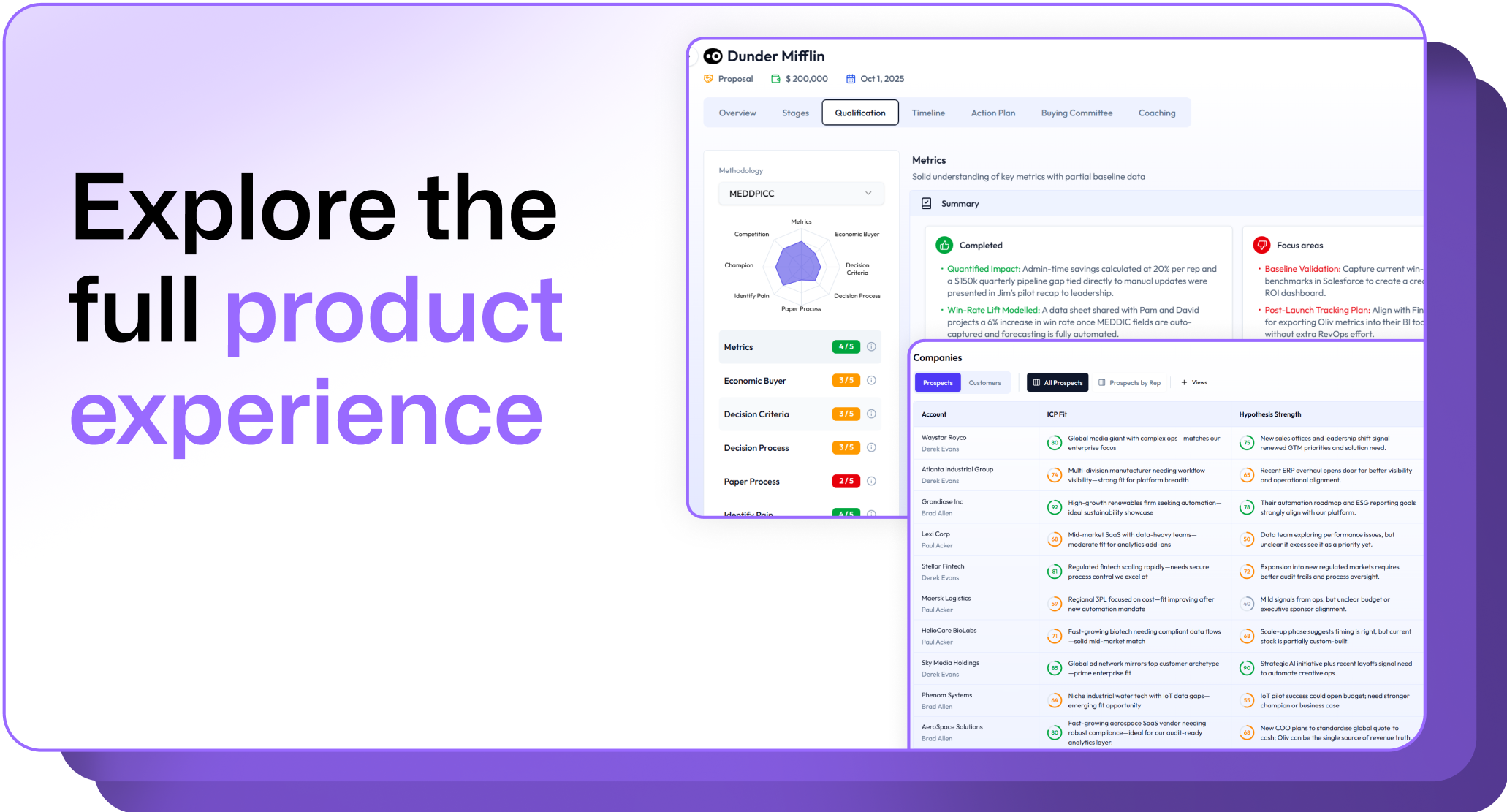
.avif)