How to Run Evidence-Based Forecast Commits Every Monday | (VP of Sales Forecast Playbook) 2026
Written by
Ishan Chhabra
Last Updated :
March 7, 2026
Skim in :
10
mins
In this article
Still got questions?
Come discuss this article with me.
Hi, I'm Ishan, Founder and CEO of Oliv.
I'm always up for a conversation about revenue intelligence, AI agents, or what's actually working (and what's not) across revenue teams.
I'd love to hear your perspective.
Thank you! Your submission has been received!
Oops! Something went wrong while submitting the form.
Meet Oliv’s AI Agents
Hi! I’m, Deal Driver
I track deals, flag risks, send weekly pipeline updates and give sales managers full visibility into deal progress
Hi! I’m, CRM Manager
I maintain CRM hygiene by updating core, custom and qualification fields all without your team lifting a finger
Hi! I’m, Forecaster
I build accurate forecasts based on real deal movement and tell you which deals to pull in to hit your number
Hi! I’m, Coach
I believe performance fuels revenue. I spot skill gaps, score calls and build coaching plans to help every rep level up
Hi! I’m, Prospector
I dig into target accounts to surface the right contacts, tailor and time outreach so you always strike when it counts
Hi! I’m, Pipeline tracker
I call reps to get deal updates, and deliver a real-time, CRM-synced roll-up view of deal progress
Hi! I’m, Analyst
I answer complex pipeline questions, uncover deal patterns, and build reports that guide strategic decisions
TL;DR
Most forecast commits fail because they rely on rep memory and manual CRM data, not conversational evidence.
Scaling from 25 to 100 reps doubles the audit burden, making manual roll-ups unsustainable for leadership.
A "Commit" should meet six verified criteria including confirmed Economic Buyer, engaged legal, and agreed timeline.
The 5-Day Commit Cycle transforms Monday calls from discovery events into strategy sessions using AI-generated reports.
Stacking Gong + Clari + Einstein creates a $500+/user/month "Stacking Tax" with persistent data silos.
Oliv.ai delivers forecast value in days, not the 3 to 6 months typical of legacy tool implementations.
Q1. Why Do VPs of Sales Spend Half the Week Chasing Forecast Updates? [toc=The Forecast Fire Drill]
It's Thursday afternoon. You're on your fourth consecutive 1:1 with a frontline manager, trying to reconstruct a commit number for Monday's board call. Sound familiar? Industry data tells the story plainly: fewer than 50% of sales leaders have high confidence in their sales forecast accuracy, and only about 21% of organizations forecast within 10% of actual results. The VP of Sales forecast commit process at most growth-stage companies isn't a process at all. It's a weekly fire drill.
Why the Forecast Workflow Breaks at Every Link
The traditional forecast workflow forces a chain of manual handoffs that breaks at every link:
Reps prioritize closing over record-keeping. CRM fields are stale, next steps are vague, and close dates are aspirational.
Managers must "hear the story" deal-by-deal. They spend 1 to 2 hours per rep in 1:1s just to understand what's real in the pipeline because the CRM data is incomplete or meaningless.
Each roll-up layer adds bias. Manager A applies a conservative lens; Manager B rounds up. The VP receives two vastly different commit numbers from the same pipeline, and the forecast becomes an act of creative writing, not analysis.
The subjectivity problem is pervasive. When different managers produce different commits from identical deal sets, board trust erodes and the VP spends Sunday night reconciling spreadsheets.
"It's too complicated, and not intuitive at all. Understanding the pipeline management portion of it is almost impossible. Some people figure it out, but I think most just fumble through and tell tall tales about how easy it is for them to use." — John S., Senior Account Executive, Gong G2 Verified Review
❌ Why Gen-1 Tools Didn't Fix This
Clari and Gong digitized the manual process but didn't eliminate it. Clari remains a system for a manual process: managers still input data after hearing the rep's story. Gong records meetings and flags keywords with pre-LLM Smart Trackers, but it logs summaries as notes or activities. It does not update the CRM objects or properties required for accurate reporting. The data remains fragmented across tools, and the VP is still the integration layer.
"The analytics modules still need some work IMO to provide a valuable deliverable. All the pieces are there but missing the story line... You have to click around through the different modules and extract the different pieces, ultimately putting it in an Excel for easier manipulation." — Natalie O., Sales Operations Manager, Clari G2 Verified Review
✅ What an AI-Native Approach Changes
Oliv.ai's CRM Manager Agent autonomously captures and updates deal fields from calls, emails, and Slack, removing the manual data-entry layer entirely. The Forecaster Agent then generates an "Unbiased Call" for the quarter, shown side-by-side with the manager's call, so subjectivity becomes visible rather than hidden. The Morning Brief (what meetings are today?) and Sunset Summary (what happened today?) keep VPs in the loop daily, transforming Monday's forecast call from a discovery event into a strategy event.
Think of it this way: traditional forecasting is driving while looking at a muddy rear-view mirror. Gen-1 AI is a passenger shouting street names but not knowing the route. Oliv is the autonomous driving system: cleaning the windshield, updating traffic data in real-time, and recalculating your arrival time every few seconds based on actual road conditions.
Q2. What Breaks in the Forecast Process When You Scale From 25 to 100 Reps? [toc=Scaling Forecast Breakdown]
Most VPs expect that adding more reps delivers more revenue predictability. The reality is the opposite, a phenomenon best described as the Scalability Paradox. When a VP had 10 reps, they could personally inspect every deal. At 50+ reps, they depend entirely on frontline managers, and each manager applies "commit" differently.
Where the Process Fractures
The breakdown happens across four dimensions simultaneously:
Forecast Process Breakdown: 10 Reps vs. 50 to 100 Reps
Failure Mode
At 10 Reps
At 50 to 100 Reps
Stage definitions
VP enforces consistency personally
Each FLM interprets stages differently
Commit criteria
Informal but VP-verified
No standardized checklist; "commit" means different things to different managers
Manager roll-ups
Minimal distortion; VP sees raw data
Managers "touch up" numbers to look better before passing them up
CRM hygiene
Manageable; VP can spot stale fields
CRM becomes a graveyard of outdated close dates and generic next steps
When managers roll up a forecast, they often adjust numbers to present a better picture to their VP, further distorting the truth at every layer. The result: doubling the team doubles the audit burden, not the accuracy.
"Clari is a tool for sales leaders, it adds no value to reps as far as I can see." — Msoave, r/SalesOperations Reddit Thread
❌ Why Current Tools Can't Keep Up
Gong's Smart Trackers rely on older keyword-matching technology built before the LLM era. They flag a "competitor mention" but cannot distinguish whether a prospect is merely naming a competitor or actively evaluating them. Gong understands the meeting, but it doesn't understand the deal across its full lifecycle.
Clari provides roll-up views, but humans still input the underlying data. Neither tool enforces consistent stage definitions or auto-corrects dirty data at the field level.
"I find the setup process challenging, especially when migrating fields from Salesforce, as it can't handle formula fields directly. This requires creating and maintaining duplicate fields, which adds complexity and workload." — Josiah R., Head of Sales Operations, Clari G2 Verified Review
✅ How Oliv Scales Without Adding Audit Burden
Oliv.ai's CRM Manager Agent updates standard and custom fields, including MEDDPICC and BANT criteria, after every interaction, automatically. This enforces consistent qualification criteria across every rep, regardless of headcount. The Forecaster Agent then inspects deals line-by-line using these clean fields, eliminating the manager-layer distortion that compounds as teams grow.
For organizations running multiple segments, Oliv supports separate Forecaster configurations per motion: SMB (volume-focused, 15-day cycle) versus Enterprise ($1M ACV, 6-month multi-stakeholder MEDDPICC), all running on the same underlying AI-native revenue orchestration platform. Scale the team without scaling the chaos.
Q3. What Does 'Commit' Actually Mean: Definitions, Criteria Checklist, and Benchmarks [toc=Commit Definitions and Criteria]
One of the most common root causes of forecast inaccuracy isn't bad data or poor tools: it's that the word "commit" means different things to different people on the same sales team. Before building any cadence or implementing any technology, VPs must align the organization on a shared vocabulary.
Commit / Best Case / Upside: The Three Forecast Categories
Every deal in the current-quarter pipeline should fall into one of three categories based on its probability of closing within the period:
Forecast Category Definitions
Category
Probability Band
What It Means
Commit
90%+
The deal will close this quarter barring an extraordinary event. Economic buyer has verbally confirmed, legal is engaged, timeline is agreed.
Best Case
60 to 75%
Strong pipeline deal with positive momentum but at least one unresolved variable (budget approval pending, timeline uncertain, or additional stakeholders required).
Upside
30 to 50%
The deal could pull in if things break right, but it's not dependable. Useful for scenario planning, not for the commit number.
The critical distinction: a commit is not a "hope." If a rep marks a deal as Commit, they are staking their professional credibility on it closing. If commit deals regularly slip, the criteria, not just the rep, need examination.
The 6-Point Commit Criteria Checklist
A deal qualifies as Commit only when all six conditions are verified:
✅ Economic Buyer confirmed: The person who signs the contract has been identified, engaged, and has expressed intent to proceed.
✅ Legal/procurement engaged: Redlines are in progress or contract is in final review. No unsigned deals qualify.
✅ Timeline agreed: A mutual action plan (MAP) exists with specific dates for each remaining milestone.
✅ Budget allocated: Funds are confirmed or purchase order is in process. "We'll find the budget" does not qualify.
✅ No identified blockers: No unresolved objections, competing priorities, or organizational changes that could derail the deal.
✅ Verbal or written commitment received: The champion or economic buyer has explicitly stated intent to close within the quarter.
Commit-to-Close Ratio Benchmarks
The commit-to-close ratio measures what percentage of deals marked "Commit" at the start of a period actually close within that period:
⭐ 90%+: World-class. Commit means commit. The criteria are rigorous and consistently enforced.
✅ 75 to 89%: Healthy. Some slippage is normal, but the process is fundamentally sound.
❌ Below 75%: Broken process. Either the criteria are too loose, reps aren't held accountable, or managers are inflating.
A useful companion metric is pipeline coverage ratio: aim for 3x coverage on commit (e.g., $3M in commit-eligible pipeline to hit a $1M target) and 2x on best case.
How Oliv Helps Enforce Consistency
Oliv.ai's Forecaster Agent evaluates every deal against these criteria automatically, using conversational evidence rather than rep self-assessment. If a deal is marked "Commit" but the AI detects no engagement from the economic buyer or no scheduled next steps, it flags the discrepancy. This turns the commit criteria from a guideline into an enforced standard across your deal intelligence workflow.
Q4. The Forecast Roll-Up Chain: Who Owns What From Rep to Board? [toc=Roll-Up Accountability Chain]
A VP of Sales forecast commit process is only as reliable as the weakest link in its roll-up chain. Every organization has some version of this chain, but few have clearly defined what each layer is accountable for and where distortion is most likely to enter.
The 5-Layer Accountability Chain
Forecast Roll-Up: 5-Layer Accountability Chain
Layer
Role
Responsibility
Common Distortion Risk
1. Rep
AE / Account Manager
Assigns each deal to Commit, Best Case, or Upside based on the 6-point criteria
Optimism bias ("happy ears") or intentional sandbagging to protect future quota
2. Frontline Manager
Sales Manager / Team Lead
Validates rep commits in 1:1s, challenges assumptions, submits team-level roll-up
"Touch-ups": adjusting numbers to look better to VP, or not challenging reps they're close with
Over-sandbagging to "beat and raise," or under-sandbagging when pressured by board targets
4. CRO / CEO
Executive Leadership
Translates VP forecast into company-level revenue guidance with variance ranges
Pressure to commit a number to the board before the data supports it
5. Board
Investors / Board Members
Evaluates forecast variance quarter-over-quarter, assesses predictability of the revenue engine
Anchoring to prior quarter's miss rather than evaluating current pipeline health
The Thursday Gate and Monday Deliverable
A well-run roll-up chain operates on a specific cadence. The Thursday VP call functions as the accountability gate: this is where frontline managers defend their numbers, the VP applies a risk lens, and the AI-vs.-manager comparison surfaces gaps. The Monday board-ready commit is the deliverable: refined, pressure-tested, and backed by evidence from the full roll-up process.
"We use Clari every week on our forecast call with our ELT. I'm able to screen-share Clari directly with our executive team because it presents the forecast in a clear, concise, and streamlined view." — Andrew P., Business Development Manager, Clari G2 Verified Review
While tools like Clari can visualize the roll-up clearly, the underlying numbers still depend on humans inputting accurate data at every layer, which is where the chain typically breaks.
"I do think the forecasting feature is decent, but at least in our setup, it doesn't do a great job of auto-calculating the values I need to submit, so that is entirely handheld by using the built-in notes field as a calculator." — Dexter L., Customer Success Executive, Clari G2 Verified Review
How forecast distortion compounds at every roll-up layer, and how autonomous AI agents eliminate bias from rep to board.
✅ How Oliv Removes Distortion at Every Layer
Oliv.ai restructures the chain by removing the manual input dependency at the first three layers:
Rep layer: The CRM Manager Agent captures deal data autonomously from conversations; reps don't need to self-report.
Manager layer: The Forecaster Agent generates unbiased roll-ups by inspecting every deal's conversational evidence, bypassing the manager's subjective interpretation.
VP layer: The AI-vs.-Manager comparison view shows exactly where human calls diverge from evidence-based predictions, making distortion visible instead of hidden.
The result: the VP receives a forecast grounded in the reality of the deal, not the story of the deal.
Q5. Why Do Gong + Clari + Salesforce Still Leave You With Fire Drills? [toc=The Stacking Tax Problem]
Most VPs reading this aren't evaluating their first tool: they already have Gong for conversation intelligence, Clari for forecasting roll-ups, and Salesforce as the CRM backbone. The real question is sharper: why do you still have Thursday fire drills despite paying for three platforms?
Once you factor in Data Cloud and Revenue Intelligence layers for Einstein, total cost can exceed $500 per user per month, yet the tools don't talk to each other natively. The VP becomes the integration layer, manually stitching insights from three dashboards into one coherent forecast.
"The additional products like forecast or engage come at an additional cost. Would be great to see these tools rolled into the core offering." — Scott T., Director of Sales, Gong G2 Verified Review
❌ Where Each Tool Falls Short
Clari digitizes the roll-up process but doesn't automate it. Managers still hear the story from reps, then manually input data. It's a system for a manual process, not a replacement for it.
Gong records and transcribes meetings, but its Smart Trackers are built on pre-LLM keyword matching. They flag a competitor mention without distinguishing casual reference from active evaluation. Critically, Gong logs meeting summaries as notes. It does not update the CRM objects required for reporting.
Salesforce Einstein/Agentforce layers AI on top of the CRM, but it relies on the underlying data being clean. When reps skip fields and managers "touch up" numbers, Einstein's predictions inherit that noise.
"This lack of flexibility has required us to engage our development team at additional cost, adding significant operational and opportunity costs just to extract data we already own." — Neel P., Sales Operations Manager, Gong G2 Verified Review
The Stacking Tax: Why paying for Gong + Clari + Salesforce Einstein separately costs $500+/user/month while leaving data silos intact.
✅ Oliv.ai: One Platform Replacing the Stack
Oliv.ai is a generative AI-native platform that consolidates the stack into a single AI-native revenue orchestration solution:
CRM Manager Agent: Autonomous data hygiene (replaces manual CRM updates)
Forecaster Agent: Unbiased AI predictions and roll-ups (replaces Clari's manual input)
Deal Driver Agent: Real-time risk alerts across calls, emails, Slack, and phone (replaces Gong's keyword-level insights)
All three agents stitch data across every communication channel into one unified deal timeline, no manual reconciliation required. And when it's time to move on, Oliv provides a full open CSV export policy, ensuring your data is never locked behind a proprietary UI.
Q6. How Does an AI Forecaster Inspect Deals and Catch Sandbagging? [toc=AI Deal Inspection Signals]
Ten follow-up emails in a week might look like strong engagement on a dashboard. In reality, it could mean a deal is stuck and the rep is chasing an unresponsive buyer. Traditional activity tracking is naive: it counts volume without interpreting intent. And that gap between activity and truth is exactly where sandbagging and optimism bias thrive.
⚠️ The Manager Audit Gap
Even the most disciplined frontline managers can realistically review only 20 to 30% of their team's calls each week. The remaining 70 to 80% of deals are forecasted on faith, based on whatever the rep reports in a 15-minute 1:1. This is where inflated commits and hidden deals go undetected until it's too late.
"There's so much in Gong, that we don't use everything. Gong's deal forecasting: we don't use." — Karel Bos, Head of Sales, Gong TrustRadius Verified Review
❌ Why Keyword Tracking Isn't Enough
Gong's Smart Trackers flag when a competitor is mentioned or a pricing objection surfaces. But they can't assess whether the Economic Buyer has actually committed, whether the mutual action plan is being followed, or whether the next steps are concrete versus vague. Keyword-level signals tell you what was said, not what it means for the deal.
"AI is not great yet: the product still feels like it's at its infancy and needs to be developed further." — Annabelle H., Director, Board of Directors, Gong G2 Verified Review
✅ Oliv's Signal Architecture: Intent Over Activity
Oliv.ai's Forecaster Agent inspects every deal using signals that go far beyond activity counts:
Mutual Action Plan (MAP) adherence: Are milestones being hit on schedule, or has the timeline gone silent?
Economic Buyer engagement: Has the decision-maker participated in recent calls, or has the deal stalled at the champion level?
Stakeholder objections: Are concerns being resolved, or are the same objections surfacing repeatedly?
Sentiment shifts: Has the buyer's tone changed across the deal timeline?
Next step specificity: "Let's reconnect next week" versus "Legal review scheduled for Thursday at 2 PM"
Catching Sandbagging and Inflation in Real Time
When a rep marks a deal as "Commit" but the AI detects no scheduled next steps or unresolved objections, it flags the deal as "At Risk" with unbiased commentary visible to the VP. Conversely, if a rep buries a deal in "Pipeline" despite strong buying signals, the agent surfaces it as a potential "Quick Win." For must-win identification, the Forecaster highlights anchor deals required to hit the quarterly target and flags "Stalled Deals" needing executive intervention, so effort goes where it matters most.
Because this inspection is continuous, not limited to Thursday 1:1s, the Monday commit report already reflects the reality of every deal.
Q7. The 5-Day Commit Cycle: A Day-by-Day Playbook for Evidence-Based Forecasts [toc=5-Day Commit Cycle Playbook]
The biggest gap in forecast management isn't tools or talent: it's a structured cadence that tells every role what to do, on which day, and why. The 5-Day Commit Cycle below provides a complete, role-specific framework for running Monday commits without Thursday fire drills.
The 5-Day Commit Cycle: A role-specific weekly cadence that transforms Monday forecast calls from discovery events into strategy sessions.
⏰ Why Thursday Is the Accountability Gate
Battery Ventures famously argued that Friday is the worst day for forecast calls: reps are closing deals, managers are exhausted, and no one has time to act on what surfaces. Thursday works better as the internal accountability gate because it leaves Friday as an action day. Monday then becomes the board-facing deliverable: refined, pressure-tested, and backed by a full week of evidence.
The Day-by-Day Framework
The 5-Day Commit Cycle: Role-Specific Actions and Oliv Agent Mapping
Day
VP of Sales
Frontline Manager
Reps
Oliv Agent
Monday
Reviews AI-generated forecast report in inbox; runs commit call as a strategy session, not a discovery event
Presents team roll-up with AI-surfaced risks flagged
Cadences fail when they rely on a rep's memory of what happened five days ago. Oliv's Voice Agent (Alpha) addresses this by capturing off-the-record updates, from unrecorded personal phone calls or in-person meetings, and syncing them to the CRM. These verbal updates fill the final evidence gap that even automated systems miss.
Key Design Principles
Monday = strategy, not discovery. If the VP is learning new information on Monday, the cadence is broken.
Thursday = challenge, not blame. The AI-vs.-Manager comparison provides an objective basis for discussion.
Friday = selling, not admin. Reps should never spend their highest-intent selling day updating Salesforce.
With Oliv.ai powering each step autonomously, from CRM hygiene to risk alerts to Monday deck generation, the 5-Day Commit Cycle runs on evidence rather than memory.
Q8. How Can Oliv Generate a Monday Roll-Up Deck Without Any Rep Input? [toc=Autonomous Monday Deck]
It's Sunday night. The VP of Sales is copying pipeline charts from Salesforce into PowerPoint, pulling Gong highlights into a narrative slide, and formatting a variance table in Excel, all for a Monday morning number they're only 67% confident in. This "Sunday Night Syndrome" is one of the most wasteful rituals in sales leadership.
❌ Why Current Tools Create "Human Middleware"
Clari provides dashboards: clean, filterable views of the pipeline that are excellent for live forecast calls. But dashboards are not decks. When the board asks for a presentation, the VP must manually translate Clari's views into slides.
Gong surfaces call highlights and deal risks, but it doesn't produce forecast narratives. It tells you what happened on a call; it doesn't tell you what it means for the quarter.
"Clari's Dashboards leave a lot to be desired. They are surprisingly limited versus how flexible the requisite data sources are." — Rob W., Sr. Director of Revenue Operations, Clari G2 Verified Review
The VP becomes human middleware: the person who stitches insights from multiple tools into a board-consumable format every week.
"I have to maintain my own separate spreadsheet to track deals because I can only capture what my leaders want to see about a deal." — Verified User in Human Resources, Clari G2 Verified Review
✅ Oliv's Autonomous Weekly Report
Because Oliv.ai's CRM Manager Agent captures data continuously and the Forecaster Agent inspects deals autonomously throughout the week, the Monday report requires zero human input. It arrives in the VP's inbox detailing:
Deals Progressed: Which deals advanced and what evidence supports the movement
Deals Won: Closed business with key signals that predicted the win
Deals Lost: Root cause flags from conversational evidence
Deals at Risk: AI-identified concerns with specific, actionable commentary
This report is designed to be consumed over coffee, not assembled over a weekend.
⭐ The "Present" Button: From Report to Board Deck
The Forecaster Agent includes a one-click "Present" function that converts the weekly report into a Google Slides or PowerPoint deck featuring:
Pipeline heatmaps (breadth vs. depth)
Committed deal summaries with AI confidence scores
Risk identification slides with recommended actions
AI vs. Manager vs. Actual comparison views
For deeper board-level analysis, Oliv's Analyst Agent enables natural-language queries like "Show me all deals that were in Commit on Day 1 of Q2 but ended as Closed-Lost" and interprets the conversation history to explain exactly where the forecast variance originated.
The Monday deck is waiting in the VP's inbox before their first coffee, and it's backed by every conversation, email, and Slack message from the week. No copy-pasting. No Sunday nights.
Q9. What to Do When a Commit Misses: The Post-Mortem Process [toc=Commit Miss Post-Mortem]
Every VP misses a commit eventually. The difference between good and great forecast operations is what happens in the 48 hours that follow. Most organizations default to one of two failure modes: blame the rep and move on, or run a vague retrospective that produces no systemic change. Neither prevents the next miss.
❌ Why Traditional Post-Mortems Fail
In a typical post-mortem, managers reconstruct what happened from memory and incomplete CRM notes. The root cause is usually attributed to surface-level explanations: "the deal slipped," "the champion left," "procurement stalled." These explain what happened but never answer why the commit criteria didn't catch it earlier.
Without a complete conversational record, the team is debating recollections, not reviewing evidence. No one tracks whether the commit criteria themselves were flawed, and the same failure pattern repeats next quarter.
"Some users may find Clari's analytics and forecasting tools complex, requiring significant onboarding and training. While Clari integrates with many CRM platforms, users occasionally report difficulties syncing data seamlessly, especially with custom CRM setups." — Bharat K., Revenue Operations Manager, Clari G2 Verified Review
✅ The Evidence-Based Post-Mortem: 5 Steps
With a full AI-captured interaction history, post-mortems become forensic, not anecdotal:
Identify commit-to-loss deals within 48 hours of quarter close. Pull every deal that was in "Commit" on Day 1 but ended as Closed-Lost or slipped.
Pull AI-generated deal timelines. Review the complete interaction history: calls, emails, Slack, to trace exactly when momentum stalled.
Categorize root cause. Assign each miss to one of five buckets: qualification failure, champion loss, timeline slip, competitive loss, or budget cut.
Assess commit criteria gaps. For each miss, ask: did the 6-point commit checklist catch the risk? If not, which criterion needs tightening?
Update criteria and retrain. Feed learnings back into the commit definitions and coach the team on the updated standard.
"It can be overwhelming to set up trackers. AI training is a bit laborious to get it to do what you want." — Trafford J., Senior Director, Revenue Enablement, Gong G2 Verified Review
⭐ How Oliv Powers the Learning Loop
Oliv.ai's Analyst Agent enables natural-language queries like "Show me all deals that were in Commit on Day 1 of Q3 but ended as Closed-Lost, and tell me where the variance originated." It interprets the full conversation history to surface exactly when and why the deal derailed: did the Economic Buyer disengage in Week 3? Were objections left unresolved? Was the timeline unrealistic from Day 1?
The Forecaster Agent also improves over time. It learns from your specific win/loss patterns and sales methodology, making its reasoning engine more attuned to your organization's unique risk signals each quarter. This turns post-mortems from a quarterly blame exercise into a continuous improvement loop, where every missed commit makes the next forecast smarter.
Q10. How Fast Can You Get Forecast Value: Week 1 vs. Clari's 3-Month Setup? [toc=Implementation Speed Comparison]
Most VPs have been burned by the same story: a six-figure tool purchase that takes months to configure, requires dedicated RevOps resources, and only delivers value after the quarter it was supposed to improve has already ended. Implementation timelines are one of the most underestimated costs in revenue technology.
⏰ Traditional Implementation Timelines
Implementation Timeline Comparison: Legacy Tools vs. Oliv.ai
Tool
Typical Time-to-Value
What's Required
Gong
3 to 6 months
Tracker configuration, AI training, team onboarding, third-party vendor support
Clari
2 to 4 months
CRM field mapping, custom field configuration, hierarchy setup, user training
Salesforce Einstein/Agentforce
6+ months
Data Cloud, Revenue Intelligence layers, prompt engineering, admin customization
These timelines assume everything goes smoothly, which, based on user feedback, it often doesn't.
"I find the setup process challenging, especially when migrating fields from Salesforce, as it can't handle formula fields directly. This requires creating and maintaining duplicate fields, which adds complexity and workload." — Josiah R., Head of Sales Operations, Clari G2 Verified Review
"Setting it up wasn't as smooth as I expected. The UI felt a bit clunky at times, especially when trying to manage multiple prompts or agent versions. Also, the pricing caught us off guard. Once we started scaling to more users and use cases, the cost ramped up pretty quickly." — Verified User, Salesforce Agentforce G2 Verified Review
❌ The Hidden Cost: Lost Quarters
A 3 to 6 month implementation means the tool delivers value in Q3 for a Q1 purchase. That's an entire half-year where the team is still running manual roll-ups, dirty CRM data, and Thursday fire drills, while paying full license fees.
Days 1 to 2: Core value live: autonomous CRM updates, deal summaries, and meeting intelligence flowing without rep input.
Week 1: Train agents on your specific sales process. Oliv learns from as few as three calls to understand your unique methodology (MEDDIC, BANT, or custom).
Weeks 2 to 4: Full MEDDPICC customization, Forecaster Agent generating weekly reports, Monday deck auto-generated.
End of Quarter 1: First post-mortem data available. Commit criteria refinement begins. AI reasoning engine starts sharpening based on your deal outcomes.
The Forecaster Agent is context-first: it learns from your win history and adapts its risk signals to your specific growth cycle. Each quarter of data makes the next forecast more accurate, turning implementation from a one-time burden into a compounding advantage.
Q1. Why Do VPs of Sales Spend Half the Week Chasing Forecast Updates? [toc=The Forecast Fire Drill]
It's Thursday afternoon. You're on your fourth consecutive 1:1 with a frontline manager, trying to reconstruct a commit number for Monday's board call. Sound familiar? Industry data tells the story plainly: fewer than 50% of sales leaders have high confidence in their sales forecast accuracy, and only about 21% of organizations forecast within 10% of actual results. The VP of Sales forecast commit process at most growth-stage companies isn't a process at all. It's a weekly fire drill.
Why the Forecast Workflow Breaks at Every Link
The traditional forecast workflow forces a chain of manual handoffs that breaks at every link:
Reps prioritize closing over record-keeping. CRM fields are stale, next steps are vague, and close dates are aspirational.
Managers must "hear the story" deal-by-deal. They spend 1 to 2 hours per rep in 1:1s just to understand what's real in the pipeline because the CRM data is incomplete or meaningless.
Each roll-up layer adds bias. Manager A applies a conservative lens; Manager B rounds up. The VP receives two vastly different commit numbers from the same pipeline, and the forecast becomes an act of creative writing, not analysis.
The subjectivity problem is pervasive. When different managers produce different commits from identical deal sets, board trust erodes and the VP spends Sunday night reconciling spreadsheets.
"It's too complicated, and not intuitive at all. Understanding the pipeline management portion of it is almost impossible. Some people figure it out, but I think most just fumble through and tell tall tales about how easy it is for them to use." — John S., Senior Account Executive, Gong G2 Verified Review
❌ Why Gen-1 Tools Didn't Fix This
Clari and Gong digitized the manual process but didn't eliminate it. Clari remains a system for a manual process: managers still input data after hearing the rep's story. Gong records meetings and flags keywords with pre-LLM Smart Trackers, but it logs summaries as notes or activities. It does not update the CRM objects or properties required for accurate reporting. The data remains fragmented across tools, and the VP is still the integration layer.
"The analytics modules still need some work IMO to provide a valuable deliverable. All the pieces are there but missing the story line... You have to click around through the different modules and extract the different pieces, ultimately putting it in an Excel for easier manipulation." — Natalie O., Sales Operations Manager, Clari G2 Verified Review
✅ What an AI-Native Approach Changes
Oliv.ai's CRM Manager Agent autonomously captures and updates deal fields from calls, emails, and Slack, removing the manual data-entry layer entirely. The Forecaster Agent then generates an "Unbiased Call" for the quarter, shown side-by-side with the manager's call, so subjectivity becomes visible rather than hidden. The Morning Brief (what meetings are today?) and Sunset Summary (what happened today?) keep VPs in the loop daily, transforming Monday's forecast call from a discovery event into a strategy event.
Think of it this way: traditional forecasting is driving while looking at a muddy rear-view mirror. Gen-1 AI is a passenger shouting street names but not knowing the route. Oliv is the autonomous driving system: cleaning the windshield, updating traffic data in real-time, and recalculating your arrival time every few seconds based on actual road conditions.
Q2. What Breaks in the Forecast Process When You Scale From 25 to 100 Reps? [toc=Scaling Forecast Breakdown]
Most VPs expect that adding more reps delivers more revenue predictability. The reality is the opposite, a phenomenon best described as the Scalability Paradox. When a VP had 10 reps, they could personally inspect every deal. At 50+ reps, they depend entirely on frontline managers, and each manager applies "commit" differently.
Where the Process Fractures
The breakdown happens across four dimensions simultaneously:
Forecast Process Breakdown: 10 Reps vs. 50 to 100 Reps
Failure Mode
At 10 Reps
At 50 to 100 Reps
Stage definitions
VP enforces consistency personally
Each FLM interprets stages differently
Commit criteria
Informal but VP-verified
No standardized checklist; "commit" means different things to different managers
Manager roll-ups
Minimal distortion; VP sees raw data
Managers "touch up" numbers to look better before passing them up
CRM hygiene
Manageable; VP can spot stale fields
CRM becomes a graveyard of outdated close dates and generic next steps
When managers roll up a forecast, they often adjust numbers to present a better picture to their VP, further distorting the truth at every layer. The result: doubling the team doubles the audit burden, not the accuracy.
"Clari is a tool for sales leaders, it adds no value to reps as far as I can see." — Msoave, r/SalesOperations Reddit Thread
❌ Why Current Tools Can't Keep Up
Gong's Smart Trackers rely on older keyword-matching technology built before the LLM era. They flag a "competitor mention" but cannot distinguish whether a prospect is merely naming a competitor or actively evaluating them. Gong understands the meeting, but it doesn't understand the deal across its full lifecycle.
Clari provides roll-up views, but humans still input the underlying data. Neither tool enforces consistent stage definitions or auto-corrects dirty data at the field level.
"I find the setup process challenging, especially when migrating fields from Salesforce, as it can't handle formula fields directly. This requires creating and maintaining duplicate fields, which adds complexity and workload." — Josiah R., Head of Sales Operations, Clari G2 Verified Review
✅ How Oliv Scales Without Adding Audit Burden
Oliv.ai's CRM Manager Agent updates standard and custom fields, including MEDDPICC and BANT criteria, after every interaction, automatically. This enforces consistent qualification criteria across every rep, regardless of headcount. The Forecaster Agent then inspects deals line-by-line using these clean fields, eliminating the manager-layer distortion that compounds as teams grow.
For organizations running multiple segments, Oliv supports separate Forecaster configurations per motion: SMB (volume-focused, 15-day cycle) versus Enterprise ($1M ACV, 6-month multi-stakeholder MEDDPICC), all running on the same underlying AI-native revenue orchestration platform. Scale the team without scaling the chaos.
Q3. What Does 'Commit' Actually Mean: Definitions, Criteria Checklist, and Benchmarks [toc=Commit Definitions and Criteria]
One of the most common root causes of forecast inaccuracy isn't bad data or poor tools: it's that the word "commit" means different things to different people on the same sales team. Before building any cadence or implementing any technology, VPs must align the organization on a shared vocabulary.
Commit / Best Case / Upside: The Three Forecast Categories
Every deal in the current-quarter pipeline should fall into one of three categories based on its probability of closing within the period:
Forecast Category Definitions
Category
Probability Band
What It Means
Commit
90%+
The deal will close this quarter barring an extraordinary event. Economic buyer has verbally confirmed, legal is engaged, timeline is agreed.
Best Case
60 to 75%
Strong pipeline deal with positive momentum but at least one unresolved variable (budget approval pending, timeline uncertain, or additional stakeholders required).
Upside
30 to 50%
The deal could pull in if things break right, but it's not dependable. Useful for scenario planning, not for the commit number.
The critical distinction: a commit is not a "hope." If a rep marks a deal as Commit, they are staking their professional credibility on it closing. If commit deals regularly slip, the criteria, not just the rep, need examination.
The 6-Point Commit Criteria Checklist
A deal qualifies as Commit only when all six conditions are verified:
✅ Economic Buyer confirmed: The person who signs the contract has been identified, engaged, and has expressed intent to proceed.
✅ Legal/procurement engaged: Redlines are in progress or contract is in final review. No unsigned deals qualify.
✅ Timeline agreed: A mutual action plan (MAP) exists with specific dates for each remaining milestone.
✅ Budget allocated: Funds are confirmed or purchase order is in process. "We'll find the budget" does not qualify.
✅ No identified blockers: No unresolved objections, competing priorities, or organizational changes that could derail the deal.
✅ Verbal or written commitment received: The champion or economic buyer has explicitly stated intent to close within the quarter.
Commit-to-Close Ratio Benchmarks
The commit-to-close ratio measures what percentage of deals marked "Commit" at the start of a period actually close within that period:
⭐ 90%+: World-class. Commit means commit. The criteria are rigorous and consistently enforced.
✅ 75 to 89%: Healthy. Some slippage is normal, but the process is fundamentally sound.
❌ Below 75%: Broken process. Either the criteria are too loose, reps aren't held accountable, or managers are inflating.
A useful companion metric is pipeline coverage ratio: aim for 3x coverage on commit (e.g., $3M in commit-eligible pipeline to hit a $1M target) and 2x on best case.
How Oliv Helps Enforce Consistency
Oliv.ai's Forecaster Agent evaluates every deal against these criteria automatically, using conversational evidence rather than rep self-assessment. If a deal is marked "Commit" but the AI detects no engagement from the economic buyer or no scheduled next steps, it flags the discrepancy. This turns the commit criteria from a guideline into an enforced standard across your deal intelligence workflow.
Q4. The Forecast Roll-Up Chain: Who Owns What From Rep to Board? [toc=Roll-Up Accountability Chain]
A VP of Sales forecast commit process is only as reliable as the weakest link in its roll-up chain. Every organization has some version of this chain, but few have clearly defined what each layer is accountable for and where distortion is most likely to enter.
The 5-Layer Accountability Chain
Forecast Roll-Up: 5-Layer Accountability Chain
Layer
Role
Responsibility
Common Distortion Risk
1. Rep
AE / Account Manager
Assigns each deal to Commit, Best Case, or Upside based on the 6-point criteria
Optimism bias ("happy ears") or intentional sandbagging to protect future quota
2. Frontline Manager
Sales Manager / Team Lead
Validates rep commits in 1:1s, challenges assumptions, submits team-level roll-up
"Touch-ups": adjusting numbers to look better to VP, or not challenging reps they're close with
Over-sandbagging to "beat and raise," or under-sandbagging when pressured by board targets
4. CRO / CEO
Executive Leadership
Translates VP forecast into company-level revenue guidance with variance ranges
Pressure to commit a number to the board before the data supports it
5. Board
Investors / Board Members
Evaluates forecast variance quarter-over-quarter, assesses predictability of the revenue engine
Anchoring to prior quarter's miss rather than evaluating current pipeline health
The Thursday Gate and Monday Deliverable
A well-run roll-up chain operates on a specific cadence. The Thursday VP call functions as the accountability gate: this is where frontline managers defend their numbers, the VP applies a risk lens, and the AI-vs.-manager comparison surfaces gaps. The Monday board-ready commit is the deliverable: refined, pressure-tested, and backed by evidence from the full roll-up process.
"We use Clari every week on our forecast call with our ELT. I'm able to screen-share Clari directly with our executive team because it presents the forecast in a clear, concise, and streamlined view." — Andrew P., Business Development Manager, Clari G2 Verified Review
While tools like Clari can visualize the roll-up clearly, the underlying numbers still depend on humans inputting accurate data at every layer, which is where the chain typically breaks.
"I do think the forecasting feature is decent, but at least in our setup, it doesn't do a great job of auto-calculating the values I need to submit, so that is entirely handheld by using the built-in notes field as a calculator." — Dexter L., Customer Success Executive, Clari G2 Verified Review
How forecast distortion compounds at every roll-up layer, and how autonomous AI agents eliminate bias from rep to board.
✅ How Oliv Removes Distortion at Every Layer
Oliv.ai restructures the chain by removing the manual input dependency at the first three layers:
Rep layer: The CRM Manager Agent captures deal data autonomously from conversations; reps don't need to self-report.
Manager layer: The Forecaster Agent generates unbiased roll-ups by inspecting every deal's conversational evidence, bypassing the manager's subjective interpretation.
VP layer: The AI-vs.-Manager comparison view shows exactly where human calls diverge from evidence-based predictions, making distortion visible instead of hidden.
The result: the VP receives a forecast grounded in the reality of the deal, not the story of the deal.
Q5. Why Do Gong + Clari + Salesforce Still Leave You With Fire Drills? [toc=The Stacking Tax Problem]
Most VPs reading this aren't evaluating their first tool: they already have Gong for conversation intelligence, Clari for forecasting roll-ups, and Salesforce as the CRM backbone. The real question is sharper: why do you still have Thursday fire drills despite paying for three platforms?
Once you factor in Data Cloud and Revenue Intelligence layers for Einstein, total cost can exceed $500 per user per month, yet the tools don't talk to each other natively. The VP becomes the integration layer, manually stitching insights from three dashboards into one coherent forecast.
"The additional products like forecast or engage come at an additional cost. Would be great to see these tools rolled into the core offering." — Scott T., Director of Sales, Gong G2 Verified Review
❌ Where Each Tool Falls Short
Clari digitizes the roll-up process but doesn't automate it. Managers still hear the story from reps, then manually input data. It's a system for a manual process, not a replacement for it.
Gong records and transcribes meetings, but its Smart Trackers are built on pre-LLM keyword matching. They flag a competitor mention without distinguishing casual reference from active evaluation. Critically, Gong logs meeting summaries as notes. It does not update the CRM objects required for reporting.
Salesforce Einstein/Agentforce layers AI on top of the CRM, but it relies on the underlying data being clean. When reps skip fields and managers "touch up" numbers, Einstein's predictions inherit that noise.
"This lack of flexibility has required us to engage our development team at additional cost, adding significant operational and opportunity costs just to extract data we already own." — Neel P., Sales Operations Manager, Gong G2 Verified Review
The Stacking Tax: Why paying for Gong + Clari + Salesforce Einstein separately costs $500+/user/month while leaving data silos intact.
✅ Oliv.ai: One Platform Replacing the Stack
Oliv.ai is a generative AI-native platform that consolidates the stack into a single AI-native revenue orchestration solution:
CRM Manager Agent: Autonomous data hygiene (replaces manual CRM updates)
Forecaster Agent: Unbiased AI predictions and roll-ups (replaces Clari's manual input)
Deal Driver Agent: Real-time risk alerts across calls, emails, Slack, and phone (replaces Gong's keyword-level insights)
All three agents stitch data across every communication channel into one unified deal timeline, no manual reconciliation required. And when it's time to move on, Oliv provides a full open CSV export policy, ensuring your data is never locked behind a proprietary UI.
Q6. How Does an AI Forecaster Inspect Deals and Catch Sandbagging? [toc=AI Deal Inspection Signals]
Ten follow-up emails in a week might look like strong engagement on a dashboard. In reality, it could mean a deal is stuck and the rep is chasing an unresponsive buyer. Traditional activity tracking is naive: it counts volume without interpreting intent. And that gap between activity and truth is exactly where sandbagging and optimism bias thrive.
⚠️ The Manager Audit Gap
Even the most disciplined frontline managers can realistically review only 20 to 30% of their team's calls each week. The remaining 70 to 80% of deals are forecasted on faith, based on whatever the rep reports in a 15-minute 1:1. This is where inflated commits and hidden deals go undetected until it's too late.
"There's so much in Gong, that we don't use everything. Gong's deal forecasting: we don't use." — Karel Bos, Head of Sales, Gong TrustRadius Verified Review
❌ Why Keyword Tracking Isn't Enough
Gong's Smart Trackers flag when a competitor is mentioned or a pricing objection surfaces. But they can't assess whether the Economic Buyer has actually committed, whether the mutual action plan is being followed, or whether the next steps are concrete versus vague. Keyword-level signals tell you what was said, not what it means for the deal.
"AI is not great yet: the product still feels like it's at its infancy and needs to be developed further." — Annabelle H., Director, Board of Directors, Gong G2 Verified Review
✅ Oliv's Signal Architecture: Intent Over Activity
Oliv.ai's Forecaster Agent inspects every deal using signals that go far beyond activity counts:
Mutual Action Plan (MAP) adherence: Are milestones being hit on schedule, or has the timeline gone silent?
Economic Buyer engagement: Has the decision-maker participated in recent calls, or has the deal stalled at the champion level?
Stakeholder objections: Are concerns being resolved, or are the same objections surfacing repeatedly?
Sentiment shifts: Has the buyer's tone changed across the deal timeline?
Next step specificity: "Let's reconnect next week" versus "Legal review scheduled for Thursday at 2 PM"
Catching Sandbagging and Inflation in Real Time
When a rep marks a deal as "Commit" but the AI detects no scheduled next steps or unresolved objections, it flags the deal as "At Risk" with unbiased commentary visible to the VP. Conversely, if a rep buries a deal in "Pipeline" despite strong buying signals, the agent surfaces it as a potential "Quick Win." For must-win identification, the Forecaster highlights anchor deals required to hit the quarterly target and flags "Stalled Deals" needing executive intervention, so effort goes where it matters most.
Because this inspection is continuous, not limited to Thursday 1:1s, the Monday commit report already reflects the reality of every deal.
Q7. The 5-Day Commit Cycle: A Day-by-Day Playbook for Evidence-Based Forecasts [toc=5-Day Commit Cycle Playbook]
The biggest gap in forecast management isn't tools or talent: it's a structured cadence that tells every role what to do, on which day, and why. The 5-Day Commit Cycle below provides a complete, role-specific framework for running Monday commits without Thursday fire drills.
The 5-Day Commit Cycle: A role-specific weekly cadence that transforms Monday forecast calls from discovery events into strategy sessions.
⏰ Why Thursday Is the Accountability Gate
Battery Ventures famously argued that Friday is the worst day for forecast calls: reps are closing deals, managers are exhausted, and no one has time to act on what surfaces. Thursday works better as the internal accountability gate because it leaves Friday as an action day. Monday then becomes the board-facing deliverable: refined, pressure-tested, and backed by a full week of evidence.
The Day-by-Day Framework
The 5-Day Commit Cycle: Role-Specific Actions and Oliv Agent Mapping
Day
VP of Sales
Frontline Manager
Reps
Oliv Agent
Monday
Reviews AI-generated forecast report in inbox; runs commit call as a strategy session, not a discovery event
Presents team roll-up with AI-surfaced risks flagged
Cadences fail when they rely on a rep's memory of what happened five days ago. Oliv's Voice Agent (Alpha) addresses this by capturing off-the-record updates, from unrecorded personal phone calls or in-person meetings, and syncing them to the CRM. These verbal updates fill the final evidence gap that even automated systems miss.
Key Design Principles
Monday = strategy, not discovery. If the VP is learning new information on Monday, the cadence is broken.
Thursday = challenge, not blame. The AI-vs.-Manager comparison provides an objective basis for discussion.
Friday = selling, not admin. Reps should never spend their highest-intent selling day updating Salesforce.
With Oliv.ai powering each step autonomously, from CRM hygiene to risk alerts to Monday deck generation, the 5-Day Commit Cycle runs on evidence rather than memory.
Q8. How Can Oliv Generate a Monday Roll-Up Deck Without Any Rep Input? [toc=Autonomous Monday Deck]
It's Sunday night. The VP of Sales is copying pipeline charts from Salesforce into PowerPoint, pulling Gong highlights into a narrative slide, and formatting a variance table in Excel, all for a Monday morning number they're only 67% confident in. This "Sunday Night Syndrome" is one of the most wasteful rituals in sales leadership.
❌ Why Current Tools Create "Human Middleware"
Clari provides dashboards: clean, filterable views of the pipeline that are excellent for live forecast calls. But dashboards are not decks. When the board asks for a presentation, the VP must manually translate Clari's views into slides.
Gong surfaces call highlights and deal risks, but it doesn't produce forecast narratives. It tells you what happened on a call; it doesn't tell you what it means for the quarter.
"Clari's Dashboards leave a lot to be desired. They are surprisingly limited versus how flexible the requisite data sources are." — Rob W., Sr. Director of Revenue Operations, Clari G2 Verified Review
The VP becomes human middleware: the person who stitches insights from multiple tools into a board-consumable format every week.
"I have to maintain my own separate spreadsheet to track deals because I can only capture what my leaders want to see about a deal." — Verified User in Human Resources, Clari G2 Verified Review
✅ Oliv's Autonomous Weekly Report
Because Oliv.ai's CRM Manager Agent captures data continuously and the Forecaster Agent inspects deals autonomously throughout the week, the Monday report requires zero human input. It arrives in the VP's inbox detailing:
Deals Progressed: Which deals advanced and what evidence supports the movement
Deals Won: Closed business with key signals that predicted the win
Deals Lost: Root cause flags from conversational evidence
Deals at Risk: AI-identified concerns with specific, actionable commentary
This report is designed to be consumed over coffee, not assembled over a weekend.
⭐ The "Present" Button: From Report to Board Deck
The Forecaster Agent includes a one-click "Present" function that converts the weekly report into a Google Slides or PowerPoint deck featuring:
Pipeline heatmaps (breadth vs. depth)
Committed deal summaries with AI confidence scores
Risk identification slides with recommended actions
AI vs. Manager vs. Actual comparison views
For deeper board-level analysis, Oliv's Analyst Agent enables natural-language queries like "Show me all deals that were in Commit on Day 1 of Q2 but ended as Closed-Lost" and interprets the conversation history to explain exactly where the forecast variance originated.
The Monday deck is waiting in the VP's inbox before their first coffee, and it's backed by every conversation, email, and Slack message from the week. No copy-pasting. No Sunday nights.
Q9. What to Do When a Commit Misses: The Post-Mortem Process [toc=Commit Miss Post-Mortem]
Every VP misses a commit eventually. The difference between good and great forecast operations is what happens in the 48 hours that follow. Most organizations default to one of two failure modes: blame the rep and move on, or run a vague retrospective that produces no systemic change. Neither prevents the next miss.
❌ Why Traditional Post-Mortems Fail
In a typical post-mortem, managers reconstruct what happened from memory and incomplete CRM notes. The root cause is usually attributed to surface-level explanations: "the deal slipped," "the champion left," "procurement stalled." These explain what happened but never answer why the commit criteria didn't catch it earlier.
Without a complete conversational record, the team is debating recollections, not reviewing evidence. No one tracks whether the commit criteria themselves were flawed, and the same failure pattern repeats next quarter.
"Some users may find Clari's analytics and forecasting tools complex, requiring significant onboarding and training. While Clari integrates with many CRM platforms, users occasionally report difficulties syncing data seamlessly, especially with custom CRM setups." — Bharat K., Revenue Operations Manager, Clari G2 Verified Review
✅ The Evidence-Based Post-Mortem: 5 Steps
With a full AI-captured interaction history, post-mortems become forensic, not anecdotal:
Identify commit-to-loss deals within 48 hours of quarter close. Pull every deal that was in "Commit" on Day 1 but ended as Closed-Lost or slipped.
Pull AI-generated deal timelines. Review the complete interaction history: calls, emails, Slack, to trace exactly when momentum stalled.
Categorize root cause. Assign each miss to one of five buckets: qualification failure, champion loss, timeline slip, competitive loss, or budget cut.
Assess commit criteria gaps. For each miss, ask: did the 6-point commit checklist catch the risk? If not, which criterion needs tightening?
Update criteria and retrain. Feed learnings back into the commit definitions and coach the team on the updated standard.
"It can be overwhelming to set up trackers. AI training is a bit laborious to get it to do what you want." — Trafford J., Senior Director, Revenue Enablement, Gong G2 Verified Review
⭐ How Oliv Powers the Learning Loop
Oliv.ai's Analyst Agent enables natural-language queries like "Show me all deals that were in Commit on Day 1 of Q3 but ended as Closed-Lost, and tell me where the variance originated." It interprets the full conversation history to surface exactly when and why the deal derailed: did the Economic Buyer disengage in Week 3? Were objections left unresolved? Was the timeline unrealistic from Day 1?
The Forecaster Agent also improves over time. It learns from your specific win/loss patterns and sales methodology, making its reasoning engine more attuned to your organization's unique risk signals each quarter. This turns post-mortems from a quarterly blame exercise into a continuous improvement loop, where every missed commit makes the next forecast smarter.
Q10. How Fast Can You Get Forecast Value: Week 1 vs. Clari's 3-Month Setup? [toc=Implementation Speed Comparison]
Most VPs have been burned by the same story: a six-figure tool purchase that takes months to configure, requires dedicated RevOps resources, and only delivers value after the quarter it was supposed to improve has already ended. Implementation timelines are one of the most underestimated costs in revenue technology.
⏰ Traditional Implementation Timelines
Implementation Timeline Comparison: Legacy Tools vs. Oliv.ai
Tool
Typical Time-to-Value
What's Required
Gong
3 to 6 months
Tracker configuration, AI training, team onboarding, third-party vendor support
Clari
2 to 4 months
CRM field mapping, custom field configuration, hierarchy setup, user training
Salesforce Einstein/Agentforce
6+ months
Data Cloud, Revenue Intelligence layers, prompt engineering, admin customization
These timelines assume everything goes smoothly, which, based on user feedback, it often doesn't.
"I find the setup process challenging, especially when migrating fields from Salesforce, as it can't handle formula fields directly. This requires creating and maintaining duplicate fields, which adds complexity and workload." — Josiah R., Head of Sales Operations, Clari G2 Verified Review
"Setting it up wasn't as smooth as I expected. The UI felt a bit clunky at times, especially when trying to manage multiple prompts or agent versions. Also, the pricing caught us off guard. Once we started scaling to more users and use cases, the cost ramped up pretty quickly." — Verified User, Salesforce Agentforce G2 Verified Review
❌ The Hidden Cost: Lost Quarters
A 3 to 6 month implementation means the tool delivers value in Q3 for a Q1 purchase. That's an entire half-year where the team is still running manual roll-ups, dirty CRM data, and Thursday fire drills, while paying full license fees.
Days 1 to 2: Core value live: autonomous CRM updates, deal summaries, and meeting intelligence flowing without rep input.
Week 1: Train agents on your specific sales process. Oliv learns from as few as three calls to understand your unique methodology (MEDDIC, BANT, or custom).
Weeks 2 to 4: Full MEDDPICC customization, Forecaster Agent generating weekly reports, Monday deck auto-generated.
End of Quarter 1: First post-mortem data available. Commit criteria refinement begins. AI reasoning engine starts sharpening based on your deal outcomes.
The Forecaster Agent is context-first: it learns from your win history and adapts its risk signals to your specific growth cycle. Each quarter of data makes the next forecast more accurate, turning implementation from a one-time burden into a compounding advantage.
Q1. Why Do VPs of Sales Spend Half the Week Chasing Forecast Updates? [toc=The Forecast Fire Drill]
It's Thursday afternoon. You're on your fourth consecutive 1:1 with a frontline manager, trying to reconstruct a commit number for Monday's board call. Sound familiar? Industry data tells the story plainly: fewer than 50% of sales leaders have high confidence in their sales forecast accuracy, and only about 21% of organizations forecast within 10% of actual results. The VP of Sales forecast commit process at most growth-stage companies isn't a process at all. It's a weekly fire drill.
Why the Forecast Workflow Breaks at Every Link
The traditional forecast workflow forces a chain of manual handoffs that breaks at every link:
Reps prioritize closing over record-keeping. CRM fields are stale, next steps are vague, and close dates are aspirational.
Managers must "hear the story" deal-by-deal. They spend 1 to 2 hours per rep in 1:1s just to understand what's real in the pipeline because the CRM data is incomplete or meaningless.
Each roll-up layer adds bias. Manager A applies a conservative lens; Manager B rounds up. The VP receives two vastly different commit numbers from the same pipeline, and the forecast becomes an act of creative writing, not analysis.
The subjectivity problem is pervasive. When different managers produce different commits from identical deal sets, board trust erodes and the VP spends Sunday night reconciling spreadsheets.
"It's too complicated, and not intuitive at all. Understanding the pipeline management portion of it is almost impossible. Some people figure it out, but I think most just fumble through and tell tall tales about how easy it is for them to use." — John S., Senior Account Executive, Gong G2 Verified Review
❌ Why Gen-1 Tools Didn't Fix This
Clari and Gong digitized the manual process but didn't eliminate it. Clari remains a system for a manual process: managers still input data after hearing the rep's story. Gong records meetings and flags keywords with pre-LLM Smart Trackers, but it logs summaries as notes or activities. It does not update the CRM objects or properties required for accurate reporting. The data remains fragmented across tools, and the VP is still the integration layer.
"The analytics modules still need some work IMO to provide a valuable deliverable. All the pieces are there but missing the story line... You have to click around through the different modules and extract the different pieces, ultimately putting it in an Excel for easier manipulation." — Natalie O., Sales Operations Manager, Clari G2 Verified Review
✅ What an AI-Native Approach Changes
Oliv.ai's CRM Manager Agent autonomously captures and updates deal fields from calls, emails, and Slack, removing the manual data-entry layer entirely. The Forecaster Agent then generates an "Unbiased Call" for the quarter, shown side-by-side with the manager's call, so subjectivity becomes visible rather than hidden. The Morning Brief (what meetings are today?) and Sunset Summary (what happened today?) keep VPs in the loop daily, transforming Monday's forecast call from a discovery event into a strategy event.
Think of it this way: traditional forecasting is driving while looking at a muddy rear-view mirror. Gen-1 AI is a passenger shouting street names but not knowing the route. Oliv is the autonomous driving system: cleaning the windshield, updating traffic data in real-time, and recalculating your arrival time every few seconds based on actual road conditions.
Q2. What Breaks in the Forecast Process When You Scale From 25 to 100 Reps? [toc=Scaling Forecast Breakdown]
Most VPs expect that adding more reps delivers more revenue predictability. The reality is the opposite, a phenomenon best described as the Scalability Paradox. When a VP had 10 reps, they could personally inspect every deal. At 50+ reps, they depend entirely on frontline managers, and each manager applies "commit" differently.
Where the Process Fractures
The breakdown happens across four dimensions simultaneously:
Forecast Process Breakdown: 10 Reps vs. 50 to 100 Reps
Failure Mode
At 10 Reps
At 50 to 100 Reps
Stage definitions
VP enforces consistency personally
Each FLM interprets stages differently
Commit criteria
Informal but VP-verified
No standardized checklist; "commit" means different things to different managers
Manager roll-ups
Minimal distortion; VP sees raw data
Managers "touch up" numbers to look better before passing them up
CRM hygiene
Manageable; VP can spot stale fields
CRM becomes a graveyard of outdated close dates and generic next steps
When managers roll up a forecast, they often adjust numbers to present a better picture to their VP, further distorting the truth at every layer. The result: doubling the team doubles the audit burden, not the accuracy.
"Clari is a tool for sales leaders, it adds no value to reps as far as I can see." — Msoave, r/SalesOperations Reddit Thread
❌ Why Current Tools Can't Keep Up
Gong's Smart Trackers rely on older keyword-matching technology built before the LLM era. They flag a "competitor mention" but cannot distinguish whether a prospect is merely naming a competitor or actively evaluating them. Gong understands the meeting, but it doesn't understand the deal across its full lifecycle.
Clari provides roll-up views, but humans still input the underlying data. Neither tool enforces consistent stage definitions or auto-corrects dirty data at the field level.
"I find the setup process challenging, especially when migrating fields from Salesforce, as it can't handle formula fields directly. This requires creating and maintaining duplicate fields, which adds complexity and workload." — Josiah R., Head of Sales Operations, Clari G2 Verified Review
✅ How Oliv Scales Without Adding Audit Burden
Oliv.ai's CRM Manager Agent updates standard and custom fields, including MEDDPICC and BANT criteria, after every interaction, automatically. This enforces consistent qualification criteria across every rep, regardless of headcount. The Forecaster Agent then inspects deals line-by-line using these clean fields, eliminating the manager-layer distortion that compounds as teams grow.
For organizations running multiple segments, Oliv supports separate Forecaster configurations per motion: SMB (volume-focused, 15-day cycle) versus Enterprise ($1M ACV, 6-month multi-stakeholder MEDDPICC), all running on the same underlying AI-native revenue orchestration platform. Scale the team without scaling the chaos.
Q3. What Does 'Commit' Actually Mean: Definitions, Criteria Checklist, and Benchmarks [toc=Commit Definitions and Criteria]
One of the most common root causes of forecast inaccuracy isn't bad data or poor tools: it's that the word "commit" means different things to different people on the same sales team. Before building any cadence or implementing any technology, VPs must align the organization on a shared vocabulary.
Commit / Best Case / Upside: The Three Forecast Categories
Every deal in the current-quarter pipeline should fall into one of three categories based on its probability of closing within the period:
Forecast Category Definitions
Category
Probability Band
What It Means
Commit
90%+
The deal will close this quarter barring an extraordinary event. Economic buyer has verbally confirmed, legal is engaged, timeline is agreed.
Best Case
60 to 75%
Strong pipeline deal with positive momentum but at least one unresolved variable (budget approval pending, timeline uncertain, or additional stakeholders required).
Upside
30 to 50%
The deal could pull in if things break right, but it's not dependable. Useful for scenario planning, not for the commit number.
The critical distinction: a commit is not a "hope." If a rep marks a deal as Commit, they are staking their professional credibility on it closing. If commit deals regularly slip, the criteria, not just the rep, need examination.
The 6-Point Commit Criteria Checklist
A deal qualifies as Commit only when all six conditions are verified:
✅ Economic Buyer confirmed: The person who signs the contract has been identified, engaged, and has expressed intent to proceed.
✅ Legal/procurement engaged: Redlines are in progress or contract is in final review. No unsigned deals qualify.
✅ Timeline agreed: A mutual action plan (MAP) exists with specific dates for each remaining milestone.
✅ Budget allocated: Funds are confirmed or purchase order is in process. "We'll find the budget" does not qualify.
✅ No identified blockers: No unresolved objections, competing priorities, or organizational changes that could derail the deal.
✅ Verbal or written commitment received: The champion or economic buyer has explicitly stated intent to close within the quarter.
Commit-to-Close Ratio Benchmarks
The commit-to-close ratio measures what percentage of deals marked "Commit" at the start of a period actually close within that period:
⭐ 90%+: World-class. Commit means commit. The criteria are rigorous and consistently enforced.
✅ 75 to 89%: Healthy. Some slippage is normal, but the process is fundamentally sound.
❌ Below 75%: Broken process. Either the criteria are too loose, reps aren't held accountable, or managers are inflating.
A useful companion metric is pipeline coverage ratio: aim for 3x coverage on commit (e.g., $3M in commit-eligible pipeline to hit a $1M target) and 2x on best case.
How Oliv Helps Enforce Consistency
Oliv.ai's Forecaster Agent evaluates every deal against these criteria automatically, using conversational evidence rather than rep self-assessment. If a deal is marked "Commit" but the AI detects no engagement from the economic buyer or no scheduled next steps, it flags the discrepancy. This turns the commit criteria from a guideline into an enforced standard across your deal intelligence workflow.
Q4. The Forecast Roll-Up Chain: Who Owns What From Rep to Board? [toc=Roll-Up Accountability Chain]
A VP of Sales forecast commit process is only as reliable as the weakest link in its roll-up chain. Every organization has some version of this chain, but few have clearly defined what each layer is accountable for and where distortion is most likely to enter.
The 5-Layer Accountability Chain
Forecast Roll-Up: 5-Layer Accountability Chain
Layer
Role
Responsibility
Common Distortion Risk
1. Rep
AE / Account Manager
Assigns each deal to Commit, Best Case, or Upside based on the 6-point criteria
Optimism bias ("happy ears") or intentional sandbagging to protect future quota
2. Frontline Manager
Sales Manager / Team Lead
Validates rep commits in 1:1s, challenges assumptions, submits team-level roll-up
"Touch-ups": adjusting numbers to look better to VP, or not challenging reps they're close with
Over-sandbagging to "beat and raise," or under-sandbagging when pressured by board targets
4. CRO / CEO
Executive Leadership
Translates VP forecast into company-level revenue guidance with variance ranges
Pressure to commit a number to the board before the data supports it
5. Board
Investors / Board Members
Evaluates forecast variance quarter-over-quarter, assesses predictability of the revenue engine
Anchoring to prior quarter's miss rather than evaluating current pipeline health
The Thursday Gate and Monday Deliverable
A well-run roll-up chain operates on a specific cadence. The Thursday VP call functions as the accountability gate: this is where frontline managers defend their numbers, the VP applies a risk lens, and the AI-vs.-manager comparison surfaces gaps. The Monday board-ready commit is the deliverable: refined, pressure-tested, and backed by evidence from the full roll-up process.
"We use Clari every week on our forecast call with our ELT. I'm able to screen-share Clari directly with our executive team because it presents the forecast in a clear, concise, and streamlined view." — Andrew P., Business Development Manager, Clari G2 Verified Review
While tools like Clari can visualize the roll-up clearly, the underlying numbers still depend on humans inputting accurate data at every layer, which is where the chain typically breaks.
"I do think the forecasting feature is decent, but at least in our setup, it doesn't do a great job of auto-calculating the values I need to submit, so that is entirely handheld by using the built-in notes field as a calculator." — Dexter L., Customer Success Executive, Clari G2 Verified Review
How forecast distortion compounds at every roll-up layer, and how autonomous AI agents eliminate bias from rep to board.
✅ How Oliv Removes Distortion at Every Layer
Oliv.ai restructures the chain by removing the manual input dependency at the first three layers:
Rep layer: The CRM Manager Agent captures deal data autonomously from conversations; reps don't need to self-report.
Manager layer: The Forecaster Agent generates unbiased roll-ups by inspecting every deal's conversational evidence, bypassing the manager's subjective interpretation.
VP layer: The AI-vs.-Manager comparison view shows exactly where human calls diverge from evidence-based predictions, making distortion visible instead of hidden.
The result: the VP receives a forecast grounded in the reality of the deal, not the story of the deal.
Q5. Why Do Gong + Clari + Salesforce Still Leave You With Fire Drills? [toc=The Stacking Tax Problem]
Most VPs reading this aren't evaluating their first tool: they already have Gong for conversation intelligence, Clari for forecasting roll-ups, and Salesforce as the CRM backbone. The real question is sharper: why do you still have Thursday fire drills despite paying for three platforms?
Once you factor in Data Cloud and Revenue Intelligence layers for Einstein, total cost can exceed $500 per user per month, yet the tools don't talk to each other natively. The VP becomes the integration layer, manually stitching insights from three dashboards into one coherent forecast.
"The additional products like forecast or engage come at an additional cost. Would be great to see these tools rolled into the core offering." — Scott T., Director of Sales, Gong G2 Verified Review
❌ Where Each Tool Falls Short
Clari digitizes the roll-up process but doesn't automate it. Managers still hear the story from reps, then manually input data. It's a system for a manual process, not a replacement for it.
Gong records and transcribes meetings, but its Smart Trackers are built on pre-LLM keyword matching. They flag a competitor mention without distinguishing casual reference from active evaluation. Critically, Gong logs meeting summaries as notes. It does not update the CRM objects required for reporting.
Salesforce Einstein/Agentforce layers AI on top of the CRM, but it relies on the underlying data being clean. When reps skip fields and managers "touch up" numbers, Einstein's predictions inherit that noise.
"This lack of flexibility has required us to engage our development team at additional cost, adding significant operational and opportunity costs just to extract data we already own." — Neel P., Sales Operations Manager, Gong G2 Verified Review
The Stacking Tax: Why paying for Gong + Clari + Salesforce Einstein separately costs $500+/user/month while leaving data silos intact.
✅ Oliv.ai: One Platform Replacing the Stack
Oliv.ai is a generative AI-native platform that consolidates the stack into a single AI-native revenue orchestration solution:
CRM Manager Agent: Autonomous data hygiene (replaces manual CRM updates)
Forecaster Agent: Unbiased AI predictions and roll-ups (replaces Clari's manual input)
Deal Driver Agent: Real-time risk alerts across calls, emails, Slack, and phone (replaces Gong's keyword-level insights)
All three agents stitch data across every communication channel into one unified deal timeline, no manual reconciliation required. And when it's time to move on, Oliv provides a full open CSV export policy, ensuring your data is never locked behind a proprietary UI.
Q6. How Does an AI Forecaster Inspect Deals and Catch Sandbagging? [toc=AI Deal Inspection Signals]
Ten follow-up emails in a week might look like strong engagement on a dashboard. In reality, it could mean a deal is stuck and the rep is chasing an unresponsive buyer. Traditional activity tracking is naive: it counts volume without interpreting intent. And that gap between activity and truth is exactly where sandbagging and optimism bias thrive.
⚠️ The Manager Audit Gap
Even the most disciplined frontline managers can realistically review only 20 to 30% of their team's calls each week. The remaining 70 to 80% of deals are forecasted on faith, based on whatever the rep reports in a 15-minute 1:1. This is where inflated commits and hidden deals go undetected until it's too late.
"There's so much in Gong, that we don't use everything. Gong's deal forecasting: we don't use." — Karel Bos, Head of Sales, Gong TrustRadius Verified Review
❌ Why Keyword Tracking Isn't Enough
Gong's Smart Trackers flag when a competitor is mentioned or a pricing objection surfaces. But they can't assess whether the Economic Buyer has actually committed, whether the mutual action plan is being followed, or whether the next steps are concrete versus vague. Keyword-level signals tell you what was said, not what it means for the deal.
"AI is not great yet: the product still feels like it's at its infancy and needs to be developed further." — Annabelle H., Director, Board of Directors, Gong G2 Verified Review
✅ Oliv's Signal Architecture: Intent Over Activity
Oliv.ai's Forecaster Agent inspects every deal using signals that go far beyond activity counts:
Mutual Action Plan (MAP) adherence: Are milestones being hit on schedule, or has the timeline gone silent?
Economic Buyer engagement: Has the decision-maker participated in recent calls, or has the deal stalled at the champion level?
Stakeholder objections: Are concerns being resolved, or are the same objections surfacing repeatedly?
Sentiment shifts: Has the buyer's tone changed across the deal timeline?
Next step specificity: "Let's reconnect next week" versus "Legal review scheduled for Thursday at 2 PM"
Catching Sandbagging and Inflation in Real Time
When a rep marks a deal as "Commit" but the AI detects no scheduled next steps or unresolved objections, it flags the deal as "At Risk" with unbiased commentary visible to the VP. Conversely, if a rep buries a deal in "Pipeline" despite strong buying signals, the agent surfaces it as a potential "Quick Win." For must-win identification, the Forecaster highlights anchor deals required to hit the quarterly target and flags "Stalled Deals" needing executive intervention, so effort goes where it matters most.
Because this inspection is continuous, not limited to Thursday 1:1s, the Monday commit report already reflects the reality of every deal.
Q7. The 5-Day Commit Cycle: A Day-by-Day Playbook for Evidence-Based Forecasts [toc=5-Day Commit Cycle Playbook]
The biggest gap in forecast management isn't tools or talent: it's a structured cadence that tells every role what to do, on which day, and why. The 5-Day Commit Cycle below provides a complete, role-specific framework for running Monday commits without Thursday fire drills.
The 5-Day Commit Cycle: A role-specific weekly cadence that transforms Monday forecast calls from discovery events into strategy sessions.
⏰ Why Thursday Is the Accountability Gate
Battery Ventures famously argued that Friday is the worst day for forecast calls: reps are closing deals, managers are exhausted, and no one has time to act on what surfaces. Thursday works better as the internal accountability gate because it leaves Friday as an action day. Monday then becomes the board-facing deliverable: refined, pressure-tested, and backed by a full week of evidence.
The Day-by-Day Framework
The 5-Day Commit Cycle: Role-Specific Actions and Oliv Agent Mapping
Day
VP of Sales
Frontline Manager
Reps
Oliv Agent
Monday
Reviews AI-generated forecast report in inbox; runs commit call as a strategy session, not a discovery event
Presents team roll-up with AI-surfaced risks flagged
Cadences fail when they rely on a rep's memory of what happened five days ago. Oliv's Voice Agent (Alpha) addresses this by capturing off-the-record updates, from unrecorded personal phone calls or in-person meetings, and syncing them to the CRM. These verbal updates fill the final evidence gap that even automated systems miss.
Key Design Principles
Monday = strategy, not discovery. If the VP is learning new information on Monday, the cadence is broken.
Thursday = challenge, not blame. The AI-vs.-Manager comparison provides an objective basis for discussion.
Friday = selling, not admin. Reps should never spend their highest-intent selling day updating Salesforce.
With Oliv.ai powering each step autonomously, from CRM hygiene to risk alerts to Monday deck generation, the 5-Day Commit Cycle runs on evidence rather than memory.
Q8. How Can Oliv Generate a Monday Roll-Up Deck Without Any Rep Input? [toc=Autonomous Monday Deck]
It's Sunday night. The VP of Sales is copying pipeline charts from Salesforce into PowerPoint, pulling Gong highlights into a narrative slide, and formatting a variance table in Excel, all for a Monday morning number they're only 67% confident in. This "Sunday Night Syndrome" is one of the most wasteful rituals in sales leadership.
❌ Why Current Tools Create "Human Middleware"
Clari provides dashboards: clean, filterable views of the pipeline that are excellent for live forecast calls. But dashboards are not decks. When the board asks for a presentation, the VP must manually translate Clari's views into slides.
Gong surfaces call highlights and deal risks, but it doesn't produce forecast narratives. It tells you what happened on a call; it doesn't tell you what it means for the quarter.
"Clari's Dashboards leave a lot to be desired. They are surprisingly limited versus how flexible the requisite data sources are." — Rob W., Sr. Director of Revenue Operations, Clari G2 Verified Review
The VP becomes human middleware: the person who stitches insights from multiple tools into a board-consumable format every week.
"I have to maintain my own separate spreadsheet to track deals because I can only capture what my leaders want to see about a deal." — Verified User in Human Resources, Clari G2 Verified Review
✅ Oliv's Autonomous Weekly Report
Because Oliv.ai's CRM Manager Agent captures data continuously and the Forecaster Agent inspects deals autonomously throughout the week, the Monday report requires zero human input. It arrives in the VP's inbox detailing:
Deals Progressed: Which deals advanced and what evidence supports the movement
Deals Won: Closed business with key signals that predicted the win
Deals Lost: Root cause flags from conversational evidence
Deals at Risk: AI-identified concerns with specific, actionable commentary
This report is designed to be consumed over coffee, not assembled over a weekend.
⭐ The "Present" Button: From Report to Board Deck
The Forecaster Agent includes a one-click "Present" function that converts the weekly report into a Google Slides or PowerPoint deck featuring:
Pipeline heatmaps (breadth vs. depth)
Committed deal summaries with AI confidence scores
Risk identification slides with recommended actions
AI vs. Manager vs. Actual comparison views
For deeper board-level analysis, Oliv's Analyst Agent enables natural-language queries like "Show me all deals that were in Commit on Day 1 of Q2 but ended as Closed-Lost" and interprets the conversation history to explain exactly where the forecast variance originated.
The Monday deck is waiting in the VP's inbox before their first coffee, and it's backed by every conversation, email, and Slack message from the week. No copy-pasting. No Sunday nights.
Q9. What to Do When a Commit Misses: The Post-Mortem Process [toc=Commit Miss Post-Mortem]
Every VP misses a commit eventually. The difference between good and great forecast operations is what happens in the 48 hours that follow. Most organizations default to one of two failure modes: blame the rep and move on, or run a vague retrospective that produces no systemic change. Neither prevents the next miss.
❌ Why Traditional Post-Mortems Fail
In a typical post-mortem, managers reconstruct what happened from memory and incomplete CRM notes. The root cause is usually attributed to surface-level explanations: "the deal slipped," "the champion left," "procurement stalled." These explain what happened but never answer why the commit criteria didn't catch it earlier.
Without a complete conversational record, the team is debating recollections, not reviewing evidence. No one tracks whether the commit criteria themselves were flawed, and the same failure pattern repeats next quarter.
"Some users may find Clari's analytics and forecasting tools complex, requiring significant onboarding and training. While Clari integrates with many CRM platforms, users occasionally report difficulties syncing data seamlessly, especially with custom CRM setups." — Bharat K., Revenue Operations Manager, Clari G2 Verified Review
✅ The Evidence-Based Post-Mortem: 5 Steps
With a full AI-captured interaction history, post-mortems become forensic, not anecdotal:
Identify commit-to-loss deals within 48 hours of quarter close. Pull every deal that was in "Commit" on Day 1 but ended as Closed-Lost or slipped.
Pull AI-generated deal timelines. Review the complete interaction history: calls, emails, Slack, to trace exactly when momentum stalled.
Categorize root cause. Assign each miss to one of five buckets: qualification failure, champion loss, timeline slip, competitive loss, or budget cut.
Assess commit criteria gaps. For each miss, ask: did the 6-point commit checklist catch the risk? If not, which criterion needs tightening?
Update criteria and retrain. Feed learnings back into the commit definitions and coach the team on the updated standard.
"It can be overwhelming to set up trackers. AI training is a bit laborious to get it to do what you want." — Trafford J., Senior Director, Revenue Enablement, Gong G2 Verified Review
⭐ How Oliv Powers the Learning Loop
Oliv.ai's Analyst Agent enables natural-language queries like "Show me all deals that were in Commit on Day 1 of Q3 but ended as Closed-Lost, and tell me where the variance originated." It interprets the full conversation history to surface exactly when and why the deal derailed: did the Economic Buyer disengage in Week 3? Were objections left unresolved? Was the timeline unrealistic from Day 1?
The Forecaster Agent also improves over time. It learns from your specific win/loss patterns and sales methodology, making its reasoning engine more attuned to your organization's unique risk signals each quarter. This turns post-mortems from a quarterly blame exercise into a continuous improvement loop, where every missed commit makes the next forecast smarter.
Q10. How Fast Can You Get Forecast Value: Week 1 vs. Clari's 3-Month Setup? [toc=Implementation Speed Comparison]
Most VPs have been burned by the same story: a six-figure tool purchase that takes months to configure, requires dedicated RevOps resources, and only delivers value after the quarter it was supposed to improve has already ended. Implementation timelines are one of the most underestimated costs in revenue technology.
⏰ Traditional Implementation Timelines
Implementation Timeline Comparison: Legacy Tools vs. Oliv.ai
Tool
Typical Time-to-Value
What's Required
Gong
3 to 6 months
Tracker configuration, AI training, team onboarding, third-party vendor support
Clari
2 to 4 months
CRM field mapping, custom field configuration, hierarchy setup, user training
Salesforce Einstein/Agentforce
6+ months
Data Cloud, Revenue Intelligence layers, prompt engineering, admin customization
These timelines assume everything goes smoothly, which, based on user feedback, it often doesn't.
"I find the setup process challenging, especially when migrating fields from Salesforce, as it can't handle formula fields directly. This requires creating and maintaining duplicate fields, which adds complexity and workload." — Josiah R., Head of Sales Operations, Clari G2 Verified Review
"Setting it up wasn't as smooth as I expected. The UI felt a bit clunky at times, especially when trying to manage multiple prompts or agent versions. Also, the pricing caught us off guard. Once we started scaling to more users and use cases, the cost ramped up pretty quickly." — Verified User, Salesforce Agentforce G2 Verified Review
❌ The Hidden Cost: Lost Quarters
A 3 to 6 month implementation means the tool delivers value in Q3 for a Q1 purchase. That's an entire half-year where the team is still running manual roll-ups, dirty CRM data, and Thursday fire drills, while paying full license fees.
Days 1 to 2: Core value live: autonomous CRM updates, deal summaries, and meeting intelligence flowing without rep input.
Week 1: Train agents on your specific sales process. Oliv learns from as few as three calls to understand your unique methodology (MEDDIC, BANT, or custom).
Weeks 2 to 4: Full MEDDPICC customization, Forecaster Agent generating weekly reports, Monday deck auto-generated.
End of Quarter 1: First post-mortem data available. Commit criteria refinement begins. AI reasoning engine starts sharpening based on your deal outcomes.
The Forecaster Agent is context-first: it learns from your win history and adapts its risk signals to your specific growth cycle. Each quarter of data makes the next forecast more accurate, turning implementation from a one-time burden into a compounding advantage.
Q1. Why Do VPs of Sales Spend Half the Week Chasing Forecast Updates? [toc=The Forecast Fire Drill]
It's Thursday afternoon. You're on your fourth consecutive 1:1 with a frontline manager, trying to reconstruct a commit number for Monday's board call. Sound familiar? Industry data tells the story plainly: fewer than 50% of sales leaders have high confidence in their sales forecast accuracy, and only about 21% of organizations forecast within 10% of actual results. The VP of Sales forecast commit process at most growth-stage companies isn't a process at all. It's a weekly fire drill.
Why the Forecast Workflow Breaks at Every Link
The traditional forecast workflow forces a chain of manual handoffs that breaks at every link:
Reps prioritize closing over record-keeping. CRM fields are stale, next steps are vague, and close dates are aspirational.
Managers must "hear the story" deal-by-deal. They spend 1 to 2 hours per rep in 1:1s just to understand what's real in the pipeline because the CRM data is incomplete or meaningless.
Each roll-up layer adds bias. Manager A applies a conservative lens; Manager B rounds up. The VP receives two vastly different commit numbers from the same pipeline, and the forecast becomes an act of creative writing, not analysis.
The subjectivity problem is pervasive. When different managers produce different commits from identical deal sets, board trust erodes and the VP spends Sunday night reconciling spreadsheets.
"It's too complicated, and not intuitive at all. Understanding the pipeline management portion of it is almost impossible. Some people figure it out, but I think most just fumble through and tell tall tales about how easy it is for them to use." — John S., Senior Account Executive, Gong G2 Verified Review
❌ Why Gen-1 Tools Didn't Fix This
Clari and Gong digitized the manual process but didn't eliminate it. Clari remains a system for a manual process: managers still input data after hearing the rep's story. Gong records meetings and flags keywords with pre-LLM Smart Trackers, but it logs summaries as notes or activities. It does not update the CRM objects or properties required for accurate reporting. The data remains fragmented across tools, and the VP is still the integration layer.
"The analytics modules still need some work IMO to provide a valuable deliverable. All the pieces are there but missing the story line... You have to click around through the different modules and extract the different pieces, ultimately putting it in an Excel for easier manipulation." — Natalie O., Sales Operations Manager, Clari G2 Verified Review
✅ What an AI-Native Approach Changes
Oliv.ai's CRM Manager Agent autonomously captures and updates deal fields from calls, emails, and Slack, removing the manual data-entry layer entirely. The Forecaster Agent then generates an "Unbiased Call" for the quarter, shown side-by-side with the manager's call, so subjectivity becomes visible rather than hidden. The Morning Brief (what meetings are today?) and Sunset Summary (what happened today?) keep VPs in the loop daily, transforming Monday's forecast call from a discovery event into a strategy event.
Think of it this way: traditional forecasting is driving while looking at a muddy rear-view mirror. Gen-1 AI is a passenger shouting street names but not knowing the route. Oliv is the autonomous driving system: cleaning the windshield, updating traffic data in real-time, and recalculating your arrival time every few seconds based on actual road conditions.
Q2. What Breaks in the Forecast Process When You Scale From 25 to 100 Reps? [toc=Scaling Forecast Breakdown]
Most VPs expect that adding more reps delivers more revenue predictability. The reality is the opposite, a phenomenon best described as the Scalability Paradox. When a VP had 10 reps, they could personally inspect every deal. At 50+ reps, they depend entirely on frontline managers, and each manager applies "commit" differently.
Where the Process Fractures
The breakdown happens across four dimensions simultaneously:
Forecast Process Breakdown: 10 Reps vs. 50 to 100 Reps
Failure Mode
At 10 Reps
At 50 to 100 Reps
Stage definitions
VP enforces consistency personally
Each FLM interprets stages differently
Commit criteria
Informal but VP-verified
No standardized checklist; "commit" means different things to different managers
Manager roll-ups
Minimal distortion; VP sees raw data
Managers "touch up" numbers to look better before passing them up
CRM hygiene
Manageable; VP can spot stale fields
CRM becomes a graveyard of outdated close dates and generic next steps
When managers roll up a forecast, they often adjust numbers to present a better picture to their VP, further distorting the truth at every layer. The result: doubling the team doubles the audit burden, not the accuracy.
"Clari is a tool for sales leaders, it adds no value to reps as far as I can see." — Msoave, r/SalesOperations Reddit Thread
❌ Why Current Tools Can't Keep Up
Gong's Smart Trackers rely on older keyword-matching technology built before the LLM era. They flag a "competitor mention" but cannot distinguish whether a prospect is merely naming a competitor or actively evaluating them. Gong understands the meeting, but it doesn't understand the deal across its full lifecycle.
Clari provides roll-up views, but humans still input the underlying data. Neither tool enforces consistent stage definitions or auto-corrects dirty data at the field level.
"I find the setup process challenging, especially when migrating fields from Salesforce, as it can't handle formula fields directly. This requires creating and maintaining duplicate fields, which adds complexity and workload." — Josiah R., Head of Sales Operations, Clari G2 Verified Review
✅ How Oliv Scales Without Adding Audit Burden
Oliv.ai's CRM Manager Agent updates standard and custom fields, including MEDDPICC and BANT criteria, after every interaction, automatically. This enforces consistent qualification criteria across every rep, regardless of headcount. The Forecaster Agent then inspects deals line-by-line using these clean fields, eliminating the manager-layer distortion that compounds as teams grow.
For organizations running multiple segments, Oliv supports separate Forecaster configurations per motion: SMB (volume-focused, 15-day cycle) versus Enterprise ($1M ACV, 6-month multi-stakeholder MEDDPICC), all running on the same underlying AI-native revenue orchestration platform. Scale the team without scaling the chaos.
Q3. What Does 'Commit' Actually Mean: Definitions, Criteria Checklist, and Benchmarks [toc=Commit Definitions and Criteria]
One of the most common root causes of forecast inaccuracy isn't bad data or poor tools: it's that the word "commit" means different things to different people on the same sales team. Before building any cadence or implementing any technology, VPs must align the organization on a shared vocabulary.
Commit / Best Case / Upside: The Three Forecast Categories
Every deal in the current-quarter pipeline should fall into one of three categories based on its probability of closing within the period:
Forecast Category Definitions
Category
Probability Band
What It Means
Commit
90%+
The deal will close this quarter barring an extraordinary event. Economic buyer has verbally confirmed, legal is engaged, timeline is agreed.
Best Case
60 to 75%
Strong pipeline deal with positive momentum but at least one unresolved variable (budget approval pending, timeline uncertain, or additional stakeholders required).
Upside
30 to 50%
The deal could pull in if things break right, but it's not dependable. Useful for scenario planning, not for the commit number.
The critical distinction: a commit is not a "hope." If a rep marks a deal as Commit, they are staking their professional credibility on it closing. If commit deals regularly slip, the criteria, not just the rep, need examination.
The 6-Point Commit Criteria Checklist
A deal qualifies as Commit only when all six conditions are verified:
✅ Economic Buyer confirmed: The person who signs the contract has been identified, engaged, and has expressed intent to proceed.
✅ Legal/procurement engaged: Redlines are in progress or contract is in final review. No unsigned deals qualify.
✅ Timeline agreed: A mutual action plan (MAP) exists with specific dates for each remaining milestone.
✅ Budget allocated: Funds are confirmed or purchase order is in process. "We'll find the budget" does not qualify.
✅ No identified blockers: No unresolved objections, competing priorities, or organizational changes that could derail the deal.
✅ Verbal or written commitment received: The champion or economic buyer has explicitly stated intent to close within the quarter.
Commit-to-Close Ratio Benchmarks
The commit-to-close ratio measures what percentage of deals marked "Commit" at the start of a period actually close within that period:
⭐ 90%+: World-class. Commit means commit. The criteria are rigorous and consistently enforced.
✅ 75 to 89%: Healthy. Some slippage is normal, but the process is fundamentally sound.
❌ Below 75%: Broken process. Either the criteria are too loose, reps aren't held accountable, or managers are inflating.
A useful companion metric is pipeline coverage ratio: aim for 3x coverage on commit (e.g., $3M in commit-eligible pipeline to hit a $1M target) and 2x on best case.
How Oliv Helps Enforce Consistency
Oliv.ai's Forecaster Agent evaluates every deal against these criteria automatically, using conversational evidence rather than rep self-assessment. If a deal is marked "Commit" but the AI detects no engagement from the economic buyer or no scheduled next steps, it flags the discrepancy. This turns the commit criteria from a guideline into an enforced standard across your deal intelligence workflow.
Q4. The Forecast Roll-Up Chain: Who Owns What From Rep to Board? [toc=Roll-Up Accountability Chain]
A VP of Sales forecast commit process is only as reliable as the weakest link in its roll-up chain. Every organization has some version of this chain, but few have clearly defined what each layer is accountable for and where distortion is most likely to enter.
The 5-Layer Accountability Chain
Forecast Roll-Up: 5-Layer Accountability Chain
Layer
Role
Responsibility
Common Distortion Risk
1. Rep
AE / Account Manager
Assigns each deal to Commit, Best Case, or Upside based on the 6-point criteria
Optimism bias ("happy ears") or intentional sandbagging to protect future quota
2. Frontline Manager
Sales Manager / Team Lead
Validates rep commits in 1:1s, challenges assumptions, submits team-level roll-up
"Touch-ups": adjusting numbers to look better to VP, or not challenging reps they're close with
Over-sandbagging to "beat and raise," or under-sandbagging when pressured by board targets
4. CRO / CEO
Executive Leadership
Translates VP forecast into company-level revenue guidance with variance ranges
Pressure to commit a number to the board before the data supports it
5. Board
Investors / Board Members
Evaluates forecast variance quarter-over-quarter, assesses predictability of the revenue engine
Anchoring to prior quarter's miss rather than evaluating current pipeline health
The Thursday Gate and Monday Deliverable
A well-run roll-up chain operates on a specific cadence. The Thursday VP call functions as the accountability gate: this is where frontline managers defend their numbers, the VP applies a risk lens, and the AI-vs.-manager comparison surfaces gaps. The Monday board-ready commit is the deliverable: refined, pressure-tested, and backed by evidence from the full roll-up process.
"We use Clari every week on our forecast call with our ELT. I'm able to screen-share Clari directly with our executive team because it presents the forecast in a clear, concise, and streamlined view." — Andrew P., Business Development Manager, Clari G2 Verified Review
While tools like Clari can visualize the roll-up clearly, the underlying numbers still depend on humans inputting accurate data at every layer, which is where the chain typically breaks.
"I do think the forecasting feature is decent, but at least in our setup, it doesn't do a great job of auto-calculating the values I need to submit, so that is entirely handheld by using the built-in notes field as a calculator." — Dexter L., Customer Success Executive, Clari G2 Verified Review
How forecast distortion compounds at every roll-up layer, and how autonomous AI agents eliminate bias from rep to board.
✅ How Oliv Removes Distortion at Every Layer
Oliv.ai restructures the chain by removing the manual input dependency at the first three layers:
Rep layer: The CRM Manager Agent captures deal data autonomously from conversations; reps don't need to self-report.
Manager layer: The Forecaster Agent generates unbiased roll-ups by inspecting every deal's conversational evidence, bypassing the manager's subjective interpretation.
VP layer: The AI-vs.-Manager comparison view shows exactly where human calls diverge from evidence-based predictions, making distortion visible instead of hidden.
The result: the VP receives a forecast grounded in the reality of the deal, not the story of the deal.
Q5. Why Do Gong + Clari + Salesforce Still Leave You With Fire Drills? [toc=The Stacking Tax Problem]
Most VPs reading this aren't evaluating their first tool: they already have Gong for conversation intelligence, Clari for forecasting roll-ups, and Salesforce as the CRM backbone. The real question is sharper: why do you still have Thursday fire drills despite paying for three platforms?
Once you factor in Data Cloud and Revenue Intelligence layers for Einstein, total cost can exceed $500 per user per month, yet the tools don't talk to each other natively. The VP becomes the integration layer, manually stitching insights from three dashboards into one coherent forecast.
"The additional products like forecast or engage come at an additional cost. Would be great to see these tools rolled into the core offering." — Scott T., Director of Sales, Gong G2 Verified Review
❌ Where Each Tool Falls Short
Clari digitizes the roll-up process but doesn't automate it. Managers still hear the story from reps, then manually input data. It's a system for a manual process, not a replacement for it.
Gong records and transcribes meetings, but its Smart Trackers are built on pre-LLM keyword matching. They flag a competitor mention without distinguishing casual reference from active evaluation. Critically, Gong logs meeting summaries as notes. It does not update the CRM objects required for reporting.
Salesforce Einstein/Agentforce layers AI on top of the CRM, but it relies on the underlying data being clean. When reps skip fields and managers "touch up" numbers, Einstein's predictions inherit that noise.
"This lack of flexibility has required us to engage our development team at additional cost, adding significant operational and opportunity costs just to extract data we already own." — Neel P., Sales Operations Manager, Gong G2 Verified Review
The Stacking Tax: Why paying for Gong + Clari + Salesforce Einstein separately costs $500+/user/month while leaving data silos intact.
✅ Oliv.ai: One Platform Replacing the Stack
Oliv.ai is a generative AI-native platform that consolidates the stack into a single AI-native revenue orchestration solution:
CRM Manager Agent: Autonomous data hygiene (replaces manual CRM updates)
Forecaster Agent: Unbiased AI predictions and roll-ups (replaces Clari's manual input)
Deal Driver Agent: Real-time risk alerts across calls, emails, Slack, and phone (replaces Gong's keyword-level insights)
All three agents stitch data across every communication channel into one unified deal timeline, no manual reconciliation required. And when it's time to move on, Oliv provides a full open CSV export policy, ensuring your data is never locked behind a proprietary UI.
Q6. How Does an AI Forecaster Inspect Deals and Catch Sandbagging? [toc=AI Deal Inspection Signals]
Ten follow-up emails in a week might look like strong engagement on a dashboard. In reality, it could mean a deal is stuck and the rep is chasing an unresponsive buyer. Traditional activity tracking is naive: it counts volume without interpreting intent. And that gap between activity and truth is exactly where sandbagging and optimism bias thrive.
⚠️ The Manager Audit Gap
Even the most disciplined frontline managers can realistically review only 20 to 30% of their team's calls each week. The remaining 70 to 80% of deals are forecasted on faith, based on whatever the rep reports in a 15-minute 1:1. This is where inflated commits and hidden deals go undetected until it's too late.
"There's so much in Gong, that we don't use everything. Gong's deal forecasting: we don't use." — Karel Bos, Head of Sales, Gong TrustRadius Verified Review
❌ Why Keyword Tracking Isn't Enough
Gong's Smart Trackers flag when a competitor is mentioned or a pricing objection surfaces. But they can't assess whether the Economic Buyer has actually committed, whether the mutual action plan is being followed, or whether the next steps are concrete versus vague. Keyword-level signals tell you what was said, not what it means for the deal.
"AI is not great yet: the product still feels like it's at its infancy and needs to be developed further." — Annabelle H., Director, Board of Directors, Gong G2 Verified Review
✅ Oliv's Signal Architecture: Intent Over Activity
Oliv.ai's Forecaster Agent inspects every deal using signals that go far beyond activity counts:
Mutual Action Plan (MAP) adherence: Are milestones being hit on schedule, or has the timeline gone silent?
Economic Buyer engagement: Has the decision-maker participated in recent calls, or has the deal stalled at the champion level?
Stakeholder objections: Are concerns being resolved, or are the same objections surfacing repeatedly?
Sentiment shifts: Has the buyer's tone changed across the deal timeline?
Next step specificity: "Let's reconnect next week" versus "Legal review scheduled for Thursday at 2 PM"
Catching Sandbagging and Inflation in Real Time
When a rep marks a deal as "Commit" but the AI detects no scheduled next steps or unresolved objections, it flags the deal as "At Risk" with unbiased commentary visible to the VP. Conversely, if a rep buries a deal in "Pipeline" despite strong buying signals, the agent surfaces it as a potential "Quick Win." For must-win identification, the Forecaster highlights anchor deals required to hit the quarterly target and flags "Stalled Deals" needing executive intervention, so effort goes where it matters most.
Because this inspection is continuous, not limited to Thursday 1:1s, the Monday commit report already reflects the reality of every deal.
Q7. The 5-Day Commit Cycle: A Day-by-Day Playbook for Evidence-Based Forecasts [toc=5-Day Commit Cycle Playbook]
The biggest gap in forecast management isn't tools or talent: it's a structured cadence that tells every role what to do, on which day, and why. The 5-Day Commit Cycle below provides a complete, role-specific framework for running Monday commits without Thursday fire drills.
The 5-Day Commit Cycle: A role-specific weekly cadence that transforms Monday forecast calls from discovery events into strategy sessions.
⏰ Why Thursday Is the Accountability Gate
Battery Ventures famously argued that Friday is the worst day for forecast calls: reps are closing deals, managers are exhausted, and no one has time to act on what surfaces. Thursday works better as the internal accountability gate because it leaves Friday as an action day. Monday then becomes the board-facing deliverable: refined, pressure-tested, and backed by a full week of evidence.
The Day-by-Day Framework
The 5-Day Commit Cycle: Role-Specific Actions and Oliv Agent Mapping
Day
VP of Sales
Frontline Manager
Reps
Oliv Agent
Monday
Reviews AI-generated forecast report in inbox; runs commit call as a strategy session, not a discovery event
Presents team roll-up with AI-surfaced risks flagged
Cadences fail when they rely on a rep's memory of what happened five days ago. Oliv's Voice Agent (Alpha) addresses this by capturing off-the-record updates, from unrecorded personal phone calls or in-person meetings, and syncing them to the CRM. These verbal updates fill the final evidence gap that even automated systems miss.
Key Design Principles
Monday = strategy, not discovery. If the VP is learning new information on Monday, the cadence is broken.
Thursday = challenge, not blame. The AI-vs.-Manager comparison provides an objective basis for discussion.
Friday = selling, not admin. Reps should never spend their highest-intent selling day updating Salesforce.
With Oliv.ai powering each step autonomously, from CRM hygiene to risk alerts to Monday deck generation, the 5-Day Commit Cycle runs on evidence rather than memory.
Q8. How Can Oliv Generate a Monday Roll-Up Deck Without Any Rep Input? [toc=Autonomous Monday Deck]
It's Sunday night. The VP of Sales is copying pipeline charts from Salesforce into PowerPoint, pulling Gong highlights into a narrative slide, and formatting a variance table in Excel, all for a Monday morning number they're only 67% confident in. This "Sunday Night Syndrome" is one of the most wasteful rituals in sales leadership.
❌ Why Current Tools Create "Human Middleware"
Clari provides dashboards: clean, filterable views of the pipeline that are excellent for live forecast calls. But dashboards are not decks. When the board asks for a presentation, the VP must manually translate Clari's views into slides.
Gong surfaces call highlights and deal risks, but it doesn't produce forecast narratives. It tells you what happened on a call; it doesn't tell you what it means for the quarter.
"Clari's Dashboards leave a lot to be desired. They are surprisingly limited versus how flexible the requisite data sources are." — Rob W., Sr. Director of Revenue Operations, Clari G2 Verified Review
The VP becomes human middleware: the person who stitches insights from multiple tools into a board-consumable format every week.
"I have to maintain my own separate spreadsheet to track deals because I can only capture what my leaders want to see about a deal." — Verified User in Human Resources, Clari G2 Verified Review
✅ Oliv's Autonomous Weekly Report
Because Oliv.ai's CRM Manager Agent captures data continuously and the Forecaster Agent inspects deals autonomously throughout the week, the Monday report requires zero human input. It arrives in the VP's inbox detailing:
Deals Progressed: Which deals advanced and what evidence supports the movement
Deals Won: Closed business with key signals that predicted the win
Deals Lost: Root cause flags from conversational evidence
Deals at Risk: AI-identified concerns with specific, actionable commentary
This report is designed to be consumed over coffee, not assembled over a weekend.
⭐ The "Present" Button: From Report to Board Deck
The Forecaster Agent includes a one-click "Present" function that converts the weekly report into a Google Slides or PowerPoint deck featuring:
Pipeline heatmaps (breadth vs. depth)
Committed deal summaries with AI confidence scores
Risk identification slides with recommended actions
AI vs. Manager vs. Actual comparison views
For deeper board-level analysis, Oliv's Analyst Agent enables natural-language queries like "Show me all deals that were in Commit on Day 1 of Q2 but ended as Closed-Lost" and interprets the conversation history to explain exactly where the forecast variance originated.
The Monday deck is waiting in the VP's inbox before their first coffee, and it's backed by every conversation, email, and Slack message from the week. No copy-pasting. No Sunday nights.
Q9. What to Do When a Commit Misses: The Post-Mortem Process [toc=Commit Miss Post-Mortem]
Every VP misses a commit eventually. The difference between good and great forecast operations is what happens in the 48 hours that follow. Most organizations default to one of two failure modes: blame the rep and move on, or run a vague retrospective that produces no systemic change. Neither prevents the next miss.
❌ Why Traditional Post-Mortems Fail
In a typical post-mortem, managers reconstruct what happened from memory and incomplete CRM notes. The root cause is usually attributed to surface-level explanations: "the deal slipped," "the champion left," "procurement stalled." These explain what happened but never answer why the commit criteria didn't catch it earlier.
Without a complete conversational record, the team is debating recollections, not reviewing evidence. No one tracks whether the commit criteria themselves were flawed, and the same failure pattern repeats next quarter.
"Some users may find Clari's analytics and forecasting tools complex, requiring significant onboarding and training. While Clari integrates with many CRM platforms, users occasionally report difficulties syncing data seamlessly, especially with custom CRM setups." — Bharat K., Revenue Operations Manager, Clari G2 Verified Review
✅ The Evidence-Based Post-Mortem: 5 Steps
With a full AI-captured interaction history, post-mortems become forensic, not anecdotal:
Identify commit-to-loss deals within 48 hours of quarter close. Pull every deal that was in "Commit" on Day 1 but ended as Closed-Lost or slipped.
Pull AI-generated deal timelines. Review the complete interaction history: calls, emails, Slack, to trace exactly when momentum stalled.
Categorize root cause. Assign each miss to one of five buckets: qualification failure, champion loss, timeline slip, competitive loss, or budget cut.
Assess commit criteria gaps. For each miss, ask: did the 6-point commit checklist catch the risk? If not, which criterion needs tightening?
Update criteria and retrain. Feed learnings back into the commit definitions and coach the team on the updated standard.
"It can be overwhelming to set up trackers. AI training is a bit laborious to get it to do what you want." — Trafford J., Senior Director, Revenue Enablement, Gong G2 Verified Review
⭐ How Oliv Powers the Learning Loop
Oliv.ai's Analyst Agent enables natural-language queries like "Show me all deals that were in Commit on Day 1 of Q3 but ended as Closed-Lost, and tell me where the variance originated." It interprets the full conversation history to surface exactly when and why the deal derailed: did the Economic Buyer disengage in Week 3? Were objections left unresolved? Was the timeline unrealistic from Day 1?
The Forecaster Agent also improves over time. It learns from your specific win/loss patterns and sales methodology, making its reasoning engine more attuned to your organization's unique risk signals each quarter. This turns post-mortems from a quarterly blame exercise into a continuous improvement loop, where every missed commit makes the next forecast smarter.
Q10. How Fast Can You Get Forecast Value: Week 1 vs. Clari's 3-Month Setup? [toc=Implementation Speed Comparison]
Most VPs have been burned by the same story: a six-figure tool purchase that takes months to configure, requires dedicated RevOps resources, and only delivers value after the quarter it was supposed to improve has already ended. Implementation timelines are one of the most underestimated costs in revenue technology.
⏰ Traditional Implementation Timelines
Implementation Timeline Comparison: Legacy Tools vs. Oliv.ai
Tool
Typical Time-to-Value
What's Required
Gong
3 to 6 months
Tracker configuration, AI training, team onboarding, third-party vendor support
Clari
2 to 4 months
CRM field mapping, custom field configuration, hierarchy setup, user training
Salesforce Einstein/Agentforce
6+ months
Data Cloud, Revenue Intelligence layers, prompt engineering, admin customization
These timelines assume everything goes smoothly, which, based on user feedback, it often doesn't.
"I find the setup process challenging, especially when migrating fields from Salesforce, as it can't handle formula fields directly. This requires creating and maintaining duplicate fields, which adds complexity and workload." — Josiah R., Head of Sales Operations, Clari G2 Verified Review
"Setting it up wasn't as smooth as I expected. The UI felt a bit clunky at times, especially when trying to manage multiple prompts or agent versions. Also, the pricing caught us off guard. Once we started scaling to more users and use cases, the cost ramped up pretty quickly." — Verified User, Salesforce Agentforce G2 Verified Review
❌ The Hidden Cost: Lost Quarters
A 3 to 6 month implementation means the tool delivers value in Q3 for a Q1 purchase. That's an entire half-year where the team is still running manual roll-ups, dirty CRM data, and Thursday fire drills, while paying full license fees.
Days 1 to 2: Core value live: autonomous CRM updates, deal summaries, and meeting intelligence flowing without rep input.
Week 1: Train agents on your specific sales process. Oliv learns from as few as three calls to understand your unique methodology (MEDDIC, BANT, or custom).
Weeks 2 to 4: Full MEDDPICC customization, Forecaster Agent generating weekly reports, Monday deck auto-generated.
End of Quarter 1: First post-mortem data available. Commit criteria refinement begins. AI reasoning engine starts sharpening based on your deal outcomes.
The Forecaster Agent is context-first: it learns from your win history and adapts its risk signals to your specific growth cycle. Each quarter of data makes the next forecast more accurate, turning implementation from a one-time burden into a compounding advantage.
FAQ's
What is a VP of Sales forecast commit process and why does it matter?
A forecast commit process is the structured weekly cadence through which sales leadership validates, pressure-tests, and finalizes the revenue number they present to the board. Without a defined process, Monday forecast calls become discovery sessions where the VP is learning new information rather than making strategic decisions.
We built our Forecaster Agent to ensure the commit process runs on conversational evidence, not rep memory. It autonomously inspects every deal, generates unbiased predictions, and delivers a board-ready report to the VP's inbox before Monday morning. The result is a commit number backed by data from every call, email, and message, not a number reconstructed from Thursday 1:1s.
When forecast accuracy hovers around 67% industry-wide, having a disciplined commit process is the difference between predictable growth and quarterly surprises. Learn more about improving sales forecast accuracy with AI.
What should "Commit" mean in a sales forecast, and how is it different from Best Case?
A Commit deal should carry 90%+ close probability within the current quarter. It means the Economic Buyer is confirmed, legal is engaged, timeline is mutually agreed, and budget is allocated. Best Case (60 to 75%) signals strong momentum with at least one unresolved variable.
The critical distinction: Commit is not optimism. If a rep marks a deal as Commit, they are staking their professional credibility on it closing. We enforce this automatically through our Forecaster Agent, which evaluates every deal against a six-point criteria checklist using conversational evidence rather than self-reported CRM fields.
When the AI detects that a "Commit" deal has no scheduled next steps or no Economic Buyer engagement, it flags the discrepancy. This turns commit criteria from a guideline into an enforced standard. Explore how we automate MEDDIC and BANT scoring from live calls.
How do I run a Monday forecast call that isn't a fire drill?
The key is shifting Monday from a discovery event to a strategy session. If the VP is learning new deal information on Monday, the cadence is broken. We recommend the 5-Day Commit Cycle: Monday for strategy (using an AI-generated report already in inbox), Tuesday for 1:1 deal challenges, Wednesday for action sprints on at-risk deals, Thursday as the accountability gate, and Friday for selling, not admin.
Our platform powers each step autonomously. The Forecaster Agent delivers the Monday report and presentation deck. The CRM Manager Agent updates fields throughout the week. The Deal Driver Agent sends proactive risk alerts on Wednesday. By Monday, the VP has an evidence-based commit number without a single Thursday fire drill.
This framework works because it removes the manual reconstruction that makes forecast calls stressful. See how we enable AI-native revenue orchestration across the full weekly cadence.
Why does forecast accuracy get worse when you scale the sales team?
Manual auditing doesn't scale. When a VP had 10 reps, they could personally inspect every deal. At 50+ reps, they depend on frontline managers, and each manager interprets "commit" differently. Managers also "touch up" numbers before passing them up, compounding distortion at every layer.
We solve this through autonomous data capture. Our CRM Manager Agent updates deal fields after every interaction, enforcing consistent qualification criteria across every rep regardless of headcount. The Forecaster Agent then inspects deals line-by-line using clean, standardized data, eliminating the manager-layer distortion that worsens with growth.
Whether you run SMB (15-day cycles) or Enterprise (6-month MEDDPICC), we support separate Forecaster configurations per segment on the same platform. Learn how to build a scalable revenue operations function.
What is the "Stacking Tax" and how much does Gong + Clari + Salesforce really cost?
The Stacking Tax refers to the combined total cost of ownership when organizations layer Gong ($100 to $150/user/month), Clari ($80 to $120/user/month), and Salesforce Einstein add-ons ($75 to $200+/user/month). Total TCO can exceed $500 per user per month, yet these tools don't talk to each other natively. The VP becomes the integration layer.
We consolidate this entire stack into a single AI-native platform. Our CRM Manager Agent handles data hygiene, the Forecaster Agent replaces manual roll-ups, and the Deal Driver Agent provides real-time risk alerts across all channels. All three work from one unified deal timeline with no manual reconciliation.
Additionally, we provide a full open CSV export policy, so your data is never locked behind a proprietary UI. Explore how to reduce your sales tech stack costs with a unified platform.
How does an AI forecaster detect sandbagging or inflated deals?
Traditional activity tracking counts volume (emails sent, calls made) without interpreting intent. Ten follow-up emails might signal a stalled deal, not strong engagement. Our Forecaster Agent looks at intent signals: Mutual Action Plan adherence, Economic Buyer engagement, stakeholder objection resolution, sentiment shifts, and next-step specificity.
When a rep marks a deal as "Commit" but the AI detects no scheduled next steps or unresolved objections in the transcript, it flags that deal as "At Risk" with unbiased commentary visible to the VP. Conversely, if a rep buries a deal in "Pipeline" despite strong buying signals, the agent surfaces it as a "Quick Win."
This inspection runs continuously, not just during Thursday 1:1s, so the Monday report already reflects deal reality. See how our deal intelligence platform works across the full deal lifecycle.
How does Oliv compare to Gong and Clari for sales forecasting?
Gong excels at conversation intelligence but its Smart Trackers rely on pre-LLM keyword matching. They flag mentions without distinguishing casual references from active evaluations. Critically, Gong logs summaries as notes rather than updating CRM objects for reporting. Clari digitizes the roll-up process but doesn't automate it: managers still input data manually.
We take a fundamentally different approach. Our agents autonomously capture data from calls, emails, Slack, and phone, stitch it into a unified deal timeline, and generate unbiased forecasts without any manual input. The Forecaster Agent produces weekly reports and one-click board decks. The CRM Manager Agent ensures the data foundation is always clean.
Implementation also differs significantly: legacy tools require 3 to 6 months, while we deliver core value in 1 to 2 days. Compare the details in our Gong vs. Clari analysis.
Enjoyed the read? Join our founder for a quick 7-minute chat — no pitch, just a real conversation on how we’re rethinking RevOps with AI.
Still got questions?
Come discuss this article with me.
Hi, I'm Ishan, Founder and CEO of Oliv.
I'm always up for a conversation about revenue intelligence, AI agents, or what's actually working (and what's not) across revenue teams.
I'd love to hear your perspective.
Thank you! Your submission has been received!
Oops! Something went wrong while submitting the form.
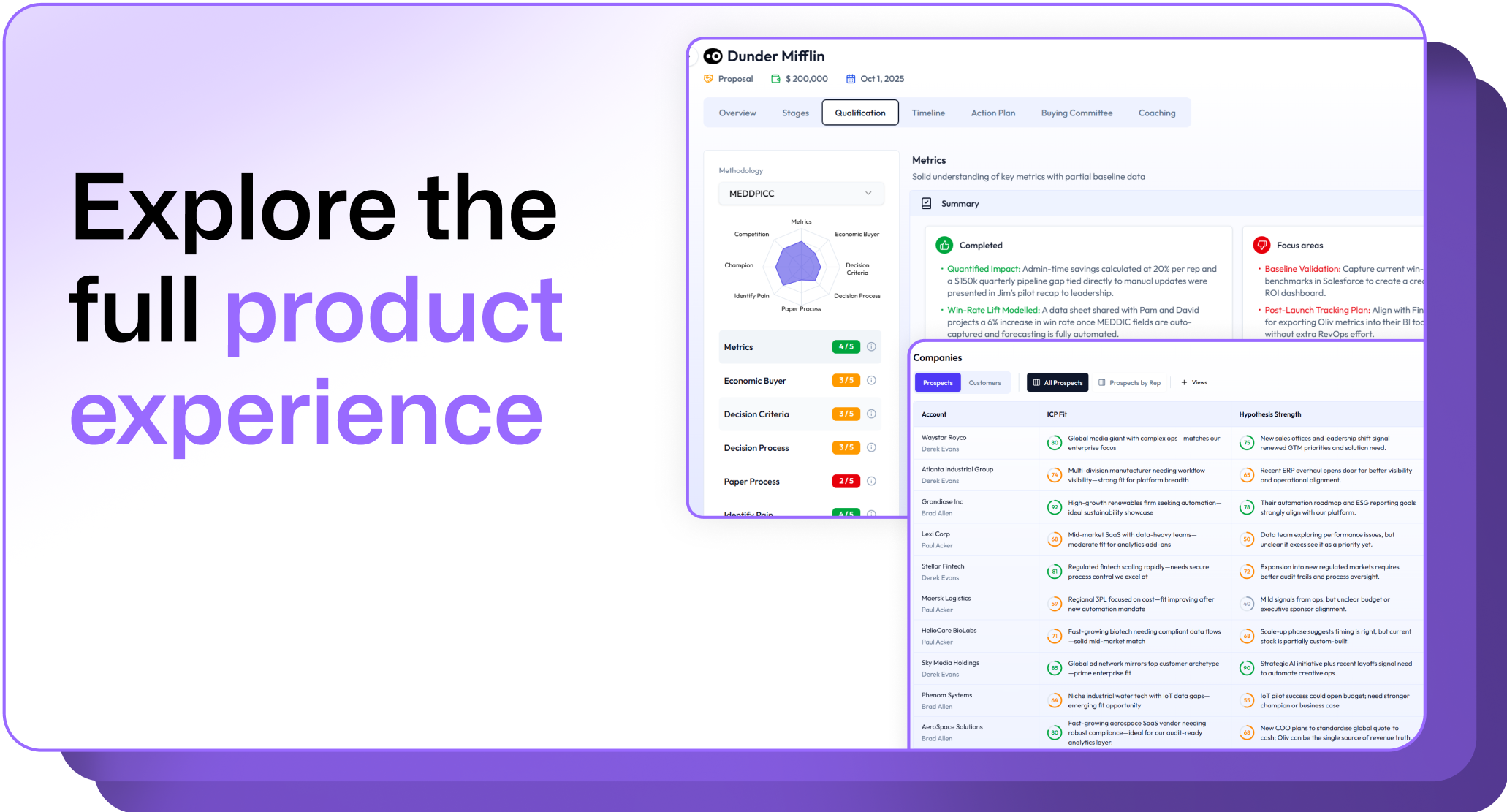
.avif)
.png)







.png)
.png)