Sales Methodology Automation: Auto-Score MEDDIC, BANT & SPICED from Calls
Written by
Ishan Chhabra
Last Updated :
December 24, 2025
Skim in :
8
mins
In this article
Revenue teams love Oliv
Here’s why:
All your deal data unified (from 30+ tools and tabs).
Insights are delivered to you directly, no digging.
AI agents automate tasks for you.
Thank you! Your submission has been received!
Oops! Something went wrong while submitting the form.
Meet Oliv’s AI Agents
Hi! I’m, Deal Driver
I track deals, flag risks, send weekly pipeline updates and give sales managers full visibility into deal progress
Hi! I’m, CRM Manager
I maintain CRM hygiene by updating core, custom and qualification fields all without your team lifting a finger
Hi! I’m, Forecaster
I build accurate forecasts based on real deal movement and tell you which deals to pull in to hit your number
Hi! I’m, Coach
I believe performance fuels revenue. I spot skill gaps, score calls and build coaching plans to help every rep level up
Hi! I’m, Prospector
I dig into target accounts to surface the right contacts, tailor and time outreach so you always strike when it counts
Hi! I’m, Pipeline tracker
I call reps to get deal updates, and deliver a real-time, CRM-synced roll-up view of deal progress
Hi! I’m, Analyst
I answer complex pipeline questions, uncover deal patterns, and build reports that guide strategic decisions
TL;DR
73% methodology failure rate: Manual MEDDIC/BANT/SPICED tracking collapses to 25-30% adherence within 90 days under quota pressure; AI enforcement achieves sustained 90%+ completion.
Deal-level vs. meeting-level intelligence: Legacy tools analyze isolated calls; modern LLMs unify 8-15 touchpoints (calls, emails, Slack) into continuous deal timelines for accurate auto-scoring.
Four-touchpoint coaching system: Pre-meeting prep, post-call scoring, weekly deal auditing, monthly skill development—closes the "measurement to practice" loop missing in fragmented tool stacks.
CRM Manager Agent eliminates dirty data: AI-proposed, rep-validated workflows auto-populate 100 custom fields, improving forecast accuracy from 40-50% variance to <10% within one quarter.
TCO advantage over legacy platforms: Gong + Clari tool stacking costs $500/user/month with platform fees; modular AI-native pricing eliminates implementation fees and API lock-in..
Q1: Why Do 73% of Sales Methodology Implementations Fail Within 90 Days? [toc=Implementation Failure Rate]
Sales organizations invest $100K-$200K in Force Management MEDDIC, Winning by Design SPICED, or BANT certifications, seeing initial adherence rates of 60-70% during pilot phases. Within 6-8 weeks, quota pressure triggers reversion to old habits, collapsing methodology adherence to just 25-30%. This "confidence gap" in forecasting stems from a fundamental problem: sales representatives prioritize closing deals over CRM data entry, creating dirty data that cripples AI prediction models and renders forecasts unreliable.
⚠️ The Manual Burden Tax
Legacy conversation intelligence platforms like Gong rely on Smart Trackers, keyword-matching systems built on pre-generative AI technology that lack contextual reasoning. These tools flag when competitors are mentioned but can't distinguish whether a prospect is "casually aware" or "actively evaluating" alternatives. The result? Sales managers spend 5-10 hours weekly during commutes and off-hours manually auditing call recordings to fill coaching scorecards.
Clari's manual roll-up forecasting process forces managers into Thursday/Friday "deal story" sessions where they manually reconstruct qualification details to generate Monday reports. This review-based system documents failure after it happens; it doesn't prevent methodology drift.
Key limitations of traditional SaaS approaches:
❌ 15-20 minutes of post-call CRM data entry per rep
❌ Managers can only review 5-10% of calls manually
❌ 68-70% methodology abandonment within 90 days post-training
❌ Inconsistent data quality undermines forecast accuracy
✅ From Reactive Reporting to Proactive Enforcement
Generative AI powered by fine-tuned Large Language Models (LLMs) shifts the paradigm from documenting problems to preventing them. Instead of flagging that a rep missed identifying the Economic Buyer in a post-call summary, AI-native revenue orchestration platforms provide real-time in-call prompts: "You've covered Metrics and Pain; confirm Decision Process and Economic Buyer on this call."
Automatic transcript analysis extracts qualification signals, budget mentions, decision process discussions, pain intensity language, with 90%+ accuracy, eliminating the manual burden tax entirely. This proactive approach transforms methodologies from "stale PDFs" reps forget under pressure into automated enforcement systems that work autonomously.
Visual diagram showing Oliv's four-touchpoint system with Meeting Assistant (pre-call), Coach Agent (post-call and monthly), and Deal Driver Agent (weekly) creating closed-loop methodology enforcement.
3. 📈 Weekly Manager Review (Deal Driver Agent) Audits all active opportunities, flagging which deals lack complete MEDDIC/BANT/SPICED scorecards. Replaces manual Clari roll-ups with autonomous one-page reports showing commit-level deals (9-10/10 scores) vs. at-risk opportunities.
4. 🎓 Monthly Coaching (Coach Agent) Delivers skill-level analytics: "Team-wide, 68% of reps never ask Critical Event questions, leading to 'no decision' losses." Deploys customized voice bot roleplay targeting identified gaps, closing the simulation-to-field performance loop.
💰 Quantifiable Impact
Organizations using Oliv see methodology adherence increase from 40-50% (manual baseline) to 90%+ within 30 days. Forecast accuracy improves to <10% variance within the first quarter. One mid-market SaaS company reduced manager coaching prep time from 6 hours to 45 minutes weekly while increasing pipeline coverage from 12% (spot-checking) to 100% (AI-audited) of deals, transforming methodology from administrative burden into competitive advantage.
Q2: What is Sales Methodology Automation? (And Why It's Not Just 'Recording Calls') [toc=What is Methodology Automation]
Sales Methodology Automation uses AI to continuously track, analyze, and score qualification frameworks like MEDDIC, BANT, and SPICED across the entire deal lifecycle, transforming methodologies from manual checklists into autonomous enforcement systems. It's critically distinct from call recording or transcription tools that passively document conversations without extracting actionable qualification insights.
Evolution table comparing meeting transcription tools (high manual burden, keyword matching) to fragmented practice platforms (conversational AI, disconnect) to AI-native revenue orchestration (autonomous qualification, fine-tuned LLMs, low burden).
📹 Recording + Transcription ≠ Automation
Many buyers mistakenly assume conversation intelligence platforms deliver methodology automation simply because they record and transcribe calls. This misconception conflates three distinct tool generations:
Core Function: Passive documentation, recording calls and generating text transcripts
Intelligence Level: Keyword matching via "Smart Trackers" that flag terms like "budget" or "competitor" without contextual understanding
Manual Burden: Managers must manually review transcripts to extract qualification data and update CRM fields
Examples: Early Gong, Chorus (now ZoomInfo), Clari Revenue Intelligence
⚠️ Key Limitation: These tools function as "note-takers," not autonomous qualification systems. A legacy tracker might flag "CFO" mentions but can't distinguish "I need to check with our CFO" (decision blocker) from "Our CFO won't be involved" (not a stakeholder).
Generation 2: Fragmented Practice Platforms (2022-2024)
Core Function: Voice roleplay for script practice using AI simulation
Intelligence Level: Conversational AI for simulated scenarios
Manual Burden: No connection to real deal performance; reps practice generic scripts unrelated to their actual gaps
Examples: Hyperbound, Second Nature
❌ Key Limitation: These platforms measure simulation performance but fail to track what happens "on the field" during live deals, creating a measurement-to-practice disconnect.
True methodology automation uses fine-tuned LLMs to autonomously:
Extract qualification signals from multi-channel interactions (calls, emails, Slack)
Synthesize deal-level context across 8-15 touchpoints spanning weeks/months
Auto-populate CRM fields with Economic Buyer, Decision Criteria, Pain, Metrics
Enforce adherence proactively via pre-call prep guidance and post-call scoring
Close the coaching loop by connecting identified skill gaps to targeted practice
Critical Distinction: Generation 3 platforms perform work autonomously, not software users "have to adopt," but agentic workflows that work for users without manual intervention.
🚀 How Oliv Simplifies Methodology Enforcement
Oliv represents Generation 3 AI-native revenue orchestration, moving beyond meeting-level summaries to deal-level intelligence. The platform unifies scattered data (calls, emails, Slack, even unrecorded phone interactions via Voice Agent) into continuous 360° deal timelines. While legacy tools log that "a call happened," Oliv understands what was learned and autonomously updates CRM opportunity fields, not just activity logs.
The CRM Manager Agent maintains "spotless CRM hygiene" by auto-populating up to 100 custom fields based on conversational context, using AI-based object association to correctly map activities even in messy enterprise CRMs with duplicate accounts. This eliminates the 15-20 minute post-call data entry burden that causes 68-70% methodology abandonment.
Q3: MEDDIC vs BANT vs SPICED: Which Sales Methodology Should You Automate First? [toc=Framework Comparison]
Sales methodologies aren't just acronyms; they're pattern recognition playbooks that define what a "qualified deal" looks like. Choosing the right framework depends on deal complexity, sales cycle length, and organizational maturity. Here's how MEDDIC, BANT, and SPICED compare.
🔤 Complete Framework Breakdowns
MEDDIC (Enterprise Complex Sales)
M – Metrics: Quantifiable value the solution delivers ($400K annual ROI, 15% efficiency gain)
E – Economic Buyer: Executive with budget authority to approve the purchase
D – Decision Criteria: Technical/business requirements prospects use to evaluate solutions
D – Decision Process: Steps, timeline, and stakeholders involved in approval workflow
I – Identify Pain: Business problem driving urgency (manual forecasting errors costing $2M annually)
C – Champion: Internal advocate actively selling your solution to stakeholders
BANT (Transactional High-Velocity Sales)
B – Budget: Financial resources allocated for the purchase
A – Authority: Decision-making power of your contact
N – Need: Business problem requiring solution
T – Timeline: When the prospect intends to make a decision
SPICED (Consultative SaaS Selling)
S – Situation: Current state of prospect's business operations
P – Pain: Specific challenges impacting their goals
I – Impact: Business consequences if pain remains unresolved
C – Critical Event: Deadline or trigger creating urgency
D – Decision: Buying process and stakeholders involved
Enterprise deals with multi-stakeholder committees
Long evaluation cycles requiring detailed qualification
Need to differentiate based on quantifiable ROI
Choose SPICED if:
Consultative selling focused on unique pain points
Customer success/expansion motions
Impact-driven narratives matter more than price
✅ Hybrid Methodology: The Modern Approach
Modern revenue teams don't choose one framework; they adapt based on deal context. A common hybrid approach:
SDRs use BANT for initial qualification (<$50K deals)
AEs transition to MEDDIC for enterprise opportunities (>$250K)
CSMs use SPICED for expansion/renewal conversations
⚠️ Legacy Tool Limitation:Gong's Smart Trackers require rigid configuration per methodology, switching frameworks demands manual tracker reconfiguration by RevOps teams.
✅ Oliv's Advantage: The platform is trained on 100+ sales methodologies and autonomously adapts to custom combinations. Organizations can run hybrid approaches (BANT to MEDDIC transitions) or fully custom frameworks without manual configuration; the AI learns your qualification pattern from conversation context and CRM field mappings
Q4: How Does AI Auto-Score MEDDIC, BANT & SPICED from Sales Calls? (Keyword Matching vs Conversational AI) [toc=Auto-Scoring Technical Workflow]
AI auto-scoring transforms unstructured sales conversations into structured qualification data through a five-stage technical workflow that eliminates manual CRM data entry.
Comparison table contrasting legacy keyword matching technology (60-70% false positive rate, activity logging only) with conversational AI (95%+ accuracy, autonomous CRM field updates) for sales methodology automation.
🔄 The Five-Stage Auto-Scoring Workflow
Stage 1: Call Recording Conversation intelligence platforms automatically join scheduled meetings (Zoom, Teams, Google Meet) or integrate with phone systems (Aircall, Dialpad) to capture audio.
Stage 2: Transcription Speech-to-text engines convert audio into timestamped transcripts, typically completing within 5-30 minutes post-call depending on platform architecture.
Stage 3: AI Analysis (The Critical Differentiator) This is where legacy keyword matching diverges dramatically from modern conversational AI:
Scans transcripts for predefined terms: "budget," "CFO," "timeline," "competitor"
60-70% false positive rate due to lack of contextual understanding
Example failure: Flags "I need to check with our CFO" as Economic Buyer identification, even though it indicates a decision blocker, not confirmed authority
✅ Conversational AI (Fine-Tuned LLMs, 2024+ tech):
Understands sentence context and conversational intent across multi-turn dialogue
95%+ accuracy with confidence scoring per extracted data point
Example success:"I'll need CFO approval for budgets over $100K" triggers three qualification signals:
Economic Buyer = CFO role
Authority = Requires approval for deals >$100K threshold
Budget = Current deal size relative to threshold
📊 Side-by-Side Transcript Analysis
Prospect Quote:"Our VP of Sales mentioned this to our CFO last week, but I don't think finance will be involved in the decision."
Stage 5: CRM Population Modern platforms autonomously update Salesforce/HubSpot opportunity fields. Legacy tools log activities ("call occurred") but don't update actual qualification fields, requiring custom API integrations that RevOps teams must build and maintain.
🚀 How Oliv's Conversational AI Works
Oliv uses LLMs fine-tuned on 100+ sales methodologies to analyze entire conversational context across calls, emails, and Slack, not isolated keyword hits. The CRM Manager Agent autonomously populates up to 100 custom CRM fields based on extracted qualification signals.
Validation Workflow (AI-Proposed, Rep-Confirmed): When AI extracts "Economic Buyer = VP Finance (Jane Smith)" from a call, it sends a Slack notification: "I identified Jane Smith (VP Finance) as Economic Buyer for Acme Corp deal; confirm to update CRM." Reps can approve (one-click) or correct, achieving 94% MEDDIC completion rates vs. 15-30% manual baseline.
This approach delivers the clean CRM data foundation required for accurate forecasting, moving organizations from 40-50% forecast variance (dirty data) to <10% variance within 90 days.
The $4.8B conversation intelligence market is dominated by platforms built on pre-generative AI architecture from the 2015-2022 era. Buyers mistakenly assume "recording + transcription = automation," but three architectural deficits prevent true methodology enforcement: (1) Meeting-level analysis instead of deal-level understanding, (2) Keyword matching rather than contextual reasoning, (3) Manual review dependency versus autonomous action.
❌ Gong's Smart Tracker Limitations & Hidden TCO
Gong's intelligence engine relies on Smart Trackers that flag terms like "competitor" or "budget" but cannot distinguish conversational context. A legacy tracker might identify "We're evaluating Salesforce" as a competitor mention without understanding whether it's casual awareness or active evaluation with a decision timeline. This creates "fluffy" summaries lacking the analytical depth required for B2B deal strategy.
Total Cost of Ownership (TCO) breakdown:
💰 $250/user/month Foundation bundle (previously $160)
Clari leads in roll-up forecasting, but the process remains highly manual. Managers spend Thursday/Friday afternoons sitting with reps to "hear the story" of each deal, then manually input that context into Clari to generate Monday reports for VPs. The methodology isn't being tracked automatically; it's being reconstructed from memory.
Salesforce pivoted toward prioritizing its Data Cloud for B2C companies, service agents handling order returns, support ticket routing. This strategic shift has left B2B sales "very underserved." Agentforce agents are "chat-focused," requiring users to manually initiate conversations, extract information, then copy-paste it elsewhere; they're not natively integrated into sales workflows.
The deeper problem: Agentforce deployments fail because they rely on the "broken" and "dirty" data of legacy CRM foundations, a circular dependency where AI tools need clean data to function, but the CRM lacks clean data because reps don't manually update it.
✅ Generative AI's Deal-Level Understanding
Modern LLMs fine-tuned on 100+ sales methodologies read entire conversational context across calls, emails, and Slack, not isolated keyword hits. This enables tracking how Economic Buyer sentiment evolves across 6 touchpoints, or identifying that a Critical Event deadline slipped from Q4 to Q1 based on tone shift analysis. The transformation moves from "what was said" (transcription) to "what it means" (qualification implications) to "what happens next" (autonomous CRM updates).
🚀 Oliv's AI Data Platform: From Meetings to Deals
While Gong understands meetings, Oliv understands entire deals. The platform's core IP is its AI Data Platform that unifies scattered data (calls, emails, Slack channels, even unrecorded phone call summaries captured via Voice Agent Alpha) into continuous 360° deal timelines.
Unlike Gong, which logs email activity but doesn't read content, Oliv analyzes email threads where Economic Buyer objections surface, Slack conversations where champions request urgent pricing, and meeting transcripts, stitching them into evolving MEDDIC scorecards that auto-update as new evidence emerges.
Architectural advantages:
✅ CRM Manager Agent uses AI-based object association (not brittle rules) to map activities correctly even in messy enterprise CRMs with duplicate accounts
✅ 5-minute analysis lag vs. Gong's 30-minute delay
✅ Standard APIs with full CSV export upon contract termination (no vendor lock-in)
✅ Frictionless recording sharing; no prospect email capture required vs. Gong's sign-up friction
Methodology adoption fails because enforcement happens too late (post-mortem reviews) or not at all (reps forget in the moment). High-performing organizations need intervention at four critical moments: before calls (prep guidance), immediately after (accountability), weekly (pipeline hygiene), and monthly (skill development). This creates a "measurement to practice loop" where insights drive action, and action generates better insights.
❌ Traditional SaaS Gap: Reactive, Fragmented Coaching
Gong provides post-call summaries but no pre-call preparation; reps enter discovery calls blind to which MEDDIC components remain uncovered. Managers manually review 5-10% of recordings with no systematic weekly deal auditing. Coaching happens ad-hoc based on manager availability, not data-driven skill gap analysis.
Clari's weekly forecast calls are manual storytelling sessions, not AI-audited qualification checks. This reactive approach documents failure ("rep didn't ask about budget") without preventing it.
The broken coaching loop:
❌ Simulation tools like Hyperbound practice scripts in isolation
❌ No connection to real deal performance
❌ Tool stacking costs $80-$120/user/month with zero integration
Agentic workflows deliver contextual intervention at each critical moment. AI analyzes deal history pre-call to surface what's missing from qualification scorecards. Post-call, AI scores adherence and extracts new data points without manual review. Weekly, AI inspects every active deal (not a 10% sample) to identify slippage risks. Monthly, AI identifies systemic skill gaps, then deploys customized practice scenarios targeting specific weaknesses.
🎯 Oliv's Four-Touchpoint System
1. ⏰ Pre-Meeting (Meeting Assistant) Reviews deal's MEDDIC status and delivers actionable prompts: "You've confirmed Metrics ($400K ROI) and Pain (manual forecasting errors), but Economic Buyer remains unidentified; prioritize stakeholder mapping today."
2. 📊 Post-Meeting (Coach Agent - Deal-by-Deal) Scores call against methodology (8/10 MEDDIC completeness), provides specific coaching: "Strong pain articulation, but no Decision Process timeline confirmed; follow up within 48 hours." Auto-populates 5-7 CRM fields with extracted qualification data.
This replaces manual Thursday/Friday Clari auditing sessions entirely.
4. 🎓 Monthly Coaching (Coach Agent - Skill-Level) Provides team-wide analytics: "Sarah excels at Metrics articulation but misses Critical Event questions 73% of the time." Deploys voice bot roleplay targeting that specific gap, completing the simulation-to-field performance loop.
💰 Quantified Time Savings
Sales managers reduce forecast prep from 6 hours to 45 minutes weekly (85% reduction). AEs save 5-6 hours weekly previously spent on CRM data entry. RevOps teams eliminate custom API work for data extraction. Most critically: coaching becomes proactive and systematic, driving 25-30% win rate improvements within one quarter.
Q7: How the CRM Manager Agent Solves the 'Dirty Data' Crisis (And Why Forecast Accuracy Depends On It) [toc=CRM Data Hygiene Solution]
The "confidence gap" in sales forecasting stems from CRM systems failing as a single source of truth. AEs prioritize deal closing over administrative tasks, creating data gaps: 60-70% of opportunities lack complete MEDDIC scorecards, Economic Buyer fields remain blank, Decision Process stages are guessed rather than confirmed. AI forecast models trained on this "dirty data" produce garbage predictions (40-50% variance), forcing leadership to rely on gut instinct rather than data-driven pipeline management.
❌ Traditional SaaS: Activity Logging Without Field Updates
Gong and Chorus log activities (calls occurred, emails sent) but don't update actual CRM opportunity fields. RevOps teams must build custom integrations to push Smart Tracker insights into Salesforce, integrations that break when account hierarchies get messy with duplicate records, merged accounts, or subsidiary structures.
Salesforce Einstein's AI agents fail at deployment because they depend on the very dirty CRM data they're meant to analyze, a circular dependency. The manual burden persists: reps spend 15-20 minutes post-call updating 7-12 MEDDIC fields, a task they skip 70% of the time under quota pressure.
⚠️ The Data Quality Crisis
Impact on forecast accuracy:
📉 40-50% forecast variance due to incomplete qualification data
❌ 60-70% of opportunities missing complete MEDDIC scorecards
⚠️ Economic Buyer fields blank in majority of pipeline
💸 Leadership forced to rely on intuition over predictive analytics
✅ AI-Era Transformation: Understanding What Was Learned
Generative AI shifts from "logging that a call happened" to "understanding what was learned and updating relevant fields autonomously." Modern LLMs trained on sales conversations recognize that "I'll need to run this by our CFO before Q4 budget freeze" contains three data points:
Economic Buyer = CFO role
Authority = Requires approval
Timeline = Q4 deadline
AI-based object association (vs rigid rule-based mapping) correctly links this insight to the right opportunity even when the account has 6 active deals and duplicate contact records.
🚀 Oliv's CRM Manager Agent: Spotless CRM Without Manual Entry
The CRM Manager Agent is trained on 100+ sales methodologies and can auto-populate up to 100 custom CRM fields based on conversational context. Instead of "dumb automation" that overwrites rep edits, it uses validation workflows:
AI-Proposed, Rep-Validated Process:
AI extracts: "Economic Buyer = VP of Sales (Jane Smith)" from call
Slack notification sent to rep: "I identified Jane Smith (VP Sales) as Economic Buyer for Acme Corp deal; confirm to update CRM"
Rep approves (one-click) or corrects
CRM fields update with comprehensive audit trail logging AI confidence scores
Advanced capabilities:
✅ Intelligent duplicate detection using fuzzy matching across conversation history
✅ Resolves messy account structures in enterprise CRMs
✅ 94% MEDDIC completion rates vs. 15-30% manual baseline
✅ Quarterly quality audits to continuously improve accuracy
📈 Real-World Outcomes
Mid-market SaaS company results within 90 days:
⏰ CRM time: 6.5 hours to 0.5 hours per rep per week (92% reduction)
💰 RevOps eliminated 12 hours of weekly "CRM cleanup sprints" before board meetings
Clean data finally enables predictive AI models to function, transforming forecasting from gut instinct to data-driven pipeline management.
Q8: Deal-by-Deal Coaching vs Skill-Level Coaching: How the Coach Agent Delivers Both [toc=Dual Coaching System]
Sales coaching operates on two timescales with different objectives: (1) Immediate deal coaching, post-call feedback like "You forgot to confirm Decision Process; send follow-up within 24 hours", and (2) Long-term skill development, monthly insights like "You consistently excel at pain articulation but miss Economic Buyer identification in 68% of discovery calls." Legacy tools separate these functions. Gong provides call-level feedback, while Hyperbound/Second Nature offer isolated roleplay, but they don't connect.
Multi-touchpoint deal journey visualization showing how Economic Buyer identification, CFO email confirmation, timeline slippage detection, and champion Slack messages build complete MEDDIC scorecards across six interactions.
❌ Traditional SaaS Fragmentation: Measurement Without Practice
Gong delivers deal-by-deal insights but no aggregated skill analytics; managers manually listen to 10-15 calls to identify patterns ("Sarah struggles with objection handling"). Practice platforms like Hyperbound deploy voice bots for script memorization, but scenarios aren't customized to the rep's real-world gaps identified from live deals.
Two broken loops:
❌ "Measurement without practice" problem: Know the gap, can't fix it systematically
❌ "Practice without measurement" problem: Roleplay doesn't reflect actual performance deficits
💸 Organizations pay $80-$120/user/month combined with zero integration
⚠️ Why Coaching Fails to Drive Behavior Change
Managers coach on random calls based on availability, not systematic skill weaknesses. Reps practice generic scripts unrelated to their actual performance gaps. The simulation-to-field performance loop remains disconnected, resulting in training investments that don't translate to revenue outcomes.
Agentic AI analyzes 100% of a rep's calls to identify both immediate deal actions and longitudinal skill patterns. Post-call, AI scores methodology adherence (7/10 MEDDIC) with specific gap identification: "Economic Buyer unconfirmed despite 3 stakeholder mentions; clarify decision authority."
Over 30-90 days, AI aggregates data to surface skill-level insights: "Rep executes SPICED Situation/Pain questions with 92% proficiency but asks Critical Event deadline questions only 28% of the time, leading to 'no decision' losses." The AI then deploys customized voice bot scenarios targeting that specific gap (practicing urgency-creation questions), completing the feedback loop.
🎯 Oliv's Coach Agent: Dual-Function Coaching System
📊 Post-Meeting (Deal-by-Deal Coaching) Immediately after each call, Coach scores adherence against chosen methodology (MEDDIC/BANT/SPICED):
✅ Highlights what was covered well: "Strong Metrics quantification; $400K annual ROI clearly articulated"
⚠️ Identifies gaps: "Decision Process timeline missing; no confirmed next steps"
🎯 Suggests follow-up actions: "Send Decision Process summary email within 48 hours confirming evaluation timeline"
🎓 Monthly (Skill-Level Coaching) Coach aggregates 30-90 days of calls to generate analytics:
📈 Team-wide adherence rates by methodology component: "Team averages 87% on Pain identification but only 34% on Champion cultivation"
📊 Trends over time (improving/declining)
🔍 Comparative benchmarks (rep vs. team vs. top performers)
Based on identified gaps, Coach deploys targeted voice bot roleplay. If Sarah misses Critical Event questions 73% of the time, her practice scenario simulates a prospect hesitant to commit to timelines, forcing her to practice urgency-creation techniques.
💰 Unified Platform Advantage
Oliv eliminates tool stacking by combining conversation intelligence and practice platforms within a single agentic system. Managers gain systematic coaching workflows replacing random call reviews: instead of "listen to 3 calls and hope you catch patterns," they receive monthly reports showing exactly which reps need which skill development, with AI-deployed practice already in progress.
Quantified results:
📉 Tool costs: $200+/user/month to single platform
🎯 Coaching precision: Random to data-driven systematic
📈 Win rates: 25-30% improvement within one quarter
⏰ Manager time: 6 hours to 45 minutes weekly for forecast prep
This "measurement to practice loop" ensures coaching drives actual behavior change, not just awareness of gaps, transforming methodology adherence from administrative burden into competitive advantage.
Qualification frameworks like MEDDIC aren't "one-call checkboxes"; they evolve across 8-15 touchpoints spanning 60-180 days for enterprise deals. Economic Buyer might be mentioned on discovery call #1, but their actual decision authority clarified in email thread #3, and budget approval timing confirmed in Slack discussion with champion on day 47. A tool analyzing only individual meeting transcripts produces incomplete, inaccurate scorecards because it lacks the full deal narrative.
This "meeting-level myopia" is why legacy conversation intelligence tools require manual scorecard assembly: the AI sees trees (calls), not the forest (deal journey).
❌ Gong's Meeting-Centric Architecture Problem
Gong's architecture centers on individual meeting analysis; each call generates a standalone summary with Smart Tracker hits, but these aren't automatically synthesized into deal-level qualification status. If Economic Buyer changes from VP to C-level between calls 2 and 4, Gong logs both mentions but doesn't update the deal scorecard to reflect the latest reality.
Advanced LLMs analyze not just "what was said on call #3" but "how does call #3 change our understanding of the deal established in calls #1-2, email thread with CFO, and champion's Slack urgency signal?"
Three technical requirements for deal-level intelligence:
Multi-channel data ingestion: Calls, emails, Slack, even unrecorded phone summaries
Entity resolution: Recognizing "Sarah from Finance" in call transcript = Sarah Chen, VP Finance in email = same Economic Buyer
Temporal reasoning: Understanding timeline commitments evolve; "Q4 deadline" mentioned Day 1 to "might slip to Q1" mentioned Day 30 to scorecard auto-updates to reflect slippage risk
🚀 Oliv's AI Data Platform: 360° Deal Timelines
Oliv's core IP unifies every interaction into comprehensive deal timelines that power accurate auto-scoring. Unlike Gong, which logs emails but doesn't read, Oliv analyzes email thread content where Economic Buyer raises budget concerns. Unlike competitors missing Slack context, Oliv ingests Slack/Teams conversations where champion urgently requests pricing changes.
Oliv's proprietary Voice Agent even calls reps nightly (Alpha feature) to capture "off-the-record" updates from unrecorded personal phone calls or in-person meetings, syncing those notes back to CRM. This comprehensive data stitching enables Deal Driver Agent to generate evolving MEDDIC/BANT/SPICED scorecards that reflect deal reality, not just isolated call snapshots.
📊 Architectural Proof: Scorecard Depth Comparison
Competitor scorecard: "MEDDIC - Metrics: Mentioned (keyword hit), Economic Buyer: Jane Smith (single call reference), Decision Criteria: Unknown"
Oliv scorecard: "Metrics: $400K annual ROI (calculated from call #2 pain discussion), 15% efficiency gain (confirmed in CFO email, Day 23) | Economic Buyer: Jane Smith, VP Finance, requires CFO approval for >$250K (authority limitation identified call #3, reinforced by champion Slack message Day 41) | Decision Process: 45-day evaluation (initial timeline call #1) to now projected 60-75 days (timeline slippage detected via tone analysis call #4 + email thread Day 52) | Champion: Strong (Michael Chen, actively selling internally per 3 forwarded emails to stakeholders)"
This depth is only possible through deal-level intelligence architecture that sees the entire forest, not individual trees.
Q10: Real-World Implementation: 30-Day Roadmap from Setup to 90%+ Methodology Adherence [toc=Implementation Roadmap]
Sales methodology automation delivers transformative results, but buyers need realistic expectations: 2-4 weeks for setup, not instant deployment, yet still 10x faster than manual methodology tracking forever. This roadmap provides a tactical 4-week timeline from platform configuration to sustained 90%+ adherence.
⏰ Week 1-2: Setup & Shadow Mode
Platform Configuration (Days 1-3)
Connect CRM (Salesforce, HubSpot) via OAuth integration
Integrate call systems (Zoom, Teams, Google Meet, phone providers)
Map MEDDIC/BANT/SPICED fields to existing CRM custom fields
Configure Slack/Teams notifications for rep validation workflows
Shadow Mode Activation (Days 4-14)
AI observes all calls and generates qualification insights but doesn't auto-update CRM
Reps review AI-generated MEDDIC scorecards and validate accuracy
RevOps monitors confidence scores and field mapping precision
Goal: Achieve 85%+ accuracy validation before enabling autonomous mode
✅ Week 3-4: Guided Autonomy
Rep Validation Workflows (Days 15-21) AI begins auto-populating CRM fields with rep spot-check notifications:
Slack notification: "I identified Jane Smith (VP Finance) as Economic Buyer; confirm to update CRM"
Reps approve (one-click) or correct within 24 hours
CRM updates occur only after rep confirmation during guided phase
Progressive Autonomy (Days 22-30)
Reduce validation threshold: Rep confirmation required only for fields with <90% confidence scores
Enable Meeting Assistant pre-call prompts
Activate Deal Driver Agent weekly reporting
Milestone: Achieve 90%+ methodology adherence by Day 30
📈 Month 2: Full Autonomy
Autonomous Operation (Days 31-60)
AI operates independently, updating CRM fields without mandatory rep validation
Reps receive notifications for review, but updates proceed automatically
Coach Agent begins post-call scoring and skill-level analytics
✅ 90%+ methodology adherence sustained beyond 90 days
📊 Forecast accuracy <10% variance
⏰ 85% reduction in manager forecast prep time
💰 5-6 hours per rep per week redirected from admin to selling
🚀 How Oliv Accelerates Implementation
Oliv provides free implementation, training, and support with no platform fees. The modular agent approach allows organizations to start with Meeting Assistant and CRM Manager, then add Deal Driver and Coach Agent as adoption matures, eliminating the "big bang" deployment risk of legacy platforms requiring 90-day training programs.
Q11: Common Objections Answered: 'Won't AI Miss Nuance?' & Other Buyer Questions [toc=Buyer Objections Answered]
Buyers evaluating sales methodology automation raise legitimate concerns about AI accuracy, data security, and sales team impact. This section addresses the most common objections with evidence-based responses.
❓ "Won't AI miss conversational nuance and context?"
Short answer: Conversational AI understands context through entire sentence analysis, achieving 95%+ accuracy vs. keyword matching's 60-70% false positive rate.
Detailed explanation: Legacy Smart Trackers flag "CFO" mentions regardless of context ("I need to check with our CFO" vs. "Our CFO won't be involved"). Modern LLMs analyze full conversational context: "I'll need CFO approval for budgets over $100K" triggers Economic Buyer = CFO + Authority = Requires approval threshold + Budget = >$100K deal flag.
Validation workflows ensure accuracy: AI proposes field updates with confidence scores, reps confirm or correct via Slack notifications before CRM updates occur.
❓ "What about our custom methodology; we don't use standard MEDDIC?"
Short answer:AI-native platforms train on 100+ methodologies and adapt to custom/hybrid frameworks autonomously.
Detailed explanation: Organizations frequently use hybrid approaches: BANT for SDR qualification (<$50K deals) transitioning to MEDDIC for AE enterprise opportunities (>$250K). Legacy tools require RevOps teams to manually configure Smart Trackers for each framework variation.
Generative AI learns from your CRM field structure and conversation patterns, automatically detecting which methodology applies per deal context without rigid configuration.
❓ "How accurate is auto-scoring really? Can we trust it?"
Short answer: 94% MEDDIC completion rates with comprehensive audit trails and confidence scoring enable continuous improvement.
Accuracy mechanisms:
✅ AI confidence scores per extracted field (0-100%)
✅ Comprehensive audit trails showing which conversation moments informed each field
✅ Quarterly quality reviews comparing AI predictions vs. actual deal outcomes
✅ Continuous model improvement based on your organization's specific patterns
Real customer benchmarks:
📊 Forecast accuracy improves from 40-50% variance to <10% within 90 days
✅ MEDDIC scorecard completion jumps from 15-30% (manual) to 94% (AI-automated)
❓ "What about data security and compliance for sensitive sales conversations?"
Short answer: SOC 2, GDPR, and CCPA compliance with public trust portals and full data portability.
Security standards:
🔒 SOC 2 Type II certified
🌍 GDPR and CCPA compliant
🔍 Public security portal at trust.oliv.ai for transparency
📤 Full CSV export capability upon contract termination (no vendor lock-in)
🗑️ Configurable data retention policies
❓ "Will this replace my sales team or make them dependent on AI?"
Short answer: AI handles administrative burden (5-6 hours/week saved), freeing reps to focus on relationship-building and strategic selling.
Augmentation, not replacement: Sales methodology automation eliminates CRM data entry, not sales conversations. Reps redirect time previously spent on admin tasks toward:
💼 More prospect meetings (15-20% capacity increase)
🤝 Deeper relationship development
📈 Strategic account planning
🎯 High-value activities that AI cannot replace (building trust, navigating politics, creative problem-solving)
The technology serves as an "autonomous enforcement layer" ensuring methodologies drive revenue predictability rather than adding administrative burden.
Buyers evaluating conversation intelligence platforms often focus on surface-level features, recording quality, transcription accuracy, UI design, while missing architectural differences that determine long-term ROI. The market conflates three distinct tool categories: meeting transcription tools (passive documentation), conversation intelligence (meeting-level analysis), and methodology automation (autonomous deal-level enforcement). Without an evaluation framework distinguishing these, organizations risk buying legacy SaaS that delivers summaries but doesn't eliminate the manual methodology tracking burden.
❌ Traditional Evaluation Mistakes
Companies create RFPs asking questions that miss critical architectural differences:
"Does it integrate with Salesforce?" (Yes, but does it update actual opportunity fields or just log activities?)
"Does it support MEDDIC?" (Yes, but via manual Smart Tracker configuration or automatic LLM-based scoring?)
"What's the per-user price?" (Ignoring platform fees, implementation costs, API access charges that triple TCO)
They demo call recording quality without testing multi-channel deal tracking (email, Slack). They focus on feature checklists rather than architectural capabilities that determine whether the system eliminates manual work or just reorganizes it.
✅ 12 AI-Era Evaluation Criteria
1. Intelligence Architecture ⚠️ Meeting-level summaries or deal-level continuous timeline tracking? Keyword matching or generative contextual reasoning?
2. Methodology Flexibility ⚠️ Pre-built support for MEDDIC/BANT/SPICED? Custom framework adaptation? Hybrid approach handling (BANT for SDRs to MEDDIC for AEs)?
3. CRM Integration Depth ⚠️ Activity logging only, or autonomous field population with AI-based object association? Validation workflows (AI-proposed, rep-approved) or blind automation?
4. Data Completeness ⚠️ Calls only, or unified analysis across email, Slack, unrecorded interactions?
5. TCO Transparency 💰 Per-user pricing alone, or including platform fees, implementation, training, API access?
6. Coaching Completeness ⚠️ Post-call feedback only, or closed-loop system connecting deal performance to skill gap identification to targeted practice?
7-12. Additional Critical Factors
Forecast integration (standalone tool or autonomous roll-ups)
Data portability (vendor lock-in or full CSV export)
Security compliance (SOC 2, GDPR, CCPA)
Change management (90-day training or frictionless adoption)
Architecture: Deal-level AI Data Platform unifying calls/email/Slack with 5-minute analysis lag
Methodology: Pre-trained on 100+ frameworks with custom/hybrid support
CRM: CRM Manager Agent auto-populates up to 100 custom fields with AI-proposed, rep-validated workflows
Data: Voice Agent captures even unrecorded phone call updates via nightly rep check-ins
TCO: Modular pricing with zero platform fees, free implementation/training
Coaching:Four-touchpoint system (pre-meeting, post-meeting, weekly, monthly) with closed-loop skill practice
💡 Decision Framework
If methodology adherence is currently <40% and forecast variance >30%, traditional CI tools (Gong/Chorus) will document the problem but won't solve it; you'll pay for meeting summaries while still manually updating CRM and auditing deals.
If the goal is sustained 90%+ adherence with autonomous enforcement, AI-native revenue orchestration eliminates the manual burden through agentic workflows that perform work for users rather than generating reports users must act on.
Evaluation litmus test: Ask vendors, "If I deploy your platform, what percentage of my current manual methodology tracking and CRM data entry will be eliminated?"
❌ Legacy answer: "You'll have better visibility to guide your manual processes"
✅ AI-native answer: "The AI agents will autonomously maintain MEDDIC scorecards and populate CRM fields, eliminating 90%+ of manual effort within 30 days"
Q1: Why Do 73% of Sales Methodology Implementations Fail Within 90 Days? [toc=Implementation Failure Rate]
Sales organizations invest $100K-$200K in Force Management MEDDIC, Winning by Design SPICED, or BANT certifications, seeing initial adherence rates of 60-70% during pilot phases. Within 6-8 weeks, quota pressure triggers reversion to old habits, collapsing methodology adherence to just 25-30%. This "confidence gap" in forecasting stems from a fundamental problem: sales representatives prioritize closing deals over CRM data entry, creating dirty data that cripples AI prediction models and renders forecasts unreliable.
⚠️ The Manual Burden Tax
Legacy conversation intelligence platforms like Gong rely on Smart Trackers, keyword-matching systems built on pre-generative AI technology that lack contextual reasoning. These tools flag when competitors are mentioned but can't distinguish whether a prospect is "casually aware" or "actively evaluating" alternatives. The result? Sales managers spend 5-10 hours weekly during commutes and off-hours manually auditing call recordings to fill coaching scorecards.
Clari's manual roll-up forecasting process forces managers into Thursday/Friday "deal story" sessions where they manually reconstruct qualification details to generate Monday reports. This review-based system documents failure after it happens; it doesn't prevent methodology drift.
Key limitations of traditional SaaS approaches:
❌ 15-20 minutes of post-call CRM data entry per rep
❌ Managers can only review 5-10% of calls manually
❌ 68-70% methodology abandonment within 90 days post-training
❌ Inconsistent data quality undermines forecast accuracy
✅ From Reactive Reporting to Proactive Enforcement
Generative AI powered by fine-tuned Large Language Models (LLMs) shifts the paradigm from documenting problems to preventing them. Instead of flagging that a rep missed identifying the Economic Buyer in a post-call summary, AI-native revenue orchestration platforms provide real-time in-call prompts: "You've covered Metrics and Pain; confirm Decision Process and Economic Buyer on this call."
Automatic transcript analysis extracts qualification signals, budget mentions, decision process discussions, pain intensity language, with 90%+ accuracy, eliminating the manual burden tax entirely. This proactive approach transforms methodologies from "stale PDFs" reps forget under pressure into automated enforcement systems that work autonomously.
Visual diagram showing Oliv's four-touchpoint system with Meeting Assistant (pre-call), Coach Agent (post-call and monthly), and Deal Driver Agent (weekly) creating closed-loop methodology enforcement.
3. 📈 Weekly Manager Review (Deal Driver Agent) Audits all active opportunities, flagging which deals lack complete MEDDIC/BANT/SPICED scorecards. Replaces manual Clari roll-ups with autonomous one-page reports showing commit-level deals (9-10/10 scores) vs. at-risk opportunities.
4. 🎓 Monthly Coaching (Coach Agent) Delivers skill-level analytics: "Team-wide, 68% of reps never ask Critical Event questions, leading to 'no decision' losses." Deploys customized voice bot roleplay targeting identified gaps, closing the simulation-to-field performance loop.
💰 Quantifiable Impact
Organizations using Oliv see methodology adherence increase from 40-50% (manual baseline) to 90%+ within 30 days. Forecast accuracy improves to <10% variance within the first quarter. One mid-market SaaS company reduced manager coaching prep time from 6 hours to 45 minutes weekly while increasing pipeline coverage from 12% (spot-checking) to 100% (AI-audited) of deals, transforming methodology from administrative burden into competitive advantage.
Q2: What is Sales Methodology Automation? (And Why It's Not Just 'Recording Calls') [toc=What is Methodology Automation]
Sales Methodology Automation uses AI to continuously track, analyze, and score qualification frameworks like MEDDIC, BANT, and SPICED across the entire deal lifecycle, transforming methodologies from manual checklists into autonomous enforcement systems. It's critically distinct from call recording or transcription tools that passively document conversations without extracting actionable qualification insights.
Evolution table comparing meeting transcription tools (high manual burden, keyword matching) to fragmented practice platforms (conversational AI, disconnect) to AI-native revenue orchestration (autonomous qualification, fine-tuned LLMs, low burden).
📹 Recording + Transcription ≠ Automation
Many buyers mistakenly assume conversation intelligence platforms deliver methodology automation simply because they record and transcribe calls. This misconception conflates three distinct tool generations:
Core Function: Passive documentation, recording calls and generating text transcripts
Intelligence Level: Keyword matching via "Smart Trackers" that flag terms like "budget" or "competitor" without contextual understanding
Manual Burden: Managers must manually review transcripts to extract qualification data and update CRM fields
Examples: Early Gong, Chorus (now ZoomInfo), Clari Revenue Intelligence
⚠️ Key Limitation: These tools function as "note-takers," not autonomous qualification systems. A legacy tracker might flag "CFO" mentions but can't distinguish "I need to check with our CFO" (decision blocker) from "Our CFO won't be involved" (not a stakeholder).
Generation 2: Fragmented Practice Platforms (2022-2024)
Core Function: Voice roleplay for script practice using AI simulation
Intelligence Level: Conversational AI for simulated scenarios
Manual Burden: No connection to real deal performance; reps practice generic scripts unrelated to their actual gaps
Examples: Hyperbound, Second Nature
❌ Key Limitation: These platforms measure simulation performance but fail to track what happens "on the field" during live deals, creating a measurement-to-practice disconnect.
True methodology automation uses fine-tuned LLMs to autonomously:
Extract qualification signals from multi-channel interactions (calls, emails, Slack)
Synthesize deal-level context across 8-15 touchpoints spanning weeks/months
Auto-populate CRM fields with Economic Buyer, Decision Criteria, Pain, Metrics
Enforce adherence proactively via pre-call prep guidance and post-call scoring
Close the coaching loop by connecting identified skill gaps to targeted practice
Critical Distinction: Generation 3 platforms perform work autonomously, not software users "have to adopt," but agentic workflows that work for users without manual intervention.
🚀 How Oliv Simplifies Methodology Enforcement
Oliv represents Generation 3 AI-native revenue orchestration, moving beyond meeting-level summaries to deal-level intelligence. The platform unifies scattered data (calls, emails, Slack, even unrecorded phone interactions via Voice Agent) into continuous 360° deal timelines. While legacy tools log that "a call happened," Oliv understands what was learned and autonomously updates CRM opportunity fields, not just activity logs.
The CRM Manager Agent maintains "spotless CRM hygiene" by auto-populating up to 100 custom fields based on conversational context, using AI-based object association to correctly map activities even in messy enterprise CRMs with duplicate accounts. This eliminates the 15-20 minute post-call data entry burden that causes 68-70% methodology abandonment.
Q3: MEDDIC vs BANT vs SPICED: Which Sales Methodology Should You Automate First? [toc=Framework Comparison]
Sales methodologies aren't just acronyms; they're pattern recognition playbooks that define what a "qualified deal" looks like. Choosing the right framework depends on deal complexity, sales cycle length, and organizational maturity. Here's how MEDDIC, BANT, and SPICED compare.
🔤 Complete Framework Breakdowns
MEDDIC (Enterprise Complex Sales)
M – Metrics: Quantifiable value the solution delivers ($400K annual ROI, 15% efficiency gain)
E – Economic Buyer: Executive with budget authority to approve the purchase
D – Decision Criteria: Technical/business requirements prospects use to evaluate solutions
D – Decision Process: Steps, timeline, and stakeholders involved in approval workflow
I – Identify Pain: Business problem driving urgency (manual forecasting errors costing $2M annually)
C – Champion: Internal advocate actively selling your solution to stakeholders
BANT (Transactional High-Velocity Sales)
B – Budget: Financial resources allocated for the purchase
A – Authority: Decision-making power of your contact
N – Need: Business problem requiring solution
T – Timeline: When the prospect intends to make a decision
SPICED (Consultative SaaS Selling)
S – Situation: Current state of prospect's business operations
P – Pain: Specific challenges impacting their goals
I – Impact: Business consequences if pain remains unresolved
C – Critical Event: Deadline or trigger creating urgency
D – Decision: Buying process and stakeholders involved
Enterprise deals with multi-stakeholder committees
Long evaluation cycles requiring detailed qualification
Need to differentiate based on quantifiable ROI
Choose SPICED if:
Consultative selling focused on unique pain points
Customer success/expansion motions
Impact-driven narratives matter more than price
✅ Hybrid Methodology: The Modern Approach
Modern revenue teams don't choose one framework; they adapt based on deal context. A common hybrid approach:
SDRs use BANT for initial qualification (<$50K deals)
AEs transition to MEDDIC for enterprise opportunities (>$250K)
CSMs use SPICED for expansion/renewal conversations
⚠️ Legacy Tool Limitation:Gong's Smart Trackers require rigid configuration per methodology, switching frameworks demands manual tracker reconfiguration by RevOps teams.
✅ Oliv's Advantage: The platform is trained on 100+ sales methodologies and autonomously adapts to custom combinations. Organizations can run hybrid approaches (BANT to MEDDIC transitions) or fully custom frameworks without manual configuration; the AI learns your qualification pattern from conversation context and CRM field mappings
Q4: How Does AI Auto-Score MEDDIC, BANT & SPICED from Sales Calls? (Keyword Matching vs Conversational AI) [toc=Auto-Scoring Technical Workflow]
AI auto-scoring transforms unstructured sales conversations into structured qualification data through a five-stage technical workflow that eliminates manual CRM data entry.
Comparison table contrasting legacy keyword matching technology (60-70% false positive rate, activity logging only) with conversational AI (95%+ accuracy, autonomous CRM field updates) for sales methodology automation.
🔄 The Five-Stage Auto-Scoring Workflow
Stage 1: Call Recording Conversation intelligence platforms automatically join scheduled meetings (Zoom, Teams, Google Meet) or integrate with phone systems (Aircall, Dialpad) to capture audio.
Stage 2: Transcription Speech-to-text engines convert audio into timestamped transcripts, typically completing within 5-30 minutes post-call depending on platform architecture.
Stage 3: AI Analysis (The Critical Differentiator) This is where legacy keyword matching diverges dramatically from modern conversational AI:
Scans transcripts for predefined terms: "budget," "CFO," "timeline," "competitor"
60-70% false positive rate due to lack of contextual understanding
Example failure: Flags "I need to check with our CFO" as Economic Buyer identification, even though it indicates a decision blocker, not confirmed authority
✅ Conversational AI (Fine-Tuned LLMs, 2024+ tech):
Understands sentence context and conversational intent across multi-turn dialogue
95%+ accuracy with confidence scoring per extracted data point
Example success:"I'll need CFO approval for budgets over $100K" triggers three qualification signals:
Economic Buyer = CFO role
Authority = Requires approval for deals >$100K threshold
Budget = Current deal size relative to threshold
📊 Side-by-Side Transcript Analysis
Prospect Quote:"Our VP of Sales mentioned this to our CFO last week, but I don't think finance will be involved in the decision."
Stage 5: CRM Population Modern platforms autonomously update Salesforce/HubSpot opportunity fields. Legacy tools log activities ("call occurred") but don't update actual qualification fields, requiring custom API integrations that RevOps teams must build and maintain.
🚀 How Oliv's Conversational AI Works
Oliv uses LLMs fine-tuned on 100+ sales methodologies to analyze entire conversational context across calls, emails, and Slack, not isolated keyword hits. The CRM Manager Agent autonomously populates up to 100 custom CRM fields based on extracted qualification signals.
Validation Workflow (AI-Proposed, Rep-Confirmed): When AI extracts "Economic Buyer = VP Finance (Jane Smith)" from a call, it sends a Slack notification: "I identified Jane Smith (VP Finance) as Economic Buyer for Acme Corp deal; confirm to update CRM." Reps can approve (one-click) or correct, achieving 94% MEDDIC completion rates vs. 15-30% manual baseline.
This approach delivers the clean CRM data foundation required for accurate forecasting, moving organizations from 40-50% forecast variance (dirty data) to <10% variance within 90 days.
The $4.8B conversation intelligence market is dominated by platforms built on pre-generative AI architecture from the 2015-2022 era. Buyers mistakenly assume "recording + transcription = automation," but three architectural deficits prevent true methodology enforcement: (1) Meeting-level analysis instead of deal-level understanding, (2) Keyword matching rather than contextual reasoning, (3) Manual review dependency versus autonomous action.
❌ Gong's Smart Tracker Limitations & Hidden TCO
Gong's intelligence engine relies on Smart Trackers that flag terms like "competitor" or "budget" but cannot distinguish conversational context. A legacy tracker might identify "We're evaluating Salesforce" as a competitor mention without understanding whether it's casual awareness or active evaluation with a decision timeline. This creates "fluffy" summaries lacking the analytical depth required for B2B deal strategy.
Total Cost of Ownership (TCO) breakdown:
💰 $250/user/month Foundation bundle (previously $160)
Clari leads in roll-up forecasting, but the process remains highly manual. Managers spend Thursday/Friday afternoons sitting with reps to "hear the story" of each deal, then manually input that context into Clari to generate Monday reports for VPs. The methodology isn't being tracked automatically; it's being reconstructed from memory.
Salesforce pivoted toward prioritizing its Data Cloud for B2C companies, service agents handling order returns, support ticket routing. This strategic shift has left B2B sales "very underserved." Agentforce agents are "chat-focused," requiring users to manually initiate conversations, extract information, then copy-paste it elsewhere; they're not natively integrated into sales workflows.
The deeper problem: Agentforce deployments fail because they rely on the "broken" and "dirty" data of legacy CRM foundations, a circular dependency where AI tools need clean data to function, but the CRM lacks clean data because reps don't manually update it.
✅ Generative AI's Deal-Level Understanding
Modern LLMs fine-tuned on 100+ sales methodologies read entire conversational context across calls, emails, and Slack, not isolated keyword hits. This enables tracking how Economic Buyer sentiment evolves across 6 touchpoints, or identifying that a Critical Event deadline slipped from Q4 to Q1 based on tone shift analysis. The transformation moves from "what was said" (transcription) to "what it means" (qualification implications) to "what happens next" (autonomous CRM updates).
🚀 Oliv's AI Data Platform: From Meetings to Deals
While Gong understands meetings, Oliv understands entire deals. The platform's core IP is its AI Data Platform that unifies scattered data (calls, emails, Slack channels, even unrecorded phone call summaries captured via Voice Agent Alpha) into continuous 360° deal timelines.
Unlike Gong, which logs email activity but doesn't read content, Oliv analyzes email threads where Economic Buyer objections surface, Slack conversations where champions request urgent pricing, and meeting transcripts, stitching them into evolving MEDDIC scorecards that auto-update as new evidence emerges.
Architectural advantages:
✅ CRM Manager Agent uses AI-based object association (not brittle rules) to map activities correctly even in messy enterprise CRMs with duplicate accounts
✅ 5-minute analysis lag vs. Gong's 30-minute delay
✅ Standard APIs with full CSV export upon contract termination (no vendor lock-in)
✅ Frictionless recording sharing; no prospect email capture required vs. Gong's sign-up friction
Methodology adoption fails because enforcement happens too late (post-mortem reviews) or not at all (reps forget in the moment). High-performing organizations need intervention at four critical moments: before calls (prep guidance), immediately after (accountability), weekly (pipeline hygiene), and monthly (skill development). This creates a "measurement to practice loop" where insights drive action, and action generates better insights.
❌ Traditional SaaS Gap: Reactive, Fragmented Coaching
Gong provides post-call summaries but no pre-call preparation; reps enter discovery calls blind to which MEDDIC components remain uncovered. Managers manually review 5-10% of recordings with no systematic weekly deal auditing. Coaching happens ad-hoc based on manager availability, not data-driven skill gap analysis.
Clari's weekly forecast calls are manual storytelling sessions, not AI-audited qualification checks. This reactive approach documents failure ("rep didn't ask about budget") without preventing it.
The broken coaching loop:
❌ Simulation tools like Hyperbound practice scripts in isolation
❌ No connection to real deal performance
❌ Tool stacking costs $80-$120/user/month with zero integration
Agentic workflows deliver contextual intervention at each critical moment. AI analyzes deal history pre-call to surface what's missing from qualification scorecards. Post-call, AI scores adherence and extracts new data points without manual review. Weekly, AI inspects every active deal (not a 10% sample) to identify slippage risks. Monthly, AI identifies systemic skill gaps, then deploys customized practice scenarios targeting specific weaknesses.
🎯 Oliv's Four-Touchpoint System
1. ⏰ Pre-Meeting (Meeting Assistant) Reviews deal's MEDDIC status and delivers actionable prompts: "You've confirmed Metrics ($400K ROI) and Pain (manual forecasting errors), but Economic Buyer remains unidentified; prioritize stakeholder mapping today."
2. 📊 Post-Meeting (Coach Agent - Deal-by-Deal) Scores call against methodology (8/10 MEDDIC completeness), provides specific coaching: "Strong pain articulation, but no Decision Process timeline confirmed; follow up within 48 hours." Auto-populates 5-7 CRM fields with extracted qualification data.
This replaces manual Thursday/Friday Clari auditing sessions entirely.
4. 🎓 Monthly Coaching (Coach Agent - Skill-Level) Provides team-wide analytics: "Sarah excels at Metrics articulation but misses Critical Event questions 73% of the time." Deploys voice bot roleplay targeting that specific gap, completing the simulation-to-field performance loop.
💰 Quantified Time Savings
Sales managers reduce forecast prep from 6 hours to 45 minutes weekly (85% reduction). AEs save 5-6 hours weekly previously spent on CRM data entry. RevOps teams eliminate custom API work for data extraction. Most critically: coaching becomes proactive and systematic, driving 25-30% win rate improvements within one quarter.
Q7: How the CRM Manager Agent Solves the 'Dirty Data' Crisis (And Why Forecast Accuracy Depends On It) [toc=CRM Data Hygiene Solution]
The "confidence gap" in sales forecasting stems from CRM systems failing as a single source of truth. AEs prioritize deal closing over administrative tasks, creating data gaps: 60-70% of opportunities lack complete MEDDIC scorecards, Economic Buyer fields remain blank, Decision Process stages are guessed rather than confirmed. AI forecast models trained on this "dirty data" produce garbage predictions (40-50% variance), forcing leadership to rely on gut instinct rather than data-driven pipeline management.
❌ Traditional SaaS: Activity Logging Without Field Updates
Gong and Chorus log activities (calls occurred, emails sent) but don't update actual CRM opportunity fields. RevOps teams must build custom integrations to push Smart Tracker insights into Salesforce, integrations that break when account hierarchies get messy with duplicate records, merged accounts, or subsidiary structures.
Salesforce Einstein's AI agents fail at deployment because they depend on the very dirty CRM data they're meant to analyze, a circular dependency. The manual burden persists: reps spend 15-20 minutes post-call updating 7-12 MEDDIC fields, a task they skip 70% of the time under quota pressure.
⚠️ The Data Quality Crisis
Impact on forecast accuracy:
📉 40-50% forecast variance due to incomplete qualification data
❌ 60-70% of opportunities missing complete MEDDIC scorecards
⚠️ Economic Buyer fields blank in majority of pipeline
💸 Leadership forced to rely on intuition over predictive analytics
✅ AI-Era Transformation: Understanding What Was Learned
Generative AI shifts from "logging that a call happened" to "understanding what was learned and updating relevant fields autonomously." Modern LLMs trained on sales conversations recognize that "I'll need to run this by our CFO before Q4 budget freeze" contains three data points:
Economic Buyer = CFO role
Authority = Requires approval
Timeline = Q4 deadline
AI-based object association (vs rigid rule-based mapping) correctly links this insight to the right opportunity even when the account has 6 active deals and duplicate contact records.
🚀 Oliv's CRM Manager Agent: Spotless CRM Without Manual Entry
The CRM Manager Agent is trained on 100+ sales methodologies and can auto-populate up to 100 custom CRM fields based on conversational context. Instead of "dumb automation" that overwrites rep edits, it uses validation workflows:
AI-Proposed, Rep-Validated Process:
AI extracts: "Economic Buyer = VP of Sales (Jane Smith)" from call
Slack notification sent to rep: "I identified Jane Smith (VP Sales) as Economic Buyer for Acme Corp deal; confirm to update CRM"
Rep approves (one-click) or corrects
CRM fields update with comprehensive audit trail logging AI confidence scores
Advanced capabilities:
✅ Intelligent duplicate detection using fuzzy matching across conversation history
✅ Resolves messy account structures in enterprise CRMs
✅ 94% MEDDIC completion rates vs. 15-30% manual baseline
✅ Quarterly quality audits to continuously improve accuracy
📈 Real-World Outcomes
Mid-market SaaS company results within 90 days:
⏰ CRM time: 6.5 hours to 0.5 hours per rep per week (92% reduction)
💰 RevOps eliminated 12 hours of weekly "CRM cleanup sprints" before board meetings
Clean data finally enables predictive AI models to function, transforming forecasting from gut instinct to data-driven pipeline management.
Q8: Deal-by-Deal Coaching vs Skill-Level Coaching: How the Coach Agent Delivers Both [toc=Dual Coaching System]
Sales coaching operates on two timescales with different objectives: (1) Immediate deal coaching, post-call feedback like "You forgot to confirm Decision Process; send follow-up within 24 hours", and (2) Long-term skill development, monthly insights like "You consistently excel at pain articulation but miss Economic Buyer identification in 68% of discovery calls." Legacy tools separate these functions. Gong provides call-level feedback, while Hyperbound/Second Nature offer isolated roleplay, but they don't connect.
Multi-touchpoint deal journey visualization showing how Economic Buyer identification, CFO email confirmation, timeline slippage detection, and champion Slack messages build complete MEDDIC scorecards across six interactions.
❌ Traditional SaaS Fragmentation: Measurement Without Practice
Gong delivers deal-by-deal insights but no aggregated skill analytics; managers manually listen to 10-15 calls to identify patterns ("Sarah struggles with objection handling"). Practice platforms like Hyperbound deploy voice bots for script memorization, but scenarios aren't customized to the rep's real-world gaps identified from live deals.
Two broken loops:
❌ "Measurement without practice" problem: Know the gap, can't fix it systematically
❌ "Practice without measurement" problem: Roleplay doesn't reflect actual performance deficits
💸 Organizations pay $80-$120/user/month combined with zero integration
⚠️ Why Coaching Fails to Drive Behavior Change
Managers coach on random calls based on availability, not systematic skill weaknesses. Reps practice generic scripts unrelated to their actual performance gaps. The simulation-to-field performance loop remains disconnected, resulting in training investments that don't translate to revenue outcomes.
Agentic AI analyzes 100% of a rep's calls to identify both immediate deal actions and longitudinal skill patterns. Post-call, AI scores methodology adherence (7/10 MEDDIC) with specific gap identification: "Economic Buyer unconfirmed despite 3 stakeholder mentions; clarify decision authority."
Over 30-90 days, AI aggregates data to surface skill-level insights: "Rep executes SPICED Situation/Pain questions with 92% proficiency but asks Critical Event deadline questions only 28% of the time, leading to 'no decision' losses." The AI then deploys customized voice bot scenarios targeting that specific gap (practicing urgency-creation questions), completing the feedback loop.
🎯 Oliv's Coach Agent: Dual-Function Coaching System
📊 Post-Meeting (Deal-by-Deal Coaching) Immediately after each call, Coach scores adherence against chosen methodology (MEDDIC/BANT/SPICED):
✅ Highlights what was covered well: "Strong Metrics quantification; $400K annual ROI clearly articulated"
⚠️ Identifies gaps: "Decision Process timeline missing; no confirmed next steps"
🎯 Suggests follow-up actions: "Send Decision Process summary email within 48 hours confirming evaluation timeline"
🎓 Monthly (Skill-Level Coaching) Coach aggregates 30-90 days of calls to generate analytics:
📈 Team-wide adherence rates by methodology component: "Team averages 87% on Pain identification but only 34% on Champion cultivation"
📊 Trends over time (improving/declining)
🔍 Comparative benchmarks (rep vs. team vs. top performers)
Based on identified gaps, Coach deploys targeted voice bot roleplay. If Sarah misses Critical Event questions 73% of the time, her practice scenario simulates a prospect hesitant to commit to timelines, forcing her to practice urgency-creation techniques.
💰 Unified Platform Advantage
Oliv eliminates tool stacking by combining conversation intelligence and practice platforms within a single agentic system. Managers gain systematic coaching workflows replacing random call reviews: instead of "listen to 3 calls and hope you catch patterns," they receive monthly reports showing exactly which reps need which skill development, with AI-deployed practice already in progress.
Quantified results:
📉 Tool costs: $200+/user/month to single platform
🎯 Coaching precision: Random to data-driven systematic
📈 Win rates: 25-30% improvement within one quarter
⏰ Manager time: 6 hours to 45 minutes weekly for forecast prep
This "measurement to practice loop" ensures coaching drives actual behavior change, not just awareness of gaps, transforming methodology adherence from administrative burden into competitive advantage.
Qualification frameworks like MEDDIC aren't "one-call checkboxes"; they evolve across 8-15 touchpoints spanning 60-180 days for enterprise deals. Economic Buyer might be mentioned on discovery call #1, but their actual decision authority clarified in email thread #3, and budget approval timing confirmed in Slack discussion with champion on day 47. A tool analyzing only individual meeting transcripts produces incomplete, inaccurate scorecards because it lacks the full deal narrative.
This "meeting-level myopia" is why legacy conversation intelligence tools require manual scorecard assembly: the AI sees trees (calls), not the forest (deal journey).
❌ Gong's Meeting-Centric Architecture Problem
Gong's architecture centers on individual meeting analysis; each call generates a standalone summary with Smart Tracker hits, but these aren't automatically synthesized into deal-level qualification status. If Economic Buyer changes from VP to C-level between calls 2 and 4, Gong logs both mentions but doesn't update the deal scorecard to reflect the latest reality.
Advanced LLMs analyze not just "what was said on call #3" but "how does call #3 change our understanding of the deal established in calls #1-2, email thread with CFO, and champion's Slack urgency signal?"
Three technical requirements for deal-level intelligence:
Multi-channel data ingestion: Calls, emails, Slack, even unrecorded phone summaries
Entity resolution: Recognizing "Sarah from Finance" in call transcript = Sarah Chen, VP Finance in email = same Economic Buyer
Temporal reasoning: Understanding timeline commitments evolve; "Q4 deadline" mentioned Day 1 to "might slip to Q1" mentioned Day 30 to scorecard auto-updates to reflect slippage risk
🚀 Oliv's AI Data Platform: 360° Deal Timelines
Oliv's core IP unifies every interaction into comprehensive deal timelines that power accurate auto-scoring. Unlike Gong, which logs emails but doesn't read, Oliv analyzes email thread content where Economic Buyer raises budget concerns. Unlike competitors missing Slack context, Oliv ingests Slack/Teams conversations where champion urgently requests pricing changes.
Oliv's proprietary Voice Agent even calls reps nightly (Alpha feature) to capture "off-the-record" updates from unrecorded personal phone calls or in-person meetings, syncing those notes back to CRM. This comprehensive data stitching enables Deal Driver Agent to generate evolving MEDDIC/BANT/SPICED scorecards that reflect deal reality, not just isolated call snapshots.
📊 Architectural Proof: Scorecard Depth Comparison
Competitor scorecard: "MEDDIC - Metrics: Mentioned (keyword hit), Economic Buyer: Jane Smith (single call reference), Decision Criteria: Unknown"
Oliv scorecard: "Metrics: $400K annual ROI (calculated from call #2 pain discussion), 15% efficiency gain (confirmed in CFO email, Day 23) | Economic Buyer: Jane Smith, VP Finance, requires CFO approval for >$250K (authority limitation identified call #3, reinforced by champion Slack message Day 41) | Decision Process: 45-day evaluation (initial timeline call #1) to now projected 60-75 days (timeline slippage detected via tone analysis call #4 + email thread Day 52) | Champion: Strong (Michael Chen, actively selling internally per 3 forwarded emails to stakeholders)"
This depth is only possible through deal-level intelligence architecture that sees the entire forest, not individual trees.
Q10: Real-World Implementation: 30-Day Roadmap from Setup to 90%+ Methodology Adherence [toc=Implementation Roadmap]
Sales methodology automation delivers transformative results, but buyers need realistic expectations: 2-4 weeks for setup, not instant deployment, yet still 10x faster than manual methodology tracking forever. This roadmap provides a tactical 4-week timeline from platform configuration to sustained 90%+ adherence.
⏰ Week 1-2: Setup & Shadow Mode
Platform Configuration (Days 1-3)
Connect CRM (Salesforce, HubSpot) via OAuth integration
Integrate call systems (Zoom, Teams, Google Meet, phone providers)
Map MEDDIC/BANT/SPICED fields to existing CRM custom fields
Configure Slack/Teams notifications for rep validation workflows
Shadow Mode Activation (Days 4-14)
AI observes all calls and generates qualification insights but doesn't auto-update CRM
Reps review AI-generated MEDDIC scorecards and validate accuracy
RevOps monitors confidence scores and field mapping precision
Goal: Achieve 85%+ accuracy validation before enabling autonomous mode
✅ Week 3-4: Guided Autonomy
Rep Validation Workflows (Days 15-21) AI begins auto-populating CRM fields with rep spot-check notifications:
Slack notification: "I identified Jane Smith (VP Finance) as Economic Buyer; confirm to update CRM"
Reps approve (one-click) or correct within 24 hours
CRM updates occur only after rep confirmation during guided phase
Progressive Autonomy (Days 22-30)
Reduce validation threshold: Rep confirmation required only for fields with <90% confidence scores
Enable Meeting Assistant pre-call prompts
Activate Deal Driver Agent weekly reporting
Milestone: Achieve 90%+ methodology adherence by Day 30
📈 Month 2: Full Autonomy
Autonomous Operation (Days 31-60)
AI operates independently, updating CRM fields without mandatory rep validation
Reps receive notifications for review, but updates proceed automatically
Coach Agent begins post-call scoring and skill-level analytics
✅ 90%+ methodology adherence sustained beyond 90 days
📊 Forecast accuracy <10% variance
⏰ 85% reduction in manager forecast prep time
💰 5-6 hours per rep per week redirected from admin to selling
🚀 How Oliv Accelerates Implementation
Oliv provides free implementation, training, and support with no platform fees. The modular agent approach allows organizations to start with Meeting Assistant and CRM Manager, then add Deal Driver and Coach Agent as adoption matures, eliminating the "big bang" deployment risk of legacy platforms requiring 90-day training programs.
Q11: Common Objections Answered: 'Won't AI Miss Nuance?' & Other Buyer Questions [toc=Buyer Objections Answered]
Buyers evaluating sales methodology automation raise legitimate concerns about AI accuracy, data security, and sales team impact. This section addresses the most common objections with evidence-based responses.
❓ "Won't AI miss conversational nuance and context?"
Short answer: Conversational AI understands context through entire sentence analysis, achieving 95%+ accuracy vs. keyword matching's 60-70% false positive rate.
Detailed explanation: Legacy Smart Trackers flag "CFO" mentions regardless of context ("I need to check with our CFO" vs. "Our CFO won't be involved"). Modern LLMs analyze full conversational context: "I'll need CFO approval for budgets over $100K" triggers Economic Buyer = CFO + Authority = Requires approval threshold + Budget = >$100K deal flag.
Validation workflows ensure accuracy: AI proposes field updates with confidence scores, reps confirm or correct via Slack notifications before CRM updates occur.
❓ "What about our custom methodology; we don't use standard MEDDIC?"
Short answer:AI-native platforms train on 100+ methodologies and adapt to custom/hybrid frameworks autonomously.
Detailed explanation: Organizations frequently use hybrid approaches: BANT for SDR qualification (<$50K deals) transitioning to MEDDIC for AE enterprise opportunities (>$250K). Legacy tools require RevOps teams to manually configure Smart Trackers for each framework variation.
Generative AI learns from your CRM field structure and conversation patterns, automatically detecting which methodology applies per deal context without rigid configuration.
❓ "How accurate is auto-scoring really? Can we trust it?"
Short answer: 94% MEDDIC completion rates with comprehensive audit trails and confidence scoring enable continuous improvement.
Accuracy mechanisms:
✅ AI confidence scores per extracted field (0-100%)
✅ Comprehensive audit trails showing which conversation moments informed each field
✅ Quarterly quality reviews comparing AI predictions vs. actual deal outcomes
✅ Continuous model improvement based on your organization's specific patterns
Real customer benchmarks:
📊 Forecast accuracy improves from 40-50% variance to <10% within 90 days
✅ MEDDIC scorecard completion jumps from 15-30% (manual) to 94% (AI-automated)
❓ "What about data security and compliance for sensitive sales conversations?"
Short answer: SOC 2, GDPR, and CCPA compliance with public trust portals and full data portability.
Security standards:
🔒 SOC 2 Type II certified
🌍 GDPR and CCPA compliant
🔍 Public security portal at trust.oliv.ai for transparency
📤 Full CSV export capability upon contract termination (no vendor lock-in)
🗑️ Configurable data retention policies
❓ "Will this replace my sales team or make them dependent on AI?"
Short answer: AI handles administrative burden (5-6 hours/week saved), freeing reps to focus on relationship-building and strategic selling.
Augmentation, not replacement: Sales methodology automation eliminates CRM data entry, not sales conversations. Reps redirect time previously spent on admin tasks toward:
💼 More prospect meetings (15-20% capacity increase)
🤝 Deeper relationship development
📈 Strategic account planning
🎯 High-value activities that AI cannot replace (building trust, navigating politics, creative problem-solving)
The technology serves as an "autonomous enforcement layer" ensuring methodologies drive revenue predictability rather than adding administrative burden.
Buyers evaluating conversation intelligence platforms often focus on surface-level features, recording quality, transcription accuracy, UI design, while missing architectural differences that determine long-term ROI. The market conflates three distinct tool categories: meeting transcription tools (passive documentation), conversation intelligence (meeting-level analysis), and methodology automation (autonomous deal-level enforcement). Without an evaluation framework distinguishing these, organizations risk buying legacy SaaS that delivers summaries but doesn't eliminate the manual methodology tracking burden.
❌ Traditional Evaluation Mistakes
Companies create RFPs asking questions that miss critical architectural differences:
"Does it integrate with Salesforce?" (Yes, but does it update actual opportunity fields or just log activities?)
"Does it support MEDDIC?" (Yes, but via manual Smart Tracker configuration or automatic LLM-based scoring?)
"What's the per-user price?" (Ignoring platform fees, implementation costs, API access charges that triple TCO)
They demo call recording quality without testing multi-channel deal tracking (email, Slack). They focus on feature checklists rather than architectural capabilities that determine whether the system eliminates manual work or just reorganizes it.
✅ 12 AI-Era Evaluation Criteria
1. Intelligence Architecture ⚠️ Meeting-level summaries or deal-level continuous timeline tracking? Keyword matching or generative contextual reasoning?
2. Methodology Flexibility ⚠️ Pre-built support for MEDDIC/BANT/SPICED? Custom framework adaptation? Hybrid approach handling (BANT for SDRs to MEDDIC for AEs)?
3. CRM Integration Depth ⚠️ Activity logging only, or autonomous field population with AI-based object association? Validation workflows (AI-proposed, rep-approved) or blind automation?
4. Data Completeness ⚠️ Calls only, or unified analysis across email, Slack, unrecorded interactions?
5. TCO Transparency 💰 Per-user pricing alone, or including platform fees, implementation, training, API access?
6. Coaching Completeness ⚠️ Post-call feedback only, or closed-loop system connecting deal performance to skill gap identification to targeted practice?
7-12. Additional Critical Factors
Forecast integration (standalone tool or autonomous roll-ups)
Data portability (vendor lock-in or full CSV export)
Security compliance (SOC 2, GDPR, CCPA)
Change management (90-day training or frictionless adoption)
Architecture: Deal-level AI Data Platform unifying calls/email/Slack with 5-minute analysis lag
Methodology: Pre-trained on 100+ frameworks with custom/hybrid support
CRM: CRM Manager Agent auto-populates up to 100 custom fields with AI-proposed, rep-validated workflows
Data: Voice Agent captures even unrecorded phone call updates via nightly rep check-ins
TCO: Modular pricing with zero platform fees, free implementation/training
Coaching:Four-touchpoint system (pre-meeting, post-meeting, weekly, monthly) with closed-loop skill practice
💡 Decision Framework
If methodology adherence is currently <40% and forecast variance >30%, traditional CI tools (Gong/Chorus) will document the problem but won't solve it; you'll pay for meeting summaries while still manually updating CRM and auditing deals.
If the goal is sustained 90%+ adherence with autonomous enforcement, AI-native revenue orchestration eliminates the manual burden through agentic workflows that perform work for users rather than generating reports users must act on.
Evaluation litmus test: Ask vendors, "If I deploy your platform, what percentage of my current manual methodology tracking and CRM data entry will be eliminated?"
❌ Legacy answer: "You'll have better visibility to guide your manual processes"
✅ AI-native answer: "The AI agents will autonomously maintain MEDDIC scorecards and populate CRM fields, eliminating 90%+ of manual effort within 30 days"
Q1: Why Do 73% of Sales Methodology Implementations Fail Within 90 Days? [toc=Implementation Failure Rate]
Sales organizations invest $100K-$200K in Force Management MEDDIC, Winning by Design SPICED, or BANT certifications, seeing initial adherence rates of 60-70% during pilot phases. Within 6-8 weeks, quota pressure triggers reversion to old habits, collapsing methodology adherence to just 25-30%. This "confidence gap" in forecasting stems from a fundamental problem: sales representatives prioritize closing deals over CRM data entry, creating dirty data that cripples AI prediction models and renders forecasts unreliable.
⚠️ The Manual Burden Tax
Legacy conversation intelligence platforms like Gong rely on Smart Trackers, keyword-matching systems built on pre-generative AI technology that lack contextual reasoning. These tools flag when competitors are mentioned but can't distinguish whether a prospect is "casually aware" or "actively evaluating" alternatives. The result? Sales managers spend 5-10 hours weekly during commutes and off-hours manually auditing call recordings to fill coaching scorecards.
Clari's manual roll-up forecasting process forces managers into Thursday/Friday "deal story" sessions where they manually reconstruct qualification details to generate Monday reports. This review-based system documents failure after it happens; it doesn't prevent methodology drift.
Key limitations of traditional SaaS approaches:
❌ 15-20 minutes of post-call CRM data entry per rep
❌ Managers can only review 5-10% of calls manually
❌ 68-70% methodology abandonment within 90 days post-training
❌ Inconsistent data quality undermines forecast accuracy
✅ From Reactive Reporting to Proactive Enforcement
Generative AI powered by fine-tuned Large Language Models (LLMs) shifts the paradigm from documenting problems to preventing them. Instead of flagging that a rep missed identifying the Economic Buyer in a post-call summary, AI-native revenue orchestration platforms provide real-time in-call prompts: "You've covered Metrics and Pain; confirm Decision Process and Economic Buyer on this call."
Automatic transcript analysis extracts qualification signals, budget mentions, decision process discussions, pain intensity language, with 90%+ accuracy, eliminating the manual burden tax entirely. This proactive approach transforms methodologies from "stale PDFs" reps forget under pressure into automated enforcement systems that work autonomously.
Visual diagram showing Oliv's four-touchpoint system with Meeting Assistant (pre-call), Coach Agent (post-call and monthly), and Deal Driver Agent (weekly) creating closed-loop methodology enforcement.
3. 📈 Weekly Manager Review (Deal Driver Agent) Audits all active opportunities, flagging which deals lack complete MEDDIC/BANT/SPICED scorecards. Replaces manual Clari roll-ups with autonomous one-page reports showing commit-level deals (9-10/10 scores) vs. at-risk opportunities.
4. 🎓 Monthly Coaching (Coach Agent) Delivers skill-level analytics: "Team-wide, 68% of reps never ask Critical Event questions, leading to 'no decision' losses." Deploys customized voice bot roleplay targeting identified gaps, closing the simulation-to-field performance loop.
💰 Quantifiable Impact
Organizations using Oliv see methodology adherence increase from 40-50% (manual baseline) to 90%+ within 30 days. Forecast accuracy improves to <10% variance within the first quarter. One mid-market SaaS company reduced manager coaching prep time from 6 hours to 45 minutes weekly while increasing pipeline coverage from 12% (spot-checking) to 100% (AI-audited) of deals, transforming methodology from administrative burden into competitive advantage.
Q2: What is Sales Methodology Automation? (And Why It's Not Just 'Recording Calls') [toc=What is Methodology Automation]
Sales Methodology Automation uses AI to continuously track, analyze, and score qualification frameworks like MEDDIC, BANT, and SPICED across the entire deal lifecycle, transforming methodologies from manual checklists into autonomous enforcement systems. It's critically distinct from call recording or transcription tools that passively document conversations without extracting actionable qualification insights.
Evolution table comparing meeting transcription tools (high manual burden, keyword matching) to fragmented practice platforms (conversational AI, disconnect) to AI-native revenue orchestration (autonomous qualification, fine-tuned LLMs, low burden).
📹 Recording + Transcription ≠ Automation
Many buyers mistakenly assume conversation intelligence platforms deliver methodology automation simply because they record and transcribe calls. This misconception conflates three distinct tool generations:
Core Function: Passive documentation, recording calls and generating text transcripts
Intelligence Level: Keyword matching via "Smart Trackers" that flag terms like "budget" or "competitor" without contextual understanding
Manual Burden: Managers must manually review transcripts to extract qualification data and update CRM fields
Examples: Early Gong, Chorus (now ZoomInfo), Clari Revenue Intelligence
⚠️ Key Limitation: These tools function as "note-takers," not autonomous qualification systems. A legacy tracker might flag "CFO" mentions but can't distinguish "I need to check with our CFO" (decision blocker) from "Our CFO won't be involved" (not a stakeholder).
Generation 2: Fragmented Practice Platforms (2022-2024)
Core Function: Voice roleplay for script practice using AI simulation
Intelligence Level: Conversational AI for simulated scenarios
Manual Burden: No connection to real deal performance; reps practice generic scripts unrelated to their actual gaps
Examples: Hyperbound, Second Nature
❌ Key Limitation: These platforms measure simulation performance but fail to track what happens "on the field" during live deals, creating a measurement-to-practice disconnect.
True methodology automation uses fine-tuned LLMs to autonomously:
Extract qualification signals from multi-channel interactions (calls, emails, Slack)
Synthesize deal-level context across 8-15 touchpoints spanning weeks/months
Auto-populate CRM fields with Economic Buyer, Decision Criteria, Pain, Metrics
Enforce adherence proactively via pre-call prep guidance and post-call scoring
Close the coaching loop by connecting identified skill gaps to targeted practice
Critical Distinction: Generation 3 platforms perform work autonomously, not software users "have to adopt," but agentic workflows that work for users without manual intervention.
🚀 How Oliv Simplifies Methodology Enforcement
Oliv represents Generation 3 AI-native revenue orchestration, moving beyond meeting-level summaries to deal-level intelligence. The platform unifies scattered data (calls, emails, Slack, even unrecorded phone interactions via Voice Agent) into continuous 360° deal timelines. While legacy tools log that "a call happened," Oliv understands what was learned and autonomously updates CRM opportunity fields, not just activity logs.
The CRM Manager Agent maintains "spotless CRM hygiene" by auto-populating up to 100 custom fields based on conversational context, using AI-based object association to correctly map activities even in messy enterprise CRMs with duplicate accounts. This eliminates the 15-20 minute post-call data entry burden that causes 68-70% methodology abandonment.
Q3: MEDDIC vs BANT vs SPICED: Which Sales Methodology Should You Automate First? [toc=Framework Comparison]
Sales methodologies aren't just acronyms; they're pattern recognition playbooks that define what a "qualified deal" looks like. Choosing the right framework depends on deal complexity, sales cycle length, and organizational maturity. Here's how MEDDIC, BANT, and SPICED compare.
🔤 Complete Framework Breakdowns
MEDDIC (Enterprise Complex Sales)
M – Metrics: Quantifiable value the solution delivers ($400K annual ROI, 15% efficiency gain)
E – Economic Buyer: Executive with budget authority to approve the purchase
D – Decision Criteria: Technical/business requirements prospects use to evaluate solutions
D – Decision Process: Steps, timeline, and stakeholders involved in approval workflow
I – Identify Pain: Business problem driving urgency (manual forecasting errors costing $2M annually)
C – Champion: Internal advocate actively selling your solution to stakeholders
BANT (Transactional High-Velocity Sales)
B – Budget: Financial resources allocated for the purchase
A – Authority: Decision-making power of your contact
N – Need: Business problem requiring solution
T – Timeline: When the prospect intends to make a decision
SPICED (Consultative SaaS Selling)
S – Situation: Current state of prospect's business operations
P – Pain: Specific challenges impacting their goals
I – Impact: Business consequences if pain remains unresolved
C – Critical Event: Deadline or trigger creating urgency
D – Decision: Buying process and stakeholders involved
Enterprise deals with multi-stakeholder committees
Long evaluation cycles requiring detailed qualification
Need to differentiate based on quantifiable ROI
Choose SPICED if:
Consultative selling focused on unique pain points
Customer success/expansion motions
Impact-driven narratives matter more than price
✅ Hybrid Methodology: The Modern Approach
Modern revenue teams don't choose one framework; they adapt based on deal context. A common hybrid approach:
SDRs use BANT for initial qualification (<$50K deals)
AEs transition to MEDDIC for enterprise opportunities (>$250K)
CSMs use SPICED for expansion/renewal conversations
⚠️ Legacy Tool Limitation:Gong's Smart Trackers require rigid configuration per methodology, switching frameworks demands manual tracker reconfiguration by RevOps teams.
✅ Oliv's Advantage: The platform is trained on 100+ sales methodologies and autonomously adapts to custom combinations. Organizations can run hybrid approaches (BANT to MEDDIC transitions) or fully custom frameworks without manual configuration; the AI learns your qualification pattern from conversation context and CRM field mappings
Q4: How Does AI Auto-Score MEDDIC, BANT & SPICED from Sales Calls? (Keyword Matching vs Conversational AI) [toc=Auto-Scoring Technical Workflow]
AI auto-scoring transforms unstructured sales conversations into structured qualification data through a five-stage technical workflow that eliminates manual CRM data entry.
Comparison table contrasting legacy keyword matching technology (60-70% false positive rate, activity logging only) with conversational AI (95%+ accuracy, autonomous CRM field updates) for sales methodology automation.
🔄 The Five-Stage Auto-Scoring Workflow
Stage 1: Call Recording Conversation intelligence platforms automatically join scheduled meetings (Zoom, Teams, Google Meet) or integrate with phone systems (Aircall, Dialpad) to capture audio.
Stage 2: Transcription Speech-to-text engines convert audio into timestamped transcripts, typically completing within 5-30 minutes post-call depending on platform architecture.
Stage 3: AI Analysis (The Critical Differentiator) This is where legacy keyword matching diverges dramatically from modern conversational AI:
Scans transcripts for predefined terms: "budget," "CFO," "timeline," "competitor"
60-70% false positive rate due to lack of contextual understanding
Example failure: Flags "I need to check with our CFO" as Economic Buyer identification, even though it indicates a decision blocker, not confirmed authority
✅ Conversational AI (Fine-Tuned LLMs, 2024+ tech):
Understands sentence context and conversational intent across multi-turn dialogue
95%+ accuracy with confidence scoring per extracted data point
Example success:"I'll need CFO approval for budgets over $100K" triggers three qualification signals:
Economic Buyer = CFO role
Authority = Requires approval for deals >$100K threshold
Budget = Current deal size relative to threshold
📊 Side-by-Side Transcript Analysis
Prospect Quote:"Our VP of Sales mentioned this to our CFO last week, but I don't think finance will be involved in the decision."
Stage 5: CRM Population Modern platforms autonomously update Salesforce/HubSpot opportunity fields. Legacy tools log activities ("call occurred") but don't update actual qualification fields, requiring custom API integrations that RevOps teams must build and maintain.
🚀 How Oliv's Conversational AI Works
Oliv uses LLMs fine-tuned on 100+ sales methodologies to analyze entire conversational context across calls, emails, and Slack, not isolated keyword hits. The CRM Manager Agent autonomously populates up to 100 custom CRM fields based on extracted qualification signals.
Validation Workflow (AI-Proposed, Rep-Confirmed): When AI extracts "Economic Buyer = VP Finance (Jane Smith)" from a call, it sends a Slack notification: "I identified Jane Smith (VP Finance) as Economic Buyer for Acme Corp deal; confirm to update CRM." Reps can approve (one-click) or correct, achieving 94% MEDDIC completion rates vs. 15-30% manual baseline.
This approach delivers the clean CRM data foundation required for accurate forecasting, moving organizations from 40-50% forecast variance (dirty data) to <10% variance within 90 days.
The $4.8B conversation intelligence market is dominated by platforms built on pre-generative AI architecture from the 2015-2022 era. Buyers mistakenly assume "recording + transcription = automation," but three architectural deficits prevent true methodology enforcement: (1) Meeting-level analysis instead of deal-level understanding, (2) Keyword matching rather than contextual reasoning, (3) Manual review dependency versus autonomous action.
❌ Gong's Smart Tracker Limitations & Hidden TCO
Gong's intelligence engine relies on Smart Trackers that flag terms like "competitor" or "budget" but cannot distinguish conversational context. A legacy tracker might identify "We're evaluating Salesforce" as a competitor mention without understanding whether it's casual awareness or active evaluation with a decision timeline. This creates "fluffy" summaries lacking the analytical depth required for B2B deal strategy.
Total Cost of Ownership (TCO) breakdown:
💰 $250/user/month Foundation bundle (previously $160)
Clari leads in roll-up forecasting, but the process remains highly manual. Managers spend Thursday/Friday afternoons sitting with reps to "hear the story" of each deal, then manually input that context into Clari to generate Monday reports for VPs. The methodology isn't being tracked automatically; it's being reconstructed from memory.
Salesforce pivoted toward prioritizing its Data Cloud for B2C companies, service agents handling order returns, support ticket routing. This strategic shift has left B2B sales "very underserved." Agentforce agents are "chat-focused," requiring users to manually initiate conversations, extract information, then copy-paste it elsewhere; they're not natively integrated into sales workflows.
The deeper problem: Agentforce deployments fail because they rely on the "broken" and "dirty" data of legacy CRM foundations, a circular dependency where AI tools need clean data to function, but the CRM lacks clean data because reps don't manually update it.
✅ Generative AI's Deal-Level Understanding
Modern LLMs fine-tuned on 100+ sales methodologies read entire conversational context across calls, emails, and Slack, not isolated keyword hits. This enables tracking how Economic Buyer sentiment evolves across 6 touchpoints, or identifying that a Critical Event deadline slipped from Q4 to Q1 based on tone shift analysis. The transformation moves from "what was said" (transcription) to "what it means" (qualification implications) to "what happens next" (autonomous CRM updates).
🚀 Oliv's AI Data Platform: From Meetings to Deals
While Gong understands meetings, Oliv understands entire deals. The platform's core IP is its AI Data Platform that unifies scattered data (calls, emails, Slack channels, even unrecorded phone call summaries captured via Voice Agent Alpha) into continuous 360° deal timelines.
Unlike Gong, which logs email activity but doesn't read content, Oliv analyzes email threads where Economic Buyer objections surface, Slack conversations where champions request urgent pricing, and meeting transcripts, stitching them into evolving MEDDIC scorecards that auto-update as new evidence emerges.
Architectural advantages:
✅ CRM Manager Agent uses AI-based object association (not brittle rules) to map activities correctly even in messy enterprise CRMs with duplicate accounts
✅ 5-minute analysis lag vs. Gong's 30-minute delay
✅ Standard APIs with full CSV export upon contract termination (no vendor lock-in)
✅ Frictionless recording sharing; no prospect email capture required vs. Gong's sign-up friction
Methodology adoption fails because enforcement happens too late (post-mortem reviews) or not at all (reps forget in the moment). High-performing organizations need intervention at four critical moments: before calls (prep guidance), immediately after (accountability), weekly (pipeline hygiene), and monthly (skill development). This creates a "measurement to practice loop" where insights drive action, and action generates better insights.
❌ Traditional SaaS Gap: Reactive, Fragmented Coaching
Gong provides post-call summaries but no pre-call preparation; reps enter discovery calls blind to which MEDDIC components remain uncovered. Managers manually review 5-10% of recordings with no systematic weekly deal auditing. Coaching happens ad-hoc based on manager availability, not data-driven skill gap analysis.
Clari's weekly forecast calls are manual storytelling sessions, not AI-audited qualification checks. This reactive approach documents failure ("rep didn't ask about budget") without preventing it.
The broken coaching loop:
❌ Simulation tools like Hyperbound practice scripts in isolation
❌ No connection to real deal performance
❌ Tool stacking costs $80-$120/user/month with zero integration
Agentic workflows deliver contextual intervention at each critical moment. AI analyzes deal history pre-call to surface what's missing from qualification scorecards. Post-call, AI scores adherence and extracts new data points without manual review. Weekly, AI inspects every active deal (not a 10% sample) to identify slippage risks. Monthly, AI identifies systemic skill gaps, then deploys customized practice scenarios targeting specific weaknesses.
🎯 Oliv's Four-Touchpoint System
1. ⏰ Pre-Meeting (Meeting Assistant) Reviews deal's MEDDIC status and delivers actionable prompts: "You've confirmed Metrics ($400K ROI) and Pain (manual forecasting errors), but Economic Buyer remains unidentified; prioritize stakeholder mapping today."
2. 📊 Post-Meeting (Coach Agent - Deal-by-Deal) Scores call against methodology (8/10 MEDDIC completeness), provides specific coaching: "Strong pain articulation, but no Decision Process timeline confirmed; follow up within 48 hours." Auto-populates 5-7 CRM fields with extracted qualification data.
This replaces manual Thursday/Friday Clari auditing sessions entirely.
4. 🎓 Monthly Coaching (Coach Agent - Skill-Level) Provides team-wide analytics: "Sarah excels at Metrics articulation but misses Critical Event questions 73% of the time." Deploys voice bot roleplay targeting that specific gap, completing the simulation-to-field performance loop.
💰 Quantified Time Savings
Sales managers reduce forecast prep from 6 hours to 45 minutes weekly (85% reduction). AEs save 5-6 hours weekly previously spent on CRM data entry. RevOps teams eliminate custom API work for data extraction. Most critically: coaching becomes proactive and systematic, driving 25-30% win rate improvements within one quarter.
Q7: How the CRM Manager Agent Solves the 'Dirty Data' Crisis (And Why Forecast Accuracy Depends On It) [toc=CRM Data Hygiene Solution]
The "confidence gap" in sales forecasting stems from CRM systems failing as a single source of truth. AEs prioritize deal closing over administrative tasks, creating data gaps: 60-70% of opportunities lack complete MEDDIC scorecards, Economic Buyer fields remain blank, Decision Process stages are guessed rather than confirmed. AI forecast models trained on this "dirty data" produce garbage predictions (40-50% variance), forcing leadership to rely on gut instinct rather than data-driven pipeline management.
❌ Traditional SaaS: Activity Logging Without Field Updates
Gong and Chorus log activities (calls occurred, emails sent) but don't update actual CRM opportunity fields. RevOps teams must build custom integrations to push Smart Tracker insights into Salesforce, integrations that break when account hierarchies get messy with duplicate records, merged accounts, or subsidiary structures.
Salesforce Einstein's AI agents fail at deployment because they depend on the very dirty CRM data they're meant to analyze, a circular dependency. The manual burden persists: reps spend 15-20 minutes post-call updating 7-12 MEDDIC fields, a task they skip 70% of the time under quota pressure.
⚠️ The Data Quality Crisis
Impact on forecast accuracy:
📉 40-50% forecast variance due to incomplete qualification data
❌ 60-70% of opportunities missing complete MEDDIC scorecards
⚠️ Economic Buyer fields blank in majority of pipeline
💸 Leadership forced to rely on intuition over predictive analytics
✅ AI-Era Transformation: Understanding What Was Learned
Generative AI shifts from "logging that a call happened" to "understanding what was learned and updating relevant fields autonomously." Modern LLMs trained on sales conversations recognize that "I'll need to run this by our CFO before Q4 budget freeze" contains three data points:
Economic Buyer = CFO role
Authority = Requires approval
Timeline = Q4 deadline
AI-based object association (vs rigid rule-based mapping) correctly links this insight to the right opportunity even when the account has 6 active deals and duplicate contact records.
🚀 Oliv's CRM Manager Agent: Spotless CRM Without Manual Entry
The CRM Manager Agent is trained on 100+ sales methodologies and can auto-populate up to 100 custom CRM fields based on conversational context. Instead of "dumb automation" that overwrites rep edits, it uses validation workflows:
AI-Proposed, Rep-Validated Process:
AI extracts: "Economic Buyer = VP of Sales (Jane Smith)" from call
Slack notification sent to rep: "I identified Jane Smith (VP Sales) as Economic Buyer for Acme Corp deal; confirm to update CRM"
Rep approves (one-click) or corrects
CRM fields update with comprehensive audit trail logging AI confidence scores
Advanced capabilities:
✅ Intelligent duplicate detection using fuzzy matching across conversation history
✅ Resolves messy account structures in enterprise CRMs
✅ 94% MEDDIC completion rates vs. 15-30% manual baseline
✅ Quarterly quality audits to continuously improve accuracy
📈 Real-World Outcomes
Mid-market SaaS company results within 90 days:
⏰ CRM time: 6.5 hours to 0.5 hours per rep per week (92% reduction)
💰 RevOps eliminated 12 hours of weekly "CRM cleanup sprints" before board meetings
Clean data finally enables predictive AI models to function, transforming forecasting from gut instinct to data-driven pipeline management.
Q8: Deal-by-Deal Coaching vs Skill-Level Coaching: How the Coach Agent Delivers Both [toc=Dual Coaching System]
Sales coaching operates on two timescales with different objectives: (1) Immediate deal coaching, post-call feedback like "You forgot to confirm Decision Process; send follow-up within 24 hours", and (2) Long-term skill development, monthly insights like "You consistently excel at pain articulation but miss Economic Buyer identification in 68% of discovery calls." Legacy tools separate these functions. Gong provides call-level feedback, while Hyperbound/Second Nature offer isolated roleplay, but they don't connect.
Multi-touchpoint deal journey visualization showing how Economic Buyer identification, CFO email confirmation, timeline slippage detection, and champion Slack messages build complete MEDDIC scorecards across six interactions.
❌ Traditional SaaS Fragmentation: Measurement Without Practice
Gong delivers deal-by-deal insights but no aggregated skill analytics; managers manually listen to 10-15 calls to identify patterns ("Sarah struggles with objection handling"). Practice platforms like Hyperbound deploy voice bots for script memorization, but scenarios aren't customized to the rep's real-world gaps identified from live deals.
Two broken loops:
❌ "Measurement without practice" problem: Know the gap, can't fix it systematically
❌ "Practice without measurement" problem: Roleplay doesn't reflect actual performance deficits
💸 Organizations pay $80-$120/user/month combined with zero integration
⚠️ Why Coaching Fails to Drive Behavior Change
Managers coach on random calls based on availability, not systematic skill weaknesses. Reps practice generic scripts unrelated to their actual performance gaps. The simulation-to-field performance loop remains disconnected, resulting in training investments that don't translate to revenue outcomes.
Agentic AI analyzes 100% of a rep's calls to identify both immediate deal actions and longitudinal skill patterns. Post-call, AI scores methodology adherence (7/10 MEDDIC) with specific gap identification: "Economic Buyer unconfirmed despite 3 stakeholder mentions; clarify decision authority."
Over 30-90 days, AI aggregates data to surface skill-level insights: "Rep executes SPICED Situation/Pain questions with 92% proficiency but asks Critical Event deadline questions only 28% of the time, leading to 'no decision' losses." The AI then deploys customized voice bot scenarios targeting that specific gap (practicing urgency-creation questions), completing the feedback loop.
🎯 Oliv's Coach Agent: Dual-Function Coaching System
📊 Post-Meeting (Deal-by-Deal Coaching) Immediately after each call, Coach scores adherence against chosen methodology (MEDDIC/BANT/SPICED):
✅ Highlights what was covered well: "Strong Metrics quantification; $400K annual ROI clearly articulated"
⚠️ Identifies gaps: "Decision Process timeline missing; no confirmed next steps"
🎯 Suggests follow-up actions: "Send Decision Process summary email within 48 hours confirming evaluation timeline"
🎓 Monthly (Skill-Level Coaching) Coach aggregates 30-90 days of calls to generate analytics:
📈 Team-wide adherence rates by methodology component: "Team averages 87% on Pain identification but only 34% on Champion cultivation"
📊 Trends over time (improving/declining)
🔍 Comparative benchmarks (rep vs. team vs. top performers)
Based on identified gaps, Coach deploys targeted voice bot roleplay. If Sarah misses Critical Event questions 73% of the time, her practice scenario simulates a prospect hesitant to commit to timelines, forcing her to practice urgency-creation techniques.
💰 Unified Platform Advantage
Oliv eliminates tool stacking by combining conversation intelligence and practice platforms within a single agentic system. Managers gain systematic coaching workflows replacing random call reviews: instead of "listen to 3 calls and hope you catch patterns," they receive monthly reports showing exactly which reps need which skill development, with AI-deployed practice already in progress.
Quantified results:
📉 Tool costs: $200+/user/month to single platform
🎯 Coaching precision: Random to data-driven systematic
📈 Win rates: 25-30% improvement within one quarter
⏰ Manager time: 6 hours to 45 minutes weekly for forecast prep
This "measurement to practice loop" ensures coaching drives actual behavior change, not just awareness of gaps, transforming methodology adherence from administrative burden into competitive advantage.
Qualification frameworks like MEDDIC aren't "one-call checkboxes"; they evolve across 8-15 touchpoints spanning 60-180 days for enterprise deals. Economic Buyer might be mentioned on discovery call #1, but their actual decision authority clarified in email thread #3, and budget approval timing confirmed in Slack discussion with champion on day 47. A tool analyzing only individual meeting transcripts produces incomplete, inaccurate scorecards because it lacks the full deal narrative.
This "meeting-level myopia" is why legacy conversation intelligence tools require manual scorecard assembly: the AI sees trees (calls), not the forest (deal journey).
❌ Gong's Meeting-Centric Architecture Problem
Gong's architecture centers on individual meeting analysis; each call generates a standalone summary with Smart Tracker hits, but these aren't automatically synthesized into deal-level qualification status. If Economic Buyer changes from VP to C-level between calls 2 and 4, Gong logs both mentions but doesn't update the deal scorecard to reflect the latest reality.
Advanced LLMs analyze not just "what was said on call #3" but "how does call #3 change our understanding of the deal established in calls #1-2, email thread with CFO, and champion's Slack urgency signal?"
Three technical requirements for deal-level intelligence:
Multi-channel data ingestion: Calls, emails, Slack, even unrecorded phone summaries
Entity resolution: Recognizing "Sarah from Finance" in call transcript = Sarah Chen, VP Finance in email = same Economic Buyer
Temporal reasoning: Understanding timeline commitments evolve; "Q4 deadline" mentioned Day 1 to "might slip to Q1" mentioned Day 30 to scorecard auto-updates to reflect slippage risk
🚀 Oliv's AI Data Platform: 360° Deal Timelines
Oliv's core IP unifies every interaction into comprehensive deal timelines that power accurate auto-scoring. Unlike Gong, which logs emails but doesn't read, Oliv analyzes email thread content where Economic Buyer raises budget concerns. Unlike competitors missing Slack context, Oliv ingests Slack/Teams conversations where champion urgently requests pricing changes.
Oliv's proprietary Voice Agent even calls reps nightly (Alpha feature) to capture "off-the-record" updates from unrecorded personal phone calls or in-person meetings, syncing those notes back to CRM. This comprehensive data stitching enables Deal Driver Agent to generate evolving MEDDIC/BANT/SPICED scorecards that reflect deal reality, not just isolated call snapshots.
📊 Architectural Proof: Scorecard Depth Comparison
Competitor scorecard: "MEDDIC - Metrics: Mentioned (keyword hit), Economic Buyer: Jane Smith (single call reference), Decision Criteria: Unknown"
Oliv scorecard: "Metrics: $400K annual ROI (calculated from call #2 pain discussion), 15% efficiency gain (confirmed in CFO email, Day 23) | Economic Buyer: Jane Smith, VP Finance, requires CFO approval for >$250K (authority limitation identified call #3, reinforced by champion Slack message Day 41) | Decision Process: 45-day evaluation (initial timeline call #1) to now projected 60-75 days (timeline slippage detected via tone analysis call #4 + email thread Day 52) | Champion: Strong (Michael Chen, actively selling internally per 3 forwarded emails to stakeholders)"
This depth is only possible through deal-level intelligence architecture that sees the entire forest, not individual trees.
Q10: Real-World Implementation: 30-Day Roadmap from Setup to 90%+ Methodology Adherence [toc=Implementation Roadmap]
Sales methodology automation delivers transformative results, but buyers need realistic expectations: 2-4 weeks for setup, not instant deployment, yet still 10x faster than manual methodology tracking forever. This roadmap provides a tactical 4-week timeline from platform configuration to sustained 90%+ adherence.
⏰ Week 1-2: Setup & Shadow Mode
Platform Configuration (Days 1-3)
Connect CRM (Salesforce, HubSpot) via OAuth integration
Integrate call systems (Zoom, Teams, Google Meet, phone providers)
Map MEDDIC/BANT/SPICED fields to existing CRM custom fields
Configure Slack/Teams notifications for rep validation workflows
Shadow Mode Activation (Days 4-14)
AI observes all calls and generates qualification insights but doesn't auto-update CRM
Reps review AI-generated MEDDIC scorecards and validate accuracy
RevOps monitors confidence scores and field mapping precision
Goal: Achieve 85%+ accuracy validation before enabling autonomous mode
✅ Week 3-4: Guided Autonomy
Rep Validation Workflows (Days 15-21) AI begins auto-populating CRM fields with rep spot-check notifications:
Slack notification: "I identified Jane Smith (VP Finance) as Economic Buyer; confirm to update CRM"
Reps approve (one-click) or correct within 24 hours
CRM updates occur only after rep confirmation during guided phase
Progressive Autonomy (Days 22-30)
Reduce validation threshold: Rep confirmation required only for fields with <90% confidence scores
Enable Meeting Assistant pre-call prompts
Activate Deal Driver Agent weekly reporting
Milestone: Achieve 90%+ methodology adherence by Day 30
📈 Month 2: Full Autonomy
Autonomous Operation (Days 31-60)
AI operates independently, updating CRM fields without mandatory rep validation
Reps receive notifications for review, but updates proceed automatically
Coach Agent begins post-call scoring and skill-level analytics
✅ 90%+ methodology adherence sustained beyond 90 days
📊 Forecast accuracy <10% variance
⏰ 85% reduction in manager forecast prep time
💰 5-6 hours per rep per week redirected from admin to selling
🚀 How Oliv Accelerates Implementation
Oliv provides free implementation, training, and support with no platform fees. The modular agent approach allows organizations to start with Meeting Assistant and CRM Manager, then add Deal Driver and Coach Agent as adoption matures, eliminating the "big bang" deployment risk of legacy platforms requiring 90-day training programs.
Q11: Common Objections Answered: 'Won't AI Miss Nuance?' & Other Buyer Questions [toc=Buyer Objections Answered]
Buyers evaluating sales methodology automation raise legitimate concerns about AI accuracy, data security, and sales team impact. This section addresses the most common objections with evidence-based responses.
❓ "Won't AI miss conversational nuance and context?"
Short answer: Conversational AI understands context through entire sentence analysis, achieving 95%+ accuracy vs. keyword matching's 60-70% false positive rate.
Detailed explanation: Legacy Smart Trackers flag "CFO" mentions regardless of context ("I need to check with our CFO" vs. "Our CFO won't be involved"). Modern LLMs analyze full conversational context: "I'll need CFO approval for budgets over $100K" triggers Economic Buyer = CFO + Authority = Requires approval threshold + Budget = >$100K deal flag.
Validation workflows ensure accuracy: AI proposes field updates with confidence scores, reps confirm or correct via Slack notifications before CRM updates occur.
❓ "What about our custom methodology; we don't use standard MEDDIC?"
Short answer:AI-native platforms train on 100+ methodologies and adapt to custom/hybrid frameworks autonomously.
Detailed explanation: Organizations frequently use hybrid approaches: BANT for SDR qualification (<$50K deals) transitioning to MEDDIC for AE enterprise opportunities (>$250K). Legacy tools require RevOps teams to manually configure Smart Trackers for each framework variation.
Generative AI learns from your CRM field structure and conversation patterns, automatically detecting which methodology applies per deal context without rigid configuration.
❓ "How accurate is auto-scoring really? Can we trust it?"
Short answer: 94% MEDDIC completion rates with comprehensive audit trails and confidence scoring enable continuous improvement.
Accuracy mechanisms:
✅ AI confidence scores per extracted field (0-100%)
✅ Comprehensive audit trails showing which conversation moments informed each field
✅ Quarterly quality reviews comparing AI predictions vs. actual deal outcomes
✅ Continuous model improvement based on your organization's specific patterns
Real customer benchmarks:
📊 Forecast accuracy improves from 40-50% variance to <10% within 90 days
✅ MEDDIC scorecard completion jumps from 15-30% (manual) to 94% (AI-automated)
❓ "What about data security and compliance for sensitive sales conversations?"
Short answer: SOC 2, GDPR, and CCPA compliance with public trust portals and full data portability.
Security standards:
🔒 SOC 2 Type II certified
🌍 GDPR and CCPA compliant
🔍 Public security portal at trust.oliv.ai for transparency
📤 Full CSV export capability upon contract termination (no vendor lock-in)
🗑️ Configurable data retention policies
❓ "Will this replace my sales team or make them dependent on AI?"
Short answer: AI handles administrative burden (5-6 hours/week saved), freeing reps to focus on relationship-building and strategic selling.
Augmentation, not replacement: Sales methodology automation eliminates CRM data entry, not sales conversations. Reps redirect time previously spent on admin tasks toward:
💼 More prospect meetings (15-20% capacity increase)
🤝 Deeper relationship development
📈 Strategic account planning
🎯 High-value activities that AI cannot replace (building trust, navigating politics, creative problem-solving)
The technology serves as an "autonomous enforcement layer" ensuring methodologies drive revenue predictability rather than adding administrative burden.
Buyers evaluating conversation intelligence platforms often focus on surface-level features, recording quality, transcription accuracy, UI design, while missing architectural differences that determine long-term ROI. The market conflates three distinct tool categories: meeting transcription tools (passive documentation), conversation intelligence (meeting-level analysis), and methodology automation (autonomous deal-level enforcement). Without an evaluation framework distinguishing these, organizations risk buying legacy SaaS that delivers summaries but doesn't eliminate the manual methodology tracking burden.
❌ Traditional Evaluation Mistakes
Companies create RFPs asking questions that miss critical architectural differences:
"Does it integrate with Salesforce?" (Yes, but does it update actual opportunity fields or just log activities?)
"Does it support MEDDIC?" (Yes, but via manual Smart Tracker configuration or automatic LLM-based scoring?)
"What's the per-user price?" (Ignoring platform fees, implementation costs, API access charges that triple TCO)
They demo call recording quality without testing multi-channel deal tracking (email, Slack). They focus on feature checklists rather than architectural capabilities that determine whether the system eliminates manual work or just reorganizes it.
✅ 12 AI-Era Evaluation Criteria
1. Intelligence Architecture ⚠️ Meeting-level summaries or deal-level continuous timeline tracking? Keyword matching or generative contextual reasoning?
2. Methodology Flexibility ⚠️ Pre-built support for MEDDIC/BANT/SPICED? Custom framework adaptation? Hybrid approach handling (BANT for SDRs to MEDDIC for AEs)?
3. CRM Integration Depth ⚠️ Activity logging only, or autonomous field population with AI-based object association? Validation workflows (AI-proposed, rep-approved) or blind automation?
4. Data Completeness ⚠️ Calls only, or unified analysis across email, Slack, unrecorded interactions?
5. TCO Transparency 💰 Per-user pricing alone, or including platform fees, implementation, training, API access?
6. Coaching Completeness ⚠️ Post-call feedback only, or closed-loop system connecting deal performance to skill gap identification to targeted practice?
7-12. Additional Critical Factors
Forecast integration (standalone tool or autonomous roll-ups)
Data portability (vendor lock-in or full CSV export)
Security compliance (SOC 2, GDPR, CCPA)
Change management (90-day training or frictionless adoption)
Architecture: Deal-level AI Data Platform unifying calls/email/Slack with 5-minute analysis lag
Methodology: Pre-trained on 100+ frameworks with custom/hybrid support
CRM: CRM Manager Agent auto-populates up to 100 custom fields with AI-proposed, rep-validated workflows
Data: Voice Agent captures even unrecorded phone call updates via nightly rep check-ins
TCO: Modular pricing with zero platform fees, free implementation/training
Coaching:Four-touchpoint system (pre-meeting, post-meeting, weekly, monthly) with closed-loop skill practice
💡 Decision Framework
If methodology adherence is currently <40% and forecast variance >30%, traditional CI tools (Gong/Chorus) will document the problem but won't solve it; you'll pay for meeting summaries while still manually updating CRM and auditing deals.
If the goal is sustained 90%+ adherence with autonomous enforcement, AI-native revenue orchestration eliminates the manual burden through agentic workflows that perform work for users rather than generating reports users must act on.
Evaluation litmus test: Ask vendors, "If I deploy your platform, what percentage of my current manual methodology tracking and CRM data entry will be eliminated?"
❌ Legacy answer: "You'll have better visibility to guide your manual processes"
✅ AI-native answer: "The AI agents will autonomously maintain MEDDIC scorecards and populate CRM fields, eliminating 90%+ of manual effort within 30 days"
Q1: Why Do 73% of Sales Methodology Implementations Fail Within 90 Days? [toc=Implementation Failure Rate]
Sales organizations invest $100K-$200K in Force Management MEDDIC, Winning by Design SPICED, or BANT certifications, seeing initial adherence rates of 60-70% during pilot phases. Within 6-8 weeks, quota pressure triggers reversion to old habits, collapsing methodology adherence to just 25-30%. This "confidence gap" in forecasting stems from a fundamental problem: sales representatives prioritize closing deals over CRM data entry, creating dirty data that cripples AI prediction models and renders forecasts unreliable.
⚠️ The Manual Burden Tax
Legacy conversation intelligence platforms like Gong rely on Smart Trackers, keyword-matching systems built on pre-generative AI technology that lack contextual reasoning. These tools flag when competitors are mentioned but can't distinguish whether a prospect is "casually aware" or "actively evaluating" alternatives. The result? Sales managers spend 5-10 hours weekly during commutes and off-hours manually auditing call recordings to fill coaching scorecards.
Clari's manual roll-up forecasting process forces managers into Thursday/Friday "deal story" sessions where they manually reconstruct qualification details to generate Monday reports. This review-based system documents failure after it happens; it doesn't prevent methodology drift.
Key limitations of traditional SaaS approaches:
❌ 15-20 minutes of post-call CRM data entry per rep
❌ Managers can only review 5-10% of calls manually
❌ 68-70% methodology abandonment within 90 days post-training
❌ Inconsistent data quality undermines forecast accuracy
✅ From Reactive Reporting to Proactive Enforcement
Generative AI powered by fine-tuned Large Language Models (LLMs) shifts the paradigm from documenting problems to preventing them. Instead of flagging that a rep missed identifying the Economic Buyer in a post-call summary, AI-native revenue orchestration platforms provide real-time in-call prompts: "You've covered Metrics and Pain; confirm Decision Process and Economic Buyer on this call."
Automatic transcript analysis extracts qualification signals, budget mentions, decision process discussions, pain intensity language, with 90%+ accuracy, eliminating the manual burden tax entirely. This proactive approach transforms methodologies from "stale PDFs" reps forget under pressure into automated enforcement systems that work autonomously.
Visual diagram showing Oliv's four-touchpoint system with Meeting Assistant (pre-call), Coach Agent (post-call and monthly), and Deal Driver Agent (weekly) creating closed-loop methodology enforcement.
3. 📈 Weekly Manager Review (Deal Driver Agent) Audits all active opportunities, flagging which deals lack complete MEDDIC/BANT/SPICED scorecards. Replaces manual Clari roll-ups with autonomous one-page reports showing commit-level deals (9-10/10 scores) vs. at-risk opportunities.
4. 🎓 Monthly Coaching (Coach Agent) Delivers skill-level analytics: "Team-wide, 68% of reps never ask Critical Event questions, leading to 'no decision' losses." Deploys customized voice bot roleplay targeting identified gaps, closing the simulation-to-field performance loop.
💰 Quantifiable Impact
Organizations using Oliv see methodology adherence increase from 40-50% (manual baseline) to 90%+ within 30 days. Forecast accuracy improves to <10% variance within the first quarter. One mid-market SaaS company reduced manager coaching prep time from 6 hours to 45 minutes weekly while increasing pipeline coverage from 12% (spot-checking) to 100% (AI-audited) of deals, transforming methodology from administrative burden into competitive advantage.
Q2: What is Sales Methodology Automation? (And Why It's Not Just 'Recording Calls') [toc=What is Methodology Automation]
Sales Methodology Automation uses AI to continuously track, analyze, and score qualification frameworks like MEDDIC, BANT, and SPICED across the entire deal lifecycle, transforming methodologies from manual checklists into autonomous enforcement systems. It's critically distinct from call recording or transcription tools that passively document conversations without extracting actionable qualification insights.
Evolution table comparing meeting transcription tools (high manual burden, keyword matching) to fragmented practice platforms (conversational AI, disconnect) to AI-native revenue orchestration (autonomous qualification, fine-tuned LLMs, low burden).
📹 Recording + Transcription ≠ Automation
Many buyers mistakenly assume conversation intelligence platforms deliver methodology automation simply because they record and transcribe calls. This misconception conflates three distinct tool generations:
Core Function: Passive documentation, recording calls and generating text transcripts
Intelligence Level: Keyword matching via "Smart Trackers" that flag terms like "budget" or "competitor" without contextual understanding
Manual Burden: Managers must manually review transcripts to extract qualification data and update CRM fields
Examples: Early Gong, Chorus (now ZoomInfo), Clari Revenue Intelligence
⚠️ Key Limitation: These tools function as "note-takers," not autonomous qualification systems. A legacy tracker might flag "CFO" mentions but can't distinguish "I need to check with our CFO" (decision blocker) from "Our CFO won't be involved" (not a stakeholder).
Generation 2: Fragmented Practice Platforms (2022-2024)
Core Function: Voice roleplay for script practice using AI simulation
Intelligence Level: Conversational AI for simulated scenarios
Manual Burden: No connection to real deal performance; reps practice generic scripts unrelated to their actual gaps
Examples: Hyperbound, Second Nature
❌ Key Limitation: These platforms measure simulation performance but fail to track what happens "on the field" during live deals, creating a measurement-to-practice disconnect.
True methodology automation uses fine-tuned LLMs to autonomously:
Extract qualification signals from multi-channel interactions (calls, emails, Slack)
Synthesize deal-level context across 8-15 touchpoints spanning weeks/months
Auto-populate CRM fields with Economic Buyer, Decision Criteria, Pain, Metrics
Enforce adherence proactively via pre-call prep guidance and post-call scoring
Close the coaching loop by connecting identified skill gaps to targeted practice
Critical Distinction: Generation 3 platforms perform work autonomously, not software users "have to adopt," but agentic workflows that work for users without manual intervention.
🚀 How Oliv Simplifies Methodology Enforcement
Oliv represents Generation 3 AI-native revenue orchestration, moving beyond meeting-level summaries to deal-level intelligence. The platform unifies scattered data (calls, emails, Slack, even unrecorded phone interactions via Voice Agent) into continuous 360° deal timelines. While legacy tools log that "a call happened," Oliv understands what was learned and autonomously updates CRM opportunity fields, not just activity logs.
The CRM Manager Agent maintains "spotless CRM hygiene" by auto-populating up to 100 custom fields based on conversational context, using AI-based object association to correctly map activities even in messy enterprise CRMs with duplicate accounts. This eliminates the 15-20 minute post-call data entry burden that causes 68-70% methodology abandonment.
Q3: MEDDIC vs BANT vs SPICED: Which Sales Methodology Should You Automate First? [toc=Framework Comparison]
Sales methodologies aren't just acronyms; they're pattern recognition playbooks that define what a "qualified deal" looks like. Choosing the right framework depends on deal complexity, sales cycle length, and organizational maturity. Here's how MEDDIC, BANT, and SPICED compare.
🔤 Complete Framework Breakdowns
MEDDIC (Enterprise Complex Sales)
M – Metrics: Quantifiable value the solution delivers ($400K annual ROI, 15% efficiency gain)
E – Economic Buyer: Executive with budget authority to approve the purchase
D – Decision Criteria: Technical/business requirements prospects use to evaluate solutions
D – Decision Process: Steps, timeline, and stakeholders involved in approval workflow
I – Identify Pain: Business problem driving urgency (manual forecasting errors costing $2M annually)
C – Champion: Internal advocate actively selling your solution to stakeholders
BANT (Transactional High-Velocity Sales)
B – Budget: Financial resources allocated for the purchase
A – Authority: Decision-making power of your contact
N – Need: Business problem requiring solution
T – Timeline: When the prospect intends to make a decision
SPICED (Consultative SaaS Selling)
S – Situation: Current state of prospect's business operations
P – Pain: Specific challenges impacting their goals
I – Impact: Business consequences if pain remains unresolved
C – Critical Event: Deadline or trigger creating urgency
D – Decision: Buying process and stakeholders involved
Enterprise deals with multi-stakeholder committees
Long evaluation cycles requiring detailed qualification
Need to differentiate based on quantifiable ROI
Choose SPICED if:
Consultative selling focused on unique pain points
Customer success/expansion motions
Impact-driven narratives matter more than price
✅ Hybrid Methodology: The Modern Approach
Modern revenue teams don't choose one framework; they adapt based on deal context. A common hybrid approach:
SDRs use BANT for initial qualification (<$50K deals)
AEs transition to MEDDIC for enterprise opportunities (>$250K)
CSMs use SPICED for expansion/renewal conversations
⚠️ Legacy Tool Limitation:Gong's Smart Trackers require rigid configuration per methodology, switching frameworks demands manual tracker reconfiguration by RevOps teams.
✅ Oliv's Advantage: The platform is trained on 100+ sales methodologies and autonomously adapts to custom combinations. Organizations can run hybrid approaches (BANT to MEDDIC transitions) or fully custom frameworks without manual configuration; the AI learns your qualification pattern from conversation context and CRM field mappings
Q4: How Does AI Auto-Score MEDDIC, BANT & SPICED from Sales Calls? (Keyword Matching vs Conversational AI) [toc=Auto-Scoring Technical Workflow]
AI auto-scoring transforms unstructured sales conversations into structured qualification data through a five-stage technical workflow that eliminates manual CRM data entry.
Comparison table contrasting legacy keyword matching technology (60-70% false positive rate, activity logging only) with conversational AI (95%+ accuracy, autonomous CRM field updates) for sales methodology automation.
🔄 The Five-Stage Auto-Scoring Workflow
Stage 1: Call Recording Conversation intelligence platforms automatically join scheduled meetings (Zoom, Teams, Google Meet) or integrate with phone systems (Aircall, Dialpad) to capture audio.
Stage 2: Transcription Speech-to-text engines convert audio into timestamped transcripts, typically completing within 5-30 minutes post-call depending on platform architecture.
Stage 3: AI Analysis (The Critical Differentiator) This is where legacy keyword matching diverges dramatically from modern conversational AI:
Scans transcripts for predefined terms: "budget," "CFO," "timeline," "competitor"
60-70% false positive rate due to lack of contextual understanding
Example failure: Flags "I need to check with our CFO" as Economic Buyer identification, even though it indicates a decision blocker, not confirmed authority
✅ Conversational AI (Fine-Tuned LLMs, 2024+ tech):
Understands sentence context and conversational intent across multi-turn dialogue
95%+ accuracy with confidence scoring per extracted data point
Example success:"I'll need CFO approval for budgets over $100K" triggers three qualification signals:
Economic Buyer = CFO role
Authority = Requires approval for deals >$100K threshold
Budget = Current deal size relative to threshold
📊 Side-by-Side Transcript Analysis
Prospect Quote:"Our VP of Sales mentioned this to our CFO last week, but I don't think finance will be involved in the decision."
Stage 5: CRM Population Modern platforms autonomously update Salesforce/HubSpot opportunity fields. Legacy tools log activities ("call occurred") but don't update actual qualification fields, requiring custom API integrations that RevOps teams must build and maintain.
🚀 How Oliv's Conversational AI Works
Oliv uses LLMs fine-tuned on 100+ sales methodologies to analyze entire conversational context across calls, emails, and Slack, not isolated keyword hits. The CRM Manager Agent autonomously populates up to 100 custom CRM fields based on extracted qualification signals.
Validation Workflow (AI-Proposed, Rep-Confirmed): When AI extracts "Economic Buyer = VP Finance (Jane Smith)" from a call, it sends a Slack notification: "I identified Jane Smith (VP Finance) as Economic Buyer for Acme Corp deal; confirm to update CRM." Reps can approve (one-click) or correct, achieving 94% MEDDIC completion rates vs. 15-30% manual baseline.
This approach delivers the clean CRM data foundation required for accurate forecasting, moving organizations from 40-50% forecast variance (dirty data) to <10% variance within 90 days.
The $4.8B conversation intelligence market is dominated by platforms built on pre-generative AI architecture from the 2015-2022 era. Buyers mistakenly assume "recording + transcription = automation," but three architectural deficits prevent true methodology enforcement: (1) Meeting-level analysis instead of deal-level understanding, (2) Keyword matching rather than contextual reasoning, (3) Manual review dependency versus autonomous action.
❌ Gong's Smart Tracker Limitations & Hidden TCO
Gong's intelligence engine relies on Smart Trackers that flag terms like "competitor" or "budget" but cannot distinguish conversational context. A legacy tracker might identify "We're evaluating Salesforce" as a competitor mention without understanding whether it's casual awareness or active evaluation with a decision timeline. This creates "fluffy" summaries lacking the analytical depth required for B2B deal strategy.
Total Cost of Ownership (TCO) breakdown:
💰 $250/user/month Foundation bundle (previously $160)
Clari leads in roll-up forecasting, but the process remains highly manual. Managers spend Thursday/Friday afternoons sitting with reps to "hear the story" of each deal, then manually input that context into Clari to generate Monday reports for VPs. The methodology isn't being tracked automatically; it's being reconstructed from memory.
Salesforce pivoted toward prioritizing its Data Cloud for B2C companies, service agents handling order returns, support ticket routing. This strategic shift has left B2B sales "very underserved." Agentforce agents are "chat-focused," requiring users to manually initiate conversations, extract information, then copy-paste it elsewhere; they're not natively integrated into sales workflows.
The deeper problem: Agentforce deployments fail because they rely on the "broken" and "dirty" data of legacy CRM foundations, a circular dependency where AI tools need clean data to function, but the CRM lacks clean data because reps don't manually update it.
✅ Generative AI's Deal-Level Understanding
Modern LLMs fine-tuned on 100+ sales methodologies read entire conversational context across calls, emails, and Slack, not isolated keyword hits. This enables tracking how Economic Buyer sentiment evolves across 6 touchpoints, or identifying that a Critical Event deadline slipped from Q4 to Q1 based on tone shift analysis. The transformation moves from "what was said" (transcription) to "what it means" (qualification implications) to "what happens next" (autonomous CRM updates).
🚀 Oliv's AI Data Platform: From Meetings to Deals
While Gong understands meetings, Oliv understands entire deals. The platform's core IP is its AI Data Platform that unifies scattered data (calls, emails, Slack channels, even unrecorded phone call summaries captured via Voice Agent Alpha) into continuous 360° deal timelines.
Unlike Gong, which logs email activity but doesn't read content, Oliv analyzes email threads where Economic Buyer objections surface, Slack conversations where champions request urgent pricing, and meeting transcripts, stitching them into evolving MEDDIC scorecards that auto-update as new evidence emerges.
Architectural advantages:
✅ CRM Manager Agent uses AI-based object association (not brittle rules) to map activities correctly even in messy enterprise CRMs with duplicate accounts
✅ 5-minute analysis lag vs. Gong's 30-minute delay
✅ Standard APIs with full CSV export upon contract termination (no vendor lock-in)
✅ Frictionless recording sharing; no prospect email capture required vs. Gong's sign-up friction
Methodology adoption fails because enforcement happens too late (post-mortem reviews) or not at all (reps forget in the moment). High-performing organizations need intervention at four critical moments: before calls (prep guidance), immediately after (accountability), weekly (pipeline hygiene), and monthly (skill development). This creates a "measurement to practice loop" where insights drive action, and action generates better insights.
❌ Traditional SaaS Gap: Reactive, Fragmented Coaching
Gong provides post-call summaries but no pre-call preparation; reps enter discovery calls blind to which MEDDIC components remain uncovered. Managers manually review 5-10% of recordings with no systematic weekly deal auditing. Coaching happens ad-hoc based on manager availability, not data-driven skill gap analysis.
Clari's weekly forecast calls are manual storytelling sessions, not AI-audited qualification checks. This reactive approach documents failure ("rep didn't ask about budget") without preventing it.
The broken coaching loop:
❌ Simulation tools like Hyperbound practice scripts in isolation
❌ No connection to real deal performance
❌ Tool stacking costs $80-$120/user/month with zero integration
Agentic workflows deliver contextual intervention at each critical moment. AI analyzes deal history pre-call to surface what's missing from qualification scorecards. Post-call, AI scores adherence and extracts new data points without manual review. Weekly, AI inspects every active deal (not a 10% sample) to identify slippage risks. Monthly, AI identifies systemic skill gaps, then deploys customized practice scenarios targeting specific weaknesses.
🎯 Oliv's Four-Touchpoint System
1. ⏰ Pre-Meeting (Meeting Assistant) Reviews deal's MEDDIC status and delivers actionable prompts: "You've confirmed Metrics ($400K ROI) and Pain (manual forecasting errors), but Economic Buyer remains unidentified; prioritize stakeholder mapping today."
2. 📊 Post-Meeting (Coach Agent - Deal-by-Deal) Scores call against methodology (8/10 MEDDIC completeness), provides specific coaching: "Strong pain articulation, but no Decision Process timeline confirmed; follow up within 48 hours." Auto-populates 5-7 CRM fields with extracted qualification data.
This replaces manual Thursday/Friday Clari auditing sessions entirely.
4. 🎓 Monthly Coaching (Coach Agent - Skill-Level) Provides team-wide analytics: "Sarah excels at Metrics articulation but misses Critical Event questions 73% of the time." Deploys voice bot roleplay targeting that specific gap, completing the simulation-to-field performance loop.
💰 Quantified Time Savings
Sales managers reduce forecast prep from 6 hours to 45 minutes weekly (85% reduction). AEs save 5-6 hours weekly previously spent on CRM data entry. RevOps teams eliminate custom API work for data extraction. Most critically: coaching becomes proactive and systematic, driving 25-30% win rate improvements within one quarter.
Q7: How the CRM Manager Agent Solves the 'Dirty Data' Crisis (And Why Forecast Accuracy Depends On It) [toc=CRM Data Hygiene Solution]
The "confidence gap" in sales forecasting stems from CRM systems failing as a single source of truth. AEs prioritize deal closing over administrative tasks, creating data gaps: 60-70% of opportunities lack complete MEDDIC scorecards, Economic Buyer fields remain blank, Decision Process stages are guessed rather than confirmed. AI forecast models trained on this "dirty data" produce garbage predictions (40-50% variance), forcing leadership to rely on gut instinct rather than data-driven pipeline management.
❌ Traditional SaaS: Activity Logging Without Field Updates
Gong and Chorus log activities (calls occurred, emails sent) but don't update actual CRM opportunity fields. RevOps teams must build custom integrations to push Smart Tracker insights into Salesforce, integrations that break when account hierarchies get messy with duplicate records, merged accounts, or subsidiary structures.
Salesforce Einstein's AI agents fail at deployment because they depend on the very dirty CRM data they're meant to analyze, a circular dependency. The manual burden persists: reps spend 15-20 minutes post-call updating 7-12 MEDDIC fields, a task they skip 70% of the time under quota pressure.
⚠️ The Data Quality Crisis
Impact on forecast accuracy:
📉 40-50% forecast variance due to incomplete qualification data
❌ 60-70% of opportunities missing complete MEDDIC scorecards
⚠️ Economic Buyer fields blank in majority of pipeline
💸 Leadership forced to rely on intuition over predictive analytics
✅ AI-Era Transformation: Understanding What Was Learned
Generative AI shifts from "logging that a call happened" to "understanding what was learned and updating relevant fields autonomously." Modern LLMs trained on sales conversations recognize that "I'll need to run this by our CFO before Q4 budget freeze" contains three data points:
Economic Buyer = CFO role
Authority = Requires approval
Timeline = Q4 deadline
AI-based object association (vs rigid rule-based mapping) correctly links this insight to the right opportunity even when the account has 6 active deals and duplicate contact records.
🚀 Oliv's CRM Manager Agent: Spotless CRM Without Manual Entry
The CRM Manager Agent is trained on 100+ sales methodologies and can auto-populate up to 100 custom CRM fields based on conversational context. Instead of "dumb automation" that overwrites rep edits, it uses validation workflows:
AI-Proposed, Rep-Validated Process:
AI extracts: "Economic Buyer = VP of Sales (Jane Smith)" from call
Slack notification sent to rep: "I identified Jane Smith (VP Sales) as Economic Buyer for Acme Corp deal; confirm to update CRM"
Rep approves (one-click) or corrects
CRM fields update with comprehensive audit trail logging AI confidence scores
Advanced capabilities:
✅ Intelligent duplicate detection using fuzzy matching across conversation history
✅ Resolves messy account structures in enterprise CRMs
✅ 94% MEDDIC completion rates vs. 15-30% manual baseline
✅ Quarterly quality audits to continuously improve accuracy
📈 Real-World Outcomes
Mid-market SaaS company results within 90 days:
⏰ CRM time: 6.5 hours to 0.5 hours per rep per week (92% reduction)
💰 RevOps eliminated 12 hours of weekly "CRM cleanup sprints" before board meetings
Clean data finally enables predictive AI models to function, transforming forecasting from gut instinct to data-driven pipeline management.
Q8: Deal-by-Deal Coaching vs Skill-Level Coaching: How the Coach Agent Delivers Both [toc=Dual Coaching System]
Sales coaching operates on two timescales with different objectives: (1) Immediate deal coaching, post-call feedback like "You forgot to confirm Decision Process; send follow-up within 24 hours", and (2) Long-term skill development, monthly insights like "You consistently excel at pain articulation but miss Economic Buyer identification in 68% of discovery calls." Legacy tools separate these functions. Gong provides call-level feedback, while Hyperbound/Second Nature offer isolated roleplay, but they don't connect.
Multi-touchpoint deal journey visualization showing how Economic Buyer identification, CFO email confirmation, timeline slippage detection, and champion Slack messages build complete MEDDIC scorecards across six interactions.
❌ Traditional SaaS Fragmentation: Measurement Without Practice
Gong delivers deal-by-deal insights but no aggregated skill analytics; managers manually listen to 10-15 calls to identify patterns ("Sarah struggles with objection handling"). Practice platforms like Hyperbound deploy voice bots for script memorization, but scenarios aren't customized to the rep's real-world gaps identified from live deals.
Two broken loops:
❌ "Measurement without practice" problem: Know the gap, can't fix it systematically
❌ "Practice without measurement" problem: Roleplay doesn't reflect actual performance deficits
💸 Organizations pay $80-$120/user/month combined with zero integration
⚠️ Why Coaching Fails to Drive Behavior Change
Managers coach on random calls based on availability, not systematic skill weaknesses. Reps practice generic scripts unrelated to their actual performance gaps. The simulation-to-field performance loop remains disconnected, resulting in training investments that don't translate to revenue outcomes.
Agentic AI analyzes 100% of a rep's calls to identify both immediate deal actions and longitudinal skill patterns. Post-call, AI scores methodology adherence (7/10 MEDDIC) with specific gap identification: "Economic Buyer unconfirmed despite 3 stakeholder mentions; clarify decision authority."
Over 30-90 days, AI aggregates data to surface skill-level insights: "Rep executes SPICED Situation/Pain questions with 92% proficiency but asks Critical Event deadline questions only 28% of the time, leading to 'no decision' losses." The AI then deploys customized voice bot scenarios targeting that specific gap (practicing urgency-creation questions), completing the feedback loop.
🎯 Oliv's Coach Agent: Dual-Function Coaching System
📊 Post-Meeting (Deal-by-Deal Coaching) Immediately after each call, Coach scores adherence against chosen methodology (MEDDIC/BANT/SPICED):
✅ Highlights what was covered well: "Strong Metrics quantification; $400K annual ROI clearly articulated"
⚠️ Identifies gaps: "Decision Process timeline missing; no confirmed next steps"
🎯 Suggests follow-up actions: "Send Decision Process summary email within 48 hours confirming evaluation timeline"
🎓 Monthly (Skill-Level Coaching) Coach aggregates 30-90 days of calls to generate analytics:
📈 Team-wide adherence rates by methodology component: "Team averages 87% on Pain identification but only 34% on Champion cultivation"
📊 Trends over time (improving/declining)
🔍 Comparative benchmarks (rep vs. team vs. top performers)
Based on identified gaps, Coach deploys targeted voice bot roleplay. If Sarah misses Critical Event questions 73% of the time, her practice scenario simulates a prospect hesitant to commit to timelines, forcing her to practice urgency-creation techniques.
💰 Unified Platform Advantage
Oliv eliminates tool stacking by combining conversation intelligence and practice platforms within a single agentic system. Managers gain systematic coaching workflows replacing random call reviews: instead of "listen to 3 calls and hope you catch patterns," they receive monthly reports showing exactly which reps need which skill development, with AI-deployed practice already in progress.
Quantified results:
📉 Tool costs: $200+/user/month to single platform
🎯 Coaching precision: Random to data-driven systematic
📈 Win rates: 25-30% improvement within one quarter
⏰ Manager time: 6 hours to 45 minutes weekly for forecast prep
This "measurement to practice loop" ensures coaching drives actual behavior change, not just awareness of gaps, transforming methodology adherence from administrative burden into competitive advantage.
Qualification frameworks like MEDDIC aren't "one-call checkboxes"; they evolve across 8-15 touchpoints spanning 60-180 days for enterprise deals. Economic Buyer might be mentioned on discovery call #1, but their actual decision authority clarified in email thread #3, and budget approval timing confirmed in Slack discussion with champion on day 47. A tool analyzing only individual meeting transcripts produces incomplete, inaccurate scorecards because it lacks the full deal narrative.
This "meeting-level myopia" is why legacy conversation intelligence tools require manual scorecard assembly: the AI sees trees (calls), not the forest (deal journey).
❌ Gong's Meeting-Centric Architecture Problem
Gong's architecture centers on individual meeting analysis; each call generates a standalone summary with Smart Tracker hits, but these aren't automatically synthesized into deal-level qualification status. If Economic Buyer changes from VP to C-level between calls 2 and 4, Gong logs both mentions but doesn't update the deal scorecard to reflect the latest reality.
Advanced LLMs analyze not just "what was said on call #3" but "how does call #3 change our understanding of the deal established in calls #1-2, email thread with CFO, and champion's Slack urgency signal?"
Three technical requirements for deal-level intelligence:
Multi-channel data ingestion: Calls, emails, Slack, even unrecorded phone summaries
Entity resolution: Recognizing "Sarah from Finance" in call transcript = Sarah Chen, VP Finance in email = same Economic Buyer
Temporal reasoning: Understanding timeline commitments evolve; "Q4 deadline" mentioned Day 1 to "might slip to Q1" mentioned Day 30 to scorecard auto-updates to reflect slippage risk
🚀 Oliv's AI Data Platform: 360° Deal Timelines
Oliv's core IP unifies every interaction into comprehensive deal timelines that power accurate auto-scoring. Unlike Gong, which logs emails but doesn't read, Oliv analyzes email thread content where Economic Buyer raises budget concerns. Unlike competitors missing Slack context, Oliv ingests Slack/Teams conversations where champion urgently requests pricing changes.
Oliv's proprietary Voice Agent even calls reps nightly (Alpha feature) to capture "off-the-record" updates from unrecorded personal phone calls or in-person meetings, syncing those notes back to CRM. This comprehensive data stitching enables Deal Driver Agent to generate evolving MEDDIC/BANT/SPICED scorecards that reflect deal reality, not just isolated call snapshots.
📊 Architectural Proof: Scorecard Depth Comparison
Competitor scorecard: "MEDDIC - Metrics: Mentioned (keyword hit), Economic Buyer: Jane Smith (single call reference), Decision Criteria: Unknown"
Oliv scorecard: "Metrics: $400K annual ROI (calculated from call #2 pain discussion), 15% efficiency gain (confirmed in CFO email, Day 23) | Economic Buyer: Jane Smith, VP Finance, requires CFO approval for >$250K (authority limitation identified call #3, reinforced by champion Slack message Day 41) | Decision Process: 45-day evaluation (initial timeline call #1) to now projected 60-75 days (timeline slippage detected via tone analysis call #4 + email thread Day 52) | Champion: Strong (Michael Chen, actively selling internally per 3 forwarded emails to stakeholders)"
This depth is only possible through deal-level intelligence architecture that sees the entire forest, not individual trees.
Q10: Real-World Implementation: 30-Day Roadmap from Setup to 90%+ Methodology Adherence [toc=Implementation Roadmap]
Sales methodology automation delivers transformative results, but buyers need realistic expectations: 2-4 weeks for setup, not instant deployment, yet still 10x faster than manual methodology tracking forever. This roadmap provides a tactical 4-week timeline from platform configuration to sustained 90%+ adherence.
⏰ Week 1-2: Setup & Shadow Mode
Platform Configuration (Days 1-3)
Connect CRM (Salesforce, HubSpot) via OAuth integration
Integrate call systems (Zoom, Teams, Google Meet, phone providers)
Map MEDDIC/BANT/SPICED fields to existing CRM custom fields
Configure Slack/Teams notifications for rep validation workflows
Shadow Mode Activation (Days 4-14)
AI observes all calls and generates qualification insights but doesn't auto-update CRM
Reps review AI-generated MEDDIC scorecards and validate accuracy
RevOps monitors confidence scores and field mapping precision
Goal: Achieve 85%+ accuracy validation before enabling autonomous mode
✅ Week 3-4: Guided Autonomy
Rep Validation Workflows (Days 15-21) AI begins auto-populating CRM fields with rep spot-check notifications:
Slack notification: "I identified Jane Smith (VP Finance) as Economic Buyer; confirm to update CRM"
Reps approve (one-click) or correct within 24 hours
CRM updates occur only after rep confirmation during guided phase
Progressive Autonomy (Days 22-30)
Reduce validation threshold: Rep confirmation required only for fields with <90% confidence scores
Enable Meeting Assistant pre-call prompts
Activate Deal Driver Agent weekly reporting
Milestone: Achieve 90%+ methodology adherence by Day 30
📈 Month 2: Full Autonomy
Autonomous Operation (Days 31-60)
AI operates independently, updating CRM fields without mandatory rep validation
Reps receive notifications for review, but updates proceed automatically
Coach Agent begins post-call scoring and skill-level analytics
✅ 90%+ methodology adherence sustained beyond 90 days
📊 Forecast accuracy <10% variance
⏰ 85% reduction in manager forecast prep time
💰 5-6 hours per rep per week redirected from admin to selling
🚀 How Oliv Accelerates Implementation
Oliv provides free implementation, training, and support with no platform fees. The modular agent approach allows organizations to start with Meeting Assistant and CRM Manager, then add Deal Driver and Coach Agent as adoption matures, eliminating the "big bang" deployment risk of legacy platforms requiring 90-day training programs.
Q11: Common Objections Answered: 'Won't AI Miss Nuance?' & Other Buyer Questions [toc=Buyer Objections Answered]
Buyers evaluating sales methodology automation raise legitimate concerns about AI accuracy, data security, and sales team impact. This section addresses the most common objections with evidence-based responses.
❓ "Won't AI miss conversational nuance and context?"
Short answer: Conversational AI understands context through entire sentence analysis, achieving 95%+ accuracy vs. keyword matching's 60-70% false positive rate.
Detailed explanation: Legacy Smart Trackers flag "CFO" mentions regardless of context ("I need to check with our CFO" vs. "Our CFO won't be involved"). Modern LLMs analyze full conversational context: "I'll need CFO approval for budgets over $100K" triggers Economic Buyer = CFO + Authority = Requires approval threshold + Budget = >$100K deal flag.
Validation workflows ensure accuracy: AI proposes field updates with confidence scores, reps confirm or correct via Slack notifications before CRM updates occur.
❓ "What about our custom methodology; we don't use standard MEDDIC?"
Short answer:AI-native platforms train on 100+ methodologies and adapt to custom/hybrid frameworks autonomously.
Detailed explanation: Organizations frequently use hybrid approaches: BANT for SDR qualification (<$50K deals) transitioning to MEDDIC for AE enterprise opportunities (>$250K). Legacy tools require RevOps teams to manually configure Smart Trackers for each framework variation.
Generative AI learns from your CRM field structure and conversation patterns, automatically detecting which methodology applies per deal context without rigid configuration.
❓ "How accurate is auto-scoring really? Can we trust it?"
Short answer: 94% MEDDIC completion rates with comprehensive audit trails and confidence scoring enable continuous improvement.
Accuracy mechanisms:
✅ AI confidence scores per extracted field (0-100%)
✅ Comprehensive audit trails showing which conversation moments informed each field
✅ Quarterly quality reviews comparing AI predictions vs. actual deal outcomes
✅ Continuous model improvement based on your organization's specific patterns
Real customer benchmarks:
📊 Forecast accuracy improves from 40-50% variance to <10% within 90 days
✅ MEDDIC scorecard completion jumps from 15-30% (manual) to 94% (AI-automated)
❓ "What about data security and compliance for sensitive sales conversations?"
Short answer: SOC 2, GDPR, and CCPA compliance with public trust portals and full data portability.
Security standards:
🔒 SOC 2 Type II certified
🌍 GDPR and CCPA compliant
🔍 Public security portal at trust.oliv.ai for transparency
📤 Full CSV export capability upon contract termination (no vendor lock-in)
🗑️ Configurable data retention policies
❓ "Will this replace my sales team or make them dependent on AI?"
Short answer: AI handles administrative burden (5-6 hours/week saved), freeing reps to focus on relationship-building and strategic selling.
Augmentation, not replacement: Sales methodology automation eliminates CRM data entry, not sales conversations. Reps redirect time previously spent on admin tasks toward:
💼 More prospect meetings (15-20% capacity increase)
🤝 Deeper relationship development
📈 Strategic account planning
🎯 High-value activities that AI cannot replace (building trust, navigating politics, creative problem-solving)
The technology serves as an "autonomous enforcement layer" ensuring methodologies drive revenue predictability rather than adding administrative burden.
Buyers evaluating conversation intelligence platforms often focus on surface-level features, recording quality, transcription accuracy, UI design, while missing architectural differences that determine long-term ROI. The market conflates three distinct tool categories: meeting transcription tools (passive documentation), conversation intelligence (meeting-level analysis), and methodology automation (autonomous deal-level enforcement). Without an evaluation framework distinguishing these, organizations risk buying legacy SaaS that delivers summaries but doesn't eliminate the manual methodology tracking burden.
❌ Traditional Evaluation Mistakes
Companies create RFPs asking questions that miss critical architectural differences:
"Does it integrate with Salesforce?" (Yes, but does it update actual opportunity fields or just log activities?)
"Does it support MEDDIC?" (Yes, but via manual Smart Tracker configuration or automatic LLM-based scoring?)
"What's the per-user price?" (Ignoring platform fees, implementation costs, API access charges that triple TCO)
They demo call recording quality without testing multi-channel deal tracking (email, Slack). They focus on feature checklists rather than architectural capabilities that determine whether the system eliminates manual work or just reorganizes it.
✅ 12 AI-Era Evaluation Criteria
1. Intelligence Architecture ⚠️ Meeting-level summaries or deal-level continuous timeline tracking? Keyword matching or generative contextual reasoning?
2. Methodology Flexibility ⚠️ Pre-built support for MEDDIC/BANT/SPICED? Custom framework adaptation? Hybrid approach handling (BANT for SDRs to MEDDIC for AEs)?
3. CRM Integration Depth ⚠️ Activity logging only, or autonomous field population with AI-based object association? Validation workflows (AI-proposed, rep-approved) or blind automation?
4. Data Completeness ⚠️ Calls only, or unified analysis across email, Slack, unrecorded interactions?
5. TCO Transparency 💰 Per-user pricing alone, or including platform fees, implementation, training, API access?
6. Coaching Completeness ⚠️ Post-call feedback only, or closed-loop system connecting deal performance to skill gap identification to targeted practice?
7-12. Additional Critical Factors
Forecast integration (standalone tool or autonomous roll-ups)
Data portability (vendor lock-in or full CSV export)
Security compliance (SOC 2, GDPR, CCPA)
Change management (90-day training or frictionless adoption)
Architecture: Deal-level AI Data Platform unifying calls/email/Slack with 5-minute analysis lag
Methodology: Pre-trained on 100+ frameworks with custom/hybrid support
CRM: CRM Manager Agent auto-populates up to 100 custom fields with AI-proposed, rep-validated workflows
Data: Voice Agent captures even unrecorded phone call updates via nightly rep check-ins
TCO: Modular pricing with zero platform fees, free implementation/training
Coaching:Four-touchpoint system (pre-meeting, post-meeting, weekly, monthly) with closed-loop skill practice
💡 Decision Framework
If methodology adherence is currently <40% and forecast variance >30%, traditional CI tools (Gong/Chorus) will document the problem but won't solve it; you'll pay for meeting summaries while still manually updating CRM and auditing deals.
If the goal is sustained 90%+ adherence with autonomous enforcement, AI-native revenue orchestration eliminates the manual burden through agentic workflows that perform work for users rather than generating reports users must act on.
Evaluation litmus test: Ask vendors, "If I deploy your platform, what percentage of my current manual methodology tracking and CRM data entry will be eliminated?"
❌ Legacy answer: "You'll have better visibility to guide your manual processes"
✅ AI-native answer: "The AI agents will autonomously maintain MEDDIC scorecards and populate CRM fields, eliminating 90%+ of manual effort within 30 days"
FAQ's
What is sales methodology automation and how is it different from conversation intelligence tools?
Sales methodology automation uses generative AI to continuously track, analyze, and score qualification frameworks like MEDDIC, BANT, and SPICED across your entire deal lifecycle, transforming methodologies from manual checklists into autonomous enforcement systems. Unlike conversation intelligence platforms that record and transcribe calls, true automation eliminates the manual burden entirely.
Legacy tools like Gong provide meeting summaries with keyword-based Smart Tracker hits, but managers must still manually review transcripts to extract qualification data and update CRM fields. This creates a "review-based system" that documents methodology gaps after they occur rather than preventing them. We built our AI-native revenue orchestration platform to perform the work autonomously: our CRM Manager Agent auto-populates up to 100 custom fields based on conversational context, our Meeting Assistant provides pre-call MEDDIC gap analysis, and our Deal Driver Agent replaces manual forecast roll-ups with autonomous weekly reports.
The critical distinction is architectural: Generation 1 tools (2015-2022) were built as "note-takers" requiring manual interpretation. Generation 3 platforms use agentic workflows where AI agents perform qualification tracking, CRM updates, and coaching interventions without requiring users to adopt new software habits.
How does AI auto-score MEDDIC, BANT, and SPICED from sales calls?
AI auto-scoring works through a five-stage workflow: (1) recording calls/meetings, (2) transcription, (3) conversational AI analysis using fine-tuned LLMs, (4) field extraction mapping insights to CRM fields, and (5) autonomous CRM population with validation workflows. The critical differentiator is Stage 3, where modern generative AI replaces legacy keyword matching.
Traditional Smart Trackers scan for terms like "budget" or "CFO" with 60-70% false positive rates due to lack of contextual understanding. For example, legacy tools flag "I need to check with our CFO" as Economic Buyer identification, even though it indicates a decision blocker. Our conversational AI analyzes entire sentence context: when a prospect says "I'll need CFO approval for budgets over $100K," we extract three qualification signals—Economic Buyer equals CFO role, Authority requires approval for deals exceeding threshold, Budget relative to current deal size.
We use AI-proposed, rep-validated workflows to ensure accuracy. When our system extracts "Economic Buyer equals VP Finance (Jane Smith)" from a call, we send a Slack notification for one-click approval or correction. This achieves 94% MEDDIC completion rates versus the 15-30% manual baseline. Explore how our platform works with unified call, email, and Slack analysis.
Why do 73% of sales methodology implementations fail within 90 days?
Sales methodology implementations fail because they depend on manual rep adoption under quota pressure. Organizations invest $100K-$200K in MEDDIC or BANT training with initial 60-70% adherence during pilots, but within 6-8 weeks, reps revert to old habits, collapsing to just 25-30% compliance. The root cause is the 15-20 minute post-call CRM data entry burden that reps skip when focused on closing deals.
Legacy conversation intelligence tools document this failure but don't prevent it. Gong provides post-call summaries managers must manually review, Clari requires manual Thursday/Friday forecast roll-up sessions. This "review-based system" creates a manual burden tax, forcing managers to spend 5-10 hours weekly auditing recordings during commutes. Meanwhile, 60-70% of opportunities lack complete qualification data, producing the dirty CRM data that causes 40-50% forecast variance.
We solve this through proactive enforcement, not reactive reporting. Our four-touchpoint system delivers pre-meeting MEDDIC gap analysis (Meeting Assistant), post-call auto-scoring with autonomous CRM updates (Coach Agent and CRM Manager), weekly deal auditing (Deal Driver Agent), and monthly skill development with targeted practice scenarios. This achieves sustained 90%+ adherence because AI performs the work autonomously. See our implementation roadmap showing realistic 30-day timelines from setup to full automation.
What's the difference between deal-level intelligence and meeting-level analysis?
Deal-level intelligence analyzes the entire deal journey across 8-15 touchpoints spanning 60-180 days, while meeting-level analysis produces isolated summaries of individual calls without synthesizing how each interaction changes overall deal qualification status. This architectural difference determines whether auto-scoring produces accurate, evolving MEDDIC scorecards or incomplete snapshots requiring manual assembly.
Gong's architecture centers on individual meeting analysis—each call generates a standalone summary, but if Economic Buyer changes from VP to C-level between calls 2 and 4, the platform logs both mentions without updating the deal scorecard to reflect latest reality. Email activity is tracked (frequency, response times) but content isn't analyzed, so when a champion sends an urgent Slack message about CFO timeline acceleration, that Critical Event signal is missed entirely.
Our core intellectual property is the AI Data Platform that unifies every interaction—calls, emails, Slack conversations, even unrecorded phone call updates captured via our proprietary Voice Agent—into continuous 360-degree deal timelines. This enables accurate auto-scoring because we understand how call #3 changes the deal understanding established in calls #1-2 plus email threads plus champion Slack urgency signals. For example, our scorecard shows "Decision Process: 45-day evaluation (initial timeline call #1) now projected 60-75 days (timeline slippage detected via tone analysis call #4 plus email thread Day 52)." Learn more about our platform architecture and how we eliminate meeting-level myopia.
How long does it take to implement sales methodology automation and achieve 90%+ adherence?
Realistic implementation takes 2-4 weeks from initial setup to 90%+ sustained methodology adherence, significantly faster than manual tracking forever but not instant deployment. We've designed a four-phase roadmap: Week 1-2 (Setup and Shadow Mode), Week 3-4 (Guided Autonomy), Month 2 (Full Autonomy), Month 3+ (Optimization).
During Shadow Mode (Days 4-14), our AI observes all calls and generates qualification insights but doesn't auto-update CRM, allowing reps to validate accuracy with a goal of 85%+ validation before enabling autonomous mode. Guided Autonomy (Days 15-30) introduces AI-proposed, rep-validated workflows where Slack notifications request one-click confirmation before CRM updates occur. By Day 30, organizations achieve the 90%+ adherence milestone with AI operating independently.
This contrasts with legacy platforms requiring 90-day training programs teaching reps to use new software, creating change management friction that causes adoption failures. We eliminate this by having AI perform the work autonomously—reps don't learn new tools, they simply validate AI-generated insights via familiar Slack workflows. Organizations consistently report 94% MEDDIC completion sustained beyond 90 days, forecast accuracy improving to less than 10% variance, and 85% reduction in manager forecast prep time. We provide free implementation, training, and support with no platform fees, and our modular agent approach allows starting with Meeting Assistant and CRM Manager, then adding Deal Driver and Coach as adoption matures. Book a demo to see the implementation roadmap customized for your sales process.
What is the four-touchpoint methodology enforcement framework?
The four-touchpoint framework delivers AI intervention at critical moments in the sales cycle: (1) Pre-Meeting (Meeting Assistant), (2) Post-Meeting (Coach Agent for deal-by-deal coaching), (3) Weekly Manager Review (Deal Driver Agent), and (4) Monthly Coaching (Coach Agent for skill-level development). This creates a "measurement to practice loop" that prevents methodology drift rather than documenting it after failure occurs.
Before calls, our Meeting Assistant analyzes deal history and delivers actionable prompts like "You've confirmed Metrics ($400K ROI) and Pain (manual forecasting errors), but Economic Buyer remains unidentified; prioritize stakeholder mapping today." Post-meeting, Coach scores methodology adherence (8/10 MEDDIC completeness), provides specific coaching ("Strong pain articulation, but no Decision Process timeline confirmed"), and auto-populates 5-7 CRM fields with extracted qualification data.
Weekly, Deal Driver replaces manual Clari roll-ups by autonomously delivering manager-ready one-page reports showing which deals are commit-level (9-10/10 scores) versus at-risk with unbiased AI commentary. Monthly, Coach provides team-wide skill analytics ("Sarah excels at Metrics articulation but misses Critical Event questions 73% of the time") and deploys customized voice bot roleplay targeting identified gaps. This eliminates tool stacking costs (organizations pay $80-$120/user/month for fragmented Gong plus Hyperbound) while closing the simulation-to-field performance loop. Learn about our coaching capabilities that unify deal-level measurement with skill-level practice.
How does AI handle custom sales methodologies beyond standard MEDDIC, BANT, or SPICED?
Modern AI-native platforms train on 100+ sales methodologies and autonomously adapt to custom or hybrid frameworks without requiring manual Smart Tracker configuration. Organizations frequently use hybrid approaches—BANT for SDR qualification on deals under $50K transitioning to MEDDIC for AE enterprise opportunities exceeding $250K—and generative AI learns these patterns from your CRM field structure and conversation context.
Legacy tools like Gong require RevOps teams to manually configure keyword trackers for each methodology variation, creating rigid systems that break when frameworks evolve. If your organization uses Command of Message, SPIN, Sandler, or proprietary qualification criteria, traditional platforms demand extensive custom API work to map those fields. Our system learns from your existing CRM custom fields and conversation patterns, automatically detecting which methodology applies per deal context.
We support true flexibility: organizations running pure MEDDIC, BANT-to-MEDDIC transitions, SPICED with custom Critical Event definitions, or fully proprietary frameworks with 15-20 custom qualification fields. Our CRM Manager Agent can auto-populate up to 100 custom fields based on conversational context, adapting to your sales process rather than forcing your team to adopt standardized templates. During implementation, we map your methodology during the Shadow Mode phase (Days 4-14), achieving 85%+ accuracy validation before autonomous operation begins. Explore our pricing with modular agents that adapt to your specific sales process without forcing standardization.
Enjoyed the read? Join our founder for a quick 7-minute chat — no pitch, just a real conversation on how we’re rethinking RevOps with AI.
Revenue teams love Oliv
Here’s why:
All your deal data unified (from 30+ tools and tabs).
Insights are delivered to you directly, no digging.
AI agents automate tasks for you.
Thank you! Your submission has been received!
Oops! Something went wrong while submitting the form.
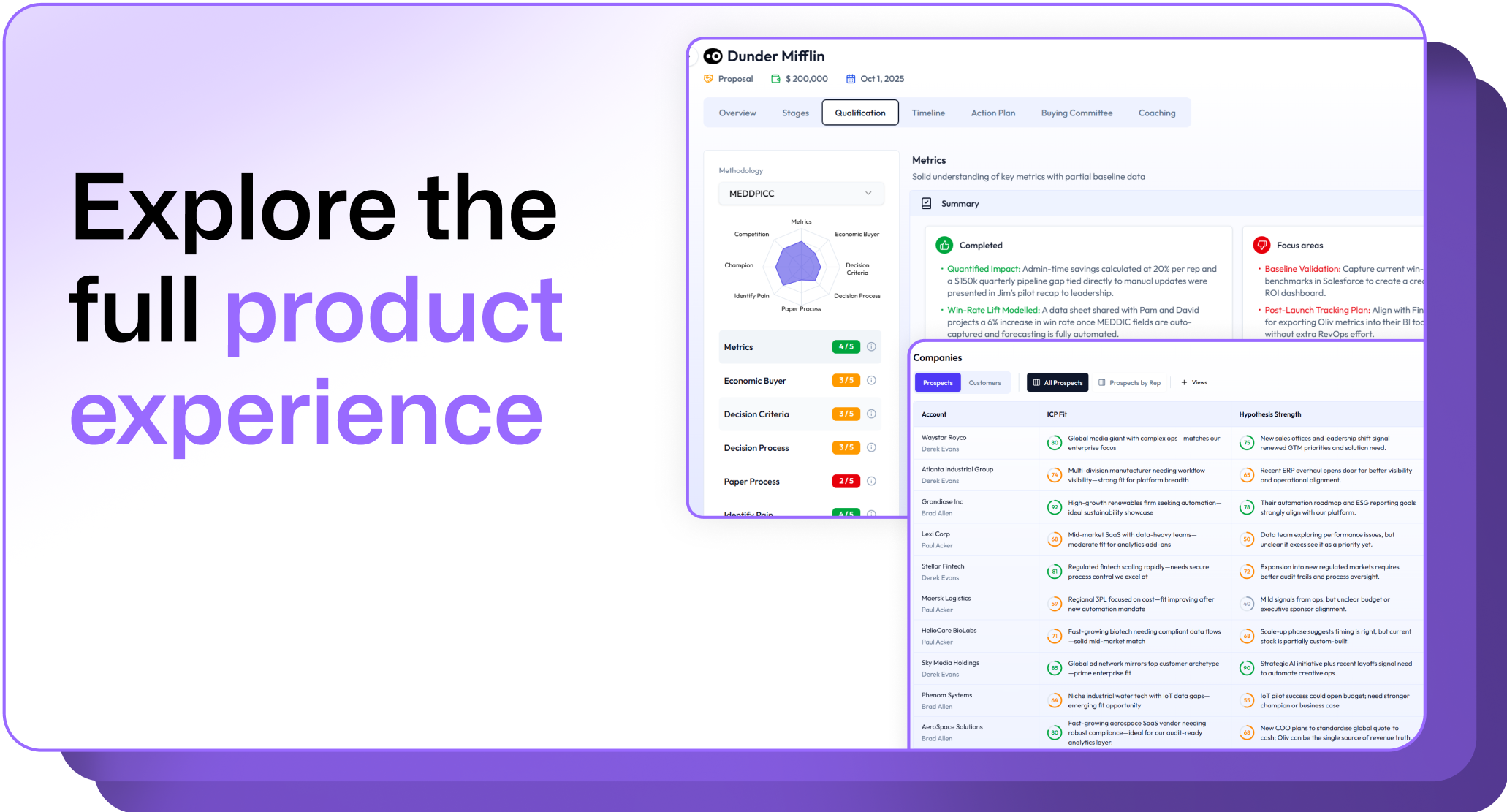
.avif)
.png)







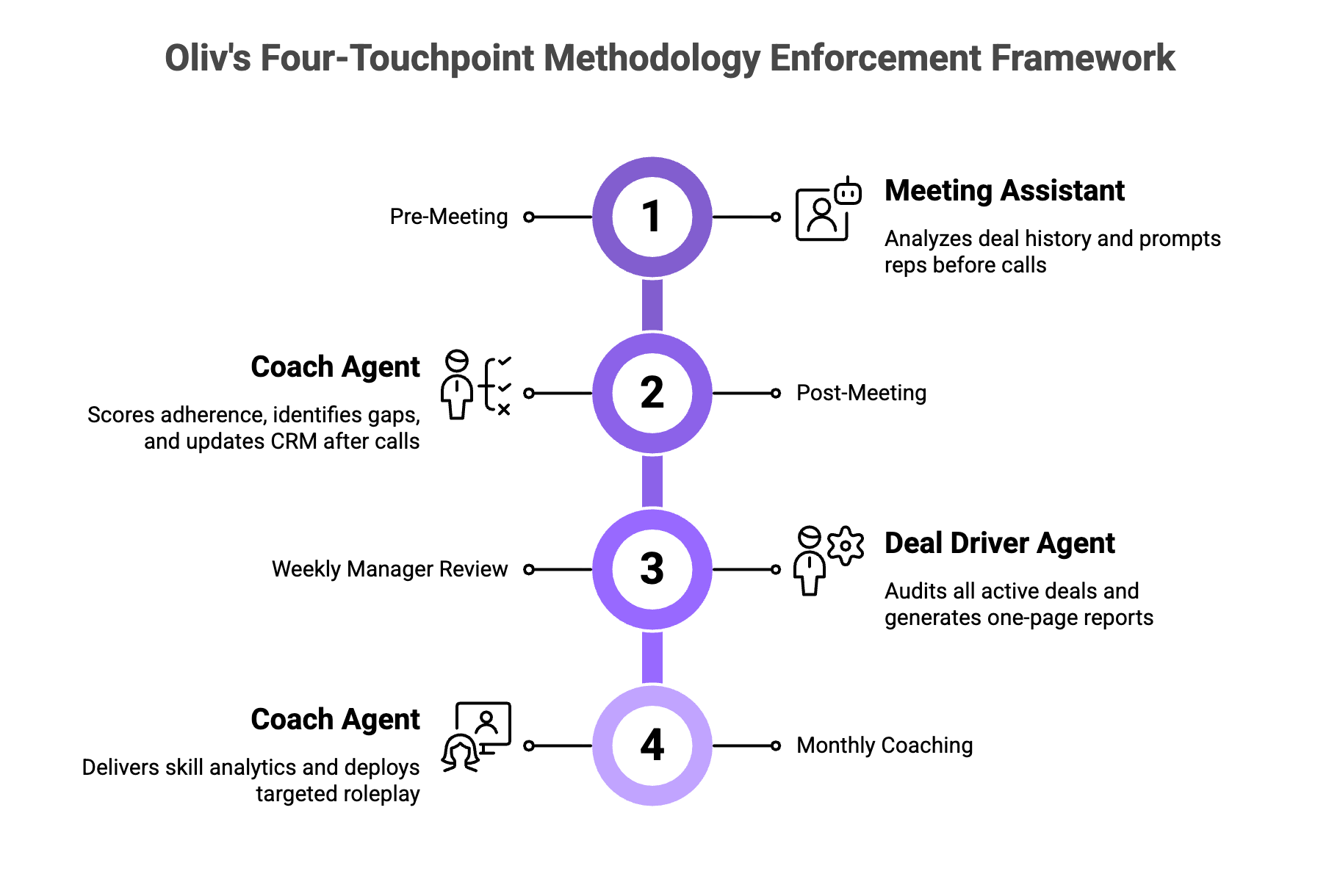
.png)
.png)
.png)