Gainsight vs Totango (2026): True Costs, Features & Why Teams Pick Neither
Written by
Ishan Chhabra
Last Updated :
February 10, 2026
Skim in :
12
mins
In this article
Revenue teams love Oliv
Here’s why:
All your deal data unified (from 30+ tools and tabs).
Insights are delivered to you directly, no digging.
AI agents automate tasks for you.
Thank you! Your submission has been received!
Oops! Something went wrong while submitting the form.
Meet Oliv’s AI Agents
Hi! I’m, Deal Driver
I track deals, flag risks, send weekly pipeline updates and give sales managers full visibility into deal progress
Hi! I’m, CRM Manager
I maintain CRM hygiene by updating core, custom and qualification fields all without your team lifting a finger
Hi! I’m, Forecaster
I build accurate forecasts based on real deal movement and tell you which deals to pull in to hit your number
Hi! I’m, Coach
I believe performance fuels revenue. I spot skill gaps, score calls and build coaching plans to help every rep level up
Hi! I’m, Prospector
I dig into target accounts to surface the right contacts, tailor and time outreach so you always strike when it counts
Hi! I’m, Pipeline tracker
I call reps to get deal updates, and deliver a real-time, CRM-synced roll-up view of deal progress
Hi! I’m, Analyst
I answer complex pipeline questions, uncover deal patterns, and build reports that guide strategic decisions
TL;DR
Gainsight's true Year 1 cost often exceeds $200K when including mandatory implementation and admin hires.
Totango is more accessible for mid-market teams, but post-merger feature gaps and AI limitations persist in 2026.
The "stack tax" of combining a CSP with Gong and Clari can reach $600/user/month for a 100-person team.
Gainsight implementation stretches to 12-24 weeks in practice; Totango averages 4-8 weeks.
ChurnZero, Planhat, Vitally, and Custify each carry trade-offs in reliability, customization, or AI depth.
AI-native agentic platforms now deliver CSP outcomes (health monitoring, QBR prep, churn prevention) with same-week deployment.
Q1. What Are Gainsight and Totango - And Do They Still Matter in 2026? [toc=Platform Overview]
If you've searched "Gainsight vs Totango," you're likely a CS leader, RevOps manager, or VP evaluating your next (or first) customer success platform. Both tools have defined the CSP category for the better part of a decade - but the market underneath them has shifted dramatically.
Side-by-side breakdown of Gainsight and Totango across target market, key features, core strengths, notable weaknesses, and real user experience for customer success platform buyers.
Gainsight at a Glance
Gainsight is the enterprise standard for customer success management. Built on deep Salesforce integration, it offers health scoring, journey orchestration, playbooks, surveys, and a rules engine that can be configured to handle complex, multi-product portfolios. It is consistently rated among the most powerful CSPs on the market.
✅ Where it shines: data manipulation capabilities, journey orchestration (Dynamic JO), and an active admin community.
❌ Where it struggles: steep learning curve, complex configuration, and high cost of ownership.
⚠️ Real User Experience
"Consider the costs and implementation time. Implementation took us a good 6 months, and now we cannot consider switching because of how entrenched we are with it, even though it is obscenely expensive." - Verified User in Computer Software, Small-Business · G2 Verified Review
Totango at a Glance
Totango positions itself as a mid-market-friendly CSP with SuccessBLOCs - pre-built modules for onboarding, adoption, renewal, and expansion. It historically offered a free Starter plan, making it an accessible entry point for teams purchasing their first dedicated CS tool.
✅ Where it shines: clean UI, task management, and an engaged product team that iterates on feedback.
❌ Where it struggles: limited account hierarchy, rigid reporting, and feature gaps compared to enterprise-grade CSPs.
"Totango is a great CSP if it's your first time getting into a CSP. Data is easily managed as long as your data is generally clean." - Verified User in Computer Software, Enterprise · G2 Verified Review
The 2026 Customer Success Platform Landscape
⚠️ The category is at a crossroads.
The global customer success services market is projected to exceed $25 billion, yet buyer frustrations are mounting. G2 review trends for Gainsight show 23 mentions of "not intuitive" interfaces and 20 mentions of "steep learning curve" across verified reviews. Meanwhile, a new class of AI-native, agentic platforms is emerging - tools that surface signals and execute tasks autonomously rather than requiring months of configuration and dedicated admin teams. This shift is the context in which every Gainsight-vs-Totango comparison should now be read.
Q2. How Much Do Gainsight and Totango Actually Cost in 2026? (The True Price Breakdown) [toc=Pricing Breakdown]
Pricing is the single most-searched sub-topic in the Gainsight-vs-Totango comparison - and the hardest to answer transparently. Neither vendor publishes full pricing publicly, and actual costs vary significantly based on user count, modules, and contract negotiation.
Gainsight Pricing Breakdown
Gainsight Cost Components 2026
Cost Component
Estimated Range
💰 Annual platform license
$50,000 - $200,000+
💸 Mandatory implementation / professional services
Gainsight does not list per-seat pricing publicly. Industry benchmarks from Vendr and user reports place fully loaded per-user costs between $150-$250/month depending on modules selected. Mandatory professional services make the true Year 1 cost significantly higher than the license alone. For a detailed breakdown, see our complete Gainsight pricing analysis.
Totango Pricing Breakdown
Totango Cost Components 2026
Cost Component
Estimated Range
💰 Starter plan
Free (limited features, up to ~100 accounts)
💰 Growth plan
Starting ~$199/month
💰 Enterprise plan
Custom-quoted ($20,000 - $60,000+/year)
⏰ Implementation timeline
4 - 8 weeks
👤 Admin requirement
Part-time to 1 FTE
Totango's lower entry price is attractive, but the Enterprise tier (required for advanced integrations, segmentation, and SuccessBLOCs customisation) approaches Gainsight's lower range once you factor in scaling costs.
The Hidden "Stack Tax" 💸
Here's what most comparison articles miss:
Neither Gainsight nor Totango includes call recording, conversational intelligence, or revenue forecasting. To build a complete post-sale tech stack, teams typically layer on:
Gong (recording + CI): ~$150-$250/seat/month
Clari (forecasting): ~$50-$100/seat/month
CSP license (Gainsight or Totango): $100-$250/seat/month
Total "stack tax": $300-$600 per user/month - or $360K-$720K/year for a 100-person team. Learn more about reducing sales tech stack costs.
3-Year TCO Comparison Table
3-Year Total Cost of Ownership Comparison
Cost Element
Gainsight
Totango (Enterprise)
Oliv.ai
Year 1 (license + implementation)
$80K - $320K
$25K - $80K
Modular, agent-based pricing
Year 2-3 (license + admin)
$50K - $200K/yr
$20K - $60K/yr
Pay only for agents deployed
Stack add-ons (CI + forecasting)
$150K - $360K/yr
$150K - $360K/yr
Included in platform
⏰ Time to value
8 - 24 weeks
4 - 8 weeks
Minutes to 2 days
3-Year Estimated TCO (100 users)
$630K - $1.2M+
$365K - $680K
Fraction of legacy TCO
Oliv.ai eliminates the stack tax entirely by combining recording, intelligence, CRM enrichment, and autonomous agents into a single modular platform - where teams purchase only the agents they need, role by role.
Q3. Gainsight vs Totango vs Oliv.ai: Features, AI & Integrations Compared [toc=Feature Comparison]
Feature comparison is where the Gainsight-vs-Totango debate gets granular. Below is a side-by-side analysis across the dimensions that matter most to CS and RevOps leaders in 2026.
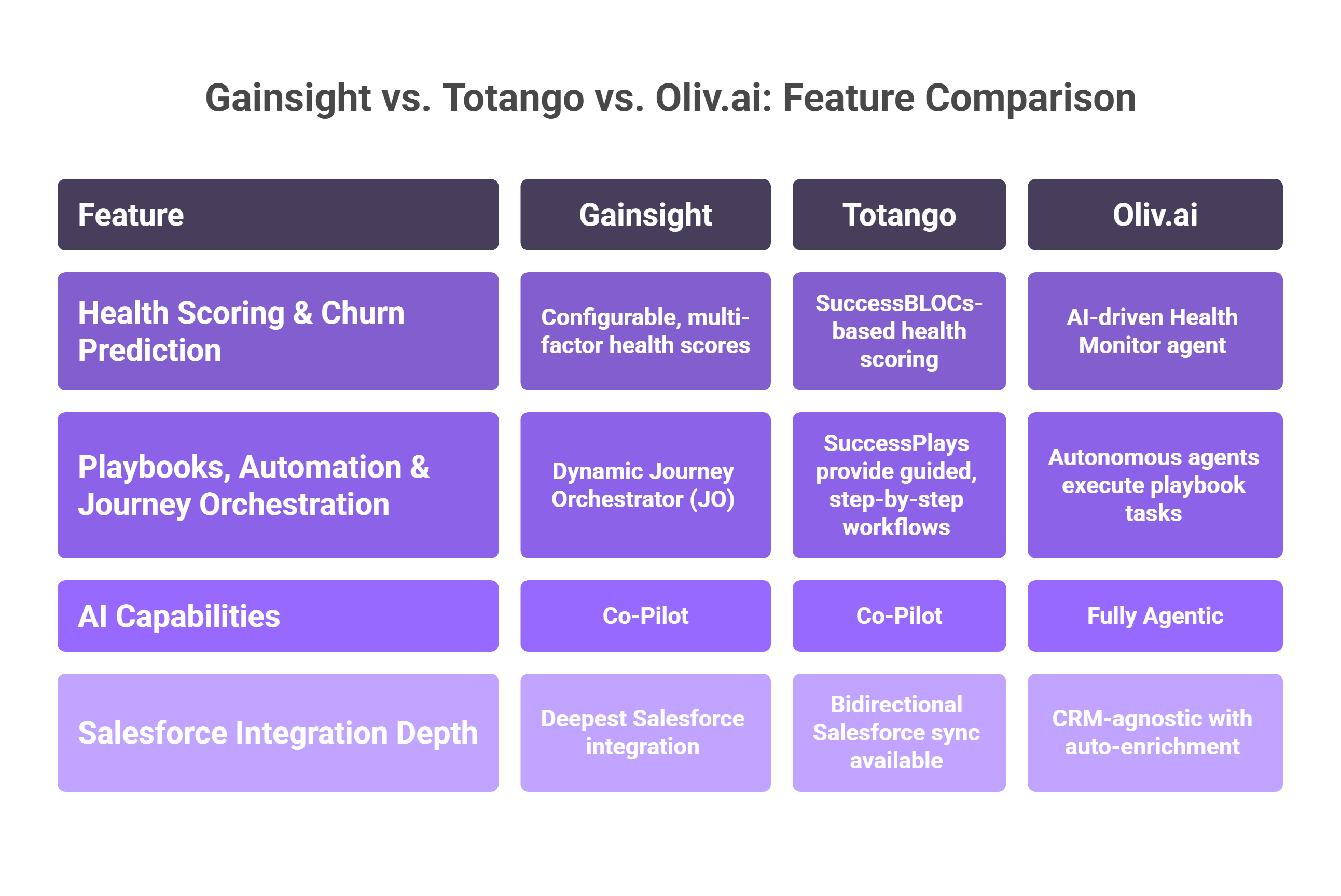
Three-way feature matrix comparing Gainsight, Totango, and Oliv.ai across health scoring, playbook automation, AI capabilities, and Salesforce integration depth for CS teams.
Health Scoring & Churn Prediction
Gainsight: Configurable, multi-factor health scores using a rules engine. ✅ Powerful - but manual. Scores depend on CSMs inputting data and admins maintaining rules. G2 reviewers report that CSMs often distrust the scores because underlying data is incomplete.
Totango: SuccessBLOCs-based health scoring tied to behavioral data and product usage. ✅ Easier to set up than Gainsight - but ❌ limited hierarchy handling means parent-child account scoring is unreliable.
Oliv.ai: AI-driven Health Monitor agent that autonomously scans accounts weekly - pulling from meetings, emails, support tickets, and product usage data - without requiring manual input or rules configuration.
Playbooks, Automation & Journey Orchestration
Gainsight: Dynamic Journey Orchestrator (JO) with branching, CSM impersonation, and multi-step campaigns. ✅ Deep and flexible - ❌ requires significant admin time to build and maintain.
Totango: SuccessPlays provide guided, step-by-step workflows. ✅ Great for standardising CSM motions - ❌ limited project management features for complex onboarding.
"Totango lacks robust tools for managing customer journeys as structured projects. Milestones and tasks are not sufficient for tracking complex onboarding or success plans." - Dario C., Customer Success Manager, Regional Lead, Enterprise · G2 Verified Review
Oliv.ai: Autonomous agents (QBR Builder, MAP Manager, Handoff Hank) execute playbook tasks - drafting QBR decks, creating mutual action plans, and building AE-to-CSM handoff packets - without manual configuration.
AI Capabilities - Co-Pilot vs. Fully Agentic
AI Capabilities Comparison Matrix
AI Capability
Gainsight
Totango
Oliv.ai
AI generation
Staircase AI (acquired)
AI add-ons (evolving post-Catalyst merger)
Generative AI-native, built from day one
Approach
Keyword-based sentiment + co-pilot
Rule-based triggers + emerging AI
Fully agentic - AI executes, not just alerts
CRM auto-update
❌ No
❌ No
✅ Yes (CRM Manager agent)
Autonomous QBR drafts
❌ No
❌ No
✅ Yes (QBR Builder agent)
Churn risk action
Alerts CSM to act
Alerts CSM to act
Agent flags risk *and* drafts recovery plan
⚠️ The AI Reality Check
"There is an excessive focus on AI at the expense of addressing basic features, parity issues, and stability problems... We're yet to see AI for admins." - Alberto S., Enterprise · G2 Verified Review
Salesforce Integration Depth (+ Other CRM Ecosystems)
Gainsight: ✅ Deepest Salesforce integration in the category - native on SFDC, bidirectional sync, parent-child account support. This is Gainsight's strongest moat for Salesforce-heavy enterprises.
Totango: Bidirectional Salesforce sync available - but ⚠️ users report delays in data syncing and integration issues with broader tech stacks.
"Integrates with tools like Salesforce, but there are delays in data syncing and integration issues." - Verified User in Telecommunications, Enterprise · G2 Verified Review
Oliv.ai: CRM-agnostic with auto-enrichment. The CRM Manager agent connects to Salesforce, HubSpot, or any CRM and autonomously updates contact records, qualification fields (MEDDPICC, BANT), and account data - eliminating the "dirty data" problem that plagues every legacy CSP deployment. Discover how sales methodology automation transforms CRM hygiene.
The Complete 3-Way Comparison Table
Complete Platform Comparison: Gainsight vs Totango vs Oliv.ai
Dimension
Gainsight
Totango
Oliv.ai
Best for
Enterprise (500+ employees, dedicated CS Ops)
Mid-market (first CSP, 50-500 employees)
Modern lean CS teams wanting AI-led signals
Health scoring
Configurable, manual rules
SuccessBLOCs-based
Autonomous AI agent
Playbooks
Dynamic JO (deep, complex)
SuccessPlays (guided, simpler)
Agentic execution (QBR, MAP, Handoff)
AI approach
Staircase AI (co-pilot)
Emerging AI add-ons
Fully agentic (executes tasks)
CRM integration
Native Salesforce (deepest)
Bidirectional sync (delays reported)
CRM-agnostic auto-enrichment
Implementation
8-24 weeks
4-8 weeks
Minutes to 2 days
Pricing model
Custom quote (high)
Tiered + custom enterprise
Modular, per-agent
Key limitation
❌ Complex, expensive, slow to implement
❌ Feature gaps, hierarchy constraints
Category disruptor, not a traditional CSP
Q4. How Long Does It Take to Implement Gainsight vs Totango? (And Why It Matters More Than You Think) [toc=Implementation Timeline]
Implementation is the silent ROI killer of every customer success platform purchase. The license fee gets scrutinised in procurement - but the 3-to-6-month setup timeline, professional services invoices, and admin hours rarely make it into the business case. They should.
⏰ The Real Timelines
Gainsight officially positions its implementation at "8 weeks for a full CS framework." In practice, user reports tell a different story. Customised deployments with complex data models, multi-product portfolios, and deep Salesforce integration routinely stretch to 12-24 weeks and require 40-140 hours of dedicated admin time - plus engineering support for data integrations.
"Powerful tool, horrible implementation. You really need to have dedicated resources. You need deep commitments from your customer teams, your Salesforce admins, and engineering team for integrations into your product. This is a tool that will touch many parts of the business and requires a lot of work." - Verified User in Information Technology and Services, Mid-Market · G2 Verified Review
Totango is faster - typically 4-8 weeks - with SuccessBLOCs providing pre-built templates that reduce configuration time. However, the backend setup for integrations and field mapping still requires meaningful effort.
"There is a pretty steep learning curve for the front-end building the SuccessBLOCs and the backend - setting up fields/integrations. In general the tool is not as intuitive as I would like it to be." - Renske V., Technical Consultant, Mid-Market · G2 Verified Review
❌ The Data Readiness Trap
Here's the implementation truth no vendor tells you upfront: if your CRM data is dirty, your CSP becomes a six-figure dashboard displaying garbage. Legacy CSPs require clean, structured data as a prerequisite - not something they solve. Customer IDs must be mapped, contact records de-duplicated, usage data piped through ETL processes, and health-score weightings calibrated manually. This "data readiness" phase alone can add weeks to any timeline and often requires hiring a dedicated CS Ops resource.
"We are still missing a significant number of data points in our instance, which means we have to rely on several other platforms... Even basic features, like easily viewing my portfolio, are lacking, so I end up using spreadsheets instead of Gainsight." -Verified User, Enterprise · G2 Verified Review
✅ The AI-Native Benchmark
The 2026 expectation for mid-market teams has fundamentally changed. Teams with 50-500 employees don't have 6 months, a $120K implementation budget, or a full-time Gainsight admin to spare. They need time-to-value measured in days, not quarters.
AI-native platforms flip the implementation model entirely. Instead of requiring clean data as a prerequisite, they ingest existing data - from meetings, emails, CRM, support tickets, Slack - and use generative AI to surface insights immediately, without manual configuration or rules building. Explore how building a revenue operations function changes with agentic platforms.
Oliv.ai: From Sign-Up to Signal in Days
Oliv configures in 5 minutes to 2 days, with full custom model building completed in 2-4 weeks. There are no professional services fees, no mandatory implementation packages, and no admin hire required. Oliv's CRM Manager agent auto-enriches account and contact data from day one - solving the "dirty data" blocker that delays every legacy CSP rollout before it even starts. Free data migration (including historical recordings and metadata) means teams don't lose institutional knowledge during the switch.
The contrast is stark: a 100-user team can spend ~$120K and 6 months getting Gainsight operational - or deploy Oliv's modular agents in the same week they sign up, with zero implementation cost. See how the future of revenue intelligence is being shaped by autonomous agents.
Q5. What Changed After the Totango-Catalyst Merger? (And What It Means for Buyers) [toc=Merger Impact]
In February 2024, Totango and Catalyst announced a merger, combining Totango's mid-market CSP heritage with Catalyst's product-led growth analytics. The deal was positioned as the antidote to Gainsight's enterprise complexity - a unified, modern platform that could serve the full CS spectrum. Nearly two years later, the real-world impact for buyers is nuanced.
What Was Promised in the Merger
The Totango-Catalyst announcement highlighted three strategic pillars:
Unified data model - merging Catalyst's product usage analytics with Totango's SuccessBLOCs workflow engine into a single platform.
AI-powered insights - leveraging combined data sets to deliver predictive health scoring and proactive churn alerts.
Simplified pricing - eliminating the need to stack multiple tools by bundling engagement, analytics, and workflow into one license.
The promise resonated with mid-market CS leaders frustrated by Gainsight's cost and complexity, and the merger generated significant attention in the CSP category.
What's Actually Changed by 2026
⚠️ Progress is real - but uneven.
The platform consolidation is underway, yet G2 reviewers consistently flag that core feature gaps remain unresolved. Account hierarchy handling - a longstanding Totango limitation - is still cited as a constraint for multi-entity organisations. Reporting depth, while improved, continues to trail Gainsight's rules engine capabilities.
"I believe Totango is at a bit of a crossroads with features. Some more standard features from other CSPs are missing. There's no way to tag child sites in your touch points." -Verified User in Computer Software, Enterprise · G2 Verified Review
The AI story is still emerging. Unlike platforms built on generative AI from the ground up, Totango's AI additions sit on top of a decade-old architecture, functioning more as assistive overlays than autonomous agents. This contrasts sharply with AI-Native Revenue Orchestration platforms that execute tasks rather than just alert users.
"I find Totango sometimes incoherent, as there are fields that appear in certain filters or pages but not in the main account overview. I have to manually search for and update information, which is inefficient." - Crow S., CSM, Mid-Market · G2 Verified Review
How This Affects Your Buying Decision
💰 Key takeaway for evaluators:
If you're a mid-market team evaluating Totango in 2026, pressure-test three areas during your demo: (1) account hierarchy depth - can it handle your parent-child structures? (2) AI autonomy - does it alert you or actually act? (3) integration lag - how real-time is the Salesforce sync? The merger has strengthened Totango's product breadth, but buyers should validate that the combined platform has matured past integration growing pains before committing to a multi-year contract.
Q6. Why Are More CS Teams Picking Neither? (The Rise of AI-Native Alternatives) [toc=CSP Exodus]
A growing number of customer success teams are walking away from the Gainsight-vs-Totango debate entirely. Not because both tools lack power - they don't - but because the category itself is struggling to deliver the speed and autonomy modern CS orgs demand. The frustration is systemic, not product-specific.
⚠️ The Four Frustrations Driving the Exodus
The pattern across G2 reviews is unmistakable. CS leaders cite the same blockers regardless of which legacy CSP they've deployed:
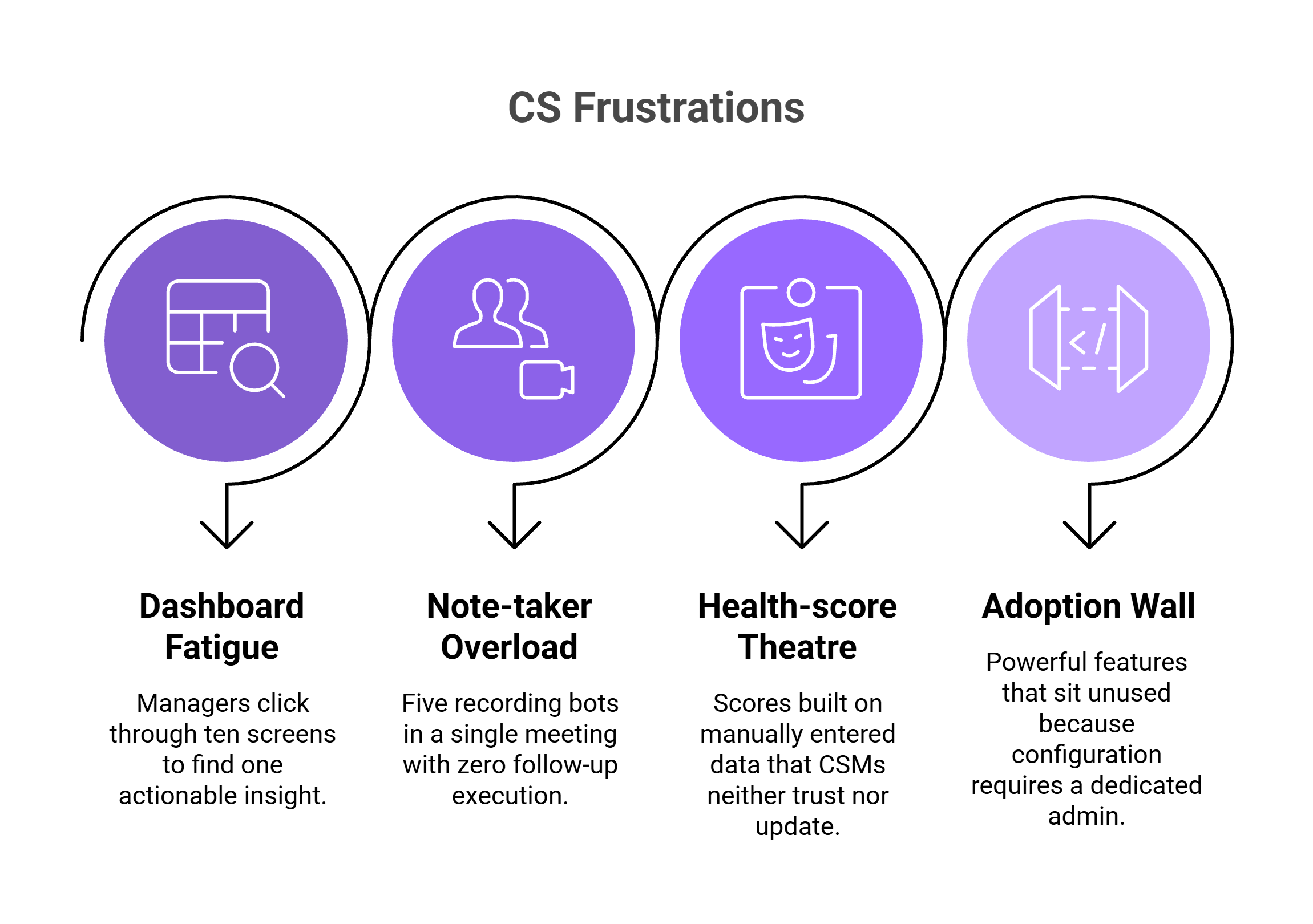
Infographic illustrating four systemic customer success platform frustrations driving teams away from Gainsight and Totango: dashboard fatigue, note-taker overload, health-score theatre, and adoption wall.
Dashboard fatigue - Managers clicking through ten screens to find one actionable insight.
Note-taker overload - Five recording bots in a single meeting with zero follow-up execution.
Health-score theatre - Scores built on manually entered data that CSMs neither trust nor update.
The adoption wall - Powerful features that sit unused because configuration requires a dedicated admin.
"We are also having a hard time with our CSMs adopting and trusting Gainsight." - Verified User in Computer Software, Mid-Market · G2 Verified Review
"I run into limitations or bugs every week and that is unacceptable." - Daniel K., CS Operations Manager, Mid-Market · G2 Verified Review
❌ Why First-Gen AI Isn't the Answer
Legacy CSPs have responded by layering AI features onto existing architectures. But bolted-on co-pilots still require users to ask the right questions, review dashboards manually, and trigger actions themselves. Keyword-based sentiment trackers flag "budget" during a holiday conversation rather than during an actual qualification discussion. The AI assists - it doesn't act.
✅ The Agentic AI Shift
The revenue technology market has evolved through four generations - from documentation (Gong-era recording) to intelligence (Clari-era forecasting) to orchestration (workflow automation) and now to AI-Native Revenue Orchestration: AI agents that autonomously execute tasks. Think of the evolution this way - Conversational Intelligence (Gong) is a dashcam: it records everything so you can review a crash later. Revenue Intelligence (Clari/Gainsight) is a GPS: it shows the route and traffic. AI-Native Revenue Orchestration (Oliv.ai) is a self-driving car: it turns the wheel.
Oliv.ai: The Third Path
Oliv doesn't compete on feature parity with Gainsight or Totango - we compete on outcome parity with zero manual effort. Our agent workforce - Health Monitor, QBR Builder, Retention Forecaster, Handoff Hank - doesn't surface insights for CSMs to act on. It acts. CRM data is auto-enriched, QBR decks are auto-drafted, and churn risk triggers a recovery plan - not just an alert.
"Before deploying Totango, customers should complete a thorough data hygiene exercise - Totango cannot do the clean-up for you." - Verified User in Telecommunications, Enterprise · G2 Verified Review
Oliv eliminates the "dirty data" prerequisite entirely. Teams report a 91% cost reduction over three years versus legacy stacks, 35% higher win rates with agentic deal tracking, and 25% higher forecast accuracy - all with implementation measured in days, not quarters.
Q7. What Are the Best Gainsight and Totango Alternatives for Mid-Market Teams in 2026? [toc=Alternative Platforms]
If Gainsight feels too heavy and Totango leaves gaps, you're not alone. Here's a candid look at the four most-evaluated alternatives - plus the emerging AI-native category - with real user feedback from G2.
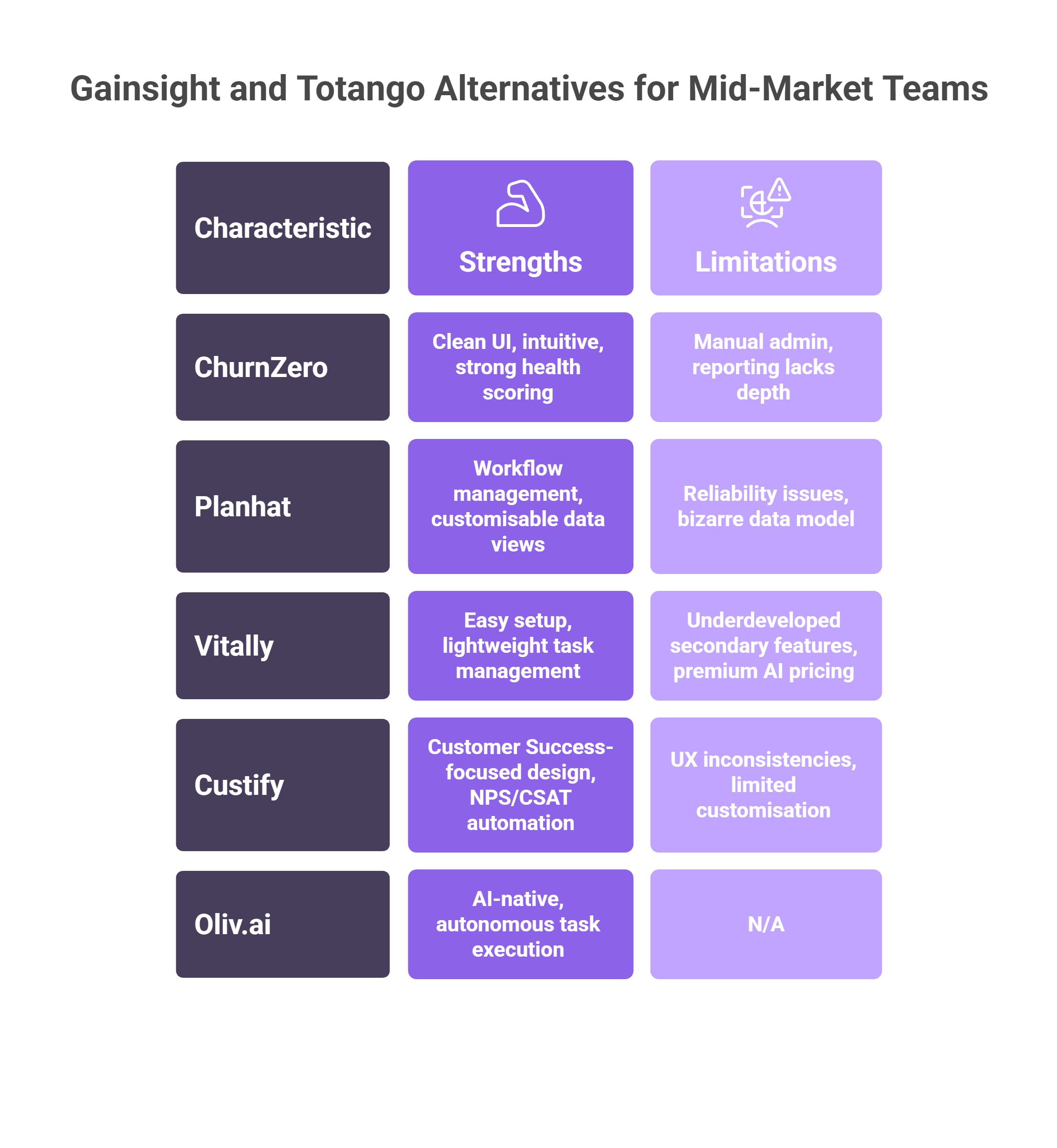
Comparison chart of mid-market alternatives to Gainsight and Totango, highlighting key strengths and limitations of ChurnZero, Planhat, Vitally, Custify, and Oliv.ai.
ChurnZero
✅ Strengths: Clean UI, intuitive for frontline CSMs, strong health scoring with product-usage integration, responsive support team. G2 reviewers praise its ease of daily use (150 mentions of "ease of use").
❌ Limitations: Setup still requires significant manual admin. Reporting lacks depth for complex segments. Learning curve steeper than expected for advanced use cases.
"Setting up our ChurnZero instance has involved a significant amount of manual administration. The data transfer from our CRM to Salesforce is not straightforward, which has forced us to create numerous workarounds." - Brandon O., Client Education Manager, Mid-Market · G2 Verified Review
Planhat
✅ Strengths: Workflow management, customisable data views, and a strong vision for unified CS analytics.
❌ Limitations: Widely cited reliability issues. Data model described as "bizarre" by multiple reviewers. Documentation refers to outdated UI. Integration failures have driven teams back to spreadsheets.
"The entire tool is super buggy, most integrations do not work as intended. Feels like we are stuck in an ongoing alpha version. Do not buy this tool." - Verified User in Computer Software, Small-Business · G2 Verified Review
Vitally
✅ Strengths: Easy initial setup for health scoring, good lightweight task management, integrates with HubSpot and Zendesk ecosystems.
❌ Limitations: Secondary features are underdeveloped. AI enhancements carry premium pricing that's hard to justify. Onboarding support quality has been inconsistent.
"A lot of secondary features are half baked. The cost for some of their enhancements is far above the industry standards... The AI features, while nice, are very high priced and the cost does not allow for ROI." - Elden D., Senior Customer Success Manager, Small-Business · G2 Verified Review
Custify
✅ Strengths: Customer Success-focused design, NPS/CSAT automation, accessible for small teams replacing spreadsheets.
❌ Limitations: UX inconsistencies, limited customisation, weak analytics/dashboards, and email capabilities restricted to outbound-only.
"Interfaces have been inconsistent and ultimately turned off. Cannot customize or configure side bar data in company or person page." - Verified User in IT, Small-Business · G2 Verified Review
Oliv.ai
A fundamentally different category. Oliv isn't a traditional CSP - it's an AI-native agent platform that combines recording, CRM enrichment, health monitoring, and autonomous task execution in a single modular solution. No dedicated admin required. No 6-month implementation. Teams deploy only the agents they need, role by role. Learn more about building revenue operations functions with agentic platforms.
Q8. Which Customer Success Approach Should You Choose in 2026? (Decision Framework) [toc=Decision Framework]
There is no single "best" CSP - only the best fit for your team's size, maturity, budget, and operational philosophy. The Gainsight-vs-Totango comparison flatters both tools in different contexts. The real question in 2026 is broader: do you need a platform you configure, or agents that execute?
⭐ Three Buyer Archetypes
Decision framework presenting three buyer archetypes for customer success platforms: enterprise operator choosing Gainsight, mid-market first-timer choosing Totango, and lean modern team choosing Oliv.ai.
The CSP market now serves three distinct buyer profiles, each with fundamentally different needs.
Archetype 1: The Enterprise Operator - You have 500+ employees, a dedicated CS Ops team, a $75K+ annual budget for CS tooling, and complex Salesforce workflows. You need deep configurability, journey orchestration at scale, and executive dashboards. Gainsight is built for you. Its rules engine, Dynamic JO, and active admin community are unmatched for organisations willing to invest in long implementation cycles and ongoing admin resources.
💰 But be clear-eyed about the trade-off:
Gainsight's power demands 8-24 weeks of setup, 1-3 dedicated admins, and a total stack cost (CSP + Gong + Clari) that can reach $600/user/month. Consider exploring best Clari alternatives to reduce overall stack costs.
Archetype 2: The Mid-Market First-Timer - You have 50-500 employees, this is your first CSP, your budget is $20K-$50K annually, and you need guided workflows to standardise CSM motions. Totango (post-Catalyst merger) fits. SuccessBLOCs provide pre-built templates, implementation is 4-8 weeks, and the UI is accessible for teams without a full-time admin.
⚠️ Watch for these gaps:
Account hierarchy constraints, Salesforce sync delays, and AI capabilities that remain assistive rather than autonomous.
Archetype 3: The Lean Modern Team - You want signals, not dashboards. Your team is any size, but you value speed-to-insight over configuration depth. You want same-week deployment, zero admin overhead, and an AI that doesn't just alert you to churn risk - it drafts the recovery plan and updates the CRM automatically. Oliv.ai is designed for this archetype.
We built Oliv for teams that have seen the CSP playbook - the 6-month implementations, the dashboard audits, the tools your CSMs don't trust - and decided the category needs a new operating model. Our agents (Health Monitor, Retention Forecaster, QBR Builder) deliver the outcomes legacy CSPs promise, with a fraction of the manual effort. Discover how deal intelligence platforms are transforming CS workflows.
✅ The Decision Flowchart
Customer Success Platform Decision Matrix
Question
If Yes →
If No →
Do you have a dedicated CS Ops team + $75K+ budget?
Evaluate Gainsight
↓
Is this your first CSP + budget under $50K?
Evaluate Totango
↓
Do you want AI agents that execute autonomously + same-week setup?
Evaluate Oliv.ai
Revisit requirements
The CSP market isn't dying - but the era of paying six figures for software your team still has to run manually is ending. Whether you choose Gainsight's depth, Totango's accessibility, or Oliv's autonomous agents, align the tool to your team's operational reality - not a vendor's demo narrative. Explore the future of revenue intelligence to understand where the category is heading.
Q9. Gainsight vs Totango FAQ: Your Top Questions Answered [toc=FAQ]
This FAQ section addresses the most commonly searched questions about Gainsight and Totango in 2026, structured for quick scanning and direct answers.
Is Totango the same as Gainsight?
No. Gainsight and Totango are separate customer success platforms that compete in the same category but serve different buyer profiles. Gainsight is enterprise-focused with deep Salesforce integration, a powerful rules engine, and journey orchestration - but requires significant implementation investment. Totango (now merged with Catalyst) targets mid-market teams with SuccessBLOCs templates, faster setup, and a lower entry price. They share the same goal - reducing churn and driving expansion - but differ substantially in complexity, cost, and configuration depth.
How much does Gainsight cost per year?
💰 The short answer: $50,000-$200,000+ annually.
Gainsight does not publish pricing publicly. Industry benchmarks place annual platform licenses between $50K and $200K+ depending on user count and modules selected. Add mandatory professional services ($30K-$120K for Year 1) and 1-3 dedicated admin FTEs, and the true first-year cost often exceeds the license fee by 50-100%. For a comprehensive breakdown, explore our Gainsight pricing analysis.
"Consider the costs and implementation time. Implementation took us a good 6 months, and now we cannot consider switching because of how entrenched we are with it, even though it is obscenely expensive." - Verified User in Computer Software, Small-Business · G2 Verified Review
What is Totango used for?
Totango is a customer success platform used for health scoring, lifecycle management, renewal tracking, and automated customer engagement. Its SuccessBLOCs provide pre-built workflow modules for onboarding, adoption, renewal, and expansion motions. It integrates with Salesforce, HubSpot, and product-usage data sources to give CSMs a unified view of account health.
What are the top Gainsight competitors?
The primary Gainsight competitors in 2026 include: Totango (mid-market CSP), ChurnZero (strong health scoring and UI), Planhat (workflow-focused), Vitally (lightweight, small teams), Custify (budget-friendly), and Oliv.ai (AI-native agentic platform). Each serves a different segment - the choice depends on team size, budget, and whether you want a configuration-heavy platform or an autonomous, agent-first solution.
Is Gainsight worth it for mid-market companies?
⚠️ It depends on your admin capacity.
Gainsight's power is undeniable for organisations with dedicated CS Ops teams and deep Salesforce workflows. However, mid-market teams (50-500 employees) consistently report that the implementation timeline (8-24 weeks), admin overhead, and total cost make it a poor fit unless they have committed internal resources.
"We are also having a hard time with our CSMs adopting and trusting Gainsight." - Verified User in Computer Software, Mid-Market · G2 Verified Review
How long does Gainsight implementation take?
Officially, Gainsight positions implementation at 8 weeks. In practice, customised deployments with complex data models and Salesforce integration routinely stretch to 12-24 weeks, requiring 40-140 hours of dedicated admin time plus engineering support.
What happened after the Totango-Catalyst merger?
Totango and Catalyst merged in February 2024, combining Totango's SuccessBLOCs workflow engine with Catalyst's product-led growth analytics. By 2026, the platform consolidation is underway but uneven - core feature gaps (account hierarchy, reporting depth) remain, and AI capabilities are still emerging rather than fully autonomous. Compare this to AI-Native Revenue Orchestration platforms that execute tasks autonomously.
What's the best customer success platform for startups?
For startups and small teams, Custify (budget NPS/CSAT automation), Vitally (lightweight health scoring), and Totango's free Starter plan are common entry points. However, each carries limitations in customisation, reporting, or scalability. AI-native platforms like Oliv.ai offer a different path entirely - modular agents deployed in days with zero admin overhead, purpose-built for lean teams that want signals over dashboards. Discover how sales intelligence platforms are evolving for modern teams.
Can AI replace traditional customer success platforms?
Not entirely - but the role of the CSP is shifting. Traditional platforms excel at workflow configuration and data centralisation for large, CS-ops-heavy organisations. However, AI-native agentic platforms are increasingly delivering the outcomes CSPs promise (churn prevention, health monitoring, QBR preparation) with a fraction of the manual setup and ongoing admin. The question for buyers in 2026 isn't "AI or CSP" - it's whether you need a tool you configure or agents that execute autonomously. Learn more about reducing sales tech stack costs with agentic platforms.
Q1. What Are Gainsight and Totango - And Do They Still Matter in 2026? [toc=Platform Overview]
If you've searched "Gainsight vs Totango," you're likely a CS leader, RevOps manager, or VP evaluating your next (or first) customer success platform. Both tools have defined the CSP category for the better part of a decade - but the market underneath them has shifted dramatically.
Side-by-side breakdown of Gainsight and Totango across target market, key features, core strengths, notable weaknesses, and real user experience for customer success platform buyers.
Gainsight at a Glance
Gainsight is the enterprise standard for customer success management. Built on deep Salesforce integration, it offers health scoring, journey orchestration, playbooks, surveys, and a rules engine that can be configured to handle complex, multi-product portfolios. It is consistently rated among the most powerful CSPs on the market.
✅ Where it shines: data manipulation capabilities, journey orchestration (Dynamic JO), and an active admin community.
❌ Where it struggles: steep learning curve, complex configuration, and high cost of ownership.
⚠️ Real User Experience
"Consider the costs and implementation time. Implementation took us a good 6 months, and now we cannot consider switching because of how entrenched we are with it, even though it is obscenely expensive." - Verified User in Computer Software, Small-Business · G2 Verified Review
Totango at a Glance
Totango positions itself as a mid-market-friendly CSP with SuccessBLOCs - pre-built modules for onboarding, adoption, renewal, and expansion. It historically offered a free Starter plan, making it an accessible entry point for teams purchasing their first dedicated CS tool.
✅ Where it shines: clean UI, task management, and an engaged product team that iterates on feedback.
❌ Where it struggles: limited account hierarchy, rigid reporting, and feature gaps compared to enterprise-grade CSPs.
"Totango is a great CSP if it's your first time getting into a CSP. Data is easily managed as long as your data is generally clean." - Verified User in Computer Software, Enterprise · G2 Verified Review
The 2026 Customer Success Platform Landscape
⚠️ The category is at a crossroads.
The global customer success services market is projected to exceed $25 billion, yet buyer frustrations are mounting. G2 review trends for Gainsight show 23 mentions of "not intuitive" interfaces and 20 mentions of "steep learning curve" across verified reviews. Meanwhile, a new class of AI-native, agentic platforms is emerging - tools that surface signals and execute tasks autonomously rather than requiring months of configuration and dedicated admin teams. This shift is the context in which every Gainsight-vs-Totango comparison should now be read.
Q2. How Much Do Gainsight and Totango Actually Cost in 2026? (The True Price Breakdown) [toc=Pricing Breakdown]
Pricing is the single most-searched sub-topic in the Gainsight-vs-Totango comparison - and the hardest to answer transparently. Neither vendor publishes full pricing publicly, and actual costs vary significantly based on user count, modules, and contract negotiation.
Gainsight Pricing Breakdown
Gainsight Cost Components 2026
Cost Component
Estimated Range
💰 Annual platform license
$50,000 - $200,000+
💸 Mandatory implementation / professional services
Gainsight does not list per-seat pricing publicly. Industry benchmarks from Vendr and user reports place fully loaded per-user costs between $150-$250/month depending on modules selected. Mandatory professional services make the true Year 1 cost significantly higher than the license alone. For a detailed breakdown, see our complete Gainsight pricing analysis.
Totango Pricing Breakdown
Totango Cost Components 2026
Cost Component
Estimated Range
💰 Starter plan
Free (limited features, up to ~100 accounts)
💰 Growth plan
Starting ~$199/month
💰 Enterprise plan
Custom-quoted ($20,000 - $60,000+/year)
⏰ Implementation timeline
4 - 8 weeks
👤 Admin requirement
Part-time to 1 FTE
Totango's lower entry price is attractive, but the Enterprise tier (required for advanced integrations, segmentation, and SuccessBLOCs customisation) approaches Gainsight's lower range once you factor in scaling costs.
The Hidden "Stack Tax" 💸
Here's what most comparison articles miss:
Neither Gainsight nor Totango includes call recording, conversational intelligence, or revenue forecasting. To build a complete post-sale tech stack, teams typically layer on:
Gong (recording + CI): ~$150-$250/seat/month
Clari (forecasting): ~$50-$100/seat/month
CSP license (Gainsight or Totango): $100-$250/seat/month
Total "stack tax": $300-$600 per user/month - or $360K-$720K/year for a 100-person team. Learn more about reducing sales tech stack costs.
3-Year TCO Comparison Table
3-Year Total Cost of Ownership Comparison
Cost Element
Gainsight
Totango (Enterprise)
Oliv.ai
Year 1 (license + implementation)
$80K - $320K
$25K - $80K
Modular, agent-based pricing
Year 2-3 (license + admin)
$50K - $200K/yr
$20K - $60K/yr
Pay only for agents deployed
Stack add-ons (CI + forecasting)
$150K - $360K/yr
$150K - $360K/yr
Included in platform
⏰ Time to value
8 - 24 weeks
4 - 8 weeks
Minutes to 2 days
3-Year Estimated TCO (100 users)
$630K - $1.2M+
$365K - $680K
Fraction of legacy TCO
Oliv.ai eliminates the stack tax entirely by combining recording, intelligence, CRM enrichment, and autonomous agents into a single modular platform - where teams purchase only the agents they need, role by role.
Q3. Gainsight vs Totango vs Oliv.ai: Features, AI & Integrations Compared [toc=Feature Comparison]
Feature comparison is where the Gainsight-vs-Totango debate gets granular. Below is a side-by-side analysis across the dimensions that matter most to CS and RevOps leaders in 2026.
Three-way feature matrix comparing Gainsight, Totango, and Oliv.ai across health scoring, playbook automation, AI capabilities, and Salesforce integration depth for CS teams.
Health Scoring & Churn Prediction
Gainsight: Configurable, multi-factor health scores using a rules engine. ✅ Powerful - but manual. Scores depend on CSMs inputting data and admins maintaining rules. G2 reviewers report that CSMs often distrust the scores because underlying data is incomplete.
Totango: SuccessBLOCs-based health scoring tied to behavioral data and product usage. ✅ Easier to set up than Gainsight - but ❌ limited hierarchy handling means parent-child account scoring is unreliable.
Oliv.ai: AI-driven Health Monitor agent that autonomously scans accounts weekly - pulling from meetings, emails, support tickets, and product usage data - without requiring manual input or rules configuration.
Playbooks, Automation & Journey Orchestration
Gainsight: Dynamic Journey Orchestrator (JO) with branching, CSM impersonation, and multi-step campaigns. ✅ Deep and flexible - ❌ requires significant admin time to build and maintain.
Totango: SuccessPlays provide guided, step-by-step workflows. ✅ Great for standardising CSM motions - ❌ limited project management features for complex onboarding.
"Totango lacks robust tools for managing customer journeys as structured projects. Milestones and tasks are not sufficient for tracking complex onboarding or success plans." - Dario C., Customer Success Manager, Regional Lead, Enterprise · G2 Verified Review
Oliv.ai: Autonomous agents (QBR Builder, MAP Manager, Handoff Hank) execute playbook tasks - drafting QBR decks, creating mutual action plans, and building AE-to-CSM handoff packets - without manual configuration.
AI Capabilities - Co-Pilot vs. Fully Agentic
AI Capabilities Comparison Matrix
AI Capability
Gainsight
Totango
Oliv.ai
AI generation
Staircase AI (acquired)
AI add-ons (evolving post-Catalyst merger)
Generative AI-native, built from day one
Approach
Keyword-based sentiment + co-pilot
Rule-based triggers + emerging AI
Fully agentic - AI executes, not just alerts
CRM auto-update
❌ No
❌ No
✅ Yes (CRM Manager agent)
Autonomous QBR drafts
❌ No
❌ No
✅ Yes (QBR Builder agent)
Churn risk action
Alerts CSM to act
Alerts CSM to act
Agent flags risk *and* drafts recovery plan
⚠️ The AI Reality Check
"There is an excessive focus on AI at the expense of addressing basic features, parity issues, and stability problems... We're yet to see AI for admins." - Alberto S., Enterprise · G2 Verified Review
Salesforce Integration Depth (+ Other CRM Ecosystems)
Gainsight: ✅ Deepest Salesforce integration in the category - native on SFDC, bidirectional sync, parent-child account support. This is Gainsight's strongest moat for Salesforce-heavy enterprises.
Totango: Bidirectional Salesforce sync available - but ⚠️ users report delays in data syncing and integration issues with broader tech stacks.
"Integrates with tools like Salesforce, but there are delays in data syncing and integration issues." - Verified User in Telecommunications, Enterprise · G2 Verified Review
Oliv.ai: CRM-agnostic with auto-enrichment. The CRM Manager agent connects to Salesforce, HubSpot, or any CRM and autonomously updates contact records, qualification fields (MEDDPICC, BANT), and account data - eliminating the "dirty data" problem that plagues every legacy CSP deployment. Discover how sales methodology automation transforms CRM hygiene.
The Complete 3-Way Comparison Table
Complete Platform Comparison: Gainsight vs Totango vs Oliv.ai
Dimension
Gainsight
Totango
Oliv.ai
Best for
Enterprise (500+ employees, dedicated CS Ops)
Mid-market (first CSP, 50-500 employees)
Modern lean CS teams wanting AI-led signals
Health scoring
Configurable, manual rules
SuccessBLOCs-based
Autonomous AI agent
Playbooks
Dynamic JO (deep, complex)
SuccessPlays (guided, simpler)
Agentic execution (QBR, MAP, Handoff)
AI approach
Staircase AI (co-pilot)
Emerging AI add-ons
Fully agentic (executes tasks)
CRM integration
Native Salesforce (deepest)
Bidirectional sync (delays reported)
CRM-agnostic auto-enrichment
Implementation
8-24 weeks
4-8 weeks
Minutes to 2 days
Pricing model
Custom quote (high)
Tiered + custom enterprise
Modular, per-agent
Key limitation
❌ Complex, expensive, slow to implement
❌ Feature gaps, hierarchy constraints
Category disruptor, not a traditional CSP
Q4. How Long Does It Take to Implement Gainsight vs Totango? (And Why It Matters More Than You Think) [toc=Implementation Timeline]
Implementation is the silent ROI killer of every customer success platform purchase. The license fee gets scrutinised in procurement - but the 3-to-6-month setup timeline, professional services invoices, and admin hours rarely make it into the business case. They should.
⏰ The Real Timelines
Gainsight officially positions its implementation at "8 weeks for a full CS framework." In practice, user reports tell a different story. Customised deployments with complex data models, multi-product portfolios, and deep Salesforce integration routinely stretch to 12-24 weeks and require 40-140 hours of dedicated admin time - plus engineering support for data integrations.
"Powerful tool, horrible implementation. You really need to have dedicated resources. You need deep commitments from your customer teams, your Salesforce admins, and engineering team for integrations into your product. This is a tool that will touch many parts of the business and requires a lot of work." - Verified User in Information Technology and Services, Mid-Market · G2 Verified Review
Totango is faster - typically 4-8 weeks - with SuccessBLOCs providing pre-built templates that reduce configuration time. However, the backend setup for integrations and field mapping still requires meaningful effort.
"There is a pretty steep learning curve for the front-end building the SuccessBLOCs and the backend - setting up fields/integrations. In general the tool is not as intuitive as I would like it to be." - Renske V., Technical Consultant, Mid-Market · G2 Verified Review
❌ The Data Readiness Trap
Here's the implementation truth no vendor tells you upfront: if your CRM data is dirty, your CSP becomes a six-figure dashboard displaying garbage. Legacy CSPs require clean, structured data as a prerequisite - not something they solve. Customer IDs must be mapped, contact records de-duplicated, usage data piped through ETL processes, and health-score weightings calibrated manually. This "data readiness" phase alone can add weeks to any timeline and often requires hiring a dedicated CS Ops resource.
"We are still missing a significant number of data points in our instance, which means we have to rely on several other platforms... Even basic features, like easily viewing my portfolio, are lacking, so I end up using spreadsheets instead of Gainsight." -Verified User, Enterprise · G2 Verified Review
✅ The AI-Native Benchmark
The 2026 expectation for mid-market teams has fundamentally changed. Teams with 50-500 employees don't have 6 months, a $120K implementation budget, or a full-time Gainsight admin to spare. They need time-to-value measured in days, not quarters.
AI-native platforms flip the implementation model entirely. Instead of requiring clean data as a prerequisite, they ingest existing data - from meetings, emails, CRM, support tickets, Slack - and use generative AI to surface insights immediately, without manual configuration or rules building. Explore how building a revenue operations function changes with agentic platforms.
Oliv.ai: From Sign-Up to Signal in Days
Oliv configures in 5 minutes to 2 days, with full custom model building completed in 2-4 weeks. There are no professional services fees, no mandatory implementation packages, and no admin hire required. Oliv's CRM Manager agent auto-enriches account and contact data from day one - solving the "dirty data" blocker that delays every legacy CSP rollout before it even starts. Free data migration (including historical recordings and metadata) means teams don't lose institutional knowledge during the switch.
The contrast is stark: a 100-user team can spend ~$120K and 6 months getting Gainsight operational - or deploy Oliv's modular agents in the same week they sign up, with zero implementation cost. See how the future of revenue intelligence is being shaped by autonomous agents.
Q5. What Changed After the Totango-Catalyst Merger? (And What It Means for Buyers) [toc=Merger Impact]
In February 2024, Totango and Catalyst announced a merger, combining Totango's mid-market CSP heritage with Catalyst's product-led growth analytics. The deal was positioned as the antidote to Gainsight's enterprise complexity - a unified, modern platform that could serve the full CS spectrum. Nearly two years later, the real-world impact for buyers is nuanced.
What Was Promised in the Merger
The Totango-Catalyst announcement highlighted three strategic pillars:
Unified data model - merging Catalyst's product usage analytics with Totango's SuccessBLOCs workflow engine into a single platform.
AI-powered insights - leveraging combined data sets to deliver predictive health scoring and proactive churn alerts.
Simplified pricing - eliminating the need to stack multiple tools by bundling engagement, analytics, and workflow into one license.
The promise resonated with mid-market CS leaders frustrated by Gainsight's cost and complexity, and the merger generated significant attention in the CSP category.
What's Actually Changed by 2026
⚠️ Progress is real - but uneven.
The platform consolidation is underway, yet G2 reviewers consistently flag that core feature gaps remain unresolved. Account hierarchy handling - a longstanding Totango limitation - is still cited as a constraint for multi-entity organisations. Reporting depth, while improved, continues to trail Gainsight's rules engine capabilities.
"I believe Totango is at a bit of a crossroads with features. Some more standard features from other CSPs are missing. There's no way to tag child sites in your touch points." -Verified User in Computer Software, Enterprise · G2 Verified Review
The AI story is still emerging. Unlike platforms built on generative AI from the ground up, Totango's AI additions sit on top of a decade-old architecture, functioning more as assistive overlays than autonomous agents. This contrasts sharply with AI-Native Revenue Orchestration platforms that execute tasks rather than just alert users.
"I find Totango sometimes incoherent, as there are fields that appear in certain filters or pages but not in the main account overview. I have to manually search for and update information, which is inefficient." - Crow S., CSM, Mid-Market · G2 Verified Review
How This Affects Your Buying Decision
💰 Key takeaway for evaluators:
If you're a mid-market team evaluating Totango in 2026, pressure-test three areas during your demo: (1) account hierarchy depth - can it handle your parent-child structures? (2) AI autonomy - does it alert you or actually act? (3) integration lag - how real-time is the Salesforce sync? The merger has strengthened Totango's product breadth, but buyers should validate that the combined platform has matured past integration growing pains before committing to a multi-year contract.
Q6. Why Are More CS Teams Picking Neither? (The Rise of AI-Native Alternatives) [toc=CSP Exodus]
A growing number of customer success teams are walking away from the Gainsight-vs-Totango debate entirely. Not because both tools lack power - they don't - but because the category itself is struggling to deliver the speed and autonomy modern CS orgs demand. The frustration is systemic, not product-specific.
⚠️ The Four Frustrations Driving the Exodus
The pattern across G2 reviews is unmistakable. CS leaders cite the same blockers regardless of which legacy CSP they've deployed:
Infographic illustrating four systemic customer success platform frustrations driving teams away from Gainsight and Totango: dashboard fatigue, note-taker overload, health-score theatre, and adoption wall.
Dashboard fatigue - Managers clicking through ten screens to find one actionable insight.
Note-taker overload - Five recording bots in a single meeting with zero follow-up execution.
Health-score theatre - Scores built on manually entered data that CSMs neither trust nor update.
The adoption wall - Powerful features that sit unused because configuration requires a dedicated admin.
"We are also having a hard time with our CSMs adopting and trusting Gainsight." - Verified User in Computer Software, Mid-Market · G2 Verified Review
"I run into limitations or bugs every week and that is unacceptable." - Daniel K., CS Operations Manager, Mid-Market · G2 Verified Review
❌ Why First-Gen AI Isn't the Answer
Legacy CSPs have responded by layering AI features onto existing architectures. But bolted-on co-pilots still require users to ask the right questions, review dashboards manually, and trigger actions themselves. Keyword-based sentiment trackers flag "budget" during a holiday conversation rather than during an actual qualification discussion. The AI assists - it doesn't act.
✅ The Agentic AI Shift
The revenue technology market has evolved through four generations - from documentation (Gong-era recording) to intelligence (Clari-era forecasting) to orchestration (workflow automation) and now to AI-Native Revenue Orchestration: AI agents that autonomously execute tasks. Think of the evolution this way - Conversational Intelligence (Gong) is a dashcam: it records everything so you can review a crash later. Revenue Intelligence (Clari/Gainsight) is a GPS: it shows the route and traffic. AI-Native Revenue Orchestration (Oliv.ai) is a self-driving car: it turns the wheel.
Oliv.ai: The Third Path
Oliv doesn't compete on feature parity with Gainsight or Totango - we compete on outcome parity with zero manual effort. Our agent workforce - Health Monitor, QBR Builder, Retention Forecaster, Handoff Hank - doesn't surface insights for CSMs to act on. It acts. CRM data is auto-enriched, QBR decks are auto-drafted, and churn risk triggers a recovery plan - not just an alert.
"Before deploying Totango, customers should complete a thorough data hygiene exercise - Totango cannot do the clean-up for you." - Verified User in Telecommunications, Enterprise · G2 Verified Review
Oliv eliminates the "dirty data" prerequisite entirely. Teams report a 91% cost reduction over three years versus legacy stacks, 35% higher win rates with agentic deal tracking, and 25% higher forecast accuracy - all with implementation measured in days, not quarters.
Q7. What Are the Best Gainsight and Totango Alternatives for Mid-Market Teams in 2026? [toc=Alternative Platforms]
If Gainsight feels too heavy and Totango leaves gaps, you're not alone. Here's a candid look at the four most-evaluated alternatives - plus the emerging AI-native category - with real user feedback from G2.
Comparison chart of mid-market alternatives to Gainsight and Totango, highlighting key strengths and limitations of ChurnZero, Planhat, Vitally, Custify, and Oliv.ai.
ChurnZero
✅ Strengths: Clean UI, intuitive for frontline CSMs, strong health scoring with product-usage integration, responsive support team. G2 reviewers praise its ease of daily use (150 mentions of "ease of use").
❌ Limitations: Setup still requires significant manual admin. Reporting lacks depth for complex segments. Learning curve steeper than expected for advanced use cases.
"Setting up our ChurnZero instance has involved a significant amount of manual administration. The data transfer from our CRM to Salesforce is not straightforward, which has forced us to create numerous workarounds." - Brandon O., Client Education Manager, Mid-Market · G2 Verified Review
Planhat
✅ Strengths: Workflow management, customisable data views, and a strong vision for unified CS analytics.
❌ Limitations: Widely cited reliability issues. Data model described as "bizarre" by multiple reviewers. Documentation refers to outdated UI. Integration failures have driven teams back to spreadsheets.
"The entire tool is super buggy, most integrations do not work as intended. Feels like we are stuck in an ongoing alpha version. Do not buy this tool." - Verified User in Computer Software, Small-Business · G2 Verified Review
Vitally
✅ Strengths: Easy initial setup for health scoring, good lightweight task management, integrates with HubSpot and Zendesk ecosystems.
❌ Limitations: Secondary features are underdeveloped. AI enhancements carry premium pricing that's hard to justify. Onboarding support quality has been inconsistent.
"A lot of secondary features are half baked. The cost for some of their enhancements is far above the industry standards... The AI features, while nice, are very high priced and the cost does not allow for ROI." - Elden D., Senior Customer Success Manager, Small-Business · G2 Verified Review
Custify
✅ Strengths: Customer Success-focused design, NPS/CSAT automation, accessible for small teams replacing spreadsheets.
❌ Limitations: UX inconsistencies, limited customisation, weak analytics/dashboards, and email capabilities restricted to outbound-only.
"Interfaces have been inconsistent and ultimately turned off. Cannot customize or configure side bar data in company or person page." - Verified User in IT, Small-Business · G2 Verified Review
Oliv.ai
A fundamentally different category. Oliv isn't a traditional CSP - it's an AI-native agent platform that combines recording, CRM enrichment, health monitoring, and autonomous task execution in a single modular solution. No dedicated admin required. No 6-month implementation. Teams deploy only the agents they need, role by role. Learn more about building revenue operations functions with agentic platforms.
Q8. Which Customer Success Approach Should You Choose in 2026? (Decision Framework) [toc=Decision Framework]
There is no single "best" CSP - only the best fit for your team's size, maturity, budget, and operational philosophy. The Gainsight-vs-Totango comparison flatters both tools in different contexts. The real question in 2026 is broader: do you need a platform you configure, or agents that execute?
⭐ Three Buyer Archetypes
Decision framework presenting three buyer archetypes for customer success platforms: enterprise operator choosing Gainsight, mid-market first-timer choosing Totango, and lean modern team choosing Oliv.ai.
The CSP market now serves three distinct buyer profiles, each with fundamentally different needs.
Archetype 1: The Enterprise Operator - You have 500+ employees, a dedicated CS Ops team, a $75K+ annual budget for CS tooling, and complex Salesforce workflows. You need deep configurability, journey orchestration at scale, and executive dashboards. Gainsight is built for you. Its rules engine, Dynamic JO, and active admin community are unmatched for organisations willing to invest in long implementation cycles and ongoing admin resources.
💰 But be clear-eyed about the trade-off:
Gainsight's power demands 8-24 weeks of setup, 1-3 dedicated admins, and a total stack cost (CSP + Gong + Clari) that can reach $600/user/month. Consider exploring best Clari alternatives to reduce overall stack costs.
Archetype 2: The Mid-Market First-Timer - You have 50-500 employees, this is your first CSP, your budget is $20K-$50K annually, and you need guided workflows to standardise CSM motions. Totango (post-Catalyst merger) fits. SuccessBLOCs provide pre-built templates, implementation is 4-8 weeks, and the UI is accessible for teams without a full-time admin.
⚠️ Watch for these gaps:
Account hierarchy constraints, Salesforce sync delays, and AI capabilities that remain assistive rather than autonomous.
Archetype 3: The Lean Modern Team - You want signals, not dashboards. Your team is any size, but you value speed-to-insight over configuration depth. You want same-week deployment, zero admin overhead, and an AI that doesn't just alert you to churn risk - it drafts the recovery plan and updates the CRM automatically. Oliv.ai is designed for this archetype.
We built Oliv for teams that have seen the CSP playbook - the 6-month implementations, the dashboard audits, the tools your CSMs don't trust - and decided the category needs a new operating model. Our agents (Health Monitor, Retention Forecaster, QBR Builder) deliver the outcomes legacy CSPs promise, with a fraction of the manual effort. Discover how deal intelligence platforms are transforming CS workflows.
✅ The Decision Flowchart
Customer Success Platform Decision Matrix
Question
If Yes →
If No →
Do you have a dedicated CS Ops team + $75K+ budget?
Evaluate Gainsight
↓
Is this your first CSP + budget under $50K?
Evaluate Totango
↓
Do you want AI agents that execute autonomously + same-week setup?
Evaluate Oliv.ai
Revisit requirements
The CSP market isn't dying - but the era of paying six figures for software your team still has to run manually is ending. Whether you choose Gainsight's depth, Totango's accessibility, or Oliv's autonomous agents, align the tool to your team's operational reality - not a vendor's demo narrative. Explore the future of revenue intelligence to understand where the category is heading.
Q9. Gainsight vs Totango FAQ: Your Top Questions Answered [toc=FAQ]
This FAQ section addresses the most commonly searched questions about Gainsight and Totango in 2026, structured for quick scanning and direct answers.
Is Totango the same as Gainsight?
No. Gainsight and Totango are separate customer success platforms that compete in the same category but serve different buyer profiles. Gainsight is enterprise-focused with deep Salesforce integration, a powerful rules engine, and journey orchestration - but requires significant implementation investment. Totango (now merged with Catalyst) targets mid-market teams with SuccessBLOCs templates, faster setup, and a lower entry price. They share the same goal - reducing churn and driving expansion - but differ substantially in complexity, cost, and configuration depth.
How much does Gainsight cost per year?
💰 The short answer: $50,000-$200,000+ annually.
Gainsight does not publish pricing publicly. Industry benchmarks place annual platform licenses between $50K and $200K+ depending on user count and modules selected. Add mandatory professional services ($30K-$120K for Year 1) and 1-3 dedicated admin FTEs, and the true first-year cost often exceeds the license fee by 50-100%. For a comprehensive breakdown, explore our Gainsight pricing analysis.
"Consider the costs and implementation time. Implementation took us a good 6 months, and now we cannot consider switching because of how entrenched we are with it, even though it is obscenely expensive." - Verified User in Computer Software, Small-Business · G2 Verified Review
What is Totango used for?
Totango is a customer success platform used for health scoring, lifecycle management, renewal tracking, and automated customer engagement. Its SuccessBLOCs provide pre-built workflow modules for onboarding, adoption, renewal, and expansion motions. It integrates with Salesforce, HubSpot, and product-usage data sources to give CSMs a unified view of account health.
What are the top Gainsight competitors?
The primary Gainsight competitors in 2026 include: Totango (mid-market CSP), ChurnZero (strong health scoring and UI), Planhat (workflow-focused), Vitally (lightweight, small teams), Custify (budget-friendly), and Oliv.ai (AI-native agentic platform). Each serves a different segment - the choice depends on team size, budget, and whether you want a configuration-heavy platform or an autonomous, agent-first solution.
Is Gainsight worth it for mid-market companies?
⚠️ It depends on your admin capacity.
Gainsight's power is undeniable for organisations with dedicated CS Ops teams and deep Salesforce workflows. However, mid-market teams (50-500 employees) consistently report that the implementation timeline (8-24 weeks), admin overhead, and total cost make it a poor fit unless they have committed internal resources.
"We are also having a hard time with our CSMs adopting and trusting Gainsight." - Verified User in Computer Software, Mid-Market · G2 Verified Review
How long does Gainsight implementation take?
Officially, Gainsight positions implementation at 8 weeks. In practice, customised deployments with complex data models and Salesforce integration routinely stretch to 12-24 weeks, requiring 40-140 hours of dedicated admin time plus engineering support.
What happened after the Totango-Catalyst merger?
Totango and Catalyst merged in February 2024, combining Totango's SuccessBLOCs workflow engine with Catalyst's product-led growth analytics. By 2026, the platform consolidation is underway but uneven - core feature gaps (account hierarchy, reporting depth) remain, and AI capabilities are still emerging rather than fully autonomous. Compare this to AI-Native Revenue Orchestration platforms that execute tasks autonomously.
What's the best customer success platform for startups?
For startups and small teams, Custify (budget NPS/CSAT automation), Vitally (lightweight health scoring), and Totango's free Starter plan are common entry points. However, each carries limitations in customisation, reporting, or scalability. AI-native platforms like Oliv.ai offer a different path entirely - modular agents deployed in days with zero admin overhead, purpose-built for lean teams that want signals over dashboards. Discover how sales intelligence platforms are evolving for modern teams.
Can AI replace traditional customer success platforms?
Not entirely - but the role of the CSP is shifting. Traditional platforms excel at workflow configuration and data centralisation for large, CS-ops-heavy organisations. However, AI-native agentic platforms are increasingly delivering the outcomes CSPs promise (churn prevention, health monitoring, QBR preparation) with a fraction of the manual setup and ongoing admin. The question for buyers in 2026 isn't "AI or CSP" - it's whether you need a tool you configure or agents that execute autonomously. Learn more about reducing sales tech stack costs with agentic platforms.
Q1. What Are Gainsight and Totango - And Do They Still Matter in 2026? [toc=Platform Overview]
If you've searched "Gainsight vs Totango," you're likely a CS leader, RevOps manager, or VP evaluating your next (or first) customer success platform. Both tools have defined the CSP category for the better part of a decade - but the market underneath them has shifted dramatically.
Side-by-side breakdown of Gainsight and Totango across target market, key features, core strengths, notable weaknesses, and real user experience for customer success platform buyers.
Gainsight at a Glance
Gainsight is the enterprise standard for customer success management. Built on deep Salesforce integration, it offers health scoring, journey orchestration, playbooks, surveys, and a rules engine that can be configured to handle complex, multi-product portfolios. It is consistently rated among the most powerful CSPs on the market.
✅ Where it shines: data manipulation capabilities, journey orchestration (Dynamic JO), and an active admin community.
❌ Where it struggles: steep learning curve, complex configuration, and high cost of ownership.
⚠️ Real User Experience
"Consider the costs and implementation time. Implementation took us a good 6 months, and now we cannot consider switching because of how entrenched we are with it, even though it is obscenely expensive." - Verified User in Computer Software, Small-Business · G2 Verified Review
Totango at a Glance
Totango positions itself as a mid-market-friendly CSP with SuccessBLOCs - pre-built modules for onboarding, adoption, renewal, and expansion. It historically offered a free Starter plan, making it an accessible entry point for teams purchasing their first dedicated CS tool.
✅ Where it shines: clean UI, task management, and an engaged product team that iterates on feedback.
❌ Where it struggles: limited account hierarchy, rigid reporting, and feature gaps compared to enterprise-grade CSPs.
"Totango is a great CSP if it's your first time getting into a CSP. Data is easily managed as long as your data is generally clean." - Verified User in Computer Software, Enterprise · G2 Verified Review
The 2026 Customer Success Platform Landscape
⚠️ The category is at a crossroads.
The global customer success services market is projected to exceed $25 billion, yet buyer frustrations are mounting. G2 review trends for Gainsight show 23 mentions of "not intuitive" interfaces and 20 mentions of "steep learning curve" across verified reviews. Meanwhile, a new class of AI-native, agentic platforms is emerging - tools that surface signals and execute tasks autonomously rather than requiring months of configuration and dedicated admin teams. This shift is the context in which every Gainsight-vs-Totango comparison should now be read.
Q2. How Much Do Gainsight and Totango Actually Cost in 2026? (The True Price Breakdown) [toc=Pricing Breakdown]
Pricing is the single most-searched sub-topic in the Gainsight-vs-Totango comparison - and the hardest to answer transparently. Neither vendor publishes full pricing publicly, and actual costs vary significantly based on user count, modules, and contract negotiation.
Gainsight Pricing Breakdown
Gainsight Cost Components 2026
Cost Component
Estimated Range
💰 Annual platform license
$50,000 - $200,000+
💸 Mandatory implementation / professional services
Gainsight does not list per-seat pricing publicly. Industry benchmarks from Vendr and user reports place fully loaded per-user costs between $150-$250/month depending on modules selected. Mandatory professional services make the true Year 1 cost significantly higher than the license alone. For a detailed breakdown, see our complete Gainsight pricing analysis.
Totango Pricing Breakdown
Totango Cost Components 2026
Cost Component
Estimated Range
💰 Starter plan
Free (limited features, up to ~100 accounts)
💰 Growth plan
Starting ~$199/month
💰 Enterprise plan
Custom-quoted ($20,000 - $60,000+/year)
⏰ Implementation timeline
4 - 8 weeks
👤 Admin requirement
Part-time to 1 FTE
Totango's lower entry price is attractive, but the Enterprise tier (required for advanced integrations, segmentation, and SuccessBLOCs customisation) approaches Gainsight's lower range once you factor in scaling costs.
The Hidden "Stack Tax" 💸
Here's what most comparison articles miss:
Neither Gainsight nor Totango includes call recording, conversational intelligence, or revenue forecasting. To build a complete post-sale tech stack, teams typically layer on:
Gong (recording + CI): ~$150-$250/seat/month
Clari (forecasting): ~$50-$100/seat/month
CSP license (Gainsight or Totango): $100-$250/seat/month
Total "stack tax": $300-$600 per user/month - or $360K-$720K/year for a 100-person team. Learn more about reducing sales tech stack costs.
3-Year TCO Comparison Table
3-Year Total Cost of Ownership Comparison
Cost Element
Gainsight
Totango (Enterprise)
Oliv.ai
Year 1 (license + implementation)
$80K - $320K
$25K - $80K
Modular, agent-based pricing
Year 2-3 (license + admin)
$50K - $200K/yr
$20K - $60K/yr
Pay only for agents deployed
Stack add-ons (CI + forecasting)
$150K - $360K/yr
$150K - $360K/yr
Included in platform
⏰ Time to value
8 - 24 weeks
4 - 8 weeks
Minutes to 2 days
3-Year Estimated TCO (100 users)
$630K - $1.2M+
$365K - $680K
Fraction of legacy TCO
Oliv.ai eliminates the stack tax entirely by combining recording, intelligence, CRM enrichment, and autonomous agents into a single modular platform - where teams purchase only the agents they need, role by role.
Q3. Gainsight vs Totango vs Oliv.ai: Features, AI & Integrations Compared [toc=Feature Comparison]
Feature comparison is where the Gainsight-vs-Totango debate gets granular. Below is a side-by-side analysis across the dimensions that matter most to CS and RevOps leaders in 2026.
Three-way feature matrix comparing Gainsight, Totango, and Oliv.ai across health scoring, playbook automation, AI capabilities, and Salesforce integration depth for CS teams.
Health Scoring & Churn Prediction
Gainsight: Configurable, multi-factor health scores using a rules engine. ✅ Powerful - but manual. Scores depend on CSMs inputting data and admins maintaining rules. G2 reviewers report that CSMs often distrust the scores because underlying data is incomplete.
Totango: SuccessBLOCs-based health scoring tied to behavioral data and product usage. ✅ Easier to set up than Gainsight - but ❌ limited hierarchy handling means parent-child account scoring is unreliable.
Oliv.ai: AI-driven Health Monitor agent that autonomously scans accounts weekly - pulling from meetings, emails, support tickets, and product usage data - without requiring manual input or rules configuration.
Playbooks, Automation & Journey Orchestration
Gainsight: Dynamic Journey Orchestrator (JO) with branching, CSM impersonation, and multi-step campaigns. ✅ Deep and flexible - ❌ requires significant admin time to build and maintain.
Totango: SuccessPlays provide guided, step-by-step workflows. ✅ Great for standardising CSM motions - ❌ limited project management features for complex onboarding.
"Totango lacks robust tools for managing customer journeys as structured projects. Milestones and tasks are not sufficient for tracking complex onboarding or success plans." - Dario C., Customer Success Manager, Regional Lead, Enterprise · G2 Verified Review
Oliv.ai: Autonomous agents (QBR Builder, MAP Manager, Handoff Hank) execute playbook tasks - drafting QBR decks, creating mutual action plans, and building AE-to-CSM handoff packets - without manual configuration.
AI Capabilities - Co-Pilot vs. Fully Agentic
AI Capabilities Comparison Matrix
AI Capability
Gainsight
Totango
Oliv.ai
AI generation
Staircase AI (acquired)
AI add-ons (evolving post-Catalyst merger)
Generative AI-native, built from day one
Approach
Keyword-based sentiment + co-pilot
Rule-based triggers + emerging AI
Fully agentic - AI executes, not just alerts
CRM auto-update
❌ No
❌ No
✅ Yes (CRM Manager agent)
Autonomous QBR drafts
❌ No
❌ No
✅ Yes (QBR Builder agent)
Churn risk action
Alerts CSM to act
Alerts CSM to act
Agent flags risk *and* drafts recovery plan
⚠️ The AI Reality Check
"There is an excessive focus on AI at the expense of addressing basic features, parity issues, and stability problems... We're yet to see AI for admins." - Alberto S., Enterprise · G2 Verified Review
Salesforce Integration Depth (+ Other CRM Ecosystems)
Gainsight: ✅ Deepest Salesforce integration in the category - native on SFDC, bidirectional sync, parent-child account support. This is Gainsight's strongest moat for Salesforce-heavy enterprises.
Totango: Bidirectional Salesforce sync available - but ⚠️ users report delays in data syncing and integration issues with broader tech stacks.
"Integrates with tools like Salesforce, but there are delays in data syncing and integration issues." - Verified User in Telecommunications, Enterprise · G2 Verified Review
Oliv.ai: CRM-agnostic with auto-enrichment. The CRM Manager agent connects to Salesforce, HubSpot, or any CRM and autonomously updates contact records, qualification fields (MEDDPICC, BANT), and account data - eliminating the "dirty data" problem that plagues every legacy CSP deployment. Discover how sales methodology automation transforms CRM hygiene.
The Complete 3-Way Comparison Table
Complete Platform Comparison: Gainsight vs Totango vs Oliv.ai
Dimension
Gainsight
Totango
Oliv.ai
Best for
Enterprise (500+ employees, dedicated CS Ops)
Mid-market (first CSP, 50-500 employees)
Modern lean CS teams wanting AI-led signals
Health scoring
Configurable, manual rules
SuccessBLOCs-based
Autonomous AI agent
Playbooks
Dynamic JO (deep, complex)
SuccessPlays (guided, simpler)
Agentic execution (QBR, MAP, Handoff)
AI approach
Staircase AI (co-pilot)
Emerging AI add-ons
Fully agentic (executes tasks)
CRM integration
Native Salesforce (deepest)
Bidirectional sync (delays reported)
CRM-agnostic auto-enrichment
Implementation
8-24 weeks
4-8 weeks
Minutes to 2 days
Pricing model
Custom quote (high)
Tiered + custom enterprise
Modular, per-agent
Key limitation
❌ Complex, expensive, slow to implement
❌ Feature gaps, hierarchy constraints
Category disruptor, not a traditional CSP
Q4. How Long Does It Take to Implement Gainsight vs Totango? (And Why It Matters More Than You Think) [toc=Implementation Timeline]
Implementation is the silent ROI killer of every customer success platform purchase. The license fee gets scrutinised in procurement - but the 3-to-6-month setup timeline, professional services invoices, and admin hours rarely make it into the business case. They should.
⏰ The Real Timelines
Gainsight officially positions its implementation at "8 weeks for a full CS framework." In practice, user reports tell a different story. Customised deployments with complex data models, multi-product portfolios, and deep Salesforce integration routinely stretch to 12-24 weeks and require 40-140 hours of dedicated admin time - plus engineering support for data integrations.
"Powerful tool, horrible implementation. You really need to have dedicated resources. You need deep commitments from your customer teams, your Salesforce admins, and engineering team for integrations into your product. This is a tool that will touch many parts of the business and requires a lot of work." - Verified User in Information Technology and Services, Mid-Market · G2 Verified Review
Totango is faster - typically 4-8 weeks - with SuccessBLOCs providing pre-built templates that reduce configuration time. However, the backend setup for integrations and field mapping still requires meaningful effort.
"There is a pretty steep learning curve for the front-end building the SuccessBLOCs and the backend - setting up fields/integrations. In general the tool is not as intuitive as I would like it to be." - Renske V., Technical Consultant, Mid-Market · G2 Verified Review
❌ The Data Readiness Trap
Here's the implementation truth no vendor tells you upfront: if your CRM data is dirty, your CSP becomes a six-figure dashboard displaying garbage. Legacy CSPs require clean, structured data as a prerequisite - not something they solve. Customer IDs must be mapped, contact records de-duplicated, usage data piped through ETL processes, and health-score weightings calibrated manually. This "data readiness" phase alone can add weeks to any timeline and often requires hiring a dedicated CS Ops resource.
"We are still missing a significant number of data points in our instance, which means we have to rely on several other platforms... Even basic features, like easily viewing my portfolio, are lacking, so I end up using spreadsheets instead of Gainsight." -Verified User, Enterprise · G2 Verified Review
✅ The AI-Native Benchmark
The 2026 expectation for mid-market teams has fundamentally changed. Teams with 50-500 employees don't have 6 months, a $120K implementation budget, or a full-time Gainsight admin to spare. They need time-to-value measured in days, not quarters.
AI-native platforms flip the implementation model entirely. Instead of requiring clean data as a prerequisite, they ingest existing data - from meetings, emails, CRM, support tickets, Slack - and use generative AI to surface insights immediately, without manual configuration or rules building. Explore how building a revenue operations function changes with agentic platforms.
Oliv.ai: From Sign-Up to Signal in Days
Oliv configures in 5 minutes to 2 days, with full custom model building completed in 2-4 weeks. There are no professional services fees, no mandatory implementation packages, and no admin hire required. Oliv's CRM Manager agent auto-enriches account and contact data from day one - solving the "dirty data" blocker that delays every legacy CSP rollout before it even starts. Free data migration (including historical recordings and metadata) means teams don't lose institutional knowledge during the switch.
The contrast is stark: a 100-user team can spend ~$120K and 6 months getting Gainsight operational - or deploy Oliv's modular agents in the same week they sign up, with zero implementation cost. See how the future of revenue intelligence is being shaped by autonomous agents.
Q5. What Changed After the Totango-Catalyst Merger? (And What It Means for Buyers) [toc=Merger Impact]
In February 2024, Totango and Catalyst announced a merger, combining Totango's mid-market CSP heritage with Catalyst's product-led growth analytics. The deal was positioned as the antidote to Gainsight's enterprise complexity - a unified, modern platform that could serve the full CS spectrum. Nearly two years later, the real-world impact for buyers is nuanced.
What Was Promised in the Merger
The Totango-Catalyst announcement highlighted three strategic pillars:
Unified data model - merging Catalyst's product usage analytics with Totango's SuccessBLOCs workflow engine into a single platform.
AI-powered insights - leveraging combined data sets to deliver predictive health scoring and proactive churn alerts.
Simplified pricing - eliminating the need to stack multiple tools by bundling engagement, analytics, and workflow into one license.
The promise resonated with mid-market CS leaders frustrated by Gainsight's cost and complexity, and the merger generated significant attention in the CSP category.
What's Actually Changed by 2026
⚠️ Progress is real - but uneven.
The platform consolidation is underway, yet G2 reviewers consistently flag that core feature gaps remain unresolved. Account hierarchy handling - a longstanding Totango limitation - is still cited as a constraint for multi-entity organisations. Reporting depth, while improved, continues to trail Gainsight's rules engine capabilities.
"I believe Totango is at a bit of a crossroads with features. Some more standard features from other CSPs are missing. There's no way to tag child sites in your touch points." -Verified User in Computer Software, Enterprise · G2 Verified Review
The AI story is still emerging. Unlike platforms built on generative AI from the ground up, Totango's AI additions sit on top of a decade-old architecture, functioning more as assistive overlays than autonomous agents. This contrasts sharply with AI-Native Revenue Orchestration platforms that execute tasks rather than just alert users.
"I find Totango sometimes incoherent, as there are fields that appear in certain filters or pages but not in the main account overview. I have to manually search for and update information, which is inefficient." - Crow S., CSM, Mid-Market · G2 Verified Review
How This Affects Your Buying Decision
💰 Key takeaway for evaluators:
If you're a mid-market team evaluating Totango in 2026, pressure-test three areas during your demo: (1) account hierarchy depth - can it handle your parent-child structures? (2) AI autonomy - does it alert you or actually act? (3) integration lag - how real-time is the Salesforce sync? The merger has strengthened Totango's product breadth, but buyers should validate that the combined platform has matured past integration growing pains before committing to a multi-year contract.
Q6. Why Are More CS Teams Picking Neither? (The Rise of AI-Native Alternatives) [toc=CSP Exodus]
A growing number of customer success teams are walking away from the Gainsight-vs-Totango debate entirely. Not because both tools lack power - they don't - but because the category itself is struggling to deliver the speed and autonomy modern CS orgs demand. The frustration is systemic, not product-specific.
⚠️ The Four Frustrations Driving the Exodus
The pattern across G2 reviews is unmistakable. CS leaders cite the same blockers regardless of which legacy CSP they've deployed:
Infographic illustrating four systemic customer success platform frustrations driving teams away from Gainsight and Totango: dashboard fatigue, note-taker overload, health-score theatre, and adoption wall.
Dashboard fatigue - Managers clicking through ten screens to find one actionable insight.
Note-taker overload - Five recording bots in a single meeting with zero follow-up execution.
Health-score theatre - Scores built on manually entered data that CSMs neither trust nor update.
The adoption wall - Powerful features that sit unused because configuration requires a dedicated admin.
"We are also having a hard time with our CSMs adopting and trusting Gainsight." - Verified User in Computer Software, Mid-Market · G2 Verified Review
"I run into limitations or bugs every week and that is unacceptable." - Daniel K., CS Operations Manager, Mid-Market · G2 Verified Review
❌ Why First-Gen AI Isn't the Answer
Legacy CSPs have responded by layering AI features onto existing architectures. But bolted-on co-pilots still require users to ask the right questions, review dashboards manually, and trigger actions themselves. Keyword-based sentiment trackers flag "budget" during a holiday conversation rather than during an actual qualification discussion. The AI assists - it doesn't act.
✅ The Agentic AI Shift
The revenue technology market has evolved through four generations - from documentation (Gong-era recording) to intelligence (Clari-era forecasting) to orchestration (workflow automation) and now to AI-Native Revenue Orchestration: AI agents that autonomously execute tasks. Think of the evolution this way - Conversational Intelligence (Gong) is a dashcam: it records everything so you can review a crash later. Revenue Intelligence (Clari/Gainsight) is a GPS: it shows the route and traffic. AI-Native Revenue Orchestration (Oliv.ai) is a self-driving car: it turns the wheel.
Oliv.ai: The Third Path
Oliv doesn't compete on feature parity with Gainsight or Totango - we compete on outcome parity with zero manual effort. Our agent workforce - Health Monitor, QBR Builder, Retention Forecaster, Handoff Hank - doesn't surface insights for CSMs to act on. It acts. CRM data is auto-enriched, QBR decks are auto-drafted, and churn risk triggers a recovery plan - not just an alert.
"Before deploying Totango, customers should complete a thorough data hygiene exercise - Totango cannot do the clean-up for you." - Verified User in Telecommunications, Enterprise · G2 Verified Review
Oliv eliminates the "dirty data" prerequisite entirely. Teams report a 91% cost reduction over three years versus legacy stacks, 35% higher win rates with agentic deal tracking, and 25% higher forecast accuracy - all with implementation measured in days, not quarters.
Q7. What Are the Best Gainsight and Totango Alternatives for Mid-Market Teams in 2026? [toc=Alternative Platforms]
If Gainsight feels too heavy and Totango leaves gaps, you're not alone. Here's a candid look at the four most-evaluated alternatives - plus the emerging AI-native category - with real user feedback from G2.
Comparison chart of mid-market alternatives to Gainsight and Totango, highlighting key strengths and limitations of ChurnZero, Planhat, Vitally, Custify, and Oliv.ai.
ChurnZero
✅ Strengths: Clean UI, intuitive for frontline CSMs, strong health scoring with product-usage integration, responsive support team. G2 reviewers praise its ease of daily use (150 mentions of "ease of use").
❌ Limitations: Setup still requires significant manual admin. Reporting lacks depth for complex segments. Learning curve steeper than expected for advanced use cases.
"Setting up our ChurnZero instance has involved a significant amount of manual administration. The data transfer from our CRM to Salesforce is not straightforward, which has forced us to create numerous workarounds." - Brandon O., Client Education Manager, Mid-Market · G2 Verified Review
Planhat
✅ Strengths: Workflow management, customisable data views, and a strong vision for unified CS analytics.
❌ Limitations: Widely cited reliability issues. Data model described as "bizarre" by multiple reviewers. Documentation refers to outdated UI. Integration failures have driven teams back to spreadsheets.
"The entire tool is super buggy, most integrations do not work as intended. Feels like we are stuck in an ongoing alpha version. Do not buy this tool." - Verified User in Computer Software, Small-Business · G2 Verified Review
Vitally
✅ Strengths: Easy initial setup for health scoring, good lightweight task management, integrates with HubSpot and Zendesk ecosystems.
❌ Limitations: Secondary features are underdeveloped. AI enhancements carry premium pricing that's hard to justify. Onboarding support quality has been inconsistent.
"A lot of secondary features are half baked. The cost for some of their enhancements is far above the industry standards... The AI features, while nice, are very high priced and the cost does not allow for ROI." - Elden D., Senior Customer Success Manager, Small-Business · G2 Verified Review
Custify
✅ Strengths: Customer Success-focused design, NPS/CSAT automation, accessible for small teams replacing spreadsheets.
❌ Limitations: UX inconsistencies, limited customisation, weak analytics/dashboards, and email capabilities restricted to outbound-only.
"Interfaces have been inconsistent and ultimately turned off. Cannot customize or configure side bar data in company or person page." - Verified User in IT, Small-Business · G2 Verified Review
Oliv.ai
A fundamentally different category. Oliv isn't a traditional CSP - it's an AI-native agent platform that combines recording, CRM enrichment, health monitoring, and autonomous task execution in a single modular solution. No dedicated admin required. No 6-month implementation. Teams deploy only the agents they need, role by role. Learn more about building revenue operations functions with agentic platforms.
Q8. Which Customer Success Approach Should You Choose in 2026? (Decision Framework) [toc=Decision Framework]
There is no single "best" CSP - only the best fit for your team's size, maturity, budget, and operational philosophy. The Gainsight-vs-Totango comparison flatters both tools in different contexts. The real question in 2026 is broader: do you need a platform you configure, or agents that execute?
⭐ Three Buyer Archetypes
Decision framework presenting three buyer archetypes for customer success platforms: enterprise operator choosing Gainsight, mid-market first-timer choosing Totango, and lean modern team choosing Oliv.ai.
The CSP market now serves three distinct buyer profiles, each with fundamentally different needs.
Archetype 1: The Enterprise Operator - You have 500+ employees, a dedicated CS Ops team, a $75K+ annual budget for CS tooling, and complex Salesforce workflows. You need deep configurability, journey orchestration at scale, and executive dashboards. Gainsight is built for you. Its rules engine, Dynamic JO, and active admin community are unmatched for organisations willing to invest in long implementation cycles and ongoing admin resources.
💰 But be clear-eyed about the trade-off:
Gainsight's power demands 8-24 weeks of setup, 1-3 dedicated admins, and a total stack cost (CSP + Gong + Clari) that can reach $600/user/month. Consider exploring best Clari alternatives to reduce overall stack costs.
Archetype 2: The Mid-Market First-Timer - You have 50-500 employees, this is your first CSP, your budget is $20K-$50K annually, and you need guided workflows to standardise CSM motions. Totango (post-Catalyst merger) fits. SuccessBLOCs provide pre-built templates, implementation is 4-8 weeks, and the UI is accessible for teams without a full-time admin.
⚠️ Watch for these gaps:
Account hierarchy constraints, Salesforce sync delays, and AI capabilities that remain assistive rather than autonomous.
Archetype 3: The Lean Modern Team - You want signals, not dashboards. Your team is any size, but you value speed-to-insight over configuration depth. You want same-week deployment, zero admin overhead, and an AI that doesn't just alert you to churn risk - it drafts the recovery plan and updates the CRM automatically. Oliv.ai is designed for this archetype.
We built Oliv for teams that have seen the CSP playbook - the 6-month implementations, the dashboard audits, the tools your CSMs don't trust - and decided the category needs a new operating model. Our agents (Health Monitor, Retention Forecaster, QBR Builder) deliver the outcomes legacy CSPs promise, with a fraction of the manual effort. Discover how deal intelligence platforms are transforming CS workflows.
✅ The Decision Flowchart
Customer Success Platform Decision Matrix
Question
If Yes →
If No →
Do you have a dedicated CS Ops team + $75K+ budget?
Evaluate Gainsight
↓
Is this your first CSP + budget under $50K?
Evaluate Totango
↓
Do you want AI agents that execute autonomously + same-week setup?
Evaluate Oliv.ai
Revisit requirements
The CSP market isn't dying - but the era of paying six figures for software your team still has to run manually is ending. Whether you choose Gainsight's depth, Totango's accessibility, or Oliv's autonomous agents, align the tool to your team's operational reality - not a vendor's demo narrative. Explore the future of revenue intelligence to understand where the category is heading.
Q9. Gainsight vs Totango FAQ: Your Top Questions Answered [toc=FAQ]
This FAQ section addresses the most commonly searched questions about Gainsight and Totango in 2026, structured for quick scanning and direct answers.
Is Totango the same as Gainsight?
No. Gainsight and Totango are separate customer success platforms that compete in the same category but serve different buyer profiles. Gainsight is enterprise-focused with deep Salesforce integration, a powerful rules engine, and journey orchestration - but requires significant implementation investment. Totango (now merged with Catalyst) targets mid-market teams with SuccessBLOCs templates, faster setup, and a lower entry price. They share the same goal - reducing churn and driving expansion - but differ substantially in complexity, cost, and configuration depth.
How much does Gainsight cost per year?
💰 The short answer: $50,000-$200,000+ annually.
Gainsight does not publish pricing publicly. Industry benchmarks place annual platform licenses between $50K and $200K+ depending on user count and modules selected. Add mandatory professional services ($30K-$120K for Year 1) and 1-3 dedicated admin FTEs, and the true first-year cost often exceeds the license fee by 50-100%. For a comprehensive breakdown, explore our Gainsight pricing analysis.
"Consider the costs and implementation time. Implementation took us a good 6 months, and now we cannot consider switching because of how entrenched we are with it, even though it is obscenely expensive." - Verified User in Computer Software, Small-Business · G2 Verified Review
What is Totango used for?
Totango is a customer success platform used for health scoring, lifecycle management, renewal tracking, and automated customer engagement. Its SuccessBLOCs provide pre-built workflow modules for onboarding, adoption, renewal, and expansion motions. It integrates with Salesforce, HubSpot, and product-usage data sources to give CSMs a unified view of account health.
What are the top Gainsight competitors?
The primary Gainsight competitors in 2026 include: Totango (mid-market CSP), ChurnZero (strong health scoring and UI), Planhat (workflow-focused), Vitally (lightweight, small teams), Custify (budget-friendly), and Oliv.ai (AI-native agentic platform). Each serves a different segment - the choice depends on team size, budget, and whether you want a configuration-heavy platform or an autonomous, agent-first solution.
Is Gainsight worth it for mid-market companies?
⚠️ It depends on your admin capacity.
Gainsight's power is undeniable for organisations with dedicated CS Ops teams and deep Salesforce workflows. However, mid-market teams (50-500 employees) consistently report that the implementation timeline (8-24 weeks), admin overhead, and total cost make it a poor fit unless they have committed internal resources.
"We are also having a hard time with our CSMs adopting and trusting Gainsight." - Verified User in Computer Software, Mid-Market · G2 Verified Review
How long does Gainsight implementation take?
Officially, Gainsight positions implementation at 8 weeks. In practice, customised deployments with complex data models and Salesforce integration routinely stretch to 12-24 weeks, requiring 40-140 hours of dedicated admin time plus engineering support.
What happened after the Totango-Catalyst merger?
Totango and Catalyst merged in February 2024, combining Totango's SuccessBLOCs workflow engine with Catalyst's product-led growth analytics. By 2026, the platform consolidation is underway but uneven - core feature gaps (account hierarchy, reporting depth) remain, and AI capabilities are still emerging rather than fully autonomous. Compare this to AI-Native Revenue Orchestration platforms that execute tasks autonomously.
What's the best customer success platform for startups?
For startups and small teams, Custify (budget NPS/CSAT automation), Vitally (lightweight health scoring), and Totango's free Starter plan are common entry points. However, each carries limitations in customisation, reporting, or scalability. AI-native platforms like Oliv.ai offer a different path entirely - modular agents deployed in days with zero admin overhead, purpose-built for lean teams that want signals over dashboards. Discover how sales intelligence platforms are evolving for modern teams.
Can AI replace traditional customer success platforms?
Not entirely - but the role of the CSP is shifting. Traditional platforms excel at workflow configuration and data centralisation for large, CS-ops-heavy organisations. However, AI-native agentic platforms are increasingly delivering the outcomes CSPs promise (churn prevention, health monitoring, QBR preparation) with a fraction of the manual setup and ongoing admin. The question for buyers in 2026 isn't "AI or CSP" - it's whether you need a tool you configure or agents that execute autonomously. Learn more about reducing sales tech stack costs with agentic platforms.
Q1. What Are Gainsight and Totango - And Do They Still Matter in 2026? [toc=Platform Overview]
If you've searched "Gainsight vs Totango," you're likely a CS leader, RevOps manager, or VP evaluating your next (or first) customer success platform. Both tools have defined the CSP category for the better part of a decade - but the market underneath them has shifted dramatically.
Side-by-side breakdown of Gainsight and Totango across target market, key features, core strengths, notable weaknesses, and real user experience for customer success platform buyers.
Gainsight at a Glance
Gainsight is the enterprise standard for customer success management. Built on deep Salesforce integration, it offers health scoring, journey orchestration, playbooks, surveys, and a rules engine that can be configured to handle complex, multi-product portfolios. It is consistently rated among the most powerful CSPs on the market.
✅ Where it shines: data manipulation capabilities, journey orchestration (Dynamic JO), and an active admin community.
❌ Where it struggles: steep learning curve, complex configuration, and high cost of ownership.
⚠️ Real User Experience
"Consider the costs and implementation time. Implementation took us a good 6 months, and now we cannot consider switching because of how entrenched we are with it, even though it is obscenely expensive." - Verified User in Computer Software, Small-Business · G2 Verified Review
Totango at a Glance
Totango positions itself as a mid-market-friendly CSP with SuccessBLOCs - pre-built modules for onboarding, adoption, renewal, and expansion. It historically offered a free Starter plan, making it an accessible entry point for teams purchasing their first dedicated CS tool.
✅ Where it shines: clean UI, task management, and an engaged product team that iterates on feedback.
❌ Where it struggles: limited account hierarchy, rigid reporting, and feature gaps compared to enterprise-grade CSPs.
"Totango is a great CSP if it's your first time getting into a CSP. Data is easily managed as long as your data is generally clean." - Verified User in Computer Software, Enterprise · G2 Verified Review
The 2026 Customer Success Platform Landscape
⚠️ The category is at a crossroads.
The global customer success services market is projected to exceed $25 billion, yet buyer frustrations are mounting. G2 review trends for Gainsight show 23 mentions of "not intuitive" interfaces and 20 mentions of "steep learning curve" across verified reviews. Meanwhile, a new class of AI-native, agentic platforms is emerging - tools that surface signals and execute tasks autonomously rather than requiring months of configuration and dedicated admin teams. This shift is the context in which every Gainsight-vs-Totango comparison should now be read.
Q2. How Much Do Gainsight and Totango Actually Cost in 2026? (The True Price Breakdown) [toc=Pricing Breakdown]
Pricing is the single most-searched sub-topic in the Gainsight-vs-Totango comparison - and the hardest to answer transparently. Neither vendor publishes full pricing publicly, and actual costs vary significantly based on user count, modules, and contract negotiation.
Gainsight Pricing Breakdown
Gainsight Cost Components 2026
Cost Component
Estimated Range
💰 Annual platform license
$50,000 - $200,000+
💸 Mandatory implementation / professional services
Gainsight does not list per-seat pricing publicly. Industry benchmarks from Vendr and user reports place fully loaded per-user costs between $150-$250/month depending on modules selected. Mandatory professional services make the true Year 1 cost significantly higher than the license alone. For a detailed breakdown, see our complete Gainsight pricing analysis.
Totango Pricing Breakdown
Totango Cost Components 2026
Cost Component
Estimated Range
💰 Starter plan
Free (limited features, up to ~100 accounts)
💰 Growth plan
Starting ~$199/month
💰 Enterprise plan
Custom-quoted ($20,000 - $60,000+/year)
⏰ Implementation timeline
4 - 8 weeks
👤 Admin requirement
Part-time to 1 FTE
Totango's lower entry price is attractive, but the Enterprise tier (required for advanced integrations, segmentation, and SuccessBLOCs customisation) approaches Gainsight's lower range once you factor in scaling costs.
The Hidden "Stack Tax" 💸
Here's what most comparison articles miss:
Neither Gainsight nor Totango includes call recording, conversational intelligence, or revenue forecasting. To build a complete post-sale tech stack, teams typically layer on:
Gong (recording + CI): ~$150-$250/seat/month
Clari (forecasting): ~$50-$100/seat/month
CSP license (Gainsight or Totango): $100-$250/seat/month
Total "stack tax": $300-$600 per user/month - or $360K-$720K/year for a 100-person team. Learn more about reducing sales tech stack costs.
3-Year TCO Comparison Table
3-Year Total Cost of Ownership Comparison
Cost Element
Gainsight
Totango (Enterprise)
Oliv.ai
Year 1 (license + implementation)
$80K - $320K
$25K - $80K
Modular, agent-based pricing
Year 2-3 (license + admin)
$50K - $200K/yr
$20K - $60K/yr
Pay only for agents deployed
Stack add-ons (CI + forecasting)
$150K - $360K/yr
$150K - $360K/yr
Included in platform
⏰ Time to value
8 - 24 weeks
4 - 8 weeks
Minutes to 2 days
3-Year Estimated TCO (100 users)
$630K - $1.2M+
$365K - $680K
Fraction of legacy TCO
Oliv.ai eliminates the stack tax entirely by combining recording, intelligence, CRM enrichment, and autonomous agents into a single modular platform - where teams purchase only the agents they need, role by role.
Q3. Gainsight vs Totango vs Oliv.ai: Features, AI & Integrations Compared [toc=Feature Comparison]
Feature comparison is where the Gainsight-vs-Totango debate gets granular. Below is a side-by-side analysis across the dimensions that matter most to CS and RevOps leaders in 2026.
Three-way feature matrix comparing Gainsight, Totango, and Oliv.ai across health scoring, playbook automation, AI capabilities, and Salesforce integration depth for CS teams.
Health Scoring & Churn Prediction
Gainsight: Configurable, multi-factor health scores using a rules engine. ✅ Powerful - but manual. Scores depend on CSMs inputting data and admins maintaining rules. G2 reviewers report that CSMs often distrust the scores because underlying data is incomplete.
Totango: SuccessBLOCs-based health scoring tied to behavioral data and product usage. ✅ Easier to set up than Gainsight - but ❌ limited hierarchy handling means parent-child account scoring is unreliable.
Oliv.ai: AI-driven Health Monitor agent that autonomously scans accounts weekly - pulling from meetings, emails, support tickets, and product usage data - without requiring manual input or rules configuration.
Playbooks, Automation & Journey Orchestration
Gainsight: Dynamic Journey Orchestrator (JO) with branching, CSM impersonation, and multi-step campaigns. ✅ Deep and flexible - ❌ requires significant admin time to build and maintain.
Totango: SuccessPlays provide guided, step-by-step workflows. ✅ Great for standardising CSM motions - ❌ limited project management features for complex onboarding.
"Totango lacks robust tools for managing customer journeys as structured projects. Milestones and tasks are not sufficient for tracking complex onboarding or success plans." - Dario C., Customer Success Manager, Regional Lead, Enterprise · G2 Verified Review
Oliv.ai: Autonomous agents (QBR Builder, MAP Manager, Handoff Hank) execute playbook tasks - drafting QBR decks, creating mutual action plans, and building AE-to-CSM handoff packets - without manual configuration.
AI Capabilities - Co-Pilot vs. Fully Agentic
AI Capabilities Comparison Matrix
AI Capability
Gainsight
Totango
Oliv.ai
AI generation
Staircase AI (acquired)
AI add-ons (evolving post-Catalyst merger)
Generative AI-native, built from day one
Approach
Keyword-based sentiment + co-pilot
Rule-based triggers + emerging AI
Fully agentic - AI executes, not just alerts
CRM auto-update
❌ No
❌ No
✅ Yes (CRM Manager agent)
Autonomous QBR drafts
❌ No
❌ No
✅ Yes (QBR Builder agent)
Churn risk action
Alerts CSM to act
Alerts CSM to act
Agent flags risk *and* drafts recovery plan
⚠️ The AI Reality Check
"There is an excessive focus on AI at the expense of addressing basic features, parity issues, and stability problems... We're yet to see AI for admins." - Alberto S., Enterprise · G2 Verified Review
Salesforce Integration Depth (+ Other CRM Ecosystems)
Gainsight: ✅ Deepest Salesforce integration in the category - native on SFDC, bidirectional sync, parent-child account support. This is Gainsight's strongest moat for Salesforce-heavy enterprises.
Totango: Bidirectional Salesforce sync available - but ⚠️ users report delays in data syncing and integration issues with broader tech stacks.
"Integrates with tools like Salesforce, but there are delays in data syncing and integration issues." - Verified User in Telecommunications, Enterprise · G2 Verified Review
Oliv.ai: CRM-agnostic with auto-enrichment. The CRM Manager agent connects to Salesforce, HubSpot, or any CRM and autonomously updates contact records, qualification fields (MEDDPICC, BANT), and account data - eliminating the "dirty data" problem that plagues every legacy CSP deployment. Discover how sales methodology automation transforms CRM hygiene.
The Complete 3-Way Comparison Table
Complete Platform Comparison: Gainsight vs Totango vs Oliv.ai
Dimension
Gainsight
Totango
Oliv.ai
Best for
Enterprise (500+ employees, dedicated CS Ops)
Mid-market (first CSP, 50-500 employees)
Modern lean CS teams wanting AI-led signals
Health scoring
Configurable, manual rules
SuccessBLOCs-based
Autonomous AI agent
Playbooks
Dynamic JO (deep, complex)
SuccessPlays (guided, simpler)
Agentic execution (QBR, MAP, Handoff)
AI approach
Staircase AI (co-pilot)
Emerging AI add-ons
Fully agentic (executes tasks)
CRM integration
Native Salesforce (deepest)
Bidirectional sync (delays reported)
CRM-agnostic auto-enrichment
Implementation
8-24 weeks
4-8 weeks
Minutes to 2 days
Pricing model
Custom quote (high)
Tiered + custom enterprise
Modular, per-agent
Key limitation
❌ Complex, expensive, slow to implement
❌ Feature gaps, hierarchy constraints
Category disruptor, not a traditional CSP
Q4. How Long Does It Take to Implement Gainsight vs Totango? (And Why It Matters More Than You Think) [toc=Implementation Timeline]
Implementation is the silent ROI killer of every customer success platform purchase. The license fee gets scrutinised in procurement - but the 3-to-6-month setup timeline, professional services invoices, and admin hours rarely make it into the business case. They should.
⏰ The Real Timelines
Gainsight officially positions its implementation at "8 weeks for a full CS framework." In practice, user reports tell a different story. Customised deployments with complex data models, multi-product portfolios, and deep Salesforce integration routinely stretch to 12-24 weeks and require 40-140 hours of dedicated admin time - plus engineering support for data integrations.
"Powerful tool, horrible implementation. You really need to have dedicated resources. You need deep commitments from your customer teams, your Salesforce admins, and engineering team for integrations into your product. This is a tool that will touch many parts of the business and requires a lot of work." - Verified User in Information Technology and Services, Mid-Market · G2 Verified Review
Totango is faster - typically 4-8 weeks - with SuccessBLOCs providing pre-built templates that reduce configuration time. However, the backend setup for integrations and field mapping still requires meaningful effort.
"There is a pretty steep learning curve for the front-end building the SuccessBLOCs and the backend - setting up fields/integrations. In general the tool is not as intuitive as I would like it to be." - Renske V., Technical Consultant, Mid-Market · G2 Verified Review
❌ The Data Readiness Trap
Here's the implementation truth no vendor tells you upfront: if your CRM data is dirty, your CSP becomes a six-figure dashboard displaying garbage. Legacy CSPs require clean, structured data as a prerequisite - not something they solve. Customer IDs must be mapped, contact records de-duplicated, usage data piped through ETL processes, and health-score weightings calibrated manually. This "data readiness" phase alone can add weeks to any timeline and often requires hiring a dedicated CS Ops resource.
"We are still missing a significant number of data points in our instance, which means we have to rely on several other platforms... Even basic features, like easily viewing my portfolio, are lacking, so I end up using spreadsheets instead of Gainsight." -Verified User, Enterprise · G2 Verified Review
✅ The AI-Native Benchmark
The 2026 expectation for mid-market teams has fundamentally changed. Teams with 50-500 employees don't have 6 months, a $120K implementation budget, or a full-time Gainsight admin to spare. They need time-to-value measured in days, not quarters.
AI-native platforms flip the implementation model entirely. Instead of requiring clean data as a prerequisite, they ingest existing data - from meetings, emails, CRM, support tickets, Slack - and use generative AI to surface insights immediately, without manual configuration or rules building. Explore how building a revenue operations function changes with agentic platforms.
Oliv.ai: From Sign-Up to Signal in Days
Oliv configures in 5 minutes to 2 days, with full custom model building completed in 2-4 weeks. There are no professional services fees, no mandatory implementation packages, and no admin hire required. Oliv's CRM Manager agent auto-enriches account and contact data from day one - solving the "dirty data" blocker that delays every legacy CSP rollout before it even starts. Free data migration (including historical recordings and metadata) means teams don't lose institutional knowledge during the switch.
The contrast is stark: a 100-user team can spend ~$120K and 6 months getting Gainsight operational - or deploy Oliv's modular agents in the same week they sign up, with zero implementation cost. See how the future of revenue intelligence is being shaped by autonomous agents.
Q5. What Changed After the Totango-Catalyst Merger? (And What It Means for Buyers) [toc=Merger Impact]
In February 2024, Totango and Catalyst announced a merger, combining Totango's mid-market CSP heritage with Catalyst's product-led growth analytics. The deal was positioned as the antidote to Gainsight's enterprise complexity - a unified, modern platform that could serve the full CS spectrum. Nearly two years later, the real-world impact for buyers is nuanced.
What Was Promised in the Merger
The Totango-Catalyst announcement highlighted three strategic pillars:
Unified data model - merging Catalyst's product usage analytics with Totango's SuccessBLOCs workflow engine into a single platform.
AI-powered insights - leveraging combined data sets to deliver predictive health scoring and proactive churn alerts.
Simplified pricing - eliminating the need to stack multiple tools by bundling engagement, analytics, and workflow into one license.
The promise resonated with mid-market CS leaders frustrated by Gainsight's cost and complexity, and the merger generated significant attention in the CSP category.
What's Actually Changed by 2026
⚠️ Progress is real - but uneven.
The platform consolidation is underway, yet G2 reviewers consistently flag that core feature gaps remain unresolved. Account hierarchy handling - a longstanding Totango limitation - is still cited as a constraint for multi-entity organisations. Reporting depth, while improved, continues to trail Gainsight's rules engine capabilities.
"I believe Totango is at a bit of a crossroads with features. Some more standard features from other CSPs are missing. There's no way to tag child sites in your touch points." -Verified User in Computer Software, Enterprise · G2 Verified Review
The AI story is still emerging. Unlike platforms built on generative AI from the ground up, Totango's AI additions sit on top of a decade-old architecture, functioning more as assistive overlays than autonomous agents. This contrasts sharply with AI-Native Revenue Orchestration platforms that execute tasks rather than just alert users.
"I find Totango sometimes incoherent, as there are fields that appear in certain filters or pages but not in the main account overview. I have to manually search for and update information, which is inefficient." - Crow S., CSM, Mid-Market · G2 Verified Review
How This Affects Your Buying Decision
💰 Key takeaway for evaluators:
If you're a mid-market team evaluating Totango in 2026, pressure-test three areas during your demo: (1) account hierarchy depth - can it handle your parent-child structures? (2) AI autonomy - does it alert you or actually act? (3) integration lag - how real-time is the Salesforce sync? The merger has strengthened Totango's product breadth, but buyers should validate that the combined platform has matured past integration growing pains before committing to a multi-year contract.
Q6. Why Are More CS Teams Picking Neither? (The Rise of AI-Native Alternatives) [toc=CSP Exodus]
A growing number of customer success teams are walking away from the Gainsight-vs-Totango debate entirely. Not because both tools lack power - they don't - but because the category itself is struggling to deliver the speed and autonomy modern CS orgs demand. The frustration is systemic, not product-specific.
⚠️ The Four Frustrations Driving the Exodus
The pattern across G2 reviews is unmistakable. CS leaders cite the same blockers regardless of which legacy CSP they've deployed:
Infographic illustrating four systemic customer success platform frustrations driving teams away from Gainsight and Totango: dashboard fatigue, note-taker overload, health-score theatre, and adoption wall.
Dashboard fatigue - Managers clicking through ten screens to find one actionable insight.
Note-taker overload - Five recording bots in a single meeting with zero follow-up execution.
Health-score theatre - Scores built on manually entered data that CSMs neither trust nor update.
The adoption wall - Powerful features that sit unused because configuration requires a dedicated admin.
"We are also having a hard time with our CSMs adopting and trusting Gainsight." - Verified User in Computer Software, Mid-Market · G2 Verified Review
"I run into limitations or bugs every week and that is unacceptable." - Daniel K., CS Operations Manager, Mid-Market · G2 Verified Review
❌ Why First-Gen AI Isn't the Answer
Legacy CSPs have responded by layering AI features onto existing architectures. But bolted-on co-pilots still require users to ask the right questions, review dashboards manually, and trigger actions themselves. Keyword-based sentiment trackers flag "budget" during a holiday conversation rather than during an actual qualification discussion. The AI assists - it doesn't act.
✅ The Agentic AI Shift
The revenue technology market has evolved through four generations - from documentation (Gong-era recording) to intelligence (Clari-era forecasting) to orchestration (workflow automation) and now to AI-Native Revenue Orchestration: AI agents that autonomously execute tasks. Think of the evolution this way - Conversational Intelligence (Gong) is a dashcam: it records everything so you can review a crash later. Revenue Intelligence (Clari/Gainsight) is a GPS: it shows the route and traffic. AI-Native Revenue Orchestration (Oliv.ai) is a self-driving car: it turns the wheel.
Oliv.ai: The Third Path
Oliv doesn't compete on feature parity with Gainsight or Totango - we compete on outcome parity with zero manual effort. Our agent workforce - Health Monitor, QBR Builder, Retention Forecaster, Handoff Hank - doesn't surface insights for CSMs to act on. It acts. CRM data is auto-enriched, QBR decks are auto-drafted, and churn risk triggers a recovery plan - not just an alert.
"Before deploying Totango, customers should complete a thorough data hygiene exercise - Totango cannot do the clean-up for you." - Verified User in Telecommunications, Enterprise · G2 Verified Review
Oliv eliminates the "dirty data" prerequisite entirely. Teams report a 91% cost reduction over three years versus legacy stacks, 35% higher win rates with agentic deal tracking, and 25% higher forecast accuracy - all with implementation measured in days, not quarters.
Q7. What Are the Best Gainsight and Totango Alternatives for Mid-Market Teams in 2026? [toc=Alternative Platforms]
If Gainsight feels too heavy and Totango leaves gaps, you're not alone. Here's a candid look at the four most-evaluated alternatives - plus the emerging AI-native category - with real user feedback from G2.
Comparison chart of mid-market alternatives to Gainsight and Totango, highlighting key strengths and limitations of ChurnZero, Planhat, Vitally, Custify, and Oliv.ai.
ChurnZero
✅ Strengths: Clean UI, intuitive for frontline CSMs, strong health scoring with product-usage integration, responsive support team. G2 reviewers praise its ease of daily use (150 mentions of "ease of use").
❌ Limitations: Setup still requires significant manual admin. Reporting lacks depth for complex segments. Learning curve steeper than expected for advanced use cases.
"Setting up our ChurnZero instance has involved a significant amount of manual administration. The data transfer from our CRM to Salesforce is not straightforward, which has forced us to create numerous workarounds." - Brandon O., Client Education Manager, Mid-Market · G2 Verified Review
Planhat
✅ Strengths: Workflow management, customisable data views, and a strong vision for unified CS analytics.
❌ Limitations: Widely cited reliability issues. Data model described as "bizarre" by multiple reviewers. Documentation refers to outdated UI. Integration failures have driven teams back to spreadsheets.
"The entire tool is super buggy, most integrations do not work as intended. Feels like we are stuck in an ongoing alpha version. Do not buy this tool." - Verified User in Computer Software, Small-Business · G2 Verified Review
Vitally
✅ Strengths: Easy initial setup for health scoring, good lightweight task management, integrates with HubSpot and Zendesk ecosystems.
❌ Limitations: Secondary features are underdeveloped. AI enhancements carry premium pricing that's hard to justify. Onboarding support quality has been inconsistent.
"A lot of secondary features are half baked. The cost for some of their enhancements is far above the industry standards... The AI features, while nice, are very high priced and the cost does not allow for ROI." - Elden D., Senior Customer Success Manager, Small-Business · G2 Verified Review
Custify
✅ Strengths: Customer Success-focused design, NPS/CSAT automation, accessible for small teams replacing spreadsheets.
❌ Limitations: UX inconsistencies, limited customisation, weak analytics/dashboards, and email capabilities restricted to outbound-only.
"Interfaces have been inconsistent and ultimately turned off. Cannot customize or configure side bar data in company or person page." - Verified User in IT, Small-Business · G2 Verified Review
Oliv.ai
A fundamentally different category. Oliv isn't a traditional CSP - it's an AI-native agent platform that combines recording, CRM enrichment, health monitoring, and autonomous task execution in a single modular solution. No dedicated admin required. No 6-month implementation. Teams deploy only the agents they need, role by role. Learn more about building revenue operations functions with agentic platforms.
Q8. Which Customer Success Approach Should You Choose in 2026? (Decision Framework) [toc=Decision Framework]
There is no single "best" CSP - only the best fit for your team's size, maturity, budget, and operational philosophy. The Gainsight-vs-Totango comparison flatters both tools in different contexts. The real question in 2026 is broader: do you need a platform you configure, or agents that execute?
⭐ Three Buyer Archetypes
Decision framework presenting three buyer archetypes for customer success platforms: enterprise operator choosing Gainsight, mid-market first-timer choosing Totango, and lean modern team choosing Oliv.ai.
The CSP market now serves three distinct buyer profiles, each with fundamentally different needs.
Archetype 1: The Enterprise Operator - You have 500+ employees, a dedicated CS Ops team, a $75K+ annual budget for CS tooling, and complex Salesforce workflows. You need deep configurability, journey orchestration at scale, and executive dashboards. Gainsight is built for you. Its rules engine, Dynamic JO, and active admin community are unmatched for organisations willing to invest in long implementation cycles and ongoing admin resources.
💰 But be clear-eyed about the trade-off:
Gainsight's power demands 8-24 weeks of setup, 1-3 dedicated admins, and a total stack cost (CSP + Gong + Clari) that can reach $600/user/month. Consider exploring best Clari alternatives to reduce overall stack costs.
Archetype 2: The Mid-Market First-Timer - You have 50-500 employees, this is your first CSP, your budget is $20K-$50K annually, and you need guided workflows to standardise CSM motions. Totango (post-Catalyst merger) fits. SuccessBLOCs provide pre-built templates, implementation is 4-8 weeks, and the UI is accessible for teams without a full-time admin.
⚠️ Watch for these gaps:
Account hierarchy constraints, Salesforce sync delays, and AI capabilities that remain assistive rather than autonomous.
Archetype 3: The Lean Modern Team - You want signals, not dashboards. Your team is any size, but you value speed-to-insight over configuration depth. You want same-week deployment, zero admin overhead, and an AI that doesn't just alert you to churn risk - it drafts the recovery plan and updates the CRM automatically. Oliv.ai is designed for this archetype.
We built Oliv for teams that have seen the CSP playbook - the 6-month implementations, the dashboard audits, the tools your CSMs don't trust - and decided the category needs a new operating model. Our agents (Health Monitor, Retention Forecaster, QBR Builder) deliver the outcomes legacy CSPs promise, with a fraction of the manual effort. Discover how deal intelligence platforms are transforming CS workflows.
✅ The Decision Flowchart
Customer Success Platform Decision Matrix
Question
If Yes →
If No →
Do you have a dedicated CS Ops team + $75K+ budget?
Evaluate Gainsight
↓
Is this your first CSP + budget under $50K?
Evaluate Totango
↓
Do you want AI agents that execute autonomously + same-week setup?
Evaluate Oliv.ai
Revisit requirements
The CSP market isn't dying - but the era of paying six figures for software your team still has to run manually is ending. Whether you choose Gainsight's depth, Totango's accessibility, or Oliv's autonomous agents, align the tool to your team's operational reality - not a vendor's demo narrative. Explore the future of revenue intelligence to understand where the category is heading.
Q9. Gainsight vs Totango FAQ: Your Top Questions Answered [toc=FAQ]
This FAQ section addresses the most commonly searched questions about Gainsight and Totango in 2026, structured for quick scanning and direct answers.
Is Totango the same as Gainsight?
No. Gainsight and Totango are separate customer success platforms that compete in the same category but serve different buyer profiles. Gainsight is enterprise-focused with deep Salesforce integration, a powerful rules engine, and journey orchestration - but requires significant implementation investment. Totango (now merged with Catalyst) targets mid-market teams with SuccessBLOCs templates, faster setup, and a lower entry price. They share the same goal - reducing churn and driving expansion - but differ substantially in complexity, cost, and configuration depth.
How much does Gainsight cost per year?
💰 The short answer: $50,000-$200,000+ annually.
Gainsight does not publish pricing publicly. Industry benchmarks place annual platform licenses between $50K and $200K+ depending on user count and modules selected. Add mandatory professional services ($30K-$120K for Year 1) and 1-3 dedicated admin FTEs, and the true first-year cost often exceeds the license fee by 50-100%. For a comprehensive breakdown, explore our Gainsight pricing analysis.
"Consider the costs and implementation time. Implementation took us a good 6 months, and now we cannot consider switching because of how entrenched we are with it, even though it is obscenely expensive." - Verified User in Computer Software, Small-Business · G2 Verified Review
What is Totango used for?
Totango is a customer success platform used for health scoring, lifecycle management, renewal tracking, and automated customer engagement. Its SuccessBLOCs provide pre-built workflow modules for onboarding, adoption, renewal, and expansion motions. It integrates with Salesforce, HubSpot, and product-usage data sources to give CSMs a unified view of account health.
What are the top Gainsight competitors?
The primary Gainsight competitors in 2026 include: Totango (mid-market CSP), ChurnZero (strong health scoring and UI), Planhat (workflow-focused), Vitally (lightweight, small teams), Custify (budget-friendly), and Oliv.ai (AI-native agentic platform). Each serves a different segment - the choice depends on team size, budget, and whether you want a configuration-heavy platform or an autonomous, agent-first solution.
Is Gainsight worth it for mid-market companies?
⚠️ It depends on your admin capacity.
Gainsight's power is undeniable for organisations with dedicated CS Ops teams and deep Salesforce workflows. However, mid-market teams (50-500 employees) consistently report that the implementation timeline (8-24 weeks), admin overhead, and total cost make it a poor fit unless they have committed internal resources.
"We are also having a hard time with our CSMs adopting and trusting Gainsight." - Verified User in Computer Software, Mid-Market · G2 Verified Review
How long does Gainsight implementation take?
Officially, Gainsight positions implementation at 8 weeks. In practice, customised deployments with complex data models and Salesforce integration routinely stretch to 12-24 weeks, requiring 40-140 hours of dedicated admin time plus engineering support.
What happened after the Totango-Catalyst merger?
Totango and Catalyst merged in February 2024, combining Totango's SuccessBLOCs workflow engine with Catalyst's product-led growth analytics. By 2026, the platform consolidation is underway but uneven - core feature gaps (account hierarchy, reporting depth) remain, and AI capabilities are still emerging rather than fully autonomous. Compare this to AI-Native Revenue Orchestration platforms that execute tasks autonomously.
What's the best customer success platform for startups?
For startups and small teams, Custify (budget NPS/CSAT automation), Vitally (lightweight health scoring), and Totango's free Starter plan are common entry points. However, each carries limitations in customisation, reporting, or scalability. AI-native platforms like Oliv.ai offer a different path entirely - modular agents deployed in days with zero admin overhead, purpose-built for lean teams that want signals over dashboards. Discover how sales intelligence platforms are evolving for modern teams.
Can AI replace traditional customer success platforms?
Not entirely - but the role of the CSP is shifting. Traditional platforms excel at workflow configuration and data centralisation for large, CS-ops-heavy organisations. However, AI-native agentic platforms are increasingly delivering the outcomes CSPs promise (churn prevention, health monitoring, QBR preparation) with a fraction of the manual setup and ongoing admin. The question for buyers in 2026 isn't "AI or CSP" - it's whether you need a tool you configure or agents that execute autonomously. Learn more about reducing sales tech stack costs with agentic platforms.
FAQ's
What is the main difference between Gainsight and Totango in 2026?
Gainsight is built for enterprise organizations with 500+ employees, dedicated CS Ops teams, and complex Salesforce workflows. It offers deep configurability through its rules engine and Dynamic Journey Orchestrator but demands 8-24 weeks of implementation and significant admin overhead.
Totango, now merged with Catalyst, targets mid-market teams with SuccessBLOCs templates and a lower entry price. Setup is faster (4-8 weeks), but users report feature gaps in account hierarchy and reporting depth.
The core difference: Gainsight offers depth at the cost of complexity; Totango offers accessibility at the cost of enterprise-grade features. Both remain configuration-first platforms requiring manual input. We built our agent-first platform to deliver outcomes without requiring months of setup.
Reasoning: This is the most direct query matching "Gainsight vs Totango" and must be answered first to satisfy primary search intent.
How much does Gainsight cost compared to Totango?
Gainsight's annual platform license ranges from $50,000 to $200,000+, with mandatory professional services adding $30,000-$120,000 in Year 1. Totango's Enterprise tier runs $20,000-$60,000+ annually, with a free Starter plan for small teams.
However, the real cost gap emerges in the "stack tax." Neither platform includes call recording, conversational intelligence, or forecasting. Adding Gong and Clari pushes total costs to $300-$600 per user per month. Over three years, a 100-user team on Gainsight faces a potential $1.2M+ total cost of ownership.
Which platform is better for mid-market companies: Gainsight or Totango?
For mid-market teams (50-500 employees), Totango is generally the stronger starting point. Its SuccessBLOCs templates reduce configuration time, implementation runs 4-8 weeks, and the free Starter plan lowers initial risk.
Gainsight's power often becomes a liability at this scale. G2 reviewers consistently report that mid-market teams struggle with adoption because the platform requires dedicated admin resources most teams at this size simply don't have.
That said, neither platform was designed for the speed modern mid-market teams expect. We see growing demand from teams that want AI-native revenue intelligence delivering insights in days rather than quarters.
How long does it take to implement Gainsight vs Totango?
Gainsight officially quotes 8 weeks, but real-world deployments with complex Salesforce integrations and custom data models stretch to 12-24 weeks, requiring 40-140 hours of dedicated admin time plus engineering support.
Totango is faster at 4-8 weeks, with SuccessBLOCs reducing initial configuration. However, backend integration and field mapping still require meaningful effort, and the learning curve for building custom workflows is steeper than expected.
Both timelines assume your CRM data is already clean. If it isn't, add weeks for data hygiene before either platform becomes useful. Our approach flips this model: we configure in minutes to 2 days and use AI to surface insights from existing data immediately, dirty or not.
What happened with the Totango and Catalyst merger?
Totango and Catalyst merged in February 2024 to combine Totango's SuccessBLOCs workflow engine with Catalyst's product-led growth analytics. The promise was a unified data model, AI-powered insights, and simplified pricing.
By 2026, progress is real but uneven. G2 reviewers report that account hierarchy handling remains a constraint, reporting depth still trails Gainsight, and AI capabilities function as assistive overlays rather than autonomous agents. The platform consolidation is ongoing, and buyers should pressure-test integration maturity during demos before committing.
We track these market shifts closely through our revenue orchestration research to help teams understand where the category is heading.
What is the "stack tax" in customer success, and how does it affect costs?
The stack tax refers to the compounding cost of layering multiple specialized tools to build a complete CS tech stack. Since legacy CSPs like Gainsight and Totango don't include call recording, conversational intelligence, or revenue forecasting, teams stack Gong ($150-$250/seat/month), Clari ($50-$100/seat/month), and the CSP itself ($100-$250/seat/month).
For a 100-person team, this totals $360,000-$720,000 annually before accounting for admin overhead and implementation services. The stack tax is the biggest hidden driver of CSP total cost of ownership.
We eliminate this by combining recording, intelligence, CRM enrichment, and autonomous execution in one platform. Learn how to reduce your sales tech stack costs with a unified approach.
What are the best alternatives to Gainsight and Totango in 2026?
The most-evaluated alternatives for mid-market teams include ChurnZero (strong health scoring and clean UI, but significant manual admin overhead), Planhat (workflow-focused but plagued by reliability issues and a confusing data model), Vitally (lightweight for small teams, but secondary features are underdeveloped and AI add-ons are overpriced), and Custify (budget-friendly NPS automation, but limited customization and weak analytics).
Beyond traditional CSPs, AI-native agentic platforms represent a fundamentally different category. Rather than configuring dashboards and rules, these platforms deploy autonomous agents that execute tasks like CRM updates, QBR preparation, and churn prevention automatically.
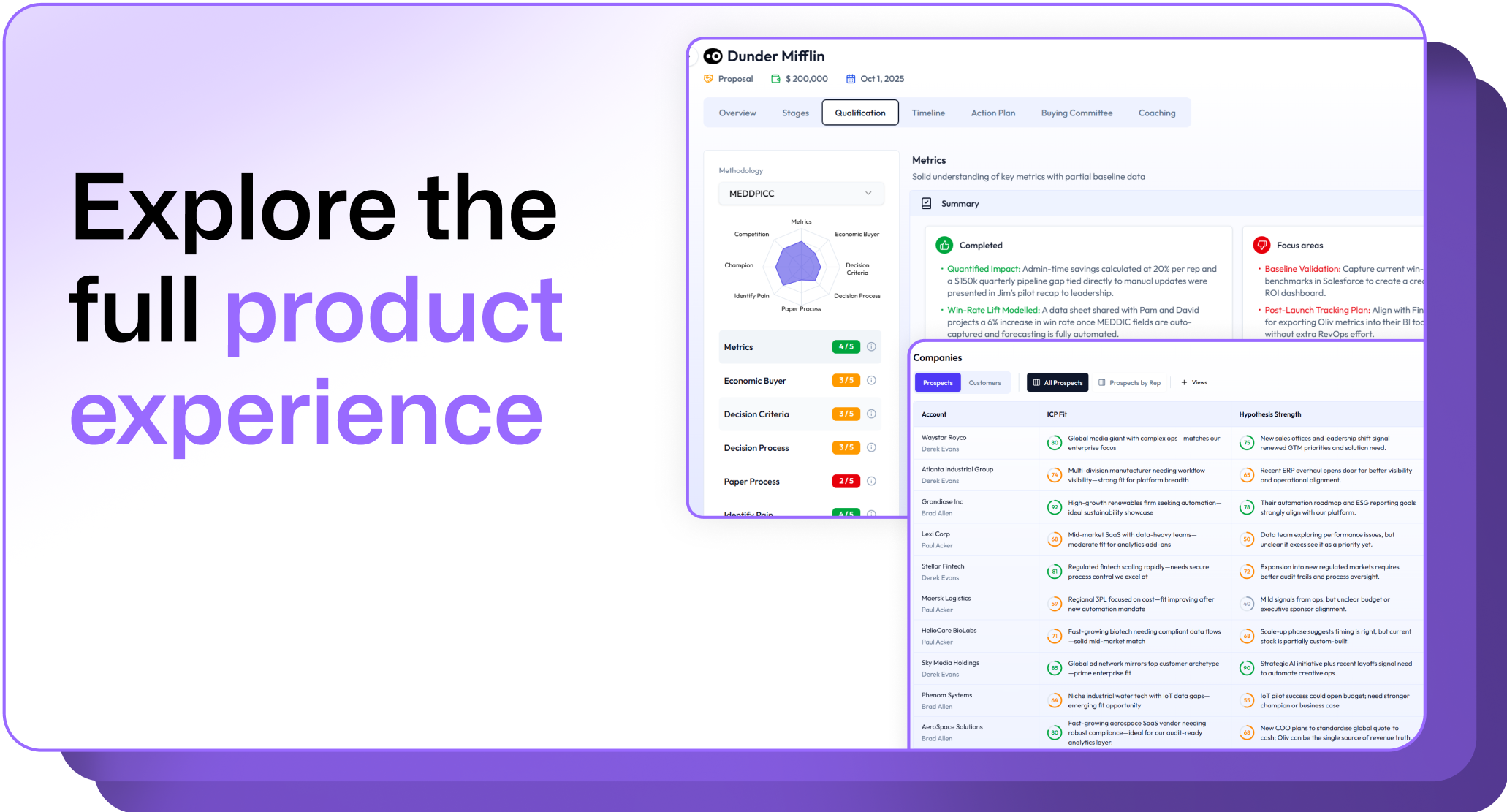
.avif)
.png)







_%20True%20Costs%2C%20Features%20%26%20Why%20Teams%20Pick%20Neither%20-%20visual%20selection.png)