Voice of Customer Software: The Complete B2B Buyer's Guide for 2026
Written by
Ishan Chhabra
Last Updated :
February 10, 2026
Skim in :
11
mins
In this article
Revenue teams love Oliv
Here’s why:
All your deal data unified (from 30+ tools and tabs).
Insights are delivered to you directly, no digging.
AI agents automate tasks for you.
Thank you! Your submission has been received!
Oops! Something went wrong while submitting the form.
Meet Oliv’s AI Agents
Hi! I’m, Deal Driver
I track deals, flag risks, send weekly pipeline updates and give sales managers full visibility into deal progress
Hi! I’m, CRM Manager
I maintain CRM hygiene by updating core, custom and qualification fields all without your team lifting a finger
Hi! I’m, Forecaster
I build accurate forecasts based on real deal movement and tell you which deals to pull in to hit your number
Hi! I’m, Coach
I believe performance fuels revenue. I spot skill gaps, score calls and build coaching plans to help every rep level up
Hi! I’m, Prospector
I dig into target accounts to surface the right contacts, tailor and time outreach so you always strike when it counts
Hi! I’m, Pipeline tracker
I call reps to get deal updates, and deliver a real-time, CRM-synced roll-up view of deal progress
Hi! I’m, Analyst
I answer complex pipeline questions, uncover deal patterns, and build reports that guide strategic decisions
TL;DR
Survey-first VoC captures under 10% of B2B customer signals; the real voice lives in sales conversations, emails, and Slack.
The VoC market ($3-7B+ by 2032) is splitting into three categories: survey platforms, feedback analytics, and conversation intelligence.
Gong's keyword-based Smart Trackers miss contextual intent; Oliv AI's fine-tuned LLMs deliver deal-level intelligence in 5 minutes.
Stacking Gong + Clari + Medallia costs $500+/user/month with persistent data silos; Oliv starts at $19/user/month.
Most B2B teams are stuck at VoC maturity Level 1-2; jumping to Level 4 (autonomous intelligence) no longer requires 18-month programs.
Gainsight and ChurnZero shine for large CS-ops teams but over-engineer for lean organizations needing fast, signal-first intelligence.
Q1. What Is Voice of Customer Software and Why Is the Definition Changing in 2026? [toc=VoC Software Redefined]
Voice of Customer (VoC) software refers to any platform that helps organizations systematically capture, analyze, and act on customer feedback. For over a decade, this category was synonymous with surveys, NPS scores, and CSAT dashboards - tools built to collect structured feedback at scale. The VoC software market is projected to reach $3-7B+ by 2032-2033, fueled by rapid AI adoption and the enterprise demand for real-time customer intelligence.
⚠️ The B2B Survey Problem
That survey-first model still works for B2C - a hotel chain or airline can learn a lot from post-stay NPS. But for B2B revenue teams, it's structurally inadequate. Survey response rates in B2B hover between 5-15%, producing retrospective data riddled with self-reported bias. Each B2B account involves 6-10 stakeholders navigating a months-long deal cycle - a 1-5 star rating cannot capture that complexity. Surveys tell you what customers say; they miss what customers reveal in live interactions, objection handling, and buying-committee dynamics.
✅ The AI-Era Redefinition
In 2026, VoC is being redefined by three converging forces: real-time sentiment analysis powered by NLP, predictive churn signals drawn from unstructured data, and conversation intelligence that mines sales and CS calls at scale. The new frontier isn't sending more surveys - it's capturing VoC from every touchpoint: recorded meetings, email threads, Slack channels, support tickets, and even messaging platforms like Telegram. Meeting recording itself is now a commodity offered free by Zoom, Teams, and Google Meet. The real value lies in transforming that raw data into deal-level intelligence.
The Agentic Layer: From Analysis to Autonomous Action
Horizontal timeline illustrating how VoC software evolved from traditional survey platforms through the B2B survey problem to AI-era redefinition, 360-degree account views, and autonomous agentic actions.
This is where the category's evolution becomes most significant. Platforms like Oliv AI don't just analyze VoC data - they act on it autonomously. Oliv's AI Data Platform stitches data from calls, emails, Slack, and the web into a 360° account view using 100+ fine-tuned LLMs grounded in each organization's specific data. Its specialized AI agents update CRM fields, flag churn risks, generate QBR prep docs, and deliver pipeline intelligence directly to Slack or email - without anyone opening a dashboard.
"Your HubSpot data is just the tip of the iceberg. The reality of any customer is hidden across recorded meetings, emails, phone calls, and anything on the web." - Ishan Chhabra, CEO, Oliv AI
As one CS leader noted about the broader VoC challenge:
The definition of VoC software is no longer "tools that send surveys." It's platforms that hear the customer across every interaction and convert that signal into revenue action through AI-Native Revenue Orchestration.
Q2. What Are the Best Voice of Customer Tools in 2026? (Top 12 Reviewed by Category) [toc=Top 12 VoC Tools]
Most VoC listicles treat every tool as interchangeable. In reality, the category spans three distinct layers - and the layer most critical to B2B revenue teams is the one every other list ignores.
Category A: Traditional Survey & CX Platforms
These tools excel at structured feedback collection - surveys, NPS, CSAT - and are best suited for B2C or large-scale experience management programs.
Traditional Survey & CX Platforms Comparison
Tool
Best For
Key Strength
⚠️ Limitation
Pricing
Medallia
Enterprise CX programs
AI-powered text analytics, omnichannel feedback
Expensive; long implementation cycles
Custom (enterprise contracts)
Qualtrics
Research-driven organizations
Advanced survey logic, academic-grade analytics
Steep learning curve; B2C-oriented defaults
Custom ($1,500+/yr for basic tiers)
InMoment
Mid-market CX teams
Strong NLP sentiment analysis; integrated case management
These platforms focus on analyzing unstructured text feedback - reviews, support tickets, open-ended survey responses - using NLP and machine learning.
AI-Powered Feedback Analytics Platforms
Tool
Best For
Key Strength
⚠️ Limitation
Chattermill
E-commerce & product teams
Unified analytics across reviews, surveys, and support
Primarily B2C use cases
SentiSum
Support-ticket intelligence
Auto-tags and routes tickets by topic/sentiment
Narrower data sources than full-suite platforms
CustomerGauge
B2B account-level NPS
Revenue attribution tied to NPS; account-level views
This is the category no other VoC listicle includes - and the one most relevant to B2B revenue teams. These tools capture VoC directly from sales calls, CS meetings, and deal interactions.
Conversation Intelligence & Revenue VoC Platforms
Tool
Best For
Key Strength
⚠️ Limitation
Oliv AI
B2B teams wanting autonomous VoC intelligence
✅ Stitches data from calls, emails, Slack, Telegram, web into 360° account view; specialized AI agents update CRM, flag churn, generate forecasts autonomously; 5-min setup
Newer platform; smaller brand footprint than enterprise incumbents
Gong
Sales teams wanting call recording & coaching
Market leader in CI; robust call library and coaching tools
Keyword-based Smart Trackers; meeting-level only; high cost ($160-$270/user/mo)
Chorus (ZoomInfo)
Budget CI alongside ZoomInfo data
Affordable add-on ($40/seat) bundled with ZoomInfo intent data
Innovation stalled post-acquisition; limited AI depth
Clari
Forecasting-focused revenue teams
Strong roll-up forecasting and pipeline analytics
CI product ("Copilot") is a weaker bolt-on; manual forecasting process
The takeaway: if your VoC strategy stops at Category A, you're hearing less than 10% of what your B2B customers are actually telling you. Modern revenue intelligence platforms capture the conversations that matter most.
Q3. Medallia vs Qualtrics: Which Enterprise VoC Platform Should You Choose? [toc=Medallia vs Qualtrics]
Medallia and Qualtrics are the two names most buyers encounter first when evaluating enterprise VoC software. Both are powerful platforms - but they serve different strengths, and neither was designed primarily for B2B revenue workflows.
Medallia excels in real-time, operational CX programs - if you need to trigger a frontline action the moment a detractor submits feedback at a hotel front desk, Medallia's speed-to-action is unmatched. Its signal processing handles massive data volumes from IoT, SMS, social, and in-app channels simultaneously.
✅ Where Qualtrics Wins
Qualtrics is the stronger choice for organizations that need sophisticated survey logic, conjoint analysis, or stat-heavy research methodologies. Its Stats iQ module makes it the default choice for product teams running complex Voice-of-Customer studies. The employee experience (EX) module is also best-in-class.
❌ Where Both Fall Short for B2B Revenue Teams
Neither platform captures VoC from the source that matters most in B2B: live sales conversations, deal-level interactions, and multi-threaded buying committee dynamics. Both rely on customers proactively providing feedback (surveys), rather than extracting insights from the conversations already happening across calls, emails, and Slack.
For B2B revenue teams that need deal-level VoC intelligence beyond surveys, platforms like Oliv AI complement or replace traditional CX suites by capturing and acting on conversation data autonomously - without waiting for a customer to fill out a form. Learn more about the future of revenue intelligence and how it differs from traditional VoC approaches.
Q4. What Is the VoC Source 90% of B2B Teams Still Miss and Why Does It Matter More Than NPS? [toc=The Missed 90%]
Every week, your sales and CS teams generate hundreds of hours of customer conversations - discovery calls, demos, QBRs, onboarding sessions, renewal negotiations, email threads, Slack messages. This is the richest, most unfiltered VoC data your organization produces. And almost no one is analyzing it.
Traditional VoC programs capture structured feedback: NPS surveys, CSAT forms, support ticket ratings. But these represent only a fraction of the signal. The real voice of your customer lives in what they say when they're not being surveyed - the objections they raise on a discovery call, the competitor they mention in a QBR, the frustration they express in a Slack thread about a stalled implementation.
Comparison table contrasting survey-centric VoC tools measuring NPS and CSAT against revenue-linked conversation data capturing churn risk, competitive mentions, and expansion intent from sales interactions. (
❌ Why the Survey-Centric Model Fails B2B
Survey-first VoC was built for B2C environments - retail, hospitality, airlines - where NPS at scale is a viable proxy for customer health. In B2B, the dynamics are fundamentally different:
Deals involve 6-10 stakeholders across multi-threaded buying committees
Sales cycles span 60-180 days with nuanced objections no survey captures
CRM data is unreliable - reps neglect manual entry, creating the "dirty data" crisis
"Human Tendency" bias: in pipeline reviews, reps show managers only what they want them to see
Stacking legacy tools doesn't solve this. Gong records calls but relies on keyword-based Smart Trackers that flag "budget" whether a prospect is discussing deal financing or a holiday trip. Clari forecasts from rep-submitted data that's inherently biased. Together, they cost ~$500/user/month - and managers still spend evenings manually reviewing recordings.
✅ Revenue-Linked VoC: The New Standard
Instead of NPS and CSAT, modern B2B VoC should measure:
📊 Churn risk signals extracted from CS call sentiment
📊 Competitive mention velocity - how often and in what context rivals appear
📊 Feature request clustering by deal stage and segment
📊 Expansion intent signals surfaced from QBR and MBR recordings
📊 Forecast accuracy correlated to conversation sentiment, not rep self-reports
How Oliv AI Operationalizes the Missing 90%
Oliv's AI Data Platform captures data from calls, emails, Slack, Telegram, and the web, then uses 100+ fine-tuned models to extract specific signals - churn risk, expansion intent, competitor evaluation - grounded in each organization's data. The Analyst Agent lets leaders ask "Why are we losing FinTech deals to Competitor X?" in plain English. Unlike keyword-based trackers, Oliv's contextual reasoning distinguishes a prospect mentioning a competitor from actively evaluating them.
Think of it this way: Conversational Intelligence (Gong) is a dashcam - it records everything so you can review a crash later. Revenue Intelligence (Clari) is a GPS with traffic alerts - it shows the route and delays. AI-Native Revenue Orchestration (Oliv AI) is a self-driving car - it doesn't just map the route; it turns the wheel, manages speed, and gets you to your destination.
Q5. How Does AI-Powered Voice of Customer Analysis Work in Practice? [toc=AI-Powered VoC Analysis]
Understanding VoC technology in 2026 means understanding four generations of evolution. Modern AI-powered VoC goes well beyond simple recording - it applies NLP to unstructured speech and text, detects urgency and buying intent (not just positive/negative sentiment), clusters feature requests by deal stage, and predicts churn from conversation patterns. The evolution tracks four clear generations:
Infographic showing VoC technology evolution across four generations: documentation era (2015-2022), keyword-based forecasting, workflow automation, and autonomous AI agent execution for B2B revenue teams.
Gen 1 (2015-2022): Documentation - basic call recording (Gong, Chorus)
Gen 2 (2022-2025): Forecasting added, but limited by keyword tracking
Gen 3: Workflow automation - often resulting in noisy dashboards
Gen 4 (2025+): AI agents that autonomously reason through data and execute tasks
❌ Where Gen 1-2 Tools Hit a Ceiling
Gong's Smart Trackers use V1 machine learning built on keyword matching. A tracker might flag "budget" when a prospect is discussing a vacation budget - not deal financing. Meeting intelligence (recording and transcription) is now a commodity offered free by Zoom, Teams, and Google Meet. Most legacy tools understand activity at the meeting level but fail to read context across emails, Slack messages, and web interactions. The result: data overload without actionable intelligence.
✅ The Three-Layer Modern Architecture
The shift from "meeting intelligence" to "deal intelligence" follows a three-layer architecture:
Three-Layer Modern VoC Architecture
Layer
Function
Status in 2026
1. Baseline
Recording & transcription
✅ Commodity - should be free
2. Intelligence
Contextual reasoning across all touchpoints; stitching interactions into a 360° deal narrative
⚠️ Emerging - few platforms do this well
3. Agentic
AI autonomously executes CRM updates, forecasts, coaching, and alerts
⭐ Frontier - defines Gen 4
How Oliv AI Maps to Each Layer
We built Oliv's architecture around this exact framework. At the Baseline layer, Oliv provides free recording and transcription. At the Intelligence layer, 100+ fine-tuned models - grounded in each organization's specific data - extract signals across calls, emails, Slack, Telegram, and web. At the Agentic layer, specialized agents (CRM Manager, Forecaster, Deal Driver, Coach, Voice Agent, Analyst, Handoff Hank) perform specific jobs autonomously. Processing completes in 5 minutes versus Gong's typical 20-30 minute delay. Oliv's AI-based object association resolves duplicate CRM records that confuse rule-based systems.
Think of it this way: traditional sales ops is like managing a warehouse with a paper logbook. Oliv is an automated fulfillment system - the CRM Manager scans every item, the Forecaster predicts stockouts, and the Deal Driver alerts you if a shipment is stuck.
Q6. Where Do Incumbents Shine and Where Do They Over-Engineer? (Gainsight, ChurnZero & the CS Platform Question) [toc=CS Platform Trade-offs]
Gainsight, ChurnZero, and Totango are powerful CS platforms built for large, operations-heavy teams with dedicated admins. They dominate customer success workflow management - health scoring, playbook automation, renewal tracking, journey orchestration - and for enterprise CS orgs with 50+ CSMs and months of implementation budget, they deliver genuine value.
These platforms are configuration- and dashboard-first. Implementation timelines of 3-6 months are standard. They require custom data modeling, ongoing admin maintenance, and significant user adoption effort. They're optimized for managing CS workflows - not for surfacing VoC insight fast.
"Consider the costs and implementation time. Implementation took us a good 6 months, and now we cannot consider switching because of how entrenched we are with it, even though it is obscenely expensive." - Verified User, Telecommunications - G2 Verified Review
"Setting up our ChurnZero instance has involved a significant amount of manual administration. The data transfer from our CRM to Salesforce is not straightforward, which has forced us to create numerous workarounds." - Brandon O., Client Education Manager - G2 Verified Review
✅ What Lean CS Teams Actually Need
Modern, leaner CS teams want signals, not complexity. They want to know which accounts are at risk, what feature requests are clustering, and where expansion opportunities hide - without opening a dashboard or running a report. The shift is from "workflow management" to "intelligence delivery."
How Oliv Fits the Modern CS Stack
Oliv doesn't compete with Gainsight on workflow depth - and doesn't try to. Instead, we deliver AI-led intelligence with instant time-to-value. The CRM Manager keeps account data spotless without manual entry. The Deal Driver flags at-risk accounts daily. The Analyst Agent answers "Which accounts haven't had meaningful engagement in 30 days?" in plain English. Setup takes days, not months - designed for teams that want insight delivery, not another platform to configure.
Buying an enterprise CS platform when you need VoC intelligence is like buying a commercial gym when you need a personal trainer. The equipment is impressive, but your lean team still has to figure out how to use it.
Q7. The B2B VoC Maturity Model: Where Does Your Team Stand? [toc=VoC Maturity Model]
Most B2B teams believe they have a VoC program. In reality, the majority are stuck at Level 1 or 2 of a four-stage maturity model - capturing fragments of customer sentiment while missing the highest-signal data sources entirely.
Level 1: Reactive Surveys
NPS/CSAT surveys sent quarterly or post-deal
No closed-loop action process
Data siloed in a CX dashboard disconnected from the CRM
Insights reviewed monthly - if at all
Classic tools: Medallia, Qualtrics, SurveyMonkey
Level 2: Structured Multi-Channel Feedback
Surveys + support ticket analysis + review mining
Some closed-loop follow-up on detractors
Basic sentiment tagging on open-text responses
⚠️ The gap: Still no connection to pipeline, win/loss, or revenue outcomes
This is where Oliv AI operates - the Analyst Agent, Forecaster, and Deal Driver work across every touchpoint to deliver intelligence without anyone opening a dashboard. This represents AI-Native Revenue Orchestration at its finest.
📊 Quick Self-Assessment
If your team reviews VoC data monthly in a dashboard, you're Level 2. If your AI agents deliver churn risk alerts to Slack before your Monday pipeline call, you're Level 4. Most B2B teams reading this are somewhere in between - and the jump from Level 2 to Level 4 no longer requires an 18-month transformation program.
Q8. How Should B2B Teams Evaluate VoC Software and How Do You Get Started? [toc=Evaluation Framework]
Choosing VoC software for a B2B revenue team requires different criteria than selecting an enterprise CX suite. Here are six evaluation dimensions tuned specifically for revenue teams:
Six VoC Software Evaluation Criteria for B2B Teams
#
Criterion
What to Look For
1
Data source breadth
Does it capture VoC from conversations, not just surveys?
2
CRM integration depth
Does it update CRM objects autonomously - or just log notes?
3
AI reasoning quality
Contextual LLMs or keyword matching?
4
Time-to-value
⏰ Days or months?
5
Pricing transparency
💰 Modular or opaque?
6
Actionability
Proactive alerts or dashboard digging?
❌ Where Legacy Evaluation Fails
Teams often choose based on brand name or survey volume - criteria irrelevant for revenue teams. Configuration-heavy platforms shine for large CS-ops teams but over-engineer for lean organizations. Stacking Gong + Clari + Medallia creates 💸 $500+/user/month in costs and data silos everywhere.
Start with a pilot on one high-value use case - churn risk detection, forecast accuracy, or CRM hygiene. Prove ROI in 2-4 weeks, then expand. The key question: can you get your first insight without opening a single dashboard?
How Oliv AI Scores on Each Criterion
Implementation comparison showing Oliv AI's three-phase deployment path with 5-minute baseline configuration, 1-2 day core deployment, and 2-4 week full customization versus Gong's lengthy timeline.
Oliv's implementation follows a three-phase path: 5-minute baseline config → 1-2 day core deployment → 2-4 week full customization. No mandatory platform fees, modular agent pricing, and a full open export policy that prevents vendor lock-in. Oliv is SOC 2 Type II certified, GDPR and CCPA compliant, and offers free data migration from Gong. Compare: 5-minute setup vs. Gong's 8-24 week implementation timeline. Over three years, a 100-user team on Gong costs $789,300 versus $68,400 on Oliv - a 91% lower TCO that can help you reduce sales tech stack costs significantly.
"Oliv fixes the data as it happens and drops a forecast I can actually bank on." - Darius Kim, Head of RevOps, Driftloop
Q9. Gong vs Oliv AI: How Does the Category Leader Compare to an AI-Native Challenger? [toc=Gong vs Oliv AI]
Gong is the established "gold standard" for conversation intelligence - the tool most B2B teams already own or are evaluating when they think about capturing VoC from sales calls. But as VoC requirements evolve from call recording to deal-level intelligence and autonomous action, the question shifts from "Should we buy Gong?" to "Is Gong enough for how we need to hear the customer's voice?"
❌ Where Gong Hits Its Ceiling
Gong's architecture was built in the pre-generative AI era. Its Smart Trackers rely on V1 machine learning (keyword matching) - a tracker might flag "budget" when a prospect is discussing a vacation budget, not deal financing. Key limitations:
Meeting-level focus: Gong records and analyzes individual calls but doesn't stitch the deal narrative across emails, Slack, or web interactions
Processing delay: 20-30 minutes before insights are available
💸 Cost: Mandatory annual platform fees ($5K-$50K); bundling Engage and Forecast drives per-user costs to $250-$270/month
Manual extraction: Users must open dashboards and click through multiple screens to find relevant insights
Oliv AI was built from the ground up on generative AI - fine-tuned LLMs that understand context, not keywords. The contrast is structural:
Gong vs Oliv AI: Head-to-Head Comparison
Dimension
Gong
Oliv AI
AI approach
Keyword-based Smart Trackers
100+ fine-tuned LLMs, context-aware
Intelligence scope
Meeting-level
Deal-level (calls + emails + Slack + web)
Processing time
⏰ 20-30 minutes
⏰ ~5 minutes
CRM updates
Logs notes
Updates CRM objects autonomously
Implementation
8-24 weeks
5 minutes (baseline); 2-4 weeks (full)
Export policy
Restricted
Full open export
How Oliv Delivers VoC Intelligence
We designed Oliv to replace the entire manual workflow. The CRM Manager keeps qualification fields spotless. The Deal Driver flags at-risk accounts daily. The Forecaster Agent generates unbiased weekly roll-ups. The Voice Agent calls reps nightly for a five-minute debrief, capturing context from in-person conversations that no recorder catches. Over three years, a 100-user team on Gong costs $789,300 versus $68,400 on Oliv - a 91% lower TCO.
"Essentially Gainsight allows you to set CTAs but you can do this from a main CRM. Since Gainsight is a CS tool, sales teams won't use it and you end up adding additional system to work out of." - Verified User, Computer Software - G2 Verified Review
Feature comparison table evaluating Gong's pre-generative AI keyword matching against Oliv AI's fine-tuned LLMs, deal-level focus, real-time processing, and automated extraction for voice of customer.
Conversational Intelligence (Gong) is a dashcam - it records everything so you can review a crash later. AI-Native Revenue Orchestration (Oliv AI) is a self-driving car - it actually turns the wheel.
VoC software refers to platforms that systematically capture, analyze, and act on customer feedback across multiple channels - surveys, reviews, social media, support tickets, and increasingly, live conversations. In B2B, VoC is expanding beyond structured surveys to include unstructured data from sales calls, CS meetings, and email threads.
What's the difference between VoC, NPS, and CSAT?
VoC vs NPS vs CSAT: Key Differences
Metric
What It Measures
Timing
Best For
VoC
Holistic customer sentiment across all channels
Ongoing
Strategic CX and revenue decisions
NPS
Long-term loyalty ("How likely are you to recommend us?")
Quarterly/annually
Benchmarking brand health
CSAT
Immediate satisfaction with a specific interaction
Post-interaction
Identifying friction points
NPS and CSAT are metrics within a VoC program - not substitutes for one.
How do you capture VoC from sales calls?
Conversation intelligence platforms record and transcribe sales calls, then apply NLP and sentiment analysis to extract themes, objections, competitor mentions, and buying signals. Legacy tools like Gong and Chorus provide meeting-level transcription. AI-native platforms like Oliv AI go further - stitching call data with emails, Slack, and web activity into a deal-level narrative.
What is conversation intelligence?
Conversation intelligence software uses AI and NLP to analyze speech and text interactions - surfacing coaching insights, deal risks, and customer sentiment from recorded conversations. It goes beyond basic call recording by detecting tone, pacing, buyer intent, and objection patterns.
CI tools: $250-$270/user/month bundled (Gong); ~$40/seat as add-on (Chorus)
AI-native platforms: Starting at $19/user/month (Oliv AI)
What is the best VoC tool for B2B revenue teams?
No single tool fits every team. Traditional survey platforms (Medallia, Qualtrics) suit enterprise CX programs. Conversation intelligence tools (Gong, Chorus) work for teams focused on call analysis. For B2B revenue teams that need VoC from every touchpoint - captured, analyzed, and acted on autonomously - AI-native platforms like Oliv AI offer the broadest signal coverage at the lowest TCO.
Q1. What Is Voice of Customer Software and Why Is the Definition Changing in 2026? [toc=VoC Software Redefined]
Voice of Customer (VoC) software refers to any platform that helps organizations systematically capture, analyze, and act on customer feedback. For over a decade, this category was synonymous with surveys, NPS scores, and CSAT dashboards - tools built to collect structured feedback at scale. The VoC software market is projected to reach $3-7B+ by 2032-2033, fueled by rapid AI adoption and the enterprise demand for real-time customer intelligence.
⚠️ The B2B Survey Problem
That survey-first model still works for B2C - a hotel chain or airline can learn a lot from post-stay NPS. But for B2B revenue teams, it's structurally inadequate. Survey response rates in B2B hover between 5-15%, producing retrospective data riddled with self-reported bias. Each B2B account involves 6-10 stakeholders navigating a months-long deal cycle - a 1-5 star rating cannot capture that complexity. Surveys tell you what customers say; they miss what customers reveal in live interactions, objection handling, and buying-committee dynamics.
✅ The AI-Era Redefinition
In 2026, VoC is being redefined by three converging forces: real-time sentiment analysis powered by NLP, predictive churn signals drawn from unstructured data, and conversation intelligence that mines sales and CS calls at scale. The new frontier isn't sending more surveys - it's capturing VoC from every touchpoint: recorded meetings, email threads, Slack channels, support tickets, and even messaging platforms like Telegram. Meeting recording itself is now a commodity offered free by Zoom, Teams, and Google Meet. The real value lies in transforming that raw data into deal-level intelligence.
The Agentic Layer: From Analysis to Autonomous Action
Horizontal timeline illustrating how VoC software evolved from traditional survey platforms through the B2B survey problem to AI-era redefinition, 360-degree account views, and autonomous agentic actions.
This is where the category's evolution becomes most significant. Platforms like Oliv AI don't just analyze VoC data - they act on it autonomously. Oliv's AI Data Platform stitches data from calls, emails, Slack, and the web into a 360° account view using 100+ fine-tuned LLMs grounded in each organization's specific data. Its specialized AI agents update CRM fields, flag churn risks, generate QBR prep docs, and deliver pipeline intelligence directly to Slack or email - without anyone opening a dashboard.
"Your HubSpot data is just the tip of the iceberg. The reality of any customer is hidden across recorded meetings, emails, phone calls, and anything on the web." - Ishan Chhabra, CEO, Oliv AI
As one CS leader noted about the broader VoC challenge:
The definition of VoC software is no longer "tools that send surveys." It's platforms that hear the customer across every interaction and convert that signal into revenue action through AI-Native Revenue Orchestration.
Q2. What Are the Best Voice of Customer Tools in 2026? (Top 12 Reviewed by Category) [toc=Top 12 VoC Tools]
Most VoC listicles treat every tool as interchangeable. In reality, the category spans three distinct layers - and the layer most critical to B2B revenue teams is the one every other list ignores.
Category A: Traditional Survey & CX Platforms
These tools excel at structured feedback collection - surveys, NPS, CSAT - and are best suited for B2C or large-scale experience management programs.
Traditional Survey & CX Platforms Comparison
Tool
Best For
Key Strength
⚠️ Limitation
Pricing
Medallia
Enterprise CX programs
AI-powered text analytics, omnichannel feedback
Expensive; long implementation cycles
Custom (enterprise contracts)
Qualtrics
Research-driven organizations
Advanced survey logic, academic-grade analytics
Steep learning curve; B2C-oriented defaults
Custom ($1,500+/yr for basic tiers)
InMoment
Mid-market CX teams
Strong NLP sentiment analysis; integrated case management
These platforms focus on analyzing unstructured text feedback - reviews, support tickets, open-ended survey responses - using NLP and machine learning.
AI-Powered Feedback Analytics Platforms
Tool
Best For
Key Strength
⚠️ Limitation
Chattermill
E-commerce & product teams
Unified analytics across reviews, surveys, and support
Primarily B2C use cases
SentiSum
Support-ticket intelligence
Auto-tags and routes tickets by topic/sentiment
Narrower data sources than full-suite platforms
CustomerGauge
B2B account-level NPS
Revenue attribution tied to NPS; account-level views
This is the category no other VoC listicle includes - and the one most relevant to B2B revenue teams. These tools capture VoC directly from sales calls, CS meetings, and deal interactions.
Conversation Intelligence & Revenue VoC Platforms
Tool
Best For
Key Strength
⚠️ Limitation
Oliv AI
B2B teams wanting autonomous VoC intelligence
✅ Stitches data from calls, emails, Slack, Telegram, web into 360° account view; specialized AI agents update CRM, flag churn, generate forecasts autonomously; 5-min setup
Newer platform; smaller brand footprint than enterprise incumbents
Gong
Sales teams wanting call recording & coaching
Market leader in CI; robust call library and coaching tools
Keyword-based Smart Trackers; meeting-level only; high cost ($160-$270/user/mo)
Chorus (ZoomInfo)
Budget CI alongside ZoomInfo data
Affordable add-on ($40/seat) bundled with ZoomInfo intent data
Innovation stalled post-acquisition; limited AI depth
Clari
Forecasting-focused revenue teams
Strong roll-up forecasting and pipeline analytics
CI product ("Copilot") is a weaker bolt-on; manual forecasting process
The takeaway: if your VoC strategy stops at Category A, you're hearing less than 10% of what your B2B customers are actually telling you. Modern revenue intelligence platforms capture the conversations that matter most.
Q3. Medallia vs Qualtrics: Which Enterprise VoC Platform Should You Choose? [toc=Medallia vs Qualtrics]
Medallia and Qualtrics are the two names most buyers encounter first when evaluating enterprise VoC software. Both are powerful platforms - but they serve different strengths, and neither was designed primarily for B2B revenue workflows.
Medallia excels in real-time, operational CX programs - if you need to trigger a frontline action the moment a detractor submits feedback at a hotel front desk, Medallia's speed-to-action is unmatched. Its signal processing handles massive data volumes from IoT, SMS, social, and in-app channels simultaneously.
✅ Where Qualtrics Wins
Qualtrics is the stronger choice for organizations that need sophisticated survey logic, conjoint analysis, or stat-heavy research methodologies. Its Stats iQ module makes it the default choice for product teams running complex Voice-of-Customer studies. The employee experience (EX) module is also best-in-class.
❌ Where Both Fall Short for B2B Revenue Teams
Neither platform captures VoC from the source that matters most in B2B: live sales conversations, deal-level interactions, and multi-threaded buying committee dynamics. Both rely on customers proactively providing feedback (surveys), rather than extracting insights from the conversations already happening across calls, emails, and Slack.
For B2B revenue teams that need deal-level VoC intelligence beyond surveys, platforms like Oliv AI complement or replace traditional CX suites by capturing and acting on conversation data autonomously - without waiting for a customer to fill out a form. Learn more about the future of revenue intelligence and how it differs from traditional VoC approaches.
Q4. What Is the VoC Source 90% of B2B Teams Still Miss and Why Does It Matter More Than NPS? [toc=The Missed 90%]
Every week, your sales and CS teams generate hundreds of hours of customer conversations - discovery calls, demos, QBRs, onboarding sessions, renewal negotiations, email threads, Slack messages. This is the richest, most unfiltered VoC data your organization produces. And almost no one is analyzing it.
Traditional VoC programs capture structured feedback: NPS surveys, CSAT forms, support ticket ratings. But these represent only a fraction of the signal. The real voice of your customer lives in what they say when they're not being surveyed - the objections they raise on a discovery call, the competitor they mention in a QBR, the frustration they express in a Slack thread about a stalled implementation.
Comparison table contrasting survey-centric VoC tools measuring NPS and CSAT against revenue-linked conversation data capturing churn risk, competitive mentions, and expansion intent from sales interactions. (
❌ Why the Survey-Centric Model Fails B2B
Survey-first VoC was built for B2C environments - retail, hospitality, airlines - where NPS at scale is a viable proxy for customer health. In B2B, the dynamics are fundamentally different:
Deals involve 6-10 stakeholders across multi-threaded buying committees
Sales cycles span 60-180 days with nuanced objections no survey captures
CRM data is unreliable - reps neglect manual entry, creating the "dirty data" crisis
"Human Tendency" bias: in pipeline reviews, reps show managers only what they want them to see
Stacking legacy tools doesn't solve this. Gong records calls but relies on keyword-based Smart Trackers that flag "budget" whether a prospect is discussing deal financing or a holiday trip. Clari forecasts from rep-submitted data that's inherently biased. Together, they cost ~$500/user/month - and managers still spend evenings manually reviewing recordings.
✅ Revenue-Linked VoC: The New Standard
Instead of NPS and CSAT, modern B2B VoC should measure:
📊 Churn risk signals extracted from CS call sentiment
📊 Competitive mention velocity - how often and in what context rivals appear
📊 Feature request clustering by deal stage and segment
📊 Expansion intent signals surfaced from QBR and MBR recordings
📊 Forecast accuracy correlated to conversation sentiment, not rep self-reports
How Oliv AI Operationalizes the Missing 90%
Oliv's AI Data Platform captures data from calls, emails, Slack, Telegram, and the web, then uses 100+ fine-tuned models to extract specific signals - churn risk, expansion intent, competitor evaluation - grounded in each organization's data. The Analyst Agent lets leaders ask "Why are we losing FinTech deals to Competitor X?" in plain English. Unlike keyword-based trackers, Oliv's contextual reasoning distinguishes a prospect mentioning a competitor from actively evaluating them.
Think of it this way: Conversational Intelligence (Gong) is a dashcam - it records everything so you can review a crash later. Revenue Intelligence (Clari) is a GPS with traffic alerts - it shows the route and delays. AI-Native Revenue Orchestration (Oliv AI) is a self-driving car - it doesn't just map the route; it turns the wheel, manages speed, and gets you to your destination.
Q5. How Does AI-Powered Voice of Customer Analysis Work in Practice? [toc=AI-Powered VoC Analysis]
Understanding VoC technology in 2026 means understanding four generations of evolution. Modern AI-powered VoC goes well beyond simple recording - it applies NLP to unstructured speech and text, detects urgency and buying intent (not just positive/negative sentiment), clusters feature requests by deal stage, and predicts churn from conversation patterns. The evolution tracks four clear generations:
Infographic showing VoC technology evolution across four generations: documentation era (2015-2022), keyword-based forecasting, workflow automation, and autonomous AI agent execution for B2B revenue teams.
Gen 1 (2015-2022): Documentation - basic call recording (Gong, Chorus)
Gen 2 (2022-2025): Forecasting added, but limited by keyword tracking
Gen 3: Workflow automation - often resulting in noisy dashboards
Gen 4 (2025+): AI agents that autonomously reason through data and execute tasks
❌ Where Gen 1-2 Tools Hit a Ceiling
Gong's Smart Trackers use V1 machine learning built on keyword matching. A tracker might flag "budget" when a prospect is discussing a vacation budget - not deal financing. Meeting intelligence (recording and transcription) is now a commodity offered free by Zoom, Teams, and Google Meet. Most legacy tools understand activity at the meeting level but fail to read context across emails, Slack messages, and web interactions. The result: data overload without actionable intelligence.
✅ The Three-Layer Modern Architecture
The shift from "meeting intelligence" to "deal intelligence" follows a three-layer architecture:
Three-Layer Modern VoC Architecture
Layer
Function
Status in 2026
1. Baseline
Recording & transcription
✅ Commodity - should be free
2. Intelligence
Contextual reasoning across all touchpoints; stitching interactions into a 360° deal narrative
⚠️ Emerging - few platforms do this well
3. Agentic
AI autonomously executes CRM updates, forecasts, coaching, and alerts
⭐ Frontier - defines Gen 4
How Oliv AI Maps to Each Layer
We built Oliv's architecture around this exact framework. At the Baseline layer, Oliv provides free recording and transcription. At the Intelligence layer, 100+ fine-tuned models - grounded in each organization's specific data - extract signals across calls, emails, Slack, Telegram, and web. At the Agentic layer, specialized agents (CRM Manager, Forecaster, Deal Driver, Coach, Voice Agent, Analyst, Handoff Hank) perform specific jobs autonomously. Processing completes in 5 minutes versus Gong's typical 20-30 minute delay. Oliv's AI-based object association resolves duplicate CRM records that confuse rule-based systems.
Think of it this way: traditional sales ops is like managing a warehouse with a paper logbook. Oliv is an automated fulfillment system - the CRM Manager scans every item, the Forecaster predicts stockouts, and the Deal Driver alerts you if a shipment is stuck.
Q6. Where Do Incumbents Shine and Where Do They Over-Engineer? (Gainsight, ChurnZero & the CS Platform Question) [toc=CS Platform Trade-offs]
Gainsight, ChurnZero, and Totango are powerful CS platforms built for large, operations-heavy teams with dedicated admins. They dominate customer success workflow management - health scoring, playbook automation, renewal tracking, journey orchestration - and for enterprise CS orgs with 50+ CSMs and months of implementation budget, they deliver genuine value.
These platforms are configuration- and dashboard-first. Implementation timelines of 3-6 months are standard. They require custom data modeling, ongoing admin maintenance, and significant user adoption effort. They're optimized for managing CS workflows - not for surfacing VoC insight fast.
"Consider the costs and implementation time. Implementation took us a good 6 months, and now we cannot consider switching because of how entrenched we are with it, even though it is obscenely expensive." - Verified User, Telecommunications - G2 Verified Review
"Setting up our ChurnZero instance has involved a significant amount of manual administration. The data transfer from our CRM to Salesforce is not straightforward, which has forced us to create numerous workarounds." - Brandon O., Client Education Manager - G2 Verified Review
✅ What Lean CS Teams Actually Need
Modern, leaner CS teams want signals, not complexity. They want to know which accounts are at risk, what feature requests are clustering, and where expansion opportunities hide - without opening a dashboard or running a report. The shift is from "workflow management" to "intelligence delivery."
How Oliv Fits the Modern CS Stack
Oliv doesn't compete with Gainsight on workflow depth - and doesn't try to. Instead, we deliver AI-led intelligence with instant time-to-value. The CRM Manager keeps account data spotless without manual entry. The Deal Driver flags at-risk accounts daily. The Analyst Agent answers "Which accounts haven't had meaningful engagement in 30 days?" in plain English. Setup takes days, not months - designed for teams that want insight delivery, not another platform to configure.
Buying an enterprise CS platform when you need VoC intelligence is like buying a commercial gym when you need a personal trainer. The equipment is impressive, but your lean team still has to figure out how to use it.
Q7. The B2B VoC Maturity Model: Where Does Your Team Stand? [toc=VoC Maturity Model]
Most B2B teams believe they have a VoC program. In reality, the majority are stuck at Level 1 or 2 of a four-stage maturity model - capturing fragments of customer sentiment while missing the highest-signal data sources entirely.
Level 1: Reactive Surveys
NPS/CSAT surveys sent quarterly or post-deal
No closed-loop action process
Data siloed in a CX dashboard disconnected from the CRM
Insights reviewed monthly - if at all
Classic tools: Medallia, Qualtrics, SurveyMonkey
Level 2: Structured Multi-Channel Feedback
Surveys + support ticket analysis + review mining
Some closed-loop follow-up on detractors
Basic sentiment tagging on open-text responses
⚠️ The gap: Still no connection to pipeline, win/loss, or revenue outcomes
This is where Oliv AI operates - the Analyst Agent, Forecaster, and Deal Driver work across every touchpoint to deliver intelligence without anyone opening a dashboard. This represents AI-Native Revenue Orchestration at its finest.
📊 Quick Self-Assessment
If your team reviews VoC data monthly in a dashboard, you're Level 2. If your AI agents deliver churn risk alerts to Slack before your Monday pipeline call, you're Level 4. Most B2B teams reading this are somewhere in between - and the jump from Level 2 to Level 4 no longer requires an 18-month transformation program.
Q8. How Should B2B Teams Evaluate VoC Software and How Do You Get Started? [toc=Evaluation Framework]
Choosing VoC software for a B2B revenue team requires different criteria than selecting an enterprise CX suite. Here are six evaluation dimensions tuned specifically for revenue teams:
Six VoC Software Evaluation Criteria for B2B Teams
#
Criterion
What to Look For
1
Data source breadth
Does it capture VoC from conversations, not just surveys?
2
CRM integration depth
Does it update CRM objects autonomously - or just log notes?
3
AI reasoning quality
Contextual LLMs or keyword matching?
4
Time-to-value
⏰ Days or months?
5
Pricing transparency
💰 Modular or opaque?
6
Actionability
Proactive alerts or dashboard digging?
❌ Where Legacy Evaluation Fails
Teams often choose based on brand name or survey volume - criteria irrelevant for revenue teams. Configuration-heavy platforms shine for large CS-ops teams but over-engineer for lean organizations. Stacking Gong + Clari + Medallia creates 💸 $500+/user/month in costs and data silos everywhere.
Start with a pilot on one high-value use case - churn risk detection, forecast accuracy, or CRM hygiene. Prove ROI in 2-4 weeks, then expand. The key question: can you get your first insight without opening a single dashboard?
How Oliv AI Scores on Each Criterion
Implementation comparison showing Oliv AI's three-phase deployment path with 5-minute baseline configuration, 1-2 day core deployment, and 2-4 week full customization versus Gong's lengthy timeline.
Oliv's implementation follows a three-phase path: 5-minute baseline config → 1-2 day core deployment → 2-4 week full customization. No mandatory platform fees, modular agent pricing, and a full open export policy that prevents vendor lock-in. Oliv is SOC 2 Type II certified, GDPR and CCPA compliant, and offers free data migration from Gong. Compare: 5-minute setup vs. Gong's 8-24 week implementation timeline. Over three years, a 100-user team on Gong costs $789,300 versus $68,400 on Oliv - a 91% lower TCO that can help you reduce sales tech stack costs significantly.
"Oliv fixes the data as it happens and drops a forecast I can actually bank on." - Darius Kim, Head of RevOps, Driftloop
Q9. Gong vs Oliv AI: How Does the Category Leader Compare to an AI-Native Challenger? [toc=Gong vs Oliv AI]
Gong is the established "gold standard" for conversation intelligence - the tool most B2B teams already own or are evaluating when they think about capturing VoC from sales calls. But as VoC requirements evolve from call recording to deal-level intelligence and autonomous action, the question shifts from "Should we buy Gong?" to "Is Gong enough for how we need to hear the customer's voice?"
❌ Where Gong Hits Its Ceiling
Gong's architecture was built in the pre-generative AI era. Its Smart Trackers rely on V1 machine learning (keyword matching) - a tracker might flag "budget" when a prospect is discussing a vacation budget, not deal financing. Key limitations:
Meeting-level focus: Gong records and analyzes individual calls but doesn't stitch the deal narrative across emails, Slack, or web interactions
Processing delay: 20-30 minutes before insights are available
💸 Cost: Mandatory annual platform fees ($5K-$50K); bundling Engage and Forecast drives per-user costs to $250-$270/month
Manual extraction: Users must open dashboards and click through multiple screens to find relevant insights
Oliv AI was built from the ground up on generative AI - fine-tuned LLMs that understand context, not keywords. The contrast is structural:
Gong vs Oliv AI: Head-to-Head Comparison
Dimension
Gong
Oliv AI
AI approach
Keyword-based Smart Trackers
100+ fine-tuned LLMs, context-aware
Intelligence scope
Meeting-level
Deal-level (calls + emails + Slack + web)
Processing time
⏰ 20-30 minutes
⏰ ~5 minutes
CRM updates
Logs notes
Updates CRM objects autonomously
Implementation
8-24 weeks
5 minutes (baseline); 2-4 weeks (full)
Export policy
Restricted
Full open export
How Oliv Delivers VoC Intelligence
We designed Oliv to replace the entire manual workflow. The CRM Manager keeps qualification fields spotless. The Deal Driver flags at-risk accounts daily. The Forecaster Agent generates unbiased weekly roll-ups. The Voice Agent calls reps nightly for a five-minute debrief, capturing context from in-person conversations that no recorder catches. Over three years, a 100-user team on Gong costs $789,300 versus $68,400 on Oliv - a 91% lower TCO.
"Essentially Gainsight allows you to set CTAs but you can do this from a main CRM. Since Gainsight is a CS tool, sales teams won't use it and you end up adding additional system to work out of." - Verified User, Computer Software - G2 Verified Review
Feature comparison table evaluating Gong's pre-generative AI keyword matching against Oliv AI's fine-tuned LLMs, deal-level focus, real-time processing, and automated extraction for voice of customer.
Conversational Intelligence (Gong) is a dashcam - it records everything so you can review a crash later. AI-Native Revenue Orchestration (Oliv AI) is a self-driving car - it actually turns the wheel.
VoC software refers to platforms that systematically capture, analyze, and act on customer feedback across multiple channels - surveys, reviews, social media, support tickets, and increasingly, live conversations. In B2B, VoC is expanding beyond structured surveys to include unstructured data from sales calls, CS meetings, and email threads.
What's the difference between VoC, NPS, and CSAT?
VoC vs NPS vs CSAT: Key Differences
Metric
What It Measures
Timing
Best For
VoC
Holistic customer sentiment across all channels
Ongoing
Strategic CX and revenue decisions
NPS
Long-term loyalty ("How likely are you to recommend us?")
Quarterly/annually
Benchmarking brand health
CSAT
Immediate satisfaction with a specific interaction
Post-interaction
Identifying friction points
NPS and CSAT are metrics within a VoC program - not substitutes for one.
How do you capture VoC from sales calls?
Conversation intelligence platforms record and transcribe sales calls, then apply NLP and sentiment analysis to extract themes, objections, competitor mentions, and buying signals. Legacy tools like Gong and Chorus provide meeting-level transcription. AI-native platforms like Oliv AI go further - stitching call data with emails, Slack, and web activity into a deal-level narrative.
What is conversation intelligence?
Conversation intelligence software uses AI and NLP to analyze speech and text interactions - surfacing coaching insights, deal risks, and customer sentiment from recorded conversations. It goes beyond basic call recording by detecting tone, pacing, buyer intent, and objection patterns.
CI tools: $250-$270/user/month bundled (Gong); ~$40/seat as add-on (Chorus)
AI-native platforms: Starting at $19/user/month (Oliv AI)
What is the best VoC tool for B2B revenue teams?
No single tool fits every team. Traditional survey platforms (Medallia, Qualtrics) suit enterprise CX programs. Conversation intelligence tools (Gong, Chorus) work for teams focused on call analysis. For B2B revenue teams that need VoC from every touchpoint - captured, analyzed, and acted on autonomously - AI-native platforms like Oliv AI offer the broadest signal coverage at the lowest TCO.
Q1. What Is Voice of Customer Software and Why Is the Definition Changing in 2026? [toc=VoC Software Redefined]
Voice of Customer (VoC) software refers to any platform that helps organizations systematically capture, analyze, and act on customer feedback. For over a decade, this category was synonymous with surveys, NPS scores, and CSAT dashboards - tools built to collect structured feedback at scale. The VoC software market is projected to reach $3-7B+ by 2032-2033, fueled by rapid AI adoption and the enterprise demand for real-time customer intelligence.
⚠️ The B2B Survey Problem
That survey-first model still works for B2C - a hotel chain or airline can learn a lot from post-stay NPS. But for B2B revenue teams, it's structurally inadequate. Survey response rates in B2B hover between 5-15%, producing retrospective data riddled with self-reported bias. Each B2B account involves 6-10 stakeholders navigating a months-long deal cycle - a 1-5 star rating cannot capture that complexity. Surveys tell you what customers say; they miss what customers reveal in live interactions, objection handling, and buying-committee dynamics.
✅ The AI-Era Redefinition
In 2026, VoC is being redefined by three converging forces: real-time sentiment analysis powered by NLP, predictive churn signals drawn from unstructured data, and conversation intelligence that mines sales and CS calls at scale. The new frontier isn't sending more surveys - it's capturing VoC from every touchpoint: recorded meetings, email threads, Slack channels, support tickets, and even messaging platforms like Telegram. Meeting recording itself is now a commodity offered free by Zoom, Teams, and Google Meet. The real value lies in transforming that raw data into deal-level intelligence.
The Agentic Layer: From Analysis to Autonomous Action
Horizontal timeline illustrating how VoC software evolved from traditional survey platforms through the B2B survey problem to AI-era redefinition, 360-degree account views, and autonomous agentic actions.
This is where the category's evolution becomes most significant. Platforms like Oliv AI don't just analyze VoC data - they act on it autonomously. Oliv's AI Data Platform stitches data from calls, emails, Slack, and the web into a 360° account view using 100+ fine-tuned LLMs grounded in each organization's specific data. Its specialized AI agents update CRM fields, flag churn risks, generate QBR prep docs, and deliver pipeline intelligence directly to Slack or email - without anyone opening a dashboard.
"Your HubSpot data is just the tip of the iceberg. The reality of any customer is hidden across recorded meetings, emails, phone calls, and anything on the web." - Ishan Chhabra, CEO, Oliv AI
As one CS leader noted about the broader VoC challenge:
The definition of VoC software is no longer "tools that send surveys." It's platforms that hear the customer across every interaction and convert that signal into revenue action through AI-Native Revenue Orchestration.
Q2. What Are the Best Voice of Customer Tools in 2026? (Top 12 Reviewed by Category) [toc=Top 12 VoC Tools]
Most VoC listicles treat every tool as interchangeable. In reality, the category spans three distinct layers - and the layer most critical to B2B revenue teams is the one every other list ignores.
Category A: Traditional Survey & CX Platforms
These tools excel at structured feedback collection - surveys, NPS, CSAT - and are best suited for B2C or large-scale experience management programs.
Traditional Survey & CX Platforms Comparison
Tool
Best For
Key Strength
⚠️ Limitation
Pricing
Medallia
Enterprise CX programs
AI-powered text analytics, omnichannel feedback
Expensive; long implementation cycles
Custom (enterprise contracts)
Qualtrics
Research-driven organizations
Advanced survey logic, academic-grade analytics
Steep learning curve; B2C-oriented defaults
Custom ($1,500+/yr for basic tiers)
InMoment
Mid-market CX teams
Strong NLP sentiment analysis; integrated case management
These platforms focus on analyzing unstructured text feedback - reviews, support tickets, open-ended survey responses - using NLP and machine learning.
AI-Powered Feedback Analytics Platforms
Tool
Best For
Key Strength
⚠️ Limitation
Chattermill
E-commerce & product teams
Unified analytics across reviews, surveys, and support
Primarily B2C use cases
SentiSum
Support-ticket intelligence
Auto-tags and routes tickets by topic/sentiment
Narrower data sources than full-suite platforms
CustomerGauge
B2B account-level NPS
Revenue attribution tied to NPS; account-level views
This is the category no other VoC listicle includes - and the one most relevant to B2B revenue teams. These tools capture VoC directly from sales calls, CS meetings, and deal interactions.
Conversation Intelligence & Revenue VoC Platforms
Tool
Best For
Key Strength
⚠️ Limitation
Oliv AI
B2B teams wanting autonomous VoC intelligence
✅ Stitches data from calls, emails, Slack, Telegram, web into 360° account view; specialized AI agents update CRM, flag churn, generate forecasts autonomously; 5-min setup
Newer platform; smaller brand footprint than enterprise incumbents
Gong
Sales teams wanting call recording & coaching
Market leader in CI; robust call library and coaching tools
Keyword-based Smart Trackers; meeting-level only; high cost ($160-$270/user/mo)
Chorus (ZoomInfo)
Budget CI alongside ZoomInfo data
Affordable add-on ($40/seat) bundled with ZoomInfo intent data
Innovation stalled post-acquisition; limited AI depth
Clari
Forecasting-focused revenue teams
Strong roll-up forecasting and pipeline analytics
CI product ("Copilot") is a weaker bolt-on; manual forecasting process
The takeaway: if your VoC strategy stops at Category A, you're hearing less than 10% of what your B2B customers are actually telling you. Modern revenue intelligence platforms capture the conversations that matter most.
Q3. Medallia vs Qualtrics: Which Enterprise VoC Platform Should You Choose? [toc=Medallia vs Qualtrics]
Medallia and Qualtrics are the two names most buyers encounter first when evaluating enterprise VoC software. Both are powerful platforms - but they serve different strengths, and neither was designed primarily for B2B revenue workflows.
Medallia excels in real-time, operational CX programs - if you need to trigger a frontline action the moment a detractor submits feedback at a hotel front desk, Medallia's speed-to-action is unmatched. Its signal processing handles massive data volumes from IoT, SMS, social, and in-app channels simultaneously.
✅ Where Qualtrics Wins
Qualtrics is the stronger choice for organizations that need sophisticated survey logic, conjoint analysis, or stat-heavy research methodologies. Its Stats iQ module makes it the default choice for product teams running complex Voice-of-Customer studies. The employee experience (EX) module is also best-in-class.
❌ Where Both Fall Short for B2B Revenue Teams
Neither platform captures VoC from the source that matters most in B2B: live sales conversations, deal-level interactions, and multi-threaded buying committee dynamics. Both rely on customers proactively providing feedback (surveys), rather than extracting insights from the conversations already happening across calls, emails, and Slack.
For B2B revenue teams that need deal-level VoC intelligence beyond surveys, platforms like Oliv AI complement or replace traditional CX suites by capturing and acting on conversation data autonomously - without waiting for a customer to fill out a form. Learn more about the future of revenue intelligence and how it differs from traditional VoC approaches.
Q4. What Is the VoC Source 90% of B2B Teams Still Miss and Why Does It Matter More Than NPS? [toc=The Missed 90%]
Every week, your sales and CS teams generate hundreds of hours of customer conversations - discovery calls, demos, QBRs, onboarding sessions, renewal negotiations, email threads, Slack messages. This is the richest, most unfiltered VoC data your organization produces. And almost no one is analyzing it.
Traditional VoC programs capture structured feedback: NPS surveys, CSAT forms, support ticket ratings. But these represent only a fraction of the signal. The real voice of your customer lives in what they say when they're not being surveyed - the objections they raise on a discovery call, the competitor they mention in a QBR, the frustration they express in a Slack thread about a stalled implementation.
Comparison table contrasting survey-centric VoC tools measuring NPS and CSAT against revenue-linked conversation data capturing churn risk, competitive mentions, and expansion intent from sales interactions. (
❌ Why the Survey-Centric Model Fails B2B
Survey-first VoC was built for B2C environments - retail, hospitality, airlines - where NPS at scale is a viable proxy for customer health. In B2B, the dynamics are fundamentally different:
Deals involve 6-10 stakeholders across multi-threaded buying committees
Sales cycles span 60-180 days with nuanced objections no survey captures
CRM data is unreliable - reps neglect manual entry, creating the "dirty data" crisis
"Human Tendency" bias: in pipeline reviews, reps show managers only what they want them to see
Stacking legacy tools doesn't solve this. Gong records calls but relies on keyword-based Smart Trackers that flag "budget" whether a prospect is discussing deal financing or a holiday trip. Clari forecasts from rep-submitted data that's inherently biased. Together, they cost ~$500/user/month - and managers still spend evenings manually reviewing recordings.
✅ Revenue-Linked VoC: The New Standard
Instead of NPS and CSAT, modern B2B VoC should measure:
📊 Churn risk signals extracted from CS call sentiment
📊 Competitive mention velocity - how often and in what context rivals appear
📊 Feature request clustering by deal stage and segment
📊 Expansion intent signals surfaced from QBR and MBR recordings
📊 Forecast accuracy correlated to conversation sentiment, not rep self-reports
How Oliv AI Operationalizes the Missing 90%
Oliv's AI Data Platform captures data from calls, emails, Slack, Telegram, and the web, then uses 100+ fine-tuned models to extract specific signals - churn risk, expansion intent, competitor evaluation - grounded in each organization's data. The Analyst Agent lets leaders ask "Why are we losing FinTech deals to Competitor X?" in plain English. Unlike keyword-based trackers, Oliv's contextual reasoning distinguishes a prospect mentioning a competitor from actively evaluating them.
Think of it this way: Conversational Intelligence (Gong) is a dashcam - it records everything so you can review a crash later. Revenue Intelligence (Clari) is a GPS with traffic alerts - it shows the route and delays. AI-Native Revenue Orchestration (Oliv AI) is a self-driving car - it doesn't just map the route; it turns the wheel, manages speed, and gets you to your destination.
Q5. How Does AI-Powered Voice of Customer Analysis Work in Practice? [toc=AI-Powered VoC Analysis]
Understanding VoC technology in 2026 means understanding four generations of evolution. Modern AI-powered VoC goes well beyond simple recording - it applies NLP to unstructured speech and text, detects urgency and buying intent (not just positive/negative sentiment), clusters feature requests by deal stage, and predicts churn from conversation patterns. The evolution tracks four clear generations:
Infographic showing VoC technology evolution across four generations: documentation era (2015-2022), keyword-based forecasting, workflow automation, and autonomous AI agent execution for B2B revenue teams.
Gen 1 (2015-2022): Documentation - basic call recording (Gong, Chorus)
Gen 2 (2022-2025): Forecasting added, but limited by keyword tracking
Gen 3: Workflow automation - often resulting in noisy dashboards
Gen 4 (2025+): AI agents that autonomously reason through data and execute tasks
❌ Where Gen 1-2 Tools Hit a Ceiling
Gong's Smart Trackers use V1 machine learning built on keyword matching. A tracker might flag "budget" when a prospect is discussing a vacation budget - not deal financing. Meeting intelligence (recording and transcription) is now a commodity offered free by Zoom, Teams, and Google Meet. Most legacy tools understand activity at the meeting level but fail to read context across emails, Slack messages, and web interactions. The result: data overload without actionable intelligence.
✅ The Three-Layer Modern Architecture
The shift from "meeting intelligence" to "deal intelligence" follows a three-layer architecture:
Three-Layer Modern VoC Architecture
Layer
Function
Status in 2026
1. Baseline
Recording & transcription
✅ Commodity - should be free
2. Intelligence
Contextual reasoning across all touchpoints; stitching interactions into a 360° deal narrative
⚠️ Emerging - few platforms do this well
3. Agentic
AI autonomously executes CRM updates, forecasts, coaching, and alerts
⭐ Frontier - defines Gen 4
How Oliv AI Maps to Each Layer
We built Oliv's architecture around this exact framework. At the Baseline layer, Oliv provides free recording and transcription. At the Intelligence layer, 100+ fine-tuned models - grounded in each organization's specific data - extract signals across calls, emails, Slack, Telegram, and web. At the Agentic layer, specialized agents (CRM Manager, Forecaster, Deal Driver, Coach, Voice Agent, Analyst, Handoff Hank) perform specific jobs autonomously. Processing completes in 5 minutes versus Gong's typical 20-30 minute delay. Oliv's AI-based object association resolves duplicate CRM records that confuse rule-based systems.
Think of it this way: traditional sales ops is like managing a warehouse with a paper logbook. Oliv is an automated fulfillment system - the CRM Manager scans every item, the Forecaster predicts stockouts, and the Deal Driver alerts you if a shipment is stuck.
Q6. Where Do Incumbents Shine and Where Do They Over-Engineer? (Gainsight, ChurnZero & the CS Platform Question) [toc=CS Platform Trade-offs]
Gainsight, ChurnZero, and Totango are powerful CS platforms built for large, operations-heavy teams with dedicated admins. They dominate customer success workflow management - health scoring, playbook automation, renewal tracking, journey orchestration - and for enterprise CS orgs with 50+ CSMs and months of implementation budget, they deliver genuine value.
These platforms are configuration- and dashboard-first. Implementation timelines of 3-6 months are standard. They require custom data modeling, ongoing admin maintenance, and significant user adoption effort. They're optimized for managing CS workflows - not for surfacing VoC insight fast.
"Consider the costs and implementation time. Implementation took us a good 6 months, and now we cannot consider switching because of how entrenched we are with it, even though it is obscenely expensive." - Verified User, Telecommunications - G2 Verified Review
"Setting up our ChurnZero instance has involved a significant amount of manual administration. The data transfer from our CRM to Salesforce is not straightforward, which has forced us to create numerous workarounds." - Brandon O., Client Education Manager - G2 Verified Review
✅ What Lean CS Teams Actually Need
Modern, leaner CS teams want signals, not complexity. They want to know which accounts are at risk, what feature requests are clustering, and where expansion opportunities hide - without opening a dashboard or running a report. The shift is from "workflow management" to "intelligence delivery."
How Oliv Fits the Modern CS Stack
Oliv doesn't compete with Gainsight on workflow depth - and doesn't try to. Instead, we deliver AI-led intelligence with instant time-to-value. The CRM Manager keeps account data spotless without manual entry. The Deal Driver flags at-risk accounts daily. The Analyst Agent answers "Which accounts haven't had meaningful engagement in 30 days?" in plain English. Setup takes days, not months - designed for teams that want insight delivery, not another platform to configure.
Buying an enterprise CS platform when you need VoC intelligence is like buying a commercial gym when you need a personal trainer. The equipment is impressive, but your lean team still has to figure out how to use it.
Q7. The B2B VoC Maturity Model: Where Does Your Team Stand? [toc=VoC Maturity Model]
Most B2B teams believe they have a VoC program. In reality, the majority are stuck at Level 1 or 2 of a four-stage maturity model - capturing fragments of customer sentiment while missing the highest-signal data sources entirely.
Level 1: Reactive Surveys
NPS/CSAT surveys sent quarterly or post-deal
No closed-loop action process
Data siloed in a CX dashboard disconnected from the CRM
Insights reviewed monthly - if at all
Classic tools: Medallia, Qualtrics, SurveyMonkey
Level 2: Structured Multi-Channel Feedback
Surveys + support ticket analysis + review mining
Some closed-loop follow-up on detractors
Basic sentiment tagging on open-text responses
⚠️ The gap: Still no connection to pipeline, win/loss, or revenue outcomes
This is where Oliv AI operates - the Analyst Agent, Forecaster, and Deal Driver work across every touchpoint to deliver intelligence without anyone opening a dashboard. This represents AI-Native Revenue Orchestration at its finest.
📊 Quick Self-Assessment
If your team reviews VoC data monthly in a dashboard, you're Level 2. If your AI agents deliver churn risk alerts to Slack before your Monday pipeline call, you're Level 4. Most B2B teams reading this are somewhere in between - and the jump from Level 2 to Level 4 no longer requires an 18-month transformation program.
Q8. How Should B2B Teams Evaluate VoC Software and How Do You Get Started? [toc=Evaluation Framework]
Choosing VoC software for a B2B revenue team requires different criteria than selecting an enterprise CX suite. Here are six evaluation dimensions tuned specifically for revenue teams:
Six VoC Software Evaluation Criteria for B2B Teams
#
Criterion
What to Look For
1
Data source breadth
Does it capture VoC from conversations, not just surveys?
2
CRM integration depth
Does it update CRM objects autonomously - or just log notes?
3
AI reasoning quality
Contextual LLMs or keyword matching?
4
Time-to-value
⏰ Days or months?
5
Pricing transparency
💰 Modular or opaque?
6
Actionability
Proactive alerts or dashboard digging?
❌ Where Legacy Evaluation Fails
Teams often choose based on brand name or survey volume - criteria irrelevant for revenue teams. Configuration-heavy platforms shine for large CS-ops teams but over-engineer for lean organizations. Stacking Gong + Clari + Medallia creates 💸 $500+/user/month in costs and data silos everywhere.
Start with a pilot on one high-value use case - churn risk detection, forecast accuracy, or CRM hygiene. Prove ROI in 2-4 weeks, then expand. The key question: can you get your first insight without opening a single dashboard?
How Oliv AI Scores on Each Criterion
Implementation comparison showing Oliv AI's three-phase deployment path with 5-minute baseline configuration, 1-2 day core deployment, and 2-4 week full customization versus Gong's lengthy timeline.
Oliv's implementation follows a three-phase path: 5-minute baseline config → 1-2 day core deployment → 2-4 week full customization. No mandatory platform fees, modular agent pricing, and a full open export policy that prevents vendor lock-in. Oliv is SOC 2 Type II certified, GDPR and CCPA compliant, and offers free data migration from Gong. Compare: 5-minute setup vs. Gong's 8-24 week implementation timeline. Over three years, a 100-user team on Gong costs $789,300 versus $68,400 on Oliv - a 91% lower TCO that can help you reduce sales tech stack costs significantly.
"Oliv fixes the data as it happens and drops a forecast I can actually bank on." - Darius Kim, Head of RevOps, Driftloop
Q9. Gong vs Oliv AI: How Does the Category Leader Compare to an AI-Native Challenger? [toc=Gong vs Oliv AI]
Gong is the established "gold standard" for conversation intelligence - the tool most B2B teams already own or are evaluating when they think about capturing VoC from sales calls. But as VoC requirements evolve from call recording to deal-level intelligence and autonomous action, the question shifts from "Should we buy Gong?" to "Is Gong enough for how we need to hear the customer's voice?"
❌ Where Gong Hits Its Ceiling
Gong's architecture was built in the pre-generative AI era. Its Smart Trackers rely on V1 machine learning (keyword matching) - a tracker might flag "budget" when a prospect is discussing a vacation budget, not deal financing. Key limitations:
Meeting-level focus: Gong records and analyzes individual calls but doesn't stitch the deal narrative across emails, Slack, or web interactions
Processing delay: 20-30 minutes before insights are available
💸 Cost: Mandatory annual platform fees ($5K-$50K); bundling Engage and Forecast drives per-user costs to $250-$270/month
Manual extraction: Users must open dashboards and click through multiple screens to find relevant insights
Oliv AI was built from the ground up on generative AI - fine-tuned LLMs that understand context, not keywords. The contrast is structural:
Gong vs Oliv AI: Head-to-Head Comparison
Dimension
Gong
Oliv AI
AI approach
Keyword-based Smart Trackers
100+ fine-tuned LLMs, context-aware
Intelligence scope
Meeting-level
Deal-level (calls + emails + Slack + web)
Processing time
⏰ 20-30 minutes
⏰ ~5 minutes
CRM updates
Logs notes
Updates CRM objects autonomously
Implementation
8-24 weeks
5 minutes (baseline); 2-4 weeks (full)
Export policy
Restricted
Full open export
How Oliv Delivers VoC Intelligence
We designed Oliv to replace the entire manual workflow. The CRM Manager keeps qualification fields spotless. The Deal Driver flags at-risk accounts daily. The Forecaster Agent generates unbiased weekly roll-ups. The Voice Agent calls reps nightly for a five-minute debrief, capturing context from in-person conversations that no recorder catches. Over three years, a 100-user team on Gong costs $789,300 versus $68,400 on Oliv - a 91% lower TCO.
"Essentially Gainsight allows you to set CTAs but you can do this from a main CRM. Since Gainsight is a CS tool, sales teams won't use it and you end up adding additional system to work out of." - Verified User, Computer Software - G2 Verified Review
Feature comparison table evaluating Gong's pre-generative AI keyword matching against Oliv AI's fine-tuned LLMs, deal-level focus, real-time processing, and automated extraction for voice of customer.
Conversational Intelligence (Gong) is a dashcam - it records everything so you can review a crash later. AI-Native Revenue Orchestration (Oliv AI) is a self-driving car - it actually turns the wheel.
VoC software refers to platforms that systematically capture, analyze, and act on customer feedback across multiple channels - surveys, reviews, social media, support tickets, and increasingly, live conversations. In B2B, VoC is expanding beyond structured surveys to include unstructured data from sales calls, CS meetings, and email threads.
What's the difference between VoC, NPS, and CSAT?
VoC vs NPS vs CSAT: Key Differences
Metric
What It Measures
Timing
Best For
VoC
Holistic customer sentiment across all channels
Ongoing
Strategic CX and revenue decisions
NPS
Long-term loyalty ("How likely are you to recommend us?")
Quarterly/annually
Benchmarking brand health
CSAT
Immediate satisfaction with a specific interaction
Post-interaction
Identifying friction points
NPS and CSAT are metrics within a VoC program - not substitutes for one.
How do you capture VoC from sales calls?
Conversation intelligence platforms record and transcribe sales calls, then apply NLP and sentiment analysis to extract themes, objections, competitor mentions, and buying signals. Legacy tools like Gong and Chorus provide meeting-level transcription. AI-native platforms like Oliv AI go further - stitching call data with emails, Slack, and web activity into a deal-level narrative.
What is conversation intelligence?
Conversation intelligence software uses AI and NLP to analyze speech and text interactions - surfacing coaching insights, deal risks, and customer sentiment from recorded conversations. It goes beyond basic call recording by detecting tone, pacing, buyer intent, and objection patterns.
CI tools: $250-$270/user/month bundled (Gong); ~$40/seat as add-on (Chorus)
AI-native platforms: Starting at $19/user/month (Oliv AI)
What is the best VoC tool for B2B revenue teams?
No single tool fits every team. Traditional survey platforms (Medallia, Qualtrics) suit enterprise CX programs. Conversation intelligence tools (Gong, Chorus) work for teams focused on call analysis. For B2B revenue teams that need VoC from every touchpoint - captured, analyzed, and acted on autonomously - AI-native platforms like Oliv AI offer the broadest signal coverage at the lowest TCO.
Q1. What Is Voice of Customer Software and Why Is the Definition Changing in 2026? [toc=VoC Software Redefined]
Voice of Customer (VoC) software refers to any platform that helps organizations systematically capture, analyze, and act on customer feedback. For over a decade, this category was synonymous with surveys, NPS scores, and CSAT dashboards - tools built to collect structured feedback at scale. The VoC software market is projected to reach $3-7B+ by 2032-2033, fueled by rapid AI adoption and the enterprise demand for real-time customer intelligence.
⚠️ The B2B Survey Problem
That survey-first model still works for B2C - a hotel chain or airline can learn a lot from post-stay NPS. But for B2B revenue teams, it's structurally inadequate. Survey response rates in B2B hover between 5-15%, producing retrospective data riddled with self-reported bias. Each B2B account involves 6-10 stakeholders navigating a months-long deal cycle - a 1-5 star rating cannot capture that complexity. Surveys tell you what customers say; they miss what customers reveal in live interactions, objection handling, and buying-committee dynamics.
✅ The AI-Era Redefinition
In 2026, VoC is being redefined by three converging forces: real-time sentiment analysis powered by NLP, predictive churn signals drawn from unstructured data, and conversation intelligence that mines sales and CS calls at scale. The new frontier isn't sending more surveys - it's capturing VoC from every touchpoint: recorded meetings, email threads, Slack channels, support tickets, and even messaging platforms like Telegram. Meeting recording itself is now a commodity offered free by Zoom, Teams, and Google Meet. The real value lies in transforming that raw data into deal-level intelligence.
The Agentic Layer: From Analysis to Autonomous Action
Horizontal timeline illustrating how VoC software evolved from traditional survey platforms through the B2B survey problem to AI-era redefinition, 360-degree account views, and autonomous agentic actions.
This is where the category's evolution becomes most significant. Platforms like Oliv AI don't just analyze VoC data - they act on it autonomously. Oliv's AI Data Platform stitches data from calls, emails, Slack, and the web into a 360° account view using 100+ fine-tuned LLMs grounded in each organization's specific data. Its specialized AI agents update CRM fields, flag churn risks, generate QBR prep docs, and deliver pipeline intelligence directly to Slack or email - without anyone opening a dashboard.
"Your HubSpot data is just the tip of the iceberg. The reality of any customer is hidden across recorded meetings, emails, phone calls, and anything on the web." - Ishan Chhabra, CEO, Oliv AI
As one CS leader noted about the broader VoC challenge:
The definition of VoC software is no longer "tools that send surveys." It's platforms that hear the customer across every interaction and convert that signal into revenue action through AI-Native Revenue Orchestration.
Q2. What Are the Best Voice of Customer Tools in 2026? (Top 12 Reviewed by Category) [toc=Top 12 VoC Tools]
Most VoC listicles treat every tool as interchangeable. In reality, the category spans three distinct layers - and the layer most critical to B2B revenue teams is the one every other list ignores.
Category A: Traditional Survey & CX Platforms
These tools excel at structured feedback collection - surveys, NPS, CSAT - and are best suited for B2C or large-scale experience management programs.
Traditional Survey & CX Platforms Comparison
Tool
Best For
Key Strength
⚠️ Limitation
Pricing
Medallia
Enterprise CX programs
AI-powered text analytics, omnichannel feedback
Expensive; long implementation cycles
Custom (enterprise contracts)
Qualtrics
Research-driven organizations
Advanced survey logic, academic-grade analytics
Steep learning curve; B2C-oriented defaults
Custom ($1,500+/yr for basic tiers)
InMoment
Mid-market CX teams
Strong NLP sentiment analysis; integrated case management
These platforms focus on analyzing unstructured text feedback - reviews, support tickets, open-ended survey responses - using NLP and machine learning.
AI-Powered Feedback Analytics Platforms
Tool
Best For
Key Strength
⚠️ Limitation
Chattermill
E-commerce & product teams
Unified analytics across reviews, surveys, and support
Primarily B2C use cases
SentiSum
Support-ticket intelligence
Auto-tags and routes tickets by topic/sentiment
Narrower data sources than full-suite platforms
CustomerGauge
B2B account-level NPS
Revenue attribution tied to NPS; account-level views
This is the category no other VoC listicle includes - and the one most relevant to B2B revenue teams. These tools capture VoC directly from sales calls, CS meetings, and deal interactions.
Conversation Intelligence & Revenue VoC Platforms
Tool
Best For
Key Strength
⚠️ Limitation
Oliv AI
B2B teams wanting autonomous VoC intelligence
✅ Stitches data from calls, emails, Slack, Telegram, web into 360° account view; specialized AI agents update CRM, flag churn, generate forecasts autonomously; 5-min setup
Newer platform; smaller brand footprint than enterprise incumbents
Gong
Sales teams wanting call recording & coaching
Market leader in CI; robust call library and coaching tools
Keyword-based Smart Trackers; meeting-level only; high cost ($160-$270/user/mo)
Chorus (ZoomInfo)
Budget CI alongside ZoomInfo data
Affordable add-on ($40/seat) bundled with ZoomInfo intent data
Innovation stalled post-acquisition; limited AI depth
Clari
Forecasting-focused revenue teams
Strong roll-up forecasting and pipeline analytics
CI product ("Copilot") is a weaker bolt-on; manual forecasting process
The takeaway: if your VoC strategy stops at Category A, you're hearing less than 10% of what your B2B customers are actually telling you. Modern revenue intelligence platforms capture the conversations that matter most.
Q3. Medallia vs Qualtrics: Which Enterprise VoC Platform Should You Choose? [toc=Medallia vs Qualtrics]
Medallia and Qualtrics are the two names most buyers encounter first when evaluating enterprise VoC software. Both are powerful platforms - but they serve different strengths, and neither was designed primarily for B2B revenue workflows.
Medallia excels in real-time, operational CX programs - if you need to trigger a frontline action the moment a detractor submits feedback at a hotel front desk, Medallia's speed-to-action is unmatched. Its signal processing handles massive data volumes from IoT, SMS, social, and in-app channels simultaneously.
✅ Where Qualtrics Wins
Qualtrics is the stronger choice for organizations that need sophisticated survey logic, conjoint analysis, or stat-heavy research methodologies. Its Stats iQ module makes it the default choice for product teams running complex Voice-of-Customer studies. The employee experience (EX) module is also best-in-class.
❌ Where Both Fall Short for B2B Revenue Teams
Neither platform captures VoC from the source that matters most in B2B: live sales conversations, deal-level interactions, and multi-threaded buying committee dynamics. Both rely on customers proactively providing feedback (surveys), rather than extracting insights from the conversations already happening across calls, emails, and Slack.
For B2B revenue teams that need deal-level VoC intelligence beyond surveys, platforms like Oliv AI complement or replace traditional CX suites by capturing and acting on conversation data autonomously - without waiting for a customer to fill out a form. Learn more about the future of revenue intelligence and how it differs from traditional VoC approaches.
Q4. What Is the VoC Source 90% of B2B Teams Still Miss and Why Does It Matter More Than NPS? [toc=The Missed 90%]
Every week, your sales and CS teams generate hundreds of hours of customer conversations - discovery calls, demos, QBRs, onboarding sessions, renewal negotiations, email threads, Slack messages. This is the richest, most unfiltered VoC data your organization produces. And almost no one is analyzing it.
Traditional VoC programs capture structured feedback: NPS surveys, CSAT forms, support ticket ratings. But these represent only a fraction of the signal. The real voice of your customer lives in what they say when they're not being surveyed - the objections they raise on a discovery call, the competitor they mention in a QBR, the frustration they express in a Slack thread about a stalled implementation.
Comparison table contrasting survey-centric VoC tools measuring NPS and CSAT against revenue-linked conversation data capturing churn risk, competitive mentions, and expansion intent from sales interactions. (
❌ Why the Survey-Centric Model Fails B2B
Survey-first VoC was built for B2C environments - retail, hospitality, airlines - where NPS at scale is a viable proxy for customer health. In B2B, the dynamics are fundamentally different:
Deals involve 6-10 stakeholders across multi-threaded buying committees
Sales cycles span 60-180 days with nuanced objections no survey captures
CRM data is unreliable - reps neglect manual entry, creating the "dirty data" crisis
"Human Tendency" bias: in pipeline reviews, reps show managers only what they want them to see
Stacking legacy tools doesn't solve this. Gong records calls but relies on keyword-based Smart Trackers that flag "budget" whether a prospect is discussing deal financing or a holiday trip. Clari forecasts from rep-submitted data that's inherently biased. Together, they cost ~$500/user/month - and managers still spend evenings manually reviewing recordings.
✅ Revenue-Linked VoC: The New Standard
Instead of NPS and CSAT, modern B2B VoC should measure:
📊 Churn risk signals extracted from CS call sentiment
📊 Competitive mention velocity - how often and in what context rivals appear
📊 Feature request clustering by deal stage and segment
📊 Expansion intent signals surfaced from QBR and MBR recordings
📊 Forecast accuracy correlated to conversation sentiment, not rep self-reports
How Oliv AI Operationalizes the Missing 90%
Oliv's AI Data Platform captures data from calls, emails, Slack, Telegram, and the web, then uses 100+ fine-tuned models to extract specific signals - churn risk, expansion intent, competitor evaluation - grounded in each organization's data. The Analyst Agent lets leaders ask "Why are we losing FinTech deals to Competitor X?" in plain English. Unlike keyword-based trackers, Oliv's contextual reasoning distinguishes a prospect mentioning a competitor from actively evaluating them.
Think of it this way: Conversational Intelligence (Gong) is a dashcam - it records everything so you can review a crash later. Revenue Intelligence (Clari) is a GPS with traffic alerts - it shows the route and delays. AI-Native Revenue Orchestration (Oliv AI) is a self-driving car - it doesn't just map the route; it turns the wheel, manages speed, and gets you to your destination.
Q5. How Does AI-Powered Voice of Customer Analysis Work in Practice? [toc=AI-Powered VoC Analysis]
Understanding VoC technology in 2026 means understanding four generations of evolution. Modern AI-powered VoC goes well beyond simple recording - it applies NLP to unstructured speech and text, detects urgency and buying intent (not just positive/negative sentiment), clusters feature requests by deal stage, and predicts churn from conversation patterns. The evolution tracks four clear generations:
Infographic showing VoC technology evolution across four generations: documentation era (2015-2022), keyword-based forecasting, workflow automation, and autonomous AI agent execution for B2B revenue teams.
Gen 1 (2015-2022): Documentation - basic call recording (Gong, Chorus)
Gen 2 (2022-2025): Forecasting added, but limited by keyword tracking
Gen 3: Workflow automation - often resulting in noisy dashboards
Gen 4 (2025+): AI agents that autonomously reason through data and execute tasks
❌ Where Gen 1-2 Tools Hit a Ceiling
Gong's Smart Trackers use V1 machine learning built on keyword matching. A tracker might flag "budget" when a prospect is discussing a vacation budget - not deal financing. Meeting intelligence (recording and transcription) is now a commodity offered free by Zoom, Teams, and Google Meet. Most legacy tools understand activity at the meeting level but fail to read context across emails, Slack messages, and web interactions. The result: data overload without actionable intelligence.
✅ The Three-Layer Modern Architecture
The shift from "meeting intelligence" to "deal intelligence" follows a three-layer architecture:
Three-Layer Modern VoC Architecture
Layer
Function
Status in 2026
1. Baseline
Recording & transcription
✅ Commodity - should be free
2. Intelligence
Contextual reasoning across all touchpoints; stitching interactions into a 360° deal narrative
⚠️ Emerging - few platforms do this well
3. Agentic
AI autonomously executes CRM updates, forecasts, coaching, and alerts
⭐ Frontier - defines Gen 4
How Oliv AI Maps to Each Layer
We built Oliv's architecture around this exact framework. At the Baseline layer, Oliv provides free recording and transcription. At the Intelligence layer, 100+ fine-tuned models - grounded in each organization's specific data - extract signals across calls, emails, Slack, Telegram, and web. At the Agentic layer, specialized agents (CRM Manager, Forecaster, Deal Driver, Coach, Voice Agent, Analyst, Handoff Hank) perform specific jobs autonomously. Processing completes in 5 minutes versus Gong's typical 20-30 minute delay. Oliv's AI-based object association resolves duplicate CRM records that confuse rule-based systems.
Think of it this way: traditional sales ops is like managing a warehouse with a paper logbook. Oliv is an automated fulfillment system - the CRM Manager scans every item, the Forecaster predicts stockouts, and the Deal Driver alerts you if a shipment is stuck.
Q6. Where Do Incumbents Shine and Where Do They Over-Engineer? (Gainsight, ChurnZero & the CS Platform Question) [toc=CS Platform Trade-offs]
Gainsight, ChurnZero, and Totango are powerful CS platforms built for large, operations-heavy teams with dedicated admins. They dominate customer success workflow management - health scoring, playbook automation, renewal tracking, journey orchestration - and for enterprise CS orgs with 50+ CSMs and months of implementation budget, they deliver genuine value.
These platforms are configuration- and dashboard-first. Implementation timelines of 3-6 months are standard. They require custom data modeling, ongoing admin maintenance, and significant user adoption effort. They're optimized for managing CS workflows - not for surfacing VoC insight fast.
"Consider the costs and implementation time. Implementation took us a good 6 months, and now we cannot consider switching because of how entrenched we are with it, even though it is obscenely expensive." - Verified User, Telecommunications - G2 Verified Review
"Setting up our ChurnZero instance has involved a significant amount of manual administration. The data transfer from our CRM to Salesforce is not straightforward, which has forced us to create numerous workarounds." - Brandon O., Client Education Manager - G2 Verified Review
✅ What Lean CS Teams Actually Need
Modern, leaner CS teams want signals, not complexity. They want to know which accounts are at risk, what feature requests are clustering, and where expansion opportunities hide - without opening a dashboard or running a report. The shift is from "workflow management" to "intelligence delivery."
How Oliv Fits the Modern CS Stack
Oliv doesn't compete with Gainsight on workflow depth - and doesn't try to. Instead, we deliver AI-led intelligence with instant time-to-value. The CRM Manager keeps account data spotless without manual entry. The Deal Driver flags at-risk accounts daily. The Analyst Agent answers "Which accounts haven't had meaningful engagement in 30 days?" in plain English. Setup takes days, not months - designed for teams that want insight delivery, not another platform to configure.
Buying an enterprise CS platform when you need VoC intelligence is like buying a commercial gym when you need a personal trainer. The equipment is impressive, but your lean team still has to figure out how to use it.
Q7. The B2B VoC Maturity Model: Where Does Your Team Stand? [toc=VoC Maturity Model]
Most B2B teams believe they have a VoC program. In reality, the majority are stuck at Level 1 or 2 of a four-stage maturity model - capturing fragments of customer sentiment while missing the highest-signal data sources entirely.
Level 1: Reactive Surveys
NPS/CSAT surveys sent quarterly or post-deal
No closed-loop action process
Data siloed in a CX dashboard disconnected from the CRM
Insights reviewed monthly - if at all
Classic tools: Medallia, Qualtrics, SurveyMonkey
Level 2: Structured Multi-Channel Feedback
Surveys + support ticket analysis + review mining
Some closed-loop follow-up on detractors
Basic sentiment tagging on open-text responses
⚠️ The gap: Still no connection to pipeline, win/loss, or revenue outcomes
This is where Oliv AI operates - the Analyst Agent, Forecaster, and Deal Driver work across every touchpoint to deliver intelligence without anyone opening a dashboard. This represents AI-Native Revenue Orchestration at its finest.
📊 Quick Self-Assessment
If your team reviews VoC data monthly in a dashboard, you're Level 2. If your AI agents deliver churn risk alerts to Slack before your Monday pipeline call, you're Level 4. Most B2B teams reading this are somewhere in between - and the jump from Level 2 to Level 4 no longer requires an 18-month transformation program.
Q8. How Should B2B Teams Evaluate VoC Software and How Do You Get Started? [toc=Evaluation Framework]
Choosing VoC software for a B2B revenue team requires different criteria than selecting an enterprise CX suite. Here are six evaluation dimensions tuned specifically for revenue teams:
Six VoC Software Evaluation Criteria for B2B Teams
#
Criterion
What to Look For
1
Data source breadth
Does it capture VoC from conversations, not just surveys?
2
CRM integration depth
Does it update CRM objects autonomously - or just log notes?
3
AI reasoning quality
Contextual LLMs or keyword matching?
4
Time-to-value
⏰ Days or months?
5
Pricing transparency
💰 Modular or opaque?
6
Actionability
Proactive alerts or dashboard digging?
❌ Where Legacy Evaluation Fails
Teams often choose based on brand name or survey volume - criteria irrelevant for revenue teams. Configuration-heavy platforms shine for large CS-ops teams but over-engineer for lean organizations. Stacking Gong + Clari + Medallia creates 💸 $500+/user/month in costs and data silos everywhere.
Start with a pilot on one high-value use case - churn risk detection, forecast accuracy, or CRM hygiene. Prove ROI in 2-4 weeks, then expand. The key question: can you get your first insight without opening a single dashboard?
How Oliv AI Scores on Each Criterion
Implementation comparison showing Oliv AI's three-phase deployment path with 5-minute baseline configuration, 1-2 day core deployment, and 2-4 week full customization versus Gong's lengthy timeline.
Oliv's implementation follows a three-phase path: 5-minute baseline config → 1-2 day core deployment → 2-4 week full customization. No mandatory platform fees, modular agent pricing, and a full open export policy that prevents vendor lock-in. Oliv is SOC 2 Type II certified, GDPR and CCPA compliant, and offers free data migration from Gong. Compare: 5-minute setup vs. Gong's 8-24 week implementation timeline. Over three years, a 100-user team on Gong costs $789,300 versus $68,400 on Oliv - a 91% lower TCO that can help you reduce sales tech stack costs significantly.
"Oliv fixes the data as it happens and drops a forecast I can actually bank on." - Darius Kim, Head of RevOps, Driftloop
Q9. Gong vs Oliv AI: How Does the Category Leader Compare to an AI-Native Challenger? [toc=Gong vs Oliv AI]
Gong is the established "gold standard" for conversation intelligence - the tool most B2B teams already own or are evaluating when they think about capturing VoC from sales calls. But as VoC requirements evolve from call recording to deal-level intelligence and autonomous action, the question shifts from "Should we buy Gong?" to "Is Gong enough for how we need to hear the customer's voice?"
❌ Where Gong Hits Its Ceiling
Gong's architecture was built in the pre-generative AI era. Its Smart Trackers rely on V1 machine learning (keyword matching) - a tracker might flag "budget" when a prospect is discussing a vacation budget, not deal financing. Key limitations:
Meeting-level focus: Gong records and analyzes individual calls but doesn't stitch the deal narrative across emails, Slack, or web interactions
Processing delay: 20-30 minutes before insights are available
💸 Cost: Mandatory annual platform fees ($5K-$50K); bundling Engage and Forecast drives per-user costs to $250-$270/month
Manual extraction: Users must open dashboards and click through multiple screens to find relevant insights
Oliv AI was built from the ground up on generative AI - fine-tuned LLMs that understand context, not keywords. The contrast is structural:
Gong vs Oliv AI: Head-to-Head Comparison
Dimension
Gong
Oliv AI
AI approach
Keyword-based Smart Trackers
100+ fine-tuned LLMs, context-aware
Intelligence scope
Meeting-level
Deal-level (calls + emails + Slack + web)
Processing time
⏰ 20-30 minutes
⏰ ~5 minutes
CRM updates
Logs notes
Updates CRM objects autonomously
Implementation
8-24 weeks
5 minutes (baseline); 2-4 weeks (full)
Export policy
Restricted
Full open export
How Oliv Delivers VoC Intelligence
We designed Oliv to replace the entire manual workflow. The CRM Manager keeps qualification fields spotless. The Deal Driver flags at-risk accounts daily. The Forecaster Agent generates unbiased weekly roll-ups. The Voice Agent calls reps nightly for a five-minute debrief, capturing context from in-person conversations that no recorder catches. Over three years, a 100-user team on Gong costs $789,300 versus $68,400 on Oliv - a 91% lower TCO.
"Essentially Gainsight allows you to set CTAs but you can do this from a main CRM. Since Gainsight is a CS tool, sales teams won't use it and you end up adding additional system to work out of." - Verified User, Computer Software - G2 Verified Review
Feature comparison table evaluating Gong's pre-generative AI keyword matching against Oliv AI's fine-tuned LLMs, deal-level focus, real-time processing, and automated extraction for voice of customer.
Conversational Intelligence (Gong) is a dashcam - it records everything so you can review a crash later. AI-Native Revenue Orchestration (Oliv AI) is a self-driving car - it actually turns the wheel.
VoC software refers to platforms that systematically capture, analyze, and act on customer feedback across multiple channels - surveys, reviews, social media, support tickets, and increasingly, live conversations. In B2B, VoC is expanding beyond structured surveys to include unstructured data from sales calls, CS meetings, and email threads.
What's the difference between VoC, NPS, and CSAT?
VoC vs NPS vs CSAT: Key Differences
Metric
What It Measures
Timing
Best For
VoC
Holistic customer sentiment across all channels
Ongoing
Strategic CX and revenue decisions
NPS
Long-term loyalty ("How likely are you to recommend us?")
Quarterly/annually
Benchmarking brand health
CSAT
Immediate satisfaction with a specific interaction
Post-interaction
Identifying friction points
NPS and CSAT are metrics within a VoC program - not substitutes for one.
How do you capture VoC from sales calls?
Conversation intelligence platforms record and transcribe sales calls, then apply NLP and sentiment analysis to extract themes, objections, competitor mentions, and buying signals. Legacy tools like Gong and Chorus provide meeting-level transcription. AI-native platforms like Oliv AI go further - stitching call data with emails, Slack, and web activity into a deal-level narrative.
What is conversation intelligence?
Conversation intelligence software uses AI and NLP to analyze speech and text interactions - surfacing coaching insights, deal risks, and customer sentiment from recorded conversations. It goes beyond basic call recording by detecting tone, pacing, buyer intent, and objection patterns.
CI tools: $250-$270/user/month bundled (Gong); ~$40/seat as add-on (Chorus)
AI-native platforms: Starting at $19/user/month (Oliv AI)
What is the best VoC tool for B2B revenue teams?
No single tool fits every team. Traditional survey platforms (Medallia, Qualtrics) suit enterprise CX programs. Conversation intelligence tools (Gong, Chorus) work for teams focused on call analysis. For B2B revenue teams that need VoC from every touchpoint - captured, analyzed, and acted on autonomously - AI-native platforms like Oliv AI offer the broadest signal coverage at the lowest TCO.
What is voice of customer software and how has it changed in 2026?
Voice of customer software captures, analyzes, and acts on customer feedback across multiple channels. Traditionally, this meant surveys, NPS, and CSAT dashboards - structured tools built for B2C scale.
In 2026, we see VoC evolving rapidly. The new standard includes real-time sentiment analysis from unstructured data, conversation intelligence from sales and CS calls, and AI agents that autonomously update CRMs and flag churn risks. Meeting recording is now a commodity - the real value lies in transforming raw conversation data into deal-level intelligence.
We built our platform around this shift, moving beyond documentation to contextual reasoning and autonomous action across every customer touchpoint. Read more about our features.
What are the best voice of customer tools for B2B revenue teams?
The VoC landscape spans three distinct categories. Traditional survey platforms (Medallia, Qualtrics, SurveyMonkey) excel at structured feedback collection. AI-powered analytics tools (Chattermill, SentiSum, CustomerGauge) analyze unstructured text like reviews and support tickets.
The third category - and the one most B2B revenue teams miss - is conversation intelligence and revenue VoC. This includes tools like Gong, Chorus, Clari, and our platform, Oliv AI. We stitch data from calls, emails, Slack, and web interactions into a 360-degree account view, with specialized AI agents that act on those signals autonomously. For teams evaluating their options, the key differentiator is whether the tool captures VoC from conversations, not just surveys. Explore our live product sandbox.
How does AI-powered voice of customer analysis actually work?
Modern AI-powered VoC analysis applies natural language processing to unstructured speech and text from sales calls, CS meetings, emails, and messaging platforms. It detects urgency and buying intent - not just positive or negative sentiment - and clusters feature requests by deal stage.
The technology has evolved through four generations: basic recording (Gen 1), keyword-based forecasting (Gen 2), workflow automation (Gen 3), and autonomous AI agents (Gen 4). We operate at Gen 4, where 100+ fine-tuned models extract signals across every touchpoint and specialized agents execute CRM updates, forecasts, and coaching without human intervention. Processing completes in approximately 5 minutes versus 20-30 minutes with legacy tools. Learn about the future of revenue intelligence.
Why do 90% of B2B teams miss the most important VoC data source?
Most B2B organizations rely on surveys for VoC - but survey response rates hover between 5-15%, producing retrospective data with self-reported bias. The richest VoC data actually lives in unstructured interactions: discovery calls, QBRs, email threads, Slack messages, and renewal negotiations.
Each B2B account involves 6-10 stakeholders across months-long deal cycles. A 1-5 star NPS rating cannot capture that complexity. We help teams capture VoC from every touchpoint automatically, then extract churn risk signals, competitive mention velocity, feature request clusters, and expansion intent - all linked directly to revenue outcomes. See how deal intelligence works.
How does Oliv AI compare to Medallia and Qualtrics for B2B use cases?
Medallia and Qualtrics are powerful enterprise CX platforms - Medallia for real-time operational CX, Qualtrics for research-grade survey analytics. Both excel in B2C environments with high-volume consumer touchpoints.
However, neither captures VoC from live sales conversations, multi-threaded buying committees, or deal-level interactions. Both rely on customers proactively providing feedback through surveys. We complement or replace these platforms for B2B revenue teams by capturing conversation data autonomously from calls, emails, Slack, and web - then acting on it through specialized AI agents without requiring dashboard access or manual analysis. Compare how revenue intelligence platforms differ.
What does a VoC maturity model look like for B2B organizations?
We define four maturity levels. Level 1 (Reactive Surveys): quarterly NPS/CSAT, siloed dashboards, no closed-loop process. Level 2 (Structured Multi-Channel): surveys plus support tickets and review mining, but still disconnected from pipeline or revenue.
Level 3 (Conversation Intelligence Integration): call analysis layered onto feedback, but requiring manual correlation and multiple tool subscriptions. Level 4 (Autonomous Revenue Intelligence): AI captures VoC from every channel, stitches data into a 360-degree account narrative, updates CRM objects, and flags churn proactively.
How does Gong compare to Oliv AI for VoC and conversation intelligence?
Gong is the established leader in conversation intelligence, with robust call recording and coaching tools. However, its architecture predates generative AI. Smart Trackers use keyword matching that misses contextual intent, intelligence stays at the meeting level, and processing takes 20-30 minutes.
We built our platform on fine-tuned LLMs that understand context across calls, emails, Slack, and web interactions - delivering deal-level intelligence in approximately 5 minutes. Our CRM updates happen at the object level autonomously, not as logged notes. Implementation takes 5 minutes for baseline versus Gong's 8-24 weeks. Over three years, a 100-user team saves 91% on TCO by switching to our platform. Read the full Gong vs Oliv comparison.
Enjoyed the read? Join our founder for a quick 7-minute chat — no pitch, just a real conversation on how we’re rethinking RevOps with AI.
Revenue teams love Oliv
Here’s why:
All your deal data unified (from 30+ tools and tabs).
Insights are delivered to you directly, no digging.
AI agents automate tasks for you.
Thank you! Your submission has been received!
Oops! Something went wrong while submitting the form.
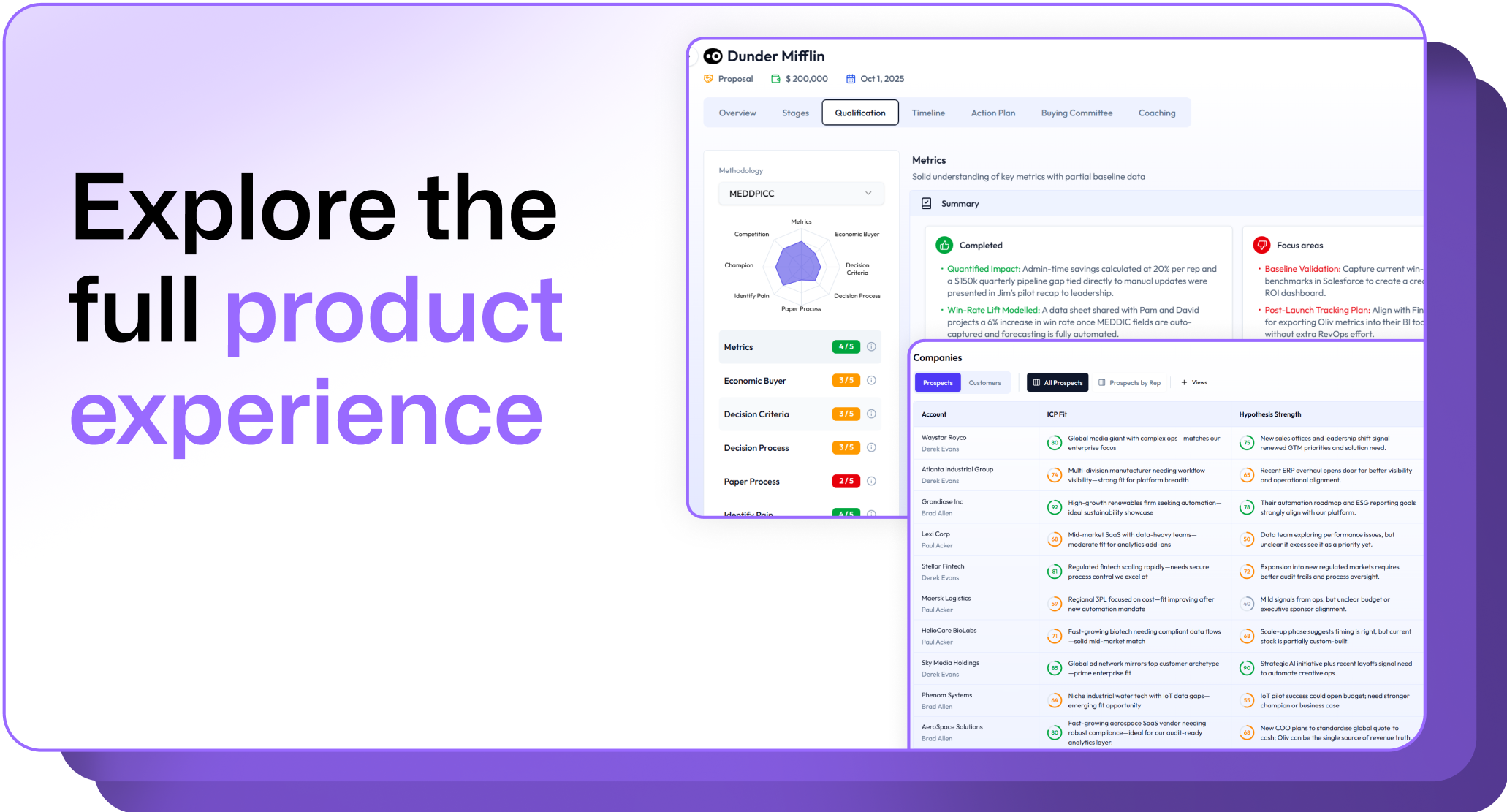
.avif)
.png)







.png)
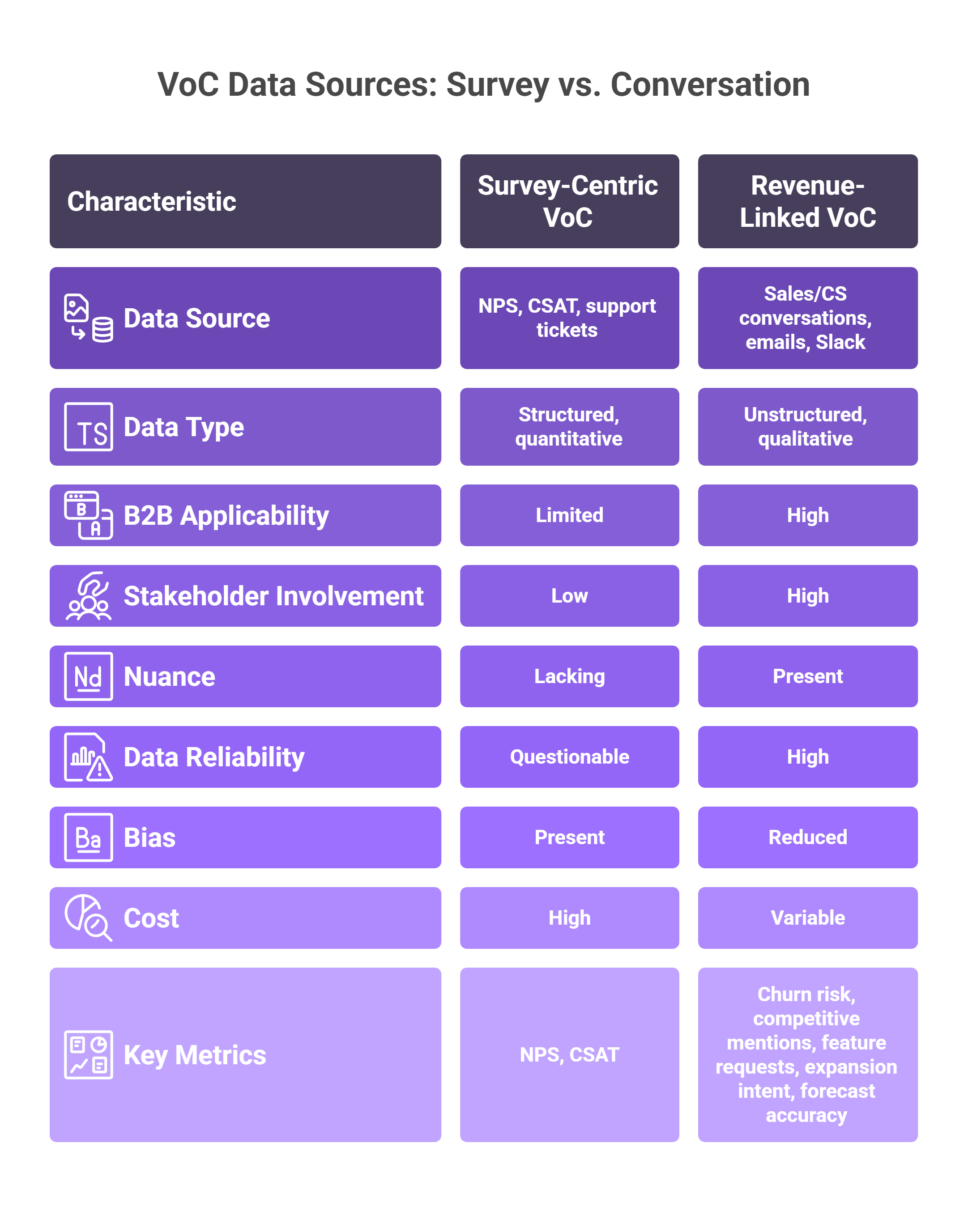
.png)
.png)
.png)