The Death of SaaS Dashboards: Why 2026 Is the Year Revenue Teams Switch to AI Agents
Written by
Ishan Chhabra
Last Updated :
April 10, 2026
Skim in :
14
mins
In this article
Revenue teams love Oliv
Here’s why:
All your deal data unified (from 30+ tools and tabs).
Insights are delivered to you directly, no digging.
AI agents automate tasks for you.
Thank you! Your submission has been received!
Oops! Something went wrong while submitting the form.
Meet Oliv’s AI Agents
Hi! I’m, Deal Driver
I track deals, flag risks, send weekly pipeline updates and give sales managers full visibility into deal progress
Hi! I’m, CRM Manager
I maintain CRM hygiene by updating core, custom and qualification fields all without your team lifting a finger
Hi! I’m, Forecaster
I build accurate forecasts based on real deal movement and tell you which deals to pull in to hit your number
Hi! I’m, Coach
I believe performance fuels revenue. I spot skill gaps, score calls and build coaching plans to help every rep level up
Hi! I’m, Prospector
I dig into target accounts to surface the right contacts, tailor and time outreach so you always strike when it counts
Hi! I’m, Pipeline tracker
I call reps to get deal updates, and deliver a real-time, CRM-synced roll-up view of deal progress
Hi! I’m, Analyst
I answer complex pipeline questions, uncover deal patterns, and build reports that guide strategic decisions
TL;DR
Revenue teams lose 70% of selling time to dashboard-dependent workflows; AI agents eliminate manual CRM entry, forecast roll-ups, and call review bottlenecks entirely.
Gong's 91% higher TCO, 8-to-24-week implementation, and one-way data lock-in make it increasingly hard to justify for mid-market teams in 2026.
AI-Native Revenue Orchestration (Gen 4) replaces passive dashboards with autonomous agents that update CRM fields, generate board-ready forecasts, and coach 100% of calls.
Oliv.ai deploys specialized agents (CRM Manager, Forecaster, Coach, Deal Driver, Voice Agent) on a single shared data layer with 5-minute setup and full data portability.
The Dashboard Tax costs a typical 50-rep team $200k to $400k annually in lost productivity before license fees; Oliv eliminates every category at the source.
Mid-market companies (25 to 200 reps) are the first to switch because they pay enterprise pricing for features they never use, with no RevOps headcount to configure them.
Q1: Why Are Revenue Tools Adding More Work Instead of Reducing It? [toc=Revenue Tool Overload]
The average revenue team in 2026 juggles five to seven tools across conversation intelligence, forecasting, engagement, and CRM, yet reps still lose upwards of 70% of their time to non-selling activities. What Oliv AI founder Ishan Chhabra calls a "tectonic plate movement" is underway: we have exited the Revenue Intelligence dashboard era and entered the age of GTM Engineering. The question has shifted from "which tool should we buy?" to "why is our tool making us work harder?"
❌ The Dashboard Trap: More Screens, More Work
The root cause is structural. CRM as a product was built on manual data entry, a task reps view as administrative policing, not selling. Meetings suffer from "Note-Taker Fatigue," where five bots record the call but zero tasks get completed afterward. Layer on Gong, Clari, and Salesforce Agentforce, and the problem compounds rather than resolves:
Gong functions as a "dashcam," it records the meeting but does not drive the deal forward. Summaries land as unstructured notes that RevOps cannot report on, and CRM fields remain untouched.
Clari remains a pre-generative tool that requires managers to sit with reps for hours every Thursday and Friday to manually roll up forecast data into the UI.
Salesforce Agentforce asks reps to initiate a conversation with a chat bot and copy-paste data, a UX that is not embedded into the daily business process.
"It's too complicated, and not intuitive at all. Understanding the pipeline management portion of it is almost impossible. Some people figure it out, but I think most just fumble through." John S., Senior Account Executive Gong G2 Verified Review
✅ The Agentic Alternative: Software That Does the Work
Agentic AI flips the model entirely. Instead of providing a dashboard for humans to query, AI agents perceive context from calls and emails, reason about next steps, and execute multi-step workflows autonomously, including CRM updates, follow-up drafts, and forecast roll-ups, without waiting for a human to log in. The shift is from tools you manage to agents that manage for you.
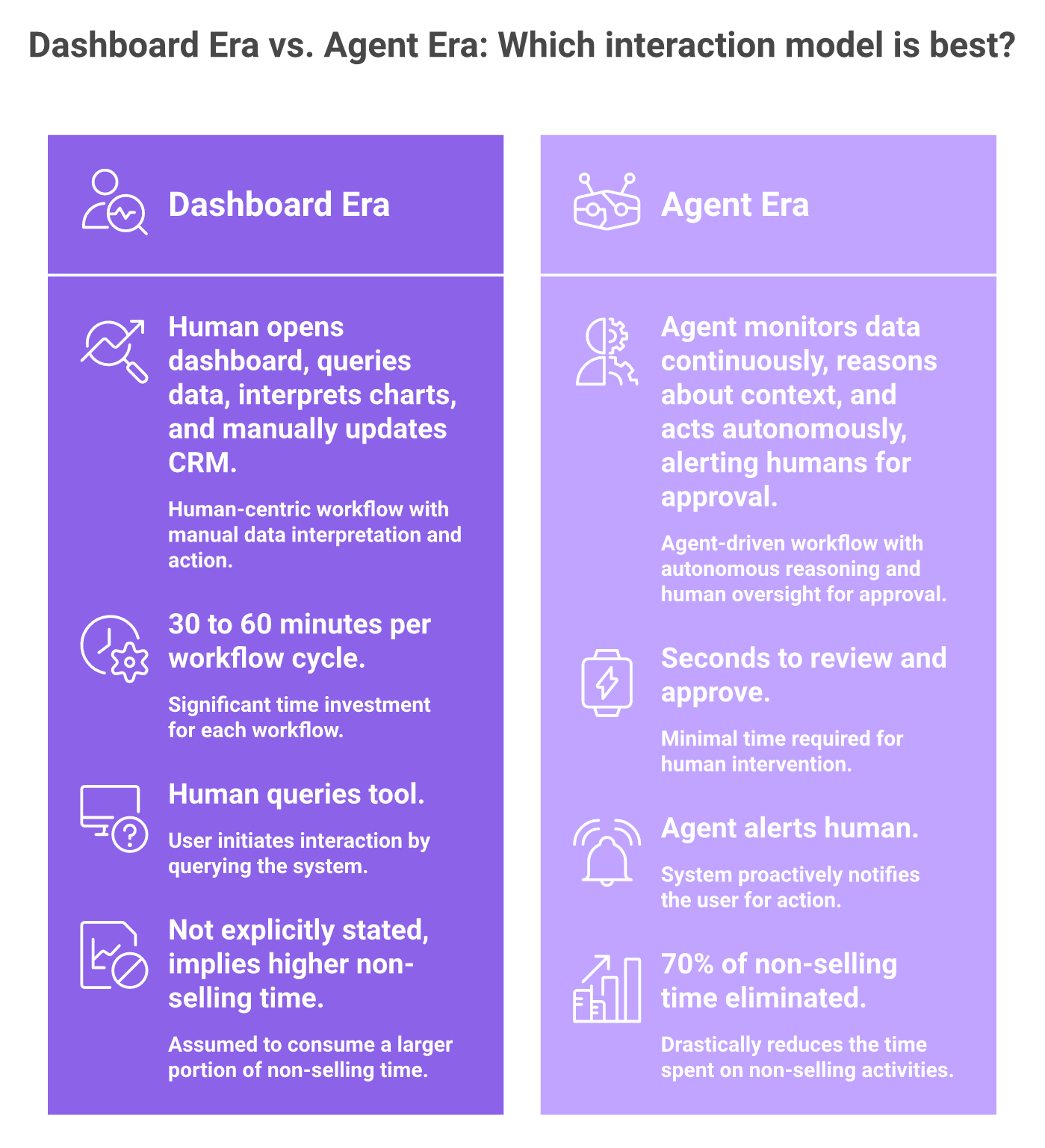
The core shift: Dashboard-Era tools require humans to query and act; Agent-Era platforms act autonomously and bring humans in only for approval.
How Oliv.ai Eliminates the Manual Layer
This is exactly how Oliv.ai is architected. Our CRM Manager Agent updates actual CRM objects and properties directly from conversation context, with no manual entry and no unstructured activity blocks. A Human-in-the-Loop governance model nudges reps via Slack or Email to verify and approve updates in seconds rather than data-enter for minutes. We call it the "Invisible UI," there is no new dashboard to learn, no new tab to open. The work simply gets done.
"There's so much in Gong, that we don't use everything. Gong's deal forecasting we don't use." Karel Bos, Head of Sales Gong TrustRadius Verified Review
"Lacks basic features around schedule buffers between meetings and scheduling. The Omnibar is very click intensive to accomplish basic tasks compared to its competitors." Verified User in Computer Software Clari G2 Verified Review
💸 When your team is paying premium pricing for features they do not use, while still entering data manually, the tool is not reducing work. It is adding another layer to it.
Q2: What's the Difference Between Revenue Intelligence and AI-Native Revenue Orchestration? [toc=Intelligence vs Orchestration]
Revenue technology has evolved through distinct generations. Gen 1 (2015 to 2022) gave us Revenue Operations, the process layer. Gen 2 introduced Revenue Intelligence, the visibility layer, dominated by dashboards from Gong and Clari. Gen 3 brought Revenue Orchestration, consolidation of point tools. Now, in 2026, Gen 4 has arrived: AI-Native Revenue Orchestration, also known as GTM Engineering, the execution layer where AI agents do not just show you what happened but autonomously act on what should happen next.
❌ Why "Intelligence" Alone Falls Short
Revenue Intelligence promised data visibility, but it forced managers into "Dashboard Digging," clicking through ten screens just to find one actionable insight. The deal reality is fragmented across recorded meetings, side-thread emails, support tickets, and "Dark Social" channels like shared Slack rooms or Telegram that RI tools simply cannot see.
Gong measures deal health based on activity volume, ten emails sent gets a high activity score, regardless of whether the prospect ever responded. Competitor "Smart Trackers" are built on V1 keyword matching that flags the word "budget" even when a prospect is discussing a holiday budget, not a deal commitment.
"You have to click around through the different modules and extract the different pieces ultimately putting it in an Excel for easier manipulation." Natalie O., Sales Operations Manager Clari G2 Verified Review
"The software doesn't have the capability of identifying words/phrases that are similar to what you're looking for or understand context, so if you don't tell it exactly what you're looking for then you'll miss out." Director of Sales Operations Chorus Gartner Verified Review
✅ From Insights You Interpret to Outcomes You Approve
AI-Native Revenue Orchestration means the system does not just tell you a deal is at risk, it acts. It updates the CRM field, drafts the follow-up email, flags the next best action, and generates the forecast deck. The shift is from passive intelligence to autonomous execution.
How Oliv.ai Defines Gen 4
Oliv.ai is the only platform that stitches Calls + Emails + Slack + Support Tickets + Web Data into a single 360-degree deal narrative, eliminating the fragmented silos that dashboard-era tools leave behind. Instead of V1 keyword matching, Oliv uses intent-aware reasoning (Chain-of-Thought models) to distinguish between a competitor mentioned in passing versus a genuine active evaluation threat.
Managers no longer dig. They receive:
⏰ Sunset Summaries, delivered daily, directly to Slack or Email
📊 Portfolio Recaps, pushed weekly with deal-level risk commentary
"AI is not great yet, the product still feels like it's at its infancy and needs to be developed further." Annabelle H., Voluntary Director Gong G2 Verified Review
⭐ AI-Native Revenue Orchestration is the automation of the entire revenue lifecycle, from data capture to deal execution to board-ready forecasting, using autonomous AI agents that act on intelligence rather than presenting it on a dashboard.
Q3: What Does 'Agentic AI' Actually Mean for Sales Teams? [toc=Agentic AI Explained]
While 87% of sales organizations use some form of AI, only about half have deployed actual AI agents capable of autonomous action. The gap between "AI features" and "agentic AI" is massive, and most revenue teams are unknowingly stuck on the wrong side of it. Understanding this spectrum is critical: rule-based automation, basic AI predictions, copilots, and fully autonomous agents.
❌ The Copilot Ceiling: AI That Suggests But Does Not Act
Current "AI" inside Gong, Clari, and Salesforce is predominantly copilot-level, it suggests, but the human still acts. Gong's call summaries require manual review before any CRM update happens. Clari's AI scoring still needs a human override in the forecast call. Salesforce Einstein requires historically clean data most organizations do not have, and when fed dirty data, its predictions become unreliable.
The result is a paradox: teams adopt AI tools expecting less work, but the tools generate more tasks, reviewing AI summaries, correcting AI errors, and configuring trackers manually.
"It can be overwhelming to set up trackers. AI training is a bit laborious to get it to do what you want." Trafford J., Senior Director, Revenue Enablement Gong G2 Verified Review
"The price of Agentforce is not clear and hard to find. Adoption is low because of the lack of knowledge on the subject as AI is a new field. Customers are finding issues in deploying and using agents in Salesforce." Anusha T., Web Developer Agentforce G2 Verified Review
True agentic AI has four properties: goal-directed behavior, real-time context awareness, multi-step reasoning, and autonomous action. For sales teams, this means the agent does not just flag a deal risk, it investigates why, drafts a re-engagement email, updates the CRM stage, and alerts the manager with a one-page summary. All without a human initiating the workflow.
How Oliv.ai Maps Agents to Daily Revenue Workflows
Oliv.ai deploys specialized agents named by their "Job to Be Done," not the persona they replace:
Identifies skill gaps and deploys tailored practice bots
100% call coaching coverage
Voice Agent
Calls reps nightly to capture off-the-record updates
Closes the dark data gap
"Gong is strong at conversation intelligence, but that's where its usefulness ends. The tool is slow, buggy, and creates an excessive administrative burden on the user side." Anonymous Reviewer Gong G2 Verified Review
💡 As Ishan Chhabra puts it: "Legacy tools are like buying an expensive treadmill, the equipment is a status symbol, but your team still does all the running. Oliv is like hiring a personal trainer and nutritionist who do the planning, monitoring, and heavy lifting for you."
Q4: Are AI Agents Really Replacing SaaS Dashboards in 2026? [toc=AI Agents vs Dashboards]
The evidence is mounting. Deloitte predicts a gradual but definitive move toward integrated, autonomous multi-agent systems in 2026. Industry analysts forecast that AI agents will replace 50% of traditional SaaS tool functions by year end. Reddit's r/SaaS community is already calling it "The Death of the Dashboard," users want tools that work in the background, not more tabs to manage.
❌ Why Dashboards Cannot Tell the Truth
Dashboards are inherently passive, they show what happened but cannot manage what happens next. Revenue leaders report spending their evenings listening to recordings at 2x speed because dashboards do not surface what actually matters. The deeper problem is structural:
Duplicate accounts (e.g., Google US vs. Google India) create a "fragmented reality" where rule-based mapping fails
Gong and Einstein use simple rule-based logic for activity association, frequently attaching data to the wrong record in duplicate environments
Dark data, interactions on Slack, Telegram, phone calls, or in-person meetings, is completely invisible to RI tools built for Zoom and Teams
"This lack of flexibility has required us to engage our development team at additional cost, adding significant operational and opportunity costs just to extract data we already own." Neel P., Sales Operations Manager Gong G2 Verified Review
"My company is constantly making me justify why we use this when transcription is available in Teams as is meeting recording. It would be great to have more automated features." Meena S., Chief of Staff Chorus G2 Verified Review
✅ The New Model: Tool Alerts Human, Not Human Queries Tool
The interaction model is inverting. Instead of "human opens dashboard, queries data, interprets insights, takes action," the agentic model works as "agent monitors data, reasons about context, takes action, alerts human for approval." The UI becomes the conversation, a Slack message, an email notification, a 5-minute voice call, not another screen.
How Oliv.ai Makes Dashboards Obsolete
Oliv.ai's AI-Based Object Association uses LLM reasoning to map activities to the correct CRM record even in complex duplicate environments, replacing the brittle rules that trip up Gong and Salesforce. The Voice Agent captures "off-the-record" pipeline updates via a nightly 5-minute phone call to reps, closing the dark data gap that dashboards can never see.
Insights arrive proactively:
⏰ Pre-meeting prep notes delivered to inbox 30 minutes before the call
📊 Sunset Summaries pushed daily, the dashboard is never opened
"Quite frankly I haven't been impressed by any of the early Salesforce AI tools, and I don't hear anyone talking about them glowingly." OffManuscript, r/SalesforceDeveloper Reddit Thread
⭐ Revenue teams using orchestration-based agent systems generate 31% more pipeline per rep, while organizations adopting agentic AI report up to 70% cost reduction versus equivalent SaaS spend.
Q5: Is Gong Still Worth It in 2026? [toc=Gong Worth It 2026]
Gong remains the market leader in Conversation Intelligence, holding a 4.8/5 G2 rating and brand authority built over a decade of dominance. But market leadership and market relevance are not the same thing. Even Gong's own reporting acknowledges that analytics and automation remain the hardest challenges for revenue teams, a tacit admission that dashboards alone are not solving the problem. The question for revenue leaders in 2026 is not whether Gong works, but whether it is worth what it costs relative to what it actually does.
💸 The "Gong Tax": Overpriced and Underused
The economics are increasingly difficult to defend. Organizations pay approximately $250/month per rep for a platform many use exclusively as a meeting recorder. Implementation takes 8 to 24 weeks and consumes 40 to 140 admin hours just to configure trackers, with Gong often pushing third-party implementation vendors that add $10k to $30k in professional service fees. Worse, Gong has been bundling and upselling aggressively, forcing companies to purchase Engage and Forecast modules just to retain core functionality.
"It was a big mistake on our part to commit to a two year term. Gong is a really powerful tool but it's probably the highest end option on the market, and now we're stuck with a tool that works technically but isn't the right business decision." Iris P., Head of Marketing, Sales & Partnerships Gong G2 Verified Review
"The additional products like forecast or engage come at an additional cost. Would be great to see these tools rolled into the core offering." Scott T., Director of Sales Gong G2 Verified Review
✅ Recording Is a Commodity, Value Lives in Execution
The AI era has commoditized recording and transcription entirely. The value has shifted upstream to what happens after the call, including autonomous CRM updates, unbiased forecasting, proactive deal coaching, and auto-generated follow-ups. Competing alternatives like Chorus (acquired by ZoomInfo) have largely ceased to innovate, and budget options like Avoma are frequently criticized for reliability gaps.
"We see it show up late, drop from calls randomly and sometimes just not show up." Aleshia R., Client Director Avoma G2 Verified Review
How Oliv.ai Redefines the Value Equation
Oliv.ai delivers a 91% TCO advantage: a 100-user team costs $789,300 on Gong over three years versus $68,400 on Oliv. Recording and transcription come free, because those are baseline commodities, not premium features. Our modular, persona-based pricing model means teams pay only for the agents they use: CRM Manager Agent for auto-field updates, Forecaster Agent for board-ready roll-ups, and Coach Agent for skill-gap analysis. Summaries are delivered within 5 to 15 minutes post-call, compared to Gong's typical 20 to 30 minute delay.
"The pricing is probably the biggest obstacle and hence we are looking to change." Miodrag, Enterprise Account Executive Gong Verified Review
⭐ When the core product is overpriced, underused, and structurally incapable of executing the work, it is no longer a question of if teams should switch, but when.
Q6: Should You Wait for Salesforce Agentforce or Buy a Specialized Tool Now? [toc=Agentforce vs Specialized Tool]
Salesforce Agentforce has captured attention with impressive growth numbers and enterprise adoption. The "wait for the platform vendor" instinct is natural: if your CRM already holds the data, why not let it build the agents? But for B2B revenue teams, the gap between Agentforce's promise and its current reality is wide enough to cost you quarters of lost productivity.
❌ The Platform Problem: Built for Breadth, Not Revenue Depth
Agentforce's user experience is fundamentally chat-based, requiring reps to manually "go and talk to a bot" and copy-paste data, an approach that is not embedded into the selling workflow. To unlock agents, Salesforce often mandates a Data Cloud subscription, a platform primarily designed for B2C consumer data mapping that carries high consumption fees but is "not very useful for sales." Einstein Activity Capture redacts data unnecessarily and stores emails in separate AWS instances that are un-reportable inside the CRM. Einstein scoring and forecasting rely on V1 machine learning that breaks when fed the dirty data most organizations actually have.
"It can be complex to set up and often requires skilled administrators or developers to customize and integrate properly, which adds time and cost. Licensing fees can be high, especially as the number of agents grows." Verified User in Marketing and Advertising Agentforce G2 Verified Review
"Quite frankly I haven't been impressed by any of the early Salesforce AI tools, and I don't hear anyone talking about them glowingly." OffManuscript, r/SalesforceDeveloper Reddit Thread
✅ Specialists Win on Depth: Revenue Agents Need Revenue Context
The "platform vs. specialist" decision follows a well-established pattern: generalists serve breadth, and specialists serve depth. Revenue agents need to understand MEDDPICC fields, multi-threaded deal dynamics, forecast roll-up logic, and methodology adherence, not just execute generic CRM queries. A horizontal platform agent trained across thousands of use cases will always lack the surgical precision that a purpose-built revenue agent delivers.
How Oliv.ai Delivers Instant Time-to-Value
Oliv.ai provides an out-of-the-box B2B sales model, with no Data Cloud subscription required. Our Data Cleanser Agent deduplicates and normalizes CRM records weekly, making dirty data "AI-Ready" instead of demanding clean data as a prerequisite. Fine-tuned LLMs are grounded in your specific company data workspace, eliminating hallucination risk. Configuration takes 5 minutes, and full custom model building completes in 2 to 4 weeks, not months of Salesforce implementation cycles.
"I built the default agent, went well, then went to create a second agent and could not get past an error... it still needs some serious debugging." Jessica C., Senior Business Analyst Agentforce G2 Verified Review
Agentforce vs Oliv.ai: Decision Factor Comparison
Decision Factor
Salesforce Agentforce
Oliv.ai
⏰ Setup Time
Months of implementation
5 minutes to configure
💰 Data Requirement
Clean data + Data Cloud subscription
Dirty data handled by Data Cleanser Agent
Best Fit
Enterprise B2C with large admin teams
Mid-market B2B with lean RevOps
Q7: What Does the Revenue AI Maturity Curve Look Like? [toc=Revenue AI Maturity Curve]
Revenue technology has progressed through four distinct stages. Understanding where your organization sits on this maturity curve is the single most important step in deciding what to buy next, and what to retire.
Revenue technology has evolved through four distinct stages. Understanding where your organization sits on this curve is the first step in deciding what to buy next.
Stage 1: Dashboards (2015 to 2021)
The first generation of revenue technology layered reporting dashboards on top of CRM data. Tools like Salesforce Reports, Tableau, and early Clari provided static views of pipeline, quota attainment, and historical trends. Value was real but limited: everything depended on reps entering accurate data, and insights required manual interpretation by managers.
✅ Brought visibility to previously opaque pipeline data
❌ 100% dependent on manual CRM data entry
❌ Backward-looking; no predictive or prescriptive capability
Stage 2: Copilots (2022 to 2024)
The arrival of generative AI introduced copilot-level features, including AI summaries, smart trackers, and auto-generated emails. Gong, Clari, and Salesforce Einstein all added AI features during this period. However, these tools still operate in a suggest-then-wait model: the AI drafts a summary, but the human must review, approve, edit, and manually push updates into the CRM.
✅ Reduced time on note-taking and basic summarization
❌ Summaries stored as unstructured text, un-reportable for RevOps
❌ No autonomous action; every output requires human follow-through
"My company is constantly making me justify why we use this when transcription is available in Teams as is meeting recording. It would be great to have more automated features." Meena S., Chief of Staff Chorus G2 Verified Review
Stage 3: Single-Purpose Agents (2025)
Standalone AI agents emerged to handle specific tasks, an agent for CRM hygiene, another for email drafting, and another for coaching. Progress was meaningful, but fragmentation introduced new problems: multiple vendors, disconnected data, and inconsistent reasoning across agents.
✅ First autonomous execution of revenue tasks
❌ Fragmented tooling recreates the integration burden
Stage 4: Autonomous Revenue OS (2026+)
The current frontier is a unified agent platform where multiple specialized agents share a single data layer, reason collaboratively, and execute end-to-end revenue workflows autonomously, from data capture to deal execution to board-ready forecasting. This is what Oliv AI founder Ishan Chhabra calls "GTM Engineering" or Gen 4.
"Clari is really just a glorified SFDC overlay. Actually, Salesforce has built most of the forecasting functionality by now anyway so I'm not sure where they fit into that whole overcrowded Martech space." conaldinho11, r/SalesOperations Reddit Thread
Oliv.ai is purpose-built for Stage 4, a single platform where the CRM Manager Agent, Forecaster Agent, Deal Driver Agent, Coach Agent, and Voice Agent operate on one shared data layer, requiring no dashboard logins and no manual handoffs between tools.
Oliv.ai deploys five specialized agents on a single shared data layer, eliminating the fragmented vendor stack that plagues dashboard-era revenue teams.
Q8: How Do AI Agents Improve Pipeline, Forecasting, and Coaching at Scale? [toc=Pipeline Forecasting Coaching]
Three workflows consume roughly 80% of a revenue leader's week: pipeline reviews, forecast roll-ups, and rep coaching. Each is fundamentally broken in the dashboard era. Pipeline visibility is biased (reps surface the deals they want you to see), forecasting is a Thursday/Friday data-entry marathon, and coaching coverage rarely exceeds 2% of total calls.
❌ The Legacy Workflow Tax
Gong delivers call summaries with a typical 20 to 30 minute delay post-call, cooling deal momentum during the critical window when follow-ups matter most. Clari's forecasting still depends on managers manually inputting assessments based on rep stories, stories that are inherently optimistic and selectively told. Traditional coaching tools like Hyperbound and Second Nature allow roleplay practice, but they are disconnected from actual field performance. The practice is not tailored to what each rep actually struggles with on live calls.
"There's so much in Gong, that we don't use everything. Gong's deal forecasting we don't use." Karel Bos, Head of Sales Gong TrustRadius Verified Review
"Clari is a tool for sales leaders, it adds no value to reps as far as I can see." Msoave, r/sales Reddit Thread
✅ Agents Close the Loop: Observe, Reason, Act, Coach
Agentic AI transforms all three workflows from manual-reactive to autonomous-proactive. Instead of reviewing 2% of calls, agents observe 100%. Instead of interpreting dashboard charts, agents flag exactly which deals are at risk and why. Instead of running forecast calls, agents generate the forecast autonomously from conversation evidence, not rep narratives.
Coach Agent analyzes 100% of calls, deploys tailored practice bots
Personalized skill development at scale
The Forecaster Agent produces one-page board-ready roll-ups and presentation-ready slide decks every Monday, autonomously, without a single manager touching a UI. The Coach Agent identifies individual skill gaps (e.g., pricing objection handling, discovery depth) and automatically deploys tailored voice bots so reps practice the exact skills they struggled with on live calls. We call it the "Measurement to Practice Loop."
"You have to click around through the different modules and extract the different pieces ultimately putting it in an Excel for easier manipulation." Natalie O., Sales Operations Manager Clari G2 Verified Review
💰 Revenue teams using orchestration-based agent systems generate 31% more pipeline per rep, and Oliv users report reclaiming one full business day per week previously lost to dashboard digging and manual data wrangling.
Q9: Why Are Mid-Market Companies the First to Switch from Gong? [toc=Mid-Market Gong Switch]
Mid-market revenue teams, typically 25 to 200 reps, are emerging as the vanguard of the dashboard-to-agent migration. The reason is structural: Gong and Salesforce are enterprise-heavy by design, built for 500+ rep organizations with $5k to $50k platform fees and 8 to 24 week implementation cycles. Mid-market companies are the fastest-growing segment of B2B SaaS, yet they remain the most underserved by legacy revenue intelligence pricing and complexity.
💸 The Mid-Market "Gong Tax"
Mid-market teams pay full enterprise pricing for platforms where they use a fraction of the features. Reps use the basic recorder and summaries; the advanced trackers, deal boards, and forecast modules go untouched because there is no dedicated RevOps headcount to configure them. Gong's one-way integration compounds the problem: it pulls all data into its own universe but makes structured export back to the CRM difficult, creating a vendor lock-in dynamic that mid-market leaders are increasingly unwilling to accept.
"Gong.io as a leader in its market is not too open to negotiate with smaller companies. The pricing is probably the biggest obstacle and hence we are looking to change." Miodrag, Enterprise Account Executive Gong Verified Review
"It was a big mistake on our part to commit to a two year term. Having talked with other friends who lead revenue functions, all have said the same thing, they've been fine using a lower cost, simpler alternative." Iris P., Head of Marketing, Sales & Partnerships Gong G2 Verified Review
✅ The Mid-Market "Goldilocks Zone" for AI Agents
Mid-market is the ideal adoption zone for agentic AI, complex enough to benefit from automation, nimble enough to adopt without a 6-month change management program. These teams do not need a center-of-excellence to roll out an agent. They need a tool that works in 5 minutes and delivers measurable value in 1 to 2 days.
How Oliv.ai Is Purpose-Built for Mid-Market
Oliv.ai eliminates every friction point that makes legacy tools painful for mid-market teams:
⏰ Out-of-the-box configuration in 5 minutes, no implementation consultants required
💰 No mandatory platform fees, modular pricing means you buy only the agents you need
✅ Full data portability, upon termination, Oliv provides a complete CSV dump of all meetings, recordings, and metadata in a usable format
✅ Free migration from Gong including historical recordings
"This lack of flexibility has required us to engage our development team at additional cost, adding significant operational and opportunity costs just to extract data we already own." Neel P., Sales Operations Manager Gong G2 Verified Review
⭐ For a 100-user mid-market team, Oliv generates $9.7M in net benefit over three years through a 35% increase in win rates and reduced sales cycles, with zero lock-in risk.
Q10: What Is the Hidden Cost of Dashboards? (The "Dashboard Tax" Explained) [toc=Hidden Dashboard Costs]
Beyond license fees, dashboard-dependent revenue workflows carry substantial hidden costs that rarely appear on a P&L but consistently drain productivity, accuracy, and morale. This section quantifies the "Dashboard Tax" across five dimensions for a typical 50-rep mid-market team.
The Five Hidden Cost Categories
The Dashboard Tax: Hidden Cost Breakdown for a 50-Rep Team
Cost Category
Activity
Estimated Weekly Hours (per rep or manager)
Annual Impact (50-rep team)
💸 CRM Data Entry
Manual field updates, stage changes, and next-step notes after every call
2 to 3 hrs/rep/week
5,200 to 7,800 lost selling hours
⏰ Dashboard Interpretation
Managers clicking through 10+ screens to find one insight
3 to 5 hrs/manager/week
780 to 1,300 manager hours lost
❌ Forecast Roll-Up Meetings
Thursday/Friday manual data entry sessions in Clari
2 to 4 hrs/manager/week
520 to 1,040 hours of low-value meetings
⚠️ Call Review Bottleneck
Managers listening to recordings at 2x speed evenings/weekends
4 to 6 hrs/manager/week
1,040 to 1,560 hours, most outside business hours
💸 Implementation & Maintenance
Tracker setup (40 to 140 admin hrs), ongoing configuration, and professional services ($10k to $30k)
Front-loaded + ongoing
$15k to $50k annually in admin/consulting costs
"You have to click around through the different modules and extract the different pieces ultimately putting it in an Excel for easier manipulation." Natalie O., Sales Operations Manager Clari G2 Verified Review
❌ The Compounding Effect
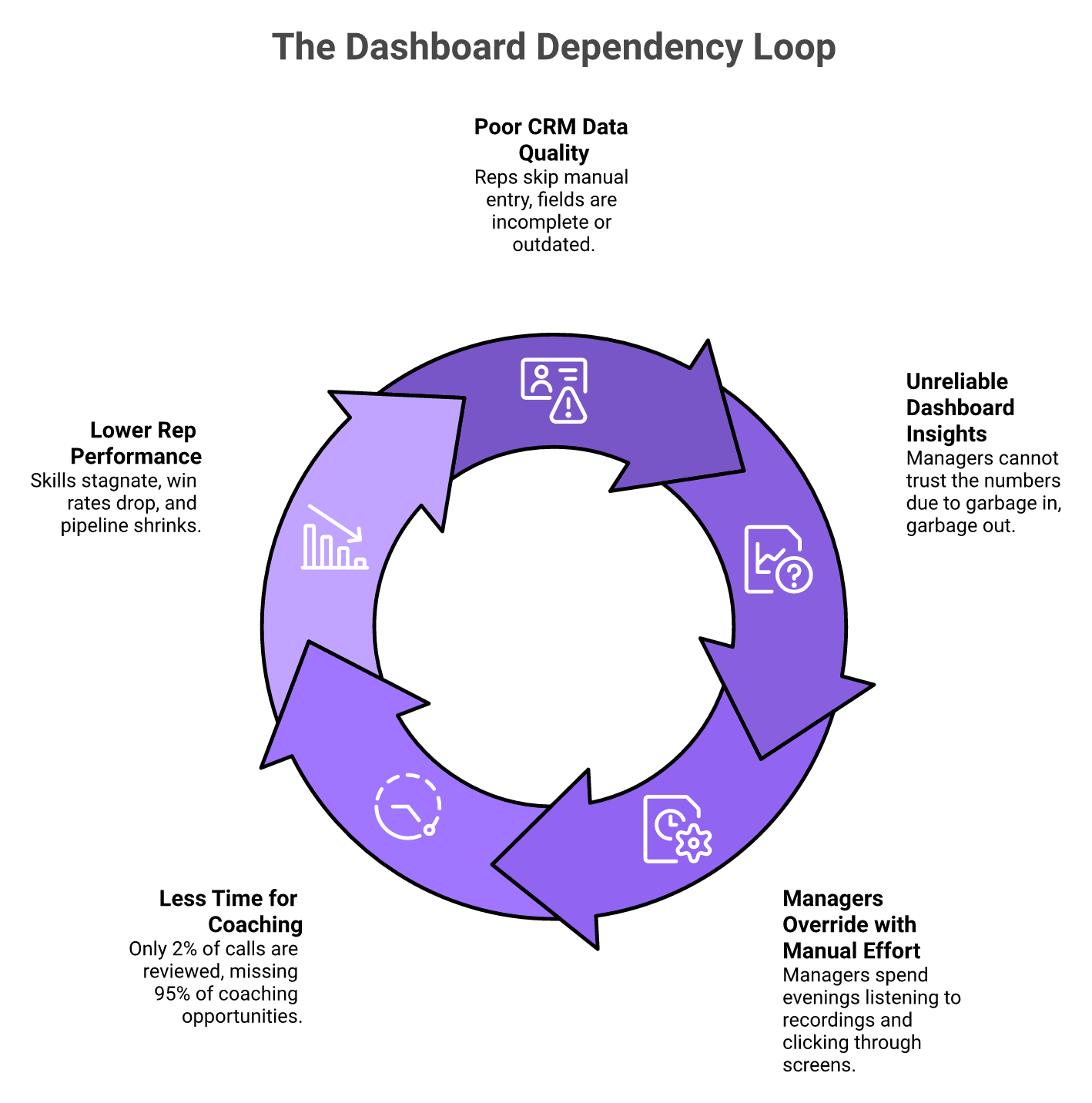
These costs compound because dashboards create a dependency loop: poor data quality leads to unreliable dashboards, which leads to managers overriding with manual effort, which leads to less time coaching, which leads to lower rep performance, which leads to more manual intervention. The total Dashboard Tax for a 50-rep team typically exceeds $200k to $400k annually in lost productivity, before counting the license fees themselves.
Dashboards create a compounding dependency loop where poor data quality feeds unreliable insights, manual overrides, less coaching, and lower performance, cycling back to even worse data.
"Clari should find ways to differentiate from the native Salesforce features (e.g., Pipeline Inspection, Forecasting) in order to remain competitive in the long-run." Dan J. Clari G2 Verified Review
"For me, the only business problem Gong solves is the call recordings." John S., Senior Account Executive Gong G2 Verified Review
How Oliv.ai Eliminates the Dashboard Tax
Oliv.ai eliminates the Dashboard Tax at the source. The CRM Manager Agent removes the data-entry burden entirely. Sunset Summaries replace dashboard interpretation. The Forecaster Agent automates roll-ups. The Coach Agent covers 100% of calls, all without a single manager login to a dashboard.
Q11: Dashboard-Era vs. Agent-Era: A Head-to-Head Comparison [toc=Dashboard vs Agent Era]
The shift from Dashboard-Era to Agent-Era revenue platforms represents a fundamental change in how sales teams interact with technology. The following comparison evaluates legacy tools (Gong, Clari, Chorus, and Salesforce Einstein) against Agent-Era platforms across eight critical dimensions.
Full Comparison Matrix
Dashboard-Era vs. Agent-Era: Eight-Dimension Comparison
Dimension
Dashboard-Era (Gong, Clari, Einstein, Chorus)
Agent-Era (Oliv.ai)
Interaction Model
Human queries tool, interprets data, and takes action manually
Agent monitors data, reasons, acts, and alerts human for approval
Data Capture
Recorded calls + CRM manual entry; blind to Slack, email side-threads, and phone calls
Calls + Emails + Slack + Support Tickets + Web Data + Voice Agent phone calls
CRM Integration
Unstructured notes/activity logs; no direct field updates
Object-level updates to actual CRM properties and fields
Forecasting
Manager-driven manual roll-ups (Clari) or rep-biased input
100% call analysis; auto-deployed tailored practice bots
Pricing Model
Unified license ($200 to $250/user/mo) + add-on fees for Forecast, Engage
Modular, persona-based: pay only for the agents you need
Time-to-Value
8 to 24 weeks implementation + $10k to $30k professional services
5-minute configuration; custom model in 2 to 4 weeks
Data Portability
One-way; bulk export is difficult or requires dev resources
Full CSV dump of all meetings, recordings, and metadata on termination
"We've had a disappointing experience with Gong Engage. The platform lacks task APIs, does not integrate with other vendors or parallel dialers, and isn't built to function as a proper sequencing tool." Anonymous Reviewer Gong G2 Verified Review
What Users Say About Legacy Setup Complexity
"I find the setup process challenging, especially when migrating fields from Salesforce, as it can't handle formula fields directly. This requires creating and maintaining duplicate fields, which adds complexity." Josiah R., Head of Sales Operations Clari G2 Verified Review
"Since we purchased our package, the support model has changed drastically, which is infuriating." Elspeth C., Chief Commercial Officer Gong G2 Verified Review
⭐ The pattern is clear across every dimension: Dashboard-Era tools require human effort at every step; Agent-Era platforms execute autonomously and bring humans in only for strategic approvals.
Q12: How to Evaluate Whether Your Revenue Team Is Ready for AI Agents [toc=AI Agent Readiness Checklist]
The shift from dashboards to agents is not binary; it is a migration. Most organizations will run hybrid for 6 to 12 months, gradually retiring manual workflows as agents prove their value. The question is not "should we switch?" but "are we ready to start?"
⚠️ Five Signals You Have Outgrown Dashboards
If your team hits three or more of these triggers, the Dashboard Tax is actively eroding your revenue capacity:
Reps spend more than 2 hours/week on CRM updates, manual data entry is stealing selling time
Forecast accuracy is below 75%, manager-driven roll-ups based on rep stories are not working
You are stacking 3+ tools for conversation intelligence + forecasting + engagement, and integration overhead is mounting
Your Gong/Clari renewal is approaching and ROI justification is getting harder
"I wish they were a little more responsive to customer requests. They say a feature is coming in a certain quarter and then it doesn't." Amanda R., Director, Customer Success Gong G2 Verified Review
✅ What to Look for in an Agent Platform
The evaluation criteria for agent platforms differ fundamentally from SaaS tool selection:
Autonomous action, the agent executes, not just recommends
Grounded AI, fine-tuned on your company data, not generic LLMs that hallucinate
CRM-native updates, writes to actual objects and properties, not activity logs
Transparent pricing, per-agent, per-persona; no credit-based consumption traps
Full data portability, your data leaves with you, in a usable format
"Clari features often overlap with other common sales tech tools. Clari should do more to differentiate themselves from competition." Sarah J., Senior Manager, Revenue Operations Clari G2 Verified Review
How to Pilot Oliv.ai in 30 Days
We recommend starting with a single high-value agent, the CRM Manager Agent or Forecaster Agent, deployed to one team. Measure three metrics over 30 days:
📊 CRM field completion rate, before vs. after
✅ Forecast accuracy delta, compare to the prior quarter
⏰ Manager hours saved, track time previously spent on dashboard digging and roll-ups
Oliv.ai's 5-minute setup, free recording/transcription tier, and modular pricing make pilots virtually risk-free.
💡 "AI-Native Revenue Orchestration is already here. The new space emerging is AI-Native Revenue Orchestration. And we are the leaders in that space." — Ishan Chhabra, CEO, Oliv AI
Q1: Why Are Revenue Tools Adding More Work Instead of Reducing It? [toc=Revenue Tool Overload]
The average revenue team in 2026 juggles five to seven tools across conversation intelligence, forecasting, engagement, and CRM, yet reps still lose upwards of 70% of their time to non-selling activities. What Oliv AI founder Ishan Chhabra calls a "tectonic plate movement" is underway: we have exited the Revenue Intelligence dashboard era and entered the age of GTM Engineering. The question has shifted from "which tool should we buy?" to "why is our tool making us work harder?"
❌ The Dashboard Trap: More Screens, More Work
The root cause is structural. CRM as a product was built on manual data entry, a task reps view as administrative policing, not selling. Meetings suffer from "Note-Taker Fatigue," where five bots record the call but zero tasks get completed afterward. Layer on Gong, Clari, and Salesforce Agentforce, and the problem compounds rather than resolves:
Gong functions as a "dashcam," it records the meeting but does not drive the deal forward. Summaries land as unstructured notes that RevOps cannot report on, and CRM fields remain untouched.
Clari remains a pre-generative tool that requires managers to sit with reps for hours every Thursday and Friday to manually roll up forecast data into the UI.
Salesforce Agentforce asks reps to initiate a conversation with a chat bot and copy-paste data, a UX that is not embedded into the daily business process.
"It's too complicated, and not intuitive at all. Understanding the pipeline management portion of it is almost impossible. Some people figure it out, but I think most just fumble through." John S., Senior Account Executive Gong G2 Verified Review
✅ The Agentic Alternative: Software That Does the Work
Agentic AI flips the model entirely. Instead of providing a dashboard for humans to query, AI agents perceive context from calls and emails, reason about next steps, and execute multi-step workflows autonomously, including CRM updates, follow-up drafts, and forecast roll-ups, without waiting for a human to log in. The shift is from tools you manage to agents that manage for you.
The core shift: Dashboard-Era tools require humans to query and act; Agent-Era platforms act autonomously and bring humans in only for approval.
How Oliv.ai Eliminates the Manual Layer
This is exactly how Oliv.ai is architected. Our CRM Manager Agent updates actual CRM objects and properties directly from conversation context, with no manual entry and no unstructured activity blocks. A Human-in-the-Loop governance model nudges reps via Slack or Email to verify and approve updates in seconds rather than data-enter for minutes. We call it the "Invisible UI," there is no new dashboard to learn, no new tab to open. The work simply gets done.
"There's so much in Gong, that we don't use everything. Gong's deal forecasting we don't use." Karel Bos, Head of Sales Gong TrustRadius Verified Review
"Lacks basic features around schedule buffers between meetings and scheduling. The Omnibar is very click intensive to accomplish basic tasks compared to its competitors." Verified User in Computer Software Clari G2 Verified Review
💸 When your team is paying premium pricing for features they do not use, while still entering data manually, the tool is not reducing work. It is adding another layer to it.
Q2: What's the Difference Between Revenue Intelligence and AI-Native Revenue Orchestration? [toc=Intelligence vs Orchestration]
Revenue technology has evolved through distinct generations. Gen 1 (2015 to 2022) gave us Revenue Operations, the process layer. Gen 2 introduced Revenue Intelligence, the visibility layer, dominated by dashboards from Gong and Clari. Gen 3 brought Revenue Orchestration, consolidation of point tools. Now, in 2026, Gen 4 has arrived: AI-Native Revenue Orchestration, also known as GTM Engineering, the execution layer where AI agents do not just show you what happened but autonomously act on what should happen next.
❌ Why "Intelligence" Alone Falls Short
Revenue Intelligence promised data visibility, but it forced managers into "Dashboard Digging," clicking through ten screens just to find one actionable insight. The deal reality is fragmented across recorded meetings, side-thread emails, support tickets, and "Dark Social" channels like shared Slack rooms or Telegram that RI tools simply cannot see.
Gong measures deal health based on activity volume, ten emails sent gets a high activity score, regardless of whether the prospect ever responded. Competitor "Smart Trackers" are built on V1 keyword matching that flags the word "budget" even when a prospect is discussing a holiday budget, not a deal commitment.
"You have to click around through the different modules and extract the different pieces ultimately putting it in an Excel for easier manipulation." Natalie O., Sales Operations Manager Clari G2 Verified Review
"The software doesn't have the capability of identifying words/phrases that are similar to what you're looking for or understand context, so if you don't tell it exactly what you're looking for then you'll miss out." Director of Sales Operations Chorus Gartner Verified Review
✅ From Insights You Interpret to Outcomes You Approve
AI-Native Revenue Orchestration means the system does not just tell you a deal is at risk, it acts. It updates the CRM field, drafts the follow-up email, flags the next best action, and generates the forecast deck. The shift is from passive intelligence to autonomous execution.
How Oliv.ai Defines Gen 4
Oliv.ai is the only platform that stitches Calls + Emails + Slack + Support Tickets + Web Data into a single 360-degree deal narrative, eliminating the fragmented silos that dashboard-era tools leave behind. Instead of V1 keyword matching, Oliv uses intent-aware reasoning (Chain-of-Thought models) to distinguish between a competitor mentioned in passing versus a genuine active evaluation threat.
Managers no longer dig. They receive:
⏰ Sunset Summaries, delivered daily, directly to Slack or Email
📊 Portfolio Recaps, pushed weekly with deal-level risk commentary
"AI is not great yet, the product still feels like it's at its infancy and needs to be developed further." Annabelle H., Voluntary Director Gong G2 Verified Review
⭐ AI-Native Revenue Orchestration is the automation of the entire revenue lifecycle, from data capture to deal execution to board-ready forecasting, using autonomous AI agents that act on intelligence rather than presenting it on a dashboard.
Q3: What Does 'Agentic AI' Actually Mean for Sales Teams? [toc=Agentic AI Explained]
While 87% of sales organizations use some form of AI, only about half have deployed actual AI agents capable of autonomous action. The gap between "AI features" and "agentic AI" is massive, and most revenue teams are unknowingly stuck on the wrong side of it. Understanding this spectrum is critical: rule-based automation, basic AI predictions, copilots, and fully autonomous agents.
❌ The Copilot Ceiling: AI That Suggests But Does Not Act
Current "AI" inside Gong, Clari, and Salesforce is predominantly copilot-level, it suggests, but the human still acts. Gong's call summaries require manual review before any CRM update happens. Clari's AI scoring still needs a human override in the forecast call. Salesforce Einstein requires historically clean data most organizations do not have, and when fed dirty data, its predictions become unreliable.
The result is a paradox: teams adopt AI tools expecting less work, but the tools generate more tasks, reviewing AI summaries, correcting AI errors, and configuring trackers manually.
"It can be overwhelming to set up trackers. AI training is a bit laborious to get it to do what you want." Trafford J., Senior Director, Revenue Enablement Gong G2 Verified Review
"The price of Agentforce is not clear and hard to find. Adoption is low because of the lack of knowledge on the subject as AI is a new field. Customers are finding issues in deploying and using agents in Salesforce." Anusha T., Web Developer Agentforce G2 Verified Review
True agentic AI has four properties: goal-directed behavior, real-time context awareness, multi-step reasoning, and autonomous action. For sales teams, this means the agent does not just flag a deal risk, it investigates why, drafts a re-engagement email, updates the CRM stage, and alerts the manager with a one-page summary. All without a human initiating the workflow.
How Oliv.ai Maps Agents to Daily Revenue Workflows
Oliv.ai deploys specialized agents named by their "Job to Be Done," not the persona they replace:
Identifies skill gaps and deploys tailored practice bots
100% call coaching coverage
Voice Agent
Calls reps nightly to capture off-the-record updates
Closes the dark data gap
"Gong is strong at conversation intelligence, but that's where its usefulness ends. The tool is slow, buggy, and creates an excessive administrative burden on the user side." Anonymous Reviewer Gong G2 Verified Review
💡 As Ishan Chhabra puts it: "Legacy tools are like buying an expensive treadmill, the equipment is a status symbol, but your team still does all the running. Oliv is like hiring a personal trainer and nutritionist who do the planning, monitoring, and heavy lifting for you."
Q4: Are AI Agents Really Replacing SaaS Dashboards in 2026? [toc=AI Agents vs Dashboards]
The evidence is mounting. Deloitte predicts a gradual but definitive move toward integrated, autonomous multi-agent systems in 2026. Industry analysts forecast that AI agents will replace 50% of traditional SaaS tool functions by year end. Reddit's r/SaaS community is already calling it "The Death of the Dashboard," users want tools that work in the background, not more tabs to manage.
❌ Why Dashboards Cannot Tell the Truth
Dashboards are inherently passive, they show what happened but cannot manage what happens next. Revenue leaders report spending their evenings listening to recordings at 2x speed because dashboards do not surface what actually matters. The deeper problem is structural:
Duplicate accounts (e.g., Google US vs. Google India) create a "fragmented reality" where rule-based mapping fails
Gong and Einstein use simple rule-based logic for activity association, frequently attaching data to the wrong record in duplicate environments
Dark data, interactions on Slack, Telegram, phone calls, or in-person meetings, is completely invisible to RI tools built for Zoom and Teams
"This lack of flexibility has required us to engage our development team at additional cost, adding significant operational and opportunity costs just to extract data we already own." Neel P., Sales Operations Manager Gong G2 Verified Review
"My company is constantly making me justify why we use this when transcription is available in Teams as is meeting recording. It would be great to have more automated features." Meena S., Chief of Staff Chorus G2 Verified Review
✅ The New Model: Tool Alerts Human, Not Human Queries Tool
The interaction model is inverting. Instead of "human opens dashboard, queries data, interprets insights, takes action," the agentic model works as "agent monitors data, reasons about context, takes action, alerts human for approval." The UI becomes the conversation, a Slack message, an email notification, a 5-minute voice call, not another screen.
How Oliv.ai Makes Dashboards Obsolete
Oliv.ai's AI-Based Object Association uses LLM reasoning to map activities to the correct CRM record even in complex duplicate environments, replacing the brittle rules that trip up Gong and Salesforce. The Voice Agent captures "off-the-record" pipeline updates via a nightly 5-minute phone call to reps, closing the dark data gap that dashboards can never see.
Insights arrive proactively:
⏰ Pre-meeting prep notes delivered to inbox 30 minutes before the call
📊 Sunset Summaries pushed daily, the dashboard is never opened
"Quite frankly I haven't been impressed by any of the early Salesforce AI tools, and I don't hear anyone talking about them glowingly." OffManuscript, r/SalesforceDeveloper Reddit Thread
⭐ Revenue teams using orchestration-based agent systems generate 31% more pipeline per rep, while organizations adopting agentic AI report up to 70% cost reduction versus equivalent SaaS spend.
Q5: Is Gong Still Worth It in 2026? [toc=Gong Worth It 2026]
Gong remains the market leader in Conversation Intelligence, holding a 4.8/5 G2 rating and brand authority built over a decade of dominance. But market leadership and market relevance are not the same thing. Even Gong's own reporting acknowledges that analytics and automation remain the hardest challenges for revenue teams, a tacit admission that dashboards alone are not solving the problem. The question for revenue leaders in 2026 is not whether Gong works, but whether it is worth what it costs relative to what it actually does.
💸 The "Gong Tax": Overpriced and Underused
The economics are increasingly difficult to defend. Organizations pay approximately $250/month per rep for a platform many use exclusively as a meeting recorder. Implementation takes 8 to 24 weeks and consumes 40 to 140 admin hours just to configure trackers, with Gong often pushing third-party implementation vendors that add $10k to $30k in professional service fees. Worse, Gong has been bundling and upselling aggressively, forcing companies to purchase Engage and Forecast modules just to retain core functionality.
"It was a big mistake on our part to commit to a two year term. Gong is a really powerful tool but it's probably the highest end option on the market, and now we're stuck with a tool that works technically but isn't the right business decision." Iris P., Head of Marketing, Sales & Partnerships Gong G2 Verified Review
"The additional products like forecast or engage come at an additional cost. Would be great to see these tools rolled into the core offering." Scott T., Director of Sales Gong G2 Verified Review
✅ Recording Is a Commodity, Value Lives in Execution
The AI era has commoditized recording and transcription entirely. The value has shifted upstream to what happens after the call, including autonomous CRM updates, unbiased forecasting, proactive deal coaching, and auto-generated follow-ups. Competing alternatives like Chorus (acquired by ZoomInfo) have largely ceased to innovate, and budget options like Avoma are frequently criticized for reliability gaps.
"We see it show up late, drop from calls randomly and sometimes just not show up." Aleshia R., Client Director Avoma G2 Verified Review
How Oliv.ai Redefines the Value Equation
Oliv.ai delivers a 91% TCO advantage: a 100-user team costs $789,300 on Gong over three years versus $68,400 on Oliv. Recording and transcription come free, because those are baseline commodities, not premium features. Our modular, persona-based pricing model means teams pay only for the agents they use: CRM Manager Agent for auto-field updates, Forecaster Agent for board-ready roll-ups, and Coach Agent for skill-gap analysis. Summaries are delivered within 5 to 15 minutes post-call, compared to Gong's typical 20 to 30 minute delay.
"The pricing is probably the biggest obstacle and hence we are looking to change." Miodrag, Enterprise Account Executive Gong Verified Review
⭐ When the core product is overpriced, underused, and structurally incapable of executing the work, it is no longer a question of if teams should switch, but when.
Q6: Should You Wait for Salesforce Agentforce or Buy a Specialized Tool Now? [toc=Agentforce vs Specialized Tool]
Salesforce Agentforce has captured attention with impressive growth numbers and enterprise adoption. The "wait for the platform vendor" instinct is natural: if your CRM already holds the data, why not let it build the agents? But for B2B revenue teams, the gap between Agentforce's promise and its current reality is wide enough to cost you quarters of lost productivity.
❌ The Platform Problem: Built for Breadth, Not Revenue Depth
Agentforce's user experience is fundamentally chat-based, requiring reps to manually "go and talk to a bot" and copy-paste data, an approach that is not embedded into the selling workflow. To unlock agents, Salesforce often mandates a Data Cloud subscription, a platform primarily designed for B2C consumer data mapping that carries high consumption fees but is "not very useful for sales." Einstein Activity Capture redacts data unnecessarily and stores emails in separate AWS instances that are un-reportable inside the CRM. Einstein scoring and forecasting rely on V1 machine learning that breaks when fed the dirty data most organizations actually have.
"It can be complex to set up and often requires skilled administrators or developers to customize and integrate properly, which adds time and cost. Licensing fees can be high, especially as the number of agents grows." Verified User in Marketing and Advertising Agentforce G2 Verified Review
"Quite frankly I haven't been impressed by any of the early Salesforce AI tools, and I don't hear anyone talking about them glowingly." OffManuscript, r/SalesforceDeveloper Reddit Thread
✅ Specialists Win on Depth: Revenue Agents Need Revenue Context
The "platform vs. specialist" decision follows a well-established pattern: generalists serve breadth, and specialists serve depth. Revenue agents need to understand MEDDPICC fields, multi-threaded deal dynamics, forecast roll-up logic, and methodology adherence, not just execute generic CRM queries. A horizontal platform agent trained across thousands of use cases will always lack the surgical precision that a purpose-built revenue agent delivers.
How Oliv.ai Delivers Instant Time-to-Value
Oliv.ai provides an out-of-the-box B2B sales model, with no Data Cloud subscription required. Our Data Cleanser Agent deduplicates and normalizes CRM records weekly, making dirty data "AI-Ready" instead of demanding clean data as a prerequisite. Fine-tuned LLMs are grounded in your specific company data workspace, eliminating hallucination risk. Configuration takes 5 minutes, and full custom model building completes in 2 to 4 weeks, not months of Salesforce implementation cycles.
"I built the default agent, went well, then went to create a second agent and could not get past an error... it still needs some serious debugging." Jessica C., Senior Business Analyst Agentforce G2 Verified Review
Agentforce vs Oliv.ai: Decision Factor Comparison
Decision Factor
Salesforce Agentforce
Oliv.ai
⏰ Setup Time
Months of implementation
5 minutes to configure
💰 Data Requirement
Clean data + Data Cloud subscription
Dirty data handled by Data Cleanser Agent
Best Fit
Enterprise B2C with large admin teams
Mid-market B2B with lean RevOps
Q7: What Does the Revenue AI Maturity Curve Look Like? [toc=Revenue AI Maturity Curve]
Revenue technology has progressed through four distinct stages. Understanding where your organization sits on this maturity curve is the single most important step in deciding what to buy next, and what to retire.
Revenue technology has evolved through four distinct stages. Understanding where your organization sits on this curve is the first step in deciding what to buy next.
Stage 1: Dashboards (2015 to 2021)
The first generation of revenue technology layered reporting dashboards on top of CRM data. Tools like Salesforce Reports, Tableau, and early Clari provided static views of pipeline, quota attainment, and historical trends. Value was real but limited: everything depended on reps entering accurate data, and insights required manual interpretation by managers.
✅ Brought visibility to previously opaque pipeline data
❌ 100% dependent on manual CRM data entry
❌ Backward-looking; no predictive or prescriptive capability
Stage 2: Copilots (2022 to 2024)
The arrival of generative AI introduced copilot-level features, including AI summaries, smart trackers, and auto-generated emails. Gong, Clari, and Salesforce Einstein all added AI features during this period. However, these tools still operate in a suggest-then-wait model: the AI drafts a summary, but the human must review, approve, edit, and manually push updates into the CRM.
✅ Reduced time on note-taking and basic summarization
❌ Summaries stored as unstructured text, un-reportable for RevOps
❌ No autonomous action; every output requires human follow-through
"My company is constantly making me justify why we use this when transcription is available in Teams as is meeting recording. It would be great to have more automated features." Meena S., Chief of Staff Chorus G2 Verified Review
Stage 3: Single-Purpose Agents (2025)
Standalone AI agents emerged to handle specific tasks, an agent for CRM hygiene, another for email drafting, and another for coaching. Progress was meaningful, but fragmentation introduced new problems: multiple vendors, disconnected data, and inconsistent reasoning across agents.
✅ First autonomous execution of revenue tasks
❌ Fragmented tooling recreates the integration burden
Stage 4: Autonomous Revenue OS (2026+)
The current frontier is a unified agent platform where multiple specialized agents share a single data layer, reason collaboratively, and execute end-to-end revenue workflows autonomously, from data capture to deal execution to board-ready forecasting. This is what Oliv AI founder Ishan Chhabra calls "GTM Engineering" or Gen 4.
"Clari is really just a glorified SFDC overlay. Actually, Salesforce has built most of the forecasting functionality by now anyway so I'm not sure where they fit into that whole overcrowded Martech space." conaldinho11, r/SalesOperations Reddit Thread
Oliv.ai is purpose-built for Stage 4, a single platform where the CRM Manager Agent, Forecaster Agent, Deal Driver Agent, Coach Agent, and Voice Agent operate on one shared data layer, requiring no dashboard logins and no manual handoffs between tools.
Oliv.ai deploys five specialized agents on a single shared data layer, eliminating the fragmented vendor stack that plagues dashboard-era revenue teams.
Q8: How Do AI Agents Improve Pipeline, Forecasting, and Coaching at Scale? [toc=Pipeline Forecasting Coaching]
Three workflows consume roughly 80% of a revenue leader's week: pipeline reviews, forecast roll-ups, and rep coaching. Each is fundamentally broken in the dashboard era. Pipeline visibility is biased (reps surface the deals they want you to see), forecasting is a Thursday/Friday data-entry marathon, and coaching coverage rarely exceeds 2% of total calls.
❌ The Legacy Workflow Tax
Gong delivers call summaries with a typical 20 to 30 minute delay post-call, cooling deal momentum during the critical window when follow-ups matter most. Clari's forecasting still depends on managers manually inputting assessments based on rep stories, stories that are inherently optimistic and selectively told. Traditional coaching tools like Hyperbound and Second Nature allow roleplay practice, but they are disconnected from actual field performance. The practice is not tailored to what each rep actually struggles with on live calls.
"There's so much in Gong, that we don't use everything. Gong's deal forecasting we don't use." Karel Bos, Head of Sales Gong TrustRadius Verified Review
"Clari is a tool for sales leaders, it adds no value to reps as far as I can see." Msoave, r/sales Reddit Thread
✅ Agents Close the Loop: Observe, Reason, Act, Coach
Agentic AI transforms all three workflows from manual-reactive to autonomous-proactive. Instead of reviewing 2% of calls, agents observe 100%. Instead of interpreting dashboard charts, agents flag exactly which deals are at risk and why. Instead of running forecast calls, agents generate the forecast autonomously from conversation evidence, not rep narratives.
Coach Agent analyzes 100% of calls, deploys tailored practice bots
Personalized skill development at scale
The Forecaster Agent produces one-page board-ready roll-ups and presentation-ready slide decks every Monday, autonomously, without a single manager touching a UI. The Coach Agent identifies individual skill gaps (e.g., pricing objection handling, discovery depth) and automatically deploys tailored voice bots so reps practice the exact skills they struggled with on live calls. We call it the "Measurement to Practice Loop."
"You have to click around through the different modules and extract the different pieces ultimately putting it in an Excel for easier manipulation." Natalie O., Sales Operations Manager Clari G2 Verified Review
💰 Revenue teams using orchestration-based agent systems generate 31% more pipeline per rep, and Oliv users report reclaiming one full business day per week previously lost to dashboard digging and manual data wrangling.
Q9: Why Are Mid-Market Companies the First to Switch from Gong? [toc=Mid-Market Gong Switch]
Mid-market revenue teams, typically 25 to 200 reps, are emerging as the vanguard of the dashboard-to-agent migration. The reason is structural: Gong and Salesforce are enterprise-heavy by design, built for 500+ rep organizations with $5k to $50k platform fees and 8 to 24 week implementation cycles. Mid-market companies are the fastest-growing segment of B2B SaaS, yet they remain the most underserved by legacy revenue intelligence pricing and complexity.
💸 The Mid-Market "Gong Tax"
Mid-market teams pay full enterprise pricing for platforms where they use a fraction of the features. Reps use the basic recorder and summaries; the advanced trackers, deal boards, and forecast modules go untouched because there is no dedicated RevOps headcount to configure them. Gong's one-way integration compounds the problem: it pulls all data into its own universe but makes structured export back to the CRM difficult, creating a vendor lock-in dynamic that mid-market leaders are increasingly unwilling to accept.
"Gong.io as a leader in its market is not too open to negotiate with smaller companies. The pricing is probably the biggest obstacle and hence we are looking to change." Miodrag, Enterprise Account Executive Gong Verified Review
"It was a big mistake on our part to commit to a two year term. Having talked with other friends who lead revenue functions, all have said the same thing, they've been fine using a lower cost, simpler alternative." Iris P., Head of Marketing, Sales & Partnerships Gong G2 Verified Review
✅ The Mid-Market "Goldilocks Zone" for AI Agents
Mid-market is the ideal adoption zone for agentic AI, complex enough to benefit from automation, nimble enough to adopt without a 6-month change management program. These teams do not need a center-of-excellence to roll out an agent. They need a tool that works in 5 minutes and delivers measurable value in 1 to 2 days.
How Oliv.ai Is Purpose-Built for Mid-Market
Oliv.ai eliminates every friction point that makes legacy tools painful for mid-market teams:
⏰ Out-of-the-box configuration in 5 minutes, no implementation consultants required
💰 No mandatory platform fees, modular pricing means you buy only the agents you need
✅ Full data portability, upon termination, Oliv provides a complete CSV dump of all meetings, recordings, and metadata in a usable format
✅ Free migration from Gong including historical recordings
"This lack of flexibility has required us to engage our development team at additional cost, adding significant operational and opportunity costs just to extract data we already own." Neel P., Sales Operations Manager Gong G2 Verified Review
⭐ For a 100-user mid-market team, Oliv generates $9.7M in net benefit over three years through a 35% increase in win rates and reduced sales cycles, with zero lock-in risk.
Q10: What Is the Hidden Cost of Dashboards? (The "Dashboard Tax" Explained) [toc=Hidden Dashboard Costs]
Beyond license fees, dashboard-dependent revenue workflows carry substantial hidden costs that rarely appear on a P&L but consistently drain productivity, accuracy, and morale. This section quantifies the "Dashboard Tax" across five dimensions for a typical 50-rep mid-market team.
The Five Hidden Cost Categories
The Dashboard Tax: Hidden Cost Breakdown for a 50-Rep Team
Cost Category
Activity
Estimated Weekly Hours (per rep or manager)
Annual Impact (50-rep team)
💸 CRM Data Entry
Manual field updates, stage changes, and next-step notes after every call
2 to 3 hrs/rep/week
5,200 to 7,800 lost selling hours
⏰ Dashboard Interpretation
Managers clicking through 10+ screens to find one insight
3 to 5 hrs/manager/week
780 to 1,300 manager hours lost
❌ Forecast Roll-Up Meetings
Thursday/Friday manual data entry sessions in Clari
2 to 4 hrs/manager/week
520 to 1,040 hours of low-value meetings
⚠️ Call Review Bottleneck
Managers listening to recordings at 2x speed evenings/weekends
4 to 6 hrs/manager/week
1,040 to 1,560 hours, most outside business hours
💸 Implementation & Maintenance
Tracker setup (40 to 140 admin hrs), ongoing configuration, and professional services ($10k to $30k)
Front-loaded + ongoing
$15k to $50k annually in admin/consulting costs
"You have to click around through the different modules and extract the different pieces ultimately putting it in an Excel for easier manipulation." Natalie O., Sales Operations Manager Clari G2 Verified Review
❌ The Compounding Effect
These costs compound because dashboards create a dependency loop: poor data quality leads to unreliable dashboards, which leads to managers overriding with manual effort, which leads to less time coaching, which leads to lower rep performance, which leads to more manual intervention. The total Dashboard Tax for a 50-rep team typically exceeds $200k to $400k annually in lost productivity, before counting the license fees themselves.
Dashboards create a compounding dependency loop where poor data quality feeds unreliable insights, manual overrides, less coaching, and lower performance, cycling back to even worse data.
"Clari should find ways to differentiate from the native Salesforce features (e.g., Pipeline Inspection, Forecasting) in order to remain competitive in the long-run." Dan J. Clari G2 Verified Review
"For me, the only business problem Gong solves is the call recordings." John S., Senior Account Executive Gong G2 Verified Review
How Oliv.ai Eliminates the Dashboard Tax
Oliv.ai eliminates the Dashboard Tax at the source. The CRM Manager Agent removes the data-entry burden entirely. Sunset Summaries replace dashboard interpretation. The Forecaster Agent automates roll-ups. The Coach Agent covers 100% of calls, all without a single manager login to a dashboard.
Q11: Dashboard-Era vs. Agent-Era: A Head-to-Head Comparison [toc=Dashboard vs Agent Era]
The shift from Dashboard-Era to Agent-Era revenue platforms represents a fundamental change in how sales teams interact with technology. The following comparison evaluates legacy tools (Gong, Clari, Chorus, and Salesforce Einstein) against Agent-Era platforms across eight critical dimensions.
Full Comparison Matrix
Dashboard-Era vs. Agent-Era: Eight-Dimension Comparison
Dimension
Dashboard-Era (Gong, Clari, Einstein, Chorus)
Agent-Era (Oliv.ai)
Interaction Model
Human queries tool, interprets data, and takes action manually
Agent monitors data, reasons, acts, and alerts human for approval
Data Capture
Recorded calls + CRM manual entry; blind to Slack, email side-threads, and phone calls
Calls + Emails + Slack + Support Tickets + Web Data + Voice Agent phone calls
CRM Integration
Unstructured notes/activity logs; no direct field updates
Object-level updates to actual CRM properties and fields
Forecasting
Manager-driven manual roll-ups (Clari) or rep-biased input
100% call analysis; auto-deployed tailored practice bots
Pricing Model
Unified license ($200 to $250/user/mo) + add-on fees for Forecast, Engage
Modular, persona-based: pay only for the agents you need
Time-to-Value
8 to 24 weeks implementation + $10k to $30k professional services
5-minute configuration; custom model in 2 to 4 weeks
Data Portability
One-way; bulk export is difficult or requires dev resources
Full CSV dump of all meetings, recordings, and metadata on termination
"We've had a disappointing experience with Gong Engage. The platform lacks task APIs, does not integrate with other vendors or parallel dialers, and isn't built to function as a proper sequencing tool." Anonymous Reviewer Gong G2 Verified Review
What Users Say About Legacy Setup Complexity
"I find the setup process challenging, especially when migrating fields from Salesforce, as it can't handle formula fields directly. This requires creating and maintaining duplicate fields, which adds complexity." Josiah R., Head of Sales Operations Clari G2 Verified Review
"Since we purchased our package, the support model has changed drastically, which is infuriating." Elspeth C., Chief Commercial Officer Gong G2 Verified Review
⭐ The pattern is clear across every dimension: Dashboard-Era tools require human effort at every step; Agent-Era platforms execute autonomously and bring humans in only for strategic approvals.
Q12: How to Evaluate Whether Your Revenue Team Is Ready for AI Agents [toc=AI Agent Readiness Checklist]
The shift from dashboards to agents is not binary; it is a migration. Most organizations will run hybrid for 6 to 12 months, gradually retiring manual workflows as agents prove their value. The question is not "should we switch?" but "are we ready to start?"
⚠️ Five Signals You Have Outgrown Dashboards
If your team hits three or more of these triggers, the Dashboard Tax is actively eroding your revenue capacity:
Reps spend more than 2 hours/week on CRM updates, manual data entry is stealing selling time
Forecast accuracy is below 75%, manager-driven roll-ups based on rep stories are not working
You are stacking 3+ tools for conversation intelligence + forecasting + engagement, and integration overhead is mounting
Your Gong/Clari renewal is approaching and ROI justification is getting harder
"I wish they were a little more responsive to customer requests. They say a feature is coming in a certain quarter and then it doesn't." Amanda R., Director, Customer Success Gong G2 Verified Review
✅ What to Look for in an Agent Platform
The evaluation criteria for agent platforms differ fundamentally from SaaS tool selection:
Autonomous action, the agent executes, not just recommends
Grounded AI, fine-tuned on your company data, not generic LLMs that hallucinate
CRM-native updates, writes to actual objects and properties, not activity logs
Transparent pricing, per-agent, per-persona; no credit-based consumption traps
Full data portability, your data leaves with you, in a usable format
"Clari features often overlap with other common sales tech tools. Clari should do more to differentiate themselves from competition." Sarah J., Senior Manager, Revenue Operations Clari G2 Verified Review
How to Pilot Oliv.ai in 30 Days
We recommend starting with a single high-value agent, the CRM Manager Agent or Forecaster Agent, deployed to one team. Measure three metrics over 30 days:
📊 CRM field completion rate, before vs. after
✅ Forecast accuracy delta, compare to the prior quarter
⏰ Manager hours saved, track time previously spent on dashboard digging and roll-ups
Oliv.ai's 5-minute setup, free recording/transcription tier, and modular pricing make pilots virtually risk-free.
💡 "AI-Native Revenue Orchestration is already here. The new space emerging is AI-Native Revenue Orchestration. And we are the leaders in that space." — Ishan Chhabra, CEO, Oliv AI
Q1: Why Are Revenue Tools Adding More Work Instead of Reducing It? [toc=Revenue Tool Overload]
The average revenue team in 2026 juggles five to seven tools across conversation intelligence, forecasting, engagement, and CRM, yet reps still lose upwards of 70% of their time to non-selling activities. What Oliv AI founder Ishan Chhabra calls a "tectonic plate movement" is underway: we have exited the Revenue Intelligence dashboard era and entered the age of GTM Engineering. The question has shifted from "which tool should we buy?" to "why is our tool making us work harder?"
❌ The Dashboard Trap: More Screens, More Work
The root cause is structural. CRM as a product was built on manual data entry, a task reps view as administrative policing, not selling. Meetings suffer from "Note-Taker Fatigue," where five bots record the call but zero tasks get completed afterward. Layer on Gong, Clari, and Salesforce Agentforce, and the problem compounds rather than resolves:
Gong functions as a "dashcam," it records the meeting but does not drive the deal forward. Summaries land as unstructured notes that RevOps cannot report on, and CRM fields remain untouched.
Clari remains a pre-generative tool that requires managers to sit with reps for hours every Thursday and Friday to manually roll up forecast data into the UI.
Salesforce Agentforce asks reps to initiate a conversation with a chat bot and copy-paste data, a UX that is not embedded into the daily business process.
"It's too complicated, and not intuitive at all. Understanding the pipeline management portion of it is almost impossible. Some people figure it out, but I think most just fumble through." John S., Senior Account Executive Gong G2 Verified Review
✅ The Agentic Alternative: Software That Does the Work
Agentic AI flips the model entirely. Instead of providing a dashboard for humans to query, AI agents perceive context from calls and emails, reason about next steps, and execute multi-step workflows autonomously, including CRM updates, follow-up drafts, and forecast roll-ups, without waiting for a human to log in. The shift is from tools you manage to agents that manage for you.
The core shift: Dashboard-Era tools require humans to query and act; Agent-Era platforms act autonomously and bring humans in only for approval.
How Oliv.ai Eliminates the Manual Layer
This is exactly how Oliv.ai is architected. Our CRM Manager Agent updates actual CRM objects and properties directly from conversation context, with no manual entry and no unstructured activity blocks. A Human-in-the-Loop governance model nudges reps via Slack or Email to verify and approve updates in seconds rather than data-enter for minutes. We call it the "Invisible UI," there is no new dashboard to learn, no new tab to open. The work simply gets done.
"There's so much in Gong, that we don't use everything. Gong's deal forecasting we don't use." Karel Bos, Head of Sales Gong TrustRadius Verified Review
"Lacks basic features around schedule buffers between meetings and scheduling. The Omnibar is very click intensive to accomplish basic tasks compared to its competitors." Verified User in Computer Software Clari G2 Verified Review
💸 When your team is paying premium pricing for features they do not use, while still entering data manually, the tool is not reducing work. It is adding another layer to it.
Q2: What's the Difference Between Revenue Intelligence and AI-Native Revenue Orchestration? [toc=Intelligence vs Orchestration]
Revenue technology has evolved through distinct generations. Gen 1 (2015 to 2022) gave us Revenue Operations, the process layer. Gen 2 introduced Revenue Intelligence, the visibility layer, dominated by dashboards from Gong and Clari. Gen 3 brought Revenue Orchestration, consolidation of point tools. Now, in 2026, Gen 4 has arrived: AI-Native Revenue Orchestration, also known as GTM Engineering, the execution layer where AI agents do not just show you what happened but autonomously act on what should happen next.
❌ Why "Intelligence" Alone Falls Short
Revenue Intelligence promised data visibility, but it forced managers into "Dashboard Digging," clicking through ten screens just to find one actionable insight. The deal reality is fragmented across recorded meetings, side-thread emails, support tickets, and "Dark Social" channels like shared Slack rooms or Telegram that RI tools simply cannot see.
Gong measures deal health based on activity volume, ten emails sent gets a high activity score, regardless of whether the prospect ever responded. Competitor "Smart Trackers" are built on V1 keyword matching that flags the word "budget" even when a prospect is discussing a holiday budget, not a deal commitment.
"You have to click around through the different modules and extract the different pieces ultimately putting it in an Excel for easier manipulation." Natalie O., Sales Operations Manager Clari G2 Verified Review
"The software doesn't have the capability of identifying words/phrases that are similar to what you're looking for or understand context, so if you don't tell it exactly what you're looking for then you'll miss out." Director of Sales Operations Chorus Gartner Verified Review
✅ From Insights You Interpret to Outcomes You Approve
AI-Native Revenue Orchestration means the system does not just tell you a deal is at risk, it acts. It updates the CRM field, drafts the follow-up email, flags the next best action, and generates the forecast deck. The shift is from passive intelligence to autonomous execution.
How Oliv.ai Defines Gen 4
Oliv.ai is the only platform that stitches Calls + Emails + Slack + Support Tickets + Web Data into a single 360-degree deal narrative, eliminating the fragmented silos that dashboard-era tools leave behind. Instead of V1 keyword matching, Oliv uses intent-aware reasoning (Chain-of-Thought models) to distinguish between a competitor mentioned in passing versus a genuine active evaluation threat.
Managers no longer dig. They receive:
⏰ Sunset Summaries, delivered daily, directly to Slack or Email
📊 Portfolio Recaps, pushed weekly with deal-level risk commentary
"AI is not great yet, the product still feels like it's at its infancy and needs to be developed further." Annabelle H., Voluntary Director Gong G2 Verified Review
⭐ AI-Native Revenue Orchestration is the automation of the entire revenue lifecycle, from data capture to deal execution to board-ready forecasting, using autonomous AI agents that act on intelligence rather than presenting it on a dashboard.
Q3: What Does 'Agentic AI' Actually Mean for Sales Teams? [toc=Agentic AI Explained]
While 87% of sales organizations use some form of AI, only about half have deployed actual AI agents capable of autonomous action. The gap between "AI features" and "agentic AI" is massive, and most revenue teams are unknowingly stuck on the wrong side of it. Understanding this spectrum is critical: rule-based automation, basic AI predictions, copilots, and fully autonomous agents.
❌ The Copilot Ceiling: AI That Suggests But Does Not Act
Current "AI" inside Gong, Clari, and Salesforce is predominantly copilot-level, it suggests, but the human still acts. Gong's call summaries require manual review before any CRM update happens. Clari's AI scoring still needs a human override in the forecast call. Salesforce Einstein requires historically clean data most organizations do not have, and when fed dirty data, its predictions become unreliable.
The result is a paradox: teams adopt AI tools expecting less work, but the tools generate more tasks, reviewing AI summaries, correcting AI errors, and configuring trackers manually.
"It can be overwhelming to set up trackers. AI training is a bit laborious to get it to do what you want." Trafford J., Senior Director, Revenue Enablement Gong G2 Verified Review
"The price of Agentforce is not clear and hard to find. Adoption is low because of the lack of knowledge on the subject as AI is a new field. Customers are finding issues in deploying and using agents in Salesforce." Anusha T., Web Developer Agentforce G2 Verified Review
True agentic AI has four properties: goal-directed behavior, real-time context awareness, multi-step reasoning, and autonomous action. For sales teams, this means the agent does not just flag a deal risk, it investigates why, drafts a re-engagement email, updates the CRM stage, and alerts the manager with a one-page summary. All without a human initiating the workflow.
How Oliv.ai Maps Agents to Daily Revenue Workflows
Oliv.ai deploys specialized agents named by their "Job to Be Done," not the persona they replace:
Identifies skill gaps and deploys tailored practice bots
100% call coaching coverage
Voice Agent
Calls reps nightly to capture off-the-record updates
Closes the dark data gap
"Gong is strong at conversation intelligence, but that's where its usefulness ends. The tool is slow, buggy, and creates an excessive administrative burden on the user side." Anonymous Reviewer Gong G2 Verified Review
💡 As Ishan Chhabra puts it: "Legacy tools are like buying an expensive treadmill, the equipment is a status symbol, but your team still does all the running. Oliv is like hiring a personal trainer and nutritionist who do the planning, monitoring, and heavy lifting for you."
Q4: Are AI Agents Really Replacing SaaS Dashboards in 2026? [toc=AI Agents vs Dashboards]
The evidence is mounting. Deloitte predicts a gradual but definitive move toward integrated, autonomous multi-agent systems in 2026. Industry analysts forecast that AI agents will replace 50% of traditional SaaS tool functions by year end. Reddit's r/SaaS community is already calling it "The Death of the Dashboard," users want tools that work in the background, not more tabs to manage.
❌ Why Dashboards Cannot Tell the Truth
Dashboards are inherently passive, they show what happened but cannot manage what happens next. Revenue leaders report spending their evenings listening to recordings at 2x speed because dashboards do not surface what actually matters. The deeper problem is structural:
Duplicate accounts (e.g., Google US vs. Google India) create a "fragmented reality" where rule-based mapping fails
Gong and Einstein use simple rule-based logic for activity association, frequently attaching data to the wrong record in duplicate environments
Dark data, interactions on Slack, Telegram, phone calls, or in-person meetings, is completely invisible to RI tools built for Zoom and Teams
"This lack of flexibility has required us to engage our development team at additional cost, adding significant operational and opportunity costs just to extract data we already own." Neel P., Sales Operations Manager Gong G2 Verified Review
"My company is constantly making me justify why we use this when transcription is available in Teams as is meeting recording. It would be great to have more automated features." Meena S., Chief of Staff Chorus G2 Verified Review
✅ The New Model: Tool Alerts Human, Not Human Queries Tool
The interaction model is inverting. Instead of "human opens dashboard, queries data, interprets insights, takes action," the agentic model works as "agent monitors data, reasons about context, takes action, alerts human for approval." The UI becomes the conversation, a Slack message, an email notification, a 5-minute voice call, not another screen.
How Oliv.ai Makes Dashboards Obsolete
Oliv.ai's AI-Based Object Association uses LLM reasoning to map activities to the correct CRM record even in complex duplicate environments, replacing the brittle rules that trip up Gong and Salesforce. The Voice Agent captures "off-the-record" pipeline updates via a nightly 5-minute phone call to reps, closing the dark data gap that dashboards can never see.
Insights arrive proactively:
⏰ Pre-meeting prep notes delivered to inbox 30 minutes before the call
📊 Sunset Summaries pushed daily, the dashboard is never opened
"Quite frankly I haven't been impressed by any of the early Salesforce AI tools, and I don't hear anyone talking about them glowingly." OffManuscript, r/SalesforceDeveloper Reddit Thread
⭐ Revenue teams using orchestration-based agent systems generate 31% more pipeline per rep, while organizations adopting agentic AI report up to 70% cost reduction versus equivalent SaaS spend.
Q5: Is Gong Still Worth It in 2026? [toc=Gong Worth It 2026]
Gong remains the market leader in Conversation Intelligence, holding a 4.8/5 G2 rating and brand authority built over a decade of dominance. But market leadership and market relevance are not the same thing. Even Gong's own reporting acknowledges that analytics and automation remain the hardest challenges for revenue teams, a tacit admission that dashboards alone are not solving the problem. The question for revenue leaders in 2026 is not whether Gong works, but whether it is worth what it costs relative to what it actually does.
💸 The "Gong Tax": Overpriced and Underused
The economics are increasingly difficult to defend. Organizations pay approximately $250/month per rep for a platform many use exclusively as a meeting recorder. Implementation takes 8 to 24 weeks and consumes 40 to 140 admin hours just to configure trackers, with Gong often pushing third-party implementation vendors that add $10k to $30k in professional service fees. Worse, Gong has been bundling and upselling aggressively, forcing companies to purchase Engage and Forecast modules just to retain core functionality.
"It was a big mistake on our part to commit to a two year term. Gong is a really powerful tool but it's probably the highest end option on the market, and now we're stuck with a tool that works technically but isn't the right business decision." Iris P., Head of Marketing, Sales & Partnerships Gong G2 Verified Review
"The additional products like forecast or engage come at an additional cost. Would be great to see these tools rolled into the core offering." Scott T., Director of Sales Gong G2 Verified Review
✅ Recording Is a Commodity, Value Lives in Execution
The AI era has commoditized recording and transcription entirely. The value has shifted upstream to what happens after the call, including autonomous CRM updates, unbiased forecasting, proactive deal coaching, and auto-generated follow-ups. Competing alternatives like Chorus (acquired by ZoomInfo) have largely ceased to innovate, and budget options like Avoma are frequently criticized for reliability gaps.
"We see it show up late, drop from calls randomly and sometimes just not show up." Aleshia R., Client Director Avoma G2 Verified Review
How Oliv.ai Redefines the Value Equation
Oliv.ai delivers a 91% TCO advantage: a 100-user team costs $789,300 on Gong over three years versus $68,400 on Oliv. Recording and transcription come free, because those are baseline commodities, not premium features. Our modular, persona-based pricing model means teams pay only for the agents they use: CRM Manager Agent for auto-field updates, Forecaster Agent for board-ready roll-ups, and Coach Agent for skill-gap analysis. Summaries are delivered within 5 to 15 minutes post-call, compared to Gong's typical 20 to 30 minute delay.
"The pricing is probably the biggest obstacle and hence we are looking to change." Miodrag, Enterprise Account Executive Gong Verified Review
⭐ When the core product is overpriced, underused, and structurally incapable of executing the work, it is no longer a question of if teams should switch, but when.
Q6: Should You Wait for Salesforce Agentforce or Buy a Specialized Tool Now? [toc=Agentforce vs Specialized Tool]
Salesforce Agentforce has captured attention with impressive growth numbers and enterprise adoption. The "wait for the platform vendor" instinct is natural: if your CRM already holds the data, why not let it build the agents? But for B2B revenue teams, the gap between Agentforce's promise and its current reality is wide enough to cost you quarters of lost productivity.
❌ The Platform Problem: Built for Breadth, Not Revenue Depth
Agentforce's user experience is fundamentally chat-based, requiring reps to manually "go and talk to a bot" and copy-paste data, an approach that is not embedded into the selling workflow. To unlock agents, Salesforce often mandates a Data Cloud subscription, a platform primarily designed for B2C consumer data mapping that carries high consumption fees but is "not very useful for sales." Einstein Activity Capture redacts data unnecessarily and stores emails in separate AWS instances that are un-reportable inside the CRM. Einstein scoring and forecasting rely on V1 machine learning that breaks when fed the dirty data most organizations actually have.
"It can be complex to set up and often requires skilled administrators or developers to customize and integrate properly, which adds time and cost. Licensing fees can be high, especially as the number of agents grows." Verified User in Marketing and Advertising Agentforce G2 Verified Review
"Quite frankly I haven't been impressed by any of the early Salesforce AI tools, and I don't hear anyone talking about them glowingly." OffManuscript, r/SalesforceDeveloper Reddit Thread
✅ Specialists Win on Depth: Revenue Agents Need Revenue Context
The "platform vs. specialist" decision follows a well-established pattern: generalists serve breadth, and specialists serve depth. Revenue agents need to understand MEDDPICC fields, multi-threaded deal dynamics, forecast roll-up logic, and methodology adherence, not just execute generic CRM queries. A horizontal platform agent trained across thousands of use cases will always lack the surgical precision that a purpose-built revenue agent delivers.
How Oliv.ai Delivers Instant Time-to-Value
Oliv.ai provides an out-of-the-box B2B sales model, with no Data Cloud subscription required. Our Data Cleanser Agent deduplicates and normalizes CRM records weekly, making dirty data "AI-Ready" instead of demanding clean data as a prerequisite. Fine-tuned LLMs are grounded in your specific company data workspace, eliminating hallucination risk. Configuration takes 5 minutes, and full custom model building completes in 2 to 4 weeks, not months of Salesforce implementation cycles.
"I built the default agent, went well, then went to create a second agent and could not get past an error... it still needs some serious debugging." Jessica C., Senior Business Analyst Agentforce G2 Verified Review
Agentforce vs Oliv.ai: Decision Factor Comparison
Decision Factor
Salesforce Agentforce
Oliv.ai
⏰ Setup Time
Months of implementation
5 minutes to configure
💰 Data Requirement
Clean data + Data Cloud subscription
Dirty data handled by Data Cleanser Agent
Best Fit
Enterprise B2C with large admin teams
Mid-market B2B with lean RevOps
Q7: What Does the Revenue AI Maturity Curve Look Like? [toc=Revenue AI Maturity Curve]
Revenue technology has progressed through four distinct stages. Understanding where your organization sits on this maturity curve is the single most important step in deciding what to buy next, and what to retire.
Revenue technology has evolved through four distinct stages. Understanding where your organization sits on this curve is the first step in deciding what to buy next.
Stage 1: Dashboards (2015 to 2021)
The first generation of revenue technology layered reporting dashboards on top of CRM data. Tools like Salesforce Reports, Tableau, and early Clari provided static views of pipeline, quota attainment, and historical trends. Value was real but limited: everything depended on reps entering accurate data, and insights required manual interpretation by managers.
✅ Brought visibility to previously opaque pipeline data
❌ 100% dependent on manual CRM data entry
❌ Backward-looking; no predictive or prescriptive capability
Stage 2: Copilots (2022 to 2024)
The arrival of generative AI introduced copilot-level features, including AI summaries, smart trackers, and auto-generated emails. Gong, Clari, and Salesforce Einstein all added AI features during this period. However, these tools still operate in a suggest-then-wait model: the AI drafts a summary, but the human must review, approve, edit, and manually push updates into the CRM.
✅ Reduced time on note-taking and basic summarization
❌ Summaries stored as unstructured text, un-reportable for RevOps
❌ No autonomous action; every output requires human follow-through
"My company is constantly making me justify why we use this when transcription is available in Teams as is meeting recording. It would be great to have more automated features." Meena S., Chief of Staff Chorus G2 Verified Review
Stage 3: Single-Purpose Agents (2025)
Standalone AI agents emerged to handle specific tasks, an agent for CRM hygiene, another for email drafting, and another for coaching. Progress was meaningful, but fragmentation introduced new problems: multiple vendors, disconnected data, and inconsistent reasoning across agents.
✅ First autonomous execution of revenue tasks
❌ Fragmented tooling recreates the integration burden
Stage 4: Autonomous Revenue OS (2026+)
The current frontier is a unified agent platform where multiple specialized agents share a single data layer, reason collaboratively, and execute end-to-end revenue workflows autonomously, from data capture to deal execution to board-ready forecasting. This is what Oliv AI founder Ishan Chhabra calls "GTM Engineering" or Gen 4.
"Clari is really just a glorified SFDC overlay. Actually, Salesforce has built most of the forecasting functionality by now anyway so I'm not sure where they fit into that whole overcrowded Martech space." conaldinho11, r/SalesOperations Reddit Thread
Oliv.ai is purpose-built for Stage 4, a single platform where the CRM Manager Agent, Forecaster Agent, Deal Driver Agent, Coach Agent, and Voice Agent operate on one shared data layer, requiring no dashboard logins and no manual handoffs between tools.
Oliv.ai deploys five specialized agents on a single shared data layer, eliminating the fragmented vendor stack that plagues dashboard-era revenue teams.
Q8: How Do AI Agents Improve Pipeline, Forecasting, and Coaching at Scale? [toc=Pipeline Forecasting Coaching]
Three workflows consume roughly 80% of a revenue leader's week: pipeline reviews, forecast roll-ups, and rep coaching. Each is fundamentally broken in the dashboard era. Pipeline visibility is biased (reps surface the deals they want you to see), forecasting is a Thursday/Friday data-entry marathon, and coaching coverage rarely exceeds 2% of total calls.
❌ The Legacy Workflow Tax
Gong delivers call summaries with a typical 20 to 30 minute delay post-call, cooling deal momentum during the critical window when follow-ups matter most. Clari's forecasting still depends on managers manually inputting assessments based on rep stories, stories that are inherently optimistic and selectively told. Traditional coaching tools like Hyperbound and Second Nature allow roleplay practice, but they are disconnected from actual field performance. The practice is not tailored to what each rep actually struggles with on live calls.
"There's so much in Gong, that we don't use everything. Gong's deal forecasting we don't use." Karel Bos, Head of Sales Gong TrustRadius Verified Review
"Clari is a tool for sales leaders, it adds no value to reps as far as I can see." Msoave, r/sales Reddit Thread
✅ Agents Close the Loop: Observe, Reason, Act, Coach
Agentic AI transforms all three workflows from manual-reactive to autonomous-proactive. Instead of reviewing 2% of calls, agents observe 100%. Instead of interpreting dashboard charts, agents flag exactly which deals are at risk and why. Instead of running forecast calls, agents generate the forecast autonomously from conversation evidence, not rep narratives.
Coach Agent analyzes 100% of calls, deploys tailored practice bots
Personalized skill development at scale
The Forecaster Agent produces one-page board-ready roll-ups and presentation-ready slide decks every Monday, autonomously, without a single manager touching a UI. The Coach Agent identifies individual skill gaps (e.g., pricing objection handling, discovery depth) and automatically deploys tailored voice bots so reps practice the exact skills they struggled with on live calls. We call it the "Measurement to Practice Loop."
"You have to click around through the different modules and extract the different pieces ultimately putting it in an Excel for easier manipulation." Natalie O., Sales Operations Manager Clari G2 Verified Review
💰 Revenue teams using orchestration-based agent systems generate 31% more pipeline per rep, and Oliv users report reclaiming one full business day per week previously lost to dashboard digging and manual data wrangling.
Q9: Why Are Mid-Market Companies the First to Switch from Gong? [toc=Mid-Market Gong Switch]
Mid-market revenue teams, typically 25 to 200 reps, are emerging as the vanguard of the dashboard-to-agent migration. The reason is structural: Gong and Salesforce are enterprise-heavy by design, built for 500+ rep organizations with $5k to $50k platform fees and 8 to 24 week implementation cycles. Mid-market companies are the fastest-growing segment of B2B SaaS, yet they remain the most underserved by legacy revenue intelligence pricing and complexity.
💸 The Mid-Market "Gong Tax"
Mid-market teams pay full enterprise pricing for platforms where they use a fraction of the features. Reps use the basic recorder and summaries; the advanced trackers, deal boards, and forecast modules go untouched because there is no dedicated RevOps headcount to configure them. Gong's one-way integration compounds the problem: it pulls all data into its own universe but makes structured export back to the CRM difficult, creating a vendor lock-in dynamic that mid-market leaders are increasingly unwilling to accept.
"Gong.io as a leader in its market is not too open to negotiate with smaller companies. The pricing is probably the biggest obstacle and hence we are looking to change." Miodrag, Enterprise Account Executive Gong Verified Review
"It was a big mistake on our part to commit to a two year term. Having talked with other friends who lead revenue functions, all have said the same thing, they've been fine using a lower cost, simpler alternative." Iris P., Head of Marketing, Sales & Partnerships Gong G2 Verified Review
✅ The Mid-Market "Goldilocks Zone" for AI Agents
Mid-market is the ideal adoption zone for agentic AI, complex enough to benefit from automation, nimble enough to adopt without a 6-month change management program. These teams do not need a center-of-excellence to roll out an agent. They need a tool that works in 5 minutes and delivers measurable value in 1 to 2 days.
How Oliv.ai Is Purpose-Built for Mid-Market
Oliv.ai eliminates every friction point that makes legacy tools painful for mid-market teams:
⏰ Out-of-the-box configuration in 5 minutes, no implementation consultants required
💰 No mandatory platform fees, modular pricing means you buy only the agents you need
✅ Full data portability, upon termination, Oliv provides a complete CSV dump of all meetings, recordings, and metadata in a usable format
✅ Free migration from Gong including historical recordings
"This lack of flexibility has required us to engage our development team at additional cost, adding significant operational and opportunity costs just to extract data we already own." Neel P., Sales Operations Manager Gong G2 Verified Review
⭐ For a 100-user mid-market team, Oliv generates $9.7M in net benefit over three years through a 35% increase in win rates and reduced sales cycles, with zero lock-in risk.
Q10: What Is the Hidden Cost of Dashboards? (The "Dashboard Tax" Explained) [toc=Hidden Dashboard Costs]
Beyond license fees, dashboard-dependent revenue workflows carry substantial hidden costs that rarely appear on a P&L but consistently drain productivity, accuracy, and morale. This section quantifies the "Dashboard Tax" across five dimensions for a typical 50-rep mid-market team.
The Five Hidden Cost Categories
The Dashboard Tax: Hidden Cost Breakdown for a 50-Rep Team
Cost Category
Activity
Estimated Weekly Hours (per rep or manager)
Annual Impact (50-rep team)
💸 CRM Data Entry
Manual field updates, stage changes, and next-step notes after every call
2 to 3 hrs/rep/week
5,200 to 7,800 lost selling hours
⏰ Dashboard Interpretation
Managers clicking through 10+ screens to find one insight
3 to 5 hrs/manager/week
780 to 1,300 manager hours lost
❌ Forecast Roll-Up Meetings
Thursday/Friday manual data entry sessions in Clari
2 to 4 hrs/manager/week
520 to 1,040 hours of low-value meetings
⚠️ Call Review Bottleneck
Managers listening to recordings at 2x speed evenings/weekends
4 to 6 hrs/manager/week
1,040 to 1,560 hours, most outside business hours
💸 Implementation & Maintenance
Tracker setup (40 to 140 admin hrs), ongoing configuration, and professional services ($10k to $30k)
Front-loaded + ongoing
$15k to $50k annually in admin/consulting costs
"You have to click around through the different modules and extract the different pieces ultimately putting it in an Excel for easier manipulation." Natalie O., Sales Operations Manager Clari G2 Verified Review
❌ The Compounding Effect
These costs compound because dashboards create a dependency loop: poor data quality leads to unreliable dashboards, which leads to managers overriding with manual effort, which leads to less time coaching, which leads to lower rep performance, which leads to more manual intervention. The total Dashboard Tax for a 50-rep team typically exceeds $200k to $400k annually in lost productivity, before counting the license fees themselves.
Dashboards create a compounding dependency loop where poor data quality feeds unreliable insights, manual overrides, less coaching, and lower performance, cycling back to even worse data.
"Clari should find ways to differentiate from the native Salesforce features (e.g., Pipeline Inspection, Forecasting) in order to remain competitive in the long-run." Dan J. Clari G2 Verified Review
"For me, the only business problem Gong solves is the call recordings." John S., Senior Account Executive Gong G2 Verified Review
How Oliv.ai Eliminates the Dashboard Tax
Oliv.ai eliminates the Dashboard Tax at the source. The CRM Manager Agent removes the data-entry burden entirely. Sunset Summaries replace dashboard interpretation. The Forecaster Agent automates roll-ups. The Coach Agent covers 100% of calls, all without a single manager login to a dashboard.
Q11: Dashboard-Era vs. Agent-Era: A Head-to-Head Comparison [toc=Dashboard vs Agent Era]
The shift from Dashboard-Era to Agent-Era revenue platforms represents a fundamental change in how sales teams interact with technology. The following comparison evaluates legacy tools (Gong, Clari, Chorus, and Salesforce Einstein) against Agent-Era platforms across eight critical dimensions.
Full Comparison Matrix
Dashboard-Era vs. Agent-Era: Eight-Dimension Comparison
Dimension
Dashboard-Era (Gong, Clari, Einstein, Chorus)
Agent-Era (Oliv.ai)
Interaction Model
Human queries tool, interprets data, and takes action manually
Agent monitors data, reasons, acts, and alerts human for approval
Data Capture
Recorded calls + CRM manual entry; blind to Slack, email side-threads, and phone calls
Calls + Emails + Slack + Support Tickets + Web Data + Voice Agent phone calls
CRM Integration
Unstructured notes/activity logs; no direct field updates
Object-level updates to actual CRM properties and fields
Forecasting
Manager-driven manual roll-ups (Clari) or rep-biased input
100% call analysis; auto-deployed tailored practice bots
Pricing Model
Unified license ($200 to $250/user/mo) + add-on fees for Forecast, Engage
Modular, persona-based: pay only for the agents you need
Time-to-Value
8 to 24 weeks implementation + $10k to $30k professional services
5-minute configuration; custom model in 2 to 4 weeks
Data Portability
One-way; bulk export is difficult or requires dev resources
Full CSV dump of all meetings, recordings, and metadata on termination
"We've had a disappointing experience with Gong Engage. The platform lacks task APIs, does not integrate with other vendors or parallel dialers, and isn't built to function as a proper sequencing tool." Anonymous Reviewer Gong G2 Verified Review
What Users Say About Legacy Setup Complexity
"I find the setup process challenging, especially when migrating fields from Salesforce, as it can't handle formula fields directly. This requires creating and maintaining duplicate fields, which adds complexity." Josiah R., Head of Sales Operations Clari G2 Verified Review
"Since we purchased our package, the support model has changed drastically, which is infuriating." Elspeth C., Chief Commercial Officer Gong G2 Verified Review
⭐ The pattern is clear across every dimension: Dashboard-Era tools require human effort at every step; Agent-Era platforms execute autonomously and bring humans in only for strategic approvals.
Q12: How to Evaluate Whether Your Revenue Team Is Ready for AI Agents [toc=AI Agent Readiness Checklist]
The shift from dashboards to agents is not binary; it is a migration. Most organizations will run hybrid for 6 to 12 months, gradually retiring manual workflows as agents prove their value. The question is not "should we switch?" but "are we ready to start?"
⚠️ Five Signals You Have Outgrown Dashboards
If your team hits three or more of these triggers, the Dashboard Tax is actively eroding your revenue capacity:
Reps spend more than 2 hours/week on CRM updates, manual data entry is stealing selling time
Forecast accuracy is below 75%, manager-driven roll-ups based on rep stories are not working
You are stacking 3+ tools for conversation intelligence + forecasting + engagement, and integration overhead is mounting
Your Gong/Clari renewal is approaching and ROI justification is getting harder
"I wish they were a little more responsive to customer requests. They say a feature is coming in a certain quarter and then it doesn't." Amanda R., Director, Customer Success Gong G2 Verified Review
✅ What to Look for in an Agent Platform
The evaluation criteria for agent platforms differ fundamentally from SaaS tool selection:
Autonomous action, the agent executes, not just recommends
Grounded AI, fine-tuned on your company data, not generic LLMs that hallucinate
CRM-native updates, writes to actual objects and properties, not activity logs
Transparent pricing, per-agent, per-persona; no credit-based consumption traps
Full data portability, your data leaves with you, in a usable format
"Clari features often overlap with other common sales tech tools. Clari should do more to differentiate themselves from competition." Sarah J., Senior Manager, Revenue Operations Clari G2 Verified Review
How to Pilot Oliv.ai in 30 Days
We recommend starting with a single high-value agent, the CRM Manager Agent or Forecaster Agent, deployed to one team. Measure three metrics over 30 days:
📊 CRM field completion rate, before vs. after
✅ Forecast accuracy delta, compare to the prior quarter
⏰ Manager hours saved, track time previously spent on dashboard digging and roll-ups
Oliv.ai's 5-minute setup, free recording/transcription tier, and modular pricing make pilots virtually risk-free.
💡 "AI-Native Revenue Orchestration is already here. The new space emerging is AI-Native Revenue Orchestration. And we are the leaders in that space." — Ishan Chhabra, CEO, Oliv AI
Q1: Why Are Revenue Tools Adding More Work Instead of Reducing It? [toc=Revenue Tool Overload]
The average revenue team in 2026 juggles five to seven tools across conversation intelligence, forecasting, engagement, and CRM, yet reps still lose upwards of 70% of their time to non-selling activities. What Oliv AI founder Ishan Chhabra calls a "tectonic plate movement" is underway: we have exited the Revenue Intelligence dashboard era and entered the age of GTM Engineering. The question has shifted from "which tool should we buy?" to "why is our tool making us work harder?"
❌ The Dashboard Trap: More Screens, More Work
The root cause is structural. CRM as a product was built on manual data entry, a task reps view as administrative policing, not selling. Meetings suffer from "Note-Taker Fatigue," where five bots record the call but zero tasks get completed afterward. Layer on Gong, Clari, and Salesforce Agentforce, and the problem compounds rather than resolves:
Gong functions as a "dashcam," it records the meeting but does not drive the deal forward. Summaries land as unstructured notes that RevOps cannot report on, and CRM fields remain untouched.
Clari remains a pre-generative tool that requires managers to sit with reps for hours every Thursday and Friday to manually roll up forecast data into the UI.
Salesforce Agentforce asks reps to initiate a conversation with a chat bot and copy-paste data, a UX that is not embedded into the daily business process.
"It's too complicated, and not intuitive at all. Understanding the pipeline management portion of it is almost impossible. Some people figure it out, but I think most just fumble through." John S., Senior Account Executive Gong G2 Verified Review
✅ The Agentic Alternative: Software That Does the Work
Agentic AI flips the model entirely. Instead of providing a dashboard for humans to query, AI agents perceive context from calls and emails, reason about next steps, and execute multi-step workflows autonomously, including CRM updates, follow-up drafts, and forecast roll-ups, without waiting for a human to log in. The shift is from tools you manage to agents that manage for you.
The core shift: Dashboard-Era tools require humans to query and act; Agent-Era platforms act autonomously and bring humans in only for approval.
How Oliv.ai Eliminates the Manual Layer
This is exactly how Oliv.ai is architected. Our CRM Manager Agent updates actual CRM objects and properties directly from conversation context, with no manual entry and no unstructured activity blocks. A Human-in-the-Loop governance model nudges reps via Slack or Email to verify and approve updates in seconds rather than data-enter for minutes. We call it the "Invisible UI," there is no new dashboard to learn, no new tab to open. The work simply gets done.
"There's so much in Gong, that we don't use everything. Gong's deal forecasting we don't use." Karel Bos, Head of Sales Gong TrustRadius Verified Review
"Lacks basic features around schedule buffers between meetings and scheduling. The Omnibar is very click intensive to accomplish basic tasks compared to its competitors." Verified User in Computer Software Clari G2 Verified Review
💸 When your team is paying premium pricing for features they do not use, while still entering data manually, the tool is not reducing work. It is adding another layer to it.
Q2: What's the Difference Between Revenue Intelligence and AI-Native Revenue Orchestration? [toc=Intelligence vs Orchestration]
Revenue technology has evolved through distinct generations. Gen 1 (2015 to 2022) gave us Revenue Operations, the process layer. Gen 2 introduced Revenue Intelligence, the visibility layer, dominated by dashboards from Gong and Clari. Gen 3 brought Revenue Orchestration, consolidation of point tools. Now, in 2026, Gen 4 has arrived: AI-Native Revenue Orchestration, also known as GTM Engineering, the execution layer where AI agents do not just show you what happened but autonomously act on what should happen next.
❌ Why "Intelligence" Alone Falls Short
Revenue Intelligence promised data visibility, but it forced managers into "Dashboard Digging," clicking through ten screens just to find one actionable insight. The deal reality is fragmented across recorded meetings, side-thread emails, support tickets, and "Dark Social" channels like shared Slack rooms or Telegram that RI tools simply cannot see.
Gong measures deal health based on activity volume, ten emails sent gets a high activity score, regardless of whether the prospect ever responded. Competitor "Smart Trackers" are built on V1 keyword matching that flags the word "budget" even when a prospect is discussing a holiday budget, not a deal commitment.
"You have to click around through the different modules and extract the different pieces ultimately putting it in an Excel for easier manipulation." Natalie O., Sales Operations Manager Clari G2 Verified Review
"The software doesn't have the capability of identifying words/phrases that are similar to what you're looking for or understand context, so if you don't tell it exactly what you're looking for then you'll miss out." Director of Sales Operations Chorus Gartner Verified Review
✅ From Insights You Interpret to Outcomes You Approve
AI-Native Revenue Orchestration means the system does not just tell you a deal is at risk, it acts. It updates the CRM field, drafts the follow-up email, flags the next best action, and generates the forecast deck. The shift is from passive intelligence to autonomous execution.
How Oliv.ai Defines Gen 4
Oliv.ai is the only platform that stitches Calls + Emails + Slack + Support Tickets + Web Data into a single 360-degree deal narrative, eliminating the fragmented silos that dashboard-era tools leave behind. Instead of V1 keyword matching, Oliv uses intent-aware reasoning (Chain-of-Thought models) to distinguish between a competitor mentioned in passing versus a genuine active evaluation threat.
Managers no longer dig. They receive:
⏰ Sunset Summaries, delivered daily, directly to Slack or Email
📊 Portfolio Recaps, pushed weekly with deal-level risk commentary
"AI is not great yet, the product still feels like it's at its infancy and needs to be developed further." Annabelle H., Voluntary Director Gong G2 Verified Review
⭐ AI-Native Revenue Orchestration is the automation of the entire revenue lifecycle, from data capture to deal execution to board-ready forecasting, using autonomous AI agents that act on intelligence rather than presenting it on a dashboard.
Q3: What Does 'Agentic AI' Actually Mean for Sales Teams? [toc=Agentic AI Explained]
While 87% of sales organizations use some form of AI, only about half have deployed actual AI agents capable of autonomous action. The gap between "AI features" and "agentic AI" is massive, and most revenue teams are unknowingly stuck on the wrong side of it. Understanding this spectrum is critical: rule-based automation, basic AI predictions, copilots, and fully autonomous agents.
❌ The Copilot Ceiling: AI That Suggests But Does Not Act
Current "AI" inside Gong, Clari, and Salesforce is predominantly copilot-level, it suggests, but the human still acts. Gong's call summaries require manual review before any CRM update happens. Clari's AI scoring still needs a human override in the forecast call. Salesforce Einstein requires historically clean data most organizations do not have, and when fed dirty data, its predictions become unreliable.
The result is a paradox: teams adopt AI tools expecting less work, but the tools generate more tasks, reviewing AI summaries, correcting AI errors, and configuring trackers manually.
"It can be overwhelming to set up trackers. AI training is a bit laborious to get it to do what you want." Trafford J., Senior Director, Revenue Enablement Gong G2 Verified Review
"The price of Agentforce is not clear and hard to find. Adoption is low because of the lack of knowledge on the subject as AI is a new field. Customers are finding issues in deploying and using agents in Salesforce." Anusha T., Web Developer Agentforce G2 Verified Review
True agentic AI has four properties: goal-directed behavior, real-time context awareness, multi-step reasoning, and autonomous action. For sales teams, this means the agent does not just flag a deal risk, it investigates why, drafts a re-engagement email, updates the CRM stage, and alerts the manager with a one-page summary. All without a human initiating the workflow.
How Oliv.ai Maps Agents to Daily Revenue Workflows
Oliv.ai deploys specialized agents named by their "Job to Be Done," not the persona they replace:
Identifies skill gaps and deploys tailored practice bots
100% call coaching coverage
Voice Agent
Calls reps nightly to capture off-the-record updates
Closes the dark data gap
"Gong is strong at conversation intelligence, but that's where its usefulness ends. The tool is slow, buggy, and creates an excessive administrative burden on the user side." Anonymous Reviewer Gong G2 Verified Review
💡 As Ishan Chhabra puts it: "Legacy tools are like buying an expensive treadmill, the equipment is a status symbol, but your team still does all the running. Oliv is like hiring a personal trainer and nutritionist who do the planning, monitoring, and heavy lifting for you."
Q4: Are AI Agents Really Replacing SaaS Dashboards in 2026? [toc=AI Agents vs Dashboards]
The evidence is mounting. Deloitte predicts a gradual but definitive move toward integrated, autonomous multi-agent systems in 2026. Industry analysts forecast that AI agents will replace 50% of traditional SaaS tool functions by year end. Reddit's r/SaaS community is already calling it "The Death of the Dashboard," users want tools that work in the background, not more tabs to manage.
❌ Why Dashboards Cannot Tell the Truth
Dashboards are inherently passive, they show what happened but cannot manage what happens next. Revenue leaders report spending their evenings listening to recordings at 2x speed because dashboards do not surface what actually matters. The deeper problem is structural:
Duplicate accounts (e.g., Google US vs. Google India) create a "fragmented reality" where rule-based mapping fails
Gong and Einstein use simple rule-based logic for activity association, frequently attaching data to the wrong record in duplicate environments
Dark data, interactions on Slack, Telegram, phone calls, or in-person meetings, is completely invisible to RI tools built for Zoom and Teams
"This lack of flexibility has required us to engage our development team at additional cost, adding significant operational and opportunity costs just to extract data we already own." Neel P., Sales Operations Manager Gong G2 Verified Review
"My company is constantly making me justify why we use this when transcription is available in Teams as is meeting recording. It would be great to have more automated features." Meena S., Chief of Staff Chorus G2 Verified Review
✅ The New Model: Tool Alerts Human, Not Human Queries Tool
The interaction model is inverting. Instead of "human opens dashboard, queries data, interprets insights, takes action," the agentic model works as "agent monitors data, reasons about context, takes action, alerts human for approval." The UI becomes the conversation, a Slack message, an email notification, a 5-minute voice call, not another screen.
How Oliv.ai Makes Dashboards Obsolete
Oliv.ai's AI-Based Object Association uses LLM reasoning to map activities to the correct CRM record even in complex duplicate environments, replacing the brittle rules that trip up Gong and Salesforce. The Voice Agent captures "off-the-record" pipeline updates via a nightly 5-minute phone call to reps, closing the dark data gap that dashboards can never see.
Insights arrive proactively:
⏰ Pre-meeting prep notes delivered to inbox 30 minutes before the call
📊 Sunset Summaries pushed daily, the dashboard is never opened
"Quite frankly I haven't been impressed by any of the early Salesforce AI tools, and I don't hear anyone talking about them glowingly." OffManuscript, r/SalesforceDeveloper Reddit Thread
⭐ Revenue teams using orchestration-based agent systems generate 31% more pipeline per rep, while organizations adopting agentic AI report up to 70% cost reduction versus equivalent SaaS spend.
Q5: Is Gong Still Worth It in 2026? [toc=Gong Worth It 2026]
Gong remains the market leader in Conversation Intelligence, holding a 4.8/5 G2 rating and brand authority built over a decade of dominance. But market leadership and market relevance are not the same thing. Even Gong's own reporting acknowledges that analytics and automation remain the hardest challenges for revenue teams, a tacit admission that dashboards alone are not solving the problem. The question for revenue leaders in 2026 is not whether Gong works, but whether it is worth what it costs relative to what it actually does.
💸 The "Gong Tax": Overpriced and Underused
The economics are increasingly difficult to defend. Organizations pay approximately $250/month per rep for a platform many use exclusively as a meeting recorder. Implementation takes 8 to 24 weeks and consumes 40 to 140 admin hours just to configure trackers, with Gong often pushing third-party implementation vendors that add $10k to $30k in professional service fees. Worse, Gong has been bundling and upselling aggressively, forcing companies to purchase Engage and Forecast modules just to retain core functionality.
"It was a big mistake on our part to commit to a two year term. Gong is a really powerful tool but it's probably the highest end option on the market, and now we're stuck with a tool that works technically but isn't the right business decision." Iris P., Head of Marketing, Sales & Partnerships Gong G2 Verified Review
"The additional products like forecast or engage come at an additional cost. Would be great to see these tools rolled into the core offering." Scott T., Director of Sales Gong G2 Verified Review
✅ Recording Is a Commodity, Value Lives in Execution
The AI era has commoditized recording and transcription entirely. The value has shifted upstream to what happens after the call, including autonomous CRM updates, unbiased forecasting, proactive deal coaching, and auto-generated follow-ups. Competing alternatives like Chorus (acquired by ZoomInfo) have largely ceased to innovate, and budget options like Avoma are frequently criticized for reliability gaps.
"We see it show up late, drop from calls randomly and sometimes just not show up." Aleshia R., Client Director Avoma G2 Verified Review
How Oliv.ai Redefines the Value Equation
Oliv.ai delivers a 91% TCO advantage: a 100-user team costs $789,300 on Gong over three years versus $68,400 on Oliv. Recording and transcription come free, because those are baseline commodities, not premium features. Our modular, persona-based pricing model means teams pay only for the agents they use: CRM Manager Agent for auto-field updates, Forecaster Agent for board-ready roll-ups, and Coach Agent for skill-gap analysis. Summaries are delivered within 5 to 15 minutes post-call, compared to Gong's typical 20 to 30 minute delay.
"The pricing is probably the biggest obstacle and hence we are looking to change." Miodrag, Enterprise Account Executive Gong Verified Review
⭐ When the core product is overpriced, underused, and structurally incapable of executing the work, it is no longer a question of if teams should switch, but when.
Q6: Should You Wait for Salesforce Agentforce or Buy a Specialized Tool Now? [toc=Agentforce vs Specialized Tool]
Salesforce Agentforce has captured attention with impressive growth numbers and enterprise adoption. The "wait for the platform vendor" instinct is natural: if your CRM already holds the data, why not let it build the agents? But for B2B revenue teams, the gap between Agentforce's promise and its current reality is wide enough to cost you quarters of lost productivity.
❌ The Platform Problem: Built for Breadth, Not Revenue Depth
Agentforce's user experience is fundamentally chat-based, requiring reps to manually "go and talk to a bot" and copy-paste data, an approach that is not embedded into the selling workflow. To unlock agents, Salesforce often mandates a Data Cloud subscription, a platform primarily designed for B2C consumer data mapping that carries high consumption fees but is "not very useful for sales." Einstein Activity Capture redacts data unnecessarily and stores emails in separate AWS instances that are un-reportable inside the CRM. Einstein scoring and forecasting rely on V1 machine learning that breaks when fed the dirty data most organizations actually have.
"It can be complex to set up and often requires skilled administrators or developers to customize and integrate properly, which adds time and cost. Licensing fees can be high, especially as the number of agents grows." Verified User in Marketing and Advertising Agentforce G2 Verified Review
"Quite frankly I haven't been impressed by any of the early Salesforce AI tools, and I don't hear anyone talking about them glowingly." OffManuscript, r/SalesforceDeveloper Reddit Thread
✅ Specialists Win on Depth: Revenue Agents Need Revenue Context
The "platform vs. specialist" decision follows a well-established pattern: generalists serve breadth, and specialists serve depth. Revenue agents need to understand MEDDPICC fields, multi-threaded deal dynamics, forecast roll-up logic, and methodology adherence, not just execute generic CRM queries. A horizontal platform agent trained across thousands of use cases will always lack the surgical precision that a purpose-built revenue agent delivers.
How Oliv.ai Delivers Instant Time-to-Value
Oliv.ai provides an out-of-the-box B2B sales model, with no Data Cloud subscription required. Our Data Cleanser Agent deduplicates and normalizes CRM records weekly, making dirty data "AI-Ready" instead of demanding clean data as a prerequisite. Fine-tuned LLMs are grounded in your specific company data workspace, eliminating hallucination risk. Configuration takes 5 minutes, and full custom model building completes in 2 to 4 weeks, not months of Salesforce implementation cycles.
"I built the default agent, went well, then went to create a second agent and could not get past an error... it still needs some serious debugging." Jessica C., Senior Business Analyst Agentforce G2 Verified Review
Agentforce vs Oliv.ai: Decision Factor Comparison
Decision Factor
Salesforce Agentforce
Oliv.ai
⏰ Setup Time
Months of implementation
5 minutes to configure
💰 Data Requirement
Clean data + Data Cloud subscription
Dirty data handled by Data Cleanser Agent
Best Fit
Enterprise B2C with large admin teams
Mid-market B2B with lean RevOps
Q7: What Does the Revenue AI Maturity Curve Look Like? [toc=Revenue AI Maturity Curve]
Revenue technology has progressed through four distinct stages. Understanding where your organization sits on this maturity curve is the single most important step in deciding what to buy next, and what to retire.
Revenue technology has evolved through four distinct stages. Understanding where your organization sits on this curve is the first step in deciding what to buy next.
Stage 1: Dashboards (2015 to 2021)
The first generation of revenue technology layered reporting dashboards on top of CRM data. Tools like Salesforce Reports, Tableau, and early Clari provided static views of pipeline, quota attainment, and historical trends. Value was real but limited: everything depended on reps entering accurate data, and insights required manual interpretation by managers.
✅ Brought visibility to previously opaque pipeline data
❌ 100% dependent on manual CRM data entry
❌ Backward-looking; no predictive or prescriptive capability
Stage 2: Copilots (2022 to 2024)
The arrival of generative AI introduced copilot-level features, including AI summaries, smart trackers, and auto-generated emails. Gong, Clari, and Salesforce Einstein all added AI features during this period. However, these tools still operate in a suggest-then-wait model: the AI drafts a summary, but the human must review, approve, edit, and manually push updates into the CRM.
✅ Reduced time on note-taking and basic summarization
❌ Summaries stored as unstructured text, un-reportable for RevOps
❌ No autonomous action; every output requires human follow-through
"My company is constantly making me justify why we use this when transcription is available in Teams as is meeting recording. It would be great to have more automated features." Meena S., Chief of Staff Chorus G2 Verified Review
Stage 3: Single-Purpose Agents (2025)
Standalone AI agents emerged to handle specific tasks, an agent for CRM hygiene, another for email drafting, and another for coaching. Progress was meaningful, but fragmentation introduced new problems: multiple vendors, disconnected data, and inconsistent reasoning across agents.
✅ First autonomous execution of revenue tasks
❌ Fragmented tooling recreates the integration burden
Stage 4: Autonomous Revenue OS (2026+)
The current frontier is a unified agent platform where multiple specialized agents share a single data layer, reason collaboratively, and execute end-to-end revenue workflows autonomously, from data capture to deal execution to board-ready forecasting. This is what Oliv AI founder Ishan Chhabra calls "GTM Engineering" or Gen 4.
"Clari is really just a glorified SFDC overlay. Actually, Salesforce has built most of the forecasting functionality by now anyway so I'm not sure where they fit into that whole overcrowded Martech space." conaldinho11, r/SalesOperations Reddit Thread
Oliv.ai is purpose-built for Stage 4, a single platform where the CRM Manager Agent, Forecaster Agent, Deal Driver Agent, Coach Agent, and Voice Agent operate on one shared data layer, requiring no dashboard logins and no manual handoffs between tools.
Oliv.ai deploys five specialized agents on a single shared data layer, eliminating the fragmented vendor stack that plagues dashboard-era revenue teams.
Q8: How Do AI Agents Improve Pipeline, Forecasting, and Coaching at Scale? [toc=Pipeline Forecasting Coaching]
Three workflows consume roughly 80% of a revenue leader's week: pipeline reviews, forecast roll-ups, and rep coaching. Each is fundamentally broken in the dashboard era. Pipeline visibility is biased (reps surface the deals they want you to see), forecasting is a Thursday/Friday data-entry marathon, and coaching coverage rarely exceeds 2% of total calls.
❌ The Legacy Workflow Tax
Gong delivers call summaries with a typical 20 to 30 minute delay post-call, cooling deal momentum during the critical window when follow-ups matter most. Clari's forecasting still depends on managers manually inputting assessments based on rep stories, stories that are inherently optimistic and selectively told. Traditional coaching tools like Hyperbound and Second Nature allow roleplay practice, but they are disconnected from actual field performance. The practice is not tailored to what each rep actually struggles with on live calls.
"There's so much in Gong, that we don't use everything. Gong's deal forecasting we don't use." Karel Bos, Head of Sales Gong TrustRadius Verified Review
"Clari is a tool for sales leaders, it adds no value to reps as far as I can see." Msoave, r/sales Reddit Thread
✅ Agents Close the Loop: Observe, Reason, Act, Coach
Agentic AI transforms all three workflows from manual-reactive to autonomous-proactive. Instead of reviewing 2% of calls, agents observe 100%. Instead of interpreting dashboard charts, agents flag exactly which deals are at risk and why. Instead of running forecast calls, agents generate the forecast autonomously from conversation evidence, not rep narratives.
Coach Agent analyzes 100% of calls, deploys tailored practice bots
Personalized skill development at scale
The Forecaster Agent produces one-page board-ready roll-ups and presentation-ready slide decks every Monday, autonomously, without a single manager touching a UI. The Coach Agent identifies individual skill gaps (e.g., pricing objection handling, discovery depth) and automatically deploys tailored voice bots so reps practice the exact skills they struggled with on live calls. We call it the "Measurement to Practice Loop."
"You have to click around through the different modules and extract the different pieces ultimately putting it in an Excel for easier manipulation." Natalie O., Sales Operations Manager Clari G2 Verified Review
💰 Revenue teams using orchestration-based agent systems generate 31% more pipeline per rep, and Oliv users report reclaiming one full business day per week previously lost to dashboard digging and manual data wrangling.
Q9: Why Are Mid-Market Companies the First to Switch from Gong? [toc=Mid-Market Gong Switch]
Mid-market revenue teams, typically 25 to 200 reps, are emerging as the vanguard of the dashboard-to-agent migration. The reason is structural: Gong and Salesforce are enterprise-heavy by design, built for 500+ rep organizations with $5k to $50k platform fees and 8 to 24 week implementation cycles. Mid-market companies are the fastest-growing segment of B2B SaaS, yet they remain the most underserved by legacy revenue intelligence pricing and complexity.
💸 The Mid-Market "Gong Tax"
Mid-market teams pay full enterprise pricing for platforms where they use a fraction of the features. Reps use the basic recorder and summaries; the advanced trackers, deal boards, and forecast modules go untouched because there is no dedicated RevOps headcount to configure them. Gong's one-way integration compounds the problem: it pulls all data into its own universe but makes structured export back to the CRM difficult, creating a vendor lock-in dynamic that mid-market leaders are increasingly unwilling to accept.
"Gong.io as a leader in its market is not too open to negotiate with smaller companies. The pricing is probably the biggest obstacle and hence we are looking to change." Miodrag, Enterprise Account Executive Gong Verified Review
"It was a big mistake on our part to commit to a two year term. Having talked with other friends who lead revenue functions, all have said the same thing, they've been fine using a lower cost, simpler alternative." Iris P., Head of Marketing, Sales & Partnerships Gong G2 Verified Review
✅ The Mid-Market "Goldilocks Zone" for AI Agents
Mid-market is the ideal adoption zone for agentic AI, complex enough to benefit from automation, nimble enough to adopt without a 6-month change management program. These teams do not need a center-of-excellence to roll out an agent. They need a tool that works in 5 minutes and delivers measurable value in 1 to 2 days.
How Oliv.ai Is Purpose-Built for Mid-Market
Oliv.ai eliminates every friction point that makes legacy tools painful for mid-market teams:
⏰ Out-of-the-box configuration in 5 minutes, no implementation consultants required
💰 No mandatory platform fees, modular pricing means you buy only the agents you need
✅ Full data portability, upon termination, Oliv provides a complete CSV dump of all meetings, recordings, and metadata in a usable format
✅ Free migration from Gong including historical recordings
"This lack of flexibility has required us to engage our development team at additional cost, adding significant operational and opportunity costs just to extract data we already own." Neel P., Sales Operations Manager Gong G2 Verified Review
⭐ For a 100-user mid-market team, Oliv generates $9.7M in net benefit over three years through a 35% increase in win rates and reduced sales cycles, with zero lock-in risk.
Q10: What Is the Hidden Cost of Dashboards? (The "Dashboard Tax" Explained) [toc=Hidden Dashboard Costs]
Beyond license fees, dashboard-dependent revenue workflows carry substantial hidden costs that rarely appear on a P&L but consistently drain productivity, accuracy, and morale. This section quantifies the "Dashboard Tax" across five dimensions for a typical 50-rep mid-market team.
The Five Hidden Cost Categories
The Dashboard Tax: Hidden Cost Breakdown for a 50-Rep Team
Cost Category
Activity
Estimated Weekly Hours (per rep or manager)
Annual Impact (50-rep team)
💸 CRM Data Entry
Manual field updates, stage changes, and next-step notes after every call
2 to 3 hrs/rep/week
5,200 to 7,800 lost selling hours
⏰ Dashboard Interpretation
Managers clicking through 10+ screens to find one insight
3 to 5 hrs/manager/week
780 to 1,300 manager hours lost
❌ Forecast Roll-Up Meetings
Thursday/Friday manual data entry sessions in Clari
2 to 4 hrs/manager/week
520 to 1,040 hours of low-value meetings
⚠️ Call Review Bottleneck
Managers listening to recordings at 2x speed evenings/weekends
4 to 6 hrs/manager/week
1,040 to 1,560 hours, most outside business hours
💸 Implementation & Maintenance
Tracker setup (40 to 140 admin hrs), ongoing configuration, and professional services ($10k to $30k)
Front-loaded + ongoing
$15k to $50k annually in admin/consulting costs
"You have to click around through the different modules and extract the different pieces ultimately putting it in an Excel for easier manipulation." Natalie O., Sales Operations Manager Clari G2 Verified Review
❌ The Compounding Effect
These costs compound because dashboards create a dependency loop: poor data quality leads to unreliable dashboards, which leads to managers overriding with manual effort, which leads to less time coaching, which leads to lower rep performance, which leads to more manual intervention. The total Dashboard Tax for a 50-rep team typically exceeds $200k to $400k annually in lost productivity, before counting the license fees themselves.
Dashboards create a compounding dependency loop where poor data quality feeds unreliable insights, manual overrides, less coaching, and lower performance, cycling back to even worse data.
"Clari should find ways to differentiate from the native Salesforce features (e.g., Pipeline Inspection, Forecasting) in order to remain competitive in the long-run." Dan J. Clari G2 Verified Review
"For me, the only business problem Gong solves is the call recordings." John S., Senior Account Executive Gong G2 Verified Review
How Oliv.ai Eliminates the Dashboard Tax
Oliv.ai eliminates the Dashboard Tax at the source. The CRM Manager Agent removes the data-entry burden entirely. Sunset Summaries replace dashboard interpretation. The Forecaster Agent automates roll-ups. The Coach Agent covers 100% of calls, all without a single manager login to a dashboard.
Q11: Dashboard-Era vs. Agent-Era: A Head-to-Head Comparison [toc=Dashboard vs Agent Era]
The shift from Dashboard-Era to Agent-Era revenue platforms represents a fundamental change in how sales teams interact with technology. The following comparison evaluates legacy tools (Gong, Clari, Chorus, and Salesforce Einstein) against Agent-Era platforms across eight critical dimensions.
Full Comparison Matrix
Dashboard-Era vs. Agent-Era: Eight-Dimension Comparison
Dimension
Dashboard-Era (Gong, Clari, Einstein, Chorus)
Agent-Era (Oliv.ai)
Interaction Model
Human queries tool, interprets data, and takes action manually
Agent monitors data, reasons, acts, and alerts human for approval
Data Capture
Recorded calls + CRM manual entry; blind to Slack, email side-threads, and phone calls
Calls + Emails + Slack + Support Tickets + Web Data + Voice Agent phone calls
CRM Integration
Unstructured notes/activity logs; no direct field updates
Object-level updates to actual CRM properties and fields
Forecasting
Manager-driven manual roll-ups (Clari) or rep-biased input
100% call analysis; auto-deployed tailored practice bots
Pricing Model
Unified license ($200 to $250/user/mo) + add-on fees for Forecast, Engage
Modular, persona-based: pay only for the agents you need
Time-to-Value
8 to 24 weeks implementation + $10k to $30k professional services
5-minute configuration; custom model in 2 to 4 weeks
Data Portability
One-way; bulk export is difficult or requires dev resources
Full CSV dump of all meetings, recordings, and metadata on termination
"We've had a disappointing experience with Gong Engage. The platform lacks task APIs, does not integrate with other vendors or parallel dialers, and isn't built to function as a proper sequencing tool." Anonymous Reviewer Gong G2 Verified Review
What Users Say About Legacy Setup Complexity
"I find the setup process challenging, especially when migrating fields from Salesforce, as it can't handle formula fields directly. This requires creating and maintaining duplicate fields, which adds complexity." Josiah R., Head of Sales Operations Clari G2 Verified Review
"Since we purchased our package, the support model has changed drastically, which is infuriating." Elspeth C., Chief Commercial Officer Gong G2 Verified Review
⭐ The pattern is clear across every dimension: Dashboard-Era tools require human effort at every step; Agent-Era platforms execute autonomously and bring humans in only for strategic approvals.
Q12: How to Evaluate Whether Your Revenue Team Is Ready for AI Agents [toc=AI Agent Readiness Checklist]
The shift from dashboards to agents is not binary; it is a migration. Most organizations will run hybrid for 6 to 12 months, gradually retiring manual workflows as agents prove their value. The question is not "should we switch?" but "are we ready to start?"
⚠️ Five Signals You Have Outgrown Dashboards
If your team hits three or more of these triggers, the Dashboard Tax is actively eroding your revenue capacity:
Reps spend more than 2 hours/week on CRM updates, manual data entry is stealing selling time
Forecast accuracy is below 75%, manager-driven roll-ups based on rep stories are not working
You are stacking 3+ tools for conversation intelligence + forecasting + engagement, and integration overhead is mounting
Your Gong/Clari renewal is approaching and ROI justification is getting harder
"I wish they were a little more responsive to customer requests. They say a feature is coming in a certain quarter and then it doesn't." Amanda R., Director, Customer Success Gong G2 Verified Review
✅ What to Look for in an Agent Platform
The evaluation criteria for agent platforms differ fundamentally from SaaS tool selection:
Autonomous action, the agent executes, not just recommends
Grounded AI, fine-tuned on your company data, not generic LLMs that hallucinate
CRM-native updates, writes to actual objects and properties, not activity logs
Transparent pricing, per-agent, per-persona; no credit-based consumption traps
Full data portability, your data leaves with you, in a usable format
"Clari features often overlap with other common sales tech tools. Clari should do more to differentiate themselves from competition." Sarah J., Senior Manager, Revenue Operations Clari G2 Verified Review
How to Pilot Oliv.ai in 30 Days
We recommend starting with a single high-value agent, the CRM Manager Agent or Forecaster Agent, deployed to one team. Measure three metrics over 30 days:
📊 CRM field completion rate, before vs. after
✅ Forecast accuracy delta, compare to the prior quarter
⏰ Manager hours saved, track time previously spent on dashboard digging and roll-ups
Oliv.ai's 5-minute setup, free recording/transcription tier, and modular pricing make pilots virtually risk-free.
💡 "AI-Native Revenue Orchestration is already here. The new space emerging is AI-Native Revenue Orchestration. And we are the leaders in that space." — Ishan Chhabra, CEO, Oliv AI
FAQ's
What is the difference between revenue intelligence and AI-Native Revenue Orchestration?
Revenue intelligence (Gen 2) gives teams visibility through dashboards, call recordings, and activity scoring. Tools like Gong and Clari made pipeline data accessible but still required managers to interpret charts, click through multiple screens, and manually act on insights.
AI-Native Revenue Orchestration (Gen 4) goes several steps further. Instead of showing you what happened, autonomous AI agents act on what should happen next. They update CRM fields directly from conversation context, generate unbiased forecast roll-ups, flag at-risk deals proactively, and deploy tailored coaching bots without any human initiating the workflow.
Key differences include:
Interaction model: Intelligence requires humans to query dashboards; orchestration agents monitor, reason, and execute autonomously.
Data scope: Intelligence captures recorded calls and CRM entries; orchestration stitches calls, emails, Slack, support tickets, and web data into one narrative.
Output: Intelligence delivers summaries you interpret; orchestration delivers completed tasks you approve.
We built Oliv.ai for Gen 4 from the ground up. Read more about our platform to understand how autonomous agents replace dashboard digging with proactive Sunset Summaries and Portfolio Recaps delivered straight to your inbox.
Are AI agents actually replacing SaaS dashboards for revenue teams in 2026?
Yes, the shift is already underway. Industry analysts forecast that AI agents will replace 50% of traditional SaaS tool functions by the end of 2026, and Deloitte predicts a definitive move toward integrated, autonomous multi-agent systems this year.
The core reason is structural. Dashboards are passive: they show what happened but cannot manage what happens next. Revenue leaders report spending evenings listening to call recordings at 2x speed because dashboards fail to surface what actually matters. Duplicate CRM accounts, dark data from Slack and phone calls, and rule-based mapping errors compound the problem.
The agentic model inverts the interaction. Instead of a human opening a dashboard, querying data, interpreting insights, and taking action, the agent monitors data, reasons about context, takes action, and alerts the human for approval. The UI becomes a Slack message or email notification, not another screen to manage.
We designed Oliv.ai around this exact model. Our agents deliver pre-meeting prep notes, daily Sunset Summaries, and weekly board-ready forecast decks without a single dashboard login. Start a free trial to experience the difference between querying a dashboard and receiving completed work.
What is the hidden cost of dashboard-dependent revenue workflows?
Beyond license fees, dashboard-dependent workflows carry what we call the "Dashboard Tax", a set of hidden productivity costs that rarely appear on a P&L but consistently drain revenue capacity. For a typical 50-rep mid-market team, these costs break down across five categories:
CRM data entry: 2 to 3 hours per rep per week, totaling 5,200 to 7,800 lost selling hours annually.
Dashboard interpretation: Managers spend 3 to 5 hours per week clicking through 10+ screens to find one actionable insight.
Forecast roll-up meetings: Thursday and Friday manual data entry sessions consume 2 to 4 hours per manager per week.
Call review bottleneck: Managers listen to recordings at 2x speed during evenings and weekends, losing 4 to 6 hours per week outside business hours.
Implementation and maintenance: Tracker setup alone consumes 40 to 140 admin hours, plus $10k to $30k in ongoing consulting costs.
The total Dashboard Tax for a 50-rep team typically exceeds $200k to $400k annually in lost productivity before counting the license fees themselves. We built Oliv.ai to eliminate every category at the source. Explore our live product sandbox to see how agents replace manual effort with autonomous execution.
What does agentic AI mean for sales teams and how is it different from copilots?
Agentic AI refers to AI systems that are goal-directed, context-aware, and capable of autonomous multi-step action. For sales teams, the distinction from copilots is critical:
Copilots (Gen 2 to 3) suggest actions. They draft a call summary, but a human must review it, correct errors, and manually push updates into the CRM. Gong, Clari, and Salesforce Einstein operate at this level.
Agents (Gen 4) execute actions. They update CRM fields, generate forecast decks, flag at-risk deals, and deploy tailored coaching bots, all without waiting for a human to initiate the workflow.
The practical impact is massive. While 87% of sales organizations use some form of AI, only about half have deployed actual AI agents capable of autonomous action. Most teams are stuck at the copilot ceiling, where AI generates more tasks (reviewing summaries, correcting errors, configuring trackers) instead of fewer.
At Oliv.ai, we deploy specialized agents named by their Job to Be Done: the CRM Manager Agent auto-updates fields, the Forecaster Agent produces board-ready roll-ups, and the Coach Agent analyzes 100% of calls. See our pricing plans to understand our modular, per-agent approach that lets you start with just one agent and expand as value is proven.
Is Gong still worth it in 2026 or should revenue teams switch to an AI-native platform?
Gong remains the market leader in Conversation Intelligence with a 4.8/5 G2 rating. However, market leadership and market relevance are not the same thing. The economics are increasingly hard to defend for teams outside the enterprise segment.
The core challenge is what we call the "Gong Tax":
Organizations pay approximately $250/month per rep for a platform many use exclusively as a meeting recorder.
Implementation takes 8 to 24 weeks and consumes 40 to 140 admin hours just to configure trackers.
Gong pushes third-party implementation vendors that add $10k to $30k in professional service fees.
Aggressive bundling forces companies to purchase Engage and Forecast modules to retain core functionality.
Recording and transcription are now commodities. The value has shifted to what happens after the call: autonomous CRM updates, unbiased forecasting, and proactive deal coaching. A 100-user team costs $789,300 on Gong over three years versus $68,400 on Oliv.ai, a 91% TCO advantage. Book a quick demo with our team to see the cost comparison modeled against your specific team size and workflow.
How do you migrate from Gong to an AI-native agent platform like Oliv.ai?
Migration from Gong to Oliv.ai is designed to be frictionless and zero-disruption, especially for mid-market teams without dedicated implementation resources. Here is the typical process:
5-minute setup: Connect your CRM, calendar, and communication tools. No multi-week configuration sprints required.
Free historical migration: We migrate your existing Gong recordings, transcripts, and metadata at no additional cost so your institutional knowledge transfers seamlessly.
Modular agent activation: Start with a single high-value agent, such as the CRM Manager Agent or Forecaster Agent, deployed to one team. No need to activate everything at once.
30-day pilot measurement: Track CRM field completion rate, forecast accuracy delta, and manager hours saved to validate ROI before expanding.
Unlike Gong's one-way data model, Oliv.ai guarantees full data portability. Upon termination, we provide a complete CSV dump of all meetings, recordings, and metadata in a usable format, so you are never locked in.
We recommend starting with your highest-friction workflow. Most teams choose CRM hygiene or forecast roll-ups as their pilot agent. Book a quick demo with our team to walk through a migration plan tailored to your current Gong contract timeline.
How do you evaluate whether your revenue team is ready for AI agents?
The shift from dashboards to agents is not binary. It is a migration, and most organizations will run hybrid for 6 to 12 months. We recommend evaluating readiness against five signals that indicate you have outgrown dashboards:
Reps spend more than 2 hours per week on manual CRM updates.
Forecast accuracy is below 75%.
Managers review less than 5% of total calls.
You are stacking 3 or more tools for conversation intelligence, forecasting, and engagement.
Your Gong or Clari renewal is approaching and ROI justification is getting harder.
If your team hits three or more of these triggers, the Dashboard Tax is actively eroding your revenue capacity. When evaluating agent platforms, we recommend looking for five capabilities: autonomous action (not just recommendations), grounded AI (fine-tuned on your company data), CRM-native updates (writes to actual fields, not activity logs), transparent pricing (per-agent, not credit-based), and full data portability.
The lowest-risk way to start is a 30-day pilot with a single agent on a single team. Our 5-minute setup makes this virtually frictionless. Start a free trial to test one agent on your team this week with zero commitment.
Enjoyed the read? Join our founder for a quick 7-minute chat — no pitch, just a real conversation on how we’re rethinking RevOps with AI.
Revenue teams love Oliv
Here’s why:
All your deal data unified (from 30+ tools and tabs).
Insights are delivered to you directly, no digging.
AI agents automate tasks for you.
Thank you! Your submission has been received!
Oops! Something went wrong while submitting the form.
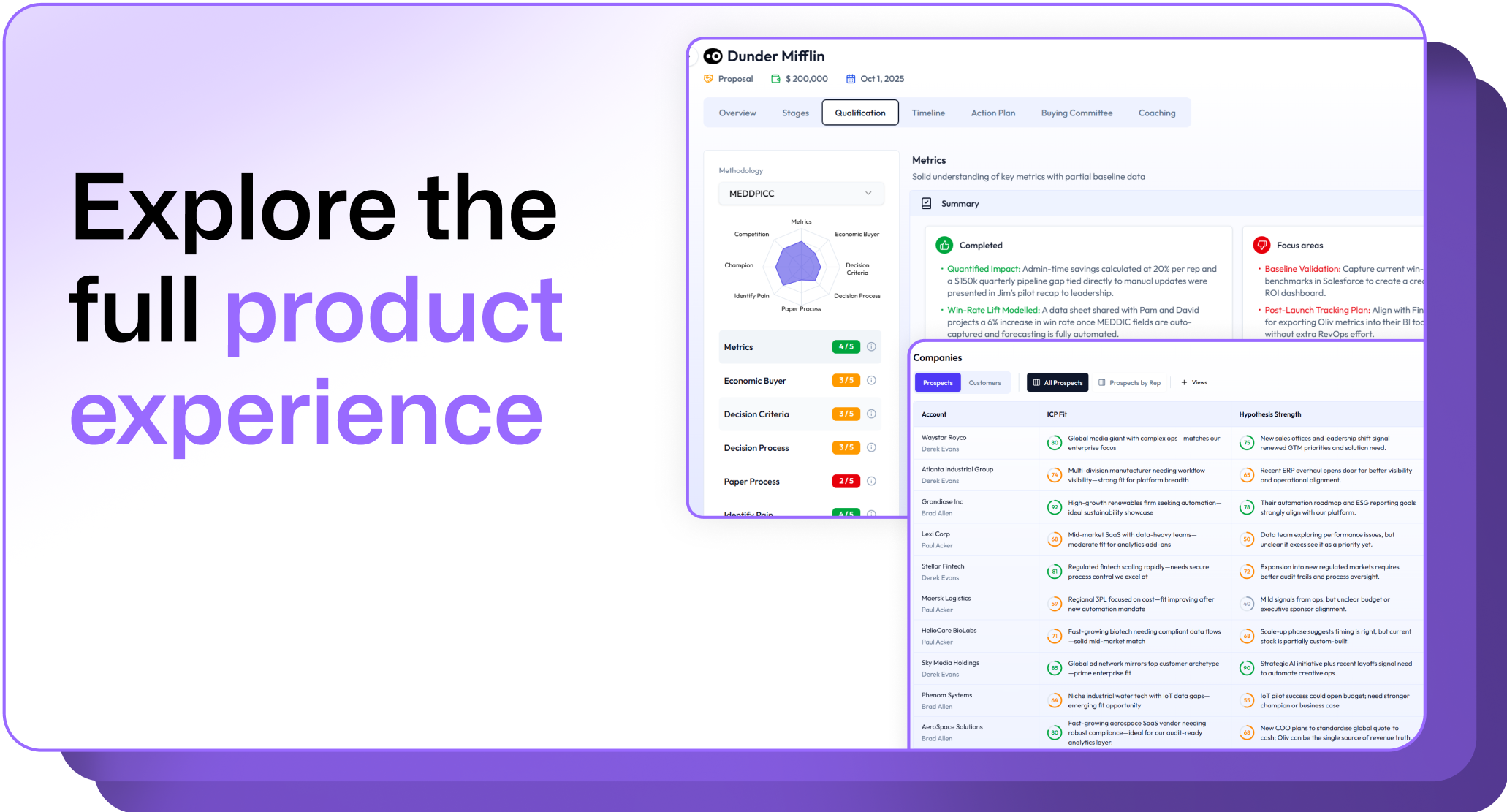
.avif)
.png)