Why Your Board Deck Takes All Weekend — A CRO's Guide to Fixing Forecast Accuracy | 2026
Written by
Ishan Chhabra
Last Updated :
March 4, 2026
Skim in :
7
mins
In this article
Still got questions?
Come discuss this article with me.
Hi, I'm Ishan, Founder and CEO of Oliv.
I'm always up for a conversation about revenue intelligence, AI agents, or what's actually working (and what's not) across revenue teams.
I'd love to hear your perspective.
Thank you! Your submission has been received!
Oops! Something went wrong while submitting the form.
Meet Oliv’s AI Agents
Hi! I’m, Deal Driver
I track deals, flag risks, send weekly pipeline updates and give sales managers full visibility into deal progress
Hi! I’m, CRM Manager
I maintain CRM hygiene by updating core, custom and qualification fields all without your team lifting a finger
Hi! I’m, Forecaster
I build accurate forecasts based on real deal movement and tell you which deals to pull in to hit your number
Hi! I’m, Coach
I believe performance fuels revenue. I spot skill gaps, score calls and build coaching plans to help every rep level up
Hi! I’m, Prospector
I dig into target accounts to surface the right contacts, tailor and time outreach so you always strike when it counts
Hi! I’m, Pipeline tracker
I call reps to get deal updates, and deliver a real-time, CRM-synced roll-up view of deal progress
Hi! I’m, Analyst
I answer complex pipeline questions, uncover deal patterns, and build reports that guide strategic decisions
TL;DR
Your board deck takes all weekend because your stack (Salesforce + Gong + Clari) forces manual data consolidation. CRMs depend on rep input that rarely happens, Gong captures meetings but misses emails and Slack, and Clari requires subjective manager roll-ups that consume an entire day per week per manager.
Three forecast failures hit growth-stage CROs hardest: happy ears, sandbagging, and zombie deals. All three are invisible to keyword trackers and manual reviews because the rep controls the narrative. Objective detection requires contextual AI that scores deals against MEDDPICC or BANT using evidence from actual conversations, not CRM fields.
The annual cost of manual forecasting is $156,000+ for a 10-manager team, and the total Gong + Clari stack runs roughly $500/user/month. ROI comes from three pillars: manager time reclaimed, deal slippage prevented (10-15% of pipeline), and tool consolidation savings. The 25% accuracy improvement benchmark is measured by comparing AI forecasts against actuals versus manager forecasts against actuals.
Methodology automation is the only scalable fix because process alone fails (reps do not comply) and tools alone fail (they surface data but do not enforce rigor). The fix requires embedding your qualification framework directly into an AI-native platform that auto-scores deals, deploys targeted coaching, and generates board-ready decks with one click.
A 90-day transformation roadmap moves through three phases: foundation (data capture + CRM automation), calibration (methodology training + shadow forecasting), and autonomy (one-click board decks + scenario modeling). Unlike Gong's 3-6 month implementation, AI-native platforms deliver initial value in week one and full transformation within a single quarter.
Q1. Why Does Your Board Deck Take All Weekend to Build? [toc=Weekend Board Deck Problem]
Your board deck takes all weekend because your tech stack forces you to manually consolidate rep-driven narratives from fragmented sources. CRMs depend on manual entry that reps neglect. Gong captures meetings but misses emails and Slack. Clari requires subjective manager roll-ups. The fix is autonomous bottom-up forecasting, where AI inspects every deal using conversation evidence and delivers a presentation-ready deck with one click.
The Saturday Morning Reality Check
It is 7 AM on a Saturday. You are sitting at your kitchen table with three monitors worth of data spread across a laptop screen. One tab has Salesforce pipeline reports. Another has Gong call recordings you still need to review. A third has the half-built Google Slides deck your VP of Sales sent at midnight with "needs your numbers" in the subject line.
This is not a failure of effort. It is a failure of architecture.
Why Your CRM Cannot Save You
The root cause is that Salesforce and HubSpot were built as databases that require mandatory manual input from sales reps. But reps prioritize closing deals over CRM hygiene. The result is a system where the data powering your forecast is often incomplete or outright wrong.
When your foundation is built on dirty data, the resulting forecast becomes less of a scientific projection and more of an act of creative writing. You can improve sales forecast accuracy with AI only when the data pipeline itself is fixed.
The Review-Based System Trap
You are currently operating in a review-based system. Managers spend Thursdays and Fridays manually auditing calls, sometimes while driving or in between meetings, just to prepare for the Monday morning roll-up.
This manual auditing is required because tools like Gong or Chorus only give you meeting-level intelligence. They fail to stitch together the entire deal lifecycle across Slack, emails, and phone calls. Despite Gong's limitations and challenges being well documented, most teams continue relying on this fragmented approach.
"It's too complicated, and not intuitive at all. Using it is very...discomforting. Searching for calls is not easy, moving around in the calls is not easy, and understanding the pipeline management portion of it is almost impossible." -- John S., Senior Account Executive G2 Verified Review
"Before Gong we had a lack of visibility across our deals because information was siloed in several places like CRM, Email, Zoom, phone." -- Scott T., Director of Sales G2 Verified Review
The Three-Layer Problem
Your weekend is consumed because you are solving three problems manually that should be automated:
Data collection: Gathering scattered signals from calls, emails, Slack, and CRM fields into a single deal narrative
Deal inspection: Determining which deals are real, which are at risk, and which are fiction
Presentation assembly: Converting raw pipeline data into a board-ready format with commentary
To fix your forecast, you must move away from SaaS software you have to adopt and move toward autonomous agents that perform the work for you. Oliv's Forecaster Agent handles all three layers. It inspects every deal line-by-line, adds AI commentary on risks and quick wins, and generates a presentation-ready Google Slides or PowerPoint deck with one click.
"The additional products like forecast or engage come at an additional cost. Would be great to see these tools rolled into the core offering." -- Scott T., Director of Sales G2 Verified Review
Q2. What Are the Three Forecast Failures That Hit Growth-Stage CROs Hardest? [toc=Three Forecast Failures]
The three forecast failures that disproportionately hit growth-stage CROs are: (1) happy ears, where reps hear commitment that does not exist, (2) sandbagging, where reps hide upside to protect quota, and (3) pipeline-to-close gaps, where deals stall in late stages with no next steps scheduled. All three are invisible to keyword trackers and manual roll-ups.
Keyword trackers detect words; contextual AI detects intent, revealing all three failure types.
Failure #1: Happy Ears
Happy ears is the most common and most expensive forecast failure. A rep hears a prospect say "this looks great" and immediately moves the deal to Commit. The prospect never confirmed budget. The Economic Buyer was never engaged. No timeline was established.
Why Keyword Trackers Miss It
Tools like Gong flag positive sentiment keywords. But there is a massive difference between a prospect saying "I love the product" and a prospect saying "I have budget approval and we need to go live by Q3." Keyword trackers treat both identically. Contextual AI does not.
"It can be overwhelming to set up trackers. Al training is a bit laborious to get it to do what you want." -- Trafford J., Senior Director, Revenue Enablement G2 Verified Review
Failure #2: Sandbagging
Sandbagging is the inverse problem. Top performers intentionally downplay deal progress to protect their quota attainment across quarters. They park deals in early stages and then "pull them forward" at the last minute to look like heroes.
This behavior is rational for the rep but devastating for the CRO's forecast. Without an independent data source tracking all interactions, sandbagged upside remains invisible until the rep chooses to reveal it.
The Narrative Control Problem
Both happy ears and sandbagging thrive in a system where the rep controls the narrative. The MEDDIC sales methodology was designed to prevent this, but methodology only works when someone audits compliance. In most teams, nobody does.
Failure #3: Pipeline-to-Close Gaps
The third failure is deals that look healthy in your CRM but have no forward momentum. No next meeting scheduled. No Mutual Action Plan in place. No champion activity in the last two weeks.
These "zombie deals" inflate your pipeline coverage ratio and create a false sense of security. They are the primary reason CROs see a 30-40% gap between their Week 1 forecast and actual closed revenue.
Why These Failures Amplify at Growth Stage
At growth stage, these failures compound. You have new reps who default to optimism. You have managers who are still learning which reps to trust. You have a board that expects predictability from a team that has never had to deliver it at scale.
The fix requires deal intelligence that operates independently of rep input. Oliv's CRM Manager Agent auto-scores every deal against your chosen framework using evidence directly from conversations. It checks whether a prospect has actually committed to a timeline on the recorded call. If the evidence is not in the conversation, the AI identifies it as a gap and flags the deal.
"Gong is good, not great. Yet. Al is not great yet - the product still feels like its at its infancy and needs to be developed further." -- Annabelle H., Voluntary Director - Board of Directors G2 Verified Review
Q3. Why Can't Clari, Gong, or Salesforce Einstein Solve This? [toc=Legacy Tool Limitations]
Clari is fundamentally a manual roll-up system that still requires subjective manager input. Gong understands the meeting but not the deal, relying on keyword-based Smart Trackers that miss contextual intent. Salesforce Einstein fails because its AI models run on dirty CRM data that reps neglect to update. None of these tools autonomously stitch data across calls, emails, Slack, and the web.
AI-native platforms eliminate the data gaps and manual dependencies that legacy tools require.
Why Clari Falls Short
Clari is the most respected forecasting overlay in the market. Its Salesforce integration, waterfall analytics, and forecast roll-up views are genuinely useful for RevOps teams. But Clari has a fundamental limitation: it depends on the data your reps and managers put into it.
When evaluating Gong vs Clari, the key distinction is that Clari does not generate its own intelligence from conversations. It organizes existing data. If the underlying CRM data is incomplete, Clari's forecast inherits that incompleteness.
"The analytics modules still needs some work IMO to provide a valuable deliverable. All the pieces are there but missing the story line." -- Natalie O., Sales Operations Manager G2 Verified Review
"I do think the forecasting feature is decent, but at least in our setup, it doesn't do a great job of auto-calculating the values I need to submit, so that is entirely handheld." -- Dexter L., Customer Success Executive G2 Verified Review
For teams considering a switch, a detailed analysis of best Clari alternatives reveals how newer platforms approach these limitations differently.
Why Gong Misses the Full Picture
Gong excels at conversation intelligence. Its call recording, AI summaries, and coaching features are market-leading. However, Gong understands the meeting, not the deal.
Gong Smart Trackers search for keywords like "budget," "timeline," or "competitor." But a prospect mentioning a competitor is not the same as a prospect actively evaluating one. Gong cannot distinguish between the two. This is the critical gap between keyword matching and contextual reasoning.
⚠️ The Data Portability Concern
Beyond intelligence limitations, Gong creates data portability challenges that complicate migrations and stack consolidation.
"This lack of flexibility has required us to engage our development team at additional cost, adding significant operational and opportunity costs just to extract data we already own." -- Neel P., Sales Operations Manager G2 Verified Review
Why Salesforce Einstein Underdelivers
Salesforce Einstein forecasting promises AI-driven predictions built natively into your CRM. The theory is sound. The practice breaks down because Einstein's models depend on the same CRM data that reps neglect to update.
Einstein cannot predict deal outcomes accurately when the input data is incomplete. It is a classic "garbage in, garbage out" problem amplified by enterprise-grade complexity.
The Comparison at a Glance
Legacy Revenue Stack vs. AI-Native Platform
Capability
Clari
Gong
Salesforce Einstein
Oliv AI
Data Sources
CRM fields
Meetings only
CRM fields
Calls + Email + Slack + Phone + CRM
Forecast Method
Manager roll-up
Deal boards
Predictive scoring
Autonomous bottom-up AI
Rep Input Required
Yes (CRM updates)
Yes (meeting attendance)
Yes (CRM updates)
No
Implementation Time
4-8 weeks
3-6 months
Weeks to months
Instant (core); 2-4 weeks (full)
Board Deck Generation
Manual export
Not available
Not available
One-click (Slides/PPT)
Q4. What Does Autonomous Bottom-Up Forecasting Actually Look Like? [toc=Autonomous Forecasting Explained]
Autonomous bottom-up forecasting means AI inspects every deal line-by-line using evidence from actual conversations, not rep summaries or manager gut feel. It auto-categorizes deals into Commit, Upside, and Best Case based on objective signals like MAP completion, Economic Buyer engagement, and next-step scheduling. It then delivers a weekly board-ready report without human assembly.
Each step operates autonomously, with zero manual input required from reps or managers.
The Five Steps, Zero Manual Assembly
Autonomous bottom-up forecasting replaces the entire Thursday-to-Monday roll-up cycle with a continuous, AI-driven process. Here is how it works in practice:
Data Ingestion: The platform captures every interaction across calls, emails, Slack, and phone. Unlike Gong, which is limited to scheduled meetings, this includes asynchronous channels where critical buying signals often surface.
Auto-Categorization: Deals are automatically sorted into Commit, Upside, and Best Case based on objective signals. A deal with an engaged Economic Buyer, a signed Mutual Action Plan, and a next meeting on the calendar goes to Commit. A deal missing two of those signals stays in Upside.
Gap Capture: The Voice Agent (Alpha) calls SDRs or AEs nightly to gather updates on off-the-record interactions that were not recorded, such as in-person meetings or personal phone calls. This captures the missing 10% of data that undermines most forecasts.
Deck Generation: The Forecaster Agent compiles everything into a board-ready Google Slides or PowerPoint presentation with AI commentary on risks and quick wins.
How It Differs from Manager Roll-Ups
The critical difference is objectivity. In a manager roll-up, the forecast reflects what the manager believes based on what the rep told them. In autonomous bottom-up forecasting, the forecast reflects what actually happened across every interaction.
This is especially important for teams integrating CRM integration for sales automation, where the goal is eliminating manual data entry as a prerequisite for accurate forecasting.
"There's so much in Gong, that we don't use everything. Gong's deal forecasting we don't use." -- Karel Bos, Head of Sales TrustRadius
✅ The AI vs. Manager Comparison
The Analyst Agent enables a weekly comparison of AI Forecast vs. Manager Forecast vs. Actual. This gap analysis is where you find your true forecast accuracy. If the AI is consistently more conservative than your managers, you know exactly where to drill in to fix happy ears behaviors.
For growth-stage companies transitioning from founder-led sales, this capability is foundational. Oliv's approach to revenue intelligence for mid-market companies is purpose-built for this exact inflection point, where the team is scaling faster than the process can keep up.
"I love how easy Clari makes forecasting. It is intuitive for sellers and managers to input their forecast." -- Sarah J., Senior Manager, Revenue Operations G2 Verified Review
"We've had a disappointing experience with Gong Engage. The tool is slow, buggy, and creates an excessive administrative burden on the user side." -- Anonymous Reviewer G2 Verified Review
Q5. How Do You Objectively Detect Sandbagging and Happy Ears in Your Pipeline? [toc=Detecting Sandbagging Happy Ears]
You detect sandbagging and happy ears by replacing keyword trackers with contextual AI reasoning that scores deals against qualification frameworks like MEDDPICC or BANT. Keyword-based tools like Gong flag that "budget" was mentioned but cannot tell you whether the prospect committed to a budget or merely acknowledged one exists. Objective detection requires AI that reads intent across calls, emails, and Slack, not just meeting transcripts.
Situation: Every CRO Suspects It
Every CRO with more than five reps knows the feeling. One rep consistently over-commits and then slips deals at the eleventh hour. Another rep's pipeline never grows, yet they always find a last-minute deal to hit number.
In practice, sales managers report that these behaviors are nearly impossible to catch in a review-based system. Managers only see the deals reps choose to surface. The rep controls the narrative, the data, and the framing.
"It can be overwhelming to set up trackers. Al training is a bit laborious to get it to do what you want." -- Trafford J., Senior Director, Revenue Enablement Gong G2 Verified Review
Complication: Keyword Trackers Miss Context
Legacy tools detect words, not meaning. Gong's Smart Trackers search for keywords like "competitor" or "timeline." But a prospect saying "we looked at Gong last year and passed" is flagged identically to "we are actively evaluating Gong right now."
Why Happy Ears Slip Through
Happy ears thrive on this gap. A rep hears a prospect say "this looks great" and marks the deal as Commit. The keyword tracker confirms positive sentiment. But the prospect never confirmed budget, never introduced the Economic Buyer, and has no next meeting scheduled.
Why Sandbagging Stays Hidden
Sandbagging is even harder to detect. The rep simply does not update the CRM or downplays deal progress in reviews. Without an independent data source tracking all interactions, the hidden upside remains invisible until it conveniently appears next quarter.
"The software doesn't have the capability of identifying words/phrases that are similar to what you're looking for or understand context." -- Director of Sales Operations Chorus Gartner Peer Insights Review
Resolution: Framework-Based AI Scoring
The fix requires three capabilities that pre-generative AI tools lack:
Multi-channel stitching: Track calls, emails, Slack, and phone together. A prospect might say "yes" on the call but send a hesitant email the next day. Meeting-only tools miss this signal entirely.
Contextual intent scoring: AI that uses reasoning to distinguish between casual mentions and genuine buying signals. Not keyword matching. Contextual understanding.
Automated framework auditing: Auto-score every deal against MEDDPICC, BANT, or SPICED criteria using evidence directly from conversations. No rep self-reporting.
Oliv's CRM Manager Agent performs all three functions autonomously. It checks whether a prospect has actually committed to a timeline on the recorded call. If the evidence is not in the conversation, the AI identifies it as a gap and flags the deal.
"Understanding the pipeline management portion of it is almost impossible. Some people figure it out, but I think most just fumble through." -- John S., Senior Account Executive Gong G2 Verified Review
We train the AI on just three of your calls to learn your unique methodology. Once trained, it acts as a 24/7 auditor for every deal, catching happy ears and sandbagging before they infect your forecast.
Q6. How Do You Stop the Thursday-to-Monday Forecast Roll-Up Cycle? [toc=Stopping the Roll-Up Cycle]
You stop the roll-up cycle by eliminating the need for managers to manually audit calls and "hear the story" from each rep. The typical mid-market revenue team loses $156,000 per year in manager productivity to this process. Deploy autonomous agents that track every interaction across channels and deliver a daily deal summary to each manager's inbox, replacing the Thursday-through-Friday listening marathon with a five-minute morning review.
The Hidden Cost of Manual Forecasting
Here is how most mid-market teams forecast today. Thursday morning: managers begin calling reps or pulling up Gong recordings to audit key deals. Friday afternoon: managers consolidate notes into a spreadsheet. Monday morning: the CRO holds a roll-up call where each manager presents their view.
Quantifying the Manager's Burden
On average, managers spend roughly one full day per week (20% of their time) simply listening to calls and auditing CRM data. For a team of 10 managers earning an average of $150,000 base plus benefits, that math is brutal:
Annual Cost of Manual Forecast Prep: 10-Manager Team
Metric
Value
Managers on team
10
Hours per manager per week on auditing
8
Total team hours per month
320
Annual cost at blended rate ($75/hr)
$156,000
Productive coaching hours lost per year
4,160
That is 4,160 hours of potential coaching, deal strategy, and pipeline development burned on administrative review.
Why Existing Tools Do Not Solve This
Gong provides call recordings, but managers still need to listen. Clari offers a consolidated view, but managers must still input their judgment. Neither tool removes the human bottleneck.
"There's so much in Gong, that we don't use everything. Gong's deal forecasting we don't use." -- Karel Bos, Head of Sales Gong TrustRadius Review
"The analytics modules still needs some work IMO to provide a valuable deliverable. All the pieces are there but missing the story line... You have to click around through the different modules and extract the different pieces ultimately putting it in an excel for easier manipulation." -- Natalie O., Sales Operations Manager Clari G2 Verified Review
How AI Eliminates the Cycle
The transformation happens in three steps:
Step 1: Autonomous Data Capture
Oliv tracks every deal interaction across calls, emails, Slack, and phone without requiring rep input. The data flows into a unified deal record automatically. No CRM hygiene dependency.
Step 2: Daily Sunset Summaries
The Deal Driver Agent flags stalled deals daily and delivers a "Sunset Summary" of pipeline progress directly to the manager's inbox by 6 PM. Managers start Monday morning already informed. No Thursday audit needed.
Step 3: Autonomous Roll-Up
The Forecaster Agent inspects every deal, auto-categorizes into Commit, Upside, and Best Case, and generates the weekly report. The CRO reviews a finished deck rather than assembling one from fragments.
"Clari is a tool for sales leaders, it adds no value to reps as far as I can see." -- Msoave, r/SalesOperations Reddit Thread
We typically reclaim one full day per week for every manager on the team. That translates to reinvesting $156,000 of annual productivity into coaching and deal strategy.
Q7. Can AI Deliver Board-Ready Forecast Decks That Series B Investors Expect? [toc=Board-Ready AI Forecast Decks]
Yes. AI-native agents can deliver forecast decks that meet Series B and C investor expectations, including detailed pipeline summaries, win-rate trends, risk assessments, and deal-level evidence trails. The critical requirement is grounded AI, where every claim links to a timestamped call snippet or email sentence. Generic dashboards and subjective manager summaries no longer satisfy boards evaluating $20M+ ARR trajectories.
Situation: What Investors Actually Want
Series B investors expect more than a top-line Commit number. They want to see how you arrived at that number. Based on standard growth-stage board reporting, investors typically request:
Pipeline coverage ratio (3x to 4x is the benchmark)
Win-rate trends by segment, rep, and deal size
Stage conversion rates with historical comparison
Risk-flagged deals with specific evidence for concern
Scenario modeling for headcount or win-rate changes
The Trust Gap in Current Tools
Most CROs build these slides manually. They export from Clari, paste into Google Slides, add commentary, and cross-reference against Gong recordings. The process takes a full weekend because the data lives in silos.
"I do think the forecasting feature is decent, but at least in our setup, it doesn't do a great job of auto-calculating the values I need to submit, so that is entirely handheld." -- Dexter L., Customer Success Executive Clari G2 Verified Review
Complication: Dashboards Are Not Decks
Clari's analytics are praised by RevOps teams for day-to-day pipeline inspection. But dashboards are not board decks. A dashboard shows data. A board deck tells a story with evidence.
"Clari's Dashboards leave a lot to be desired. They are surprisingly limited versus how flexible the requisite data sources are." -- Rob W., Sr. Director of Revenue Operations Clari G2 Verified Review
Salesforce Einstein generates predictions, but those predictions run on CRM data that reps neglect to update. A Gartner Peer Insights reviewer noted that Einstein "does not allow for data storage or data migration" and has "an extremely complicated set up process" (Einstein Gartner Peer Insights Review, 2023).
The Evidence Trail Requirement
Boards no longer accept "the rep says it will close." They want verifiable proof. Did the Economic Buyer engage? Is a Mutual Action Plan in place? What did the prospect actually say about timeline on the last call?
Resolution: One-Click Board Decks
Oliv's Forecaster Agent addresses each investor requirement autonomously:
Pipeline summaries: Auto-generated with coverage ratios
Win-rate trends: Broken down by segment, rep, and deal size
Risk assessment: Every flagged deal links to a timestamped conversation snippet
Scenario modeling: The Scenario Simulator agent models headcount changes and win-rate shifts in seconds
Presentation format: Exports directly to Google Slides or PowerPoint with one click
Every AI claim is grounded. When the Forecaster says "Deal X is at risk," it links to the exact sentence in an email or the exact 30-second window of a call where the risk signal appeared. This creates a verifiable data trail that you present to your board with full confidence.
"As a Series B startup we rely on the intelligence and insights from Gong to understand and scale what's working, and to better understand real risk and opportunity." -- Trafford J., Senior Director, Revenue Enablement Gong G2 Verified Review
Oliv is designed specifically for growth-stage companies making this transition. The Forecaster provides the analytical depth that Series B and C investors expect without requiring a weekend of manual assembly.
Q8. What's the Best Approach to Fixing Forecast Accuracy: Process, Tools, or Both? [toc=Fixing Forecast Accuracy]
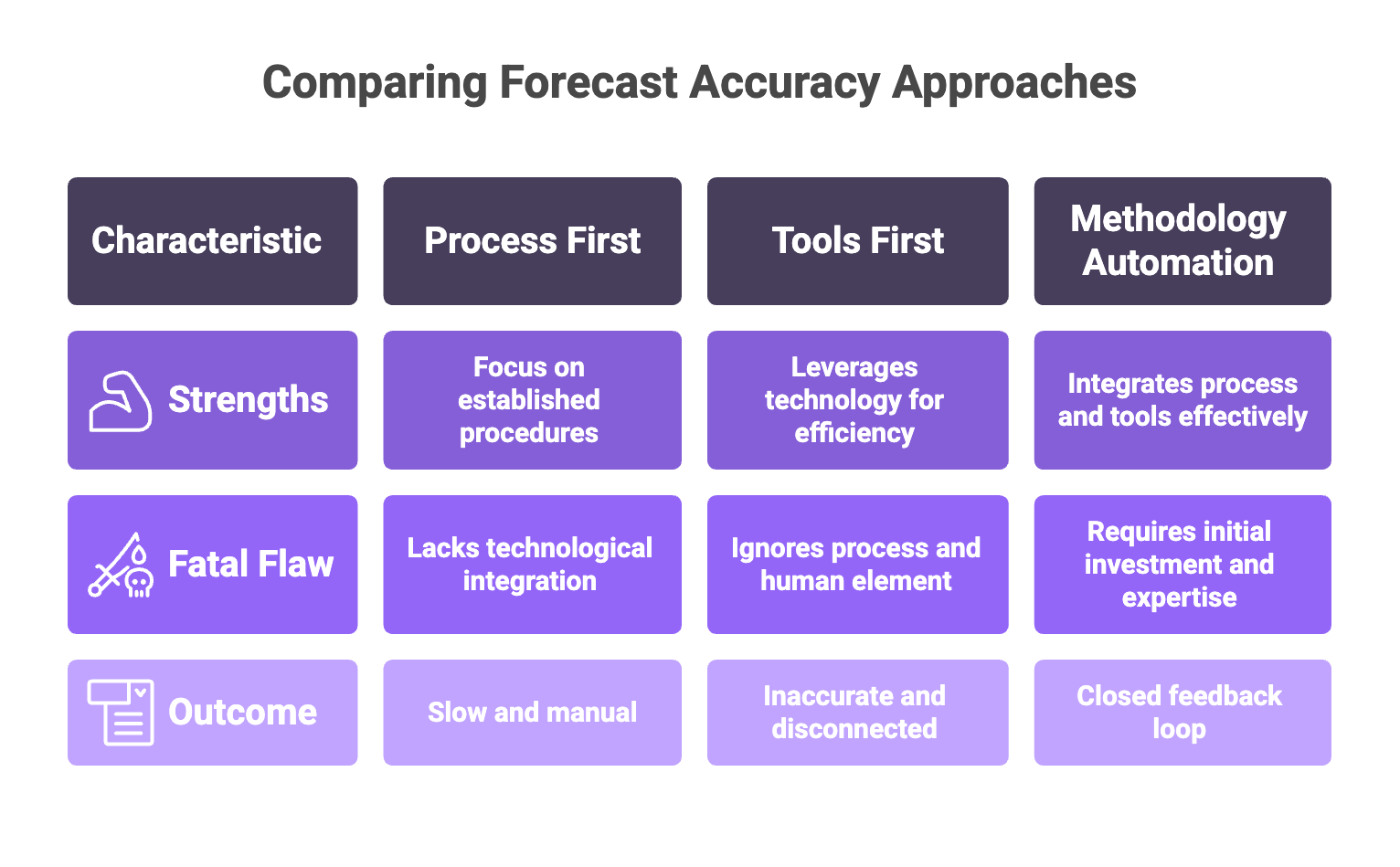
Fixing forecast accuracy requires both process and tools, but they must be unified through methodology automation. Process alone fails because reps do not follow it consistently. Tools alone fail because they optimize for speed without enforcing rigor. The only scalable approach is embedding your qualification methodology (MEDDPICC, BANT, or SPICED) directly into an AI-native platform that enforces the process autonomously on every deal.
Only methodology automation creates the tight feedback loop where process and tools reinforce each other.
The Three Schools of Thought
Revenue leaders typically fall into one of three camps when tackling forecast accuracy. Each has merit. Each has a fatal flaw when applied in isolation.
School 1: Process First
This school says the problem is discipline. Implement MEDDIC. Train the team. Enforce stage gates. Run rigorous qualification reviews.
The flaw: Process depends on human compliance. Reps prioritize closing over record-keeping. According to industry data, CRM adoption rates among sales reps consistently hover below 50% for manual data entry tasks. When your process relies on the rep to self-report, accuracy degrades with every deal.
School 2: Tools First
This school says the problem is visibility. Buy Gong for call intelligence. Add Clari for forecasting. Layer Salesforce Einstein for AI predictions.
The flaw: Tools built in the pre-generative AI era optimize for surfacing data, not acting on it. Gong gives you the recording. Clari gives you the roll-up view. Einstein gives you a score. But none of them enforce your methodology. They are observation layers, not execution layers.
"Clari features often overlap with other common sales tech tools. Clari should do more to differentiate themselves from competition." -- Sarah J., Senior Manager, Revenue Operations Clari G2 Verified Review
School 3: Methodology Automation
This is the scalable path. Define your qualification process. Then embed it into an AI-native platform that enforces the process without relying on rep compliance.
Why Methodology Automation Wins
The difference is enforcement. In School 1, you train reps on MEDDPICC and hope they follow it. In School 3, the AI checks whether MEDDPICC criteria are met using evidence from actual conversations, not CRM field values.
The Tight Feedback Loop
Methodology automation creates what practitioners call a "tight feedback loop." The AI measures performance on live deals, identifies specific skill gaps causing forecast leakage, and deploys targeted coaching. This loop operates continuously without manager intervention.
"I haven't been impressed by any of the early Salesforce AI tools, and I don't hear anyone talking about them glowingly." -- OffManuscript, r/SalesforceDeveloper Reddit Thread
"I find the setup process challenging, especially when migrating fields from Salesforce, as it can't handle formula fields directly. This requires creating and maintaining duplicate fields, which adds complexity." -- Josiah R., Head of Sales Operations Clari G2 Verified Review
How Oliv Enables Methodology Automation
Oliv allows you to train the AI on just three calls to learn your unique methodology. Once trained, the system:
Auto-scores every deal against your chosen framework (MEDDPICC, BANT, SPICED)
Identifies gaps using conversation evidence, not rep self-assessment
Deploys the Coach Agent with tailored practice voice bots for skill gaps
Feeds results back into the Forecaster for improved accuracy each week
The result is a system where process and tools become indistinguishable. Your methodology is the tool. The tool enforces your methodology. This is what Revenue Engineering looks like in practice.
Q1. Why Does Your Board Deck Take All Weekend to Build? [toc=Weekend Board Deck Problem]
Your board deck takes all weekend because your tech stack forces you to manually consolidate rep-driven narratives from fragmented sources. CRMs depend on manual entry that reps neglect. Gong captures meetings but misses emails and Slack. Clari requires subjective manager roll-ups. The fix is autonomous bottom-up forecasting, where AI inspects every deal using conversation evidence and delivers a presentation-ready deck with one click.
The Saturday Morning Reality Check
It is 7 AM on a Saturday. You are sitting at your kitchen table with three monitors worth of data spread across a laptop screen. One tab has Salesforce pipeline reports. Another has Gong call recordings you still need to review. A third has the half-built Google Slides deck your VP of Sales sent at midnight with "needs your numbers" in the subject line.
This is not a failure of effort. It is a failure of architecture.
Why Your CRM Cannot Save You
The root cause is that Salesforce and HubSpot were built as databases that require mandatory manual input from sales reps. But reps prioritize closing deals over CRM hygiene. The result is a system where the data powering your forecast is often incomplete or outright wrong.
When your foundation is built on dirty data, the resulting forecast becomes less of a scientific projection and more of an act of creative writing. You can improve sales forecast accuracy with AI only when the data pipeline itself is fixed.
The Review-Based System Trap
You are currently operating in a review-based system. Managers spend Thursdays and Fridays manually auditing calls, sometimes while driving or in between meetings, just to prepare for the Monday morning roll-up.
This manual auditing is required because tools like Gong or Chorus only give you meeting-level intelligence. They fail to stitch together the entire deal lifecycle across Slack, emails, and phone calls. Despite Gong's limitations and challenges being well documented, most teams continue relying on this fragmented approach.
"It's too complicated, and not intuitive at all. Using it is very...discomforting. Searching for calls is not easy, moving around in the calls is not easy, and understanding the pipeline management portion of it is almost impossible." -- John S., Senior Account Executive G2 Verified Review
"Before Gong we had a lack of visibility across our deals because information was siloed in several places like CRM, Email, Zoom, phone." -- Scott T., Director of Sales G2 Verified Review
The Three-Layer Problem
Your weekend is consumed because you are solving three problems manually that should be automated:
Data collection: Gathering scattered signals from calls, emails, Slack, and CRM fields into a single deal narrative
Deal inspection: Determining which deals are real, which are at risk, and which are fiction
Presentation assembly: Converting raw pipeline data into a board-ready format with commentary
To fix your forecast, you must move away from SaaS software you have to adopt and move toward autonomous agents that perform the work for you. Oliv's Forecaster Agent handles all three layers. It inspects every deal line-by-line, adds AI commentary on risks and quick wins, and generates a presentation-ready Google Slides or PowerPoint deck with one click.
"The additional products like forecast or engage come at an additional cost. Would be great to see these tools rolled into the core offering." -- Scott T., Director of Sales G2 Verified Review
Q2. What Are the Three Forecast Failures That Hit Growth-Stage CROs Hardest? [toc=Three Forecast Failures]
The three forecast failures that disproportionately hit growth-stage CROs are: (1) happy ears, where reps hear commitment that does not exist, (2) sandbagging, where reps hide upside to protect quota, and (3) pipeline-to-close gaps, where deals stall in late stages with no next steps scheduled. All three are invisible to keyword trackers and manual roll-ups.
Keyword trackers detect words; contextual AI detects intent, revealing all three failure types.
Failure #1: Happy Ears
Happy ears is the most common and most expensive forecast failure. A rep hears a prospect say "this looks great" and immediately moves the deal to Commit. The prospect never confirmed budget. The Economic Buyer was never engaged. No timeline was established.
Why Keyword Trackers Miss It
Tools like Gong flag positive sentiment keywords. But there is a massive difference between a prospect saying "I love the product" and a prospect saying "I have budget approval and we need to go live by Q3." Keyword trackers treat both identically. Contextual AI does not.
"It can be overwhelming to set up trackers. Al training is a bit laborious to get it to do what you want." -- Trafford J., Senior Director, Revenue Enablement G2 Verified Review
Failure #2: Sandbagging
Sandbagging is the inverse problem. Top performers intentionally downplay deal progress to protect their quota attainment across quarters. They park deals in early stages and then "pull them forward" at the last minute to look like heroes.
This behavior is rational for the rep but devastating for the CRO's forecast. Without an independent data source tracking all interactions, sandbagged upside remains invisible until the rep chooses to reveal it.
The Narrative Control Problem
Both happy ears and sandbagging thrive in a system where the rep controls the narrative. The MEDDIC sales methodology was designed to prevent this, but methodology only works when someone audits compliance. In most teams, nobody does.
Failure #3: Pipeline-to-Close Gaps
The third failure is deals that look healthy in your CRM but have no forward momentum. No next meeting scheduled. No Mutual Action Plan in place. No champion activity in the last two weeks.
These "zombie deals" inflate your pipeline coverage ratio and create a false sense of security. They are the primary reason CROs see a 30-40% gap between their Week 1 forecast and actual closed revenue.
Why These Failures Amplify at Growth Stage
At growth stage, these failures compound. You have new reps who default to optimism. You have managers who are still learning which reps to trust. You have a board that expects predictability from a team that has never had to deliver it at scale.
The fix requires deal intelligence that operates independently of rep input. Oliv's CRM Manager Agent auto-scores every deal against your chosen framework using evidence directly from conversations. It checks whether a prospect has actually committed to a timeline on the recorded call. If the evidence is not in the conversation, the AI identifies it as a gap and flags the deal.
"Gong is good, not great. Yet. Al is not great yet - the product still feels like its at its infancy and needs to be developed further." -- Annabelle H., Voluntary Director - Board of Directors G2 Verified Review
Q3. Why Can't Clari, Gong, or Salesforce Einstein Solve This? [toc=Legacy Tool Limitations]
Clari is fundamentally a manual roll-up system that still requires subjective manager input. Gong understands the meeting but not the deal, relying on keyword-based Smart Trackers that miss contextual intent. Salesforce Einstein fails because its AI models run on dirty CRM data that reps neglect to update. None of these tools autonomously stitch data across calls, emails, Slack, and the web.
AI-native platforms eliminate the data gaps and manual dependencies that legacy tools require.
Why Clari Falls Short
Clari is the most respected forecasting overlay in the market. Its Salesforce integration, waterfall analytics, and forecast roll-up views are genuinely useful for RevOps teams. But Clari has a fundamental limitation: it depends on the data your reps and managers put into it.
When evaluating Gong vs Clari, the key distinction is that Clari does not generate its own intelligence from conversations. It organizes existing data. If the underlying CRM data is incomplete, Clari's forecast inherits that incompleteness.
"The analytics modules still needs some work IMO to provide a valuable deliverable. All the pieces are there but missing the story line." -- Natalie O., Sales Operations Manager G2 Verified Review
"I do think the forecasting feature is decent, but at least in our setup, it doesn't do a great job of auto-calculating the values I need to submit, so that is entirely handheld." -- Dexter L., Customer Success Executive G2 Verified Review
For teams considering a switch, a detailed analysis of best Clari alternatives reveals how newer platforms approach these limitations differently.
Why Gong Misses the Full Picture
Gong excels at conversation intelligence. Its call recording, AI summaries, and coaching features are market-leading. However, Gong understands the meeting, not the deal.
Gong Smart Trackers search for keywords like "budget," "timeline," or "competitor." But a prospect mentioning a competitor is not the same as a prospect actively evaluating one. Gong cannot distinguish between the two. This is the critical gap between keyword matching and contextual reasoning.
⚠️ The Data Portability Concern
Beyond intelligence limitations, Gong creates data portability challenges that complicate migrations and stack consolidation.
"This lack of flexibility has required us to engage our development team at additional cost, adding significant operational and opportunity costs just to extract data we already own." -- Neel P., Sales Operations Manager G2 Verified Review
Why Salesforce Einstein Underdelivers
Salesforce Einstein forecasting promises AI-driven predictions built natively into your CRM. The theory is sound. The practice breaks down because Einstein's models depend on the same CRM data that reps neglect to update.
Einstein cannot predict deal outcomes accurately when the input data is incomplete. It is a classic "garbage in, garbage out" problem amplified by enterprise-grade complexity.
The Comparison at a Glance
Legacy Revenue Stack vs. AI-Native Platform
Capability
Clari
Gong
Salesforce Einstein
Oliv AI
Data Sources
CRM fields
Meetings only
CRM fields
Calls + Email + Slack + Phone + CRM
Forecast Method
Manager roll-up
Deal boards
Predictive scoring
Autonomous bottom-up AI
Rep Input Required
Yes (CRM updates)
Yes (meeting attendance)
Yes (CRM updates)
No
Implementation Time
4-8 weeks
3-6 months
Weeks to months
Instant (core); 2-4 weeks (full)
Board Deck Generation
Manual export
Not available
Not available
One-click (Slides/PPT)
Q4. What Does Autonomous Bottom-Up Forecasting Actually Look Like? [toc=Autonomous Forecasting Explained]
Autonomous bottom-up forecasting means AI inspects every deal line-by-line using evidence from actual conversations, not rep summaries or manager gut feel. It auto-categorizes deals into Commit, Upside, and Best Case based on objective signals like MAP completion, Economic Buyer engagement, and next-step scheduling. It then delivers a weekly board-ready report without human assembly.
Each step operates autonomously, with zero manual input required from reps or managers.
The Five Steps, Zero Manual Assembly
Autonomous bottom-up forecasting replaces the entire Thursday-to-Monday roll-up cycle with a continuous, AI-driven process. Here is how it works in practice:
Data Ingestion: The platform captures every interaction across calls, emails, Slack, and phone. Unlike Gong, which is limited to scheduled meetings, this includes asynchronous channels where critical buying signals often surface.
Auto-Categorization: Deals are automatically sorted into Commit, Upside, and Best Case based on objective signals. A deal with an engaged Economic Buyer, a signed Mutual Action Plan, and a next meeting on the calendar goes to Commit. A deal missing two of those signals stays in Upside.
Gap Capture: The Voice Agent (Alpha) calls SDRs or AEs nightly to gather updates on off-the-record interactions that were not recorded, such as in-person meetings or personal phone calls. This captures the missing 10% of data that undermines most forecasts.
Deck Generation: The Forecaster Agent compiles everything into a board-ready Google Slides or PowerPoint presentation with AI commentary on risks and quick wins.
How It Differs from Manager Roll-Ups
The critical difference is objectivity. In a manager roll-up, the forecast reflects what the manager believes based on what the rep told them. In autonomous bottom-up forecasting, the forecast reflects what actually happened across every interaction.
This is especially important for teams integrating CRM integration for sales automation, where the goal is eliminating manual data entry as a prerequisite for accurate forecasting.
"There's so much in Gong, that we don't use everything. Gong's deal forecasting we don't use." -- Karel Bos, Head of Sales TrustRadius
✅ The AI vs. Manager Comparison
The Analyst Agent enables a weekly comparison of AI Forecast vs. Manager Forecast vs. Actual. This gap analysis is where you find your true forecast accuracy. If the AI is consistently more conservative than your managers, you know exactly where to drill in to fix happy ears behaviors.
For growth-stage companies transitioning from founder-led sales, this capability is foundational. Oliv's approach to revenue intelligence for mid-market companies is purpose-built for this exact inflection point, where the team is scaling faster than the process can keep up.
"I love how easy Clari makes forecasting. It is intuitive for sellers and managers to input their forecast." -- Sarah J., Senior Manager, Revenue Operations G2 Verified Review
"We've had a disappointing experience with Gong Engage. The tool is slow, buggy, and creates an excessive administrative burden on the user side." -- Anonymous Reviewer G2 Verified Review
Q5. How Do You Objectively Detect Sandbagging and Happy Ears in Your Pipeline? [toc=Detecting Sandbagging Happy Ears]
You detect sandbagging and happy ears by replacing keyword trackers with contextual AI reasoning that scores deals against qualification frameworks like MEDDPICC or BANT. Keyword-based tools like Gong flag that "budget" was mentioned but cannot tell you whether the prospect committed to a budget or merely acknowledged one exists. Objective detection requires AI that reads intent across calls, emails, and Slack, not just meeting transcripts.
Situation: Every CRO Suspects It
Every CRO with more than five reps knows the feeling. One rep consistently over-commits and then slips deals at the eleventh hour. Another rep's pipeline never grows, yet they always find a last-minute deal to hit number.
In practice, sales managers report that these behaviors are nearly impossible to catch in a review-based system. Managers only see the deals reps choose to surface. The rep controls the narrative, the data, and the framing.
"It can be overwhelming to set up trackers. Al training is a bit laborious to get it to do what you want." -- Trafford J., Senior Director, Revenue Enablement Gong G2 Verified Review
Complication: Keyword Trackers Miss Context
Legacy tools detect words, not meaning. Gong's Smart Trackers search for keywords like "competitor" or "timeline." But a prospect saying "we looked at Gong last year and passed" is flagged identically to "we are actively evaluating Gong right now."
Why Happy Ears Slip Through
Happy ears thrive on this gap. A rep hears a prospect say "this looks great" and marks the deal as Commit. The keyword tracker confirms positive sentiment. But the prospect never confirmed budget, never introduced the Economic Buyer, and has no next meeting scheduled.
Why Sandbagging Stays Hidden
Sandbagging is even harder to detect. The rep simply does not update the CRM or downplays deal progress in reviews. Without an independent data source tracking all interactions, the hidden upside remains invisible until it conveniently appears next quarter.
"The software doesn't have the capability of identifying words/phrases that are similar to what you're looking for or understand context." -- Director of Sales Operations Chorus Gartner Peer Insights Review
Resolution: Framework-Based AI Scoring
The fix requires three capabilities that pre-generative AI tools lack:
Multi-channel stitching: Track calls, emails, Slack, and phone together. A prospect might say "yes" on the call but send a hesitant email the next day. Meeting-only tools miss this signal entirely.
Contextual intent scoring: AI that uses reasoning to distinguish between casual mentions and genuine buying signals. Not keyword matching. Contextual understanding.
Automated framework auditing: Auto-score every deal against MEDDPICC, BANT, or SPICED criteria using evidence directly from conversations. No rep self-reporting.
Oliv's CRM Manager Agent performs all three functions autonomously. It checks whether a prospect has actually committed to a timeline on the recorded call. If the evidence is not in the conversation, the AI identifies it as a gap and flags the deal.
"Understanding the pipeline management portion of it is almost impossible. Some people figure it out, but I think most just fumble through." -- John S., Senior Account Executive Gong G2 Verified Review
We train the AI on just three of your calls to learn your unique methodology. Once trained, it acts as a 24/7 auditor for every deal, catching happy ears and sandbagging before they infect your forecast.
Q6. How Do You Stop the Thursday-to-Monday Forecast Roll-Up Cycle? [toc=Stopping the Roll-Up Cycle]
You stop the roll-up cycle by eliminating the need for managers to manually audit calls and "hear the story" from each rep. The typical mid-market revenue team loses $156,000 per year in manager productivity to this process. Deploy autonomous agents that track every interaction across channels and deliver a daily deal summary to each manager's inbox, replacing the Thursday-through-Friday listening marathon with a five-minute morning review.
The Hidden Cost of Manual Forecasting
Here is how most mid-market teams forecast today. Thursday morning: managers begin calling reps or pulling up Gong recordings to audit key deals. Friday afternoon: managers consolidate notes into a spreadsheet. Monday morning: the CRO holds a roll-up call where each manager presents their view.
Quantifying the Manager's Burden
On average, managers spend roughly one full day per week (20% of their time) simply listening to calls and auditing CRM data. For a team of 10 managers earning an average of $150,000 base plus benefits, that math is brutal:
Annual Cost of Manual Forecast Prep: 10-Manager Team
Metric
Value
Managers on team
10
Hours per manager per week on auditing
8
Total team hours per month
320
Annual cost at blended rate ($75/hr)
$156,000
Productive coaching hours lost per year
4,160
That is 4,160 hours of potential coaching, deal strategy, and pipeline development burned on administrative review.
Why Existing Tools Do Not Solve This
Gong provides call recordings, but managers still need to listen. Clari offers a consolidated view, but managers must still input their judgment. Neither tool removes the human bottleneck.
"There's so much in Gong, that we don't use everything. Gong's deal forecasting we don't use." -- Karel Bos, Head of Sales Gong TrustRadius Review
"The analytics modules still needs some work IMO to provide a valuable deliverable. All the pieces are there but missing the story line... You have to click around through the different modules and extract the different pieces ultimately putting it in an excel for easier manipulation." -- Natalie O., Sales Operations Manager Clari G2 Verified Review
How AI Eliminates the Cycle
The transformation happens in three steps:
Step 1: Autonomous Data Capture
Oliv tracks every deal interaction across calls, emails, Slack, and phone without requiring rep input. The data flows into a unified deal record automatically. No CRM hygiene dependency.
Step 2: Daily Sunset Summaries
The Deal Driver Agent flags stalled deals daily and delivers a "Sunset Summary" of pipeline progress directly to the manager's inbox by 6 PM. Managers start Monday morning already informed. No Thursday audit needed.
Step 3: Autonomous Roll-Up
The Forecaster Agent inspects every deal, auto-categorizes into Commit, Upside, and Best Case, and generates the weekly report. The CRO reviews a finished deck rather than assembling one from fragments.
"Clari is a tool for sales leaders, it adds no value to reps as far as I can see." -- Msoave, r/SalesOperations Reddit Thread
We typically reclaim one full day per week for every manager on the team. That translates to reinvesting $156,000 of annual productivity into coaching and deal strategy.
Q7. Can AI Deliver Board-Ready Forecast Decks That Series B Investors Expect? [toc=Board-Ready AI Forecast Decks]
Yes. AI-native agents can deliver forecast decks that meet Series B and C investor expectations, including detailed pipeline summaries, win-rate trends, risk assessments, and deal-level evidence trails. The critical requirement is grounded AI, where every claim links to a timestamped call snippet or email sentence. Generic dashboards and subjective manager summaries no longer satisfy boards evaluating $20M+ ARR trajectories.
Situation: What Investors Actually Want
Series B investors expect more than a top-line Commit number. They want to see how you arrived at that number. Based on standard growth-stage board reporting, investors typically request:
Pipeline coverage ratio (3x to 4x is the benchmark)
Win-rate trends by segment, rep, and deal size
Stage conversion rates with historical comparison
Risk-flagged deals with specific evidence for concern
Scenario modeling for headcount or win-rate changes
The Trust Gap in Current Tools
Most CROs build these slides manually. They export from Clari, paste into Google Slides, add commentary, and cross-reference against Gong recordings. The process takes a full weekend because the data lives in silos.
"I do think the forecasting feature is decent, but at least in our setup, it doesn't do a great job of auto-calculating the values I need to submit, so that is entirely handheld." -- Dexter L., Customer Success Executive Clari G2 Verified Review
Complication: Dashboards Are Not Decks
Clari's analytics are praised by RevOps teams for day-to-day pipeline inspection. But dashboards are not board decks. A dashboard shows data. A board deck tells a story with evidence.
"Clari's Dashboards leave a lot to be desired. They are surprisingly limited versus how flexible the requisite data sources are." -- Rob W., Sr. Director of Revenue Operations Clari G2 Verified Review
Salesforce Einstein generates predictions, but those predictions run on CRM data that reps neglect to update. A Gartner Peer Insights reviewer noted that Einstein "does not allow for data storage or data migration" and has "an extremely complicated set up process" (Einstein Gartner Peer Insights Review, 2023).
The Evidence Trail Requirement
Boards no longer accept "the rep says it will close." They want verifiable proof. Did the Economic Buyer engage? Is a Mutual Action Plan in place? What did the prospect actually say about timeline on the last call?
Resolution: One-Click Board Decks
Oliv's Forecaster Agent addresses each investor requirement autonomously:
Pipeline summaries: Auto-generated with coverage ratios
Win-rate trends: Broken down by segment, rep, and deal size
Risk assessment: Every flagged deal links to a timestamped conversation snippet
Scenario modeling: The Scenario Simulator agent models headcount changes and win-rate shifts in seconds
Presentation format: Exports directly to Google Slides or PowerPoint with one click
Every AI claim is grounded. When the Forecaster says "Deal X is at risk," it links to the exact sentence in an email or the exact 30-second window of a call where the risk signal appeared. This creates a verifiable data trail that you present to your board with full confidence.
"As a Series B startup we rely on the intelligence and insights from Gong to understand and scale what's working, and to better understand real risk and opportunity." -- Trafford J., Senior Director, Revenue Enablement Gong G2 Verified Review
Oliv is designed specifically for growth-stage companies making this transition. The Forecaster provides the analytical depth that Series B and C investors expect without requiring a weekend of manual assembly.
Q8. What's the Best Approach to Fixing Forecast Accuracy: Process, Tools, or Both? [toc=Fixing Forecast Accuracy]
Fixing forecast accuracy requires both process and tools, but they must be unified through methodology automation. Process alone fails because reps do not follow it consistently. Tools alone fail because they optimize for speed without enforcing rigor. The only scalable approach is embedding your qualification methodology (MEDDPICC, BANT, or SPICED) directly into an AI-native platform that enforces the process autonomously on every deal.
Only methodology automation creates the tight feedback loop where process and tools reinforce each other.
The Three Schools of Thought
Revenue leaders typically fall into one of three camps when tackling forecast accuracy. Each has merit. Each has a fatal flaw when applied in isolation.
School 1: Process First
This school says the problem is discipline. Implement MEDDIC. Train the team. Enforce stage gates. Run rigorous qualification reviews.
The flaw: Process depends on human compliance. Reps prioritize closing over record-keeping. According to industry data, CRM adoption rates among sales reps consistently hover below 50% for manual data entry tasks. When your process relies on the rep to self-report, accuracy degrades with every deal.
School 2: Tools First
This school says the problem is visibility. Buy Gong for call intelligence. Add Clari for forecasting. Layer Salesforce Einstein for AI predictions.
The flaw: Tools built in the pre-generative AI era optimize for surfacing data, not acting on it. Gong gives you the recording. Clari gives you the roll-up view. Einstein gives you a score. But none of them enforce your methodology. They are observation layers, not execution layers.
"Clari features often overlap with other common sales tech tools. Clari should do more to differentiate themselves from competition." -- Sarah J., Senior Manager, Revenue Operations Clari G2 Verified Review
School 3: Methodology Automation
This is the scalable path. Define your qualification process. Then embed it into an AI-native platform that enforces the process without relying on rep compliance.
Why Methodology Automation Wins
The difference is enforcement. In School 1, you train reps on MEDDPICC and hope they follow it. In School 3, the AI checks whether MEDDPICC criteria are met using evidence from actual conversations, not CRM field values.
The Tight Feedback Loop
Methodology automation creates what practitioners call a "tight feedback loop." The AI measures performance on live deals, identifies specific skill gaps causing forecast leakage, and deploys targeted coaching. This loop operates continuously without manager intervention.
"I haven't been impressed by any of the early Salesforce AI tools, and I don't hear anyone talking about them glowingly." -- OffManuscript, r/SalesforceDeveloper Reddit Thread
"I find the setup process challenging, especially when migrating fields from Salesforce, as it can't handle formula fields directly. This requires creating and maintaining duplicate fields, which adds complexity." -- Josiah R., Head of Sales Operations Clari G2 Verified Review
How Oliv Enables Methodology Automation
Oliv allows you to train the AI on just three calls to learn your unique methodology. Once trained, the system:
Auto-scores every deal against your chosen framework (MEDDPICC, BANT, SPICED)
Identifies gaps using conversation evidence, not rep self-assessment
Deploys the Coach Agent with tailored practice voice bots for skill gaps
Feeds results back into the Forecaster for improved accuracy each week
The result is a system where process and tools become indistinguishable. Your methodology is the tool. The tool enforces your methodology. This is what Revenue Engineering looks like in practice.
Q1. Why Does Your Board Deck Take All Weekend to Build? [toc=Weekend Board Deck Problem]
Your board deck takes all weekend because your tech stack forces you to manually consolidate rep-driven narratives from fragmented sources. CRMs depend on manual entry that reps neglect. Gong captures meetings but misses emails and Slack. Clari requires subjective manager roll-ups. The fix is autonomous bottom-up forecasting, where AI inspects every deal using conversation evidence and delivers a presentation-ready deck with one click.
The Saturday Morning Reality Check
It is 7 AM on a Saturday. You are sitting at your kitchen table with three monitors worth of data spread across a laptop screen. One tab has Salesforce pipeline reports. Another has Gong call recordings you still need to review. A third has the half-built Google Slides deck your VP of Sales sent at midnight with "needs your numbers" in the subject line.
This is not a failure of effort. It is a failure of architecture.
Why Your CRM Cannot Save You
The root cause is that Salesforce and HubSpot were built as databases that require mandatory manual input from sales reps. But reps prioritize closing deals over CRM hygiene. The result is a system where the data powering your forecast is often incomplete or outright wrong.
When your foundation is built on dirty data, the resulting forecast becomes less of a scientific projection and more of an act of creative writing. You can improve sales forecast accuracy with AI only when the data pipeline itself is fixed.
The Review-Based System Trap
You are currently operating in a review-based system. Managers spend Thursdays and Fridays manually auditing calls, sometimes while driving or in between meetings, just to prepare for the Monday morning roll-up.
This manual auditing is required because tools like Gong or Chorus only give you meeting-level intelligence. They fail to stitch together the entire deal lifecycle across Slack, emails, and phone calls. Despite Gong's limitations and challenges being well documented, most teams continue relying on this fragmented approach.
"It's too complicated, and not intuitive at all. Using it is very...discomforting. Searching for calls is not easy, moving around in the calls is not easy, and understanding the pipeline management portion of it is almost impossible." -- John S., Senior Account Executive G2 Verified Review
"Before Gong we had a lack of visibility across our deals because information was siloed in several places like CRM, Email, Zoom, phone." -- Scott T., Director of Sales G2 Verified Review
The Three-Layer Problem
Your weekend is consumed because you are solving three problems manually that should be automated:
Data collection: Gathering scattered signals from calls, emails, Slack, and CRM fields into a single deal narrative
Deal inspection: Determining which deals are real, which are at risk, and which are fiction
Presentation assembly: Converting raw pipeline data into a board-ready format with commentary
To fix your forecast, you must move away from SaaS software you have to adopt and move toward autonomous agents that perform the work for you. Oliv's Forecaster Agent handles all three layers. It inspects every deal line-by-line, adds AI commentary on risks and quick wins, and generates a presentation-ready Google Slides or PowerPoint deck with one click.
"The additional products like forecast or engage come at an additional cost. Would be great to see these tools rolled into the core offering." -- Scott T., Director of Sales G2 Verified Review
Q2. What Are the Three Forecast Failures That Hit Growth-Stage CROs Hardest? [toc=Three Forecast Failures]
The three forecast failures that disproportionately hit growth-stage CROs are: (1) happy ears, where reps hear commitment that does not exist, (2) sandbagging, where reps hide upside to protect quota, and (3) pipeline-to-close gaps, where deals stall in late stages with no next steps scheduled. All three are invisible to keyword trackers and manual roll-ups.
Keyword trackers detect words; contextual AI detects intent, revealing all three failure types.
Failure #1: Happy Ears
Happy ears is the most common and most expensive forecast failure. A rep hears a prospect say "this looks great" and immediately moves the deal to Commit. The prospect never confirmed budget. The Economic Buyer was never engaged. No timeline was established.
Why Keyword Trackers Miss It
Tools like Gong flag positive sentiment keywords. But there is a massive difference between a prospect saying "I love the product" and a prospect saying "I have budget approval and we need to go live by Q3." Keyword trackers treat both identically. Contextual AI does not.
"It can be overwhelming to set up trackers. Al training is a bit laborious to get it to do what you want." -- Trafford J., Senior Director, Revenue Enablement G2 Verified Review
Failure #2: Sandbagging
Sandbagging is the inverse problem. Top performers intentionally downplay deal progress to protect their quota attainment across quarters. They park deals in early stages and then "pull them forward" at the last minute to look like heroes.
This behavior is rational for the rep but devastating for the CRO's forecast. Without an independent data source tracking all interactions, sandbagged upside remains invisible until the rep chooses to reveal it.
The Narrative Control Problem
Both happy ears and sandbagging thrive in a system where the rep controls the narrative. The MEDDIC sales methodology was designed to prevent this, but methodology only works when someone audits compliance. In most teams, nobody does.
Failure #3: Pipeline-to-Close Gaps
The third failure is deals that look healthy in your CRM but have no forward momentum. No next meeting scheduled. No Mutual Action Plan in place. No champion activity in the last two weeks.
These "zombie deals" inflate your pipeline coverage ratio and create a false sense of security. They are the primary reason CROs see a 30-40% gap between their Week 1 forecast and actual closed revenue.
Why These Failures Amplify at Growth Stage
At growth stage, these failures compound. You have new reps who default to optimism. You have managers who are still learning which reps to trust. You have a board that expects predictability from a team that has never had to deliver it at scale.
The fix requires deal intelligence that operates independently of rep input. Oliv's CRM Manager Agent auto-scores every deal against your chosen framework using evidence directly from conversations. It checks whether a prospect has actually committed to a timeline on the recorded call. If the evidence is not in the conversation, the AI identifies it as a gap and flags the deal.
"Gong is good, not great. Yet. Al is not great yet - the product still feels like its at its infancy and needs to be developed further." -- Annabelle H., Voluntary Director - Board of Directors G2 Verified Review
Q3. Why Can't Clari, Gong, or Salesforce Einstein Solve This? [toc=Legacy Tool Limitations]
Clari is fundamentally a manual roll-up system that still requires subjective manager input. Gong understands the meeting but not the deal, relying on keyword-based Smart Trackers that miss contextual intent. Salesforce Einstein fails because its AI models run on dirty CRM data that reps neglect to update. None of these tools autonomously stitch data across calls, emails, Slack, and the web.
AI-native platforms eliminate the data gaps and manual dependencies that legacy tools require.
Why Clari Falls Short
Clari is the most respected forecasting overlay in the market. Its Salesforce integration, waterfall analytics, and forecast roll-up views are genuinely useful for RevOps teams. But Clari has a fundamental limitation: it depends on the data your reps and managers put into it.
When evaluating Gong vs Clari, the key distinction is that Clari does not generate its own intelligence from conversations. It organizes existing data. If the underlying CRM data is incomplete, Clari's forecast inherits that incompleteness.
"The analytics modules still needs some work IMO to provide a valuable deliverable. All the pieces are there but missing the story line." -- Natalie O., Sales Operations Manager G2 Verified Review
"I do think the forecasting feature is decent, but at least in our setup, it doesn't do a great job of auto-calculating the values I need to submit, so that is entirely handheld." -- Dexter L., Customer Success Executive G2 Verified Review
For teams considering a switch, a detailed analysis of best Clari alternatives reveals how newer platforms approach these limitations differently.
Why Gong Misses the Full Picture
Gong excels at conversation intelligence. Its call recording, AI summaries, and coaching features are market-leading. However, Gong understands the meeting, not the deal.
Gong Smart Trackers search for keywords like "budget," "timeline," or "competitor." But a prospect mentioning a competitor is not the same as a prospect actively evaluating one. Gong cannot distinguish between the two. This is the critical gap between keyword matching and contextual reasoning.
⚠️ The Data Portability Concern
Beyond intelligence limitations, Gong creates data portability challenges that complicate migrations and stack consolidation.
"This lack of flexibility has required us to engage our development team at additional cost, adding significant operational and opportunity costs just to extract data we already own." -- Neel P., Sales Operations Manager G2 Verified Review
Why Salesforce Einstein Underdelivers
Salesforce Einstein forecasting promises AI-driven predictions built natively into your CRM. The theory is sound. The practice breaks down because Einstein's models depend on the same CRM data that reps neglect to update.
Einstein cannot predict deal outcomes accurately when the input data is incomplete. It is a classic "garbage in, garbage out" problem amplified by enterprise-grade complexity.
The Comparison at a Glance
Legacy Revenue Stack vs. AI-Native Platform
Capability
Clari
Gong
Salesforce Einstein
Oliv AI
Data Sources
CRM fields
Meetings only
CRM fields
Calls + Email + Slack + Phone + CRM
Forecast Method
Manager roll-up
Deal boards
Predictive scoring
Autonomous bottom-up AI
Rep Input Required
Yes (CRM updates)
Yes (meeting attendance)
Yes (CRM updates)
No
Implementation Time
4-8 weeks
3-6 months
Weeks to months
Instant (core); 2-4 weeks (full)
Board Deck Generation
Manual export
Not available
Not available
One-click (Slides/PPT)
Q4. What Does Autonomous Bottom-Up Forecasting Actually Look Like? [toc=Autonomous Forecasting Explained]
Autonomous bottom-up forecasting means AI inspects every deal line-by-line using evidence from actual conversations, not rep summaries or manager gut feel. It auto-categorizes deals into Commit, Upside, and Best Case based on objective signals like MAP completion, Economic Buyer engagement, and next-step scheduling. It then delivers a weekly board-ready report without human assembly.
Each step operates autonomously, with zero manual input required from reps or managers.
The Five Steps, Zero Manual Assembly
Autonomous bottom-up forecasting replaces the entire Thursday-to-Monday roll-up cycle with a continuous, AI-driven process. Here is how it works in practice:
Data Ingestion: The platform captures every interaction across calls, emails, Slack, and phone. Unlike Gong, which is limited to scheduled meetings, this includes asynchronous channels where critical buying signals often surface.
Auto-Categorization: Deals are automatically sorted into Commit, Upside, and Best Case based on objective signals. A deal with an engaged Economic Buyer, a signed Mutual Action Plan, and a next meeting on the calendar goes to Commit. A deal missing two of those signals stays in Upside.
Gap Capture: The Voice Agent (Alpha) calls SDRs or AEs nightly to gather updates on off-the-record interactions that were not recorded, such as in-person meetings or personal phone calls. This captures the missing 10% of data that undermines most forecasts.
Deck Generation: The Forecaster Agent compiles everything into a board-ready Google Slides or PowerPoint presentation with AI commentary on risks and quick wins.
How It Differs from Manager Roll-Ups
The critical difference is objectivity. In a manager roll-up, the forecast reflects what the manager believes based on what the rep told them. In autonomous bottom-up forecasting, the forecast reflects what actually happened across every interaction.
This is especially important for teams integrating CRM integration for sales automation, where the goal is eliminating manual data entry as a prerequisite for accurate forecasting.
"There's so much in Gong, that we don't use everything. Gong's deal forecasting we don't use." -- Karel Bos, Head of Sales TrustRadius
✅ The AI vs. Manager Comparison
The Analyst Agent enables a weekly comparison of AI Forecast vs. Manager Forecast vs. Actual. This gap analysis is where you find your true forecast accuracy. If the AI is consistently more conservative than your managers, you know exactly where to drill in to fix happy ears behaviors.
For growth-stage companies transitioning from founder-led sales, this capability is foundational. Oliv's approach to revenue intelligence for mid-market companies is purpose-built for this exact inflection point, where the team is scaling faster than the process can keep up.
"I love how easy Clari makes forecasting. It is intuitive for sellers and managers to input their forecast." -- Sarah J., Senior Manager, Revenue Operations G2 Verified Review
"We've had a disappointing experience with Gong Engage. The tool is slow, buggy, and creates an excessive administrative burden on the user side." -- Anonymous Reviewer G2 Verified Review
Q5. How Do You Objectively Detect Sandbagging and Happy Ears in Your Pipeline? [toc=Detecting Sandbagging Happy Ears]
You detect sandbagging and happy ears by replacing keyword trackers with contextual AI reasoning that scores deals against qualification frameworks like MEDDPICC or BANT. Keyword-based tools like Gong flag that "budget" was mentioned but cannot tell you whether the prospect committed to a budget or merely acknowledged one exists. Objective detection requires AI that reads intent across calls, emails, and Slack, not just meeting transcripts.
Situation: Every CRO Suspects It
Every CRO with more than five reps knows the feeling. One rep consistently over-commits and then slips deals at the eleventh hour. Another rep's pipeline never grows, yet they always find a last-minute deal to hit number.
In practice, sales managers report that these behaviors are nearly impossible to catch in a review-based system. Managers only see the deals reps choose to surface. The rep controls the narrative, the data, and the framing.
"It can be overwhelming to set up trackers. Al training is a bit laborious to get it to do what you want." -- Trafford J., Senior Director, Revenue Enablement Gong G2 Verified Review
Complication: Keyword Trackers Miss Context
Legacy tools detect words, not meaning. Gong's Smart Trackers search for keywords like "competitor" or "timeline." But a prospect saying "we looked at Gong last year and passed" is flagged identically to "we are actively evaluating Gong right now."
Why Happy Ears Slip Through
Happy ears thrive on this gap. A rep hears a prospect say "this looks great" and marks the deal as Commit. The keyword tracker confirms positive sentiment. But the prospect never confirmed budget, never introduced the Economic Buyer, and has no next meeting scheduled.
Why Sandbagging Stays Hidden
Sandbagging is even harder to detect. The rep simply does not update the CRM or downplays deal progress in reviews. Without an independent data source tracking all interactions, the hidden upside remains invisible until it conveniently appears next quarter.
"The software doesn't have the capability of identifying words/phrases that are similar to what you're looking for or understand context." -- Director of Sales Operations Chorus Gartner Peer Insights Review
Resolution: Framework-Based AI Scoring
The fix requires three capabilities that pre-generative AI tools lack:
Multi-channel stitching: Track calls, emails, Slack, and phone together. A prospect might say "yes" on the call but send a hesitant email the next day. Meeting-only tools miss this signal entirely.
Contextual intent scoring: AI that uses reasoning to distinguish between casual mentions and genuine buying signals. Not keyword matching. Contextual understanding.
Automated framework auditing: Auto-score every deal against MEDDPICC, BANT, or SPICED criteria using evidence directly from conversations. No rep self-reporting.
Oliv's CRM Manager Agent performs all three functions autonomously. It checks whether a prospect has actually committed to a timeline on the recorded call. If the evidence is not in the conversation, the AI identifies it as a gap and flags the deal.
"Understanding the pipeline management portion of it is almost impossible. Some people figure it out, but I think most just fumble through." -- John S., Senior Account Executive Gong G2 Verified Review
We train the AI on just three of your calls to learn your unique methodology. Once trained, it acts as a 24/7 auditor for every deal, catching happy ears and sandbagging before they infect your forecast.
Q6. How Do You Stop the Thursday-to-Monday Forecast Roll-Up Cycle? [toc=Stopping the Roll-Up Cycle]
You stop the roll-up cycle by eliminating the need for managers to manually audit calls and "hear the story" from each rep. The typical mid-market revenue team loses $156,000 per year in manager productivity to this process. Deploy autonomous agents that track every interaction across channels and deliver a daily deal summary to each manager's inbox, replacing the Thursday-through-Friday listening marathon with a five-minute morning review.
The Hidden Cost of Manual Forecasting
Here is how most mid-market teams forecast today. Thursday morning: managers begin calling reps or pulling up Gong recordings to audit key deals. Friday afternoon: managers consolidate notes into a spreadsheet. Monday morning: the CRO holds a roll-up call where each manager presents their view.
Quantifying the Manager's Burden
On average, managers spend roughly one full day per week (20% of their time) simply listening to calls and auditing CRM data. For a team of 10 managers earning an average of $150,000 base plus benefits, that math is brutal:
Annual Cost of Manual Forecast Prep: 10-Manager Team
Metric
Value
Managers on team
10
Hours per manager per week on auditing
8
Total team hours per month
320
Annual cost at blended rate ($75/hr)
$156,000
Productive coaching hours lost per year
4,160
That is 4,160 hours of potential coaching, deal strategy, and pipeline development burned on administrative review.
Why Existing Tools Do Not Solve This
Gong provides call recordings, but managers still need to listen. Clari offers a consolidated view, but managers must still input their judgment. Neither tool removes the human bottleneck.
"There's so much in Gong, that we don't use everything. Gong's deal forecasting we don't use." -- Karel Bos, Head of Sales Gong TrustRadius Review
"The analytics modules still needs some work IMO to provide a valuable deliverable. All the pieces are there but missing the story line... You have to click around through the different modules and extract the different pieces ultimately putting it in an excel for easier manipulation." -- Natalie O., Sales Operations Manager Clari G2 Verified Review
How AI Eliminates the Cycle
The transformation happens in three steps:
Step 1: Autonomous Data Capture
Oliv tracks every deal interaction across calls, emails, Slack, and phone without requiring rep input. The data flows into a unified deal record automatically. No CRM hygiene dependency.
Step 2: Daily Sunset Summaries
The Deal Driver Agent flags stalled deals daily and delivers a "Sunset Summary" of pipeline progress directly to the manager's inbox by 6 PM. Managers start Monday morning already informed. No Thursday audit needed.
Step 3: Autonomous Roll-Up
The Forecaster Agent inspects every deal, auto-categorizes into Commit, Upside, and Best Case, and generates the weekly report. The CRO reviews a finished deck rather than assembling one from fragments.
"Clari is a tool for sales leaders, it adds no value to reps as far as I can see." -- Msoave, r/SalesOperations Reddit Thread
We typically reclaim one full day per week for every manager on the team. That translates to reinvesting $156,000 of annual productivity into coaching and deal strategy.
Q7. Can AI Deliver Board-Ready Forecast Decks That Series B Investors Expect? [toc=Board-Ready AI Forecast Decks]
Yes. AI-native agents can deliver forecast decks that meet Series B and C investor expectations, including detailed pipeline summaries, win-rate trends, risk assessments, and deal-level evidence trails. The critical requirement is grounded AI, where every claim links to a timestamped call snippet or email sentence. Generic dashboards and subjective manager summaries no longer satisfy boards evaluating $20M+ ARR trajectories.
Situation: What Investors Actually Want
Series B investors expect more than a top-line Commit number. They want to see how you arrived at that number. Based on standard growth-stage board reporting, investors typically request:
Pipeline coverage ratio (3x to 4x is the benchmark)
Win-rate trends by segment, rep, and deal size
Stage conversion rates with historical comparison
Risk-flagged deals with specific evidence for concern
Scenario modeling for headcount or win-rate changes
The Trust Gap in Current Tools
Most CROs build these slides manually. They export from Clari, paste into Google Slides, add commentary, and cross-reference against Gong recordings. The process takes a full weekend because the data lives in silos.
"I do think the forecasting feature is decent, but at least in our setup, it doesn't do a great job of auto-calculating the values I need to submit, so that is entirely handheld." -- Dexter L., Customer Success Executive Clari G2 Verified Review
Complication: Dashboards Are Not Decks
Clari's analytics are praised by RevOps teams for day-to-day pipeline inspection. But dashboards are not board decks. A dashboard shows data. A board deck tells a story with evidence.
"Clari's Dashboards leave a lot to be desired. They are surprisingly limited versus how flexible the requisite data sources are." -- Rob W., Sr. Director of Revenue Operations Clari G2 Verified Review
Salesforce Einstein generates predictions, but those predictions run on CRM data that reps neglect to update. A Gartner Peer Insights reviewer noted that Einstein "does not allow for data storage or data migration" and has "an extremely complicated set up process" (Einstein Gartner Peer Insights Review, 2023).
The Evidence Trail Requirement
Boards no longer accept "the rep says it will close." They want verifiable proof. Did the Economic Buyer engage? Is a Mutual Action Plan in place? What did the prospect actually say about timeline on the last call?
Resolution: One-Click Board Decks
Oliv's Forecaster Agent addresses each investor requirement autonomously:
Pipeline summaries: Auto-generated with coverage ratios
Win-rate trends: Broken down by segment, rep, and deal size
Risk assessment: Every flagged deal links to a timestamped conversation snippet
Scenario modeling: The Scenario Simulator agent models headcount changes and win-rate shifts in seconds
Presentation format: Exports directly to Google Slides or PowerPoint with one click
Every AI claim is grounded. When the Forecaster says "Deal X is at risk," it links to the exact sentence in an email or the exact 30-second window of a call where the risk signal appeared. This creates a verifiable data trail that you present to your board with full confidence.
"As a Series B startup we rely on the intelligence and insights from Gong to understand and scale what's working, and to better understand real risk and opportunity." -- Trafford J., Senior Director, Revenue Enablement Gong G2 Verified Review
Oliv is designed specifically for growth-stage companies making this transition. The Forecaster provides the analytical depth that Series B and C investors expect without requiring a weekend of manual assembly.
Q8. What's the Best Approach to Fixing Forecast Accuracy: Process, Tools, or Both? [toc=Fixing Forecast Accuracy]
Fixing forecast accuracy requires both process and tools, but they must be unified through methodology automation. Process alone fails because reps do not follow it consistently. Tools alone fail because they optimize for speed without enforcing rigor. The only scalable approach is embedding your qualification methodology (MEDDPICC, BANT, or SPICED) directly into an AI-native platform that enforces the process autonomously on every deal.
Only methodology automation creates the tight feedback loop where process and tools reinforce each other.
The Three Schools of Thought
Revenue leaders typically fall into one of three camps when tackling forecast accuracy. Each has merit. Each has a fatal flaw when applied in isolation.
School 1: Process First
This school says the problem is discipline. Implement MEDDIC. Train the team. Enforce stage gates. Run rigorous qualification reviews.
The flaw: Process depends on human compliance. Reps prioritize closing over record-keeping. According to industry data, CRM adoption rates among sales reps consistently hover below 50% for manual data entry tasks. When your process relies on the rep to self-report, accuracy degrades with every deal.
School 2: Tools First
This school says the problem is visibility. Buy Gong for call intelligence. Add Clari for forecasting. Layer Salesforce Einstein for AI predictions.
The flaw: Tools built in the pre-generative AI era optimize for surfacing data, not acting on it. Gong gives you the recording. Clari gives you the roll-up view. Einstein gives you a score. But none of them enforce your methodology. They are observation layers, not execution layers.
"Clari features often overlap with other common sales tech tools. Clari should do more to differentiate themselves from competition." -- Sarah J., Senior Manager, Revenue Operations Clari G2 Verified Review
School 3: Methodology Automation
This is the scalable path. Define your qualification process. Then embed it into an AI-native platform that enforces the process without relying on rep compliance.
Why Methodology Automation Wins
The difference is enforcement. In School 1, you train reps on MEDDPICC and hope they follow it. In School 3, the AI checks whether MEDDPICC criteria are met using evidence from actual conversations, not CRM field values.
The Tight Feedback Loop
Methodology automation creates what practitioners call a "tight feedback loop." The AI measures performance on live deals, identifies specific skill gaps causing forecast leakage, and deploys targeted coaching. This loop operates continuously without manager intervention.
"I haven't been impressed by any of the early Salesforce AI tools, and I don't hear anyone talking about them glowingly." -- OffManuscript, r/SalesforceDeveloper Reddit Thread
"I find the setup process challenging, especially when migrating fields from Salesforce, as it can't handle formula fields directly. This requires creating and maintaining duplicate fields, which adds complexity." -- Josiah R., Head of Sales Operations Clari G2 Verified Review
How Oliv Enables Methodology Automation
Oliv allows you to train the AI on just three calls to learn your unique methodology. Once trained, the system:
Auto-scores every deal against your chosen framework (MEDDPICC, BANT, SPICED)
Identifies gaps using conversation evidence, not rep self-assessment
Deploys the Coach Agent with tailored practice voice bots for skill gaps
Feeds results back into the Forecaster for improved accuracy each week
The result is a system where process and tools become indistinguishable. Your methodology is the tool. The tool enforces your methodology. This is what Revenue Engineering looks like in practice.
Q1. Why Does Your Board Deck Take All Weekend to Build? [toc=Weekend Board Deck Problem]
Your board deck takes all weekend because your tech stack forces you to manually consolidate rep-driven narratives from fragmented sources. CRMs depend on manual entry that reps neglect. Gong captures meetings but misses emails and Slack. Clari requires subjective manager roll-ups. The fix is autonomous bottom-up forecasting, where AI inspects every deal using conversation evidence and delivers a presentation-ready deck with one click.
The Saturday Morning Reality Check
It is 7 AM on a Saturday. You are sitting at your kitchen table with three monitors worth of data spread across a laptop screen. One tab has Salesforce pipeline reports. Another has Gong call recordings you still need to review. A third has the half-built Google Slides deck your VP of Sales sent at midnight with "needs your numbers" in the subject line.
This is not a failure of effort. It is a failure of architecture.
Why Your CRM Cannot Save You
The root cause is that Salesforce and HubSpot were built as databases that require mandatory manual input from sales reps. But reps prioritize closing deals over CRM hygiene. The result is a system where the data powering your forecast is often incomplete or outright wrong.
When your foundation is built on dirty data, the resulting forecast becomes less of a scientific projection and more of an act of creative writing. You can improve sales forecast accuracy with AI only when the data pipeline itself is fixed.
The Review-Based System Trap
You are currently operating in a review-based system. Managers spend Thursdays and Fridays manually auditing calls, sometimes while driving or in between meetings, just to prepare for the Monday morning roll-up.
This manual auditing is required because tools like Gong or Chorus only give you meeting-level intelligence. They fail to stitch together the entire deal lifecycle across Slack, emails, and phone calls. Despite Gong's limitations and challenges being well documented, most teams continue relying on this fragmented approach.
"It's too complicated, and not intuitive at all. Using it is very...discomforting. Searching for calls is not easy, moving around in the calls is not easy, and understanding the pipeline management portion of it is almost impossible." -- John S., Senior Account Executive G2 Verified Review
"Before Gong we had a lack of visibility across our deals because information was siloed in several places like CRM, Email, Zoom, phone." -- Scott T., Director of Sales G2 Verified Review
The Three-Layer Problem
Your weekend is consumed because you are solving three problems manually that should be automated:
Data collection: Gathering scattered signals from calls, emails, Slack, and CRM fields into a single deal narrative
Deal inspection: Determining which deals are real, which are at risk, and which are fiction
Presentation assembly: Converting raw pipeline data into a board-ready format with commentary
To fix your forecast, you must move away from SaaS software you have to adopt and move toward autonomous agents that perform the work for you. Oliv's Forecaster Agent handles all three layers. It inspects every deal line-by-line, adds AI commentary on risks and quick wins, and generates a presentation-ready Google Slides or PowerPoint deck with one click.
"The additional products like forecast or engage come at an additional cost. Would be great to see these tools rolled into the core offering." -- Scott T., Director of Sales G2 Verified Review
Q2. What Are the Three Forecast Failures That Hit Growth-Stage CROs Hardest? [toc=Three Forecast Failures]
The three forecast failures that disproportionately hit growth-stage CROs are: (1) happy ears, where reps hear commitment that does not exist, (2) sandbagging, where reps hide upside to protect quota, and (3) pipeline-to-close gaps, where deals stall in late stages with no next steps scheduled. All three are invisible to keyword trackers and manual roll-ups.
Keyword trackers detect words; contextual AI detects intent, revealing all three failure types.
Failure #1: Happy Ears
Happy ears is the most common and most expensive forecast failure. A rep hears a prospect say "this looks great" and immediately moves the deal to Commit. The prospect never confirmed budget. The Economic Buyer was never engaged. No timeline was established.
Why Keyword Trackers Miss It
Tools like Gong flag positive sentiment keywords. But there is a massive difference between a prospect saying "I love the product" and a prospect saying "I have budget approval and we need to go live by Q3." Keyword trackers treat both identically. Contextual AI does not.
"It can be overwhelming to set up trackers. Al training is a bit laborious to get it to do what you want." -- Trafford J., Senior Director, Revenue Enablement G2 Verified Review
Failure #2: Sandbagging
Sandbagging is the inverse problem. Top performers intentionally downplay deal progress to protect their quota attainment across quarters. They park deals in early stages and then "pull them forward" at the last minute to look like heroes.
This behavior is rational for the rep but devastating for the CRO's forecast. Without an independent data source tracking all interactions, sandbagged upside remains invisible until the rep chooses to reveal it.
The Narrative Control Problem
Both happy ears and sandbagging thrive in a system where the rep controls the narrative. The MEDDIC sales methodology was designed to prevent this, but methodology only works when someone audits compliance. In most teams, nobody does.
Failure #3: Pipeline-to-Close Gaps
The third failure is deals that look healthy in your CRM but have no forward momentum. No next meeting scheduled. No Mutual Action Plan in place. No champion activity in the last two weeks.
These "zombie deals" inflate your pipeline coverage ratio and create a false sense of security. They are the primary reason CROs see a 30-40% gap between their Week 1 forecast and actual closed revenue.
Why These Failures Amplify at Growth Stage
At growth stage, these failures compound. You have new reps who default to optimism. You have managers who are still learning which reps to trust. You have a board that expects predictability from a team that has never had to deliver it at scale.
The fix requires deal intelligence that operates independently of rep input. Oliv's CRM Manager Agent auto-scores every deal against your chosen framework using evidence directly from conversations. It checks whether a prospect has actually committed to a timeline on the recorded call. If the evidence is not in the conversation, the AI identifies it as a gap and flags the deal.
"Gong is good, not great. Yet. Al is not great yet - the product still feels like its at its infancy and needs to be developed further." -- Annabelle H., Voluntary Director - Board of Directors G2 Verified Review
Q3. Why Can't Clari, Gong, or Salesforce Einstein Solve This? [toc=Legacy Tool Limitations]
Clari is fundamentally a manual roll-up system that still requires subjective manager input. Gong understands the meeting but not the deal, relying on keyword-based Smart Trackers that miss contextual intent. Salesforce Einstein fails because its AI models run on dirty CRM data that reps neglect to update. None of these tools autonomously stitch data across calls, emails, Slack, and the web.
AI-native platforms eliminate the data gaps and manual dependencies that legacy tools require.
Why Clari Falls Short
Clari is the most respected forecasting overlay in the market. Its Salesforce integration, waterfall analytics, and forecast roll-up views are genuinely useful for RevOps teams. But Clari has a fundamental limitation: it depends on the data your reps and managers put into it.
When evaluating Gong vs Clari, the key distinction is that Clari does not generate its own intelligence from conversations. It organizes existing data. If the underlying CRM data is incomplete, Clari's forecast inherits that incompleteness.
"The analytics modules still needs some work IMO to provide a valuable deliverable. All the pieces are there but missing the story line." -- Natalie O., Sales Operations Manager G2 Verified Review
"I do think the forecasting feature is decent, but at least in our setup, it doesn't do a great job of auto-calculating the values I need to submit, so that is entirely handheld." -- Dexter L., Customer Success Executive G2 Verified Review
For teams considering a switch, a detailed analysis of best Clari alternatives reveals how newer platforms approach these limitations differently.
Why Gong Misses the Full Picture
Gong excels at conversation intelligence. Its call recording, AI summaries, and coaching features are market-leading. However, Gong understands the meeting, not the deal.
Gong Smart Trackers search for keywords like "budget," "timeline," or "competitor." But a prospect mentioning a competitor is not the same as a prospect actively evaluating one. Gong cannot distinguish between the two. This is the critical gap between keyword matching and contextual reasoning.
⚠️ The Data Portability Concern
Beyond intelligence limitations, Gong creates data portability challenges that complicate migrations and stack consolidation.
"This lack of flexibility has required us to engage our development team at additional cost, adding significant operational and opportunity costs just to extract data we already own." -- Neel P., Sales Operations Manager G2 Verified Review
Why Salesforce Einstein Underdelivers
Salesforce Einstein forecasting promises AI-driven predictions built natively into your CRM. The theory is sound. The practice breaks down because Einstein's models depend on the same CRM data that reps neglect to update.
Einstein cannot predict deal outcomes accurately when the input data is incomplete. It is a classic "garbage in, garbage out" problem amplified by enterprise-grade complexity.
The Comparison at a Glance
Legacy Revenue Stack vs. AI-Native Platform
Capability
Clari
Gong
Salesforce Einstein
Oliv AI
Data Sources
CRM fields
Meetings only
CRM fields
Calls + Email + Slack + Phone + CRM
Forecast Method
Manager roll-up
Deal boards
Predictive scoring
Autonomous bottom-up AI
Rep Input Required
Yes (CRM updates)
Yes (meeting attendance)
Yes (CRM updates)
No
Implementation Time
4-8 weeks
3-6 months
Weeks to months
Instant (core); 2-4 weeks (full)
Board Deck Generation
Manual export
Not available
Not available
One-click (Slides/PPT)
Q4. What Does Autonomous Bottom-Up Forecasting Actually Look Like? [toc=Autonomous Forecasting Explained]
Autonomous bottom-up forecasting means AI inspects every deal line-by-line using evidence from actual conversations, not rep summaries or manager gut feel. It auto-categorizes deals into Commit, Upside, and Best Case based on objective signals like MAP completion, Economic Buyer engagement, and next-step scheduling. It then delivers a weekly board-ready report without human assembly.
Each step operates autonomously, with zero manual input required from reps or managers.
The Five Steps, Zero Manual Assembly
Autonomous bottom-up forecasting replaces the entire Thursday-to-Monday roll-up cycle with a continuous, AI-driven process. Here is how it works in practice:
Data Ingestion: The platform captures every interaction across calls, emails, Slack, and phone. Unlike Gong, which is limited to scheduled meetings, this includes asynchronous channels where critical buying signals often surface.
Auto-Categorization: Deals are automatically sorted into Commit, Upside, and Best Case based on objective signals. A deal with an engaged Economic Buyer, a signed Mutual Action Plan, and a next meeting on the calendar goes to Commit. A deal missing two of those signals stays in Upside.
Gap Capture: The Voice Agent (Alpha) calls SDRs or AEs nightly to gather updates on off-the-record interactions that were not recorded, such as in-person meetings or personal phone calls. This captures the missing 10% of data that undermines most forecasts.
Deck Generation: The Forecaster Agent compiles everything into a board-ready Google Slides or PowerPoint presentation with AI commentary on risks and quick wins.
How It Differs from Manager Roll-Ups
The critical difference is objectivity. In a manager roll-up, the forecast reflects what the manager believes based on what the rep told them. In autonomous bottom-up forecasting, the forecast reflects what actually happened across every interaction.
This is especially important for teams integrating CRM integration for sales automation, where the goal is eliminating manual data entry as a prerequisite for accurate forecasting.
"There's so much in Gong, that we don't use everything. Gong's deal forecasting we don't use." -- Karel Bos, Head of Sales TrustRadius
✅ The AI vs. Manager Comparison
The Analyst Agent enables a weekly comparison of AI Forecast vs. Manager Forecast vs. Actual. This gap analysis is where you find your true forecast accuracy. If the AI is consistently more conservative than your managers, you know exactly where to drill in to fix happy ears behaviors.
For growth-stage companies transitioning from founder-led sales, this capability is foundational. Oliv's approach to revenue intelligence for mid-market companies is purpose-built for this exact inflection point, where the team is scaling faster than the process can keep up.
"I love how easy Clari makes forecasting. It is intuitive for sellers and managers to input their forecast." -- Sarah J., Senior Manager, Revenue Operations G2 Verified Review
"We've had a disappointing experience with Gong Engage. The tool is slow, buggy, and creates an excessive administrative burden on the user side." -- Anonymous Reviewer G2 Verified Review
Q5. How Do You Objectively Detect Sandbagging and Happy Ears in Your Pipeline? [toc=Detecting Sandbagging Happy Ears]
You detect sandbagging and happy ears by replacing keyword trackers with contextual AI reasoning that scores deals against qualification frameworks like MEDDPICC or BANT. Keyword-based tools like Gong flag that "budget" was mentioned but cannot tell you whether the prospect committed to a budget or merely acknowledged one exists. Objective detection requires AI that reads intent across calls, emails, and Slack, not just meeting transcripts.
Situation: Every CRO Suspects It
Every CRO with more than five reps knows the feeling. One rep consistently over-commits and then slips deals at the eleventh hour. Another rep's pipeline never grows, yet they always find a last-minute deal to hit number.
In practice, sales managers report that these behaviors are nearly impossible to catch in a review-based system. Managers only see the deals reps choose to surface. The rep controls the narrative, the data, and the framing.
"It can be overwhelming to set up trackers. Al training is a bit laborious to get it to do what you want." -- Trafford J., Senior Director, Revenue Enablement Gong G2 Verified Review
Complication: Keyword Trackers Miss Context
Legacy tools detect words, not meaning. Gong's Smart Trackers search for keywords like "competitor" or "timeline." But a prospect saying "we looked at Gong last year and passed" is flagged identically to "we are actively evaluating Gong right now."
Why Happy Ears Slip Through
Happy ears thrive on this gap. A rep hears a prospect say "this looks great" and marks the deal as Commit. The keyword tracker confirms positive sentiment. But the prospect never confirmed budget, never introduced the Economic Buyer, and has no next meeting scheduled.
Why Sandbagging Stays Hidden
Sandbagging is even harder to detect. The rep simply does not update the CRM or downplays deal progress in reviews. Without an independent data source tracking all interactions, the hidden upside remains invisible until it conveniently appears next quarter.
"The software doesn't have the capability of identifying words/phrases that are similar to what you're looking for or understand context." -- Director of Sales Operations Chorus Gartner Peer Insights Review
Resolution: Framework-Based AI Scoring
The fix requires three capabilities that pre-generative AI tools lack:
Multi-channel stitching: Track calls, emails, Slack, and phone together. A prospect might say "yes" on the call but send a hesitant email the next day. Meeting-only tools miss this signal entirely.
Contextual intent scoring: AI that uses reasoning to distinguish between casual mentions and genuine buying signals. Not keyword matching. Contextual understanding.
Automated framework auditing: Auto-score every deal against MEDDPICC, BANT, or SPICED criteria using evidence directly from conversations. No rep self-reporting.
Oliv's CRM Manager Agent performs all three functions autonomously. It checks whether a prospect has actually committed to a timeline on the recorded call. If the evidence is not in the conversation, the AI identifies it as a gap and flags the deal.
"Understanding the pipeline management portion of it is almost impossible. Some people figure it out, but I think most just fumble through." -- John S., Senior Account Executive Gong G2 Verified Review
We train the AI on just three of your calls to learn your unique methodology. Once trained, it acts as a 24/7 auditor for every deal, catching happy ears and sandbagging before they infect your forecast.
Q6. How Do You Stop the Thursday-to-Monday Forecast Roll-Up Cycle? [toc=Stopping the Roll-Up Cycle]
You stop the roll-up cycle by eliminating the need for managers to manually audit calls and "hear the story" from each rep. The typical mid-market revenue team loses $156,000 per year in manager productivity to this process. Deploy autonomous agents that track every interaction across channels and deliver a daily deal summary to each manager's inbox, replacing the Thursday-through-Friday listening marathon with a five-minute morning review.
The Hidden Cost of Manual Forecasting
Here is how most mid-market teams forecast today. Thursday morning: managers begin calling reps or pulling up Gong recordings to audit key deals. Friday afternoon: managers consolidate notes into a spreadsheet. Monday morning: the CRO holds a roll-up call where each manager presents their view.
Quantifying the Manager's Burden
On average, managers spend roughly one full day per week (20% of their time) simply listening to calls and auditing CRM data. For a team of 10 managers earning an average of $150,000 base plus benefits, that math is brutal:
Annual Cost of Manual Forecast Prep: 10-Manager Team
Metric
Value
Managers on team
10
Hours per manager per week on auditing
8
Total team hours per month
320
Annual cost at blended rate ($75/hr)
$156,000
Productive coaching hours lost per year
4,160
That is 4,160 hours of potential coaching, deal strategy, and pipeline development burned on administrative review.
Why Existing Tools Do Not Solve This
Gong provides call recordings, but managers still need to listen. Clari offers a consolidated view, but managers must still input their judgment. Neither tool removes the human bottleneck.
"There's so much in Gong, that we don't use everything. Gong's deal forecasting we don't use." -- Karel Bos, Head of Sales Gong TrustRadius Review
"The analytics modules still needs some work IMO to provide a valuable deliverable. All the pieces are there but missing the story line... You have to click around through the different modules and extract the different pieces ultimately putting it in an excel for easier manipulation." -- Natalie O., Sales Operations Manager Clari G2 Verified Review
How AI Eliminates the Cycle
The transformation happens in three steps:
Step 1: Autonomous Data Capture
Oliv tracks every deal interaction across calls, emails, Slack, and phone without requiring rep input. The data flows into a unified deal record automatically. No CRM hygiene dependency.
Step 2: Daily Sunset Summaries
The Deal Driver Agent flags stalled deals daily and delivers a "Sunset Summary" of pipeline progress directly to the manager's inbox by 6 PM. Managers start Monday morning already informed. No Thursday audit needed.
Step 3: Autonomous Roll-Up
The Forecaster Agent inspects every deal, auto-categorizes into Commit, Upside, and Best Case, and generates the weekly report. The CRO reviews a finished deck rather than assembling one from fragments.
"Clari is a tool for sales leaders, it adds no value to reps as far as I can see." -- Msoave, r/SalesOperations Reddit Thread
We typically reclaim one full day per week for every manager on the team. That translates to reinvesting $156,000 of annual productivity into coaching and deal strategy.
Q7. Can AI Deliver Board-Ready Forecast Decks That Series B Investors Expect? [toc=Board-Ready AI Forecast Decks]
Yes. AI-native agents can deliver forecast decks that meet Series B and C investor expectations, including detailed pipeline summaries, win-rate trends, risk assessments, and deal-level evidence trails. The critical requirement is grounded AI, where every claim links to a timestamped call snippet or email sentence. Generic dashboards and subjective manager summaries no longer satisfy boards evaluating $20M+ ARR trajectories.
Situation: What Investors Actually Want
Series B investors expect more than a top-line Commit number. They want to see how you arrived at that number. Based on standard growth-stage board reporting, investors typically request:
Pipeline coverage ratio (3x to 4x is the benchmark)
Win-rate trends by segment, rep, and deal size
Stage conversion rates with historical comparison
Risk-flagged deals with specific evidence for concern
Scenario modeling for headcount or win-rate changes
The Trust Gap in Current Tools
Most CROs build these slides manually. They export from Clari, paste into Google Slides, add commentary, and cross-reference against Gong recordings. The process takes a full weekend because the data lives in silos.
"I do think the forecasting feature is decent, but at least in our setup, it doesn't do a great job of auto-calculating the values I need to submit, so that is entirely handheld." -- Dexter L., Customer Success Executive Clari G2 Verified Review
Complication: Dashboards Are Not Decks
Clari's analytics are praised by RevOps teams for day-to-day pipeline inspection. But dashboards are not board decks. A dashboard shows data. A board deck tells a story with evidence.
"Clari's Dashboards leave a lot to be desired. They are surprisingly limited versus how flexible the requisite data sources are." -- Rob W., Sr. Director of Revenue Operations Clari G2 Verified Review
Salesforce Einstein generates predictions, but those predictions run on CRM data that reps neglect to update. A Gartner Peer Insights reviewer noted that Einstein "does not allow for data storage or data migration" and has "an extremely complicated set up process" (Einstein Gartner Peer Insights Review, 2023).
The Evidence Trail Requirement
Boards no longer accept "the rep says it will close." They want verifiable proof. Did the Economic Buyer engage? Is a Mutual Action Plan in place? What did the prospect actually say about timeline on the last call?
Resolution: One-Click Board Decks
Oliv's Forecaster Agent addresses each investor requirement autonomously:
Pipeline summaries: Auto-generated with coverage ratios
Win-rate trends: Broken down by segment, rep, and deal size
Risk assessment: Every flagged deal links to a timestamped conversation snippet
Scenario modeling: The Scenario Simulator agent models headcount changes and win-rate shifts in seconds
Presentation format: Exports directly to Google Slides or PowerPoint with one click
Every AI claim is grounded. When the Forecaster says "Deal X is at risk," it links to the exact sentence in an email or the exact 30-second window of a call where the risk signal appeared. This creates a verifiable data trail that you present to your board with full confidence.
"As a Series B startup we rely on the intelligence and insights from Gong to understand and scale what's working, and to better understand real risk and opportunity." -- Trafford J., Senior Director, Revenue Enablement Gong G2 Verified Review
Oliv is designed specifically for growth-stage companies making this transition. The Forecaster provides the analytical depth that Series B and C investors expect without requiring a weekend of manual assembly.
Q8. What's the Best Approach to Fixing Forecast Accuracy: Process, Tools, or Both? [toc=Fixing Forecast Accuracy]
Fixing forecast accuracy requires both process and tools, but they must be unified through methodology automation. Process alone fails because reps do not follow it consistently. Tools alone fail because they optimize for speed without enforcing rigor. The only scalable approach is embedding your qualification methodology (MEDDPICC, BANT, or SPICED) directly into an AI-native platform that enforces the process autonomously on every deal.
Only methodology automation creates the tight feedback loop where process and tools reinforce each other.
The Three Schools of Thought
Revenue leaders typically fall into one of three camps when tackling forecast accuracy. Each has merit. Each has a fatal flaw when applied in isolation.
School 1: Process First
This school says the problem is discipline. Implement MEDDIC. Train the team. Enforce stage gates. Run rigorous qualification reviews.
The flaw: Process depends on human compliance. Reps prioritize closing over record-keeping. According to industry data, CRM adoption rates among sales reps consistently hover below 50% for manual data entry tasks. When your process relies on the rep to self-report, accuracy degrades with every deal.
School 2: Tools First
This school says the problem is visibility. Buy Gong for call intelligence. Add Clari for forecasting. Layer Salesforce Einstein for AI predictions.
The flaw: Tools built in the pre-generative AI era optimize for surfacing data, not acting on it. Gong gives you the recording. Clari gives you the roll-up view. Einstein gives you a score. But none of them enforce your methodology. They are observation layers, not execution layers.
"Clari features often overlap with other common sales tech tools. Clari should do more to differentiate themselves from competition." -- Sarah J., Senior Manager, Revenue Operations Clari G2 Verified Review
School 3: Methodology Automation
This is the scalable path. Define your qualification process. Then embed it into an AI-native platform that enforces the process without relying on rep compliance.
Why Methodology Automation Wins
The difference is enforcement. In School 1, you train reps on MEDDPICC and hope they follow it. In School 3, the AI checks whether MEDDPICC criteria are met using evidence from actual conversations, not CRM field values.
The Tight Feedback Loop
Methodology automation creates what practitioners call a "tight feedback loop." The AI measures performance on live deals, identifies specific skill gaps causing forecast leakage, and deploys targeted coaching. This loop operates continuously without manager intervention.
"I haven't been impressed by any of the early Salesforce AI tools, and I don't hear anyone talking about them glowingly." -- OffManuscript, r/SalesforceDeveloper Reddit Thread
"I find the setup process challenging, especially when migrating fields from Salesforce, as it can't handle formula fields directly. This requires creating and maintaining duplicate fields, which adds complexity." -- Josiah R., Head of Sales Operations Clari G2 Verified Review
How Oliv Enables Methodology Automation
Oliv allows you to train the AI on just three calls to learn your unique methodology. Once trained, the system:
Auto-scores every deal against your chosen framework (MEDDPICC, BANT, SPICED)
Identifies gaps using conversation evidence, not rep self-assessment
Deploys the Coach Agent with tailored practice voice bots for skill gaps
Feeds results back into the Forecaster for improved accuracy each week
The result is a system where process and tools become indistinguishable. Your methodology is the tool. The tool enforces your methodology. This is what Revenue Engineering looks like in practice.
FAQ's
What does sales forecast accuracy mean for a CRO?
Sales forecast accuracy is the measurement of how closely a CRO's predicted revenue at the start of a quarter matches the actual closed-won revenue at quarter end. It is typically expressed as a percentage, where 100% means perfect prediction.
For growth-stage CROs, forecast accuracy directly impacts board confidence, hiring decisions, and cash flow planning. The industry standard for manual roll-up teams hovers around 50-60% accuracy. Teams using AI-native forecasting software typically see a 25% improvement over manual baselines.
Accuracy is measured by comparing three inputs weekly: the manager's call, the AI's unbiased call, and actual results. The gap between these three numbers reveals where forecast leakage occurs.
Why does my sales forecast swing every week?
Weekly forecast swings are almost always caused by two factors: rep-controlled narratives and missing deal data. When reps decide what to report and when, deals appear and disappear from your Commit based on subjective judgment rather than evidence.
The second factor is data fragmentation. Critical buying signals happen in email, Slack, and phone calls that your CRM never captures. Without multi-channel stitching, your pipeline view is permanently incomplete.
The fix is deploying deal intelligence that tracks all interactions autonomously and scores deals against objective criteria, removing the rep's narrative filter from your forecast entirely.
How do I improve sales forecast accuracy without more manual work?
Improving accuracy without adding manual work requires shifting from a review-based system to an autonomous one. In a review-based system, managers spend 8+ hours per week auditing calls and spreadsheets. In an autonomous system, AI inspects every deal using conversation evidence and delivers a finished forecast.
Three steps make this possible:
Auto-capture data from all channels (calls, email, Slack, phone) without rep input
Auto-score deals against your qualification framework (MEDDPICC, BANT, or SPICED) using AI
Auto-generate board-ready reports with risk commentary
How much does manual forecasting cost a mid-market sales team?
Manual forecasting costs far more than most CROs realize. For a team of 10 managers earning an average of $150,000 in base plus benefits, the math breaks down to roughly $156,000 per year in lost productivity.
Managers spend approximately one full day per week (8 hours) listening to calls, auditing CRM data, and preparing for roll-up meetings. That totals 4,160 coaching hours lost annually. Beyond direct costs, deal slippage from late risk detection can cost 10-15% of your quarterly pipeline.
What is the difference between revenue intelligence and conversation intelligence?
Conversation intelligence platforms like Gong and Chorus record and analyze sales meetings. They provide call-level insights such as talk ratios, keyword mentions, and sentiment analysis. Their limitation is that they only see scheduled meetings.
Revenue intelligence goes further by stitching data across all channels (calls, emails, Slack, phone, CRM) to create a deal-level understanding. It includes forecasting, pipeline management, and risk detection.
AI-native revenue intelligence adds a third layer: autonomous execution. Instead of just surfacing insights, it auto-fills CRM fields, generates forecasts, and builds board decks. For a detailed breakdown, see revenue intelligence vs conversation intelligence.
Can AI detect sandbagging and happy ears in my pipeline?
Yes. AI can detect both sandbagging and happy ears, but only if it uses contextual reasoning rather than keyword tracking. Keyword-based tools flag that "budget" was mentioned on a call but cannot distinguish between a prospect confirming budget approval and casually mentioning a budget constraint.
Contextual AI reads intent across all channels and scores deals against framework criteria using actual conversation evidence. If a deal is in Commit but has no Economic Buyer engagement, no Mutual Action Plan, and no next meeting scheduled, the AI flags it as miscategorized.
Oliv's CRM Manager Agent performs this BANT and MEDDPICC scoring autonomously on every deal without requiring rep self-assessment.
How long does it take to implement an AI forecasting platform?
Implementation timelines vary dramatically between legacy and AI-native platforms. Traditional tools like Gong can take three to six months to fully implement, often requiring third-party consultants and extensive team training.
AI-native platforms compress this timeline significantly:
Core deployment (CRM + calendar integration): Day 1
Multi-channel stitching (Slack, email, phone): Weeks 2 to 4
Methodology training and AI calibration: Days 31 to 60
Full autonomous forecasting: Days 61 to 90
A detailed comparison of Gong's implementation timeline shows why legacy platforms struggle to match this speed for growth-stage companies.
Enjoyed the read? Join our founder for a quick 7-minute chat — no pitch, just a real conversation on how we’re rethinking RevOps with AI.
Still got questions?
Come discuss this article with me.
Hi, I'm Ishan, Founder and CEO of Oliv.
I'm always up for a conversation about revenue intelligence, AI agents, or what's actually working (and what's not) across revenue teams.
I'd love to hear your perspective.
Thank you! Your submission has been received!
Oops! Something went wrong while submitting the form.
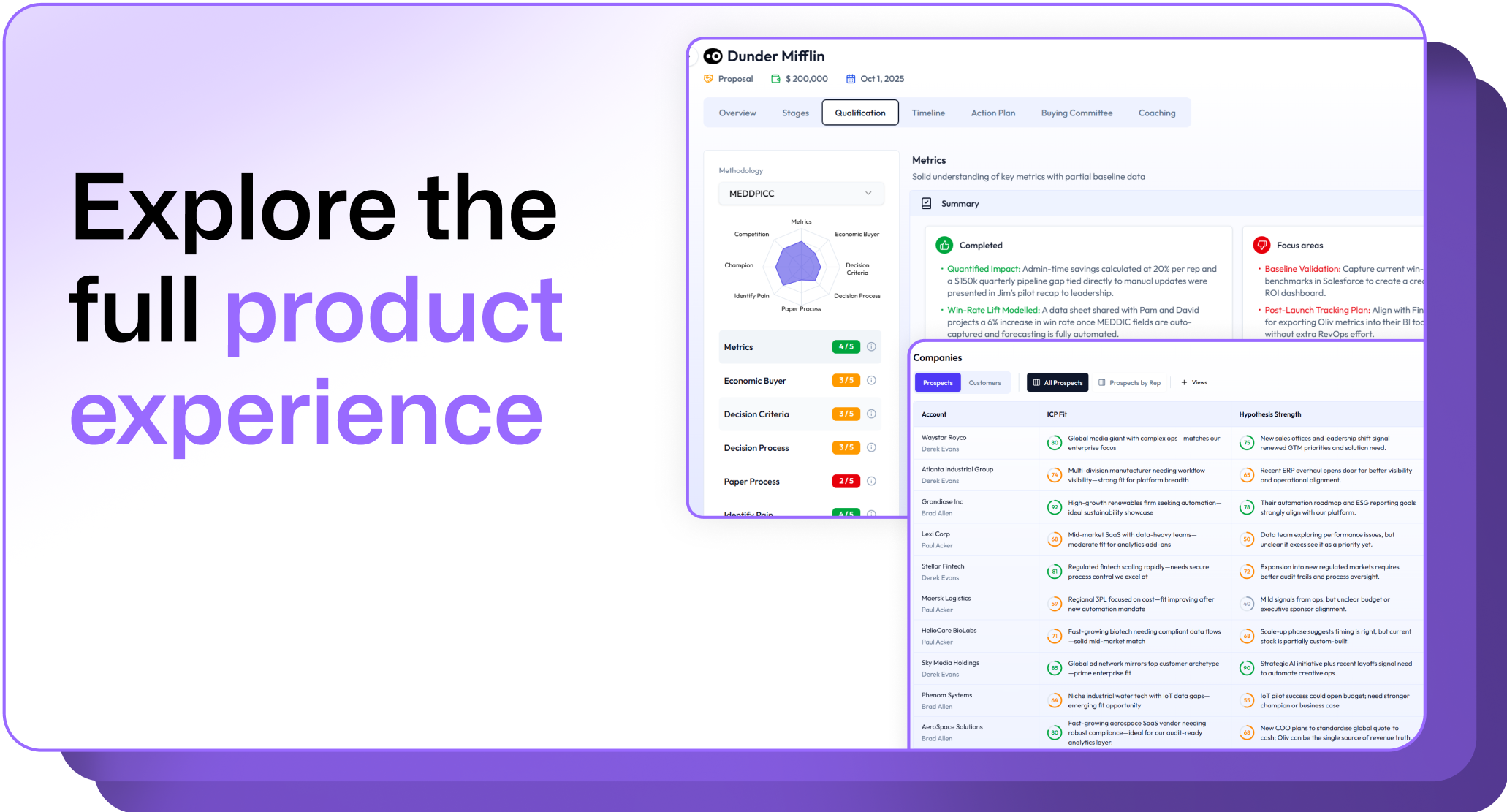
.avif)







.png)
.png)
.png)