Oliv AI for Sales Managers: See how AI agents automate CRM updates, flag deal risks, and coach reps.
Written by
Ishan Chhabra
Last Updated :
April 10, 2026
Skim in :
14
mins
In this article
Revenue teams love Oliv
Here’s why:
All your deal data unified (from 30+ tools and tabs).
Insights are delivered to you directly, no digging.
AI agents automate tasks for you.
Thank you! Your submission has been received!
Oops! Something went wrong while submitting the form.
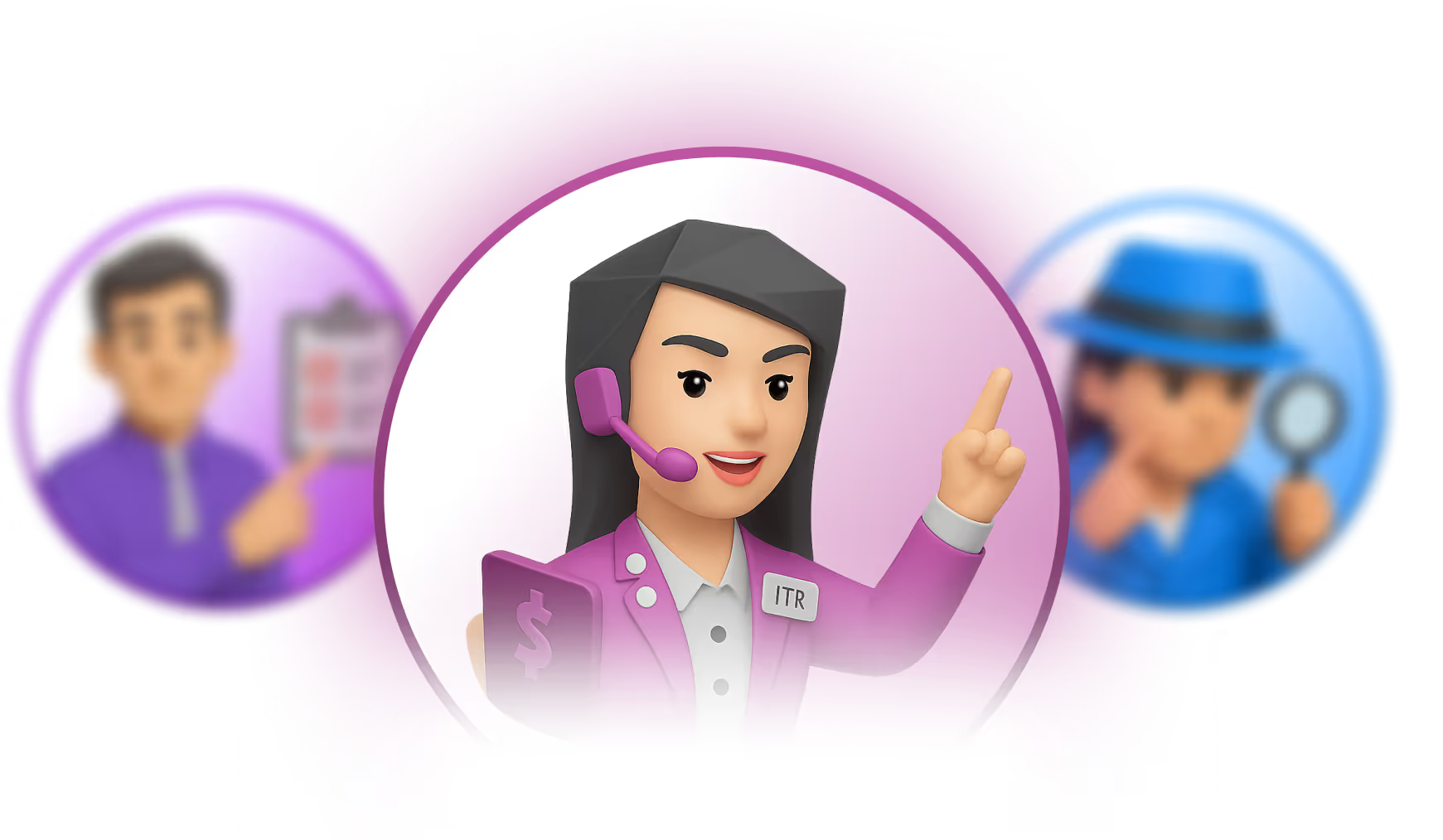
Meet Oliv’s AI Agents
Hi! I’m, Deal Driver
I track deals, flag risks, send weekly pipeline updates and give sales managers full visibility into deal progress
Hi! I’m, CRM Manager
I maintain CRM hygiene by updating core, custom and qualification fields all without your team lifting a finger
Hi! I’m, Forecaster
I build accurate forecasts based on real deal movement and tell you which deals to pull in to hit your number
Hi! I’m, Coach
I believe performance fuels revenue. I spot skill gaps, score calls and build coaching plans to help every rep level up
Hi! I’m, Prospector
I dig into target accounts to surface the right contacts, tailor and time outreach so you always strike when it counts
Hi! I’m, Pipeline tracker
I call reps to get deal updates, and deliver a real-time, CRM-synced roll-up view of deal progress
Hi! I’m, Analyst
I answer complex pipeline questions, uncover deal patterns, and build reports that guide strategic decisions
TL;DR
Oliv AI delivers post-call summaries, follow-up drafts, and CRM updates within 5 to 15 minutes, versus the 20 to 40 minute lag from Gong and Chorus.
The Voice Agent captures unrecorded call data through nightly rep debriefs, bridging the intelligence gap that meeting-only tools like Gong completely miss.
Oliv's CRM Manager Agent autonomously updates 100+ qualification fields (MEDDPICC, BANT) at the object level, eliminating manual data entry and shadow spreadsheets.
AI-based intent detection replaces keyword matching, flagging genuine competitive threats while filtering out false positives that plague Gong Smart Trackers.
The Coach Agent analyzes 100% of calls, maps skill gaps per rep, and deploys tailored voice bot practice sessions, creating a closed-loop coaching system.
Oliv offers a 91% TCO reduction versus stacking Gong and Clari, with modular agent-based pricing and onboarding that delivers value in days, not quarters.
Q1. Why Do Sales Managers Need an AI-Native Deal Execution Platform in 2026? [toc=Why AI-Native in 2026]
If you manage 6 to 12 reps, your mornings probably look the same: toggling between four dashboard tabs, scanning CRM records you suspect are half-empty, and listening to yesterday's call recordings at 2x speed while drinking your first coffee. You are not coaching. You are auditing. The "data janitor" problem is the silent killer of frontline sales management, and it gets worse as your team scales. Every hour spent verifying whether a rep actually updated the close date is an hour not spent running a deal strategy session.
❌ The Legacy Stack Problem
The tools most mid-market teams rely on, including Gong, Chorus, and Clari, were built in the Revenue Intelligence era (Gen 2). They surface insights but still require managers to find, interpret, and act on them manually. Gong at $250/user/month provides dashboards you must review yourself. Chorus is now gated behind ZoomInfo's bundled pricing. Clari's roll-up forecasting still demands managers sit with reps for hours manually inputting assessments. As one Gong user put it:
"It's too complicated, and not intuitive at all. Searching for calls is not easy, moving around in the calls is not easy, and understanding the pipeline management portion of it is almost impossible." John S., Senior Account Executive Gong G2 Verified Review
These are "expensive treadmills." The equipment is impressive, but your team still does all the running.
Revenue technology has evolved through four generations, from manual CRM entry to autonomous AI agents that execute workflows for you.
✅ The Gen 4 Shift: From SaaS to Agentic Workforce
The revenue technology industry is experiencing what Oliv AI founder Ishan Chhabra calls a "tectonic plate movement." We have moved through Revenue Operations (Gen 1), Revenue Intelligence (Gen 2), and Revenue Orchestration (Gen 3) into AI-Native Revenue Orchestration (Gen 4). In this new era, buyers do not want software they have to "adopt," "train for," and manually manage. They want an agentic workforce that does the work for them.
⭐ How Oliv Delivers on This Vision
Oliv is not another dashboard. It is a team of purpose-built AI agents, including Meeting Assistant, CRM Manager, Deal Driver, Coach, and Pipeline Tracker, each autonomously executing the workflows managers previously handled manually. Instead of asking you to review a recording, the Meeting Assistant delivers a structured summary with drafted follow-ups. Instead of expecting your rep to update MEDDPICC fields, the CRM Manager does it and nudges the rep to verify. The result is a 91% cost reduction compared to stacking Gong and Clari over three years, roughly $68,400 vs. $789,300 for a 100-user team, freeing budget to hire more reps while Oliv acts as your Fractional RevOps Team.
Oliv operates as five purpose-built AI agents working from a unified data layer, each autonomously handling a specific sales management workflow.
Q2. How Quickly Does Oliv Deliver Post-Call Outputs Compared to Gong and Chorus? [toc=Post-Call Output Speed]
Deal momentum dies in the "administrative gap" between the end of a call and the start of the follow-up. Your AE finishes a critical discovery call at 2:15 PM and jumps into another at 2:30 PM. By 5:00 PM, the specific objections, the champion's exact words about budget timing, and the agreed-upon next steps are already fading. Meanwhile, you as the manager are waiting for a recording to process before you can tell if this Q4 deal is actually progressing or quietly dying.
⏰ The 20 to 40 Minute Processing Lag
Gong and Chorus typically suffer from a 20 to 30 minute delay, sometimes stretching to 40 minutes for longer calls, before a recording and its AI summary become available. That gap prevents reps from sending personalized follow-ups while the prospect is still at their desk. As one Chorus user noted:
"At times it takes a while to send the call summary and also at times the note taker doesn't join promptly." Mayank M., Customer Success Account Manager Chorus G2 Verified Review
Even when summaries arrive, another Chorus user highlighted a quality gap:
"I wish the meeting summaries were more detailed. I find that it misses a lot. I can go back into the transcripts but I do not love doing that and it takes time I don't have." Natalie G., Bilingual Account Manager Chorus G2 Verified Review
✅ Oliv's 5 to 15 Minute Delivery Window
Oliv's generative AI-native architecture processes transcripts, extracts action items, and drafts follow-ups simultaneously rather than sequentially. Within 5 to 15 minutes of the call ending, the Meeting Assistant Agent delivers:
✅ Comprehensive AI meeting summary with deal signals highlighted
✅ Personalized follow-up email draft placed directly in Gmail or Outlook
✅ CRM fields auto-populated with next steps, objections, and qualification data
✅ Structured manager summary pushed to Slack or email
💰 The Before/After Impact
Post-Call Output: Manual vs. Oliv
Metric
Manual / Legacy Tool
With Oliv
Post-call CRM update
~12 min per call
0 min (automated)
Follow-up email sent
End of day (~3 hrs later)
Within 15 min
Manager deal visibility
Next morning
Same-hour delivery
Your reps stay in selling motion. Your prospects get follow-ups while the conversation is still fresh. And you see deal risk in real time, not the next morning.
Q3. Can Oliv Work If Some Calls Aren't Recorded? [toc=Unrecorded Call Capture]
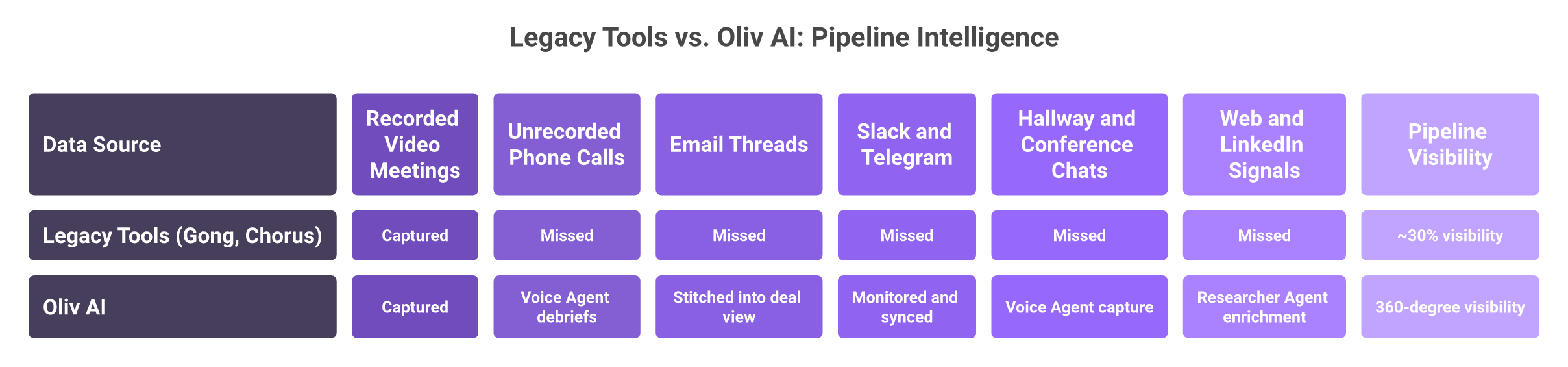
Meeting-only intelligence captures the tip of the iceberg. In complex B2B sales, critical deal progression regularly happens during unrecorded phone calls, sensitive one-on-ones, hallway conversations at conferences, and quick Slack exchanges. This context stays trapped in the rep's head, creating a "fragmented reality" for sales managers and dirty data for the CRO. When your pipeline review depends only on what was recorded on Zoom or Teams, you are making forecast decisions with perhaps 30% of the picture.
❌ The "Dashcam" Limitation of Gong and Chorus
Gong and Chorus are essentially dashcams. They record the "accident" but are blind to everything that happened before and after. If an interaction does not happen on a supported video platform, it simply does not exist in their system. The expectation is that reps will manually type summaries into the CRM, but most view this as administrative policing and routinely neglect it. One reviewer captured the limitation clearly:
"There's so much in Gong, that we don't use everything. Gong's deal forecasting we don't use." Karel Bos, Head of Sales Gong TrustRadius Verified Review
The gap is not in what these tools record. It is in everything they miss.
Legacy tools capture only recorded meetings, leaving roughly 70% of pipeline intelligence invisible. Oliv's multi-channel agents close the gap.
⭐ Oliv's Voice Agent (Pipeline Tracker): Bridging the Recording Gap
Oliv acts as an Autonomous Intelligence Layer that does not depend on a recording to capture deal context. The innovation that is "landing like crazy" with sales leaders is the Voice Agent (Pipeline Tracker):
✅ Nightly Debrief Calls: The Voice Agent calls each rep every evening for a 5-minute hands-free debrief on unrecorded interactions
✅ Contextual CRM Sync: Reps verbally update deal stages, close dates, and key notes. Oliv processes this and syncs it directly to CRM property-level fields
✅ Omnichannel Stitching: Oliv unifies data from Calls + Emails + Slack + Support Tickets + Web Data into a single 360-degree account view
✅ The Manager Outcome: Sunset Summaries
Every evening, managers receive a proactive Sunset Summary, a daily pulse covering what happened across all channels that day, not just what was recorded. Deals that moved, deals that stalled, and deals that need urgent intervention are surfaced in a single digest. The "stakeholders I didn't know existed" problem is eliminated before it can derail a forecast.
Q4. Can Oliv Push Updates to Salesforce and HubSpot Fields Automatically? [toc=Automatic CRM Updates]
CRM as a product has fundamentally failed frontline sales teams because it relies entirely on human manual data entry. Reps view documentation as an administrative burden that is "not critical to the act of selling." The result is meaningless data that forces managers into evening marathons of listening to call recordings at 2x speed just to understand the truth about a deal. When your pipeline review starts with "Wait, is this close date actually current?" the CRM has already lost.
❌ Why Gong, Clari, and Agentforce Fall Short
Gong records meetings and generates summaries but it does not update the property in the CRM. It logs summaries as unstructured "Notes" or activity blocks that are functionally unsearchable and unusable for RevOps reporting or automated forecasting. One user confirmed this limitation plainly:
"The additional products like forecast or engage come at an additional cost. Would be great to see these tools rolled into the core offering." Scott T., Director of Sales Gong G2 Verified Review
Clari's roll-up forecasting remains a manual, human-dependent process. And ❌ The Legacy Stack Problem
The tools most mid-market teams rely on were built in the Revenue Intelligence era (Gen 2). They surface insights, but still require managers to find, interpret, and act on them manually. Gong at $250/user/month provides dashboards you must review yourself. Chorus is now gated behind ZoomInfo's bundled pricing. Clari's roll-up forecasting still demands managers sit with reps for hours manually inputting assessments. As one Gong user put it:
"It's too complicated, and not intuitive at all. Searching for calls is not easy, moving around in the calls is not easy, and understanding the pipeline management portion of it is almost impossible." John S., Senior Account Executive Gong G2 Verified Review
These are "expensive treadmills." The equipment is impressive, but your team still does all the running.
✅ The Gen 4 Shift: From SaaS to Agentic Workforce
The revenue technology industry is experiencing what Oliv AI founder Ishan Chhabra calls a "tectonic plate movement." We have moved through Revenue Operations (Gen 1), Revenue Intelligence (Gen 2), and Revenue Orchestration (Gen 3) into AI-Native Revenue Orchestration (Gen 4). In this new era, buyers do not want software they have to "adopt," "train for," and manually manage. They want an agentic workforce that does the work for them.
⭐ How Oliv Delivers on This Vision
Oliv is not another dashboard. It is a team of purpose-built AI agents, including Meeting Assistant, CRM Manager, Deal Driver, Coach, and Pipeline Tracker, each autonomously executing the workflows managers previously handled manually. Instead of asking you to review a recording, the Meeting Assistant delivers a structured summary with drafted follow-ups. Instead of expecting your rep to update MEDDPICC fields, the CRM Manager does it and nudges the rep to verify. The result is a 91% cost reduction compared to stacking Gong and Clari over three years, roughly $68,400 vs. $789,300 for a 100-user team, freeing budget to hire more reps while Oliv acts as your Fractional RevOps Team.
Q2. How Quickly Does Oliv Deliver Post-Call Outputs Compared to Gong and Chorus? [toc=Post-Call Output Speed]
Deal momentum dies in the "administrative gap" between the end of a call and the start of the follow-up. Your AE finishes a critical discovery call at 2:15 PM and jumps into another at 2:30 PM. By 5:00 PM, the specific objections, the champion's exact words about budget timing, and the agreed-upon next steps are already fading. Meanwhile, you as the manager are waiting for a recording to process before you can tell if this Q4 deal is actually progressing or quietly dying.
⏰ The 20 to 40 Minute Processing Lag
Gong and Chorus typically suffer from a 20 to 30 minute delay, sometimes stretching to 40 minutes for longer calls, before a recording and its AI summary become available. That gap prevents reps from sending personalized follow-ups while the prospect is still at their desk. As one Chorus user noted:
"At times it takes a while to send the call summary and also at times the note taker doesn't join promptly." Mayank M., Customer Success Account Manager Chorus G2 Verified Review
Even when summaries arrive, another Chorus user highlighted a quality gap:
"I wish the meeting summaries were more detailed. I find that it misses a lot. I can go back into the transcripts but I do not love doing that and it takes time I don't have." Natalie G., Bilingual Account Manager Chorus G2 Verified Review
✅ Oliv's 5 to 15 Minute Delivery Window
Oliv's generative AI-native architecture processes transcripts, extracts action items, and drafts follow-ups simultaneously rather than sequentially. Within 5 to 15 minutes of the call ending, the Meeting Assistant Agent delivers:
✅ Comprehensive AI meeting summary with deal signals highlighted
✅ Personalized follow-up email draft placed directly in Gmail or Outlook
✅ CRM fields auto-populated with next steps, objections, and qualification data
✅ Structured manager summary pushed to Slack or email
💰 The Before/After Impact
Post-Call Output: Manual vs. Oliv
Metric
Manual / Legacy Tool
With Oliv
Post-call CRM update
~12 min per call
0 min (automated)
Follow-up email sent
End of day (~3 hrs later)
Within 15 min
Manager deal visibility
Next morning
Same-hour delivery
Your reps stay in selling motion. Your prospects get follow-ups while the conversation is still fresh. And you see deal risk in real time, not the next morning.
Q3. Can Oliv Work If Some Calls Aren't Recorded? [toc=Unrecorded Call Capture]
Meeting-only intelligence captures the tip of the iceberg. In complex B2B sales, critical deal progression regularly happens during unrecorded phone calls, sensitive one-on-ones, hallway conversations at conferences, and quick Slack exchanges. This context stays trapped in the rep's head, creating a "fragmented reality" for sales managers and dirty data for the CRO. When your pipeline review depends only on what was recorded on Zoom or Teams, you are making forecast decisions with perhaps 30% of the picture.
❌ The "Dashcam" Limitation of Gong and Chorus
Gong and Chorus are essentially dashcams. They record the "accident" but are blind to everything that happened before and after. If an interaction does not happen on a supported video platform, it simply does not exist in their system. The expectation is that reps will manually type summaries into the CRM, but most view this as administrative policing and routinely neglect it. One reviewer captured the limitation clearly:
"There's so much in Gong, that we don't use everything. Gong's deal forecasting we don't use." Karel Bos, Head of Sales Gong TrustRadius Verified Review
The gap is not in what these tools record. It is in everything they miss.
⭐ Oliv's Voice Agent (Pipeline Tracker): Bridging the Recording Gap
Oliv acts as an Autonomous Intelligence Layer that does not depend on a recording to capture deal context. The innovation that is "landing like crazy" with sales leaders is the Voice Agent (Pipeline Tracker):
✅ Nightly Debrief Calls: The Voice Agent calls each rep every evening for a 5-minute hands-free debrief on unrecorded interactions
✅ Contextual CRM Sync: Reps verbally update deal stages, close dates, and key notes. Oliv processes this and syncs it directly to CRM property-level fields
✅ Omnichannel Stitching: Oliv unifies data from Calls + Emails + Slack + Support Tickets + Web Data into a single 360-degree account view
✅ The Manager Outcome: Sunset Summaries
Every evening, managers receive a proactive Sunset Summary, a daily pulse covering what happened across all channels that day, not just what was recorded. Deals that moved, deals that stalled, and deals that need urgent intervention are surfaced in a single digest. The "stakeholders I didn't know existed" problem is eliminated before it can derail a forecast.
Q4. Can Oliv Push Updates to Salesforce and HubSpot Fields Automatically? [toc=Automatic CRM Updates]
CRM as a product has fundamentally failed frontline sales teams because it relies entirely on human manual data entry. Reps view documentation as an administrative burden that is "not critical to the act of selling." The result is meaningless data that forces managers into evening marathons of listening to call recordings at 2x speed just to understand the truth about a deal. When your pipeline review starts with "Wait, is this close date actually current?" the CRM has already lost.
❌ Why Gong, Clari, and Agentforce Fall Short
Gong records meetings and generates summaries, but it does not update the property in the CRM. It logs summaries as unstructured "Notes" or activity blocks that are functionally unsearchable and unusable for RevOps reporting or automated forecasting. One user confirmed this limitation plainly:
"The additional products like forecast or engage come at an additional cost. Would be great to see these tools rolled into the core offering." Scott T., Director of Sales Gong G2 Verified Review
Clari's roll-up forecasting remains a manual, human-dependent process. And Salesforce Agentforce has what Oliv's founder calls the "wrong user experience," heavily chat-based, requiring reps to manually interact with a bot rather than having work integrated into their selling flow. As one Agentforce reviewer noted:
"Can be complex to set up and customize. Expensive, especially for smaller teams. Steep learning curve for new users." Shubham G., Senior BDM Agentforce G2 Verified Review
⭐ Oliv's CRM Manager Agent: From Documentation to AI-Native Revenue Orchestration
Oliv does not log notes. It engineers your CRM. The CRM Manager Agent autonomously updates actual CRM Objects and Properties based on conversation context:
✅ Object-Level Automation: Updates MEDDPICC, BANT, SPICED, or any custom qualification fields directly in Salesforce or HubSpot, not as notes, as actual searchable field values
✅ 100+ Methodologies Supported: Trained on over 100 sales methodologies with no cap on the number of fields it can populate
✅ Human-in-the-Loop Verification: Instead of the rep "using software," the agent drafts the update and nudges the rep via Slack or Email to verify and approve in seconds
💰 The Impact for Frontline Managers
Every CRM field becomes a clickable audit trail. Managers can trace any data point, a deal stage change, a competitor flag, or a budget confirmation, back to the exact call clip or email snippet that generated it. Zero manual CRM entry. 100+ fields auto-populated. Full evidence logs for every qualification point. The CRM finally becomes the living, accurate system of record it was always supposed to be.
Q5. Can Oliv Distinguish Competitive Evaluation from Casual Competitor Mentions? [toc=Competitive Intent Detection]
When you manage 8 to 12 reps running 35 calls per day, it is practically impossible to personally review every deal. You rely on alerts and trackers to surface risk, but what happens when those alerts cry wolf? Welcome to "Noisy Platform Syndrome": your inbox floods with competitor flags because a rep said "I used to work at Salesforce" or a prospect casually referenced "something like what Gong does." None of these are real competitive threats, yet they consume your attention and erode trust in the very system designed to help you.
❌ Gong's Keyword-Matching Limitation
Gong's "Smart Trackers" are built on V1 machine-learning keyword matching. They flag every instance of a competitor name without distinguishing between a prospect actively evaluating a rival and one making a passing reference. One enablement leader acknowledged the setup burden this creates:
"It can be overwhelming to set up trackers. AI training is a bit laborious to get it to do what you want." Trafford J., Senior Director, Revenue Enablement Gong G2 Verified Review
Chorus faces a similar limitation. A Gartner reviewer specifically called out its inability to understand context:
"The software doesn't have the capability of identifying words/phrases that are similar to what you're looking for or understand context so if you don't tell it exactly what you're looking for then you'll miss out." Director of Sales Operations Chorus Gartner Verified Review
These tools detect words, not intent, and the distinction matters enormously when you are triaging 35 calls worth of alerts.
✅ Oliv's Intent-Aware Monitoring
Oliv is generative AI-native, using reasoning models trained to understand intent over keywords. Instead of flagging the word "Salesforce," Oliv's 100+ fine-tuned LLMs analyze the full conversational context to determine:
✅ Is the prospect actively comparing your solution against a named competitor?
✅ Is a champion souring on the deal, or simply raising a technical objection?
❌ Is this a casual mention with zero competitive significance?
Only genuine contextual risks get pushed directly to the manager's Slack. No keyword noise, no false positives.
⭐ Sunset Summaries: Your Evening Deal Pulse
Every evening, Oliv delivers a proactive Sunset Summary, a daily digest of which deals moved, which were won, and which require urgent intervention. Competitive evaluations are flagged only when they represent a genuine threat, giving managers a signal-to-noise ratio that keyword-based trackers simply cannot match. You read one summary instead of triaging dozens of alerts.
Q6. Can Oliv Enrich Contacts and Add Missing Stakeholders to a Deal? [toc=Stakeholder Enrichment]
B2B buying committees average 6 to 10 stakeholders, and they are increasingly fragmented and invisible. Your rep finishes a discovery call where the prospect mentions "our VP of Engineering will want to weigh in" and "legal has some concerns," but those two contacts never make it into the CRM. The rep jumps to the next call, the names stay in their head, and three weeks later a decision-maker you never tracked derails the deal during the final approval stage.
❌ Legacy Tools: Documentation Without Action
Gong records the meeting where these stakeholders are mentioned, but it does not automatically create new contact objects in the CRM or enrich them with external data. The contacts live only in a transcript that a manager may never read. Legacy CRMs rely entirely on manual entry, which reps view as administrative burden and routinely skip.
"Its biggest handicap is that it does not allow for data storage or data migration. You can't really input the data from Einstein into another platform. One does not have access to the data of employees that leave the organization." Reviewer Einstein Gartner Verified Review
Another Gong user captured the broader visibility gap:
"Before Gong we had a lack of visibility across our deals because information was siloed in several places like CRM, Email, Zoom, phone." Scott T., Director of Sales Gong G2 Verified Review
The information exists somewhere, but nobody is pulling it into an actionable format.
Oliv's CRM Manager Agent operates as a hands-free workforce for contact management:
✅ Autonomous Creation: Automatically creates contacts discovered during calls, with no rep action required
✅ Omnichannel Enrichment: Pulls professional data from LinkedIn and the web to populate titles, job changes, and engagement levels
✅ Detractor Mapping: Tracks who is an ally vs. a detractor and identifies which stakeholders have gone "sour" across all channels, not just meetings
💰 The Manager Benefit
Full stakeholder maps for every deal, updated automatically, with detractor alerts surfaced proactively. The "surprise decision-maker" scenario that kills deals at the finish line is eliminated before it can derail your forecast. You see the complete buying committee without your reps ever entering a single contact manually.
Q7. Can Oliv Handle Multiple Opportunities Per Account Without Mixing Notes? [toc=Multi-Opp Data Integrity]
CRM data is rarely clean. Duplicate accounts, like "Google US" and "Google India," alongside multiple open opportunities for different products are a common reality in mid-market environments. When your rep runs a call about the "Mirror" implementation for Google India, but your automation tool attaches the notes to the "DAP" opportunity under Google US, you have a "fragmented reality" where deal truth is buried in a ghost record. Managers end up making forecast decisions based on data that is technically in the CRM but attached to the wrong deal.
❌ Brittle Rule-Based Logic in Legacy Tools
Gong and Salesforce Einstein Activity Capture use simple rule-based logic for activity mapping. When they encounter two open opportunities under the same account, they have no reliable way to determine which one the call pertains to, and frequently attach data to the wrong record.
A Clari user highlighted how this fragmentation plays out in practice:
"I have to maintain my own separate spreadsheet to track deals because I can only capture what my leaders want to see about a deal (revenue, close date, etc.) and as a rep, I need to have fields like product interest, last activity notes, key contacts, deal challenges or blockers, etc." Verified User in Human Resources Clari G2 Verified Review
The problem is not a data shortage. It is that rigid automation puts data in the wrong place, forcing reps to maintain shadow spreadsheets.
⭐ Why This Is an AI Reasoning Problem
Correct opportunity association requires understanding conversational context, including which product was discussed, which region, and which use case. Rule-based systems cannot parse this nuance. They default to the first record they find, or whichever has the most recent activity, regardless of relevance.
✅ Oliv's AI-Based Object Association
Oliv replaces brittle rules with transcript-level reasoning:
✅ Contextual Matching: Oliv's AI reasons through the history and transcript of each meeting to determine the correct logical opportunity for association, even in duplicate-account environments
✅ Self-Healing CRM: Oliv can offer to merge duplicate accounts autonomously while data is being updated
✅ Evidence Logs: Managers can click on any CRM field to see the full history of evolution, showing exactly which call clip or email snippet led to that specific data point
Every field becomes a clickable audit trail. No more guessing which record holds the truth for a multi-product account.
Q8. Can Oliv Deploy Voice Bots So New Reps Can Practice Skills After Coaching Gaps Are Identified? [toc=AI Coaching Voice Bots]
Traditional sales training is a one-off event. Your new rep completes a MEDDPICC workshop on Monday, runs their first real discovery call on Wednesday, and by Friday the methodology has already faded. Managers know this, but with coaching coverage averaging roughly 2% of calls reviewed, the gap between identifying where a rep struggles and actually helping them practice that specific skill remains enormous.
❌ Intelligence Without Execution
Gong and Chorus provide "Intelligence," showing you the data, but not "Execution," helping reps practice. Managers must manually score calls, a process with inherently low coverage and inconsistent standards. As one reviewer noted about Gong's AI coaching:
"AI is not great yet, the product still feels like it's at its infancy and needs to be developed further." Annabelle H., Voluntary Director, Board of Directors Gong G2 Verified Review
Standalone practice tools like Hyperbound or Second Nature exist, but they are not connected to live-call performance data. The practice scenarios they generate are generic, not tailored to the specific objections a rep fumbled on yesterday's actual customer call.
⭐ Oliv's Unified Coaching Loop
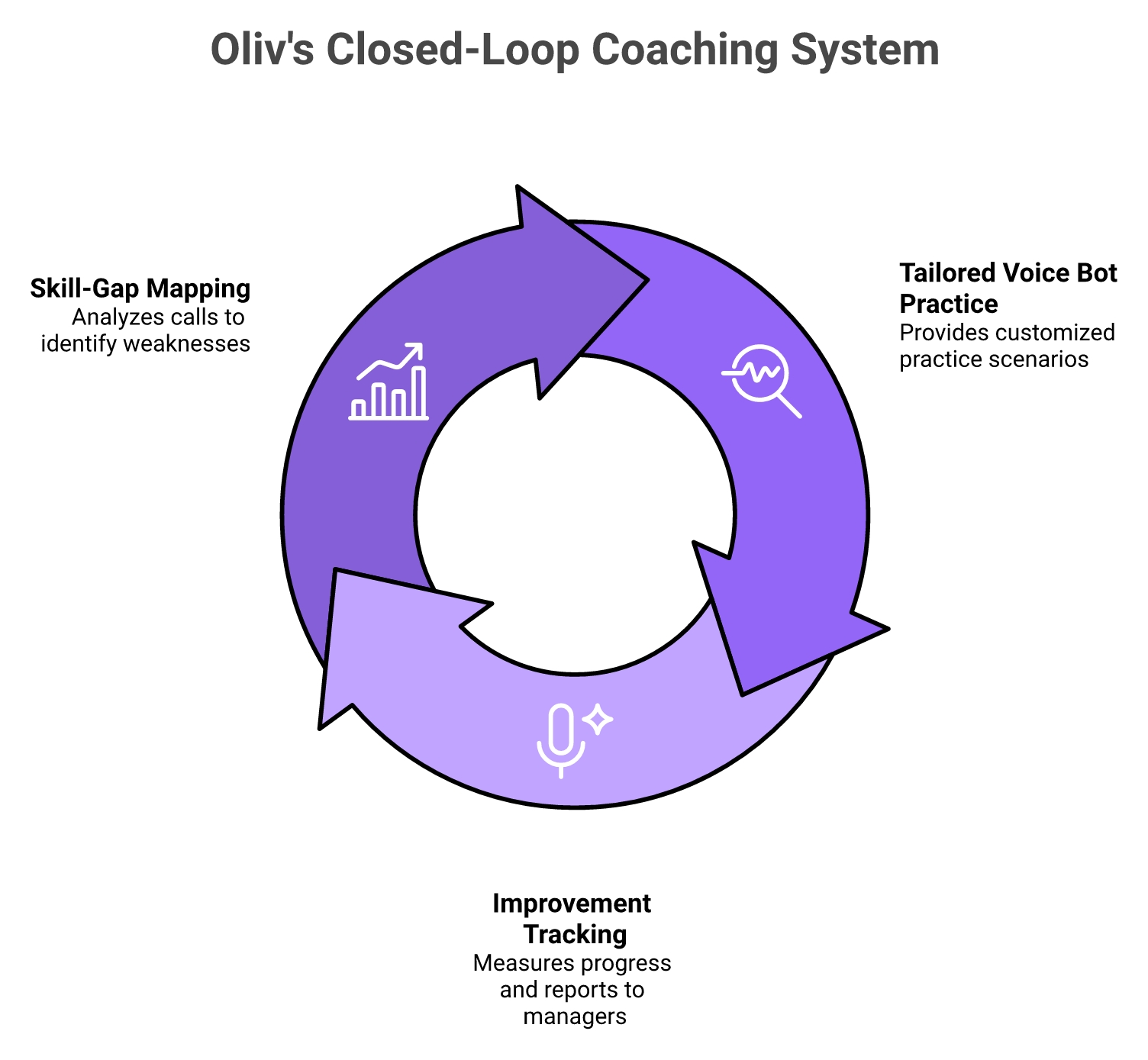
Oliv bridges the gap between insight and action through its Coach Agent, creating a closed-loop system:
Skill-Gap Mapping: Analyzes 100% of calls (not a 2% sample) to identify exactly where each seller struggles, including hesitation on pricing, missing pain discovery, and weak objection handling
Tailored Voice Bots: Automatically deploys customized voice bots that reps use to practice handling the specific objections and scenarios identified from their live calls
Improvement Tracking: Tracks how each rep improves on those specific skills over weekly and monthly intervals, providing managers with a skill-gap heat map
✅ The Coaching Comparison at a Glance
Coaching Capabilities: Gong/Chorus vs. Standalone Tools vs. Oliv
Capability
Gong / Chorus
Standalone Practice Tools
Oliv
Call analysis coverage
Manager-reviewed (~2%)
None
100% automated
Skill gap identification
Manual scoring
Not connected to live data
AI-driven, per-rep
Practice deployment
❌ Not available
Generic scenarios
✅ Tailored to real gaps
Improvement measurement
❌ Not available
❌ Not connected
✅ Weekly/monthly tracking
Gong shows you the problem. Oliv shows you the problem, creates the practice, and measures whether your rep actually improved, all without you scheduling a single coaching session.
Q9. What Does a Sales Manager's Monday Morning Look Like with Oliv? [toc=Monday Morning with Oliv]
Picture this: it's 8:00 AM on Monday. You haven't opened your laptop yet, but Oliv's AI agents have already been working since your reps' last calls ended on Friday. Here's exactly what a frontline manager overseeing 8 to 10 reps finds waiting in their inbox and Slack before their first sip of coffee.
⏰ 8:00 AM: The Weekend Catch-Up Is Already Done
Sunset Summaries (delivered Friday evening): Oliv's Deal Driver Agent sent a proactive end-of-week pulse to your Slack summarizing which deals moved forward, which stalled, and which require immediate Monday attention. No recordings to scrub. The narrative is already written.
CRM Fields Updated Automatically: The CRM Manager Agent parsed all Friday calls and updated MEDDPICC fields, next steps, close dates, and deal stages across every active opportunity. Your Salesforce is already clean before you log in.
Unrecorded Call Debriefs Captured: The Voice Agent (Pipeline Tracker) called two reps Friday evening for 5-minute debriefs on calls that weren't recorded. Those deal updates are already synced to CRM property-level fields.
⏰ 8:15 AM: Pipeline Review, Pre-Built
At-Risk Deals Flagged: The Forecast Agent has already identified three deals where buyer sentiment shifted negatively and one where a competitor was brought into active evaluation, flagged with context, not just keywords. These appear as priority alerts in your Slack channel.
Stakeholder Maps Refreshed: The CRM Manager Agent detected two new contacts mentioned on Thursday calls. It created those contacts in Salesforce, enriched them with LinkedIn data (titles, seniority), and mapped them as allies or potential detractors.
⏰ 8:30 AM: Coaching Priorities Identified
Skill-Gap Heat Map Updated: The Coach Agent analyzed 100% of last week's calls and flagged that one rep consistently missed pain discovery and another hesitated on pricing objections. Tailored voice bot practice sessions are already deployed for each rep.
✅ What This Replaces
Without Oliv, this same Monday morning involves logging into Gong to scrub recordings at 2x speed, manually updating Salesforce fields based on incomplete rep notes, and running a Clari roll-up call that takes an hour of your morning. As one reviewer noted about legacy tools:
"There's so much in Gong, that we don't use everything. Gong's deal forecasting we don't use." Karel Bos, Head of Sales Gong TrustRadius Verified Review
"The analytics modules still needs some work IMO to provide a valuable deliverable. All the pieces are there but missing the story line." Natalie O., Sales Operations Manager Clari G2 Verified Review
With Oliv, Monday morning is strategy and coaching, not data janitoring.
Q10. How Does Oliv Compare to Gong and Chorus for Frontline Sales Managers? [toc=Oliv vs Gong vs Chorus]
Below is a capability-level comparison across the seven core needs of a frontline sales manager managing 6 to 12 reps. This is not a full product review. It maps the specific workflows covered in this article.
⭐ Feature Comparison Matrix
Oliv vs. Gong vs. Chorus: Frontline Manager Capabilities
Capability
Gong
Chorus (ZoomInfo)
Oliv
Post-call output speed
20 to 30 min processing delay
20 to 30 min processing delay
✅ 5 to 15 min delivery with drafted follow-ups
Unrecorded call capture
❌ Meeting-only ("dashcam")
❌ Meeting-only
✅ Voice Agent debriefs reps nightly
CRM field updates
❌ Logs notes only, no property updates
❌ Notes/transcripts only
✅ Autonomous object-level CRM updates
Competitor intent detection
⚠️ Keyword-matching Smart Trackers
⚠️ Keyword/topic tracking
✅ Intent-aware reasoning (100+ LLMs)
Stakeholder enrichment
❌ No auto-creation of contacts
❌ No auto-creation of contacts
✅ Auto-create, enrich, map allies/detractors
Multi-opp data integrity
⚠️ Rule-based, prone to mis-mapping
⚠️ Rule-based
✅ AI-based object association with evidence logs
Coaching loop
⚠️ Manual call scoring (~2% coverage)
⚠️ Manual call scoring
✅ 100% call analysis, voice bot practice, and tracking
❌ Where Legacy Tools Fall Short
Gong and Chorus excel at conversation recording and basic analytics but remain pre-generative AI platforms that require significant manual adoption. As one sales leader observed:
"It's too complicated, and not intuitive at all. Using it is very...discomforting. Searching for calls is not easy, moving around in the calls is not easy, and understanding the pipeline management portion of it is almost impossible." John S., Senior Account Executive Gong G2 Verified Review
A Clari reviewer echoed the disconnect between tool and workflow:
"Clari should find ways to differentiate from the native Salesforce features (e.g. Pipeline Inspection, Forecasting) in order to remain competitive in the long-run." Dan J. Clari G2 Verified Review
Oliv's differentiation is architectural: it is agent-first, generative AI-native, and autonomous, delivering outcomes, not dashboards.
Q11. How Much Does Oliv Cost Versus Stacking Gong, Chorus, and Clari? [toc=Oliv vs Legacy Stack Pricing]
The total cost of ownership (TCO) gap between legacy revenue intelligence stacks and Oliv is substantial. For a frontline sales manager evaluating tools for a 6 to 12 rep team, the math shifts the conversation from "feature comparison" to "budget reallocation."
💸 Legacy Stack: The Hidden Costs Add Up
Gong's pricing is opaque but well-documented by users. The platform charges a per-user annual fee plus a platform fee that scales with team size:
For a 10-rep team, this translates to roughly $36,000 to $54,000/year, before implementation fees ($15K to $65K for Gong alone) and the cost of the RevOps headcount needed to maintain both systems.
💰 Reviewers Flag Pricing as a Pain Point
"Gong is a really powerful tool but it's probably the highest end option on the market, and now we're stuck with a tool that works technically but isn't the right business decision." Iris P., Head of Marketing, Sales & Partnerships Gong G2 Verified Review
"The pricing is probably the biggest obstacle and hence we are looking to change." Miodrag, Enterprise Account Executive Gong Verified Review
✅ Oliv: Modular Agent-Based Pricing
Oliv uses a transparent, modular pricing model where teams pay only for the agents they need:
Oliv AI: Modular Agent Pricing
Agent
Pricing Model
Core Function
Meeting Assistant
Per user/month
Recording, transcription, and follow-up drafts
Deal Driver
Per manager seat
Deal tracking, risk alerts, and pipeline updates
Forecaster
Flat fee per team
Autonomous weekly forecast generation
CRM Manager
Per user/month
Object-level CRM updates and contact enrichment
Coach
Per user/month
100% call analysis and voice bot practice
💰 The TCO Advantage
Over three years, a 100-user team on Gong costs approximately $789,300 versus $68,400 on Oliv, representing a 91% cost reduction while delivering double the functional coverage (CRM automation, coaching loops, unrecorded call capture, and stakeholder enrichment). For a growth-stage manager with a 10-rep team, the savings can be redirected toward hiring additional reps or investing in pipeline generation.
Q12. How Do You Get Started with Oliv as a Sales Manager Today? [toc=Getting Started with Oliv]
Getting started with Oliv is designed for speed, with no multi-month implementation and no dedicated RevOps resource required. A frontline sales manager can go from signup to first value in under a week.
⏰ Step-by-Step Onboarding
Connect Your CRM (Day 1): Link Salesforce or HubSpot through Oliv's native integration. Oliv maps your existing fields, opportunity stages, and sales methodology (MEDDPICC, BANT, or custom) automatically.
Connect Communication Channels (Day 1): Integrate your calendar, Zoom/Teams/Google Meet, email (Gmail or Outlook), and Slack. This is a one-time setup. Oliv's Meeting Assistant begins joining calls immediately.
Activate Your First Agent (Day 1 to 2): Start with the Meeting Assistant Agent to see immediate value, including automated recording, transcription, AI summaries, and follow-up drafts delivered within 5 to 15 minutes of every call.
Add the CRM Manager Agent (Day 3 to 5): Once call data starts flowing, activate the CRM Manager Agent to autonomously update opportunity fields, create new contacts, and enrich stakeholder maps. Review the first automated updates to calibrate confidence.
Layer On Deal Driver + Forecaster (Week 2): With a week of data, activate the Deal Driver Agent for at-risk deal alerts and the Forecaster Agent for autonomous pipeline analysis delivered weekly to your inbox.
Deploy the Coach Agent (Week 2 to 3): Enable the Coach Agent to begin scoring 100% of calls and identifying skill gaps per rep. Voice bot practice sessions become available as soon as enough call data is analyzed.
✅ Recommended Agent Activation Order for a 6 to 12 Rep Team
Oliv Agent Activation Priority
Priority
Agent
Why First
1
Meeting Assistant
Immediate time savings; reps get follow-up drafts in minutes
2
CRM Manager
Eliminates manual data entry, the #1 rep complaint
3
Deal Driver
Proactive risk alerts before your Monday pipeline review
Full coaching loop once enough call history exists
⭐ What Makes This Different from Legacy Onboarding
Traditional tools like Gong require $15K to $65K in implementation services and weeks of setup. One reviewer captured the friction:
"Can be complex to set up and customize. Expensive, especially for smaller teams. Steep learning curve for new users." Shubham G., Senior BDM Agentforce G2 Verified Review
Oliv's agent-first architecture means there is no software to "learn." The agents do the work, and you verify the output. Time-to-value is measured in days, not quarters.
Oliv replaces the industry-standard 2% manual call review with a closed-loop system that analyzes every call, deploys targeted practice, and tracks improvement.
Q1. Why Do Sales Managers Need an AI-Native Deal Execution Platform in 2026? [toc=Why AI-Native in 2026]
If you manage 6 to 12 reps, your mornings probably look the same: toggling between four dashboard tabs, scanning CRM records you suspect are half-empty, and listening to yesterday's call recordings at 2x speed while drinking your first coffee. You are not coaching. You are auditing. The "data janitor" problem is the silent killer of frontline sales management, and it gets worse as your team scales. Every hour spent verifying whether a rep actually updated the close date is an hour not spent running a deal strategy session.
❌ The Legacy Stack Problem
The tools most mid-market teams rely on, including Gong, Chorus, and Clari, were built in the Revenue Intelligence era (Gen 2). They surface insights but still require managers to find, interpret, and act on them manually. Gong at $250/user/month provides dashboards you must review yourself. Chorus is now gated behind ZoomInfo's bundled pricing. Clari's roll-up forecasting still demands managers sit with reps for hours manually inputting assessments. As one Gong user put it:
"It's too complicated, and not intuitive at all. Searching for calls is not easy, moving around in the calls is not easy, and understanding the pipeline management portion of it is almost impossible." John S., Senior Account Executive Gong G2 Verified Review
These are "expensive treadmills." The equipment is impressive, but your team still does all the running.
Revenue technology has evolved through four generations, from manual CRM entry to autonomous AI agents that execute workflows for you.
✅ The Gen 4 Shift: From SaaS to Agentic Workforce
The revenue technology industry is experiencing what Oliv AI founder Ishan Chhabra calls a "tectonic plate movement." We have moved through Revenue Operations (Gen 1), Revenue Intelligence (Gen 2), and Revenue Orchestration (Gen 3) into AI-Native Revenue Orchestration (Gen 4). In this new era, buyers do not want software they have to "adopt," "train for," and manually manage. They want an agentic workforce that does the work for them.
⭐ How Oliv Delivers on This Vision
Oliv is not another dashboard. It is a team of purpose-built AI agents, including Meeting Assistant, CRM Manager, Deal Driver, Coach, and Pipeline Tracker, each autonomously executing the workflows managers previously handled manually. Instead of asking you to review a recording, the Meeting Assistant delivers a structured summary with drafted follow-ups. Instead of expecting your rep to update MEDDPICC fields, the CRM Manager does it and nudges the rep to verify. The result is a 91% cost reduction compared to stacking Gong and Clari over three years, roughly $68,400 vs. $789,300 for a 100-user team, freeing budget to hire more reps while Oliv acts as your Fractional RevOps Team.
Oliv operates as five purpose-built AI agents working from a unified data layer, each autonomously handling a specific sales management workflow.
Q2. How Quickly Does Oliv Deliver Post-Call Outputs Compared to Gong and Chorus? [toc=Post-Call Output Speed]
Deal momentum dies in the "administrative gap" between the end of a call and the start of the follow-up. Your AE finishes a critical discovery call at 2:15 PM and jumps into another at 2:30 PM. By 5:00 PM, the specific objections, the champion's exact words about budget timing, and the agreed-upon next steps are already fading. Meanwhile, you as the manager are waiting for a recording to process before you can tell if this Q4 deal is actually progressing or quietly dying.
⏰ The 20 to 40 Minute Processing Lag
Gong and Chorus typically suffer from a 20 to 30 minute delay, sometimes stretching to 40 minutes for longer calls, before a recording and its AI summary become available. That gap prevents reps from sending personalized follow-ups while the prospect is still at their desk. As one Chorus user noted:
"At times it takes a while to send the call summary and also at times the note taker doesn't join promptly." Mayank M., Customer Success Account Manager Chorus G2 Verified Review
Even when summaries arrive, another Chorus user highlighted a quality gap:
"I wish the meeting summaries were more detailed. I find that it misses a lot. I can go back into the transcripts but I do not love doing that and it takes time I don't have." Natalie G., Bilingual Account Manager Chorus G2 Verified Review
✅ Oliv's 5 to 15 Minute Delivery Window
Oliv's generative AI-native architecture processes transcripts, extracts action items, and drafts follow-ups simultaneously rather than sequentially. Within 5 to 15 minutes of the call ending, the Meeting Assistant Agent delivers:
✅ Comprehensive AI meeting summary with deal signals highlighted
✅ Personalized follow-up email draft placed directly in Gmail or Outlook
✅ CRM fields auto-populated with next steps, objections, and qualification data
✅ Structured manager summary pushed to Slack or email
💰 The Before/After Impact
Post-Call Output: Manual vs. Oliv
Metric
Manual / Legacy Tool
With Oliv
Post-call CRM update
~12 min per call
0 min (automated)
Follow-up email sent
End of day (~3 hrs later)
Within 15 min
Manager deal visibility
Next morning
Same-hour delivery
Your reps stay in selling motion. Your prospects get follow-ups while the conversation is still fresh. And you see deal risk in real time, not the next morning.
Q3. Can Oliv Work If Some Calls Aren't Recorded? [toc=Unrecorded Call Capture]
Meeting-only intelligence captures the tip of the iceberg. In complex B2B sales, critical deal progression regularly happens during unrecorded phone calls, sensitive one-on-ones, hallway conversations at conferences, and quick Slack exchanges. This context stays trapped in the rep's head, creating a "fragmented reality" for sales managers and dirty data for the CRO. When your pipeline review depends only on what was recorded on Zoom or Teams, you are making forecast decisions with perhaps 30% of the picture.
❌ The "Dashcam" Limitation of Gong and Chorus
Gong and Chorus are essentially dashcams. They record the "accident" but are blind to everything that happened before and after. If an interaction does not happen on a supported video platform, it simply does not exist in their system. The expectation is that reps will manually type summaries into the CRM, but most view this as administrative policing and routinely neglect it. One reviewer captured the limitation clearly:
"There's so much in Gong, that we don't use everything. Gong's deal forecasting we don't use." Karel Bos, Head of Sales Gong TrustRadius Verified Review
The gap is not in what these tools record. It is in everything they miss.
Legacy tools capture only recorded meetings, leaving roughly 70% of pipeline intelligence invisible. Oliv's multi-channel agents close the gap.
⭐ Oliv's Voice Agent (Pipeline Tracker): Bridging the Recording Gap
Oliv acts as an Autonomous Intelligence Layer that does not depend on a recording to capture deal context. The innovation that is "landing like crazy" with sales leaders is the Voice Agent (Pipeline Tracker):
✅ Nightly Debrief Calls: The Voice Agent calls each rep every evening for a 5-minute hands-free debrief on unrecorded interactions
✅ Contextual CRM Sync: Reps verbally update deal stages, close dates, and key notes. Oliv processes this and syncs it directly to CRM property-level fields
✅ Omnichannel Stitching: Oliv unifies data from Calls + Emails + Slack + Support Tickets + Web Data into a single 360-degree account view
✅ The Manager Outcome: Sunset Summaries
Every evening, managers receive a proactive Sunset Summary, a daily pulse covering what happened across all channels that day, not just what was recorded. Deals that moved, deals that stalled, and deals that need urgent intervention are surfaced in a single digest. The "stakeholders I didn't know existed" problem is eliminated before it can derail a forecast.
Q4. Can Oliv Push Updates to Salesforce and HubSpot Fields Automatically? [toc=Automatic CRM Updates]
CRM as a product has fundamentally failed frontline sales teams because it relies entirely on human manual data entry. Reps view documentation as an administrative burden that is "not critical to the act of selling." The result is meaningless data that forces managers into evening marathons of listening to call recordings at 2x speed just to understand the truth about a deal. When your pipeline review starts with "Wait, is this close date actually current?" the CRM has already lost.
❌ Why Gong, Clari, and Agentforce Fall Short
Gong records meetings and generates summaries but it does not update the property in the CRM. It logs summaries as unstructured "Notes" or activity blocks that are functionally unsearchable and unusable for RevOps reporting or automated forecasting. One user confirmed this limitation plainly:
"The additional products like forecast or engage come at an additional cost. Would be great to see these tools rolled into the core offering." Scott T., Director of Sales Gong G2 Verified Review
Clari's roll-up forecasting remains a manual, human-dependent process. And ❌ The Legacy Stack Problem
The tools most mid-market teams rely on were built in the Revenue Intelligence era (Gen 2). They surface insights, but still require managers to find, interpret, and act on them manually. Gong at $250/user/month provides dashboards you must review yourself. Chorus is now gated behind ZoomInfo's bundled pricing. Clari's roll-up forecasting still demands managers sit with reps for hours manually inputting assessments. As one Gong user put it:
"It's too complicated, and not intuitive at all. Searching for calls is not easy, moving around in the calls is not easy, and understanding the pipeline management portion of it is almost impossible." John S., Senior Account Executive Gong G2 Verified Review
These are "expensive treadmills." The equipment is impressive, but your team still does all the running.
✅ The Gen 4 Shift: From SaaS to Agentic Workforce
The revenue technology industry is experiencing what Oliv AI founder Ishan Chhabra calls a "tectonic plate movement." We have moved through Revenue Operations (Gen 1), Revenue Intelligence (Gen 2), and Revenue Orchestration (Gen 3) into AI-Native Revenue Orchestration (Gen 4). In this new era, buyers do not want software they have to "adopt," "train for," and manually manage. They want an agentic workforce that does the work for them.
⭐ How Oliv Delivers on This Vision
Oliv is not another dashboard. It is a team of purpose-built AI agents, including Meeting Assistant, CRM Manager, Deal Driver, Coach, and Pipeline Tracker, each autonomously executing the workflows managers previously handled manually. Instead of asking you to review a recording, the Meeting Assistant delivers a structured summary with drafted follow-ups. Instead of expecting your rep to update MEDDPICC fields, the CRM Manager does it and nudges the rep to verify. The result is a 91% cost reduction compared to stacking Gong and Clari over three years, roughly $68,400 vs. $789,300 for a 100-user team, freeing budget to hire more reps while Oliv acts as your Fractional RevOps Team.
Q2. How Quickly Does Oliv Deliver Post-Call Outputs Compared to Gong and Chorus? [toc=Post-Call Output Speed]
Deal momentum dies in the "administrative gap" between the end of a call and the start of the follow-up. Your AE finishes a critical discovery call at 2:15 PM and jumps into another at 2:30 PM. By 5:00 PM, the specific objections, the champion's exact words about budget timing, and the agreed-upon next steps are already fading. Meanwhile, you as the manager are waiting for a recording to process before you can tell if this Q4 deal is actually progressing or quietly dying.
⏰ The 20 to 40 Minute Processing Lag
Gong and Chorus typically suffer from a 20 to 30 minute delay, sometimes stretching to 40 minutes for longer calls, before a recording and its AI summary become available. That gap prevents reps from sending personalized follow-ups while the prospect is still at their desk. As one Chorus user noted:
"At times it takes a while to send the call summary and also at times the note taker doesn't join promptly." Mayank M., Customer Success Account Manager Chorus G2 Verified Review
Even when summaries arrive, another Chorus user highlighted a quality gap:
"I wish the meeting summaries were more detailed. I find that it misses a lot. I can go back into the transcripts but I do not love doing that and it takes time I don't have." Natalie G., Bilingual Account Manager Chorus G2 Verified Review
✅ Oliv's 5 to 15 Minute Delivery Window
Oliv's generative AI-native architecture processes transcripts, extracts action items, and drafts follow-ups simultaneously rather than sequentially. Within 5 to 15 minutes of the call ending, the Meeting Assistant Agent delivers:
✅ Comprehensive AI meeting summary with deal signals highlighted
✅ Personalized follow-up email draft placed directly in Gmail or Outlook
✅ CRM fields auto-populated with next steps, objections, and qualification data
✅ Structured manager summary pushed to Slack or email
💰 The Before/After Impact
Post-Call Output: Manual vs. Oliv
Metric
Manual / Legacy Tool
With Oliv
Post-call CRM update
~12 min per call
0 min (automated)
Follow-up email sent
End of day (~3 hrs later)
Within 15 min
Manager deal visibility
Next morning
Same-hour delivery
Your reps stay in selling motion. Your prospects get follow-ups while the conversation is still fresh. And you see deal risk in real time, not the next morning.
Q3. Can Oliv Work If Some Calls Aren't Recorded? [toc=Unrecorded Call Capture]
Meeting-only intelligence captures the tip of the iceberg. In complex B2B sales, critical deal progression regularly happens during unrecorded phone calls, sensitive one-on-ones, hallway conversations at conferences, and quick Slack exchanges. This context stays trapped in the rep's head, creating a "fragmented reality" for sales managers and dirty data for the CRO. When your pipeline review depends only on what was recorded on Zoom or Teams, you are making forecast decisions with perhaps 30% of the picture.
❌ The "Dashcam" Limitation of Gong and Chorus
Gong and Chorus are essentially dashcams. They record the "accident" but are blind to everything that happened before and after. If an interaction does not happen on a supported video platform, it simply does not exist in their system. The expectation is that reps will manually type summaries into the CRM, but most view this as administrative policing and routinely neglect it. One reviewer captured the limitation clearly:
"There's so much in Gong, that we don't use everything. Gong's deal forecasting we don't use." Karel Bos, Head of Sales Gong TrustRadius Verified Review
The gap is not in what these tools record. It is in everything they miss.
⭐ Oliv's Voice Agent (Pipeline Tracker): Bridging the Recording Gap
Oliv acts as an Autonomous Intelligence Layer that does not depend on a recording to capture deal context. The innovation that is "landing like crazy" with sales leaders is the Voice Agent (Pipeline Tracker):
✅ Nightly Debrief Calls: The Voice Agent calls each rep every evening for a 5-minute hands-free debrief on unrecorded interactions
✅ Contextual CRM Sync: Reps verbally update deal stages, close dates, and key notes. Oliv processes this and syncs it directly to CRM property-level fields
✅ Omnichannel Stitching: Oliv unifies data from Calls + Emails + Slack + Support Tickets + Web Data into a single 360-degree account view
✅ The Manager Outcome: Sunset Summaries
Every evening, managers receive a proactive Sunset Summary, a daily pulse covering what happened across all channels that day, not just what was recorded. Deals that moved, deals that stalled, and deals that need urgent intervention are surfaced in a single digest. The "stakeholders I didn't know existed" problem is eliminated before it can derail a forecast.
Q4. Can Oliv Push Updates to Salesforce and HubSpot Fields Automatically? [toc=Automatic CRM Updates]
CRM as a product has fundamentally failed frontline sales teams because it relies entirely on human manual data entry. Reps view documentation as an administrative burden that is "not critical to the act of selling." The result is meaningless data that forces managers into evening marathons of listening to call recordings at 2x speed just to understand the truth about a deal. When your pipeline review starts with "Wait, is this close date actually current?" the CRM has already lost.
❌ Why Gong, Clari, and Agentforce Fall Short
Gong records meetings and generates summaries, but it does not update the property in the CRM. It logs summaries as unstructured "Notes" or activity blocks that are functionally unsearchable and unusable for RevOps reporting or automated forecasting. One user confirmed this limitation plainly:
"The additional products like forecast or engage come at an additional cost. Would be great to see these tools rolled into the core offering." Scott T., Director of Sales Gong G2 Verified Review
Clari's roll-up forecasting remains a manual, human-dependent process. And Salesforce Agentforce has what Oliv's founder calls the "wrong user experience," heavily chat-based, requiring reps to manually interact with a bot rather than having work integrated into their selling flow. As one Agentforce reviewer noted:
"Can be complex to set up and customize. Expensive, especially for smaller teams. Steep learning curve for new users." Shubham G., Senior BDM Agentforce G2 Verified Review
⭐ Oliv's CRM Manager Agent: From Documentation to AI-Native Revenue Orchestration
Oliv does not log notes. It engineers your CRM. The CRM Manager Agent autonomously updates actual CRM Objects and Properties based on conversation context:
✅ Object-Level Automation: Updates MEDDPICC, BANT, SPICED, or any custom qualification fields directly in Salesforce or HubSpot, not as notes, as actual searchable field values
✅ 100+ Methodologies Supported: Trained on over 100 sales methodologies with no cap on the number of fields it can populate
✅ Human-in-the-Loop Verification: Instead of the rep "using software," the agent drafts the update and nudges the rep via Slack or Email to verify and approve in seconds
💰 The Impact for Frontline Managers
Every CRM field becomes a clickable audit trail. Managers can trace any data point, a deal stage change, a competitor flag, or a budget confirmation, back to the exact call clip or email snippet that generated it. Zero manual CRM entry. 100+ fields auto-populated. Full evidence logs for every qualification point. The CRM finally becomes the living, accurate system of record it was always supposed to be.
Q5. Can Oliv Distinguish Competitive Evaluation from Casual Competitor Mentions? [toc=Competitive Intent Detection]
When you manage 8 to 12 reps running 35 calls per day, it is practically impossible to personally review every deal. You rely on alerts and trackers to surface risk, but what happens when those alerts cry wolf? Welcome to "Noisy Platform Syndrome": your inbox floods with competitor flags because a rep said "I used to work at Salesforce" or a prospect casually referenced "something like what Gong does." None of these are real competitive threats, yet they consume your attention and erode trust in the very system designed to help you.
❌ Gong's Keyword-Matching Limitation
Gong's "Smart Trackers" are built on V1 machine-learning keyword matching. They flag every instance of a competitor name without distinguishing between a prospect actively evaluating a rival and one making a passing reference. One enablement leader acknowledged the setup burden this creates:
"It can be overwhelming to set up trackers. AI training is a bit laborious to get it to do what you want." Trafford J., Senior Director, Revenue Enablement Gong G2 Verified Review
Chorus faces a similar limitation. A Gartner reviewer specifically called out its inability to understand context:
"The software doesn't have the capability of identifying words/phrases that are similar to what you're looking for or understand context so if you don't tell it exactly what you're looking for then you'll miss out." Director of Sales Operations Chorus Gartner Verified Review
These tools detect words, not intent, and the distinction matters enormously when you are triaging 35 calls worth of alerts.
✅ Oliv's Intent-Aware Monitoring
Oliv is generative AI-native, using reasoning models trained to understand intent over keywords. Instead of flagging the word "Salesforce," Oliv's 100+ fine-tuned LLMs analyze the full conversational context to determine:
✅ Is the prospect actively comparing your solution against a named competitor?
✅ Is a champion souring on the deal, or simply raising a technical objection?
❌ Is this a casual mention with zero competitive significance?
Only genuine contextual risks get pushed directly to the manager's Slack. No keyword noise, no false positives.
⭐ Sunset Summaries: Your Evening Deal Pulse
Every evening, Oliv delivers a proactive Sunset Summary, a daily digest of which deals moved, which were won, and which require urgent intervention. Competitive evaluations are flagged only when they represent a genuine threat, giving managers a signal-to-noise ratio that keyword-based trackers simply cannot match. You read one summary instead of triaging dozens of alerts.
Q6. Can Oliv Enrich Contacts and Add Missing Stakeholders to a Deal? [toc=Stakeholder Enrichment]
B2B buying committees average 6 to 10 stakeholders, and they are increasingly fragmented and invisible. Your rep finishes a discovery call where the prospect mentions "our VP of Engineering will want to weigh in" and "legal has some concerns," but those two contacts never make it into the CRM. The rep jumps to the next call, the names stay in their head, and three weeks later a decision-maker you never tracked derails the deal during the final approval stage.
❌ Legacy Tools: Documentation Without Action
Gong records the meeting where these stakeholders are mentioned, but it does not automatically create new contact objects in the CRM or enrich them with external data. The contacts live only in a transcript that a manager may never read. Legacy CRMs rely entirely on manual entry, which reps view as administrative burden and routinely skip.
"Its biggest handicap is that it does not allow for data storage or data migration. You can't really input the data from Einstein into another platform. One does not have access to the data of employees that leave the organization." Reviewer Einstein Gartner Verified Review
Another Gong user captured the broader visibility gap:
"Before Gong we had a lack of visibility across our deals because information was siloed in several places like CRM, Email, Zoom, phone." Scott T., Director of Sales Gong G2 Verified Review
The information exists somewhere, but nobody is pulling it into an actionable format.
Oliv's CRM Manager Agent operates as a hands-free workforce for contact management:
✅ Autonomous Creation: Automatically creates contacts discovered during calls, with no rep action required
✅ Omnichannel Enrichment: Pulls professional data from LinkedIn and the web to populate titles, job changes, and engagement levels
✅ Detractor Mapping: Tracks who is an ally vs. a detractor and identifies which stakeholders have gone "sour" across all channels, not just meetings
💰 The Manager Benefit
Full stakeholder maps for every deal, updated automatically, with detractor alerts surfaced proactively. The "surprise decision-maker" scenario that kills deals at the finish line is eliminated before it can derail your forecast. You see the complete buying committee without your reps ever entering a single contact manually.
Q7. Can Oliv Handle Multiple Opportunities Per Account Without Mixing Notes? [toc=Multi-Opp Data Integrity]
CRM data is rarely clean. Duplicate accounts, like "Google US" and "Google India," alongside multiple open opportunities for different products are a common reality in mid-market environments. When your rep runs a call about the "Mirror" implementation for Google India, but your automation tool attaches the notes to the "DAP" opportunity under Google US, you have a "fragmented reality" where deal truth is buried in a ghost record. Managers end up making forecast decisions based on data that is technically in the CRM but attached to the wrong deal.
❌ Brittle Rule-Based Logic in Legacy Tools
Gong and Salesforce Einstein Activity Capture use simple rule-based logic for activity mapping. When they encounter two open opportunities under the same account, they have no reliable way to determine which one the call pertains to, and frequently attach data to the wrong record.
A Clari user highlighted how this fragmentation plays out in practice:
"I have to maintain my own separate spreadsheet to track deals because I can only capture what my leaders want to see about a deal (revenue, close date, etc.) and as a rep, I need to have fields like product interest, last activity notes, key contacts, deal challenges or blockers, etc." Verified User in Human Resources Clari G2 Verified Review
The problem is not a data shortage. It is that rigid automation puts data in the wrong place, forcing reps to maintain shadow spreadsheets.
⭐ Why This Is an AI Reasoning Problem
Correct opportunity association requires understanding conversational context, including which product was discussed, which region, and which use case. Rule-based systems cannot parse this nuance. They default to the first record they find, or whichever has the most recent activity, regardless of relevance.
✅ Oliv's AI-Based Object Association
Oliv replaces brittle rules with transcript-level reasoning:
✅ Contextual Matching: Oliv's AI reasons through the history and transcript of each meeting to determine the correct logical opportunity for association, even in duplicate-account environments
✅ Self-Healing CRM: Oliv can offer to merge duplicate accounts autonomously while data is being updated
✅ Evidence Logs: Managers can click on any CRM field to see the full history of evolution, showing exactly which call clip or email snippet led to that specific data point
Every field becomes a clickable audit trail. No more guessing which record holds the truth for a multi-product account.
Q8. Can Oliv Deploy Voice Bots So New Reps Can Practice Skills After Coaching Gaps Are Identified? [toc=AI Coaching Voice Bots]
Traditional sales training is a one-off event. Your new rep completes a MEDDPICC workshop on Monday, runs their first real discovery call on Wednesday, and by Friday the methodology has already faded. Managers know this, but with coaching coverage averaging roughly 2% of calls reviewed, the gap between identifying where a rep struggles and actually helping them practice that specific skill remains enormous.
❌ Intelligence Without Execution
Gong and Chorus provide "Intelligence," showing you the data, but not "Execution," helping reps practice. Managers must manually score calls, a process with inherently low coverage and inconsistent standards. As one reviewer noted about Gong's AI coaching:
"AI is not great yet, the product still feels like it's at its infancy and needs to be developed further." Annabelle H., Voluntary Director, Board of Directors Gong G2 Verified Review
Standalone practice tools like Hyperbound or Second Nature exist, but they are not connected to live-call performance data. The practice scenarios they generate are generic, not tailored to the specific objections a rep fumbled on yesterday's actual customer call.
⭐ Oliv's Unified Coaching Loop
Oliv bridges the gap between insight and action through its Coach Agent, creating a closed-loop system:
Skill-Gap Mapping: Analyzes 100% of calls (not a 2% sample) to identify exactly where each seller struggles, including hesitation on pricing, missing pain discovery, and weak objection handling
Tailored Voice Bots: Automatically deploys customized voice bots that reps use to practice handling the specific objections and scenarios identified from their live calls
Improvement Tracking: Tracks how each rep improves on those specific skills over weekly and monthly intervals, providing managers with a skill-gap heat map
✅ The Coaching Comparison at a Glance
Coaching Capabilities: Gong/Chorus vs. Standalone Tools vs. Oliv
Capability
Gong / Chorus
Standalone Practice Tools
Oliv
Call analysis coverage
Manager-reviewed (~2%)
None
100% automated
Skill gap identification
Manual scoring
Not connected to live data
AI-driven, per-rep
Practice deployment
❌ Not available
Generic scenarios
✅ Tailored to real gaps
Improvement measurement
❌ Not available
❌ Not connected
✅ Weekly/monthly tracking
Gong shows you the problem. Oliv shows you the problem, creates the practice, and measures whether your rep actually improved, all without you scheduling a single coaching session.
Q9. What Does a Sales Manager's Monday Morning Look Like with Oliv? [toc=Monday Morning with Oliv]
Picture this: it's 8:00 AM on Monday. You haven't opened your laptop yet, but Oliv's AI agents have already been working since your reps' last calls ended on Friday. Here's exactly what a frontline manager overseeing 8 to 10 reps finds waiting in their inbox and Slack before their first sip of coffee.
⏰ 8:00 AM: The Weekend Catch-Up Is Already Done
Sunset Summaries (delivered Friday evening): Oliv's Deal Driver Agent sent a proactive end-of-week pulse to your Slack summarizing which deals moved forward, which stalled, and which require immediate Monday attention. No recordings to scrub. The narrative is already written.
CRM Fields Updated Automatically: The CRM Manager Agent parsed all Friday calls and updated MEDDPICC fields, next steps, close dates, and deal stages across every active opportunity. Your Salesforce is already clean before you log in.
Unrecorded Call Debriefs Captured: The Voice Agent (Pipeline Tracker) called two reps Friday evening for 5-minute debriefs on calls that weren't recorded. Those deal updates are already synced to CRM property-level fields.
⏰ 8:15 AM: Pipeline Review, Pre-Built
At-Risk Deals Flagged: The Forecast Agent has already identified three deals where buyer sentiment shifted negatively and one where a competitor was brought into active evaluation, flagged with context, not just keywords. These appear as priority alerts in your Slack channel.
Stakeholder Maps Refreshed: The CRM Manager Agent detected two new contacts mentioned on Thursday calls. It created those contacts in Salesforce, enriched them with LinkedIn data (titles, seniority), and mapped them as allies or potential detractors.
⏰ 8:30 AM: Coaching Priorities Identified
Skill-Gap Heat Map Updated: The Coach Agent analyzed 100% of last week's calls and flagged that one rep consistently missed pain discovery and another hesitated on pricing objections. Tailored voice bot practice sessions are already deployed for each rep.
✅ What This Replaces
Without Oliv, this same Monday morning involves logging into Gong to scrub recordings at 2x speed, manually updating Salesforce fields based on incomplete rep notes, and running a Clari roll-up call that takes an hour of your morning. As one reviewer noted about legacy tools:
"There's so much in Gong, that we don't use everything. Gong's deal forecasting we don't use." Karel Bos, Head of Sales Gong TrustRadius Verified Review
"The analytics modules still needs some work IMO to provide a valuable deliverable. All the pieces are there but missing the story line." Natalie O., Sales Operations Manager Clari G2 Verified Review
With Oliv, Monday morning is strategy and coaching, not data janitoring.
Q10. How Does Oliv Compare to Gong and Chorus for Frontline Sales Managers? [toc=Oliv vs Gong vs Chorus]
Below is a capability-level comparison across the seven core needs of a frontline sales manager managing 6 to 12 reps. This is not a full product review. It maps the specific workflows covered in this article.
⭐ Feature Comparison Matrix
Oliv vs. Gong vs. Chorus: Frontline Manager Capabilities
Capability
Gong
Chorus (ZoomInfo)
Oliv
Post-call output speed
20 to 30 min processing delay
20 to 30 min processing delay
✅ 5 to 15 min delivery with drafted follow-ups
Unrecorded call capture
❌ Meeting-only ("dashcam")
❌ Meeting-only
✅ Voice Agent debriefs reps nightly
CRM field updates
❌ Logs notes only, no property updates
❌ Notes/transcripts only
✅ Autonomous object-level CRM updates
Competitor intent detection
⚠️ Keyword-matching Smart Trackers
⚠️ Keyword/topic tracking
✅ Intent-aware reasoning (100+ LLMs)
Stakeholder enrichment
❌ No auto-creation of contacts
❌ No auto-creation of contacts
✅ Auto-create, enrich, map allies/detractors
Multi-opp data integrity
⚠️ Rule-based, prone to mis-mapping
⚠️ Rule-based
✅ AI-based object association with evidence logs
Coaching loop
⚠️ Manual call scoring (~2% coverage)
⚠️ Manual call scoring
✅ 100% call analysis, voice bot practice, and tracking
❌ Where Legacy Tools Fall Short
Gong and Chorus excel at conversation recording and basic analytics but remain pre-generative AI platforms that require significant manual adoption. As one sales leader observed:
"It's too complicated, and not intuitive at all. Using it is very...discomforting. Searching for calls is not easy, moving around in the calls is not easy, and understanding the pipeline management portion of it is almost impossible." John S., Senior Account Executive Gong G2 Verified Review
A Clari reviewer echoed the disconnect between tool and workflow:
"Clari should find ways to differentiate from the native Salesforce features (e.g. Pipeline Inspection, Forecasting) in order to remain competitive in the long-run." Dan J. Clari G2 Verified Review
Oliv's differentiation is architectural: it is agent-first, generative AI-native, and autonomous, delivering outcomes, not dashboards.
Q11. How Much Does Oliv Cost Versus Stacking Gong, Chorus, and Clari? [toc=Oliv vs Legacy Stack Pricing]
The total cost of ownership (TCO) gap between legacy revenue intelligence stacks and Oliv is substantial. For a frontline sales manager evaluating tools for a 6 to 12 rep team, the math shifts the conversation from "feature comparison" to "budget reallocation."
💸 Legacy Stack: The Hidden Costs Add Up
Gong's pricing is opaque but well-documented by users. The platform charges a per-user annual fee plus a platform fee that scales with team size:
For a 10-rep team, this translates to roughly $36,000 to $54,000/year, before implementation fees ($15K to $65K for Gong alone) and the cost of the RevOps headcount needed to maintain both systems.
💰 Reviewers Flag Pricing as a Pain Point
"Gong is a really powerful tool but it's probably the highest end option on the market, and now we're stuck with a tool that works technically but isn't the right business decision." Iris P., Head of Marketing, Sales & Partnerships Gong G2 Verified Review
"The pricing is probably the biggest obstacle and hence we are looking to change." Miodrag, Enterprise Account Executive Gong Verified Review
✅ Oliv: Modular Agent-Based Pricing
Oliv uses a transparent, modular pricing model where teams pay only for the agents they need:
Oliv AI: Modular Agent Pricing
Agent
Pricing Model
Core Function
Meeting Assistant
Per user/month
Recording, transcription, and follow-up drafts
Deal Driver
Per manager seat
Deal tracking, risk alerts, and pipeline updates
Forecaster
Flat fee per team
Autonomous weekly forecast generation
CRM Manager
Per user/month
Object-level CRM updates and contact enrichment
Coach
Per user/month
100% call analysis and voice bot practice
💰 The TCO Advantage
Over three years, a 100-user team on Gong costs approximately $789,300 versus $68,400 on Oliv, representing a 91% cost reduction while delivering double the functional coverage (CRM automation, coaching loops, unrecorded call capture, and stakeholder enrichment). For a growth-stage manager with a 10-rep team, the savings can be redirected toward hiring additional reps or investing in pipeline generation.
Q12. How Do You Get Started with Oliv as a Sales Manager Today? [toc=Getting Started with Oliv]
Getting started with Oliv is designed for speed, with no multi-month implementation and no dedicated RevOps resource required. A frontline sales manager can go from signup to first value in under a week.
⏰ Step-by-Step Onboarding
Connect Your CRM (Day 1): Link Salesforce or HubSpot through Oliv's native integration. Oliv maps your existing fields, opportunity stages, and sales methodology (MEDDPICC, BANT, or custom) automatically.
Connect Communication Channels (Day 1): Integrate your calendar, Zoom/Teams/Google Meet, email (Gmail or Outlook), and Slack. This is a one-time setup. Oliv's Meeting Assistant begins joining calls immediately.
Activate Your First Agent (Day 1 to 2): Start with the Meeting Assistant Agent to see immediate value, including automated recording, transcription, AI summaries, and follow-up drafts delivered within 5 to 15 minutes of every call.
Add the CRM Manager Agent (Day 3 to 5): Once call data starts flowing, activate the CRM Manager Agent to autonomously update opportunity fields, create new contacts, and enrich stakeholder maps. Review the first automated updates to calibrate confidence.
Layer On Deal Driver + Forecaster (Week 2): With a week of data, activate the Deal Driver Agent for at-risk deal alerts and the Forecaster Agent for autonomous pipeline analysis delivered weekly to your inbox.
Deploy the Coach Agent (Week 2 to 3): Enable the Coach Agent to begin scoring 100% of calls and identifying skill gaps per rep. Voice bot practice sessions become available as soon as enough call data is analyzed.
✅ Recommended Agent Activation Order for a 6 to 12 Rep Team
Oliv Agent Activation Priority
Priority
Agent
Why First
1
Meeting Assistant
Immediate time savings; reps get follow-up drafts in minutes
2
CRM Manager
Eliminates manual data entry, the #1 rep complaint
3
Deal Driver
Proactive risk alerts before your Monday pipeline review
Full coaching loop once enough call history exists
⭐ What Makes This Different from Legacy Onboarding
Traditional tools like Gong require $15K to $65K in implementation services and weeks of setup. One reviewer captured the friction:
"Can be complex to set up and customize. Expensive, especially for smaller teams. Steep learning curve for new users." Shubham G., Senior BDM Agentforce G2 Verified Review
Oliv's agent-first architecture means there is no software to "learn." The agents do the work, and you verify the output. Time-to-value is measured in days, not quarters.
Oliv replaces the industry-standard 2% manual call review with a closed-loop system that analyzes every call, deploys targeted practice, and tracks improvement.
Q1. Why Do Sales Managers Need an AI-Native Deal Execution Platform in 2026? [toc=Why AI-Native in 2026]
If you manage 6 to 12 reps, your mornings probably look the same: toggling between four dashboard tabs, scanning CRM records you suspect are half-empty, and listening to yesterday's call recordings at 2x speed while drinking your first coffee. You are not coaching. You are auditing. The "data janitor" problem is the silent killer of frontline sales management, and it gets worse as your team scales. Every hour spent verifying whether a rep actually updated the close date is an hour not spent running a deal strategy session.
❌ The Legacy Stack Problem
The tools most mid-market teams rely on, including Gong, Chorus, and Clari, were built in the Revenue Intelligence era (Gen 2). They surface insights but still require managers to find, interpret, and act on them manually. Gong at $250/user/month provides dashboards you must review yourself. Chorus is now gated behind ZoomInfo's bundled pricing. Clari's roll-up forecasting still demands managers sit with reps for hours manually inputting assessments. As one Gong user put it:
"It's too complicated, and not intuitive at all. Searching for calls is not easy, moving around in the calls is not easy, and understanding the pipeline management portion of it is almost impossible." John S., Senior Account Executive Gong G2 Verified Review
These are "expensive treadmills." The equipment is impressive, but your team still does all the running.
Revenue technology has evolved through four generations, from manual CRM entry to autonomous AI agents that execute workflows for you.
✅ The Gen 4 Shift: From SaaS to Agentic Workforce
The revenue technology industry is experiencing what Oliv AI founder Ishan Chhabra calls a "tectonic plate movement." We have moved through Revenue Operations (Gen 1), Revenue Intelligence (Gen 2), and Revenue Orchestration (Gen 3) into AI-Native Revenue Orchestration (Gen 4). In this new era, buyers do not want software they have to "adopt," "train for," and manually manage. They want an agentic workforce that does the work for them.
⭐ How Oliv Delivers on This Vision
Oliv is not another dashboard. It is a team of purpose-built AI agents, including Meeting Assistant, CRM Manager, Deal Driver, Coach, and Pipeline Tracker, each autonomously executing the workflows managers previously handled manually. Instead of asking you to review a recording, the Meeting Assistant delivers a structured summary with drafted follow-ups. Instead of expecting your rep to update MEDDPICC fields, the CRM Manager does it and nudges the rep to verify. The result is a 91% cost reduction compared to stacking Gong and Clari over three years, roughly $68,400 vs. $789,300 for a 100-user team, freeing budget to hire more reps while Oliv acts as your Fractional RevOps Team.
Oliv operates as five purpose-built AI agents working from a unified data layer, each autonomously handling a specific sales management workflow.
Q2. How Quickly Does Oliv Deliver Post-Call Outputs Compared to Gong and Chorus? [toc=Post-Call Output Speed]
Deal momentum dies in the "administrative gap" between the end of a call and the start of the follow-up. Your AE finishes a critical discovery call at 2:15 PM and jumps into another at 2:30 PM. By 5:00 PM, the specific objections, the champion's exact words about budget timing, and the agreed-upon next steps are already fading. Meanwhile, you as the manager are waiting for a recording to process before you can tell if this Q4 deal is actually progressing or quietly dying.
⏰ The 20 to 40 Minute Processing Lag
Gong and Chorus typically suffer from a 20 to 30 minute delay, sometimes stretching to 40 minutes for longer calls, before a recording and its AI summary become available. That gap prevents reps from sending personalized follow-ups while the prospect is still at their desk. As one Chorus user noted:
"At times it takes a while to send the call summary and also at times the note taker doesn't join promptly." Mayank M., Customer Success Account Manager Chorus G2 Verified Review
Even when summaries arrive, another Chorus user highlighted a quality gap:
"I wish the meeting summaries were more detailed. I find that it misses a lot. I can go back into the transcripts but I do not love doing that and it takes time I don't have." Natalie G., Bilingual Account Manager Chorus G2 Verified Review
✅ Oliv's 5 to 15 Minute Delivery Window
Oliv's generative AI-native architecture processes transcripts, extracts action items, and drafts follow-ups simultaneously rather than sequentially. Within 5 to 15 minutes of the call ending, the Meeting Assistant Agent delivers:
✅ Comprehensive AI meeting summary with deal signals highlighted
✅ Personalized follow-up email draft placed directly in Gmail or Outlook
✅ CRM fields auto-populated with next steps, objections, and qualification data
✅ Structured manager summary pushed to Slack or email
💰 The Before/After Impact
Post-Call Output: Manual vs. Oliv
Metric
Manual / Legacy Tool
With Oliv
Post-call CRM update
~12 min per call
0 min (automated)
Follow-up email sent
End of day (~3 hrs later)
Within 15 min
Manager deal visibility
Next morning
Same-hour delivery
Your reps stay in selling motion. Your prospects get follow-ups while the conversation is still fresh. And you see deal risk in real time, not the next morning.
Q3. Can Oliv Work If Some Calls Aren't Recorded? [toc=Unrecorded Call Capture]
Meeting-only intelligence captures the tip of the iceberg. In complex B2B sales, critical deal progression regularly happens during unrecorded phone calls, sensitive one-on-ones, hallway conversations at conferences, and quick Slack exchanges. This context stays trapped in the rep's head, creating a "fragmented reality" for sales managers and dirty data for the CRO. When your pipeline review depends only on what was recorded on Zoom or Teams, you are making forecast decisions with perhaps 30% of the picture.
❌ The "Dashcam" Limitation of Gong and Chorus
Gong and Chorus are essentially dashcams. They record the "accident" but are blind to everything that happened before and after. If an interaction does not happen on a supported video platform, it simply does not exist in their system. The expectation is that reps will manually type summaries into the CRM, but most view this as administrative policing and routinely neglect it. One reviewer captured the limitation clearly:
"There's so much in Gong, that we don't use everything. Gong's deal forecasting we don't use." Karel Bos, Head of Sales Gong TrustRadius Verified Review
The gap is not in what these tools record. It is in everything they miss.
Legacy tools capture only recorded meetings, leaving roughly 70% of pipeline intelligence invisible. Oliv's multi-channel agents close the gap.
⭐ Oliv's Voice Agent (Pipeline Tracker): Bridging the Recording Gap
Oliv acts as an Autonomous Intelligence Layer that does not depend on a recording to capture deal context. The innovation that is "landing like crazy" with sales leaders is the Voice Agent (Pipeline Tracker):
✅ Nightly Debrief Calls: The Voice Agent calls each rep every evening for a 5-minute hands-free debrief on unrecorded interactions
✅ Contextual CRM Sync: Reps verbally update deal stages, close dates, and key notes. Oliv processes this and syncs it directly to CRM property-level fields
✅ Omnichannel Stitching: Oliv unifies data from Calls + Emails + Slack + Support Tickets + Web Data into a single 360-degree account view
✅ The Manager Outcome: Sunset Summaries
Every evening, managers receive a proactive Sunset Summary, a daily pulse covering what happened across all channels that day, not just what was recorded. Deals that moved, deals that stalled, and deals that need urgent intervention are surfaced in a single digest. The "stakeholders I didn't know existed" problem is eliminated before it can derail a forecast.
Q4. Can Oliv Push Updates to Salesforce and HubSpot Fields Automatically? [toc=Automatic CRM Updates]
CRM as a product has fundamentally failed frontline sales teams because it relies entirely on human manual data entry. Reps view documentation as an administrative burden that is "not critical to the act of selling." The result is meaningless data that forces managers into evening marathons of listening to call recordings at 2x speed just to understand the truth about a deal. When your pipeline review starts with "Wait, is this close date actually current?" the CRM has already lost.
❌ Why Gong, Clari, and Agentforce Fall Short
Gong records meetings and generates summaries but it does not update the property in the CRM. It logs summaries as unstructured "Notes" or activity blocks that are functionally unsearchable and unusable for RevOps reporting or automated forecasting. One user confirmed this limitation plainly:
"The additional products like forecast or engage come at an additional cost. Would be great to see these tools rolled into the core offering." Scott T., Director of Sales Gong G2 Verified Review
Clari's roll-up forecasting remains a manual, human-dependent process. And ❌ The Legacy Stack Problem
The tools most mid-market teams rely on were built in the Revenue Intelligence era (Gen 2). They surface insights, but still require managers to find, interpret, and act on them manually. Gong at $250/user/month provides dashboards you must review yourself. Chorus is now gated behind ZoomInfo's bundled pricing. Clari's roll-up forecasting still demands managers sit with reps for hours manually inputting assessments. As one Gong user put it:
"It's too complicated, and not intuitive at all. Searching for calls is not easy, moving around in the calls is not easy, and understanding the pipeline management portion of it is almost impossible." John S., Senior Account Executive Gong G2 Verified Review
These are "expensive treadmills." The equipment is impressive, but your team still does all the running.
✅ The Gen 4 Shift: From SaaS to Agentic Workforce
The revenue technology industry is experiencing what Oliv AI founder Ishan Chhabra calls a "tectonic plate movement." We have moved through Revenue Operations (Gen 1), Revenue Intelligence (Gen 2), and Revenue Orchestration (Gen 3) into AI-Native Revenue Orchestration (Gen 4). In this new era, buyers do not want software they have to "adopt," "train for," and manually manage. They want an agentic workforce that does the work for them.
⭐ How Oliv Delivers on This Vision
Oliv is not another dashboard. It is a team of purpose-built AI agents, including Meeting Assistant, CRM Manager, Deal Driver, Coach, and Pipeline Tracker, each autonomously executing the workflows managers previously handled manually. Instead of asking you to review a recording, the Meeting Assistant delivers a structured summary with drafted follow-ups. Instead of expecting your rep to update MEDDPICC fields, the CRM Manager does it and nudges the rep to verify. The result is a 91% cost reduction compared to stacking Gong and Clari over three years, roughly $68,400 vs. $789,300 for a 100-user team, freeing budget to hire more reps while Oliv acts as your Fractional RevOps Team.
Q2. How Quickly Does Oliv Deliver Post-Call Outputs Compared to Gong and Chorus? [toc=Post-Call Output Speed]
Deal momentum dies in the "administrative gap" between the end of a call and the start of the follow-up. Your AE finishes a critical discovery call at 2:15 PM and jumps into another at 2:30 PM. By 5:00 PM, the specific objections, the champion's exact words about budget timing, and the agreed-upon next steps are already fading. Meanwhile, you as the manager are waiting for a recording to process before you can tell if this Q4 deal is actually progressing or quietly dying.
⏰ The 20 to 40 Minute Processing Lag
Gong and Chorus typically suffer from a 20 to 30 minute delay, sometimes stretching to 40 minutes for longer calls, before a recording and its AI summary become available. That gap prevents reps from sending personalized follow-ups while the prospect is still at their desk. As one Chorus user noted:
"At times it takes a while to send the call summary and also at times the note taker doesn't join promptly." Mayank M., Customer Success Account Manager Chorus G2 Verified Review
Even when summaries arrive, another Chorus user highlighted a quality gap:
"I wish the meeting summaries were more detailed. I find that it misses a lot. I can go back into the transcripts but I do not love doing that and it takes time I don't have." Natalie G., Bilingual Account Manager Chorus G2 Verified Review
✅ Oliv's 5 to 15 Minute Delivery Window
Oliv's generative AI-native architecture processes transcripts, extracts action items, and drafts follow-ups simultaneously rather than sequentially. Within 5 to 15 minutes of the call ending, the Meeting Assistant Agent delivers:
✅ Comprehensive AI meeting summary with deal signals highlighted
✅ Personalized follow-up email draft placed directly in Gmail or Outlook
✅ CRM fields auto-populated with next steps, objections, and qualification data
✅ Structured manager summary pushed to Slack or email
💰 The Before/After Impact
Post-Call Output: Manual vs. Oliv
Metric
Manual / Legacy Tool
With Oliv
Post-call CRM update
~12 min per call
0 min (automated)
Follow-up email sent
End of day (~3 hrs later)
Within 15 min
Manager deal visibility
Next morning
Same-hour delivery
Your reps stay in selling motion. Your prospects get follow-ups while the conversation is still fresh. And you see deal risk in real time, not the next morning.
Q3. Can Oliv Work If Some Calls Aren't Recorded? [toc=Unrecorded Call Capture]
Meeting-only intelligence captures the tip of the iceberg. In complex B2B sales, critical deal progression regularly happens during unrecorded phone calls, sensitive one-on-ones, hallway conversations at conferences, and quick Slack exchanges. This context stays trapped in the rep's head, creating a "fragmented reality" for sales managers and dirty data for the CRO. When your pipeline review depends only on what was recorded on Zoom or Teams, you are making forecast decisions with perhaps 30% of the picture.
❌ The "Dashcam" Limitation of Gong and Chorus
Gong and Chorus are essentially dashcams. They record the "accident" but are blind to everything that happened before and after. If an interaction does not happen on a supported video platform, it simply does not exist in their system. The expectation is that reps will manually type summaries into the CRM, but most view this as administrative policing and routinely neglect it. One reviewer captured the limitation clearly:
"There's so much in Gong, that we don't use everything. Gong's deal forecasting we don't use." Karel Bos, Head of Sales Gong TrustRadius Verified Review
The gap is not in what these tools record. It is in everything they miss.
⭐ Oliv's Voice Agent (Pipeline Tracker): Bridging the Recording Gap
Oliv acts as an Autonomous Intelligence Layer that does not depend on a recording to capture deal context. The innovation that is "landing like crazy" with sales leaders is the Voice Agent (Pipeline Tracker):
✅ Nightly Debrief Calls: The Voice Agent calls each rep every evening for a 5-minute hands-free debrief on unrecorded interactions
✅ Contextual CRM Sync: Reps verbally update deal stages, close dates, and key notes. Oliv processes this and syncs it directly to CRM property-level fields
✅ Omnichannel Stitching: Oliv unifies data from Calls + Emails + Slack + Support Tickets + Web Data into a single 360-degree account view
✅ The Manager Outcome: Sunset Summaries
Every evening, managers receive a proactive Sunset Summary, a daily pulse covering what happened across all channels that day, not just what was recorded. Deals that moved, deals that stalled, and deals that need urgent intervention are surfaced in a single digest. The "stakeholders I didn't know existed" problem is eliminated before it can derail a forecast.
Q4. Can Oliv Push Updates to Salesforce and HubSpot Fields Automatically? [toc=Automatic CRM Updates]
CRM as a product has fundamentally failed frontline sales teams because it relies entirely on human manual data entry. Reps view documentation as an administrative burden that is "not critical to the act of selling." The result is meaningless data that forces managers into evening marathons of listening to call recordings at 2x speed just to understand the truth about a deal. When your pipeline review starts with "Wait, is this close date actually current?" the CRM has already lost.
❌ Why Gong, Clari, and Agentforce Fall Short
Gong records meetings and generates summaries, but it does not update the property in the CRM. It logs summaries as unstructured "Notes" or activity blocks that are functionally unsearchable and unusable for RevOps reporting or automated forecasting. One user confirmed this limitation plainly:
"The additional products like forecast or engage come at an additional cost. Would be great to see these tools rolled into the core offering." Scott T., Director of Sales Gong G2 Verified Review
Clari's roll-up forecasting remains a manual, human-dependent process. And Salesforce Agentforce has what Oliv's founder calls the "wrong user experience," heavily chat-based, requiring reps to manually interact with a bot rather than having work integrated into their selling flow. As one Agentforce reviewer noted:
"Can be complex to set up and customize. Expensive, especially for smaller teams. Steep learning curve for new users." Shubham G., Senior BDM Agentforce G2 Verified Review
⭐ Oliv's CRM Manager Agent: From Documentation to AI-Native Revenue Orchestration
Oliv does not log notes. It engineers your CRM. The CRM Manager Agent autonomously updates actual CRM Objects and Properties based on conversation context:
✅ Object-Level Automation: Updates MEDDPICC, BANT, SPICED, or any custom qualification fields directly in Salesforce or HubSpot, not as notes, as actual searchable field values
✅ 100+ Methodologies Supported: Trained on over 100 sales methodologies with no cap on the number of fields it can populate
✅ Human-in-the-Loop Verification: Instead of the rep "using software," the agent drafts the update and nudges the rep via Slack or Email to verify and approve in seconds
💰 The Impact for Frontline Managers
Every CRM field becomes a clickable audit trail. Managers can trace any data point, a deal stage change, a competitor flag, or a budget confirmation, back to the exact call clip or email snippet that generated it. Zero manual CRM entry. 100+ fields auto-populated. Full evidence logs for every qualification point. The CRM finally becomes the living, accurate system of record it was always supposed to be.
Q5. Can Oliv Distinguish Competitive Evaluation from Casual Competitor Mentions? [toc=Competitive Intent Detection]
When you manage 8 to 12 reps running 35 calls per day, it is practically impossible to personally review every deal. You rely on alerts and trackers to surface risk, but what happens when those alerts cry wolf? Welcome to "Noisy Platform Syndrome": your inbox floods with competitor flags because a rep said "I used to work at Salesforce" or a prospect casually referenced "something like what Gong does." None of these are real competitive threats, yet they consume your attention and erode trust in the very system designed to help you.
❌ Gong's Keyword-Matching Limitation
Gong's "Smart Trackers" are built on V1 machine-learning keyword matching. They flag every instance of a competitor name without distinguishing between a prospect actively evaluating a rival and one making a passing reference. One enablement leader acknowledged the setup burden this creates:
"It can be overwhelming to set up trackers. AI training is a bit laborious to get it to do what you want." Trafford J., Senior Director, Revenue Enablement Gong G2 Verified Review
Chorus faces a similar limitation. A Gartner reviewer specifically called out its inability to understand context:
"The software doesn't have the capability of identifying words/phrases that are similar to what you're looking for or understand context so if you don't tell it exactly what you're looking for then you'll miss out." Director of Sales Operations Chorus Gartner Verified Review
These tools detect words, not intent, and the distinction matters enormously when you are triaging 35 calls worth of alerts.
✅ Oliv's Intent-Aware Monitoring
Oliv is generative AI-native, using reasoning models trained to understand intent over keywords. Instead of flagging the word "Salesforce," Oliv's 100+ fine-tuned LLMs analyze the full conversational context to determine:
✅ Is the prospect actively comparing your solution against a named competitor?
✅ Is a champion souring on the deal, or simply raising a technical objection?
❌ Is this a casual mention with zero competitive significance?
Only genuine contextual risks get pushed directly to the manager's Slack. No keyword noise, no false positives.
⭐ Sunset Summaries: Your Evening Deal Pulse
Every evening, Oliv delivers a proactive Sunset Summary, a daily digest of which deals moved, which were won, and which require urgent intervention. Competitive evaluations are flagged only when they represent a genuine threat, giving managers a signal-to-noise ratio that keyword-based trackers simply cannot match. You read one summary instead of triaging dozens of alerts.
Q6. Can Oliv Enrich Contacts and Add Missing Stakeholders to a Deal? [toc=Stakeholder Enrichment]
B2B buying committees average 6 to 10 stakeholders, and they are increasingly fragmented and invisible. Your rep finishes a discovery call where the prospect mentions "our VP of Engineering will want to weigh in" and "legal has some concerns," but those two contacts never make it into the CRM. The rep jumps to the next call, the names stay in their head, and three weeks later a decision-maker you never tracked derails the deal during the final approval stage.
❌ Legacy Tools: Documentation Without Action
Gong records the meeting where these stakeholders are mentioned, but it does not automatically create new contact objects in the CRM or enrich them with external data. The contacts live only in a transcript that a manager may never read. Legacy CRMs rely entirely on manual entry, which reps view as administrative burden and routinely skip.
"Its biggest handicap is that it does not allow for data storage or data migration. You can't really input the data from Einstein into another platform. One does not have access to the data of employees that leave the organization." Reviewer Einstein Gartner Verified Review
Another Gong user captured the broader visibility gap:
"Before Gong we had a lack of visibility across our deals because information was siloed in several places like CRM, Email, Zoom, phone." Scott T., Director of Sales Gong G2 Verified Review
The information exists somewhere, but nobody is pulling it into an actionable format.
Oliv's CRM Manager Agent operates as a hands-free workforce for contact management:
✅ Autonomous Creation: Automatically creates contacts discovered during calls, with no rep action required
✅ Omnichannel Enrichment: Pulls professional data from LinkedIn and the web to populate titles, job changes, and engagement levels
✅ Detractor Mapping: Tracks who is an ally vs. a detractor and identifies which stakeholders have gone "sour" across all channels, not just meetings
💰 The Manager Benefit
Full stakeholder maps for every deal, updated automatically, with detractor alerts surfaced proactively. The "surprise decision-maker" scenario that kills deals at the finish line is eliminated before it can derail your forecast. You see the complete buying committee without your reps ever entering a single contact manually.
Q7. Can Oliv Handle Multiple Opportunities Per Account Without Mixing Notes? [toc=Multi-Opp Data Integrity]
CRM data is rarely clean. Duplicate accounts, like "Google US" and "Google India," alongside multiple open opportunities for different products are a common reality in mid-market environments. When your rep runs a call about the "Mirror" implementation for Google India, but your automation tool attaches the notes to the "DAP" opportunity under Google US, you have a "fragmented reality" where deal truth is buried in a ghost record. Managers end up making forecast decisions based on data that is technically in the CRM but attached to the wrong deal.
❌ Brittle Rule-Based Logic in Legacy Tools
Gong and Salesforce Einstein Activity Capture use simple rule-based logic for activity mapping. When they encounter two open opportunities under the same account, they have no reliable way to determine which one the call pertains to, and frequently attach data to the wrong record.
A Clari user highlighted how this fragmentation plays out in practice:
"I have to maintain my own separate spreadsheet to track deals because I can only capture what my leaders want to see about a deal (revenue, close date, etc.) and as a rep, I need to have fields like product interest, last activity notes, key contacts, deal challenges or blockers, etc." Verified User in Human Resources Clari G2 Verified Review
The problem is not a data shortage. It is that rigid automation puts data in the wrong place, forcing reps to maintain shadow spreadsheets.
⭐ Why This Is an AI Reasoning Problem
Correct opportunity association requires understanding conversational context, including which product was discussed, which region, and which use case. Rule-based systems cannot parse this nuance. They default to the first record they find, or whichever has the most recent activity, regardless of relevance.
✅ Oliv's AI-Based Object Association
Oliv replaces brittle rules with transcript-level reasoning:
✅ Contextual Matching: Oliv's AI reasons through the history and transcript of each meeting to determine the correct logical opportunity for association, even in duplicate-account environments
✅ Self-Healing CRM: Oliv can offer to merge duplicate accounts autonomously while data is being updated
✅ Evidence Logs: Managers can click on any CRM field to see the full history of evolution, showing exactly which call clip or email snippet led to that specific data point
Every field becomes a clickable audit trail. No more guessing which record holds the truth for a multi-product account.
Q8. Can Oliv Deploy Voice Bots So New Reps Can Practice Skills After Coaching Gaps Are Identified? [toc=AI Coaching Voice Bots]
Traditional sales training is a one-off event. Your new rep completes a MEDDPICC workshop on Monday, runs their first real discovery call on Wednesday, and by Friday the methodology has already faded. Managers know this, but with coaching coverage averaging roughly 2% of calls reviewed, the gap between identifying where a rep struggles and actually helping them practice that specific skill remains enormous.
❌ Intelligence Without Execution
Gong and Chorus provide "Intelligence," showing you the data, but not "Execution," helping reps practice. Managers must manually score calls, a process with inherently low coverage and inconsistent standards. As one reviewer noted about Gong's AI coaching:
"AI is not great yet, the product still feels like it's at its infancy and needs to be developed further." Annabelle H., Voluntary Director, Board of Directors Gong G2 Verified Review
Standalone practice tools like Hyperbound or Second Nature exist, but they are not connected to live-call performance data. The practice scenarios they generate are generic, not tailored to the specific objections a rep fumbled on yesterday's actual customer call.
⭐ Oliv's Unified Coaching Loop
Oliv bridges the gap between insight and action through its Coach Agent, creating a closed-loop system:
Skill-Gap Mapping: Analyzes 100% of calls (not a 2% sample) to identify exactly where each seller struggles, including hesitation on pricing, missing pain discovery, and weak objection handling
Tailored Voice Bots: Automatically deploys customized voice bots that reps use to practice handling the specific objections and scenarios identified from their live calls
Improvement Tracking: Tracks how each rep improves on those specific skills over weekly and monthly intervals, providing managers with a skill-gap heat map
✅ The Coaching Comparison at a Glance
Coaching Capabilities: Gong/Chorus vs. Standalone Tools vs. Oliv
Capability
Gong / Chorus
Standalone Practice Tools
Oliv
Call analysis coverage
Manager-reviewed (~2%)
None
100% automated
Skill gap identification
Manual scoring
Not connected to live data
AI-driven, per-rep
Practice deployment
❌ Not available
Generic scenarios
✅ Tailored to real gaps
Improvement measurement
❌ Not available
❌ Not connected
✅ Weekly/monthly tracking
Gong shows you the problem. Oliv shows you the problem, creates the practice, and measures whether your rep actually improved, all without you scheduling a single coaching session.
Q9. What Does a Sales Manager's Monday Morning Look Like with Oliv? [toc=Monday Morning with Oliv]
Picture this: it's 8:00 AM on Monday. You haven't opened your laptop yet, but Oliv's AI agents have already been working since your reps' last calls ended on Friday. Here's exactly what a frontline manager overseeing 8 to 10 reps finds waiting in their inbox and Slack before their first sip of coffee.
⏰ 8:00 AM: The Weekend Catch-Up Is Already Done
Sunset Summaries (delivered Friday evening): Oliv's Deal Driver Agent sent a proactive end-of-week pulse to your Slack summarizing which deals moved forward, which stalled, and which require immediate Monday attention. No recordings to scrub. The narrative is already written.
CRM Fields Updated Automatically: The CRM Manager Agent parsed all Friday calls and updated MEDDPICC fields, next steps, close dates, and deal stages across every active opportunity. Your Salesforce is already clean before you log in.
Unrecorded Call Debriefs Captured: The Voice Agent (Pipeline Tracker) called two reps Friday evening for 5-minute debriefs on calls that weren't recorded. Those deal updates are already synced to CRM property-level fields.
⏰ 8:15 AM: Pipeline Review, Pre-Built
At-Risk Deals Flagged: The Forecast Agent has already identified three deals where buyer sentiment shifted negatively and one where a competitor was brought into active evaluation, flagged with context, not just keywords. These appear as priority alerts in your Slack channel.
Stakeholder Maps Refreshed: The CRM Manager Agent detected two new contacts mentioned on Thursday calls. It created those contacts in Salesforce, enriched them with LinkedIn data (titles, seniority), and mapped them as allies or potential detractors.
⏰ 8:30 AM: Coaching Priorities Identified
Skill-Gap Heat Map Updated: The Coach Agent analyzed 100% of last week's calls and flagged that one rep consistently missed pain discovery and another hesitated on pricing objections. Tailored voice bot practice sessions are already deployed for each rep.
✅ What This Replaces
Without Oliv, this same Monday morning involves logging into Gong to scrub recordings at 2x speed, manually updating Salesforce fields based on incomplete rep notes, and running a Clari roll-up call that takes an hour of your morning. As one reviewer noted about legacy tools:
"There's so much in Gong, that we don't use everything. Gong's deal forecasting we don't use." Karel Bos, Head of Sales Gong TrustRadius Verified Review
"The analytics modules still needs some work IMO to provide a valuable deliverable. All the pieces are there but missing the story line." Natalie O., Sales Operations Manager Clari G2 Verified Review
With Oliv, Monday morning is strategy and coaching, not data janitoring.
Q10. How Does Oliv Compare to Gong and Chorus for Frontline Sales Managers? [toc=Oliv vs Gong vs Chorus]
Below is a capability-level comparison across the seven core needs of a frontline sales manager managing 6 to 12 reps. This is not a full product review. It maps the specific workflows covered in this article.
⭐ Feature Comparison Matrix
Oliv vs. Gong vs. Chorus: Frontline Manager Capabilities
Capability
Gong
Chorus (ZoomInfo)
Oliv
Post-call output speed
20 to 30 min processing delay
20 to 30 min processing delay
✅ 5 to 15 min delivery with drafted follow-ups
Unrecorded call capture
❌ Meeting-only ("dashcam")
❌ Meeting-only
✅ Voice Agent debriefs reps nightly
CRM field updates
❌ Logs notes only, no property updates
❌ Notes/transcripts only
✅ Autonomous object-level CRM updates
Competitor intent detection
⚠️ Keyword-matching Smart Trackers
⚠️ Keyword/topic tracking
✅ Intent-aware reasoning (100+ LLMs)
Stakeholder enrichment
❌ No auto-creation of contacts
❌ No auto-creation of contacts
✅ Auto-create, enrich, map allies/detractors
Multi-opp data integrity
⚠️ Rule-based, prone to mis-mapping
⚠️ Rule-based
✅ AI-based object association with evidence logs
Coaching loop
⚠️ Manual call scoring (~2% coverage)
⚠️ Manual call scoring
✅ 100% call analysis, voice bot practice, and tracking
❌ Where Legacy Tools Fall Short
Gong and Chorus excel at conversation recording and basic analytics but remain pre-generative AI platforms that require significant manual adoption. As one sales leader observed:
"It's too complicated, and not intuitive at all. Using it is very...discomforting. Searching for calls is not easy, moving around in the calls is not easy, and understanding the pipeline management portion of it is almost impossible." John S., Senior Account Executive Gong G2 Verified Review
A Clari reviewer echoed the disconnect between tool and workflow:
"Clari should find ways to differentiate from the native Salesforce features (e.g. Pipeline Inspection, Forecasting) in order to remain competitive in the long-run." Dan J. Clari G2 Verified Review
Oliv's differentiation is architectural: it is agent-first, generative AI-native, and autonomous, delivering outcomes, not dashboards.
Q11. How Much Does Oliv Cost Versus Stacking Gong, Chorus, and Clari? [toc=Oliv vs Legacy Stack Pricing]
The total cost of ownership (TCO) gap between legacy revenue intelligence stacks and Oliv is substantial. For a frontline sales manager evaluating tools for a 6 to 12 rep team, the math shifts the conversation from "feature comparison" to "budget reallocation."
💸 Legacy Stack: The Hidden Costs Add Up
Gong's pricing is opaque but well-documented by users. The platform charges a per-user annual fee plus a platform fee that scales with team size:
For a 10-rep team, this translates to roughly $36,000 to $54,000/year, before implementation fees ($15K to $65K for Gong alone) and the cost of the RevOps headcount needed to maintain both systems.
💰 Reviewers Flag Pricing as a Pain Point
"Gong is a really powerful tool but it's probably the highest end option on the market, and now we're stuck with a tool that works technically but isn't the right business decision." Iris P., Head of Marketing, Sales & Partnerships Gong G2 Verified Review
"The pricing is probably the biggest obstacle and hence we are looking to change." Miodrag, Enterprise Account Executive Gong Verified Review
✅ Oliv: Modular Agent-Based Pricing
Oliv uses a transparent, modular pricing model where teams pay only for the agents they need:
Oliv AI: Modular Agent Pricing
Agent
Pricing Model
Core Function
Meeting Assistant
Per user/month
Recording, transcription, and follow-up drafts
Deal Driver
Per manager seat
Deal tracking, risk alerts, and pipeline updates
Forecaster
Flat fee per team
Autonomous weekly forecast generation
CRM Manager
Per user/month
Object-level CRM updates and contact enrichment
Coach
Per user/month
100% call analysis and voice bot practice
💰 The TCO Advantage
Over three years, a 100-user team on Gong costs approximately $789,300 versus $68,400 on Oliv, representing a 91% cost reduction while delivering double the functional coverage (CRM automation, coaching loops, unrecorded call capture, and stakeholder enrichment). For a growth-stage manager with a 10-rep team, the savings can be redirected toward hiring additional reps or investing in pipeline generation.
Q12. How Do You Get Started with Oliv as a Sales Manager Today? [toc=Getting Started with Oliv]
Getting started with Oliv is designed for speed, with no multi-month implementation and no dedicated RevOps resource required. A frontline sales manager can go from signup to first value in under a week.
⏰ Step-by-Step Onboarding
Connect Your CRM (Day 1): Link Salesforce or HubSpot through Oliv's native integration. Oliv maps your existing fields, opportunity stages, and sales methodology (MEDDPICC, BANT, or custom) automatically.
Connect Communication Channels (Day 1): Integrate your calendar, Zoom/Teams/Google Meet, email (Gmail or Outlook), and Slack. This is a one-time setup. Oliv's Meeting Assistant begins joining calls immediately.
Activate Your First Agent (Day 1 to 2): Start with the Meeting Assistant Agent to see immediate value, including automated recording, transcription, AI summaries, and follow-up drafts delivered within 5 to 15 minutes of every call.
Add the CRM Manager Agent (Day 3 to 5): Once call data starts flowing, activate the CRM Manager Agent to autonomously update opportunity fields, create new contacts, and enrich stakeholder maps. Review the first automated updates to calibrate confidence.
Layer On Deal Driver + Forecaster (Week 2): With a week of data, activate the Deal Driver Agent for at-risk deal alerts and the Forecaster Agent for autonomous pipeline analysis delivered weekly to your inbox.
Deploy the Coach Agent (Week 2 to 3): Enable the Coach Agent to begin scoring 100% of calls and identifying skill gaps per rep. Voice bot practice sessions become available as soon as enough call data is analyzed.
✅ Recommended Agent Activation Order for a 6 to 12 Rep Team
Oliv Agent Activation Priority
Priority
Agent
Why First
1
Meeting Assistant
Immediate time savings; reps get follow-up drafts in minutes
2
CRM Manager
Eliminates manual data entry, the #1 rep complaint
3
Deal Driver
Proactive risk alerts before your Monday pipeline review
Full coaching loop once enough call history exists
⭐ What Makes This Different from Legacy Onboarding
Traditional tools like Gong require $15K to $65K in implementation services and weeks of setup. One reviewer captured the friction:
"Can be complex to set up and customize. Expensive, especially for smaller teams. Steep learning curve for new users." Shubham G., Senior BDM Agentforce G2 Verified Review
Oliv's agent-first architecture means there is no software to "learn." The agents do the work, and you verify the output. Time-to-value is measured in days, not quarters.
Oliv replaces the industry-standard 2% manual call review with a closed-loop system that analyzes every call, deploys targeted practice, and tracks improvement.
Q1. Why Do Sales Managers Need an AI-Native Deal Execution Platform in 2026? [toc=Why AI-Native in 2026]
If you manage 6 to 12 reps, your mornings probably look the same: toggling between four dashboard tabs, scanning CRM records you suspect are half-empty, and listening to yesterday's call recordings at 2x speed while drinking your first coffee. You are not coaching. You are auditing. The "data janitor" problem is the silent killer of frontline sales management, and it gets worse as your team scales. Every hour spent verifying whether a rep actually updated the close date is an hour not spent running a deal strategy session.
❌ The Legacy Stack Problem
The tools most mid-market teams rely on, including Gong, Chorus, and Clari, were built in the Revenue Intelligence era (Gen 2). They surface insights but still require managers to find, interpret, and act on them manually. Gong at $250/user/month provides dashboards you must review yourself. Chorus is now gated behind ZoomInfo's bundled pricing. Clari's roll-up forecasting still demands managers sit with reps for hours manually inputting assessments. As one Gong user put it:
"It's too complicated, and not intuitive at all. Searching for calls is not easy, moving around in the calls is not easy, and understanding the pipeline management portion of it is almost impossible." John S., Senior Account Executive Gong G2 Verified Review
These are "expensive treadmills." The equipment is impressive, but your team still does all the running.
Revenue technology has evolved through four generations, from manual CRM entry to autonomous AI agents that execute workflows for you.
✅ The Gen 4 Shift: From SaaS to Agentic Workforce
The revenue technology industry is experiencing what Oliv AI founder Ishan Chhabra calls a "tectonic plate movement." We have moved through Revenue Operations (Gen 1), Revenue Intelligence (Gen 2), and Revenue Orchestration (Gen 3) into AI-Native Revenue Orchestration (Gen 4). In this new era, buyers do not want software they have to "adopt," "train for," and manually manage. They want an agentic workforce that does the work for them.
⭐ How Oliv Delivers on This Vision
Oliv is not another dashboard. It is a team of purpose-built AI agents, including Meeting Assistant, CRM Manager, Deal Driver, Coach, and Pipeline Tracker, each autonomously executing the workflows managers previously handled manually. Instead of asking you to review a recording, the Meeting Assistant delivers a structured summary with drafted follow-ups. Instead of expecting your rep to update MEDDPICC fields, the CRM Manager does it and nudges the rep to verify. The result is a 91% cost reduction compared to stacking Gong and Clari over three years, roughly $68,400 vs. $789,300 for a 100-user team, freeing budget to hire more reps while Oliv acts as your Fractional RevOps Team.
Oliv operates as five purpose-built AI agents working from a unified data layer, each autonomously handling a specific sales management workflow.
Q2. How Quickly Does Oliv Deliver Post-Call Outputs Compared to Gong and Chorus? [toc=Post-Call Output Speed]
Deal momentum dies in the "administrative gap" between the end of a call and the start of the follow-up. Your AE finishes a critical discovery call at 2:15 PM and jumps into another at 2:30 PM. By 5:00 PM, the specific objections, the champion's exact words about budget timing, and the agreed-upon next steps are already fading. Meanwhile, you as the manager are waiting for a recording to process before you can tell if this Q4 deal is actually progressing or quietly dying.
⏰ The 20 to 40 Minute Processing Lag
Gong and Chorus typically suffer from a 20 to 30 minute delay, sometimes stretching to 40 minutes for longer calls, before a recording and its AI summary become available. That gap prevents reps from sending personalized follow-ups while the prospect is still at their desk. As one Chorus user noted:
"At times it takes a while to send the call summary and also at times the note taker doesn't join promptly." Mayank M., Customer Success Account Manager Chorus G2 Verified Review
Even when summaries arrive, another Chorus user highlighted a quality gap:
"I wish the meeting summaries were more detailed. I find that it misses a lot. I can go back into the transcripts but I do not love doing that and it takes time I don't have." Natalie G., Bilingual Account Manager Chorus G2 Verified Review
✅ Oliv's 5 to 15 Minute Delivery Window
Oliv's generative AI-native architecture processes transcripts, extracts action items, and drafts follow-ups simultaneously rather than sequentially. Within 5 to 15 minutes of the call ending, the Meeting Assistant Agent delivers:
✅ Comprehensive AI meeting summary with deal signals highlighted
✅ Personalized follow-up email draft placed directly in Gmail or Outlook
✅ CRM fields auto-populated with next steps, objections, and qualification data
✅ Structured manager summary pushed to Slack or email
💰 The Before/After Impact
Post-Call Output: Manual vs. Oliv
Metric
Manual / Legacy Tool
With Oliv
Post-call CRM update
~12 min per call
0 min (automated)
Follow-up email sent
End of day (~3 hrs later)
Within 15 min
Manager deal visibility
Next morning
Same-hour delivery
Your reps stay in selling motion. Your prospects get follow-ups while the conversation is still fresh. And you see deal risk in real time, not the next morning.
Q3. Can Oliv Work If Some Calls Aren't Recorded? [toc=Unrecorded Call Capture]
Meeting-only intelligence captures the tip of the iceberg. In complex B2B sales, critical deal progression regularly happens during unrecorded phone calls, sensitive one-on-ones, hallway conversations at conferences, and quick Slack exchanges. This context stays trapped in the rep's head, creating a "fragmented reality" for sales managers and dirty data for the CRO. When your pipeline review depends only on what was recorded on Zoom or Teams, you are making forecast decisions with perhaps 30% of the picture.
❌ The "Dashcam" Limitation of Gong and Chorus
Gong and Chorus are essentially dashcams. They record the "accident" but are blind to everything that happened before and after. If an interaction does not happen on a supported video platform, it simply does not exist in their system. The expectation is that reps will manually type summaries into the CRM, but most view this as administrative policing and routinely neglect it. One reviewer captured the limitation clearly:
"There's so much in Gong, that we don't use everything. Gong's deal forecasting we don't use." Karel Bos, Head of Sales Gong TrustRadius Verified Review
The gap is not in what these tools record. It is in everything they miss.
Legacy tools capture only recorded meetings, leaving roughly 70% of pipeline intelligence invisible. Oliv's multi-channel agents close the gap.
⭐ Oliv's Voice Agent (Pipeline Tracker): Bridging the Recording Gap
Oliv acts as an Autonomous Intelligence Layer that does not depend on a recording to capture deal context. The innovation that is "landing like crazy" with sales leaders is the Voice Agent (Pipeline Tracker):
✅ Nightly Debrief Calls: The Voice Agent calls each rep every evening for a 5-minute hands-free debrief on unrecorded interactions
✅ Contextual CRM Sync: Reps verbally update deal stages, close dates, and key notes. Oliv processes this and syncs it directly to CRM property-level fields
✅ Omnichannel Stitching: Oliv unifies data from Calls + Emails + Slack + Support Tickets + Web Data into a single 360-degree account view
✅ The Manager Outcome: Sunset Summaries
Every evening, managers receive a proactive Sunset Summary, a daily pulse covering what happened across all channels that day, not just what was recorded. Deals that moved, deals that stalled, and deals that need urgent intervention are surfaced in a single digest. The "stakeholders I didn't know existed" problem is eliminated before it can derail a forecast.
Q4. Can Oliv Push Updates to Salesforce and HubSpot Fields Automatically? [toc=Automatic CRM Updates]
CRM as a product has fundamentally failed frontline sales teams because it relies entirely on human manual data entry. Reps view documentation as an administrative burden that is "not critical to the act of selling." The result is meaningless data that forces managers into evening marathons of listening to call recordings at 2x speed just to understand the truth about a deal. When your pipeline review starts with "Wait, is this close date actually current?" the CRM has already lost.
❌ Why Gong, Clari, and Agentforce Fall Short
Gong records meetings and generates summaries but it does not update the property in the CRM. It logs summaries as unstructured "Notes" or activity blocks that are functionally unsearchable and unusable for RevOps reporting or automated forecasting. One user confirmed this limitation plainly:
"The additional products like forecast or engage come at an additional cost. Would be great to see these tools rolled into the core offering." Scott T., Director of Sales Gong G2 Verified Review
Clari's roll-up forecasting remains a manual, human-dependent process. And ❌ The Legacy Stack Problem
The tools most mid-market teams rely on were built in the Revenue Intelligence era (Gen 2). They surface insights, but still require managers to find, interpret, and act on them manually. Gong at $250/user/month provides dashboards you must review yourself. Chorus is now gated behind ZoomInfo's bundled pricing. Clari's roll-up forecasting still demands managers sit with reps for hours manually inputting assessments. As one Gong user put it:
"It's too complicated, and not intuitive at all. Searching for calls is not easy, moving around in the calls is not easy, and understanding the pipeline management portion of it is almost impossible." John S., Senior Account Executive Gong G2 Verified Review
These are "expensive treadmills." The equipment is impressive, but your team still does all the running.
✅ The Gen 4 Shift: From SaaS to Agentic Workforce
The revenue technology industry is experiencing what Oliv AI founder Ishan Chhabra calls a "tectonic plate movement." We have moved through Revenue Operations (Gen 1), Revenue Intelligence (Gen 2), and Revenue Orchestration (Gen 3) into AI-Native Revenue Orchestration (Gen 4). In this new era, buyers do not want software they have to "adopt," "train for," and manually manage. They want an agentic workforce that does the work for them.
⭐ How Oliv Delivers on This Vision
Oliv is not another dashboard. It is a team of purpose-built AI agents, including Meeting Assistant, CRM Manager, Deal Driver, Coach, and Pipeline Tracker, each autonomously executing the workflows managers previously handled manually. Instead of asking you to review a recording, the Meeting Assistant delivers a structured summary with drafted follow-ups. Instead of expecting your rep to update MEDDPICC fields, the CRM Manager does it and nudges the rep to verify. The result is a 91% cost reduction compared to stacking Gong and Clari over three years, roughly $68,400 vs. $789,300 for a 100-user team, freeing budget to hire more reps while Oliv acts as your Fractional RevOps Team.
Q2. How Quickly Does Oliv Deliver Post-Call Outputs Compared to Gong and Chorus? [toc=Post-Call Output Speed]
Deal momentum dies in the "administrative gap" between the end of a call and the start of the follow-up. Your AE finishes a critical discovery call at 2:15 PM and jumps into another at 2:30 PM. By 5:00 PM, the specific objections, the champion's exact words about budget timing, and the agreed-upon next steps are already fading. Meanwhile, you as the manager are waiting for a recording to process before you can tell if this Q4 deal is actually progressing or quietly dying.
⏰ The 20 to 40 Minute Processing Lag
Gong and Chorus typically suffer from a 20 to 30 minute delay, sometimes stretching to 40 minutes for longer calls, before a recording and its AI summary become available. That gap prevents reps from sending personalized follow-ups while the prospect is still at their desk. As one Chorus user noted:
"At times it takes a while to send the call summary and also at times the note taker doesn't join promptly." Mayank M., Customer Success Account Manager Chorus G2 Verified Review
Even when summaries arrive, another Chorus user highlighted a quality gap:
"I wish the meeting summaries were more detailed. I find that it misses a lot. I can go back into the transcripts but I do not love doing that and it takes time I don't have." Natalie G., Bilingual Account Manager Chorus G2 Verified Review
✅ Oliv's 5 to 15 Minute Delivery Window
Oliv's generative AI-native architecture processes transcripts, extracts action items, and drafts follow-ups simultaneously rather than sequentially. Within 5 to 15 minutes of the call ending, the Meeting Assistant Agent delivers:
✅ Comprehensive AI meeting summary with deal signals highlighted
✅ Personalized follow-up email draft placed directly in Gmail or Outlook
✅ CRM fields auto-populated with next steps, objections, and qualification data
✅ Structured manager summary pushed to Slack or email
💰 The Before/After Impact
Post-Call Output: Manual vs. Oliv
Metric
Manual / Legacy Tool
With Oliv
Post-call CRM update
~12 min per call
0 min (automated)
Follow-up email sent
End of day (~3 hrs later)
Within 15 min
Manager deal visibility
Next morning
Same-hour delivery
Your reps stay in selling motion. Your prospects get follow-ups while the conversation is still fresh. And you see deal risk in real time, not the next morning.
Q3. Can Oliv Work If Some Calls Aren't Recorded? [toc=Unrecorded Call Capture]
Meeting-only intelligence captures the tip of the iceberg. In complex B2B sales, critical deal progression regularly happens during unrecorded phone calls, sensitive one-on-ones, hallway conversations at conferences, and quick Slack exchanges. This context stays trapped in the rep's head, creating a "fragmented reality" for sales managers and dirty data for the CRO. When your pipeline review depends only on what was recorded on Zoom or Teams, you are making forecast decisions with perhaps 30% of the picture.
❌ The "Dashcam" Limitation of Gong and Chorus
Gong and Chorus are essentially dashcams. They record the "accident" but are blind to everything that happened before and after. If an interaction does not happen on a supported video platform, it simply does not exist in their system. The expectation is that reps will manually type summaries into the CRM, but most view this as administrative policing and routinely neglect it. One reviewer captured the limitation clearly:
"There's so much in Gong, that we don't use everything. Gong's deal forecasting we don't use." Karel Bos, Head of Sales Gong TrustRadius Verified Review
The gap is not in what these tools record. It is in everything they miss.
⭐ Oliv's Voice Agent (Pipeline Tracker): Bridging the Recording Gap
Oliv acts as an Autonomous Intelligence Layer that does not depend on a recording to capture deal context. The innovation that is "landing like crazy" with sales leaders is the Voice Agent (Pipeline Tracker):
✅ Nightly Debrief Calls: The Voice Agent calls each rep every evening for a 5-minute hands-free debrief on unrecorded interactions
✅ Contextual CRM Sync: Reps verbally update deal stages, close dates, and key notes. Oliv processes this and syncs it directly to CRM property-level fields
✅ Omnichannel Stitching: Oliv unifies data from Calls + Emails + Slack + Support Tickets + Web Data into a single 360-degree account view
✅ The Manager Outcome: Sunset Summaries
Every evening, managers receive a proactive Sunset Summary, a daily pulse covering what happened across all channels that day, not just what was recorded. Deals that moved, deals that stalled, and deals that need urgent intervention are surfaced in a single digest. The "stakeholders I didn't know existed" problem is eliminated before it can derail a forecast.
Q4. Can Oliv Push Updates to Salesforce and HubSpot Fields Automatically? [toc=Automatic CRM Updates]
CRM as a product has fundamentally failed frontline sales teams because it relies entirely on human manual data entry. Reps view documentation as an administrative burden that is "not critical to the act of selling." The result is meaningless data that forces managers into evening marathons of listening to call recordings at 2x speed just to understand the truth about a deal. When your pipeline review starts with "Wait, is this close date actually current?" the CRM has already lost.
❌ Why Gong, Clari, and Agentforce Fall Short
Gong records meetings and generates summaries, but it does not update the property in the CRM. It logs summaries as unstructured "Notes" or activity blocks that are functionally unsearchable and unusable for RevOps reporting or automated forecasting. One user confirmed this limitation plainly:
"The additional products like forecast or engage come at an additional cost. Would be great to see these tools rolled into the core offering." Scott T., Director of Sales Gong G2 Verified Review
Clari's roll-up forecasting remains a manual, human-dependent process. And Salesforce Agentforce has what Oliv's founder calls the "wrong user experience," heavily chat-based, requiring reps to manually interact with a bot rather than having work integrated into their selling flow. As one Agentforce reviewer noted:
"Can be complex to set up and customize. Expensive, especially for smaller teams. Steep learning curve for new users." Shubham G., Senior BDM Agentforce G2 Verified Review
⭐ Oliv's CRM Manager Agent: From Documentation to AI-Native Revenue Orchestration
Oliv does not log notes. It engineers your CRM. The CRM Manager Agent autonomously updates actual CRM Objects and Properties based on conversation context:
✅ Object-Level Automation: Updates MEDDPICC, BANT, SPICED, or any custom qualification fields directly in Salesforce or HubSpot, not as notes, as actual searchable field values
✅ 100+ Methodologies Supported: Trained on over 100 sales methodologies with no cap on the number of fields it can populate
✅ Human-in-the-Loop Verification: Instead of the rep "using software," the agent drafts the update and nudges the rep via Slack or Email to verify and approve in seconds
💰 The Impact for Frontline Managers
Every CRM field becomes a clickable audit trail. Managers can trace any data point, a deal stage change, a competitor flag, or a budget confirmation, back to the exact call clip or email snippet that generated it. Zero manual CRM entry. 100+ fields auto-populated. Full evidence logs for every qualification point. The CRM finally becomes the living, accurate system of record it was always supposed to be.
Q5. Can Oliv Distinguish Competitive Evaluation from Casual Competitor Mentions? [toc=Competitive Intent Detection]
When you manage 8 to 12 reps running 35 calls per day, it is practically impossible to personally review every deal. You rely on alerts and trackers to surface risk, but what happens when those alerts cry wolf? Welcome to "Noisy Platform Syndrome": your inbox floods with competitor flags because a rep said "I used to work at Salesforce" or a prospect casually referenced "something like what Gong does." None of these are real competitive threats, yet they consume your attention and erode trust in the very system designed to help you.
❌ Gong's Keyword-Matching Limitation
Gong's "Smart Trackers" are built on V1 machine-learning keyword matching. They flag every instance of a competitor name without distinguishing between a prospect actively evaluating a rival and one making a passing reference. One enablement leader acknowledged the setup burden this creates:
"It can be overwhelming to set up trackers. AI training is a bit laborious to get it to do what you want." Trafford J., Senior Director, Revenue Enablement Gong G2 Verified Review
Chorus faces a similar limitation. A Gartner reviewer specifically called out its inability to understand context:
"The software doesn't have the capability of identifying words/phrases that are similar to what you're looking for or understand context so if you don't tell it exactly what you're looking for then you'll miss out." Director of Sales Operations Chorus Gartner Verified Review
These tools detect words, not intent, and the distinction matters enormously when you are triaging 35 calls worth of alerts.
✅ Oliv's Intent-Aware Monitoring
Oliv is generative AI-native, using reasoning models trained to understand intent over keywords. Instead of flagging the word "Salesforce," Oliv's 100+ fine-tuned LLMs analyze the full conversational context to determine:
✅ Is the prospect actively comparing your solution against a named competitor?
✅ Is a champion souring on the deal, or simply raising a technical objection?
❌ Is this a casual mention with zero competitive significance?
Only genuine contextual risks get pushed directly to the manager's Slack. No keyword noise, no false positives.
⭐ Sunset Summaries: Your Evening Deal Pulse
Every evening, Oliv delivers a proactive Sunset Summary, a daily digest of which deals moved, which were won, and which require urgent intervention. Competitive evaluations are flagged only when they represent a genuine threat, giving managers a signal-to-noise ratio that keyword-based trackers simply cannot match. You read one summary instead of triaging dozens of alerts.
Q6. Can Oliv Enrich Contacts and Add Missing Stakeholders to a Deal? [toc=Stakeholder Enrichment]
B2B buying committees average 6 to 10 stakeholders, and they are increasingly fragmented and invisible. Your rep finishes a discovery call where the prospect mentions "our VP of Engineering will want to weigh in" and "legal has some concerns," but those two contacts never make it into the CRM. The rep jumps to the next call, the names stay in their head, and three weeks later a decision-maker you never tracked derails the deal during the final approval stage.
❌ Legacy Tools: Documentation Without Action
Gong records the meeting where these stakeholders are mentioned, but it does not automatically create new contact objects in the CRM or enrich them with external data. The contacts live only in a transcript that a manager may never read. Legacy CRMs rely entirely on manual entry, which reps view as administrative burden and routinely skip.
"Its biggest handicap is that it does not allow for data storage or data migration. You can't really input the data from Einstein into another platform. One does not have access to the data of employees that leave the organization." Reviewer Einstein Gartner Verified Review
Another Gong user captured the broader visibility gap:
"Before Gong we had a lack of visibility across our deals because information was siloed in several places like CRM, Email, Zoom, phone." Scott T., Director of Sales Gong G2 Verified Review
The information exists somewhere, but nobody is pulling it into an actionable format.
Oliv's CRM Manager Agent operates as a hands-free workforce for contact management:
✅ Autonomous Creation: Automatically creates contacts discovered during calls, with no rep action required
✅ Omnichannel Enrichment: Pulls professional data from LinkedIn and the web to populate titles, job changes, and engagement levels
✅ Detractor Mapping: Tracks who is an ally vs. a detractor and identifies which stakeholders have gone "sour" across all channels, not just meetings
💰 The Manager Benefit
Full stakeholder maps for every deal, updated automatically, with detractor alerts surfaced proactively. The "surprise decision-maker" scenario that kills deals at the finish line is eliminated before it can derail your forecast. You see the complete buying committee without your reps ever entering a single contact manually.
Q7. Can Oliv Handle Multiple Opportunities Per Account Without Mixing Notes? [toc=Multi-Opp Data Integrity]
CRM data is rarely clean. Duplicate accounts, like "Google US" and "Google India," alongside multiple open opportunities for different products are a common reality in mid-market environments. When your rep runs a call about the "Mirror" implementation for Google India, but your automation tool attaches the notes to the "DAP" opportunity under Google US, you have a "fragmented reality" where deal truth is buried in a ghost record. Managers end up making forecast decisions based on data that is technically in the CRM but attached to the wrong deal.
❌ Brittle Rule-Based Logic in Legacy Tools
Gong and Salesforce Einstein Activity Capture use simple rule-based logic for activity mapping. When they encounter two open opportunities under the same account, they have no reliable way to determine which one the call pertains to, and frequently attach data to the wrong record.
A Clari user highlighted how this fragmentation plays out in practice:
"I have to maintain my own separate spreadsheet to track deals because I can only capture what my leaders want to see about a deal (revenue, close date, etc.) and as a rep, I need to have fields like product interest, last activity notes, key contacts, deal challenges or blockers, etc." Verified User in Human Resources Clari G2 Verified Review
The problem is not a data shortage. It is that rigid automation puts data in the wrong place, forcing reps to maintain shadow spreadsheets.
⭐ Why This Is an AI Reasoning Problem
Correct opportunity association requires understanding conversational context, including which product was discussed, which region, and which use case. Rule-based systems cannot parse this nuance. They default to the first record they find, or whichever has the most recent activity, regardless of relevance.
✅ Oliv's AI-Based Object Association
Oliv replaces brittle rules with transcript-level reasoning:
✅ Contextual Matching: Oliv's AI reasons through the history and transcript of each meeting to determine the correct logical opportunity for association, even in duplicate-account environments
✅ Self-Healing CRM: Oliv can offer to merge duplicate accounts autonomously while data is being updated
✅ Evidence Logs: Managers can click on any CRM field to see the full history of evolution, showing exactly which call clip or email snippet led to that specific data point
Every field becomes a clickable audit trail. No more guessing which record holds the truth for a multi-product account.
Q8. Can Oliv Deploy Voice Bots So New Reps Can Practice Skills After Coaching Gaps Are Identified? [toc=AI Coaching Voice Bots]
Traditional sales training is a one-off event. Your new rep completes a MEDDPICC workshop on Monday, runs their first real discovery call on Wednesday, and by Friday the methodology has already faded. Managers know this, but with coaching coverage averaging roughly 2% of calls reviewed, the gap between identifying where a rep struggles and actually helping them practice that specific skill remains enormous.
❌ Intelligence Without Execution
Gong and Chorus provide "Intelligence," showing you the data, but not "Execution," helping reps practice. Managers must manually score calls, a process with inherently low coverage and inconsistent standards. As one reviewer noted about Gong's AI coaching:
"AI is not great yet, the product still feels like it's at its infancy and needs to be developed further." Annabelle H., Voluntary Director, Board of Directors Gong G2 Verified Review
Standalone practice tools like Hyperbound or Second Nature exist, but they are not connected to live-call performance data. The practice scenarios they generate are generic, not tailored to the specific objections a rep fumbled on yesterday's actual customer call.
⭐ Oliv's Unified Coaching Loop
Oliv bridges the gap between insight and action through its Coach Agent, creating a closed-loop system:
Skill-Gap Mapping: Analyzes 100% of calls (not a 2% sample) to identify exactly where each seller struggles, including hesitation on pricing, missing pain discovery, and weak objection handling
Tailored Voice Bots: Automatically deploys customized voice bots that reps use to practice handling the specific objections and scenarios identified from their live calls
Improvement Tracking: Tracks how each rep improves on those specific skills over weekly and monthly intervals, providing managers with a skill-gap heat map
✅ The Coaching Comparison at a Glance
Coaching Capabilities: Gong/Chorus vs. Standalone Tools vs. Oliv
Capability
Gong / Chorus
Standalone Practice Tools
Oliv
Call analysis coverage
Manager-reviewed (~2%)
None
100% automated
Skill gap identification
Manual scoring
Not connected to live data
AI-driven, per-rep
Practice deployment
❌ Not available
Generic scenarios
✅ Tailored to real gaps
Improvement measurement
❌ Not available
❌ Not connected
✅ Weekly/monthly tracking
Gong shows you the problem. Oliv shows you the problem, creates the practice, and measures whether your rep actually improved, all without you scheduling a single coaching session.
Q9. What Does a Sales Manager's Monday Morning Look Like with Oliv? [toc=Monday Morning with Oliv]
Picture this: it's 8:00 AM on Monday. You haven't opened your laptop yet, but Oliv's AI agents have already been working since your reps' last calls ended on Friday. Here's exactly what a frontline manager overseeing 8 to 10 reps finds waiting in their inbox and Slack before their first sip of coffee.
⏰ 8:00 AM: The Weekend Catch-Up Is Already Done
Sunset Summaries (delivered Friday evening): Oliv's Deal Driver Agent sent a proactive end-of-week pulse to your Slack summarizing which deals moved forward, which stalled, and which require immediate Monday attention. No recordings to scrub. The narrative is already written.
CRM Fields Updated Automatically: The CRM Manager Agent parsed all Friday calls and updated MEDDPICC fields, next steps, close dates, and deal stages across every active opportunity. Your Salesforce is already clean before you log in.
Unrecorded Call Debriefs Captured: The Voice Agent (Pipeline Tracker) called two reps Friday evening for 5-minute debriefs on calls that weren't recorded. Those deal updates are already synced to CRM property-level fields.
⏰ 8:15 AM: Pipeline Review, Pre-Built
At-Risk Deals Flagged: The Forecast Agent has already identified three deals where buyer sentiment shifted negatively and one where a competitor was brought into active evaluation, flagged with context, not just keywords. These appear as priority alerts in your Slack channel.
Stakeholder Maps Refreshed: The CRM Manager Agent detected two new contacts mentioned on Thursday calls. It created those contacts in Salesforce, enriched them with LinkedIn data (titles, seniority), and mapped them as allies or potential detractors.
⏰ 8:30 AM: Coaching Priorities Identified
Skill-Gap Heat Map Updated: The Coach Agent analyzed 100% of last week's calls and flagged that one rep consistently missed pain discovery and another hesitated on pricing objections. Tailored voice bot practice sessions are already deployed for each rep.
✅ What This Replaces
Without Oliv, this same Monday morning involves logging into Gong to scrub recordings at 2x speed, manually updating Salesforce fields based on incomplete rep notes, and running a Clari roll-up call that takes an hour of your morning. As one reviewer noted about legacy tools:
"There's so much in Gong, that we don't use everything. Gong's deal forecasting we don't use." Karel Bos, Head of Sales Gong TrustRadius Verified Review
"The analytics modules still needs some work IMO to provide a valuable deliverable. All the pieces are there but missing the story line." Natalie O., Sales Operations Manager Clari G2 Verified Review
With Oliv, Monday morning is strategy and coaching, not data janitoring.
Q10. How Does Oliv Compare to Gong and Chorus for Frontline Sales Managers? [toc=Oliv vs Gong vs Chorus]
Below is a capability-level comparison across the seven core needs of a frontline sales manager managing 6 to 12 reps. This is not a full product review. It maps the specific workflows covered in this article.
⭐ Feature Comparison Matrix
Oliv vs. Gong vs. Chorus: Frontline Manager Capabilities
Capability
Gong
Chorus (ZoomInfo)
Oliv
Post-call output speed
20 to 30 min processing delay
20 to 30 min processing delay
✅ 5 to 15 min delivery with drafted follow-ups
Unrecorded call capture
❌ Meeting-only ("dashcam")
❌ Meeting-only
✅ Voice Agent debriefs reps nightly
CRM field updates
❌ Logs notes only, no property updates
❌ Notes/transcripts only
✅ Autonomous object-level CRM updates
Competitor intent detection
⚠️ Keyword-matching Smart Trackers
⚠️ Keyword/topic tracking
✅ Intent-aware reasoning (100+ LLMs)
Stakeholder enrichment
❌ No auto-creation of contacts
❌ No auto-creation of contacts
✅ Auto-create, enrich, map allies/detractors
Multi-opp data integrity
⚠️ Rule-based, prone to mis-mapping
⚠️ Rule-based
✅ AI-based object association with evidence logs
Coaching loop
⚠️ Manual call scoring (~2% coverage)
⚠️ Manual call scoring
✅ 100% call analysis, voice bot practice, and tracking
❌ Where Legacy Tools Fall Short
Gong and Chorus excel at conversation recording and basic analytics but remain pre-generative AI platforms that require significant manual adoption. As one sales leader observed:
"It's too complicated, and not intuitive at all. Using it is very...discomforting. Searching for calls is not easy, moving around in the calls is not easy, and understanding the pipeline management portion of it is almost impossible." John S., Senior Account Executive Gong G2 Verified Review
A Clari reviewer echoed the disconnect between tool and workflow:
"Clari should find ways to differentiate from the native Salesforce features (e.g. Pipeline Inspection, Forecasting) in order to remain competitive in the long-run." Dan J. Clari G2 Verified Review
Oliv's differentiation is architectural: it is agent-first, generative AI-native, and autonomous, delivering outcomes, not dashboards.
Q11. How Much Does Oliv Cost Versus Stacking Gong, Chorus, and Clari? [toc=Oliv vs Legacy Stack Pricing]
The total cost of ownership (TCO) gap between legacy revenue intelligence stacks and Oliv is substantial. For a frontline sales manager evaluating tools for a 6 to 12 rep team, the math shifts the conversation from "feature comparison" to "budget reallocation."
💸 Legacy Stack: The Hidden Costs Add Up
Gong's pricing is opaque but well-documented by users. The platform charges a per-user annual fee plus a platform fee that scales with team size:
For a 10-rep team, this translates to roughly $36,000 to $54,000/year, before implementation fees ($15K to $65K for Gong alone) and the cost of the RevOps headcount needed to maintain both systems.
💰 Reviewers Flag Pricing as a Pain Point
"Gong is a really powerful tool but it's probably the highest end option on the market, and now we're stuck with a tool that works technically but isn't the right business decision." Iris P., Head of Marketing, Sales & Partnerships Gong G2 Verified Review
"The pricing is probably the biggest obstacle and hence we are looking to change." Miodrag, Enterprise Account Executive Gong Verified Review
✅ Oliv: Modular Agent-Based Pricing
Oliv uses a transparent, modular pricing model where teams pay only for the agents they need:
Oliv AI: Modular Agent Pricing
Agent
Pricing Model
Core Function
Meeting Assistant
Per user/month
Recording, transcription, and follow-up drafts
Deal Driver
Per manager seat
Deal tracking, risk alerts, and pipeline updates
Forecaster
Flat fee per team
Autonomous weekly forecast generation
CRM Manager
Per user/month
Object-level CRM updates and contact enrichment
Coach
Per user/month
100% call analysis and voice bot practice
💰 The TCO Advantage
Over three years, a 100-user team on Gong costs approximately $789,300 versus $68,400 on Oliv, representing a 91% cost reduction while delivering double the functional coverage (CRM automation, coaching loops, unrecorded call capture, and stakeholder enrichment). For a growth-stage manager with a 10-rep team, the savings can be redirected toward hiring additional reps or investing in pipeline generation.
Q12. How Do You Get Started with Oliv as a Sales Manager Today? [toc=Getting Started with Oliv]
Getting started with Oliv is designed for speed, with no multi-month implementation and no dedicated RevOps resource required. A frontline sales manager can go from signup to first value in under a week.
⏰ Step-by-Step Onboarding
Connect Your CRM (Day 1): Link Salesforce or HubSpot through Oliv's native integration. Oliv maps your existing fields, opportunity stages, and sales methodology (MEDDPICC, BANT, or custom) automatically.
Connect Communication Channels (Day 1): Integrate your calendar, Zoom/Teams/Google Meet, email (Gmail or Outlook), and Slack. This is a one-time setup. Oliv's Meeting Assistant begins joining calls immediately.
Activate Your First Agent (Day 1 to 2): Start with the Meeting Assistant Agent to see immediate value, including automated recording, transcription, AI summaries, and follow-up drafts delivered within 5 to 15 minutes of every call.
Add the CRM Manager Agent (Day 3 to 5): Once call data starts flowing, activate the CRM Manager Agent to autonomously update opportunity fields, create new contacts, and enrich stakeholder maps. Review the first automated updates to calibrate confidence.
Layer On Deal Driver + Forecaster (Week 2): With a week of data, activate the Deal Driver Agent for at-risk deal alerts and the Forecaster Agent for autonomous pipeline analysis delivered weekly to your inbox.
Deploy the Coach Agent (Week 2 to 3): Enable the Coach Agent to begin scoring 100% of calls and identifying skill gaps per rep. Voice bot practice sessions become available as soon as enough call data is analyzed.
✅ Recommended Agent Activation Order for a 6 to 12 Rep Team
Oliv Agent Activation Priority
Priority
Agent
Why First
1
Meeting Assistant
Immediate time savings; reps get follow-up drafts in minutes
2
CRM Manager
Eliminates manual data entry, the #1 rep complaint
3
Deal Driver
Proactive risk alerts before your Monday pipeline review
Full coaching loop once enough call history exists
⭐ What Makes This Different from Legacy Onboarding
Traditional tools like Gong require $15K to $65K in implementation services and weeks of setup. One reviewer captured the friction:
"Can be complex to set up and customize. Expensive, especially for smaller teams. Steep learning curve for new users." Shubham G., Senior BDM Agentforce G2 Verified Review
Oliv's agent-first architecture means there is no software to "learn." The agents do the work, and you verify the output. Time-to-value is measured in days, not quarters.
Oliv replaces the industry-standard 2% manual call review with a closed-loop system that analyzes every call, deploys targeted practice, and tracks improvement.
FAQ's
What does Oliv AI do for sales managers on a daily basis?
We built Oliv AI to function as a team of autonomous AI agents that handle the daily operational burden frontline sales managers face. Instead of toggling between dashboards, scrubbing call recordings, and chasing reps for CRM updates, managers receive pre-built intelligence delivered directly to Slack and email.
On a typical day, Oliv's agents work across three layers:
Pre-meeting: The Meeting Assistant delivers prep notes 30 minutes before each call, pulling context from prior interactions, emails, and CRM data.
Post-meeting: Within 5 to 15 minutes of a call ending, the Meeting Assistant delivers AI summaries, drafted follow-up emails, and auto-populated CRM fields.
End-of-day: The Deal Driver Agent sends a Sunset Summary covering which deals moved, stalled, or require urgent intervention across all channels.
The CRM Manager Agent continuously updates MEDDPICC, BANT, or custom qualification fields at the object level in Salesforce or HubSpot. The Coach Agent scores 100% of calls and surfaces skill-gap heat maps. Managers shift from auditing data to coaching reps and running deal strategy. Explore our live product sandbox to see these agents in action.
Which Oliv AI agents should a sales manager activate first?
We recommend a phased activation approach for managers overseeing 6 to 12 reps. The goal is to see immediate value within the first week, then layer on advanced agents as data accumulates.
Here is our recommended priority order:
Meeting Assistant (Day 1): Automated recording, transcription, AI summaries, and follow-up drafts within 5 to 15 minutes of every call. This is the fastest path to time savings.
CRM Manager (Day 3 to 5): Autonomously updates opportunity fields, creates new contacts, and enriches stakeholder maps. Eliminates the number-one rep complaint: manual data entry.
Deal Driver (Week 2): Proactive risk alerts and pipeline progress breakdowns delivered daily to your Slack channel.
Coach (Week 2 to 3): Full coaching loop with 100% call analysis and tailored voice bot practice sessions.
Most managers report meaningful time savings within the first 48 hours of activating the Meeting Assistant. The full agent suite typically delivers value within two to three weeks. Start a free trial to begin activation today.
How does Oliv AI save sales managers time compared to manual workflows?
We designed Oliv to eliminate the "data janitor" problem that consumes the majority of a frontline manager's week. Based on our analysis, managers using legacy tools spend roughly one full day per week on manual deal inspection, CRM verification, and call recording reviews.
Here is how Oliv reclaims that time:
Post-call CRM updates: Reduced from approximately 12 minutes per call to 0 minutes. The CRM Manager Agent handles it autonomously.
Follow-up emails: Sent within 15 minutes instead of 3 or more hours later. The Meeting Assistant drafts personalized follow-ups placed directly in Gmail or Outlook.
Pipeline visibility: Available same-hour instead of next-morning. Deal Driver alerts surface risk in real time.
Unrecorded call capture: The Voice Agent debriefs reps nightly, eliminating the intelligence gap from phone calls and in-person meetings that never reach the CRM.
Coaching coverage: Moves from roughly 2% of calls manually reviewed to 100% analyzed by the Coach Agent.
The net impact is that managers reclaim one full day per week to spend on strategic coaching and deal strategy rather than data auditing. Read more about our platform to see the full workflow automation suite.
Can Oliv AI capture deal intelligence from calls that are not recorded?
Yes. We built the Voice Agent (Pipeline Tracker) specifically to solve the intelligence gap that meeting-only tools like Gong and Chorus cannot address. In complex B2B sales, critical deal progression frequently happens during unrecorded phone calls, hallway conversations, and sensitive one-on-one syncs that are never documented.
Here is how it works:
Nightly debrief calls: The Voice Agent calls each rep every evening for a 5-minute hands-free debrief on unrecorded interactions from that day.
CRM property-level sync: Reps verbally update deal stages, close dates, and key notes. Oliv processes this and syncs it directly to actual CRM fields in Salesforce or HubSpot.
Omnichannel stitching: Oliv unifies data from calls, emails, Slack, support tickets, and web data into a single 360-degree account view.
The result is that managers receive a complete deal narrative every evening through our Sunset Summary, covering what happened across all channels, not just what was recorded on Zoom or Teams. This eliminates the "fragmented reality" problem that leads to forecast inaccuracies. Book a quick demo with our team to see the Voice Agent in action.
Does Oliv AI update CRM fields automatically or just log notes?
We go far beyond note logging. Oliv's CRM Manager Agent autonomously updates actual CRM objects and properties, not just activity notes or unstructured summaries. This is a critical distinction because notes are functionally unsearchable and unusable for RevOps reporting or automated forecasting.
Here is what the CRM Manager Agent does:
Object-level automation: Updates MEDDPICC, BANT, SPICED, or any custom qualification fields directly in Salesforce or HubSpot as actual searchable field values.
100+ methodologies supported: Trained on over 100 sales methodologies with no cap on the number of fields it can populate.
Human-in-the-loop verification: The agent drafts the update and nudges the rep via Slack or email to verify and approve in seconds.
Contact creation and enrichment: Automatically creates new contacts discovered during calls and enriches them with LinkedIn data including titles, seniority, and engagement levels.
Evidence logs: Every CRM field becomes a clickable audit trail. Managers can trace any data point back to the exact call clip or email snippet that generated it.
The CRM finally becomes the accurate system of record it was always supposed to be. See our pricing plans to explore the CRM Manager Agent tier.
How does Oliv AI compare to Gong and Chorus for sales managers?
We built Oliv to address the specific gaps that frontline sales managers experience with legacy conversation intelligence platforms. Gong and Chorus excel at call recording and basic analytics, but they remain pre-generative AI tools that require significant manual adoption and intervention.
Here are the key differences across seven core manager workflows:
Post-call speed: Gong and Chorus take 20 to 30 minutes to process. We deliver summaries, follow-up drafts, and CRM updates within 5 to 15 minutes.
Unrecorded calls: Gong and Chorus only capture meetings on supported video platforms. Our Voice Agent captures deal context from unrecorded interactions nightly.
CRM updates: Gong logs notes as unstructured activity blocks. We update actual CRM object properties autonomously.
Competitor detection: Gong uses keyword-matching Smart Trackers. We use intent-aware reasoning models that filter false positives.
Coaching: Gong requires manual call scoring covering roughly 2% of calls. Our Coach Agent analyzes 100% of calls and deploys tailored voice bot practice.
The architectural difference is that Oliv is agent-first and generative AI-native. Instead of providing dashboards you must review, we deliver outcomes autonomously. Book a quick demo with our team to see a side-by-side walkthrough.
How much does Oliv AI cost compared to stacking Gong and Clari?
We offer a modular, agent-based pricing model that delivers a 91% cost reduction compared to stacking legacy tools. A typical Gong plus Clari stack costs $300 to $450 or more per user per month, before implementation fees that can range from $15,000 to $65,000 for Gong alone.
With Oliv, teams pay only for the specific agents they need:
Meeting Assistant: Per user per month for recording, transcription, and follow-up drafts.
CRM Manager: Per user per month for object-level CRM updates and contact enrichment.
Deal Driver: Per manager seat for deal tracking and risk alerts.
Forecaster: Flat fee per team for autonomous weekly forecast generation.
Coach: Per user per month for 100% call analysis and voice bot practice.
Over three years, a 100-user team on Gong costs approximately $789,300 versus $68,400 on Oliv. For a growth-stage manager with a 10-rep team, these savings can be redirected toward hiring additional reps or investing in pipeline generation. There are no mandatory platform fees and no multi-year lock-ins. See our pricing plans for detailed agent-level costs.
Enjoyed the read? Join our founder for a quick 7-minute chat — no pitch, just a real conversation on how we’re rethinking RevOps with AI.
Revenue teams love Oliv
Here’s why:
All your deal data unified (from 30+ tools and tabs).
Insights are delivered to you directly, no digging.
AI agents automate tasks for you.
Thank you! Your submission has been received!
Oops! Something went wrong while submitting the form.
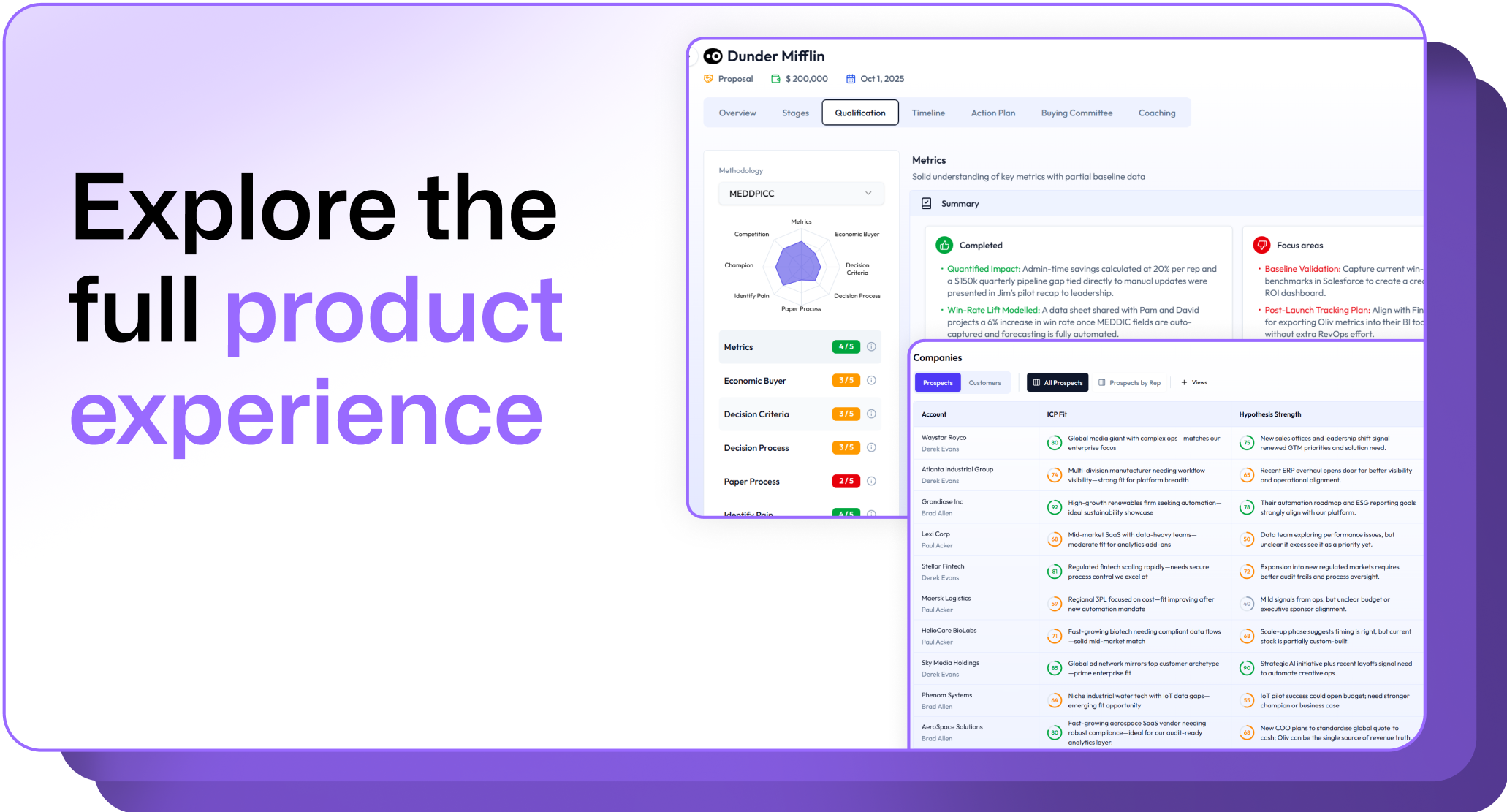
.avif)
.png)