All your deal data unified (from 30+ tools and tabs).
Insights are delivered to you directly, no digging.
AI agents automate tasks for you.
Thank you! Your submission has been received!
Oops! Something went wrong while submitting the form.
Meet Oliv’s AI Agents
Hi! I’m, Deal Driver
I track deals, flag risks, send weekly pipeline updates and give sales managers full visibility into deal progress
Hi! I’m, CRM Manager
I maintain CRM hygiene by updating core, custom and qualification fields all without your team lifting a finger
Hi! I’m, Forecaster
I build accurate forecasts based on real deal movement and tell you which deals to pull in to hit your number
Hi! I’m, Coach
I believe performance fuels revenue. I spot skill gaps, score calls and build coaching plans to help every rep level up
Hi! I’m, Prospector
I dig into target accounts to surface the right contacts, tailor and time outreach so you always strike when it counts
Hi! I’m, Pipeline tracker
I call reps to get deal updates, and deliver a real-time, CRM-synced roll-up view of deal progress
Hi! I’m, Analyst
I answer complex pipeline questions, uncover deal patterns, and build reports that guide strategic decisions
TL;DR
Agentic sales automation uses autonomous AI agents that research, decide, act, and self-correct toward a revenue goal, unlike rule-based traditional automation that breaks when reality changes.
A multi-agent architecture has three layers: a commoditised data layer, a fine-tuned intelligence layer, and specialist agents coordinated by an orchestrator.
Production agents average around 171% ROI with roughly 8.3-month payback, but about 88% never reach production and most pilots quietly fade.
Evaluate vendors on five axes: native vs bolt-on, deal-level vs meeting-level, workflow depth, grounding, and transparent pricing; bolt-on chat features keep failing.
Governance now spans SOC 2 Type II, GDPR, CCPA, and the EU AI Act, where grounding agents in your own data doubles as an audit-trail control.
A phased 90-day blueprint, plus the incognito test for picking your most painful workflow, beats the pilot trap and reaches production.
Q1. What Exactly Is Agentic Sales Automation (And How Is It Different From Traditional Sales Automation)? [toc=1. Agentic vs Traditional]
A few months ago, a RevOps lead showed me her "automated" sequence. A prospect replied "I'm out next week, ping me later." The sequence fired the next email anyway, on schedule, dead on arrival. That is not intelligence. That is a vending machine doing what it was told.
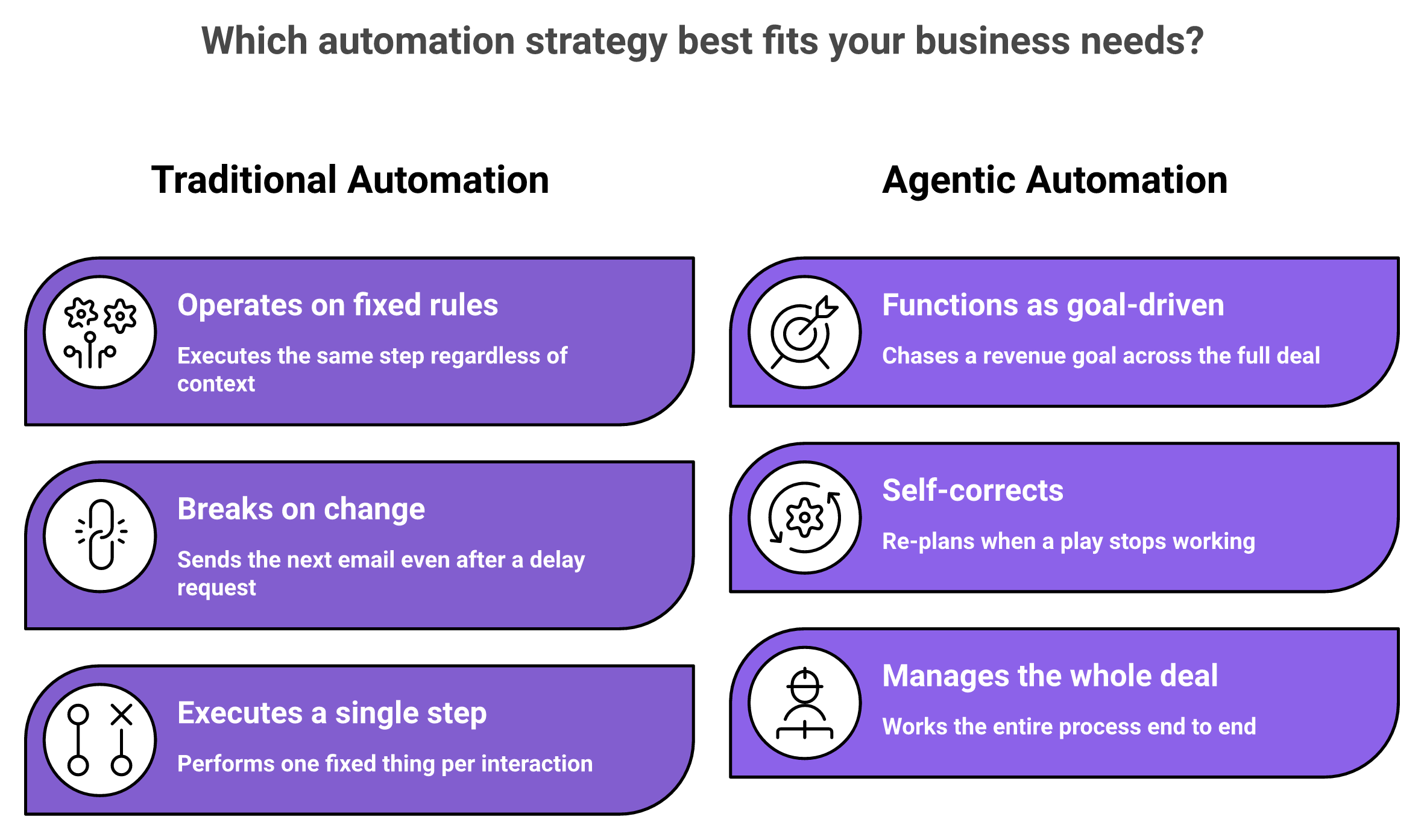
Agentic sales automation uses autonomous AI agents that chase a revenue goal end to end. They research, decide, act, and self correct, instead of running fixed if then rules. Traditional automation is a vending machine: fixed input, fixed output, and it breaks the second reality changes. An agent behaves like a sharp employee who re jigs the plan when something is not working and keeps going until the goal is met.
🥤 The vending machine versus the smart employee
A vending machine takes one input and returns one output. If the payment fails, it just stops. Most "sales automation" works the same way. It cannot read the room.
An agent is closer to a coach. It picks a goal, watches what happens, and adjusts. If a play stops working, it junks the play. If a play works, it doubles down.
Traditional automation runs fixed rules; agentic automation chases the goal and self-corrects when reality shifts.
That difference matters because real deals are messy. A buyer goes quiet, a champion leaves, a competitor enters late. Rules cannot bend around that. Agents can, which is why so many teams now compare these approaches when they evaluate the best AI sales tools.
🏭 Think of your funnel as a revenue factory
Here is a frame I lean on. Picture your funnel as a manufacturing line, where volume times conversion rate equals output. Every micro stage is a station on that line.
Traditional automation bolts a fixed machine onto one station. It stamps the same action regardless of context. An agentic system instead instruments each station, reads the signal, and decides the next best move per deal.
I might be slightly overstating the gap for the simplest workflows. A basic reminder email does not need an agent. But the moment judgment enters, rules start to crack, and that is most of selling.
✅ What this means for you on Monday
Stop buying brittle workflows that need a human babysitter. Start asking vendors one question: when reality changes mid deal, does your tool re plan, or does it keep stamping?
The standard read says automation equals efficiency. I think that gets it backwards. Efficiency without judgment just helps you do the wrong thing faster.
This is where the unit of work matters. Tools built on agentic principles, and Oliv.ai is one of them, treat the deal as the thing the agent works toward, not a single meeting or a single email. From what surfaces when you actually run deal level agents, the system stops asking you for inputs and starts handing you outcomes. That is the real line between the previous decade of software and where modern revenue intelligence platforms are heading.
Q2. Why Are Revenue Leaders Moving To Agents Now, What Changed? [toc=2. Why Now]
I keep hearing a version of the same sentence from founders and CROs. "I just can't pay a junior SDR $150,000 a year to quit." It is said quietly, almost with guilt, and it is the real reason this shift is happening now.
Three forces converged. Human turnover became unbearable, the economics flipped, and the analysts finally validated the move. The revenue per rep target jumped from $300k to $500k toward $3 million to $5 million for AI leveraged teams. And Gartner projects 40% of enterprise apps will embed task specific agents by end of 2026, up from under 5% in 2025, so standing still is now the actual risk.
💸 Force one: the turnover math stopped working
Hiring an entry level rep, ramping them, watching them churn, then repeating it is a brutal loop. Leaders have run it too many times.
The cost is not just salary. It is the ramp, the lost pipeline, the manager hours. When that cost is real and finite, agents start to look less like a gamble and more like relief.
📈 Force two: the economics flipped
The old baseline was a few hundred thousand in revenue per rep. The new target leaders quote is several million per rep, because agents handle the volume work that used to need headcount.
There is real anxiety underneath this. As one operator put it, if your job is the task, you are highly likely to be disrupted. That is uncomfortable, and I think it is honest. It is also why the move from revenue ops to intelligence to orchestration is accelerating.
I could be early on the exact numbers. Not every team will hit $3 million per rep soon. But the direction is not subtle, and the gap between agentic teams and headcount heavy teams is widening.
⏰ Force three: the analysts caught up
This is no longer a fringe bet. Gartner forecasts that 40% of enterprise applications will embed task specific agents by the end of 2026, a jump from under 5% the year before.
That validation matters for internal buy in. It is easier to defend a budget line when the category is moving, not when you are the only one moving.
⚠️ The trap to avoid: pilots that never ship
Here is my one caution. Plenty of teams start a pilot, see promise, and then stall. The work to move from a flashy demo to production is where most of them quietly fade.
So move now, but move toward production, not toward a pretty pilot. The point is not to test agents. The point is to ship them. We will get to the 90 day blueprint that makes that real later in this piece.
Q3. What Does A Multi-Agent Sales Architecture Look Like, And What Role Does Each Agent Play? [toc=3. Architecture and Agent Roles]
A founder I spoke with described walking past ten desks that used to hold go to market hires. Each desk now carries a label with an agent's name. "Reply" handles replies. "Quali" qualifies. The agents, he said, work all night, weekends, and Christmas.
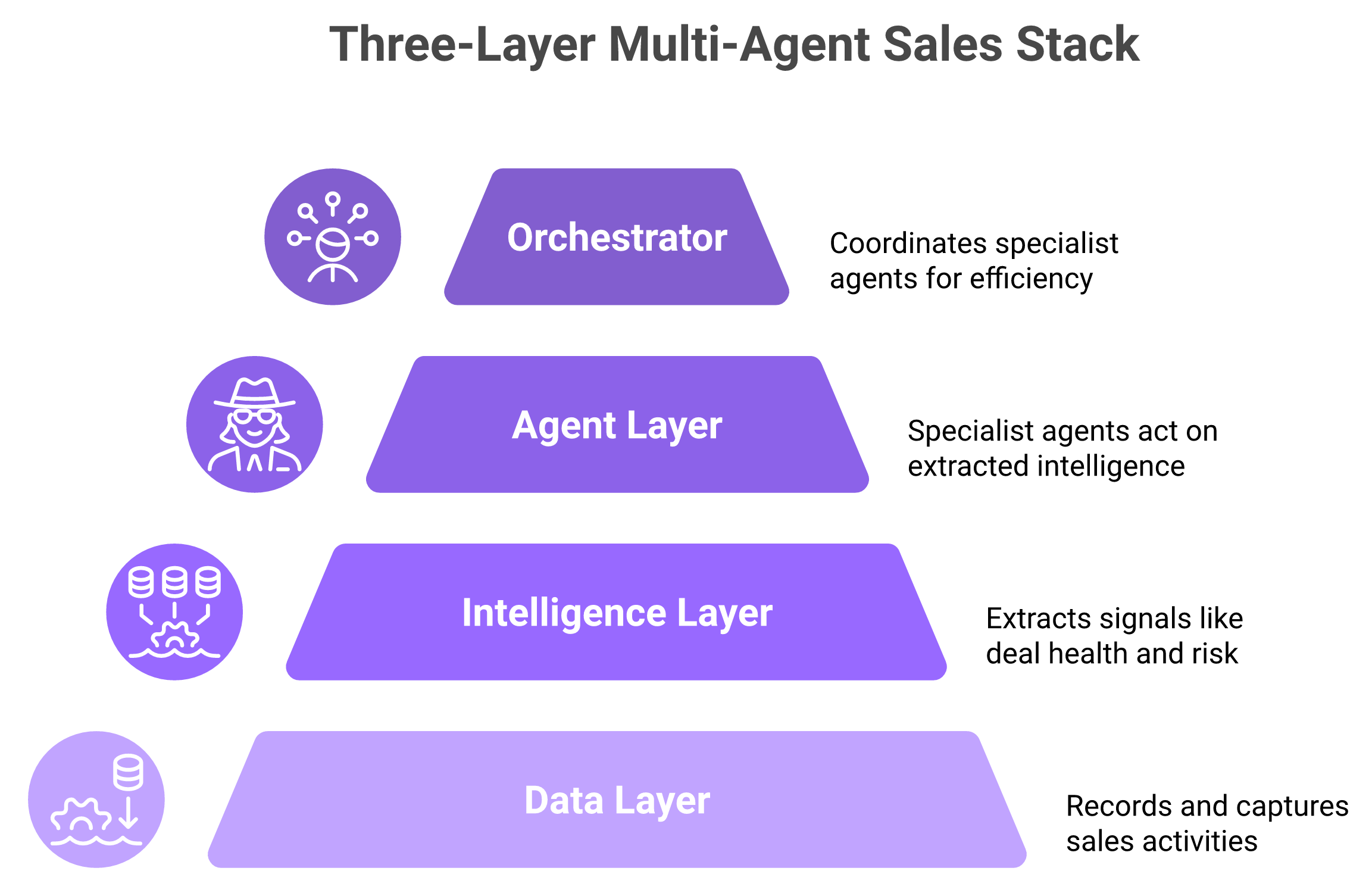
A sales multi agent system has three layers. A baseline data layer captures activity, which is now commoditised and nearly free. An intelligence layer of fine tuned LLMs (large language models trained on your company's data) extracts signals like MEDDICC. An agent layer of specialists, coordinated by an orchestrator, produces follow ups, reports, and next steps. One operator runs roughly "1.2 humans plus 20 agents" doing what 10 human GTMs used to do.
🍰 The three layer cake
Think of the stack as a cake with three layers, each doing one job.
Baseline data layer. Recording, transcription, and activity capture. This used to be the product. Now it is table stakes and close to free.
Intelligence layer. Fine tuned LLMs read that raw data and track qualification fields, deal health, and risk.
Agent layer. Specialist agents act on that intelligence, drafting follow ups and one pagers for leadership.
The order matters. Without a clean intelligence layer, the agents on top hallucinate, because they have no grounded foundation to reason from.
A multi-agent sales stack builds from a commoditised data layer up through fine-tuned intelligence to acting agents.
🧱 Why grounding beats raw cleverness
The fix for hallucination is not a smarter prompt. It is grounding. When you fine tune models on a single company's data, agents reason from that foundation instead of guessing. This is the same principle behind translating the MEDDIC sales methodology into live opportunity fields.
I might be overweighting this, but in practice grounding is the difference between an agent you trust and one you double check. Cleverness without context just produces confident nonsense.
👥 The agent roles, mapped to human jobs
Here is the org chart, minus the burnout. A supervisor or orchestrator agent coordinates the specialists and routes work.
RevOps Agent Roles, Offloaded Tasks, and Outcomes
Agent role
Human task it offloads
Outcome it drives
Research and enrichment
Manual account research
Faster, fuller context
Qualification
Lead triage
Cleaner pipeline entry
Outreach
First touch and follow up
More consistent coverage
Scheduling
Calendar ping pong
Less friction to meet
CRM and RevOps update
Manual logging
Better hygiene, less admin
Forecasting
Manual roll up
Steadier forecast confidence
Coaching
Call review
Targeted rep development
⚠️ The UI trap and the supervisor reality
Most tools fail here. They treat the agent as a chat box, so a rep still has to go talk to it, copy the answer, and paste it somewhere. A true agent goes straight to the underlying data, applies its own logic, and returns the result inside the workflow.
There is a human cost worth naming. Someone still reviews outputs. One operator's teammate spends 10 to 15 hours a week checking agent work, because the agents never sleep, which is exhausting in its own way.
This is exactly where Oliv.ai concentrates. We build fine tuned, company grounded models that feed the intelligence layer, then run forecasting, coaching, and CRM update agents that read deal data directly rather than waiting for a rep to copy paste into a chatbot. From what surfaces when you actually run this, the architecture is the product, not a feature you bolt on later, which is why it reshapes the best revenue intelligence software platforms conversation.
Q4. How Does An Agentic Sales Workflow Run End-To-End? [toc=4. End-to-End Workflow]
Picture Maya, an AE closing her Thursday. She has eight deals to move and one follow up email that actually matters, the one tied to a deal worth her quarter. She knows exactly what good looks like. She also knows she probably will not do it well, because the workflow is punishing.
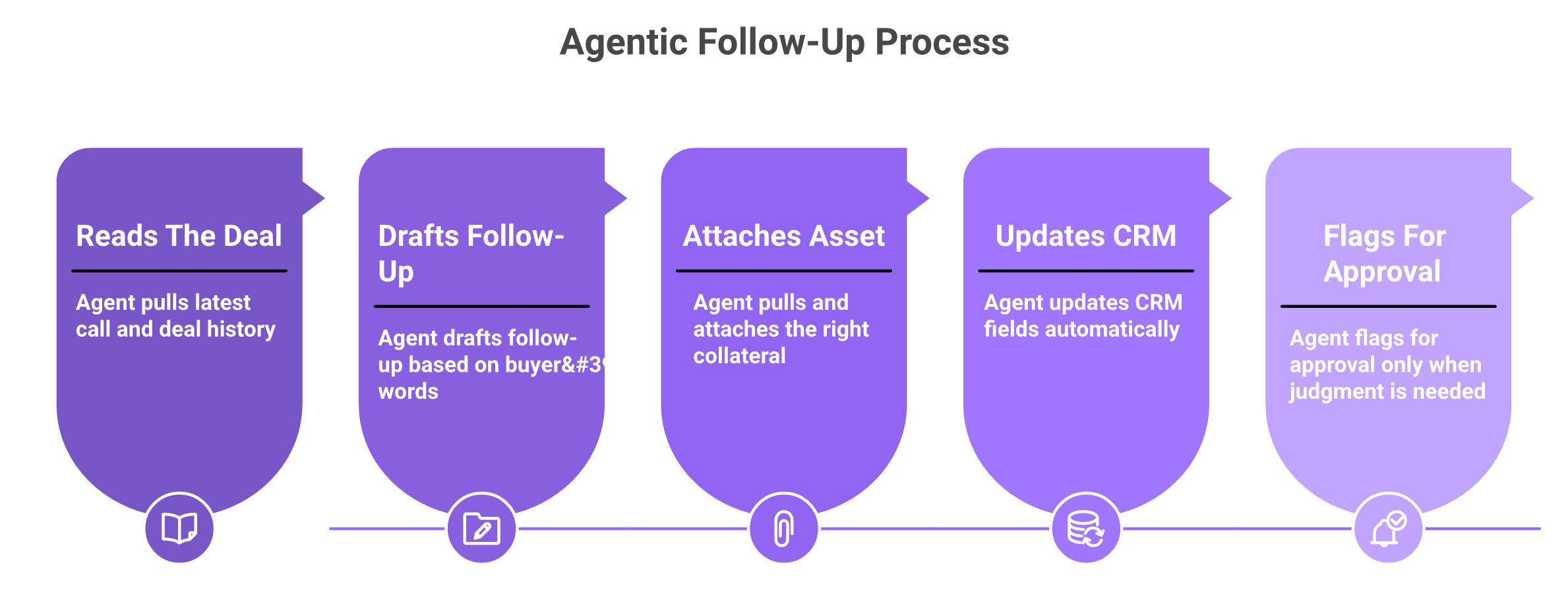
Here is the manual reality. Pull the transcript from Gong, paste it into a custom GPT, write a prompt, copy the output into Outlook, then hunt for the one relevant PDF and attach it. It is so much work that most reps quietly skip it. The agentic version collapses that into a single autonomous pass: the agent reads the deal, drafts the grounded follow up, attaches the right asset, updates the CRM, and flags Maya only when judgment is needed.
😩 The complication: a gauntlet nobody completes
Each step in Maya's manual flow is small. Stacked together, they are a wall. Transcript, prompt, copy, paste, search, attach, log.
The result is predictable. The follow up gets rushed, generic, or never sent. The deal cools, not because Maya is lazy, but because the system asked too much of her at 6pm.
An agentic follow-up collapses a manual gauntlet into one pass, leaving the rep only the approval.
Operators feel this in the tooling itself. The point of these platforms was supposed to be less manual work, not more, a tension that shows up across Gong reviews.
"For me, the only business problem gong solves is the call recordings. It allows me to review my calls and listen to them." John S., Senior Account Executive Gong G2 Verified Review
"Its too complicated, and not intuitive at all. Searching for calls is not easy, moving around in the calls is not easy, and understanding the pipeline management portion of it is almost impossible." John S., Senior Account Executive Gong G2 Verified Review
⚙️ The resolution: one autonomous pass
Now run the agentic version. The agent already has the deal context, because it lives in the intelligence layer, not in Maya's browser tabs.
It reads the latest call and the full deal history, not just one meeting.
It drafts the follow up grounded in what the buyer actually said.
It pulls the right asset and attaches it.
It updates the CRM fields automatically.
It surfaces the draft to Maya only if a judgment call is needed.
Maya moves from doing the work to approving it. That is the whole shift in one screen, and it is what the best AI for sales calls should deliver.
🗓️ The payoff: the Thursday forecast scrub shrinks
There is a manager side mirror to Maya's pain. Every Thursday and Friday, managers sit with reps for one to two hours, reconstruct what moved, and manually push it into the forecast.
That ritual exists because the data was never trustworthy in the first place. Even fans of incumbent tools admit the roll up math is patchy, a gap explored in this look at Gong forecasting.
When agents keep the deal current in real flow, the scrub stops being a reconstruction project. The forecast is already assembled, because the work updated it as it happened.
This is the exact gauntlet Oliv.ai is built to collapse. We read the call, draft the grounded follow up, update the CRM, and assemble the forecast view, so Maya's 6pm wall and her manager's Thursday scrub mostly disappear. I could be wrong about how fast a given team adopts this. But from what surfaces when you actually run deal level agents, the work that "most people don't do" finally gets done, quietly, every time, which is the promise behind the best AI sales forecasting software.
Q5. What Outcome Benchmarks Should You Expect, ROI, Payback, And Why 88% Of Agents Never Ship? [toc=5. Outcome Benchmarks]
A founder told me about the day he faced his board and said, "We're not going to sell for the next four to five months." He could see the look on their faces. He was not pausing sales out of laziness. He was rebuilding for production, because the demo was easy and the deployment was hard.
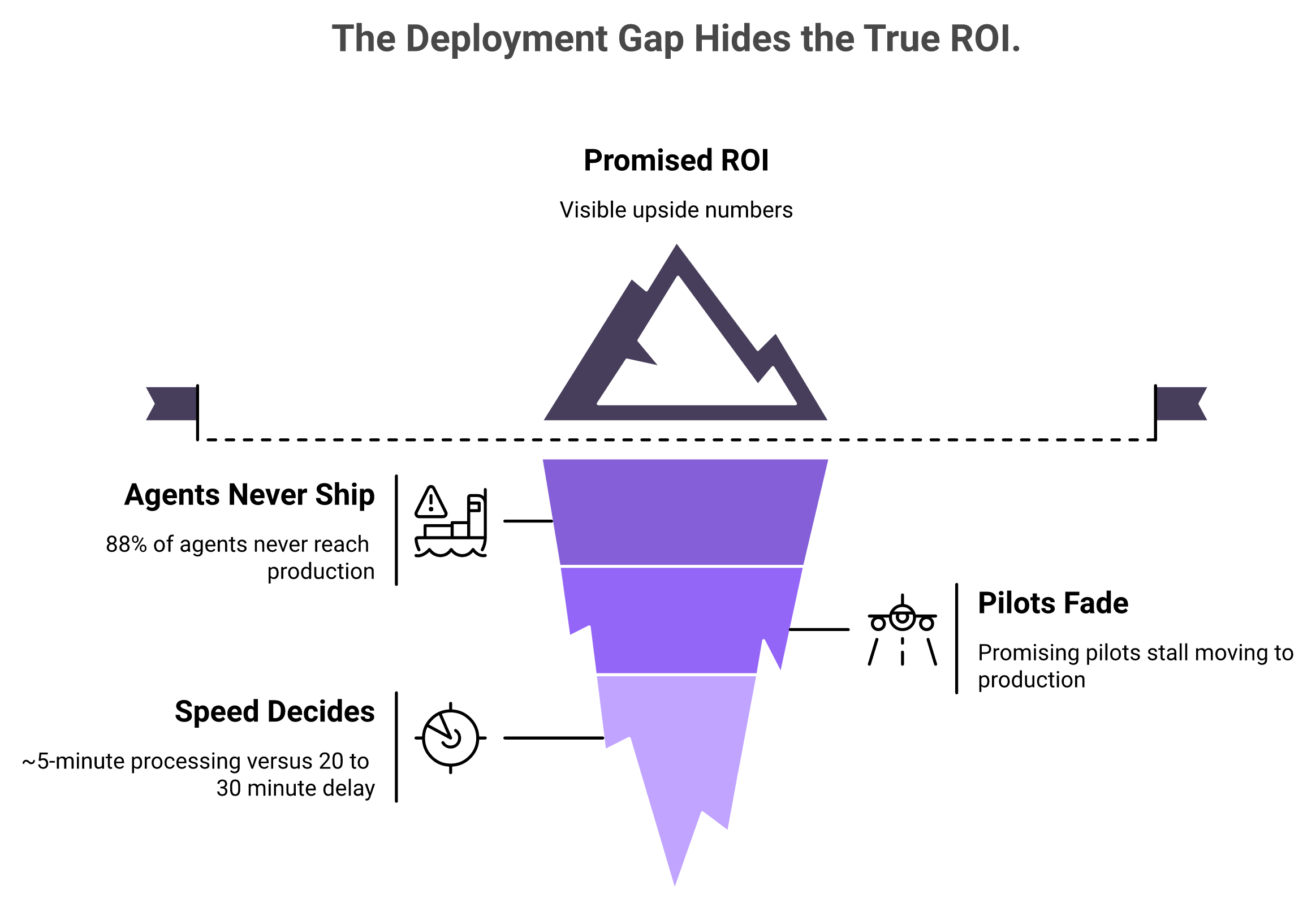
Production deployed sales agents average around 171% ROI, and roughly 192% in the US, with median payback near 8.3 months. Benchmark leaders respond to buying signals 87% faster, under 15 minutes versus 4 to 6 hours. Here is the brutal part. Around 88% of agents never reach production, and most pilots quietly fade. The return is real. It just lives on the far side of the deployment gap.
📊 The numbers worth quoting
Let me put the headline benchmarks in one place, so you can screenshot them and defend a budget line.
AI Agent ROI and Adoption Benchmarks
Benchmark
Reported figure
Average ROI (production agents)
~171% (192% US)
Median payback period
~8.3 months
Signal response, leaders
Under 15 minutes vs 4 to 6 hours
Enterprise apps with agents by end 2026
40%, up from under 5%
Agents that never reach production
~88%
These are averages, not promises. Your mileage shifts with data quality, scope, and how disciplined your rollout is.
Strong ROI sits above the surface, but the real story is the deployment gap hidden beneath it.
⏰ Why the adoption curve is steep
Gartner expects 40% of enterprise apps to embed task specific agents by the end of 2026, up from under 5% the prior year. That is a fast climb.
I read this as a window, not a gun to your head. The teams that ship now compound a lead. The teams that wait keep paying the old cost structure, which is why the shift toward a modern revenue orchestration platform keeps accelerating.
⚠️ The 88% problem, said plainly
Most vendor blogs show only the upside. I think that is dishonest, and operators see through it.
The honest read is that the majority of agents die between pilot and production. They start with promise, then stall when customers struggle to move them into real workflows. The ROI belongs to the few who cross that gap.
So judge a vendor on production survival, not demo polish. Ask how many of their deployments actually shipped, and what broke for the ones that did not. This is also a fair lens for weighing the best AI sales tools against each other.
Where does that leave Oliv.ai? On the production side of the gap, speed and grounding decide. We process post call intelligence in roughly 5 minutes, versus the 20 to 30 minute delay common with older tools, which is exactly the kind of measurable edge that survives a pilot instead of fading in it. From what surfaces when you actually run this, fast and grounded beats clever and slow, every quarter, a pattern visible across the best revenue intelligence software platforms.
Q6. How Mature Is Your Agentic Sales Operation, The Augmented To Assisted To Autonomous Index? [toc=6. Maturity Index]
Most teams I talk to believe they are further along than they are. They have a note taker and a few AI summaries, so they call themselves "agentic." Then a deal slips because nobody followed up, and the gap between the story and the reality shows.
Agentic sales maturity climbs three rungs. Augmented means AI assists a human who still drives. Assisted means agents execute and humans approve. Autonomous means agents run the workflow and humans handle exceptions. Score yourself on hard thresholds: signal response under 15 minutes, 95% or higher TAM coverage (your total addressable market), and 60% lower pipeline leakage. Most teams sit at Augmented and mistake it for Autonomous.
🪜 The three rungs, defined simply
Think of it like driving. First you get a smarter dashboard. Then a co pilot. Then a car that drives most of the route while you watch the road.
Augmented. AI drafts and suggests. The human does the work and uses AI as a helper.
Assisted. Agents do the work. The human reviews and approves before it ships.
Autonomous. Agents run the workflow end to end. The human steps in only on exceptions.
📏 Score yourself on real thresholds
Vibes are not a maturity model. Numbers are. Here is a self check you can run this week.
RevOps Maturity Stages: Augmented to Autonomous
Stage
Signal response
TAM coverage
Pipeline leakage
Augmented
Hours
Partial
Baseline
Assisted
Under 1 hour
Growing
Reduced
Autonomous
Under 15 min
95%+
~60% lower
If you cannot hit the autonomous row, you are not autonomous yet, and that is fine.
✅ How to climb one rung this quarter
You do not need to leap to autonomous. You need to climb one rung, on purpose.
Here is my contrarian take. Assisted is a legitimate destination, not a failure. The real unlock is human and AI collaboration that turns a good rep into a far more productive one, not blanket replacement, the same thinking behind the move from revenue ops to intelligence to orchestration.
So pick one workflow, push it from Augmented to Assisted, and prove the thresholds move. Then repeat. This is where Oliv.ai tends to slot in, as the bridge from Augmented to Assisted on the deal level work where teams stall: forecasting, coaching, and CRM hygiene. I could be wrong on the exact sequence for your team, but climbing one rung beats faking the top one, especially when you anchor it to the best AI sales forecasting software.
Q7. How Do You Evaluate Agentic Sales Vendors, And Why Do Bolt-On AI Features Keep Failing? [toc=7. Vendor Evaluation]
A RevOps lead once described her "AI upgrade" to me. The vendor had stapled a chat box onto the old CRM. She still had to open the chat, ask it a question, copy the answer, and paste it into the opportunity. That is not an agent. That is a search bar with better marketing.
Evaluate vendors on five axes: native versus bolt-on architecture, deal-level versus meeting-level understanding, workflow depth versus chat dependency, grounding and hallucination control, and transparent pricing. The recurring failure mode is bolt-on AI. Incumbents staple chat onto a CRM that was already a dumb repository, so the rep still does the moving by hand. Native agents are born inside the workflow.
🧩 Why bolt-on keeps failing
The core problem is structural, not cosmetic. The CRM was built as a system of record, where reps log data once a week because management asks them to.
Bolting AI on top does not fix that. You get clever features sitting on shaky data. Buyers feel it as extra clicks and extra tabs, not less work, a complaint that runs through many Salesforce Agentforce reviews.
"Lots of clicking to get select the right options. UX needs improvement. Everything opens in a new browser tabs clustering the browser. Lots of jumping back and forth between tabs to enable settings." Verified User in Consulting Salesforce Agentforce G2 Verified Review
📋 The five axis rubric
Here is the scorecard I would hand a buying committee. Score each vendor one to five per axis.
AI-Native vs Bolt-On: What to Look For
Axis
What good looks like
Bolt-on red flag
Architecture
AI native, built recently
AI features added a decade in
Understanding
Deal level, full cycle
Single meeting or single email
Workflow depth
Acts inside the workflow
You go to a chat box
Grounding
Fine tuned on your data
Generic model, hallucinates
Pricing
Transparent per seat
Opaque per action credits
On that last axis, watch the pricing model. Some agentic tools price per action, near $0.1 each, or land around $500 per seat once bundled, which is hard to forecast.
"The reports are difficult to make sense of, onboarding takes time and ther are many glitches ongoing. and our account manager changed 3 times in 4 months." Greg D., CRO Outreach G2 Verified Review
⚠️ Build versus buy, honestly
A lot of smart founders want to build this in house. I get the urge. But unless your company is an infrastructure shop, a self built agent often goes obsolete within a couple of months as the models move.
So most teams should buy, then customize. On the buy side, this is where Oliv.ai sits, on the native, deal level, workflow integrated side of the rubric. I will be candid about the anti fit too. If you only want pure call recording, or in call live coaching during the conversation, Oliv is deliberately not built for that, and another tool may suit you better. If coaching is your priority, it is worth reviewing the best sales coaching softwares before you decide.
Q8. Gong vs. Agentforce vs. Oliv.ai: Meeting-Level, Bolt-On, Or Deal-Level Agentic? [toc=8. Gong vs Agentforce vs Oliv]
Picture a Monday forecast call. The manager asks, "What actually moved on the Acme deal?" With most tools, the answer lives in a meeting recording from last Tuesday, and someone has to go dig it out. The question is about the deal. The tool only understands the meeting.
Gong understands sales at the meeting level. It is excellent at recording and conversation intelligence, but call capture is now commoditised. Agentforce is agentic in name, yet still chat focused and bolted onto the CRM. Oliv.ai works at the deal level. It tracks the full sales cycle, including pipeline movement, coaching, and forecasting, and it acts inside the workflow rather than waiting to be asked.
🎙️ Meeting level versus deal level
Here is the cleanest way to see the difference. A B2C bot helps someone return a shirt. A B2B agent helps close a million dollar deal. They are not the same job.
Gong shines at the conversation. Operators genuinely value the recordings and recaps, as a deeper read of Gong versus Oliv makes clear.
"For me, the only business problem gong solves is the call recordings." John S., Senior Account Executive Gong G2 Verified Review
"Theres so much in Gong, that we dont use everything. Gongs deal forecasting we dont use." Karel Bos, Head of Sales Gong TrustRadius Verified Review
That second quote is the tell. The recording works. The deal level forecasting often goes unused, a gap worth weighing against the approach to Gong forecasting.
🔌 The Agentforce chat problem
Agentforce brings real promise, especially for service workflows. But several users describe the same friction: setup is heavy, and it still feels like talking to a chat layer, not a teammate inside the work. For teams already evaluating it, the best Agentforce alternatives and competitors are worth a look.
"Lots of clicking to get select the right options. UX needs improvement. Everything opens in a new browser tabs." Verified User in Consulting Salesforce Agentforce G2 Verified Review
🧭 Which one fits you
Let me make this decisive, with the trade offs named.
Choose Gong if your core need is best in class call recording and conversation review.
Choose Agentforce if you are deep in Salesforce and want service style agents, with budget for setup.
Choose Oliv.ai if you want deal level intelligence that tracks the full cycle and acts on its own.
On differentiation, we made a deliberate choice at Oliv.ai. We process post call intelligence in roughly 5 minutes versus the common 20 to 30 minute delay, and we do not chase in call, real time coaching, because that is not where we want to differentiate. I might be wrong for your exact setup. But from what surfaces when you actually run deal level agents, the deal, not the meeting, is the unit that wins the Monday forecast call, which is the heart of the revenue intelligence platforms debate.
Q9. Is Agentic Sales Automation Secure And Compliant, SOC 2, GDPR, And The EU AI Act? [toc=9. Governance and Compliance]
The first question from a serious buyer is rarely about features. It is from the IT or Legal seat, and it sounds like this: "Before this thing touches our pipeline data, what happens if it acts on its own and gets something wrong?" That question, not the demo, decides the deal.
Before agents touch your data, IT and Legal check four things. SOC 2 Type II certification (an audited control standard), GDPR and CCPA compliance, encryption with AES-256 at rest and TLS in transit, and, new for 2026, how autonomous agents are governed under the EU AI Act and two party consent laws. Grounding agents in your own secure, fine tuned data is both an accuracy control and a governance control. Fewer hallucinations means a cleaner audit trail.
🔒 The four gating criteria
Here is the checklist a buying committee actually runs. Each row maps to a real risk when an agent acts without a human in the loop.
Security and Compliance Criteria for AI Agents
Criterion
What it proves
Why it matters for agents
SOC 2 Type II
Audited security controls
Agent access is monitored, not blind
GDPR and CCPA
Lawful data handling
Consent holds when agents process records
AES-256 and TLS
Data encrypted everywhere
Deal data stays protected in transit and at rest
EU AI Act readiness
Governance of autonomous systems
Defines accountability when an agent decides
The EU AI Act matters most here. It pushes risk based obligations onto systems that act, so "the agent did it" stops being a defense.
🧾 Why grounding is a governance control
There is a detail most vendors skip. In regulated work, you often have to create an audit trail and physically link the data, so the customer and their auditor are comfortable.
That is where grounding earns its keep. When agents reason from your own fine tuned data, inside a secure workspace, they hallucinate less and leave a traceable path. Accuracy and auditability become the same feature, not two. This is a recurring theme across the best revenue intelligence software platforms.
This is the posture we hold at Oliv.ai. We ground our models in a secure, company specific data workspace, which both reduces hallucination and produces a cleaner trail for IT and Legal to inspect. I might be early on exactly how the EU AI Act gets enforced in sales, but the direction is clear: agents that can explain themselves will clear procurement faster than agents that cannot, which is why teams comparing the best Agentforce alternatives and competitors weigh governance so heavily.
Q10. What Do Observability And TCO Cost You, And How Do You Run A 90-Day Agentic Pilot That Reaches Production? [toc=10. TCO and 90-Day Blueprint]
I keep coming back to one stubborn fact. Most agent projects do not die from bad technology. They die in the gap between a pilot that demos well and a deployment that actually runs every day, and the reason is usually cost and discipline, not capability.
True cost is not the license. It is tokens (the units of AI compute you pay for), observability, and human review, where someone still spends 10 to 15 hours a week checking outputs. To reach production, run a 90 day blueprint. Days 1 to 30, pick one painful workflow and train it daily using the 10/80/10 rule. Days 31 to 60, add observability and expand. Days 61 to 90, harden governance and scale. Use the "incognito test" to pick the workflow that makes you cry, and automate that first.
💰 The TCO line items nobody quotes
Sticker price hides the real number. Here is where the money actually goes.
The Hidden Costs of Running AI Agents
Cost line
What it covers
Why it surprises people
Tokens
AI compute per action
Cheap per call, adds up at volume
Observability
Monitoring agent behavior
Skipping it is why agents drift
Human review
Someone checks outputs
10 to 15 hours a week, every week
Tokens can be tiny. Processing hundreds of small business websites can cost a handful of cents with efficient models. The human review line is the one that quietly dominates, a reality often missed when teams compare the best AI sales tools on sticker price alone.
🗓️ The 90-day blueprint
Phasing is how you beat the pilot trap. Do not boil the ocean. Climb in three clear stages.
Days 1 to 30, train one workflow. Use the 10/80/10 rule: 10% ideation, 80% execution, and 10% integration. Spend an hour or two a day correcting mistakes, and by day 30 the agent is genuinely good.
Days 31 to 60, add observability and expand. Watch what the agent does, fix drift, then widen to a second workflow.
Days 61 to 90, harden and scale. Lock down governance, set review cadence, and roll out to the team.
⏰ The incognito test
Here is the trick I love most. Open an incognito browser and honestly ask which task makes you cry the most on a Friday.
That task is your first agent. Do not start with the flashy use case. Start with the painful one, because the relief is obvious and adoption follows. For most teams, that pain sits in forecasting, which is why the best AI sales forecasting software tends to be the first agent worth deploying.
So where does this leave you? If the incognito test surfaces your Thursday forecast scrub or your follow up backlog, that is the first workflow to hand a deal level agent, and a fair place to test Oliv.ai against your current stack. Where my head is right now is simple: in the next two years, the SaaS you log into becomes agents that work for you, and revenue orchestration gives way to revenue engineering, the same arc you see in the move from revenue ops to intelligence to orchestration. Tell me which workflow makes you cry, and let us reason through whether an agent should own it, the same lens that defines the modern revenue intelligence platforms.
Q1. What Exactly Is Agentic Sales Automation (And How Is It Different From Traditional Sales Automation)? [toc=1. Agentic vs Traditional]
A few months ago, a RevOps lead showed me her "automated" sequence. A prospect replied "I'm out next week, ping me later." The sequence fired the next email anyway, on schedule, dead on arrival. That is not intelligence. That is a vending machine doing what it was told.
Agentic sales automation uses autonomous AI agents that chase a revenue goal end to end. They research, decide, act, and self correct, instead of running fixed if then rules. Traditional automation is a vending machine: fixed input, fixed output, and it breaks the second reality changes. An agent behaves like a sharp employee who re jigs the plan when something is not working and keeps going until the goal is met.
🥤 The vending machine versus the smart employee
A vending machine takes one input and returns one output. If the payment fails, it just stops. Most "sales automation" works the same way. It cannot read the room.
An agent is closer to a coach. It picks a goal, watches what happens, and adjusts. If a play stops working, it junks the play. If a play works, it doubles down.
Traditional automation runs fixed rules; agentic automation chases the goal and self-corrects when reality shifts.
That difference matters because real deals are messy. A buyer goes quiet, a champion leaves, a competitor enters late. Rules cannot bend around that. Agents can, which is why so many teams now compare these approaches when they evaluate the best AI sales tools.
🏭 Think of your funnel as a revenue factory
Here is a frame I lean on. Picture your funnel as a manufacturing line, where volume times conversion rate equals output. Every micro stage is a station on that line.
Traditional automation bolts a fixed machine onto one station. It stamps the same action regardless of context. An agentic system instead instruments each station, reads the signal, and decides the next best move per deal.
I might be slightly overstating the gap for the simplest workflows. A basic reminder email does not need an agent. But the moment judgment enters, rules start to crack, and that is most of selling.
✅ What this means for you on Monday
Stop buying brittle workflows that need a human babysitter. Start asking vendors one question: when reality changes mid deal, does your tool re plan, or does it keep stamping?
The standard read says automation equals efficiency. I think that gets it backwards. Efficiency without judgment just helps you do the wrong thing faster.
This is where the unit of work matters. Tools built on agentic principles, and Oliv.ai is one of them, treat the deal as the thing the agent works toward, not a single meeting or a single email. From what surfaces when you actually run deal level agents, the system stops asking you for inputs and starts handing you outcomes. That is the real line between the previous decade of software and where modern revenue intelligence platforms are heading.
Q2. Why Are Revenue Leaders Moving To Agents Now, What Changed? [toc=2. Why Now]
I keep hearing a version of the same sentence from founders and CROs. "I just can't pay a junior SDR $150,000 a year to quit." It is said quietly, almost with guilt, and it is the real reason this shift is happening now.
Three forces converged. Human turnover became unbearable, the economics flipped, and the analysts finally validated the move. The revenue per rep target jumped from $300k to $500k toward $3 million to $5 million for AI leveraged teams. And Gartner projects 40% of enterprise apps will embed task specific agents by end of 2026, up from under 5% in 2025, so standing still is now the actual risk.
💸 Force one: the turnover math stopped working
Hiring an entry level rep, ramping them, watching them churn, then repeating it is a brutal loop. Leaders have run it too many times.
The cost is not just salary. It is the ramp, the lost pipeline, the manager hours. When that cost is real and finite, agents start to look less like a gamble and more like relief.
📈 Force two: the economics flipped
The old baseline was a few hundred thousand in revenue per rep. The new target leaders quote is several million per rep, because agents handle the volume work that used to need headcount.
There is real anxiety underneath this. As one operator put it, if your job is the task, you are highly likely to be disrupted. That is uncomfortable, and I think it is honest. It is also why the move from revenue ops to intelligence to orchestration is accelerating.
I could be early on the exact numbers. Not every team will hit $3 million per rep soon. But the direction is not subtle, and the gap between agentic teams and headcount heavy teams is widening.
⏰ Force three: the analysts caught up
This is no longer a fringe bet. Gartner forecasts that 40% of enterprise applications will embed task specific agents by the end of 2026, a jump from under 5% the year before.
That validation matters for internal buy in. It is easier to defend a budget line when the category is moving, not when you are the only one moving.
⚠️ The trap to avoid: pilots that never ship
Here is my one caution. Plenty of teams start a pilot, see promise, and then stall. The work to move from a flashy demo to production is where most of them quietly fade.
So move now, but move toward production, not toward a pretty pilot. The point is not to test agents. The point is to ship them. We will get to the 90 day blueprint that makes that real later in this piece.
Q3. What Does A Multi-Agent Sales Architecture Look Like, And What Role Does Each Agent Play? [toc=3. Architecture and Agent Roles]
A founder I spoke with described walking past ten desks that used to hold go to market hires. Each desk now carries a label with an agent's name. "Reply" handles replies. "Quali" qualifies. The agents, he said, work all night, weekends, and Christmas.
A sales multi agent system has three layers. A baseline data layer captures activity, which is now commoditised and nearly free. An intelligence layer of fine tuned LLMs (large language models trained on your company's data) extracts signals like MEDDICC. An agent layer of specialists, coordinated by an orchestrator, produces follow ups, reports, and next steps. One operator runs roughly "1.2 humans plus 20 agents" doing what 10 human GTMs used to do.
🍰 The three layer cake
Think of the stack as a cake with three layers, each doing one job.
Baseline data layer. Recording, transcription, and activity capture. This used to be the product. Now it is table stakes and close to free.
Intelligence layer. Fine tuned LLMs read that raw data and track qualification fields, deal health, and risk.
Agent layer. Specialist agents act on that intelligence, drafting follow ups and one pagers for leadership.
The order matters. Without a clean intelligence layer, the agents on top hallucinate, because they have no grounded foundation to reason from.
A multi-agent sales stack builds from a commoditised data layer up through fine-tuned intelligence to acting agents.
🧱 Why grounding beats raw cleverness
The fix for hallucination is not a smarter prompt. It is grounding. When you fine tune models on a single company's data, agents reason from that foundation instead of guessing. This is the same principle behind translating the MEDDIC sales methodology into live opportunity fields.
I might be overweighting this, but in practice grounding is the difference between an agent you trust and one you double check. Cleverness without context just produces confident nonsense.
👥 The agent roles, mapped to human jobs
Here is the org chart, minus the burnout. A supervisor or orchestrator agent coordinates the specialists and routes work.
RevOps Agent Roles, Offloaded Tasks, and Outcomes
Agent role
Human task it offloads
Outcome it drives
Research and enrichment
Manual account research
Faster, fuller context
Qualification
Lead triage
Cleaner pipeline entry
Outreach
First touch and follow up
More consistent coverage
Scheduling
Calendar ping pong
Less friction to meet
CRM and RevOps update
Manual logging
Better hygiene, less admin
Forecasting
Manual roll up
Steadier forecast confidence
Coaching
Call review
Targeted rep development
⚠️ The UI trap and the supervisor reality
Most tools fail here. They treat the agent as a chat box, so a rep still has to go talk to it, copy the answer, and paste it somewhere. A true agent goes straight to the underlying data, applies its own logic, and returns the result inside the workflow.
There is a human cost worth naming. Someone still reviews outputs. One operator's teammate spends 10 to 15 hours a week checking agent work, because the agents never sleep, which is exhausting in its own way.
This is exactly where Oliv.ai concentrates. We build fine tuned, company grounded models that feed the intelligence layer, then run forecasting, coaching, and CRM update agents that read deal data directly rather than waiting for a rep to copy paste into a chatbot. From what surfaces when you actually run this, the architecture is the product, not a feature you bolt on later, which is why it reshapes the best revenue intelligence software platforms conversation.
Q4. How Does An Agentic Sales Workflow Run End-To-End? [toc=4. End-to-End Workflow]
Picture Maya, an AE closing her Thursday. She has eight deals to move and one follow up email that actually matters, the one tied to a deal worth her quarter. She knows exactly what good looks like. She also knows she probably will not do it well, because the workflow is punishing.
Here is the manual reality. Pull the transcript from Gong, paste it into a custom GPT, write a prompt, copy the output into Outlook, then hunt for the one relevant PDF and attach it. It is so much work that most reps quietly skip it. The agentic version collapses that into a single autonomous pass: the agent reads the deal, drafts the grounded follow up, attaches the right asset, updates the CRM, and flags Maya only when judgment is needed.
😩 The complication: a gauntlet nobody completes
Each step in Maya's manual flow is small. Stacked together, they are a wall. Transcript, prompt, copy, paste, search, attach, log.
The result is predictable. The follow up gets rushed, generic, or never sent. The deal cools, not because Maya is lazy, but because the system asked too much of her at 6pm.
An agentic follow-up collapses a manual gauntlet into one pass, leaving the rep only the approval.
Operators feel this in the tooling itself. The point of these platforms was supposed to be less manual work, not more, a tension that shows up across Gong reviews.
"For me, the only business problem gong solves is the call recordings. It allows me to review my calls and listen to them." John S., Senior Account Executive Gong G2 Verified Review
"Its too complicated, and not intuitive at all. Searching for calls is not easy, moving around in the calls is not easy, and understanding the pipeline management portion of it is almost impossible." John S., Senior Account Executive Gong G2 Verified Review
⚙️ The resolution: one autonomous pass
Now run the agentic version. The agent already has the deal context, because it lives in the intelligence layer, not in Maya's browser tabs.
It reads the latest call and the full deal history, not just one meeting.
It drafts the follow up grounded in what the buyer actually said.
It pulls the right asset and attaches it.
It updates the CRM fields automatically.
It surfaces the draft to Maya only if a judgment call is needed.
Maya moves from doing the work to approving it. That is the whole shift in one screen, and it is what the best AI for sales calls should deliver.
🗓️ The payoff: the Thursday forecast scrub shrinks
There is a manager side mirror to Maya's pain. Every Thursday and Friday, managers sit with reps for one to two hours, reconstruct what moved, and manually push it into the forecast.
That ritual exists because the data was never trustworthy in the first place. Even fans of incumbent tools admit the roll up math is patchy, a gap explored in this look at Gong forecasting.
When agents keep the deal current in real flow, the scrub stops being a reconstruction project. The forecast is already assembled, because the work updated it as it happened.
This is the exact gauntlet Oliv.ai is built to collapse. We read the call, draft the grounded follow up, update the CRM, and assemble the forecast view, so Maya's 6pm wall and her manager's Thursday scrub mostly disappear. I could be wrong about how fast a given team adopts this. But from what surfaces when you actually run deal level agents, the work that "most people don't do" finally gets done, quietly, every time, which is the promise behind the best AI sales forecasting software.
Q5. What Outcome Benchmarks Should You Expect, ROI, Payback, And Why 88% Of Agents Never Ship? [toc=5. Outcome Benchmarks]
A founder told me about the day he faced his board and said, "We're not going to sell for the next four to five months." He could see the look on their faces. He was not pausing sales out of laziness. He was rebuilding for production, because the demo was easy and the deployment was hard.
Production deployed sales agents average around 171% ROI, and roughly 192% in the US, with median payback near 8.3 months. Benchmark leaders respond to buying signals 87% faster, under 15 minutes versus 4 to 6 hours. Here is the brutal part. Around 88% of agents never reach production, and most pilots quietly fade. The return is real. It just lives on the far side of the deployment gap.
📊 The numbers worth quoting
Let me put the headline benchmarks in one place, so you can screenshot them and defend a budget line.
AI Agent ROI and Adoption Benchmarks
Benchmark
Reported figure
Average ROI (production agents)
~171% (192% US)
Median payback period
~8.3 months
Signal response, leaders
Under 15 minutes vs 4 to 6 hours
Enterprise apps with agents by end 2026
40%, up from under 5%
Agents that never reach production
~88%
These are averages, not promises. Your mileage shifts with data quality, scope, and how disciplined your rollout is.
Strong ROI sits above the surface, but the real story is the deployment gap hidden beneath it.
⏰ Why the adoption curve is steep
Gartner expects 40% of enterprise apps to embed task specific agents by the end of 2026, up from under 5% the prior year. That is a fast climb.
I read this as a window, not a gun to your head. The teams that ship now compound a lead. The teams that wait keep paying the old cost structure, which is why the shift toward a modern revenue orchestration platform keeps accelerating.
⚠️ The 88% problem, said plainly
Most vendor blogs show only the upside. I think that is dishonest, and operators see through it.
The honest read is that the majority of agents die between pilot and production. They start with promise, then stall when customers struggle to move them into real workflows. The ROI belongs to the few who cross that gap.
So judge a vendor on production survival, not demo polish. Ask how many of their deployments actually shipped, and what broke for the ones that did not. This is also a fair lens for weighing the best AI sales tools against each other.
Where does that leave Oliv.ai? On the production side of the gap, speed and grounding decide. We process post call intelligence in roughly 5 minutes, versus the 20 to 30 minute delay common with older tools, which is exactly the kind of measurable edge that survives a pilot instead of fading in it. From what surfaces when you actually run this, fast and grounded beats clever and slow, every quarter, a pattern visible across the best revenue intelligence software platforms.
Q6. How Mature Is Your Agentic Sales Operation, The Augmented To Assisted To Autonomous Index? [toc=6. Maturity Index]
Most teams I talk to believe they are further along than they are. They have a note taker and a few AI summaries, so they call themselves "agentic." Then a deal slips because nobody followed up, and the gap between the story and the reality shows.
Agentic sales maturity climbs three rungs. Augmented means AI assists a human who still drives. Assisted means agents execute and humans approve. Autonomous means agents run the workflow and humans handle exceptions. Score yourself on hard thresholds: signal response under 15 minutes, 95% or higher TAM coverage (your total addressable market), and 60% lower pipeline leakage. Most teams sit at Augmented and mistake it for Autonomous.
🪜 The three rungs, defined simply
Think of it like driving. First you get a smarter dashboard. Then a co pilot. Then a car that drives most of the route while you watch the road.
Augmented. AI drafts and suggests. The human does the work and uses AI as a helper.
Assisted. Agents do the work. The human reviews and approves before it ships.
Autonomous. Agents run the workflow end to end. The human steps in only on exceptions.
📏 Score yourself on real thresholds
Vibes are not a maturity model. Numbers are. Here is a self check you can run this week.
RevOps Maturity Stages: Augmented to Autonomous
Stage
Signal response
TAM coverage
Pipeline leakage
Augmented
Hours
Partial
Baseline
Assisted
Under 1 hour
Growing
Reduced
Autonomous
Under 15 min
95%+
~60% lower
If you cannot hit the autonomous row, you are not autonomous yet, and that is fine.
✅ How to climb one rung this quarter
You do not need to leap to autonomous. You need to climb one rung, on purpose.
Here is my contrarian take. Assisted is a legitimate destination, not a failure. The real unlock is human and AI collaboration that turns a good rep into a far more productive one, not blanket replacement, the same thinking behind the move from revenue ops to intelligence to orchestration.
So pick one workflow, push it from Augmented to Assisted, and prove the thresholds move. Then repeat. This is where Oliv.ai tends to slot in, as the bridge from Augmented to Assisted on the deal level work where teams stall: forecasting, coaching, and CRM hygiene. I could be wrong on the exact sequence for your team, but climbing one rung beats faking the top one, especially when you anchor it to the best AI sales forecasting software.
Q7. How Do You Evaluate Agentic Sales Vendors, And Why Do Bolt-On AI Features Keep Failing? [toc=7. Vendor Evaluation]
A RevOps lead once described her "AI upgrade" to me. The vendor had stapled a chat box onto the old CRM. She still had to open the chat, ask it a question, copy the answer, and paste it into the opportunity. That is not an agent. That is a search bar with better marketing.
Evaluate vendors on five axes: native versus bolt-on architecture, deal-level versus meeting-level understanding, workflow depth versus chat dependency, grounding and hallucination control, and transparent pricing. The recurring failure mode is bolt-on AI. Incumbents staple chat onto a CRM that was already a dumb repository, so the rep still does the moving by hand. Native agents are born inside the workflow.
🧩 Why bolt-on keeps failing
The core problem is structural, not cosmetic. The CRM was built as a system of record, where reps log data once a week because management asks them to.
Bolting AI on top does not fix that. You get clever features sitting on shaky data. Buyers feel it as extra clicks and extra tabs, not less work, a complaint that runs through many Salesforce Agentforce reviews.
"Lots of clicking to get select the right options. UX needs improvement. Everything opens in a new browser tabs clustering the browser. Lots of jumping back and forth between tabs to enable settings." Verified User in Consulting Salesforce Agentforce G2 Verified Review
📋 The five axis rubric
Here is the scorecard I would hand a buying committee. Score each vendor one to five per axis.
AI-Native vs Bolt-On: What to Look For
Axis
What good looks like
Bolt-on red flag
Architecture
AI native, built recently
AI features added a decade in
Understanding
Deal level, full cycle
Single meeting or single email
Workflow depth
Acts inside the workflow
You go to a chat box
Grounding
Fine tuned on your data
Generic model, hallucinates
Pricing
Transparent per seat
Opaque per action credits
On that last axis, watch the pricing model. Some agentic tools price per action, near $0.1 each, or land around $500 per seat once bundled, which is hard to forecast.
"The reports are difficult to make sense of, onboarding takes time and ther are many glitches ongoing. and our account manager changed 3 times in 4 months." Greg D., CRO Outreach G2 Verified Review
⚠️ Build versus buy, honestly
A lot of smart founders want to build this in house. I get the urge. But unless your company is an infrastructure shop, a self built agent often goes obsolete within a couple of months as the models move.
So most teams should buy, then customize. On the buy side, this is where Oliv.ai sits, on the native, deal level, workflow integrated side of the rubric. I will be candid about the anti fit too. If you only want pure call recording, or in call live coaching during the conversation, Oliv is deliberately not built for that, and another tool may suit you better. If coaching is your priority, it is worth reviewing the best sales coaching softwares before you decide.
Q8. Gong vs. Agentforce vs. Oliv.ai: Meeting-Level, Bolt-On, Or Deal-Level Agentic? [toc=8. Gong vs Agentforce vs Oliv]
Picture a Monday forecast call. The manager asks, "What actually moved on the Acme deal?" With most tools, the answer lives in a meeting recording from last Tuesday, and someone has to go dig it out. The question is about the deal. The tool only understands the meeting.
Gong understands sales at the meeting level. It is excellent at recording and conversation intelligence, but call capture is now commoditised. Agentforce is agentic in name, yet still chat focused and bolted onto the CRM. Oliv.ai works at the deal level. It tracks the full sales cycle, including pipeline movement, coaching, and forecasting, and it acts inside the workflow rather than waiting to be asked.
🎙️ Meeting level versus deal level
Here is the cleanest way to see the difference. A B2C bot helps someone return a shirt. A B2B agent helps close a million dollar deal. They are not the same job.
Gong shines at the conversation. Operators genuinely value the recordings and recaps, as a deeper read of Gong versus Oliv makes clear.
"For me, the only business problem gong solves is the call recordings." John S., Senior Account Executive Gong G2 Verified Review
"Theres so much in Gong, that we dont use everything. Gongs deal forecasting we dont use." Karel Bos, Head of Sales Gong TrustRadius Verified Review
That second quote is the tell. The recording works. The deal level forecasting often goes unused, a gap worth weighing against the approach to Gong forecasting.
🔌 The Agentforce chat problem
Agentforce brings real promise, especially for service workflows. But several users describe the same friction: setup is heavy, and it still feels like talking to a chat layer, not a teammate inside the work. For teams already evaluating it, the best Agentforce alternatives and competitors are worth a look.
"Lots of clicking to get select the right options. UX needs improvement. Everything opens in a new browser tabs." Verified User in Consulting Salesforce Agentforce G2 Verified Review
🧭 Which one fits you
Let me make this decisive, with the trade offs named.
Choose Gong if your core need is best in class call recording and conversation review.
Choose Agentforce if you are deep in Salesforce and want service style agents, with budget for setup.
Choose Oliv.ai if you want deal level intelligence that tracks the full cycle and acts on its own.
On differentiation, we made a deliberate choice at Oliv.ai. We process post call intelligence in roughly 5 minutes versus the common 20 to 30 minute delay, and we do not chase in call, real time coaching, because that is not where we want to differentiate. I might be wrong for your exact setup. But from what surfaces when you actually run deal level agents, the deal, not the meeting, is the unit that wins the Monday forecast call, which is the heart of the revenue intelligence platforms debate.
Q9. Is Agentic Sales Automation Secure And Compliant, SOC 2, GDPR, And The EU AI Act? [toc=9. Governance and Compliance]
The first question from a serious buyer is rarely about features. It is from the IT or Legal seat, and it sounds like this: "Before this thing touches our pipeline data, what happens if it acts on its own and gets something wrong?" That question, not the demo, decides the deal.
Before agents touch your data, IT and Legal check four things. SOC 2 Type II certification (an audited control standard), GDPR and CCPA compliance, encryption with AES-256 at rest and TLS in transit, and, new for 2026, how autonomous agents are governed under the EU AI Act and two party consent laws. Grounding agents in your own secure, fine tuned data is both an accuracy control and a governance control. Fewer hallucinations means a cleaner audit trail.
🔒 The four gating criteria
Here is the checklist a buying committee actually runs. Each row maps to a real risk when an agent acts without a human in the loop.
Security and Compliance Criteria for AI Agents
Criterion
What it proves
Why it matters for agents
SOC 2 Type II
Audited security controls
Agent access is monitored, not blind
GDPR and CCPA
Lawful data handling
Consent holds when agents process records
AES-256 and TLS
Data encrypted everywhere
Deal data stays protected in transit and at rest
EU AI Act readiness
Governance of autonomous systems
Defines accountability when an agent decides
The EU AI Act matters most here. It pushes risk based obligations onto systems that act, so "the agent did it" stops being a defense.
🧾 Why grounding is a governance control
There is a detail most vendors skip. In regulated work, you often have to create an audit trail and physically link the data, so the customer and their auditor are comfortable.
That is where grounding earns its keep. When agents reason from your own fine tuned data, inside a secure workspace, they hallucinate less and leave a traceable path. Accuracy and auditability become the same feature, not two. This is a recurring theme across the best revenue intelligence software platforms.
This is the posture we hold at Oliv.ai. We ground our models in a secure, company specific data workspace, which both reduces hallucination and produces a cleaner trail for IT and Legal to inspect. I might be early on exactly how the EU AI Act gets enforced in sales, but the direction is clear: agents that can explain themselves will clear procurement faster than agents that cannot, which is why teams comparing the best Agentforce alternatives and competitors weigh governance so heavily.
Q10. What Do Observability And TCO Cost You, And How Do You Run A 90-Day Agentic Pilot That Reaches Production? [toc=10. TCO and 90-Day Blueprint]
I keep coming back to one stubborn fact. Most agent projects do not die from bad technology. They die in the gap between a pilot that demos well and a deployment that actually runs every day, and the reason is usually cost and discipline, not capability.
True cost is not the license. It is tokens (the units of AI compute you pay for), observability, and human review, where someone still spends 10 to 15 hours a week checking outputs. To reach production, run a 90 day blueprint. Days 1 to 30, pick one painful workflow and train it daily using the 10/80/10 rule. Days 31 to 60, add observability and expand. Days 61 to 90, harden governance and scale. Use the "incognito test" to pick the workflow that makes you cry, and automate that first.
💰 The TCO line items nobody quotes
Sticker price hides the real number. Here is where the money actually goes.
The Hidden Costs of Running AI Agents
Cost line
What it covers
Why it surprises people
Tokens
AI compute per action
Cheap per call, adds up at volume
Observability
Monitoring agent behavior
Skipping it is why agents drift
Human review
Someone checks outputs
10 to 15 hours a week, every week
Tokens can be tiny. Processing hundreds of small business websites can cost a handful of cents with efficient models. The human review line is the one that quietly dominates, a reality often missed when teams compare the best AI sales tools on sticker price alone.
🗓️ The 90-day blueprint
Phasing is how you beat the pilot trap. Do not boil the ocean. Climb in three clear stages.
Days 1 to 30, train one workflow. Use the 10/80/10 rule: 10% ideation, 80% execution, and 10% integration. Spend an hour or two a day correcting mistakes, and by day 30 the agent is genuinely good.
Days 31 to 60, add observability and expand. Watch what the agent does, fix drift, then widen to a second workflow.
Days 61 to 90, harden and scale. Lock down governance, set review cadence, and roll out to the team.
⏰ The incognito test
Here is the trick I love most. Open an incognito browser and honestly ask which task makes you cry the most on a Friday.
That task is your first agent. Do not start with the flashy use case. Start with the painful one, because the relief is obvious and adoption follows. For most teams, that pain sits in forecasting, which is why the best AI sales forecasting software tends to be the first agent worth deploying.
So where does this leave you? If the incognito test surfaces your Thursday forecast scrub or your follow up backlog, that is the first workflow to hand a deal level agent, and a fair place to test Oliv.ai against your current stack. Where my head is right now is simple: in the next two years, the SaaS you log into becomes agents that work for you, and revenue orchestration gives way to revenue engineering, the same arc you see in the move from revenue ops to intelligence to orchestration. Tell me which workflow makes you cry, and let us reason through whether an agent should own it, the same lens that defines the modern revenue intelligence platforms.
Q1. What Exactly Is Agentic Sales Automation (And How Is It Different From Traditional Sales Automation)? [toc=1. Agentic vs Traditional]
A few months ago, a RevOps lead showed me her "automated" sequence. A prospect replied "I'm out next week, ping me later." The sequence fired the next email anyway, on schedule, dead on arrival. That is not intelligence. That is a vending machine doing what it was told.
Agentic sales automation uses autonomous AI agents that chase a revenue goal end to end. They research, decide, act, and self correct, instead of running fixed if then rules. Traditional automation is a vending machine: fixed input, fixed output, and it breaks the second reality changes. An agent behaves like a sharp employee who re jigs the plan when something is not working and keeps going until the goal is met.
🥤 The vending machine versus the smart employee
A vending machine takes one input and returns one output. If the payment fails, it just stops. Most "sales automation" works the same way. It cannot read the room.
An agent is closer to a coach. It picks a goal, watches what happens, and adjusts. If a play stops working, it junks the play. If a play works, it doubles down.
Traditional automation runs fixed rules; agentic automation chases the goal and self-corrects when reality shifts.
That difference matters because real deals are messy. A buyer goes quiet, a champion leaves, a competitor enters late. Rules cannot bend around that. Agents can, which is why so many teams now compare these approaches when they evaluate the best AI sales tools.
🏭 Think of your funnel as a revenue factory
Here is a frame I lean on. Picture your funnel as a manufacturing line, where volume times conversion rate equals output. Every micro stage is a station on that line.
Traditional automation bolts a fixed machine onto one station. It stamps the same action regardless of context. An agentic system instead instruments each station, reads the signal, and decides the next best move per deal.
I might be slightly overstating the gap for the simplest workflows. A basic reminder email does not need an agent. But the moment judgment enters, rules start to crack, and that is most of selling.
✅ What this means for you on Monday
Stop buying brittle workflows that need a human babysitter. Start asking vendors one question: when reality changes mid deal, does your tool re plan, or does it keep stamping?
The standard read says automation equals efficiency. I think that gets it backwards. Efficiency without judgment just helps you do the wrong thing faster.
This is where the unit of work matters. Tools built on agentic principles, and Oliv.ai is one of them, treat the deal as the thing the agent works toward, not a single meeting or a single email. From what surfaces when you actually run deal level agents, the system stops asking you for inputs and starts handing you outcomes. That is the real line between the previous decade of software and where modern revenue intelligence platforms are heading.
Q2. Why Are Revenue Leaders Moving To Agents Now, What Changed? [toc=2. Why Now]
I keep hearing a version of the same sentence from founders and CROs. "I just can't pay a junior SDR $150,000 a year to quit." It is said quietly, almost with guilt, and it is the real reason this shift is happening now.
Three forces converged. Human turnover became unbearable, the economics flipped, and the analysts finally validated the move. The revenue per rep target jumped from $300k to $500k toward $3 million to $5 million for AI leveraged teams. And Gartner projects 40% of enterprise apps will embed task specific agents by end of 2026, up from under 5% in 2025, so standing still is now the actual risk.
💸 Force one: the turnover math stopped working
Hiring an entry level rep, ramping them, watching them churn, then repeating it is a brutal loop. Leaders have run it too many times.
The cost is not just salary. It is the ramp, the lost pipeline, the manager hours. When that cost is real and finite, agents start to look less like a gamble and more like relief.
📈 Force two: the economics flipped
The old baseline was a few hundred thousand in revenue per rep. The new target leaders quote is several million per rep, because agents handle the volume work that used to need headcount.
There is real anxiety underneath this. As one operator put it, if your job is the task, you are highly likely to be disrupted. That is uncomfortable, and I think it is honest. It is also why the move from revenue ops to intelligence to orchestration is accelerating.
I could be early on the exact numbers. Not every team will hit $3 million per rep soon. But the direction is not subtle, and the gap between agentic teams and headcount heavy teams is widening.
⏰ Force three: the analysts caught up
This is no longer a fringe bet. Gartner forecasts that 40% of enterprise applications will embed task specific agents by the end of 2026, a jump from under 5% the year before.
That validation matters for internal buy in. It is easier to defend a budget line when the category is moving, not when you are the only one moving.
⚠️ The trap to avoid: pilots that never ship
Here is my one caution. Plenty of teams start a pilot, see promise, and then stall. The work to move from a flashy demo to production is where most of them quietly fade.
So move now, but move toward production, not toward a pretty pilot. The point is not to test agents. The point is to ship them. We will get to the 90 day blueprint that makes that real later in this piece.
Q3. What Does A Multi-Agent Sales Architecture Look Like, And What Role Does Each Agent Play? [toc=3. Architecture and Agent Roles]
A founder I spoke with described walking past ten desks that used to hold go to market hires. Each desk now carries a label with an agent's name. "Reply" handles replies. "Quali" qualifies. The agents, he said, work all night, weekends, and Christmas.
A sales multi agent system has three layers. A baseline data layer captures activity, which is now commoditised and nearly free. An intelligence layer of fine tuned LLMs (large language models trained on your company's data) extracts signals like MEDDICC. An agent layer of specialists, coordinated by an orchestrator, produces follow ups, reports, and next steps. One operator runs roughly "1.2 humans plus 20 agents" doing what 10 human GTMs used to do.
🍰 The three layer cake
Think of the stack as a cake with three layers, each doing one job.
Baseline data layer. Recording, transcription, and activity capture. This used to be the product. Now it is table stakes and close to free.
Intelligence layer. Fine tuned LLMs read that raw data and track qualification fields, deal health, and risk.
Agent layer. Specialist agents act on that intelligence, drafting follow ups and one pagers for leadership.
The order matters. Without a clean intelligence layer, the agents on top hallucinate, because they have no grounded foundation to reason from.
A multi-agent sales stack builds from a commoditised data layer up through fine-tuned intelligence to acting agents.
🧱 Why grounding beats raw cleverness
The fix for hallucination is not a smarter prompt. It is grounding. When you fine tune models on a single company's data, agents reason from that foundation instead of guessing. This is the same principle behind translating the MEDDIC sales methodology into live opportunity fields.
I might be overweighting this, but in practice grounding is the difference between an agent you trust and one you double check. Cleverness without context just produces confident nonsense.
👥 The agent roles, mapped to human jobs
Here is the org chart, minus the burnout. A supervisor or orchestrator agent coordinates the specialists and routes work.
RevOps Agent Roles, Offloaded Tasks, and Outcomes
Agent role
Human task it offloads
Outcome it drives
Research and enrichment
Manual account research
Faster, fuller context
Qualification
Lead triage
Cleaner pipeline entry
Outreach
First touch and follow up
More consistent coverage
Scheduling
Calendar ping pong
Less friction to meet
CRM and RevOps update
Manual logging
Better hygiene, less admin
Forecasting
Manual roll up
Steadier forecast confidence
Coaching
Call review
Targeted rep development
⚠️ The UI trap and the supervisor reality
Most tools fail here. They treat the agent as a chat box, so a rep still has to go talk to it, copy the answer, and paste it somewhere. A true agent goes straight to the underlying data, applies its own logic, and returns the result inside the workflow.
There is a human cost worth naming. Someone still reviews outputs. One operator's teammate spends 10 to 15 hours a week checking agent work, because the agents never sleep, which is exhausting in its own way.
This is exactly where Oliv.ai concentrates. We build fine tuned, company grounded models that feed the intelligence layer, then run forecasting, coaching, and CRM update agents that read deal data directly rather than waiting for a rep to copy paste into a chatbot. From what surfaces when you actually run this, the architecture is the product, not a feature you bolt on later, which is why it reshapes the best revenue intelligence software platforms conversation.
Q4. How Does An Agentic Sales Workflow Run End-To-End? [toc=4. End-to-End Workflow]
Picture Maya, an AE closing her Thursday. She has eight deals to move and one follow up email that actually matters, the one tied to a deal worth her quarter. She knows exactly what good looks like. She also knows she probably will not do it well, because the workflow is punishing.
Here is the manual reality. Pull the transcript from Gong, paste it into a custom GPT, write a prompt, copy the output into Outlook, then hunt for the one relevant PDF and attach it. It is so much work that most reps quietly skip it. The agentic version collapses that into a single autonomous pass: the agent reads the deal, drafts the grounded follow up, attaches the right asset, updates the CRM, and flags Maya only when judgment is needed.
😩 The complication: a gauntlet nobody completes
Each step in Maya's manual flow is small. Stacked together, they are a wall. Transcript, prompt, copy, paste, search, attach, log.
The result is predictable. The follow up gets rushed, generic, or never sent. The deal cools, not because Maya is lazy, but because the system asked too much of her at 6pm.
An agentic follow-up collapses a manual gauntlet into one pass, leaving the rep only the approval.
Operators feel this in the tooling itself. The point of these platforms was supposed to be less manual work, not more, a tension that shows up across Gong reviews.
"For me, the only business problem gong solves is the call recordings. It allows me to review my calls and listen to them." John S., Senior Account Executive Gong G2 Verified Review
"Its too complicated, and not intuitive at all. Searching for calls is not easy, moving around in the calls is not easy, and understanding the pipeline management portion of it is almost impossible." John S., Senior Account Executive Gong G2 Verified Review
⚙️ The resolution: one autonomous pass
Now run the agentic version. The agent already has the deal context, because it lives in the intelligence layer, not in Maya's browser tabs.
It reads the latest call and the full deal history, not just one meeting.
It drafts the follow up grounded in what the buyer actually said.
It pulls the right asset and attaches it.
It updates the CRM fields automatically.
It surfaces the draft to Maya only if a judgment call is needed.
Maya moves from doing the work to approving it. That is the whole shift in one screen, and it is what the best AI for sales calls should deliver.
🗓️ The payoff: the Thursday forecast scrub shrinks
There is a manager side mirror to Maya's pain. Every Thursday and Friday, managers sit with reps for one to two hours, reconstruct what moved, and manually push it into the forecast.
That ritual exists because the data was never trustworthy in the first place. Even fans of incumbent tools admit the roll up math is patchy, a gap explored in this look at Gong forecasting.
When agents keep the deal current in real flow, the scrub stops being a reconstruction project. The forecast is already assembled, because the work updated it as it happened.
This is the exact gauntlet Oliv.ai is built to collapse. We read the call, draft the grounded follow up, update the CRM, and assemble the forecast view, so Maya's 6pm wall and her manager's Thursday scrub mostly disappear. I could be wrong about how fast a given team adopts this. But from what surfaces when you actually run deal level agents, the work that "most people don't do" finally gets done, quietly, every time, which is the promise behind the best AI sales forecasting software.
Q5. What Outcome Benchmarks Should You Expect, ROI, Payback, And Why 88% Of Agents Never Ship? [toc=5. Outcome Benchmarks]
A founder told me about the day he faced his board and said, "We're not going to sell for the next four to five months." He could see the look on their faces. He was not pausing sales out of laziness. He was rebuilding for production, because the demo was easy and the deployment was hard.
Production deployed sales agents average around 171% ROI, and roughly 192% in the US, with median payback near 8.3 months. Benchmark leaders respond to buying signals 87% faster, under 15 minutes versus 4 to 6 hours. Here is the brutal part. Around 88% of agents never reach production, and most pilots quietly fade. The return is real. It just lives on the far side of the deployment gap.
📊 The numbers worth quoting
Let me put the headline benchmarks in one place, so you can screenshot them and defend a budget line.
AI Agent ROI and Adoption Benchmarks
Benchmark
Reported figure
Average ROI (production agents)
~171% (192% US)
Median payback period
~8.3 months
Signal response, leaders
Under 15 minutes vs 4 to 6 hours
Enterprise apps with agents by end 2026
40%, up from under 5%
Agents that never reach production
~88%
These are averages, not promises. Your mileage shifts with data quality, scope, and how disciplined your rollout is.
Strong ROI sits above the surface, but the real story is the deployment gap hidden beneath it.
⏰ Why the adoption curve is steep
Gartner expects 40% of enterprise apps to embed task specific agents by the end of 2026, up from under 5% the prior year. That is a fast climb.
I read this as a window, not a gun to your head. The teams that ship now compound a lead. The teams that wait keep paying the old cost structure, which is why the shift toward a modern revenue orchestration platform keeps accelerating.
⚠️ The 88% problem, said plainly
Most vendor blogs show only the upside. I think that is dishonest, and operators see through it.
The honest read is that the majority of agents die between pilot and production. They start with promise, then stall when customers struggle to move them into real workflows. The ROI belongs to the few who cross that gap.
So judge a vendor on production survival, not demo polish. Ask how many of their deployments actually shipped, and what broke for the ones that did not. This is also a fair lens for weighing the best AI sales tools against each other.
Where does that leave Oliv.ai? On the production side of the gap, speed and grounding decide. We process post call intelligence in roughly 5 minutes, versus the 20 to 30 minute delay common with older tools, which is exactly the kind of measurable edge that survives a pilot instead of fading in it. From what surfaces when you actually run this, fast and grounded beats clever and slow, every quarter, a pattern visible across the best revenue intelligence software platforms.
Q6. How Mature Is Your Agentic Sales Operation, The Augmented To Assisted To Autonomous Index? [toc=6. Maturity Index]
Most teams I talk to believe they are further along than they are. They have a note taker and a few AI summaries, so they call themselves "agentic." Then a deal slips because nobody followed up, and the gap between the story and the reality shows.
Agentic sales maturity climbs three rungs. Augmented means AI assists a human who still drives. Assisted means agents execute and humans approve. Autonomous means agents run the workflow and humans handle exceptions. Score yourself on hard thresholds: signal response under 15 minutes, 95% or higher TAM coverage (your total addressable market), and 60% lower pipeline leakage. Most teams sit at Augmented and mistake it for Autonomous.
🪜 The three rungs, defined simply
Think of it like driving. First you get a smarter dashboard. Then a co pilot. Then a car that drives most of the route while you watch the road.
Augmented. AI drafts and suggests. The human does the work and uses AI as a helper.
Assisted. Agents do the work. The human reviews and approves before it ships.
Autonomous. Agents run the workflow end to end. The human steps in only on exceptions.
📏 Score yourself on real thresholds
Vibes are not a maturity model. Numbers are. Here is a self check you can run this week.
RevOps Maturity Stages: Augmented to Autonomous
Stage
Signal response
TAM coverage
Pipeline leakage
Augmented
Hours
Partial
Baseline
Assisted
Under 1 hour
Growing
Reduced
Autonomous
Under 15 min
95%+
~60% lower
If you cannot hit the autonomous row, you are not autonomous yet, and that is fine.
✅ How to climb one rung this quarter
You do not need to leap to autonomous. You need to climb one rung, on purpose.
Here is my contrarian take. Assisted is a legitimate destination, not a failure. The real unlock is human and AI collaboration that turns a good rep into a far more productive one, not blanket replacement, the same thinking behind the move from revenue ops to intelligence to orchestration.
So pick one workflow, push it from Augmented to Assisted, and prove the thresholds move. Then repeat. This is where Oliv.ai tends to slot in, as the bridge from Augmented to Assisted on the deal level work where teams stall: forecasting, coaching, and CRM hygiene. I could be wrong on the exact sequence for your team, but climbing one rung beats faking the top one, especially when you anchor it to the best AI sales forecasting software.
Q7. How Do You Evaluate Agentic Sales Vendors, And Why Do Bolt-On AI Features Keep Failing? [toc=7. Vendor Evaluation]
A RevOps lead once described her "AI upgrade" to me. The vendor had stapled a chat box onto the old CRM. She still had to open the chat, ask it a question, copy the answer, and paste it into the opportunity. That is not an agent. That is a search bar with better marketing.
Evaluate vendors on five axes: native versus bolt-on architecture, deal-level versus meeting-level understanding, workflow depth versus chat dependency, grounding and hallucination control, and transparent pricing. The recurring failure mode is bolt-on AI. Incumbents staple chat onto a CRM that was already a dumb repository, so the rep still does the moving by hand. Native agents are born inside the workflow.
🧩 Why bolt-on keeps failing
The core problem is structural, not cosmetic. The CRM was built as a system of record, where reps log data once a week because management asks them to.
Bolting AI on top does not fix that. You get clever features sitting on shaky data. Buyers feel it as extra clicks and extra tabs, not less work, a complaint that runs through many Salesforce Agentforce reviews.
"Lots of clicking to get select the right options. UX needs improvement. Everything opens in a new browser tabs clustering the browser. Lots of jumping back and forth between tabs to enable settings." Verified User in Consulting Salesforce Agentforce G2 Verified Review
📋 The five axis rubric
Here is the scorecard I would hand a buying committee. Score each vendor one to five per axis.
AI-Native vs Bolt-On: What to Look For
Axis
What good looks like
Bolt-on red flag
Architecture
AI native, built recently
AI features added a decade in
Understanding
Deal level, full cycle
Single meeting or single email
Workflow depth
Acts inside the workflow
You go to a chat box
Grounding
Fine tuned on your data
Generic model, hallucinates
Pricing
Transparent per seat
Opaque per action credits
On that last axis, watch the pricing model. Some agentic tools price per action, near $0.1 each, or land around $500 per seat once bundled, which is hard to forecast.
"The reports are difficult to make sense of, onboarding takes time and ther are many glitches ongoing. and our account manager changed 3 times in 4 months." Greg D., CRO Outreach G2 Verified Review
⚠️ Build versus buy, honestly
A lot of smart founders want to build this in house. I get the urge. But unless your company is an infrastructure shop, a self built agent often goes obsolete within a couple of months as the models move.
So most teams should buy, then customize. On the buy side, this is where Oliv.ai sits, on the native, deal level, workflow integrated side of the rubric. I will be candid about the anti fit too. If you only want pure call recording, or in call live coaching during the conversation, Oliv is deliberately not built for that, and another tool may suit you better. If coaching is your priority, it is worth reviewing the best sales coaching softwares before you decide.
Q8. Gong vs. Agentforce vs. Oliv.ai: Meeting-Level, Bolt-On, Or Deal-Level Agentic? [toc=8. Gong vs Agentforce vs Oliv]
Picture a Monday forecast call. The manager asks, "What actually moved on the Acme deal?" With most tools, the answer lives in a meeting recording from last Tuesday, and someone has to go dig it out. The question is about the deal. The tool only understands the meeting.
Gong understands sales at the meeting level. It is excellent at recording and conversation intelligence, but call capture is now commoditised. Agentforce is agentic in name, yet still chat focused and bolted onto the CRM. Oliv.ai works at the deal level. It tracks the full sales cycle, including pipeline movement, coaching, and forecasting, and it acts inside the workflow rather than waiting to be asked.
🎙️ Meeting level versus deal level
Here is the cleanest way to see the difference. A B2C bot helps someone return a shirt. A B2B agent helps close a million dollar deal. They are not the same job.
Gong shines at the conversation. Operators genuinely value the recordings and recaps, as a deeper read of Gong versus Oliv makes clear.
"For me, the only business problem gong solves is the call recordings." John S., Senior Account Executive Gong G2 Verified Review
"Theres so much in Gong, that we dont use everything. Gongs deal forecasting we dont use." Karel Bos, Head of Sales Gong TrustRadius Verified Review
That second quote is the tell. The recording works. The deal level forecasting often goes unused, a gap worth weighing against the approach to Gong forecasting.
🔌 The Agentforce chat problem
Agentforce brings real promise, especially for service workflows. But several users describe the same friction: setup is heavy, and it still feels like talking to a chat layer, not a teammate inside the work. For teams already evaluating it, the best Agentforce alternatives and competitors are worth a look.
"Lots of clicking to get select the right options. UX needs improvement. Everything opens in a new browser tabs." Verified User in Consulting Salesforce Agentforce G2 Verified Review
🧭 Which one fits you
Let me make this decisive, with the trade offs named.
Choose Gong if your core need is best in class call recording and conversation review.
Choose Agentforce if you are deep in Salesforce and want service style agents, with budget for setup.
Choose Oliv.ai if you want deal level intelligence that tracks the full cycle and acts on its own.
On differentiation, we made a deliberate choice at Oliv.ai. We process post call intelligence in roughly 5 minutes versus the common 20 to 30 minute delay, and we do not chase in call, real time coaching, because that is not where we want to differentiate. I might be wrong for your exact setup. But from what surfaces when you actually run deal level agents, the deal, not the meeting, is the unit that wins the Monday forecast call, which is the heart of the revenue intelligence platforms debate.
Q9. Is Agentic Sales Automation Secure And Compliant, SOC 2, GDPR, And The EU AI Act? [toc=9. Governance and Compliance]
The first question from a serious buyer is rarely about features. It is from the IT or Legal seat, and it sounds like this: "Before this thing touches our pipeline data, what happens if it acts on its own and gets something wrong?" That question, not the demo, decides the deal.
Before agents touch your data, IT and Legal check four things. SOC 2 Type II certification (an audited control standard), GDPR and CCPA compliance, encryption with AES-256 at rest and TLS in transit, and, new for 2026, how autonomous agents are governed under the EU AI Act and two party consent laws. Grounding agents in your own secure, fine tuned data is both an accuracy control and a governance control. Fewer hallucinations means a cleaner audit trail.
🔒 The four gating criteria
Here is the checklist a buying committee actually runs. Each row maps to a real risk when an agent acts without a human in the loop.
Security and Compliance Criteria for AI Agents
Criterion
What it proves
Why it matters for agents
SOC 2 Type II
Audited security controls
Agent access is monitored, not blind
GDPR and CCPA
Lawful data handling
Consent holds when agents process records
AES-256 and TLS
Data encrypted everywhere
Deal data stays protected in transit and at rest
EU AI Act readiness
Governance of autonomous systems
Defines accountability when an agent decides
The EU AI Act matters most here. It pushes risk based obligations onto systems that act, so "the agent did it" stops being a defense.
🧾 Why grounding is a governance control
There is a detail most vendors skip. In regulated work, you often have to create an audit trail and physically link the data, so the customer and their auditor are comfortable.
That is where grounding earns its keep. When agents reason from your own fine tuned data, inside a secure workspace, they hallucinate less and leave a traceable path. Accuracy and auditability become the same feature, not two. This is a recurring theme across the best revenue intelligence software platforms.
This is the posture we hold at Oliv.ai. We ground our models in a secure, company specific data workspace, which both reduces hallucination and produces a cleaner trail for IT and Legal to inspect. I might be early on exactly how the EU AI Act gets enforced in sales, but the direction is clear: agents that can explain themselves will clear procurement faster than agents that cannot, which is why teams comparing the best Agentforce alternatives and competitors weigh governance so heavily.
Q10. What Do Observability And TCO Cost You, And How Do You Run A 90-Day Agentic Pilot That Reaches Production? [toc=10. TCO and 90-Day Blueprint]
I keep coming back to one stubborn fact. Most agent projects do not die from bad technology. They die in the gap between a pilot that demos well and a deployment that actually runs every day, and the reason is usually cost and discipline, not capability.
True cost is not the license. It is tokens (the units of AI compute you pay for), observability, and human review, where someone still spends 10 to 15 hours a week checking outputs. To reach production, run a 90 day blueprint. Days 1 to 30, pick one painful workflow and train it daily using the 10/80/10 rule. Days 31 to 60, add observability and expand. Days 61 to 90, harden governance and scale. Use the "incognito test" to pick the workflow that makes you cry, and automate that first.
💰 The TCO line items nobody quotes
Sticker price hides the real number. Here is where the money actually goes.
The Hidden Costs of Running AI Agents
Cost line
What it covers
Why it surprises people
Tokens
AI compute per action
Cheap per call, adds up at volume
Observability
Monitoring agent behavior
Skipping it is why agents drift
Human review
Someone checks outputs
10 to 15 hours a week, every week
Tokens can be tiny. Processing hundreds of small business websites can cost a handful of cents with efficient models. The human review line is the one that quietly dominates, a reality often missed when teams compare the best AI sales tools on sticker price alone.
🗓️ The 90-day blueprint
Phasing is how you beat the pilot trap. Do not boil the ocean. Climb in three clear stages.
Days 1 to 30, train one workflow. Use the 10/80/10 rule: 10% ideation, 80% execution, and 10% integration. Spend an hour or two a day correcting mistakes, and by day 30 the agent is genuinely good.
Days 31 to 60, add observability and expand. Watch what the agent does, fix drift, then widen to a second workflow.
Days 61 to 90, harden and scale. Lock down governance, set review cadence, and roll out to the team.
⏰ The incognito test
Here is the trick I love most. Open an incognito browser and honestly ask which task makes you cry the most on a Friday.
That task is your first agent. Do not start with the flashy use case. Start with the painful one, because the relief is obvious and adoption follows. For most teams, that pain sits in forecasting, which is why the best AI sales forecasting software tends to be the first agent worth deploying.
So where does this leave you? If the incognito test surfaces your Thursday forecast scrub or your follow up backlog, that is the first workflow to hand a deal level agent, and a fair place to test Oliv.ai against your current stack. Where my head is right now is simple: in the next two years, the SaaS you log into becomes agents that work for you, and revenue orchestration gives way to revenue engineering, the same arc you see in the move from revenue ops to intelligence to orchestration. Tell me which workflow makes you cry, and let us reason through whether an agent should own it, the same lens that defines the modern revenue intelligence platforms.
Q1. What Exactly Is Agentic Sales Automation (And How Is It Different From Traditional Sales Automation)? [toc=1. Agentic vs Traditional]
A few months ago, a RevOps lead showed me her "automated" sequence. A prospect replied "I'm out next week, ping me later." The sequence fired the next email anyway, on schedule, dead on arrival. That is not intelligence. That is a vending machine doing what it was told.
Agentic sales automation uses autonomous AI agents that chase a revenue goal end to end. They research, decide, act, and self correct, instead of running fixed if then rules. Traditional automation is a vending machine: fixed input, fixed output, and it breaks the second reality changes. An agent behaves like a sharp employee who re jigs the plan when something is not working and keeps going until the goal is met.
🥤 The vending machine versus the smart employee
A vending machine takes one input and returns one output. If the payment fails, it just stops. Most "sales automation" works the same way. It cannot read the room.
An agent is closer to a coach. It picks a goal, watches what happens, and adjusts. If a play stops working, it junks the play. If a play works, it doubles down.
Traditional automation runs fixed rules; agentic automation chases the goal and self-corrects when reality shifts.
That difference matters because real deals are messy. A buyer goes quiet, a champion leaves, a competitor enters late. Rules cannot bend around that. Agents can, which is why so many teams now compare these approaches when they evaluate the best AI sales tools.
🏭 Think of your funnel as a revenue factory
Here is a frame I lean on. Picture your funnel as a manufacturing line, where volume times conversion rate equals output. Every micro stage is a station on that line.
Traditional automation bolts a fixed machine onto one station. It stamps the same action regardless of context. An agentic system instead instruments each station, reads the signal, and decides the next best move per deal.
I might be slightly overstating the gap for the simplest workflows. A basic reminder email does not need an agent. But the moment judgment enters, rules start to crack, and that is most of selling.
✅ What this means for you on Monday
Stop buying brittle workflows that need a human babysitter. Start asking vendors one question: when reality changes mid deal, does your tool re plan, or does it keep stamping?
The standard read says automation equals efficiency. I think that gets it backwards. Efficiency without judgment just helps you do the wrong thing faster.
This is where the unit of work matters. Tools built on agentic principles, and Oliv.ai is one of them, treat the deal as the thing the agent works toward, not a single meeting or a single email. From what surfaces when you actually run deal level agents, the system stops asking you for inputs and starts handing you outcomes. That is the real line between the previous decade of software and where modern revenue intelligence platforms are heading.
Q2. Why Are Revenue Leaders Moving To Agents Now, What Changed? [toc=2. Why Now]
I keep hearing a version of the same sentence from founders and CROs. "I just can't pay a junior SDR $150,000 a year to quit." It is said quietly, almost with guilt, and it is the real reason this shift is happening now.
Three forces converged. Human turnover became unbearable, the economics flipped, and the analysts finally validated the move. The revenue per rep target jumped from $300k to $500k toward $3 million to $5 million for AI leveraged teams. And Gartner projects 40% of enterprise apps will embed task specific agents by end of 2026, up from under 5% in 2025, so standing still is now the actual risk.
💸 Force one: the turnover math stopped working
Hiring an entry level rep, ramping them, watching them churn, then repeating it is a brutal loop. Leaders have run it too many times.
The cost is not just salary. It is the ramp, the lost pipeline, the manager hours. When that cost is real and finite, agents start to look less like a gamble and more like relief.
📈 Force two: the economics flipped
The old baseline was a few hundred thousand in revenue per rep. The new target leaders quote is several million per rep, because agents handle the volume work that used to need headcount.
There is real anxiety underneath this. As one operator put it, if your job is the task, you are highly likely to be disrupted. That is uncomfortable, and I think it is honest. It is also why the move from revenue ops to intelligence to orchestration is accelerating.
I could be early on the exact numbers. Not every team will hit $3 million per rep soon. But the direction is not subtle, and the gap between agentic teams and headcount heavy teams is widening.
⏰ Force three: the analysts caught up
This is no longer a fringe bet. Gartner forecasts that 40% of enterprise applications will embed task specific agents by the end of 2026, a jump from under 5% the year before.
That validation matters for internal buy in. It is easier to defend a budget line when the category is moving, not when you are the only one moving.
⚠️ The trap to avoid: pilots that never ship
Here is my one caution. Plenty of teams start a pilot, see promise, and then stall. The work to move from a flashy demo to production is where most of them quietly fade.
So move now, but move toward production, not toward a pretty pilot. The point is not to test agents. The point is to ship them. We will get to the 90 day blueprint that makes that real later in this piece.
Q3. What Does A Multi-Agent Sales Architecture Look Like, And What Role Does Each Agent Play? [toc=3. Architecture and Agent Roles]
A founder I spoke with described walking past ten desks that used to hold go to market hires. Each desk now carries a label with an agent's name. "Reply" handles replies. "Quali" qualifies. The agents, he said, work all night, weekends, and Christmas.
A sales multi agent system has three layers. A baseline data layer captures activity, which is now commoditised and nearly free. An intelligence layer of fine tuned LLMs (large language models trained on your company's data) extracts signals like MEDDICC. An agent layer of specialists, coordinated by an orchestrator, produces follow ups, reports, and next steps. One operator runs roughly "1.2 humans plus 20 agents" doing what 10 human GTMs used to do.
🍰 The three layer cake
Think of the stack as a cake with three layers, each doing one job.
Baseline data layer. Recording, transcription, and activity capture. This used to be the product. Now it is table stakes and close to free.
Intelligence layer. Fine tuned LLMs read that raw data and track qualification fields, deal health, and risk.
Agent layer. Specialist agents act on that intelligence, drafting follow ups and one pagers for leadership.
The order matters. Without a clean intelligence layer, the agents on top hallucinate, because they have no grounded foundation to reason from.
A multi-agent sales stack builds from a commoditised data layer up through fine-tuned intelligence to acting agents.
🧱 Why grounding beats raw cleverness
The fix for hallucination is not a smarter prompt. It is grounding. When you fine tune models on a single company's data, agents reason from that foundation instead of guessing. This is the same principle behind translating the MEDDIC sales methodology into live opportunity fields.
I might be overweighting this, but in practice grounding is the difference between an agent you trust and one you double check. Cleverness without context just produces confident nonsense.
👥 The agent roles, mapped to human jobs
Here is the org chart, minus the burnout. A supervisor or orchestrator agent coordinates the specialists and routes work.
RevOps Agent Roles, Offloaded Tasks, and Outcomes
Agent role
Human task it offloads
Outcome it drives
Research and enrichment
Manual account research
Faster, fuller context
Qualification
Lead triage
Cleaner pipeline entry
Outreach
First touch and follow up
More consistent coverage
Scheduling
Calendar ping pong
Less friction to meet
CRM and RevOps update
Manual logging
Better hygiene, less admin
Forecasting
Manual roll up
Steadier forecast confidence
Coaching
Call review
Targeted rep development
⚠️ The UI trap and the supervisor reality
Most tools fail here. They treat the agent as a chat box, so a rep still has to go talk to it, copy the answer, and paste it somewhere. A true agent goes straight to the underlying data, applies its own logic, and returns the result inside the workflow.
There is a human cost worth naming. Someone still reviews outputs. One operator's teammate spends 10 to 15 hours a week checking agent work, because the agents never sleep, which is exhausting in its own way.
This is exactly where Oliv.ai concentrates. We build fine tuned, company grounded models that feed the intelligence layer, then run forecasting, coaching, and CRM update agents that read deal data directly rather than waiting for a rep to copy paste into a chatbot. From what surfaces when you actually run this, the architecture is the product, not a feature you bolt on later, which is why it reshapes the best revenue intelligence software platforms conversation.
Q4. How Does An Agentic Sales Workflow Run End-To-End? [toc=4. End-to-End Workflow]
Picture Maya, an AE closing her Thursday. She has eight deals to move and one follow up email that actually matters, the one tied to a deal worth her quarter. She knows exactly what good looks like. She also knows she probably will not do it well, because the workflow is punishing.
Here is the manual reality. Pull the transcript from Gong, paste it into a custom GPT, write a prompt, copy the output into Outlook, then hunt for the one relevant PDF and attach it. It is so much work that most reps quietly skip it. The agentic version collapses that into a single autonomous pass: the agent reads the deal, drafts the grounded follow up, attaches the right asset, updates the CRM, and flags Maya only when judgment is needed.
😩 The complication: a gauntlet nobody completes
Each step in Maya's manual flow is small. Stacked together, they are a wall. Transcript, prompt, copy, paste, search, attach, log.
The result is predictable. The follow up gets rushed, generic, or never sent. The deal cools, not because Maya is lazy, but because the system asked too much of her at 6pm.
An agentic follow-up collapses a manual gauntlet into one pass, leaving the rep only the approval.
Operators feel this in the tooling itself. The point of these platforms was supposed to be less manual work, not more, a tension that shows up across Gong reviews.
"For me, the only business problem gong solves is the call recordings. It allows me to review my calls and listen to them." John S., Senior Account Executive Gong G2 Verified Review
"Its too complicated, and not intuitive at all. Searching for calls is not easy, moving around in the calls is not easy, and understanding the pipeline management portion of it is almost impossible." John S., Senior Account Executive Gong G2 Verified Review
⚙️ The resolution: one autonomous pass
Now run the agentic version. The agent already has the deal context, because it lives in the intelligence layer, not in Maya's browser tabs.
It reads the latest call and the full deal history, not just one meeting.
It drafts the follow up grounded in what the buyer actually said.
It pulls the right asset and attaches it.
It updates the CRM fields automatically.
It surfaces the draft to Maya only if a judgment call is needed.
Maya moves from doing the work to approving it. That is the whole shift in one screen, and it is what the best AI for sales calls should deliver.
🗓️ The payoff: the Thursday forecast scrub shrinks
There is a manager side mirror to Maya's pain. Every Thursday and Friday, managers sit with reps for one to two hours, reconstruct what moved, and manually push it into the forecast.
That ritual exists because the data was never trustworthy in the first place. Even fans of incumbent tools admit the roll up math is patchy, a gap explored in this look at Gong forecasting.
When agents keep the deal current in real flow, the scrub stops being a reconstruction project. The forecast is already assembled, because the work updated it as it happened.
This is the exact gauntlet Oliv.ai is built to collapse. We read the call, draft the grounded follow up, update the CRM, and assemble the forecast view, so Maya's 6pm wall and her manager's Thursday scrub mostly disappear. I could be wrong about how fast a given team adopts this. But from what surfaces when you actually run deal level agents, the work that "most people don't do" finally gets done, quietly, every time, which is the promise behind the best AI sales forecasting software.
Q5. What Outcome Benchmarks Should You Expect, ROI, Payback, And Why 88% Of Agents Never Ship? [toc=5. Outcome Benchmarks]
A founder told me about the day he faced his board and said, "We're not going to sell for the next four to five months." He could see the look on their faces. He was not pausing sales out of laziness. He was rebuilding for production, because the demo was easy and the deployment was hard.
Production deployed sales agents average around 171% ROI, and roughly 192% in the US, with median payback near 8.3 months. Benchmark leaders respond to buying signals 87% faster, under 15 minutes versus 4 to 6 hours. Here is the brutal part. Around 88% of agents never reach production, and most pilots quietly fade. The return is real. It just lives on the far side of the deployment gap.
📊 The numbers worth quoting
Let me put the headline benchmarks in one place, so you can screenshot them and defend a budget line.
AI Agent ROI and Adoption Benchmarks
Benchmark
Reported figure
Average ROI (production agents)
~171% (192% US)
Median payback period
~8.3 months
Signal response, leaders
Under 15 minutes vs 4 to 6 hours
Enterprise apps with agents by end 2026
40%, up from under 5%
Agents that never reach production
~88%
These are averages, not promises. Your mileage shifts with data quality, scope, and how disciplined your rollout is.
Strong ROI sits above the surface, but the real story is the deployment gap hidden beneath it.
⏰ Why the adoption curve is steep
Gartner expects 40% of enterprise apps to embed task specific agents by the end of 2026, up from under 5% the prior year. That is a fast climb.
I read this as a window, not a gun to your head. The teams that ship now compound a lead. The teams that wait keep paying the old cost structure, which is why the shift toward a modern revenue orchestration platform keeps accelerating.
⚠️ The 88% problem, said plainly
Most vendor blogs show only the upside. I think that is dishonest, and operators see through it.
The honest read is that the majority of agents die between pilot and production. They start with promise, then stall when customers struggle to move them into real workflows. The ROI belongs to the few who cross that gap.
So judge a vendor on production survival, not demo polish. Ask how many of their deployments actually shipped, and what broke for the ones that did not. This is also a fair lens for weighing the best AI sales tools against each other.
Where does that leave Oliv.ai? On the production side of the gap, speed and grounding decide. We process post call intelligence in roughly 5 minutes, versus the 20 to 30 minute delay common with older tools, which is exactly the kind of measurable edge that survives a pilot instead of fading in it. From what surfaces when you actually run this, fast and grounded beats clever and slow, every quarter, a pattern visible across the best revenue intelligence software platforms.
Q6. How Mature Is Your Agentic Sales Operation, The Augmented To Assisted To Autonomous Index? [toc=6. Maturity Index]
Most teams I talk to believe they are further along than they are. They have a note taker and a few AI summaries, so they call themselves "agentic." Then a deal slips because nobody followed up, and the gap between the story and the reality shows.
Agentic sales maturity climbs three rungs. Augmented means AI assists a human who still drives. Assisted means agents execute and humans approve. Autonomous means agents run the workflow and humans handle exceptions. Score yourself on hard thresholds: signal response under 15 minutes, 95% or higher TAM coverage (your total addressable market), and 60% lower pipeline leakage. Most teams sit at Augmented and mistake it for Autonomous.
🪜 The three rungs, defined simply
Think of it like driving. First you get a smarter dashboard. Then a co pilot. Then a car that drives most of the route while you watch the road.
Augmented. AI drafts and suggests. The human does the work and uses AI as a helper.
Assisted. Agents do the work. The human reviews and approves before it ships.
Autonomous. Agents run the workflow end to end. The human steps in only on exceptions.
📏 Score yourself on real thresholds
Vibes are not a maturity model. Numbers are. Here is a self check you can run this week.
RevOps Maturity Stages: Augmented to Autonomous
Stage
Signal response
TAM coverage
Pipeline leakage
Augmented
Hours
Partial
Baseline
Assisted
Under 1 hour
Growing
Reduced
Autonomous
Under 15 min
95%+
~60% lower
If you cannot hit the autonomous row, you are not autonomous yet, and that is fine.
✅ How to climb one rung this quarter
You do not need to leap to autonomous. You need to climb one rung, on purpose.
Here is my contrarian take. Assisted is a legitimate destination, not a failure. The real unlock is human and AI collaboration that turns a good rep into a far more productive one, not blanket replacement, the same thinking behind the move from revenue ops to intelligence to orchestration.
So pick one workflow, push it from Augmented to Assisted, and prove the thresholds move. Then repeat. This is where Oliv.ai tends to slot in, as the bridge from Augmented to Assisted on the deal level work where teams stall: forecasting, coaching, and CRM hygiene. I could be wrong on the exact sequence for your team, but climbing one rung beats faking the top one, especially when you anchor it to the best AI sales forecasting software.
Q7. How Do You Evaluate Agentic Sales Vendors, And Why Do Bolt-On AI Features Keep Failing? [toc=7. Vendor Evaluation]
A RevOps lead once described her "AI upgrade" to me. The vendor had stapled a chat box onto the old CRM. She still had to open the chat, ask it a question, copy the answer, and paste it into the opportunity. That is not an agent. That is a search bar with better marketing.
Evaluate vendors on five axes: native versus bolt-on architecture, deal-level versus meeting-level understanding, workflow depth versus chat dependency, grounding and hallucination control, and transparent pricing. The recurring failure mode is bolt-on AI. Incumbents staple chat onto a CRM that was already a dumb repository, so the rep still does the moving by hand. Native agents are born inside the workflow.
🧩 Why bolt-on keeps failing
The core problem is structural, not cosmetic. The CRM was built as a system of record, where reps log data once a week because management asks them to.
Bolting AI on top does not fix that. You get clever features sitting on shaky data. Buyers feel it as extra clicks and extra tabs, not less work, a complaint that runs through many Salesforce Agentforce reviews.
"Lots of clicking to get select the right options. UX needs improvement. Everything opens in a new browser tabs clustering the browser. Lots of jumping back and forth between tabs to enable settings." Verified User in Consulting Salesforce Agentforce G2 Verified Review
📋 The five axis rubric
Here is the scorecard I would hand a buying committee. Score each vendor one to five per axis.
AI-Native vs Bolt-On: What to Look For
Axis
What good looks like
Bolt-on red flag
Architecture
AI native, built recently
AI features added a decade in
Understanding
Deal level, full cycle
Single meeting or single email
Workflow depth
Acts inside the workflow
You go to a chat box
Grounding
Fine tuned on your data
Generic model, hallucinates
Pricing
Transparent per seat
Opaque per action credits
On that last axis, watch the pricing model. Some agentic tools price per action, near $0.1 each, or land around $500 per seat once bundled, which is hard to forecast.
"The reports are difficult to make sense of, onboarding takes time and ther are many glitches ongoing. and our account manager changed 3 times in 4 months." Greg D., CRO Outreach G2 Verified Review
⚠️ Build versus buy, honestly
A lot of smart founders want to build this in house. I get the urge. But unless your company is an infrastructure shop, a self built agent often goes obsolete within a couple of months as the models move.
So most teams should buy, then customize. On the buy side, this is where Oliv.ai sits, on the native, deal level, workflow integrated side of the rubric. I will be candid about the anti fit too. If you only want pure call recording, or in call live coaching during the conversation, Oliv is deliberately not built for that, and another tool may suit you better. If coaching is your priority, it is worth reviewing the best sales coaching softwares before you decide.
Q8. Gong vs. Agentforce vs. Oliv.ai: Meeting-Level, Bolt-On, Or Deal-Level Agentic? [toc=8. Gong vs Agentforce vs Oliv]
Picture a Monday forecast call. The manager asks, "What actually moved on the Acme deal?" With most tools, the answer lives in a meeting recording from last Tuesday, and someone has to go dig it out. The question is about the deal. The tool only understands the meeting.
Gong understands sales at the meeting level. It is excellent at recording and conversation intelligence, but call capture is now commoditised. Agentforce is agentic in name, yet still chat focused and bolted onto the CRM. Oliv.ai works at the deal level. It tracks the full sales cycle, including pipeline movement, coaching, and forecasting, and it acts inside the workflow rather than waiting to be asked.
🎙️ Meeting level versus deal level
Here is the cleanest way to see the difference. A B2C bot helps someone return a shirt. A B2B agent helps close a million dollar deal. They are not the same job.
Gong shines at the conversation. Operators genuinely value the recordings and recaps, as a deeper read of Gong versus Oliv makes clear.
"For me, the only business problem gong solves is the call recordings." John S., Senior Account Executive Gong G2 Verified Review
"Theres so much in Gong, that we dont use everything. Gongs deal forecasting we dont use." Karel Bos, Head of Sales Gong TrustRadius Verified Review
That second quote is the tell. The recording works. The deal level forecasting often goes unused, a gap worth weighing against the approach to Gong forecasting.
🔌 The Agentforce chat problem
Agentforce brings real promise, especially for service workflows. But several users describe the same friction: setup is heavy, and it still feels like talking to a chat layer, not a teammate inside the work. For teams already evaluating it, the best Agentforce alternatives and competitors are worth a look.
"Lots of clicking to get select the right options. UX needs improvement. Everything opens in a new browser tabs." Verified User in Consulting Salesforce Agentforce G2 Verified Review
🧭 Which one fits you
Let me make this decisive, with the trade offs named.
Choose Gong if your core need is best in class call recording and conversation review.
Choose Agentforce if you are deep in Salesforce and want service style agents, with budget for setup.
Choose Oliv.ai if you want deal level intelligence that tracks the full cycle and acts on its own.
On differentiation, we made a deliberate choice at Oliv.ai. We process post call intelligence in roughly 5 minutes versus the common 20 to 30 minute delay, and we do not chase in call, real time coaching, because that is not where we want to differentiate. I might be wrong for your exact setup. But from what surfaces when you actually run deal level agents, the deal, not the meeting, is the unit that wins the Monday forecast call, which is the heart of the revenue intelligence platforms debate.
Q9. Is Agentic Sales Automation Secure And Compliant, SOC 2, GDPR, And The EU AI Act? [toc=9. Governance and Compliance]
The first question from a serious buyer is rarely about features. It is from the IT or Legal seat, and it sounds like this: "Before this thing touches our pipeline data, what happens if it acts on its own and gets something wrong?" That question, not the demo, decides the deal.
Before agents touch your data, IT and Legal check four things. SOC 2 Type II certification (an audited control standard), GDPR and CCPA compliance, encryption with AES-256 at rest and TLS in transit, and, new for 2026, how autonomous agents are governed under the EU AI Act and two party consent laws. Grounding agents in your own secure, fine tuned data is both an accuracy control and a governance control. Fewer hallucinations means a cleaner audit trail.
🔒 The four gating criteria
Here is the checklist a buying committee actually runs. Each row maps to a real risk when an agent acts without a human in the loop.
Security and Compliance Criteria for AI Agents
Criterion
What it proves
Why it matters for agents
SOC 2 Type II
Audited security controls
Agent access is monitored, not blind
GDPR and CCPA
Lawful data handling
Consent holds when agents process records
AES-256 and TLS
Data encrypted everywhere
Deal data stays protected in transit and at rest
EU AI Act readiness
Governance of autonomous systems
Defines accountability when an agent decides
The EU AI Act matters most here. It pushes risk based obligations onto systems that act, so "the agent did it" stops being a defense.
🧾 Why grounding is a governance control
There is a detail most vendors skip. In regulated work, you often have to create an audit trail and physically link the data, so the customer and their auditor are comfortable.
That is where grounding earns its keep. When agents reason from your own fine tuned data, inside a secure workspace, they hallucinate less and leave a traceable path. Accuracy and auditability become the same feature, not two. This is a recurring theme across the best revenue intelligence software platforms.
This is the posture we hold at Oliv.ai. We ground our models in a secure, company specific data workspace, which both reduces hallucination and produces a cleaner trail for IT and Legal to inspect. I might be early on exactly how the EU AI Act gets enforced in sales, but the direction is clear: agents that can explain themselves will clear procurement faster than agents that cannot, which is why teams comparing the best Agentforce alternatives and competitors weigh governance so heavily.
Q10. What Do Observability And TCO Cost You, And How Do You Run A 90-Day Agentic Pilot That Reaches Production? [toc=10. TCO and 90-Day Blueprint]
I keep coming back to one stubborn fact. Most agent projects do not die from bad technology. They die in the gap between a pilot that demos well and a deployment that actually runs every day, and the reason is usually cost and discipline, not capability.
True cost is not the license. It is tokens (the units of AI compute you pay for), observability, and human review, where someone still spends 10 to 15 hours a week checking outputs. To reach production, run a 90 day blueprint. Days 1 to 30, pick one painful workflow and train it daily using the 10/80/10 rule. Days 31 to 60, add observability and expand. Days 61 to 90, harden governance and scale. Use the "incognito test" to pick the workflow that makes you cry, and automate that first.
💰 The TCO line items nobody quotes
Sticker price hides the real number. Here is where the money actually goes.
The Hidden Costs of Running AI Agents
Cost line
What it covers
Why it surprises people
Tokens
AI compute per action
Cheap per call, adds up at volume
Observability
Monitoring agent behavior
Skipping it is why agents drift
Human review
Someone checks outputs
10 to 15 hours a week, every week
Tokens can be tiny. Processing hundreds of small business websites can cost a handful of cents with efficient models. The human review line is the one that quietly dominates, a reality often missed when teams compare the best AI sales tools on sticker price alone.
🗓️ The 90-day blueprint
Phasing is how you beat the pilot trap. Do not boil the ocean. Climb in three clear stages.
Days 1 to 30, train one workflow. Use the 10/80/10 rule: 10% ideation, 80% execution, and 10% integration. Spend an hour or two a day correcting mistakes, and by day 30 the agent is genuinely good.
Days 31 to 60, add observability and expand. Watch what the agent does, fix drift, then widen to a second workflow.
Days 61 to 90, harden and scale. Lock down governance, set review cadence, and roll out to the team.
⏰ The incognito test
Here is the trick I love most. Open an incognito browser and honestly ask which task makes you cry the most on a Friday.
That task is your first agent. Do not start with the flashy use case. Start with the painful one, because the relief is obvious and adoption follows. For most teams, that pain sits in forecasting, which is why the best AI sales forecasting software tends to be the first agent worth deploying.
So where does this leave you? If the incognito test surfaces your Thursday forecast scrub or your follow up backlog, that is the first workflow to hand a deal level agent, and a fair place to test Oliv.ai against your current stack. Where my head is right now is simple: in the next two years, the SaaS you log into becomes agents that work for you, and revenue orchestration gives way to revenue engineering, the same arc you see in the move from revenue ops to intelligence to orchestration. Tell me which workflow makes you cry, and let us reason through whether an agent should own it, the same lens that defines the modern revenue intelligence platforms.
FAQ's
What is agentic sales automation and how is it different from traditional sales automation?
Agentic sales automation uses autonomous AI agents that chase a revenue goal end to end. They research, decide, act, and self-correct, instead of running fixed if-then rules.
Traditional automation behaves like a vending machine. It takes one input, returns one fixed output, and breaks the moment reality changes. If a prospect replies "ping me next week," a rule-based sequence still fires the next email anyway.
An agent behaves more like a sharp employee. It re-plans when something stops working and keeps going until the goal is met. That difference matters because real deals are messy: buyers go quiet, champions leave, and competitors enter late.
The key distinction is the unit of work. Agentic systems treat the whole deal as the thing they work toward, not a single meeting or email. We built Oliv.ai on this principle, which is why it sits among the modern revenue intelligence platforms that hand you outcomes instead of asking you for inputs.
What does a multi-agent sales architecture look like, and what role does each agent play?
A multi-agent sales system has three layers, like a cake where each layer does one job.
Data layer: recording, transcription, and activity capture. This is now commoditised and nearly free.
Intelligence layer: fine-tuned large language models that read raw data and track qualification, deal health, and risk.
Agent layer: specialist agents that act, coordinated by an orchestrator.
Each specialist maps to a human job: research, qualification, outreach, scheduling, CRM updates, forecasting, and coaching. One operator we spoke with runs roughly "1.2 humans plus 20 agents" doing what 10 human GTM hires used to do.
Order matters. Without a clean intelligence layer, the agents on top hallucinate because they have no grounded foundation. We concentrate Oliv.ai on fine-tuned, company-grounded models that feed that intelligence layer, then run agents that read deal data directly. This architecture is why grounding reshapes the best revenue intelligence software platforms conversation.
What ROI, payback, and outcome benchmarks should we expect from agentic sales automation?
Production-deployed sales agents average around 171% ROI, and roughly 192% in the US, with median payback near 8.3 months. Benchmark leaders respond to buying signals 87% faster, under 15 minutes versus 4 to 6 hours.
Here is the honest catch. Around 88% of agents never reach production, and most pilots quietly fade. The ROI is real, but it lives on the far side of the deployment gap.
So we tell buyers to judge a vendor on production survival, not demo polish. Ask how many of their deployments actually shipped, and what broke for the ones that did not.
Speed and grounding are what carry an agent across that gap. We process post-call intelligence in roughly 5 minutes, versus the 20 to 30 minute delay common with older tools. That measurable edge is the kind of difference that survives a pilot instead of fading, and it is a fair lens when weighing the best AI sales tools against each other.
How do we evaluate agentic sales vendors, and why do bolt-on AI features keep failing?
We evaluate vendors on five axes:
Native versus bolt-on architecture.
Deal-level versus meeting-level understanding.
Workflow depth versus chat dependency.
Grounding and hallucination control.
Transparent pricing.
The recurring failure mode is bolt-on AI. Incumbents staple a chat box onto a CRM that was already a dumb repository, so the rep still has to ask the chat, copy the answer, and paste it into the opportunity by hand. That is a search bar with better marketing, not an agent.
Native agents are born inside the workflow and act on deal data directly. On pricing, watch opaque per-action models, near $0.1 per action, that can balloon to roughly $500 per seat once bundled.
We position Oliv.ai on the native, deal-level, workflow-integrated side of that rubric, and we are candid about the anti-fit. If you only want pure call recording or in-call live coaching, another tool may suit you better. If coaching leads your list, review the best sales coaching softwares first.
Gong vs Agentforce vs Oliv.ai: what is the real difference for RevOps teams?
The cleanest way to see it is by the unit of understanding.
Gong understands sales at the meeting level. It is excellent at recording and conversation intelligence, but call capture is now commoditised.
Agentforce is agentic in name, yet still chat-focused and bolted onto the CRM, with heavy setup.
Oliv.ai works at the deal level. It tracks the full sales cycle, including pipeline movement, coaching, and forecasting, and acts inside the workflow.
A useful frame: a B2C bot helps someone return a shirt, while a B2B agent helps close a million-dollar deal. They are not the same job.
We also made a deliberate choice. We process post-call intelligence in roughly 5 minutes versus the common 20 to 30 minute delay, and we do not chase in-call real-time coaching, because that is not where we differentiate. For a deeper head-to-head, see our breakdown of Gong versus Oliv.
Is agentic sales automation secure and compliant with SOC 2, GDPR, and the EU AI Act?
Before agents touch your data, IT and Legal check four things.
SOC 2 Type II certification, an audited control standard.
GDPR and CCPA compliance.
Encryption with AES-256 at rest and TLS in transit.
How autonomous agents are governed under the EU AI Act and two-party consent laws.
The EU AI Act matters most here. It pushes risk-based obligations onto systems that act, so "the agent did it" stops being a defense.
There is a subtler point too. In regulated work, you often must create an audit trail and physically link the data so the customer and their auditor are comfortable. Grounding agents in your own secure, fine-tuned data is both an accuracy control and a governance control, because fewer hallucinations means a cleaner trail.
We hold this posture at Oliv.ai by grounding models in a secure, company-specific workspace. Agents that can explain themselves clear procurement faster, which is why governance shapes how teams weigh the best Agentforce alternatives and competitors.
How do we run a 90-day agentic pilot that actually reaches production?
True cost is not the license. It is tokens, observability, and human review, where someone still spends 10 to 15 hours a week checking outputs. Tokens can be tiny; the human-review line quietly dominates.
To reach production, we run a phased 90-day blueprint:
Days 1 to 30: pick one painful workflow and train it daily using the 10/80/10 rule (10% ideation, 80% execution, and 10% integration).
Days 31 to 60: add observability, fix drift, and expand to a second workflow.
Days 61 to 90: harden governance, set a review cadence, and scale to the team.
Use the incognito test to choose the first workflow: honestly ask which task makes you cry most on a Friday, and automate that. For most teams, that pain sits in forecasting, which is why the best AI sales forecasting software is often the first agent worth deploying. Phasing this way is how you beat the pilot trap that stalls 88% of agents.
Enjoyed the read? Join our founder for a quick 7-minute chat — no pitch, just a real conversation on how we’re rethinking RevOps with AI.
Revenue teams love Oliv
Here’s why:
All your deal data unified (from 30+ tools and tabs).
Insights are delivered to you directly, no digging.
AI agents automate tasks for you.
Thank you! Your submission has been received!
Oops! Something went wrong while submitting the form.
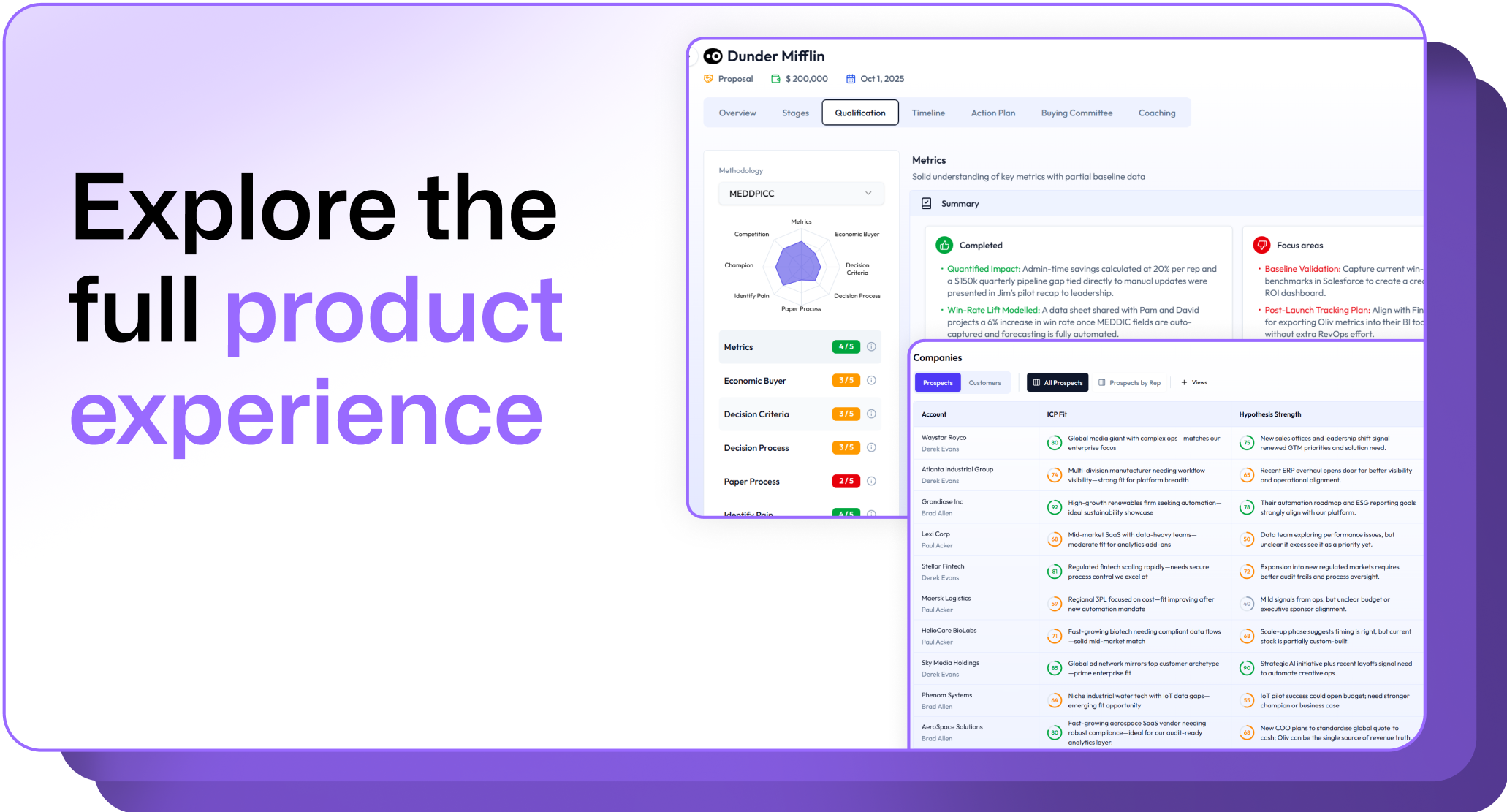
.avif)
.png)