AI Sales Workflow Automation Guide: Agents, Workflows, ROI Math, and Vendor Selection
Written by
Ishan Chhabra
Last Updated :
June 22, 2026
Skim in :
8
mins
In this article
Revenue teams love Oliv
Here’s why:
All your deal data unified (from 30+ tools and tabs).
Insights are delivered to you directly, no digging.
AI agents automate tasks for you.
Thank you! Your submission has been received!
Oops! Something went wrong while submitting the form.
Meet Oliv’s AI Agents
Hi! I’m, Deal Driver
I track deals, flag risks, send weekly pipeline updates and give sales managers full visibility into deal progress
Hi! I’m, CRM Manager
I maintain CRM hygiene by updating core, custom and qualification fields all without your team lifting a finger
Hi! I’m, Forecaster
I build accurate forecasts based on real deal movement and tell you which deals to pull in to hit your number
Hi! I’m, Coach
I believe performance fuels revenue. I spot skill gaps, score calls and build coaching plans to help every rep level up
Hi! I’m, Prospector
I dig into target accounts to surface the right contacts, tailor and time outreach so you always strike when it counts
Hi! I’m, Pipeline tracker
I call reps to get deal updates, and deliver a real-time, CRM-synced roll-up view of deal progress
Hi! I’m, Analyst
I answer complex pipeline questions, uncover deal patterns, and build reports that guide strategic decisions
TL;DR
AI sales workflow automation uses goal-seeking agents, not fixed rules, to run research, outreach, CRM updates, and forecasting across the pipeline.
Map friction first, then wire agents to real CRM triggers like meeting-ended and stage-change events, automating the tedious loops reps skip.
The agent stack has three layers, data, intelligence, and agent; recording is now commodity, so value sits in the upper two.
Measure outcomes, not activity: track efficiency, pipeline, and revenue, with reclaimed selling time as the leading indicator.
Build real ROI math, buy instead of building in-house, and demand SOC 2 plus EU AI Act audit trails before going autonomous.
The unlock is human-AI collaboration, not replacement; experts who judge agent output get more valuable, not less.
Q1: What is AI sales workflow automation, and how is an agent different from a vending machine? [toc=1. What It Is]
Last quarter, a RevOps lead at a 60-rep SaaS company showed me her "automation." It was 14 Zapier zaps duct-taped to Salesforce. One broke when a field name changed, and her whole lead-routing flow went dark for three days. Nobody noticed until a deal stalled.
That is the trap most teams are in. They call it automation, but it is brittle plumbing that snaps the moment reality shifts.
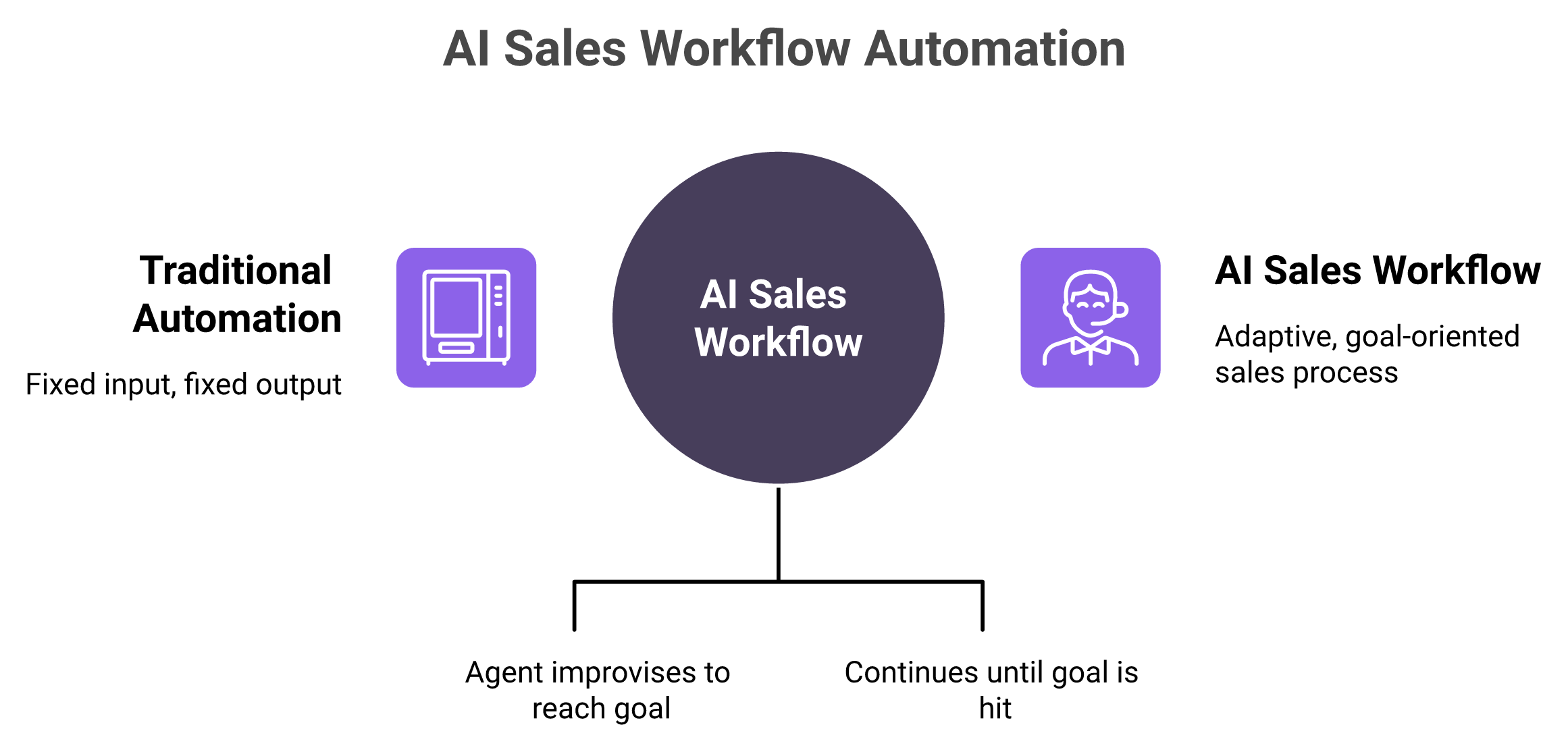
AI sales workflow automation uses goal-seeking AI agents, not fixed rules, to run pipeline tasks like research, outreach, CRM updates, and forecasting. Traditional automation is a vending machine: fixed input, fixed output, and it breaks when the payment fails. An agent is a smart employee that re-plans, junks what isn't working, and pushes toward the goal until it's hit. With 89% of revenue orgs now using AI, that shift from script to judgment is the whole game.
🥤 The vending machine versus the smart employee
Here is the cleanest way I have heard it framed. A vending machine is fixed input, fixed output. Press B4, get a soda. If the bill jams, you get nothing.
The core mental shift: traditional automation is a vending machine, while an AI agent behaves like a smart employee chasing a goal.
An agent works differently. It picks a goal, then goes after it. It rejigs the plan when something fails, improvises when something works, and keeps going until the outcome lands.
That is the line between rules and judgment. Your old workflow follows steps. An agent follows a goal.
📈 Why this matters right now
Gartner found AI use across revenue orgs jumped from 34% in 2023 to 89% by 2025. This is not a future trend. It already happened while most teams were still tweaking sequences.
The productivity gap is real, too. Operators using agents report being far more productive than peers stuck in chat tools. We are moving from "chat to agents," and the people who skipped that jump are getting left behind.
⚙️ From revenue orchestration to revenue engineering
I could be wrong on the timeline, but here is where my head is at. The old category, revenue orchestration, is basically a consolidation of decade-old tech. The new space is revenue engineering, where context gets weaponized and agents do the heavy lifting.
Think of it as a business growing up. A manual, vending-machine operation is an unconscious infant. An agentic operation is a conscious adult that knows what is happening across every deal.
Tools built around this shift, Oliv AI among them, treat the agent as a deal-level teammate rather than another recorder bolted onto your stack. That distinction, judgment over scripts, is what separates a real agent from automation wearing an AI label. If you are comparing options, our breakdown of the best AI sales tools walks through what agent-first actually means.
Q2: Which workflows should you map and automate first, and how do CRM triggers actually wire together? [toc=2. Map & Wire Workflows]
A few months back, an AE walked me through his "follow-up process." After every call, he pulled the transcript from Gong, pasted it into a custom GPT, copied the output into Outlook, hunted for the right PDF, attached it, and sent. Seven steps. He admitted he skipped it most days.
That is the real problem. The work is so tedious that reps just don't do it.
Start by mapping where reps lose hours, not by automating at random. Audit each pipeline stage, lead to qualify to demo to negotiate to close to handoff, and target the high-friction, low-judgment loops first: enrichment, outreach personalization, post-call follow-up, and CRM auto-logging. Wire each agent to CRM triggers (record changes, stage moves, meeting-ended events) so it fires on real events. The fastest wins are loops reps already skip because they're too tedious.
🗺️ Map friction before you automate
Run the incognito test. Open a private browser, log into your own stack, and do everything a rep does in a day. You will find the steps that make you wince.
Pick the one that makes you cry the most, then automate that first. This beats any generic "automate everything" checklist because it starts from your actual pain.
⚙️ Wire agents to real CRM triggers
A trigger is the event that tells an agent to act. Most teams skip this and run agents on timers, which creates noise. Tie the agent to the event instead.
Agent Workflows and CRM Triggers, by Pipeline Stage
Pipeline stage
Manual pain
Agent workflow
CRM trigger that fires it
Lead
Slow, shallow research
Auto-enrichment, account brief
New lead created
Qualify
Notes lost after call
Auto-summary, MEDDPICC fields filled
Meeting ended
Demo / Negotiate
Follow-ups skipped
Draft tailored follow-up email
Call transcript ready
Close
CRM updated weekly, not daily
Auto-log stage, next steps, risks
Opportunity field change
Handoff
Context dropped to CS
Deal summary to onboarding
Stage moves to "Closed Won"
This is why the CRM-as-system-of-record idea keeps failing. As one builder put it, reps only update the CRM weekly because management requires it, not because it helps them. Translating a methodology like MEDDIC into live opportunity fields is exactly the low-judgment loop worth wiring first.
💬 What operators actually say
The friction shows up clearly in reviews. Reps love the recording but resent the manual overhead around it.
"For me, the only business problem gong solves is the call recordings... Searching for calls is not easy, moving around in the calls is not easy, and understanding the pipeline management portion of it is almost impossible." John S., Senior Account Executive Gong G2 Verified Review
"We used Gong as a call recorder... their current solution is far from convenient or accessible, it requires downloading calls individually, which is impractical and inefficient." Neel P., Sales Operations Manager Gong G2 Verified Review
"The summary feature has quickly eliminated the need for taking separate call notes to store in our CRM post-call, saving me a lot of time." Dexter L., Customer Success Executive Clari G2 Verified Review
The pattern is consistent. Recording is solved. The manual loop after the call is not. For a closer look at how the recorders stack up, see our comparison of the best AI for sales calls.
This is exactly the loop Oliv AI collapses. We pull the deal-level context, auto-log it, and draft the follow-up so the rep actually sends it, instead of skipping it on a busy Thursday.
Q3: What are the agent tool categories, and what maturity tier is your team in? [toc=3. Categories & Maturity Tiers]
I sat on a call recently with a 20-person revenue team at a company you would call an AI leader. We asked a simple question: how much of your agent stack have you built yourself? Crickets. Nobody had actually done it.
That gap, between talking about agents and running them, is what the maturity model exposes.
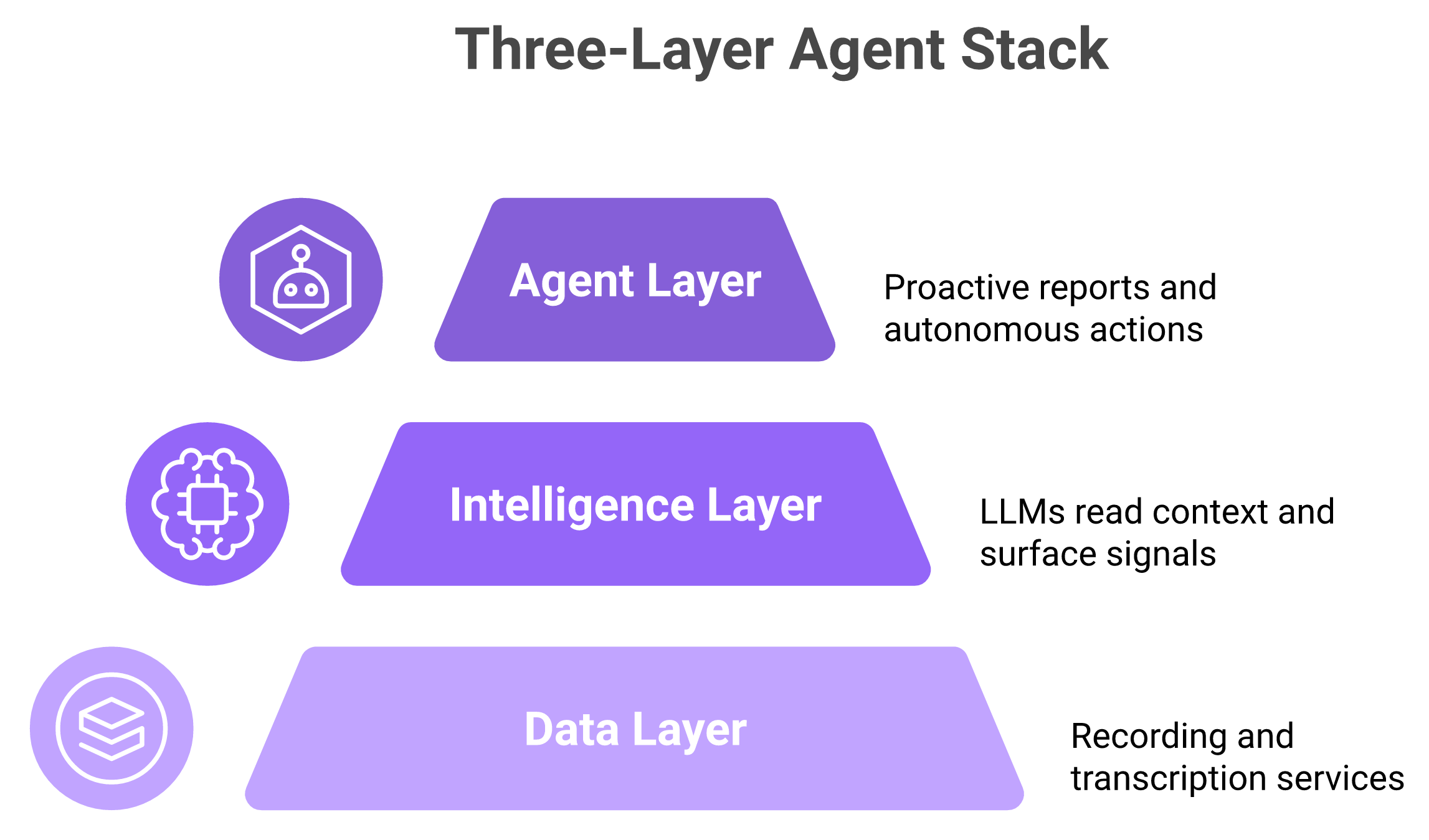
Agent tooling stacks into three layers: a baseline data layer (recording and transcription, now a commodity), an intelligence layer (LLMs reading context and signals), and an agent layer (proactive reports, one-pagers, autonomous actions). Maturity runs from chat-only users, to single-task agents, to orchestrated agent teams supervised by humans. Most teams are stuck at layer one buying note-takers, while leaders have moved to "1.2 humans plus 20 agents."
🎂 The three-layer cake
Picture the stack as a cake. The bottom layer is data collection, recording, and transcription. Zoom, Teams, and Google now do this natively, so it is a commodity.
The middle layer is intelligence, where LLMs read context and surface signals. The top layer is the agent itself, producing proactive reports and one-pagers for leadership. The value has moved up. Paying premium prices for layer one is the most common mistake I see, which is why our roundup of the best revenue intelligence software platforms weights the upper layers most.
Recording is now a commodity base layer; the real value of AI sales automation sits in the intelligence and agent layers above it.
🪜 Which tier are you actually in?
Be honest about where you sit. Most teams overrate themselves by a full tier.
Tier 1, Chat-only: Reps paste prompts into ChatGPT by hand. No automation.
Tier 2, Single-task agents: One agent does one job, like drafting emails.
Tier 3, Orchestrated agents: Multiple agents run workflows, humans supervise.
Tier 4, Agent teams: "1.2 humans plus 20 agents" doing the work of 10 GTM hires.
🚀 How leaders climbed up
The proof is in the headcount math. One team hired 28 reps who eventually quit, then rebuilt around "1.2 humans and 20 agents" doing roughly what 10 GTM people did. Gartner expects 75% of B2B orgs to augment playbooks with AI-guided selling by the end of 2026, yet only 37% have fully implemented it.
That gap is your window. Pick one workflow and move it up exactly one tier this quarter. Do not leap to Tier 4 overnight. Teams stuck choosing between Gong versus Clari are usually still optimizing layer one when the real value sits higher.
Oliv AI lives at the intelligence and agent layers, turning deal context into proactive forecasts and coaching one-pagers, not another layer-one recording you have to mine by hand.
Q4: Which KPIs prove AI sales automation is working, across efficiency, pipeline, and revenue? [toc=4. KPI Framework]
When we rolled out an AI RevOps agent on one team, a rep quit the same day. Here is why. He had done nothing for 30 days, kept saying "I'm doing outbound" at standup, and nothing closed. The KPIs made it impossible to hide.
That is the quiet power of outcome metrics. They surface what activity dashboards bury.
Measure outcomes, not activity. Track three KPI tiers: efficiency (selling versus admin time, hours saved per rep, cost per qualified meeting), pipeline (qualified pipeline created, pipeline velocity, stage conversion), and revenue (win rate, ACV, revenue per rep). The honest benchmark to chase is 3M to 5M revenue per rep on AI-leveraged teams versus the old 300K to 500K, and reps still spend roughly 65% of their time not selling, so reclaimed time is your leading indicator.
📊 The three-tier KPI table
Group your metrics by what they actually prove. Efficiency is your leading indicator. Revenue is the lagging one.
What to Measure vs Ignore, by Metric Tier
Tier
Measure this
Not this
💰 Efficiency
Selling vs admin time, hours saved per rep, cost per qualified meeting
LinkedIn's research with Ipsos found reps spend around 65% of their time not selling. That buried time is your biggest lever. When an agent hands hours back, selling time should climb first, before revenue does.
So watch the efficiency tier weekly. If reclaimed selling time is not moving, the automation is not working yet, no matter what the activity charts say. Pairing this with proper AI sales forecasting software turns reclaimed hours into a measurable pipeline signal.
🎯 The benchmark that reframes everything
The old target was 300K to 500K in revenue per rep. AI-leveraged teams are chasing 3M to 5M, with elite SaaS segments holding around 60% operating margins. I might be early calling this the new normal, but the direction is clear.
The point is not to brag about a number. It is to pick a north star that forces real leverage, not just more activity. Better sales coaching software is one of the fastest ways to move those revenue-per-rep numbers.
Oliv AI surfaces these deal-level metrics, pipeline movement, conversion, and forecast accuracy, within five minutes of a call, so the KPI board updates itself instead of waiting for Friday's manual scrub.
Q5: How do you actually do the ROI math on AI sales workflow automation? [toc=5. ROI Math]
A founder told me last month that his vendor promised "300% ROI." I asked how it was calculated. He had no idea. That number was a slide, not a model.
That is the problem with most AI ROI claims. They are marketing, not math.
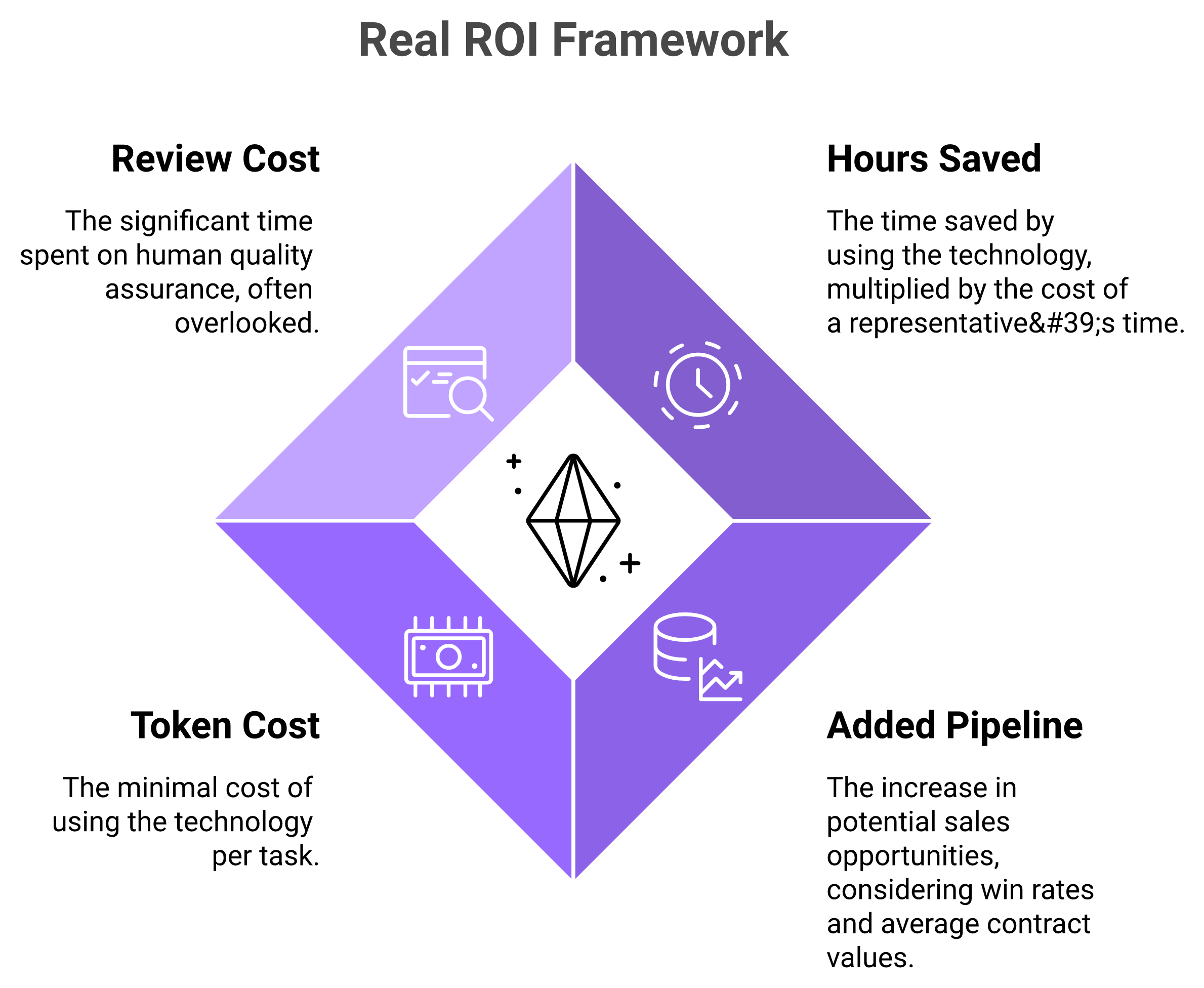
Don't quote a vendor's "300% ROI." Build it: ROI = (hours saved times loaded rep cost) plus (added pipeline times win rate times ACV) minus (platform plus token plus review cost), divided by total cost. Token costs are often trivial, scraping 350 sites cost "a handful of cents." The line everyone forgets is human review time, which can run 10 to 15 hours a week. Payback typically lands in 6 to 18 months.
🧮 The formula, worked out
Let me show the math with round numbers. Say an agent saves a rep 8 hours a week, and the loaded cost is 60 dollars an hour.
That is 480 dollars saved per rep, per week, before any new pipeline. Now layer in deals the agent helps create.
Real ROI math weighs hours saved and added pipeline against platform, token, and the frequently forgotten human review costs.
Agent ROI: Line Items and Example Values
Line item
Example value
💰 Hours saved value
8 hrs/wk times $60 = $480/wk per rep
📈 Added pipeline value
$200K pipeline times 25% win times $30K ACV
💸 Platform cost
$19 to $120 per user, per month
💸 Token cost
A handful of cents per task
⚠️ Review cost
10 to 15 hrs/wk of human QA
💸 The costs people forget
Token cost almost never breaks you. One team scraped 350 local business websites for a handful of cents each, using cheaper models. That line is rounding error.
Human review is the real cost. As one operator put it, a reviewer spent "10 to 15 hours a week" checking agent outputs because the agents never sleep. Skip that line, and your ROI model is fiction. Solid AI sales forecasting software reduces that review burden by surfacing clean numbers automatically.
📊 Where the upside actually lands
The ceiling is higher than most expect. One solo operator built a single-person go-to-market motion generating a 1.5 million dollar pipeline every month, with zero marketing spend. That is the upper bound, not the average.
Public benchmarks put payback at 6 to 18 months for most teams. I might be conservative here, but I would rather under-promise than slap a fake percentage on a slide. Comparing the full field of AI sales tools helps you sanity-check any vendor's payback claim.
A platform with 5-minute deal-level intelligence, like Oliv AI, cuts the review-time line that quietly eats agent ROI, since the context arrives clean instead of needing a human to stitch it together.
Q6: What governance and compliance risks come with autonomous sales agents (SOC 2, EU AI Act, consent)? [toc=6. Governance & Risk]
A RevOps lead once told me her security review killed a tool she loved. The vendor could not prove what its agent actually did after it acted. Procurement walked.
That is the new reality. Autonomous agents create a risk that recording tools never did.
Autonomous agents create a new risk: prove not just that infrastructure is secure (SOC 2), but what the agent was allowed to do and actually did (EU AI Act traceability). SOC 2 Type II is now a deal requirement on contracts over 50,000 dollars, and the EU AI Act's 2026 guidance covers agents influencing economic decisions, mandating human oversight and audit trails. Treat governance as a buying feature, not paperwork.
🔒 SOC 2 Type II, in plain terms
SOC 2 is an audit that proves your data controls actually work over time. For AI agents, that now includes logging what the agent reads and writes.
Monday action: Ask any vendor for their SOC 2 Type II report before the demo, not after. On deals over 50,000 dollars, it is table stakes. For Salesforce-native teams, our breakdown of Gong DPA and security shows what to scrutinize.
⚖️ The EU AI Act and traceability
The EU AI Act (Regulation EU 2024/1689) covers agents that influence economic decisions. Its 2026 guidance requires human oversight and a full record of agent actions.
Monday action: Confirm the agent has a human-in-the-loop interrupt and logs every action it takes. "It just sent the email" is not an acceptable answer to an auditor.
🧾 Why the audit trail wins deals
In finance, you cannot operate without an audit trail. As one builder said, you have to physically link the data so the customer and their auditor are comfortable everything connects.
This is where many tools quietly fail. One operator flagged that Einstein activity capture redacts activities, even when they hold no sensitive data, which breaks the full customer picture. Our analysis of Salesforce Einstein reviews digs into exactly this gap.
Where Einstein redacts activity and breaks the customer picture, Oliv AI keeps the deal record linked and reviewable, which is the audit trail buyers now ask for. Agents should be born observable, not bolted with logging later.
Q7: Should you build your own agents or buy them? [toc=7. Build vs Buy]
I talked to a founder who is a top 1% Replit user. He built 12 apps in 150 days. His advice on building your own sales agents still surprised me: don't.
That is the build-versus-buy trap. The people most capable of building are the ones telling you not to.
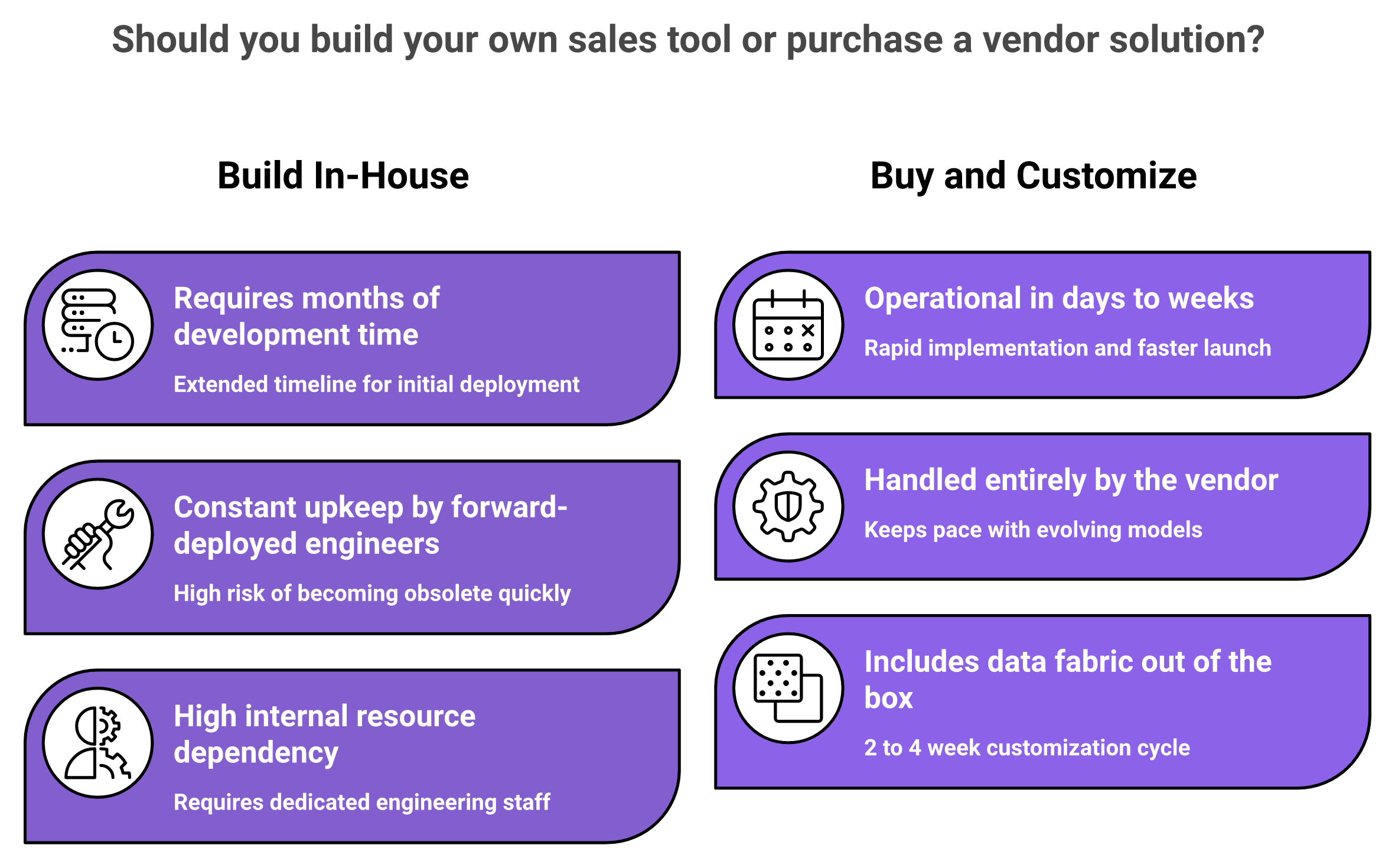
For most mid-market revenue teams, buy, then customize. Even a top-1% builder who shipped 12 apps in 150 days warns, "Don't build it yourself. You're not Vercel." In-house agents go obsolete in months as models move, and you'll need forward-deployed engineers to hold a 100% success rate. Buy the platform that owns the data fabric, and spend scarce engineering time on context, not plumbing.
🛠️ The honest build-versus-buy table
Here is the trade-off most decks skip. Building looks cheap until you price maintenance.
For most mid-market teams, buying and customizing beats building in-house once maintenance, engineering, and obsolescence are priced in.
Build In-House vs Buy and Customize
Factor
❌ Build in-house
✅ Buy and customize
Time to value
Months
Days to weeks
Maintenance
Constant, on you
On the vendor
Obsolescence risk
High, models shift fast
Lower, vendor keeps pace
Hidden cost
Forward-deployed engineers
Customization time, 2 to 4 weeks
⚠️ The hidden cost of building
Building is not a one-time spend. As one operator put it, you need forward-deployed engineers to make sure the agent works at a 100% success rate, not the 5% rate teams hit in 2024.
That headcount never shows up in the build-it-yourself pitch. And the agent you ship can go obsolete in a couple of months as the underlying models change. If buying is the path, our list of the best Clari alternatives and competitors is a useful starting shortlist.
💬 What buyers report
The "we already own a tool" instinct often hides real switching pain. Data lock-in is a common regret.
"It was a big mistake on our part to commit to a two year term... now were stuck with a tool that works technically but isnt the right business decision." Iris P., Head of Marketing Gong G2 Verified Review
"I find the setup process challenging, especially when migrating fields from Salesforce... This requires creating and maintaining duplicate fields, which adds complexity and workload." Josiah R., Head of Sales Operations Clari G2 Verified Review
Buying a purpose-built agentic platform like Oliv AI gives you the data fabric and review workflows out of the box, so your team customizes context instead of rebuilding plumbing every quarter. Full customization still takes 2 to 4 weeks, which is honest, and far faster than building from zero.
Q8: How do you evaluate vendors, and where do Gong, Outreach, and Oliv AI differ? [toc=8. Vendor Selection Rubric]
A RevOps lead drowning in Gong dashboards once told me she could see every call, but never the deal. That is the gap. Most tools understand meetings, not the full sales cycle.
So before you compare logos, fix your criteria. The wrong rubric picks the wrong tool.
Score vendors on five criteria: intelligence depth (meeting-level versus deal-level), speed-to-insight, data accessibility (API and spreadsheet export), agentic action versus recording, and pricing transparency. Recording is commoditized, so weight the intelligence and agent layers highest. The practical splits: Gong analyzes at the meeting level with a 20 to 30 minute delay, while deal-level platforms track the full cycle, pipeline, coaching, and forecasting, in about five minutes.
📋 The five-criterion rubric
Weight these by what actually moves revenue. Recording sits at the bottom because everyone has it now.
Intelligence depth: Does it understand the deal, or just the meeting?
Speed to insight: Minutes after the call, or half an hour?
Data accessibility: Clean API and spreadsheet export, or lock-in?
Agentic action: Does it act, or just record and report?
Pricing transparency: Flat and clear, or per-action and opaque?
⚖️ How the tools actually compare
Here is the honest split. Each tool is strong somewhere and weak somewhere.
Gong vs Outreach vs Oliv AI
Criterion
Gong
Outreach
Oliv AI
Intelligence depth
Meeting-level
Sequence-level
Deal-level
Speed to insight
20 to 30 min
Varies
~5 min
Data access
API called "wonky" by users
Sequencing focus
Spreadsheet-like interface
Core strength
Call recording, trackers
Outbound sequencing
Agentic deal context
Best fit
Coaching at scale
High-volume outbound
Deal-level automation
💬 What operators say about the trade-offs
The reviews back the rubric. Gong wins on recording, but data portability and complexity come up often.
"For me, the only business problem gong solves is the call recordings... understanding the pipeline management portion of it is almost impossible." John S., Senior Account Executive Gong G2 Verified Review
"Theres so much in Gong, that we dont use everything. Gongs deal forecasting we dont use." Karel Bos, Head of Sales Gong TrustRadius Verified Review
"I have to maintain my own separate spreadsheet to track deals because I can only capture what my leaders want to see about a deal." Verified User in Human Resources Clari G2 Verified Review
To be fair, Gong is excellent for coaching and call review, and Outreach is strong for high-volume sequencing. For a deeper head-to-head, see our Gong versus Outreach breakdown and the direct Gong versus Oliv comparison. Oliv AI's edge is deal-level understanding, roughly 5-minute insight versus a 20 to 30 minute delay, and a spreadsheet-like interface for analysis instead of a wonky API. It is not the pick if you only need pure call recording, and the Voice Agent is still in alpha, which I would rather say upfront.
Q9: What does a vendor-neutral implementation roadmap look like, and how do you avoid the pilot trap? [toc=9. Implementation Roadmap]
I watched a 40-rep team kick off an AI pilot with huge energy. Six weeks later, it was dead. Not because the tech failed, but because nobody owned the daily correction work. The agent said dumb things on day three, and everyone quietly stopped using it.
That is the pilot trap. Promise is easy. Production is the hard part.
Run a phased rollout: pick the highest-friction workflow, deploy one agent, then apply the 30-day training rule, an hour or two of daily correction until it's reliable by day 30. Keep humans in the loop with the 10/80/10 rule: 10% ideation, 80% agent execution, and 10% human QA. Most pilots die because teams skip this discipline and fade away before production. The fix is daily QA, not a bigger model.
🗺️ The four-phase rollout
Treat this like onboarding a new hire, not flipping a switch. Each phase has an action, an outcome, and a human guardrail.
Pick one workflow. Choose the highest-friction loop. Outcome: a clear win. Guardrail: resist automating five things at once.
Deploy one agent. Wire it to a real trigger. Outcome: it runs live. Guardrail: a human reviews every output.
Train for 30 days. Correct mistakes daily. Outcome: reliability. Guardrail: log what you fix.
Expand. Add the next workflow. Outcome: compounding leverage. Guardrail: keep the 10% QA step.
⏰ Why the 30-day rule matters
Agents say dumb things early. That is normal, not a deal-breaker. The fix is boring and consistent.
Spend an hour or two each day correcting the agent's mistakes. By day 30, it is genuinely good. Skip the daily reps, and you get a pilot that fades. A realistic Gong implementation timeline shows how much this daily discipline shapes time-to-value.
🧠 Context engineering beats clever prompts
Here is the shift I would bet on. Stop chasing the perfect prompt. Load the agent with everything about your business instead.
When context is rich, your prompt can be stupidly simple and still produce great output. Humans in the loop, that 10% at the end, are the real competitive advantage, not a fallback. This is exactly the philosophy behind the best revenue intelligence platforms.
💬 What buyers say about adoption
Adoption, not features, is where rollouts live or die. The reviews make that painfully clear.
"Our team is struggling with low adoption, and they wont even spend the time to support us during this transition." Verified User Gong G2 Verified Review
"Some users may find Claris analytics and forecasting tools complex, requiring significant onboarding and training." Bharat K., Revenue Operations Manager Clari G2 Verified Review
Teams rolling out deal-level RevOps agents, the Oliv AI pattern, surface who is actually moving pipeline within 30 days. That is exactly when stalled reps get exposed, because the agent makes the work visible instead of waiting for a Monday scrub. The shift from revenue ops to intelligence to orchestration is what makes that visibility possible.
Q10: What should you avoid, and what's the contrarian truth about AI replacing your sales team? [toc=10. Avoid & Contrarian Truth]
Most people think the AI play is to replace your reps with "AI employees." I think that read gets it backwards. The teams winning are not deleting humans. They are turning their best people into far sharper versions of themselves.
Avoid "Hello [First_Name]" slop, generic ultimate guides, and the "replace everyone with AI employees" myth. The real unlock is human-AI collaboration that turns your best people into 100x versions of themselves, not headcount deletion. The classic junior SDR sending templated emails is genuinely at risk, but subject-matter experts who can judge an agent's output become more valuable, not less.
❌ What to avoid
These are the mistakes that get screenshotted and roasted. Skip them.
"Hello [First_Name]" automation. Bad systems do not get better at scale. They amplify the mess.
Generic ultimate guides. Stop publishing the guide to everything. Answer the exact question your buyer asks.
The replacement myth. Swapping roles for "AI employees" wholesale is, in the bluntest framing I have heard, a huge mistake.
⚖️ The contrarian truth
Here is the turn. The junior SDR who only sends templated emails is genuinely at risk of being displaced soon. That part of the hype is real.
But subject-matter experts get more valuable, not less. They are the ones who know whether the agent's output is right or wrong. As selling shifts, being a "people person" alone stops being enough. Pairing experts with strong sales coaching software compounds that advantage.
🤝 Collaboration over replacement
The unlock is human-AI collaboration, not headcount deletion. You design the process around your best people, then let agents handle the heavy lifting.
LinkedIn's research with Ipsos found reps spend roughly 65% of their time not selling. That is the time agents give back. Your experts then spend it on judgment, relationships, and the calls that actually close, the core promise of the best AI sales tools.
🔮 Where my head is right now
What I think shifts in the next two years is simple. The SaaS you log into becomes agents that work for you. Revenue orchestration gives way to revenue engineering, a move our take on the best revenue orchestration platform tools explores in depth.
That is the bet behind Oliv AI. We are not trying to replace your reps. We give each one an agent team so your experts spend their hours on judgment, not data entry.
So here is the question I am sitting with, and I would genuinely like your take. If your best rep had 20 agents working nights and weekends beside them, what would you point that team at first? Tell me what you would build.
Q1: What is AI sales workflow automation, and how is an agent different from a vending machine? [toc=1. What It Is]
Last quarter, a RevOps lead at a 60-rep SaaS company showed me her "automation." It was 14 Zapier zaps duct-taped to Salesforce. One broke when a field name changed, and her whole lead-routing flow went dark for three days. Nobody noticed until a deal stalled.
That is the trap most teams are in. They call it automation, but it is brittle plumbing that snaps the moment reality shifts.
AI sales workflow automation uses goal-seeking AI agents, not fixed rules, to run pipeline tasks like research, outreach, CRM updates, and forecasting. Traditional automation is a vending machine: fixed input, fixed output, and it breaks when the payment fails. An agent is a smart employee that re-plans, junks what isn't working, and pushes toward the goal until it's hit. With 89% of revenue orgs now using AI, that shift from script to judgment is the whole game.
🥤 The vending machine versus the smart employee
Here is the cleanest way I have heard it framed. A vending machine is fixed input, fixed output. Press B4, get a soda. If the bill jams, you get nothing.
The core mental shift: traditional automation is a vending machine, while an AI agent behaves like a smart employee chasing a goal.
An agent works differently. It picks a goal, then goes after it. It rejigs the plan when something fails, improvises when something works, and keeps going until the outcome lands.
That is the line between rules and judgment. Your old workflow follows steps. An agent follows a goal.
📈 Why this matters right now
Gartner found AI use across revenue orgs jumped from 34% in 2023 to 89% by 2025. This is not a future trend. It already happened while most teams were still tweaking sequences.
The productivity gap is real, too. Operators using agents report being far more productive than peers stuck in chat tools. We are moving from "chat to agents," and the people who skipped that jump are getting left behind.
⚙️ From revenue orchestration to revenue engineering
I could be wrong on the timeline, but here is where my head is at. The old category, revenue orchestration, is basically a consolidation of decade-old tech. The new space is revenue engineering, where context gets weaponized and agents do the heavy lifting.
Think of it as a business growing up. A manual, vending-machine operation is an unconscious infant. An agentic operation is a conscious adult that knows what is happening across every deal.
Tools built around this shift, Oliv AI among them, treat the agent as a deal-level teammate rather than another recorder bolted onto your stack. That distinction, judgment over scripts, is what separates a real agent from automation wearing an AI label. If you are comparing options, our breakdown of the best AI sales tools walks through what agent-first actually means.
Q2: Which workflows should you map and automate first, and how do CRM triggers actually wire together? [toc=2. Map & Wire Workflows]
A few months back, an AE walked me through his "follow-up process." After every call, he pulled the transcript from Gong, pasted it into a custom GPT, copied the output into Outlook, hunted for the right PDF, attached it, and sent. Seven steps. He admitted he skipped it most days.
That is the real problem. The work is so tedious that reps just don't do it.
Start by mapping where reps lose hours, not by automating at random. Audit each pipeline stage, lead to qualify to demo to negotiate to close to handoff, and target the high-friction, low-judgment loops first: enrichment, outreach personalization, post-call follow-up, and CRM auto-logging. Wire each agent to CRM triggers (record changes, stage moves, meeting-ended events) so it fires on real events. The fastest wins are loops reps already skip because they're too tedious.
🗺️ Map friction before you automate
Run the incognito test. Open a private browser, log into your own stack, and do everything a rep does in a day. You will find the steps that make you wince.
Pick the one that makes you cry the most, then automate that first. This beats any generic "automate everything" checklist because it starts from your actual pain.
⚙️ Wire agents to real CRM triggers
A trigger is the event that tells an agent to act. Most teams skip this and run agents on timers, which creates noise. Tie the agent to the event instead.
Agent Workflows and CRM Triggers, by Pipeline Stage
Pipeline stage
Manual pain
Agent workflow
CRM trigger that fires it
Lead
Slow, shallow research
Auto-enrichment, account brief
New lead created
Qualify
Notes lost after call
Auto-summary, MEDDPICC fields filled
Meeting ended
Demo / Negotiate
Follow-ups skipped
Draft tailored follow-up email
Call transcript ready
Close
CRM updated weekly, not daily
Auto-log stage, next steps, risks
Opportunity field change
Handoff
Context dropped to CS
Deal summary to onboarding
Stage moves to "Closed Won"
This is why the CRM-as-system-of-record idea keeps failing. As one builder put it, reps only update the CRM weekly because management requires it, not because it helps them. Translating a methodology like MEDDIC into live opportunity fields is exactly the low-judgment loop worth wiring first.
💬 What operators actually say
The friction shows up clearly in reviews. Reps love the recording but resent the manual overhead around it.
"For me, the only business problem gong solves is the call recordings... Searching for calls is not easy, moving around in the calls is not easy, and understanding the pipeline management portion of it is almost impossible." John S., Senior Account Executive Gong G2 Verified Review
"We used Gong as a call recorder... their current solution is far from convenient or accessible, it requires downloading calls individually, which is impractical and inefficient." Neel P., Sales Operations Manager Gong G2 Verified Review
"The summary feature has quickly eliminated the need for taking separate call notes to store in our CRM post-call, saving me a lot of time." Dexter L., Customer Success Executive Clari G2 Verified Review
The pattern is consistent. Recording is solved. The manual loop after the call is not. For a closer look at how the recorders stack up, see our comparison of the best AI for sales calls.
This is exactly the loop Oliv AI collapses. We pull the deal-level context, auto-log it, and draft the follow-up so the rep actually sends it, instead of skipping it on a busy Thursday.
Q3: What are the agent tool categories, and what maturity tier is your team in? [toc=3. Categories & Maturity Tiers]
I sat on a call recently with a 20-person revenue team at a company you would call an AI leader. We asked a simple question: how much of your agent stack have you built yourself? Crickets. Nobody had actually done it.
That gap, between talking about agents and running them, is what the maturity model exposes.
Agent tooling stacks into three layers: a baseline data layer (recording and transcription, now a commodity), an intelligence layer (LLMs reading context and signals), and an agent layer (proactive reports, one-pagers, autonomous actions). Maturity runs from chat-only users, to single-task agents, to orchestrated agent teams supervised by humans. Most teams are stuck at layer one buying note-takers, while leaders have moved to "1.2 humans plus 20 agents."
🎂 The three-layer cake
Picture the stack as a cake. The bottom layer is data collection, recording, and transcription. Zoom, Teams, and Google now do this natively, so it is a commodity.
The middle layer is intelligence, where LLMs read context and surface signals. The top layer is the agent itself, producing proactive reports and one-pagers for leadership. The value has moved up. Paying premium prices for layer one is the most common mistake I see, which is why our roundup of the best revenue intelligence software platforms weights the upper layers most.
Recording is now a commodity base layer; the real value of AI sales automation sits in the intelligence and agent layers above it.
🪜 Which tier are you actually in?
Be honest about where you sit. Most teams overrate themselves by a full tier.
Tier 1, Chat-only: Reps paste prompts into ChatGPT by hand. No automation.
Tier 2, Single-task agents: One agent does one job, like drafting emails.
Tier 3, Orchestrated agents: Multiple agents run workflows, humans supervise.
Tier 4, Agent teams: "1.2 humans plus 20 agents" doing the work of 10 GTM hires.
🚀 How leaders climbed up
The proof is in the headcount math. One team hired 28 reps who eventually quit, then rebuilt around "1.2 humans and 20 agents" doing roughly what 10 GTM people did. Gartner expects 75% of B2B orgs to augment playbooks with AI-guided selling by the end of 2026, yet only 37% have fully implemented it.
That gap is your window. Pick one workflow and move it up exactly one tier this quarter. Do not leap to Tier 4 overnight. Teams stuck choosing between Gong versus Clari are usually still optimizing layer one when the real value sits higher.
Oliv AI lives at the intelligence and agent layers, turning deal context into proactive forecasts and coaching one-pagers, not another layer-one recording you have to mine by hand.
Q4: Which KPIs prove AI sales automation is working, across efficiency, pipeline, and revenue? [toc=4. KPI Framework]
When we rolled out an AI RevOps agent on one team, a rep quit the same day. Here is why. He had done nothing for 30 days, kept saying "I'm doing outbound" at standup, and nothing closed. The KPIs made it impossible to hide.
That is the quiet power of outcome metrics. They surface what activity dashboards bury.
Measure outcomes, not activity. Track three KPI tiers: efficiency (selling versus admin time, hours saved per rep, cost per qualified meeting), pipeline (qualified pipeline created, pipeline velocity, stage conversion), and revenue (win rate, ACV, revenue per rep). The honest benchmark to chase is 3M to 5M revenue per rep on AI-leveraged teams versus the old 300K to 500K, and reps still spend roughly 65% of their time not selling, so reclaimed time is your leading indicator.
📊 The three-tier KPI table
Group your metrics by what they actually prove. Efficiency is your leading indicator. Revenue is the lagging one.
What to Measure vs Ignore, by Metric Tier
Tier
Measure this
Not this
💰 Efficiency
Selling vs admin time, hours saved per rep, cost per qualified meeting
LinkedIn's research with Ipsos found reps spend around 65% of their time not selling. That buried time is your biggest lever. When an agent hands hours back, selling time should climb first, before revenue does.
So watch the efficiency tier weekly. If reclaimed selling time is not moving, the automation is not working yet, no matter what the activity charts say. Pairing this with proper AI sales forecasting software turns reclaimed hours into a measurable pipeline signal.
🎯 The benchmark that reframes everything
The old target was 300K to 500K in revenue per rep. AI-leveraged teams are chasing 3M to 5M, with elite SaaS segments holding around 60% operating margins. I might be early calling this the new normal, but the direction is clear.
The point is not to brag about a number. It is to pick a north star that forces real leverage, not just more activity. Better sales coaching software is one of the fastest ways to move those revenue-per-rep numbers.
Oliv AI surfaces these deal-level metrics, pipeline movement, conversion, and forecast accuracy, within five minutes of a call, so the KPI board updates itself instead of waiting for Friday's manual scrub.
Q5: How do you actually do the ROI math on AI sales workflow automation? [toc=5. ROI Math]
A founder told me last month that his vendor promised "300% ROI." I asked how it was calculated. He had no idea. That number was a slide, not a model.
That is the problem with most AI ROI claims. They are marketing, not math.
Don't quote a vendor's "300% ROI." Build it: ROI = (hours saved times loaded rep cost) plus (added pipeline times win rate times ACV) minus (platform plus token plus review cost), divided by total cost. Token costs are often trivial, scraping 350 sites cost "a handful of cents." The line everyone forgets is human review time, which can run 10 to 15 hours a week. Payback typically lands in 6 to 18 months.
🧮 The formula, worked out
Let me show the math with round numbers. Say an agent saves a rep 8 hours a week, and the loaded cost is 60 dollars an hour.
That is 480 dollars saved per rep, per week, before any new pipeline. Now layer in deals the agent helps create.
Real ROI math weighs hours saved and added pipeline against platform, token, and the frequently forgotten human review costs.
Agent ROI: Line Items and Example Values
Line item
Example value
💰 Hours saved value
8 hrs/wk times $60 = $480/wk per rep
📈 Added pipeline value
$200K pipeline times 25% win times $30K ACV
💸 Platform cost
$19 to $120 per user, per month
💸 Token cost
A handful of cents per task
⚠️ Review cost
10 to 15 hrs/wk of human QA
💸 The costs people forget
Token cost almost never breaks you. One team scraped 350 local business websites for a handful of cents each, using cheaper models. That line is rounding error.
Human review is the real cost. As one operator put it, a reviewer spent "10 to 15 hours a week" checking agent outputs because the agents never sleep. Skip that line, and your ROI model is fiction. Solid AI sales forecasting software reduces that review burden by surfacing clean numbers automatically.
📊 Where the upside actually lands
The ceiling is higher than most expect. One solo operator built a single-person go-to-market motion generating a 1.5 million dollar pipeline every month, with zero marketing spend. That is the upper bound, not the average.
Public benchmarks put payback at 6 to 18 months for most teams. I might be conservative here, but I would rather under-promise than slap a fake percentage on a slide. Comparing the full field of AI sales tools helps you sanity-check any vendor's payback claim.
A platform with 5-minute deal-level intelligence, like Oliv AI, cuts the review-time line that quietly eats agent ROI, since the context arrives clean instead of needing a human to stitch it together.
Q6: What governance and compliance risks come with autonomous sales agents (SOC 2, EU AI Act, consent)? [toc=6. Governance & Risk]
A RevOps lead once told me her security review killed a tool she loved. The vendor could not prove what its agent actually did after it acted. Procurement walked.
That is the new reality. Autonomous agents create a risk that recording tools never did.
Autonomous agents create a new risk: prove not just that infrastructure is secure (SOC 2), but what the agent was allowed to do and actually did (EU AI Act traceability). SOC 2 Type II is now a deal requirement on contracts over 50,000 dollars, and the EU AI Act's 2026 guidance covers agents influencing economic decisions, mandating human oversight and audit trails. Treat governance as a buying feature, not paperwork.
🔒 SOC 2 Type II, in plain terms
SOC 2 is an audit that proves your data controls actually work over time. For AI agents, that now includes logging what the agent reads and writes.
Monday action: Ask any vendor for their SOC 2 Type II report before the demo, not after. On deals over 50,000 dollars, it is table stakes. For Salesforce-native teams, our breakdown of Gong DPA and security shows what to scrutinize.
⚖️ The EU AI Act and traceability
The EU AI Act (Regulation EU 2024/1689) covers agents that influence economic decisions. Its 2026 guidance requires human oversight and a full record of agent actions.
Monday action: Confirm the agent has a human-in-the-loop interrupt and logs every action it takes. "It just sent the email" is not an acceptable answer to an auditor.
🧾 Why the audit trail wins deals
In finance, you cannot operate without an audit trail. As one builder said, you have to physically link the data so the customer and their auditor are comfortable everything connects.
This is where many tools quietly fail. One operator flagged that Einstein activity capture redacts activities, even when they hold no sensitive data, which breaks the full customer picture. Our analysis of Salesforce Einstein reviews digs into exactly this gap.
Where Einstein redacts activity and breaks the customer picture, Oliv AI keeps the deal record linked and reviewable, which is the audit trail buyers now ask for. Agents should be born observable, not bolted with logging later.
Q7: Should you build your own agents or buy them? [toc=7. Build vs Buy]
I talked to a founder who is a top 1% Replit user. He built 12 apps in 150 days. His advice on building your own sales agents still surprised me: don't.
That is the build-versus-buy trap. The people most capable of building are the ones telling you not to.
For most mid-market revenue teams, buy, then customize. Even a top-1% builder who shipped 12 apps in 150 days warns, "Don't build it yourself. You're not Vercel." In-house agents go obsolete in months as models move, and you'll need forward-deployed engineers to hold a 100% success rate. Buy the platform that owns the data fabric, and spend scarce engineering time on context, not plumbing.
🛠️ The honest build-versus-buy table
Here is the trade-off most decks skip. Building looks cheap until you price maintenance.
For most mid-market teams, buying and customizing beats building in-house once maintenance, engineering, and obsolescence are priced in.
Build In-House vs Buy and Customize
Factor
❌ Build in-house
✅ Buy and customize
Time to value
Months
Days to weeks
Maintenance
Constant, on you
On the vendor
Obsolescence risk
High, models shift fast
Lower, vendor keeps pace
Hidden cost
Forward-deployed engineers
Customization time, 2 to 4 weeks
⚠️ The hidden cost of building
Building is not a one-time spend. As one operator put it, you need forward-deployed engineers to make sure the agent works at a 100% success rate, not the 5% rate teams hit in 2024.
That headcount never shows up in the build-it-yourself pitch. And the agent you ship can go obsolete in a couple of months as the underlying models change. If buying is the path, our list of the best Clari alternatives and competitors is a useful starting shortlist.
💬 What buyers report
The "we already own a tool" instinct often hides real switching pain. Data lock-in is a common regret.
"It was a big mistake on our part to commit to a two year term... now were stuck with a tool that works technically but isnt the right business decision." Iris P., Head of Marketing Gong G2 Verified Review
"I find the setup process challenging, especially when migrating fields from Salesforce... This requires creating and maintaining duplicate fields, which adds complexity and workload." Josiah R., Head of Sales Operations Clari G2 Verified Review
Buying a purpose-built agentic platform like Oliv AI gives you the data fabric and review workflows out of the box, so your team customizes context instead of rebuilding plumbing every quarter. Full customization still takes 2 to 4 weeks, which is honest, and far faster than building from zero.
Q8: How do you evaluate vendors, and where do Gong, Outreach, and Oliv AI differ? [toc=8. Vendor Selection Rubric]
A RevOps lead drowning in Gong dashboards once told me she could see every call, but never the deal. That is the gap. Most tools understand meetings, not the full sales cycle.
So before you compare logos, fix your criteria. The wrong rubric picks the wrong tool.
Score vendors on five criteria: intelligence depth (meeting-level versus deal-level), speed-to-insight, data accessibility (API and spreadsheet export), agentic action versus recording, and pricing transparency. Recording is commoditized, so weight the intelligence and agent layers highest. The practical splits: Gong analyzes at the meeting level with a 20 to 30 minute delay, while deal-level platforms track the full cycle, pipeline, coaching, and forecasting, in about five minutes.
📋 The five-criterion rubric
Weight these by what actually moves revenue. Recording sits at the bottom because everyone has it now.
Intelligence depth: Does it understand the deal, or just the meeting?
Speed to insight: Minutes after the call, or half an hour?
Data accessibility: Clean API and spreadsheet export, or lock-in?
Agentic action: Does it act, or just record and report?
Pricing transparency: Flat and clear, or per-action and opaque?
⚖️ How the tools actually compare
Here is the honest split. Each tool is strong somewhere and weak somewhere.
Gong vs Outreach vs Oliv AI
Criterion
Gong
Outreach
Oliv AI
Intelligence depth
Meeting-level
Sequence-level
Deal-level
Speed to insight
20 to 30 min
Varies
~5 min
Data access
API called "wonky" by users
Sequencing focus
Spreadsheet-like interface
Core strength
Call recording, trackers
Outbound sequencing
Agentic deal context
Best fit
Coaching at scale
High-volume outbound
Deal-level automation
💬 What operators say about the trade-offs
The reviews back the rubric. Gong wins on recording, but data portability and complexity come up often.
"For me, the only business problem gong solves is the call recordings... understanding the pipeline management portion of it is almost impossible." John S., Senior Account Executive Gong G2 Verified Review
"Theres so much in Gong, that we dont use everything. Gongs deal forecasting we dont use." Karel Bos, Head of Sales Gong TrustRadius Verified Review
"I have to maintain my own separate spreadsheet to track deals because I can only capture what my leaders want to see about a deal." Verified User in Human Resources Clari G2 Verified Review
To be fair, Gong is excellent for coaching and call review, and Outreach is strong for high-volume sequencing. For a deeper head-to-head, see our Gong versus Outreach breakdown and the direct Gong versus Oliv comparison. Oliv AI's edge is deal-level understanding, roughly 5-minute insight versus a 20 to 30 minute delay, and a spreadsheet-like interface for analysis instead of a wonky API. It is not the pick if you only need pure call recording, and the Voice Agent is still in alpha, which I would rather say upfront.
Q9: What does a vendor-neutral implementation roadmap look like, and how do you avoid the pilot trap? [toc=9. Implementation Roadmap]
I watched a 40-rep team kick off an AI pilot with huge energy. Six weeks later, it was dead. Not because the tech failed, but because nobody owned the daily correction work. The agent said dumb things on day three, and everyone quietly stopped using it.
That is the pilot trap. Promise is easy. Production is the hard part.
Run a phased rollout: pick the highest-friction workflow, deploy one agent, then apply the 30-day training rule, an hour or two of daily correction until it's reliable by day 30. Keep humans in the loop with the 10/80/10 rule: 10% ideation, 80% agent execution, and 10% human QA. Most pilots die because teams skip this discipline and fade away before production. The fix is daily QA, not a bigger model.
🗺️ The four-phase rollout
Treat this like onboarding a new hire, not flipping a switch. Each phase has an action, an outcome, and a human guardrail.
Pick one workflow. Choose the highest-friction loop. Outcome: a clear win. Guardrail: resist automating five things at once.
Deploy one agent. Wire it to a real trigger. Outcome: it runs live. Guardrail: a human reviews every output.
Train for 30 days. Correct mistakes daily. Outcome: reliability. Guardrail: log what you fix.
Expand. Add the next workflow. Outcome: compounding leverage. Guardrail: keep the 10% QA step.
⏰ Why the 30-day rule matters
Agents say dumb things early. That is normal, not a deal-breaker. The fix is boring and consistent.
Spend an hour or two each day correcting the agent's mistakes. By day 30, it is genuinely good. Skip the daily reps, and you get a pilot that fades. A realistic Gong implementation timeline shows how much this daily discipline shapes time-to-value.
🧠 Context engineering beats clever prompts
Here is the shift I would bet on. Stop chasing the perfect prompt. Load the agent with everything about your business instead.
When context is rich, your prompt can be stupidly simple and still produce great output. Humans in the loop, that 10% at the end, are the real competitive advantage, not a fallback. This is exactly the philosophy behind the best revenue intelligence platforms.
💬 What buyers say about adoption
Adoption, not features, is where rollouts live or die. The reviews make that painfully clear.
"Our team is struggling with low adoption, and they wont even spend the time to support us during this transition." Verified User Gong G2 Verified Review
"Some users may find Claris analytics and forecasting tools complex, requiring significant onboarding and training." Bharat K., Revenue Operations Manager Clari G2 Verified Review
Teams rolling out deal-level RevOps agents, the Oliv AI pattern, surface who is actually moving pipeline within 30 days. That is exactly when stalled reps get exposed, because the agent makes the work visible instead of waiting for a Monday scrub. The shift from revenue ops to intelligence to orchestration is what makes that visibility possible.
Q10: What should you avoid, and what's the contrarian truth about AI replacing your sales team? [toc=10. Avoid & Contrarian Truth]
Most people think the AI play is to replace your reps with "AI employees." I think that read gets it backwards. The teams winning are not deleting humans. They are turning their best people into far sharper versions of themselves.
Avoid "Hello [First_Name]" slop, generic ultimate guides, and the "replace everyone with AI employees" myth. The real unlock is human-AI collaboration that turns your best people into 100x versions of themselves, not headcount deletion. The classic junior SDR sending templated emails is genuinely at risk, but subject-matter experts who can judge an agent's output become more valuable, not less.
❌ What to avoid
These are the mistakes that get screenshotted and roasted. Skip them.
"Hello [First_Name]" automation. Bad systems do not get better at scale. They amplify the mess.
Generic ultimate guides. Stop publishing the guide to everything. Answer the exact question your buyer asks.
The replacement myth. Swapping roles for "AI employees" wholesale is, in the bluntest framing I have heard, a huge mistake.
⚖️ The contrarian truth
Here is the turn. The junior SDR who only sends templated emails is genuinely at risk of being displaced soon. That part of the hype is real.
But subject-matter experts get more valuable, not less. They are the ones who know whether the agent's output is right or wrong. As selling shifts, being a "people person" alone stops being enough. Pairing experts with strong sales coaching software compounds that advantage.
🤝 Collaboration over replacement
The unlock is human-AI collaboration, not headcount deletion. You design the process around your best people, then let agents handle the heavy lifting.
LinkedIn's research with Ipsos found reps spend roughly 65% of their time not selling. That is the time agents give back. Your experts then spend it on judgment, relationships, and the calls that actually close, the core promise of the best AI sales tools.
🔮 Where my head is right now
What I think shifts in the next two years is simple. The SaaS you log into becomes agents that work for you. Revenue orchestration gives way to revenue engineering, a move our take on the best revenue orchestration platform tools explores in depth.
That is the bet behind Oliv AI. We are not trying to replace your reps. We give each one an agent team so your experts spend their hours on judgment, not data entry.
So here is the question I am sitting with, and I would genuinely like your take. If your best rep had 20 agents working nights and weekends beside them, what would you point that team at first? Tell me what you would build.
Q1: What is AI sales workflow automation, and how is an agent different from a vending machine? [toc=1. What It Is]
Last quarter, a RevOps lead at a 60-rep SaaS company showed me her "automation." It was 14 Zapier zaps duct-taped to Salesforce. One broke when a field name changed, and her whole lead-routing flow went dark for three days. Nobody noticed until a deal stalled.
That is the trap most teams are in. They call it automation, but it is brittle plumbing that snaps the moment reality shifts.
AI sales workflow automation uses goal-seeking AI agents, not fixed rules, to run pipeline tasks like research, outreach, CRM updates, and forecasting. Traditional automation is a vending machine: fixed input, fixed output, and it breaks when the payment fails. An agent is a smart employee that re-plans, junks what isn't working, and pushes toward the goal until it's hit. With 89% of revenue orgs now using AI, that shift from script to judgment is the whole game.
🥤 The vending machine versus the smart employee
Here is the cleanest way I have heard it framed. A vending machine is fixed input, fixed output. Press B4, get a soda. If the bill jams, you get nothing.
The core mental shift: traditional automation is a vending machine, while an AI agent behaves like a smart employee chasing a goal.
An agent works differently. It picks a goal, then goes after it. It rejigs the plan when something fails, improvises when something works, and keeps going until the outcome lands.
That is the line between rules and judgment. Your old workflow follows steps. An agent follows a goal.
📈 Why this matters right now
Gartner found AI use across revenue orgs jumped from 34% in 2023 to 89% by 2025. This is not a future trend. It already happened while most teams were still tweaking sequences.
The productivity gap is real, too. Operators using agents report being far more productive than peers stuck in chat tools. We are moving from "chat to agents," and the people who skipped that jump are getting left behind.
⚙️ From revenue orchestration to revenue engineering
I could be wrong on the timeline, but here is where my head is at. The old category, revenue orchestration, is basically a consolidation of decade-old tech. The new space is revenue engineering, where context gets weaponized and agents do the heavy lifting.
Think of it as a business growing up. A manual, vending-machine operation is an unconscious infant. An agentic operation is a conscious adult that knows what is happening across every deal.
Tools built around this shift, Oliv AI among them, treat the agent as a deal-level teammate rather than another recorder bolted onto your stack. That distinction, judgment over scripts, is what separates a real agent from automation wearing an AI label. If you are comparing options, our breakdown of the best AI sales tools walks through what agent-first actually means.
Q2: Which workflows should you map and automate first, and how do CRM triggers actually wire together? [toc=2. Map & Wire Workflows]
A few months back, an AE walked me through his "follow-up process." After every call, he pulled the transcript from Gong, pasted it into a custom GPT, copied the output into Outlook, hunted for the right PDF, attached it, and sent. Seven steps. He admitted he skipped it most days.
That is the real problem. The work is so tedious that reps just don't do it.
Start by mapping where reps lose hours, not by automating at random. Audit each pipeline stage, lead to qualify to demo to negotiate to close to handoff, and target the high-friction, low-judgment loops first: enrichment, outreach personalization, post-call follow-up, and CRM auto-logging. Wire each agent to CRM triggers (record changes, stage moves, meeting-ended events) so it fires on real events. The fastest wins are loops reps already skip because they're too tedious.
🗺️ Map friction before you automate
Run the incognito test. Open a private browser, log into your own stack, and do everything a rep does in a day. You will find the steps that make you wince.
Pick the one that makes you cry the most, then automate that first. This beats any generic "automate everything" checklist because it starts from your actual pain.
⚙️ Wire agents to real CRM triggers
A trigger is the event that tells an agent to act. Most teams skip this and run agents on timers, which creates noise. Tie the agent to the event instead.
Agent Workflows and CRM Triggers, by Pipeline Stage
Pipeline stage
Manual pain
Agent workflow
CRM trigger that fires it
Lead
Slow, shallow research
Auto-enrichment, account brief
New lead created
Qualify
Notes lost after call
Auto-summary, MEDDPICC fields filled
Meeting ended
Demo / Negotiate
Follow-ups skipped
Draft tailored follow-up email
Call transcript ready
Close
CRM updated weekly, not daily
Auto-log stage, next steps, risks
Opportunity field change
Handoff
Context dropped to CS
Deal summary to onboarding
Stage moves to "Closed Won"
This is why the CRM-as-system-of-record idea keeps failing. As one builder put it, reps only update the CRM weekly because management requires it, not because it helps them. Translating a methodology like MEDDIC into live opportunity fields is exactly the low-judgment loop worth wiring first.
💬 What operators actually say
The friction shows up clearly in reviews. Reps love the recording but resent the manual overhead around it.
"For me, the only business problem gong solves is the call recordings... Searching for calls is not easy, moving around in the calls is not easy, and understanding the pipeline management portion of it is almost impossible." John S., Senior Account Executive Gong G2 Verified Review
"We used Gong as a call recorder... their current solution is far from convenient or accessible, it requires downloading calls individually, which is impractical and inefficient." Neel P., Sales Operations Manager Gong G2 Verified Review
"The summary feature has quickly eliminated the need for taking separate call notes to store in our CRM post-call, saving me a lot of time." Dexter L., Customer Success Executive Clari G2 Verified Review
The pattern is consistent. Recording is solved. The manual loop after the call is not. For a closer look at how the recorders stack up, see our comparison of the best AI for sales calls.
This is exactly the loop Oliv AI collapses. We pull the deal-level context, auto-log it, and draft the follow-up so the rep actually sends it, instead of skipping it on a busy Thursday.
Q3: What are the agent tool categories, and what maturity tier is your team in? [toc=3. Categories & Maturity Tiers]
I sat on a call recently with a 20-person revenue team at a company you would call an AI leader. We asked a simple question: how much of your agent stack have you built yourself? Crickets. Nobody had actually done it.
That gap, between talking about agents and running them, is what the maturity model exposes.
Agent tooling stacks into three layers: a baseline data layer (recording and transcription, now a commodity), an intelligence layer (LLMs reading context and signals), and an agent layer (proactive reports, one-pagers, autonomous actions). Maturity runs from chat-only users, to single-task agents, to orchestrated agent teams supervised by humans. Most teams are stuck at layer one buying note-takers, while leaders have moved to "1.2 humans plus 20 agents."
🎂 The three-layer cake
Picture the stack as a cake. The bottom layer is data collection, recording, and transcription. Zoom, Teams, and Google now do this natively, so it is a commodity.
The middle layer is intelligence, where LLMs read context and surface signals. The top layer is the agent itself, producing proactive reports and one-pagers for leadership. The value has moved up. Paying premium prices for layer one is the most common mistake I see, which is why our roundup of the best revenue intelligence software platforms weights the upper layers most.
Recording is now a commodity base layer; the real value of AI sales automation sits in the intelligence and agent layers above it.
🪜 Which tier are you actually in?
Be honest about where you sit. Most teams overrate themselves by a full tier.
Tier 1, Chat-only: Reps paste prompts into ChatGPT by hand. No automation.
Tier 2, Single-task agents: One agent does one job, like drafting emails.
Tier 3, Orchestrated agents: Multiple agents run workflows, humans supervise.
Tier 4, Agent teams: "1.2 humans plus 20 agents" doing the work of 10 GTM hires.
🚀 How leaders climbed up
The proof is in the headcount math. One team hired 28 reps who eventually quit, then rebuilt around "1.2 humans and 20 agents" doing roughly what 10 GTM people did. Gartner expects 75% of B2B orgs to augment playbooks with AI-guided selling by the end of 2026, yet only 37% have fully implemented it.
That gap is your window. Pick one workflow and move it up exactly one tier this quarter. Do not leap to Tier 4 overnight. Teams stuck choosing between Gong versus Clari are usually still optimizing layer one when the real value sits higher.
Oliv AI lives at the intelligence and agent layers, turning deal context into proactive forecasts and coaching one-pagers, not another layer-one recording you have to mine by hand.
Q4: Which KPIs prove AI sales automation is working, across efficiency, pipeline, and revenue? [toc=4. KPI Framework]
When we rolled out an AI RevOps agent on one team, a rep quit the same day. Here is why. He had done nothing for 30 days, kept saying "I'm doing outbound" at standup, and nothing closed. The KPIs made it impossible to hide.
That is the quiet power of outcome metrics. They surface what activity dashboards bury.
Measure outcomes, not activity. Track three KPI tiers: efficiency (selling versus admin time, hours saved per rep, cost per qualified meeting), pipeline (qualified pipeline created, pipeline velocity, stage conversion), and revenue (win rate, ACV, revenue per rep). The honest benchmark to chase is 3M to 5M revenue per rep on AI-leveraged teams versus the old 300K to 500K, and reps still spend roughly 65% of their time not selling, so reclaimed time is your leading indicator.
📊 The three-tier KPI table
Group your metrics by what they actually prove. Efficiency is your leading indicator. Revenue is the lagging one.
What to Measure vs Ignore, by Metric Tier
Tier
Measure this
Not this
💰 Efficiency
Selling vs admin time, hours saved per rep, cost per qualified meeting
LinkedIn's research with Ipsos found reps spend around 65% of their time not selling. That buried time is your biggest lever. When an agent hands hours back, selling time should climb first, before revenue does.
So watch the efficiency tier weekly. If reclaimed selling time is not moving, the automation is not working yet, no matter what the activity charts say. Pairing this with proper AI sales forecasting software turns reclaimed hours into a measurable pipeline signal.
🎯 The benchmark that reframes everything
The old target was 300K to 500K in revenue per rep. AI-leveraged teams are chasing 3M to 5M, with elite SaaS segments holding around 60% operating margins. I might be early calling this the new normal, but the direction is clear.
The point is not to brag about a number. It is to pick a north star that forces real leverage, not just more activity. Better sales coaching software is one of the fastest ways to move those revenue-per-rep numbers.
Oliv AI surfaces these deal-level metrics, pipeline movement, conversion, and forecast accuracy, within five minutes of a call, so the KPI board updates itself instead of waiting for Friday's manual scrub.
Q5: How do you actually do the ROI math on AI sales workflow automation? [toc=5. ROI Math]
A founder told me last month that his vendor promised "300% ROI." I asked how it was calculated. He had no idea. That number was a slide, not a model.
That is the problem with most AI ROI claims. They are marketing, not math.
Don't quote a vendor's "300% ROI." Build it: ROI = (hours saved times loaded rep cost) plus (added pipeline times win rate times ACV) minus (platform plus token plus review cost), divided by total cost. Token costs are often trivial, scraping 350 sites cost "a handful of cents." The line everyone forgets is human review time, which can run 10 to 15 hours a week. Payback typically lands in 6 to 18 months.
🧮 The formula, worked out
Let me show the math with round numbers. Say an agent saves a rep 8 hours a week, and the loaded cost is 60 dollars an hour.
That is 480 dollars saved per rep, per week, before any new pipeline. Now layer in deals the agent helps create.
Real ROI math weighs hours saved and added pipeline against platform, token, and the frequently forgotten human review costs.
Agent ROI: Line Items and Example Values
Line item
Example value
💰 Hours saved value
8 hrs/wk times $60 = $480/wk per rep
📈 Added pipeline value
$200K pipeline times 25% win times $30K ACV
💸 Platform cost
$19 to $120 per user, per month
💸 Token cost
A handful of cents per task
⚠️ Review cost
10 to 15 hrs/wk of human QA
💸 The costs people forget
Token cost almost never breaks you. One team scraped 350 local business websites for a handful of cents each, using cheaper models. That line is rounding error.
Human review is the real cost. As one operator put it, a reviewer spent "10 to 15 hours a week" checking agent outputs because the agents never sleep. Skip that line, and your ROI model is fiction. Solid AI sales forecasting software reduces that review burden by surfacing clean numbers automatically.
📊 Where the upside actually lands
The ceiling is higher than most expect. One solo operator built a single-person go-to-market motion generating a 1.5 million dollar pipeline every month, with zero marketing spend. That is the upper bound, not the average.
Public benchmarks put payback at 6 to 18 months for most teams. I might be conservative here, but I would rather under-promise than slap a fake percentage on a slide. Comparing the full field of AI sales tools helps you sanity-check any vendor's payback claim.
A platform with 5-minute deal-level intelligence, like Oliv AI, cuts the review-time line that quietly eats agent ROI, since the context arrives clean instead of needing a human to stitch it together.
Q6: What governance and compliance risks come with autonomous sales agents (SOC 2, EU AI Act, consent)? [toc=6. Governance & Risk]
A RevOps lead once told me her security review killed a tool she loved. The vendor could not prove what its agent actually did after it acted. Procurement walked.
That is the new reality. Autonomous agents create a risk that recording tools never did.
Autonomous agents create a new risk: prove not just that infrastructure is secure (SOC 2), but what the agent was allowed to do and actually did (EU AI Act traceability). SOC 2 Type II is now a deal requirement on contracts over 50,000 dollars, and the EU AI Act's 2026 guidance covers agents influencing economic decisions, mandating human oversight and audit trails. Treat governance as a buying feature, not paperwork.
🔒 SOC 2 Type II, in plain terms
SOC 2 is an audit that proves your data controls actually work over time. For AI agents, that now includes logging what the agent reads and writes.
Monday action: Ask any vendor for their SOC 2 Type II report before the demo, not after. On deals over 50,000 dollars, it is table stakes. For Salesforce-native teams, our breakdown of Gong DPA and security shows what to scrutinize.
⚖️ The EU AI Act and traceability
The EU AI Act (Regulation EU 2024/1689) covers agents that influence economic decisions. Its 2026 guidance requires human oversight and a full record of agent actions.
Monday action: Confirm the agent has a human-in-the-loop interrupt and logs every action it takes. "It just sent the email" is not an acceptable answer to an auditor.
🧾 Why the audit trail wins deals
In finance, you cannot operate without an audit trail. As one builder said, you have to physically link the data so the customer and their auditor are comfortable everything connects.
This is where many tools quietly fail. One operator flagged that Einstein activity capture redacts activities, even when they hold no sensitive data, which breaks the full customer picture. Our analysis of Salesforce Einstein reviews digs into exactly this gap.
Where Einstein redacts activity and breaks the customer picture, Oliv AI keeps the deal record linked and reviewable, which is the audit trail buyers now ask for. Agents should be born observable, not bolted with logging later.
Q7: Should you build your own agents or buy them? [toc=7. Build vs Buy]
I talked to a founder who is a top 1% Replit user. He built 12 apps in 150 days. His advice on building your own sales agents still surprised me: don't.
That is the build-versus-buy trap. The people most capable of building are the ones telling you not to.
For most mid-market revenue teams, buy, then customize. Even a top-1% builder who shipped 12 apps in 150 days warns, "Don't build it yourself. You're not Vercel." In-house agents go obsolete in months as models move, and you'll need forward-deployed engineers to hold a 100% success rate. Buy the platform that owns the data fabric, and spend scarce engineering time on context, not plumbing.
🛠️ The honest build-versus-buy table
Here is the trade-off most decks skip. Building looks cheap until you price maintenance.
For most mid-market teams, buying and customizing beats building in-house once maintenance, engineering, and obsolescence are priced in.
Build In-House vs Buy and Customize
Factor
❌ Build in-house
✅ Buy and customize
Time to value
Months
Days to weeks
Maintenance
Constant, on you
On the vendor
Obsolescence risk
High, models shift fast
Lower, vendor keeps pace
Hidden cost
Forward-deployed engineers
Customization time, 2 to 4 weeks
⚠️ The hidden cost of building
Building is not a one-time spend. As one operator put it, you need forward-deployed engineers to make sure the agent works at a 100% success rate, not the 5% rate teams hit in 2024.
That headcount never shows up in the build-it-yourself pitch. And the agent you ship can go obsolete in a couple of months as the underlying models change. If buying is the path, our list of the best Clari alternatives and competitors is a useful starting shortlist.
💬 What buyers report
The "we already own a tool" instinct often hides real switching pain. Data lock-in is a common regret.
"It was a big mistake on our part to commit to a two year term... now were stuck with a tool that works technically but isnt the right business decision." Iris P., Head of Marketing Gong G2 Verified Review
"I find the setup process challenging, especially when migrating fields from Salesforce... This requires creating and maintaining duplicate fields, which adds complexity and workload." Josiah R., Head of Sales Operations Clari G2 Verified Review
Buying a purpose-built agentic platform like Oliv AI gives you the data fabric and review workflows out of the box, so your team customizes context instead of rebuilding plumbing every quarter. Full customization still takes 2 to 4 weeks, which is honest, and far faster than building from zero.
Q8: How do you evaluate vendors, and where do Gong, Outreach, and Oliv AI differ? [toc=8. Vendor Selection Rubric]
A RevOps lead drowning in Gong dashboards once told me she could see every call, but never the deal. That is the gap. Most tools understand meetings, not the full sales cycle.
So before you compare logos, fix your criteria. The wrong rubric picks the wrong tool.
Score vendors on five criteria: intelligence depth (meeting-level versus deal-level), speed-to-insight, data accessibility (API and spreadsheet export), agentic action versus recording, and pricing transparency. Recording is commoditized, so weight the intelligence and agent layers highest. The practical splits: Gong analyzes at the meeting level with a 20 to 30 minute delay, while deal-level platforms track the full cycle, pipeline, coaching, and forecasting, in about five minutes.
📋 The five-criterion rubric
Weight these by what actually moves revenue. Recording sits at the bottom because everyone has it now.
Intelligence depth: Does it understand the deal, or just the meeting?
Speed to insight: Minutes after the call, or half an hour?
Data accessibility: Clean API and spreadsheet export, or lock-in?
Agentic action: Does it act, or just record and report?
Pricing transparency: Flat and clear, or per-action and opaque?
⚖️ How the tools actually compare
Here is the honest split. Each tool is strong somewhere and weak somewhere.
Gong vs Outreach vs Oliv AI
Criterion
Gong
Outreach
Oliv AI
Intelligence depth
Meeting-level
Sequence-level
Deal-level
Speed to insight
20 to 30 min
Varies
~5 min
Data access
API called "wonky" by users
Sequencing focus
Spreadsheet-like interface
Core strength
Call recording, trackers
Outbound sequencing
Agentic deal context
Best fit
Coaching at scale
High-volume outbound
Deal-level automation
💬 What operators say about the trade-offs
The reviews back the rubric. Gong wins on recording, but data portability and complexity come up often.
"For me, the only business problem gong solves is the call recordings... understanding the pipeline management portion of it is almost impossible." John S., Senior Account Executive Gong G2 Verified Review
"Theres so much in Gong, that we dont use everything. Gongs deal forecasting we dont use." Karel Bos, Head of Sales Gong TrustRadius Verified Review
"I have to maintain my own separate spreadsheet to track deals because I can only capture what my leaders want to see about a deal." Verified User in Human Resources Clari G2 Verified Review
To be fair, Gong is excellent for coaching and call review, and Outreach is strong for high-volume sequencing. For a deeper head-to-head, see our Gong versus Outreach breakdown and the direct Gong versus Oliv comparison. Oliv AI's edge is deal-level understanding, roughly 5-minute insight versus a 20 to 30 minute delay, and a spreadsheet-like interface for analysis instead of a wonky API. It is not the pick if you only need pure call recording, and the Voice Agent is still in alpha, which I would rather say upfront.
Q9: What does a vendor-neutral implementation roadmap look like, and how do you avoid the pilot trap? [toc=9. Implementation Roadmap]
I watched a 40-rep team kick off an AI pilot with huge energy. Six weeks later, it was dead. Not because the tech failed, but because nobody owned the daily correction work. The agent said dumb things on day three, and everyone quietly stopped using it.
That is the pilot trap. Promise is easy. Production is the hard part.
Run a phased rollout: pick the highest-friction workflow, deploy one agent, then apply the 30-day training rule, an hour or two of daily correction until it's reliable by day 30. Keep humans in the loop with the 10/80/10 rule: 10% ideation, 80% agent execution, and 10% human QA. Most pilots die because teams skip this discipline and fade away before production. The fix is daily QA, not a bigger model.
🗺️ The four-phase rollout
Treat this like onboarding a new hire, not flipping a switch. Each phase has an action, an outcome, and a human guardrail.
Pick one workflow. Choose the highest-friction loop. Outcome: a clear win. Guardrail: resist automating five things at once.
Deploy one agent. Wire it to a real trigger. Outcome: it runs live. Guardrail: a human reviews every output.
Train for 30 days. Correct mistakes daily. Outcome: reliability. Guardrail: log what you fix.
Expand. Add the next workflow. Outcome: compounding leverage. Guardrail: keep the 10% QA step.
⏰ Why the 30-day rule matters
Agents say dumb things early. That is normal, not a deal-breaker. The fix is boring and consistent.
Spend an hour or two each day correcting the agent's mistakes. By day 30, it is genuinely good. Skip the daily reps, and you get a pilot that fades. A realistic Gong implementation timeline shows how much this daily discipline shapes time-to-value.
🧠 Context engineering beats clever prompts
Here is the shift I would bet on. Stop chasing the perfect prompt. Load the agent with everything about your business instead.
When context is rich, your prompt can be stupidly simple and still produce great output. Humans in the loop, that 10% at the end, are the real competitive advantage, not a fallback. This is exactly the philosophy behind the best revenue intelligence platforms.
💬 What buyers say about adoption
Adoption, not features, is where rollouts live or die. The reviews make that painfully clear.
"Our team is struggling with low adoption, and they wont even spend the time to support us during this transition." Verified User Gong G2 Verified Review
"Some users may find Claris analytics and forecasting tools complex, requiring significant onboarding and training." Bharat K., Revenue Operations Manager Clari G2 Verified Review
Teams rolling out deal-level RevOps agents, the Oliv AI pattern, surface who is actually moving pipeline within 30 days. That is exactly when stalled reps get exposed, because the agent makes the work visible instead of waiting for a Monday scrub. The shift from revenue ops to intelligence to orchestration is what makes that visibility possible.
Q10: What should you avoid, and what's the contrarian truth about AI replacing your sales team? [toc=10. Avoid & Contrarian Truth]
Most people think the AI play is to replace your reps with "AI employees." I think that read gets it backwards. The teams winning are not deleting humans. They are turning their best people into far sharper versions of themselves.
Avoid "Hello [First_Name]" slop, generic ultimate guides, and the "replace everyone with AI employees" myth. The real unlock is human-AI collaboration that turns your best people into 100x versions of themselves, not headcount deletion. The classic junior SDR sending templated emails is genuinely at risk, but subject-matter experts who can judge an agent's output become more valuable, not less.
❌ What to avoid
These are the mistakes that get screenshotted and roasted. Skip them.
"Hello [First_Name]" automation. Bad systems do not get better at scale. They amplify the mess.
Generic ultimate guides. Stop publishing the guide to everything. Answer the exact question your buyer asks.
The replacement myth. Swapping roles for "AI employees" wholesale is, in the bluntest framing I have heard, a huge mistake.
⚖️ The contrarian truth
Here is the turn. The junior SDR who only sends templated emails is genuinely at risk of being displaced soon. That part of the hype is real.
But subject-matter experts get more valuable, not less. They are the ones who know whether the agent's output is right or wrong. As selling shifts, being a "people person" alone stops being enough. Pairing experts with strong sales coaching software compounds that advantage.
🤝 Collaboration over replacement
The unlock is human-AI collaboration, not headcount deletion. You design the process around your best people, then let agents handle the heavy lifting.
LinkedIn's research with Ipsos found reps spend roughly 65% of their time not selling. That is the time agents give back. Your experts then spend it on judgment, relationships, and the calls that actually close, the core promise of the best AI sales tools.
🔮 Where my head is right now
What I think shifts in the next two years is simple. The SaaS you log into becomes agents that work for you. Revenue orchestration gives way to revenue engineering, a move our take on the best revenue orchestration platform tools explores in depth.
That is the bet behind Oliv AI. We are not trying to replace your reps. We give each one an agent team so your experts spend their hours on judgment, not data entry.
So here is the question I am sitting with, and I would genuinely like your take. If your best rep had 20 agents working nights and weekends beside them, what would you point that team at first? Tell me what you would build.
Q1: What is AI sales workflow automation, and how is an agent different from a vending machine? [toc=1. What It Is]
Last quarter, a RevOps lead at a 60-rep SaaS company showed me her "automation." It was 14 Zapier zaps duct-taped to Salesforce. One broke when a field name changed, and her whole lead-routing flow went dark for three days. Nobody noticed until a deal stalled.
That is the trap most teams are in. They call it automation, but it is brittle plumbing that snaps the moment reality shifts.
AI sales workflow automation uses goal-seeking AI agents, not fixed rules, to run pipeline tasks like research, outreach, CRM updates, and forecasting. Traditional automation is a vending machine: fixed input, fixed output, and it breaks when the payment fails. An agent is a smart employee that re-plans, junks what isn't working, and pushes toward the goal until it's hit. With 89% of revenue orgs now using AI, that shift from script to judgment is the whole game.
🥤 The vending machine versus the smart employee
Here is the cleanest way I have heard it framed. A vending machine is fixed input, fixed output. Press B4, get a soda. If the bill jams, you get nothing.
The core mental shift: traditional automation is a vending machine, while an AI agent behaves like a smart employee chasing a goal.
An agent works differently. It picks a goal, then goes after it. It rejigs the plan when something fails, improvises when something works, and keeps going until the outcome lands.
That is the line between rules and judgment. Your old workflow follows steps. An agent follows a goal.
📈 Why this matters right now
Gartner found AI use across revenue orgs jumped from 34% in 2023 to 89% by 2025. This is not a future trend. It already happened while most teams were still tweaking sequences.
The productivity gap is real, too. Operators using agents report being far more productive than peers stuck in chat tools. We are moving from "chat to agents," and the people who skipped that jump are getting left behind.
⚙️ From revenue orchestration to revenue engineering
I could be wrong on the timeline, but here is where my head is at. The old category, revenue orchestration, is basically a consolidation of decade-old tech. The new space is revenue engineering, where context gets weaponized and agents do the heavy lifting.
Think of it as a business growing up. A manual, vending-machine operation is an unconscious infant. An agentic operation is a conscious adult that knows what is happening across every deal.
Tools built around this shift, Oliv AI among them, treat the agent as a deal-level teammate rather than another recorder bolted onto your stack. That distinction, judgment over scripts, is what separates a real agent from automation wearing an AI label. If you are comparing options, our breakdown of the best AI sales tools walks through what agent-first actually means.
Q2: Which workflows should you map and automate first, and how do CRM triggers actually wire together? [toc=2. Map & Wire Workflows]
A few months back, an AE walked me through his "follow-up process." After every call, he pulled the transcript from Gong, pasted it into a custom GPT, copied the output into Outlook, hunted for the right PDF, attached it, and sent. Seven steps. He admitted he skipped it most days.
That is the real problem. The work is so tedious that reps just don't do it.
Start by mapping where reps lose hours, not by automating at random. Audit each pipeline stage, lead to qualify to demo to negotiate to close to handoff, and target the high-friction, low-judgment loops first: enrichment, outreach personalization, post-call follow-up, and CRM auto-logging. Wire each agent to CRM triggers (record changes, stage moves, meeting-ended events) so it fires on real events. The fastest wins are loops reps already skip because they're too tedious.
🗺️ Map friction before you automate
Run the incognito test. Open a private browser, log into your own stack, and do everything a rep does in a day. You will find the steps that make you wince.
Pick the one that makes you cry the most, then automate that first. This beats any generic "automate everything" checklist because it starts from your actual pain.
⚙️ Wire agents to real CRM triggers
A trigger is the event that tells an agent to act. Most teams skip this and run agents on timers, which creates noise. Tie the agent to the event instead.
Agent Workflows and CRM Triggers, by Pipeline Stage
Pipeline stage
Manual pain
Agent workflow
CRM trigger that fires it
Lead
Slow, shallow research
Auto-enrichment, account brief
New lead created
Qualify
Notes lost after call
Auto-summary, MEDDPICC fields filled
Meeting ended
Demo / Negotiate
Follow-ups skipped
Draft tailored follow-up email
Call transcript ready
Close
CRM updated weekly, not daily
Auto-log stage, next steps, risks
Opportunity field change
Handoff
Context dropped to CS
Deal summary to onboarding
Stage moves to "Closed Won"
This is why the CRM-as-system-of-record idea keeps failing. As one builder put it, reps only update the CRM weekly because management requires it, not because it helps them. Translating a methodology like MEDDIC into live opportunity fields is exactly the low-judgment loop worth wiring first.
💬 What operators actually say
The friction shows up clearly in reviews. Reps love the recording but resent the manual overhead around it.
"For me, the only business problem gong solves is the call recordings... Searching for calls is not easy, moving around in the calls is not easy, and understanding the pipeline management portion of it is almost impossible." John S., Senior Account Executive Gong G2 Verified Review
"We used Gong as a call recorder... their current solution is far from convenient or accessible, it requires downloading calls individually, which is impractical and inefficient." Neel P., Sales Operations Manager Gong G2 Verified Review
"The summary feature has quickly eliminated the need for taking separate call notes to store in our CRM post-call, saving me a lot of time." Dexter L., Customer Success Executive Clari G2 Verified Review
The pattern is consistent. Recording is solved. The manual loop after the call is not. For a closer look at how the recorders stack up, see our comparison of the best AI for sales calls.
This is exactly the loop Oliv AI collapses. We pull the deal-level context, auto-log it, and draft the follow-up so the rep actually sends it, instead of skipping it on a busy Thursday.
Q3: What are the agent tool categories, and what maturity tier is your team in? [toc=3. Categories & Maturity Tiers]
I sat on a call recently with a 20-person revenue team at a company you would call an AI leader. We asked a simple question: how much of your agent stack have you built yourself? Crickets. Nobody had actually done it.
That gap, between talking about agents and running them, is what the maturity model exposes.
Agent tooling stacks into three layers: a baseline data layer (recording and transcription, now a commodity), an intelligence layer (LLMs reading context and signals), and an agent layer (proactive reports, one-pagers, autonomous actions). Maturity runs from chat-only users, to single-task agents, to orchestrated agent teams supervised by humans. Most teams are stuck at layer one buying note-takers, while leaders have moved to "1.2 humans plus 20 agents."
🎂 The three-layer cake
Picture the stack as a cake. The bottom layer is data collection, recording, and transcription. Zoom, Teams, and Google now do this natively, so it is a commodity.
The middle layer is intelligence, where LLMs read context and surface signals. The top layer is the agent itself, producing proactive reports and one-pagers for leadership. The value has moved up. Paying premium prices for layer one is the most common mistake I see, which is why our roundup of the best revenue intelligence software platforms weights the upper layers most.
Recording is now a commodity base layer; the real value of AI sales automation sits in the intelligence and agent layers above it.
🪜 Which tier are you actually in?
Be honest about where you sit. Most teams overrate themselves by a full tier.
Tier 1, Chat-only: Reps paste prompts into ChatGPT by hand. No automation.
Tier 2, Single-task agents: One agent does one job, like drafting emails.
Tier 3, Orchestrated agents: Multiple agents run workflows, humans supervise.
Tier 4, Agent teams: "1.2 humans plus 20 agents" doing the work of 10 GTM hires.
🚀 How leaders climbed up
The proof is in the headcount math. One team hired 28 reps who eventually quit, then rebuilt around "1.2 humans and 20 agents" doing roughly what 10 GTM people did. Gartner expects 75% of B2B orgs to augment playbooks with AI-guided selling by the end of 2026, yet only 37% have fully implemented it.
That gap is your window. Pick one workflow and move it up exactly one tier this quarter. Do not leap to Tier 4 overnight. Teams stuck choosing between Gong versus Clari are usually still optimizing layer one when the real value sits higher.
Oliv AI lives at the intelligence and agent layers, turning deal context into proactive forecasts and coaching one-pagers, not another layer-one recording you have to mine by hand.
Q4: Which KPIs prove AI sales automation is working, across efficiency, pipeline, and revenue? [toc=4. KPI Framework]
When we rolled out an AI RevOps agent on one team, a rep quit the same day. Here is why. He had done nothing for 30 days, kept saying "I'm doing outbound" at standup, and nothing closed. The KPIs made it impossible to hide.
That is the quiet power of outcome metrics. They surface what activity dashboards bury.
Measure outcomes, not activity. Track three KPI tiers: efficiency (selling versus admin time, hours saved per rep, cost per qualified meeting), pipeline (qualified pipeline created, pipeline velocity, stage conversion), and revenue (win rate, ACV, revenue per rep). The honest benchmark to chase is 3M to 5M revenue per rep on AI-leveraged teams versus the old 300K to 500K, and reps still spend roughly 65% of their time not selling, so reclaimed time is your leading indicator.
📊 The three-tier KPI table
Group your metrics by what they actually prove. Efficiency is your leading indicator. Revenue is the lagging one.
What to Measure vs Ignore, by Metric Tier
Tier
Measure this
Not this
💰 Efficiency
Selling vs admin time, hours saved per rep, cost per qualified meeting
LinkedIn's research with Ipsos found reps spend around 65% of their time not selling. That buried time is your biggest lever. When an agent hands hours back, selling time should climb first, before revenue does.
So watch the efficiency tier weekly. If reclaimed selling time is not moving, the automation is not working yet, no matter what the activity charts say. Pairing this with proper AI sales forecasting software turns reclaimed hours into a measurable pipeline signal.
🎯 The benchmark that reframes everything
The old target was 300K to 500K in revenue per rep. AI-leveraged teams are chasing 3M to 5M, with elite SaaS segments holding around 60% operating margins. I might be early calling this the new normal, but the direction is clear.
The point is not to brag about a number. It is to pick a north star that forces real leverage, not just more activity. Better sales coaching software is one of the fastest ways to move those revenue-per-rep numbers.
Oliv AI surfaces these deal-level metrics, pipeline movement, conversion, and forecast accuracy, within five minutes of a call, so the KPI board updates itself instead of waiting for Friday's manual scrub.
Q5: How do you actually do the ROI math on AI sales workflow automation? [toc=5. ROI Math]
A founder told me last month that his vendor promised "300% ROI." I asked how it was calculated. He had no idea. That number was a slide, not a model.
That is the problem with most AI ROI claims. They are marketing, not math.
Don't quote a vendor's "300% ROI." Build it: ROI = (hours saved times loaded rep cost) plus (added pipeline times win rate times ACV) minus (platform plus token plus review cost), divided by total cost. Token costs are often trivial, scraping 350 sites cost "a handful of cents." The line everyone forgets is human review time, which can run 10 to 15 hours a week. Payback typically lands in 6 to 18 months.
🧮 The formula, worked out
Let me show the math with round numbers. Say an agent saves a rep 8 hours a week, and the loaded cost is 60 dollars an hour.
That is 480 dollars saved per rep, per week, before any new pipeline. Now layer in deals the agent helps create.
Real ROI math weighs hours saved and added pipeline against platform, token, and the frequently forgotten human review costs.
Agent ROI: Line Items and Example Values
Line item
Example value
💰 Hours saved value
8 hrs/wk times $60 = $480/wk per rep
📈 Added pipeline value
$200K pipeline times 25% win times $30K ACV
💸 Platform cost
$19 to $120 per user, per month
💸 Token cost
A handful of cents per task
⚠️ Review cost
10 to 15 hrs/wk of human QA
💸 The costs people forget
Token cost almost never breaks you. One team scraped 350 local business websites for a handful of cents each, using cheaper models. That line is rounding error.
Human review is the real cost. As one operator put it, a reviewer spent "10 to 15 hours a week" checking agent outputs because the agents never sleep. Skip that line, and your ROI model is fiction. Solid AI sales forecasting software reduces that review burden by surfacing clean numbers automatically.
📊 Where the upside actually lands
The ceiling is higher than most expect. One solo operator built a single-person go-to-market motion generating a 1.5 million dollar pipeline every month, with zero marketing spend. That is the upper bound, not the average.
Public benchmarks put payback at 6 to 18 months for most teams. I might be conservative here, but I would rather under-promise than slap a fake percentage on a slide. Comparing the full field of AI sales tools helps you sanity-check any vendor's payback claim.
A platform with 5-minute deal-level intelligence, like Oliv AI, cuts the review-time line that quietly eats agent ROI, since the context arrives clean instead of needing a human to stitch it together.
Q6: What governance and compliance risks come with autonomous sales agents (SOC 2, EU AI Act, consent)? [toc=6. Governance & Risk]
A RevOps lead once told me her security review killed a tool she loved. The vendor could not prove what its agent actually did after it acted. Procurement walked.
That is the new reality. Autonomous agents create a risk that recording tools never did.
Autonomous agents create a new risk: prove not just that infrastructure is secure (SOC 2), but what the agent was allowed to do and actually did (EU AI Act traceability). SOC 2 Type II is now a deal requirement on contracts over 50,000 dollars, and the EU AI Act's 2026 guidance covers agents influencing economic decisions, mandating human oversight and audit trails. Treat governance as a buying feature, not paperwork.
🔒 SOC 2 Type II, in plain terms
SOC 2 is an audit that proves your data controls actually work over time. For AI agents, that now includes logging what the agent reads and writes.
Monday action: Ask any vendor for their SOC 2 Type II report before the demo, not after. On deals over 50,000 dollars, it is table stakes. For Salesforce-native teams, our breakdown of Gong DPA and security shows what to scrutinize.
⚖️ The EU AI Act and traceability
The EU AI Act (Regulation EU 2024/1689) covers agents that influence economic decisions. Its 2026 guidance requires human oversight and a full record of agent actions.
Monday action: Confirm the agent has a human-in-the-loop interrupt and logs every action it takes. "It just sent the email" is not an acceptable answer to an auditor.
🧾 Why the audit trail wins deals
In finance, you cannot operate without an audit trail. As one builder said, you have to physically link the data so the customer and their auditor are comfortable everything connects.
This is where many tools quietly fail. One operator flagged that Einstein activity capture redacts activities, even when they hold no sensitive data, which breaks the full customer picture. Our analysis of Salesforce Einstein reviews digs into exactly this gap.
Where Einstein redacts activity and breaks the customer picture, Oliv AI keeps the deal record linked and reviewable, which is the audit trail buyers now ask for. Agents should be born observable, not bolted with logging later.
Q7: Should you build your own agents or buy them? [toc=7. Build vs Buy]
I talked to a founder who is a top 1% Replit user. He built 12 apps in 150 days. His advice on building your own sales agents still surprised me: don't.
That is the build-versus-buy trap. The people most capable of building are the ones telling you not to.
For most mid-market revenue teams, buy, then customize. Even a top-1% builder who shipped 12 apps in 150 days warns, "Don't build it yourself. You're not Vercel." In-house agents go obsolete in months as models move, and you'll need forward-deployed engineers to hold a 100% success rate. Buy the platform that owns the data fabric, and spend scarce engineering time on context, not plumbing.
🛠️ The honest build-versus-buy table
Here is the trade-off most decks skip. Building looks cheap until you price maintenance.
For most mid-market teams, buying and customizing beats building in-house once maintenance, engineering, and obsolescence are priced in.
Build In-House vs Buy and Customize
Factor
❌ Build in-house
✅ Buy and customize
Time to value
Months
Days to weeks
Maintenance
Constant, on you
On the vendor
Obsolescence risk
High, models shift fast
Lower, vendor keeps pace
Hidden cost
Forward-deployed engineers
Customization time, 2 to 4 weeks
⚠️ The hidden cost of building
Building is not a one-time spend. As one operator put it, you need forward-deployed engineers to make sure the agent works at a 100% success rate, not the 5% rate teams hit in 2024.
That headcount never shows up in the build-it-yourself pitch. And the agent you ship can go obsolete in a couple of months as the underlying models change. If buying is the path, our list of the best Clari alternatives and competitors is a useful starting shortlist.
💬 What buyers report
The "we already own a tool" instinct often hides real switching pain. Data lock-in is a common regret.
"It was a big mistake on our part to commit to a two year term... now were stuck with a tool that works technically but isnt the right business decision." Iris P., Head of Marketing Gong G2 Verified Review
"I find the setup process challenging, especially when migrating fields from Salesforce... This requires creating and maintaining duplicate fields, which adds complexity and workload." Josiah R., Head of Sales Operations Clari G2 Verified Review
Buying a purpose-built agentic platform like Oliv AI gives you the data fabric and review workflows out of the box, so your team customizes context instead of rebuilding plumbing every quarter. Full customization still takes 2 to 4 weeks, which is honest, and far faster than building from zero.
Q8: How do you evaluate vendors, and where do Gong, Outreach, and Oliv AI differ? [toc=8. Vendor Selection Rubric]
A RevOps lead drowning in Gong dashboards once told me she could see every call, but never the deal. That is the gap. Most tools understand meetings, not the full sales cycle.
So before you compare logos, fix your criteria. The wrong rubric picks the wrong tool.
Score vendors on five criteria: intelligence depth (meeting-level versus deal-level), speed-to-insight, data accessibility (API and spreadsheet export), agentic action versus recording, and pricing transparency. Recording is commoditized, so weight the intelligence and agent layers highest. The practical splits: Gong analyzes at the meeting level with a 20 to 30 minute delay, while deal-level platforms track the full cycle, pipeline, coaching, and forecasting, in about five minutes.
📋 The five-criterion rubric
Weight these by what actually moves revenue. Recording sits at the bottom because everyone has it now.
Intelligence depth: Does it understand the deal, or just the meeting?
Speed to insight: Minutes after the call, or half an hour?
Data accessibility: Clean API and spreadsheet export, or lock-in?
Agentic action: Does it act, or just record and report?
Pricing transparency: Flat and clear, or per-action and opaque?
⚖️ How the tools actually compare
Here is the honest split. Each tool is strong somewhere and weak somewhere.
Gong vs Outreach vs Oliv AI
Criterion
Gong
Outreach
Oliv AI
Intelligence depth
Meeting-level
Sequence-level
Deal-level
Speed to insight
20 to 30 min
Varies
~5 min
Data access
API called "wonky" by users
Sequencing focus
Spreadsheet-like interface
Core strength
Call recording, trackers
Outbound sequencing
Agentic deal context
Best fit
Coaching at scale
High-volume outbound
Deal-level automation
💬 What operators say about the trade-offs
The reviews back the rubric. Gong wins on recording, but data portability and complexity come up often.
"For me, the only business problem gong solves is the call recordings... understanding the pipeline management portion of it is almost impossible." John S., Senior Account Executive Gong G2 Verified Review
"Theres so much in Gong, that we dont use everything. Gongs deal forecasting we dont use." Karel Bos, Head of Sales Gong TrustRadius Verified Review
"I have to maintain my own separate spreadsheet to track deals because I can only capture what my leaders want to see about a deal." Verified User in Human Resources Clari G2 Verified Review
To be fair, Gong is excellent for coaching and call review, and Outreach is strong for high-volume sequencing. For a deeper head-to-head, see our Gong versus Outreach breakdown and the direct Gong versus Oliv comparison. Oliv AI's edge is deal-level understanding, roughly 5-minute insight versus a 20 to 30 minute delay, and a spreadsheet-like interface for analysis instead of a wonky API. It is not the pick if you only need pure call recording, and the Voice Agent is still in alpha, which I would rather say upfront.
Q9: What does a vendor-neutral implementation roadmap look like, and how do you avoid the pilot trap? [toc=9. Implementation Roadmap]
I watched a 40-rep team kick off an AI pilot with huge energy. Six weeks later, it was dead. Not because the tech failed, but because nobody owned the daily correction work. The agent said dumb things on day three, and everyone quietly stopped using it.
That is the pilot trap. Promise is easy. Production is the hard part.
Run a phased rollout: pick the highest-friction workflow, deploy one agent, then apply the 30-day training rule, an hour or two of daily correction until it's reliable by day 30. Keep humans in the loop with the 10/80/10 rule: 10% ideation, 80% agent execution, and 10% human QA. Most pilots die because teams skip this discipline and fade away before production. The fix is daily QA, not a bigger model.
🗺️ The four-phase rollout
Treat this like onboarding a new hire, not flipping a switch. Each phase has an action, an outcome, and a human guardrail.
Pick one workflow. Choose the highest-friction loop. Outcome: a clear win. Guardrail: resist automating five things at once.
Deploy one agent. Wire it to a real trigger. Outcome: it runs live. Guardrail: a human reviews every output.
Train for 30 days. Correct mistakes daily. Outcome: reliability. Guardrail: log what you fix.
Expand. Add the next workflow. Outcome: compounding leverage. Guardrail: keep the 10% QA step.
⏰ Why the 30-day rule matters
Agents say dumb things early. That is normal, not a deal-breaker. The fix is boring and consistent.
Spend an hour or two each day correcting the agent's mistakes. By day 30, it is genuinely good. Skip the daily reps, and you get a pilot that fades. A realistic Gong implementation timeline shows how much this daily discipline shapes time-to-value.
🧠 Context engineering beats clever prompts
Here is the shift I would bet on. Stop chasing the perfect prompt. Load the agent with everything about your business instead.
When context is rich, your prompt can be stupidly simple and still produce great output. Humans in the loop, that 10% at the end, are the real competitive advantage, not a fallback. This is exactly the philosophy behind the best revenue intelligence platforms.
💬 What buyers say about adoption
Adoption, not features, is where rollouts live or die. The reviews make that painfully clear.
"Our team is struggling with low adoption, and they wont even spend the time to support us during this transition." Verified User Gong G2 Verified Review
"Some users may find Claris analytics and forecasting tools complex, requiring significant onboarding and training." Bharat K., Revenue Operations Manager Clari G2 Verified Review
Teams rolling out deal-level RevOps agents, the Oliv AI pattern, surface who is actually moving pipeline within 30 days. That is exactly when stalled reps get exposed, because the agent makes the work visible instead of waiting for a Monday scrub. The shift from revenue ops to intelligence to orchestration is what makes that visibility possible.
Q10: What should you avoid, and what's the contrarian truth about AI replacing your sales team? [toc=10. Avoid & Contrarian Truth]
Most people think the AI play is to replace your reps with "AI employees." I think that read gets it backwards. The teams winning are not deleting humans. They are turning their best people into far sharper versions of themselves.
Avoid "Hello [First_Name]" slop, generic ultimate guides, and the "replace everyone with AI employees" myth. The real unlock is human-AI collaboration that turns your best people into 100x versions of themselves, not headcount deletion. The classic junior SDR sending templated emails is genuinely at risk, but subject-matter experts who can judge an agent's output become more valuable, not less.
❌ What to avoid
These are the mistakes that get screenshotted and roasted. Skip them.
"Hello [First_Name]" automation. Bad systems do not get better at scale. They amplify the mess.
Generic ultimate guides. Stop publishing the guide to everything. Answer the exact question your buyer asks.
The replacement myth. Swapping roles for "AI employees" wholesale is, in the bluntest framing I have heard, a huge mistake.
⚖️ The contrarian truth
Here is the turn. The junior SDR who only sends templated emails is genuinely at risk of being displaced soon. That part of the hype is real.
But subject-matter experts get more valuable, not less. They are the ones who know whether the agent's output is right or wrong. As selling shifts, being a "people person" alone stops being enough. Pairing experts with strong sales coaching software compounds that advantage.
🤝 Collaboration over replacement
The unlock is human-AI collaboration, not headcount deletion. You design the process around your best people, then let agents handle the heavy lifting.
LinkedIn's research with Ipsos found reps spend roughly 65% of their time not selling. That is the time agents give back. Your experts then spend it on judgment, relationships, and the calls that actually close, the core promise of the best AI sales tools.
🔮 Where my head is right now
What I think shifts in the next two years is simple. The SaaS you log into becomes agents that work for you. Revenue orchestration gives way to revenue engineering, a move our take on the best revenue orchestration platform tools explores in depth.
That is the bet behind Oliv AI. We are not trying to replace your reps. We give each one an agent team so your experts spend their hours on judgment, not data entry.
So here is the question I am sitting with, and I would genuinely like your take. If your best rep had 20 agents working nights and weekends beside them, what would you point that team at first? Tell me what you would build.
FAQ's
What is AI sales workflow automation and how is it different from traditional automation?
We define AI sales workflow automation as goal-seeking AI agents running pipeline tasks like research, outreach, CRM updates, and forecasting, instead of fixed if-then rules.
The clearest way we explain it is the vending machine versus the smart employee. Traditional automation is a vending machine, fixed input and fixed output, that breaks the moment something changes. An agent works differently:
It picks a goal and pursues it.
It re-plans when a step fails.
It keeps going until the outcome lands.
That shift from script to judgment is the whole game, and adoption proves it, with 89% of revenue orgs now using AI in some form. The category is also moving from revenue orchestration toward revenue engineering, where rich context, not clever prompts, drives results.
For teams sizing up where to start, our breakdown of the best AI sales tools shows what agent-first actually looks like in practice rather than another recorder bolted onto the stack.
Which sales workflows should we automate first with AI?
We always tell teams to map friction before automating anything. Do not automate at random, audit each pipeline stage and find where reps actually lose hours.
The fastest wins are high-friction, low-judgment loops that reps already skip because they are too tedious:
Lead enrichment on new record creation.
Post-call follow-up drafted when the transcript is ready.
CRM auto-logging on stage moves and field changes.
Outreach personalization at scale.
The trick is wiring each agent to real CRM triggers, like meeting-ended or opportunity-stage events, so it fires on actual activity rather than a timer. Run the incognito test: log into your own stack, do a rep's daily work, and automate the step that makes you wince most.
This is exactly the manual loop that good AI for sales calls collapses, pulling deal-level context, logging it, and drafting the follow-up so reps actually send it.
How do we calculate the real ROI of AI sales automation?
We never trust a vendor's headline ROI percentage. We build it from scratch instead.
Our formula is simple: ROI equals (hours saved times loaded rep cost) plus (added pipeline times win rate times ACV), minus (platform plus token plus review cost), divided by total cost.
Token costs are usually trivial, often a handful of cents per task.
Platform costs typically run modular, in the range of $19 to $120 per user.
Review time is the line everyone forgets, sometimes 10 to 15 hours a week of human QA.
Skip that review-time line, and your model becomes fiction. For most teams, payback lands somewhere between 6 and 18 months, and reclaimed selling time is the leading indicator to watch first.
A platform with fast, deal-level intelligence cuts the review-time line directly, which is why pairing it with proper AI sales forecasting software turns reclaimed hours into a measurable pipeline signal.
Should we build our own AI sales agents or buy a platform?
For most mid-market revenue teams, we recommend buying and then customizing, not building in-house.
Even top builders who ship apps fast warn against it, because in-house agents go obsolete in months as the underlying models move. The hidden costs add up:
Forward-deployed engineers needed to hold a high success rate.
Constant maintenance as models and APIs shift.
Obsolescence risk within a couple of months.
Buying a purpose-built platform gives you the data fabric and review workflows out of the box, so your scarce engineering time goes to context, not plumbing. Full customization still takes around 2 to 4 weeks, which we say openly, but that is far faster than building from zero.
What governance and compliance risks come with autonomous sales agents?
We treat governance as a buying feature, not paperwork, because autonomous agents create a new kind of risk.
It is no longer enough to prove the infrastructure is secure. You must also prove what the agent was allowed to do and what it actually did. Two signals matter most:
SOC 2 Type II, now effectively a requirement on larger contracts.
EU AI Act traceability, which mandates human oversight and full audit trails for agents influencing economic decisions.
The practical Monday actions are straightforward: ask for the SOC 2 Type II report before the demo, and confirm the agent has a human-in-the-loop interrupt plus a complete action log. An auditor will never accept "it just sent the email" as an answer.
Where some legacy tools redact activity and break the customer picture, we keep the deal record linked and reviewable, which is the audit trail buyers now ask for, as our look at Salesforce Einstein reviews highlights.
How do we evaluate AI sales vendors like Gong, Outreach, and Oliv AI?
We score vendors on five criteria rather than chasing logos or feature lists.
Intelligence depth: meeting-level versus deal-level understanding.
Speed to insight: minutes after a call, or half an hour.
Data accessibility: clean export versus lock-in.
Agentic action: does it act, or only record.
Pricing transparency: flat and clear, or per-action and opaque.
Because recording is now commoditized, we weight the intelligence and agent layers highest. In practice, Gong is excellent for coaching and call review at the meeting level, and Outreach is strong for high-volume sequencing. The deal-level split is the differentiator, tracking pipeline, coaching, and forecasting across the full cycle in about five minutes rather than a 20 to 30 minute delay.
For a direct head-to-head, our Gong vs Oliv comparison breaks down where each tool genuinely fits.
Will AI replace our sales team, and how do we avoid a failed pilot?
We think the replacement narrative gets it backwards. The teams winning are not deleting humans, they are turning their best people into far sharper versions of themselves.
The classic junior SDR sending templated emails is genuinely at risk, but subject-matter experts who can judge whether an agent's output is right become more valuable, not less. The real unlock is human-AI collaboration.
To avoid the pilot trap, we run a disciplined rollout:
Pick one high-friction workflow, not five.
Apply the 30-day rule: correct mistakes daily until the agent is reliable.
Keep 10/80/10: 10% ideation, 80% agent execution, 10% human QA.
Most pilots die because teams skip daily correction, not because the model is weak. Reclaimed time, since reps spend roughly 65% of it not selling, is what experts then pour into judgment and relationships, the core promise of strong sales coaching software.
Enjoyed the read? Join our founder for a quick 7-minute chat — no pitch, just a real conversation on how we’re rethinking RevOps with AI.
Revenue teams love Oliv
Here’s why:
All your deal data unified (from 30+ tools and tabs).
Insights are delivered to you directly, no digging.
AI agents automate tasks for you.
Thank you! Your submission has been received!
Oops! Something went wrong while submitting the form.
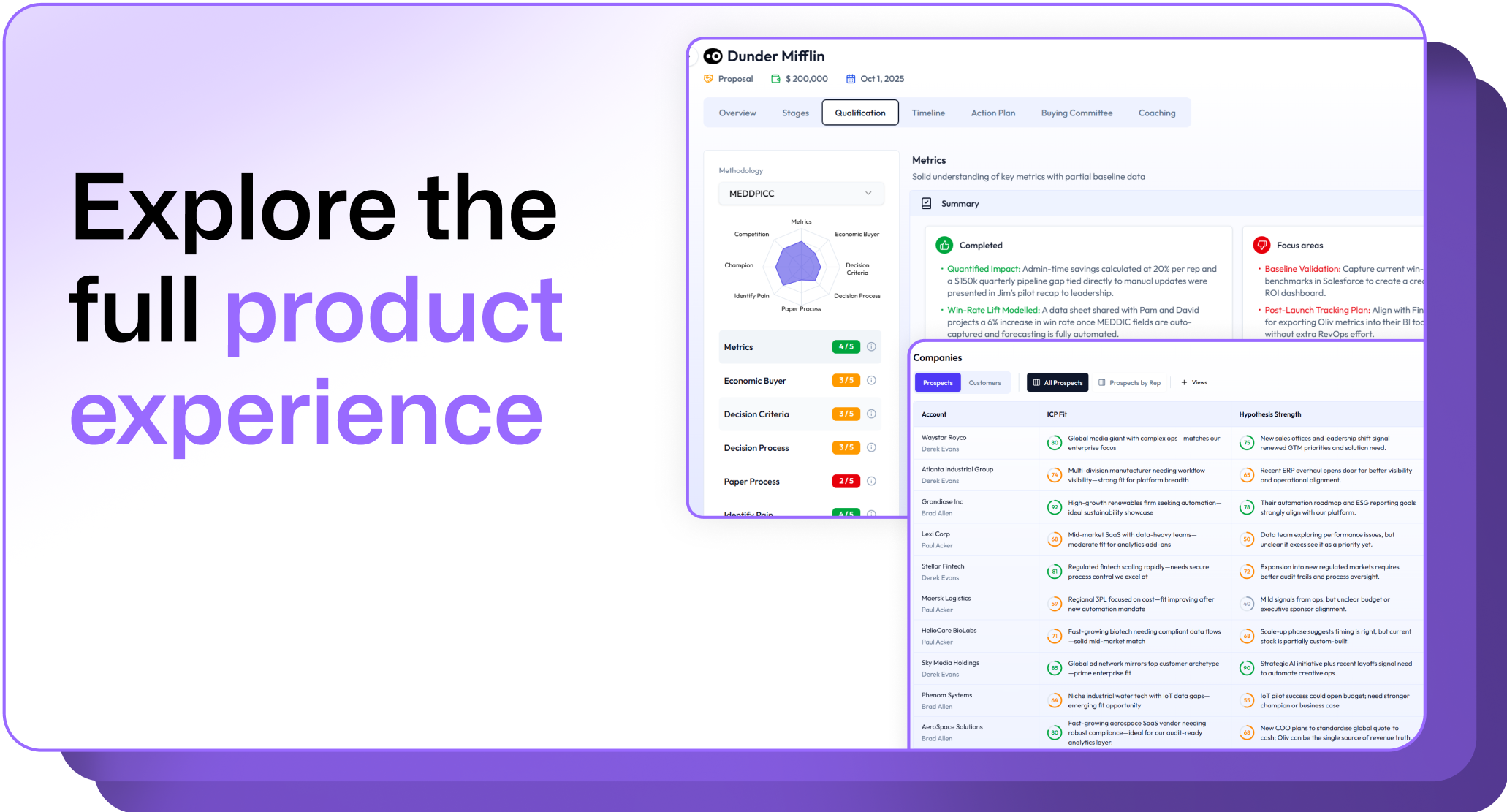
.avif)
.png)