The RevOps Guide to Autonomous CRM Hygiene — Fixing Dirty Salesforce Data Without Policing Reps | 2026
Written by
Ishan Chhabra
Last Updated :
March 9, 2026
Skim in :
10
mins
In this article
Still got questions?
Come discuss this article with me.
Hi, I'm Ishan, Founder and CEO of Oliv.
I'm always up for a conversation about revenue intelligence, AI agents, or what's actually working (and what's not) across revenue teams.
I'd love to hear your perspective.
Thank you! Your submission has been received!
Oops! Something went wrong while submitting the form.
Meet Oliv’s AI Agents
Hi! I’m, Deal Driver
I track deals, flag risks, send weekly pipeline updates and give sales managers full visibility into deal progress
Hi! I’m, CRM Manager
I maintain CRM hygiene by updating core, custom and qualification fields all without your team lifting a finger
Hi! I’m, Forecaster
I build accurate forecasts based on real deal movement and tell you which deals to pull in to hit your number
Hi! I’m, Coach
I believe performance fuels revenue. I spot skill gaps, score calls and build coaching plans to help every rep level up
Hi! I’m, Prospector
I dig into target accounts to surface the right contacts, tailor and time outreach so you always strike when it counts
Hi! I’m, Pipeline tracker
I call reps to get deal updates, and deliver a real-time, CRM-synced roll-up view of deal progress
Hi! I’m, Analyst
I answer complex pipeline questions, uncover deal patterns, and build reports that guide strategic decisions
TL;DR
47% of companies don't trust their CRM data despite six-figure tool investments.
Autonomous CRM hygiene uses AI agents to capture and write data from conversations, not rep self-reporting.
LLM-based object association fixes the duplicate account and multi-opp mapping nightmare rule-based tools can't solve.
AI trained on 100+ methodologies auto-populates MEDDPICC scorecards with timestamped proof from calls.
Oliv's four-layer guardrail stack (nudges, human-in-the-loop, grounded models, evidence logs) solves the AI trust problem.
A 90-day phased rollout can take your Data Integrity Score from baseline to 90%+ without a consulting engagement.
Q1. Why Is Your CRM Still Dirty Despite Spending Six Figures on Sales Tools? [toc=Why Your CRM Is Still Dirty]
Here's a stat that should unsettle every RevOps leader: nearly 47% of companies don't trust their own CRM data, CRM databases decay at roughly 60% per year, and dirty data costs the global economy an estimated $3 trillion annually. If you're a Director of RevOps at a growth-stage company, you've probably lived this, spending one or more days each week auditing pipeline, chasing reps for missing fields, and running dedup projects that feel like emptying the ocean with a teaspoon.
⚠️ The Compliance Theater Problem
The traditional playbook, mandatory fields, validation rules, weekly pipeline scrubs, creates what we call compliance theater. Reps fill in "TBD" or "N/A" just to move a deal forward. RevOps becomes the data police, and the CRM becomes a graveyard of technically complete but operationally useless records.
Tools like Gong and Clari were supposed to fix this, but they've only shifted the burden:
Gong excels at recording meetings, but it logs summaries as unstructured activities or notes in the CRM. These cannot power roll-up reporting or forecast models. Gong understands the meeting, not the deal.
Clari provides a cleaner forecasting UI, but the underlying process remains manual. Managers still sit with reps on Thursdays and Fridays for "story time" sessions, then input their subjective assessment. As one Reddit user put it plainly:
"It is really just a glorified SFDC overlay. Actually, Salesforce has built most of the forecasting functionality by now anyway so I'm not sure where they fit into that whole overcrowded Martech space." — conaldinho11, r/SalesOperations Reddit Thread
✅ The Generative AI Shift
The paradigm shift in 2026 is straightforward: instead of asking humans to document what happened, let AI derive CRM updates directly from conversation reality, calls, emails, Slack threads, and write structured data to the CRM autonomously. This is the foundation of AI-native revenue orchestration.
This is precisely how Oliv AI approaches the problem. Rather than requiring reps to adopt yet another platform, Oliv deploys AI Agents that stitch data across every channel and update the CRM based on what actually happened in a conversation, not a rep's biased or forgotten recollection.
💡 The Foundational Insight
As Ishan Chhabra, CEO of Oliv AI, frames it: the CRM was built in a "pre-generative AI" era as a database that depends entirely on human input. The fix isn't better policing, it's removing the human bottleneck entirely. When data flows autonomously from conversations into structured CRM fields, RevOps stops being the data police and starts being what it was always meant to be: a revenue orchestration function.
Q2. What Is Autonomous CRM Hygiene and How Does It Differ from Traditional Data Cleaning? [toc=Autonomous vs Traditional CRM Hygiene]
Autonomous CRM hygiene is a system where AI agents continuously monitor, capture, and correct CRM data in real time, with zero manual input from sales reps. It's the opposite of the quarterly "data cleanup day" or the reactive validation rule that fires only after a rep submits a form with bad data.
Admin-led field audits are a manual, time-intensive process that scales linearly with headcount
Salesforce flows and validation rules catch errors at the point of entry, but only if reps actually enter data (most don't)
These methods treat symptoms rather than the root cause: the fundamental dependency on humans to type accurate data into small boxes. As one Clari user noted, even purpose-built tools don't solve this:
"Clari should find ways to differentiate from the native Salesforce features (e.g. Pipeline Inspection, Forecasting) in order to remain competitive in the long-run. Additionally, it's sometimes difficult if you don't have a strong RevOps/RevTech team to maintain validation rules in both Salesforce and Clari instances." — Dan J., Mid-Market, Clari G2 Verified Review
✅ The AI-Era Model: Capture at the Source
The autonomous model flips the script entirely. Data is captured during conversations and written to the CRM without any rep involvement. The emerging RevOps KPI isn't "percentage of required fields completed", it's a real-time Data Integrity Score tracked alongside pipeline coverage and forecast accuracy.
Oliv's CRM Manager Agent embodies this shift. It listens to every customer interaction across calls, emails, and Slack, extracts structured data, and writes it to both standard and custom Salesforce objects, supporting up to 100 custom fields, without a single rep lifting a finger.
Most RevOps teams are stuck between Level 1 and Level 2. The leap to autonomous AI-driven hygiene is what separates data chasers from revenue engineers.
AI agents capture, validate, enrich, enforce, monitor
✅ High: data written from conversation reality
⏰ Less than 1 hr/week
Most growth-stage RevOps teams are stuck between Level 1 and Level 2. The leap to Level 3 is what separates teams that chase data from teams that engineer revenue.
Q3. How Does AI-Based Object Association Fix the Activity-to-Opportunity Mapping Nightmare? [toc=AI Object Association Explained]
If you've ever found a critical meeting logged to the wrong opportunity, or worse, to a duplicate account that shouldn't exist, you've experienced the object association nightmare. It's one of the most corrosive and invisible forms of dirty CRM data, and it silently destroys forecast accuracy downstream.
⚠️ The Duplicate Account and Multi-Opp Problem
The problem compounds in common scenarios:
Duplicate accounts: Google US vs. Google India, which record gets the activity?
Multiple open opportunities: A company like Whatfix with several product lines may have three open opps simultaneously. One call may touch two of them.
M&A and rebranding: Acquired companies create orphan records that rule-based systems can't reconcile.
❌ Why Legacy Tools Make It Worse
Salesforce Einstein Activity Capture uses brittle, rule-based logic that frequently confuses duplicate records. It also stores captured data in a separate AWS instance rather than natively in Salesforce, making it effectively invisible to downstream reporting. As one Einstein reviewer observed:
"Can be complex to set up and customize. Expensive, especially for smaller teams. Steep learning curve for new users. Slow performance if not optimized." — Shubham G., Senior BDM, Salesforce Agentforce G2 Verified Review
Gong relies on similarly rigid, Generation One rule-based mapping. Its integration model is fundamentally one-way, it pulls data in, positioning itself as the "center of the universe," but makes it extremely difficult to export structured data back to the CRM. One Sales Operations Manager shared the real cost:
"This lack of flexibility has required us to engage our development team at additional cost, adding significant operational and opportunity costs just to extract data we already own." — Neel P., Sales Operations Manager, Gong G2 Verified Review
✅ How LLM-Based Object Association Works
Instead of brittle if/then rules, LLM-based object association feeds the AI the complete history of all related accounts and opportunities. The model uses contextual reasoning from the transcript itself to determine which record should be updated, considering deal stage, product discussed, participants, and prior interaction history. This is a core capability of modern deal intelligence platforms.
🧠 Oliv's Specification Engineering Approach
Oliv's CRM Manager Agent takes this further with what the team calls specification engineering. When two products are discussed on a single call, the agent reasons through the transcript and updates both relevant opportunities simultaneously, attributing the right insights to the right deal. This is something rule-based systems fundamentally cannot do because they resolve to a single "best match" and discard the rest.
For a company with complex, multi-product GTM motions, this means the difference between a pipeline report you can trust and one that requires a full manual audit every Monday morning.
Q4. How Does AI-Based Object Association Fix the Activity-to-Opportunity Mapping Nightmare? [toc=AI Object Association Fix]
If you've ever found a critical meeting logged to the wrong opportunity, or worse, to a duplicate account that shouldn't exist, you know the object association nightmare intimately. It's one of the most corrosive and invisible forms of CRM data decay.
⚠️ Where Duplicate Accounts and Multi-Opp Chaos Begins
The problem compounds in scenarios every growth-stage company recognizes:
Duplicate accounts: Google US vs. Google India, which record gets the activity?
Multiple open opportunities: A multi-product company like Whatfix may have three open opps simultaneously. A single call could touch two of them.
M&A and rebranding: Acquired companies create orphan records that rule-based systems can't reconcile.
When activities route to the wrong record, pipeline reports become fiction and forecast accuracy collapses downstream.
❌ Why Einstein and Gong Make It Worse
Salesforce Agentforce uses brittle, rule-based logic that frequently confuses duplicate records. It stores captured data in a separate AWS instance rather than natively in Salesforce, making it invisible to downstream reporting. As one reviewer noted:
"Can be complex to set up and customize. Expensive, especially for smaller teams. Steep learning curve for new users." — Shubham G., Senior BDM, Salesforce Agentforce G2 Verified Review
Gong relies on similarly rigid Generation One mapping. Its integration model is fundamentally one-way, it pulls data in but makes structured export back to the CRM extremely difficult:
"This lack of flexibility has required us to engage our development team at additional cost, adding significant operational and opportunity costs just to extract data we already own." — Neel P., Sales Operations Manager, Gong G2 Verified Review
✅ How LLM-Based Object Association Solves This
Instead of if/then rules, LLM-based object association feeds the AI the complete history of all related accounts and opportunities. The model uses contextual reasoning from the transcript, considering deal stage, product discussed, participants, and interaction history, to determine which record to update. This represents a core capability shift in modern deal intelligence.
Rule-based systems resolve to a single "best match" and discard the rest. LLM-based object association reasons through context to update multiple relevant opportunities simultaneously.
🧠 Oliv's Specification Engineering Approach
Oliv's CRM Manager Agent takes this further. When two products are discussed on a single call, the agent reasons through the transcript and updates both relevant opportunities simultaneously, attributing the right insights to the right deal. Rule-based systems fundamentally can't do this because they resolve to a single "best match" and discard the rest.
Q5. How Do You Automate MEDDPICC Extraction Without Reps Filling Out a Single Field? [toc=Automate MEDDPICC Extraction]
Organizations frequently spend $100,000+ on sales methodology consultancies like Winning by Design or Force Management to train reps on MEDDPICC, BANT, or SPICED. The training lands well for about 90 days, then adoption collapses because reps refuse to document the 7 to 15 fields required per deal. The methodology becomes expensive shelfware.
❌ Why Keyword-Matching Falls Short
Gong's Smart Trackers represent the pre-generative AI approach to methodology tracking. They're built on keyword-matching technology that can detect if a "competitor" was mentioned on a call, but can't distinguish whether the prospect was casually name-dropping or actively evaluating that competitor. They lack the analytical depth to verify whether a MEDDIC criterion was truly met.
Even Gong power users acknowledge the setup burden:
"It can be overwhelming to set up trackers. AI training is a bit laborious to get it to do what you want." — Trafford J., Senior Director, Revenue Enablement, Gong G2 Verified Review
And for many teams, Gong's intelligence layer doesn't deliver practical deal-level utility:
"For me, the only business problem Gong solves is the call recordings. It allows me to review my calls and listen to them so that I can understand either where I went wrong or what the customer really said." — John S., Senior Account Executive, Gong G2 Verified Review
✅ Intent-Based Extraction: The AI-Era Approach
LLMs trained on sales methodologies understand intent and resonance, not just keywords. They can determine whether an Economic Buyer's commitment was actually secured versus merely discussed, and populate the corresponding CRM field with timestamped conversational evidence. This is the foundation of sales methodology automation.
⭐ How Oliv Turns Methodology into Muscle Memory
Oliv is trained on over 100 sales methodologies. The CRM Manager Agent automatically populates qualification scorecards (MEDDPICC, BANT, SPICED) after every customer interaction. Every field update links to a timestamped call clipping, giving managers verifiable proof rather than self-reported checkboxes.
The result: methodology compliance becomes invisible to reps. They sell naturally; the AI documents the framework evidence behind the scenes.
Q6. Exactly Which CRM Fields Can AI Agents Update, and How Does the Voice Agent Capture Unrecorded Interactions? [toc=CRM Fields and Voice Agent]
RevOps teams evaluating autonomous CRM hygiene tools need precise answers about field-level capabilities. Legacy tools often stop at "logging an activity" without changing the actual state of a deal.
Standard and Custom Object Coverage
Oliv's CRM Manager Agent writes to both standard and custom Salesforce objects:
Oliv CRM Manager Agent: Object Coverage
Object Type
Examples
Capability
Standard Objects
Accounts, Contacts, Leads, Opportunities
✅ Full read/write
Custom Fields
Up to 100 custom fields per object
✅ Full read/write
Custom Objects
Onboarding milestones, product usage tracking
✅ Supported
For example, at Triple Whale, Oliv tracks custom HubSpot objects for onboarding milestones, demonstrating that the agent adapts to non-standard CRM architectures.
Auto-Creation and Enrichment
When a meeting occurs with a previously unknown contact or account, the CRM Manager Agent:
Auto-creates the Contact and Account record in the CRM
Enriches the record using web data (LinkedIn, Crunchbase) for firmographic completeness
Associates the activity to the correct opportunity using LLM-based object association
No rep action is required at any step.
Enforcing Stage Exit Criteria
Oliv can automatically advance deal stages, for example from "Demo Scheduled" to "Demo Done", but only if the AI confirms the expected outcomes of that stage were actually met during the conversation. This prevents the common problem of reps prematurely advancing stages to inflate pipeline metrics. This capability directly supports evidence-based forecast commits.
🎙️ The Voice Agent: Closing the Unrecorded Call Gap
The biggest data blind spot in any CRM is interactions that never get recorded, unrecorded phone calls, in-person meetings, hallway conversations at conferences. Oliv's Voice Agent addresses this directly:
⏰ Calls the rep at end-of-day on a configurable schedule
Gathers updates conversationally (deal status, next steps, close date changes)
Syncs structured data back into the corresponding CRM fields instantly
This eliminates the last excuse for missing CRM data, "I didn't have time to log it", without requiring reps to open Salesforce at all. For teams looking to reduce their sales tech stack costs, this single agent replaces multiple manual workflows.
Q7. What Guardrails Prevent AI Hallucinations, and What Happens When the AI Gets It Wrong? [toc=AI Guardrails and Trust]
The #1 adoption blocker for autonomous CRM isn't technical, it's trust. RevOps leaders are terrified of an AI agent overwriting a manually-corrected close date or inflating a deal amount based on a misinterpreted transcript. Combine that fear with enterprise compliance requirements (SOC 2, GDPR, CCPA), and you have the single biggest obstacle to autonomous CRM adoption at mid-market and enterprise scale.
❌ The Legacy "Manager's Burden"
Legacy tools push the verification burden squarely onto managers. Gong provides a review-based system where managers must manually sift through noisy alerts to surface relevant insights. Its API is described as "wonky," requiring custom code to extract structured data, and its data portability story creates vendor lock-in:
"This lack of flexibility has required us to engage our development team at additional cost, adding significant operational and opportunity costs just to extract data we already own." — Neel P., Sales Operations Manager, Gong G2 Verified Review
Salesforce Agentforce offers native compliance within its ecosystem, but struggles to stitch external channel data (Slack, personal email, unrecorded calls) and carries significant setup complexity:
"It can be complex to set up and customize. Expensive, especially for smaller teams. Steep learning curve for new users." — Shubham G., Senior BDM, Salesforce Agentforce G2 Verified Review
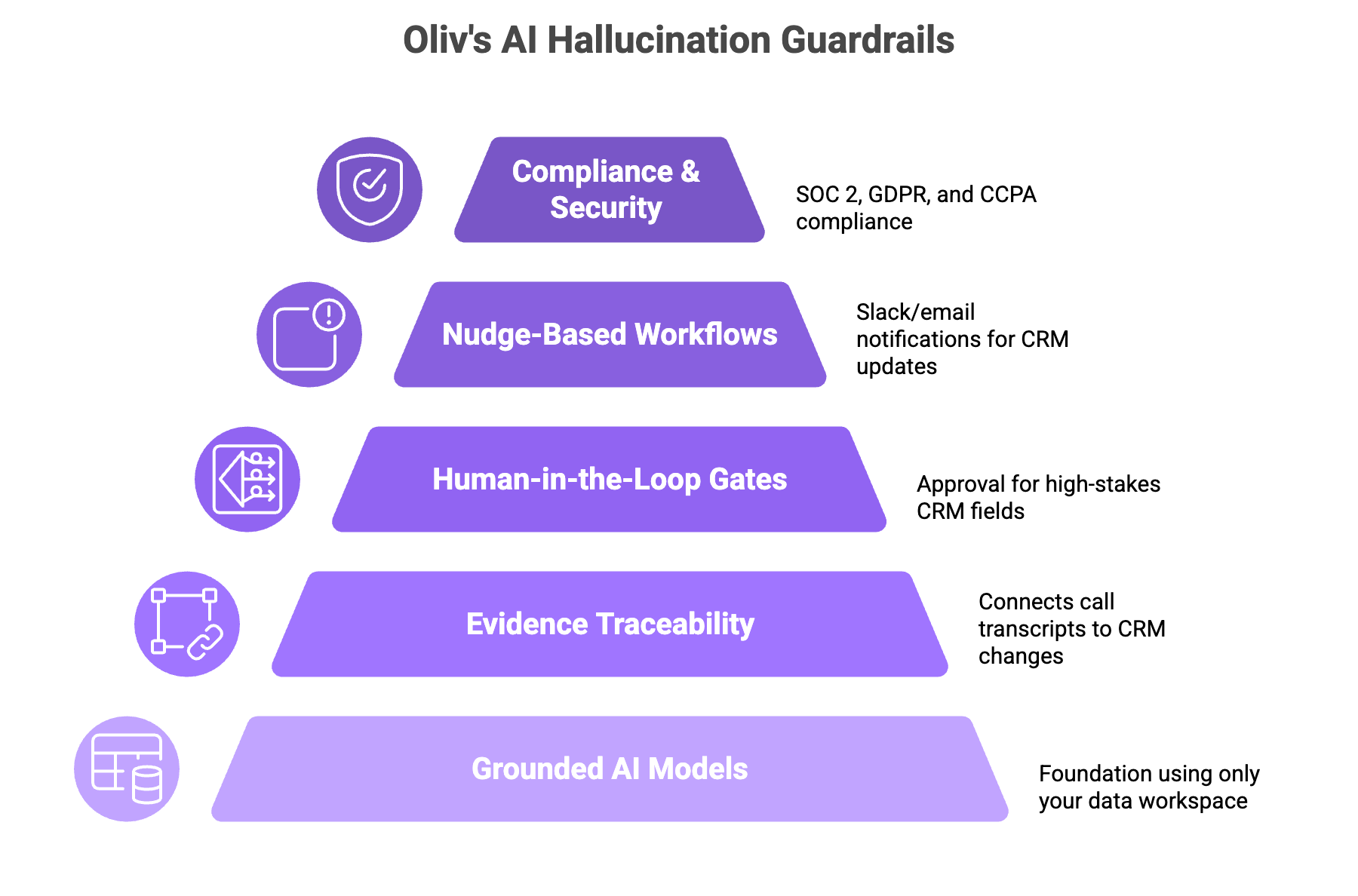
✅ Oliv's Four-Layer Guardrail Stack
Oliv addresses the trust problem with a comprehensive architecture designed to stop policing reps while keeping RevOps in control:
Nudges, not mandates: Instead of forcing reps into the CRM, Oliv sends Slack/email nudges, "I've updated these fields. Would you like to review them?"
Human-in-the-loop gates: RevOps can require manual approval before AI writes to configurable high-stakes fields (deal amount, close date, stage changes)
Grounded AI models: Oliv uses fine-tuned models trained on your specific data workspace, not generic LLMs, ensuring the AI reasons only from your actual interaction history
Full evidence traceability: Every field change links to the exact call snippet, showing old value to new value plus timestamp
Four layers of trust: from grounded AI models at the foundation to nudge-based workflows at the surface, every CRM update is traceable, approvable, and auditable.
🔒 Enterprise Security and Data Portability
Oliv is SOC 2 Type II, GDPR, and CCPA compliant, with security reports accessible via trustordollar.ai. Unlike Gong's "holder of data" approach, Oliv maintains a full open export policy, complete CSV dump of all meetings and recordings upon contract termination. No vendor lock-in, ever.
When the AI does get it wrong, accountability is clear: RevOps traces the exact transcript snippet that caused the error, corrects the field, and the audit log preserves the full correction history for compliance review. This is what separates true AI-native revenue orchestration from legacy bolt-on approaches.
Q8. Gong vs. Clari vs. Salesforce Agentforce vs. Oliv: Which Tool Actually Solves Autonomous CRM Hygiene? [toc=Tool Comparison for CRM Hygiene]
Most growth-stage RevOps teams evaluate some combination of Gong, Clari, Salesforce Agentforce, and newer AI-native platforms. The real question isn't which tool is "best" generically, it's which solves autonomous CRM hygiene end-to-end without creating a $500+/user/month stacking tax.
📊 Head-to-Head Comparison
Autonomous CRM Hygiene: Tool Comparison
Dimension
Gong
Clari
Salesforce Agentforce
Oliv AI
Data Capture Scope
Calls + email (one-way)
Forecast roll-ups only
Salesforce-native only
✅ Calls, email, Slack, unrecorded calls
Object Association
Rule-based (Gen 1)
-
Rule-based (Einstein)
✅ LLM-based contextual reasoning
MEDDPICC Automation
Keyword-matching trackers
❌ None
❌ None
✅ Intent-based, 100+ methodologies
Guardrails
Manual review alerts
Manual override
Native RBAC
✅ Nudges + human-in-the-loop + evidence logs
Audit Trail
❌ Limited API access
Basic change logs
Salesforce-native
✅ Old to new value + transcript evidence link
Implementation
⏰ 3 to 6 months
4 to 8 weeks
⏰ Weeks to months (admin-heavy)
✅ 5 minutes setup, value in 1 to 2 days
Data Portability
❌ Individual call downloads only
Limited
Salesforce-locked
✅ Full CSV export, open policy
💬 What Users Are Actually Saying
"The additional products like forecast or engage come at an additional cost. Would be great to see these tools rolled into the core offering." — Scott T., Director of Sales, Gong G2 Verified Review
"Clari should find ways to differentiate from the native Salesforce features (e.g. Pipeline Inspection, Forecasting) in order to remain competitive in the long-run." — Dan J., Mid-Market, Clari G2 Verified Review
"The pricing caught us off guard. Once we started scaling to more users and use cases, the cost ramped up pretty quickly." — Ayushmaan Y., Senior Associate, Salesforce Agentforce G2 Verified Review
⭐ Why Oliv Consolidates the Stack
Gong understands the meeting; Oliv understands the deal. Where legacy stacks require $500+/user/month across three fragmented tools, Oliv delivers CRM automation, methodology enforcement, and conversation intelligence from a single agent-first platform, with a 5-minute setup and the Voice Agent closing the unrecorded interaction gap that no competitor addresses. For a deeper dive into Gong vs. Clari, or to explore Gong alternatives, see our detailed breakdowns.
Q9. What Does a 90-Day Autonomous CRM Hygiene Rollout Look Like? [toc=90-Day Rollout Roadmap]
Implementing autonomous CRM hygiene doesn't require a six-month consulting engagement. Here's a phased 90-day roadmap designed for growth-stage RevOps teams.
Phase 1: CRM Audit and Quick Wins (Weeks 1 to 2)
Run a CRM health audit, measure field completion rates, duplicate account volume, and activity-to-opportunity mapping accuracy
Identify top 5 "broken" fields, the fields reps never update that managers rely on most (e.g., Next Steps, MEDDIC criteria, Close Date)
Benchmark your Data Integrity Score, establish a baseline percentage of deals with complete, accurate core fields
Deploy the first AI agent, start with the CRM Manager Agent on a single team to prove value before expanding
Phase 2: Agent Deployment and Methodology Training (Weeks 3 to 6)
Configure object association rules, map your account/opportunity hierarchy so the AI correctly routes activities across duplicate accounts and multi-product opps
Set up MEDDPICC/BANT extraction, define which methodology fields should auto-populate and configure the evidence-linking format
Establish human-in-the-loop gates, designate high-stakes fields (deal amount, close date) that require manual approval before AI writes
Train the custom model, for organizations with unique qualification rubrics, allow 2 to 4 weeks for Oliv to fine-tune its model on your specific deal history
Phase 3: Optimization and Expansion (Weeks 7 to 12)
Review evidence logs weekly, audit a sample of AI-written fields against call recordings to calibrate accuracy
Measure improvement, compare Data Integrity Score, forecast accuracy, and manager audit hours against your Week 1 baseline
Expand to additional teams, roll out to remaining sales teams based on proven ROI from Phase 1 to 2
Activate the Voice Agent, capture unrecorded phone calls and in-person meeting data via nightly conversational sync
90-Day Autonomous CRM Hygiene Rollout
Phase
Timeline
Key Milestone
Success KPI
1: Audit
Weeks 1 to 2
Baseline Data Integrity Score established
Field completion rate measured
2: Deploy
Weeks 3 to 6
CRM Manager Agent live on pilot team
⏰ Manager audit time reduced 50%+
3: Optimize
Weeks 7 to 12
Full team rollout + Voice Agent active
✅ Data Integrity Score 90%+
Oliv.ai simplifies this entire roadmap by providing 5-minute configuration, core value in 1 to 2 days, and custom model building in 2 to 4 weeks, collapsing what typically takes legacy tools like Gong 3 to 6 months to implement into a single quarter.
Q10. Frequently Asked Questions About CRM Data Quality Automation for RevOps [toc=CRM Data Quality FAQ]
How often should RevOps audit CRM data?
With manual processes, best practice is weekly pipeline scrubs plus quarterly deep audits. With autonomous AI agents, continuous real-time monitoring replaces scheduled audits entirely, shifting RevOps from reactive cleanup to proactive exception management.
What is a good CRM data quality score?
Industry benchmarks suggest fewer than 44% of organizations maintain clean CRM data at any given time. A Data Integrity Score above 90%, meaning 9 out of 10 deal records have complete, accurate core fields, is the target for high-performing RevOps teams.
Can AI fully replace manual CRM data entry?
For structured, conversation-derived data (deal stages, next steps, qualification criteria, contact creation), yes. AI agents like Oliv's CRM Manager Agent handle these autonomously. Strategic fields like subjective deal notes or relationship context may still benefit from rep input.
What's the ROI of CRM data automation?
The primary ROI drivers are recovered rep selling time (5 to 8 hours/week currently lost to admin), reduced manager audit burden (1+ day/week), and improved forecast accuracy from clean underlying data. Companies stacking Gong + Clari + Salesforce often spend $500+/user/month; consolidating to an AI-native platform significantly reduces this.
How do I get sales reps to trust AI-written CRM data?
The key is transparency and control. Nudge-based workflows (Slack/email notifications of what the AI updated), evidence logs linking every change to a specific call snippet, and human-in-the-loop approval gates for high-stakes fields build trust incrementally. Reps adopt faster when they see accurate updates appearing without any effort on their part. This is the core philosophy behind the future of revenue intelligence.
Q1. Why Is Your CRM Still Dirty Despite Spending Six Figures on Sales Tools? [toc=Why Your CRM Is Still Dirty]
Here's a stat that should unsettle every RevOps leader: nearly 47% of companies don't trust their own CRM data, CRM databases decay at roughly 60% per year, and dirty data costs the global economy an estimated $3 trillion annually. If you're a Director of RevOps at a growth-stage company, you've probably lived this, spending one or more days each week auditing pipeline, chasing reps for missing fields, and running dedup projects that feel like emptying the ocean with a teaspoon.
⚠️ The Compliance Theater Problem
The traditional playbook, mandatory fields, validation rules, weekly pipeline scrubs, creates what we call compliance theater. Reps fill in "TBD" or "N/A" just to move a deal forward. RevOps becomes the data police, and the CRM becomes a graveyard of technically complete but operationally useless records.
Tools like Gong and Clari were supposed to fix this, but they've only shifted the burden:
Gong excels at recording meetings, but it logs summaries as unstructured activities or notes in the CRM. These cannot power roll-up reporting or forecast models. Gong understands the meeting, not the deal.
Clari provides a cleaner forecasting UI, but the underlying process remains manual. Managers still sit with reps on Thursdays and Fridays for "story time" sessions, then input their subjective assessment. As one Reddit user put it plainly:
"It is really just a glorified SFDC overlay. Actually, Salesforce has built most of the forecasting functionality by now anyway so I'm not sure where they fit into that whole overcrowded Martech space." — conaldinho11, r/SalesOperations Reddit Thread
✅ The Generative AI Shift
The paradigm shift in 2026 is straightforward: instead of asking humans to document what happened, let AI derive CRM updates directly from conversation reality, calls, emails, Slack threads, and write structured data to the CRM autonomously. This is the foundation of AI-native revenue orchestration.
This is precisely how Oliv AI approaches the problem. Rather than requiring reps to adopt yet another platform, Oliv deploys AI Agents that stitch data across every channel and update the CRM based on what actually happened in a conversation, not a rep's biased or forgotten recollection.
💡 The Foundational Insight
As Ishan Chhabra, CEO of Oliv AI, frames it: the CRM was built in a "pre-generative AI" era as a database that depends entirely on human input. The fix isn't better policing, it's removing the human bottleneck entirely. When data flows autonomously from conversations into structured CRM fields, RevOps stops being the data police and starts being what it was always meant to be: a revenue orchestration function.
Q2. What Is Autonomous CRM Hygiene and How Does It Differ from Traditional Data Cleaning? [toc=Autonomous vs Traditional CRM Hygiene]
Autonomous CRM hygiene is a system where AI agents continuously monitor, capture, and correct CRM data in real time, with zero manual input from sales reps. It's the opposite of the quarterly "data cleanup day" or the reactive validation rule that fires only after a rep submits a form with bad data.
Admin-led field audits are a manual, time-intensive process that scales linearly with headcount
Salesforce flows and validation rules catch errors at the point of entry, but only if reps actually enter data (most don't)
These methods treat symptoms rather than the root cause: the fundamental dependency on humans to type accurate data into small boxes. As one Clari user noted, even purpose-built tools don't solve this:
"Clari should find ways to differentiate from the native Salesforce features (e.g. Pipeline Inspection, Forecasting) in order to remain competitive in the long-run. Additionally, it's sometimes difficult if you don't have a strong RevOps/RevTech team to maintain validation rules in both Salesforce and Clari instances." — Dan J., Mid-Market, Clari G2 Verified Review
✅ The AI-Era Model: Capture at the Source
The autonomous model flips the script entirely. Data is captured during conversations and written to the CRM without any rep involvement. The emerging RevOps KPI isn't "percentage of required fields completed", it's a real-time Data Integrity Score tracked alongside pipeline coverage and forecast accuracy.
Oliv's CRM Manager Agent embodies this shift. It listens to every customer interaction across calls, emails, and Slack, extracts structured data, and writes it to both standard and custom Salesforce objects, supporting up to 100 custom fields, without a single rep lifting a finger.
Most RevOps teams are stuck between Level 1 and Level 2. The leap to autonomous AI-driven hygiene is what separates data chasers from revenue engineers.
AI agents capture, validate, enrich, enforce, monitor
✅ High: data written from conversation reality
⏰ Less than 1 hr/week
Most growth-stage RevOps teams are stuck between Level 1 and Level 2. The leap to Level 3 is what separates teams that chase data from teams that engineer revenue.
Q3. How Does AI-Based Object Association Fix the Activity-to-Opportunity Mapping Nightmare? [toc=AI Object Association Explained]
If you've ever found a critical meeting logged to the wrong opportunity, or worse, to a duplicate account that shouldn't exist, you've experienced the object association nightmare. It's one of the most corrosive and invisible forms of dirty CRM data, and it silently destroys forecast accuracy downstream.
⚠️ The Duplicate Account and Multi-Opp Problem
The problem compounds in common scenarios:
Duplicate accounts: Google US vs. Google India, which record gets the activity?
Multiple open opportunities: A company like Whatfix with several product lines may have three open opps simultaneously. One call may touch two of them.
M&A and rebranding: Acquired companies create orphan records that rule-based systems can't reconcile.
❌ Why Legacy Tools Make It Worse
Salesforce Einstein Activity Capture uses brittle, rule-based logic that frequently confuses duplicate records. It also stores captured data in a separate AWS instance rather than natively in Salesforce, making it effectively invisible to downstream reporting. As one Einstein reviewer observed:
"Can be complex to set up and customize. Expensive, especially for smaller teams. Steep learning curve for new users. Slow performance if not optimized." — Shubham G., Senior BDM, Salesforce Agentforce G2 Verified Review
Gong relies on similarly rigid, Generation One rule-based mapping. Its integration model is fundamentally one-way, it pulls data in, positioning itself as the "center of the universe," but makes it extremely difficult to export structured data back to the CRM. One Sales Operations Manager shared the real cost:
"This lack of flexibility has required us to engage our development team at additional cost, adding significant operational and opportunity costs just to extract data we already own." — Neel P., Sales Operations Manager, Gong G2 Verified Review
✅ How LLM-Based Object Association Works
Instead of brittle if/then rules, LLM-based object association feeds the AI the complete history of all related accounts and opportunities. The model uses contextual reasoning from the transcript itself to determine which record should be updated, considering deal stage, product discussed, participants, and prior interaction history. This is a core capability of modern deal intelligence platforms.
🧠 Oliv's Specification Engineering Approach
Oliv's CRM Manager Agent takes this further with what the team calls specification engineering. When two products are discussed on a single call, the agent reasons through the transcript and updates both relevant opportunities simultaneously, attributing the right insights to the right deal. This is something rule-based systems fundamentally cannot do because they resolve to a single "best match" and discard the rest.
For a company with complex, multi-product GTM motions, this means the difference between a pipeline report you can trust and one that requires a full manual audit every Monday morning.
Q4. How Does AI-Based Object Association Fix the Activity-to-Opportunity Mapping Nightmare? [toc=AI Object Association Fix]
If you've ever found a critical meeting logged to the wrong opportunity, or worse, to a duplicate account that shouldn't exist, you know the object association nightmare intimately. It's one of the most corrosive and invisible forms of CRM data decay.
⚠️ Where Duplicate Accounts and Multi-Opp Chaos Begins
The problem compounds in scenarios every growth-stage company recognizes:
Duplicate accounts: Google US vs. Google India, which record gets the activity?
Multiple open opportunities: A multi-product company like Whatfix may have three open opps simultaneously. A single call could touch two of them.
M&A and rebranding: Acquired companies create orphan records that rule-based systems can't reconcile.
When activities route to the wrong record, pipeline reports become fiction and forecast accuracy collapses downstream.
❌ Why Einstein and Gong Make It Worse
Salesforce Agentforce uses brittle, rule-based logic that frequently confuses duplicate records. It stores captured data in a separate AWS instance rather than natively in Salesforce, making it invisible to downstream reporting. As one reviewer noted:
"Can be complex to set up and customize. Expensive, especially for smaller teams. Steep learning curve for new users." — Shubham G., Senior BDM, Salesforce Agentforce G2 Verified Review
Gong relies on similarly rigid Generation One mapping. Its integration model is fundamentally one-way, it pulls data in but makes structured export back to the CRM extremely difficult:
"This lack of flexibility has required us to engage our development team at additional cost, adding significant operational and opportunity costs just to extract data we already own." — Neel P., Sales Operations Manager, Gong G2 Verified Review
✅ How LLM-Based Object Association Solves This
Instead of if/then rules, LLM-based object association feeds the AI the complete history of all related accounts and opportunities. The model uses contextual reasoning from the transcript, considering deal stage, product discussed, participants, and interaction history, to determine which record to update. This represents a core capability shift in modern deal intelligence.
Rule-based systems resolve to a single "best match" and discard the rest. LLM-based object association reasons through context to update multiple relevant opportunities simultaneously.
🧠 Oliv's Specification Engineering Approach
Oliv's CRM Manager Agent takes this further. When two products are discussed on a single call, the agent reasons through the transcript and updates both relevant opportunities simultaneously, attributing the right insights to the right deal. Rule-based systems fundamentally can't do this because they resolve to a single "best match" and discard the rest.
Q5. How Do You Automate MEDDPICC Extraction Without Reps Filling Out a Single Field? [toc=Automate MEDDPICC Extraction]
Organizations frequently spend $100,000+ on sales methodology consultancies like Winning by Design or Force Management to train reps on MEDDPICC, BANT, or SPICED. The training lands well for about 90 days, then adoption collapses because reps refuse to document the 7 to 15 fields required per deal. The methodology becomes expensive shelfware.
❌ Why Keyword-Matching Falls Short
Gong's Smart Trackers represent the pre-generative AI approach to methodology tracking. They're built on keyword-matching technology that can detect if a "competitor" was mentioned on a call, but can't distinguish whether the prospect was casually name-dropping or actively evaluating that competitor. They lack the analytical depth to verify whether a MEDDIC criterion was truly met.
Even Gong power users acknowledge the setup burden:
"It can be overwhelming to set up trackers. AI training is a bit laborious to get it to do what you want." — Trafford J., Senior Director, Revenue Enablement, Gong G2 Verified Review
And for many teams, Gong's intelligence layer doesn't deliver practical deal-level utility:
"For me, the only business problem Gong solves is the call recordings. It allows me to review my calls and listen to them so that I can understand either where I went wrong or what the customer really said." — John S., Senior Account Executive, Gong G2 Verified Review
✅ Intent-Based Extraction: The AI-Era Approach
LLMs trained on sales methodologies understand intent and resonance, not just keywords. They can determine whether an Economic Buyer's commitment was actually secured versus merely discussed, and populate the corresponding CRM field with timestamped conversational evidence. This is the foundation of sales methodology automation.
⭐ How Oliv Turns Methodology into Muscle Memory
Oliv is trained on over 100 sales methodologies. The CRM Manager Agent automatically populates qualification scorecards (MEDDPICC, BANT, SPICED) after every customer interaction. Every field update links to a timestamped call clipping, giving managers verifiable proof rather than self-reported checkboxes.
The result: methodology compliance becomes invisible to reps. They sell naturally; the AI documents the framework evidence behind the scenes.
Q6. Exactly Which CRM Fields Can AI Agents Update, and How Does the Voice Agent Capture Unrecorded Interactions? [toc=CRM Fields and Voice Agent]
RevOps teams evaluating autonomous CRM hygiene tools need precise answers about field-level capabilities. Legacy tools often stop at "logging an activity" without changing the actual state of a deal.
Standard and Custom Object Coverage
Oliv's CRM Manager Agent writes to both standard and custom Salesforce objects:
Oliv CRM Manager Agent: Object Coverage
Object Type
Examples
Capability
Standard Objects
Accounts, Contacts, Leads, Opportunities
✅ Full read/write
Custom Fields
Up to 100 custom fields per object
✅ Full read/write
Custom Objects
Onboarding milestones, product usage tracking
✅ Supported
For example, at Triple Whale, Oliv tracks custom HubSpot objects for onboarding milestones, demonstrating that the agent adapts to non-standard CRM architectures.
Auto-Creation and Enrichment
When a meeting occurs with a previously unknown contact or account, the CRM Manager Agent:
Auto-creates the Contact and Account record in the CRM
Enriches the record using web data (LinkedIn, Crunchbase) for firmographic completeness
Associates the activity to the correct opportunity using LLM-based object association
No rep action is required at any step.
Enforcing Stage Exit Criteria
Oliv can automatically advance deal stages, for example from "Demo Scheduled" to "Demo Done", but only if the AI confirms the expected outcomes of that stage were actually met during the conversation. This prevents the common problem of reps prematurely advancing stages to inflate pipeline metrics. This capability directly supports evidence-based forecast commits.
🎙️ The Voice Agent: Closing the Unrecorded Call Gap
The biggest data blind spot in any CRM is interactions that never get recorded, unrecorded phone calls, in-person meetings, hallway conversations at conferences. Oliv's Voice Agent addresses this directly:
⏰ Calls the rep at end-of-day on a configurable schedule
Gathers updates conversationally (deal status, next steps, close date changes)
Syncs structured data back into the corresponding CRM fields instantly
This eliminates the last excuse for missing CRM data, "I didn't have time to log it", without requiring reps to open Salesforce at all. For teams looking to reduce their sales tech stack costs, this single agent replaces multiple manual workflows.
Q7. What Guardrails Prevent AI Hallucinations, and What Happens When the AI Gets It Wrong? [toc=AI Guardrails and Trust]
The #1 adoption blocker for autonomous CRM isn't technical, it's trust. RevOps leaders are terrified of an AI agent overwriting a manually-corrected close date or inflating a deal amount based on a misinterpreted transcript. Combine that fear with enterprise compliance requirements (SOC 2, GDPR, CCPA), and you have the single biggest obstacle to autonomous CRM adoption at mid-market and enterprise scale.
❌ The Legacy "Manager's Burden"
Legacy tools push the verification burden squarely onto managers. Gong provides a review-based system where managers must manually sift through noisy alerts to surface relevant insights. Its API is described as "wonky," requiring custom code to extract structured data, and its data portability story creates vendor lock-in:
"This lack of flexibility has required us to engage our development team at additional cost, adding significant operational and opportunity costs just to extract data we already own." — Neel P., Sales Operations Manager, Gong G2 Verified Review
Salesforce Agentforce offers native compliance within its ecosystem, but struggles to stitch external channel data (Slack, personal email, unrecorded calls) and carries significant setup complexity:
"It can be complex to set up and customize. Expensive, especially for smaller teams. Steep learning curve for new users." — Shubham G., Senior BDM, Salesforce Agentforce G2 Verified Review
✅ Oliv's Four-Layer Guardrail Stack
Oliv addresses the trust problem with a comprehensive architecture designed to stop policing reps while keeping RevOps in control:
Nudges, not mandates: Instead of forcing reps into the CRM, Oliv sends Slack/email nudges, "I've updated these fields. Would you like to review them?"
Human-in-the-loop gates: RevOps can require manual approval before AI writes to configurable high-stakes fields (deal amount, close date, stage changes)
Grounded AI models: Oliv uses fine-tuned models trained on your specific data workspace, not generic LLMs, ensuring the AI reasons only from your actual interaction history
Full evidence traceability: Every field change links to the exact call snippet, showing old value to new value plus timestamp
Four layers of trust: from grounded AI models at the foundation to nudge-based workflows at the surface, every CRM update is traceable, approvable, and auditable.
🔒 Enterprise Security and Data Portability
Oliv is SOC 2 Type II, GDPR, and CCPA compliant, with security reports accessible via trustordollar.ai. Unlike Gong's "holder of data" approach, Oliv maintains a full open export policy, complete CSV dump of all meetings and recordings upon contract termination. No vendor lock-in, ever.
When the AI does get it wrong, accountability is clear: RevOps traces the exact transcript snippet that caused the error, corrects the field, and the audit log preserves the full correction history for compliance review. This is what separates true AI-native revenue orchestration from legacy bolt-on approaches.
Q8. Gong vs. Clari vs. Salesforce Agentforce vs. Oliv: Which Tool Actually Solves Autonomous CRM Hygiene? [toc=Tool Comparison for CRM Hygiene]
Most growth-stage RevOps teams evaluate some combination of Gong, Clari, Salesforce Agentforce, and newer AI-native platforms. The real question isn't which tool is "best" generically, it's which solves autonomous CRM hygiene end-to-end without creating a $500+/user/month stacking tax.
📊 Head-to-Head Comparison
Autonomous CRM Hygiene: Tool Comparison
Dimension
Gong
Clari
Salesforce Agentforce
Oliv AI
Data Capture Scope
Calls + email (one-way)
Forecast roll-ups only
Salesforce-native only
✅ Calls, email, Slack, unrecorded calls
Object Association
Rule-based (Gen 1)
-
Rule-based (Einstein)
✅ LLM-based contextual reasoning
MEDDPICC Automation
Keyword-matching trackers
❌ None
❌ None
✅ Intent-based, 100+ methodologies
Guardrails
Manual review alerts
Manual override
Native RBAC
✅ Nudges + human-in-the-loop + evidence logs
Audit Trail
❌ Limited API access
Basic change logs
Salesforce-native
✅ Old to new value + transcript evidence link
Implementation
⏰ 3 to 6 months
4 to 8 weeks
⏰ Weeks to months (admin-heavy)
✅ 5 minutes setup, value in 1 to 2 days
Data Portability
❌ Individual call downloads only
Limited
Salesforce-locked
✅ Full CSV export, open policy
💬 What Users Are Actually Saying
"The additional products like forecast or engage come at an additional cost. Would be great to see these tools rolled into the core offering." — Scott T., Director of Sales, Gong G2 Verified Review
"Clari should find ways to differentiate from the native Salesforce features (e.g. Pipeline Inspection, Forecasting) in order to remain competitive in the long-run." — Dan J., Mid-Market, Clari G2 Verified Review
"The pricing caught us off guard. Once we started scaling to more users and use cases, the cost ramped up pretty quickly." — Ayushmaan Y., Senior Associate, Salesforce Agentforce G2 Verified Review
⭐ Why Oliv Consolidates the Stack
Gong understands the meeting; Oliv understands the deal. Where legacy stacks require $500+/user/month across three fragmented tools, Oliv delivers CRM automation, methodology enforcement, and conversation intelligence from a single agent-first platform, with a 5-minute setup and the Voice Agent closing the unrecorded interaction gap that no competitor addresses. For a deeper dive into Gong vs. Clari, or to explore Gong alternatives, see our detailed breakdowns.
Q9. What Does a 90-Day Autonomous CRM Hygiene Rollout Look Like? [toc=90-Day Rollout Roadmap]
Implementing autonomous CRM hygiene doesn't require a six-month consulting engagement. Here's a phased 90-day roadmap designed for growth-stage RevOps teams.
Phase 1: CRM Audit and Quick Wins (Weeks 1 to 2)
Run a CRM health audit, measure field completion rates, duplicate account volume, and activity-to-opportunity mapping accuracy
Identify top 5 "broken" fields, the fields reps never update that managers rely on most (e.g., Next Steps, MEDDIC criteria, Close Date)
Benchmark your Data Integrity Score, establish a baseline percentage of deals with complete, accurate core fields
Deploy the first AI agent, start with the CRM Manager Agent on a single team to prove value before expanding
Phase 2: Agent Deployment and Methodology Training (Weeks 3 to 6)
Configure object association rules, map your account/opportunity hierarchy so the AI correctly routes activities across duplicate accounts and multi-product opps
Set up MEDDPICC/BANT extraction, define which methodology fields should auto-populate and configure the evidence-linking format
Establish human-in-the-loop gates, designate high-stakes fields (deal amount, close date) that require manual approval before AI writes
Train the custom model, for organizations with unique qualification rubrics, allow 2 to 4 weeks for Oliv to fine-tune its model on your specific deal history
Phase 3: Optimization and Expansion (Weeks 7 to 12)
Review evidence logs weekly, audit a sample of AI-written fields against call recordings to calibrate accuracy
Measure improvement, compare Data Integrity Score, forecast accuracy, and manager audit hours against your Week 1 baseline
Expand to additional teams, roll out to remaining sales teams based on proven ROI from Phase 1 to 2
Activate the Voice Agent, capture unrecorded phone calls and in-person meeting data via nightly conversational sync
90-Day Autonomous CRM Hygiene Rollout
Phase
Timeline
Key Milestone
Success KPI
1: Audit
Weeks 1 to 2
Baseline Data Integrity Score established
Field completion rate measured
2: Deploy
Weeks 3 to 6
CRM Manager Agent live on pilot team
⏰ Manager audit time reduced 50%+
3: Optimize
Weeks 7 to 12
Full team rollout + Voice Agent active
✅ Data Integrity Score 90%+
Oliv.ai simplifies this entire roadmap by providing 5-minute configuration, core value in 1 to 2 days, and custom model building in 2 to 4 weeks, collapsing what typically takes legacy tools like Gong 3 to 6 months to implement into a single quarter.
Q10. Frequently Asked Questions About CRM Data Quality Automation for RevOps [toc=CRM Data Quality FAQ]
How often should RevOps audit CRM data?
With manual processes, best practice is weekly pipeline scrubs plus quarterly deep audits. With autonomous AI agents, continuous real-time monitoring replaces scheduled audits entirely, shifting RevOps from reactive cleanup to proactive exception management.
What is a good CRM data quality score?
Industry benchmarks suggest fewer than 44% of organizations maintain clean CRM data at any given time. A Data Integrity Score above 90%, meaning 9 out of 10 deal records have complete, accurate core fields, is the target for high-performing RevOps teams.
Can AI fully replace manual CRM data entry?
For structured, conversation-derived data (deal stages, next steps, qualification criteria, contact creation), yes. AI agents like Oliv's CRM Manager Agent handle these autonomously. Strategic fields like subjective deal notes or relationship context may still benefit from rep input.
What's the ROI of CRM data automation?
The primary ROI drivers are recovered rep selling time (5 to 8 hours/week currently lost to admin), reduced manager audit burden (1+ day/week), and improved forecast accuracy from clean underlying data. Companies stacking Gong + Clari + Salesforce often spend $500+/user/month; consolidating to an AI-native platform significantly reduces this.
How do I get sales reps to trust AI-written CRM data?
The key is transparency and control. Nudge-based workflows (Slack/email notifications of what the AI updated), evidence logs linking every change to a specific call snippet, and human-in-the-loop approval gates for high-stakes fields build trust incrementally. Reps adopt faster when they see accurate updates appearing without any effort on their part. This is the core philosophy behind the future of revenue intelligence.
Q1. Why Is Your CRM Still Dirty Despite Spending Six Figures on Sales Tools? [toc=Why Your CRM Is Still Dirty]
Here's a stat that should unsettle every RevOps leader: nearly 47% of companies don't trust their own CRM data, CRM databases decay at roughly 60% per year, and dirty data costs the global economy an estimated $3 trillion annually. If you're a Director of RevOps at a growth-stage company, you've probably lived this, spending one or more days each week auditing pipeline, chasing reps for missing fields, and running dedup projects that feel like emptying the ocean with a teaspoon.
⚠️ The Compliance Theater Problem
The traditional playbook, mandatory fields, validation rules, weekly pipeline scrubs, creates what we call compliance theater. Reps fill in "TBD" or "N/A" just to move a deal forward. RevOps becomes the data police, and the CRM becomes a graveyard of technically complete but operationally useless records.
Tools like Gong and Clari were supposed to fix this, but they've only shifted the burden:
Gong excels at recording meetings, but it logs summaries as unstructured activities or notes in the CRM. These cannot power roll-up reporting or forecast models. Gong understands the meeting, not the deal.
Clari provides a cleaner forecasting UI, but the underlying process remains manual. Managers still sit with reps on Thursdays and Fridays for "story time" sessions, then input their subjective assessment. As one Reddit user put it plainly:
"It is really just a glorified SFDC overlay. Actually, Salesforce has built most of the forecasting functionality by now anyway so I'm not sure where they fit into that whole overcrowded Martech space." — conaldinho11, r/SalesOperations Reddit Thread
✅ The Generative AI Shift
The paradigm shift in 2026 is straightforward: instead of asking humans to document what happened, let AI derive CRM updates directly from conversation reality, calls, emails, Slack threads, and write structured data to the CRM autonomously. This is the foundation of AI-native revenue orchestration.
This is precisely how Oliv AI approaches the problem. Rather than requiring reps to adopt yet another platform, Oliv deploys AI Agents that stitch data across every channel and update the CRM based on what actually happened in a conversation, not a rep's biased or forgotten recollection.
💡 The Foundational Insight
As Ishan Chhabra, CEO of Oliv AI, frames it: the CRM was built in a "pre-generative AI" era as a database that depends entirely on human input. The fix isn't better policing, it's removing the human bottleneck entirely. When data flows autonomously from conversations into structured CRM fields, RevOps stops being the data police and starts being what it was always meant to be: a revenue orchestration function.
Q2. What Is Autonomous CRM Hygiene and How Does It Differ from Traditional Data Cleaning? [toc=Autonomous vs Traditional CRM Hygiene]
Autonomous CRM hygiene is a system where AI agents continuously monitor, capture, and correct CRM data in real time, with zero manual input from sales reps. It's the opposite of the quarterly "data cleanup day" or the reactive validation rule that fires only after a rep submits a form with bad data.
Admin-led field audits are a manual, time-intensive process that scales linearly with headcount
Salesforce flows and validation rules catch errors at the point of entry, but only if reps actually enter data (most don't)
These methods treat symptoms rather than the root cause: the fundamental dependency on humans to type accurate data into small boxes. As one Clari user noted, even purpose-built tools don't solve this:
"Clari should find ways to differentiate from the native Salesforce features (e.g. Pipeline Inspection, Forecasting) in order to remain competitive in the long-run. Additionally, it's sometimes difficult if you don't have a strong RevOps/RevTech team to maintain validation rules in both Salesforce and Clari instances." — Dan J., Mid-Market, Clari G2 Verified Review
✅ The AI-Era Model: Capture at the Source
The autonomous model flips the script entirely. Data is captured during conversations and written to the CRM without any rep involvement. The emerging RevOps KPI isn't "percentage of required fields completed", it's a real-time Data Integrity Score tracked alongside pipeline coverage and forecast accuracy.
Oliv's CRM Manager Agent embodies this shift. It listens to every customer interaction across calls, emails, and Slack, extracts structured data, and writes it to both standard and custom Salesforce objects, supporting up to 100 custom fields, without a single rep lifting a finger.
Most RevOps teams are stuck between Level 1 and Level 2. The leap to autonomous AI-driven hygiene is what separates data chasers from revenue engineers.
AI agents capture, validate, enrich, enforce, monitor
✅ High: data written from conversation reality
⏰ Less than 1 hr/week
Most growth-stage RevOps teams are stuck between Level 1 and Level 2. The leap to Level 3 is what separates teams that chase data from teams that engineer revenue.
Q3. How Does AI-Based Object Association Fix the Activity-to-Opportunity Mapping Nightmare? [toc=AI Object Association Explained]
If you've ever found a critical meeting logged to the wrong opportunity, or worse, to a duplicate account that shouldn't exist, you've experienced the object association nightmare. It's one of the most corrosive and invisible forms of dirty CRM data, and it silently destroys forecast accuracy downstream.
⚠️ The Duplicate Account and Multi-Opp Problem
The problem compounds in common scenarios:
Duplicate accounts: Google US vs. Google India, which record gets the activity?
Multiple open opportunities: A company like Whatfix with several product lines may have three open opps simultaneously. One call may touch two of them.
M&A and rebranding: Acquired companies create orphan records that rule-based systems can't reconcile.
❌ Why Legacy Tools Make It Worse
Salesforce Einstein Activity Capture uses brittle, rule-based logic that frequently confuses duplicate records. It also stores captured data in a separate AWS instance rather than natively in Salesforce, making it effectively invisible to downstream reporting. As one Einstein reviewer observed:
"Can be complex to set up and customize. Expensive, especially for smaller teams. Steep learning curve for new users. Slow performance if not optimized." — Shubham G., Senior BDM, Salesforce Agentforce G2 Verified Review
Gong relies on similarly rigid, Generation One rule-based mapping. Its integration model is fundamentally one-way, it pulls data in, positioning itself as the "center of the universe," but makes it extremely difficult to export structured data back to the CRM. One Sales Operations Manager shared the real cost:
"This lack of flexibility has required us to engage our development team at additional cost, adding significant operational and opportunity costs just to extract data we already own." — Neel P., Sales Operations Manager, Gong G2 Verified Review
✅ How LLM-Based Object Association Works
Instead of brittle if/then rules, LLM-based object association feeds the AI the complete history of all related accounts and opportunities. The model uses contextual reasoning from the transcript itself to determine which record should be updated, considering deal stage, product discussed, participants, and prior interaction history. This is a core capability of modern deal intelligence platforms.
🧠 Oliv's Specification Engineering Approach
Oliv's CRM Manager Agent takes this further with what the team calls specification engineering. When two products are discussed on a single call, the agent reasons through the transcript and updates both relevant opportunities simultaneously, attributing the right insights to the right deal. This is something rule-based systems fundamentally cannot do because they resolve to a single "best match" and discard the rest.
For a company with complex, multi-product GTM motions, this means the difference between a pipeline report you can trust and one that requires a full manual audit every Monday morning.
Q4. How Does AI-Based Object Association Fix the Activity-to-Opportunity Mapping Nightmare? [toc=AI Object Association Fix]
If you've ever found a critical meeting logged to the wrong opportunity, or worse, to a duplicate account that shouldn't exist, you know the object association nightmare intimately. It's one of the most corrosive and invisible forms of CRM data decay.
⚠️ Where Duplicate Accounts and Multi-Opp Chaos Begins
The problem compounds in scenarios every growth-stage company recognizes:
Duplicate accounts: Google US vs. Google India, which record gets the activity?
Multiple open opportunities: A multi-product company like Whatfix may have three open opps simultaneously. A single call could touch two of them.
M&A and rebranding: Acquired companies create orphan records that rule-based systems can't reconcile.
When activities route to the wrong record, pipeline reports become fiction and forecast accuracy collapses downstream.
❌ Why Einstein and Gong Make It Worse
Salesforce Agentforce uses brittle, rule-based logic that frequently confuses duplicate records. It stores captured data in a separate AWS instance rather than natively in Salesforce, making it invisible to downstream reporting. As one reviewer noted:
"Can be complex to set up and customize. Expensive, especially for smaller teams. Steep learning curve for new users." — Shubham G., Senior BDM, Salesforce Agentforce G2 Verified Review
Gong relies on similarly rigid Generation One mapping. Its integration model is fundamentally one-way, it pulls data in but makes structured export back to the CRM extremely difficult:
"This lack of flexibility has required us to engage our development team at additional cost, adding significant operational and opportunity costs just to extract data we already own." — Neel P., Sales Operations Manager, Gong G2 Verified Review
✅ How LLM-Based Object Association Solves This
Instead of if/then rules, LLM-based object association feeds the AI the complete history of all related accounts and opportunities. The model uses contextual reasoning from the transcript, considering deal stage, product discussed, participants, and interaction history, to determine which record to update. This represents a core capability shift in modern deal intelligence.
Rule-based systems resolve to a single "best match" and discard the rest. LLM-based object association reasons through context to update multiple relevant opportunities simultaneously.
🧠 Oliv's Specification Engineering Approach
Oliv's CRM Manager Agent takes this further. When two products are discussed on a single call, the agent reasons through the transcript and updates both relevant opportunities simultaneously, attributing the right insights to the right deal. Rule-based systems fundamentally can't do this because they resolve to a single "best match" and discard the rest.
Q5. How Do You Automate MEDDPICC Extraction Without Reps Filling Out a Single Field? [toc=Automate MEDDPICC Extraction]
Organizations frequently spend $100,000+ on sales methodology consultancies like Winning by Design or Force Management to train reps on MEDDPICC, BANT, or SPICED. The training lands well for about 90 days, then adoption collapses because reps refuse to document the 7 to 15 fields required per deal. The methodology becomes expensive shelfware.
❌ Why Keyword-Matching Falls Short
Gong's Smart Trackers represent the pre-generative AI approach to methodology tracking. They're built on keyword-matching technology that can detect if a "competitor" was mentioned on a call, but can't distinguish whether the prospect was casually name-dropping or actively evaluating that competitor. They lack the analytical depth to verify whether a MEDDIC criterion was truly met.
Even Gong power users acknowledge the setup burden:
"It can be overwhelming to set up trackers. AI training is a bit laborious to get it to do what you want." — Trafford J., Senior Director, Revenue Enablement, Gong G2 Verified Review
And for many teams, Gong's intelligence layer doesn't deliver practical deal-level utility:
"For me, the only business problem Gong solves is the call recordings. It allows me to review my calls and listen to them so that I can understand either where I went wrong or what the customer really said." — John S., Senior Account Executive, Gong G2 Verified Review
✅ Intent-Based Extraction: The AI-Era Approach
LLMs trained on sales methodologies understand intent and resonance, not just keywords. They can determine whether an Economic Buyer's commitment was actually secured versus merely discussed, and populate the corresponding CRM field with timestamped conversational evidence. This is the foundation of sales methodology automation.
⭐ How Oliv Turns Methodology into Muscle Memory
Oliv is trained on over 100 sales methodologies. The CRM Manager Agent automatically populates qualification scorecards (MEDDPICC, BANT, SPICED) after every customer interaction. Every field update links to a timestamped call clipping, giving managers verifiable proof rather than self-reported checkboxes.
The result: methodology compliance becomes invisible to reps. They sell naturally; the AI documents the framework evidence behind the scenes.
Q6. Exactly Which CRM Fields Can AI Agents Update, and How Does the Voice Agent Capture Unrecorded Interactions? [toc=CRM Fields and Voice Agent]
RevOps teams evaluating autonomous CRM hygiene tools need precise answers about field-level capabilities. Legacy tools often stop at "logging an activity" without changing the actual state of a deal.
Standard and Custom Object Coverage
Oliv's CRM Manager Agent writes to both standard and custom Salesforce objects:
Oliv CRM Manager Agent: Object Coverage
Object Type
Examples
Capability
Standard Objects
Accounts, Contacts, Leads, Opportunities
✅ Full read/write
Custom Fields
Up to 100 custom fields per object
✅ Full read/write
Custom Objects
Onboarding milestones, product usage tracking
✅ Supported
For example, at Triple Whale, Oliv tracks custom HubSpot objects for onboarding milestones, demonstrating that the agent adapts to non-standard CRM architectures.
Auto-Creation and Enrichment
When a meeting occurs with a previously unknown contact or account, the CRM Manager Agent:
Auto-creates the Contact and Account record in the CRM
Enriches the record using web data (LinkedIn, Crunchbase) for firmographic completeness
Associates the activity to the correct opportunity using LLM-based object association
No rep action is required at any step.
Enforcing Stage Exit Criteria
Oliv can automatically advance deal stages, for example from "Demo Scheduled" to "Demo Done", but only if the AI confirms the expected outcomes of that stage were actually met during the conversation. This prevents the common problem of reps prematurely advancing stages to inflate pipeline metrics. This capability directly supports evidence-based forecast commits.
🎙️ The Voice Agent: Closing the Unrecorded Call Gap
The biggest data blind spot in any CRM is interactions that never get recorded, unrecorded phone calls, in-person meetings, hallway conversations at conferences. Oliv's Voice Agent addresses this directly:
⏰ Calls the rep at end-of-day on a configurable schedule
Gathers updates conversationally (deal status, next steps, close date changes)
Syncs structured data back into the corresponding CRM fields instantly
This eliminates the last excuse for missing CRM data, "I didn't have time to log it", without requiring reps to open Salesforce at all. For teams looking to reduce their sales tech stack costs, this single agent replaces multiple manual workflows.
Q7. What Guardrails Prevent AI Hallucinations, and What Happens When the AI Gets It Wrong? [toc=AI Guardrails and Trust]
The #1 adoption blocker for autonomous CRM isn't technical, it's trust. RevOps leaders are terrified of an AI agent overwriting a manually-corrected close date or inflating a deal amount based on a misinterpreted transcript. Combine that fear with enterprise compliance requirements (SOC 2, GDPR, CCPA), and you have the single biggest obstacle to autonomous CRM adoption at mid-market and enterprise scale.
❌ The Legacy "Manager's Burden"
Legacy tools push the verification burden squarely onto managers. Gong provides a review-based system where managers must manually sift through noisy alerts to surface relevant insights. Its API is described as "wonky," requiring custom code to extract structured data, and its data portability story creates vendor lock-in:
"This lack of flexibility has required us to engage our development team at additional cost, adding significant operational and opportunity costs just to extract data we already own." — Neel P., Sales Operations Manager, Gong G2 Verified Review
Salesforce Agentforce offers native compliance within its ecosystem, but struggles to stitch external channel data (Slack, personal email, unrecorded calls) and carries significant setup complexity:
"It can be complex to set up and customize. Expensive, especially for smaller teams. Steep learning curve for new users." — Shubham G., Senior BDM, Salesforce Agentforce G2 Verified Review
✅ Oliv's Four-Layer Guardrail Stack
Oliv addresses the trust problem with a comprehensive architecture designed to stop policing reps while keeping RevOps in control:
Nudges, not mandates: Instead of forcing reps into the CRM, Oliv sends Slack/email nudges, "I've updated these fields. Would you like to review them?"
Human-in-the-loop gates: RevOps can require manual approval before AI writes to configurable high-stakes fields (deal amount, close date, stage changes)
Grounded AI models: Oliv uses fine-tuned models trained on your specific data workspace, not generic LLMs, ensuring the AI reasons only from your actual interaction history
Full evidence traceability: Every field change links to the exact call snippet, showing old value to new value plus timestamp
Four layers of trust: from grounded AI models at the foundation to nudge-based workflows at the surface, every CRM update is traceable, approvable, and auditable.
🔒 Enterprise Security and Data Portability
Oliv is SOC 2 Type II, GDPR, and CCPA compliant, with security reports accessible via trustordollar.ai. Unlike Gong's "holder of data" approach, Oliv maintains a full open export policy, complete CSV dump of all meetings and recordings upon contract termination. No vendor lock-in, ever.
When the AI does get it wrong, accountability is clear: RevOps traces the exact transcript snippet that caused the error, corrects the field, and the audit log preserves the full correction history for compliance review. This is what separates true AI-native revenue orchestration from legacy bolt-on approaches.
Q8. Gong vs. Clari vs. Salesforce Agentforce vs. Oliv: Which Tool Actually Solves Autonomous CRM Hygiene? [toc=Tool Comparison for CRM Hygiene]
Most growth-stage RevOps teams evaluate some combination of Gong, Clari, Salesforce Agentforce, and newer AI-native platforms. The real question isn't which tool is "best" generically, it's which solves autonomous CRM hygiene end-to-end without creating a $500+/user/month stacking tax.
📊 Head-to-Head Comparison
Autonomous CRM Hygiene: Tool Comparison
Dimension
Gong
Clari
Salesforce Agentforce
Oliv AI
Data Capture Scope
Calls + email (one-way)
Forecast roll-ups only
Salesforce-native only
✅ Calls, email, Slack, unrecorded calls
Object Association
Rule-based (Gen 1)
-
Rule-based (Einstein)
✅ LLM-based contextual reasoning
MEDDPICC Automation
Keyword-matching trackers
❌ None
❌ None
✅ Intent-based, 100+ methodologies
Guardrails
Manual review alerts
Manual override
Native RBAC
✅ Nudges + human-in-the-loop + evidence logs
Audit Trail
❌ Limited API access
Basic change logs
Salesforce-native
✅ Old to new value + transcript evidence link
Implementation
⏰ 3 to 6 months
4 to 8 weeks
⏰ Weeks to months (admin-heavy)
✅ 5 minutes setup, value in 1 to 2 days
Data Portability
❌ Individual call downloads only
Limited
Salesforce-locked
✅ Full CSV export, open policy
💬 What Users Are Actually Saying
"The additional products like forecast or engage come at an additional cost. Would be great to see these tools rolled into the core offering." — Scott T., Director of Sales, Gong G2 Verified Review
"Clari should find ways to differentiate from the native Salesforce features (e.g. Pipeline Inspection, Forecasting) in order to remain competitive in the long-run." — Dan J., Mid-Market, Clari G2 Verified Review
"The pricing caught us off guard. Once we started scaling to more users and use cases, the cost ramped up pretty quickly." — Ayushmaan Y., Senior Associate, Salesforce Agentforce G2 Verified Review
⭐ Why Oliv Consolidates the Stack
Gong understands the meeting; Oliv understands the deal. Where legacy stacks require $500+/user/month across three fragmented tools, Oliv delivers CRM automation, methodology enforcement, and conversation intelligence from a single agent-first platform, with a 5-minute setup and the Voice Agent closing the unrecorded interaction gap that no competitor addresses. For a deeper dive into Gong vs. Clari, or to explore Gong alternatives, see our detailed breakdowns.
Q9. What Does a 90-Day Autonomous CRM Hygiene Rollout Look Like? [toc=90-Day Rollout Roadmap]
Implementing autonomous CRM hygiene doesn't require a six-month consulting engagement. Here's a phased 90-day roadmap designed for growth-stage RevOps teams.
Phase 1: CRM Audit and Quick Wins (Weeks 1 to 2)
Run a CRM health audit, measure field completion rates, duplicate account volume, and activity-to-opportunity mapping accuracy
Identify top 5 "broken" fields, the fields reps never update that managers rely on most (e.g., Next Steps, MEDDIC criteria, Close Date)
Benchmark your Data Integrity Score, establish a baseline percentage of deals with complete, accurate core fields
Deploy the first AI agent, start with the CRM Manager Agent on a single team to prove value before expanding
Phase 2: Agent Deployment and Methodology Training (Weeks 3 to 6)
Configure object association rules, map your account/opportunity hierarchy so the AI correctly routes activities across duplicate accounts and multi-product opps
Set up MEDDPICC/BANT extraction, define which methodology fields should auto-populate and configure the evidence-linking format
Establish human-in-the-loop gates, designate high-stakes fields (deal amount, close date) that require manual approval before AI writes
Train the custom model, for organizations with unique qualification rubrics, allow 2 to 4 weeks for Oliv to fine-tune its model on your specific deal history
Phase 3: Optimization and Expansion (Weeks 7 to 12)
Review evidence logs weekly, audit a sample of AI-written fields against call recordings to calibrate accuracy
Measure improvement, compare Data Integrity Score, forecast accuracy, and manager audit hours against your Week 1 baseline
Expand to additional teams, roll out to remaining sales teams based on proven ROI from Phase 1 to 2
Activate the Voice Agent, capture unrecorded phone calls and in-person meeting data via nightly conversational sync
90-Day Autonomous CRM Hygiene Rollout
Phase
Timeline
Key Milestone
Success KPI
1: Audit
Weeks 1 to 2
Baseline Data Integrity Score established
Field completion rate measured
2: Deploy
Weeks 3 to 6
CRM Manager Agent live on pilot team
⏰ Manager audit time reduced 50%+
3: Optimize
Weeks 7 to 12
Full team rollout + Voice Agent active
✅ Data Integrity Score 90%+
Oliv.ai simplifies this entire roadmap by providing 5-minute configuration, core value in 1 to 2 days, and custom model building in 2 to 4 weeks, collapsing what typically takes legacy tools like Gong 3 to 6 months to implement into a single quarter.
Q10. Frequently Asked Questions About CRM Data Quality Automation for RevOps [toc=CRM Data Quality FAQ]
How often should RevOps audit CRM data?
With manual processes, best practice is weekly pipeline scrubs plus quarterly deep audits. With autonomous AI agents, continuous real-time monitoring replaces scheduled audits entirely, shifting RevOps from reactive cleanup to proactive exception management.
What is a good CRM data quality score?
Industry benchmarks suggest fewer than 44% of organizations maintain clean CRM data at any given time. A Data Integrity Score above 90%, meaning 9 out of 10 deal records have complete, accurate core fields, is the target for high-performing RevOps teams.
Can AI fully replace manual CRM data entry?
For structured, conversation-derived data (deal stages, next steps, qualification criteria, contact creation), yes. AI agents like Oliv's CRM Manager Agent handle these autonomously. Strategic fields like subjective deal notes or relationship context may still benefit from rep input.
What's the ROI of CRM data automation?
The primary ROI drivers are recovered rep selling time (5 to 8 hours/week currently lost to admin), reduced manager audit burden (1+ day/week), and improved forecast accuracy from clean underlying data. Companies stacking Gong + Clari + Salesforce often spend $500+/user/month; consolidating to an AI-native platform significantly reduces this.
How do I get sales reps to trust AI-written CRM data?
The key is transparency and control. Nudge-based workflows (Slack/email notifications of what the AI updated), evidence logs linking every change to a specific call snippet, and human-in-the-loop approval gates for high-stakes fields build trust incrementally. Reps adopt faster when they see accurate updates appearing without any effort on their part. This is the core philosophy behind the future of revenue intelligence.
Q1. Why Is Your CRM Still Dirty Despite Spending Six Figures on Sales Tools? [toc=Why Your CRM Is Still Dirty]
Here's a stat that should unsettle every RevOps leader: nearly 47% of companies don't trust their own CRM data, CRM databases decay at roughly 60% per year, and dirty data costs the global economy an estimated $3 trillion annually. If you're a Director of RevOps at a growth-stage company, you've probably lived this, spending one or more days each week auditing pipeline, chasing reps for missing fields, and running dedup projects that feel like emptying the ocean with a teaspoon.
⚠️ The Compliance Theater Problem
The traditional playbook, mandatory fields, validation rules, weekly pipeline scrubs, creates what we call compliance theater. Reps fill in "TBD" or "N/A" just to move a deal forward. RevOps becomes the data police, and the CRM becomes a graveyard of technically complete but operationally useless records.
Tools like Gong and Clari were supposed to fix this, but they've only shifted the burden:
Gong excels at recording meetings, but it logs summaries as unstructured activities or notes in the CRM. These cannot power roll-up reporting or forecast models. Gong understands the meeting, not the deal.
Clari provides a cleaner forecasting UI, but the underlying process remains manual. Managers still sit with reps on Thursdays and Fridays for "story time" sessions, then input their subjective assessment. As one Reddit user put it plainly:
"It is really just a glorified SFDC overlay. Actually, Salesforce has built most of the forecasting functionality by now anyway so I'm not sure where they fit into that whole overcrowded Martech space." — conaldinho11, r/SalesOperations Reddit Thread
✅ The Generative AI Shift
The paradigm shift in 2026 is straightforward: instead of asking humans to document what happened, let AI derive CRM updates directly from conversation reality, calls, emails, Slack threads, and write structured data to the CRM autonomously. This is the foundation of AI-native revenue orchestration.
This is precisely how Oliv AI approaches the problem. Rather than requiring reps to adopt yet another platform, Oliv deploys AI Agents that stitch data across every channel and update the CRM based on what actually happened in a conversation, not a rep's biased or forgotten recollection.
💡 The Foundational Insight
As Ishan Chhabra, CEO of Oliv AI, frames it: the CRM was built in a "pre-generative AI" era as a database that depends entirely on human input. The fix isn't better policing, it's removing the human bottleneck entirely. When data flows autonomously from conversations into structured CRM fields, RevOps stops being the data police and starts being what it was always meant to be: a revenue orchestration function.
Q2. What Is Autonomous CRM Hygiene and How Does It Differ from Traditional Data Cleaning? [toc=Autonomous vs Traditional CRM Hygiene]
Autonomous CRM hygiene is a system where AI agents continuously monitor, capture, and correct CRM data in real time, with zero manual input from sales reps. It's the opposite of the quarterly "data cleanup day" or the reactive validation rule that fires only after a rep submits a form with bad data.
Admin-led field audits are a manual, time-intensive process that scales linearly with headcount
Salesforce flows and validation rules catch errors at the point of entry, but only if reps actually enter data (most don't)
These methods treat symptoms rather than the root cause: the fundamental dependency on humans to type accurate data into small boxes. As one Clari user noted, even purpose-built tools don't solve this:
"Clari should find ways to differentiate from the native Salesforce features (e.g. Pipeline Inspection, Forecasting) in order to remain competitive in the long-run. Additionally, it's sometimes difficult if you don't have a strong RevOps/RevTech team to maintain validation rules in both Salesforce and Clari instances." — Dan J., Mid-Market, Clari G2 Verified Review
✅ The AI-Era Model: Capture at the Source
The autonomous model flips the script entirely. Data is captured during conversations and written to the CRM without any rep involvement. The emerging RevOps KPI isn't "percentage of required fields completed", it's a real-time Data Integrity Score tracked alongside pipeline coverage and forecast accuracy.
Oliv's CRM Manager Agent embodies this shift. It listens to every customer interaction across calls, emails, and Slack, extracts structured data, and writes it to both standard and custom Salesforce objects, supporting up to 100 custom fields, without a single rep lifting a finger.
Most RevOps teams are stuck between Level 1 and Level 2. The leap to autonomous AI-driven hygiene is what separates data chasers from revenue engineers.
AI agents capture, validate, enrich, enforce, monitor
✅ High: data written from conversation reality
⏰ Less than 1 hr/week
Most growth-stage RevOps teams are stuck between Level 1 and Level 2. The leap to Level 3 is what separates teams that chase data from teams that engineer revenue.
Q3. How Does AI-Based Object Association Fix the Activity-to-Opportunity Mapping Nightmare? [toc=AI Object Association Explained]
If you've ever found a critical meeting logged to the wrong opportunity, or worse, to a duplicate account that shouldn't exist, you've experienced the object association nightmare. It's one of the most corrosive and invisible forms of dirty CRM data, and it silently destroys forecast accuracy downstream.
⚠️ The Duplicate Account and Multi-Opp Problem
The problem compounds in common scenarios:
Duplicate accounts: Google US vs. Google India, which record gets the activity?
Multiple open opportunities: A company like Whatfix with several product lines may have three open opps simultaneously. One call may touch two of them.
M&A and rebranding: Acquired companies create orphan records that rule-based systems can't reconcile.
❌ Why Legacy Tools Make It Worse
Salesforce Einstein Activity Capture uses brittle, rule-based logic that frequently confuses duplicate records. It also stores captured data in a separate AWS instance rather than natively in Salesforce, making it effectively invisible to downstream reporting. As one Einstein reviewer observed:
"Can be complex to set up and customize. Expensive, especially for smaller teams. Steep learning curve for new users. Slow performance if not optimized." — Shubham G., Senior BDM, Salesforce Agentforce G2 Verified Review
Gong relies on similarly rigid, Generation One rule-based mapping. Its integration model is fundamentally one-way, it pulls data in, positioning itself as the "center of the universe," but makes it extremely difficult to export structured data back to the CRM. One Sales Operations Manager shared the real cost:
"This lack of flexibility has required us to engage our development team at additional cost, adding significant operational and opportunity costs just to extract data we already own." — Neel P., Sales Operations Manager, Gong G2 Verified Review
✅ How LLM-Based Object Association Works
Instead of brittle if/then rules, LLM-based object association feeds the AI the complete history of all related accounts and opportunities. The model uses contextual reasoning from the transcript itself to determine which record should be updated, considering deal stage, product discussed, participants, and prior interaction history. This is a core capability of modern deal intelligence platforms.
🧠 Oliv's Specification Engineering Approach
Oliv's CRM Manager Agent takes this further with what the team calls specification engineering. When two products are discussed on a single call, the agent reasons through the transcript and updates both relevant opportunities simultaneously, attributing the right insights to the right deal. This is something rule-based systems fundamentally cannot do because they resolve to a single "best match" and discard the rest.
For a company with complex, multi-product GTM motions, this means the difference between a pipeline report you can trust and one that requires a full manual audit every Monday morning.
Q4. How Does AI-Based Object Association Fix the Activity-to-Opportunity Mapping Nightmare? [toc=AI Object Association Fix]
If you've ever found a critical meeting logged to the wrong opportunity, or worse, to a duplicate account that shouldn't exist, you know the object association nightmare intimately. It's one of the most corrosive and invisible forms of CRM data decay.
⚠️ Where Duplicate Accounts and Multi-Opp Chaos Begins
The problem compounds in scenarios every growth-stage company recognizes:
Duplicate accounts: Google US vs. Google India, which record gets the activity?
Multiple open opportunities: A multi-product company like Whatfix may have three open opps simultaneously. A single call could touch two of them.
M&A and rebranding: Acquired companies create orphan records that rule-based systems can't reconcile.
When activities route to the wrong record, pipeline reports become fiction and forecast accuracy collapses downstream.
❌ Why Einstein and Gong Make It Worse
Salesforce Agentforce uses brittle, rule-based logic that frequently confuses duplicate records. It stores captured data in a separate AWS instance rather than natively in Salesforce, making it invisible to downstream reporting. As one reviewer noted:
"Can be complex to set up and customize. Expensive, especially for smaller teams. Steep learning curve for new users." — Shubham G., Senior BDM, Salesforce Agentforce G2 Verified Review
Gong relies on similarly rigid Generation One mapping. Its integration model is fundamentally one-way, it pulls data in but makes structured export back to the CRM extremely difficult:
"This lack of flexibility has required us to engage our development team at additional cost, adding significant operational and opportunity costs just to extract data we already own." — Neel P., Sales Operations Manager, Gong G2 Verified Review
✅ How LLM-Based Object Association Solves This
Instead of if/then rules, LLM-based object association feeds the AI the complete history of all related accounts and opportunities. The model uses contextual reasoning from the transcript, considering deal stage, product discussed, participants, and interaction history, to determine which record to update. This represents a core capability shift in modern deal intelligence.
Rule-based systems resolve to a single "best match" and discard the rest. LLM-based object association reasons through context to update multiple relevant opportunities simultaneously.
🧠 Oliv's Specification Engineering Approach
Oliv's CRM Manager Agent takes this further. When two products are discussed on a single call, the agent reasons through the transcript and updates both relevant opportunities simultaneously, attributing the right insights to the right deal. Rule-based systems fundamentally can't do this because they resolve to a single "best match" and discard the rest.
Q5. How Do You Automate MEDDPICC Extraction Without Reps Filling Out a Single Field? [toc=Automate MEDDPICC Extraction]
Organizations frequently spend $100,000+ on sales methodology consultancies like Winning by Design or Force Management to train reps on MEDDPICC, BANT, or SPICED. The training lands well for about 90 days, then adoption collapses because reps refuse to document the 7 to 15 fields required per deal. The methodology becomes expensive shelfware.
❌ Why Keyword-Matching Falls Short
Gong's Smart Trackers represent the pre-generative AI approach to methodology tracking. They're built on keyword-matching technology that can detect if a "competitor" was mentioned on a call, but can't distinguish whether the prospect was casually name-dropping or actively evaluating that competitor. They lack the analytical depth to verify whether a MEDDIC criterion was truly met.
Even Gong power users acknowledge the setup burden:
"It can be overwhelming to set up trackers. AI training is a bit laborious to get it to do what you want." — Trafford J., Senior Director, Revenue Enablement, Gong G2 Verified Review
And for many teams, Gong's intelligence layer doesn't deliver practical deal-level utility:
"For me, the only business problem Gong solves is the call recordings. It allows me to review my calls and listen to them so that I can understand either where I went wrong or what the customer really said." — John S., Senior Account Executive, Gong G2 Verified Review
✅ Intent-Based Extraction: The AI-Era Approach
LLMs trained on sales methodologies understand intent and resonance, not just keywords. They can determine whether an Economic Buyer's commitment was actually secured versus merely discussed, and populate the corresponding CRM field with timestamped conversational evidence. This is the foundation of sales methodology automation.
⭐ How Oliv Turns Methodology into Muscle Memory
Oliv is trained on over 100 sales methodologies. The CRM Manager Agent automatically populates qualification scorecards (MEDDPICC, BANT, SPICED) after every customer interaction. Every field update links to a timestamped call clipping, giving managers verifiable proof rather than self-reported checkboxes.
The result: methodology compliance becomes invisible to reps. They sell naturally; the AI documents the framework evidence behind the scenes.
Q6. Exactly Which CRM Fields Can AI Agents Update, and How Does the Voice Agent Capture Unrecorded Interactions? [toc=CRM Fields and Voice Agent]
RevOps teams evaluating autonomous CRM hygiene tools need precise answers about field-level capabilities. Legacy tools often stop at "logging an activity" without changing the actual state of a deal.
Standard and Custom Object Coverage
Oliv's CRM Manager Agent writes to both standard and custom Salesforce objects:
Oliv CRM Manager Agent: Object Coverage
Object Type
Examples
Capability
Standard Objects
Accounts, Contacts, Leads, Opportunities
✅ Full read/write
Custom Fields
Up to 100 custom fields per object
✅ Full read/write
Custom Objects
Onboarding milestones, product usage tracking
✅ Supported
For example, at Triple Whale, Oliv tracks custom HubSpot objects for onboarding milestones, demonstrating that the agent adapts to non-standard CRM architectures.
Auto-Creation and Enrichment
When a meeting occurs with a previously unknown contact or account, the CRM Manager Agent:
Auto-creates the Contact and Account record in the CRM
Enriches the record using web data (LinkedIn, Crunchbase) for firmographic completeness
Associates the activity to the correct opportunity using LLM-based object association
No rep action is required at any step.
Enforcing Stage Exit Criteria
Oliv can automatically advance deal stages, for example from "Demo Scheduled" to "Demo Done", but only if the AI confirms the expected outcomes of that stage were actually met during the conversation. This prevents the common problem of reps prematurely advancing stages to inflate pipeline metrics. This capability directly supports evidence-based forecast commits.
🎙️ The Voice Agent: Closing the Unrecorded Call Gap
The biggest data blind spot in any CRM is interactions that never get recorded, unrecorded phone calls, in-person meetings, hallway conversations at conferences. Oliv's Voice Agent addresses this directly:
⏰ Calls the rep at end-of-day on a configurable schedule
Gathers updates conversationally (deal status, next steps, close date changes)
Syncs structured data back into the corresponding CRM fields instantly
This eliminates the last excuse for missing CRM data, "I didn't have time to log it", without requiring reps to open Salesforce at all. For teams looking to reduce their sales tech stack costs, this single agent replaces multiple manual workflows.
Q7. What Guardrails Prevent AI Hallucinations, and What Happens When the AI Gets It Wrong? [toc=AI Guardrails and Trust]
The #1 adoption blocker for autonomous CRM isn't technical, it's trust. RevOps leaders are terrified of an AI agent overwriting a manually-corrected close date or inflating a deal amount based on a misinterpreted transcript. Combine that fear with enterprise compliance requirements (SOC 2, GDPR, CCPA), and you have the single biggest obstacle to autonomous CRM adoption at mid-market and enterprise scale.
❌ The Legacy "Manager's Burden"
Legacy tools push the verification burden squarely onto managers. Gong provides a review-based system where managers must manually sift through noisy alerts to surface relevant insights. Its API is described as "wonky," requiring custom code to extract structured data, and its data portability story creates vendor lock-in:
"This lack of flexibility has required us to engage our development team at additional cost, adding significant operational and opportunity costs just to extract data we already own." — Neel P., Sales Operations Manager, Gong G2 Verified Review
Salesforce Agentforce offers native compliance within its ecosystem, but struggles to stitch external channel data (Slack, personal email, unrecorded calls) and carries significant setup complexity:
"It can be complex to set up and customize. Expensive, especially for smaller teams. Steep learning curve for new users." — Shubham G., Senior BDM, Salesforce Agentforce G2 Verified Review
✅ Oliv's Four-Layer Guardrail Stack
Oliv addresses the trust problem with a comprehensive architecture designed to stop policing reps while keeping RevOps in control:
Nudges, not mandates: Instead of forcing reps into the CRM, Oliv sends Slack/email nudges, "I've updated these fields. Would you like to review them?"
Human-in-the-loop gates: RevOps can require manual approval before AI writes to configurable high-stakes fields (deal amount, close date, stage changes)
Grounded AI models: Oliv uses fine-tuned models trained on your specific data workspace, not generic LLMs, ensuring the AI reasons only from your actual interaction history
Full evidence traceability: Every field change links to the exact call snippet, showing old value to new value plus timestamp
Four layers of trust: from grounded AI models at the foundation to nudge-based workflows at the surface, every CRM update is traceable, approvable, and auditable.
🔒 Enterprise Security and Data Portability
Oliv is SOC 2 Type II, GDPR, and CCPA compliant, with security reports accessible via trustordollar.ai. Unlike Gong's "holder of data" approach, Oliv maintains a full open export policy, complete CSV dump of all meetings and recordings upon contract termination. No vendor lock-in, ever.
When the AI does get it wrong, accountability is clear: RevOps traces the exact transcript snippet that caused the error, corrects the field, and the audit log preserves the full correction history for compliance review. This is what separates true AI-native revenue orchestration from legacy bolt-on approaches.
Q8. Gong vs. Clari vs. Salesforce Agentforce vs. Oliv: Which Tool Actually Solves Autonomous CRM Hygiene? [toc=Tool Comparison for CRM Hygiene]
Most growth-stage RevOps teams evaluate some combination of Gong, Clari, Salesforce Agentforce, and newer AI-native platforms. The real question isn't which tool is "best" generically, it's which solves autonomous CRM hygiene end-to-end without creating a $500+/user/month stacking tax.
📊 Head-to-Head Comparison
Autonomous CRM Hygiene: Tool Comparison
Dimension
Gong
Clari
Salesforce Agentforce
Oliv AI
Data Capture Scope
Calls + email (one-way)
Forecast roll-ups only
Salesforce-native only
✅ Calls, email, Slack, unrecorded calls
Object Association
Rule-based (Gen 1)
-
Rule-based (Einstein)
✅ LLM-based contextual reasoning
MEDDPICC Automation
Keyword-matching trackers
❌ None
❌ None
✅ Intent-based, 100+ methodologies
Guardrails
Manual review alerts
Manual override
Native RBAC
✅ Nudges + human-in-the-loop + evidence logs
Audit Trail
❌ Limited API access
Basic change logs
Salesforce-native
✅ Old to new value + transcript evidence link
Implementation
⏰ 3 to 6 months
4 to 8 weeks
⏰ Weeks to months (admin-heavy)
✅ 5 minutes setup, value in 1 to 2 days
Data Portability
❌ Individual call downloads only
Limited
Salesforce-locked
✅ Full CSV export, open policy
💬 What Users Are Actually Saying
"The additional products like forecast or engage come at an additional cost. Would be great to see these tools rolled into the core offering." — Scott T., Director of Sales, Gong G2 Verified Review
"Clari should find ways to differentiate from the native Salesforce features (e.g. Pipeline Inspection, Forecasting) in order to remain competitive in the long-run." — Dan J., Mid-Market, Clari G2 Verified Review
"The pricing caught us off guard. Once we started scaling to more users and use cases, the cost ramped up pretty quickly." — Ayushmaan Y., Senior Associate, Salesforce Agentforce G2 Verified Review
⭐ Why Oliv Consolidates the Stack
Gong understands the meeting; Oliv understands the deal. Where legacy stacks require $500+/user/month across three fragmented tools, Oliv delivers CRM automation, methodology enforcement, and conversation intelligence from a single agent-first platform, with a 5-minute setup and the Voice Agent closing the unrecorded interaction gap that no competitor addresses. For a deeper dive into Gong vs. Clari, or to explore Gong alternatives, see our detailed breakdowns.
Q9. What Does a 90-Day Autonomous CRM Hygiene Rollout Look Like? [toc=90-Day Rollout Roadmap]
Implementing autonomous CRM hygiene doesn't require a six-month consulting engagement. Here's a phased 90-day roadmap designed for growth-stage RevOps teams.
Phase 1: CRM Audit and Quick Wins (Weeks 1 to 2)
Run a CRM health audit, measure field completion rates, duplicate account volume, and activity-to-opportunity mapping accuracy
Identify top 5 "broken" fields, the fields reps never update that managers rely on most (e.g., Next Steps, MEDDIC criteria, Close Date)
Benchmark your Data Integrity Score, establish a baseline percentage of deals with complete, accurate core fields
Deploy the first AI agent, start with the CRM Manager Agent on a single team to prove value before expanding
Phase 2: Agent Deployment and Methodology Training (Weeks 3 to 6)
Configure object association rules, map your account/opportunity hierarchy so the AI correctly routes activities across duplicate accounts and multi-product opps
Set up MEDDPICC/BANT extraction, define which methodology fields should auto-populate and configure the evidence-linking format
Establish human-in-the-loop gates, designate high-stakes fields (deal amount, close date) that require manual approval before AI writes
Train the custom model, for organizations with unique qualification rubrics, allow 2 to 4 weeks for Oliv to fine-tune its model on your specific deal history
Phase 3: Optimization and Expansion (Weeks 7 to 12)
Review evidence logs weekly, audit a sample of AI-written fields against call recordings to calibrate accuracy
Measure improvement, compare Data Integrity Score, forecast accuracy, and manager audit hours against your Week 1 baseline
Expand to additional teams, roll out to remaining sales teams based on proven ROI from Phase 1 to 2
Activate the Voice Agent, capture unrecorded phone calls and in-person meeting data via nightly conversational sync
90-Day Autonomous CRM Hygiene Rollout
Phase
Timeline
Key Milestone
Success KPI
1: Audit
Weeks 1 to 2
Baseline Data Integrity Score established
Field completion rate measured
2: Deploy
Weeks 3 to 6
CRM Manager Agent live on pilot team
⏰ Manager audit time reduced 50%+
3: Optimize
Weeks 7 to 12
Full team rollout + Voice Agent active
✅ Data Integrity Score 90%+
Oliv.ai simplifies this entire roadmap by providing 5-minute configuration, core value in 1 to 2 days, and custom model building in 2 to 4 weeks, collapsing what typically takes legacy tools like Gong 3 to 6 months to implement into a single quarter.
Q10. Frequently Asked Questions About CRM Data Quality Automation for RevOps [toc=CRM Data Quality FAQ]
How often should RevOps audit CRM data?
With manual processes, best practice is weekly pipeline scrubs plus quarterly deep audits. With autonomous AI agents, continuous real-time monitoring replaces scheduled audits entirely, shifting RevOps from reactive cleanup to proactive exception management.
What is a good CRM data quality score?
Industry benchmarks suggest fewer than 44% of organizations maintain clean CRM data at any given time. A Data Integrity Score above 90%, meaning 9 out of 10 deal records have complete, accurate core fields, is the target for high-performing RevOps teams.
Can AI fully replace manual CRM data entry?
For structured, conversation-derived data (deal stages, next steps, qualification criteria, contact creation), yes. AI agents like Oliv's CRM Manager Agent handle these autonomously. Strategic fields like subjective deal notes or relationship context may still benefit from rep input.
What's the ROI of CRM data automation?
The primary ROI drivers are recovered rep selling time (5 to 8 hours/week currently lost to admin), reduced manager audit burden (1+ day/week), and improved forecast accuracy from clean underlying data. Companies stacking Gong + Clari + Salesforce often spend $500+/user/month; consolidating to an AI-native platform significantly reduces this.
How do I get sales reps to trust AI-written CRM data?
The key is transparency and control. Nudge-based workflows (Slack/email notifications of what the AI updated), evidence logs linking every change to a specific call snippet, and human-in-the-loop approval gates for high-stakes fields build trust incrementally. Reps adopt faster when they see accurate updates appearing without any effort on their part. This is the core philosophy behind the future of revenue intelligence.
FAQ's
What is autonomous CRM hygiene and why does it matter for RevOps?
Autonomous CRM hygiene is a system where AI agents continuously capture, validate, and correct CRM data in real time, without any manual input from sales reps. Instead of relying on quarterly dedup projects or validation rules that only fire when reps submit forms, autonomous hygiene captures data at the source, during actual conversations, and writes structured updates directly to the CRM.
This matters because traditional approaches create a "police state" where RevOps spends 1+ day per week auditing calls and chasing reps for updates. With our CRM Manager Agent, data flows from calls, emails, and Slack into Salesforce automatically, so RevOps teams can focus on building revenue operations functions that drive growth rather than chasing data.
The result is a Data Integrity Score above 90%, recovered rep selling time, and forecasts built on conversation reality rather than self-reported guesswork.
How does AI-based object association fix activity-to-opportunity mapping errors?
When companies have duplicate accounts (e.g., Google US vs. Google India) or multiple open opportunities for different product lines, traditional rule-based tools frequently log activities to the wrong record. This corrupts pipeline data and destroys forecast accuracy downstream.
Our CRM Manager Agent uses LLM-based object association instead of brittle if/then rules. It receives the full account and opportunity history and uses contextual reasoning from the transcript to determine the correct record to update. If two products are discussed on a single call, the agent updates both relevant opportunities simultaneously, something rule-based systems like Einstein Activity Capture fundamentally cannot do.
You can explore how this fits into a broader deal intelligence strategy on our blog.
Can AI agents automate MEDDPICC extraction without reps filling out fields?
Yes. Organizations spend $100K+ training reps on methodologies like MEDDPICC or BANT, only for adoption to collapse within 90 days because reps refuse to document 7 to 15 fields per deal. We solve this by removing the documentation burden entirely.
Our CRM Manager Agent is trained on over 100 sales methodologies. It understands intent and resonance, not just keywords, so it can determine whether an Economic Buyer's commitment was actually secured versus merely discussed. Every field update links to a timestamped call clipping, giving managers verifiable proof rather than self-reported checkboxes.
How much time do sales reps and managers save with autonomous CRM hygiene?
The primary ROI drivers are substantial. Sales reps typically lose 5 to 8 hours per week to CRM administration, time that could be spent selling. Managers often spend 1+ full day per week auditing pipeline, listening to calls, and chasing reps for missing updates.
With our autonomous approach, reps save that admin time because the CRM Manager Agent captures and writes data from every interaction automatically. Managers no longer need to conduct weekly pipeline scrubs because evidence-based updates flow in real time. Within our 90-day rollout framework, pilot teams typically see manager audit time reduced by 50%+ by Week 6.
See how this impacts forecast accuracy for CROs when the underlying data is finally clean and trustworthy.
What CRM fields can Oliv's AI agents update, including custom objects?
Our CRM Manager Agent writes to both standard and custom Salesforce objects. This includes full read/write access to Accounts, Contacts, Leads, and Opportunities, plus support for up to 100 custom fields per object and custom objects like onboarding milestones or product usage tracking.
Beyond updating existing records, the agent auto-creates new Contact and Account records when a meeting occurs with a previously unknown participant, enriching them with firmographic data from sources like LinkedIn and Crunchbase. It can also enforce stage exit criteria, automatically advancing deal stages only if the AI confirms the expected outcomes were met during the conversation.
For teams evaluating field-level depth, we recommend exploring our best AI sales tools comparison to see how this stacks up.
How does the Voice Agent capture data from unrecorded calls and in-person meetings?
The biggest data blind spot in any CRM is interactions that never get recorded, unrecorded phone calls, in-person meetings, and hallway conversations at conferences. Our Voice Agent closes this gap entirely.
The Voice Agent calls each rep at end-of-day on a configurable schedule, gathers updates conversationally (deal status, next steps, close date changes), and syncs structured data back into the corresponding CRM fields instantly. Reps never need to open Salesforce. This eliminates the last excuse for missing CRM data: "I didn't have time to log it."
How does Oliv compare to Gong and Clari for CRM data quality?
Gong excels at conversation intelligence but logs meeting summaries as unstructured notes that can't power CRM reporting. Its integration model is one-way, and Gong implementation typically takes 3 to 6 months. Clari provides a cleaner forecasting UI but still requires manual "story time" sessions between managers and reps on Thursdays and Fridays.
Stacking Gong + Clari + Salesforce often costs $500+ per user per month while still leaving data siloed. We consolidate CRM automation, methodology enforcement, and conversation intelligence into a single agent-first platform. Setup takes 5 minutes, core value is realized in 1 to 2 days, and our full open export policy means zero vendor lock-in.
For a detailed feature breakdown, see our Gong vs. Clari comparison.
Enjoyed the read? Join our founder for a quick 7-minute chat — no pitch, just a real conversation on how we’re rethinking RevOps with AI.
Still got questions?
Come discuss this article with me.
Hi, I'm Ishan, Founder and CEO of Oliv.
I'm always up for a conversation about revenue intelligence, AI agents, or what's actually working (and what's not) across revenue teams.
I'd love to hear your perspective.
Thank you! Your submission has been received!
Oops! Something went wrong while submitting the form.
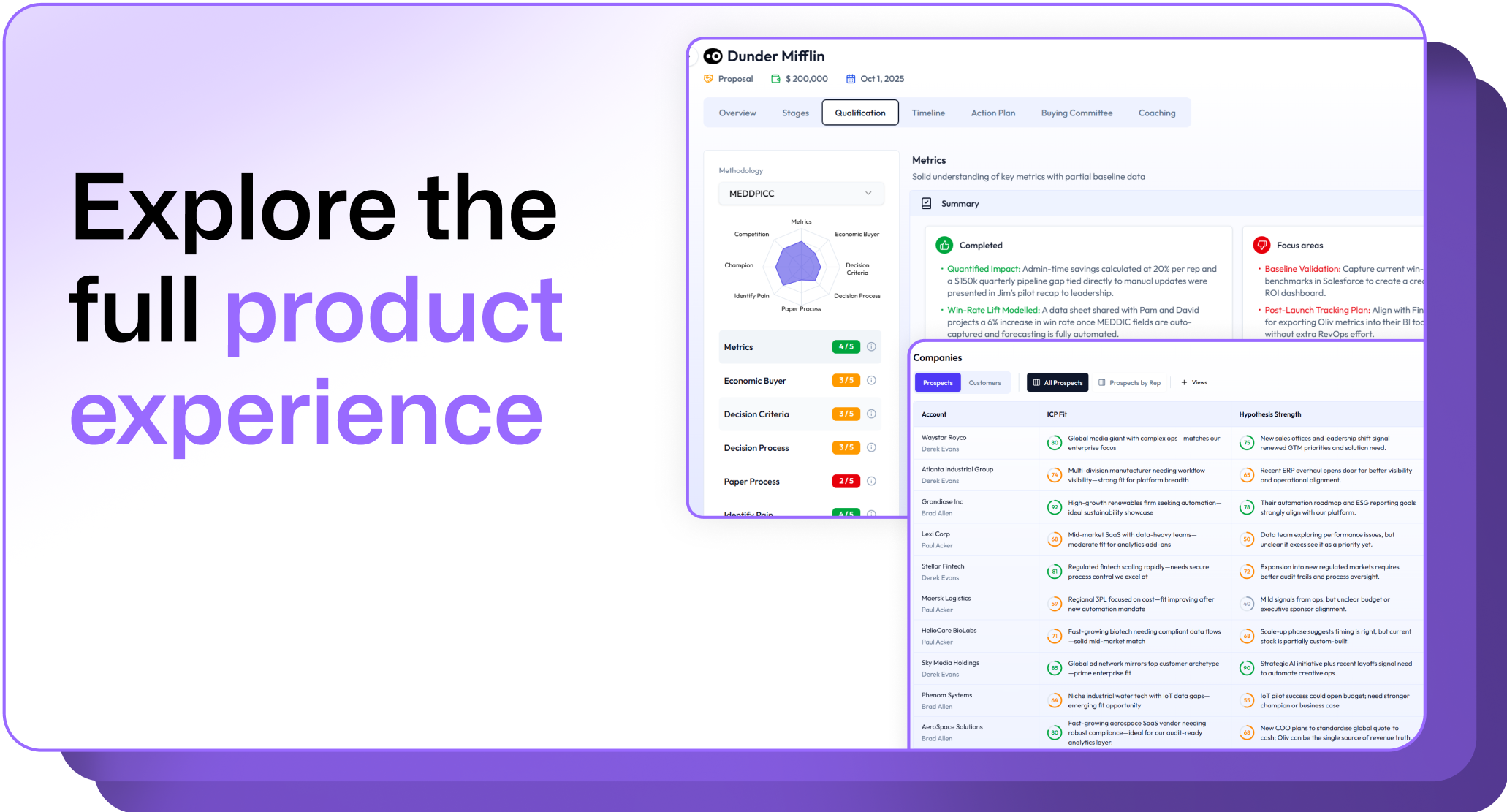
.avif)
.png)





.png)
.png)