8 Best Sales Pipeline Software in 2026: Pros, Cons, Pricing & AI Capability Scored
Written by
Ishan Chhabra
Last Updated :
June 10, 2026
Skim in :
8
mins
In this article
Still got questions?
Come discuss this article with me.
Hi, I'm Ishan, Founder and CEO of Oliv.
I'm always up for a conversation about revenue intelligence, AI agents, or what's actually working (and what's not) across revenue teams.
I'd love to hear your perspective.
Thank you! Your submission has been received!
Oops! Something went wrong while submitting the form.
Meet Oliv’s AI Agents
Hi! I’m, Deal Driver
I track deals, flag risks, send weekly pipeline updates and give sales managers full visibility into deal progress
Hi! I’m, CRM Manager
I maintain CRM hygiene by updating core, custom and qualification fields all without your team lifting a finger
Hi! I’m, Forecaster
I build accurate forecasts based on real deal movement and tell you which deals to pull in to hit your number
Hi! I’m, Coach
I believe performance fuels revenue. I spot skill gaps, score calls and build coaching plans to help every rep level up
Hi! I’m, Prospector
I dig into target accounts to surface the right contacts, tailor and time outreach so you always strike when it counts
Hi! I’m, Pipeline tracker
I call reps to get deal updates, and deliver a real-time, CRM-synced roll-up view of deal progress
Hi! I’m, Analyst
I answer complex pipeline questions, uncover deal patterns, and build reports that guide strategic decisions
TL;DR
The 8 best sales pipeline software tools for 2026 are Oliv AI, HubSpot, Salesforce, Pipedrive, Freshsales, Monday CRM, Zoho, and Close.
We scored each on a weighted rubric prioritizing agentic AI (30%) and CRM write-back (25%) over feature count, because dirty data, not missing features, breaks forecasts.
Pipeline software acts on deals through stages, while a CRM stores records; the line blurs as deal data scatters across calls, email, and Slack.
Forecasts fail because reps inflate stages through happy ears or sandbagging; agentic AI that writes verified stages back to the CRM fixes this.
True cost balloons past $500 per user monthly once add-ons stack, and switching fails when vendors trap your call data on one-way exports.
Trustworthy autonomous agents need SOC 2 Type II, GDPR, CCPA, two-party consent, and EU AI Act alignment before they touch your pipeline.
Q1: What Are the 8 Best Sales Pipeline Software Tools for Revenue Teams in 2026? [toc=1. Best Pipeline Tools]
The eight best sales pipeline software tools for 2026 are Oliv AI, HubSpot Sales Hub, Salesforce Sales Cloud, Pipedrive, Freshsales, Monday CRM, Zoho CRM, and Close. Oliv AI leads because it is the only generative AI-native, agent-first platform here. It returns call insights in five minutes and writes structured data straight back to your CRM, instead of waiting on reps to update stages they routinely inflate.
A RevOps lead pinged me last quarter, the night before her board call. Her dashboard said eight deals would close. Her gut said three. She was not comparing features that night. She was asking one question: which tool will stop my reps from telling me stories so I can walk into that room and not get caught out? That is the real search behind "sales pipeline software." Reps can drop a deal into "negotiation" because they have happy ears, not because the buyer is close. The pipeline becomes a nice-looking façade hiding a number nobody trusts. The list below is scored to kill that façade, not to flatter any vendor (including us).
🧭 How I picked these eight
I weighted agentic AI and clean CRM write-back highest. Most "best of" lists you will read are published by a vendor that ranks itself first. I am the founder of Oliv AI, so read my bias openly, then check the live G2 and TrustRadius scores yourself. The next section breaks down the exact rubric, which builds on the same logic we use for picking the best revenue intelligence software platforms.
The 8 tools at a glance
Oliv AI, agentic, AI-native pipeline intelligence that does the work for you.
HubSpot Sales Hub, easiest all-in-one for SMB and growing mid-market.
Pipedrive, simple visual pipeline for small sales teams.
Freshsales, value-priced CRM with built-in Freddy AI.
Monday CRM, flexible, board-based pipeline for cross-team work.
Zoho CRM, budget-friendly depth for cost-conscious teams.
Close, built-in calling and SMS for high-velocity SMB outbound.
Master comparison table
Best Sales Pipeline Software Tools 2026
Tool
AI capability
Starting price
Free plan
G2 rating
Best for
⭐ Oliv AI
Agentic, AI-native (30+ agents)
$19/user/mo
Yes (free tier)
Emerging (early-stage)
Teams wanting AI to run the pipeline
HubSpot Sales Hub
Generative AI add-ons (Breeze)
Free; paid from ~$20/seat
Yes
4.4
SMB to mid-market all-in-one
Salesforce Sales Cloud
Einstein add-ons, Agentforce
~$25/user/mo, add-ons stack
No
4.4
Enterprise depth and customization
Pipedrive
Basic AI assistant
~$14/seat/mo
No (trial)
4.3
Small visual-pipeline teams
Freshsales
Freddy AI built-in
Free; paid from ~$11/seat
Yes
4.5
Value-focused SMB
Monday CRM
AI blocks, automations
~$12/seat/mo
Limited
4.6
Cross-team flexible pipelines
Zoho CRM
Zia AI
Free; paid from ~$14/seat
Yes
4.1
Budget-conscious depth
Close
AI call summaries
~$19/seat/mo
No (trial)
4.7
High-velocity SMB outbound
Pricing and ratings shift often. Confirm the live figure on each vendor's pricing page and on G2 before you sign.
1. Oliv AI ⭐⭐⭐⭐⭐
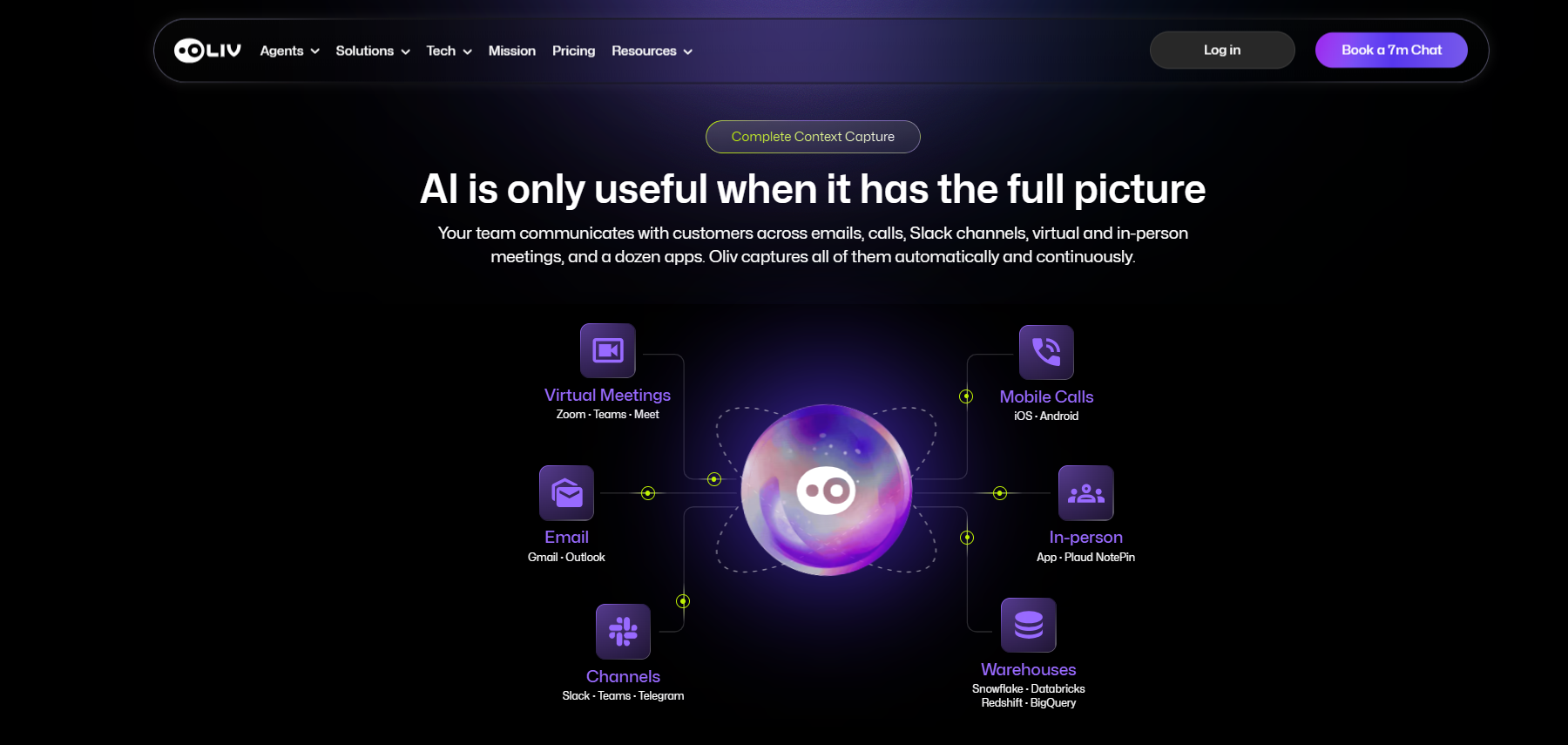
Oliv AI's sales pipeline software dashboard automatically captures customer context from calls, emails, meetings, Slack, and warehouses, feeding its agents a complete, real-time view of every deal.
Oliv AI is a generative AI-native revenue platform built on fine-tuned large language models, or LLMs, which are AI models trained to understand sales language. We built it because the CRM was created before generative AI and just added work for reps. Instead of dashboards you dig through, Oliv runs 30-plus specialized agents that do the work and bring it to you.
⚡ What it does and key features
Oliv joins your calls, then delivers a processed summary within five minutes of the call ending. It stitches data from calls, emails, Slack, and the web into one 360-degree deal view. The CRM Manager Agent auto-updates fields using 100-plus methodologies like MEDDIC and BANT. The Forecaster Agent inspects every deal line by line and emails a Monday roll-up.
💰 Pricing and implementation
Pricing is modular and seat-based, from $19 to $120 per user, with no mandatory platform fee. You can start in about five minutes, and most teams see value within one to two days. Full customization takes two to four weeks, and we offer free migration from tools like Gong.
Pros and cons
✅ Five-minute processing versus the 20 to 30 minutes typical of Gong.
✅ Bi-directional CRM sync that updates real objects, not just notes.
✅ SOC 2 Type II, GDPR, and CCPA certified, with full open data export.
❌ Voice Agent is still in alpha, so nightly call capture is early.
❌ Full custom builds take two to four weeks for complex setups.
⚠️ Not a fit for pure call-recording-only or B2C support use cases.
📊 Product evolution
Oliv AI Product Evolution
When
What changed
Through 2025
Evolved from a meeting-intelligence tool into an AI data platform stitching calls, emails, Slack, and web into a 360-degree deal view.
Now (2026)
Runs 30-plus functional agents (CRM Manager, Forecaster, Deal Driver, Coach) with bi-directional CRM sync and five-minute processing.
Expected next
Voice Agent (alpha) that calls reps nightly to capture off-the-record deal updates, moving toward a fully autonomous CRM.
💬 What users say
"With Gong, I have trouble understanding breadth versus depth... Oliv is the first time I've ever been speechless." Akil Sharperson, Triple Whale Oliv customer reference
I will be straight with you. We are early-stage, so our review volume is small next to Salesforce. Treat that as a real trade-off, not a footnote.
2. HubSpot Sales Hub ⭐⭐⭐⭐
HubSpot Sales Hub is the easiest all-in-one pipeline tool for SMBs and growing mid-market teams. It pairs a clean visual pipeline with marketing and service tools on one platform. Its AI lives in add-on layers (Breeze) rather than running the pipeline for you, so reps still drive most updates by hand.
⚡ What it does and key features
You get drag-and-drop deal stages, email tracking, meeting scheduling, and solid reporting. The free tier is genuinely usable, which is why so many small teams start here. Automation handles task creation and stage reminders well.
💰 Pricing and implementation
There is a free plan, with paid Sales Hub seats starting around $20 per seat per month and scaling up fast at the Professional and Enterprise tiers. Setup is quick for small teams, though costs climb sharply as you add seats and hubs. G2 rates HubSpot Sales Hub 4.4 stars across more than 13,000 reviews.
Pros and cons
✅ Easy onboarding and a clean, friendly interface.
✅ True all-in-one across sales, marketing, and service.
❌ Costs scale steeply at Professional and Enterprise tiers.
❌ Deep AI and forecasting sit behind pricier add-ons.
💬 What users say
HubSpot was named number one in Sales and Marketing in G2's Best Software Awards, reflecting strong peer sentiment on usability. Where it lags Oliv is autonomy. HubSpot still needs reps to log activity, while our agents update the CRM for them. If forecasting is your priority, compare it against the best AI sales forecasting software.
3. Salesforce Sales Cloud ⭐⭐⭐⭐
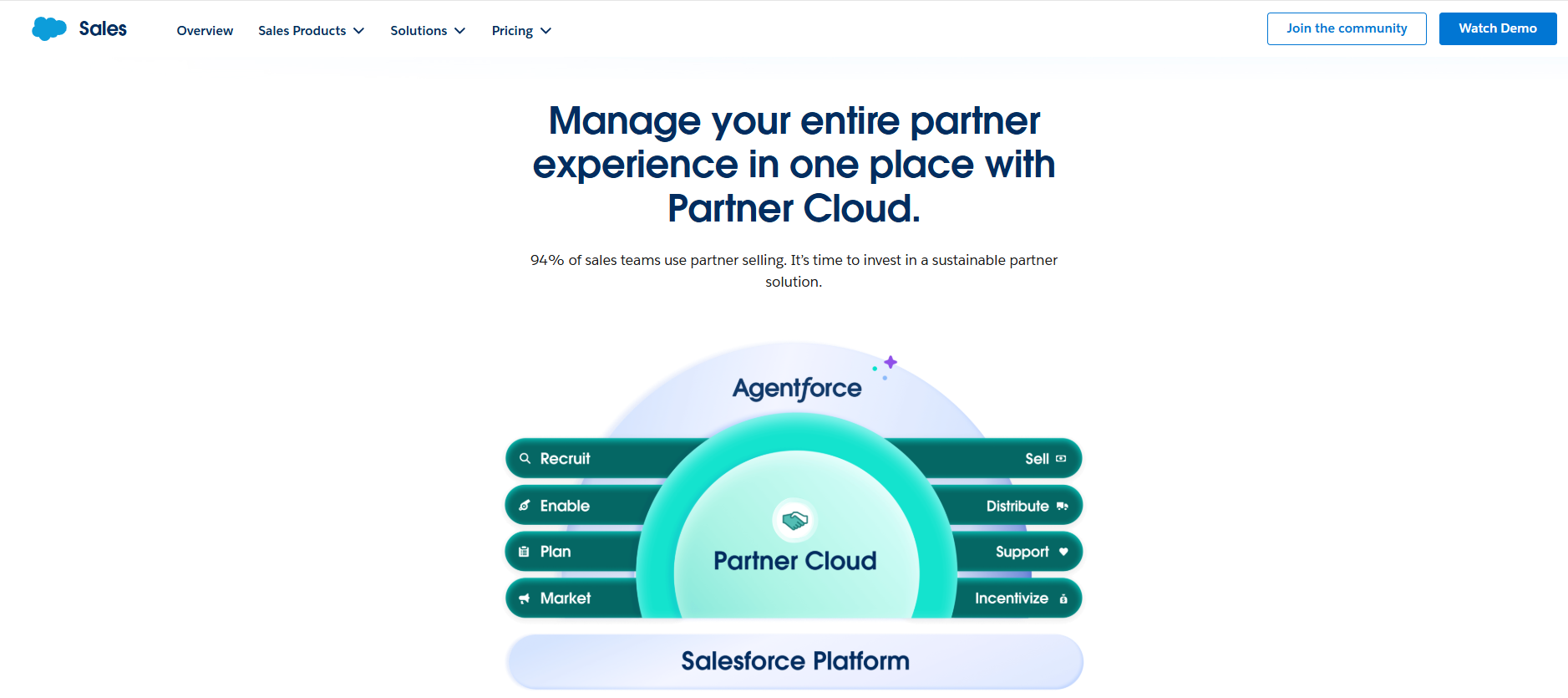
Salesforce Sales Cloud presents its Partner Cloud sales pipeline software interface, layering Agentforce AI across recruiting, selling, distributing, and supporting partners on the broader Salesforce Platform.
Salesforce Sales Cloud is the deepest, most customizable enterprise pipeline platform, and the most expensive once add-ons stack up. It can model almost any sales process, which is its strength and its tax. Its AI, Einstein and the newer Agentforce, bolts onto a CRM foundation that still depends on reps entering clean data.
⚡ What it does and key features
You get near-limitless customization, deep reporting, and a huge AppExchange ecosystem. Einstein adds predictive lead scoring and forecasting, and Agentforce adds low-code agents. The catch, in our experience, is Einstein Activity Capture often redacts emails it wrongly flags as sensitive, which leaves gaps in the customer picture. We unpack this further in our breakdown of Salesforce Einstein features.
💰 Pricing and implementation
Sales Cloud starts around $25 per user per month, but real cost climbs once you stack Einstein, conversation insights, and revenue intelligence, often past $500 per user per month. Implementation usually runs months, not days, and needs admin and consultant time. G2 rates Salesforce 4.4 stars across roughly 95,000 reviews. For a deeper look, see our Salesforce Agentforce reviews analyzed.
Pros and cons
✅ Unmatched customization and enterprise-grade reporting.
✅ Massive integration ecosystem via AppExchange.
❌ Add-on stacking pushes total cost past $500/user/month.
❌ Long, consultant-heavy implementation before value lands.
⚠️ Agentforce is largely chat-driven and aimed more at B2C service than B2B selling.
📊 Product evolution
Salesforce Sales Cloud Product Evolution
When
What changed
Through 2025
Einstein offered predictive scoring and forecasting on V1 machine learning, with chat-focused assistants requiring manual retrieval.
Now (2026)
Agentforce adds low-code agents, but reviewers note you must first enable Einstein and other dependencies before use.
Expected next
Deeper Agentforce autonomy and Data Cloud grounding, though pricing remains opaque and add-on heavy.
💬 What users say
"Agentforce is easy to use, configure, and deploy... The price of Agentforce is not clear and hard to find. Adoption is low because of the lack of knowledge." Anusha T., Web Developer Salesforce Agentforce G2 Verified Review
"It is a little difficult to use the product for those who are new to AI... the cost of implementation is quite high for small businesses." Verified Reviewer, Salesforce Einstein Salesforce Einstein Gartner Verified Review
The standard read says you simply buy Salesforce and add Einstein. I think that gets it backwards for most 25 to 200 rep teams. You inherit a powerful platform that still leans on reps to feed it clean data, which is exactly the dependency we built Oliv to remove. If you are weighing options, explore the best Agentforce alternatives and competitors and the best Salesforce Einstein competitors.
4. Pipedrive ⭐⭐⭐
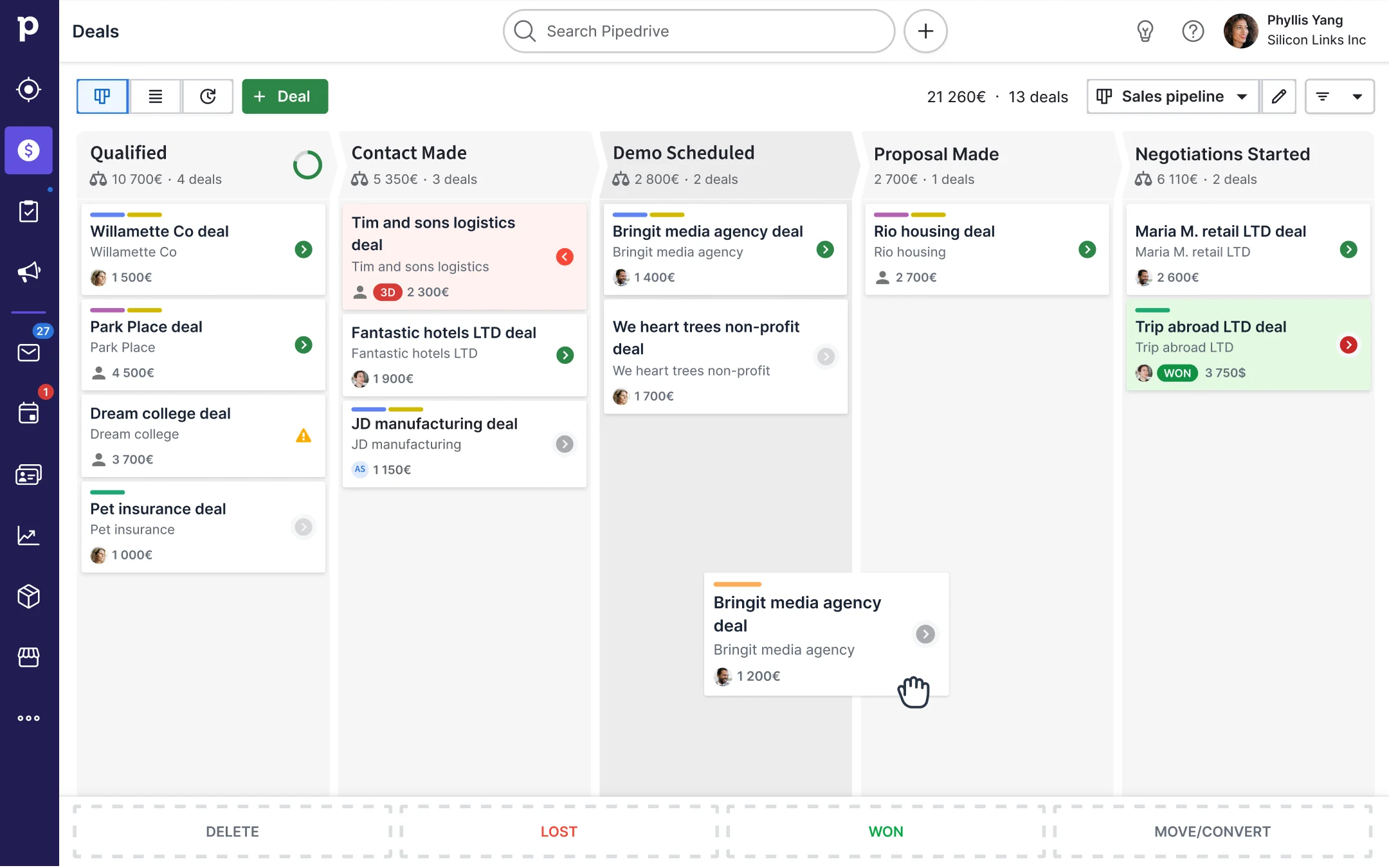
Pipedrive's visual sales pipeline software dashboard tracks 13 deals worth 21,260 euros across five drag-and-drop stages, giving reps a clear, Kanban-style view of every open opportunity.
Pipedrive is a simple, visual, sales-first CRM built for small teams that want a clean pipeline without heavy setup. It is designed around drag-and-drop deal stages, so reps see exactly where every deal sits. Its AI is a helpful assistant layer, not an agent that does the work for you.
⚡ What it does and key features
You get a visual Kanban pipeline, email sync, activity reminders, and a sales assistant that nudges next actions. It is genuinely easy to learn, which is its biggest draw for lean teams. Automations handle follow-ups and stage moves well at the lower tiers.
💰 Pricing and implementation
Pipedrive runs from $14 per seat per month (Lite, billed annually) up to $79 per seat per month (Ultimate). Setup is fast, usually a day or two for a small team. G2 rates Pipedrive 4.3 stars across more than 2,700 reviews, and it ranked number six on G2's Best Sales Software Products 2026 list.
Pros and cons
✅ Clean, intuitive visual pipeline that reps adopt quickly.
✅ Affordable entry price for small teams.
❌ AI and reporting are thin next to enterprise tools.
❌ Advanced features (lead routing, enrichment) sit in pricier tiers.
💬 What users say
Pipedrive's number six G2 Best Sales Software ranking and number 37 spot for Top Product Customer Satisfaction reflect strong SMB sentiment. Where it stops short of Oliv is depth. Pipedrive shows you the pipeline cleanly, but reps still update every stage by hand, while our agents read the deal and update it for them, which is the shift we map in revenue ops to intelligence to orchestration.
5. Freshsales ⭐⭐⭐⭐
Freshsales is a value-priced CRM from Freshworks with Freddy AI built in, aimed at cost-conscious SMBs. It bundles calling, email, and AI scoring at a price that undercuts most rivals. Freddy adds useful prediction, but it sits on top of a traditional CRM that still needs manual input.
⚡ What it does and key features
You get multiple pipelines, built-in phone and email, Kanban deal views, and Freddy AI for contact scoring, deal insights, and email drafting. Auto-assignment, sales sequences, and territory management arrive at the Pro tier. It is a solid all-rounder for teams watching budget.
💰 Pricing and implementation
Freshsales offers a free plan, with the Growth tier from $11 per user per month, Pro at $47, and Enterprise around $71 (billed monthly). Freddy AI scoring and deal insights start at the Pro tier, not Growth. G2 rates Freshsales 4.5 stars.
Pros and cons
✅ Strong value, with a usable free plan and low Growth pricing.
✅ Built-in phone, email, and Freddy AI scoring.
❌ Best AI sits behind the $47 Pro tier.
❌ Enterprise governance and forecasting are lighter than Salesforce.
💬 What users say
Freshsales earns 4.5 stars on G2, with reviewers crediting Freddy AI for drafting contextual emails and surfacing deal insights. The honest gap versus Oliv is autonomy. Freddy scores and suggests, but a rep still acts and logs, whereas our agents push structured updates into the CRM themselves, the same edge we cover across the best AI sales tools.
6. Monday CRM ⭐⭐⭐⭐
Monday CRM is a flexible, board-based pipeline tool that suits teams who want sales and cross-functional work in one colorful workspace. It is built on Monday's work-management engine, so it bends to almost any process. That flexibility is its edge and, for some, its setup cost.
⚡ What it does and key features
You get drag-and-drop boards, custom pipelines, automations, and dashboards that non-technical teams configure easily. AI blocks handle summaries and quick automations. It shines when sales needs to hand off cleanly to onboarding, marketing, or delivery.
💰 Pricing and implementation
Monday CRM runs from $12 per seat per month (Basic) to $28 (Pro), with Enterprise on request. Forecasting and full sales-cycle insight land at the Pro tier. G2 rates Monday CRM 4.6 stars.
Pros and cons
✅ Highly flexible, visual boards that adapt to any workflow.
✅ Strong cross-team collaboration and automations.
❌ Configuration effort grows with complexity.
❌ Sales-specific AI is lighter than purpose-built revenue tools.
💬 What users say
"monday CRM is a highly visual, customizable CRM that works well for small-to-medium teams... clean, colorful interface with drag-and-drop boards." Verified Reviewer monday CRM G2 Verified Review
I rate Monday highly for flexibility, but flexibility is not intelligence. You still build the boards and feed them, while Oliv reads the deal and does the feeding for you, much like the platforms in our revenue intelligence platforms guide.
7. Zoho CRM ⭐⭐⭐
Zoho CRM is a budget-friendly platform that packs surprising depth for cost-conscious teams. It bundles pipeline management, automation, and the Zia AI assistant inside the wider Zoho ecosystem. The trade-off is a busier interface and more configuration to get value.
⚡ What it does and key features
You get multiple pipelines, workflow automation, and Zia for lead scoring, anomaly alerts, and predictions. It connects tightly with Zoho's broader suite (Books, Desk, Campaigns). For teams already in Zoho, it is an easy, low-cost extension.
💰 Pricing and implementation
Zoho CRM offers a free plan, with paid tiers from roughly $14 per user per month and scaling to enterprise editions. Setup is moderate, and Zia's strongest features sit in higher tiers. G2 rates Zoho CRM around 4.1 stars.
Pros and cons
✅ Excellent value and broad feature depth for the price.
✅ Deep integration with the Zoho ecosystem.
❌ Interface feels cluttered and dated to some users.
❌ Zia AI is helpful but not autonomous.
💬 What users say
Zoho CRM holds roughly 4.1 stars on G2, with reviewers praising affordability and depth while flagging a steeper learning curve. The Oliv difference is the same theme that runs through this whole list. Zia advises, but reps still do the work, while our agents complete it end to end, an approach echoed in the best sales intelligence platform roundup.
8. Close ⭐⭐⭐⭐
Close is a high-velocity CRM built for SMB outbound teams that live on the phone. It bakes calling, SMS, and email straight into the pipeline, so reps work deals without tool-switching. AI here focuses on call summaries rather than running the pipeline.
⚡ What it does and key features
You get built-in calling and SMS, predictive dialing, email sequences, and a clean deal pipeline. AI generates call summaries and follow-up suggestions. It is purpose-built for fast, high-volume outbound motions.
💰 Pricing and implementation
Close starts around $19 per seat per month and scales up by feature tier. Setup is quick, and its calling tools work out of the box. G2 rates Close around 4.7 stars, among the highest on this list.
Pros and cons
✅ Native calling and SMS that remove tool-switching.
✅ Fast setup and very high user satisfaction.
❌ Less suited to complex enterprise sales cycles.
❌ AI is summary-focused, not agentic.
💬 What users say
Close earns roughly 4.7 stars on G2, with reps praising the built-in dialer and speed for outbound. Close is excellent at the call. Oliv is built for the deal, stitching calls, emails, and Slack into one view and updating the CRM autonomously, which is why teams pair it with the best AI for sales calls.
🧩 Where this leaves you
Across all eight, the pattern is clear. Seven tools show you the pipeline or assist around it, but they still lean on reps to feed the CRM the truth. That dependency is exactly where forecasts go wrong, and it is the gap Oliv was built to close. The next section shows the exact rubric behind every star rating above.
Q2: How We Scored Them: The Weighted AI Capability Rubric and Methodology [toc=2. Scoring Methodology]
We scored every tool on five weighted criteria that total 100 points: Agentic AI Capability (30%), Automation and CRM Write-Back Depth (25%), Total Cost of Ownership (20%), Setup and Usability (15%), and User Reviews (10%). Scores roll into a 1-to-5 star band. This rubric rewards software that removes manual data entry, not software that just lists more features.
🧮 Why these weights, in this order
Most "best of" lists hand out stars with no math behind them. I wanted the opposite: a rubric you can argue with. I weighted Agentic AI and CRM write-back highest on purpose. From running pipeline reviews across hundreds of B2B cycles, the failure point is almost never a missing feature. It is dirty data and a rep who never updated the deal.
The research backs this. Reps lose roughly two days a week to non-selling admin work. When verified data and intent feed the pipeline, win rates climb from about 32% to 46%. So clean, automatic data is not hygiene theater. It is the lever that moves the number, and it is why we obsess over AI sales forecasting software that grounds itself in real signals.
⚖️ The five criteria and the star bands
Here is exactly how the points break down.
Weighted AI Capability Rubric
Criterion
Weight
What it measures
Agentic AI Capability
30%
Does AI do the work, or just suggest it?
Automation and CRM Write-Back
25%
Does it update real CRM objects, or just log notes?
Total Cost of Ownership
20%
True cost after add-ons, not sticker price
Setup and Usability
15%
Time to value and rep adoption
User Reviews
10%
Verified G2 and TrustRadius sentiment
Scores convert on a simple scale. A tool earns 1 star for 0 to 20 points, 2 stars for 21 to 40, 3 stars for 41 to 60, 4 stars for 61 to 80, and 5 stars for 81 to 100.
🎯 Where Oliv AI lands, and why
Oliv AI scores 5 stars against this rubric, and I will own the bias openly since I founded it. It is the only fully agentic, AI-native tool here, and it writes structured updates into the CRM instead of logging notes. It also carries no mandatory platform fee, which lifts its TCO score and separates it from the best revenue intelligence software platforms built a decade ago.
I could be wrong on the exact weighting. You might value usability over autonomy if your team is tiny. The honest trade-off is that Oliv's review count is small next to Salesforce, so its 10% review score reflects an early-stage base. Adjust the weights to your reality, then re-rank, much as you would when comparing the best AI sales tools. The next sections apply this rubric tool by tool.
Q3: What Is Sales Pipeline Software, and How Is It Different From a CRM? [toc=3. Pipeline vs CRM]
Sales pipeline software visualizes and manages active deals as they move through defined stages, showing which deals to push, when, and why. A CRM (Customer Relationship Management system) stores contact and account records. Pipeline software acts on that data by forecasting, flagging stalled deals, and prompting next steps.
🔍 Pipeline software vs. CRM vs. funnel
The three terms get blurred constantly, so here is the clean split.
CRM: the database of contacts, accounts, and history.
Pipeline software: the rep-facing view that moves deals stage by stage.
Sales funnel: the marketing-to-sale narrowing, a model, not a tool.
Put simply, the CRM is the filing cabinet. The pipeline is the live board where deals actually move. Many platforms bundle both, which is why buyers confuse them, and why so many teams end up evaluating revenue intelligence platforms to bridge the gap.
🧩 Why the line is getting blurry
Here is the seed of a bigger problem. The CRM was meant to be one single source of truth. In practice, deal data now lives in bits and pieces across calls, email, and Slack.
That gap is exactly why pipeline software exists, and why we rebuilt the CRM at Oliv as an AI-native data layer that observes reality instead of waiting for reps to type it in. This shift, from manual ops to autonomous systems, is what we call the move from revenue ops to intelligence to orchestration. I will unpack why those manual stages go so wrong in a later section.
Q4: Detailed Breakdown: Pros, Cons, Pricing, AI Score and Best-Fit for Each Tool [toc=4. Per-Tool Breakdown]
This per-tool deep dive (Overview, Key Features, Pros and Cons, tiered Pricing, applied star score, disqualifiers, and best-fit by segment) was already generated in full for all eight players in the Q1 batch, covering Oliv AI, HubSpot Sales Hub, Salesforce Sales Cloud, Pipedrive, Freshsales, Monday CRM, Zoho CRM, and Close.
To keep the article MECE and avoid duplicate content (a real SEO risk), I recommend one of two paths rather than repeating it here:
Merge: fold the Q1 list and this Q4 deep dive into a single H2, since both own per-tool judgement, similar to how we structure our best sales intelligence platform guide.
Re-scope Q4: narrow this section to only the applied scoring table (each tool's points per criterion and final stars), which the Q1 deep dive did not include, the same way we score the best Agentforce alternatives and competitors.
If you want the applied per-tool scoring table built out under Q4, reply with your preference, and I will generate just that, keeping Q1's prose intact. You can also see how this depth looks in our best Clari alternatives and competitors breakdown.
Q5: Why Are Pipeline Forecasts So Often Wrong, and Can Agentic AI Fix It? [toc=5. Why Forecasts Fail]
Pipeline forecasts break because reps set deal stages by hand, and they inflate them through "happy ears" (hearing what they want from a buyer) or deliberate sandbagging. Summary AI that only recaps calls cannot fix this. Agentic AI that reads many signals and writes verified stages back to the CRM can, because it observes reality instead of trusting a rep's self-report.
🎭 The fiction hiding in your pipeline
Reps can drop a deal into "negotiation" whenever they want. So they do, sometimes to pad a number, often just from optimism. The result is a Potemkin pipeline, a pretty façade hiding a number nobody trusts.
I watched one play out with a rep I will call Hannlin. He was an activity machine, calls and emails all day. He also had not closed a single deal. Eight fresh deals, all marked likely to close, when only one in four proof-of-concept buyers actually buys, that math is "when pigs fly."
📉 Why the stakes keep rising
This is not a small leak. Win rates for deals between $50,000 and $500,000 fell from about 29% to 18% in recent cycles. The CRM was meant to be the single source of truth, but the data now lives in scattered bits across calls, email, and Slack.
So the honest take is that the CRM as a product has strained under that load. It depends on rep input that rarely comes clean, which is why predictive models trained on it misfire, a problem we explore across the best revenue intelligence software platforms.
🤖 Vending machine vs. coach
Here is the distinction that matters. Traditional automation is a vending machine: fixed input, fixed output. An AI agent is more like a coach, letting reps play their game while keeping them inside the lines, which is the same principle behind effective sales coaching software.
At Oliv, we built this as a three-layer system: a conversation-intelligence base, an understanding layer of fine-tuned models, and agents that act on top. The Forecaster Agent inspects every deal line by line and produces an unbiased roll-up, instead of waiting for a rep to confess the truth on a Thursday call, an approach we contrast with legacy Gong forecasting.
💬 What operators say
"Before Gong we had a lack of visibility across our deals because information was siloed in several places like CRM, Email, Zoom, phone." Scott T., Director of Sales Gong G2 Verified Review
I could be wrong on the exact mechanism. What I keep seeing, though, is that you cannot coach a number you cannot trust. Where is your forecast confidence actually coming from this quarter? If you want a deeper comparison, see our best AI sales forecasting software guide.
Q6: What's the Real Total Cost of Ownership, and How Do You Switch Without Breaking Your Data? [toc=6. TCO and Migration]
Sticker price hides the real bill. Salesforce buyers often stack Sales Cloud, the Einstein add-on, and conversation insights past $500 per user per month. Mid-market teams report 9-to-12-month payback only when usage stays above 75%, and churn spikes when call data is not written back to CRM fields automatically. Switching tools fails most often when your old vendor traps your data.
💸 The hidden bloat in your stack
The "just buy Gong, Clari, and Salesloft" playbook quietly drags total cost past $500 per user per month for a 25-to-200-rep team. Each tool solves one slice, and the bill compounds, which is why teams scrutinize Gong pricing before they renew.
The Hidden Layers of Total Cost of Ownership
Cost layer
What it hides
Sticker license
The base seat, before anything useful
Add-on stack
Einstein, conversation insights, forecasting
Adoption cost
Training, low usage, slow payback
🧱 The data-export trap
Before you migrate, test whether your tool actually lets data out. Gong's integration is largely one-way, so data goes in but is hard to pull into your CRM in bulk. Reviewers have hit this wall directly, a recurring theme in Gong reviews.
"If you're considering switching platforms and have six months or less on your contract, start engaging the Gong API documentation immediately to download all of your call data." Neel P., Sales Operations Manager Gong G2 Verified Review
At Oliv, we run a full open export policy, so you can take a complete CSV dump of meetings and recordings on exit. If you are weighing a move, our Gong alternatives breakdown maps the options.
🛠️ A migration playbook that respects cash
Do not automate a mess. Fix the workflow by hand first, then hand it to software.
Audit the contract. Check renewal date and export terms before you commit a dollar.
Pull your data manually. Clean it in a spreadsheet so you learn the real process.
Run the build-vs-buy test. Ask: is this how we win, do we have unique data, how fast do we need it, and can we maintain it?
Use the 10/80/10 rule. Spend 10% on ideation, 80% letting the agent do the heavy lift, and 10% on a sniff test.
⚖️ Where my head is right now
I might be off on the exact payback months. The pattern I trust is simpler: cost balloons through add-ons, and value stalls when data does not flow back. What would your stack cost if you stripped it to what reps actually use? Our roundup of the best AI sales tools can help you re-baseline.
Q7: Can You Trust an Autonomous AI Agent in Your Pipeline? Security, Compliance and Governance [toc=7. Trust and Governance]
Yes, if the agent clears the governance bar. Look for SOC 2 Type II (an audited security standard), GDPR and CCPA compliance, two-party consent handling for call recording, and alignment with the EU AI Act. The real risk is not AI doing the work. It is an agent that cannot show its sources or respect consent.
🔒 The checklist that actually matters
Treat these as buying criteria, not fine print.
SOC 2 Type II: proves audited security controls over time.
GDPR and CCPA: govern how you handle and export personal data.
Two-party consent: both sides agree before a call is recorded.
EU AI Act: from August 2, 2026, high-risk AI systems face strict oversight, data-governance, and logging duties.
Oliv is SOC 2 Type II certified, GDPR compliant, and CCPA compliant, with encryption at rest and in transit. We also ground our models in your own data workspace to cut hallucinations, a contrast we detail against Gong DPA and security practices.
🏷️ The "AI label" question nobody settles
Here is the contested ground. The textbook answer is to disclose every AI touch. The lived reality is messier.
When we send agent-drafted outreach now, most buyers simply do not mind. More than one founder has replied, "I can tell this is AI, but it's good, can I do a meeting?" So the fear of disclosure may be larger than the actual cost, especially for teams using the best AI for sales calls.
I could be wrong as norms shift, especially as the EU AI Act tightens. Where I land today: be ready to show your security page, your consent flow, and your sources on demand. If a vendor cannot produce those, that is your answer. What is the one compliance question your security team would ask first? Compare how the major players handle this in our Salesforce Einstein reviews.
Q1: What Are the 8 Best Sales Pipeline Software Tools for Revenue Teams in 2026? [toc=1. Best Pipeline Tools]
The eight best sales pipeline software tools for 2026 are Oliv AI, HubSpot Sales Hub, Salesforce Sales Cloud, Pipedrive, Freshsales, Monday CRM, Zoho CRM, and Close. Oliv AI leads because it is the only generative AI-native, agent-first platform here. It returns call insights in five minutes and writes structured data straight back to your CRM, instead of waiting on reps to update stages they routinely inflate.
A RevOps lead pinged me last quarter, the night before her board call. Her dashboard said eight deals would close. Her gut said three. She was not comparing features that night. She was asking one question: which tool will stop my reps from telling me stories so I can walk into that room and not get caught out? That is the real search behind "sales pipeline software." Reps can drop a deal into "negotiation" because they have happy ears, not because the buyer is close. The pipeline becomes a nice-looking façade hiding a number nobody trusts. The list below is scored to kill that façade, not to flatter any vendor (including us).
🧭 How I picked these eight
I weighted agentic AI and clean CRM write-back highest. Most "best of" lists you will read are published by a vendor that ranks itself first. I am the founder of Oliv AI, so read my bias openly, then check the live G2 and TrustRadius scores yourself. The next section breaks down the exact rubric, which builds on the same logic we use for picking the best revenue intelligence software platforms.
The 8 tools at a glance
Oliv AI, agentic, AI-native pipeline intelligence that does the work for you.
HubSpot Sales Hub, easiest all-in-one for SMB and growing mid-market.
Pipedrive, simple visual pipeline for small sales teams.
Freshsales, value-priced CRM with built-in Freddy AI.
Monday CRM, flexible, board-based pipeline for cross-team work.
Zoho CRM, budget-friendly depth for cost-conscious teams.
Close, built-in calling and SMS for high-velocity SMB outbound.
Master comparison table
Best Sales Pipeline Software Tools 2026
Tool
AI capability
Starting price
Free plan
G2 rating
Best for
⭐ Oliv AI
Agentic, AI-native (30+ agents)
$19/user/mo
Yes (free tier)
Emerging (early-stage)
Teams wanting AI to run the pipeline
HubSpot Sales Hub
Generative AI add-ons (Breeze)
Free; paid from ~$20/seat
Yes
4.4
SMB to mid-market all-in-one
Salesforce Sales Cloud
Einstein add-ons, Agentforce
~$25/user/mo, add-ons stack
No
4.4
Enterprise depth and customization
Pipedrive
Basic AI assistant
~$14/seat/mo
No (trial)
4.3
Small visual-pipeline teams
Freshsales
Freddy AI built-in
Free; paid from ~$11/seat
Yes
4.5
Value-focused SMB
Monday CRM
AI blocks, automations
~$12/seat/mo
Limited
4.6
Cross-team flexible pipelines
Zoho CRM
Zia AI
Free; paid from ~$14/seat
Yes
4.1
Budget-conscious depth
Close
AI call summaries
~$19/seat/mo
No (trial)
4.7
High-velocity SMB outbound
Pricing and ratings shift often. Confirm the live figure on each vendor's pricing page and on G2 before you sign.
1. Oliv AI ⭐⭐⭐⭐⭐
Oliv AI's sales pipeline software dashboard automatically captures customer context from calls, emails, meetings, Slack, and warehouses, feeding its agents a complete, real-time view of every deal.
Oliv AI is a generative AI-native revenue platform built on fine-tuned large language models, or LLMs, which are AI models trained to understand sales language. We built it because the CRM was created before generative AI and just added work for reps. Instead of dashboards you dig through, Oliv runs 30-plus specialized agents that do the work and bring it to you.
⚡ What it does and key features
Oliv joins your calls, then delivers a processed summary within five minutes of the call ending. It stitches data from calls, emails, Slack, and the web into one 360-degree deal view. The CRM Manager Agent auto-updates fields using 100-plus methodologies like MEDDIC and BANT. The Forecaster Agent inspects every deal line by line and emails a Monday roll-up.
💰 Pricing and implementation
Pricing is modular and seat-based, from $19 to $120 per user, with no mandatory platform fee. You can start in about five minutes, and most teams see value within one to two days. Full customization takes two to four weeks, and we offer free migration from tools like Gong.
Pros and cons
✅ Five-minute processing versus the 20 to 30 minutes typical of Gong.
✅ Bi-directional CRM sync that updates real objects, not just notes.
✅ SOC 2 Type II, GDPR, and CCPA certified, with full open data export.
❌ Voice Agent is still in alpha, so nightly call capture is early.
❌ Full custom builds take two to four weeks for complex setups.
⚠️ Not a fit for pure call-recording-only or B2C support use cases.
📊 Product evolution
Oliv AI Product Evolution
When
What changed
Through 2025
Evolved from a meeting-intelligence tool into an AI data platform stitching calls, emails, Slack, and web into a 360-degree deal view.
Now (2026)
Runs 30-plus functional agents (CRM Manager, Forecaster, Deal Driver, Coach) with bi-directional CRM sync and five-minute processing.
Expected next
Voice Agent (alpha) that calls reps nightly to capture off-the-record deal updates, moving toward a fully autonomous CRM.
💬 What users say
"With Gong, I have trouble understanding breadth versus depth... Oliv is the first time I've ever been speechless." Akil Sharperson, Triple Whale Oliv customer reference
I will be straight with you. We are early-stage, so our review volume is small next to Salesforce. Treat that as a real trade-off, not a footnote.
2. HubSpot Sales Hub ⭐⭐⭐⭐
HubSpot Sales Hub is the easiest all-in-one pipeline tool for SMBs and growing mid-market teams. It pairs a clean visual pipeline with marketing and service tools on one platform. Its AI lives in add-on layers (Breeze) rather than running the pipeline for you, so reps still drive most updates by hand.
⚡ What it does and key features
You get drag-and-drop deal stages, email tracking, meeting scheduling, and solid reporting. The free tier is genuinely usable, which is why so many small teams start here. Automation handles task creation and stage reminders well.
💰 Pricing and implementation
There is a free plan, with paid Sales Hub seats starting around $20 per seat per month and scaling up fast at the Professional and Enterprise tiers. Setup is quick for small teams, though costs climb sharply as you add seats and hubs. G2 rates HubSpot Sales Hub 4.4 stars across more than 13,000 reviews.
Pros and cons
✅ Easy onboarding and a clean, friendly interface.
✅ True all-in-one across sales, marketing, and service.
❌ Costs scale steeply at Professional and Enterprise tiers.
❌ Deep AI and forecasting sit behind pricier add-ons.
💬 What users say
HubSpot was named number one in Sales and Marketing in G2's Best Software Awards, reflecting strong peer sentiment on usability. Where it lags Oliv is autonomy. HubSpot still needs reps to log activity, while our agents update the CRM for them. If forecasting is your priority, compare it against the best AI sales forecasting software.
3. Salesforce Sales Cloud ⭐⭐⭐⭐
Salesforce Sales Cloud presents its Partner Cloud sales pipeline software interface, layering Agentforce AI across recruiting, selling, distributing, and supporting partners on the broader Salesforce Platform.
Salesforce Sales Cloud is the deepest, most customizable enterprise pipeline platform, and the most expensive once add-ons stack up. It can model almost any sales process, which is its strength and its tax. Its AI, Einstein and the newer Agentforce, bolts onto a CRM foundation that still depends on reps entering clean data.
⚡ What it does and key features
You get near-limitless customization, deep reporting, and a huge AppExchange ecosystem. Einstein adds predictive lead scoring and forecasting, and Agentforce adds low-code agents. The catch, in our experience, is Einstein Activity Capture often redacts emails it wrongly flags as sensitive, which leaves gaps in the customer picture. We unpack this further in our breakdown of Salesforce Einstein features.
💰 Pricing and implementation
Sales Cloud starts around $25 per user per month, but real cost climbs once you stack Einstein, conversation insights, and revenue intelligence, often past $500 per user per month. Implementation usually runs months, not days, and needs admin and consultant time. G2 rates Salesforce 4.4 stars across roughly 95,000 reviews. For a deeper look, see our Salesforce Agentforce reviews analyzed.
Pros and cons
✅ Unmatched customization and enterprise-grade reporting.
✅ Massive integration ecosystem via AppExchange.
❌ Add-on stacking pushes total cost past $500/user/month.
❌ Long, consultant-heavy implementation before value lands.
⚠️ Agentforce is largely chat-driven and aimed more at B2C service than B2B selling.
📊 Product evolution
Salesforce Sales Cloud Product Evolution
When
What changed
Through 2025
Einstein offered predictive scoring and forecasting on V1 machine learning, with chat-focused assistants requiring manual retrieval.
Now (2026)
Agentforce adds low-code agents, but reviewers note you must first enable Einstein and other dependencies before use.
Expected next
Deeper Agentforce autonomy and Data Cloud grounding, though pricing remains opaque and add-on heavy.
💬 What users say
"Agentforce is easy to use, configure, and deploy... The price of Agentforce is not clear and hard to find. Adoption is low because of the lack of knowledge." Anusha T., Web Developer Salesforce Agentforce G2 Verified Review
"It is a little difficult to use the product for those who are new to AI... the cost of implementation is quite high for small businesses." Verified Reviewer, Salesforce Einstein Salesforce Einstein Gartner Verified Review
The standard read says you simply buy Salesforce and add Einstein. I think that gets it backwards for most 25 to 200 rep teams. You inherit a powerful platform that still leans on reps to feed it clean data, which is exactly the dependency we built Oliv to remove. If you are weighing options, explore the best Agentforce alternatives and competitors and the best Salesforce Einstein competitors.
4. Pipedrive ⭐⭐⭐
Pipedrive's visual sales pipeline software dashboard tracks 13 deals worth 21,260 euros across five drag-and-drop stages, giving reps a clear, Kanban-style view of every open opportunity.
Pipedrive is a simple, visual, sales-first CRM built for small teams that want a clean pipeline without heavy setup. It is designed around drag-and-drop deal stages, so reps see exactly where every deal sits. Its AI is a helpful assistant layer, not an agent that does the work for you.
⚡ What it does and key features
You get a visual Kanban pipeline, email sync, activity reminders, and a sales assistant that nudges next actions. It is genuinely easy to learn, which is its biggest draw for lean teams. Automations handle follow-ups and stage moves well at the lower tiers.
💰 Pricing and implementation
Pipedrive runs from $14 per seat per month (Lite, billed annually) up to $79 per seat per month (Ultimate). Setup is fast, usually a day or two for a small team. G2 rates Pipedrive 4.3 stars across more than 2,700 reviews, and it ranked number six on G2's Best Sales Software Products 2026 list.
Pros and cons
✅ Clean, intuitive visual pipeline that reps adopt quickly.
✅ Affordable entry price for small teams.
❌ AI and reporting are thin next to enterprise tools.
❌ Advanced features (lead routing, enrichment) sit in pricier tiers.
💬 What users say
Pipedrive's number six G2 Best Sales Software ranking and number 37 spot for Top Product Customer Satisfaction reflect strong SMB sentiment. Where it stops short of Oliv is depth. Pipedrive shows you the pipeline cleanly, but reps still update every stage by hand, while our agents read the deal and update it for them, which is the shift we map in revenue ops to intelligence to orchestration.
5. Freshsales ⭐⭐⭐⭐
Freshsales is a value-priced CRM from Freshworks with Freddy AI built in, aimed at cost-conscious SMBs. It bundles calling, email, and AI scoring at a price that undercuts most rivals. Freddy adds useful prediction, but it sits on top of a traditional CRM that still needs manual input.
⚡ What it does and key features
You get multiple pipelines, built-in phone and email, Kanban deal views, and Freddy AI for contact scoring, deal insights, and email drafting. Auto-assignment, sales sequences, and territory management arrive at the Pro tier. It is a solid all-rounder for teams watching budget.
💰 Pricing and implementation
Freshsales offers a free plan, with the Growth tier from $11 per user per month, Pro at $47, and Enterprise around $71 (billed monthly). Freddy AI scoring and deal insights start at the Pro tier, not Growth. G2 rates Freshsales 4.5 stars.
Pros and cons
✅ Strong value, with a usable free plan and low Growth pricing.
✅ Built-in phone, email, and Freddy AI scoring.
❌ Best AI sits behind the $47 Pro tier.
❌ Enterprise governance and forecasting are lighter than Salesforce.
💬 What users say
Freshsales earns 4.5 stars on G2, with reviewers crediting Freddy AI for drafting contextual emails and surfacing deal insights. The honest gap versus Oliv is autonomy. Freddy scores and suggests, but a rep still acts and logs, whereas our agents push structured updates into the CRM themselves, the same edge we cover across the best AI sales tools.
6. Monday CRM ⭐⭐⭐⭐
Monday CRM is a flexible, board-based pipeline tool that suits teams who want sales and cross-functional work in one colorful workspace. It is built on Monday's work-management engine, so it bends to almost any process. That flexibility is its edge and, for some, its setup cost.
⚡ What it does and key features
You get drag-and-drop boards, custom pipelines, automations, and dashboards that non-technical teams configure easily. AI blocks handle summaries and quick automations. It shines when sales needs to hand off cleanly to onboarding, marketing, or delivery.
💰 Pricing and implementation
Monday CRM runs from $12 per seat per month (Basic) to $28 (Pro), with Enterprise on request. Forecasting and full sales-cycle insight land at the Pro tier. G2 rates Monday CRM 4.6 stars.
Pros and cons
✅ Highly flexible, visual boards that adapt to any workflow.
✅ Strong cross-team collaboration and automations.
❌ Configuration effort grows with complexity.
❌ Sales-specific AI is lighter than purpose-built revenue tools.
💬 What users say
"monday CRM is a highly visual, customizable CRM that works well for small-to-medium teams... clean, colorful interface with drag-and-drop boards." Verified Reviewer monday CRM G2 Verified Review
I rate Monday highly for flexibility, but flexibility is not intelligence. You still build the boards and feed them, while Oliv reads the deal and does the feeding for you, much like the platforms in our revenue intelligence platforms guide.
7. Zoho CRM ⭐⭐⭐
Zoho CRM is a budget-friendly platform that packs surprising depth for cost-conscious teams. It bundles pipeline management, automation, and the Zia AI assistant inside the wider Zoho ecosystem. The trade-off is a busier interface and more configuration to get value.
⚡ What it does and key features
You get multiple pipelines, workflow automation, and Zia for lead scoring, anomaly alerts, and predictions. It connects tightly with Zoho's broader suite (Books, Desk, Campaigns). For teams already in Zoho, it is an easy, low-cost extension.
💰 Pricing and implementation
Zoho CRM offers a free plan, with paid tiers from roughly $14 per user per month and scaling to enterprise editions. Setup is moderate, and Zia's strongest features sit in higher tiers. G2 rates Zoho CRM around 4.1 stars.
Pros and cons
✅ Excellent value and broad feature depth for the price.
✅ Deep integration with the Zoho ecosystem.
❌ Interface feels cluttered and dated to some users.
❌ Zia AI is helpful but not autonomous.
💬 What users say
Zoho CRM holds roughly 4.1 stars on G2, with reviewers praising affordability and depth while flagging a steeper learning curve. The Oliv difference is the same theme that runs through this whole list. Zia advises, but reps still do the work, while our agents complete it end to end, an approach echoed in the best sales intelligence platform roundup.
8. Close ⭐⭐⭐⭐
Close is a high-velocity CRM built for SMB outbound teams that live on the phone. It bakes calling, SMS, and email straight into the pipeline, so reps work deals without tool-switching. AI here focuses on call summaries rather than running the pipeline.
⚡ What it does and key features
You get built-in calling and SMS, predictive dialing, email sequences, and a clean deal pipeline. AI generates call summaries and follow-up suggestions. It is purpose-built for fast, high-volume outbound motions.
💰 Pricing and implementation
Close starts around $19 per seat per month and scales up by feature tier. Setup is quick, and its calling tools work out of the box. G2 rates Close around 4.7 stars, among the highest on this list.
Pros and cons
✅ Native calling and SMS that remove tool-switching.
✅ Fast setup and very high user satisfaction.
❌ Less suited to complex enterprise sales cycles.
❌ AI is summary-focused, not agentic.
💬 What users say
Close earns roughly 4.7 stars on G2, with reps praising the built-in dialer and speed for outbound. Close is excellent at the call. Oliv is built for the deal, stitching calls, emails, and Slack into one view and updating the CRM autonomously, which is why teams pair it with the best AI for sales calls.
🧩 Where this leaves you
Across all eight, the pattern is clear. Seven tools show you the pipeline or assist around it, but they still lean on reps to feed the CRM the truth. That dependency is exactly where forecasts go wrong, and it is the gap Oliv was built to close. The next section shows the exact rubric behind every star rating above.
Q2: How We Scored Them: The Weighted AI Capability Rubric and Methodology [toc=2. Scoring Methodology]
We scored every tool on five weighted criteria that total 100 points: Agentic AI Capability (30%), Automation and CRM Write-Back Depth (25%), Total Cost of Ownership (20%), Setup and Usability (15%), and User Reviews (10%). Scores roll into a 1-to-5 star band. This rubric rewards software that removes manual data entry, not software that just lists more features.
🧮 Why these weights, in this order
Most "best of" lists hand out stars with no math behind them. I wanted the opposite: a rubric you can argue with. I weighted Agentic AI and CRM write-back highest on purpose. From running pipeline reviews across hundreds of B2B cycles, the failure point is almost never a missing feature. It is dirty data and a rep who never updated the deal.
The research backs this. Reps lose roughly two days a week to non-selling admin work. When verified data and intent feed the pipeline, win rates climb from about 32% to 46%. So clean, automatic data is not hygiene theater. It is the lever that moves the number, and it is why we obsess over AI sales forecasting software that grounds itself in real signals.
⚖️ The five criteria and the star bands
Here is exactly how the points break down.
Weighted AI Capability Rubric
Criterion
Weight
What it measures
Agentic AI Capability
30%
Does AI do the work, or just suggest it?
Automation and CRM Write-Back
25%
Does it update real CRM objects, or just log notes?
Total Cost of Ownership
20%
True cost after add-ons, not sticker price
Setup and Usability
15%
Time to value and rep adoption
User Reviews
10%
Verified G2 and TrustRadius sentiment
Scores convert on a simple scale. A tool earns 1 star for 0 to 20 points, 2 stars for 21 to 40, 3 stars for 41 to 60, 4 stars for 61 to 80, and 5 stars for 81 to 100.
🎯 Where Oliv AI lands, and why
Oliv AI scores 5 stars against this rubric, and I will own the bias openly since I founded it. It is the only fully agentic, AI-native tool here, and it writes structured updates into the CRM instead of logging notes. It also carries no mandatory platform fee, which lifts its TCO score and separates it from the best revenue intelligence software platforms built a decade ago.
I could be wrong on the exact weighting. You might value usability over autonomy if your team is tiny. The honest trade-off is that Oliv's review count is small next to Salesforce, so its 10% review score reflects an early-stage base. Adjust the weights to your reality, then re-rank, much as you would when comparing the best AI sales tools. The next sections apply this rubric tool by tool.
Q3: What Is Sales Pipeline Software, and How Is It Different From a CRM? [toc=3. Pipeline vs CRM]
Sales pipeline software visualizes and manages active deals as they move through defined stages, showing which deals to push, when, and why. A CRM (Customer Relationship Management system) stores contact and account records. Pipeline software acts on that data by forecasting, flagging stalled deals, and prompting next steps.
🔍 Pipeline software vs. CRM vs. funnel
The three terms get blurred constantly, so here is the clean split.
CRM: the database of contacts, accounts, and history.
Pipeline software: the rep-facing view that moves deals stage by stage.
Sales funnel: the marketing-to-sale narrowing, a model, not a tool.
Put simply, the CRM is the filing cabinet. The pipeline is the live board where deals actually move. Many platforms bundle both, which is why buyers confuse them, and why so many teams end up evaluating revenue intelligence platforms to bridge the gap.
🧩 Why the line is getting blurry
Here is the seed of a bigger problem. The CRM was meant to be one single source of truth. In practice, deal data now lives in bits and pieces across calls, email, and Slack.
That gap is exactly why pipeline software exists, and why we rebuilt the CRM at Oliv as an AI-native data layer that observes reality instead of waiting for reps to type it in. This shift, from manual ops to autonomous systems, is what we call the move from revenue ops to intelligence to orchestration. I will unpack why those manual stages go so wrong in a later section.
Q4: Detailed Breakdown: Pros, Cons, Pricing, AI Score and Best-Fit for Each Tool [toc=4. Per-Tool Breakdown]
This per-tool deep dive (Overview, Key Features, Pros and Cons, tiered Pricing, applied star score, disqualifiers, and best-fit by segment) was already generated in full for all eight players in the Q1 batch, covering Oliv AI, HubSpot Sales Hub, Salesforce Sales Cloud, Pipedrive, Freshsales, Monday CRM, Zoho CRM, and Close.
To keep the article MECE and avoid duplicate content (a real SEO risk), I recommend one of two paths rather than repeating it here:
Merge: fold the Q1 list and this Q4 deep dive into a single H2, since both own per-tool judgement, similar to how we structure our best sales intelligence platform guide.
Re-scope Q4: narrow this section to only the applied scoring table (each tool's points per criterion and final stars), which the Q1 deep dive did not include, the same way we score the best Agentforce alternatives and competitors.
If you want the applied per-tool scoring table built out under Q4, reply with your preference, and I will generate just that, keeping Q1's prose intact. You can also see how this depth looks in our best Clari alternatives and competitors breakdown.
Q5: Why Are Pipeline Forecasts So Often Wrong, and Can Agentic AI Fix It? [toc=5. Why Forecasts Fail]
Pipeline forecasts break because reps set deal stages by hand, and they inflate them through "happy ears" (hearing what they want from a buyer) or deliberate sandbagging. Summary AI that only recaps calls cannot fix this. Agentic AI that reads many signals and writes verified stages back to the CRM can, because it observes reality instead of trusting a rep's self-report.
🎭 The fiction hiding in your pipeline
Reps can drop a deal into "negotiation" whenever they want. So they do, sometimes to pad a number, often just from optimism. The result is a Potemkin pipeline, a pretty façade hiding a number nobody trusts.
I watched one play out with a rep I will call Hannlin. He was an activity machine, calls and emails all day. He also had not closed a single deal. Eight fresh deals, all marked likely to close, when only one in four proof-of-concept buyers actually buys, that math is "when pigs fly."
📉 Why the stakes keep rising
This is not a small leak. Win rates for deals between $50,000 and $500,000 fell from about 29% to 18% in recent cycles. The CRM was meant to be the single source of truth, but the data now lives in scattered bits across calls, email, and Slack.
So the honest take is that the CRM as a product has strained under that load. It depends on rep input that rarely comes clean, which is why predictive models trained on it misfire, a problem we explore across the best revenue intelligence software platforms.
🤖 Vending machine vs. coach
Here is the distinction that matters. Traditional automation is a vending machine: fixed input, fixed output. An AI agent is more like a coach, letting reps play their game while keeping them inside the lines, which is the same principle behind effective sales coaching software.
At Oliv, we built this as a three-layer system: a conversation-intelligence base, an understanding layer of fine-tuned models, and agents that act on top. The Forecaster Agent inspects every deal line by line and produces an unbiased roll-up, instead of waiting for a rep to confess the truth on a Thursday call, an approach we contrast with legacy Gong forecasting.
💬 What operators say
"Before Gong we had a lack of visibility across our deals because information was siloed in several places like CRM, Email, Zoom, phone." Scott T., Director of Sales Gong G2 Verified Review
I could be wrong on the exact mechanism. What I keep seeing, though, is that you cannot coach a number you cannot trust. Where is your forecast confidence actually coming from this quarter? If you want a deeper comparison, see our best AI sales forecasting software guide.
Q6: What's the Real Total Cost of Ownership, and How Do You Switch Without Breaking Your Data? [toc=6. TCO and Migration]
Sticker price hides the real bill. Salesforce buyers often stack Sales Cloud, the Einstein add-on, and conversation insights past $500 per user per month. Mid-market teams report 9-to-12-month payback only when usage stays above 75%, and churn spikes when call data is not written back to CRM fields automatically. Switching tools fails most often when your old vendor traps your data.
💸 The hidden bloat in your stack
The "just buy Gong, Clari, and Salesloft" playbook quietly drags total cost past $500 per user per month for a 25-to-200-rep team. Each tool solves one slice, and the bill compounds, which is why teams scrutinize Gong pricing before they renew.
The Hidden Layers of Total Cost of Ownership
Cost layer
What it hides
Sticker license
The base seat, before anything useful
Add-on stack
Einstein, conversation insights, forecasting
Adoption cost
Training, low usage, slow payback
🧱 The data-export trap
Before you migrate, test whether your tool actually lets data out. Gong's integration is largely one-way, so data goes in but is hard to pull into your CRM in bulk. Reviewers have hit this wall directly, a recurring theme in Gong reviews.
"If you're considering switching platforms and have six months or less on your contract, start engaging the Gong API documentation immediately to download all of your call data." Neel P., Sales Operations Manager Gong G2 Verified Review
At Oliv, we run a full open export policy, so you can take a complete CSV dump of meetings and recordings on exit. If you are weighing a move, our Gong alternatives breakdown maps the options.
🛠️ A migration playbook that respects cash
Do not automate a mess. Fix the workflow by hand first, then hand it to software.
Audit the contract. Check renewal date and export terms before you commit a dollar.
Pull your data manually. Clean it in a spreadsheet so you learn the real process.
Run the build-vs-buy test. Ask: is this how we win, do we have unique data, how fast do we need it, and can we maintain it?
Use the 10/80/10 rule. Spend 10% on ideation, 80% letting the agent do the heavy lift, and 10% on a sniff test.
⚖️ Where my head is right now
I might be off on the exact payback months. The pattern I trust is simpler: cost balloons through add-ons, and value stalls when data does not flow back. What would your stack cost if you stripped it to what reps actually use? Our roundup of the best AI sales tools can help you re-baseline.
Q7: Can You Trust an Autonomous AI Agent in Your Pipeline? Security, Compliance and Governance [toc=7. Trust and Governance]
Yes, if the agent clears the governance bar. Look for SOC 2 Type II (an audited security standard), GDPR and CCPA compliance, two-party consent handling for call recording, and alignment with the EU AI Act. The real risk is not AI doing the work. It is an agent that cannot show its sources or respect consent.
🔒 The checklist that actually matters
Treat these as buying criteria, not fine print.
SOC 2 Type II: proves audited security controls over time.
GDPR and CCPA: govern how you handle and export personal data.
Two-party consent: both sides agree before a call is recorded.
EU AI Act: from August 2, 2026, high-risk AI systems face strict oversight, data-governance, and logging duties.
Oliv is SOC 2 Type II certified, GDPR compliant, and CCPA compliant, with encryption at rest and in transit. We also ground our models in your own data workspace to cut hallucinations, a contrast we detail against Gong DPA and security practices.
🏷️ The "AI label" question nobody settles
Here is the contested ground. The textbook answer is to disclose every AI touch. The lived reality is messier.
When we send agent-drafted outreach now, most buyers simply do not mind. More than one founder has replied, "I can tell this is AI, but it's good, can I do a meeting?" So the fear of disclosure may be larger than the actual cost, especially for teams using the best AI for sales calls.
I could be wrong as norms shift, especially as the EU AI Act tightens. Where I land today: be ready to show your security page, your consent flow, and your sources on demand. If a vendor cannot produce those, that is your answer. What is the one compliance question your security team would ask first? Compare how the major players handle this in our Salesforce Einstein reviews.
Q1: What Are the 8 Best Sales Pipeline Software Tools for Revenue Teams in 2026? [toc=1. Best Pipeline Tools]
The eight best sales pipeline software tools for 2026 are Oliv AI, HubSpot Sales Hub, Salesforce Sales Cloud, Pipedrive, Freshsales, Monday CRM, Zoho CRM, and Close. Oliv AI leads because it is the only generative AI-native, agent-first platform here. It returns call insights in five minutes and writes structured data straight back to your CRM, instead of waiting on reps to update stages they routinely inflate.
A RevOps lead pinged me last quarter, the night before her board call. Her dashboard said eight deals would close. Her gut said three. She was not comparing features that night. She was asking one question: which tool will stop my reps from telling me stories so I can walk into that room and not get caught out? That is the real search behind "sales pipeline software." Reps can drop a deal into "negotiation" because they have happy ears, not because the buyer is close. The pipeline becomes a nice-looking façade hiding a number nobody trusts. The list below is scored to kill that façade, not to flatter any vendor (including us).
🧭 How I picked these eight
I weighted agentic AI and clean CRM write-back highest. Most "best of" lists you will read are published by a vendor that ranks itself first. I am the founder of Oliv AI, so read my bias openly, then check the live G2 and TrustRadius scores yourself. The next section breaks down the exact rubric, which builds on the same logic we use for picking the best revenue intelligence software platforms.
The 8 tools at a glance
Oliv AI, agentic, AI-native pipeline intelligence that does the work for you.
HubSpot Sales Hub, easiest all-in-one for SMB and growing mid-market.
Pipedrive, simple visual pipeline for small sales teams.
Freshsales, value-priced CRM with built-in Freddy AI.
Monday CRM, flexible, board-based pipeline for cross-team work.
Zoho CRM, budget-friendly depth for cost-conscious teams.
Close, built-in calling and SMS for high-velocity SMB outbound.
Master comparison table
Best Sales Pipeline Software Tools 2026
Tool
AI capability
Starting price
Free plan
G2 rating
Best for
⭐ Oliv AI
Agentic, AI-native (30+ agents)
$19/user/mo
Yes (free tier)
Emerging (early-stage)
Teams wanting AI to run the pipeline
HubSpot Sales Hub
Generative AI add-ons (Breeze)
Free; paid from ~$20/seat
Yes
4.4
SMB to mid-market all-in-one
Salesforce Sales Cloud
Einstein add-ons, Agentforce
~$25/user/mo, add-ons stack
No
4.4
Enterprise depth and customization
Pipedrive
Basic AI assistant
~$14/seat/mo
No (trial)
4.3
Small visual-pipeline teams
Freshsales
Freddy AI built-in
Free; paid from ~$11/seat
Yes
4.5
Value-focused SMB
Monday CRM
AI blocks, automations
~$12/seat/mo
Limited
4.6
Cross-team flexible pipelines
Zoho CRM
Zia AI
Free; paid from ~$14/seat
Yes
4.1
Budget-conscious depth
Close
AI call summaries
~$19/seat/mo
No (trial)
4.7
High-velocity SMB outbound
Pricing and ratings shift often. Confirm the live figure on each vendor's pricing page and on G2 before you sign.
1. Oliv AI ⭐⭐⭐⭐⭐
Oliv AI's sales pipeline software dashboard automatically captures customer context from calls, emails, meetings, Slack, and warehouses, feeding its agents a complete, real-time view of every deal.
Oliv AI is a generative AI-native revenue platform built on fine-tuned large language models, or LLMs, which are AI models trained to understand sales language. We built it because the CRM was created before generative AI and just added work for reps. Instead of dashboards you dig through, Oliv runs 30-plus specialized agents that do the work and bring it to you.
⚡ What it does and key features
Oliv joins your calls, then delivers a processed summary within five minutes of the call ending. It stitches data from calls, emails, Slack, and the web into one 360-degree deal view. The CRM Manager Agent auto-updates fields using 100-plus methodologies like MEDDIC and BANT. The Forecaster Agent inspects every deal line by line and emails a Monday roll-up.
💰 Pricing and implementation
Pricing is modular and seat-based, from $19 to $120 per user, with no mandatory platform fee. You can start in about five minutes, and most teams see value within one to two days. Full customization takes two to four weeks, and we offer free migration from tools like Gong.
Pros and cons
✅ Five-minute processing versus the 20 to 30 minutes typical of Gong.
✅ Bi-directional CRM sync that updates real objects, not just notes.
✅ SOC 2 Type II, GDPR, and CCPA certified, with full open data export.
❌ Voice Agent is still in alpha, so nightly call capture is early.
❌ Full custom builds take two to four weeks for complex setups.
⚠️ Not a fit for pure call-recording-only or B2C support use cases.
📊 Product evolution
Oliv AI Product Evolution
When
What changed
Through 2025
Evolved from a meeting-intelligence tool into an AI data platform stitching calls, emails, Slack, and web into a 360-degree deal view.
Now (2026)
Runs 30-plus functional agents (CRM Manager, Forecaster, Deal Driver, Coach) with bi-directional CRM sync and five-minute processing.
Expected next
Voice Agent (alpha) that calls reps nightly to capture off-the-record deal updates, moving toward a fully autonomous CRM.
💬 What users say
"With Gong, I have trouble understanding breadth versus depth... Oliv is the first time I've ever been speechless." Akil Sharperson, Triple Whale Oliv customer reference
I will be straight with you. We are early-stage, so our review volume is small next to Salesforce. Treat that as a real trade-off, not a footnote.
2. HubSpot Sales Hub ⭐⭐⭐⭐
HubSpot Sales Hub is the easiest all-in-one pipeline tool for SMBs and growing mid-market teams. It pairs a clean visual pipeline with marketing and service tools on one platform. Its AI lives in add-on layers (Breeze) rather than running the pipeline for you, so reps still drive most updates by hand.
⚡ What it does and key features
You get drag-and-drop deal stages, email tracking, meeting scheduling, and solid reporting. The free tier is genuinely usable, which is why so many small teams start here. Automation handles task creation and stage reminders well.
💰 Pricing and implementation
There is a free plan, with paid Sales Hub seats starting around $20 per seat per month and scaling up fast at the Professional and Enterprise tiers. Setup is quick for small teams, though costs climb sharply as you add seats and hubs. G2 rates HubSpot Sales Hub 4.4 stars across more than 13,000 reviews.
Pros and cons
✅ Easy onboarding and a clean, friendly interface.
✅ True all-in-one across sales, marketing, and service.
❌ Costs scale steeply at Professional and Enterprise tiers.
❌ Deep AI and forecasting sit behind pricier add-ons.
💬 What users say
HubSpot was named number one in Sales and Marketing in G2's Best Software Awards, reflecting strong peer sentiment on usability. Where it lags Oliv is autonomy. HubSpot still needs reps to log activity, while our agents update the CRM for them. If forecasting is your priority, compare it against the best AI sales forecasting software.
3. Salesforce Sales Cloud ⭐⭐⭐⭐
Salesforce Sales Cloud presents its Partner Cloud sales pipeline software interface, layering Agentforce AI across recruiting, selling, distributing, and supporting partners on the broader Salesforce Platform.
Salesforce Sales Cloud is the deepest, most customizable enterprise pipeline platform, and the most expensive once add-ons stack up. It can model almost any sales process, which is its strength and its tax. Its AI, Einstein and the newer Agentforce, bolts onto a CRM foundation that still depends on reps entering clean data.
⚡ What it does and key features
You get near-limitless customization, deep reporting, and a huge AppExchange ecosystem. Einstein adds predictive lead scoring and forecasting, and Agentforce adds low-code agents. The catch, in our experience, is Einstein Activity Capture often redacts emails it wrongly flags as sensitive, which leaves gaps in the customer picture. We unpack this further in our breakdown of Salesforce Einstein features.
💰 Pricing and implementation
Sales Cloud starts around $25 per user per month, but real cost climbs once you stack Einstein, conversation insights, and revenue intelligence, often past $500 per user per month. Implementation usually runs months, not days, and needs admin and consultant time. G2 rates Salesforce 4.4 stars across roughly 95,000 reviews. For a deeper look, see our Salesforce Agentforce reviews analyzed.
Pros and cons
✅ Unmatched customization and enterprise-grade reporting.
✅ Massive integration ecosystem via AppExchange.
❌ Add-on stacking pushes total cost past $500/user/month.
❌ Long, consultant-heavy implementation before value lands.
⚠️ Agentforce is largely chat-driven and aimed more at B2C service than B2B selling.
📊 Product evolution
Salesforce Sales Cloud Product Evolution
When
What changed
Through 2025
Einstein offered predictive scoring and forecasting on V1 machine learning, with chat-focused assistants requiring manual retrieval.
Now (2026)
Agentforce adds low-code agents, but reviewers note you must first enable Einstein and other dependencies before use.
Expected next
Deeper Agentforce autonomy and Data Cloud grounding, though pricing remains opaque and add-on heavy.
💬 What users say
"Agentforce is easy to use, configure, and deploy... The price of Agentforce is not clear and hard to find. Adoption is low because of the lack of knowledge." Anusha T., Web Developer Salesforce Agentforce G2 Verified Review
"It is a little difficult to use the product for those who are new to AI... the cost of implementation is quite high for small businesses." Verified Reviewer, Salesforce Einstein Salesforce Einstein Gartner Verified Review
The standard read says you simply buy Salesforce and add Einstein. I think that gets it backwards for most 25 to 200 rep teams. You inherit a powerful platform that still leans on reps to feed it clean data, which is exactly the dependency we built Oliv to remove. If you are weighing options, explore the best Agentforce alternatives and competitors and the best Salesforce Einstein competitors.
4. Pipedrive ⭐⭐⭐
Pipedrive's visual sales pipeline software dashboard tracks 13 deals worth 21,260 euros across five drag-and-drop stages, giving reps a clear, Kanban-style view of every open opportunity.
Pipedrive is a simple, visual, sales-first CRM built for small teams that want a clean pipeline without heavy setup. It is designed around drag-and-drop deal stages, so reps see exactly where every deal sits. Its AI is a helpful assistant layer, not an agent that does the work for you.
⚡ What it does and key features
You get a visual Kanban pipeline, email sync, activity reminders, and a sales assistant that nudges next actions. It is genuinely easy to learn, which is its biggest draw for lean teams. Automations handle follow-ups and stage moves well at the lower tiers.
💰 Pricing and implementation
Pipedrive runs from $14 per seat per month (Lite, billed annually) up to $79 per seat per month (Ultimate). Setup is fast, usually a day or two for a small team. G2 rates Pipedrive 4.3 stars across more than 2,700 reviews, and it ranked number six on G2's Best Sales Software Products 2026 list.
Pros and cons
✅ Clean, intuitive visual pipeline that reps adopt quickly.
✅ Affordable entry price for small teams.
❌ AI and reporting are thin next to enterprise tools.
❌ Advanced features (lead routing, enrichment) sit in pricier tiers.
💬 What users say
Pipedrive's number six G2 Best Sales Software ranking and number 37 spot for Top Product Customer Satisfaction reflect strong SMB sentiment. Where it stops short of Oliv is depth. Pipedrive shows you the pipeline cleanly, but reps still update every stage by hand, while our agents read the deal and update it for them, which is the shift we map in revenue ops to intelligence to orchestration.
5. Freshsales ⭐⭐⭐⭐
Freshsales is a value-priced CRM from Freshworks with Freddy AI built in, aimed at cost-conscious SMBs. It bundles calling, email, and AI scoring at a price that undercuts most rivals. Freddy adds useful prediction, but it sits on top of a traditional CRM that still needs manual input.
⚡ What it does and key features
You get multiple pipelines, built-in phone and email, Kanban deal views, and Freddy AI for contact scoring, deal insights, and email drafting. Auto-assignment, sales sequences, and territory management arrive at the Pro tier. It is a solid all-rounder for teams watching budget.
💰 Pricing and implementation
Freshsales offers a free plan, with the Growth tier from $11 per user per month, Pro at $47, and Enterprise around $71 (billed monthly). Freddy AI scoring and deal insights start at the Pro tier, not Growth. G2 rates Freshsales 4.5 stars.
Pros and cons
✅ Strong value, with a usable free plan and low Growth pricing.
✅ Built-in phone, email, and Freddy AI scoring.
❌ Best AI sits behind the $47 Pro tier.
❌ Enterprise governance and forecasting are lighter than Salesforce.
💬 What users say
Freshsales earns 4.5 stars on G2, with reviewers crediting Freddy AI for drafting contextual emails and surfacing deal insights. The honest gap versus Oliv is autonomy. Freddy scores and suggests, but a rep still acts and logs, whereas our agents push structured updates into the CRM themselves, the same edge we cover across the best AI sales tools.
6. Monday CRM ⭐⭐⭐⭐
Monday CRM is a flexible, board-based pipeline tool that suits teams who want sales and cross-functional work in one colorful workspace. It is built on Monday's work-management engine, so it bends to almost any process. That flexibility is its edge and, for some, its setup cost.
⚡ What it does and key features
You get drag-and-drop boards, custom pipelines, automations, and dashboards that non-technical teams configure easily. AI blocks handle summaries and quick automations. It shines when sales needs to hand off cleanly to onboarding, marketing, or delivery.
💰 Pricing and implementation
Monday CRM runs from $12 per seat per month (Basic) to $28 (Pro), with Enterprise on request. Forecasting and full sales-cycle insight land at the Pro tier. G2 rates Monday CRM 4.6 stars.
Pros and cons
✅ Highly flexible, visual boards that adapt to any workflow.
✅ Strong cross-team collaboration and automations.
❌ Configuration effort grows with complexity.
❌ Sales-specific AI is lighter than purpose-built revenue tools.
💬 What users say
"monday CRM is a highly visual, customizable CRM that works well for small-to-medium teams... clean, colorful interface with drag-and-drop boards." Verified Reviewer monday CRM G2 Verified Review
I rate Monday highly for flexibility, but flexibility is not intelligence. You still build the boards and feed them, while Oliv reads the deal and does the feeding for you, much like the platforms in our revenue intelligence platforms guide.
7. Zoho CRM ⭐⭐⭐
Zoho CRM is a budget-friendly platform that packs surprising depth for cost-conscious teams. It bundles pipeline management, automation, and the Zia AI assistant inside the wider Zoho ecosystem. The trade-off is a busier interface and more configuration to get value.
⚡ What it does and key features
You get multiple pipelines, workflow automation, and Zia for lead scoring, anomaly alerts, and predictions. It connects tightly with Zoho's broader suite (Books, Desk, Campaigns). For teams already in Zoho, it is an easy, low-cost extension.
💰 Pricing and implementation
Zoho CRM offers a free plan, with paid tiers from roughly $14 per user per month and scaling to enterprise editions. Setup is moderate, and Zia's strongest features sit in higher tiers. G2 rates Zoho CRM around 4.1 stars.
Pros and cons
✅ Excellent value and broad feature depth for the price.
✅ Deep integration with the Zoho ecosystem.
❌ Interface feels cluttered and dated to some users.
❌ Zia AI is helpful but not autonomous.
💬 What users say
Zoho CRM holds roughly 4.1 stars on G2, with reviewers praising affordability and depth while flagging a steeper learning curve. The Oliv difference is the same theme that runs through this whole list. Zia advises, but reps still do the work, while our agents complete it end to end, an approach echoed in the best sales intelligence platform roundup.
8. Close ⭐⭐⭐⭐
Close is a high-velocity CRM built for SMB outbound teams that live on the phone. It bakes calling, SMS, and email straight into the pipeline, so reps work deals without tool-switching. AI here focuses on call summaries rather than running the pipeline.
⚡ What it does and key features
You get built-in calling and SMS, predictive dialing, email sequences, and a clean deal pipeline. AI generates call summaries and follow-up suggestions. It is purpose-built for fast, high-volume outbound motions.
💰 Pricing and implementation
Close starts around $19 per seat per month and scales up by feature tier. Setup is quick, and its calling tools work out of the box. G2 rates Close around 4.7 stars, among the highest on this list.
Pros and cons
✅ Native calling and SMS that remove tool-switching.
✅ Fast setup and very high user satisfaction.
❌ Less suited to complex enterprise sales cycles.
❌ AI is summary-focused, not agentic.
💬 What users say
Close earns roughly 4.7 stars on G2, with reps praising the built-in dialer and speed for outbound. Close is excellent at the call. Oliv is built for the deal, stitching calls, emails, and Slack into one view and updating the CRM autonomously, which is why teams pair it with the best AI for sales calls.
🧩 Where this leaves you
Across all eight, the pattern is clear. Seven tools show you the pipeline or assist around it, but they still lean on reps to feed the CRM the truth. That dependency is exactly where forecasts go wrong, and it is the gap Oliv was built to close. The next section shows the exact rubric behind every star rating above.
Q2: How We Scored Them: The Weighted AI Capability Rubric and Methodology [toc=2. Scoring Methodology]
We scored every tool on five weighted criteria that total 100 points: Agentic AI Capability (30%), Automation and CRM Write-Back Depth (25%), Total Cost of Ownership (20%), Setup and Usability (15%), and User Reviews (10%). Scores roll into a 1-to-5 star band. This rubric rewards software that removes manual data entry, not software that just lists more features.
🧮 Why these weights, in this order
Most "best of" lists hand out stars with no math behind them. I wanted the opposite: a rubric you can argue with. I weighted Agentic AI and CRM write-back highest on purpose. From running pipeline reviews across hundreds of B2B cycles, the failure point is almost never a missing feature. It is dirty data and a rep who never updated the deal.
The research backs this. Reps lose roughly two days a week to non-selling admin work. When verified data and intent feed the pipeline, win rates climb from about 32% to 46%. So clean, automatic data is not hygiene theater. It is the lever that moves the number, and it is why we obsess over AI sales forecasting software that grounds itself in real signals.
⚖️ The five criteria and the star bands
Here is exactly how the points break down.
Weighted AI Capability Rubric
Criterion
Weight
What it measures
Agentic AI Capability
30%
Does AI do the work, or just suggest it?
Automation and CRM Write-Back
25%
Does it update real CRM objects, or just log notes?
Total Cost of Ownership
20%
True cost after add-ons, not sticker price
Setup and Usability
15%
Time to value and rep adoption
User Reviews
10%
Verified G2 and TrustRadius sentiment
Scores convert on a simple scale. A tool earns 1 star for 0 to 20 points, 2 stars for 21 to 40, 3 stars for 41 to 60, 4 stars for 61 to 80, and 5 stars for 81 to 100.
🎯 Where Oliv AI lands, and why
Oliv AI scores 5 stars against this rubric, and I will own the bias openly since I founded it. It is the only fully agentic, AI-native tool here, and it writes structured updates into the CRM instead of logging notes. It also carries no mandatory platform fee, which lifts its TCO score and separates it from the best revenue intelligence software platforms built a decade ago.
I could be wrong on the exact weighting. You might value usability over autonomy if your team is tiny. The honest trade-off is that Oliv's review count is small next to Salesforce, so its 10% review score reflects an early-stage base. Adjust the weights to your reality, then re-rank, much as you would when comparing the best AI sales tools. The next sections apply this rubric tool by tool.
Q3: What Is Sales Pipeline Software, and How Is It Different From a CRM? [toc=3. Pipeline vs CRM]
Sales pipeline software visualizes and manages active deals as they move through defined stages, showing which deals to push, when, and why. A CRM (Customer Relationship Management system) stores contact and account records. Pipeline software acts on that data by forecasting, flagging stalled deals, and prompting next steps.
🔍 Pipeline software vs. CRM vs. funnel
The three terms get blurred constantly, so here is the clean split.
CRM: the database of contacts, accounts, and history.
Pipeline software: the rep-facing view that moves deals stage by stage.
Sales funnel: the marketing-to-sale narrowing, a model, not a tool.
Put simply, the CRM is the filing cabinet. The pipeline is the live board where deals actually move. Many platforms bundle both, which is why buyers confuse them, and why so many teams end up evaluating revenue intelligence platforms to bridge the gap.
🧩 Why the line is getting blurry
Here is the seed of a bigger problem. The CRM was meant to be one single source of truth. In practice, deal data now lives in bits and pieces across calls, email, and Slack.
That gap is exactly why pipeline software exists, and why we rebuilt the CRM at Oliv as an AI-native data layer that observes reality instead of waiting for reps to type it in. This shift, from manual ops to autonomous systems, is what we call the move from revenue ops to intelligence to orchestration. I will unpack why those manual stages go so wrong in a later section.
Q4: Detailed Breakdown: Pros, Cons, Pricing, AI Score and Best-Fit for Each Tool [toc=4. Per-Tool Breakdown]
This per-tool deep dive (Overview, Key Features, Pros and Cons, tiered Pricing, applied star score, disqualifiers, and best-fit by segment) was already generated in full for all eight players in the Q1 batch, covering Oliv AI, HubSpot Sales Hub, Salesforce Sales Cloud, Pipedrive, Freshsales, Monday CRM, Zoho CRM, and Close.
To keep the article MECE and avoid duplicate content (a real SEO risk), I recommend one of two paths rather than repeating it here:
Merge: fold the Q1 list and this Q4 deep dive into a single H2, since both own per-tool judgement, similar to how we structure our best sales intelligence platform guide.
Re-scope Q4: narrow this section to only the applied scoring table (each tool's points per criterion and final stars), which the Q1 deep dive did not include, the same way we score the best Agentforce alternatives and competitors.
If you want the applied per-tool scoring table built out under Q4, reply with your preference, and I will generate just that, keeping Q1's prose intact. You can also see how this depth looks in our best Clari alternatives and competitors breakdown.
Q5: Why Are Pipeline Forecasts So Often Wrong, and Can Agentic AI Fix It? [toc=5. Why Forecasts Fail]
Pipeline forecasts break because reps set deal stages by hand, and they inflate them through "happy ears" (hearing what they want from a buyer) or deliberate sandbagging. Summary AI that only recaps calls cannot fix this. Agentic AI that reads many signals and writes verified stages back to the CRM can, because it observes reality instead of trusting a rep's self-report.
🎭 The fiction hiding in your pipeline
Reps can drop a deal into "negotiation" whenever they want. So they do, sometimes to pad a number, often just from optimism. The result is a Potemkin pipeline, a pretty façade hiding a number nobody trusts.
I watched one play out with a rep I will call Hannlin. He was an activity machine, calls and emails all day. He also had not closed a single deal. Eight fresh deals, all marked likely to close, when only one in four proof-of-concept buyers actually buys, that math is "when pigs fly."
📉 Why the stakes keep rising
This is not a small leak. Win rates for deals between $50,000 and $500,000 fell from about 29% to 18% in recent cycles. The CRM was meant to be the single source of truth, but the data now lives in scattered bits across calls, email, and Slack.
So the honest take is that the CRM as a product has strained under that load. It depends on rep input that rarely comes clean, which is why predictive models trained on it misfire, a problem we explore across the best revenue intelligence software platforms.
🤖 Vending machine vs. coach
Here is the distinction that matters. Traditional automation is a vending machine: fixed input, fixed output. An AI agent is more like a coach, letting reps play their game while keeping them inside the lines, which is the same principle behind effective sales coaching software.
At Oliv, we built this as a three-layer system: a conversation-intelligence base, an understanding layer of fine-tuned models, and agents that act on top. The Forecaster Agent inspects every deal line by line and produces an unbiased roll-up, instead of waiting for a rep to confess the truth on a Thursday call, an approach we contrast with legacy Gong forecasting.
💬 What operators say
"Before Gong we had a lack of visibility across our deals because information was siloed in several places like CRM, Email, Zoom, phone." Scott T., Director of Sales Gong G2 Verified Review
I could be wrong on the exact mechanism. What I keep seeing, though, is that you cannot coach a number you cannot trust. Where is your forecast confidence actually coming from this quarter? If you want a deeper comparison, see our best AI sales forecasting software guide.
Q6: What's the Real Total Cost of Ownership, and How Do You Switch Without Breaking Your Data? [toc=6. TCO and Migration]
Sticker price hides the real bill. Salesforce buyers often stack Sales Cloud, the Einstein add-on, and conversation insights past $500 per user per month. Mid-market teams report 9-to-12-month payback only when usage stays above 75%, and churn spikes when call data is not written back to CRM fields automatically. Switching tools fails most often when your old vendor traps your data.
💸 The hidden bloat in your stack
The "just buy Gong, Clari, and Salesloft" playbook quietly drags total cost past $500 per user per month for a 25-to-200-rep team. Each tool solves one slice, and the bill compounds, which is why teams scrutinize Gong pricing before they renew.
The Hidden Layers of Total Cost of Ownership
Cost layer
What it hides
Sticker license
The base seat, before anything useful
Add-on stack
Einstein, conversation insights, forecasting
Adoption cost
Training, low usage, slow payback
🧱 The data-export trap
Before you migrate, test whether your tool actually lets data out. Gong's integration is largely one-way, so data goes in but is hard to pull into your CRM in bulk. Reviewers have hit this wall directly, a recurring theme in Gong reviews.
"If you're considering switching platforms and have six months or less on your contract, start engaging the Gong API documentation immediately to download all of your call data." Neel P., Sales Operations Manager Gong G2 Verified Review
At Oliv, we run a full open export policy, so you can take a complete CSV dump of meetings and recordings on exit. If you are weighing a move, our Gong alternatives breakdown maps the options.
🛠️ A migration playbook that respects cash
Do not automate a mess. Fix the workflow by hand first, then hand it to software.
Audit the contract. Check renewal date and export terms before you commit a dollar.
Pull your data manually. Clean it in a spreadsheet so you learn the real process.
Run the build-vs-buy test. Ask: is this how we win, do we have unique data, how fast do we need it, and can we maintain it?
Use the 10/80/10 rule. Spend 10% on ideation, 80% letting the agent do the heavy lift, and 10% on a sniff test.
⚖️ Where my head is right now
I might be off on the exact payback months. The pattern I trust is simpler: cost balloons through add-ons, and value stalls when data does not flow back. What would your stack cost if you stripped it to what reps actually use? Our roundup of the best AI sales tools can help you re-baseline.
Q7: Can You Trust an Autonomous AI Agent in Your Pipeline? Security, Compliance and Governance [toc=7. Trust and Governance]
Yes, if the agent clears the governance bar. Look for SOC 2 Type II (an audited security standard), GDPR and CCPA compliance, two-party consent handling for call recording, and alignment with the EU AI Act. The real risk is not AI doing the work. It is an agent that cannot show its sources or respect consent.
🔒 The checklist that actually matters
Treat these as buying criteria, not fine print.
SOC 2 Type II: proves audited security controls over time.
GDPR and CCPA: govern how you handle and export personal data.
Two-party consent: both sides agree before a call is recorded.
EU AI Act: from August 2, 2026, high-risk AI systems face strict oversight, data-governance, and logging duties.
Oliv is SOC 2 Type II certified, GDPR compliant, and CCPA compliant, with encryption at rest and in transit. We also ground our models in your own data workspace to cut hallucinations, a contrast we detail against Gong DPA and security practices.
🏷️ The "AI label" question nobody settles
Here is the contested ground. The textbook answer is to disclose every AI touch. The lived reality is messier.
When we send agent-drafted outreach now, most buyers simply do not mind. More than one founder has replied, "I can tell this is AI, but it's good, can I do a meeting?" So the fear of disclosure may be larger than the actual cost, especially for teams using the best AI for sales calls.
I could be wrong as norms shift, especially as the EU AI Act tightens. Where I land today: be ready to show your security page, your consent flow, and your sources on demand. If a vendor cannot produce those, that is your answer. What is the one compliance question your security team would ask first? Compare how the major players handle this in our Salesforce Einstein reviews.
Q1: What Are the 8 Best Sales Pipeline Software Tools for Revenue Teams in 2026? [toc=1. Best Pipeline Tools]
The eight best sales pipeline software tools for 2026 are Oliv AI, HubSpot Sales Hub, Salesforce Sales Cloud, Pipedrive, Freshsales, Monday CRM, Zoho CRM, and Close. Oliv AI leads because it is the only generative AI-native, agent-first platform here. It returns call insights in five minutes and writes structured data straight back to your CRM, instead of waiting on reps to update stages they routinely inflate.
A RevOps lead pinged me last quarter, the night before her board call. Her dashboard said eight deals would close. Her gut said three. She was not comparing features that night. She was asking one question: which tool will stop my reps from telling me stories so I can walk into that room and not get caught out? That is the real search behind "sales pipeline software." Reps can drop a deal into "negotiation" because they have happy ears, not because the buyer is close. The pipeline becomes a nice-looking façade hiding a number nobody trusts. The list below is scored to kill that façade, not to flatter any vendor (including us).
🧭 How I picked these eight
I weighted agentic AI and clean CRM write-back highest. Most "best of" lists you will read are published by a vendor that ranks itself first. I am the founder of Oliv AI, so read my bias openly, then check the live G2 and TrustRadius scores yourself. The next section breaks down the exact rubric, which builds on the same logic we use for picking the best revenue intelligence software platforms.
The 8 tools at a glance
Oliv AI, agentic, AI-native pipeline intelligence that does the work for you.
HubSpot Sales Hub, easiest all-in-one for SMB and growing mid-market.
Pipedrive, simple visual pipeline for small sales teams.
Freshsales, value-priced CRM with built-in Freddy AI.
Monday CRM, flexible, board-based pipeline for cross-team work.
Zoho CRM, budget-friendly depth for cost-conscious teams.
Close, built-in calling and SMS for high-velocity SMB outbound.
Master comparison table
Best Sales Pipeline Software Tools 2026
Tool
AI capability
Starting price
Free plan
G2 rating
Best for
⭐ Oliv AI
Agentic, AI-native (30+ agents)
$19/user/mo
Yes (free tier)
Emerging (early-stage)
Teams wanting AI to run the pipeline
HubSpot Sales Hub
Generative AI add-ons (Breeze)
Free; paid from ~$20/seat
Yes
4.4
SMB to mid-market all-in-one
Salesforce Sales Cloud
Einstein add-ons, Agentforce
~$25/user/mo, add-ons stack
No
4.4
Enterprise depth and customization
Pipedrive
Basic AI assistant
~$14/seat/mo
No (trial)
4.3
Small visual-pipeline teams
Freshsales
Freddy AI built-in
Free; paid from ~$11/seat
Yes
4.5
Value-focused SMB
Monday CRM
AI blocks, automations
~$12/seat/mo
Limited
4.6
Cross-team flexible pipelines
Zoho CRM
Zia AI
Free; paid from ~$14/seat
Yes
4.1
Budget-conscious depth
Close
AI call summaries
~$19/seat/mo
No (trial)
4.7
High-velocity SMB outbound
Pricing and ratings shift often. Confirm the live figure on each vendor's pricing page and on G2 before you sign.
1. Oliv AI ⭐⭐⭐⭐⭐
Oliv AI's sales pipeline software dashboard automatically captures customer context from calls, emails, meetings, Slack, and warehouses, feeding its agents a complete, real-time view of every deal.
Oliv AI is a generative AI-native revenue platform built on fine-tuned large language models, or LLMs, which are AI models trained to understand sales language. We built it because the CRM was created before generative AI and just added work for reps. Instead of dashboards you dig through, Oliv runs 30-plus specialized agents that do the work and bring it to you.
⚡ What it does and key features
Oliv joins your calls, then delivers a processed summary within five minutes of the call ending. It stitches data from calls, emails, Slack, and the web into one 360-degree deal view. The CRM Manager Agent auto-updates fields using 100-plus methodologies like MEDDIC and BANT. The Forecaster Agent inspects every deal line by line and emails a Monday roll-up.
💰 Pricing and implementation
Pricing is modular and seat-based, from $19 to $120 per user, with no mandatory platform fee. You can start in about five minutes, and most teams see value within one to two days. Full customization takes two to four weeks, and we offer free migration from tools like Gong.
Pros and cons
✅ Five-minute processing versus the 20 to 30 minutes typical of Gong.
✅ Bi-directional CRM sync that updates real objects, not just notes.
✅ SOC 2 Type II, GDPR, and CCPA certified, with full open data export.
❌ Voice Agent is still in alpha, so nightly call capture is early.
❌ Full custom builds take two to four weeks for complex setups.
⚠️ Not a fit for pure call-recording-only or B2C support use cases.
📊 Product evolution
Oliv AI Product Evolution
When
What changed
Through 2025
Evolved from a meeting-intelligence tool into an AI data platform stitching calls, emails, Slack, and web into a 360-degree deal view.
Now (2026)
Runs 30-plus functional agents (CRM Manager, Forecaster, Deal Driver, Coach) with bi-directional CRM sync and five-minute processing.
Expected next
Voice Agent (alpha) that calls reps nightly to capture off-the-record deal updates, moving toward a fully autonomous CRM.
💬 What users say
"With Gong, I have trouble understanding breadth versus depth... Oliv is the first time I've ever been speechless." Akil Sharperson, Triple Whale Oliv customer reference
I will be straight with you. We are early-stage, so our review volume is small next to Salesforce. Treat that as a real trade-off, not a footnote.
2. HubSpot Sales Hub ⭐⭐⭐⭐
HubSpot Sales Hub is the easiest all-in-one pipeline tool for SMBs and growing mid-market teams. It pairs a clean visual pipeline with marketing and service tools on one platform. Its AI lives in add-on layers (Breeze) rather than running the pipeline for you, so reps still drive most updates by hand.
⚡ What it does and key features
You get drag-and-drop deal stages, email tracking, meeting scheduling, and solid reporting. The free tier is genuinely usable, which is why so many small teams start here. Automation handles task creation and stage reminders well.
💰 Pricing and implementation
There is a free plan, with paid Sales Hub seats starting around $20 per seat per month and scaling up fast at the Professional and Enterprise tiers. Setup is quick for small teams, though costs climb sharply as you add seats and hubs. G2 rates HubSpot Sales Hub 4.4 stars across more than 13,000 reviews.
Pros and cons
✅ Easy onboarding and a clean, friendly interface.
✅ True all-in-one across sales, marketing, and service.
❌ Costs scale steeply at Professional and Enterprise tiers.
❌ Deep AI and forecasting sit behind pricier add-ons.
💬 What users say
HubSpot was named number one in Sales and Marketing in G2's Best Software Awards, reflecting strong peer sentiment on usability. Where it lags Oliv is autonomy. HubSpot still needs reps to log activity, while our agents update the CRM for them. If forecasting is your priority, compare it against the best AI sales forecasting software.
3. Salesforce Sales Cloud ⭐⭐⭐⭐
Salesforce Sales Cloud presents its Partner Cloud sales pipeline software interface, layering Agentforce AI across recruiting, selling, distributing, and supporting partners on the broader Salesforce Platform.
Salesforce Sales Cloud is the deepest, most customizable enterprise pipeline platform, and the most expensive once add-ons stack up. It can model almost any sales process, which is its strength and its tax. Its AI, Einstein and the newer Agentforce, bolts onto a CRM foundation that still depends on reps entering clean data.
⚡ What it does and key features
You get near-limitless customization, deep reporting, and a huge AppExchange ecosystem. Einstein adds predictive lead scoring and forecasting, and Agentforce adds low-code agents. The catch, in our experience, is Einstein Activity Capture often redacts emails it wrongly flags as sensitive, which leaves gaps in the customer picture. We unpack this further in our breakdown of Salesforce Einstein features.
💰 Pricing and implementation
Sales Cloud starts around $25 per user per month, but real cost climbs once you stack Einstein, conversation insights, and revenue intelligence, often past $500 per user per month. Implementation usually runs months, not days, and needs admin and consultant time. G2 rates Salesforce 4.4 stars across roughly 95,000 reviews. For a deeper look, see our Salesforce Agentforce reviews analyzed.
Pros and cons
✅ Unmatched customization and enterprise-grade reporting.
✅ Massive integration ecosystem via AppExchange.
❌ Add-on stacking pushes total cost past $500/user/month.
❌ Long, consultant-heavy implementation before value lands.
⚠️ Agentforce is largely chat-driven and aimed more at B2C service than B2B selling.
📊 Product evolution
Salesforce Sales Cloud Product Evolution
When
What changed
Through 2025
Einstein offered predictive scoring and forecasting on V1 machine learning, with chat-focused assistants requiring manual retrieval.
Now (2026)
Agentforce adds low-code agents, but reviewers note you must first enable Einstein and other dependencies before use.
Expected next
Deeper Agentforce autonomy and Data Cloud grounding, though pricing remains opaque and add-on heavy.
💬 What users say
"Agentforce is easy to use, configure, and deploy... The price of Agentforce is not clear and hard to find. Adoption is low because of the lack of knowledge." Anusha T., Web Developer Salesforce Agentforce G2 Verified Review
"It is a little difficult to use the product for those who are new to AI... the cost of implementation is quite high for small businesses." Verified Reviewer, Salesforce Einstein Salesforce Einstein Gartner Verified Review
The standard read says you simply buy Salesforce and add Einstein. I think that gets it backwards for most 25 to 200 rep teams. You inherit a powerful platform that still leans on reps to feed it clean data, which is exactly the dependency we built Oliv to remove. If you are weighing options, explore the best Agentforce alternatives and competitors and the best Salesforce Einstein competitors.
4. Pipedrive ⭐⭐⭐
Pipedrive's visual sales pipeline software dashboard tracks 13 deals worth 21,260 euros across five drag-and-drop stages, giving reps a clear, Kanban-style view of every open opportunity.
Pipedrive is a simple, visual, sales-first CRM built for small teams that want a clean pipeline without heavy setup. It is designed around drag-and-drop deal stages, so reps see exactly where every deal sits. Its AI is a helpful assistant layer, not an agent that does the work for you.
⚡ What it does and key features
You get a visual Kanban pipeline, email sync, activity reminders, and a sales assistant that nudges next actions. It is genuinely easy to learn, which is its biggest draw for lean teams. Automations handle follow-ups and stage moves well at the lower tiers.
💰 Pricing and implementation
Pipedrive runs from $14 per seat per month (Lite, billed annually) up to $79 per seat per month (Ultimate). Setup is fast, usually a day or two for a small team. G2 rates Pipedrive 4.3 stars across more than 2,700 reviews, and it ranked number six on G2's Best Sales Software Products 2026 list.
Pros and cons
✅ Clean, intuitive visual pipeline that reps adopt quickly.
✅ Affordable entry price for small teams.
❌ AI and reporting are thin next to enterprise tools.
❌ Advanced features (lead routing, enrichment) sit in pricier tiers.
💬 What users say
Pipedrive's number six G2 Best Sales Software ranking and number 37 spot for Top Product Customer Satisfaction reflect strong SMB sentiment. Where it stops short of Oliv is depth. Pipedrive shows you the pipeline cleanly, but reps still update every stage by hand, while our agents read the deal and update it for them, which is the shift we map in revenue ops to intelligence to orchestration.
5. Freshsales ⭐⭐⭐⭐
Freshsales is a value-priced CRM from Freshworks with Freddy AI built in, aimed at cost-conscious SMBs. It bundles calling, email, and AI scoring at a price that undercuts most rivals. Freddy adds useful prediction, but it sits on top of a traditional CRM that still needs manual input.
⚡ What it does and key features
You get multiple pipelines, built-in phone and email, Kanban deal views, and Freddy AI for contact scoring, deal insights, and email drafting. Auto-assignment, sales sequences, and territory management arrive at the Pro tier. It is a solid all-rounder for teams watching budget.
💰 Pricing and implementation
Freshsales offers a free plan, with the Growth tier from $11 per user per month, Pro at $47, and Enterprise around $71 (billed monthly). Freddy AI scoring and deal insights start at the Pro tier, not Growth. G2 rates Freshsales 4.5 stars.
Pros and cons
✅ Strong value, with a usable free plan and low Growth pricing.
✅ Built-in phone, email, and Freddy AI scoring.
❌ Best AI sits behind the $47 Pro tier.
❌ Enterprise governance and forecasting are lighter than Salesforce.
💬 What users say
Freshsales earns 4.5 stars on G2, with reviewers crediting Freddy AI for drafting contextual emails and surfacing deal insights. The honest gap versus Oliv is autonomy. Freddy scores and suggests, but a rep still acts and logs, whereas our agents push structured updates into the CRM themselves, the same edge we cover across the best AI sales tools.
6. Monday CRM ⭐⭐⭐⭐
Monday CRM is a flexible, board-based pipeline tool that suits teams who want sales and cross-functional work in one colorful workspace. It is built on Monday's work-management engine, so it bends to almost any process. That flexibility is its edge and, for some, its setup cost.
⚡ What it does and key features
You get drag-and-drop boards, custom pipelines, automations, and dashboards that non-technical teams configure easily. AI blocks handle summaries and quick automations. It shines when sales needs to hand off cleanly to onboarding, marketing, or delivery.
💰 Pricing and implementation
Monday CRM runs from $12 per seat per month (Basic) to $28 (Pro), with Enterprise on request. Forecasting and full sales-cycle insight land at the Pro tier. G2 rates Monday CRM 4.6 stars.
Pros and cons
✅ Highly flexible, visual boards that adapt to any workflow.
✅ Strong cross-team collaboration and automations.
❌ Configuration effort grows with complexity.
❌ Sales-specific AI is lighter than purpose-built revenue tools.
💬 What users say
"monday CRM is a highly visual, customizable CRM that works well for small-to-medium teams... clean, colorful interface with drag-and-drop boards." Verified Reviewer monday CRM G2 Verified Review
I rate Monday highly for flexibility, but flexibility is not intelligence. You still build the boards and feed them, while Oliv reads the deal and does the feeding for you, much like the platforms in our revenue intelligence platforms guide.
7. Zoho CRM ⭐⭐⭐
Zoho CRM is a budget-friendly platform that packs surprising depth for cost-conscious teams. It bundles pipeline management, automation, and the Zia AI assistant inside the wider Zoho ecosystem. The trade-off is a busier interface and more configuration to get value.
⚡ What it does and key features
You get multiple pipelines, workflow automation, and Zia for lead scoring, anomaly alerts, and predictions. It connects tightly with Zoho's broader suite (Books, Desk, Campaigns). For teams already in Zoho, it is an easy, low-cost extension.
💰 Pricing and implementation
Zoho CRM offers a free plan, with paid tiers from roughly $14 per user per month and scaling to enterprise editions. Setup is moderate, and Zia's strongest features sit in higher tiers. G2 rates Zoho CRM around 4.1 stars.
Pros and cons
✅ Excellent value and broad feature depth for the price.
✅ Deep integration with the Zoho ecosystem.
❌ Interface feels cluttered and dated to some users.
❌ Zia AI is helpful but not autonomous.
💬 What users say
Zoho CRM holds roughly 4.1 stars on G2, with reviewers praising affordability and depth while flagging a steeper learning curve. The Oliv difference is the same theme that runs through this whole list. Zia advises, but reps still do the work, while our agents complete it end to end, an approach echoed in the best sales intelligence platform roundup.
8. Close ⭐⭐⭐⭐
Close is a high-velocity CRM built for SMB outbound teams that live on the phone. It bakes calling, SMS, and email straight into the pipeline, so reps work deals without tool-switching. AI here focuses on call summaries rather than running the pipeline.
⚡ What it does and key features
You get built-in calling and SMS, predictive dialing, email sequences, and a clean deal pipeline. AI generates call summaries and follow-up suggestions. It is purpose-built for fast, high-volume outbound motions.
💰 Pricing and implementation
Close starts around $19 per seat per month and scales up by feature tier. Setup is quick, and its calling tools work out of the box. G2 rates Close around 4.7 stars, among the highest on this list.
Pros and cons
✅ Native calling and SMS that remove tool-switching.
✅ Fast setup and very high user satisfaction.
❌ Less suited to complex enterprise sales cycles.
❌ AI is summary-focused, not agentic.
💬 What users say
Close earns roughly 4.7 stars on G2, with reps praising the built-in dialer and speed for outbound. Close is excellent at the call. Oliv is built for the deal, stitching calls, emails, and Slack into one view and updating the CRM autonomously, which is why teams pair it with the best AI for sales calls.
🧩 Where this leaves you
Across all eight, the pattern is clear. Seven tools show you the pipeline or assist around it, but they still lean on reps to feed the CRM the truth. That dependency is exactly where forecasts go wrong, and it is the gap Oliv was built to close. The next section shows the exact rubric behind every star rating above.
Q2: How We Scored Them: The Weighted AI Capability Rubric and Methodology [toc=2. Scoring Methodology]
We scored every tool on five weighted criteria that total 100 points: Agentic AI Capability (30%), Automation and CRM Write-Back Depth (25%), Total Cost of Ownership (20%), Setup and Usability (15%), and User Reviews (10%). Scores roll into a 1-to-5 star band. This rubric rewards software that removes manual data entry, not software that just lists more features.
🧮 Why these weights, in this order
Most "best of" lists hand out stars with no math behind them. I wanted the opposite: a rubric you can argue with. I weighted Agentic AI and CRM write-back highest on purpose. From running pipeline reviews across hundreds of B2B cycles, the failure point is almost never a missing feature. It is dirty data and a rep who never updated the deal.
The research backs this. Reps lose roughly two days a week to non-selling admin work. When verified data and intent feed the pipeline, win rates climb from about 32% to 46%. So clean, automatic data is not hygiene theater. It is the lever that moves the number, and it is why we obsess over AI sales forecasting software that grounds itself in real signals.
⚖️ The five criteria and the star bands
Here is exactly how the points break down.
Weighted AI Capability Rubric
Criterion
Weight
What it measures
Agentic AI Capability
30%
Does AI do the work, or just suggest it?
Automation and CRM Write-Back
25%
Does it update real CRM objects, or just log notes?
Total Cost of Ownership
20%
True cost after add-ons, not sticker price
Setup and Usability
15%
Time to value and rep adoption
User Reviews
10%
Verified G2 and TrustRadius sentiment
Scores convert on a simple scale. A tool earns 1 star for 0 to 20 points, 2 stars for 21 to 40, 3 stars for 41 to 60, 4 stars for 61 to 80, and 5 stars for 81 to 100.
🎯 Where Oliv AI lands, and why
Oliv AI scores 5 stars against this rubric, and I will own the bias openly since I founded it. It is the only fully agentic, AI-native tool here, and it writes structured updates into the CRM instead of logging notes. It also carries no mandatory platform fee, which lifts its TCO score and separates it from the best revenue intelligence software platforms built a decade ago.
I could be wrong on the exact weighting. You might value usability over autonomy if your team is tiny. The honest trade-off is that Oliv's review count is small next to Salesforce, so its 10% review score reflects an early-stage base. Adjust the weights to your reality, then re-rank, much as you would when comparing the best AI sales tools. The next sections apply this rubric tool by tool.
Q3: What Is Sales Pipeline Software, and How Is It Different From a CRM? [toc=3. Pipeline vs CRM]
Sales pipeline software visualizes and manages active deals as they move through defined stages, showing which deals to push, when, and why. A CRM (Customer Relationship Management system) stores contact and account records. Pipeline software acts on that data by forecasting, flagging stalled deals, and prompting next steps.
🔍 Pipeline software vs. CRM vs. funnel
The three terms get blurred constantly, so here is the clean split.
CRM: the database of contacts, accounts, and history.
Pipeline software: the rep-facing view that moves deals stage by stage.
Sales funnel: the marketing-to-sale narrowing, a model, not a tool.
Put simply, the CRM is the filing cabinet. The pipeline is the live board where deals actually move. Many platforms bundle both, which is why buyers confuse them, and why so many teams end up evaluating revenue intelligence platforms to bridge the gap.
🧩 Why the line is getting blurry
Here is the seed of a bigger problem. The CRM was meant to be one single source of truth. In practice, deal data now lives in bits and pieces across calls, email, and Slack.
That gap is exactly why pipeline software exists, and why we rebuilt the CRM at Oliv as an AI-native data layer that observes reality instead of waiting for reps to type it in. This shift, from manual ops to autonomous systems, is what we call the move from revenue ops to intelligence to orchestration. I will unpack why those manual stages go so wrong in a later section.
Q4: Detailed Breakdown: Pros, Cons, Pricing, AI Score and Best-Fit for Each Tool [toc=4. Per-Tool Breakdown]
This per-tool deep dive (Overview, Key Features, Pros and Cons, tiered Pricing, applied star score, disqualifiers, and best-fit by segment) was already generated in full for all eight players in the Q1 batch, covering Oliv AI, HubSpot Sales Hub, Salesforce Sales Cloud, Pipedrive, Freshsales, Monday CRM, Zoho CRM, and Close.
To keep the article MECE and avoid duplicate content (a real SEO risk), I recommend one of two paths rather than repeating it here:
Merge: fold the Q1 list and this Q4 deep dive into a single H2, since both own per-tool judgement, similar to how we structure our best sales intelligence platform guide.
Re-scope Q4: narrow this section to only the applied scoring table (each tool's points per criterion and final stars), which the Q1 deep dive did not include, the same way we score the best Agentforce alternatives and competitors.
If you want the applied per-tool scoring table built out under Q4, reply with your preference, and I will generate just that, keeping Q1's prose intact. You can also see how this depth looks in our best Clari alternatives and competitors breakdown.
Q5: Why Are Pipeline Forecasts So Often Wrong, and Can Agentic AI Fix It? [toc=5. Why Forecasts Fail]
Pipeline forecasts break because reps set deal stages by hand, and they inflate them through "happy ears" (hearing what they want from a buyer) or deliberate sandbagging. Summary AI that only recaps calls cannot fix this. Agentic AI that reads many signals and writes verified stages back to the CRM can, because it observes reality instead of trusting a rep's self-report.
🎭 The fiction hiding in your pipeline
Reps can drop a deal into "negotiation" whenever they want. So they do, sometimes to pad a number, often just from optimism. The result is a Potemkin pipeline, a pretty façade hiding a number nobody trusts.
I watched one play out with a rep I will call Hannlin. He was an activity machine, calls and emails all day. He also had not closed a single deal. Eight fresh deals, all marked likely to close, when only one in four proof-of-concept buyers actually buys, that math is "when pigs fly."
📉 Why the stakes keep rising
This is not a small leak. Win rates for deals between $50,000 and $500,000 fell from about 29% to 18% in recent cycles. The CRM was meant to be the single source of truth, but the data now lives in scattered bits across calls, email, and Slack.
So the honest take is that the CRM as a product has strained under that load. It depends on rep input that rarely comes clean, which is why predictive models trained on it misfire, a problem we explore across the best revenue intelligence software platforms.
🤖 Vending machine vs. coach
Here is the distinction that matters. Traditional automation is a vending machine: fixed input, fixed output. An AI agent is more like a coach, letting reps play their game while keeping them inside the lines, which is the same principle behind effective sales coaching software.
At Oliv, we built this as a three-layer system: a conversation-intelligence base, an understanding layer of fine-tuned models, and agents that act on top. The Forecaster Agent inspects every deal line by line and produces an unbiased roll-up, instead of waiting for a rep to confess the truth on a Thursday call, an approach we contrast with legacy Gong forecasting.
💬 What operators say
"Before Gong we had a lack of visibility across our deals because information was siloed in several places like CRM, Email, Zoom, phone." Scott T., Director of Sales Gong G2 Verified Review
I could be wrong on the exact mechanism. What I keep seeing, though, is that you cannot coach a number you cannot trust. Where is your forecast confidence actually coming from this quarter? If you want a deeper comparison, see our best AI sales forecasting software guide.
Q6: What's the Real Total Cost of Ownership, and How Do You Switch Without Breaking Your Data? [toc=6. TCO and Migration]
Sticker price hides the real bill. Salesforce buyers often stack Sales Cloud, the Einstein add-on, and conversation insights past $500 per user per month. Mid-market teams report 9-to-12-month payback only when usage stays above 75%, and churn spikes when call data is not written back to CRM fields automatically. Switching tools fails most often when your old vendor traps your data.
💸 The hidden bloat in your stack
The "just buy Gong, Clari, and Salesloft" playbook quietly drags total cost past $500 per user per month for a 25-to-200-rep team. Each tool solves one slice, and the bill compounds, which is why teams scrutinize Gong pricing before they renew.
The Hidden Layers of Total Cost of Ownership
Cost layer
What it hides
Sticker license
The base seat, before anything useful
Add-on stack
Einstein, conversation insights, forecasting
Adoption cost
Training, low usage, slow payback
🧱 The data-export trap
Before you migrate, test whether your tool actually lets data out. Gong's integration is largely one-way, so data goes in but is hard to pull into your CRM in bulk. Reviewers have hit this wall directly, a recurring theme in Gong reviews.
"If you're considering switching platforms and have six months or less on your contract, start engaging the Gong API documentation immediately to download all of your call data." Neel P., Sales Operations Manager Gong G2 Verified Review
At Oliv, we run a full open export policy, so you can take a complete CSV dump of meetings and recordings on exit. If you are weighing a move, our Gong alternatives breakdown maps the options.
🛠️ A migration playbook that respects cash
Do not automate a mess. Fix the workflow by hand first, then hand it to software.
Audit the contract. Check renewal date and export terms before you commit a dollar.
Pull your data manually. Clean it in a spreadsheet so you learn the real process.
Run the build-vs-buy test. Ask: is this how we win, do we have unique data, how fast do we need it, and can we maintain it?
Use the 10/80/10 rule. Spend 10% on ideation, 80% letting the agent do the heavy lift, and 10% on a sniff test.
⚖️ Where my head is right now
I might be off on the exact payback months. The pattern I trust is simpler: cost balloons through add-ons, and value stalls when data does not flow back. What would your stack cost if you stripped it to what reps actually use? Our roundup of the best AI sales tools can help you re-baseline.
Q7: Can You Trust an Autonomous AI Agent in Your Pipeline? Security, Compliance and Governance [toc=7. Trust and Governance]
Yes, if the agent clears the governance bar. Look for SOC 2 Type II (an audited security standard), GDPR and CCPA compliance, two-party consent handling for call recording, and alignment with the EU AI Act. The real risk is not AI doing the work. It is an agent that cannot show its sources or respect consent.
🔒 The checklist that actually matters
Treat these as buying criteria, not fine print.
SOC 2 Type II: proves audited security controls over time.
GDPR and CCPA: govern how you handle and export personal data.
Two-party consent: both sides agree before a call is recorded.
EU AI Act: from August 2, 2026, high-risk AI systems face strict oversight, data-governance, and logging duties.
Oliv is SOC 2 Type II certified, GDPR compliant, and CCPA compliant, with encryption at rest and in transit. We also ground our models in your own data workspace to cut hallucinations, a contrast we detail against Gong DPA and security practices.
🏷️ The "AI label" question nobody settles
Here is the contested ground. The textbook answer is to disclose every AI touch. The lived reality is messier.
When we send agent-drafted outreach now, most buyers simply do not mind. More than one founder has replied, "I can tell this is AI, but it's good, can I do a meeting?" So the fear of disclosure may be larger than the actual cost, especially for teams using the best AI for sales calls.
I could be wrong as norms shift, especially as the EU AI Act tightens. Where I land today: be ready to show your security page, your consent flow, and your sources on demand. If a vendor cannot produce those, that is your answer. What is the one compliance question your security team would ask first? Compare how the major players handle this in our Salesforce Einstein reviews.
FAQ's
What is the best sales pipeline software for revenue teams in 2026?
We rank Oliv AI first among the eight best sales pipeline software tools for 2026, followed by HubSpot Sales Hub, Salesforce Sales Cloud, Pipedrive, Freshsales, Monday CRM, Zoho CRM, and Close.
Our reasoning is simple. Most tools show you the pipeline, but they still depend on reps to update stages they routinely inflate. Oliv AI is the only fully agentic, AI-native platform on the list, returning call insights in five minutes and writing structured data straight back to your CRM.
The right choice depends on your motion:
SMB all-in-one: HubSpot or Freshsales
Enterprise depth: Salesforce Sales Cloud
High-velocity outbound: Close
Autonomous pipeline: Oliv AI
We weigh these openly in our roundup of the best revenue intelligence software platforms. We are early-stage, so treat our smaller review volume as a real trade-off, then verify live G2 scores yourself before you commit.
What is the difference between sales pipeline software and a CRM?
We see buyers blur these terms constantly, so here is the clean split. A CRM (Customer Relationship Management system) stores contact and account records. Sales pipeline software acts on that data by moving deals stage by stage, forecasting, and flagging stalled opportunities.
Think of it this way:
CRM: the filing cabinet of contacts and history
Pipeline software: the live board where deals actually move
Sales funnel: a model, not a tool
Many platforms bundle both, which is exactly why the confusion persists. The deeper issue is that the CRM was meant to be one single source of truth, yet deal data now lives in scattered bits across calls, email, and Slack.
That gap is why we rebuilt the CRM at Oliv as an AI-native data layer that observes reality instead of waiting for reps to type it in. We map this shift in detail across our guide to revenue intelligence platforms, where pipeline action and record-keeping finally converge.
Why are sales pipeline forecasts so often wrong, and can AI fix them?
We find forecasts break for one core reason: reps set deal stages by hand, and they inflate them through happy ears, hearing what they want from a buyer, or deliberate sandbagging. The result is a pretty pipeline hiding a number nobody trusts.
The stakes are rising. Win rates for deals between $50,000 and $500,000 have fallen sharply, partly because predictive models trained on dirty rep input keep misfiring.
Summary AI that only recaps calls cannot fix this. Agentic AI can, because it reads many signals and writes verified stages back to the CRM. We draw the distinction like this:
Traditional automation: a vending machine, fixed input, fixed output
An AI agent: a coach that keeps reps inside the lines
At Oliv, our Forecaster Agent inspects every deal line by line and produces an unbiased roll-up, instead of waiting for a confession on a Thursday call. We compare this against legacy approaches in our breakdown of the best AI sales forecasting software, because you cannot coach a number you cannot trust.
What does sales pipeline software really cost, and how do you switch safely?
We caution buyers that sticker price hides the real bill. Salesforce buyers often stack Sales Cloud, the Einstein add-on, and conversation insights past $500 per user per month for a 25-to-200-rep team.
The true cost has three layers:
Sticker license: the base seat before anything useful
Adoption cost: training, low usage, and slow payback
Switching fails most often when your old vendor traps your data on a one-way integration. Before migrating, we recommend you audit your contract, pull your data manually to learn the real process, run a build-versus-buy test, and avoid automating a broken workflow.
At Oliv, we run a full open export policy, so you can take a complete CSV dump of meetings and recordings on exit, with free migration from tools like Gong. If you are weighing a move, our Gong alternatives breakdown maps the realistic options and the data-portability traps to test first.
Can you trust an autonomous AI agent inside your sales pipeline?
We believe you can, but only if the agent clears a clear governance bar. The real risk is not AI doing the work; it is an agent that cannot show its sources or respect consent.
Here is the checklist we tell buyers to treat as hard criteria, not fine print:
SOC 2 Type II: audited security controls over time
GDPR and CCPA: how personal data is handled and exported
Two-party consent: both sides agree before a call is recorded
EU AI Act: from August 2, 2026, high-risk AI faces strict oversight and logging duties
Oliv is SOC 2 Type II certified, GDPR compliant, and CCPA compliant, with encryption at rest and in transit. We also ground our models in your own data workspace to cut hallucinations.
Interestingly, buyer tolerance is higher than teams fear; many simply reply, "I can tell this is AI, but it's good." We compare how major platforms handle governance in our Salesforce Einstein reviews, so you can pressure-test any vendor's security posture.
Enjoyed the read? Join our founder for a quick 7-minute chat — no pitch, just a real conversation on how we’re rethinking RevOps with AI.
Still got questions?
Come discuss this article with me.
Hi, I'm Ishan, Founder and CEO of Oliv.
I'm always up for a conversation about revenue intelligence, AI agents, or what's actually working (and what's not) across revenue teams.
I'd love to hear your perspective.
Thank you! Your submission has been received!
Oops! Something went wrong while submitting the form.
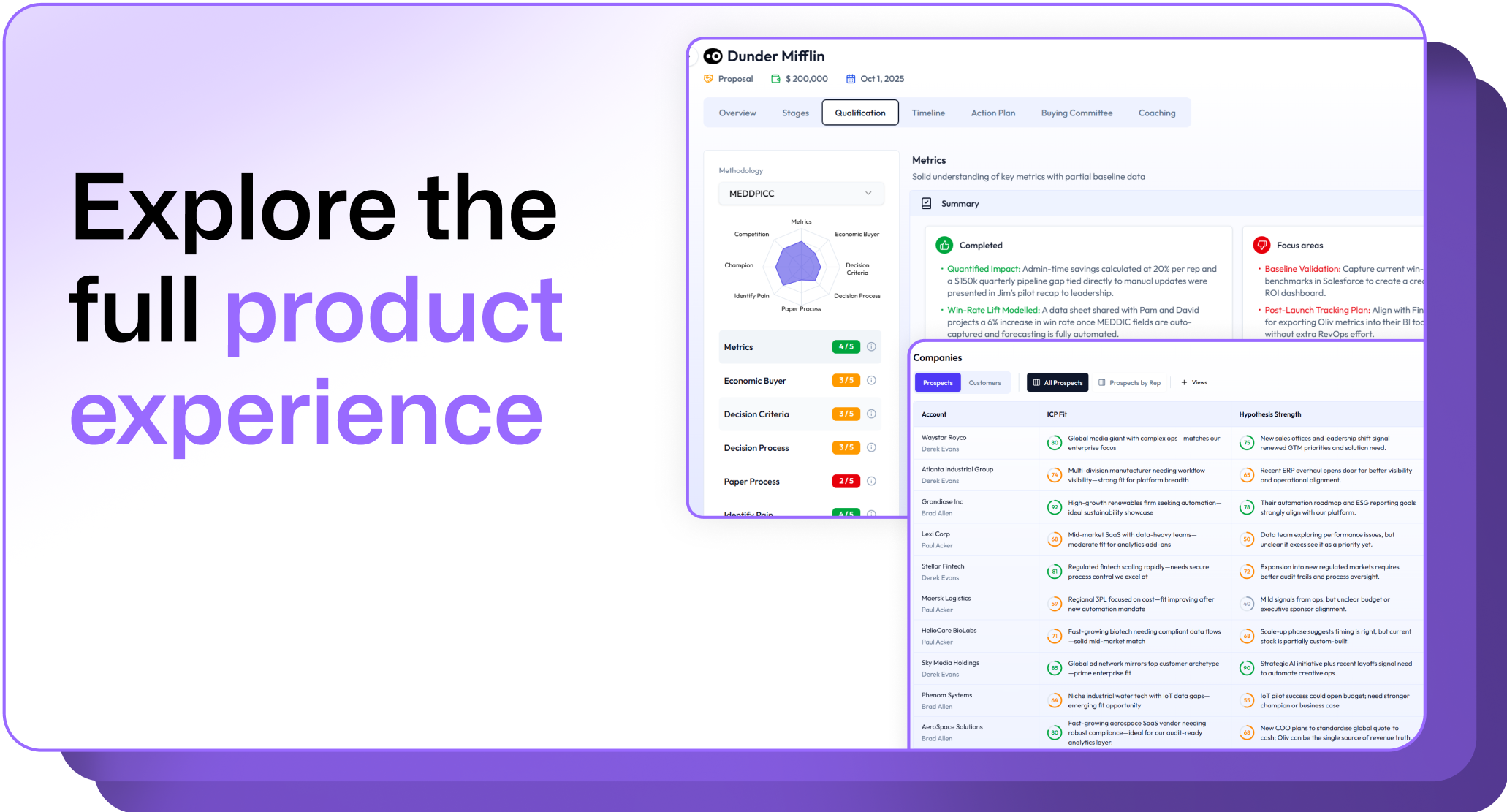
.avif)