Vitally leads on setup speed (2 to 4 weeks) with modern UI, but still requires manual health score configuration.
Legacy platforms bolt AI onto decade-old architectures; Gen 3 agentic platforms like Oliv AI execute tasks autonomously.
A 100-user team spends approximately $68K on Oliv over 3 years versus $789K on stacked legacy tools, a 91% TCO reduction.
Q1: What Are the 8 Best ChurnZero Alternatives With Faster Setup for Growing Mid-Market CS Teams? [toc=Best ChurnZero Alternatives]
ChurnZero earned its 2025 Gartner Magic Quadrant Leader status for good reason: strong lifecycle tracking, in-app engagement tools, and a comprehensive automation engine. But growing mid-market teams consistently report hitting walls around implementation timelines (6 to 8 weeks minimum), admin overhead, and reporting rigidity that don't surface until after deployment.
Below are eight alternatives organized by speed of implementation, from fastest time-to-value to longer enterprise rollouts, so CS leaders can match platform complexity to their team's actual operational capacity.
Quick List: 8 ChurnZero Alternatives for Mid-Market CS Teams
8 Best ChurnZero Alternatives for Mid-Market CS Teams
Platform
Best For
Setup Time
Pricing (Annual Est.)
AI Maturity
Health Scoring
Automation
G2 Rating
Oliv AI
Lean CS teams wanting signals, not dashboards
5 min baseline; 2 to 4 weeks full
Modular; no platform fee
⭐⭐⭐⭐⭐ Agentic
AI-driven, cross-channel
Autonomous agents
Emerging
Vitally
Growing teams (5 to 15 CSMs), hybrid/tech-touch
2 to 4 weeks
~$12K to $36K/yr
⭐⭐⭐ AI-enhanced
Real-time, product-usage based
Workflow triggers
4.5/5
Custify
SMB teams (<$10M ARR), first CSP
2 to 4 weeks
~$6K to $24K/yr
⭐⭐ Rule-based
Configurable, basic
Playbooks & lifecycles
4.4/5
Freshdesk
Service-led CS with ticket centralization
1 to 3 weeks
~$2K to $15K/yr (varies by plan)
⭐⭐⭐ Freddy AI copilot
Ticket-based sentiment
SLA & routing automation
4.4/5
ClientSuccess
Simple renewal tracking, small CS teams
3 to 6 weeks
~$15K to $30K/yr (est.)
⭐⭐ Rule-based
Basic scoring
Renewal workflows
4.4/5
Totango
Broad CS motions, multi-product orgs
4 to 8 weeks
~$25K to $50K+/yr
⭐⭐⭐ AI-enhanced
SuccessPlays-driven
SuccessBLOCs modular
4.3/5
Planhat
High-touch CS, customer-facing portals
2 to 4 months
~$25K to $40K+/yr (customer-count)
⭐⭐⭐ AI-enhanced
Configurable, multi-signal
Workflow engine
4.2/5
Gainsight
Enterprise CS Ops (15+ CSMs, dedicated admin)
3 to 6 months
~$60K to $100K+/yr
⭐⭐⭐ AI-enhanced
ML-powered, multi-model
Journey Orchestrator
4.4/5
Pricing reflects typical negotiated ranges based on Vendr benchmarks and public data. All platforms offer custom quotes.
1. Oliv AI: The AI-Native Intelligence Layer
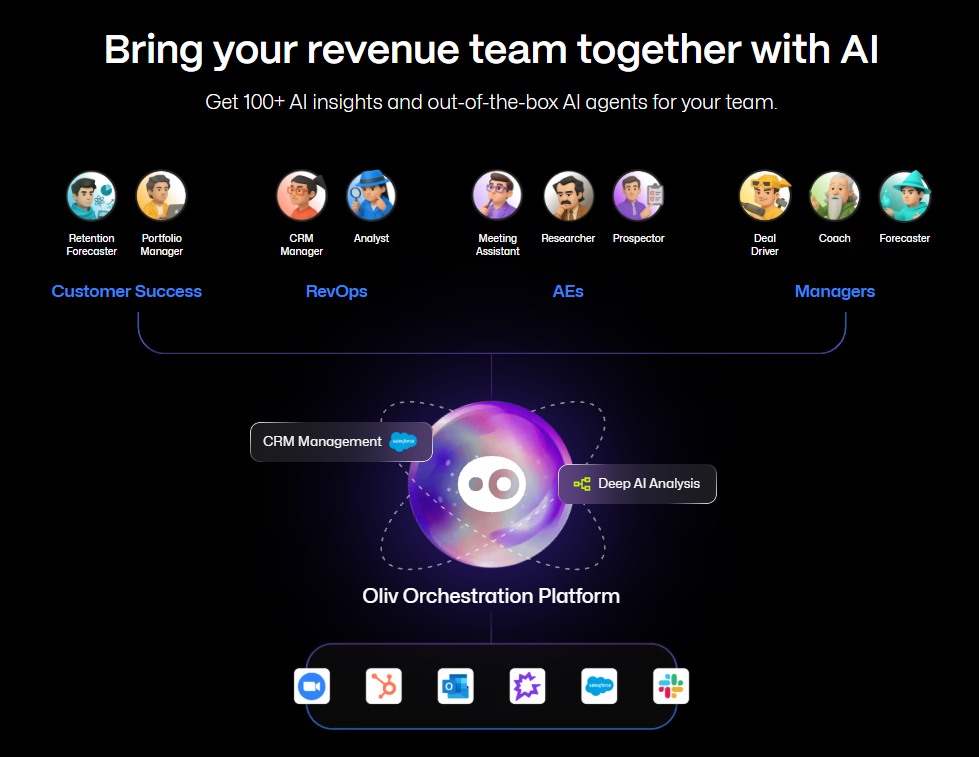
Oliv AI's orchestration platform deploys specialized autonomous agents across Customer Success, RevOps, AEs, and Managers, integrating with CRM, Slack, and Zoom for agentic intelligence.
What it does: Oliv AI takes a fundamentally different approach from traditional customer success platforms. Rather than providing another dashboard to configure and maintain, Oliv deploys a workforce of specialized AI agents that autonomously track account health, surface churn and expansion signals, and execute CS workflows, from meeting prep to QBR drafts to retention forecasting.
Key Features
Health Monitor Agent : Scans accounts weekly across usage data, support tickets, meeting sentiment, and communication patterns to flag churn risk before it escalates
Retention Forecaster : Builds unbiased weekly renewal forecasts by reviewing every account's risk signals across all channels
QBR Builder : Drafts data-rich Quarterly Business Review decks by pulling live customer outcomes automatically
Handoff Agent : Creates context-rich packets for the AE-to-CSM transition, preventing information loss during handoffs
Portfolio Manager : Consolidates each CSM's accounts, risks, and expansion signals into a single 1:1-ready view
360-degree data stitching : Unifies context from meetings, emails, support tickets, Slack, and CRM into a single deal history
Pricing and Implementation
Oliv uses modular, pay-for-what-you-use pricing with no platform fees and no implementation fees. Baseline setup takes approximately 5 minutes, with full model customization completing in 2 to 4 weeks, a fraction of the 6 to 8 weeks typical of legacy CSPs.
Use case: Best suited for modern, leaner CS teams (3 to 15 CSMs) that want actionable signals delivered to Slack and email rather than spending hours inside yet another dashboard. Particularly strong for organizations that need intelligence across the full customer lifecycle, from close to renewal, without months of configuration.
✅ Pros
🚀 Fastest time-to-value of any platform on this list (minutes, not weeks)
🤖 Agents do the work autonomously, no manual health score configuration
🔗 Stitches data across meetings, emails, tickets, and Slack into unified account intelligence
💰 No platform fee, no implementation fee, modular pricing
❌ Cons
🆕 Newer entrant; smaller community and ecosystem vs. established CSPs
🔄 Not a traditional CSP, teams wanting journey orchestration or in-app messaging need a complementary tool
2. Vitally: Modern Mid-Market Efficiency
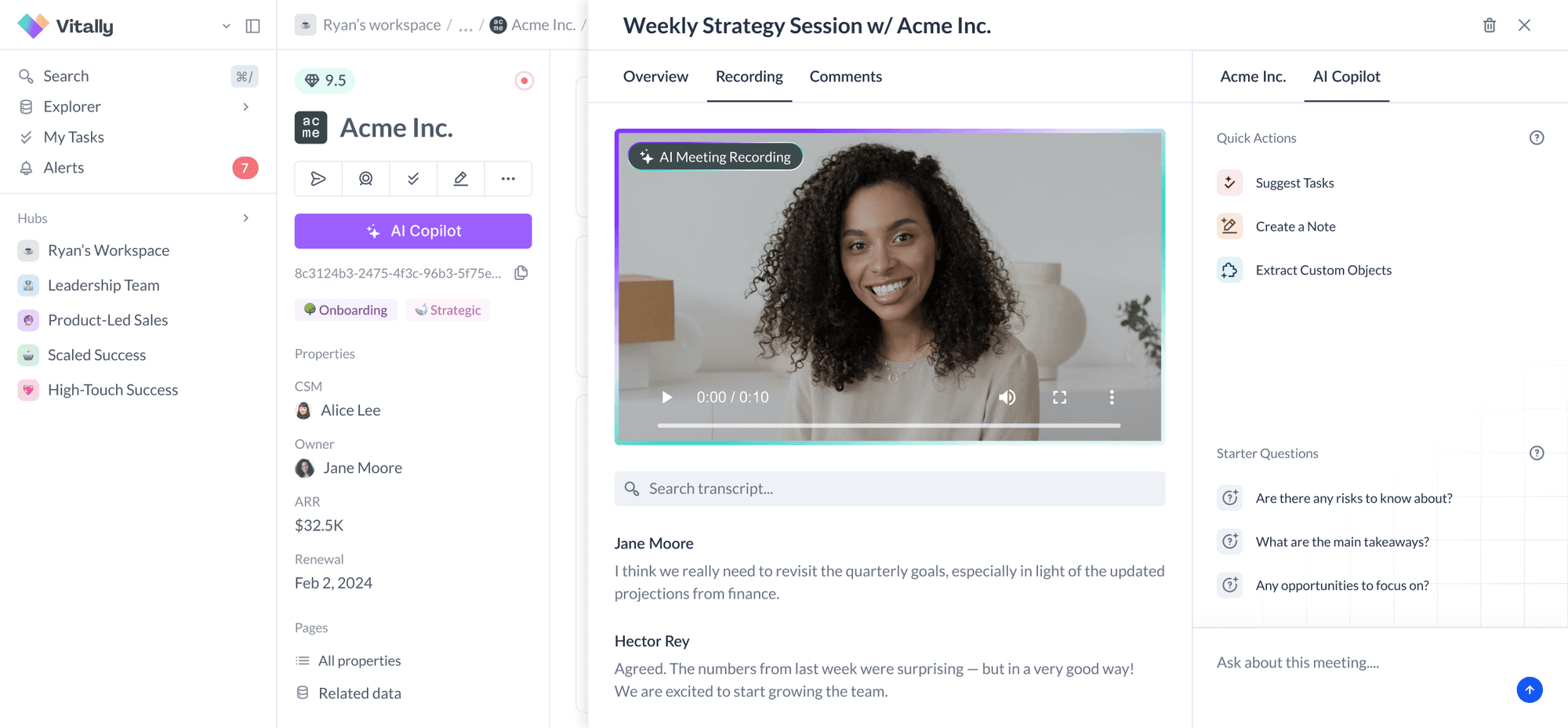
Vitally's modern interface features AI meeting recordings, real-time account health scoring, transcript search, and an AI Copilot sidebar for fast, collaborative customer success workflows.
What it does: Vitally bridges lightweight tools and enterprise platforms, delivering a clean interface with real-time product analytics and workflow automation tailored for growing CS teams.
Key Features and Setup
Key features: Real-time health scoring based on product usage, collaborative workspaces, automation triggers, email templates, and playbooks. Integrates with HubSpot, Zendesk, Clearbit, and Snowflake.
Pricing & implementation: ~$1,000 to $3,000/month depending on scale; 2 to 4 week implementation, significantly faster than enterprise platforms.
Use case: Teams of 5 to 15 CSMs running hybrid or tech-touch CS motions who need power without complexity.
✅ Pros
⚡ Fast 2 to 4 week setup with strong adoption curve
🎨 Modern, intuitive UI praised by CS managers
📊 Real-time product analytics baked into health scoring
❌ Cons
📉 Reporting limitations:
"Reporting is very limited, and automatic reports often show information that is more confusing than helpful. - Gabriella V., Technical Account Manager, G2 Verified Review
💲 AI features are overpriced for the value delivered:
"The AI features, while nice, are very high priced and the cost does not allow for ROI." - Elden D., Senior CSM, G2 Verified Review
3. Custify: Small Team Automation
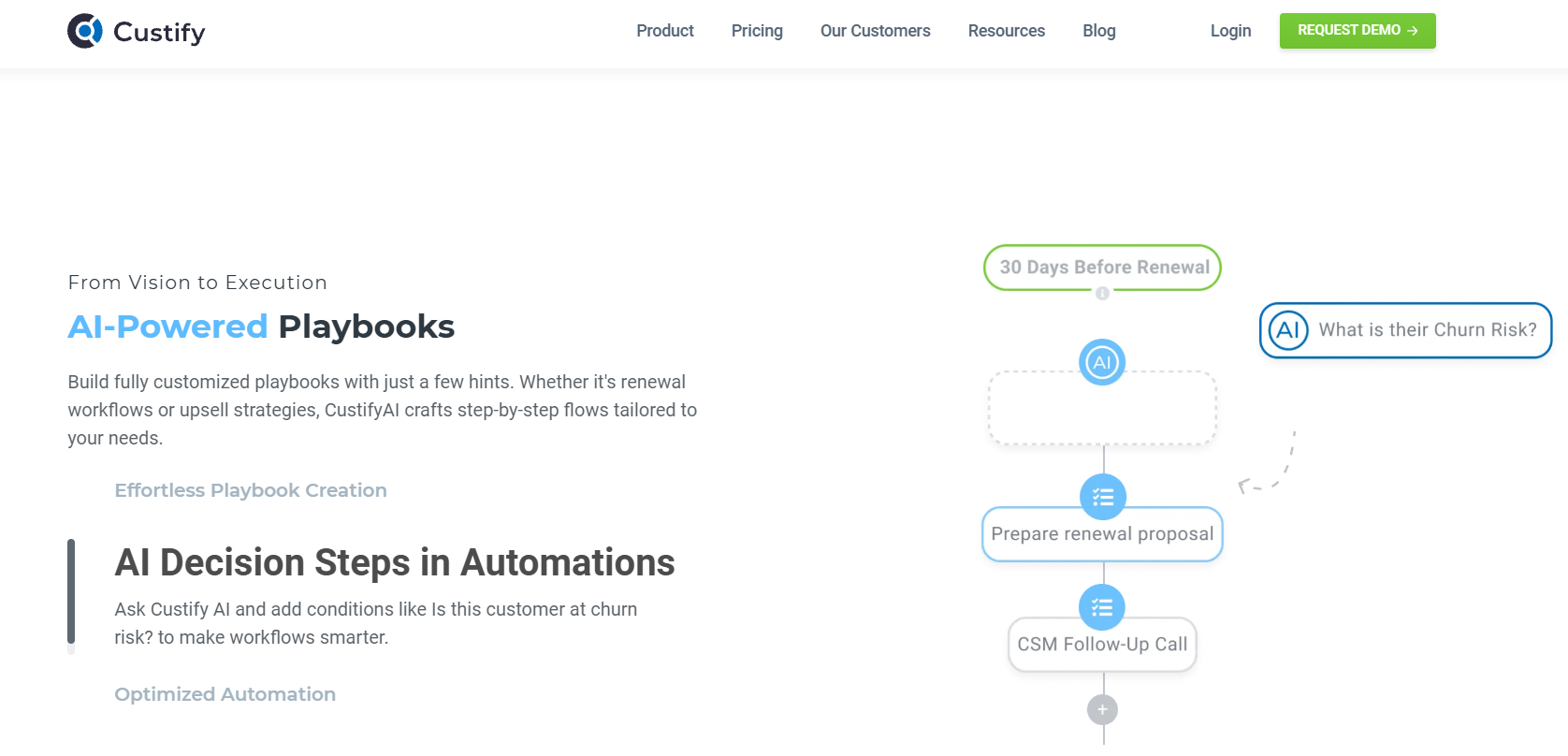
Custify's AI-powered playbook builder crafts renewal workflows with automated churn risk assessment, CSM follow-up calls, and decision steps tailored for growing customer success teams.
What it does: Custify is an accessible CS platform designed for SMB SaaS teams, combining health scoring, lifecycle playbooks, and workflow automation with white-glove onboarding support.
Key Features and Setup
Key features: Health score tracking, automated NPS/CSAT surveys, lifecycle playbooks, task management, and email automation. Integrates with common CRM and product tools.
Pricing & implementation: ~$500 to $2,000/month; 2 to 4 week guided setup.
Use case: Teams under $10M ARR needing structured CS processes without enterprise complexity or a dedicated CS Ops hire.
✅ Pros
🎯 Focus on Customer Success point of view with continuous improvements
💬 Responsive support via Slack
📋 Simplifies moving from spreadsheets to structured CS management
❌ Cons
🖥️ UX inconsistencies:
📊 Limited dashboard and analytics:
"It is focused on being an operational tool, but lacks capabilities on tracking/analyzing the data. - Verified User, G2 Review
4. Freshdesk: Service-Led Customer Success
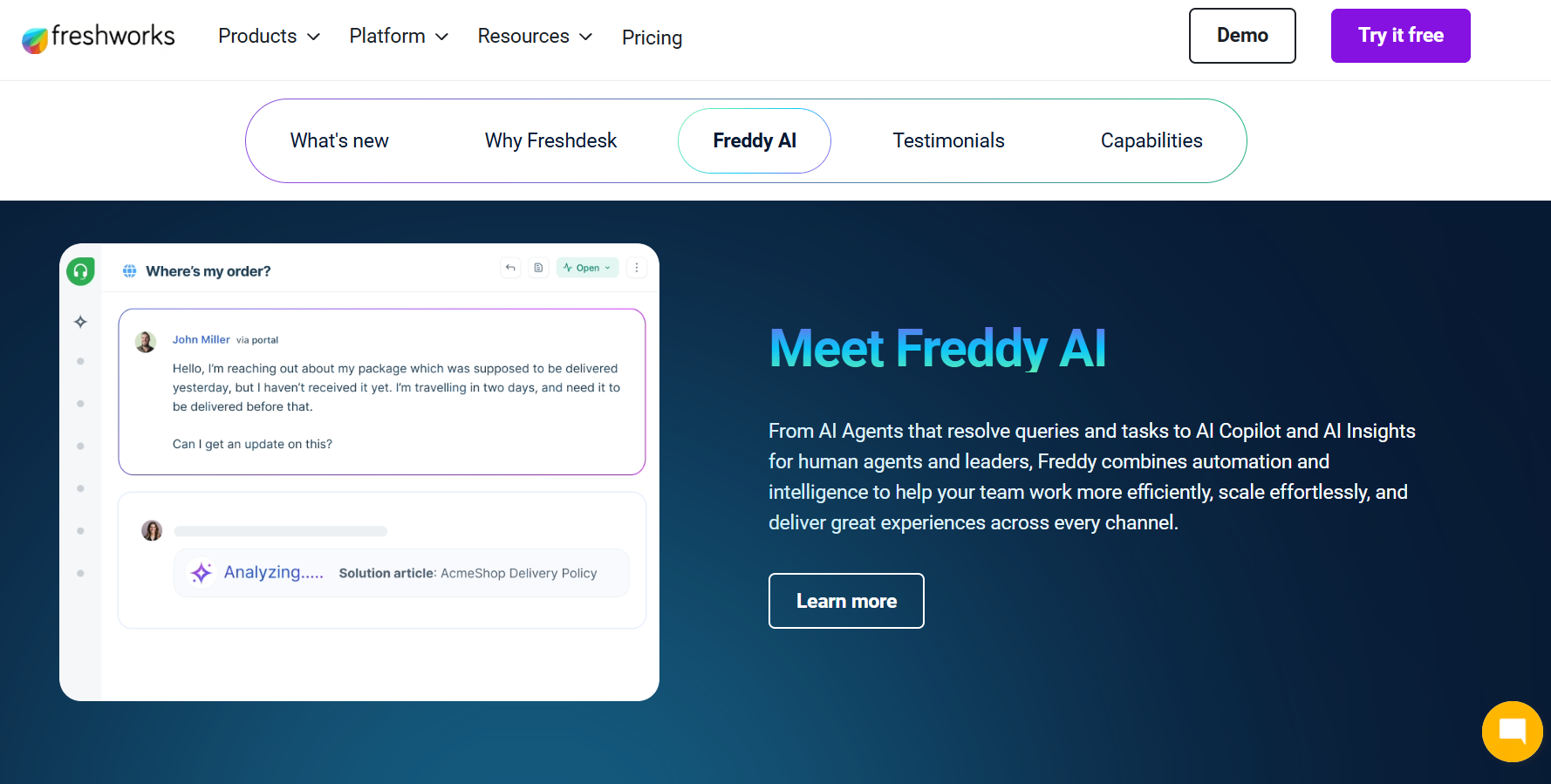
Freshworks' Freddy AI combines AI agents, copilot assistance, and automated insights to resolve customer queries and scale support, positioning Freshdesk CS as a budget ChurnZero alternative.
What it does: Freshdesk is primarily a helpdesk and ticketing platform that has expanded into customer success territory through AI-powered automation (Freddy AI), omnichannel support management, and advanced workflow routing.
Key Features and Setup
Key features: Ticket management and prioritization, Freddy AI agent for automated resolutions, canned responses and shortcuts, omnichannel support (email, chat, phone, social), SLA management, and team collaboration tools.
Pricing & implementation: Starts free for basic use; paid plans from ~$15/agent/month scaling to enterprise tiers. Setup typically takes 1 to 3 weeks.
Use case: CS teams where customer success is heavily service-driven and ticket resolution quality directly impacts retention. Strong for teams already in the Freshworks ecosystem.
✅ Pros
💲 Most affordable entry point on this list
🤖 Freddy AI delivers up to 80% automated resolutions
"Shortcuts and canned responses have saved us hundreds of hours." - Mircea N., Digital Development Manager, G2 Verified Review
❌ Cons
🔀 Not a dedicated CSP, lacks health scoring, journey orchestration, and renewal management
🏢 Cross-department complexity:
"Navigating the platform is difficult, especially with multiple departments using the system." - Tonya S., Customer Service Analyst, G2 Verified Review
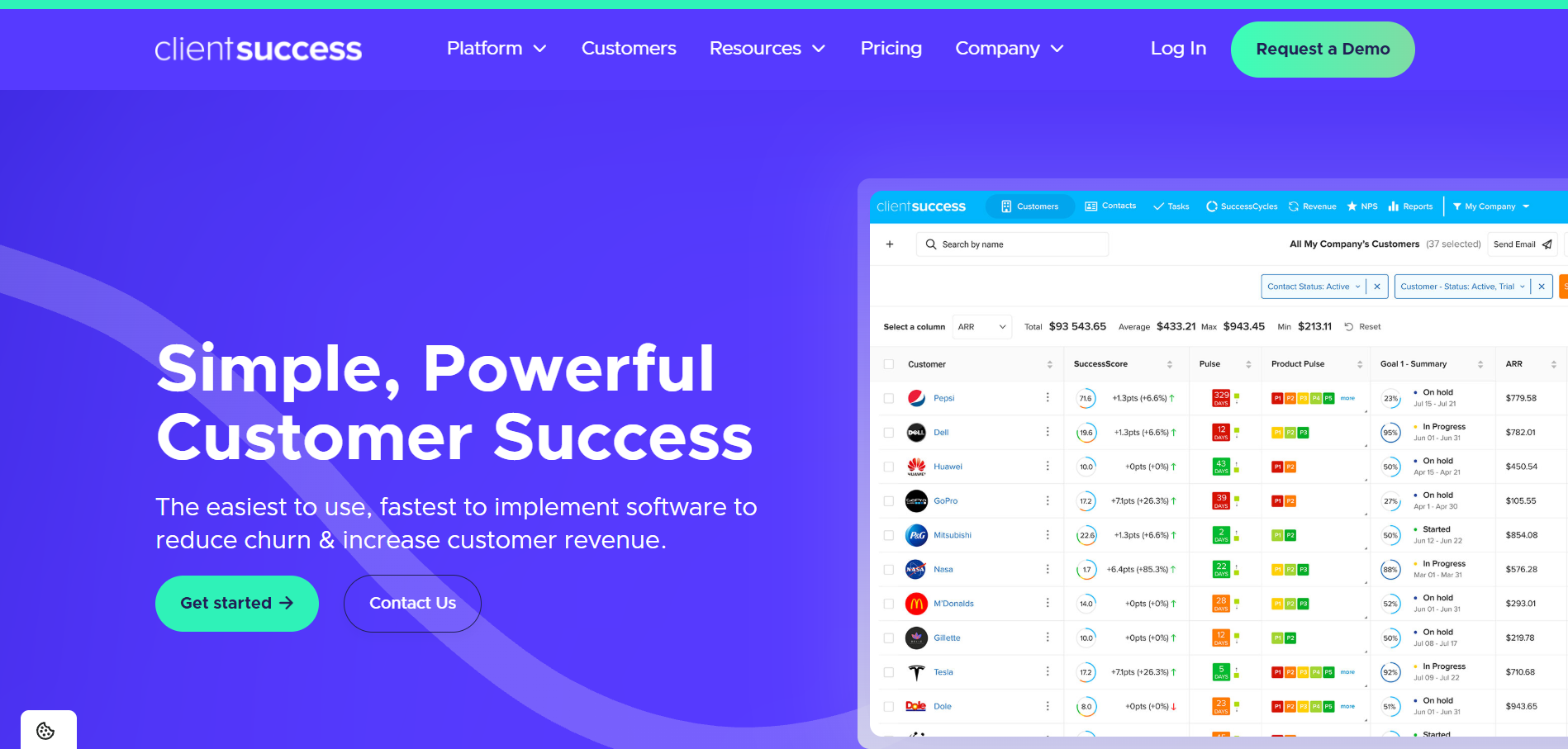
ClientSuccess displays a customer portfolio with SuccessScore ratings, product pulse indicators, ARR tracking, and goal summaries, offering simple mid-market customer success management.
What it does: ClientSuccess provides a simplified CS platform focused on renewal management, customer health visibility, and lifecycle tracking without the configuration overhead of larger platforms.
Key Features and Setup
Key features: Customer health scoring, renewal management, customer segmentation, journey mapping, NPS surveys, and task management.
Pricing & implementation: Estimated ~$15,000 to $30,000/year; 3 to 6 week setup. Offers a Growth Package entry tier.
Use case: Small to mid-market CS teams that want basic CRM-like CS functionality with strong renewal visibility and low operational complexity.
✅ Pros
"Great tool that offered all of the basic features expected from a CRM." - Xander K., CSM, G2 Verified Review
👁️ Good visibility on renewals, customer happiness, and prioritization
🔧 Simple to navigate without extensive training
❌ Cons
📦 Limited feature set:
"The feature set was limited. Which is why we ended changing to Gainsight." - Xander K., CSM, G2 Verified Review
🐛 Feature limitations and occasional billing issues noted by long-term users
6. Totango: Modular SuccessBLOCs Platform
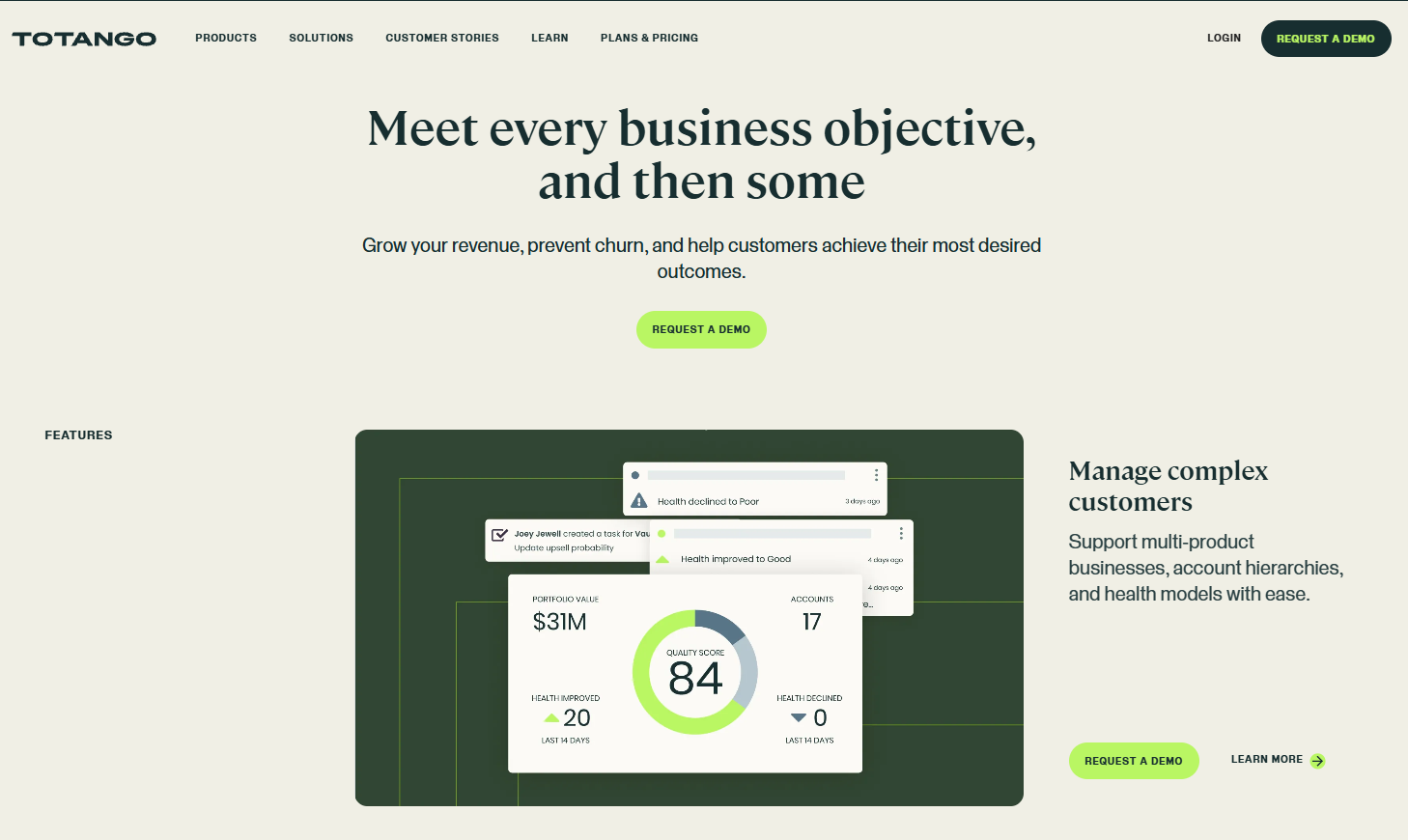
Totango's CS dashboard presents portfolio value at $31M, account health trends, and a quality score gauge, illustrating its scaled customer success management capabilities post-Catalyst merger.
What it does: Totango (now merged with Catalyst) offers a modular customer success platform built around SuccessBLOCs, pre-built and customizable workflow templates covering onboarding, adoption, renewal, and expansion.
Key Features and Setup
Key features: SuccessPlays and SuccessBLOCs for automated workflows, customer health monitoring, engagement tracking, task management, and multi-product tracking. Integrates with Salesforce and other enterprise tools.
Pricing & implementation: ~$25,000 to $50,000+/year depending on scale; 4 to 8 week implementation.
Use case: Multi-product organizations needing scalable CS workflows with modular playbooks. Works well as a first enterprise-grade CSP.
✅ Pros
"Very user-friendly and easy to navigate. It was also really easy to implement." - Aurelia F., Director of CS EMEA, G2 Verified Review
🔄 SuccessBLOCs provide step-by-step guidance for CSMs across product lines
❌ Cons
🔀 Post-merger instability: Reddit users report "glitches and inability to keep pace" with development
🧩 Feature gaps:
"Some more standard features from other CSPs are missing." - Verified User, G2 Review
7. Planhat: High-Touch CS With Customer Portals
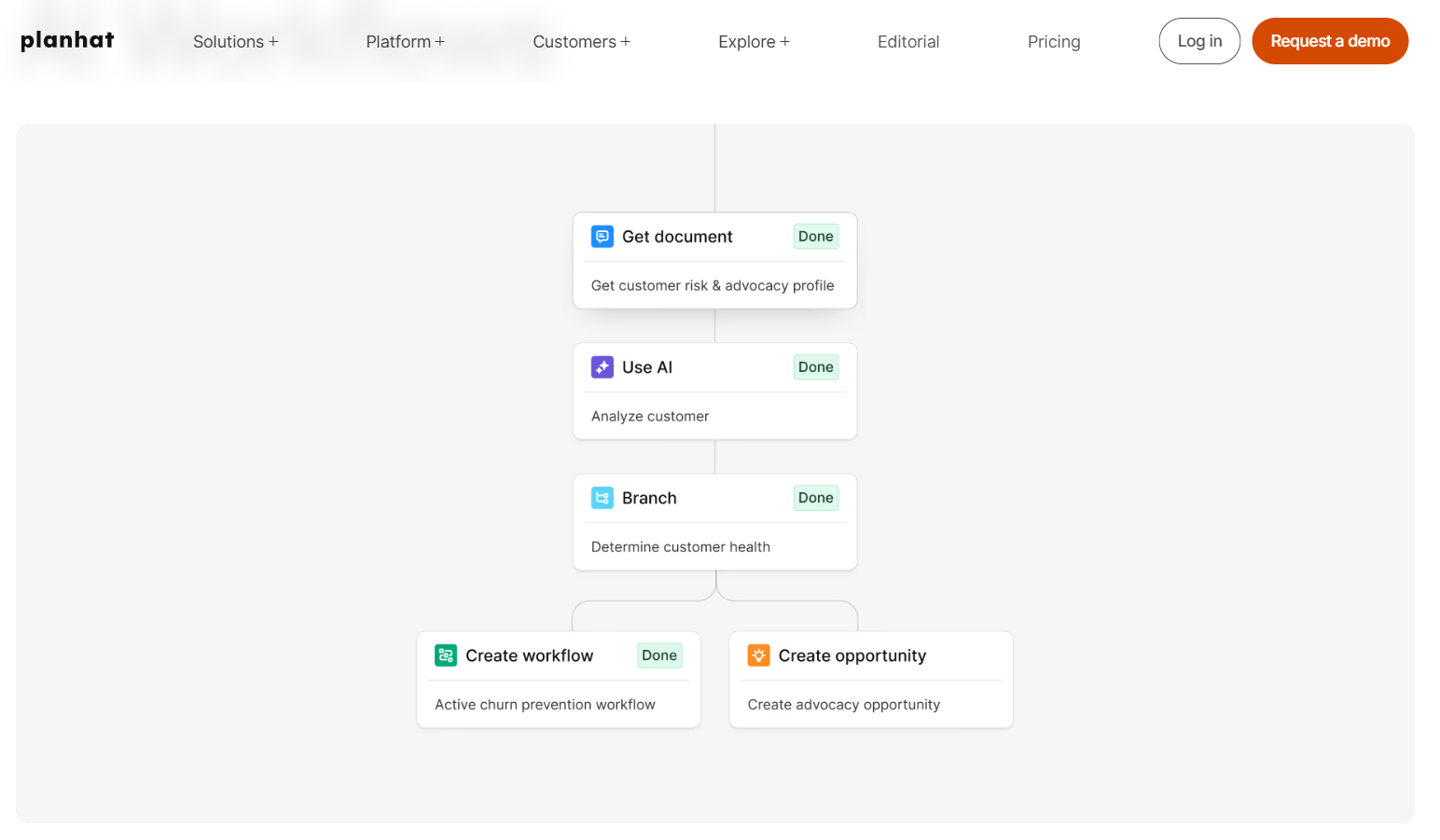
Planhat's AI-driven workflow builder automates customer risk profiling through document retrieval, AI analysis, health branching, and churn prevention actions, a flexible ChurnZero alternative.
What it does: Planhat positions itself as a unified customer platform with a strong data model, built-in customer portals, and customer-count pricing that doesn't penalize growing teams.
Key Features and Setup
Key features: Customer health scores, revenue management, automated workflows, customer portals, NPS, lifecycle management, and a 360-degree customer view. Recognized as a 2025 Gartner MQ Leader.
Pricing & implementation: ~$25,000 to $40,000+/year based on customer count (not user seats, unlimited seats included); 2 to 4 month implementation with dedicated project management.
Use case: High-touch CS models with many CSMs managing fewer, high-value accounts, especially teams that need customer-facing portals to share success plans and dashboards.
✅ Pros
👥 Unlimited seats with customer-count pricing rewards team growth
🌐 Built-in customer portals, a unique differentiator
📊 Strong data manipulation and workflow management
❌ Cons
🐛 Bugginess and documentation gaps:
"The entire tool is super buggy, most integrations do not work as intended. Feels like we are stuck in an ongoing alpha version." - Verified User, G2 Review
"Documentation is basically useless, referring to old UI." - Verified User, G2 Review
8. Gainsight: The Enterprise Standard
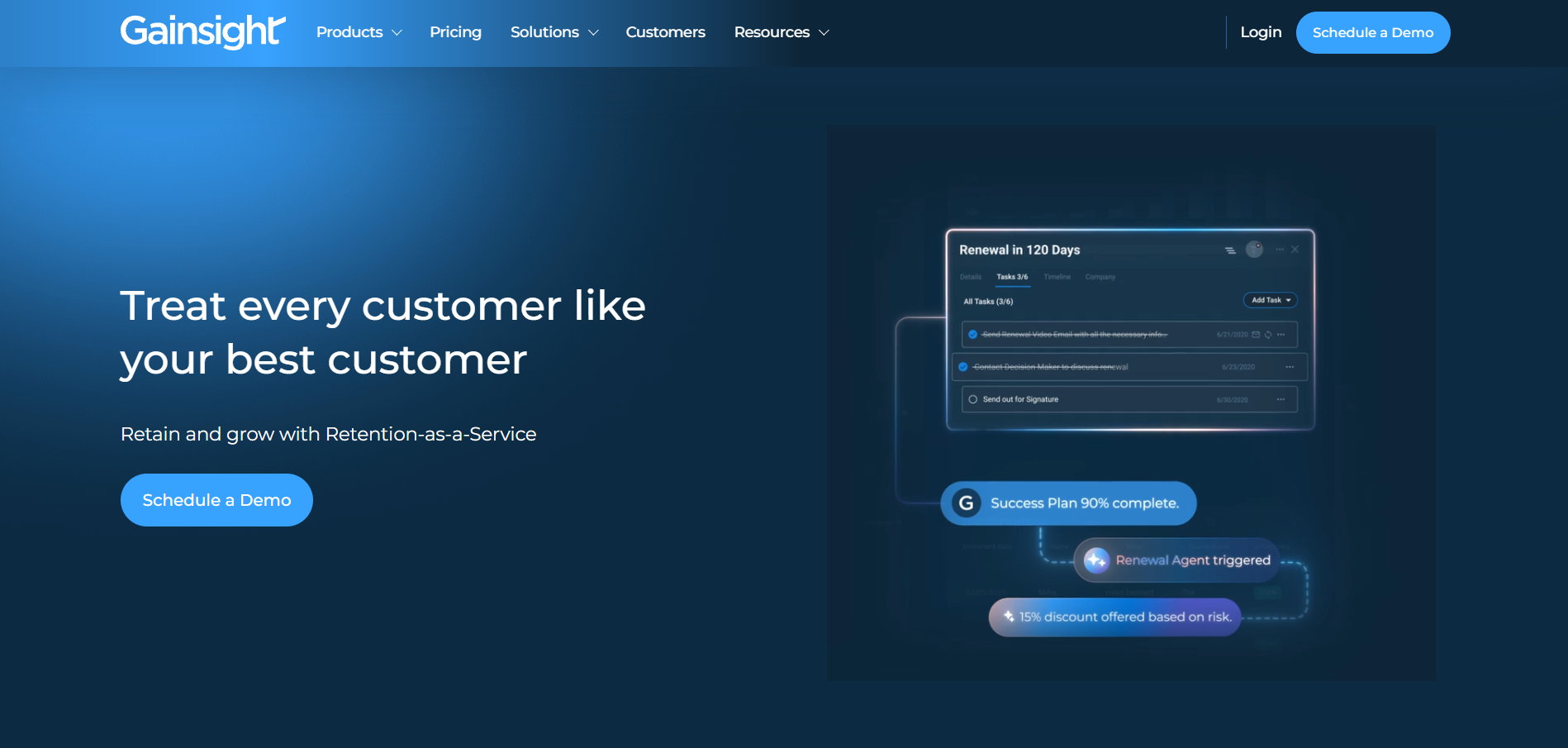
Gainsight's enterprise CS platform displays renewal countdown tracking, automated success plan progress, and its AI-triggered Renewal Agent, a key ChurnZero competitor for orchestration.
What it does: Gainsight is the long-standing enterprise customer success platform, offering the deepest feature set in the market: Journey Orchestrator, Rules Engine, Data Designer, and ML-powered health scoring. Gartner MQ Leader in both 2024 and 2025.
Key Features and Setup
Key features: Journey orchestration with CSM impersonation, data transformation (Data Designer + Rules Engine), advanced reporting and dashboards, NPS and survey management, robust connector ecosystem, and a large active admin community.
Pricing & implementation:$60,000 to $100,000+/year (often exceeding $200,000 for complex deployments); 3 to 6 month implementation requiring a dedicated Gainsight admin, often a $100K+ specialized hire.
Use case: Enterprise CS organizations with 15+ CSMs, dedicated CS Ops resources, and budget for both licensing and operational overhead. The right choice for companies ready to make customer success a fully operationalized department.
✅ Pros
🏆 Undisputed enterprise standard with the deepest feature set
"Gainsight has become the heart of our insight generation, serving the broader organization effectively." - Alberto S., Enterprise Admin, G2 Verified Review
🤝 Active admin community (official and unofficial) for troubleshooting
❌ Cons
"Implementation took us a good 6 months, and now we cannot consider switching because of how entrenched we are with it, even though it is obscenely expensive." - Verified User, G2 Review
"There is an excessive focus on AI at the expense of addressing basic features, parity issues, and stability problems." - Alberto S., Enterprise Admin, G2 Verified Review
Oliv.ai's Take
Traditional CSPs like Gainsight, ChurnZero, and Totango were built for large, CS-ops-heavy teams that have the resources to configure dashboards, maintain playbooks, and manually feed data into health scoring models. They are powerful, but slow to implement and expensive to sustain. For growing mid-market CS teams that want signals and action over complexity, an AI-native intelligence layer like Oliv AI delivers faster time-to-value by surfacing what matters and helping teams act, without months of setup or a dedicated admin.
Q2: Why Are Growing CS Teams Switching Away From ChurnZero in 2026? [toc=Why Teams Switch]
Mid-market CS teams, typically 5 to 15 CSMs managing $5M to $50M ARR, face a specific trap in 2026. They've outgrown spreadsheets but lack the dedicated CS Ops headcount or $60K+ budgets that enterprise platforms demand. ChurnZero earned its Gartner MQ Leader status for legitimate reasons: strong lifecycle tracking, a clean interface, and a responsive support team. But growing teams consistently hit walls around implementation friction, admin overhead, and reporting limitations that don't surface until well after deployment.
The Legacy CSP Ceiling
Legacy customer success platforms were built on a core assumption: CSMs will manually feed the system. Rigid dashboards, manual health score inputs, and keyword-based playbook triggers define the architecture. In practice, this creates compounding problems:
CRM data transfer friction:
"Setting up our ChurnZero instance has involved a significant amount of manual administration. The data transfer from our CRM to Salesforce is not straightforward, which has forced us to create numerous workarounds." — Brandon O., Client Education Manager, G2 Verified Review
Dashboard inflexibility: Default metrics can't be customized without upgrades, and cross-segment search remains limited
The "easier to deploy, harder to manage" trap:
"You quickly uncover that with a more simplistic setup, there is less product functionality than competitors."— Tim M., Director, Customer Success Programs, G2 Verified Review
The Dirty Data Problem
The dirty data problem compounds everything. When CSMs neglect manual entry, and in high-velocity mid-market environments, they inevitably do, the entire health scoring engine becomes unreliable.
The CS platform market has shifted from "give me a dashboard to monitor" to "tell me which accounts need attention and why, before I ask." Mid-market teams don't want another app to configure and train against; they want signals and actions delivered where they already work: Slack, email, CRM. Baseline documentation like meeting recording and transcription, once premium features worth $50K+ annually, are now commoditized by Zoom, Teams, and Google Meet natively. The premium value in 2026 is intelligence and autonomous action, not another dashboard that requires manual feeding.
How Oliv AI Addresses the Root Cause
Oliv AI represents this shift, not as a direct ChurnZero replacement, but as an AI-native intelligence layer built on a fundamentally different architecture. Instead of requiring CSMs to manually update health scores, Oliv deploys specialized agents that work autonomously:
Health Monitor Agent scans accounts weekly across usage data, support tickets, meeting sentiment, and communication patterns, flagging churn risk before it escalates
CRM Manager Agent keeps data clean without human intervention, solving the dirty data problem that undermines every legacy platform's health scoring
Setup takes 5 minutes for baseline configuration, 2 to 4 weeks for full customization, not the 6 to 8 week minimum that ChurnZero typically requires
"The system can only process 3 plays at a time which is not efficient for a large organization. The CSMs for ChurnZero are not helpful, often times I get better service/responses from their support team." — Matthew T., Client Success Partner, G2 Verified Review
For growing mid-market teams, the question isn't whether ChurnZero works, it does, within its design constraints. The question is whether those constraints match the speed and lean operations your team actually needs.
Q3: ChurnZero vs Gainsight: Does Enterprise Power Justify the Overhead for Mid-Market? [toc=ChurnZero vs Gainsight]
Gainsight is the undisputed enterprise standard, Gartner MQ Leader in both 2024 and 2025, with deep journey orchestration, robust data transformation via Data Designer and Rules Engine, and the largest active admin community in the CS platform space. ChurnZero positions itself as the more accessible alternative. For a growing mid-market team evaluating both, the real question isn't which platform has more features, it's which delivers value before your team burns out configuring it.
Where Both Platforms Hit the Same Wall
Gainsight implementation takes 3 to 6 months and demands dedicated admin resources, often a specialized hire costing $100K+ annually just to manage the platform. ChurnZero deploys faster (6 to 8 weeks) but users hit functionality ceilings quickly. Both share the same root dependency: manual CSM data entry to fuel health scoring.
ChurnZero vs Gainsight: Mid-Market Trade-offs
Dimension
ChurnZero
Gainsight
Implementation
6 to 8 weeks
3 to 6 months
Annual cost
~$15K to $26K (negotiated)
~$60K to $100K+
Dedicated admin needed?
Part-time recommended
Near-mandatory full-time
Health scoring basis
Manual + usage data
Manual + ML-enhanced
Core limitation
Functionality ceilings
Configuration complexity
"Powerful tool, horrible implementation. You really need a LOT of dedicated resources." — Verified User, Information Technology, G2 Verified Review
"Implementation took us a good 6 months, and now we cannot consider switching because of how entrenched we are with it, even though it is obscenely expensive." — Verified User, Computer Software, G2 Verified Review
The AI Bolt-On Problem
Both platforms are adding AI capabilities, but Gainsight's own enterprise admins are raising red flags about the approach:
"There is an excessive focus on AI at the expense of addressing basic features, parity issues, and stability problems. The admin community has been requesting these basic improvements for years, yet we are repeatedly told that AI will solve this." — Alberto S., Enterprise Admin, G2 Verified Review
ChurnZero's AI features are newer but follow the same bolt-on pattern, enhancements to a fundamentally manual system, not a replacement for it.
Where Oliv AI Fits In
Where both platforms require CSMs to feed data into dashboards, Oliv operates as a standalone intelligence layer that stitches context from calls, emails, Slack, and support tickets autonomously. For mid-market teams that can't justify Gainsight's $60K+ license or a dedicated CS Ops hire, Oliv's CRM Manager Agent keeps data clean without human intervention, solving the root cause both legacy platforms work around.
The verdict: ⭐ Gainsight wins if you have budget, an admin team, and a 6-month runway for enterprise-grade CS orchestration. ⭐ ChurnZero wins if you need lighter setup and can accept feature trade-offs. ⭐ Oliv wins if intelligence and speed matter more than workflow configuration.
Q4: ChurnZero vs Totango: Which Platform Scales Better Without Breaking? [toc=ChurnZero vs Totango]
Totango and ChurnZero compete directly for the same mid-market-to-enterprise buyer. Following its 2024 merger with Catalyst, Totango positioned itself as a broader platform combining Catalyst's intuitive product-led growth workflows with Totango's enterprise-grade security and integrations. But the merger has introduced growing pains that mid-market teams should weigh carefully before committing.
Scaling Trade-Offs
Totango's strength is breadth: SuccessPlays, SuccessBLOCs, and automated workflows designed to handle large, multi-product portfolios at scale. ChurnZero's strength is depth: stronger lifecycle tracking and a more mature in-app engagement suite out of the box. Both share common mid-market frustrations around data hygiene, integration reliability, and the manual overhead required to keep the system accurate:
ChurnZero vs Totango: Scaling Comparison
Dimension
ChurnZero
Totango
Core strength
Lifecycle tracking, in-app engagement
Scalable workflows, SuccessBLOCs
Setup time
6 to 8 weeks
4 to 8 weeks
Key limitation
Reporting rigidity, email automation caps
Integration delays, post-merger instability
Data dependency
Manual CSM entry
Manual CSM entry
Best for
Deeper single-product CS motions
Multi-product, broad portfolio coverage
"Limited Customer Journey/Project Management. Milestones and tasks are not sufficient for tracking complex onboarding or success plans. Weak integration with project management tools like Asana, Jira, or Monday.com is either limited or unreliable." — Dario C., Customer Success Manager, G2 Verified Review
Post-Merger Instability
On Reddit, the Totango-Catalyst merger has drawn pointed criticism:
"This merger was never truly about collaboration; it was Catalyst running out of runway and Totango making a strategic choice to acquire Catalyst's customer base. All of this was cloaked in hype." — r/CustomerSuccess Thread
Multiple mid-market teams have reported migrating away post-merger due to glitches, inconsistent data syncing with Salesforce, and development velocity that hasn't kept pace with promises.
The Agentic Automation Gap
Neither platform has embraced agentic automation. Totango can display a health score and trigger a SuccessPlay, but it doesn't autonomously draft the QBR or follow up on a stalled milestone. ChurnZero's playbook automation is rule-based: if the underlying data is stale, automations fire blindly.
The market has moved past "automate the notification" toward "automate the action."
How Oliv AI Bridges the Gap
Oliv's QBR Builder Agent drafts data-rich Quarterly Business Review decks by pulling live customer outcomes, no manual assembly required. The Retention Forecaster Agent tracks renewals across the full portfolio, incorporating signals from unrecorded conversations via Voice Agent and cross-channel data stitching that rule-based health scores miss entirely.
The verdict: 🔄 Totango scales broader but shallower. 🔄 ChurnZero goes deeper on lifecycle tracking. ✅ Oliv delivers the intelligence layer both platforms need underneath, and for teams willing to rethink their stack, it replaces the manual data-feeding layer entirely.
Q5: ChurnZero vs Vitally: Speed and Simplicity for Lean CS Teams [toc=ChurnZero vs Vitally]
Vitally has emerged as ChurnZero's closest mid-market challenger, purpose-built for teams that want a modern, fast-to-deploy CS platform without enterprise overhead. With 2 to 4 week implementation (versus ChurnZero's 6 to 8 weeks), real-time product analytics, and a cleaner collaborative interface, Vitally directly targets the exact frustrations that drive teams away from ChurnZero.
What Reddit Users Say
On Reddit, users choosing between the two consistently cite ease of use as the deciding factor:
"My team and I have found Vitally to be far superior to ChurnZero. The interface is much more polished, it offers extensive user configuration options, and the health scoring is more intuitive." — r/CustomerSuccess
Head-to-Head: Where Each Wins
Vitally's advantage is speed and flexibility, built for tech-touch and hybrid CS motions with strong automation triggers based on real-time product usage data. ChurnZero has deeper lifecycle journey tracking and a more mature in-app engagement suite with guides, walkthroughs, and checklists. The trade-offs break down clearly:
ChurnZero vs Vitally: Feature-by-Feature Breakdown
Dimension
ChurnZero
Vitally
Setup time
6 to 8 weeks
2 to 4 weeks
UI/UX
Functional, some customization locked
Modern, collaborative workspaces
Product analytics
Usage tracking via integration
Real-time, native
In-app engagement
Guides, walkthroughs, checklists
Limited
Unique feature
Lifecycle journey tracking
Kanban boards, Goals, Docs
Reporting
Segment-dependent, rigid
Customizable, real-time dashboards
"Promising Dashboard with Room for Improvement. A lot of secondary features are half baked. The cost for some of their enhancements is far above the industry standards. The AI features, while nice, are very high priced and the cost does not allow for ROI." — Elden D., Senior Customer Success Manager, G2 Verified Review
The Shared Limitation
Both Vitally and ChurnZero are fundamentally dashboard-and-configuration tools. Vitally is faster to set up, but teams are still building health score formulas, configuring automation rules, and training CSMs on a new interface. The admin burden is lighter, but not eliminated. Neither platform autonomously identifies why an account is at risk by reading across calls, emails, and support tickets. They surface a score and expect the CSM to investigate manually, which in high-velocity mid-market environments often means the investigation happens too late, or not at all.
How Oliv AI Eliminates the Investigation Step
Oliv's Health Monitor Agent doesn't just display a health score, it scans weekly across usage data, support tickets, meeting sentiment, and communication patterns to tell CSMs exactly which accounts are at risk and why. The Handoff Agent builds automated, context-rich packets for the AE-to-CSM transition, a critical handoff gap that both Vitally and ChurnZero leave entirely manual.
The verdict: ⚡ Vitally wins for teams that want a modern, fast-to-configure CSP with strong product analytics. ⚡ ChurnZero wins for teams needing deeper lifecycle journeys and in-app messaging. 🚀 Oliv wins for teams that want intelligence delivered to them, without building another dashboard.
Q6: How Do These Platforms Compare on Features, AI Capabilities, and Integration Depth? [toc=Feature Comparison]
Choosing between CS platforms requires comparing more than headline features. Below are three structured assessments: core features, AI maturity, and integration quality, reflecting the state of each platform as of February 2026.
Note: AI capabilities in this space are evolving rapidly. This assessment reflects publicly available information as of February 2026.
Core Feature Matrix
CS Platform Core Feature Comparison
Feature
ChurnZero
Gainsight
Totango
Vitally
Planhat
Custify
Freshdesk CS
HubSpot Service Hub
Health scoring
✅ Custom + usage-based
✅ ML-enhanced
✅ SuccessBLOCs-based
✅ Real-time, flexible
✅ Custom weighted
✅ Multi-factor
⚠️ Basic
⚠️ Limited
Playbook automation
✅ Rule-based
✅ Journey Orchestrator
✅ SuccessPlays
✅ Workflow triggers
✅ Triggered workflows
✅ Task automation
⚠️ Ticket-based
⚠️ Sequence-based
In-app engagement
✅ Guides, walkthroughs
⚠️ Via PX add-on
❌ Not native
❌ Not native
❌ Not native
❌ Not native
❌ Not native
❌ Not native
Task management
✅ Native
✅ CTAs/Cockpit
✅ SuccessPlays
✅ Kanban + lists
✅ Native
✅ Native
✅ Ticket queues
✅ Ticket queues
Journey orchestration
⚠️ Basic journeys
✅ Advanced (JO)
✅ SuccessBLOCs
⚠️ Workflow-based
⚠️ Playbook-based
⚠️ Basic
❌ Not native
⚠️ Basic
Revenue/renewal tracking
✅ Native
✅ Native
✅ Native
✅ Native
✅ Native
✅ Native
❌ Not native
⚠️ Basic
Product analytics
⚠️ Via integration
⚠️ Via PX add-on
✅ Native usage data
✅ Real-time native
✅ Usage metrics
⚠️ Basic tracking
❌
❌
NPS/surveys
✅ Native
✅ Native
✅ Native
⚠️ Via integration
✅ Native
✅ Native
✅ CSAT native
✅ NPS/CSAT native
AI and Automation Depth
AI Maturity Tiers Across CS Platforms
Tier
Classification
Platforms
What It Means
Tier 1: Agentic
AI agents autonomously execute tasks
Oliv AI
Agents scan, draft, alert, and act without manual triggers. Cross-channel data stitching from calls, emails, tickets, and Slack.
Tier 2: AI-Enhanced
AI assists humans within existing workflows
Gainsight, ChurnZero, Planhat, Vitally
AI summarizes notes, suggests next actions, enhances segmentation but still requires CSMs to initiate, review, and act.
Tier 3: Rule-Based
Automation triggered by static rules and thresholds
Totango, Custify, Freshdesk CS, HubSpot Service Hub
If-then logic, keyword triggers, threshold alerts. No generative reasoning.
"There is an excessive focus on AI at the expense of addressing basic features, parity issues, and stability problems. The admin community has been requesting these basic improvements for years, yet we are repeatedly told that AI will solve this." — Alberto S., Enterprise Admin, G2 Verified Review
Integration Quality by Platform
Integration Quality Matrix: CS Platforms
Platform
Salesforce
HubSpot
Slack
Zendesk
Snowflake
ChurnZero
✅ Native bidirectional
✅ Native bidirectional
✅ Native
✅ Native
⚠️ API/webhook
Gainsight
✅ Deep native (SFDC-native option)
⚠️ Native one-way
✅ Native
✅ Native
✅ Native connector
Totango
✅ Native bidirectional
✅ Native
✅ Native
✅ Native
⚠️ API-based
Vitally
✅ Native bidirectional
✅ Native bidirectional
✅ Native
✅ Native
⚠️ API-based
Planhat
✅ Native bidirectional
✅ Native
✅ Native
✅ Native
✅ Native connector
Custify
✅ Native
✅ Native
✅ Native
⚠️ Zapier/API
❌ Not supported
Freshdesk CS
⚠️ Native one-way
⚠️ Limited
✅ Native
✅ Native (same ecosystem)
❌ Not supported
Oliv AI
✅ Native bidirectional
✅ Native
✅ Native (delivers insights)
✅ Native
✅ API-based
"Setting up our ChurnZero instance has involved a significant amount of manual administration. The data transfer from our CRM to Salesforce is not straightforward, which has forced us to create numerous workarounds." — Brandon O., Client Education Manager, G2 Verified Review
The Oliv AI Integration Advantage
Oliv AI's integration advantage lies less in connector breadth and more in what happens with the data post-integration: autonomous agents that stitch context across every connected source and deliver actionable signals, rather than populating another dashboard to check.
Q7: What's the Real Cost? Pricing, TCO, and the Hidden Expenses of CS Platforms [toc=Real Cost Analysis]
The sticker price of a customer success platform tells roughly 40% of the true cost story. For mid-market teams evaluating ChurnZero alternatives, the gap between listed price and total cost of ownership (TCO) is where budgets quietly spiral.
License fees are the visible tip of the iceberg. The real costs that crush mid-market budgets include:
Implementation consulting: Gainsight implementations frequently run 3 to 6 months with external consultants at $150 to $300/hour. ChurnZero is faster (6 to 8 weeks) but still consumes 40 to 80+ admin hours internally.
"You really need a LOT of dedicated resources." — Verified User, Information Technology, G2 Verified Review
Even ChurnZero requires 0.25 to 0.5 FTE for platform maintenance.
Integration maintenance:CRM sync troubleshooting is a recurring cost. ChurnZero users report "numerous workarounds" for Salesforce data transfers.
Training ramp: Users consistently cite learning curves as a top-5 complaint across ChurnZero (55 G2 mentions), Gainsight (20 mentions), and Totango.
Stack tax: Stacking a recording tool (Gong at ~$100 to $150/user/mo) with a CS platform and a forecasting tool easily drives total costs past $500/user/month.
Hidden Cost Stories
"Consider the costs and implementation time. Implementation took us a good 6 months, and now we cannot consider switching because of how entrenched we are with it, even though it is obscenely expensive." — Verified User, Telecommunications, G2 Verified Review
"Pricing seems excessive as quickly as you scale. The professional and enterprise tiers have mandatory fees. Advanced features locked behind a more expensive plan." — Pratiyush S., Team Leader, G2 Verified Review
The Cost Reset: What's Actually Premium in 2026?
Baseline CSP functionality (recording, basic health scoring, email logging) has been commoditized. Zoom, Teams, and Google Meet offer native recording. The premium worth paying for in 2026 is intelligence and autonomous action, not documentation and dashboards that require manual population.
How Oliv AI Reframes the Equation
Oliv's modular pricing starts at $0 for baseline intelligence. Agents are purchased individually based on role needs: no platform fees, no implementation fees, no mandatory annual contracts. Over three years, benchmark data shows a 100-user team spends approximately $68K on Oliv versus $789K on a stacked legacy setup, a 91% TCO reduction.
The real comparison metric isn't price per seat, it's hours per week your team spends feeding the platform versus getting value out of it. The cheapest tool is the one that works without a full-time admin keeping the lights on.
Q8: How Is AI Reshaping Customer Success Platforms in 2026? [toc=AI Reshaping CS]
The CS platform market is projected to grow from $2.67 billion in 2026 to $7.26 billion by 2032, driven primarily by AI automation and cloud adoption. The 2025 Gartner Magic Quadrant for Customer Success Management named ChurnZero, Gainsight, and Planhat as Leaders, validating incumbents even as the market shifts toward AI-native alternatives. Every platform now claims "AI-powered," but the critical question is: does the AI do the work, or does it just surface slightly better charts that CSMs still act on manually?
The Bolt-On AI Problem
Most CS platforms treat AI as a feature enhancement: Gainsight summarizes notes, ChurnZero suggests next actions, Totango improves segmentation. These are refinements to manual workflows, not replacements for them. Gartner itself noted that "generative AI capabilities and in-app conversational AI assistants are now expected in CS platforms", but the gap between "expected" and "effective" remains wide.
"There is an excessive focus on AI at the expense of addressing basic features, parity issues, and stability problems. The admin community has been requesting these basic improvements for years, yet we are repeatedly told that AI will solve this. While AI might eventually address these issues, when is it?" — Alberto S., Enterprise Admin, G2 Verified Review
The Pattern of Legacy AI
The pattern is consistent: incumbents bolt AI onto architectures built a decade ago. The foundation (manual data entry, rigid dashboards, keyword-based triggers) remains unchanged. AI summaries on top of dirty data don't produce clean insights.
Three Generations of CS Technology
Evolution of CS Platform Technology
Generation
Era
Core Model
Example
Gen 1
2015 to 2022
Documentation: record and track
Gong (meeting recording), Chorus (keyword tracking)
The critical distinction: Gen 2 sends an alert when a health score drops. Gen 3 identifies the root cause across all data sources, drafts the intervention, and queues the action for CSM approval, autonomously.
Where Oliv AI Fits: The Gen 3 Standard
Oliv's specialized agent workforce (Health Monitor, QBR Builder, Retention Forecaster, Handoff Agent, MAP Manager, and the Analyst) each performs a CS job autonomously. The Analyst Agent answers strategic questions in plain English ("Why are we losing renewals in FinTech?") without SQL queries or custom report building.
"I don't see much AI in the product, and I also don't see clear customer enablement on their roadmap or a clear sense of where the solution is headed." — Verified User, IT, G2 Verified Review on Zendesk
The 2026 Litmus Test
The litmus test for any CS platform in 2026: If your CSM team didn't log into the platform for a week, would your churn risk visibility decrease? For legacy tools, the answer is yes, because the system depends on human input. For Oliv, agents keep working regardless.
Q9: How Should a Growing Mid-Market CS Team Choose the Right Platform? A Readiness Assessment [toc=Platform Selection Guide]
Before evaluating specific vendors, assess your team's operational readiness. The best CS platform is the one that matches where your team is today, not where a vendor's demo suggests you should be.
CS Platform Readiness Checklist
Answer these six questions honestly before entering a buying cycle:
Team size: How many CSMs do you have? (3 to 5 / 5 to 15 / 15+)
CS Ops capacity: Do you have a dedicated CS Operations person? (None / Part-time / Full-time)
Current tools: What are you using today? (Spreadsheets / CRM-only / Existing CSP)
Budget tier: What's your annual CS tooling budget? (Under $15K / $15K to $40K / $40K+)
CS motion type: Is your model primarily tech-touch, hybrid, or high-touch?
Urgency: Do you need signals this month, or can you invest 3 to 6 months in platform configuration?
Recommendations by Team Profile
🎯 Starter CS Team (3 to 5 CSMs, no CS Ops, under $15K budget)
Best fit: Vitally (fast setup, modern UI) or HubSpot Service Hub (if already on HubSpot CRM)
Avoid: Gainsight (over-engineered), ChurnZero (diminishing ROI at this scale)
Consider Oliv AI if: You need intelligence now without platform configuration time
🚀 Growth CS Team (5 to 15 CSMs, part-time CS Ops, $15K to $40K budget)
Best fit: ChurnZero (lifecycle depth) or Planhat (flexibility + Gartner Leader)
Avoid: Gainsight (budget strain + admin overhead without dedicated Ops)
Consider Oliv AI if: CRM hygiene is your biggest bottleneck and you lack admin resources
Best fit: Gainsight (enterprise orchestration) or ChurnZero Enterprise
Avoid: Custify or Freshdesk CS (will hit scale ceilings)
Consider Oliv AI as: A complementary intelligence layer on top of your existing CSP
"We didn't have Customer Success software before, so the biggest challenge has been changes to ways of working and ditching Excel, One Note, and various other places that information was recorded." — Simon L., Head of Customer Success, G2 Verified Review
What If You're Not Ready for a Full CSP?
Many mid-market teams jump to a CSP prematurely, before they've defined health score criteria, standardized CS workflows, or cleaned their CRM data. If your team hasn't done foundational CS Ops work, a $30K platform will amplify the chaos, not resolve it.
Oliv AI addresses this gap by functioning as an intelligence-first layer that doesn't require pre-defined health score formulas or workflow configuration. Agents scan existing data sources (meetings, emails, support tickets) and surface risk signals immediately, giving teams actionable insights while they build toward a more structured CS operation.
Q10: Frequently Asked Questions About ChurnZero Alternatives [toc=FAQ]
❓ How much does ChurnZero cost in 2026?
ChurnZero doesn't publish pricing publicly. List prices range from $39K to $64K/year, but Vendr negotiation data shows most mid-market buyers pay $15K to $26K/year after typical 45 to 71% discounts. Pricing is based on managed accounts and user seats, with Executive User add-ons at $1,200 to $2,400/seat annually.
❓ Is Gainsight better than ChurnZero?
Gainsight is more powerful for enterprise teams with dedicated CS Ops resources, offering deeper journey orchestration and data transformation. ChurnZero is better for mid-market teams wanting faster deployment and simpler administration. The right choice depends on budget ($60K+ vs. $15K to $26K), admin capacity, and implementation timeline (3 to 6 months vs. 6 to 8 weeks).
❓ What is the fastest customer success platform to set up?
Vitally leads with 2 to 4 week average implementation. Custify and Freshdesk CS offer similar speed for smaller teams. ChurnZero takes 6 to 8 weeks, Gainsight 3 to 6 months, and Totango 4 to 8 weeks. Oliv AI's baseline configuration takes approximately 5 minutes, with full customization completed in 2 to 4 weeks.
❓ Does ChurnZero work for small teams (under 5 CSMs)?
ChurnZero can serve small teams, but ROI diminishes below 5 CSMs given the setup investment and per-account pricing model. Vitally, HubSpot Service Hub, or Custify typically offer better value at this scale, with lower entry costs and faster time-to-value.
❓ What is the best alternative to ChurnZero for mid-market teams?
For mid-market teams (5 to 15 CSMs, $5M to $50M ARR), the top alternatives are Vitally (fastest setup, modern UI), Planhat (flexible, Gartner Leader), and Totango (broadest workflow coverage). For teams prioritizing AI-driven intelligence over workflow configuration, Oliv AI offers a fundamentally different approach with agentic automation and 91% lower TCO.
❓ Can I use ChurnZero without a dedicated admin?
Technically yes, but reviewers consistently report that effective long-term management requires 0.25 to 0.5 FTE dedicated to platform administration. Without admin resources, teams often experience data quality degradation, underutilized automation, and dashboard configurations that don't evolve with business needs.
Q1: What Are the 8 Best ChurnZero Alternatives With Faster Setup for Growing Mid-Market CS Teams? [toc=Best ChurnZero Alternatives]
ChurnZero earned its 2025 Gartner Magic Quadrant Leader status for good reason: strong lifecycle tracking, in-app engagement tools, and a comprehensive automation engine. But growing mid-market teams consistently report hitting walls around implementation timelines (6 to 8 weeks minimum), admin overhead, and reporting rigidity that don't surface until after deployment.
Below are eight alternatives organized by speed of implementation, from fastest time-to-value to longer enterprise rollouts, so CS leaders can match platform complexity to their team's actual operational capacity.
Quick List: 8 ChurnZero Alternatives for Mid-Market CS Teams
8 Best ChurnZero Alternatives for Mid-Market CS Teams
Platform
Best For
Setup Time
Pricing (Annual Est.)
AI Maturity
Health Scoring
Automation
G2 Rating
Oliv AI
Lean CS teams wanting signals, not dashboards
5 min baseline; 2 to 4 weeks full
Modular; no platform fee
⭐⭐⭐⭐⭐ Agentic
AI-driven, cross-channel
Autonomous agents
Emerging
Vitally
Growing teams (5 to 15 CSMs), hybrid/tech-touch
2 to 4 weeks
~$12K to $36K/yr
⭐⭐⭐ AI-enhanced
Real-time, product-usage based
Workflow triggers
4.5/5
Custify
SMB teams (<$10M ARR), first CSP
2 to 4 weeks
~$6K to $24K/yr
⭐⭐ Rule-based
Configurable, basic
Playbooks & lifecycles
4.4/5
Freshdesk
Service-led CS with ticket centralization
1 to 3 weeks
~$2K to $15K/yr (varies by plan)
⭐⭐⭐ Freddy AI copilot
Ticket-based sentiment
SLA & routing automation
4.4/5
ClientSuccess
Simple renewal tracking, small CS teams
3 to 6 weeks
~$15K to $30K/yr (est.)
⭐⭐ Rule-based
Basic scoring
Renewal workflows
4.4/5
Totango
Broad CS motions, multi-product orgs
4 to 8 weeks
~$25K to $50K+/yr
⭐⭐⭐ AI-enhanced
SuccessPlays-driven
SuccessBLOCs modular
4.3/5
Planhat
High-touch CS, customer-facing portals
2 to 4 months
~$25K to $40K+/yr (customer-count)
⭐⭐⭐ AI-enhanced
Configurable, multi-signal
Workflow engine
4.2/5
Gainsight
Enterprise CS Ops (15+ CSMs, dedicated admin)
3 to 6 months
~$60K to $100K+/yr
⭐⭐⭐ AI-enhanced
ML-powered, multi-model
Journey Orchestrator
4.4/5
Pricing reflects typical negotiated ranges based on Vendr benchmarks and public data. All platforms offer custom quotes.
1. Oliv AI: The AI-Native Intelligence Layer
Oliv AI's orchestration platform deploys specialized autonomous agents across Customer Success, RevOps, AEs, and Managers, integrating with CRM, Slack, and Zoom for agentic intelligence.
What it does: Oliv AI takes a fundamentally different approach from traditional customer success platforms. Rather than providing another dashboard to configure and maintain, Oliv deploys a workforce of specialized AI agents that autonomously track account health, surface churn and expansion signals, and execute CS workflows, from meeting prep to QBR drafts to retention forecasting.
Key Features
Health Monitor Agent : Scans accounts weekly across usage data, support tickets, meeting sentiment, and communication patterns to flag churn risk before it escalates
Retention Forecaster : Builds unbiased weekly renewal forecasts by reviewing every account's risk signals across all channels
QBR Builder : Drafts data-rich Quarterly Business Review decks by pulling live customer outcomes automatically
Handoff Agent : Creates context-rich packets for the AE-to-CSM transition, preventing information loss during handoffs
Portfolio Manager : Consolidates each CSM's accounts, risks, and expansion signals into a single 1:1-ready view
360-degree data stitching : Unifies context from meetings, emails, support tickets, Slack, and CRM into a single deal history
Pricing and Implementation
Oliv uses modular, pay-for-what-you-use pricing with no platform fees and no implementation fees. Baseline setup takes approximately 5 minutes, with full model customization completing in 2 to 4 weeks, a fraction of the 6 to 8 weeks typical of legacy CSPs.
Use case: Best suited for modern, leaner CS teams (3 to 15 CSMs) that want actionable signals delivered to Slack and email rather than spending hours inside yet another dashboard. Particularly strong for organizations that need intelligence across the full customer lifecycle, from close to renewal, without months of configuration.
✅ Pros
🚀 Fastest time-to-value of any platform on this list (minutes, not weeks)
🤖 Agents do the work autonomously, no manual health score configuration
🔗 Stitches data across meetings, emails, tickets, and Slack into unified account intelligence
💰 No platform fee, no implementation fee, modular pricing
❌ Cons
🆕 Newer entrant; smaller community and ecosystem vs. established CSPs
🔄 Not a traditional CSP, teams wanting journey orchestration or in-app messaging need a complementary tool
2. Vitally: Modern Mid-Market Efficiency
Vitally's modern interface features AI meeting recordings, real-time account health scoring, transcript search, and an AI Copilot sidebar for fast, collaborative customer success workflows.
What it does: Vitally bridges lightweight tools and enterprise platforms, delivering a clean interface with real-time product analytics and workflow automation tailored for growing CS teams.
Key Features and Setup
Key features: Real-time health scoring based on product usage, collaborative workspaces, automation triggers, email templates, and playbooks. Integrates with HubSpot, Zendesk, Clearbit, and Snowflake.
Pricing & implementation: ~$1,000 to $3,000/month depending on scale; 2 to 4 week implementation, significantly faster than enterprise platforms.
Use case: Teams of 5 to 15 CSMs running hybrid or tech-touch CS motions who need power without complexity.
✅ Pros
⚡ Fast 2 to 4 week setup with strong adoption curve
🎨 Modern, intuitive UI praised by CS managers
📊 Real-time product analytics baked into health scoring
❌ Cons
📉 Reporting limitations:
"Reporting is very limited, and automatic reports often show information that is more confusing than helpful. - Gabriella V., Technical Account Manager, G2 Verified Review
💲 AI features are overpriced for the value delivered:
"The AI features, while nice, are very high priced and the cost does not allow for ROI." - Elden D., Senior CSM, G2 Verified Review
3. Custify: Small Team Automation
Custify's AI-powered playbook builder crafts renewal workflows with automated churn risk assessment, CSM follow-up calls, and decision steps tailored for growing customer success teams.
What it does: Custify is an accessible CS platform designed for SMB SaaS teams, combining health scoring, lifecycle playbooks, and workflow automation with white-glove onboarding support.
Key Features and Setup
Key features: Health score tracking, automated NPS/CSAT surveys, lifecycle playbooks, task management, and email automation. Integrates with common CRM and product tools.
Pricing & implementation: ~$500 to $2,000/month; 2 to 4 week guided setup.
Use case: Teams under $10M ARR needing structured CS processes without enterprise complexity or a dedicated CS Ops hire.
✅ Pros
🎯 Focus on Customer Success point of view with continuous improvements
💬 Responsive support via Slack
📋 Simplifies moving from spreadsheets to structured CS management
❌ Cons
🖥️ UX inconsistencies:
📊 Limited dashboard and analytics:
"It is focused on being an operational tool, but lacks capabilities on tracking/analyzing the data. - Verified User, G2 Review
4. Freshdesk: Service-Led Customer Success
Freshworks' Freddy AI combines AI agents, copilot assistance, and automated insights to resolve customer queries and scale support, positioning Freshdesk CS as a budget ChurnZero alternative.
What it does: Freshdesk is primarily a helpdesk and ticketing platform that has expanded into customer success territory through AI-powered automation (Freddy AI), omnichannel support management, and advanced workflow routing.
Key Features and Setup
Key features: Ticket management and prioritization, Freddy AI agent for automated resolutions, canned responses and shortcuts, omnichannel support (email, chat, phone, social), SLA management, and team collaboration tools.
Pricing & implementation: Starts free for basic use; paid plans from ~$15/agent/month scaling to enterprise tiers. Setup typically takes 1 to 3 weeks.
Use case: CS teams where customer success is heavily service-driven and ticket resolution quality directly impacts retention. Strong for teams already in the Freshworks ecosystem.
✅ Pros
💲 Most affordable entry point on this list
🤖 Freddy AI delivers up to 80% automated resolutions
"Shortcuts and canned responses have saved us hundreds of hours." - Mircea N., Digital Development Manager, G2 Verified Review
❌ Cons
🔀 Not a dedicated CSP, lacks health scoring, journey orchestration, and renewal management
🏢 Cross-department complexity:
"Navigating the platform is difficult, especially with multiple departments using the system." - Tonya S., Customer Service Analyst, G2 Verified Review
ClientSuccess displays a customer portfolio with SuccessScore ratings, product pulse indicators, ARR tracking, and goal summaries, offering simple mid-market customer success management.
What it does: ClientSuccess provides a simplified CS platform focused on renewal management, customer health visibility, and lifecycle tracking without the configuration overhead of larger platforms.
Key Features and Setup
Key features: Customer health scoring, renewal management, customer segmentation, journey mapping, NPS surveys, and task management.
Pricing & implementation: Estimated ~$15,000 to $30,000/year; 3 to 6 week setup. Offers a Growth Package entry tier.
Use case: Small to mid-market CS teams that want basic CRM-like CS functionality with strong renewal visibility and low operational complexity.
✅ Pros
"Great tool that offered all of the basic features expected from a CRM." - Xander K., CSM, G2 Verified Review
👁️ Good visibility on renewals, customer happiness, and prioritization
🔧 Simple to navigate without extensive training
❌ Cons
📦 Limited feature set:
"The feature set was limited. Which is why we ended changing to Gainsight." - Xander K., CSM, G2 Verified Review
🐛 Feature limitations and occasional billing issues noted by long-term users
6. Totango: Modular SuccessBLOCs Platform
Totango's CS dashboard presents portfolio value at $31M, account health trends, and a quality score gauge, illustrating its scaled customer success management capabilities post-Catalyst merger.
What it does: Totango (now merged with Catalyst) offers a modular customer success platform built around SuccessBLOCs, pre-built and customizable workflow templates covering onboarding, adoption, renewal, and expansion.
Key Features and Setup
Key features: SuccessPlays and SuccessBLOCs for automated workflows, customer health monitoring, engagement tracking, task management, and multi-product tracking. Integrates with Salesforce and other enterprise tools.
Pricing & implementation: ~$25,000 to $50,000+/year depending on scale; 4 to 8 week implementation.
Use case: Multi-product organizations needing scalable CS workflows with modular playbooks. Works well as a first enterprise-grade CSP.
✅ Pros
"Very user-friendly and easy to navigate. It was also really easy to implement." - Aurelia F., Director of CS EMEA, G2 Verified Review
🔄 SuccessBLOCs provide step-by-step guidance for CSMs across product lines
❌ Cons
🔀 Post-merger instability: Reddit users report "glitches and inability to keep pace" with development
🧩 Feature gaps:
"Some more standard features from other CSPs are missing." - Verified User, G2 Review
7. Planhat: High-Touch CS With Customer Portals
Planhat's AI-driven workflow builder automates customer risk profiling through document retrieval, AI analysis, health branching, and churn prevention actions, a flexible ChurnZero alternative.
What it does: Planhat positions itself as a unified customer platform with a strong data model, built-in customer portals, and customer-count pricing that doesn't penalize growing teams.
Key Features and Setup
Key features: Customer health scores, revenue management, automated workflows, customer portals, NPS, lifecycle management, and a 360-degree customer view. Recognized as a 2025 Gartner MQ Leader.
Pricing & implementation: ~$25,000 to $40,000+/year based on customer count (not user seats, unlimited seats included); 2 to 4 month implementation with dedicated project management.
Use case: High-touch CS models with many CSMs managing fewer, high-value accounts, especially teams that need customer-facing portals to share success plans and dashboards.
✅ Pros
👥 Unlimited seats with customer-count pricing rewards team growth
🌐 Built-in customer portals, a unique differentiator
📊 Strong data manipulation and workflow management
❌ Cons
🐛 Bugginess and documentation gaps:
"The entire tool is super buggy, most integrations do not work as intended. Feels like we are stuck in an ongoing alpha version." - Verified User, G2 Review
"Documentation is basically useless, referring to old UI." - Verified User, G2 Review
8. Gainsight: The Enterprise Standard
Gainsight's enterprise CS platform displays renewal countdown tracking, automated success plan progress, and its AI-triggered Renewal Agent, a key ChurnZero competitor for orchestration.
What it does: Gainsight is the long-standing enterprise customer success platform, offering the deepest feature set in the market: Journey Orchestrator, Rules Engine, Data Designer, and ML-powered health scoring. Gartner MQ Leader in both 2024 and 2025.
Key Features and Setup
Key features: Journey orchestration with CSM impersonation, data transformation (Data Designer + Rules Engine), advanced reporting and dashboards, NPS and survey management, robust connector ecosystem, and a large active admin community.
Pricing & implementation:$60,000 to $100,000+/year (often exceeding $200,000 for complex deployments); 3 to 6 month implementation requiring a dedicated Gainsight admin, often a $100K+ specialized hire.
Use case: Enterprise CS organizations with 15+ CSMs, dedicated CS Ops resources, and budget for both licensing and operational overhead. The right choice for companies ready to make customer success a fully operationalized department.
✅ Pros
🏆 Undisputed enterprise standard with the deepest feature set
"Gainsight has become the heart of our insight generation, serving the broader organization effectively." - Alberto S., Enterprise Admin, G2 Verified Review
🤝 Active admin community (official and unofficial) for troubleshooting
❌ Cons
"Implementation took us a good 6 months, and now we cannot consider switching because of how entrenched we are with it, even though it is obscenely expensive." - Verified User, G2 Review
"There is an excessive focus on AI at the expense of addressing basic features, parity issues, and stability problems." - Alberto S., Enterprise Admin, G2 Verified Review
Oliv.ai's Take
Traditional CSPs like Gainsight, ChurnZero, and Totango were built for large, CS-ops-heavy teams that have the resources to configure dashboards, maintain playbooks, and manually feed data into health scoring models. They are powerful, but slow to implement and expensive to sustain. For growing mid-market CS teams that want signals and action over complexity, an AI-native intelligence layer like Oliv AI delivers faster time-to-value by surfacing what matters and helping teams act, without months of setup or a dedicated admin.
Q2: Why Are Growing CS Teams Switching Away From ChurnZero in 2026? [toc=Why Teams Switch]
Mid-market CS teams, typically 5 to 15 CSMs managing $5M to $50M ARR, face a specific trap in 2026. They've outgrown spreadsheets but lack the dedicated CS Ops headcount or $60K+ budgets that enterprise platforms demand. ChurnZero earned its Gartner MQ Leader status for legitimate reasons: strong lifecycle tracking, a clean interface, and a responsive support team. But growing teams consistently hit walls around implementation friction, admin overhead, and reporting limitations that don't surface until well after deployment.
The Legacy CSP Ceiling
Legacy customer success platforms were built on a core assumption: CSMs will manually feed the system. Rigid dashboards, manual health score inputs, and keyword-based playbook triggers define the architecture. In practice, this creates compounding problems:
CRM data transfer friction:
"Setting up our ChurnZero instance has involved a significant amount of manual administration. The data transfer from our CRM to Salesforce is not straightforward, which has forced us to create numerous workarounds." — Brandon O., Client Education Manager, G2 Verified Review
Dashboard inflexibility: Default metrics can't be customized without upgrades, and cross-segment search remains limited
The "easier to deploy, harder to manage" trap:
"You quickly uncover that with a more simplistic setup, there is less product functionality than competitors."— Tim M., Director, Customer Success Programs, G2 Verified Review
The Dirty Data Problem
The dirty data problem compounds everything. When CSMs neglect manual entry, and in high-velocity mid-market environments, they inevitably do, the entire health scoring engine becomes unreliable.
The CS platform market has shifted from "give me a dashboard to monitor" to "tell me which accounts need attention and why, before I ask." Mid-market teams don't want another app to configure and train against; they want signals and actions delivered where they already work: Slack, email, CRM. Baseline documentation like meeting recording and transcription, once premium features worth $50K+ annually, are now commoditized by Zoom, Teams, and Google Meet natively. The premium value in 2026 is intelligence and autonomous action, not another dashboard that requires manual feeding.
How Oliv AI Addresses the Root Cause
Oliv AI represents this shift, not as a direct ChurnZero replacement, but as an AI-native intelligence layer built on a fundamentally different architecture. Instead of requiring CSMs to manually update health scores, Oliv deploys specialized agents that work autonomously:
Health Monitor Agent scans accounts weekly across usage data, support tickets, meeting sentiment, and communication patterns, flagging churn risk before it escalates
CRM Manager Agent keeps data clean without human intervention, solving the dirty data problem that undermines every legacy platform's health scoring
Setup takes 5 minutes for baseline configuration, 2 to 4 weeks for full customization, not the 6 to 8 week minimum that ChurnZero typically requires
"The system can only process 3 plays at a time which is not efficient for a large organization. The CSMs for ChurnZero are not helpful, often times I get better service/responses from their support team." — Matthew T., Client Success Partner, G2 Verified Review
For growing mid-market teams, the question isn't whether ChurnZero works, it does, within its design constraints. The question is whether those constraints match the speed and lean operations your team actually needs.
Q3: ChurnZero vs Gainsight: Does Enterprise Power Justify the Overhead for Mid-Market? [toc=ChurnZero vs Gainsight]
Gainsight is the undisputed enterprise standard, Gartner MQ Leader in both 2024 and 2025, with deep journey orchestration, robust data transformation via Data Designer and Rules Engine, and the largest active admin community in the CS platform space. ChurnZero positions itself as the more accessible alternative. For a growing mid-market team evaluating both, the real question isn't which platform has more features, it's which delivers value before your team burns out configuring it.
Where Both Platforms Hit the Same Wall
Gainsight implementation takes 3 to 6 months and demands dedicated admin resources, often a specialized hire costing $100K+ annually just to manage the platform. ChurnZero deploys faster (6 to 8 weeks) but users hit functionality ceilings quickly. Both share the same root dependency: manual CSM data entry to fuel health scoring.
ChurnZero vs Gainsight: Mid-Market Trade-offs
Dimension
ChurnZero
Gainsight
Implementation
6 to 8 weeks
3 to 6 months
Annual cost
~$15K to $26K (negotiated)
~$60K to $100K+
Dedicated admin needed?
Part-time recommended
Near-mandatory full-time
Health scoring basis
Manual + usage data
Manual + ML-enhanced
Core limitation
Functionality ceilings
Configuration complexity
"Powerful tool, horrible implementation. You really need a LOT of dedicated resources." — Verified User, Information Technology, G2 Verified Review
"Implementation took us a good 6 months, and now we cannot consider switching because of how entrenched we are with it, even though it is obscenely expensive." — Verified User, Computer Software, G2 Verified Review
The AI Bolt-On Problem
Both platforms are adding AI capabilities, but Gainsight's own enterprise admins are raising red flags about the approach:
"There is an excessive focus on AI at the expense of addressing basic features, parity issues, and stability problems. The admin community has been requesting these basic improvements for years, yet we are repeatedly told that AI will solve this." — Alberto S., Enterprise Admin, G2 Verified Review
ChurnZero's AI features are newer but follow the same bolt-on pattern, enhancements to a fundamentally manual system, not a replacement for it.
Where Oliv AI Fits In
Where both platforms require CSMs to feed data into dashboards, Oliv operates as a standalone intelligence layer that stitches context from calls, emails, Slack, and support tickets autonomously. For mid-market teams that can't justify Gainsight's $60K+ license or a dedicated CS Ops hire, Oliv's CRM Manager Agent keeps data clean without human intervention, solving the root cause both legacy platforms work around.
The verdict: ⭐ Gainsight wins if you have budget, an admin team, and a 6-month runway for enterprise-grade CS orchestration. ⭐ ChurnZero wins if you need lighter setup and can accept feature trade-offs. ⭐ Oliv wins if intelligence and speed matter more than workflow configuration.
Q4: ChurnZero vs Totango: Which Platform Scales Better Without Breaking? [toc=ChurnZero vs Totango]
Totango and ChurnZero compete directly for the same mid-market-to-enterprise buyer. Following its 2024 merger with Catalyst, Totango positioned itself as a broader platform combining Catalyst's intuitive product-led growth workflows with Totango's enterprise-grade security and integrations. But the merger has introduced growing pains that mid-market teams should weigh carefully before committing.
Scaling Trade-Offs
Totango's strength is breadth: SuccessPlays, SuccessBLOCs, and automated workflows designed to handle large, multi-product portfolios at scale. ChurnZero's strength is depth: stronger lifecycle tracking and a more mature in-app engagement suite out of the box. Both share common mid-market frustrations around data hygiene, integration reliability, and the manual overhead required to keep the system accurate:
ChurnZero vs Totango: Scaling Comparison
Dimension
ChurnZero
Totango
Core strength
Lifecycle tracking, in-app engagement
Scalable workflows, SuccessBLOCs
Setup time
6 to 8 weeks
4 to 8 weeks
Key limitation
Reporting rigidity, email automation caps
Integration delays, post-merger instability
Data dependency
Manual CSM entry
Manual CSM entry
Best for
Deeper single-product CS motions
Multi-product, broad portfolio coverage
"Limited Customer Journey/Project Management. Milestones and tasks are not sufficient for tracking complex onboarding or success plans. Weak integration with project management tools like Asana, Jira, or Monday.com is either limited or unreliable." — Dario C., Customer Success Manager, G2 Verified Review
Post-Merger Instability
On Reddit, the Totango-Catalyst merger has drawn pointed criticism:
"This merger was never truly about collaboration; it was Catalyst running out of runway and Totango making a strategic choice to acquire Catalyst's customer base. All of this was cloaked in hype." — r/CustomerSuccess Thread
Multiple mid-market teams have reported migrating away post-merger due to glitches, inconsistent data syncing with Salesforce, and development velocity that hasn't kept pace with promises.
The Agentic Automation Gap
Neither platform has embraced agentic automation. Totango can display a health score and trigger a SuccessPlay, but it doesn't autonomously draft the QBR or follow up on a stalled milestone. ChurnZero's playbook automation is rule-based: if the underlying data is stale, automations fire blindly.
The market has moved past "automate the notification" toward "automate the action."
How Oliv AI Bridges the Gap
Oliv's QBR Builder Agent drafts data-rich Quarterly Business Review decks by pulling live customer outcomes, no manual assembly required. The Retention Forecaster Agent tracks renewals across the full portfolio, incorporating signals from unrecorded conversations via Voice Agent and cross-channel data stitching that rule-based health scores miss entirely.
The verdict: 🔄 Totango scales broader but shallower. 🔄 ChurnZero goes deeper on lifecycle tracking. ✅ Oliv delivers the intelligence layer both platforms need underneath, and for teams willing to rethink their stack, it replaces the manual data-feeding layer entirely.
Q5: ChurnZero vs Vitally: Speed and Simplicity for Lean CS Teams [toc=ChurnZero vs Vitally]
Vitally has emerged as ChurnZero's closest mid-market challenger, purpose-built for teams that want a modern, fast-to-deploy CS platform without enterprise overhead. With 2 to 4 week implementation (versus ChurnZero's 6 to 8 weeks), real-time product analytics, and a cleaner collaborative interface, Vitally directly targets the exact frustrations that drive teams away from ChurnZero.
What Reddit Users Say
On Reddit, users choosing between the two consistently cite ease of use as the deciding factor:
"My team and I have found Vitally to be far superior to ChurnZero. The interface is much more polished, it offers extensive user configuration options, and the health scoring is more intuitive." — r/CustomerSuccess
Head-to-Head: Where Each Wins
Vitally's advantage is speed and flexibility, built for tech-touch and hybrid CS motions with strong automation triggers based on real-time product usage data. ChurnZero has deeper lifecycle journey tracking and a more mature in-app engagement suite with guides, walkthroughs, and checklists. The trade-offs break down clearly:
ChurnZero vs Vitally: Feature-by-Feature Breakdown
Dimension
ChurnZero
Vitally
Setup time
6 to 8 weeks
2 to 4 weeks
UI/UX
Functional, some customization locked
Modern, collaborative workspaces
Product analytics
Usage tracking via integration
Real-time, native
In-app engagement
Guides, walkthroughs, checklists
Limited
Unique feature
Lifecycle journey tracking
Kanban boards, Goals, Docs
Reporting
Segment-dependent, rigid
Customizable, real-time dashboards
"Promising Dashboard with Room for Improvement. A lot of secondary features are half baked. The cost for some of their enhancements is far above the industry standards. The AI features, while nice, are very high priced and the cost does not allow for ROI." — Elden D., Senior Customer Success Manager, G2 Verified Review
The Shared Limitation
Both Vitally and ChurnZero are fundamentally dashboard-and-configuration tools. Vitally is faster to set up, but teams are still building health score formulas, configuring automation rules, and training CSMs on a new interface. The admin burden is lighter, but not eliminated. Neither platform autonomously identifies why an account is at risk by reading across calls, emails, and support tickets. They surface a score and expect the CSM to investigate manually, which in high-velocity mid-market environments often means the investigation happens too late, or not at all.
How Oliv AI Eliminates the Investigation Step
Oliv's Health Monitor Agent doesn't just display a health score, it scans weekly across usage data, support tickets, meeting sentiment, and communication patterns to tell CSMs exactly which accounts are at risk and why. The Handoff Agent builds automated, context-rich packets for the AE-to-CSM transition, a critical handoff gap that both Vitally and ChurnZero leave entirely manual.
The verdict: ⚡ Vitally wins for teams that want a modern, fast-to-configure CSP with strong product analytics. ⚡ ChurnZero wins for teams needing deeper lifecycle journeys and in-app messaging. 🚀 Oliv wins for teams that want intelligence delivered to them, without building another dashboard.
Q6: How Do These Platforms Compare on Features, AI Capabilities, and Integration Depth? [toc=Feature Comparison]
Choosing between CS platforms requires comparing more than headline features. Below are three structured assessments: core features, AI maturity, and integration quality, reflecting the state of each platform as of February 2026.
Note: AI capabilities in this space are evolving rapidly. This assessment reflects publicly available information as of February 2026.
Core Feature Matrix
CS Platform Core Feature Comparison
Feature
ChurnZero
Gainsight
Totango
Vitally
Planhat
Custify
Freshdesk CS
HubSpot Service Hub
Health scoring
✅ Custom + usage-based
✅ ML-enhanced
✅ SuccessBLOCs-based
✅ Real-time, flexible
✅ Custom weighted
✅ Multi-factor
⚠️ Basic
⚠️ Limited
Playbook automation
✅ Rule-based
✅ Journey Orchestrator
✅ SuccessPlays
✅ Workflow triggers
✅ Triggered workflows
✅ Task automation
⚠️ Ticket-based
⚠️ Sequence-based
In-app engagement
✅ Guides, walkthroughs
⚠️ Via PX add-on
❌ Not native
❌ Not native
❌ Not native
❌ Not native
❌ Not native
❌ Not native
Task management
✅ Native
✅ CTAs/Cockpit
✅ SuccessPlays
✅ Kanban + lists
✅ Native
✅ Native
✅ Ticket queues
✅ Ticket queues
Journey orchestration
⚠️ Basic journeys
✅ Advanced (JO)
✅ SuccessBLOCs
⚠️ Workflow-based
⚠️ Playbook-based
⚠️ Basic
❌ Not native
⚠️ Basic
Revenue/renewal tracking
✅ Native
✅ Native
✅ Native
✅ Native
✅ Native
✅ Native
❌ Not native
⚠️ Basic
Product analytics
⚠️ Via integration
⚠️ Via PX add-on
✅ Native usage data
✅ Real-time native
✅ Usage metrics
⚠️ Basic tracking
❌
❌
NPS/surveys
✅ Native
✅ Native
✅ Native
⚠️ Via integration
✅ Native
✅ Native
✅ CSAT native
✅ NPS/CSAT native
AI and Automation Depth
AI Maturity Tiers Across CS Platforms
Tier
Classification
Platforms
What It Means
Tier 1: Agentic
AI agents autonomously execute tasks
Oliv AI
Agents scan, draft, alert, and act without manual triggers. Cross-channel data stitching from calls, emails, tickets, and Slack.
Tier 2: AI-Enhanced
AI assists humans within existing workflows
Gainsight, ChurnZero, Planhat, Vitally
AI summarizes notes, suggests next actions, enhances segmentation but still requires CSMs to initiate, review, and act.
Tier 3: Rule-Based
Automation triggered by static rules and thresholds
Totango, Custify, Freshdesk CS, HubSpot Service Hub
If-then logic, keyword triggers, threshold alerts. No generative reasoning.
"There is an excessive focus on AI at the expense of addressing basic features, parity issues, and stability problems. The admin community has been requesting these basic improvements for years, yet we are repeatedly told that AI will solve this." — Alberto S., Enterprise Admin, G2 Verified Review
Integration Quality by Platform
Integration Quality Matrix: CS Platforms
Platform
Salesforce
HubSpot
Slack
Zendesk
Snowflake
ChurnZero
✅ Native bidirectional
✅ Native bidirectional
✅ Native
✅ Native
⚠️ API/webhook
Gainsight
✅ Deep native (SFDC-native option)
⚠️ Native one-way
✅ Native
✅ Native
✅ Native connector
Totango
✅ Native bidirectional
✅ Native
✅ Native
✅ Native
⚠️ API-based
Vitally
✅ Native bidirectional
✅ Native bidirectional
✅ Native
✅ Native
⚠️ API-based
Planhat
✅ Native bidirectional
✅ Native
✅ Native
✅ Native
✅ Native connector
Custify
✅ Native
✅ Native
✅ Native
⚠️ Zapier/API
❌ Not supported
Freshdesk CS
⚠️ Native one-way
⚠️ Limited
✅ Native
✅ Native (same ecosystem)
❌ Not supported
Oliv AI
✅ Native bidirectional
✅ Native
✅ Native (delivers insights)
✅ Native
✅ API-based
"Setting up our ChurnZero instance has involved a significant amount of manual administration. The data transfer from our CRM to Salesforce is not straightforward, which has forced us to create numerous workarounds." — Brandon O., Client Education Manager, G2 Verified Review
The Oliv AI Integration Advantage
Oliv AI's integration advantage lies less in connector breadth and more in what happens with the data post-integration: autonomous agents that stitch context across every connected source and deliver actionable signals, rather than populating another dashboard to check.
Q7: What's the Real Cost? Pricing, TCO, and the Hidden Expenses of CS Platforms [toc=Real Cost Analysis]
The sticker price of a customer success platform tells roughly 40% of the true cost story. For mid-market teams evaluating ChurnZero alternatives, the gap between listed price and total cost of ownership (TCO) is where budgets quietly spiral.
License fees are the visible tip of the iceberg. The real costs that crush mid-market budgets include:
Implementation consulting: Gainsight implementations frequently run 3 to 6 months with external consultants at $150 to $300/hour. ChurnZero is faster (6 to 8 weeks) but still consumes 40 to 80+ admin hours internally.
"You really need a LOT of dedicated resources." — Verified User, Information Technology, G2 Verified Review
Even ChurnZero requires 0.25 to 0.5 FTE for platform maintenance.
Integration maintenance:CRM sync troubleshooting is a recurring cost. ChurnZero users report "numerous workarounds" for Salesforce data transfers.
Training ramp: Users consistently cite learning curves as a top-5 complaint across ChurnZero (55 G2 mentions), Gainsight (20 mentions), and Totango.
Stack tax: Stacking a recording tool (Gong at ~$100 to $150/user/mo) with a CS platform and a forecasting tool easily drives total costs past $500/user/month.
Hidden Cost Stories
"Consider the costs and implementation time. Implementation took us a good 6 months, and now we cannot consider switching because of how entrenched we are with it, even though it is obscenely expensive." — Verified User, Telecommunications, G2 Verified Review
"Pricing seems excessive as quickly as you scale. The professional and enterprise tiers have mandatory fees. Advanced features locked behind a more expensive plan." — Pratiyush S., Team Leader, G2 Verified Review
The Cost Reset: What's Actually Premium in 2026?
Baseline CSP functionality (recording, basic health scoring, email logging) has been commoditized. Zoom, Teams, and Google Meet offer native recording. The premium worth paying for in 2026 is intelligence and autonomous action, not documentation and dashboards that require manual population.
How Oliv AI Reframes the Equation
Oliv's modular pricing starts at $0 for baseline intelligence. Agents are purchased individually based on role needs: no platform fees, no implementation fees, no mandatory annual contracts. Over three years, benchmark data shows a 100-user team spends approximately $68K on Oliv versus $789K on a stacked legacy setup, a 91% TCO reduction.
The real comparison metric isn't price per seat, it's hours per week your team spends feeding the platform versus getting value out of it. The cheapest tool is the one that works without a full-time admin keeping the lights on.
Q8: How Is AI Reshaping Customer Success Platforms in 2026? [toc=AI Reshaping CS]
The CS platform market is projected to grow from $2.67 billion in 2026 to $7.26 billion by 2032, driven primarily by AI automation and cloud adoption. The 2025 Gartner Magic Quadrant for Customer Success Management named ChurnZero, Gainsight, and Planhat as Leaders, validating incumbents even as the market shifts toward AI-native alternatives. Every platform now claims "AI-powered," but the critical question is: does the AI do the work, or does it just surface slightly better charts that CSMs still act on manually?
The Bolt-On AI Problem
Most CS platforms treat AI as a feature enhancement: Gainsight summarizes notes, ChurnZero suggests next actions, Totango improves segmentation. These are refinements to manual workflows, not replacements for them. Gartner itself noted that "generative AI capabilities and in-app conversational AI assistants are now expected in CS platforms", but the gap between "expected" and "effective" remains wide.
"There is an excessive focus on AI at the expense of addressing basic features, parity issues, and stability problems. The admin community has been requesting these basic improvements for years, yet we are repeatedly told that AI will solve this. While AI might eventually address these issues, when is it?" — Alberto S., Enterprise Admin, G2 Verified Review
The Pattern of Legacy AI
The pattern is consistent: incumbents bolt AI onto architectures built a decade ago. The foundation (manual data entry, rigid dashboards, keyword-based triggers) remains unchanged. AI summaries on top of dirty data don't produce clean insights.
Three Generations of CS Technology
Evolution of CS Platform Technology
Generation
Era
Core Model
Example
Gen 1
2015 to 2022
Documentation: record and track
Gong (meeting recording), Chorus (keyword tracking)
The critical distinction: Gen 2 sends an alert when a health score drops. Gen 3 identifies the root cause across all data sources, drafts the intervention, and queues the action for CSM approval, autonomously.
Where Oliv AI Fits: The Gen 3 Standard
Oliv's specialized agent workforce (Health Monitor, QBR Builder, Retention Forecaster, Handoff Agent, MAP Manager, and the Analyst) each performs a CS job autonomously. The Analyst Agent answers strategic questions in plain English ("Why are we losing renewals in FinTech?") without SQL queries or custom report building.
"I don't see much AI in the product, and I also don't see clear customer enablement on their roadmap or a clear sense of where the solution is headed." — Verified User, IT, G2 Verified Review on Zendesk
The 2026 Litmus Test
The litmus test for any CS platform in 2026: If your CSM team didn't log into the platform for a week, would your churn risk visibility decrease? For legacy tools, the answer is yes, because the system depends on human input. For Oliv, agents keep working regardless.
Q9: How Should a Growing Mid-Market CS Team Choose the Right Platform? A Readiness Assessment [toc=Platform Selection Guide]
Before evaluating specific vendors, assess your team's operational readiness. The best CS platform is the one that matches where your team is today, not where a vendor's demo suggests you should be.
CS Platform Readiness Checklist
Answer these six questions honestly before entering a buying cycle:
Team size: How many CSMs do you have? (3 to 5 / 5 to 15 / 15+)
CS Ops capacity: Do you have a dedicated CS Operations person? (None / Part-time / Full-time)
Current tools: What are you using today? (Spreadsheets / CRM-only / Existing CSP)
Budget tier: What's your annual CS tooling budget? (Under $15K / $15K to $40K / $40K+)
CS motion type: Is your model primarily tech-touch, hybrid, or high-touch?
Urgency: Do you need signals this month, or can you invest 3 to 6 months in platform configuration?
Recommendations by Team Profile
🎯 Starter CS Team (3 to 5 CSMs, no CS Ops, under $15K budget)
Best fit: Vitally (fast setup, modern UI) or HubSpot Service Hub (if already on HubSpot CRM)
Avoid: Gainsight (over-engineered), ChurnZero (diminishing ROI at this scale)
Consider Oliv AI if: You need intelligence now without platform configuration time
🚀 Growth CS Team (5 to 15 CSMs, part-time CS Ops, $15K to $40K budget)
Best fit: ChurnZero (lifecycle depth) or Planhat (flexibility + Gartner Leader)
Avoid: Gainsight (budget strain + admin overhead without dedicated Ops)
Consider Oliv AI if: CRM hygiene is your biggest bottleneck and you lack admin resources
Best fit: Gainsight (enterprise orchestration) or ChurnZero Enterprise
Avoid: Custify or Freshdesk CS (will hit scale ceilings)
Consider Oliv AI as: A complementary intelligence layer on top of your existing CSP
"We didn't have Customer Success software before, so the biggest challenge has been changes to ways of working and ditching Excel, One Note, and various other places that information was recorded." — Simon L., Head of Customer Success, G2 Verified Review
What If You're Not Ready for a Full CSP?
Many mid-market teams jump to a CSP prematurely, before they've defined health score criteria, standardized CS workflows, or cleaned their CRM data. If your team hasn't done foundational CS Ops work, a $30K platform will amplify the chaos, not resolve it.
Oliv AI addresses this gap by functioning as an intelligence-first layer that doesn't require pre-defined health score formulas or workflow configuration. Agents scan existing data sources (meetings, emails, support tickets) and surface risk signals immediately, giving teams actionable insights while they build toward a more structured CS operation.
Q10: Frequently Asked Questions About ChurnZero Alternatives [toc=FAQ]
❓ How much does ChurnZero cost in 2026?
ChurnZero doesn't publish pricing publicly. List prices range from $39K to $64K/year, but Vendr negotiation data shows most mid-market buyers pay $15K to $26K/year after typical 45 to 71% discounts. Pricing is based on managed accounts and user seats, with Executive User add-ons at $1,200 to $2,400/seat annually.
❓ Is Gainsight better than ChurnZero?
Gainsight is more powerful for enterprise teams with dedicated CS Ops resources, offering deeper journey orchestration and data transformation. ChurnZero is better for mid-market teams wanting faster deployment and simpler administration. The right choice depends on budget ($60K+ vs. $15K to $26K), admin capacity, and implementation timeline (3 to 6 months vs. 6 to 8 weeks).
❓ What is the fastest customer success platform to set up?
Vitally leads with 2 to 4 week average implementation. Custify and Freshdesk CS offer similar speed for smaller teams. ChurnZero takes 6 to 8 weeks, Gainsight 3 to 6 months, and Totango 4 to 8 weeks. Oliv AI's baseline configuration takes approximately 5 minutes, with full customization completed in 2 to 4 weeks.
❓ Does ChurnZero work for small teams (under 5 CSMs)?
ChurnZero can serve small teams, but ROI diminishes below 5 CSMs given the setup investment and per-account pricing model. Vitally, HubSpot Service Hub, or Custify typically offer better value at this scale, with lower entry costs and faster time-to-value.
❓ What is the best alternative to ChurnZero for mid-market teams?
For mid-market teams (5 to 15 CSMs, $5M to $50M ARR), the top alternatives are Vitally (fastest setup, modern UI), Planhat (flexible, Gartner Leader), and Totango (broadest workflow coverage). For teams prioritizing AI-driven intelligence over workflow configuration, Oliv AI offers a fundamentally different approach with agentic automation and 91% lower TCO.
❓ Can I use ChurnZero without a dedicated admin?
Technically yes, but reviewers consistently report that effective long-term management requires 0.25 to 0.5 FTE dedicated to platform administration. Without admin resources, teams often experience data quality degradation, underutilized automation, and dashboard configurations that don't evolve with business needs.
Q1: What Are the 8 Best ChurnZero Alternatives With Faster Setup for Growing Mid-Market CS Teams? [toc=Best ChurnZero Alternatives]
ChurnZero earned its 2025 Gartner Magic Quadrant Leader status for good reason: strong lifecycle tracking, in-app engagement tools, and a comprehensive automation engine. But growing mid-market teams consistently report hitting walls around implementation timelines (6 to 8 weeks minimum), admin overhead, and reporting rigidity that don't surface until after deployment.
Below are eight alternatives organized by speed of implementation, from fastest time-to-value to longer enterprise rollouts, so CS leaders can match platform complexity to their team's actual operational capacity.
Quick List: 8 ChurnZero Alternatives for Mid-Market CS Teams
8 Best ChurnZero Alternatives for Mid-Market CS Teams
Platform
Best For
Setup Time
Pricing (Annual Est.)
AI Maturity
Health Scoring
Automation
G2 Rating
Oliv AI
Lean CS teams wanting signals, not dashboards
5 min baseline; 2 to 4 weeks full
Modular; no platform fee
⭐⭐⭐⭐⭐ Agentic
AI-driven, cross-channel
Autonomous agents
Emerging
Vitally
Growing teams (5 to 15 CSMs), hybrid/tech-touch
2 to 4 weeks
~$12K to $36K/yr
⭐⭐⭐ AI-enhanced
Real-time, product-usage based
Workflow triggers
4.5/5
Custify
SMB teams (<$10M ARR), first CSP
2 to 4 weeks
~$6K to $24K/yr
⭐⭐ Rule-based
Configurable, basic
Playbooks & lifecycles
4.4/5
Freshdesk
Service-led CS with ticket centralization
1 to 3 weeks
~$2K to $15K/yr (varies by plan)
⭐⭐⭐ Freddy AI copilot
Ticket-based sentiment
SLA & routing automation
4.4/5
ClientSuccess
Simple renewal tracking, small CS teams
3 to 6 weeks
~$15K to $30K/yr (est.)
⭐⭐ Rule-based
Basic scoring
Renewal workflows
4.4/5
Totango
Broad CS motions, multi-product orgs
4 to 8 weeks
~$25K to $50K+/yr
⭐⭐⭐ AI-enhanced
SuccessPlays-driven
SuccessBLOCs modular
4.3/5
Planhat
High-touch CS, customer-facing portals
2 to 4 months
~$25K to $40K+/yr (customer-count)
⭐⭐⭐ AI-enhanced
Configurable, multi-signal
Workflow engine
4.2/5
Gainsight
Enterprise CS Ops (15+ CSMs, dedicated admin)
3 to 6 months
~$60K to $100K+/yr
⭐⭐⭐ AI-enhanced
ML-powered, multi-model
Journey Orchestrator
4.4/5
Pricing reflects typical negotiated ranges based on Vendr benchmarks and public data. All platforms offer custom quotes.
1. Oliv AI: The AI-Native Intelligence Layer
Oliv AI's orchestration platform deploys specialized autonomous agents across Customer Success, RevOps, AEs, and Managers, integrating with CRM, Slack, and Zoom for agentic intelligence.
What it does: Oliv AI takes a fundamentally different approach from traditional customer success platforms. Rather than providing another dashboard to configure and maintain, Oliv deploys a workforce of specialized AI agents that autonomously track account health, surface churn and expansion signals, and execute CS workflows, from meeting prep to QBR drafts to retention forecasting.
Key Features
Health Monitor Agent : Scans accounts weekly across usage data, support tickets, meeting sentiment, and communication patterns to flag churn risk before it escalates
Retention Forecaster : Builds unbiased weekly renewal forecasts by reviewing every account's risk signals across all channels
QBR Builder : Drafts data-rich Quarterly Business Review decks by pulling live customer outcomes automatically
Handoff Agent : Creates context-rich packets for the AE-to-CSM transition, preventing information loss during handoffs
Portfolio Manager : Consolidates each CSM's accounts, risks, and expansion signals into a single 1:1-ready view
360-degree data stitching : Unifies context from meetings, emails, support tickets, Slack, and CRM into a single deal history
Pricing and Implementation
Oliv uses modular, pay-for-what-you-use pricing with no platform fees and no implementation fees. Baseline setup takes approximately 5 minutes, with full model customization completing in 2 to 4 weeks, a fraction of the 6 to 8 weeks typical of legacy CSPs.
Use case: Best suited for modern, leaner CS teams (3 to 15 CSMs) that want actionable signals delivered to Slack and email rather than spending hours inside yet another dashboard. Particularly strong for organizations that need intelligence across the full customer lifecycle, from close to renewal, without months of configuration.
✅ Pros
🚀 Fastest time-to-value of any platform on this list (minutes, not weeks)
🤖 Agents do the work autonomously, no manual health score configuration
🔗 Stitches data across meetings, emails, tickets, and Slack into unified account intelligence
💰 No platform fee, no implementation fee, modular pricing
❌ Cons
🆕 Newer entrant; smaller community and ecosystem vs. established CSPs
🔄 Not a traditional CSP, teams wanting journey orchestration or in-app messaging need a complementary tool
2. Vitally: Modern Mid-Market Efficiency
Vitally's modern interface features AI meeting recordings, real-time account health scoring, transcript search, and an AI Copilot sidebar for fast, collaborative customer success workflows.
What it does: Vitally bridges lightweight tools and enterprise platforms, delivering a clean interface with real-time product analytics and workflow automation tailored for growing CS teams.
Key Features and Setup
Key features: Real-time health scoring based on product usage, collaborative workspaces, automation triggers, email templates, and playbooks. Integrates with HubSpot, Zendesk, Clearbit, and Snowflake.
Pricing & implementation: ~$1,000 to $3,000/month depending on scale; 2 to 4 week implementation, significantly faster than enterprise platforms.
Use case: Teams of 5 to 15 CSMs running hybrid or tech-touch CS motions who need power without complexity.
✅ Pros
⚡ Fast 2 to 4 week setup with strong adoption curve
🎨 Modern, intuitive UI praised by CS managers
📊 Real-time product analytics baked into health scoring
❌ Cons
📉 Reporting limitations:
"Reporting is very limited, and automatic reports often show information that is more confusing than helpful. - Gabriella V., Technical Account Manager, G2 Verified Review
💲 AI features are overpriced for the value delivered:
"The AI features, while nice, are very high priced and the cost does not allow for ROI." - Elden D., Senior CSM, G2 Verified Review
3. Custify: Small Team Automation
Custify's AI-powered playbook builder crafts renewal workflows with automated churn risk assessment, CSM follow-up calls, and decision steps tailored for growing customer success teams.
What it does: Custify is an accessible CS platform designed for SMB SaaS teams, combining health scoring, lifecycle playbooks, and workflow automation with white-glove onboarding support.
Key Features and Setup
Key features: Health score tracking, automated NPS/CSAT surveys, lifecycle playbooks, task management, and email automation. Integrates with common CRM and product tools.
Pricing & implementation: ~$500 to $2,000/month; 2 to 4 week guided setup.
Use case: Teams under $10M ARR needing structured CS processes without enterprise complexity or a dedicated CS Ops hire.
✅ Pros
🎯 Focus on Customer Success point of view with continuous improvements
💬 Responsive support via Slack
📋 Simplifies moving from spreadsheets to structured CS management
❌ Cons
🖥️ UX inconsistencies:
📊 Limited dashboard and analytics:
"It is focused on being an operational tool, but lacks capabilities on tracking/analyzing the data. - Verified User, G2 Review
4. Freshdesk: Service-Led Customer Success
Freshworks' Freddy AI combines AI agents, copilot assistance, and automated insights to resolve customer queries and scale support, positioning Freshdesk CS as a budget ChurnZero alternative.
What it does: Freshdesk is primarily a helpdesk and ticketing platform that has expanded into customer success territory through AI-powered automation (Freddy AI), omnichannel support management, and advanced workflow routing.
Key Features and Setup
Key features: Ticket management and prioritization, Freddy AI agent for automated resolutions, canned responses and shortcuts, omnichannel support (email, chat, phone, social), SLA management, and team collaboration tools.
Pricing & implementation: Starts free for basic use; paid plans from ~$15/agent/month scaling to enterprise tiers. Setup typically takes 1 to 3 weeks.
Use case: CS teams where customer success is heavily service-driven and ticket resolution quality directly impacts retention. Strong for teams already in the Freshworks ecosystem.
✅ Pros
💲 Most affordable entry point on this list
🤖 Freddy AI delivers up to 80% automated resolutions
"Shortcuts and canned responses have saved us hundreds of hours." - Mircea N., Digital Development Manager, G2 Verified Review
❌ Cons
🔀 Not a dedicated CSP, lacks health scoring, journey orchestration, and renewal management
🏢 Cross-department complexity:
"Navigating the platform is difficult, especially with multiple departments using the system." - Tonya S., Customer Service Analyst, G2 Verified Review
ClientSuccess displays a customer portfolio with SuccessScore ratings, product pulse indicators, ARR tracking, and goal summaries, offering simple mid-market customer success management.
What it does: ClientSuccess provides a simplified CS platform focused on renewal management, customer health visibility, and lifecycle tracking without the configuration overhead of larger platforms.
Key Features and Setup
Key features: Customer health scoring, renewal management, customer segmentation, journey mapping, NPS surveys, and task management.
Pricing & implementation: Estimated ~$15,000 to $30,000/year; 3 to 6 week setup. Offers a Growth Package entry tier.
Use case: Small to mid-market CS teams that want basic CRM-like CS functionality with strong renewal visibility and low operational complexity.
✅ Pros
"Great tool that offered all of the basic features expected from a CRM." - Xander K., CSM, G2 Verified Review
👁️ Good visibility on renewals, customer happiness, and prioritization
🔧 Simple to navigate without extensive training
❌ Cons
📦 Limited feature set:
"The feature set was limited. Which is why we ended changing to Gainsight." - Xander K., CSM, G2 Verified Review
🐛 Feature limitations and occasional billing issues noted by long-term users
6. Totango: Modular SuccessBLOCs Platform
Totango's CS dashboard presents portfolio value at $31M, account health trends, and a quality score gauge, illustrating its scaled customer success management capabilities post-Catalyst merger.
What it does: Totango (now merged with Catalyst) offers a modular customer success platform built around SuccessBLOCs, pre-built and customizable workflow templates covering onboarding, adoption, renewal, and expansion.
Key Features and Setup
Key features: SuccessPlays and SuccessBLOCs for automated workflows, customer health monitoring, engagement tracking, task management, and multi-product tracking. Integrates with Salesforce and other enterprise tools.
Pricing & implementation: ~$25,000 to $50,000+/year depending on scale; 4 to 8 week implementation.
Use case: Multi-product organizations needing scalable CS workflows with modular playbooks. Works well as a first enterprise-grade CSP.
✅ Pros
"Very user-friendly and easy to navigate. It was also really easy to implement." - Aurelia F., Director of CS EMEA, G2 Verified Review
🔄 SuccessBLOCs provide step-by-step guidance for CSMs across product lines
❌ Cons
🔀 Post-merger instability: Reddit users report "glitches and inability to keep pace" with development
🧩 Feature gaps:
"Some more standard features from other CSPs are missing." - Verified User, G2 Review
7. Planhat: High-Touch CS With Customer Portals
Planhat's AI-driven workflow builder automates customer risk profiling through document retrieval, AI analysis, health branching, and churn prevention actions, a flexible ChurnZero alternative.
What it does: Planhat positions itself as a unified customer platform with a strong data model, built-in customer portals, and customer-count pricing that doesn't penalize growing teams.
Key Features and Setup
Key features: Customer health scores, revenue management, automated workflows, customer portals, NPS, lifecycle management, and a 360-degree customer view. Recognized as a 2025 Gartner MQ Leader.
Pricing & implementation: ~$25,000 to $40,000+/year based on customer count (not user seats, unlimited seats included); 2 to 4 month implementation with dedicated project management.
Use case: High-touch CS models with many CSMs managing fewer, high-value accounts, especially teams that need customer-facing portals to share success plans and dashboards.
✅ Pros
👥 Unlimited seats with customer-count pricing rewards team growth
🌐 Built-in customer portals, a unique differentiator
📊 Strong data manipulation and workflow management
❌ Cons
🐛 Bugginess and documentation gaps:
"The entire tool is super buggy, most integrations do not work as intended. Feels like we are stuck in an ongoing alpha version." - Verified User, G2 Review
"Documentation is basically useless, referring to old UI." - Verified User, G2 Review
8. Gainsight: The Enterprise Standard
Gainsight's enterprise CS platform displays renewal countdown tracking, automated success plan progress, and its AI-triggered Renewal Agent, a key ChurnZero competitor for orchestration.
What it does: Gainsight is the long-standing enterprise customer success platform, offering the deepest feature set in the market: Journey Orchestrator, Rules Engine, Data Designer, and ML-powered health scoring. Gartner MQ Leader in both 2024 and 2025.
Key Features and Setup
Key features: Journey orchestration with CSM impersonation, data transformation (Data Designer + Rules Engine), advanced reporting and dashboards, NPS and survey management, robust connector ecosystem, and a large active admin community.
Pricing & implementation:$60,000 to $100,000+/year (often exceeding $200,000 for complex deployments); 3 to 6 month implementation requiring a dedicated Gainsight admin, often a $100K+ specialized hire.
Use case: Enterprise CS organizations with 15+ CSMs, dedicated CS Ops resources, and budget for both licensing and operational overhead. The right choice for companies ready to make customer success a fully operationalized department.
✅ Pros
🏆 Undisputed enterprise standard with the deepest feature set
"Gainsight has become the heart of our insight generation, serving the broader organization effectively." - Alberto S., Enterprise Admin, G2 Verified Review
🤝 Active admin community (official and unofficial) for troubleshooting
❌ Cons
"Implementation took us a good 6 months, and now we cannot consider switching because of how entrenched we are with it, even though it is obscenely expensive." - Verified User, G2 Review
"There is an excessive focus on AI at the expense of addressing basic features, parity issues, and stability problems." - Alberto S., Enterprise Admin, G2 Verified Review
Oliv.ai's Take
Traditional CSPs like Gainsight, ChurnZero, and Totango were built for large, CS-ops-heavy teams that have the resources to configure dashboards, maintain playbooks, and manually feed data into health scoring models. They are powerful, but slow to implement and expensive to sustain. For growing mid-market CS teams that want signals and action over complexity, an AI-native intelligence layer like Oliv AI delivers faster time-to-value by surfacing what matters and helping teams act, without months of setup or a dedicated admin.
Q2: Why Are Growing CS Teams Switching Away From ChurnZero in 2026? [toc=Why Teams Switch]
Mid-market CS teams, typically 5 to 15 CSMs managing $5M to $50M ARR, face a specific trap in 2026. They've outgrown spreadsheets but lack the dedicated CS Ops headcount or $60K+ budgets that enterprise platforms demand. ChurnZero earned its Gartner MQ Leader status for legitimate reasons: strong lifecycle tracking, a clean interface, and a responsive support team. But growing teams consistently hit walls around implementation friction, admin overhead, and reporting limitations that don't surface until well after deployment.
The Legacy CSP Ceiling
Legacy customer success platforms were built on a core assumption: CSMs will manually feed the system. Rigid dashboards, manual health score inputs, and keyword-based playbook triggers define the architecture. In practice, this creates compounding problems:
CRM data transfer friction:
"Setting up our ChurnZero instance has involved a significant amount of manual administration. The data transfer from our CRM to Salesforce is not straightforward, which has forced us to create numerous workarounds." — Brandon O., Client Education Manager, G2 Verified Review
Dashboard inflexibility: Default metrics can't be customized without upgrades, and cross-segment search remains limited
The "easier to deploy, harder to manage" trap:
"You quickly uncover that with a more simplistic setup, there is less product functionality than competitors."— Tim M., Director, Customer Success Programs, G2 Verified Review
The Dirty Data Problem
The dirty data problem compounds everything. When CSMs neglect manual entry, and in high-velocity mid-market environments, they inevitably do, the entire health scoring engine becomes unreliable.
The CS platform market has shifted from "give me a dashboard to monitor" to "tell me which accounts need attention and why, before I ask." Mid-market teams don't want another app to configure and train against; they want signals and actions delivered where they already work: Slack, email, CRM. Baseline documentation like meeting recording and transcription, once premium features worth $50K+ annually, are now commoditized by Zoom, Teams, and Google Meet natively. The premium value in 2026 is intelligence and autonomous action, not another dashboard that requires manual feeding.
How Oliv AI Addresses the Root Cause
Oliv AI represents this shift, not as a direct ChurnZero replacement, but as an AI-native intelligence layer built on a fundamentally different architecture. Instead of requiring CSMs to manually update health scores, Oliv deploys specialized agents that work autonomously:
Health Monitor Agent scans accounts weekly across usage data, support tickets, meeting sentiment, and communication patterns, flagging churn risk before it escalates
CRM Manager Agent keeps data clean without human intervention, solving the dirty data problem that undermines every legacy platform's health scoring
Setup takes 5 minutes for baseline configuration, 2 to 4 weeks for full customization, not the 6 to 8 week minimum that ChurnZero typically requires
"The system can only process 3 plays at a time which is not efficient for a large organization. The CSMs for ChurnZero are not helpful, often times I get better service/responses from their support team." — Matthew T., Client Success Partner, G2 Verified Review
For growing mid-market teams, the question isn't whether ChurnZero works, it does, within its design constraints. The question is whether those constraints match the speed and lean operations your team actually needs.
Q3: ChurnZero vs Gainsight: Does Enterprise Power Justify the Overhead for Mid-Market? [toc=ChurnZero vs Gainsight]
Gainsight is the undisputed enterprise standard, Gartner MQ Leader in both 2024 and 2025, with deep journey orchestration, robust data transformation via Data Designer and Rules Engine, and the largest active admin community in the CS platform space. ChurnZero positions itself as the more accessible alternative. For a growing mid-market team evaluating both, the real question isn't which platform has more features, it's which delivers value before your team burns out configuring it.
Where Both Platforms Hit the Same Wall
Gainsight implementation takes 3 to 6 months and demands dedicated admin resources, often a specialized hire costing $100K+ annually just to manage the platform. ChurnZero deploys faster (6 to 8 weeks) but users hit functionality ceilings quickly. Both share the same root dependency: manual CSM data entry to fuel health scoring.
ChurnZero vs Gainsight: Mid-Market Trade-offs
Dimension
ChurnZero
Gainsight
Implementation
6 to 8 weeks
3 to 6 months
Annual cost
~$15K to $26K (negotiated)
~$60K to $100K+
Dedicated admin needed?
Part-time recommended
Near-mandatory full-time
Health scoring basis
Manual + usage data
Manual + ML-enhanced
Core limitation
Functionality ceilings
Configuration complexity
"Powerful tool, horrible implementation. You really need a LOT of dedicated resources." — Verified User, Information Technology, G2 Verified Review
"Implementation took us a good 6 months, and now we cannot consider switching because of how entrenched we are with it, even though it is obscenely expensive." — Verified User, Computer Software, G2 Verified Review
The AI Bolt-On Problem
Both platforms are adding AI capabilities, but Gainsight's own enterprise admins are raising red flags about the approach:
"There is an excessive focus on AI at the expense of addressing basic features, parity issues, and stability problems. The admin community has been requesting these basic improvements for years, yet we are repeatedly told that AI will solve this." — Alberto S., Enterprise Admin, G2 Verified Review
ChurnZero's AI features are newer but follow the same bolt-on pattern, enhancements to a fundamentally manual system, not a replacement for it.
Where Oliv AI Fits In
Where both platforms require CSMs to feed data into dashboards, Oliv operates as a standalone intelligence layer that stitches context from calls, emails, Slack, and support tickets autonomously. For mid-market teams that can't justify Gainsight's $60K+ license or a dedicated CS Ops hire, Oliv's CRM Manager Agent keeps data clean without human intervention, solving the root cause both legacy platforms work around.
The verdict: ⭐ Gainsight wins if you have budget, an admin team, and a 6-month runway for enterprise-grade CS orchestration. ⭐ ChurnZero wins if you need lighter setup and can accept feature trade-offs. ⭐ Oliv wins if intelligence and speed matter more than workflow configuration.
Q4: ChurnZero vs Totango: Which Platform Scales Better Without Breaking? [toc=ChurnZero vs Totango]
Totango and ChurnZero compete directly for the same mid-market-to-enterprise buyer. Following its 2024 merger with Catalyst, Totango positioned itself as a broader platform combining Catalyst's intuitive product-led growth workflows with Totango's enterprise-grade security and integrations. But the merger has introduced growing pains that mid-market teams should weigh carefully before committing.
Scaling Trade-Offs
Totango's strength is breadth: SuccessPlays, SuccessBLOCs, and automated workflows designed to handle large, multi-product portfolios at scale. ChurnZero's strength is depth: stronger lifecycle tracking and a more mature in-app engagement suite out of the box. Both share common mid-market frustrations around data hygiene, integration reliability, and the manual overhead required to keep the system accurate:
ChurnZero vs Totango: Scaling Comparison
Dimension
ChurnZero
Totango
Core strength
Lifecycle tracking, in-app engagement
Scalable workflows, SuccessBLOCs
Setup time
6 to 8 weeks
4 to 8 weeks
Key limitation
Reporting rigidity, email automation caps
Integration delays, post-merger instability
Data dependency
Manual CSM entry
Manual CSM entry
Best for
Deeper single-product CS motions
Multi-product, broad portfolio coverage
"Limited Customer Journey/Project Management. Milestones and tasks are not sufficient for tracking complex onboarding or success plans. Weak integration with project management tools like Asana, Jira, or Monday.com is either limited or unreliable." — Dario C., Customer Success Manager, G2 Verified Review
Post-Merger Instability
On Reddit, the Totango-Catalyst merger has drawn pointed criticism:
"This merger was never truly about collaboration; it was Catalyst running out of runway and Totango making a strategic choice to acquire Catalyst's customer base. All of this was cloaked in hype." — r/CustomerSuccess Thread
Multiple mid-market teams have reported migrating away post-merger due to glitches, inconsistent data syncing with Salesforce, and development velocity that hasn't kept pace with promises.
The Agentic Automation Gap
Neither platform has embraced agentic automation. Totango can display a health score and trigger a SuccessPlay, but it doesn't autonomously draft the QBR or follow up on a stalled milestone. ChurnZero's playbook automation is rule-based: if the underlying data is stale, automations fire blindly.
The market has moved past "automate the notification" toward "automate the action."
How Oliv AI Bridges the Gap
Oliv's QBR Builder Agent drafts data-rich Quarterly Business Review decks by pulling live customer outcomes, no manual assembly required. The Retention Forecaster Agent tracks renewals across the full portfolio, incorporating signals from unrecorded conversations via Voice Agent and cross-channel data stitching that rule-based health scores miss entirely.
The verdict: 🔄 Totango scales broader but shallower. 🔄 ChurnZero goes deeper on lifecycle tracking. ✅ Oliv delivers the intelligence layer both platforms need underneath, and for teams willing to rethink their stack, it replaces the manual data-feeding layer entirely.
Q5: ChurnZero vs Vitally: Speed and Simplicity for Lean CS Teams [toc=ChurnZero vs Vitally]
Vitally has emerged as ChurnZero's closest mid-market challenger, purpose-built for teams that want a modern, fast-to-deploy CS platform without enterprise overhead. With 2 to 4 week implementation (versus ChurnZero's 6 to 8 weeks), real-time product analytics, and a cleaner collaborative interface, Vitally directly targets the exact frustrations that drive teams away from ChurnZero.
What Reddit Users Say
On Reddit, users choosing between the two consistently cite ease of use as the deciding factor:
"My team and I have found Vitally to be far superior to ChurnZero. The interface is much more polished, it offers extensive user configuration options, and the health scoring is more intuitive." — r/CustomerSuccess
Head-to-Head: Where Each Wins
Vitally's advantage is speed and flexibility, built for tech-touch and hybrid CS motions with strong automation triggers based on real-time product usage data. ChurnZero has deeper lifecycle journey tracking and a more mature in-app engagement suite with guides, walkthroughs, and checklists. The trade-offs break down clearly:
ChurnZero vs Vitally: Feature-by-Feature Breakdown
Dimension
ChurnZero
Vitally
Setup time
6 to 8 weeks
2 to 4 weeks
UI/UX
Functional, some customization locked
Modern, collaborative workspaces
Product analytics
Usage tracking via integration
Real-time, native
In-app engagement
Guides, walkthroughs, checklists
Limited
Unique feature
Lifecycle journey tracking
Kanban boards, Goals, Docs
Reporting
Segment-dependent, rigid
Customizable, real-time dashboards
"Promising Dashboard with Room for Improvement. A lot of secondary features are half baked. The cost for some of their enhancements is far above the industry standards. The AI features, while nice, are very high priced and the cost does not allow for ROI." — Elden D., Senior Customer Success Manager, G2 Verified Review
The Shared Limitation
Both Vitally and ChurnZero are fundamentally dashboard-and-configuration tools. Vitally is faster to set up, but teams are still building health score formulas, configuring automation rules, and training CSMs on a new interface. The admin burden is lighter, but not eliminated. Neither platform autonomously identifies why an account is at risk by reading across calls, emails, and support tickets. They surface a score and expect the CSM to investigate manually, which in high-velocity mid-market environments often means the investigation happens too late, or not at all.
How Oliv AI Eliminates the Investigation Step
Oliv's Health Monitor Agent doesn't just display a health score, it scans weekly across usage data, support tickets, meeting sentiment, and communication patterns to tell CSMs exactly which accounts are at risk and why. The Handoff Agent builds automated, context-rich packets for the AE-to-CSM transition, a critical handoff gap that both Vitally and ChurnZero leave entirely manual.
The verdict: ⚡ Vitally wins for teams that want a modern, fast-to-configure CSP with strong product analytics. ⚡ ChurnZero wins for teams needing deeper lifecycle journeys and in-app messaging. 🚀 Oliv wins for teams that want intelligence delivered to them, without building another dashboard.
Q6: How Do These Platforms Compare on Features, AI Capabilities, and Integration Depth? [toc=Feature Comparison]
Choosing between CS platforms requires comparing more than headline features. Below are three structured assessments: core features, AI maturity, and integration quality, reflecting the state of each platform as of February 2026.
Note: AI capabilities in this space are evolving rapidly. This assessment reflects publicly available information as of February 2026.
Core Feature Matrix
CS Platform Core Feature Comparison
Feature
ChurnZero
Gainsight
Totango
Vitally
Planhat
Custify
Freshdesk CS
HubSpot Service Hub
Health scoring
✅ Custom + usage-based
✅ ML-enhanced
✅ SuccessBLOCs-based
✅ Real-time, flexible
✅ Custom weighted
✅ Multi-factor
⚠️ Basic
⚠️ Limited
Playbook automation
✅ Rule-based
✅ Journey Orchestrator
✅ SuccessPlays
✅ Workflow triggers
✅ Triggered workflows
✅ Task automation
⚠️ Ticket-based
⚠️ Sequence-based
In-app engagement
✅ Guides, walkthroughs
⚠️ Via PX add-on
❌ Not native
❌ Not native
❌ Not native
❌ Not native
❌ Not native
❌ Not native
Task management
✅ Native
✅ CTAs/Cockpit
✅ SuccessPlays
✅ Kanban + lists
✅ Native
✅ Native
✅ Ticket queues
✅ Ticket queues
Journey orchestration
⚠️ Basic journeys
✅ Advanced (JO)
✅ SuccessBLOCs
⚠️ Workflow-based
⚠️ Playbook-based
⚠️ Basic
❌ Not native
⚠️ Basic
Revenue/renewal tracking
✅ Native
✅ Native
✅ Native
✅ Native
✅ Native
✅ Native
❌ Not native
⚠️ Basic
Product analytics
⚠️ Via integration
⚠️ Via PX add-on
✅ Native usage data
✅ Real-time native
✅ Usage metrics
⚠️ Basic tracking
❌
❌
NPS/surveys
✅ Native
✅ Native
✅ Native
⚠️ Via integration
✅ Native
✅ Native
✅ CSAT native
✅ NPS/CSAT native
AI and Automation Depth
AI Maturity Tiers Across CS Platforms
Tier
Classification
Platforms
What It Means
Tier 1: Agentic
AI agents autonomously execute tasks
Oliv AI
Agents scan, draft, alert, and act without manual triggers. Cross-channel data stitching from calls, emails, tickets, and Slack.
Tier 2: AI-Enhanced
AI assists humans within existing workflows
Gainsight, ChurnZero, Planhat, Vitally
AI summarizes notes, suggests next actions, enhances segmentation but still requires CSMs to initiate, review, and act.
Tier 3: Rule-Based
Automation triggered by static rules and thresholds
Totango, Custify, Freshdesk CS, HubSpot Service Hub
If-then logic, keyword triggers, threshold alerts. No generative reasoning.
"There is an excessive focus on AI at the expense of addressing basic features, parity issues, and stability problems. The admin community has been requesting these basic improvements for years, yet we are repeatedly told that AI will solve this." — Alberto S., Enterprise Admin, G2 Verified Review
Integration Quality by Platform
Integration Quality Matrix: CS Platforms
Platform
Salesforce
HubSpot
Slack
Zendesk
Snowflake
ChurnZero
✅ Native bidirectional
✅ Native bidirectional
✅ Native
✅ Native
⚠️ API/webhook
Gainsight
✅ Deep native (SFDC-native option)
⚠️ Native one-way
✅ Native
✅ Native
✅ Native connector
Totango
✅ Native bidirectional
✅ Native
✅ Native
✅ Native
⚠️ API-based
Vitally
✅ Native bidirectional
✅ Native bidirectional
✅ Native
✅ Native
⚠️ API-based
Planhat
✅ Native bidirectional
✅ Native
✅ Native
✅ Native
✅ Native connector
Custify
✅ Native
✅ Native
✅ Native
⚠️ Zapier/API
❌ Not supported
Freshdesk CS
⚠️ Native one-way
⚠️ Limited
✅ Native
✅ Native (same ecosystem)
❌ Not supported
Oliv AI
✅ Native bidirectional
✅ Native
✅ Native (delivers insights)
✅ Native
✅ API-based
"Setting up our ChurnZero instance has involved a significant amount of manual administration. The data transfer from our CRM to Salesforce is not straightforward, which has forced us to create numerous workarounds." — Brandon O., Client Education Manager, G2 Verified Review
The Oliv AI Integration Advantage
Oliv AI's integration advantage lies less in connector breadth and more in what happens with the data post-integration: autonomous agents that stitch context across every connected source and deliver actionable signals, rather than populating another dashboard to check.
Q7: What's the Real Cost? Pricing, TCO, and the Hidden Expenses of CS Platforms [toc=Real Cost Analysis]
The sticker price of a customer success platform tells roughly 40% of the true cost story. For mid-market teams evaluating ChurnZero alternatives, the gap between listed price and total cost of ownership (TCO) is where budgets quietly spiral.
License fees are the visible tip of the iceberg. The real costs that crush mid-market budgets include:
Implementation consulting: Gainsight implementations frequently run 3 to 6 months with external consultants at $150 to $300/hour. ChurnZero is faster (6 to 8 weeks) but still consumes 40 to 80+ admin hours internally.
"You really need a LOT of dedicated resources." — Verified User, Information Technology, G2 Verified Review
Even ChurnZero requires 0.25 to 0.5 FTE for platform maintenance.
Integration maintenance:CRM sync troubleshooting is a recurring cost. ChurnZero users report "numerous workarounds" for Salesforce data transfers.
Training ramp: Users consistently cite learning curves as a top-5 complaint across ChurnZero (55 G2 mentions), Gainsight (20 mentions), and Totango.
Stack tax: Stacking a recording tool (Gong at ~$100 to $150/user/mo) with a CS platform and a forecasting tool easily drives total costs past $500/user/month.
Hidden Cost Stories
"Consider the costs and implementation time. Implementation took us a good 6 months, and now we cannot consider switching because of how entrenched we are with it, even though it is obscenely expensive." — Verified User, Telecommunications, G2 Verified Review
"Pricing seems excessive as quickly as you scale. The professional and enterprise tiers have mandatory fees. Advanced features locked behind a more expensive plan." — Pratiyush S., Team Leader, G2 Verified Review
The Cost Reset: What's Actually Premium in 2026?
Baseline CSP functionality (recording, basic health scoring, email logging) has been commoditized. Zoom, Teams, and Google Meet offer native recording. The premium worth paying for in 2026 is intelligence and autonomous action, not documentation and dashboards that require manual population.
How Oliv AI Reframes the Equation
Oliv's modular pricing starts at $0 for baseline intelligence. Agents are purchased individually based on role needs: no platform fees, no implementation fees, no mandatory annual contracts. Over three years, benchmark data shows a 100-user team spends approximately $68K on Oliv versus $789K on a stacked legacy setup, a 91% TCO reduction.
The real comparison metric isn't price per seat, it's hours per week your team spends feeding the platform versus getting value out of it. The cheapest tool is the one that works without a full-time admin keeping the lights on.
Q8: How Is AI Reshaping Customer Success Platforms in 2026? [toc=AI Reshaping CS]
The CS platform market is projected to grow from $2.67 billion in 2026 to $7.26 billion by 2032, driven primarily by AI automation and cloud adoption. The 2025 Gartner Magic Quadrant for Customer Success Management named ChurnZero, Gainsight, and Planhat as Leaders, validating incumbents even as the market shifts toward AI-native alternatives. Every platform now claims "AI-powered," but the critical question is: does the AI do the work, or does it just surface slightly better charts that CSMs still act on manually?
The Bolt-On AI Problem
Most CS platforms treat AI as a feature enhancement: Gainsight summarizes notes, ChurnZero suggests next actions, Totango improves segmentation. These are refinements to manual workflows, not replacements for them. Gartner itself noted that "generative AI capabilities and in-app conversational AI assistants are now expected in CS platforms", but the gap between "expected" and "effective" remains wide.
"There is an excessive focus on AI at the expense of addressing basic features, parity issues, and stability problems. The admin community has been requesting these basic improvements for years, yet we are repeatedly told that AI will solve this. While AI might eventually address these issues, when is it?" — Alberto S., Enterprise Admin, G2 Verified Review
The Pattern of Legacy AI
The pattern is consistent: incumbents bolt AI onto architectures built a decade ago. The foundation (manual data entry, rigid dashboards, keyword-based triggers) remains unchanged. AI summaries on top of dirty data don't produce clean insights.
Three Generations of CS Technology
Evolution of CS Platform Technology
Generation
Era
Core Model
Example
Gen 1
2015 to 2022
Documentation: record and track
Gong (meeting recording), Chorus (keyword tracking)
The critical distinction: Gen 2 sends an alert when a health score drops. Gen 3 identifies the root cause across all data sources, drafts the intervention, and queues the action for CSM approval, autonomously.
Where Oliv AI Fits: The Gen 3 Standard
Oliv's specialized agent workforce (Health Monitor, QBR Builder, Retention Forecaster, Handoff Agent, MAP Manager, and the Analyst) each performs a CS job autonomously. The Analyst Agent answers strategic questions in plain English ("Why are we losing renewals in FinTech?") without SQL queries or custom report building.
"I don't see much AI in the product, and I also don't see clear customer enablement on their roadmap or a clear sense of where the solution is headed." — Verified User, IT, G2 Verified Review on Zendesk
The 2026 Litmus Test
The litmus test for any CS platform in 2026: If your CSM team didn't log into the platform for a week, would your churn risk visibility decrease? For legacy tools, the answer is yes, because the system depends on human input. For Oliv, agents keep working regardless.
Q9: How Should a Growing Mid-Market CS Team Choose the Right Platform? A Readiness Assessment [toc=Platform Selection Guide]
Before evaluating specific vendors, assess your team's operational readiness. The best CS platform is the one that matches where your team is today, not where a vendor's demo suggests you should be.
CS Platform Readiness Checklist
Answer these six questions honestly before entering a buying cycle:
Team size: How many CSMs do you have? (3 to 5 / 5 to 15 / 15+)
CS Ops capacity: Do you have a dedicated CS Operations person? (None / Part-time / Full-time)
Current tools: What are you using today? (Spreadsheets / CRM-only / Existing CSP)
Budget tier: What's your annual CS tooling budget? (Under $15K / $15K to $40K / $40K+)
CS motion type: Is your model primarily tech-touch, hybrid, or high-touch?
Urgency: Do you need signals this month, or can you invest 3 to 6 months in platform configuration?
Recommendations by Team Profile
🎯 Starter CS Team (3 to 5 CSMs, no CS Ops, under $15K budget)
Best fit: Vitally (fast setup, modern UI) or HubSpot Service Hub (if already on HubSpot CRM)
Avoid: Gainsight (over-engineered), ChurnZero (diminishing ROI at this scale)
Consider Oliv AI if: You need intelligence now without platform configuration time
🚀 Growth CS Team (5 to 15 CSMs, part-time CS Ops, $15K to $40K budget)
Best fit: ChurnZero (lifecycle depth) or Planhat (flexibility + Gartner Leader)
Avoid: Gainsight (budget strain + admin overhead without dedicated Ops)
Consider Oliv AI if: CRM hygiene is your biggest bottleneck and you lack admin resources
Best fit: Gainsight (enterprise orchestration) or ChurnZero Enterprise
Avoid: Custify or Freshdesk CS (will hit scale ceilings)
Consider Oliv AI as: A complementary intelligence layer on top of your existing CSP
"We didn't have Customer Success software before, so the biggest challenge has been changes to ways of working and ditching Excel, One Note, and various other places that information was recorded." — Simon L., Head of Customer Success, G2 Verified Review
What If You're Not Ready for a Full CSP?
Many mid-market teams jump to a CSP prematurely, before they've defined health score criteria, standardized CS workflows, or cleaned their CRM data. If your team hasn't done foundational CS Ops work, a $30K platform will amplify the chaos, not resolve it.
Oliv AI addresses this gap by functioning as an intelligence-first layer that doesn't require pre-defined health score formulas or workflow configuration. Agents scan existing data sources (meetings, emails, support tickets) and surface risk signals immediately, giving teams actionable insights while they build toward a more structured CS operation.
Q10: Frequently Asked Questions About ChurnZero Alternatives [toc=FAQ]
❓ How much does ChurnZero cost in 2026?
ChurnZero doesn't publish pricing publicly. List prices range from $39K to $64K/year, but Vendr negotiation data shows most mid-market buyers pay $15K to $26K/year after typical 45 to 71% discounts. Pricing is based on managed accounts and user seats, with Executive User add-ons at $1,200 to $2,400/seat annually.
❓ Is Gainsight better than ChurnZero?
Gainsight is more powerful for enterprise teams with dedicated CS Ops resources, offering deeper journey orchestration and data transformation. ChurnZero is better for mid-market teams wanting faster deployment and simpler administration. The right choice depends on budget ($60K+ vs. $15K to $26K), admin capacity, and implementation timeline (3 to 6 months vs. 6 to 8 weeks).
❓ What is the fastest customer success platform to set up?
Vitally leads with 2 to 4 week average implementation. Custify and Freshdesk CS offer similar speed for smaller teams. ChurnZero takes 6 to 8 weeks, Gainsight 3 to 6 months, and Totango 4 to 8 weeks. Oliv AI's baseline configuration takes approximately 5 minutes, with full customization completed in 2 to 4 weeks.
❓ Does ChurnZero work for small teams (under 5 CSMs)?
ChurnZero can serve small teams, but ROI diminishes below 5 CSMs given the setup investment and per-account pricing model. Vitally, HubSpot Service Hub, or Custify typically offer better value at this scale, with lower entry costs and faster time-to-value.
❓ What is the best alternative to ChurnZero for mid-market teams?
For mid-market teams (5 to 15 CSMs, $5M to $50M ARR), the top alternatives are Vitally (fastest setup, modern UI), Planhat (flexible, Gartner Leader), and Totango (broadest workflow coverage). For teams prioritizing AI-driven intelligence over workflow configuration, Oliv AI offers a fundamentally different approach with agentic automation and 91% lower TCO.
❓ Can I use ChurnZero without a dedicated admin?
Technically yes, but reviewers consistently report that effective long-term management requires 0.25 to 0.5 FTE dedicated to platform administration. Without admin resources, teams often experience data quality degradation, underutilized automation, and dashboard configurations that don't evolve with business needs.
Q1: What Are the 8 Best ChurnZero Alternatives With Faster Setup for Growing Mid-Market CS Teams? [toc=Best ChurnZero Alternatives]
ChurnZero earned its 2025 Gartner Magic Quadrant Leader status for good reason: strong lifecycle tracking, in-app engagement tools, and a comprehensive automation engine. But growing mid-market teams consistently report hitting walls around implementation timelines (6 to 8 weeks minimum), admin overhead, and reporting rigidity that don't surface until after deployment.
Below are eight alternatives organized by speed of implementation, from fastest time-to-value to longer enterprise rollouts, so CS leaders can match platform complexity to their team's actual operational capacity.
Quick List: 8 ChurnZero Alternatives for Mid-Market CS Teams
8 Best ChurnZero Alternatives for Mid-Market CS Teams
Platform
Best For
Setup Time
Pricing (Annual Est.)
AI Maturity
Health Scoring
Automation
G2 Rating
Oliv AI
Lean CS teams wanting signals, not dashboards
5 min baseline; 2 to 4 weeks full
Modular; no platform fee
⭐⭐⭐⭐⭐ Agentic
AI-driven, cross-channel
Autonomous agents
Emerging
Vitally
Growing teams (5 to 15 CSMs), hybrid/tech-touch
2 to 4 weeks
~$12K to $36K/yr
⭐⭐⭐ AI-enhanced
Real-time, product-usage based
Workflow triggers
4.5/5
Custify
SMB teams (<$10M ARR), first CSP
2 to 4 weeks
~$6K to $24K/yr
⭐⭐ Rule-based
Configurable, basic
Playbooks & lifecycles
4.4/5
Freshdesk
Service-led CS with ticket centralization
1 to 3 weeks
~$2K to $15K/yr (varies by plan)
⭐⭐⭐ Freddy AI copilot
Ticket-based sentiment
SLA & routing automation
4.4/5
ClientSuccess
Simple renewal tracking, small CS teams
3 to 6 weeks
~$15K to $30K/yr (est.)
⭐⭐ Rule-based
Basic scoring
Renewal workflows
4.4/5
Totango
Broad CS motions, multi-product orgs
4 to 8 weeks
~$25K to $50K+/yr
⭐⭐⭐ AI-enhanced
SuccessPlays-driven
SuccessBLOCs modular
4.3/5
Planhat
High-touch CS, customer-facing portals
2 to 4 months
~$25K to $40K+/yr (customer-count)
⭐⭐⭐ AI-enhanced
Configurable, multi-signal
Workflow engine
4.2/5
Gainsight
Enterprise CS Ops (15+ CSMs, dedicated admin)
3 to 6 months
~$60K to $100K+/yr
⭐⭐⭐ AI-enhanced
ML-powered, multi-model
Journey Orchestrator
4.4/5
Pricing reflects typical negotiated ranges based on Vendr benchmarks and public data. All platforms offer custom quotes.
1. Oliv AI: The AI-Native Intelligence Layer
Oliv AI's orchestration platform deploys specialized autonomous agents across Customer Success, RevOps, AEs, and Managers, integrating with CRM, Slack, and Zoom for agentic intelligence.
What it does: Oliv AI takes a fundamentally different approach from traditional customer success platforms. Rather than providing another dashboard to configure and maintain, Oliv deploys a workforce of specialized AI agents that autonomously track account health, surface churn and expansion signals, and execute CS workflows, from meeting prep to QBR drafts to retention forecasting.
Key Features
Health Monitor Agent : Scans accounts weekly across usage data, support tickets, meeting sentiment, and communication patterns to flag churn risk before it escalates
Retention Forecaster : Builds unbiased weekly renewal forecasts by reviewing every account's risk signals across all channels
QBR Builder : Drafts data-rich Quarterly Business Review decks by pulling live customer outcomes automatically
Handoff Agent : Creates context-rich packets for the AE-to-CSM transition, preventing information loss during handoffs
Portfolio Manager : Consolidates each CSM's accounts, risks, and expansion signals into a single 1:1-ready view
360-degree data stitching : Unifies context from meetings, emails, support tickets, Slack, and CRM into a single deal history
Pricing and Implementation
Oliv uses modular, pay-for-what-you-use pricing with no platform fees and no implementation fees. Baseline setup takes approximately 5 minutes, with full model customization completing in 2 to 4 weeks, a fraction of the 6 to 8 weeks typical of legacy CSPs.
Use case: Best suited for modern, leaner CS teams (3 to 15 CSMs) that want actionable signals delivered to Slack and email rather than spending hours inside yet another dashboard. Particularly strong for organizations that need intelligence across the full customer lifecycle, from close to renewal, without months of configuration.
✅ Pros
🚀 Fastest time-to-value of any platform on this list (minutes, not weeks)
🤖 Agents do the work autonomously, no manual health score configuration
🔗 Stitches data across meetings, emails, tickets, and Slack into unified account intelligence
💰 No platform fee, no implementation fee, modular pricing
❌ Cons
🆕 Newer entrant; smaller community and ecosystem vs. established CSPs
🔄 Not a traditional CSP, teams wanting journey orchestration or in-app messaging need a complementary tool
2. Vitally: Modern Mid-Market Efficiency
Vitally's modern interface features AI meeting recordings, real-time account health scoring, transcript search, and an AI Copilot sidebar for fast, collaborative customer success workflows.
What it does: Vitally bridges lightweight tools and enterprise platforms, delivering a clean interface with real-time product analytics and workflow automation tailored for growing CS teams.
Key Features and Setup
Key features: Real-time health scoring based on product usage, collaborative workspaces, automation triggers, email templates, and playbooks. Integrates with HubSpot, Zendesk, Clearbit, and Snowflake.
Pricing & implementation: ~$1,000 to $3,000/month depending on scale; 2 to 4 week implementation, significantly faster than enterprise platforms.
Use case: Teams of 5 to 15 CSMs running hybrid or tech-touch CS motions who need power without complexity.
✅ Pros
⚡ Fast 2 to 4 week setup with strong adoption curve
🎨 Modern, intuitive UI praised by CS managers
📊 Real-time product analytics baked into health scoring
❌ Cons
📉 Reporting limitations:
"Reporting is very limited, and automatic reports often show information that is more confusing than helpful. - Gabriella V., Technical Account Manager, G2 Verified Review
💲 AI features are overpriced for the value delivered:
"The AI features, while nice, are very high priced and the cost does not allow for ROI." - Elden D., Senior CSM, G2 Verified Review
3. Custify: Small Team Automation
Custify's AI-powered playbook builder crafts renewal workflows with automated churn risk assessment, CSM follow-up calls, and decision steps tailored for growing customer success teams.
What it does: Custify is an accessible CS platform designed for SMB SaaS teams, combining health scoring, lifecycle playbooks, and workflow automation with white-glove onboarding support.
Key Features and Setup
Key features: Health score tracking, automated NPS/CSAT surveys, lifecycle playbooks, task management, and email automation. Integrates with common CRM and product tools.
Pricing & implementation: ~$500 to $2,000/month; 2 to 4 week guided setup.
Use case: Teams under $10M ARR needing structured CS processes without enterprise complexity or a dedicated CS Ops hire.
✅ Pros
🎯 Focus on Customer Success point of view with continuous improvements
💬 Responsive support via Slack
📋 Simplifies moving from spreadsheets to structured CS management
❌ Cons
🖥️ UX inconsistencies:
📊 Limited dashboard and analytics:
"It is focused on being an operational tool, but lacks capabilities on tracking/analyzing the data. - Verified User, G2 Review
4. Freshdesk: Service-Led Customer Success
Freshworks' Freddy AI combines AI agents, copilot assistance, and automated insights to resolve customer queries and scale support, positioning Freshdesk CS as a budget ChurnZero alternative.
What it does: Freshdesk is primarily a helpdesk and ticketing platform that has expanded into customer success territory through AI-powered automation (Freddy AI), omnichannel support management, and advanced workflow routing.
Key Features and Setup
Key features: Ticket management and prioritization, Freddy AI agent for automated resolutions, canned responses and shortcuts, omnichannel support (email, chat, phone, social), SLA management, and team collaboration tools.
Pricing & implementation: Starts free for basic use; paid plans from ~$15/agent/month scaling to enterprise tiers. Setup typically takes 1 to 3 weeks.
Use case: CS teams where customer success is heavily service-driven and ticket resolution quality directly impacts retention. Strong for teams already in the Freshworks ecosystem.
✅ Pros
💲 Most affordable entry point on this list
🤖 Freddy AI delivers up to 80% automated resolutions
"Shortcuts and canned responses have saved us hundreds of hours." - Mircea N., Digital Development Manager, G2 Verified Review
❌ Cons
🔀 Not a dedicated CSP, lacks health scoring, journey orchestration, and renewal management
🏢 Cross-department complexity:
"Navigating the platform is difficult, especially with multiple departments using the system." - Tonya S., Customer Service Analyst, G2 Verified Review
ClientSuccess displays a customer portfolio with SuccessScore ratings, product pulse indicators, ARR tracking, and goal summaries, offering simple mid-market customer success management.
What it does: ClientSuccess provides a simplified CS platform focused on renewal management, customer health visibility, and lifecycle tracking without the configuration overhead of larger platforms.
Key Features and Setup
Key features: Customer health scoring, renewal management, customer segmentation, journey mapping, NPS surveys, and task management.
Pricing & implementation: Estimated ~$15,000 to $30,000/year; 3 to 6 week setup. Offers a Growth Package entry tier.
Use case: Small to mid-market CS teams that want basic CRM-like CS functionality with strong renewal visibility and low operational complexity.
✅ Pros
"Great tool that offered all of the basic features expected from a CRM." - Xander K., CSM, G2 Verified Review
👁️ Good visibility on renewals, customer happiness, and prioritization
🔧 Simple to navigate without extensive training
❌ Cons
📦 Limited feature set:
"The feature set was limited. Which is why we ended changing to Gainsight." - Xander K., CSM, G2 Verified Review
🐛 Feature limitations and occasional billing issues noted by long-term users
6. Totango: Modular SuccessBLOCs Platform
Totango's CS dashboard presents portfolio value at $31M, account health trends, and a quality score gauge, illustrating its scaled customer success management capabilities post-Catalyst merger.
What it does: Totango (now merged with Catalyst) offers a modular customer success platform built around SuccessBLOCs, pre-built and customizable workflow templates covering onboarding, adoption, renewal, and expansion.
Key Features and Setup
Key features: SuccessPlays and SuccessBLOCs for automated workflows, customer health monitoring, engagement tracking, task management, and multi-product tracking. Integrates with Salesforce and other enterprise tools.
Pricing & implementation: ~$25,000 to $50,000+/year depending on scale; 4 to 8 week implementation.
Use case: Multi-product organizations needing scalable CS workflows with modular playbooks. Works well as a first enterprise-grade CSP.
✅ Pros
"Very user-friendly and easy to navigate. It was also really easy to implement." - Aurelia F., Director of CS EMEA, G2 Verified Review
🔄 SuccessBLOCs provide step-by-step guidance for CSMs across product lines
❌ Cons
🔀 Post-merger instability: Reddit users report "glitches and inability to keep pace" with development
🧩 Feature gaps:
"Some more standard features from other CSPs are missing." - Verified User, G2 Review
7. Planhat: High-Touch CS With Customer Portals
Planhat's AI-driven workflow builder automates customer risk profiling through document retrieval, AI analysis, health branching, and churn prevention actions, a flexible ChurnZero alternative.
What it does: Planhat positions itself as a unified customer platform with a strong data model, built-in customer portals, and customer-count pricing that doesn't penalize growing teams.
Key Features and Setup
Key features: Customer health scores, revenue management, automated workflows, customer portals, NPS, lifecycle management, and a 360-degree customer view. Recognized as a 2025 Gartner MQ Leader.
Pricing & implementation: ~$25,000 to $40,000+/year based on customer count (not user seats, unlimited seats included); 2 to 4 month implementation with dedicated project management.
Use case: High-touch CS models with many CSMs managing fewer, high-value accounts, especially teams that need customer-facing portals to share success plans and dashboards.
✅ Pros
👥 Unlimited seats with customer-count pricing rewards team growth
🌐 Built-in customer portals, a unique differentiator
📊 Strong data manipulation and workflow management
❌ Cons
🐛 Bugginess and documentation gaps:
"The entire tool is super buggy, most integrations do not work as intended. Feels like we are stuck in an ongoing alpha version." - Verified User, G2 Review
"Documentation is basically useless, referring to old UI." - Verified User, G2 Review
8. Gainsight: The Enterprise Standard
Gainsight's enterprise CS platform displays renewal countdown tracking, automated success plan progress, and its AI-triggered Renewal Agent, a key ChurnZero competitor for orchestration.
What it does: Gainsight is the long-standing enterprise customer success platform, offering the deepest feature set in the market: Journey Orchestrator, Rules Engine, Data Designer, and ML-powered health scoring. Gartner MQ Leader in both 2024 and 2025.
Key Features and Setup
Key features: Journey orchestration with CSM impersonation, data transformation (Data Designer + Rules Engine), advanced reporting and dashboards, NPS and survey management, robust connector ecosystem, and a large active admin community.
Pricing & implementation:$60,000 to $100,000+/year (often exceeding $200,000 for complex deployments); 3 to 6 month implementation requiring a dedicated Gainsight admin, often a $100K+ specialized hire.
Use case: Enterprise CS organizations with 15+ CSMs, dedicated CS Ops resources, and budget for both licensing and operational overhead. The right choice for companies ready to make customer success a fully operationalized department.
✅ Pros
🏆 Undisputed enterprise standard with the deepest feature set
"Gainsight has become the heart of our insight generation, serving the broader organization effectively." - Alberto S., Enterprise Admin, G2 Verified Review
🤝 Active admin community (official and unofficial) for troubleshooting
❌ Cons
"Implementation took us a good 6 months, and now we cannot consider switching because of how entrenched we are with it, even though it is obscenely expensive." - Verified User, G2 Review
"There is an excessive focus on AI at the expense of addressing basic features, parity issues, and stability problems." - Alberto S., Enterprise Admin, G2 Verified Review
Oliv.ai's Take
Traditional CSPs like Gainsight, ChurnZero, and Totango were built for large, CS-ops-heavy teams that have the resources to configure dashboards, maintain playbooks, and manually feed data into health scoring models. They are powerful, but slow to implement and expensive to sustain. For growing mid-market CS teams that want signals and action over complexity, an AI-native intelligence layer like Oliv AI delivers faster time-to-value by surfacing what matters and helping teams act, without months of setup or a dedicated admin.
Q2: Why Are Growing CS Teams Switching Away From ChurnZero in 2026? [toc=Why Teams Switch]
Mid-market CS teams, typically 5 to 15 CSMs managing $5M to $50M ARR, face a specific trap in 2026. They've outgrown spreadsheets but lack the dedicated CS Ops headcount or $60K+ budgets that enterprise platforms demand. ChurnZero earned its Gartner MQ Leader status for legitimate reasons: strong lifecycle tracking, a clean interface, and a responsive support team. But growing teams consistently hit walls around implementation friction, admin overhead, and reporting limitations that don't surface until well after deployment.
The Legacy CSP Ceiling
Legacy customer success platforms were built on a core assumption: CSMs will manually feed the system. Rigid dashboards, manual health score inputs, and keyword-based playbook triggers define the architecture. In practice, this creates compounding problems:
CRM data transfer friction:
"Setting up our ChurnZero instance has involved a significant amount of manual administration. The data transfer from our CRM to Salesforce is not straightforward, which has forced us to create numerous workarounds." — Brandon O., Client Education Manager, G2 Verified Review
Dashboard inflexibility: Default metrics can't be customized without upgrades, and cross-segment search remains limited
The "easier to deploy, harder to manage" trap:
"You quickly uncover that with a more simplistic setup, there is less product functionality than competitors."— Tim M., Director, Customer Success Programs, G2 Verified Review
The Dirty Data Problem
The dirty data problem compounds everything. When CSMs neglect manual entry, and in high-velocity mid-market environments, they inevitably do, the entire health scoring engine becomes unreliable.
The CS platform market has shifted from "give me a dashboard to monitor" to "tell me which accounts need attention and why, before I ask." Mid-market teams don't want another app to configure and train against; they want signals and actions delivered where they already work: Slack, email, CRM. Baseline documentation like meeting recording and transcription, once premium features worth $50K+ annually, are now commoditized by Zoom, Teams, and Google Meet natively. The premium value in 2026 is intelligence and autonomous action, not another dashboard that requires manual feeding.
How Oliv AI Addresses the Root Cause
Oliv AI represents this shift, not as a direct ChurnZero replacement, but as an AI-native intelligence layer built on a fundamentally different architecture. Instead of requiring CSMs to manually update health scores, Oliv deploys specialized agents that work autonomously:
Health Monitor Agent scans accounts weekly across usage data, support tickets, meeting sentiment, and communication patterns, flagging churn risk before it escalates
CRM Manager Agent keeps data clean without human intervention, solving the dirty data problem that undermines every legacy platform's health scoring
Setup takes 5 minutes for baseline configuration, 2 to 4 weeks for full customization, not the 6 to 8 week minimum that ChurnZero typically requires
"The system can only process 3 plays at a time which is not efficient for a large organization. The CSMs for ChurnZero are not helpful, often times I get better service/responses from their support team." — Matthew T., Client Success Partner, G2 Verified Review
For growing mid-market teams, the question isn't whether ChurnZero works, it does, within its design constraints. The question is whether those constraints match the speed and lean operations your team actually needs.
Q3: ChurnZero vs Gainsight: Does Enterprise Power Justify the Overhead for Mid-Market? [toc=ChurnZero vs Gainsight]
Gainsight is the undisputed enterprise standard, Gartner MQ Leader in both 2024 and 2025, with deep journey orchestration, robust data transformation via Data Designer and Rules Engine, and the largest active admin community in the CS platform space. ChurnZero positions itself as the more accessible alternative. For a growing mid-market team evaluating both, the real question isn't which platform has more features, it's which delivers value before your team burns out configuring it.
Where Both Platforms Hit the Same Wall
Gainsight implementation takes 3 to 6 months and demands dedicated admin resources, often a specialized hire costing $100K+ annually just to manage the platform. ChurnZero deploys faster (6 to 8 weeks) but users hit functionality ceilings quickly. Both share the same root dependency: manual CSM data entry to fuel health scoring.
ChurnZero vs Gainsight: Mid-Market Trade-offs
Dimension
ChurnZero
Gainsight
Implementation
6 to 8 weeks
3 to 6 months
Annual cost
~$15K to $26K (negotiated)
~$60K to $100K+
Dedicated admin needed?
Part-time recommended
Near-mandatory full-time
Health scoring basis
Manual + usage data
Manual + ML-enhanced
Core limitation
Functionality ceilings
Configuration complexity
"Powerful tool, horrible implementation. You really need a LOT of dedicated resources." — Verified User, Information Technology, G2 Verified Review
"Implementation took us a good 6 months, and now we cannot consider switching because of how entrenched we are with it, even though it is obscenely expensive." — Verified User, Computer Software, G2 Verified Review
The AI Bolt-On Problem
Both platforms are adding AI capabilities, but Gainsight's own enterprise admins are raising red flags about the approach:
"There is an excessive focus on AI at the expense of addressing basic features, parity issues, and stability problems. The admin community has been requesting these basic improvements for years, yet we are repeatedly told that AI will solve this." — Alberto S., Enterprise Admin, G2 Verified Review
ChurnZero's AI features are newer but follow the same bolt-on pattern, enhancements to a fundamentally manual system, not a replacement for it.
Where Oliv AI Fits In
Where both platforms require CSMs to feed data into dashboards, Oliv operates as a standalone intelligence layer that stitches context from calls, emails, Slack, and support tickets autonomously. For mid-market teams that can't justify Gainsight's $60K+ license or a dedicated CS Ops hire, Oliv's CRM Manager Agent keeps data clean without human intervention, solving the root cause both legacy platforms work around.
The verdict: ⭐ Gainsight wins if you have budget, an admin team, and a 6-month runway for enterprise-grade CS orchestration. ⭐ ChurnZero wins if you need lighter setup and can accept feature trade-offs. ⭐ Oliv wins if intelligence and speed matter more than workflow configuration.
Q4: ChurnZero vs Totango: Which Platform Scales Better Without Breaking? [toc=ChurnZero vs Totango]
Totango and ChurnZero compete directly for the same mid-market-to-enterprise buyer. Following its 2024 merger with Catalyst, Totango positioned itself as a broader platform combining Catalyst's intuitive product-led growth workflows with Totango's enterprise-grade security and integrations. But the merger has introduced growing pains that mid-market teams should weigh carefully before committing.
Scaling Trade-Offs
Totango's strength is breadth: SuccessPlays, SuccessBLOCs, and automated workflows designed to handle large, multi-product portfolios at scale. ChurnZero's strength is depth: stronger lifecycle tracking and a more mature in-app engagement suite out of the box. Both share common mid-market frustrations around data hygiene, integration reliability, and the manual overhead required to keep the system accurate:
ChurnZero vs Totango: Scaling Comparison
Dimension
ChurnZero
Totango
Core strength
Lifecycle tracking, in-app engagement
Scalable workflows, SuccessBLOCs
Setup time
6 to 8 weeks
4 to 8 weeks
Key limitation
Reporting rigidity, email automation caps
Integration delays, post-merger instability
Data dependency
Manual CSM entry
Manual CSM entry
Best for
Deeper single-product CS motions
Multi-product, broad portfolio coverage
"Limited Customer Journey/Project Management. Milestones and tasks are not sufficient for tracking complex onboarding or success plans. Weak integration with project management tools like Asana, Jira, or Monday.com is either limited or unreliable." — Dario C., Customer Success Manager, G2 Verified Review
Post-Merger Instability
On Reddit, the Totango-Catalyst merger has drawn pointed criticism:
"This merger was never truly about collaboration; it was Catalyst running out of runway and Totango making a strategic choice to acquire Catalyst's customer base. All of this was cloaked in hype." — r/CustomerSuccess Thread
Multiple mid-market teams have reported migrating away post-merger due to glitches, inconsistent data syncing with Salesforce, and development velocity that hasn't kept pace with promises.
The Agentic Automation Gap
Neither platform has embraced agentic automation. Totango can display a health score and trigger a SuccessPlay, but it doesn't autonomously draft the QBR or follow up on a stalled milestone. ChurnZero's playbook automation is rule-based: if the underlying data is stale, automations fire blindly.
The market has moved past "automate the notification" toward "automate the action."
How Oliv AI Bridges the Gap
Oliv's QBR Builder Agent drafts data-rich Quarterly Business Review decks by pulling live customer outcomes, no manual assembly required. The Retention Forecaster Agent tracks renewals across the full portfolio, incorporating signals from unrecorded conversations via Voice Agent and cross-channel data stitching that rule-based health scores miss entirely.
The verdict: 🔄 Totango scales broader but shallower. 🔄 ChurnZero goes deeper on lifecycle tracking. ✅ Oliv delivers the intelligence layer both platforms need underneath, and for teams willing to rethink their stack, it replaces the manual data-feeding layer entirely.
Q5: ChurnZero vs Vitally: Speed and Simplicity for Lean CS Teams [toc=ChurnZero vs Vitally]
Vitally has emerged as ChurnZero's closest mid-market challenger, purpose-built for teams that want a modern, fast-to-deploy CS platform without enterprise overhead. With 2 to 4 week implementation (versus ChurnZero's 6 to 8 weeks), real-time product analytics, and a cleaner collaborative interface, Vitally directly targets the exact frustrations that drive teams away from ChurnZero.
What Reddit Users Say
On Reddit, users choosing between the two consistently cite ease of use as the deciding factor:
"My team and I have found Vitally to be far superior to ChurnZero. The interface is much more polished, it offers extensive user configuration options, and the health scoring is more intuitive." — r/CustomerSuccess
Head-to-Head: Where Each Wins
Vitally's advantage is speed and flexibility, built for tech-touch and hybrid CS motions with strong automation triggers based on real-time product usage data. ChurnZero has deeper lifecycle journey tracking and a more mature in-app engagement suite with guides, walkthroughs, and checklists. The trade-offs break down clearly:
ChurnZero vs Vitally: Feature-by-Feature Breakdown
Dimension
ChurnZero
Vitally
Setup time
6 to 8 weeks
2 to 4 weeks
UI/UX
Functional, some customization locked
Modern, collaborative workspaces
Product analytics
Usage tracking via integration
Real-time, native
In-app engagement
Guides, walkthroughs, checklists
Limited
Unique feature
Lifecycle journey tracking
Kanban boards, Goals, Docs
Reporting
Segment-dependent, rigid
Customizable, real-time dashboards
"Promising Dashboard with Room for Improvement. A lot of secondary features are half baked. The cost for some of their enhancements is far above the industry standards. The AI features, while nice, are very high priced and the cost does not allow for ROI." — Elden D., Senior Customer Success Manager, G2 Verified Review
The Shared Limitation
Both Vitally and ChurnZero are fundamentally dashboard-and-configuration tools. Vitally is faster to set up, but teams are still building health score formulas, configuring automation rules, and training CSMs on a new interface. The admin burden is lighter, but not eliminated. Neither platform autonomously identifies why an account is at risk by reading across calls, emails, and support tickets. They surface a score and expect the CSM to investigate manually, which in high-velocity mid-market environments often means the investigation happens too late, or not at all.
How Oliv AI Eliminates the Investigation Step
Oliv's Health Monitor Agent doesn't just display a health score, it scans weekly across usage data, support tickets, meeting sentiment, and communication patterns to tell CSMs exactly which accounts are at risk and why. The Handoff Agent builds automated, context-rich packets for the AE-to-CSM transition, a critical handoff gap that both Vitally and ChurnZero leave entirely manual.
The verdict: ⚡ Vitally wins for teams that want a modern, fast-to-configure CSP with strong product analytics. ⚡ ChurnZero wins for teams needing deeper lifecycle journeys and in-app messaging. 🚀 Oliv wins for teams that want intelligence delivered to them, without building another dashboard.
Q6: How Do These Platforms Compare on Features, AI Capabilities, and Integration Depth? [toc=Feature Comparison]
Choosing between CS platforms requires comparing more than headline features. Below are three structured assessments: core features, AI maturity, and integration quality, reflecting the state of each platform as of February 2026.
Note: AI capabilities in this space are evolving rapidly. This assessment reflects publicly available information as of February 2026.
Core Feature Matrix
CS Platform Core Feature Comparison
Feature
ChurnZero
Gainsight
Totango
Vitally
Planhat
Custify
Freshdesk CS
HubSpot Service Hub
Health scoring
✅ Custom + usage-based
✅ ML-enhanced
✅ SuccessBLOCs-based
✅ Real-time, flexible
✅ Custom weighted
✅ Multi-factor
⚠️ Basic
⚠️ Limited
Playbook automation
✅ Rule-based
✅ Journey Orchestrator
✅ SuccessPlays
✅ Workflow triggers
✅ Triggered workflows
✅ Task automation
⚠️ Ticket-based
⚠️ Sequence-based
In-app engagement
✅ Guides, walkthroughs
⚠️ Via PX add-on
❌ Not native
❌ Not native
❌ Not native
❌ Not native
❌ Not native
❌ Not native
Task management
✅ Native
✅ CTAs/Cockpit
✅ SuccessPlays
✅ Kanban + lists
✅ Native
✅ Native
✅ Ticket queues
✅ Ticket queues
Journey orchestration
⚠️ Basic journeys
✅ Advanced (JO)
✅ SuccessBLOCs
⚠️ Workflow-based
⚠️ Playbook-based
⚠️ Basic
❌ Not native
⚠️ Basic
Revenue/renewal tracking
✅ Native
✅ Native
✅ Native
✅ Native
✅ Native
✅ Native
❌ Not native
⚠️ Basic
Product analytics
⚠️ Via integration
⚠️ Via PX add-on
✅ Native usage data
✅ Real-time native
✅ Usage metrics
⚠️ Basic tracking
❌
❌
NPS/surveys
✅ Native
✅ Native
✅ Native
⚠️ Via integration
✅ Native
✅ Native
✅ CSAT native
✅ NPS/CSAT native
AI and Automation Depth
AI Maturity Tiers Across CS Platforms
Tier
Classification
Platforms
What It Means
Tier 1: Agentic
AI agents autonomously execute tasks
Oliv AI
Agents scan, draft, alert, and act without manual triggers. Cross-channel data stitching from calls, emails, tickets, and Slack.
Tier 2: AI-Enhanced
AI assists humans within existing workflows
Gainsight, ChurnZero, Planhat, Vitally
AI summarizes notes, suggests next actions, enhances segmentation but still requires CSMs to initiate, review, and act.
Tier 3: Rule-Based
Automation triggered by static rules and thresholds
Totango, Custify, Freshdesk CS, HubSpot Service Hub
If-then logic, keyword triggers, threshold alerts. No generative reasoning.
"There is an excessive focus on AI at the expense of addressing basic features, parity issues, and stability problems. The admin community has been requesting these basic improvements for years, yet we are repeatedly told that AI will solve this." — Alberto S., Enterprise Admin, G2 Verified Review
Integration Quality by Platform
Integration Quality Matrix: CS Platforms
Platform
Salesforce
HubSpot
Slack
Zendesk
Snowflake
ChurnZero
✅ Native bidirectional
✅ Native bidirectional
✅ Native
✅ Native
⚠️ API/webhook
Gainsight
✅ Deep native (SFDC-native option)
⚠️ Native one-way
✅ Native
✅ Native
✅ Native connector
Totango
✅ Native bidirectional
✅ Native
✅ Native
✅ Native
⚠️ API-based
Vitally
✅ Native bidirectional
✅ Native bidirectional
✅ Native
✅ Native
⚠️ API-based
Planhat
✅ Native bidirectional
✅ Native
✅ Native
✅ Native
✅ Native connector
Custify
✅ Native
✅ Native
✅ Native
⚠️ Zapier/API
❌ Not supported
Freshdesk CS
⚠️ Native one-way
⚠️ Limited
✅ Native
✅ Native (same ecosystem)
❌ Not supported
Oliv AI
✅ Native bidirectional
✅ Native
✅ Native (delivers insights)
✅ Native
✅ API-based
"Setting up our ChurnZero instance has involved a significant amount of manual administration. The data transfer from our CRM to Salesforce is not straightforward, which has forced us to create numerous workarounds." — Brandon O., Client Education Manager, G2 Verified Review
The Oliv AI Integration Advantage
Oliv AI's integration advantage lies less in connector breadth and more in what happens with the data post-integration: autonomous agents that stitch context across every connected source and deliver actionable signals, rather than populating another dashboard to check.
Q7: What's the Real Cost? Pricing, TCO, and the Hidden Expenses of CS Platforms [toc=Real Cost Analysis]
The sticker price of a customer success platform tells roughly 40% of the true cost story. For mid-market teams evaluating ChurnZero alternatives, the gap between listed price and total cost of ownership (TCO) is where budgets quietly spiral.
License fees are the visible tip of the iceberg. The real costs that crush mid-market budgets include:
Implementation consulting: Gainsight implementations frequently run 3 to 6 months with external consultants at $150 to $300/hour. ChurnZero is faster (6 to 8 weeks) but still consumes 40 to 80+ admin hours internally.
"You really need a LOT of dedicated resources." — Verified User, Information Technology, G2 Verified Review
Even ChurnZero requires 0.25 to 0.5 FTE for platform maintenance.
Integration maintenance:CRM sync troubleshooting is a recurring cost. ChurnZero users report "numerous workarounds" for Salesforce data transfers.
Training ramp: Users consistently cite learning curves as a top-5 complaint across ChurnZero (55 G2 mentions), Gainsight (20 mentions), and Totango.
Stack tax: Stacking a recording tool (Gong at ~$100 to $150/user/mo) with a CS platform and a forecasting tool easily drives total costs past $500/user/month.
Hidden Cost Stories
"Consider the costs and implementation time. Implementation took us a good 6 months, and now we cannot consider switching because of how entrenched we are with it, even though it is obscenely expensive." — Verified User, Telecommunications, G2 Verified Review
"Pricing seems excessive as quickly as you scale. The professional and enterprise tiers have mandatory fees. Advanced features locked behind a more expensive plan." — Pratiyush S., Team Leader, G2 Verified Review
The Cost Reset: What's Actually Premium in 2026?
Baseline CSP functionality (recording, basic health scoring, email logging) has been commoditized. Zoom, Teams, and Google Meet offer native recording. The premium worth paying for in 2026 is intelligence and autonomous action, not documentation and dashboards that require manual population.
How Oliv AI Reframes the Equation
Oliv's modular pricing starts at $0 for baseline intelligence. Agents are purchased individually based on role needs: no platform fees, no implementation fees, no mandatory annual contracts. Over three years, benchmark data shows a 100-user team spends approximately $68K on Oliv versus $789K on a stacked legacy setup, a 91% TCO reduction.
The real comparison metric isn't price per seat, it's hours per week your team spends feeding the platform versus getting value out of it. The cheapest tool is the one that works without a full-time admin keeping the lights on.
Q8: How Is AI Reshaping Customer Success Platforms in 2026? [toc=AI Reshaping CS]
The CS platform market is projected to grow from $2.67 billion in 2026 to $7.26 billion by 2032, driven primarily by AI automation and cloud adoption. The 2025 Gartner Magic Quadrant for Customer Success Management named ChurnZero, Gainsight, and Planhat as Leaders, validating incumbents even as the market shifts toward AI-native alternatives. Every platform now claims "AI-powered," but the critical question is: does the AI do the work, or does it just surface slightly better charts that CSMs still act on manually?
The Bolt-On AI Problem
Most CS platforms treat AI as a feature enhancement: Gainsight summarizes notes, ChurnZero suggests next actions, Totango improves segmentation. These are refinements to manual workflows, not replacements for them. Gartner itself noted that "generative AI capabilities and in-app conversational AI assistants are now expected in CS platforms", but the gap between "expected" and "effective" remains wide.
"There is an excessive focus on AI at the expense of addressing basic features, parity issues, and stability problems. The admin community has been requesting these basic improvements for years, yet we are repeatedly told that AI will solve this. While AI might eventually address these issues, when is it?" — Alberto S., Enterprise Admin, G2 Verified Review
The Pattern of Legacy AI
The pattern is consistent: incumbents bolt AI onto architectures built a decade ago. The foundation (manual data entry, rigid dashboards, keyword-based triggers) remains unchanged. AI summaries on top of dirty data don't produce clean insights.
Three Generations of CS Technology
Evolution of CS Platform Technology
Generation
Era
Core Model
Example
Gen 1
2015 to 2022
Documentation: record and track
Gong (meeting recording), Chorus (keyword tracking)
The critical distinction: Gen 2 sends an alert when a health score drops. Gen 3 identifies the root cause across all data sources, drafts the intervention, and queues the action for CSM approval, autonomously.
Where Oliv AI Fits: The Gen 3 Standard
Oliv's specialized agent workforce (Health Monitor, QBR Builder, Retention Forecaster, Handoff Agent, MAP Manager, and the Analyst) each performs a CS job autonomously. The Analyst Agent answers strategic questions in plain English ("Why are we losing renewals in FinTech?") without SQL queries or custom report building.
"I don't see much AI in the product, and I also don't see clear customer enablement on their roadmap or a clear sense of where the solution is headed." — Verified User, IT, G2 Verified Review on Zendesk
The 2026 Litmus Test
The litmus test for any CS platform in 2026: If your CSM team didn't log into the platform for a week, would your churn risk visibility decrease? For legacy tools, the answer is yes, because the system depends on human input. For Oliv, agents keep working regardless.
Q9: How Should a Growing Mid-Market CS Team Choose the Right Platform? A Readiness Assessment [toc=Platform Selection Guide]
Before evaluating specific vendors, assess your team's operational readiness. The best CS platform is the one that matches where your team is today, not where a vendor's demo suggests you should be.
CS Platform Readiness Checklist
Answer these six questions honestly before entering a buying cycle:
Team size: How many CSMs do you have? (3 to 5 / 5 to 15 / 15+)
CS Ops capacity: Do you have a dedicated CS Operations person? (None / Part-time / Full-time)
Current tools: What are you using today? (Spreadsheets / CRM-only / Existing CSP)
Budget tier: What's your annual CS tooling budget? (Under $15K / $15K to $40K / $40K+)
CS motion type: Is your model primarily tech-touch, hybrid, or high-touch?
Urgency: Do you need signals this month, or can you invest 3 to 6 months in platform configuration?
Recommendations by Team Profile
🎯 Starter CS Team (3 to 5 CSMs, no CS Ops, under $15K budget)
Best fit: Vitally (fast setup, modern UI) or HubSpot Service Hub (if already on HubSpot CRM)
Avoid: Gainsight (over-engineered), ChurnZero (diminishing ROI at this scale)
Consider Oliv AI if: You need intelligence now without platform configuration time
🚀 Growth CS Team (5 to 15 CSMs, part-time CS Ops, $15K to $40K budget)
Best fit: ChurnZero (lifecycle depth) or Planhat (flexibility + Gartner Leader)
Avoid: Gainsight (budget strain + admin overhead without dedicated Ops)
Consider Oliv AI if: CRM hygiene is your biggest bottleneck and you lack admin resources
Best fit: Gainsight (enterprise orchestration) or ChurnZero Enterprise
Avoid: Custify or Freshdesk CS (will hit scale ceilings)
Consider Oliv AI as: A complementary intelligence layer on top of your existing CSP
"We didn't have Customer Success software before, so the biggest challenge has been changes to ways of working and ditching Excel, One Note, and various other places that information was recorded." — Simon L., Head of Customer Success, G2 Verified Review
What If You're Not Ready for a Full CSP?
Many mid-market teams jump to a CSP prematurely, before they've defined health score criteria, standardized CS workflows, or cleaned their CRM data. If your team hasn't done foundational CS Ops work, a $30K platform will amplify the chaos, not resolve it.
Oliv AI addresses this gap by functioning as an intelligence-first layer that doesn't require pre-defined health score formulas or workflow configuration. Agents scan existing data sources (meetings, emails, support tickets) and surface risk signals immediately, giving teams actionable insights while they build toward a more structured CS operation.
Q10: Frequently Asked Questions About ChurnZero Alternatives [toc=FAQ]
❓ How much does ChurnZero cost in 2026?
ChurnZero doesn't publish pricing publicly. List prices range from $39K to $64K/year, but Vendr negotiation data shows most mid-market buyers pay $15K to $26K/year after typical 45 to 71% discounts. Pricing is based on managed accounts and user seats, with Executive User add-ons at $1,200 to $2,400/seat annually.
❓ Is Gainsight better than ChurnZero?
Gainsight is more powerful for enterprise teams with dedicated CS Ops resources, offering deeper journey orchestration and data transformation. ChurnZero is better for mid-market teams wanting faster deployment and simpler administration. The right choice depends on budget ($60K+ vs. $15K to $26K), admin capacity, and implementation timeline (3 to 6 months vs. 6 to 8 weeks).
❓ What is the fastest customer success platform to set up?
Vitally leads with 2 to 4 week average implementation. Custify and Freshdesk CS offer similar speed for smaller teams. ChurnZero takes 6 to 8 weeks, Gainsight 3 to 6 months, and Totango 4 to 8 weeks. Oliv AI's baseline configuration takes approximately 5 minutes, with full customization completed in 2 to 4 weeks.
❓ Does ChurnZero work for small teams (under 5 CSMs)?
ChurnZero can serve small teams, but ROI diminishes below 5 CSMs given the setup investment and per-account pricing model. Vitally, HubSpot Service Hub, or Custify typically offer better value at this scale, with lower entry costs and faster time-to-value.
❓ What is the best alternative to ChurnZero for mid-market teams?
For mid-market teams (5 to 15 CSMs, $5M to $50M ARR), the top alternatives are Vitally (fastest setup, modern UI), Planhat (flexible, Gartner Leader), and Totango (broadest workflow coverage). For teams prioritizing AI-driven intelligence over workflow configuration, Oliv AI offers a fundamentally different approach with agentic automation and 91% lower TCO.
❓ Can I use ChurnZero without a dedicated admin?
Technically yes, but reviewers consistently report that effective long-term management requires 0.25 to 0.5 FTE dedicated to platform administration. Without admin resources, teams often experience data quality degradation, underutilized automation, and dashboard configurations that don't evolve with business needs.
FAQ's
What are the best ChurnZero alternatives for mid-market CS teams in 2026?
The top ChurnZero alternatives for mid-market teams (5 to 15 CSMs managing $5M to $50M ARR) depend on your priorities. Vitally leads on setup speed with 2 to 4 week implementation and a modern, collaborative interface. Planhat offers flexibility and earned Gartner MQ Leader status. Totango provides the broadest workflow coverage with SuccessBLOCs and SuccessPlays.
For teams that want intelligence without dashboard configuration, we offer a fundamentally different approach. Our autonomous agents scan accounts weekly across usage data, support tickets, and communication patterns, delivering signals directly to Slack and email. Explore how our AI-native platform works.
If budget is tight, HubSpot Service Hub works well for teams already in the HubSpot ecosystem. Custify and Freshdesk CS serve smaller teams with lower entry costs.
Why are CS teams switching away from ChurnZero in 2026?
Growing CS teams consistently hit three walls with ChurnZero: implementation friction that consumes 6 to 8 weeks minimum, reporting rigidity where default metrics can't be customized without upgrades, and the "easier to deploy, harder to manage" trap where simplistic setup masks limited functionality.
The root issue is architectural. ChurnZero, like most legacy CSPs, depends on manual CSM data entry to fuel health scoring. When CSMs neglect manual entry in high-velocity environments, the entire health scoring engine becomes unreliable. We built our platform on a different premise: agents should do the data work autonomously so CSMs focus on relationships. See how our approach to AI-Native Revenue Orchestration differs.
How much does ChurnZero really cost in 2026?
ChurnZero's list prices range from $39K to $64K per year, but Vendr negotiation data shows most mid-market buyers pay $15K to $26K annually after typical 45 to 71% discounts. Pricing is based on managed accounts plus user seats, with Executive User add-ons at $1,200 to $2,400 per seat.
However, license fees tell roughly 40% of the true cost story. Implementation consumes 40 to 80+ admin hours internally. Ongoing platform maintenance requires 0.25 to 0.5 FTE. CRM sync troubleshooting is a recurring cost. When you stack ChurnZero with a recording tool and forecasting tool, total costs can exceed $500 per user per month. Our modular pricing starts at $0 for baseline intelligence with no platform fees or mandatory annual contracts. Learn more about our pricing approach.
How do ChurnZero and Gainsight compare for mid-market teams?
Gainsight is the enterprise standard with deeper journey orchestration and ML-enhanced health scoring. ChurnZero is more accessible with faster deployment. For mid-market teams, the trade-offs are stark: Gainsight costs $60K to $100K+ annually, requires 3 to 6 months for implementation, and demands a near-mandatory full-time admin. ChurnZero costs $15K to $26K, deploys in 6 to 8 weeks, but teams hit functionality ceilings quickly.
Both share the same dependency: manual CSM data entry to fuel health scoring. Both are bolting AI onto architectures built a decade ago. We address this root cause with autonomous agents that keep CRM data clean and flag churn risk without human intervention. Explore how we bridge the gap between these legacy platforms.
Is Vitally better than ChurnZero for lean CS teams?
Vitally wins on speed and modern design. It deploys in 2 to 4 weeks versus ChurnZero's 6 to 8 weeks, offers real-time native product analytics, and provides a collaborative workspace with Kanban boards and Goals. ChurnZero wins on lifecycle journey depth and has a more mature in-app engagement suite with guides, walkthroughs, and checklists.
The shared limitation is that both are fundamentally dashboard-and-configuration tools. Neither autonomously identifies why an account is at risk by reading across calls, emails, and support tickets. For lean teams that want intelligence delivered without building another dashboard, our Health Monitor Agent scans weekly and tells CSMs exactly which accounts need attention and why. See our approach to autonomous CS intelligence.
What AI capabilities do CS platforms actually have in 2026?
We categorize CS platform AI into three tiers. Tier 1 (Agentic): AI agents autonomously execute tasks, including scanning, drafting, alerting, and acting without manual triggers. Tier 2 (AI-Enhanced): AI assists humans within existing workflows by summarizing notes, suggesting next actions, and enhancing segmentation, but CSMs still initiate and act. Tier 3 (Rule-Based): static if-then logic and keyword triggers with no generative reasoning.
Gainsight, ChurnZero, Planhat, and Vitally sit at Tier 2. Totango, Custify, Freshdesk CS, and HubSpot Service Hub remain at Tier 3. Our platform operates at Tier 1 with specialized agents that work autonomously across cross-channel data. The critical test: if your CSM team didn't log in for a week, would churn visibility decrease? Discover where AI-Native Revenue Orchestration is headed.
What is the total cost of ownership for customer success platforms?
The TCO trap has five hidden cost layers beyond license fees. Implementation consulting runs $150 to $300 per hour for Gainsight deployments. Admin FTE allocation averages 0.25 to 0.5 FTE for ChurnZero and near full-time for Gainsight. Integration maintenance creates recurring CRM sync troubleshooting costs. Training ramp is a top-5 G2 complaint across all major platforms. Stack tax from layering recording, CS, and forecasting tools can push costs past $500 per user per month.
Benchmark data shows a 100-user team spends approximately $789K over three years on a stacked legacy setup. Our modular agent-based pricing brings that to approximately $68K over the same period, a 91% reduction. No platform fees, no implementation fees, no mandatory contracts. Compare our cost structure directly.
Enjoyed the read? Join our founder for a quick 7-minute chat — no pitch, just a real conversation on how we’re rethinking RevOps with AI.
Still got questions?
Come discuss this article with me.
Hi, I'm Ishan, Founder and CEO of Oliv.
I'm always up for a conversation about revenue intelligence, AI agents, or what's actually working (and what's not) across revenue teams.
I'd love to hear your perspective.
Thank you! Your submission has been received!
Oops! Something went wrong while submitting the form.
.avif)
.png)