Hi, I'm Ishan, Founder and CEO of Oliv. I'm always up for a conversation about revenue intelligence, AI agents, or what's actually working (and what's not) across revenue teams. I'd love to hear your perspective.
Thank you! Your submission has been received!
Oops! Something went wrong while submitting the form.
Meet Oliv’s AI Agents
Hi! I’m, Deal Driver
I track deals, flag risks, send weekly pipeline updates and give sales managers full visibility into deal progress
Hi! I’m, CRM Manager
I maintain CRM hygiene by updating core, custom and qualification fields all without your team lifting a finger
Hi! I’m, Forecaster
I build accurate forecasts based on real deal movement and tell you which deals to pull in to hit your number
Hi! I’m, Coach
I believe performance fuels revenue. I spot skill gaps, score calls and build coaching plans to help every rep level up
Hi! I’m, Prospector
I dig into target accounts to surface the right contacts, tailor and time outreach so you always strike when it counts
Hi! I’m, Pipeline tracker
I call reps to get deal updates, and deliver a real-time, CRM-synced roll-up view of deal progress
Hi! I’m, Analyst
I answer complex pipeline questions, uncover deal patterns, and build reports that guide strategic decisions
TL;DR
Revenue intelligence in 2026 spans four generations, from basic call recorders to agentic AI that autonomously updates CRM fields, generates forecasts, and closes deals.
Gong's three-year TCO for 100 users reaches $789,300 versus Oliv AI at $68,400, delivering a 91% cost reduction with zero platform or implementation fees.
A weighted 8-dimension evaluation rubric covering CRM write-back depth, data architecture, pricing transparency, and forecasting autonomy helps RevOps score vendors objectively.
Legacy platforms force monolithic licensing and tool stacking. Oliv AI enables modular single-agent purchasing, letting teams start with one pain point before expanding.
Architectural patterns like contextual data stitching and AI-based object association eliminate data silos between conversation intelligence tools and CRM systems.
For 25-person startups, investing a fraction of one rep's salary in AI agents makes existing reps twice as effective, avoiding the trap of scaling broken processes.
Q1: What Is a Revenue Intelligence Platform in 2026 and Why Has the Category Shifted? [toc=Category Shift in 2026]
A revenue intelligence platform aggregates sales activity data, including calls, emails, CRM entries, and digital interactions, then applies AI to surface deal insights, forecast revenue, and guide seller behavior. But the definition that held in 2020 barely applies in 2026. The category has gone through four distinct generations, and understanding each is essential before evaluating any platform.
The Four Generations of Revenue Intelligence
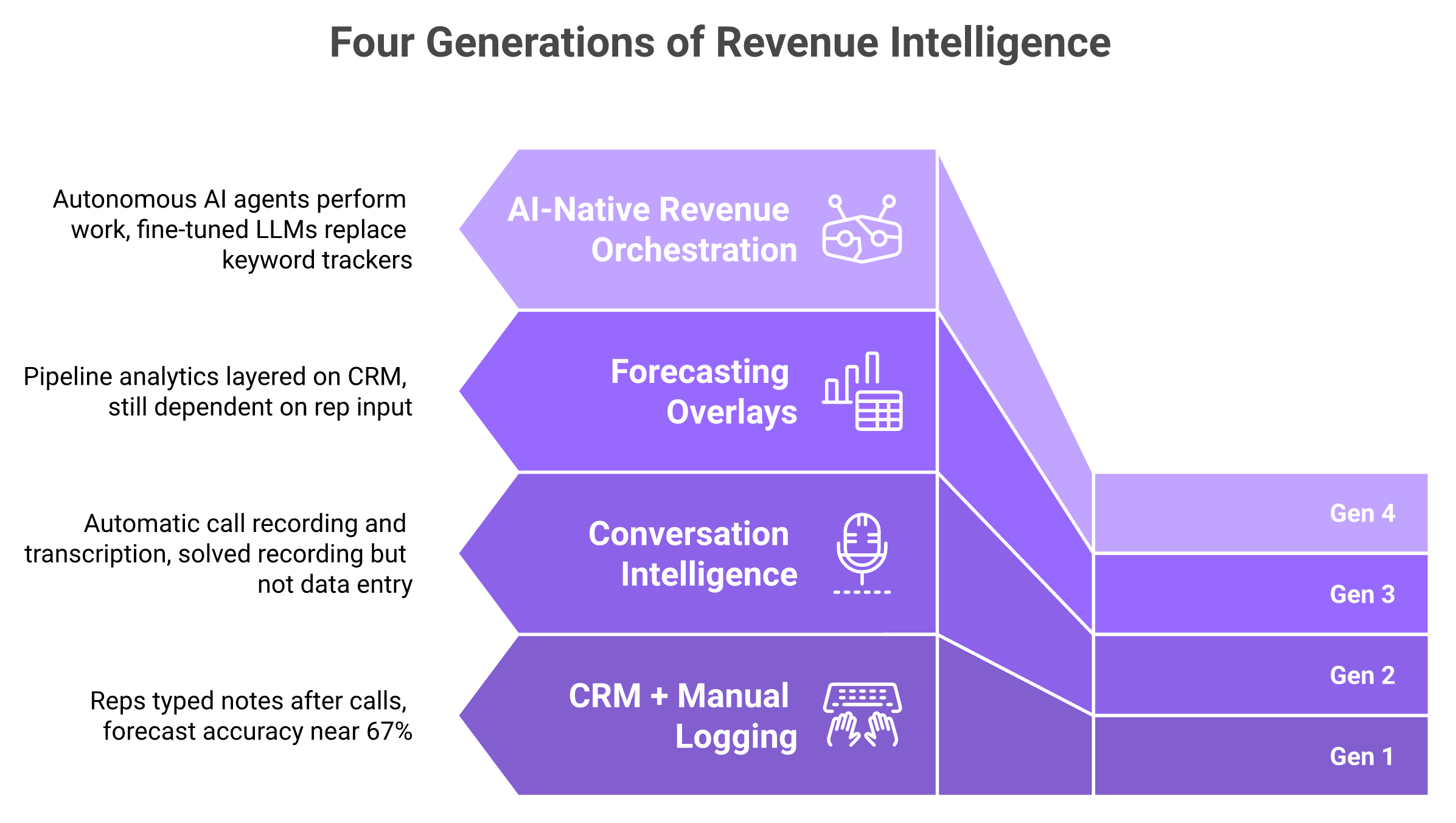
Revenue intelligence has evolved through four distinct generations, with Gen 4 AI-native orchestration replacing dashboards with autonomous agents.
Generation 1 (2010 to 2015): CRM + Manual Logging. Salesforce and HubSpot gave teams a database, but every insight depended on reps manually typing notes after calls. Forecast accuracy hovered near 67% because the underlying data was always incomplete and biased.
Generation 2 (2015 to 2022): Conversation Intelligence, "The Dashcam Era."Gong, Chorus, and Avoma introduced automatic call recording and transcription. For the first time, managers could hear the actual voice of the customer without sitting in on every call:
"Before Gong we had a lack of visibility across our deals because information was siloed in several places like CRM, Email, Zoom, phone." Scott T., Director of Sales Gong G2 Verified Review
✅ These tools solved the recording problem. ❌ They didn't solve the data-entry problem. Insights still lived inside a separate platform, disconnected from the CRM.
Forecasting Layers and the Cost Ceiling
Generation 3 (2020 to 2024): Forecasting Overlays.Clari and BoostUp layered pipeline analytics and forecast roll-ups on top of CRM data. Revenue leaders gained new visibility into weekly forecast calls:
"I love how easy Clari makes forecasting... Clari features often overlap with other common sales tech tools. Clari should do more to differentiate themselves from competition." Sarah J., Senior Manager, Revenue Operations Clari G2 Verified Review
✅ Forecasting improved for teams with clean data. ❌ Clari still depended on biased rep input and manual field updates, leaving the "garbage in, garbage out" problem intact. And stacking Gong (conversation intelligence) plus Clari (forecasting) pushed costs beyond $500/user/month.
The Gen-4 Shift: AI-Native Revenue Orchestration
Generation 4 (2024 to Present) replaces dashboards and recordings with autonomous AI agents that perform the work instead of displaying data about it. Three forces drove this transition:
⚠️ The data-entry failure: After a decade of CRM adoption, reps still don't update fields reliably. No UI improvement fixed a fundamentally broken workflow.
✅ LLM maturity: Fine-tuned large language models now reason across unstructured data (calls, emails, Slack) to extract structured intelligence, something keyword-based trackers never could.
💰 The cost ceiling: Budget pressure forced buyers to demand consolidated platforms rather than stacking point tools.
Where Oliv AI Fits
Oliv AI exemplifies the Gen-4 architecture: an AI-native revenue orchestration platform built on 100+ fine-tuned models that unifies conversation intelligence, CRM automation, forecasting, and coaching in a single agentic system. Rather than requiring teams to adopt another application, Oliv deploys specialized agents, including CRM Manager, Deal Driver, and Forecaster, that execute work autonomously inside existing workflows like Slack, Email, and the CRM itself.
Q2: Why Does Every New Revenue Tool Create Another Data Silo? [toc=Data Silo Problem]
Every RevOps leader knows the pattern: evaluate a new tool, buy it to solve one problem, and watch it create a new data island that fragments visibility further. Reps spend up to 80% of their day on administrative tasks across disconnected systems, and CRM data quality degrades with every point tool added to the stack. The root cause isn't poor integrations. It's that legacy tools were architecturally designed to retain data inside their own walls.
The One-Way Data Trap
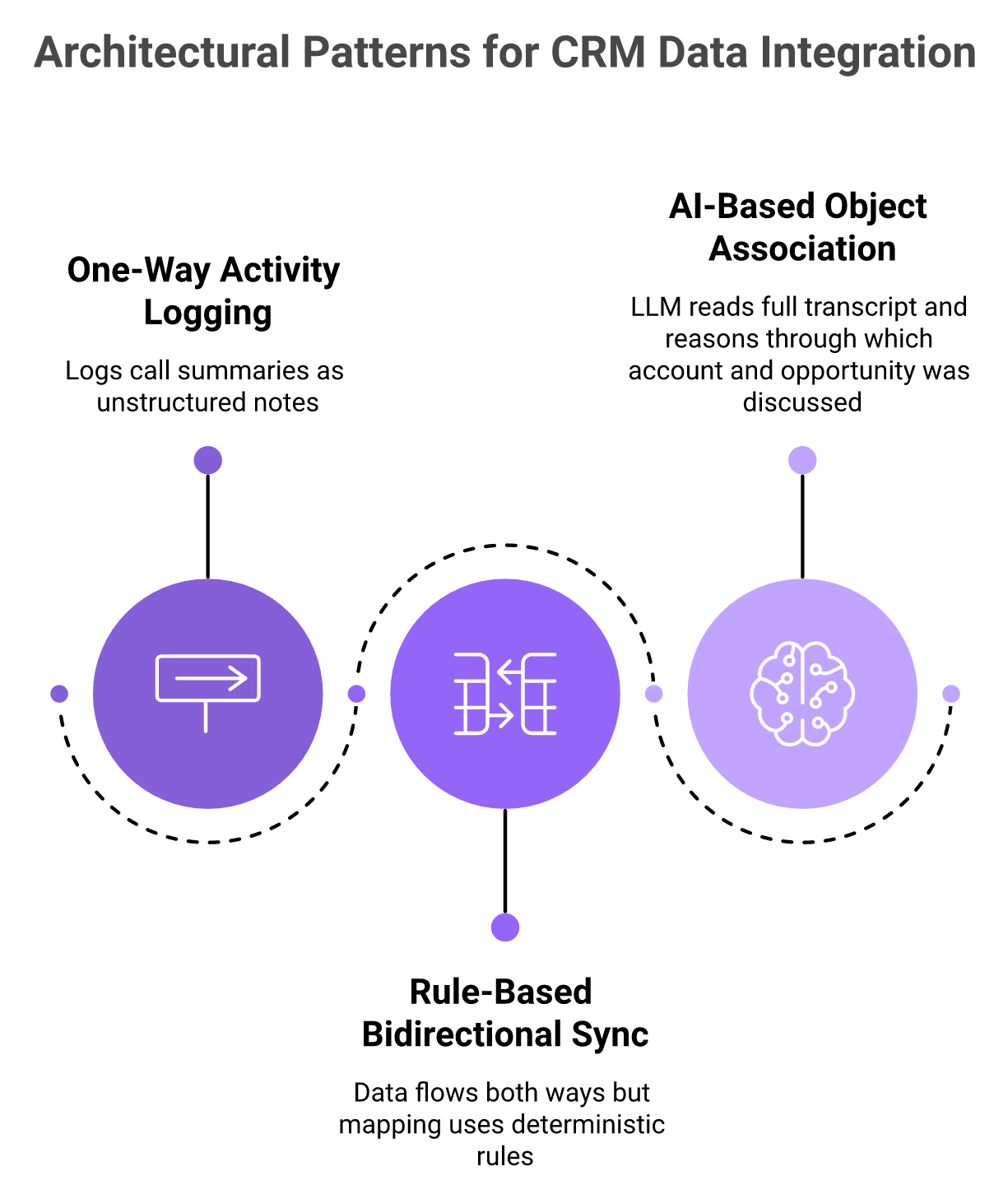
Traditional conversation intelligence platforms pull data in but don't push structured intelligence back out. Gong, for instance, logs call summaries as unstructured "Notes" or activity entries in Salesforce, data that is un-reportable and unusable for pipeline dashboards. One Sales Operations Manager captured the frustration directly:
"Our experience has been impacted by significant data access limitations, especially concerning data portability and bulk export capabilities... The lack of flexibility has required us to engage our development team at additional cost, adding significant operational and opportunity costs just to extract data we already own." Neel P., Sales Operations Manager Gong G2 Verified Review
Chat-Based Friction and Forecasting Gaps
Salesforce Agentforce takes a different but equally problematic approach. Its chat-based interface requires users to manually query a bot rather than embedding intelligence into the daily workflow, creating friction that kills adoption. Meanwhile, Clari adds a forecasting dashboard that still depends on whatever (often incomplete) data exists in the CRM, without addressing the underlying hygiene problem:
"Clari's integration capabilities are inadequate, particularly in pulling in call transcripts, which requires working with other tools." Josiah R., Head of Sales Operations Clari G2 Verified Review
Why "Integration" Alone Doesn't Fix Silos
The real problem isn't that tools lack API connectors. Most have them. The problem is that they export unstructured data (notes, activity logs, raw transcripts) rather than structured CRM properties. RevOps cannot build forecast models or pipeline reports on freeform text. The agentic paradigm solves this differently: instead of asking humans to enter data or relying on basic syncs, AI agents reason through every interaction and write structured, field-level intelligence directly into CRM properties, including MEDDPICC scores, stakeholder maps, and deal stages, in real time.
How Oliv AI Eliminates the Silo by Design
Oliv is built as an AI-native data platform where the CRM is the permanent home for every insight, not Oliv's own UI. Here's how the architecture differs:
✅ Full Open Export: Every AI-generated field, including qualification scores, competitive mentions, and next steps, lives as a native Salesforce or HubSpot property, fully reportable and filterable.
✅ The Invisible UI: Oliv's agents deliver insights where you already work, in Slack, Gmail, Outlook, and the CRM itself, rather than requiring teams to learn another application.
✅ 360-Degree Deal Stitching: The CRM Manager Agent unifies signals from calls, emails, Slack, and web data into a single consolidated deal timeline, with no manual correlation required.
Unlike platforms that attempt to become the "center of the universe" by pulling all data inward, Oliv pushes intelligence outward, ensuring your CRM remains the single source of truth rather than another tool fighting for that role.
Q3: What Does a 'Data Platform' Approach Look Like vs. Point Tools Like Call Recorders? [toc=Data Platform vs Point Tools]
The distinction between a "point tool" and a "data platform" is the most consequential architectural decision RevOps will make in 2026. Point tools like Gong and Chorus are built around the meeting as the atomic unit. They record, transcribe, and analyze individual calls. A data platform treats the deal as the atomic unit, stitching every interaction (calls, emails, Slack threads, support tickets, and web signals) into a continuous narrative that evolves over the deal's lifetime.
The "Dashcam" Problem with Point Tools
Think of legacy conversation intelligence as dashcam footage. It records the accident (the meeting), but it doesn't help you drive the car (the deal). Managers still have to manually stitch together 10 meeting recordings to understand a single deal's trajectory, a process that consumes hours every week.
The underlying technology compounds the problem. Gong's "Smart Trackers" rely on keyword matching, a V1 machine-learning approach that flags mentions without understanding intent or context:
"It can be overwhelming to set up trackers. AI training is a bit laborious to get it to do what you want." Trafford J., Senior Director, Revenue Enablement Gong G2 Verified Review
"AI is not great yet, the product still feels like its at its infancy and needs to be developed further." Annabelle H., Director, Board of Directors Gong G2 Verified Review
Context Blindness Across Legacy Tools
Chorus faces similar constraints. Keyword-based systems can't infer meaning. They require exact matches, which means nuanced conversations are systematically missed:
"The software doesn't have the capability of identifying words/phrases that are similar to what you're looking for or understand context, so if you don't tell it exactly what you're looking for then you'll miss out." Director of Sales Operations Chorus Gartner Verified Review
A true data platform operates differently, across three structural layers:
Three-Layer Data Platform Architecture
Layer
Function
Example
Foundation
Ingests and unifies all sales activity data across channels
AI Data Platform with object association
Intelligence
Extracts structured signals using fine-tuned models
Deploys agents that execute work based on intelligence
CRM Manager, Deal Driver, Forecaster
This architecture means the platform doesn't just show you insights. It acts on them.
How Oliv AI Operationalizes the Data Platform Model
Oliv's three-layer architecture turns this framework into daily execution:
✅ Foundation Layer: Captures and stitches data from calls, emails, Slack, support tickets, and the web, creating one unified deal view, not isolated meeting-level snapshots.
✅ Intelligence Layer: 100+ fine-tuned LLMs extract specific signals (competitor threats, churn risk, and feature requests) with contextual reasoning, not keyword matching.
✅ Activation Layer: Agents like the Deal Driver, CRM Manager, and Forecaster execute autonomously, updating CRM fields, drafting follow-ups, and surfacing risks in Slack without requiring a manager to dig through dashboards.
The result is an evolving deal summary that matures after every interaction, rather than a library of disconnected call recordings someone has to manually review.
Q4: What Architectural Patterns Prevent Data Silos Between CI Tools and CRM? [toc=Anti-Silo Architecture Patterns]
Information about a deal lives in one place above all others: the rep's head. Until that knowledge is captured and mapped to the correct CRM object, it doesn't exist for the rest of the organization. The challenge intensifies when CRMs contain duplicate accounts ("Google US" vs. "Google India") and multiple open opportunities for different products, creating a fragmented reality where automated mapping frequently fails.
Most conversation intelligence platforms, including Gong, log meeting data back to the CRM as unstructured "Notes" or activity entries. These records are searchable within Gong's own interface but un-reportable and un-filterable in Salesforce dashboards. The data technically "syncs," but it doesn't integrate into the structured layer RevOps needs for forecasting or pipeline analysis:
"The platform lacks task APIs, does not integrate with other vendors or parallel dialers, and isn't built to function as a proper sequencing tool... The lack of robust data export options has made it hard to justify the platform's cost." Verified Reviewer Gong G2 Verified Review
Salesforce Einstein Activity Capture and Clari represent this pattern. Data flows both ways, but mapping relies on deterministic rules: match by email domain, account name, or opportunity owner. These rules break when duplicates exist, when contacts span multiple accounts, or when reps use personal email threads:
"It's sometimes difficult if you don't have a strong RevOps/RevTech team to maintain validation rules in both Salesforce and Clari instances." Dan J. Clari G2 Verified Review
One consequence: reps build workarounds that defeat the purpose entirely.
"I have to maintain my own separate spreadsheet to track deals because I can only capture what my leaders want to see about a deal." Verified User in Human Resources Clari G2 Verified Review
Pattern 3: AI-Based Object Association (✅ Silo-Proof)
Legacy platforms use one-way logging (Pattern 1) or brittle rule-based sync (Pattern 2). AI-based object association (Pattern 3) eliminates silos through contextual reasoning.
The third pattern replaces brittle rules with contextual reasoning. Instead of matching on surface-level fields, an LLM reads the full transcript and reasons through which product, region, and opportunity was discussed, then maps the interaction to the correct CRM object, even when duplicates or ambiguities exist. This eliminates the two primary failure modes of rule-based systems:
Duplicate resolution: AI evaluates account history and conversation context to select the right record, rather than defaulting to the first match.
Multi-product mapping: When a call covers both an upsell and a renewal, the system splits intelligence to the appropriate opportunities.
How Oliv AI Implements Pattern 3
Oliv's CRM Manager Agent uses AI-based object association as its core mapping engine:
✅ Contextual Reasoning: The agent reasons through transcripts to determine which account, opportunity, and contacts are relevant, then writes to the correct CRM records automatically.
✅ Structured Field Population: Instead of logging notes, the agent populates actual standard and custom CRM properties (MEDDPICC criteria, next steps, and stakeholder roles), making every data point reportable and forecast-ready.
✅ Multi-CRM Support: Deep bidirectional sync with Salesforce, HubSpot, Microsoft Dynamics, Pipedrive, and Zoho ensures pattern-3 architecture works regardless of your CRM platform.
The result: RevOps teams stop maintaining validation rules and spreadsheet workarounds. The AI handles object resolution at a level of nuance that deterministic rules simply cannot match.
Q5: How Do Gong, Clari, Salesforce Agentforce, Chorus, and Avoma Compare Feature-by-Feature? [toc=Feature-by-Feature Comparison]
Below is an objective, dimension-by-dimension comparison across the six platforms most commonly evaluated by RevOps teams in 2026. Ratings reflect publicly available feature documentation, verified user reviews, and architectural analysis, not marketing claims.
⏰ Weeks to months; requires Salesforce admin expertise
⏰ 2 to 6 weeks (simpler scope)
⏰ 1 to 2 weeks
⏰ 5 minutes baseline; 2 to 4 weeks full customization
What the Reviews Reveal
Even positive reviewers surface friction that doesn't appear in feature lists. On Gong's bundling:
"The additional products like forecast or engage come at an additional cost. Would be great to see these tools rolled into the core offering." Scott T., Director of Sales Gong G2 Verified Review
"It's sometimes difficult if you don't have a strong RevOps/RevTech team to maintain validation rules in both Salesforce and Clari instances." Dan J. Clari G2 Verified Review
"Can be complex to set up and customize... Licensing fees can be high, especially as the number of agents grows." Verified User in Marketing and Advertising Salesforce Agentforce G2 Verified Review
Key Takeaway for RevOps
No legacy platform delivers structured CRM write-back, autonomous forecasting, and modular pricing in a single solution. That architectural gap is precisely where Gen-4 platforms like Oliv AI differentiate, consolidating capabilities that previously required stacking Gong + Clari + a data enrichment tool into one agentic layer.
Q6: Can Revenue Intelligence Platforms Enrich Contacts and Clean CRM Data Automatically? [toc=CRM Enrichment and Hygiene]
B2B buying committees now average six to ten stakeholders, and they shift roles constantly. When a VP of Procurement changes companies mid-deal, your CRM doesn't update itself, and neither do most revenue intelligence platforms. RevOps teams spend 40+ hours per month on manual data cleanup: deduplicating records, chasing reps for field updates, and reconciling contacts across tools. The question isn't whether enrichment matters. It's which platforms actually automate it end-to-end.
Where Legacy Platforms Fall Short
Gong records the meeting where a new stakeholder is introduced, but it doesn't create a contact object in the CRM or enrich it with external firmographic data. That step still falls on the rep, who, in practice, rarely does it. Salesforce Einstein Activity Capture attempts to auto-log activities, but its rule-based engine frequently misassociates data with duplicate records:
"Its biggest handicap is that it does not allow for data storage or data migration. You can't really input the data from Einstein into another platform." Verified Reviewer Einstein Gartner Verified Review
The Shift to Autonomous Enrichment
Chorus benefits from the ZoomInfo database for enrichment, but that data lives within the ZoomInfo ecosystem, not inside your CRM properties where RevOps needs it for reporting. Avoma and Clari offer no enrichment capabilities at all.
The AI-era approach treats enrichment not as a separate data-vendor workflow but as a native byproduct of every customer interaction. When a new name is mentioned on a call, the system auto-discovers the contact, enriches it with title, company, and social data, creates the CRM record, and maps it to the correct account, all before the rep finishes their post-call coffee.
The same principle applies to ongoing hygiene. Rather than quarterly "data cleanup sprints," modern platforms continuously deduplicate, normalize, and re-enrich records as new signals emerge from conversations, emails, and web sources.
How Oliv AI Automates Enrichment and Hygiene
Oliv's agent architecture addresses both the creation and maintenance sides of the data lifecycle:
✅ CRM Manager Agent: Auto-creates contacts discovered during interactions and enriches them with professional data from LinkedIn and Crunchbase, including titles, reporting structure, and firmographics.
✅ Data Cleanser Agent: Runs weekly cycles to deduplicate records, normalize fields, and suggest account merges when duplicate entries are detected.
✅ Stakeholder Monitoring: As a LinkedIn Partner, Oliv tracks job changes in real time. If a champion leaves an account, the account owner receives an immediate Slack or email alert.
Avoma's inflexible approach to data management stands in stark contrast:
"We are paying for double the amount of seats that we need... We asked multiple times to revisit the contract and renegotiate the user count with them. Multiple times they flat out refused." Jessica W., IT Specialist Avoma G2 Verified Review
The result of Oliv's approach is a self-healing CRM, one where data accuracy improves with every interaction rather than degrading between manual cleanup cycles.
Q7: What's the Best Way to Ground AI Outputs So They're Evidence-Based? [toc=Evidence-Based AI Grounding]
The number-one objection revenue leaders raise about AI-driven platforms is hallucination risk. If an AI agent pushes an incorrect deal stage, fabricates a stakeholder objection, or produces a "fluffy" summary that misrepresents reality, it doesn't just create noise. It breaks forecasts, erodes trust, and can create legal liability. Grounding AI outputs in verifiable evidence isn't a nice-to-have; it's a prerequisite for enterprise adoption.
Why Legacy AI Falls Short on Traceability
Gong's Smart Trackers flag keyword mentions, including "budget," "competitor," and "timeline," but don't explain the reasoning behind the flag or link to the specific evidence that triggered it. A manager sees an alert but has to click through multiple screens to determine whether it's meaningful:
"It's too complicated, and not intuitive at all... Searching for calls is not easy, moving around in the calls is not easy, and understanding the pipeline management portion of it is almost impossible." John S., Senior Account Executive Gong G2 Verified Review
Salesforce Einstein's Grounding Gap
Salesforce Einstein faces a different grounding problem. Its AI capabilities are bolted onto a legacy CRM foundation, and the recommendations often feel disconnected from the specific deal context:
"When I say Einstein I'm talking about Salesforce AI... quite frankly I haven't been impressed by any of the early Salesforce AI tools, and I don't hear anyone talking about them glowingly." OffManuscript, r/SalesforceDeveloper Reddit Thread
The Three Pillars of Grounded AI
Evidence-based AI in revenue intelligence requires three architectural commitments:
Fine-Tuned Models: LLMs trained specifically on your organization's deal data, not generic internet knowledge, so outputs reflect your sales reality, not hallucinated generalities.
Source-Linked Outputs: Every insight, field update, or risk flag must link directly to the timestamped audio clip, email snippet, or data point that produced it.
Human-in-the-Loop (HITL) Verification: AI drafts the work; humans approve before anything is committed to the CRM, creating a trust layer that catches errors before they propagate.
How Oliv AI Implements Grounded Reasoning
Oliv operationalizes all three pillars through its architecture:
✅ 100+ Fine-Tuned LLMs: Models operate within a secure customer data workspace, grounded exclusively in the organization's own interaction history, not generic training data.
✅ Timestamped Evidence Links: Every CRM field update from Oliv includes a direct link to the exact moment in a call recording or the specific email thread that generated the insight. When the Deal Driver flags "champion sentiment declining," it cites the 2:34 mark of Tuesday's call, not a keyword match.
✅ HITL Workflow: Agents draft updates (CRM fields, follow-up emails, and deal stage changes) and send a Slack or email nudge to the rep to "verify and approve" before pushing. Nothing enters the CRM without human confirmation.
This approach means RevOps can audit any AI-generated data point back to its source, a level of traceability that keyword-based trackers and generic GPT wrappers simply cannot provide.
Q8: How Do You Reduce Platform Noise While Still Catching Critical Deal Risk? [toc=Reducing Alert Noise]
Sales managers face a paradox: they need comprehensive deal monitoring to catch risks early, but the platforms delivering that monitoring often generate so much noise that managers mute alerts entirely, losing the very visibility the tool was supposed to provide. This is "Noisy Platform Syndrome," and it's the silent killer of revenue intelligence ROI.
How Keyword Trackers Create the Problem
The root cause is architectural. V1 conversation intelligence tools like Gong use keyword-based trackers that flag mentions without understanding intent. The word "budget" triggers an alert whether a prospect is discussing their allocated spend or mentioning a personal holiday budget. "Competitor X" fires whether the prospect is actively evaluating a rival or referencing them in passing.
The result is an avalanche of low-signal alerts that trains managers to ignore their notification channels. One reviewer captured this experience directly:
"There's so much in Gong, that we don't use everything. Gong's deal forecasting we don't use." Karel Bos, Head of Sales Gong TrustRadius Verified Review
Context-Blindness Across Legacy Tools
And Chorus faces similar context-blindness at the tracker level:
"The software doesn't have the capability of identifying words/phrases that are similar to what you're looking for or understand context, so if you don't tell it exactly what you're looking for then you'll miss out." Director of Sales Operations Chorus Gartner Verified Review
Intent-Aware Monitoring: The Paradigm Shift
The solution isn't fewer alerts. It's smarter ones. Intent-aware AI systems don't match keywords; they reason through conversational context to determine whether a signal requires human intervention. They can distinguish between a champion raising a standard technical question and one expressing genuine doubt about the deal's viability.
This approach dramatically compresses the signal-to-noise ratio. Instead of 50 keyword alerts per day, a manager receives 3 to 5 contextual risk flags, each with evidence and recommended action.
How Oliv AI Delivers Signal Without Noise
Oliv's Deal Driver Agent operationalizes intent-aware monitoring across the full deal lifecycle:
✅ Contextual Risk Detection: 100+ fine-tuned LLMs analyze every interaction across all channels (calls, emails, and Slack) and flag only signals with genuine deal impact, such as an Economic Buyer going silent for 14+ days or a champion using language that indicates shifting sentiment.
✅ Sunset Summaries: Every evening, managers receive a curated daily pulse delivered to Slack or email, summarizing which deals moved forward, which stalled, and which require immediate intervention. No dashboard digging required.
✅ Proactive, Not Reactive: Instead of waiting for a manager to log in and search for problems, the Deal Driver reviews 100% of interactions daily and surfaces only the exceptions that demand attention.
The difference is structural: legacy platforms bury you in data and hope you find the insight. Oliv's agents surface only what matters, exactly when it matters, turning revenue intelligence from an information overload problem into a daily action list.
Q9: Can You Buy Just One Agent Without Buying the Full Platform? [toc=Modular Agent Purchasing]
One of the most frustrating patterns in enterprise sales technology is the monolithic contract. CROs inherit stacks of tools where half the features sit unused, "shelfware" that was bundled into an all-or-nothing agreement at renewal time. In a market where revenue teams are dynamic, ramping, restructuring, and reprioritizing quarterly, the inability to purchase capabilities surgically wastes budget and slows time-to-value.
❌ The Forced Bundling Problem
Legacy platforms are architecturally designed around unified licensing, which forces buyers to pay for the entire suite to access any single capability:
Gong operates on a "Unified License" model. You cannot purchase Forecasting or Engage without buying the Core conversation intelligence license for every seat. Add-on modules come at additional cost on top of what is already a premium per-user price.
Salesforce Agentforce requires stacking: Sales Cloud + Agentforce + Revenue Intelligence. Each layer adds its own per-user fee, and the cumulative cost quickly compounds.
Clari uses opaque enterprise pricing with custom quotes that make it difficult to scope a lean initial deployment.
Users Feel This Pain Directly
"The additional products like forecast or engage come at an additional cost. Would be great to see these tools rolled into the core offering." Scott T., Director of Sales Gong G2 Verified Review
"Expensive, especially for smaller teams. Steep learning curve for new users. Overwhelming with too many features at once." Shubham G., Senior BDM Salesforce Agentforce G2 Verified Review
✅ The Modular Agent Paradigm
The generative AI era enables a fundamentally different purchasing model: agent-based pricing where organizations buy individual capabilities aligned to specific roles and problems. Instead of committing six figures for an entire platform, RevOps can deploy a single agent to solve one acute pain point, dirty CRM data, for instance, and expand only after proving ROI.
How Oliv AI Enables Surgical Deployment
We designed Oliv's pricing around modular, persona-based purchasing:
✅ Start with one agent: Organizations can deploy just the CRM Manager Agent to solve the immediate problem of missing contacts and dirty data, without buying the full platform.
✅ Granular seat control: RevOps can assign the Deal Driver only to frontline managers while reps stay on baseline intelligence. No forced all-seat licensing.
✅ Free foundation layer: Core recording and transcription is free for existing Gong users, eliminating the switching cost barrier and letting teams transition to agents at their own pace.
✅ No mandatory platform fees: Unlike Gong's $5K to $50K annual platform charge, Oliv's modular model lets teams scale from one agent to a full agentic workforce without hidden surcharges.
"It is really just a glorified SFDC overlay... definitely overkill for most companies." conaldinho11, r/SalesOperations Reddit Thread
The contrast is clear: legacy platforms sell software suites; Oliv sells outcomes, one agent at a time.
Q10: Should a 25-Person Startup Invest in Revenue Intelligence or Just Hire More Reps? [toc=Startup Tool vs Hire Dilemma]
At 25 people, every dollar competes with headcount. Heads of Sales at early-stage companies face a genuine dilemma: invest in revenue technology that might be overkill, or hire another rep to carry quota. The honest answer is that this is a false binary. The real question is whether you can afford not to multiply the output of the reps you already have.
⚠️ The RevOps Debt Trap
Most startup sales leaders are buried in "RevOps Debt." They spend evenings listening to call recordings at 2x speed to spot deal risks. Forecasts live in spreadsheets cobbled together from memory. Reps spend an estimated 80% of their day on admin tasks, including data entry, CRM updates, and follow-up scheduling, instead of selling. Hiring Rep #6 into this broken process doesn't fix it; it just scales the administrative burden by another salary.
💰 Why Legacy Tools Don't Fit Startup Budgets
The traditional revenue intelligence stack was built for enterprise budgets. For a 25-user team, the numbers are prohibitive:
Gong's first-year cost: $47,000 to $65,100, including mandatory platform fees ($5K to $50K) and implementation fees ($7.5K to $30K).
Implementation timeline: 8 to 24 weeks and 40 to 140 admin hours just to configure Smart Trackers.
The Clari stack penalty: Adding Clari on top of Gong pushes per-user costs to $500+/month.
One startup leader captured this frustration:
"It was a big mistake on our part to commit to a two year term. Gong is a really powerful tool but it's probably the highest end option on the market, and now we're stuck with a tool that works technically but isn't the right business decision." Iris P., Head of Marketing, Sales and Partnerships Gong G2 Verified Review
"Sadly Gong.io as a leader in its market is not too open to negotiate with smaller companies... The pricing is probably the biggest obstacle and hence we are looking to change." Miodrag, Enterprise Account Executive Gong Verified Review
✅ The Force Multiplier Approach with Oliv AI
Instead of choosing between a tool and a hire, Oliv acts as a "Fractional RevOps Team" that makes existing reps dramatically more productive:
⏰ 5-minute setup: No multi-week implementation. Connect your CRM and calendar, and agents begin working immediately.
✅ Startup-friendly pricing: A 25-person team gets full conversation intelligence, autonomous CRM updates, and forecasting capabilities, without platform fees or multi-year lock-ins.
✅ Time recovered: The Deal Driver Agent saves managers one full day per week by automating manual pipeline audits.
The reframe is simple: instead of hiring Rep #6 at $80K/year to feed the same broken process, invest a fraction of that in AI agents that make Reps #1 through #5 twice as effective.
For 25-person startups, deploying AI agents at a fraction of one rep's salary makes the existing team twice as effective.
Q11: What Does Total Cost of Ownership Actually Look Like Across Platforms? [toc=TCO Comparison Across Platforms]
Pricing pages tell one story; Total Cost of Ownership (TCO) tells another. Hidden platform fees, mandatory implementation charges, auto-renewal escalators, and forced bundling inflate the real cost of revenue intelligence far beyond the listed per-user rate. Below is a transparent TCO breakdown across the platforms most commonly evaluated by RevOps teams in 2026.
Modular: baseline starts low; agents added per role
Annual Platform Fee
💸 $5K to $50K mandatory
Included in custom pricing
Stacked from both vendors
Included in Salesforce licensing
✅ None
Implementation Fee
💸 $7.5K to $30K
$10K to $25K (typical)
$17.5K to $55K combined
Varies; admin/developer hours required
✅ None
Implementation Timeline
⏰ 8 to 24 weeks
⏰ 4 to 12 weeks
⏰ 12 to 36 weeks (sequential)
⏰ Weeks to months
⏰ 5 min baseline; 2 to 4 weeks full custom
Admin Hours to Configure
40 to 140 hours
20 to 60 hours
60 to 200 hours combined
Requires dedicated Salesforce admin
✅ Minimal
3-Year TCO (100 users)
💸 ~$789,300
💸 ~$520,000
💸 ~$1.3M+
💸 ~$1.5M+
✅ ~$68,400
Auto-Renewal Lock-In
⚠️ Yes (annual)
⚠️ Yes (annual)
Both
⚠️ Yes (annual)
✅ Flexible
Hidden Costs Users Actually Report
The table above reflects list economics, but users consistently flag costs that aren't visible upfront:
"The lack of robust data export options has made it hard to justify the platform's cost, especially as it falls short of meeting practical data management needs." Neel P., Sales Operations Manager Gong G2 Verified Review
"Their agreements are evergreen, automatically renewing annually without alternative terms. If you miss the cancellation deadline by even a few hours... they enforce renewal for the entire year." Kevin H., CTO and Co-Founder Outreach G2 Verified Review
"We are paying for double the amount of seats that we need... Multiple times they flat out refused to renegotiate." Jessica W., IT Specialist Avoma G2 Verified Review
The 91% Cost Reduction
Over three years, the Gong-to-Oliv comparison illustrates the generational shift: $789,300 versus $68,400 for the same 100-user team, a 91% reduction. Oliv AI achieves this by eliminating platform fees, implementation costs, and forced bundling while delivering broader autonomous functionality through its modular agent architecture.
Q12: How Should RevOps Evaluate Revenue Intelligence Platforms? A Weighted Scoring Framework [toc=Weighted Evaluation Framework]
Choosing a revenue intelligence platform without a structured evaluation framework leads to emotional purchasing, vendor lock-in, and expensive regret. Below is a weighted scoring rubric that RevOps teams can adapt directly into a spreadsheet for internal vendor scoring.
Evaluation Rubric: 8 Weighted Dimensions
This weighted pyramid shows how RevOps teams should prioritize evaluation criteria, with CRM write-back depth and data architecture forming the non-negotiable foundation.
Revenue Intelligence Platform Evaluation Rubric
#
Evaluation Criterion
Weight
What to Assess
Key Questions
1
CRM Write-Back Depth
20%
Does the platform update structured CRM fields (properties) or just log unstructured notes?
Are updates bidirectional? Can custom fields (MEDDPICC, FAINT) be populated?
2
Data Architecture
15%
Does data live inside the vendor's silo, or does it flow back to your CRM as the system of record?
Can you export all AI-generated insights? Is the vendor a "data platform" or a "point tool"?
3
Signal-to-Noise Quality
15%
Does the platform use intent-aware AI or keyword-only trackers?
How does it distinguish between a competitor mentioned casually vs. actively evaluated?
4
Pricing Transparency
15%
Are there hidden platform fees, implementation charges, or forced bundling?
Can you buy one capability without committing to the full suite?
5
Implementation Speed
10%
How long from contract signature to first value delivered?
What admin hours are required? Is custom model training included or extra?
6
Forecasting Autonomy
10%
Does forecasting require manual rep input, or does the platform generate autonomous predictions?
Is the forecast grounded in deal evidence or gut-feel roll-ups?
7
Security and Compliance
10%
SOC 2 Type II, GDPR, data residency options, and evidence traceability for AI outputs.
Does every AI-generated output link to a source? Is there HITL verification?
8
Contact Enrichment and Hygiene
5%
Does the platform auto-discover, enrich, and deduplicate contacts without manual intervention?
Are external data sources (LinkedIn, Crunchbase) natively integrated?
How to Score Vendors
Rate each platform on a 1 to 5 scale per criterion (1 = not available; 3 = partially available with manual effort; 5 = fully autonomous).
Multiply each score by the criterion weight.
Sum the weighted scores for a composite vendor rating.
Red-flag any vendor scoring 1 on CRM Write-Back Depth or Data Architecture. These are foundational; a platform that fails here creates more problems than it solves.
Practical Insight from Real Users
Even positive reviews surface evaluation gaps that this rubric would catch:
"Clari should find ways to differentiate from the native Salesforce features (e.g., Pipeline Inspection, Forecasting) in order to remain competitive in the long-run." Dan J. Clari G2 Verified Review
"It can be overwhelming to set up trackers. AI training is a bit laborious to get it to do what you want." Trafford J., Senior Director, Revenue Enablement Gong G2 Verified Review
Oliv AI simplifies this evaluation by scoring high across all eight dimensions, particularly on CRM write-back depth (structured field-level updates), pricing transparency (modular, no platform fees), and implementation speed (5-minute baseline deployment), making it a strong starting point for teams seeking an agentic, AI-native alternative to legacy stacks.
Q1: What Is a Revenue Intelligence Platform in 2026 and Why Has the Category Shifted? [toc=Category Shift in 2026]
A revenue intelligence platform aggregates sales activity data, including calls, emails, CRM entries, and digital interactions, then applies AI to surface deal insights, forecast revenue, and guide seller behavior. But the definition that held in 2020 barely applies in 2026. The category has gone through four distinct generations, and understanding each is essential before evaluating any platform.
The Four Generations of Revenue Intelligence
Revenue intelligence has evolved through four distinct generations, with Gen 4 AI-native orchestration replacing dashboards with autonomous agents.
Generation 1 (2010 to 2015): CRM + Manual Logging. Salesforce and HubSpot gave teams a database, but every insight depended on reps manually typing notes after calls. Forecast accuracy hovered near 67% because the underlying data was always incomplete and biased.
Generation 2 (2015 to 2022): Conversation Intelligence, "The Dashcam Era."Gong, Chorus, and Avoma introduced automatic call recording and transcription. For the first time, managers could hear the actual voice of the customer without sitting in on every call:
"Before Gong we had a lack of visibility across our deals because information was siloed in several places like CRM, Email, Zoom, phone." Scott T., Director of Sales Gong G2 Verified Review
✅ These tools solved the recording problem. ❌ They didn't solve the data-entry problem. Insights still lived inside a separate platform, disconnected from the CRM.
Forecasting Layers and the Cost Ceiling
Generation 3 (2020 to 2024): Forecasting Overlays.Clari and BoostUp layered pipeline analytics and forecast roll-ups on top of CRM data. Revenue leaders gained new visibility into weekly forecast calls:
"I love how easy Clari makes forecasting... Clari features often overlap with other common sales tech tools. Clari should do more to differentiate themselves from competition." Sarah J., Senior Manager, Revenue Operations Clari G2 Verified Review
✅ Forecasting improved for teams with clean data. ❌ Clari still depended on biased rep input and manual field updates, leaving the "garbage in, garbage out" problem intact. And stacking Gong (conversation intelligence) plus Clari (forecasting) pushed costs beyond $500/user/month.
The Gen-4 Shift: AI-Native Revenue Orchestration
Generation 4 (2024 to Present) replaces dashboards and recordings with autonomous AI agents that perform the work instead of displaying data about it. Three forces drove this transition:
⚠️ The data-entry failure: After a decade of CRM adoption, reps still don't update fields reliably. No UI improvement fixed a fundamentally broken workflow.
✅ LLM maturity: Fine-tuned large language models now reason across unstructured data (calls, emails, Slack) to extract structured intelligence, something keyword-based trackers never could.
💰 The cost ceiling: Budget pressure forced buyers to demand consolidated platforms rather than stacking point tools.
Where Oliv AI Fits
Oliv AI exemplifies the Gen-4 architecture: an AI-native revenue orchestration platform built on 100+ fine-tuned models that unifies conversation intelligence, CRM automation, forecasting, and coaching in a single agentic system. Rather than requiring teams to adopt another application, Oliv deploys specialized agents, including CRM Manager, Deal Driver, and Forecaster, that execute work autonomously inside existing workflows like Slack, Email, and the CRM itself.
Q2: Why Does Every New Revenue Tool Create Another Data Silo? [toc=Data Silo Problem]
Every RevOps leader knows the pattern: evaluate a new tool, buy it to solve one problem, and watch it create a new data island that fragments visibility further. Reps spend up to 80% of their day on administrative tasks across disconnected systems, and CRM data quality degrades with every point tool added to the stack. The root cause isn't poor integrations. It's that legacy tools were architecturally designed to retain data inside their own walls.
The One-Way Data Trap
Traditional conversation intelligence platforms pull data in but don't push structured intelligence back out. Gong, for instance, logs call summaries as unstructured "Notes" or activity entries in Salesforce, data that is un-reportable and unusable for pipeline dashboards. One Sales Operations Manager captured the frustration directly:
"Our experience has been impacted by significant data access limitations, especially concerning data portability and bulk export capabilities... The lack of flexibility has required us to engage our development team at additional cost, adding significant operational and opportunity costs just to extract data we already own." Neel P., Sales Operations Manager Gong G2 Verified Review
Chat-Based Friction and Forecasting Gaps
Salesforce Agentforce takes a different but equally problematic approach. Its chat-based interface requires users to manually query a bot rather than embedding intelligence into the daily workflow, creating friction that kills adoption. Meanwhile, Clari adds a forecasting dashboard that still depends on whatever (often incomplete) data exists in the CRM, without addressing the underlying hygiene problem:
"Clari's integration capabilities are inadequate, particularly in pulling in call transcripts, which requires working with other tools." Josiah R., Head of Sales Operations Clari G2 Verified Review
Why "Integration" Alone Doesn't Fix Silos
The real problem isn't that tools lack API connectors. Most have them. The problem is that they export unstructured data (notes, activity logs, raw transcripts) rather than structured CRM properties. RevOps cannot build forecast models or pipeline reports on freeform text. The agentic paradigm solves this differently: instead of asking humans to enter data or relying on basic syncs, AI agents reason through every interaction and write structured, field-level intelligence directly into CRM properties, including MEDDPICC scores, stakeholder maps, and deal stages, in real time.
How Oliv AI Eliminates the Silo by Design
Oliv is built as an AI-native data platform where the CRM is the permanent home for every insight, not Oliv's own UI. Here's how the architecture differs:
✅ Full Open Export: Every AI-generated field, including qualification scores, competitive mentions, and next steps, lives as a native Salesforce or HubSpot property, fully reportable and filterable.
✅ The Invisible UI: Oliv's agents deliver insights where you already work, in Slack, Gmail, Outlook, and the CRM itself, rather than requiring teams to learn another application.
✅ 360-Degree Deal Stitching: The CRM Manager Agent unifies signals from calls, emails, Slack, and web data into a single consolidated deal timeline, with no manual correlation required.
Unlike platforms that attempt to become the "center of the universe" by pulling all data inward, Oliv pushes intelligence outward, ensuring your CRM remains the single source of truth rather than another tool fighting for that role.
Q3: What Does a 'Data Platform' Approach Look Like vs. Point Tools Like Call Recorders? [toc=Data Platform vs Point Tools]
The distinction between a "point tool" and a "data platform" is the most consequential architectural decision RevOps will make in 2026. Point tools like Gong and Chorus are built around the meeting as the atomic unit. They record, transcribe, and analyze individual calls. A data platform treats the deal as the atomic unit, stitching every interaction (calls, emails, Slack threads, support tickets, and web signals) into a continuous narrative that evolves over the deal's lifetime.
The "Dashcam" Problem with Point Tools
Think of legacy conversation intelligence as dashcam footage. It records the accident (the meeting), but it doesn't help you drive the car (the deal). Managers still have to manually stitch together 10 meeting recordings to understand a single deal's trajectory, a process that consumes hours every week.
The underlying technology compounds the problem. Gong's "Smart Trackers" rely on keyword matching, a V1 machine-learning approach that flags mentions without understanding intent or context:
"It can be overwhelming to set up trackers. AI training is a bit laborious to get it to do what you want." Trafford J., Senior Director, Revenue Enablement Gong G2 Verified Review
"AI is not great yet, the product still feels like its at its infancy and needs to be developed further." Annabelle H., Director, Board of Directors Gong G2 Verified Review
Context Blindness Across Legacy Tools
Chorus faces similar constraints. Keyword-based systems can't infer meaning. They require exact matches, which means nuanced conversations are systematically missed:
"The software doesn't have the capability of identifying words/phrases that are similar to what you're looking for or understand context, so if you don't tell it exactly what you're looking for then you'll miss out." Director of Sales Operations Chorus Gartner Verified Review
A true data platform operates differently, across three structural layers:
Three-Layer Data Platform Architecture
Layer
Function
Example
Foundation
Ingests and unifies all sales activity data across channels
AI Data Platform with object association
Intelligence
Extracts structured signals using fine-tuned models
Deploys agents that execute work based on intelligence
CRM Manager, Deal Driver, Forecaster
This architecture means the platform doesn't just show you insights. It acts on them.
How Oliv AI Operationalizes the Data Platform Model
Oliv's three-layer architecture turns this framework into daily execution:
✅ Foundation Layer: Captures and stitches data from calls, emails, Slack, support tickets, and the web, creating one unified deal view, not isolated meeting-level snapshots.
✅ Intelligence Layer: 100+ fine-tuned LLMs extract specific signals (competitor threats, churn risk, and feature requests) with contextual reasoning, not keyword matching.
✅ Activation Layer: Agents like the Deal Driver, CRM Manager, and Forecaster execute autonomously, updating CRM fields, drafting follow-ups, and surfacing risks in Slack without requiring a manager to dig through dashboards.
The result is an evolving deal summary that matures after every interaction, rather than a library of disconnected call recordings someone has to manually review.
Q4: What Architectural Patterns Prevent Data Silos Between CI Tools and CRM? [toc=Anti-Silo Architecture Patterns]
Information about a deal lives in one place above all others: the rep's head. Until that knowledge is captured and mapped to the correct CRM object, it doesn't exist for the rest of the organization. The challenge intensifies when CRMs contain duplicate accounts ("Google US" vs. "Google India") and multiple open opportunities for different products, creating a fragmented reality where automated mapping frequently fails.
Most conversation intelligence platforms, including Gong, log meeting data back to the CRM as unstructured "Notes" or activity entries. These records are searchable within Gong's own interface but un-reportable and un-filterable in Salesforce dashboards. The data technically "syncs," but it doesn't integrate into the structured layer RevOps needs for forecasting or pipeline analysis:
"The platform lacks task APIs, does not integrate with other vendors or parallel dialers, and isn't built to function as a proper sequencing tool... The lack of robust data export options has made it hard to justify the platform's cost." Verified Reviewer Gong G2 Verified Review
Salesforce Einstein Activity Capture and Clari represent this pattern. Data flows both ways, but mapping relies on deterministic rules: match by email domain, account name, or opportunity owner. These rules break when duplicates exist, when contacts span multiple accounts, or when reps use personal email threads:
"It's sometimes difficult if you don't have a strong RevOps/RevTech team to maintain validation rules in both Salesforce and Clari instances." Dan J. Clari G2 Verified Review
One consequence: reps build workarounds that defeat the purpose entirely.
"I have to maintain my own separate spreadsheet to track deals because I can only capture what my leaders want to see about a deal." Verified User in Human Resources Clari G2 Verified Review
Pattern 3: AI-Based Object Association (✅ Silo-Proof)
Legacy platforms use one-way logging (Pattern 1) or brittle rule-based sync (Pattern 2). AI-based object association (Pattern 3) eliminates silos through contextual reasoning.
The third pattern replaces brittle rules with contextual reasoning. Instead of matching on surface-level fields, an LLM reads the full transcript and reasons through which product, region, and opportunity was discussed, then maps the interaction to the correct CRM object, even when duplicates or ambiguities exist. This eliminates the two primary failure modes of rule-based systems:
Duplicate resolution: AI evaluates account history and conversation context to select the right record, rather than defaulting to the first match.
Multi-product mapping: When a call covers both an upsell and a renewal, the system splits intelligence to the appropriate opportunities.
How Oliv AI Implements Pattern 3
Oliv's CRM Manager Agent uses AI-based object association as its core mapping engine:
✅ Contextual Reasoning: The agent reasons through transcripts to determine which account, opportunity, and contacts are relevant, then writes to the correct CRM records automatically.
✅ Structured Field Population: Instead of logging notes, the agent populates actual standard and custom CRM properties (MEDDPICC criteria, next steps, and stakeholder roles), making every data point reportable and forecast-ready.
✅ Multi-CRM Support: Deep bidirectional sync with Salesforce, HubSpot, Microsoft Dynamics, Pipedrive, and Zoho ensures pattern-3 architecture works regardless of your CRM platform.
The result: RevOps teams stop maintaining validation rules and spreadsheet workarounds. The AI handles object resolution at a level of nuance that deterministic rules simply cannot match.
Q5: How Do Gong, Clari, Salesforce Agentforce, Chorus, and Avoma Compare Feature-by-Feature? [toc=Feature-by-Feature Comparison]
Below is an objective, dimension-by-dimension comparison across the six platforms most commonly evaluated by RevOps teams in 2026. Ratings reflect publicly available feature documentation, verified user reviews, and architectural analysis, not marketing claims.
⏰ Weeks to months; requires Salesforce admin expertise
⏰ 2 to 6 weeks (simpler scope)
⏰ 1 to 2 weeks
⏰ 5 minutes baseline; 2 to 4 weeks full customization
What the Reviews Reveal
Even positive reviewers surface friction that doesn't appear in feature lists. On Gong's bundling:
"The additional products like forecast or engage come at an additional cost. Would be great to see these tools rolled into the core offering." Scott T., Director of Sales Gong G2 Verified Review
"It's sometimes difficult if you don't have a strong RevOps/RevTech team to maintain validation rules in both Salesforce and Clari instances." Dan J. Clari G2 Verified Review
"Can be complex to set up and customize... Licensing fees can be high, especially as the number of agents grows." Verified User in Marketing and Advertising Salesforce Agentforce G2 Verified Review
Key Takeaway for RevOps
No legacy platform delivers structured CRM write-back, autonomous forecasting, and modular pricing in a single solution. That architectural gap is precisely where Gen-4 platforms like Oliv AI differentiate, consolidating capabilities that previously required stacking Gong + Clari + a data enrichment tool into one agentic layer.
Q6: Can Revenue Intelligence Platforms Enrich Contacts and Clean CRM Data Automatically? [toc=CRM Enrichment and Hygiene]
B2B buying committees now average six to ten stakeholders, and they shift roles constantly. When a VP of Procurement changes companies mid-deal, your CRM doesn't update itself, and neither do most revenue intelligence platforms. RevOps teams spend 40+ hours per month on manual data cleanup: deduplicating records, chasing reps for field updates, and reconciling contacts across tools. The question isn't whether enrichment matters. It's which platforms actually automate it end-to-end.
Where Legacy Platforms Fall Short
Gong records the meeting where a new stakeholder is introduced, but it doesn't create a contact object in the CRM or enrich it with external firmographic data. That step still falls on the rep, who, in practice, rarely does it. Salesforce Einstein Activity Capture attempts to auto-log activities, but its rule-based engine frequently misassociates data with duplicate records:
"Its biggest handicap is that it does not allow for data storage or data migration. You can't really input the data from Einstein into another platform." Verified Reviewer Einstein Gartner Verified Review
The Shift to Autonomous Enrichment
Chorus benefits from the ZoomInfo database for enrichment, but that data lives within the ZoomInfo ecosystem, not inside your CRM properties where RevOps needs it for reporting. Avoma and Clari offer no enrichment capabilities at all.
The AI-era approach treats enrichment not as a separate data-vendor workflow but as a native byproduct of every customer interaction. When a new name is mentioned on a call, the system auto-discovers the contact, enriches it with title, company, and social data, creates the CRM record, and maps it to the correct account, all before the rep finishes their post-call coffee.
The same principle applies to ongoing hygiene. Rather than quarterly "data cleanup sprints," modern platforms continuously deduplicate, normalize, and re-enrich records as new signals emerge from conversations, emails, and web sources.
How Oliv AI Automates Enrichment and Hygiene
Oliv's agent architecture addresses both the creation and maintenance sides of the data lifecycle:
✅ CRM Manager Agent: Auto-creates contacts discovered during interactions and enriches them with professional data from LinkedIn and Crunchbase, including titles, reporting structure, and firmographics.
✅ Data Cleanser Agent: Runs weekly cycles to deduplicate records, normalize fields, and suggest account merges when duplicate entries are detected.
✅ Stakeholder Monitoring: As a LinkedIn Partner, Oliv tracks job changes in real time. If a champion leaves an account, the account owner receives an immediate Slack or email alert.
Avoma's inflexible approach to data management stands in stark contrast:
"We are paying for double the amount of seats that we need... We asked multiple times to revisit the contract and renegotiate the user count with them. Multiple times they flat out refused." Jessica W., IT Specialist Avoma G2 Verified Review
The result of Oliv's approach is a self-healing CRM, one where data accuracy improves with every interaction rather than degrading between manual cleanup cycles.
Q7: What's the Best Way to Ground AI Outputs So They're Evidence-Based? [toc=Evidence-Based AI Grounding]
The number-one objection revenue leaders raise about AI-driven platforms is hallucination risk. If an AI agent pushes an incorrect deal stage, fabricates a stakeholder objection, or produces a "fluffy" summary that misrepresents reality, it doesn't just create noise. It breaks forecasts, erodes trust, and can create legal liability. Grounding AI outputs in verifiable evidence isn't a nice-to-have; it's a prerequisite for enterprise adoption.
Why Legacy AI Falls Short on Traceability
Gong's Smart Trackers flag keyword mentions, including "budget," "competitor," and "timeline," but don't explain the reasoning behind the flag or link to the specific evidence that triggered it. A manager sees an alert but has to click through multiple screens to determine whether it's meaningful:
"It's too complicated, and not intuitive at all... Searching for calls is not easy, moving around in the calls is not easy, and understanding the pipeline management portion of it is almost impossible." John S., Senior Account Executive Gong G2 Verified Review
Salesforce Einstein's Grounding Gap
Salesforce Einstein faces a different grounding problem. Its AI capabilities are bolted onto a legacy CRM foundation, and the recommendations often feel disconnected from the specific deal context:
"When I say Einstein I'm talking about Salesforce AI... quite frankly I haven't been impressed by any of the early Salesforce AI tools, and I don't hear anyone talking about them glowingly." OffManuscript, r/SalesforceDeveloper Reddit Thread
The Three Pillars of Grounded AI
Evidence-based AI in revenue intelligence requires three architectural commitments:
Fine-Tuned Models: LLMs trained specifically on your organization's deal data, not generic internet knowledge, so outputs reflect your sales reality, not hallucinated generalities.
Source-Linked Outputs: Every insight, field update, or risk flag must link directly to the timestamped audio clip, email snippet, or data point that produced it.
Human-in-the-Loop (HITL) Verification: AI drafts the work; humans approve before anything is committed to the CRM, creating a trust layer that catches errors before they propagate.
How Oliv AI Implements Grounded Reasoning
Oliv operationalizes all three pillars through its architecture:
✅ 100+ Fine-Tuned LLMs: Models operate within a secure customer data workspace, grounded exclusively in the organization's own interaction history, not generic training data.
✅ Timestamped Evidence Links: Every CRM field update from Oliv includes a direct link to the exact moment in a call recording or the specific email thread that generated the insight. When the Deal Driver flags "champion sentiment declining," it cites the 2:34 mark of Tuesday's call, not a keyword match.
✅ HITL Workflow: Agents draft updates (CRM fields, follow-up emails, and deal stage changes) and send a Slack or email nudge to the rep to "verify and approve" before pushing. Nothing enters the CRM without human confirmation.
This approach means RevOps can audit any AI-generated data point back to its source, a level of traceability that keyword-based trackers and generic GPT wrappers simply cannot provide.
Q8: How Do You Reduce Platform Noise While Still Catching Critical Deal Risk? [toc=Reducing Alert Noise]
Sales managers face a paradox: they need comprehensive deal monitoring to catch risks early, but the platforms delivering that monitoring often generate so much noise that managers mute alerts entirely, losing the very visibility the tool was supposed to provide. This is "Noisy Platform Syndrome," and it's the silent killer of revenue intelligence ROI.
How Keyword Trackers Create the Problem
The root cause is architectural. V1 conversation intelligence tools like Gong use keyword-based trackers that flag mentions without understanding intent. The word "budget" triggers an alert whether a prospect is discussing their allocated spend or mentioning a personal holiday budget. "Competitor X" fires whether the prospect is actively evaluating a rival or referencing them in passing.
The result is an avalanche of low-signal alerts that trains managers to ignore their notification channels. One reviewer captured this experience directly:
"There's so much in Gong, that we don't use everything. Gong's deal forecasting we don't use." Karel Bos, Head of Sales Gong TrustRadius Verified Review
Context-Blindness Across Legacy Tools
And Chorus faces similar context-blindness at the tracker level:
"The software doesn't have the capability of identifying words/phrases that are similar to what you're looking for or understand context, so if you don't tell it exactly what you're looking for then you'll miss out." Director of Sales Operations Chorus Gartner Verified Review
Intent-Aware Monitoring: The Paradigm Shift
The solution isn't fewer alerts. It's smarter ones. Intent-aware AI systems don't match keywords; they reason through conversational context to determine whether a signal requires human intervention. They can distinguish between a champion raising a standard technical question and one expressing genuine doubt about the deal's viability.
This approach dramatically compresses the signal-to-noise ratio. Instead of 50 keyword alerts per day, a manager receives 3 to 5 contextual risk flags, each with evidence and recommended action.
How Oliv AI Delivers Signal Without Noise
Oliv's Deal Driver Agent operationalizes intent-aware monitoring across the full deal lifecycle:
✅ Contextual Risk Detection: 100+ fine-tuned LLMs analyze every interaction across all channels (calls, emails, and Slack) and flag only signals with genuine deal impact, such as an Economic Buyer going silent for 14+ days or a champion using language that indicates shifting sentiment.
✅ Sunset Summaries: Every evening, managers receive a curated daily pulse delivered to Slack or email, summarizing which deals moved forward, which stalled, and which require immediate intervention. No dashboard digging required.
✅ Proactive, Not Reactive: Instead of waiting for a manager to log in and search for problems, the Deal Driver reviews 100% of interactions daily and surfaces only the exceptions that demand attention.
The difference is structural: legacy platforms bury you in data and hope you find the insight. Oliv's agents surface only what matters, exactly when it matters, turning revenue intelligence from an information overload problem into a daily action list.
Q9: Can You Buy Just One Agent Without Buying the Full Platform? [toc=Modular Agent Purchasing]
One of the most frustrating patterns in enterprise sales technology is the monolithic contract. CROs inherit stacks of tools where half the features sit unused, "shelfware" that was bundled into an all-or-nothing agreement at renewal time. In a market where revenue teams are dynamic, ramping, restructuring, and reprioritizing quarterly, the inability to purchase capabilities surgically wastes budget and slows time-to-value.
❌ The Forced Bundling Problem
Legacy platforms are architecturally designed around unified licensing, which forces buyers to pay for the entire suite to access any single capability:
Gong operates on a "Unified License" model. You cannot purchase Forecasting or Engage without buying the Core conversation intelligence license for every seat. Add-on modules come at additional cost on top of what is already a premium per-user price.
Salesforce Agentforce requires stacking: Sales Cloud + Agentforce + Revenue Intelligence. Each layer adds its own per-user fee, and the cumulative cost quickly compounds.
Clari uses opaque enterprise pricing with custom quotes that make it difficult to scope a lean initial deployment.
Users Feel This Pain Directly
"The additional products like forecast or engage come at an additional cost. Would be great to see these tools rolled into the core offering." Scott T., Director of Sales Gong G2 Verified Review
"Expensive, especially for smaller teams. Steep learning curve for new users. Overwhelming with too many features at once." Shubham G., Senior BDM Salesforce Agentforce G2 Verified Review
✅ The Modular Agent Paradigm
The generative AI era enables a fundamentally different purchasing model: agent-based pricing where organizations buy individual capabilities aligned to specific roles and problems. Instead of committing six figures for an entire platform, RevOps can deploy a single agent to solve one acute pain point, dirty CRM data, for instance, and expand only after proving ROI.
How Oliv AI Enables Surgical Deployment
We designed Oliv's pricing around modular, persona-based purchasing:
✅ Start with one agent: Organizations can deploy just the CRM Manager Agent to solve the immediate problem of missing contacts and dirty data, without buying the full platform.
✅ Granular seat control: RevOps can assign the Deal Driver only to frontline managers while reps stay on baseline intelligence. No forced all-seat licensing.
✅ Free foundation layer: Core recording and transcription is free for existing Gong users, eliminating the switching cost barrier and letting teams transition to agents at their own pace.
✅ No mandatory platform fees: Unlike Gong's $5K to $50K annual platform charge, Oliv's modular model lets teams scale from one agent to a full agentic workforce without hidden surcharges.
"It is really just a glorified SFDC overlay... definitely overkill for most companies." conaldinho11, r/SalesOperations Reddit Thread
The contrast is clear: legacy platforms sell software suites; Oliv sells outcomes, one agent at a time.
Q10: Should a 25-Person Startup Invest in Revenue Intelligence or Just Hire More Reps? [toc=Startup Tool vs Hire Dilemma]
At 25 people, every dollar competes with headcount. Heads of Sales at early-stage companies face a genuine dilemma: invest in revenue technology that might be overkill, or hire another rep to carry quota. The honest answer is that this is a false binary. The real question is whether you can afford not to multiply the output of the reps you already have.
⚠️ The RevOps Debt Trap
Most startup sales leaders are buried in "RevOps Debt." They spend evenings listening to call recordings at 2x speed to spot deal risks. Forecasts live in spreadsheets cobbled together from memory. Reps spend an estimated 80% of their day on admin tasks, including data entry, CRM updates, and follow-up scheduling, instead of selling. Hiring Rep #6 into this broken process doesn't fix it; it just scales the administrative burden by another salary.
💰 Why Legacy Tools Don't Fit Startup Budgets
The traditional revenue intelligence stack was built for enterprise budgets. For a 25-user team, the numbers are prohibitive:
Gong's first-year cost: $47,000 to $65,100, including mandatory platform fees ($5K to $50K) and implementation fees ($7.5K to $30K).
Implementation timeline: 8 to 24 weeks and 40 to 140 admin hours just to configure Smart Trackers.
The Clari stack penalty: Adding Clari on top of Gong pushes per-user costs to $500+/month.
One startup leader captured this frustration:
"It was a big mistake on our part to commit to a two year term. Gong is a really powerful tool but it's probably the highest end option on the market, and now we're stuck with a tool that works technically but isn't the right business decision." Iris P., Head of Marketing, Sales and Partnerships Gong G2 Verified Review
"Sadly Gong.io as a leader in its market is not too open to negotiate with smaller companies... The pricing is probably the biggest obstacle and hence we are looking to change." Miodrag, Enterprise Account Executive Gong Verified Review
✅ The Force Multiplier Approach with Oliv AI
Instead of choosing between a tool and a hire, Oliv acts as a "Fractional RevOps Team" that makes existing reps dramatically more productive:
⏰ 5-minute setup: No multi-week implementation. Connect your CRM and calendar, and agents begin working immediately.
✅ Startup-friendly pricing: A 25-person team gets full conversation intelligence, autonomous CRM updates, and forecasting capabilities, without platform fees or multi-year lock-ins.
✅ Time recovered: The Deal Driver Agent saves managers one full day per week by automating manual pipeline audits.
The reframe is simple: instead of hiring Rep #6 at $80K/year to feed the same broken process, invest a fraction of that in AI agents that make Reps #1 through #5 twice as effective.
For 25-person startups, deploying AI agents at a fraction of one rep's salary makes the existing team twice as effective.
Q11: What Does Total Cost of Ownership Actually Look Like Across Platforms? [toc=TCO Comparison Across Platforms]
Pricing pages tell one story; Total Cost of Ownership (TCO) tells another. Hidden platform fees, mandatory implementation charges, auto-renewal escalators, and forced bundling inflate the real cost of revenue intelligence far beyond the listed per-user rate. Below is a transparent TCO breakdown across the platforms most commonly evaluated by RevOps teams in 2026.
Modular: baseline starts low; agents added per role
Annual Platform Fee
💸 $5K to $50K mandatory
Included in custom pricing
Stacked from both vendors
Included in Salesforce licensing
✅ None
Implementation Fee
💸 $7.5K to $30K
$10K to $25K (typical)
$17.5K to $55K combined
Varies; admin/developer hours required
✅ None
Implementation Timeline
⏰ 8 to 24 weeks
⏰ 4 to 12 weeks
⏰ 12 to 36 weeks (sequential)
⏰ Weeks to months
⏰ 5 min baseline; 2 to 4 weeks full custom
Admin Hours to Configure
40 to 140 hours
20 to 60 hours
60 to 200 hours combined
Requires dedicated Salesforce admin
✅ Minimal
3-Year TCO (100 users)
💸 ~$789,300
💸 ~$520,000
💸 ~$1.3M+
💸 ~$1.5M+
✅ ~$68,400
Auto-Renewal Lock-In
⚠️ Yes (annual)
⚠️ Yes (annual)
Both
⚠️ Yes (annual)
✅ Flexible
Hidden Costs Users Actually Report
The table above reflects list economics, but users consistently flag costs that aren't visible upfront:
"The lack of robust data export options has made it hard to justify the platform's cost, especially as it falls short of meeting practical data management needs." Neel P., Sales Operations Manager Gong G2 Verified Review
"Their agreements are evergreen, automatically renewing annually without alternative terms. If you miss the cancellation deadline by even a few hours... they enforce renewal for the entire year." Kevin H., CTO and Co-Founder Outreach G2 Verified Review
"We are paying for double the amount of seats that we need... Multiple times they flat out refused to renegotiate." Jessica W., IT Specialist Avoma G2 Verified Review
The 91% Cost Reduction
Over three years, the Gong-to-Oliv comparison illustrates the generational shift: $789,300 versus $68,400 for the same 100-user team, a 91% reduction. Oliv AI achieves this by eliminating platform fees, implementation costs, and forced bundling while delivering broader autonomous functionality through its modular agent architecture.
Q12: How Should RevOps Evaluate Revenue Intelligence Platforms? A Weighted Scoring Framework [toc=Weighted Evaluation Framework]
Choosing a revenue intelligence platform without a structured evaluation framework leads to emotional purchasing, vendor lock-in, and expensive regret. Below is a weighted scoring rubric that RevOps teams can adapt directly into a spreadsheet for internal vendor scoring.
Evaluation Rubric: 8 Weighted Dimensions
This weighted pyramid shows how RevOps teams should prioritize evaluation criteria, with CRM write-back depth and data architecture forming the non-negotiable foundation.
Revenue Intelligence Platform Evaluation Rubric
#
Evaluation Criterion
Weight
What to Assess
Key Questions
1
CRM Write-Back Depth
20%
Does the platform update structured CRM fields (properties) or just log unstructured notes?
Are updates bidirectional? Can custom fields (MEDDPICC, FAINT) be populated?
2
Data Architecture
15%
Does data live inside the vendor's silo, or does it flow back to your CRM as the system of record?
Can you export all AI-generated insights? Is the vendor a "data platform" or a "point tool"?
3
Signal-to-Noise Quality
15%
Does the platform use intent-aware AI or keyword-only trackers?
How does it distinguish between a competitor mentioned casually vs. actively evaluated?
4
Pricing Transparency
15%
Are there hidden platform fees, implementation charges, or forced bundling?
Can you buy one capability without committing to the full suite?
5
Implementation Speed
10%
How long from contract signature to first value delivered?
What admin hours are required? Is custom model training included or extra?
6
Forecasting Autonomy
10%
Does forecasting require manual rep input, or does the platform generate autonomous predictions?
Is the forecast grounded in deal evidence or gut-feel roll-ups?
7
Security and Compliance
10%
SOC 2 Type II, GDPR, data residency options, and evidence traceability for AI outputs.
Does every AI-generated output link to a source? Is there HITL verification?
8
Contact Enrichment and Hygiene
5%
Does the platform auto-discover, enrich, and deduplicate contacts without manual intervention?
Are external data sources (LinkedIn, Crunchbase) natively integrated?
How to Score Vendors
Rate each platform on a 1 to 5 scale per criterion (1 = not available; 3 = partially available with manual effort; 5 = fully autonomous).
Multiply each score by the criterion weight.
Sum the weighted scores for a composite vendor rating.
Red-flag any vendor scoring 1 on CRM Write-Back Depth or Data Architecture. These are foundational; a platform that fails here creates more problems than it solves.
Practical Insight from Real Users
Even positive reviews surface evaluation gaps that this rubric would catch:
"Clari should find ways to differentiate from the native Salesforce features (e.g., Pipeline Inspection, Forecasting) in order to remain competitive in the long-run." Dan J. Clari G2 Verified Review
"It can be overwhelming to set up trackers. AI training is a bit laborious to get it to do what you want." Trafford J., Senior Director, Revenue Enablement Gong G2 Verified Review
Oliv AI simplifies this evaluation by scoring high across all eight dimensions, particularly on CRM write-back depth (structured field-level updates), pricing transparency (modular, no platform fees), and implementation speed (5-minute baseline deployment), making it a strong starting point for teams seeking an agentic, AI-native alternative to legacy stacks.
Q1: What Is a Revenue Intelligence Platform in 2026 and Why Has the Category Shifted? [toc=Category Shift in 2026]
A revenue intelligence platform aggregates sales activity data, including calls, emails, CRM entries, and digital interactions, then applies AI to surface deal insights, forecast revenue, and guide seller behavior. But the definition that held in 2020 barely applies in 2026. The category has gone through four distinct generations, and understanding each is essential before evaluating any platform.
The Four Generations of Revenue Intelligence
Revenue intelligence has evolved through four distinct generations, with Gen 4 AI-native orchestration replacing dashboards with autonomous agents.
Generation 1 (2010 to 2015): CRM + Manual Logging. Salesforce and HubSpot gave teams a database, but every insight depended on reps manually typing notes after calls. Forecast accuracy hovered near 67% because the underlying data was always incomplete and biased.
Generation 2 (2015 to 2022): Conversation Intelligence, "The Dashcam Era."Gong, Chorus, and Avoma introduced automatic call recording and transcription. For the first time, managers could hear the actual voice of the customer without sitting in on every call:
"Before Gong we had a lack of visibility across our deals because information was siloed in several places like CRM, Email, Zoom, phone." Scott T., Director of Sales Gong G2 Verified Review
✅ These tools solved the recording problem. ❌ They didn't solve the data-entry problem. Insights still lived inside a separate platform, disconnected from the CRM.
Forecasting Layers and the Cost Ceiling
Generation 3 (2020 to 2024): Forecasting Overlays.Clari and BoostUp layered pipeline analytics and forecast roll-ups on top of CRM data. Revenue leaders gained new visibility into weekly forecast calls:
"I love how easy Clari makes forecasting... Clari features often overlap with other common sales tech tools. Clari should do more to differentiate themselves from competition." Sarah J., Senior Manager, Revenue Operations Clari G2 Verified Review
✅ Forecasting improved for teams with clean data. ❌ Clari still depended on biased rep input and manual field updates, leaving the "garbage in, garbage out" problem intact. And stacking Gong (conversation intelligence) plus Clari (forecasting) pushed costs beyond $500/user/month.
The Gen-4 Shift: AI-Native Revenue Orchestration
Generation 4 (2024 to Present) replaces dashboards and recordings with autonomous AI agents that perform the work instead of displaying data about it. Three forces drove this transition:
⚠️ The data-entry failure: After a decade of CRM adoption, reps still don't update fields reliably. No UI improvement fixed a fundamentally broken workflow.
✅ LLM maturity: Fine-tuned large language models now reason across unstructured data (calls, emails, Slack) to extract structured intelligence, something keyword-based trackers never could.
💰 The cost ceiling: Budget pressure forced buyers to demand consolidated platforms rather than stacking point tools.
Where Oliv AI Fits
Oliv AI exemplifies the Gen-4 architecture: an AI-native revenue orchestration platform built on 100+ fine-tuned models that unifies conversation intelligence, CRM automation, forecasting, and coaching in a single agentic system. Rather than requiring teams to adopt another application, Oliv deploys specialized agents, including CRM Manager, Deal Driver, and Forecaster, that execute work autonomously inside existing workflows like Slack, Email, and the CRM itself.
Q2: Why Does Every New Revenue Tool Create Another Data Silo? [toc=Data Silo Problem]
Every RevOps leader knows the pattern: evaluate a new tool, buy it to solve one problem, and watch it create a new data island that fragments visibility further. Reps spend up to 80% of their day on administrative tasks across disconnected systems, and CRM data quality degrades with every point tool added to the stack. The root cause isn't poor integrations. It's that legacy tools were architecturally designed to retain data inside their own walls.
The One-Way Data Trap
Traditional conversation intelligence platforms pull data in but don't push structured intelligence back out. Gong, for instance, logs call summaries as unstructured "Notes" or activity entries in Salesforce, data that is un-reportable and unusable for pipeline dashboards. One Sales Operations Manager captured the frustration directly:
"Our experience has been impacted by significant data access limitations, especially concerning data portability and bulk export capabilities... The lack of flexibility has required us to engage our development team at additional cost, adding significant operational and opportunity costs just to extract data we already own." Neel P., Sales Operations Manager Gong G2 Verified Review
Chat-Based Friction and Forecasting Gaps
Salesforce Agentforce takes a different but equally problematic approach. Its chat-based interface requires users to manually query a bot rather than embedding intelligence into the daily workflow, creating friction that kills adoption. Meanwhile, Clari adds a forecasting dashboard that still depends on whatever (often incomplete) data exists in the CRM, without addressing the underlying hygiene problem:
"Clari's integration capabilities are inadequate, particularly in pulling in call transcripts, which requires working with other tools." Josiah R., Head of Sales Operations Clari G2 Verified Review
Why "Integration" Alone Doesn't Fix Silos
The real problem isn't that tools lack API connectors. Most have them. The problem is that they export unstructured data (notes, activity logs, raw transcripts) rather than structured CRM properties. RevOps cannot build forecast models or pipeline reports on freeform text. The agentic paradigm solves this differently: instead of asking humans to enter data or relying on basic syncs, AI agents reason through every interaction and write structured, field-level intelligence directly into CRM properties, including MEDDPICC scores, stakeholder maps, and deal stages, in real time.
How Oliv AI Eliminates the Silo by Design
Oliv is built as an AI-native data platform where the CRM is the permanent home for every insight, not Oliv's own UI. Here's how the architecture differs:
✅ Full Open Export: Every AI-generated field, including qualification scores, competitive mentions, and next steps, lives as a native Salesforce or HubSpot property, fully reportable and filterable.
✅ The Invisible UI: Oliv's agents deliver insights where you already work, in Slack, Gmail, Outlook, and the CRM itself, rather than requiring teams to learn another application.
✅ 360-Degree Deal Stitching: The CRM Manager Agent unifies signals from calls, emails, Slack, and web data into a single consolidated deal timeline, with no manual correlation required.
Unlike platforms that attempt to become the "center of the universe" by pulling all data inward, Oliv pushes intelligence outward, ensuring your CRM remains the single source of truth rather than another tool fighting for that role.
Q3: What Does a 'Data Platform' Approach Look Like vs. Point Tools Like Call Recorders? [toc=Data Platform vs Point Tools]
The distinction between a "point tool" and a "data platform" is the most consequential architectural decision RevOps will make in 2026. Point tools like Gong and Chorus are built around the meeting as the atomic unit. They record, transcribe, and analyze individual calls. A data platform treats the deal as the atomic unit, stitching every interaction (calls, emails, Slack threads, support tickets, and web signals) into a continuous narrative that evolves over the deal's lifetime.
The "Dashcam" Problem with Point Tools
Think of legacy conversation intelligence as dashcam footage. It records the accident (the meeting), but it doesn't help you drive the car (the deal). Managers still have to manually stitch together 10 meeting recordings to understand a single deal's trajectory, a process that consumes hours every week.
The underlying technology compounds the problem. Gong's "Smart Trackers" rely on keyword matching, a V1 machine-learning approach that flags mentions without understanding intent or context:
"It can be overwhelming to set up trackers. AI training is a bit laborious to get it to do what you want." Trafford J., Senior Director, Revenue Enablement Gong G2 Verified Review
"AI is not great yet, the product still feels like its at its infancy and needs to be developed further." Annabelle H., Director, Board of Directors Gong G2 Verified Review
Context Blindness Across Legacy Tools
Chorus faces similar constraints. Keyword-based systems can't infer meaning. They require exact matches, which means nuanced conversations are systematically missed:
"The software doesn't have the capability of identifying words/phrases that are similar to what you're looking for or understand context, so if you don't tell it exactly what you're looking for then you'll miss out." Director of Sales Operations Chorus Gartner Verified Review
A true data platform operates differently, across three structural layers:
Three-Layer Data Platform Architecture
Layer
Function
Example
Foundation
Ingests and unifies all sales activity data across channels
AI Data Platform with object association
Intelligence
Extracts structured signals using fine-tuned models
Deploys agents that execute work based on intelligence
CRM Manager, Deal Driver, Forecaster
This architecture means the platform doesn't just show you insights. It acts on them.
How Oliv AI Operationalizes the Data Platform Model
Oliv's three-layer architecture turns this framework into daily execution:
✅ Foundation Layer: Captures and stitches data from calls, emails, Slack, support tickets, and the web, creating one unified deal view, not isolated meeting-level snapshots.
✅ Intelligence Layer: 100+ fine-tuned LLMs extract specific signals (competitor threats, churn risk, and feature requests) with contextual reasoning, not keyword matching.
✅ Activation Layer: Agents like the Deal Driver, CRM Manager, and Forecaster execute autonomously, updating CRM fields, drafting follow-ups, and surfacing risks in Slack without requiring a manager to dig through dashboards.
The result is an evolving deal summary that matures after every interaction, rather than a library of disconnected call recordings someone has to manually review.
Q4: What Architectural Patterns Prevent Data Silos Between CI Tools and CRM? [toc=Anti-Silo Architecture Patterns]
Information about a deal lives in one place above all others: the rep's head. Until that knowledge is captured and mapped to the correct CRM object, it doesn't exist for the rest of the organization. The challenge intensifies when CRMs contain duplicate accounts ("Google US" vs. "Google India") and multiple open opportunities for different products, creating a fragmented reality where automated mapping frequently fails.
Most conversation intelligence platforms, including Gong, log meeting data back to the CRM as unstructured "Notes" or activity entries. These records are searchable within Gong's own interface but un-reportable and un-filterable in Salesforce dashboards. The data technically "syncs," but it doesn't integrate into the structured layer RevOps needs for forecasting or pipeline analysis:
"The platform lacks task APIs, does not integrate with other vendors or parallel dialers, and isn't built to function as a proper sequencing tool... The lack of robust data export options has made it hard to justify the platform's cost." Verified Reviewer Gong G2 Verified Review
Salesforce Einstein Activity Capture and Clari represent this pattern. Data flows both ways, but mapping relies on deterministic rules: match by email domain, account name, or opportunity owner. These rules break when duplicates exist, when contacts span multiple accounts, or when reps use personal email threads:
"It's sometimes difficult if you don't have a strong RevOps/RevTech team to maintain validation rules in both Salesforce and Clari instances." Dan J. Clari G2 Verified Review
One consequence: reps build workarounds that defeat the purpose entirely.
"I have to maintain my own separate spreadsheet to track deals because I can only capture what my leaders want to see about a deal." Verified User in Human Resources Clari G2 Verified Review
Pattern 3: AI-Based Object Association (✅ Silo-Proof)
Legacy platforms use one-way logging (Pattern 1) or brittle rule-based sync (Pattern 2). AI-based object association (Pattern 3) eliminates silos through contextual reasoning.
The third pattern replaces brittle rules with contextual reasoning. Instead of matching on surface-level fields, an LLM reads the full transcript and reasons through which product, region, and opportunity was discussed, then maps the interaction to the correct CRM object, even when duplicates or ambiguities exist. This eliminates the two primary failure modes of rule-based systems:
Duplicate resolution: AI evaluates account history and conversation context to select the right record, rather than defaulting to the first match.
Multi-product mapping: When a call covers both an upsell and a renewal, the system splits intelligence to the appropriate opportunities.
How Oliv AI Implements Pattern 3
Oliv's CRM Manager Agent uses AI-based object association as its core mapping engine:
✅ Contextual Reasoning: The agent reasons through transcripts to determine which account, opportunity, and contacts are relevant, then writes to the correct CRM records automatically.
✅ Structured Field Population: Instead of logging notes, the agent populates actual standard and custom CRM properties (MEDDPICC criteria, next steps, and stakeholder roles), making every data point reportable and forecast-ready.
✅ Multi-CRM Support: Deep bidirectional sync with Salesforce, HubSpot, Microsoft Dynamics, Pipedrive, and Zoho ensures pattern-3 architecture works regardless of your CRM platform.
The result: RevOps teams stop maintaining validation rules and spreadsheet workarounds. The AI handles object resolution at a level of nuance that deterministic rules simply cannot match.
Q5: How Do Gong, Clari, Salesforce Agentforce, Chorus, and Avoma Compare Feature-by-Feature? [toc=Feature-by-Feature Comparison]
Below is an objective, dimension-by-dimension comparison across the six platforms most commonly evaluated by RevOps teams in 2026. Ratings reflect publicly available feature documentation, verified user reviews, and architectural analysis, not marketing claims.
⏰ Weeks to months; requires Salesforce admin expertise
⏰ 2 to 6 weeks (simpler scope)
⏰ 1 to 2 weeks
⏰ 5 minutes baseline; 2 to 4 weeks full customization
What the Reviews Reveal
Even positive reviewers surface friction that doesn't appear in feature lists. On Gong's bundling:
"The additional products like forecast or engage come at an additional cost. Would be great to see these tools rolled into the core offering." Scott T., Director of Sales Gong G2 Verified Review
"It's sometimes difficult if you don't have a strong RevOps/RevTech team to maintain validation rules in both Salesforce and Clari instances." Dan J. Clari G2 Verified Review
"Can be complex to set up and customize... Licensing fees can be high, especially as the number of agents grows." Verified User in Marketing and Advertising Salesforce Agentforce G2 Verified Review
Key Takeaway for RevOps
No legacy platform delivers structured CRM write-back, autonomous forecasting, and modular pricing in a single solution. That architectural gap is precisely where Gen-4 platforms like Oliv AI differentiate, consolidating capabilities that previously required stacking Gong + Clari + a data enrichment tool into one agentic layer.
Q6: Can Revenue Intelligence Platforms Enrich Contacts and Clean CRM Data Automatically? [toc=CRM Enrichment and Hygiene]
B2B buying committees now average six to ten stakeholders, and they shift roles constantly. When a VP of Procurement changes companies mid-deal, your CRM doesn't update itself, and neither do most revenue intelligence platforms. RevOps teams spend 40+ hours per month on manual data cleanup: deduplicating records, chasing reps for field updates, and reconciling contacts across tools. The question isn't whether enrichment matters. It's which platforms actually automate it end-to-end.
Where Legacy Platforms Fall Short
Gong records the meeting where a new stakeholder is introduced, but it doesn't create a contact object in the CRM or enrich it with external firmographic data. That step still falls on the rep, who, in practice, rarely does it. Salesforce Einstein Activity Capture attempts to auto-log activities, but its rule-based engine frequently misassociates data with duplicate records:
"Its biggest handicap is that it does not allow for data storage or data migration. You can't really input the data from Einstein into another platform." Verified Reviewer Einstein Gartner Verified Review
The Shift to Autonomous Enrichment
Chorus benefits from the ZoomInfo database for enrichment, but that data lives within the ZoomInfo ecosystem, not inside your CRM properties where RevOps needs it for reporting. Avoma and Clari offer no enrichment capabilities at all.
The AI-era approach treats enrichment not as a separate data-vendor workflow but as a native byproduct of every customer interaction. When a new name is mentioned on a call, the system auto-discovers the contact, enriches it with title, company, and social data, creates the CRM record, and maps it to the correct account, all before the rep finishes their post-call coffee.
The same principle applies to ongoing hygiene. Rather than quarterly "data cleanup sprints," modern platforms continuously deduplicate, normalize, and re-enrich records as new signals emerge from conversations, emails, and web sources.
How Oliv AI Automates Enrichment and Hygiene
Oliv's agent architecture addresses both the creation and maintenance sides of the data lifecycle:
✅ CRM Manager Agent: Auto-creates contacts discovered during interactions and enriches them with professional data from LinkedIn and Crunchbase, including titles, reporting structure, and firmographics.
✅ Data Cleanser Agent: Runs weekly cycles to deduplicate records, normalize fields, and suggest account merges when duplicate entries are detected.
✅ Stakeholder Monitoring: As a LinkedIn Partner, Oliv tracks job changes in real time. If a champion leaves an account, the account owner receives an immediate Slack or email alert.
Avoma's inflexible approach to data management stands in stark contrast:
"We are paying for double the amount of seats that we need... We asked multiple times to revisit the contract and renegotiate the user count with them. Multiple times they flat out refused." Jessica W., IT Specialist Avoma G2 Verified Review
The result of Oliv's approach is a self-healing CRM, one where data accuracy improves with every interaction rather than degrading between manual cleanup cycles.
Q7: What's the Best Way to Ground AI Outputs So They're Evidence-Based? [toc=Evidence-Based AI Grounding]
The number-one objection revenue leaders raise about AI-driven platforms is hallucination risk. If an AI agent pushes an incorrect deal stage, fabricates a stakeholder objection, or produces a "fluffy" summary that misrepresents reality, it doesn't just create noise. It breaks forecasts, erodes trust, and can create legal liability. Grounding AI outputs in verifiable evidence isn't a nice-to-have; it's a prerequisite for enterprise adoption.
Why Legacy AI Falls Short on Traceability
Gong's Smart Trackers flag keyword mentions, including "budget," "competitor," and "timeline," but don't explain the reasoning behind the flag or link to the specific evidence that triggered it. A manager sees an alert but has to click through multiple screens to determine whether it's meaningful:
"It's too complicated, and not intuitive at all... Searching for calls is not easy, moving around in the calls is not easy, and understanding the pipeline management portion of it is almost impossible." John S., Senior Account Executive Gong G2 Verified Review
Salesforce Einstein's Grounding Gap
Salesforce Einstein faces a different grounding problem. Its AI capabilities are bolted onto a legacy CRM foundation, and the recommendations often feel disconnected from the specific deal context:
"When I say Einstein I'm talking about Salesforce AI... quite frankly I haven't been impressed by any of the early Salesforce AI tools, and I don't hear anyone talking about them glowingly." OffManuscript, r/SalesforceDeveloper Reddit Thread
The Three Pillars of Grounded AI
Evidence-based AI in revenue intelligence requires three architectural commitments:
Fine-Tuned Models: LLMs trained specifically on your organization's deal data, not generic internet knowledge, so outputs reflect your sales reality, not hallucinated generalities.
Source-Linked Outputs: Every insight, field update, or risk flag must link directly to the timestamped audio clip, email snippet, or data point that produced it.
Human-in-the-Loop (HITL) Verification: AI drafts the work; humans approve before anything is committed to the CRM, creating a trust layer that catches errors before they propagate.
How Oliv AI Implements Grounded Reasoning
Oliv operationalizes all three pillars through its architecture:
✅ 100+ Fine-Tuned LLMs: Models operate within a secure customer data workspace, grounded exclusively in the organization's own interaction history, not generic training data.
✅ Timestamped Evidence Links: Every CRM field update from Oliv includes a direct link to the exact moment in a call recording or the specific email thread that generated the insight. When the Deal Driver flags "champion sentiment declining," it cites the 2:34 mark of Tuesday's call, not a keyword match.
✅ HITL Workflow: Agents draft updates (CRM fields, follow-up emails, and deal stage changes) and send a Slack or email nudge to the rep to "verify and approve" before pushing. Nothing enters the CRM without human confirmation.
This approach means RevOps can audit any AI-generated data point back to its source, a level of traceability that keyword-based trackers and generic GPT wrappers simply cannot provide.
Q8: How Do You Reduce Platform Noise While Still Catching Critical Deal Risk? [toc=Reducing Alert Noise]
Sales managers face a paradox: they need comprehensive deal monitoring to catch risks early, but the platforms delivering that monitoring often generate so much noise that managers mute alerts entirely, losing the very visibility the tool was supposed to provide. This is "Noisy Platform Syndrome," and it's the silent killer of revenue intelligence ROI.
How Keyword Trackers Create the Problem
The root cause is architectural. V1 conversation intelligence tools like Gong use keyword-based trackers that flag mentions without understanding intent. The word "budget" triggers an alert whether a prospect is discussing their allocated spend or mentioning a personal holiday budget. "Competitor X" fires whether the prospect is actively evaluating a rival or referencing them in passing.
The result is an avalanche of low-signal alerts that trains managers to ignore their notification channels. One reviewer captured this experience directly:
"There's so much in Gong, that we don't use everything. Gong's deal forecasting we don't use." Karel Bos, Head of Sales Gong TrustRadius Verified Review
Context-Blindness Across Legacy Tools
And Chorus faces similar context-blindness at the tracker level:
"The software doesn't have the capability of identifying words/phrases that are similar to what you're looking for or understand context, so if you don't tell it exactly what you're looking for then you'll miss out." Director of Sales Operations Chorus Gartner Verified Review
Intent-Aware Monitoring: The Paradigm Shift
The solution isn't fewer alerts. It's smarter ones. Intent-aware AI systems don't match keywords; they reason through conversational context to determine whether a signal requires human intervention. They can distinguish between a champion raising a standard technical question and one expressing genuine doubt about the deal's viability.
This approach dramatically compresses the signal-to-noise ratio. Instead of 50 keyword alerts per day, a manager receives 3 to 5 contextual risk flags, each with evidence and recommended action.
How Oliv AI Delivers Signal Without Noise
Oliv's Deal Driver Agent operationalizes intent-aware monitoring across the full deal lifecycle:
✅ Contextual Risk Detection: 100+ fine-tuned LLMs analyze every interaction across all channels (calls, emails, and Slack) and flag only signals with genuine deal impact, such as an Economic Buyer going silent for 14+ days or a champion using language that indicates shifting sentiment.
✅ Sunset Summaries: Every evening, managers receive a curated daily pulse delivered to Slack or email, summarizing which deals moved forward, which stalled, and which require immediate intervention. No dashboard digging required.
✅ Proactive, Not Reactive: Instead of waiting for a manager to log in and search for problems, the Deal Driver reviews 100% of interactions daily and surfaces only the exceptions that demand attention.
The difference is structural: legacy platforms bury you in data and hope you find the insight. Oliv's agents surface only what matters, exactly when it matters, turning revenue intelligence from an information overload problem into a daily action list.
Q9: Can You Buy Just One Agent Without Buying the Full Platform? [toc=Modular Agent Purchasing]
One of the most frustrating patterns in enterprise sales technology is the monolithic contract. CROs inherit stacks of tools where half the features sit unused, "shelfware" that was bundled into an all-or-nothing agreement at renewal time. In a market where revenue teams are dynamic, ramping, restructuring, and reprioritizing quarterly, the inability to purchase capabilities surgically wastes budget and slows time-to-value.
❌ The Forced Bundling Problem
Legacy platforms are architecturally designed around unified licensing, which forces buyers to pay for the entire suite to access any single capability:
Gong operates on a "Unified License" model. You cannot purchase Forecasting or Engage without buying the Core conversation intelligence license for every seat. Add-on modules come at additional cost on top of what is already a premium per-user price.
Salesforce Agentforce requires stacking: Sales Cloud + Agentforce + Revenue Intelligence. Each layer adds its own per-user fee, and the cumulative cost quickly compounds.
Clari uses opaque enterprise pricing with custom quotes that make it difficult to scope a lean initial deployment.
Users Feel This Pain Directly
"The additional products like forecast or engage come at an additional cost. Would be great to see these tools rolled into the core offering." Scott T., Director of Sales Gong G2 Verified Review
"Expensive, especially for smaller teams. Steep learning curve for new users. Overwhelming with too many features at once." Shubham G., Senior BDM Salesforce Agentforce G2 Verified Review
✅ The Modular Agent Paradigm
The generative AI era enables a fundamentally different purchasing model: agent-based pricing where organizations buy individual capabilities aligned to specific roles and problems. Instead of committing six figures for an entire platform, RevOps can deploy a single agent to solve one acute pain point, dirty CRM data, for instance, and expand only after proving ROI.
How Oliv AI Enables Surgical Deployment
We designed Oliv's pricing around modular, persona-based purchasing:
✅ Start with one agent: Organizations can deploy just the CRM Manager Agent to solve the immediate problem of missing contacts and dirty data, without buying the full platform.
✅ Granular seat control: RevOps can assign the Deal Driver only to frontline managers while reps stay on baseline intelligence. No forced all-seat licensing.
✅ Free foundation layer: Core recording and transcription is free for existing Gong users, eliminating the switching cost barrier and letting teams transition to agents at their own pace.
✅ No mandatory platform fees: Unlike Gong's $5K to $50K annual platform charge, Oliv's modular model lets teams scale from one agent to a full agentic workforce without hidden surcharges.
"It is really just a glorified SFDC overlay... definitely overkill for most companies." conaldinho11, r/SalesOperations Reddit Thread
The contrast is clear: legacy platforms sell software suites; Oliv sells outcomes, one agent at a time.
Q10: Should a 25-Person Startup Invest in Revenue Intelligence or Just Hire More Reps? [toc=Startup Tool vs Hire Dilemma]
At 25 people, every dollar competes with headcount. Heads of Sales at early-stage companies face a genuine dilemma: invest in revenue technology that might be overkill, or hire another rep to carry quota. The honest answer is that this is a false binary. The real question is whether you can afford not to multiply the output of the reps you already have.
⚠️ The RevOps Debt Trap
Most startup sales leaders are buried in "RevOps Debt." They spend evenings listening to call recordings at 2x speed to spot deal risks. Forecasts live in spreadsheets cobbled together from memory. Reps spend an estimated 80% of their day on admin tasks, including data entry, CRM updates, and follow-up scheduling, instead of selling. Hiring Rep #6 into this broken process doesn't fix it; it just scales the administrative burden by another salary.
💰 Why Legacy Tools Don't Fit Startup Budgets
The traditional revenue intelligence stack was built for enterprise budgets. For a 25-user team, the numbers are prohibitive:
Gong's first-year cost: $47,000 to $65,100, including mandatory platform fees ($5K to $50K) and implementation fees ($7.5K to $30K).
Implementation timeline: 8 to 24 weeks and 40 to 140 admin hours just to configure Smart Trackers.
The Clari stack penalty: Adding Clari on top of Gong pushes per-user costs to $500+/month.
One startup leader captured this frustration:
"It was a big mistake on our part to commit to a two year term. Gong is a really powerful tool but it's probably the highest end option on the market, and now we're stuck with a tool that works technically but isn't the right business decision." Iris P., Head of Marketing, Sales and Partnerships Gong G2 Verified Review
"Sadly Gong.io as a leader in its market is not too open to negotiate with smaller companies... The pricing is probably the biggest obstacle and hence we are looking to change." Miodrag, Enterprise Account Executive Gong Verified Review
✅ The Force Multiplier Approach with Oliv AI
Instead of choosing between a tool and a hire, Oliv acts as a "Fractional RevOps Team" that makes existing reps dramatically more productive:
⏰ 5-minute setup: No multi-week implementation. Connect your CRM and calendar, and agents begin working immediately.
✅ Startup-friendly pricing: A 25-person team gets full conversation intelligence, autonomous CRM updates, and forecasting capabilities, without platform fees or multi-year lock-ins.
✅ Time recovered: The Deal Driver Agent saves managers one full day per week by automating manual pipeline audits.
The reframe is simple: instead of hiring Rep #6 at $80K/year to feed the same broken process, invest a fraction of that in AI agents that make Reps #1 through #5 twice as effective.
For 25-person startups, deploying AI agents at a fraction of one rep's salary makes the existing team twice as effective.
Q11: What Does Total Cost of Ownership Actually Look Like Across Platforms? [toc=TCO Comparison Across Platforms]
Pricing pages tell one story; Total Cost of Ownership (TCO) tells another. Hidden platform fees, mandatory implementation charges, auto-renewal escalators, and forced bundling inflate the real cost of revenue intelligence far beyond the listed per-user rate. Below is a transparent TCO breakdown across the platforms most commonly evaluated by RevOps teams in 2026.
Modular: baseline starts low; agents added per role
Annual Platform Fee
💸 $5K to $50K mandatory
Included in custom pricing
Stacked from both vendors
Included in Salesforce licensing
✅ None
Implementation Fee
💸 $7.5K to $30K
$10K to $25K (typical)
$17.5K to $55K combined
Varies; admin/developer hours required
✅ None
Implementation Timeline
⏰ 8 to 24 weeks
⏰ 4 to 12 weeks
⏰ 12 to 36 weeks (sequential)
⏰ Weeks to months
⏰ 5 min baseline; 2 to 4 weeks full custom
Admin Hours to Configure
40 to 140 hours
20 to 60 hours
60 to 200 hours combined
Requires dedicated Salesforce admin
✅ Minimal
3-Year TCO (100 users)
💸 ~$789,300
💸 ~$520,000
💸 ~$1.3M+
💸 ~$1.5M+
✅ ~$68,400
Auto-Renewal Lock-In
⚠️ Yes (annual)
⚠️ Yes (annual)
Both
⚠️ Yes (annual)
✅ Flexible
Hidden Costs Users Actually Report
The table above reflects list economics, but users consistently flag costs that aren't visible upfront:
"The lack of robust data export options has made it hard to justify the platform's cost, especially as it falls short of meeting practical data management needs." Neel P., Sales Operations Manager Gong G2 Verified Review
"Their agreements are evergreen, automatically renewing annually without alternative terms. If you miss the cancellation deadline by even a few hours... they enforce renewal for the entire year." Kevin H., CTO and Co-Founder Outreach G2 Verified Review
"We are paying for double the amount of seats that we need... Multiple times they flat out refused to renegotiate." Jessica W., IT Specialist Avoma G2 Verified Review
The 91% Cost Reduction
Over three years, the Gong-to-Oliv comparison illustrates the generational shift: $789,300 versus $68,400 for the same 100-user team, a 91% reduction. Oliv AI achieves this by eliminating platform fees, implementation costs, and forced bundling while delivering broader autonomous functionality through its modular agent architecture.
Q12: How Should RevOps Evaluate Revenue Intelligence Platforms? A Weighted Scoring Framework [toc=Weighted Evaluation Framework]
Choosing a revenue intelligence platform without a structured evaluation framework leads to emotional purchasing, vendor lock-in, and expensive regret. Below is a weighted scoring rubric that RevOps teams can adapt directly into a spreadsheet for internal vendor scoring.
Evaluation Rubric: 8 Weighted Dimensions
This weighted pyramid shows how RevOps teams should prioritize evaluation criteria, with CRM write-back depth and data architecture forming the non-negotiable foundation.
Revenue Intelligence Platform Evaluation Rubric
#
Evaluation Criterion
Weight
What to Assess
Key Questions
1
CRM Write-Back Depth
20%
Does the platform update structured CRM fields (properties) or just log unstructured notes?
Are updates bidirectional? Can custom fields (MEDDPICC, FAINT) be populated?
2
Data Architecture
15%
Does data live inside the vendor's silo, or does it flow back to your CRM as the system of record?
Can you export all AI-generated insights? Is the vendor a "data platform" or a "point tool"?
3
Signal-to-Noise Quality
15%
Does the platform use intent-aware AI or keyword-only trackers?
How does it distinguish between a competitor mentioned casually vs. actively evaluated?
4
Pricing Transparency
15%
Are there hidden platform fees, implementation charges, or forced bundling?
Can you buy one capability without committing to the full suite?
5
Implementation Speed
10%
How long from contract signature to first value delivered?
What admin hours are required? Is custom model training included or extra?
6
Forecasting Autonomy
10%
Does forecasting require manual rep input, or does the platform generate autonomous predictions?
Is the forecast grounded in deal evidence or gut-feel roll-ups?
7
Security and Compliance
10%
SOC 2 Type II, GDPR, data residency options, and evidence traceability for AI outputs.
Does every AI-generated output link to a source? Is there HITL verification?
8
Contact Enrichment and Hygiene
5%
Does the platform auto-discover, enrich, and deduplicate contacts without manual intervention?
Are external data sources (LinkedIn, Crunchbase) natively integrated?
How to Score Vendors
Rate each platform on a 1 to 5 scale per criterion (1 = not available; 3 = partially available with manual effort; 5 = fully autonomous).
Multiply each score by the criterion weight.
Sum the weighted scores for a composite vendor rating.
Red-flag any vendor scoring 1 on CRM Write-Back Depth or Data Architecture. These are foundational; a platform that fails here creates more problems than it solves.
Practical Insight from Real Users
Even positive reviews surface evaluation gaps that this rubric would catch:
"Clari should find ways to differentiate from the native Salesforce features (e.g., Pipeline Inspection, Forecasting) in order to remain competitive in the long-run." Dan J. Clari G2 Verified Review
"It can be overwhelming to set up trackers. AI training is a bit laborious to get it to do what you want." Trafford J., Senior Director, Revenue Enablement Gong G2 Verified Review
Oliv AI simplifies this evaluation by scoring high across all eight dimensions, particularly on CRM write-back depth (structured field-level updates), pricing transparency (modular, no platform fees), and implementation speed (5-minute baseline deployment), making it a strong starting point for teams seeking an agentic, AI-native alternative to legacy stacks.
Q1: What Is a Revenue Intelligence Platform in 2026 and Why Has the Category Shifted? [toc=Category Shift in 2026]
A revenue intelligence platform aggregates sales activity data, including calls, emails, CRM entries, and digital interactions, then applies AI to surface deal insights, forecast revenue, and guide seller behavior. But the definition that held in 2020 barely applies in 2026. The category has gone through four distinct generations, and understanding each is essential before evaluating any platform.
The Four Generations of Revenue Intelligence
Revenue intelligence has evolved through four distinct generations, with Gen 4 AI-native orchestration replacing dashboards with autonomous agents.
Generation 1 (2010 to 2015): CRM + Manual Logging. Salesforce and HubSpot gave teams a database, but every insight depended on reps manually typing notes after calls. Forecast accuracy hovered near 67% because the underlying data was always incomplete and biased.
Generation 2 (2015 to 2022): Conversation Intelligence, "The Dashcam Era."Gong, Chorus, and Avoma introduced automatic call recording and transcription. For the first time, managers could hear the actual voice of the customer without sitting in on every call:
"Before Gong we had a lack of visibility across our deals because information was siloed in several places like CRM, Email, Zoom, phone." Scott T., Director of Sales Gong G2 Verified Review
✅ These tools solved the recording problem. ❌ They didn't solve the data-entry problem. Insights still lived inside a separate platform, disconnected from the CRM.
Forecasting Layers and the Cost Ceiling
Generation 3 (2020 to 2024): Forecasting Overlays.Clari and BoostUp layered pipeline analytics and forecast roll-ups on top of CRM data. Revenue leaders gained new visibility into weekly forecast calls:
"I love how easy Clari makes forecasting... Clari features often overlap with other common sales tech tools. Clari should do more to differentiate themselves from competition." Sarah J., Senior Manager, Revenue Operations Clari G2 Verified Review
✅ Forecasting improved for teams with clean data. ❌ Clari still depended on biased rep input and manual field updates, leaving the "garbage in, garbage out" problem intact. And stacking Gong (conversation intelligence) plus Clari (forecasting) pushed costs beyond $500/user/month.
The Gen-4 Shift: AI-Native Revenue Orchestration
Generation 4 (2024 to Present) replaces dashboards and recordings with autonomous AI agents that perform the work instead of displaying data about it. Three forces drove this transition:
⚠️ The data-entry failure: After a decade of CRM adoption, reps still don't update fields reliably. No UI improvement fixed a fundamentally broken workflow.
✅ LLM maturity: Fine-tuned large language models now reason across unstructured data (calls, emails, Slack) to extract structured intelligence, something keyword-based trackers never could.
💰 The cost ceiling: Budget pressure forced buyers to demand consolidated platforms rather than stacking point tools.
Where Oliv AI Fits
Oliv AI exemplifies the Gen-4 architecture: an AI-native revenue orchestration platform built on 100+ fine-tuned models that unifies conversation intelligence, CRM automation, forecasting, and coaching in a single agentic system. Rather than requiring teams to adopt another application, Oliv deploys specialized agents, including CRM Manager, Deal Driver, and Forecaster, that execute work autonomously inside existing workflows like Slack, Email, and the CRM itself.
Q2: Why Does Every New Revenue Tool Create Another Data Silo? [toc=Data Silo Problem]
Every RevOps leader knows the pattern: evaluate a new tool, buy it to solve one problem, and watch it create a new data island that fragments visibility further. Reps spend up to 80% of their day on administrative tasks across disconnected systems, and CRM data quality degrades with every point tool added to the stack. The root cause isn't poor integrations. It's that legacy tools were architecturally designed to retain data inside their own walls.
The One-Way Data Trap
Traditional conversation intelligence platforms pull data in but don't push structured intelligence back out. Gong, for instance, logs call summaries as unstructured "Notes" or activity entries in Salesforce, data that is un-reportable and unusable for pipeline dashboards. One Sales Operations Manager captured the frustration directly:
"Our experience has been impacted by significant data access limitations, especially concerning data portability and bulk export capabilities... The lack of flexibility has required us to engage our development team at additional cost, adding significant operational and opportunity costs just to extract data we already own." Neel P., Sales Operations Manager Gong G2 Verified Review
Chat-Based Friction and Forecasting Gaps
Salesforce Agentforce takes a different but equally problematic approach. Its chat-based interface requires users to manually query a bot rather than embedding intelligence into the daily workflow, creating friction that kills adoption. Meanwhile, Clari adds a forecasting dashboard that still depends on whatever (often incomplete) data exists in the CRM, without addressing the underlying hygiene problem:
"Clari's integration capabilities are inadequate, particularly in pulling in call transcripts, which requires working with other tools." Josiah R., Head of Sales Operations Clari G2 Verified Review
Why "Integration" Alone Doesn't Fix Silos
The real problem isn't that tools lack API connectors. Most have them. The problem is that they export unstructured data (notes, activity logs, raw transcripts) rather than structured CRM properties. RevOps cannot build forecast models or pipeline reports on freeform text. The agentic paradigm solves this differently: instead of asking humans to enter data or relying on basic syncs, AI agents reason through every interaction and write structured, field-level intelligence directly into CRM properties, including MEDDPICC scores, stakeholder maps, and deal stages, in real time.
How Oliv AI Eliminates the Silo by Design
Oliv is built as an AI-native data platform where the CRM is the permanent home for every insight, not Oliv's own UI. Here's how the architecture differs:
✅ Full Open Export: Every AI-generated field, including qualification scores, competitive mentions, and next steps, lives as a native Salesforce or HubSpot property, fully reportable and filterable.
✅ The Invisible UI: Oliv's agents deliver insights where you already work, in Slack, Gmail, Outlook, and the CRM itself, rather than requiring teams to learn another application.
✅ 360-Degree Deal Stitching: The CRM Manager Agent unifies signals from calls, emails, Slack, and web data into a single consolidated deal timeline, with no manual correlation required.
Unlike platforms that attempt to become the "center of the universe" by pulling all data inward, Oliv pushes intelligence outward, ensuring your CRM remains the single source of truth rather than another tool fighting for that role.
Q3: What Does a 'Data Platform' Approach Look Like vs. Point Tools Like Call Recorders? [toc=Data Platform vs Point Tools]
The distinction between a "point tool" and a "data platform" is the most consequential architectural decision RevOps will make in 2026. Point tools like Gong and Chorus are built around the meeting as the atomic unit. They record, transcribe, and analyze individual calls. A data platform treats the deal as the atomic unit, stitching every interaction (calls, emails, Slack threads, support tickets, and web signals) into a continuous narrative that evolves over the deal's lifetime.
The "Dashcam" Problem with Point Tools
Think of legacy conversation intelligence as dashcam footage. It records the accident (the meeting), but it doesn't help you drive the car (the deal). Managers still have to manually stitch together 10 meeting recordings to understand a single deal's trajectory, a process that consumes hours every week.
The underlying technology compounds the problem. Gong's "Smart Trackers" rely on keyword matching, a V1 machine-learning approach that flags mentions without understanding intent or context:
"It can be overwhelming to set up trackers. AI training is a bit laborious to get it to do what you want." Trafford J., Senior Director, Revenue Enablement Gong G2 Verified Review
"AI is not great yet, the product still feels like its at its infancy and needs to be developed further." Annabelle H., Director, Board of Directors Gong G2 Verified Review
Context Blindness Across Legacy Tools
Chorus faces similar constraints. Keyword-based systems can't infer meaning. They require exact matches, which means nuanced conversations are systematically missed:
"The software doesn't have the capability of identifying words/phrases that are similar to what you're looking for or understand context, so if you don't tell it exactly what you're looking for then you'll miss out." Director of Sales Operations Chorus Gartner Verified Review
A true data platform operates differently, across three structural layers:
Three-Layer Data Platform Architecture
Layer
Function
Example
Foundation
Ingests and unifies all sales activity data across channels
AI Data Platform with object association
Intelligence
Extracts structured signals using fine-tuned models
Deploys agents that execute work based on intelligence
CRM Manager, Deal Driver, Forecaster
This architecture means the platform doesn't just show you insights. It acts on them.
How Oliv AI Operationalizes the Data Platform Model
Oliv's three-layer architecture turns this framework into daily execution:
✅ Foundation Layer: Captures and stitches data from calls, emails, Slack, support tickets, and the web, creating one unified deal view, not isolated meeting-level snapshots.
✅ Intelligence Layer: 100+ fine-tuned LLMs extract specific signals (competitor threats, churn risk, and feature requests) with contextual reasoning, not keyword matching.
✅ Activation Layer: Agents like the Deal Driver, CRM Manager, and Forecaster execute autonomously, updating CRM fields, drafting follow-ups, and surfacing risks in Slack without requiring a manager to dig through dashboards.
The result is an evolving deal summary that matures after every interaction, rather than a library of disconnected call recordings someone has to manually review.
Q4: What Architectural Patterns Prevent Data Silos Between CI Tools and CRM? [toc=Anti-Silo Architecture Patterns]
Information about a deal lives in one place above all others: the rep's head. Until that knowledge is captured and mapped to the correct CRM object, it doesn't exist for the rest of the organization. The challenge intensifies when CRMs contain duplicate accounts ("Google US" vs. "Google India") and multiple open opportunities for different products, creating a fragmented reality where automated mapping frequently fails.
Most conversation intelligence platforms, including Gong, log meeting data back to the CRM as unstructured "Notes" or activity entries. These records are searchable within Gong's own interface but un-reportable and un-filterable in Salesforce dashboards. The data technically "syncs," but it doesn't integrate into the structured layer RevOps needs for forecasting or pipeline analysis:
"The platform lacks task APIs, does not integrate with other vendors or parallel dialers, and isn't built to function as a proper sequencing tool... The lack of robust data export options has made it hard to justify the platform's cost." Verified Reviewer Gong G2 Verified Review
Salesforce Einstein Activity Capture and Clari represent this pattern. Data flows both ways, but mapping relies on deterministic rules: match by email domain, account name, or opportunity owner. These rules break when duplicates exist, when contacts span multiple accounts, or when reps use personal email threads:
"It's sometimes difficult if you don't have a strong RevOps/RevTech team to maintain validation rules in both Salesforce and Clari instances." Dan J. Clari G2 Verified Review
One consequence: reps build workarounds that defeat the purpose entirely.
"I have to maintain my own separate spreadsheet to track deals because I can only capture what my leaders want to see about a deal." Verified User in Human Resources Clari G2 Verified Review
Pattern 3: AI-Based Object Association (✅ Silo-Proof)
Legacy platforms use one-way logging (Pattern 1) or brittle rule-based sync (Pattern 2). AI-based object association (Pattern 3) eliminates silos through contextual reasoning.
The third pattern replaces brittle rules with contextual reasoning. Instead of matching on surface-level fields, an LLM reads the full transcript and reasons through which product, region, and opportunity was discussed, then maps the interaction to the correct CRM object, even when duplicates or ambiguities exist. This eliminates the two primary failure modes of rule-based systems:
Duplicate resolution: AI evaluates account history and conversation context to select the right record, rather than defaulting to the first match.
Multi-product mapping: When a call covers both an upsell and a renewal, the system splits intelligence to the appropriate opportunities.
How Oliv AI Implements Pattern 3
Oliv's CRM Manager Agent uses AI-based object association as its core mapping engine:
✅ Contextual Reasoning: The agent reasons through transcripts to determine which account, opportunity, and contacts are relevant, then writes to the correct CRM records automatically.
✅ Structured Field Population: Instead of logging notes, the agent populates actual standard and custom CRM properties (MEDDPICC criteria, next steps, and stakeholder roles), making every data point reportable and forecast-ready.
✅ Multi-CRM Support: Deep bidirectional sync with Salesforce, HubSpot, Microsoft Dynamics, Pipedrive, and Zoho ensures pattern-3 architecture works regardless of your CRM platform.
The result: RevOps teams stop maintaining validation rules and spreadsheet workarounds. The AI handles object resolution at a level of nuance that deterministic rules simply cannot match.
Q5: How Do Gong, Clari, Salesforce Agentforce, Chorus, and Avoma Compare Feature-by-Feature? [toc=Feature-by-Feature Comparison]
Below is an objective, dimension-by-dimension comparison across the six platforms most commonly evaluated by RevOps teams in 2026. Ratings reflect publicly available feature documentation, verified user reviews, and architectural analysis, not marketing claims.
⏰ Weeks to months; requires Salesforce admin expertise
⏰ 2 to 6 weeks (simpler scope)
⏰ 1 to 2 weeks
⏰ 5 minutes baseline; 2 to 4 weeks full customization
What the Reviews Reveal
Even positive reviewers surface friction that doesn't appear in feature lists. On Gong's bundling:
"The additional products like forecast or engage come at an additional cost. Would be great to see these tools rolled into the core offering." Scott T., Director of Sales Gong G2 Verified Review
"It's sometimes difficult if you don't have a strong RevOps/RevTech team to maintain validation rules in both Salesforce and Clari instances." Dan J. Clari G2 Verified Review
"Can be complex to set up and customize... Licensing fees can be high, especially as the number of agents grows." Verified User in Marketing and Advertising Salesforce Agentforce G2 Verified Review
Key Takeaway for RevOps
No legacy platform delivers structured CRM write-back, autonomous forecasting, and modular pricing in a single solution. That architectural gap is precisely where Gen-4 platforms like Oliv AI differentiate, consolidating capabilities that previously required stacking Gong + Clari + a data enrichment tool into one agentic layer.
Q6: Can Revenue Intelligence Platforms Enrich Contacts and Clean CRM Data Automatically? [toc=CRM Enrichment and Hygiene]
B2B buying committees now average six to ten stakeholders, and they shift roles constantly. When a VP of Procurement changes companies mid-deal, your CRM doesn't update itself, and neither do most revenue intelligence platforms. RevOps teams spend 40+ hours per month on manual data cleanup: deduplicating records, chasing reps for field updates, and reconciling contacts across tools. The question isn't whether enrichment matters. It's which platforms actually automate it end-to-end.
Where Legacy Platforms Fall Short
Gong records the meeting where a new stakeholder is introduced, but it doesn't create a contact object in the CRM or enrich it with external firmographic data. That step still falls on the rep, who, in practice, rarely does it. Salesforce Einstein Activity Capture attempts to auto-log activities, but its rule-based engine frequently misassociates data with duplicate records:
"Its biggest handicap is that it does not allow for data storage or data migration. You can't really input the data from Einstein into another platform." Verified Reviewer Einstein Gartner Verified Review
The Shift to Autonomous Enrichment
Chorus benefits from the ZoomInfo database for enrichment, but that data lives within the ZoomInfo ecosystem, not inside your CRM properties where RevOps needs it for reporting. Avoma and Clari offer no enrichment capabilities at all.
The AI-era approach treats enrichment not as a separate data-vendor workflow but as a native byproduct of every customer interaction. When a new name is mentioned on a call, the system auto-discovers the contact, enriches it with title, company, and social data, creates the CRM record, and maps it to the correct account, all before the rep finishes their post-call coffee.
The same principle applies to ongoing hygiene. Rather than quarterly "data cleanup sprints," modern platforms continuously deduplicate, normalize, and re-enrich records as new signals emerge from conversations, emails, and web sources.
How Oliv AI Automates Enrichment and Hygiene
Oliv's agent architecture addresses both the creation and maintenance sides of the data lifecycle:
✅ CRM Manager Agent: Auto-creates contacts discovered during interactions and enriches them with professional data from LinkedIn and Crunchbase, including titles, reporting structure, and firmographics.
✅ Data Cleanser Agent: Runs weekly cycles to deduplicate records, normalize fields, and suggest account merges when duplicate entries are detected.
✅ Stakeholder Monitoring: As a LinkedIn Partner, Oliv tracks job changes in real time. If a champion leaves an account, the account owner receives an immediate Slack or email alert.
Avoma's inflexible approach to data management stands in stark contrast:
"We are paying for double the amount of seats that we need... We asked multiple times to revisit the contract and renegotiate the user count with them. Multiple times they flat out refused." Jessica W., IT Specialist Avoma G2 Verified Review
The result of Oliv's approach is a self-healing CRM, one where data accuracy improves with every interaction rather than degrading between manual cleanup cycles.
Q7: What's the Best Way to Ground AI Outputs So They're Evidence-Based? [toc=Evidence-Based AI Grounding]
The number-one objection revenue leaders raise about AI-driven platforms is hallucination risk. If an AI agent pushes an incorrect deal stage, fabricates a stakeholder objection, or produces a "fluffy" summary that misrepresents reality, it doesn't just create noise. It breaks forecasts, erodes trust, and can create legal liability. Grounding AI outputs in verifiable evidence isn't a nice-to-have; it's a prerequisite for enterprise adoption.
Why Legacy AI Falls Short on Traceability
Gong's Smart Trackers flag keyword mentions, including "budget," "competitor," and "timeline," but don't explain the reasoning behind the flag or link to the specific evidence that triggered it. A manager sees an alert but has to click through multiple screens to determine whether it's meaningful:
"It's too complicated, and not intuitive at all... Searching for calls is not easy, moving around in the calls is not easy, and understanding the pipeline management portion of it is almost impossible." John S., Senior Account Executive Gong G2 Verified Review
Salesforce Einstein's Grounding Gap
Salesforce Einstein faces a different grounding problem. Its AI capabilities are bolted onto a legacy CRM foundation, and the recommendations often feel disconnected from the specific deal context:
"When I say Einstein I'm talking about Salesforce AI... quite frankly I haven't been impressed by any of the early Salesforce AI tools, and I don't hear anyone talking about them glowingly." OffManuscript, r/SalesforceDeveloper Reddit Thread
The Three Pillars of Grounded AI
Evidence-based AI in revenue intelligence requires three architectural commitments:
Fine-Tuned Models: LLMs trained specifically on your organization's deal data, not generic internet knowledge, so outputs reflect your sales reality, not hallucinated generalities.
Source-Linked Outputs: Every insight, field update, or risk flag must link directly to the timestamped audio clip, email snippet, or data point that produced it.
Human-in-the-Loop (HITL) Verification: AI drafts the work; humans approve before anything is committed to the CRM, creating a trust layer that catches errors before they propagate.
How Oliv AI Implements Grounded Reasoning
Oliv operationalizes all three pillars through its architecture:
✅ 100+ Fine-Tuned LLMs: Models operate within a secure customer data workspace, grounded exclusively in the organization's own interaction history, not generic training data.
✅ Timestamped Evidence Links: Every CRM field update from Oliv includes a direct link to the exact moment in a call recording or the specific email thread that generated the insight. When the Deal Driver flags "champion sentiment declining," it cites the 2:34 mark of Tuesday's call, not a keyword match.
✅ HITL Workflow: Agents draft updates (CRM fields, follow-up emails, and deal stage changes) and send a Slack or email nudge to the rep to "verify and approve" before pushing. Nothing enters the CRM without human confirmation.
This approach means RevOps can audit any AI-generated data point back to its source, a level of traceability that keyword-based trackers and generic GPT wrappers simply cannot provide.
Q8: How Do You Reduce Platform Noise While Still Catching Critical Deal Risk? [toc=Reducing Alert Noise]
Sales managers face a paradox: they need comprehensive deal monitoring to catch risks early, but the platforms delivering that monitoring often generate so much noise that managers mute alerts entirely, losing the very visibility the tool was supposed to provide. This is "Noisy Platform Syndrome," and it's the silent killer of revenue intelligence ROI.
How Keyword Trackers Create the Problem
The root cause is architectural. V1 conversation intelligence tools like Gong use keyword-based trackers that flag mentions without understanding intent. The word "budget" triggers an alert whether a prospect is discussing their allocated spend or mentioning a personal holiday budget. "Competitor X" fires whether the prospect is actively evaluating a rival or referencing them in passing.
The result is an avalanche of low-signal alerts that trains managers to ignore their notification channels. One reviewer captured this experience directly:
"There's so much in Gong, that we don't use everything. Gong's deal forecasting we don't use." Karel Bos, Head of Sales Gong TrustRadius Verified Review
Context-Blindness Across Legacy Tools
And Chorus faces similar context-blindness at the tracker level:
"The software doesn't have the capability of identifying words/phrases that are similar to what you're looking for or understand context, so if you don't tell it exactly what you're looking for then you'll miss out." Director of Sales Operations Chorus Gartner Verified Review
Intent-Aware Monitoring: The Paradigm Shift
The solution isn't fewer alerts. It's smarter ones. Intent-aware AI systems don't match keywords; they reason through conversational context to determine whether a signal requires human intervention. They can distinguish between a champion raising a standard technical question and one expressing genuine doubt about the deal's viability.
This approach dramatically compresses the signal-to-noise ratio. Instead of 50 keyword alerts per day, a manager receives 3 to 5 contextual risk flags, each with evidence and recommended action.
How Oliv AI Delivers Signal Without Noise
Oliv's Deal Driver Agent operationalizes intent-aware monitoring across the full deal lifecycle:
✅ Contextual Risk Detection: 100+ fine-tuned LLMs analyze every interaction across all channels (calls, emails, and Slack) and flag only signals with genuine deal impact, such as an Economic Buyer going silent for 14+ days or a champion using language that indicates shifting sentiment.
✅ Sunset Summaries: Every evening, managers receive a curated daily pulse delivered to Slack or email, summarizing which deals moved forward, which stalled, and which require immediate intervention. No dashboard digging required.
✅ Proactive, Not Reactive: Instead of waiting for a manager to log in and search for problems, the Deal Driver reviews 100% of interactions daily and surfaces only the exceptions that demand attention.
The difference is structural: legacy platforms bury you in data and hope you find the insight. Oliv's agents surface only what matters, exactly when it matters, turning revenue intelligence from an information overload problem into a daily action list.
Q9: Can You Buy Just One Agent Without Buying the Full Platform? [toc=Modular Agent Purchasing]
One of the most frustrating patterns in enterprise sales technology is the monolithic contract. CROs inherit stacks of tools where half the features sit unused, "shelfware" that was bundled into an all-or-nothing agreement at renewal time. In a market where revenue teams are dynamic, ramping, restructuring, and reprioritizing quarterly, the inability to purchase capabilities surgically wastes budget and slows time-to-value.
❌ The Forced Bundling Problem
Legacy platforms are architecturally designed around unified licensing, which forces buyers to pay for the entire suite to access any single capability:
Gong operates on a "Unified License" model. You cannot purchase Forecasting or Engage without buying the Core conversation intelligence license for every seat. Add-on modules come at additional cost on top of what is already a premium per-user price.
Salesforce Agentforce requires stacking: Sales Cloud + Agentforce + Revenue Intelligence. Each layer adds its own per-user fee, and the cumulative cost quickly compounds.
Clari uses opaque enterprise pricing with custom quotes that make it difficult to scope a lean initial deployment.
Users Feel This Pain Directly
"The additional products like forecast or engage come at an additional cost. Would be great to see these tools rolled into the core offering." Scott T., Director of Sales Gong G2 Verified Review
"Expensive, especially for smaller teams. Steep learning curve for new users. Overwhelming with too many features at once." Shubham G., Senior BDM Salesforce Agentforce G2 Verified Review
✅ The Modular Agent Paradigm
The generative AI era enables a fundamentally different purchasing model: agent-based pricing where organizations buy individual capabilities aligned to specific roles and problems. Instead of committing six figures for an entire platform, RevOps can deploy a single agent to solve one acute pain point, dirty CRM data, for instance, and expand only after proving ROI.
How Oliv AI Enables Surgical Deployment
We designed Oliv's pricing around modular, persona-based purchasing:
✅ Start with one agent: Organizations can deploy just the CRM Manager Agent to solve the immediate problem of missing contacts and dirty data, without buying the full platform.
✅ Granular seat control: RevOps can assign the Deal Driver only to frontline managers while reps stay on baseline intelligence. No forced all-seat licensing.
✅ Free foundation layer: Core recording and transcription is free for existing Gong users, eliminating the switching cost barrier and letting teams transition to agents at their own pace.
✅ No mandatory platform fees: Unlike Gong's $5K to $50K annual platform charge, Oliv's modular model lets teams scale from one agent to a full agentic workforce without hidden surcharges.
"It is really just a glorified SFDC overlay... definitely overkill for most companies." conaldinho11, r/SalesOperations Reddit Thread
The contrast is clear: legacy platforms sell software suites; Oliv sells outcomes, one agent at a time.
Q10: Should a 25-Person Startup Invest in Revenue Intelligence or Just Hire More Reps? [toc=Startup Tool vs Hire Dilemma]
At 25 people, every dollar competes with headcount. Heads of Sales at early-stage companies face a genuine dilemma: invest in revenue technology that might be overkill, or hire another rep to carry quota. The honest answer is that this is a false binary. The real question is whether you can afford not to multiply the output of the reps you already have.
⚠️ The RevOps Debt Trap
Most startup sales leaders are buried in "RevOps Debt." They spend evenings listening to call recordings at 2x speed to spot deal risks. Forecasts live in spreadsheets cobbled together from memory. Reps spend an estimated 80% of their day on admin tasks, including data entry, CRM updates, and follow-up scheduling, instead of selling. Hiring Rep #6 into this broken process doesn't fix it; it just scales the administrative burden by another salary.
💰 Why Legacy Tools Don't Fit Startup Budgets
The traditional revenue intelligence stack was built for enterprise budgets. For a 25-user team, the numbers are prohibitive:
Gong's first-year cost: $47,000 to $65,100, including mandatory platform fees ($5K to $50K) and implementation fees ($7.5K to $30K).
Implementation timeline: 8 to 24 weeks and 40 to 140 admin hours just to configure Smart Trackers.
The Clari stack penalty: Adding Clari on top of Gong pushes per-user costs to $500+/month.
One startup leader captured this frustration:
"It was a big mistake on our part to commit to a two year term. Gong is a really powerful tool but it's probably the highest end option on the market, and now we're stuck with a tool that works technically but isn't the right business decision." Iris P., Head of Marketing, Sales and Partnerships Gong G2 Verified Review
"Sadly Gong.io as a leader in its market is not too open to negotiate with smaller companies... The pricing is probably the biggest obstacle and hence we are looking to change." Miodrag, Enterprise Account Executive Gong Verified Review
✅ The Force Multiplier Approach with Oliv AI
Instead of choosing between a tool and a hire, Oliv acts as a "Fractional RevOps Team" that makes existing reps dramatically more productive:
⏰ 5-minute setup: No multi-week implementation. Connect your CRM and calendar, and agents begin working immediately.
✅ Startup-friendly pricing: A 25-person team gets full conversation intelligence, autonomous CRM updates, and forecasting capabilities, without platform fees or multi-year lock-ins.
✅ Time recovered: The Deal Driver Agent saves managers one full day per week by automating manual pipeline audits.
The reframe is simple: instead of hiring Rep #6 at $80K/year to feed the same broken process, invest a fraction of that in AI agents that make Reps #1 through #5 twice as effective.
For 25-person startups, deploying AI agents at a fraction of one rep's salary makes the existing team twice as effective.
Q11: What Does Total Cost of Ownership Actually Look Like Across Platforms? [toc=TCO Comparison Across Platforms]
Pricing pages tell one story; Total Cost of Ownership (TCO) tells another. Hidden platform fees, mandatory implementation charges, auto-renewal escalators, and forced bundling inflate the real cost of revenue intelligence far beyond the listed per-user rate. Below is a transparent TCO breakdown across the platforms most commonly evaluated by RevOps teams in 2026.
Modular: baseline starts low; agents added per role
Annual Platform Fee
💸 $5K to $50K mandatory
Included in custom pricing
Stacked from both vendors
Included in Salesforce licensing
✅ None
Implementation Fee
💸 $7.5K to $30K
$10K to $25K (typical)
$17.5K to $55K combined
Varies; admin/developer hours required
✅ None
Implementation Timeline
⏰ 8 to 24 weeks
⏰ 4 to 12 weeks
⏰ 12 to 36 weeks (sequential)
⏰ Weeks to months
⏰ 5 min baseline; 2 to 4 weeks full custom
Admin Hours to Configure
40 to 140 hours
20 to 60 hours
60 to 200 hours combined
Requires dedicated Salesforce admin
✅ Minimal
3-Year TCO (100 users)
💸 ~$789,300
💸 ~$520,000
💸 ~$1.3M+
💸 ~$1.5M+
✅ ~$68,400
Auto-Renewal Lock-In
⚠️ Yes (annual)
⚠️ Yes (annual)
Both
⚠️ Yes (annual)
✅ Flexible
Hidden Costs Users Actually Report
The table above reflects list economics, but users consistently flag costs that aren't visible upfront:
"The lack of robust data export options has made it hard to justify the platform's cost, especially as it falls short of meeting practical data management needs." Neel P., Sales Operations Manager Gong G2 Verified Review
"Their agreements are evergreen, automatically renewing annually without alternative terms. If you miss the cancellation deadline by even a few hours... they enforce renewal for the entire year." Kevin H., CTO and Co-Founder Outreach G2 Verified Review
"We are paying for double the amount of seats that we need... Multiple times they flat out refused to renegotiate." Jessica W., IT Specialist Avoma G2 Verified Review
The 91% Cost Reduction
Over three years, the Gong-to-Oliv comparison illustrates the generational shift: $789,300 versus $68,400 for the same 100-user team, a 91% reduction. Oliv AI achieves this by eliminating platform fees, implementation costs, and forced bundling while delivering broader autonomous functionality through its modular agent architecture.
Q12: How Should RevOps Evaluate Revenue Intelligence Platforms? A Weighted Scoring Framework [toc=Weighted Evaluation Framework]
Choosing a revenue intelligence platform without a structured evaluation framework leads to emotional purchasing, vendor lock-in, and expensive regret. Below is a weighted scoring rubric that RevOps teams can adapt directly into a spreadsheet for internal vendor scoring.
Evaluation Rubric: 8 Weighted Dimensions
This weighted pyramid shows how RevOps teams should prioritize evaluation criteria, with CRM write-back depth and data architecture forming the non-negotiable foundation.
Revenue Intelligence Platform Evaluation Rubric
#
Evaluation Criterion
Weight
What to Assess
Key Questions
1
CRM Write-Back Depth
20%
Does the platform update structured CRM fields (properties) or just log unstructured notes?
Are updates bidirectional? Can custom fields (MEDDPICC, FAINT) be populated?
2
Data Architecture
15%
Does data live inside the vendor's silo, or does it flow back to your CRM as the system of record?
Can you export all AI-generated insights? Is the vendor a "data platform" or a "point tool"?
3
Signal-to-Noise Quality
15%
Does the platform use intent-aware AI or keyword-only trackers?
How does it distinguish between a competitor mentioned casually vs. actively evaluated?
4
Pricing Transparency
15%
Are there hidden platform fees, implementation charges, or forced bundling?
Can you buy one capability without committing to the full suite?
5
Implementation Speed
10%
How long from contract signature to first value delivered?
What admin hours are required? Is custom model training included or extra?
6
Forecasting Autonomy
10%
Does forecasting require manual rep input, or does the platform generate autonomous predictions?
Is the forecast grounded in deal evidence or gut-feel roll-ups?
7
Security and Compliance
10%
SOC 2 Type II, GDPR, data residency options, and evidence traceability for AI outputs.
Does every AI-generated output link to a source? Is there HITL verification?
8
Contact Enrichment and Hygiene
5%
Does the platform auto-discover, enrich, and deduplicate contacts without manual intervention?
Are external data sources (LinkedIn, Crunchbase) natively integrated?
How to Score Vendors
Rate each platform on a 1 to 5 scale per criterion (1 = not available; 3 = partially available with manual effort; 5 = fully autonomous).
Multiply each score by the criterion weight.
Sum the weighted scores for a composite vendor rating.
Red-flag any vendor scoring 1 on CRM Write-Back Depth or Data Architecture. These are foundational; a platform that fails here creates more problems than it solves.
Practical Insight from Real Users
Even positive reviews surface evaluation gaps that this rubric would catch:
"Clari should find ways to differentiate from the native Salesforce features (e.g., Pipeline Inspection, Forecasting) in order to remain competitive in the long-run." Dan J. Clari G2 Verified Review
"It can be overwhelming to set up trackers. AI training is a bit laborious to get it to do what you want." Trafford J., Senior Director, Revenue Enablement Gong G2 Verified Review
Oliv AI simplifies this evaluation by scoring high across all eight dimensions, particularly on CRM write-back depth (structured field-level updates), pricing transparency (modular, no platform fees), and implementation speed (5-minute baseline deployment), making it a strong starting point for teams seeking an agentic, AI-native alternative to legacy stacks.
FAQ's
What is a revenue intelligence platform in 2026 and how has the category evolved?
In 2026, a revenue intelligence platform is no longer just a call recorder or a forecasting dashboard. The category has evolved through four distinct generations:
Generation 1 (Meeting Intelligence): Basic recording, transcription, and summarization tools like early Gong and Chorus.
Generation 2 (Conversation Intelligence): Keyword-based trackers and deal boards layered on top of call data.
Generation 3 (Revenue Intelligence): Forecasting overlays from vendors like Clari, often requiring stacking with CI tools.
Generation 4 (AI-Native Revenue Orchestration): Autonomous AI agents that update CRM fields, generate unbiased forecasts, and drive deals forward without manual intervention.
The critical distinction for RevOps teams evaluating platforms today is whether a vendor simply provides dashboards for humans to interpret or whether it deploys AI agents that perform the work autonomously. Generation 4 platforms like Oliv AI eliminate the manual audit burden by using fine-tuned LLMs that understand deal-level context, not just meeting-level keywords. To understand where the market is heading, read more about our platform and how agentic architecture is replacing legacy SaaS tools.
How do Gong, Clari, Salesforce Agentforce, and Oliv AI compare on features and pricing?
The feature and pricing landscape across these platforms differs significantly in 2026. Here is a high-level comparison:
Gong: Strong conversation intelligence with Smart Trackers, but operates on keyword-based ML. Pricing runs approximately $250/user/month with mandatory platform fees of $5K to $50K annually and implementation fees of $7.5K to $30K.
Clari: Specializes in roll-up forecasting with robust analytics, but requires manual deal auditing. Custom enterprise pricing around $200/user/month.
Salesforce Agentforce: Requires stacking Sales Cloud ($200) + Agentforce ($125) + Revenue Intelligence ($220), totaling $545/user/month. Primarily designed for B2C use cases.
Oliv AI: Modular agent-based pricing with no platform fees, no implementation fees, and a 5-minute setup. Delivers structured CRM write-back, autonomous forecasting, and deal-level intelligence at a fraction of legacy costs.
The most important differentiator is data architecture. Gong stores data in its own silo, while Oliv writes structured fields back to your CRM as the system of record. See our pricing plans for a transparent breakdown with no hidden fees.
What does total cost of ownership look like for revenue intelligence platforms over three years?
Total cost of ownership (TCO) tells a very different story from per-user pricing pages. Over three years for a 100-user revenue team, the numbers break down as follows:
Gong: Approximately $789,300, including $5K to $50K annual platform fees, $7.5K to $30K implementation fees, and 40 to 140 admin hours for configuration.
Clari: Approximately $520,000 with custom pricing, $10K to $25K implementation costs, and 20 to 60 admin hours.
Gong + Clari Stack: Over $1.3M combined, with 12 to 36 weeks of sequential implementation.
Salesforce Agentforce Stack: Over $1.5M, requiring dedicated Salesforce admin resources.
Oliv AI: Approximately $68,400 with no platform fees, no implementation fees, and minimal admin configuration.
The Gong-to-Oliv comparison reveals a 91% cost reduction over three years. Hidden costs like auto-renewal lock-ins, forced bundling, and annual price escalators further inflate legacy platform expenses. We designed our pricing to be fully transparent with no surprises. See our pricing plans to compare directly.
Why do revenue intelligence tools create data silos and how can RevOps prevent them?
Every new tool added to the revenue stack risks creating another data silo because most platforms are architecturally designed to keep data inside their own UI. Gong, for example, logs activities as unstructured notes rather than updating structured CRM fields. Clari overlays forecasts on top of CRM data but does not write enriched intelligence back. The result is that RevOps teams must manually stitch insights across multiple dashboards to form a coherent picture of any deal.
To prevent silos, we recommend evaluating platforms against three architectural patterns:
Bidirectional CRM Sync: Does the platform write structured field-level updates back to your CRM, or does it only read from it?
AI-Based Object Association: Can the platform use LLM reasoning to map activities to the correct account or opportunity, even when duplicate records exist?
Contextual Data Stitching: Does the platform unify data from calls, emails, Slack, and the web into a single deal narrative?
Platforms that treat the CRM as the system of record, rather than their own UI, fundamentally prevent silo formation. Start a free trial to see how our AI-native data platform keeps all intelligence flowing back to your CRM.
What evaluation framework should RevOps use to score revenue intelligence vendors?
We recommend an 8-dimension weighted scoring rubric that RevOps teams can adapt into a spreadsheet for internal vendor scoring. The dimensions and their weights are:
CRM Write-Back Depth (20%): Does the platform update structured CRM fields or just log notes?
Data Architecture (15%): Does data flow back to your CRM, or is it siloed in the vendor's UI?
Signal-to-Noise Quality (15%): Does the AI use intent-aware models or keyword-only trackers?
Pricing Transparency (15%): Are there hidden fees, forced bundling, or implementation surcharges?
Implementation Speed (10%): How quickly does the platform deliver first value?
Forecasting Autonomy (10%): Are forecasts AI-generated or dependent on manual rep input?
Security and Compliance (10%): SOC 2 Type II, GDPR, and evidence traceability for AI outputs.
Contact Enrichment (5%): Does the platform auto-discover and deduplicate contacts?
Rate each vendor 1 to 5 per criterion, multiply by weight, and sum for a composite score. Red-flag any vendor scoring 1 on CRM Write-Back Depth or Data Architecture. Explore our live product sandbox to evaluate Oliv against this rubric firsthand.
How do we migrate from Gong or Clari to an AI-native revenue intelligence platform?
Migration from legacy platforms like Gong or Clari to an AI-native solution is significantly simpler than most RevOps leaders expect. The process typically involves three phases:
Phase 1: Parallel Deployment (Day 1): Connect your CRM and calendar to the new platform. With Oliv AI, baseline configuration takes just 5 minutes, and core value is realized within one to two days. There is no need to decommission your existing tools immediately.
Phase 2: Data Migration (Week 1 to 2): Transfer historical recordings and metadata from your legacy platform. We provide free data migration services for historical Gong recordings, eliminating what is typically a $10K to $30K expense with other vendors.
Phase 3: Full Transition (Week 2 to 4): Fine-tune custom models, configure agent workflows, and validate CRM write-back accuracy before fully retiring legacy tools.
The key advantage of this approach is that your team continues operating without disruption during the transition. Unlike Gong's 8 to 24 week implementation timeline, the entire migration can be completed in under four weeks. We also maintain a full open export policy, ensuring you always own your data. Book a quick demo with our team to map out a migration plan tailored to your stack.
Can we buy just one AI agent without committing to the full revenue intelligence platform?
Yes, and this is one of the most important shifts in how revenue intelligence is purchased in 2026. Legacy platforms like Gong operate on unified licensing models where you cannot buy individual capabilities, such as Forecasting or Engage, without first purchasing the core conversation intelligence license for every seat. Salesforce Agentforce requires stacking multiple products (Sales Cloud + Agentforce + Revenue Intelligence), and Clari uses opaque custom quotes that make lean initial deployments difficult.
We designed Oliv AI around modular, persona-based purchasing specifically to solve this problem:
Deploy just the CRM Manager Agent to fix dirty CRM data without buying any other capability.
Assign the Deal Driver Agent only to frontline managers while reps stay on the free baseline layer.
Access core recording, transcription, and summarization at no cost for teams transitioning from Gong.
This means RevOps can deploy a single agent to solve one acute pain point, prove ROI, and expand only when the value is demonstrated. No platform fees, no forced bundling, and no multi-year lock-ins. Start a free trial to deploy your first agent in under five minutes and see the impact before making any broader commitment.
Enjoyed the read? Join our founder for a quick 7-minute chat — no pitch, just a real conversation on how we’re rethinking RevOps with AI.
Still got questions?
Come discuss this article with me.
Hi, I'm Ishan, Founder and CEO of Oliv. I'm always up for a conversation about revenue intelligence, AI agents, or what's actually working (and what's not) across revenue teams. I'd love to hear your perspective.
Thank you! Your submission has been received!
Oops! Something went wrong while submitting the form.
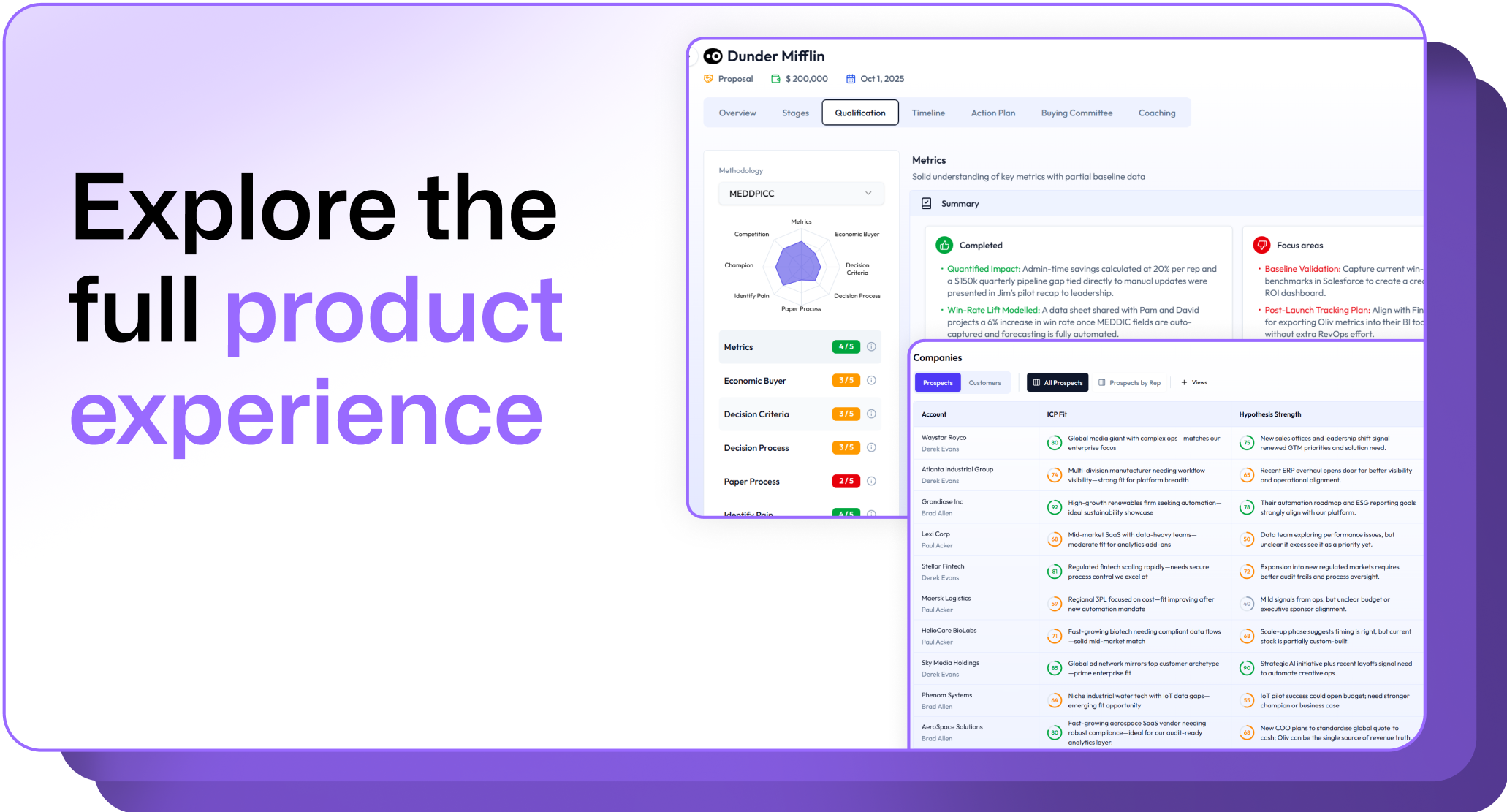
.avif)
.png)