12 Best RevOps Software Platforms in 2026: Forecasting, Intelligence, Routing, and Orchestration Tools
Written by
Ishan Chhabra
Last Updated :
June 13, 2026
Skim in :
8
mins
In this article
Still got questions?
Come discuss this article with me.
Hi, I'm Ishan, Founder and CEO of Oliv.
I'm always up for a conversation about revenue intelligence, AI agents, or what's actually working (and what's not) across revenue teams.
I'd love to hear your perspective.
Thank you! Your submission has been received!
Oops! Something went wrong while submitting the form.
Meet Oliv’s AI Agents
Hi! I’m, Deal Driver
I track deals, flag risks, send weekly pipeline updates and give sales managers full visibility into deal progress
Hi! I’m, CRM Manager
I maintain CRM hygiene by updating core, custom and qualification fields all without your team lifting a finger
Hi! I’m, Forecaster
I build accurate forecasts based on real deal movement and tell you which deals to pull in to hit your number
Hi! I’m, Coach
I believe performance fuels revenue. I spot skill gaps, score calls and build coaching plans to help every rep level up
Hi! I’m, Prospector
I dig into target accounts to surface the right contacts, tailor and time outreach so you always strike when it counts
Hi! I’m, Pipeline tracker
I call reps to get deal updates, and deliver a real-time, CRM-synced roll-up view of deal progress
Hi! I’m, Analyst
I answer complex pipeline questions, uncover deal patterns, and build reports that guide strategic decisions
TL;DR
RevOps software is the intelligence-and-execution layer that turns stale CRM data into real-time forecasting, routing, and orchestration across sales, marketing, and customer success.
We scored 12 platforms on five weighted criteria: revenue intelligence, AI-native versus bolt-on architecture, setup, pricing transparency, and verified user reviews.
Most incumbents hide behind custom quotes; verified entry pricing ranges from $19 per user to agentic platforms near $50K per year.
Great RevOps software covers five pillars: clean data, deal-advancement forecasting, generative conversation intelligence, instant routing, and coordinated engagement.
Buy unless you are a platform company, since internal RevOps builds go obsolete within months as AI advances.
Revenue orchestration is already old; the emerging space is revenue engineering, where AI-native agents run the funnel like a manufacturing line.
Q1: What Are the 12 Best RevOps Software Platforms for 2026, and How Did We Score Them? [toc=1. Best RevOps Platforms]
The 12 best RevOps platforms for 2026 are Oliv AI, Clari, Gong, Salesforce Agentforce, HubSpot, Outreach, Salesloft, 6sense, LeanData, Clay, ZoomInfo (Chorus), and Avoma. I scored each on five weighted criteria. Oliv AI leads as the only generative AI-native, fully agentic platform that does the work for you, end to end, instead of bolting AI onto a legacy dashboard.
A RevOps lead at a 60-rep B2B shop pinged me at 11 p.m. last quarter. She had Gong open in one tab, Clari in another, and a Salesforce report in a third. The numbers across all three did not match. Her forecast call was at 9 a.m. That midnight scramble, three tools and no single truth, is the real problem this list solves. So I am not going to recap what each vendor says about itself. I have sat inside these workflows, read hundreds of verified reviews, and pulled real pricing. Here is what holds up.
📋 The 12 Platforms at a Glance
Oliv AI, generative AI-native, agentic revenue platform. Agents do the work for you.
Clari, enterprise forecasting and pipeline inspection, now merged with Salesloft.
Gong, the conversation intelligence benchmark, built on older keyword tech.
Salesforce Agentforce, bolt-on agents on top of the Salesforce CRM, B2C-leaning.
HubSpot, all-in-one CRM with native RevOps reporting for SMB and mid-market.
Outreach, sales engagement, now repositioning as an agentic workflow platform (Omni).
Salesloft, cadence-led engagement, merged into Clari.
6sense, ABM and predictive intent data for demand generation.
LeanData, lead-to-account matching and routing specialist.
Clay, data enrichment and waterfall automation (premium-priced).
ZoomInfo (Chorus), data foundation plus Copilot conversation signals.
Avoma, affordable meeting intelligence with a newer forecasting add-on.
⚖️ How I Scored Them (Weighted Criteria)
I could be wrong about exact weights for your team, so adjust if your context differs. But after watching teams pick the wrong tool and lose six months, I weight architecture and intelligence heaviest. Here is the rubric, summing to 100%. If forecasting is your core pain, lean on our breakdown of the best AI sales forecasting software.
RevOps Software Scoring Criteria and Weights
RevOps Software Scoring Criteria and Weights
Criteria
Weight
Why it matters
Cross-Functional Revenue Intelligence
25%
Does it read the whole deal, or just one meeting?
AI-Native vs. Bolt-On Architecture
25%
Built agentic, or AI stapled onto a decade-old core?
Setup and Usability
20%
Hours to value, not weeks of config
Pricing Transparency
15%
Named tiers, or "custom quote" and hidden platform fees?
Verified User Reviews
15%
What real operators say on G2, Gartner, and Reddit
Scores convert to stars: 0 to 20 earns ⭐, 21 to 40 earns ⭐⭐, 41 to 60 earns ⭐⭐⭐, 61 to 80 earns ⭐⭐⭐⭐, and 81 to 100 earns ⭐⭐⭐⭐⭐.
🎯 Why Architecture Gets 25% of the Weight
Here is where the standard "best tools" list gets it backwards. Most lists rank by feature count. I rank by whether the tool was born after generative AI or before it.
A pre-generative tool, even with an "AI" badge, still needs a human to adopt it, train it, and click through it. The work stays with you. An AI-native platform like Oliv assigns agents to do the work, then drops the result in your inbox. That is the line that separates this list, and it is why pricing transparency also matters. Gong and Salesforce carry mandatory platform fees from $5,000 to $50,000 regardless of seat count, which punishes the buyer who just wants a clear number. Our guide to the best revenue intelligence software platforms digs deeper into this split.
🏆 The Scored Ranking Table
12 Best RevOps Platforms for 2026: Scored Ranking
Rank
Platform
Category
AI Architecture
Verified Starting Price
Rating
1
Oliv AI
Revenue engineering / agentic
Generative AI-native
$19/user/mo, no platform fee
⭐⭐⭐⭐⭐
2
Clari
Forecasting
Bolt-on AI (RevAI)
Custom, no public seat price
⭐⭐⭐⭐
3
Gong
Conversation intelligence
Pre-generative (keyword trackers)
~$1,600/user/yr + platform fee
⭐⭐⭐⭐
4
HubSpot
All-in-one CRM
Bolt-on (Breeze AI)
Free tier; Sales Hub from ~$90/user/mo
⭐⭐⭐⭐
5
6sense
ABM / intent
Predictive AI
Custom quote
⭐⭐⭐⭐
6
Outreach
Engagement / agentic (Omni)
Retrofit agentic
Custom, ~$100+/user/mo
⭐⭐⭐
7
Salesloft
Engagement
Bolt-on agents
Custom, no public seat price
⭐⭐⭐
8
LeanData
Routing
Rule-based + AI
From ~$39/user/mo
⭐⭐⭐
9
ZoomInfo (Chorus)
Data + CI
Bolt-on (Copilot)
Custom, platform-priced
⭐⭐⭐
10
Clay
Enrichment
AI enrichment
~$149/mo to $100k/yr
⭐⭐⭐
11
Avoma
Meeting intelligence
GPT-4 layer
$19 to $25/user/mo
⭐⭐⭐
12
Salesforce Agentforce
Agentic add-on
Bolt-on, chat-focused
~$0.10/action + Salesforce license
⭐⭐⭐
🥇 1. Oliv AI
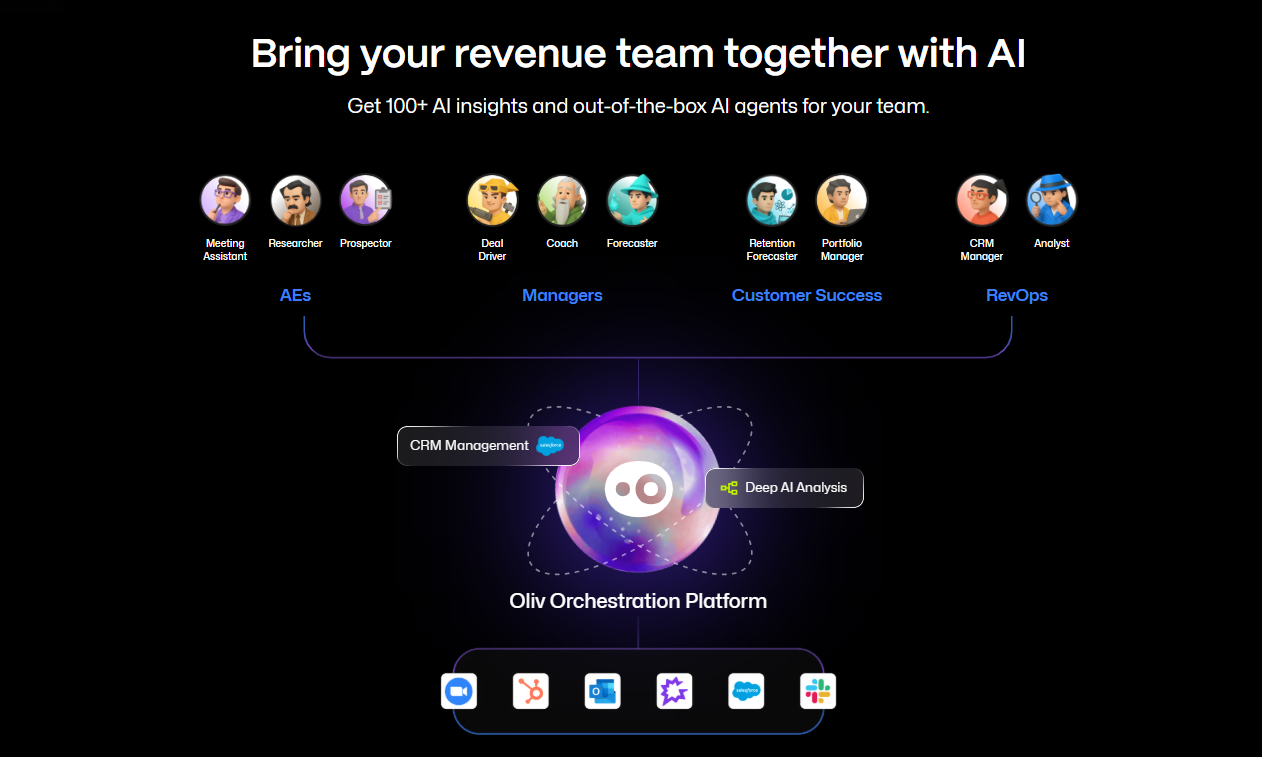
Oliv orchestration platform diagram routing role-specific AI agents across AEs, managers, customer success, and RevOps, centralizing CRM management and deep AI analysis in one AI-native layer.
What it does: Oliv AI is a generative AI-native data platform that stitches data from calls, emails, Slack, Telegram, and the web into one 360-degree deal view. We built it so over 30 specialized agents do the work, like the Forecaster Agent inspecting every deal line by line and the CRM Manager Agent populating MEDDIC sales methodology and BANT fields automatically.
Key features: CRM Manager Agent, Forecaster Agent, Deal Driver Agent, Researcher Agent, Coach Agent, and a Voice Agent (alpha) that calls reps nightly to capture off-the-record deal updates.
Pricing: Modular and transparent. Basic intelligence starts at $19/user/month, the CRM Manager at $29/user/month, up to $120/user/month, with no $5k to $50k platform fee.
Implementation: Five-minute baseline setup, value in one to two days, full customization in two to four weeks. Free data migration from Gong.
✅ Pros: Processed summaries in five minutes versus Gong's 20 to 30 minutes. Updates real CRM objects, not just notes. SOC 2 Type II, GDPR, and CCPA certified.
❌ Cons: Voice Agent is still in alpha. Full customization takes two to four weeks. Not built for B2C support or pure call-recording-only use cases.
Best for: B2B teams with 5 to 200 reps and 15 to 20 day cycles who want a spotless CRM without manual work. See where it lands among the best AI sales tools.
"Before switching to Oliv, cleaning up messy CRM fields used to swallow half my week. Oliv fixes the data as it happens." Darius Kim, Head of RevOps, DriftloopOliv Customer Reference
🥈 2. Clari
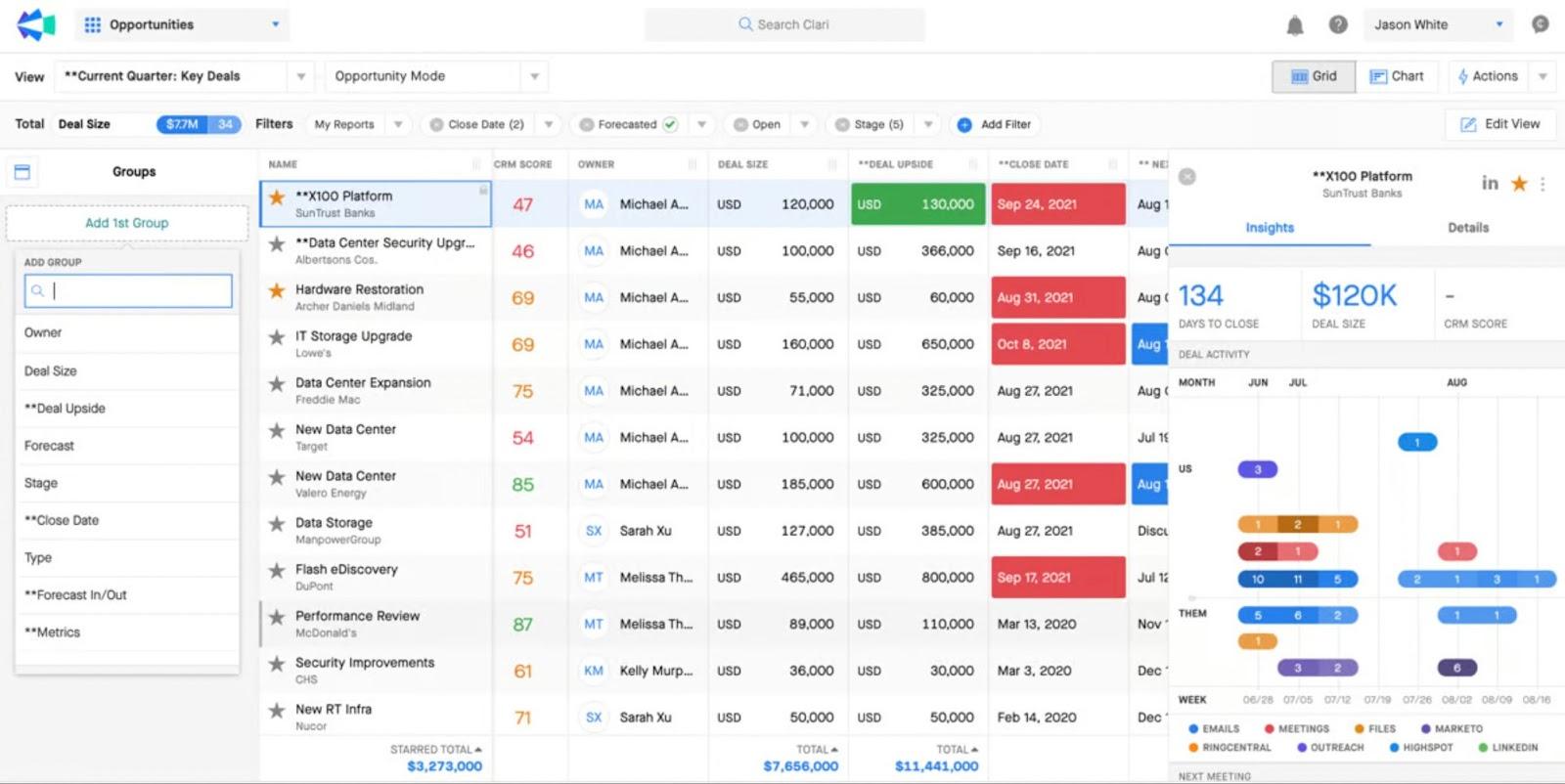
Clari opportunity grid surfacing deal size, CRM scores, forecast upside, slipping close dates, and account engagement timelines, illustrating the pipeline inspection RevOps software delivers for forecasting.
What it does: Clari is the enterprise forecasting and pipeline-inspection giant. In August 2025, it announced a merger with Salesloft, forming a Revenue AI group managing $10 trillion in revenue under management.
Pricing: No public seat price. Enterprise custom quotes only, which is why it loses points on transparency.
Implementation: Powerful but manual. Reps and managers still sit together Thursday and Friday to talk through deals before data goes in.
✅ Pros: Robust forecasting and analytics. Clean UI praised by RevOps leaders.
❌ Cons: Largely a Salesforce overlay; reps say it adds little for them. Internal disruption from layoffs and acquisitions. Compare the two leaders in our Gong vs. Clari breakdown, or weigh the best Clari alternatives.
"Clari is a tool for sales leaders, it adds no value to reps as far as I can see." Msoave, r/SalesOperationsReddit Thread
"It makes updating salesforce 10x easier... you can update all of your quarter opportunities from a single view without having to leave Clari." ChimpDaddy2015, r/salesReddit Thread
🥉 3. Gong
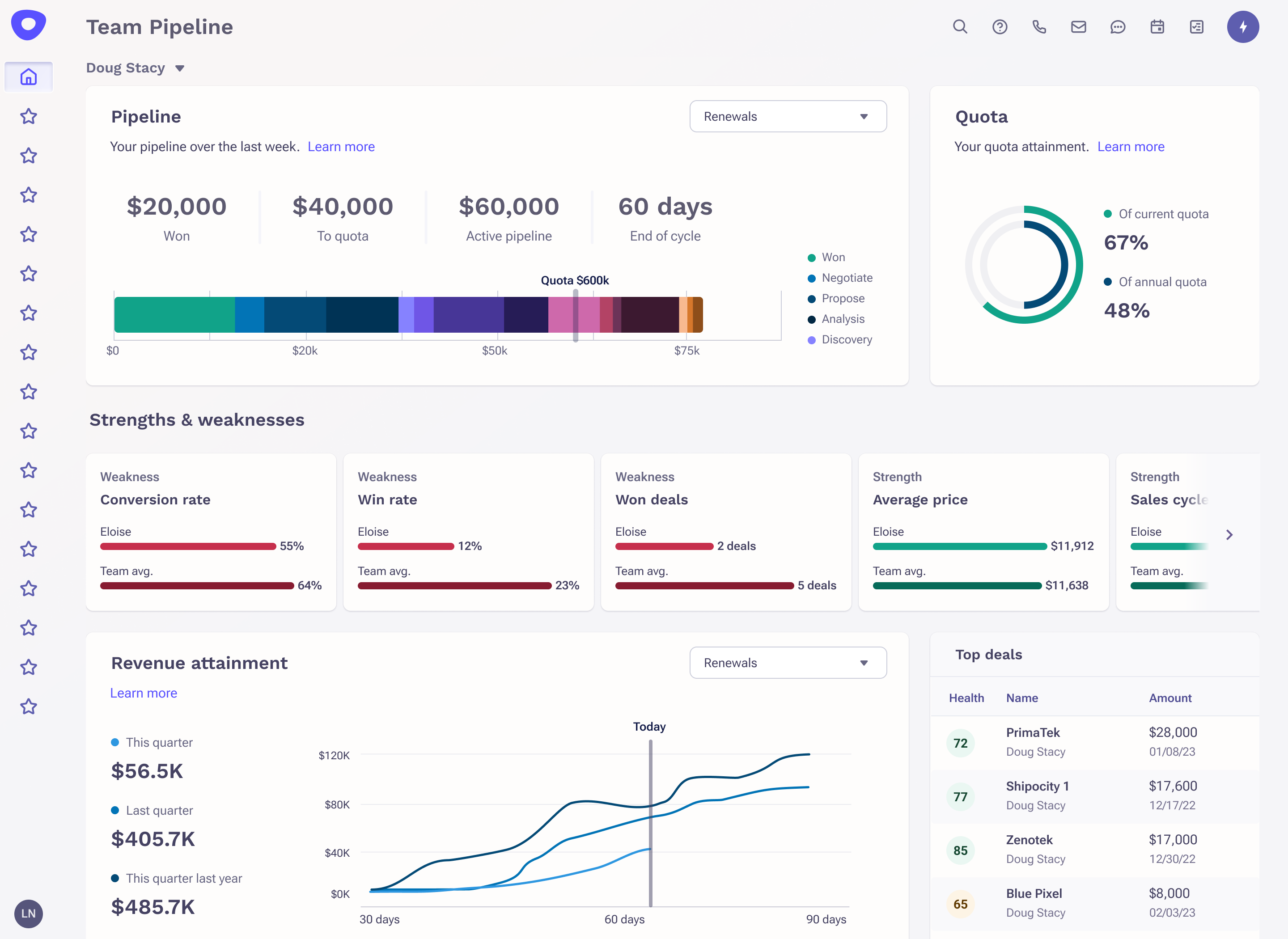
Gong pipeline dashboard breaking down quota attainment, conversion and win-rate weaknesses, revenue attainment trends, and top renewal deals, showing the forecasting analytics RevOps software buyers compare.
What it does: Gong is the conversation intelligence benchmark, built on Generation One keyword and machine-learning technology rather than generative AI.
Key features: Call recording, Smart Trackers, deal boards, Gong Forecast, and Gong Engage.
Pricing: Roughly $1,600/user/year plus a mandatory platform fee, with TCO reaching $250 to $270/user/month when bundled.
Implementation: Setting up Smart Trackers can consume 40 to 140 admin hours, and reviewers say AI training is laborious. See our Gong implementation timeline.
✅ Pros: Best-in-class conversation intelligence and strong brand loyalty.
❌ Cons: Forecast and Engage cost extra and underwhelm. A "wonky" API makes bulk data export painful. We break down the numbers in our Gong pricing analysis.
"The additional products like forecast or engage come at an additional cost. Would be great to see these tools rolled into the core offering." Scott T., Director of SalesGong G2 Verified Review
"Its probably the highest end option on the market, and now were stuck with a tool that works technically but isnt the right business decision." Iris P., Head of MarketingGong G2 Verified Review
4. HubSpot
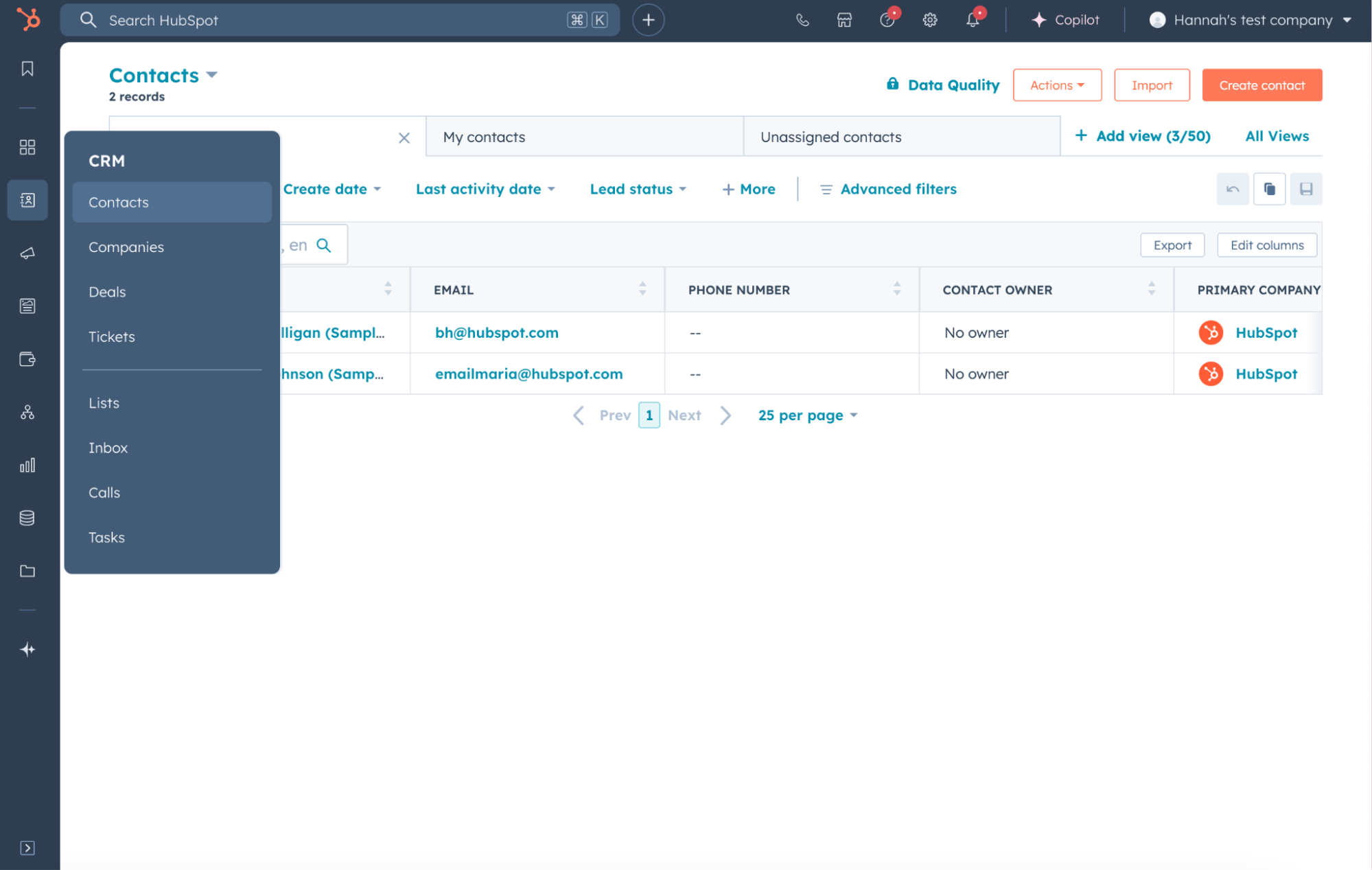
HubSpot CRM contacts screen displaying records, lead status filters, data quality controls, and the CRM navigation menu, representing the all-in-one foundation underpinning SMB RevOps software.
What it does: An all-in-one CRM with native pipeline, reporting, and the Breeze AI layer, popular with SMB and mid-market teams that want one system instead of a stack.
Pricing: Free CRM tier; Sales Hub Professional from roughly $90/user/month. Among the most transparent here.
❌ Cons: AI features are bolted on, and forecasting depth trails Clari and Oliv at enterprise scale.
Best for: Growing SMBs that value simplicity over deep enterprise forecasting.
5. 6sense
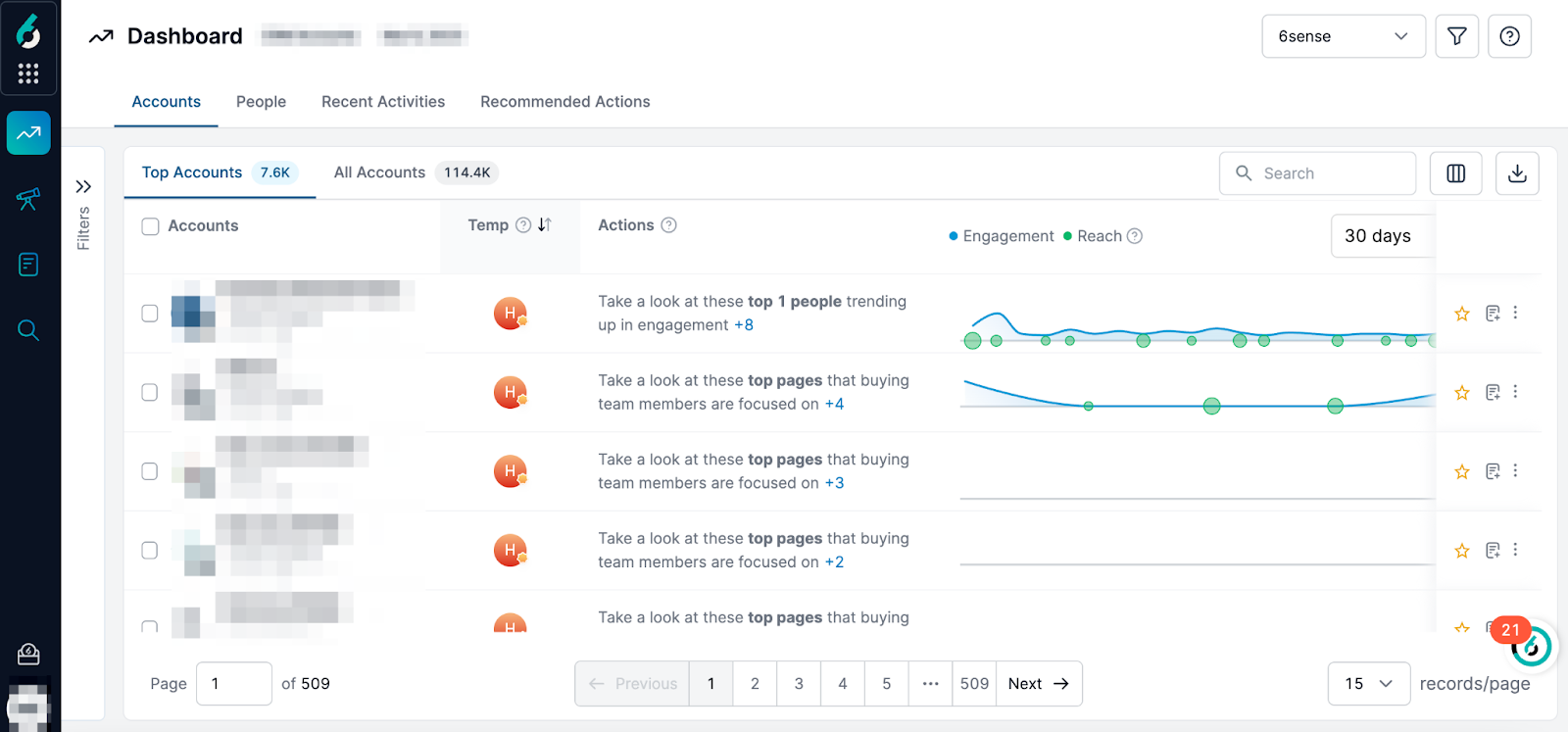
6sense account dashboard ranking thousands of top accounts by buying temperature, engagement, and reach, with recommended actions, showing the predictive intent layer in RevOps software stacks.
What it does: Predictive ABM and intent-data platform that tells you which accounts are in-market, holding Gartner Leader recognition in its category.
Pricing: Custom quote only.
✅ Pros: Strong predictive intent and account scoring.
❌ Cons: Not a forecasting or CI tool; it is one layer of a stack, with opaque pricing.
Best for: Demand-gen and marketing-aligned RevOps teams running ABM.
6. Outreach
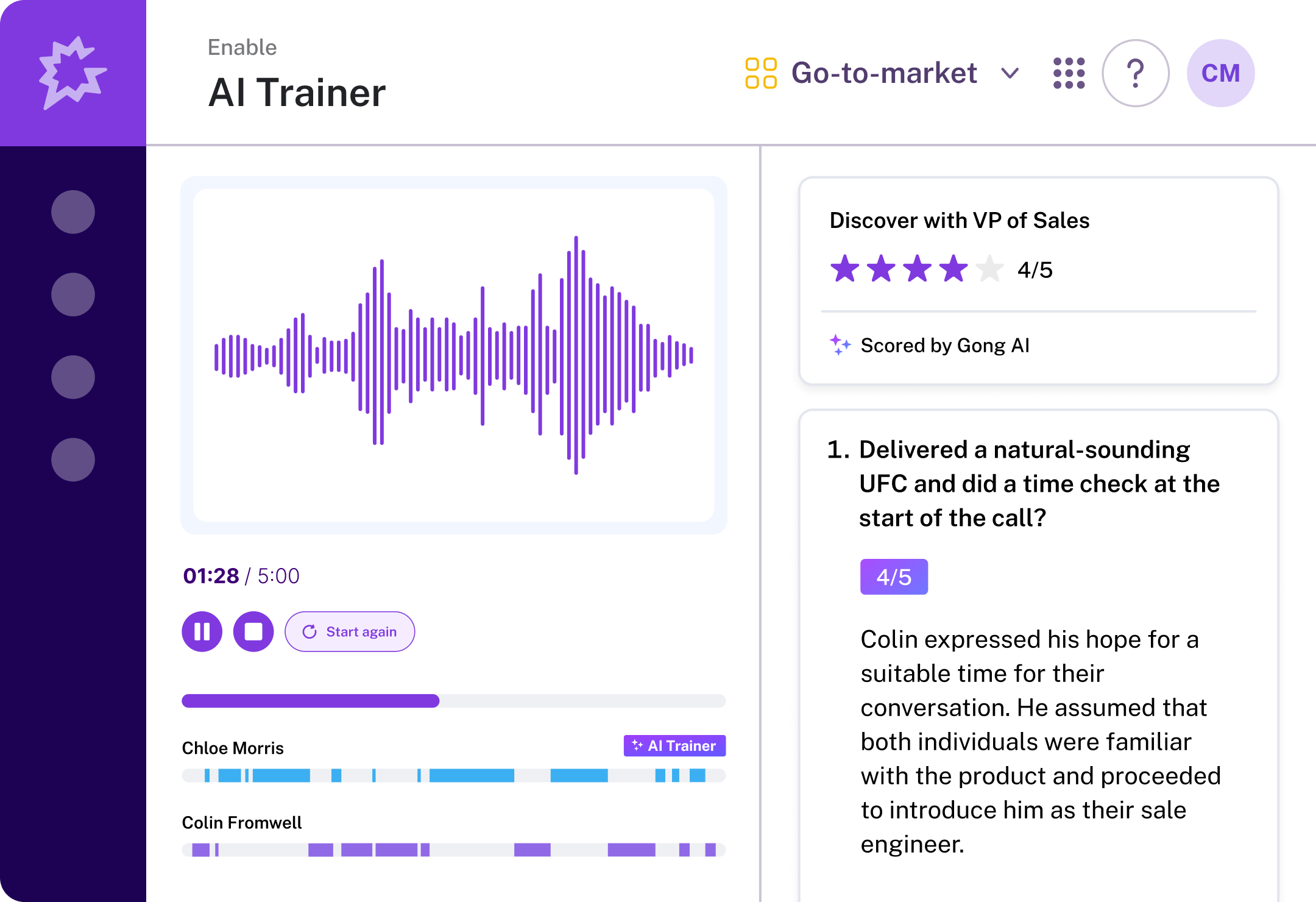
Outreach AI Trainer evaluating a recorded discovery call, scoring openers four out of five and mapping speaker talk tracks, demonstrating the coaching layer within RevOps software.
What it does: A sales engagement platform now repositioning as an AI revenue workflow platform. It launched Omni in April 2026, bundling an MCP Server, Meeting Prep Agent (beta), and Deal Agent enhancements.
Pricing: Custom, commonly $100+/user/month, with evergreen auto-renewal terms.
✅ Pros: Excellent sequencing, A/B testing, and Salesforce sync.
❌ Cons: The Engage product feels stagnant, dialing lags for high-volume teams, and support is slow. See how it stacks up in our Gong vs. Outreach comparison.
"The engage product is stagnant. Looks to have the same features, UX, integrations and issues as it had 5 years ago." Matthew T., Head of Revenue OperationsOutreach G2 Verified Review
"Their agreements are evergreen, automatically renewing annually... If you miss the cancellation deadline by even a few hours, they enforce renewal for the entire year." Kevin H., CTO and Co-FounderOutreach G2 Verified Review
7. Salesloft
What it does: A cadence-led engagement platform, founded in 2011, that added Drift in 2024 and merged into Clari in 2025.
Pricing: Custom, no public seat price.
✅ Pros: Strong cadences, task prioritization, and email tracking.
❌ Cons: Its Conversations CI product is weak, setup is clunky, and small-team support draws sharp complaints. See our Gong vs. Salesloft comparison.
"Conversations doesnt work at all. They sell it as a gong competitor. It doesnt even have the functionality of Zoom. Their customer service is horrible." Verified User in Professional TrainingSalesloft G2 Verified Review
8. LeanData
What it does: The lead-to-account matching and routing specialist that gets the right lead to the right rep instantly.
Pricing: From roughly $39/user/month, fairly transparent.
✅ Pros: Best-in-class routing and matching logic.
❌ Cons: Narrow scope; it solves one layer and needs other tools around it.
Best for: Mid-market and enterprise teams with complex routing rules.
9. ZoomInfo (Chorus)
What it does: A data foundation paired with Chorus conversation intelligence and the newer Copilot, which pushes signals into Salesforce and HubSpot.
Pricing: Platform-priced custom quotes.
✅ Pros: Deep contact data plus CI signals in one vendor.
❌ Cons: Chorus has innovated little since the ZoomInfo acquisition, and importing past calls is buried in settings. Read the full Gong vs. Chorus comparison.
"Trying to find where i could import previous calls or videos was very frustrating. Why in the world is it inside settings and then halfway down as an option?" Clayton Z., Director of TechnologyChorus by ZoomInfo G2 Verified Review
10. Clay
What it does: A data enrichment and waterfall-automation tool beloved by technical GTM teams for building enriched lists at scale.
Pricing: From around $149/month, scaling to roughly $100k/year for heavy usage.
✅ Pros: Powerful enrichment and automation, high G2 ratings.
❌ Cons: Steep learning curve and high cost at scale; it is not a forecasting or CI platform.
Best for: RevOps and growth teams comfortable building their own enrichment workflows.
11. Avoma
What it does: An affordable meeting-intelligence assistant (GPT-4 powered) that in 2025 added an AI Forecasting Assistant and Revenue Intelligence add-on.
Pricing: From $19 to $25/user/month, one of the most transparent here.
✅ Pros: Accurate transcripts, low cost, useful summaries. See our deep dive on Avoma features.
❌ Cons: The note-taker joins late or misattributes speakers, and forecasting is newer and thinner. More in our Avoma user reviews roundup.
"It sometimes takes a little while for the Avoma note taker to join a meeting. Sometimes the speaker names arent captured." Amrit D., Customer Success ManagerAvoma G2 Verified Review
12. Salesforce Agentforce
What it does: Salesforce's agentic add-on layered on the Salesforce CRM and Data Cloud. In practice, the agents stay chat-focused and lean toward B2C use cases like order returns.
Pricing: Roughly $0.10 per action plus an underlying Salesforce license, on top of $5k to $50k platform fees. See our Salesforce Agentforce pricing breakdown.
✅ Pros: Huge installed base and a powerful CDP for large B2C brands.
❌ Cons: Agents are not deeply integrated into B2B workflows; the UX is click-heavy and tab-cluttered. Weigh the best Agentforce alternatives.
"Lots of clicking to get select the right options. UX needs improvement. Everything opens in a new browser tabs clustering the browser." Verified User in Consulting (Enterprise)Salesforce Agentforce G2 Verified Review
🔄 Where the Category Is Heading
Here is where my head is right now. The whole stack is splitting into two camps. One camp, Clari, Salesloft, and Outreach, is consolidating through mergers and stapling agents onto decade-old engines. The other camp builds agentic from the ground up, which is the heart of every revenue orchestration platform conversation today.
That matters because Clari's own 2026 research found that 87% of enterprises missed their 2025 revenue targets despite record AI investment. Pouring more bolt-on AI into a brittle stack did not fix forecasting. What I think shifts over the next two years is simple. The SaaS you log into becomes agents that work for you, and revenue orchestration gives way to revenue engineering.
Q2: What Exactly Is RevOps Software, and How Is It Different From a CRM? [toc=2. RevOps vs CRM]
RevOps software unifies sales, marketing, and customer-success data and workflows into one revenue engine. It handles forecasting, deal intelligence, routing, and orchestration on top of, or in place of, your CRM dashboards. A CRM is the system of record reps update weekly because management requires it. RevOps software is the intelligence-and-execution layer that turns that data into real-time action instead of a stale Friday snapshot.
🗂️ The CRM Became a Dumb Repository
Let me explain it the way I would to a peer over coffee. A CRM, or customer relationship management system, is a database where deals, contacts, and notes live. The problem is that reps only feed it when forced to.
Most reps update the CRM weekly, usually on a Friday, because a manager asks for it. That habit does not make them sell faster, so the data sits stale. The CRM slowly turns into a dumb repository of information rather than a live picture of revenue. The shift from this model is the heart of our look at revenue ops to intelligence to orchestration.
⏰ The Friday Forecast Lag
Here is the example I keep running into. A rep updates ten opportunities Friday afternoon. By Tuesday, three deals have moved, one stalled, and a champion went quiet. The CRM still shows Friday's version.
When the forecast call hits, leadership is reading a four-day-old snapshot. That lag is why forecasts miss. Clari's own 2026 research found 87% of enterprises missed 2025 revenue targets despite record AI spending. Stale data, not effort, is the quiet culprit, which is why the best AI sales forecasting software works against live signals.
⚙️ Why the Engine Beats the Repository
This is where the standard read gets it backwards. People think buying a better CRM fixes forecasting. It does not, because the CRM is the filing cabinet, not the analyst.
RevOps software works against the underlying data, not the user interface. An AI agent does not need the dashboards and click-paths a human needs. It can read the database directly, stitch in calls, emails, and Slack, then act. That is the line between a repository and an engine, and it defines the leading revenue intelligence software platforms.
🤖 Where Oliv Fits
When we built Oliv, we treated the CRM as an AI-native data platform, not another screen to log into. Our agents update real CRM objects automatically, so the data stays current without the Friday ritual. I could be slightly off on timing, but the shift is clear. The next two years move teams from SaaS you log into toward agents that do the work for you, which is the promise of a true revenue orchestration platform.
Q3: What Capabilities Define Great RevOps Software Across Data, Forecasting, Conversation Intelligence, Routing, and Engagement? [toc=3. Core Capabilities]
Strong RevOps software covers five capabilities: a clean data and enrichment foundation; real-time forecasting tied to deal advancement, not Friday-stale activity counts; generative conversation intelligence, not keyword trackers; instant lead routing and lead-to-account matching; and engagement that coordinates teams rather than firing single tasks. The 2026 differentiator is whether these run on one AI-native data layer or stitched-together bolt-ons.
📊 The Five-Pillar Capability Rubric
Five Capability Pillars of Great RevOps Software
Pillar
Must-have
Legacy failure mode
Agentic upgrade
Data and enrichment
Clean, deduped records
Brittle rule-based matching
LLM object association
Forecasting
Deal-advancement signals
Hollow activity counts
Line-by-line deal inspection
Conversation intelligence
Intent and risk detection
Keyword Smart Trackers
Generative deal context
Routing
Instant lead-to-account match
Manual queues, delays
Auto-routing on signals
Engagement
Coordinated orchestration
Single-task firing
Multi-step agent plays
🧹 Data and Forecasting Foundation
A clean data foundation is the floor. Without deduped, enriched records, every downstream forecast inherits the mess. Legacy tools rely on brittle rules that misassign activity to duplicate accounts. The agentic upgrade uses LLM reasoning to map activity to the right account, even with duplicates.
Forecasting is where teams get burned. Activity metrics without links to deal advancement are hollow scorekeeping. Glorified scorekeepers make terrible forecasters. Real forecasting inspects each deal line by line, which is what our Forecaster Agent does for weekly roll-ups, the same gap we cover in our Gong forecasting analysis.
🎙️ Conversation Intelligence and Routing
Conversation intelligence is the pillar most buyers misjudge. Gong's Smart Trackers run on older keyword and basic machine-learning tech, not generative AI. That floods you with mentions, not meaning. Generative intelligence tells the difference between a prospect naming a competitor in passing and actively evaluating one. Our roundup of the best AI for sales calls shows the difference in practice.
Routing sounds boring until a hot lead sits unassigned for a day. Instant lead-to-account matching gets the right lead to the right rep in seconds. Manual queues lose deals to delay, and that delay is pure margin left on the table.
🔗 Engagement That Coordinates
Engagement is the last pillar, and it is where reps actually live. The must-have is orchestration that coordinates a team across steps, not a tool that fires one task and forgets context. One real Outreach review captures the legacy gap honestly.
"There are some functionalities that dont work as well as they should. For example, being able to edit steps of a sequence when emailing... and syncing activity." Benjamin S., OwnerOutreach G2 Verified Review
Each pillar quietly maps to whether your stack is bolted together or built native. I might be wrong for very large enterprises with deep RevOps teams. For 25 to 200 rep B2B shops, one AI-native layer beats five integrations every time, which is why teams compare the best AI sales tools before stacking point products.
Q4: How Do All 12 Platforms Compare on Verified Pricing, Architecture, Pros, and Cons? [toc=4. Pricing Comparison]
Verified entry pricing spans seat-based tools like Outreach and Salesloft to agentic platforms commonly starting near $50K/year, with Clay-class enrichment reaching near $100K/year and Salesforce agentic actions around $0.10 each. Most incumbents hide behind "custom quotes." This table publishes named tiers where they exist, flags AI-native versus retrofitted architecture, and lists one core pro and con per platform so you can match spend to stage.
📋 The Master Comparison Matrix
12 RevOps Platforms: Pricing, Architecture, Pros, and Cons
Platform
Function
AI architecture
Verified starting price
Top pro
Top con
Best for
Stars
Oliv AI
Agentic revenue
AI-native
$19/user/mo, no platform fee
Agents do the work, 5-min processing
Voice Agent in alpha
B2B 5 to 200 reps
⭐⭐⭐⭐⭐
Clari
Forecasting
Bolt-on
Custom quote
Clean forecast roll-ups
"Glorified SFDC overlay"
Enterprise CROs
⭐⭐⭐⭐
Gong
Conversation intel
Pre-generative
~$1,600/user/yr + fee
Best-in-class CI
Pricey, hard data export
Funded mid-market
⭐⭐⭐⭐
HubSpot
All-in-one CRM
Bolt-on
Free; ~$90/user/mo
Easy adoption
Thin enterprise forecasting
SMB
⭐⭐⭐⭐
6sense
ABM / intent
Predictive
Custom quote
Strong intent data
One layer only
ABM teams
⭐⭐⭐⭐
Outreach
Engagement
Retrofit agentic
Custom, ~$100+/user/mo
Strong sequencing
Stagnant, rigid contracts
Outbound SDR teams
⭐⭐⭐
Salesloft
Engagement
Bolt-on
Custom quote
Solid cadences
Weak CI, poor support
Cadence-led teams
⭐⭐⭐
LeanData
Routing
Rules + AI
~$39/user/mo
Best routing logic
Narrow scope
Complex routing
⭐⭐⭐
ZoomInfo (Chorus)
Data + CI
Bolt-on
Custom quote
Data plus CI in one
Chorus stagnant
Data-first teams
⭐⭐⭐
Clay
Enrichment
AI enrichment
~$149/mo to ~$100K/yr
Powerful enrichment
Steep cost and curve
Technical GTM
⭐⭐⭐
Avoma
Meeting intel
GPT layer
$19 to $25/user/mo
Cheap, accurate notes
Note-taker joins late
Budget SMB
⭐⭐⭐
Salesforce Agentforce
Agentic add-on
Bolt-on
~$0.10/action + license
Huge install base
Click-heavy, B2C-leaning
Existing SFDC shops
⭐⭐⭐
💰 The Transparency Gap
Notice how many cells read "custom quote." That is the real SERP gap, and it is deliberate. When a vendor will not publish a number, the buyer loses leverage before the first call. Our Salesforce Agentforce pricing breakdown and Gong pricing guide pull back that curtain.
Gong reviewers feel this lock-in sharply after signing. The cost shows up later, when the tool no longer fits the business.
"It was a big mistake on our part to commit to a two year term... were stuck with a tool that works technically but isnt the right business decision." Iris P., Head of MarketingGong G2 Verified Review
"Cadences work great and the AI theyve built into their templates is helpful... Conversations doesnt work at all. They sell it as a gong competitor." Verified User in Professional TrainingSalesloft G2 Verified Review
🏷️ Two Scenarios to Match Spend to Stage
⚠️ SMB or seed-stage (5 to 25 reps): Skip the $50K platforms. A transparent seat-based tool wins. Oliv at $19/user/month, Avoma, or HubSpot's free tier respects finite cash sitting in payroll and ad spend. Compare the best Clari alternatives before overbuying.
💸 Mid-market to enterprise (50 to 200 reps): Stacking Gong plus Clari plus Salesloft quietly drags total cost past $500/user/month. One review below shows the upside of consolidation when it works, which is exactly the case for a single AI-native layer, as our Gong vs. Clari breakdown explains.
"4 months later everyone of my reps loves it because it makes updating salesforce 10x easier... you can update all of your quarter opportunities from a single view." ChimpDaddy2015, r/salesReddit Thread
Transparency itself is the differentiator here. I could be wrong on exact list prices, since vendors move them quarterly. The pattern holds: AI-native and transparent beats bolt-on and quote-gated for most B2B teams.
Q5: Which RevOps Stack Fits SMB, Mid-Market, and Enterprise, and Should You Build or Buy It? [toc=5. Stack by Stage]
At SMB stage, buy one AI-native platform that unifies intelligence, forecasting, and routing instead of stitching point tools together. At mid-market, add enrichment and ABM intent. At enterprise, layer governance and orchestration across units. On build versus buy, buy unless you are a platform company. Internal RevOps builds treat the problem as basic database logic and go obsolete within months as AI advances.
🏎️ Picture a Racing Car on Two Cylinders
Most teams I meet run revenue like a race car firing on two cylinders. The engine is there, but half the pistons sit idle. They bought tools, yet the stack does not move the car faster.
The fix is not more tools. It is the right layers for your stage. I scaled a team from 2 to 50 reps in just over three years, and the lesson stuck. Invest in RevOps data and enablement early, even at $3 to $4 million in annual recurring revenue, the same thesis behind the leading revenue intelligence software platforms.
📊 Stage-to-Stack Map
RevOps Stack by Company Stage
Stage
Reps
Buy this layer
Skip for now
SMB
5 to 25
One AI-native platform for intel, forecasting, and routing
ABM, heavy enrichment
Mid-market
25 to 100
Add enrichment and intent data
Multi-unit governance
Enterprise
100+
Add governance, orchestration across units
Nothing, you need it all
At SMB stage, do not stitch five point tools. One platform like Oliv at $19/user/month covers intelligence, forecasting, and hygiene without a $50K platform fee. That respects cash sitting in payroll and ad spend. Many SMBs start by comparing the best AI sales tools before committing.
🔨 The Build-Versus-Buy Trap
Here is the contrarian take. Smart engineering leaders want to build RevOps internally. They see it as basic create-read-update-delete logic plus business rules, a weekend project.
Then I ask one question. How much have you actually built yourself? Crickets. The honest answer is that you are not a platform company, and your internal tool goes obsolete in a couple of months as AI moves. Buying a true revenue orchestration platform sidesteps that trap.
⚠️ Three Reasons Buying Wins
💸 Hidden headcount cost. A junior engineer maintaining your build costs six figures. I cannot pay someone $150K a year to babysit a fragile internal tool.
⏰ Obsolescence risk. You are not Vercel. The model you fine-tuned in spring is behind by fall, and you own the upkeep.
🔧 The consulting-shop reality. Builds quietly become a services project, draining the same RevOps team you hired to drive revenue.
When we built Oliv, the goal was one AI-native foundation that scales across stages without re-platforming. That is the buy that stays current, because the vendor absorbs the model upgrades, not your team. It mirrors the shift we map in revenue ops to intelligence to orchestration.
Where my head is right now is this. The next two years reward teams who buy a native foundation early and skip the build entirely. What stage are you in, and which cylinder is still idle?
Q6: Why Is "Revenue Orchestration" Already Old, and What Makes AI-Native, Agentic RevOps Software Different? [toc=6. Revenue Engineering Shift]
Revenue orchestration, coordinating signals across tools, is already table stakes. It is mostly a repackaging of older routing and engagement tech sitting on a three-layer cloud-to-AI stack. The emerging space is revenue engineering: instrumenting the funnel like a manufacturing line and letting agents execute the bulk of the work. Bolt-on AI stays chat-bound. AI-native agentic software works directly against the data and completes multi-step work on its own.
🎯 The View Everyone Holds
Walk any RevOps conference and orchestration is the hot word. The pitch sounds new: connect every tool, route every signal, and coordinate every play. It feels like the future.
It is not. Orchestration is a consolidation of older routing and engagement tech with a fresh label. Strip the marketing, and you find a three-layer stack: a cloud database, a prediction layer, and a chat layer bolted on top. We unpack the category in our guide to the best revenue orchestration platform tools.
🏭 Revenue as a Manufacturing Line
Here is where the standard read gets it backwards. The next space is not orchestration. It is revenue engineering, and we lead it.
Think of revenue as a manufacturing line. Output equals volume times conversion rate. Once you see the funnel that way, you stop coordinating tools and start instrumenting a factory. Agents run the line, and humans handle the few steps only they can do.
🤖 Chat-Bound Versus Truly Agentic
This is the line that matters. Salesforce Agentforce agents are not really agentic. They stay chat-focused, waiting for a human to ask before they fetch data. Our breakdown of Agentforce for sales features digs into the limits.
Compare a vending machine to a smart employee. A chatbot dispenses an answer when you press a button. An agent notices a stalled deal, researches it, updates the record, and drafts the follow-up, all without a prompt.
"Lots of clicking to get select the right options. UX needs improvement. Everything opens in a new browser tabs clustering the browser." Verified User in ConsultingSalesforce Agentforce G2 Verified Review
🧱 The Incumbent Moat Cuts Both Ways
I will be fair here. Incumbents own a real data moat. They already have your data and your workflows mapped, then add agentic features on top. If that is your situation, weigh the best Agentforce alternatives before committing.
That moat helps and hurts. Their AI inherits a decade-old, user-interface-bound foundation that a human must drive. An AI-native platform like Oliv skips the interface and reads the underlying database directly, which is why our agents act instead of wait.
⚙️ What Agentic Execution Frees Up
Picture Monday morning. Instead of digging through dashboards, the manager opens a one-page roll-up the Forecaster Agent built overnight. It is a different experience from the legacy approach in our Gong forecasting analysis.
That is the payoff of revenue engineering. The work shifts from humans operating software to agents running the line. I could be early on the timeline, but I think orchestration becomes a footnote within two years. If revenue is a factory, why are you still hand-assembling every unit?
Q7: What Implementation, Adoption, and Governance Pitfalls Must You Avoid When Choosing RevOps Software? [toc=7. Implementation Pitfalls]
Legacy tools demand 40 to 140 admin hours before value appears. Agentic platforms shift that work to a 30-day training loop instead. Adoption fails when tools add steps, like the copy-paste loop reps quietly skip, or when teams chase hollow activity metrics and pilots that never reach production. As agents take more revenue actions, demand SOC 2, GDPR, EU AI Act readiness, audit trails, and human-in-the-loop control.
⏰ The Thursday-Friday Scrub
Let me set the scene. Every Thursday and Friday, a RevOps lead I know scrubs the pipeline by hand before the forecast call. It eats two days a week.
Legacy setup makes this worse, not better. Building Gong Smart Trackers can swallow 40 to 140 admin hours across the rollout. Value shows up only after that tax is paid, as our Gong implementation timeline details.
🔁 The Copy-Paste Loop Reps Skip
Here is the adoption killer I see most. An SDR is told to pull a Gong insight, drop it into ChatGPT, then paste the result into Outlook. Three tools, one email.
Most people just do not do it. The step is optional, so it dies. One rep on my team quit the day we rolled out AI RevOps, and we found he had done nothing for 30 days. Tools that add friction get abandoned, a pattern echoed across Gong reviews.
"Many reps also resist using Gong because they feel micromanaged, leading to low adoption." Anonymous reviewerGong G2 Verified Review
✅ The 30-Day Training Discipline
Agentic platforms flip the model, but they are not magic. Agents never sleep, so this is not a job for lazy teams. You train them, correct them, and they compound.
I lean on a 10-80-10 rule. A human frames the first 10%, the agent does the middle 80%, and a human reviews the final 10%. The 30-day training loop is where adoption is won or lost, much like the coaching cadence in the best AI for sales calls.
"It can be overwhelming to set up trackers. AI training is a bit laborious to get it to do what you want." Trafford J., Senior Director, Revenue EnablementGong G2 Verified Review
⚠️ Four Pitfalls That Sink Purchases
📉 Hollow metrics. Activity counts without links to deal advancement are scorekeeping, not forecasting.
☑️ Check-the-box AI. Features bought to look modern, never wired into real workflows.
🧪 The pilot trap. A demo that wins applause, then never reaches production.
🤝 "Hello [First_Name]" automation. Mass outreach that screams robot and burns sender reputation.
As agents take real actions, governance stops being optional. In finance, you must create an audit trail, and the same logic now applies to revenue agents. Our Gong DPA security guide shows what to demand on the data side.
Demand these before you sign:
SOC 2 Type II, GDPR, and CCPA certification.
EU AI Act readiness for agent decision-making.
Full audit logs on every agent action.
Human-in-the-loop controls on anything customer-facing.
Oliv ships SOC 2 Type II, GDPR, and CCPA, with audit logs and human validation built in. Clari's 2026 research found 87% of enterprises missed 2025 targets despite record AI spending. So the open question I keep sitting with is simple. Are we governing these agents like the revenue-moving employees they have quietly become?
Q1: What Are the 12 Best RevOps Software Platforms for 2026, and How Did We Score Them? [toc=1. Best RevOps Platforms]
The 12 best RevOps platforms for 2026 are Oliv AI, Clari, Gong, Salesforce Agentforce, HubSpot, Outreach, Salesloft, 6sense, LeanData, Clay, ZoomInfo (Chorus), and Avoma. I scored each on five weighted criteria. Oliv AI leads as the only generative AI-native, fully agentic platform that does the work for you, end to end, instead of bolting AI onto a legacy dashboard.
A RevOps lead at a 60-rep B2B shop pinged me at 11 p.m. last quarter. She had Gong open in one tab, Clari in another, and a Salesforce report in a third. The numbers across all three did not match. Her forecast call was at 9 a.m. That midnight scramble, three tools and no single truth, is the real problem this list solves. So I am not going to recap what each vendor says about itself. I have sat inside these workflows, read hundreds of verified reviews, and pulled real pricing. Here is what holds up.
📋 The 12 Platforms at a Glance
Oliv AI, generative AI-native, agentic revenue platform. Agents do the work for you.
Clari, enterprise forecasting and pipeline inspection, now merged with Salesloft.
Gong, the conversation intelligence benchmark, built on older keyword tech.
Salesforce Agentforce, bolt-on agents on top of the Salesforce CRM, B2C-leaning.
HubSpot, all-in-one CRM with native RevOps reporting for SMB and mid-market.
Outreach, sales engagement, now repositioning as an agentic workflow platform (Omni).
Salesloft, cadence-led engagement, merged into Clari.
6sense, ABM and predictive intent data for demand generation.
LeanData, lead-to-account matching and routing specialist.
Clay, data enrichment and waterfall automation (premium-priced).
ZoomInfo (Chorus), data foundation plus Copilot conversation signals.
Avoma, affordable meeting intelligence with a newer forecasting add-on.
⚖️ How I Scored Them (Weighted Criteria)
I could be wrong about exact weights for your team, so adjust if your context differs. But after watching teams pick the wrong tool and lose six months, I weight architecture and intelligence heaviest. Here is the rubric, summing to 100%. If forecasting is your core pain, lean on our breakdown of the best AI sales forecasting software.
RevOps Software Scoring Criteria and Weights
RevOps Software Scoring Criteria and Weights
Criteria
Weight
Why it matters
Cross-Functional Revenue Intelligence
25%
Does it read the whole deal, or just one meeting?
AI-Native vs. Bolt-On Architecture
25%
Built agentic, or AI stapled onto a decade-old core?
Setup and Usability
20%
Hours to value, not weeks of config
Pricing Transparency
15%
Named tiers, or "custom quote" and hidden platform fees?
Verified User Reviews
15%
What real operators say on G2, Gartner, and Reddit
Scores convert to stars: 0 to 20 earns ⭐, 21 to 40 earns ⭐⭐, 41 to 60 earns ⭐⭐⭐, 61 to 80 earns ⭐⭐⭐⭐, and 81 to 100 earns ⭐⭐⭐⭐⭐.
🎯 Why Architecture Gets 25% of the Weight
Here is where the standard "best tools" list gets it backwards. Most lists rank by feature count. I rank by whether the tool was born after generative AI or before it.
A pre-generative tool, even with an "AI" badge, still needs a human to adopt it, train it, and click through it. The work stays with you. An AI-native platform like Oliv assigns agents to do the work, then drops the result in your inbox. That is the line that separates this list, and it is why pricing transparency also matters. Gong and Salesforce carry mandatory platform fees from $5,000 to $50,000 regardless of seat count, which punishes the buyer who just wants a clear number. Our guide to the best revenue intelligence software platforms digs deeper into this split.
🏆 The Scored Ranking Table
12 Best RevOps Platforms for 2026: Scored Ranking
Rank
Platform
Category
AI Architecture
Verified Starting Price
Rating
1
Oliv AI
Revenue engineering / agentic
Generative AI-native
$19/user/mo, no platform fee
⭐⭐⭐⭐⭐
2
Clari
Forecasting
Bolt-on AI (RevAI)
Custom, no public seat price
⭐⭐⭐⭐
3
Gong
Conversation intelligence
Pre-generative (keyword trackers)
~$1,600/user/yr + platform fee
⭐⭐⭐⭐
4
HubSpot
All-in-one CRM
Bolt-on (Breeze AI)
Free tier; Sales Hub from ~$90/user/mo
⭐⭐⭐⭐
5
6sense
ABM / intent
Predictive AI
Custom quote
⭐⭐⭐⭐
6
Outreach
Engagement / agentic (Omni)
Retrofit agentic
Custom, ~$100+/user/mo
⭐⭐⭐
7
Salesloft
Engagement
Bolt-on agents
Custom, no public seat price
⭐⭐⭐
8
LeanData
Routing
Rule-based + AI
From ~$39/user/mo
⭐⭐⭐
9
ZoomInfo (Chorus)
Data + CI
Bolt-on (Copilot)
Custom, platform-priced
⭐⭐⭐
10
Clay
Enrichment
AI enrichment
~$149/mo to $100k/yr
⭐⭐⭐
11
Avoma
Meeting intelligence
GPT-4 layer
$19 to $25/user/mo
⭐⭐⭐
12
Salesforce Agentforce
Agentic add-on
Bolt-on, chat-focused
~$0.10/action + Salesforce license
⭐⭐⭐
🥇 1. Oliv AI
Oliv orchestration platform diagram routing role-specific AI agents across AEs, managers, customer success, and RevOps, centralizing CRM management and deep AI analysis in one AI-native layer.
What it does: Oliv AI is a generative AI-native data platform that stitches data from calls, emails, Slack, Telegram, and the web into one 360-degree deal view. We built it so over 30 specialized agents do the work, like the Forecaster Agent inspecting every deal line by line and the CRM Manager Agent populating MEDDIC sales methodology and BANT fields automatically.
Key features: CRM Manager Agent, Forecaster Agent, Deal Driver Agent, Researcher Agent, Coach Agent, and a Voice Agent (alpha) that calls reps nightly to capture off-the-record deal updates.
Pricing: Modular and transparent. Basic intelligence starts at $19/user/month, the CRM Manager at $29/user/month, up to $120/user/month, with no $5k to $50k platform fee.
Implementation: Five-minute baseline setup, value in one to two days, full customization in two to four weeks. Free data migration from Gong.
✅ Pros: Processed summaries in five minutes versus Gong's 20 to 30 minutes. Updates real CRM objects, not just notes. SOC 2 Type II, GDPR, and CCPA certified.
❌ Cons: Voice Agent is still in alpha. Full customization takes two to four weeks. Not built for B2C support or pure call-recording-only use cases.
Best for: B2B teams with 5 to 200 reps and 15 to 20 day cycles who want a spotless CRM without manual work. See where it lands among the best AI sales tools.
"Before switching to Oliv, cleaning up messy CRM fields used to swallow half my week. Oliv fixes the data as it happens." Darius Kim, Head of RevOps, DriftloopOliv Customer Reference
🥈 2. Clari
Clari opportunity grid surfacing deal size, CRM scores, forecast upside, slipping close dates, and account engagement timelines, illustrating the pipeline inspection RevOps software delivers for forecasting.
What it does: Clari is the enterprise forecasting and pipeline-inspection giant. In August 2025, it announced a merger with Salesloft, forming a Revenue AI group managing $10 trillion in revenue under management.
Pricing: No public seat price. Enterprise custom quotes only, which is why it loses points on transparency.
Implementation: Powerful but manual. Reps and managers still sit together Thursday and Friday to talk through deals before data goes in.
✅ Pros: Robust forecasting and analytics. Clean UI praised by RevOps leaders.
❌ Cons: Largely a Salesforce overlay; reps say it adds little for them. Internal disruption from layoffs and acquisitions. Compare the two leaders in our Gong vs. Clari breakdown, or weigh the best Clari alternatives.
"Clari is a tool for sales leaders, it adds no value to reps as far as I can see." Msoave, r/SalesOperationsReddit Thread
"It makes updating salesforce 10x easier... you can update all of your quarter opportunities from a single view without having to leave Clari." ChimpDaddy2015, r/salesReddit Thread
🥉 3. Gong
Gong pipeline dashboard breaking down quota attainment, conversion and win-rate weaknesses, revenue attainment trends, and top renewal deals, showing the forecasting analytics RevOps software buyers compare.
What it does: Gong is the conversation intelligence benchmark, built on Generation One keyword and machine-learning technology rather than generative AI.
Key features: Call recording, Smart Trackers, deal boards, Gong Forecast, and Gong Engage.
Pricing: Roughly $1,600/user/year plus a mandatory platform fee, with TCO reaching $250 to $270/user/month when bundled.
Implementation: Setting up Smart Trackers can consume 40 to 140 admin hours, and reviewers say AI training is laborious. See our Gong implementation timeline.
✅ Pros: Best-in-class conversation intelligence and strong brand loyalty.
❌ Cons: Forecast and Engage cost extra and underwhelm. A "wonky" API makes bulk data export painful. We break down the numbers in our Gong pricing analysis.
"The additional products like forecast or engage come at an additional cost. Would be great to see these tools rolled into the core offering." Scott T., Director of SalesGong G2 Verified Review
"Its probably the highest end option on the market, and now were stuck with a tool that works technically but isnt the right business decision." Iris P., Head of MarketingGong G2 Verified Review
4. HubSpot
HubSpot CRM contacts screen displaying records, lead status filters, data quality controls, and the CRM navigation menu, representing the all-in-one foundation underpinning SMB RevOps software.
What it does: An all-in-one CRM with native pipeline, reporting, and the Breeze AI layer, popular with SMB and mid-market teams that want one system instead of a stack.
Pricing: Free CRM tier; Sales Hub Professional from roughly $90/user/month. Among the most transparent here.
❌ Cons: AI features are bolted on, and forecasting depth trails Clari and Oliv at enterprise scale.
Best for: Growing SMBs that value simplicity over deep enterprise forecasting.
5. 6sense
6sense account dashboard ranking thousands of top accounts by buying temperature, engagement, and reach, with recommended actions, showing the predictive intent layer in RevOps software stacks.
What it does: Predictive ABM and intent-data platform that tells you which accounts are in-market, holding Gartner Leader recognition in its category.
Pricing: Custom quote only.
✅ Pros: Strong predictive intent and account scoring.
❌ Cons: Not a forecasting or CI tool; it is one layer of a stack, with opaque pricing.
Best for: Demand-gen and marketing-aligned RevOps teams running ABM.
6. Outreach
Outreach AI Trainer evaluating a recorded discovery call, scoring openers four out of five and mapping speaker talk tracks, demonstrating the coaching layer within RevOps software.
What it does: A sales engagement platform now repositioning as an AI revenue workflow platform. It launched Omni in April 2026, bundling an MCP Server, Meeting Prep Agent (beta), and Deal Agent enhancements.
Pricing: Custom, commonly $100+/user/month, with evergreen auto-renewal terms.
✅ Pros: Excellent sequencing, A/B testing, and Salesforce sync.
❌ Cons: The Engage product feels stagnant, dialing lags for high-volume teams, and support is slow. See how it stacks up in our Gong vs. Outreach comparison.
"The engage product is stagnant. Looks to have the same features, UX, integrations and issues as it had 5 years ago." Matthew T., Head of Revenue OperationsOutreach G2 Verified Review
"Their agreements are evergreen, automatically renewing annually... If you miss the cancellation deadline by even a few hours, they enforce renewal for the entire year." Kevin H., CTO and Co-FounderOutreach G2 Verified Review
7. Salesloft
What it does: A cadence-led engagement platform, founded in 2011, that added Drift in 2024 and merged into Clari in 2025.
Pricing: Custom, no public seat price.
✅ Pros: Strong cadences, task prioritization, and email tracking.
❌ Cons: Its Conversations CI product is weak, setup is clunky, and small-team support draws sharp complaints. See our Gong vs. Salesloft comparison.
"Conversations doesnt work at all. They sell it as a gong competitor. It doesnt even have the functionality of Zoom. Their customer service is horrible." Verified User in Professional TrainingSalesloft G2 Verified Review
8. LeanData
What it does: The lead-to-account matching and routing specialist that gets the right lead to the right rep instantly.
Pricing: From roughly $39/user/month, fairly transparent.
✅ Pros: Best-in-class routing and matching logic.
❌ Cons: Narrow scope; it solves one layer and needs other tools around it.
Best for: Mid-market and enterprise teams with complex routing rules.
9. ZoomInfo (Chorus)
What it does: A data foundation paired with Chorus conversation intelligence and the newer Copilot, which pushes signals into Salesforce and HubSpot.
Pricing: Platform-priced custom quotes.
✅ Pros: Deep contact data plus CI signals in one vendor.
❌ Cons: Chorus has innovated little since the ZoomInfo acquisition, and importing past calls is buried in settings. Read the full Gong vs. Chorus comparison.
"Trying to find where i could import previous calls or videos was very frustrating. Why in the world is it inside settings and then halfway down as an option?" Clayton Z., Director of TechnologyChorus by ZoomInfo G2 Verified Review
10. Clay
What it does: A data enrichment and waterfall-automation tool beloved by technical GTM teams for building enriched lists at scale.
Pricing: From around $149/month, scaling to roughly $100k/year for heavy usage.
✅ Pros: Powerful enrichment and automation, high G2 ratings.
❌ Cons: Steep learning curve and high cost at scale; it is not a forecasting or CI platform.
Best for: RevOps and growth teams comfortable building their own enrichment workflows.
11. Avoma
What it does: An affordable meeting-intelligence assistant (GPT-4 powered) that in 2025 added an AI Forecasting Assistant and Revenue Intelligence add-on.
Pricing: From $19 to $25/user/month, one of the most transparent here.
✅ Pros: Accurate transcripts, low cost, useful summaries. See our deep dive on Avoma features.
❌ Cons: The note-taker joins late or misattributes speakers, and forecasting is newer and thinner. More in our Avoma user reviews roundup.
"It sometimes takes a little while for the Avoma note taker to join a meeting. Sometimes the speaker names arent captured." Amrit D., Customer Success ManagerAvoma G2 Verified Review
12. Salesforce Agentforce
What it does: Salesforce's agentic add-on layered on the Salesforce CRM and Data Cloud. In practice, the agents stay chat-focused and lean toward B2C use cases like order returns.
Pricing: Roughly $0.10 per action plus an underlying Salesforce license, on top of $5k to $50k platform fees. See our Salesforce Agentforce pricing breakdown.
✅ Pros: Huge installed base and a powerful CDP for large B2C brands.
❌ Cons: Agents are not deeply integrated into B2B workflows; the UX is click-heavy and tab-cluttered. Weigh the best Agentforce alternatives.
"Lots of clicking to get select the right options. UX needs improvement. Everything opens in a new browser tabs clustering the browser." Verified User in Consulting (Enterprise)Salesforce Agentforce G2 Verified Review
🔄 Where the Category Is Heading
Here is where my head is right now. The whole stack is splitting into two camps. One camp, Clari, Salesloft, and Outreach, is consolidating through mergers and stapling agents onto decade-old engines. The other camp builds agentic from the ground up, which is the heart of every revenue orchestration platform conversation today.
That matters because Clari's own 2026 research found that 87% of enterprises missed their 2025 revenue targets despite record AI investment. Pouring more bolt-on AI into a brittle stack did not fix forecasting. What I think shifts over the next two years is simple. The SaaS you log into becomes agents that work for you, and revenue orchestration gives way to revenue engineering.
Q2: What Exactly Is RevOps Software, and How Is It Different From a CRM? [toc=2. RevOps vs CRM]
RevOps software unifies sales, marketing, and customer-success data and workflows into one revenue engine. It handles forecasting, deal intelligence, routing, and orchestration on top of, or in place of, your CRM dashboards. A CRM is the system of record reps update weekly because management requires it. RevOps software is the intelligence-and-execution layer that turns that data into real-time action instead of a stale Friday snapshot.
🗂️ The CRM Became a Dumb Repository
Let me explain it the way I would to a peer over coffee. A CRM, or customer relationship management system, is a database where deals, contacts, and notes live. The problem is that reps only feed it when forced to.
Most reps update the CRM weekly, usually on a Friday, because a manager asks for it. That habit does not make them sell faster, so the data sits stale. The CRM slowly turns into a dumb repository of information rather than a live picture of revenue. The shift from this model is the heart of our look at revenue ops to intelligence to orchestration.
⏰ The Friday Forecast Lag
Here is the example I keep running into. A rep updates ten opportunities Friday afternoon. By Tuesday, three deals have moved, one stalled, and a champion went quiet. The CRM still shows Friday's version.
When the forecast call hits, leadership is reading a four-day-old snapshot. That lag is why forecasts miss. Clari's own 2026 research found 87% of enterprises missed 2025 revenue targets despite record AI spending. Stale data, not effort, is the quiet culprit, which is why the best AI sales forecasting software works against live signals.
⚙️ Why the Engine Beats the Repository
This is where the standard read gets it backwards. People think buying a better CRM fixes forecasting. It does not, because the CRM is the filing cabinet, not the analyst.
RevOps software works against the underlying data, not the user interface. An AI agent does not need the dashboards and click-paths a human needs. It can read the database directly, stitch in calls, emails, and Slack, then act. That is the line between a repository and an engine, and it defines the leading revenue intelligence software platforms.
🤖 Where Oliv Fits
When we built Oliv, we treated the CRM as an AI-native data platform, not another screen to log into. Our agents update real CRM objects automatically, so the data stays current without the Friday ritual. I could be slightly off on timing, but the shift is clear. The next two years move teams from SaaS you log into toward agents that do the work for you, which is the promise of a true revenue orchestration platform.
Q3: What Capabilities Define Great RevOps Software Across Data, Forecasting, Conversation Intelligence, Routing, and Engagement? [toc=3. Core Capabilities]
Strong RevOps software covers five capabilities: a clean data and enrichment foundation; real-time forecasting tied to deal advancement, not Friday-stale activity counts; generative conversation intelligence, not keyword trackers; instant lead routing and lead-to-account matching; and engagement that coordinates teams rather than firing single tasks. The 2026 differentiator is whether these run on one AI-native data layer or stitched-together bolt-ons.
📊 The Five-Pillar Capability Rubric
Five Capability Pillars of Great RevOps Software
Pillar
Must-have
Legacy failure mode
Agentic upgrade
Data and enrichment
Clean, deduped records
Brittle rule-based matching
LLM object association
Forecasting
Deal-advancement signals
Hollow activity counts
Line-by-line deal inspection
Conversation intelligence
Intent and risk detection
Keyword Smart Trackers
Generative deal context
Routing
Instant lead-to-account match
Manual queues, delays
Auto-routing on signals
Engagement
Coordinated orchestration
Single-task firing
Multi-step agent plays
🧹 Data and Forecasting Foundation
A clean data foundation is the floor. Without deduped, enriched records, every downstream forecast inherits the mess. Legacy tools rely on brittle rules that misassign activity to duplicate accounts. The agentic upgrade uses LLM reasoning to map activity to the right account, even with duplicates.
Forecasting is where teams get burned. Activity metrics without links to deal advancement are hollow scorekeeping. Glorified scorekeepers make terrible forecasters. Real forecasting inspects each deal line by line, which is what our Forecaster Agent does for weekly roll-ups, the same gap we cover in our Gong forecasting analysis.
🎙️ Conversation Intelligence and Routing
Conversation intelligence is the pillar most buyers misjudge. Gong's Smart Trackers run on older keyword and basic machine-learning tech, not generative AI. That floods you with mentions, not meaning. Generative intelligence tells the difference between a prospect naming a competitor in passing and actively evaluating one. Our roundup of the best AI for sales calls shows the difference in practice.
Routing sounds boring until a hot lead sits unassigned for a day. Instant lead-to-account matching gets the right lead to the right rep in seconds. Manual queues lose deals to delay, and that delay is pure margin left on the table.
🔗 Engagement That Coordinates
Engagement is the last pillar, and it is where reps actually live. The must-have is orchestration that coordinates a team across steps, not a tool that fires one task and forgets context. One real Outreach review captures the legacy gap honestly.
"There are some functionalities that dont work as well as they should. For example, being able to edit steps of a sequence when emailing... and syncing activity." Benjamin S., OwnerOutreach G2 Verified Review
Each pillar quietly maps to whether your stack is bolted together or built native. I might be wrong for very large enterprises with deep RevOps teams. For 25 to 200 rep B2B shops, one AI-native layer beats five integrations every time, which is why teams compare the best AI sales tools before stacking point products.
Q4: How Do All 12 Platforms Compare on Verified Pricing, Architecture, Pros, and Cons? [toc=4. Pricing Comparison]
Verified entry pricing spans seat-based tools like Outreach and Salesloft to agentic platforms commonly starting near $50K/year, with Clay-class enrichment reaching near $100K/year and Salesforce agentic actions around $0.10 each. Most incumbents hide behind "custom quotes." This table publishes named tiers where they exist, flags AI-native versus retrofitted architecture, and lists one core pro and con per platform so you can match spend to stage.
📋 The Master Comparison Matrix
12 RevOps Platforms: Pricing, Architecture, Pros, and Cons
Platform
Function
AI architecture
Verified starting price
Top pro
Top con
Best for
Stars
Oliv AI
Agentic revenue
AI-native
$19/user/mo, no platform fee
Agents do the work, 5-min processing
Voice Agent in alpha
B2B 5 to 200 reps
⭐⭐⭐⭐⭐
Clari
Forecasting
Bolt-on
Custom quote
Clean forecast roll-ups
"Glorified SFDC overlay"
Enterprise CROs
⭐⭐⭐⭐
Gong
Conversation intel
Pre-generative
~$1,600/user/yr + fee
Best-in-class CI
Pricey, hard data export
Funded mid-market
⭐⭐⭐⭐
HubSpot
All-in-one CRM
Bolt-on
Free; ~$90/user/mo
Easy adoption
Thin enterprise forecasting
SMB
⭐⭐⭐⭐
6sense
ABM / intent
Predictive
Custom quote
Strong intent data
One layer only
ABM teams
⭐⭐⭐⭐
Outreach
Engagement
Retrofit agentic
Custom, ~$100+/user/mo
Strong sequencing
Stagnant, rigid contracts
Outbound SDR teams
⭐⭐⭐
Salesloft
Engagement
Bolt-on
Custom quote
Solid cadences
Weak CI, poor support
Cadence-led teams
⭐⭐⭐
LeanData
Routing
Rules + AI
~$39/user/mo
Best routing logic
Narrow scope
Complex routing
⭐⭐⭐
ZoomInfo (Chorus)
Data + CI
Bolt-on
Custom quote
Data plus CI in one
Chorus stagnant
Data-first teams
⭐⭐⭐
Clay
Enrichment
AI enrichment
~$149/mo to ~$100K/yr
Powerful enrichment
Steep cost and curve
Technical GTM
⭐⭐⭐
Avoma
Meeting intel
GPT layer
$19 to $25/user/mo
Cheap, accurate notes
Note-taker joins late
Budget SMB
⭐⭐⭐
Salesforce Agentforce
Agentic add-on
Bolt-on
~$0.10/action + license
Huge install base
Click-heavy, B2C-leaning
Existing SFDC shops
⭐⭐⭐
💰 The Transparency Gap
Notice how many cells read "custom quote." That is the real SERP gap, and it is deliberate. When a vendor will not publish a number, the buyer loses leverage before the first call. Our Salesforce Agentforce pricing breakdown and Gong pricing guide pull back that curtain.
Gong reviewers feel this lock-in sharply after signing. The cost shows up later, when the tool no longer fits the business.
"It was a big mistake on our part to commit to a two year term... were stuck with a tool that works technically but isnt the right business decision." Iris P., Head of MarketingGong G2 Verified Review
"Cadences work great and the AI theyve built into their templates is helpful... Conversations doesnt work at all. They sell it as a gong competitor." Verified User in Professional TrainingSalesloft G2 Verified Review
🏷️ Two Scenarios to Match Spend to Stage
⚠️ SMB or seed-stage (5 to 25 reps): Skip the $50K platforms. A transparent seat-based tool wins. Oliv at $19/user/month, Avoma, or HubSpot's free tier respects finite cash sitting in payroll and ad spend. Compare the best Clari alternatives before overbuying.
💸 Mid-market to enterprise (50 to 200 reps): Stacking Gong plus Clari plus Salesloft quietly drags total cost past $500/user/month. One review below shows the upside of consolidation when it works, which is exactly the case for a single AI-native layer, as our Gong vs. Clari breakdown explains.
"4 months later everyone of my reps loves it because it makes updating salesforce 10x easier... you can update all of your quarter opportunities from a single view." ChimpDaddy2015, r/salesReddit Thread
Transparency itself is the differentiator here. I could be wrong on exact list prices, since vendors move them quarterly. The pattern holds: AI-native and transparent beats bolt-on and quote-gated for most B2B teams.
Q5: Which RevOps Stack Fits SMB, Mid-Market, and Enterprise, and Should You Build or Buy It? [toc=5. Stack by Stage]
At SMB stage, buy one AI-native platform that unifies intelligence, forecasting, and routing instead of stitching point tools together. At mid-market, add enrichment and ABM intent. At enterprise, layer governance and orchestration across units. On build versus buy, buy unless you are a platform company. Internal RevOps builds treat the problem as basic database logic and go obsolete within months as AI advances.
🏎️ Picture a Racing Car on Two Cylinders
Most teams I meet run revenue like a race car firing on two cylinders. The engine is there, but half the pistons sit idle. They bought tools, yet the stack does not move the car faster.
The fix is not more tools. It is the right layers for your stage. I scaled a team from 2 to 50 reps in just over three years, and the lesson stuck. Invest in RevOps data and enablement early, even at $3 to $4 million in annual recurring revenue, the same thesis behind the leading revenue intelligence software platforms.
📊 Stage-to-Stack Map
RevOps Stack by Company Stage
Stage
Reps
Buy this layer
Skip for now
SMB
5 to 25
One AI-native platform for intel, forecasting, and routing
ABM, heavy enrichment
Mid-market
25 to 100
Add enrichment and intent data
Multi-unit governance
Enterprise
100+
Add governance, orchestration across units
Nothing, you need it all
At SMB stage, do not stitch five point tools. One platform like Oliv at $19/user/month covers intelligence, forecasting, and hygiene without a $50K platform fee. That respects cash sitting in payroll and ad spend. Many SMBs start by comparing the best AI sales tools before committing.
🔨 The Build-Versus-Buy Trap
Here is the contrarian take. Smart engineering leaders want to build RevOps internally. They see it as basic create-read-update-delete logic plus business rules, a weekend project.
Then I ask one question. How much have you actually built yourself? Crickets. The honest answer is that you are not a platform company, and your internal tool goes obsolete in a couple of months as AI moves. Buying a true revenue orchestration platform sidesteps that trap.
⚠️ Three Reasons Buying Wins
💸 Hidden headcount cost. A junior engineer maintaining your build costs six figures. I cannot pay someone $150K a year to babysit a fragile internal tool.
⏰ Obsolescence risk. You are not Vercel. The model you fine-tuned in spring is behind by fall, and you own the upkeep.
🔧 The consulting-shop reality. Builds quietly become a services project, draining the same RevOps team you hired to drive revenue.
When we built Oliv, the goal was one AI-native foundation that scales across stages without re-platforming. That is the buy that stays current, because the vendor absorbs the model upgrades, not your team. It mirrors the shift we map in revenue ops to intelligence to orchestration.
Where my head is right now is this. The next two years reward teams who buy a native foundation early and skip the build entirely. What stage are you in, and which cylinder is still idle?
Q6: Why Is "Revenue Orchestration" Already Old, and What Makes AI-Native, Agentic RevOps Software Different? [toc=6. Revenue Engineering Shift]
Revenue orchestration, coordinating signals across tools, is already table stakes. It is mostly a repackaging of older routing and engagement tech sitting on a three-layer cloud-to-AI stack. The emerging space is revenue engineering: instrumenting the funnel like a manufacturing line and letting agents execute the bulk of the work. Bolt-on AI stays chat-bound. AI-native agentic software works directly against the data and completes multi-step work on its own.
🎯 The View Everyone Holds
Walk any RevOps conference and orchestration is the hot word. The pitch sounds new: connect every tool, route every signal, and coordinate every play. It feels like the future.
It is not. Orchestration is a consolidation of older routing and engagement tech with a fresh label. Strip the marketing, and you find a three-layer stack: a cloud database, a prediction layer, and a chat layer bolted on top. We unpack the category in our guide to the best revenue orchestration platform tools.
🏭 Revenue as a Manufacturing Line
Here is where the standard read gets it backwards. The next space is not orchestration. It is revenue engineering, and we lead it.
Think of revenue as a manufacturing line. Output equals volume times conversion rate. Once you see the funnel that way, you stop coordinating tools and start instrumenting a factory. Agents run the line, and humans handle the few steps only they can do.
🤖 Chat-Bound Versus Truly Agentic
This is the line that matters. Salesforce Agentforce agents are not really agentic. They stay chat-focused, waiting for a human to ask before they fetch data. Our breakdown of Agentforce for sales features digs into the limits.
Compare a vending machine to a smart employee. A chatbot dispenses an answer when you press a button. An agent notices a stalled deal, researches it, updates the record, and drafts the follow-up, all without a prompt.
"Lots of clicking to get select the right options. UX needs improvement. Everything opens in a new browser tabs clustering the browser." Verified User in ConsultingSalesforce Agentforce G2 Verified Review
🧱 The Incumbent Moat Cuts Both Ways
I will be fair here. Incumbents own a real data moat. They already have your data and your workflows mapped, then add agentic features on top. If that is your situation, weigh the best Agentforce alternatives before committing.
That moat helps and hurts. Their AI inherits a decade-old, user-interface-bound foundation that a human must drive. An AI-native platform like Oliv skips the interface and reads the underlying database directly, which is why our agents act instead of wait.
⚙️ What Agentic Execution Frees Up
Picture Monday morning. Instead of digging through dashboards, the manager opens a one-page roll-up the Forecaster Agent built overnight. It is a different experience from the legacy approach in our Gong forecasting analysis.
That is the payoff of revenue engineering. The work shifts from humans operating software to agents running the line. I could be early on the timeline, but I think orchestration becomes a footnote within two years. If revenue is a factory, why are you still hand-assembling every unit?
Q7: What Implementation, Adoption, and Governance Pitfalls Must You Avoid When Choosing RevOps Software? [toc=7. Implementation Pitfalls]
Legacy tools demand 40 to 140 admin hours before value appears. Agentic platforms shift that work to a 30-day training loop instead. Adoption fails when tools add steps, like the copy-paste loop reps quietly skip, or when teams chase hollow activity metrics and pilots that never reach production. As agents take more revenue actions, demand SOC 2, GDPR, EU AI Act readiness, audit trails, and human-in-the-loop control.
⏰ The Thursday-Friday Scrub
Let me set the scene. Every Thursday and Friday, a RevOps lead I know scrubs the pipeline by hand before the forecast call. It eats two days a week.
Legacy setup makes this worse, not better. Building Gong Smart Trackers can swallow 40 to 140 admin hours across the rollout. Value shows up only after that tax is paid, as our Gong implementation timeline details.
🔁 The Copy-Paste Loop Reps Skip
Here is the adoption killer I see most. An SDR is told to pull a Gong insight, drop it into ChatGPT, then paste the result into Outlook. Three tools, one email.
Most people just do not do it. The step is optional, so it dies. One rep on my team quit the day we rolled out AI RevOps, and we found he had done nothing for 30 days. Tools that add friction get abandoned, a pattern echoed across Gong reviews.
"Many reps also resist using Gong because they feel micromanaged, leading to low adoption." Anonymous reviewerGong G2 Verified Review
✅ The 30-Day Training Discipline
Agentic platforms flip the model, but they are not magic. Agents never sleep, so this is not a job for lazy teams. You train them, correct them, and they compound.
I lean on a 10-80-10 rule. A human frames the first 10%, the agent does the middle 80%, and a human reviews the final 10%. The 30-day training loop is where adoption is won or lost, much like the coaching cadence in the best AI for sales calls.
"It can be overwhelming to set up trackers. AI training is a bit laborious to get it to do what you want." Trafford J., Senior Director, Revenue EnablementGong G2 Verified Review
⚠️ Four Pitfalls That Sink Purchases
📉 Hollow metrics. Activity counts without links to deal advancement are scorekeeping, not forecasting.
☑️ Check-the-box AI. Features bought to look modern, never wired into real workflows.
🧪 The pilot trap. A demo that wins applause, then never reaches production.
🤝 "Hello [First_Name]" automation. Mass outreach that screams robot and burns sender reputation.
As agents take real actions, governance stops being optional. In finance, you must create an audit trail, and the same logic now applies to revenue agents. Our Gong DPA security guide shows what to demand on the data side.
Demand these before you sign:
SOC 2 Type II, GDPR, and CCPA certification.
EU AI Act readiness for agent decision-making.
Full audit logs on every agent action.
Human-in-the-loop controls on anything customer-facing.
Oliv ships SOC 2 Type II, GDPR, and CCPA, with audit logs and human validation built in. Clari's 2026 research found 87% of enterprises missed 2025 targets despite record AI spending. So the open question I keep sitting with is simple. Are we governing these agents like the revenue-moving employees they have quietly become?
Q1: What Are the 12 Best RevOps Software Platforms for 2026, and How Did We Score Them? [toc=1. Best RevOps Platforms]
The 12 best RevOps platforms for 2026 are Oliv AI, Clari, Gong, Salesforce Agentforce, HubSpot, Outreach, Salesloft, 6sense, LeanData, Clay, ZoomInfo (Chorus), and Avoma. I scored each on five weighted criteria. Oliv AI leads as the only generative AI-native, fully agentic platform that does the work for you, end to end, instead of bolting AI onto a legacy dashboard.
A RevOps lead at a 60-rep B2B shop pinged me at 11 p.m. last quarter. She had Gong open in one tab, Clari in another, and a Salesforce report in a third. The numbers across all three did not match. Her forecast call was at 9 a.m. That midnight scramble, three tools and no single truth, is the real problem this list solves. So I am not going to recap what each vendor says about itself. I have sat inside these workflows, read hundreds of verified reviews, and pulled real pricing. Here is what holds up.
📋 The 12 Platforms at a Glance
Oliv AI, generative AI-native, agentic revenue platform. Agents do the work for you.
Clari, enterprise forecasting and pipeline inspection, now merged with Salesloft.
Gong, the conversation intelligence benchmark, built on older keyword tech.
Salesforce Agentforce, bolt-on agents on top of the Salesforce CRM, B2C-leaning.
HubSpot, all-in-one CRM with native RevOps reporting for SMB and mid-market.
Outreach, sales engagement, now repositioning as an agentic workflow platform (Omni).
Salesloft, cadence-led engagement, merged into Clari.
6sense, ABM and predictive intent data for demand generation.
LeanData, lead-to-account matching and routing specialist.
Clay, data enrichment and waterfall automation (premium-priced).
ZoomInfo (Chorus), data foundation plus Copilot conversation signals.
Avoma, affordable meeting intelligence with a newer forecasting add-on.
⚖️ How I Scored Them (Weighted Criteria)
I could be wrong about exact weights for your team, so adjust if your context differs. But after watching teams pick the wrong tool and lose six months, I weight architecture and intelligence heaviest. Here is the rubric, summing to 100%. If forecasting is your core pain, lean on our breakdown of the best AI sales forecasting software.
RevOps Software Scoring Criteria and Weights
RevOps Software Scoring Criteria and Weights
Criteria
Weight
Why it matters
Cross-Functional Revenue Intelligence
25%
Does it read the whole deal, or just one meeting?
AI-Native vs. Bolt-On Architecture
25%
Built agentic, or AI stapled onto a decade-old core?
Setup and Usability
20%
Hours to value, not weeks of config
Pricing Transparency
15%
Named tiers, or "custom quote" and hidden platform fees?
Verified User Reviews
15%
What real operators say on G2, Gartner, and Reddit
Scores convert to stars: 0 to 20 earns ⭐, 21 to 40 earns ⭐⭐, 41 to 60 earns ⭐⭐⭐, 61 to 80 earns ⭐⭐⭐⭐, and 81 to 100 earns ⭐⭐⭐⭐⭐.
🎯 Why Architecture Gets 25% of the Weight
Here is where the standard "best tools" list gets it backwards. Most lists rank by feature count. I rank by whether the tool was born after generative AI or before it.
A pre-generative tool, even with an "AI" badge, still needs a human to adopt it, train it, and click through it. The work stays with you. An AI-native platform like Oliv assigns agents to do the work, then drops the result in your inbox. That is the line that separates this list, and it is why pricing transparency also matters. Gong and Salesforce carry mandatory platform fees from $5,000 to $50,000 regardless of seat count, which punishes the buyer who just wants a clear number. Our guide to the best revenue intelligence software platforms digs deeper into this split.
🏆 The Scored Ranking Table
12 Best RevOps Platforms for 2026: Scored Ranking
Rank
Platform
Category
AI Architecture
Verified Starting Price
Rating
1
Oliv AI
Revenue engineering / agentic
Generative AI-native
$19/user/mo, no platform fee
⭐⭐⭐⭐⭐
2
Clari
Forecasting
Bolt-on AI (RevAI)
Custom, no public seat price
⭐⭐⭐⭐
3
Gong
Conversation intelligence
Pre-generative (keyword trackers)
~$1,600/user/yr + platform fee
⭐⭐⭐⭐
4
HubSpot
All-in-one CRM
Bolt-on (Breeze AI)
Free tier; Sales Hub from ~$90/user/mo
⭐⭐⭐⭐
5
6sense
ABM / intent
Predictive AI
Custom quote
⭐⭐⭐⭐
6
Outreach
Engagement / agentic (Omni)
Retrofit agentic
Custom, ~$100+/user/mo
⭐⭐⭐
7
Salesloft
Engagement
Bolt-on agents
Custom, no public seat price
⭐⭐⭐
8
LeanData
Routing
Rule-based + AI
From ~$39/user/mo
⭐⭐⭐
9
ZoomInfo (Chorus)
Data + CI
Bolt-on (Copilot)
Custom, platform-priced
⭐⭐⭐
10
Clay
Enrichment
AI enrichment
~$149/mo to $100k/yr
⭐⭐⭐
11
Avoma
Meeting intelligence
GPT-4 layer
$19 to $25/user/mo
⭐⭐⭐
12
Salesforce Agentforce
Agentic add-on
Bolt-on, chat-focused
~$0.10/action + Salesforce license
⭐⭐⭐
🥇 1. Oliv AI
Oliv orchestration platform diagram routing role-specific AI agents across AEs, managers, customer success, and RevOps, centralizing CRM management and deep AI analysis in one AI-native layer.
What it does: Oliv AI is a generative AI-native data platform that stitches data from calls, emails, Slack, Telegram, and the web into one 360-degree deal view. We built it so over 30 specialized agents do the work, like the Forecaster Agent inspecting every deal line by line and the CRM Manager Agent populating MEDDIC sales methodology and BANT fields automatically.
Key features: CRM Manager Agent, Forecaster Agent, Deal Driver Agent, Researcher Agent, Coach Agent, and a Voice Agent (alpha) that calls reps nightly to capture off-the-record deal updates.
Pricing: Modular and transparent. Basic intelligence starts at $19/user/month, the CRM Manager at $29/user/month, up to $120/user/month, with no $5k to $50k platform fee.
Implementation: Five-minute baseline setup, value in one to two days, full customization in two to four weeks. Free data migration from Gong.
✅ Pros: Processed summaries in five minutes versus Gong's 20 to 30 minutes. Updates real CRM objects, not just notes. SOC 2 Type II, GDPR, and CCPA certified.
❌ Cons: Voice Agent is still in alpha. Full customization takes two to four weeks. Not built for B2C support or pure call-recording-only use cases.
Best for: B2B teams with 5 to 200 reps and 15 to 20 day cycles who want a spotless CRM without manual work. See where it lands among the best AI sales tools.
"Before switching to Oliv, cleaning up messy CRM fields used to swallow half my week. Oliv fixes the data as it happens." Darius Kim, Head of RevOps, DriftloopOliv Customer Reference
🥈 2. Clari
Clari opportunity grid surfacing deal size, CRM scores, forecast upside, slipping close dates, and account engagement timelines, illustrating the pipeline inspection RevOps software delivers for forecasting.
What it does: Clari is the enterprise forecasting and pipeline-inspection giant. In August 2025, it announced a merger with Salesloft, forming a Revenue AI group managing $10 trillion in revenue under management.
Pricing: No public seat price. Enterprise custom quotes only, which is why it loses points on transparency.
Implementation: Powerful but manual. Reps and managers still sit together Thursday and Friday to talk through deals before data goes in.
✅ Pros: Robust forecasting and analytics. Clean UI praised by RevOps leaders.
❌ Cons: Largely a Salesforce overlay; reps say it adds little for them. Internal disruption from layoffs and acquisitions. Compare the two leaders in our Gong vs. Clari breakdown, or weigh the best Clari alternatives.
"Clari is a tool for sales leaders, it adds no value to reps as far as I can see." Msoave, r/SalesOperationsReddit Thread
"It makes updating salesforce 10x easier... you can update all of your quarter opportunities from a single view without having to leave Clari." ChimpDaddy2015, r/salesReddit Thread
🥉 3. Gong
Gong pipeline dashboard breaking down quota attainment, conversion and win-rate weaknesses, revenue attainment trends, and top renewal deals, showing the forecasting analytics RevOps software buyers compare.
What it does: Gong is the conversation intelligence benchmark, built on Generation One keyword and machine-learning technology rather than generative AI.
Key features: Call recording, Smart Trackers, deal boards, Gong Forecast, and Gong Engage.
Pricing: Roughly $1,600/user/year plus a mandatory platform fee, with TCO reaching $250 to $270/user/month when bundled.
Implementation: Setting up Smart Trackers can consume 40 to 140 admin hours, and reviewers say AI training is laborious. See our Gong implementation timeline.
✅ Pros: Best-in-class conversation intelligence and strong brand loyalty.
❌ Cons: Forecast and Engage cost extra and underwhelm. A "wonky" API makes bulk data export painful. We break down the numbers in our Gong pricing analysis.
"The additional products like forecast or engage come at an additional cost. Would be great to see these tools rolled into the core offering." Scott T., Director of SalesGong G2 Verified Review
"Its probably the highest end option on the market, and now were stuck with a tool that works technically but isnt the right business decision." Iris P., Head of MarketingGong G2 Verified Review
4. HubSpot
HubSpot CRM contacts screen displaying records, lead status filters, data quality controls, and the CRM navigation menu, representing the all-in-one foundation underpinning SMB RevOps software.
What it does: An all-in-one CRM with native pipeline, reporting, and the Breeze AI layer, popular with SMB and mid-market teams that want one system instead of a stack.
Pricing: Free CRM tier; Sales Hub Professional from roughly $90/user/month. Among the most transparent here.
❌ Cons: AI features are bolted on, and forecasting depth trails Clari and Oliv at enterprise scale.
Best for: Growing SMBs that value simplicity over deep enterprise forecasting.
5. 6sense
6sense account dashboard ranking thousands of top accounts by buying temperature, engagement, and reach, with recommended actions, showing the predictive intent layer in RevOps software stacks.
What it does: Predictive ABM and intent-data platform that tells you which accounts are in-market, holding Gartner Leader recognition in its category.
Pricing: Custom quote only.
✅ Pros: Strong predictive intent and account scoring.
❌ Cons: Not a forecasting or CI tool; it is one layer of a stack, with opaque pricing.
Best for: Demand-gen and marketing-aligned RevOps teams running ABM.
6. Outreach
Outreach AI Trainer evaluating a recorded discovery call, scoring openers four out of five and mapping speaker talk tracks, demonstrating the coaching layer within RevOps software.
What it does: A sales engagement platform now repositioning as an AI revenue workflow platform. It launched Omni in April 2026, bundling an MCP Server, Meeting Prep Agent (beta), and Deal Agent enhancements.
Pricing: Custom, commonly $100+/user/month, with evergreen auto-renewal terms.
✅ Pros: Excellent sequencing, A/B testing, and Salesforce sync.
❌ Cons: The Engage product feels stagnant, dialing lags for high-volume teams, and support is slow. See how it stacks up in our Gong vs. Outreach comparison.
"The engage product is stagnant. Looks to have the same features, UX, integrations and issues as it had 5 years ago." Matthew T., Head of Revenue OperationsOutreach G2 Verified Review
"Their agreements are evergreen, automatically renewing annually... If you miss the cancellation deadline by even a few hours, they enforce renewal for the entire year." Kevin H., CTO and Co-FounderOutreach G2 Verified Review
7. Salesloft
What it does: A cadence-led engagement platform, founded in 2011, that added Drift in 2024 and merged into Clari in 2025.
Pricing: Custom, no public seat price.
✅ Pros: Strong cadences, task prioritization, and email tracking.
❌ Cons: Its Conversations CI product is weak, setup is clunky, and small-team support draws sharp complaints. See our Gong vs. Salesloft comparison.
"Conversations doesnt work at all. They sell it as a gong competitor. It doesnt even have the functionality of Zoom. Their customer service is horrible." Verified User in Professional TrainingSalesloft G2 Verified Review
8. LeanData
What it does: The lead-to-account matching and routing specialist that gets the right lead to the right rep instantly.
Pricing: From roughly $39/user/month, fairly transparent.
✅ Pros: Best-in-class routing and matching logic.
❌ Cons: Narrow scope; it solves one layer and needs other tools around it.
Best for: Mid-market and enterprise teams with complex routing rules.
9. ZoomInfo (Chorus)
What it does: A data foundation paired with Chorus conversation intelligence and the newer Copilot, which pushes signals into Salesforce and HubSpot.
Pricing: Platform-priced custom quotes.
✅ Pros: Deep contact data plus CI signals in one vendor.
❌ Cons: Chorus has innovated little since the ZoomInfo acquisition, and importing past calls is buried in settings. Read the full Gong vs. Chorus comparison.
"Trying to find where i could import previous calls or videos was very frustrating. Why in the world is it inside settings and then halfway down as an option?" Clayton Z., Director of TechnologyChorus by ZoomInfo G2 Verified Review
10. Clay
What it does: A data enrichment and waterfall-automation tool beloved by technical GTM teams for building enriched lists at scale.
Pricing: From around $149/month, scaling to roughly $100k/year for heavy usage.
✅ Pros: Powerful enrichment and automation, high G2 ratings.
❌ Cons: Steep learning curve and high cost at scale; it is not a forecasting or CI platform.
Best for: RevOps and growth teams comfortable building their own enrichment workflows.
11. Avoma
What it does: An affordable meeting-intelligence assistant (GPT-4 powered) that in 2025 added an AI Forecasting Assistant and Revenue Intelligence add-on.
Pricing: From $19 to $25/user/month, one of the most transparent here.
✅ Pros: Accurate transcripts, low cost, useful summaries. See our deep dive on Avoma features.
❌ Cons: The note-taker joins late or misattributes speakers, and forecasting is newer and thinner. More in our Avoma user reviews roundup.
"It sometimes takes a little while for the Avoma note taker to join a meeting. Sometimes the speaker names arent captured." Amrit D., Customer Success ManagerAvoma G2 Verified Review
12. Salesforce Agentforce
What it does: Salesforce's agentic add-on layered on the Salesforce CRM and Data Cloud. In practice, the agents stay chat-focused and lean toward B2C use cases like order returns.
Pricing: Roughly $0.10 per action plus an underlying Salesforce license, on top of $5k to $50k platform fees. See our Salesforce Agentforce pricing breakdown.
✅ Pros: Huge installed base and a powerful CDP for large B2C brands.
❌ Cons: Agents are not deeply integrated into B2B workflows; the UX is click-heavy and tab-cluttered. Weigh the best Agentforce alternatives.
"Lots of clicking to get select the right options. UX needs improvement. Everything opens in a new browser tabs clustering the browser." Verified User in Consulting (Enterprise)Salesforce Agentforce G2 Verified Review
🔄 Where the Category Is Heading
Here is where my head is right now. The whole stack is splitting into two camps. One camp, Clari, Salesloft, and Outreach, is consolidating through mergers and stapling agents onto decade-old engines. The other camp builds agentic from the ground up, which is the heart of every revenue orchestration platform conversation today.
That matters because Clari's own 2026 research found that 87% of enterprises missed their 2025 revenue targets despite record AI investment. Pouring more bolt-on AI into a brittle stack did not fix forecasting. What I think shifts over the next two years is simple. The SaaS you log into becomes agents that work for you, and revenue orchestration gives way to revenue engineering.
Q2: What Exactly Is RevOps Software, and How Is It Different From a CRM? [toc=2. RevOps vs CRM]
RevOps software unifies sales, marketing, and customer-success data and workflows into one revenue engine. It handles forecasting, deal intelligence, routing, and orchestration on top of, or in place of, your CRM dashboards. A CRM is the system of record reps update weekly because management requires it. RevOps software is the intelligence-and-execution layer that turns that data into real-time action instead of a stale Friday snapshot.
🗂️ The CRM Became a Dumb Repository
Let me explain it the way I would to a peer over coffee. A CRM, or customer relationship management system, is a database where deals, contacts, and notes live. The problem is that reps only feed it when forced to.
Most reps update the CRM weekly, usually on a Friday, because a manager asks for it. That habit does not make them sell faster, so the data sits stale. The CRM slowly turns into a dumb repository of information rather than a live picture of revenue. The shift from this model is the heart of our look at revenue ops to intelligence to orchestration.
⏰ The Friday Forecast Lag
Here is the example I keep running into. A rep updates ten opportunities Friday afternoon. By Tuesday, three deals have moved, one stalled, and a champion went quiet. The CRM still shows Friday's version.
When the forecast call hits, leadership is reading a four-day-old snapshot. That lag is why forecasts miss. Clari's own 2026 research found 87% of enterprises missed 2025 revenue targets despite record AI spending. Stale data, not effort, is the quiet culprit, which is why the best AI sales forecasting software works against live signals.
⚙️ Why the Engine Beats the Repository
This is where the standard read gets it backwards. People think buying a better CRM fixes forecasting. It does not, because the CRM is the filing cabinet, not the analyst.
RevOps software works against the underlying data, not the user interface. An AI agent does not need the dashboards and click-paths a human needs. It can read the database directly, stitch in calls, emails, and Slack, then act. That is the line between a repository and an engine, and it defines the leading revenue intelligence software platforms.
🤖 Where Oliv Fits
When we built Oliv, we treated the CRM as an AI-native data platform, not another screen to log into. Our agents update real CRM objects automatically, so the data stays current without the Friday ritual. I could be slightly off on timing, but the shift is clear. The next two years move teams from SaaS you log into toward agents that do the work for you, which is the promise of a true revenue orchestration platform.
Q3: What Capabilities Define Great RevOps Software Across Data, Forecasting, Conversation Intelligence, Routing, and Engagement? [toc=3. Core Capabilities]
Strong RevOps software covers five capabilities: a clean data and enrichment foundation; real-time forecasting tied to deal advancement, not Friday-stale activity counts; generative conversation intelligence, not keyword trackers; instant lead routing and lead-to-account matching; and engagement that coordinates teams rather than firing single tasks. The 2026 differentiator is whether these run on one AI-native data layer or stitched-together bolt-ons.
📊 The Five-Pillar Capability Rubric
Five Capability Pillars of Great RevOps Software
Pillar
Must-have
Legacy failure mode
Agentic upgrade
Data and enrichment
Clean, deduped records
Brittle rule-based matching
LLM object association
Forecasting
Deal-advancement signals
Hollow activity counts
Line-by-line deal inspection
Conversation intelligence
Intent and risk detection
Keyword Smart Trackers
Generative deal context
Routing
Instant lead-to-account match
Manual queues, delays
Auto-routing on signals
Engagement
Coordinated orchestration
Single-task firing
Multi-step agent plays
🧹 Data and Forecasting Foundation
A clean data foundation is the floor. Without deduped, enriched records, every downstream forecast inherits the mess. Legacy tools rely on brittle rules that misassign activity to duplicate accounts. The agentic upgrade uses LLM reasoning to map activity to the right account, even with duplicates.
Forecasting is where teams get burned. Activity metrics without links to deal advancement are hollow scorekeeping. Glorified scorekeepers make terrible forecasters. Real forecasting inspects each deal line by line, which is what our Forecaster Agent does for weekly roll-ups, the same gap we cover in our Gong forecasting analysis.
🎙️ Conversation Intelligence and Routing
Conversation intelligence is the pillar most buyers misjudge. Gong's Smart Trackers run on older keyword and basic machine-learning tech, not generative AI. That floods you with mentions, not meaning. Generative intelligence tells the difference between a prospect naming a competitor in passing and actively evaluating one. Our roundup of the best AI for sales calls shows the difference in practice.
Routing sounds boring until a hot lead sits unassigned for a day. Instant lead-to-account matching gets the right lead to the right rep in seconds. Manual queues lose deals to delay, and that delay is pure margin left on the table.
🔗 Engagement That Coordinates
Engagement is the last pillar, and it is where reps actually live. The must-have is orchestration that coordinates a team across steps, not a tool that fires one task and forgets context. One real Outreach review captures the legacy gap honestly.
"There are some functionalities that dont work as well as they should. For example, being able to edit steps of a sequence when emailing... and syncing activity." Benjamin S., OwnerOutreach G2 Verified Review
Each pillar quietly maps to whether your stack is bolted together or built native. I might be wrong for very large enterprises with deep RevOps teams. For 25 to 200 rep B2B shops, one AI-native layer beats five integrations every time, which is why teams compare the best AI sales tools before stacking point products.
Q4: How Do All 12 Platforms Compare on Verified Pricing, Architecture, Pros, and Cons? [toc=4. Pricing Comparison]
Verified entry pricing spans seat-based tools like Outreach and Salesloft to agentic platforms commonly starting near $50K/year, with Clay-class enrichment reaching near $100K/year and Salesforce agentic actions around $0.10 each. Most incumbents hide behind "custom quotes." This table publishes named tiers where they exist, flags AI-native versus retrofitted architecture, and lists one core pro and con per platform so you can match spend to stage.
📋 The Master Comparison Matrix
12 RevOps Platforms: Pricing, Architecture, Pros, and Cons
Platform
Function
AI architecture
Verified starting price
Top pro
Top con
Best for
Stars
Oliv AI
Agentic revenue
AI-native
$19/user/mo, no platform fee
Agents do the work, 5-min processing
Voice Agent in alpha
B2B 5 to 200 reps
⭐⭐⭐⭐⭐
Clari
Forecasting
Bolt-on
Custom quote
Clean forecast roll-ups
"Glorified SFDC overlay"
Enterprise CROs
⭐⭐⭐⭐
Gong
Conversation intel
Pre-generative
~$1,600/user/yr + fee
Best-in-class CI
Pricey, hard data export
Funded mid-market
⭐⭐⭐⭐
HubSpot
All-in-one CRM
Bolt-on
Free; ~$90/user/mo
Easy adoption
Thin enterprise forecasting
SMB
⭐⭐⭐⭐
6sense
ABM / intent
Predictive
Custom quote
Strong intent data
One layer only
ABM teams
⭐⭐⭐⭐
Outreach
Engagement
Retrofit agentic
Custom, ~$100+/user/mo
Strong sequencing
Stagnant, rigid contracts
Outbound SDR teams
⭐⭐⭐
Salesloft
Engagement
Bolt-on
Custom quote
Solid cadences
Weak CI, poor support
Cadence-led teams
⭐⭐⭐
LeanData
Routing
Rules + AI
~$39/user/mo
Best routing logic
Narrow scope
Complex routing
⭐⭐⭐
ZoomInfo (Chorus)
Data + CI
Bolt-on
Custom quote
Data plus CI in one
Chorus stagnant
Data-first teams
⭐⭐⭐
Clay
Enrichment
AI enrichment
~$149/mo to ~$100K/yr
Powerful enrichment
Steep cost and curve
Technical GTM
⭐⭐⭐
Avoma
Meeting intel
GPT layer
$19 to $25/user/mo
Cheap, accurate notes
Note-taker joins late
Budget SMB
⭐⭐⭐
Salesforce Agentforce
Agentic add-on
Bolt-on
~$0.10/action + license
Huge install base
Click-heavy, B2C-leaning
Existing SFDC shops
⭐⭐⭐
💰 The Transparency Gap
Notice how many cells read "custom quote." That is the real SERP gap, and it is deliberate. When a vendor will not publish a number, the buyer loses leverage before the first call. Our Salesforce Agentforce pricing breakdown and Gong pricing guide pull back that curtain.
Gong reviewers feel this lock-in sharply after signing. The cost shows up later, when the tool no longer fits the business.
"It was a big mistake on our part to commit to a two year term... were stuck with a tool that works technically but isnt the right business decision." Iris P., Head of MarketingGong G2 Verified Review
"Cadences work great and the AI theyve built into their templates is helpful... Conversations doesnt work at all. They sell it as a gong competitor." Verified User in Professional TrainingSalesloft G2 Verified Review
🏷️ Two Scenarios to Match Spend to Stage
⚠️ SMB or seed-stage (5 to 25 reps): Skip the $50K platforms. A transparent seat-based tool wins. Oliv at $19/user/month, Avoma, or HubSpot's free tier respects finite cash sitting in payroll and ad spend. Compare the best Clari alternatives before overbuying.
💸 Mid-market to enterprise (50 to 200 reps): Stacking Gong plus Clari plus Salesloft quietly drags total cost past $500/user/month. One review below shows the upside of consolidation when it works, which is exactly the case for a single AI-native layer, as our Gong vs. Clari breakdown explains.
"4 months later everyone of my reps loves it because it makes updating salesforce 10x easier... you can update all of your quarter opportunities from a single view." ChimpDaddy2015, r/salesReddit Thread
Transparency itself is the differentiator here. I could be wrong on exact list prices, since vendors move them quarterly. The pattern holds: AI-native and transparent beats bolt-on and quote-gated for most B2B teams.
Q5: Which RevOps Stack Fits SMB, Mid-Market, and Enterprise, and Should You Build or Buy It? [toc=5. Stack by Stage]
At SMB stage, buy one AI-native platform that unifies intelligence, forecasting, and routing instead of stitching point tools together. At mid-market, add enrichment and ABM intent. At enterprise, layer governance and orchestration across units. On build versus buy, buy unless you are a platform company. Internal RevOps builds treat the problem as basic database logic and go obsolete within months as AI advances.
🏎️ Picture a Racing Car on Two Cylinders
Most teams I meet run revenue like a race car firing on two cylinders. The engine is there, but half the pistons sit idle. They bought tools, yet the stack does not move the car faster.
The fix is not more tools. It is the right layers for your stage. I scaled a team from 2 to 50 reps in just over three years, and the lesson stuck. Invest in RevOps data and enablement early, even at $3 to $4 million in annual recurring revenue, the same thesis behind the leading revenue intelligence software platforms.
📊 Stage-to-Stack Map
RevOps Stack by Company Stage
Stage
Reps
Buy this layer
Skip for now
SMB
5 to 25
One AI-native platform for intel, forecasting, and routing
ABM, heavy enrichment
Mid-market
25 to 100
Add enrichment and intent data
Multi-unit governance
Enterprise
100+
Add governance, orchestration across units
Nothing, you need it all
At SMB stage, do not stitch five point tools. One platform like Oliv at $19/user/month covers intelligence, forecasting, and hygiene without a $50K platform fee. That respects cash sitting in payroll and ad spend. Many SMBs start by comparing the best AI sales tools before committing.
🔨 The Build-Versus-Buy Trap
Here is the contrarian take. Smart engineering leaders want to build RevOps internally. They see it as basic create-read-update-delete logic plus business rules, a weekend project.
Then I ask one question. How much have you actually built yourself? Crickets. The honest answer is that you are not a platform company, and your internal tool goes obsolete in a couple of months as AI moves. Buying a true revenue orchestration platform sidesteps that trap.
⚠️ Three Reasons Buying Wins
💸 Hidden headcount cost. A junior engineer maintaining your build costs six figures. I cannot pay someone $150K a year to babysit a fragile internal tool.
⏰ Obsolescence risk. You are not Vercel. The model you fine-tuned in spring is behind by fall, and you own the upkeep.
🔧 The consulting-shop reality. Builds quietly become a services project, draining the same RevOps team you hired to drive revenue.
When we built Oliv, the goal was one AI-native foundation that scales across stages without re-platforming. That is the buy that stays current, because the vendor absorbs the model upgrades, not your team. It mirrors the shift we map in revenue ops to intelligence to orchestration.
Where my head is right now is this. The next two years reward teams who buy a native foundation early and skip the build entirely. What stage are you in, and which cylinder is still idle?
Q6: Why Is "Revenue Orchestration" Already Old, and What Makes AI-Native, Agentic RevOps Software Different? [toc=6. Revenue Engineering Shift]
Revenue orchestration, coordinating signals across tools, is already table stakes. It is mostly a repackaging of older routing and engagement tech sitting on a three-layer cloud-to-AI stack. The emerging space is revenue engineering: instrumenting the funnel like a manufacturing line and letting agents execute the bulk of the work. Bolt-on AI stays chat-bound. AI-native agentic software works directly against the data and completes multi-step work on its own.
🎯 The View Everyone Holds
Walk any RevOps conference and orchestration is the hot word. The pitch sounds new: connect every tool, route every signal, and coordinate every play. It feels like the future.
It is not. Orchestration is a consolidation of older routing and engagement tech with a fresh label. Strip the marketing, and you find a three-layer stack: a cloud database, a prediction layer, and a chat layer bolted on top. We unpack the category in our guide to the best revenue orchestration platform tools.
🏭 Revenue as a Manufacturing Line
Here is where the standard read gets it backwards. The next space is not orchestration. It is revenue engineering, and we lead it.
Think of revenue as a manufacturing line. Output equals volume times conversion rate. Once you see the funnel that way, you stop coordinating tools and start instrumenting a factory. Agents run the line, and humans handle the few steps only they can do.
🤖 Chat-Bound Versus Truly Agentic
This is the line that matters. Salesforce Agentforce agents are not really agentic. They stay chat-focused, waiting for a human to ask before they fetch data. Our breakdown of Agentforce for sales features digs into the limits.
Compare a vending machine to a smart employee. A chatbot dispenses an answer when you press a button. An agent notices a stalled deal, researches it, updates the record, and drafts the follow-up, all without a prompt.
"Lots of clicking to get select the right options. UX needs improvement. Everything opens in a new browser tabs clustering the browser." Verified User in ConsultingSalesforce Agentforce G2 Verified Review
🧱 The Incumbent Moat Cuts Both Ways
I will be fair here. Incumbents own a real data moat. They already have your data and your workflows mapped, then add agentic features on top. If that is your situation, weigh the best Agentforce alternatives before committing.
That moat helps and hurts. Their AI inherits a decade-old, user-interface-bound foundation that a human must drive. An AI-native platform like Oliv skips the interface and reads the underlying database directly, which is why our agents act instead of wait.
⚙️ What Agentic Execution Frees Up
Picture Monday morning. Instead of digging through dashboards, the manager opens a one-page roll-up the Forecaster Agent built overnight. It is a different experience from the legacy approach in our Gong forecasting analysis.
That is the payoff of revenue engineering. The work shifts from humans operating software to agents running the line. I could be early on the timeline, but I think orchestration becomes a footnote within two years. If revenue is a factory, why are you still hand-assembling every unit?
Q7: What Implementation, Adoption, and Governance Pitfalls Must You Avoid When Choosing RevOps Software? [toc=7. Implementation Pitfalls]
Legacy tools demand 40 to 140 admin hours before value appears. Agentic platforms shift that work to a 30-day training loop instead. Adoption fails when tools add steps, like the copy-paste loop reps quietly skip, or when teams chase hollow activity metrics and pilots that never reach production. As agents take more revenue actions, demand SOC 2, GDPR, EU AI Act readiness, audit trails, and human-in-the-loop control.
⏰ The Thursday-Friday Scrub
Let me set the scene. Every Thursday and Friday, a RevOps lead I know scrubs the pipeline by hand before the forecast call. It eats two days a week.
Legacy setup makes this worse, not better. Building Gong Smart Trackers can swallow 40 to 140 admin hours across the rollout. Value shows up only after that tax is paid, as our Gong implementation timeline details.
🔁 The Copy-Paste Loop Reps Skip
Here is the adoption killer I see most. An SDR is told to pull a Gong insight, drop it into ChatGPT, then paste the result into Outlook. Three tools, one email.
Most people just do not do it. The step is optional, so it dies. One rep on my team quit the day we rolled out AI RevOps, and we found he had done nothing for 30 days. Tools that add friction get abandoned, a pattern echoed across Gong reviews.
"Many reps also resist using Gong because they feel micromanaged, leading to low adoption." Anonymous reviewerGong G2 Verified Review
✅ The 30-Day Training Discipline
Agentic platforms flip the model, but they are not magic. Agents never sleep, so this is not a job for lazy teams. You train them, correct them, and they compound.
I lean on a 10-80-10 rule. A human frames the first 10%, the agent does the middle 80%, and a human reviews the final 10%. The 30-day training loop is where adoption is won or lost, much like the coaching cadence in the best AI for sales calls.
"It can be overwhelming to set up trackers. AI training is a bit laborious to get it to do what you want." Trafford J., Senior Director, Revenue EnablementGong G2 Verified Review
⚠️ Four Pitfalls That Sink Purchases
📉 Hollow metrics. Activity counts without links to deal advancement are scorekeeping, not forecasting.
☑️ Check-the-box AI. Features bought to look modern, never wired into real workflows.
🧪 The pilot trap. A demo that wins applause, then never reaches production.
🤝 "Hello [First_Name]" automation. Mass outreach that screams robot and burns sender reputation.
As agents take real actions, governance stops being optional. In finance, you must create an audit trail, and the same logic now applies to revenue agents. Our Gong DPA security guide shows what to demand on the data side.
Demand these before you sign:
SOC 2 Type II, GDPR, and CCPA certification.
EU AI Act readiness for agent decision-making.
Full audit logs on every agent action.
Human-in-the-loop controls on anything customer-facing.
Oliv ships SOC 2 Type II, GDPR, and CCPA, with audit logs and human validation built in. Clari's 2026 research found 87% of enterprises missed 2025 targets despite record AI spending. So the open question I keep sitting with is simple. Are we governing these agents like the revenue-moving employees they have quietly become?
Q1: What Are the 12 Best RevOps Software Platforms for 2026, and How Did We Score Them? [toc=1. Best RevOps Platforms]
The 12 best RevOps platforms for 2026 are Oliv AI, Clari, Gong, Salesforce Agentforce, HubSpot, Outreach, Salesloft, 6sense, LeanData, Clay, ZoomInfo (Chorus), and Avoma. I scored each on five weighted criteria. Oliv AI leads as the only generative AI-native, fully agentic platform that does the work for you, end to end, instead of bolting AI onto a legacy dashboard.
A RevOps lead at a 60-rep B2B shop pinged me at 11 p.m. last quarter. She had Gong open in one tab, Clari in another, and a Salesforce report in a third. The numbers across all three did not match. Her forecast call was at 9 a.m. That midnight scramble, three tools and no single truth, is the real problem this list solves. So I am not going to recap what each vendor says about itself. I have sat inside these workflows, read hundreds of verified reviews, and pulled real pricing. Here is what holds up.
📋 The 12 Platforms at a Glance
Oliv AI, generative AI-native, agentic revenue platform. Agents do the work for you.
Clari, enterprise forecasting and pipeline inspection, now merged with Salesloft.
Gong, the conversation intelligence benchmark, built on older keyword tech.
Salesforce Agentforce, bolt-on agents on top of the Salesforce CRM, B2C-leaning.
HubSpot, all-in-one CRM with native RevOps reporting for SMB and mid-market.
Outreach, sales engagement, now repositioning as an agentic workflow platform (Omni).
Salesloft, cadence-led engagement, merged into Clari.
6sense, ABM and predictive intent data for demand generation.
LeanData, lead-to-account matching and routing specialist.
Clay, data enrichment and waterfall automation (premium-priced).
ZoomInfo (Chorus), data foundation plus Copilot conversation signals.
Avoma, affordable meeting intelligence with a newer forecasting add-on.
⚖️ How I Scored Them (Weighted Criteria)
I could be wrong about exact weights for your team, so adjust if your context differs. But after watching teams pick the wrong tool and lose six months, I weight architecture and intelligence heaviest. Here is the rubric, summing to 100%. If forecasting is your core pain, lean on our breakdown of the best AI sales forecasting software.
RevOps Software Scoring Criteria and Weights
RevOps Software Scoring Criteria and Weights
Criteria
Weight
Why it matters
Cross-Functional Revenue Intelligence
25%
Does it read the whole deal, or just one meeting?
AI-Native vs. Bolt-On Architecture
25%
Built agentic, or AI stapled onto a decade-old core?
Setup and Usability
20%
Hours to value, not weeks of config
Pricing Transparency
15%
Named tiers, or "custom quote" and hidden platform fees?
Verified User Reviews
15%
What real operators say on G2, Gartner, and Reddit
Scores convert to stars: 0 to 20 earns ⭐, 21 to 40 earns ⭐⭐, 41 to 60 earns ⭐⭐⭐, 61 to 80 earns ⭐⭐⭐⭐, and 81 to 100 earns ⭐⭐⭐⭐⭐.
🎯 Why Architecture Gets 25% of the Weight
Here is where the standard "best tools" list gets it backwards. Most lists rank by feature count. I rank by whether the tool was born after generative AI or before it.
A pre-generative tool, even with an "AI" badge, still needs a human to adopt it, train it, and click through it. The work stays with you. An AI-native platform like Oliv assigns agents to do the work, then drops the result in your inbox. That is the line that separates this list, and it is why pricing transparency also matters. Gong and Salesforce carry mandatory platform fees from $5,000 to $50,000 regardless of seat count, which punishes the buyer who just wants a clear number. Our guide to the best revenue intelligence software platforms digs deeper into this split.
🏆 The Scored Ranking Table
12 Best RevOps Platforms for 2026: Scored Ranking
Rank
Platform
Category
AI Architecture
Verified Starting Price
Rating
1
Oliv AI
Revenue engineering / agentic
Generative AI-native
$19/user/mo, no platform fee
⭐⭐⭐⭐⭐
2
Clari
Forecasting
Bolt-on AI (RevAI)
Custom, no public seat price
⭐⭐⭐⭐
3
Gong
Conversation intelligence
Pre-generative (keyword trackers)
~$1,600/user/yr + platform fee
⭐⭐⭐⭐
4
HubSpot
All-in-one CRM
Bolt-on (Breeze AI)
Free tier; Sales Hub from ~$90/user/mo
⭐⭐⭐⭐
5
6sense
ABM / intent
Predictive AI
Custom quote
⭐⭐⭐⭐
6
Outreach
Engagement / agentic (Omni)
Retrofit agentic
Custom, ~$100+/user/mo
⭐⭐⭐
7
Salesloft
Engagement
Bolt-on agents
Custom, no public seat price
⭐⭐⭐
8
LeanData
Routing
Rule-based + AI
From ~$39/user/mo
⭐⭐⭐
9
ZoomInfo (Chorus)
Data + CI
Bolt-on (Copilot)
Custom, platform-priced
⭐⭐⭐
10
Clay
Enrichment
AI enrichment
~$149/mo to $100k/yr
⭐⭐⭐
11
Avoma
Meeting intelligence
GPT-4 layer
$19 to $25/user/mo
⭐⭐⭐
12
Salesforce Agentforce
Agentic add-on
Bolt-on, chat-focused
~$0.10/action + Salesforce license
⭐⭐⭐
🥇 1. Oliv AI
Oliv orchestration platform diagram routing role-specific AI agents across AEs, managers, customer success, and RevOps, centralizing CRM management and deep AI analysis in one AI-native layer.
What it does: Oliv AI is a generative AI-native data platform that stitches data from calls, emails, Slack, Telegram, and the web into one 360-degree deal view. We built it so over 30 specialized agents do the work, like the Forecaster Agent inspecting every deal line by line and the CRM Manager Agent populating MEDDIC sales methodology and BANT fields automatically.
Key features: CRM Manager Agent, Forecaster Agent, Deal Driver Agent, Researcher Agent, Coach Agent, and a Voice Agent (alpha) that calls reps nightly to capture off-the-record deal updates.
Pricing: Modular and transparent. Basic intelligence starts at $19/user/month, the CRM Manager at $29/user/month, up to $120/user/month, with no $5k to $50k platform fee.
Implementation: Five-minute baseline setup, value in one to two days, full customization in two to four weeks. Free data migration from Gong.
✅ Pros: Processed summaries in five minutes versus Gong's 20 to 30 minutes. Updates real CRM objects, not just notes. SOC 2 Type II, GDPR, and CCPA certified.
❌ Cons: Voice Agent is still in alpha. Full customization takes two to four weeks. Not built for B2C support or pure call-recording-only use cases.
Best for: B2B teams with 5 to 200 reps and 15 to 20 day cycles who want a spotless CRM without manual work. See where it lands among the best AI sales tools.
"Before switching to Oliv, cleaning up messy CRM fields used to swallow half my week. Oliv fixes the data as it happens." Darius Kim, Head of RevOps, DriftloopOliv Customer Reference
🥈 2. Clari
Clari opportunity grid surfacing deal size, CRM scores, forecast upside, slipping close dates, and account engagement timelines, illustrating the pipeline inspection RevOps software delivers for forecasting.
What it does: Clari is the enterprise forecasting and pipeline-inspection giant. In August 2025, it announced a merger with Salesloft, forming a Revenue AI group managing $10 trillion in revenue under management.
Pricing: No public seat price. Enterprise custom quotes only, which is why it loses points on transparency.
Implementation: Powerful but manual. Reps and managers still sit together Thursday and Friday to talk through deals before data goes in.
✅ Pros: Robust forecasting and analytics. Clean UI praised by RevOps leaders.
❌ Cons: Largely a Salesforce overlay; reps say it adds little for them. Internal disruption from layoffs and acquisitions. Compare the two leaders in our Gong vs. Clari breakdown, or weigh the best Clari alternatives.
"Clari is a tool for sales leaders, it adds no value to reps as far as I can see." Msoave, r/SalesOperationsReddit Thread
"It makes updating salesforce 10x easier... you can update all of your quarter opportunities from a single view without having to leave Clari." ChimpDaddy2015, r/salesReddit Thread
🥉 3. Gong
Gong pipeline dashboard breaking down quota attainment, conversion and win-rate weaknesses, revenue attainment trends, and top renewal deals, showing the forecasting analytics RevOps software buyers compare.
What it does: Gong is the conversation intelligence benchmark, built on Generation One keyword and machine-learning technology rather than generative AI.
Key features: Call recording, Smart Trackers, deal boards, Gong Forecast, and Gong Engage.
Pricing: Roughly $1,600/user/year plus a mandatory platform fee, with TCO reaching $250 to $270/user/month when bundled.
Implementation: Setting up Smart Trackers can consume 40 to 140 admin hours, and reviewers say AI training is laborious. See our Gong implementation timeline.
✅ Pros: Best-in-class conversation intelligence and strong brand loyalty.
❌ Cons: Forecast and Engage cost extra and underwhelm. A "wonky" API makes bulk data export painful. We break down the numbers in our Gong pricing analysis.
"The additional products like forecast or engage come at an additional cost. Would be great to see these tools rolled into the core offering." Scott T., Director of SalesGong G2 Verified Review
"Its probably the highest end option on the market, and now were stuck with a tool that works technically but isnt the right business decision." Iris P., Head of MarketingGong G2 Verified Review
4. HubSpot
HubSpot CRM contacts screen displaying records, lead status filters, data quality controls, and the CRM navigation menu, representing the all-in-one foundation underpinning SMB RevOps software.
What it does: An all-in-one CRM with native pipeline, reporting, and the Breeze AI layer, popular with SMB and mid-market teams that want one system instead of a stack.
Pricing: Free CRM tier; Sales Hub Professional from roughly $90/user/month. Among the most transparent here.
❌ Cons: AI features are bolted on, and forecasting depth trails Clari and Oliv at enterprise scale.
Best for: Growing SMBs that value simplicity over deep enterprise forecasting.
5. 6sense
6sense account dashboard ranking thousands of top accounts by buying temperature, engagement, and reach, with recommended actions, showing the predictive intent layer in RevOps software stacks.
What it does: Predictive ABM and intent-data platform that tells you which accounts are in-market, holding Gartner Leader recognition in its category.
Pricing: Custom quote only.
✅ Pros: Strong predictive intent and account scoring.
❌ Cons: Not a forecasting or CI tool; it is one layer of a stack, with opaque pricing.
Best for: Demand-gen and marketing-aligned RevOps teams running ABM.
6. Outreach
Outreach AI Trainer evaluating a recorded discovery call, scoring openers four out of five and mapping speaker talk tracks, demonstrating the coaching layer within RevOps software.
What it does: A sales engagement platform now repositioning as an AI revenue workflow platform. It launched Omni in April 2026, bundling an MCP Server, Meeting Prep Agent (beta), and Deal Agent enhancements.
Pricing: Custom, commonly $100+/user/month, with evergreen auto-renewal terms.
✅ Pros: Excellent sequencing, A/B testing, and Salesforce sync.
❌ Cons: The Engage product feels stagnant, dialing lags for high-volume teams, and support is slow. See how it stacks up in our Gong vs. Outreach comparison.
"The engage product is stagnant. Looks to have the same features, UX, integrations and issues as it had 5 years ago." Matthew T., Head of Revenue OperationsOutreach G2 Verified Review
"Their agreements are evergreen, automatically renewing annually... If you miss the cancellation deadline by even a few hours, they enforce renewal for the entire year." Kevin H., CTO and Co-FounderOutreach G2 Verified Review
7. Salesloft
What it does: A cadence-led engagement platform, founded in 2011, that added Drift in 2024 and merged into Clari in 2025.
Pricing: Custom, no public seat price.
✅ Pros: Strong cadences, task prioritization, and email tracking.
❌ Cons: Its Conversations CI product is weak, setup is clunky, and small-team support draws sharp complaints. See our Gong vs. Salesloft comparison.
"Conversations doesnt work at all. They sell it as a gong competitor. It doesnt even have the functionality of Zoom. Their customer service is horrible." Verified User in Professional TrainingSalesloft G2 Verified Review
8. LeanData
What it does: The lead-to-account matching and routing specialist that gets the right lead to the right rep instantly.
Pricing: From roughly $39/user/month, fairly transparent.
✅ Pros: Best-in-class routing and matching logic.
❌ Cons: Narrow scope; it solves one layer and needs other tools around it.
Best for: Mid-market and enterprise teams with complex routing rules.
9. ZoomInfo (Chorus)
What it does: A data foundation paired with Chorus conversation intelligence and the newer Copilot, which pushes signals into Salesforce and HubSpot.
Pricing: Platform-priced custom quotes.
✅ Pros: Deep contact data plus CI signals in one vendor.
❌ Cons: Chorus has innovated little since the ZoomInfo acquisition, and importing past calls is buried in settings. Read the full Gong vs. Chorus comparison.
"Trying to find where i could import previous calls or videos was very frustrating. Why in the world is it inside settings and then halfway down as an option?" Clayton Z., Director of TechnologyChorus by ZoomInfo G2 Verified Review
10. Clay
What it does: A data enrichment and waterfall-automation tool beloved by technical GTM teams for building enriched lists at scale.
Pricing: From around $149/month, scaling to roughly $100k/year for heavy usage.
✅ Pros: Powerful enrichment and automation, high G2 ratings.
❌ Cons: Steep learning curve and high cost at scale; it is not a forecasting or CI platform.
Best for: RevOps and growth teams comfortable building their own enrichment workflows.
11. Avoma
What it does: An affordable meeting-intelligence assistant (GPT-4 powered) that in 2025 added an AI Forecasting Assistant and Revenue Intelligence add-on.
Pricing: From $19 to $25/user/month, one of the most transparent here.
✅ Pros: Accurate transcripts, low cost, useful summaries. See our deep dive on Avoma features.
❌ Cons: The note-taker joins late or misattributes speakers, and forecasting is newer and thinner. More in our Avoma user reviews roundup.
"It sometimes takes a little while for the Avoma note taker to join a meeting. Sometimes the speaker names arent captured." Amrit D., Customer Success ManagerAvoma G2 Verified Review
12. Salesforce Agentforce
What it does: Salesforce's agentic add-on layered on the Salesforce CRM and Data Cloud. In practice, the agents stay chat-focused and lean toward B2C use cases like order returns.
Pricing: Roughly $0.10 per action plus an underlying Salesforce license, on top of $5k to $50k platform fees. See our Salesforce Agentforce pricing breakdown.
✅ Pros: Huge installed base and a powerful CDP for large B2C brands.
❌ Cons: Agents are not deeply integrated into B2B workflows; the UX is click-heavy and tab-cluttered. Weigh the best Agentforce alternatives.
"Lots of clicking to get select the right options. UX needs improvement. Everything opens in a new browser tabs clustering the browser." Verified User in Consulting (Enterprise)Salesforce Agentforce G2 Verified Review
🔄 Where the Category Is Heading
Here is where my head is right now. The whole stack is splitting into two camps. One camp, Clari, Salesloft, and Outreach, is consolidating through mergers and stapling agents onto decade-old engines. The other camp builds agentic from the ground up, which is the heart of every revenue orchestration platform conversation today.
That matters because Clari's own 2026 research found that 87% of enterprises missed their 2025 revenue targets despite record AI investment. Pouring more bolt-on AI into a brittle stack did not fix forecasting. What I think shifts over the next two years is simple. The SaaS you log into becomes agents that work for you, and revenue orchestration gives way to revenue engineering.
Q2: What Exactly Is RevOps Software, and How Is It Different From a CRM? [toc=2. RevOps vs CRM]
RevOps software unifies sales, marketing, and customer-success data and workflows into one revenue engine. It handles forecasting, deal intelligence, routing, and orchestration on top of, or in place of, your CRM dashboards. A CRM is the system of record reps update weekly because management requires it. RevOps software is the intelligence-and-execution layer that turns that data into real-time action instead of a stale Friday snapshot.
🗂️ The CRM Became a Dumb Repository
Let me explain it the way I would to a peer over coffee. A CRM, or customer relationship management system, is a database where deals, contacts, and notes live. The problem is that reps only feed it when forced to.
Most reps update the CRM weekly, usually on a Friday, because a manager asks for it. That habit does not make them sell faster, so the data sits stale. The CRM slowly turns into a dumb repository of information rather than a live picture of revenue. The shift from this model is the heart of our look at revenue ops to intelligence to orchestration.
⏰ The Friday Forecast Lag
Here is the example I keep running into. A rep updates ten opportunities Friday afternoon. By Tuesday, three deals have moved, one stalled, and a champion went quiet. The CRM still shows Friday's version.
When the forecast call hits, leadership is reading a four-day-old snapshot. That lag is why forecasts miss. Clari's own 2026 research found 87% of enterprises missed 2025 revenue targets despite record AI spending. Stale data, not effort, is the quiet culprit, which is why the best AI sales forecasting software works against live signals.
⚙️ Why the Engine Beats the Repository
This is where the standard read gets it backwards. People think buying a better CRM fixes forecasting. It does not, because the CRM is the filing cabinet, not the analyst.
RevOps software works against the underlying data, not the user interface. An AI agent does not need the dashboards and click-paths a human needs. It can read the database directly, stitch in calls, emails, and Slack, then act. That is the line between a repository and an engine, and it defines the leading revenue intelligence software platforms.
🤖 Where Oliv Fits
When we built Oliv, we treated the CRM as an AI-native data platform, not another screen to log into. Our agents update real CRM objects automatically, so the data stays current without the Friday ritual. I could be slightly off on timing, but the shift is clear. The next two years move teams from SaaS you log into toward agents that do the work for you, which is the promise of a true revenue orchestration platform.
Q3: What Capabilities Define Great RevOps Software Across Data, Forecasting, Conversation Intelligence, Routing, and Engagement? [toc=3. Core Capabilities]
Strong RevOps software covers five capabilities: a clean data and enrichment foundation; real-time forecasting tied to deal advancement, not Friday-stale activity counts; generative conversation intelligence, not keyword trackers; instant lead routing and lead-to-account matching; and engagement that coordinates teams rather than firing single tasks. The 2026 differentiator is whether these run on one AI-native data layer or stitched-together bolt-ons.
📊 The Five-Pillar Capability Rubric
Five Capability Pillars of Great RevOps Software
Pillar
Must-have
Legacy failure mode
Agentic upgrade
Data and enrichment
Clean, deduped records
Brittle rule-based matching
LLM object association
Forecasting
Deal-advancement signals
Hollow activity counts
Line-by-line deal inspection
Conversation intelligence
Intent and risk detection
Keyword Smart Trackers
Generative deal context
Routing
Instant lead-to-account match
Manual queues, delays
Auto-routing on signals
Engagement
Coordinated orchestration
Single-task firing
Multi-step agent plays
🧹 Data and Forecasting Foundation
A clean data foundation is the floor. Without deduped, enriched records, every downstream forecast inherits the mess. Legacy tools rely on brittle rules that misassign activity to duplicate accounts. The agentic upgrade uses LLM reasoning to map activity to the right account, even with duplicates.
Forecasting is where teams get burned. Activity metrics without links to deal advancement are hollow scorekeeping. Glorified scorekeepers make terrible forecasters. Real forecasting inspects each deal line by line, which is what our Forecaster Agent does for weekly roll-ups, the same gap we cover in our Gong forecasting analysis.
🎙️ Conversation Intelligence and Routing
Conversation intelligence is the pillar most buyers misjudge. Gong's Smart Trackers run on older keyword and basic machine-learning tech, not generative AI. That floods you with mentions, not meaning. Generative intelligence tells the difference between a prospect naming a competitor in passing and actively evaluating one. Our roundup of the best AI for sales calls shows the difference in practice.
Routing sounds boring until a hot lead sits unassigned for a day. Instant lead-to-account matching gets the right lead to the right rep in seconds. Manual queues lose deals to delay, and that delay is pure margin left on the table.
🔗 Engagement That Coordinates
Engagement is the last pillar, and it is where reps actually live. The must-have is orchestration that coordinates a team across steps, not a tool that fires one task and forgets context. One real Outreach review captures the legacy gap honestly.
"There are some functionalities that dont work as well as they should. For example, being able to edit steps of a sequence when emailing... and syncing activity." Benjamin S., OwnerOutreach G2 Verified Review
Each pillar quietly maps to whether your stack is bolted together or built native. I might be wrong for very large enterprises with deep RevOps teams. For 25 to 200 rep B2B shops, one AI-native layer beats five integrations every time, which is why teams compare the best AI sales tools before stacking point products.
Q4: How Do All 12 Platforms Compare on Verified Pricing, Architecture, Pros, and Cons? [toc=4. Pricing Comparison]
Verified entry pricing spans seat-based tools like Outreach and Salesloft to agentic platforms commonly starting near $50K/year, with Clay-class enrichment reaching near $100K/year and Salesforce agentic actions around $0.10 each. Most incumbents hide behind "custom quotes." This table publishes named tiers where they exist, flags AI-native versus retrofitted architecture, and lists one core pro and con per platform so you can match spend to stage.
📋 The Master Comparison Matrix
12 RevOps Platforms: Pricing, Architecture, Pros, and Cons
Platform
Function
AI architecture
Verified starting price
Top pro
Top con
Best for
Stars
Oliv AI
Agentic revenue
AI-native
$19/user/mo, no platform fee
Agents do the work, 5-min processing
Voice Agent in alpha
B2B 5 to 200 reps
⭐⭐⭐⭐⭐
Clari
Forecasting
Bolt-on
Custom quote
Clean forecast roll-ups
"Glorified SFDC overlay"
Enterprise CROs
⭐⭐⭐⭐
Gong
Conversation intel
Pre-generative
~$1,600/user/yr + fee
Best-in-class CI
Pricey, hard data export
Funded mid-market
⭐⭐⭐⭐
HubSpot
All-in-one CRM
Bolt-on
Free; ~$90/user/mo
Easy adoption
Thin enterprise forecasting
SMB
⭐⭐⭐⭐
6sense
ABM / intent
Predictive
Custom quote
Strong intent data
One layer only
ABM teams
⭐⭐⭐⭐
Outreach
Engagement
Retrofit agentic
Custom, ~$100+/user/mo
Strong sequencing
Stagnant, rigid contracts
Outbound SDR teams
⭐⭐⭐
Salesloft
Engagement
Bolt-on
Custom quote
Solid cadences
Weak CI, poor support
Cadence-led teams
⭐⭐⭐
LeanData
Routing
Rules + AI
~$39/user/mo
Best routing logic
Narrow scope
Complex routing
⭐⭐⭐
ZoomInfo (Chorus)
Data + CI
Bolt-on
Custom quote
Data plus CI in one
Chorus stagnant
Data-first teams
⭐⭐⭐
Clay
Enrichment
AI enrichment
~$149/mo to ~$100K/yr
Powerful enrichment
Steep cost and curve
Technical GTM
⭐⭐⭐
Avoma
Meeting intel
GPT layer
$19 to $25/user/mo
Cheap, accurate notes
Note-taker joins late
Budget SMB
⭐⭐⭐
Salesforce Agentforce
Agentic add-on
Bolt-on
~$0.10/action + license
Huge install base
Click-heavy, B2C-leaning
Existing SFDC shops
⭐⭐⭐
💰 The Transparency Gap
Notice how many cells read "custom quote." That is the real SERP gap, and it is deliberate. When a vendor will not publish a number, the buyer loses leverage before the first call. Our Salesforce Agentforce pricing breakdown and Gong pricing guide pull back that curtain.
Gong reviewers feel this lock-in sharply after signing. The cost shows up later, when the tool no longer fits the business.
"It was a big mistake on our part to commit to a two year term... were stuck with a tool that works technically but isnt the right business decision." Iris P., Head of MarketingGong G2 Verified Review
"Cadences work great and the AI theyve built into their templates is helpful... Conversations doesnt work at all. They sell it as a gong competitor." Verified User in Professional TrainingSalesloft G2 Verified Review
🏷️ Two Scenarios to Match Spend to Stage
⚠️ SMB or seed-stage (5 to 25 reps): Skip the $50K platforms. A transparent seat-based tool wins. Oliv at $19/user/month, Avoma, or HubSpot's free tier respects finite cash sitting in payroll and ad spend. Compare the best Clari alternatives before overbuying.
💸 Mid-market to enterprise (50 to 200 reps): Stacking Gong plus Clari plus Salesloft quietly drags total cost past $500/user/month. One review below shows the upside of consolidation when it works, which is exactly the case for a single AI-native layer, as our Gong vs. Clari breakdown explains.
"4 months later everyone of my reps loves it because it makes updating salesforce 10x easier... you can update all of your quarter opportunities from a single view." ChimpDaddy2015, r/salesReddit Thread
Transparency itself is the differentiator here. I could be wrong on exact list prices, since vendors move them quarterly. The pattern holds: AI-native and transparent beats bolt-on and quote-gated for most B2B teams.
Q5: Which RevOps Stack Fits SMB, Mid-Market, and Enterprise, and Should You Build or Buy It? [toc=5. Stack by Stage]
At SMB stage, buy one AI-native platform that unifies intelligence, forecasting, and routing instead of stitching point tools together. At mid-market, add enrichment and ABM intent. At enterprise, layer governance and orchestration across units. On build versus buy, buy unless you are a platform company. Internal RevOps builds treat the problem as basic database logic and go obsolete within months as AI advances.
🏎️ Picture a Racing Car on Two Cylinders
Most teams I meet run revenue like a race car firing on two cylinders. The engine is there, but half the pistons sit idle. They bought tools, yet the stack does not move the car faster.
The fix is not more tools. It is the right layers for your stage. I scaled a team from 2 to 50 reps in just over three years, and the lesson stuck. Invest in RevOps data and enablement early, even at $3 to $4 million in annual recurring revenue, the same thesis behind the leading revenue intelligence software platforms.
📊 Stage-to-Stack Map
RevOps Stack by Company Stage
Stage
Reps
Buy this layer
Skip for now
SMB
5 to 25
One AI-native platform for intel, forecasting, and routing
ABM, heavy enrichment
Mid-market
25 to 100
Add enrichment and intent data
Multi-unit governance
Enterprise
100+
Add governance, orchestration across units
Nothing, you need it all
At SMB stage, do not stitch five point tools. One platform like Oliv at $19/user/month covers intelligence, forecasting, and hygiene without a $50K platform fee. That respects cash sitting in payroll and ad spend. Many SMBs start by comparing the best AI sales tools before committing.
🔨 The Build-Versus-Buy Trap
Here is the contrarian take. Smart engineering leaders want to build RevOps internally. They see it as basic create-read-update-delete logic plus business rules, a weekend project.
Then I ask one question. How much have you actually built yourself? Crickets. The honest answer is that you are not a platform company, and your internal tool goes obsolete in a couple of months as AI moves. Buying a true revenue orchestration platform sidesteps that trap.
⚠️ Three Reasons Buying Wins
💸 Hidden headcount cost. A junior engineer maintaining your build costs six figures. I cannot pay someone $150K a year to babysit a fragile internal tool.
⏰ Obsolescence risk. You are not Vercel. The model you fine-tuned in spring is behind by fall, and you own the upkeep.
🔧 The consulting-shop reality. Builds quietly become a services project, draining the same RevOps team you hired to drive revenue.
When we built Oliv, the goal was one AI-native foundation that scales across stages without re-platforming. That is the buy that stays current, because the vendor absorbs the model upgrades, not your team. It mirrors the shift we map in revenue ops to intelligence to orchestration.
Where my head is right now is this. The next two years reward teams who buy a native foundation early and skip the build entirely. What stage are you in, and which cylinder is still idle?
Q6: Why Is "Revenue Orchestration" Already Old, and What Makes AI-Native, Agentic RevOps Software Different? [toc=6. Revenue Engineering Shift]
Revenue orchestration, coordinating signals across tools, is already table stakes. It is mostly a repackaging of older routing and engagement tech sitting on a three-layer cloud-to-AI stack. The emerging space is revenue engineering: instrumenting the funnel like a manufacturing line and letting agents execute the bulk of the work. Bolt-on AI stays chat-bound. AI-native agentic software works directly against the data and completes multi-step work on its own.
🎯 The View Everyone Holds
Walk any RevOps conference and orchestration is the hot word. The pitch sounds new: connect every tool, route every signal, and coordinate every play. It feels like the future.
It is not. Orchestration is a consolidation of older routing and engagement tech with a fresh label. Strip the marketing, and you find a three-layer stack: a cloud database, a prediction layer, and a chat layer bolted on top. We unpack the category in our guide to the best revenue orchestration platform tools.
🏭 Revenue as a Manufacturing Line
Here is where the standard read gets it backwards. The next space is not orchestration. It is revenue engineering, and we lead it.
Think of revenue as a manufacturing line. Output equals volume times conversion rate. Once you see the funnel that way, you stop coordinating tools and start instrumenting a factory. Agents run the line, and humans handle the few steps only they can do.
🤖 Chat-Bound Versus Truly Agentic
This is the line that matters. Salesforce Agentforce agents are not really agentic. They stay chat-focused, waiting for a human to ask before they fetch data. Our breakdown of Agentforce for sales features digs into the limits.
Compare a vending machine to a smart employee. A chatbot dispenses an answer when you press a button. An agent notices a stalled deal, researches it, updates the record, and drafts the follow-up, all without a prompt.
"Lots of clicking to get select the right options. UX needs improvement. Everything opens in a new browser tabs clustering the browser." Verified User in ConsultingSalesforce Agentforce G2 Verified Review
🧱 The Incumbent Moat Cuts Both Ways
I will be fair here. Incumbents own a real data moat. They already have your data and your workflows mapped, then add agentic features on top. If that is your situation, weigh the best Agentforce alternatives before committing.
That moat helps and hurts. Their AI inherits a decade-old, user-interface-bound foundation that a human must drive. An AI-native platform like Oliv skips the interface and reads the underlying database directly, which is why our agents act instead of wait.
⚙️ What Agentic Execution Frees Up
Picture Monday morning. Instead of digging through dashboards, the manager opens a one-page roll-up the Forecaster Agent built overnight. It is a different experience from the legacy approach in our Gong forecasting analysis.
That is the payoff of revenue engineering. The work shifts from humans operating software to agents running the line. I could be early on the timeline, but I think orchestration becomes a footnote within two years. If revenue is a factory, why are you still hand-assembling every unit?
Q7: What Implementation, Adoption, and Governance Pitfalls Must You Avoid When Choosing RevOps Software? [toc=7. Implementation Pitfalls]
Legacy tools demand 40 to 140 admin hours before value appears. Agentic platforms shift that work to a 30-day training loop instead. Adoption fails when tools add steps, like the copy-paste loop reps quietly skip, or when teams chase hollow activity metrics and pilots that never reach production. As agents take more revenue actions, demand SOC 2, GDPR, EU AI Act readiness, audit trails, and human-in-the-loop control.
⏰ The Thursday-Friday Scrub
Let me set the scene. Every Thursday and Friday, a RevOps lead I know scrubs the pipeline by hand before the forecast call. It eats two days a week.
Legacy setup makes this worse, not better. Building Gong Smart Trackers can swallow 40 to 140 admin hours across the rollout. Value shows up only after that tax is paid, as our Gong implementation timeline details.
🔁 The Copy-Paste Loop Reps Skip
Here is the adoption killer I see most. An SDR is told to pull a Gong insight, drop it into ChatGPT, then paste the result into Outlook. Three tools, one email.
Most people just do not do it. The step is optional, so it dies. One rep on my team quit the day we rolled out AI RevOps, and we found he had done nothing for 30 days. Tools that add friction get abandoned, a pattern echoed across Gong reviews.
"Many reps also resist using Gong because they feel micromanaged, leading to low adoption." Anonymous reviewerGong G2 Verified Review
✅ The 30-Day Training Discipline
Agentic platforms flip the model, but they are not magic. Agents never sleep, so this is not a job for lazy teams. You train them, correct them, and they compound.
I lean on a 10-80-10 rule. A human frames the first 10%, the agent does the middle 80%, and a human reviews the final 10%. The 30-day training loop is where adoption is won or lost, much like the coaching cadence in the best AI for sales calls.
"It can be overwhelming to set up trackers. AI training is a bit laborious to get it to do what you want." Trafford J., Senior Director, Revenue EnablementGong G2 Verified Review
⚠️ Four Pitfalls That Sink Purchases
📉 Hollow metrics. Activity counts without links to deal advancement are scorekeeping, not forecasting.
☑️ Check-the-box AI. Features bought to look modern, never wired into real workflows.
🧪 The pilot trap. A demo that wins applause, then never reaches production.
🤝 "Hello [First_Name]" automation. Mass outreach that screams robot and burns sender reputation.
As agents take real actions, governance stops being optional. In finance, you must create an audit trail, and the same logic now applies to revenue agents. Our Gong DPA security guide shows what to demand on the data side.
Demand these before you sign:
SOC 2 Type II, GDPR, and CCPA certification.
EU AI Act readiness for agent decision-making.
Full audit logs on every agent action.
Human-in-the-loop controls on anything customer-facing.
Oliv ships SOC 2 Type II, GDPR, and CCPA, with audit logs and human validation built in. Clari's 2026 research found 87% of enterprises missed 2025 targets despite record AI spending. So the open question I keep sitting with is simple. Are we governing these agents like the revenue-moving employees they have quietly become?
FAQ's
What is RevOps software and how is it different from a CRM?
RevOps software unifies sales, marketing, and customer-success data into one revenue engine. It handles forecasting, deal intelligence, routing, and orchestration on top of, or in place of, your CRM dashboards.
A CRM is the system of record reps update weekly because management requires it. That habit makes the data stale by Tuesday. RevOps software is the intelligence-and-execution layer that turns that data into real-time action.
The key difference is where each one works:
CRM: a filing cabinet reps fill in on Fridays.
RevOps software: an engine that reads the underlying database directly and acts.
An AI agent does not need the dashboards and click-paths a human needs. It reads the data, stitches in calls, emails, and Slack, then updates real CRM objects automatically. We explore how this shift reshapes the category in our guide to the best revenue intelligence software platforms, where the line between repository and engine becomes the deciding factor for 2026 buyers.
What capabilities should the best RevOps software include?
Strong RevOps software covers five capabilities, and we weight each one when scoring platforms.
Data and enrichment: clean, deduped records instead of brittle rule-based matching.
Forecasting: signals tied to deal advancement, not hollow Friday activity counts.
Conversation intelligence: generative deal context, not keyword Smart Trackers.
Routing: instant lead-to-account matching instead of manual queues.
Engagement: coordinated orchestration rather than single-task firing.
The 2026 differentiator is whether these run on one AI-native data layer or stitched-together bolt-ons. Activity metrics without links to deal advancement are hollow scorekeeping, and glorified scorekeepers make terrible forecasters.
Real forecasting inspects each deal line by line, which is the approach we detail in our breakdown of the best AI sales forecasting software. For 25 to 200 rep B2B teams, one AI-native layer consistently beats five separate integrations on both cost and accuracy.
How much does RevOps software cost in 2026?
Verified RevOps software pricing spans a wide range, and most incumbents hide behind custom quotes.
Seat-based tools: Avoma from $19 to $25 per user per month, HubSpot Sales Hub from roughly $90 per user per month.
Conversation intelligence: Gong near $1,600 per user per year plus a mandatory platform fee.
Agentic and enrichment platforms: commonly $50K per year and up, with Clay reaching near $100K per year.
Salesforce Agentforce: around $0.10 per action plus an underlying license.
The hidden cost trap is the bundle. Stacking Gong, Clari, and Salesloft quietly drags total cost past $500 per user per month for a mid-market team.
We publish transparent, modular pricing starting at $19 per user per month with no platform fee, which we compare head-to-head in our Gong vs Oliv breakdown. Transparency itself is the differentiator, since a vendor that will not publish a number costs you leverage before the first call.
Should we build our own RevOps software or buy a platform?
Buy unless you are a platform company. We have watched smart engineering leaders treat RevOps as basic database logic plus business rules, a supposed weekend project.
Then reality hits. Three traps sink internal builds:
Obsolescence risk: the model you fine-tuned in spring is behind by fall, and you own the upkeep.
Hidden headcount cost: a junior engineer babysitting a fragile tool costs six figures a year.
The consulting-shop reality: builds quietly become a services project draining your RevOps team.
The buy that stays current is one AI-native foundation that scales across stages without re-platforming, because the vendor absorbs the model upgrades, not your team.
At SMB stage, one platform covers intelligence, forecasting, and hygiene without a $50K fee. At mid-market, add enrichment and intent. We map this stage-by-stage in our guide to the best revenue orchestration platform tools, so you match spend to stage instead of over-buying early.
What is the difference between revenue orchestration and AI-native agentic RevOps software?
Revenue orchestration, coordinating signals across tools, is already table stakes. It is mostly a repackaging of older routing and engagement tech on a three-layer cloud-to-AI stack.
The emerging space is revenue engineering. We instrument the funnel like a manufacturing line, where output equals volume times conversion rate, and let agents run the bulk of the work.
The real divide is chat-bound versus agentic:
Bolt-on AI: a chatbot that dispenses an answer only when you press a button.
Agentic AI: an agent that notices a stalled deal, researches it, updates the record, and drafts the follow-up unprompted.
Incumbents own a real data moat, but their AI inherits a decade-old, interface-bound foundation a human must drive. An AI-native platform skips the interface and reads the underlying database directly. We unpack why this beats retrofitted agents in our best Agentforce alternatives analysis, where execution, not chat, defines the next generation.
Enjoyed the read? Join our founder for a quick 7-minute chat — no pitch, just a real conversation on how we’re rethinking RevOps with AI.
Still got questions?
Come discuss this article with me.
Hi, I'm Ishan, Founder and CEO of Oliv.
I'm always up for a conversation about revenue intelligence, AI agents, or what's actually working (and what's not) across revenue teams.
I'd love to hear your perspective.
Thank you! Your submission has been received!
Oops! Something went wrong while submitting the form.
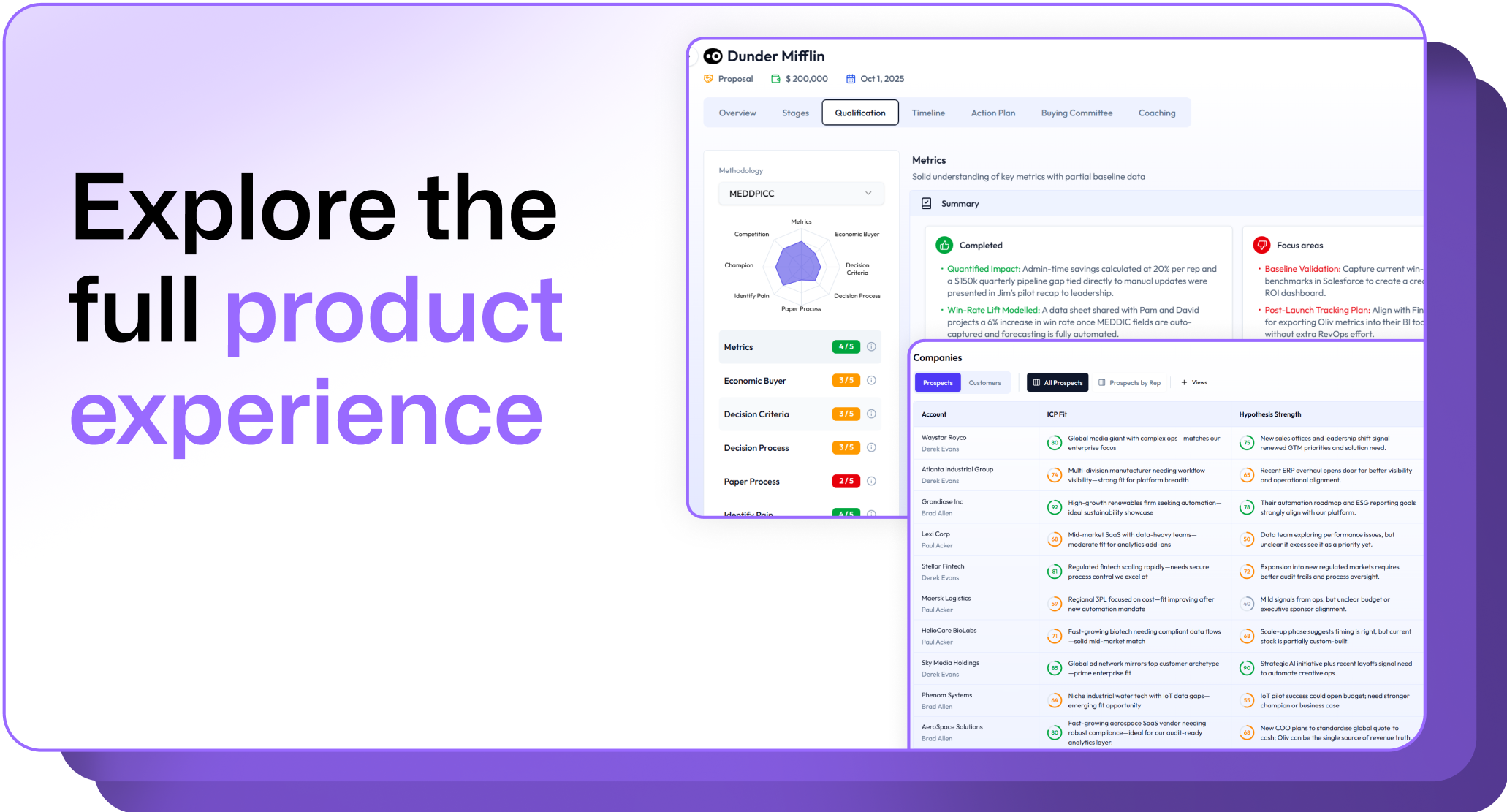
.avif)
.png)