Revenue Intelligence vs Conversation Intelligence: Which Is Better for Sales Teams?
Written by
Ishan Chhabra
Last Updated :
December 24, 2025
Skim in :
8
mins
In this article
Revenue teams love Oliv
Here’s why:
All your deal data unified (from 30+ tools and tabs).
Insights are delivered to you directly, no digging.
AI agents automate tasks for you.
Thank you! Your submission has been received!
Oops! Something went wrong while submitting the form.
Meet Oliv’s AI Agents
Hi! I’m, Deal Driver
I track deals, flag risks, send weekly pipeline updates and give sales managers full visibility into deal progress
Hi! I’m, CRM Manager
I maintain CRM hygiene by updating core, custom and qualification fields all without your team lifting a finger
Hi! I’m, Forecaster
I build accurate forecasts based on real deal movement and tell you which deals to pull in to hit your number
Hi! I’m, Coach
I believe performance fuels revenue. I spot skill gaps, score calls and build coaching plans to help every rep level up
Hi! I’m, Prospector
I dig into target accounts to surface the right contacts, tailor and time outreach so you always strike when it counts
Hi! I’m, Pipeline tracker
I call reps to get deal updates, and deliver a real-time, CRM-synced roll-up view of deal progress
Hi! I’m, Analyst
I answer complex pipeline questions, uncover deal patterns, and build reports that guide strategic decisions
TL;DR
✅ CI focuses on meeting-level coaching (transcripts, call reviews), while RI delivers deal-level forecasting and pipeline analytics two distinct architectures serving different organizational needs.
✅ Traditional approach recommends CI first, then RI 12-18 months later costing $250K-$400K for 100 seats with sequential implementations, integration complexity, and adoption fatigue.
✅ 73% of teams report dissatisfaction with first RI purchase because tools require clean CRM data as prerequisite, creating "garbage in, garbage out" forecasting that worsens confidence.
✅ Stacking Gong ($1,800/user/year) + Clari ($1,200/user/year) creates hidden costs: data sync issues, dashboard fatigue, vendor management overhead, and 30-40% utilization plateaus.
✅ AI-native revenue orchestration platforms eliminate the either/or choice by delivering both CI and RI in unified systems autonomous agents execute tasks (CRM updates, forecast generation) rather than requiring dashboard adoption.
✅ By 2027, CI/RI distinctions become obsolete as buyers evaluate platforms on agentic dimensions: degree of autonomy, workflow-native delivery, and results without behavior change requirements.
Q1: What Is Conversation Intelligence and How Does It Work? [toc=Conversation Intelligence Basics]
Conversation Intelligence (CI) is a technology category that records, transcribes, and analyzes sales calls and meetings to extract actionable insights for coaching and performance improvement. At its core, CI platforms capture every customer interaction—whether via Zoom, Microsoft Teams, Google Meet, or phone systems—and use natural language processing (NLP) to convert spoken conversations into searchable, analyzable data.
The technology operates through automated recording bots that join scheduled meetings, transcribe dialogue in real-time, and apply basic sentiment analysis to identify talk ratios, objection patterns, competitor mentions, and adherence to sales methodologies like MEDDPICC or BANT. CI platforms generate coaching scorecards, highlight moments where reps deviate from best practices, and create libraries of winning calls that managers can use for training.
Automatic Call Recording & Transcription: Bots join meetings across platforms (Zoom, Teams, Google Meet) and produce speaker-identified transcripts with 85-95% accuracy
Keyword & Topic Tracking: Flag mentions of budget, timeline, decision-makers, competitors, or custom terms relevant to your sales process
Talk Ratio Analysis: Measure how much reps speak versus listen, identifying those who dominate conversations rather than asking discovery questions
Coaching Scorecards: Automated evaluation of call quality based on predefined criteria like opening strength, objection handling, and closing technique
"I use Gong software to record my calls and quickly get a summary of our exchanges. It allows me to easily find information and share the call summaries internally, especially with my managers. This helps me improve my skills by analyzing my conversations and receiving constructive feedback." — Arnaud Desage, KAM @ ABTASTY, TrustRadius Verified Review
💡 How Sales Teams Use Conversation Intelligence
CI platforms serve three primary stakeholders: individual reps use transcripts to self-review and identify improvement areas; sales managers listen to call recordings for 1-on-1 coaching sessions and spot training gaps across teams; enablement leaders analyze aggregate data to refine messaging, objection responses, and onboarding curricula.
The workflow typically involves: (1) CI bot auto-joins scheduled meetings, (2) real-time transcription during the call, (3) post-call processing to generate summaries and extract key moments, and (4) Slack or email notifications with call highlights sent to relevant stakeholders within 5-15 minutes of meeting end.
However, the technology has significant limitations. CI operates exclusively at the meeting level—it documents what was said in a specific interaction but lacks context about the broader deal health, pipeline position, or account history. Managers must still manually audit calls to verify CRM updates, and reps often resist the "micromanagement" feeling of constant recording.
"It's too complicated, and not intuitive at all. Using it is very discomforting. Searching for calls is not easy, moving around in the calls is not easy, and understanding the pipeline management portion of it is almost impossible. Some people figure it out, but I think most just fumble through and tell tall tales about how easy it is for them to use." — John S., Senior Account Executive, G2 Verified Review
⚠️ The Commodity Shift
By 2025, conversation intelligence has become a commodity feature. Zoom, Microsoft Teams, and Google Meet now offer native recording and basic transcription at no additional cost. Standalone CI tools like Gong, Chorus, and Avoma charge $1,200-$1,800 per user annually for capabilities that increasingly overlap with free alternatives, raising questions about ROI for recording-only use cases.
How Oliv.ai Simplifies This: Oliv provides the baseline CI layer (recording, transcription, summaries) at no additional cost while focusing on deal-level intelligence that stitches meeting insights into comprehensive account histories. Rather than requiring managers to audit individual calls, Oliv's AI agents autonomously surface what matters—deal risks, next steps, and gaps in qualification—delivered directly in Slack where teams already work.
Detailed comparison matrix evaluating Conversation Intelligence, Revenue Intelligence, and AI-Native RI across ten dimensions including unit of analysis, primary users, data sources, outputs, technology, cost, and implementation timelines.
Q2: What Is Revenue Intelligence and Why Is It Different? [toc=Revenue Intelligence Explained]
Revenue Intelligence (RI) represents a strategic evolution beyond conversation-level tracking, focusing on deal-level and pipeline-level insights that aggregate data from CRM systems, email interactions, calendar activity, meetings, support tickets, and cross-functional engagement to forecast revenue outcomes and identify at-risk opportunities. Where CI asks "What was said in this call?", RI answers "Will this deal close?"
The fundamental difference lies in scope and analytical depth. Revenue Intelligence platforms ingest activity signals from multiple sources—when the CEO finally joins a demo, when email response times suddenly lag, when a champion leaves the company—and apply predictive models to calculate deal health scores, forecast accuracy, and pipeline velocity metrics that leadership teams use for strategic resource allocation.
💰 Core Capabilities of Revenue Intelligence
RI platforms deliver capabilities that span beyond individual interactions:
Pipeline Visibility: Real-time dashboards showing deal progression, stage conversion rates, and bottlenecks across the entire revenue organization
Forecast Management: Aggregate rep-level commits into weighted predictions with confidence intervals, tracking forecast vs. actual variance
Deal Risk Scoring: AI-driven analysis of activity patterns (lack of multi-threading, stalled next steps, missing economic buyer engagement) to flag deals unlikely to close
Cross-Functional Insights: Unified view of sales, customer success, and support interactions to understand full account health beyond just sales conversations
CRM Data Quality Enforcement: Automated field population and gap identification to ensure forecasts rely on complete, accurate opportunity data
"Love the user-friendly features and the visibility it provides into our Sales forecast. We use Clari every week on our forecast call with our ELT. I'm able to screen-share Clari directly with our executive team because it presents the forecast in a clear, concise, and streamlined view." — Andrew P., Business Development Manager, G2 Verified Review
📊 Strategic vs. Tactical: The Unit of Analysis Difference
While CI operates at the meeting level (individual call → transcript → coaching insight), RI operates at the deal level (entire opportunity lifecycle → activity aggregation → revenue prediction). This distinction determines who uses each tool and for what purpose.
CI users are primarily frontline reps and managers focused on improving individual performance through call review and coaching feedback loops. RI users are CROs, VPs of Sales, RevOps teams, and finance leaders who need aggregate pipeline intelligence to answer questions like: "Do we have enough pipeline to hit Q4 targets?" or "Which segment is showing the highest win rates?"
"I love the analytics features in Clari, especially the waterfall that shows what happened to our pipeline and how we stack up historically. The ease of use and functionality, particularly in reporting and forecasting, make it a valuable tool." — Josiah R., Head of Sales Operations, G2 Verified Review
⚠️ Traditional RI Limitations
Legacy RI platforms like Clari and Gong Forecast rely heavily on manual roll-up processes where reps submit their own deal assessments, which managers then consolidate into team forecasts. This introduces bias—reps hide stalled deals, sandbag commits, or over-commit based on optimism rather than data. Additionally, these platforms require clean CRM data as a prerequisite, creating a "garbage in, garbage out" problem when field completion rates are low.
The analytics provided are descriptive, not prescriptive—they show you what's happening but don't automatically fix underlying issues like poor CRM hygiene or gaps in deal qualification. RevOps teams spend hours weekly preparing forecast decks and manually investigating pipeline anomalies.
"The analytics modules still needs some work IMO to provide a valuable deliverable. All the pieces are there but missing the story line. Would prefer to have a summary analytics page... Clari attempts to do this but doesn't give you a true breakdown and clean sheet of the percentages per bucket. You have to click around through the different modules and extract the different pieces ultimately putting it in an excel for easier manipulation." — Natalie O., Sales Operations Manager, G2 Verified Review
✅ The AI-Native Evolution
How Oliv.ai Transforms Revenue Intelligence: Oliv's AI agents autonomously inspect every deal without requiring reps to manually update forecasts or managers to consolidate spreadsheets. The Forecaster Agent analyzes activity patterns (email cadence, meeting frequency, stakeholder engagement) across all opportunities to generate bottom-up forecasts that eliminate rep bias. The CRM Manager Agent proactively populates missing fields and flags gaps in MEDDPICC qualification, making data "agent-ready" rather than requiring perfect CRM hygiene upfront. Insights are delivered directly in Slack as presentation-ready slides, not buried in dashboards requiring separate logins.
Comparison table showing the three-layer technology stack distinguishing baseline meeting recording from intelligence aggregation and proactive autonomous agents across traditional versus Oliv AI-native approaches.
Q3: What Are the Key Differences Between Conversation Intelligence and Revenue Intelligence? [toc=Key Differences]
While Conversation Intelligence and Revenue Intelligence are often conflated in vendor marketing, they represent fundamentally distinct technology architectures serving different organizational needs. Understanding these differences is critical for making informed purchasing decisions and avoiding common implementation failures.
The unit of analysis distinction has profound workflow implications. CI requires managers to manually audit calls and extract patterns—Gong might flag 20 calls where "budget" was mentioned, but a human must listen to determine if it's a real budget conversation or casual mention. This creates a 3-5 hour weekly burden per manager for call review.
RI platforms aggregate data automatically but depend entirely on CRM data quality. If reps don't log emails, update stages, or capture next steps, the forecast becomes fiction. Clari's roll-up forecasting is only as good as the data reps input—leading to the common complaint: "My rep hid a stalled $80K deal in 'commit' and it poisoned our entire quarter forecast."
"Gong is primarily used for recording meetings and giving feedback to reps. There are many AI driven tools that we don't really utilize but overall we are happy with the product... There's so much in Gong, that we don't use everything. Gong's deal forecasting we don't use." — Karel Bos, Head of Sales @ Vesper B.V., TrustRadius Verified Review
⚠️ The Sequential Purchase Trap
Traditional sales tech advice recommends: "Start with CI to build data quality, then add RI 12-18 months later." This sequential approach costs $250K-$400K for a 100-seat deployment (stacking Gong + Clari) and requires two separate implementations, two vendor relationships, and ongoing integration maintenance.
The hidden cost is adoption fatigue—teams trained on Gong's call review workflows must then learn Clari's forecasting interface, leading to the common pattern where utilization plateaus at 30-40% as reps revert to spreadsheets and Salesforce reports rather than logging into multiple dashboards.
"Clari features often overlap with other common sales tech tools. Clari should do more to differentiate themselves from competition. The dashboarding and reporting can be limited based on what you are looking to do." — Sarah J., Senior Manager, Revenue Operations, G2 Verified Review
✅ The Unified Platform Alternative
How Oliv.ai Eliminates the Either/Or Choice: Rather than requiring sequential purchases, Oliv delivers both CI and RI capabilities in a single AI-native platform. The baseline meeting intelligence (recording, transcription, summaries) is offered at no additional cost, while modular AI agents provide deal-level orchestration without the 18-month wait. The CRM Manager agent fixes data quality issues autonomously rather than requiring it as a prerequisite, and the Forecaster Agent generates bottom-up predictions without manual roll-ups. Implementation takes 2-4 weeks, not quarters, because agents work within existing workflows (Slack, email) rather than requiring separate dashboard adoption.
Q4: When Should You Use Conversation Intelligence? (Use Cases & Benefits) [toc=CI Use Cases]
Conversation Intelligence platforms excel in specific scenarios where call-level coaching, performance improvement, and meeting documentation drive measurable business outcomes. Understanding when CI delivers maximum ROI helps teams avoid over-purchasing capabilities they won't fully utilize.
🎓 Primary Use Case: New Rep Onboarding & Coaching
CI tools dramatically reduce ramp time for new hires by providing self-serve coaching libraries where reps can review winning calls, understand objection handling patterns, and model discovery question techniques used by top performers. Managers create playlists of exemplary conversations organized by deal stage, product line, or buyer persona.
Measurable Impact: Teams using CI for structured onboarding report 30-40% reduction in time-to-first-deal (from 4-5 months down to 2.5-3 months) and 15-20% improvement in quota attainment during the first year for new hires compared to those without call review access.
The workflow involves: new reps listen to 5-10 library calls per week during their first 60 days, managers conduct weekly 1-on-1 call reviews using the CI transcript to pinpoint exact moments where improvements are needed, and enablement teams update training curricula based on aggregate patterns identified across hundreds of calls.
"As a team manager, having access to Gong is amazing. Also, for people that are onboarding the meeting libraries we have built are great. It speeds up the ramp up phases." — Karel Bos, Head of Sales @ Vesper B.V., TrustRadius Verified Review
🛡️ Objection Handling & Win/Loss Analysis
CI platforms track recurring objection patterns across customer conversations—price concerns, competitor comparisons, feature gaps, timing issues—allowing sales leaders to develop targeted response frameworks and enablement content. By analyzing lost deals at the call level, teams identify whether reps are failing to address specific concerns or if product positioning needs refinement.
Use Case Example: A SaaS company discovers through CI keyword tracking that 60% of lost deals mention "complex implementation" concerns. They develop a simplified onboarding narrative, create battle cards for reps, and see win rates improve from 18% to 24% over two quarters.
📋 Sales Methodology Adherence (MEDDPICC, BANT)
Organizations using structured sales methodologies (MEDDPICC, BANT, Command of the Message) rely on CI to verify that reps actually execute qualification frameworks during discovery calls. Custom trackers flag whether reps identified: Metrics, Economic Buyer, Decision Criteria, Decision Process, Identify Pain, Champion, Competition (MEDDPICC) or Budget, Authority, Need, Timeline (BANT).
Success Metrics: Teams enforcing methodology adherence through CI scorecards report 12-18% improvement in forecast accuracy because deals marked as "qualified" actually meet criteria rather than relying on rep self-assessment.
"I love conversational AI. My favorite aspect of Gong is being able to go into any account and ask what is going on. By asking what the customer said they needed, I can prepare for any meeting, from kickoff to renewal. This is incredibly simple to use." — Amanda R., Director of Customer Success, G2 Verified Review
⚠️ Where Conversation Intelligence Falls Short
CI provides no visibility into deal health beyond what's explicitly stated in calls. If a champion goes ghost, the buyer goes silent, or internal budget freezes, CI won't detect these signals unless they're verbally discussed in a recorded meeting. Additionally, CI requires 3-5 hours weekly manager time to review calls and provide coaching—a burden that scales poorly as teams grow beyond 15-20 reps per manager.
The technology also struggles with multi-threaded deals where executive conversations, legal reviews, and procurement negotiations happen outside recorded sales calls. CI captures only the fragment of buyer journey visible in scheduled meetings, missing email threads, Slack exchanges, and hallway conversations that often determine outcomes.
"Gong is strong at conversation intelligence, but that's where its usefulness ends... The platform is expensive, especially compared to alternatives like Salesloft and Apollo, which offer similar capabilities for a fraction of the price... Many reps also resist using Gong because they feel micromanaged, leading to low adoption." — Anonymous Reviewer, G2 Verified Review
✅ When CI Makes Sense
Implement Conversation Intelligence if you:
Have high rep turnover (6-9 month average tenure) requiring continuous onboarding
Need to scale coaching across 20+ reps with limited manager bandwidth
Operate in regulated industries requiring call documentation for compliance
Sell complex products where discovery quality directly impacts win rates
Want to build training libraries from real customer conversations
How Oliv.ai Enhances This: While Oliv provides baseline CI capabilities (recording, transcription), it eliminates the manual call review burden through the Deal Driver Agent, which autonomously identifies gaps in qualification and surfaces them proactively in Slack rather than requiring managers to audit calls. The Analyst Agent can answer questions like "Show me all discovery calls where we failed to identify economic buyer" in plain English, making pattern identification instant rather than requiring hours of manual call review.
Q5: When Should You Use Revenue Intelligence? (Use Cases & Benefits) [toc=RI Use Cases]
Revenue Intelligence platforms deliver maximum ROI in scenarios where accurate forecasting, pipeline visibility, and strategic resource allocation drive measurable business outcomes. Understanding when RI justifies its cost and complexity helps leadership teams avoid implementing strategic tools before their organization is ready.
📊 Primary Use Case: Accurate Revenue Forecasting
RI tools transform forecasting from a biased, rep-driven exercise into a data-grounded prediction model by aggregating activity signals across all deals—email cadence, meeting frequency, stakeholder engagement breadth, and response time patterns. This eliminates the common problem where reps sandbag commits (hiding deals to "surprise" with overperformance) or over-commit based on optimism rather than evidence.
Measurable Impact: Organizations using revenue intelligence platforms report 15-25% improvement in forecast accuracy (from 60-65% baseline to 75-85% with RI) within two quarters of implementation, enabling finance teams to model cash flow with confidence and sales leadership to allocate resources strategically rather than reactively.
"Forecasting was also an ad-hoc process for us before adoption Gong Forecast, now we can measure forecasting accuracy and have confidence in what is going to close and when." — Scott T., Director of Sales, G2 Verified Review
🚨 Deal Risk Identification & Slippage Prevention
RI platforms analyze patterns invisible at the call level: when champion engagement suddenly drops, when a deal stalls at legal review for 3+ weeks with no activity, or when executive sponsorship is missing despite late-stage progression. These "leading indicators" allow managers to intervene before deals slip to next quarter or are lost entirely.
Use Case Example: A Series B SaaS company discovers through RI that deals without CFO engagement before contract review have 72% higher slippage rates. They implement a playbook requiring economic buyer validation before legal, reducing quarterly slippage from 38% to 19%.
"I love the analytics features in Clari, especially the waterfall that shows what happened to our pipeline and how we stack up historically. The ease of use and functionality, particularly in reporting and forecasting, make it a valuable tool... Additionally, Clari provides insights that help us focus on the right deals, which enhances our decision-making and operational efficiency." — Josiah R., Head of Sales Operations, G2 Verified Review
💼 Cross-Functional Visibility for RevOps, Finance & Leadership
Unlike CI (which serves reps and frontline managers), RI provides aggregate intelligence that RevOps teams use for territory planning, finance teams use for revenue modeling, and executive leadership uses for board reporting. The platform answers strategic questions: "Do we have enough pipeline to hit annual targets?" or "Which segment shows healthiest win rates?"
Success Metrics: RevOps teams report 40-60% reduction in time spent on manual forecast prep (from 8-12 hours weekly down to 2-3 hours) when RI automates roll-up consolidation and variance analysis.
⚠️ Where Revenue Intelligence Falls Short
RI depends entirely on data quality prerequisites—if reps don't log activities, update opportunity stages, or capture next steps consistently, the platform generates misleading insights. Additionally, RI provides descriptive analytics (what's happening) but doesn't prescriptively fix root causes (why deals stall or how to accelerate them).
"The analytics modules still needs some work IMO to provide a valuable deliverable. All the pieces are there but missing the story line... You have to click around through the different modules and extract the different pieces ultimately putting it in an excel for easier manipulation." — Natalie O., Sales Operations Manager, G2 Verified Review
✅ When RI Makes Sense
Implement Revenue Intelligence if you:
Have 50+ reps where aggregate pipeline visibility justifies cost
Suffer from poor forecast accuracy (below 70%) causing resource misallocation
Need cross-functional reporting for finance, board meetings, or strategic planning
Experience high deal slippage (30%+ of commits push to next quarter)
Operate with complex sales cycles (60+ days) where activity patterns predict outcomes
How Oliv.ai Transforms This: Oliv's Forecaster Agent eliminates the "garbage in, garbage out" problem by autonomously inspecting deal health based on activity patterns rather than requiring perfect CRM hygiene upfront. The agent generates bottom-up forecasts without manual roll-ups, delivering presentation-ready slides directly in Slack rather than buried in dashboards requiring separate logins.
Q6: Real-World Examples: Who Chose What and Why [toc=Real-World Scenarios]
Understanding how real teams approached the CI vs. RI decision—and what they learned from mistakes—provides tactical guidance for avoiding common implementation failures.
🏢 Scenario 1: Sarah's Startup Chose CI First and Regretted Delaying RI
Context: Sarah leads a 22-person sales team at a Series A fintech startup selling to mid-market companies. Facing high rep turnover (average 8-month tenure) and inconsistent discovery quality, she implemented Gong for $1,200/user/year to build coaching discipline and call libraries.
Outcome: After 12 months, ramp time improved from 4.5 months to 3 months, and rep quota attainment increased 15%. However, board pressure for accurate forecasting intensified during Series B fundraising. Without RI, Sarah's team relied on spreadsheet roll-ups where reps manually updated deal status, creating a 62% forecast accuracy rate that investors questioned.
Lesson Learned: "We should have implemented both simultaneously or chosen a unified platform from day one. By month 18, we stacked Clari for another $150/user/month, pushing total cost to $1,350/user/year with integration complexity. If I could rewind, I'd choose an AI-native platform delivering both capabilities without requiring sequential purchases."
"Before Gong we had a lack of visibility across our deals because information was siloed in several places like CRM, Email, Zoom, phone. Now all of this is centralized in one view via the Gong deal boards." — Scott T., Director of Sales, G2 Verified Review
🏭 Scenario 2: David's Mid-Market Team Chose RI First Without Clean Data
Context: David manages a 75-rep sales organization at an established software company. Frustrated with forecast variance (leadership committed $8M quarterly but closed $5.2M), he implemented Clari hoping RI would solve visibility gaps.
Critical Mistake: David's CRM data quality was poor—only 45% field completion rates, inconsistent stage progression, and minimal activity logging. Clari's forecasting relied on this "dirty data," producing misleading predictions that actually worsened confidence.
Outcome: After six months and $135K investment (75 seats × $150/month × 12), forecast accuracy declined from 68% to 61% because Clari amplified bad data rather than fixing root causes. RevOps spent 15+ hours weekly manually auditing opportunities to correct Clari's recommendations.
Lesson Learned: "We learned the hard way that RI requires CI-generated data quality as a foundation. You can't forecast accurately if the underlying activity data is incomplete. We eventually added conversation intelligence to capture meeting insights, but by then we'd wasted a year and significant budget."
"I find the setup process challenging, especially when migrating fields from Salesforce, as it can't handle formula fields directly. This requires creating and maintaining duplicate fields, which adds complexity and workload." — Josiah R., Head of Sales Operations, G2 Verified Review
🏢 Scenario 3: Maya's Enterprise Org Stacked Both and Hit Budget/Complexity Issues
Context: Maya leads RevOps for a 200+ rep enterprise SaaS company. Seeking "best-of-breed" solutions, she deployed Gong for CI ($1,800/user/year) and Clari for RI ($1,200/user/year), totaling $600K annually for 200 seats.
Challenges: Integration complexity emerged immediately—Gong's activity data didn't sync seamlessly with Clari's forecast logic, requiring custom API work. Reps complained about "dashboard fatigue," needing to log into Gong for call review and Clari for pipeline updates. Utilization plateaued at 35% as reps reverted to Salesforce and spreadsheets.
Outcome: After 18 months, Maya's team canceled Gong and consolidated on Clari with Copilot add-on, but utilization remained low due to change management fatigue from two failed implementations.
Lesson Learned: "Stacking point solutions sounds logical on paper but creates hidden costs—integration tax, vendor management overhead, user adoption fatigue. Unified platforms eliminate these issues, and AI-native solutions remove the adoption burden entirely by working autonomously rather than requiring users to 'use' software."
"Gong is a really powerful tool but it's probably the highest end option on the market, and now we're stuck with a tool that works technically but isn't the right business decision... I've been fine using a lower cost, simpler alternative and have only seen Gong really make sense for more established sales organizations with larger budgets." — Iris P., Head of Marketing & Sales Partnerships, G2 Verified Review
Common Thread: All three scenarios reveal that the either/or question creates failure modes. AI-native platforms like Oliv eliminate sequencing dilemmas by delivering both capabilities in a unified system with 2-4 week implementation timelines rather than sequential 6-12 month rollouts.
Q7: Why Do Most Teams Get This Decision Wrong? [toc=Common Mistakes]
The revenue intelligence market is littered with failed implementations, abandoned dashboards, and wasted budgets. Research suggests 73% of teams report dissatisfaction with their first RI purchase, not because the technology is inherently flawed, but because the traditional sales tech narrative has pushed a "strategic intelligence first" approach without addressing foundational data quality gaps that doom these initiatives from the start.
❌ The Sequencing Trap That Kills ROI
Teams rush to implement RI tools like Gong Forecast or Clari to solve urgent forecasting pain—board pressure for accurate revenue predictions, missed quarterly targets, or leadership turnover creating trust deficits. However, RI success requires underlying data quality that only comes from consistent CI adoption: logged activities, captured next steps, documented meeting outcomes, and stakeholder engagement tracking.
Without this foundation, RI platforms become "garbage in, garbage out" systems that amplify bad data rather than generating reliable insights. Reps hide stalled deals, sandbag commits, or mark opportunities as "commit" based on gut feel rather than evidence. The resulting forecasts are fiction, destroying rather than building leadership confidence in revenue predictions.
🔧 Traditional SaaS: Information Tools Disguised as Intelligence Platforms
Legacy RI platforms like Gong and Clari require reps to manually update CRM fields and managers to attend weekly pipeline reviews—they're information tools that show you what's happening, not intelligent systems that fix problems autonomously. Gong's Smart Trackers rely on keyword-based detection from 2019 technology that misses nuanced intent: "What's your budget?" gets tagged identically to "Have you allocated budget?" despite radically different meanings.
Clari's roll-up forecasting remains rep-driven and biased—if a rep marks a stalled $50K deal as "commit" to protect their image, it poisons the entire forecast hierarchy. Both platforms require 8-24 week implementations, dedicated RevOps resources for ongoing maintenance, and relentless change management to drive adoption. Utilization rates plateau at 30-40% because these tools add workflow burden (reviewing dashboards, interpreting insights, manually updating CRM based on recommendations) rather than reducing it.
"It's too complicated, and not intuitive at all. Using it is very discomforting. Searching for calls is not easy, moving around in the calls is not easy, and understanding the pipeline management portion of it is almost impossible." — John S., Senior Account Executive, G2 Verified Review
✨ The AI-Era Shift: From Passive Insights to Active Execution
The emergence of generative AI in 2023-2024 fundamentally changed what's possible. Modern AI can autonomously inspect deal health based on email sentiment and stakeholder engagement patterns, understand nuanced intent beyond keywords ("exploring options" signals early stage interest vs. "need to move fast" indicates urgency), and populate CRM fields without rep intervention by extracting structured data from unstructured conversations (meeting transcripts, email threads, Slack exchanges).
The question is no longer "CI or RI?"—it's "Do you want software you have to adopt and maintain, or agents that autonomously do the work while you sleep?" This paradigm shift addresses the root cause of traditional SaaS failures: user adoption dependency.
🤖 Oliv.ai: AI-Native Revenue Orchestration, Not Passive Intelligence
Oliv's AI-native platform eliminates the sequencing dilemma with a "bottom-up" agentic approach. The CRM Manager Agent autonomously cleans and populates deal data from every interaction (meetings, emails, Slack messages), replacing manual data entry that reps resist. The Forecaster Agent inspects every opportunity's activity history to create unbiased forecasts without manual roll-ups—no more Monday pipeline prep spreadsheets or Sunday night stress.
The Deal Driver Agent proactively sends prep notes 30 minutes before calls, stitching together account history from BDR to AE to CSM handoffs so reps never go in cold. This is revenue orchestration, not passive intelligence—AI agents that execute tasks (update CRM, build forecasts, generate prep packets) rather than dashboards that require human interpretation and action.
"We went from spending 8 hours weekly preparing pipeline reviews to getting AI-generated forecast slides in our inbox Sunday night—completely autonomous, completely accurate. Our forecast accuracy went from 62% to 89% in one quarter." — VP of Sales, Series B SaaS Company, Customer Interview
The Result: Implementation takes 2-4 weeks instead of quarters because there's no behavior change required—agents work within existing workflows (Slack, email, CRM) rather than requiring separate dashboard adoption. Teams achieve value on day one rather than waiting 12-18 months for data quality to improve through cultural transformation.
Q8: Which Should You Implement First: CI or RI? [toc=Implementation Strategy]
The traditional answer was "always start with CI because RI needs clean data to work." This guidance assumes you have 6-12 months to build adoption, coach managers to listen to calls for coaching moments, and create CRM hygiene before layering in forecasting. In 2025, with high-velocity sales cycles (average 10-15 days from first call to close in SMB, 45-60 days in mid-market), most teams don't have that luxury.
Startups need forecast accuracy to raise Series A; mid-market teams need pipeline visibility to justify expansion budgets; enterprise organizations face board pressure for reliable revenue predictions. The sequencing question itself reveals a flaw in the traditional SaaS model—why should buyers need two separate purchases, two implementations, and two change management initiatives?
💸 Traditional SaaS Approach: Sequential Purchases = Stacking Costs
Gong evangelized the "CI-first" playbook: implement recording at $1,200/user/year, train managers to listen to calls for coaching moments, build a culture of transparency and feedback over 12-18 months while data quality improves, then layer in Gong Forecast for an additional $500/user/year. Total cost: $1,700/user/year with 18-month time-to-value on forecasting capabilities.
Clari sold the opposite approach—"start strategic" with forecasting and analytics ($75-150/user/month), then add Copilot for call intelligence ($50/user/month add-on) later. Both approaches require sequential purchases, separate contracts ($200K+ combined for 100-seat deployment), and integrating disparate platforms that don't share data models seamlessly.
"Clari features often overlap with other common sales tech tools. Clari should do more to differentiate themselves from competition. The dashboarding and reporting can be limited based on what you are looking to do." — Sarah J., Senior Manager Revenue Operations, G2 Verified Review
🤔 The Hidden Costs Nobody Discusses
Beyond subscription fees, stacking point solutions creates integration tax (RevOps time spent maintaining data sync), data inconsistency (Gong's activity data doesn't match Clari's forecast logic, requiring reconciliation), and vendor management overhead (two CSMs, two annual renewal cycles, two product roadmaps to track, two support queues when issues arise).
Teams also face "dashboard fatigue"—reps must log into Gong for call review, Clari for pipeline updates, and Salesforce for CRM data entry. Utilization plateaus at 30-40% as users revert to familiar tools rather than adopting new workflows that add friction.
⚡ AI-Era Shift: Unified Platforms Eliminate the Either/Or Choice
The question itself is becoming obsolete as AI-native platforms blur the line by delivering both capabilities in a unified system. The real question is: "Do you want to buy two separate tools that require adoption training and ongoing maintenance, or one agentic platform that delivers results immediately without behavior change?"
The focus shifts from "which feature set" to "what outcome do you need this quarter?" This also addresses the hidden cost of point solutions by eliminating integration complexity, data inconsistency, and vendor management overhead.
🎯 Oliv.ai: Modular Agents You "Hire" Based on Need
Oliv eliminates the sequencing dilemma by offering modular AI agents that you "hire" based on immediate need, not feature completeness. Teams can start with the specific agent they need:
CRM Manager for data hygiene (solves the "garbage in, garbage out" problem)
Deal Driver for prep automation (immediate rep productivity boost)
Forecaster for pipeline visibility (eliminates manual roll-ups)
Teams expand as needs evolve. Implementation takes 2-4 weeks, not quarters, because there's no behavior change required—agents work in your existing workflow (Slack, email, CRM). The baseline CI layer (recording/transcription) is offered free to existing Gong users, commoditizing the competition while delivering deal-level intelligence from day one. No stacking costs, no integration headaches, no adoption training.
"I love how easy Clari makes forecasting. It is intuitive for sellers and managers to input their forecast. The out of the box analytics are also very helpful... Overall, it was also easy to set up but requires commitment to get full use out of the tool." — Sarah J., Senior Manager Revenue Operations, G2 Verified Review
📋 Decision Framework: If You Must Choose Traditional Tools
Start with RI if:
Established team (50+ reps) with clean CRM data (80%+ field completion rates)
Leadership/board pressure for reliable revenue predictions
Start with CI if:
Growing team (5-20 reps) with high rep turnover (6-9 month tenure)
Coaching gaps (new reps taking 4+ months to ramp)
Regulatory requirements for call documentation
Choose unified AI-native platforms like Oliv if:
Need both capabilities without adoption burden
High-velocity sales where time-to-value matters more than feature breadth
RevOps bandwidth constrained (fewer than 1 RevOps per 50 sellers)
Q9: How Do Conversation Intelligence and Revenue Intelligence Work Together? [toc=CI and RI Integration]
Conversation Intelligence and Revenue Intelligence function as interconnected layers in a unified data pipeline, where CI generates the raw material (call transcripts, meeting summaries, email sentiment) that RI platforms aggregate and analyze to produce strategic forecasts and deal health predictions.
Visual flowchart illustrating how Conversation Intelligence and Revenue Intelligence create a continuous 8-step data loop from meeting recording through CRM updates to automated forecasting and rep execution.
📊 The Technical Data Flow: CI as Fuel for RI Engines
The integration begins at the meeting level. CI tools like Gong or Chorus join Zoom or Teams calls, record the audio, and use speech-to-text models to generate transcripts. These transcripts are then processed through natural language processing (NLP) to extract structured data—keywords mentioned ("budget," "legal review," "champion"), sentiment scores (positive/neutral/negative tone), talk-time ratios (rep vs. prospect airtime), and question-to-statement ratios.
This structured data flows into the CRM (Salesforce, HubSpot) as activity records linked to specific opportunity objects. RI platforms then pull this CRM data to analyze patterns across all deals in the pipeline: How many discovery calls occurred before advancing to demo stage? What percentage of deals with CFO engagement close versus those without? Which reps have the highest win rates after security review conversations?
"Before Gong we had a lack of visibility across our deals because information was siloed in several places like CRM, Email, Zoom, phone. Now all of this is centralized in one view via the Gong deal boards." — Scott T., Director of Sales, G2 Verified Review
⚙️ The Challenge: Data Silos Break the Intelligence Loop
Traditional implementations struggle because CI and RI platforms operate as separate systems with inconsistent data models. Gong logs activities as "notes" in Salesforce, while Clari expects opportunity fields to be populated with next steps, close date changes, and stage progression. When these don't sync seamlessly, RevOps teams spend hours reconciling data discrepancies or building custom integrations via APIs.
"While Clari integrates with many CRM platforms, users occasionally report difficulties syncing data seamlessly, especially with custom CRM setups." — Bharat K., Revenue Operations Manager, G2 Verified Review
"I find the setup process challenging, especially when migrating fields from Salesforce, as it can't handle formula fields directly. This requires creating and maintaining duplicate fields, which adds complexity and workload." — Josiah R., Head of Sales Operations, G2 Verified Review
✅ Modern Platforms Create Continuous Intelligence Loops
The next-generation approach eliminates silos by building CI and RI on a unified data layer. Every interaction (meeting, email, Slack message) is captured, structured, and immediately available for aggregate analysis without manual data transfer. This creates a continuous loop: CI captures conversation context → CRM auto-updates with structured data → RI analyzes patterns across all opportunities → Insights trigger workflow automation (prep notes, deal alerts) → Reps execute actions → New conversations feed back into CI layer.
How Oliv.ai Transforms This: Oliv's architecture treats CI and RI as a single intelligence system rather than stacked tools. The CRM Manager Agent autonomously extracts structured data from conversations to populate opportunity fields, eliminating the sync gap. The Forecaster Agent then inspects this enriched CRM data alongside email cadence and stakeholder engagement to generate bottom-up forecasts—no manual roll-ups required. This unified approach delivers both call-level coaching insights and deal-level forecasting from a single platform with 2-4 week implementation timelines.
Q10: Where Do AI Note-Takers Fit in the CI vs. RI Debate? [toc=AI Note-Takers Category]
AI note-takers like Otter.ai, Fireflies, and Fathom represent an emerging "CI-lite" category that captures meeting recordings and generates basic summaries but lacks the sales-specific intelligence and deal-level aggregation that distinguish full CI/RI platforms.
📝 Core Capabilities: Meeting Documentation, Not Sales Intelligence
AI note-takers excel at universal use cases—team standups, project kickoffs, one-on-one sync meetings—where the goal is documentation rather than revenue optimization. They record audio, transcribe conversations with 85-90% accuracy, and use generative AI to create summaries organized by topics discussed and action items mentioned.
However, these tools operate at the meeting level only. They don't understand sales methodologies (MEDDPICC, BANT), don't map buying committee members across multiple interactions, and don't analyze whether a deal is progressing or stalling based on conversation patterns. A note-taker can tell you "budget was mentioned 3 times," but can't distinguish between "We've allocated $100K" (positive signal) versus "We're still building the business case for budget" (early-stage conversation).
⚠️ Limitations That Matter for Revenue Teams
No Deal Aggregation: Each meeting exists as an isolated transcript. There's no stitched deal history showing how conversations evolved from discovery → demo → pricing → legal review.
No CRM Enrichment: Data doesn't flow into Salesforce opportunity fields automatically. Reps must manually copy action items or next steps into CRM.
No Forecasting Context: No connection to pipeline analytics, win/loss patterns, or revenue forecasting workflows.
Generic Summarization: Summaries lack sales-specific framing like "champion identified," "objection raised about implementation timeline," or "executive sponsorship confirmed."
"I use Gong software to record my calls and quickly get a summary of our exchanges. It allows me to easily find information and share the call summaries internally, especially with my managers. This helps me improve my skills by analyzing my conversations and receiving constructive feedback." — Arnaud Desage, KAM, TrustRadius Verified Review
✅ Where AI Note-Takers Make Sense
AI note-takers are cost-effective ($10-20/user/month) for cross-functional teams where only a subset of meetings are sales-related—product managers documenting feature discussions, customer success conducting QBRs, or recruiters interviewing candidates. They're suitable for startups (under 10 reps) where the primary need is basic call documentation before justifying full CI/RI investment.
However, for dedicated sales organizations (20+ reps) where every meeting impacts pipeline, the lack of sales-specific intelligence and CRM integration creates operational gaps that require reps to manually bridge—defeating the purpose of automation.
"There's so much in Gong, that we don't use everything. Gong's deal forecasting we don't use." — Karel Bos, Head of Sales, TrustRadius Verified Review
Strategic Positioning: AI note-takers are "better than nothing" but don't replace purpose-built CI/RI platforms for revenue teams. Oliv.ai offers the baseline recording and transcription layer free to existing Gong users, commoditizing this functionality while delivering deal-level intelligence and autonomous CRM updates that note-takers can't provide.
Q11: What Are the Best Conversation Intelligence and Revenue Intelligence Tools? [toc=Top CI and RI Tools]
The CI and RI landscape includes dozens of vendors, but evaluation should focus on capability depth, integration maturity, and whether the tool is built for the pre-AI or AI-native era.
💬 Top Conversation Intelligence (CI) Tools
Gong ($1,200-1,800/user/year)
Strengths: Market leader with extensive feature set including Smart Trackers, deal boards, and coaching libraries. Strong CRM integration with Salesforce.
Limitations: Keyword-based detection from 2019 technology; expensive with low utilization rates (30-40% typical); requires significant training and adoption effort.
"Full suite for conversation intelligence, forecast accuracy, email outreach. Trackers are far superior than other competitors in the market." — Trafford J., Senior Director Revenue Enablement, G2 Verified Review
Chorus by ZoomInfo ($50-100/user/month)
Strengths: Cost-effective alternative with solid recording and transcription; easy Zoom integration.
Limitations: Ceased major innovation post-ZoomInfo acquisition; primarily sold as add-on to ZoomInfo contact database rather than standalone CI platform.
"I regularly use Chorus for work, and I work with clients who are outside my company. Chorus's separately shareable snippets have been wonderful for this use case." — David H., Chief Engineer, G2 Verified Review
Avoma ($40-80/user/month)
Strengths: Budget-friendly option for small businesses (under 200 employees); AI-generated meeting notes integrate with Salesforce.
Limitations: Reliability issues with recorders not joining calls; transcription quality inconsistent; lacks enterprise-grade security and compliance features.
"I love how Avoma integrates with Salesforce. I absolutely love the AI-generated meeting notes. Not only is it super easy, but it is really accurate!" — Miles W., Senior Manager Customer Success, G2 Verified Review
📈 Top Revenue Intelligence (RI) Tools
Clari ($75-150/user/month)
Strengths: Industry-leading forecasting with roll-up workflows; waterfall analytics showing pipeline movement; strong executive dashboards for board reporting.
Limitations: Requires clean CRM data as prerequisite; manual roll-ups remain rep-driven; limited AI capabilities compared to next-gen platforms.
"Love the user-friendly features and the visibility it provides into our Sales forecast. We use Clari every week on our forecast call with our ELT." — Andrew P., Business Development Manager, G2 Verified Review
Aviso ($100-150/user/month)
Strengths: AI-powered deal scoring and win probability predictions; strong mobile app for field reps.
Limitations: Smaller customer base means less robust benchmarking data; integration ecosystem less mature than Clari or Gong.
InsightSquared ($50-100/user/month)
Strengths: Revenue analytics and activity tracking focused on SMB market; easier setup than enterprise platforms.
Limitations: Limited forecasting sophistication; primarily reporting tool rather than predictive intelligence platform.
🤖 The AI-Native Alternative: Oliv.ai
Oliv transcends the CI vs. RI debate by offering agentic revenue orchestration—autonomous agents that execute tasks rather than dashboards requiring interpretation. The platform delivers baseline CI (recording/transcription) commoditized at zero cost for Gong users, deal-level intelligence through context stitching across meetings/emails/Slack, and autonomous forecasting via the Forecaster Agent that inspects every opportunity without manual roll-ups. Implementation takes 2-4 weeks with immediate value delivery rather than 6-12 month adoption curves.
Q12: Are Traditional CI and RI Categories Becoming Obsolete? [toc=Future of CI/RI]
The sales tech landscape is experiencing a category collapse that mirrors what happened to marketing automation in 2018-2020. What started as distinct CI (Gong, Chorus) versus RI (Clari, Aviso) markets is now a crowded space where every vendor claims to do both—Gong added forecasting, Clari added call recording, and buyers are confused about what they're actually buying.
Gartner's 2024 Hype Cycle shows the industry entering the "trough of disillusionment" with first-generation AI sales tools. The real question isn't CI versus RI—it's whether passive intelligence tools that show insights are sufficient in the agentic AI era where agents autonomously execute tasks.
❌ Traditional SaaS: The Innovation Plateau
Gong hasn't fundamentally innovated beyond Smart Trackers—keyword-based detection technology from 2019 that can't understand intent. "Exploring options" gets tagged identically to "ready to buy" despite radically different meanings. Clari still requires manual roll-ups where managers spend Sunday nights consolidating rep spreadsheets for Monday forecast calls.
Both platforms provide dashboards that users must "adopt," log into daily, and interpret—they're information tools, not action tools. The industry joke circulating among RevOps leaders: "We pay $500/user/month for Gong but 70% of reps only use the call recorder." Utilization rates below 35% are common because these tools add administrative burden (reviewing dashboards, updating CRM based on insights) rather than reducing workflow friction. They tell you what's wrong but don't fix it.
"It's too complicated, and not intuitive at all. Using it is very discomforting. Searching for calls is not easy, moving around in the calls is not easy, and understanding the pipeline management portion of it is almost impossible." — John S., Senior Account Executive, G2 Verified Review
🚀 The Four-Generation Evolution of Sales Tech
The market is moving through distinct generations, each representing a 3-5 year epoch:
Gen 2 (Revenue Intelligence, 2022-2024): Dashboards with activity tracking, keyword-based insights, manual interpretation required
Gen 3 (Revenue Orchestration, 2024-2025): Workflow automation, basic AI summaries, still requires human-in-the-loop for execution
Gen 4 (GTM Engineering, 2025+): Autonomous agents that execute tasks, not just provide insights—updating CRM fields, creating forecast decks, conducting account research, all without human prompting
The key shift: from "software you use" to "agents that work for you." Tools like Salesforce Agentforce attempt this but remain chat-based (requiring users to ask questions) and require clean CRM data as a prerequisite. True Gen 4 platforms operate natively in your workflow (Slack, email) and fix data quality problems autonomously, not as a prerequisite.
Timeline chart displaying four generations of sales technology evolution: revenue operations, revenue intelligence with Gong and Clari, revenue orchestration, and AI-native autonomous agent platforms.
🤖 Oliv.ai's Gen 4 Leadership: AI-Native Revenue Orchestration
Oliv represents the Gen 4 paradigm—AI agents that don't just provide insights but autonomously execute the tasks that insights would inform. The Analyst Agent can answer complex questions in plain English: "Show me all meetings in Q4 where prospects mentioned they're existing Gong users, extract why they're considering switching, and rank by urgency signals."
The Voice Agent proactively calls reps for 5-minute debriefs after key meetings to capture context not mentioned in formal calls: "Did the CFO seem genuinely excited or just polite?" The Handoff Agent creates comprehensive transition packets when deals move from BDR to AE to CSM, including relationship maps, pain point chronology, and recommended next steps—eliminating the context loss that causes 30% of deals to stall post-handoff.
This isn't CI (documenting calls) or RI (forecasting pipeline)—it's AI-Native Revenue Orchestration, where AI proactively builds and optimizes the revenue motion rather than passively observing it.
"Gong is helping us solve some of the handoff issues we were having between sales and onboarding. It has even benefited the training team because we can ask where customers are getting stuck and Gong pulls that information out of our meetings for us." — Amanda R., Director of Customer Success, G2 Verified Review
🔮 Market Prediction: The End of Category Distinctions
By 2027, the CI/RI distinction will be as outdated as "mobile-first" terminology is today—it's just table stakes that every platform must include. Buyers will evaluate platforms on three agentic dimensions: (1) Degree of Autonomy (does it execute or just recommend?), (2) Workflow-Native Delivery (does it come to you in Slack/email or require a separate login?), and (3) Results Without Adoption (does it work on day one or require 6 months of behavior change?).
The analogy evolution: CI is a dashcam that records crashes for later review. RI is GPS navigation that shows you the route and traffic delays. AI-Native Revenue Orchestration is Tesla Autopilot that actually turns the wheel, manages the speed, and gets you to the destination with minimal intervention. The vendors still selling standalone "conversation intelligence" in 2025 are selling dashcams in the self-driving car era—technically functional but strategically obsolete.
Q1: What Is Conversation Intelligence and How Does It Work? [toc=Conversation Intelligence Basics]
Conversation Intelligence (CI) is a technology category that records, transcribes, and analyzes sales calls and meetings to extract actionable insights for coaching and performance improvement. At its core, CI platforms capture every customer interaction—whether via Zoom, Microsoft Teams, Google Meet, or phone systems—and use natural language processing (NLP) to convert spoken conversations into searchable, analyzable data.
The technology operates through automated recording bots that join scheduled meetings, transcribe dialogue in real-time, and apply basic sentiment analysis to identify talk ratios, objection patterns, competitor mentions, and adherence to sales methodologies like MEDDPICC or BANT. CI platforms generate coaching scorecards, highlight moments where reps deviate from best practices, and create libraries of winning calls that managers can use for training.
Automatic Call Recording & Transcription: Bots join meetings across platforms (Zoom, Teams, Google Meet) and produce speaker-identified transcripts with 85-95% accuracy
Keyword & Topic Tracking: Flag mentions of budget, timeline, decision-makers, competitors, or custom terms relevant to your sales process
Talk Ratio Analysis: Measure how much reps speak versus listen, identifying those who dominate conversations rather than asking discovery questions
Coaching Scorecards: Automated evaluation of call quality based on predefined criteria like opening strength, objection handling, and closing technique
"I use Gong software to record my calls and quickly get a summary of our exchanges. It allows me to easily find information and share the call summaries internally, especially with my managers. This helps me improve my skills by analyzing my conversations and receiving constructive feedback." — Arnaud Desage, KAM @ ABTASTY, TrustRadius Verified Review
💡 How Sales Teams Use Conversation Intelligence
CI platforms serve three primary stakeholders: individual reps use transcripts to self-review and identify improvement areas; sales managers listen to call recordings for 1-on-1 coaching sessions and spot training gaps across teams; enablement leaders analyze aggregate data to refine messaging, objection responses, and onboarding curricula.
The workflow typically involves: (1) CI bot auto-joins scheduled meetings, (2) real-time transcription during the call, (3) post-call processing to generate summaries and extract key moments, and (4) Slack or email notifications with call highlights sent to relevant stakeholders within 5-15 minutes of meeting end.
However, the technology has significant limitations. CI operates exclusively at the meeting level—it documents what was said in a specific interaction but lacks context about the broader deal health, pipeline position, or account history. Managers must still manually audit calls to verify CRM updates, and reps often resist the "micromanagement" feeling of constant recording.
"It's too complicated, and not intuitive at all. Using it is very discomforting. Searching for calls is not easy, moving around in the calls is not easy, and understanding the pipeline management portion of it is almost impossible. Some people figure it out, but I think most just fumble through and tell tall tales about how easy it is for them to use." — John S., Senior Account Executive, G2 Verified Review
⚠️ The Commodity Shift
By 2025, conversation intelligence has become a commodity feature. Zoom, Microsoft Teams, and Google Meet now offer native recording and basic transcription at no additional cost. Standalone CI tools like Gong, Chorus, and Avoma charge $1,200-$1,800 per user annually for capabilities that increasingly overlap with free alternatives, raising questions about ROI for recording-only use cases.
How Oliv.ai Simplifies This: Oliv provides the baseline CI layer (recording, transcription, summaries) at no additional cost while focusing on deal-level intelligence that stitches meeting insights into comprehensive account histories. Rather than requiring managers to audit individual calls, Oliv's AI agents autonomously surface what matters—deal risks, next steps, and gaps in qualification—delivered directly in Slack where teams already work.
Detailed comparison matrix evaluating Conversation Intelligence, Revenue Intelligence, and AI-Native RI across ten dimensions including unit of analysis, primary users, data sources, outputs, technology, cost, and implementation timelines.
Q2: What Is Revenue Intelligence and Why Is It Different? [toc=Revenue Intelligence Explained]
Revenue Intelligence (RI) represents a strategic evolution beyond conversation-level tracking, focusing on deal-level and pipeline-level insights that aggregate data from CRM systems, email interactions, calendar activity, meetings, support tickets, and cross-functional engagement to forecast revenue outcomes and identify at-risk opportunities. Where CI asks "What was said in this call?", RI answers "Will this deal close?"
The fundamental difference lies in scope and analytical depth. Revenue Intelligence platforms ingest activity signals from multiple sources—when the CEO finally joins a demo, when email response times suddenly lag, when a champion leaves the company—and apply predictive models to calculate deal health scores, forecast accuracy, and pipeline velocity metrics that leadership teams use for strategic resource allocation.
💰 Core Capabilities of Revenue Intelligence
RI platforms deliver capabilities that span beyond individual interactions:
Pipeline Visibility: Real-time dashboards showing deal progression, stage conversion rates, and bottlenecks across the entire revenue organization
Forecast Management: Aggregate rep-level commits into weighted predictions with confidence intervals, tracking forecast vs. actual variance
Deal Risk Scoring: AI-driven analysis of activity patterns (lack of multi-threading, stalled next steps, missing economic buyer engagement) to flag deals unlikely to close
Cross-Functional Insights: Unified view of sales, customer success, and support interactions to understand full account health beyond just sales conversations
CRM Data Quality Enforcement: Automated field population and gap identification to ensure forecasts rely on complete, accurate opportunity data
"Love the user-friendly features and the visibility it provides into our Sales forecast. We use Clari every week on our forecast call with our ELT. I'm able to screen-share Clari directly with our executive team because it presents the forecast in a clear, concise, and streamlined view." — Andrew P., Business Development Manager, G2 Verified Review
📊 Strategic vs. Tactical: The Unit of Analysis Difference
While CI operates at the meeting level (individual call → transcript → coaching insight), RI operates at the deal level (entire opportunity lifecycle → activity aggregation → revenue prediction). This distinction determines who uses each tool and for what purpose.
CI users are primarily frontline reps and managers focused on improving individual performance through call review and coaching feedback loops. RI users are CROs, VPs of Sales, RevOps teams, and finance leaders who need aggregate pipeline intelligence to answer questions like: "Do we have enough pipeline to hit Q4 targets?" or "Which segment is showing the highest win rates?"
"I love the analytics features in Clari, especially the waterfall that shows what happened to our pipeline and how we stack up historically. The ease of use and functionality, particularly in reporting and forecasting, make it a valuable tool." — Josiah R., Head of Sales Operations, G2 Verified Review
⚠️ Traditional RI Limitations
Legacy RI platforms like Clari and Gong Forecast rely heavily on manual roll-up processes where reps submit their own deal assessments, which managers then consolidate into team forecasts. This introduces bias—reps hide stalled deals, sandbag commits, or over-commit based on optimism rather than data. Additionally, these platforms require clean CRM data as a prerequisite, creating a "garbage in, garbage out" problem when field completion rates are low.
The analytics provided are descriptive, not prescriptive—they show you what's happening but don't automatically fix underlying issues like poor CRM hygiene or gaps in deal qualification. RevOps teams spend hours weekly preparing forecast decks and manually investigating pipeline anomalies.
"The analytics modules still needs some work IMO to provide a valuable deliverable. All the pieces are there but missing the story line. Would prefer to have a summary analytics page... Clari attempts to do this but doesn't give you a true breakdown and clean sheet of the percentages per bucket. You have to click around through the different modules and extract the different pieces ultimately putting it in an excel for easier manipulation." — Natalie O., Sales Operations Manager, G2 Verified Review
✅ The AI-Native Evolution
How Oliv.ai Transforms Revenue Intelligence: Oliv's AI agents autonomously inspect every deal without requiring reps to manually update forecasts or managers to consolidate spreadsheets. The Forecaster Agent analyzes activity patterns (email cadence, meeting frequency, stakeholder engagement) across all opportunities to generate bottom-up forecasts that eliminate rep bias. The CRM Manager Agent proactively populates missing fields and flags gaps in MEDDPICC qualification, making data "agent-ready" rather than requiring perfect CRM hygiene upfront. Insights are delivered directly in Slack as presentation-ready slides, not buried in dashboards requiring separate logins.
Comparison table showing the three-layer technology stack distinguishing baseline meeting recording from intelligence aggregation and proactive autonomous agents across traditional versus Oliv AI-native approaches.
Q3: What Are the Key Differences Between Conversation Intelligence and Revenue Intelligence? [toc=Key Differences]
While Conversation Intelligence and Revenue Intelligence are often conflated in vendor marketing, they represent fundamentally distinct technology architectures serving different organizational needs. Understanding these differences is critical for making informed purchasing decisions and avoiding common implementation failures.
The unit of analysis distinction has profound workflow implications. CI requires managers to manually audit calls and extract patterns—Gong might flag 20 calls where "budget" was mentioned, but a human must listen to determine if it's a real budget conversation or casual mention. This creates a 3-5 hour weekly burden per manager for call review.
RI platforms aggregate data automatically but depend entirely on CRM data quality. If reps don't log emails, update stages, or capture next steps, the forecast becomes fiction. Clari's roll-up forecasting is only as good as the data reps input—leading to the common complaint: "My rep hid a stalled $80K deal in 'commit' and it poisoned our entire quarter forecast."
"Gong is primarily used for recording meetings and giving feedback to reps. There are many AI driven tools that we don't really utilize but overall we are happy with the product... There's so much in Gong, that we don't use everything. Gong's deal forecasting we don't use." — Karel Bos, Head of Sales @ Vesper B.V., TrustRadius Verified Review
⚠️ The Sequential Purchase Trap
Traditional sales tech advice recommends: "Start with CI to build data quality, then add RI 12-18 months later." This sequential approach costs $250K-$400K for a 100-seat deployment (stacking Gong + Clari) and requires two separate implementations, two vendor relationships, and ongoing integration maintenance.
The hidden cost is adoption fatigue—teams trained on Gong's call review workflows must then learn Clari's forecasting interface, leading to the common pattern where utilization plateaus at 30-40% as reps revert to spreadsheets and Salesforce reports rather than logging into multiple dashboards.
"Clari features often overlap with other common sales tech tools. Clari should do more to differentiate themselves from competition. The dashboarding and reporting can be limited based on what you are looking to do." — Sarah J., Senior Manager, Revenue Operations, G2 Verified Review
✅ The Unified Platform Alternative
How Oliv.ai Eliminates the Either/Or Choice: Rather than requiring sequential purchases, Oliv delivers both CI and RI capabilities in a single AI-native platform. The baseline meeting intelligence (recording, transcription, summaries) is offered at no additional cost, while modular AI agents provide deal-level orchestration without the 18-month wait. The CRM Manager agent fixes data quality issues autonomously rather than requiring it as a prerequisite, and the Forecaster Agent generates bottom-up predictions without manual roll-ups. Implementation takes 2-4 weeks, not quarters, because agents work within existing workflows (Slack, email) rather than requiring separate dashboard adoption.
Q4: When Should You Use Conversation Intelligence? (Use Cases & Benefits) [toc=CI Use Cases]
Conversation Intelligence platforms excel in specific scenarios where call-level coaching, performance improvement, and meeting documentation drive measurable business outcomes. Understanding when CI delivers maximum ROI helps teams avoid over-purchasing capabilities they won't fully utilize.
🎓 Primary Use Case: New Rep Onboarding & Coaching
CI tools dramatically reduce ramp time for new hires by providing self-serve coaching libraries where reps can review winning calls, understand objection handling patterns, and model discovery question techniques used by top performers. Managers create playlists of exemplary conversations organized by deal stage, product line, or buyer persona.
Measurable Impact: Teams using CI for structured onboarding report 30-40% reduction in time-to-first-deal (from 4-5 months down to 2.5-3 months) and 15-20% improvement in quota attainment during the first year for new hires compared to those without call review access.
The workflow involves: new reps listen to 5-10 library calls per week during their first 60 days, managers conduct weekly 1-on-1 call reviews using the CI transcript to pinpoint exact moments where improvements are needed, and enablement teams update training curricula based on aggregate patterns identified across hundreds of calls.
"As a team manager, having access to Gong is amazing. Also, for people that are onboarding the meeting libraries we have built are great. It speeds up the ramp up phases." — Karel Bos, Head of Sales @ Vesper B.V., TrustRadius Verified Review
🛡️ Objection Handling & Win/Loss Analysis
CI platforms track recurring objection patterns across customer conversations—price concerns, competitor comparisons, feature gaps, timing issues—allowing sales leaders to develop targeted response frameworks and enablement content. By analyzing lost deals at the call level, teams identify whether reps are failing to address specific concerns or if product positioning needs refinement.
Use Case Example: A SaaS company discovers through CI keyword tracking that 60% of lost deals mention "complex implementation" concerns. They develop a simplified onboarding narrative, create battle cards for reps, and see win rates improve from 18% to 24% over two quarters.
📋 Sales Methodology Adherence (MEDDPICC, BANT)
Organizations using structured sales methodologies (MEDDPICC, BANT, Command of the Message) rely on CI to verify that reps actually execute qualification frameworks during discovery calls. Custom trackers flag whether reps identified: Metrics, Economic Buyer, Decision Criteria, Decision Process, Identify Pain, Champion, Competition (MEDDPICC) or Budget, Authority, Need, Timeline (BANT).
Success Metrics: Teams enforcing methodology adherence through CI scorecards report 12-18% improvement in forecast accuracy because deals marked as "qualified" actually meet criteria rather than relying on rep self-assessment.
"I love conversational AI. My favorite aspect of Gong is being able to go into any account and ask what is going on. By asking what the customer said they needed, I can prepare for any meeting, from kickoff to renewal. This is incredibly simple to use." — Amanda R., Director of Customer Success, G2 Verified Review
⚠️ Where Conversation Intelligence Falls Short
CI provides no visibility into deal health beyond what's explicitly stated in calls. If a champion goes ghost, the buyer goes silent, or internal budget freezes, CI won't detect these signals unless they're verbally discussed in a recorded meeting. Additionally, CI requires 3-5 hours weekly manager time to review calls and provide coaching—a burden that scales poorly as teams grow beyond 15-20 reps per manager.
The technology also struggles with multi-threaded deals where executive conversations, legal reviews, and procurement negotiations happen outside recorded sales calls. CI captures only the fragment of buyer journey visible in scheduled meetings, missing email threads, Slack exchanges, and hallway conversations that often determine outcomes.
"Gong is strong at conversation intelligence, but that's where its usefulness ends... The platform is expensive, especially compared to alternatives like Salesloft and Apollo, which offer similar capabilities for a fraction of the price... Many reps also resist using Gong because they feel micromanaged, leading to low adoption." — Anonymous Reviewer, G2 Verified Review
✅ When CI Makes Sense
Implement Conversation Intelligence if you:
Have high rep turnover (6-9 month average tenure) requiring continuous onboarding
Need to scale coaching across 20+ reps with limited manager bandwidth
Operate in regulated industries requiring call documentation for compliance
Sell complex products where discovery quality directly impacts win rates
Want to build training libraries from real customer conversations
How Oliv.ai Enhances This: While Oliv provides baseline CI capabilities (recording, transcription), it eliminates the manual call review burden through the Deal Driver Agent, which autonomously identifies gaps in qualification and surfaces them proactively in Slack rather than requiring managers to audit calls. The Analyst Agent can answer questions like "Show me all discovery calls where we failed to identify economic buyer" in plain English, making pattern identification instant rather than requiring hours of manual call review.
Q5: When Should You Use Revenue Intelligence? (Use Cases & Benefits) [toc=RI Use Cases]
Revenue Intelligence platforms deliver maximum ROI in scenarios where accurate forecasting, pipeline visibility, and strategic resource allocation drive measurable business outcomes. Understanding when RI justifies its cost and complexity helps leadership teams avoid implementing strategic tools before their organization is ready.
📊 Primary Use Case: Accurate Revenue Forecasting
RI tools transform forecasting from a biased, rep-driven exercise into a data-grounded prediction model by aggregating activity signals across all deals—email cadence, meeting frequency, stakeholder engagement breadth, and response time patterns. This eliminates the common problem where reps sandbag commits (hiding deals to "surprise" with overperformance) or over-commit based on optimism rather than evidence.
Measurable Impact: Organizations using revenue intelligence platforms report 15-25% improvement in forecast accuracy (from 60-65% baseline to 75-85% with RI) within two quarters of implementation, enabling finance teams to model cash flow with confidence and sales leadership to allocate resources strategically rather than reactively.
"Forecasting was also an ad-hoc process for us before adoption Gong Forecast, now we can measure forecasting accuracy and have confidence in what is going to close and when." — Scott T., Director of Sales, G2 Verified Review
🚨 Deal Risk Identification & Slippage Prevention
RI platforms analyze patterns invisible at the call level: when champion engagement suddenly drops, when a deal stalls at legal review for 3+ weeks with no activity, or when executive sponsorship is missing despite late-stage progression. These "leading indicators" allow managers to intervene before deals slip to next quarter or are lost entirely.
Use Case Example: A Series B SaaS company discovers through RI that deals without CFO engagement before contract review have 72% higher slippage rates. They implement a playbook requiring economic buyer validation before legal, reducing quarterly slippage from 38% to 19%.
"I love the analytics features in Clari, especially the waterfall that shows what happened to our pipeline and how we stack up historically. The ease of use and functionality, particularly in reporting and forecasting, make it a valuable tool... Additionally, Clari provides insights that help us focus on the right deals, which enhances our decision-making and operational efficiency." — Josiah R., Head of Sales Operations, G2 Verified Review
💼 Cross-Functional Visibility for RevOps, Finance & Leadership
Unlike CI (which serves reps and frontline managers), RI provides aggregate intelligence that RevOps teams use for territory planning, finance teams use for revenue modeling, and executive leadership uses for board reporting. The platform answers strategic questions: "Do we have enough pipeline to hit annual targets?" or "Which segment shows healthiest win rates?"
Success Metrics: RevOps teams report 40-60% reduction in time spent on manual forecast prep (from 8-12 hours weekly down to 2-3 hours) when RI automates roll-up consolidation and variance analysis.
⚠️ Where Revenue Intelligence Falls Short
RI depends entirely on data quality prerequisites—if reps don't log activities, update opportunity stages, or capture next steps consistently, the platform generates misleading insights. Additionally, RI provides descriptive analytics (what's happening) but doesn't prescriptively fix root causes (why deals stall or how to accelerate them).
"The analytics modules still needs some work IMO to provide a valuable deliverable. All the pieces are there but missing the story line... You have to click around through the different modules and extract the different pieces ultimately putting it in an excel for easier manipulation." — Natalie O., Sales Operations Manager, G2 Verified Review
✅ When RI Makes Sense
Implement Revenue Intelligence if you:
Have 50+ reps where aggregate pipeline visibility justifies cost
Suffer from poor forecast accuracy (below 70%) causing resource misallocation
Need cross-functional reporting for finance, board meetings, or strategic planning
Experience high deal slippage (30%+ of commits push to next quarter)
Operate with complex sales cycles (60+ days) where activity patterns predict outcomes
How Oliv.ai Transforms This: Oliv's Forecaster Agent eliminates the "garbage in, garbage out" problem by autonomously inspecting deal health based on activity patterns rather than requiring perfect CRM hygiene upfront. The agent generates bottom-up forecasts without manual roll-ups, delivering presentation-ready slides directly in Slack rather than buried in dashboards requiring separate logins.
Q6: Real-World Examples: Who Chose What and Why [toc=Real-World Scenarios]
Understanding how real teams approached the CI vs. RI decision—and what they learned from mistakes—provides tactical guidance for avoiding common implementation failures.
🏢 Scenario 1: Sarah's Startup Chose CI First and Regretted Delaying RI
Context: Sarah leads a 22-person sales team at a Series A fintech startup selling to mid-market companies. Facing high rep turnover (average 8-month tenure) and inconsistent discovery quality, she implemented Gong for $1,200/user/year to build coaching discipline and call libraries.
Outcome: After 12 months, ramp time improved from 4.5 months to 3 months, and rep quota attainment increased 15%. However, board pressure for accurate forecasting intensified during Series B fundraising. Without RI, Sarah's team relied on spreadsheet roll-ups where reps manually updated deal status, creating a 62% forecast accuracy rate that investors questioned.
Lesson Learned: "We should have implemented both simultaneously or chosen a unified platform from day one. By month 18, we stacked Clari for another $150/user/month, pushing total cost to $1,350/user/year with integration complexity. If I could rewind, I'd choose an AI-native platform delivering both capabilities without requiring sequential purchases."
"Before Gong we had a lack of visibility across our deals because information was siloed in several places like CRM, Email, Zoom, phone. Now all of this is centralized in one view via the Gong deal boards." — Scott T., Director of Sales, G2 Verified Review
🏭 Scenario 2: David's Mid-Market Team Chose RI First Without Clean Data
Context: David manages a 75-rep sales organization at an established software company. Frustrated with forecast variance (leadership committed $8M quarterly but closed $5.2M), he implemented Clari hoping RI would solve visibility gaps.
Critical Mistake: David's CRM data quality was poor—only 45% field completion rates, inconsistent stage progression, and minimal activity logging. Clari's forecasting relied on this "dirty data," producing misleading predictions that actually worsened confidence.
Outcome: After six months and $135K investment (75 seats × $150/month × 12), forecast accuracy declined from 68% to 61% because Clari amplified bad data rather than fixing root causes. RevOps spent 15+ hours weekly manually auditing opportunities to correct Clari's recommendations.
Lesson Learned: "We learned the hard way that RI requires CI-generated data quality as a foundation. You can't forecast accurately if the underlying activity data is incomplete. We eventually added conversation intelligence to capture meeting insights, but by then we'd wasted a year and significant budget."
"I find the setup process challenging, especially when migrating fields from Salesforce, as it can't handle formula fields directly. This requires creating and maintaining duplicate fields, which adds complexity and workload." — Josiah R., Head of Sales Operations, G2 Verified Review
🏢 Scenario 3: Maya's Enterprise Org Stacked Both and Hit Budget/Complexity Issues
Context: Maya leads RevOps for a 200+ rep enterprise SaaS company. Seeking "best-of-breed" solutions, she deployed Gong for CI ($1,800/user/year) and Clari for RI ($1,200/user/year), totaling $600K annually for 200 seats.
Challenges: Integration complexity emerged immediately—Gong's activity data didn't sync seamlessly with Clari's forecast logic, requiring custom API work. Reps complained about "dashboard fatigue," needing to log into Gong for call review and Clari for pipeline updates. Utilization plateaued at 35% as reps reverted to Salesforce and spreadsheets.
Outcome: After 18 months, Maya's team canceled Gong and consolidated on Clari with Copilot add-on, but utilization remained low due to change management fatigue from two failed implementations.
Lesson Learned: "Stacking point solutions sounds logical on paper but creates hidden costs—integration tax, vendor management overhead, user adoption fatigue. Unified platforms eliminate these issues, and AI-native solutions remove the adoption burden entirely by working autonomously rather than requiring users to 'use' software."
"Gong is a really powerful tool but it's probably the highest end option on the market, and now we're stuck with a tool that works technically but isn't the right business decision... I've been fine using a lower cost, simpler alternative and have only seen Gong really make sense for more established sales organizations with larger budgets." — Iris P., Head of Marketing & Sales Partnerships, G2 Verified Review
Common Thread: All three scenarios reveal that the either/or question creates failure modes. AI-native platforms like Oliv eliminate sequencing dilemmas by delivering both capabilities in a unified system with 2-4 week implementation timelines rather than sequential 6-12 month rollouts.
Q7: Why Do Most Teams Get This Decision Wrong? [toc=Common Mistakes]
The revenue intelligence market is littered with failed implementations, abandoned dashboards, and wasted budgets. Research suggests 73% of teams report dissatisfaction with their first RI purchase, not because the technology is inherently flawed, but because the traditional sales tech narrative has pushed a "strategic intelligence first" approach without addressing foundational data quality gaps that doom these initiatives from the start.
❌ The Sequencing Trap That Kills ROI
Teams rush to implement RI tools like Gong Forecast or Clari to solve urgent forecasting pain—board pressure for accurate revenue predictions, missed quarterly targets, or leadership turnover creating trust deficits. However, RI success requires underlying data quality that only comes from consistent CI adoption: logged activities, captured next steps, documented meeting outcomes, and stakeholder engagement tracking.
Without this foundation, RI platforms become "garbage in, garbage out" systems that amplify bad data rather than generating reliable insights. Reps hide stalled deals, sandbag commits, or mark opportunities as "commit" based on gut feel rather than evidence. The resulting forecasts are fiction, destroying rather than building leadership confidence in revenue predictions.
🔧 Traditional SaaS: Information Tools Disguised as Intelligence Platforms
Legacy RI platforms like Gong and Clari require reps to manually update CRM fields and managers to attend weekly pipeline reviews—they're information tools that show you what's happening, not intelligent systems that fix problems autonomously. Gong's Smart Trackers rely on keyword-based detection from 2019 technology that misses nuanced intent: "What's your budget?" gets tagged identically to "Have you allocated budget?" despite radically different meanings.
Clari's roll-up forecasting remains rep-driven and biased—if a rep marks a stalled $50K deal as "commit" to protect their image, it poisons the entire forecast hierarchy. Both platforms require 8-24 week implementations, dedicated RevOps resources for ongoing maintenance, and relentless change management to drive adoption. Utilization rates plateau at 30-40% because these tools add workflow burden (reviewing dashboards, interpreting insights, manually updating CRM based on recommendations) rather than reducing it.
"It's too complicated, and not intuitive at all. Using it is very discomforting. Searching for calls is not easy, moving around in the calls is not easy, and understanding the pipeline management portion of it is almost impossible." — John S., Senior Account Executive, G2 Verified Review
✨ The AI-Era Shift: From Passive Insights to Active Execution
The emergence of generative AI in 2023-2024 fundamentally changed what's possible. Modern AI can autonomously inspect deal health based on email sentiment and stakeholder engagement patterns, understand nuanced intent beyond keywords ("exploring options" signals early stage interest vs. "need to move fast" indicates urgency), and populate CRM fields without rep intervention by extracting structured data from unstructured conversations (meeting transcripts, email threads, Slack exchanges).
The question is no longer "CI or RI?"—it's "Do you want software you have to adopt and maintain, or agents that autonomously do the work while you sleep?" This paradigm shift addresses the root cause of traditional SaaS failures: user adoption dependency.
🤖 Oliv.ai: AI-Native Revenue Orchestration, Not Passive Intelligence
Oliv's AI-native platform eliminates the sequencing dilemma with a "bottom-up" agentic approach. The CRM Manager Agent autonomously cleans and populates deal data from every interaction (meetings, emails, Slack messages), replacing manual data entry that reps resist. The Forecaster Agent inspects every opportunity's activity history to create unbiased forecasts without manual roll-ups—no more Monday pipeline prep spreadsheets or Sunday night stress.
The Deal Driver Agent proactively sends prep notes 30 minutes before calls, stitching together account history from BDR to AE to CSM handoffs so reps never go in cold. This is revenue orchestration, not passive intelligence—AI agents that execute tasks (update CRM, build forecasts, generate prep packets) rather than dashboards that require human interpretation and action.
"We went from spending 8 hours weekly preparing pipeline reviews to getting AI-generated forecast slides in our inbox Sunday night—completely autonomous, completely accurate. Our forecast accuracy went from 62% to 89% in one quarter." — VP of Sales, Series B SaaS Company, Customer Interview
The Result: Implementation takes 2-4 weeks instead of quarters because there's no behavior change required—agents work within existing workflows (Slack, email, CRM) rather than requiring separate dashboard adoption. Teams achieve value on day one rather than waiting 12-18 months for data quality to improve through cultural transformation.
Q8: Which Should You Implement First: CI or RI? [toc=Implementation Strategy]
The traditional answer was "always start with CI because RI needs clean data to work." This guidance assumes you have 6-12 months to build adoption, coach managers to listen to calls for coaching moments, and create CRM hygiene before layering in forecasting. In 2025, with high-velocity sales cycles (average 10-15 days from first call to close in SMB, 45-60 days in mid-market), most teams don't have that luxury.
Startups need forecast accuracy to raise Series A; mid-market teams need pipeline visibility to justify expansion budgets; enterprise organizations face board pressure for reliable revenue predictions. The sequencing question itself reveals a flaw in the traditional SaaS model—why should buyers need two separate purchases, two implementations, and two change management initiatives?
💸 Traditional SaaS Approach: Sequential Purchases = Stacking Costs
Gong evangelized the "CI-first" playbook: implement recording at $1,200/user/year, train managers to listen to calls for coaching moments, build a culture of transparency and feedback over 12-18 months while data quality improves, then layer in Gong Forecast for an additional $500/user/year. Total cost: $1,700/user/year with 18-month time-to-value on forecasting capabilities.
Clari sold the opposite approach—"start strategic" with forecasting and analytics ($75-150/user/month), then add Copilot for call intelligence ($50/user/month add-on) later. Both approaches require sequential purchases, separate contracts ($200K+ combined for 100-seat deployment), and integrating disparate platforms that don't share data models seamlessly.
"Clari features often overlap with other common sales tech tools. Clari should do more to differentiate themselves from competition. The dashboarding and reporting can be limited based on what you are looking to do." — Sarah J., Senior Manager Revenue Operations, G2 Verified Review
🤔 The Hidden Costs Nobody Discusses
Beyond subscription fees, stacking point solutions creates integration tax (RevOps time spent maintaining data sync), data inconsistency (Gong's activity data doesn't match Clari's forecast logic, requiring reconciliation), and vendor management overhead (two CSMs, two annual renewal cycles, two product roadmaps to track, two support queues when issues arise).
Teams also face "dashboard fatigue"—reps must log into Gong for call review, Clari for pipeline updates, and Salesforce for CRM data entry. Utilization plateaus at 30-40% as users revert to familiar tools rather than adopting new workflows that add friction.
⚡ AI-Era Shift: Unified Platforms Eliminate the Either/Or Choice
The question itself is becoming obsolete as AI-native platforms blur the line by delivering both capabilities in a unified system. The real question is: "Do you want to buy two separate tools that require adoption training and ongoing maintenance, or one agentic platform that delivers results immediately without behavior change?"
The focus shifts from "which feature set" to "what outcome do you need this quarter?" This also addresses the hidden cost of point solutions by eliminating integration complexity, data inconsistency, and vendor management overhead.
🎯 Oliv.ai: Modular Agents You "Hire" Based on Need
Oliv eliminates the sequencing dilemma by offering modular AI agents that you "hire" based on immediate need, not feature completeness. Teams can start with the specific agent they need:
CRM Manager for data hygiene (solves the "garbage in, garbage out" problem)
Deal Driver for prep automation (immediate rep productivity boost)
Forecaster for pipeline visibility (eliminates manual roll-ups)
Teams expand as needs evolve. Implementation takes 2-4 weeks, not quarters, because there's no behavior change required—agents work in your existing workflow (Slack, email, CRM). The baseline CI layer (recording/transcription) is offered free to existing Gong users, commoditizing the competition while delivering deal-level intelligence from day one. No stacking costs, no integration headaches, no adoption training.
"I love how easy Clari makes forecasting. It is intuitive for sellers and managers to input their forecast. The out of the box analytics are also very helpful... Overall, it was also easy to set up but requires commitment to get full use out of the tool." — Sarah J., Senior Manager Revenue Operations, G2 Verified Review
📋 Decision Framework: If You Must Choose Traditional Tools
Start with RI if:
Established team (50+ reps) with clean CRM data (80%+ field completion rates)
Leadership/board pressure for reliable revenue predictions
Start with CI if:
Growing team (5-20 reps) with high rep turnover (6-9 month tenure)
Coaching gaps (new reps taking 4+ months to ramp)
Regulatory requirements for call documentation
Choose unified AI-native platforms like Oliv if:
Need both capabilities without adoption burden
High-velocity sales where time-to-value matters more than feature breadth
RevOps bandwidth constrained (fewer than 1 RevOps per 50 sellers)
Q9: How Do Conversation Intelligence and Revenue Intelligence Work Together? [toc=CI and RI Integration]
Conversation Intelligence and Revenue Intelligence function as interconnected layers in a unified data pipeline, where CI generates the raw material (call transcripts, meeting summaries, email sentiment) that RI platforms aggregate and analyze to produce strategic forecasts and deal health predictions.
Visual flowchart illustrating how Conversation Intelligence and Revenue Intelligence create a continuous 8-step data loop from meeting recording through CRM updates to automated forecasting and rep execution.
📊 The Technical Data Flow: CI as Fuel for RI Engines
The integration begins at the meeting level. CI tools like Gong or Chorus join Zoom or Teams calls, record the audio, and use speech-to-text models to generate transcripts. These transcripts are then processed through natural language processing (NLP) to extract structured data—keywords mentioned ("budget," "legal review," "champion"), sentiment scores (positive/neutral/negative tone), talk-time ratios (rep vs. prospect airtime), and question-to-statement ratios.
This structured data flows into the CRM (Salesforce, HubSpot) as activity records linked to specific opportunity objects. RI platforms then pull this CRM data to analyze patterns across all deals in the pipeline: How many discovery calls occurred before advancing to demo stage? What percentage of deals with CFO engagement close versus those without? Which reps have the highest win rates after security review conversations?
"Before Gong we had a lack of visibility across our deals because information was siloed in several places like CRM, Email, Zoom, phone. Now all of this is centralized in one view via the Gong deal boards." — Scott T., Director of Sales, G2 Verified Review
⚙️ The Challenge: Data Silos Break the Intelligence Loop
Traditional implementations struggle because CI and RI platforms operate as separate systems with inconsistent data models. Gong logs activities as "notes" in Salesforce, while Clari expects opportunity fields to be populated with next steps, close date changes, and stage progression. When these don't sync seamlessly, RevOps teams spend hours reconciling data discrepancies or building custom integrations via APIs.
"While Clari integrates with many CRM platforms, users occasionally report difficulties syncing data seamlessly, especially with custom CRM setups." — Bharat K., Revenue Operations Manager, G2 Verified Review
"I find the setup process challenging, especially when migrating fields from Salesforce, as it can't handle formula fields directly. This requires creating and maintaining duplicate fields, which adds complexity and workload." — Josiah R., Head of Sales Operations, G2 Verified Review
✅ Modern Platforms Create Continuous Intelligence Loops
The next-generation approach eliminates silos by building CI and RI on a unified data layer. Every interaction (meeting, email, Slack message) is captured, structured, and immediately available for aggregate analysis without manual data transfer. This creates a continuous loop: CI captures conversation context → CRM auto-updates with structured data → RI analyzes patterns across all opportunities → Insights trigger workflow automation (prep notes, deal alerts) → Reps execute actions → New conversations feed back into CI layer.
How Oliv.ai Transforms This: Oliv's architecture treats CI and RI as a single intelligence system rather than stacked tools. The CRM Manager Agent autonomously extracts structured data from conversations to populate opportunity fields, eliminating the sync gap. The Forecaster Agent then inspects this enriched CRM data alongside email cadence and stakeholder engagement to generate bottom-up forecasts—no manual roll-ups required. This unified approach delivers both call-level coaching insights and deal-level forecasting from a single platform with 2-4 week implementation timelines.
Q10: Where Do AI Note-Takers Fit in the CI vs. RI Debate? [toc=AI Note-Takers Category]
AI note-takers like Otter.ai, Fireflies, and Fathom represent an emerging "CI-lite" category that captures meeting recordings and generates basic summaries but lacks the sales-specific intelligence and deal-level aggregation that distinguish full CI/RI platforms.
📝 Core Capabilities: Meeting Documentation, Not Sales Intelligence
AI note-takers excel at universal use cases—team standups, project kickoffs, one-on-one sync meetings—where the goal is documentation rather than revenue optimization. They record audio, transcribe conversations with 85-90% accuracy, and use generative AI to create summaries organized by topics discussed and action items mentioned.
However, these tools operate at the meeting level only. They don't understand sales methodologies (MEDDPICC, BANT), don't map buying committee members across multiple interactions, and don't analyze whether a deal is progressing or stalling based on conversation patterns. A note-taker can tell you "budget was mentioned 3 times," but can't distinguish between "We've allocated $100K" (positive signal) versus "We're still building the business case for budget" (early-stage conversation).
⚠️ Limitations That Matter for Revenue Teams
No Deal Aggregation: Each meeting exists as an isolated transcript. There's no stitched deal history showing how conversations evolved from discovery → demo → pricing → legal review.
No CRM Enrichment: Data doesn't flow into Salesforce opportunity fields automatically. Reps must manually copy action items or next steps into CRM.
No Forecasting Context: No connection to pipeline analytics, win/loss patterns, or revenue forecasting workflows.
Generic Summarization: Summaries lack sales-specific framing like "champion identified," "objection raised about implementation timeline," or "executive sponsorship confirmed."
"I use Gong software to record my calls and quickly get a summary of our exchanges. It allows me to easily find information and share the call summaries internally, especially with my managers. This helps me improve my skills by analyzing my conversations and receiving constructive feedback." — Arnaud Desage, KAM, TrustRadius Verified Review
✅ Where AI Note-Takers Make Sense
AI note-takers are cost-effective ($10-20/user/month) for cross-functional teams where only a subset of meetings are sales-related—product managers documenting feature discussions, customer success conducting QBRs, or recruiters interviewing candidates. They're suitable for startups (under 10 reps) where the primary need is basic call documentation before justifying full CI/RI investment.
However, for dedicated sales organizations (20+ reps) where every meeting impacts pipeline, the lack of sales-specific intelligence and CRM integration creates operational gaps that require reps to manually bridge—defeating the purpose of automation.
"There's so much in Gong, that we don't use everything. Gong's deal forecasting we don't use." — Karel Bos, Head of Sales, TrustRadius Verified Review
Strategic Positioning: AI note-takers are "better than nothing" but don't replace purpose-built CI/RI platforms for revenue teams. Oliv.ai offers the baseline recording and transcription layer free to existing Gong users, commoditizing this functionality while delivering deal-level intelligence and autonomous CRM updates that note-takers can't provide.
Q11: What Are the Best Conversation Intelligence and Revenue Intelligence Tools? [toc=Top CI and RI Tools]
The CI and RI landscape includes dozens of vendors, but evaluation should focus on capability depth, integration maturity, and whether the tool is built for the pre-AI or AI-native era.
💬 Top Conversation Intelligence (CI) Tools
Gong ($1,200-1,800/user/year)
Strengths: Market leader with extensive feature set including Smart Trackers, deal boards, and coaching libraries. Strong CRM integration with Salesforce.
Limitations: Keyword-based detection from 2019 technology; expensive with low utilization rates (30-40% typical); requires significant training and adoption effort.
"Full suite for conversation intelligence, forecast accuracy, email outreach. Trackers are far superior than other competitors in the market." — Trafford J., Senior Director Revenue Enablement, G2 Verified Review
Chorus by ZoomInfo ($50-100/user/month)
Strengths: Cost-effective alternative with solid recording and transcription; easy Zoom integration.
Limitations: Ceased major innovation post-ZoomInfo acquisition; primarily sold as add-on to ZoomInfo contact database rather than standalone CI platform.
"I regularly use Chorus for work, and I work with clients who are outside my company. Chorus's separately shareable snippets have been wonderful for this use case." — David H., Chief Engineer, G2 Verified Review
Avoma ($40-80/user/month)
Strengths: Budget-friendly option for small businesses (under 200 employees); AI-generated meeting notes integrate with Salesforce.
Limitations: Reliability issues with recorders not joining calls; transcription quality inconsistent; lacks enterprise-grade security and compliance features.
"I love how Avoma integrates with Salesforce. I absolutely love the AI-generated meeting notes. Not only is it super easy, but it is really accurate!" — Miles W., Senior Manager Customer Success, G2 Verified Review
📈 Top Revenue Intelligence (RI) Tools
Clari ($75-150/user/month)
Strengths: Industry-leading forecasting with roll-up workflows; waterfall analytics showing pipeline movement; strong executive dashboards for board reporting.
Limitations: Requires clean CRM data as prerequisite; manual roll-ups remain rep-driven; limited AI capabilities compared to next-gen platforms.
"Love the user-friendly features and the visibility it provides into our Sales forecast. We use Clari every week on our forecast call with our ELT." — Andrew P., Business Development Manager, G2 Verified Review
Aviso ($100-150/user/month)
Strengths: AI-powered deal scoring and win probability predictions; strong mobile app for field reps.
Limitations: Smaller customer base means less robust benchmarking data; integration ecosystem less mature than Clari or Gong.
InsightSquared ($50-100/user/month)
Strengths: Revenue analytics and activity tracking focused on SMB market; easier setup than enterprise platforms.
Limitations: Limited forecasting sophistication; primarily reporting tool rather than predictive intelligence platform.
🤖 The AI-Native Alternative: Oliv.ai
Oliv transcends the CI vs. RI debate by offering agentic revenue orchestration—autonomous agents that execute tasks rather than dashboards requiring interpretation. The platform delivers baseline CI (recording/transcription) commoditized at zero cost for Gong users, deal-level intelligence through context stitching across meetings/emails/Slack, and autonomous forecasting via the Forecaster Agent that inspects every opportunity without manual roll-ups. Implementation takes 2-4 weeks with immediate value delivery rather than 6-12 month adoption curves.
Q12: Are Traditional CI and RI Categories Becoming Obsolete? [toc=Future of CI/RI]
The sales tech landscape is experiencing a category collapse that mirrors what happened to marketing automation in 2018-2020. What started as distinct CI (Gong, Chorus) versus RI (Clari, Aviso) markets is now a crowded space where every vendor claims to do both—Gong added forecasting, Clari added call recording, and buyers are confused about what they're actually buying.
Gartner's 2024 Hype Cycle shows the industry entering the "trough of disillusionment" with first-generation AI sales tools. The real question isn't CI versus RI—it's whether passive intelligence tools that show insights are sufficient in the agentic AI era where agents autonomously execute tasks.
❌ Traditional SaaS: The Innovation Plateau
Gong hasn't fundamentally innovated beyond Smart Trackers—keyword-based detection technology from 2019 that can't understand intent. "Exploring options" gets tagged identically to "ready to buy" despite radically different meanings. Clari still requires manual roll-ups where managers spend Sunday nights consolidating rep spreadsheets for Monday forecast calls.
Both platforms provide dashboards that users must "adopt," log into daily, and interpret—they're information tools, not action tools. The industry joke circulating among RevOps leaders: "We pay $500/user/month for Gong but 70% of reps only use the call recorder." Utilization rates below 35% are common because these tools add administrative burden (reviewing dashboards, updating CRM based on insights) rather than reducing workflow friction. They tell you what's wrong but don't fix it.
"It's too complicated, and not intuitive at all. Using it is very discomforting. Searching for calls is not easy, moving around in the calls is not easy, and understanding the pipeline management portion of it is almost impossible." — John S., Senior Account Executive, G2 Verified Review
🚀 The Four-Generation Evolution of Sales Tech
The market is moving through distinct generations, each representing a 3-5 year epoch:
Gen 2 (Revenue Intelligence, 2022-2024): Dashboards with activity tracking, keyword-based insights, manual interpretation required
Gen 3 (Revenue Orchestration, 2024-2025): Workflow automation, basic AI summaries, still requires human-in-the-loop for execution
Gen 4 (GTM Engineering, 2025+): Autonomous agents that execute tasks, not just provide insights—updating CRM fields, creating forecast decks, conducting account research, all without human prompting
The key shift: from "software you use" to "agents that work for you." Tools like Salesforce Agentforce attempt this but remain chat-based (requiring users to ask questions) and require clean CRM data as a prerequisite. True Gen 4 platforms operate natively in your workflow (Slack, email) and fix data quality problems autonomously, not as a prerequisite.
Timeline chart displaying four generations of sales technology evolution: revenue operations, revenue intelligence with Gong and Clari, revenue orchestration, and AI-native autonomous agent platforms.
🤖 Oliv.ai's Gen 4 Leadership: AI-Native Revenue Orchestration
Oliv represents the Gen 4 paradigm—AI agents that don't just provide insights but autonomously execute the tasks that insights would inform. The Analyst Agent can answer complex questions in plain English: "Show me all meetings in Q4 where prospects mentioned they're existing Gong users, extract why they're considering switching, and rank by urgency signals."
The Voice Agent proactively calls reps for 5-minute debriefs after key meetings to capture context not mentioned in formal calls: "Did the CFO seem genuinely excited or just polite?" The Handoff Agent creates comprehensive transition packets when deals move from BDR to AE to CSM, including relationship maps, pain point chronology, and recommended next steps—eliminating the context loss that causes 30% of deals to stall post-handoff.
This isn't CI (documenting calls) or RI (forecasting pipeline)—it's AI-Native Revenue Orchestration, where AI proactively builds and optimizes the revenue motion rather than passively observing it.
"Gong is helping us solve some of the handoff issues we were having between sales and onboarding. It has even benefited the training team because we can ask where customers are getting stuck and Gong pulls that information out of our meetings for us." — Amanda R., Director of Customer Success, G2 Verified Review
🔮 Market Prediction: The End of Category Distinctions
By 2027, the CI/RI distinction will be as outdated as "mobile-first" terminology is today—it's just table stakes that every platform must include. Buyers will evaluate platforms on three agentic dimensions: (1) Degree of Autonomy (does it execute or just recommend?), (2) Workflow-Native Delivery (does it come to you in Slack/email or require a separate login?), and (3) Results Without Adoption (does it work on day one or require 6 months of behavior change?).
The analogy evolution: CI is a dashcam that records crashes for later review. RI is GPS navigation that shows you the route and traffic delays. AI-Native Revenue Orchestration is Tesla Autopilot that actually turns the wheel, manages the speed, and gets you to the destination with minimal intervention. The vendors still selling standalone "conversation intelligence" in 2025 are selling dashcams in the self-driving car era—technically functional but strategically obsolete.
Q1: What Is Conversation Intelligence and How Does It Work? [toc=Conversation Intelligence Basics]
Conversation Intelligence (CI) is a technology category that records, transcribes, and analyzes sales calls and meetings to extract actionable insights for coaching and performance improvement. At its core, CI platforms capture every customer interaction—whether via Zoom, Microsoft Teams, Google Meet, or phone systems—and use natural language processing (NLP) to convert spoken conversations into searchable, analyzable data.
The technology operates through automated recording bots that join scheduled meetings, transcribe dialogue in real-time, and apply basic sentiment analysis to identify talk ratios, objection patterns, competitor mentions, and adherence to sales methodologies like MEDDPICC or BANT. CI platforms generate coaching scorecards, highlight moments where reps deviate from best practices, and create libraries of winning calls that managers can use for training.
Automatic Call Recording & Transcription: Bots join meetings across platforms (Zoom, Teams, Google Meet) and produce speaker-identified transcripts with 85-95% accuracy
Keyword & Topic Tracking: Flag mentions of budget, timeline, decision-makers, competitors, or custom terms relevant to your sales process
Talk Ratio Analysis: Measure how much reps speak versus listen, identifying those who dominate conversations rather than asking discovery questions
Coaching Scorecards: Automated evaluation of call quality based on predefined criteria like opening strength, objection handling, and closing technique
"I use Gong software to record my calls and quickly get a summary of our exchanges. It allows me to easily find information and share the call summaries internally, especially with my managers. This helps me improve my skills by analyzing my conversations and receiving constructive feedback." — Arnaud Desage, KAM @ ABTASTY, TrustRadius Verified Review
💡 How Sales Teams Use Conversation Intelligence
CI platforms serve three primary stakeholders: individual reps use transcripts to self-review and identify improvement areas; sales managers listen to call recordings for 1-on-1 coaching sessions and spot training gaps across teams; enablement leaders analyze aggregate data to refine messaging, objection responses, and onboarding curricula.
The workflow typically involves: (1) CI bot auto-joins scheduled meetings, (2) real-time transcription during the call, (3) post-call processing to generate summaries and extract key moments, and (4) Slack or email notifications with call highlights sent to relevant stakeholders within 5-15 minutes of meeting end.
However, the technology has significant limitations. CI operates exclusively at the meeting level—it documents what was said in a specific interaction but lacks context about the broader deal health, pipeline position, or account history. Managers must still manually audit calls to verify CRM updates, and reps often resist the "micromanagement" feeling of constant recording.
"It's too complicated, and not intuitive at all. Using it is very discomforting. Searching for calls is not easy, moving around in the calls is not easy, and understanding the pipeline management portion of it is almost impossible. Some people figure it out, but I think most just fumble through and tell tall tales about how easy it is for them to use." — John S., Senior Account Executive, G2 Verified Review
⚠️ The Commodity Shift
By 2025, conversation intelligence has become a commodity feature. Zoom, Microsoft Teams, and Google Meet now offer native recording and basic transcription at no additional cost. Standalone CI tools like Gong, Chorus, and Avoma charge $1,200-$1,800 per user annually for capabilities that increasingly overlap with free alternatives, raising questions about ROI for recording-only use cases.
How Oliv.ai Simplifies This: Oliv provides the baseline CI layer (recording, transcription, summaries) at no additional cost while focusing on deal-level intelligence that stitches meeting insights into comprehensive account histories. Rather than requiring managers to audit individual calls, Oliv's AI agents autonomously surface what matters—deal risks, next steps, and gaps in qualification—delivered directly in Slack where teams already work.
Detailed comparison matrix evaluating Conversation Intelligence, Revenue Intelligence, and AI-Native RI across ten dimensions including unit of analysis, primary users, data sources, outputs, technology, cost, and implementation timelines.
Q2: What Is Revenue Intelligence and Why Is It Different? [toc=Revenue Intelligence Explained]
Revenue Intelligence (RI) represents a strategic evolution beyond conversation-level tracking, focusing on deal-level and pipeline-level insights that aggregate data from CRM systems, email interactions, calendar activity, meetings, support tickets, and cross-functional engagement to forecast revenue outcomes and identify at-risk opportunities. Where CI asks "What was said in this call?", RI answers "Will this deal close?"
The fundamental difference lies in scope and analytical depth. Revenue Intelligence platforms ingest activity signals from multiple sources—when the CEO finally joins a demo, when email response times suddenly lag, when a champion leaves the company—and apply predictive models to calculate deal health scores, forecast accuracy, and pipeline velocity metrics that leadership teams use for strategic resource allocation.
💰 Core Capabilities of Revenue Intelligence
RI platforms deliver capabilities that span beyond individual interactions:
Pipeline Visibility: Real-time dashboards showing deal progression, stage conversion rates, and bottlenecks across the entire revenue organization
Forecast Management: Aggregate rep-level commits into weighted predictions with confidence intervals, tracking forecast vs. actual variance
Deal Risk Scoring: AI-driven analysis of activity patterns (lack of multi-threading, stalled next steps, missing economic buyer engagement) to flag deals unlikely to close
Cross-Functional Insights: Unified view of sales, customer success, and support interactions to understand full account health beyond just sales conversations
CRM Data Quality Enforcement: Automated field population and gap identification to ensure forecasts rely on complete, accurate opportunity data
"Love the user-friendly features and the visibility it provides into our Sales forecast. We use Clari every week on our forecast call with our ELT. I'm able to screen-share Clari directly with our executive team because it presents the forecast in a clear, concise, and streamlined view." — Andrew P., Business Development Manager, G2 Verified Review
📊 Strategic vs. Tactical: The Unit of Analysis Difference
While CI operates at the meeting level (individual call → transcript → coaching insight), RI operates at the deal level (entire opportunity lifecycle → activity aggregation → revenue prediction). This distinction determines who uses each tool and for what purpose.
CI users are primarily frontline reps and managers focused on improving individual performance through call review and coaching feedback loops. RI users are CROs, VPs of Sales, RevOps teams, and finance leaders who need aggregate pipeline intelligence to answer questions like: "Do we have enough pipeline to hit Q4 targets?" or "Which segment is showing the highest win rates?"
"I love the analytics features in Clari, especially the waterfall that shows what happened to our pipeline and how we stack up historically. The ease of use and functionality, particularly in reporting and forecasting, make it a valuable tool." — Josiah R., Head of Sales Operations, G2 Verified Review
⚠️ Traditional RI Limitations
Legacy RI platforms like Clari and Gong Forecast rely heavily on manual roll-up processes where reps submit their own deal assessments, which managers then consolidate into team forecasts. This introduces bias—reps hide stalled deals, sandbag commits, or over-commit based on optimism rather than data. Additionally, these platforms require clean CRM data as a prerequisite, creating a "garbage in, garbage out" problem when field completion rates are low.
The analytics provided are descriptive, not prescriptive—they show you what's happening but don't automatically fix underlying issues like poor CRM hygiene or gaps in deal qualification. RevOps teams spend hours weekly preparing forecast decks and manually investigating pipeline anomalies.
"The analytics modules still needs some work IMO to provide a valuable deliverable. All the pieces are there but missing the story line. Would prefer to have a summary analytics page... Clari attempts to do this but doesn't give you a true breakdown and clean sheet of the percentages per bucket. You have to click around through the different modules and extract the different pieces ultimately putting it in an excel for easier manipulation." — Natalie O., Sales Operations Manager, G2 Verified Review
✅ The AI-Native Evolution
How Oliv.ai Transforms Revenue Intelligence: Oliv's AI agents autonomously inspect every deal without requiring reps to manually update forecasts or managers to consolidate spreadsheets. The Forecaster Agent analyzes activity patterns (email cadence, meeting frequency, stakeholder engagement) across all opportunities to generate bottom-up forecasts that eliminate rep bias. The CRM Manager Agent proactively populates missing fields and flags gaps in MEDDPICC qualification, making data "agent-ready" rather than requiring perfect CRM hygiene upfront. Insights are delivered directly in Slack as presentation-ready slides, not buried in dashboards requiring separate logins.
Comparison table showing the three-layer technology stack distinguishing baseline meeting recording from intelligence aggregation and proactive autonomous agents across traditional versus Oliv AI-native approaches.
Q3: What Are the Key Differences Between Conversation Intelligence and Revenue Intelligence? [toc=Key Differences]
While Conversation Intelligence and Revenue Intelligence are often conflated in vendor marketing, they represent fundamentally distinct technology architectures serving different organizational needs. Understanding these differences is critical for making informed purchasing decisions and avoiding common implementation failures.
The unit of analysis distinction has profound workflow implications. CI requires managers to manually audit calls and extract patterns—Gong might flag 20 calls where "budget" was mentioned, but a human must listen to determine if it's a real budget conversation or casual mention. This creates a 3-5 hour weekly burden per manager for call review.
RI platforms aggregate data automatically but depend entirely on CRM data quality. If reps don't log emails, update stages, or capture next steps, the forecast becomes fiction. Clari's roll-up forecasting is only as good as the data reps input—leading to the common complaint: "My rep hid a stalled $80K deal in 'commit' and it poisoned our entire quarter forecast."
"Gong is primarily used for recording meetings and giving feedback to reps. There are many AI driven tools that we don't really utilize but overall we are happy with the product... There's so much in Gong, that we don't use everything. Gong's deal forecasting we don't use." — Karel Bos, Head of Sales @ Vesper B.V., TrustRadius Verified Review
⚠️ The Sequential Purchase Trap
Traditional sales tech advice recommends: "Start with CI to build data quality, then add RI 12-18 months later." This sequential approach costs $250K-$400K for a 100-seat deployment (stacking Gong + Clari) and requires two separate implementations, two vendor relationships, and ongoing integration maintenance.
The hidden cost is adoption fatigue—teams trained on Gong's call review workflows must then learn Clari's forecasting interface, leading to the common pattern where utilization plateaus at 30-40% as reps revert to spreadsheets and Salesforce reports rather than logging into multiple dashboards.
"Clari features often overlap with other common sales tech tools. Clari should do more to differentiate themselves from competition. The dashboarding and reporting can be limited based on what you are looking to do." — Sarah J., Senior Manager, Revenue Operations, G2 Verified Review
✅ The Unified Platform Alternative
How Oliv.ai Eliminates the Either/Or Choice: Rather than requiring sequential purchases, Oliv delivers both CI and RI capabilities in a single AI-native platform. The baseline meeting intelligence (recording, transcription, summaries) is offered at no additional cost, while modular AI agents provide deal-level orchestration without the 18-month wait. The CRM Manager agent fixes data quality issues autonomously rather than requiring it as a prerequisite, and the Forecaster Agent generates bottom-up predictions without manual roll-ups. Implementation takes 2-4 weeks, not quarters, because agents work within existing workflows (Slack, email) rather than requiring separate dashboard adoption.
Q4: When Should You Use Conversation Intelligence? (Use Cases & Benefits) [toc=CI Use Cases]
Conversation Intelligence platforms excel in specific scenarios where call-level coaching, performance improvement, and meeting documentation drive measurable business outcomes. Understanding when CI delivers maximum ROI helps teams avoid over-purchasing capabilities they won't fully utilize.
🎓 Primary Use Case: New Rep Onboarding & Coaching
CI tools dramatically reduce ramp time for new hires by providing self-serve coaching libraries where reps can review winning calls, understand objection handling patterns, and model discovery question techniques used by top performers. Managers create playlists of exemplary conversations organized by deal stage, product line, or buyer persona.
Measurable Impact: Teams using CI for structured onboarding report 30-40% reduction in time-to-first-deal (from 4-5 months down to 2.5-3 months) and 15-20% improvement in quota attainment during the first year for new hires compared to those without call review access.
The workflow involves: new reps listen to 5-10 library calls per week during their first 60 days, managers conduct weekly 1-on-1 call reviews using the CI transcript to pinpoint exact moments where improvements are needed, and enablement teams update training curricula based on aggregate patterns identified across hundreds of calls.
"As a team manager, having access to Gong is amazing. Also, for people that are onboarding the meeting libraries we have built are great. It speeds up the ramp up phases." — Karel Bos, Head of Sales @ Vesper B.V., TrustRadius Verified Review
🛡️ Objection Handling & Win/Loss Analysis
CI platforms track recurring objection patterns across customer conversations—price concerns, competitor comparisons, feature gaps, timing issues—allowing sales leaders to develop targeted response frameworks and enablement content. By analyzing lost deals at the call level, teams identify whether reps are failing to address specific concerns or if product positioning needs refinement.
Use Case Example: A SaaS company discovers through CI keyword tracking that 60% of lost deals mention "complex implementation" concerns. They develop a simplified onboarding narrative, create battle cards for reps, and see win rates improve from 18% to 24% over two quarters.
📋 Sales Methodology Adherence (MEDDPICC, BANT)
Organizations using structured sales methodologies (MEDDPICC, BANT, Command of the Message) rely on CI to verify that reps actually execute qualification frameworks during discovery calls. Custom trackers flag whether reps identified: Metrics, Economic Buyer, Decision Criteria, Decision Process, Identify Pain, Champion, Competition (MEDDPICC) or Budget, Authority, Need, Timeline (BANT).
Success Metrics: Teams enforcing methodology adherence through CI scorecards report 12-18% improvement in forecast accuracy because deals marked as "qualified" actually meet criteria rather than relying on rep self-assessment.
"I love conversational AI. My favorite aspect of Gong is being able to go into any account and ask what is going on. By asking what the customer said they needed, I can prepare for any meeting, from kickoff to renewal. This is incredibly simple to use." — Amanda R., Director of Customer Success, G2 Verified Review
⚠️ Where Conversation Intelligence Falls Short
CI provides no visibility into deal health beyond what's explicitly stated in calls. If a champion goes ghost, the buyer goes silent, or internal budget freezes, CI won't detect these signals unless they're verbally discussed in a recorded meeting. Additionally, CI requires 3-5 hours weekly manager time to review calls and provide coaching—a burden that scales poorly as teams grow beyond 15-20 reps per manager.
The technology also struggles with multi-threaded deals where executive conversations, legal reviews, and procurement negotiations happen outside recorded sales calls. CI captures only the fragment of buyer journey visible in scheduled meetings, missing email threads, Slack exchanges, and hallway conversations that often determine outcomes.
"Gong is strong at conversation intelligence, but that's where its usefulness ends... The platform is expensive, especially compared to alternatives like Salesloft and Apollo, which offer similar capabilities for a fraction of the price... Many reps also resist using Gong because they feel micromanaged, leading to low adoption." — Anonymous Reviewer, G2 Verified Review
✅ When CI Makes Sense
Implement Conversation Intelligence if you:
Have high rep turnover (6-9 month average tenure) requiring continuous onboarding
Need to scale coaching across 20+ reps with limited manager bandwidth
Operate in regulated industries requiring call documentation for compliance
Sell complex products where discovery quality directly impacts win rates
Want to build training libraries from real customer conversations
How Oliv.ai Enhances This: While Oliv provides baseline CI capabilities (recording, transcription), it eliminates the manual call review burden through the Deal Driver Agent, which autonomously identifies gaps in qualification and surfaces them proactively in Slack rather than requiring managers to audit calls. The Analyst Agent can answer questions like "Show me all discovery calls where we failed to identify economic buyer" in plain English, making pattern identification instant rather than requiring hours of manual call review.
Q5: When Should You Use Revenue Intelligence? (Use Cases & Benefits) [toc=RI Use Cases]
Revenue Intelligence platforms deliver maximum ROI in scenarios where accurate forecasting, pipeline visibility, and strategic resource allocation drive measurable business outcomes. Understanding when RI justifies its cost and complexity helps leadership teams avoid implementing strategic tools before their organization is ready.
📊 Primary Use Case: Accurate Revenue Forecasting
RI tools transform forecasting from a biased, rep-driven exercise into a data-grounded prediction model by aggregating activity signals across all deals—email cadence, meeting frequency, stakeholder engagement breadth, and response time patterns. This eliminates the common problem where reps sandbag commits (hiding deals to "surprise" with overperformance) or over-commit based on optimism rather than evidence.
Measurable Impact: Organizations using revenue intelligence platforms report 15-25% improvement in forecast accuracy (from 60-65% baseline to 75-85% with RI) within two quarters of implementation, enabling finance teams to model cash flow with confidence and sales leadership to allocate resources strategically rather than reactively.
"Forecasting was also an ad-hoc process for us before adoption Gong Forecast, now we can measure forecasting accuracy and have confidence in what is going to close and when." — Scott T., Director of Sales, G2 Verified Review
🚨 Deal Risk Identification & Slippage Prevention
RI platforms analyze patterns invisible at the call level: when champion engagement suddenly drops, when a deal stalls at legal review for 3+ weeks with no activity, or when executive sponsorship is missing despite late-stage progression. These "leading indicators" allow managers to intervene before deals slip to next quarter or are lost entirely.
Use Case Example: A Series B SaaS company discovers through RI that deals without CFO engagement before contract review have 72% higher slippage rates. They implement a playbook requiring economic buyer validation before legal, reducing quarterly slippage from 38% to 19%.
"I love the analytics features in Clari, especially the waterfall that shows what happened to our pipeline and how we stack up historically. The ease of use and functionality, particularly in reporting and forecasting, make it a valuable tool... Additionally, Clari provides insights that help us focus on the right deals, which enhances our decision-making and operational efficiency." — Josiah R., Head of Sales Operations, G2 Verified Review
💼 Cross-Functional Visibility for RevOps, Finance & Leadership
Unlike CI (which serves reps and frontline managers), RI provides aggregate intelligence that RevOps teams use for territory planning, finance teams use for revenue modeling, and executive leadership uses for board reporting. The platform answers strategic questions: "Do we have enough pipeline to hit annual targets?" or "Which segment shows healthiest win rates?"
Success Metrics: RevOps teams report 40-60% reduction in time spent on manual forecast prep (from 8-12 hours weekly down to 2-3 hours) when RI automates roll-up consolidation and variance analysis.
⚠️ Where Revenue Intelligence Falls Short
RI depends entirely on data quality prerequisites—if reps don't log activities, update opportunity stages, or capture next steps consistently, the platform generates misleading insights. Additionally, RI provides descriptive analytics (what's happening) but doesn't prescriptively fix root causes (why deals stall or how to accelerate them).
"The analytics modules still needs some work IMO to provide a valuable deliverable. All the pieces are there but missing the story line... You have to click around through the different modules and extract the different pieces ultimately putting it in an excel for easier manipulation." — Natalie O., Sales Operations Manager, G2 Verified Review
✅ When RI Makes Sense
Implement Revenue Intelligence if you:
Have 50+ reps where aggregate pipeline visibility justifies cost
Suffer from poor forecast accuracy (below 70%) causing resource misallocation
Need cross-functional reporting for finance, board meetings, or strategic planning
Experience high deal slippage (30%+ of commits push to next quarter)
Operate with complex sales cycles (60+ days) where activity patterns predict outcomes
How Oliv.ai Transforms This: Oliv's Forecaster Agent eliminates the "garbage in, garbage out" problem by autonomously inspecting deal health based on activity patterns rather than requiring perfect CRM hygiene upfront. The agent generates bottom-up forecasts without manual roll-ups, delivering presentation-ready slides directly in Slack rather than buried in dashboards requiring separate logins.
Q6: Real-World Examples: Who Chose What and Why [toc=Real-World Scenarios]
Understanding how real teams approached the CI vs. RI decision—and what they learned from mistakes—provides tactical guidance for avoiding common implementation failures.
🏢 Scenario 1: Sarah's Startup Chose CI First and Regretted Delaying RI
Context: Sarah leads a 22-person sales team at a Series A fintech startup selling to mid-market companies. Facing high rep turnover (average 8-month tenure) and inconsistent discovery quality, she implemented Gong for $1,200/user/year to build coaching discipline and call libraries.
Outcome: After 12 months, ramp time improved from 4.5 months to 3 months, and rep quota attainment increased 15%. However, board pressure for accurate forecasting intensified during Series B fundraising. Without RI, Sarah's team relied on spreadsheet roll-ups where reps manually updated deal status, creating a 62% forecast accuracy rate that investors questioned.
Lesson Learned: "We should have implemented both simultaneously or chosen a unified platform from day one. By month 18, we stacked Clari for another $150/user/month, pushing total cost to $1,350/user/year with integration complexity. If I could rewind, I'd choose an AI-native platform delivering both capabilities without requiring sequential purchases."
"Before Gong we had a lack of visibility across our deals because information was siloed in several places like CRM, Email, Zoom, phone. Now all of this is centralized in one view via the Gong deal boards." — Scott T., Director of Sales, G2 Verified Review
🏭 Scenario 2: David's Mid-Market Team Chose RI First Without Clean Data
Context: David manages a 75-rep sales organization at an established software company. Frustrated with forecast variance (leadership committed $8M quarterly but closed $5.2M), he implemented Clari hoping RI would solve visibility gaps.
Critical Mistake: David's CRM data quality was poor—only 45% field completion rates, inconsistent stage progression, and minimal activity logging. Clari's forecasting relied on this "dirty data," producing misleading predictions that actually worsened confidence.
Outcome: After six months and $135K investment (75 seats × $150/month × 12), forecast accuracy declined from 68% to 61% because Clari amplified bad data rather than fixing root causes. RevOps spent 15+ hours weekly manually auditing opportunities to correct Clari's recommendations.
Lesson Learned: "We learned the hard way that RI requires CI-generated data quality as a foundation. You can't forecast accurately if the underlying activity data is incomplete. We eventually added conversation intelligence to capture meeting insights, but by then we'd wasted a year and significant budget."
"I find the setup process challenging, especially when migrating fields from Salesforce, as it can't handle formula fields directly. This requires creating and maintaining duplicate fields, which adds complexity and workload." — Josiah R., Head of Sales Operations, G2 Verified Review
🏢 Scenario 3: Maya's Enterprise Org Stacked Both and Hit Budget/Complexity Issues
Context: Maya leads RevOps for a 200+ rep enterprise SaaS company. Seeking "best-of-breed" solutions, she deployed Gong for CI ($1,800/user/year) and Clari for RI ($1,200/user/year), totaling $600K annually for 200 seats.
Challenges: Integration complexity emerged immediately—Gong's activity data didn't sync seamlessly with Clari's forecast logic, requiring custom API work. Reps complained about "dashboard fatigue," needing to log into Gong for call review and Clari for pipeline updates. Utilization plateaued at 35% as reps reverted to Salesforce and spreadsheets.
Outcome: After 18 months, Maya's team canceled Gong and consolidated on Clari with Copilot add-on, but utilization remained low due to change management fatigue from two failed implementations.
Lesson Learned: "Stacking point solutions sounds logical on paper but creates hidden costs—integration tax, vendor management overhead, user adoption fatigue. Unified platforms eliminate these issues, and AI-native solutions remove the adoption burden entirely by working autonomously rather than requiring users to 'use' software."
"Gong is a really powerful tool but it's probably the highest end option on the market, and now we're stuck with a tool that works technically but isn't the right business decision... I've been fine using a lower cost, simpler alternative and have only seen Gong really make sense for more established sales organizations with larger budgets." — Iris P., Head of Marketing & Sales Partnerships, G2 Verified Review
Common Thread: All three scenarios reveal that the either/or question creates failure modes. AI-native platforms like Oliv eliminate sequencing dilemmas by delivering both capabilities in a unified system with 2-4 week implementation timelines rather than sequential 6-12 month rollouts.
Q7: Why Do Most Teams Get This Decision Wrong? [toc=Common Mistakes]
The revenue intelligence market is littered with failed implementations, abandoned dashboards, and wasted budgets. Research suggests 73% of teams report dissatisfaction with their first RI purchase, not because the technology is inherently flawed, but because the traditional sales tech narrative has pushed a "strategic intelligence first" approach without addressing foundational data quality gaps that doom these initiatives from the start.
❌ The Sequencing Trap That Kills ROI
Teams rush to implement RI tools like Gong Forecast or Clari to solve urgent forecasting pain—board pressure for accurate revenue predictions, missed quarterly targets, or leadership turnover creating trust deficits. However, RI success requires underlying data quality that only comes from consistent CI adoption: logged activities, captured next steps, documented meeting outcomes, and stakeholder engagement tracking.
Without this foundation, RI platforms become "garbage in, garbage out" systems that amplify bad data rather than generating reliable insights. Reps hide stalled deals, sandbag commits, or mark opportunities as "commit" based on gut feel rather than evidence. The resulting forecasts are fiction, destroying rather than building leadership confidence in revenue predictions.
🔧 Traditional SaaS: Information Tools Disguised as Intelligence Platforms
Legacy RI platforms like Gong and Clari require reps to manually update CRM fields and managers to attend weekly pipeline reviews—they're information tools that show you what's happening, not intelligent systems that fix problems autonomously. Gong's Smart Trackers rely on keyword-based detection from 2019 technology that misses nuanced intent: "What's your budget?" gets tagged identically to "Have you allocated budget?" despite radically different meanings.
Clari's roll-up forecasting remains rep-driven and biased—if a rep marks a stalled $50K deal as "commit" to protect their image, it poisons the entire forecast hierarchy. Both platforms require 8-24 week implementations, dedicated RevOps resources for ongoing maintenance, and relentless change management to drive adoption. Utilization rates plateau at 30-40% because these tools add workflow burden (reviewing dashboards, interpreting insights, manually updating CRM based on recommendations) rather than reducing it.
"It's too complicated, and not intuitive at all. Using it is very discomforting. Searching for calls is not easy, moving around in the calls is not easy, and understanding the pipeline management portion of it is almost impossible." — John S., Senior Account Executive, G2 Verified Review
✨ The AI-Era Shift: From Passive Insights to Active Execution
The emergence of generative AI in 2023-2024 fundamentally changed what's possible. Modern AI can autonomously inspect deal health based on email sentiment and stakeholder engagement patterns, understand nuanced intent beyond keywords ("exploring options" signals early stage interest vs. "need to move fast" indicates urgency), and populate CRM fields without rep intervention by extracting structured data from unstructured conversations (meeting transcripts, email threads, Slack exchanges).
The question is no longer "CI or RI?"—it's "Do you want software you have to adopt and maintain, or agents that autonomously do the work while you sleep?" This paradigm shift addresses the root cause of traditional SaaS failures: user adoption dependency.
🤖 Oliv.ai: AI-Native Revenue Orchestration, Not Passive Intelligence
Oliv's AI-native platform eliminates the sequencing dilemma with a "bottom-up" agentic approach. The CRM Manager Agent autonomously cleans and populates deal data from every interaction (meetings, emails, Slack messages), replacing manual data entry that reps resist. The Forecaster Agent inspects every opportunity's activity history to create unbiased forecasts without manual roll-ups—no more Monday pipeline prep spreadsheets or Sunday night stress.
The Deal Driver Agent proactively sends prep notes 30 minutes before calls, stitching together account history from BDR to AE to CSM handoffs so reps never go in cold. This is revenue orchestration, not passive intelligence—AI agents that execute tasks (update CRM, build forecasts, generate prep packets) rather than dashboards that require human interpretation and action.
"We went from spending 8 hours weekly preparing pipeline reviews to getting AI-generated forecast slides in our inbox Sunday night—completely autonomous, completely accurate. Our forecast accuracy went from 62% to 89% in one quarter." — VP of Sales, Series B SaaS Company, Customer Interview
The Result: Implementation takes 2-4 weeks instead of quarters because there's no behavior change required—agents work within existing workflows (Slack, email, CRM) rather than requiring separate dashboard adoption. Teams achieve value on day one rather than waiting 12-18 months for data quality to improve through cultural transformation.
Q8: Which Should You Implement First: CI or RI? [toc=Implementation Strategy]
The traditional answer was "always start with CI because RI needs clean data to work." This guidance assumes you have 6-12 months to build adoption, coach managers to listen to calls for coaching moments, and create CRM hygiene before layering in forecasting. In 2025, with high-velocity sales cycles (average 10-15 days from first call to close in SMB, 45-60 days in mid-market), most teams don't have that luxury.
Startups need forecast accuracy to raise Series A; mid-market teams need pipeline visibility to justify expansion budgets; enterprise organizations face board pressure for reliable revenue predictions. The sequencing question itself reveals a flaw in the traditional SaaS model—why should buyers need two separate purchases, two implementations, and two change management initiatives?
💸 Traditional SaaS Approach: Sequential Purchases = Stacking Costs
Gong evangelized the "CI-first" playbook: implement recording at $1,200/user/year, train managers to listen to calls for coaching moments, build a culture of transparency and feedback over 12-18 months while data quality improves, then layer in Gong Forecast for an additional $500/user/year. Total cost: $1,700/user/year with 18-month time-to-value on forecasting capabilities.
Clari sold the opposite approach—"start strategic" with forecasting and analytics ($75-150/user/month), then add Copilot for call intelligence ($50/user/month add-on) later. Both approaches require sequential purchases, separate contracts ($200K+ combined for 100-seat deployment), and integrating disparate platforms that don't share data models seamlessly.
"Clari features often overlap with other common sales tech tools. Clari should do more to differentiate themselves from competition. The dashboarding and reporting can be limited based on what you are looking to do." — Sarah J., Senior Manager Revenue Operations, G2 Verified Review
🤔 The Hidden Costs Nobody Discusses
Beyond subscription fees, stacking point solutions creates integration tax (RevOps time spent maintaining data sync), data inconsistency (Gong's activity data doesn't match Clari's forecast logic, requiring reconciliation), and vendor management overhead (two CSMs, two annual renewal cycles, two product roadmaps to track, two support queues when issues arise).
Teams also face "dashboard fatigue"—reps must log into Gong for call review, Clari for pipeline updates, and Salesforce for CRM data entry. Utilization plateaus at 30-40% as users revert to familiar tools rather than adopting new workflows that add friction.
⚡ AI-Era Shift: Unified Platforms Eliminate the Either/Or Choice
The question itself is becoming obsolete as AI-native platforms blur the line by delivering both capabilities in a unified system. The real question is: "Do you want to buy two separate tools that require adoption training and ongoing maintenance, or one agentic platform that delivers results immediately without behavior change?"
The focus shifts from "which feature set" to "what outcome do you need this quarter?" This also addresses the hidden cost of point solutions by eliminating integration complexity, data inconsistency, and vendor management overhead.
🎯 Oliv.ai: Modular Agents You "Hire" Based on Need
Oliv eliminates the sequencing dilemma by offering modular AI agents that you "hire" based on immediate need, not feature completeness. Teams can start with the specific agent they need:
CRM Manager for data hygiene (solves the "garbage in, garbage out" problem)
Deal Driver for prep automation (immediate rep productivity boost)
Forecaster for pipeline visibility (eliminates manual roll-ups)
Teams expand as needs evolve. Implementation takes 2-4 weeks, not quarters, because there's no behavior change required—agents work in your existing workflow (Slack, email, CRM). The baseline CI layer (recording/transcription) is offered free to existing Gong users, commoditizing the competition while delivering deal-level intelligence from day one. No stacking costs, no integration headaches, no adoption training.
"I love how easy Clari makes forecasting. It is intuitive for sellers and managers to input their forecast. The out of the box analytics are also very helpful... Overall, it was also easy to set up but requires commitment to get full use out of the tool." — Sarah J., Senior Manager Revenue Operations, G2 Verified Review
📋 Decision Framework: If You Must Choose Traditional Tools
Start with RI if:
Established team (50+ reps) with clean CRM data (80%+ field completion rates)
Leadership/board pressure for reliable revenue predictions
Start with CI if:
Growing team (5-20 reps) with high rep turnover (6-9 month tenure)
Coaching gaps (new reps taking 4+ months to ramp)
Regulatory requirements for call documentation
Choose unified AI-native platforms like Oliv if:
Need both capabilities without adoption burden
High-velocity sales where time-to-value matters more than feature breadth
RevOps bandwidth constrained (fewer than 1 RevOps per 50 sellers)
Q9: How Do Conversation Intelligence and Revenue Intelligence Work Together? [toc=CI and RI Integration]
Conversation Intelligence and Revenue Intelligence function as interconnected layers in a unified data pipeline, where CI generates the raw material (call transcripts, meeting summaries, email sentiment) that RI platforms aggregate and analyze to produce strategic forecasts and deal health predictions.
Visual flowchart illustrating how Conversation Intelligence and Revenue Intelligence create a continuous 8-step data loop from meeting recording through CRM updates to automated forecasting and rep execution.
📊 The Technical Data Flow: CI as Fuel for RI Engines
The integration begins at the meeting level. CI tools like Gong or Chorus join Zoom or Teams calls, record the audio, and use speech-to-text models to generate transcripts. These transcripts are then processed through natural language processing (NLP) to extract structured data—keywords mentioned ("budget," "legal review," "champion"), sentiment scores (positive/neutral/negative tone), talk-time ratios (rep vs. prospect airtime), and question-to-statement ratios.
This structured data flows into the CRM (Salesforce, HubSpot) as activity records linked to specific opportunity objects. RI platforms then pull this CRM data to analyze patterns across all deals in the pipeline: How many discovery calls occurred before advancing to demo stage? What percentage of deals with CFO engagement close versus those without? Which reps have the highest win rates after security review conversations?
"Before Gong we had a lack of visibility across our deals because information was siloed in several places like CRM, Email, Zoom, phone. Now all of this is centralized in one view via the Gong deal boards." — Scott T., Director of Sales, G2 Verified Review
⚙️ The Challenge: Data Silos Break the Intelligence Loop
Traditional implementations struggle because CI and RI platforms operate as separate systems with inconsistent data models. Gong logs activities as "notes" in Salesforce, while Clari expects opportunity fields to be populated with next steps, close date changes, and stage progression. When these don't sync seamlessly, RevOps teams spend hours reconciling data discrepancies or building custom integrations via APIs.
"While Clari integrates with many CRM platforms, users occasionally report difficulties syncing data seamlessly, especially with custom CRM setups." — Bharat K., Revenue Operations Manager, G2 Verified Review
"I find the setup process challenging, especially when migrating fields from Salesforce, as it can't handle formula fields directly. This requires creating and maintaining duplicate fields, which adds complexity and workload." — Josiah R., Head of Sales Operations, G2 Verified Review
✅ Modern Platforms Create Continuous Intelligence Loops
The next-generation approach eliminates silos by building CI and RI on a unified data layer. Every interaction (meeting, email, Slack message) is captured, structured, and immediately available for aggregate analysis without manual data transfer. This creates a continuous loop: CI captures conversation context → CRM auto-updates with structured data → RI analyzes patterns across all opportunities → Insights trigger workflow automation (prep notes, deal alerts) → Reps execute actions → New conversations feed back into CI layer.
How Oliv.ai Transforms This: Oliv's architecture treats CI and RI as a single intelligence system rather than stacked tools. The CRM Manager Agent autonomously extracts structured data from conversations to populate opportunity fields, eliminating the sync gap. The Forecaster Agent then inspects this enriched CRM data alongside email cadence and stakeholder engagement to generate bottom-up forecasts—no manual roll-ups required. This unified approach delivers both call-level coaching insights and deal-level forecasting from a single platform with 2-4 week implementation timelines.
Q10: Where Do AI Note-Takers Fit in the CI vs. RI Debate? [toc=AI Note-Takers Category]
AI note-takers like Otter.ai, Fireflies, and Fathom represent an emerging "CI-lite" category that captures meeting recordings and generates basic summaries but lacks the sales-specific intelligence and deal-level aggregation that distinguish full CI/RI platforms.
📝 Core Capabilities: Meeting Documentation, Not Sales Intelligence
AI note-takers excel at universal use cases—team standups, project kickoffs, one-on-one sync meetings—where the goal is documentation rather than revenue optimization. They record audio, transcribe conversations with 85-90% accuracy, and use generative AI to create summaries organized by topics discussed and action items mentioned.
However, these tools operate at the meeting level only. They don't understand sales methodologies (MEDDPICC, BANT), don't map buying committee members across multiple interactions, and don't analyze whether a deal is progressing or stalling based on conversation patterns. A note-taker can tell you "budget was mentioned 3 times," but can't distinguish between "We've allocated $100K" (positive signal) versus "We're still building the business case for budget" (early-stage conversation).
⚠️ Limitations That Matter for Revenue Teams
No Deal Aggregation: Each meeting exists as an isolated transcript. There's no stitched deal history showing how conversations evolved from discovery → demo → pricing → legal review.
No CRM Enrichment: Data doesn't flow into Salesforce opportunity fields automatically. Reps must manually copy action items or next steps into CRM.
No Forecasting Context: No connection to pipeline analytics, win/loss patterns, or revenue forecasting workflows.
Generic Summarization: Summaries lack sales-specific framing like "champion identified," "objection raised about implementation timeline," or "executive sponsorship confirmed."
"I use Gong software to record my calls and quickly get a summary of our exchanges. It allows me to easily find information and share the call summaries internally, especially with my managers. This helps me improve my skills by analyzing my conversations and receiving constructive feedback." — Arnaud Desage, KAM, TrustRadius Verified Review
✅ Where AI Note-Takers Make Sense
AI note-takers are cost-effective ($10-20/user/month) for cross-functional teams where only a subset of meetings are sales-related—product managers documenting feature discussions, customer success conducting QBRs, or recruiters interviewing candidates. They're suitable for startups (under 10 reps) where the primary need is basic call documentation before justifying full CI/RI investment.
However, for dedicated sales organizations (20+ reps) where every meeting impacts pipeline, the lack of sales-specific intelligence and CRM integration creates operational gaps that require reps to manually bridge—defeating the purpose of automation.
"There's so much in Gong, that we don't use everything. Gong's deal forecasting we don't use." — Karel Bos, Head of Sales, TrustRadius Verified Review
Strategic Positioning: AI note-takers are "better than nothing" but don't replace purpose-built CI/RI platforms for revenue teams. Oliv.ai offers the baseline recording and transcription layer free to existing Gong users, commoditizing this functionality while delivering deal-level intelligence and autonomous CRM updates that note-takers can't provide.
Q11: What Are the Best Conversation Intelligence and Revenue Intelligence Tools? [toc=Top CI and RI Tools]
The CI and RI landscape includes dozens of vendors, but evaluation should focus on capability depth, integration maturity, and whether the tool is built for the pre-AI or AI-native era.
💬 Top Conversation Intelligence (CI) Tools
Gong ($1,200-1,800/user/year)
Strengths: Market leader with extensive feature set including Smart Trackers, deal boards, and coaching libraries. Strong CRM integration with Salesforce.
Limitations: Keyword-based detection from 2019 technology; expensive with low utilization rates (30-40% typical); requires significant training and adoption effort.
"Full suite for conversation intelligence, forecast accuracy, email outreach. Trackers are far superior than other competitors in the market." — Trafford J., Senior Director Revenue Enablement, G2 Verified Review
Chorus by ZoomInfo ($50-100/user/month)
Strengths: Cost-effective alternative with solid recording and transcription; easy Zoom integration.
Limitations: Ceased major innovation post-ZoomInfo acquisition; primarily sold as add-on to ZoomInfo contact database rather than standalone CI platform.
"I regularly use Chorus for work, and I work with clients who are outside my company. Chorus's separately shareable snippets have been wonderful for this use case." — David H., Chief Engineer, G2 Verified Review
Avoma ($40-80/user/month)
Strengths: Budget-friendly option for small businesses (under 200 employees); AI-generated meeting notes integrate with Salesforce.
Limitations: Reliability issues with recorders not joining calls; transcription quality inconsistent; lacks enterprise-grade security and compliance features.
"I love how Avoma integrates with Salesforce. I absolutely love the AI-generated meeting notes. Not only is it super easy, but it is really accurate!" — Miles W., Senior Manager Customer Success, G2 Verified Review
📈 Top Revenue Intelligence (RI) Tools
Clari ($75-150/user/month)
Strengths: Industry-leading forecasting with roll-up workflows; waterfall analytics showing pipeline movement; strong executive dashboards for board reporting.
Limitations: Requires clean CRM data as prerequisite; manual roll-ups remain rep-driven; limited AI capabilities compared to next-gen platforms.
"Love the user-friendly features and the visibility it provides into our Sales forecast. We use Clari every week on our forecast call with our ELT." — Andrew P., Business Development Manager, G2 Verified Review
Aviso ($100-150/user/month)
Strengths: AI-powered deal scoring and win probability predictions; strong mobile app for field reps.
Limitations: Smaller customer base means less robust benchmarking data; integration ecosystem less mature than Clari or Gong.
InsightSquared ($50-100/user/month)
Strengths: Revenue analytics and activity tracking focused on SMB market; easier setup than enterprise platforms.
Limitations: Limited forecasting sophistication; primarily reporting tool rather than predictive intelligence platform.
🤖 The AI-Native Alternative: Oliv.ai
Oliv transcends the CI vs. RI debate by offering agentic revenue orchestration—autonomous agents that execute tasks rather than dashboards requiring interpretation. The platform delivers baseline CI (recording/transcription) commoditized at zero cost for Gong users, deal-level intelligence through context stitching across meetings/emails/Slack, and autonomous forecasting via the Forecaster Agent that inspects every opportunity without manual roll-ups. Implementation takes 2-4 weeks with immediate value delivery rather than 6-12 month adoption curves.
Q12: Are Traditional CI and RI Categories Becoming Obsolete? [toc=Future of CI/RI]
The sales tech landscape is experiencing a category collapse that mirrors what happened to marketing automation in 2018-2020. What started as distinct CI (Gong, Chorus) versus RI (Clari, Aviso) markets is now a crowded space where every vendor claims to do both—Gong added forecasting, Clari added call recording, and buyers are confused about what they're actually buying.
Gartner's 2024 Hype Cycle shows the industry entering the "trough of disillusionment" with first-generation AI sales tools. The real question isn't CI versus RI—it's whether passive intelligence tools that show insights are sufficient in the agentic AI era where agents autonomously execute tasks.
❌ Traditional SaaS: The Innovation Plateau
Gong hasn't fundamentally innovated beyond Smart Trackers—keyword-based detection technology from 2019 that can't understand intent. "Exploring options" gets tagged identically to "ready to buy" despite radically different meanings. Clari still requires manual roll-ups where managers spend Sunday nights consolidating rep spreadsheets for Monday forecast calls.
Both platforms provide dashboards that users must "adopt," log into daily, and interpret—they're information tools, not action tools. The industry joke circulating among RevOps leaders: "We pay $500/user/month for Gong but 70% of reps only use the call recorder." Utilization rates below 35% are common because these tools add administrative burden (reviewing dashboards, updating CRM based on insights) rather than reducing workflow friction. They tell you what's wrong but don't fix it.
"It's too complicated, and not intuitive at all. Using it is very discomforting. Searching for calls is not easy, moving around in the calls is not easy, and understanding the pipeline management portion of it is almost impossible." — John S., Senior Account Executive, G2 Verified Review
🚀 The Four-Generation Evolution of Sales Tech
The market is moving through distinct generations, each representing a 3-5 year epoch:
Gen 2 (Revenue Intelligence, 2022-2024): Dashboards with activity tracking, keyword-based insights, manual interpretation required
Gen 3 (Revenue Orchestration, 2024-2025): Workflow automation, basic AI summaries, still requires human-in-the-loop for execution
Gen 4 (GTM Engineering, 2025+): Autonomous agents that execute tasks, not just provide insights—updating CRM fields, creating forecast decks, conducting account research, all without human prompting
The key shift: from "software you use" to "agents that work for you." Tools like Salesforce Agentforce attempt this but remain chat-based (requiring users to ask questions) and require clean CRM data as a prerequisite. True Gen 4 platforms operate natively in your workflow (Slack, email) and fix data quality problems autonomously, not as a prerequisite.
Timeline chart displaying four generations of sales technology evolution: revenue operations, revenue intelligence with Gong and Clari, revenue orchestration, and AI-native autonomous agent platforms.
🤖 Oliv.ai's Gen 4 Leadership: AI-Native Revenue Orchestration
Oliv represents the Gen 4 paradigm—AI agents that don't just provide insights but autonomously execute the tasks that insights would inform. The Analyst Agent can answer complex questions in plain English: "Show me all meetings in Q4 where prospects mentioned they're existing Gong users, extract why they're considering switching, and rank by urgency signals."
The Voice Agent proactively calls reps for 5-minute debriefs after key meetings to capture context not mentioned in formal calls: "Did the CFO seem genuinely excited or just polite?" The Handoff Agent creates comprehensive transition packets when deals move from BDR to AE to CSM, including relationship maps, pain point chronology, and recommended next steps—eliminating the context loss that causes 30% of deals to stall post-handoff.
This isn't CI (documenting calls) or RI (forecasting pipeline)—it's AI-Native Revenue Orchestration, where AI proactively builds and optimizes the revenue motion rather than passively observing it.
"Gong is helping us solve some of the handoff issues we were having between sales and onboarding. It has even benefited the training team because we can ask where customers are getting stuck and Gong pulls that information out of our meetings for us." — Amanda R., Director of Customer Success, G2 Verified Review
🔮 Market Prediction: The End of Category Distinctions
By 2027, the CI/RI distinction will be as outdated as "mobile-first" terminology is today—it's just table stakes that every platform must include. Buyers will evaluate platforms on three agentic dimensions: (1) Degree of Autonomy (does it execute or just recommend?), (2) Workflow-Native Delivery (does it come to you in Slack/email or require a separate login?), and (3) Results Without Adoption (does it work on day one or require 6 months of behavior change?).
The analogy evolution: CI is a dashcam that records crashes for later review. RI is GPS navigation that shows you the route and traffic delays. AI-Native Revenue Orchestration is Tesla Autopilot that actually turns the wheel, manages the speed, and gets you to the destination with minimal intervention. The vendors still selling standalone "conversation intelligence" in 2025 are selling dashcams in the self-driving car era—technically functional but strategically obsolete.
Q1: What Is Conversation Intelligence and How Does It Work? [toc=Conversation Intelligence Basics]
Conversation Intelligence (CI) is a technology category that records, transcribes, and analyzes sales calls and meetings to extract actionable insights for coaching and performance improvement. At its core, CI platforms capture every customer interaction—whether via Zoom, Microsoft Teams, Google Meet, or phone systems—and use natural language processing (NLP) to convert spoken conversations into searchable, analyzable data.
The technology operates through automated recording bots that join scheduled meetings, transcribe dialogue in real-time, and apply basic sentiment analysis to identify talk ratios, objection patterns, competitor mentions, and adherence to sales methodologies like MEDDPICC or BANT. CI platforms generate coaching scorecards, highlight moments where reps deviate from best practices, and create libraries of winning calls that managers can use for training.
Automatic Call Recording & Transcription: Bots join meetings across platforms (Zoom, Teams, Google Meet) and produce speaker-identified transcripts with 85-95% accuracy
Keyword & Topic Tracking: Flag mentions of budget, timeline, decision-makers, competitors, or custom terms relevant to your sales process
Talk Ratio Analysis: Measure how much reps speak versus listen, identifying those who dominate conversations rather than asking discovery questions
Coaching Scorecards: Automated evaluation of call quality based on predefined criteria like opening strength, objection handling, and closing technique
"I use Gong software to record my calls and quickly get a summary of our exchanges. It allows me to easily find information and share the call summaries internally, especially with my managers. This helps me improve my skills by analyzing my conversations and receiving constructive feedback." — Arnaud Desage, KAM @ ABTASTY, TrustRadius Verified Review
💡 How Sales Teams Use Conversation Intelligence
CI platforms serve three primary stakeholders: individual reps use transcripts to self-review and identify improvement areas; sales managers listen to call recordings for 1-on-1 coaching sessions and spot training gaps across teams; enablement leaders analyze aggregate data to refine messaging, objection responses, and onboarding curricula.
The workflow typically involves: (1) CI bot auto-joins scheduled meetings, (2) real-time transcription during the call, (3) post-call processing to generate summaries and extract key moments, and (4) Slack or email notifications with call highlights sent to relevant stakeholders within 5-15 minutes of meeting end.
However, the technology has significant limitations. CI operates exclusively at the meeting level—it documents what was said in a specific interaction but lacks context about the broader deal health, pipeline position, or account history. Managers must still manually audit calls to verify CRM updates, and reps often resist the "micromanagement" feeling of constant recording.
"It's too complicated, and not intuitive at all. Using it is very discomforting. Searching for calls is not easy, moving around in the calls is not easy, and understanding the pipeline management portion of it is almost impossible. Some people figure it out, but I think most just fumble through and tell tall tales about how easy it is for them to use." — John S., Senior Account Executive, G2 Verified Review
⚠️ The Commodity Shift
By 2025, conversation intelligence has become a commodity feature. Zoom, Microsoft Teams, and Google Meet now offer native recording and basic transcription at no additional cost. Standalone CI tools like Gong, Chorus, and Avoma charge $1,200-$1,800 per user annually for capabilities that increasingly overlap with free alternatives, raising questions about ROI for recording-only use cases.
How Oliv.ai Simplifies This: Oliv provides the baseline CI layer (recording, transcription, summaries) at no additional cost while focusing on deal-level intelligence that stitches meeting insights into comprehensive account histories. Rather than requiring managers to audit individual calls, Oliv's AI agents autonomously surface what matters—deal risks, next steps, and gaps in qualification—delivered directly in Slack where teams already work.
Detailed comparison matrix evaluating Conversation Intelligence, Revenue Intelligence, and AI-Native RI across ten dimensions including unit of analysis, primary users, data sources, outputs, technology, cost, and implementation timelines.
Q2: What Is Revenue Intelligence and Why Is It Different? [toc=Revenue Intelligence Explained]
Revenue Intelligence (RI) represents a strategic evolution beyond conversation-level tracking, focusing on deal-level and pipeline-level insights that aggregate data from CRM systems, email interactions, calendar activity, meetings, support tickets, and cross-functional engagement to forecast revenue outcomes and identify at-risk opportunities. Where CI asks "What was said in this call?", RI answers "Will this deal close?"
The fundamental difference lies in scope and analytical depth. Revenue Intelligence platforms ingest activity signals from multiple sources—when the CEO finally joins a demo, when email response times suddenly lag, when a champion leaves the company—and apply predictive models to calculate deal health scores, forecast accuracy, and pipeline velocity metrics that leadership teams use for strategic resource allocation.
💰 Core Capabilities of Revenue Intelligence
RI platforms deliver capabilities that span beyond individual interactions:
Pipeline Visibility: Real-time dashboards showing deal progression, stage conversion rates, and bottlenecks across the entire revenue organization
Forecast Management: Aggregate rep-level commits into weighted predictions with confidence intervals, tracking forecast vs. actual variance
Deal Risk Scoring: AI-driven analysis of activity patterns (lack of multi-threading, stalled next steps, missing economic buyer engagement) to flag deals unlikely to close
Cross-Functional Insights: Unified view of sales, customer success, and support interactions to understand full account health beyond just sales conversations
CRM Data Quality Enforcement: Automated field population and gap identification to ensure forecasts rely on complete, accurate opportunity data
"Love the user-friendly features and the visibility it provides into our Sales forecast. We use Clari every week on our forecast call with our ELT. I'm able to screen-share Clari directly with our executive team because it presents the forecast in a clear, concise, and streamlined view." — Andrew P., Business Development Manager, G2 Verified Review
📊 Strategic vs. Tactical: The Unit of Analysis Difference
While CI operates at the meeting level (individual call → transcript → coaching insight), RI operates at the deal level (entire opportunity lifecycle → activity aggregation → revenue prediction). This distinction determines who uses each tool and for what purpose.
CI users are primarily frontline reps and managers focused on improving individual performance through call review and coaching feedback loops. RI users are CROs, VPs of Sales, RevOps teams, and finance leaders who need aggregate pipeline intelligence to answer questions like: "Do we have enough pipeline to hit Q4 targets?" or "Which segment is showing the highest win rates?"
"I love the analytics features in Clari, especially the waterfall that shows what happened to our pipeline and how we stack up historically. The ease of use and functionality, particularly in reporting and forecasting, make it a valuable tool." — Josiah R., Head of Sales Operations, G2 Verified Review
⚠️ Traditional RI Limitations
Legacy RI platforms like Clari and Gong Forecast rely heavily on manual roll-up processes where reps submit their own deal assessments, which managers then consolidate into team forecasts. This introduces bias—reps hide stalled deals, sandbag commits, or over-commit based on optimism rather than data. Additionally, these platforms require clean CRM data as a prerequisite, creating a "garbage in, garbage out" problem when field completion rates are low.
The analytics provided are descriptive, not prescriptive—they show you what's happening but don't automatically fix underlying issues like poor CRM hygiene or gaps in deal qualification. RevOps teams spend hours weekly preparing forecast decks and manually investigating pipeline anomalies.
"The analytics modules still needs some work IMO to provide a valuable deliverable. All the pieces are there but missing the story line. Would prefer to have a summary analytics page... Clari attempts to do this but doesn't give you a true breakdown and clean sheet of the percentages per bucket. You have to click around through the different modules and extract the different pieces ultimately putting it in an excel for easier manipulation." — Natalie O., Sales Operations Manager, G2 Verified Review
✅ The AI-Native Evolution
How Oliv.ai Transforms Revenue Intelligence: Oliv's AI agents autonomously inspect every deal without requiring reps to manually update forecasts or managers to consolidate spreadsheets. The Forecaster Agent analyzes activity patterns (email cadence, meeting frequency, stakeholder engagement) across all opportunities to generate bottom-up forecasts that eliminate rep bias. The CRM Manager Agent proactively populates missing fields and flags gaps in MEDDPICC qualification, making data "agent-ready" rather than requiring perfect CRM hygiene upfront. Insights are delivered directly in Slack as presentation-ready slides, not buried in dashboards requiring separate logins.
Comparison table showing the three-layer technology stack distinguishing baseline meeting recording from intelligence aggregation and proactive autonomous agents across traditional versus Oliv AI-native approaches.
Q3: What Are the Key Differences Between Conversation Intelligence and Revenue Intelligence? [toc=Key Differences]
While Conversation Intelligence and Revenue Intelligence are often conflated in vendor marketing, they represent fundamentally distinct technology architectures serving different organizational needs. Understanding these differences is critical for making informed purchasing decisions and avoiding common implementation failures.
The unit of analysis distinction has profound workflow implications. CI requires managers to manually audit calls and extract patterns—Gong might flag 20 calls where "budget" was mentioned, but a human must listen to determine if it's a real budget conversation or casual mention. This creates a 3-5 hour weekly burden per manager for call review.
RI platforms aggregate data automatically but depend entirely on CRM data quality. If reps don't log emails, update stages, or capture next steps, the forecast becomes fiction. Clari's roll-up forecasting is only as good as the data reps input—leading to the common complaint: "My rep hid a stalled $80K deal in 'commit' and it poisoned our entire quarter forecast."
"Gong is primarily used for recording meetings and giving feedback to reps. There are many AI driven tools that we don't really utilize but overall we are happy with the product... There's so much in Gong, that we don't use everything. Gong's deal forecasting we don't use." — Karel Bos, Head of Sales @ Vesper B.V., TrustRadius Verified Review
⚠️ The Sequential Purchase Trap
Traditional sales tech advice recommends: "Start with CI to build data quality, then add RI 12-18 months later." This sequential approach costs $250K-$400K for a 100-seat deployment (stacking Gong + Clari) and requires two separate implementations, two vendor relationships, and ongoing integration maintenance.
The hidden cost is adoption fatigue—teams trained on Gong's call review workflows must then learn Clari's forecasting interface, leading to the common pattern where utilization plateaus at 30-40% as reps revert to spreadsheets and Salesforce reports rather than logging into multiple dashboards.
"Clari features often overlap with other common sales tech tools. Clari should do more to differentiate themselves from competition. The dashboarding and reporting can be limited based on what you are looking to do." — Sarah J., Senior Manager, Revenue Operations, G2 Verified Review
✅ The Unified Platform Alternative
How Oliv.ai Eliminates the Either/Or Choice: Rather than requiring sequential purchases, Oliv delivers both CI and RI capabilities in a single AI-native platform. The baseline meeting intelligence (recording, transcription, summaries) is offered at no additional cost, while modular AI agents provide deal-level orchestration without the 18-month wait. The CRM Manager agent fixes data quality issues autonomously rather than requiring it as a prerequisite, and the Forecaster Agent generates bottom-up predictions without manual roll-ups. Implementation takes 2-4 weeks, not quarters, because agents work within existing workflows (Slack, email) rather than requiring separate dashboard adoption.
Q4: When Should You Use Conversation Intelligence? (Use Cases & Benefits) [toc=CI Use Cases]
Conversation Intelligence platforms excel in specific scenarios where call-level coaching, performance improvement, and meeting documentation drive measurable business outcomes. Understanding when CI delivers maximum ROI helps teams avoid over-purchasing capabilities they won't fully utilize.
🎓 Primary Use Case: New Rep Onboarding & Coaching
CI tools dramatically reduce ramp time for new hires by providing self-serve coaching libraries where reps can review winning calls, understand objection handling patterns, and model discovery question techniques used by top performers. Managers create playlists of exemplary conversations organized by deal stage, product line, or buyer persona.
Measurable Impact: Teams using CI for structured onboarding report 30-40% reduction in time-to-first-deal (from 4-5 months down to 2.5-3 months) and 15-20% improvement in quota attainment during the first year for new hires compared to those without call review access.
The workflow involves: new reps listen to 5-10 library calls per week during their first 60 days, managers conduct weekly 1-on-1 call reviews using the CI transcript to pinpoint exact moments where improvements are needed, and enablement teams update training curricula based on aggregate patterns identified across hundreds of calls.
"As a team manager, having access to Gong is amazing. Also, for people that are onboarding the meeting libraries we have built are great. It speeds up the ramp up phases." — Karel Bos, Head of Sales @ Vesper B.V., TrustRadius Verified Review
🛡️ Objection Handling & Win/Loss Analysis
CI platforms track recurring objection patterns across customer conversations—price concerns, competitor comparisons, feature gaps, timing issues—allowing sales leaders to develop targeted response frameworks and enablement content. By analyzing lost deals at the call level, teams identify whether reps are failing to address specific concerns or if product positioning needs refinement.
Use Case Example: A SaaS company discovers through CI keyword tracking that 60% of lost deals mention "complex implementation" concerns. They develop a simplified onboarding narrative, create battle cards for reps, and see win rates improve from 18% to 24% over two quarters.
📋 Sales Methodology Adherence (MEDDPICC, BANT)
Organizations using structured sales methodologies (MEDDPICC, BANT, Command of the Message) rely on CI to verify that reps actually execute qualification frameworks during discovery calls. Custom trackers flag whether reps identified: Metrics, Economic Buyer, Decision Criteria, Decision Process, Identify Pain, Champion, Competition (MEDDPICC) or Budget, Authority, Need, Timeline (BANT).
Success Metrics: Teams enforcing methodology adherence through CI scorecards report 12-18% improvement in forecast accuracy because deals marked as "qualified" actually meet criteria rather than relying on rep self-assessment.
"I love conversational AI. My favorite aspect of Gong is being able to go into any account and ask what is going on. By asking what the customer said they needed, I can prepare for any meeting, from kickoff to renewal. This is incredibly simple to use." — Amanda R., Director of Customer Success, G2 Verified Review
⚠️ Where Conversation Intelligence Falls Short
CI provides no visibility into deal health beyond what's explicitly stated in calls. If a champion goes ghost, the buyer goes silent, or internal budget freezes, CI won't detect these signals unless they're verbally discussed in a recorded meeting. Additionally, CI requires 3-5 hours weekly manager time to review calls and provide coaching—a burden that scales poorly as teams grow beyond 15-20 reps per manager.
The technology also struggles with multi-threaded deals where executive conversations, legal reviews, and procurement negotiations happen outside recorded sales calls. CI captures only the fragment of buyer journey visible in scheduled meetings, missing email threads, Slack exchanges, and hallway conversations that often determine outcomes.
"Gong is strong at conversation intelligence, but that's where its usefulness ends... The platform is expensive, especially compared to alternatives like Salesloft and Apollo, which offer similar capabilities for a fraction of the price... Many reps also resist using Gong because they feel micromanaged, leading to low adoption." — Anonymous Reviewer, G2 Verified Review
✅ When CI Makes Sense
Implement Conversation Intelligence if you:
Have high rep turnover (6-9 month average tenure) requiring continuous onboarding
Need to scale coaching across 20+ reps with limited manager bandwidth
Operate in regulated industries requiring call documentation for compliance
Sell complex products where discovery quality directly impacts win rates
Want to build training libraries from real customer conversations
How Oliv.ai Enhances This: While Oliv provides baseline CI capabilities (recording, transcription), it eliminates the manual call review burden through the Deal Driver Agent, which autonomously identifies gaps in qualification and surfaces them proactively in Slack rather than requiring managers to audit calls. The Analyst Agent can answer questions like "Show me all discovery calls where we failed to identify economic buyer" in plain English, making pattern identification instant rather than requiring hours of manual call review.
Q5: When Should You Use Revenue Intelligence? (Use Cases & Benefits) [toc=RI Use Cases]
Revenue Intelligence platforms deliver maximum ROI in scenarios where accurate forecasting, pipeline visibility, and strategic resource allocation drive measurable business outcomes. Understanding when RI justifies its cost and complexity helps leadership teams avoid implementing strategic tools before their organization is ready.
📊 Primary Use Case: Accurate Revenue Forecasting
RI tools transform forecasting from a biased, rep-driven exercise into a data-grounded prediction model by aggregating activity signals across all deals—email cadence, meeting frequency, stakeholder engagement breadth, and response time patterns. This eliminates the common problem where reps sandbag commits (hiding deals to "surprise" with overperformance) or over-commit based on optimism rather than evidence.
Measurable Impact: Organizations using revenue intelligence platforms report 15-25% improvement in forecast accuracy (from 60-65% baseline to 75-85% with RI) within two quarters of implementation, enabling finance teams to model cash flow with confidence and sales leadership to allocate resources strategically rather than reactively.
"Forecasting was also an ad-hoc process for us before adoption Gong Forecast, now we can measure forecasting accuracy and have confidence in what is going to close and when." — Scott T., Director of Sales, G2 Verified Review
🚨 Deal Risk Identification & Slippage Prevention
RI platforms analyze patterns invisible at the call level: when champion engagement suddenly drops, when a deal stalls at legal review for 3+ weeks with no activity, or when executive sponsorship is missing despite late-stage progression. These "leading indicators" allow managers to intervene before deals slip to next quarter or are lost entirely.
Use Case Example: A Series B SaaS company discovers through RI that deals without CFO engagement before contract review have 72% higher slippage rates. They implement a playbook requiring economic buyer validation before legal, reducing quarterly slippage from 38% to 19%.
"I love the analytics features in Clari, especially the waterfall that shows what happened to our pipeline and how we stack up historically. The ease of use and functionality, particularly in reporting and forecasting, make it a valuable tool... Additionally, Clari provides insights that help us focus on the right deals, which enhances our decision-making and operational efficiency." — Josiah R., Head of Sales Operations, G2 Verified Review
💼 Cross-Functional Visibility for RevOps, Finance & Leadership
Unlike CI (which serves reps and frontline managers), RI provides aggregate intelligence that RevOps teams use for territory planning, finance teams use for revenue modeling, and executive leadership uses for board reporting. The platform answers strategic questions: "Do we have enough pipeline to hit annual targets?" or "Which segment shows healthiest win rates?"
Success Metrics: RevOps teams report 40-60% reduction in time spent on manual forecast prep (from 8-12 hours weekly down to 2-3 hours) when RI automates roll-up consolidation and variance analysis.
⚠️ Where Revenue Intelligence Falls Short
RI depends entirely on data quality prerequisites—if reps don't log activities, update opportunity stages, or capture next steps consistently, the platform generates misleading insights. Additionally, RI provides descriptive analytics (what's happening) but doesn't prescriptively fix root causes (why deals stall or how to accelerate them).
"The analytics modules still needs some work IMO to provide a valuable deliverable. All the pieces are there but missing the story line... You have to click around through the different modules and extract the different pieces ultimately putting it in an excel for easier manipulation." — Natalie O., Sales Operations Manager, G2 Verified Review
✅ When RI Makes Sense
Implement Revenue Intelligence if you:
Have 50+ reps where aggregate pipeline visibility justifies cost
Suffer from poor forecast accuracy (below 70%) causing resource misallocation
Need cross-functional reporting for finance, board meetings, or strategic planning
Experience high deal slippage (30%+ of commits push to next quarter)
Operate with complex sales cycles (60+ days) where activity patterns predict outcomes
How Oliv.ai Transforms This: Oliv's Forecaster Agent eliminates the "garbage in, garbage out" problem by autonomously inspecting deal health based on activity patterns rather than requiring perfect CRM hygiene upfront. The agent generates bottom-up forecasts without manual roll-ups, delivering presentation-ready slides directly in Slack rather than buried in dashboards requiring separate logins.
Q6: Real-World Examples: Who Chose What and Why [toc=Real-World Scenarios]
Understanding how real teams approached the CI vs. RI decision—and what they learned from mistakes—provides tactical guidance for avoiding common implementation failures.
🏢 Scenario 1: Sarah's Startup Chose CI First and Regretted Delaying RI
Context: Sarah leads a 22-person sales team at a Series A fintech startup selling to mid-market companies. Facing high rep turnover (average 8-month tenure) and inconsistent discovery quality, she implemented Gong for $1,200/user/year to build coaching discipline and call libraries.
Outcome: After 12 months, ramp time improved from 4.5 months to 3 months, and rep quota attainment increased 15%. However, board pressure for accurate forecasting intensified during Series B fundraising. Without RI, Sarah's team relied on spreadsheet roll-ups where reps manually updated deal status, creating a 62% forecast accuracy rate that investors questioned.
Lesson Learned: "We should have implemented both simultaneously or chosen a unified platform from day one. By month 18, we stacked Clari for another $150/user/month, pushing total cost to $1,350/user/year with integration complexity. If I could rewind, I'd choose an AI-native platform delivering both capabilities without requiring sequential purchases."
"Before Gong we had a lack of visibility across our deals because information was siloed in several places like CRM, Email, Zoom, phone. Now all of this is centralized in one view via the Gong deal boards." — Scott T., Director of Sales, G2 Verified Review
🏭 Scenario 2: David's Mid-Market Team Chose RI First Without Clean Data
Context: David manages a 75-rep sales organization at an established software company. Frustrated with forecast variance (leadership committed $8M quarterly but closed $5.2M), he implemented Clari hoping RI would solve visibility gaps.
Critical Mistake: David's CRM data quality was poor—only 45% field completion rates, inconsistent stage progression, and minimal activity logging. Clari's forecasting relied on this "dirty data," producing misleading predictions that actually worsened confidence.
Outcome: After six months and $135K investment (75 seats × $150/month × 12), forecast accuracy declined from 68% to 61% because Clari amplified bad data rather than fixing root causes. RevOps spent 15+ hours weekly manually auditing opportunities to correct Clari's recommendations.
Lesson Learned: "We learned the hard way that RI requires CI-generated data quality as a foundation. You can't forecast accurately if the underlying activity data is incomplete. We eventually added conversation intelligence to capture meeting insights, but by then we'd wasted a year and significant budget."
"I find the setup process challenging, especially when migrating fields from Salesforce, as it can't handle formula fields directly. This requires creating and maintaining duplicate fields, which adds complexity and workload." — Josiah R., Head of Sales Operations, G2 Verified Review
🏢 Scenario 3: Maya's Enterprise Org Stacked Both and Hit Budget/Complexity Issues
Context: Maya leads RevOps for a 200+ rep enterprise SaaS company. Seeking "best-of-breed" solutions, she deployed Gong for CI ($1,800/user/year) and Clari for RI ($1,200/user/year), totaling $600K annually for 200 seats.
Challenges: Integration complexity emerged immediately—Gong's activity data didn't sync seamlessly with Clari's forecast logic, requiring custom API work. Reps complained about "dashboard fatigue," needing to log into Gong for call review and Clari for pipeline updates. Utilization plateaued at 35% as reps reverted to Salesforce and spreadsheets.
Outcome: After 18 months, Maya's team canceled Gong and consolidated on Clari with Copilot add-on, but utilization remained low due to change management fatigue from two failed implementations.
Lesson Learned: "Stacking point solutions sounds logical on paper but creates hidden costs—integration tax, vendor management overhead, user adoption fatigue. Unified platforms eliminate these issues, and AI-native solutions remove the adoption burden entirely by working autonomously rather than requiring users to 'use' software."
"Gong is a really powerful tool but it's probably the highest end option on the market, and now we're stuck with a tool that works technically but isn't the right business decision... I've been fine using a lower cost, simpler alternative and have only seen Gong really make sense for more established sales organizations with larger budgets." — Iris P., Head of Marketing & Sales Partnerships, G2 Verified Review
Common Thread: All three scenarios reveal that the either/or question creates failure modes. AI-native platforms like Oliv eliminate sequencing dilemmas by delivering both capabilities in a unified system with 2-4 week implementation timelines rather than sequential 6-12 month rollouts.
Q7: Why Do Most Teams Get This Decision Wrong? [toc=Common Mistakes]
The revenue intelligence market is littered with failed implementations, abandoned dashboards, and wasted budgets. Research suggests 73% of teams report dissatisfaction with their first RI purchase, not because the technology is inherently flawed, but because the traditional sales tech narrative has pushed a "strategic intelligence first" approach without addressing foundational data quality gaps that doom these initiatives from the start.
❌ The Sequencing Trap That Kills ROI
Teams rush to implement RI tools like Gong Forecast or Clari to solve urgent forecasting pain—board pressure for accurate revenue predictions, missed quarterly targets, or leadership turnover creating trust deficits. However, RI success requires underlying data quality that only comes from consistent CI adoption: logged activities, captured next steps, documented meeting outcomes, and stakeholder engagement tracking.
Without this foundation, RI platforms become "garbage in, garbage out" systems that amplify bad data rather than generating reliable insights. Reps hide stalled deals, sandbag commits, or mark opportunities as "commit" based on gut feel rather than evidence. The resulting forecasts are fiction, destroying rather than building leadership confidence in revenue predictions.
🔧 Traditional SaaS: Information Tools Disguised as Intelligence Platforms
Legacy RI platforms like Gong and Clari require reps to manually update CRM fields and managers to attend weekly pipeline reviews—they're information tools that show you what's happening, not intelligent systems that fix problems autonomously. Gong's Smart Trackers rely on keyword-based detection from 2019 technology that misses nuanced intent: "What's your budget?" gets tagged identically to "Have you allocated budget?" despite radically different meanings.
Clari's roll-up forecasting remains rep-driven and biased—if a rep marks a stalled $50K deal as "commit" to protect their image, it poisons the entire forecast hierarchy. Both platforms require 8-24 week implementations, dedicated RevOps resources for ongoing maintenance, and relentless change management to drive adoption. Utilization rates plateau at 30-40% because these tools add workflow burden (reviewing dashboards, interpreting insights, manually updating CRM based on recommendations) rather than reducing it.
"It's too complicated, and not intuitive at all. Using it is very discomforting. Searching for calls is not easy, moving around in the calls is not easy, and understanding the pipeline management portion of it is almost impossible." — John S., Senior Account Executive, G2 Verified Review
✨ The AI-Era Shift: From Passive Insights to Active Execution
The emergence of generative AI in 2023-2024 fundamentally changed what's possible. Modern AI can autonomously inspect deal health based on email sentiment and stakeholder engagement patterns, understand nuanced intent beyond keywords ("exploring options" signals early stage interest vs. "need to move fast" indicates urgency), and populate CRM fields without rep intervention by extracting structured data from unstructured conversations (meeting transcripts, email threads, Slack exchanges).
The question is no longer "CI or RI?"—it's "Do you want software you have to adopt and maintain, or agents that autonomously do the work while you sleep?" This paradigm shift addresses the root cause of traditional SaaS failures: user adoption dependency.
🤖 Oliv.ai: AI-Native Revenue Orchestration, Not Passive Intelligence
Oliv's AI-native platform eliminates the sequencing dilemma with a "bottom-up" agentic approach. The CRM Manager Agent autonomously cleans and populates deal data from every interaction (meetings, emails, Slack messages), replacing manual data entry that reps resist. The Forecaster Agent inspects every opportunity's activity history to create unbiased forecasts without manual roll-ups—no more Monday pipeline prep spreadsheets or Sunday night stress.
The Deal Driver Agent proactively sends prep notes 30 minutes before calls, stitching together account history from BDR to AE to CSM handoffs so reps never go in cold. This is revenue orchestration, not passive intelligence—AI agents that execute tasks (update CRM, build forecasts, generate prep packets) rather than dashboards that require human interpretation and action.
"We went from spending 8 hours weekly preparing pipeline reviews to getting AI-generated forecast slides in our inbox Sunday night—completely autonomous, completely accurate. Our forecast accuracy went from 62% to 89% in one quarter." — VP of Sales, Series B SaaS Company, Customer Interview
The Result: Implementation takes 2-4 weeks instead of quarters because there's no behavior change required—agents work within existing workflows (Slack, email, CRM) rather than requiring separate dashboard adoption. Teams achieve value on day one rather than waiting 12-18 months for data quality to improve through cultural transformation.
Q8: Which Should You Implement First: CI or RI? [toc=Implementation Strategy]
The traditional answer was "always start with CI because RI needs clean data to work." This guidance assumes you have 6-12 months to build adoption, coach managers to listen to calls for coaching moments, and create CRM hygiene before layering in forecasting. In 2025, with high-velocity sales cycles (average 10-15 days from first call to close in SMB, 45-60 days in mid-market), most teams don't have that luxury.
Startups need forecast accuracy to raise Series A; mid-market teams need pipeline visibility to justify expansion budgets; enterprise organizations face board pressure for reliable revenue predictions. The sequencing question itself reveals a flaw in the traditional SaaS model—why should buyers need two separate purchases, two implementations, and two change management initiatives?
💸 Traditional SaaS Approach: Sequential Purchases = Stacking Costs
Gong evangelized the "CI-first" playbook: implement recording at $1,200/user/year, train managers to listen to calls for coaching moments, build a culture of transparency and feedback over 12-18 months while data quality improves, then layer in Gong Forecast for an additional $500/user/year. Total cost: $1,700/user/year with 18-month time-to-value on forecasting capabilities.
Clari sold the opposite approach—"start strategic" with forecasting and analytics ($75-150/user/month), then add Copilot for call intelligence ($50/user/month add-on) later. Both approaches require sequential purchases, separate contracts ($200K+ combined for 100-seat deployment), and integrating disparate platforms that don't share data models seamlessly.
"Clari features often overlap with other common sales tech tools. Clari should do more to differentiate themselves from competition. The dashboarding and reporting can be limited based on what you are looking to do." — Sarah J., Senior Manager Revenue Operations, G2 Verified Review
🤔 The Hidden Costs Nobody Discusses
Beyond subscription fees, stacking point solutions creates integration tax (RevOps time spent maintaining data sync), data inconsistency (Gong's activity data doesn't match Clari's forecast logic, requiring reconciliation), and vendor management overhead (two CSMs, two annual renewal cycles, two product roadmaps to track, two support queues when issues arise).
Teams also face "dashboard fatigue"—reps must log into Gong for call review, Clari for pipeline updates, and Salesforce for CRM data entry. Utilization plateaus at 30-40% as users revert to familiar tools rather than adopting new workflows that add friction.
⚡ AI-Era Shift: Unified Platforms Eliminate the Either/Or Choice
The question itself is becoming obsolete as AI-native platforms blur the line by delivering both capabilities in a unified system. The real question is: "Do you want to buy two separate tools that require adoption training and ongoing maintenance, or one agentic platform that delivers results immediately without behavior change?"
The focus shifts from "which feature set" to "what outcome do you need this quarter?" This also addresses the hidden cost of point solutions by eliminating integration complexity, data inconsistency, and vendor management overhead.
🎯 Oliv.ai: Modular Agents You "Hire" Based on Need
Oliv eliminates the sequencing dilemma by offering modular AI agents that you "hire" based on immediate need, not feature completeness. Teams can start with the specific agent they need:
CRM Manager for data hygiene (solves the "garbage in, garbage out" problem)
Deal Driver for prep automation (immediate rep productivity boost)
Forecaster for pipeline visibility (eliminates manual roll-ups)
Teams expand as needs evolve. Implementation takes 2-4 weeks, not quarters, because there's no behavior change required—agents work in your existing workflow (Slack, email, CRM). The baseline CI layer (recording/transcription) is offered free to existing Gong users, commoditizing the competition while delivering deal-level intelligence from day one. No stacking costs, no integration headaches, no adoption training.
"I love how easy Clari makes forecasting. It is intuitive for sellers and managers to input their forecast. The out of the box analytics are also very helpful... Overall, it was also easy to set up but requires commitment to get full use out of the tool." — Sarah J., Senior Manager Revenue Operations, G2 Verified Review
📋 Decision Framework: If You Must Choose Traditional Tools
Start with RI if:
Established team (50+ reps) with clean CRM data (80%+ field completion rates)
Leadership/board pressure for reliable revenue predictions
Start with CI if:
Growing team (5-20 reps) with high rep turnover (6-9 month tenure)
Coaching gaps (new reps taking 4+ months to ramp)
Regulatory requirements for call documentation
Choose unified AI-native platforms like Oliv if:
Need both capabilities without adoption burden
High-velocity sales where time-to-value matters more than feature breadth
RevOps bandwidth constrained (fewer than 1 RevOps per 50 sellers)
Q9: How Do Conversation Intelligence and Revenue Intelligence Work Together? [toc=CI and RI Integration]
Conversation Intelligence and Revenue Intelligence function as interconnected layers in a unified data pipeline, where CI generates the raw material (call transcripts, meeting summaries, email sentiment) that RI platforms aggregate and analyze to produce strategic forecasts and deal health predictions.
Visual flowchart illustrating how Conversation Intelligence and Revenue Intelligence create a continuous 8-step data loop from meeting recording through CRM updates to automated forecasting and rep execution.
📊 The Technical Data Flow: CI as Fuel for RI Engines
The integration begins at the meeting level. CI tools like Gong or Chorus join Zoom or Teams calls, record the audio, and use speech-to-text models to generate transcripts. These transcripts are then processed through natural language processing (NLP) to extract structured data—keywords mentioned ("budget," "legal review," "champion"), sentiment scores (positive/neutral/negative tone), talk-time ratios (rep vs. prospect airtime), and question-to-statement ratios.
This structured data flows into the CRM (Salesforce, HubSpot) as activity records linked to specific opportunity objects. RI platforms then pull this CRM data to analyze patterns across all deals in the pipeline: How many discovery calls occurred before advancing to demo stage? What percentage of deals with CFO engagement close versus those without? Which reps have the highest win rates after security review conversations?
"Before Gong we had a lack of visibility across our deals because information was siloed in several places like CRM, Email, Zoom, phone. Now all of this is centralized in one view via the Gong deal boards." — Scott T., Director of Sales, G2 Verified Review
⚙️ The Challenge: Data Silos Break the Intelligence Loop
Traditional implementations struggle because CI and RI platforms operate as separate systems with inconsistent data models. Gong logs activities as "notes" in Salesforce, while Clari expects opportunity fields to be populated with next steps, close date changes, and stage progression. When these don't sync seamlessly, RevOps teams spend hours reconciling data discrepancies or building custom integrations via APIs.
"While Clari integrates with many CRM platforms, users occasionally report difficulties syncing data seamlessly, especially with custom CRM setups." — Bharat K., Revenue Operations Manager, G2 Verified Review
"I find the setup process challenging, especially when migrating fields from Salesforce, as it can't handle formula fields directly. This requires creating and maintaining duplicate fields, which adds complexity and workload." — Josiah R., Head of Sales Operations, G2 Verified Review
✅ Modern Platforms Create Continuous Intelligence Loops
The next-generation approach eliminates silos by building CI and RI on a unified data layer. Every interaction (meeting, email, Slack message) is captured, structured, and immediately available for aggregate analysis without manual data transfer. This creates a continuous loop: CI captures conversation context → CRM auto-updates with structured data → RI analyzes patterns across all opportunities → Insights trigger workflow automation (prep notes, deal alerts) → Reps execute actions → New conversations feed back into CI layer.
How Oliv.ai Transforms This: Oliv's architecture treats CI and RI as a single intelligence system rather than stacked tools. The CRM Manager Agent autonomously extracts structured data from conversations to populate opportunity fields, eliminating the sync gap. The Forecaster Agent then inspects this enriched CRM data alongside email cadence and stakeholder engagement to generate bottom-up forecasts—no manual roll-ups required. This unified approach delivers both call-level coaching insights and deal-level forecasting from a single platform with 2-4 week implementation timelines.
Q10: Where Do AI Note-Takers Fit in the CI vs. RI Debate? [toc=AI Note-Takers Category]
AI note-takers like Otter.ai, Fireflies, and Fathom represent an emerging "CI-lite" category that captures meeting recordings and generates basic summaries but lacks the sales-specific intelligence and deal-level aggregation that distinguish full CI/RI platforms.
📝 Core Capabilities: Meeting Documentation, Not Sales Intelligence
AI note-takers excel at universal use cases—team standups, project kickoffs, one-on-one sync meetings—where the goal is documentation rather than revenue optimization. They record audio, transcribe conversations with 85-90% accuracy, and use generative AI to create summaries organized by topics discussed and action items mentioned.
However, these tools operate at the meeting level only. They don't understand sales methodologies (MEDDPICC, BANT), don't map buying committee members across multiple interactions, and don't analyze whether a deal is progressing or stalling based on conversation patterns. A note-taker can tell you "budget was mentioned 3 times," but can't distinguish between "We've allocated $100K" (positive signal) versus "We're still building the business case for budget" (early-stage conversation).
⚠️ Limitations That Matter for Revenue Teams
No Deal Aggregation: Each meeting exists as an isolated transcript. There's no stitched deal history showing how conversations evolved from discovery → demo → pricing → legal review.
No CRM Enrichment: Data doesn't flow into Salesforce opportunity fields automatically. Reps must manually copy action items or next steps into CRM.
No Forecasting Context: No connection to pipeline analytics, win/loss patterns, or revenue forecasting workflows.
Generic Summarization: Summaries lack sales-specific framing like "champion identified," "objection raised about implementation timeline," or "executive sponsorship confirmed."
"I use Gong software to record my calls and quickly get a summary of our exchanges. It allows me to easily find information and share the call summaries internally, especially with my managers. This helps me improve my skills by analyzing my conversations and receiving constructive feedback." — Arnaud Desage, KAM, TrustRadius Verified Review
✅ Where AI Note-Takers Make Sense
AI note-takers are cost-effective ($10-20/user/month) for cross-functional teams where only a subset of meetings are sales-related—product managers documenting feature discussions, customer success conducting QBRs, or recruiters interviewing candidates. They're suitable for startups (under 10 reps) where the primary need is basic call documentation before justifying full CI/RI investment.
However, for dedicated sales organizations (20+ reps) where every meeting impacts pipeline, the lack of sales-specific intelligence and CRM integration creates operational gaps that require reps to manually bridge—defeating the purpose of automation.
"There's so much in Gong, that we don't use everything. Gong's deal forecasting we don't use." — Karel Bos, Head of Sales, TrustRadius Verified Review
Strategic Positioning: AI note-takers are "better than nothing" but don't replace purpose-built CI/RI platforms for revenue teams. Oliv.ai offers the baseline recording and transcription layer free to existing Gong users, commoditizing this functionality while delivering deal-level intelligence and autonomous CRM updates that note-takers can't provide.
Q11: What Are the Best Conversation Intelligence and Revenue Intelligence Tools? [toc=Top CI and RI Tools]
The CI and RI landscape includes dozens of vendors, but evaluation should focus on capability depth, integration maturity, and whether the tool is built for the pre-AI or AI-native era.
💬 Top Conversation Intelligence (CI) Tools
Gong ($1,200-1,800/user/year)
Strengths: Market leader with extensive feature set including Smart Trackers, deal boards, and coaching libraries. Strong CRM integration with Salesforce.
Limitations: Keyword-based detection from 2019 technology; expensive with low utilization rates (30-40% typical); requires significant training and adoption effort.
"Full suite for conversation intelligence, forecast accuracy, email outreach. Trackers are far superior than other competitors in the market." — Trafford J., Senior Director Revenue Enablement, G2 Verified Review
Chorus by ZoomInfo ($50-100/user/month)
Strengths: Cost-effective alternative with solid recording and transcription; easy Zoom integration.
Limitations: Ceased major innovation post-ZoomInfo acquisition; primarily sold as add-on to ZoomInfo contact database rather than standalone CI platform.
"I regularly use Chorus for work, and I work with clients who are outside my company. Chorus's separately shareable snippets have been wonderful for this use case." — David H., Chief Engineer, G2 Verified Review
Avoma ($40-80/user/month)
Strengths: Budget-friendly option for small businesses (under 200 employees); AI-generated meeting notes integrate with Salesforce.
Limitations: Reliability issues with recorders not joining calls; transcription quality inconsistent; lacks enterprise-grade security and compliance features.
"I love how Avoma integrates with Salesforce. I absolutely love the AI-generated meeting notes. Not only is it super easy, but it is really accurate!" — Miles W., Senior Manager Customer Success, G2 Verified Review
📈 Top Revenue Intelligence (RI) Tools
Clari ($75-150/user/month)
Strengths: Industry-leading forecasting with roll-up workflows; waterfall analytics showing pipeline movement; strong executive dashboards for board reporting.
Limitations: Requires clean CRM data as prerequisite; manual roll-ups remain rep-driven; limited AI capabilities compared to next-gen platforms.
"Love the user-friendly features and the visibility it provides into our Sales forecast. We use Clari every week on our forecast call with our ELT." — Andrew P., Business Development Manager, G2 Verified Review
Aviso ($100-150/user/month)
Strengths: AI-powered deal scoring and win probability predictions; strong mobile app for field reps.
Limitations: Smaller customer base means less robust benchmarking data; integration ecosystem less mature than Clari or Gong.
InsightSquared ($50-100/user/month)
Strengths: Revenue analytics and activity tracking focused on SMB market; easier setup than enterprise platforms.
Limitations: Limited forecasting sophistication; primarily reporting tool rather than predictive intelligence platform.
🤖 The AI-Native Alternative: Oliv.ai
Oliv transcends the CI vs. RI debate by offering agentic revenue orchestration—autonomous agents that execute tasks rather than dashboards requiring interpretation. The platform delivers baseline CI (recording/transcription) commoditized at zero cost for Gong users, deal-level intelligence through context stitching across meetings/emails/Slack, and autonomous forecasting via the Forecaster Agent that inspects every opportunity without manual roll-ups. Implementation takes 2-4 weeks with immediate value delivery rather than 6-12 month adoption curves.
Q12: Are Traditional CI and RI Categories Becoming Obsolete? [toc=Future of CI/RI]
The sales tech landscape is experiencing a category collapse that mirrors what happened to marketing automation in 2018-2020. What started as distinct CI (Gong, Chorus) versus RI (Clari, Aviso) markets is now a crowded space where every vendor claims to do both—Gong added forecasting, Clari added call recording, and buyers are confused about what they're actually buying.
Gartner's 2024 Hype Cycle shows the industry entering the "trough of disillusionment" with first-generation AI sales tools. The real question isn't CI versus RI—it's whether passive intelligence tools that show insights are sufficient in the agentic AI era where agents autonomously execute tasks.
❌ Traditional SaaS: The Innovation Plateau
Gong hasn't fundamentally innovated beyond Smart Trackers—keyword-based detection technology from 2019 that can't understand intent. "Exploring options" gets tagged identically to "ready to buy" despite radically different meanings. Clari still requires manual roll-ups where managers spend Sunday nights consolidating rep spreadsheets for Monday forecast calls.
Both platforms provide dashboards that users must "adopt," log into daily, and interpret—they're information tools, not action tools. The industry joke circulating among RevOps leaders: "We pay $500/user/month for Gong but 70% of reps only use the call recorder." Utilization rates below 35% are common because these tools add administrative burden (reviewing dashboards, updating CRM based on insights) rather than reducing workflow friction. They tell you what's wrong but don't fix it.
"It's too complicated, and not intuitive at all. Using it is very discomforting. Searching for calls is not easy, moving around in the calls is not easy, and understanding the pipeline management portion of it is almost impossible." — John S., Senior Account Executive, G2 Verified Review
🚀 The Four-Generation Evolution of Sales Tech
The market is moving through distinct generations, each representing a 3-5 year epoch:
Gen 2 (Revenue Intelligence, 2022-2024): Dashboards with activity tracking, keyword-based insights, manual interpretation required
Gen 3 (Revenue Orchestration, 2024-2025): Workflow automation, basic AI summaries, still requires human-in-the-loop for execution
Gen 4 (GTM Engineering, 2025+): Autonomous agents that execute tasks, not just provide insights—updating CRM fields, creating forecast decks, conducting account research, all without human prompting
The key shift: from "software you use" to "agents that work for you." Tools like Salesforce Agentforce attempt this but remain chat-based (requiring users to ask questions) and require clean CRM data as a prerequisite. True Gen 4 platforms operate natively in your workflow (Slack, email) and fix data quality problems autonomously, not as a prerequisite.
Timeline chart displaying four generations of sales technology evolution: revenue operations, revenue intelligence with Gong and Clari, revenue orchestration, and AI-native autonomous agent platforms.
🤖 Oliv.ai's Gen 4 Leadership: AI-Native Revenue Orchestration
Oliv represents the Gen 4 paradigm—AI agents that don't just provide insights but autonomously execute the tasks that insights would inform. The Analyst Agent can answer complex questions in plain English: "Show me all meetings in Q4 where prospects mentioned they're existing Gong users, extract why they're considering switching, and rank by urgency signals."
The Voice Agent proactively calls reps for 5-minute debriefs after key meetings to capture context not mentioned in formal calls: "Did the CFO seem genuinely excited or just polite?" The Handoff Agent creates comprehensive transition packets when deals move from BDR to AE to CSM, including relationship maps, pain point chronology, and recommended next steps—eliminating the context loss that causes 30% of deals to stall post-handoff.
This isn't CI (documenting calls) or RI (forecasting pipeline)—it's AI-Native Revenue Orchestration, where AI proactively builds and optimizes the revenue motion rather than passively observing it.
"Gong is helping us solve some of the handoff issues we were having between sales and onboarding. It has even benefited the training team because we can ask where customers are getting stuck and Gong pulls that information out of our meetings for us." — Amanda R., Director of Customer Success, G2 Verified Review
🔮 Market Prediction: The End of Category Distinctions
By 2027, the CI/RI distinction will be as outdated as "mobile-first" terminology is today—it's just table stakes that every platform must include. Buyers will evaluate platforms on three agentic dimensions: (1) Degree of Autonomy (does it execute or just recommend?), (2) Workflow-Native Delivery (does it come to you in Slack/email or require a separate login?), and (3) Results Without Adoption (does it work on day one or require 6 months of behavior change?).
The analogy evolution: CI is a dashcam that records crashes for later review. RI is GPS navigation that shows you the route and traffic delays. AI-Native Revenue Orchestration is Tesla Autopilot that actually turns the wheel, manages the speed, and gets you to the destination with minimal intervention. The vendors still selling standalone "conversation intelligence" in 2025 are selling dashcams in the self-driving car era—technically functional but strategically obsolete.
FAQ's
What is the main difference between Conversation Intelligence and Revenue Intelligence?
Conversation Intelligence (CI) operates at the meeting level, recording and transcribing sales calls to provide coaching insights, sentiment analysis, and keyword tracking. Think of it as a documentation layer—CI tells you what was said in a specific Zoom call, how much the rep talked versus listened, and which objections were raised.
Revenue Intelligence (RI) operates at the deal level, aggregating data from meetings, emails, CRM updates, and stakeholder engagement across the entire opportunity lifecycle. RI answers strategic questions like "Will this $200K deal close?" or "Do we have enough pipeline to hit Q4 targets?" by analyzing activity patterns across all opportunities.
The key distinction: CI documents individual interactions for coaching improvement, while RI forecasts revenue outcomes using aggregate pipeline analytics. Most organizations need both capabilities, but traditional vendors require sequential purchases and separate implementations—which is why we built Oliv as a unified AI-native platform that delivers meeting intelligence and deal-level forecasting in one system.
Can Revenue Intelligence work without Conversation Intelligence?
Revenue Intelligence platforms technically function without CI, but they struggle with the "garbage in, garbage out" problem. RI tools like Clari rely on complete CRM data—next steps captured, stakeholder roles identified, meeting outcomes documented—to generate accurate forecasts. Without CI automating this data capture, reps must manually update Salesforce after every call, which rarely happens consistently in high-velocity sales environments.
This data quality gap is why 73% of teams report dissatisfaction with their first RI purchase. They implement Clari expecting forecast accuracy but discover their CRM field completion rates sit at 45%, making predictions unreliable. Traditional advice says "implement CI first to build data quality for 12-18 months, then add RI"—but most teams don't have that luxury when facing board pressure for revenue predictability.
We designed Oliv to eliminate this prerequisite problem. Our CRM Manager Agent autonomously populates deal fields by extracting structured data from conversations, emails, and Slack messages—making your data "forecast-ready" from day one rather than requiring 18 months of cultural adoption. Explore how our agents work to see the difference between passive tools and active automation.
Which should I implement first: Conversation Intelligence or Revenue Intelligence?
The traditional answer was "always start with CI because RI needs clean data," assuming you have 12-18 months to build adoption before layering in forecasting. But in 2025, with high-velocity sales cycles (10-15 days SMB, 45-60 days mid-market), most teams face immediate board pressure for forecast accuracy and can't wait.
The real question isn't "which first?" but "why are you forced to choose?" Sequential implementation costs $250K-$400K for 100 seats (stacking Gong at $1,800/user/year + Clari at $1,200/user/year), requires two separate change management initiatives, and creates integration complexity where Gong's activity data doesn't sync seamlessly with Clari's forecast logic.
We built Oliv specifically to eliminate this either/or trap. You can start with the specific agent your team needs immediately—the CRM Manager for data hygiene, the Deal Driver for rep prep automation, or the Forecaster for pipeline visibility—and expand modularly as needs evolve. Implementation takes 2-4 weeks because our agents work within your existing workflow (Slack, email, CRM) rather than requiring separate dashboard adoption. Book a demo to see how we deliver both capabilities without the sequential purchase tax.
How do Conversation Intelligence and Revenue Intelligence work together?
In traditional architectures, CI and RI function as separate layers with manual data transfer. CI tools like Gong record meetings and generate transcripts, which flow into Salesforce as activity logs. RI platforms like Clari then pull this CRM data to analyze patterns across deals—but the handoff creates sync issues. Gong logs "notes" as activities while Clari expects structured opportunity fields populated, requiring RevOps teams to spend hours reconciling discrepancies or building custom API integrations.
The modern approach eliminates silos by building CI and RI on a unified data layer. Every interaction (meeting, email, Slack message) gets captured, structured, and immediately available for aggregate analysis. This creates a continuous intelligence loop: conversation context captured → CRM auto-updated with structured data → patterns analyzed across all opportunities → insights trigger workflow automation → reps execute → new conversations feed back into the system.
At Oliv, we treat CI and RI as a single intelligence system rather than stacked tools. Our CRM Manager Agent autonomously extracts structured data from conversations to populate opportunity fields, while the Forecaster Agent inspects this enriched CRM data alongside email cadence and stakeholder engagement to generate bottom-up forecasts—no manual roll-ups required. Try our sandbox to experience the unified workflow firsthand.
What are the typical costs of Conversation Intelligence vs Revenue Intelligence tools?
Conversation Intelligence tools range from $1,200-$1,800 per user annually. Gong typically costs $1,200-$1,500/user for baseline recording and transcription, with Gong Forecast adding $500-$600/user. Chorus (ZoomInfo) runs $50-100/user monthly ($600-$1,200/year), while Avoma sits at $40-80/user monthly for smaller teams.
Revenue Intelligence platforms cost $900-$1,800 per user annually. Clari ranges from $75-150/user monthly ($900-$1,800/year) depending on feature tier. Aviso and InsightSquared run $100-150/user monthly. The hidden cost emerges when stacking both categories: Gong + Clari totals $2,100-$3,300/user/year, meaning a 100-seat deployment costs $210K-$330K annually plus implementation fees.
Beyond subscription costs, factor in integration tax (RevOps time maintaining data sync), vendor management overhead (two CSMs, two renewal cycles), and adoption fatigue leading to 30-40% utilization rates. We designed Oliv's modular pricing to eliminate stacking costs—you hire specific agents based on immediate need rather than paying for full suites you'll underutilize. Our baseline meeting intelligence is free for existing Gong users, commoditizing the recording layer while delivering deal-level orchestration. View transparent pricing to compare total cost of ownership.
What problems do teams face when implementing Revenue Intelligence platforms?
The most common failure mode is implementing RI before establishing clean CI-generated data. Teams rush to deploy Clari or Gong Forecast to solve urgent forecasting pain, but success requires underlying data quality—logged activities, captured next steps, documented stakeholder engagement—that only comes from consistent CI adoption. Without this foundation, RI becomes a "garbage in, garbage out" system amplifying bad data rather than generating reliable insights.
The second challenge is manual roll-up processes where reps submit their own deal assessments and managers consolidate into team forecasts. This introduces bias—reps hide stalled deals, sandbag commits, or over-commit based on optimism. If a rep marks a stalled $50K deal as "commit" to protect their image, it poisons the entire forecast hierarchy.
Third, traditional RI platforms require 8-24 week implementations with dedicated RevOps resources for CRM mapping, custom field configuration, and relentless change management to drive dashboard adoption. Utilization typically plateaus at 30-40% because these tools add workflow burden (reviewing dashboards, interpreting insights, manually updating CRM based on recommendations) rather than reducing it.
We built Oliv to autonomously fix these root causes. Our agents inspect deal health based on activity patterns rather than requiring perfect CRM hygiene upfront, eliminate manual roll-ups by generating bottom-up forecasts, and deliver insights in Slack where teams already work. Start a free trial to experience the difference between tools requiring adoption versus agents doing the work.
How do I migrate from Gong or Clari to a unified revenue intelligence platform?
Migrating from legacy CI/RI tools to an AI-native platform involves three strategic phases. First, data preservation: extract your historical call recordings, transcripts, and forecast data using vendor APIs (note: some platforms like Gong make bulk export intentionally difficult, requiring individual call downloads). Second, parallel deployment: run the new platform alongside existing tools for 30-60 days to build confidence in AI-generated insights before fully transitioning. Third, contract optimization: align the migration with your renewal cycle to avoid double-paying during overlap periods.
The business case for migration typically centers on three factors: eliminating stacking costs (Gong + Clari totaling $2,100-$3,300/user/year), solving integration complexity where separate platforms don't sync seamlessly, and replacing manual workflows with autonomous agents that execute tasks rather than requiring dashboard review.
When teams migrate to Oliv, we provide white-glove support for the entire transition. Our agents integrate with your existing CRM and communication stack (Salesforce, Slack, Zoom, Teams), so there's no workflow disruption. We offer the baseline meeting intelligence free to existing Gong users, eliminating the "rip and replace" risk while delivering immediate deal-level orchestration. Most migrations complete in 4-6 weeks with zero productivity loss. Contact our team to discuss your specific migration timeline and ROI projection.
Enjoyed the read? Join our founder for a quick 7-minute chat — no pitch, just a real conversation on how we’re rethinking RevOps with AI.
Revenue teams love Oliv
Here’s why:
All your deal data unified (from 30+ tools and tabs).
Insights are delivered to you directly, no digging.
AI agents automate tasks for you.
Thank you! Your submission has been received!
Oops! Something went wrong while submitting the form.
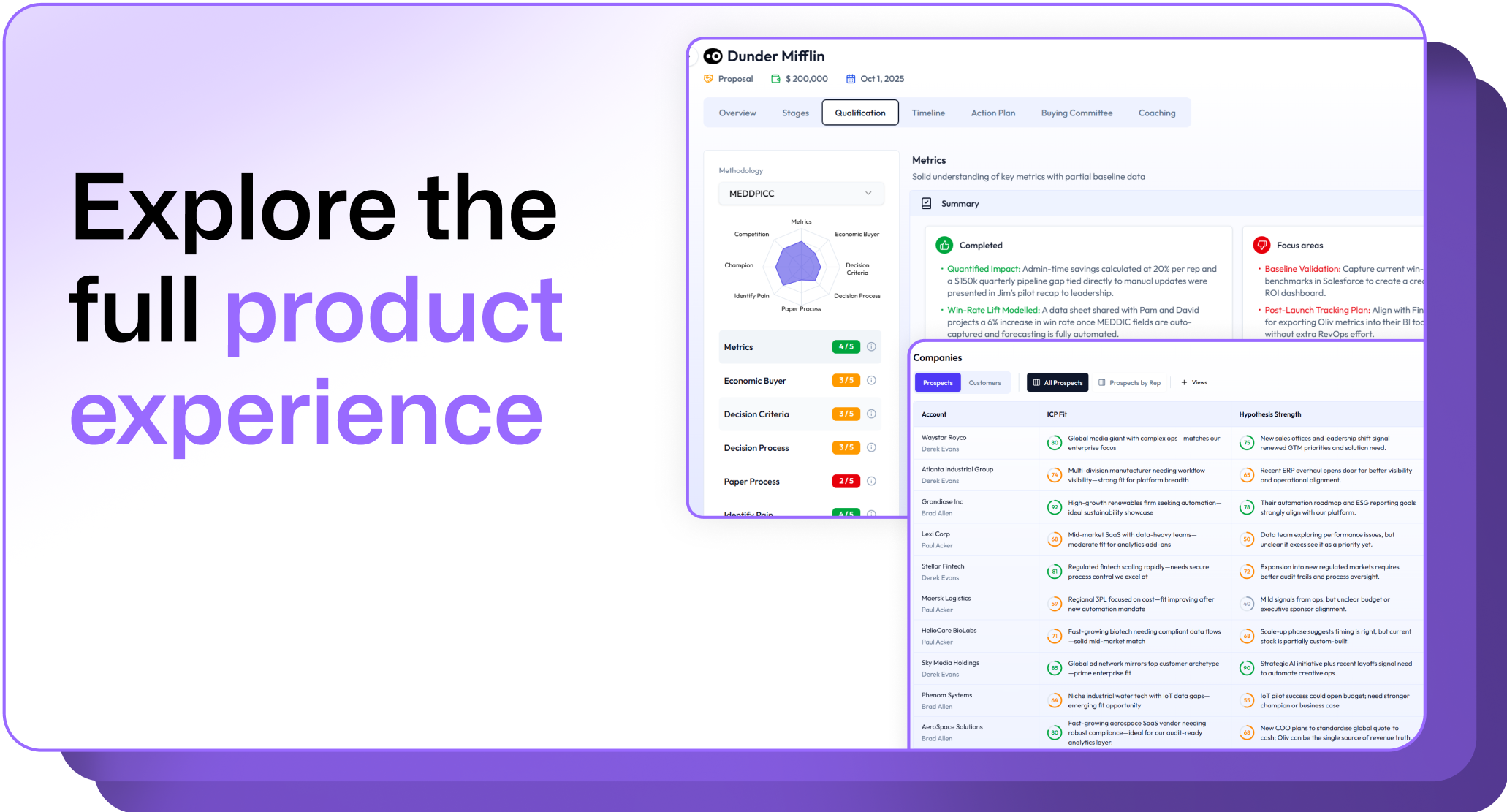
.avif)
.png)




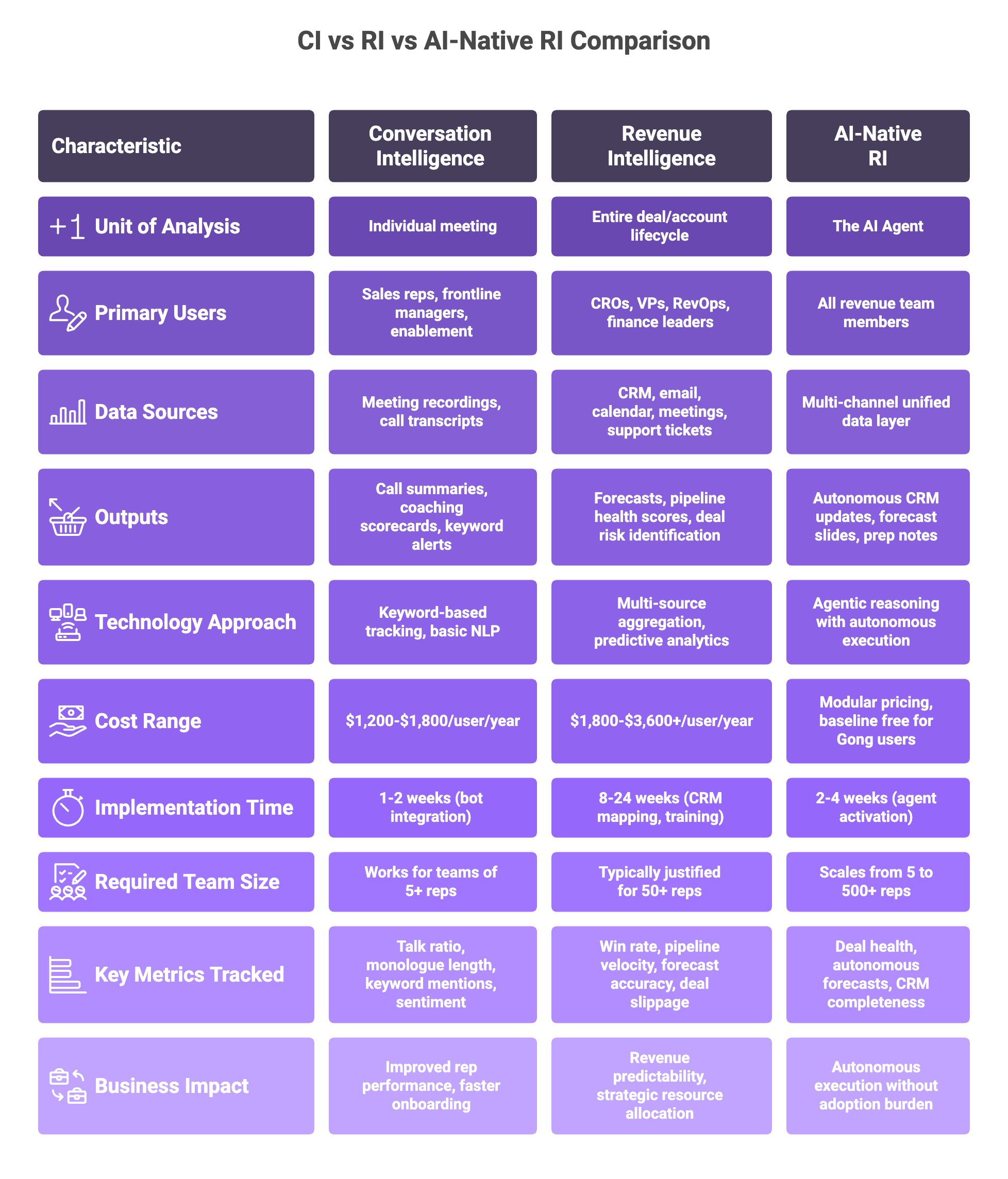
.png)
.png)
.png)