10 Best Outbound marketing agencies for B2B companies
Written by
Ishan Chhabra
Last Updated :
October 28, 2026
Skim in :
13
mins
In this article
Still got questions?
Come discuss this article with me.
Hi, I'm Ishan, Founder and CEO of Oliv.
I'm always up for a conversation about revenue intelligence, AI agents, or what's actually working (and what's not) across revenue teams.
I'd love to hear your perspective.
Thank you! Your submission has been received!
Oops! Something went wrong while submitting the form.
Meet Oliv’s AI Agents
Hi! I’m, Deal Driver
I track deals, flag risks, send weekly pipeline updates and give sales managers full visibility into deal progress
Hi! I’m, CRM Manager
I maintain CRM hygiene by updating core, custom and qualification fields all without your team lifting a finger
Hi! I’m, Forecaster
I build accurate forecasts based on real deal movement and tell you which deals to pull in to hit your number
Hi! I’m, Coach
I believe performance fuels revenue. I spot skill gaps, score calls and build coaching plans to help every rep level up
Hi! I’m, Prospector
I dig into target accounts to surface the right contacts, tailor and time outreach so you always strike when it counts
Hi! I’m, Pipeline tracker
I call reps to get deal updates, and deliver a real-time, CRM-synced roll-up view of deal progress
Hi! I’m, Analyst
I answer complex pipeline questions, uncover deal patterns, and build reports that guide strategic decisions
TL;DR
The 10 agencies covered are Belkins, CIENCE, Cleverly, SalesRoads, Callbox, SalesHive, Sopro, ColdIQ, Martal Group, and Leadium, and each one fits a different type of buyer. Outbound got harder: one opportunity took about 100 cold touches in 2015 and more than 1,000 by 2023, so volume alone no longer works. Most agencies quote custom prices. CIENCE, SalesRoads, and Sopro publish starting figures, while Leadium and SalesHive offer month-to-month terms. Before signing, confirm who owns the sending domains and data, who works your account, and how long the minimum contract runs. Outsource when you need pipeline in weeks and lack a playbook. Build in-house when your sale is highly technical or your playbook is already proven.
In 2015, it took about 100 cold emails to create one sales opportunity. By 2023, it took more than 1,000 touches across email, phone, and social. Cold email reply rates now sit near 1%, and only about 5% of cold calls reach a live person.
That is why so many B2B teams look at outbound marketing agencies. The worry is real, though. Nobody wants to pay a $5,000 to $10,000 monthly retainer for junior reps who blast lists, burn the company's email domains, and book meetings that never turn into deals.
This guide ranks 10 outbound agencies by what each one does best, what it costs, and who it fits. It also covers the questions most roundups skip: which pricing model protects you, which channels fit your deal size, and how to judge an agency in its first 90 days. It is written for founders, sales leaders, and marketing heads deciding whether to hire an agency or build outbound themselves.
Q1: What Are the 10 Best Outbound Marketing Agencies for B2B Companies in 2026? [toc=1. Top 10 Agencies]
The 10 best outbound marketing agencies for B2B companies in 2026 are Belkins, CIENCE, Cleverly, SalesRoads, Callbox, SalesHive, Sopro, ColdIQ, Martal Group, and Leadium. Belkins leads on email-led appointment setting, CIENCE on enterprise SDR scale, and Cleverly on multichannel LinkedIn, email, and calling outreach. SalesRoads focuses on US cold calling, Callbox on global programs, and Sopro on GDPR-compliant prospecting in Europe.
The Shortlist
Belkins: Best for email-led appointment setting at scale
CIENCE: Best for enterprise-scale managed SDR teams
Cleverly: Best for multichannel B2B outbound lead generation
SalesRoads: Best for US-based cold calling appointment setting
Callbox: Best for global, multi-market outbound programs
SalesHive: Best for flat-rate multichannel outbound with US-based SDRs
Sopro: Best for GDPR-compliant prospecting in the UK and Europe
ColdIQ: Best for AI-led, stack-first outbound for scaling B2B companies
Martal Group: Best for fractional sales teams selling to technical buyers
Leadium: Best for omnichannel outreach, including SMS and gifting
Comparison at a Glance
Outbound Marketing Agencies for B2B Companies Compared (2026)
Agency
Best For
Channels
Pricing Model
Contract Terms
Rating
Belkins
Email-led appointment setting
Email, LinkedIn, calling, paid
Custom (est. $5K to $9K/mo)
Retainer
⭐⭐⭐⭐
CIENCE
Enterprise SDR scale
Email, phone, LinkedIn
Published: from $5,600/mo
Retainer or staffing
⭐⭐⭐⭐⭐
Cleverly
Multichannel lead generation
LinkedIn, email, calling
Custom
Retainer
⭐⭐⭐⭐
SalesRoads
US cold calling
Phone, email
Published: from $9,950 per 4 weeks
Retainer after first engagement
⭐⭐⭐⭐
Callbox
Global multi-market programs
Email, phone, LinkedIn, social
Custom
Retainer
⭐⭐⭐⭐
SalesHive
Flat-rate multichannel
Email, phone, LinkedIn
Est. $2K to $12K/mo
Month-to-month option
⭐⭐⭐⭐
Sopro
GDPR-compliant prospecting
Email, LinkedIn, multichannel
Published: from about £3K/mo
Managed service
⭐⭐⭐⭐
ColdIQ
AI-led, stack-first outbound
Email, LinkedIn, data stack
Custom
Retainer
⭐⭐⭐⭐
Martal Group
Fractional sales teams
Email, phone, LinkedIn
Est. from $5K/mo
Retainer
⭐⭐⭐⭐
Leadium
Widest channel mix
Email, phone, LinkedIn, SMS, gifting
Custom
Month-to-month
⭐⭐⭐⭐
Ratings come from the weighted criteria in Q2. "Est." marks third-party estimates, not the agency's own published price. List order reflects fit by buyer type rather than score alone.
1. Belkins: Best for Email-Led Appointment Setting at Scale [toc=1.1 Belkins]
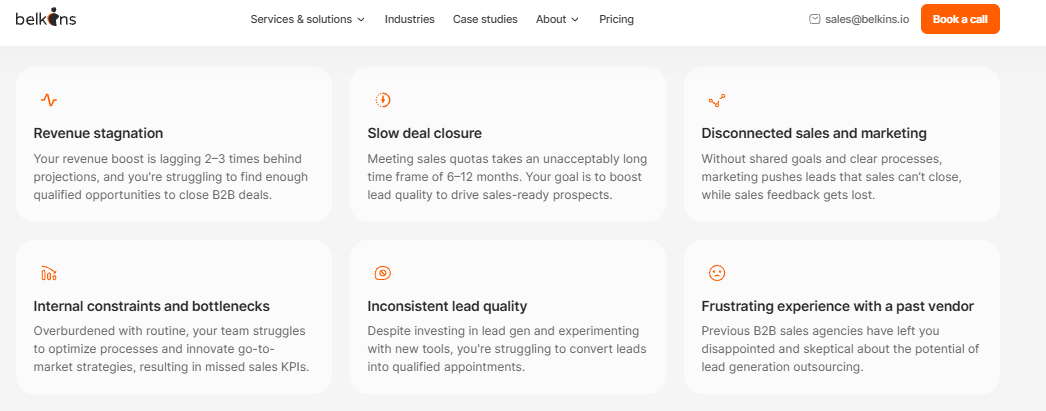
Belkins frames its appointment-setting service around common B2B pipeline problems, such as slow deal closure and inconsistent lead quality.
Belkins is a B2B appointment-setting agency that has run outbound programs since 2017 across more than 50 industries. Its core motion is cold email, with cold calling, LinkedIn, and paid outreach layered on top. Belkins handles list building, sending domain setup, inbox warm-up, copywriting, sequences, and reply handling. It also built Folderly, its own deliverability tool, so inbox placement is monitored continuously rather than discovered after reply rates drop.
Key Highlights:
Email-Led Outreach: Cold email at the core, supported by calling, LinkedIn, and paid channels.
Deliverability Infrastructure: Secondary domains, SPF, DKIM, and DMARC setup, plus Folderly monitoring.
Full-Cycle Execution: List building, copy, sequencing, and reply handling managed end to end.
Appointment Setting: Booked meetings are the core deliverable.
Best For: Mid-market B2B companies that want a steady flow of booked meetings through email-led outbound without managing the process themselves.
Pricing: Custom pricing. Third-party reviewers estimate $5,000 to $9,000 per month, depending on volume and scope.
2. CIENCE: Best for Enterprise-Scale Managed SDR Teams [toc=1.2 CIENCE]
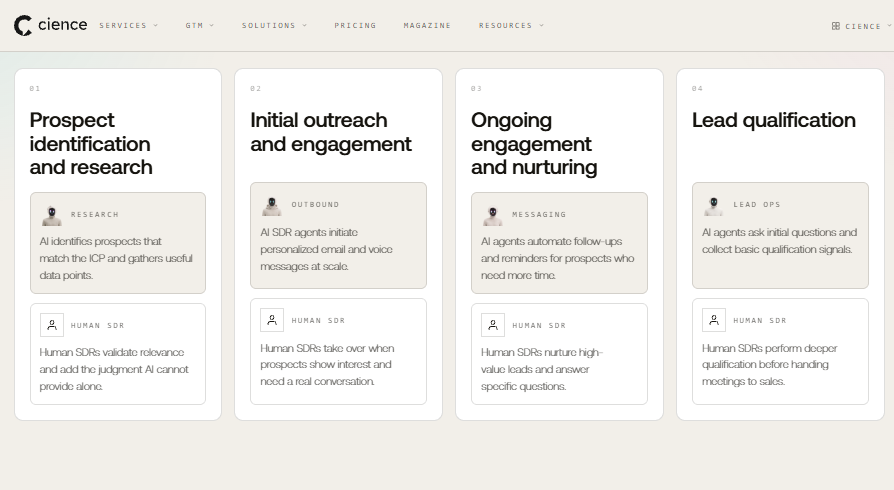
CIENCE pairs AI agents with human SDRs at each stage, from prospect research to lead qualification.
CIENCE is a managed outbound agency that pairs human SDR teams with AI-supported research across calling, email, and LinkedIn. The company reports more than 2,500 clients across 250+ industries and over 115 published case studies. Its research team builds and verifies prospect lists by hand rather than exporting them from one database. CIENCE also offers a staffing model, so clients can access trained SDRs with more internal control than a standard retainer allows.
Key Highlights:
Multichannel SDR Programs: Calling, email, and LinkedIn run by managed SDR teams.
Researcher-Verified Data: Prospect lists built and checked by dedicated researchers.
Flexible Staffing: Fully managed programs or access to trained SDR capacity.
Enterprise Proof: Client logos include Okta, Microsoft, and Uber.
Best For: Mid-market and enterprise companies that need high-volume outbound across several markets or segments.
Pricing: Published on its site. Managed SDR and campaigns start at $5,600 per month, and a 60-day revenue system setup starts at $9,500.
3. Cleverly: Best for Multichannel B2B Outbound Lead Generation [toc=1.3 Cleverly]
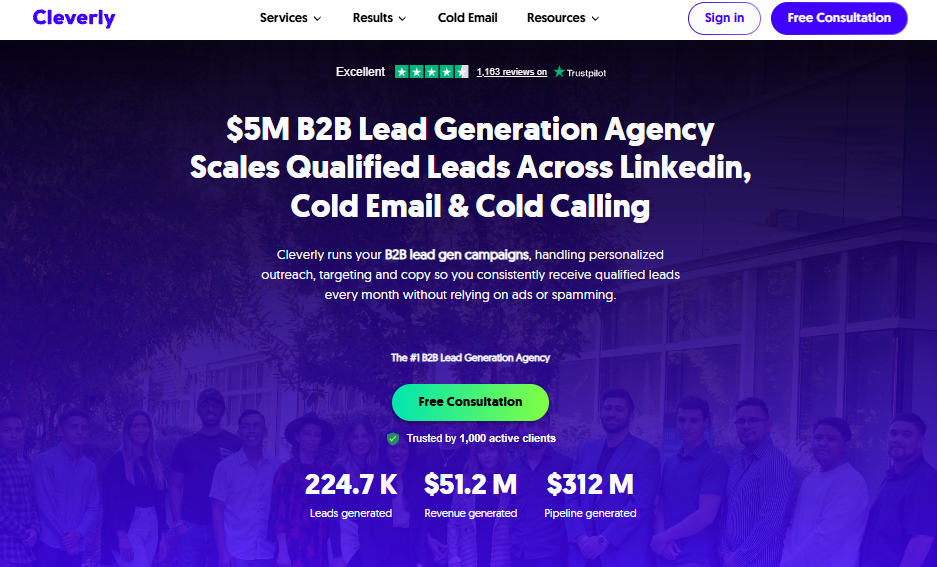
Cleverly runs B2B lead generation across LinkedIn, cold email, and cold calling, and reports 224.7K leads and $312M in pipeline generated.
Cleverly is an outbound marketing agency that helps B2B companies connect with decision-makers and generate qualified sales opportunities. The agency combines LinkedIn outreach, cold email, and cold calling to reach prospects across multiple channels. From building targeted prospect lists to managing personalized outreach and follow-ups, Cleverly handles the prospecting process so sales teams can focus on conversations and closing deals.
Key Highlights:
Multichannel Outreach: LinkedIn lead generation, cold email, and cold calling campaigns.
Targeted Prospecting: Identifies decision-makers based on industry, company size, job title, and ideal customer profiles.
Personalized Campaigns: Tailored outreach messages and follow-ups to engage relevant prospects.
Appointment Setting: Helps turn prospect conversations into qualified sales meetings.
Best For: B2B companies looking to outsource outbound prospecting and build a consistent sales pipeline.
Pricing: Custom pricing based on campaign goals, requirements, and selected outreach channels.
4. SalesRoads: Best for US-Based Cold Calling Appointment Setting [toc=1.4 SalesRoads]
SalesRoads is a US appointment-setting and SDR outsourcing firm founded in 2007, with phone outreach at the center of its programs. Each engagement gets a dedicated SDR backed by a sales operations team and a client success director. The firm reports creating more than 100,000 opportunities for 500+ companies. It is also one of the few agencies in this category that publishes its pricing.
Key Highlights:
Calling-Led Outreach: Cold calling at the core, supported by email prospecting and list building.
Dedicated SDRs: Each client works with assigned reps rather than a rotating floor.
Sales Operations Support: A sales ops team and client success director on every engagement.
Proven Track Record: Repeat Inc. 5000 honoree, with client logos including Microsoft.
Best For: B2B companies selling into the US market where live phone conversations move deals forward.
Pricing: Published. Engagements start at $9,950 for four weeks and continue on a retainer. A two-SDR package runs $16,750 per four-week engagement.
5. Callbox: Best for Global, Multi-Market Outbound Programs [toc=1.5 Callbox]
Callbox combines human SDRs and AI for B2B lead generation, citing 15K+ companies served across 60+ countries.
Callbox is a B2B lead generation agency with more than 20 years in the market and delivery teams across North America, APAC, and EMEA. Its programs coordinate email, phone, LinkedIn, and social outreach in one multi-touch sequence. Callbox's scale suits companies running several product lines, regions, or buyer profiles at once. The trade-off is customization, since its playbooks are built for volume rather than rapid message testing.
Key Highlights:
Multichannel Campaigns: Email, phone, LinkedIn, and social outreach in one coordinated sequence.
Global Coverage: SDR capacity across North America, APAC, and EMEA.
Multi-Market Programs: Runs several ICPs, regions, or product lines in parallel.
Lead Generation and Appointment Setting: Qualified leads and booked meetings as deliverables.
Best For: Enterprise and larger mid-market companies running outbound across several countries or segments at the same time.
Pricing: Custom quotes based on campaign scope, markets, and channels.
6. SalesHive: Best for Flat-Rate Multichannel Outbound with US-Based SDRs [toc=1.6 SalesHive]
SalesHive is an outbound agency that runs cold email, cold calling, and LinkedIn programs with US-based SDRs. Its pricing is flat-rate, so costs scale with campaign volume rather than per seat or per meeting. SalesHive's vRep AI system speeds up campaign launch and outreach scaling. Reporting covers reply sentiment, show rates, and pipeline attribution instead of activity counts alone.
Key Highlights:
Multichannel Outreach: Cold email, cold calling, and LinkedIn run by US-based reps.
Flat-Rate Pricing: Predictable monthly costs tied to campaign volume.
AI-Assisted Launch: vRep AI for faster deployment and scaling.
Outcome Reporting: Reply sentiment, show rates, and pipeline attribution.
Best For: Mid-market B2B companies that want US-based multichannel outbound with predictable budgets and flexible contracts.
Pricing: Third-party reviewers estimate $2,000 to $3,000 per month at entry level, rising to $6,000 to $12,000 per month for full multichannel programs.
7. Sopro: Best for GDPR-Compliant Prospecting in the UK and Europe [toc=1.7 Sopro]
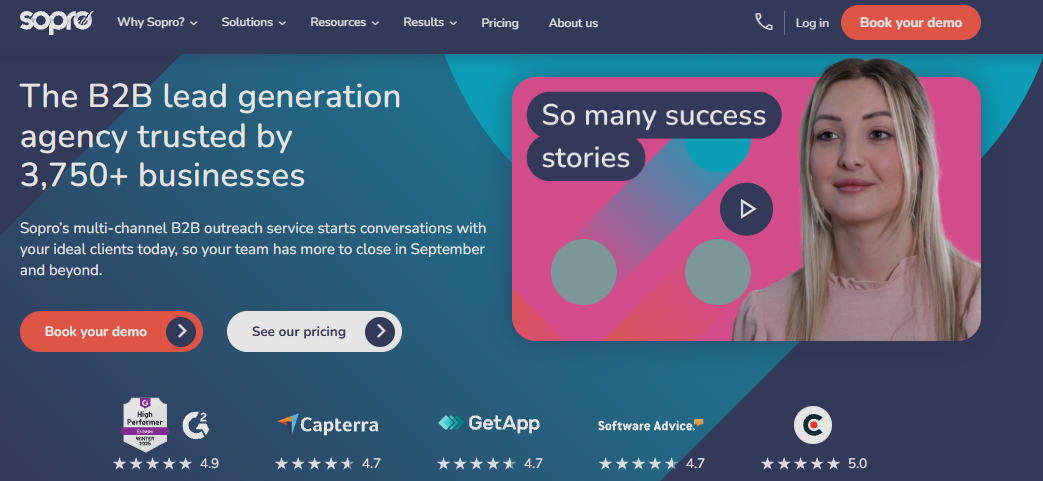
Sopro runs multichannel B2B outreach and reports being trusted by 3,750+ businesses.
Sopro is a UK-based managed prospecting service that runs multichannel outbound campaigns for B2B companies. Before any outreach starts, Sopro completes a legitimate interest assessment for each client to keep campaigns aligned with GDPR. A dedicated team builds the audience, writes the messaging, and optimizes the campaign over time. Clients track results in a real-time reporting portal, and Sopro prospects across multiple languages and territories.
Key Highlights:
Compliance-First Prospecting: A legitimate interest assessment for every client before outreach begins.
Managed Campaigns: A dedicated team handles targeting, messaging, and ongoing optimization.
Real-Time Reporting: Results visible in a client portal.
International Reach: Prospecting in several languages and markets.
Best For: B2B companies selling into the UK and Europe that need outbound to stay within GDPR rules.
Pricing: Sopro publishes pricing starting at around £3,000 per month.
8. ColdIQ: Best for AI-Led, Stack-First Outbound for Scaling B2B Companies [toc=1.8 ColdIQ]
ColdIQ is an outbound agency that runs done-for-you, AI-powered prospecting and helps clients set up their sales tech stack. The agency service is open to SaaS and B2B companies earning more than $100,000 per month. ColdIQ reports working with 300+ B2B companies across 55 niches, including Teikametrics, Qwilr, and Grin. In 2026, it also turned its internal stack into a self-serve GTM data platform.
Key Highlights:
AI-Powered Prospecting: Done-for-you outbound built on a modern, continuously updated tool stack.
Tech-Stack Consulting: Sales tool selection and implementation alongside campaigns.
Data Platform: A self-serve GTM data product for teams that want to run outreach in-house.
Focused ICP: Works only with companies above roughly $100K in monthly revenue.
Best For: Scaling SaaS and B2B companies that want technology-forward, signal-driven outbound and a stronger sales stack.
Pricing: Custom pricing for the agency service.
9. Martal Group: Best for Fractional Sales Teams Selling to Technical Buyers [toc=1.9 Martal Group]
Martal Group is an outbound lead generation firm that provides fractional sales teams for B2B technology companies. Clients get a blended team of SDRs, sales executives, and strategists who handle outreach, qualification, and early sales conversations. Martal employs 200+ onshore sales executives across the US, Canada, Europe, and Latin America. The firm states that a typical monthly funnel of 3,000 to 5,000 prospects produces 20 to 30 qualified leads.
Key Highlights:
Fractional Sales Model: SDRs, sales executives, and strategists working as one team.
Multichannel Outreach: Cold email, LinkedIn, and cold calling.
Onshore Coverage: Reps across North America, Europe, and LATAM time zones.
Technical Focus: Built for SaaS, IT services, and enterprise software buyers.
Best For: B2B tech companies selling complex products, where outreach reps need to speak credibly with technical buyers.
Pricing: Custom tiers based on team size and scope. Third-party reviewers estimate a starting point near $5,000 per month.
10. Leadium: Best for Omnichannel Outreach, Including SMS and Gifting [toc=1.10 Leadium]
Leadium is an outbound appointment-setting agency based in Las Vegas. Its sequences can combine email, phone, LinkedIn, SMS, and gifting, built on channel-specific lead research. Leadium also handles inbound qualification and email deliverability work. Its pricing page states that every contract is month-to-month, so the engagement has to prove itself every 30 days.
Key Highlights:
Omnichannel Sequences: Email, phone, LinkedIn, SMS, and gifting in one program.
Research-First Lists: Lead research tailored to each outreach channel.
Deliverability Support: Inbox health and sending setup managed by the team.
Month-to-Month Contracts: No long-term lock-in.
Best For: B2B companies that want the widest channel mix without committing to a long contract.
Pricing: Custom pricing on month-to-month contracts.
Q2: How Did We Evaluate and Rank These Outbound Agencies? [toc=2. Selection Criteria]
Each agency was scored out of 100 across five weighted criteria, using its own website, published pricing, and independent reviews. The weights reflect what most often decides whether an outbound engagement pays off.
Outbound Agency Selection Criteria and Weights
Criterion
Weight
What We Checked
Channel coverage and coordination
25%
Which channels the agency runs, and whether email, LinkedIn, and calling work as one sequence
Targeting and data quality
20%
Researched or signal-based lists versus bulk database exports
Proof and reviews
20%
Named clients, case studies, and independent reviews over self-reported totals
Pricing and contract transparency
20%
Published prices, minimum terms, and month-to-month options
Deliverability and infrastructure
15%
Domain setup, warm-up, monitoring, and who owns the assets afterward
How Scores Became Stars
Scores convert to stars on a fixed scale: 0 to 20 is one star, 21 to 40 is two, 41 to 60 is three, 61 to 80 is four, and 81 to 100 is five. CIENCE was the only agency above 80, mainly because it publishes pricing and backs its claims with named enterprise clients. The other nine landed between 61 and 80.
What We Did Not Score
Self-reported totals such as "1,000 active clients" or "$1B in pipeline" did not raise a score on their own.
Q3: Why Is Outbound Harder in 2026, and What Should an Agency Actually Fix? [toc=3. Outbound in 2026]
Outbound is harder because it now takes about ten times more effort to create one opportunity than it did a decade ago. A good agency should fix targeting and timing first, not just send more messages.
How Outbound Used to Work
In the "golden era" of outbound, one SDR could generate 20 to 25 qualified opportunities per month. In 2015, roughly 100 cold emails produced one opportunity. By 2018, it took about 200 attempts across email, calls, and social. By 2023, it took more than 1,000.
What the Old Model Now Costs
SDR pay rose while output fell. An entry-level SDR earned around $35,000 in 2015, and US SDR target earnings reached $80,586 by 2023. Over the same period, opportunities per SDR dropped below 10 a month. That means twice the cost for less than half the output.
The channels themselves also got noisier. Cold email reply rates hover near 1%, and cold call connection rates sit around 5%. Google and Microsoft have tightened spam filtering on bulk, unpersonalized email, so mass sending now damages domain reputation faster than it creates pipeline.
What Changed: More Is No Longer Better
The old rule said more emails meant more meetings. Sales research now points the other way. Doubling the emails sent to a prospect does not double the chance of an opportunity, and it often lowers it. Buyers are also flooded with AI-written outreach and have learned to ignore it.
What a Good Agency Fixes Now
The agencies worth hiring in 2026 change the inputs, not just the volume:
Account research before outreach: Building a short hypothesis about each account's problem before writing to it.
Signal-based timing: Reaching out after a trigger such as a funding round, a new executive, or a hiring spike.
Coordinated channels: Email, LinkedIn, and calls that reference each other instead of running as separate campaigns.
Protected infrastructure: Secondary domains, warm-up, and monitoring so the primary company domain stays safe.
If an agency's pitch is mostly about how many emails it can send, it is selling the model that stopped working.
Q4: How Much Do Outbound Marketing Agencies Cost, and Which Pricing Model Protects You? [toc=4. Pricing Models]
Most outbound agencies cost between $2,000 and $12,000 per month, and enterprise multi-market programs can pass $25,000. The pricing model matters as much as the number, because it decides who carries the risk when results slow down.
The Four Common Pricing Models
Outbound Agency Pricing Models Compared
Model
How It Works
Who Carries the Risk
Examples from This List
Monthly retainer
A fixed fee for a defined scope, often with a 3 to 6 month minimum
Mostly the buyer
Belkins, Callbox, Martal Group
Fixed-term engagement
A set price for a set period, then a retainer
Shared, since the first term is a trial
SalesRoads ($9,950 for 4 weeks)
Flat-rate or published plans
A known monthly price tied to volume or setup
Buyer, but with clear budgets
CIENCE (from $5,600/mo), Sopro (from about £3K/mo)
Month-to-month
No long minimum, so the agency re-earns the contract monthly
Shared more evenly
Leadium, SalesHive
The Retainer Problem
A retainer is paid whether the agency books 5 meetings or 25. Unlike software, an agency's fee is not directly tied to the lead volume it produces. When a campaign underperforms in month two, the buyer still pays the full fee. That is why contract length and exit terms deserve as much attention as the monthly price.
A Quick Way to Check the Math
Start from your average contract value (ACV) and your close rate:
Estimate qualified meetings per month. For example, 5 meetings.
Apply your close rate. At 20%, that is 1 new deal per month.
Compare that deal's value to the monthly fee.
At a $25,000 ACV, a $5,000 monthly agency pays for itself on one deal. Below about $5,000 ACV, agency fees eat into margins quickly. A lighter in-house motion may make more sense there.
What to Ask Before You Sign
What is the minimum term, and what does it cost to leave early?
Is there a setup fee, and what does it cover?
Are data, contact lists, and sending domains included or billed separately?
What happens if meeting targets are missed for two months in a row?
Q5: Which Channel Mix Works Best: Cold Email, LinkedIn, Cold Calling, or All Three? [toc=5. Channel Mix]
For most B2B teams, the best mix is all three channels coordinated around the same accounts. The right lead channel depends on your deal size, your buyer, and the region you sell into.
How Each Channel Performs
Cold Email vs LinkedIn vs Cold Calling for B2B Outbound
Channel
Strength
Weakness
Fits Best When
Cold email
Lowest cost per touch, easy to scale
About 1% reply rates, strict spam filtering
You have clean data and a clear, specific offer
LinkedIn
Builds familiarity before direct outreach
Connection limits cap volume
Buyers are active on LinkedIn and deals rely on trust
Cold calling
Creates real conversations quickly
About 5% connect rates, gatekeepers
Deal sizes are high or the buying committee is complex
When Cold Calling Works and When It Fails
Cold calling still builds early pipeline fast, but only under the right conditions. It works with verified mobile numbers or parallel dialers that place several calls at once. It fails on general company lines, where gatekeepers and voicemail block most attempts.
Coordinating the Channels
The channels work best when they reference each other. One proven tactic is the "triple": when a prospect opens a sequence three or more times, a rep calls, leaves a voicemail, and sends an email within about 90 seconds. The prospect sees one consistent message from several directions.
Another tactic is to train outreach copy on your best performer. Take the emails of your strongest rep or marketer, use them as the template, and A/B test from there. This keeps AI-assisted copy close to what already works.
Offline Outreach as a Pattern Interrupt
Some teams now pair digital signals with physical mail. In one published example, a founder sent 350 postcards with QR codes linking to custom websites for local businesses. The campaign cost about $400, earned a 20% scan rate, and produced roughly $8,000 in new monthly recurring revenue. Physical mail avoids the spam filter entirely.
Compliance Is a Channel Constraint
Each channel has its own rules. In the EU and UK, GDPR requires a lawful basis, usually legitimate interest, before prospecting. In the US, CAN-SPAM governs commercial email, and the TCPA restricts some calling and texting. Ask any agency how it handles these rules for the markets you sell into.
Q6: Should You Hire an Outbound Agency or Build an In-House or AI-Assisted SDR Team? [toc=6. Agency vs In-House]
Hire an agency when you need pipeline within weeks and do not yet have a proven outbound playbook. Build in-house when your product is highly technical, your market is narrow, or your playbook already works and just needs scale.
What an In-House Team Really Costs
A US-based SDR now carries target earnings of about $80,586, and an account executive around $140,000. Add marketing leads at roughly $100 each, and one SDR-and-AE pair costs about $225,000 to generate around $496,000 in new annual revenue. When productivity drops, acquisition cost can rise from about 41% to 62% of first-year revenue.
Hiring also takes time. Recruiting, ramp-up, tools, and training mean most in-house SDRs need several months before producing consistent pipeline.
Where Agencies Fall Short
Agencies skip the hiring delay, but they bring their own gaps. Many assign junior reps to complex products. Those reps can book a meeting but struggle with technical questions, so fewer meetings turn into real opportunities. Retainers also stay fixed even when output drops, as covered in Q4.
The AI Shift
AI is changing the comparison. SaaStr has described replacing a go-to-market team of about 10 SDRs and AEs with roughly 1.2 people and 20 AI agents, while reporting similar output. Some operators now predict that email-cadence SDR roles will be largely displaced by AI. Calling, discovery, and relationship work still need people.
Choosing the Right Model
Outbound Agency vs In-House SDR Team: Which Fits
Situation
Best Fit
No outbound playbook, pipeline needed within 1 to 2 months
Outbound agency
Highly technical product or very narrow ICP
In-house SDRs, or a specialist like Martal Group
Proven playbook that needs more volume
In-house team with AI tools
Testing new markets, segments, or channels
Agency on a short or month-to-month contract
Many teams now use a hybrid. An agency builds and runs the first campaigns, while the company keeps the CRM data, domains, and learnings. If you later move outbound in-house, you start from a working system instead of from zero.
Q7: How Do You Vet an Outbound Agency and Measure Results in the First 90 Days? [toc=7. Vetting & 90-Day KPIs]
Vet an agency on who owns the infrastructure, who works your account, and how it reports results. Then judge it on reply quality and meeting outcomes over 90 days, not on activity in week one.
Questions to Ask Before Signing
Who owns the sending domains, contact lists, and CRM data? If they live in the agency's accounts, you lose them when the contract ends.
Who will actually work my account? Ask for the experience level of the assigned reps, not just the sales team's.
Which channel leads, and how do the channels share information? Call outcomes should shape email copy, and suppression lists should cover every channel.
How do you build prospect lists? Researched or signal-based lists beat bulk database exports.
Can I speak to clients at my stage and deal size? Industry references alone are not enough.
What happens if targets are missed in month two? The answer shows whether the agency shares any accountability.
Red Flags
Promises of booked meetings in the first week, which usually means domain warm-up was skipped.
Reports led by open rates, which no longer connect reliably to revenue.
Pitches built on send volume, such as "10,000 emails a month."
Long minimum terms with no performance review points.
A Realistic 90-Day Timeline
What Should Happen in the First 90 Days with an Outbound Agency
Period
What Should Happen
Weeks 1 to 2
ICP and messaging agreed, domains set up and warming, lists built. No sending yet.
Weeks 3 to 4
First sends at limited volume; LinkedIn and calling begin.
Weeks 5 to 8
Enough reply data to refine copy, targeting, and channel mix.
Weeks 9 to 12
Consistent meeting flow; first meetings moving into opportunities.
KPIs That Matter
Positive reply rate: The share of replies showing real interest, not total replies.
Meeting booked rate: Meetings booked per prospect contacted.
Show rate: How many booked meetings actually happen.
Meeting-to-opportunity rate: How many meetings your sales team accepts as qualified.
Domain health: Bounce rates and inbox placement over time.
If positive replies and show rates are still flat by week eight, raise it directly with the agency. If they stay flat at the end of 90 days, it is time to change course.
FAQ's
What is the difference between an outbound marketing agency and a cold email agency?
We see these two terms used interchangeably, but they describe different scopes of work. A cold email agency specializes in one channel. It focuses on sending infrastructure, domain warm-up, deliverability, inbox placement, and email copy.
An outbound marketing agency runs several channels together on the same prospect list. That usually means:
Cold email for scale and low cost per touch
LinkedIn outreach to build familiarity before direct contact
Cold calling to start real conversations with high-value accounts
The value of an outbound agency comes from coordination. Call outcomes should shape the next email, and LinkedIn activity should warm up prospects before a rep dials them. When the channels run as separate campaigns, prospects get repetitive and disjointed outreach.
We recommend a cold email specialist when deliverability is your main problem, for example when replies have dropped because messages land in spam. We recommend a full outbound agency when you need a complete multichannel program built from scratch. Agencies like Belkins, Cleverly, and Leadium sit in the second group, while some firms rank credibly in both.
What deal size justifies hiring an outbound marketing agency?
We use a simple rule: the agency fee should be covered by the deals it helps create within a few months. Average contract value (ACV) is the number that decides this.
Here is how we run the math:
Estimate the qualified meetings an agency can book per month, for example 5.
Apply your close rate. At 20%, that is 1 new deal per month.
Compare that deal's value with the monthly fee.
At an ACV of $25,000 or more, a $5,000 monthly agency pays for itself on a single closed deal. Between about $10,000 and $25,000, the math usually still works, but contract length matters more. Below about $5,000 ACV, agency fees eat into margins quickly, and a lighter in-house setup using outreach software often makes more sense.
We also factor in sales cycle length. If deals take six months to close, an agency engagement needs to run long enough for pipeline to turn into revenue. Judging it after 60 days on closed revenue alone will give a misleading answer. Early metrics such as positive replies and show rates are better signals in the first quarter.
Do outbound agencies guarantee meetings?
Some outbound agencies offer meeting targets or performance-based pricing, but firm guarantees are rare. When we review agency proposals, we treat large guaranteed numbers with caution.
There are good reasons for that caution. Results depend on factors the agency does not fully control:
How clear and compelling your offer is
How large and reachable your target market is
Your average deal size and buying committee
The quality of your sales team's follow-up
Proper setup also takes time. Sending domains need several weeks of warm-up before volume increases. An agency that promises booked meetings in the first week is often skipping that step, which can damage domain reputation and hurt results later.
Instead of guarantees, we suggest asking for a clear plan with milestones. A realistic plan covers setup in weeks one and two, limited sends in weeks three and four, and steady optimization after that. We also recommend agreeing in writing what happens if targets are missed for two months in a row. Month-to-month contracts, such as those offered by Leadium, give you a similar protection without relying on a guarantee.
Can outbound marketing agencies work for early-stage startups?
Yes, outbound agencies can work well for early-stage startups, but only when a few conditions are in place. In our experience, the startups that benefit most share three traits:
A defined ideal customer profile (ICP): They know which industries, company sizes, and job titles to target.
A clear offer: They can explain the problem they solve in one or two sentences.
Some early proof: They have a few customers, pilots, or case studies to reference.
Without these, an agency spends the budget guessing, and results are hard to judge.
We recommend early-stage teams favor short or month-to-month contracts rather than six-month retainers. The first campaigns should be treated as market research as well as pipeline. Reply data shows which segments respond, which messages land, and which objections come up most often.
Budget is the other factor. Many startups do better with a smaller, focused program on one or two channels than with a full multichannel package. As the playbook proves itself, they can expand the scope or bring the motion in-house with the learnings the agency produced.
Is cold outreach legal in the EU and UK?
B2B cold outreach is generally allowed in the EU and UK, but it must follow GDPR and, in the UK, PECR. We always advise checking how an agency handles these rules before signing.
Under GDPR, prospecting usually relies on legitimate interest as its lawful basis. In practice, that means:
Contacting people whose role makes the offer relevant to them
Using accurate, responsibly sourced business data
Telling recipients how their data was obtained
Providing a clear, easy way to opt out
Keeping records that show the assessment was made
Rules also differ by country and channel. Some countries apply stricter rules to email sent to individuals, and phone outreach can face separate restrictions.
We recommend asking any agency how it documents its lawful basis for each campaign. Sopro, for example, completes a legitimate interest assessment for every client before outreach begins. In the US, the main rules are CAN-SPAM for commercial email and the TCPA for certain calls and texts. This answer is general information, not legal advice, so check with your own counsel for your situation.
Who owns the leads and data after an outbound agency contract ends?
Ownership depends entirely on the contract, which is why we treat it as one of the first questions to ask. Agencies generally follow one of two models.
Client-owned infrastructure: The agency builds campaigns inside your own sending domains, CRM, and outreach tools. When the contract ends, you keep everything, including:
Sending domains and their warm-up history
Contact lists and enrichment data
Sequences, templates, and reply history
Meeting and pipeline records in your CRM
Agency-owned infrastructure: The agency runs campaigns on its own domains, databases, and tools. This is convenient during the engagement, but you may lose the lists, domains, and campaign history when you leave.
We recommend agreeing on ownership in writing before any campaign starts. At minimum, every reply, meeting, and opportunity should be logged in your CRM, not only in the agency's reporting portal. If you plan to move outbound in-house later, client-owned infrastructure means your team starts from a working system instead of rebuilding from zero.
How many meetings per month should an outbound agency book?
There is no single benchmark, because meeting volume depends on deal size, market size, and how qualified each meeting needs to be. Still, we can share the ranges we see most often.
Mid-market programs: Many agencies target roughly 10 to 30 qualified meetings per month.
Enterprise programs: Volumes are often lower, because each meeting involves larger accounts and longer cycles.
Fractional sales models: Martal Group, for example, states that a typical monthly funnel of 3,000 to 5,000 prospects produces 20 to 30 qualified leads.
We caution against judging an agency on raw meeting count alone. Ten meetings with the right decision-makers are worth more than thirty with people who cannot buy. We track these metrics alongside volume:
Show rate: how many booked meetings actually happen
Meeting-to-opportunity rate: how many your sales team accepts as qualified
Positive reply rate: the share of replies showing real interest
Expect meeting volume to build gradually. Weeks one and two are setup, and steady meeting flow usually appears from the second month onward.
Enjoyed the read? Join our founder for a quick 7-minute chat — no pitch, just a real conversation on how we’re rethinking RevOps with AI.
Still got questions?
Come discuss this article with me.
Hi, I'm Ishan, Founder and CEO of Oliv.
I'm always up for a conversation about revenue intelligence, AI agents, or what's actually working (and what's not) across revenue teams.
I'd love to hear your perspective.
Thank you! Your submission has been received!
Oops! Something went wrong while submitting the form.