10 Best Pipeline Analytics Software in 2026: Stage Conversion, Velocity, Deal Signals, and Forecast Accuracy
Written by
Ishan Chhabra
Last Updated :
August 17, 2026
Skim in :
13
mins
In this article
Revenue teams love Oliv
Here’s why:
All your deal data unified (from 30+ tools and tabs).
Insights are delivered to you directly, no digging.
AI agents automate tasks for you.
Thank you! Your submission has been received!
Oops! Something went wrong while submitting the form.
Meet Oliv’s AI Agents
Hi! I’m, Deal Driver
I track deals, flag risks, send weekly pipeline updates and give sales managers full visibility into deal progress
Hi! I’m, CRM Manager
I maintain CRM hygiene by updating core, custom and qualification fields all without your team lifting a finger
Hi! I’m, Forecaster
I build accurate forecasts based on real deal movement and tell you which deals to pull in to hit your number
Hi! I’m, Coach
I believe performance fuels revenue. I spot skill gaps, score calls and build coaching plans to help every rep level up
Hi! I’m, Prospector
I dig into target accounts to surface the right contacts, tailor and time outreach so you always strike when it counts
Hi! I’m, Pipeline tracker
I call reps to get deal updates, and deliver a real-time, CRM-synced roll-up view of deal progress
Hi! I’m, Analyst
I answer complex pipeline questions, uncover deal patterns, and build reports that guide strategic decisions
TL;DR
Pipeline analytics has an alerting problem dressed up as a visibility problem. Every tool draws the chart; almost none tells you when to look.
The ten platforms compared are Oliv AI, Gong, Clari, Terret (formerly BoostUp), Salesloft, Aviso, Backstory (formerly People.ai), Revenue Grid, Forecastio, and Weflow.
Scoring weights alert precision at 25%, signal source at 20%, metric depth at 20%, setup and pricing transparency at 20%, and verified reviews at 15%.
Stage conversion and velocity computed from rep-controlled fields measure rep behaviour, not deal behaviour. Anchor every stage to a verifiable exit event first.
Gong leads Gartner's first Revenue Action Orchestration Magic Quadrant; Clari is best for manual roll-ups. Oliv AI coexists with both rather than replacing them.
Test vendors by counting actions, not alerts: log every alert for 30 days and measure how many changed what someone actually did.
Q1: What Are the 10 Best Pipeline Analytics Software Tools for Revenue Teams in 2026? [toc=1. The 10 Tools]
The ten best pipeline analytics platforms for 2026 are Oliv AI, Gong, Clari, Terret (formerly BoostUp), Salesloft, Aviso, Backstory (formerly People.ai), Revenue Grid, Forecastio, and Weflow. Oliv AI ranks first because its Deal Driver agent surfaces the deal that needs attention instead of waiting for a manager to open a dashboard, making it the only platform here built around alerting rather than viewing.
⭐ Why this list is ranked the way it is
You open your pipeline board on Monday. Forty deals sit there, all technically "on track." None of them tells you which one quietly died on Thursday.
Every tool below can draw a stage conversion chart. Producing the chart was never the hard part. The hard part is that you still have to go looking.
So I ranked these on two axes that actually separate them in 2026: does the system tell you when to look, and do its signals come from evidence or from fields a rep controls? If the rubric were dashboard breadth, an incumbent would take the top spot, and I will say so plainly rather than pretend otherwise.
✅ The ten tools at a glance
Oliv AI
Gong
Clari
Terret (formerly BoostUp)
Salesloft
Aviso
Backstory (formerly People.ai)
Revenue Grid
Forecastio
Weflow
Two of these names changed recently. BoostUp rebranded to Terret in September 2025, and Clari merged with Salesloft in December 2025. If your shortlist came from a 2024 blog post, it is already stale, which is why we keep a running view of the best revenue intelligence software platforms.
Conversations, email, activity resolved to the opportunity
Configurable agent alerts, push to Slack and email
$19/user/mo published ladder, Forecast tier $49
⭐⭐⭐⭐⭐
Gong
Conversation depth at enterprise scale
Call and email conversation data
Smart trackers trigger flows
Quote only
⭐⭐⭐⭐
Clari
Disciplined manual forecast roll-ups
CRM fields plus activity capture
Scheduled inspection views
Quote only
⭐⭐⭐⭐
Terret (formerly BoostUp)
Mid-market forecasting on a tighter budget
CRM plus conversation signals
Deal risk alerts
Quote only
⭐⭐⭐⭐
Salesloft
Engagement-side pipeline signal
Sequence and engagement activity
Cadence-driven prompts
Quote only
⭐⭐⭐⭐
Aviso
Enterprise forecasting with agent layer
CRM plus activity, MIKI agents
Opportunity scoring alerts
No public pricing page
⭐⭐⭐
Backstory (formerly People.ai)
Enterprise activity capture depth
Automated activity capture
Data-driven prompts
Quote only
⭐⭐⭐
Revenue Grid
Salesforce-native guided selling
Salesforce and email signal
Signal sequencing
Quote only
⭐⭐⭐
Forecastio
HubSpot-led mid-market planning
HubSpot CRM data
Scheduled reporting
Quote only
⭐⭐⭐
Weflow
Pipeline hygiene on a smaller budget
Salesforce field and activity data
Hygiene nudges
Quote only
⭐⭐⭐
⚠️ How to read this table if you already own something
Most readers here already pay for Gong or Clari. Nothing in this list argues you wasted that money, and our Gong vs Clari comparison walks through where each one genuinely wins.
Read the alerting column first, then the signal source column. If your incumbent scores well on visibility but requires someone to open it, that gap is what you are actually shopping for.
1.1 Oliv AI: The Platform That Checks In On the Deal [toc=1.1 Oliv AI]
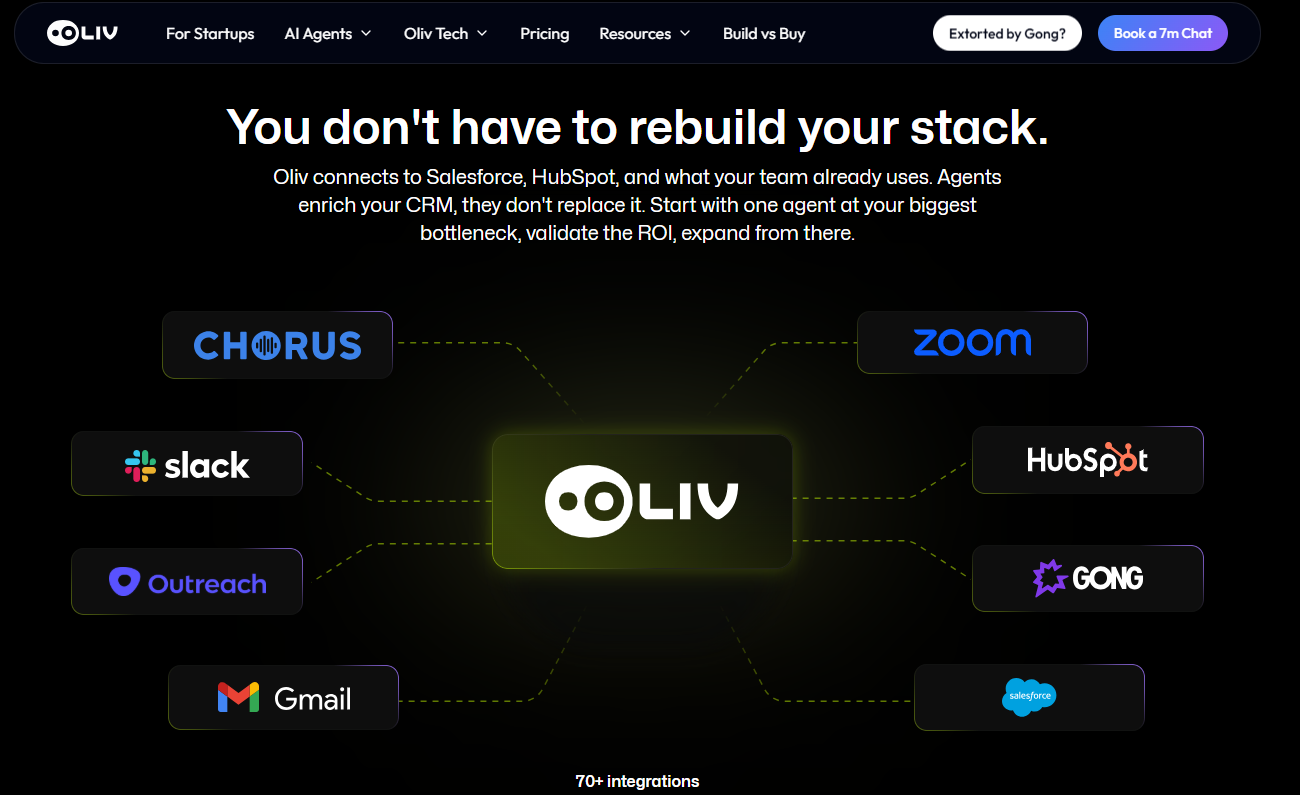
Oliv AI integration architecture connecting seventy-plus tools including Salesforce, HubSpot, and Gong, showing agents enriching existing CRM records rather than replacing the current revenue stack.
Oliv AI is an AI-native revenue intelligence and revenue orchestration platform that runs agents on a continuously updated context graph of every account and opportunity. Its Deal Driver agent monitors deals and flags the ones that need attention, so the manager does not have to open a board to find them.
⭐ What it does
Oliv AI holds a live record of what was said, who went quiet, and what actually changed across calls, email, and CRM. Agents then act on that record, which is the core of how AI deal intelligence differs from reporting.
Deal Driver is the agent built for this exact job. Gong and Clari give you visibility into your pipeline. Deal Driver tells you when to look, what to pay attention to, and what to do.
✅ Key features
Deal Driver agent. Monitors every open opportunity and surfaces risk before the close date moves.
Context graph. Resolves activity to the correct account and opportunity, so a signal attaches to the right deal.
Forecaster agent. Produces a one-page forecast and a presentation-ready deck for the Monday call.
CRM Manager agent. Updates fields from real activity rather than asking reps to remember.
Configurable alerts. The manager tunes what triggers a notification, delivered to Slack or email.
💰 Pricing and implementation
Oliv AI publishes a per-seat ladder from $19 to $79, with the Forecast tier at $49 per seat, a $0 platform fee, and free view-only seats for executives who only read the output. Published pricing is rare in this category, and it shortens your procurement cycle.
Baseline configuration takes minutes rather than months. Full customization still takes two to four weeks, and I would rather say that than promise instant depth. Our RevOps implementation guide sets out what each week involves.
⏰ Product timeline
Oliv AI Product Timeline
Period
What shipped
Through 2025
Core agent set for meeting capture, CRM updates, and deal monitoring, with Salesforce and HubSpot as connected systems.
2026 to date
Deal Driver and Forecaster productized as named agents, plus the published object graph that resolves activity to opportunities.
Expected next
Voice Agent moves out of alpha, letting reps update pipeline hands-free on a nightly call.
✅ Pros and ❌ cons
✅ Alerts reach you instead of waiting to be opened. ✅ Signals come from conversation evidence, not rep-controlled stage fields. ✅ Published per-seat pricing with free view-only seats. ✅ Coexists with Gong and Clari, so no rip-and-replace. ❌ Analytics dashboards are less customizable than Clari's. ❌ Deep customization takes two to four weeks. ❌ Mobile experience trails the desktop platform.
🎯 Best use case, and who should skip it
Best for a 25 to 200 rep B2B team where the manager runs weekly pipeline review and keeps missing deals that stall between reviews. The workflow is broken down further in our guide to Oliv for sales managers.
Not for you if you want a cheap call recorder, or if nobody owns CRM process at your company. Without an owner, agents have nothing to operate inside.
💬 What real users say
"The Driver agent watches all my deals and flags any that are at risk, so I don't have to spend hours listening to recordings in tools like Gong and Clari." — Verified Reviewer, Oliv AI G2 Verified Review [17 Jun 2026]
"The deal driver agent keeps tabs on all my deals and tells me where each deal is and which one needs my focus." — Verified Reviewer, Oliv AI G2 Verified Review [15 Jun 2026]
"I'd love to see few more options to customize dashboards and reports for different teams." — Verified Reviewer, Oliv AI G2 Verified Review [26 Jun 2026]
1.2 Gong: The Deepest Conversation Data on This List [toc=1.2 Gong]
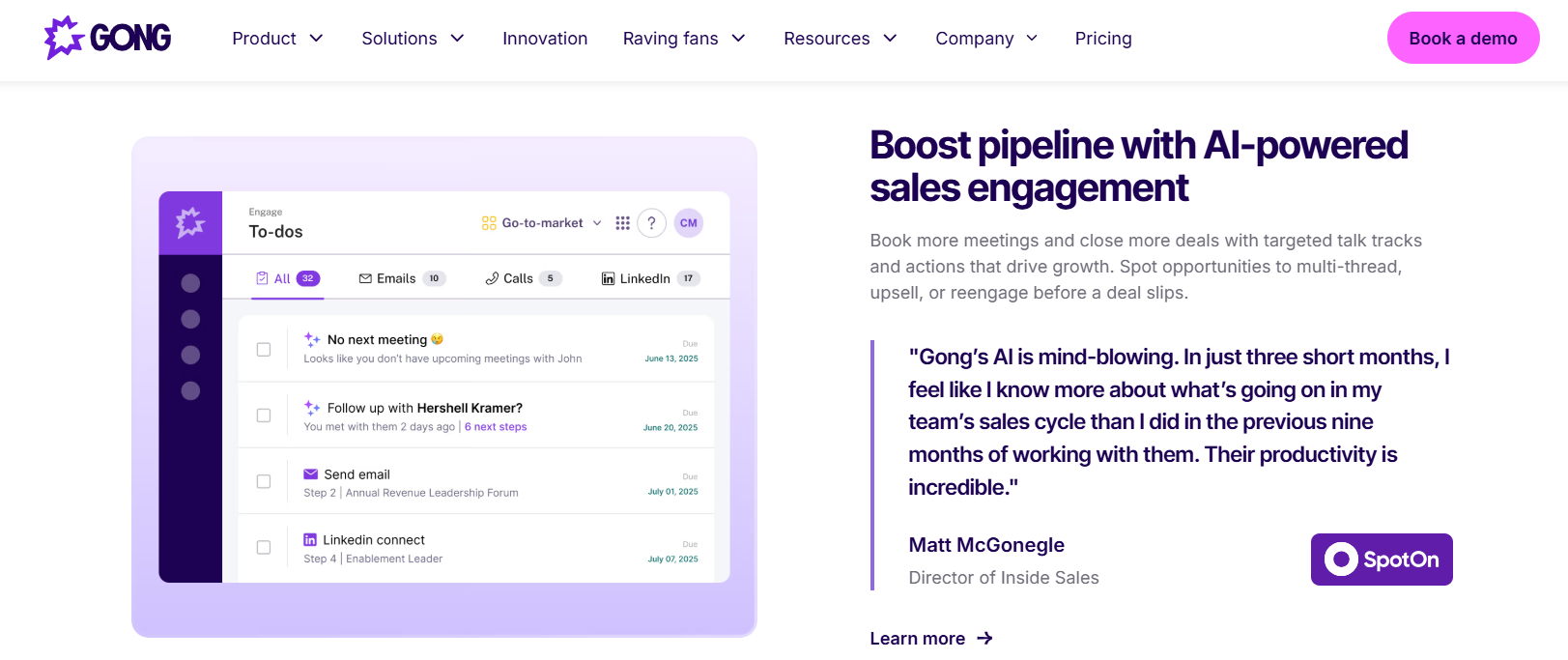
Gong engagement workspace listing prioritised follow-ups, missing next meetings, and multi-thread prompts, illustrating how conversation data converts into pipeline actions ahead of deal slippage.
Gong is a Leader in Gartner's first Magic Quadrant for Revenue Action Orchestration, published 15 December 2025, and was positioned highest on both axes while ranking first across all four use cases including pipeline and forecast management. For raw conversation depth at enterprise scale, nothing here beats it.
⭐ What it does
Gong records, transcribes, and analyzes customer conversations, then layers deal and forecast insight on top. Its 2026 direction is a multi-agent "Revenue AI Operating System" built around Gong Assistant, Agent Studio, and AI Theme Spotter.
The pipeline-analytics piece is Revenue Analytics plus configurable forecast boards, which forecast new business, renewals, upsells, and net revenue in a spreadsheet-like surface. We break that surface down in our review of Gong analytics.
✅ Key features
Smart trackers that trigger flows when a concept appears in a conversation.
AI Theme Spotter analyzing tens of thousands of calls for patterns.
Data Extractor mapping AI-extracted fields back to the CRM.
Configurable forecast boards shipped November 2025.
Microsoft Copilot integration surfacing Gong call data inside Copilot answers.
⏰ Product timeline
Gong Product Timeline
Period
What shipped
Through 2025
Gong Assistant (March 2025), Agent Studio (July 2025), AI Call Reviewer (August 2025), configurable forecast boards, and AI Builder (November 2025).
February 2026
Mission Andromeda launched Gong Enable, conversational guidance, unified account management, and secure AI interoperability.
Expected next
Bidirectional MCP server support, so Gong both consumes external data and exposes its insights to outside AI platforms.
💰 Pricing and implementation
Gong does not publish per-seat pricing, so budget for a quote-driven cycle and separate line items. Reviewers report that forecast and engagement capabilities arrive as paid add-ons rather than bundled, which our breakdown of Gong pricing unpacks in detail.
Implementation is measured in months at enterprise scale, not days. Gong ARR passed $500M in May 2026, which tells you the buyer profile it now optimizes for, and our Gong implementation timeline shows where the months go.
✅ Pros and ❌ cons
✅ Highest-rated placement in Gartner's first RAO Magic Quadrant. ✅ Unmatched conversation dataset and theme analysis. ✅ Deep Salesforce, Dynamics, and Copilot integrations. ❌ Bulk data export is gated behind plan upgrades. ❌ Reviewers report limits pushing data back into Salesforce. ❌ You lose access to your data if you stop paying. ❌ You still have to open it for the insight to reach you.
🎯 Best use case, and who should skip it
Best for enterprises that want the deepest possible conversation corpus and have an enablement team to work it.
Not for you if your complaint is that nobody opens the dashboard. Gong makes the picture better. It does not remove the requirement to go look, a boundary we cover in Gong limitations beyond meeting intelligence.
💬 What real users say
"I cannot download all the data myself unless we upgrade the plan, which isn't ideal and results in me not fully utilizing Gong." — Verified Reviewer, Gong G2 Verified Review [03 Oct 2025]
"The fact that you can't edit a recording (to only share a portion with a client), and the fact that if you stop working with the tool you lose the data." — Verified Reviewer, Gong G2 Verified Review [19 Mar 2026]
"Being able to sequence our steps, along with integration with Nooks/Salesforce. [Dislike:] limitations of getting data back into salesforce." — Verified Reviewer, Gong G2 Verified Review [21 May 2026]
1.3 Clari: Built for the Disciplined Forecast Roll-Up [toc=1.3 Clari]
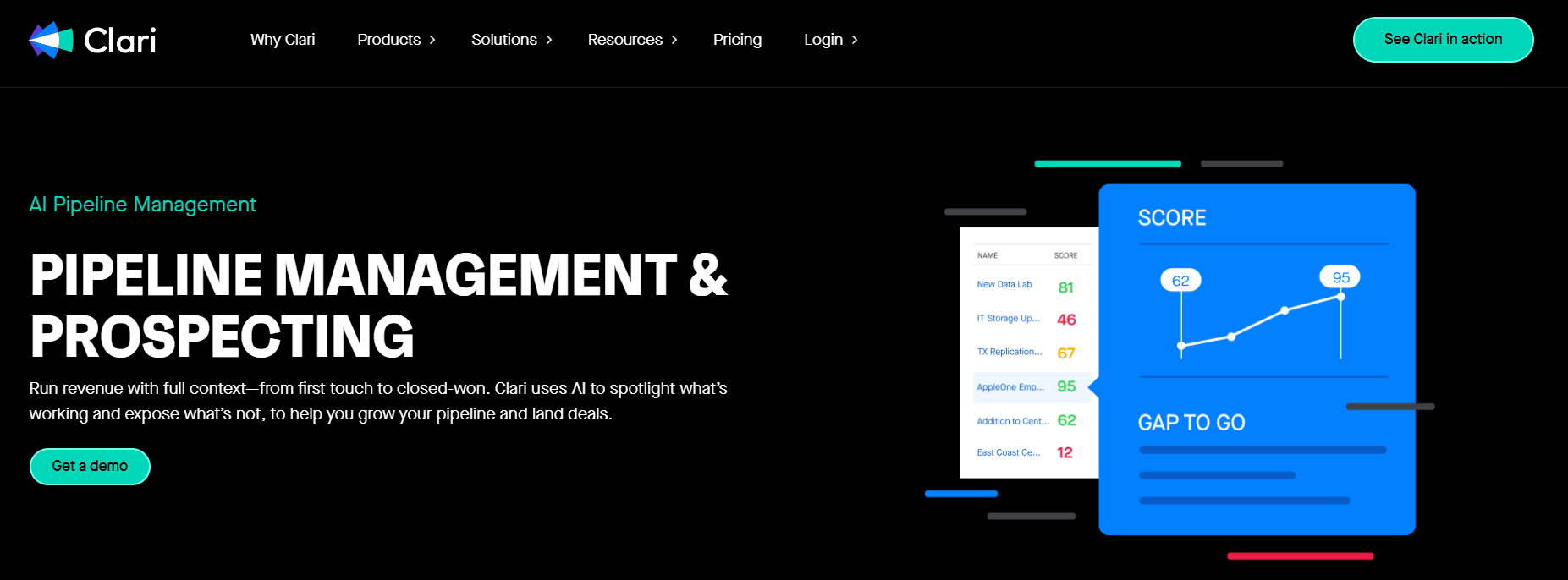
Clari pipeline management and prospecting interface ranking opportunities by AI health score alongside gap-to-go coverage, spotlighting which deals advance and which stall before close.
Clari is a Leader in Gartner's first Magic Quadrant for Revenue Action Orchestration, published 15 December 2025. If your operating cadence is a weekly manual roll-up run by RevOps, Clari is the best-built system on this list for that specific job.
⭐ What it does
Clari pulls opportunity data from Salesforce into forecast views, inspection boards, and week-over-week change reports. Managers submit a number, and the system tracks how that number moved. Our breakdown of Clari features goes deeper on each surface.
The December 2025 merger with Salesloft added engagement data to the same platform. That combination is new, so integration depth is still settling.
✅ Key features
Forecast submission and roll-up by rep, manager, and segment.
Inspection views with week-over-week pipeline change.
Waterfall and flow views for pipeline movement.
Cadence and dialer tooling from the Salesloft side.
⏰ Product timeline
Clari Product Timeline
Period
What happened
December 2025
Clari and Salesloft merged, combining forecasting and roll-up tooling with sequence and engagement data on one platform.
December 2025
Gartner named Clari a Leader and Salesloft a Visionary in the first RAO Magic Quadrant.
Expected next
Deeper merge of engagement and forecast surfaces, given both products now sit under one roadmap.
💰 Pricing and implementation
Clari does not publish per-seat pricing, so expect a quote-driven cycle. Setup is straightforward for standard Salesforce orgs and slower for heavily customized ones. Our guide to Clari pricing covers what teams actually pay.
✅ Pros and ❌ cons
✅ Clean, fast forecast submission workflow. ✅ Strong week-over-week opportunity analysis. ✅ Well integrated with Salesforce for core forecasting. ❌ No custom reporting, per reviewers. ❌ CRM writeback is limited, including MEDDIC field updates. ❌ Conversation intelligence lacks deal context. ❌ Advanced Flow and Waterfall views draw complaints.
🎯 Best use case, and who should skip it
Best for a RevOps team that already runs a strict weekly forecast call and wants that call to be faster.
"The conversation intelligence tool is lacking, and we don't have the context of the deals against the conversation intelligence findings. There's no custom reporting. The CRM writeback is not good." — Verified Reviewer, Clari G2 Verified Review [13 Jul 2026]
"I'm concerned that the advanced 'Flow View' and 'Waterfall View' aren't working well." — Verified Reviewer, Clari G2 Verified Review [16 Nov 2025]
"Clari forecasting is simple, easy to use, and well integrated with SFDC. [Dislike:] The AI features are immature." — Verified Reviewer, Clari G2 Verified Review [10 Oct 2025]
1.4 Terret (formerly BoostUp): Forecast Depth at a Lower Price Point [toc=1.4 Terret]
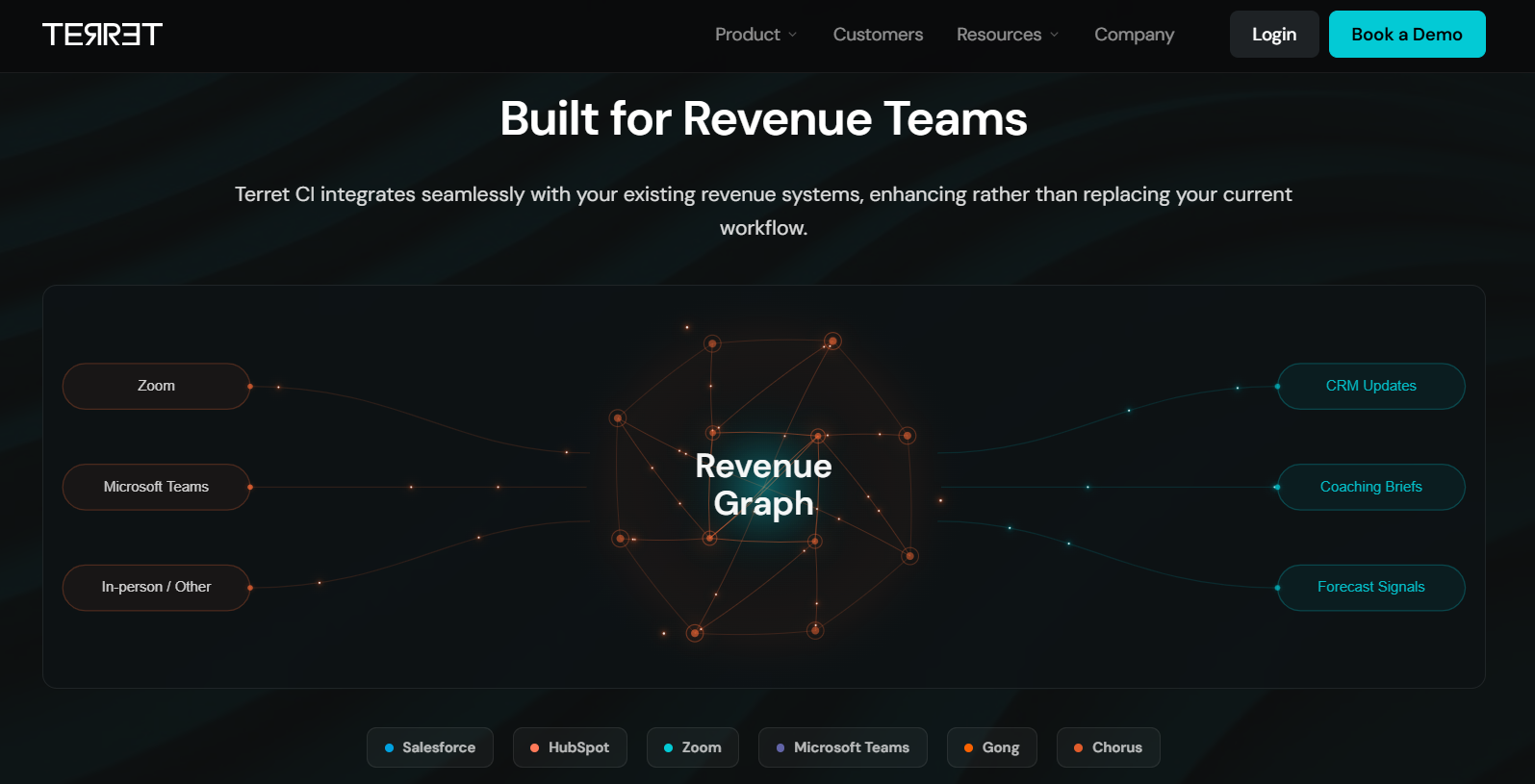
Terret revenue graph ingesting meeting and CRM sources across Salesforce, HubSpot, Zoom, and Gong, then producing CRM updates, coaching briefs, and forecast signals for revenue teams.
Terret gives mid-market teams multi-dimensional forecasting that used to require an enterprise contract. It rebranded from BoostUp in September 2025, and now positions itself as a fleet of AI revenue agents.
⭐ What it does
Terret rolls up rep and manager forecasts, tracks week-over-week pipeline change, and scores deal risk. It also pulls conversation insights into Salesforce records.
The rename matters for your shortlist. Searching "BoostUp reviews" now returns a product with a different name and a wider scope.
✅ Key features
Forecast roll-ups by rep and by manager.
Week-over-week pipeline change reporting.
Deal risk assessment and AI insights.
Conversation-to-CRM insight capture.
⏰ Product timeline
Terret (formerly BoostUp) Product Timeline
Period
What happened
September 2025
BoostUp rebranded as Terret and launched a fleet of AI revenue agents, shifting from forecasting tool to full-stack AI revenue system.
September 2025 onward
The company framed the change as one platform with interconnected agents rather than a single forecasting surface.
Expected next
Continued agent expansion across the Virtual Revenue Fleet framing introduced at rebrand.
💰 Pricing and implementation
Terret does not publish per-seat pricing publicly. Reviewers describe setup as easy, particularly for people who used BoostUp at a previous employer.
✅ Pros and ❌ cons
✅ Clear rep-to-leader forecast roll-up. ✅ Week-over-week change reporting built in. ✅ Easy initial setup, per reviewers. ❌ Brand confusion after the September 2025 rename. ❌ Public review volume is thinner than Gong or Clari. ❌ Pricing requires a sales conversation.
Not for you if you need a large public reference base before you sign.
💬 What real users say
"I like the simplicity of Terret.ai. I appreciate how it gives us clarity around each sales rep's forecasting and how those forecasts roll up to each sales leader." — Verified Reviewer, Terret (formerly BoostUp) G2 Verified Review [07 Apr 2026]
1.5 Salesloft: Engagement Signal, Now Inside Clari [toc=1.5 Salesloft]
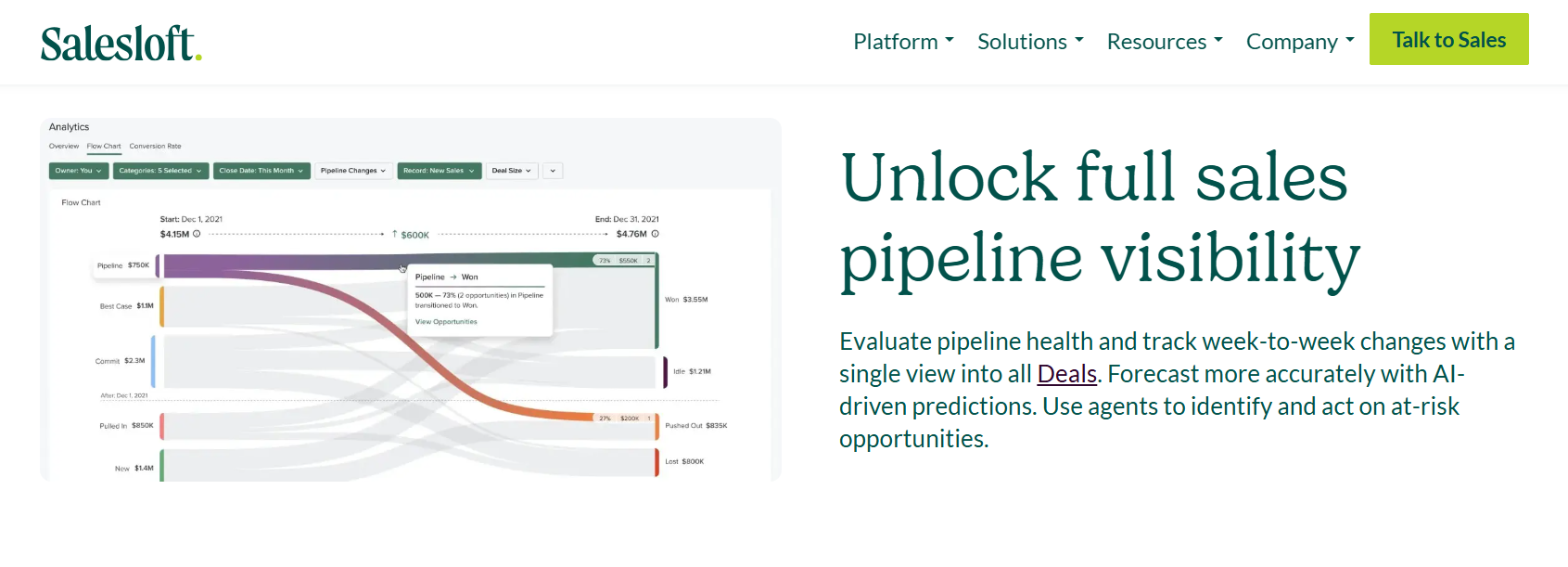
Salesloft analytics flow chart mapping stage conversion between pipeline, commit, and closed-won, with idle and pushed-out values exposing week-over-week deal movement and slippage.
Salesloft is a Visionary in Gartner's first RAO Magic Quadrant, and became part of Clari in December 2025. Its real contribution to pipeline analytics is engagement data, meaning what outreach actually happened.
⭐ What it does
Salesloft runs sequences, dialing, and follow-up cadences, then reports on activity across accounts. That activity stream feeds pipeline health views, and our Gong vs Salesloft comparison shows where the two overlap.
Engagement data answers a narrow question well. It tells you whether anyone touched the deal, not whether the deal is real.
✅ Key features
Multi-step sequences and cadences.
Integrated dialer and email templates.
Activity and engagement analytics.
Salesforce logging of outreach steps.
⏰ Product timeline
Salesloft Product Timeline
Period
What happened
December 2025
Salesloft merged with Clari, placing engagement tooling and forecast tooling under a single company.
December 2025
Gartner positioned Salesloft as a Visionary in the first Revenue Action Orchestration Magic Quadrant.
Expected next
Consolidation of engagement and forecast surfaces under the merged roadmap.
💰 Pricing and implementation
Pricing is quote-only. Multiple reviewers describe integration and initial setup as difficult, which is a real cost line.
✅ Pros and ❌ cons
✅ Strong sequence structure for high-volume outreach. ✅ Keeps follow-ups from slipping. ✅ Now sits alongside Clari forecasting. ❌ Repeated complaints about clunky UX. ❌ Reported issues with meeting logging and data sync. ❌ Dialer speed and extension performance criticised.
🎯 Best use case, and who should skip it
Best for outbound-heavy teams that need cadence discipline more than deal-level risk detection.
Not for you if you are shopping specifically for stage conversion and velocity analysis.
💬 What real users say
"Salesloft helps organize outreach at scale and keeps follow-ups from falling through the cracks. [Dislike:] I often have trouble logging meetings, and certain features feel clunky or overly manual." — Verified Reviewer, Salesloft G2 Verified Review [24 Sep 2025]
"Analytics/metrics are faulty like email opens. Dialer is often slow at launching when making calls." — Verified Reviewer, Salesloft G2 Verified Review [26 Mar 2025]
1.6 Aviso: Enterprise Forecasting With an Agent Layer [toc=1.6 Aviso]
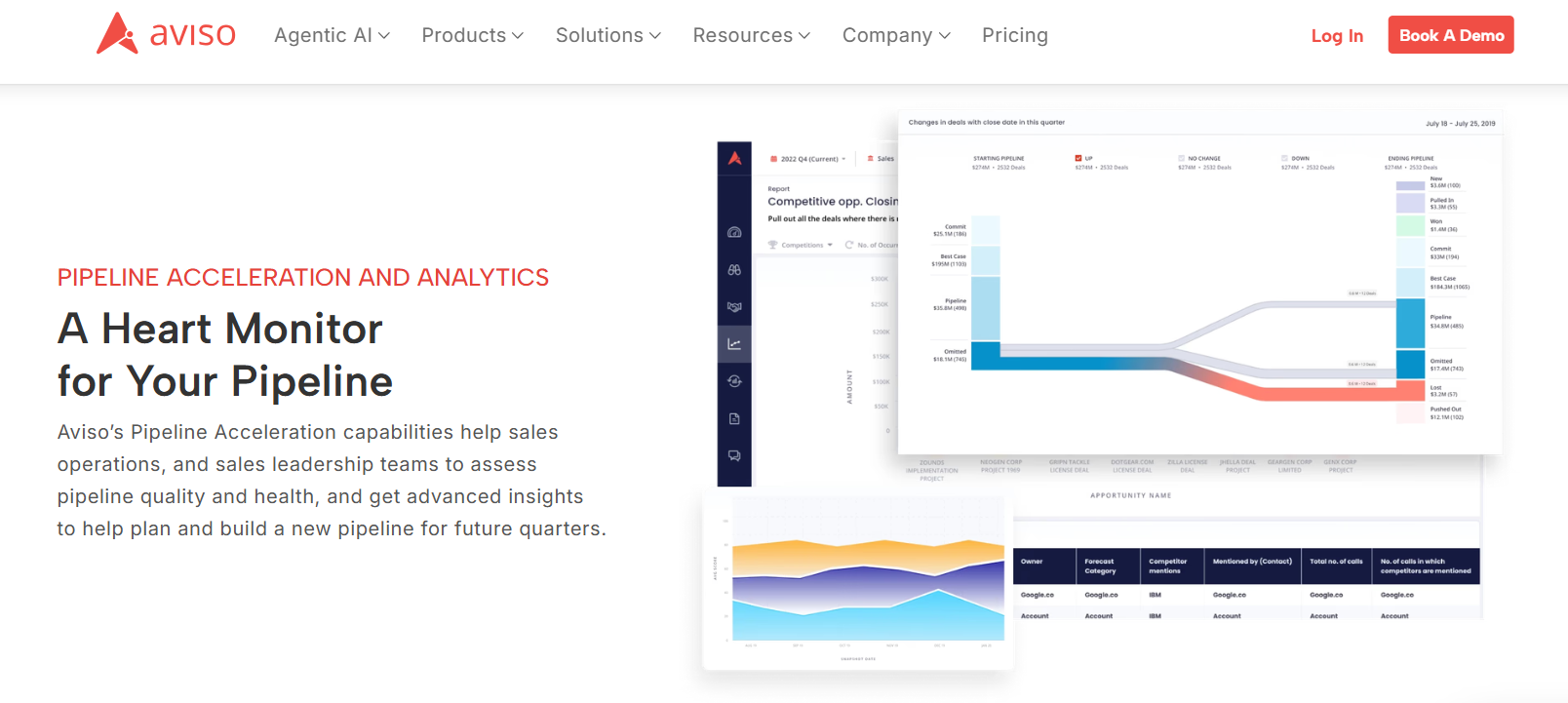
Aviso pipeline acceleration view charting close-date changes, commit and best-case movement, competitor mentions, and per-deal age scores that surface pipeline quality and health for forecast calls.
Aviso gives enterprise forecast leaders granular filtering by owner, segment, and deal attribute, which is genuinely useful in one-on-ones. Its weak spot, according to reviewers, is speed and Salesforce sync.
⭐ What it does
Aviso models forecast probability, tracks deal stages and close dates, and captures MEDDPICC fields. Its MIKI agent layer adds conversational querying on top, and our primer on the MEDDIC sales methodology explains what those fields should contain.
✅ Key features
Group-by filtering for one-on-one and forecast calls.
Opportunity scoring and probability modeling.
MEDDPICC and next-step tracking.
One-click jump from a deal into Salesforce.
⏰ Product timeline
Aviso Product Timeline
Period
What happened
Through 2025
Forecasting, pipeline inspection, and deal scoring were the core surfaces, with reviewers reporting sync lag against Salesforce.
2026 to date
Aviso publishes flexible per-user plans, free migration, vendor buyout options, and pipeline inspection as a named module, without listing a price.
Expected next
Continued build-out of the MIKI agent layer across forecasting workflows.
💰 Pricing and implementation
Aviso publishes a pricing page with plan structure but no numbers, and contracts are custom. Third-party trackers describe annual lock-in and seat minimums, which you should confirm in writing.
✅ Pros and ❌ cons
✅ Useful filtering for rep-level forecast conversations. ✅ Consolidates forecast and pipeline views that previously lived in Excel. ✅ Offers free migration and buyout options. ❌ Repeated reports of slow performance. ❌ Salesforce sync delays after updates. ❌ Exporting data can lose customisations and filters. ❌ No published price.
Not for you if your team needs near-real-time CRM sync.
💬 What real users say
"Aviso gives me a great overview of my current forecast, pipeline, and focused activities, saving me a lot of time." — Verified Reviewer, Aviso G2 Verified Review [08 Dec 2025]
"Exporting data loses all customisations and filters. Analytics are ineffective and add no real value." — Verified Reviewer, Aviso G2 Verified Review [24 Jun 2025]
"There seems to be a delay in syncing the data when I refresh SFDC notes." — Verified Reviewer, Aviso G2 Verified Review [02 Feb 2026]
Backstory removes manual Salesforce logging better than most tools on this list. People.ai now trades as Backstory, and it holds a Challenger or Visionary position in the 2025 RAO Magic Quadrant.
⭐ What it does
Backstory captures emails, meetings, and contacts automatically, and writes them to Salesforce. That activity record becomes the base layer for pipeline and account analysis, which is the same foundation behind CRM data quality automation for RevOps.
Activity capture is a foundation, not a conclusion. Someone still has to interpret the pattern.
✅ Key features
Automatic email and meeting logging to Salesforce.
Contact discovery and buying-group mapping.
Account and opportunity activity analytics.
⏰ Product timeline
Backstory (formerly People.ai) Product Timeline
Period
What happened
Through 2025
Automated Salesforce activity capture and contact logging formed the core product under the People.ai name.
2026 to date
The product now appears under the Backstory name in market analyses of the revenue intelligence category.
Expected next
Continued repositioning within the forecasting and revenue intelligence layer as that market consolidates.
💰 Pricing and implementation
Pricing is quote-only, and deployments are enterprise-scale. Budget for a Salesforce admin during rollout.
✅ Pros and ❌ cons
✅ Removes manual CRM data entry at scale. ✅ Reliable email and contact logging. ✅ Strong enterprise activity dataset. ❌ Reviewers report inaccurate data interpretation. ❌ Limited transparency into how conclusions are formed. ❌ Name change adds shortlist confusion.
🎯 Best use case, and who should skip it
Best for large enterprises where CRM activity gaps are the main data problem.
Not for you if you need explainable deal risk rather than complete activity logs.
💬 What real users say
"People.ai eliminates the need for manual data entry in Salesforce which is a huge time saver. [Dislike:] The inaccuracies in data interpretation and lack of transparency are my biggest pain points." — Verified Reviewer, Backstory (formerly People.ai) G2 Verified Review [07 Apr 2026]
Revenue Grid does one thing very well, which is syncing email and calendar activity into Salesforce without rep effort. Its signal layer then flags cold deals and missing decision-makers.
⭐ What it does
The platform captures emails, invites, chat, and calls, then maps them to the right CRM record. On top of that, it runs signal-based nudges and guided selling steps, an approach compared across vendors in our revenue intelligence platform comparison for RevOps.
✅ Key features
Real-time email and calendar sync to Salesforce.
Multi-opportunity logging from a single email.
Configurable side-panel fields per user.
Signal alerts for cold deals and competitor mentions.
⏰ Product timeline
Revenue Grid Product Timeline
Period
What happened
Through 2024
Core email sync and activity capture, with reviewers reporting occasional feed breaks affecting data sync.
2026 to date
Reviewers describe expanded functionality beyond email sync, including Time Slots scheduling and multi-opportunity logging with customisable side-panel fields.
Expected next
Continued depth in Salesforce object coverage, based on the direction reviewers report.
💰 Pricing and implementation
Pricing is quote-only. Reviewers report meaningful troubleshooting during pilot configuration, then stability afterwards.
✅ Pros and ❌ cons
✅ Excellent email-to-Salesforce sync. ✅ Multi-opportunity logging saves rep time. ✅ Responsive support during setup. ❌ Incorrect mapping and duplicate accounts reported. ❌ Frequent re-login required by some users. ❌ Configuration-heavy pilot phase.
🎯 Best use case, and who should skip it
Best for Salesforce shops whose main gap is activity data never reaching the CRM.
Not for you if you want forecast modeling in the same product.
💬 What real users say
"The automated tracking and ability to make edits within the app. [Dislike:] Incorrect mapping and duplicating accounts." — Verified Reviewer, Revenue Grid G2 Verified Review [17 Jun 2026]
"One challenge was the amount of troubleshooting required during our pilot, primarily related to the initial configuration." — Verified Reviewer, Revenue Grid G2 Verified Review [05 Jun 2026]
Forecastio is the cleanest option here for a HubSpot team that finds native reporting too fiddly. It focuses on pipeline planning and forecast accuracy rather than conversation data.
⭐ What it does
Forecastio sits on HubSpot data, and produces predictive pipeline analytics, automated reporting, and recommended actions. Reviewers describe the dashboard as easier to read than HubSpot's own, and our roundup of best AI sales forecasting software places it against heavier options.
✅ Key features
Predictive analytics for opportunity management.
Automated pipeline and performance reporting.
AI-driven action recommendations.
Capacity and quota planning views.
⏰ Product timeline
Forecastio Product Timeline
Period
What happened
Early 2025
Reviewers describe predictive analytics, automated reporting, and AI action recommendations as the shipped feature set, with customisation limits.
2026 to date
Positioning centres on pipeline management and forecasting for HubSpot-led sales teams.
Expected next
Broader coverage of SDR and BDR metrics, which reviewers currently list as missing.
💰 Pricing and implementation
Pricing is not consistently published, so request it directly. Reviewers note a learning curve for new users.
✅ Pros and ❌ cons
✅ Cleaner pipeline view than native HubSpot reporting. ✅ Predictive analytics aimed at forecast accuracy. ✅ Fits smaller RevOps teams. ❌ Customisation of reports is difficult. ❌ Reviewers hit CRM integration limits. ❌ No SDR or BDR metrics in the sales cycle view.
Not for you if you run Salesforce with heavy custom objects.
💬 What real users say
"Since it is a very comprehensive solution, the learning curve for new users can be an issue. Customizations are also difficult, specially to visualize data and reports." — Verified Reviewer, Forecastio G2 Verified Review [28 Jan 2025]
"Easier dashboard view than Hubspot, but works well with it. [Dislike:] Does not include metrics for SDRs or BDRs in the sales cycle." — Verified Reviewer, Forecastio G2 Verified Review [27 Jan 2025]
1.10 Weflow: Pipeline Hygiene on a Smaller Budget [toc=1.10 Weflow]
Weflow is the budget entry point for Salesforce teams whose real problem is data hygiene, not modeling. It sits in the forecasting layer that market analysts describe as increasingly squeezed between CRM-native tools and full revenue platforms.
⭐ What it does
Weflow speeds up Salesforce updates, tracks pipeline changes, and inspects deals against required fields. It is an inspection layer rather than an alerting engine, which is a distinction we draw out in our guide to deal tracking software.
✅ Key features
Fast Salesforce field updating from a single view.
Pipeline change tracking between reviews.
Deal inspection against hygiene rules.
Forecast submission for smaller teams.
💰 Pricing and implementation
Pricing is quote-driven, and positioned below the enterprise platforms. Setup is light because the scope is narrow.
✅ Pros and ❌ cons
✅ Low cost of entry for Salesforce teams. ✅ Fixes the hygiene problem upstream of analytics. ✅ Fast to deploy. ❌ Narrow scope compared with the platforms above. ❌ No conversation-derived deal signals. ❌ Thin public review base.
🎯 Best use case, and who should skip it
Best for a small Salesforce team fixing CRM hygiene before buying anything heavier.
Not for you if you need conversation evidence behind each risk flag.
⚠️ How I would actually shortlist from this list
Pick two tools, not five. One should be your incumbent, and one should be the alerting layer you are testing against it.
Then run the same 30-day test on both. Count how many alerts led to an action, and let that number decide.
Oliv AI ranks first here because Deal Driver reverses the default: the deal reaches the manager instead of waiting on a dashboard, with alerts the manager configures and signals drawn from the conversation record rather than rep-controlled stage fields. It connects to Gong and Clari, so adding it does not require ending a contract you already signed, a path we set out in revenue tech stack consolidation.
Q2: What Exactly Is Pipeline Analytics Software, and What Is It Not? [toc=2. Category Boundaries]
Pipeline analytics software measures how individual deals move: stage conversion, sales velocity, ageing, and risk signals drawn from CRM, email, and call activity. It is not revenue forecasting software, which consumes those movements to produce a board number. It is not BI, which visualises whatever you feed it. It is not CI/CD pipeline analytics, which measures software builds.
⭐ The plain definition, and three things it is not
Pipeline analytics answers one question: is this deal actually moving? Everything else in the category is downstream of that.
The keyword confuses three different products. Search results mix sales tools, business intelligence platforms like Power BI and Tableau, and DevOps build monitoring. If a page recommends Tableau for deal risk, it answered a different question than the one you asked.
Gartner formalised the sales meaning in December 2025 when it published its first Magic Quadrant for Revenue Action Orchestration, a category it positioned as the successor to sales engagement and revenue intelligence. That is the neighbourhood this software now lives in, and our overview of revenue intelligence platforms maps who sits inside it.
🔍 The same deal, seen four ways
One deal, four tools, four different readings. This is the clearest way to know which product you actually need.
One Deal Seen Through Four Different Tools
Lens
What it shows for one deal
Question it answers
Pipeline analytics
Entered Stage 3 on 12 June, no reply from the champion in 19 days
Is this deal moving?
Revenue forecasting
Sits in Commit, contributes $80K to the quarter number
What does the quarter land at?
BI dashboard
Appears in a chart you built and have to maintain
What did I ask it to draw?
CI/CD pipeline analytics
Nothing, it measures software builds
Why is the deployment slow?
Forecast accuracy shows up in all of this, but it is an outcome, not the subject. A forecast is only as honest as the deal signals feeding it, a point we expand on in our guide to improving sales forecast accuracy with AI.
⚠️ Which complaint do you actually have?
Say your complaint out loud. The wording tells you which product to shortlist.
"My number is wrong at quarter end" points to forecasting software.
"A deal died and nobody noticed" points to pipeline analytics.
That last one is the expensive one. It is also the only one this article is about.
💰 Why the boundary saves you money
Buying the wrong category is how a 25 to 200 rep team ends up past $500 per user per month. You stack Gong for conversations, Clari for the roll-up, and Salesloft for cadence, and the deal-level gap stays open, which is exactly the maths behind reducing sales tech stack costs.
Oliv AI sits in the revenue intelligence and revenue orchestration category, and it runs on top of Salesforce or HubSpot rather than replacing the CRM. I have watched teams assume they needed a fourth dashboard when what they needed was one system that resolves activity to the right opportunity.
🎯 A definition you can use in a vendor call
Ask every vendor this: "Does your product tell me a deal stopped moving, or does it show me a chart of deals that stopped moving?" Both are valid products. Only one removes work from your week.
If the answer is the chart, you are buying reporting. Price it as reporting.
Oliv AI holds a continuously updated context graph of every account and opportunity, then runs agents on that graph rather than asking a person to interpret a dashboard. That is the category line I would draw in 2026, and the rest of this article scores tools against it.
Q3: How Did We Score These Tools, and Which Tier Fits Your Team Size? [toc=3. Rubric and Buyer Tier]
Each tool scores out of 100 across five weighted criteria: Alert Precision and Timeliness (25%), Signal Source Quality (20%), Stage Conversion and Velocity Depth (20%), Setup, Coexistence and Pricing Transparency (20%), and Verified User Reviews (15%). Under $10M ARR, buy an inspection layer. From $10M to $50M, buy signal-based alerting. Above $50M, buy orchestration with audit trails.
⭐ Why these five, and not a feature count
Feature counts reward the biggest vendor every time. They tell you nothing about whether the tool changes your Monday.
So the rubric asks two questions the category avoids. Does the system reach you, and where do its signals come from?
I will say the uncomfortable part plainly. If the criteria were dashboard breadth, an incumbent would win this list, and pretending otherwise would insult anyone who has run a real evaluation.
📊 The weights, and what each one punishes
Pipeline Analytics Scoring Rubric and Weights
Criterion
Weight
Rewards
Punishes
Alert Precision and Timeliness
25%
Alerts that lead to an action
Notification volume with no follow-through
Signal Source Quality
20%
Signals from conversation and activity evidence
Signals computed only from rep-controlled fields
Stage Conversion and Velocity Depth
20%
Time-in-stage, close-date change history
Static conversion charts with no audit trail
Setup, Coexistence and Pricing Transparency
20%
Published pricing, fast setup, works beside incumbents
Quote-only pricing, months-long rollouts
Verified User Reviews
15%
Recent, dated, attributable reviews
Thin or stale review bases
Reviews carry only 15% on purpose. Review volume tracks marketing spend more than product fit.
💰 Which tier fits your team
Which Pipeline Analytics Tier Fits Your Team
Your stage
Buy this
Why
Under $10M ARR, no RevOps owner
Inspection and hygiene layer
Fix the input before you model it
$10M to $50M ARR, 25 to 200 reps
Signal-based alerting
Deals die between reviews at this size
Above $50M ARR, multi-segment
Orchestration with audit logs
Compliance and roll-up discipline both matter
Oliv AI is scored on its published per-seat ladder of $19 to $79, which is one of the few prices on this list traceable to a vendor page rather than a quote. Where a figure comes from Oliv's own comparison, I say so in those words, and our guide to scaling revenue operations covers how the tiers above map to headcount.
⚠️ Where the rubric goes against us
Oliv AI scores highest on alert precision and signal source, and it does not score highest on everything. Clari remains the better-built system for a disciplined manual forecast roll-up, and reviewers back that up on the forecasting workflow specifically, as our summary of Clari reviews and user feedback shows.
Here is my honest hedge. I might be weighting alert precision too heavily for teams whose managers genuinely do open the dashboard every morning, and if that describes you, re-weight it downward before you shortlist.
💬 What reviewers say about these exact criteria
"Clari forecasting is simple, easy to use, and well integrated with SFDC. [Dislike:] The AI features are immature, team activity is poorly designed." — Verified Reviewer, Clari G2 Verified Review [10 Oct 2025]
"Exporting data loses all customisations and filters. Analytics are ineffective and add no real value." — Verified Reviewer, Aviso G2 Verified Review [24 Jun 2025]
"Setting up Oliv.ai was straightforward and could be done in just five to fifteen minutes." — Verified Reviewer, Oliv AI G2 Verified Review [15 Jun 2026]
Oliv AI earns five stars here on alert precision, signal source, and published pricing, not on dashboard customisation, where its own reviewers ask for more flexibility. That trade-off is the honest version of this ranking.
Q4: Why Do Pipeline Dashboards Keep Missing the Deals That Quietly Die? [toc=4. Why Dashboards Fail]
Dashboards miss dying deals because they wait to be opened, and because the fields they read are the ones reps control. Gartner finds only 7% of sales organisations hit 90% forecast accuracy, with a median of 70 to 79%. Validity's 2025 survey found 76% of teams say under half their CRM data is accurate. Monitoring scales with pipeline size. Nobody has that time.
⭐ Deals do not announce their own death
No activity. No CRM flag. No alert. The deal just stops, and the board still shows it in Stage 4 with a close date next month.
By the time leadership reviews the pipeline, the deals worth saving are already gone. Champions go cold while the team keeps logging activity against them, which is the pattern we track in deal slippage prevention for VPs of Sales.
🔄 The inversion nobody sells you
Every tool in this category can draw a stage conversion chart. Producing the chart was never the bottleneck.
The bottleneck is that you still have to go looking. Open the board, notice the anomaly, decide it matters, then dig for the reason.
Oliv AI's Deal Driver agent inverts that sequence by surfacing the deal that needs attention instead of waiting to be opened. With Gong you check in. With Deal Driver, it checks in for you.
⚠️ The counterargument, taken seriously
The incumbents have a real answer here, and it deserves a paragraph rather than a dismissal. Alerting without discipline produces noise, teams mute notifications within a month, and a well-run pipeline review by a good manager beats a mediocre signal engine.
That is fair. It is exactly why alert precision, not alert coverage, belongs in the scoring rubric.
I could be reading this too strongly, but what surfaces in Oliv AI's deployments is that managers who tune their own alert triggers keep them on, and managers who inherit defaults switch them off.
💸 The upstream failure that is worse
Almost every metric in this category is computed from CRM stage and close-date fields that reps control. Stage conversion measured on inconsistently applied stages is precision without accuracy.
Velocity computed from close dates that get pushed silently measures rep behaviour, not deal behaviour. The chart looks rigorous. The input is a dropdown someone picked in a hurry.
The numbers back this up. Validity's 2025 State of CRM Data Management surveyed 602 CRM users, and found teams lose roughly 16 deals a quarter to bad data, with 45% saying their data is not AI-ready. Our playbook on CRM data strategy for revenue predictability covers how to close that gap.
✅ The five-item readiness gate to run before you sign
Run this audit on your open pipeline this week. It costs an afternoon, and changes which vendor you pick.
What percentage of open opportunities have a next step dated in the future?
Do two reps define Stage 3 the same way? Ask them separately.
How many close dates moved last quarter without a logged reason?
Can you see who the champion is on every deal above your average deal size?
What percentage of your accounts have an owner, industry, and segment filled?
If you fail three of these, no tool on the list will save your forecast. Fix the input first, then buy the alerting layer.
🎯 What this means for your Monday
Stop scoring vendors on how good their charts look. Score them on how many alerts led to an action during a 30-day trial, a discipline we set out in agentic AI revenue execution for heads of sales.
Oliv AI reads signals from the conversation and activity record rather than stage fields, resolves that activity to the correct opportunity, and lets the manager configure what triggers an alert. That combination is what separates a pipeline you inspect from one that tells you when to look.
Q5: How Do You Measure Stage Conversion and Sales Velocity When Reps Control the Fields? [toc=5. Measuring Movement]
Sales velocity is opportunity count multiplied by average deal value and win rate, divided by average cycle length. Stage conversion is the percentage of deals exiting one stage into the next. Both break on rep-controlled fields. Anchor every stage to a verifiable exit event, and track stage-entry timestamps and close-date change history rather than the dropdown a rep picked.
⭐ The velocity formula, worked with real numbers
Take 120 open opportunities, an average deal value of $40,000, a 20% win rate, and a 90-day cycle. Multiply the first three, then divide by 90.
That gives roughly $10,667 of revenue per day. Change the cycle to 120 days, and the same pipeline produces $8,000 per day.
Nothing about the deals changed. Only the denominator did, which is exactly where the trouble starts. Our breakdown of sales productivity metrics shows how the same distortion spreads across a board.
⚠️ Why your cycle length is probably fiction
Cycle length comes from close dates. Close dates get pushed quietly, often on a Friday, with no reason recorded anywhere.
So velocity measures how willing your reps are to move a date. It does not measure how fast a deal moves.
Oliv AI logs close-date changes against the conversation record, so a slipped date arrives with the reason attached instead of appearing as an unexplained edit. That difference is small on one deal, and enormous across a quarter.
🔍 Two reps, two different Stage 3s
Ask two AEs separately what Stage 3 means. You will usually get two answers, and neither will match your CRM documentation.
Stage conversion computed on inconsistent stages is precision without accuracy. The percentage looks rigorous, and the underlying definition is a guess, which is why we push teams toward automated methodology scoring from calls.
✅ The exit-criteria table to paste into your CRM
Fix the input with verifiable events, not adjectives. Copy this structure, and adapt the wording to your motion.
Stage Exit Criteria and Required Evidence
Stage
Exit criterion (must be verifiable)
Evidence
Discovery
Pain quantified in the buyer's own words
Call recording or email
Qualification
Economic buyer named and on a call
Meeting attendee record
Validation
Technical or security review opened
Ticket or shared doc
Proposal
Pricing sent to the buying group
Sent email with attachment
Negotiation
Redlines returned or procurement engaged
Contract thread
Oliv AI resolves captured activity to the correct account and opportunity, so a conversion signal attaches to the deal it actually belongs to rather than whichever record a rep last touched. Duplicate Salesforce records are the quiet reason most conversion reports disagree with each other, a problem covered in CRM data quality automation for RevOps.
📊 The benchmarks to measure yourself against
Use 2025 numbers, not 2021 ones. The Ebsta and Pavilion 2025 GTM Benchmarks analysed 655,000 opportunities and $48 billion of pipeline.
2025 B2B Pipeline Benchmarks
Metric
2025 benchmark
What shifted
Average win rate
19%
Down from 29% in 2024
Average sales cycle
6.5 months
Up from 4.9 months in 2019
Opportunity to closed-won
22% to 30%
Varies widely by segment
If you set coverage targets on a 29% win rate, you are planning for a market that no longer exists. Re-baseline before you renegotiate quotas, using the approach in running evidence-based forecast commits.
⏰ What to do with this on Monday
Run the audit in three steps. Pull stage-entry timestamps for every open deal, list every close date that moved last quarter, and count how many moves have a logged reason.
I would be surprised if more than a third do. That gap is your real measurement problem, and no dashboard fixes it.
Oliv AI reads stage movement from evidence in the conversation and activity record instead of the field a rep updated, which is why its conversion and velocity numbers tend to diverge from the CRM's. When they diverge, the CRM is usually the one that is wrong.
Q6: We Already Have Gong or Clari, Do We Need This, and How Would We Prove It? [toc=6. Incumbent Stack Fit]
Not necessarily, but the question is wrong. Gong and Clari give real visibility, and Gartner ranked Gong first across all four use cases in its first Revenue Action Orchestration Magic Quadrant, published 15 December 2025. Visibility still requires someone to look. Prove the difference by counting actions, not alerts: over 30 days, log every alert and mark whether it changed what someone did.
⭐ Give the incumbents their due first
Gong is a Leader positioned highest on both axes of that Magic Quadrant. Clari is a Leader in the same report, and remains the cleanest forecast submission workflow available.
If you bought either one, you did not waste money. You bought visibility, and you got it, as our side-by-side of Gong vs Clari lays out.
🔄 Checking in versus being checked in on
What changes with an alerting layer is not what you can see. It is what reaches you without asking.
That distinction sounds small until you count the hours. Opening a board, scanning it, and deciding what matters is work that scales with pipeline size.
Oliv AI's Deal Driver agent runs that scan continuously, and pushes only the deals that meet your configured triggers. With Gong you check in. With Deal Driver, it checks in for you.
💰 You probably keep the incumbent anyway
Most teams reading this are 12 to 18 months into a contract. Ripping it out is not a real option this quarter, which is why we wrote up revenue tech stack consolidation costs.
Oliv AI connects to Gong and Clari, so a team can add alerting to the visibility layer it already owns. I have seen this land as a $20,000 to $30,000 first purchase alongside a renewal that stays untouched.
⚠️ "We turned alerts off last time because they were noise"
This is the objection that decides whether any tool survives 90 days. It deserves a real answer, not a promise of better AI.
The answer is control. Alerts are configurable, the manager tunes what triggers them, and precision gets tested rather than assumed.
Oliv AI's read is that the standard advice gets this backwards: vendors sell alert coverage when buyers should be scoring alert precision. I might be overweighting that, but every muted-notification story I hear starts with defaults nobody edited.
✅ The 30-day action-rate test
Run this against every vendor on your shortlist, including Oliv AI.
Turn on alerts for one team, not the whole org.
Log every alert in a shared sheet with a timestamp.
Mark each one: did it change what someone did?
Count actions divided by alerts at day 30.
Anything below roughly one action per two alerts will get muted.
"I cannot download all the data myself unless we upgrade the plan, which isn't ideal and results in me not fully utilizing Gong." — Verified Reviewer, Gong G2 Verified Review [03 Oct 2025]
"The conversation intelligence tool is lacking, and we don't have the context of the deals against the conversation intelligence findings. There's no custom reporting." — Verified Reviewer, Clari G2 Verified Review [13 Jul 2026]
"The Driver agent watches all my deals and flags any that are at risk, so I don't have to spend hours listening to recordings in tools like Gong and Clari." — Verified Reviewer, Oliv AI G2 Verified Review [17 Jun 2026]
Oliv AI is scored here on coexistence, not replacement: it sits on top of Salesforce or HubSpot and reads alongside Gong and Clari, so the test above can run without touching an existing contract.
Q7: What Will It Cost You in Seats, Setup Time, and Compliance Exposure? [toc=7. Cost Risk and Compliance]
Published per-seat pricing is rare here. Oliv AI publishes a $19 to $79 ladder with a Forecast tier at $49, a $0 platform fee, and free view-only seats, while most enterprise vendors quote only. Budget beyond the seat price for implementation, seat minimums, and add-on modules. Then add two 2026 questions: EU AI Act Article 50 disclosure and all-party call-recording consent.
💰 Why hidden pricing costs you weeks
Quote-only pricing is not just annoying. It adds two to six weeks of discovery calls before you can even build a business case.
Aviso publishes a pricing page with plan structure and no numbers, and its contracts are custom. That is the category norm, not an outlier, as our comparison of Gong pricing also shows.
📊 What is actually published
Published Pricing by Vendor
Vendor
Published price
Source status
Oliv AI
$19 to $79 per seat, Forecast tier $49, $0 platform fee
Any number not traceable to a vendor page or a dated third-party source is an estimate. I have left those out rather than dress them up.
💸 The cost lines nobody quotes you
Seat price is the smallest number in the deal. Ask for these in writing before you sign.
Implementation and onboarding fees.
Seat minimums and annual lock-in.
Paid add-on modules for forecasting or engagement.
Data export costs, or whether export exists at all.
Oliv AI operates a full open export policy with no data lock-in, which matters because at least one reviewer reports losing access to their data after leaving a competing platform. Teams planning that move should read our guide to migration from Gong.
⏰ Time to value and exit cost belong in the rubric
Score deployment speed the way you score features. Enterprise conversation platforms commonly run three to six month rollouts, as our Gong implementation timeline documents.
Oliv AI's baseline configuration takes minutes, with full customisation running two to four weeks, and its Voice Agent remains in alpha. Saying the alpha part out loud is the point of a trustworthy comparison.
⚠️ The two compliance questions for 2026
EU AI Act Article 50 transparency obligations took effect on 2 August 2026, requiring disclosure when AI systems interact with people or generate content. Penalties for Article 50 breaches reach EUR 15 million or 3% of global turnover.
Separately, eleven US states require all-party consent for recorded calls. If a pipeline signal comes from a recording, consent is part of your data pipeline, not a legal footnote, a point we expand in AI CRM trust and governance evaluation.
✅ Put these in the security questionnaire
Send this list to every shortlisted vendor. It takes ten minutes, and saves a stalled procurement cycle.
Do AI agents disclose themselves to external participants by default?
Are tool calls and agent actions logged and exportable?
Can a human override or reverse an agent action?
Where is consent captured and stored, by state?
Is SOC 2 Type II current, with the report available?
Oliv AI is SOC 2 Type II certified, GDPR and CCPA compliant, with AES-256 encryption at rest and TLS 1.2 or higher in transit, published at its public trust centre. Our mid-market revenue AI buyer guide covers the full governance checklist.
🎯 Where my head is right now
The gap between a pipeline you inspect and one that tells you when to look is going to widen over the next two years. I think the software you log into slowly becomes agents that work while you do something else.
If your evaluation this quarter still scores dashboards, I would push back gently, and ask what your alert-to-action ratio actually is. Tell me what you measure, and I will tell you whether you are buying reporting or buying time back.
Q1: What Are the 10 Best Pipeline Analytics Software Tools for Revenue Teams in 2026? [toc=1. The 10 Tools]
The ten best pipeline analytics platforms for 2026 are Oliv AI, Gong, Clari, Terret (formerly BoostUp), Salesloft, Aviso, Backstory (formerly People.ai), Revenue Grid, Forecastio, and Weflow. Oliv AI ranks first because its Deal Driver agent surfaces the deal that needs attention instead of waiting for a manager to open a dashboard, making it the only platform here built around alerting rather than viewing.
⭐ Why this list is ranked the way it is
You open your pipeline board on Monday. Forty deals sit there, all technically "on track." None of them tells you which one quietly died on Thursday.
Every tool below can draw a stage conversion chart. Producing the chart was never the hard part. The hard part is that you still have to go looking.
So I ranked these on two axes that actually separate them in 2026: does the system tell you when to look, and do its signals come from evidence or from fields a rep controls? If the rubric were dashboard breadth, an incumbent would take the top spot, and I will say so plainly rather than pretend otherwise.
✅ The ten tools at a glance
Oliv AI
Gong
Clari
Terret (formerly BoostUp)
Salesloft
Aviso
Backstory (formerly People.ai)
Revenue Grid
Forecastio
Weflow
Two of these names changed recently. BoostUp rebranded to Terret in September 2025, and Clari merged with Salesloft in December 2025. If your shortlist came from a 2024 blog post, it is already stale, which is why we keep a running view of the best revenue intelligence software platforms.
Conversations, email, activity resolved to the opportunity
Configurable agent alerts, push to Slack and email
$19/user/mo published ladder, Forecast tier $49
⭐⭐⭐⭐⭐
Gong
Conversation depth at enterprise scale
Call and email conversation data
Smart trackers trigger flows
Quote only
⭐⭐⭐⭐
Clari
Disciplined manual forecast roll-ups
CRM fields plus activity capture
Scheduled inspection views
Quote only
⭐⭐⭐⭐
Terret (formerly BoostUp)
Mid-market forecasting on a tighter budget
CRM plus conversation signals
Deal risk alerts
Quote only
⭐⭐⭐⭐
Salesloft
Engagement-side pipeline signal
Sequence and engagement activity
Cadence-driven prompts
Quote only
⭐⭐⭐⭐
Aviso
Enterprise forecasting with agent layer
CRM plus activity, MIKI agents
Opportunity scoring alerts
No public pricing page
⭐⭐⭐
Backstory (formerly People.ai)
Enterprise activity capture depth
Automated activity capture
Data-driven prompts
Quote only
⭐⭐⭐
Revenue Grid
Salesforce-native guided selling
Salesforce and email signal
Signal sequencing
Quote only
⭐⭐⭐
Forecastio
HubSpot-led mid-market planning
HubSpot CRM data
Scheduled reporting
Quote only
⭐⭐⭐
Weflow
Pipeline hygiene on a smaller budget
Salesforce field and activity data
Hygiene nudges
Quote only
⭐⭐⭐
⚠️ How to read this table if you already own something
Most readers here already pay for Gong or Clari. Nothing in this list argues you wasted that money, and our Gong vs Clari comparison walks through where each one genuinely wins.
Read the alerting column first, then the signal source column. If your incumbent scores well on visibility but requires someone to open it, that gap is what you are actually shopping for.
1.1 Oliv AI: The Platform That Checks In On the Deal [toc=1.1 Oliv AI]
Oliv AI integration architecture connecting seventy-plus tools including Salesforce, HubSpot, and Gong, showing agents enriching existing CRM records rather than replacing the current revenue stack.
Oliv AI is an AI-native revenue intelligence and revenue orchestration platform that runs agents on a continuously updated context graph of every account and opportunity. Its Deal Driver agent monitors deals and flags the ones that need attention, so the manager does not have to open a board to find them.
⭐ What it does
Oliv AI holds a live record of what was said, who went quiet, and what actually changed across calls, email, and CRM. Agents then act on that record, which is the core of how AI deal intelligence differs from reporting.
Deal Driver is the agent built for this exact job. Gong and Clari give you visibility into your pipeline. Deal Driver tells you when to look, what to pay attention to, and what to do.
✅ Key features
Deal Driver agent. Monitors every open opportunity and surfaces risk before the close date moves.
Context graph. Resolves activity to the correct account and opportunity, so a signal attaches to the right deal.
Forecaster agent. Produces a one-page forecast and a presentation-ready deck for the Monday call.
CRM Manager agent. Updates fields from real activity rather than asking reps to remember.
Configurable alerts. The manager tunes what triggers a notification, delivered to Slack or email.
💰 Pricing and implementation
Oliv AI publishes a per-seat ladder from $19 to $79, with the Forecast tier at $49 per seat, a $0 platform fee, and free view-only seats for executives who only read the output. Published pricing is rare in this category, and it shortens your procurement cycle.
Baseline configuration takes minutes rather than months. Full customization still takes two to four weeks, and I would rather say that than promise instant depth. Our RevOps implementation guide sets out what each week involves.
⏰ Product timeline
Oliv AI Product Timeline
Period
What shipped
Through 2025
Core agent set for meeting capture, CRM updates, and deal monitoring, with Salesforce and HubSpot as connected systems.
2026 to date
Deal Driver and Forecaster productized as named agents, plus the published object graph that resolves activity to opportunities.
Expected next
Voice Agent moves out of alpha, letting reps update pipeline hands-free on a nightly call.
✅ Pros and ❌ cons
✅ Alerts reach you instead of waiting to be opened. ✅ Signals come from conversation evidence, not rep-controlled stage fields. ✅ Published per-seat pricing with free view-only seats. ✅ Coexists with Gong and Clari, so no rip-and-replace. ❌ Analytics dashboards are less customizable than Clari's. ❌ Deep customization takes two to four weeks. ❌ Mobile experience trails the desktop platform.
🎯 Best use case, and who should skip it
Best for a 25 to 200 rep B2B team where the manager runs weekly pipeline review and keeps missing deals that stall between reviews. The workflow is broken down further in our guide to Oliv for sales managers.
Not for you if you want a cheap call recorder, or if nobody owns CRM process at your company. Without an owner, agents have nothing to operate inside.
💬 What real users say
"The Driver agent watches all my deals and flags any that are at risk, so I don't have to spend hours listening to recordings in tools like Gong and Clari." — Verified Reviewer, Oliv AI G2 Verified Review [17 Jun 2026]
"The deal driver agent keeps tabs on all my deals and tells me where each deal is and which one needs my focus." — Verified Reviewer, Oliv AI G2 Verified Review [15 Jun 2026]
"I'd love to see few more options to customize dashboards and reports for different teams." — Verified Reviewer, Oliv AI G2 Verified Review [26 Jun 2026]
1.2 Gong: The Deepest Conversation Data on This List [toc=1.2 Gong]
Gong engagement workspace listing prioritised follow-ups, missing next meetings, and multi-thread prompts, illustrating how conversation data converts into pipeline actions ahead of deal slippage.
Gong is a Leader in Gartner's first Magic Quadrant for Revenue Action Orchestration, published 15 December 2025, and was positioned highest on both axes while ranking first across all four use cases including pipeline and forecast management. For raw conversation depth at enterprise scale, nothing here beats it.
⭐ What it does
Gong records, transcribes, and analyzes customer conversations, then layers deal and forecast insight on top. Its 2026 direction is a multi-agent "Revenue AI Operating System" built around Gong Assistant, Agent Studio, and AI Theme Spotter.
The pipeline-analytics piece is Revenue Analytics plus configurable forecast boards, which forecast new business, renewals, upsells, and net revenue in a spreadsheet-like surface. We break that surface down in our review of Gong analytics.
✅ Key features
Smart trackers that trigger flows when a concept appears in a conversation.
AI Theme Spotter analyzing tens of thousands of calls for patterns.
Data Extractor mapping AI-extracted fields back to the CRM.
Configurable forecast boards shipped November 2025.
Microsoft Copilot integration surfacing Gong call data inside Copilot answers.
⏰ Product timeline
Gong Product Timeline
Period
What shipped
Through 2025
Gong Assistant (March 2025), Agent Studio (July 2025), AI Call Reviewer (August 2025), configurable forecast boards, and AI Builder (November 2025).
February 2026
Mission Andromeda launched Gong Enable, conversational guidance, unified account management, and secure AI interoperability.
Expected next
Bidirectional MCP server support, so Gong both consumes external data and exposes its insights to outside AI platforms.
💰 Pricing and implementation
Gong does not publish per-seat pricing, so budget for a quote-driven cycle and separate line items. Reviewers report that forecast and engagement capabilities arrive as paid add-ons rather than bundled, which our breakdown of Gong pricing unpacks in detail.
Implementation is measured in months at enterprise scale, not days. Gong ARR passed $500M in May 2026, which tells you the buyer profile it now optimizes for, and our Gong implementation timeline shows where the months go.
✅ Pros and ❌ cons
✅ Highest-rated placement in Gartner's first RAO Magic Quadrant. ✅ Unmatched conversation dataset and theme analysis. ✅ Deep Salesforce, Dynamics, and Copilot integrations. ❌ Bulk data export is gated behind plan upgrades. ❌ Reviewers report limits pushing data back into Salesforce. ❌ You lose access to your data if you stop paying. ❌ You still have to open it for the insight to reach you.
🎯 Best use case, and who should skip it
Best for enterprises that want the deepest possible conversation corpus and have an enablement team to work it.
Not for you if your complaint is that nobody opens the dashboard. Gong makes the picture better. It does not remove the requirement to go look, a boundary we cover in Gong limitations beyond meeting intelligence.
💬 What real users say
"I cannot download all the data myself unless we upgrade the plan, which isn't ideal and results in me not fully utilizing Gong." — Verified Reviewer, Gong G2 Verified Review [03 Oct 2025]
"The fact that you can't edit a recording (to only share a portion with a client), and the fact that if you stop working with the tool you lose the data." — Verified Reviewer, Gong G2 Verified Review [19 Mar 2026]
"Being able to sequence our steps, along with integration with Nooks/Salesforce. [Dislike:] limitations of getting data back into salesforce." — Verified Reviewer, Gong G2 Verified Review [21 May 2026]
1.3 Clari: Built for the Disciplined Forecast Roll-Up [toc=1.3 Clari]
Clari pipeline management and prospecting interface ranking opportunities by AI health score alongside gap-to-go coverage, spotlighting which deals advance and which stall before close.
Clari is a Leader in Gartner's first Magic Quadrant for Revenue Action Orchestration, published 15 December 2025. If your operating cadence is a weekly manual roll-up run by RevOps, Clari is the best-built system on this list for that specific job.
⭐ What it does
Clari pulls opportunity data from Salesforce into forecast views, inspection boards, and week-over-week change reports. Managers submit a number, and the system tracks how that number moved. Our breakdown of Clari features goes deeper on each surface.
The December 2025 merger with Salesloft added engagement data to the same platform. That combination is new, so integration depth is still settling.
✅ Key features
Forecast submission and roll-up by rep, manager, and segment.
Inspection views with week-over-week pipeline change.
Waterfall and flow views for pipeline movement.
Cadence and dialer tooling from the Salesloft side.
⏰ Product timeline
Clari Product Timeline
Period
What happened
December 2025
Clari and Salesloft merged, combining forecasting and roll-up tooling with sequence and engagement data on one platform.
December 2025
Gartner named Clari a Leader and Salesloft a Visionary in the first RAO Magic Quadrant.
Expected next
Deeper merge of engagement and forecast surfaces, given both products now sit under one roadmap.
💰 Pricing and implementation
Clari does not publish per-seat pricing, so expect a quote-driven cycle. Setup is straightforward for standard Salesforce orgs and slower for heavily customized ones. Our guide to Clari pricing covers what teams actually pay.
✅ Pros and ❌ cons
✅ Clean, fast forecast submission workflow. ✅ Strong week-over-week opportunity analysis. ✅ Well integrated with Salesforce for core forecasting. ❌ No custom reporting, per reviewers. ❌ CRM writeback is limited, including MEDDIC field updates. ❌ Conversation intelligence lacks deal context. ❌ Advanced Flow and Waterfall views draw complaints.
🎯 Best use case, and who should skip it
Best for a RevOps team that already runs a strict weekly forecast call and wants that call to be faster.
"The conversation intelligence tool is lacking, and we don't have the context of the deals against the conversation intelligence findings. There's no custom reporting. The CRM writeback is not good." — Verified Reviewer, Clari G2 Verified Review [13 Jul 2026]
"I'm concerned that the advanced 'Flow View' and 'Waterfall View' aren't working well." — Verified Reviewer, Clari G2 Verified Review [16 Nov 2025]
"Clari forecasting is simple, easy to use, and well integrated with SFDC. [Dislike:] The AI features are immature." — Verified Reviewer, Clari G2 Verified Review [10 Oct 2025]
1.4 Terret (formerly BoostUp): Forecast Depth at a Lower Price Point [toc=1.4 Terret]
Terret revenue graph ingesting meeting and CRM sources across Salesforce, HubSpot, Zoom, and Gong, then producing CRM updates, coaching briefs, and forecast signals for revenue teams.
Terret gives mid-market teams multi-dimensional forecasting that used to require an enterprise contract. It rebranded from BoostUp in September 2025, and now positions itself as a fleet of AI revenue agents.
⭐ What it does
Terret rolls up rep and manager forecasts, tracks week-over-week pipeline change, and scores deal risk. It also pulls conversation insights into Salesforce records.
The rename matters for your shortlist. Searching "BoostUp reviews" now returns a product with a different name and a wider scope.
✅ Key features
Forecast roll-ups by rep and by manager.
Week-over-week pipeline change reporting.
Deal risk assessment and AI insights.
Conversation-to-CRM insight capture.
⏰ Product timeline
Terret (formerly BoostUp) Product Timeline
Period
What happened
September 2025
BoostUp rebranded as Terret and launched a fleet of AI revenue agents, shifting from forecasting tool to full-stack AI revenue system.
September 2025 onward
The company framed the change as one platform with interconnected agents rather than a single forecasting surface.
Expected next
Continued agent expansion across the Virtual Revenue Fleet framing introduced at rebrand.
💰 Pricing and implementation
Terret does not publish per-seat pricing publicly. Reviewers describe setup as easy, particularly for people who used BoostUp at a previous employer.
✅ Pros and ❌ cons
✅ Clear rep-to-leader forecast roll-up. ✅ Week-over-week change reporting built in. ✅ Easy initial setup, per reviewers. ❌ Brand confusion after the September 2025 rename. ❌ Public review volume is thinner than Gong or Clari. ❌ Pricing requires a sales conversation.
Not for you if you need a large public reference base before you sign.
💬 What real users say
"I like the simplicity of Terret.ai. I appreciate how it gives us clarity around each sales rep's forecasting and how those forecasts roll up to each sales leader." — Verified Reviewer, Terret (formerly BoostUp) G2 Verified Review [07 Apr 2026]
1.5 Salesloft: Engagement Signal, Now Inside Clari [toc=1.5 Salesloft]
Salesloft analytics flow chart mapping stage conversion between pipeline, commit, and closed-won, with idle and pushed-out values exposing week-over-week deal movement and slippage.
Salesloft is a Visionary in Gartner's first RAO Magic Quadrant, and became part of Clari in December 2025. Its real contribution to pipeline analytics is engagement data, meaning what outreach actually happened.
⭐ What it does
Salesloft runs sequences, dialing, and follow-up cadences, then reports on activity across accounts. That activity stream feeds pipeline health views, and our Gong vs Salesloft comparison shows where the two overlap.
Engagement data answers a narrow question well. It tells you whether anyone touched the deal, not whether the deal is real.
✅ Key features
Multi-step sequences and cadences.
Integrated dialer and email templates.
Activity and engagement analytics.
Salesforce logging of outreach steps.
⏰ Product timeline
Salesloft Product Timeline
Period
What happened
December 2025
Salesloft merged with Clari, placing engagement tooling and forecast tooling under a single company.
December 2025
Gartner positioned Salesloft as a Visionary in the first Revenue Action Orchestration Magic Quadrant.
Expected next
Consolidation of engagement and forecast surfaces under the merged roadmap.
💰 Pricing and implementation
Pricing is quote-only. Multiple reviewers describe integration and initial setup as difficult, which is a real cost line.
✅ Pros and ❌ cons
✅ Strong sequence structure for high-volume outreach. ✅ Keeps follow-ups from slipping. ✅ Now sits alongside Clari forecasting. ❌ Repeated complaints about clunky UX. ❌ Reported issues with meeting logging and data sync. ❌ Dialer speed and extension performance criticised.
🎯 Best use case, and who should skip it
Best for outbound-heavy teams that need cadence discipline more than deal-level risk detection.
Not for you if you are shopping specifically for stage conversion and velocity analysis.
💬 What real users say
"Salesloft helps organize outreach at scale and keeps follow-ups from falling through the cracks. [Dislike:] I often have trouble logging meetings, and certain features feel clunky or overly manual." — Verified Reviewer, Salesloft G2 Verified Review [24 Sep 2025]
"Analytics/metrics are faulty like email opens. Dialer is often slow at launching when making calls." — Verified Reviewer, Salesloft G2 Verified Review [26 Mar 2025]
1.6 Aviso: Enterprise Forecasting With an Agent Layer [toc=1.6 Aviso]
Aviso pipeline acceleration view charting close-date changes, commit and best-case movement, competitor mentions, and per-deal age scores that surface pipeline quality and health for forecast calls.
Aviso gives enterprise forecast leaders granular filtering by owner, segment, and deal attribute, which is genuinely useful in one-on-ones. Its weak spot, according to reviewers, is speed and Salesforce sync.
⭐ What it does
Aviso models forecast probability, tracks deal stages and close dates, and captures MEDDPICC fields. Its MIKI agent layer adds conversational querying on top, and our primer on the MEDDIC sales methodology explains what those fields should contain.
✅ Key features
Group-by filtering for one-on-one and forecast calls.
Opportunity scoring and probability modeling.
MEDDPICC and next-step tracking.
One-click jump from a deal into Salesforce.
⏰ Product timeline
Aviso Product Timeline
Period
What happened
Through 2025
Forecasting, pipeline inspection, and deal scoring were the core surfaces, with reviewers reporting sync lag against Salesforce.
2026 to date
Aviso publishes flexible per-user plans, free migration, vendor buyout options, and pipeline inspection as a named module, without listing a price.
Expected next
Continued build-out of the MIKI agent layer across forecasting workflows.
💰 Pricing and implementation
Aviso publishes a pricing page with plan structure but no numbers, and contracts are custom. Third-party trackers describe annual lock-in and seat minimums, which you should confirm in writing.
✅ Pros and ❌ cons
✅ Useful filtering for rep-level forecast conversations. ✅ Consolidates forecast and pipeline views that previously lived in Excel. ✅ Offers free migration and buyout options. ❌ Repeated reports of slow performance. ❌ Salesforce sync delays after updates. ❌ Exporting data can lose customisations and filters. ❌ No published price.
Not for you if your team needs near-real-time CRM sync.
💬 What real users say
"Aviso gives me a great overview of my current forecast, pipeline, and focused activities, saving me a lot of time." — Verified Reviewer, Aviso G2 Verified Review [08 Dec 2025]
"Exporting data loses all customisations and filters. Analytics are ineffective and add no real value." — Verified Reviewer, Aviso G2 Verified Review [24 Jun 2025]
"There seems to be a delay in syncing the data when I refresh SFDC notes." — Verified Reviewer, Aviso G2 Verified Review [02 Feb 2026]
Backstory removes manual Salesforce logging better than most tools on this list. People.ai now trades as Backstory, and it holds a Challenger or Visionary position in the 2025 RAO Magic Quadrant.
⭐ What it does
Backstory captures emails, meetings, and contacts automatically, and writes them to Salesforce. That activity record becomes the base layer for pipeline and account analysis, which is the same foundation behind CRM data quality automation for RevOps.
Activity capture is a foundation, not a conclusion. Someone still has to interpret the pattern.
✅ Key features
Automatic email and meeting logging to Salesforce.
Contact discovery and buying-group mapping.
Account and opportunity activity analytics.
⏰ Product timeline
Backstory (formerly People.ai) Product Timeline
Period
What happened
Through 2025
Automated Salesforce activity capture and contact logging formed the core product under the People.ai name.
2026 to date
The product now appears under the Backstory name in market analyses of the revenue intelligence category.
Expected next
Continued repositioning within the forecasting and revenue intelligence layer as that market consolidates.
💰 Pricing and implementation
Pricing is quote-only, and deployments are enterprise-scale. Budget for a Salesforce admin during rollout.
✅ Pros and ❌ cons
✅ Removes manual CRM data entry at scale. ✅ Reliable email and contact logging. ✅ Strong enterprise activity dataset. ❌ Reviewers report inaccurate data interpretation. ❌ Limited transparency into how conclusions are formed. ❌ Name change adds shortlist confusion.
🎯 Best use case, and who should skip it
Best for large enterprises where CRM activity gaps are the main data problem.
Not for you if you need explainable deal risk rather than complete activity logs.
💬 What real users say
"People.ai eliminates the need for manual data entry in Salesforce which is a huge time saver. [Dislike:] The inaccuracies in data interpretation and lack of transparency are my biggest pain points." — Verified Reviewer, Backstory (formerly People.ai) G2 Verified Review [07 Apr 2026]
Revenue Grid does one thing very well, which is syncing email and calendar activity into Salesforce without rep effort. Its signal layer then flags cold deals and missing decision-makers.
⭐ What it does
The platform captures emails, invites, chat, and calls, then maps them to the right CRM record. On top of that, it runs signal-based nudges and guided selling steps, an approach compared across vendors in our revenue intelligence platform comparison for RevOps.
✅ Key features
Real-time email and calendar sync to Salesforce.
Multi-opportunity logging from a single email.
Configurable side-panel fields per user.
Signal alerts for cold deals and competitor mentions.
⏰ Product timeline
Revenue Grid Product Timeline
Period
What happened
Through 2024
Core email sync and activity capture, with reviewers reporting occasional feed breaks affecting data sync.
2026 to date
Reviewers describe expanded functionality beyond email sync, including Time Slots scheduling and multi-opportunity logging with customisable side-panel fields.
Expected next
Continued depth in Salesforce object coverage, based on the direction reviewers report.
💰 Pricing and implementation
Pricing is quote-only. Reviewers report meaningful troubleshooting during pilot configuration, then stability afterwards.
✅ Pros and ❌ cons
✅ Excellent email-to-Salesforce sync. ✅ Multi-opportunity logging saves rep time. ✅ Responsive support during setup. ❌ Incorrect mapping and duplicate accounts reported. ❌ Frequent re-login required by some users. ❌ Configuration-heavy pilot phase.
🎯 Best use case, and who should skip it
Best for Salesforce shops whose main gap is activity data never reaching the CRM.
Not for you if you want forecast modeling in the same product.
💬 What real users say
"The automated tracking and ability to make edits within the app. [Dislike:] Incorrect mapping and duplicating accounts." — Verified Reviewer, Revenue Grid G2 Verified Review [17 Jun 2026]
"One challenge was the amount of troubleshooting required during our pilot, primarily related to the initial configuration." — Verified Reviewer, Revenue Grid G2 Verified Review [05 Jun 2026]
Forecastio is the cleanest option here for a HubSpot team that finds native reporting too fiddly. It focuses on pipeline planning and forecast accuracy rather than conversation data.
⭐ What it does
Forecastio sits on HubSpot data, and produces predictive pipeline analytics, automated reporting, and recommended actions. Reviewers describe the dashboard as easier to read than HubSpot's own, and our roundup of best AI sales forecasting software places it against heavier options.
✅ Key features
Predictive analytics for opportunity management.
Automated pipeline and performance reporting.
AI-driven action recommendations.
Capacity and quota planning views.
⏰ Product timeline
Forecastio Product Timeline
Period
What happened
Early 2025
Reviewers describe predictive analytics, automated reporting, and AI action recommendations as the shipped feature set, with customisation limits.
2026 to date
Positioning centres on pipeline management and forecasting for HubSpot-led sales teams.
Expected next
Broader coverage of SDR and BDR metrics, which reviewers currently list as missing.
💰 Pricing and implementation
Pricing is not consistently published, so request it directly. Reviewers note a learning curve for new users.
✅ Pros and ❌ cons
✅ Cleaner pipeline view than native HubSpot reporting. ✅ Predictive analytics aimed at forecast accuracy. ✅ Fits smaller RevOps teams. ❌ Customisation of reports is difficult. ❌ Reviewers hit CRM integration limits. ❌ No SDR or BDR metrics in the sales cycle view.
Not for you if you run Salesforce with heavy custom objects.
💬 What real users say
"Since it is a very comprehensive solution, the learning curve for new users can be an issue. Customizations are also difficult, specially to visualize data and reports." — Verified Reviewer, Forecastio G2 Verified Review [28 Jan 2025]
"Easier dashboard view than Hubspot, but works well with it. [Dislike:] Does not include metrics for SDRs or BDRs in the sales cycle." — Verified Reviewer, Forecastio G2 Verified Review [27 Jan 2025]
1.10 Weflow: Pipeline Hygiene on a Smaller Budget [toc=1.10 Weflow]
Weflow is the budget entry point for Salesforce teams whose real problem is data hygiene, not modeling. It sits in the forecasting layer that market analysts describe as increasingly squeezed between CRM-native tools and full revenue platforms.
⭐ What it does
Weflow speeds up Salesforce updates, tracks pipeline changes, and inspects deals against required fields. It is an inspection layer rather than an alerting engine, which is a distinction we draw out in our guide to deal tracking software.
✅ Key features
Fast Salesforce field updating from a single view.
Pipeline change tracking between reviews.
Deal inspection against hygiene rules.
Forecast submission for smaller teams.
💰 Pricing and implementation
Pricing is quote-driven, and positioned below the enterprise platforms. Setup is light because the scope is narrow.
✅ Pros and ❌ cons
✅ Low cost of entry for Salesforce teams. ✅ Fixes the hygiene problem upstream of analytics. ✅ Fast to deploy. ❌ Narrow scope compared with the platforms above. ❌ No conversation-derived deal signals. ❌ Thin public review base.
🎯 Best use case, and who should skip it
Best for a small Salesforce team fixing CRM hygiene before buying anything heavier.
Not for you if you need conversation evidence behind each risk flag.
⚠️ How I would actually shortlist from this list
Pick two tools, not five. One should be your incumbent, and one should be the alerting layer you are testing against it.
Then run the same 30-day test on both. Count how many alerts led to an action, and let that number decide.
Oliv AI ranks first here because Deal Driver reverses the default: the deal reaches the manager instead of waiting on a dashboard, with alerts the manager configures and signals drawn from the conversation record rather than rep-controlled stage fields. It connects to Gong and Clari, so adding it does not require ending a contract you already signed, a path we set out in revenue tech stack consolidation.
Q2: What Exactly Is Pipeline Analytics Software, and What Is It Not? [toc=2. Category Boundaries]
Pipeline analytics software measures how individual deals move: stage conversion, sales velocity, ageing, and risk signals drawn from CRM, email, and call activity. It is not revenue forecasting software, which consumes those movements to produce a board number. It is not BI, which visualises whatever you feed it. It is not CI/CD pipeline analytics, which measures software builds.
⭐ The plain definition, and three things it is not
Pipeline analytics answers one question: is this deal actually moving? Everything else in the category is downstream of that.
The keyword confuses three different products. Search results mix sales tools, business intelligence platforms like Power BI and Tableau, and DevOps build monitoring. If a page recommends Tableau for deal risk, it answered a different question than the one you asked.
Gartner formalised the sales meaning in December 2025 when it published its first Magic Quadrant for Revenue Action Orchestration, a category it positioned as the successor to sales engagement and revenue intelligence. That is the neighbourhood this software now lives in, and our overview of revenue intelligence platforms maps who sits inside it.
🔍 The same deal, seen four ways
One deal, four tools, four different readings. This is the clearest way to know which product you actually need.
One Deal Seen Through Four Different Tools
Lens
What it shows for one deal
Question it answers
Pipeline analytics
Entered Stage 3 on 12 June, no reply from the champion in 19 days
Is this deal moving?
Revenue forecasting
Sits in Commit, contributes $80K to the quarter number
What does the quarter land at?
BI dashboard
Appears in a chart you built and have to maintain
What did I ask it to draw?
CI/CD pipeline analytics
Nothing, it measures software builds
Why is the deployment slow?
Forecast accuracy shows up in all of this, but it is an outcome, not the subject. A forecast is only as honest as the deal signals feeding it, a point we expand on in our guide to improving sales forecast accuracy with AI.
⚠️ Which complaint do you actually have?
Say your complaint out loud. The wording tells you which product to shortlist.
"My number is wrong at quarter end" points to forecasting software.
"A deal died and nobody noticed" points to pipeline analytics.
That last one is the expensive one. It is also the only one this article is about.
💰 Why the boundary saves you money
Buying the wrong category is how a 25 to 200 rep team ends up past $500 per user per month. You stack Gong for conversations, Clari for the roll-up, and Salesloft for cadence, and the deal-level gap stays open, which is exactly the maths behind reducing sales tech stack costs.
Oliv AI sits in the revenue intelligence and revenue orchestration category, and it runs on top of Salesforce or HubSpot rather than replacing the CRM. I have watched teams assume they needed a fourth dashboard when what they needed was one system that resolves activity to the right opportunity.
🎯 A definition you can use in a vendor call
Ask every vendor this: "Does your product tell me a deal stopped moving, or does it show me a chart of deals that stopped moving?" Both are valid products. Only one removes work from your week.
If the answer is the chart, you are buying reporting. Price it as reporting.
Oliv AI holds a continuously updated context graph of every account and opportunity, then runs agents on that graph rather than asking a person to interpret a dashboard. That is the category line I would draw in 2026, and the rest of this article scores tools against it.
Q3: How Did We Score These Tools, and Which Tier Fits Your Team Size? [toc=3. Rubric and Buyer Tier]
Each tool scores out of 100 across five weighted criteria: Alert Precision and Timeliness (25%), Signal Source Quality (20%), Stage Conversion and Velocity Depth (20%), Setup, Coexistence and Pricing Transparency (20%), and Verified User Reviews (15%). Under $10M ARR, buy an inspection layer. From $10M to $50M, buy signal-based alerting. Above $50M, buy orchestration with audit trails.
⭐ Why these five, and not a feature count
Feature counts reward the biggest vendor every time. They tell you nothing about whether the tool changes your Monday.
So the rubric asks two questions the category avoids. Does the system reach you, and where do its signals come from?
I will say the uncomfortable part plainly. If the criteria were dashboard breadth, an incumbent would win this list, and pretending otherwise would insult anyone who has run a real evaluation.
📊 The weights, and what each one punishes
Pipeline Analytics Scoring Rubric and Weights
Criterion
Weight
Rewards
Punishes
Alert Precision and Timeliness
25%
Alerts that lead to an action
Notification volume with no follow-through
Signal Source Quality
20%
Signals from conversation and activity evidence
Signals computed only from rep-controlled fields
Stage Conversion and Velocity Depth
20%
Time-in-stage, close-date change history
Static conversion charts with no audit trail
Setup, Coexistence and Pricing Transparency
20%
Published pricing, fast setup, works beside incumbents
Quote-only pricing, months-long rollouts
Verified User Reviews
15%
Recent, dated, attributable reviews
Thin or stale review bases
Reviews carry only 15% on purpose. Review volume tracks marketing spend more than product fit.
💰 Which tier fits your team
Which Pipeline Analytics Tier Fits Your Team
Your stage
Buy this
Why
Under $10M ARR, no RevOps owner
Inspection and hygiene layer
Fix the input before you model it
$10M to $50M ARR, 25 to 200 reps
Signal-based alerting
Deals die between reviews at this size
Above $50M ARR, multi-segment
Orchestration with audit logs
Compliance and roll-up discipline both matter
Oliv AI is scored on its published per-seat ladder of $19 to $79, which is one of the few prices on this list traceable to a vendor page rather than a quote. Where a figure comes from Oliv's own comparison, I say so in those words, and our guide to scaling revenue operations covers how the tiers above map to headcount.
⚠️ Where the rubric goes against us
Oliv AI scores highest on alert precision and signal source, and it does not score highest on everything. Clari remains the better-built system for a disciplined manual forecast roll-up, and reviewers back that up on the forecasting workflow specifically, as our summary of Clari reviews and user feedback shows.
Here is my honest hedge. I might be weighting alert precision too heavily for teams whose managers genuinely do open the dashboard every morning, and if that describes you, re-weight it downward before you shortlist.
💬 What reviewers say about these exact criteria
"Clari forecasting is simple, easy to use, and well integrated with SFDC. [Dislike:] The AI features are immature, team activity is poorly designed." — Verified Reviewer, Clari G2 Verified Review [10 Oct 2025]
"Exporting data loses all customisations and filters. Analytics are ineffective and add no real value." — Verified Reviewer, Aviso G2 Verified Review [24 Jun 2025]
"Setting up Oliv.ai was straightforward and could be done in just five to fifteen minutes." — Verified Reviewer, Oliv AI G2 Verified Review [15 Jun 2026]
Oliv AI earns five stars here on alert precision, signal source, and published pricing, not on dashboard customisation, where its own reviewers ask for more flexibility. That trade-off is the honest version of this ranking.
Q4: Why Do Pipeline Dashboards Keep Missing the Deals That Quietly Die? [toc=4. Why Dashboards Fail]
Dashboards miss dying deals because they wait to be opened, and because the fields they read are the ones reps control. Gartner finds only 7% of sales organisations hit 90% forecast accuracy, with a median of 70 to 79%. Validity's 2025 survey found 76% of teams say under half their CRM data is accurate. Monitoring scales with pipeline size. Nobody has that time.
⭐ Deals do not announce their own death
No activity. No CRM flag. No alert. The deal just stops, and the board still shows it in Stage 4 with a close date next month.
By the time leadership reviews the pipeline, the deals worth saving are already gone. Champions go cold while the team keeps logging activity against them, which is the pattern we track in deal slippage prevention for VPs of Sales.
🔄 The inversion nobody sells you
Every tool in this category can draw a stage conversion chart. Producing the chart was never the bottleneck.
The bottleneck is that you still have to go looking. Open the board, notice the anomaly, decide it matters, then dig for the reason.
Oliv AI's Deal Driver agent inverts that sequence by surfacing the deal that needs attention instead of waiting to be opened. With Gong you check in. With Deal Driver, it checks in for you.
⚠️ The counterargument, taken seriously
The incumbents have a real answer here, and it deserves a paragraph rather than a dismissal. Alerting without discipline produces noise, teams mute notifications within a month, and a well-run pipeline review by a good manager beats a mediocre signal engine.
That is fair. It is exactly why alert precision, not alert coverage, belongs in the scoring rubric.
I could be reading this too strongly, but what surfaces in Oliv AI's deployments is that managers who tune their own alert triggers keep them on, and managers who inherit defaults switch them off.
💸 The upstream failure that is worse
Almost every metric in this category is computed from CRM stage and close-date fields that reps control. Stage conversion measured on inconsistently applied stages is precision without accuracy.
Velocity computed from close dates that get pushed silently measures rep behaviour, not deal behaviour. The chart looks rigorous. The input is a dropdown someone picked in a hurry.
The numbers back this up. Validity's 2025 State of CRM Data Management surveyed 602 CRM users, and found teams lose roughly 16 deals a quarter to bad data, with 45% saying their data is not AI-ready. Our playbook on CRM data strategy for revenue predictability covers how to close that gap.
✅ The five-item readiness gate to run before you sign
Run this audit on your open pipeline this week. It costs an afternoon, and changes which vendor you pick.
What percentage of open opportunities have a next step dated in the future?
Do two reps define Stage 3 the same way? Ask them separately.
How many close dates moved last quarter without a logged reason?
Can you see who the champion is on every deal above your average deal size?
What percentage of your accounts have an owner, industry, and segment filled?
If you fail three of these, no tool on the list will save your forecast. Fix the input first, then buy the alerting layer.
🎯 What this means for your Monday
Stop scoring vendors on how good their charts look. Score them on how many alerts led to an action during a 30-day trial, a discipline we set out in agentic AI revenue execution for heads of sales.
Oliv AI reads signals from the conversation and activity record rather than stage fields, resolves that activity to the correct opportunity, and lets the manager configure what triggers an alert. That combination is what separates a pipeline you inspect from one that tells you when to look.
Q5: How Do You Measure Stage Conversion and Sales Velocity When Reps Control the Fields? [toc=5. Measuring Movement]
Sales velocity is opportunity count multiplied by average deal value and win rate, divided by average cycle length. Stage conversion is the percentage of deals exiting one stage into the next. Both break on rep-controlled fields. Anchor every stage to a verifiable exit event, and track stage-entry timestamps and close-date change history rather than the dropdown a rep picked.
⭐ The velocity formula, worked with real numbers
Take 120 open opportunities, an average deal value of $40,000, a 20% win rate, and a 90-day cycle. Multiply the first three, then divide by 90.
That gives roughly $10,667 of revenue per day. Change the cycle to 120 days, and the same pipeline produces $8,000 per day.
Nothing about the deals changed. Only the denominator did, which is exactly where the trouble starts. Our breakdown of sales productivity metrics shows how the same distortion spreads across a board.
⚠️ Why your cycle length is probably fiction
Cycle length comes from close dates. Close dates get pushed quietly, often on a Friday, with no reason recorded anywhere.
So velocity measures how willing your reps are to move a date. It does not measure how fast a deal moves.
Oliv AI logs close-date changes against the conversation record, so a slipped date arrives with the reason attached instead of appearing as an unexplained edit. That difference is small on one deal, and enormous across a quarter.
🔍 Two reps, two different Stage 3s
Ask two AEs separately what Stage 3 means. You will usually get two answers, and neither will match your CRM documentation.
Stage conversion computed on inconsistent stages is precision without accuracy. The percentage looks rigorous, and the underlying definition is a guess, which is why we push teams toward automated methodology scoring from calls.
✅ The exit-criteria table to paste into your CRM
Fix the input with verifiable events, not adjectives. Copy this structure, and adapt the wording to your motion.
Stage Exit Criteria and Required Evidence
Stage
Exit criterion (must be verifiable)
Evidence
Discovery
Pain quantified in the buyer's own words
Call recording or email
Qualification
Economic buyer named and on a call
Meeting attendee record
Validation
Technical or security review opened
Ticket or shared doc
Proposal
Pricing sent to the buying group
Sent email with attachment
Negotiation
Redlines returned or procurement engaged
Contract thread
Oliv AI resolves captured activity to the correct account and opportunity, so a conversion signal attaches to the deal it actually belongs to rather than whichever record a rep last touched. Duplicate Salesforce records are the quiet reason most conversion reports disagree with each other, a problem covered in CRM data quality automation for RevOps.
📊 The benchmarks to measure yourself against
Use 2025 numbers, not 2021 ones. The Ebsta and Pavilion 2025 GTM Benchmarks analysed 655,000 opportunities and $48 billion of pipeline.
2025 B2B Pipeline Benchmarks
Metric
2025 benchmark
What shifted
Average win rate
19%
Down from 29% in 2024
Average sales cycle
6.5 months
Up from 4.9 months in 2019
Opportunity to closed-won
22% to 30%
Varies widely by segment
If you set coverage targets on a 29% win rate, you are planning for a market that no longer exists. Re-baseline before you renegotiate quotas, using the approach in running evidence-based forecast commits.
⏰ What to do with this on Monday
Run the audit in three steps. Pull stage-entry timestamps for every open deal, list every close date that moved last quarter, and count how many moves have a logged reason.
I would be surprised if more than a third do. That gap is your real measurement problem, and no dashboard fixes it.
Oliv AI reads stage movement from evidence in the conversation and activity record instead of the field a rep updated, which is why its conversion and velocity numbers tend to diverge from the CRM's. When they diverge, the CRM is usually the one that is wrong.
Q6: We Already Have Gong or Clari, Do We Need This, and How Would We Prove It? [toc=6. Incumbent Stack Fit]
Not necessarily, but the question is wrong. Gong and Clari give real visibility, and Gartner ranked Gong first across all four use cases in its first Revenue Action Orchestration Magic Quadrant, published 15 December 2025. Visibility still requires someone to look. Prove the difference by counting actions, not alerts: over 30 days, log every alert and mark whether it changed what someone did.
⭐ Give the incumbents their due first
Gong is a Leader positioned highest on both axes of that Magic Quadrant. Clari is a Leader in the same report, and remains the cleanest forecast submission workflow available.
If you bought either one, you did not waste money. You bought visibility, and you got it, as our side-by-side of Gong vs Clari lays out.
🔄 Checking in versus being checked in on
What changes with an alerting layer is not what you can see. It is what reaches you without asking.
That distinction sounds small until you count the hours. Opening a board, scanning it, and deciding what matters is work that scales with pipeline size.
Oliv AI's Deal Driver agent runs that scan continuously, and pushes only the deals that meet your configured triggers. With Gong you check in. With Deal Driver, it checks in for you.
💰 You probably keep the incumbent anyway
Most teams reading this are 12 to 18 months into a contract. Ripping it out is not a real option this quarter, which is why we wrote up revenue tech stack consolidation costs.
Oliv AI connects to Gong and Clari, so a team can add alerting to the visibility layer it already owns. I have seen this land as a $20,000 to $30,000 first purchase alongside a renewal that stays untouched.
⚠️ "We turned alerts off last time because they were noise"
This is the objection that decides whether any tool survives 90 days. It deserves a real answer, not a promise of better AI.
The answer is control. Alerts are configurable, the manager tunes what triggers them, and precision gets tested rather than assumed.
Oliv AI's read is that the standard advice gets this backwards: vendors sell alert coverage when buyers should be scoring alert precision. I might be overweighting that, but every muted-notification story I hear starts with defaults nobody edited.
✅ The 30-day action-rate test
Run this against every vendor on your shortlist, including Oliv AI.
Turn on alerts for one team, not the whole org.
Log every alert in a shared sheet with a timestamp.
Mark each one: did it change what someone did?
Count actions divided by alerts at day 30.
Anything below roughly one action per two alerts will get muted.
"I cannot download all the data myself unless we upgrade the plan, which isn't ideal and results in me not fully utilizing Gong." — Verified Reviewer, Gong G2 Verified Review [03 Oct 2025]
"The conversation intelligence tool is lacking, and we don't have the context of the deals against the conversation intelligence findings. There's no custom reporting." — Verified Reviewer, Clari G2 Verified Review [13 Jul 2026]
"The Driver agent watches all my deals and flags any that are at risk, so I don't have to spend hours listening to recordings in tools like Gong and Clari." — Verified Reviewer, Oliv AI G2 Verified Review [17 Jun 2026]
Oliv AI is scored here on coexistence, not replacement: it sits on top of Salesforce or HubSpot and reads alongside Gong and Clari, so the test above can run without touching an existing contract.
Q7: What Will It Cost You in Seats, Setup Time, and Compliance Exposure? [toc=7. Cost Risk and Compliance]
Published per-seat pricing is rare here. Oliv AI publishes a $19 to $79 ladder with a Forecast tier at $49, a $0 platform fee, and free view-only seats, while most enterprise vendors quote only. Budget beyond the seat price for implementation, seat minimums, and add-on modules. Then add two 2026 questions: EU AI Act Article 50 disclosure and all-party call-recording consent.
💰 Why hidden pricing costs you weeks
Quote-only pricing is not just annoying. It adds two to six weeks of discovery calls before you can even build a business case.
Aviso publishes a pricing page with plan structure and no numbers, and its contracts are custom. That is the category norm, not an outlier, as our comparison of Gong pricing also shows.
📊 What is actually published
Published Pricing by Vendor
Vendor
Published price
Source status
Oliv AI
$19 to $79 per seat, Forecast tier $49, $0 platform fee
Any number not traceable to a vendor page or a dated third-party source is an estimate. I have left those out rather than dress them up.
💸 The cost lines nobody quotes you
Seat price is the smallest number in the deal. Ask for these in writing before you sign.
Implementation and onboarding fees.
Seat minimums and annual lock-in.
Paid add-on modules for forecasting or engagement.
Data export costs, or whether export exists at all.
Oliv AI operates a full open export policy with no data lock-in, which matters because at least one reviewer reports losing access to their data after leaving a competing platform. Teams planning that move should read our guide to migration from Gong.
⏰ Time to value and exit cost belong in the rubric
Score deployment speed the way you score features. Enterprise conversation platforms commonly run three to six month rollouts, as our Gong implementation timeline documents.
Oliv AI's baseline configuration takes minutes, with full customisation running two to four weeks, and its Voice Agent remains in alpha. Saying the alpha part out loud is the point of a trustworthy comparison.
⚠️ The two compliance questions for 2026
EU AI Act Article 50 transparency obligations took effect on 2 August 2026, requiring disclosure when AI systems interact with people or generate content. Penalties for Article 50 breaches reach EUR 15 million or 3% of global turnover.
Separately, eleven US states require all-party consent for recorded calls. If a pipeline signal comes from a recording, consent is part of your data pipeline, not a legal footnote, a point we expand in AI CRM trust and governance evaluation.
✅ Put these in the security questionnaire
Send this list to every shortlisted vendor. It takes ten minutes, and saves a stalled procurement cycle.
Do AI agents disclose themselves to external participants by default?
Are tool calls and agent actions logged and exportable?
Can a human override or reverse an agent action?
Where is consent captured and stored, by state?
Is SOC 2 Type II current, with the report available?
Oliv AI is SOC 2 Type II certified, GDPR and CCPA compliant, with AES-256 encryption at rest and TLS 1.2 or higher in transit, published at its public trust centre. Our mid-market revenue AI buyer guide covers the full governance checklist.
🎯 Where my head is right now
The gap between a pipeline you inspect and one that tells you when to look is going to widen over the next two years. I think the software you log into slowly becomes agents that work while you do something else.
If your evaluation this quarter still scores dashboards, I would push back gently, and ask what your alert-to-action ratio actually is. Tell me what you measure, and I will tell you whether you are buying reporting or buying time back.
Q1: What Are the 10 Best Pipeline Analytics Software Tools for Revenue Teams in 2026? [toc=1. The 10 Tools]
The ten best pipeline analytics platforms for 2026 are Oliv AI, Gong, Clari, Terret (formerly BoostUp), Salesloft, Aviso, Backstory (formerly People.ai), Revenue Grid, Forecastio, and Weflow. Oliv AI ranks first because its Deal Driver agent surfaces the deal that needs attention instead of waiting for a manager to open a dashboard, making it the only platform here built around alerting rather than viewing.
⭐ Why this list is ranked the way it is
You open your pipeline board on Monday. Forty deals sit there, all technically "on track." None of them tells you which one quietly died on Thursday.
Every tool below can draw a stage conversion chart. Producing the chart was never the hard part. The hard part is that you still have to go looking.
So I ranked these on two axes that actually separate them in 2026: does the system tell you when to look, and do its signals come from evidence or from fields a rep controls? If the rubric were dashboard breadth, an incumbent would take the top spot, and I will say so plainly rather than pretend otherwise.
✅ The ten tools at a glance
Oliv AI
Gong
Clari
Terret (formerly BoostUp)
Salesloft
Aviso
Backstory (formerly People.ai)
Revenue Grid
Forecastio
Weflow
Two of these names changed recently. BoostUp rebranded to Terret in September 2025, and Clari merged with Salesloft in December 2025. If your shortlist came from a 2024 blog post, it is already stale, which is why we keep a running view of the best revenue intelligence software platforms.
Conversations, email, activity resolved to the opportunity
Configurable agent alerts, push to Slack and email
$19/user/mo published ladder, Forecast tier $49
⭐⭐⭐⭐⭐
Gong
Conversation depth at enterprise scale
Call and email conversation data
Smart trackers trigger flows
Quote only
⭐⭐⭐⭐
Clari
Disciplined manual forecast roll-ups
CRM fields plus activity capture
Scheduled inspection views
Quote only
⭐⭐⭐⭐
Terret (formerly BoostUp)
Mid-market forecasting on a tighter budget
CRM plus conversation signals
Deal risk alerts
Quote only
⭐⭐⭐⭐
Salesloft
Engagement-side pipeline signal
Sequence and engagement activity
Cadence-driven prompts
Quote only
⭐⭐⭐⭐
Aviso
Enterprise forecasting with agent layer
CRM plus activity, MIKI agents
Opportunity scoring alerts
No public pricing page
⭐⭐⭐
Backstory (formerly People.ai)
Enterprise activity capture depth
Automated activity capture
Data-driven prompts
Quote only
⭐⭐⭐
Revenue Grid
Salesforce-native guided selling
Salesforce and email signal
Signal sequencing
Quote only
⭐⭐⭐
Forecastio
HubSpot-led mid-market planning
HubSpot CRM data
Scheduled reporting
Quote only
⭐⭐⭐
Weflow
Pipeline hygiene on a smaller budget
Salesforce field and activity data
Hygiene nudges
Quote only
⭐⭐⭐
⚠️ How to read this table if you already own something
Most readers here already pay for Gong or Clari. Nothing in this list argues you wasted that money, and our Gong vs Clari comparison walks through where each one genuinely wins.
Read the alerting column first, then the signal source column. If your incumbent scores well on visibility but requires someone to open it, that gap is what you are actually shopping for.
1.1 Oliv AI: The Platform That Checks In On the Deal [toc=1.1 Oliv AI]
Oliv AI integration architecture connecting seventy-plus tools including Salesforce, HubSpot, and Gong, showing agents enriching existing CRM records rather than replacing the current revenue stack.
Oliv AI is an AI-native revenue intelligence and revenue orchestration platform that runs agents on a continuously updated context graph of every account and opportunity. Its Deal Driver agent monitors deals and flags the ones that need attention, so the manager does not have to open a board to find them.
⭐ What it does
Oliv AI holds a live record of what was said, who went quiet, and what actually changed across calls, email, and CRM. Agents then act on that record, which is the core of how AI deal intelligence differs from reporting.
Deal Driver is the agent built for this exact job. Gong and Clari give you visibility into your pipeline. Deal Driver tells you when to look, what to pay attention to, and what to do.
✅ Key features
Deal Driver agent. Monitors every open opportunity and surfaces risk before the close date moves.
Context graph. Resolves activity to the correct account and opportunity, so a signal attaches to the right deal.
Forecaster agent. Produces a one-page forecast and a presentation-ready deck for the Monday call.
CRM Manager agent. Updates fields from real activity rather than asking reps to remember.
Configurable alerts. The manager tunes what triggers a notification, delivered to Slack or email.
💰 Pricing and implementation
Oliv AI publishes a per-seat ladder from $19 to $79, with the Forecast tier at $49 per seat, a $0 platform fee, and free view-only seats for executives who only read the output. Published pricing is rare in this category, and it shortens your procurement cycle.
Baseline configuration takes minutes rather than months. Full customization still takes two to four weeks, and I would rather say that than promise instant depth. Our RevOps implementation guide sets out what each week involves.
⏰ Product timeline
Oliv AI Product Timeline
Period
What shipped
Through 2025
Core agent set for meeting capture, CRM updates, and deal monitoring, with Salesforce and HubSpot as connected systems.
2026 to date
Deal Driver and Forecaster productized as named agents, plus the published object graph that resolves activity to opportunities.
Expected next
Voice Agent moves out of alpha, letting reps update pipeline hands-free on a nightly call.
✅ Pros and ❌ cons
✅ Alerts reach you instead of waiting to be opened. ✅ Signals come from conversation evidence, not rep-controlled stage fields. ✅ Published per-seat pricing with free view-only seats. ✅ Coexists with Gong and Clari, so no rip-and-replace. ❌ Analytics dashboards are less customizable than Clari's. ❌ Deep customization takes two to four weeks. ❌ Mobile experience trails the desktop platform.
🎯 Best use case, and who should skip it
Best for a 25 to 200 rep B2B team where the manager runs weekly pipeline review and keeps missing deals that stall between reviews. The workflow is broken down further in our guide to Oliv for sales managers.
Not for you if you want a cheap call recorder, or if nobody owns CRM process at your company. Without an owner, agents have nothing to operate inside.
💬 What real users say
"The Driver agent watches all my deals and flags any that are at risk, so I don't have to spend hours listening to recordings in tools like Gong and Clari." — Verified Reviewer, Oliv AI G2 Verified Review [17 Jun 2026]
"The deal driver agent keeps tabs on all my deals and tells me where each deal is and which one needs my focus." — Verified Reviewer, Oliv AI G2 Verified Review [15 Jun 2026]
"I'd love to see few more options to customize dashboards and reports for different teams." — Verified Reviewer, Oliv AI G2 Verified Review [26 Jun 2026]
1.2 Gong: The Deepest Conversation Data on This List [toc=1.2 Gong]
Gong engagement workspace listing prioritised follow-ups, missing next meetings, and multi-thread prompts, illustrating how conversation data converts into pipeline actions ahead of deal slippage.
Gong is a Leader in Gartner's first Magic Quadrant for Revenue Action Orchestration, published 15 December 2025, and was positioned highest on both axes while ranking first across all four use cases including pipeline and forecast management. For raw conversation depth at enterprise scale, nothing here beats it.
⭐ What it does
Gong records, transcribes, and analyzes customer conversations, then layers deal and forecast insight on top. Its 2026 direction is a multi-agent "Revenue AI Operating System" built around Gong Assistant, Agent Studio, and AI Theme Spotter.
The pipeline-analytics piece is Revenue Analytics plus configurable forecast boards, which forecast new business, renewals, upsells, and net revenue in a spreadsheet-like surface. We break that surface down in our review of Gong analytics.
✅ Key features
Smart trackers that trigger flows when a concept appears in a conversation.
AI Theme Spotter analyzing tens of thousands of calls for patterns.
Data Extractor mapping AI-extracted fields back to the CRM.
Configurable forecast boards shipped November 2025.
Microsoft Copilot integration surfacing Gong call data inside Copilot answers.
⏰ Product timeline
Gong Product Timeline
Period
What shipped
Through 2025
Gong Assistant (March 2025), Agent Studio (July 2025), AI Call Reviewer (August 2025), configurable forecast boards, and AI Builder (November 2025).
February 2026
Mission Andromeda launched Gong Enable, conversational guidance, unified account management, and secure AI interoperability.
Expected next
Bidirectional MCP server support, so Gong both consumes external data and exposes its insights to outside AI platforms.
💰 Pricing and implementation
Gong does not publish per-seat pricing, so budget for a quote-driven cycle and separate line items. Reviewers report that forecast and engagement capabilities arrive as paid add-ons rather than bundled, which our breakdown of Gong pricing unpacks in detail.
Implementation is measured in months at enterprise scale, not days. Gong ARR passed $500M in May 2026, which tells you the buyer profile it now optimizes for, and our Gong implementation timeline shows where the months go.
✅ Pros and ❌ cons
✅ Highest-rated placement in Gartner's first RAO Magic Quadrant. ✅ Unmatched conversation dataset and theme analysis. ✅ Deep Salesforce, Dynamics, and Copilot integrations. ❌ Bulk data export is gated behind plan upgrades. ❌ Reviewers report limits pushing data back into Salesforce. ❌ You lose access to your data if you stop paying. ❌ You still have to open it for the insight to reach you.
🎯 Best use case, and who should skip it
Best for enterprises that want the deepest possible conversation corpus and have an enablement team to work it.
Not for you if your complaint is that nobody opens the dashboard. Gong makes the picture better. It does not remove the requirement to go look, a boundary we cover in Gong limitations beyond meeting intelligence.
💬 What real users say
"I cannot download all the data myself unless we upgrade the plan, which isn't ideal and results in me not fully utilizing Gong." — Verified Reviewer, Gong G2 Verified Review [03 Oct 2025]
"The fact that you can't edit a recording (to only share a portion with a client), and the fact that if you stop working with the tool you lose the data." — Verified Reviewer, Gong G2 Verified Review [19 Mar 2026]
"Being able to sequence our steps, along with integration with Nooks/Salesforce. [Dislike:] limitations of getting data back into salesforce." — Verified Reviewer, Gong G2 Verified Review [21 May 2026]
1.3 Clari: Built for the Disciplined Forecast Roll-Up [toc=1.3 Clari]
Clari pipeline management and prospecting interface ranking opportunities by AI health score alongside gap-to-go coverage, spotlighting which deals advance and which stall before close.
Clari is a Leader in Gartner's first Magic Quadrant for Revenue Action Orchestration, published 15 December 2025. If your operating cadence is a weekly manual roll-up run by RevOps, Clari is the best-built system on this list for that specific job.
⭐ What it does
Clari pulls opportunity data from Salesforce into forecast views, inspection boards, and week-over-week change reports. Managers submit a number, and the system tracks how that number moved. Our breakdown of Clari features goes deeper on each surface.
The December 2025 merger with Salesloft added engagement data to the same platform. That combination is new, so integration depth is still settling.
✅ Key features
Forecast submission and roll-up by rep, manager, and segment.
Inspection views with week-over-week pipeline change.
Waterfall and flow views for pipeline movement.
Cadence and dialer tooling from the Salesloft side.
⏰ Product timeline
Clari Product Timeline
Period
What happened
December 2025
Clari and Salesloft merged, combining forecasting and roll-up tooling with sequence and engagement data on one platform.
December 2025
Gartner named Clari a Leader and Salesloft a Visionary in the first RAO Magic Quadrant.
Expected next
Deeper merge of engagement and forecast surfaces, given both products now sit under one roadmap.
💰 Pricing and implementation
Clari does not publish per-seat pricing, so expect a quote-driven cycle. Setup is straightforward for standard Salesforce orgs and slower for heavily customized ones. Our guide to Clari pricing covers what teams actually pay.
✅ Pros and ❌ cons
✅ Clean, fast forecast submission workflow. ✅ Strong week-over-week opportunity analysis. ✅ Well integrated with Salesforce for core forecasting. ❌ No custom reporting, per reviewers. ❌ CRM writeback is limited, including MEDDIC field updates. ❌ Conversation intelligence lacks deal context. ❌ Advanced Flow and Waterfall views draw complaints.
🎯 Best use case, and who should skip it
Best for a RevOps team that already runs a strict weekly forecast call and wants that call to be faster.
"The conversation intelligence tool is lacking, and we don't have the context of the deals against the conversation intelligence findings. There's no custom reporting. The CRM writeback is not good." — Verified Reviewer, Clari G2 Verified Review [13 Jul 2026]
"I'm concerned that the advanced 'Flow View' and 'Waterfall View' aren't working well." — Verified Reviewer, Clari G2 Verified Review [16 Nov 2025]
"Clari forecasting is simple, easy to use, and well integrated with SFDC. [Dislike:] The AI features are immature." — Verified Reviewer, Clari G2 Verified Review [10 Oct 2025]
1.4 Terret (formerly BoostUp): Forecast Depth at a Lower Price Point [toc=1.4 Terret]
Terret revenue graph ingesting meeting and CRM sources across Salesforce, HubSpot, Zoom, and Gong, then producing CRM updates, coaching briefs, and forecast signals for revenue teams.
Terret gives mid-market teams multi-dimensional forecasting that used to require an enterprise contract. It rebranded from BoostUp in September 2025, and now positions itself as a fleet of AI revenue agents.
⭐ What it does
Terret rolls up rep and manager forecasts, tracks week-over-week pipeline change, and scores deal risk. It also pulls conversation insights into Salesforce records.
The rename matters for your shortlist. Searching "BoostUp reviews" now returns a product with a different name and a wider scope.
✅ Key features
Forecast roll-ups by rep and by manager.
Week-over-week pipeline change reporting.
Deal risk assessment and AI insights.
Conversation-to-CRM insight capture.
⏰ Product timeline
Terret (formerly BoostUp) Product Timeline
Period
What happened
September 2025
BoostUp rebranded as Terret and launched a fleet of AI revenue agents, shifting from forecasting tool to full-stack AI revenue system.
September 2025 onward
The company framed the change as one platform with interconnected agents rather than a single forecasting surface.
Expected next
Continued agent expansion across the Virtual Revenue Fleet framing introduced at rebrand.
💰 Pricing and implementation
Terret does not publish per-seat pricing publicly. Reviewers describe setup as easy, particularly for people who used BoostUp at a previous employer.
✅ Pros and ❌ cons
✅ Clear rep-to-leader forecast roll-up. ✅ Week-over-week change reporting built in. ✅ Easy initial setup, per reviewers. ❌ Brand confusion after the September 2025 rename. ❌ Public review volume is thinner than Gong or Clari. ❌ Pricing requires a sales conversation.
Not for you if you need a large public reference base before you sign.
💬 What real users say
"I like the simplicity of Terret.ai. I appreciate how it gives us clarity around each sales rep's forecasting and how those forecasts roll up to each sales leader." — Verified Reviewer, Terret (formerly BoostUp) G2 Verified Review [07 Apr 2026]
1.5 Salesloft: Engagement Signal, Now Inside Clari [toc=1.5 Salesloft]
Salesloft analytics flow chart mapping stage conversion between pipeline, commit, and closed-won, with idle and pushed-out values exposing week-over-week deal movement and slippage.
Salesloft is a Visionary in Gartner's first RAO Magic Quadrant, and became part of Clari in December 2025. Its real contribution to pipeline analytics is engagement data, meaning what outreach actually happened.
⭐ What it does
Salesloft runs sequences, dialing, and follow-up cadences, then reports on activity across accounts. That activity stream feeds pipeline health views, and our Gong vs Salesloft comparison shows where the two overlap.
Engagement data answers a narrow question well. It tells you whether anyone touched the deal, not whether the deal is real.
✅ Key features
Multi-step sequences and cadences.
Integrated dialer and email templates.
Activity and engagement analytics.
Salesforce logging of outreach steps.
⏰ Product timeline
Salesloft Product Timeline
Period
What happened
December 2025
Salesloft merged with Clari, placing engagement tooling and forecast tooling under a single company.
December 2025
Gartner positioned Salesloft as a Visionary in the first Revenue Action Orchestration Magic Quadrant.
Expected next
Consolidation of engagement and forecast surfaces under the merged roadmap.
💰 Pricing and implementation
Pricing is quote-only. Multiple reviewers describe integration and initial setup as difficult, which is a real cost line.
✅ Pros and ❌ cons
✅ Strong sequence structure for high-volume outreach. ✅ Keeps follow-ups from slipping. ✅ Now sits alongside Clari forecasting. ❌ Repeated complaints about clunky UX. ❌ Reported issues with meeting logging and data sync. ❌ Dialer speed and extension performance criticised.
🎯 Best use case, and who should skip it
Best for outbound-heavy teams that need cadence discipline more than deal-level risk detection.
Not for you if you are shopping specifically for stage conversion and velocity analysis.
💬 What real users say
"Salesloft helps organize outreach at scale and keeps follow-ups from falling through the cracks. [Dislike:] I often have trouble logging meetings, and certain features feel clunky or overly manual." — Verified Reviewer, Salesloft G2 Verified Review [24 Sep 2025]
"Analytics/metrics are faulty like email opens. Dialer is often slow at launching when making calls." — Verified Reviewer, Salesloft G2 Verified Review [26 Mar 2025]
1.6 Aviso: Enterprise Forecasting With an Agent Layer [toc=1.6 Aviso]
Aviso pipeline acceleration view charting close-date changes, commit and best-case movement, competitor mentions, and per-deal age scores that surface pipeline quality and health for forecast calls.
Aviso gives enterprise forecast leaders granular filtering by owner, segment, and deal attribute, which is genuinely useful in one-on-ones. Its weak spot, according to reviewers, is speed and Salesforce sync.
⭐ What it does
Aviso models forecast probability, tracks deal stages and close dates, and captures MEDDPICC fields. Its MIKI agent layer adds conversational querying on top, and our primer on the MEDDIC sales methodology explains what those fields should contain.
✅ Key features
Group-by filtering for one-on-one and forecast calls.
Opportunity scoring and probability modeling.
MEDDPICC and next-step tracking.
One-click jump from a deal into Salesforce.
⏰ Product timeline
Aviso Product Timeline
Period
What happened
Through 2025
Forecasting, pipeline inspection, and deal scoring were the core surfaces, with reviewers reporting sync lag against Salesforce.
2026 to date
Aviso publishes flexible per-user plans, free migration, vendor buyout options, and pipeline inspection as a named module, without listing a price.
Expected next
Continued build-out of the MIKI agent layer across forecasting workflows.
💰 Pricing and implementation
Aviso publishes a pricing page with plan structure but no numbers, and contracts are custom. Third-party trackers describe annual lock-in and seat minimums, which you should confirm in writing.
✅ Pros and ❌ cons
✅ Useful filtering for rep-level forecast conversations. ✅ Consolidates forecast and pipeline views that previously lived in Excel. ✅ Offers free migration and buyout options. ❌ Repeated reports of slow performance. ❌ Salesforce sync delays after updates. ❌ Exporting data can lose customisations and filters. ❌ No published price.
Not for you if your team needs near-real-time CRM sync.
💬 What real users say
"Aviso gives me a great overview of my current forecast, pipeline, and focused activities, saving me a lot of time." — Verified Reviewer, Aviso G2 Verified Review [08 Dec 2025]
"Exporting data loses all customisations and filters. Analytics are ineffective and add no real value." — Verified Reviewer, Aviso G2 Verified Review [24 Jun 2025]
"There seems to be a delay in syncing the data when I refresh SFDC notes." — Verified Reviewer, Aviso G2 Verified Review [02 Feb 2026]
Backstory removes manual Salesforce logging better than most tools on this list. People.ai now trades as Backstory, and it holds a Challenger or Visionary position in the 2025 RAO Magic Quadrant.
⭐ What it does
Backstory captures emails, meetings, and contacts automatically, and writes them to Salesforce. That activity record becomes the base layer for pipeline and account analysis, which is the same foundation behind CRM data quality automation for RevOps.
Activity capture is a foundation, not a conclusion. Someone still has to interpret the pattern.
✅ Key features
Automatic email and meeting logging to Salesforce.
Contact discovery and buying-group mapping.
Account and opportunity activity analytics.
⏰ Product timeline
Backstory (formerly People.ai) Product Timeline
Period
What happened
Through 2025
Automated Salesforce activity capture and contact logging formed the core product under the People.ai name.
2026 to date
The product now appears under the Backstory name in market analyses of the revenue intelligence category.
Expected next
Continued repositioning within the forecasting and revenue intelligence layer as that market consolidates.
💰 Pricing and implementation
Pricing is quote-only, and deployments are enterprise-scale. Budget for a Salesforce admin during rollout.
✅ Pros and ❌ cons
✅ Removes manual CRM data entry at scale. ✅ Reliable email and contact logging. ✅ Strong enterprise activity dataset. ❌ Reviewers report inaccurate data interpretation. ❌ Limited transparency into how conclusions are formed. ❌ Name change adds shortlist confusion.
🎯 Best use case, and who should skip it
Best for large enterprises where CRM activity gaps are the main data problem.
Not for you if you need explainable deal risk rather than complete activity logs.
💬 What real users say
"People.ai eliminates the need for manual data entry in Salesforce which is a huge time saver. [Dislike:] The inaccuracies in data interpretation and lack of transparency are my biggest pain points." — Verified Reviewer, Backstory (formerly People.ai) G2 Verified Review [07 Apr 2026]
Revenue Grid does one thing very well, which is syncing email and calendar activity into Salesforce without rep effort. Its signal layer then flags cold deals and missing decision-makers.
⭐ What it does
The platform captures emails, invites, chat, and calls, then maps them to the right CRM record. On top of that, it runs signal-based nudges and guided selling steps, an approach compared across vendors in our revenue intelligence platform comparison for RevOps.
✅ Key features
Real-time email and calendar sync to Salesforce.
Multi-opportunity logging from a single email.
Configurable side-panel fields per user.
Signal alerts for cold deals and competitor mentions.
⏰ Product timeline
Revenue Grid Product Timeline
Period
What happened
Through 2024
Core email sync and activity capture, with reviewers reporting occasional feed breaks affecting data sync.
2026 to date
Reviewers describe expanded functionality beyond email sync, including Time Slots scheduling and multi-opportunity logging with customisable side-panel fields.
Expected next
Continued depth in Salesforce object coverage, based on the direction reviewers report.
💰 Pricing and implementation
Pricing is quote-only. Reviewers report meaningful troubleshooting during pilot configuration, then stability afterwards.
✅ Pros and ❌ cons
✅ Excellent email-to-Salesforce sync. ✅ Multi-opportunity logging saves rep time. ✅ Responsive support during setup. ❌ Incorrect mapping and duplicate accounts reported. ❌ Frequent re-login required by some users. ❌ Configuration-heavy pilot phase.
🎯 Best use case, and who should skip it
Best for Salesforce shops whose main gap is activity data never reaching the CRM.
Not for you if you want forecast modeling in the same product.
💬 What real users say
"The automated tracking and ability to make edits within the app. [Dislike:] Incorrect mapping and duplicating accounts." — Verified Reviewer, Revenue Grid G2 Verified Review [17 Jun 2026]
"One challenge was the amount of troubleshooting required during our pilot, primarily related to the initial configuration." — Verified Reviewer, Revenue Grid G2 Verified Review [05 Jun 2026]
Forecastio is the cleanest option here for a HubSpot team that finds native reporting too fiddly. It focuses on pipeline planning and forecast accuracy rather than conversation data.
⭐ What it does
Forecastio sits on HubSpot data, and produces predictive pipeline analytics, automated reporting, and recommended actions. Reviewers describe the dashboard as easier to read than HubSpot's own, and our roundup of best AI sales forecasting software places it against heavier options.
✅ Key features
Predictive analytics for opportunity management.
Automated pipeline and performance reporting.
AI-driven action recommendations.
Capacity and quota planning views.
⏰ Product timeline
Forecastio Product Timeline
Period
What happened
Early 2025
Reviewers describe predictive analytics, automated reporting, and AI action recommendations as the shipped feature set, with customisation limits.
2026 to date
Positioning centres on pipeline management and forecasting for HubSpot-led sales teams.
Expected next
Broader coverage of SDR and BDR metrics, which reviewers currently list as missing.
💰 Pricing and implementation
Pricing is not consistently published, so request it directly. Reviewers note a learning curve for new users.
✅ Pros and ❌ cons
✅ Cleaner pipeline view than native HubSpot reporting. ✅ Predictive analytics aimed at forecast accuracy. ✅ Fits smaller RevOps teams. ❌ Customisation of reports is difficult. ❌ Reviewers hit CRM integration limits. ❌ No SDR or BDR metrics in the sales cycle view.
Not for you if you run Salesforce with heavy custom objects.
💬 What real users say
"Since it is a very comprehensive solution, the learning curve for new users can be an issue. Customizations are also difficult, specially to visualize data and reports." — Verified Reviewer, Forecastio G2 Verified Review [28 Jan 2025]
"Easier dashboard view than Hubspot, but works well with it. [Dislike:] Does not include metrics for SDRs or BDRs in the sales cycle." — Verified Reviewer, Forecastio G2 Verified Review [27 Jan 2025]
1.10 Weflow: Pipeline Hygiene on a Smaller Budget [toc=1.10 Weflow]
Weflow is the budget entry point for Salesforce teams whose real problem is data hygiene, not modeling. It sits in the forecasting layer that market analysts describe as increasingly squeezed between CRM-native tools and full revenue platforms.
⭐ What it does
Weflow speeds up Salesforce updates, tracks pipeline changes, and inspects deals against required fields. It is an inspection layer rather than an alerting engine, which is a distinction we draw out in our guide to deal tracking software.
✅ Key features
Fast Salesforce field updating from a single view.
Pipeline change tracking between reviews.
Deal inspection against hygiene rules.
Forecast submission for smaller teams.
💰 Pricing and implementation
Pricing is quote-driven, and positioned below the enterprise platforms. Setup is light because the scope is narrow.
✅ Pros and ❌ cons
✅ Low cost of entry for Salesforce teams. ✅ Fixes the hygiene problem upstream of analytics. ✅ Fast to deploy. ❌ Narrow scope compared with the platforms above. ❌ No conversation-derived deal signals. ❌ Thin public review base.
🎯 Best use case, and who should skip it
Best for a small Salesforce team fixing CRM hygiene before buying anything heavier.
Not for you if you need conversation evidence behind each risk flag.
⚠️ How I would actually shortlist from this list
Pick two tools, not five. One should be your incumbent, and one should be the alerting layer you are testing against it.
Then run the same 30-day test on both. Count how many alerts led to an action, and let that number decide.
Oliv AI ranks first here because Deal Driver reverses the default: the deal reaches the manager instead of waiting on a dashboard, with alerts the manager configures and signals drawn from the conversation record rather than rep-controlled stage fields. It connects to Gong and Clari, so adding it does not require ending a contract you already signed, a path we set out in revenue tech stack consolidation.
Q2: What Exactly Is Pipeline Analytics Software, and What Is It Not? [toc=2. Category Boundaries]
Pipeline analytics software measures how individual deals move: stage conversion, sales velocity, ageing, and risk signals drawn from CRM, email, and call activity. It is not revenue forecasting software, which consumes those movements to produce a board number. It is not BI, which visualises whatever you feed it. It is not CI/CD pipeline analytics, which measures software builds.
⭐ The plain definition, and three things it is not
Pipeline analytics answers one question: is this deal actually moving? Everything else in the category is downstream of that.
The keyword confuses three different products. Search results mix sales tools, business intelligence platforms like Power BI and Tableau, and DevOps build monitoring. If a page recommends Tableau for deal risk, it answered a different question than the one you asked.
Gartner formalised the sales meaning in December 2025 when it published its first Magic Quadrant for Revenue Action Orchestration, a category it positioned as the successor to sales engagement and revenue intelligence. That is the neighbourhood this software now lives in, and our overview of revenue intelligence platforms maps who sits inside it.
🔍 The same deal, seen four ways
One deal, four tools, four different readings. This is the clearest way to know which product you actually need.
One Deal Seen Through Four Different Tools
Lens
What it shows for one deal
Question it answers
Pipeline analytics
Entered Stage 3 on 12 June, no reply from the champion in 19 days
Is this deal moving?
Revenue forecasting
Sits in Commit, contributes $80K to the quarter number
What does the quarter land at?
BI dashboard
Appears in a chart you built and have to maintain
What did I ask it to draw?
CI/CD pipeline analytics
Nothing, it measures software builds
Why is the deployment slow?
Forecast accuracy shows up in all of this, but it is an outcome, not the subject. A forecast is only as honest as the deal signals feeding it, a point we expand on in our guide to improving sales forecast accuracy with AI.
⚠️ Which complaint do you actually have?
Say your complaint out loud. The wording tells you which product to shortlist.
"My number is wrong at quarter end" points to forecasting software.
"A deal died and nobody noticed" points to pipeline analytics.
That last one is the expensive one. It is also the only one this article is about.
💰 Why the boundary saves you money
Buying the wrong category is how a 25 to 200 rep team ends up past $500 per user per month. You stack Gong for conversations, Clari for the roll-up, and Salesloft for cadence, and the deal-level gap stays open, which is exactly the maths behind reducing sales tech stack costs.
Oliv AI sits in the revenue intelligence and revenue orchestration category, and it runs on top of Salesforce or HubSpot rather than replacing the CRM. I have watched teams assume they needed a fourth dashboard when what they needed was one system that resolves activity to the right opportunity.
🎯 A definition you can use in a vendor call
Ask every vendor this: "Does your product tell me a deal stopped moving, or does it show me a chart of deals that stopped moving?" Both are valid products. Only one removes work from your week.
If the answer is the chart, you are buying reporting. Price it as reporting.
Oliv AI holds a continuously updated context graph of every account and opportunity, then runs agents on that graph rather than asking a person to interpret a dashboard. That is the category line I would draw in 2026, and the rest of this article scores tools against it.
Q3: How Did We Score These Tools, and Which Tier Fits Your Team Size? [toc=3. Rubric and Buyer Tier]
Each tool scores out of 100 across five weighted criteria: Alert Precision and Timeliness (25%), Signal Source Quality (20%), Stage Conversion and Velocity Depth (20%), Setup, Coexistence and Pricing Transparency (20%), and Verified User Reviews (15%). Under $10M ARR, buy an inspection layer. From $10M to $50M, buy signal-based alerting. Above $50M, buy orchestration with audit trails.
⭐ Why these five, and not a feature count
Feature counts reward the biggest vendor every time. They tell you nothing about whether the tool changes your Monday.
So the rubric asks two questions the category avoids. Does the system reach you, and where do its signals come from?
I will say the uncomfortable part plainly. If the criteria were dashboard breadth, an incumbent would win this list, and pretending otherwise would insult anyone who has run a real evaluation.
📊 The weights, and what each one punishes
Pipeline Analytics Scoring Rubric and Weights
Criterion
Weight
Rewards
Punishes
Alert Precision and Timeliness
25%
Alerts that lead to an action
Notification volume with no follow-through
Signal Source Quality
20%
Signals from conversation and activity evidence
Signals computed only from rep-controlled fields
Stage Conversion and Velocity Depth
20%
Time-in-stage, close-date change history
Static conversion charts with no audit trail
Setup, Coexistence and Pricing Transparency
20%
Published pricing, fast setup, works beside incumbents
Quote-only pricing, months-long rollouts
Verified User Reviews
15%
Recent, dated, attributable reviews
Thin or stale review bases
Reviews carry only 15% on purpose. Review volume tracks marketing spend more than product fit.
💰 Which tier fits your team
Which Pipeline Analytics Tier Fits Your Team
Your stage
Buy this
Why
Under $10M ARR, no RevOps owner
Inspection and hygiene layer
Fix the input before you model it
$10M to $50M ARR, 25 to 200 reps
Signal-based alerting
Deals die between reviews at this size
Above $50M ARR, multi-segment
Orchestration with audit logs
Compliance and roll-up discipline both matter
Oliv AI is scored on its published per-seat ladder of $19 to $79, which is one of the few prices on this list traceable to a vendor page rather than a quote. Where a figure comes from Oliv's own comparison, I say so in those words, and our guide to scaling revenue operations covers how the tiers above map to headcount.
⚠️ Where the rubric goes against us
Oliv AI scores highest on alert precision and signal source, and it does not score highest on everything. Clari remains the better-built system for a disciplined manual forecast roll-up, and reviewers back that up on the forecasting workflow specifically, as our summary of Clari reviews and user feedback shows.
Here is my honest hedge. I might be weighting alert precision too heavily for teams whose managers genuinely do open the dashboard every morning, and if that describes you, re-weight it downward before you shortlist.
💬 What reviewers say about these exact criteria
"Clari forecasting is simple, easy to use, and well integrated with SFDC. [Dislike:] The AI features are immature, team activity is poorly designed." — Verified Reviewer, Clari G2 Verified Review [10 Oct 2025]
"Exporting data loses all customisations and filters. Analytics are ineffective and add no real value." — Verified Reviewer, Aviso G2 Verified Review [24 Jun 2025]
"Setting up Oliv.ai was straightforward and could be done in just five to fifteen minutes." — Verified Reviewer, Oliv AI G2 Verified Review [15 Jun 2026]
Oliv AI earns five stars here on alert precision, signal source, and published pricing, not on dashboard customisation, where its own reviewers ask for more flexibility. That trade-off is the honest version of this ranking.
Q4: Why Do Pipeline Dashboards Keep Missing the Deals That Quietly Die? [toc=4. Why Dashboards Fail]
Dashboards miss dying deals because they wait to be opened, and because the fields they read are the ones reps control. Gartner finds only 7% of sales organisations hit 90% forecast accuracy, with a median of 70 to 79%. Validity's 2025 survey found 76% of teams say under half their CRM data is accurate. Monitoring scales with pipeline size. Nobody has that time.
⭐ Deals do not announce their own death
No activity. No CRM flag. No alert. The deal just stops, and the board still shows it in Stage 4 with a close date next month.
By the time leadership reviews the pipeline, the deals worth saving are already gone. Champions go cold while the team keeps logging activity against them, which is the pattern we track in deal slippage prevention for VPs of Sales.
🔄 The inversion nobody sells you
Every tool in this category can draw a stage conversion chart. Producing the chart was never the bottleneck.
The bottleneck is that you still have to go looking. Open the board, notice the anomaly, decide it matters, then dig for the reason.
Oliv AI's Deal Driver agent inverts that sequence by surfacing the deal that needs attention instead of waiting to be opened. With Gong you check in. With Deal Driver, it checks in for you.
⚠️ The counterargument, taken seriously
The incumbents have a real answer here, and it deserves a paragraph rather than a dismissal. Alerting without discipline produces noise, teams mute notifications within a month, and a well-run pipeline review by a good manager beats a mediocre signal engine.
That is fair. It is exactly why alert precision, not alert coverage, belongs in the scoring rubric.
I could be reading this too strongly, but what surfaces in Oliv AI's deployments is that managers who tune their own alert triggers keep them on, and managers who inherit defaults switch them off.
💸 The upstream failure that is worse
Almost every metric in this category is computed from CRM stage and close-date fields that reps control. Stage conversion measured on inconsistently applied stages is precision without accuracy.
Velocity computed from close dates that get pushed silently measures rep behaviour, not deal behaviour. The chart looks rigorous. The input is a dropdown someone picked in a hurry.
The numbers back this up. Validity's 2025 State of CRM Data Management surveyed 602 CRM users, and found teams lose roughly 16 deals a quarter to bad data, with 45% saying their data is not AI-ready. Our playbook on CRM data strategy for revenue predictability covers how to close that gap.
✅ The five-item readiness gate to run before you sign
Run this audit on your open pipeline this week. It costs an afternoon, and changes which vendor you pick.
What percentage of open opportunities have a next step dated in the future?
Do two reps define Stage 3 the same way? Ask them separately.
How many close dates moved last quarter without a logged reason?
Can you see who the champion is on every deal above your average deal size?
What percentage of your accounts have an owner, industry, and segment filled?
If you fail three of these, no tool on the list will save your forecast. Fix the input first, then buy the alerting layer.
🎯 What this means for your Monday
Stop scoring vendors on how good their charts look. Score them on how many alerts led to an action during a 30-day trial, a discipline we set out in agentic AI revenue execution for heads of sales.
Oliv AI reads signals from the conversation and activity record rather than stage fields, resolves that activity to the correct opportunity, and lets the manager configure what triggers an alert. That combination is what separates a pipeline you inspect from one that tells you when to look.
Q5: How Do You Measure Stage Conversion and Sales Velocity When Reps Control the Fields? [toc=5. Measuring Movement]
Sales velocity is opportunity count multiplied by average deal value and win rate, divided by average cycle length. Stage conversion is the percentage of deals exiting one stage into the next. Both break on rep-controlled fields. Anchor every stage to a verifiable exit event, and track stage-entry timestamps and close-date change history rather than the dropdown a rep picked.
⭐ The velocity formula, worked with real numbers
Take 120 open opportunities, an average deal value of $40,000, a 20% win rate, and a 90-day cycle. Multiply the first three, then divide by 90.
That gives roughly $10,667 of revenue per day. Change the cycle to 120 days, and the same pipeline produces $8,000 per day.
Nothing about the deals changed. Only the denominator did, which is exactly where the trouble starts. Our breakdown of sales productivity metrics shows how the same distortion spreads across a board.
⚠️ Why your cycle length is probably fiction
Cycle length comes from close dates. Close dates get pushed quietly, often on a Friday, with no reason recorded anywhere.
So velocity measures how willing your reps are to move a date. It does not measure how fast a deal moves.
Oliv AI logs close-date changes against the conversation record, so a slipped date arrives with the reason attached instead of appearing as an unexplained edit. That difference is small on one deal, and enormous across a quarter.
🔍 Two reps, two different Stage 3s
Ask two AEs separately what Stage 3 means. You will usually get two answers, and neither will match your CRM documentation.
Stage conversion computed on inconsistent stages is precision without accuracy. The percentage looks rigorous, and the underlying definition is a guess, which is why we push teams toward automated methodology scoring from calls.
✅ The exit-criteria table to paste into your CRM
Fix the input with verifiable events, not adjectives. Copy this structure, and adapt the wording to your motion.
Stage Exit Criteria and Required Evidence
Stage
Exit criterion (must be verifiable)
Evidence
Discovery
Pain quantified in the buyer's own words
Call recording or email
Qualification
Economic buyer named and on a call
Meeting attendee record
Validation
Technical or security review opened
Ticket or shared doc
Proposal
Pricing sent to the buying group
Sent email with attachment
Negotiation
Redlines returned or procurement engaged
Contract thread
Oliv AI resolves captured activity to the correct account and opportunity, so a conversion signal attaches to the deal it actually belongs to rather than whichever record a rep last touched. Duplicate Salesforce records are the quiet reason most conversion reports disagree with each other, a problem covered in CRM data quality automation for RevOps.
📊 The benchmarks to measure yourself against
Use 2025 numbers, not 2021 ones. The Ebsta and Pavilion 2025 GTM Benchmarks analysed 655,000 opportunities and $48 billion of pipeline.
2025 B2B Pipeline Benchmarks
Metric
2025 benchmark
What shifted
Average win rate
19%
Down from 29% in 2024
Average sales cycle
6.5 months
Up from 4.9 months in 2019
Opportunity to closed-won
22% to 30%
Varies widely by segment
If you set coverage targets on a 29% win rate, you are planning for a market that no longer exists. Re-baseline before you renegotiate quotas, using the approach in running evidence-based forecast commits.
⏰ What to do with this on Monday
Run the audit in three steps. Pull stage-entry timestamps for every open deal, list every close date that moved last quarter, and count how many moves have a logged reason.
I would be surprised if more than a third do. That gap is your real measurement problem, and no dashboard fixes it.
Oliv AI reads stage movement from evidence in the conversation and activity record instead of the field a rep updated, which is why its conversion and velocity numbers tend to diverge from the CRM's. When they diverge, the CRM is usually the one that is wrong.
Q6: We Already Have Gong or Clari, Do We Need This, and How Would We Prove It? [toc=6. Incumbent Stack Fit]
Not necessarily, but the question is wrong. Gong and Clari give real visibility, and Gartner ranked Gong first across all four use cases in its first Revenue Action Orchestration Magic Quadrant, published 15 December 2025. Visibility still requires someone to look. Prove the difference by counting actions, not alerts: over 30 days, log every alert and mark whether it changed what someone did.
⭐ Give the incumbents their due first
Gong is a Leader positioned highest on both axes of that Magic Quadrant. Clari is a Leader in the same report, and remains the cleanest forecast submission workflow available.
If you bought either one, you did not waste money. You bought visibility, and you got it, as our side-by-side of Gong vs Clari lays out.
🔄 Checking in versus being checked in on
What changes with an alerting layer is not what you can see. It is what reaches you without asking.
That distinction sounds small until you count the hours. Opening a board, scanning it, and deciding what matters is work that scales with pipeline size.
Oliv AI's Deal Driver agent runs that scan continuously, and pushes only the deals that meet your configured triggers. With Gong you check in. With Deal Driver, it checks in for you.
💰 You probably keep the incumbent anyway
Most teams reading this are 12 to 18 months into a contract. Ripping it out is not a real option this quarter, which is why we wrote up revenue tech stack consolidation costs.
Oliv AI connects to Gong and Clari, so a team can add alerting to the visibility layer it already owns. I have seen this land as a $20,000 to $30,000 first purchase alongside a renewal that stays untouched.
⚠️ "We turned alerts off last time because they were noise"
This is the objection that decides whether any tool survives 90 days. It deserves a real answer, not a promise of better AI.
The answer is control. Alerts are configurable, the manager tunes what triggers them, and precision gets tested rather than assumed.
Oliv AI's read is that the standard advice gets this backwards: vendors sell alert coverage when buyers should be scoring alert precision. I might be overweighting that, but every muted-notification story I hear starts with defaults nobody edited.
✅ The 30-day action-rate test
Run this against every vendor on your shortlist, including Oliv AI.
Turn on alerts for one team, not the whole org.
Log every alert in a shared sheet with a timestamp.
Mark each one: did it change what someone did?
Count actions divided by alerts at day 30.
Anything below roughly one action per two alerts will get muted.
"I cannot download all the data myself unless we upgrade the plan, which isn't ideal and results in me not fully utilizing Gong." — Verified Reviewer, Gong G2 Verified Review [03 Oct 2025]
"The conversation intelligence tool is lacking, and we don't have the context of the deals against the conversation intelligence findings. There's no custom reporting." — Verified Reviewer, Clari G2 Verified Review [13 Jul 2026]
"The Driver agent watches all my deals and flags any that are at risk, so I don't have to spend hours listening to recordings in tools like Gong and Clari." — Verified Reviewer, Oliv AI G2 Verified Review [17 Jun 2026]
Oliv AI is scored here on coexistence, not replacement: it sits on top of Salesforce or HubSpot and reads alongside Gong and Clari, so the test above can run without touching an existing contract.
Q7: What Will It Cost You in Seats, Setup Time, and Compliance Exposure? [toc=7. Cost Risk and Compliance]
Published per-seat pricing is rare here. Oliv AI publishes a $19 to $79 ladder with a Forecast tier at $49, a $0 platform fee, and free view-only seats, while most enterprise vendors quote only. Budget beyond the seat price for implementation, seat minimums, and add-on modules. Then add two 2026 questions: EU AI Act Article 50 disclosure and all-party call-recording consent.
💰 Why hidden pricing costs you weeks
Quote-only pricing is not just annoying. It adds two to six weeks of discovery calls before you can even build a business case.
Aviso publishes a pricing page with plan structure and no numbers, and its contracts are custom. That is the category norm, not an outlier, as our comparison of Gong pricing also shows.
📊 What is actually published
Published Pricing by Vendor
Vendor
Published price
Source status
Oliv AI
$19 to $79 per seat, Forecast tier $49, $0 platform fee
Any number not traceable to a vendor page or a dated third-party source is an estimate. I have left those out rather than dress them up.
💸 The cost lines nobody quotes you
Seat price is the smallest number in the deal. Ask for these in writing before you sign.
Implementation and onboarding fees.
Seat minimums and annual lock-in.
Paid add-on modules for forecasting or engagement.
Data export costs, or whether export exists at all.
Oliv AI operates a full open export policy with no data lock-in, which matters because at least one reviewer reports losing access to their data after leaving a competing platform. Teams planning that move should read our guide to migration from Gong.
⏰ Time to value and exit cost belong in the rubric
Score deployment speed the way you score features. Enterprise conversation platforms commonly run three to six month rollouts, as our Gong implementation timeline documents.
Oliv AI's baseline configuration takes minutes, with full customisation running two to four weeks, and its Voice Agent remains in alpha. Saying the alpha part out loud is the point of a trustworthy comparison.
⚠️ The two compliance questions for 2026
EU AI Act Article 50 transparency obligations took effect on 2 August 2026, requiring disclosure when AI systems interact with people or generate content. Penalties for Article 50 breaches reach EUR 15 million or 3% of global turnover.
Separately, eleven US states require all-party consent for recorded calls. If a pipeline signal comes from a recording, consent is part of your data pipeline, not a legal footnote, a point we expand in AI CRM trust and governance evaluation.
✅ Put these in the security questionnaire
Send this list to every shortlisted vendor. It takes ten minutes, and saves a stalled procurement cycle.
Do AI agents disclose themselves to external participants by default?
Are tool calls and agent actions logged and exportable?
Can a human override or reverse an agent action?
Where is consent captured and stored, by state?
Is SOC 2 Type II current, with the report available?
Oliv AI is SOC 2 Type II certified, GDPR and CCPA compliant, with AES-256 encryption at rest and TLS 1.2 or higher in transit, published at its public trust centre. Our mid-market revenue AI buyer guide covers the full governance checklist.
🎯 Where my head is right now
The gap between a pipeline you inspect and one that tells you when to look is going to widen over the next two years. I think the software you log into slowly becomes agents that work while you do something else.
If your evaluation this quarter still scores dashboards, I would push back gently, and ask what your alert-to-action ratio actually is. Tell me what you measure, and I will tell you whether you are buying reporting or buying time back.
Q1: What Are the 10 Best Pipeline Analytics Software Tools for Revenue Teams in 2026? [toc=1. The 10 Tools]
The ten best pipeline analytics platforms for 2026 are Oliv AI, Gong, Clari, Terret (formerly BoostUp), Salesloft, Aviso, Backstory (formerly People.ai), Revenue Grid, Forecastio, and Weflow. Oliv AI ranks first because its Deal Driver agent surfaces the deal that needs attention instead of waiting for a manager to open a dashboard, making it the only platform here built around alerting rather than viewing.
⭐ Why this list is ranked the way it is
You open your pipeline board on Monday. Forty deals sit there, all technically "on track." None of them tells you which one quietly died on Thursday.
Every tool below can draw a stage conversion chart. Producing the chart was never the hard part. The hard part is that you still have to go looking.
So I ranked these on two axes that actually separate them in 2026: does the system tell you when to look, and do its signals come from evidence or from fields a rep controls? If the rubric were dashboard breadth, an incumbent would take the top spot, and I will say so plainly rather than pretend otherwise.
✅ The ten tools at a glance
Oliv AI
Gong
Clari
Terret (formerly BoostUp)
Salesloft
Aviso
Backstory (formerly People.ai)
Revenue Grid
Forecastio
Weflow
Two of these names changed recently. BoostUp rebranded to Terret in September 2025, and Clari merged with Salesloft in December 2025. If your shortlist came from a 2024 blog post, it is already stale, which is why we keep a running view of the best revenue intelligence software platforms.
Conversations, email, activity resolved to the opportunity
Configurable agent alerts, push to Slack and email
$19/user/mo published ladder, Forecast tier $49
⭐⭐⭐⭐⭐
Gong
Conversation depth at enterprise scale
Call and email conversation data
Smart trackers trigger flows
Quote only
⭐⭐⭐⭐
Clari
Disciplined manual forecast roll-ups
CRM fields plus activity capture
Scheduled inspection views
Quote only
⭐⭐⭐⭐
Terret (formerly BoostUp)
Mid-market forecasting on a tighter budget
CRM plus conversation signals
Deal risk alerts
Quote only
⭐⭐⭐⭐
Salesloft
Engagement-side pipeline signal
Sequence and engagement activity
Cadence-driven prompts
Quote only
⭐⭐⭐⭐
Aviso
Enterprise forecasting with agent layer
CRM plus activity, MIKI agents
Opportunity scoring alerts
No public pricing page
⭐⭐⭐
Backstory (formerly People.ai)
Enterprise activity capture depth
Automated activity capture
Data-driven prompts
Quote only
⭐⭐⭐
Revenue Grid
Salesforce-native guided selling
Salesforce and email signal
Signal sequencing
Quote only
⭐⭐⭐
Forecastio
HubSpot-led mid-market planning
HubSpot CRM data
Scheduled reporting
Quote only
⭐⭐⭐
Weflow
Pipeline hygiene on a smaller budget
Salesforce field and activity data
Hygiene nudges
Quote only
⭐⭐⭐
⚠️ How to read this table if you already own something
Most readers here already pay for Gong or Clari. Nothing in this list argues you wasted that money, and our Gong vs Clari comparison walks through where each one genuinely wins.
Read the alerting column first, then the signal source column. If your incumbent scores well on visibility but requires someone to open it, that gap is what you are actually shopping for.
1.1 Oliv AI: The Platform That Checks In On the Deal [toc=1.1 Oliv AI]
Oliv AI integration architecture connecting seventy-plus tools including Salesforce, HubSpot, and Gong, showing agents enriching existing CRM records rather than replacing the current revenue stack.
Oliv AI is an AI-native revenue intelligence and revenue orchestration platform that runs agents on a continuously updated context graph of every account and opportunity. Its Deal Driver agent monitors deals and flags the ones that need attention, so the manager does not have to open a board to find them.
⭐ What it does
Oliv AI holds a live record of what was said, who went quiet, and what actually changed across calls, email, and CRM. Agents then act on that record, which is the core of how AI deal intelligence differs from reporting.
Deal Driver is the agent built for this exact job. Gong and Clari give you visibility into your pipeline. Deal Driver tells you when to look, what to pay attention to, and what to do.
✅ Key features
Deal Driver agent. Monitors every open opportunity and surfaces risk before the close date moves.
Context graph. Resolves activity to the correct account and opportunity, so a signal attaches to the right deal.
Forecaster agent. Produces a one-page forecast and a presentation-ready deck for the Monday call.
CRM Manager agent. Updates fields from real activity rather than asking reps to remember.
Configurable alerts. The manager tunes what triggers a notification, delivered to Slack or email.
💰 Pricing and implementation
Oliv AI publishes a per-seat ladder from $19 to $79, with the Forecast tier at $49 per seat, a $0 platform fee, and free view-only seats for executives who only read the output. Published pricing is rare in this category, and it shortens your procurement cycle.
Baseline configuration takes minutes rather than months. Full customization still takes two to four weeks, and I would rather say that than promise instant depth. Our RevOps implementation guide sets out what each week involves.
⏰ Product timeline
Oliv AI Product Timeline
Period
What shipped
Through 2025
Core agent set for meeting capture, CRM updates, and deal monitoring, with Salesforce and HubSpot as connected systems.
2026 to date
Deal Driver and Forecaster productized as named agents, plus the published object graph that resolves activity to opportunities.
Expected next
Voice Agent moves out of alpha, letting reps update pipeline hands-free on a nightly call.
✅ Pros and ❌ cons
✅ Alerts reach you instead of waiting to be opened. ✅ Signals come from conversation evidence, not rep-controlled stage fields. ✅ Published per-seat pricing with free view-only seats. ✅ Coexists with Gong and Clari, so no rip-and-replace. ❌ Analytics dashboards are less customizable than Clari's. ❌ Deep customization takes two to four weeks. ❌ Mobile experience trails the desktop platform.
🎯 Best use case, and who should skip it
Best for a 25 to 200 rep B2B team where the manager runs weekly pipeline review and keeps missing deals that stall between reviews. The workflow is broken down further in our guide to Oliv for sales managers.
Not for you if you want a cheap call recorder, or if nobody owns CRM process at your company. Without an owner, agents have nothing to operate inside.
💬 What real users say
"The Driver agent watches all my deals and flags any that are at risk, so I don't have to spend hours listening to recordings in tools like Gong and Clari." — Verified Reviewer, Oliv AI G2 Verified Review [17 Jun 2026]
"The deal driver agent keeps tabs on all my deals and tells me where each deal is and which one needs my focus." — Verified Reviewer, Oliv AI G2 Verified Review [15 Jun 2026]
"I'd love to see few more options to customize dashboards and reports for different teams." — Verified Reviewer, Oliv AI G2 Verified Review [26 Jun 2026]
1.2 Gong: The Deepest Conversation Data on This List [toc=1.2 Gong]
Gong engagement workspace listing prioritised follow-ups, missing next meetings, and multi-thread prompts, illustrating how conversation data converts into pipeline actions ahead of deal slippage.
Gong is a Leader in Gartner's first Magic Quadrant for Revenue Action Orchestration, published 15 December 2025, and was positioned highest on both axes while ranking first across all four use cases including pipeline and forecast management. For raw conversation depth at enterprise scale, nothing here beats it.
⭐ What it does
Gong records, transcribes, and analyzes customer conversations, then layers deal and forecast insight on top. Its 2026 direction is a multi-agent "Revenue AI Operating System" built around Gong Assistant, Agent Studio, and AI Theme Spotter.
The pipeline-analytics piece is Revenue Analytics plus configurable forecast boards, which forecast new business, renewals, upsells, and net revenue in a spreadsheet-like surface. We break that surface down in our review of Gong analytics.
✅ Key features
Smart trackers that trigger flows when a concept appears in a conversation.
AI Theme Spotter analyzing tens of thousands of calls for patterns.
Data Extractor mapping AI-extracted fields back to the CRM.
Configurable forecast boards shipped November 2025.
Microsoft Copilot integration surfacing Gong call data inside Copilot answers.
⏰ Product timeline
Gong Product Timeline
Period
What shipped
Through 2025
Gong Assistant (March 2025), Agent Studio (July 2025), AI Call Reviewer (August 2025), configurable forecast boards, and AI Builder (November 2025).
February 2026
Mission Andromeda launched Gong Enable, conversational guidance, unified account management, and secure AI interoperability.
Expected next
Bidirectional MCP server support, so Gong both consumes external data and exposes its insights to outside AI platforms.
💰 Pricing and implementation
Gong does not publish per-seat pricing, so budget for a quote-driven cycle and separate line items. Reviewers report that forecast and engagement capabilities arrive as paid add-ons rather than bundled, which our breakdown of Gong pricing unpacks in detail.
Implementation is measured in months at enterprise scale, not days. Gong ARR passed $500M in May 2026, which tells you the buyer profile it now optimizes for, and our Gong implementation timeline shows where the months go.
✅ Pros and ❌ cons
✅ Highest-rated placement in Gartner's first RAO Magic Quadrant. ✅ Unmatched conversation dataset and theme analysis. ✅ Deep Salesforce, Dynamics, and Copilot integrations. ❌ Bulk data export is gated behind plan upgrades. ❌ Reviewers report limits pushing data back into Salesforce. ❌ You lose access to your data if you stop paying. ❌ You still have to open it for the insight to reach you.
🎯 Best use case, and who should skip it
Best for enterprises that want the deepest possible conversation corpus and have an enablement team to work it.
Not for you if your complaint is that nobody opens the dashboard. Gong makes the picture better. It does not remove the requirement to go look, a boundary we cover in Gong limitations beyond meeting intelligence.
💬 What real users say
"I cannot download all the data myself unless we upgrade the plan, which isn't ideal and results in me not fully utilizing Gong." — Verified Reviewer, Gong G2 Verified Review [03 Oct 2025]
"The fact that you can't edit a recording (to only share a portion with a client), and the fact that if you stop working with the tool you lose the data." — Verified Reviewer, Gong G2 Verified Review [19 Mar 2026]
"Being able to sequence our steps, along with integration with Nooks/Salesforce. [Dislike:] limitations of getting data back into salesforce." — Verified Reviewer, Gong G2 Verified Review [21 May 2026]
1.3 Clari: Built for the Disciplined Forecast Roll-Up [toc=1.3 Clari]
Clari pipeline management and prospecting interface ranking opportunities by AI health score alongside gap-to-go coverage, spotlighting which deals advance and which stall before close.
Clari is a Leader in Gartner's first Magic Quadrant for Revenue Action Orchestration, published 15 December 2025. If your operating cadence is a weekly manual roll-up run by RevOps, Clari is the best-built system on this list for that specific job.
⭐ What it does
Clari pulls opportunity data from Salesforce into forecast views, inspection boards, and week-over-week change reports. Managers submit a number, and the system tracks how that number moved. Our breakdown of Clari features goes deeper on each surface.
The December 2025 merger with Salesloft added engagement data to the same platform. That combination is new, so integration depth is still settling.
✅ Key features
Forecast submission and roll-up by rep, manager, and segment.
Inspection views with week-over-week pipeline change.
Waterfall and flow views for pipeline movement.
Cadence and dialer tooling from the Salesloft side.
⏰ Product timeline
Clari Product Timeline
Period
What happened
December 2025
Clari and Salesloft merged, combining forecasting and roll-up tooling with sequence and engagement data on one platform.
December 2025
Gartner named Clari a Leader and Salesloft a Visionary in the first RAO Magic Quadrant.
Expected next
Deeper merge of engagement and forecast surfaces, given both products now sit under one roadmap.
💰 Pricing and implementation
Clari does not publish per-seat pricing, so expect a quote-driven cycle. Setup is straightforward for standard Salesforce orgs and slower for heavily customized ones. Our guide to Clari pricing covers what teams actually pay.
✅ Pros and ❌ cons
✅ Clean, fast forecast submission workflow. ✅ Strong week-over-week opportunity analysis. ✅ Well integrated with Salesforce for core forecasting. ❌ No custom reporting, per reviewers. ❌ CRM writeback is limited, including MEDDIC field updates. ❌ Conversation intelligence lacks deal context. ❌ Advanced Flow and Waterfall views draw complaints.
🎯 Best use case, and who should skip it
Best for a RevOps team that already runs a strict weekly forecast call and wants that call to be faster.
"The conversation intelligence tool is lacking, and we don't have the context of the deals against the conversation intelligence findings. There's no custom reporting. The CRM writeback is not good." — Verified Reviewer, Clari G2 Verified Review [13 Jul 2026]
"I'm concerned that the advanced 'Flow View' and 'Waterfall View' aren't working well." — Verified Reviewer, Clari G2 Verified Review [16 Nov 2025]
"Clari forecasting is simple, easy to use, and well integrated with SFDC. [Dislike:] The AI features are immature." — Verified Reviewer, Clari G2 Verified Review [10 Oct 2025]
1.4 Terret (formerly BoostUp): Forecast Depth at a Lower Price Point [toc=1.4 Terret]
Terret revenue graph ingesting meeting and CRM sources across Salesforce, HubSpot, Zoom, and Gong, then producing CRM updates, coaching briefs, and forecast signals for revenue teams.
Terret gives mid-market teams multi-dimensional forecasting that used to require an enterprise contract. It rebranded from BoostUp in September 2025, and now positions itself as a fleet of AI revenue agents.
⭐ What it does
Terret rolls up rep and manager forecasts, tracks week-over-week pipeline change, and scores deal risk. It also pulls conversation insights into Salesforce records.
The rename matters for your shortlist. Searching "BoostUp reviews" now returns a product with a different name and a wider scope.
✅ Key features
Forecast roll-ups by rep and by manager.
Week-over-week pipeline change reporting.
Deal risk assessment and AI insights.
Conversation-to-CRM insight capture.
⏰ Product timeline
Terret (formerly BoostUp) Product Timeline
Period
What happened
September 2025
BoostUp rebranded as Terret and launched a fleet of AI revenue agents, shifting from forecasting tool to full-stack AI revenue system.
September 2025 onward
The company framed the change as one platform with interconnected agents rather than a single forecasting surface.
Expected next
Continued agent expansion across the Virtual Revenue Fleet framing introduced at rebrand.
💰 Pricing and implementation
Terret does not publish per-seat pricing publicly. Reviewers describe setup as easy, particularly for people who used BoostUp at a previous employer.
✅ Pros and ❌ cons
✅ Clear rep-to-leader forecast roll-up. ✅ Week-over-week change reporting built in. ✅ Easy initial setup, per reviewers. ❌ Brand confusion after the September 2025 rename. ❌ Public review volume is thinner than Gong or Clari. ❌ Pricing requires a sales conversation.
Not for you if you need a large public reference base before you sign.
💬 What real users say
"I like the simplicity of Terret.ai. I appreciate how it gives us clarity around each sales rep's forecasting and how those forecasts roll up to each sales leader." — Verified Reviewer, Terret (formerly BoostUp) G2 Verified Review [07 Apr 2026]
1.5 Salesloft: Engagement Signal, Now Inside Clari [toc=1.5 Salesloft]
Salesloft analytics flow chart mapping stage conversion between pipeline, commit, and closed-won, with idle and pushed-out values exposing week-over-week deal movement and slippage.
Salesloft is a Visionary in Gartner's first RAO Magic Quadrant, and became part of Clari in December 2025. Its real contribution to pipeline analytics is engagement data, meaning what outreach actually happened.
⭐ What it does
Salesloft runs sequences, dialing, and follow-up cadences, then reports on activity across accounts. That activity stream feeds pipeline health views, and our Gong vs Salesloft comparison shows where the two overlap.
Engagement data answers a narrow question well. It tells you whether anyone touched the deal, not whether the deal is real.
✅ Key features
Multi-step sequences and cadences.
Integrated dialer and email templates.
Activity and engagement analytics.
Salesforce logging of outreach steps.
⏰ Product timeline
Salesloft Product Timeline
Period
What happened
December 2025
Salesloft merged with Clari, placing engagement tooling and forecast tooling under a single company.
December 2025
Gartner positioned Salesloft as a Visionary in the first Revenue Action Orchestration Magic Quadrant.
Expected next
Consolidation of engagement and forecast surfaces under the merged roadmap.
💰 Pricing and implementation
Pricing is quote-only. Multiple reviewers describe integration and initial setup as difficult, which is a real cost line.
✅ Pros and ❌ cons
✅ Strong sequence structure for high-volume outreach. ✅ Keeps follow-ups from slipping. ✅ Now sits alongside Clari forecasting. ❌ Repeated complaints about clunky UX. ❌ Reported issues with meeting logging and data sync. ❌ Dialer speed and extension performance criticised.
🎯 Best use case, and who should skip it
Best for outbound-heavy teams that need cadence discipline more than deal-level risk detection.
Not for you if you are shopping specifically for stage conversion and velocity analysis.
💬 What real users say
"Salesloft helps organize outreach at scale and keeps follow-ups from falling through the cracks. [Dislike:] I often have trouble logging meetings, and certain features feel clunky or overly manual." — Verified Reviewer, Salesloft G2 Verified Review [24 Sep 2025]
"Analytics/metrics are faulty like email opens. Dialer is often slow at launching when making calls." — Verified Reviewer, Salesloft G2 Verified Review [26 Mar 2025]
1.6 Aviso: Enterprise Forecasting With an Agent Layer [toc=1.6 Aviso]
Aviso pipeline acceleration view charting close-date changes, commit and best-case movement, competitor mentions, and per-deal age scores that surface pipeline quality and health for forecast calls.
Aviso gives enterprise forecast leaders granular filtering by owner, segment, and deal attribute, which is genuinely useful in one-on-ones. Its weak spot, according to reviewers, is speed and Salesforce sync.
⭐ What it does
Aviso models forecast probability, tracks deal stages and close dates, and captures MEDDPICC fields. Its MIKI agent layer adds conversational querying on top, and our primer on the MEDDIC sales methodology explains what those fields should contain.
✅ Key features
Group-by filtering for one-on-one and forecast calls.
Opportunity scoring and probability modeling.
MEDDPICC and next-step tracking.
One-click jump from a deal into Salesforce.
⏰ Product timeline
Aviso Product Timeline
Period
What happened
Through 2025
Forecasting, pipeline inspection, and deal scoring were the core surfaces, with reviewers reporting sync lag against Salesforce.
2026 to date
Aviso publishes flexible per-user plans, free migration, vendor buyout options, and pipeline inspection as a named module, without listing a price.
Expected next
Continued build-out of the MIKI agent layer across forecasting workflows.
💰 Pricing and implementation
Aviso publishes a pricing page with plan structure but no numbers, and contracts are custom. Third-party trackers describe annual lock-in and seat minimums, which you should confirm in writing.
✅ Pros and ❌ cons
✅ Useful filtering for rep-level forecast conversations. ✅ Consolidates forecast and pipeline views that previously lived in Excel. ✅ Offers free migration and buyout options. ❌ Repeated reports of slow performance. ❌ Salesforce sync delays after updates. ❌ Exporting data can lose customisations and filters. ❌ No published price.
Not for you if your team needs near-real-time CRM sync.
💬 What real users say
"Aviso gives me a great overview of my current forecast, pipeline, and focused activities, saving me a lot of time." — Verified Reviewer, Aviso G2 Verified Review [08 Dec 2025]
"Exporting data loses all customisations and filters. Analytics are ineffective and add no real value." — Verified Reviewer, Aviso G2 Verified Review [24 Jun 2025]
"There seems to be a delay in syncing the data when I refresh SFDC notes." — Verified Reviewer, Aviso G2 Verified Review [02 Feb 2026]
Backstory removes manual Salesforce logging better than most tools on this list. People.ai now trades as Backstory, and it holds a Challenger or Visionary position in the 2025 RAO Magic Quadrant.
⭐ What it does
Backstory captures emails, meetings, and contacts automatically, and writes them to Salesforce. That activity record becomes the base layer for pipeline and account analysis, which is the same foundation behind CRM data quality automation for RevOps.
Activity capture is a foundation, not a conclusion. Someone still has to interpret the pattern.
✅ Key features
Automatic email and meeting logging to Salesforce.
Contact discovery and buying-group mapping.
Account and opportunity activity analytics.
⏰ Product timeline
Backstory (formerly People.ai) Product Timeline
Period
What happened
Through 2025
Automated Salesforce activity capture and contact logging formed the core product under the People.ai name.
2026 to date
The product now appears under the Backstory name in market analyses of the revenue intelligence category.
Expected next
Continued repositioning within the forecasting and revenue intelligence layer as that market consolidates.
💰 Pricing and implementation
Pricing is quote-only, and deployments are enterprise-scale. Budget for a Salesforce admin during rollout.
✅ Pros and ❌ cons
✅ Removes manual CRM data entry at scale. ✅ Reliable email and contact logging. ✅ Strong enterprise activity dataset. ❌ Reviewers report inaccurate data interpretation. ❌ Limited transparency into how conclusions are formed. ❌ Name change adds shortlist confusion.
🎯 Best use case, and who should skip it
Best for large enterprises where CRM activity gaps are the main data problem.
Not for you if you need explainable deal risk rather than complete activity logs.
💬 What real users say
"People.ai eliminates the need for manual data entry in Salesforce which is a huge time saver. [Dislike:] The inaccuracies in data interpretation and lack of transparency are my biggest pain points." — Verified Reviewer, Backstory (formerly People.ai) G2 Verified Review [07 Apr 2026]
Revenue Grid does one thing very well, which is syncing email and calendar activity into Salesforce without rep effort. Its signal layer then flags cold deals and missing decision-makers.
⭐ What it does
The platform captures emails, invites, chat, and calls, then maps them to the right CRM record. On top of that, it runs signal-based nudges and guided selling steps, an approach compared across vendors in our revenue intelligence platform comparison for RevOps.
✅ Key features
Real-time email and calendar sync to Salesforce.
Multi-opportunity logging from a single email.
Configurable side-panel fields per user.
Signal alerts for cold deals and competitor mentions.
⏰ Product timeline
Revenue Grid Product Timeline
Period
What happened
Through 2024
Core email sync and activity capture, with reviewers reporting occasional feed breaks affecting data sync.
2026 to date
Reviewers describe expanded functionality beyond email sync, including Time Slots scheduling and multi-opportunity logging with customisable side-panel fields.
Expected next
Continued depth in Salesforce object coverage, based on the direction reviewers report.
💰 Pricing and implementation
Pricing is quote-only. Reviewers report meaningful troubleshooting during pilot configuration, then stability afterwards.
✅ Pros and ❌ cons
✅ Excellent email-to-Salesforce sync. ✅ Multi-opportunity logging saves rep time. ✅ Responsive support during setup. ❌ Incorrect mapping and duplicate accounts reported. ❌ Frequent re-login required by some users. ❌ Configuration-heavy pilot phase.
🎯 Best use case, and who should skip it
Best for Salesforce shops whose main gap is activity data never reaching the CRM.
Not for you if you want forecast modeling in the same product.
💬 What real users say
"The automated tracking and ability to make edits within the app. [Dislike:] Incorrect mapping and duplicating accounts." — Verified Reviewer, Revenue Grid G2 Verified Review [17 Jun 2026]
"One challenge was the amount of troubleshooting required during our pilot, primarily related to the initial configuration." — Verified Reviewer, Revenue Grid G2 Verified Review [05 Jun 2026]
Forecastio is the cleanest option here for a HubSpot team that finds native reporting too fiddly. It focuses on pipeline planning and forecast accuracy rather than conversation data.
⭐ What it does
Forecastio sits on HubSpot data, and produces predictive pipeline analytics, automated reporting, and recommended actions. Reviewers describe the dashboard as easier to read than HubSpot's own, and our roundup of best AI sales forecasting software places it against heavier options.
✅ Key features
Predictive analytics for opportunity management.
Automated pipeline and performance reporting.
AI-driven action recommendations.
Capacity and quota planning views.
⏰ Product timeline
Forecastio Product Timeline
Period
What happened
Early 2025
Reviewers describe predictive analytics, automated reporting, and AI action recommendations as the shipped feature set, with customisation limits.
2026 to date
Positioning centres on pipeline management and forecasting for HubSpot-led sales teams.
Expected next
Broader coverage of SDR and BDR metrics, which reviewers currently list as missing.
💰 Pricing and implementation
Pricing is not consistently published, so request it directly. Reviewers note a learning curve for new users.
✅ Pros and ❌ cons
✅ Cleaner pipeline view than native HubSpot reporting. ✅ Predictive analytics aimed at forecast accuracy. ✅ Fits smaller RevOps teams. ❌ Customisation of reports is difficult. ❌ Reviewers hit CRM integration limits. ❌ No SDR or BDR metrics in the sales cycle view.
Not for you if you run Salesforce with heavy custom objects.
💬 What real users say
"Since it is a very comprehensive solution, the learning curve for new users can be an issue. Customizations are also difficult, specially to visualize data and reports." — Verified Reviewer, Forecastio G2 Verified Review [28 Jan 2025]
"Easier dashboard view than Hubspot, but works well with it. [Dislike:] Does not include metrics for SDRs or BDRs in the sales cycle." — Verified Reviewer, Forecastio G2 Verified Review [27 Jan 2025]
1.10 Weflow: Pipeline Hygiene on a Smaller Budget [toc=1.10 Weflow]
Weflow is the budget entry point for Salesforce teams whose real problem is data hygiene, not modeling. It sits in the forecasting layer that market analysts describe as increasingly squeezed between CRM-native tools and full revenue platforms.
⭐ What it does
Weflow speeds up Salesforce updates, tracks pipeline changes, and inspects deals against required fields. It is an inspection layer rather than an alerting engine, which is a distinction we draw out in our guide to deal tracking software.
✅ Key features
Fast Salesforce field updating from a single view.
Pipeline change tracking between reviews.
Deal inspection against hygiene rules.
Forecast submission for smaller teams.
💰 Pricing and implementation
Pricing is quote-driven, and positioned below the enterprise platforms. Setup is light because the scope is narrow.
✅ Pros and ❌ cons
✅ Low cost of entry for Salesforce teams. ✅ Fixes the hygiene problem upstream of analytics. ✅ Fast to deploy. ❌ Narrow scope compared with the platforms above. ❌ No conversation-derived deal signals. ❌ Thin public review base.
🎯 Best use case, and who should skip it
Best for a small Salesforce team fixing CRM hygiene before buying anything heavier.
Not for you if you need conversation evidence behind each risk flag.
⚠️ How I would actually shortlist from this list
Pick two tools, not five. One should be your incumbent, and one should be the alerting layer you are testing against it.
Then run the same 30-day test on both. Count how many alerts led to an action, and let that number decide.
Oliv AI ranks first here because Deal Driver reverses the default: the deal reaches the manager instead of waiting on a dashboard, with alerts the manager configures and signals drawn from the conversation record rather than rep-controlled stage fields. It connects to Gong and Clari, so adding it does not require ending a contract you already signed, a path we set out in revenue tech stack consolidation.
Q2: What Exactly Is Pipeline Analytics Software, and What Is It Not? [toc=2. Category Boundaries]
Pipeline analytics software measures how individual deals move: stage conversion, sales velocity, ageing, and risk signals drawn from CRM, email, and call activity. It is not revenue forecasting software, which consumes those movements to produce a board number. It is not BI, which visualises whatever you feed it. It is not CI/CD pipeline analytics, which measures software builds.
⭐ The plain definition, and three things it is not
Pipeline analytics answers one question: is this deal actually moving? Everything else in the category is downstream of that.
The keyword confuses three different products. Search results mix sales tools, business intelligence platforms like Power BI and Tableau, and DevOps build monitoring. If a page recommends Tableau for deal risk, it answered a different question than the one you asked.
Gartner formalised the sales meaning in December 2025 when it published its first Magic Quadrant for Revenue Action Orchestration, a category it positioned as the successor to sales engagement and revenue intelligence. That is the neighbourhood this software now lives in, and our overview of revenue intelligence platforms maps who sits inside it.
🔍 The same deal, seen four ways
One deal, four tools, four different readings. This is the clearest way to know which product you actually need.
One Deal Seen Through Four Different Tools
Lens
What it shows for one deal
Question it answers
Pipeline analytics
Entered Stage 3 on 12 June, no reply from the champion in 19 days
Is this deal moving?
Revenue forecasting
Sits in Commit, contributes $80K to the quarter number
What does the quarter land at?
BI dashboard
Appears in a chart you built and have to maintain
What did I ask it to draw?
CI/CD pipeline analytics
Nothing, it measures software builds
Why is the deployment slow?
Forecast accuracy shows up in all of this, but it is an outcome, not the subject. A forecast is only as honest as the deal signals feeding it, a point we expand on in our guide to improving sales forecast accuracy with AI.
⚠️ Which complaint do you actually have?
Say your complaint out loud. The wording tells you which product to shortlist.
"My number is wrong at quarter end" points to forecasting software.
"A deal died and nobody noticed" points to pipeline analytics.
That last one is the expensive one. It is also the only one this article is about.
💰 Why the boundary saves you money
Buying the wrong category is how a 25 to 200 rep team ends up past $500 per user per month. You stack Gong for conversations, Clari for the roll-up, and Salesloft for cadence, and the deal-level gap stays open, which is exactly the maths behind reducing sales tech stack costs.
Oliv AI sits in the revenue intelligence and revenue orchestration category, and it runs on top of Salesforce or HubSpot rather than replacing the CRM. I have watched teams assume they needed a fourth dashboard when what they needed was one system that resolves activity to the right opportunity.
🎯 A definition you can use in a vendor call
Ask every vendor this: "Does your product tell me a deal stopped moving, or does it show me a chart of deals that stopped moving?" Both are valid products. Only one removes work from your week.
If the answer is the chart, you are buying reporting. Price it as reporting.
Oliv AI holds a continuously updated context graph of every account and opportunity, then runs agents on that graph rather than asking a person to interpret a dashboard. That is the category line I would draw in 2026, and the rest of this article scores tools against it.
Q3: How Did We Score These Tools, and Which Tier Fits Your Team Size? [toc=3. Rubric and Buyer Tier]
Each tool scores out of 100 across five weighted criteria: Alert Precision and Timeliness (25%), Signal Source Quality (20%), Stage Conversion and Velocity Depth (20%), Setup, Coexistence and Pricing Transparency (20%), and Verified User Reviews (15%). Under $10M ARR, buy an inspection layer. From $10M to $50M, buy signal-based alerting. Above $50M, buy orchestration with audit trails.
⭐ Why these five, and not a feature count
Feature counts reward the biggest vendor every time. They tell you nothing about whether the tool changes your Monday.
So the rubric asks two questions the category avoids. Does the system reach you, and where do its signals come from?
I will say the uncomfortable part plainly. If the criteria were dashboard breadth, an incumbent would win this list, and pretending otherwise would insult anyone who has run a real evaluation.
📊 The weights, and what each one punishes
Pipeline Analytics Scoring Rubric and Weights
Criterion
Weight
Rewards
Punishes
Alert Precision and Timeliness
25%
Alerts that lead to an action
Notification volume with no follow-through
Signal Source Quality
20%
Signals from conversation and activity evidence
Signals computed only from rep-controlled fields
Stage Conversion and Velocity Depth
20%
Time-in-stage, close-date change history
Static conversion charts with no audit trail
Setup, Coexistence and Pricing Transparency
20%
Published pricing, fast setup, works beside incumbents
Quote-only pricing, months-long rollouts
Verified User Reviews
15%
Recent, dated, attributable reviews
Thin or stale review bases
Reviews carry only 15% on purpose. Review volume tracks marketing spend more than product fit.
💰 Which tier fits your team
Which Pipeline Analytics Tier Fits Your Team
Your stage
Buy this
Why
Under $10M ARR, no RevOps owner
Inspection and hygiene layer
Fix the input before you model it
$10M to $50M ARR, 25 to 200 reps
Signal-based alerting
Deals die between reviews at this size
Above $50M ARR, multi-segment
Orchestration with audit logs
Compliance and roll-up discipline both matter
Oliv AI is scored on its published per-seat ladder of $19 to $79, which is one of the few prices on this list traceable to a vendor page rather than a quote. Where a figure comes from Oliv's own comparison, I say so in those words, and our guide to scaling revenue operations covers how the tiers above map to headcount.
⚠️ Where the rubric goes against us
Oliv AI scores highest on alert precision and signal source, and it does not score highest on everything. Clari remains the better-built system for a disciplined manual forecast roll-up, and reviewers back that up on the forecasting workflow specifically, as our summary of Clari reviews and user feedback shows.
Here is my honest hedge. I might be weighting alert precision too heavily for teams whose managers genuinely do open the dashboard every morning, and if that describes you, re-weight it downward before you shortlist.
💬 What reviewers say about these exact criteria
"Clari forecasting is simple, easy to use, and well integrated with SFDC. [Dislike:] The AI features are immature, team activity is poorly designed." — Verified Reviewer, Clari G2 Verified Review [10 Oct 2025]
"Exporting data loses all customisations and filters. Analytics are ineffective and add no real value." — Verified Reviewer, Aviso G2 Verified Review [24 Jun 2025]
"Setting up Oliv.ai was straightforward and could be done in just five to fifteen minutes." — Verified Reviewer, Oliv AI G2 Verified Review [15 Jun 2026]
Oliv AI earns five stars here on alert precision, signal source, and published pricing, not on dashboard customisation, where its own reviewers ask for more flexibility. That trade-off is the honest version of this ranking.
Q4: Why Do Pipeline Dashboards Keep Missing the Deals That Quietly Die? [toc=4. Why Dashboards Fail]
Dashboards miss dying deals because they wait to be opened, and because the fields they read are the ones reps control. Gartner finds only 7% of sales organisations hit 90% forecast accuracy, with a median of 70 to 79%. Validity's 2025 survey found 76% of teams say under half their CRM data is accurate. Monitoring scales with pipeline size. Nobody has that time.
⭐ Deals do not announce their own death
No activity. No CRM flag. No alert. The deal just stops, and the board still shows it in Stage 4 with a close date next month.
By the time leadership reviews the pipeline, the deals worth saving are already gone. Champions go cold while the team keeps logging activity against them, which is the pattern we track in deal slippage prevention for VPs of Sales.
🔄 The inversion nobody sells you
Every tool in this category can draw a stage conversion chart. Producing the chart was never the bottleneck.
The bottleneck is that you still have to go looking. Open the board, notice the anomaly, decide it matters, then dig for the reason.
Oliv AI's Deal Driver agent inverts that sequence by surfacing the deal that needs attention instead of waiting to be opened. With Gong you check in. With Deal Driver, it checks in for you.
⚠️ The counterargument, taken seriously
The incumbents have a real answer here, and it deserves a paragraph rather than a dismissal. Alerting without discipline produces noise, teams mute notifications within a month, and a well-run pipeline review by a good manager beats a mediocre signal engine.
That is fair. It is exactly why alert precision, not alert coverage, belongs in the scoring rubric.
I could be reading this too strongly, but what surfaces in Oliv AI's deployments is that managers who tune their own alert triggers keep them on, and managers who inherit defaults switch them off.
💸 The upstream failure that is worse
Almost every metric in this category is computed from CRM stage and close-date fields that reps control. Stage conversion measured on inconsistently applied stages is precision without accuracy.
Velocity computed from close dates that get pushed silently measures rep behaviour, not deal behaviour. The chart looks rigorous. The input is a dropdown someone picked in a hurry.
The numbers back this up. Validity's 2025 State of CRM Data Management surveyed 602 CRM users, and found teams lose roughly 16 deals a quarter to bad data, with 45% saying their data is not AI-ready. Our playbook on CRM data strategy for revenue predictability covers how to close that gap.
✅ The five-item readiness gate to run before you sign
Run this audit on your open pipeline this week. It costs an afternoon, and changes which vendor you pick.
What percentage of open opportunities have a next step dated in the future?
Do two reps define Stage 3 the same way? Ask them separately.
How many close dates moved last quarter without a logged reason?
Can you see who the champion is on every deal above your average deal size?
What percentage of your accounts have an owner, industry, and segment filled?
If you fail three of these, no tool on the list will save your forecast. Fix the input first, then buy the alerting layer.
🎯 What this means for your Monday
Stop scoring vendors on how good their charts look. Score them on how many alerts led to an action during a 30-day trial, a discipline we set out in agentic AI revenue execution for heads of sales.
Oliv AI reads signals from the conversation and activity record rather than stage fields, resolves that activity to the correct opportunity, and lets the manager configure what triggers an alert. That combination is what separates a pipeline you inspect from one that tells you when to look.
Q5: How Do You Measure Stage Conversion and Sales Velocity When Reps Control the Fields? [toc=5. Measuring Movement]
Sales velocity is opportunity count multiplied by average deal value and win rate, divided by average cycle length. Stage conversion is the percentage of deals exiting one stage into the next. Both break on rep-controlled fields. Anchor every stage to a verifiable exit event, and track stage-entry timestamps and close-date change history rather than the dropdown a rep picked.
⭐ The velocity formula, worked with real numbers
Take 120 open opportunities, an average deal value of $40,000, a 20% win rate, and a 90-day cycle. Multiply the first three, then divide by 90.
That gives roughly $10,667 of revenue per day. Change the cycle to 120 days, and the same pipeline produces $8,000 per day.
Nothing about the deals changed. Only the denominator did, which is exactly where the trouble starts. Our breakdown of sales productivity metrics shows how the same distortion spreads across a board.
⚠️ Why your cycle length is probably fiction
Cycle length comes from close dates. Close dates get pushed quietly, often on a Friday, with no reason recorded anywhere.
So velocity measures how willing your reps are to move a date. It does not measure how fast a deal moves.
Oliv AI logs close-date changes against the conversation record, so a slipped date arrives with the reason attached instead of appearing as an unexplained edit. That difference is small on one deal, and enormous across a quarter.
🔍 Two reps, two different Stage 3s
Ask two AEs separately what Stage 3 means. You will usually get two answers, and neither will match your CRM documentation.
Stage conversion computed on inconsistent stages is precision without accuracy. The percentage looks rigorous, and the underlying definition is a guess, which is why we push teams toward automated methodology scoring from calls.
✅ The exit-criteria table to paste into your CRM
Fix the input with verifiable events, not adjectives. Copy this structure, and adapt the wording to your motion.
Stage Exit Criteria and Required Evidence
Stage
Exit criterion (must be verifiable)
Evidence
Discovery
Pain quantified in the buyer's own words
Call recording or email
Qualification
Economic buyer named and on a call
Meeting attendee record
Validation
Technical or security review opened
Ticket or shared doc
Proposal
Pricing sent to the buying group
Sent email with attachment
Negotiation
Redlines returned or procurement engaged
Contract thread
Oliv AI resolves captured activity to the correct account and opportunity, so a conversion signal attaches to the deal it actually belongs to rather than whichever record a rep last touched. Duplicate Salesforce records are the quiet reason most conversion reports disagree with each other, a problem covered in CRM data quality automation for RevOps.
📊 The benchmarks to measure yourself against
Use 2025 numbers, not 2021 ones. The Ebsta and Pavilion 2025 GTM Benchmarks analysed 655,000 opportunities and $48 billion of pipeline.
2025 B2B Pipeline Benchmarks
Metric
2025 benchmark
What shifted
Average win rate
19%
Down from 29% in 2024
Average sales cycle
6.5 months
Up from 4.9 months in 2019
Opportunity to closed-won
22% to 30%
Varies widely by segment
If you set coverage targets on a 29% win rate, you are planning for a market that no longer exists. Re-baseline before you renegotiate quotas, using the approach in running evidence-based forecast commits.
⏰ What to do with this on Monday
Run the audit in three steps. Pull stage-entry timestamps for every open deal, list every close date that moved last quarter, and count how many moves have a logged reason.
I would be surprised if more than a third do. That gap is your real measurement problem, and no dashboard fixes it.
Oliv AI reads stage movement from evidence in the conversation and activity record instead of the field a rep updated, which is why its conversion and velocity numbers tend to diverge from the CRM's. When they diverge, the CRM is usually the one that is wrong.
Q6: We Already Have Gong or Clari, Do We Need This, and How Would We Prove It? [toc=6. Incumbent Stack Fit]
Not necessarily, but the question is wrong. Gong and Clari give real visibility, and Gartner ranked Gong first across all four use cases in its first Revenue Action Orchestration Magic Quadrant, published 15 December 2025. Visibility still requires someone to look. Prove the difference by counting actions, not alerts: over 30 days, log every alert and mark whether it changed what someone did.
⭐ Give the incumbents their due first
Gong is a Leader positioned highest on both axes of that Magic Quadrant. Clari is a Leader in the same report, and remains the cleanest forecast submission workflow available.
If you bought either one, you did not waste money. You bought visibility, and you got it, as our side-by-side of Gong vs Clari lays out.
🔄 Checking in versus being checked in on
What changes with an alerting layer is not what you can see. It is what reaches you without asking.
That distinction sounds small until you count the hours. Opening a board, scanning it, and deciding what matters is work that scales with pipeline size.
Oliv AI's Deal Driver agent runs that scan continuously, and pushes only the deals that meet your configured triggers. With Gong you check in. With Deal Driver, it checks in for you.
💰 You probably keep the incumbent anyway
Most teams reading this are 12 to 18 months into a contract. Ripping it out is not a real option this quarter, which is why we wrote up revenue tech stack consolidation costs.
Oliv AI connects to Gong and Clari, so a team can add alerting to the visibility layer it already owns. I have seen this land as a $20,000 to $30,000 first purchase alongside a renewal that stays untouched.
⚠️ "We turned alerts off last time because they were noise"
This is the objection that decides whether any tool survives 90 days. It deserves a real answer, not a promise of better AI.
The answer is control. Alerts are configurable, the manager tunes what triggers them, and precision gets tested rather than assumed.
Oliv AI's read is that the standard advice gets this backwards: vendors sell alert coverage when buyers should be scoring alert precision. I might be overweighting that, but every muted-notification story I hear starts with defaults nobody edited.
✅ The 30-day action-rate test
Run this against every vendor on your shortlist, including Oliv AI.
Turn on alerts for one team, not the whole org.
Log every alert in a shared sheet with a timestamp.
Mark each one: did it change what someone did?
Count actions divided by alerts at day 30.
Anything below roughly one action per two alerts will get muted.
"I cannot download all the data myself unless we upgrade the plan, which isn't ideal and results in me not fully utilizing Gong." — Verified Reviewer, Gong G2 Verified Review [03 Oct 2025]
"The conversation intelligence tool is lacking, and we don't have the context of the deals against the conversation intelligence findings. There's no custom reporting." — Verified Reviewer, Clari G2 Verified Review [13 Jul 2026]
"The Driver agent watches all my deals and flags any that are at risk, so I don't have to spend hours listening to recordings in tools like Gong and Clari." — Verified Reviewer, Oliv AI G2 Verified Review [17 Jun 2026]
Oliv AI is scored here on coexistence, not replacement: it sits on top of Salesforce or HubSpot and reads alongside Gong and Clari, so the test above can run without touching an existing contract.
Q7: What Will It Cost You in Seats, Setup Time, and Compliance Exposure? [toc=7. Cost Risk and Compliance]
Published per-seat pricing is rare here. Oliv AI publishes a $19 to $79 ladder with a Forecast tier at $49, a $0 platform fee, and free view-only seats, while most enterprise vendors quote only. Budget beyond the seat price for implementation, seat minimums, and add-on modules. Then add two 2026 questions: EU AI Act Article 50 disclosure and all-party call-recording consent.
💰 Why hidden pricing costs you weeks
Quote-only pricing is not just annoying. It adds two to six weeks of discovery calls before you can even build a business case.
Aviso publishes a pricing page with plan structure and no numbers, and its contracts are custom. That is the category norm, not an outlier, as our comparison of Gong pricing also shows.
📊 What is actually published
Published Pricing by Vendor
Vendor
Published price
Source status
Oliv AI
$19 to $79 per seat, Forecast tier $49, $0 platform fee
Any number not traceable to a vendor page or a dated third-party source is an estimate. I have left those out rather than dress them up.
💸 The cost lines nobody quotes you
Seat price is the smallest number in the deal. Ask for these in writing before you sign.
Implementation and onboarding fees.
Seat minimums and annual lock-in.
Paid add-on modules for forecasting or engagement.
Data export costs, or whether export exists at all.
Oliv AI operates a full open export policy with no data lock-in, which matters because at least one reviewer reports losing access to their data after leaving a competing platform. Teams planning that move should read our guide to migration from Gong.
⏰ Time to value and exit cost belong in the rubric
Score deployment speed the way you score features. Enterprise conversation platforms commonly run three to six month rollouts, as our Gong implementation timeline documents.
Oliv AI's baseline configuration takes minutes, with full customisation running two to four weeks, and its Voice Agent remains in alpha. Saying the alpha part out loud is the point of a trustworthy comparison.
⚠️ The two compliance questions for 2026
EU AI Act Article 50 transparency obligations took effect on 2 August 2026, requiring disclosure when AI systems interact with people or generate content. Penalties for Article 50 breaches reach EUR 15 million or 3% of global turnover.
Separately, eleven US states require all-party consent for recorded calls. If a pipeline signal comes from a recording, consent is part of your data pipeline, not a legal footnote, a point we expand in AI CRM trust and governance evaluation.
✅ Put these in the security questionnaire
Send this list to every shortlisted vendor. It takes ten minutes, and saves a stalled procurement cycle.
Do AI agents disclose themselves to external participants by default?
Are tool calls and agent actions logged and exportable?
Can a human override or reverse an agent action?
Where is consent captured and stored, by state?
Is SOC 2 Type II current, with the report available?
Oliv AI is SOC 2 Type II certified, GDPR and CCPA compliant, with AES-256 encryption at rest and TLS 1.2 or higher in transit, published at its public trust centre. Our mid-market revenue AI buyer guide covers the full governance checklist.
🎯 Where my head is right now
The gap between a pipeline you inspect and one that tells you when to look is going to widen over the next two years. I think the software you log into slowly becomes agents that work while you do something else.
If your evaluation this quarter still scores dashboards, I would push back gently, and ask what your alert-to-action ratio actually is. Tell me what you measure, and I will tell you whether you are buying reporting or buying time back.
FAQ's
What is pipeline analytics software, and what does it actually measure?
Pipeline analytics software measures how individual deals move through your sales process. It tracks stage conversion, sales velocity, deal ageing, and risk signals drawn from CRM records, email threads, and call activity.
The four things it should measure for you:
Stage conversion: the percentage of deals exiting one stage into the next.
Sales velocity: opportunity count multiplied by deal value and win rate, divided by cycle length.
Deal signals: behavioural evidence such as a champion going quiet or a competitor being named.
Forecast accuracy: the outcome of the three above, not a separate discipline.
One caution on the keyword itself. Search results mix sales tools with business intelligence platforms and DevOps build monitoring, so confirm which category a page is discussing before you shortlist from it.
Oliv AI approaches this as an AI-native revenue intelligence and orchestration layer that runs on top of Salesforce or HubSpot rather than replacing the CRM. We hold a continuously updated context graph of every account and opportunity, then run agents against it. For a wider view of the category and who competes in it, see our overview of revenue intelligence platforms.
How is pipeline analytics different from revenue forecasting software?
Pipeline analytics answers whether a specific deal is moving. Revenue forecasting answers what the quarter lands at. They read the same data and optimise for different decisions.
The practical split looks like this:
Pipeline analytics: this deal entered Stage 3 on 12 June, and the champion has not replied in 19 days.
Revenue forecasting: this deal sits in Commit and contributes $80,000 to the number.
BI dashboards: whatever chart someone built and now has to maintain.
Most platforms do both, but they are engineered for one. Clari is built around forecast submission and roll-up discipline. Conversation platforms are built around call data. Choosing on brand rather than on which question you actually have is how teams end up paying for a fourth dashboard.
Forecast accuracy is downstream of signal quality. A commit built on stage fields that reps push silently will be wrong no matter how good the modelling looks.
Oliv AI treats the forecast as an output of the deal record rather than a separate workflow, with the Forecaster agent producing the weekly view from evidence already captured. Our guide to improving sales forecast accuracy with AI covers where the two layers meet.
How do I spot a stalled deal before the close date slips?
Stop waiting for the CRM to tell you. Deals do not announce when they stop moving: there is no activity flag, no field change, and no alert. The close date usually moves after the deal is already lost.
Watch behavioural signals instead of fields:
Reply latency from your champion stretching week over week.
A single-threaded deal losing its only active contact.
A competitor named on a call with no follow-up from your side.
Stakeholders quietly dropping off the email thread.
Time-in-stage exceeding your historical median for that stage.
None of those appear in a stage dropdown, which is why a dashboard shows the deal as healthy while it dies.
Oliv AI's Deal Driver agent monitors open opportunities continuously and surfaces the ones meeting your configured triggers, so the deal reaches the manager rather than waiting for someone to open a board. We resolve captured activity to the correct account and opportunity, which matters when duplicate Salesforce records scatter signals across the wrong deals.
How do I measure stage conversion when reps apply stages inconsistently?
You cannot fix stage conversion inside the report. Stages are rep-controlled fields, so conversion measured on them describes rep behaviour rather than deal behaviour.
Ask two AEs separately what Stage 3 means. You will usually get two answers, and neither will match your CRM documentation. That is precision without accuracy.
Fix the input with verifiable exit events:
Discovery: pain quantified in the buyer's own words, evidenced on a call or email.
Qualification: economic buyer named and present on a call.
Validation: technical or security review formally opened.
Proposal: pricing sent to the buying group.
Negotiation: redlines returned or procurement engaged.
Then measure conversion against stage-entry timestamps and close-date change history rather than the dropdown someone picked in a hurry.
Oliv AI reads stage movement from evidence in the conversation and activity record, which is why its conversion numbers sometimes diverge from the CRM's. When they diverge, the CRM is usually the one that is wrong.
Before you buy any analytics layer, audit completeness on close date, amount, and next step. Our guide to CRM data quality automation for RevOps sets out that audit step by step.
We already have Gong or Clari. Do we need pipeline analytics on top?
Not necessarily, but the framing is wrong. Gong and Clari give genuine visibility into your pipeline, and Gartner ranked Gong first across all four use cases in its first Revenue Action Orchestration Magic Quadrant, published 15 December 2025. Clari is a Leader in the same report.
Visibility still requires someone to look. What an alerting layer changes is not what you can see, it is what reaches you without asking.
Before adding anything, check three things:
Does your team actually open the dashboard between weekly reviews?
Do your risk flags come from conversation evidence or from stage fields?
How many deals slipped last quarter with no logged reason?
If the honest answers point to a monitoring gap rather than a data gap, an alerting layer earns its seat. If your managers already inspect daily, it may not.
Oliv AI connects to Gong and Clari, so teams can add alerting to the visibility layer they already own rather than breaking a contract mid-term. We have seen this land as a $20,000 to $30,000 first purchase alongside an untouched renewal. Our breakdown of revenue tech stack consolidation costs models the maths.
What does pipeline analytics software cost per seat in 2026?
Published pricing is rare in this category. Most enterprise vendors, including Gong, Clari, Salesloft, Terret, Backstory, Revenue Grid, and Weflow, quote only. Aviso publishes a pricing page with plan structure and no figures.
That opacity has a cost. Expect two to six weeks of discovery calls before you can build an internal business case.
Budget beyond the seat price for:
Implementation and onboarding fees.
Seat minimums and annual lock-in.
Paid add-on modules for forecasting or engagement.
Data export, including whether export exists after termination.
Oliv AI publishes a per-seat ladder from $19 to $79, with the Forecast tier at $49, a $0 platform fee, and free view-only seats for executives who only read the output. We also operate a full open export policy with no data lock-in, which matters given reviewers who report losing access to their data after leaving a competing platform.
Treat time to value as a cost line too. Enterprise conversation platforms commonly run three to six month rollouts, while our baseline configuration takes minutes and full customisation runs two to four weeks. Compare like for like using our revenue intelligence ROI calculator.
Will pipeline analytics software replace my weekly pipeline review or daily standup?
It should shorten them rather than replace them. The weekly review still matters because judgement, coaching, and negotiation strategy do not automate well. What changes is what you spend that hour discussing.
Without an alerting layer, the review is discovery: you find out on Monday what happened on Thursday. With one, the surprises have already reached you, so the meeting becomes decisions rather than status.
Prove the shift with a measurable test rather than a vendor promise:
Turn alerts on for one team, not the whole org.
Log every alert with a timestamp in a shared sheet.
Mark whether each alert changed what someone did.
Divide actions by alerts at day 30.
Anything below roughly one action per two alerts will get muted.
Run that test against every shortlisted vendor, including Oliv AI. Alert precision, not alert coverage, predicts whether a tool survives ninety days.
Managers running Oliv AI's Deal Driver typically shorten the daily standup considerably, and some drop it entirely, because the exceptions arrive in Slack or email before the meeting starts. Our guide to sales manager AI automation and daily productivity covers the cadence change.
Enjoyed the read? Join our founder for a quick 7-minute chat — no pitch, just a real conversation on how we’re rethinking RevOps with AI.
Revenue teams love Oliv
Here’s why:
All your deal data unified (from 30+ tools and tabs).
Insights are delivered to you directly, no digging.
AI agents automate tasks for you.
Thank you! Your submission has been received!
Oops! Something went wrong while submitting the form.
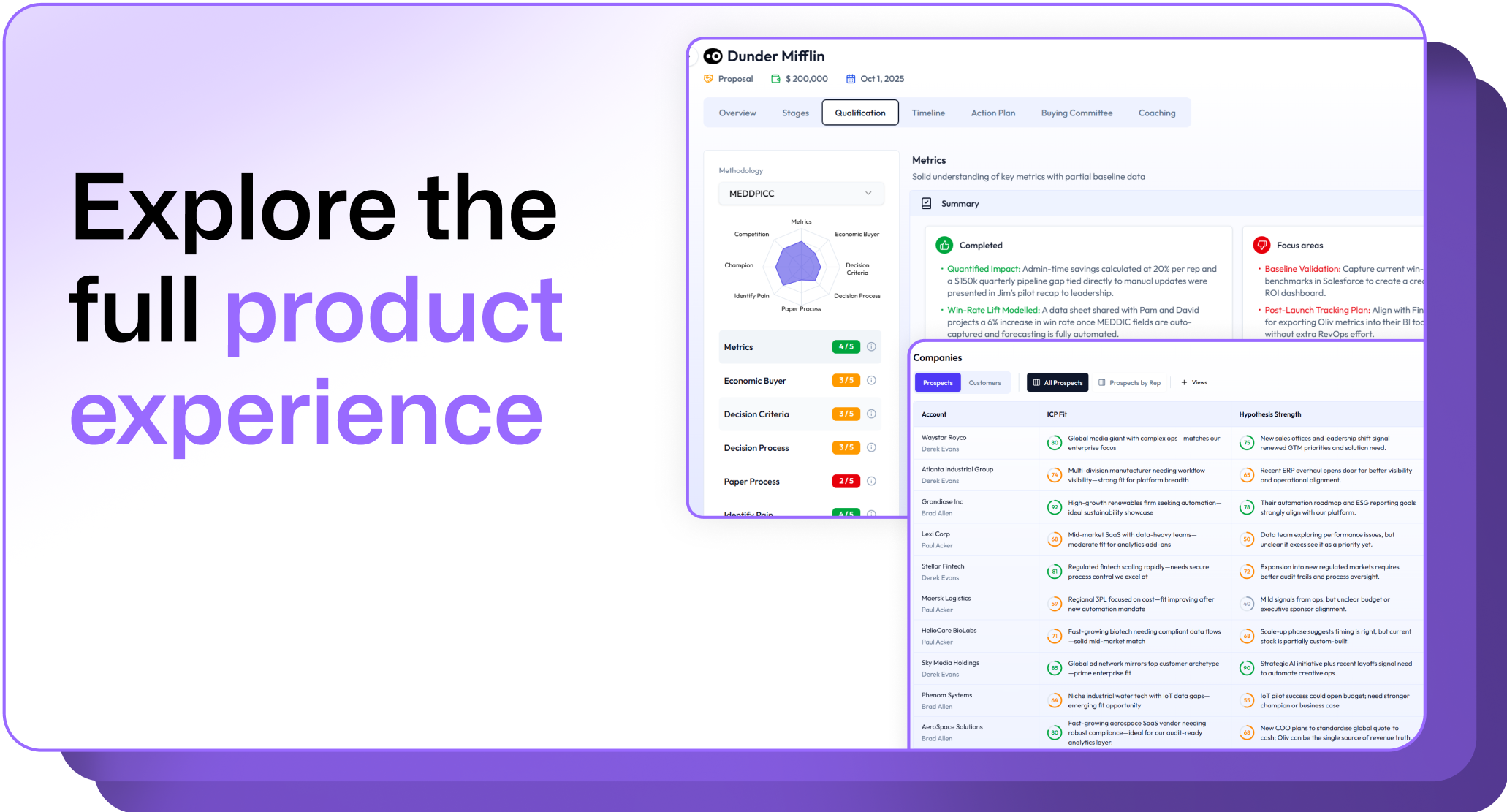
.avif)