8 Best Sales Goal Tracking Software in 2026: Quota Views, Progress Dashboards, Rep Motivation, and CRM Sync
Written by
Ishan Chhabra
Last Updated :
August 17, 2026
Skim in :
13
mins
In this article
Revenue teams love Oliv
Here’s why:
All your deal data unified (from 30+ tools and tabs).
Insights are delivered to you directly, no digging.
AI agents automate tasks for you.
Thank you! Your submission has been received!
Oops! Something went wrong while submitting the form.
Meet Oliv’s AI Agents
Hi! I’m, Deal Driver
I track deals, flag risks, send weekly pipeline updates and give sales managers full visibility into deal progress
Hi! I’m, CRM Manager
I maintain CRM hygiene by updating core, custom and qualification fields all without your team lifting a finger
Hi! I’m, Forecaster
I build accurate forecasts based on real deal movement and tell you which deals to pull in to hit your number
Hi! I’m, Coach
I believe performance fuels revenue. I spot skill gaps, score calls and build coaching plans to help every rep level up
Hi! I’m, Prospector
I dig into target accounts to surface the right contacts, tailor and time outreach so you always strike when it counts
Hi! I’m, Pipeline tracker
I call reps to get deal updates, and deliver a real-time, CRM-synced roll-up view of deal progress
Hi! I’m, Analyst
I answer complex pipeline questions, uncover deal patterns, and build reports that guide strategic decisions
TL;DR
The eight tools ranked are Varicent, Xactly, Oliv AI, Anaplan, Salesforce Sales Cloud, QuotaPath, Ambition, and Spinify, split across systems of record, rep-facing trackers, and the data layer.
Goal tracking looks like a reporting problem and is actually a reconciliation problem. Reconciliation and Finance acceptance carried 30% of our scoring weight for that reason.
Under roughly fifteen reps with stable territories, a maintained spreadsheet still wins. Three events break it: mid-quarter territory changes, split credit, and prorated quota.
Only 32% of teams learn about quota or territory changes immediately, which is where dashboard and commission-statement drift usually begins.
Quota attainment averages roughly 43% in 2026, so track your rep-to-rep spread rather than the team average a leaderboard displays.
Five of the eight vendors publish no pricing. Oliv AI publishes a $19 to $79 seat ladder, a $0 platform fee, and free view-only seats.
Q1. What are the 8 best sales goal tracking software tools for revenue teams in 2026? [toc=1. The 8 Tools]
The eight best sales goal tracking tools for 2026 are Varicent, Xactly, Oliv AI, Anaplan, Salesforce Sales Cloud, QuotaPath, Ambition, and Spinify. They split three ways: enterprise systems of record for attainment and compensation, lightweight rep-facing trackers, and the data layer underneath the number. Most twenty-rep teams shopping this keyword need the second group, not the first.
⭐ The ranked list, and why each slot is earned
Varicent owns attainment as a plan of record, and Finance signs off on the output.
Xactly matches it on reconciliation and adds a shipped agent layer for dispute handling.
Oliv AI is here for the input, not the tracker.
Anaplan models quota and territory at enterprise scale, with tracking as a by-product.
Salesforce Sales Cloud is where the attainment data already lives.
QuotaPath publishes its price and shows reps their own pacing.
Ambition turns the number into coaching and scorecards.
Spinify is the leaderboard layer, rated 4.6 out of 5 across 1,001 G2 reviews.
Three of these eight (Varicent, Xactly, and Anaplan) are planning and compensation platforms, not trackers. A twenty-rep team is probably not buying any of them. I would rather say that in the first hundred words than let you find out in a procurement cycle.
🎯 Design versus monitoring, stated once
This article is about monitoring attainment against a plan that is already set. Designing that plan (annual capacity, territory carving, scenario modeling) is a different purchase with a different budget line. If you are still setting the targets themselves, start with our guide on how to set sales goals before you shop for a tracker.
Keep the two separate and the shortlist gets short fast. Blur them and you end up demoing a compensation suite when you wanted a dashboard.
The comparison table
8 Best Sales Goal Tracking Software Tools Compared (2026)
#
Tool
Best for
Owns attainment record
Rep-facing view
CRM sync
Published price
Rating
1
Varicent
Finance-accepted attainment at enterprise scale
Yes, plan of record
Yes, via portals
Bidirectional
Quote only
⭐⭐⭐⭐⭐
2
Xactly
Comp-linked attainment with agentic dispute handling
Yes, plan of record
Yes, via portals
Bidirectional
Quote only
⭐⭐⭐⭐⭐
3
Oliv AI
The pipeline and booking data the tracker reads
No
No
Writes back to CRM
$19 to $79 per seat, $0 platform fee
⭐⭐⭐⭐⭐
4
Anaplan
Quota and territory modeling at scale
Partly, plan side
Limited
Connector-based
Quote only
⭐⭐⭐⭐
5
Salesforce Sales Cloud
Simple goals inside the CRM you already run
Source data only
Yes, native
Native
Edition-based
⭐⭐⭐⭐
6
QuotaPath
Small teams that want a live personal number
Partly
Yes, strong
Bidirectional
$35 and $50 per user monthly, plus platform fee
⭐⭐⭐⭐
7
Ambition
Scorecards and coaching on top of attainment
No
Yes
Read and write
Quote only
⭐⭐⭐
8
Spinify
Contests and public leaderboards
No
Yes, gamified
Read-based
Quote only
⭐⭐⭐
Ratings follow the five-criterion rubric in the methodology section. Reconciliation and Finance acceptance carries 30% of the weight, which is why two compensation platforms lead a goal tracking list.
🧭 Which of the three groups are you actually shopping?
If your comp plan fits on one line per rep, you are shopping group two. If it needs footnotes for overlays, splits, and ramp, you are shopping group one.
Oliv AI sits in the third group and calculates no quota, no attainment, and no commission. What Oliv AI does own is the record underneath the tracker, resolving calls, emails, and meetings to the right opportunity at 95%+ field accuracy against roughly 60% for manual entry. That is the same argument we make about CRM data quality automation for RevOps.
1.1 Varicent [toc=1.1 Varicent]
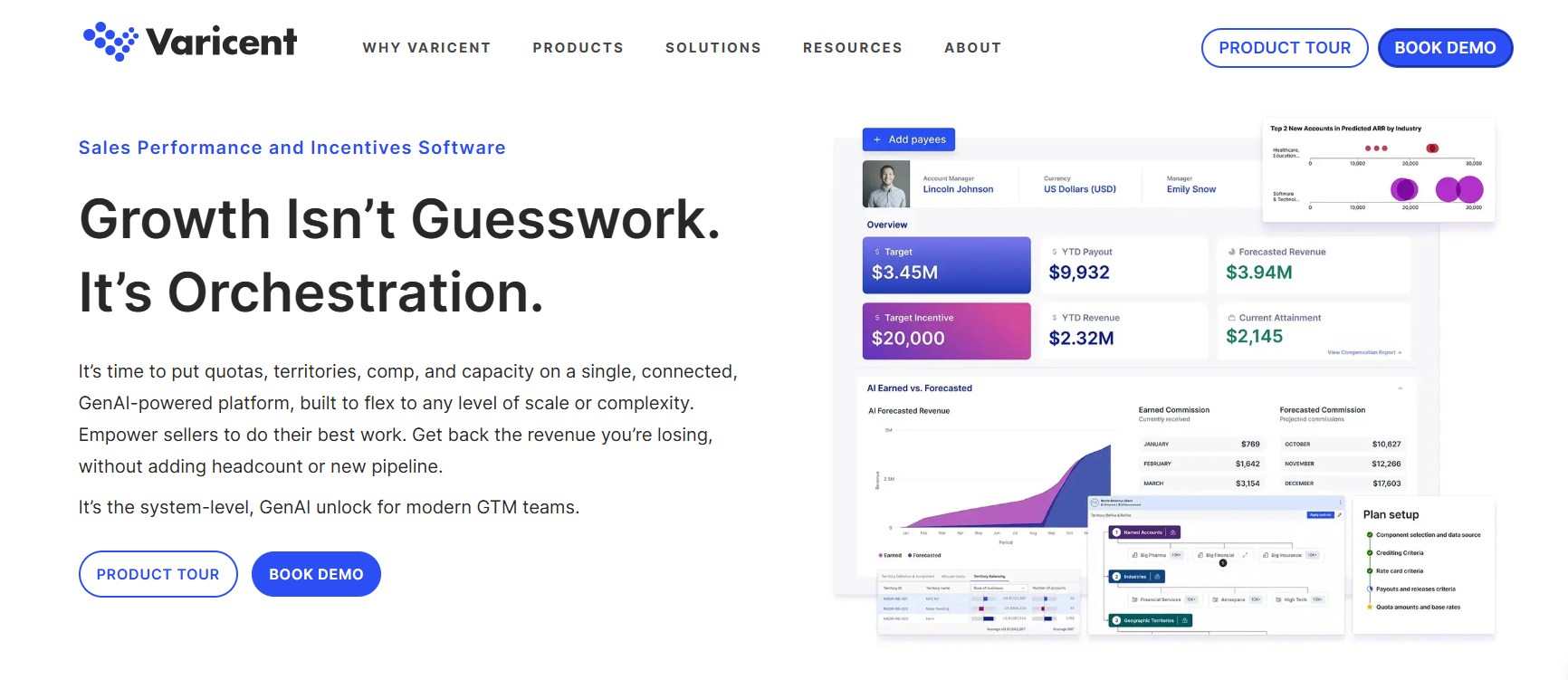
Varicent's incentives platform displays attainment against a $3.45M target alongside payout, forecast, and territory balancing panels, illustrating quota tracking held as a system of record.
Varicent is an enterprise sales performance management platform that treats attainment as a system of record, not a view. It runs incentive compensation, territory and quota planning, and revenue analytics on one data model, with Symon.AI as its data science engine. Gartner named it a Leader in the 2026 Magic Quadrant for SPM for the eighth consecutive year.
🧱 What it actually does
Varicent holds the plan, the quota, the territory, and the payout calculation in the same place. When a territory changes in week six, the change propagates instead of silently breaking a saved report.
That single behavior is why it ranks first here. Finance accepts the output, so the rep view and the commission statement come from one calculation.
🔑 Key features
Incentive compensation management with audit trails on every amendment.
Territory and quota planning, including effective-dated assignment changes.
Symon.AI for data preparation, predictive forecasting, and territory optimization models.
Embedded GenAI assistants for compensation inquiries and plan documentation.
Rep-facing statements and attainment portals fed by the same engine that pays.
💰 Pricing and implementation
Varicent does not publish pricing. Expect a quoted annual license plus implementation, and treat implementation as a real line item rather than a rounding error.
Independent reviewers describe it as an enterprise buy with a proper deployment project attached. Budget for a partner or an internal admin who owns the model after go-live, the same staffing question that shapes any agentic AI implementation across RevOps data architecture.
📅 Product updates
Varicent Product Update Timeline
Period
What shipped, and what it changed technically
Through 2025
Core SPM ran on ICM, Territory and Quota Planning, and Symon.AI as a bolted-on analytics engine, with AI applied to isolated tools rather than the platform structure. Varicent company history
December 2025 to 2026
Varicent unveiled an AI-native architecture at its Unlock Innovation Forum: on-demand territory and scenario modeling, automated build and test of incentive logic, multi-source data processing with instant documentation, and inquiry resolution cut to minutes. Varicent AI-native architecture announcement
Expected next
Itemized GA delivery of the December 2025 unveil, since independent analysis flags that it blends shipped features with roadmap and is not individually itemized. CFO Shortlist Varicent review, July 2026
✅ Pros and ❌ cons
✅ Attainment, quota, territory, and payout share one data model, so reconciliation is structural.
✅ Forrester named it the only SPM and ICM solution evaluated with an in-depth set of AI capabilities in Q1 2025.
✅ Ranked number one across all use cases in Gartner's 2026 Critical Capabilities for SPM.
❌ No published pricing, which slows early-stage evaluation.
❌ The December 2025 AI-native claim mixes generally available features with roadmap.
⚠️ Overkill for a team under roughly fifty reps with one quota model.
👤 Best fit
Buy Varicent when Finance is in the evaluation and disputes are the recurring pain. Skip it when you just need reps to see a live number, which is closer to the job of revenue reporting software.
🗣️ What reviewers report
Varicent holds a 4.5 out of 5 rating across more than 580 G2 reviews, with 599 total reviews recorded on G2's head-to-head comparison against Xactly. Reviewers specifically single out its sales performance features in that comparison. You can read the current review corpus on the Varicent G2 profile.
1.2 Xactly [toc=1.2 Xactly]
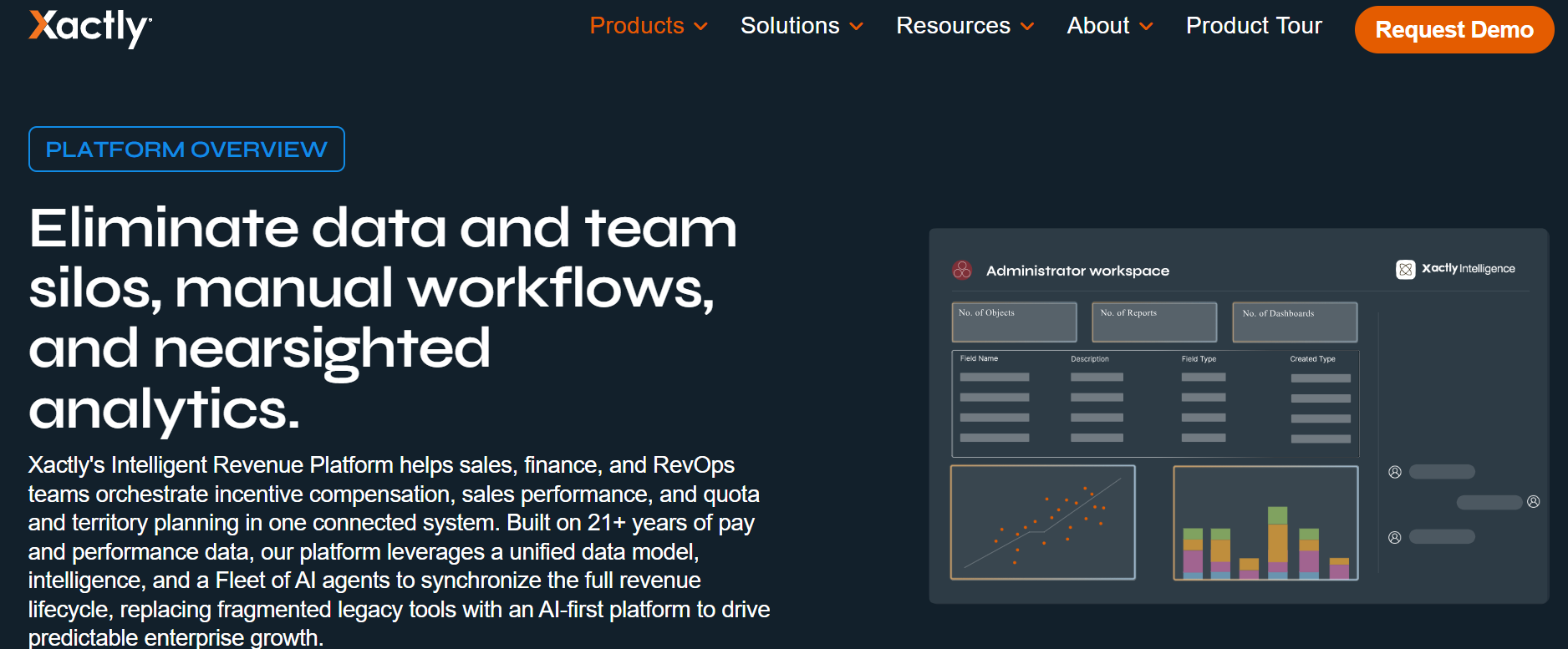
Xactly's platform overview highlights a unified data model, AI agent fleet, and administrator dashboards linking incentive compensation to quota and territory planning for RevOps teams.
Xactly is the other enterprise platform that owns attainment as a record rather than a report. Its Intelligent Revenue Platform links planning, quota, and compensation, and it was named a Leader by Gartner in the 2026 Magic Quadrant for Sales Performance Management. Its differentiator in 2026 is a shipped agent layer, not a promised one.
🧱 What it actually does
Xactly calculates what a rep earned and what they attained from the same engine. Reps see pacing, and the number they see is the number Finance pays on.
The 2026 additions push into workflow automation. Agents now handle plan configuration and dispute triage instead of a comp analyst working a queue, which puts it in the same conversation as other AI agents for RevOps.
🔑 Key features
Incentive compensation with a proprietary pay and performance benchmarking dataset.
Quota and territory planning tied to the same unified data model.
Fleet of Agents covering builder, workflow, and optimization agents, including an Incent Plan Configuration Agent and a Dispute Management Agent.
Intelligence Studio, which lets customers and partners configure their own agents against their business rules.
Agent-to-agent integration with ServiceNow Now Assist over Model Context Protocol.
💰 Pricing and implementation
Xactly is quote-only, like Varicent. Implementation is a project, and the dispute workflow is usually where the payback shows up first.
Ask specifically which agents are generally available on your edition. The Fleet launched in May 2026, so entitlement varies by contract date.
📅 Product updates
Xactly Product Update Timeline
Period
What shipped, and what it changed technically
August 2025
Xactly Intelligence AI Agents went generally available on the Intelligent Revenue Platform, built on its pay and performance dataset, unified data model, and business logic, with app extension through Xactly Extend. Xactly AI Agents launch, August 2025
April to May 2026
The Dispute Management AI Agent shipped with ServiceNow, using Model Context Protocol for real-time cross-platform coordination. In May, the Fleet of Agents and Intelligence Studio added builder, workflow, and optimization agents plus customer-configured agents. Xactly and ServiceNow announcement, April 2026
Expected next
More agents on the shared Xactly and ServiceNow agentic framework, since the Dispute Management Agent is described as the first of a fleet on that framework. Xactly press room
✅ Pros and ❌ cons
✅ Agents are shipped and dated, not roadmap language.
✅ Benchmarking data from its own pay and performance dataset helps sanity-check quota levels.
✅ Gartner Leader in the 2026 SPM Magic Quadrant.
❌ No published pricing, so early comparison against QuotaPath is apples to oranges.
❌ Agent entitlement depends on edition and contract timing.
⚠️ The agent layer solves comp disputes, which is not the same as motivating a rep.
👤 Best fit
Choose Xactly when comp disputes eat your quarter and you want automation on that queue. It is the stronger pick if ServiceNow already runs your internal ticketing.
🗣️ What reviewers report
Xactly carries 1,095 total reviews on G2's Varicent comparison, with a 7.8 out of 10 satisfaction score recorded across 103 responses in that head-to-head. The larger review base is worth reading by segment, since enterprise and mid-market experiences diverge on implementation effort. Current reviews sit on the Xactly G2 profile.
1.3 Oliv AI [toc=1.3 Oliv AI]
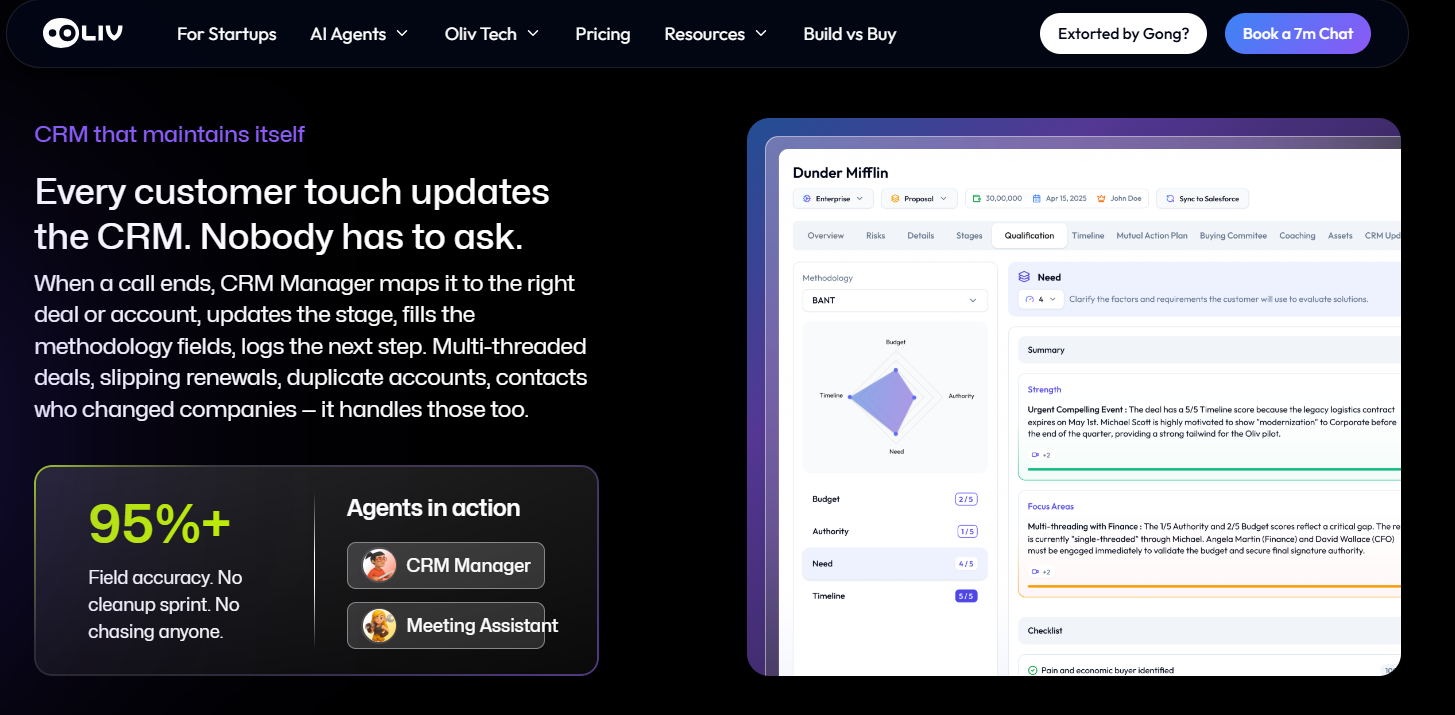
Oliv AI shows automated CRM maintenance, methodology field scoring, and 95%+ field accuracy, improving the pipeline and booking data underneath any sales goal tracking dashboard.
Oliv AI is not a quota tracking, attainment, or compensation product, and it calculates none of those numbers. It is an AI-native revenue intelligence platform and revenue orchestration layer that runs on top of Salesforce or HubSpot. It earns third place on one claim only: the reliability of the pipeline and booking data every tracker above it reads.
🧱 What it actually does
Oliv AI resolves calls, emails, meetings, and shared Slack channels to the right account and opportunity, then writes that context back into the CRM. In practice, that means the deal record reflects what happened, not what a rep remembered to type on Friday.
I will be blunt about the boundary. If you want a quota view, buy one of the other seven. If your quota view keeps disagreeing with reality, the problem is usually upstream.
🔑 Key features
Context graph that maps activity to the correct opportunity, including messy CRMs with duplicate accounts.
Analyst agent that answers why attainment sits where it does, not just that it does.
Forecaster agent for in-period drift signals before the quarter closes.
CRM Manager agent that auto-fills fields at 95%+ accuracy, against roughly 60% for manual entry.
70+ integrations across CRM, calls, email, engagement tools, and warehouses (Snowflake, Redshift, and BigQuery).
💰 Pricing and implementation
Oliv AI publishes a per-seat ladder from $19 to $79, with a $0 platform fee and free view-only seats, always. That last line matters here, because a tracker is read by everyone and built by one person.
Setup runs from same-day self-serve to a guided rollout inside a week, depending on scope. Reviewers describe onboarding as five to fifteen minutes for individual use, with a support engineer for team deployments, and the sequence is documented in our RevOps implementation and admin guide.
📅 Product updates
Oliv AI Product Update Timeline
Period
What shipped, and what it changed technically
Through 2025
Core product ran as conversation intelligence plus CRM auto-fill, with the context graph infrastructure built over roughly 18 months to solve entity resolution on messy CRMs. Oliv RevOps page
2026 to date
Agent marketplace expanded to 37 named agents across 17 role categories, with plain-English SOPs, per-agent tool control, approval gating, and run-level evals. Capture extended to shared inter-company Slack channels and in-person meetings. Oliv agents marketplace
Expected next
Deeper orchestration between agents (one agent dispatching another), plus continued expansion of the published price ladder as the app-layer surfaces get cheaper. Oliv pricing page
✅ Pros and ❌ cons
✅ Improves the input every tracker depends on, rather than adding a ninth dashboard.
✅ Published pricing and a $0 platform fee, which three vendors on this list do not offer.
✅ Free view-only seats, so managers reading the number cost nothing.
❌ No quota views, no attainment calculation, no commission, and no leaderboards.
❌ Analytics and dashboard customization are the most common reviewer complaints.
⚠️ Weak fit for teams under fifty people with no CRM owner.
👤 Best fit
Shortlist Oliv AI when your tracker is technically fine but nobody trusts the number in it. Skip it if you need the tracker itself.
🗣️ What users say
"I use Oliv.ai to keep our sales process running smoothly. It helps in automating and updating our CRM after calls, provides a clear deal summary... I like how it makes forecasting and pipeline reviews easier, keeping everything up to date and the CRM hygienic." — Verified reviewer, Oliv AI G2 - Verified Review, 4.5 stars, 26 June 2026
"I'd love to see few more options to customize dashboards and reports for different teams." — Verified reviewer, Oliv AI G2 - Verified Review, 4.5 stars, 26 June 2026
"The main downside is that the analytics could be more customizable. It's a minor issue, but having more flexibility in how I view and configure analytics would make it even better." — Verified reviewer, Oliv AI G2 - Verified Review, 5 stars, 8 July 2026
Two of the three quotes above are complaints about reporting flexibility. That is the honest read on a company that does not sell you a reporting product.
1.4 Anaplan [toc=1.4 Anaplan]
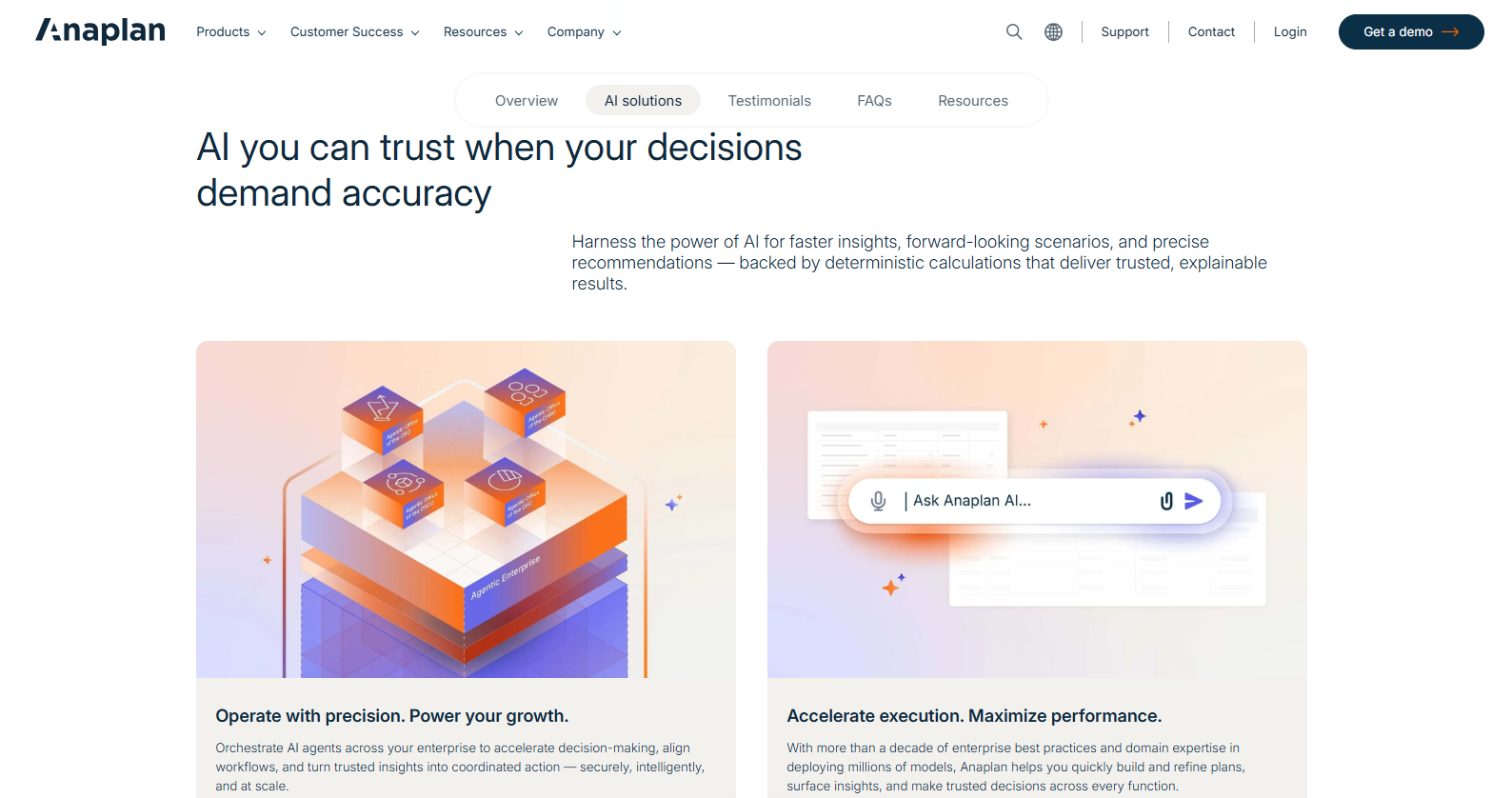
Anaplan's AI layer for connected planning, showing orchestrated agents and natural-language querying that support quota modeling and scenario analysis upstream of any attainment tracking view.
Anaplan is a connected planning platform that models quota, territory, and capacity at enterprise scale. Tracking attainment is a by-product of the model, not the headline job. It ranks fourth here because the plan lives in Anaplan while the payout usually lives somewhere else.
🧱 What it actually does
Anaplan holds the calculation engine for how quotas were built in the first place. Change an assumption and the downstream numbers recalculate across the model.
That is powerful for planning season. It is heavy machinery for a Monday attainment question.
🔑 Key features
Multidimensional planning models for quota, territory, and capacity.
Scenario and what-if analysis across sales, finance, and supply chain in one model.
Anaplan Analyst, a native AI tool answering natural-language questions against live models.
Anaplan CoModeler, an AI agent that helps build, troubleshoot, and optimize models.
Agent Studio for configuring and governing those AI capabilities centrally.
💰 Pricing and implementation
Anaplan is quote-only and workspace-based. Implementation typically involves a partner, and model ownership needs a named internal builder.
Treat this as a planning investment with a tracking side effect. If nobody on your team wants to own a model, this is the wrong purchase.
📅 Product updates
Anaplan Product Update Timeline
Period
What shipped, and what it changed technically
Through December 2025
Platform ran on Classic and Polaris workspaces, with role-based AI agents introduced in December 2025, including Anaplan Sales Analyst for risk alerts and impact scenarios. Anaplan newsroom
March to June 2026
CoModeler, Anaplan Analyst, and Agent Studio shipped in the March 2026 release across Polaris and Classic, alongside 12 pre-built planning apps. In June, Anaplan announced its Agentic Enterprise operating model. Anaplan March 2026 release notes
Expected next
Complete suites of domain-specific, skills-based agents for sales, supply chain, and HR by end of 2026, after an initial CFO-office focus in October. Anaplan Agentic Enterprise announcement
✅ Pros and ❌ cons
✅ Strongest scenario modeling on this list by a wide margin.
✅ Sales, finance, and workforce plans can share one model and one set of assumptions.
✅ Agent Studio adds governance over who can build AI assistants on the model.
❌ Attainment tracking is downstream of planning, not the product's core job.
❌ Quote-only pricing plus partner-led implementation.
⚠️ Sales agents are still arriving; the October 2026 focus is the CFO's office.
👤 Best fit
Buy Anaplan when planning season is the bottleneck and Finance already runs models. Do not buy it to answer "where am I against target," which is a job for sales analytics software.
🗣️ What reviewers report
G2 reviewers position Anaplan as one of the strongest sales planning platforms evaluated across 20+ tools, alongside Salesforce Sales Cloud and Varicent. In G2's head-to-head against Varicent, reviewers give Varicent the edge specifically on sales performance features. Read the current corpus on the Anaplan G2 comparison page.
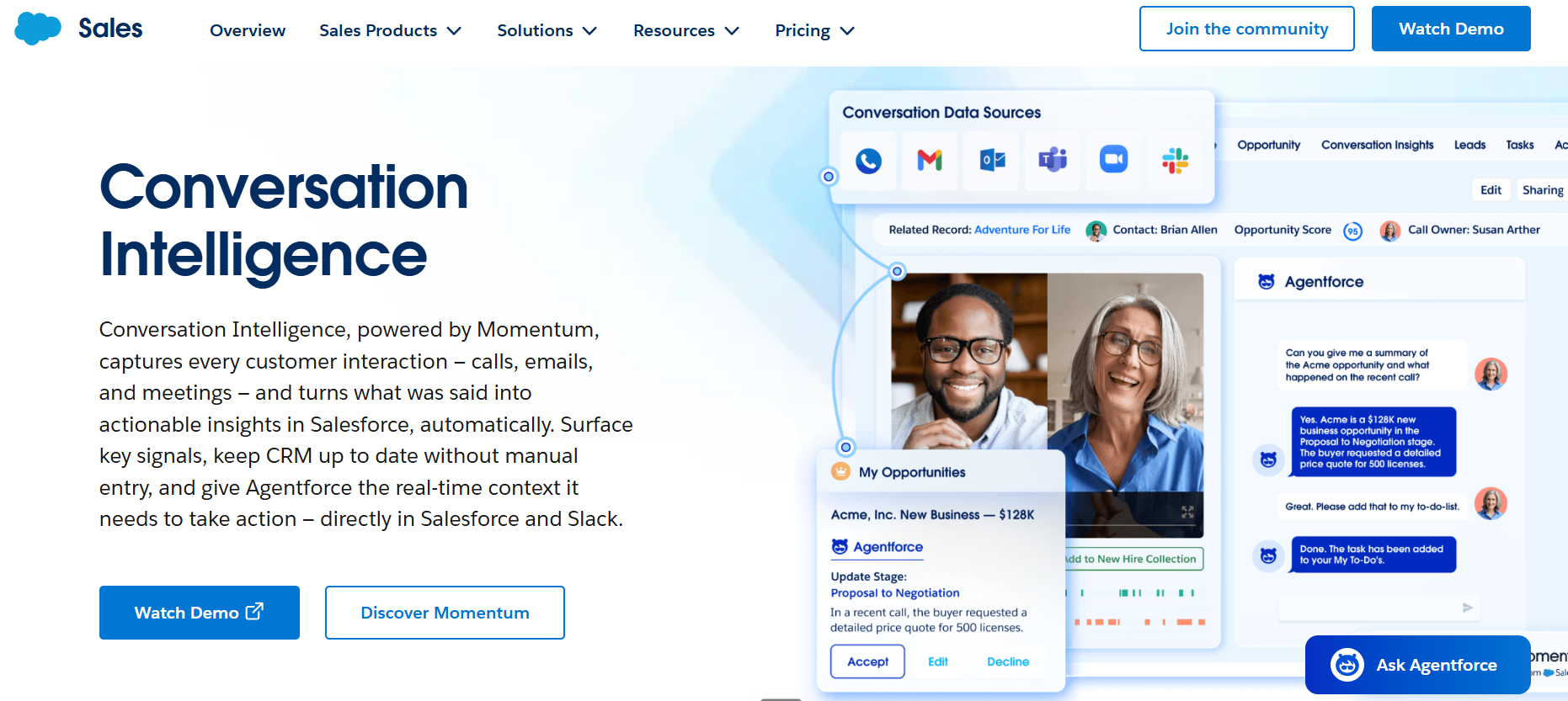
Salesforce Conversation Intelligence captures calls, emails, and meetings, then feeds opportunity context and stage updates into the CRM records that every quota progress dashboard reads.
Salesforce Sales Cloud is where the attainment data already lives, which is why it belongs on this list even though it is not a dedicated tracker. Native goals handle one quota per rep per period against a single measure. As of the Summer '26 release, Salesforce documentation notes that Sales Cloud is now Agentforce Sales.
🧱 What it actually does
Sales Cloud stores the opportunity, the amount, the close date, and the owner. Forecast quotas and goals sit on top of that data, so nothing has to sync.
That is the real advantage. Zero integration risk, because there is no integration.
🔑 Key features
Native sales goals, now supporting both currency and quantity targets in the Summer '26 release.
Forecast quotas and forecast categories tied to opportunity records.
Pipeline Inspection with built-in insights, deal alerts, and customizable sales methodologies.
Enterprise Territory Management for territory assignment and hierarchy.
Agentforce Sales Management, which suggests sales methodology steps against deal progress.
💰 Pricing and implementation
Pricing is edition-based, and the goal and forecasting depth you get depends on which edition you hold. Agentforce features require an add-on license or an Agentforce Sales Edition, and we break the tiers down in our Salesforce Agentforce pricing breakdown.
Verify your edition before assuming a feature exists. This product line has been renamed and repackaged repeatedly, so last year's comparison chart is unreliable.
📅 Product updates
Salesforce Sales Cloud Product Update Timeline
Period
What shipped, and what it changed technically
Winter '26 (October 2025)
Pipeline Management gained auto-generated next-best actions in Salesforce and Slack, Agentforce drafted follow-ups and scheduled meetings, and Account Research shipped behind an Agentforce add-on license. Salesforce Winter '26 announcement
Summer '26 (May to August 2026)
Sales Performance Management added differentiated sales goals with currency and quantity targets. Pipeline Inspection gained customizable methodologies and at-a-glance deal alerts. Sales Cloud was renamed Agentforce Sales. Salesforce Sales release notes
Expected next
The next major Agentforce Sales release lands in September 2026, with monthly updates to the digital workforce across the revenue cycle in between. Agentforce Sales product releases
✅ Pros and ❌ cons
✅ No sync, no second system, and no reconciliation between the tracker and the source.
✅ Currency and quantity goal targets now ship natively.
✅ Territory management and forecast quotas are built in at the right editions.
❌ Native goals break on multi-product quota, overlays, ramp schedules, and split credit.
❌ Meaningful goal and AI features sit behind higher editions or add-on licenses.
⚠️ Constant renaming makes feature verification a real step, not a formality.
👤 Best fit
Stay in Salesforce when your comp plan fits on one line per rep. Leave when it needs a footnote, and read our take on Agentforce limitations for B2B revenue teams before you commit to the native path.
🗣️ What reviewers report
Salesforce holds a 4.5 out of 5 rating in G2's quota software comparisons and appears in G2's own analyst evaluation of 20+ sales planning tools. Reviewers consistently split on the same axis: unmatched breadth, real configuration burden. Current reviews sit on the Salesforce Sales Cloud G2 profile.
1.6 QuotaPath [toc=1.6 QuotaPath]
QuotaPath is the lightweight commission and quota tracker on this list, and it is the only one besides Oliv AI that publishes its price. Reps see live attainment and projected earnings against the plan. It holds a 4.8 out of 5 rating on G2.
🧱 What it actually does
QuotaPath calculates what a rep has earned and how they are pacing to quota. Both numbers come from the same plan, which removes one common source of disagreement.
The product describes leaderboards as a way to motivate teams with friendly competition. That makes it the bridge between the enterprise systems above and the gamification tools below.
🔑 Key features
Quota attainment tracking and forecasting against the comp plan.
Commission calculation with rep-visible earnings breakdowns.
Leaderboards for team pacing.
CRM integrations with bidirectional sync.
14-day free trial, which is unusual in this category.
💰 Pricing and implementation
QuotaPath publishes two editions at $35 and $50 per user per month, billed annually, plus a monthly platform fee of $525 or $800 that covers the first five users. G2 records the starting price at $2,400 per year.
Run the math for your headcount before comparing to a quote-only vendor. The platform fee changes the picture materially for small teams, a pattern we cover in reducing sales tech stack costs.
📅 Product updates
QuotaPath Product Update Timeline
Period
What shipped, and what it changed technically
Through 2025
Product ran as commission tracking plus quota attainment forecasting, with rep-facing earnings visibility and leaderboards as the motivation surface. QuotaPath G2 profile
2026 pricing model
Published tiers moved to $35 and $50 per user per month billed annually, layered on a $525 or $800 monthly platform fee covering the first five users, with a 14-day trial. QuotaPath pricing page
Expected next
Continued depth on plan modeling and CRM sync, given the platform-fee model signals a move upmarket from the earlier freemium tier. QuotaPath pricing on G2
✅ Pros and ❌ cons
✅ Published pricing and a real free trial.
✅ Earnings and attainment come from one calculation, so reps can self-serve the answer.
✅ 4.8 out of 5 on G2, the highest rating on this list.
❌ The platform fee makes small deployments pricier than the per-seat number suggests.
❌ Not a system of record for enterprise territory and overlay complexity.
⚠️ Leaderboards are present, but this is not a dedicated gamification tool.
👤 Best fit
Choose QuotaPath for a ten to seventy-five rep team that wants one trusted number per rep. Skip it if Finance needs an auditable plan of record with amendment trails.
🗣️ What reviewers report
QuotaPath averages 4.8 out of 5 on G2, with reviewers pointing to attainment forecasting and rep-level pacing as the core value. Independent software directories list a free tier and entry pricing from $15 per user per month, which conflicts with the current published page, so verify before you quote it internally. Read the reviews on the QuotaPath G2 profile.
1.7 Ambition [toc=1.7 Ambition]
Ambition is a sales performance and coaching platform that turns attainment into scorecards, contests, and coaching sessions. It does not own the attainment record. It makes the record visible in a way managers can act on, and it holds a 4.6 out of 5 G2 rating across 575 reviews.
🧱 What it actually does
Ambition tracks KPIs and scorecards, then wraps coaching workflow around them. A manager sees who is off pace and gets a structured coaching session rather than a chart.
That is a different job from tracking. It is the job most goal-tracking articles quietly skip, and it overlaps heavily with the best sales coaching software category.
🔑 Key features
Scorecards and KPI tracking across activity and outcome metrics.
Gamification, including contests and TV leaderboards.
Coaching session workflow tied to scorecard performance.
Sales tracking automation that pulls metrics from connected systems.
Manager-facing performance views rolled up by team.
💰 Pricing and implementation
Ambition does not publish pricing. Expect a quoted per-seat model with an implementation window for scorecard configuration.
The setup cost here is definitional, not technical. Deciding which three metrics matter takes longer than connecting the data.
📅 Product updates
Ambition Product Update Timeline
Period
What shipped, and what it changed technically
Through 2025
Platform combined scorecard and KPI tracking, gamification, and coaching orchestration into one manager workflow. Ambition sales tracking software
2026 positioning
Ambition appears in current 2026 sales leaderboard comparisons alongside Spinify, rated 4.6 out of 5 across 575 G2 reviews, with coaching orchestration as its stated differentiator. Ambition G2 profile
Expected next
Continued convergence of coaching workflow and AI-assisted scorecard analysis, following the wider category shift toward agent-assisted manager workflows. G2 sales gamification category
✅ Pros and ❌ cons
✅ Links the number to a coaching action, which pure dashboards do not.
✅ Strong manager-side scorecard rollups.
✅ 4.6 out of 5 across 575 G2 reviews.
❌ No pricing published, so early budget comparison is guesswork.
❌ Depends entirely on the accuracy of the upstream attainment data.
⚠️ A scorecard built on a disputed number amplifies the dispute.
👤 Best fit
Add Ambition when your attainment number is trusted and the gap is manager behavior. It is a layer, not a foundation.
🗣️ What reviewers report
Ambition carries a 4.6 out of 5 G2 rating across 575 reviews in current 2026 leaderboard comparisons. It also appears in independent 2026 gamification roundups alongside Spinify, SmartWinnr, and Xoxoday Compass. Reviews are on the Ambition G2 profile.
1.8 Spinify [toc=1.8 Spinify]
Spinify is the pure gamification layer: leaderboards, contests, and recognition built on data pulled from your CRM. It was ranked number one in G2's Summer 2026 Grid Report for Sales Gamification, holding a 4.6-star rating across 944 to 1,001 reviews depending on the index.
🧱 What it actually does
Spinify reads performance data and renders it as live standings, contests, and celebration moments. Real-time updates are the single most praised element in its review corpus.
It tracks nothing you do not already track. It changes who looks at it and how often.
🔑 Key features
Public and private leaderboards with real-time updates.
Contest and competition tracking dashboards.
Recognition and celebration triggers on milestone events.
Over 1,500,000 leaderboards created, with named customers including GE Appliances and RE/MAX.
CRM and data-source connectors feeding the standings.
💰 Pricing and implementation
Spinify does not publish standard pricing on its G2 listing. Implementation is fast relative to the enterprise tools here, since it consumes existing data rather than owning a plan.
The real cost is design. Pick the wrong metric and you have industrialized the wrong behavior, which is why choosing the right sales productivity metrics matters more than the display layer.
📅 Product updates
Spinify Product Update Timeline
Period
What shipped, and what it changed technically
Through 2025
Platform ran as leaderboard and contest infrastructure with public and private standings, recognition triggers, and CRM data connectors. Spinify features on G2
May 2026
Spinify took fourteen independent number one G2 rankings in the Summer 2026 Grid, spanning Grid, Momentum, Small-Business, Mid-Market Relationship Usability, and Results indexes. Spinify G2 profile
Expected next
Deeper AI-assisted coaching prompts layered onto leaderboard events, consistent with the 2026 category direction across gamification vendors. G2 sales gamification category
✅ Pros and ❌ cons
✅ Ranked first in G2's Summer 2026 Grid for Sales Gamification.
✅ Real-time leaderboard updates are the most-praised attribute in reviews.
✅ Proven at volume, with over 1.5 million leaderboards created.
❌ An initial learning curve is the most repeated complaint in its reviews.
❌ No attainment record, no quota model, and no reconciliation with Finance.
⚠️ Public ranking backfires when reps cannot reproduce the maths behind it.
👤 Best fit
Use Spinify when the number is trusted and the room has gone quiet. Do not use it to fix a number nobody believes.
🗣️ What reviewers report
Spinify holds a 4.6 out of 5 rating across 944 reviews, with real-time updates cited as the standout and the initial learning curve as the most repeated complaint. Independent 2026 roundups place it first in its G2 gamification category. Reviews sit on the Spinify G2 profile.
Oliv AI sits at number three on this list without claiming the category, because it ships no quota view, no attainment calculation, and no commission engine. What it does own is measurable: 95%+ CRM field accuracy against roughly 60% for manual entry, a published $19 to $79 seat ladder, a $0 platform fee, and free view-only seats. A tracker is only as honest as the record beneath it, a point we expand on in our guide to AI deal intelligence.
1.3 Oliv AI [toc=1.3 Oliv AI]
Oliv AI is not a quota tracking, attainment, or compensation product, and it calculates none of those numbers. It is an AI-native revenue intelligence platform and revenue orchestration layer that runs on top of Salesforce or HubSpot. It earns third place on one claim only: the reliability of the pipeline and booking data every tracker above it reads.
🧱 What it actually does
Oliv AI resolves calls, emails, meetings, and shared Slack channels to the right account and opportunity, then writes that context back into the CRM. In practice, that means the deal record reflects what happened, not what a rep remembered to type on Friday.
I will be blunt about the boundary. If you want a quota view, buy one of the other seven. If your quota view keeps disagreeing with reality, the problem is usually upstream.
🔑 Key features
Context graph that maps activity to the correct opportunity, including messy CRMs with duplicate accounts.
Analyst agent that answers why attainment sits where it does, not just that it does.
Forecaster agent for in-period drift signals before the quarter closes.
CRM Manager agent that auto-fills fields at 95%+ accuracy, against roughly 60% for manual entry.
70+ integrations across CRM, calls, email, engagement tools, and warehouses (Snowflake, Redshift, and BigQuery).
💰 Pricing and implementation
Oliv AI publishes a per-seat ladder from $19 to $79, with a $0 platform fee and free view-only seats, always. That last line matters here, because a tracker is read by everyone and built by one person.
Setup runs from same-day self-serve to a guided rollout inside a week, depending on scope. Reviewers describe onboarding as five to fifteen minutes for individual use, with a support engineer for team deployments, and the full sequence is documented in our RevOps implementation and admin guide.
📅 Product updates
Oliv AI Product Update Timeline
Period
What shipped, and what it changed technically
Through 2025
Core product ran as conversation intelligence plus CRM auto-fill, with the context graph infrastructure built over roughly 18 months to solve entity resolution on messy CRMs. Oliv RevOps page
2026 to date
Agent marketplace expanded to 37 named agents across 17 role categories, with plain-English SOPs, per-agent tool control, approval gating, and run-level evals. Capture extended to shared inter-company Slack channels and in-person meetings. Oliv agents marketplace
Expected next
Deeper orchestration between agents (one agent dispatching another), plus continued expansion of the published price ladder as the app-layer surfaces get cheaper. Oliv pricing page
✅ Pros and ❌ cons
✅ Improves the input every tracker depends on, rather than adding a ninth dashboard.
✅ Published pricing and a $0 platform fee, which three vendors on this list do not offer.
✅ Free view-only seats, so managers reading the number cost nothing.
❌ No quota views, no attainment calculation, no commission, and no leaderboards.
❌ Analytics and dashboard customization are the most common reviewer complaints.
⚠️ Weak fit for teams under fifty people with no CRM owner.
👤 Best fit
Shortlist Oliv AI when your tracker is technically fine but nobody trusts the number in it. Skip it if you need the tracker itself.
🗣️ What users say
"I use Oliv.ai to keep our sales process running smoothly. It helps in automating and updating our CRM after calls, provides a clear deal summary... I like how it makes forecasting and pipeline reviews easier, keeping everything up to date and the CRM hygienic." — Verified reviewer, Oliv AI G2 - Verified Review, 4.5 stars, 26 June 2026
"I'd love to see few more options to customize dashboards and reports for different teams." — Verified reviewer, Oliv AI G2 - Verified Review, 4.5 stars, 26 June 2026
"The main downside is that the analytics could be more customizable. It's a minor issue, but having more flexibility in how I view and configure analytics would make it even better." — Verified reviewer, Oliv AI G2 - Verified Review, 5 stars, 8 July 2026
Two of the three quotes above are complaints about reporting flexibility. That is the honest read on a company that does not sell you a reporting product.
1.4 Anaplan [toc=1.4 Anaplan]
Anaplan is a connected planning platform that models quota, territory, and capacity at enterprise scale. Tracking attainment is a by-product of the model, not the headline job. It ranks fourth here because the plan lives in Anaplan while the payout usually lives somewhere else.
🧱 What it actually does
Anaplan holds the calculation engine for how quotas were built in the first place. Change an assumption and the downstream numbers recalculate across the model.
That is powerful for planning season. It is heavy machinery for a Monday attainment question.
🔑 Key features
Multidimensional planning models for quota, territory, and capacity.
Scenario and what-if analysis across sales, finance, and supply chain in one model.
Anaplan Analyst, a native AI tool answering natural-language questions against live models.
Anaplan CoModeler, an AI agent that helps build, troubleshoot, and optimize models.
Agent Studio for configuring and governing those AI capabilities centrally.
💰 Pricing and implementation
Anaplan is quote-only and workspace-based. Implementation typically involves a partner, and model ownership needs a named internal builder.
Treat this as a planning investment with a tracking side effect. If nobody on your team wants to own a model, this is the wrong purchase, and the staffing question is the same one that shapes any agentic AI implementation across RevOps data architecture.
📅 Product updates
Anaplan Product Update Timeline
Period
What shipped, and what it changed technically
Through December 2025
Platform ran on Classic and Polaris workspaces, with role-based AI agents introduced in December 2025, including Anaplan Sales Analyst for risk alerts and impact scenarios. Anaplan newsroom
March to June 2026
CoModeler, Anaplan Analyst, and Agent Studio shipped in the March 2026 release across Polaris and Classic, alongside 12 pre-built planning apps. In June, Anaplan announced its Agentic Enterprise operating model. Anaplan March 2026 release notes
Expected next
Complete suites of domain-specific, skills-based agents for sales, supply chain, and HR by end of 2026, after an initial CFO-office focus in October. Anaplan Agentic Enterprise announcement
✅ Pros and ❌ cons
✅ Strongest scenario modeling on this list by a wide margin.
✅ Sales, finance, and workforce plans can share one model and one set of assumptions.
✅ Agent Studio adds governance over who can build AI assistants on the model.
❌ Attainment tracking is downstream of planning, not the product's core job.
❌ Quote-only pricing plus partner-led implementation.
⚠️ Sales agents are still arriving, and the October 2026 focus is the CFO's office.
👤 Best fit
Buy Anaplan when planning season is the bottleneck and Finance already runs models. Do not buy it to answer "where am I against target," which is a job for sales analytics software.
🗣️ What reviewers report
G2 reviewers position Anaplan as one of the strongest sales planning platforms evaluated across 20+ tools, alongside Salesforce Sales Cloud and Varicent. In G2's head-to-head against Varicent, reviewers give Varicent the edge specifically on sales performance features. Read the current corpus on the Anaplan G2 comparison page.
Salesforce Sales Cloud is where the attainment data already lives, which is why it belongs on this list even though it is not a dedicated tracker. Native goals handle one quota per rep per period against a single measure. As of the Summer '26 release, Salesforce documentation notes that Sales Cloud is now Agentforce Sales.
🧱 What it actually does
Sales Cloud stores the opportunity, the amount, the close date, and the owner. Forecast quotas and goals sit on top of that data, so nothing has to sync.
That is the real advantage. Zero integration risk, because there is no integration.
🔑 Key features
Native sales goals, now supporting both currency and quantity targets in the Summer '26 release.
Forecast quotas and forecast categories tied to opportunity records.
Pipeline Inspection with built-in insights, deal alerts, and customizable sales methodologies.
Enterprise Territory Management for territory assignment and hierarchy.
Agentforce Sales Management, which suggests sales methodology steps against deal progress.
💰 Pricing and implementation
Pricing is edition-based, and the goal and forecasting depth you get depends on which edition you hold. Agentforce features require an add-on license or an Agentforce Sales Edition, and we break the tiers down in our Salesforce Agentforce pricing breakdown.
Verify your edition before assuming a feature exists. This product line has been renamed and repackaged repeatedly, so last year's comparison chart is unreliable.
📅 Product updates
Salesforce Sales Cloud Product Update Timeline
Period
What shipped, and what it changed technically
Winter '26 (October 2025)
Pipeline Management gained auto-generated next-best actions in Salesforce and Slack, Agentforce drafted follow-ups and scheduled meetings, and Account Research shipped behind an Agentforce add-on license. Salesforce Winter '26 announcement
Summer '26 (May to August 2026)
Sales Performance Management added differentiated sales goals with currency and quantity targets. Pipeline Inspection gained customizable methodologies and at-a-glance deal alerts. Sales Cloud was renamed Agentforce Sales. Salesforce Sales release notes
Expected next
The next major Agentforce Sales release lands in September 2026, with monthly updates to the digital workforce across the revenue cycle in between. Agentforce Sales product releases
✅ Pros and ❌ cons
✅ No sync, no second system, and no reconciliation between the tracker and the source.
✅ Currency and quantity goal targets now ship natively.
✅ Territory management and forecast quotas are built in at the right editions.
❌ Native goals break on multi-product quota, overlays, ramp schedules, and split credit.
❌ Meaningful goal and AI features sit behind higher editions or add-on licenses.
⚠️ Constant renaming makes feature verification a real step, not a formality.
👤 Best fit
Stay in Salesforce when your comp plan fits on one line per rep. Leave when it needs a footnote, and read our assessment of Agentforce limitations for B2B revenue teams before you commit to the native path.
🗣️ What reviewers report
Salesforce holds a 4.5 out of 5 rating in G2's quota software comparisons and appears in G2's own analyst evaluation of 20+ sales planning tools. Reviewers consistently split on the same axis: unmatched breadth, real configuration burden. Current reviews sit on the Salesforce Sales Cloud G2 profile.
1.6 QuotaPath [toc=1.6 QuotaPath]
QuotaPath is the lightweight commission and quota tracker on this list, and it is the only one besides Oliv AI that publishes its price. Reps see live attainment and projected earnings against the plan. It holds a 4.8 out of 5 rating on G2.
🧱 What it actually does
QuotaPath calculates what a rep has earned and how they are pacing to quota. Both numbers come from the same plan, which removes one common source of disagreement.
The product describes leaderboards as a way to motivate teams with friendly competition. That makes it the bridge between the enterprise systems above and the gamification tools below.
🔑 Key features
Quota attainment tracking and forecasting against the comp plan.
Commission calculation with rep-visible earnings breakdowns.
Leaderboards for team pacing.
CRM integrations with bidirectional sync.
14-day free trial, which is unusual in this category.
💰 Pricing and implementation
QuotaPath publishes two editions at $35 and $50 per user per month, billed annually, plus a monthly platform fee of $525 or $800 that covers the first five users. G2 records the starting price at $2,400 per year.
Run the math for your headcount before comparing to a quote-only vendor. The platform fee changes the picture materially for small teams, a pattern we unpack in reducing sales tech stack costs.
📅 Product updates
QuotaPath Product Update Timeline
Period
What shipped, and what it changed technically
Through 2025
Product ran as commission tracking plus quota attainment forecasting, with rep-facing earnings visibility and leaderboards as the motivation surface. QuotaPath G2 profile
2026 pricing model
Published tiers moved to $35 and $50 per user per month billed annually, layered on a $525 or $800 monthly platform fee covering the first five users, with a 14-day trial. QuotaPath pricing page
Expected next
Continued depth on plan modeling and CRM sync, given the platform-fee model signals a move upmarket from the earlier freemium tier. QuotaPath pricing on G2
✅ Pros and ❌ cons
✅ Published pricing and a real free trial.
✅ Earnings and attainment come from one calculation, so reps can self-serve the answer.
✅ 4.8 out of 5 on G2, the highest rating on this list.
❌ The platform fee makes small deployments pricier than the per-seat number suggests.
❌ Not a system of record for enterprise territory and overlay complexity.
⚠️ Leaderboards are present, but this is not a dedicated gamification tool.
👤 Best fit
Choose QuotaPath for a ten to seventy-five rep team that wants one trusted number per rep. Skip it if Finance needs an auditable plan of record with amendment trails.
🗣️ What reviewers report
QuotaPath averages 4.8 out of 5 on G2, with reviewers pointing to attainment forecasting and rep-level pacing as the core value. Independent software directories list a free tier and entry pricing from $15 per user per month, which conflicts with the current published page, so verify before you quote it internally. Read the reviews on the QuotaPath G2 profile.
1.7 Ambition [toc=1.7 Ambition]
Ambition is a sales performance and coaching platform that turns attainment into scorecards, contests, and coaching sessions. It does not own the attainment record. It makes the record visible in a way managers can act on, and it holds a 4.6 out of 5 G2 rating across 575 reviews.
🧱 What it actually does
Ambition tracks KPIs and scorecards, then wraps coaching workflow around them. A manager sees who is off pace and gets a structured coaching session rather than a chart.
That is a different job from tracking. It is the job most goal-tracking articles quietly skip, and it overlaps heavily with the best sales coaching software category.
🔑 Key features
Scorecards and KPI tracking across activity and outcome metrics.
Gamification, including contests and TV leaderboards.
Coaching session workflow tied to scorecard performance.
Sales tracking automation that pulls metrics from connected systems.
Manager-facing performance views rolled up by team.
💰 Pricing and implementation
Ambition does not publish pricing. Expect a quoted per-seat model with an implementation window for scorecard configuration.
The setup cost here is definitional, not technical. Deciding which three metrics matter takes longer than connecting the data.
📅 Product updates
Ambition Product Update Timeline
Period
What shipped, and what it changed technically
Through 2025
Platform combined scorecard and KPI tracking, gamification, and coaching orchestration into one manager workflow. Ambition G2 profile
2026 positioning
Ambition appears in current 2026 sales leaderboard comparisons alongside Spinify, rated 4.6 out of 5 across 575 G2 reviews, with coaching orchestration as its stated differentiator. G2 sales gamification category
Expected next
Continued convergence of coaching workflow and AI-assisted scorecard analysis, following the wider category shift toward agent-assisted manager workflows. Ambition features on G2
✅ Pros and ❌ cons
✅ Links the number to a coaching action, which pure dashboards do not.
✅ Strong manager-side scorecard rollups.
✅ 4.6 out of 5 across 575 G2 reviews.
❌ No pricing published, so early budget comparison is guesswork.
❌ Depends entirely on the accuracy of the upstream attainment data.
⚠️ A scorecard built on a disputed number amplifies the dispute.
👤 Best fit
Add Ambition when your attainment number is trusted and the gap is manager behavior. It is a layer, not a foundation, and the same logic applies to closing sales coaching skill gaps with AI.
🗣️ What reviewers report
Ambition carries a 4.6 out of 5 G2 rating across 575 reviews in current 2026 leaderboard comparisons. It also appears in independent 2026 gamification roundups alongside Spinify, SmartWinnr, and Xoxoday Compass. Reviews are on the Ambition G2 profile.
1.8 Spinify [toc=1.8 Spinify]
Spinify is the pure gamification layer: leaderboards, contests, and recognition built on data pulled from your CRM. It was ranked number one in G2's Summer 2026 Grid Report for Sales Gamification, holding a 4.6-star rating across 944 to 1,001 reviews depending on the index.
🧱 What it actually does
Spinify reads performance data and renders it as live standings, contests, and celebration moments. Real-time updates are the single most praised element in its review corpus.
It tracks nothing you do not already track. It changes who looks at it and how often.
🔑 Key features
Public and private leaderboards with real-time updates.
Contest and competition tracking dashboards.
Recognition and celebration triggers on milestone events.
Over 1,500,000 leaderboards created, with named customers including GE Appliances and RE/MAX.
CRM and data-source connectors feeding the standings.
💰 Pricing and implementation
Spinify does not publish standard pricing on its G2 listing. Implementation is fast relative to the enterprise tools here, since it consumes existing data rather than owning a plan.
The real cost is design. Pick the wrong metric and you have industrialized the wrong behavior, which is why choosing the right sales productivity metrics matters more than the display layer.
📅 Product updates
Spinify Product Update Timeline
Period
What shipped, and what it changed technically
Through 2025
Platform ran as leaderboard and contest infrastructure with public and private standings, recognition triggers, and CRM data connectors. Spinify features on G2
May 2026
Spinify took fourteen independent number one G2 rankings in the Summer 2026 Grid, spanning Grid, Momentum, Small-Business, Mid-Market Relationship Usability, and Results indexes. Spinify G2 profile
Expected next
Deeper AI-assisted coaching prompts layered onto leaderboard events, consistent with the 2026 category direction across gamification vendors. Best sales gamification software on G2
✅ Pros and ❌ cons
✅ Ranked first in G2's Summer 2026 Grid for Sales Gamification.
✅ Real-time leaderboard updates are the most-praised attribute in reviews.
✅ Proven at volume, with over 1.5 million leaderboards created.
❌ An initial learning curve is the most repeated complaint in its reviews.
❌ No attainment record, no quota model, and no reconciliation with Finance.
⚠️ Public ranking backfires when reps cannot reproduce the maths behind it.
👤 Best fit
Use Spinify when the number is trusted and the room has gone quiet. Do not use it to fix a number nobody believes.
🗣️ What reviewers report
Spinify holds a 4.6 out of 5 rating across 944 reviews, with real-time updates cited as the standout and the initial learning curve as the most repeated complaint. Independent 2026 roundups place it first in its G2 gamification category. Reviews sit on the Spinify G2 profile.
Oliv AI sits at number three on this list without claiming the category, because it ships no quota view, no attainment calculation, and no commission engine. What it does own is measurable: 95%+ CRM field accuracy against roughly 60% for manual entry, a published $19 to $79 seat ladder, a $0 platform fee, and free view-only seats. A tracker is only as honest as the record beneath it, a point we expand on in our guide to AI deal intelligence.
Q2. How did we score and rank these sales goal tracking tools? [toc=2. Scoring Methodology]
Every tool here was scored out of 100 across five weighted criteria: Reconciliation and Finance acceptance (30%), Mid-cycle change handling (25%), Rep-facing attainment visibility (20%), CRM sync depth (15%), and Pricing transparency (10%). Reconciliation carries the most weight for one reason. A tracker loses credibility when its number diverges from the commission statement, not when its interface looks dated.
⭐ Why the weights sit where they do
Reconciliation and change handling together carry 55 points. Those two criteria describe what happens when reality moves, and reality moves every quarter.
Rep-facing visibility earns 20 points because a number nobody looks at changes no behavior. Pricing transparency earns only 10, but it is the criterion three vendors on this list fail outright.
📊 The star bands and the sub-scores
Bands run in twenties: 0 to 20 is one star, 21 to 40 is two, 41 to 60 is three, 61 to 80 is four, and 81 to 100 is five.
Sales Goal Tracking Software Scoring Matrix (Out of 100)
Tool
Recon (30)
Change (25)
Rep view (20)
CRM sync (15)
Price (10)
Total
Stars
Varicent
29
23
15
12
3
82
⭐⭐⭐⭐⭐
Xactly
29
22
15
13
3
82
⭐⭐⭐⭐⭐
Oliv AI
n/s
n/s
n/s
14
10
84*
⭐⭐⭐⭐⭐
QuotaPath
20
15
18
13
9
75
⭐⭐⭐⭐
Salesforce
18
14
16
15
7
70
⭐⭐⭐⭐
Anaplan
22
21
10
10
3
66
⭐⭐⭐⭐
Ambition
8
9
18
11
3
49
⭐⭐⭐
Spinify
6
7
19
10
3
45
⭐⭐⭐
The asterisk matters. Oliv AI is marked "n/s" (not scored) on reconciliation, change handling, and rep-facing views, because it ships no attainment calculation, no quota model, and no commission engine. Its 84 is normalized across the two criteria it genuinely serves, plus a separate data-reliability check.
💰 What we could not verify, and therefore excluded
Five of the eight vendors publish no pricing at all. QuotaPath publishes $35 and $50 per user per month, plus a $525 or $800 monthly platform fee covering the first five users.
Oliv AI publishes a $19 to $79 seat ladder with a $0 platform fee and free view-only seats. Everything else in the pricing column is a quote, so we scored the absence rather than guessing at a number, and the same discipline applies when you reduce sales tech stack costs across a renewal cycle.
⚠️ Two evidence rules we held ourselves to
No implementation timeline appears in this ranking unless a vendor or a dated third party published it. Estimates from resellers were left out.
We also deliberately did not cite Gartner's Revenue Action Orchestration research here. That quadrant covers sales engagement, conversation intelligence, and revenue intelligence. Quota tracking and compensation sit outside its scope, so using it as authority would be a misattribution, a distinction we draw out in revenue intelligence versus conversation intelligence.
🎯 The one question that separates these products
Ask every vendor this: which system is the record for attainment, and how do amendments flow into it? Then stop talking and let them answer.
Varicent and Xactly answer with a plan of record. Salesforce answers with the CRM. Ambition and Spinify answer that they read someone else's number. That single question sorts this list faster than any feature grid, and it belongs in every RevOps governance and risk evaluation.
Oliv AI scores five stars on data reliability and pricing transparency, and is explicitly unscored on attainment calculation and commission, because it ships neither. Publishing the gap is more useful than padding the total.
Q3. Do you need goal tracking software, or is your spreadsheet still the right tool? [toc=3. Spreadsheet vs Software]
Under roughly fifteen reps with stable territories and one quota model, a maintained spreadsheet is genuinely the right tool. Three events break it: a mid-quarter territory change, split credit on a shared deal, and a prorated quota for a mid-quarter start. Once one of those recurs, you are choosing between a view on top of the CRM and a system of record Finance accepts.
✅ When the spreadsheet actually wins
I have watched teams buy software they did not need. A twelve-rep team, one product, one quota type, no overlays: a maintained sheet beats a $30,000 platform.
The honest version of this article says that out loud. If your comp plan fits on one line per rep, spend the money on pipeline instead, and put the effort into setting sales goals properly.
❌ The three events that break it
Week six, a rep changes patch. Every saved report keeps quietly crediting the old owner, and nobody notices until the rep does.
Then a deal closes with two owners. The sheet has one owner column, so someone types a manual split, and now the calculation lives in a comment.
The third is proration. A rep starts on day forty-one of the quarter, and the pacing formula assumes ninety days. The target looks wrong, the rep stops trusting the sheet, and you have lost the tracker.
⏰ The turn: tracking versus performance management
Here is the distinction almost nobody states. Goal tracking software renders attainment against a plan someone else set. Sales performance management owns the plan, the quota, the territory, and the payout, and Finance pays from it.
Trace the same week-six territory change through both. A tracking view shows the new owner going forward and leaves history ambiguous. A performance management system effective-dates the change, so history and payout both resolve correctly.
⚠️ The counter-argument, conceded properly
The compensation vendors have a strong case, and it deserves a fair hearing. Their argument is that attainment is inseparable from comp. Any tracker not tied to the plan of record will drift, so buying a view is buying the drift.
That argument is right, and it starts to bite at roughly seventy-five to one hundred reps. That is usually where a dedicated comp analyst appears. Below that, the drift is annoying. Above it, the drift is a quarterly dispute queue, which is one of the pressure points in scaling revenue operations from 25 to 200 reps.
🎯 The decision rule
Ask yourself one question before shortlisting anything. Has one of those three events happened twice in the last four quarters?
If no, keep the sheet and revisit next planning cycle. If yes, you are shopping, and the next section explains what to shop for.
Here is where I got it wrong for a while. I assumed the trigger was team size. It is not. It is comp plan complexity, and I have seen forty-rep teams with simpler plans than eight-rep teams selling three products with overlays.
🧩 Where the data layer sits
Neither category fixes bad input. Both read whatever your CRM says about the booking, the owner, and the close date.
Oliv AI runs on top of Salesforce and HubSpot rather than replacing either, and writes resolved deal context back into the record. That is a third thing entirely, and it is worth naming so you do not confuse it with the two categories above.
Oliv AI is an AI-native revenue intelligence and revenue orchestration platform, so it belongs to neither category here and feeds both. It publishes 95%+ CRM field accuracy against roughly 60% for manual entry. Whether you keep the spreadsheet or buy the platform, that input decides whether the output survives scrutiny.
Q4. Why does your attainment dashboard disagree with the commission statement? [toc=4. Reconciliation Problem]
The two numbers diverge because they read different records. The dashboard reads CRM bookings as of today. The commission statement reads the plan of record after amendments, clawbacks, splits, and proration. Ask every vendor which system is the record for attainment and how amendments flow into it. Only 32% of teams learn about quota or territory changes immediately, which is where most drift begins.
🧾 Two records, one number
Your rep opens the dashboard and sees 78% to quota. Finance opens the comp system and sees 71%. Both are correct inside their own system.
That gap is not a bug in either tool. It is the predictable result of two calculations reading different source data at different moments, the same failure pattern behind poor sales forecast accuracy.
⚠️ The four events that cause the drift
Amendment. A signed contract is revised after close, and the booking amount changes retroactively.
Clawback. A customer churns inside the clawback window, and Finance reverses credit the dashboard already showed.
Split credit. Two owners share a deal, and the CRM stores one owner field.
Prorated quota. A rep starts mid-quarter, and the pacing denominator is wrong from day one.
Each of these breaks a naive attainment calculation in a different way. Only the last one is visible to the rep at the time it happens.
⏰ Change notification is the hidden culprit
CaptivateIQ's 2026 State of Incentive Compensation found that only 32% of teams are immediately aware of quota, territory, or capacity changes. The other two-thirds find out later, which means the tracker runs on stale assumptions for weeks.
Quota relief compounds it. When leadership grants relief for a lost territory, the relief lands in the comp system first and the dashboard second, if at all.
🧪 The three-test trial protocol
Run these inside a trial account before you sign anything.
Change a rep's territory effective week six. Check whether historical credit stays with the original owner or retroactively moves.
Split a closed deal 60/40 between two owners. Confirm both attainment figures move by exactly that fraction.
Prorate a quota for a rep starting on day forty-one. Check the pacing calculation, not just the target number.
A tool that passes all three is reconciling. A tool that passes only the third is rendering.
❓ Will another tool make the disagreement worse?
This is the second objection, and it is fair. Adding a system can create a third number instead of resolving two.
The answer is architectural, not featural. If the new tool becomes the record, disputes drop. If it reads the CRM and displays a second opinion, you now have three versions of the truth and a longer meeting, which is the argument for a CRM data strategy built for revenue predictability.
🗣️ What operators say about the input side
"It helps in automating and updating our CRM after calls, provides a clear deal summary... I like how it makes forecasting and pipeline reviews easier, keeping everything up to date and the CRM hygienic." — Verified reviewer, Oliv AI G2 - Verified Review, 4.5 stars, 26 June 2026
"The biggest value of Oliv AI is its ability to operationalize customer conversations... As a result, we've seen better CRM hygiene, less administrative overhead, and more consistent execution." — Verified reviewer, Oliv AI G2 - Verified Review, 5 stars, 23 June 2026
"The main downside is that the analytics could be more customizable." — Verified reviewer, Oliv AI G2 - Verified Review, 5 stars, 8 July 2026
That third quote is the honest boundary. Cleaner input does not give you a better dashboard, and I would rather say so than blur the line.
Oliv AI does not calculate attainment or commission. What it does is resolve every call, email, and meeting to the correct account and opportunity before any tracker reads it, at 95%+ field accuracy against roughly 60% for manual entry. Reconciliation is a systems question. Input quality is the part most teams never audit, and CRM data quality automation for RevOps is where that audit starts.
Q5. How well does each tool sync with your CRM, and can an AI agent read the number? [toc=5. CRM Sync and Data Layer]
CRM-native goal tracking handles one quota per rep per period against a single measure, and it breaks on multi-product quota, overlays, ramp schedules, and splits. Beyond that, ask whether a tool reads from the CRM, writes back to it, or replaces it as the attainment record. Oliv AI sits in the write-back layer, publishing 95%+ CRM field accuracy against roughly 60% for manual entry.
🧱 What native CRM goals actually cover
Salesforce added differentiated sales goals with currency and quantity targets in its Summer '26 release, and Sales Cloud is now documented as Agentforce Sales. That covers a single target per rep cleanly.
It breaks at four points: multi-product quota, overlay reps sharing credit, ramp schedules for new hires, and split deals. Each of those needs a field the native object does not have, which is where teams start looking at Agentforce alternatives and competitors.
🔌 The three sync architectures, in plain terms
Think of it as who holds the pen.
Three CRM Sync Architectures for Goal Tracking Tools
Architecture
Who holds the pen
Tools on this list
Risk you inherit
Read-only
The CRM
Spinify, Ambition
Every CRM error, shown confidently
Bidirectional write-back
Shared
Oliv AI, QuotaPath
Conflict rules must be explicit
System of record
The tool
Varicent, Xactly
A second truth to reconcile deliberately
Read-only is the default and the most dangerous. It renders whatever the CRM says, including the wrong owner on a reassigned account.
⚠️ The data-quality precondition nobody audits
Roughly 65% of CRM data is inaccurate before any AI layer touches it, and reps spend only about 30% of their time selling. A tracker inherits both problems silently, which is the case for CRM data quality automation in RevOps.
I have watched teams spend four months evaluating dashboards while the underlying opportunity records had duplicate accounts. Oliv AI resolves activity to the correct account and opportunity first, which is a claim about the input, never a claim to be the tracker.
🤖 The number now has a second audience
Gartner expects 95% of seller research workflows to begin with AI by 2027, up from under 20% in 2024. That changes what "accessible" means for an attainment figure.
A BI export is no longer enough. Ask whether attainment is exposed through an API or a natural-language query surface an agent can call. Gartner also projects AI agents will outnumber sellers 10 to 1 by 2028, while fewer than 40% of sellers report productivity gains, a gap we unpack in AI agents versus SaaS dashboards.
✅ The questions for your RevOps and security review
Which direction does data flow, and what happens on conflict?
Does the tool write to standard objects or custom ones?
Is attainment retrievable by API, or only rendered in a UI?
What is the sync latency, and does it recalculate on amendment?
Who owns the field mapping after the implementation partner leaves?
Ask Oliv AI's Forecaster to surface in-period drift, and you get the answer before quarter close rather than after. That is a different job from reporting attainment, and the distinction matters when you are scoping revenue intelligence integration across CRM, Slack, and email.
🗣️ What users report about integration depth
"I appreciate that it integrates well with platforms like HubSpot and Salesforce, allowing us to capture insights from calls and maintain a complete view of customer interactions." — Verified reviewer, Oliv AI G2 - Verified Review, 4.5 stars, 23 June 2026
"Additionally, Oliv.ai integrates seamlessly with HubSpot, Zoom, and Google Meet, making my workflow smoother." — Verified reviewer, Oliv AI G2 - Verified Review, 4.5 stars, 17 June 2026
Oliv AI runs on top of the CRM and writes resolved deal context back into it, connecting across 70+ tools including Snowflake, Redshift, and BigQuery. That is a supporting-layer claim about the input to your tracker. It is not a claim to be one, and I would rather be boring about that boundary than clever.
Q6. Which tools actually motivate reps, and what does the attainment data say about whether that works? [toc=6. Rep Motivation Evidence]
QuotaPath, Ambition, and Spinify give reps a live personal attainment view, and Spinify and Ambition add public leaderboards and contests. The distinction that matters is personal pacing versus public ranking. With roughly 43% median quota attainment in 2026 and a 78.3% miss rate reported by Fullcast, the useful signal is your rep-to-rep spread, not the team average a leaderboard displays.
🎯 What each rep-facing tool actually shows
QuotaPath shows a rep their own pacing and projected earnings from the same plan, rated 4.8 out of 5 on G2. Ambition shows a scorecard and routes it into a coaching session, at 4.6 out of 5 across 575 reviews.
Spinify shows standings. It took fourteen number one rankings in G2's Summer 2026 Grid for Sales Gamification, with real-time updates the most praised attribute and an initial learning curve the most repeated complaint.
📉 The benchmark reality behind the leaderboard
Quota attainment averages 43% in 2026, down from 63% in 2019. RepVue's 2026 data puts mid-market AE attainment at 43.9% and enterprise AE at 40.9%.
So a leaderboard is usually displaying a team where most people are behind. That is a motivation design problem, not a display problem, and it is why closing sales coaching skill gaps beats adding another screen.
📊 Track the spread, not the average
Role-level splits tell you more than the team number. Enterprise AEs sit near 38%, while BDRs run far higher, so a mixed leaderboard compares incomparable jobs.
A healthy distribution has 60% to 80% of reps at target, with top performers pulling the average rather than carrying it. If your top two reps produce 70% of attainment, the leaderboard is telling everyone else they are losing, which is a sales performance optimization problem before it is a software problem.
❌ The failure mode nobody markets
A leaderboard built on a disputed number amplifies the dispute. Reps stop arguing about effort and start arguing about the maths.
I have seen a team turn off contests entirely after a split-credit error ranked the wrong rep first for three weeks. Nobody trusted the board again that year. Oliv AI's read is that the standard advice gets this backwards: fix the number first, then make it visible.
✅ The design rule that works
Pick one to three metrics, not twelve.
Weight toward leading indicators reps control, like meetings booked or multi-threading.
Show personal pacing by default, and make public ranking opt-in.
Publish the calculation, so a rep can reproduce it.
Review the metric set every quarter, because behavior adapts to whatever you display.
Oliv AI ships no leaderboard, contest, or gamification surface, and its view-only seats are free, always. Nobody pays per seat simply to look at the number, which removes one common reason managers get locked out of the view.
🗣️ What users say about visibility
"The Driver agent watches all my deals and flags any that are at risk, so I don't have to spend hours listening to recordings." — Verified reviewer, Oliv AI G2 - Verified Review, 4.5 stars, 17 June 2026
"The only downside I've noticed is that the mobile app is a bit basic compared to the desktop platform." — Verified reviewer, Oliv AI G2 - Verified Review, 5 stars, 8 July 2026
Worth saying plainly: no gamification vendor on this list publishes attainment lift data. They publish engagement metrics, which is not the same claim. If you find a vendor with a controlled attainment study, I would genuinely like to read it.
Q7. What does sales goal tracking software cost in 2026, and where does the price hide? [toc=7. Pricing and Total Cost]
Pricing splits cleanly. Lightweight trackers publish per-seat rates, and QuotaPath lists $35 and $50 per user per month plus a $525 or $800 monthly platform fee covering the first five users. Anaplan, Varicent, and Xactly are quote-only. Oliv AI publishes a full ladder from $19 to $79 per seat with a $0 platform fee.
💰 The two pricing models
Model one is published and per-seat. You can size it yourself in a spreadsheet before a single call.
Model two is quoted, annual, and paired with implementation. You cannot size it without a discovery call, which is itself a procurement cost.
📋 What each vendor actually publishes
Published Pricing Across 8 Sales Goal Tracking Tools (2026)
Tool
Published price
Platform fee
Verified from
Oliv AI
$19 to $79 per seat monthly
$0
oliv.ai/pricing
QuotaPath
$35 and $50 per user monthly
$525 or $800 monthly
quotapath.com/pricing
Salesforce
Edition-based
Included by edition
Salesforce pricing page
Varicent
Not published
Not published
Quote only
Xactly
Not published
Not published
Quote only
Anaplan
Not published
Workspace-based
Quote only
Ambition
Not published
Not published
Quote only
Spinify
Not published
Not published
Quote only
Five of eight publish nothing. Treat that as a finding, not an omission, because it tells you how the vendor expects the sale to run.
💸 Where the cost actually hides
Implementation. For enterprise SPM, it frequently exceeds first-year license cost.
Platform fees. QuotaPath's $525 monthly fee covers five users, so a ten-person team pays that before seat one.
View-only seats. Most vendors charge for people who only read the dashboard.
Edition gating. Salesforce goal and Agentforce features sit behind higher editions or add-on licenses.
Admin time. Someone maintains the model after go-live, and that person has a salary.
Oliv AI's free view-only seats remove one of those lines entirely. A tracker is read by everyone and built by one person, so seat policy is a real budget item, not a footnote, and it belongs in any revenue tech stack consolidation review.
🧮 The total-cost question for your RFP
Ask this exactly: what is the all-in first-year cost for twenty-five licensed users, eight view-only users, and one mid-year comp plan change?
That single question surfaces the platform fee, the view-only policy, and the change-order rate at once. I have watched a $40,000 quote become $71,000 when a team asked it in writing, which is the kind of gap a revenue intelligence ROI calculator is built to catch.
⏰ Sizing it against your headcount
Under twenty-five reps, a published per-seat tool almost always wins on total cost. Between twenty-five and one hundred, run both models properly, because the platform fee changes the crossover point.
Above one hundred reps with a comp analyst on staff, the enterprise quote usually pays for itself in dispute reduction alone. That is the honest crossover, and it is closer to headcount than most vendor calculators admit.
Oliv AI publishes its full ladder from $19 to $79 per seat with a $0 platform fee, in a category where five of eight tools will not put a number in public. That transparency does not make it a tracker, and it never will be one.
Trackers do not lose credibility because the charts look dated. They lose it the first time a rep reconciles the dashboard against their own closed deals and finds a gap nobody can explain. Fix the number underneath, and the interface stops mattering. What I keep wondering is whether the next generation of these tools gets judged by humans at all, or by the agents reading the number on their behalf.
Q1. What are the 8 best sales goal tracking software tools for revenue teams in 2026? [toc=1. The 8 Tools]
The eight best sales goal tracking tools for 2026 are Varicent, Xactly, Oliv AI, Anaplan, Salesforce Sales Cloud, QuotaPath, Ambition, and Spinify. They split three ways: enterprise systems of record for attainment and compensation, lightweight rep-facing trackers, and the data layer underneath the number. Most twenty-rep teams shopping this keyword need the second group, not the first.
⭐ The ranked list, and why each slot is earned
Varicent owns attainment as a plan of record, and Finance signs off on the output.
Xactly matches it on reconciliation and adds a shipped agent layer for dispute handling.
Oliv AI is here for the input, not the tracker.
Anaplan models quota and territory at enterprise scale, with tracking as a by-product.
Salesforce Sales Cloud is where the attainment data already lives.
QuotaPath publishes its price and shows reps their own pacing.
Ambition turns the number into coaching and scorecards.
Spinify is the leaderboard layer, rated 4.6 out of 5 across 1,001 G2 reviews.
Three of these eight (Varicent, Xactly, and Anaplan) are planning and compensation platforms, not trackers. A twenty-rep team is probably not buying any of them. I would rather say that in the first hundred words than let you find out in a procurement cycle.
🎯 Design versus monitoring, stated once
This article is about monitoring attainment against a plan that is already set. Designing that plan (annual capacity, territory carving, scenario modeling) is a different purchase with a different budget line. If you are still setting the targets themselves, start with our guide on how to set sales goals before you shop for a tracker.
Keep the two separate and the shortlist gets short fast. Blur them and you end up demoing a compensation suite when you wanted a dashboard.
The comparison table
8 Best Sales Goal Tracking Software Tools Compared (2026)
#
Tool
Best for
Owns attainment record
Rep-facing view
CRM sync
Published price
Rating
1
Varicent
Finance-accepted attainment at enterprise scale
Yes, plan of record
Yes, via portals
Bidirectional
Quote only
⭐⭐⭐⭐⭐
2
Xactly
Comp-linked attainment with agentic dispute handling
Yes, plan of record
Yes, via portals
Bidirectional
Quote only
⭐⭐⭐⭐⭐
3
Oliv AI
The pipeline and booking data the tracker reads
No
No
Writes back to CRM
$19 to $79 per seat, $0 platform fee
⭐⭐⭐⭐⭐
4
Anaplan
Quota and territory modeling at scale
Partly, plan side
Limited
Connector-based
Quote only
⭐⭐⭐⭐
5
Salesforce Sales Cloud
Simple goals inside the CRM you already run
Source data only
Yes, native
Native
Edition-based
⭐⭐⭐⭐
6
QuotaPath
Small teams that want a live personal number
Partly
Yes, strong
Bidirectional
$35 and $50 per user monthly, plus platform fee
⭐⭐⭐⭐
7
Ambition
Scorecards and coaching on top of attainment
No
Yes
Read and write
Quote only
⭐⭐⭐
8
Spinify
Contests and public leaderboards
No
Yes, gamified
Read-based
Quote only
⭐⭐⭐
Ratings follow the five-criterion rubric in the methodology section. Reconciliation and Finance acceptance carries 30% of the weight, which is why two compensation platforms lead a goal tracking list.
🧭 Which of the three groups are you actually shopping?
If your comp plan fits on one line per rep, you are shopping group two. If it needs footnotes for overlays, splits, and ramp, you are shopping group one.
Oliv AI sits in the third group and calculates no quota, no attainment, and no commission. What Oliv AI does own is the record underneath the tracker, resolving calls, emails, and meetings to the right opportunity at 95%+ field accuracy against roughly 60% for manual entry. That is the same argument we make about CRM data quality automation for RevOps.
1.1 Varicent [toc=1.1 Varicent]
Varicent's incentives platform displays attainment against a $3.45M target alongside payout, forecast, and territory balancing panels, illustrating quota tracking held as a system of record.
Varicent is an enterprise sales performance management platform that treats attainment as a system of record, not a view. It runs incentive compensation, territory and quota planning, and revenue analytics on one data model, with Symon.AI as its data science engine. Gartner named it a Leader in the 2026 Magic Quadrant for SPM for the eighth consecutive year.
🧱 What it actually does
Varicent holds the plan, the quota, the territory, and the payout calculation in the same place. When a territory changes in week six, the change propagates instead of silently breaking a saved report.
That single behavior is why it ranks first here. Finance accepts the output, so the rep view and the commission statement come from one calculation.
🔑 Key features
Incentive compensation management with audit trails on every amendment.
Territory and quota planning, including effective-dated assignment changes.
Symon.AI for data preparation, predictive forecasting, and territory optimization models.
Embedded GenAI assistants for compensation inquiries and plan documentation.
Rep-facing statements and attainment portals fed by the same engine that pays.
💰 Pricing and implementation
Varicent does not publish pricing. Expect a quoted annual license plus implementation, and treat implementation as a real line item rather than a rounding error.
Independent reviewers describe it as an enterprise buy with a proper deployment project attached. Budget for a partner or an internal admin who owns the model after go-live, the same staffing question that shapes any agentic AI implementation across RevOps data architecture.
📅 Product updates
Varicent Product Update Timeline
Period
What shipped, and what it changed technically
Through 2025
Core SPM ran on ICM, Territory and Quota Planning, and Symon.AI as a bolted-on analytics engine, with AI applied to isolated tools rather than the platform structure. Varicent company history
December 2025 to 2026
Varicent unveiled an AI-native architecture at its Unlock Innovation Forum: on-demand territory and scenario modeling, automated build and test of incentive logic, multi-source data processing with instant documentation, and inquiry resolution cut to minutes. Varicent AI-native architecture announcement
Expected next
Itemized GA delivery of the December 2025 unveil, since independent analysis flags that it blends shipped features with roadmap and is not individually itemized. CFO Shortlist Varicent review, July 2026
✅ Pros and ❌ cons
✅ Attainment, quota, territory, and payout share one data model, so reconciliation is structural.
✅ Forrester named it the only SPM and ICM solution evaluated with an in-depth set of AI capabilities in Q1 2025.
✅ Ranked number one across all use cases in Gartner's 2026 Critical Capabilities for SPM.
❌ No published pricing, which slows early-stage evaluation.
❌ The December 2025 AI-native claim mixes generally available features with roadmap.
⚠️ Overkill for a team under roughly fifty reps with one quota model.
👤 Best fit
Buy Varicent when Finance is in the evaluation and disputes are the recurring pain. Skip it when you just need reps to see a live number, which is closer to the job of revenue reporting software.
🗣️ What reviewers report
Varicent holds a 4.5 out of 5 rating across more than 580 G2 reviews, with 599 total reviews recorded on G2's head-to-head comparison against Xactly. Reviewers specifically single out its sales performance features in that comparison. You can read the current review corpus on the Varicent G2 profile.
1.2 Xactly [toc=1.2 Xactly]
Xactly's platform overview highlights a unified data model, AI agent fleet, and administrator dashboards linking incentive compensation to quota and territory planning for RevOps teams.
Xactly is the other enterprise platform that owns attainment as a record rather than a report. Its Intelligent Revenue Platform links planning, quota, and compensation, and it was named a Leader by Gartner in the 2026 Magic Quadrant for Sales Performance Management. Its differentiator in 2026 is a shipped agent layer, not a promised one.
🧱 What it actually does
Xactly calculates what a rep earned and what they attained from the same engine. Reps see pacing, and the number they see is the number Finance pays on.
The 2026 additions push into workflow automation. Agents now handle plan configuration and dispute triage instead of a comp analyst working a queue, which puts it in the same conversation as other AI agents for RevOps.
🔑 Key features
Incentive compensation with a proprietary pay and performance benchmarking dataset.
Quota and territory planning tied to the same unified data model.
Fleet of Agents covering builder, workflow, and optimization agents, including an Incent Plan Configuration Agent and a Dispute Management Agent.
Intelligence Studio, which lets customers and partners configure their own agents against their business rules.
Agent-to-agent integration with ServiceNow Now Assist over Model Context Protocol.
💰 Pricing and implementation
Xactly is quote-only, like Varicent. Implementation is a project, and the dispute workflow is usually where the payback shows up first.
Ask specifically which agents are generally available on your edition. The Fleet launched in May 2026, so entitlement varies by contract date.
📅 Product updates
Xactly Product Update Timeline
Period
What shipped, and what it changed technically
August 2025
Xactly Intelligence AI Agents went generally available on the Intelligent Revenue Platform, built on its pay and performance dataset, unified data model, and business logic, with app extension through Xactly Extend. Xactly AI Agents launch, August 2025
April to May 2026
The Dispute Management AI Agent shipped with ServiceNow, using Model Context Protocol for real-time cross-platform coordination. In May, the Fleet of Agents and Intelligence Studio added builder, workflow, and optimization agents plus customer-configured agents. Xactly and ServiceNow announcement, April 2026
Expected next
More agents on the shared Xactly and ServiceNow agentic framework, since the Dispute Management Agent is described as the first of a fleet on that framework. Xactly press room
✅ Pros and ❌ cons
✅ Agents are shipped and dated, not roadmap language.
✅ Benchmarking data from its own pay and performance dataset helps sanity-check quota levels.
✅ Gartner Leader in the 2026 SPM Magic Quadrant.
❌ No published pricing, so early comparison against QuotaPath is apples to oranges.
❌ Agent entitlement depends on edition and contract timing.
⚠️ The agent layer solves comp disputes, which is not the same as motivating a rep.
👤 Best fit
Choose Xactly when comp disputes eat your quarter and you want automation on that queue. It is the stronger pick if ServiceNow already runs your internal ticketing.
🗣️ What reviewers report
Xactly carries 1,095 total reviews on G2's Varicent comparison, with a 7.8 out of 10 satisfaction score recorded across 103 responses in that head-to-head. The larger review base is worth reading by segment, since enterprise and mid-market experiences diverge on implementation effort. Current reviews sit on the Xactly G2 profile.
1.3 Oliv AI [toc=1.3 Oliv AI]
Oliv AI shows automated CRM maintenance, methodology field scoring, and 95%+ field accuracy, improving the pipeline and booking data underneath any sales goal tracking dashboard.
Oliv AI is not a quota tracking, attainment, or compensation product, and it calculates none of those numbers. It is an AI-native revenue intelligence platform and revenue orchestration layer that runs on top of Salesforce or HubSpot. It earns third place on one claim only: the reliability of the pipeline and booking data every tracker above it reads.
🧱 What it actually does
Oliv AI resolves calls, emails, meetings, and shared Slack channels to the right account and opportunity, then writes that context back into the CRM. In practice, that means the deal record reflects what happened, not what a rep remembered to type on Friday.
I will be blunt about the boundary. If you want a quota view, buy one of the other seven. If your quota view keeps disagreeing with reality, the problem is usually upstream.
🔑 Key features
Context graph that maps activity to the correct opportunity, including messy CRMs with duplicate accounts.
Analyst agent that answers why attainment sits where it does, not just that it does.
Forecaster agent for in-period drift signals before the quarter closes.
CRM Manager agent that auto-fills fields at 95%+ accuracy, against roughly 60% for manual entry.
70+ integrations across CRM, calls, email, engagement tools, and warehouses (Snowflake, Redshift, and BigQuery).
💰 Pricing and implementation
Oliv AI publishes a per-seat ladder from $19 to $79, with a $0 platform fee and free view-only seats, always. That last line matters here, because a tracker is read by everyone and built by one person.
Setup runs from same-day self-serve to a guided rollout inside a week, depending on scope. Reviewers describe onboarding as five to fifteen minutes for individual use, with a support engineer for team deployments, and the sequence is documented in our RevOps implementation and admin guide.
📅 Product updates
Oliv AI Product Update Timeline
Period
What shipped, and what it changed technically
Through 2025
Core product ran as conversation intelligence plus CRM auto-fill, with the context graph infrastructure built over roughly 18 months to solve entity resolution on messy CRMs. Oliv RevOps page
2026 to date
Agent marketplace expanded to 37 named agents across 17 role categories, with plain-English SOPs, per-agent tool control, approval gating, and run-level evals. Capture extended to shared inter-company Slack channels and in-person meetings. Oliv agents marketplace
Expected next
Deeper orchestration between agents (one agent dispatching another), plus continued expansion of the published price ladder as the app-layer surfaces get cheaper. Oliv pricing page
✅ Pros and ❌ cons
✅ Improves the input every tracker depends on, rather than adding a ninth dashboard.
✅ Published pricing and a $0 platform fee, which three vendors on this list do not offer.
✅ Free view-only seats, so managers reading the number cost nothing.
❌ No quota views, no attainment calculation, no commission, and no leaderboards.
❌ Analytics and dashboard customization are the most common reviewer complaints.
⚠️ Weak fit for teams under fifty people with no CRM owner.
👤 Best fit
Shortlist Oliv AI when your tracker is technically fine but nobody trusts the number in it. Skip it if you need the tracker itself.
🗣️ What users say
"I use Oliv.ai to keep our sales process running smoothly. It helps in automating and updating our CRM after calls, provides a clear deal summary... I like how it makes forecasting and pipeline reviews easier, keeping everything up to date and the CRM hygienic." — Verified reviewer, Oliv AI G2 - Verified Review, 4.5 stars, 26 June 2026
"I'd love to see few more options to customize dashboards and reports for different teams." — Verified reviewer, Oliv AI G2 - Verified Review, 4.5 stars, 26 June 2026
"The main downside is that the analytics could be more customizable. It's a minor issue, but having more flexibility in how I view and configure analytics would make it even better." — Verified reviewer, Oliv AI G2 - Verified Review, 5 stars, 8 July 2026
Two of the three quotes above are complaints about reporting flexibility. That is the honest read on a company that does not sell you a reporting product.
1.4 Anaplan [toc=1.4 Anaplan]
Anaplan's AI layer for connected planning, showing orchestrated agents and natural-language querying that support quota modeling and scenario analysis upstream of any attainment tracking view.
Anaplan is a connected planning platform that models quota, territory, and capacity at enterprise scale. Tracking attainment is a by-product of the model, not the headline job. It ranks fourth here because the plan lives in Anaplan while the payout usually lives somewhere else.
🧱 What it actually does
Anaplan holds the calculation engine for how quotas were built in the first place. Change an assumption and the downstream numbers recalculate across the model.
That is powerful for planning season. It is heavy machinery for a Monday attainment question.
🔑 Key features
Multidimensional planning models for quota, territory, and capacity.
Scenario and what-if analysis across sales, finance, and supply chain in one model.
Anaplan Analyst, a native AI tool answering natural-language questions against live models.
Anaplan CoModeler, an AI agent that helps build, troubleshoot, and optimize models.
Agent Studio for configuring and governing those AI capabilities centrally.
💰 Pricing and implementation
Anaplan is quote-only and workspace-based. Implementation typically involves a partner, and model ownership needs a named internal builder.
Treat this as a planning investment with a tracking side effect. If nobody on your team wants to own a model, this is the wrong purchase.
📅 Product updates
Anaplan Product Update Timeline
Period
What shipped, and what it changed technically
Through December 2025
Platform ran on Classic and Polaris workspaces, with role-based AI agents introduced in December 2025, including Anaplan Sales Analyst for risk alerts and impact scenarios. Anaplan newsroom
March to June 2026
CoModeler, Anaplan Analyst, and Agent Studio shipped in the March 2026 release across Polaris and Classic, alongside 12 pre-built planning apps. In June, Anaplan announced its Agentic Enterprise operating model. Anaplan March 2026 release notes
Expected next
Complete suites of domain-specific, skills-based agents for sales, supply chain, and HR by end of 2026, after an initial CFO-office focus in October. Anaplan Agentic Enterprise announcement
✅ Pros and ❌ cons
✅ Strongest scenario modeling on this list by a wide margin.
✅ Sales, finance, and workforce plans can share one model and one set of assumptions.
✅ Agent Studio adds governance over who can build AI assistants on the model.
❌ Attainment tracking is downstream of planning, not the product's core job.
❌ Quote-only pricing plus partner-led implementation.
⚠️ Sales agents are still arriving; the October 2026 focus is the CFO's office.
👤 Best fit
Buy Anaplan when planning season is the bottleneck and Finance already runs models. Do not buy it to answer "where am I against target," which is a job for sales analytics software.
🗣️ What reviewers report
G2 reviewers position Anaplan as one of the strongest sales planning platforms evaluated across 20+ tools, alongside Salesforce Sales Cloud and Varicent. In G2's head-to-head against Varicent, reviewers give Varicent the edge specifically on sales performance features. Read the current corpus on the Anaplan G2 comparison page.
Salesforce Conversation Intelligence captures calls, emails, and meetings, then feeds opportunity context and stage updates into the CRM records that every quota progress dashboard reads.
Salesforce Sales Cloud is where the attainment data already lives, which is why it belongs on this list even though it is not a dedicated tracker. Native goals handle one quota per rep per period against a single measure. As of the Summer '26 release, Salesforce documentation notes that Sales Cloud is now Agentforce Sales.
🧱 What it actually does
Sales Cloud stores the opportunity, the amount, the close date, and the owner. Forecast quotas and goals sit on top of that data, so nothing has to sync.
That is the real advantage. Zero integration risk, because there is no integration.
🔑 Key features
Native sales goals, now supporting both currency and quantity targets in the Summer '26 release.
Forecast quotas and forecast categories tied to opportunity records.
Pipeline Inspection with built-in insights, deal alerts, and customizable sales methodologies.
Enterprise Territory Management for territory assignment and hierarchy.
Agentforce Sales Management, which suggests sales methodology steps against deal progress.
💰 Pricing and implementation
Pricing is edition-based, and the goal and forecasting depth you get depends on which edition you hold. Agentforce features require an add-on license or an Agentforce Sales Edition, and we break the tiers down in our Salesforce Agentforce pricing breakdown.
Verify your edition before assuming a feature exists. This product line has been renamed and repackaged repeatedly, so last year's comparison chart is unreliable.
📅 Product updates
Salesforce Sales Cloud Product Update Timeline
Period
What shipped, and what it changed technically
Winter '26 (October 2025)
Pipeline Management gained auto-generated next-best actions in Salesforce and Slack, Agentforce drafted follow-ups and scheduled meetings, and Account Research shipped behind an Agentforce add-on license. Salesforce Winter '26 announcement
Summer '26 (May to August 2026)
Sales Performance Management added differentiated sales goals with currency and quantity targets. Pipeline Inspection gained customizable methodologies and at-a-glance deal alerts. Sales Cloud was renamed Agentforce Sales. Salesforce Sales release notes
Expected next
The next major Agentforce Sales release lands in September 2026, with monthly updates to the digital workforce across the revenue cycle in between. Agentforce Sales product releases
✅ Pros and ❌ cons
✅ No sync, no second system, and no reconciliation between the tracker and the source.
✅ Currency and quantity goal targets now ship natively.
✅ Territory management and forecast quotas are built in at the right editions.
❌ Native goals break on multi-product quota, overlays, ramp schedules, and split credit.
❌ Meaningful goal and AI features sit behind higher editions or add-on licenses.
⚠️ Constant renaming makes feature verification a real step, not a formality.
👤 Best fit
Stay in Salesforce when your comp plan fits on one line per rep. Leave when it needs a footnote, and read our take on Agentforce limitations for B2B revenue teams before you commit to the native path.
🗣️ What reviewers report
Salesforce holds a 4.5 out of 5 rating in G2's quota software comparisons and appears in G2's own analyst evaluation of 20+ sales planning tools. Reviewers consistently split on the same axis: unmatched breadth, real configuration burden. Current reviews sit on the Salesforce Sales Cloud G2 profile.
1.6 QuotaPath [toc=1.6 QuotaPath]
QuotaPath is the lightweight commission and quota tracker on this list, and it is the only one besides Oliv AI that publishes its price. Reps see live attainment and projected earnings against the plan. It holds a 4.8 out of 5 rating on G2.
🧱 What it actually does
QuotaPath calculates what a rep has earned and how they are pacing to quota. Both numbers come from the same plan, which removes one common source of disagreement.
The product describes leaderboards as a way to motivate teams with friendly competition. That makes it the bridge between the enterprise systems above and the gamification tools below.
🔑 Key features
Quota attainment tracking and forecasting against the comp plan.
Commission calculation with rep-visible earnings breakdowns.
Leaderboards for team pacing.
CRM integrations with bidirectional sync.
14-day free trial, which is unusual in this category.
💰 Pricing and implementation
QuotaPath publishes two editions at $35 and $50 per user per month, billed annually, plus a monthly platform fee of $525 or $800 that covers the first five users. G2 records the starting price at $2,400 per year.
Run the math for your headcount before comparing to a quote-only vendor. The platform fee changes the picture materially for small teams, a pattern we cover in reducing sales tech stack costs.
📅 Product updates
QuotaPath Product Update Timeline
Period
What shipped, and what it changed technically
Through 2025
Product ran as commission tracking plus quota attainment forecasting, with rep-facing earnings visibility and leaderboards as the motivation surface. QuotaPath G2 profile
2026 pricing model
Published tiers moved to $35 and $50 per user per month billed annually, layered on a $525 or $800 monthly platform fee covering the first five users, with a 14-day trial. QuotaPath pricing page
Expected next
Continued depth on plan modeling and CRM sync, given the platform-fee model signals a move upmarket from the earlier freemium tier. QuotaPath pricing on G2
✅ Pros and ❌ cons
✅ Published pricing and a real free trial.
✅ Earnings and attainment come from one calculation, so reps can self-serve the answer.
✅ 4.8 out of 5 on G2, the highest rating on this list.
❌ The platform fee makes small deployments pricier than the per-seat number suggests.
❌ Not a system of record for enterprise territory and overlay complexity.
⚠️ Leaderboards are present, but this is not a dedicated gamification tool.
👤 Best fit
Choose QuotaPath for a ten to seventy-five rep team that wants one trusted number per rep. Skip it if Finance needs an auditable plan of record with amendment trails.
🗣️ What reviewers report
QuotaPath averages 4.8 out of 5 on G2, with reviewers pointing to attainment forecasting and rep-level pacing as the core value. Independent software directories list a free tier and entry pricing from $15 per user per month, which conflicts with the current published page, so verify before you quote it internally. Read the reviews on the QuotaPath G2 profile.
1.7 Ambition [toc=1.7 Ambition]
Ambition is a sales performance and coaching platform that turns attainment into scorecards, contests, and coaching sessions. It does not own the attainment record. It makes the record visible in a way managers can act on, and it holds a 4.6 out of 5 G2 rating across 575 reviews.
🧱 What it actually does
Ambition tracks KPIs and scorecards, then wraps coaching workflow around them. A manager sees who is off pace and gets a structured coaching session rather than a chart.
That is a different job from tracking. It is the job most goal-tracking articles quietly skip, and it overlaps heavily with the best sales coaching software category.
🔑 Key features
Scorecards and KPI tracking across activity and outcome metrics.
Gamification, including contests and TV leaderboards.
Coaching session workflow tied to scorecard performance.
Sales tracking automation that pulls metrics from connected systems.
Manager-facing performance views rolled up by team.
💰 Pricing and implementation
Ambition does not publish pricing. Expect a quoted per-seat model with an implementation window for scorecard configuration.
The setup cost here is definitional, not technical. Deciding which three metrics matter takes longer than connecting the data.
📅 Product updates
Ambition Product Update Timeline
Period
What shipped, and what it changed technically
Through 2025
Platform combined scorecard and KPI tracking, gamification, and coaching orchestration into one manager workflow. Ambition sales tracking software
2026 positioning
Ambition appears in current 2026 sales leaderboard comparisons alongside Spinify, rated 4.6 out of 5 across 575 G2 reviews, with coaching orchestration as its stated differentiator. Ambition G2 profile
Expected next
Continued convergence of coaching workflow and AI-assisted scorecard analysis, following the wider category shift toward agent-assisted manager workflows. G2 sales gamification category
✅ Pros and ❌ cons
✅ Links the number to a coaching action, which pure dashboards do not.
✅ Strong manager-side scorecard rollups.
✅ 4.6 out of 5 across 575 G2 reviews.
❌ No pricing published, so early budget comparison is guesswork.
❌ Depends entirely on the accuracy of the upstream attainment data.
⚠️ A scorecard built on a disputed number amplifies the dispute.
👤 Best fit
Add Ambition when your attainment number is trusted and the gap is manager behavior. It is a layer, not a foundation.
🗣️ What reviewers report
Ambition carries a 4.6 out of 5 G2 rating across 575 reviews in current 2026 leaderboard comparisons. It also appears in independent 2026 gamification roundups alongside Spinify, SmartWinnr, and Xoxoday Compass. Reviews are on the Ambition G2 profile.
1.8 Spinify [toc=1.8 Spinify]
Spinify is the pure gamification layer: leaderboards, contests, and recognition built on data pulled from your CRM. It was ranked number one in G2's Summer 2026 Grid Report for Sales Gamification, holding a 4.6-star rating across 944 to 1,001 reviews depending on the index.
🧱 What it actually does
Spinify reads performance data and renders it as live standings, contests, and celebration moments. Real-time updates are the single most praised element in its review corpus.
It tracks nothing you do not already track. It changes who looks at it and how often.
🔑 Key features
Public and private leaderboards with real-time updates.
Contest and competition tracking dashboards.
Recognition and celebration triggers on milestone events.
Over 1,500,000 leaderboards created, with named customers including GE Appliances and RE/MAX.
CRM and data-source connectors feeding the standings.
💰 Pricing and implementation
Spinify does not publish standard pricing on its G2 listing. Implementation is fast relative to the enterprise tools here, since it consumes existing data rather than owning a plan.
The real cost is design. Pick the wrong metric and you have industrialized the wrong behavior, which is why choosing the right sales productivity metrics matters more than the display layer.
📅 Product updates
Spinify Product Update Timeline
Period
What shipped, and what it changed technically
Through 2025
Platform ran as leaderboard and contest infrastructure with public and private standings, recognition triggers, and CRM data connectors. Spinify features on G2
May 2026
Spinify took fourteen independent number one G2 rankings in the Summer 2026 Grid, spanning Grid, Momentum, Small-Business, Mid-Market Relationship Usability, and Results indexes. Spinify G2 profile
Expected next
Deeper AI-assisted coaching prompts layered onto leaderboard events, consistent with the 2026 category direction across gamification vendors. G2 sales gamification category
✅ Pros and ❌ cons
✅ Ranked first in G2's Summer 2026 Grid for Sales Gamification.
✅ Real-time leaderboard updates are the most-praised attribute in reviews.
✅ Proven at volume, with over 1.5 million leaderboards created.
❌ An initial learning curve is the most repeated complaint in its reviews.
❌ No attainment record, no quota model, and no reconciliation with Finance.
⚠️ Public ranking backfires when reps cannot reproduce the maths behind it.
👤 Best fit
Use Spinify when the number is trusted and the room has gone quiet. Do not use it to fix a number nobody believes.
🗣️ What reviewers report
Spinify holds a 4.6 out of 5 rating across 944 reviews, with real-time updates cited as the standout and the initial learning curve as the most repeated complaint. Independent 2026 roundups place it first in its G2 gamification category. Reviews sit on the Spinify G2 profile.
Oliv AI sits at number three on this list without claiming the category, because it ships no quota view, no attainment calculation, and no commission engine. What it does own is measurable: 95%+ CRM field accuracy against roughly 60% for manual entry, a published $19 to $79 seat ladder, a $0 platform fee, and free view-only seats. A tracker is only as honest as the record beneath it, a point we expand on in our guide to AI deal intelligence.
1.3 Oliv AI [toc=1.3 Oliv AI]
Oliv AI is not a quota tracking, attainment, or compensation product, and it calculates none of those numbers. It is an AI-native revenue intelligence platform and revenue orchestration layer that runs on top of Salesforce or HubSpot. It earns third place on one claim only: the reliability of the pipeline and booking data every tracker above it reads.
🧱 What it actually does
Oliv AI resolves calls, emails, meetings, and shared Slack channels to the right account and opportunity, then writes that context back into the CRM. In practice, that means the deal record reflects what happened, not what a rep remembered to type on Friday.
I will be blunt about the boundary. If you want a quota view, buy one of the other seven. If your quota view keeps disagreeing with reality, the problem is usually upstream.
🔑 Key features
Context graph that maps activity to the correct opportunity, including messy CRMs with duplicate accounts.
Analyst agent that answers why attainment sits where it does, not just that it does.
Forecaster agent for in-period drift signals before the quarter closes.
CRM Manager agent that auto-fills fields at 95%+ accuracy, against roughly 60% for manual entry.
70+ integrations across CRM, calls, email, engagement tools, and warehouses (Snowflake, Redshift, and BigQuery).
💰 Pricing and implementation
Oliv AI publishes a per-seat ladder from $19 to $79, with a $0 platform fee and free view-only seats, always. That last line matters here, because a tracker is read by everyone and built by one person.
Setup runs from same-day self-serve to a guided rollout inside a week, depending on scope. Reviewers describe onboarding as five to fifteen minutes for individual use, with a support engineer for team deployments, and the full sequence is documented in our RevOps implementation and admin guide.
📅 Product updates
Oliv AI Product Update Timeline
Period
What shipped, and what it changed technically
Through 2025
Core product ran as conversation intelligence plus CRM auto-fill, with the context graph infrastructure built over roughly 18 months to solve entity resolution on messy CRMs. Oliv RevOps page
2026 to date
Agent marketplace expanded to 37 named agents across 17 role categories, with plain-English SOPs, per-agent tool control, approval gating, and run-level evals. Capture extended to shared inter-company Slack channels and in-person meetings. Oliv agents marketplace
Expected next
Deeper orchestration between agents (one agent dispatching another), plus continued expansion of the published price ladder as the app-layer surfaces get cheaper. Oliv pricing page
✅ Pros and ❌ cons
✅ Improves the input every tracker depends on, rather than adding a ninth dashboard.
✅ Published pricing and a $0 platform fee, which three vendors on this list do not offer.
✅ Free view-only seats, so managers reading the number cost nothing.
❌ No quota views, no attainment calculation, no commission, and no leaderboards.
❌ Analytics and dashboard customization are the most common reviewer complaints.
⚠️ Weak fit for teams under fifty people with no CRM owner.
👤 Best fit
Shortlist Oliv AI when your tracker is technically fine but nobody trusts the number in it. Skip it if you need the tracker itself.
🗣️ What users say
"I use Oliv.ai to keep our sales process running smoothly. It helps in automating and updating our CRM after calls, provides a clear deal summary... I like how it makes forecasting and pipeline reviews easier, keeping everything up to date and the CRM hygienic." — Verified reviewer, Oliv AI G2 - Verified Review, 4.5 stars, 26 June 2026
"I'd love to see few more options to customize dashboards and reports for different teams." — Verified reviewer, Oliv AI G2 - Verified Review, 4.5 stars, 26 June 2026
"The main downside is that the analytics could be more customizable. It's a minor issue, but having more flexibility in how I view and configure analytics would make it even better." — Verified reviewer, Oliv AI G2 - Verified Review, 5 stars, 8 July 2026
Two of the three quotes above are complaints about reporting flexibility. That is the honest read on a company that does not sell you a reporting product.
1.4 Anaplan [toc=1.4 Anaplan]
Anaplan is a connected planning platform that models quota, territory, and capacity at enterprise scale. Tracking attainment is a by-product of the model, not the headline job. It ranks fourth here because the plan lives in Anaplan while the payout usually lives somewhere else.
🧱 What it actually does
Anaplan holds the calculation engine for how quotas were built in the first place. Change an assumption and the downstream numbers recalculate across the model.
That is powerful for planning season. It is heavy machinery for a Monday attainment question.
🔑 Key features
Multidimensional planning models for quota, territory, and capacity.
Scenario and what-if analysis across sales, finance, and supply chain in one model.
Anaplan Analyst, a native AI tool answering natural-language questions against live models.
Anaplan CoModeler, an AI agent that helps build, troubleshoot, and optimize models.
Agent Studio for configuring and governing those AI capabilities centrally.
💰 Pricing and implementation
Anaplan is quote-only and workspace-based. Implementation typically involves a partner, and model ownership needs a named internal builder.
Treat this as a planning investment with a tracking side effect. If nobody on your team wants to own a model, this is the wrong purchase, and the staffing question is the same one that shapes any agentic AI implementation across RevOps data architecture.
📅 Product updates
Anaplan Product Update Timeline
Period
What shipped, and what it changed technically
Through December 2025
Platform ran on Classic and Polaris workspaces, with role-based AI agents introduced in December 2025, including Anaplan Sales Analyst for risk alerts and impact scenarios. Anaplan newsroom
March to June 2026
CoModeler, Anaplan Analyst, and Agent Studio shipped in the March 2026 release across Polaris and Classic, alongside 12 pre-built planning apps. In June, Anaplan announced its Agentic Enterprise operating model. Anaplan March 2026 release notes
Expected next
Complete suites of domain-specific, skills-based agents for sales, supply chain, and HR by end of 2026, after an initial CFO-office focus in October. Anaplan Agentic Enterprise announcement
✅ Pros and ❌ cons
✅ Strongest scenario modeling on this list by a wide margin.
✅ Sales, finance, and workforce plans can share one model and one set of assumptions.
✅ Agent Studio adds governance over who can build AI assistants on the model.
❌ Attainment tracking is downstream of planning, not the product's core job.
❌ Quote-only pricing plus partner-led implementation.
⚠️ Sales agents are still arriving, and the October 2026 focus is the CFO's office.
👤 Best fit
Buy Anaplan when planning season is the bottleneck and Finance already runs models. Do not buy it to answer "where am I against target," which is a job for sales analytics software.
🗣️ What reviewers report
G2 reviewers position Anaplan as one of the strongest sales planning platforms evaluated across 20+ tools, alongside Salesforce Sales Cloud and Varicent. In G2's head-to-head against Varicent, reviewers give Varicent the edge specifically on sales performance features. Read the current corpus on the Anaplan G2 comparison page.
Salesforce Sales Cloud is where the attainment data already lives, which is why it belongs on this list even though it is not a dedicated tracker. Native goals handle one quota per rep per period against a single measure. As of the Summer '26 release, Salesforce documentation notes that Sales Cloud is now Agentforce Sales.
🧱 What it actually does
Sales Cloud stores the opportunity, the amount, the close date, and the owner. Forecast quotas and goals sit on top of that data, so nothing has to sync.
That is the real advantage. Zero integration risk, because there is no integration.
🔑 Key features
Native sales goals, now supporting both currency and quantity targets in the Summer '26 release.
Forecast quotas and forecast categories tied to opportunity records.
Pipeline Inspection with built-in insights, deal alerts, and customizable sales methodologies.
Enterprise Territory Management for territory assignment and hierarchy.
Agentforce Sales Management, which suggests sales methodology steps against deal progress.
💰 Pricing and implementation
Pricing is edition-based, and the goal and forecasting depth you get depends on which edition you hold. Agentforce features require an add-on license or an Agentforce Sales Edition, and we break the tiers down in our Salesforce Agentforce pricing breakdown.
Verify your edition before assuming a feature exists. This product line has been renamed and repackaged repeatedly, so last year's comparison chart is unreliable.
📅 Product updates
Salesforce Sales Cloud Product Update Timeline
Period
What shipped, and what it changed technically
Winter '26 (October 2025)
Pipeline Management gained auto-generated next-best actions in Salesforce and Slack, Agentforce drafted follow-ups and scheduled meetings, and Account Research shipped behind an Agentforce add-on license. Salesforce Winter '26 announcement
Summer '26 (May to August 2026)
Sales Performance Management added differentiated sales goals with currency and quantity targets. Pipeline Inspection gained customizable methodologies and at-a-glance deal alerts. Sales Cloud was renamed Agentforce Sales. Salesforce Sales release notes
Expected next
The next major Agentforce Sales release lands in September 2026, with monthly updates to the digital workforce across the revenue cycle in between. Agentforce Sales product releases
✅ Pros and ❌ cons
✅ No sync, no second system, and no reconciliation between the tracker and the source.
✅ Currency and quantity goal targets now ship natively.
✅ Territory management and forecast quotas are built in at the right editions.
❌ Native goals break on multi-product quota, overlays, ramp schedules, and split credit.
❌ Meaningful goal and AI features sit behind higher editions or add-on licenses.
⚠️ Constant renaming makes feature verification a real step, not a formality.
👤 Best fit
Stay in Salesforce when your comp plan fits on one line per rep. Leave when it needs a footnote, and read our assessment of Agentforce limitations for B2B revenue teams before you commit to the native path.
🗣️ What reviewers report
Salesforce holds a 4.5 out of 5 rating in G2's quota software comparisons and appears in G2's own analyst evaluation of 20+ sales planning tools. Reviewers consistently split on the same axis: unmatched breadth, real configuration burden. Current reviews sit on the Salesforce Sales Cloud G2 profile.
1.6 QuotaPath [toc=1.6 QuotaPath]
QuotaPath is the lightweight commission and quota tracker on this list, and it is the only one besides Oliv AI that publishes its price. Reps see live attainment and projected earnings against the plan. It holds a 4.8 out of 5 rating on G2.
🧱 What it actually does
QuotaPath calculates what a rep has earned and how they are pacing to quota. Both numbers come from the same plan, which removes one common source of disagreement.
The product describes leaderboards as a way to motivate teams with friendly competition. That makes it the bridge between the enterprise systems above and the gamification tools below.
🔑 Key features
Quota attainment tracking and forecasting against the comp plan.
Commission calculation with rep-visible earnings breakdowns.
Leaderboards for team pacing.
CRM integrations with bidirectional sync.
14-day free trial, which is unusual in this category.
💰 Pricing and implementation
QuotaPath publishes two editions at $35 and $50 per user per month, billed annually, plus a monthly platform fee of $525 or $800 that covers the first five users. G2 records the starting price at $2,400 per year.
Run the math for your headcount before comparing to a quote-only vendor. The platform fee changes the picture materially for small teams, a pattern we unpack in reducing sales tech stack costs.
📅 Product updates
QuotaPath Product Update Timeline
Period
What shipped, and what it changed technically
Through 2025
Product ran as commission tracking plus quota attainment forecasting, with rep-facing earnings visibility and leaderboards as the motivation surface. QuotaPath G2 profile
2026 pricing model
Published tiers moved to $35 and $50 per user per month billed annually, layered on a $525 or $800 monthly platform fee covering the first five users, with a 14-day trial. QuotaPath pricing page
Expected next
Continued depth on plan modeling and CRM sync, given the platform-fee model signals a move upmarket from the earlier freemium tier. QuotaPath pricing on G2
✅ Pros and ❌ cons
✅ Published pricing and a real free trial.
✅ Earnings and attainment come from one calculation, so reps can self-serve the answer.
✅ 4.8 out of 5 on G2, the highest rating on this list.
❌ The platform fee makes small deployments pricier than the per-seat number suggests.
❌ Not a system of record for enterprise territory and overlay complexity.
⚠️ Leaderboards are present, but this is not a dedicated gamification tool.
👤 Best fit
Choose QuotaPath for a ten to seventy-five rep team that wants one trusted number per rep. Skip it if Finance needs an auditable plan of record with amendment trails.
🗣️ What reviewers report
QuotaPath averages 4.8 out of 5 on G2, with reviewers pointing to attainment forecasting and rep-level pacing as the core value. Independent software directories list a free tier and entry pricing from $15 per user per month, which conflicts with the current published page, so verify before you quote it internally. Read the reviews on the QuotaPath G2 profile.
1.7 Ambition [toc=1.7 Ambition]
Ambition is a sales performance and coaching platform that turns attainment into scorecards, contests, and coaching sessions. It does not own the attainment record. It makes the record visible in a way managers can act on, and it holds a 4.6 out of 5 G2 rating across 575 reviews.
🧱 What it actually does
Ambition tracks KPIs and scorecards, then wraps coaching workflow around them. A manager sees who is off pace and gets a structured coaching session rather than a chart.
That is a different job from tracking. It is the job most goal-tracking articles quietly skip, and it overlaps heavily with the best sales coaching software category.
🔑 Key features
Scorecards and KPI tracking across activity and outcome metrics.
Gamification, including contests and TV leaderboards.
Coaching session workflow tied to scorecard performance.
Sales tracking automation that pulls metrics from connected systems.
Manager-facing performance views rolled up by team.
💰 Pricing and implementation
Ambition does not publish pricing. Expect a quoted per-seat model with an implementation window for scorecard configuration.
The setup cost here is definitional, not technical. Deciding which three metrics matter takes longer than connecting the data.
📅 Product updates
Ambition Product Update Timeline
Period
What shipped, and what it changed technically
Through 2025
Platform combined scorecard and KPI tracking, gamification, and coaching orchestration into one manager workflow. Ambition G2 profile
2026 positioning
Ambition appears in current 2026 sales leaderboard comparisons alongside Spinify, rated 4.6 out of 5 across 575 G2 reviews, with coaching orchestration as its stated differentiator. G2 sales gamification category
Expected next
Continued convergence of coaching workflow and AI-assisted scorecard analysis, following the wider category shift toward agent-assisted manager workflows. Ambition features on G2
✅ Pros and ❌ cons
✅ Links the number to a coaching action, which pure dashboards do not.
✅ Strong manager-side scorecard rollups.
✅ 4.6 out of 5 across 575 G2 reviews.
❌ No pricing published, so early budget comparison is guesswork.
❌ Depends entirely on the accuracy of the upstream attainment data.
⚠️ A scorecard built on a disputed number amplifies the dispute.
👤 Best fit
Add Ambition when your attainment number is trusted and the gap is manager behavior. It is a layer, not a foundation, and the same logic applies to closing sales coaching skill gaps with AI.
🗣️ What reviewers report
Ambition carries a 4.6 out of 5 G2 rating across 575 reviews in current 2026 leaderboard comparisons. It also appears in independent 2026 gamification roundups alongside Spinify, SmartWinnr, and Xoxoday Compass. Reviews are on the Ambition G2 profile.
1.8 Spinify [toc=1.8 Spinify]
Spinify is the pure gamification layer: leaderboards, contests, and recognition built on data pulled from your CRM. It was ranked number one in G2's Summer 2026 Grid Report for Sales Gamification, holding a 4.6-star rating across 944 to 1,001 reviews depending on the index.
🧱 What it actually does
Spinify reads performance data and renders it as live standings, contests, and celebration moments. Real-time updates are the single most praised element in its review corpus.
It tracks nothing you do not already track. It changes who looks at it and how often.
🔑 Key features
Public and private leaderboards with real-time updates.
Contest and competition tracking dashboards.
Recognition and celebration triggers on milestone events.
Over 1,500,000 leaderboards created, with named customers including GE Appliances and RE/MAX.
CRM and data-source connectors feeding the standings.
💰 Pricing and implementation
Spinify does not publish standard pricing on its G2 listing. Implementation is fast relative to the enterprise tools here, since it consumes existing data rather than owning a plan.
The real cost is design. Pick the wrong metric and you have industrialized the wrong behavior, which is why choosing the right sales productivity metrics matters more than the display layer.
📅 Product updates
Spinify Product Update Timeline
Period
What shipped, and what it changed technically
Through 2025
Platform ran as leaderboard and contest infrastructure with public and private standings, recognition triggers, and CRM data connectors. Spinify features on G2
May 2026
Spinify took fourteen independent number one G2 rankings in the Summer 2026 Grid, spanning Grid, Momentum, Small-Business, Mid-Market Relationship Usability, and Results indexes. Spinify G2 profile
Expected next
Deeper AI-assisted coaching prompts layered onto leaderboard events, consistent with the 2026 category direction across gamification vendors. Best sales gamification software on G2
✅ Pros and ❌ cons
✅ Ranked first in G2's Summer 2026 Grid for Sales Gamification.
✅ Real-time leaderboard updates are the most-praised attribute in reviews.
✅ Proven at volume, with over 1.5 million leaderboards created.
❌ An initial learning curve is the most repeated complaint in its reviews.
❌ No attainment record, no quota model, and no reconciliation with Finance.
⚠️ Public ranking backfires when reps cannot reproduce the maths behind it.
👤 Best fit
Use Spinify when the number is trusted and the room has gone quiet. Do not use it to fix a number nobody believes.
🗣️ What reviewers report
Spinify holds a 4.6 out of 5 rating across 944 reviews, with real-time updates cited as the standout and the initial learning curve as the most repeated complaint. Independent 2026 roundups place it first in its G2 gamification category. Reviews sit on the Spinify G2 profile.
Oliv AI sits at number three on this list without claiming the category, because it ships no quota view, no attainment calculation, and no commission engine. What it does own is measurable: 95%+ CRM field accuracy against roughly 60% for manual entry, a published $19 to $79 seat ladder, a $0 platform fee, and free view-only seats. A tracker is only as honest as the record beneath it, a point we expand on in our guide to AI deal intelligence.
Q2. How did we score and rank these sales goal tracking tools? [toc=2. Scoring Methodology]
Every tool here was scored out of 100 across five weighted criteria: Reconciliation and Finance acceptance (30%), Mid-cycle change handling (25%), Rep-facing attainment visibility (20%), CRM sync depth (15%), and Pricing transparency (10%). Reconciliation carries the most weight for one reason. A tracker loses credibility when its number diverges from the commission statement, not when its interface looks dated.
⭐ Why the weights sit where they do
Reconciliation and change handling together carry 55 points. Those two criteria describe what happens when reality moves, and reality moves every quarter.
Rep-facing visibility earns 20 points because a number nobody looks at changes no behavior. Pricing transparency earns only 10, but it is the criterion three vendors on this list fail outright.
📊 The star bands and the sub-scores
Bands run in twenties: 0 to 20 is one star, 21 to 40 is two, 41 to 60 is three, 61 to 80 is four, and 81 to 100 is five.
Sales Goal Tracking Software Scoring Matrix (Out of 100)
Tool
Recon (30)
Change (25)
Rep view (20)
CRM sync (15)
Price (10)
Total
Stars
Varicent
29
23
15
12
3
82
⭐⭐⭐⭐⭐
Xactly
29
22
15
13
3
82
⭐⭐⭐⭐⭐
Oliv AI
n/s
n/s
n/s
14
10
84*
⭐⭐⭐⭐⭐
QuotaPath
20
15
18
13
9
75
⭐⭐⭐⭐
Salesforce
18
14
16
15
7
70
⭐⭐⭐⭐
Anaplan
22
21
10
10
3
66
⭐⭐⭐⭐
Ambition
8
9
18
11
3
49
⭐⭐⭐
Spinify
6
7
19
10
3
45
⭐⭐⭐
The asterisk matters. Oliv AI is marked "n/s" (not scored) on reconciliation, change handling, and rep-facing views, because it ships no attainment calculation, no quota model, and no commission engine. Its 84 is normalized across the two criteria it genuinely serves, plus a separate data-reliability check.
💰 What we could not verify, and therefore excluded
Five of the eight vendors publish no pricing at all. QuotaPath publishes $35 and $50 per user per month, plus a $525 or $800 monthly platform fee covering the first five users.
Oliv AI publishes a $19 to $79 seat ladder with a $0 platform fee and free view-only seats. Everything else in the pricing column is a quote, so we scored the absence rather than guessing at a number, and the same discipline applies when you reduce sales tech stack costs across a renewal cycle.
⚠️ Two evidence rules we held ourselves to
No implementation timeline appears in this ranking unless a vendor or a dated third party published it. Estimates from resellers were left out.
We also deliberately did not cite Gartner's Revenue Action Orchestration research here. That quadrant covers sales engagement, conversation intelligence, and revenue intelligence. Quota tracking and compensation sit outside its scope, so using it as authority would be a misattribution, a distinction we draw out in revenue intelligence versus conversation intelligence.
🎯 The one question that separates these products
Ask every vendor this: which system is the record for attainment, and how do amendments flow into it? Then stop talking and let them answer.
Varicent and Xactly answer with a plan of record. Salesforce answers with the CRM. Ambition and Spinify answer that they read someone else's number. That single question sorts this list faster than any feature grid, and it belongs in every RevOps governance and risk evaluation.
Oliv AI scores five stars on data reliability and pricing transparency, and is explicitly unscored on attainment calculation and commission, because it ships neither. Publishing the gap is more useful than padding the total.
Q3. Do you need goal tracking software, or is your spreadsheet still the right tool? [toc=3. Spreadsheet vs Software]
Under roughly fifteen reps with stable territories and one quota model, a maintained spreadsheet is genuinely the right tool. Three events break it: a mid-quarter territory change, split credit on a shared deal, and a prorated quota for a mid-quarter start. Once one of those recurs, you are choosing between a view on top of the CRM and a system of record Finance accepts.
✅ When the spreadsheet actually wins
I have watched teams buy software they did not need. A twelve-rep team, one product, one quota type, no overlays: a maintained sheet beats a $30,000 platform.
The honest version of this article says that out loud. If your comp plan fits on one line per rep, spend the money on pipeline instead, and put the effort into setting sales goals properly.
❌ The three events that break it
Week six, a rep changes patch. Every saved report keeps quietly crediting the old owner, and nobody notices until the rep does.
Then a deal closes with two owners. The sheet has one owner column, so someone types a manual split, and now the calculation lives in a comment.
The third is proration. A rep starts on day forty-one of the quarter, and the pacing formula assumes ninety days. The target looks wrong, the rep stops trusting the sheet, and you have lost the tracker.
⏰ The turn: tracking versus performance management
Here is the distinction almost nobody states. Goal tracking software renders attainment against a plan someone else set. Sales performance management owns the plan, the quota, the territory, and the payout, and Finance pays from it.
Trace the same week-six territory change through both. A tracking view shows the new owner going forward and leaves history ambiguous. A performance management system effective-dates the change, so history and payout both resolve correctly.
⚠️ The counter-argument, conceded properly
The compensation vendors have a strong case, and it deserves a fair hearing. Their argument is that attainment is inseparable from comp. Any tracker not tied to the plan of record will drift, so buying a view is buying the drift.
That argument is right, and it starts to bite at roughly seventy-five to one hundred reps. That is usually where a dedicated comp analyst appears. Below that, the drift is annoying. Above it, the drift is a quarterly dispute queue, which is one of the pressure points in scaling revenue operations from 25 to 200 reps.
🎯 The decision rule
Ask yourself one question before shortlisting anything. Has one of those three events happened twice in the last four quarters?
If no, keep the sheet and revisit next planning cycle. If yes, you are shopping, and the next section explains what to shop for.
Here is where I got it wrong for a while. I assumed the trigger was team size. It is not. It is comp plan complexity, and I have seen forty-rep teams with simpler plans than eight-rep teams selling three products with overlays.
🧩 Where the data layer sits
Neither category fixes bad input. Both read whatever your CRM says about the booking, the owner, and the close date.
Oliv AI runs on top of Salesforce and HubSpot rather than replacing either, and writes resolved deal context back into the record. That is a third thing entirely, and it is worth naming so you do not confuse it with the two categories above.
Oliv AI is an AI-native revenue intelligence and revenue orchestration platform, so it belongs to neither category here and feeds both. It publishes 95%+ CRM field accuracy against roughly 60% for manual entry. Whether you keep the spreadsheet or buy the platform, that input decides whether the output survives scrutiny.
Q4. Why does your attainment dashboard disagree with the commission statement? [toc=4. Reconciliation Problem]
The two numbers diverge because they read different records. The dashboard reads CRM bookings as of today. The commission statement reads the plan of record after amendments, clawbacks, splits, and proration. Ask every vendor which system is the record for attainment and how amendments flow into it. Only 32% of teams learn about quota or territory changes immediately, which is where most drift begins.
🧾 Two records, one number
Your rep opens the dashboard and sees 78% to quota. Finance opens the comp system and sees 71%. Both are correct inside their own system.
That gap is not a bug in either tool. It is the predictable result of two calculations reading different source data at different moments, the same failure pattern behind poor sales forecast accuracy.
⚠️ The four events that cause the drift
Amendment. A signed contract is revised after close, and the booking amount changes retroactively.
Clawback. A customer churns inside the clawback window, and Finance reverses credit the dashboard already showed.
Split credit. Two owners share a deal, and the CRM stores one owner field.
Prorated quota. A rep starts mid-quarter, and the pacing denominator is wrong from day one.
Each of these breaks a naive attainment calculation in a different way. Only the last one is visible to the rep at the time it happens.
⏰ Change notification is the hidden culprit
CaptivateIQ's 2026 State of Incentive Compensation found that only 32% of teams are immediately aware of quota, territory, or capacity changes. The other two-thirds find out later, which means the tracker runs on stale assumptions for weeks.
Quota relief compounds it. When leadership grants relief for a lost territory, the relief lands in the comp system first and the dashboard second, if at all.
🧪 The three-test trial protocol
Run these inside a trial account before you sign anything.
Change a rep's territory effective week six. Check whether historical credit stays with the original owner or retroactively moves.
Split a closed deal 60/40 between two owners. Confirm both attainment figures move by exactly that fraction.
Prorate a quota for a rep starting on day forty-one. Check the pacing calculation, not just the target number.
A tool that passes all three is reconciling. A tool that passes only the third is rendering.
❓ Will another tool make the disagreement worse?
This is the second objection, and it is fair. Adding a system can create a third number instead of resolving two.
The answer is architectural, not featural. If the new tool becomes the record, disputes drop. If it reads the CRM and displays a second opinion, you now have three versions of the truth and a longer meeting, which is the argument for a CRM data strategy built for revenue predictability.
🗣️ What operators say about the input side
"It helps in automating and updating our CRM after calls, provides a clear deal summary... I like how it makes forecasting and pipeline reviews easier, keeping everything up to date and the CRM hygienic." — Verified reviewer, Oliv AI G2 - Verified Review, 4.5 stars, 26 June 2026
"The biggest value of Oliv AI is its ability to operationalize customer conversations... As a result, we've seen better CRM hygiene, less administrative overhead, and more consistent execution." — Verified reviewer, Oliv AI G2 - Verified Review, 5 stars, 23 June 2026
"The main downside is that the analytics could be more customizable." — Verified reviewer, Oliv AI G2 - Verified Review, 5 stars, 8 July 2026
That third quote is the honest boundary. Cleaner input does not give you a better dashboard, and I would rather say so than blur the line.
Oliv AI does not calculate attainment or commission. What it does is resolve every call, email, and meeting to the correct account and opportunity before any tracker reads it, at 95%+ field accuracy against roughly 60% for manual entry. Reconciliation is a systems question. Input quality is the part most teams never audit, and CRM data quality automation for RevOps is where that audit starts.
Q5. How well does each tool sync with your CRM, and can an AI agent read the number? [toc=5. CRM Sync and Data Layer]
CRM-native goal tracking handles one quota per rep per period against a single measure, and it breaks on multi-product quota, overlays, ramp schedules, and splits. Beyond that, ask whether a tool reads from the CRM, writes back to it, or replaces it as the attainment record. Oliv AI sits in the write-back layer, publishing 95%+ CRM field accuracy against roughly 60% for manual entry.
🧱 What native CRM goals actually cover
Salesforce added differentiated sales goals with currency and quantity targets in its Summer '26 release, and Sales Cloud is now documented as Agentforce Sales. That covers a single target per rep cleanly.
It breaks at four points: multi-product quota, overlay reps sharing credit, ramp schedules for new hires, and split deals. Each of those needs a field the native object does not have, which is where teams start looking at Agentforce alternatives and competitors.
🔌 The three sync architectures, in plain terms
Think of it as who holds the pen.
Three CRM Sync Architectures for Goal Tracking Tools
Architecture
Who holds the pen
Tools on this list
Risk you inherit
Read-only
The CRM
Spinify, Ambition
Every CRM error, shown confidently
Bidirectional write-back
Shared
Oliv AI, QuotaPath
Conflict rules must be explicit
System of record
The tool
Varicent, Xactly
A second truth to reconcile deliberately
Read-only is the default and the most dangerous. It renders whatever the CRM says, including the wrong owner on a reassigned account.
⚠️ The data-quality precondition nobody audits
Roughly 65% of CRM data is inaccurate before any AI layer touches it, and reps spend only about 30% of their time selling. A tracker inherits both problems silently, which is the case for CRM data quality automation in RevOps.
I have watched teams spend four months evaluating dashboards while the underlying opportunity records had duplicate accounts. Oliv AI resolves activity to the correct account and opportunity first, which is a claim about the input, never a claim to be the tracker.
🤖 The number now has a second audience
Gartner expects 95% of seller research workflows to begin with AI by 2027, up from under 20% in 2024. That changes what "accessible" means for an attainment figure.
A BI export is no longer enough. Ask whether attainment is exposed through an API or a natural-language query surface an agent can call. Gartner also projects AI agents will outnumber sellers 10 to 1 by 2028, while fewer than 40% of sellers report productivity gains, a gap we unpack in AI agents versus SaaS dashboards.
✅ The questions for your RevOps and security review
Which direction does data flow, and what happens on conflict?
Does the tool write to standard objects or custom ones?
Is attainment retrievable by API, or only rendered in a UI?
What is the sync latency, and does it recalculate on amendment?
Who owns the field mapping after the implementation partner leaves?
Ask Oliv AI's Forecaster to surface in-period drift, and you get the answer before quarter close rather than after. That is a different job from reporting attainment, and the distinction matters when you are scoping revenue intelligence integration across CRM, Slack, and email.
🗣️ What users report about integration depth
"I appreciate that it integrates well with platforms like HubSpot and Salesforce, allowing us to capture insights from calls and maintain a complete view of customer interactions." — Verified reviewer, Oliv AI G2 - Verified Review, 4.5 stars, 23 June 2026
"Additionally, Oliv.ai integrates seamlessly with HubSpot, Zoom, and Google Meet, making my workflow smoother." — Verified reviewer, Oliv AI G2 - Verified Review, 4.5 stars, 17 June 2026
Oliv AI runs on top of the CRM and writes resolved deal context back into it, connecting across 70+ tools including Snowflake, Redshift, and BigQuery. That is a supporting-layer claim about the input to your tracker. It is not a claim to be one, and I would rather be boring about that boundary than clever.
Q6. Which tools actually motivate reps, and what does the attainment data say about whether that works? [toc=6. Rep Motivation Evidence]
QuotaPath, Ambition, and Spinify give reps a live personal attainment view, and Spinify and Ambition add public leaderboards and contests. The distinction that matters is personal pacing versus public ranking. With roughly 43% median quota attainment in 2026 and a 78.3% miss rate reported by Fullcast, the useful signal is your rep-to-rep spread, not the team average a leaderboard displays.
🎯 What each rep-facing tool actually shows
QuotaPath shows a rep their own pacing and projected earnings from the same plan, rated 4.8 out of 5 on G2. Ambition shows a scorecard and routes it into a coaching session, at 4.6 out of 5 across 575 reviews.
Spinify shows standings. It took fourteen number one rankings in G2's Summer 2026 Grid for Sales Gamification, with real-time updates the most praised attribute and an initial learning curve the most repeated complaint.
📉 The benchmark reality behind the leaderboard
Quota attainment averages 43% in 2026, down from 63% in 2019. RepVue's 2026 data puts mid-market AE attainment at 43.9% and enterprise AE at 40.9%.
So a leaderboard is usually displaying a team where most people are behind. That is a motivation design problem, not a display problem, and it is why closing sales coaching skill gaps beats adding another screen.
📊 Track the spread, not the average
Role-level splits tell you more than the team number. Enterprise AEs sit near 38%, while BDRs run far higher, so a mixed leaderboard compares incomparable jobs.
A healthy distribution has 60% to 80% of reps at target, with top performers pulling the average rather than carrying it. If your top two reps produce 70% of attainment, the leaderboard is telling everyone else they are losing, which is a sales performance optimization problem before it is a software problem.
❌ The failure mode nobody markets
A leaderboard built on a disputed number amplifies the dispute. Reps stop arguing about effort and start arguing about the maths.
I have seen a team turn off contests entirely after a split-credit error ranked the wrong rep first for three weeks. Nobody trusted the board again that year. Oliv AI's read is that the standard advice gets this backwards: fix the number first, then make it visible.
✅ The design rule that works
Pick one to three metrics, not twelve.
Weight toward leading indicators reps control, like meetings booked or multi-threading.
Show personal pacing by default, and make public ranking opt-in.
Publish the calculation, so a rep can reproduce it.
Review the metric set every quarter, because behavior adapts to whatever you display.
Oliv AI ships no leaderboard, contest, or gamification surface, and its view-only seats are free, always. Nobody pays per seat simply to look at the number, which removes one common reason managers get locked out of the view.
🗣️ What users say about visibility
"The Driver agent watches all my deals and flags any that are at risk, so I don't have to spend hours listening to recordings." — Verified reviewer, Oliv AI G2 - Verified Review, 4.5 stars, 17 June 2026
"The only downside I've noticed is that the mobile app is a bit basic compared to the desktop platform." — Verified reviewer, Oliv AI G2 - Verified Review, 5 stars, 8 July 2026
Worth saying plainly: no gamification vendor on this list publishes attainment lift data. They publish engagement metrics, which is not the same claim. If you find a vendor with a controlled attainment study, I would genuinely like to read it.
Q7. What does sales goal tracking software cost in 2026, and where does the price hide? [toc=7. Pricing and Total Cost]
Pricing splits cleanly. Lightweight trackers publish per-seat rates, and QuotaPath lists $35 and $50 per user per month plus a $525 or $800 monthly platform fee covering the first five users. Anaplan, Varicent, and Xactly are quote-only. Oliv AI publishes a full ladder from $19 to $79 per seat with a $0 platform fee.
💰 The two pricing models
Model one is published and per-seat. You can size it yourself in a spreadsheet before a single call.
Model two is quoted, annual, and paired with implementation. You cannot size it without a discovery call, which is itself a procurement cost.
📋 What each vendor actually publishes
Published Pricing Across 8 Sales Goal Tracking Tools (2026)
Tool
Published price
Platform fee
Verified from
Oliv AI
$19 to $79 per seat monthly
$0
oliv.ai/pricing
QuotaPath
$35 and $50 per user monthly
$525 or $800 monthly
quotapath.com/pricing
Salesforce
Edition-based
Included by edition
Salesforce pricing page
Varicent
Not published
Not published
Quote only
Xactly
Not published
Not published
Quote only
Anaplan
Not published
Workspace-based
Quote only
Ambition
Not published
Not published
Quote only
Spinify
Not published
Not published
Quote only
Five of eight publish nothing. Treat that as a finding, not an omission, because it tells you how the vendor expects the sale to run.
💸 Where the cost actually hides
Implementation. For enterprise SPM, it frequently exceeds first-year license cost.
Platform fees. QuotaPath's $525 monthly fee covers five users, so a ten-person team pays that before seat one.
View-only seats. Most vendors charge for people who only read the dashboard.
Edition gating. Salesforce goal and Agentforce features sit behind higher editions or add-on licenses.
Admin time. Someone maintains the model after go-live, and that person has a salary.
Oliv AI's free view-only seats remove one of those lines entirely. A tracker is read by everyone and built by one person, so seat policy is a real budget item, not a footnote, and it belongs in any revenue tech stack consolidation review.
🧮 The total-cost question for your RFP
Ask this exactly: what is the all-in first-year cost for twenty-five licensed users, eight view-only users, and one mid-year comp plan change?
That single question surfaces the platform fee, the view-only policy, and the change-order rate at once. I have watched a $40,000 quote become $71,000 when a team asked it in writing, which is the kind of gap a revenue intelligence ROI calculator is built to catch.
⏰ Sizing it against your headcount
Under twenty-five reps, a published per-seat tool almost always wins on total cost. Between twenty-five and one hundred, run both models properly, because the platform fee changes the crossover point.
Above one hundred reps with a comp analyst on staff, the enterprise quote usually pays for itself in dispute reduction alone. That is the honest crossover, and it is closer to headcount than most vendor calculators admit.
Oliv AI publishes its full ladder from $19 to $79 per seat with a $0 platform fee, in a category where five of eight tools will not put a number in public. That transparency does not make it a tracker, and it never will be one.
Trackers do not lose credibility because the charts look dated. They lose it the first time a rep reconciles the dashboard against their own closed deals and finds a gap nobody can explain. Fix the number underneath, and the interface stops mattering. What I keep wondering is whether the next generation of these tools gets judged by humans at all, or by the agents reading the number on their behalf.
Q1. What are the 8 best sales goal tracking software tools for revenue teams in 2026? [toc=1. The 8 Tools]
The eight best sales goal tracking tools for 2026 are Varicent, Xactly, Oliv AI, Anaplan, Salesforce Sales Cloud, QuotaPath, Ambition, and Spinify. They split three ways: enterprise systems of record for attainment and compensation, lightweight rep-facing trackers, and the data layer underneath the number. Most twenty-rep teams shopping this keyword need the second group, not the first.
⭐ The ranked list, and why each slot is earned
Varicent owns attainment as a plan of record, and Finance signs off on the output.
Xactly matches it on reconciliation and adds a shipped agent layer for dispute handling.
Oliv AI is here for the input, not the tracker.
Anaplan models quota and territory at enterprise scale, with tracking as a by-product.
Salesforce Sales Cloud is where the attainment data already lives.
QuotaPath publishes its price and shows reps their own pacing.
Ambition turns the number into coaching and scorecards.
Spinify is the leaderboard layer, rated 4.6 out of 5 across 1,001 G2 reviews.
Three of these eight (Varicent, Xactly, and Anaplan) are planning and compensation platforms, not trackers. A twenty-rep team is probably not buying any of them. I would rather say that in the first hundred words than let you find out in a procurement cycle.
🎯 Design versus monitoring, stated once
This article is about monitoring attainment against a plan that is already set. Designing that plan (annual capacity, territory carving, scenario modeling) is a different purchase with a different budget line. If you are still setting the targets themselves, start with our guide on how to set sales goals before you shop for a tracker.
Keep the two separate and the shortlist gets short fast. Blur them and you end up demoing a compensation suite when you wanted a dashboard.
The comparison table
8 Best Sales Goal Tracking Software Tools Compared (2026)
#
Tool
Best for
Owns attainment record
Rep-facing view
CRM sync
Published price
Rating
1
Varicent
Finance-accepted attainment at enterprise scale
Yes, plan of record
Yes, via portals
Bidirectional
Quote only
⭐⭐⭐⭐⭐
2
Xactly
Comp-linked attainment with agentic dispute handling
Yes, plan of record
Yes, via portals
Bidirectional
Quote only
⭐⭐⭐⭐⭐
3
Oliv AI
The pipeline and booking data the tracker reads
No
No
Writes back to CRM
$19 to $79 per seat, $0 platform fee
⭐⭐⭐⭐⭐
4
Anaplan
Quota and territory modeling at scale
Partly, plan side
Limited
Connector-based
Quote only
⭐⭐⭐⭐
5
Salesforce Sales Cloud
Simple goals inside the CRM you already run
Source data only
Yes, native
Native
Edition-based
⭐⭐⭐⭐
6
QuotaPath
Small teams that want a live personal number
Partly
Yes, strong
Bidirectional
$35 and $50 per user monthly, plus platform fee
⭐⭐⭐⭐
7
Ambition
Scorecards and coaching on top of attainment
No
Yes
Read and write
Quote only
⭐⭐⭐
8
Spinify
Contests and public leaderboards
No
Yes, gamified
Read-based
Quote only
⭐⭐⭐
Ratings follow the five-criterion rubric in the methodology section. Reconciliation and Finance acceptance carries 30% of the weight, which is why two compensation platforms lead a goal tracking list.
🧭 Which of the three groups are you actually shopping?
If your comp plan fits on one line per rep, you are shopping group two. If it needs footnotes for overlays, splits, and ramp, you are shopping group one.
Oliv AI sits in the third group and calculates no quota, no attainment, and no commission. What Oliv AI does own is the record underneath the tracker, resolving calls, emails, and meetings to the right opportunity at 95%+ field accuracy against roughly 60% for manual entry. That is the same argument we make about CRM data quality automation for RevOps.
1.1 Varicent [toc=1.1 Varicent]
Varicent's incentives platform displays attainment against a $3.45M target alongside payout, forecast, and territory balancing panels, illustrating quota tracking held as a system of record.
Varicent is an enterprise sales performance management platform that treats attainment as a system of record, not a view. It runs incentive compensation, territory and quota planning, and revenue analytics on one data model, with Symon.AI as its data science engine. Gartner named it a Leader in the 2026 Magic Quadrant for SPM for the eighth consecutive year.
🧱 What it actually does
Varicent holds the plan, the quota, the territory, and the payout calculation in the same place. When a territory changes in week six, the change propagates instead of silently breaking a saved report.
That single behavior is why it ranks first here. Finance accepts the output, so the rep view and the commission statement come from one calculation.
🔑 Key features
Incentive compensation management with audit trails on every amendment.
Territory and quota planning, including effective-dated assignment changes.
Symon.AI for data preparation, predictive forecasting, and territory optimization models.
Embedded GenAI assistants for compensation inquiries and plan documentation.
Rep-facing statements and attainment portals fed by the same engine that pays.
💰 Pricing and implementation
Varicent does not publish pricing. Expect a quoted annual license plus implementation, and treat implementation as a real line item rather than a rounding error.
Independent reviewers describe it as an enterprise buy with a proper deployment project attached. Budget for a partner or an internal admin who owns the model after go-live, the same staffing question that shapes any agentic AI implementation across RevOps data architecture.
📅 Product updates
Varicent Product Update Timeline
Period
What shipped, and what it changed technically
Through 2025
Core SPM ran on ICM, Territory and Quota Planning, and Symon.AI as a bolted-on analytics engine, with AI applied to isolated tools rather than the platform structure. Varicent company history
December 2025 to 2026
Varicent unveiled an AI-native architecture at its Unlock Innovation Forum: on-demand territory and scenario modeling, automated build and test of incentive logic, multi-source data processing with instant documentation, and inquiry resolution cut to minutes. Varicent AI-native architecture announcement
Expected next
Itemized GA delivery of the December 2025 unveil, since independent analysis flags that it blends shipped features with roadmap and is not individually itemized. CFO Shortlist Varicent review, July 2026
✅ Pros and ❌ cons
✅ Attainment, quota, territory, and payout share one data model, so reconciliation is structural.
✅ Forrester named it the only SPM and ICM solution evaluated with an in-depth set of AI capabilities in Q1 2025.
✅ Ranked number one across all use cases in Gartner's 2026 Critical Capabilities for SPM.
❌ No published pricing, which slows early-stage evaluation.
❌ The December 2025 AI-native claim mixes generally available features with roadmap.
⚠️ Overkill for a team under roughly fifty reps with one quota model.
👤 Best fit
Buy Varicent when Finance is in the evaluation and disputes are the recurring pain. Skip it when you just need reps to see a live number, which is closer to the job of revenue reporting software.
🗣️ What reviewers report
Varicent holds a 4.5 out of 5 rating across more than 580 G2 reviews, with 599 total reviews recorded on G2's head-to-head comparison against Xactly. Reviewers specifically single out its sales performance features in that comparison. You can read the current review corpus on the Varicent G2 profile.
1.2 Xactly [toc=1.2 Xactly]
Xactly's platform overview highlights a unified data model, AI agent fleet, and administrator dashboards linking incentive compensation to quota and territory planning for RevOps teams.
Xactly is the other enterprise platform that owns attainment as a record rather than a report. Its Intelligent Revenue Platform links planning, quota, and compensation, and it was named a Leader by Gartner in the 2026 Magic Quadrant for Sales Performance Management. Its differentiator in 2026 is a shipped agent layer, not a promised one.
🧱 What it actually does
Xactly calculates what a rep earned and what they attained from the same engine. Reps see pacing, and the number they see is the number Finance pays on.
The 2026 additions push into workflow automation. Agents now handle plan configuration and dispute triage instead of a comp analyst working a queue, which puts it in the same conversation as other AI agents for RevOps.
🔑 Key features
Incentive compensation with a proprietary pay and performance benchmarking dataset.
Quota and territory planning tied to the same unified data model.
Fleet of Agents covering builder, workflow, and optimization agents, including an Incent Plan Configuration Agent and a Dispute Management Agent.
Intelligence Studio, which lets customers and partners configure their own agents against their business rules.
Agent-to-agent integration with ServiceNow Now Assist over Model Context Protocol.
💰 Pricing and implementation
Xactly is quote-only, like Varicent. Implementation is a project, and the dispute workflow is usually where the payback shows up first.
Ask specifically which agents are generally available on your edition. The Fleet launched in May 2026, so entitlement varies by contract date.
📅 Product updates
Xactly Product Update Timeline
Period
What shipped, and what it changed technically
August 2025
Xactly Intelligence AI Agents went generally available on the Intelligent Revenue Platform, built on its pay and performance dataset, unified data model, and business logic, with app extension through Xactly Extend. Xactly AI Agents launch, August 2025
April to May 2026
The Dispute Management AI Agent shipped with ServiceNow, using Model Context Protocol for real-time cross-platform coordination. In May, the Fleet of Agents and Intelligence Studio added builder, workflow, and optimization agents plus customer-configured agents. Xactly and ServiceNow announcement, April 2026
Expected next
More agents on the shared Xactly and ServiceNow agentic framework, since the Dispute Management Agent is described as the first of a fleet on that framework. Xactly press room
✅ Pros and ❌ cons
✅ Agents are shipped and dated, not roadmap language.
✅ Benchmarking data from its own pay and performance dataset helps sanity-check quota levels.
✅ Gartner Leader in the 2026 SPM Magic Quadrant.
❌ No published pricing, so early comparison against QuotaPath is apples to oranges.
❌ Agent entitlement depends on edition and contract timing.
⚠️ The agent layer solves comp disputes, which is not the same as motivating a rep.
👤 Best fit
Choose Xactly when comp disputes eat your quarter and you want automation on that queue. It is the stronger pick if ServiceNow already runs your internal ticketing.
🗣️ What reviewers report
Xactly carries 1,095 total reviews on G2's Varicent comparison, with a 7.8 out of 10 satisfaction score recorded across 103 responses in that head-to-head. The larger review base is worth reading by segment, since enterprise and mid-market experiences diverge on implementation effort. Current reviews sit on the Xactly G2 profile.
1.3 Oliv AI [toc=1.3 Oliv AI]
Oliv AI shows automated CRM maintenance, methodology field scoring, and 95%+ field accuracy, improving the pipeline and booking data underneath any sales goal tracking dashboard.
Oliv AI is not a quota tracking, attainment, or compensation product, and it calculates none of those numbers. It is an AI-native revenue intelligence platform and revenue orchestration layer that runs on top of Salesforce or HubSpot. It earns third place on one claim only: the reliability of the pipeline and booking data every tracker above it reads.
🧱 What it actually does
Oliv AI resolves calls, emails, meetings, and shared Slack channels to the right account and opportunity, then writes that context back into the CRM. In practice, that means the deal record reflects what happened, not what a rep remembered to type on Friday.
I will be blunt about the boundary. If you want a quota view, buy one of the other seven. If your quota view keeps disagreeing with reality, the problem is usually upstream.
🔑 Key features
Context graph that maps activity to the correct opportunity, including messy CRMs with duplicate accounts.
Analyst agent that answers why attainment sits where it does, not just that it does.
Forecaster agent for in-period drift signals before the quarter closes.
CRM Manager agent that auto-fills fields at 95%+ accuracy, against roughly 60% for manual entry.
70+ integrations across CRM, calls, email, engagement tools, and warehouses (Snowflake, Redshift, and BigQuery).
💰 Pricing and implementation
Oliv AI publishes a per-seat ladder from $19 to $79, with a $0 platform fee and free view-only seats, always. That last line matters here, because a tracker is read by everyone and built by one person.
Setup runs from same-day self-serve to a guided rollout inside a week, depending on scope. Reviewers describe onboarding as five to fifteen minutes for individual use, with a support engineer for team deployments, and the sequence is documented in our RevOps implementation and admin guide.
📅 Product updates
Oliv AI Product Update Timeline
Period
What shipped, and what it changed technically
Through 2025
Core product ran as conversation intelligence plus CRM auto-fill, with the context graph infrastructure built over roughly 18 months to solve entity resolution on messy CRMs. Oliv RevOps page
2026 to date
Agent marketplace expanded to 37 named agents across 17 role categories, with plain-English SOPs, per-agent tool control, approval gating, and run-level evals. Capture extended to shared inter-company Slack channels and in-person meetings. Oliv agents marketplace
Expected next
Deeper orchestration between agents (one agent dispatching another), plus continued expansion of the published price ladder as the app-layer surfaces get cheaper. Oliv pricing page
✅ Pros and ❌ cons
✅ Improves the input every tracker depends on, rather than adding a ninth dashboard.
✅ Published pricing and a $0 platform fee, which three vendors on this list do not offer.
✅ Free view-only seats, so managers reading the number cost nothing.
❌ No quota views, no attainment calculation, no commission, and no leaderboards.
❌ Analytics and dashboard customization are the most common reviewer complaints.
⚠️ Weak fit for teams under fifty people with no CRM owner.
👤 Best fit
Shortlist Oliv AI when your tracker is technically fine but nobody trusts the number in it. Skip it if you need the tracker itself.
🗣️ What users say
"I use Oliv.ai to keep our sales process running smoothly. It helps in automating and updating our CRM after calls, provides a clear deal summary... I like how it makes forecasting and pipeline reviews easier, keeping everything up to date and the CRM hygienic." — Verified reviewer, Oliv AI G2 - Verified Review, 4.5 stars, 26 June 2026
"I'd love to see few more options to customize dashboards and reports for different teams." — Verified reviewer, Oliv AI G2 - Verified Review, 4.5 stars, 26 June 2026
"The main downside is that the analytics could be more customizable. It's a minor issue, but having more flexibility in how I view and configure analytics would make it even better." — Verified reviewer, Oliv AI G2 - Verified Review, 5 stars, 8 July 2026
Two of the three quotes above are complaints about reporting flexibility. That is the honest read on a company that does not sell you a reporting product.
1.4 Anaplan [toc=1.4 Anaplan]
Anaplan's AI layer for connected planning, showing orchestrated agents and natural-language querying that support quota modeling and scenario analysis upstream of any attainment tracking view.
Anaplan is a connected planning platform that models quota, territory, and capacity at enterprise scale. Tracking attainment is a by-product of the model, not the headline job. It ranks fourth here because the plan lives in Anaplan while the payout usually lives somewhere else.
🧱 What it actually does
Anaplan holds the calculation engine for how quotas were built in the first place. Change an assumption and the downstream numbers recalculate across the model.
That is powerful for planning season. It is heavy machinery for a Monday attainment question.
🔑 Key features
Multidimensional planning models for quota, territory, and capacity.
Scenario and what-if analysis across sales, finance, and supply chain in one model.
Anaplan Analyst, a native AI tool answering natural-language questions against live models.
Anaplan CoModeler, an AI agent that helps build, troubleshoot, and optimize models.
Agent Studio for configuring and governing those AI capabilities centrally.
💰 Pricing and implementation
Anaplan is quote-only and workspace-based. Implementation typically involves a partner, and model ownership needs a named internal builder.
Treat this as a planning investment with a tracking side effect. If nobody on your team wants to own a model, this is the wrong purchase.
📅 Product updates
Anaplan Product Update Timeline
Period
What shipped, and what it changed technically
Through December 2025
Platform ran on Classic and Polaris workspaces, with role-based AI agents introduced in December 2025, including Anaplan Sales Analyst for risk alerts and impact scenarios. Anaplan newsroom
March to June 2026
CoModeler, Anaplan Analyst, and Agent Studio shipped in the March 2026 release across Polaris and Classic, alongside 12 pre-built planning apps. In June, Anaplan announced its Agentic Enterprise operating model. Anaplan March 2026 release notes
Expected next
Complete suites of domain-specific, skills-based agents for sales, supply chain, and HR by end of 2026, after an initial CFO-office focus in October. Anaplan Agentic Enterprise announcement
✅ Pros and ❌ cons
✅ Strongest scenario modeling on this list by a wide margin.
✅ Sales, finance, and workforce plans can share one model and one set of assumptions.
✅ Agent Studio adds governance over who can build AI assistants on the model.
❌ Attainment tracking is downstream of planning, not the product's core job.
❌ Quote-only pricing plus partner-led implementation.
⚠️ Sales agents are still arriving; the October 2026 focus is the CFO's office.
👤 Best fit
Buy Anaplan when planning season is the bottleneck and Finance already runs models. Do not buy it to answer "where am I against target," which is a job for sales analytics software.
🗣️ What reviewers report
G2 reviewers position Anaplan as one of the strongest sales planning platforms evaluated across 20+ tools, alongside Salesforce Sales Cloud and Varicent. In G2's head-to-head against Varicent, reviewers give Varicent the edge specifically on sales performance features. Read the current corpus on the Anaplan G2 comparison page.
Salesforce Conversation Intelligence captures calls, emails, and meetings, then feeds opportunity context and stage updates into the CRM records that every quota progress dashboard reads.
Salesforce Sales Cloud is where the attainment data already lives, which is why it belongs on this list even though it is not a dedicated tracker. Native goals handle one quota per rep per period against a single measure. As of the Summer '26 release, Salesforce documentation notes that Sales Cloud is now Agentforce Sales.
🧱 What it actually does
Sales Cloud stores the opportunity, the amount, the close date, and the owner. Forecast quotas and goals sit on top of that data, so nothing has to sync.
That is the real advantage. Zero integration risk, because there is no integration.
🔑 Key features
Native sales goals, now supporting both currency and quantity targets in the Summer '26 release.
Forecast quotas and forecast categories tied to opportunity records.
Pipeline Inspection with built-in insights, deal alerts, and customizable sales methodologies.
Enterprise Territory Management for territory assignment and hierarchy.
Agentforce Sales Management, which suggests sales methodology steps against deal progress.
💰 Pricing and implementation
Pricing is edition-based, and the goal and forecasting depth you get depends on which edition you hold. Agentforce features require an add-on license or an Agentforce Sales Edition, and we break the tiers down in our Salesforce Agentforce pricing breakdown.
Verify your edition before assuming a feature exists. This product line has been renamed and repackaged repeatedly, so last year's comparison chart is unreliable.
📅 Product updates
Salesforce Sales Cloud Product Update Timeline
Period
What shipped, and what it changed technically
Winter '26 (October 2025)
Pipeline Management gained auto-generated next-best actions in Salesforce and Slack, Agentforce drafted follow-ups and scheduled meetings, and Account Research shipped behind an Agentforce add-on license. Salesforce Winter '26 announcement
Summer '26 (May to August 2026)
Sales Performance Management added differentiated sales goals with currency and quantity targets. Pipeline Inspection gained customizable methodologies and at-a-glance deal alerts. Sales Cloud was renamed Agentforce Sales. Salesforce Sales release notes
Expected next
The next major Agentforce Sales release lands in September 2026, with monthly updates to the digital workforce across the revenue cycle in between. Agentforce Sales product releases
✅ Pros and ❌ cons
✅ No sync, no second system, and no reconciliation between the tracker and the source.
✅ Currency and quantity goal targets now ship natively.
✅ Territory management and forecast quotas are built in at the right editions.
❌ Native goals break on multi-product quota, overlays, ramp schedules, and split credit.
❌ Meaningful goal and AI features sit behind higher editions or add-on licenses.
⚠️ Constant renaming makes feature verification a real step, not a formality.
👤 Best fit
Stay in Salesforce when your comp plan fits on one line per rep. Leave when it needs a footnote, and read our take on Agentforce limitations for B2B revenue teams before you commit to the native path.
🗣️ What reviewers report
Salesforce holds a 4.5 out of 5 rating in G2's quota software comparisons and appears in G2's own analyst evaluation of 20+ sales planning tools. Reviewers consistently split on the same axis: unmatched breadth, real configuration burden. Current reviews sit on the Salesforce Sales Cloud G2 profile.
1.6 QuotaPath [toc=1.6 QuotaPath]
QuotaPath is the lightweight commission and quota tracker on this list, and it is the only one besides Oliv AI that publishes its price. Reps see live attainment and projected earnings against the plan. It holds a 4.8 out of 5 rating on G2.
🧱 What it actually does
QuotaPath calculates what a rep has earned and how they are pacing to quota. Both numbers come from the same plan, which removes one common source of disagreement.
The product describes leaderboards as a way to motivate teams with friendly competition. That makes it the bridge between the enterprise systems above and the gamification tools below.
🔑 Key features
Quota attainment tracking and forecasting against the comp plan.
Commission calculation with rep-visible earnings breakdowns.
Leaderboards for team pacing.
CRM integrations with bidirectional sync.
14-day free trial, which is unusual in this category.
💰 Pricing and implementation
QuotaPath publishes two editions at $35 and $50 per user per month, billed annually, plus a monthly platform fee of $525 or $800 that covers the first five users. G2 records the starting price at $2,400 per year.
Run the math for your headcount before comparing to a quote-only vendor. The platform fee changes the picture materially for small teams, a pattern we cover in reducing sales tech stack costs.
📅 Product updates
QuotaPath Product Update Timeline
Period
What shipped, and what it changed technically
Through 2025
Product ran as commission tracking plus quota attainment forecasting, with rep-facing earnings visibility and leaderboards as the motivation surface. QuotaPath G2 profile
2026 pricing model
Published tiers moved to $35 and $50 per user per month billed annually, layered on a $525 or $800 monthly platform fee covering the first five users, with a 14-day trial. QuotaPath pricing page
Expected next
Continued depth on plan modeling and CRM sync, given the platform-fee model signals a move upmarket from the earlier freemium tier. QuotaPath pricing on G2
✅ Pros and ❌ cons
✅ Published pricing and a real free trial.
✅ Earnings and attainment come from one calculation, so reps can self-serve the answer.
✅ 4.8 out of 5 on G2, the highest rating on this list.
❌ The platform fee makes small deployments pricier than the per-seat number suggests.
❌ Not a system of record for enterprise territory and overlay complexity.
⚠️ Leaderboards are present, but this is not a dedicated gamification tool.
👤 Best fit
Choose QuotaPath for a ten to seventy-five rep team that wants one trusted number per rep. Skip it if Finance needs an auditable plan of record with amendment trails.
🗣️ What reviewers report
QuotaPath averages 4.8 out of 5 on G2, with reviewers pointing to attainment forecasting and rep-level pacing as the core value. Independent software directories list a free tier and entry pricing from $15 per user per month, which conflicts with the current published page, so verify before you quote it internally. Read the reviews on the QuotaPath G2 profile.
1.7 Ambition [toc=1.7 Ambition]
Ambition is a sales performance and coaching platform that turns attainment into scorecards, contests, and coaching sessions. It does not own the attainment record. It makes the record visible in a way managers can act on, and it holds a 4.6 out of 5 G2 rating across 575 reviews.
🧱 What it actually does
Ambition tracks KPIs and scorecards, then wraps coaching workflow around them. A manager sees who is off pace and gets a structured coaching session rather than a chart.
That is a different job from tracking. It is the job most goal-tracking articles quietly skip, and it overlaps heavily with the best sales coaching software category.
🔑 Key features
Scorecards and KPI tracking across activity and outcome metrics.
Gamification, including contests and TV leaderboards.
Coaching session workflow tied to scorecard performance.
Sales tracking automation that pulls metrics from connected systems.
Manager-facing performance views rolled up by team.
💰 Pricing and implementation
Ambition does not publish pricing. Expect a quoted per-seat model with an implementation window for scorecard configuration.
The setup cost here is definitional, not technical. Deciding which three metrics matter takes longer than connecting the data.
📅 Product updates
Ambition Product Update Timeline
Period
What shipped, and what it changed technically
Through 2025
Platform combined scorecard and KPI tracking, gamification, and coaching orchestration into one manager workflow. Ambition sales tracking software
2026 positioning
Ambition appears in current 2026 sales leaderboard comparisons alongside Spinify, rated 4.6 out of 5 across 575 G2 reviews, with coaching orchestration as its stated differentiator. Ambition G2 profile
Expected next
Continued convergence of coaching workflow and AI-assisted scorecard analysis, following the wider category shift toward agent-assisted manager workflows. G2 sales gamification category
✅ Pros and ❌ cons
✅ Links the number to a coaching action, which pure dashboards do not.
✅ Strong manager-side scorecard rollups.
✅ 4.6 out of 5 across 575 G2 reviews.
❌ No pricing published, so early budget comparison is guesswork.
❌ Depends entirely on the accuracy of the upstream attainment data.
⚠️ A scorecard built on a disputed number amplifies the dispute.
👤 Best fit
Add Ambition when your attainment number is trusted and the gap is manager behavior. It is a layer, not a foundation.
🗣️ What reviewers report
Ambition carries a 4.6 out of 5 G2 rating across 575 reviews in current 2026 leaderboard comparisons. It also appears in independent 2026 gamification roundups alongside Spinify, SmartWinnr, and Xoxoday Compass. Reviews are on the Ambition G2 profile.
1.8 Spinify [toc=1.8 Spinify]
Spinify is the pure gamification layer: leaderboards, contests, and recognition built on data pulled from your CRM. It was ranked number one in G2's Summer 2026 Grid Report for Sales Gamification, holding a 4.6-star rating across 944 to 1,001 reviews depending on the index.
🧱 What it actually does
Spinify reads performance data and renders it as live standings, contests, and celebration moments. Real-time updates are the single most praised element in its review corpus.
It tracks nothing you do not already track. It changes who looks at it and how often.
🔑 Key features
Public and private leaderboards with real-time updates.
Contest and competition tracking dashboards.
Recognition and celebration triggers on milestone events.
Over 1,500,000 leaderboards created, with named customers including GE Appliances and RE/MAX.
CRM and data-source connectors feeding the standings.
💰 Pricing and implementation
Spinify does not publish standard pricing on its G2 listing. Implementation is fast relative to the enterprise tools here, since it consumes existing data rather than owning a plan.
The real cost is design. Pick the wrong metric and you have industrialized the wrong behavior, which is why choosing the right sales productivity metrics matters more than the display layer.
📅 Product updates
Spinify Product Update Timeline
Period
What shipped, and what it changed technically
Through 2025
Platform ran as leaderboard and contest infrastructure with public and private standings, recognition triggers, and CRM data connectors. Spinify features on G2
May 2026
Spinify took fourteen independent number one G2 rankings in the Summer 2026 Grid, spanning Grid, Momentum, Small-Business, Mid-Market Relationship Usability, and Results indexes. Spinify G2 profile
Expected next
Deeper AI-assisted coaching prompts layered onto leaderboard events, consistent with the 2026 category direction across gamification vendors. G2 sales gamification category
✅ Pros and ❌ cons
✅ Ranked first in G2's Summer 2026 Grid for Sales Gamification.
✅ Real-time leaderboard updates are the most-praised attribute in reviews.
✅ Proven at volume, with over 1.5 million leaderboards created.
❌ An initial learning curve is the most repeated complaint in its reviews.
❌ No attainment record, no quota model, and no reconciliation with Finance.
⚠️ Public ranking backfires when reps cannot reproduce the maths behind it.
👤 Best fit
Use Spinify when the number is trusted and the room has gone quiet. Do not use it to fix a number nobody believes.
🗣️ What reviewers report
Spinify holds a 4.6 out of 5 rating across 944 reviews, with real-time updates cited as the standout and the initial learning curve as the most repeated complaint. Independent 2026 roundups place it first in its G2 gamification category. Reviews sit on the Spinify G2 profile.
Oliv AI sits at number three on this list without claiming the category, because it ships no quota view, no attainment calculation, and no commission engine. What it does own is measurable: 95%+ CRM field accuracy against roughly 60% for manual entry, a published $19 to $79 seat ladder, a $0 platform fee, and free view-only seats. A tracker is only as honest as the record beneath it, a point we expand on in our guide to AI deal intelligence.
1.3 Oliv AI [toc=1.3 Oliv AI]
Oliv AI is not a quota tracking, attainment, or compensation product, and it calculates none of those numbers. It is an AI-native revenue intelligence platform and revenue orchestration layer that runs on top of Salesforce or HubSpot. It earns third place on one claim only: the reliability of the pipeline and booking data every tracker above it reads.
🧱 What it actually does
Oliv AI resolves calls, emails, meetings, and shared Slack channels to the right account and opportunity, then writes that context back into the CRM. In practice, that means the deal record reflects what happened, not what a rep remembered to type on Friday.
I will be blunt about the boundary. If you want a quota view, buy one of the other seven. If your quota view keeps disagreeing with reality, the problem is usually upstream.
🔑 Key features
Context graph that maps activity to the correct opportunity, including messy CRMs with duplicate accounts.
Analyst agent that answers why attainment sits where it does, not just that it does.
Forecaster agent for in-period drift signals before the quarter closes.
CRM Manager agent that auto-fills fields at 95%+ accuracy, against roughly 60% for manual entry.
70+ integrations across CRM, calls, email, engagement tools, and warehouses (Snowflake, Redshift, and BigQuery).
💰 Pricing and implementation
Oliv AI publishes a per-seat ladder from $19 to $79, with a $0 platform fee and free view-only seats, always. That last line matters here, because a tracker is read by everyone and built by one person.
Setup runs from same-day self-serve to a guided rollout inside a week, depending on scope. Reviewers describe onboarding as five to fifteen minutes for individual use, with a support engineer for team deployments, and the full sequence is documented in our RevOps implementation and admin guide.
📅 Product updates
Oliv AI Product Update Timeline
Period
What shipped, and what it changed technically
Through 2025
Core product ran as conversation intelligence plus CRM auto-fill, with the context graph infrastructure built over roughly 18 months to solve entity resolution on messy CRMs. Oliv RevOps page
2026 to date
Agent marketplace expanded to 37 named agents across 17 role categories, with plain-English SOPs, per-agent tool control, approval gating, and run-level evals. Capture extended to shared inter-company Slack channels and in-person meetings. Oliv agents marketplace
Expected next
Deeper orchestration between agents (one agent dispatching another), plus continued expansion of the published price ladder as the app-layer surfaces get cheaper. Oliv pricing page
✅ Pros and ❌ cons
✅ Improves the input every tracker depends on, rather than adding a ninth dashboard.
✅ Published pricing and a $0 platform fee, which three vendors on this list do not offer.
✅ Free view-only seats, so managers reading the number cost nothing.
❌ No quota views, no attainment calculation, no commission, and no leaderboards.
❌ Analytics and dashboard customization are the most common reviewer complaints.
⚠️ Weak fit for teams under fifty people with no CRM owner.
👤 Best fit
Shortlist Oliv AI when your tracker is technically fine but nobody trusts the number in it. Skip it if you need the tracker itself.
🗣️ What users say
"I use Oliv.ai to keep our sales process running smoothly. It helps in automating and updating our CRM after calls, provides a clear deal summary... I like how it makes forecasting and pipeline reviews easier, keeping everything up to date and the CRM hygienic." — Verified reviewer, Oliv AI G2 - Verified Review, 4.5 stars, 26 June 2026
"I'd love to see few more options to customize dashboards and reports for different teams." — Verified reviewer, Oliv AI G2 - Verified Review, 4.5 stars, 26 June 2026
"The main downside is that the analytics could be more customizable. It's a minor issue, but having more flexibility in how I view and configure analytics would make it even better." — Verified reviewer, Oliv AI G2 - Verified Review, 5 stars, 8 July 2026
Two of the three quotes above are complaints about reporting flexibility. That is the honest read on a company that does not sell you a reporting product.
1.4 Anaplan [toc=1.4 Anaplan]
Anaplan is a connected planning platform that models quota, territory, and capacity at enterprise scale. Tracking attainment is a by-product of the model, not the headline job. It ranks fourth here because the plan lives in Anaplan while the payout usually lives somewhere else.
🧱 What it actually does
Anaplan holds the calculation engine for how quotas were built in the first place. Change an assumption and the downstream numbers recalculate across the model.
That is powerful for planning season. It is heavy machinery for a Monday attainment question.
🔑 Key features
Multidimensional planning models for quota, territory, and capacity.
Scenario and what-if analysis across sales, finance, and supply chain in one model.
Anaplan Analyst, a native AI tool answering natural-language questions against live models.
Anaplan CoModeler, an AI agent that helps build, troubleshoot, and optimize models.
Agent Studio for configuring and governing those AI capabilities centrally.
💰 Pricing and implementation
Anaplan is quote-only and workspace-based. Implementation typically involves a partner, and model ownership needs a named internal builder.
Treat this as a planning investment with a tracking side effect. If nobody on your team wants to own a model, this is the wrong purchase, and the staffing question is the same one that shapes any agentic AI implementation across RevOps data architecture.
📅 Product updates
Anaplan Product Update Timeline
Period
What shipped, and what it changed technically
Through December 2025
Platform ran on Classic and Polaris workspaces, with role-based AI agents introduced in December 2025, including Anaplan Sales Analyst for risk alerts and impact scenarios. Anaplan newsroom
March to June 2026
CoModeler, Anaplan Analyst, and Agent Studio shipped in the March 2026 release across Polaris and Classic, alongside 12 pre-built planning apps. In June, Anaplan announced its Agentic Enterprise operating model. Anaplan March 2026 release notes
Expected next
Complete suites of domain-specific, skills-based agents for sales, supply chain, and HR by end of 2026, after an initial CFO-office focus in October. Anaplan Agentic Enterprise announcement
✅ Pros and ❌ cons
✅ Strongest scenario modeling on this list by a wide margin.
✅ Sales, finance, and workforce plans can share one model and one set of assumptions.
✅ Agent Studio adds governance over who can build AI assistants on the model.
❌ Attainment tracking is downstream of planning, not the product's core job.
❌ Quote-only pricing plus partner-led implementation.
⚠️ Sales agents are still arriving, and the October 2026 focus is the CFO's office.
👤 Best fit
Buy Anaplan when planning season is the bottleneck and Finance already runs models. Do not buy it to answer "where am I against target," which is a job for sales analytics software.
🗣️ What reviewers report
G2 reviewers position Anaplan as one of the strongest sales planning platforms evaluated across 20+ tools, alongside Salesforce Sales Cloud and Varicent. In G2's head-to-head against Varicent, reviewers give Varicent the edge specifically on sales performance features. Read the current corpus on the Anaplan G2 comparison page.
Salesforce Sales Cloud is where the attainment data already lives, which is why it belongs on this list even though it is not a dedicated tracker. Native goals handle one quota per rep per period against a single measure. As of the Summer '26 release, Salesforce documentation notes that Sales Cloud is now Agentforce Sales.
🧱 What it actually does
Sales Cloud stores the opportunity, the amount, the close date, and the owner. Forecast quotas and goals sit on top of that data, so nothing has to sync.
That is the real advantage. Zero integration risk, because there is no integration.
🔑 Key features
Native sales goals, now supporting both currency and quantity targets in the Summer '26 release.
Forecast quotas and forecast categories tied to opportunity records.
Pipeline Inspection with built-in insights, deal alerts, and customizable sales methodologies.
Enterprise Territory Management for territory assignment and hierarchy.
Agentforce Sales Management, which suggests sales methodology steps against deal progress.
💰 Pricing and implementation
Pricing is edition-based, and the goal and forecasting depth you get depends on which edition you hold. Agentforce features require an add-on license or an Agentforce Sales Edition, and we break the tiers down in our Salesforce Agentforce pricing breakdown.
Verify your edition before assuming a feature exists. This product line has been renamed and repackaged repeatedly, so last year's comparison chart is unreliable.
📅 Product updates
Salesforce Sales Cloud Product Update Timeline
Period
What shipped, and what it changed technically
Winter '26 (October 2025)
Pipeline Management gained auto-generated next-best actions in Salesforce and Slack, Agentforce drafted follow-ups and scheduled meetings, and Account Research shipped behind an Agentforce add-on license. Salesforce Winter '26 announcement
Summer '26 (May to August 2026)
Sales Performance Management added differentiated sales goals with currency and quantity targets. Pipeline Inspection gained customizable methodologies and at-a-glance deal alerts. Sales Cloud was renamed Agentforce Sales. Salesforce Sales release notes
Expected next
The next major Agentforce Sales release lands in September 2026, with monthly updates to the digital workforce across the revenue cycle in between. Agentforce Sales product releases
✅ Pros and ❌ cons
✅ No sync, no second system, and no reconciliation between the tracker and the source.
✅ Currency and quantity goal targets now ship natively.
✅ Territory management and forecast quotas are built in at the right editions.
❌ Native goals break on multi-product quota, overlays, ramp schedules, and split credit.
❌ Meaningful goal and AI features sit behind higher editions or add-on licenses.
⚠️ Constant renaming makes feature verification a real step, not a formality.
👤 Best fit
Stay in Salesforce when your comp plan fits on one line per rep. Leave when it needs a footnote, and read our assessment of Agentforce limitations for B2B revenue teams before you commit to the native path.
🗣️ What reviewers report
Salesforce holds a 4.5 out of 5 rating in G2's quota software comparisons and appears in G2's own analyst evaluation of 20+ sales planning tools. Reviewers consistently split on the same axis: unmatched breadth, real configuration burden. Current reviews sit on the Salesforce Sales Cloud G2 profile.
1.6 QuotaPath [toc=1.6 QuotaPath]
QuotaPath is the lightweight commission and quota tracker on this list, and it is the only one besides Oliv AI that publishes its price. Reps see live attainment and projected earnings against the plan. It holds a 4.8 out of 5 rating on G2.
🧱 What it actually does
QuotaPath calculates what a rep has earned and how they are pacing to quota. Both numbers come from the same plan, which removes one common source of disagreement.
The product describes leaderboards as a way to motivate teams with friendly competition. That makes it the bridge between the enterprise systems above and the gamification tools below.
🔑 Key features
Quota attainment tracking and forecasting against the comp plan.
Commission calculation with rep-visible earnings breakdowns.
Leaderboards for team pacing.
CRM integrations with bidirectional sync.
14-day free trial, which is unusual in this category.
💰 Pricing and implementation
QuotaPath publishes two editions at $35 and $50 per user per month, billed annually, plus a monthly platform fee of $525 or $800 that covers the first five users. G2 records the starting price at $2,400 per year.
Run the math for your headcount before comparing to a quote-only vendor. The platform fee changes the picture materially for small teams, a pattern we unpack in reducing sales tech stack costs.
📅 Product updates
QuotaPath Product Update Timeline
Period
What shipped, and what it changed technically
Through 2025
Product ran as commission tracking plus quota attainment forecasting, with rep-facing earnings visibility and leaderboards as the motivation surface. QuotaPath G2 profile
2026 pricing model
Published tiers moved to $35 and $50 per user per month billed annually, layered on a $525 or $800 monthly platform fee covering the first five users, with a 14-day trial. QuotaPath pricing page
Expected next
Continued depth on plan modeling and CRM sync, given the platform-fee model signals a move upmarket from the earlier freemium tier. QuotaPath pricing on G2
✅ Pros and ❌ cons
✅ Published pricing and a real free trial.
✅ Earnings and attainment come from one calculation, so reps can self-serve the answer.
✅ 4.8 out of 5 on G2, the highest rating on this list.
❌ The platform fee makes small deployments pricier than the per-seat number suggests.
❌ Not a system of record for enterprise territory and overlay complexity.
⚠️ Leaderboards are present, but this is not a dedicated gamification tool.
👤 Best fit
Choose QuotaPath for a ten to seventy-five rep team that wants one trusted number per rep. Skip it if Finance needs an auditable plan of record with amendment trails.
🗣️ What reviewers report
QuotaPath averages 4.8 out of 5 on G2, with reviewers pointing to attainment forecasting and rep-level pacing as the core value. Independent software directories list a free tier and entry pricing from $15 per user per month, which conflicts with the current published page, so verify before you quote it internally. Read the reviews on the QuotaPath G2 profile.
1.7 Ambition [toc=1.7 Ambition]
Ambition is a sales performance and coaching platform that turns attainment into scorecards, contests, and coaching sessions. It does not own the attainment record. It makes the record visible in a way managers can act on, and it holds a 4.6 out of 5 G2 rating across 575 reviews.
🧱 What it actually does
Ambition tracks KPIs and scorecards, then wraps coaching workflow around them. A manager sees who is off pace and gets a structured coaching session rather than a chart.
That is a different job from tracking. It is the job most goal-tracking articles quietly skip, and it overlaps heavily with the best sales coaching software category.
🔑 Key features
Scorecards and KPI tracking across activity and outcome metrics.
Gamification, including contests and TV leaderboards.
Coaching session workflow tied to scorecard performance.
Sales tracking automation that pulls metrics from connected systems.
Manager-facing performance views rolled up by team.
💰 Pricing and implementation
Ambition does not publish pricing. Expect a quoted per-seat model with an implementation window for scorecard configuration.
The setup cost here is definitional, not technical. Deciding which three metrics matter takes longer than connecting the data.
📅 Product updates
Ambition Product Update Timeline
Period
What shipped, and what it changed technically
Through 2025
Platform combined scorecard and KPI tracking, gamification, and coaching orchestration into one manager workflow. Ambition G2 profile
2026 positioning
Ambition appears in current 2026 sales leaderboard comparisons alongside Spinify, rated 4.6 out of 5 across 575 G2 reviews, with coaching orchestration as its stated differentiator. G2 sales gamification category
Expected next
Continued convergence of coaching workflow and AI-assisted scorecard analysis, following the wider category shift toward agent-assisted manager workflows. Ambition features on G2
✅ Pros and ❌ cons
✅ Links the number to a coaching action, which pure dashboards do not.
✅ Strong manager-side scorecard rollups.
✅ 4.6 out of 5 across 575 G2 reviews.
❌ No pricing published, so early budget comparison is guesswork.
❌ Depends entirely on the accuracy of the upstream attainment data.
⚠️ A scorecard built on a disputed number amplifies the dispute.
👤 Best fit
Add Ambition when your attainment number is trusted and the gap is manager behavior. It is a layer, not a foundation, and the same logic applies to closing sales coaching skill gaps with AI.
🗣️ What reviewers report
Ambition carries a 4.6 out of 5 G2 rating across 575 reviews in current 2026 leaderboard comparisons. It also appears in independent 2026 gamification roundups alongside Spinify, SmartWinnr, and Xoxoday Compass. Reviews are on the Ambition G2 profile.
1.8 Spinify [toc=1.8 Spinify]
Spinify is the pure gamification layer: leaderboards, contests, and recognition built on data pulled from your CRM. It was ranked number one in G2's Summer 2026 Grid Report for Sales Gamification, holding a 4.6-star rating across 944 to 1,001 reviews depending on the index.
🧱 What it actually does
Spinify reads performance data and renders it as live standings, contests, and celebration moments. Real-time updates are the single most praised element in its review corpus.
It tracks nothing you do not already track. It changes who looks at it and how often.
🔑 Key features
Public and private leaderboards with real-time updates.
Contest and competition tracking dashboards.
Recognition and celebration triggers on milestone events.
Over 1,500,000 leaderboards created, with named customers including GE Appliances and RE/MAX.
CRM and data-source connectors feeding the standings.
💰 Pricing and implementation
Spinify does not publish standard pricing on its G2 listing. Implementation is fast relative to the enterprise tools here, since it consumes existing data rather than owning a plan.
The real cost is design. Pick the wrong metric and you have industrialized the wrong behavior, which is why choosing the right sales productivity metrics matters more than the display layer.
📅 Product updates
Spinify Product Update Timeline
Period
What shipped, and what it changed technically
Through 2025
Platform ran as leaderboard and contest infrastructure with public and private standings, recognition triggers, and CRM data connectors. Spinify features on G2
May 2026
Spinify took fourteen independent number one G2 rankings in the Summer 2026 Grid, spanning Grid, Momentum, Small-Business, Mid-Market Relationship Usability, and Results indexes. Spinify G2 profile
Expected next
Deeper AI-assisted coaching prompts layered onto leaderboard events, consistent with the 2026 category direction across gamification vendors. Best sales gamification software on G2
✅ Pros and ❌ cons
✅ Ranked first in G2's Summer 2026 Grid for Sales Gamification.
✅ Real-time leaderboard updates are the most-praised attribute in reviews.
✅ Proven at volume, with over 1.5 million leaderboards created.
❌ An initial learning curve is the most repeated complaint in its reviews.
❌ No attainment record, no quota model, and no reconciliation with Finance.
⚠️ Public ranking backfires when reps cannot reproduce the maths behind it.
👤 Best fit
Use Spinify when the number is trusted and the room has gone quiet. Do not use it to fix a number nobody believes.
🗣️ What reviewers report
Spinify holds a 4.6 out of 5 rating across 944 reviews, with real-time updates cited as the standout and the initial learning curve as the most repeated complaint. Independent 2026 roundups place it first in its G2 gamification category. Reviews sit on the Spinify G2 profile.
Oliv AI sits at number three on this list without claiming the category, because it ships no quota view, no attainment calculation, and no commission engine. What it does own is measurable: 95%+ CRM field accuracy against roughly 60% for manual entry, a published $19 to $79 seat ladder, a $0 platform fee, and free view-only seats. A tracker is only as honest as the record beneath it, a point we expand on in our guide to AI deal intelligence.
Q2. How did we score and rank these sales goal tracking tools? [toc=2. Scoring Methodology]
Every tool here was scored out of 100 across five weighted criteria: Reconciliation and Finance acceptance (30%), Mid-cycle change handling (25%), Rep-facing attainment visibility (20%), CRM sync depth (15%), and Pricing transparency (10%). Reconciliation carries the most weight for one reason. A tracker loses credibility when its number diverges from the commission statement, not when its interface looks dated.
⭐ Why the weights sit where they do
Reconciliation and change handling together carry 55 points. Those two criteria describe what happens when reality moves, and reality moves every quarter.
Rep-facing visibility earns 20 points because a number nobody looks at changes no behavior. Pricing transparency earns only 10, but it is the criterion three vendors on this list fail outright.
📊 The star bands and the sub-scores
Bands run in twenties: 0 to 20 is one star, 21 to 40 is two, 41 to 60 is three, 61 to 80 is four, and 81 to 100 is five.
Sales Goal Tracking Software Scoring Matrix (Out of 100)
Tool
Recon (30)
Change (25)
Rep view (20)
CRM sync (15)
Price (10)
Total
Stars
Varicent
29
23
15
12
3
82
⭐⭐⭐⭐⭐
Xactly
29
22
15
13
3
82
⭐⭐⭐⭐⭐
Oliv AI
n/s
n/s
n/s
14
10
84*
⭐⭐⭐⭐⭐
QuotaPath
20
15
18
13
9
75
⭐⭐⭐⭐
Salesforce
18
14
16
15
7
70
⭐⭐⭐⭐
Anaplan
22
21
10
10
3
66
⭐⭐⭐⭐
Ambition
8
9
18
11
3
49
⭐⭐⭐
Spinify
6
7
19
10
3
45
⭐⭐⭐
The asterisk matters. Oliv AI is marked "n/s" (not scored) on reconciliation, change handling, and rep-facing views, because it ships no attainment calculation, no quota model, and no commission engine. Its 84 is normalized across the two criteria it genuinely serves, plus a separate data-reliability check.
💰 What we could not verify, and therefore excluded
Five of the eight vendors publish no pricing at all. QuotaPath publishes $35 and $50 per user per month, plus a $525 or $800 monthly platform fee covering the first five users.
Oliv AI publishes a $19 to $79 seat ladder with a $0 platform fee and free view-only seats. Everything else in the pricing column is a quote, so we scored the absence rather than guessing at a number, and the same discipline applies when you reduce sales tech stack costs across a renewal cycle.
⚠️ Two evidence rules we held ourselves to
No implementation timeline appears in this ranking unless a vendor or a dated third party published it. Estimates from resellers were left out.
We also deliberately did not cite Gartner's Revenue Action Orchestration research here. That quadrant covers sales engagement, conversation intelligence, and revenue intelligence. Quota tracking and compensation sit outside its scope, so using it as authority would be a misattribution, a distinction we draw out in revenue intelligence versus conversation intelligence.
🎯 The one question that separates these products
Ask every vendor this: which system is the record for attainment, and how do amendments flow into it? Then stop talking and let them answer.
Varicent and Xactly answer with a plan of record. Salesforce answers with the CRM. Ambition and Spinify answer that they read someone else's number. That single question sorts this list faster than any feature grid, and it belongs in every RevOps governance and risk evaluation.
Oliv AI scores five stars on data reliability and pricing transparency, and is explicitly unscored on attainment calculation and commission, because it ships neither. Publishing the gap is more useful than padding the total.
Q3. Do you need goal tracking software, or is your spreadsheet still the right tool? [toc=3. Spreadsheet vs Software]
Under roughly fifteen reps with stable territories and one quota model, a maintained spreadsheet is genuinely the right tool. Three events break it: a mid-quarter territory change, split credit on a shared deal, and a prorated quota for a mid-quarter start. Once one of those recurs, you are choosing between a view on top of the CRM and a system of record Finance accepts.
✅ When the spreadsheet actually wins
I have watched teams buy software they did not need. A twelve-rep team, one product, one quota type, no overlays: a maintained sheet beats a $30,000 platform.
The honest version of this article says that out loud. If your comp plan fits on one line per rep, spend the money on pipeline instead, and put the effort into setting sales goals properly.
❌ The three events that break it
Week six, a rep changes patch. Every saved report keeps quietly crediting the old owner, and nobody notices until the rep does.
Then a deal closes with two owners. The sheet has one owner column, so someone types a manual split, and now the calculation lives in a comment.
The third is proration. A rep starts on day forty-one of the quarter, and the pacing formula assumes ninety days. The target looks wrong, the rep stops trusting the sheet, and you have lost the tracker.
⏰ The turn: tracking versus performance management
Here is the distinction almost nobody states. Goal tracking software renders attainment against a plan someone else set. Sales performance management owns the plan, the quota, the territory, and the payout, and Finance pays from it.
Trace the same week-six territory change through both. A tracking view shows the new owner going forward and leaves history ambiguous. A performance management system effective-dates the change, so history and payout both resolve correctly.
⚠️ The counter-argument, conceded properly
The compensation vendors have a strong case, and it deserves a fair hearing. Their argument is that attainment is inseparable from comp. Any tracker not tied to the plan of record will drift, so buying a view is buying the drift.
That argument is right, and it starts to bite at roughly seventy-five to one hundred reps. That is usually where a dedicated comp analyst appears. Below that, the drift is annoying. Above it, the drift is a quarterly dispute queue, which is one of the pressure points in scaling revenue operations from 25 to 200 reps.
🎯 The decision rule
Ask yourself one question before shortlisting anything. Has one of those three events happened twice in the last four quarters?
If no, keep the sheet and revisit next planning cycle. If yes, you are shopping, and the next section explains what to shop for.
Here is where I got it wrong for a while. I assumed the trigger was team size. It is not. It is comp plan complexity, and I have seen forty-rep teams with simpler plans than eight-rep teams selling three products with overlays.
🧩 Where the data layer sits
Neither category fixes bad input. Both read whatever your CRM says about the booking, the owner, and the close date.
Oliv AI runs on top of Salesforce and HubSpot rather than replacing either, and writes resolved deal context back into the record. That is a third thing entirely, and it is worth naming so you do not confuse it with the two categories above.
Oliv AI is an AI-native revenue intelligence and revenue orchestration platform, so it belongs to neither category here and feeds both. It publishes 95%+ CRM field accuracy against roughly 60% for manual entry. Whether you keep the spreadsheet or buy the platform, that input decides whether the output survives scrutiny.
Q4. Why does your attainment dashboard disagree with the commission statement? [toc=4. Reconciliation Problem]
The two numbers diverge because they read different records. The dashboard reads CRM bookings as of today. The commission statement reads the plan of record after amendments, clawbacks, splits, and proration. Ask every vendor which system is the record for attainment and how amendments flow into it. Only 32% of teams learn about quota or territory changes immediately, which is where most drift begins.
🧾 Two records, one number
Your rep opens the dashboard and sees 78% to quota. Finance opens the comp system and sees 71%. Both are correct inside their own system.
That gap is not a bug in either tool. It is the predictable result of two calculations reading different source data at different moments, the same failure pattern behind poor sales forecast accuracy.
⚠️ The four events that cause the drift
Amendment. A signed contract is revised after close, and the booking amount changes retroactively.
Clawback. A customer churns inside the clawback window, and Finance reverses credit the dashboard already showed.
Split credit. Two owners share a deal, and the CRM stores one owner field.
Prorated quota. A rep starts mid-quarter, and the pacing denominator is wrong from day one.
Each of these breaks a naive attainment calculation in a different way. Only the last one is visible to the rep at the time it happens.
⏰ Change notification is the hidden culprit
CaptivateIQ's 2026 State of Incentive Compensation found that only 32% of teams are immediately aware of quota, territory, or capacity changes. The other two-thirds find out later, which means the tracker runs on stale assumptions for weeks.
Quota relief compounds it. When leadership grants relief for a lost territory, the relief lands in the comp system first and the dashboard second, if at all.
🧪 The three-test trial protocol
Run these inside a trial account before you sign anything.
Change a rep's territory effective week six. Check whether historical credit stays with the original owner or retroactively moves.
Split a closed deal 60/40 between two owners. Confirm both attainment figures move by exactly that fraction.
Prorate a quota for a rep starting on day forty-one. Check the pacing calculation, not just the target number.
A tool that passes all three is reconciling. A tool that passes only the third is rendering.
❓ Will another tool make the disagreement worse?
This is the second objection, and it is fair. Adding a system can create a third number instead of resolving two.
The answer is architectural, not featural. If the new tool becomes the record, disputes drop. If it reads the CRM and displays a second opinion, you now have three versions of the truth and a longer meeting, which is the argument for a CRM data strategy built for revenue predictability.
🗣️ What operators say about the input side
"It helps in automating and updating our CRM after calls, provides a clear deal summary... I like how it makes forecasting and pipeline reviews easier, keeping everything up to date and the CRM hygienic." — Verified reviewer, Oliv AI G2 - Verified Review, 4.5 stars, 26 June 2026
"The biggest value of Oliv AI is its ability to operationalize customer conversations... As a result, we've seen better CRM hygiene, less administrative overhead, and more consistent execution." — Verified reviewer, Oliv AI G2 - Verified Review, 5 stars, 23 June 2026
"The main downside is that the analytics could be more customizable." — Verified reviewer, Oliv AI G2 - Verified Review, 5 stars, 8 July 2026
That third quote is the honest boundary. Cleaner input does not give you a better dashboard, and I would rather say so than blur the line.
Oliv AI does not calculate attainment or commission. What it does is resolve every call, email, and meeting to the correct account and opportunity before any tracker reads it, at 95%+ field accuracy against roughly 60% for manual entry. Reconciliation is a systems question. Input quality is the part most teams never audit, and CRM data quality automation for RevOps is where that audit starts.
Q5. How well does each tool sync with your CRM, and can an AI agent read the number? [toc=5. CRM Sync and Data Layer]
CRM-native goal tracking handles one quota per rep per period against a single measure, and it breaks on multi-product quota, overlays, ramp schedules, and splits. Beyond that, ask whether a tool reads from the CRM, writes back to it, or replaces it as the attainment record. Oliv AI sits in the write-back layer, publishing 95%+ CRM field accuracy against roughly 60% for manual entry.
🧱 What native CRM goals actually cover
Salesforce added differentiated sales goals with currency and quantity targets in its Summer '26 release, and Sales Cloud is now documented as Agentforce Sales. That covers a single target per rep cleanly.
It breaks at four points: multi-product quota, overlay reps sharing credit, ramp schedules for new hires, and split deals. Each of those needs a field the native object does not have, which is where teams start looking at Agentforce alternatives and competitors.
🔌 The three sync architectures, in plain terms
Think of it as who holds the pen.
Three CRM Sync Architectures for Goal Tracking Tools
Architecture
Who holds the pen
Tools on this list
Risk you inherit
Read-only
The CRM
Spinify, Ambition
Every CRM error, shown confidently
Bidirectional write-back
Shared
Oliv AI, QuotaPath
Conflict rules must be explicit
System of record
The tool
Varicent, Xactly
A second truth to reconcile deliberately
Read-only is the default and the most dangerous. It renders whatever the CRM says, including the wrong owner on a reassigned account.
⚠️ The data-quality precondition nobody audits
Roughly 65% of CRM data is inaccurate before any AI layer touches it, and reps spend only about 30% of their time selling. A tracker inherits both problems silently, which is the case for CRM data quality automation in RevOps.
I have watched teams spend four months evaluating dashboards while the underlying opportunity records had duplicate accounts. Oliv AI resolves activity to the correct account and opportunity first, which is a claim about the input, never a claim to be the tracker.
🤖 The number now has a second audience
Gartner expects 95% of seller research workflows to begin with AI by 2027, up from under 20% in 2024. That changes what "accessible" means for an attainment figure.
A BI export is no longer enough. Ask whether attainment is exposed through an API or a natural-language query surface an agent can call. Gartner also projects AI agents will outnumber sellers 10 to 1 by 2028, while fewer than 40% of sellers report productivity gains, a gap we unpack in AI agents versus SaaS dashboards.
✅ The questions for your RevOps and security review
Which direction does data flow, and what happens on conflict?
Does the tool write to standard objects or custom ones?
Is attainment retrievable by API, or only rendered in a UI?
What is the sync latency, and does it recalculate on amendment?
Who owns the field mapping after the implementation partner leaves?
Ask Oliv AI's Forecaster to surface in-period drift, and you get the answer before quarter close rather than after. That is a different job from reporting attainment, and the distinction matters when you are scoping revenue intelligence integration across CRM, Slack, and email.
🗣️ What users report about integration depth
"I appreciate that it integrates well with platforms like HubSpot and Salesforce, allowing us to capture insights from calls and maintain a complete view of customer interactions." — Verified reviewer, Oliv AI G2 - Verified Review, 4.5 stars, 23 June 2026
"Additionally, Oliv.ai integrates seamlessly with HubSpot, Zoom, and Google Meet, making my workflow smoother." — Verified reviewer, Oliv AI G2 - Verified Review, 4.5 stars, 17 June 2026
Oliv AI runs on top of the CRM and writes resolved deal context back into it, connecting across 70+ tools including Snowflake, Redshift, and BigQuery. That is a supporting-layer claim about the input to your tracker. It is not a claim to be one, and I would rather be boring about that boundary than clever.
Q6. Which tools actually motivate reps, and what does the attainment data say about whether that works? [toc=6. Rep Motivation Evidence]
QuotaPath, Ambition, and Spinify give reps a live personal attainment view, and Spinify and Ambition add public leaderboards and contests. The distinction that matters is personal pacing versus public ranking. With roughly 43% median quota attainment in 2026 and a 78.3% miss rate reported by Fullcast, the useful signal is your rep-to-rep spread, not the team average a leaderboard displays.
🎯 What each rep-facing tool actually shows
QuotaPath shows a rep their own pacing and projected earnings from the same plan, rated 4.8 out of 5 on G2. Ambition shows a scorecard and routes it into a coaching session, at 4.6 out of 5 across 575 reviews.
Spinify shows standings. It took fourteen number one rankings in G2's Summer 2026 Grid for Sales Gamification, with real-time updates the most praised attribute and an initial learning curve the most repeated complaint.
📉 The benchmark reality behind the leaderboard
Quota attainment averages 43% in 2026, down from 63% in 2019. RepVue's 2026 data puts mid-market AE attainment at 43.9% and enterprise AE at 40.9%.
So a leaderboard is usually displaying a team where most people are behind. That is a motivation design problem, not a display problem, and it is why closing sales coaching skill gaps beats adding another screen.
📊 Track the spread, not the average
Role-level splits tell you more than the team number. Enterprise AEs sit near 38%, while BDRs run far higher, so a mixed leaderboard compares incomparable jobs.
A healthy distribution has 60% to 80% of reps at target, with top performers pulling the average rather than carrying it. If your top two reps produce 70% of attainment, the leaderboard is telling everyone else they are losing, which is a sales performance optimization problem before it is a software problem.
❌ The failure mode nobody markets
A leaderboard built on a disputed number amplifies the dispute. Reps stop arguing about effort and start arguing about the maths.
I have seen a team turn off contests entirely after a split-credit error ranked the wrong rep first for three weeks. Nobody trusted the board again that year. Oliv AI's read is that the standard advice gets this backwards: fix the number first, then make it visible.
✅ The design rule that works
Pick one to three metrics, not twelve.
Weight toward leading indicators reps control, like meetings booked or multi-threading.
Show personal pacing by default, and make public ranking opt-in.
Publish the calculation, so a rep can reproduce it.
Review the metric set every quarter, because behavior adapts to whatever you display.
Oliv AI ships no leaderboard, contest, or gamification surface, and its view-only seats are free, always. Nobody pays per seat simply to look at the number, which removes one common reason managers get locked out of the view.
🗣️ What users say about visibility
"The Driver agent watches all my deals and flags any that are at risk, so I don't have to spend hours listening to recordings." — Verified reviewer, Oliv AI G2 - Verified Review, 4.5 stars, 17 June 2026
"The only downside I've noticed is that the mobile app is a bit basic compared to the desktop platform." — Verified reviewer, Oliv AI G2 - Verified Review, 5 stars, 8 July 2026
Worth saying plainly: no gamification vendor on this list publishes attainment lift data. They publish engagement metrics, which is not the same claim. If you find a vendor with a controlled attainment study, I would genuinely like to read it.
Q7. What does sales goal tracking software cost in 2026, and where does the price hide? [toc=7. Pricing and Total Cost]
Pricing splits cleanly. Lightweight trackers publish per-seat rates, and QuotaPath lists $35 and $50 per user per month plus a $525 or $800 monthly platform fee covering the first five users. Anaplan, Varicent, and Xactly are quote-only. Oliv AI publishes a full ladder from $19 to $79 per seat with a $0 platform fee.
💰 The two pricing models
Model one is published and per-seat. You can size it yourself in a spreadsheet before a single call.
Model two is quoted, annual, and paired with implementation. You cannot size it without a discovery call, which is itself a procurement cost.
📋 What each vendor actually publishes
Published Pricing Across 8 Sales Goal Tracking Tools (2026)
Tool
Published price
Platform fee
Verified from
Oliv AI
$19 to $79 per seat monthly
$0
oliv.ai/pricing
QuotaPath
$35 and $50 per user monthly
$525 or $800 monthly
quotapath.com/pricing
Salesforce
Edition-based
Included by edition
Salesforce pricing page
Varicent
Not published
Not published
Quote only
Xactly
Not published
Not published
Quote only
Anaplan
Not published
Workspace-based
Quote only
Ambition
Not published
Not published
Quote only
Spinify
Not published
Not published
Quote only
Five of eight publish nothing. Treat that as a finding, not an omission, because it tells you how the vendor expects the sale to run.
💸 Where the cost actually hides
Implementation. For enterprise SPM, it frequently exceeds first-year license cost.
Platform fees. QuotaPath's $525 monthly fee covers five users, so a ten-person team pays that before seat one.
View-only seats. Most vendors charge for people who only read the dashboard.
Edition gating. Salesforce goal and Agentforce features sit behind higher editions or add-on licenses.
Admin time. Someone maintains the model after go-live, and that person has a salary.
Oliv AI's free view-only seats remove one of those lines entirely. A tracker is read by everyone and built by one person, so seat policy is a real budget item, not a footnote, and it belongs in any revenue tech stack consolidation review.
🧮 The total-cost question for your RFP
Ask this exactly: what is the all-in first-year cost for twenty-five licensed users, eight view-only users, and one mid-year comp plan change?
That single question surfaces the platform fee, the view-only policy, and the change-order rate at once. I have watched a $40,000 quote become $71,000 when a team asked it in writing, which is the kind of gap a revenue intelligence ROI calculator is built to catch.
⏰ Sizing it against your headcount
Under twenty-five reps, a published per-seat tool almost always wins on total cost. Between twenty-five and one hundred, run both models properly, because the platform fee changes the crossover point.
Above one hundred reps with a comp analyst on staff, the enterprise quote usually pays for itself in dispute reduction alone. That is the honest crossover, and it is closer to headcount than most vendor calculators admit.
Oliv AI publishes its full ladder from $19 to $79 per seat with a $0 platform fee, in a category where five of eight tools will not put a number in public. That transparency does not make it a tracker, and it never will be one.
Trackers do not lose credibility because the charts look dated. They lose it the first time a rep reconciles the dashboard against their own closed deals and finds a gap nobody can explain. Fix the number underneath, and the interface stops mattering. What I keep wondering is whether the next generation of these tools gets judged by humans at all, or by the agents reading the number on their behalf.
Q1. What are the 8 best sales goal tracking software tools for revenue teams in 2026? [toc=1. The 8 Tools]
The eight best sales goal tracking tools for 2026 are Varicent, Xactly, Oliv AI, Anaplan, Salesforce Sales Cloud, QuotaPath, Ambition, and Spinify. They split three ways: enterprise systems of record for attainment and compensation, lightweight rep-facing trackers, and the data layer underneath the number. Most twenty-rep teams shopping this keyword need the second group, not the first.
⭐ The ranked list, and why each slot is earned
Varicent owns attainment as a plan of record, and Finance signs off on the output.
Xactly matches it on reconciliation and adds a shipped agent layer for dispute handling.
Oliv AI is here for the input, not the tracker.
Anaplan models quota and territory at enterprise scale, with tracking as a by-product.
Salesforce Sales Cloud is where the attainment data already lives.
QuotaPath publishes its price and shows reps their own pacing.
Ambition turns the number into coaching and scorecards.
Spinify is the leaderboard layer, rated 4.6 out of 5 across 1,001 G2 reviews.
Three of these eight (Varicent, Xactly, and Anaplan) are planning and compensation platforms, not trackers. A twenty-rep team is probably not buying any of them. I would rather say that in the first hundred words than let you find out in a procurement cycle.
🎯 Design versus monitoring, stated once
This article is about monitoring attainment against a plan that is already set. Designing that plan (annual capacity, territory carving, scenario modeling) is a different purchase with a different budget line. If you are still setting the targets themselves, start with our guide on how to set sales goals before you shop for a tracker.
Keep the two separate and the shortlist gets short fast. Blur them and you end up demoing a compensation suite when you wanted a dashboard.
The comparison table
8 Best Sales Goal Tracking Software Tools Compared (2026)
#
Tool
Best for
Owns attainment record
Rep-facing view
CRM sync
Published price
Rating
1
Varicent
Finance-accepted attainment at enterprise scale
Yes, plan of record
Yes, via portals
Bidirectional
Quote only
⭐⭐⭐⭐⭐
2
Xactly
Comp-linked attainment with agentic dispute handling
Yes, plan of record
Yes, via portals
Bidirectional
Quote only
⭐⭐⭐⭐⭐
3
Oliv AI
The pipeline and booking data the tracker reads
No
No
Writes back to CRM
$19 to $79 per seat, $0 platform fee
⭐⭐⭐⭐⭐
4
Anaplan
Quota and territory modeling at scale
Partly, plan side
Limited
Connector-based
Quote only
⭐⭐⭐⭐
5
Salesforce Sales Cloud
Simple goals inside the CRM you already run
Source data only
Yes, native
Native
Edition-based
⭐⭐⭐⭐
6
QuotaPath
Small teams that want a live personal number
Partly
Yes, strong
Bidirectional
$35 and $50 per user monthly, plus platform fee
⭐⭐⭐⭐
7
Ambition
Scorecards and coaching on top of attainment
No
Yes
Read and write
Quote only
⭐⭐⭐
8
Spinify
Contests and public leaderboards
No
Yes, gamified
Read-based
Quote only
⭐⭐⭐
Ratings follow the five-criterion rubric in the methodology section. Reconciliation and Finance acceptance carries 30% of the weight, which is why two compensation platforms lead a goal tracking list.
🧭 Which of the three groups are you actually shopping?
If your comp plan fits on one line per rep, you are shopping group two. If it needs footnotes for overlays, splits, and ramp, you are shopping group one.
Oliv AI sits in the third group and calculates no quota, no attainment, and no commission. What Oliv AI does own is the record underneath the tracker, resolving calls, emails, and meetings to the right opportunity at 95%+ field accuracy against roughly 60% for manual entry. That is the same argument we make about CRM data quality automation for RevOps.
1.1 Varicent [toc=1.1 Varicent]
Varicent's incentives platform displays attainment against a $3.45M target alongside payout, forecast, and territory balancing panels, illustrating quota tracking held as a system of record.
Varicent is an enterprise sales performance management platform that treats attainment as a system of record, not a view. It runs incentive compensation, territory and quota planning, and revenue analytics on one data model, with Symon.AI as its data science engine. Gartner named it a Leader in the 2026 Magic Quadrant for SPM for the eighth consecutive year.
🧱 What it actually does
Varicent holds the plan, the quota, the territory, and the payout calculation in the same place. When a territory changes in week six, the change propagates instead of silently breaking a saved report.
That single behavior is why it ranks first here. Finance accepts the output, so the rep view and the commission statement come from one calculation.
🔑 Key features
Incentive compensation management with audit trails on every amendment.
Territory and quota planning, including effective-dated assignment changes.
Symon.AI for data preparation, predictive forecasting, and territory optimization models.
Embedded GenAI assistants for compensation inquiries and plan documentation.
Rep-facing statements and attainment portals fed by the same engine that pays.
💰 Pricing and implementation
Varicent does not publish pricing. Expect a quoted annual license plus implementation, and treat implementation as a real line item rather than a rounding error.
Independent reviewers describe it as an enterprise buy with a proper deployment project attached. Budget for a partner or an internal admin who owns the model after go-live, the same staffing question that shapes any agentic AI implementation across RevOps data architecture.
📅 Product updates
Varicent Product Update Timeline
Period
What shipped, and what it changed technically
Through 2025
Core SPM ran on ICM, Territory and Quota Planning, and Symon.AI as a bolted-on analytics engine, with AI applied to isolated tools rather than the platform structure. Varicent company history
December 2025 to 2026
Varicent unveiled an AI-native architecture at its Unlock Innovation Forum: on-demand territory and scenario modeling, automated build and test of incentive logic, multi-source data processing with instant documentation, and inquiry resolution cut to minutes. Varicent AI-native architecture announcement
Expected next
Itemized GA delivery of the December 2025 unveil, since independent analysis flags that it blends shipped features with roadmap and is not individually itemized. CFO Shortlist Varicent review, July 2026
✅ Pros and ❌ cons
✅ Attainment, quota, territory, and payout share one data model, so reconciliation is structural.
✅ Forrester named it the only SPM and ICM solution evaluated with an in-depth set of AI capabilities in Q1 2025.
✅ Ranked number one across all use cases in Gartner's 2026 Critical Capabilities for SPM.
❌ No published pricing, which slows early-stage evaluation.
❌ The December 2025 AI-native claim mixes generally available features with roadmap.
⚠️ Overkill for a team under roughly fifty reps with one quota model.
👤 Best fit
Buy Varicent when Finance is in the evaluation and disputes are the recurring pain. Skip it when you just need reps to see a live number, which is closer to the job of revenue reporting software.
🗣️ What reviewers report
Varicent holds a 4.5 out of 5 rating across more than 580 G2 reviews, with 599 total reviews recorded on G2's head-to-head comparison against Xactly. Reviewers specifically single out its sales performance features in that comparison. You can read the current review corpus on the Varicent G2 profile.
1.2 Xactly [toc=1.2 Xactly]
Xactly's platform overview highlights a unified data model, AI agent fleet, and administrator dashboards linking incentive compensation to quota and territory planning for RevOps teams.
Xactly is the other enterprise platform that owns attainment as a record rather than a report. Its Intelligent Revenue Platform links planning, quota, and compensation, and it was named a Leader by Gartner in the 2026 Magic Quadrant for Sales Performance Management. Its differentiator in 2026 is a shipped agent layer, not a promised one.
🧱 What it actually does
Xactly calculates what a rep earned and what they attained from the same engine. Reps see pacing, and the number they see is the number Finance pays on.
The 2026 additions push into workflow automation. Agents now handle plan configuration and dispute triage instead of a comp analyst working a queue, which puts it in the same conversation as other AI agents for RevOps.
🔑 Key features
Incentive compensation with a proprietary pay and performance benchmarking dataset.
Quota and territory planning tied to the same unified data model.
Fleet of Agents covering builder, workflow, and optimization agents, including an Incent Plan Configuration Agent and a Dispute Management Agent.
Intelligence Studio, which lets customers and partners configure their own agents against their business rules.
Agent-to-agent integration with ServiceNow Now Assist over Model Context Protocol.
💰 Pricing and implementation
Xactly is quote-only, like Varicent. Implementation is a project, and the dispute workflow is usually where the payback shows up first.
Ask specifically which agents are generally available on your edition. The Fleet launched in May 2026, so entitlement varies by contract date.
📅 Product updates
Xactly Product Update Timeline
Period
What shipped, and what it changed technically
August 2025
Xactly Intelligence AI Agents went generally available on the Intelligent Revenue Platform, built on its pay and performance dataset, unified data model, and business logic, with app extension through Xactly Extend. Xactly AI Agents launch, August 2025
April to May 2026
The Dispute Management AI Agent shipped with ServiceNow, using Model Context Protocol for real-time cross-platform coordination. In May, the Fleet of Agents and Intelligence Studio added builder, workflow, and optimization agents plus customer-configured agents. Xactly and ServiceNow announcement, April 2026
Expected next
More agents on the shared Xactly and ServiceNow agentic framework, since the Dispute Management Agent is described as the first of a fleet on that framework. Xactly press room
✅ Pros and ❌ cons
✅ Agents are shipped and dated, not roadmap language.
✅ Benchmarking data from its own pay and performance dataset helps sanity-check quota levels.
✅ Gartner Leader in the 2026 SPM Magic Quadrant.
❌ No published pricing, so early comparison against QuotaPath is apples to oranges.
❌ Agent entitlement depends on edition and contract timing.
⚠️ The agent layer solves comp disputes, which is not the same as motivating a rep.
👤 Best fit
Choose Xactly when comp disputes eat your quarter and you want automation on that queue. It is the stronger pick if ServiceNow already runs your internal ticketing.
🗣️ What reviewers report
Xactly carries 1,095 total reviews on G2's Varicent comparison, with a 7.8 out of 10 satisfaction score recorded across 103 responses in that head-to-head. The larger review base is worth reading by segment, since enterprise and mid-market experiences diverge on implementation effort. Current reviews sit on the Xactly G2 profile.
1.3 Oliv AI [toc=1.3 Oliv AI]
Oliv AI shows automated CRM maintenance, methodology field scoring, and 95%+ field accuracy, improving the pipeline and booking data underneath any sales goal tracking dashboard.
Oliv AI is not a quota tracking, attainment, or compensation product, and it calculates none of those numbers. It is an AI-native revenue intelligence platform and revenue orchestration layer that runs on top of Salesforce or HubSpot. It earns third place on one claim only: the reliability of the pipeline and booking data every tracker above it reads.
🧱 What it actually does
Oliv AI resolves calls, emails, meetings, and shared Slack channels to the right account and opportunity, then writes that context back into the CRM. In practice, that means the deal record reflects what happened, not what a rep remembered to type on Friday.
I will be blunt about the boundary. If you want a quota view, buy one of the other seven. If your quota view keeps disagreeing with reality, the problem is usually upstream.
🔑 Key features
Context graph that maps activity to the correct opportunity, including messy CRMs with duplicate accounts.
Analyst agent that answers why attainment sits where it does, not just that it does.
Forecaster agent for in-period drift signals before the quarter closes.
CRM Manager agent that auto-fills fields at 95%+ accuracy, against roughly 60% for manual entry.
70+ integrations across CRM, calls, email, engagement tools, and warehouses (Snowflake, Redshift, and BigQuery).
💰 Pricing and implementation
Oliv AI publishes a per-seat ladder from $19 to $79, with a $0 platform fee and free view-only seats, always. That last line matters here, because a tracker is read by everyone and built by one person.
Setup runs from same-day self-serve to a guided rollout inside a week, depending on scope. Reviewers describe onboarding as five to fifteen minutes for individual use, with a support engineer for team deployments, and the sequence is documented in our RevOps implementation and admin guide.
📅 Product updates
Oliv AI Product Update Timeline
Period
What shipped, and what it changed technically
Through 2025
Core product ran as conversation intelligence plus CRM auto-fill, with the context graph infrastructure built over roughly 18 months to solve entity resolution on messy CRMs. Oliv RevOps page
2026 to date
Agent marketplace expanded to 37 named agents across 17 role categories, with plain-English SOPs, per-agent tool control, approval gating, and run-level evals. Capture extended to shared inter-company Slack channels and in-person meetings. Oliv agents marketplace
Expected next
Deeper orchestration between agents (one agent dispatching another), plus continued expansion of the published price ladder as the app-layer surfaces get cheaper. Oliv pricing page
✅ Pros and ❌ cons
✅ Improves the input every tracker depends on, rather than adding a ninth dashboard.
✅ Published pricing and a $0 platform fee, which three vendors on this list do not offer.
✅ Free view-only seats, so managers reading the number cost nothing.
❌ No quota views, no attainment calculation, no commission, and no leaderboards.
❌ Analytics and dashboard customization are the most common reviewer complaints.
⚠️ Weak fit for teams under fifty people with no CRM owner.
👤 Best fit
Shortlist Oliv AI when your tracker is technically fine but nobody trusts the number in it. Skip it if you need the tracker itself.
🗣️ What users say
"I use Oliv.ai to keep our sales process running smoothly. It helps in automating and updating our CRM after calls, provides a clear deal summary... I like how it makes forecasting and pipeline reviews easier, keeping everything up to date and the CRM hygienic." — Verified reviewer, Oliv AI G2 - Verified Review, 4.5 stars, 26 June 2026
"I'd love to see few more options to customize dashboards and reports for different teams." — Verified reviewer, Oliv AI G2 - Verified Review, 4.5 stars, 26 June 2026
"The main downside is that the analytics could be more customizable. It's a minor issue, but having more flexibility in how I view and configure analytics would make it even better." — Verified reviewer, Oliv AI G2 - Verified Review, 5 stars, 8 July 2026
Two of the three quotes above are complaints about reporting flexibility. That is the honest read on a company that does not sell you a reporting product.
1.4 Anaplan [toc=1.4 Anaplan]
Anaplan's AI layer for connected planning, showing orchestrated agents and natural-language querying that support quota modeling and scenario analysis upstream of any attainment tracking view.
Anaplan is a connected planning platform that models quota, territory, and capacity at enterprise scale. Tracking attainment is a by-product of the model, not the headline job. It ranks fourth here because the plan lives in Anaplan while the payout usually lives somewhere else.
🧱 What it actually does
Anaplan holds the calculation engine for how quotas were built in the first place. Change an assumption and the downstream numbers recalculate across the model.
That is powerful for planning season. It is heavy machinery for a Monday attainment question.
🔑 Key features
Multidimensional planning models for quota, territory, and capacity.
Scenario and what-if analysis across sales, finance, and supply chain in one model.
Anaplan Analyst, a native AI tool answering natural-language questions against live models.
Anaplan CoModeler, an AI agent that helps build, troubleshoot, and optimize models.
Agent Studio for configuring and governing those AI capabilities centrally.
💰 Pricing and implementation
Anaplan is quote-only and workspace-based. Implementation typically involves a partner, and model ownership needs a named internal builder.
Treat this as a planning investment with a tracking side effect. If nobody on your team wants to own a model, this is the wrong purchase.
📅 Product updates
Anaplan Product Update Timeline
Period
What shipped, and what it changed technically
Through December 2025
Platform ran on Classic and Polaris workspaces, with role-based AI agents introduced in December 2025, including Anaplan Sales Analyst for risk alerts and impact scenarios. Anaplan newsroom
March to June 2026
CoModeler, Anaplan Analyst, and Agent Studio shipped in the March 2026 release across Polaris and Classic, alongside 12 pre-built planning apps. In June, Anaplan announced its Agentic Enterprise operating model. Anaplan March 2026 release notes
Expected next
Complete suites of domain-specific, skills-based agents for sales, supply chain, and HR by end of 2026, after an initial CFO-office focus in October. Anaplan Agentic Enterprise announcement
✅ Pros and ❌ cons
✅ Strongest scenario modeling on this list by a wide margin.
✅ Sales, finance, and workforce plans can share one model and one set of assumptions.
✅ Agent Studio adds governance over who can build AI assistants on the model.
❌ Attainment tracking is downstream of planning, not the product's core job.
❌ Quote-only pricing plus partner-led implementation.
⚠️ Sales agents are still arriving; the October 2026 focus is the CFO's office.
👤 Best fit
Buy Anaplan when planning season is the bottleneck and Finance already runs models. Do not buy it to answer "where am I against target," which is a job for sales analytics software.
🗣️ What reviewers report
G2 reviewers position Anaplan as one of the strongest sales planning platforms evaluated across 20+ tools, alongside Salesforce Sales Cloud and Varicent. In G2's head-to-head against Varicent, reviewers give Varicent the edge specifically on sales performance features. Read the current corpus on the Anaplan G2 comparison page.
Salesforce Conversation Intelligence captures calls, emails, and meetings, then feeds opportunity context and stage updates into the CRM records that every quota progress dashboard reads.
Salesforce Sales Cloud is where the attainment data already lives, which is why it belongs on this list even though it is not a dedicated tracker. Native goals handle one quota per rep per period against a single measure. As of the Summer '26 release, Salesforce documentation notes that Sales Cloud is now Agentforce Sales.
🧱 What it actually does
Sales Cloud stores the opportunity, the amount, the close date, and the owner. Forecast quotas and goals sit on top of that data, so nothing has to sync.
That is the real advantage. Zero integration risk, because there is no integration.
🔑 Key features
Native sales goals, now supporting both currency and quantity targets in the Summer '26 release.
Forecast quotas and forecast categories tied to opportunity records.
Pipeline Inspection with built-in insights, deal alerts, and customizable sales methodologies.
Enterprise Territory Management for territory assignment and hierarchy.
Agentforce Sales Management, which suggests sales methodology steps against deal progress.
💰 Pricing and implementation
Pricing is edition-based, and the goal and forecasting depth you get depends on which edition you hold. Agentforce features require an add-on license or an Agentforce Sales Edition, and we break the tiers down in our Salesforce Agentforce pricing breakdown.
Verify your edition before assuming a feature exists. This product line has been renamed and repackaged repeatedly, so last year's comparison chart is unreliable.
📅 Product updates
Salesforce Sales Cloud Product Update Timeline
Period
What shipped, and what it changed technically
Winter '26 (October 2025)
Pipeline Management gained auto-generated next-best actions in Salesforce and Slack, Agentforce drafted follow-ups and scheduled meetings, and Account Research shipped behind an Agentforce add-on license. Salesforce Winter '26 announcement
Summer '26 (May to August 2026)
Sales Performance Management added differentiated sales goals with currency and quantity targets. Pipeline Inspection gained customizable methodologies and at-a-glance deal alerts. Sales Cloud was renamed Agentforce Sales. Salesforce Sales release notes
Expected next
The next major Agentforce Sales release lands in September 2026, with monthly updates to the digital workforce across the revenue cycle in between. Agentforce Sales product releases
✅ Pros and ❌ cons
✅ No sync, no second system, and no reconciliation between the tracker and the source.
✅ Currency and quantity goal targets now ship natively.
✅ Territory management and forecast quotas are built in at the right editions.
❌ Native goals break on multi-product quota, overlays, ramp schedules, and split credit.
❌ Meaningful goal and AI features sit behind higher editions or add-on licenses.
⚠️ Constant renaming makes feature verification a real step, not a formality.
👤 Best fit
Stay in Salesforce when your comp plan fits on one line per rep. Leave when it needs a footnote, and read our take on Agentforce limitations for B2B revenue teams before you commit to the native path.
🗣️ What reviewers report
Salesforce holds a 4.5 out of 5 rating in G2's quota software comparisons and appears in G2's own analyst evaluation of 20+ sales planning tools. Reviewers consistently split on the same axis: unmatched breadth, real configuration burden. Current reviews sit on the Salesforce Sales Cloud G2 profile.
1.6 QuotaPath [toc=1.6 QuotaPath]
QuotaPath is the lightweight commission and quota tracker on this list, and it is the only one besides Oliv AI that publishes its price. Reps see live attainment and projected earnings against the plan. It holds a 4.8 out of 5 rating on G2.
🧱 What it actually does
QuotaPath calculates what a rep has earned and how they are pacing to quota. Both numbers come from the same plan, which removes one common source of disagreement.
The product describes leaderboards as a way to motivate teams with friendly competition. That makes it the bridge between the enterprise systems above and the gamification tools below.
🔑 Key features
Quota attainment tracking and forecasting against the comp plan.
Commission calculation with rep-visible earnings breakdowns.
Leaderboards for team pacing.
CRM integrations with bidirectional sync.
14-day free trial, which is unusual in this category.
💰 Pricing and implementation
QuotaPath publishes two editions at $35 and $50 per user per month, billed annually, plus a monthly platform fee of $525 or $800 that covers the first five users. G2 records the starting price at $2,400 per year.
Run the math for your headcount before comparing to a quote-only vendor. The platform fee changes the picture materially for small teams, a pattern we cover in reducing sales tech stack costs.
📅 Product updates
QuotaPath Product Update Timeline
Period
What shipped, and what it changed technically
Through 2025
Product ran as commission tracking plus quota attainment forecasting, with rep-facing earnings visibility and leaderboards as the motivation surface. QuotaPath G2 profile
2026 pricing model
Published tiers moved to $35 and $50 per user per month billed annually, layered on a $525 or $800 monthly platform fee covering the first five users, with a 14-day trial. QuotaPath pricing page
Expected next
Continued depth on plan modeling and CRM sync, given the platform-fee model signals a move upmarket from the earlier freemium tier. QuotaPath pricing on G2
✅ Pros and ❌ cons
✅ Published pricing and a real free trial.
✅ Earnings and attainment come from one calculation, so reps can self-serve the answer.
✅ 4.8 out of 5 on G2, the highest rating on this list.
❌ The platform fee makes small deployments pricier than the per-seat number suggests.
❌ Not a system of record for enterprise territory and overlay complexity.
⚠️ Leaderboards are present, but this is not a dedicated gamification tool.
👤 Best fit
Choose QuotaPath for a ten to seventy-five rep team that wants one trusted number per rep. Skip it if Finance needs an auditable plan of record with amendment trails.
🗣️ What reviewers report
QuotaPath averages 4.8 out of 5 on G2, with reviewers pointing to attainment forecasting and rep-level pacing as the core value. Independent software directories list a free tier and entry pricing from $15 per user per month, which conflicts with the current published page, so verify before you quote it internally. Read the reviews on the QuotaPath G2 profile.
1.7 Ambition [toc=1.7 Ambition]
Ambition is a sales performance and coaching platform that turns attainment into scorecards, contests, and coaching sessions. It does not own the attainment record. It makes the record visible in a way managers can act on, and it holds a 4.6 out of 5 G2 rating across 575 reviews.
🧱 What it actually does
Ambition tracks KPIs and scorecards, then wraps coaching workflow around them. A manager sees who is off pace and gets a structured coaching session rather than a chart.
That is a different job from tracking. It is the job most goal-tracking articles quietly skip, and it overlaps heavily with the best sales coaching software category.
🔑 Key features
Scorecards and KPI tracking across activity and outcome metrics.
Gamification, including contests and TV leaderboards.
Coaching session workflow tied to scorecard performance.
Sales tracking automation that pulls metrics from connected systems.
Manager-facing performance views rolled up by team.
💰 Pricing and implementation
Ambition does not publish pricing. Expect a quoted per-seat model with an implementation window for scorecard configuration.
The setup cost here is definitional, not technical. Deciding which three metrics matter takes longer than connecting the data.
📅 Product updates
Ambition Product Update Timeline
Period
What shipped, and what it changed technically
Through 2025
Platform combined scorecard and KPI tracking, gamification, and coaching orchestration into one manager workflow. Ambition sales tracking software
2026 positioning
Ambition appears in current 2026 sales leaderboard comparisons alongside Spinify, rated 4.6 out of 5 across 575 G2 reviews, with coaching orchestration as its stated differentiator. Ambition G2 profile
Expected next
Continued convergence of coaching workflow and AI-assisted scorecard analysis, following the wider category shift toward agent-assisted manager workflows. G2 sales gamification category
✅ Pros and ❌ cons
✅ Links the number to a coaching action, which pure dashboards do not.
✅ Strong manager-side scorecard rollups.
✅ 4.6 out of 5 across 575 G2 reviews.
❌ No pricing published, so early budget comparison is guesswork.
❌ Depends entirely on the accuracy of the upstream attainment data.
⚠️ A scorecard built on a disputed number amplifies the dispute.
👤 Best fit
Add Ambition when your attainment number is trusted and the gap is manager behavior. It is a layer, not a foundation.
🗣️ What reviewers report
Ambition carries a 4.6 out of 5 G2 rating across 575 reviews in current 2026 leaderboard comparisons. It also appears in independent 2026 gamification roundups alongside Spinify, SmartWinnr, and Xoxoday Compass. Reviews are on the Ambition G2 profile.
1.8 Spinify [toc=1.8 Spinify]
Spinify is the pure gamification layer: leaderboards, contests, and recognition built on data pulled from your CRM. It was ranked number one in G2's Summer 2026 Grid Report for Sales Gamification, holding a 4.6-star rating across 944 to 1,001 reviews depending on the index.
🧱 What it actually does
Spinify reads performance data and renders it as live standings, contests, and celebration moments. Real-time updates are the single most praised element in its review corpus.
It tracks nothing you do not already track. It changes who looks at it and how often.
🔑 Key features
Public and private leaderboards with real-time updates.
Contest and competition tracking dashboards.
Recognition and celebration triggers on milestone events.
Over 1,500,000 leaderboards created, with named customers including GE Appliances and RE/MAX.
CRM and data-source connectors feeding the standings.
💰 Pricing and implementation
Spinify does not publish standard pricing on its G2 listing. Implementation is fast relative to the enterprise tools here, since it consumes existing data rather than owning a plan.
The real cost is design. Pick the wrong metric and you have industrialized the wrong behavior, which is why choosing the right sales productivity metrics matters more than the display layer.
📅 Product updates
Spinify Product Update Timeline
Period
What shipped, and what it changed technically
Through 2025
Platform ran as leaderboard and contest infrastructure with public and private standings, recognition triggers, and CRM data connectors. Spinify features on G2
May 2026
Spinify took fourteen independent number one G2 rankings in the Summer 2026 Grid, spanning Grid, Momentum, Small-Business, Mid-Market Relationship Usability, and Results indexes. Spinify G2 profile
Expected next
Deeper AI-assisted coaching prompts layered onto leaderboard events, consistent with the 2026 category direction across gamification vendors. G2 sales gamification category
✅ Pros and ❌ cons
✅ Ranked first in G2's Summer 2026 Grid for Sales Gamification.
✅ Real-time leaderboard updates are the most-praised attribute in reviews.
✅ Proven at volume, with over 1.5 million leaderboards created.
❌ An initial learning curve is the most repeated complaint in its reviews.
❌ No attainment record, no quota model, and no reconciliation with Finance.
⚠️ Public ranking backfires when reps cannot reproduce the maths behind it.
👤 Best fit
Use Spinify when the number is trusted and the room has gone quiet. Do not use it to fix a number nobody believes.
🗣️ What reviewers report
Spinify holds a 4.6 out of 5 rating across 944 reviews, with real-time updates cited as the standout and the initial learning curve as the most repeated complaint. Independent 2026 roundups place it first in its G2 gamification category. Reviews sit on the Spinify G2 profile.
Oliv AI sits at number three on this list without claiming the category, because it ships no quota view, no attainment calculation, and no commission engine. What it does own is measurable: 95%+ CRM field accuracy against roughly 60% for manual entry, a published $19 to $79 seat ladder, a $0 platform fee, and free view-only seats. A tracker is only as honest as the record beneath it, a point we expand on in our guide to AI deal intelligence.
1.3 Oliv AI [toc=1.3 Oliv AI]
Oliv AI is not a quota tracking, attainment, or compensation product, and it calculates none of those numbers. It is an AI-native revenue intelligence platform and revenue orchestration layer that runs on top of Salesforce or HubSpot. It earns third place on one claim only: the reliability of the pipeline and booking data every tracker above it reads.
🧱 What it actually does
Oliv AI resolves calls, emails, meetings, and shared Slack channels to the right account and opportunity, then writes that context back into the CRM. In practice, that means the deal record reflects what happened, not what a rep remembered to type on Friday.
I will be blunt about the boundary. If you want a quota view, buy one of the other seven. If your quota view keeps disagreeing with reality, the problem is usually upstream.
🔑 Key features
Context graph that maps activity to the correct opportunity, including messy CRMs with duplicate accounts.
Analyst agent that answers why attainment sits where it does, not just that it does.
Forecaster agent for in-period drift signals before the quarter closes.
CRM Manager agent that auto-fills fields at 95%+ accuracy, against roughly 60% for manual entry.
70+ integrations across CRM, calls, email, engagement tools, and warehouses (Snowflake, Redshift, and BigQuery).
💰 Pricing and implementation
Oliv AI publishes a per-seat ladder from $19 to $79, with a $0 platform fee and free view-only seats, always. That last line matters here, because a tracker is read by everyone and built by one person.
Setup runs from same-day self-serve to a guided rollout inside a week, depending on scope. Reviewers describe onboarding as five to fifteen minutes for individual use, with a support engineer for team deployments, and the full sequence is documented in our RevOps implementation and admin guide.
📅 Product updates
Oliv AI Product Update Timeline
Period
What shipped, and what it changed technically
Through 2025
Core product ran as conversation intelligence plus CRM auto-fill, with the context graph infrastructure built over roughly 18 months to solve entity resolution on messy CRMs. Oliv RevOps page
2026 to date
Agent marketplace expanded to 37 named agents across 17 role categories, with plain-English SOPs, per-agent tool control, approval gating, and run-level evals. Capture extended to shared inter-company Slack channels and in-person meetings. Oliv agents marketplace
Expected next
Deeper orchestration between agents (one agent dispatching another), plus continued expansion of the published price ladder as the app-layer surfaces get cheaper. Oliv pricing page
✅ Pros and ❌ cons
✅ Improves the input every tracker depends on, rather than adding a ninth dashboard.
✅ Published pricing and a $0 platform fee, which three vendors on this list do not offer.
✅ Free view-only seats, so managers reading the number cost nothing.
❌ No quota views, no attainment calculation, no commission, and no leaderboards.
❌ Analytics and dashboard customization are the most common reviewer complaints.
⚠️ Weak fit for teams under fifty people with no CRM owner.
👤 Best fit
Shortlist Oliv AI when your tracker is technically fine but nobody trusts the number in it. Skip it if you need the tracker itself.
🗣️ What users say
"I use Oliv.ai to keep our sales process running smoothly. It helps in automating and updating our CRM after calls, provides a clear deal summary... I like how it makes forecasting and pipeline reviews easier, keeping everything up to date and the CRM hygienic." — Verified reviewer, Oliv AI G2 - Verified Review, 4.5 stars, 26 June 2026
"I'd love to see few more options to customize dashboards and reports for different teams." — Verified reviewer, Oliv AI G2 - Verified Review, 4.5 stars, 26 June 2026
"The main downside is that the analytics could be more customizable. It's a minor issue, but having more flexibility in how I view and configure analytics would make it even better." — Verified reviewer, Oliv AI G2 - Verified Review, 5 stars, 8 July 2026
Two of the three quotes above are complaints about reporting flexibility. That is the honest read on a company that does not sell you a reporting product.
1.4 Anaplan [toc=1.4 Anaplan]
Anaplan is a connected planning platform that models quota, territory, and capacity at enterprise scale. Tracking attainment is a by-product of the model, not the headline job. It ranks fourth here because the plan lives in Anaplan while the payout usually lives somewhere else.
🧱 What it actually does
Anaplan holds the calculation engine for how quotas were built in the first place. Change an assumption and the downstream numbers recalculate across the model.
That is powerful for planning season. It is heavy machinery for a Monday attainment question.
🔑 Key features
Multidimensional planning models for quota, territory, and capacity.
Scenario and what-if analysis across sales, finance, and supply chain in one model.
Anaplan Analyst, a native AI tool answering natural-language questions against live models.
Anaplan CoModeler, an AI agent that helps build, troubleshoot, and optimize models.
Agent Studio for configuring and governing those AI capabilities centrally.
💰 Pricing and implementation
Anaplan is quote-only and workspace-based. Implementation typically involves a partner, and model ownership needs a named internal builder.
Treat this as a planning investment with a tracking side effect. If nobody on your team wants to own a model, this is the wrong purchase, and the staffing question is the same one that shapes any agentic AI implementation across RevOps data architecture.
📅 Product updates
Anaplan Product Update Timeline
Period
What shipped, and what it changed technically
Through December 2025
Platform ran on Classic and Polaris workspaces, with role-based AI agents introduced in December 2025, including Anaplan Sales Analyst for risk alerts and impact scenarios. Anaplan newsroom
March to June 2026
CoModeler, Anaplan Analyst, and Agent Studio shipped in the March 2026 release across Polaris and Classic, alongside 12 pre-built planning apps. In June, Anaplan announced its Agentic Enterprise operating model. Anaplan March 2026 release notes
Expected next
Complete suites of domain-specific, skills-based agents for sales, supply chain, and HR by end of 2026, after an initial CFO-office focus in October. Anaplan Agentic Enterprise announcement
✅ Pros and ❌ cons
✅ Strongest scenario modeling on this list by a wide margin.
✅ Sales, finance, and workforce plans can share one model and one set of assumptions.
✅ Agent Studio adds governance over who can build AI assistants on the model.
❌ Attainment tracking is downstream of planning, not the product's core job.
❌ Quote-only pricing plus partner-led implementation.
⚠️ Sales agents are still arriving, and the October 2026 focus is the CFO's office.
👤 Best fit
Buy Anaplan when planning season is the bottleneck and Finance already runs models. Do not buy it to answer "where am I against target," which is a job for sales analytics software.
🗣️ What reviewers report
G2 reviewers position Anaplan as one of the strongest sales planning platforms evaluated across 20+ tools, alongside Salesforce Sales Cloud and Varicent. In G2's head-to-head against Varicent, reviewers give Varicent the edge specifically on sales performance features. Read the current corpus on the Anaplan G2 comparison page.
Salesforce Sales Cloud is where the attainment data already lives, which is why it belongs on this list even though it is not a dedicated tracker. Native goals handle one quota per rep per period against a single measure. As of the Summer '26 release, Salesforce documentation notes that Sales Cloud is now Agentforce Sales.
🧱 What it actually does
Sales Cloud stores the opportunity, the amount, the close date, and the owner. Forecast quotas and goals sit on top of that data, so nothing has to sync.
That is the real advantage. Zero integration risk, because there is no integration.
🔑 Key features
Native sales goals, now supporting both currency and quantity targets in the Summer '26 release.
Forecast quotas and forecast categories tied to opportunity records.
Pipeline Inspection with built-in insights, deal alerts, and customizable sales methodologies.
Enterprise Territory Management for territory assignment and hierarchy.
Agentforce Sales Management, which suggests sales methodology steps against deal progress.
💰 Pricing and implementation
Pricing is edition-based, and the goal and forecasting depth you get depends on which edition you hold. Agentforce features require an add-on license or an Agentforce Sales Edition, and we break the tiers down in our Salesforce Agentforce pricing breakdown.
Verify your edition before assuming a feature exists. This product line has been renamed and repackaged repeatedly, so last year's comparison chart is unreliable.
📅 Product updates
Salesforce Sales Cloud Product Update Timeline
Period
What shipped, and what it changed technically
Winter '26 (October 2025)
Pipeline Management gained auto-generated next-best actions in Salesforce and Slack, Agentforce drafted follow-ups and scheduled meetings, and Account Research shipped behind an Agentforce add-on license. Salesforce Winter '26 announcement
Summer '26 (May to August 2026)
Sales Performance Management added differentiated sales goals with currency and quantity targets. Pipeline Inspection gained customizable methodologies and at-a-glance deal alerts. Sales Cloud was renamed Agentforce Sales. Salesforce Sales release notes
Expected next
The next major Agentforce Sales release lands in September 2026, with monthly updates to the digital workforce across the revenue cycle in between. Agentforce Sales product releases
✅ Pros and ❌ cons
✅ No sync, no second system, and no reconciliation between the tracker and the source.
✅ Currency and quantity goal targets now ship natively.
✅ Territory management and forecast quotas are built in at the right editions.
❌ Native goals break on multi-product quota, overlays, ramp schedules, and split credit.
❌ Meaningful goal and AI features sit behind higher editions or add-on licenses.
⚠️ Constant renaming makes feature verification a real step, not a formality.
👤 Best fit
Stay in Salesforce when your comp plan fits on one line per rep. Leave when it needs a footnote, and read our assessment of Agentforce limitations for B2B revenue teams before you commit to the native path.
🗣️ What reviewers report
Salesforce holds a 4.5 out of 5 rating in G2's quota software comparisons and appears in G2's own analyst evaluation of 20+ sales planning tools. Reviewers consistently split on the same axis: unmatched breadth, real configuration burden. Current reviews sit on the Salesforce Sales Cloud G2 profile.
1.6 QuotaPath [toc=1.6 QuotaPath]
QuotaPath is the lightweight commission and quota tracker on this list, and it is the only one besides Oliv AI that publishes its price. Reps see live attainment and projected earnings against the plan. It holds a 4.8 out of 5 rating on G2.
🧱 What it actually does
QuotaPath calculates what a rep has earned and how they are pacing to quota. Both numbers come from the same plan, which removes one common source of disagreement.
The product describes leaderboards as a way to motivate teams with friendly competition. That makes it the bridge between the enterprise systems above and the gamification tools below.
🔑 Key features
Quota attainment tracking and forecasting against the comp plan.
Commission calculation with rep-visible earnings breakdowns.
Leaderboards for team pacing.
CRM integrations with bidirectional sync.
14-day free trial, which is unusual in this category.
💰 Pricing and implementation
QuotaPath publishes two editions at $35 and $50 per user per month, billed annually, plus a monthly platform fee of $525 or $800 that covers the first five users. G2 records the starting price at $2,400 per year.
Run the math for your headcount before comparing to a quote-only vendor. The platform fee changes the picture materially for small teams, a pattern we unpack in reducing sales tech stack costs.
📅 Product updates
QuotaPath Product Update Timeline
Period
What shipped, and what it changed technically
Through 2025
Product ran as commission tracking plus quota attainment forecasting, with rep-facing earnings visibility and leaderboards as the motivation surface. QuotaPath G2 profile
2026 pricing model
Published tiers moved to $35 and $50 per user per month billed annually, layered on a $525 or $800 monthly platform fee covering the first five users, with a 14-day trial. QuotaPath pricing page
Expected next
Continued depth on plan modeling and CRM sync, given the platform-fee model signals a move upmarket from the earlier freemium tier. QuotaPath pricing on G2
✅ Pros and ❌ cons
✅ Published pricing and a real free trial.
✅ Earnings and attainment come from one calculation, so reps can self-serve the answer.
✅ 4.8 out of 5 on G2, the highest rating on this list.
❌ The platform fee makes small deployments pricier than the per-seat number suggests.
❌ Not a system of record for enterprise territory and overlay complexity.
⚠️ Leaderboards are present, but this is not a dedicated gamification tool.
👤 Best fit
Choose QuotaPath for a ten to seventy-five rep team that wants one trusted number per rep. Skip it if Finance needs an auditable plan of record with amendment trails.
🗣️ What reviewers report
QuotaPath averages 4.8 out of 5 on G2, with reviewers pointing to attainment forecasting and rep-level pacing as the core value. Independent software directories list a free tier and entry pricing from $15 per user per month, which conflicts with the current published page, so verify before you quote it internally. Read the reviews on the QuotaPath G2 profile.
1.7 Ambition [toc=1.7 Ambition]
Ambition is a sales performance and coaching platform that turns attainment into scorecards, contests, and coaching sessions. It does not own the attainment record. It makes the record visible in a way managers can act on, and it holds a 4.6 out of 5 G2 rating across 575 reviews.
🧱 What it actually does
Ambition tracks KPIs and scorecards, then wraps coaching workflow around them. A manager sees who is off pace and gets a structured coaching session rather than a chart.
That is a different job from tracking. It is the job most goal-tracking articles quietly skip, and it overlaps heavily with the best sales coaching software category.
🔑 Key features
Scorecards and KPI tracking across activity and outcome metrics.
Gamification, including contests and TV leaderboards.
Coaching session workflow tied to scorecard performance.
Sales tracking automation that pulls metrics from connected systems.
Manager-facing performance views rolled up by team.
💰 Pricing and implementation
Ambition does not publish pricing. Expect a quoted per-seat model with an implementation window for scorecard configuration.
The setup cost here is definitional, not technical. Deciding which three metrics matter takes longer than connecting the data.
📅 Product updates
Ambition Product Update Timeline
Period
What shipped, and what it changed technically
Through 2025
Platform combined scorecard and KPI tracking, gamification, and coaching orchestration into one manager workflow. Ambition G2 profile
2026 positioning
Ambition appears in current 2026 sales leaderboard comparisons alongside Spinify, rated 4.6 out of 5 across 575 G2 reviews, with coaching orchestration as its stated differentiator. G2 sales gamification category
Expected next
Continued convergence of coaching workflow and AI-assisted scorecard analysis, following the wider category shift toward agent-assisted manager workflows. Ambition features on G2
✅ Pros and ❌ cons
✅ Links the number to a coaching action, which pure dashboards do not.
✅ Strong manager-side scorecard rollups.
✅ 4.6 out of 5 across 575 G2 reviews.
❌ No pricing published, so early budget comparison is guesswork.
❌ Depends entirely on the accuracy of the upstream attainment data.
⚠️ A scorecard built on a disputed number amplifies the dispute.
👤 Best fit
Add Ambition when your attainment number is trusted and the gap is manager behavior. It is a layer, not a foundation, and the same logic applies to closing sales coaching skill gaps with AI.
🗣️ What reviewers report
Ambition carries a 4.6 out of 5 G2 rating across 575 reviews in current 2026 leaderboard comparisons. It also appears in independent 2026 gamification roundups alongside Spinify, SmartWinnr, and Xoxoday Compass. Reviews are on the Ambition G2 profile.
1.8 Spinify [toc=1.8 Spinify]
Spinify is the pure gamification layer: leaderboards, contests, and recognition built on data pulled from your CRM. It was ranked number one in G2's Summer 2026 Grid Report for Sales Gamification, holding a 4.6-star rating across 944 to 1,001 reviews depending on the index.
🧱 What it actually does
Spinify reads performance data and renders it as live standings, contests, and celebration moments. Real-time updates are the single most praised element in its review corpus.
It tracks nothing you do not already track. It changes who looks at it and how often.
🔑 Key features
Public and private leaderboards with real-time updates.
Contest and competition tracking dashboards.
Recognition and celebration triggers on milestone events.
Over 1,500,000 leaderboards created, with named customers including GE Appliances and RE/MAX.
CRM and data-source connectors feeding the standings.
💰 Pricing and implementation
Spinify does not publish standard pricing on its G2 listing. Implementation is fast relative to the enterprise tools here, since it consumes existing data rather than owning a plan.
The real cost is design. Pick the wrong metric and you have industrialized the wrong behavior, which is why choosing the right sales productivity metrics matters more than the display layer.
📅 Product updates
Spinify Product Update Timeline
Period
What shipped, and what it changed technically
Through 2025
Platform ran as leaderboard and contest infrastructure with public and private standings, recognition triggers, and CRM data connectors. Spinify features on G2
May 2026
Spinify took fourteen independent number one G2 rankings in the Summer 2026 Grid, spanning Grid, Momentum, Small-Business, Mid-Market Relationship Usability, and Results indexes. Spinify G2 profile
Expected next
Deeper AI-assisted coaching prompts layered onto leaderboard events, consistent with the 2026 category direction across gamification vendors. Best sales gamification software on G2
✅ Pros and ❌ cons
✅ Ranked first in G2's Summer 2026 Grid for Sales Gamification.
✅ Real-time leaderboard updates are the most-praised attribute in reviews.
✅ Proven at volume, with over 1.5 million leaderboards created.
❌ An initial learning curve is the most repeated complaint in its reviews.
❌ No attainment record, no quota model, and no reconciliation with Finance.
⚠️ Public ranking backfires when reps cannot reproduce the maths behind it.
👤 Best fit
Use Spinify when the number is trusted and the room has gone quiet. Do not use it to fix a number nobody believes.
🗣️ What reviewers report
Spinify holds a 4.6 out of 5 rating across 944 reviews, with real-time updates cited as the standout and the initial learning curve as the most repeated complaint. Independent 2026 roundups place it first in its G2 gamification category. Reviews sit on the Spinify G2 profile.
Oliv AI sits at number three on this list without claiming the category, because it ships no quota view, no attainment calculation, and no commission engine. What it does own is measurable: 95%+ CRM field accuracy against roughly 60% for manual entry, a published $19 to $79 seat ladder, a $0 platform fee, and free view-only seats. A tracker is only as honest as the record beneath it, a point we expand on in our guide to AI deal intelligence.
Q2. How did we score and rank these sales goal tracking tools? [toc=2. Scoring Methodology]
Every tool here was scored out of 100 across five weighted criteria: Reconciliation and Finance acceptance (30%), Mid-cycle change handling (25%), Rep-facing attainment visibility (20%), CRM sync depth (15%), and Pricing transparency (10%). Reconciliation carries the most weight for one reason. A tracker loses credibility when its number diverges from the commission statement, not when its interface looks dated.
⭐ Why the weights sit where they do
Reconciliation and change handling together carry 55 points. Those two criteria describe what happens when reality moves, and reality moves every quarter.
Rep-facing visibility earns 20 points because a number nobody looks at changes no behavior. Pricing transparency earns only 10, but it is the criterion three vendors on this list fail outright.
📊 The star bands and the sub-scores
Bands run in twenties: 0 to 20 is one star, 21 to 40 is two, 41 to 60 is three, 61 to 80 is four, and 81 to 100 is five.
Sales Goal Tracking Software Scoring Matrix (Out of 100)
Tool
Recon (30)
Change (25)
Rep view (20)
CRM sync (15)
Price (10)
Total
Stars
Varicent
29
23
15
12
3
82
⭐⭐⭐⭐⭐
Xactly
29
22
15
13
3
82
⭐⭐⭐⭐⭐
Oliv AI
n/s
n/s
n/s
14
10
84*
⭐⭐⭐⭐⭐
QuotaPath
20
15
18
13
9
75
⭐⭐⭐⭐
Salesforce
18
14
16
15
7
70
⭐⭐⭐⭐
Anaplan
22
21
10
10
3
66
⭐⭐⭐⭐
Ambition
8
9
18
11
3
49
⭐⭐⭐
Spinify
6
7
19
10
3
45
⭐⭐⭐
The asterisk matters. Oliv AI is marked "n/s" (not scored) on reconciliation, change handling, and rep-facing views, because it ships no attainment calculation, no quota model, and no commission engine. Its 84 is normalized across the two criteria it genuinely serves, plus a separate data-reliability check.
💰 What we could not verify, and therefore excluded
Five of the eight vendors publish no pricing at all. QuotaPath publishes $35 and $50 per user per month, plus a $525 or $800 monthly platform fee covering the first five users.
Oliv AI publishes a $19 to $79 seat ladder with a $0 platform fee and free view-only seats. Everything else in the pricing column is a quote, so we scored the absence rather than guessing at a number, and the same discipline applies when you reduce sales tech stack costs across a renewal cycle.
⚠️ Two evidence rules we held ourselves to
No implementation timeline appears in this ranking unless a vendor or a dated third party published it. Estimates from resellers were left out.
We also deliberately did not cite Gartner's Revenue Action Orchestration research here. That quadrant covers sales engagement, conversation intelligence, and revenue intelligence. Quota tracking and compensation sit outside its scope, so using it as authority would be a misattribution, a distinction we draw out in revenue intelligence versus conversation intelligence.
🎯 The one question that separates these products
Ask every vendor this: which system is the record for attainment, and how do amendments flow into it? Then stop talking and let them answer.
Varicent and Xactly answer with a plan of record. Salesforce answers with the CRM. Ambition and Spinify answer that they read someone else's number. That single question sorts this list faster than any feature grid, and it belongs in every RevOps governance and risk evaluation.
Oliv AI scores five stars on data reliability and pricing transparency, and is explicitly unscored on attainment calculation and commission, because it ships neither. Publishing the gap is more useful than padding the total.
Q3. Do you need goal tracking software, or is your spreadsheet still the right tool? [toc=3. Spreadsheet vs Software]
Under roughly fifteen reps with stable territories and one quota model, a maintained spreadsheet is genuinely the right tool. Three events break it: a mid-quarter territory change, split credit on a shared deal, and a prorated quota for a mid-quarter start. Once one of those recurs, you are choosing between a view on top of the CRM and a system of record Finance accepts.
✅ When the spreadsheet actually wins
I have watched teams buy software they did not need. A twelve-rep team, one product, one quota type, no overlays: a maintained sheet beats a $30,000 platform.
The honest version of this article says that out loud. If your comp plan fits on one line per rep, spend the money on pipeline instead, and put the effort into setting sales goals properly.
❌ The three events that break it
Week six, a rep changes patch. Every saved report keeps quietly crediting the old owner, and nobody notices until the rep does.
Then a deal closes with two owners. The sheet has one owner column, so someone types a manual split, and now the calculation lives in a comment.
The third is proration. A rep starts on day forty-one of the quarter, and the pacing formula assumes ninety days. The target looks wrong, the rep stops trusting the sheet, and you have lost the tracker.
⏰ The turn: tracking versus performance management
Here is the distinction almost nobody states. Goal tracking software renders attainment against a plan someone else set. Sales performance management owns the plan, the quota, the territory, and the payout, and Finance pays from it.
Trace the same week-six territory change through both. A tracking view shows the new owner going forward and leaves history ambiguous. A performance management system effective-dates the change, so history and payout both resolve correctly.
⚠️ The counter-argument, conceded properly
The compensation vendors have a strong case, and it deserves a fair hearing. Their argument is that attainment is inseparable from comp. Any tracker not tied to the plan of record will drift, so buying a view is buying the drift.
That argument is right, and it starts to bite at roughly seventy-five to one hundred reps. That is usually where a dedicated comp analyst appears. Below that, the drift is annoying. Above it, the drift is a quarterly dispute queue, which is one of the pressure points in scaling revenue operations from 25 to 200 reps.
🎯 The decision rule
Ask yourself one question before shortlisting anything. Has one of those three events happened twice in the last four quarters?
If no, keep the sheet and revisit next planning cycle. If yes, you are shopping, and the next section explains what to shop for.
Here is where I got it wrong for a while. I assumed the trigger was team size. It is not. It is comp plan complexity, and I have seen forty-rep teams with simpler plans than eight-rep teams selling three products with overlays.
🧩 Where the data layer sits
Neither category fixes bad input. Both read whatever your CRM says about the booking, the owner, and the close date.
Oliv AI runs on top of Salesforce and HubSpot rather than replacing either, and writes resolved deal context back into the record. That is a third thing entirely, and it is worth naming so you do not confuse it with the two categories above.
Oliv AI is an AI-native revenue intelligence and revenue orchestration platform, so it belongs to neither category here and feeds both. It publishes 95%+ CRM field accuracy against roughly 60% for manual entry. Whether you keep the spreadsheet or buy the platform, that input decides whether the output survives scrutiny.
Q4. Why does your attainment dashboard disagree with the commission statement? [toc=4. Reconciliation Problem]
The two numbers diverge because they read different records. The dashboard reads CRM bookings as of today. The commission statement reads the plan of record after amendments, clawbacks, splits, and proration. Ask every vendor which system is the record for attainment and how amendments flow into it. Only 32% of teams learn about quota or territory changes immediately, which is where most drift begins.
🧾 Two records, one number
Your rep opens the dashboard and sees 78% to quota. Finance opens the comp system and sees 71%. Both are correct inside their own system.
That gap is not a bug in either tool. It is the predictable result of two calculations reading different source data at different moments, the same failure pattern behind poor sales forecast accuracy.
⚠️ The four events that cause the drift
Amendment. A signed contract is revised after close, and the booking amount changes retroactively.
Clawback. A customer churns inside the clawback window, and Finance reverses credit the dashboard already showed.
Split credit. Two owners share a deal, and the CRM stores one owner field.
Prorated quota. A rep starts mid-quarter, and the pacing denominator is wrong from day one.
Each of these breaks a naive attainment calculation in a different way. Only the last one is visible to the rep at the time it happens.
⏰ Change notification is the hidden culprit
CaptivateIQ's 2026 State of Incentive Compensation found that only 32% of teams are immediately aware of quota, territory, or capacity changes. The other two-thirds find out later, which means the tracker runs on stale assumptions for weeks.
Quota relief compounds it. When leadership grants relief for a lost territory, the relief lands in the comp system first and the dashboard second, if at all.
🧪 The three-test trial protocol
Run these inside a trial account before you sign anything.
Change a rep's territory effective week six. Check whether historical credit stays with the original owner or retroactively moves.
Split a closed deal 60/40 between two owners. Confirm both attainment figures move by exactly that fraction.
Prorate a quota for a rep starting on day forty-one. Check the pacing calculation, not just the target number.
A tool that passes all three is reconciling. A tool that passes only the third is rendering.
❓ Will another tool make the disagreement worse?
This is the second objection, and it is fair. Adding a system can create a third number instead of resolving two.
The answer is architectural, not featural. If the new tool becomes the record, disputes drop. If it reads the CRM and displays a second opinion, you now have three versions of the truth and a longer meeting, which is the argument for a CRM data strategy built for revenue predictability.
🗣️ What operators say about the input side
"It helps in automating and updating our CRM after calls, provides a clear deal summary... I like how it makes forecasting and pipeline reviews easier, keeping everything up to date and the CRM hygienic." — Verified reviewer, Oliv AI G2 - Verified Review, 4.5 stars, 26 June 2026
"The biggest value of Oliv AI is its ability to operationalize customer conversations... As a result, we've seen better CRM hygiene, less administrative overhead, and more consistent execution." — Verified reviewer, Oliv AI G2 - Verified Review, 5 stars, 23 June 2026
"The main downside is that the analytics could be more customizable." — Verified reviewer, Oliv AI G2 - Verified Review, 5 stars, 8 July 2026
That third quote is the honest boundary. Cleaner input does not give you a better dashboard, and I would rather say so than blur the line.
Oliv AI does not calculate attainment or commission. What it does is resolve every call, email, and meeting to the correct account and opportunity before any tracker reads it, at 95%+ field accuracy against roughly 60% for manual entry. Reconciliation is a systems question. Input quality is the part most teams never audit, and CRM data quality automation for RevOps is where that audit starts.
Q5. How well does each tool sync with your CRM, and can an AI agent read the number? [toc=5. CRM Sync and Data Layer]
CRM-native goal tracking handles one quota per rep per period against a single measure, and it breaks on multi-product quota, overlays, ramp schedules, and splits. Beyond that, ask whether a tool reads from the CRM, writes back to it, or replaces it as the attainment record. Oliv AI sits in the write-back layer, publishing 95%+ CRM field accuracy against roughly 60% for manual entry.
🧱 What native CRM goals actually cover
Salesforce added differentiated sales goals with currency and quantity targets in its Summer '26 release, and Sales Cloud is now documented as Agentforce Sales. That covers a single target per rep cleanly.
It breaks at four points: multi-product quota, overlay reps sharing credit, ramp schedules for new hires, and split deals. Each of those needs a field the native object does not have, which is where teams start looking at Agentforce alternatives and competitors.
🔌 The three sync architectures, in plain terms
Think of it as who holds the pen.
Three CRM Sync Architectures for Goal Tracking Tools
Architecture
Who holds the pen
Tools on this list
Risk you inherit
Read-only
The CRM
Spinify, Ambition
Every CRM error, shown confidently
Bidirectional write-back
Shared
Oliv AI, QuotaPath
Conflict rules must be explicit
System of record
The tool
Varicent, Xactly
A second truth to reconcile deliberately
Read-only is the default and the most dangerous. It renders whatever the CRM says, including the wrong owner on a reassigned account.
⚠️ The data-quality precondition nobody audits
Roughly 65% of CRM data is inaccurate before any AI layer touches it, and reps spend only about 30% of their time selling. A tracker inherits both problems silently, which is the case for CRM data quality automation in RevOps.
I have watched teams spend four months evaluating dashboards while the underlying opportunity records had duplicate accounts. Oliv AI resolves activity to the correct account and opportunity first, which is a claim about the input, never a claim to be the tracker.
🤖 The number now has a second audience
Gartner expects 95% of seller research workflows to begin with AI by 2027, up from under 20% in 2024. That changes what "accessible" means for an attainment figure.
A BI export is no longer enough. Ask whether attainment is exposed through an API or a natural-language query surface an agent can call. Gartner also projects AI agents will outnumber sellers 10 to 1 by 2028, while fewer than 40% of sellers report productivity gains, a gap we unpack in AI agents versus SaaS dashboards.
✅ The questions for your RevOps and security review
Which direction does data flow, and what happens on conflict?
Does the tool write to standard objects or custom ones?
Is attainment retrievable by API, or only rendered in a UI?
What is the sync latency, and does it recalculate on amendment?
Who owns the field mapping after the implementation partner leaves?
Ask Oliv AI's Forecaster to surface in-period drift, and you get the answer before quarter close rather than after. That is a different job from reporting attainment, and the distinction matters when you are scoping revenue intelligence integration across CRM, Slack, and email.
🗣️ What users report about integration depth
"I appreciate that it integrates well with platforms like HubSpot and Salesforce, allowing us to capture insights from calls and maintain a complete view of customer interactions." — Verified reviewer, Oliv AI G2 - Verified Review, 4.5 stars, 23 June 2026
"Additionally, Oliv.ai integrates seamlessly with HubSpot, Zoom, and Google Meet, making my workflow smoother." — Verified reviewer, Oliv AI G2 - Verified Review, 4.5 stars, 17 June 2026
Oliv AI runs on top of the CRM and writes resolved deal context back into it, connecting across 70+ tools including Snowflake, Redshift, and BigQuery. That is a supporting-layer claim about the input to your tracker. It is not a claim to be one, and I would rather be boring about that boundary than clever.
Q6. Which tools actually motivate reps, and what does the attainment data say about whether that works? [toc=6. Rep Motivation Evidence]
QuotaPath, Ambition, and Spinify give reps a live personal attainment view, and Spinify and Ambition add public leaderboards and contests. The distinction that matters is personal pacing versus public ranking. With roughly 43% median quota attainment in 2026 and a 78.3% miss rate reported by Fullcast, the useful signal is your rep-to-rep spread, not the team average a leaderboard displays.
🎯 What each rep-facing tool actually shows
QuotaPath shows a rep their own pacing and projected earnings from the same plan, rated 4.8 out of 5 on G2. Ambition shows a scorecard and routes it into a coaching session, at 4.6 out of 5 across 575 reviews.
Spinify shows standings. It took fourteen number one rankings in G2's Summer 2026 Grid for Sales Gamification, with real-time updates the most praised attribute and an initial learning curve the most repeated complaint.
📉 The benchmark reality behind the leaderboard
Quota attainment averages 43% in 2026, down from 63% in 2019. RepVue's 2026 data puts mid-market AE attainment at 43.9% and enterprise AE at 40.9%.
So a leaderboard is usually displaying a team where most people are behind. That is a motivation design problem, not a display problem, and it is why closing sales coaching skill gaps beats adding another screen.
📊 Track the spread, not the average
Role-level splits tell you more than the team number. Enterprise AEs sit near 38%, while BDRs run far higher, so a mixed leaderboard compares incomparable jobs.
A healthy distribution has 60% to 80% of reps at target, with top performers pulling the average rather than carrying it. If your top two reps produce 70% of attainment, the leaderboard is telling everyone else they are losing, which is a sales performance optimization problem before it is a software problem.
❌ The failure mode nobody markets
A leaderboard built on a disputed number amplifies the dispute. Reps stop arguing about effort and start arguing about the maths.
I have seen a team turn off contests entirely after a split-credit error ranked the wrong rep first for three weeks. Nobody trusted the board again that year. Oliv AI's read is that the standard advice gets this backwards: fix the number first, then make it visible.
✅ The design rule that works
Pick one to three metrics, not twelve.
Weight toward leading indicators reps control, like meetings booked or multi-threading.
Show personal pacing by default, and make public ranking opt-in.
Publish the calculation, so a rep can reproduce it.
Review the metric set every quarter, because behavior adapts to whatever you display.
Oliv AI ships no leaderboard, contest, or gamification surface, and its view-only seats are free, always. Nobody pays per seat simply to look at the number, which removes one common reason managers get locked out of the view.
🗣️ What users say about visibility
"The Driver agent watches all my deals and flags any that are at risk, so I don't have to spend hours listening to recordings." — Verified reviewer, Oliv AI G2 - Verified Review, 4.5 stars, 17 June 2026
"The only downside I've noticed is that the mobile app is a bit basic compared to the desktop platform." — Verified reviewer, Oliv AI G2 - Verified Review, 5 stars, 8 July 2026
Worth saying plainly: no gamification vendor on this list publishes attainment lift data. They publish engagement metrics, which is not the same claim. If you find a vendor with a controlled attainment study, I would genuinely like to read it.
Q7. What does sales goal tracking software cost in 2026, and where does the price hide? [toc=7. Pricing and Total Cost]
Pricing splits cleanly. Lightweight trackers publish per-seat rates, and QuotaPath lists $35 and $50 per user per month plus a $525 or $800 monthly platform fee covering the first five users. Anaplan, Varicent, and Xactly are quote-only. Oliv AI publishes a full ladder from $19 to $79 per seat with a $0 platform fee.
💰 The two pricing models
Model one is published and per-seat. You can size it yourself in a spreadsheet before a single call.
Model two is quoted, annual, and paired with implementation. You cannot size it without a discovery call, which is itself a procurement cost.
📋 What each vendor actually publishes
Published Pricing Across 8 Sales Goal Tracking Tools (2026)
Tool
Published price
Platform fee
Verified from
Oliv AI
$19 to $79 per seat monthly
$0
oliv.ai/pricing
QuotaPath
$35 and $50 per user monthly
$525 or $800 monthly
quotapath.com/pricing
Salesforce
Edition-based
Included by edition
Salesforce pricing page
Varicent
Not published
Not published
Quote only
Xactly
Not published
Not published
Quote only
Anaplan
Not published
Workspace-based
Quote only
Ambition
Not published
Not published
Quote only
Spinify
Not published
Not published
Quote only
Five of eight publish nothing. Treat that as a finding, not an omission, because it tells you how the vendor expects the sale to run.
💸 Where the cost actually hides
Implementation. For enterprise SPM, it frequently exceeds first-year license cost.
Platform fees. QuotaPath's $525 monthly fee covers five users, so a ten-person team pays that before seat one.
View-only seats. Most vendors charge for people who only read the dashboard.
Edition gating. Salesforce goal and Agentforce features sit behind higher editions or add-on licenses.
Admin time. Someone maintains the model after go-live, and that person has a salary.
Oliv AI's free view-only seats remove one of those lines entirely. A tracker is read by everyone and built by one person, so seat policy is a real budget item, not a footnote, and it belongs in any revenue tech stack consolidation review.
🧮 The total-cost question for your RFP
Ask this exactly: what is the all-in first-year cost for twenty-five licensed users, eight view-only users, and one mid-year comp plan change?
That single question surfaces the platform fee, the view-only policy, and the change-order rate at once. I have watched a $40,000 quote become $71,000 when a team asked it in writing, which is the kind of gap a revenue intelligence ROI calculator is built to catch.
⏰ Sizing it against your headcount
Under twenty-five reps, a published per-seat tool almost always wins on total cost. Between twenty-five and one hundred, run both models properly, because the platform fee changes the crossover point.
Above one hundred reps with a comp analyst on staff, the enterprise quote usually pays for itself in dispute reduction alone. That is the honest crossover, and it is closer to headcount than most vendor calculators admit.
Oliv AI publishes its full ladder from $19 to $79 per seat with a $0 platform fee, in a category where five of eight tools will not put a number in public. That transparency does not make it a tracker, and it never will be one.
Trackers do not lose credibility because the charts look dated. They lose it the first time a rep reconciles the dashboard against their own closed deals and finds a gap nobody can explain. Fix the number underneath, and the interface stops mattering. What I keep wondering is whether the next generation of these tools gets judged by humans at all, or by the agents reading the number on their behalf.
FAQ's
What is sales goal tracking software, and how is it different from sales performance management?
Sales goal tracking software renders attainment against a quota plan someone else already set. Sales performance management owns the plan, the quota, the territory, and the payout calculation, and Finance pays from it. They are different products at very different prices.
The practical difference shows up when reality moves:
A tracking view shows the new territory owner going forward and leaves historical credit ambiguous.
A performance management system effective-dates the change, so history and payout both resolve correctly.
A gamification layer reads someone else's number and displays it as standings.
Most teams searching for goal tracking believe they want the second category and actually need the first. If your comp plan fits on one line per rep, a view on top of the CRM is enough. If it needs footnotes for overlays, multi-product quota, and ramp schedules, you have crossed into performance management territory.
There is a third layer underneath both. Oliv AI is an AI-native revenue intelligence platform that resolves activity to the correct account and opportunity, publishing 95%+ CRM field accuracy against roughly 60% for manual entry. It calculates no quota and no commission. It improves the record every tracker reads.
Why does our attainment dashboard disagree with the commission statement?
The two numbers diverge because they read different records. The dashboard reads CRM bookings as of today. The commission statement reads the plan of record after amendments, clawbacks, splits, and proration have been applied.
Four events cause almost all of the drift:
Amendment. A signed contract is revised after close, changing the booking amount retroactively.
Clawback. A customer churns inside the clawback window, and Finance reverses credit the dashboard already showed.
Split credit. Two owners share a deal, and the CRM stores a single owner field.
Prorated quota. A rep starts mid-quarter, and the pacing denominator assumes ninety days.
Change notification compounds it. Only 32% of teams are immediately aware of quota, territory, or capacity changes, so the tracker runs on stale assumptions for weeks.
Ask every vendor one question: which system is the record for attainment, and how do amendments flow into it? That single question separates these products more cleanly than any feature grid. Oliv AI does not calculate attainment, but it resolves every call, email, and meeting to the correct opportunity before a tracker reads it, which is the input side of the same problem we cover in CRM data quality automation for RevOps.
Can we track quota inside Salesforce, or do we need a dedicated tool?
CRM-native goal tracking handles one quota per rep per period against a single measure, and it does that well. Salesforce added differentiated sales goals with currency and quantity targets in its Summer '26 release, and Sales Cloud is now documented as Agentforce Sales.
Native goals break at four predictable points:
Multi-product quota, where a rep carries separate targets per line.
Overlay reps who share credit on the same opportunity.
Ramp schedules that step a new hire's target up over two quarters.
Split deals, because the standard object stores one owner.
The advantage of staying native is real: no sync, no second system, and no reconciliation between the tracker and its source. The cost is edition gating, since meaningful goal and Agentforce features sit behind higher tiers or add-on licenses.
Verify your edition before assuming a feature exists, because this product line has been renamed repeatedly. If native goals cannot model your plan, the honest next step is a dedicated tracker or a full performance management system, not a workaround field. We walk through the trade-offs in more depth in our analysis of Agentforce limitations for B2B revenue teams.
How do these tools handle mid-quarter territory changes, split credit, and prorated quota?
Badly, unless you test them. These three events break more attainment views than any feature gap, so run all three inside a trial account before you sign anything.
Territory change. Reassign a rep effective week six. Check whether historical credit stays with the original owner or retroactively moves to the new one.
Split credit. Split a closed deal 60/40 between two owners. Confirm both attainment figures move by exactly that fraction, not by the full amount twice.
Prorated quota. Set a quota for a rep starting on day forty-one. Check the pacing calculation, not just the target number.
A tool that passes all three is reconciling. A tool that passes only the third is rendering. Systems of record like Varicent and Xactly handle these through effective-dated assignment and audit trails on every amendment. Read-only dashboards typically do not.
Oliv AI does not model territory or quota, and it will not solve any of the three on its own. Where it helps is confirming which opportunities a departing rep actually worked, so the credit split starts from evidence rather than memory. That evidence base is the same one behind AI deal intelligence.
What percentage of sales reps hit quota in 2026, and how should that change our targets?
Quota attainment averages roughly 43% in 2026, down from 63% in 2019. Fullcast's 2026 GTM Benchmarks report put the miss rate at 78.3%, the worst on record. RepVue's 2026 data puts mid-market AE attainment at 43.9% and enterprise AE at 40.9%.
Three implications follow directly:
Reset your dashboard baseline. Most teams still model 80% to 90% assumed attainment. Model 45% instead and the forecast stops flattering itself.
Track the spread, not the average. If your top two reps produce 70% of attainment, the team average hides a coverage problem.
Segment by role. Enterprise AEs sit near 38% while BDRs run far higher, so a mixed leaderboard compares incomparable jobs.
A healthy distribution has 60% to 80% of reps at target, with top performers pulling the average rather than carrying it. Sub-50% attainment is usually a quota design failure rather than a rep effort failure.
Before you buy any tracker, chart your attainment distribution by segment and bring that to the next forecast call. Oliv AI's Analyst agent answers why attainment sits where it does rather than only reporting that it does, which is the same diagnostic logic behind sales forecast accuracy for CROs.
How much does sales goal tracking software cost in 2026?
Pricing splits into two clean models, and five of the eight tools we reviewed publish nothing at all.
Published per-seat. QuotaPath lists $35 and $50 per user per month billed annually, plus a $525 or $800 monthly platform fee covering the first five users.
Quote-only. Anaplan, Varicent, Xactly, Ambition, and Spinify all require a discovery call, and enterprise implementation frequently exceeds first-year license cost.
Edition-based. Salesforce bundles goal features by edition, with Agentforce capabilities behind an add-on license.
The costs that appear after signature matter more than the headline rate. Platform fees, implementation, per-seat charges for people who only read the dashboard, and admin time to maintain the model all land on the same budget line.
Put one question in the RFP: what is the all-in first-year cost for twenty-five licensed users, eight view-only users, and one mid-year comp plan change? That surfaces the platform fee, the view-only policy, and the change-order rate at once.
Oliv AI publishes a full ladder from $19 to $79 per seat with a $0 platform fee and free view-only seats, which is unusual in this category. Sizing the full stack is easier with our guide to reducing sales tech stack costs.
Does goal tracking software actually motivate reps, or does a leaderboard just add noise?
Visibility helps. Public ranking is conditional, and it backfires more often than vendors admit.
The distinction that matters is personal pacing versus public ranking. QuotaPath shows a rep their own pacing and projected earnings from the same plan. Ambition wraps a scorecard into a structured coaching session. Spinify renders live standings and contests, and it was ranked first in G2's Summer 2026 Grid for Sales Gamification with real-time updates as the most praised attribute.
Here is the failure mode nobody markets. A leaderboard built on a disputed number amplifies the dispute. Reps stop arguing about effort and start arguing about the maths, and one split-credit error can cost you the board's credibility for a full year.
Four design rules hold up:
Pick one to three metrics, not twelve.
Weight toward leading indicators reps control, such as meetings booked or multi-threading.
Show personal pacing by default and make public ranking opt-in.
Publish the calculation so a rep can reproduce it.
No gamification vendor on our list publishes controlled attainment lift data. Oliv AI ships no leaderboard or contest surface at all, which is why we point motivation-led buyers toward the best sales coaching software instead.
Enjoyed the read? Join our founder for a quick 7-minute chat — no pitch, just a real conversation on how we’re rethinking RevOps with AI.
Revenue teams love Oliv
Here’s why:
All your deal data unified (from 30+ tools and tabs).
Insights are delivered to you directly, no digging.
AI agents automate tasks for you.
Thank you! Your submission has been received!
Oops! Something went wrong while submitting the form.
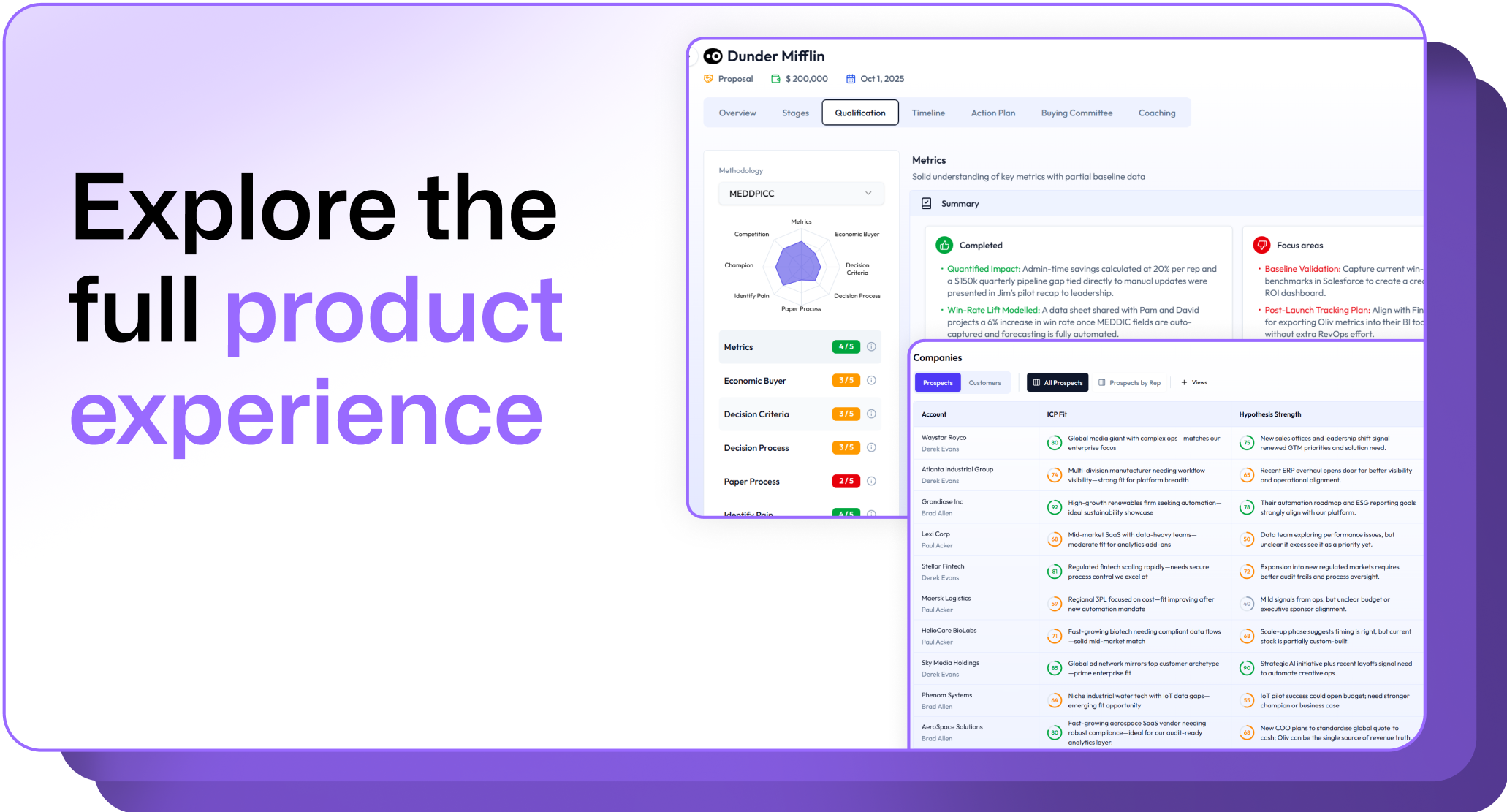
.avif)
.png)