10 Best Sales Performance Optimization Software in 2026: Rep Coaching, Enablement, Analytics, and Territory Design
Written by
Ishan Chhabra
Last Updated :
August 4, 2026
Skim in :
13
mins
In this article
Revenue teams love Oliv
Here’s why:
All your deal data unified (from 30+ tools and tabs).
Insights are delivered to you directly, no digging.
AI agents automate tasks for you.
Thank you! Your submission has been received!
Oops! Something went wrong while submitting the form.
Meet Oliv’s AI Agents
Hi! I’m, Deal Driver
I track deals, flag risks, send weekly pipeline updates and give sales managers full visibility into deal progress
Hi! I’m, CRM Manager
I maintain CRM hygiene by updating core, custom and qualification fields all without your team lifting a finger
Hi! I’m, Forecaster
I build accurate forecasts based on real deal movement and tell you which deals to pull in to hit your number
Hi! I’m, Coach
I believe performance fuels revenue. I spot skill gaps, score calls and build coaching plans to help every rep level up
Hi! I’m, Prospector
I dig into target accounts to surface the right contacts, tailor and time outreach so you always strike when it counts
Hi! I’m, Pipeline tracker
I call reps to get deal updates, and deliver a real-time, CRM-synced roll-up view of deal progress
Hi! I’m, Analyst
I answer complex pipeline questions, uncover deal patterns, and build reports that guide strategic decisions
TL;DR
The 2026 shortlist runs Oliv AI, Gong, Mindtickle, Nooks, Salesforce, Xactly, Varicent, Anaplan, CaptivateIQ, and Everstage, scored across five weighted criteria.
Four different jobs hide inside one keyword: rep coaching, enablement, analytics, and territory design. Most buyers solve one and inherit three gaps.
Recording is now commoditised. Value sits in the agent layer that updates the CRM record, not the dashboard layer that reports on it.
Published seat prices run $15 to $75 per user per month, while stacked add-on suites reach roughly $500 per user before services.
Gartner expects AI agents to outnumber sellers tenfold by 2028, yet fewer than 40% of sellers will report a productivity gain.
Run 30 days: connect and baseline, deploy one agent at your worst bottleneck, correct it daily for an hour, then measure against week one.
Q1. What Are the 10 Best Sales Performance Optimization Software Tools in 2026? [toc=1. 10 Best Tools]
The 10 best sales performance optimization platforms in 2026 are Oliv AI, Gong, Mindtickle, Nooks, Salesforce, Xactly, Varicent, Anaplan, CaptivateIQ, and Everstage. Oliv AI leads because its agents act on deal data instead of handing dashboards back to a human. Prep lands about 30 minutes before a call, and CRM updates land within 5 minutes after it.
📋 The shortlist, in one place
Here is the full list before we go deep on each one.
Oliv AI (agentic execution across the deal cycle)
Gong (conversation intelligence and enablement)
Mindtickle (sales readiness and rep coaching)
Nooks (dialer and pipeline generation)
Salesforce (CRM plus Einstein and Agentforce layers)
Xactly (incentive compensation management)
Varicent (enterprise SPM and territory planning)
Anaplan (connected revenue planning)
CaptivateIQ (commission automation)
Everstage (mid-market commissions and quota tracking)
Four different jobs hide inside one keyword. Rep coaching. Enablement. Analytics. Territory design. Most buyers pick a tool for job one, then discover it cannot do jobs two through four.
⚠️ Why the "buy Gong plus Clari plus Salesloft" playbook quietly breaks
I have watched this stack get assembled in dozens of mid-market orgs. Each tool is good at its slice. None of them writes the answer back where the work happens, which is your CRM.
A Clari reviewer put the structural problem plainly, and it applies across this category. The same gap shows up when you compare Gong against Clari on deal context.
"The conversation intelligence tool is lacking, and we don't have the context of the deals against the conversation intelligence findings. There's no custom reporting. The CRM writeback is not good; we cannot send MEDDIC values back to Salesforce." Verified UserClari G2 Verified Review
That is the whole game. Recording is commoditised now, because Zoom, Teams, and Google all do it natively. The value sits in whether the system acts.
🎂 The three-layer cake I use to sort this category
Layer one is baseline data collection, meaning recording and transcription. That should be close to free in 2026.
Layer two is intelligence, where a model tracks qualification fields like MEDDPICC (a deal-qualification checklist covering Metrics, Economic buyer, Decision criteria, Decision process, Paper process, Identified pain, Champion, and Competition). Layer three is the agent layer, where the system produces the one-pager and updates the record without being asked. Most tools on this list stop at layer two, which is why the shift from revenue intelligence to orchestration matters.
Comparison table: 10 sales performance optimization tools in 2026
Comparison of 10 Sales Performance Optimization Tools in 2026
#
Tool
Primary lever
Best for
Starting price
Integration depth
Rating
1
Oliv AI
Agentic execution across coaching, analytics, and forecasting
Mid-market B2B revenue teams (200 to 5,000 employees) wanting work done, not reported
$19/user/month
Two-way with Salesforce, HubSpot, Zoho, plus 70+ tools
⭐⭐⭐⭐⭐
2
Gong
Conversation intelligence, now extending to enablement
Enterprises standardising call review at scale
No public list price; per-seat pricing visible in admin center since Jun 2025
Deep read into Salesforce; users report limits pushing data back
⭐⭐⭐
3
Mindtickle
Sales readiness and structured coaching
Onboarding and ramp programs with formal certification
Averages near $92K/year, pricing not public
LMS-style, CRM-linked, 4.7/5 across 2,398 G2 reviews
⭐⭐⭐⭐
4
Nooks
Pipeline generation via parallel dialing
Outbound SDR floors chasing connect rates
Reported around $5,000 per seat annually
Dialer-first, sits beside Salesforce and Gong
⭐⭐⭐⭐
5
Salesforce
System of record plus Einstein and Agentforce
Teams standardising on one vendor regardless of cost
Sales Cloud from $25/user/month; stacked all-inclusive near $500/user
Native, but value needs multiple paid add-ons
⭐⭐⭐
6
Xactly
Incentive compensation management
Enterprises with complex commission plans
Quote only
CRM, ERP, and HRIS connectors
⭐⭐⭐
7
Varicent
Territory, quota, and comp planning
Large orgs re-carving territories yearly
Quote only
Deep planning data models
⭐⭐⭐
8
Anaplan
Connected revenue and capacity planning
Finance-led planning across regions
Quote only
Modelling layer above CRM and ERP
⭐⭐⭐
9
CaptivateIQ
Commission automation
RevOps teams ending spreadsheet payouts
Quote only
Strong CRM and payroll sync
⭐⭐⭐⭐
10
Everstage
Commissions and quota visibility
Mid-market teams wanting rep-facing clarity
Quote only
CRM plus payroll integrations
⭐⭐⭐⭐
Ratings follow the scoring rubric in the next section. Compensation platforms score lower here only because they solve one lever, not because they are weak at it.
1.1 Oliv AI: agents that finish the work, not just flag it [toc=1 Oliv AI]
Oliv AI's hero screen showcases autonomous agents recomputing quarterly commit, prepping call briefs, and syncing Salesforce stages, automating admin work that limits rep selling time and sales performance optimization.
Oliv AI is a third-generation revenue platform. Agents prep calls, update CRM fields, flag deal risk, draft follow-ups, and assemble forecasts without being asked.
🎯 The pain it targets
Sales managers audit calls in the car and in the shower. Then Thursday and Friday disappear into rep-by-rep pipeline interrogation, followed by a manual roll-up for Monday.
I could be reading my own data too strongly here. Still, Oliv AI's deployments keep surfacing the same pattern: the bottleneck is not insight, it is assembly.
⚙️ What it actually does
Key capabilities, in plain terms:
Deal Assistant sends prep notes to Slack or email roughly 30 minutes before a call
CRM Manager writes call outcomes back into Salesforce, HubSpot, or Zoho, usually within 5 minutes
Deal Driver watches every open deal and flags the ones losing momentum
Forecast Agent builds weekly and monthly roll-ups, which is the core of any AI sales forecasting software evaluation
Gold Digger finds expansion whitespace inside accounts you already own
Analyst answers pipeline questions in one click, so you stop queueing behind RevOps
Context Graph plus a maintained Process Graph encode how your company sells
Setup is the part reviewers keep mentioning. Multiple verified users describe getting live in 5 to 15 minutes, with forward-deployed engineers finishing a team rollout in under a week.
💰 Pricing and implementation
Entry is $19 per user per month, and agents get added one at a time. Nobody buys the whole suite on day one to test a single bottleneck.
Full customisation still takes two to four weeks in practice. That is the honest trade-off, and enterprise deployments usually begin as a narrow pilot.
✅ Pros and ❌ cons
✅ Agents write back to the CRM, they do not just read from it
✅ Published entry pricing at $19/user/month, no quote gate
✅ Setup measured in minutes, per verified reviewers
✅ Works with existing CRM rather than replacing it
❌ Reviewers report occasional slowness and glitches
❌ Dashboard and report customisation is still limited
❌ Mobile app trails the desktop experience
❌ No in-call real-time coaching, by design, so teams wanting live nudges should look elsewhere
🗣️ What real users say
"The Revenue Harness and Context Graph are standouts, giving me detailed briefs before every call and saving me over 10 hours a week on admin tasks... The only downside is that the platform can be a bit glitchy at times, but the support team is always quick to address and resolve any bugs." Verified UserOliv AI G2 Verified Review
"Our forecast accuracy has jumped by 27%, and onboarding was a breeze. The only downside I've noticed is that the mobile app is a bit basic compared to the desktop platform." Verified UserOliv AI G2 Verified Review
"The Driver agent watches all my deals and flags any that are at risk, so I don't have to spend hours listening to recordings in tools like Gong and Clari." Verified UserOliv AI G2 Verified Review
📅 How the product has moved
Oliv AI Product Update Timeline
Period
What shipped
Through 2025
Notetaker tier at $19/user launched as the entry point, with CRM sync into Salesforce, HubSpot, and Zoho as the core loop
Jan to Jul 2026
Six to seven named agents in production, including CRM Manager, Deal Driver, Forecast Agent, Gold Digger, and Analyst, with custom methodology fields like MEDIC-BAND auto-filled per verified reviewer accounts
Expected next
Deeper report and dashboard customisation plus a stronger mobile experience, the two most repeated asks in June and July 2026 G2 reviews
🧭 Who should buy, and who should not
Buy it if you run a 25 to 200 rep team, own a CRM, and are tired of paying for insight you then act on manually. Skip it if you want B2C support automation, pure call recording, or live in-call prompts.
Oliv AI's read is that the standard advice gets this backwards. The category tells you to buy better dashboards, when the actual constraint is who does the work after the dashboard loads, a pattern visible across the best revenue intelligence platforms.
1.2 Gong: the best-known conversation intelligence platform, now stretching into enablement [toc=2 Gong]
Gong's AI account board unifies customer insights, ARR, product usage, and activity signals, helping revenue teams align next best actions and drive sales performance optimization across enterprise accounts.
Gong is a Revenue AI platform built on call recording, transcription, and deal insight. In February 2026 it launched Mission Andromeda, adding Gong Enable for coaching and unified account management.
📈 Where Gong genuinely wins
Scale of analysis is the honest strength. AI Theme Spotter analyses tens of thousands of calls, and AI Data Extractor maps fields from conversations to the CRM.
Gong crossed $500M ARR in May 2026, with growth above 55% year over year. That funds a fast release train, and the monthly notes show it.
🔧 Key features
Recording, transcription, and Smart Trackers for topic detection
Gong Assistant, a conversational layer launched March 2025
Agent Studio for managing AI agents, shipped July 2025
AI Call Reviewer for automated scorecards, August 2025
Configurable forecast boards, November 2025, covered in detail in this breakdown of Gong forecasting
Gong Enable and AI Trainer role-play simulations, with audio coaching added May 2026
⏰ The delay and the direction of data
Two structural issues matter for performance optimization. First, insight arrives roughly 20 to 30 minutes after a call, against a 5-minute window on agentic platforms.
Second, the integration mostly flows inward. Gong pulls your data in, and getting it back out into the CRM is where reviewers hit friction, a recurring theme across Gong integrations.
Gong does not publish list pricing. Per-seat pricing became visible inside the admin center for eligible accounts in June 2025, and Gong Enable is a separate paid module introduced February 2025.
Setup is not trivial, and some capabilities sit behind plan upgrades, which is why the Gong implementation timeline deserves scrutiny before signing.
"I found the AI tracker setup to be quite difficult... Moreover, I cannot download all the data myself unless we upgrade the plan, which isn't ideal and results in me not fully utilizing Gong." Verified UserGong G2 Verified Review
"The fact that you can't edit a recording (to only share a portion with a client), and the fact that if you stop working with the tool you lose the data." Verified UserGong G2 Verified Review
✅ Pros and ❌ cons
✅ Deepest call corpus analysis in the category, up to 50,000 calls per Theme Spotter run
✅ Strong enablement addition via Gong Enable and AI Trainer
✅ Microsoft Copilot can now surface Gong call data
❌ Reviewers report limits pushing data back into Salesforce
❌ Tracker setup and data export are manual and slow for some users
❌ No public list pricing, so year-one TCO needs negotiation
❌ Gong Engage draws sharp comparisons against dedicated sequencers
Mission Andromeda launched Gong Enable on 25 Feb 2026, followed by AI Trainer audio coaching, Rephraser writing assistance, and Snowflake multi-instance support
Coming next
Bidirectional MCP server support so briefs pull external data and external AI tools query Gong, plus brief generation via API, both listed as "coming soon"
🧭 Who should buy, and who should not
Buy Gong if call-review scale is your bottleneck and you have budget plus an admin to run it. Look elsewhere if you need the system to update the CRM and drive the deal for you, and weigh the Gong alternatives before renewal.
Gong reads a meeting. Oliv AI reads a deal, tracking pipeline movement, coaching, and forecasting across the full cycle rather than call by call, which is why a Deal Driver flag replaces an afternoon of recordings.
1.3 Mindtickle: sales readiness built for structured ramp [toc=3 Mindtickle]
Mindtickle is a sales readiness platform. It combines training, certification, coaching, and readiness scoring in one system, and holds 4.7 out of 5 across 2,398 verified G2 reviews.
🎯 The pain it targets
New reps ramp slowly, and messaging drifts across the team. Managers coach on instinct because nobody measures readiness before a rep touches a live deal.
Mindtickle solves that with formal structure. Role-based learning paths, certifications, and practice assessments, all scored. Teams comparing options here usually shortlist the best sales coaching software alongside it.
⚙️ Key features
Role-based learning paths and structured certifications for onboarding
Coaching tools that link practice, feedback, and assessment
Readiness scoring, so you can see skill gaps before a quarter turns
Sales content management for messaging and product launches
Conversation intelligence layered onto the readiness model
💰 Pricing and implementation
Pricing is not public. Third-party analysis puts the average contract near $92,000 per year, which places it firmly in the enterprise band.
Setup takes real upfront work. Reviewers say the platform needs alignment to your sales process before it earns its keep, much like translating a framework such as the MEDDIC sales methodology into live opportunity fields.
"Because the platform is very robust, it can sometimes feel overly complex when you just need quick answers or fast updates... The initial setup requires some upfront time to get everything ready and aligned to the sales process, despite the onboarding support." Verified UserMindtickle G2 Verified Review
✅ Pros and ❌ cons
✅ Strongest formal readiness measurement in this list
✅ Certifications make new-messaging rollouts consistent
✅ Very high verified review volume, 2,398 reviews at 4.7/5
❌ No public pricing, with reported averages near $92K/year
❌ Navigation splits training, certification, and coaching across sections
❌ Pulling a quick readiness snapshot needs reporting expertise
🧭 Who should buy, and who should not
Buy it if you hire in cohorts and need certified competence before quota. Skip it if your real problem is deal execution this quarter, because readiness scores do not update a forecast.
1.4 Nooks: pipeline generation through parallel dialing [toc=4 Nooks]
Nooks is an AI dialer and virtual sales floor. It dials several numbers in parallel, filters out voicemails, and holds 4.8 stars across 1,646 verified G2 reviews.
⏰ Where it earns its seat
Connect rate is the only metric that matters for an outbound floor. Parallel dialing lifts conversations per hour, and the shared salesfloor keeps energy up during power hours.
That is a narrow job, done well. It is pipeline generation, not performance optimization across the cycle, so the analysis layer still comes from the best AI for sales calls.
⚙️ Key features
Parallel and power dialing with voicemail detection
Consolidated rep screen holding prospect context in one place
Virtual salesfloor for live coaching and listening in
AI call summaries and analytics on connect and conversion rates
Integrations with Salesforce and conversation intelligence tools
💸 Pricing and implementation
Reported pricing sits around $5,000 per seat annually, which is steep for a single-function tool. Implementation is fast, but integration stability is the recurring complaint.
"We file tickets for bugs or functionality challenges daily sometimes. Integrations constantly seem to be buggy or not working. UI is incredibly confusing. Calls are constantly not getting logged... It takes days to resolve issues." Verified UserNooks G2 Verified Review
Calls not logging is not a small bug. If activity never reaches the CRM, your coverage math is wrong before you start.
✅ Pros and ❌ cons
✅ Real lift in connects per hour via parallel dialing
✅ 4.8-star average across 1,646 reviews, strongest sentiment in this list
✅ Salesfloor concept genuinely helps SDR morale
❌ Around $5,000 per seat per year for one lever
❌ Reviewers report daily bug tickets and unlogged calls
❌ Support timezone gaps stretch resolution to days
❌ Covers pipeline generation only, not coaching, analytics, or territory
🧭 Who should buy, and who should not
Buy it if you run a dedicated SDR floor and connect rate is the constraint. Skip it if you are an AE-led team with 20 to 40 meetings a month.
1.5 Salesforce: the system of record, priced as a platform [toc=5 Salesforce]
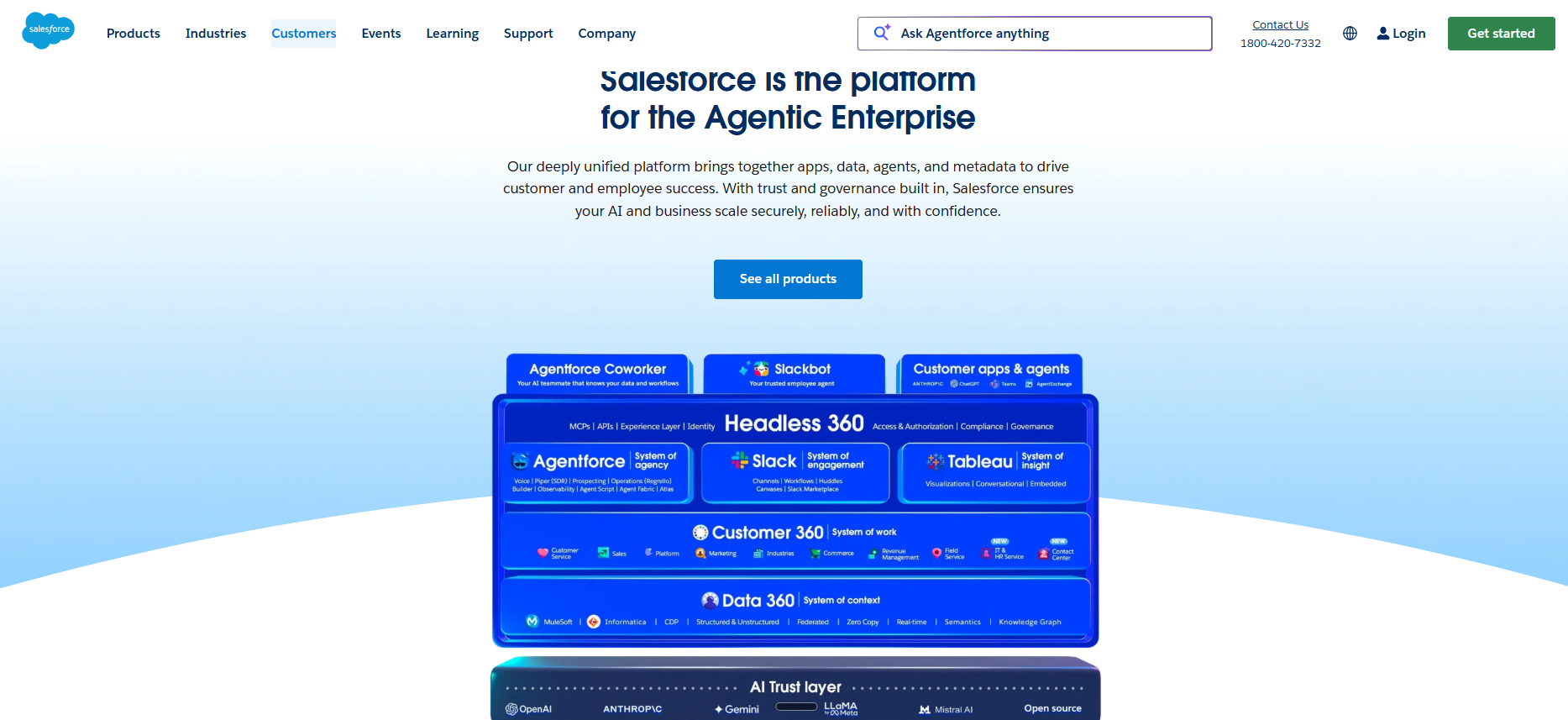
Salesforce's unified platform layers Agentforce agents, Slack engagement, Tableau insight, and Data 360 context, giving revenue leaders governed automation and analytics behind enterprise-scale sales performance optimization.
Salesforce sells Agentforce Sales, formerly Sales Cloud. It is the CRM most of this list writes into, now wrapped in Einstein and Agentforce agent layers.
📈 Where Salesforce genuinely wins
Nothing beats it as a record system. Activity visibility, stakeholder transparency, and customisation depth are unmatched, and reviewers name onboarding support as a strength, a pattern that also shows up across Salesforce Agentforce reviews.
"I like that Agentforce Sales is simple to use with a straightforward UI/UX... it promotes transparency with my team as they can see the calls I've made and emails sent... the onboarding and post-onboarding process was smooth, as we were assisted by account executives and developers who helped customize the CRM according to our needs." Verified UserAgentforce Sales G2 Verified Review
💰 The license bloat problem
Sales Cloud starts near $25 per user per month. Getting to genuine performance optimization means stacking conversation insights, a data cloud add-on, and Einstein for sales.
That is roughly five separate purchases. All-inclusive packaging lands near $500 per user, and the action-credit model prices individual agent actions at about $0.10 each, which the Agentforce pricing breakdown unpacks line by line.
I have sat in that pricing conversation more than once. The list price is never the number you sign.
✅ Pros and ❌ cons
✅ The definitive system of record, with the deepest customisation
✅ Strong implementation support from AEs and developers
✅ Agentforce brings agents natively into the CRM
❌ Performance optimization needs four or five paid add-ons
❌ All-inclusive packaging reaches roughly $500 per user
❌ Reviewers report lag issues in daily use
❌ Agent value depends on data hygiene you must fix first
🧭 Who should buy, and who should not
Buy it if you are standardising on one vendor and can absorb the total cost. Skip the add-on stack if a $19 to $120 agent layer on top of your existing CRM solves the same job, and review the best Agentforce alternatives before committing.
1.6 Xactly: incentive compensation at enterprise scale [toc=6 Xactly]
Xactly automates incentive compensation management, meaning commission calculation, plan modelling, and payout accuracy. Pricing is quote only.
💰 What it actually fixes
Commission disputes eat manager time and destroy rep trust. Xactly replaces the spreadsheet with auditable plan logic, connected to CRM, ERP, and HRIS data.
It also models quota and territory scenarios before you commit. That matters, because a five percent rise in rep attrition can lift selling costs 4 to 6% and cut revenue attainment by 2 to 3%.
✅ Pros and ❌ cons
✅ Deep commission plan logic with audit trails
✅ Benchmark data from a large compensation dataset
✅ Handles multi-region, multi-currency plan complexity
❌ Quote-only pricing, so year-one cost needs services included
❌ Multi-month implementation across CRM, ERP, and HRIS
❌ Solves one lever, not coaching or deal execution
🧭 Who should buy, and who should not
Buy it if payout accuracy and comp audit are board-level issues. Skip it if you have under 50 reps on simple plans.
1.7 Varicent: territory and quota planning for large orgs [toc=7 Varicent]
Varicent covers sales performance management, spanning incentive compensation, territory design, and quota planning. Pricing is quote only.
🗺️ Where it fits
Territory carving is where Varicent separates from pure commission tools. It models coverage, capacity, and quota distribution before the fiscal year opens.
Competing shortlists score territory planning as a checkbox row. Varicent treats it as a modelling discipline, which is the right instinct.
✅ Pros and ❌ cons
✅ Strong territory, quota, and capacity modelling together
✅ Comp and planning in one data model, not bolted together
✅ Handles enterprise plan complexity and hierarchy depth
❌ Quote-only pricing with enterprise implementation timelines
❌ Overweight for mid-market teams under 100 reps
❌ Planning-first, so it does not touch in-quarter deal execution
🧭 Who should buy, and who should not
Buy it if you re-carve territories annually across regions. Skip it if your quota model is stable and your gap is coaching latency.
1.8 Anaplan: connected planning above the CRM [toc=8 Anaplan]
Anaplan is a connected planning platform. Finance and RevOps use it for revenue projections, capacity planning, and territory modelling. Pricing is quote only.
🧮 Strength and the integration catch
Modelling flexibility is the draw. Reviewers praise data aggregation, projections, and dashboard reporting, plus a straightforward model-building learning curve.
The catch is data movement. API limits make real-time sync with a warehouse difficult, which is the same constraint that separates planning tools from revenue intelligence platforms.
"Anaplan does not integrate seamlessly with third party platforms given its limited API. Therefore, it is difficult to sync data between Anaplan and our Snowflake data warehouse in real-time. However, we are able to schedule data syncs between the two platforms on a predefined cadence." Verified UserAnaplan G2 Verified Review
Scheduled syncs are fine for annual planning. They are not fine for coaching a deal that slips on a Wednesday.
✅ Pros and ❌ cons
✅ Flexible modelling across sales, finance, and resource planning
✅ Active community and training that speeds upskilling
✅ Doubles as a planning data hub across functions
❌ Limited API makes real-time warehouse sync hard
❌ Quote-only pricing plus modelling expertise required
❌ Planning horizon, not in-quarter execution
🧭 Who should buy, and who should not
Buy it if planning spans finance, headcount, and revenue together. Skip it if you want rep-level coaching or CRM hygiene.
1.9 CaptivateIQ: commission automation without the spreadsheet [toc=9 CaptivateIQ]
CaptivateIQ automates commission calculation and payout with a spreadsheet-like interface that RevOps teams can edit themselves. Pricing is quote only.
⚙️ Why teams pick it
Comp analysts want to change plan logic without filing a vendor ticket. CaptivateIQ leans into that with self-serve plan building, plus CRM and payroll sync.
Scope matching applies here. This is the most repeated strategic insight across ranking articles, and it is right: a commission tool will not fix quota methodology or coaching cadence.
✅ Pros and ❌ cons
✅ Self-serve plan editing without vendor dependency
✅ Faster implementation than full-suite SPM platforms
✅ Clean CRM and payroll integration for payout accuracy
❌ Quote-only pricing
❌ Commission scope only, no coaching, enablement, or territory design
❌ Still needs clean CRM data upstream to calculate correctly
🧭 Who should buy, and who should not
Buy it if payouts run on spreadsheets and disputes are frequent. Skip it if your quotas are the problem, not your math.
1.10 Everstage: rep-facing commission clarity for mid-market [toc=10 Everstage]
Everstage handles commissions and quota tracking with a rep-facing view, so sellers see earnings without asking finance. Pricing is quote only.
📊 The differentiator
Transparency is the pitch. Reps track attainment and expected commission live, which cuts the "where is my payout" thread that consumes manager hours.
It sits below Xactly and Varicent on plan complexity, and above spreadsheets on trust.
✅ Pros and ❌ cons
✅ Rep-facing dashboards reduce commission queries
✅ Mid-market friendly implementation timelines
✅ Quota tracking sits alongside payout, not separate from it
❌ Quote-only pricing
❌ Lighter modelling depth than enterprise SPM platforms
❌ No coaching, call analysis, or territory carving
🧭 Who should buy, and who should not
Buy it if you have 50 to 300 reps and want payout trust without an enterprise build. Skip it if you need multi-region plan complexity.
⚠️ The pattern across tools 1.3 to 1.10
Eight tools, seven different jobs. Readiness, dialing, record-keeping, commissions, territory, planning, and payout transparency.
Not one of them updates a deal record and tells a manager which rep needs coaching before Friday. That gap is the reason 87% of enterprises missed 2025 revenue targets despite record AI investment.
Oliv AI's read is that the standard stack advice gets this backwards. Buying a tool per lever builds a brittle system, and the agent layer, meaning software that acts rather than reports, is the only part that reduces work instead of adding it, which is the core argument for a revenue orchestration platform.
Oliv AI sits in that layer at $19 per user per month, writing back to Salesforce, HubSpot, or Zoho within about five minutes of a call, which is why one reviewer logs 10+ hours a week saved on admin.
Q2. How Did We Score These Tools, and What Does Each Star Band Mean? [toc=2. Scoring Methodology]
We scored every platform on five weighted criteria: Agentic Action Depth 30%, Cross-Functional Revenue Intelligence 25%, CRM Write-Back and Integration 20%, Setup and Time-to-Value 15%, and Pricing and Compliance Transparency 10%. Bands run 0-20 one star, 21-40 two, 41-60 three, 61-80 four, and 81-100 five. Oliv AI scores 94 on 5-minute CRM write-back and public $19 entry pricing.
Ten platforms, five criteria, one scale. Two of those criteria appear in no competing shortlist I could find, and they are the two that decide whether a tool reduces work or adds it.
⚙️ Agentic Action Depth (30%)
This measures whether the tool acts on its own, or waits for a human to read a screen. Scored on named agents in production, task completion without prompts, and whether output arrives before the work or after it.
A dashboard that reports a problem scores low. A system that flags a stalling deal and drafts the follow-up scores high, which is the dividing line across the best AI sales tools.
🔗 Cross-Functional Revenue Intelligence (25%)
Sales performance breaks across functions, not inside one. This criterion asks whether the tool reads calls, emails, CRM fields, and pipeline movement together, or analyses one signal type in isolation.
Meeting-level analysis scores mid. Deal-level analysis across a full cycle scores high, because coaching a rep needs the whole arc, not one call, a distinction covered in this review of the best revenue intelligence software platforms.
💾 CRM Write-Back and Integration (20%)
Most tools pull your data in. Getting structured values back out is where buyers hit a wall, and reviewers say so plainly, as the breakdown of Clari features shows.
"The CRM writeback is not good; we cannot send MEDDIC values back to Salesforce or update fields in Salesforce from the conversation intelligence. The AI is not as flexible as we need it to be." Verified UserClari G2 Verified Review
Oliv AI measures this criterion by testing whether qualification fields, including custom frameworks like MEDIC-BAND, populate automatically in Salesforce, HubSpot, or Zoho without a human retyping them.
⏰ Setup and Time-to-Value (15%)
Scored on days to first useful output, not days to contract signature. Anything needing a multi-month data project scores low, however good the end state, which is why the Gong implementation timeline is worth checking early.
Reviewers are the honest source here. One Mindtickle user notes setup "requires some upfront time to get everything ready and aligned to the sales process, despite the onboarding support".
💰 Pricing and Compliance Transparency (10%)
Published seat prices score higher than quote-only, because year-one cost is knowable. The public spread across this category runs roughly $15 to $75 per user per month, against enterprise platforms that disclose nothing.
Compliance sits inside this criterion. From 2 August 2026, EU AI Act Article 50 disclosure obligations apply, and recording consent already varies by country.
Full scoring table
Weighted Scoring of 10 Sales Performance Optimization Tools
Tool
Agentic (30)
Cross-Fn (25)
Write-Back (20)
Setup (15)
Pricing (10)
Total
Stars
Oliv AI
28
23
19
14
10
94
⭐⭐⭐⭐⭐
Gong
18
20
11
8
5
62
⭐⭐⭐⭐
Mindtickle
12
16
12
8
4
52
⭐⭐⭐
Nooks
11
9
9
11
6
46
⭐⭐⭐
Salesforce
16
18
20
7
4
65
⭐⭐⭐⭐
Xactly
8
13
14
6
3
44
⭐⭐⭐
Varicent
8
14
14
6
3
45
⭐⭐⭐
Anaplan
7
15
9
6
3
40
⭐⭐
CaptivateIQ
9
11
15
10
4
49
⭐⭐⭐
Everstage
9
11
14
10
4
48
⭐⭐⭐
⚠️ One correction on reading G2 scores
Headline star averages hide segment reality. A 4.7 built on enterprise reviews tells a 40-rep team almost nothing, so filter by company size before you shortlist.
Oliv AI's data points one way here, though I might be reading it too strongly: the tools scoring lowest on write-back generate the most manual cleanup downstream. Entry pricing starts publicly at $19 per user per month, with agents added one at a time rather than as a suite.
Q3. What Is Sales Performance Optimization, and Which Category of Tool Do You Actually Need? [toc=3. Category Map & Scope]
Sales performance optimization is the operating discipline of aligning coaching, enablement, analytics, and territory design so win rates rise and cycles shorten. SPM software automates quotas, territories, and commissions. CRM reporting only shows what already happened. Match scope to your gap: commission-only tools fix payout disputes, full-suite platforms fix planning, and agentic platforms fix execution.
🧭 The definition, stripped down
Optimization is a practice. Software supports it, but no purchase performs it for you.
Think of your sales process as a map. A qualification method like MEDDPICC (a checklist covering Metrics, Economic buyer, Decision criteria, Decision process, Paper process, Identified pain, Champion, and Competition) is the GPS calling the next turn, and the same logic applies to Command of the Message.
🎯 The four levers, with one example each
Rep coaching: a manager reviews how a rep handled pricing pushback, then changes the script next week
Enablement: the new competitor battlecard reaches every seller before the deal, not after
Analytics: stage conversion shows deals dying between demo and proposal, so you fix that stage
Territory design: two reps chasing the same region get re-carved, and coverage math changes
🔍 Scope matching, the decision most buyers get wrong
Three buying triggers, three tool classes.
Tool Class Versus Buying Trigger and Scope Limits
Tool class
Buying trigger
What it will not fix
Point tool (commissions, dialer)
Payout disputes or low connect rates
Coaching, forecasting, territory
Full-suite SPM
Annual quota and territory planning at scale
In-quarter deal execution
Agentic layer
Managers doing manual assembly work weekly
Comp plan design, payroll accuracy
Scope matching is the single most repeated insight across ranking articles, and it holds up in practice.
⚠️ SPM versus CRM reporting
CRM reporting is a rear-view mirror. It tells you what closed and what slipped.
SPM software acts on it, setting quotas, designing territories, and automating commissions so comp and coaching use the same numbers as the forecast, which is the arc traced in this piece on RevOps to intelligence to orchestration.
🎂 Why the agent layer is separate
Recording is commoditised, since Zoom, Teams, and Google all transcribe natively. The intelligence layer above it tracks qualification fields, and the agent layer above that produces the report and updates the record.
Smart trackers, meaning keyword detection across calls, are previous-decade technology. They find mentions, not meaning, a limitation visible across Gong features.
🏎️ Which lever your numbers say is broken
Start with the diagnosis, not the demo. If attainment is fine but forecasts miss, that is analytics. If ramp is slow, that is enablement.
Adding a tool per symptom creates the resilience paradox: more technology, more brittleness. That is partly why 87% of enterprises missed 2025 revenue targets despite record AI investment, and why running revenue through disconnected functions feels like driving a racing car firing on two cylinders.
Oliv AI treats recording as the free baseline layer and puts its value in the agent layer above it, where a Context Graph and maintained Process Graph encode how your company actually sells, so deal-level context replaces meeting-level summaries.
Q4. How Do You Optimize Sales Performance in Six Steps, and Which Metrics Prove It Worked? [toc=4. Six-Step Method & Metrics]
Six steps: identify bottlenecks in CRM data, set revenue goals and operating KPIs, hold pipeline coverage at 3-4x quota, redesign quotas and territories, install a coaching cadence on real performance data, then reinvest AI-saved hours into selling. Track quota attainment, coverage, stage conversion, cycle length, win rate, and forecast variance. Ignore call volume and dashboard logins.
⏰ The Thursday scrub nobody puts on a slide
Every Thursday and Friday, managers sit with reps for one to two hours per person. They ask what moved, then hand-build the roll-up for Monday.
Auditing happens in the car and in the shower. That is not diligence, it is assembly work eating a manager's judgment time.
📋 The six steps
Pull CRM data and find the stage where deals actually die
Set revenue goals plus the operating KPIs that predict them
Hold pipeline coverage at 3-4x quota, higher for enterprise
Redesign quotas and territories against current-year pipeline math
Install a weekly coaching cadence tied to real performance data, the habit that separates the best sales coaching software from a content library
Name where the hours AI frees will go, in writing
Step three has a catch. The 3x rule assumes a roughly 33% win rate, so at a 25% win rate you need 4x, and at 19% you need over 5x.
📊 The six metrics that prove it worked
Six Metrics That Prove Sales Performance Improved
Metric
Definition
Benchmark
Cadence
Owner
Quota attainment
Reps hitting number
2025 attainment ran 28% to 47%
Monthly
Sales leader
Pipeline coverage
Qualified pipe ÷ quota
3-4x mid-market, 4-5x enterprise
Weekly
Manager
Stage conversion
Deals advancing per stage
Track trend, not absolute
Weekly
Manager
Cycle length
Days from create to close
Watch for 30%+ stretch
Monthly
RevOps
Win rate
Closed won ÷ closed
Drives coverage math
Monthly
Sales leader
Forecast variance
Called number vs actual
Under 10%
Weekly
RevOps
Ask Oliv AI's Analyst agent a pipeline question and the answer comes back in one click, instead of queueing behind a RevOps request.
⚠️ The vanity metric trap
Call volume, dashboard logins, and activity counts feel like management. They measure motion, not progress.
Attainment is a systems problem, not a rep problem. Quotas carried forward on old pipeline math will miss regardless of how hard anyone dials, and a five percent rise in rep attrition can lift selling costs 4 to 6% while cutting attainment 2 to 3%.
✅ Your Monday action
Run the push-off test in your next pipeline review. If a rep cannot state exact deal status after your qualifying questions, tell them to remove it from the forecast.
Managing sales without analytics is like navigating without Waze. Reviewers describe what happens when assembly moves off the manager's plate.
"Our forecast accuracy has jumped by 27%, and onboarding was a breeze. The only downside I've noticed is that the mobile app is a bit basic compared to the desktop platform." Verified UserOliv AI G2 Verified Review
Oliv AI's Forecast Agent assembles the weekly and monthly roll-up itself, which is the step that used to consume two afternoons before every Monday call, and it pairs with the wider category of AI sales forecasting software.
Q5. How Do You Fix Territory Design, Quotas and Forecast Accuracy Without Rebuilding the Comp Plan? [toc=5. Territory, Quota & Forecast]
Start with coverage, not headcount. Layer account data by region and density, map whitespace inside existing accounts, rebalance routes, then reset quotas against current-year pipeline math rather than carried-forward assumptions. Comp plan changes follow territory changes, never lead them. Anaplan, Varicent, and Xactly model this at enterprise scale, and Oliv AI's Gold Digger agent surfaces expansion whitespace inside accounts you already own.
🗺️ The five steps, in order
Build the data layer first, meaning one clean list of accounts with region, size, and industry attached
Score coverage per territory, so you see where reps have too many accounts or too few
Map whitespace, which is unsold product inside accounts you already have
Rebalance routes and account assignments, using capacity, not fairness arguments
Reset quotas last, once coverage math is settled
Expected outcome per step is simple. You should be able to name, by step three, which territory is starved and which is bloated.
🏆 Why whitespace beats re-carving
Opening a new territory costs headcount, ramp time, and pipeline you do not have yet. Selling a second product into an account that already trusts you costs a conversation.
Reviewers describe this as the practical lever in account planning, and it is the same instinct behind a sales intelligence platform that reads owned accounts first.
"The Gold Digger agent helps me find more opportunities for expansion in current accounts." Verified UserOliv AI G2 Verified Review
💰 Resetting quotas without touching comp
Quota is a number. Comp plan is a contract. Changing the first does not require reopening the second, and treating them as one thing is why most teams freeze.
Set quota against current-year pipeline math, so win rate and coverage drive the number. Quota and territory planning shows up as a scored criterion in 2026 SPM shortlists, but the sequencing rarely does.
⏰ Where forecast accuracy actually comes from
Forecast accuracy is a data-freshness problem before it is a judgment problem. If the deal record reflects last Thursday, the roll-up is fiction on Monday.
Enterprise planning tools model the future well and update the present slowly. One reviewer names the constraint directly, and the same lag shows up in a close read of Gong forecasting.
"Anaplan does not integrate seamlessly with third party platforms given its limited API. Therefore, it is difficult to sync data between Anaplan and our Snowflake data warehouse in real-time." Verified UserAnaplan G2 Verified Review
Oliv AI measures forecast accuracy against the deal record that its agents update after each call, which removes the manual step where numbers drift.
⚠️ When not to re-carve mid-year
Re-carving mid-quarter breaks relationships and resets pipeline ownership. Reps lose deals they sourced, and trust goes with them.
Three conditions justify it: a rep leaves, a region doubles, or coverage is below 2x in one patch while another sits at 6x. Otherwise, wait for the fiscal boundary and fix coverage with whitespace instead.
Oliv AI's read is that the standard advice gets territory backwards, because it starts with the org chart. What surfaces in our deployments is that expansion signals inside owned accounts move the number faster than any re-carve, and they cost nothing to find.
Q6. Are Coaching and Enablement Tools Actually Changing Rep Behaviour, or Just Multiplying Agents? [toc=6. Coaching, Enablement & Agent Reality]
Both are true. Gartner expects AI agents to outnumber sellers tenfold by 2028, yet fewer than 40% of sellers will say agents improved their productivity. AI already saves about five hours a week, and 72% of organisations never reinvest it. What works is in-workflow guidance: teams giving sellers AI-enabled next best actions were 2.6x more likely to achieve commercial growth.
📊 The stat everyone quotes, half of it
Every vendor deck ran the first half of Gartner's November 2025 prediction. Almost none ran the second half, which is the part that matters.
Ten times the agents, and six in ten sellers saying it did not help. That is not an adoption problem, it is a design problem, and it repeats across Agentforce reviews analyzed in detail.
⏰ Coaching latency, the metric nobody tracks
Coaching latency is the hours between a rep's misstep on a call and the correction reaching them. Most teams run a latency of five to nine days, because feedback waits for the Thursday one-on-one.
By then the deal has moved and the rep has repeated the habit twice. Oliv AI processes a call in about five minutes, against 20 to 30 minutes for legacy conversation intelligence, which is the difference between same-day coaching and next-week coaching.
❌ Why note-takers create the illusion of progress
Most in-house agent builds fail within six or seven months. They ship as note-takers, and a note-taker records the problem without changing anything downstream.
It is a strange world where every rep has five note-takers. My honest read is that the mediocre just get more mediocre, faster, which is why the shortlist of AI for sales calls matters less than what happens after the call.
"Because the platform is very robust, it can sometimes feel overly complex when you just need quick answers or fast updates. Pulling specific readiness or certification insights isn't always as intuitive as it could be." Verified UserMindtickle G2 Verified Review
✅ What the evidence says does work
In-workflow guidance outperforms content libraries. Gartner's CSO survey of 227 leaders found teams using AI-enabled next best actions were 2.6x more likely to hit commercial growth, and AI-driven upskilling delivered 2.4x.
Gartner also projects 40% faster deal-stage velocity by 2029 for organisations that redesign workflow rather than layering tools. Redesign is the operative word, and it is what separates real programs from a Winning by Design training rollout that stops at content.
🔧 The 10/80/10 correction loop
Agents are trained employees, not vending machines. Ten percent of effort goes to ideation, 80% to execution, and 10% to integration.
Run an agent for 30 days and spend an hour daily correcting its mistakes. By day 30 it is genuinely useful, and skipping that hour is why most pilots die, a pattern also visible across Agentforce implementation projects.
💰 Your five-hour reinvestment plan
The five hours AI saves get absorbed into shallow admin unless you name their destination in writing.
Pick one: two hours on champion mobilization, two on multi-threading stalled deals, and one on same-week coaching. Write it down and check it Friday.
Oliv AI skips in-call gimmicks on purpose. Prep lands 30 minutes before the call, CRM updates land after it, and one reviewer reports 10+ hours a week returned, which is where saved time becomes closed deals.
Q7. What Will It Really Cost, What Should You Consolidate, and How Do You Get Live in 30 Days? [toc=7. Cost, Consolidation & Rollout]
Published seat prices run $15 to $75 per user per month while enterprise ICM platforms quote only, and stacked add-ons can reach roughly $500 per user. Consolidate when a new tool retires two existing ones: 84% of sales teams without an all-in-one platform plan to. Oliv AI starts at $19 per user per month with agents added one at a time.
💸 The real cost table
Year-One Cost Layers in Sales Performance Software
Cost layer
What you see
What you pay
Published seat price
$15 to $75/user/month
Baseline only
Enterprise ICM
Quote only
Mindtickle averages near $92K/year
Add-on stacking
Sales Cloud from $25/user
Conversation insights, data cloud, and Einstein push it near $500/user
Action credits
About $0.10 per agent action
Unpredictable, scales with usage
Services
Often unquoted
Multi-month implementation
Year-one TCO is the only question worth asking a vendor. List price answers almost none of it, as the Salesforce Einstein pricing tiers make clear.
⚖️ Consolidate, or stay split
Consolidate if a new tool retires two existing ones, if two tools disagree on the same number, or if reps log the same data twice.
Stay split if your gap is genuinely single-lever, like commission accuracy. Buying a suite to fix payouts is expensive, though the case for a revenue orchestration platform gets stronger as tool count climbs.
Also note that 76% of sales leaders now prefer usage-based pricing, which tells you where the market is heading.
🔍 Four compliance questions to ask
SOC 2 Type II: independent audit of security controls. Ask for the report, not the badge
EU AI Act Article 50: from 2 August 2026, users must be told they are interacting with AI
Recording consent: CIPA and several US states require two-party consent, so one-party defaults are a legal risk
GDPR and voiceprints: voice data is biometric, so ePrivacy opt-in and BfDI expectations apply in the EU
Monday action for each: request the audit report, check your call-recording disclosure text, confirm consent settings by region, and ask where voice data is stored. A vendor DPA and security review is the right place to start.
⏰ The 30-day rollout
30-Day Agent Rollout Plan by Week
Week
Action
Owner
Failure signal
1
Connect CRM, baseline six metrics
RevOps
Data too dirty to baseline
2
Deploy one agent at your worst bottleneck
Sales leader
No agreed bottleneck
3
Correct outputs daily, one hour
Manager
Nobody does the hour
4
Measure against week-one baseline
RevOps
No change, so re-scope
One constraint, one agent, validated ROI, then the next. That is bottleneck theory applied to software buying, and it beats a suite rollout every time.
⚠️ The cost of doing nothing
A junior SDR at $150,000 who quits inside a year is the real comparison point. Oliv AI has closed a seven-figure deal that a competitor lost simply because nobody called the prospect back, which is what unattended pipeline costs.
Oliv AI runs 70+ integrations, with reviewers describing setup in 5 to 15 minutes and forward-deployed engineers getting a full team live inside a week, though full customization still takes 2 to 4 weeks. Buyers weighing this against incumbents usually end up reviewing the Gong alternatives list too.
Q1. What Are the 10 Best Sales Performance Optimization Software Tools in 2026? [toc=1. 10 Best Tools]
The 10 best sales performance optimization platforms in 2026 are Oliv AI, Gong, Mindtickle, Nooks, Salesforce, Xactly, Varicent, Anaplan, CaptivateIQ, and Everstage. Oliv AI leads because its agents act on deal data instead of handing dashboards back to a human. Prep lands about 30 minutes before a call, and CRM updates land within 5 minutes after it.
📋 The shortlist, in one place
Here is the full list before we go deep on each one.
Oliv AI (agentic execution across the deal cycle)
Gong (conversation intelligence and enablement)
Mindtickle (sales readiness and rep coaching)
Nooks (dialer and pipeline generation)
Salesforce (CRM plus Einstein and Agentforce layers)
Xactly (incentive compensation management)
Varicent (enterprise SPM and territory planning)
Anaplan (connected revenue planning)
CaptivateIQ (commission automation)
Everstage (mid-market commissions and quota tracking)
Four different jobs hide inside one keyword. Rep coaching. Enablement. Analytics. Territory design. Most buyers pick a tool for job one, then discover it cannot do jobs two through four.
⚠️ Why the "buy Gong plus Clari plus Salesloft" playbook quietly breaks
I have watched this stack get assembled in dozens of mid-market orgs. Each tool is good at its slice. None of them writes the answer back where the work happens, which is your CRM.
A Clari reviewer put the structural problem plainly, and it applies across this category. The same gap shows up when you compare Gong against Clari on deal context.
"The conversation intelligence tool is lacking, and we don't have the context of the deals against the conversation intelligence findings. There's no custom reporting. The CRM writeback is not good; we cannot send MEDDIC values back to Salesforce." Verified UserClari G2 Verified Review
That is the whole game. Recording is commoditised now, because Zoom, Teams, and Google all do it natively. The value sits in whether the system acts.
🎂 The three-layer cake I use to sort this category
Layer one is baseline data collection, meaning recording and transcription. That should be close to free in 2026.
Layer two is intelligence, where a model tracks qualification fields like MEDDPICC (a deal-qualification checklist covering Metrics, Economic buyer, Decision criteria, Decision process, Paper process, Identified pain, Champion, and Competition). Layer three is the agent layer, where the system produces the one-pager and updates the record without being asked. Most tools on this list stop at layer two, which is why the shift from revenue intelligence to orchestration matters.
Comparison table: 10 sales performance optimization tools in 2026
Comparison of 10 Sales Performance Optimization Tools in 2026
#
Tool
Primary lever
Best for
Starting price
Integration depth
Rating
1
Oliv AI
Agentic execution across coaching, analytics, and forecasting
Mid-market B2B revenue teams (200 to 5,000 employees) wanting work done, not reported
$19/user/month
Two-way with Salesforce, HubSpot, Zoho, plus 70+ tools
⭐⭐⭐⭐⭐
2
Gong
Conversation intelligence, now extending to enablement
Enterprises standardising call review at scale
No public list price; per-seat pricing visible in admin center since Jun 2025
Deep read into Salesforce; users report limits pushing data back
⭐⭐⭐
3
Mindtickle
Sales readiness and structured coaching
Onboarding and ramp programs with formal certification
Averages near $92K/year, pricing not public
LMS-style, CRM-linked, 4.7/5 across 2,398 G2 reviews
⭐⭐⭐⭐
4
Nooks
Pipeline generation via parallel dialing
Outbound SDR floors chasing connect rates
Reported around $5,000 per seat annually
Dialer-first, sits beside Salesforce and Gong
⭐⭐⭐⭐
5
Salesforce
System of record plus Einstein and Agentforce
Teams standardising on one vendor regardless of cost
Sales Cloud from $25/user/month; stacked all-inclusive near $500/user
Native, but value needs multiple paid add-ons
⭐⭐⭐
6
Xactly
Incentive compensation management
Enterprises with complex commission plans
Quote only
CRM, ERP, and HRIS connectors
⭐⭐⭐
7
Varicent
Territory, quota, and comp planning
Large orgs re-carving territories yearly
Quote only
Deep planning data models
⭐⭐⭐
8
Anaplan
Connected revenue and capacity planning
Finance-led planning across regions
Quote only
Modelling layer above CRM and ERP
⭐⭐⭐
9
CaptivateIQ
Commission automation
RevOps teams ending spreadsheet payouts
Quote only
Strong CRM and payroll sync
⭐⭐⭐⭐
10
Everstage
Commissions and quota visibility
Mid-market teams wanting rep-facing clarity
Quote only
CRM plus payroll integrations
⭐⭐⭐⭐
Ratings follow the scoring rubric in the next section. Compensation platforms score lower here only because they solve one lever, not because they are weak at it.
1.1 Oliv AI: agents that finish the work, not just flag it [toc=1 Oliv AI]
Oliv AI's hero screen showcases autonomous agents recomputing quarterly commit, prepping call briefs, and syncing Salesforce stages, automating admin work that limits rep selling time and sales performance optimization.
Oliv AI is a third-generation revenue platform. Agents prep calls, update CRM fields, flag deal risk, draft follow-ups, and assemble forecasts without being asked.
🎯 The pain it targets
Sales managers audit calls in the car and in the shower. Then Thursday and Friday disappear into rep-by-rep pipeline interrogation, followed by a manual roll-up for Monday.
I could be reading my own data too strongly here. Still, Oliv AI's deployments keep surfacing the same pattern: the bottleneck is not insight, it is assembly.
⚙️ What it actually does
Key capabilities, in plain terms:
Deal Assistant sends prep notes to Slack or email roughly 30 minutes before a call
CRM Manager writes call outcomes back into Salesforce, HubSpot, or Zoho, usually within 5 minutes
Deal Driver watches every open deal and flags the ones losing momentum
Forecast Agent builds weekly and monthly roll-ups, which is the core of any AI sales forecasting software evaluation
Gold Digger finds expansion whitespace inside accounts you already own
Analyst answers pipeline questions in one click, so you stop queueing behind RevOps
Context Graph plus a maintained Process Graph encode how your company sells
Setup is the part reviewers keep mentioning. Multiple verified users describe getting live in 5 to 15 minutes, with forward-deployed engineers finishing a team rollout in under a week.
💰 Pricing and implementation
Entry is $19 per user per month, and agents get added one at a time. Nobody buys the whole suite on day one to test a single bottleneck.
Full customisation still takes two to four weeks in practice. That is the honest trade-off, and enterprise deployments usually begin as a narrow pilot.
✅ Pros and ❌ cons
✅ Agents write back to the CRM, they do not just read from it
✅ Published entry pricing at $19/user/month, no quote gate
✅ Setup measured in minutes, per verified reviewers
✅ Works with existing CRM rather than replacing it
❌ Reviewers report occasional slowness and glitches
❌ Dashboard and report customisation is still limited
❌ Mobile app trails the desktop experience
❌ No in-call real-time coaching, by design, so teams wanting live nudges should look elsewhere
🗣️ What real users say
"The Revenue Harness and Context Graph are standouts, giving me detailed briefs before every call and saving me over 10 hours a week on admin tasks... The only downside is that the platform can be a bit glitchy at times, but the support team is always quick to address and resolve any bugs." Verified UserOliv AI G2 Verified Review
"Our forecast accuracy has jumped by 27%, and onboarding was a breeze. The only downside I've noticed is that the mobile app is a bit basic compared to the desktop platform." Verified UserOliv AI G2 Verified Review
"The Driver agent watches all my deals and flags any that are at risk, so I don't have to spend hours listening to recordings in tools like Gong and Clari." Verified UserOliv AI G2 Verified Review
📅 How the product has moved
Oliv AI Product Update Timeline
Period
What shipped
Through 2025
Notetaker tier at $19/user launched as the entry point, with CRM sync into Salesforce, HubSpot, and Zoho as the core loop
Jan to Jul 2026
Six to seven named agents in production, including CRM Manager, Deal Driver, Forecast Agent, Gold Digger, and Analyst, with custom methodology fields like MEDIC-BAND auto-filled per verified reviewer accounts
Expected next
Deeper report and dashboard customisation plus a stronger mobile experience, the two most repeated asks in June and July 2026 G2 reviews
🧭 Who should buy, and who should not
Buy it if you run a 25 to 200 rep team, own a CRM, and are tired of paying for insight you then act on manually. Skip it if you want B2C support automation, pure call recording, or live in-call prompts.
Oliv AI's read is that the standard advice gets this backwards. The category tells you to buy better dashboards, when the actual constraint is who does the work after the dashboard loads, a pattern visible across the best revenue intelligence platforms.
1.2 Gong: the best-known conversation intelligence platform, now stretching into enablement [toc=2 Gong]
Gong's AI account board unifies customer insights, ARR, product usage, and activity signals, helping revenue teams align next best actions and drive sales performance optimization across enterprise accounts.
Gong is a Revenue AI platform built on call recording, transcription, and deal insight. In February 2026 it launched Mission Andromeda, adding Gong Enable for coaching and unified account management.
📈 Where Gong genuinely wins
Scale of analysis is the honest strength. AI Theme Spotter analyses tens of thousands of calls, and AI Data Extractor maps fields from conversations to the CRM.
Gong crossed $500M ARR in May 2026, with growth above 55% year over year. That funds a fast release train, and the monthly notes show it.
🔧 Key features
Recording, transcription, and Smart Trackers for topic detection
Gong Assistant, a conversational layer launched March 2025
Agent Studio for managing AI agents, shipped July 2025
AI Call Reviewer for automated scorecards, August 2025
Configurable forecast boards, November 2025, covered in detail in this breakdown of Gong forecasting
Gong Enable and AI Trainer role-play simulations, with audio coaching added May 2026
⏰ The delay and the direction of data
Two structural issues matter for performance optimization. First, insight arrives roughly 20 to 30 minutes after a call, against a 5-minute window on agentic platforms.
Second, the integration mostly flows inward. Gong pulls your data in, and getting it back out into the CRM is where reviewers hit friction, a recurring theme across Gong integrations.
Gong does not publish list pricing. Per-seat pricing became visible inside the admin center for eligible accounts in June 2025, and Gong Enable is a separate paid module introduced February 2025.
Setup is not trivial, and some capabilities sit behind plan upgrades, which is why the Gong implementation timeline deserves scrutiny before signing.
"I found the AI tracker setup to be quite difficult... Moreover, I cannot download all the data myself unless we upgrade the plan, which isn't ideal and results in me not fully utilizing Gong." Verified UserGong G2 Verified Review
"The fact that you can't edit a recording (to only share a portion with a client), and the fact that if you stop working with the tool you lose the data." Verified UserGong G2 Verified Review
✅ Pros and ❌ cons
✅ Deepest call corpus analysis in the category, up to 50,000 calls per Theme Spotter run
✅ Strong enablement addition via Gong Enable and AI Trainer
✅ Microsoft Copilot can now surface Gong call data
❌ Reviewers report limits pushing data back into Salesforce
❌ Tracker setup and data export are manual and slow for some users
❌ No public list pricing, so year-one TCO needs negotiation
❌ Gong Engage draws sharp comparisons against dedicated sequencers
Mission Andromeda launched Gong Enable on 25 Feb 2026, followed by AI Trainer audio coaching, Rephraser writing assistance, and Snowflake multi-instance support
Coming next
Bidirectional MCP server support so briefs pull external data and external AI tools query Gong, plus brief generation via API, both listed as "coming soon"
🧭 Who should buy, and who should not
Buy Gong if call-review scale is your bottleneck and you have budget plus an admin to run it. Look elsewhere if you need the system to update the CRM and drive the deal for you, and weigh the Gong alternatives before renewal.
Gong reads a meeting. Oliv AI reads a deal, tracking pipeline movement, coaching, and forecasting across the full cycle rather than call by call, which is why a Deal Driver flag replaces an afternoon of recordings.
1.3 Mindtickle: sales readiness built for structured ramp [toc=3 Mindtickle]
Mindtickle is a sales readiness platform. It combines training, certification, coaching, and readiness scoring in one system, and holds 4.7 out of 5 across 2,398 verified G2 reviews.
🎯 The pain it targets
New reps ramp slowly, and messaging drifts across the team. Managers coach on instinct because nobody measures readiness before a rep touches a live deal.
Mindtickle solves that with formal structure. Role-based learning paths, certifications, and practice assessments, all scored. Teams comparing options here usually shortlist the best sales coaching software alongside it.
⚙️ Key features
Role-based learning paths and structured certifications for onboarding
Coaching tools that link practice, feedback, and assessment
Readiness scoring, so you can see skill gaps before a quarter turns
Sales content management for messaging and product launches
Conversation intelligence layered onto the readiness model
💰 Pricing and implementation
Pricing is not public. Third-party analysis puts the average contract near $92,000 per year, which places it firmly in the enterprise band.
Setup takes real upfront work. Reviewers say the platform needs alignment to your sales process before it earns its keep, much like translating a framework such as the MEDDIC sales methodology into live opportunity fields.
"Because the platform is very robust, it can sometimes feel overly complex when you just need quick answers or fast updates... The initial setup requires some upfront time to get everything ready and aligned to the sales process, despite the onboarding support." Verified UserMindtickle G2 Verified Review
✅ Pros and ❌ cons
✅ Strongest formal readiness measurement in this list
✅ Certifications make new-messaging rollouts consistent
✅ Very high verified review volume, 2,398 reviews at 4.7/5
❌ No public pricing, with reported averages near $92K/year
❌ Navigation splits training, certification, and coaching across sections
❌ Pulling a quick readiness snapshot needs reporting expertise
🧭 Who should buy, and who should not
Buy it if you hire in cohorts and need certified competence before quota. Skip it if your real problem is deal execution this quarter, because readiness scores do not update a forecast.
1.4 Nooks: pipeline generation through parallel dialing [toc=4 Nooks]
Nooks is an AI dialer and virtual sales floor. It dials several numbers in parallel, filters out voicemails, and holds 4.8 stars across 1,646 verified G2 reviews.
⏰ Where it earns its seat
Connect rate is the only metric that matters for an outbound floor. Parallel dialing lifts conversations per hour, and the shared salesfloor keeps energy up during power hours.
That is a narrow job, done well. It is pipeline generation, not performance optimization across the cycle, so the analysis layer still comes from the best AI for sales calls.
⚙️ Key features
Parallel and power dialing with voicemail detection
Consolidated rep screen holding prospect context in one place
Virtual salesfloor for live coaching and listening in
AI call summaries and analytics on connect and conversion rates
Integrations with Salesforce and conversation intelligence tools
💸 Pricing and implementation
Reported pricing sits around $5,000 per seat annually, which is steep for a single-function tool. Implementation is fast, but integration stability is the recurring complaint.
"We file tickets for bugs or functionality challenges daily sometimes. Integrations constantly seem to be buggy or not working. UI is incredibly confusing. Calls are constantly not getting logged... It takes days to resolve issues." Verified UserNooks G2 Verified Review
Calls not logging is not a small bug. If activity never reaches the CRM, your coverage math is wrong before you start.
✅ Pros and ❌ cons
✅ Real lift in connects per hour via parallel dialing
✅ 4.8-star average across 1,646 reviews, strongest sentiment in this list
✅ Salesfloor concept genuinely helps SDR morale
❌ Around $5,000 per seat per year for one lever
❌ Reviewers report daily bug tickets and unlogged calls
❌ Support timezone gaps stretch resolution to days
❌ Covers pipeline generation only, not coaching, analytics, or territory
🧭 Who should buy, and who should not
Buy it if you run a dedicated SDR floor and connect rate is the constraint. Skip it if you are an AE-led team with 20 to 40 meetings a month.
1.5 Salesforce: the system of record, priced as a platform [toc=5 Salesforce]
Salesforce's unified platform layers Agentforce agents, Slack engagement, Tableau insight, and Data 360 context, giving revenue leaders governed automation and analytics behind enterprise-scale sales performance optimization.
Salesforce sells Agentforce Sales, formerly Sales Cloud. It is the CRM most of this list writes into, now wrapped in Einstein and Agentforce agent layers.
📈 Where Salesforce genuinely wins
Nothing beats it as a record system. Activity visibility, stakeholder transparency, and customisation depth are unmatched, and reviewers name onboarding support as a strength, a pattern that also shows up across Salesforce Agentforce reviews.
"I like that Agentforce Sales is simple to use with a straightforward UI/UX... it promotes transparency with my team as they can see the calls I've made and emails sent... the onboarding and post-onboarding process was smooth, as we were assisted by account executives and developers who helped customize the CRM according to our needs." Verified UserAgentforce Sales G2 Verified Review
💰 The license bloat problem
Sales Cloud starts near $25 per user per month. Getting to genuine performance optimization means stacking conversation insights, a data cloud add-on, and Einstein for sales.
That is roughly five separate purchases. All-inclusive packaging lands near $500 per user, and the action-credit model prices individual agent actions at about $0.10 each, which the Agentforce pricing breakdown unpacks line by line.
I have sat in that pricing conversation more than once. The list price is never the number you sign.
✅ Pros and ❌ cons
✅ The definitive system of record, with the deepest customisation
✅ Strong implementation support from AEs and developers
✅ Agentforce brings agents natively into the CRM
❌ Performance optimization needs four or five paid add-ons
❌ All-inclusive packaging reaches roughly $500 per user
❌ Reviewers report lag issues in daily use
❌ Agent value depends on data hygiene you must fix first
🧭 Who should buy, and who should not
Buy it if you are standardising on one vendor and can absorb the total cost. Skip the add-on stack if a $19 to $120 agent layer on top of your existing CRM solves the same job, and review the best Agentforce alternatives before committing.
1.6 Xactly: incentive compensation at enterprise scale [toc=6 Xactly]
Xactly automates incentive compensation management, meaning commission calculation, plan modelling, and payout accuracy. Pricing is quote only.
💰 What it actually fixes
Commission disputes eat manager time and destroy rep trust. Xactly replaces the spreadsheet with auditable plan logic, connected to CRM, ERP, and HRIS data.
It also models quota and territory scenarios before you commit. That matters, because a five percent rise in rep attrition can lift selling costs 4 to 6% and cut revenue attainment by 2 to 3%.
✅ Pros and ❌ cons
✅ Deep commission plan logic with audit trails
✅ Benchmark data from a large compensation dataset
✅ Handles multi-region, multi-currency plan complexity
❌ Quote-only pricing, so year-one cost needs services included
❌ Multi-month implementation across CRM, ERP, and HRIS
❌ Solves one lever, not coaching or deal execution
🧭 Who should buy, and who should not
Buy it if payout accuracy and comp audit are board-level issues. Skip it if you have under 50 reps on simple plans.
1.7 Varicent: territory and quota planning for large orgs [toc=7 Varicent]
Varicent covers sales performance management, spanning incentive compensation, territory design, and quota planning. Pricing is quote only.
🗺️ Where it fits
Territory carving is where Varicent separates from pure commission tools. It models coverage, capacity, and quota distribution before the fiscal year opens.
Competing shortlists score territory planning as a checkbox row. Varicent treats it as a modelling discipline, which is the right instinct.
✅ Pros and ❌ cons
✅ Strong territory, quota, and capacity modelling together
✅ Comp and planning in one data model, not bolted together
✅ Handles enterprise plan complexity and hierarchy depth
❌ Quote-only pricing with enterprise implementation timelines
❌ Overweight for mid-market teams under 100 reps
❌ Planning-first, so it does not touch in-quarter deal execution
🧭 Who should buy, and who should not
Buy it if you re-carve territories annually across regions. Skip it if your quota model is stable and your gap is coaching latency.
1.8 Anaplan: connected planning above the CRM [toc=8 Anaplan]
Anaplan is a connected planning platform. Finance and RevOps use it for revenue projections, capacity planning, and territory modelling. Pricing is quote only.
🧮 Strength and the integration catch
Modelling flexibility is the draw. Reviewers praise data aggregation, projections, and dashboard reporting, plus a straightforward model-building learning curve.
The catch is data movement. API limits make real-time sync with a warehouse difficult, which is the same constraint that separates planning tools from revenue intelligence platforms.
"Anaplan does not integrate seamlessly with third party platforms given its limited API. Therefore, it is difficult to sync data between Anaplan and our Snowflake data warehouse in real-time. However, we are able to schedule data syncs between the two platforms on a predefined cadence." Verified UserAnaplan G2 Verified Review
Scheduled syncs are fine for annual planning. They are not fine for coaching a deal that slips on a Wednesday.
✅ Pros and ❌ cons
✅ Flexible modelling across sales, finance, and resource planning
✅ Active community and training that speeds upskilling
✅ Doubles as a planning data hub across functions
❌ Limited API makes real-time warehouse sync hard
❌ Quote-only pricing plus modelling expertise required
❌ Planning horizon, not in-quarter execution
🧭 Who should buy, and who should not
Buy it if planning spans finance, headcount, and revenue together. Skip it if you want rep-level coaching or CRM hygiene.
1.9 CaptivateIQ: commission automation without the spreadsheet [toc=9 CaptivateIQ]
CaptivateIQ automates commission calculation and payout with a spreadsheet-like interface that RevOps teams can edit themselves. Pricing is quote only.
⚙️ Why teams pick it
Comp analysts want to change plan logic without filing a vendor ticket. CaptivateIQ leans into that with self-serve plan building, plus CRM and payroll sync.
Scope matching applies here. This is the most repeated strategic insight across ranking articles, and it is right: a commission tool will not fix quota methodology or coaching cadence.
✅ Pros and ❌ cons
✅ Self-serve plan editing without vendor dependency
✅ Faster implementation than full-suite SPM platforms
✅ Clean CRM and payroll integration for payout accuracy
❌ Quote-only pricing
❌ Commission scope only, no coaching, enablement, or territory design
❌ Still needs clean CRM data upstream to calculate correctly
🧭 Who should buy, and who should not
Buy it if payouts run on spreadsheets and disputes are frequent. Skip it if your quotas are the problem, not your math.
1.10 Everstage: rep-facing commission clarity for mid-market [toc=10 Everstage]
Everstage handles commissions and quota tracking with a rep-facing view, so sellers see earnings without asking finance. Pricing is quote only.
📊 The differentiator
Transparency is the pitch. Reps track attainment and expected commission live, which cuts the "where is my payout" thread that consumes manager hours.
It sits below Xactly and Varicent on plan complexity, and above spreadsheets on trust.
✅ Pros and ❌ cons
✅ Rep-facing dashboards reduce commission queries
✅ Mid-market friendly implementation timelines
✅ Quota tracking sits alongside payout, not separate from it
❌ Quote-only pricing
❌ Lighter modelling depth than enterprise SPM platforms
❌ No coaching, call analysis, or territory carving
🧭 Who should buy, and who should not
Buy it if you have 50 to 300 reps and want payout trust without an enterprise build. Skip it if you need multi-region plan complexity.
⚠️ The pattern across tools 1.3 to 1.10
Eight tools, seven different jobs. Readiness, dialing, record-keeping, commissions, territory, planning, and payout transparency.
Not one of them updates a deal record and tells a manager which rep needs coaching before Friday. That gap is the reason 87% of enterprises missed 2025 revenue targets despite record AI investment.
Oliv AI's read is that the standard stack advice gets this backwards. Buying a tool per lever builds a brittle system, and the agent layer, meaning software that acts rather than reports, is the only part that reduces work instead of adding it, which is the core argument for a revenue orchestration platform.
Oliv AI sits in that layer at $19 per user per month, writing back to Salesforce, HubSpot, or Zoho within about five minutes of a call, which is why one reviewer logs 10+ hours a week saved on admin.
Q2. How Did We Score These Tools, and What Does Each Star Band Mean? [toc=2. Scoring Methodology]
We scored every platform on five weighted criteria: Agentic Action Depth 30%, Cross-Functional Revenue Intelligence 25%, CRM Write-Back and Integration 20%, Setup and Time-to-Value 15%, and Pricing and Compliance Transparency 10%. Bands run 0-20 one star, 21-40 two, 41-60 three, 61-80 four, and 81-100 five. Oliv AI scores 94 on 5-minute CRM write-back and public $19 entry pricing.
Ten platforms, five criteria, one scale. Two of those criteria appear in no competing shortlist I could find, and they are the two that decide whether a tool reduces work or adds it.
⚙️ Agentic Action Depth (30%)
This measures whether the tool acts on its own, or waits for a human to read a screen. Scored on named agents in production, task completion without prompts, and whether output arrives before the work or after it.
A dashboard that reports a problem scores low. A system that flags a stalling deal and drafts the follow-up scores high, which is the dividing line across the best AI sales tools.
🔗 Cross-Functional Revenue Intelligence (25%)
Sales performance breaks across functions, not inside one. This criterion asks whether the tool reads calls, emails, CRM fields, and pipeline movement together, or analyses one signal type in isolation.
Meeting-level analysis scores mid. Deal-level analysis across a full cycle scores high, because coaching a rep needs the whole arc, not one call, a distinction covered in this review of the best revenue intelligence software platforms.
💾 CRM Write-Back and Integration (20%)
Most tools pull your data in. Getting structured values back out is where buyers hit a wall, and reviewers say so plainly, as the breakdown of Clari features shows.
"The CRM writeback is not good; we cannot send MEDDIC values back to Salesforce or update fields in Salesforce from the conversation intelligence. The AI is not as flexible as we need it to be." Verified UserClari G2 Verified Review
Oliv AI measures this criterion by testing whether qualification fields, including custom frameworks like MEDIC-BAND, populate automatically in Salesforce, HubSpot, or Zoho without a human retyping them.
⏰ Setup and Time-to-Value (15%)
Scored on days to first useful output, not days to contract signature. Anything needing a multi-month data project scores low, however good the end state, which is why the Gong implementation timeline is worth checking early.
Reviewers are the honest source here. One Mindtickle user notes setup "requires some upfront time to get everything ready and aligned to the sales process, despite the onboarding support".
💰 Pricing and Compliance Transparency (10%)
Published seat prices score higher than quote-only, because year-one cost is knowable. The public spread across this category runs roughly $15 to $75 per user per month, against enterprise platforms that disclose nothing.
Compliance sits inside this criterion. From 2 August 2026, EU AI Act Article 50 disclosure obligations apply, and recording consent already varies by country.
Full scoring table
Weighted Scoring of 10 Sales Performance Optimization Tools
Tool
Agentic (30)
Cross-Fn (25)
Write-Back (20)
Setup (15)
Pricing (10)
Total
Stars
Oliv AI
28
23
19
14
10
94
⭐⭐⭐⭐⭐
Gong
18
20
11
8
5
62
⭐⭐⭐⭐
Mindtickle
12
16
12
8
4
52
⭐⭐⭐
Nooks
11
9
9
11
6
46
⭐⭐⭐
Salesforce
16
18
20
7
4
65
⭐⭐⭐⭐
Xactly
8
13
14
6
3
44
⭐⭐⭐
Varicent
8
14
14
6
3
45
⭐⭐⭐
Anaplan
7
15
9
6
3
40
⭐⭐
CaptivateIQ
9
11
15
10
4
49
⭐⭐⭐
Everstage
9
11
14
10
4
48
⭐⭐⭐
⚠️ One correction on reading G2 scores
Headline star averages hide segment reality. A 4.7 built on enterprise reviews tells a 40-rep team almost nothing, so filter by company size before you shortlist.
Oliv AI's data points one way here, though I might be reading it too strongly: the tools scoring lowest on write-back generate the most manual cleanup downstream. Entry pricing starts publicly at $19 per user per month, with agents added one at a time rather than as a suite.
Q3. What Is Sales Performance Optimization, and Which Category of Tool Do You Actually Need? [toc=3. Category Map & Scope]
Sales performance optimization is the operating discipline of aligning coaching, enablement, analytics, and territory design so win rates rise and cycles shorten. SPM software automates quotas, territories, and commissions. CRM reporting only shows what already happened. Match scope to your gap: commission-only tools fix payout disputes, full-suite platforms fix planning, and agentic platforms fix execution.
🧭 The definition, stripped down
Optimization is a practice. Software supports it, but no purchase performs it for you.
Think of your sales process as a map. A qualification method like MEDDPICC (a checklist covering Metrics, Economic buyer, Decision criteria, Decision process, Paper process, Identified pain, Champion, and Competition) is the GPS calling the next turn, and the same logic applies to Command of the Message.
🎯 The four levers, with one example each
Rep coaching: a manager reviews how a rep handled pricing pushback, then changes the script next week
Enablement: the new competitor battlecard reaches every seller before the deal, not after
Analytics: stage conversion shows deals dying between demo and proposal, so you fix that stage
Territory design: two reps chasing the same region get re-carved, and coverage math changes
🔍 Scope matching, the decision most buyers get wrong
Three buying triggers, three tool classes.
Tool Class Versus Buying Trigger and Scope Limits
Tool class
Buying trigger
What it will not fix
Point tool (commissions, dialer)
Payout disputes or low connect rates
Coaching, forecasting, territory
Full-suite SPM
Annual quota and territory planning at scale
In-quarter deal execution
Agentic layer
Managers doing manual assembly work weekly
Comp plan design, payroll accuracy
Scope matching is the single most repeated insight across ranking articles, and it holds up in practice.
⚠️ SPM versus CRM reporting
CRM reporting is a rear-view mirror. It tells you what closed and what slipped.
SPM software acts on it, setting quotas, designing territories, and automating commissions so comp and coaching use the same numbers as the forecast, which is the arc traced in this piece on RevOps to intelligence to orchestration.
🎂 Why the agent layer is separate
Recording is commoditised, since Zoom, Teams, and Google all transcribe natively. The intelligence layer above it tracks qualification fields, and the agent layer above that produces the report and updates the record.
Smart trackers, meaning keyword detection across calls, are previous-decade technology. They find mentions, not meaning, a limitation visible across Gong features.
🏎️ Which lever your numbers say is broken
Start with the diagnosis, not the demo. If attainment is fine but forecasts miss, that is analytics. If ramp is slow, that is enablement.
Adding a tool per symptom creates the resilience paradox: more technology, more brittleness. That is partly why 87% of enterprises missed 2025 revenue targets despite record AI investment, and why running revenue through disconnected functions feels like driving a racing car firing on two cylinders.
Oliv AI treats recording as the free baseline layer and puts its value in the agent layer above it, where a Context Graph and maintained Process Graph encode how your company actually sells, so deal-level context replaces meeting-level summaries.
Q4. How Do You Optimize Sales Performance in Six Steps, and Which Metrics Prove It Worked? [toc=4. Six-Step Method & Metrics]
Six steps: identify bottlenecks in CRM data, set revenue goals and operating KPIs, hold pipeline coverage at 3-4x quota, redesign quotas and territories, install a coaching cadence on real performance data, then reinvest AI-saved hours into selling. Track quota attainment, coverage, stage conversion, cycle length, win rate, and forecast variance. Ignore call volume and dashboard logins.
⏰ The Thursday scrub nobody puts on a slide
Every Thursday and Friday, managers sit with reps for one to two hours per person. They ask what moved, then hand-build the roll-up for Monday.
Auditing happens in the car and in the shower. That is not diligence, it is assembly work eating a manager's judgment time.
📋 The six steps
Pull CRM data and find the stage where deals actually die
Set revenue goals plus the operating KPIs that predict them
Hold pipeline coverage at 3-4x quota, higher for enterprise
Redesign quotas and territories against current-year pipeline math
Install a weekly coaching cadence tied to real performance data, the habit that separates the best sales coaching software from a content library
Name where the hours AI frees will go, in writing
Step three has a catch. The 3x rule assumes a roughly 33% win rate, so at a 25% win rate you need 4x, and at 19% you need over 5x.
📊 The six metrics that prove it worked
Six Metrics That Prove Sales Performance Improved
Metric
Definition
Benchmark
Cadence
Owner
Quota attainment
Reps hitting number
2025 attainment ran 28% to 47%
Monthly
Sales leader
Pipeline coverage
Qualified pipe ÷ quota
3-4x mid-market, 4-5x enterprise
Weekly
Manager
Stage conversion
Deals advancing per stage
Track trend, not absolute
Weekly
Manager
Cycle length
Days from create to close
Watch for 30%+ stretch
Monthly
RevOps
Win rate
Closed won ÷ closed
Drives coverage math
Monthly
Sales leader
Forecast variance
Called number vs actual
Under 10%
Weekly
RevOps
Ask Oliv AI's Analyst agent a pipeline question and the answer comes back in one click, instead of queueing behind a RevOps request.
⚠️ The vanity metric trap
Call volume, dashboard logins, and activity counts feel like management. They measure motion, not progress.
Attainment is a systems problem, not a rep problem. Quotas carried forward on old pipeline math will miss regardless of how hard anyone dials, and a five percent rise in rep attrition can lift selling costs 4 to 6% while cutting attainment 2 to 3%.
✅ Your Monday action
Run the push-off test in your next pipeline review. If a rep cannot state exact deal status after your qualifying questions, tell them to remove it from the forecast.
Managing sales without analytics is like navigating without Waze. Reviewers describe what happens when assembly moves off the manager's plate.
"Our forecast accuracy has jumped by 27%, and onboarding was a breeze. The only downside I've noticed is that the mobile app is a bit basic compared to the desktop platform." Verified UserOliv AI G2 Verified Review
Oliv AI's Forecast Agent assembles the weekly and monthly roll-up itself, which is the step that used to consume two afternoons before every Monday call, and it pairs with the wider category of AI sales forecasting software.
Q5. How Do You Fix Territory Design, Quotas and Forecast Accuracy Without Rebuilding the Comp Plan? [toc=5. Territory, Quota & Forecast]
Start with coverage, not headcount. Layer account data by region and density, map whitespace inside existing accounts, rebalance routes, then reset quotas against current-year pipeline math rather than carried-forward assumptions. Comp plan changes follow territory changes, never lead them. Anaplan, Varicent, and Xactly model this at enterprise scale, and Oliv AI's Gold Digger agent surfaces expansion whitespace inside accounts you already own.
🗺️ The five steps, in order
Build the data layer first, meaning one clean list of accounts with region, size, and industry attached
Score coverage per territory, so you see where reps have too many accounts or too few
Map whitespace, which is unsold product inside accounts you already have
Rebalance routes and account assignments, using capacity, not fairness arguments
Reset quotas last, once coverage math is settled
Expected outcome per step is simple. You should be able to name, by step three, which territory is starved and which is bloated.
🏆 Why whitespace beats re-carving
Opening a new territory costs headcount, ramp time, and pipeline you do not have yet. Selling a second product into an account that already trusts you costs a conversation.
Reviewers describe this as the practical lever in account planning, and it is the same instinct behind a sales intelligence platform that reads owned accounts first.
"The Gold Digger agent helps me find more opportunities for expansion in current accounts." Verified UserOliv AI G2 Verified Review
💰 Resetting quotas without touching comp
Quota is a number. Comp plan is a contract. Changing the first does not require reopening the second, and treating them as one thing is why most teams freeze.
Set quota against current-year pipeline math, so win rate and coverage drive the number. Quota and territory planning shows up as a scored criterion in 2026 SPM shortlists, but the sequencing rarely does.
⏰ Where forecast accuracy actually comes from
Forecast accuracy is a data-freshness problem before it is a judgment problem. If the deal record reflects last Thursday, the roll-up is fiction on Monday.
Enterprise planning tools model the future well and update the present slowly. One reviewer names the constraint directly, and the same lag shows up in a close read of Gong forecasting.
"Anaplan does not integrate seamlessly with third party platforms given its limited API. Therefore, it is difficult to sync data between Anaplan and our Snowflake data warehouse in real-time." Verified UserAnaplan G2 Verified Review
Oliv AI measures forecast accuracy against the deal record that its agents update after each call, which removes the manual step where numbers drift.
⚠️ When not to re-carve mid-year
Re-carving mid-quarter breaks relationships and resets pipeline ownership. Reps lose deals they sourced, and trust goes with them.
Three conditions justify it: a rep leaves, a region doubles, or coverage is below 2x in one patch while another sits at 6x. Otherwise, wait for the fiscal boundary and fix coverage with whitespace instead.
Oliv AI's read is that the standard advice gets territory backwards, because it starts with the org chart. What surfaces in our deployments is that expansion signals inside owned accounts move the number faster than any re-carve, and they cost nothing to find.
Q6. Are Coaching and Enablement Tools Actually Changing Rep Behaviour, or Just Multiplying Agents? [toc=6. Coaching, Enablement & Agent Reality]
Both are true. Gartner expects AI agents to outnumber sellers tenfold by 2028, yet fewer than 40% of sellers will say agents improved their productivity. AI already saves about five hours a week, and 72% of organisations never reinvest it. What works is in-workflow guidance: teams giving sellers AI-enabled next best actions were 2.6x more likely to achieve commercial growth.
📊 The stat everyone quotes, half of it
Every vendor deck ran the first half of Gartner's November 2025 prediction. Almost none ran the second half, which is the part that matters.
Ten times the agents, and six in ten sellers saying it did not help. That is not an adoption problem, it is a design problem, and it repeats across Agentforce reviews analyzed in detail.
⏰ Coaching latency, the metric nobody tracks
Coaching latency is the hours between a rep's misstep on a call and the correction reaching them. Most teams run a latency of five to nine days, because feedback waits for the Thursday one-on-one.
By then the deal has moved and the rep has repeated the habit twice. Oliv AI processes a call in about five minutes, against 20 to 30 minutes for legacy conversation intelligence, which is the difference between same-day coaching and next-week coaching.
❌ Why note-takers create the illusion of progress
Most in-house agent builds fail within six or seven months. They ship as note-takers, and a note-taker records the problem without changing anything downstream.
It is a strange world where every rep has five note-takers. My honest read is that the mediocre just get more mediocre, faster, which is why the shortlist of AI for sales calls matters less than what happens after the call.
"Because the platform is very robust, it can sometimes feel overly complex when you just need quick answers or fast updates. Pulling specific readiness or certification insights isn't always as intuitive as it could be." Verified UserMindtickle G2 Verified Review
✅ What the evidence says does work
In-workflow guidance outperforms content libraries. Gartner's CSO survey of 227 leaders found teams using AI-enabled next best actions were 2.6x more likely to hit commercial growth, and AI-driven upskilling delivered 2.4x.
Gartner also projects 40% faster deal-stage velocity by 2029 for organisations that redesign workflow rather than layering tools. Redesign is the operative word, and it is what separates real programs from a Winning by Design training rollout that stops at content.
🔧 The 10/80/10 correction loop
Agents are trained employees, not vending machines. Ten percent of effort goes to ideation, 80% to execution, and 10% to integration.
Run an agent for 30 days and spend an hour daily correcting its mistakes. By day 30 it is genuinely useful, and skipping that hour is why most pilots die, a pattern also visible across Agentforce implementation projects.
💰 Your five-hour reinvestment plan
The five hours AI saves get absorbed into shallow admin unless you name their destination in writing.
Pick one: two hours on champion mobilization, two on multi-threading stalled deals, and one on same-week coaching. Write it down and check it Friday.
Oliv AI skips in-call gimmicks on purpose. Prep lands 30 minutes before the call, CRM updates land after it, and one reviewer reports 10+ hours a week returned, which is where saved time becomes closed deals.
Q7. What Will It Really Cost, What Should You Consolidate, and How Do You Get Live in 30 Days? [toc=7. Cost, Consolidation & Rollout]
Published seat prices run $15 to $75 per user per month while enterprise ICM platforms quote only, and stacked add-ons can reach roughly $500 per user. Consolidate when a new tool retires two existing ones: 84% of sales teams without an all-in-one platform plan to. Oliv AI starts at $19 per user per month with agents added one at a time.
💸 The real cost table
Year-One Cost Layers in Sales Performance Software
Cost layer
What you see
What you pay
Published seat price
$15 to $75/user/month
Baseline only
Enterprise ICM
Quote only
Mindtickle averages near $92K/year
Add-on stacking
Sales Cloud from $25/user
Conversation insights, data cloud, and Einstein push it near $500/user
Action credits
About $0.10 per agent action
Unpredictable, scales with usage
Services
Often unquoted
Multi-month implementation
Year-one TCO is the only question worth asking a vendor. List price answers almost none of it, as the Salesforce Einstein pricing tiers make clear.
⚖️ Consolidate, or stay split
Consolidate if a new tool retires two existing ones, if two tools disagree on the same number, or if reps log the same data twice.
Stay split if your gap is genuinely single-lever, like commission accuracy. Buying a suite to fix payouts is expensive, though the case for a revenue orchestration platform gets stronger as tool count climbs.
Also note that 76% of sales leaders now prefer usage-based pricing, which tells you where the market is heading.
🔍 Four compliance questions to ask
SOC 2 Type II: independent audit of security controls. Ask for the report, not the badge
EU AI Act Article 50: from 2 August 2026, users must be told they are interacting with AI
Recording consent: CIPA and several US states require two-party consent, so one-party defaults are a legal risk
GDPR and voiceprints: voice data is biometric, so ePrivacy opt-in and BfDI expectations apply in the EU
Monday action for each: request the audit report, check your call-recording disclosure text, confirm consent settings by region, and ask where voice data is stored. A vendor DPA and security review is the right place to start.
⏰ The 30-day rollout
30-Day Agent Rollout Plan by Week
Week
Action
Owner
Failure signal
1
Connect CRM, baseline six metrics
RevOps
Data too dirty to baseline
2
Deploy one agent at your worst bottleneck
Sales leader
No agreed bottleneck
3
Correct outputs daily, one hour
Manager
Nobody does the hour
4
Measure against week-one baseline
RevOps
No change, so re-scope
One constraint, one agent, validated ROI, then the next. That is bottleneck theory applied to software buying, and it beats a suite rollout every time.
⚠️ The cost of doing nothing
A junior SDR at $150,000 who quits inside a year is the real comparison point. Oliv AI has closed a seven-figure deal that a competitor lost simply because nobody called the prospect back, which is what unattended pipeline costs.
Oliv AI runs 70+ integrations, with reviewers describing setup in 5 to 15 minutes and forward-deployed engineers getting a full team live inside a week, though full customization still takes 2 to 4 weeks. Buyers weighing this against incumbents usually end up reviewing the Gong alternatives list too.
Q1. What Are the 10 Best Sales Performance Optimization Software Tools in 2026? [toc=1. 10 Best Tools]
The 10 best sales performance optimization platforms in 2026 are Oliv AI, Gong, Mindtickle, Nooks, Salesforce, Xactly, Varicent, Anaplan, CaptivateIQ, and Everstage. Oliv AI leads because its agents act on deal data instead of handing dashboards back to a human. Prep lands about 30 minutes before a call, and CRM updates land within 5 minutes after it.
📋 The shortlist, in one place
Here is the full list before we go deep on each one.
Oliv AI (agentic execution across the deal cycle)
Gong (conversation intelligence and enablement)
Mindtickle (sales readiness and rep coaching)
Nooks (dialer and pipeline generation)
Salesforce (CRM plus Einstein and Agentforce layers)
Xactly (incentive compensation management)
Varicent (enterprise SPM and territory planning)
Anaplan (connected revenue planning)
CaptivateIQ (commission automation)
Everstage (mid-market commissions and quota tracking)
Four different jobs hide inside one keyword. Rep coaching. Enablement. Analytics. Territory design. Most buyers pick a tool for job one, then discover it cannot do jobs two through four.
⚠️ Why the "buy Gong plus Clari plus Salesloft" playbook quietly breaks
I have watched this stack get assembled in dozens of mid-market orgs. Each tool is good at its slice. None of them writes the answer back where the work happens, which is your CRM.
A Clari reviewer put the structural problem plainly, and it applies across this category. The same gap shows up when you compare Gong against Clari on deal context.
"The conversation intelligence tool is lacking, and we don't have the context of the deals against the conversation intelligence findings. There's no custom reporting. The CRM writeback is not good; we cannot send MEDDIC values back to Salesforce." Verified UserClari G2 Verified Review
That is the whole game. Recording is commoditised now, because Zoom, Teams, and Google all do it natively. The value sits in whether the system acts.
🎂 The three-layer cake I use to sort this category
Layer one is baseline data collection, meaning recording and transcription. That should be close to free in 2026.
Layer two is intelligence, where a model tracks qualification fields like MEDDPICC (a deal-qualification checklist covering Metrics, Economic buyer, Decision criteria, Decision process, Paper process, Identified pain, Champion, and Competition). Layer three is the agent layer, where the system produces the one-pager and updates the record without being asked. Most tools on this list stop at layer two, which is why the shift from revenue intelligence to orchestration matters.
Comparison table: 10 sales performance optimization tools in 2026
Comparison of 10 Sales Performance Optimization Tools in 2026
#
Tool
Primary lever
Best for
Starting price
Integration depth
Rating
1
Oliv AI
Agentic execution across coaching, analytics, and forecasting
Mid-market B2B revenue teams (200 to 5,000 employees) wanting work done, not reported
$19/user/month
Two-way with Salesforce, HubSpot, Zoho, plus 70+ tools
⭐⭐⭐⭐⭐
2
Gong
Conversation intelligence, now extending to enablement
Enterprises standardising call review at scale
No public list price; per-seat pricing visible in admin center since Jun 2025
Deep read into Salesforce; users report limits pushing data back
⭐⭐⭐
3
Mindtickle
Sales readiness and structured coaching
Onboarding and ramp programs with formal certification
Averages near $92K/year, pricing not public
LMS-style, CRM-linked, 4.7/5 across 2,398 G2 reviews
⭐⭐⭐⭐
4
Nooks
Pipeline generation via parallel dialing
Outbound SDR floors chasing connect rates
Reported around $5,000 per seat annually
Dialer-first, sits beside Salesforce and Gong
⭐⭐⭐⭐
5
Salesforce
System of record plus Einstein and Agentforce
Teams standardising on one vendor regardless of cost
Sales Cloud from $25/user/month; stacked all-inclusive near $500/user
Native, but value needs multiple paid add-ons
⭐⭐⭐
6
Xactly
Incentive compensation management
Enterprises with complex commission plans
Quote only
CRM, ERP, and HRIS connectors
⭐⭐⭐
7
Varicent
Territory, quota, and comp planning
Large orgs re-carving territories yearly
Quote only
Deep planning data models
⭐⭐⭐
8
Anaplan
Connected revenue and capacity planning
Finance-led planning across regions
Quote only
Modelling layer above CRM and ERP
⭐⭐⭐
9
CaptivateIQ
Commission automation
RevOps teams ending spreadsheet payouts
Quote only
Strong CRM and payroll sync
⭐⭐⭐⭐
10
Everstage
Commissions and quota visibility
Mid-market teams wanting rep-facing clarity
Quote only
CRM plus payroll integrations
⭐⭐⭐⭐
Ratings follow the scoring rubric in the next section. Compensation platforms score lower here only because they solve one lever, not because they are weak at it.
1.1 Oliv AI: agents that finish the work, not just flag it [toc=1 Oliv AI]
Oliv AI's hero screen showcases autonomous agents recomputing quarterly commit, prepping call briefs, and syncing Salesforce stages, automating admin work that limits rep selling time and sales performance optimization.
Oliv AI is a third-generation revenue platform. Agents prep calls, update CRM fields, flag deal risk, draft follow-ups, and assemble forecasts without being asked.
🎯 The pain it targets
Sales managers audit calls in the car and in the shower. Then Thursday and Friday disappear into rep-by-rep pipeline interrogation, followed by a manual roll-up for Monday.
I could be reading my own data too strongly here. Still, Oliv AI's deployments keep surfacing the same pattern: the bottleneck is not insight, it is assembly.
⚙️ What it actually does
Key capabilities, in plain terms:
Deal Assistant sends prep notes to Slack or email roughly 30 minutes before a call
CRM Manager writes call outcomes back into Salesforce, HubSpot, or Zoho, usually within 5 minutes
Deal Driver watches every open deal and flags the ones losing momentum
Forecast Agent builds weekly and monthly roll-ups, which is the core of any AI sales forecasting software evaluation
Gold Digger finds expansion whitespace inside accounts you already own
Analyst answers pipeline questions in one click, so you stop queueing behind RevOps
Context Graph plus a maintained Process Graph encode how your company sells
Setup is the part reviewers keep mentioning. Multiple verified users describe getting live in 5 to 15 minutes, with forward-deployed engineers finishing a team rollout in under a week.
💰 Pricing and implementation
Entry is $19 per user per month, and agents get added one at a time. Nobody buys the whole suite on day one to test a single bottleneck.
Full customisation still takes two to four weeks in practice. That is the honest trade-off, and enterprise deployments usually begin as a narrow pilot.
✅ Pros and ❌ cons
✅ Agents write back to the CRM, they do not just read from it
✅ Published entry pricing at $19/user/month, no quote gate
✅ Setup measured in minutes, per verified reviewers
✅ Works with existing CRM rather than replacing it
❌ Reviewers report occasional slowness and glitches
❌ Dashboard and report customisation is still limited
❌ Mobile app trails the desktop experience
❌ No in-call real-time coaching, by design, so teams wanting live nudges should look elsewhere
🗣️ What real users say
"The Revenue Harness and Context Graph are standouts, giving me detailed briefs before every call and saving me over 10 hours a week on admin tasks... The only downside is that the platform can be a bit glitchy at times, but the support team is always quick to address and resolve any bugs." Verified UserOliv AI G2 Verified Review
"Our forecast accuracy has jumped by 27%, and onboarding was a breeze. The only downside I've noticed is that the mobile app is a bit basic compared to the desktop platform." Verified UserOliv AI G2 Verified Review
"The Driver agent watches all my deals and flags any that are at risk, so I don't have to spend hours listening to recordings in tools like Gong and Clari." Verified UserOliv AI G2 Verified Review
📅 How the product has moved
Oliv AI Product Update Timeline
Period
What shipped
Through 2025
Notetaker tier at $19/user launched as the entry point, with CRM sync into Salesforce, HubSpot, and Zoho as the core loop
Jan to Jul 2026
Six to seven named agents in production, including CRM Manager, Deal Driver, Forecast Agent, Gold Digger, and Analyst, with custom methodology fields like MEDIC-BAND auto-filled per verified reviewer accounts
Expected next
Deeper report and dashboard customisation plus a stronger mobile experience, the two most repeated asks in June and July 2026 G2 reviews
🧭 Who should buy, and who should not
Buy it if you run a 25 to 200 rep team, own a CRM, and are tired of paying for insight you then act on manually. Skip it if you want B2C support automation, pure call recording, or live in-call prompts.
Oliv AI's read is that the standard advice gets this backwards. The category tells you to buy better dashboards, when the actual constraint is who does the work after the dashboard loads, a pattern visible across the best revenue intelligence platforms.
1.2 Gong: the best-known conversation intelligence platform, now stretching into enablement [toc=2 Gong]
Gong's AI account board unifies customer insights, ARR, product usage, and activity signals, helping revenue teams align next best actions and drive sales performance optimization across enterprise accounts.
Gong is a Revenue AI platform built on call recording, transcription, and deal insight. In February 2026 it launched Mission Andromeda, adding Gong Enable for coaching and unified account management.
📈 Where Gong genuinely wins
Scale of analysis is the honest strength. AI Theme Spotter analyses tens of thousands of calls, and AI Data Extractor maps fields from conversations to the CRM.
Gong crossed $500M ARR in May 2026, with growth above 55% year over year. That funds a fast release train, and the monthly notes show it.
🔧 Key features
Recording, transcription, and Smart Trackers for topic detection
Gong Assistant, a conversational layer launched March 2025
Agent Studio for managing AI agents, shipped July 2025
AI Call Reviewer for automated scorecards, August 2025
Configurable forecast boards, November 2025, covered in detail in this breakdown of Gong forecasting
Gong Enable and AI Trainer role-play simulations, with audio coaching added May 2026
⏰ The delay and the direction of data
Two structural issues matter for performance optimization. First, insight arrives roughly 20 to 30 minutes after a call, against a 5-minute window on agentic platforms.
Second, the integration mostly flows inward. Gong pulls your data in, and getting it back out into the CRM is where reviewers hit friction, a recurring theme across Gong integrations.
Gong does not publish list pricing. Per-seat pricing became visible inside the admin center for eligible accounts in June 2025, and Gong Enable is a separate paid module introduced February 2025.
Setup is not trivial, and some capabilities sit behind plan upgrades, which is why the Gong implementation timeline deserves scrutiny before signing.
"I found the AI tracker setup to be quite difficult... Moreover, I cannot download all the data myself unless we upgrade the plan, which isn't ideal and results in me not fully utilizing Gong." Verified UserGong G2 Verified Review
"The fact that you can't edit a recording (to only share a portion with a client), and the fact that if you stop working with the tool you lose the data." Verified UserGong G2 Verified Review
✅ Pros and ❌ cons
✅ Deepest call corpus analysis in the category, up to 50,000 calls per Theme Spotter run
✅ Strong enablement addition via Gong Enable and AI Trainer
✅ Microsoft Copilot can now surface Gong call data
❌ Reviewers report limits pushing data back into Salesforce
❌ Tracker setup and data export are manual and slow for some users
❌ No public list pricing, so year-one TCO needs negotiation
❌ Gong Engage draws sharp comparisons against dedicated sequencers
Mission Andromeda launched Gong Enable on 25 Feb 2026, followed by AI Trainer audio coaching, Rephraser writing assistance, and Snowflake multi-instance support
Coming next
Bidirectional MCP server support so briefs pull external data and external AI tools query Gong, plus brief generation via API, both listed as "coming soon"
🧭 Who should buy, and who should not
Buy Gong if call-review scale is your bottleneck and you have budget plus an admin to run it. Look elsewhere if you need the system to update the CRM and drive the deal for you, and weigh the Gong alternatives before renewal.
Gong reads a meeting. Oliv AI reads a deal, tracking pipeline movement, coaching, and forecasting across the full cycle rather than call by call, which is why a Deal Driver flag replaces an afternoon of recordings.
1.3 Mindtickle: sales readiness built for structured ramp [toc=3 Mindtickle]
Mindtickle is a sales readiness platform. It combines training, certification, coaching, and readiness scoring in one system, and holds 4.7 out of 5 across 2,398 verified G2 reviews.
🎯 The pain it targets
New reps ramp slowly, and messaging drifts across the team. Managers coach on instinct because nobody measures readiness before a rep touches a live deal.
Mindtickle solves that with formal structure. Role-based learning paths, certifications, and practice assessments, all scored. Teams comparing options here usually shortlist the best sales coaching software alongside it.
⚙️ Key features
Role-based learning paths and structured certifications for onboarding
Coaching tools that link practice, feedback, and assessment
Readiness scoring, so you can see skill gaps before a quarter turns
Sales content management for messaging and product launches
Conversation intelligence layered onto the readiness model
💰 Pricing and implementation
Pricing is not public. Third-party analysis puts the average contract near $92,000 per year, which places it firmly in the enterprise band.
Setup takes real upfront work. Reviewers say the platform needs alignment to your sales process before it earns its keep, much like translating a framework such as the MEDDIC sales methodology into live opportunity fields.
"Because the platform is very robust, it can sometimes feel overly complex when you just need quick answers or fast updates... The initial setup requires some upfront time to get everything ready and aligned to the sales process, despite the onboarding support." Verified UserMindtickle G2 Verified Review
✅ Pros and ❌ cons
✅ Strongest formal readiness measurement in this list
✅ Certifications make new-messaging rollouts consistent
✅ Very high verified review volume, 2,398 reviews at 4.7/5
❌ No public pricing, with reported averages near $92K/year
❌ Navigation splits training, certification, and coaching across sections
❌ Pulling a quick readiness snapshot needs reporting expertise
🧭 Who should buy, and who should not
Buy it if you hire in cohorts and need certified competence before quota. Skip it if your real problem is deal execution this quarter, because readiness scores do not update a forecast.
1.4 Nooks: pipeline generation through parallel dialing [toc=4 Nooks]
Nooks is an AI dialer and virtual sales floor. It dials several numbers in parallel, filters out voicemails, and holds 4.8 stars across 1,646 verified G2 reviews.
⏰ Where it earns its seat
Connect rate is the only metric that matters for an outbound floor. Parallel dialing lifts conversations per hour, and the shared salesfloor keeps energy up during power hours.
That is a narrow job, done well. It is pipeline generation, not performance optimization across the cycle, so the analysis layer still comes from the best AI for sales calls.
⚙️ Key features
Parallel and power dialing with voicemail detection
Consolidated rep screen holding prospect context in one place
Virtual salesfloor for live coaching and listening in
AI call summaries and analytics on connect and conversion rates
Integrations with Salesforce and conversation intelligence tools
💸 Pricing and implementation
Reported pricing sits around $5,000 per seat annually, which is steep for a single-function tool. Implementation is fast, but integration stability is the recurring complaint.
"We file tickets for bugs or functionality challenges daily sometimes. Integrations constantly seem to be buggy or not working. UI is incredibly confusing. Calls are constantly not getting logged... It takes days to resolve issues." Verified UserNooks G2 Verified Review
Calls not logging is not a small bug. If activity never reaches the CRM, your coverage math is wrong before you start.
✅ Pros and ❌ cons
✅ Real lift in connects per hour via parallel dialing
✅ 4.8-star average across 1,646 reviews, strongest sentiment in this list
✅ Salesfloor concept genuinely helps SDR morale
❌ Around $5,000 per seat per year for one lever
❌ Reviewers report daily bug tickets and unlogged calls
❌ Support timezone gaps stretch resolution to days
❌ Covers pipeline generation only, not coaching, analytics, or territory
🧭 Who should buy, and who should not
Buy it if you run a dedicated SDR floor and connect rate is the constraint. Skip it if you are an AE-led team with 20 to 40 meetings a month.
1.5 Salesforce: the system of record, priced as a platform [toc=5 Salesforce]
Salesforce's unified platform layers Agentforce agents, Slack engagement, Tableau insight, and Data 360 context, giving revenue leaders governed automation and analytics behind enterprise-scale sales performance optimization.
Salesforce sells Agentforce Sales, formerly Sales Cloud. It is the CRM most of this list writes into, now wrapped in Einstein and Agentforce agent layers.
📈 Where Salesforce genuinely wins
Nothing beats it as a record system. Activity visibility, stakeholder transparency, and customisation depth are unmatched, and reviewers name onboarding support as a strength, a pattern that also shows up across Salesforce Agentforce reviews.
"I like that Agentforce Sales is simple to use with a straightforward UI/UX... it promotes transparency with my team as they can see the calls I've made and emails sent... the onboarding and post-onboarding process was smooth, as we were assisted by account executives and developers who helped customize the CRM according to our needs." Verified UserAgentforce Sales G2 Verified Review
💰 The license bloat problem
Sales Cloud starts near $25 per user per month. Getting to genuine performance optimization means stacking conversation insights, a data cloud add-on, and Einstein for sales.
That is roughly five separate purchases. All-inclusive packaging lands near $500 per user, and the action-credit model prices individual agent actions at about $0.10 each, which the Agentforce pricing breakdown unpacks line by line.
I have sat in that pricing conversation more than once. The list price is never the number you sign.
✅ Pros and ❌ cons
✅ The definitive system of record, with the deepest customisation
✅ Strong implementation support from AEs and developers
✅ Agentforce brings agents natively into the CRM
❌ Performance optimization needs four or five paid add-ons
❌ All-inclusive packaging reaches roughly $500 per user
❌ Reviewers report lag issues in daily use
❌ Agent value depends on data hygiene you must fix first
🧭 Who should buy, and who should not
Buy it if you are standardising on one vendor and can absorb the total cost. Skip the add-on stack if a $19 to $120 agent layer on top of your existing CRM solves the same job, and review the best Agentforce alternatives before committing.
1.6 Xactly: incentive compensation at enterprise scale [toc=6 Xactly]
Xactly automates incentive compensation management, meaning commission calculation, plan modelling, and payout accuracy. Pricing is quote only.
💰 What it actually fixes
Commission disputes eat manager time and destroy rep trust. Xactly replaces the spreadsheet with auditable plan logic, connected to CRM, ERP, and HRIS data.
It also models quota and territory scenarios before you commit. That matters, because a five percent rise in rep attrition can lift selling costs 4 to 6% and cut revenue attainment by 2 to 3%.
✅ Pros and ❌ cons
✅ Deep commission plan logic with audit trails
✅ Benchmark data from a large compensation dataset
✅ Handles multi-region, multi-currency plan complexity
❌ Quote-only pricing, so year-one cost needs services included
❌ Multi-month implementation across CRM, ERP, and HRIS
❌ Solves one lever, not coaching or deal execution
🧭 Who should buy, and who should not
Buy it if payout accuracy and comp audit are board-level issues. Skip it if you have under 50 reps on simple plans.
1.7 Varicent: territory and quota planning for large orgs [toc=7 Varicent]
Varicent covers sales performance management, spanning incentive compensation, territory design, and quota planning. Pricing is quote only.
🗺️ Where it fits
Territory carving is where Varicent separates from pure commission tools. It models coverage, capacity, and quota distribution before the fiscal year opens.
Competing shortlists score territory planning as a checkbox row. Varicent treats it as a modelling discipline, which is the right instinct.
✅ Pros and ❌ cons
✅ Strong territory, quota, and capacity modelling together
✅ Comp and planning in one data model, not bolted together
✅ Handles enterprise plan complexity and hierarchy depth
❌ Quote-only pricing with enterprise implementation timelines
❌ Overweight for mid-market teams under 100 reps
❌ Planning-first, so it does not touch in-quarter deal execution
🧭 Who should buy, and who should not
Buy it if you re-carve territories annually across regions. Skip it if your quota model is stable and your gap is coaching latency.
1.8 Anaplan: connected planning above the CRM [toc=8 Anaplan]
Anaplan is a connected planning platform. Finance and RevOps use it for revenue projections, capacity planning, and territory modelling. Pricing is quote only.
🧮 Strength and the integration catch
Modelling flexibility is the draw. Reviewers praise data aggregation, projections, and dashboard reporting, plus a straightforward model-building learning curve.
The catch is data movement. API limits make real-time sync with a warehouse difficult, which is the same constraint that separates planning tools from revenue intelligence platforms.
"Anaplan does not integrate seamlessly with third party platforms given its limited API. Therefore, it is difficult to sync data between Anaplan and our Snowflake data warehouse in real-time. However, we are able to schedule data syncs between the two platforms on a predefined cadence." Verified UserAnaplan G2 Verified Review
Scheduled syncs are fine for annual planning. They are not fine for coaching a deal that slips on a Wednesday.
✅ Pros and ❌ cons
✅ Flexible modelling across sales, finance, and resource planning
✅ Active community and training that speeds upskilling
✅ Doubles as a planning data hub across functions
❌ Limited API makes real-time warehouse sync hard
❌ Quote-only pricing plus modelling expertise required
❌ Planning horizon, not in-quarter execution
🧭 Who should buy, and who should not
Buy it if planning spans finance, headcount, and revenue together. Skip it if you want rep-level coaching or CRM hygiene.
1.9 CaptivateIQ: commission automation without the spreadsheet [toc=9 CaptivateIQ]
CaptivateIQ automates commission calculation and payout with a spreadsheet-like interface that RevOps teams can edit themselves. Pricing is quote only.
⚙️ Why teams pick it
Comp analysts want to change plan logic without filing a vendor ticket. CaptivateIQ leans into that with self-serve plan building, plus CRM and payroll sync.
Scope matching applies here. This is the most repeated strategic insight across ranking articles, and it is right: a commission tool will not fix quota methodology or coaching cadence.
✅ Pros and ❌ cons
✅ Self-serve plan editing without vendor dependency
✅ Faster implementation than full-suite SPM platforms
✅ Clean CRM and payroll integration for payout accuracy
❌ Quote-only pricing
❌ Commission scope only, no coaching, enablement, or territory design
❌ Still needs clean CRM data upstream to calculate correctly
🧭 Who should buy, and who should not
Buy it if payouts run on spreadsheets and disputes are frequent. Skip it if your quotas are the problem, not your math.
1.10 Everstage: rep-facing commission clarity for mid-market [toc=10 Everstage]
Everstage handles commissions and quota tracking with a rep-facing view, so sellers see earnings without asking finance. Pricing is quote only.
📊 The differentiator
Transparency is the pitch. Reps track attainment and expected commission live, which cuts the "where is my payout" thread that consumes manager hours.
It sits below Xactly and Varicent on plan complexity, and above spreadsheets on trust.
✅ Pros and ❌ cons
✅ Rep-facing dashboards reduce commission queries
✅ Mid-market friendly implementation timelines
✅ Quota tracking sits alongside payout, not separate from it
❌ Quote-only pricing
❌ Lighter modelling depth than enterprise SPM platforms
❌ No coaching, call analysis, or territory carving
🧭 Who should buy, and who should not
Buy it if you have 50 to 300 reps and want payout trust without an enterprise build. Skip it if you need multi-region plan complexity.
⚠️ The pattern across tools 1.3 to 1.10
Eight tools, seven different jobs. Readiness, dialing, record-keeping, commissions, territory, planning, and payout transparency.
Not one of them updates a deal record and tells a manager which rep needs coaching before Friday. That gap is the reason 87% of enterprises missed 2025 revenue targets despite record AI investment.
Oliv AI's read is that the standard stack advice gets this backwards. Buying a tool per lever builds a brittle system, and the agent layer, meaning software that acts rather than reports, is the only part that reduces work instead of adding it, which is the core argument for a revenue orchestration platform.
Oliv AI sits in that layer at $19 per user per month, writing back to Salesforce, HubSpot, or Zoho within about five minutes of a call, which is why one reviewer logs 10+ hours a week saved on admin.
Q2. How Did We Score These Tools, and What Does Each Star Band Mean? [toc=2. Scoring Methodology]
We scored every platform on five weighted criteria: Agentic Action Depth 30%, Cross-Functional Revenue Intelligence 25%, CRM Write-Back and Integration 20%, Setup and Time-to-Value 15%, and Pricing and Compliance Transparency 10%. Bands run 0-20 one star, 21-40 two, 41-60 three, 61-80 four, and 81-100 five. Oliv AI scores 94 on 5-minute CRM write-back and public $19 entry pricing.
Ten platforms, five criteria, one scale. Two of those criteria appear in no competing shortlist I could find, and they are the two that decide whether a tool reduces work or adds it.
⚙️ Agentic Action Depth (30%)
This measures whether the tool acts on its own, or waits for a human to read a screen. Scored on named agents in production, task completion without prompts, and whether output arrives before the work or after it.
A dashboard that reports a problem scores low. A system that flags a stalling deal and drafts the follow-up scores high, which is the dividing line across the best AI sales tools.
🔗 Cross-Functional Revenue Intelligence (25%)
Sales performance breaks across functions, not inside one. This criterion asks whether the tool reads calls, emails, CRM fields, and pipeline movement together, or analyses one signal type in isolation.
Meeting-level analysis scores mid. Deal-level analysis across a full cycle scores high, because coaching a rep needs the whole arc, not one call, a distinction covered in this review of the best revenue intelligence software platforms.
💾 CRM Write-Back and Integration (20%)
Most tools pull your data in. Getting structured values back out is where buyers hit a wall, and reviewers say so plainly, as the breakdown of Clari features shows.
"The CRM writeback is not good; we cannot send MEDDIC values back to Salesforce or update fields in Salesforce from the conversation intelligence. The AI is not as flexible as we need it to be." Verified UserClari G2 Verified Review
Oliv AI measures this criterion by testing whether qualification fields, including custom frameworks like MEDIC-BAND, populate automatically in Salesforce, HubSpot, or Zoho without a human retyping them.
⏰ Setup and Time-to-Value (15%)
Scored on days to first useful output, not days to contract signature. Anything needing a multi-month data project scores low, however good the end state, which is why the Gong implementation timeline is worth checking early.
Reviewers are the honest source here. One Mindtickle user notes setup "requires some upfront time to get everything ready and aligned to the sales process, despite the onboarding support".
💰 Pricing and Compliance Transparency (10%)
Published seat prices score higher than quote-only, because year-one cost is knowable. The public spread across this category runs roughly $15 to $75 per user per month, against enterprise platforms that disclose nothing.
Compliance sits inside this criterion. From 2 August 2026, EU AI Act Article 50 disclosure obligations apply, and recording consent already varies by country.
Full scoring table
Weighted Scoring of 10 Sales Performance Optimization Tools
Tool
Agentic (30)
Cross-Fn (25)
Write-Back (20)
Setup (15)
Pricing (10)
Total
Stars
Oliv AI
28
23
19
14
10
94
⭐⭐⭐⭐⭐
Gong
18
20
11
8
5
62
⭐⭐⭐⭐
Mindtickle
12
16
12
8
4
52
⭐⭐⭐
Nooks
11
9
9
11
6
46
⭐⭐⭐
Salesforce
16
18
20
7
4
65
⭐⭐⭐⭐
Xactly
8
13
14
6
3
44
⭐⭐⭐
Varicent
8
14
14
6
3
45
⭐⭐⭐
Anaplan
7
15
9
6
3
40
⭐⭐
CaptivateIQ
9
11
15
10
4
49
⭐⭐⭐
Everstage
9
11
14
10
4
48
⭐⭐⭐
⚠️ One correction on reading G2 scores
Headline star averages hide segment reality. A 4.7 built on enterprise reviews tells a 40-rep team almost nothing, so filter by company size before you shortlist.
Oliv AI's data points one way here, though I might be reading it too strongly: the tools scoring lowest on write-back generate the most manual cleanup downstream. Entry pricing starts publicly at $19 per user per month, with agents added one at a time rather than as a suite.
Q3. What Is Sales Performance Optimization, and Which Category of Tool Do You Actually Need? [toc=3. Category Map & Scope]
Sales performance optimization is the operating discipline of aligning coaching, enablement, analytics, and territory design so win rates rise and cycles shorten. SPM software automates quotas, territories, and commissions. CRM reporting only shows what already happened. Match scope to your gap: commission-only tools fix payout disputes, full-suite platforms fix planning, and agentic platforms fix execution.
🧭 The definition, stripped down
Optimization is a practice. Software supports it, but no purchase performs it for you.
Think of your sales process as a map. A qualification method like MEDDPICC (a checklist covering Metrics, Economic buyer, Decision criteria, Decision process, Paper process, Identified pain, Champion, and Competition) is the GPS calling the next turn, and the same logic applies to Command of the Message.
🎯 The four levers, with one example each
Rep coaching: a manager reviews how a rep handled pricing pushback, then changes the script next week
Enablement: the new competitor battlecard reaches every seller before the deal, not after
Analytics: stage conversion shows deals dying between demo and proposal, so you fix that stage
Territory design: two reps chasing the same region get re-carved, and coverage math changes
🔍 Scope matching, the decision most buyers get wrong
Three buying triggers, three tool classes.
Tool Class Versus Buying Trigger and Scope Limits
Tool class
Buying trigger
What it will not fix
Point tool (commissions, dialer)
Payout disputes or low connect rates
Coaching, forecasting, territory
Full-suite SPM
Annual quota and territory planning at scale
In-quarter deal execution
Agentic layer
Managers doing manual assembly work weekly
Comp plan design, payroll accuracy
Scope matching is the single most repeated insight across ranking articles, and it holds up in practice.
⚠️ SPM versus CRM reporting
CRM reporting is a rear-view mirror. It tells you what closed and what slipped.
SPM software acts on it, setting quotas, designing territories, and automating commissions so comp and coaching use the same numbers as the forecast, which is the arc traced in this piece on RevOps to intelligence to orchestration.
🎂 Why the agent layer is separate
Recording is commoditised, since Zoom, Teams, and Google all transcribe natively. The intelligence layer above it tracks qualification fields, and the agent layer above that produces the report and updates the record.
Smart trackers, meaning keyword detection across calls, are previous-decade technology. They find mentions, not meaning, a limitation visible across Gong features.
🏎️ Which lever your numbers say is broken
Start with the diagnosis, not the demo. If attainment is fine but forecasts miss, that is analytics. If ramp is slow, that is enablement.
Adding a tool per symptom creates the resilience paradox: more technology, more brittleness. That is partly why 87% of enterprises missed 2025 revenue targets despite record AI investment, and why running revenue through disconnected functions feels like driving a racing car firing on two cylinders.
Oliv AI treats recording as the free baseline layer and puts its value in the agent layer above it, where a Context Graph and maintained Process Graph encode how your company actually sells, so deal-level context replaces meeting-level summaries.
Q4. How Do You Optimize Sales Performance in Six Steps, and Which Metrics Prove It Worked? [toc=4. Six-Step Method & Metrics]
Six steps: identify bottlenecks in CRM data, set revenue goals and operating KPIs, hold pipeline coverage at 3-4x quota, redesign quotas and territories, install a coaching cadence on real performance data, then reinvest AI-saved hours into selling. Track quota attainment, coverage, stage conversion, cycle length, win rate, and forecast variance. Ignore call volume and dashboard logins.
⏰ The Thursday scrub nobody puts on a slide
Every Thursday and Friday, managers sit with reps for one to two hours per person. They ask what moved, then hand-build the roll-up for Monday.
Auditing happens in the car and in the shower. That is not diligence, it is assembly work eating a manager's judgment time.
📋 The six steps
Pull CRM data and find the stage where deals actually die
Set revenue goals plus the operating KPIs that predict them
Hold pipeline coverage at 3-4x quota, higher for enterprise
Redesign quotas and territories against current-year pipeline math
Install a weekly coaching cadence tied to real performance data, the habit that separates the best sales coaching software from a content library
Name where the hours AI frees will go, in writing
Step three has a catch. The 3x rule assumes a roughly 33% win rate, so at a 25% win rate you need 4x, and at 19% you need over 5x.
📊 The six metrics that prove it worked
Six Metrics That Prove Sales Performance Improved
Metric
Definition
Benchmark
Cadence
Owner
Quota attainment
Reps hitting number
2025 attainment ran 28% to 47%
Monthly
Sales leader
Pipeline coverage
Qualified pipe ÷ quota
3-4x mid-market, 4-5x enterprise
Weekly
Manager
Stage conversion
Deals advancing per stage
Track trend, not absolute
Weekly
Manager
Cycle length
Days from create to close
Watch for 30%+ stretch
Monthly
RevOps
Win rate
Closed won ÷ closed
Drives coverage math
Monthly
Sales leader
Forecast variance
Called number vs actual
Under 10%
Weekly
RevOps
Ask Oliv AI's Analyst agent a pipeline question and the answer comes back in one click, instead of queueing behind a RevOps request.
⚠️ The vanity metric trap
Call volume, dashboard logins, and activity counts feel like management. They measure motion, not progress.
Attainment is a systems problem, not a rep problem. Quotas carried forward on old pipeline math will miss regardless of how hard anyone dials, and a five percent rise in rep attrition can lift selling costs 4 to 6% while cutting attainment 2 to 3%.
✅ Your Monday action
Run the push-off test in your next pipeline review. If a rep cannot state exact deal status after your qualifying questions, tell them to remove it from the forecast.
Managing sales without analytics is like navigating without Waze. Reviewers describe what happens when assembly moves off the manager's plate.
"Our forecast accuracy has jumped by 27%, and onboarding was a breeze. The only downside I've noticed is that the mobile app is a bit basic compared to the desktop platform." Verified UserOliv AI G2 Verified Review
Oliv AI's Forecast Agent assembles the weekly and monthly roll-up itself, which is the step that used to consume two afternoons before every Monday call, and it pairs with the wider category of AI sales forecasting software.
Q5. How Do You Fix Territory Design, Quotas and Forecast Accuracy Without Rebuilding the Comp Plan? [toc=5. Territory, Quota & Forecast]
Start with coverage, not headcount. Layer account data by region and density, map whitespace inside existing accounts, rebalance routes, then reset quotas against current-year pipeline math rather than carried-forward assumptions. Comp plan changes follow territory changes, never lead them. Anaplan, Varicent, and Xactly model this at enterprise scale, and Oliv AI's Gold Digger agent surfaces expansion whitespace inside accounts you already own.
🗺️ The five steps, in order
Build the data layer first, meaning one clean list of accounts with region, size, and industry attached
Score coverage per territory, so you see where reps have too many accounts or too few
Map whitespace, which is unsold product inside accounts you already have
Rebalance routes and account assignments, using capacity, not fairness arguments
Reset quotas last, once coverage math is settled
Expected outcome per step is simple. You should be able to name, by step three, which territory is starved and which is bloated.
🏆 Why whitespace beats re-carving
Opening a new territory costs headcount, ramp time, and pipeline you do not have yet. Selling a second product into an account that already trusts you costs a conversation.
Reviewers describe this as the practical lever in account planning, and it is the same instinct behind a sales intelligence platform that reads owned accounts first.
"The Gold Digger agent helps me find more opportunities for expansion in current accounts." Verified UserOliv AI G2 Verified Review
💰 Resetting quotas without touching comp
Quota is a number. Comp plan is a contract. Changing the first does not require reopening the second, and treating them as one thing is why most teams freeze.
Set quota against current-year pipeline math, so win rate and coverage drive the number. Quota and territory planning shows up as a scored criterion in 2026 SPM shortlists, but the sequencing rarely does.
⏰ Where forecast accuracy actually comes from
Forecast accuracy is a data-freshness problem before it is a judgment problem. If the deal record reflects last Thursday, the roll-up is fiction on Monday.
Enterprise planning tools model the future well and update the present slowly. One reviewer names the constraint directly, and the same lag shows up in a close read of Gong forecasting.
"Anaplan does not integrate seamlessly with third party platforms given its limited API. Therefore, it is difficult to sync data between Anaplan and our Snowflake data warehouse in real-time." Verified UserAnaplan G2 Verified Review
Oliv AI measures forecast accuracy against the deal record that its agents update after each call, which removes the manual step where numbers drift.
⚠️ When not to re-carve mid-year
Re-carving mid-quarter breaks relationships and resets pipeline ownership. Reps lose deals they sourced, and trust goes with them.
Three conditions justify it: a rep leaves, a region doubles, or coverage is below 2x in one patch while another sits at 6x. Otherwise, wait for the fiscal boundary and fix coverage with whitespace instead.
Oliv AI's read is that the standard advice gets territory backwards, because it starts with the org chart. What surfaces in our deployments is that expansion signals inside owned accounts move the number faster than any re-carve, and they cost nothing to find.
Q6. Are Coaching and Enablement Tools Actually Changing Rep Behaviour, or Just Multiplying Agents? [toc=6. Coaching, Enablement & Agent Reality]
Both are true. Gartner expects AI agents to outnumber sellers tenfold by 2028, yet fewer than 40% of sellers will say agents improved their productivity. AI already saves about five hours a week, and 72% of organisations never reinvest it. What works is in-workflow guidance: teams giving sellers AI-enabled next best actions were 2.6x more likely to achieve commercial growth.
📊 The stat everyone quotes, half of it
Every vendor deck ran the first half of Gartner's November 2025 prediction. Almost none ran the second half, which is the part that matters.
Ten times the agents, and six in ten sellers saying it did not help. That is not an adoption problem, it is a design problem, and it repeats across Agentforce reviews analyzed in detail.
⏰ Coaching latency, the metric nobody tracks
Coaching latency is the hours between a rep's misstep on a call and the correction reaching them. Most teams run a latency of five to nine days, because feedback waits for the Thursday one-on-one.
By then the deal has moved and the rep has repeated the habit twice. Oliv AI processes a call in about five minutes, against 20 to 30 minutes for legacy conversation intelligence, which is the difference between same-day coaching and next-week coaching.
❌ Why note-takers create the illusion of progress
Most in-house agent builds fail within six or seven months. They ship as note-takers, and a note-taker records the problem without changing anything downstream.
It is a strange world where every rep has five note-takers. My honest read is that the mediocre just get more mediocre, faster, which is why the shortlist of AI for sales calls matters less than what happens after the call.
"Because the platform is very robust, it can sometimes feel overly complex when you just need quick answers or fast updates. Pulling specific readiness or certification insights isn't always as intuitive as it could be." Verified UserMindtickle G2 Verified Review
✅ What the evidence says does work
In-workflow guidance outperforms content libraries. Gartner's CSO survey of 227 leaders found teams using AI-enabled next best actions were 2.6x more likely to hit commercial growth, and AI-driven upskilling delivered 2.4x.
Gartner also projects 40% faster deal-stage velocity by 2029 for organisations that redesign workflow rather than layering tools. Redesign is the operative word, and it is what separates real programs from a Winning by Design training rollout that stops at content.
🔧 The 10/80/10 correction loop
Agents are trained employees, not vending machines. Ten percent of effort goes to ideation, 80% to execution, and 10% to integration.
Run an agent for 30 days and spend an hour daily correcting its mistakes. By day 30 it is genuinely useful, and skipping that hour is why most pilots die, a pattern also visible across Agentforce implementation projects.
💰 Your five-hour reinvestment plan
The five hours AI saves get absorbed into shallow admin unless you name their destination in writing.
Pick one: two hours on champion mobilization, two on multi-threading stalled deals, and one on same-week coaching. Write it down and check it Friday.
Oliv AI skips in-call gimmicks on purpose. Prep lands 30 minutes before the call, CRM updates land after it, and one reviewer reports 10+ hours a week returned, which is where saved time becomes closed deals.
Q7. What Will It Really Cost, What Should You Consolidate, and How Do You Get Live in 30 Days? [toc=7. Cost, Consolidation & Rollout]
Published seat prices run $15 to $75 per user per month while enterprise ICM platforms quote only, and stacked add-ons can reach roughly $500 per user. Consolidate when a new tool retires two existing ones: 84% of sales teams without an all-in-one platform plan to. Oliv AI starts at $19 per user per month with agents added one at a time.
💸 The real cost table
Year-One Cost Layers in Sales Performance Software
Cost layer
What you see
What you pay
Published seat price
$15 to $75/user/month
Baseline only
Enterprise ICM
Quote only
Mindtickle averages near $92K/year
Add-on stacking
Sales Cloud from $25/user
Conversation insights, data cloud, and Einstein push it near $500/user
Action credits
About $0.10 per agent action
Unpredictable, scales with usage
Services
Often unquoted
Multi-month implementation
Year-one TCO is the only question worth asking a vendor. List price answers almost none of it, as the Salesforce Einstein pricing tiers make clear.
⚖️ Consolidate, or stay split
Consolidate if a new tool retires two existing ones, if two tools disagree on the same number, or if reps log the same data twice.
Stay split if your gap is genuinely single-lever, like commission accuracy. Buying a suite to fix payouts is expensive, though the case for a revenue orchestration platform gets stronger as tool count climbs.
Also note that 76% of sales leaders now prefer usage-based pricing, which tells you where the market is heading.
🔍 Four compliance questions to ask
SOC 2 Type II: independent audit of security controls. Ask for the report, not the badge
EU AI Act Article 50: from 2 August 2026, users must be told they are interacting with AI
Recording consent: CIPA and several US states require two-party consent, so one-party defaults are a legal risk
GDPR and voiceprints: voice data is biometric, so ePrivacy opt-in and BfDI expectations apply in the EU
Monday action for each: request the audit report, check your call-recording disclosure text, confirm consent settings by region, and ask where voice data is stored. A vendor DPA and security review is the right place to start.
⏰ The 30-day rollout
30-Day Agent Rollout Plan by Week
Week
Action
Owner
Failure signal
1
Connect CRM, baseline six metrics
RevOps
Data too dirty to baseline
2
Deploy one agent at your worst bottleneck
Sales leader
No agreed bottleneck
3
Correct outputs daily, one hour
Manager
Nobody does the hour
4
Measure against week-one baseline
RevOps
No change, so re-scope
One constraint, one agent, validated ROI, then the next. That is bottleneck theory applied to software buying, and it beats a suite rollout every time.
⚠️ The cost of doing nothing
A junior SDR at $150,000 who quits inside a year is the real comparison point. Oliv AI has closed a seven-figure deal that a competitor lost simply because nobody called the prospect back, which is what unattended pipeline costs.
Oliv AI runs 70+ integrations, with reviewers describing setup in 5 to 15 minutes and forward-deployed engineers getting a full team live inside a week, though full customization still takes 2 to 4 weeks. Buyers weighing this against incumbents usually end up reviewing the Gong alternatives list too.
Q1. What Are the 10 Best Sales Performance Optimization Software Tools in 2026? [toc=1. 10 Best Tools]
The 10 best sales performance optimization platforms in 2026 are Oliv AI, Gong, Mindtickle, Nooks, Salesforce, Xactly, Varicent, Anaplan, CaptivateIQ, and Everstage. Oliv AI leads because its agents act on deal data instead of handing dashboards back to a human. Prep lands about 30 minutes before a call, and CRM updates land within 5 minutes after it.
📋 The shortlist, in one place
Here is the full list before we go deep on each one.
Oliv AI (agentic execution across the deal cycle)
Gong (conversation intelligence and enablement)
Mindtickle (sales readiness and rep coaching)
Nooks (dialer and pipeline generation)
Salesforce (CRM plus Einstein and Agentforce layers)
Xactly (incentive compensation management)
Varicent (enterprise SPM and territory planning)
Anaplan (connected revenue planning)
CaptivateIQ (commission automation)
Everstage (mid-market commissions and quota tracking)
Four different jobs hide inside one keyword. Rep coaching. Enablement. Analytics. Territory design. Most buyers pick a tool for job one, then discover it cannot do jobs two through four.
⚠️ Why the "buy Gong plus Clari plus Salesloft" playbook quietly breaks
I have watched this stack get assembled in dozens of mid-market orgs. Each tool is good at its slice. None of them writes the answer back where the work happens, which is your CRM.
A Clari reviewer put the structural problem plainly, and it applies across this category. The same gap shows up when you compare Gong against Clari on deal context.
"The conversation intelligence tool is lacking, and we don't have the context of the deals against the conversation intelligence findings. There's no custom reporting. The CRM writeback is not good; we cannot send MEDDIC values back to Salesforce." Verified UserClari G2 Verified Review
That is the whole game. Recording is commoditised now, because Zoom, Teams, and Google all do it natively. The value sits in whether the system acts.
🎂 The three-layer cake I use to sort this category
Layer one is baseline data collection, meaning recording and transcription. That should be close to free in 2026.
Layer two is intelligence, where a model tracks qualification fields like MEDDPICC (a deal-qualification checklist covering Metrics, Economic buyer, Decision criteria, Decision process, Paper process, Identified pain, Champion, and Competition). Layer three is the agent layer, where the system produces the one-pager and updates the record without being asked. Most tools on this list stop at layer two, which is why the shift from revenue intelligence to orchestration matters.
Comparison table: 10 sales performance optimization tools in 2026
Comparison of 10 Sales Performance Optimization Tools in 2026
#
Tool
Primary lever
Best for
Starting price
Integration depth
Rating
1
Oliv AI
Agentic execution across coaching, analytics, and forecasting
Mid-market B2B revenue teams (200 to 5,000 employees) wanting work done, not reported
$19/user/month
Two-way with Salesforce, HubSpot, Zoho, plus 70+ tools
⭐⭐⭐⭐⭐
2
Gong
Conversation intelligence, now extending to enablement
Enterprises standardising call review at scale
No public list price; per-seat pricing visible in admin center since Jun 2025
Deep read into Salesforce; users report limits pushing data back
⭐⭐⭐
3
Mindtickle
Sales readiness and structured coaching
Onboarding and ramp programs with formal certification
Averages near $92K/year, pricing not public
LMS-style, CRM-linked, 4.7/5 across 2,398 G2 reviews
⭐⭐⭐⭐
4
Nooks
Pipeline generation via parallel dialing
Outbound SDR floors chasing connect rates
Reported around $5,000 per seat annually
Dialer-first, sits beside Salesforce and Gong
⭐⭐⭐⭐
5
Salesforce
System of record plus Einstein and Agentforce
Teams standardising on one vendor regardless of cost
Sales Cloud from $25/user/month; stacked all-inclusive near $500/user
Native, but value needs multiple paid add-ons
⭐⭐⭐
6
Xactly
Incentive compensation management
Enterprises with complex commission plans
Quote only
CRM, ERP, and HRIS connectors
⭐⭐⭐
7
Varicent
Territory, quota, and comp planning
Large orgs re-carving territories yearly
Quote only
Deep planning data models
⭐⭐⭐
8
Anaplan
Connected revenue and capacity planning
Finance-led planning across regions
Quote only
Modelling layer above CRM and ERP
⭐⭐⭐
9
CaptivateIQ
Commission automation
RevOps teams ending spreadsheet payouts
Quote only
Strong CRM and payroll sync
⭐⭐⭐⭐
10
Everstage
Commissions and quota visibility
Mid-market teams wanting rep-facing clarity
Quote only
CRM plus payroll integrations
⭐⭐⭐⭐
Ratings follow the scoring rubric in the next section. Compensation platforms score lower here only because they solve one lever, not because they are weak at it.
1.1 Oliv AI: agents that finish the work, not just flag it [toc=1 Oliv AI]
Oliv AI's hero screen showcases autonomous agents recomputing quarterly commit, prepping call briefs, and syncing Salesforce stages, automating admin work that limits rep selling time and sales performance optimization.
Oliv AI is a third-generation revenue platform. Agents prep calls, update CRM fields, flag deal risk, draft follow-ups, and assemble forecasts without being asked.
🎯 The pain it targets
Sales managers audit calls in the car and in the shower. Then Thursday and Friday disappear into rep-by-rep pipeline interrogation, followed by a manual roll-up for Monday.
I could be reading my own data too strongly here. Still, Oliv AI's deployments keep surfacing the same pattern: the bottleneck is not insight, it is assembly.
⚙️ What it actually does
Key capabilities, in plain terms:
Deal Assistant sends prep notes to Slack or email roughly 30 minutes before a call
CRM Manager writes call outcomes back into Salesforce, HubSpot, or Zoho, usually within 5 minutes
Deal Driver watches every open deal and flags the ones losing momentum
Forecast Agent builds weekly and monthly roll-ups, which is the core of any AI sales forecasting software evaluation
Gold Digger finds expansion whitespace inside accounts you already own
Analyst answers pipeline questions in one click, so you stop queueing behind RevOps
Context Graph plus a maintained Process Graph encode how your company sells
Setup is the part reviewers keep mentioning. Multiple verified users describe getting live in 5 to 15 minutes, with forward-deployed engineers finishing a team rollout in under a week.
💰 Pricing and implementation
Entry is $19 per user per month, and agents get added one at a time. Nobody buys the whole suite on day one to test a single bottleneck.
Full customisation still takes two to four weeks in practice. That is the honest trade-off, and enterprise deployments usually begin as a narrow pilot.
✅ Pros and ❌ cons
✅ Agents write back to the CRM, they do not just read from it
✅ Published entry pricing at $19/user/month, no quote gate
✅ Setup measured in minutes, per verified reviewers
✅ Works with existing CRM rather than replacing it
❌ Reviewers report occasional slowness and glitches
❌ Dashboard and report customisation is still limited
❌ Mobile app trails the desktop experience
❌ No in-call real-time coaching, by design, so teams wanting live nudges should look elsewhere
🗣️ What real users say
"The Revenue Harness and Context Graph are standouts, giving me detailed briefs before every call and saving me over 10 hours a week on admin tasks... The only downside is that the platform can be a bit glitchy at times, but the support team is always quick to address and resolve any bugs." Verified UserOliv AI G2 Verified Review
"Our forecast accuracy has jumped by 27%, and onboarding was a breeze. The only downside I've noticed is that the mobile app is a bit basic compared to the desktop platform." Verified UserOliv AI G2 Verified Review
"The Driver agent watches all my deals and flags any that are at risk, so I don't have to spend hours listening to recordings in tools like Gong and Clari." Verified UserOliv AI G2 Verified Review
📅 How the product has moved
Oliv AI Product Update Timeline
Period
What shipped
Through 2025
Notetaker tier at $19/user launched as the entry point, with CRM sync into Salesforce, HubSpot, and Zoho as the core loop
Jan to Jul 2026
Six to seven named agents in production, including CRM Manager, Deal Driver, Forecast Agent, Gold Digger, and Analyst, with custom methodology fields like MEDIC-BAND auto-filled per verified reviewer accounts
Expected next
Deeper report and dashboard customisation plus a stronger mobile experience, the two most repeated asks in June and July 2026 G2 reviews
🧭 Who should buy, and who should not
Buy it if you run a 25 to 200 rep team, own a CRM, and are tired of paying for insight you then act on manually. Skip it if you want B2C support automation, pure call recording, or live in-call prompts.
Oliv AI's read is that the standard advice gets this backwards. The category tells you to buy better dashboards, when the actual constraint is who does the work after the dashboard loads, a pattern visible across the best revenue intelligence platforms.
1.2 Gong: the best-known conversation intelligence platform, now stretching into enablement [toc=2 Gong]
Gong's AI account board unifies customer insights, ARR, product usage, and activity signals, helping revenue teams align next best actions and drive sales performance optimization across enterprise accounts.
Gong is a Revenue AI platform built on call recording, transcription, and deal insight. In February 2026 it launched Mission Andromeda, adding Gong Enable for coaching and unified account management.
📈 Where Gong genuinely wins
Scale of analysis is the honest strength. AI Theme Spotter analyses tens of thousands of calls, and AI Data Extractor maps fields from conversations to the CRM.
Gong crossed $500M ARR in May 2026, with growth above 55% year over year. That funds a fast release train, and the monthly notes show it.
🔧 Key features
Recording, transcription, and Smart Trackers for topic detection
Gong Assistant, a conversational layer launched March 2025
Agent Studio for managing AI agents, shipped July 2025
AI Call Reviewer for automated scorecards, August 2025
Configurable forecast boards, November 2025, covered in detail in this breakdown of Gong forecasting
Gong Enable and AI Trainer role-play simulations, with audio coaching added May 2026
⏰ The delay and the direction of data
Two structural issues matter for performance optimization. First, insight arrives roughly 20 to 30 minutes after a call, against a 5-minute window on agentic platforms.
Second, the integration mostly flows inward. Gong pulls your data in, and getting it back out into the CRM is where reviewers hit friction, a recurring theme across Gong integrations.
Gong does not publish list pricing. Per-seat pricing became visible inside the admin center for eligible accounts in June 2025, and Gong Enable is a separate paid module introduced February 2025.
Setup is not trivial, and some capabilities sit behind plan upgrades, which is why the Gong implementation timeline deserves scrutiny before signing.
"I found the AI tracker setup to be quite difficult... Moreover, I cannot download all the data myself unless we upgrade the plan, which isn't ideal and results in me not fully utilizing Gong." Verified UserGong G2 Verified Review
"The fact that you can't edit a recording (to only share a portion with a client), and the fact that if you stop working with the tool you lose the data." Verified UserGong G2 Verified Review
✅ Pros and ❌ cons
✅ Deepest call corpus analysis in the category, up to 50,000 calls per Theme Spotter run
✅ Strong enablement addition via Gong Enable and AI Trainer
✅ Microsoft Copilot can now surface Gong call data
❌ Reviewers report limits pushing data back into Salesforce
❌ Tracker setup and data export are manual and slow for some users
❌ No public list pricing, so year-one TCO needs negotiation
❌ Gong Engage draws sharp comparisons against dedicated sequencers
Mission Andromeda launched Gong Enable on 25 Feb 2026, followed by AI Trainer audio coaching, Rephraser writing assistance, and Snowflake multi-instance support
Coming next
Bidirectional MCP server support so briefs pull external data and external AI tools query Gong, plus brief generation via API, both listed as "coming soon"
🧭 Who should buy, and who should not
Buy Gong if call-review scale is your bottleneck and you have budget plus an admin to run it. Look elsewhere if you need the system to update the CRM and drive the deal for you, and weigh the Gong alternatives before renewal.
Gong reads a meeting. Oliv AI reads a deal, tracking pipeline movement, coaching, and forecasting across the full cycle rather than call by call, which is why a Deal Driver flag replaces an afternoon of recordings.
1.3 Mindtickle: sales readiness built for structured ramp [toc=3 Mindtickle]
Mindtickle is a sales readiness platform. It combines training, certification, coaching, and readiness scoring in one system, and holds 4.7 out of 5 across 2,398 verified G2 reviews.
🎯 The pain it targets
New reps ramp slowly, and messaging drifts across the team. Managers coach on instinct because nobody measures readiness before a rep touches a live deal.
Mindtickle solves that with formal structure. Role-based learning paths, certifications, and practice assessments, all scored. Teams comparing options here usually shortlist the best sales coaching software alongside it.
⚙️ Key features
Role-based learning paths and structured certifications for onboarding
Coaching tools that link practice, feedback, and assessment
Readiness scoring, so you can see skill gaps before a quarter turns
Sales content management for messaging and product launches
Conversation intelligence layered onto the readiness model
💰 Pricing and implementation
Pricing is not public. Third-party analysis puts the average contract near $92,000 per year, which places it firmly in the enterprise band.
Setup takes real upfront work. Reviewers say the platform needs alignment to your sales process before it earns its keep, much like translating a framework such as the MEDDIC sales methodology into live opportunity fields.
"Because the platform is very robust, it can sometimes feel overly complex when you just need quick answers or fast updates... The initial setup requires some upfront time to get everything ready and aligned to the sales process, despite the onboarding support." Verified UserMindtickle G2 Verified Review
✅ Pros and ❌ cons
✅ Strongest formal readiness measurement in this list
✅ Certifications make new-messaging rollouts consistent
✅ Very high verified review volume, 2,398 reviews at 4.7/5
❌ No public pricing, with reported averages near $92K/year
❌ Navigation splits training, certification, and coaching across sections
❌ Pulling a quick readiness snapshot needs reporting expertise
🧭 Who should buy, and who should not
Buy it if you hire in cohorts and need certified competence before quota. Skip it if your real problem is deal execution this quarter, because readiness scores do not update a forecast.
1.4 Nooks: pipeline generation through parallel dialing [toc=4 Nooks]
Nooks is an AI dialer and virtual sales floor. It dials several numbers in parallel, filters out voicemails, and holds 4.8 stars across 1,646 verified G2 reviews.
⏰ Where it earns its seat
Connect rate is the only metric that matters for an outbound floor. Parallel dialing lifts conversations per hour, and the shared salesfloor keeps energy up during power hours.
That is a narrow job, done well. It is pipeline generation, not performance optimization across the cycle, so the analysis layer still comes from the best AI for sales calls.
⚙️ Key features
Parallel and power dialing with voicemail detection
Consolidated rep screen holding prospect context in one place
Virtual salesfloor for live coaching and listening in
AI call summaries and analytics on connect and conversion rates
Integrations with Salesforce and conversation intelligence tools
💸 Pricing and implementation
Reported pricing sits around $5,000 per seat annually, which is steep for a single-function tool. Implementation is fast, but integration stability is the recurring complaint.
"We file tickets for bugs or functionality challenges daily sometimes. Integrations constantly seem to be buggy or not working. UI is incredibly confusing. Calls are constantly not getting logged... It takes days to resolve issues." Verified UserNooks G2 Verified Review
Calls not logging is not a small bug. If activity never reaches the CRM, your coverage math is wrong before you start.
✅ Pros and ❌ cons
✅ Real lift in connects per hour via parallel dialing
✅ 4.8-star average across 1,646 reviews, strongest sentiment in this list
✅ Salesfloor concept genuinely helps SDR morale
❌ Around $5,000 per seat per year for one lever
❌ Reviewers report daily bug tickets and unlogged calls
❌ Support timezone gaps stretch resolution to days
❌ Covers pipeline generation only, not coaching, analytics, or territory
🧭 Who should buy, and who should not
Buy it if you run a dedicated SDR floor and connect rate is the constraint. Skip it if you are an AE-led team with 20 to 40 meetings a month.
1.5 Salesforce: the system of record, priced as a platform [toc=5 Salesforce]
Salesforce's unified platform layers Agentforce agents, Slack engagement, Tableau insight, and Data 360 context, giving revenue leaders governed automation and analytics behind enterprise-scale sales performance optimization.
Salesforce sells Agentforce Sales, formerly Sales Cloud. It is the CRM most of this list writes into, now wrapped in Einstein and Agentforce agent layers.
📈 Where Salesforce genuinely wins
Nothing beats it as a record system. Activity visibility, stakeholder transparency, and customisation depth are unmatched, and reviewers name onboarding support as a strength, a pattern that also shows up across Salesforce Agentforce reviews.
"I like that Agentforce Sales is simple to use with a straightforward UI/UX... it promotes transparency with my team as they can see the calls I've made and emails sent... the onboarding and post-onboarding process was smooth, as we were assisted by account executives and developers who helped customize the CRM according to our needs." Verified UserAgentforce Sales G2 Verified Review
💰 The license bloat problem
Sales Cloud starts near $25 per user per month. Getting to genuine performance optimization means stacking conversation insights, a data cloud add-on, and Einstein for sales.
That is roughly five separate purchases. All-inclusive packaging lands near $500 per user, and the action-credit model prices individual agent actions at about $0.10 each, which the Agentforce pricing breakdown unpacks line by line.
I have sat in that pricing conversation more than once. The list price is never the number you sign.
✅ Pros and ❌ cons
✅ The definitive system of record, with the deepest customisation
✅ Strong implementation support from AEs and developers
✅ Agentforce brings agents natively into the CRM
❌ Performance optimization needs four or five paid add-ons
❌ All-inclusive packaging reaches roughly $500 per user
❌ Reviewers report lag issues in daily use
❌ Agent value depends on data hygiene you must fix first
🧭 Who should buy, and who should not
Buy it if you are standardising on one vendor and can absorb the total cost. Skip the add-on stack if a $19 to $120 agent layer on top of your existing CRM solves the same job, and review the best Agentforce alternatives before committing.
1.6 Xactly: incentive compensation at enterprise scale [toc=6 Xactly]
Xactly automates incentive compensation management, meaning commission calculation, plan modelling, and payout accuracy. Pricing is quote only.
💰 What it actually fixes
Commission disputes eat manager time and destroy rep trust. Xactly replaces the spreadsheet with auditable plan logic, connected to CRM, ERP, and HRIS data.
It also models quota and territory scenarios before you commit. That matters, because a five percent rise in rep attrition can lift selling costs 4 to 6% and cut revenue attainment by 2 to 3%.
✅ Pros and ❌ cons
✅ Deep commission plan logic with audit trails
✅ Benchmark data from a large compensation dataset
✅ Handles multi-region, multi-currency plan complexity
❌ Quote-only pricing, so year-one cost needs services included
❌ Multi-month implementation across CRM, ERP, and HRIS
❌ Solves one lever, not coaching or deal execution
🧭 Who should buy, and who should not
Buy it if payout accuracy and comp audit are board-level issues. Skip it if you have under 50 reps on simple plans.
1.7 Varicent: territory and quota planning for large orgs [toc=7 Varicent]
Varicent covers sales performance management, spanning incentive compensation, territory design, and quota planning. Pricing is quote only.
🗺️ Where it fits
Territory carving is where Varicent separates from pure commission tools. It models coverage, capacity, and quota distribution before the fiscal year opens.
Competing shortlists score territory planning as a checkbox row. Varicent treats it as a modelling discipline, which is the right instinct.
✅ Pros and ❌ cons
✅ Strong territory, quota, and capacity modelling together
✅ Comp and planning in one data model, not bolted together
✅ Handles enterprise plan complexity and hierarchy depth
❌ Quote-only pricing with enterprise implementation timelines
❌ Overweight for mid-market teams under 100 reps
❌ Planning-first, so it does not touch in-quarter deal execution
🧭 Who should buy, and who should not
Buy it if you re-carve territories annually across regions. Skip it if your quota model is stable and your gap is coaching latency.
1.8 Anaplan: connected planning above the CRM [toc=8 Anaplan]
Anaplan is a connected planning platform. Finance and RevOps use it for revenue projections, capacity planning, and territory modelling. Pricing is quote only.
🧮 Strength and the integration catch
Modelling flexibility is the draw. Reviewers praise data aggregation, projections, and dashboard reporting, plus a straightforward model-building learning curve.
The catch is data movement. API limits make real-time sync with a warehouse difficult, which is the same constraint that separates planning tools from revenue intelligence platforms.
"Anaplan does not integrate seamlessly with third party platforms given its limited API. Therefore, it is difficult to sync data between Anaplan and our Snowflake data warehouse in real-time. However, we are able to schedule data syncs between the two platforms on a predefined cadence." Verified UserAnaplan G2 Verified Review
Scheduled syncs are fine for annual planning. They are not fine for coaching a deal that slips on a Wednesday.
✅ Pros and ❌ cons
✅ Flexible modelling across sales, finance, and resource planning
✅ Active community and training that speeds upskilling
✅ Doubles as a planning data hub across functions
❌ Limited API makes real-time warehouse sync hard
❌ Quote-only pricing plus modelling expertise required
❌ Planning horizon, not in-quarter execution
🧭 Who should buy, and who should not
Buy it if planning spans finance, headcount, and revenue together. Skip it if you want rep-level coaching or CRM hygiene.
1.9 CaptivateIQ: commission automation without the spreadsheet [toc=9 CaptivateIQ]
CaptivateIQ automates commission calculation and payout with a spreadsheet-like interface that RevOps teams can edit themselves. Pricing is quote only.
⚙️ Why teams pick it
Comp analysts want to change plan logic without filing a vendor ticket. CaptivateIQ leans into that with self-serve plan building, plus CRM and payroll sync.
Scope matching applies here. This is the most repeated strategic insight across ranking articles, and it is right: a commission tool will not fix quota methodology or coaching cadence.
✅ Pros and ❌ cons
✅ Self-serve plan editing without vendor dependency
✅ Faster implementation than full-suite SPM platforms
✅ Clean CRM and payroll integration for payout accuracy
❌ Quote-only pricing
❌ Commission scope only, no coaching, enablement, or territory design
❌ Still needs clean CRM data upstream to calculate correctly
🧭 Who should buy, and who should not
Buy it if payouts run on spreadsheets and disputes are frequent. Skip it if your quotas are the problem, not your math.
1.10 Everstage: rep-facing commission clarity for mid-market [toc=10 Everstage]
Everstage handles commissions and quota tracking with a rep-facing view, so sellers see earnings without asking finance. Pricing is quote only.
📊 The differentiator
Transparency is the pitch. Reps track attainment and expected commission live, which cuts the "where is my payout" thread that consumes manager hours.
It sits below Xactly and Varicent on plan complexity, and above spreadsheets on trust.
✅ Pros and ❌ cons
✅ Rep-facing dashboards reduce commission queries
✅ Mid-market friendly implementation timelines
✅ Quota tracking sits alongside payout, not separate from it
❌ Quote-only pricing
❌ Lighter modelling depth than enterprise SPM platforms
❌ No coaching, call analysis, or territory carving
🧭 Who should buy, and who should not
Buy it if you have 50 to 300 reps and want payout trust without an enterprise build. Skip it if you need multi-region plan complexity.
⚠️ The pattern across tools 1.3 to 1.10
Eight tools, seven different jobs. Readiness, dialing, record-keeping, commissions, territory, planning, and payout transparency.
Not one of them updates a deal record and tells a manager which rep needs coaching before Friday. That gap is the reason 87% of enterprises missed 2025 revenue targets despite record AI investment.
Oliv AI's read is that the standard stack advice gets this backwards. Buying a tool per lever builds a brittle system, and the agent layer, meaning software that acts rather than reports, is the only part that reduces work instead of adding it, which is the core argument for a revenue orchestration platform.
Oliv AI sits in that layer at $19 per user per month, writing back to Salesforce, HubSpot, or Zoho within about five minutes of a call, which is why one reviewer logs 10+ hours a week saved on admin.
Q2. How Did We Score These Tools, and What Does Each Star Band Mean? [toc=2. Scoring Methodology]
We scored every platform on five weighted criteria: Agentic Action Depth 30%, Cross-Functional Revenue Intelligence 25%, CRM Write-Back and Integration 20%, Setup and Time-to-Value 15%, and Pricing and Compliance Transparency 10%. Bands run 0-20 one star, 21-40 two, 41-60 three, 61-80 four, and 81-100 five. Oliv AI scores 94 on 5-minute CRM write-back and public $19 entry pricing.
Ten platforms, five criteria, one scale. Two of those criteria appear in no competing shortlist I could find, and they are the two that decide whether a tool reduces work or adds it.
⚙️ Agentic Action Depth (30%)
This measures whether the tool acts on its own, or waits for a human to read a screen. Scored on named agents in production, task completion without prompts, and whether output arrives before the work or after it.
A dashboard that reports a problem scores low. A system that flags a stalling deal and drafts the follow-up scores high, which is the dividing line across the best AI sales tools.
🔗 Cross-Functional Revenue Intelligence (25%)
Sales performance breaks across functions, not inside one. This criterion asks whether the tool reads calls, emails, CRM fields, and pipeline movement together, or analyses one signal type in isolation.
Meeting-level analysis scores mid. Deal-level analysis across a full cycle scores high, because coaching a rep needs the whole arc, not one call, a distinction covered in this review of the best revenue intelligence software platforms.
💾 CRM Write-Back and Integration (20%)
Most tools pull your data in. Getting structured values back out is where buyers hit a wall, and reviewers say so plainly, as the breakdown of Clari features shows.
"The CRM writeback is not good; we cannot send MEDDIC values back to Salesforce or update fields in Salesforce from the conversation intelligence. The AI is not as flexible as we need it to be." Verified UserClari G2 Verified Review
Oliv AI measures this criterion by testing whether qualification fields, including custom frameworks like MEDIC-BAND, populate automatically in Salesforce, HubSpot, or Zoho without a human retyping them.
⏰ Setup and Time-to-Value (15%)
Scored on days to first useful output, not days to contract signature. Anything needing a multi-month data project scores low, however good the end state, which is why the Gong implementation timeline is worth checking early.
Reviewers are the honest source here. One Mindtickle user notes setup "requires some upfront time to get everything ready and aligned to the sales process, despite the onboarding support".
💰 Pricing and Compliance Transparency (10%)
Published seat prices score higher than quote-only, because year-one cost is knowable. The public spread across this category runs roughly $15 to $75 per user per month, against enterprise platforms that disclose nothing.
Compliance sits inside this criterion. From 2 August 2026, EU AI Act Article 50 disclosure obligations apply, and recording consent already varies by country.
Full scoring table
Weighted Scoring of 10 Sales Performance Optimization Tools
Tool
Agentic (30)
Cross-Fn (25)
Write-Back (20)
Setup (15)
Pricing (10)
Total
Stars
Oliv AI
28
23
19
14
10
94
⭐⭐⭐⭐⭐
Gong
18
20
11
8
5
62
⭐⭐⭐⭐
Mindtickle
12
16
12
8
4
52
⭐⭐⭐
Nooks
11
9
9
11
6
46
⭐⭐⭐
Salesforce
16
18
20
7
4
65
⭐⭐⭐⭐
Xactly
8
13
14
6
3
44
⭐⭐⭐
Varicent
8
14
14
6
3
45
⭐⭐⭐
Anaplan
7
15
9
6
3
40
⭐⭐
CaptivateIQ
9
11
15
10
4
49
⭐⭐⭐
Everstage
9
11
14
10
4
48
⭐⭐⭐
⚠️ One correction on reading G2 scores
Headline star averages hide segment reality. A 4.7 built on enterprise reviews tells a 40-rep team almost nothing, so filter by company size before you shortlist.
Oliv AI's data points one way here, though I might be reading it too strongly: the tools scoring lowest on write-back generate the most manual cleanup downstream. Entry pricing starts publicly at $19 per user per month, with agents added one at a time rather than as a suite.
Q3. What Is Sales Performance Optimization, and Which Category of Tool Do You Actually Need? [toc=3. Category Map & Scope]
Sales performance optimization is the operating discipline of aligning coaching, enablement, analytics, and territory design so win rates rise and cycles shorten. SPM software automates quotas, territories, and commissions. CRM reporting only shows what already happened. Match scope to your gap: commission-only tools fix payout disputes, full-suite platforms fix planning, and agentic platforms fix execution.
🧭 The definition, stripped down
Optimization is a practice. Software supports it, but no purchase performs it for you.
Think of your sales process as a map. A qualification method like MEDDPICC (a checklist covering Metrics, Economic buyer, Decision criteria, Decision process, Paper process, Identified pain, Champion, and Competition) is the GPS calling the next turn, and the same logic applies to Command of the Message.
🎯 The four levers, with one example each
Rep coaching: a manager reviews how a rep handled pricing pushback, then changes the script next week
Enablement: the new competitor battlecard reaches every seller before the deal, not after
Analytics: stage conversion shows deals dying between demo and proposal, so you fix that stage
Territory design: two reps chasing the same region get re-carved, and coverage math changes
🔍 Scope matching, the decision most buyers get wrong
Three buying triggers, three tool classes.
Tool Class Versus Buying Trigger and Scope Limits
Tool class
Buying trigger
What it will not fix
Point tool (commissions, dialer)
Payout disputes or low connect rates
Coaching, forecasting, territory
Full-suite SPM
Annual quota and territory planning at scale
In-quarter deal execution
Agentic layer
Managers doing manual assembly work weekly
Comp plan design, payroll accuracy
Scope matching is the single most repeated insight across ranking articles, and it holds up in practice.
⚠️ SPM versus CRM reporting
CRM reporting is a rear-view mirror. It tells you what closed and what slipped.
SPM software acts on it, setting quotas, designing territories, and automating commissions so comp and coaching use the same numbers as the forecast, which is the arc traced in this piece on RevOps to intelligence to orchestration.
🎂 Why the agent layer is separate
Recording is commoditised, since Zoom, Teams, and Google all transcribe natively. The intelligence layer above it tracks qualification fields, and the agent layer above that produces the report and updates the record.
Smart trackers, meaning keyword detection across calls, are previous-decade technology. They find mentions, not meaning, a limitation visible across Gong features.
🏎️ Which lever your numbers say is broken
Start with the diagnosis, not the demo. If attainment is fine but forecasts miss, that is analytics. If ramp is slow, that is enablement.
Adding a tool per symptom creates the resilience paradox: more technology, more brittleness. That is partly why 87% of enterprises missed 2025 revenue targets despite record AI investment, and why running revenue through disconnected functions feels like driving a racing car firing on two cylinders.
Oliv AI treats recording as the free baseline layer and puts its value in the agent layer above it, where a Context Graph and maintained Process Graph encode how your company actually sells, so deal-level context replaces meeting-level summaries.
Q4. How Do You Optimize Sales Performance in Six Steps, and Which Metrics Prove It Worked? [toc=4. Six-Step Method & Metrics]
Six steps: identify bottlenecks in CRM data, set revenue goals and operating KPIs, hold pipeline coverage at 3-4x quota, redesign quotas and territories, install a coaching cadence on real performance data, then reinvest AI-saved hours into selling. Track quota attainment, coverage, stage conversion, cycle length, win rate, and forecast variance. Ignore call volume and dashboard logins.
⏰ The Thursday scrub nobody puts on a slide
Every Thursday and Friday, managers sit with reps for one to two hours per person. They ask what moved, then hand-build the roll-up for Monday.
Auditing happens in the car and in the shower. That is not diligence, it is assembly work eating a manager's judgment time.
📋 The six steps
Pull CRM data and find the stage where deals actually die
Set revenue goals plus the operating KPIs that predict them
Hold pipeline coverage at 3-4x quota, higher for enterprise
Redesign quotas and territories against current-year pipeline math
Install a weekly coaching cadence tied to real performance data, the habit that separates the best sales coaching software from a content library
Name where the hours AI frees will go, in writing
Step three has a catch. The 3x rule assumes a roughly 33% win rate, so at a 25% win rate you need 4x, and at 19% you need over 5x.
📊 The six metrics that prove it worked
Six Metrics That Prove Sales Performance Improved
Metric
Definition
Benchmark
Cadence
Owner
Quota attainment
Reps hitting number
2025 attainment ran 28% to 47%
Monthly
Sales leader
Pipeline coverage
Qualified pipe ÷ quota
3-4x mid-market, 4-5x enterprise
Weekly
Manager
Stage conversion
Deals advancing per stage
Track trend, not absolute
Weekly
Manager
Cycle length
Days from create to close
Watch for 30%+ stretch
Monthly
RevOps
Win rate
Closed won ÷ closed
Drives coverage math
Monthly
Sales leader
Forecast variance
Called number vs actual
Under 10%
Weekly
RevOps
Ask Oliv AI's Analyst agent a pipeline question and the answer comes back in one click, instead of queueing behind a RevOps request.
⚠️ The vanity metric trap
Call volume, dashboard logins, and activity counts feel like management. They measure motion, not progress.
Attainment is a systems problem, not a rep problem. Quotas carried forward on old pipeline math will miss regardless of how hard anyone dials, and a five percent rise in rep attrition can lift selling costs 4 to 6% while cutting attainment 2 to 3%.
✅ Your Monday action
Run the push-off test in your next pipeline review. If a rep cannot state exact deal status after your qualifying questions, tell them to remove it from the forecast.
Managing sales without analytics is like navigating without Waze. Reviewers describe what happens when assembly moves off the manager's plate.
"Our forecast accuracy has jumped by 27%, and onboarding was a breeze. The only downside I've noticed is that the mobile app is a bit basic compared to the desktop platform." Verified UserOliv AI G2 Verified Review
Oliv AI's Forecast Agent assembles the weekly and monthly roll-up itself, which is the step that used to consume two afternoons before every Monday call, and it pairs with the wider category of AI sales forecasting software.
Q5. How Do You Fix Territory Design, Quotas and Forecast Accuracy Without Rebuilding the Comp Plan? [toc=5. Territory, Quota & Forecast]
Start with coverage, not headcount. Layer account data by region and density, map whitespace inside existing accounts, rebalance routes, then reset quotas against current-year pipeline math rather than carried-forward assumptions. Comp plan changes follow territory changes, never lead them. Anaplan, Varicent, and Xactly model this at enterprise scale, and Oliv AI's Gold Digger agent surfaces expansion whitespace inside accounts you already own.
🗺️ The five steps, in order
Build the data layer first, meaning one clean list of accounts with region, size, and industry attached
Score coverage per territory, so you see where reps have too many accounts or too few
Map whitespace, which is unsold product inside accounts you already have
Rebalance routes and account assignments, using capacity, not fairness arguments
Reset quotas last, once coverage math is settled
Expected outcome per step is simple. You should be able to name, by step three, which territory is starved and which is bloated.
🏆 Why whitespace beats re-carving
Opening a new territory costs headcount, ramp time, and pipeline you do not have yet. Selling a second product into an account that already trusts you costs a conversation.
Reviewers describe this as the practical lever in account planning, and it is the same instinct behind a sales intelligence platform that reads owned accounts first.
"The Gold Digger agent helps me find more opportunities for expansion in current accounts." Verified UserOliv AI G2 Verified Review
💰 Resetting quotas without touching comp
Quota is a number. Comp plan is a contract. Changing the first does not require reopening the second, and treating them as one thing is why most teams freeze.
Set quota against current-year pipeline math, so win rate and coverage drive the number. Quota and territory planning shows up as a scored criterion in 2026 SPM shortlists, but the sequencing rarely does.
⏰ Where forecast accuracy actually comes from
Forecast accuracy is a data-freshness problem before it is a judgment problem. If the deal record reflects last Thursday, the roll-up is fiction on Monday.
Enterprise planning tools model the future well and update the present slowly. One reviewer names the constraint directly, and the same lag shows up in a close read of Gong forecasting.
"Anaplan does not integrate seamlessly with third party platforms given its limited API. Therefore, it is difficult to sync data between Anaplan and our Snowflake data warehouse in real-time." Verified UserAnaplan G2 Verified Review
Oliv AI measures forecast accuracy against the deal record that its agents update after each call, which removes the manual step where numbers drift.
⚠️ When not to re-carve mid-year
Re-carving mid-quarter breaks relationships and resets pipeline ownership. Reps lose deals they sourced, and trust goes with them.
Three conditions justify it: a rep leaves, a region doubles, or coverage is below 2x in one patch while another sits at 6x. Otherwise, wait for the fiscal boundary and fix coverage with whitespace instead.
Oliv AI's read is that the standard advice gets territory backwards, because it starts with the org chart. What surfaces in our deployments is that expansion signals inside owned accounts move the number faster than any re-carve, and they cost nothing to find.
Q6. Are Coaching and Enablement Tools Actually Changing Rep Behaviour, or Just Multiplying Agents? [toc=6. Coaching, Enablement & Agent Reality]
Both are true. Gartner expects AI agents to outnumber sellers tenfold by 2028, yet fewer than 40% of sellers will say agents improved their productivity. AI already saves about five hours a week, and 72% of organisations never reinvest it. What works is in-workflow guidance: teams giving sellers AI-enabled next best actions were 2.6x more likely to achieve commercial growth.
📊 The stat everyone quotes, half of it
Every vendor deck ran the first half of Gartner's November 2025 prediction. Almost none ran the second half, which is the part that matters.
Ten times the agents, and six in ten sellers saying it did not help. That is not an adoption problem, it is a design problem, and it repeats across Agentforce reviews analyzed in detail.
⏰ Coaching latency, the metric nobody tracks
Coaching latency is the hours between a rep's misstep on a call and the correction reaching them. Most teams run a latency of five to nine days, because feedback waits for the Thursday one-on-one.
By then the deal has moved and the rep has repeated the habit twice. Oliv AI processes a call in about five minutes, against 20 to 30 minutes for legacy conversation intelligence, which is the difference between same-day coaching and next-week coaching.
❌ Why note-takers create the illusion of progress
Most in-house agent builds fail within six or seven months. They ship as note-takers, and a note-taker records the problem without changing anything downstream.
It is a strange world where every rep has five note-takers. My honest read is that the mediocre just get more mediocre, faster, which is why the shortlist of AI for sales calls matters less than what happens after the call.
"Because the platform is very robust, it can sometimes feel overly complex when you just need quick answers or fast updates. Pulling specific readiness or certification insights isn't always as intuitive as it could be." Verified UserMindtickle G2 Verified Review
✅ What the evidence says does work
In-workflow guidance outperforms content libraries. Gartner's CSO survey of 227 leaders found teams using AI-enabled next best actions were 2.6x more likely to hit commercial growth, and AI-driven upskilling delivered 2.4x.
Gartner also projects 40% faster deal-stage velocity by 2029 for organisations that redesign workflow rather than layering tools. Redesign is the operative word, and it is what separates real programs from a Winning by Design training rollout that stops at content.
🔧 The 10/80/10 correction loop
Agents are trained employees, not vending machines. Ten percent of effort goes to ideation, 80% to execution, and 10% to integration.
Run an agent for 30 days and spend an hour daily correcting its mistakes. By day 30 it is genuinely useful, and skipping that hour is why most pilots die, a pattern also visible across Agentforce implementation projects.
💰 Your five-hour reinvestment plan
The five hours AI saves get absorbed into shallow admin unless you name their destination in writing.
Pick one: two hours on champion mobilization, two on multi-threading stalled deals, and one on same-week coaching. Write it down and check it Friday.
Oliv AI skips in-call gimmicks on purpose. Prep lands 30 minutes before the call, CRM updates land after it, and one reviewer reports 10+ hours a week returned, which is where saved time becomes closed deals.
Q7. What Will It Really Cost, What Should You Consolidate, and How Do You Get Live in 30 Days? [toc=7. Cost, Consolidation & Rollout]
Published seat prices run $15 to $75 per user per month while enterprise ICM platforms quote only, and stacked add-ons can reach roughly $500 per user. Consolidate when a new tool retires two existing ones: 84% of sales teams without an all-in-one platform plan to. Oliv AI starts at $19 per user per month with agents added one at a time.
💸 The real cost table
Year-One Cost Layers in Sales Performance Software
Cost layer
What you see
What you pay
Published seat price
$15 to $75/user/month
Baseline only
Enterprise ICM
Quote only
Mindtickle averages near $92K/year
Add-on stacking
Sales Cloud from $25/user
Conversation insights, data cloud, and Einstein push it near $500/user
Action credits
About $0.10 per agent action
Unpredictable, scales with usage
Services
Often unquoted
Multi-month implementation
Year-one TCO is the only question worth asking a vendor. List price answers almost none of it, as the Salesforce Einstein pricing tiers make clear.
⚖️ Consolidate, or stay split
Consolidate if a new tool retires two existing ones, if two tools disagree on the same number, or if reps log the same data twice.
Stay split if your gap is genuinely single-lever, like commission accuracy. Buying a suite to fix payouts is expensive, though the case for a revenue orchestration platform gets stronger as tool count climbs.
Also note that 76% of sales leaders now prefer usage-based pricing, which tells you where the market is heading.
🔍 Four compliance questions to ask
SOC 2 Type II: independent audit of security controls. Ask for the report, not the badge
EU AI Act Article 50: from 2 August 2026, users must be told they are interacting with AI
Recording consent: CIPA and several US states require two-party consent, so one-party defaults are a legal risk
GDPR and voiceprints: voice data is biometric, so ePrivacy opt-in and BfDI expectations apply in the EU
Monday action for each: request the audit report, check your call-recording disclosure text, confirm consent settings by region, and ask where voice data is stored. A vendor DPA and security review is the right place to start.
⏰ The 30-day rollout
30-Day Agent Rollout Plan by Week
Week
Action
Owner
Failure signal
1
Connect CRM, baseline six metrics
RevOps
Data too dirty to baseline
2
Deploy one agent at your worst bottleneck
Sales leader
No agreed bottleneck
3
Correct outputs daily, one hour
Manager
Nobody does the hour
4
Measure against week-one baseline
RevOps
No change, so re-scope
One constraint, one agent, validated ROI, then the next. That is bottleneck theory applied to software buying, and it beats a suite rollout every time.
⚠️ The cost of doing nothing
A junior SDR at $150,000 who quits inside a year is the real comparison point. Oliv AI has closed a seven-figure deal that a competitor lost simply because nobody called the prospect back, which is what unattended pipeline costs.
Oliv AI runs 70+ integrations, with reviewers describing setup in 5 to 15 minutes and forward-deployed engineers getting a full team live inside a week, though full customization still takes 2 to 4 weeks. Buyers weighing this against incumbents usually end up reviewing the Gong alternatives list too.
FAQ's
What is sales performance optimization, and how is it different from sales performance management software?
Sales performance optimization is the operating discipline of aligning coaching, enablement, analytics, and territory design so win rates rise and cycles shorten. It is a practice, not a purchase.
Sales performance management (SPM) software is one category that supports that practice. It automates quotas, territory carving, and commission calculation. CRM reporting sits below both, since it only shows what already happened.
The distinction matters at buying time:
Optimization is the outcome you are chasing across four levers
SPM software handles planning and payout mechanics at scale
CRM reporting is a rear-view mirror on closed and slipped deals
The agent layer acts on the record instead of describing it
Oliv AI treats call recording as the free baseline layer, because Zoom, Teams, and Google all transcribe natively now, and puts its value in the agent layer above it. In our framing, a Context Graph and a maintained Process Graph encode how a company actually sells, so deal-level context replaces meeting-level summaries. If you are mapping where this discipline sits against adjacent categories, the shift from RevOps to intelligence to orchestration traces the same arc.
Which category of sales performance tool do I actually need for my specific gap?
Match scope to your gap rather than to the loudest vendor. Three buying triggers map to three tool classes.
Point tools (commissions, dialers) fix payout disputes or low connect rates. They will not fix coaching, forecasting, or territory.
Full-suite SPM fixes annual quota and territory planning at scale. It will not fix in-quarter deal execution.
Agentic platforms fix the manual assembly work managers do weekly. They will not fix comp plan design or payroll accuracy.
Start with the diagnosis, not the demo. If attainment is healthy but forecasts miss, that is an analytics gap. If ramp is slow, that is enablement. If two reps chase the same region, that is territory design.
Adding a tool per symptom creates the resilience paradox: more technology, more brittleness. Oliv AI's read is that buying one tool per lever builds a stack where nothing writes the answer back into the CRM, which is exactly where the work happens. Before shortlisting, it helps to see how the wider category of revenue intelligence software platforms divides along the same lines.
How much does sales performance optimization software really cost in year one?
Published seat prices across this category run roughly $15 to $75 per user per month. Enterprise incentive compensation platforms quote only, so year-one cost is unknowable until you negotiate.
The layers that actually decide your invoice:
Published seat price: the baseline, and rarely the number you sign
Add-on stacking: conversation insights, a data cloud add-on, and an AI layer can push an all-inclusive package near $500 per user
Action credits: around $0.10 per agent action, which scales unpredictably with usage
Services: often unquoted, and multi-month implementations carry real internal cost
Hidden-pricing examples: enterprise readiness platforms average near $92,000 a year
Oliv AI publishes entry pricing at $19 per user per month, with agents purchased one at a time rather than as a suite, so a team can validate one bottleneck before expanding. The honest trade-off is that full customisation still takes two to four weeks.
Ask every vendor for year-one total cost including services, not list price. For a worked example of how add-on layers compound, the Agentforce pricing breakdown walks the stack line by line.
What pipeline coverage ratio should we hold, and does the 3x rule still work?
Hold 3x to 4x quota in qualified pipeline for mid-market teams, and 4x to 5x for enterprise cycles. Review it weekly, not quarterly.
The 3x rule has a catch nobody states out loud. It assumes a win rate near 33%, because three qualified deals at a one-in-three close rate produce one win.
Recalculate against your real win rate:
33% win rate: 3x coverage works
25% win rate: you need 4x
19% win rate: you need over 5x
Quota attainment across 2025 ran roughly 28% to 47%, which tells you coverage assumptions carried forward from an old win rate are a common failure mode. Attainment is a systems problem before it is a rep problem.
Oliv AI's Analyst agent answers a pipeline question in one click, so a manager can check coverage without queueing behind a RevOps request. In our experience, the coverage number itself is easy; keeping the underlying deal records fresh enough to trust it is the hard part. Teams tightening this usually pair it with better AI sales forecasting software.
Can we fix territory design and quotas without reopening the comp plan?
Yes. Quota is a number, and the comp plan is a contract. Changing the first does not require reopening the second, and treating them as one thing is why most teams freeze.
The sequence that works:
Build the data layer: one clean account list with region, size, and industry
Score coverage per territory to find the starved and the bloated patches
Map whitespace, meaning unsold product inside accounts you already own
Rebalance routes on capacity, not fairness arguments
Reset quotas last, against current-year pipeline math
Comp plan changes follow territory changes, never lead them.
Whitespace usually beats re-carving. Opening a new territory costs headcount, ramp time, and pipeline you do not have yet, while selling a second product into an account that trusts you costs a conversation. Oliv AI's Gold Digger agent surfaces expansion whitespace inside owned accounts, which is the cheaper lever most plans skip.
Avoid mid-quarter re-carves unless a rep leaves, a region doubles, or coverage sits below 2x in one patch while another runs at 6x. Structured account planning frameworks like MEDDIC keep the reset honest.
Do AI sales agents actually improve rep productivity, or just add more tools?
Both things are true at once, and the honest answer sits in the second half of the statistic everyone quotes.
Gartner expects AI agents to outnumber sellers tenfold by 2028, yet fewer than 40% of sellers will say agents improved their productivity. AI already saves about five hours a week, and 72% of organisations never reinvest those hours anywhere deliberate.
What the evidence says works:
In-workflow guidance beats content libraries. Teams giving sellers AI-enabled next best actions were 2.6x more likely to achieve commercial growth
AI-driven upskilling delivered 2.4x in the same survey of 227 chief sales officers
Gartner projects 40% faster deal-stage velocity by 2029 for organisations that redesign workflow rather than layer tools
Most in-house agent builds fail within six or seven months because they ship as note-takers. A note-taker records the problem without changing anything downstream.
Oliv AI skips in-call gimmicks on purpose: prep lands about 30 minutes before the call, and CRM updates land after it, which is where saved hours turn into closed deals. Agents behave like trained employees, so budget an hour a day of correction for 30 days. Compare approaches across the best AI sales tools.
How do we get a sales performance platform live in 30 days without a stalled rollout?
Run one constraint, one agent, then validate before expanding. Bottleneck theory applied to software buying beats a full suite rollout every time.
A workable four-week plan with owners and failure signals:
Week 1: connect the CRM and baseline six metrics. Owner: RevOps. Failure signal: data too dirty to baseline
Week 2: deploy one agent at your worst bottleneck. Owner: sales leader. Failure signal: no agreed bottleneck
Week 3: correct outputs daily, one hour. Owner: manager. Failure signal: nobody does the hour
Week 4: measure against the week-one baseline. Owner: RevOps. Failure signal: no change, so re-scope
Ask four compliance questions before week one: request the SOC 2 Type II report rather than the badge, check EU AI Act Article 50 disclosure from 2 August 2026, confirm two-party recording consent settings by region, and ask where voice data is stored.
Oliv AI runs 70+ integrations, with reviewers describing setup in 5 to 15 minutes and forward-deployed engineers getting a full team live inside a week, though full customization still takes two to four weeks. Timelines vary sharply by vendor, as the Gong implementation timeline shows.
Enjoyed the read? Join our founder for a quick 7-minute chat — no pitch, just a real conversation on how we’re rethinking RevOps with AI.
Revenue teams love Oliv
Here’s why:
All your deal data unified (from 30+ tools and tabs).
Insights are delivered to you directly, no digging.
AI agents automate tasks for you.
Thank you! Your submission has been received!
Oops! Something went wrong while submitting the form.
Meet Oliv’s AI Agents
Hi! I’m, Deal Driver
I track deals, flag risks, send weekly pipeline updates and give sales managers full visibility into deal progress
Hi! I’m, CRM Manager
I maintain CRM hygiene by updating core, custom and qualification fields, all without your team lifting a finger
Hi! I’m, Forecaster
I build accurate forecasts based on real deal movement and tell you which deals to pull in to hit your number
Hi! I’m, Coach
I believe performance fuels revenue. I spot skill gaps, score calls and build coaching plans to help every rep level up
Hi! I’m, Prospector
I dig into target accounts to surface the right contacts, tailor and time outreach so you always strike when it counts
Hi! I’m, Pipeline tracker
I call reps to get deal updates, and deliver a real-time, CRM-synced roll-up view of deal progress
Hi! I’m, Analyst
I answer complex pipeline questions, uncover deal patterns, and build reports that guide strategic decisions
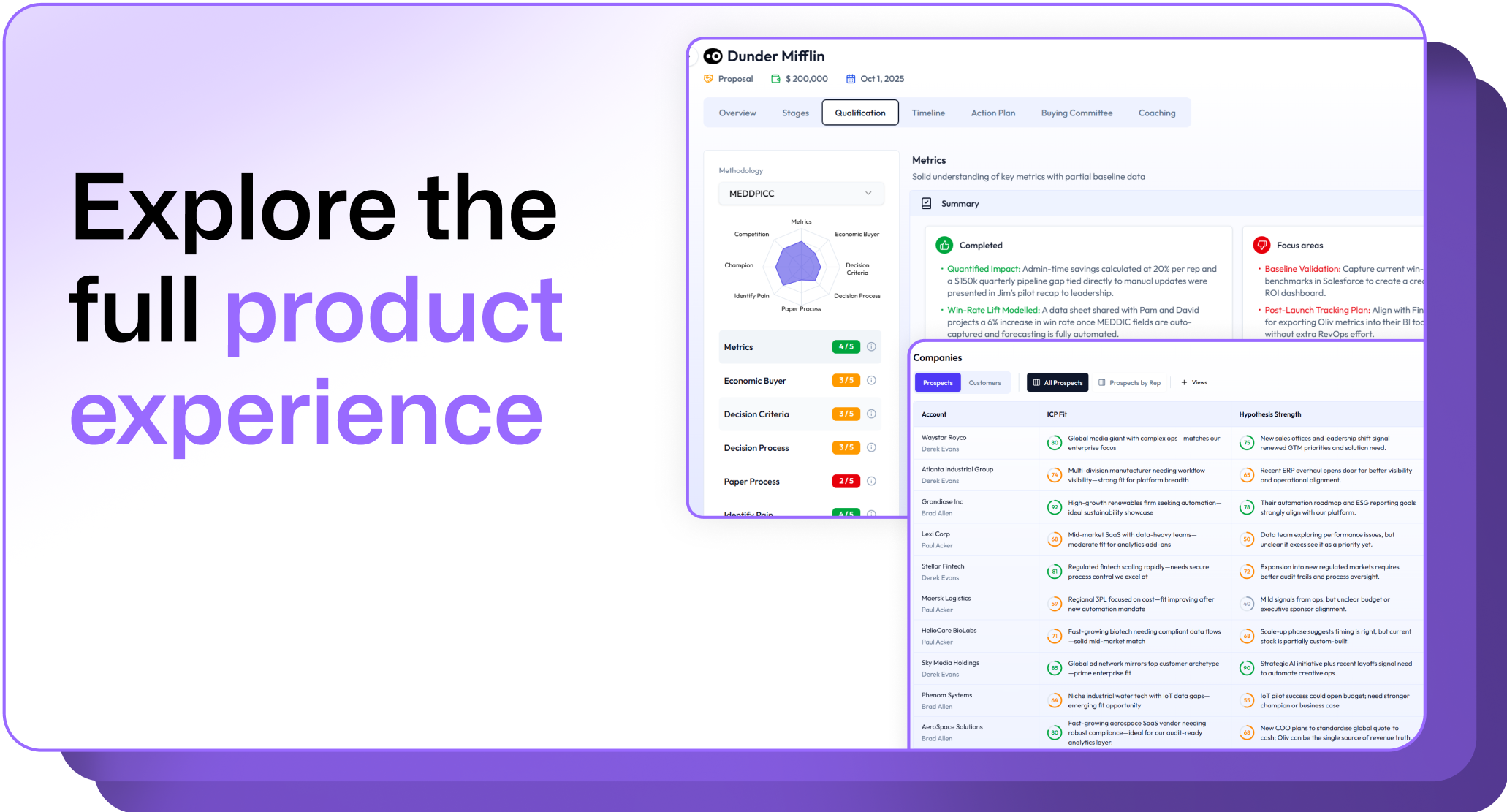
.avif)
.png)