Oliv AI for RevOps — Complete Implementation, Admin, and Configuration Guide
Written by
Ishan Chhabra
Last Updated :
April 3, 2026
Skim in :
14
mins
In this article
Revenue teams love Oliv
Here’s why:
All your deal data unified (from 30+ tools and tabs).
Insights are delivered to you directly, no digging.
AI agents automate tasks for you.
Thank you! Your submission has been received!
Oops! Something went wrong while submitting the form.
Meet Oliv’s AI Agents
Hi! I’m, Deal Driver
I track deals, flag risks, send weekly pipeline updates and give sales managers full visibility into deal progress
Hi! I’m, CRM Manager
I maintain CRM hygiene by updating core, custom and qualification fields all without your team lifting a finger
Hi! I’m, Forecaster
I build accurate forecasts based on real deal movement and tell you which deals to pull in to hit your number
Hi! I’m, Coach
I believe performance fuels revenue. I spot skill gaps, score calls and build coaching plans to help every rep level up
Hi! I’m, Prospector
I dig into target accounts to surface the right contacts, tailor and time outreach so you always strike when it counts
Hi! I’m, Pipeline tracker
I call reps to get deal updates, and deliver a real-time, CRM-synced roll-up view of deal progress
Hi! I’m, Analyst
I answer complex pipeline questions, uncover deal patterns, and build reports that guide strategic decisions
TL;DR
Oliv AI replaces the legacy Gong + Clari + Salesforce stack with a single AI-native platform, cutting costs by up to 91% over three years.
Setup takes five minutes for baseline configuration and two to four weeks for full customization, compared to three to six months for legacy tools.
The CRM Manager Agent writes to actual CRM properties with bi-directional sync and Human-in-the-Loop validation, not unstructured notes.
AI-Based Object Association uses LLM reasoning to handle duplicate records and multi-opportunity mapping, replacing brittle rule-based systems.
Oliv supports 100+ custom fields, 100+ sales methodologies, weekly CRM Health Reports, and a Data Cleanser Agent for automated hygiene.
Enterprise-grade security includes AES-256 encryption, SOC 2 Type II, GDPR, CCPA compliance, dedicated per-org data workspaces, and full data portability with zero lock-in.
Q1: What Is Oliv AI's RevOps Architecture and Why Does It Replace the Legacy Stack? [toc=RevOps Architecture]
If you're a Director of RevOps today, chances are your team manages a three- or four-tool stack that was never designed to work together. Gong for conversation intelligence, Clari for forecasting, Salesforce as the CRM backbone, each tool requiring its own admin configuration, separate data pipelines, and distinct maintenance cycles. This fragmented reality represents what industry observers call the "second generation" of revenue technology: dashboards that surface insights but still depend on humans to act on them. The industry is now moving into a third generation, agentic automation, where AI agents don't just analyze data; they perform the work autonomously.
⚠️ The Hidden Tax of Stacking Legacy Tools
The operational cost of maintaining this legacy stack is staggering. Gong implementations routinely consume 8 to 24 weeks and 40 to 140 admin hours just to configure keyword trackers and Smart Trackers. Clari demands that managers sit with reps every Thursday and Friday to manually hear "the story of a deal" before submitting forecasts, a process one Reddit user called "a glorified SFDC overlay."
"It can be overwhelming to set up trackers. AI training is a bit laborious to get it to do what you want." Trafford J., Senior Director, Revenue Enablement Gong G2 Verified Review
"Clari should find ways to differentiate from the native Salesforce features (e.g. Pipeline Inspection, Forecasting) in order to remain competitive in the long-run." Dan J., Mid-Market Clari G2 Verified Review
Meanwhile, Salesforce Agentforce requires months of Data Cloud configuration before any agent can function, and Data Cloud itself was built primarily for B2C consumer data mapping, making it a poor fit for B2B sales teams.
💸 The $500/User Problem
When you combine Gong (~$250/month bundled) and Clari (~$200/month) alongside a $5,000 to $50,000 mandatory platform fee, you're looking at a $500/user/month stack that still requires manual CRM entry, manual forecasting sessions, and manual alert triage. This is the core architectural failure: tools designed in the pre-generative AI era that add work to RevOps rather than removing it.
✅ Oliv's Three-Layer Agentic Architecture
Oliv AI takes a fundamentally different approach. Rather than layering another dashboard on top of your CRM, we built an AI-native Data Platform with three interconnected layers:
Foundation Layer: Automatically stitches data from calls, emails, Slack, LinkedIn, and the web into a unified deal view
Intelligence Layer: 100+ fine-tuned LLMs extract specific signals (competitor mentions, churn risks, methodology gaps) across the entire deal lifecycle
Activation Layer: Specialized AI agents (CRM Manager, Forecaster, Deal Driver, Researcher, Analyst) take that intelligence and perform work autonomously, updating CRM fields, generating forecast decks, and flagging stalled deals
Oliv AI's three-layer architecture replaces the fragmented legacy stack with a unified platform that moves data from raw capture to autonomous agent action.
Baseline configuration takes five minutes. Full custom model building and workflow fine-tuning takes just 2 to 4 weeks, compared to 3 to 6 months for legacy alternatives. Over three years, a 100-user team on Gong costs roughly $789,300, while the same team on Oliv costs $68,400, a 91% cost reduction.
Q2: What's the Minimal Setup Time and Required Admin Access for Oliv? [toc=Setup Time and Access]
One of the most common questions from Directors of RevOps evaluating any AI platform is: how much admin time does this actually consume before we see value? With legacy tools, the answer has historically been painful, weeks of configuration, dedicated implementation teams, and significant opportunity cost.
⏰ Oliv Setup Timeline: Day 1 to Full Deployment
Oliv Setup Timeline
Phase
Timeline
What Happens
Baseline Configuration
~5 minutes
One-time OAuth connection to CRM (Salesforce, HubSpot, Dynamics, Pipedrive, or Zoho), calendar, and email provider
Core Deployment
1 to 2 days
Meeting recording, transcription, and AI summaries active. CRM Manager begins syncing fields
Full Customization
2 to 4 weeks
Custom model building, methodology extraction (MEDDPICC, BANT, SPICED), workflow fine-tuning, and agent activation
Step-by-Step Admin Setup
Connect your CRM: Grant Oliv standard admin-level OAuth access to Salesforce, HubSpot, or your CRM of choice. No custom API development or middleware required.
Link calendar and email: Authenticate Gmail or Outlook so Oliv can automatically join scheduled meetings, capture email threads, and sync activity data.
Define your revenue process: Spend approximately 2 to 4 hours with the Oliv onboarding team to map your deal stages, qualification criteria, and custom field requirements.
Activate agents: Select which AI agents your team needs (CRM Manager, Forecaster, Deal Driver, etc.) on a modular, per-seat or per-org basis.
Configure methodology extraction: Choose from 100+ supported frameworks (MEDDPICC, BANT, FAINT, SPICED) and map them to your CRM's custom fields.
Required Admin Permissions
CRM: Standard admin-level access for field mapping and object read/write permissions
Email: OAuth authentication (Gmail or Outlook), no inbox forwarding or alias configuration required
Calendar: Read access for meeting scheduling and auto-join functionality
Communication tools (optional): Slack or Telegram workspace access for alert delivery
How This Compares to Legacy Alternatives
For context, a Gong implementation typically consumes 8 to 24 weeks and up to 140 admin hours before teams realize value. Even "quick start" implementations require extensive tracker configuration, and expanding beyond CI into forecasting or engagement modules adds additional cost and setup time.
"The additional products like forecast or engage come at an additional cost. Would be great to see these tools rolled into the core offering." Scott T., Director of Sales Gong G2 Verified Review
Oliv also provides free data migration for teams transitioning from Gong, importing all historical recordings and metadata at no additional cost, so you never lose institutional knowledge during the switch.
Q3: Does Oliv Update Actual CRM Objects or Just Log Notes and How Does Bi-Directional Sync Work? [toc=CRM Sync and Updates]
The single biggest frustration for RevOps leaders is that most intelligence tools generate insights that remain trapped in unstructured "Notes" fields, text blocks that can't be filtered, reported on, or used in pipeline dashboards. If your conversation intelligence tool doesn't write to actual CRM properties, every downstream process (forecasting, territory planning, and pipeline reviews) stays broken regardless of how good the AI is.
❌ The "Notes Trap" in Legacy Platforms
Gong captures valuable call intelligence but writes it as unstructured activity blocks or Notes in your CRM, not as actual property updates. As multiple users confirm, Gong "doesn't update the property in the CRM" directly. Your RevOps team still can't build native CRM reports on MEDDPICC completion rates or deal risk indicators because the data lives in text blobs, not structured fields.
"For me, the only business problem Gong solves is the call recordings. It allows me to review my calls and listen to them so that I can understand either where I went wrong or what the customer really said." John S., Senior Account Executive Gong G2 Verified Review
Clari improves the Salesforce overlay experience, where reps can update fields from a single view, but the underlying data still depends on rep-driven manual inputs. The information is only as accurate as what the rep remembers and chooses to enter.
✅ How Bi-Directional Sync Should Actually Work
True CRM autonomy requires a closed loop: the intelligence layer reads from the CRM, enriches data from conversations and external sources, writes back to actual CRM properties, and keeps both systems in perfect sync in real time. One-way integrations, where data flows into the tool but never returns to the CRM in a structured format, create the exact data silos RevOps exists to eliminate.
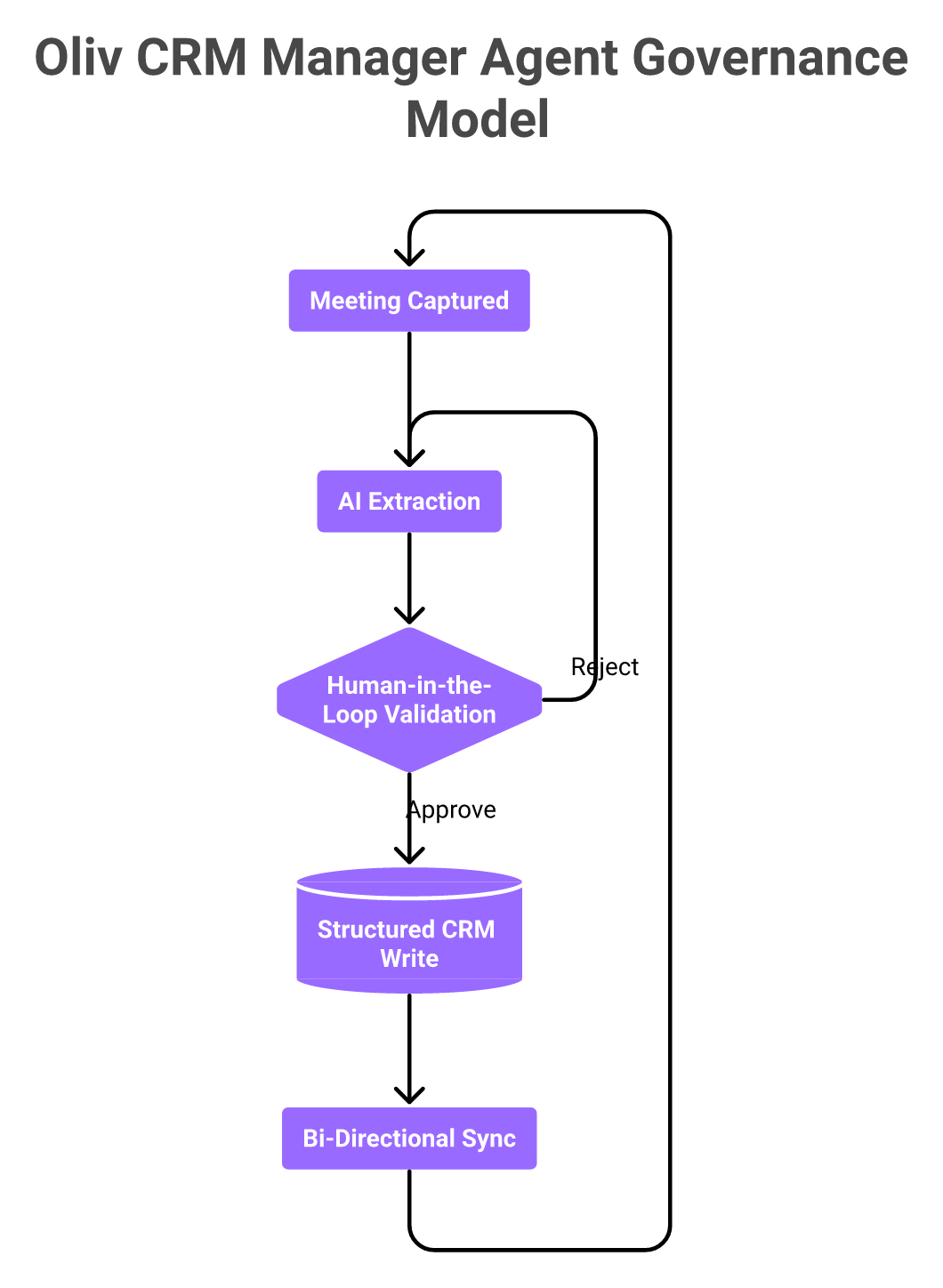
Oliv's CRM Manager Agent writes directly to actual CRM objects and properties, both standard and custom fields, based on conversation context. Here's how the governance model works:
Automated drafting: After each meeting, the CRM Manager extracts relevant field values (deal stage, MEDDPICC criteria, next steps, and competitor mentions) from the transcript
Human-in-the-Loop validation: Reps receive a Slack or Email nudge to review and approve drafted updates before they hit the CRM, preventing hallucinated data from entering your system
Bi-directional sync: Any update made in Oliv reflects in HubSpot/Salesforce and vice versa, ensuring your CRM remains the single source of truth
Oliv's CRM Manager Agent follows a four-step governance model that ensures every field update is AI-extracted, human-validated, and written as structured CRM data.
CRM Integration Comparison
Capability
Gong
Clari
Salesforce Agentforce
Oliv AI
CRM write behavior
Notes/activity blocks only
Rep-driven manual
Chat-based bot interaction
Actual CRM properties (structured)
Sync direction
One-way (into Gong)
Partial overlay
Requires Data Cloud
Full bi-directional
Validation model
None (notes only)
Manual rep input
Manual chat interaction
Human-in-the-Loop (Slack/Email nudge)
Custom field support
Keyword trackers only
Limited fields
Standard fields
100+ fields, all formats
"Before Gong we had a lack of visibility across our deals because information was siloed in several places like CRM, Email, Zoom, phone." Scott T., Director of Sales Gong G2 Verified Review
Oliv eliminates these silos by ensuring every insight flows back into your CRM as structured, reportable data, not buried in notes that only the original rep can find.
Q4: How Does Oliv Handle Duplicate Records and Auto-Associate Activities to the Right Opportunity? [toc=Duplicate Record Handling]
Duplicate records and mis-associated activities are among the most expensive silent failures in any CRM. When your company sells multiple products to the same account, or when duplicate records exist for the same domain (e.g., "Acme US" vs. "Acme EMEA"), call logs, emails, and meeting notes frequently get attached to the wrong opportunity. The downstream impact is severe: corrupted pipeline reports, inaccurate forecasts, and deal histories that don't reflect reality.
❌ Why Rule-Based Association Breaks at Scale
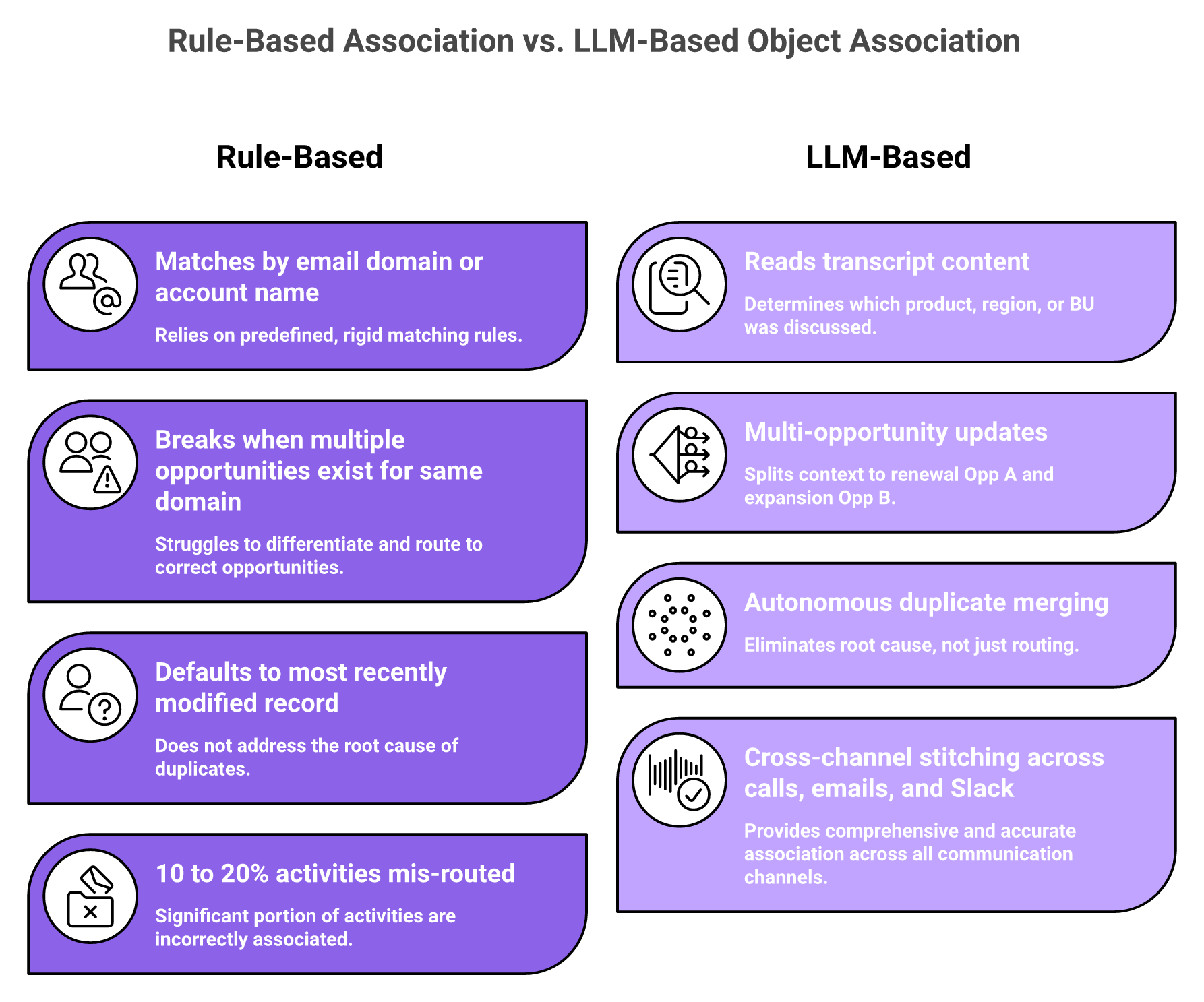
Legacy platforms rely on simple, deterministic rules to associate activities with CRM records, typically matching by email domain or account name. Salesforce Einstein Activity Capture, for instance, uses rule-based matching that breaks when multiple opportunities exist for one domain. If a rep has a call discussing both a renewal and a new expansion with the same company, Einstein frequently attaches the activity to the wrong record, or defaults to the most recently modified one.
Gong captures the interaction accurately but doesn't intelligently route it to the correct CRM object. The call recording lives in Gong's universe, and the burden falls on the rep or RevOps to manually associate it correctly.
"Its biggest handicap is that it does not allow for data storage or data migration. You can't really input the data from Einstein into another platform." Anonymous Reviewer Salesforce Einstein Gartner Verified Review
🧠 LLM-Based Reasoning vs. Brittle Rules
The fundamental difference is that rule-based systems ask "which account matches this email domain?" while LLM-based reasoning asks "what was actually discussed in this conversation, and which opportunity does it logically belong to?"
Legacy tools match activities by email domain, which breaks at scale. Oliv's LLM reads what was actually discussed and routes to the correct opportunity.
This contextual approach examines:
Which product or service was discussed in the transcript
Which region or business unit was referenced
Which stakeholders were present and their known associations
The historical context of previous interactions with that account
✅ Oliv's AI-Based Object Association
Oliv's AI-Based Object Association uses LLM reasoning to examine the transcript content and interaction history to determine the "right logical one" for mapping. Key capabilities include:
Multi-opportunity updates: If both a renewal (Opp A) and an expansion (Opp B) were discussed in one meeting, Oliv identifies both topics and updates each opportunity with the relevant context
Autonomous duplicate merging: When Oliv detects duplicate accounts, it can offer to merge them, eliminating the root cause rather than just routing around it
Cross-channel stitching: Association logic works across calls, emails, Slack messages, and even data captured by the Voice Agent from unrecorded phone conversations
"It is really just a glorified SFDC overlay. Actually, Salesforce has built most of the forecasting functionality by now anyway so I'm not sure where they fit into that whole overcrowded Martech space." conaldinho11, r/SalesOperations Reddit Thread
Where legacy tools require RevOps to manually audit associations quarterly, or accept that 10 to 20% of activities are mis-routed, Oliv resolves the association at the moment of capture, ensuring pipeline data stays accurate from Day 1.
Q5. Can Oliv Handle 100+ Custom Fields and How Do You Configure Methodology Extraction? [toc=Custom Fields and Methodology]
Complex B2B sales cycles require tracking far more than the standard CRM fields that come out of the box. Enterprise RevOps teams regularly manage dozens of custom data points, including tech stack, infrastructure provider, contract renewal dates, and procurement process details, that vary widely by organization and vertical. This section answers the practical question: what are Oliv's actual field limits, and how does methodology extraction work under the hood?
Supported Field Formats and Practical Limits
Oliv Custom Field Specifications
Specification
Details
Technical field cap
No hard cap. Oliv can update 100+ fields per opportunity if needed
Full. Admins can define custom qualification frameworks beyond standard templates
Oliv's intelligence layer uses 100+ fine-tuned LLMs to extract specific field values from conversations, not just detect whether a keyword was mentioned. This is a critical distinction from legacy tools.
How to Configure Methodology Extraction
Select your framework: During onboarding (or at any time via the admin console), choose from 100+ pre-built sales methodology templates, or create a fully custom qualification scorecard.
Map fields to CRM properties: Associate each methodology criterion (e.g., "Identified Pain," "Decision Process," "Champion") with the corresponding CRM field. Oliv supports both standard and custom properties.
Define extraction rules: Specify what constitutes a valid value for each field. For picklist fields, Oliv maps extracted conversation data to the correct option; for text fields, it generates concise, structured summaries.
Activate across deal stages: Configure which fields are extracted at which deal stage to avoid premature or irrelevant updates. For example, "Budget Authority" extraction activates at Stage 2 while "Paper Process" activates at Stage 4.
Review and refine: Monitor extraction accuracy during the 2 to 4 week customization window. Oliv's models improve with feedback, allowing admins to correct edge cases.
❌ How Legacy Platforms Handle Custom Fields
Gong's approach to custom data is fundamentally limited to keyword trackers (Smart Trackers) that indicate whether a word was mentioned, not the specific value for a structured CRM field. As one reviewer noted:
"It can be overwhelming to set up trackers. AI training is a bit laborious to get it to do what you want." Trafford J., Senior Director, Revenue Enablement Gong G2 Verified Review
"There's so much in Gong, that we don't use everything. Gong's deal forecasting we don't use." Karel Bos, Head of Sales Gong TrustRadius Verified Review
Salesforce Agentforce offers field-level automation, but setup complexity is a recurring concern:
"It can be complex to set up and often requires skilled administrators or developers to customize and integrate properly, which adds time and cost." Verified User in Marketing and Advertising Salesforce Agentforce G2 Verified Review
Oliv simplifies this entire process by treating methodology extraction as a core platform capability, not an aftermarket add-on. Admins configure fields once, and the AI continuously extracts and populates values from every interaction, eliminating the gap between conversation intelligence and CRM data.
Q6. How Does Oliv Log Evidence for Every Field Update and How Do You Prevent Alert Spam? [toc=Evidence Logging and Alert Tuning]
Two of the most persistent admin challenges in RevOps are deeply related: data trust and alert fatigue. When a MEDDPICC field like "Champion" or "Decision Process" gets updated in the CRM, leaders have no way to verify where that information came from without rewatching 45-minute call recordings or digging through email threads. Simultaneously, keyword-based trackers flood Slack channels with non-actionable pings, flagging the word "budget" even when a prospect is discussing a personal holiday, until managers simply mute notifications entirely.
❌ The "Noisy Platform" Problem
Gong's Smart Trackers are powerful for detecting keyword mentions, but they generate a volume of alerts that many teams find overwhelming. The platform has been described as a "noisy platform" that "blows up Slack all day" while still requiring managers to click through multiple screens to find actionable context. When every keyword ping carries equal weight, the signal-to-noise ratio collapses.
"Its too complicated, and not intuitive at all. Using it is very...discomforting. Searching for calls is not easy, moving around in the calls is not easy, and understanding the pipeline management portion of it is almost impossible." John S., Senior Account Executive Gong G2 Verified Review
Clari, meanwhile, has no native evidence-linking mechanism. Field values depend on what the rep remembers and chooses to enter manually. This creates a "trust gap" where managers question every data point but lack the tools to verify it efficiently.
✅ Evidence-Based Qualification: The New Standard
The AI-era standard requires that every CRM field update carries a verifiable provenance chain, the specific call timestamp, email snippet, or web article that generated the data point. Without this evidence layer, "AI-updated" fields are no more trustworthy than rep-entered data.
How Oliv Solves Both Problems Simultaneously
Oliv maintains a "clear data trail" for every update. Within the platform, RevOps can click on any field to see its full history of evolution, exactly which call clipping (with timestamp), email snippet, or web article led to that data point. This provides 100% evidence-based qualification instead of relying on rep sentiment.
For alert delivery, Oliv replaces keyword-based notification spam with role-tuned, context-aware insights:
Oliv Role-Based Alert Delivery
Persona
Delivery Format
Timing
Sales Managers
Sunset Summaries (daily deal movement wrap-ups)
End of day
Sales Managers
Morning Briefs (prep notes for upcoming calls)
30 minutes before meetings
Individual Contributors
Post-call follow-up drafts
Immediately after meetings
RevOps Leaders
Weekly CRM Health Reports
Monday mornings
Users choose their preferred channel, Slack or Email, per delivery type. There is no blanket Slack bombardment.
"I wish they were a little more responsive to customer requests. They say a feature is coming in a certain quarter and then it doesn't." Amanda R., Director, Customer Success Gong G2 Verified Review
"The tool is slow, buggy, and creates an excessive administrative burden on the user side." Anonymous Reviewer Gong G2 Verified Review
By linking every update to its source artifact and delivering only role-relevant insights at the right time, Oliv eliminates both the trust gap and the noise problem in a single AI-Native Revenue Orchestration platform.
Q7. Can Oliv Generate Weekly CRM Health Reports and Data Cleanser Reports? [toc=CRM Health Reports]
CRM hygiene is the silent killer of revenue operations. RevOps teams spend 40+ hours per month cleaning up manual entry errors, normalizing inconsistent field values, and chasing reps for missing data. Without automated hygiene reporting, dirty data compounds silently, crippling forecast models, pipeline reports, and every downstream AI deployment that depends on structured CRM data.
❌ The "Static Repository" Problem
Salesforce, for all its power as a platform, is fundamentally a static repository. It stores what humans put in, but it doesn't proactively flag its own dirty data. Cleaning Salesforce typically requires expensive third-party tools (Validity DemandTools, RingLead) or manual RevOps "janitorial work." Gong, meanwhile, lacks automated reporting for RevOps-specific CRM property hygiene metrics. It tracks conversation intelligence well but doesn't tell you which CRM fields are empty, inconsistent, or decaying.
"It is really just a glorified SFDC overlay. Actually, Salesforce has built most of the forecasting functionality by now anyway so I'm not sure where they fit into that whole overcrowded Martech space." conaldinho11, r/SalesOperations Reddit Thread
"Clari is a tool for sales leaders, it adds no value to reps as far as I can see." Msoave, r/SalesOperations Reddit Thread
⚠️ Why Proactive Data Quality Management Matters Now
The shift toward AI-powered forecasting and deal intelligence makes clean data a non-negotiable prerequisite. If your forecasting agent is reasoning on stale close dates, empty MEDDPICC fields, or duplicate records, every output it generates inherits that corruption. Proactive data quality management, where AI continuously monitors for anomalies, duplicates, and gaps, replaces the outdated model of quarterly manual audits.
✅ Oliv's Weekly CRM Health Reports
Oliv's CRM Manager Agent generates automated weekly CRM Health Reports for RevOps leaders, providing a single-view dashboard of data quality across the organization. Key metrics include:
CRM completeness score (%): Percentage of required fields populated across all active opportunities
Fields updated this week: Total object and property updates made by AI agents, broken down by rep
Duplicate records flagged: Accounts and contacts identified as potential duplicates for manual review or autonomous merging
Methodology coverage by rep: MEDDPICC/BANT completion rates per rep, highlighting coaching opportunities
Pipeline hygiene trend: Week-over-week progression showing whether data quality is improving or degrading
The Data Cleanser Agent
Complementing the health reports, Oliv's Data Cleanser Agent automates the normalization and deduplication process on a weekly cycle. It proactively:
Deduplicates records by matching on fuzzy name variations, domain aliases, and contact overlaps
Normalizes field values (e.g., consolidating "US," "United States," and "USA" into a single standard)
Enriches incomplete records with external data sources
Flags anomalies (e.g., a deal marked "Closed Won" with no champion identified) for RevOps review
By cleaning the data foundations first, Oliv ensures that intelligence and forecasting agents are never reasoning on "meaningless" data, a prerequisite that legacy tools leave entirely to manual effort.
Q8. Does Oliv Create New Contacts or Only Update Existing Ones and Can It Enrich with Firmographic Data? [toc=Contact Creation and Enrichment]
Large buying committees are a defining characteristic of enterprise B2B sales. A typical deal involves 6 to 10 stakeholders, yet reps rarely add every attendee from every meeting to the CRM. This leads to "missing stakeholders" who can derail a deal late in the cycle, a procurement lead who was never logged, or a technical evaluator whose objections were never tracked.
How Oliv's CRM Manager Agent Handles Contact Creation
Oliv Contact Creation Behavior
Behavior
Details
New contact discovery
Automatically detects new participants in calls and emails who don't exist in the CRM
Auto-creation
Creates new contact records with name, email, title, and company association
Profile enrichment
Enriches new contacts with LinkedIn data (titles, job changes) and web signals
Account mapping
Associates new contacts to the correct account and opportunity using AI-Based Object Association
Validation
Follows the Human-in-the-Loop model. Reps receive a nudge to confirm before records are created
This stands in contrast to Salesforce Einstein Activity Capture, which frequently misses associations or redacts data unnecessarily. Einstein's rule-based approach struggles when meeting attendees use personal email addresses or when their company domain doesn't match the existing account record.
"Salesforce Einstein is an AI tool that our company recently started using to generate leads that have more potential for success... However, it has issues related to data storage and migration that need to be addressed in updates." Verified Reviewer, Education Salesforce Einstein Gartner Verified Review
Firmographic Enrichment via the Researcher Agent
Beyond contact creation, Oliv's Researcher Agent automatically generates deep account dossiers by pulling external data from Crunchbase, LinkedIn, and the open web. Enrichment capabilities include:
Company firmographics: Funding rounds, revenue estimates, employee count, and industry classification
Executive team mapping: Key decision-makers, recent leadership changes, and board composition
ICP fit scoring: Automated scoring against your Ideal Customer Profile based on enriched attributes
Icebreaker topics: Recent news, product launches, or company milestones for personalized outreach
Technology stack signals: Known tools and platforms the prospect uses (useful for competitive positioning)
"As much as I love what Agentforce can do, setting it up wasn't as smooth as I expected. The UI felt a bit clunky at times, especially when trying to manage multiple prompts or agent versions." Ayushmaan Y., Senior Associate Salesforce Agentforce G2 Verified Review
Most legacy conversation intelligence tools, including Gong and Clari, are purely internal-data recorders and do not pull in external web signals to enrich CRM records. Reps are left spending 15 to 30 minutes before each call manually researching a company's funding status or executive team on LinkedIn and Crunchbase.
✅ Eliminating Pre-Call Research Entirely
Oliv eliminates this pre-call research burden entirely. The Researcher Agent compiles dossiers automatically, enriching both new and existing account records so that reps walk into every meeting fully prepared, without any manual effort.
Q9. Can Oliv Run Natural-Language Pipeline Analysis Without SQL? [toc=Natural-Language Pipeline Analysis]
Strategic pipeline questions, "Why are we losing FinTech deals in Stage 2?" or "Which reps consistently miss MEDDPICC Champion criteria?", currently require a data analyst to write SQL queries or build complex Salesforce dashboards. This creates a bottleneck that delays decision-making by days or weeks. For Directors of RevOps who need real-time pipeline intelligence, waiting on a BI team to build a custom report simply isn't tenable in a fast-moving quarter.
❌ Legacy Analytics: API Limitations and Dashboard Complexity
Gong offers powerful conversation intelligence, but extracting cross-pipeline insights for ad-hoc analysis remains difficult. Its API has been described as challenging to work with for custom reporting needs, and the platform's analytics are tightly scoped to its own conversation data. Salesforce requires building complex Report Types or relying on Einstein Analytics, a platform that multiple reviewers describe as heavy to implement and dependent on older machine learning models.
"Quite frankly I haven't been impressed by any of the early Salesforce AI tools, and I don't hear anyone talking about them glowingly." OffManuscript, r/SalesforceDeveloper Reddit Thread
"Its biggest handicap is that it does not allow for data storage or data migration. You can't really input the data from Einstein into another platform." Verified Reviewer, Education Salesforce Einstein Gartner Verified Review
Clari's analytics, while useful for forecasting overlays, are limited to its own dataset and don't enable free-form querying across the full pipeline context.
✅ The Natural-Language Interface Paradigm
The AI-era standard democratizes pipeline intelligence: any RevOps leader should be able to ask complex cross-pipeline questions in plain English, without SQL, without a BI intermediary, and without building a custom dashboard.
How Oliv's Analyst Agent Works
Oliv's Analyst Agent functions as an "ask-me-anything" strategic engine for RevOps. It allows leaders to query pipeline data conversationally and receive curated datasets, visual dashboards, and interpretive commentary within seconds. Example queries the Analyst Agent handles:
"Pull up all meetings where the prospect mentioned Gong pricing concerns"
"Show me all Stage 2 deals where the MEDDPICC Champion field is empty"
"Compare win rates for deals where Clari was mentioned vs. not"
"Which accounts had zero engagement in the last 30 days?"
"Why are our EMEA deals stalling at Stage 3 compared to NAM?"
The agent doesn't just return raw data. It provides interpretive commentary explaining patterns and suggesting next actions.
"I find the setup process challenging, especially when migrating fields from Salesforce, as it can't handle formula fields directly. This requires creating and maintaining duplicate fields, which adds complexity and workload." Josiah R., Head of Sales Operations Clari G2 Verified Review
Where legacy tools force RevOps to choose between building complex dashboards or exporting to spreadsheets, Oliv collapses the entire analysis workflow into a single natural-language conversation, turning hours of report building into seconds of asking.
Q10. How Is Data Encrypted, Stored, and Governed and Does Oliv Create a Secure Workspace per Org? [toc=Data Security and Governance]
Enterprise security and compliance requirements are non-negotiable for any AI platform that touches CRM data, call recordings, and deal intelligence. This section covers Oliv's encryption standards, compliance certifications, and tenant isolation architecture.
Encryption Standards
Oliv Encryption Standards
Layer
Standard
Details
Data at rest
AES-256 encryption
All stored data (recordings, transcripts, and CRM snapshots) encrypted using industry-standard AES-256
Data in transit
TLS 1.2+
All data transmitted between Oliv, CRM, and communication tools encrypted via TLS 1.2 or higher
Backup encryption
AES-256
Database backups and disaster recovery copies maintain identical encryption standards
Compliance Certifications
Oliv maintains the following certifications relevant to enterprise B2B procurement:
SOC 2 Type II: Independent audit of security, availability, and confidentiality controls
GDPR compliant: Full compliance with European data protection regulations, including right to erasure
CCPA compliant: California Consumer Privacy Act compliance for U.S.-based data subjects
✅ Dedicated Customer Data Workspace
A critical differentiator for enterprise buyers is tenant isolation. Oliv operates within a dedicated "customer data workspace" for every organization. Key architectural details:
Fine-tuned models per org: Oliv uses models that only access your specific company's data, ensuring the AI never incorporates "internal knowledge" from outside your tenant
No cross-tenant data leakage: Each organization's data lake is fully isolated; model training and inference happen within your workspace boundary
Role-Based Access Control (RBAC): Granular permissions determine which users can view, edit, or export specific data types (recordings, deal intelligence, and forecast data)
Comprehensive audit logs: Every action (agent update, user access, and data export) is logged for governance and compliance review
"The price of Agentforce is not clear and hard to find. Adoption is low because of the lack of knowledge on the subject as AI is a new field. Customers are finding issues in deploying and using agents in Salesforce." Anusha T., Web Developer Salesforce Agentforce G2 Verified Review
"It can be complex to set up and often requires skilled administrators or developers to customize and integrate properly, which adds time and cost. Licensing fees can be high, especially as the number of agents grows." Verified User in Marketing and Advertising Salesforce Agentforce G2 Verified Review
Oliv simplifies enterprise security by providing SOC 2, GDPR, and CCPA compliance out of the box, with dedicated per-org data workspaces and RBAC, removing the need for lengthy security review cycles that often delay AI platform deployments.
Q11. Salesforce Data Cloud vs. Oliv AI Data Platform: Which Solves Dirty Data Faster? [toc=Data Cloud vs Oliv]
Most RevOps leaders believe getting CRM data clean is a "two-to-three-year long project." Salesforce's Data Cloud is often positioned as the enterprise answer to this problem, but its deployment reality for B2B sales teams rarely matches the marketing promise. Understanding the architectural differences between these two platforms is critical for any Director of RevOps evaluating their data strategy.
❌ The Salesforce Data Cloud Reality
Salesforce Data Cloud is a powerful data unification platform, but it was built primarily for B2C consumer data mapping. Its sweet spot is stitching together individual consumer profiles across touchpoints (e.g., a Colgate-Palmolive customer who interacts via retail, email, and social). For B2B sales teams, this architecture presents several challenges:
Agentforce dependency: Salesforce Agentforce requires Data Cloud to function, but Data Cloud itself requires clean, structured data to be useful, creating a chicken-and-egg problem
Implementation timeline: Typical Data Cloud deployments take 3 to 12 months, with costs starting at $65K+/year
B2B misalignment: The platform's identity resolution and segmentation models are optimized for consumer profiles, not complex B2B account hierarchies with multiple opportunities and stakeholders
"The learning curve is the biggest challenge. While it's advertised as low-code, the reality is you still need solid Salesforce admin knowledge, and for more advanced use cases, Apex and prompt engineering skills." Ayushmaan Y., Senior Associate Salesforce Agentforce G2 Verified Review
The legacy model demands that you clean your data before AI can work on it. The AI-era paradigm flips this: the platform should clean and enrich data as a prerequisite to intelligence, not the other way around. Data readiness should take days, not years.
The legacy model demands years of manual data cleaning before AI works. Oliv flips this: the AI cleans data automatically, delivering intelligence readiness in two weeks.
✅ Oliv's Out-of-the-Box B2B Model
Oliv provides an "out-of-the-box model" built specifically for B2B tech companies. It makes data "AI-ready" instantly, with a typical deployment time of two weeks and technical configuration in just 5 to 15 minutes.
Salesforce Data Cloud vs. Oliv AI Data Platform
Dimension
Salesforce Data Cloud
Oliv AI Data Platform
Target market
B2C consumer mapping
B2B sales teams
Deployment timeline
3 to 12 months
2 weeks (config: 5 to 15 min)
Data prerequisite
Requires clean data to start
Cleans data as it goes
Cost
$65K+/year
From $19/user/month
Agentforce dependency
Required for Agentforce
Standalone, no dependencies
Data cleaning approach
Manual + third-party tools
Automated via Data Cleanser Agent
The Data Cleanser Agent continuously normalizes, deduplicates, and enriches records, solving dirty data as an ongoing automated process rather than a one-time, multi-year migration project.
Q12. What Happens If Oliv Goes Out of Business and Can It Work as a Layer on Top of HubSpot Without Changing Workflows? [toc=Vendor Risk and Portability]
Two of the most common objections from Directors of RevOps considering Oliv are deeply practical: "You're a Series A startup, what if you disappear?" and "My reps won't adopt another tool." Both concerns are legitimate and deserve direct answers rather than marketing deflection.
❌ The Lock-In Problem with Legacy Vendors
Legacy vendors like Gong create data silos that are notoriously difficult to export in bulk. One Sales Operations Manager documented this frustration in detail:
"Gong offers valuable insights into call data and sales interactions, our experience has been impacted by significant data access limitations, especially concerning data portability and bulk export capabilities... their current solution is far from convenient or accessible, it requires downloading calls individually, which is impractical and inefficient for a large volume of data." Neel P., Sales Operations Manager Gong G2 Verified Review
"It was a big mistake on our part to commit to a two year term. Gong is a really powerful tool but it's probably the highest end option on the market, and now we're stuck with a tool that works technically but isn't the right business decision." Iris P., Head of Marketing, Sales and Partnerships Gong G2 Verified Review
This data portability gap means switching costs are deliberately high. Intelligence, recordings, and metadata are trapped inside the vendor's UI.
✅ Oliv's Full Open Export Policy
Oliv takes the opposite approach to vendor lock-in. Upon contract termination, the platform provides a complete CSV dump of all meetings, recordings, and metadata in a usable format. Key portability guarantees:
Full data export: All recordings, transcripts, CRM update histories, and agent activity logs exportable on demand
Standard formats: Data delivered in CSV and standard audio/video formats, no proprietary encoding
No export fees: Data portability is included as a default platform capability, not a negotiation
Free Gong migration: For teams switching from Gong, Oliv imports all historical recordings and metadata at no cost
🔧 The "Invisible Intelligence Layer" Architecture
On the change management front, Oliv is designed so that reps never need to learn a new interface. We position our platform as an "Autonomous Intelligence Layer." Agents populate CRM fields, generate follow-ups, and deliver insights entirely in the background. Reps can "continue to live out of HubSpot" (or Salesforce, or any supported CRM) without altering a single daily workflow.
This stands in contrast to tools like Gong and Clari, which are "SaaS software you have to adopt and train your team to use," requiring dedicated onboarding sessions, workflow changes, and ongoing adoption monitoring. Oliv removes the adoption variable entirely: if your reps use a CRM, a calendar, and email, they're already "using" Oliv without knowing it.
Q1: What Is Oliv AI's RevOps Architecture and Why Does It Replace the Legacy Stack? [toc=RevOps Architecture]
If you're a Director of RevOps today, chances are your team manages a three- or four-tool stack that was never designed to work together. Gong for conversation intelligence, Clari for forecasting, Salesforce as the CRM backbone, each tool requiring its own admin configuration, separate data pipelines, and distinct maintenance cycles. This fragmented reality represents what industry observers call the "second generation" of revenue technology: dashboards that surface insights but still depend on humans to act on them. The industry is now moving into a third generation, agentic automation, where AI agents don't just analyze data; they perform the work autonomously.
⚠️ The Hidden Tax of Stacking Legacy Tools
The operational cost of maintaining this legacy stack is staggering. Gong implementations routinely consume 8 to 24 weeks and 40 to 140 admin hours just to configure keyword trackers and Smart Trackers. Clari demands that managers sit with reps every Thursday and Friday to manually hear "the story of a deal" before submitting forecasts, a process one Reddit user called "a glorified SFDC overlay."
"It can be overwhelming to set up trackers. AI training is a bit laborious to get it to do what you want." Trafford J., Senior Director, Revenue Enablement Gong G2 Verified Review
"Clari should find ways to differentiate from the native Salesforce features (e.g. Pipeline Inspection, Forecasting) in order to remain competitive in the long-run." Dan J., Mid-Market Clari G2 Verified Review
Meanwhile, Salesforce Agentforce requires months of Data Cloud configuration before any agent can function, and Data Cloud itself was built primarily for B2C consumer data mapping, making it a poor fit for B2B sales teams.
💸 The $500/User Problem
When you combine Gong (~$250/month bundled) and Clari (~$200/month) alongside a $5,000 to $50,000 mandatory platform fee, you're looking at a $500/user/month stack that still requires manual CRM entry, manual forecasting sessions, and manual alert triage. This is the core architectural failure: tools designed in the pre-generative AI era that add work to RevOps rather than removing it.
✅ Oliv's Three-Layer Agentic Architecture
Oliv AI takes a fundamentally different approach. Rather than layering another dashboard on top of your CRM, we built an AI-native Data Platform with three interconnected layers:
Foundation Layer: Automatically stitches data from calls, emails, Slack, LinkedIn, and the web into a unified deal view
Intelligence Layer: 100+ fine-tuned LLMs extract specific signals (competitor mentions, churn risks, methodology gaps) across the entire deal lifecycle
Activation Layer: Specialized AI agents (CRM Manager, Forecaster, Deal Driver, Researcher, Analyst) take that intelligence and perform work autonomously, updating CRM fields, generating forecast decks, and flagging stalled deals
Oliv AI's three-layer architecture replaces the fragmented legacy stack with a unified platform that moves data from raw capture to autonomous agent action.
Baseline configuration takes five minutes. Full custom model building and workflow fine-tuning takes just 2 to 4 weeks, compared to 3 to 6 months for legacy alternatives. Over three years, a 100-user team on Gong costs roughly $789,300, while the same team on Oliv costs $68,400, a 91% cost reduction.
Q2: What's the Minimal Setup Time and Required Admin Access for Oliv? [toc=Setup Time and Access]
One of the most common questions from Directors of RevOps evaluating any AI platform is: how much admin time does this actually consume before we see value? With legacy tools, the answer has historically been painful, weeks of configuration, dedicated implementation teams, and significant opportunity cost.
⏰ Oliv Setup Timeline: Day 1 to Full Deployment
Oliv Setup Timeline
Phase
Timeline
What Happens
Baseline Configuration
~5 minutes
One-time OAuth connection to CRM (Salesforce, HubSpot, Dynamics, Pipedrive, or Zoho), calendar, and email provider
Core Deployment
1 to 2 days
Meeting recording, transcription, and AI summaries active. CRM Manager begins syncing fields
Full Customization
2 to 4 weeks
Custom model building, methodology extraction (MEDDPICC, BANT, SPICED), workflow fine-tuning, and agent activation
Step-by-Step Admin Setup
Connect your CRM: Grant Oliv standard admin-level OAuth access to Salesforce, HubSpot, or your CRM of choice. No custom API development or middleware required.
Link calendar and email: Authenticate Gmail or Outlook so Oliv can automatically join scheduled meetings, capture email threads, and sync activity data.
Define your revenue process: Spend approximately 2 to 4 hours with the Oliv onboarding team to map your deal stages, qualification criteria, and custom field requirements.
Activate agents: Select which AI agents your team needs (CRM Manager, Forecaster, Deal Driver, etc.) on a modular, per-seat or per-org basis.
Configure methodology extraction: Choose from 100+ supported frameworks (MEDDPICC, BANT, FAINT, SPICED) and map them to your CRM's custom fields.
Required Admin Permissions
CRM: Standard admin-level access for field mapping and object read/write permissions
Email: OAuth authentication (Gmail or Outlook), no inbox forwarding or alias configuration required
Calendar: Read access for meeting scheduling and auto-join functionality
Communication tools (optional): Slack or Telegram workspace access for alert delivery
How This Compares to Legacy Alternatives
For context, a Gong implementation typically consumes 8 to 24 weeks and up to 140 admin hours before teams realize value. Even "quick start" implementations require extensive tracker configuration, and expanding beyond CI into forecasting or engagement modules adds additional cost and setup time.
"The additional products like forecast or engage come at an additional cost. Would be great to see these tools rolled into the core offering." Scott T., Director of Sales Gong G2 Verified Review
Oliv also provides free data migration for teams transitioning from Gong, importing all historical recordings and metadata at no additional cost, so you never lose institutional knowledge during the switch.
Q3: Does Oliv Update Actual CRM Objects or Just Log Notes and How Does Bi-Directional Sync Work? [toc=CRM Sync and Updates]
The single biggest frustration for RevOps leaders is that most intelligence tools generate insights that remain trapped in unstructured "Notes" fields, text blocks that can't be filtered, reported on, or used in pipeline dashboards. If your conversation intelligence tool doesn't write to actual CRM properties, every downstream process (forecasting, territory planning, and pipeline reviews) stays broken regardless of how good the AI is.
❌ The "Notes Trap" in Legacy Platforms
Gong captures valuable call intelligence but writes it as unstructured activity blocks or Notes in your CRM, not as actual property updates. As multiple users confirm, Gong "doesn't update the property in the CRM" directly. Your RevOps team still can't build native CRM reports on MEDDPICC completion rates or deal risk indicators because the data lives in text blobs, not structured fields.
"For me, the only business problem Gong solves is the call recordings. It allows me to review my calls and listen to them so that I can understand either where I went wrong or what the customer really said." John S., Senior Account Executive Gong G2 Verified Review
Clari improves the Salesforce overlay experience, where reps can update fields from a single view, but the underlying data still depends on rep-driven manual inputs. The information is only as accurate as what the rep remembers and chooses to enter.
✅ How Bi-Directional Sync Should Actually Work
True CRM autonomy requires a closed loop: the intelligence layer reads from the CRM, enriches data from conversations and external sources, writes back to actual CRM properties, and keeps both systems in perfect sync in real time. One-way integrations, where data flows into the tool but never returns to the CRM in a structured format, create the exact data silos RevOps exists to eliminate.
Oliv's CRM Manager Agent writes directly to actual CRM objects and properties, both standard and custom fields, based on conversation context. Here's how the governance model works:
Automated drafting: After each meeting, the CRM Manager extracts relevant field values (deal stage, MEDDPICC criteria, next steps, and competitor mentions) from the transcript
Human-in-the-Loop validation: Reps receive a Slack or Email nudge to review and approve drafted updates before they hit the CRM, preventing hallucinated data from entering your system
Bi-directional sync: Any update made in Oliv reflects in HubSpot/Salesforce and vice versa, ensuring your CRM remains the single source of truth
Oliv's CRM Manager Agent follows a four-step governance model that ensures every field update is AI-extracted, human-validated, and written as structured CRM data.
CRM Integration Comparison
Capability
Gong
Clari
Salesforce Agentforce
Oliv AI
CRM write behavior
Notes/activity blocks only
Rep-driven manual
Chat-based bot interaction
Actual CRM properties (structured)
Sync direction
One-way (into Gong)
Partial overlay
Requires Data Cloud
Full bi-directional
Validation model
None (notes only)
Manual rep input
Manual chat interaction
Human-in-the-Loop (Slack/Email nudge)
Custom field support
Keyword trackers only
Limited fields
Standard fields
100+ fields, all formats
"Before Gong we had a lack of visibility across our deals because information was siloed in several places like CRM, Email, Zoom, phone." Scott T., Director of Sales Gong G2 Verified Review
Oliv eliminates these silos by ensuring every insight flows back into your CRM as structured, reportable data, not buried in notes that only the original rep can find.
Q4: How Does Oliv Handle Duplicate Records and Auto-Associate Activities to the Right Opportunity? [toc=Duplicate Record Handling]
Duplicate records and mis-associated activities are among the most expensive silent failures in any CRM. When your company sells multiple products to the same account, or when duplicate records exist for the same domain (e.g., "Acme US" vs. "Acme EMEA"), call logs, emails, and meeting notes frequently get attached to the wrong opportunity. The downstream impact is severe: corrupted pipeline reports, inaccurate forecasts, and deal histories that don't reflect reality.
❌ Why Rule-Based Association Breaks at Scale
Legacy platforms rely on simple, deterministic rules to associate activities with CRM records, typically matching by email domain or account name. Salesforce Einstein Activity Capture, for instance, uses rule-based matching that breaks when multiple opportunities exist for one domain. If a rep has a call discussing both a renewal and a new expansion with the same company, Einstein frequently attaches the activity to the wrong record, or defaults to the most recently modified one.
Gong captures the interaction accurately but doesn't intelligently route it to the correct CRM object. The call recording lives in Gong's universe, and the burden falls on the rep or RevOps to manually associate it correctly.
"Its biggest handicap is that it does not allow for data storage or data migration. You can't really input the data from Einstein into another platform." Anonymous Reviewer Salesforce Einstein Gartner Verified Review
🧠 LLM-Based Reasoning vs. Brittle Rules
The fundamental difference is that rule-based systems ask "which account matches this email domain?" while LLM-based reasoning asks "what was actually discussed in this conversation, and which opportunity does it logically belong to?"
Legacy tools match activities by email domain, which breaks at scale. Oliv's LLM reads what was actually discussed and routes to the correct opportunity.
This contextual approach examines:
Which product or service was discussed in the transcript
Which region or business unit was referenced
Which stakeholders were present and their known associations
The historical context of previous interactions with that account
✅ Oliv's AI-Based Object Association
Oliv's AI-Based Object Association uses LLM reasoning to examine the transcript content and interaction history to determine the "right logical one" for mapping. Key capabilities include:
Multi-opportunity updates: If both a renewal (Opp A) and an expansion (Opp B) were discussed in one meeting, Oliv identifies both topics and updates each opportunity with the relevant context
Autonomous duplicate merging: When Oliv detects duplicate accounts, it can offer to merge them, eliminating the root cause rather than just routing around it
Cross-channel stitching: Association logic works across calls, emails, Slack messages, and even data captured by the Voice Agent from unrecorded phone conversations
"It is really just a glorified SFDC overlay. Actually, Salesforce has built most of the forecasting functionality by now anyway so I'm not sure where they fit into that whole overcrowded Martech space." conaldinho11, r/SalesOperations Reddit Thread
Where legacy tools require RevOps to manually audit associations quarterly, or accept that 10 to 20% of activities are mis-routed, Oliv resolves the association at the moment of capture, ensuring pipeline data stays accurate from Day 1.
Q5. Can Oliv Handle 100+ Custom Fields and How Do You Configure Methodology Extraction? [toc=Custom Fields and Methodology]
Complex B2B sales cycles require tracking far more than the standard CRM fields that come out of the box. Enterprise RevOps teams regularly manage dozens of custom data points, including tech stack, infrastructure provider, contract renewal dates, and procurement process details, that vary widely by organization and vertical. This section answers the practical question: what are Oliv's actual field limits, and how does methodology extraction work under the hood?
Supported Field Formats and Practical Limits
Oliv Custom Field Specifications
Specification
Details
Technical field cap
No hard cap. Oliv can update 100+ fields per opportunity if needed
Full. Admins can define custom qualification frameworks beyond standard templates
Oliv's intelligence layer uses 100+ fine-tuned LLMs to extract specific field values from conversations, not just detect whether a keyword was mentioned. This is a critical distinction from legacy tools.
How to Configure Methodology Extraction
Select your framework: During onboarding (or at any time via the admin console), choose from 100+ pre-built sales methodology templates, or create a fully custom qualification scorecard.
Map fields to CRM properties: Associate each methodology criterion (e.g., "Identified Pain," "Decision Process," "Champion") with the corresponding CRM field. Oliv supports both standard and custom properties.
Define extraction rules: Specify what constitutes a valid value for each field. For picklist fields, Oliv maps extracted conversation data to the correct option; for text fields, it generates concise, structured summaries.
Activate across deal stages: Configure which fields are extracted at which deal stage to avoid premature or irrelevant updates. For example, "Budget Authority" extraction activates at Stage 2 while "Paper Process" activates at Stage 4.
Review and refine: Monitor extraction accuracy during the 2 to 4 week customization window. Oliv's models improve with feedback, allowing admins to correct edge cases.
❌ How Legacy Platforms Handle Custom Fields
Gong's approach to custom data is fundamentally limited to keyword trackers (Smart Trackers) that indicate whether a word was mentioned, not the specific value for a structured CRM field. As one reviewer noted:
"It can be overwhelming to set up trackers. AI training is a bit laborious to get it to do what you want." Trafford J., Senior Director, Revenue Enablement Gong G2 Verified Review
"There's so much in Gong, that we don't use everything. Gong's deal forecasting we don't use." Karel Bos, Head of Sales Gong TrustRadius Verified Review
Salesforce Agentforce offers field-level automation, but setup complexity is a recurring concern:
"It can be complex to set up and often requires skilled administrators or developers to customize and integrate properly, which adds time and cost." Verified User in Marketing and Advertising Salesforce Agentforce G2 Verified Review
Oliv simplifies this entire process by treating methodology extraction as a core platform capability, not an aftermarket add-on. Admins configure fields once, and the AI continuously extracts and populates values from every interaction, eliminating the gap between conversation intelligence and CRM data.
Q6. How Does Oliv Log Evidence for Every Field Update and How Do You Prevent Alert Spam? [toc=Evidence Logging and Alert Tuning]
Two of the most persistent admin challenges in RevOps are deeply related: data trust and alert fatigue. When a MEDDPICC field like "Champion" or "Decision Process" gets updated in the CRM, leaders have no way to verify where that information came from without rewatching 45-minute call recordings or digging through email threads. Simultaneously, keyword-based trackers flood Slack channels with non-actionable pings, flagging the word "budget" even when a prospect is discussing a personal holiday, until managers simply mute notifications entirely.
❌ The "Noisy Platform" Problem
Gong's Smart Trackers are powerful for detecting keyword mentions, but they generate a volume of alerts that many teams find overwhelming. The platform has been described as a "noisy platform" that "blows up Slack all day" while still requiring managers to click through multiple screens to find actionable context. When every keyword ping carries equal weight, the signal-to-noise ratio collapses.
"Its too complicated, and not intuitive at all. Using it is very...discomforting. Searching for calls is not easy, moving around in the calls is not easy, and understanding the pipeline management portion of it is almost impossible." John S., Senior Account Executive Gong G2 Verified Review
Clari, meanwhile, has no native evidence-linking mechanism. Field values depend on what the rep remembers and chooses to enter manually. This creates a "trust gap" where managers question every data point but lack the tools to verify it efficiently.
✅ Evidence-Based Qualification: The New Standard
The AI-era standard requires that every CRM field update carries a verifiable provenance chain, the specific call timestamp, email snippet, or web article that generated the data point. Without this evidence layer, "AI-updated" fields are no more trustworthy than rep-entered data.
How Oliv Solves Both Problems Simultaneously
Oliv maintains a "clear data trail" for every update. Within the platform, RevOps can click on any field to see its full history of evolution, exactly which call clipping (with timestamp), email snippet, or web article led to that data point. This provides 100% evidence-based qualification instead of relying on rep sentiment.
For alert delivery, Oliv replaces keyword-based notification spam with role-tuned, context-aware insights:
Oliv Role-Based Alert Delivery
Persona
Delivery Format
Timing
Sales Managers
Sunset Summaries (daily deal movement wrap-ups)
End of day
Sales Managers
Morning Briefs (prep notes for upcoming calls)
30 minutes before meetings
Individual Contributors
Post-call follow-up drafts
Immediately after meetings
RevOps Leaders
Weekly CRM Health Reports
Monday mornings
Users choose their preferred channel, Slack or Email, per delivery type. There is no blanket Slack bombardment.
"I wish they were a little more responsive to customer requests. They say a feature is coming in a certain quarter and then it doesn't." Amanda R., Director, Customer Success Gong G2 Verified Review
"The tool is slow, buggy, and creates an excessive administrative burden on the user side." Anonymous Reviewer Gong G2 Verified Review
By linking every update to its source artifact and delivering only role-relevant insights at the right time, Oliv eliminates both the trust gap and the noise problem in a single AI-Native Revenue Orchestration platform.
Q7. Can Oliv Generate Weekly CRM Health Reports and Data Cleanser Reports? [toc=CRM Health Reports]
CRM hygiene is the silent killer of revenue operations. RevOps teams spend 40+ hours per month cleaning up manual entry errors, normalizing inconsistent field values, and chasing reps for missing data. Without automated hygiene reporting, dirty data compounds silently, crippling forecast models, pipeline reports, and every downstream AI deployment that depends on structured CRM data.
❌ The "Static Repository" Problem
Salesforce, for all its power as a platform, is fundamentally a static repository. It stores what humans put in, but it doesn't proactively flag its own dirty data. Cleaning Salesforce typically requires expensive third-party tools (Validity DemandTools, RingLead) or manual RevOps "janitorial work." Gong, meanwhile, lacks automated reporting for RevOps-specific CRM property hygiene metrics. It tracks conversation intelligence well but doesn't tell you which CRM fields are empty, inconsistent, or decaying.
"It is really just a glorified SFDC overlay. Actually, Salesforce has built most of the forecasting functionality by now anyway so I'm not sure where they fit into that whole overcrowded Martech space." conaldinho11, r/SalesOperations Reddit Thread
"Clari is a tool for sales leaders, it adds no value to reps as far as I can see." Msoave, r/SalesOperations Reddit Thread
⚠️ Why Proactive Data Quality Management Matters Now
The shift toward AI-powered forecasting and deal intelligence makes clean data a non-negotiable prerequisite. If your forecasting agent is reasoning on stale close dates, empty MEDDPICC fields, or duplicate records, every output it generates inherits that corruption. Proactive data quality management, where AI continuously monitors for anomalies, duplicates, and gaps, replaces the outdated model of quarterly manual audits.
✅ Oliv's Weekly CRM Health Reports
Oliv's CRM Manager Agent generates automated weekly CRM Health Reports for RevOps leaders, providing a single-view dashboard of data quality across the organization. Key metrics include:
CRM completeness score (%): Percentage of required fields populated across all active opportunities
Fields updated this week: Total object and property updates made by AI agents, broken down by rep
Duplicate records flagged: Accounts and contacts identified as potential duplicates for manual review or autonomous merging
Methodology coverage by rep: MEDDPICC/BANT completion rates per rep, highlighting coaching opportunities
Pipeline hygiene trend: Week-over-week progression showing whether data quality is improving or degrading
The Data Cleanser Agent
Complementing the health reports, Oliv's Data Cleanser Agent automates the normalization and deduplication process on a weekly cycle. It proactively:
Deduplicates records by matching on fuzzy name variations, domain aliases, and contact overlaps
Normalizes field values (e.g., consolidating "US," "United States," and "USA" into a single standard)
Enriches incomplete records with external data sources
Flags anomalies (e.g., a deal marked "Closed Won" with no champion identified) for RevOps review
By cleaning the data foundations first, Oliv ensures that intelligence and forecasting agents are never reasoning on "meaningless" data, a prerequisite that legacy tools leave entirely to manual effort.
Q8. Does Oliv Create New Contacts or Only Update Existing Ones and Can It Enrich with Firmographic Data? [toc=Contact Creation and Enrichment]
Large buying committees are a defining characteristic of enterprise B2B sales. A typical deal involves 6 to 10 stakeholders, yet reps rarely add every attendee from every meeting to the CRM. This leads to "missing stakeholders" who can derail a deal late in the cycle, a procurement lead who was never logged, or a technical evaluator whose objections were never tracked.
How Oliv's CRM Manager Agent Handles Contact Creation
Oliv Contact Creation Behavior
Behavior
Details
New contact discovery
Automatically detects new participants in calls and emails who don't exist in the CRM
Auto-creation
Creates new contact records with name, email, title, and company association
Profile enrichment
Enriches new contacts with LinkedIn data (titles, job changes) and web signals
Account mapping
Associates new contacts to the correct account and opportunity using AI-Based Object Association
Validation
Follows the Human-in-the-Loop model. Reps receive a nudge to confirm before records are created
This stands in contrast to Salesforce Einstein Activity Capture, which frequently misses associations or redacts data unnecessarily. Einstein's rule-based approach struggles when meeting attendees use personal email addresses or when their company domain doesn't match the existing account record.
"Salesforce Einstein is an AI tool that our company recently started using to generate leads that have more potential for success... However, it has issues related to data storage and migration that need to be addressed in updates." Verified Reviewer, Education Salesforce Einstein Gartner Verified Review
Firmographic Enrichment via the Researcher Agent
Beyond contact creation, Oliv's Researcher Agent automatically generates deep account dossiers by pulling external data from Crunchbase, LinkedIn, and the open web. Enrichment capabilities include:
Company firmographics: Funding rounds, revenue estimates, employee count, and industry classification
Executive team mapping: Key decision-makers, recent leadership changes, and board composition
ICP fit scoring: Automated scoring against your Ideal Customer Profile based on enriched attributes
Icebreaker topics: Recent news, product launches, or company milestones for personalized outreach
Technology stack signals: Known tools and platforms the prospect uses (useful for competitive positioning)
"As much as I love what Agentforce can do, setting it up wasn't as smooth as I expected. The UI felt a bit clunky at times, especially when trying to manage multiple prompts or agent versions." Ayushmaan Y., Senior Associate Salesforce Agentforce G2 Verified Review
Most legacy conversation intelligence tools, including Gong and Clari, are purely internal-data recorders and do not pull in external web signals to enrich CRM records. Reps are left spending 15 to 30 minutes before each call manually researching a company's funding status or executive team on LinkedIn and Crunchbase.
✅ Eliminating Pre-Call Research Entirely
Oliv eliminates this pre-call research burden entirely. The Researcher Agent compiles dossiers automatically, enriching both new and existing account records so that reps walk into every meeting fully prepared, without any manual effort.
Q9. Can Oliv Run Natural-Language Pipeline Analysis Without SQL? [toc=Natural-Language Pipeline Analysis]
Strategic pipeline questions, "Why are we losing FinTech deals in Stage 2?" or "Which reps consistently miss MEDDPICC Champion criteria?", currently require a data analyst to write SQL queries or build complex Salesforce dashboards. This creates a bottleneck that delays decision-making by days or weeks. For Directors of RevOps who need real-time pipeline intelligence, waiting on a BI team to build a custom report simply isn't tenable in a fast-moving quarter.
❌ Legacy Analytics: API Limitations and Dashboard Complexity
Gong offers powerful conversation intelligence, but extracting cross-pipeline insights for ad-hoc analysis remains difficult. Its API has been described as challenging to work with for custom reporting needs, and the platform's analytics are tightly scoped to its own conversation data. Salesforce requires building complex Report Types or relying on Einstein Analytics, a platform that multiple reviewers describe as heavy to implement and dependent on older machine learning models.
"Quite frankly I haven't been impressed by any of the early Salesforce AI tools, and I don't hear anyone talking about them glowingly." OffManuscript, r/SalesforceDeveloper Reddit Thread
"Its biggest handicap is that it does not allow for data storage or data migration. You can't really input the data from Einstein into another platform." Verified Reviewer, Education Salesforce Einstein Gartner Verified Review
Clari's analytics, while useful for forecasting overlays, are limited to its own dataset and don't enable free-form querying across the full pipeline context.
✅ The Natural-Language Interface Paradigm
The AI-era standard democratizes pipeline intelligence: any RevOps leader should be able to ask complex cross-pipeline questions in plain English, without SQL, without a BI intermediary, and without building a custom dashboard.
How Oliv's Analyst Agent Works
Oliv's Analyst Agent functions as an "ask-me-anything" strategic engine for RevOps. It allows leaders to query pipeline data conversationally and receive curated datasets, visual dashboards, and interpretive commentary within seconds. Example queries the Analyst Agent handles:
"Pull up all meetings where the prospect mentioned Gong pricing concerns"
"Show me all Stage 2 deals where the MEDDPICC Champion field is empty"
"Compare win rates for deals where Clari was mentioned vs. not"
"Which accounts had zero engagement in the last 30 days?"
"Why are our EMEA deals stalling at Stage 3 compared to NAM?"
The agent doesn't just return raw data. It provides interpretive commentary explaining patterns and suggesting next actions.
"I find the setup process challenging, especially when migrating fields from Salesforce, as it can't handle formula fields directly. This requires creating and maintaining duplicate fields, which adds complexity and workload." Josiah R., Head of Sales Operations Clari G2 Verified Review
Where legacy tools force RevOps to choose between building complex dashboards or exporting to spreadsheets, Oliv collapses the entire analysis workflow into a single natural-language conversation, turning hours of report building into seconds of asking.
Q10. How Is Data Encrypted, Stored, and Governed and Does Oliv Create a Secure Workspace per Org? [toc=Data Security and Governance]
Enterprise security and compliance requirements are non-negotiable for any AI platform that touches CRM data, call recordings, and deal intelligence. This section covers Oliv's encryption standards, compliance certifications, and tenant isolation architecture.
Encryption Standards
Oliv Encryption Standards
Layer
Standard
Details
Data at rest
AES-256 encryption
All stored data (recordings, transcripts, and CRM snapshots) encrypted using industry-standard AES-256
Data in transit
TLS 1.2+
All data transmitted between Oliv, CRM, and communication tools encrypted via TLS 1.2 or higher
Backup encryption
AES-256
Database backups and disaster recovery copies maintain identical encryption standards
Compliance Certifications
Oliv maintains the following certifications relevant to enterprise B2B procurement:
SOC 2 Type II: Independent audit of security, availability, and confidentiality controls
GDPR compliant: Full compliance with European data protection regulations, including right to erasure
CCPA compliant: California Consumer Privacy Act compliance for U.S.-based data subjects
✅ Dedicated Customer Data Workspace
A critical differentiator for enterprise buyers is tenant isolation. Oliv operates within a dedicated "customer data workspace" for every organization. Key architectural details:
Fine-tuned models per org: Oliv uses models that only access your specific company's data, ensuring the AI never incorporates "internal knowledge" from outside your tenant
No cross-tenant data leakage: Each organization's data lake is fully isolated; model training and inference happen within your workspace boundary
Role-Based Access Control (RBAC): Granular permissions determine which users can view, edit, or export specific data types (recordings, deal intelligence, and forecast data)
Comprehensive audit logs: Every action (agent update, user access, and data export) is logged for governance and compliance review
"The price of Agentforce is not clear and hard to find. Adoption is low because of the lack of knowledge on the subject as AI is a new field. Customers are finding issues in deploying and using agents in Salesforce." Anusha T., Web Developer Salesforce Agentforce G2 Verified Review
"It can be complex to set up and often requires skilled administrators or developers to customize and integrate properly, which adds time and cost. Licensing fees can be high, especially as the number of agents grows." Verified User in Marketing and Advertising Salesforce Agentforce G2 Verified Review
Oliv simplifies enterprise security by providing SOC 2, GDPR, and CCPA compliance out of the box, with dedicated per-org data workspaces and RBAC, removing the need for lengthy security review cycles that often delay AI platform deployments.
Q11. Salesforce Data Cloud vs. Oliv AI Data Platform: Which Solves Dirty Data Faster? [toc=Data Cloud vs Oliv]
Most RevOps leaders believe getting CRM data clean is a "two-to-three-year long project." Salesforce's Data Cloud is often positioned as the enterprise answer to this problem, but its deployment reality for B2B sales teams rarely matches the marketing promise. Understanding the architectural differences between these two platforms is critical for any Director of RevOps evaluating their data strategy.
❌ The Salesforce Data Cloud Reality
Salesforce Data Cloud is a powerful data unification platform, but it was built primarily for B2C consumer data mapping. Its sweet spot is stitching together individual consumer profiles across touchpoints (e.g., a Colgate-Palmolive customer who interacts via retail, email, and social). For B2B sales teams, this architecture presents several challenges:
Agentforce dependency: Salesforce Agentforce requires Data Cloud to function, but Data Cloud itself requires clean, structured data to be useful, creating a chicken-and-egg problem
Implementation timeline: Typical Data Cloud deployments take 3 to 12 months, with costs starting at $65K+/year
B2B misalignment: The platform's identity resolution and segmentation models are optimized for consumer profiles, not complex B2B account hierarchies with multiple opportunities and stakeholders
"The learning curve is the biggest challenge. While it's advertised as low-code, the reality is you still need solid Salesforce admin knowledge, and for more advanced use cases, Apex and prompt engineering skills." Ayushmaan Y., Senior Associate Salesforce Agentforce G2 Verified Review
The legacy model demands that you clean your data before AI can work on it. The AI-era paradigm flips this: the platform should clean and enrich data as a prerequisite to intelligence, not the other way around. Data readiness should take days, not years.
The legacy model demands years of manual data cleaning before AI works. Oliv flips this: the AI cleans data automatically, delivering intelligence readiness in two weeks.
✅ Oliv's Out-of-the-Box B2B Model
Oliv provides an "out-of-the-box model" built specifically for B2B tech companies. It makes data "AI-ready" instantly, with a typical deployment time of two weeks and technical configuration in just 5 to 15 minutes.
Salesforce Data Cloud vs. Oliv AI Data Platform
Dimension
Salesforce Data Cloud
Oliv AI Data Platform
Target market
B2C consumer mapping
B2B sales teams
Deployment timeline
3 to 12 months
2 weeks (config: 5 to 15 min)
Data prerequisite
Requires clean data to start
Cleans data as it goes
Cost
$65K+/year
From $19/user/month
Agentforce dependency
Required for Agentforce
Standalone, no dependencies
Data cleaning approach
Manual + third-party tools
Automated via Data Cleanser Agent
The Data Cleanser Agent continuously normalizes, deduplicates, and enriches records, solving dirty data as an ongoing automated process rather than a one-time, multi-year migration project.
Q12. What Happens If Oliv Goes Out of Business and Can It Work as a Layer on Top of HubSpot Without Changing Workflows? [toc=Vendor Risk and Portability]
Two of the most common objections from Directors of RevOps considering Oliv are deeply practical: "You're a Series A startup, what if you disappear?" and "My reps won't adopt another tool." Both concerns are legitimate and deserve direct answers rather than marketing deflection.
❌ The Lock-In Problem with Legacy Vendors
Legacy vendors like Gong create data silos that are notoriously difficult to export in bulk. One Sales Operations Manager documented this frustration in detail:
"Gong offers valuable insights into call data and sales interactions, our experience has been impacted by significant data access limitations, especially concerning data portability and bulk export capabilities... their current solution is far from convenient or accessible, it requires downloading calls individually, which is impractical and inefficient for a large volume of data." Neel P., Sales Operations Manager Gong G2 Verified Review
"It was a big mistake on our part to commit to a two year term. Gong is a really powerful tool but it's probably the highest end option on the market, and now we're stuck with a tool that works technically but isn't the right business decision." Iris P., Head of Marketing, Sales and Partnerships Gong G2 Verified Review
This data portability gap means switching costs are deliberately high. Intelligence, recordings, and metadata are trapped inside the vendor's UI.
✅ Oliv's Full Open Export Policy
Oliv takes the opposite approach to vendor lock-in. Upon contract termination, the platform provides a complete CSV dump of all meetings, recordings, and metadata in a usable format. Key portability guarantees:
Full data export: All recordings, transcripts, CRM update histories, and agent activity logs exportable on demand
Standard formats: Data delivered in CSV and standard audio/video formats, no proprietary encoding
No export fees: Data portability is included as a default platform capability, not a negotiation
Free Gong migration: For teams switching from Gong, Oliv imports all historical recordings and metadata at no cost
🔧 The "Invisible Intelligence Layer" Architecture
On the change management front, Oliv is designed so that reps never need to learn a new interface. We position our platform as an "Autonomous Intelligence Layer." Agents populate CRM fields, generate follow-ups, and deliver insights entirely in the background. Reps can "continue to live out of HubSpot" (or Salesforce, or any supported CRM) without altering a single daily workflow.
This stands in contrast to tools like Gong and Clari, which are "SaaS software you have to adopt and train your team to use," requiring dedicated onboarding sessions, workflow changes, and ongoing adoption monitoring. Oliv removes the adoption variable entirely: if your reps use a CRM, a calendar, and email, they're already "using" Oliv without knowing it.
Q1: What Is Oliv AI's RevOps Architecture and Why Does It Replace the Legacy Stack? [toc=RevOps Architecture]
If you're a Director of RevOps today, chances are your team manages a three- or four-tool stack that was never designed to work together. Gong for conversation intelligence, Clari for forecasting, Salesforce as the CRM backbone, each tool requiring its own admin configuration, separate data pipelines, and distinct maintenance cycles. This fragmented reality represents what industry observers call the "second generation" of revenue technology: dashboards that surface insights but still depend on humans to act on them. The industry is now moving into a third generation, agentic automation, where AI agents don't just analyze data; they perform the work autonomously.
⚠️ The Hidden Tax of Stacking Legacy Tools
The operational cost of maintaining this legacy stack is staggering. Gong implementations routinely consume 8 to 24 weeks and 40 to 140 admin hours just to configure keyword trackers and Smart Trackers. Clari demands that managers sit with reps every Thursday and Friday to manually hear "the story of a deal" before submitting forecasts, a process one Reddit user called "a glorified SFDC overlay."
"It can be overwhelming to set up trackers. AI training is a bit laborious to get it to do what you want." Trafford J., Senior Director, Revenue Enablement Gong G2 Verified Review
"Clari should find ways to differentiate from the native Salesforce features (e.g. Pipeline Inspection, Forecasting) in order to remain competitive in the long-run." Dan J., Mid-Market Clari G2 Verified Review
Meanwhile, Salesforce Agentforce requires months of Data Cloud configuration before any agent can function, and Data Cloud itself was built primarily for B2C consumer data mapping, making it a poor fit for B2B sales teams.
💸 The $500/User Problem
When you combine Gong (~$250/month bundled) and Clari (~$200/month) alongside a $5,000 to $50,000 mandatory platform fee, you're looking at a $500/user/month stack that still requires manual CRM entry, manual forecasting sessions, and manual alert triage. This is the core architectural failure: tools designed in the pre-generative AI era that add work to RevOps rather than removing it.
✅ Oliv's Three-Layer Agentic Architecture
Oliv AI takes a fundamentally different approach. Rather than layering another dashboard on top of your CRM, we built an AI-native Data Platform with three interconnected layers:
Foundation Layer: Automatically stitches data from calls, emails, Slack, LinkedIn, and the web into a unified deal view
Intelligence Layer: 100+ fine-tuned LLMs extract specific signals (competitor mentions, churn risks, methodology gaps) across the entire deal lifecycle
Activation Layer: Specialized AI agents (CRM Manager, Forecaster, Deal Driver, Researcher, Analyst) take that intelligence and perform work autonomously, updating CRM fields, generating forecast decks, and flagging stalled deals
Oliv AI's three-layer architecture replaces the fragmented legacy stack with a unified platform that moves data from raw capture to autonomous agent action.
Baseline configuration takes five minutes. Full custom model building and workflow fine-tuning takes just 2 to 4 weeks, compared to 3 to 6 months for legacy alternatives. Over three years, a 100-user team on Gong costs roughly $789,300, while the same team on Oliv costs $68,400, a 91% cost reduction.
Q2: What's the Minimal Setup Time and Required Admin Access for Oliv? [toc=Setup Time and Access]
One of the most common questions from Directors of RevOps evaluating any AI platform is: how much admin time does this actually consume before we see value? With legacy tools, the answer has historically been painful, weeks of configuration, dedicated implementation teams, and significant opportunity cost.
⏰ Oliv Setup Timeline: Day 1 to Full Deployment
Oliv Setup Timeline
Phase
Timeline
What Happens
Baseline Configuration
~5 minutes
One-time OAuth connection to CRM (Salesforce, HubSpot, Dynamics, Pipedrive, or Zoho), calendar, and email provider
Core Deployment
1 to 2 days
Meeting recording, transcription, and AI summaries active. CRM Manager begins syncing fields
Full Customization
2 to 4 weeks
Custom model building, methodology extraction (MEDDPICC, BANT, SPICED), workflow fine-tuning, and agent activation
Step-by-Step Admin Setup
Connect your CRM: Grant Oliv standard admin-level OAuth access to Salesforce, HubSpot, or your CRM of choice. No custom API development or middleware required.
Link calendar and email: Authenticate Gmail or Outlook so Oliv can automatically join scheduled meetings, capture email threads, and sync activity data.
Define your revenue process: Spend approximately 2 to 4 hours with the Oliv onboarding team to map your deal stages, qualification criteria, and custom field requirements.
Activate agents: Select which AI agents your team needs (CRM Manager, Forecaster, Deal Driver, etc.) on a modular, per-seat or per-org basis.
Configure methodology extraction: Choose from 100+ supported frameworks (MEDDPICC, BANT, FAINT, SPICED) and map them to your CRM's custom fields.
Required Admin Permissions
CRM: Standard admin-level access for field mapping and object read/write permissions
Email: OAuth authentication (Gmail or Outlook), no inbox forwarding or alias configuration required
Calendar: Read access for meeting scheduling and auto-join functionality
Communication tools (optional): Slack or Telegram workspace access for alert delivery
How This Compares to Legacy Alternatives
For context, a Gong implementation typically consumes 8 to 24 weeks and up to 140 admin hours before teams realize value. Even "quick start" implementations require extensive tracker configuration, and expanding beyond CI into forecasting or engagement modules adds additional cost and setup time.
"The additional products like forecast or engage come at an additional cost. Would be great to see these tools rolled into the core offering." Scott T., Director of Sales Gong G2 Verified Review
Oliv also provides free data migration for teams transitioning from Gong, importing all historical recordings and metadata at no additional cost, so you never lose institutional knowledge during the switch.
Q3: Does Oliv Update Actual CRM Objects or Just Log Notes and How Does Bi-Directional Sync Work? [toc=CRM Sync and Updates]
The single biggest frustration for RevOps leaders is that most intelligence tools generate insights that remain trapped in unstructured "Notes" fields, text blocks that can't be filtered, reported on, or used in pipeline dashboards. If your conversation intelligence tool doesn't write to actual CRM properties, every downstream process (forecasting, territory planning, and pipeline reviews) stays broken regardless of how good the AI is.
❌ The "Notes Trap" in Legacy Platforms
Gong captures valuable call intelligence but writes it as unstructured activity blocks or Notes in your CRM, not as actual property updates. As multiple users confirm, Gong "doesn't update the property in the CRM" directly. Your RevOps team still can't build native CRM reports on MEDDPICC completion rates or deal risk indicators because the data lives in text blobs, not structured fields.
"For me, the only business problem Gong solves is the call recordings. It allows me to review my calls and listen to them so that I can understand either where I went wrong or what the customer really said." John S., Senior Account Executive Gong G2 Verified Review
Clari improves the Salesforce overlay experience, where reps can update fields from a single view, but the underlying data still depends on rep-driven manual inputs. The information is only as accurate as what the rep remembers and chooses to enter.
✅ How Bi-Directional Sync Should Actually Work
True CRM autonomy requires a closed loop: the intelligence layer reads from the CRM, enriches data from conversations and external sources, writes back to actual CRM properties, and keeps both systems in perfect sync in real time. One-way integrations, where data flows into the tool but never returns to the CRM in a structured format, create the exact data silos RevOps exists to eliminate.
Oliv's CRM Manager Agent writes directly to actual CRM objects and properties, both standard and custom fields, based on conversation context. Here's how the governance model works:
Automated drafting: After each meeting, the CRM Manager extracts relevant field values (deal stage, MEDDPICC criteria, next steps, and competitor mentions) from the transcript
Human-in-the-Loop validation: Reps receive a Slack or Email nudge to review and approve drafted updates before they hit the CRM, preventing hallucinated data from entering your system
Bi-directional sync: Any update made in Oliv reflects in HubSpot/Salesforce and vice versa, ensuring your CRM remains the single source of truth
Oliv's CRM Manager Agent follows a four-step governance model that ensures every field update is AI-extracted, human-validated, and written as structured CRM data.
CRM Integration Comparison
Capability
Gong
Clari
Salesforce Agentforce
Oliv AI
CRM write behavior
Notes/activity blocks only
Rep-driven manual
Chat-based bot interaction
Actual CRM properties (structured)
Sync direction
One-way (into Gong)
Partial overlay
Requires Data Cloud
Full bi-directional
Validation model
None (notes only)
Manual rep input
Manual chat interaction
Human-in-the-Loop (Slack/Email nudge)
Custom field support
Keyword trackers only
Limited fields
Standard fields
100+ fields, all formats
"Before Gong we had a lack of visibility across our deals because information was siloed in several places like CRM, Email, Zoom, phone." Scott T., Director of Sales Gong G2 Verified Review
Oliv eliminates these silos by ensuring every insight flows back into your CRM as structured, reportable data, not buried in notes that only the original rep can find.
Q4: How Does Oliv Handle Duplicate Records and Auto-Associate Activities to the Right Opportunity? [toc=Duplicate Record Handling]
Duplicate records and mis-associated activities are among the most expensive silent failures in any CRM. When your company sells multiple products to the same account, or when duplicate records exist for the same domain (e.g., "Acme US" vs. "Acme EMEA"), call logs, emails, and meeting notes frequently get attached to the wrong opportunity. The downstream impact is severe: corrupted pipeline reports, inaccurate forecasts, and deal histories that don't reflect reality.
❌ Why Rule-Based Association Breaks at Scale
Legacy platforms rely on simple, deterministic rules to associate activities with CRM records, typically matching by email domain or account name. Salesforce Einstein Activity Capture, for instance, uses rule-based matching that breaks when multiple opportunities exist for one domain. If a rep has a call discussing both a renewal and a new expansion with the same company, Einstein frequently attaches the activity to the wrong record, or defaults to the most recently modified one.
Gong captures the interaction accurately but doesn't intelligently route it to the correct CRM object. The call recording lives in Gong's universe, and the burden falls on the rep or RevOps to manually associate it correctly.
"Its biggest handicap is that it does not allow for data storage or data migration. You can't really input the data from Einstein into another platform." Anonymous Reviewer Salesforce Einstein Gartner Verified Review
🧠 LLM-Based Reasoning vs. Brittle Rules
The fundamental difference is that rule-based systems ask "which account matches this email domain?" while LLM-based reasoning asks "what was actually discussed in this conversation, and which opportunity does it logically belong to?"
Legacy tools match activities by email domain, which breaks at scale. Oliv's LLM reads what was actually discussed and routes to the correct opportunity.
This contextual approach examines:
Which product or service was discussed in the transcript
Which region or business unit was referenced
Which stakeholders were present and their known associations
The historical context of previous interactions with that account
✅ Oliv's AI-Based Object Association
Oliv's AI-Based Object Association uses LLM reasoning to examine the transcript content and interaction history to determine the "right logical one" for mapping. Key capabilities include:
Multi-opportunity updates: If both a renewal (Opp A) and an expansion (Opp B) were discussed in one meeting, Oliv identifies both topics and updates each opportunity with the relevant context
Autonomous duplicate merging: When Oliv detects duplicate accounts, it can offer to merge them, eliminating the root cause rather than just routing around it
Cross-channel stitching: Association logic works across calls, emails, Slack messages, and even data captured by the Voice Agent from unrecorded phone conversations
"It is really just a glorified SFDC overlay. Actually, Salesforce has built most of the forecasting functionality by now anyway so I'm not sure where they fit into that whole overcrowded Martech space." conaldinho11, r/SalesOperations Reddit Thread
Where legacy tools require RevOps to manually audit associations quarterly, or accept that 10 to 20% of activities are mis-routed, Oliv resolves the association at the moment of capture, ensuring pipeline data stays accurate from Day 1.
Q5. Can Oliv Handle 100+ Custom Fields and How Do You Configure Methodology Extraction? [toc=Custom Fields and Methodology]
Complex B2B sales cycles require tracking far more than the standard CRM fields that come out of the box. Enterprise RevOps teams regularly manage dozens of custom data points, including tech stack, infrastructure provider, contract renewal dates, and procurement process details, that vary widely by organization and vertical. This section answers the practical question: what are Oliv's actual field limits, and how does methodology extraction work under the hood?
Supported Field Formats and Practical Limits
Oliv Custom Field Specifications
Specification
Details
Technical field cap
No hard cap. Oliv can update 100+ fields per opportunity if needed
Full. Admins can define custom qualification frameworks beyond standard templates
Oliv's intelligence layer uses 100+ fine-tuned LLMs to extract specific field values from conversations, not just detect whether a keyword was mentioned. This is a critical distinction from legacy tools.
How to Configure Methodology Extraction
Select your framework: During onboarding (or at any time via the admin console), choose from 100+ pre-built sales methodology templates, or create a fully custom qualification scorecard.
Map fields to CRM properties: Associate each methodology criterion (e.g., "Identified Pain," "Decision Process," "Champion") with the corresponding CRM field. Oliv supports both standard and custom properties.
Define extraction rules: Specify what constitutes a valid value for each field. For picklist fields, Oliv maps extracted conversation data to the correct option; for text fields, it generates concise, structured summaries.
Activate across deal stages: Configure which fields are extracted at which deal stage to avoid premature or irrelevant updates. For example, "Budget Authority" extraction activates at Stage 2 while "Paper Process" activates at Stage 4.
Review and refine: Monitor extraction accuracy during the 2 to 4 week customization window. Oliv's models improve with feedback, allowing admins to correct edge cases.
❌ How Legacy Platforms Handle Custom Fields
Gong's approach to custom data is fundamentally limited to keyword trackers (Smart Trackers) that indicate whether a word was mentioned, not the specific value for a structured CRM field. As one reviewer noted:
"It can be overwhelming to set up trackers. AI training is a bit laborious to get it to do what you want." Trafford J., Senior Director, Revenue Enablement Gong G2 Verified Review
"There's so much in Gong, that we don't use everything. Gong's deal forecasting we don't use." Karel Bos, Head of Sales Gong TrustRadius Verified Review
Salesforce Agentforce offers field-level automation, but setup complexity is a recurring concern:
"It can be complex to set up and often requires skilled administrators or developers to customize and integrate properly, which adds time and cost." Verified User in Marketing and Advertising Salesforce Agentforce G2 Verified Review
Oliv simplifies this entire process by treating methodology extraction as a core platform capability, not an aftermarket add-on. Admins configure fields once, and the AI continuously extracts and populates values from every interaction, eliminating the gap between conversation intelligence and CRM data.
Q6. How Does Oliv Log Evidence for Every Field Update and How Do You Prevent Alert Spam? [toc=Evidence Logging and Alert Tuning]
Two of the most persistent admin challenges in RevOps are deeply related: data trust and alert fatigue. When a MEDDPICC field like "Champion" or "Decision Process" gets updated in the CRM, leaders have no way to verify where that information came from without rewatching 45-minute call recordings or digging through email threads. Simultaneously, keyword-based trackers flood Slack channels with non-actionable pings, flagging the word "budget" even when a prospect is discussing a personal holiday, until managers simply mute notifications entirely.
❌ The "Noisy Platform" Problem
Gong's Smart Trackers are powerful for detecting keyword mentions, but they generate a volume of alerts that many teams find overwhelming. The platform has been described as a "noisy platform" that "blows up Slack all day" while still requiring managers to click through multiple screens to find actionable context. When every keyword ping carries equal weight, the signal-to-noise ratio collapses.
"Its too complicated, and not intuitive at all. Using it is very...discomforting. Searching for calls is not easy, moving around in the calls is not easy, and understanding the pipeline management portion of it is almost impossible." John S., Senior Account Executive Gong G2 Verified Review
Clari, meanwhile, has no native evidence-linking mechanism. Field values depend on what the rep remembers and chooses to enter manually. This creates a "trust gap" where managers question every data point but lack the tools to verify it efficiently.
✅ Evidence-Based Qualification: The New Standard
The AI-era standard requires that every CRM field update carries a verifiable provenance chain, the specific call timestamp, email snippet, or web article that generated the data point. Without this evidence layer, "AI-updated" fields are no more trustworthy than rep-entered data.
How Oliv Solves Both Problems Simultaneously
Oliv maintains a "clear data trail" for every update. Within the platform, RevOps can click on any field to see its full history of evolution, exactly which call clipping (with timestamp), email snippet, or web article led to that data point. This provides 100% evidence-based qualification instead of relying on rep sentiment.
For alert delivery, Oliv replaces keyword-based notification spam with role-tuned, context-aware insights:
Oliv Role-Based Alert Delivery
Persona
Delivery Format
Timing
Sales Managers
Sunset Summaries (daily deal movement wrap-ups)
End of day
Sales Managers
Morning Briefs (prep notes for upcoming calls)
30 minutes before meetings
Individual Contributors
Post-call follow-up drafts
Immediately after meetings
RevOps Leaders
Weekly CRM Health Reports
Monday mornings
Users choose their preferred channel, Slack or Email, per delivery type. There is no blanket Slack bombardment.
"I wish they were a little more responsive to customer requests. They say a feature is coming in a certain quarter and then it doesn't." Amanda R., Director, Customer Success Gong G2 Verified Review
"The tool is slow, buggy, and creates an excessive administrative burden on the user side." Anonymous Reviewer Gong G2 Verified Review
By linking every update to its source artifact and delivering only role-relevant insights at the right time, Oliv eliminates both the trust gap and the noise problem in a single AI-Native Revenue Orchestration platform.
Q7. Can Oliv Generate Weekly CRM Health Reports and Data Cleanser Reports? [toc=CRM Health Reports]
CRM hygiene is the silent killer of revenue operations. RevOps teams spend 40+ hours per month cleaning up manual entry errors, normalizing inconsistent field values, and chasing reps for missing data. Without automated hygiene reporting, dirty data compounds silently, crippling forecast models, pipeline reports, and every downstream AI deployment that depends on structured CRM data.
❌ The "Static Repository" Problem
Salesforce, for all its power as a platform, is fundamentally a static repository. It stores what humans put in, but it doesn't proactively flag its own dirty data. Cleaning Salesforce typically requires expensive third-party tools (Validity DemandTools, RingLead) or manual RevOps "janitorial work." Gong, meanwhile, lacks automated reporting for RevOps-specific CRM property hygiene metrics. It tracks conversation intelligence well but doesn't tell you which CRM fields are empty, inconsistent, or decaying.
"It is really just a glorified SFDC overlay. Actually, Salesforce has built most of the forecasting functionality by now anyway so I'm not sure where they fit into that whole overcrowded Martech space." conaldinho11, r/SalesOperations Reddit Thread
"Clari is a tool for sales leaders, it adds no value to reps as far as I can see." Msoave, r/SalesOperations Reddit Thread
⚠️ Why Proactive Data Quality Management Matters Now
The shift toward AI-powered forecasting and deal intelligence makes clean data a non-negotiable prerequisite. If your forecasting agent is reasoning on stale close dates, empty MEDDPICC fields, or duplicate records, every output it generates inherits that corruption. Proactive data quality management, where AI continuously monitors for anomalies, duplicates, and gaps, replaces the outdated model of quarterly manual audits.
✅ Oliv's Weekly CRM Health Reports
Oliv's CRM Manager Agent generates automated weekly CRM Health Reports for RevOps leaders, providing a single-view dashboard of data quality across the organization. Key metrics include:
CRM completeness score (%): Percentage of required fields populated across all active opportunities
Fields updated this week: Total object and property updates made by AI agents, broken down by rep
Duplicate records flagged: Accounts and contacts identified as potential duplicates for manual review or autonomous merging
Methodology coverage by rep: MEDDPICC/BANT completion rates per rep, highlighting coaching opportunities
Pipeline hygiene trend: Week-over-week progression showing whether data quality is improving or degrading
The Data Cleanser Agent
Complementing the health reports, Oliv's Data Cleanser Agent automates the normalization and deduplication process on a weekly cycle. It proactively:
Deduplicates records by matching on fuzzy name variations, domain aliases, and contact overlaps
Normalizes field values (e.g., consolidating "US," "United States," and "USA" into a single standard)
Enriches incomplete records with external data sources
Flags anomalies (e.g., a deal marked "Closed Won" with no champion identified) for RevOps review
By cleaning the data foundations first, Oliv ensures that intelligence and forecasting agents are never reasoning on "meaningless" data, a prerequisite that legacy tools leave entirely to manual effort.
Q8. Does Oliv Create New Contacts or Only Update Existing Ones and Can It Enrich with Firmographic Data? [toc=Contact Creation and Enrichment]
Large buying committees are a defining characteristic of enterprise B2B sales. A typical deal involves 6 to 10 stakeholders, yet reps rarely add every attendee from every meeting to the CRM. This leads to "missing stakeholders" who can derail a deal late in the cycle, a procurement lead who was never logged, or a technical evaluator whose objections were never tracked.
How Oliv's CRM Manager Agent Handles Contact Creation
Oliv Contact Creation Behavior
Behavior
Details
New contact discovery
Automatically detects new participants in calls and emails who don't exist in the CRM
Auto-creation
Creates new contact records with name, email, title, and company association
Profile enrichment
Enriches new contacts with LinkedIn data (titles, job changes) and web signals
Account mapping
Associates new contacts to the correct account and opportunity using AI-Based Object Association
Validation
Follows the Human-in-the-Loop model. Reps receive a nudge to confirm before records are created
This stands in contrast to Salesforce Einstein Activity Capture, which frequently misses associations or redacts data unnecessarily. Einstein's rule-based approach struggles when meeting attendees use personal email addresses or when their company domain doesn't match the existing account record.
"Salesforce Einstein is an AI tool that our company recently started using to generate leads that have more potential for success... However, it has issues related to data storage and migration that need to be addressed in updates." Verified Reviewer, Education Salesforce Einstein Gartner Verified Review
Firmographic Enrichment via the Researcher Agent
Beyond contact creation, Oliv's Researcher Agent automatically generates deep account dossiers by pulling external data from Crunchbase, LinkedIn, and the open web. Enrichment capabilities include:
Company firmographics: Funding rounds, revenue estimates, employee count, and industry classification
Executive team mapping: Key decision-makers, recent leadership changes, and board composition
ICP fit scoring: Automated scoring against your Ideal Customer Profile based on enriched attributes
Icebreaker topics: Recent news, product launches, or company milestones for personalized outreach
Technology stack signals: Known tools and platforms the prospect uses (useful for competitive positioning)
"As much as I love what Agentforce can do, setting it up wasn't as smooth as I expected. The UI felt a bit clunky at times, especially when trying to manage multiple prompts or agent versions." Ayushmaan Y., Senior Associate Salesforce Agentforce G2 Verified Review
Most legacy conversation intelligence tools, including Gong and Clari, are purely internal-data recorders and do not pull in external web signals to enrich CRM records. Reps are left spending 15 to 30 minutes before each call manually researching a company's funding status or executive team on LinkedIn and Crunchbase.
✅ Eliminating Pre-Call Research Entirely
Oliv eliminates this pre-call research burden entirely. The Researcher Agent compiles dossiers automatically, enriching both new and existing account records so that reps walk into every meeting fully prepared, without any manual effort.
Q9. Can Oliv Run Natural-Language Pipeline Analysis Without SQL? [toc=Natural-Language Pipeline Analysis]
Strategic pipeline questions, "Why are we losing FinTech deals in Stage 2?" or "Which reps consistently miss MEDDPICC Champion criteria?", currently require a data analyst to write SQL queries or build complex Salesforce dashboards. This creates a bottleneck that delays decision-making by days or weeks. For Directors of RevOps who need real-time pipeline intelligence, waiting on a BI team to build a custom report simply isn't tenable in a fast-moving quarter.
❌ Legacy Analytics: API Limitations and Dashboard Complexity
Gong offers powerful conversation intelligence, but extracting cross-pipeline insights for ad-hoc analysis remains difficult. Its API has been described as challenging to work with for custom reporting needs, and the platform's analytics are tightly scoped to its own conversation data. Salesforce requires building complex Report Types or relying on Einstein Analytics, a platform that multiple reviewers describe as heavy to implement and dependent on older machine learning models.
"Quite frankly I haven't been impressed by any of the early Salesforce AI tools, and I don't hear anyone talking about them glowingly." OffManuscript, r/SalesforceDeveloper Reddit Thread
"Its biggest handicap is that it does not allow for data storage or data migration. You can't really input the data from Einstein into another platform." Verified Reviewer, Education Salesforce Einstein Gartner Verified Review
Clari's analytics, while useful for forecasting overlays, are limited to its own dataset and don't enable free-form querying across the full pipeline context.
✅ The Natural-Language Interface Paradigm
The AI-era standard democratizes pipeline intelligence: any RevOps leader should be able to ask complex cross-pipeline questions in plain English, without SQL, without a BI intermediary, and without building a custom dashboard.
How Oliv's Analyst Agent Works
Oliv's Analyst Agent functions as an "ask-me-anything" strategic engine for RevOps. It allows leaders to query pipeline data conversationally and receive curated datasets, visual dashboards, and interpretive commentary within seconds. Example queries the Analyst Agent handles:
"Pull up all meetings where the prospect mentioned Gong pricing concerns"
"Show me all Stage 2 deals where the MEDDPICC Champion field is empty"
"Compare win rates for deals where Clari was mentioned vs. not"
"Which accounts had zero engagement in the last 30 days?"
"Why are our EMEA deals stalling at Stage 3 compared to NAM?"
The agent doesn't just return raw data. It provides interpretive commentary explaining patterns and suggesting next actions.
"I find the setup process challenging, especially when migrating fields from Salesforce, as it can't handle formula fields directly. This requires creating and maintaining duplicate fields, which adds complexity and workload." Josiah R., Head of Sales Operations Clari G2 Verified Review
Where legacy tools force RevOps to choose between building complex dashboards or exporting to spreadsheets, Oliv collapses the entire analysis workflow into a single natural-language conversation, turning hours of report building into seconds of asking.
Q10. How Is Data Encrypted, Stored, and Governed and Does Oliv Create a Secure Workspace per Org? [toc=Data Security and Governance]
Enterprise security and compliance requirements are non-negotiable for any AI platform that touches CRM data, call recordings, and deal intelligence. This section covers Oliv's encryption standards, compliance certifications, and tenant isolation architecture.
Encryption Standards
Oliv Encryption Standards
Layer
Standard
Details
Data at rest
AES-256 encryption
All stored data (recordings, transcripts, and CRM snapshots) encrypted using industry-standard AES-256
Data in transit
TLS 1.2+
All data transmitted between Oliv, CRM, and communication tools encrypted via TLS 1.2 or higher
Backup encryption
AES-256
Database backups and disaster recovery copies maintain identical encryption standards
Compliance Certifications
Oliv maintains the following certifications relevant to enterprise B2B procurement:
SOC 2 Type II: Independent audit of security, availability, and confidentiality controls
GDPR compliant: Full compliance with European data protection regulations, including right to erasure
CCPA compliant: California Consumer Privacy Act compliance for U.S.-based data subjects
✅ Dedicated Customer Data Workspace
A critical differentiator for enterprise buyers is tenant isolation. Oliv operates within a dedicated "customer data workspace" for every organization. Key architectural details:
Fine-tuned models per org: Oliv uses models that only access your specific company's data, ensuring the AI never incorporates "internal knowledge" from outside your tenant
No cross-tenant data leakage: Each organization's data lake is fully isolated; model training and inference happen within your workspace boundary
Role-Based Access Control (RBAC): Granular permissions determine which users can view, edit, or export specific data types (recordings, deal intelligence, and forecast data)
Comprehensive audit logs: Every action (agent update, user access, and data export) is logged for governance and compliance review
"The price of Agentforce is not clear and hard to find. Adoption is low because of the lack of knowledge on the subject as AI is a new field. Customers are finding issues in deploying and using agents in Salesforce." Anusha T., Web Developer Salesforce Agentforce G2 Verified Review
"It can be complex to set up and often requires skilled administrators or developers to customize and integrate properly, which adds time and cost. Licensing fees can be high, especially as the number of agents grows." Verified User in Marketing and Advertising Salesforce Agentforce G2 Verified Review
Oliv simplifies enterprise security by providing SOC 2, GDPR, and CCPA compliance out of the box, with dedicated per-org data workspaces and RBAC, removing the need for lengthy security review cycles that often delay AI platform deployments.
Q11. Salesforce Data Cloud vs. Oliv AI Data Platform: Which Solves Dirty Data Faster? [toc=Data Cloud vs Oliv]
Most RevOps leaders believe getting CRM data clean is a "two-to-three-year long project." Salesforce's Data Cloud is often positioned as the enterprise answer to this problem, but its deployment reality for B2B sales teams rarely matches the marketing promise. Understanding the architectural differences between these two platforms is critical for any Director of RevOps evaluating their data strategy.
❌ The Salesforce Data Cloud Reality
Salesforce Data Cloud is a powerful data unification platform, but it was built primarily for B2C consumer data mapping. Its sweet spot is stitching together individual consumer profiles across touchpoints (e.g., a Colgate-Palmolive customer who interacts via retail, email, and social). For B2B sales teams, this architecture presents several challenges:
Agentforce dependency: Salesforce Agentforce requires Data Cloud to function, but Data Cloud itself requires clean, structured data to be useful, creating a chicken-and-egg problem
Implementation timeline: Typical Data Cloud deployments take 3 to 12 months, with costs starting at $65K+/year
B2B misalignment: The platform's identity resolution and segmentation models are optimized for consumer profiles, not complex B2B account hierarchies with multiple opportunities and stakeholders
"The learning curve is the biggest challenge. While it's advertised as low-code, the reality is you still need solid Salesforce admin knowledge, and for more advanced use cases, Apex and prompt engineering skills." Ayushmaan Y., Senior Associate Salesforce Agentforce G2 Verified Review
The legacy model demands that you clean your data before AI can work on it. The AI-era paradigm flips this: the platform should clean and enrich data as a prerequisite to intelligence, not the other way around. Data readiness should take days, not years.
The legacy model demands years of manual data cleaning before AI works. Oliv flips this: the AI cleans data automatically, delivering intelligence readiness in two weeks.
✅ Oliv's Out-of-the-Box B2B Model
Oliv provides an "out-of-the-box model" built specifically for B2B tech companies. It makes data "AI-ready" instantly, with a typical deployment time of two weeks and technical configuration in just 5 to 15 minutes.
Salesforce Data Cloud vs. Oliv AI Data Platform
Dimension
Salesforce Data Cloud
Oliv AI Data Platform
Target market
B2C consumer mapping
B2B sales teams
Deployment timeline
3 to 12 months
2 weeks (config: 5 to 15 min)
Data prerequisite
Requires clean data to start
Cleans data as it goes
Cost
$65K+/year
From $19/user/month
Agentforce dependency
Required for Agentforce
Standalone, no dependencies
Data cleaning approach
Manual + third-party tools
Automated via Data Cleanser Agent
The Data Cleanser Agent continuously normalizes, deduplicates, and enriches records, solving dirty data as an ongoing automated process rather than a one-time, multi-year migration project.
Q12. What Happens If Oliv Goes Out of Business and Can It Work as a Layer on Top of HubSpot Without Changing Workflows? [toc=Vendor Risk and Portability]
Two of the most common objections from Directors of RevOps considering Oliv are deeply practical: "You're a Series A startup, what if you disappear?" and "My reps won't adopt another tool." Both concerns are legitimate and deserve direct answers rather than marketing deflection.
❌ The Lock-In Problem with Legacy Vendors
Legacy vendors like Gong create data silos that are notoriously difficult to export in bulk. One Sales Operations Manager documented this frustration in detail:
"Gong offers valuable insights into call data and sales interactions, our experience has been impacted by significant data access limitations, especially concerning data portability and bulk export capabilities... their current solution is far from convenient or accessible, it requires downloading calls individually, which is impractical and inefficient for a large volume of data." Neel P., Sales Operations Manager Gong G2 Verified Review
"It was a big mistake on our part to commit to a two year term. Gong is a really powerful tool but it's probably the highest end option on the market, and now we're stuck with a tool that works technically but isn't the right business decision." Iris P., Head of Marketing, Sales and Partnerships Gong G2 Verified Review
This data portability gap means switching costs are deliberately high. Intelligence, recordings, and metadata are trapped inside the vendor's UI.
✅ Oliv's Full Open Export Policy
Oliv takes the opposite approach to vendor lock-in. Upon contract termination, the platform provides a complete CSV dump of all meetings, recordings, and metadata in a usable format. Key portability guarantees:
Full data export: All recordings, transcripts, CRM update histories, and agent activity logs exportable on demand
Standard formats: Data delivered in CSV and standard audio/video formats, no proprietary encoding
No export fees: Data portability is included as a default platform capability, not a negotiation
Free Gong migration: For teams switching from Gong, Oliv imports all historical recordings and metadata at no cost
🔧 The "Invisible Intelligence Layer" Architecture
On the change management front, Oliv is designed so that reps never need to learn a new interface. We position our platform as an "Autonomous Intelligence Layer." Agents populate CRM fields, generate follow-ups, and deliver insights entirely in the background. Reps can "continue to live out of HubSpot" (or Salesforce, or any supported CRM) without altering a single daily workflow.
This stands in contrast to tools like Gong and Clari, which are "SaaS software you have to adopt and train your team to use," requiring dedicated onboarding sessions, workflow changes, and ongoing adoption monitoring. Oliv removes the adoption variable entirely: if your reps use a CRM, a calendar, and email, they're already "using" Oliv without knowing it.
Q1: What Is Oliv AI's RevOps Architecture and Why Does It Replace the Legacy Stack? [toc=RevOps Architecture]
If you're a Director of RevOps today, chances are your team manages a three- or four-tool stack that was never designed to work together. Gong for conversation intelligence, Clari for forecasting, Salesforce as the CRM backbone, each tool requiring its own admin configuration, separate data pipelines, and distinct maintenance cycles. This fragmented reality represents what industry observers call the "second generation" of revenue technology: dashboards that surface insights but still depend on humans to act on them. The industry is now moving into a third generation, agentic automation, where AI agents don't just analyze data; they perform the work autonomously.
⚠️ The Hidden Tax of Stacking Legacy Tools
The operational cost of maintaining this legacy stack is staggering. Gong implementations routinely consume 8 to 24 weeks and 40 to 140 admin hours just to configure keyword trackers and Smart Trackers. Clari demands that managers sit with reps every Thursday and Friday to manually hear "the story of a deal" before submitting forecasts, a process one Reddit user called "a glorified SFDC overlay."
"It can be overwhelming to set up trackers. AI training is a bit laborious to get it to do what you want." Trafford J., Senior Director, Revenue Enablement Gong G2 Verified Review
"Clari should find ways to differentiate from the native Salesforce features (e.g. Pipeline Inspection, Forecasting) in order to remain competitive in the long-run." Dan J., Mid-Market Clari G2 Verified Review
Meanwhile, Salesforce Agentforce requires months of Data Cloud configuration before any agent can function, and Data Cloud itself was built primarily for B2C consumer data mapping, making it a poor fit for B2B sales teams.
💸 The $500/User Problem
When you combine Gong (~$250/month bundled) and Clari (~$200/month) alongside a $5,000 to $50,000 mandatory platform fee, you're looking at a $500/user/month stack that still requires manual CRM entry, manual forecasting sessions, and manual alert triage. This is the core architectural failure: tools designed in the pre-generative AI era that add work to RevOps rather than removing it.
✅ Oliv's Three-Layer Agentic Architecture
Oliv AI takes a fundamentally different approach. Rather than layering another dashboard on top of your CRM, we built an AI-native Data Platform with three interconnected layers:
Foundation Layer: Automatically stitches data from calls, emails, Slack, LinkedIn, and the web into a unified deal view
Intelligence Layer: 100+ fine-tuned LLMs extract specific signals (competitor mentions, churn risks, methodology gaps) across the entire deal lifecycle
Activation Layer: Specialized AI agents (CRM Manager, Forecaster, Deal Driver, Researcher, Analyst) take that intelligence and perform work autonomously, updating CRM fields, generating forecast decks, and flagging stalled deals
Oliv AI's three-layer architecture replaces the fragmented legacy stack with a unified platform that moves data from raw capture to autonomous agent action.
Baseline configuration takes five minutes. Full custom model building and workflow fine-tuning takes just 2 to 4 weeks, compared to 3 to 6 months for legacy alternatives. Over three years, a 100-user team on Gong costs roughly $789,300, while the same team on Oliv costs $68,400, a 91% cost reduction.
Q2: What's the Minimal Setup Time and Required Admin Access for Oliv? [toc=Setup Time and Access]
One of the most common questions from Directors of RevOps evaluating any AI platform is: how much admin time does this actually consume before we see value? With legacy tools, the answer has historically been painful, weeks of configuration, dedicated implementation teams, and significant opportunity cost.
⏰ Oliv Setup Timeline: Day 1 to Full Deployment
Oliv Setup Timeline
Phase
Timeline
What Happens
Baseline Configuration
~5 minutes
One-time OAuth connection to CRM (Salesforce, HubSpot, Dynamics, Pipedrive, or Zoho), calendar, and email provider
Core Deployment
1 to 2 days
Meeting recording, transcription, and AI summaries active. CRM Manager begins syncing fields
Full Customization
2 to 4 weeks
Custom model building, methodology extraction (MEDDPICC, BANT, SPICED), workflow fine-tuning, and agent activation
Step-by-Step Admin Setup
Connect your CRM: Grant Oliv standard admin-level OAuth access to Salesforce, HubSpot, or your CRM of choice. No custom API development or middleware required.
Link calendar and email: Authenticate Gmail or Outlook so Oliv can automatically join scheduled meetings, capture email threads, and sync activity data.
Define your revenue process: Spend approximately 2 to 4 hours with the Oliv onboarding team to map your deal stages, qualification criteria, and custom field requirements.
Activate agents: Select which AI agents your team needs (CRM Manager, Forecaster, Deal Driver, etc.) on a modular, per-seat or per-org basis.
Configure methodology extraction: Choose from 100+ supported frameworks (MEDDPICC, BANT, FAINT, SPICED) and map them to your CRM's custom fields.
Required Admin Permissions
CRM: Standard admin-level access for field mapping and object read/write permissions
Email: OAuth authentication (Gmail or Outlook), no inbox forwarding or alias configuration required
Calendar: Read access for meeting scheduling and auto-join functionality
Communication tools (optional): Slack or Telegram workspace access for alert delivery
How This Compares to Legacy Alternatives
For context, a Gong implementation typically consumes 8 to 24 weeks and up to 140 admin hours before teams realize value. Even "quick start" implementations require extensive tracker configuration, and expanding beyond CI into forecasting or engagement modules adds additional cost and setup time.
"The additional products like forecast or engage come at an additional cost. Would be great to see these tools rolled into the core offering." Scott T., Director of Sales Gong G2 Verified Review
Oliv also provides free data migration for teams transitioning from Gong, importing all historical recordings and metadata at no additional cost, so you never lose institutional knowledge during the switch.
Q3: Does Oliv Update Actual CRM Objects or Just Log Notes and How Does Bi-Directional Sync Work? [toc=CRM Sync and Updates]
The single biggest frustration for RevOps leaders is that most intelligence tools generate insights that remain trapped in unstructured "Notes" fields, text blocks that can't be filtered, reported on, or used in pipeline dashboards. If your conversation intelligence tool doesn't write to actual CRM properties, every downstream process (forecasting, territory planning, and pipeline reviews) stays broken regardless of how good the AI is.
❌ The "Notes Trap" in Legacy Platforms
Gong captures valuable call intelligence but writes it as unstructured activity blocks or Notes in your CRM, not as actual property updates. As multiple users confirm, Gong "doesn't update the property in the CRM" directly. Your RevOps team still can't build native CRM reports on MEDDPICC completion rates or deal risk indicators because the data lives in text blobs, not structured fields.
"For me, the only business problem Gong solves is the call recordings. It allows me to review my calls and listen to them so that I can understand either where I went wrong or what the customer really said." John S., Senior Account Executive Gong G2 Verified Review
Clari improves the Salesforce overlay experience, where reps can update fields from a single view, but the underlying data still depends on rep-driven manual inputs. The information is only as accurate as what the rep remembers and chooses to enter.
✅ How Bi-Directional Sync Should Actually Work
True CRM autonomy requires a closed loop: the intelligence layer reads from the CRM, enriches data from conversations and external sources, writes back to actual CRM properties, and keeps both systems in perfect sync in real time. One-way integrations, where data flows into the tool but never returns to the CRM in a structured format, create the exact data silos RevOps exists to eliminate.
Oliv's CRM Manager Agent writes directly to actual CRM objects and properties, both standard and custom fields, based on conversation context. Here's how the governance model works:
Automated drafting: After each meeting, the CRM Manager extracts relevant field values (deal stage, MEDDPICC criteria, next steps, and competitor mentions) from the transcript
Human-in-the-Loop validation: Reps receive a Slack or Email nudge to review and approve drafted updates before they hit the CRM, preventing hallucinated data from entering your system
Bi-directional sync: Any update made in Oliv reflects in HubSpot/Salesforce and vice versa, ensuring your CRM remains the single source of truth
Oliv's CRM Manager Agent follows a four-step governance model that ensures every field update is AI-extracted, human-validated, and written as structured CRM data.
CRM Integration Comparison
Capability
Gong
Clari
Salesforce Agentforce
Oliv AI
CRM write behavior
Notes/activity blocks only
Rep-driven manual
Chat-based bot interaction
Actual CRM properties (structured)
Sync direction
One-way (into Gong)
Partial overlay
Requires Data Cloud
Full bi-directional
Validation model
None (notes only)
Manual rep input
Manual chat interaction
Human-in-the-Loop (Slack/Email nudge)
Custom field support
Keyword trackers only
Limited fields
Standard fields
100+ fields, all formats
"Before Gong we had a lack of visibility across our deals because information was siloed in several places like CRM, Email, Zoom, phone." Scott T., Director of Sales Gong G2 Verified Review
Oliv eliminates these silos by ensuring every insight flows back into your CRM as structured, reportable data, not buried in notes that only the original rep can find.
Q4: How Does Oliv Handle Duplicate Records and Auto-Associate Activities to the Right Opportunity? [toc=Duplicate Record Handling]
Duplicate records and mis-associated activities are among the most expensive silent failures in any CRM. When your company sells multiple products to the same account, or when duplicate records exist for the same domain (e.g., "Acme US" vs. "Acme EMEA"), call logs, emails, and meeting notes frequently get attached to the wrong opportunity. The downstream impact is severe: corrupted pipeline reports, inaccurate forecasts, and deal histories that don't reflect reality.
❌ Why Rule-Based Association Breaks at Scale
Legacy platforms rely on simple, deterministic rules to associate activities with CRM records, typically matching by email domain or account name. Salesforce Einstein Activity Capture, for instance, uses rule-based matching that breaks when multiple opportunities exist for one domain. If a rep has a call discussing both a renewal and a new expansion with the same company, Einstein frequently attaches the activity to the wrong record, or defaults to the most recently modified one.
Gong captures the interaction accurately but doesn't intelligently route it to the correct CRM object. The call recording lives in Gong's universe, and the burden falls on the rep or RevOps to manually associate it correctly.
"Its biggest handicap is that it does not allow for data storage or data migration. You can't really input the data from Einstein into another platform." Anonymous Reviewer Salesforce Einstein Gartner Verified Review
🧠 LLM-Based Reasoning vs. Brittle Rules
The fundamental difference is that rule-based systems ask "which account matches this email domain?" while LLM-based reasoning asks "what was actually discussed in this conversation, and which opportunity does it logically belong to?"
Legacy tools match activities by email domain, which breaks at scale. Oliv's LLM reads what was actually discussed and routes to the correct opportunity.
This contextual approach examines:
Which product or service was discussed in the transcript
Which region or business unit was referenced
Which stakeholders were present and their known associations
The historical context of previous interactions with that account
✅ Oliv's AI-Based Object Association
Oliv's AI-Based Object Association uses LLM reasoning to examine the transcript content and interaction history to determine the "right logical one" for mapping. Key capabilities include:
Multi-opportunity updates: If both a renewal (Opp A) and an expansion (Opp B) were discussed in one meeting, Oliv identifies both topics and updates each opportunity with the relevant context
Autonomous duplicate merging: When Oliv detects duplicate accounts, it can offer to merge them, eliminating the root cause rather than just routing around it
Cross-channel stitching: Association logic works across calls, emails, Slack messages, and even data captured by the Voice Agent from unrecorded phone conversations
"It is really just a glorified SFDC overlay. Actually, Salesforce has built most of the forecasting functionality by now anyway so I'm not sure where they fit into that whole overcrowded Martech space." conaldinho11, r/SalesOperations Reddit Thread
Where legacy tools require RevOps to manually audit associations quarterly, or accept that 10 to 20% of activities are mis-routed, Oliv resolves the association at the moment of capture, ensuring pipeline data stays accurate from Day 1.
Q5. Can Oliv Handle 100+ Custom Fields and How Do You Configure Methodology Extraction? [toc=Custom Fields and Methodology]
Complex B2B sales cycles require tracking far more than the standard CRM fields that come out of the box. Enterprise RevOps teams regularly manage dozens of custom data points, including tech stack, infrastructure provider, contract renewal dates, and procurement process details, that vary widely by organization and vertical. This section answers the practical question: what are Oliv's actual field limits, and how does methodology extraction work under the hood?
Supported Field Formats and Practical Limits
Oliv Custom Field Specifications
Specification
Details
Technical field cap
No hard cap. Oliv can update 100+ fields per opportunity if needed
Full. Admins can define custom qualification frameworks beyond standard templates
Oliv's intelligence layer uses 100+ fine-tuned LLMs to extract specific field values from conversations, not just detect whether a keyword was mentioned. This is a critical distinction from legacy tools.
How to Configure Methodology Extraction
Select your framework: During onboarding (or at any time via the admin console), choose from 100+ pre-built sales methodology templates, or create a fully custom qualification scorecard.
Map fields to CRM properties: Associate each methodology criterion (e.g., "Identified Pain," "Decision Process," "Champion") with the corresponding CRM field. Oliv supports both standard and custom properties.
Define extraction rules: Specify what constitutes a valid value for each field. For picklist fields, Oliv maps extracted conversation data to the correct option; for text fields, it generates concise, structured summaries.
Activate across deal stages: Configure which fields are extracted at which deal stage to avoid premature or irrelevant updates. For example, "Budget Authority" extraction activates at Stage 2 while "Paper Process" activates at Stage 4.
Review and refine: Monitor extraction accuracy during the 2 to 4 week customization window. Oliv's models improve with feedback, allowing admins to correct edge cases.
❌ How Legacy Platforms Handle Custom Fields
Gong's approach to custom data is fundamentally limited to keyword trackers (Smart Trackers) that indicate whether a word was mentioned, not the specific value for a structured CRM field. As one reviewer noted:
"It can be overwhelming to set up trackers. AI training is a bit laborious to get it to do what you want." Trafford J., Senior Director, Revenue Enablement Gong G2 Verified Review
"There's so much in Gong, that we don't use everything. Gong's deal forecasting we don't use." Karel Bos, Head of Sales Gong TrustRadius Verified Review
Salesforce Agentforce offers field-level automation, but setup complexity is a recurring concern:
"It can be complex to set up and often requires skilled administrators or developers to customize and integrate properly, which adds time and cost." Verified User in Marketing and Advertising Salesforce Agentforce G2 Verified Review
Oliv simplifies this entire process by treating methodology extraction as a core platform capability, not an aftermarket add-on. Admins configure fields once, and the AI continuously extracts and populates values from every interaction, eliminating the gap between conversation intelligence and CRM data.
Q6. How Does Oliv Log Evidence for Every Field Update and How Do You Prevent Alert Spam? [toc=Evidence Logging and Alert Tuning]
Two of the most persistent admin challenges in RevOps are deeply related: data trust and alert fatigue. When a MEDDPICC field like "Champion" or "Decision Process" gets updated in the CRM, leaders have no way to verify where that information came from without rewatching 45-minute call recordings or digging through email threads. Simultaneously, keyword-based trackers flood Slack channels with non-actionable pings, flagging the word "budget" even when a prospect is discussing a personal holiday, until managers simply mute notifications entirely.
❌ The "Noisy Platform" Problem
Gong's Smart Trackers are powerful for detecting keyword mentions, but they generate a volume of alerts that many teams find overwhelming. The platform has been described as a "noisy platform" that "blows up Slack all day" while still requiring managers to click through multiple screens to find actionable context. When every keyword ping carries equal weight, the signal-to-noise ratio collapses.
"Its too complicated, and not intuitive at all. Using it is very...discomforting. Searching for calls is not easy, moving around in the calls is not easy, and understanding the pipeline management portion of it is almost impossible." John S., Senior Account Executive Gong G2 Verified Review
Clari, meanwhile, has no native evidence-linking mechanism. Field values depend on what the rep remembers and chooses to enter manually. This creates a "trust gap" where managers question every data point but lack the tools to verify it efficiently.
✅ Evidence-Based Qualification: The New Standard
The AI-era standard requires that every CRM field update carries a verifiable provenance chain, the specific call timestamp, email snippet, or web article that generated the data point. Without this evidence layer, "AI-updated" fields are no more trustworthy than rep-entered data.
How Oliv Solves Both Problems Simultaneously
Oliv maintains a "clear data trail" for every update. Within the platform, RevOps can click on any field to see its full history of evolution, exactly which call clipping (with timestamp), email snippet, or web article led to that data point. This provides 100% evidence-based qualification instead of relying on rep sentiment.
For alert delivery, Oliv replaces keyword-based notification spam with role-tuned, context-aware insights:
Oliv Role-Based Alert Delivery
Persona
Delivery Format
Timing
Sales Managers
Sunset Summaries (daily deal movement wrap-ups)
End of day
Sales Managers
Morning Briefs (prep notes for upcoming calls)
30 minutes before meetings
Individual Contributors
Post-call follow-up drafts
Immediately after meetings
RevOps Leaders
Weekly CRM Health Reports
Monday mornings
Users choose their preferred channel, Slack or Email, per delivery type. There is no blanket Slack bombardment.
"I wish they were a little more responsive to customer requests. They say a feature is coming in a certain quarter and then it doesn't." Amanda R., Director, Customer Success Gong G2 Verified Review
"The tool is slow, buggy, and creates an excessive administrative burden on the user side." Anonymous Reviewer Gong G2 Verified Review
By linking every update to its source artifact and delivering only role-relevant insights at the right time, Oliv eliminates both the trust gap and the noise problem in a single AI-Native Revenue Orchestration platform.
Q7. Can Oliv Generate Weekly CRM Health Reports and Data Cleanser Reports? [toc=CRM Health Reports]
CRM hygiene is the silent killer of revenue operations. RevOps teams spend 40+ hours per month cleaning up manual entry errors, normalizing inconsistent field values, and chasing reps for missing data. Without automated hygiene reporting, dirty data compounds silently, crippling forecast models, pipeline reports, and every downstream AI deployment that depends on structured CRM data.
❌ The "Static Repository" Problem
Salesforce, for all its power as a platform, is fundamentally a static repository. It stores what humans put in, but it doesn't proactively flag its own dirty data. Cleaning Salesforce typically requires expensive third-party tools (Validity DemandTools, RingLead) or manual RevOps "janitorial work." Gong, meanwhile, lacks automated reporting for RevOps-specific CRM property hygiene metrics. It tracks conversation intelligence well but doesn't tell you which CRM fields are empty, inconsistent, or decaying.
"It is really just a glorified SFDC overlay. Actually, Salesforce has built most of the forecasting functionality by now anyway so I'm not sure where they fit into that whole overcrowded Martech space." conaldinho11, r/SalesOperations Reddit Thread
"Clari is a tool for sales leaders, it adds no value to reps as far as I can see." Msoave, r/SalesOperations Reddit Thread
⚠️ Why Proactive Data Quality Management Matters Now
The shift toward AI-powered forecasting and deal intelligence makes clean data a non-negotiable prerequisite. If your forecasting agent is reasoning on stale close dates, empty MEDDPICC fields, or duplicate records, every output it generates inherits that corruption. Proactive data quality management, where AI continuously monitors for anomalies, duplicates, and gaps, replaces the outdated model of quarterly manual audits.
✅ Oliv's Weekly CRM Health Reports
Oliv's CRM Manager Agent generates automated weekly CRM Health Reports for RevOps leaders, providing a single-view dashboard of data quality across the organization. Key metrics include:
CRM completeness score (%): Percentage of required fields populated across all active opportunities
Fields updated this week: Total object and property updates made by AI agents, broken down by rep
Duplicate records flagged: Accounts and contacts identified as potential duplicates for manual review or autonomous merging
Methodology coverage by rep: MEDDPICC/BANT completion rates per rep, highlighting coaching opportunities
Pipeline hygiene trend: Week-over-week progression showing whether data quality is improving or degrading
The Data Cleanser Agent
Complementing the health reports, Oliv's Data Cleanser Agent automates the normalization and deduplication process on a weekly cycle. It proactively:
Deduplicates records by matching on fuzzy name variations, domain aliases, and contact overlaps
Normalizes field values (e.g., consolidating "US," "United States," and "USA" into a single standard)
Enriches incomplete records with external data sources
Flags anomalies (e.g., a deal marked "Closed Won" with no champion identified) for RevOps review
By cleaning the data foundations first, Oliv ensures that intelligence and forecasting agents are never reasoning on "meaningless" data, a prerequisite that legacy tools leave entirely to manual effort.
Q8. Does Oliv Create New Contacts or Only Update Existing Ones and Can It Enrich with Firmographic Data? [toc=Contact Creation and Enrichment]
Large buying committees are a defining characteristic of enterprise B2B sales. A typical deal involves 6 to 10 stakeholders, yet reps rarely add every attendee from every meeting to the CRM. This leads to "missing stakeholders" who can derail a deal late in the cycle, a procurement lead who was never logged, or a technical evaluator whose objections were never tracked.
How Oliv's CRM Manager Agent Handles Contact Creation
Oliv Contact Creation Behavior
Behavior
Details
New contact discovery
Automatically detects new participants in calls and emails who don't exist in the CRM
Auto-creation
Creates new contact records with name, email, title, and company association
Profile enrichment
Enriches new contacts with LinkedIn data (titles, job changes) and web signals
Account mapping
Associates new contacts to the correct account and opportunity using AI-Based Object Association
Validation
Follows the Human-in-the-Loop model. Reps receive a nudge to confirm before records are created
This stands in contrast to Salesforce Einstein Activity Capture, which frequently misses associations or redacts data unnecessarily. Einstein's rule-based approach struggles when meeting attendees use personal email addresses or when their company domain doesn't match the existing account record.
"Salesforce Einstein is an AI tool that our company recently started using to generate leads that have more potential for success... However, it has issues related to data storage and migration that need to be addressed in updates." Verified Reviewer, Education Salesforce Einstein Gartner Verified Review
Firmographic Enrichment via the Researcher Agent
Beyond contact creation, Oliv's Researcher Agent automatically generates deep account dossiers by pulling external data from Crunchbase, LinkedIn, and the open web. Enrichment capabilities include:
Company firmographics: Funding rounds, revenue estimates, employee count, and industry classification
Executive team mapping: Key decision-makers, recent leadership changes, and board composition
ICP fit scoring: Automated scoring against your Ideal Customer Profile based on enriched attributes
Icebreaker topics: Recent news, product launches, or company milestones for personalized outreach
Technology stack signals: Known tools and platforms the prospect uses (useful for competitive positioning)
"As much as I love what Agentforce can do, setting it up wasn't as smooth as I expected. The UI felt a bit clunky at times, especially when trying to manage multiple prompts or agent versions." Ayushmaan Y., Senior Associate Salesforce Agentforce G2 Verified Review
Most legacy conversation intelligence tools, including Gong and Clari, are purely internal-data recorders and do not pull in external web signals to enrich CRM records. Reps are left spending 15 to 30 minutes before each call manually researching a company's funding status or executive team on LinkedIn and Crunchbase.
✅ Eliminating Pre-Call Research Entirely
Oliv eliminates this pre-call research burden entirely. The Researcher Agent compiles dossiers automatically, enriching both new and existing account records so that reps walk into every meeting fully prepared, without any manual effort.
Q9. Can Oliv Run Natural-Language Pipeline Analysis Without SQL? [toc=Natural-Language Pipeline Analysis]
Strategic pipeline questions, "Why are we losing FinTech deals in Stage 2?" or "Which reps consistently miss MEDDPICC Champion criteria?", currently require a data analyst to write SQL queries or build complex Salesforce dashboards. This creates a bottleneck that delays decision-making by days or weeks. For Directors of RevOps who need real-time pipeline intelligence, waiting on a BI team to build a custom report simply isn't tenable in a fast-moving quarter.
❌ Legacy Analytics: API Limitations and Dashboard Complexity
Gong offers powerful conversation intelligence, but extracting cross-pipeline insights for ad-hoc analysis remains difficult. Its API has been described as challenging to work with for custom reporting needs, and the platform's analytics are tightly scoped to its own conversation data. Salesforce requires building complex Report Types or relying on Einstein Analytics, a platform that multiple reviewers describe as heavy to implement and dependent on older machine learning models.
"Quite frankly I haven't been impressed by any of the early Salesforce AI tools, and I don't hear anyone talking about them glowingly." OffManuscript, r/SalesforceDeveloper Reddit Thread
"Its biggest handicap is that it does not allow for data storage or data migration. You can't really input the data from Einstein into another platform." Verified Reviewer, Education Salesforce Einstein Gartner Verified Review
Clari's analytics, while useful for forecasting overlays, are limited to its own dataset and don't enable free-form querying across the full pipeline context.
✅ The Natural-Language Interface Paradigm
The AI-era standard democratizes pipeline intelligence: any RevOps leader should be able to ask complex cross-pipeline questions in plain English, without SQL, without a BI intermediary, and without building a custom dashboard.
How Oliv's Analyst Agent Works
Oliv's Analyst Agent functions as an "ask-me-anything" strategic engine for RevOps. It allows leaders to query pipeline data conversationally and receive curated datasets, visual dashboards, and interpretive commentary within seconds. Example queries the Analyst Agent handles:
"Pull up all meetings where the prospect mentioned Gong pricing concerns"
"Show me all Stage 2 deals where the MEDDPICC Champion field is empty"
"Compare win rates for deals where Clari was mentioned vs. not"
"Which accounts had zero engagement in the last 30 days?"
"Why are our EMEA deals stalling at Stage 3 compared to NAM?"
The agent doesn't just return raw data. It provides interpretive commentary explaining patterns and suggesting next actions.
"I find the setup process challenging, especially when migrating fields from Salesforce, as it can't handle formula fields directly. This requires creating and maintaining duplicate fields, which adds complexity and workload." Josiah R., Head of Sales Operations Clari G2 Verified Review
Where legacy tools force RevOps to choose between building complex dashboards or exporting to spreadsheets, Oliv collapses the entire analysis workflow into a single natural-language conversation, turning hours of report building into seconds of asking.
Q10. How Is Data Encrypted, Stored, and Governed and Does Oliv Create a Secure Workspace per Org? [toc=Data Security and Governance]
Enterprise security and compliance requirements are non-negotiable for any AI platform that touches CRM data, call recordings, and deal intelligence. This section covers Oliv's encryption standards, compliance certifications, and tenant isolation architecture.
Encryption Standards
Oliv Encryption Standards
Layer
Standard
Details
Data at rest
AES-256 encryption
All stored data (recordings, transcripts, and CRM snapshots) encrypted using industry-standard AES-256
Data in transit
TLS 1.2+
All data transmitted between Oliv, CRM, and communication tools encrypted via TLS 1.2 or higher
Backup encryption
AES-256
Database backups and disaster recovery copies maintain identical encryption standards
Compliance Certifications
Oliv maintains the following certifications relevant to enterprise B2B procurement:
SOC 2 Type II: Independent audit of security, availability, and confidentiality controls
GDPR compliant: Full compliance with European data protection regulations, including right to erasure
CCPA compliant: California Consumer Privacy Act compliance for U.S.-based data subjects
✅ Dedicated Customer Data Workspace
A critical differentiator for enterprise buyers is tenant isolation. Oliv operates within a dedicated "customer data workspace" for every organization. Key architectural details:
Fine-tuned models per org: Oliv uses models that only access your specific company's data, ensuring the AI never incorporates "internal knowledge" from outside your tenant
No cross-tenant data leakage: Each organization's data lake is fully isolated; model training and inference happen within your workspace boundary
Role-Based Access Control (RBAC): Granular permissions determine which users can view, edit, or export specific data types (recordings, deal intelligence, and forecast data)
Comprehensive audit logs: Every action (agent update, user access, and data export) is logged for governance and compliance review
"The price of Agentforce is not clear and hard to find. Adoption is low because of the lack of knowledge on the subject as AI is a new field. Customers are finding issues in deploying and using agents in Salesforce." Anusha T., Web Developer Salesforce Agentforce G2 Verified Review
"It can be complex to set up and often requires skilled administrators or developers to customize and integrate properly, which adds time and cost. Licensing fees can be high, especially as the number of agents grows." Verified User in Marketing and Advertising Salesforce Agentforce G2 Verified Review
Oliv simplifies enterprise security by providing SOC 2, GDPR, and CCPA compliance out of the box, with dedicated per-org data workspaces and RBAC, removing the need for lengthy security review cycles that often delay AI platform deployments.
Q11. Salesforce Data Cloud vs. Oliv AI Data Platform: Which Solves Dirty Data Faster? [toc=Data Cloud vs Oliv]
Most RevOps leaders believe getting CRM data clean is a "two-to-three-year long project." Salesforce's Data Cloud is often positioned as the enterprise answer to this problem, but its deployment reality for B2B sales teams rarely matches the marketing promise. Understanding the architectural differences between these two platforms is critical for any Director of RevOps evaluating their data strategy.
❌ The Salesforce Data Cloud Reality
Salesforce Data Cloud is a powerful data unification platform, but it was built primarily for B2C consumer data mapping. Its sweet spot is stitching together individual consumer profiles across touchpoints (e.g., a Colgate-Palmolive customer who interacts via retail, email, and social). For B2B sales teams, this architecture presents several challenges:
Agentforce dependency: Salesforce Agentforce requires Data Cloud to function, but Data Cloud itself requires clean, structured data to be useful, creating a chicken-and-egg problem
Implementation timeline: Typical Data Cloud deployments take 3 to 12 months, with costs starting at $65K+/year
B2B misalignment: The platform's identity resolution and segmentation models are optimized for consumer profiles, not complex B2B account hierarchies with multiple opportunities and stakeholders
"The learning curve is the biggest challenge. While it's advertised as low-code, the reality is you still need solid Salesforce admin knowledge, and for more advanced use cases, Apex and prompt engineering skills." Ayushmaan Y., Senior Associate Salesforce Agentforce G2 Verified Review
The legacy model demands that you clean your data before AI can work on it. The AI-era paradigm flips this: the platform should clean and enrich data as a prerequisite to intelligence, not the other way around. Data readiness should take days, not years.
The legacy model demands years of manual data cleaning before AI works. Oliv flips this: the AI cleans data automatically, delivering intelligence readiness in two weeks.
✅ Oliv's Out-of-the-Box B2B Model
Oliv provides an "out-of-the-box model" built specifically for B2B tech companies. It makes data "AI-ready" instantly, with a typical deployment time of two weeks and technical configuration in just 5 to 15 minutes.
Salesforce Data Cloud vs. Oliv AI Data Platform
Dimension
Salesforce Data Cloud
Oliv AI Data Platform
Target market
B2C consumer mapping
B2B sales teams
Deployment timeline
3 to 12 months
2 weeks (config: 5 to 15 min)
Data prerequisite
Requires clean data to start
Cleans data as it goes
Cost
$65K+/year
From $19/user/month
Agentforce dependency
Required for Agentforce
Standalone, no dependencies
Data cleaning approach
Manual + third-party tools
Automated via Data Cleanser Agent
The Data Cleanser Agent continuously normalizes, deduplicates, and enriches records, solving dirty data as an ongoing automated process rather than a one-time, multi-year migration project.
Q12. What Happens If Oliv Goes Out of Business and Can It Work as a Layer on Top of HubSpot Without Changing Workflows? [toc=Vendor Risk and Portability]
Two of the most common objections from Directors of RevOps considering Oliv are deeply practical: "You're a Series A startup, what if you disappear?" and "My reps won't adopt another tool." Both concerns are legitimate and deserve direct answers rather than marketing deflection.
❌ The Lock-In Problem with Legacy Vendors
Legacy vendors like Gong create data silos that are notoriously difficult to export in bulk. One Sales Operations Manager documented this frustration in detail:
"Gong offers valuable insights into call data and sales interactions, our experience has been impacted by significant data access limitations, especially concerning data portability and bulk export capabilities... their current solution is far from convenient or accessible, it requires downloading calls individually, which is impractical and inefficient for a large volume of data." Neel P., Sales Operations Manager Gong G2 Verified Review
"It was a big mistake on our part to commit to a two year term. Gong is a really powerful tool but it's probably the highest end option on the market, and now we're stuck with a tool that works technically but isn't the right business decision." Iris P., Head of Marketing, Sales and Partnerships Gong G2 Verified Review
This data portability gap means switching costs are deliberately high. Intelligence, recordings, and metadata are trapped inside the vendor's UI.
✅ Oliv's Full Open Export Policy
Oliv takes the opposite approach to vendor lock-in. Upon contract termination, the platform provides a complete CSV dump of all meetings, recordings, and metadata in a usable format. Key portability guarantees:
Full data export: All recordings, transcripts, CRM update histories, and agent activity logs exportable on demand
Standard formats: Data delivered in CSV and standard audio/video formats, no proprietary encoding
No export fees: Data portability is included as a default platform capability, not a negotiation
Free Gong migration: For teams switching from Gong, Oliv imports all historical recordings and metadata at no cost
🔧 The "Invisible Intelligence Layer" Architecture
On the change management front, Oliv is designed so that reps never need to learn a new interface. We position our platform as an "Autonomous Intelligence Layer." Agents populate CRM fields, generate follow-ups, and deliver insights entirely in the background. Reps can "continue to live out of HubSpot" (or Salesforce, or any supported CRM) without altering a single daily workflow.
This stands in contrast to tools like Gong and Clari, which are "SaaS software you have to adopt and train your team to use," requiring dedicated onboarding sessions, workflow changes, and ongoing adoption monitoring. Oliv removes the adoption variable entirely: if your reps use a CRM, a calendar, and email, they're already "using" Oliv without knowing it.
FAQ's
What is Oliv AI for RevOps and how does it replace the legacy sales tech stack?
We built Oliv AI as an AI-Native Revenue Orchestration platform that replaces the fragmented legacy stack of Gong, Clari, and Salesforce add-ons with a single, unified solution. Instead of managing three or four disconnected tools, each with separate admin configurations and data pipelines, RevOps teams get one platform with three interconnected layers:
Foundation Layer: Automatically stitches data from calls, emails, Slack, LinkedIn, and the web into a unified deal view.
Intelligence Layer: 100+ fine-tuned LLMs extract specific signals across the entire deal lifecycle.
Activation Layer: Specialized AI agents (CRM Manager, Forecaster, Deal Driver, Researcher, Analyst) perform work autonomously.
Over three years, a 100-user team on Gong costs roughly $789,300, while the same team on Oliv costs $68,400. That is a 91% cost reduction. We designed this architecture so RevOps leaders can consolidate tools, eliminate manual CRM entry, and deploy agentic automation in weeks rather than months. See our pricing plans for a detailed breakdown by agent and team size.
How long does it take to implement Oliv AI and what admin access is required?
We designed Oliv AI for rapid deployment. Baseline configuration takes approximately five minutes, which involves a one-time OAuth connection to your CRM (Salesforce, HubSpot, Dynamics, Pipedrive, or Zoho), calendar, and email provider. Core features like meeting recording, transcription, and CRM syncing go live within one to two days.
Full customization, including custom model building, methodology extraction (MEDDPICC, BANT, SPICED), and workflow fine-tuning, takes two to four weeks. For comparison, Gong implementations typically consume 8 to 24 weeks and up to 140 admin hours.
Required admin permissions are straightforward:
CRM: Standard admin-level access for field mapping and object read/write.
Email: OAuth authentication (Gmail or Outlook).
Calendar: Read access for auto-join functionality.
Slack/Telegram (optional): Workspace access for alert delivery.
No custom API development or middleware is required. Book a quick demo with our team to walk through the setup process for your specific CRM environment.
Does Oliv AI update actual CRM fields or just log notes like Gong?
We update actual CRM objects and properties, both standard and custom fields, based on conversation context. This is a critical distinction from tools like Gong, which write call summaries as unstructured Notes or activity blocks that cannot be filtered, reported on, or used in pipeline dashboards.
Our CRM Manager Agent follows a structured governance model:
Automated drafting: After each meeting, the agent extracts relevant field values (deal stage, MEDDPICC criteria, next steps, and competitor mentions) from the transcript.
Human-in-the-Loop validation: Reps receive a Slack or Email nudge to review and approve drafted updates before they hit the CRM.
Bi-directional sync: Any update in Oliv reflects in HubSpot or Salesforce and vice versa.
We also support 100+ custom fields across every format (text, picklist, multi-select, date, number, currency, checkbox, and lookup) with no technical cap. This means RevOps can build native CRM reports on methodology completion rates, deal risk indicators, and pipeline hygiene directly from AI-populated data. Explore our live product sandbox to see structured CRM writes in action.
How does Oliv AI handle duplicate records and associate activities to the right opportunity?
We use AI-Based Object Association powered by LLM reasoning, not brittle rule-based matching. Legacy platforms like Salesforce Einstein Activity Capture rely on simple rules (email domain or account name matching) that break when multiple opportunities exist for the same domain or when duplicate accounts are present.
Our approach examines the actual content of each interaction:
Transcript analysis: The AI reads what was discussed to determine which product, region, or business unit the conversation relates to.
Multi-opportunity updates: If both a renewal and an expansion were discussed in one meeting, Oliv identifies both topics and updates each opportunity with the relevant context.
Autonomous duplicate merging: When Oliv detects duplicate accounts, it can offer to merge them, eliminating the root cause.
Cross-channel stitching: Association logic works across calls, emails, and Slack messages.
This ensures pipeline data stays accurate from Day 1, rather than requiring RevOps to manually audit associations quarterly. Read more about our platform to understand how contextual AI reasoning replaces rule-based CRM automation.
Can Oliv AI generate weekly CRM health reports and automate data cleansing?
Yes. Our CRM Manager Agent generates automated weekly CRM Health Reports that give RevOps leaders a single-view dashboard of data quality across the organization. Key metrics include:
CRM completeness score (percentage of required fields populated)
Fields updated this week, broken down by rep
Duplicate records flagged for review or autonomous merging
Methodology coverage by rep (MEDDPICC/BANT completion rates)
Pipeline hygiene trend over time
Complementing these reports, our Data Cleanser Agent automates normalization and deduplication on a weekly cycle. It deduplicates records using fuzzy name matching, normalizes inconsistent field values (e.g., consolidating "US," "United States," and "USA"), enriches incomplete records with external data, and flags anomalies for RevOps review.
RevOps teams typically spend 40+ hours per month on manual CRM cleanup. We automate this entirely so that intelligence and forecasting agents never reason on dirty data. Start a free trial to see automated CRM health reporting in your own environment.
How does migrating from Gong to Oliv AI work and what is the total cost comparison?
We provide free data migration for teams transitioning from Gong. This includes importing all historical recordings, transcripts, and metadata at no additional cost, so you never lose institutional knowledge during the switch.
The migration process is straightforward:
Data import: All Gong recordings and metadata transferred to Oliv's platform.
CRM reconnection: OAuth-based CRM linking takes approximately five minutes.
Agent activation: Select and activate AI agents (CRM Manager, Forecaster, Deal Driver) on a modular basis.
Custom configuration: Full methodology extraction and workflow fine-tuning completes within two to four weeks.
On cost, the difference is substantial. A 100-user team on Gong costs roughly $789,300 over three years, while the same team on Oliv costs $68,400, representing a 91% cost reduction. We also offer the baseline conversation intelligence layer (recording and transcription) for free to existing Gong users, so you can redirect budget toward high-impact AI agents.
Unlike Gong, we maintain a full open export policy. If you ever need to leave, we provide a complete CSV dump of all data in standard formats with no export fees. Book a quick demo with our team to plan your migration timeline and cost savings.
Is Oliv AI enterprise-ready with SOC 2 compliance and does it create a secure workspace per org?
Yes. We built Oliv AI to meet the strictest enterprise security and compliance requirements from day one. Our security architecture includes:
Encryption: AES-256 encryption at rest and TLS 1.2+ in transit for all data, including recordings, transcripts, and CRM snapshots.
Compliance certifications: SOC 2 Type II, GDPR, and CCPA compliant out of the box.
Dedicated customer data workspace: Every organization operates within a fully isolated data environment. Our fine-tuned models only access your company's data, ensuring zero cross-tenant leakage.
Role-Based Access Control (RBAC): Granular permissions determine which users can view, edit, or export specific data types.
Comprehensive audit logs: Every action (agent updates, user access, and data exports) is logged for governance review.
This stands in contrast to platforms like Salesforce Agentforce, where reviewers frequently cite complex setup processes and unclear pricing as barriers to enterprise deployment. We remove these friction points by providing compliance certifications, tenant isolation, and RBAC as default capabilities, not add-on packages.
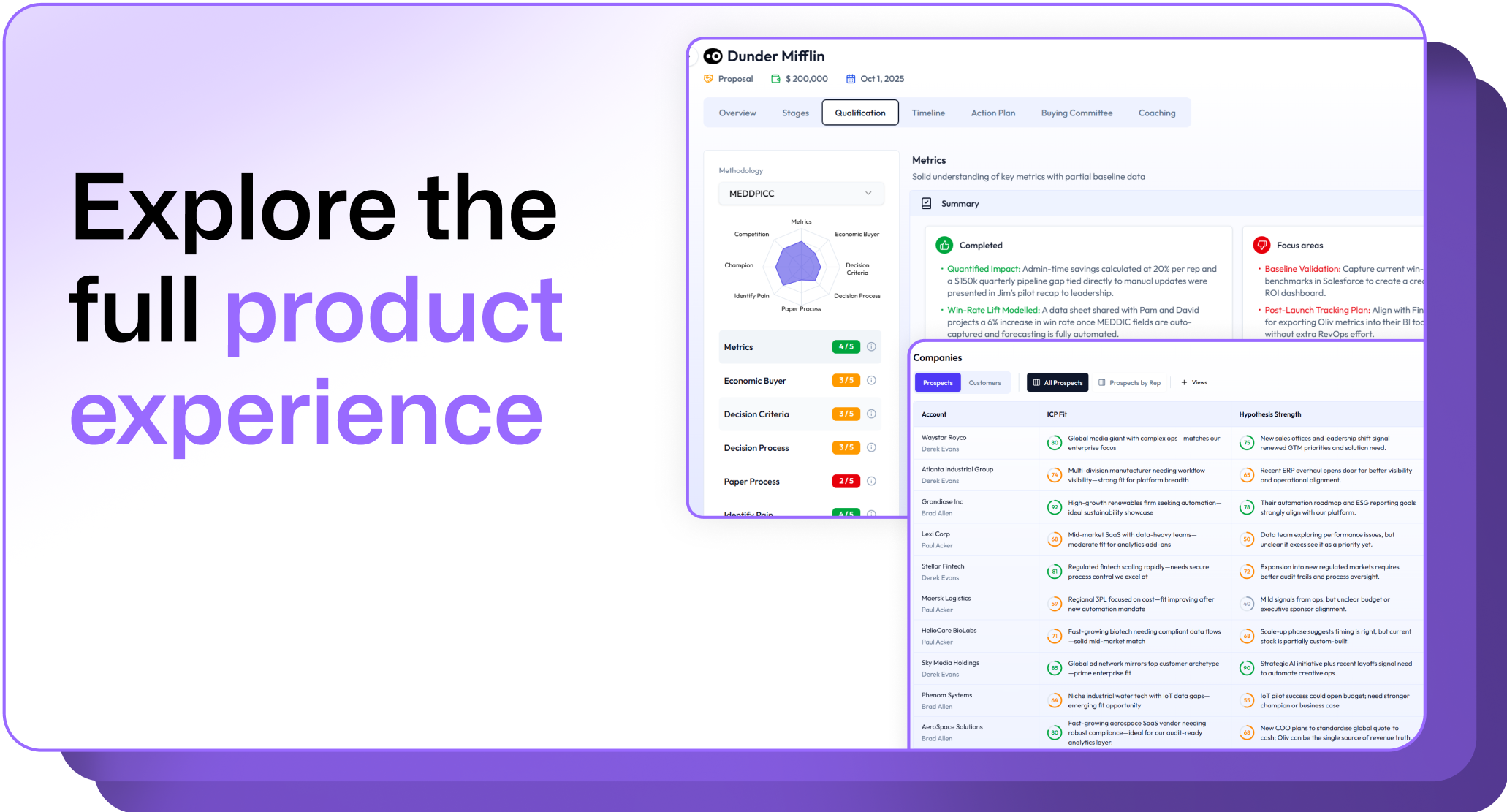
.avif)
.png)