Revenue Intelligence on a Startup Budget | The Zero-to-One Playbook for Teams Under 25 Reps | 2026
Written by
Ishan Chhabra
Last Updated :
March 23, 2026
Skim in :
10
mins
In this article
Revenue teams love Oliv
Here’s why:
All your deal data unified (from 30+ tools and tabs).
Insights are delivered to you directly, no digging.
AI agents automate tasks for you.
Thank you! Your submission has been received!
Oops! Something went wrong while submitting the form.
Meet Oliv’s AI Agents
Hi! I’m, Deal Driver
I track deals, flag risks, send weekly pipeline updates and give sales managers full visibility into deal progress
Hi! I’m, CRM Manager
I maintain CRM hygiene by updating core, custom and qualification fields all without your team lifting a finger
Hi! I’m, Forecaster
I build accurate forecasts based on real deal movement and tell you which deals to pull in to hit your number
Hi! I’m, Coach
I believe performance fuels revenue. I spot skill gaps, score calls and build coaching plans to help every rep level up
Hi! I’m, Prospector
I dig into target accounts to surface the right contacts, tailor and time outreach so you always strike when it counts
Hi! I’m, Pipeline tracker
I call reps to get deal updates, and deliver a real-time, CRM-synced roll-up view of deal progress
Hi! I’m, Analyst
I answer complex pipeline questions, uncover deal patterns, and build reports that guide strategic decisions
TL;DR
The default Gong + Clari + Salesforce stack costs $122,450/year for 25 users -- prohibitive for any pre-Series B startup.
Delaying tool investment creates "data debt" that costs more to fix later than the tools would have cost upfront.
Free note-takers (Fathom, Fireflies) hit a ceiling at 10+ reps -- they record meetings but don't update CRM, draft follow-ups, or forecast pipeline.
AI-native platforms consolidate call recording, CRM automation, and forecasting into one modular stack starting at $19/user/month.
Startups can segment SMB and enterprise sales processes on a single platform without breaking roll-up reporting -- no RevOps hire required.
The graduation path is staged: free note-taker at Seed, intelligence + CRM agents at Series A, full suite + analyst at Series B -- same platform, no migration.
Q1: What Is Revenue Intelligence -- And Why Should a 15-Rep Startup Care? [toc=What Is Revenue Intelligence]
💸 The Spreadsheet-and-Slack Reality
If you're a CRO or founder managing pipeline across spreadsheets, Slack threads, and gut instinct, "revenue intelligence" probably sounds like an enterprise luxury. It's not. Revenue intelligence is the practice of automatically capturing and analyzing every customer interaction -- calls, emails, CRM entries, chat messages -- to surface deal risks, forecast outcomes, and coach reps without manual effort. For a 15-rep startup burning runway, missing your quarterly target by 30% because nobody flagged three stalled deals isn't a reporting inconvenience -- it's an existential threat.
⚠️ Why Legacy Tools Don't Fit Startups
The problem is that first-generation revenue intelligence platforms were architected for 200+ rep organizations with dedicated RevOps teams and six-figure budgets. Gong, the category leader, charges a $5,000--$50,000 annual platform fee before you even add per-user licenses at $1,600/user/year. For a 25-rep startup, that's $45,000--$90,000 in Year 1 alone -- before implementation, which typically requires 8--24 weeks and 40--140 admin hours to configure Smart Trackers and field mapping.
Clari's forecasting module adds another $100--$125/user/month, and the average enterprise Clari contract runs approximately $160,000/year. Stacking these tools creates a $400--$500/user/month cost that no seed or Series A company can justify.
✅ The Shift: From Software You Adopt to Agents That Work for You
The revenue intelligence market has undergone a generational shift. We've moved from Gen 1 (Revenue Operations, 2015--2022) through Gen 2 (Revenue Intelligence) into Gen 3: AI-native revenue orchestration, where the platform doesn't just show you dashboards -- it performs the work autonomously. For startups, this means you no longer need to hire RevOps, train a team on complex software, or sign annual contracts to gain pipeline visibility.
⭐ How Oliv Brings Enterprise RI to Startup Budgets
Oliv is built as a generative AI-native data platform, purpose-designed so lean teams get the full revenue intelligence stack without the enterprise overhead:
Meeting Assistant Agent -- Automatically records, transcribes, and summarizes every call, then drafts personalized follow-up emails in your Gmail drafts within minutes
CRM Manager Agent -- Enriches contacts and updates 100+ qualification fields (MEDDPICC, BANT) based on conversation context -- zero manual CRM entry
Forecaster Agent -- Inspects every deal line-by-line, producing weekly roll-ups with AI risk commentary and one-click board-ready decks
Setup takes five minutes. Core value is realized in one to two days. Plans start at $19/user/month with no platform fees, no implementation charges, and no annual lock-in. Early adopters report 25% higher forecast accuracy and sales cycles as short as 16 days -- outcomes that previously required a $500/user enterprise stack.
Q2: How Much Does Revenue Intelligence Actually Cost a 25-Rep Startup? [toc=Cost for 25-Rep Startup]
💸 The Enterprise Stack Price Tag
Before comparing alternatives, it helps to see exactly what the "default" enterprise revenue intelligence stack costs a 25-rep team annually. The numbers are eye-opening.
Gong pricing breakdown (25 users):
Gong Pricing Breakdown for 25 Users
Component
Annual Cost
Platform Fee
$5,000--$50,000
Per-User License (25 x $1,600)
$40,000
Gong Forecast Add-on (25 x $700)
$17,500
Gong Engage Add-on (25 x $800)
$20,000
Implementation / Prof. Services
$10,000--$30,000
Total Year 1 (full suite)
$92,500--$157,500
Even a stripped-down Gong deployment (CI only, no Forecast or Engage) still lands at $45,000--$90,000 for Year 1. Add Clari for forecasting at ~$100/user/month, and you're looking at another $30,000/year -- pushing the combined stack past $75,000 minimum.
"The additional products like Forecast or Engage come at an additional cost. Would be great to see these tools rolled into the core offering." -- Scott T., Director of Sales, G2 Verified Review
"Clari should find ways to differentiate from the native Salesforce features (e.g. Pipeline Inspection, Forecasting) in order to remain competitive in the long-run." -- Dan J., Mid-Market, G2 Verified Review
💰 Three Budget Tiers for Startups
Here's what revenue intelligence actually looks like at startup-realistic budgets:
Three Budget Tiers for Startups
Tier
Monthly Budget (team)
Stack
What You Get
🟢 Lean ($200/mo)
~$8/user (25 reps)
Free note-taker (Fathom) + HubSpot Free CRM
Call recording, basic transcription; no CRM automation or forecasting
🟡 Growth ($500/mo)
~$20/user (25 reps)
Oliv Starter + existing CRM
AI meeting summaries, live CRM sync, basic deal tracking, follow-up drafts
🔴 Scale ($1,000/mo)
~$40/user (25 reps)
Oliv Standard + existing CRM
Full CRM automation, coaching agent, deal driver, pipeline alerts, forecasting
⭐ The TCO Comparison
Over a three-year period, the cost difference becomes dramatic. A 100-user team on the Gong + Clari stack pays approximately $789,300. That same team on Oliv's full suite pays approximately $68,400 -- a 91% reduction in total cost of ownership.
Oliv charges no platform fees, no implementation fees, no training costs, and no professional services requirements. Startups buy only the agents their team needs, and scale modularly as they grow.
Q3: I'm a VP Sales Doing RevOps Too -- How Do I Escape the Admin Trap? [toc=Escape the Admin Trap]
⏰ The Hidden Job Nobody Warned You About
At startups with fewer than 25 reps, the VP of Sales doesn't just lead the team -- they are RevOps. This means spending evenings listening to call recordings at 2x speed while driving or showering, dedicating every Thursday and Friday to manually compiling forecasts by sitting with individual reps, and losing one full day per week to CRM data cleanup and auditing. This isn't leadership -- it's administrative survival. The result is what revenue leaders call "RevOps Debt": the accumulating cost of work that should be automated but falls on a single person instead.
❌ Why Enterprise Tools Make It Worse
The instinct is to buy a platform to offload this work. But traditional tools often increase the admin burden for lean teams. Gong implementation typically requires 8--24 weeks and 40--140 admin hours just to configure Smart Trackers and map CRM fields -- plus $10,000--$30,000 in professional services fees. For a startup VP who's already stretched thin, that's not a solution; it's another project.
"It's too complicated, and not intuitive at all. Using it is very... discomforting. Searching for calls is not easy, moving around in the calls is not easy, and understanding the pipeline management portion of it is almost impossible." -- John S., Senior Account Executive, G2 Verified Review
When the tool you bought to save time requires its own RevOps specialist to configure, you've traded one admin trap for another.
✅ The Agentic Shift: Intelligence Delivered, Not Discovered
The AI-native approach flips the model. Instead of dashboards you must dig through, agentic platforms proactively deliver intelligence where you already work -- your Slack, your inbox, your morning coffee routine. No configuration marathons. No tracker tuning. No third-party implementation vendors.
⭐ Oliv as Your Fractional RevOps Team
Oliv eliminates the admin trap through autonomous agents that handle the work a RevOps hire would do:
CRM Manager Agent -- Auto-enriches contacts from LinkedIn, creates deals based on qualification criteria, and updates 100+ custom fields (MEDDPICC, BANT, SPICED) from conversation context. Your CRM stays spotless without a single rep lifting a finger
Forecaster Agent -- Delivers Monday morning roll-ups with AI commentary on deal risks and quick wins directly to your inbox -- no more Thursday/Friday manual compilation
Deal Driver Agent -- Flags deals requiring daily attention and sends a "Sunset Summary" of pipeline progress each evening
Configuration takes five minutes. Full custom model building completes in two to four weeks.
"Cleaning up messy CRM fields and guessing at forecasts used to swallow half my week. Oliv fixes the data as it happens and drops a forecast I can actually bank on." -- Darius Kim, Head of RevOps, Driftloop
Q4: We Just Raised Series B -- How Do I Operationalize 'Predictable Revenue' Fast? [toc=Predictable Revenue Post Series B]
⚠️ The Board's Demand vs. Your Pipeline Reality
You've closed your Series B. The wire just hit. And the first thing your board says is: "We need predictable revenue." The problem? Most startups at this stage rely on rep-driven forecasting -- a system where reps tell stories, show managers only what they want them to see, and hide stalled deals behind optimistic close dates. This creates "fake coverage": the pipeline shows a healthy 3x ratio, yet the team consistently misses targets because the data reflects human tendency bias rather than objective evidence.
❌ Why Gong and Clari Don't Solve This Fast Enough
Gong's forecasting capabilities are generally viewed as "not very robustly built" -- they rely on activity-volume signals (e.g., "10 emails sent") that don't distinguish between a rep chasing a ghosting prospect and a meaningful multi-threaded engagement. Clari's value proposition is roll-up forecasting, but this remains a manual, human-dependent process. Managers must sit with reps for hours, manually inputting subjective assessments into a UI that merely digitizes the guessing game.
"It is really just a glorified SFDC overlay. Actually, Salesforce has built most of the forecasting functionality by now anyway so I'm not sure where they fit into that whole overcrowded Martech space." -- conaldinho11, r/SalesOperations, Reddit Thread
✅ Evidence-Based Forecasting: Removing the Human Bias Layer
The AI-native approach eliminates the storytelling problem entirely. Instead of asking reps what they think will close, bottom-up evidence-based AI-native revenue orchestration inspects every deal autonomously -- analyzing 100% of interactions across calls, emails, and Slack to detect unresolved objections, missed milestones, and ghosting patterns regardless of what the rep claims.
⭐ Oliv's 90-Day Predictable Revenue Playbook
Oliv's Forecaster Agent inspects every deal line-by-line, identifies deals likely to slip versus quick wins, and produces weekly roll-ups with unbiased AI commentary. It then generates a one-click, presentation-ready board deck (Google Slides/PPT) -- automating the manual Thursday/Friday forecast prep ritual entirely.
Forecaster Agent delivers board-ready weekly roll-ups with AI risk commentary
By Month 3, your board gets evidence-based forecasts grounded in actual deal signals -- not rep narratives. Teams using unified AI sales tools report 25% higher forecast accuracy, with sales cycles shortened to as few as 16 days.
Q5: Should I Wait Until After Our Fundraise to Invest in Revenue Tools? [toc=Fundraise Timing for Tools]
⚠️ The Timing Trap: "We'll Buy Tools After the Round"
It's the most common rationalization in startup sales: "Let's close the fundraise first, then worry about the tech stack." The logic seems sound -- conserve runway, reduce burn, focus on closing the round. But here's what this actually creates: two to three years of uncaptured conversation data, un-updated CRM fields, and pipeline guesswork that compounds into what revenue leaders call "data debt". By the time you reach Series B and finally invest, you're not starting fresh -- you're spending months cleaning up the mess before any tool can even function properly.
❌ The Real Cost: Legacy Pricing Makes Waiting Feel Rational
To be fair, the hesitation isn't irrational when you look at what traditional tools charge. Stacking Gong ($250/user/month) and Clari ($100--$125/user/month) creates a $400--$500/user stack that's nearly impossible to justify mid-fundraise. Add in annual upfront commitments and multi-year contracts, and the risk profile becomes genuinely toxic for startups in flux.
"It was a big mistake on our part to commit to a two year term. Gong is a really powerful tool but it's probably the highest end option on the market, and now we're stuck with a tool that works technically but isn't the right business decision." -- Iris P., Head of Marketing, Sales & Partnerships, G2 Verified Review
When the "right" tool costs more than a junior hire, waiting feels responsible. But the math changes when cheaper alternatives exist.
Data debt compounds silently. Every quarter without structured capture costs more to fix later than the tool would have cost today.
💸 The Compounding Liability You Can't See
Every unrecorded call is a lost coaching opportunity. Every un-updated CRM field is a forecasting blind spot. Every quarter without structured deal data makes your Series B board deck less credible. Data debt doesn't show up on a balance sheet, but it shows up when your board asks "What's your win rate by segment?" and you can't answer with confidence. The real cost isn't the tool -- it's the lost intelligence that degrades your ability to fundraise, forecast, and scale.
✅ Oliv: Start Capturing Data Now, Scale Agents Later
Oliv eliminates the timing dilemma by decoupling data capture from full-suite deployment. Start with the baseline intelligence plan to record 100% of calls, auto-transcribe, and sync core fields to your CRM from day one -- no annual commitment, no platform fee, no implementation project.
Modular growth model -- Buy only the agents you need today (e.g., Meeting Assistant for recording) and add CRM Manager or Forecaster Agent as you scale post-fundraise
91% lower TCO -- Over a three-year period, a 100-user team on Gong costs approximately $789,300 versus $68,400 on Oliv
No lock-in -- Month-to-month billing, no multi-year contracts, cancel anytime
The decision framework is simple: if you have a CRM and make sales calls, start capturing data now. Waiting doesn't save money -- it spends future money cleaning up the mess.
Q6: Fathom vs Fireflies vs Oliv -- Who Goes Beyond Just Taking Notes? [toc=Fathom vs Fireflies vs Oliv]
⏰ The Note-Taker Starting Point
Most startups begin their revenue intelligence journey with a free or cheap AI note-taker. It makes sense -- Fathom offers unlimited free recordings with excellent transcription quality, and Fireflies.ai provides transcription plus searchable archives at $10--$19/user/month. Both tools work well for what they do: capturing what happened in a meeting. The problem surfaces at scale. When you have 15 reps running 50+ calls per week, you end up with hundreds of summaries and zero completed tasks -- a phenomenon called "note-taker fatigue".
❌ Where Documentation Layers Hit Their Ceiling
Fireflies and Fathom are fundamentally "documentation layers." They answer what was said but not what should happen next. After a call, the rep still has to:
Read the transcript and identify action items
Open ChatGPT, paste key points, draft a follow-up email
Copy the email into Gmail or Outlook
Navigate to the CRM and manually update deal fields
Flag any risks to the manager via Slack
"I sometimes find the AI summary is shorter and follows a different structure compared to other AI note-takers." -- Fathom review, TheBusiness Dive
The admin burden doesn't disappear -- it just moves from note-taking to post-call execution. At 10+ reps, this manual loop becomes the bottleneck.
✅ The Graduation Threshold: From Meeting-Level to Deal-Level
At the deal level, intelligence means stitching together data from five calls, twenty emails, and a dozen Slack messages into a single 360 degree account view -- then acting on it. Note-takers can't do this because they only see one meeting at a time.
⭐ Oliv: A Task Completion Platform, Not Just a Note-Taker
Oliv operates at the deal level with agents that execute the work:
Fathom vs Fireflies vs Oliv Feature Comparison
Capability
Fathom
Fireflies
Oliv
Call recording & transcription
✅ Free
✅ $10--$19/user
✅ Included
AI meeting summary
✅
✅
✅
Auto-drafted follow-up emails
❌
❌
✅ (Meeting Assistant)
CRM field auto-update
❌
❌
✅ (CRM Manager Agent)
Deal-level risk alerts
❌
❌
✅ (Deal Driver Agent)
Pipeline forecasting
❌
❌
✅ (Forecaster Agent)
Multi-channel stitching (call + email + Slack)
❌
❌
✅
Oliv's Meeting Assistant Agent auto-drafts personalized follow-up emails in your Gmail drafts within minutes of the call. CRM Manager Agent updates qualification fields without rep intervention. Deal Driver Agent flags at-risk deals daily. The result: startups graduate from recording their revenue process to automating it.
Q7: Can I Segment SMB and Enterprise Processes Without Breaking Reporting? [toc=SMB vs Enterprise Segmentation]
⚠️ The Dual-Motion Reality
Most startups with 15--25 reps don't run one sales motion -- they run two. An SMB deal might close in 20 days with two calls and a single decision-maker. An enterprise deal takes six months, involves ten stakeholders, and requires a Mutual Action Plan. Forcing both into the same CRM workflow -- identical stages, identical required fields, identical automation triggers -- creates a predictable outcome: reps ignore fields that aren't relevant to their deals, and the CRM fills with dirty data that makes roll-up reporting meaningless.
❌ Why HubSpot and Salesforce Make This Harder Than It Should Be
Traditional CRMs impose a "standard structure" that treats every deal the same. Configuring segment-specific processes in Salesforce or HubSpot -- different pipeline stages, custom field requirements, separate automation rules -- is a significant admin burden requiring specialized RevOps expertise most startups don't have.
"Clari should find ways to differentiate from the native Salesforce features (e.g. Pipeline Inspection, Forecasting) in order to remain competitive in the long-run. Additionally, it's sometimes difficult if you don't have a strong RevOps/RevTech team to maintain validation rules in both Salesforce and Clari instances." -- Dan J., Mid-Market, G2 Verified Review
The result: startups either force-fit one workflow (creating dirty data) or spend months configuring dual processes (consuming scarce admin bandwidth).
✅ Agentic Segmentation: One Platform, Multiple Motions
AI-native platforms solve this by deploying different agent configurations per segment rather than configuring rigid CRM workflows. The data foundation remains unified -- one reporting layer, one source of truth -- while each rep experiences a workflow tailored to their motion.
⭐ How Oliv Handles Multi-Segment Revenue Processes
Oliv's Revenue Process Mapping allows you to configure entirely distinct processes within a single platform:
Object-level mapping -- Oliv maps insights directly to custom objects and fields in your CRM, ensuring that both processes feed into one clean, unified roll-up report
An SMB AE gets velocity-focused agents that prioritize speed-to-close. An Enterprise AE gets multi-stakeholder intelligence with champion tracking. The CRO opens one pipeline dashboard and sees clean data across both segments -- no broken roll-ups, no field confusion, no RevOps hire required.
Q8: Does Oliv Work With Pipedrive or Zoho -- Or Only Salesforce and HubSpot? [toc=CRM Compatibility Pipedrive Zoho]
The CRM Compatibility Question
Startups frequently choose Pipedrive or Zoho CRM to keep costs low -- Pipedrive starts at $14/user/month, and Zoho CRM offers a free tier for up to three users. The challenge arises when these teams look for revenue intelligence tools and discover most platforms are built exclusively for the "Salesforce/HubSpot duopoly".
🔍 Where Major RI Tools Stand on CRM Integration
Revenue Intelligence Platform CRM Integration Support
Platform
Salesforce
HubSpot
Pipedrive
Zoho CRM
Standalone CRM
Gong
✅ Native
✅ Native
❌ No native
✅ Via third-party connector
❌
Clari
✅ Native
✅ Limited
❌ No support
❌ No support
❌
Chorus
✅ Native
✅ Native
❌ No support
❌ No support
❌
Oliv
✅ Native
✅ Native
✅ Supported
✅ Supported
✅ Built-in
Gong's Zoho integration requires a third-party connector (CRM Connect) running on Azure that syncs accounts, contacts, leads, and deals via API -- an autonomous integration, but one that adds complexity and a dependency on a third-party vendor. Gong offers no native Pipedrive integration. Clari and Chorus focus almost entirely on Salesforce and HubSpot, leaving Pipedrive and Zoho users without viable options.
"Gong's lack of open task APIs limits system integration, making it difficult to connect with other essential tools." -- Anonymous Reviewer, G2 Verified Review
✅ Key Integration Considerations for Pipedrive/Zoho Teams
If your startup runs Pipedrive or Zoho, evaluate RI tools across three criteria:
Native vs. third-party integration -- Native integrations sync bi-directionally without middleware; third-party connectors add latency and failure points
Field-level mapping depth -- Can the tool write to custom fields and objects in your CRM, or only standard fields?
Standalone fallback -- If your CRM changes during scaling, can the RI tool function independently?
⭐ Oliv's Platform-Agnostic Architecture
Oliv was architected as an AI-native data platform designed to work across the long-tail CRM market -- not just the Big Two. It integrates natively with Salesforce and HubSpot, supports Pipedrive and Zoho, and can even function as a standalone CRM for teams that haven't committed to a platform yet. Oliv builds custom integrations rapidly to connect with a startup's unique data environment, ensuring that choosing a smaller CRM doesn't mean forfeiting access to agentic revenue intelligence.
Q9: What's the Most Affordable All-in-One Tool for Call Recording + CRM Hygiene + Forecasting? [toc=Affordable All-in-One Tool]
💸 The $500/User Revenue Stack Problem
Small sales teams face a brutal math problem. To get the three pillars of revenue intelligence -- conversation intelligence, CRM hygiene, and forecasting -- the traditional approach requires stacking three separate platforms. Gong for call recording and CI, Clari for pipeline forecasting, and Salesforce as the CRM backbone. For a 25-rep startup, this stack creates a cost structure that's genuinely prohibitive.
The enterprise stack cost for 25 users:
Enterprise Revenue Intelligence Stack Cost for 25 Users
Tool
Function
Annual Cost (25 users)
Gong (Foundation + Platform Fee)
Call recording + CI
$47,450 median
Clari (Forecasting module)
Pipeline forecasting
~$30,000
Salesforce (Sales Cloud)
CRM
~$45,000
Total
-
~$122,450/year
That's roughly $408/user/month before implementation costs, professional services, or add-ons like Gong Engage.
The legacy $500/user stack fragments your budget across three vendors. AI-native consolidation delivers more functionality at a fraction of the cost.
❌ The Hidden Costs That Compound
Beyond licensing, Gong charges $15,000--$25,000 for implementation on teams under 20 users, with costs scaling to $40,000+ for 50 users. Contracts require annual prepayment with 5--15% automatic renewal increases. And the tools don't natively talk to each other -- you're maintaining three separate integrations.
"The additional products like Forecast or Engage come at an additional cost. Would be great to see these tools rolled into the core offering." -- Scott T., Director of Sales, G2 Verified Review
"The platform is expensive, especially compared to alternatives like Salesloft and Apollo, which offer similar capabilities for a fraction of the price." -- Anonymous Reviewer, G2 Verified Review
✅ The Consolidation Opportunity
AI-native platforms eliminate the multi-tool tax by combining call recording, CRM automation, coaching, and forecasting into a single platform with transparent, modular pricing. Instead of paying three vendors, configuring three integrations, and training your team on three interfaces, you deploy one platform that covers the full revenue intelligence surface.
⭐ Oliv: Double the Functionality at a Fraction of the Price
Oliv consolidates the entire stack into a single agent-first platform:
Meeting recording & transcription -- Included at no additional cost
CRM Manager Agent -- Auto-enriches contacts and updates 100+ qualification fields from conversation context
Forecaster Agent -- Produces autonomous weekly roll-ups with AI risk commentary and board-ready decks
No platform fees. No implementation charges. No annual lock-in. No professional services requirements. Over a three-year period, a 100-user team on Gong pays approximately $789,300 versus $68,400 on Oliv -- a 91% reduction in total cost of ownership. For startups, Oliv offers the rare combination: more functionality with dramatically less spend.
Q10: How Do I Build a Forecasting Process From Scratch With No RevOps Team? [toc=Forecasting Without RevOps]
⚠️ Trapped in Spreadsheet Hell
Without a RevOps hire, the CRO at a 30--50 person startup is stuck in a forecasting loop that's part guessing game, part data archeology. The "Monday Tradition" looks like this: pull a Salesforce report that's already outdated, ping each rep on Slack for deal updates, manually consolidate their responses into a spreadsheet, then present numbers that are half gut instinct and half stale data. Answering a basic strategic question like "Why are we losing FinTech deals in Stage 2?" requires hours of manual investigation nobody has time for.
❌ Why Legacy Tools Don't Solve This Without RevOps
Traditional forecasting platforms assume you have a RevOps function to configure and maintain them. Gong requires 8--24 weeks of implementation and tracker setup. Clari demands ongoing validation-rule maintenance across both Clari and Salesforce instances. Both rely on rule-based mapping that frequently attaches calls to the wrong opportunity, creating the very "dirty data" the CRO is trying to escape.
AI-native platforms replace rule-based mapping with LLM reasoning that correctly associates every call, email, and Slack message with the right logical opportunity -- even in duplicate environments. Automated stage progression moves deals through the pipeline based on actual conversation outcomes (e.g., "Demo Scheduled" to "Demo Done"), ensuring the forecast is always current without anyone touching a field.
⭐ Oliv's Zero-RevOps AI-Native Revenue Orchestration System
Activate Forecaster Agent for weekly pipeline roll-ups
Week 3
5
Deploy Analyst Agent for board Q&A in plain English
Month 2
The Analyst Agent functions as an "Ask Me Anything" strategic engine -- ask "Why did we lose three enterprise deals last quarter?" and receive visual dashboards with interpretive commentary, no SQL or RevOps help required. The Forecaster Agent delivers Monday morning roll-ups with AI risk commentary and one-click board decks, replacing the Thursday/Friday manual compilation ritual entirely.
From zero to board-ready forecasts in 60 days -- no RevOps hire, no spreadsheet gymnastics.
Q11: The $500/Month Startup Revenue Intelligence Stack -- A Practical Blueprint [toc=Startup RI Stack Blueprint]
Building a revenue intelligence capability doesn't require a six-figure budget. Below are three concrete, budget-specific stack configurations designed for startups with 10--25 reps, mapped to the actual tools and costs involved.
💰 Tier 1: The Lean Stack (~$200/month)
Best for: Pre-seed to Seed, 5--10 reps, no dedicated sales ops
Tier 1: The Lean Stack (~$200/month)
Component
Tool
Monthly Cost
CRM
HubSpot Free / Pipedrive Essential ($14/user)
$0--$140
Call recording
Fathom (Free) or Fireflies Free Tier
$0
Note-taking & transcription
Fathom AI summaries
$0
Forecasting
Google Sheets + manual input
$0
Total (10 users)
-
$0--$200/month
✅ What you get: Basic call recordings, meeting summaries, CRM contact management
❌ What you miss: CRM auto-updates, deal-level intelligence, pipeline forecasting, follow-up automation
💰 Tier 2: The Growth Stack (~$500/month)
Best for: Seed to Series A, 10--20 reps, VP Sales wearing RevOps hat
Tier 2: The Growth Stack (~$500/month)
Component
Tool
Monthly Cost
CRM
HubSpot Starter ($20/user) or Pipedrive Advanced
$200--$400
Revenue intelligence + CRM automation
Oliv (Intelligence + CRM Manager Agents)
~$300--$500
Forecasting
Oliv Forecaster Agent
Included in suite
Total (15 users)
-
~$500--$900/month
✅ What you get: AI meeting summaries, auto-drafted follow-ups, live CRM field sync, deal risk alerts, basic forecasting
❌ What you miss: Advanced analytics, custom board reporting
💰 Tier 3: The Scale Stack (~$1,000/month)
Best for: Series A to Series B, 20--25 reps, board demanding predictable revenue
Tier 3: The Scale Stack (~$1,000/month)
Component
Tool
Monthly Cost
CRM
HubSpot Professional or Salesforce Essentials
$500--$750
Full revenue intelligence
Oliv (Full Agent Suite)
~$500--$700
Strategic analytics
Oliv Analyst Agent
Org-level pricing
Total (25 users)
-
~$1,000--$1,500/month
✅ What you get: Everything in Tier 2 + board-ready forecast decks, plain-English strategic analytics, multi-segment process support, champion tracking
"Having talked with other friends who lead revenue functions, all have said the same thing -- they've been fine using a lower cost, simpler alternative and have only seen Gong really make sense for more established sales organizations with larger budgets." -- Iris P., Head of Marketing, Sales & Partnerships, G2 Verified Review
Oliv's modular agent architecture allows startups to move between tiers without re-platforming -- start at Tier 2 during your seed round and scale to Tier 3 as you close your Series B, same platform, same data, no migration.
Q12: The Graduation Framework: When to Level Up From Note-Taker to Revenue Platform [toc=Note-Taker to RI Graduation]
⏰ The Maturity Curve Most Startups Get Wrong
Revenue intelligence is a maturity curve, not a binary switch. The two most common mistakes are symmetric: staying too long on a free note-taker (missing deal insights that cost you quarters) or jumping too early to an enterprise platform (burning budget and admin time you don't have). The key is matching your AI sales tool to your stage -- and knowing the specific triggers that signal it's time to graduate.
❌ When Enterprise Platforms Arrive Too Early
Deploying Gong or Clari at a 15-rep startup with no RevOps creates what might be called "implementation debt" -- not intelligence. The 8--24 week setup timeline means you won't see value for two quarters. And the tool assumes clean CRM data and defined sales processes that most early-stage startups haven't built yet.
Team size exceeds 10 reps -- Manual oversight breaks down
Reps consistently ignore CRM fields -- Data quality degrades
Active pipeline exceeds $1M -- Forecast accuracy becomes material
Board or investors ask for forecast data -- Gut instinct isn't a board slide
No post-mortem data on lost deals -- You can't learn from failures you don't track
If you check three of these boxes, a free note-taker is already costing you more in lost intelligence than a revenue platform would in licensing.
⭐ Oliv: The Series A/B Sweet Spot
Oliv is purpose-built as the "graduation platform" -- enterprise-grade intelligence at startup-appropriate pricing:
Revenue Intelligence Graduation Framework by Company Stage
Company Stage
Recommended Stack
What Changes
🟢 Pre-Seed / Seed (1--8 reps)
Fathom or Fireflies (Free)
Meeting recording + summaries
🟡 Seed / Series A (8--15 reps)
Oliv Intelligence + CRM Manager
Add auto CRM sync, follow-up drafts, deal tracking
🔴 Series A / B (15--25 reps)
Oliv Full Suite + Analyst Agent
Add forecasting, board decks, strategic analytics
⚫ Series B+ (25+ reps)
Oliv Enterprise Config
Multi-segment processes, advanced coaching, same platform
The critical advantage: there's no re-platforming at scale. A startup that begins with Oliv's intelligence layer at Seed graduates to the full suite at Series B without data migration, re-implementation, or retraining. The platform grows with you -- from your first 10 calls to your thousandth board deck.
Q1: What Is Revenue Intelligence -- And Why Should a 15-Rep Startup Care? [toc=What Is Revenue Intelligence]
💸 The Spreadsheet-and-Slack Reality
If you're a CRO or founder managing pipeline across spreadsheets, Slack threads, and gut instinct, "revenue intelligence" probably sounds like an enterprise luxury. It's not. Revenue intelligence is the practice of automatically capturing and analyzing every customer interaction -- calls, emails, CRM entries, chat messages -- to surface deal risks, forecast outcomes, and coach reps without manual effort. For a 15-rep startup burning runway, missing your quarterly target by 30% because nobody flagged three stalled deals isn't a reporting inconvenience -- it's an existential threat.
⚠️ Why Legacy Tools Don't Fit Startups
The problem is that first-generation revenue intelligence platforms were architected for 200+ rep organizations with dedicated RevOps teams and six-figure budgets. Gong, the category leader, charges a $5,000--$50,000 annual platform fee before you even add per-user licenses at $1,600/user/year. For a 25-rep startup, that's $45,000--$90,000 in Year 1 alone -- before implementation, which typically requires 8--24 weeks and 40--140 admin hours to configure Smart Trackers and field mapping.
Clari's forecasting module adds another $100--$125/user/month, and the average enterprise Clari contract runs approximately $160,000/year. Stacking these tools creates a $400--$500/user/month cost that no seed or Series A company can justify.
✅ The Shift: From Software You Adopt to Agents That Work for You
The revenue intelligence market has undergone a generational shift. We've moved from Gen 1 (Revenue Operations, 2015--2022) through Gen 2 (Revenue Intelligence) into Gen 3: AI-native revenue orchestration, where the platform doesn't just show you dashboards -- it performs the work autonomously. For startups, this means you no longer need to hire RevOps, train a team on complex software, or sign annual contracts to gain pipeline visibility.
⭐ How Oliv Brings Enterprise RI to Startup Budgets
Oliv is built as a generative AI-native data platform, purpose-designed so lean teams get the full revenue intelligence stack without the enterprise overhead:
Meeting Assistant Agent -- Automatically records, transcribes, and summarizes every call, then drafts personalized follow-up emails in your Gmail drafts within minutes
CRM Manager Agent -- Enriches contacts and updates 100+ qualification fields (MEDDPICC, BANT) based on conversation context -- zero manual CRM entry
Forecaster Agent -- Inspects every deal line-by-line, producing weekly roll-ups with AI risk commentary and one-click board-ready decks
Setup takes five minutes. Core value is realized in one to two days. Plans start at $19/user/month with no platform fees, no implementation charges, and no annual lock-in. Early adopters report 25% higher forecast accuracy and sales cycles as short as 16 days -- outcomes that previously required a $500/user enterprise stack.
Q2: How Much Does Revenue Intelligence Actually Cost a 25-Rep Startup? [toc=Cost for 25-Rep Startup]
💸 The Enterprise Stack Price Tag
Before comparing alternatives, it helps to see exactly what the "default" enterprise revenue intelligence stack costs a 25-rep team annually. The numbers are eye-opening.
Gong pricing breakdown (25 users):
Gong Pricing Breakdown for 25 Users
Component
Annual Cost
Platform Fee
$5,000--$50,000
Per-User License (25 x $1,600)
$40,000
Gong Forecast Add-on (25 x $700)
$17,500
Gong Engage Add-on (25 x $800)
$20,000
Implementation / Prof. Services
$10,000--$30,000
Total Year 1 (full suite)
$92,500--$157,500
Even a stripped-down Gong deployment (CI only, no Forecast or Engage) still lands at $45,000--$90,000 for Year 1. Add Clari for forecasting at ~$100/user/month, and you're looking at another $30,000/year -- pushing the combined stack past $75,000 minimum.
"The additional products like Forecast or Engage come at an additional cost. Would be great to see these tools rolled into the core offering." -- Scott T., Director of Sales, G2 Verified Review
"Clari should find ways to differentiate from the native Salesforce features (e.g. Pipeline Inspection, Forecasting) in order to remain competitive in the long-run." -- Dan J., Mid-Market, G2 Verified Review
💰 Three Budget Tiers for Startups
Here's what revenue intelligence actually looks like at startup-realistic budgets:
Three Budget Tiers for Startups
Tier
Monthly Budget (team)
Stack
What You Get
🟢 Lean ($200/mo)
~$8/user (25 reps)
Free note-taker (Fathom) + HubSpot Free CRM
Call recording, basic transcription; no CRM automation or forecasting
🟡 Growth ($500/mo)
~$20/user (25 reps)
Oliv Starter + existing CRM
AI meeting summaries, live CRM sync, basic deal tracking, follow-up drafts
🔴 Scale ($1,000/mo)
~$40/user (25 reps)
Oliv Standard + existing CRM
Full CRM automation, coaching agent, deal driver, pipeline alerts, forecasting
⭐ The TCO Comparison
Over a three-year period, the cost difference becomes dramatic. A 100-user team on the Gong + Clari stack pays approximately $789,300. That same team on Oliv's full suite pays approximately $68,400 -- a 91% reduction in total cost of ownership.
Oliv charges no platform fees, no implementation fees, no training costs, and no professional services requirements. Startups buy only the agents their team needs, and scale modularly as they grow.
Q3: I'm a VP Sales Doing RevOps Too -- How Do I Escape the Admin Trap? [toc=Escape the Admin Trap]
⏰ The Hidden Job Nobody Warned You About
At startups with fewer than 25 reps, the VP of Sales doesn't just lead the team -- they are RevOps. This means spending evenings listening to call recordings at 2x speed while driving or showering, dedicating every Thursday and Friday to manually compiling forecasts by sitting with individual reps, and losing one full day per week to CRM data cleanup and auditing. This isn't leadership -- it's administrative survival. The result is what revenue leaders call "RevOps Debt": the accumulating cost of work that should be automated but falls on a single person instead.
❌ Why Enterprise Tools Make It Worse
The instinct is to buy a platform to offload this work. But traditional tools often increase the admin burden for lean teams. Gong implementation typically requires 8--24 weeks and 40--140 admin hours just to configure Smart Trackers and map CRM fields -- plus $10,000--$30,000 in professional services fees. For a startup VP who's already stretched thin, that's not a solution; it's another project.
"It's too complicated, and not intuitive at all. Using it is very... discomforting. Searching for calls is not easy, moving around in the calls is not easy, and understanding the pipeline management portion of it is almost impossible." -- John S., Senior Account Executive, G2 Verified Review
When the tool you bought to save time requires its own RevOps specialist to configure, you've traded one admin trap for another.
✅ The Agentic Shift: Intelligence Delivered, Not Discovered
The AI-native approach flips the model. Instead of dashboards you must dig through, agentic platforms proactively deliver intelligence where you already work -- your Slack, your inbox, your morning coffee routine. No configuration marathons. No tracker tuning. No third-party implementation vendors.
⭐ Oliv as Your Fractional RevOps Team
Oliv eliminates the admin trap through autonomous agents that handle the work a RevOps hire would do:
CRM Manager Agent -- Auto-enriches contacts from LinkedIn, creates deals based on qualification criteria, and updates 100+ custom fields (MEDDPICC, BANT, SPICED) from conversation context. Your CRM stays spotless without a single rep lifting a finger
Forecaster Agent -- Delivers Monday morning roll-ups with AI commentary on deal risks and quick wins directly to your inbox -- no more Thursday/Friday manual compilation
Deal Driver Agent -- Flags deals requiring daily attention and sends a "Sunset Summary" of pipeline progress each evening
Configuration takes five minutes. Full custom model building completes in two to four weeks.
"Cleaning up messy CRM fields and guessing at forecasts used to swallow half my week. Oliv fixes the data as it happens and drops a forecast I can actually bank on." -- Darius Kim, Head of RevOps, Driftloop
Q4: We Just Raised Series B -- How Do I Operationalize 'Predictable Revenue' Fast? [toc=Predictable Revenue Post Series B]
⚠️ The Board's Demand vs. Your Pipeline Reality
You've closed your Series B. The wire just hit. And the first thing your board says is: "We need predictable revenue." The problem? Most startups at this stage rely on rep-driven forecasting -- a system where reps tell stories, show managers only what they want them to see, and hide stalled deals behind optimistic close dates. This creates "fake coverage": the pipeline shows a healthy 3x ratio, yet the team consistently misses targets because the data reflects human tendency bias rather than objective evidence.
❌ Why Gong and Clari Don't Solve This Fast Enough
Gong's forecasting capabilities are generally viewed as "not very robustly built" -- they rely on activity-volume signals (e.g., "10 emails sent") that don't distinguish between a rep chasing a ghosting prospect and a meaningful multi-threaded engagement. Clari's value proposition is roll-up forecasting, but this remains a manual, human-dependent process. Managers must sit with reps for hours, manually inputting subjective assessments into a UI that merely digitizes the guessing game.
"It is really just a glorified SFDC overlay. Actually, Salesforce has built most of the forecasting functionality by now anyway so I'm not sure where they fit into that whole overcrowded Martech space." -- conaldinho11, r/SalesOperations, Reddit Thread
✅ Evidence-Based Forecasting: Removing the Human Bias Layer
The AI-native approach eliminates the storytelling problem entirely. Instead of asking reps what they think will close, bottom-up evidence-based AI-native revenue orchestration inspects every deal autonomously -- analyzing 100% of interactions across calls, emails, and Slack to detect unresolved objections, missed milestones, and ghosting patterns regardless of what the rep claims.
⭐ Oliv's 90-Day Predictable Revenue Playbook
Oliv's Forecaster Agent inspects every deal line-by-line, identifies deals likely to slip versus quick wins, and produces weekly roll-ups with unbiased AI commentary. It then generates a one-click, presentation-ready board deck (Google Slides/PPT) -- automating the manual Thursday/Friday forecast prep ritual entirely.
Forecaster Agent delivers board-ready weekly roll-ups with AI risk commentary
By Month 3, your board gets evidence-based forecasts grounded in actual deal signals -- not rep narratives. Teams using unified AI sales tools report 25% higher forecast accuracy, with sales cycles shortened to as few as 16 days.
Q5: Should I Wait Until After Our Fundraise to Invest in Revenue Tools? [toc=Fundraise Timing for Tools]
⚠️ The Timing Trap: "We'll Buy Tools After the Round"
It's the most common rationalization in startup sales: "Let's close the fundraise first, then worry about the tech stack." The logic seems sound -- conserve runway, reduce burn, focus on closing the round. But here's what this actually creates: two to three years of uncaptured conversation data, un-updated CRM fields, and pipeline guesswork that compounds into what revenue leaders call "data debt". By the time you reach Series B and finally invest, you're not starting fresh -- you're spending months cleaning up the mess before any tool can even function properly.
❌ The Real Cost: Legacy Pricing Makes Waiting Feel Rational
To be fair, the hesitation isn't irrational when you look at what traditional tools charge. Stacking Gong ($250/user/month) and Clari ($100--$125/user/month) creates a $400--$500/user stack that's nearly impossible to justify mid-fundraise. Add in annual upfront commitments and multi-year contracts, and the risk profile becomes genuinely toxic for startups in flux.
"It was a big mistake on our part to commit to a two year term. Gong is a really powerful tool but it's probably the highest end option on the market, and now we're stuck with a tool that works technically but isn't the right business decision." -- Iris P., Head of Marketing, Sales & Partnerships, G2 Verified Review
When the "right" tool costs more than a junior hire, waiting feels responsible. But the math changes when cheaper alternatives exist.
Data debt compounds silently. Every quarter without structured capture costs more to fix later than the tool would have cost today.
💸 The Compounding Liability You Can't See
Every unrecorded call is a lost coaching opportunity. Every un-updated CRM field is a forecasting blind spot. Every quarter without structured deal data makes your Series B board deck less credible. Data debt doesn't show up on a balance sheet, but it shows up when your board asks "What's your win rate by segment?" and you can't answer with confidence. The real cost isn't the tool -- it's the lost intelligence that degrades your ability to fundraise, forecast, and scale.
✅ Oliv: Start Capturing Data Now, Scale Agents Later
Oliv eliminates the timing dilemma by decoupling data capture from full-suite deployment. Start with the baseline intelligence plan to record 100% of calls, auto-transcribe, and sync core fields to your CRM from day one -- no annual commitment, no platform fee, no implementation project.
Modular growth model -- Buy only the agents you need today (e.g., Meeting Assistant for recording) and add CRM Manager or Forecaster Agent as you scale post-fundraise
91% lower TCO -- Over a three-year period, a 100-user team on Gong costs approximately $789,300 versus $68,400 on Oliv
No lock-in -- Month-to-month billing, no multi-year contracts, cancel anytime
The decision framework is simple: if you have a CRM and make sales calls, start capturing data now. Waiting doesn't save money -- it spends future money cleaning up the mess.
Q6: Fathom vs Fireflies vs Oliv -- Who Goes Beyond Just Taking Notes? [toc=Fathom vs Fireflies vs Oliv]
⏰ The Note-Taker Starting Point
Most startups begin their revenue intelligence journey with a free or cheap AI note-taker. It makes sense -- Fathom offers unlimited free recordings with excellent transcription quality, and Fireflies.ai provides transcription plus searchable archives at $10--$19/user/month. Both tools work well for what they do: capturing what happened in a meeting. The problem surfaces at scale. When you have 15 reps running 50+ calls per week, you end up with hundreds of summaries and zero completed tasks -- a phenomenon called "note-taker fatigue".
❌ Where Documentation Layers Hit Their Ceiling
Fireflies and Fathom are fundamentally "documentation layers." They answer what was said but not what should happen next. After a call, the rep still has to:
Read the transcript and identify action items
Open ChatGPT, paste key points, draft a follow-up email
Copy the email into Gmail or Outlook
Navigate to the CRM and manually update deal fields
Flag any risks to the manager via Slack
"I sometimes find the AI summary is shorter and follows a different structure compared to other AI note-takers." -- Fathom review, TheBusiness Dive
The admin burden doesn't disappear -- it just moves from note-taking to post-call execution. At 10+ reps, this manual loop becomes the bottleneck.
✅ The Graduation Threshold: From Meeting-Level to Deal-Level
At the deal level, intelligence means stitching together data from five calls, twenty emails, and a dozen Slack messages into a single 360 degree account view -- then acting on it. Note-takers can't do this because they only see one meeting at a time.
⭐ Oliv: A Task Completion Platform, Not Just a Note-Taker
Oliv operates at the deal level with agents that execute the work:
Fathom vs Fireflies vs Oliv Feature Comparison
Capability
Fathom
Fireflies
Oliv
Call recording & transcription
✅ Free
✅ $10--$19/user
✅ Included
AI meeting summary
✅
✅
✅
Auto-drafted follow-up emails
❌
❌
✅ (Meeting Assistant)
CRM field auto-update
❌
❌
✅ (CRM Manager Agent)
Deal-level risk alerts
❌
❌
✅ (Deal Driver Agent)
Pipeline forecasting
❌
❌
✅ (Forecaster Agent)
Multi-channel stitching (call + email + Slack)
❌
❌
✅
Oliv's Meeting Assistant Agent auto-drafts personalized follow-up emails in your Gmail drafts within minutes of the call. CRM Manager Agent updates qualification fields without rep intervention. Deal Driver Agent flags at-risk deals daily. The result: startups graduate from recording their revenue process to automating it.
Q7: Can I Segment SMB and Enterprise Processes Without Breaking Reporting? [toc=SMB vs Enterprise Segmentation]
⚠️ The Dual-Motion Reality
Most startups with 15--25 reps don't run one sales motion -- they run two. An SMB deal might close in 20 days with two calls and a single decision-maker. An enterprise deal takes six months, involves ten stakeholders, and requires a Mutual Action Plan. Forcing both into the same CRM workflow -- identical stages, identical required fields, identical automation triggers -- creates a predictable outcome: reps ignore fields that aren't relevant to their deals, and the CRM fills with dirty data that makes roll-up reporting meaningless.
❌ Why HubSpot and Salesforce Make This Harder Than It Should Be
Traditional CRMs impose a "standard structure" that treats every deal the same. Configuring segment-specific processes in Salesforce or HubSpot -- different pipeline stages, custom field requirements, separate automation rules -- is a significant admin burden requiring specialized RevOps expertise most startups don't have.
"Clari should find ways to differentiate from the native Salesforce features (e.g. Pipeline Inspection, Forecasting) in order to remain competitive in the long-run. Additionally, it's sometimes difficult if you don't have a strong RevOps/RevTech team to maintain validation rules in both Salesforce and Clari instances." -- Dan J., Mid-Market, G2 Verified Review
The result: startups either force-fit one workflow (creating dirty data) or spend months configuring dual processes (consuming scarce admin bandwidth).
✅ Agentic Segmentation: One Platform, Multiple Motions
AI-native platforms solve this by deploying different agent configurations per segment rather than configuring rigid CRM workflows. The data foundation remains unified -- one reporting layer, one source of truth -- while each rep experiences a workflow tailored to their motion.
⭐ How Oliv Handles Multi-Segment Revenue Processes
Oliv's Revenue Process Mapping allows you to configure entirely distinct processes within a single platform:
Object-level mapping -- Oliv maps insights directly to custom objects and fields in your CRM, ensuring that both processes feed into one clean, unified roll-up report
An SMB AE gets velocity-focused agents that prioritize speed-to-close. An Enterprise AE gets multi-stakeholder intelligence with champion tracking. The CRO opens one pipeline dashboard and sees clean data across both segments -- no broken roll-ups, no field confusion, no RevOps hire required.
Q8: Does Oliv Work With Pipedrive or Zoho -- Or Only Salesforce and HubSpot? [toc=CRM Compatibility Pipedrive Zoho]
The CRM Compatibility Question
Startups frequently choose Pipedrive or Zoho CRM to keep costs low -- Pipedrive starts at $14/user/month, and Zoho CRM offers a free tier for up to three users. The challenge arises when these teams look for revenue intelligence tools and discover most platforms are built exclusively for the "Salesforce/HubSpot duopoly".
🔍 Where Major RI Tools Stand on CRM Integration
Revenue Intelligence Platform CRM Integration Support
Platform
Salesforce
HubSpot
Pipedrive
Zoho CRM
Standalone CRM
Gong
✅ Native
✅ Native
❌ No native
✅ Via third-party connector
❌
Clari
✅ Native
✅ Limited
❌ No support
❌ No support
❌
Chorus
✅ Native
✅ Native
❌ No support
❌ No support
❌
Oliv
✅ Native
✅ Native
✅ Supported
✅ Supported
✅ Built-in
Gong's Zoho integration requires a third-party connector (CRM Connect) running on Azure that syncs accounts, contacts, leads, and deals via API -- an autonomous integration, but one that adds complexity and a dependency on a third-party vendor. Gong offers no native Pipedrive integration. Clari and Chorus focus almost entirely on Salesforce and HubSpot, leaving Pipedrive and Zoho users without viable options.
"Gong's lack of open task APIs limits system integration, making it difficult to connect with other essential tools." -- Anonymous Reviewer, G2 Verified Review
✅ Key Integration Considerations for Pipedrive/Zoho Teams
If your startup runs Pipedrive or Zoho, evaluate RI tools across three criteria:
Native vs. third-party integration -- Native integrations sync bi-directionally without middleware; third-party connectors add latency and failure points
Field-level mapping depth -- Can the tool write to custom fields and objects in your CRM, or only standard fields?
Standalone fallback -- If your CRM changes during scaling, can the RI tool function independently?
⭐ Oliv's Platform-Agnostic Architecture
Oliv was architected as an AI-native data platform designed to work across the long-tail CRM market -- not just the Big Two. It integrates natively with Salesforce and HubSpot, supports Pipedrive and Zoho, and can even function as a standalone CRM for teams that haven't committed to a platform yet. Oliv builds custom integrations rapidly to connect with a startup's unique data environment, ensuring that choosing a smaller CRM doesn't mean forfeiting access to agentic revenue intelligence.
Q9: What's the Most Affordable All-in-One Tool for Call Recording + CRM Hygiene + Forecasting? [toc=Affordable All-in-One Tool]
💸 The $500/User Revenue Stack Problem
Small sales teams face a brutal math problem. To get the three pillars of revenue intelligence -- conversation intelligence, CRM hygiene, and forecasting -- the traditional approach requires stacking three separate platforms. Gong for call recording and CI, Clari for pipeline forecasting, and Salesforce as the CRM backbone. For a 25-rep startup, this stack creates a cost structure that's genuinely prohibitive.
The enterprise stack cost for 25 users:
Enterprise Revenue Intelligence Stack Cost for 25 Users
Tool
Function
Annual Cost (25 users)
Gong (Foundation + Platform Fee)
Call recording + CI
$47,450 median
Clari (Forecasting module)
Pipeline forecasting
~$30,000
Salesforce (Sales Cloud)
CRM
~$45,000
Total
-
~$122,450/year
That's roughly $408/user/month before implementation costs, professional services, or add-ons like Gong Engage.
The legacy $500/user stack fragments your budget across three vendors. AI-native consolidation delivers more functionality at a fraction of the cost.
❌ The Hidden Costs That Compound
Beyond licensing, Gong charges $15,000--$25,000 for implementation on teams under 20 users, with costs scaling to $40,000+ for 50 users. Contracts require annual prepayment with 5--15% automatic renewal increases. And the tools don't natively talk to each other -- you're maintaining three separate integrations.
"The additional products like Forecast or Engage come at an additional cost. Would be great to see these tools rolled into the core offering." -- Scott T., Director of Sales, G2 Verified Review
"The platform is expensive, especially compared to alternatives like Salesloft and Apollo, which offer similar capabilities for a fraction of the price." -- Anonymous Reviewer, G2 Verified Review
✅ The Consolidation Opportunity
AI-native platforms eliminate the multi-tool tax by combining call recording, CRM automation, coaching, and forecasting into a single platform with transparent, modular pricing. Instead of paying three vendors, configuring three integrations, and training your team on three interfaces, you deploy one platform that covers the full revenue intelligence surface.
⭐ Oliv: Double the Functionality at a Fraction of the Price
Oliv consolidates the entire stack into a single agent-first platform:
Meeting recording & transcription -- Included at no additional cost
CRM Manager Agent -- Auto-enriches contacts and updates 100+ qualification fields from conversation context
Forecaster Agent -- Produces autonomous weekly roll-ups with AI risk commentary and board-ready decks
No platform fees. No implementation charges. No annual lock-in. No professional services requirements. Over a three-year period, a 100-user team on Gong pays approximately $789,300 versus $68,400 on Oliv -- a 91% reduction in total cost of ownership. For startups, Oliv offers the rare combination: more functionality with dramatically less spend.
Q10: How Do I Build a Forecasting Process From Scratch With No RevOps Team? [toc=Forecasting Without RevOps]
⚠️ Trapped in Spreadsheet Hell
Without a RevOps hire, the CRO at a 30--50 person startup is stuck in a forecasting loop that's part guessing game, part data archeology. The "Monday Tradition" looks like this: pull a Salesforce report that's already outdated, ping each rep on Slack for deal updates, manually consolidate their responses into a spreadsheet, then present numbers that are half gut instinct and half stale data. Answering a basic strategic question like "Why are we losing FinTech deals in Stage 2?" requires hours of manual investigation nobody has time for.
❌ Why Legacy Tools Don't Solve This Without RevOps
Traditional forecasting platforms assume you have a RevOps function to configure and maintain them. Gong requires 8--24 weeks of implementation and tracker setup. Clari demands ongoing validation-rule maintenance across both Clari and Salesforce instances. Both rely on rule-based mapping that frequently attaches calls to the wrong opportunity, creating the very "dirty data" the CRO is trying to escape.
AI-native platforms replace rule-based mapping with LLM reasoning that correctly associates every call, email, and Slack message with the right logical opportunity -- even in duplicate environments. Automated stage progression moves deals through the pipeline based on actual conversation outcomes (e.g., "Demo Scheduled" to "Demo Done"), ensuring the forecast is always current without anyone touching a field.
⭐ Oliv's Zero-RevOps AI-Native Revenue Orchestration System
Activate Forecaster Agent for weekly pipeline roll-ups
Week 3
5
Deploy Analyst Agent for board Q&A in plain English
Month 2
The Analyst Agent functions as an "Ask Me Anything" strategic engine -- ask "Why did we lose three enterprise deals last quarter?" and receive visual dashboards with interpretive commentary, no SQL or RevOps help required. The Forecaster Agent delivers Monday morning roll-ups with AI risk commentary and one-click board decks, replacing the Thursday/Friday manual compilation ritual entirely.
From zero to board-ready forecasts in 60 days -- no RevOps hire, no spreadsheet gymnastics.
Q11: The $500/Month Startup Revenue Intelligence Stack -- A Practical Blueprint [toc=Startup RI Stack Blueprint]
Building a revenue intelligence capability doesn't require a six-figure budget. Below are three concrete, budget-specific stack configurations designed for startups with 10--25 reps, mapped to the actual tools and costs involved.
💰 Tier 1: The Lean Stack (~$200/month)
Best for: Pre-seed to Seed, 5--10 reps, no dedicated sales ops
Tier 1: The Lean Stack (~$200/month)
Component
Tool
Monthly Cost
CRM
HubSpot Free / Pipedrive Essential ($14/user)
$0--$140
Call recording
Fathom (Free) or Fireflies Free Tier
$0
Note-taking & transcription
Fathom AI summaries
$0
Forecasting
Google Sheets + manual input
$0
Total (10 users)
-
$0--$200/month
✅ What you get: Basic call recordings, meeting summaries, CRM contact management
❌ What you miss: CRM auto-updates, deal-level intelligence, pipeline forecasting, follow-up automation
💰 Tier 2: The Growth Stack (~$500/month)
Best for: Seed to Series A, 10--20 reps, VP Sales wearing RevOps hat
Tier 2: The Growth Stack (~$500/month)
Component
Tool
Monthly Cost
CRM
HubSpot Starter ($20/user) or Pipedrive Advanced
$200--$400
Revenue intelligence + CRM automation
Oliv (Intelligence + CRM Manager Agents)
~$300--$500
Forecasting
Oliv Forecaster Agent
Included in suite
Total (15 users)
-
~$500--$900/month
✅ What you get: AI meeting summaries, auto-drafted follow-ups, live CRM field sync, deal risk alerts, basic forecasting
❌ What you miss: Advanced analytics, custom board reporting
💰 Tier 3: The Scale Stack (~$1,000/month)
Best for: Series A to Series B, 20--25 reps, board demanding predictable revenue
Tier 3: The Scale Stack (~$1,000/month)
Component
Tool
Monthly Cost
CRM
HubSpot Professional or Salesforce Essentials
$500--$750
Full revenue intelligence
Oliv (Full Agent Suite)
~$500--$700
Strategic analytics
Oliv Analyst Agent
Org-level pricing
Total (25 users)
-
~$1,000--$1,500/month
✅ What you get: Everything in Tier 2 + board-ready forecast decks, plain-English strategic analytics, multi-segment process support, champion tracking
"Having talked with other friends who lead revenue functions, all have said the same thing -- they've been fine using a lower cost, simpler alternative and have only seen Gong really make sense for more established sales organizations with larger budgets." -- Iris P., Head of Marketing, Sales & Partnerships, G2 Verified Review
Oliv's modular agent architecture allows startups to move between tiers without re-platforming -- start at Tier 2 during your seed round and scale to Tier 3 as you close your Series B, same platform, same data, no migration.
Q12: The Graduation Framework: When to Level Up From Note-Taker to Revenue Platform [toc=Note-Taker to RI Graduation]
⏰ The Maturity Curve Most Startups Get Wrong
Revenue intelligence is a maturity curve, not a binary switch. The two most common mistakes are symmetric: staying too long on a free note-taker (missing deal insights that cost you quarters) or jumping too early to an enterprise platform (burning budget and admin time you don't have). The key is matching your AI sales tool to your stage -- and knowing the specific triggers that signal it's time to graduate.
❌ When Enterprise Platforms Arrive Too Early
Deploying Gong or Clari at a 15-rep startup with no RevOps creates what might be called "implementation debt" -- not intelligence. The 8--24 week setup timeline means you won't see value for two quarters. And the tool assumes clean CRM data and defined sales processes that most early-stage startups haven't built yet.
Team size exceeds 10 reps -- Manual oversight breaks down
Reps consistently ignore CRM fields -- Data quality degrades
Active pipeline exceeds $1M -- Forecast accuracy becomes material
Board or investors ask for forecast data -- Gut instinct isn't a board slide
No post-mortem data on lost deals -- You can't learn from failures you don't track
If you check three of these boxes, a free note-taker is already costing you more in lost intelligence than a revenue platform would in licensing.
⭐ Oliv: The Series A/B Sweet Spot
Oliv is purpose-built as the "graduation platform" -- enterprise-grade intelligence at startup-appropriate pricing:
Revenue Intelligence Graduation Framework by Company Stage
Company Stage
Recommended Stack
What Changes
🟢 Pre-Seed / Seed (1--8 reps)
Fathom or Fireflies (Free)
Meeting recording + summaries
🟡 Seed / Series A (8--15 reps)
Oliv Intelligence + CRM Manager
Add auto CRM sync, follow-up drafts, deal tracking
🔴 Series A / B (15--25 reps)
Oliv Full Suite + Analyst Agent
Add forecasting, board decks, strategic analytics
⚫ Series B+ (25+ reps)
Oliv Enterprise Config
Multi-segment processes, advanced coaching, same platform
The critical advantage: there's no re-platforming at scale. A startup that begins with Oliv's intelligence layer at Seed graduates to the full suite at Series B without data migration, re-implementation, or retraining. The platform grows with you -- from your first 10 calls to your thousandth board deck.
Q1: What Is Revenue Intelligence -- And Why Should a 15-Rep Startup Care? [toc=What Is Revenue Intelligence]
💸 The Spreadsheet-and-Slack Reality
If you're a CRO or founder managing pipeline across spreadsheets, Slack threads, and gut instinct, "revenue intelligence" probably sounds like an enterprise luxury. It's not. Revenue intelligence is the practice of automatically capturing and analyzing every customer interaction -- calls, emails, CRM entries, chat messages -- to surface deal risks, forecast outcomes, and coach reps without manual effort. For a 15-rep startup burning runway, missing your quarterly target by 30% because nobody flagged three stalled deals isn't a reporting inconvenience -- it's an existential threat.
⚠️ Why Legacy Tools Don't Fit Startups
The problem is that first-generation revenue intelligence platforms were architected for 200+ rep organizations with dedicated RevOps teams and six-figure budgets. Gong, the category leader, charges a $5,000--$50,000 annual platform fee before you even add per-user licenses at $1,600/user/year. For a 25-rep startup, that's $45,000--$90,000 in Year 1 alone -- before implementation, which typically requires 8--24 weeks and 40--140 admin hours to configure Smart Trackers and field mapping.
Clari's forecasting module adds another $100--$125/user/month, and the average enterprise Clari contract runs approximately $160,000/year. Stacking these tools creates a $400--$500/user/month cost that no seed or Series A company can justify.
✅ The Shift: From Software You Adopt to Agents That Work for You
The revenue intelligence market has undergone a generational shift. We've moved from Gen 1 (Revenue Operations, 2015--2022) through Gen 2 (Revenue Intelligence) into Gen 3: AI-native revenue orchestration, where the platform doesn't just show you dashboards -- it performs the work autonomously. For startups, this means you no longer need to hire RevOps, train a team on complex software, or sign annual contracts to gain pipeline visibility.
⭐ How Oliv Brings Enterprise RI to Startup Budgets
Oliv is built as a generative AI-native data platform, purpose-designed so lean teams get the full revenue intelligence stack without the enterprise overhead:
Meeting Assistant Agent -- Automatically records, transcribes, and summarizes every call, then drafts personalized follow-up emails in your Gmail drafts within minutes
CRM Manager Agent -- Enriches contacts and updates 100+ qualification fields (MEDDPICC, BANT) based on conversation context -- zero manual CRM entry
Forecaster Agent -- Inspects every deal line-by-line, producing weekly roll-ups with AI risk commentary and one-click board-ready decks
Setup takes five minutes. Core value is realized in one to two days. Plans start at $19/user/month with no platform fees, no implementation charges, and no annual lock-in. Early adopters report 25% higher forecast accuracy and sales cycles as short as 16 days -- outcomes that previously required a $500/user enterprise stack.
Q2: How Much Does Revenue Intelligence Actually Cost a 25-Rep Startup? [toc=Cost for 25-Rep Startup]
💸 The Enterprise Stack Price Tag
Before comparing alternatives, it helps to see exactly what the "default" enterprise revenue intelligence stack costs a 25-rep team annually. The numbers are eye-opening.
Gong pricing breakdown (25 users):
Gong Pricing Breakdown for 25 Users
Component
Annual Cost
Platform Fee
$5,000--$50,000
Per-User License (25 x $1,600)
$40,000
Gong Forecast Add-on (25 x $700)
$17,500
Gong Engage Add-on (25 x $800)
$20,000
Implementation / Prof. Services
$10,000--$30,000
Total Year 1 (full suite)
$92,500--$157,500
Even a stripped-down Gong deployment (CI only, no Forecast or Engage) still lands at $45,000--$90,000 for Year 1. Add Clari for forecasting at ~$100/user/month, and you're looking at another $30,000/year -- pushing the combined stack past $75,000 minimum.
"The additional products like Forecast or Engage come at an additional cost. Would be great to see these tools rolled into the core offering." -- Scott T., Director of Sales, G2 Verified Review
"Clari should find ways to differentiate from the native Salesforce features (e.g. Pipeline Inspection, Forecasting) in order to remain competitive in the long-run." -- Dan J., Mid-Market, G2 Verified Review
💰 Three Budget Tiers for Startups
Here's what revenue intelligence actually looks like at startup-realistic budgets:
Three Budget Tiers for Startups
Tier
Monthly Budget (team)
Stack
What You Get
🟢 Lean ($200/mo)
~$8/user (25 reps)
Free note-taker (Fathom) + HubSpot Free CRM
Call recording, basic transcription; no CRM automation or forecasting
🟡 Growth ($500/mo)
~$20/user (25 reps)
Oliv Starter + existing CRM
AI meeting summaries, live CRM sync, basic deal tracking, follow-up drafts
🔴 Scale ($1,000/mo)
~$40/user (25 reps)
Oliv Standard + existing CRM
Full CRM automation, coaching agent, deal driver, pipeline alerts, forecasting
⭐ The TCO Comparison
Over a three-year period, the cost difference becomes dramatic. A 100-user team on the Gong + Clari stack pays approximately $789,300. That same team on Oliv's full suite pays approximately $68,400 -- a 91% reduction in total cost of ownership.
Oliv charges no platform fees, no implementation fees, no training costs, and no professional services requirements. Startups buy only the agents their team needs, and scale modularly as they grow.
Q3: I'm a VP Sales Doing RevOps Too -- How Do I Escape the Admin Trap? [toc=Escape the Admin Trap]
⏰ The Hidden Job Nobody Warned You About
At startups with fewer than 25 reps, the VP of Sales doesn't just lead the team -- they are RevOps. This means spending evenings listening to call recordings at 2x speed while driving or showering, dedicating every Thursday and Friday to manually compiling forecasts by sitting with individual reps, and losing one full day per week to CRM data cleanup and auditing. This isn't leadership -- it's administrative survival. The result is what revenue leaders call "RevOps Debt": the accumulating cost of work that should be automated but falls on a single person instead.
❌ Why Enterprise Tools Make It Worse
The instinct is to buy a platform to offload this work. But traditional tools often increase the admin burden for lean teams. Gong implementation typically requires 8--24 weeks and 40--140 admin hours just to configure Smart Trackers and map CRM fields -- plus $10,000--$30,000 in professional services fees. For a startup VP who's already stretched thin, that's not a solution; it's another project.
"It's too complicated, and not intuitive at all. Using it is very... discomforting. Searching for calls is not easy, moving around in the calls is not easy, and understanding the pipeline management portion of it is almost impossible." -- John S., Senior Account Executive, G2 Verified Review
When the tool you bought to save time requires its own RevOps specialist to configure, you've traded one admin trap for another.
✅ The Agentic Shift: Intelligence Delivered, Not Discovered
The AI-native approach flips the model. Instead of dashboards you must dig through, agentic platforms proactively deliver intelligence where you already work -- your Slack, your inbox, your morning coffee routine. No configuration marathons. No tracker tuning. No third-party implementation vendors.
⭐ Oliv as Your Fractional RevOps Team
Oliv eliminates the admin trap through autonomous agents that handle the work a RevOps hire would do:
CRM Manager Agent -- Auto-enriches contacts from LinkedIn, creates deals based on qualification criteria, and updates 100+ custom fields (MEDDPICC, BANT, SPICED) from conversation context. Your CRM stays spotless without a single rep lifting a finger
Forecaster Agent -- Delivers Monday morning roll-ups with AI commentary on deal risks and quick wins directly to your inbox -- no more Thursday/Friday manual compilation
Deal Driver Agent -- Flags deals requiring daily attention and sends a "Sunset Summary" of pipeline progress each evening
Configuration takes five minutes. Full custom model building completes in two to four weeks.
"Cleaning up messy CRM fields and guessing at forecasts used to swallow half my week. Oliv fixes the data as it happens and drops a forecast I can actually bank on." -- Darius Kim, Head of RevOps, Driftloop
Q4: We Just Raised Series B -- How Do I Operationalize 'Predictable Revenue' Fast? [toc=Predictable Revenue Post Series B]
⚠️ The Board's Demand vs. Your Pipeline Reality
You've closed your Series B. The wire just hit. And the first thing your board says is: "We need predictable revenue." The problem? Most startups at this stage rely on rep-driven forecasting -- a system where reps tell stories, show managers only what they want them to see, and hide stalled deals behind optimistic close dates. This creates "fake coverage": the pipeline shows a healthy 3x ratio, yet the team consistently misses targets because the data reflects human tendency bias rather than objective evidence.
❌ Why Gong and Clari Don't Solve This Fast Enough
Gong's forecasting capabilities are generally viewed as "not very robustly built" -- they rely on activity-volume signals (e.g., "10 emails sent") that don't distinguish between a rep chasing a ghosting prospect and a meaningful multi-threaded engagement. Clari's value proposition is roll-up forecasting, but this remains a manual, human-dependent process. Managers must sit with reps for hours, manually inputting subjective assessments into a UI that merely digitizes the guessing game.
"It is really just a glorified SFDC overlay. Actually, Salesforce has built most of the forecasting functionality by now anyway so I'm not sure where they fit into that whole overcrowded Martech space." -- conaldinho11, r/SalesOperations, Reddit Thread
✅ Evidence-Based Forecasting: Removing the Human Bias Layer
The AI-native approach eliminates the storytelling problem entirely. Instead of asking reps what they think will close, bottom-up evidence-based AI-native revenue orchestration inspects every deal autonomously -- analyzing 100% of interactions across calls, emails, and Slack to detect unresolved objections, missed milestones, and ghosting patterns regardless of what the rep claims.
⭐ Oliv's 90-Day Predictable Revenue Playbook
Oliv's Forecaster Agent inspects every deal line-by-line, identifies deals likely to slip versus quick wins, and produces weekly roll-ups with unbiased AI commentary. It then generates a one-click, presentation-ready board deck (Google Slides/PPT) -- automating the manual Thursday/Friday forecast prep ritual entirely.
Forecaster Agent delivers board-ready weekly roll-ups with AI risk commentary
By Month 3, your board gets evidence-based forecasts grounded in actual deal signals -- not rep narratives. Teams using unified AI sales tools report 25% higher forecast accuracy, with sales cycles shortened to as few as 16 days.
Q5: Should I Wait Until After Our Fundraise to Invest in Revenue Tools? [toc=Fundraise Timing for Tools]
⚠️ The Timing Trap: "We'll Buy Tools After the Round"
It's the most common rationalization in startup sales: "Let's close the fundraise first, then worry about the tech stack." The logic seems sound -- conserve runway, reduce burn, focus on closing the round. But here's what this actually creates: two to three years of uncaptured conversation data, un-updated CRM fields, and pipeline guesswork that compounds into what revenue leaders call "data debt". By the time you reach Series B and finally invest, you're not starting fresh -- you're spending months cleaning up the mess before any tool can even function properly.
❌ The Real Cost: Legacy Pricing Makes Waiting Feel Rational
To be fair, the hesitation isn't irrational when you look at what traditional tools charge. Stacking Gong ($250/user/month) and Clari ($100--$125/user/month) creates a $400--$500/user stack that's nearly impossible to justify mid-fundraise. Add in annual upfront commitments and multi-year contracts, and the risk profile becomes genuinely toxic for startups in flux.
"It was a big mistake on our part to commit to a two year term. Gong is a really powerful tool but it's probably the highest end option on the market, and now we're stuck with a tool that works technically but isn't the right business decision." -- Iris P., Head of Marketing, Sales & Partnerships, G2 Verified Review
When the "right" tool costs more than a junior hire, waiting feels responsible. But the math changes when cheaper alternatives exist.
Data debt compounds silently. Every quarter without structured capture costs more to fix later than the tool would have cost today.
💸 The Compounding Liability You Can't See
Every unrecorded call is a lost coaching opportunity. Every un-updated CRM field is a forecasting blind spot. Every quarter without structured deal data makes your Series B board deck less credible. Data debt doesn't show up on a balance sheet, but it shows up when your board asks "What's your win rate by segment?" and you can't answer with confidence. The real cost isn't the tool -- it's the lost intelligence that degrades your ability to fundraise, forecast, and scale.
✅ Oliv: Start Capturing Data Now, Scale Agents Later
Oliv eliminates the timing dilemma by decoupling data capture from full-suite deployment. Start with the baseline intelligence plan to record 100% of calls, auto-transcribe, and sync core fields to your CRM from day one -- no annual commitment, no platform fee, no implementation project.
Modular growth model -- Buy only the agents you need today (e.g., Meeting Assistant for recording) and add CRM Manager or Forecaster Agent as you scale post-fundraise
91% lower TCO -- Over a three-year period, a 100-user team on Gong costs approximately $789,300 versus $68,400 on Oliv
No lock-in -- Month-to-month billing, no multi-year contracts, cancel anytime
The decision framework is simple: if you have a CRM and make sales calls, start capturing data now. Waiting doesn't save money -- it spends future money cleaning up the mess.
Q6: Fathom vs Fireflies vs Oliv -- Who Goes Beyond Just Taking Notes? [toc=Fathom vs Fireflies vs Oliv]
⏰ The Note-Taker Starting Point
Most startups begin their revenue intelligence journey with a free or cheap AI note-taker. It makes sense -- Fathom offers unlimited free recordings with excellent transcription quality, and Fireflies.ai provides transcription plus searchable archives at $10--$19/user/month. Both tools work well for what they do: capturing what happened in a meeting. The problem surfaces at scale. When you have 15 reps running 50+ calls per week, you end up with hundreds of summaries and zero completed tasks -- a phenomenon called "note-taker fatigue".
❌ Where Documentation Layers Hit Their Ceiling
Fireflies and Fathom are fundamentally "documentation layers." They answer what was said but not what should happen next. After a call, the rep still has to:
Read the transcript and identify action items
Open ChatGPT, paste key points, draft a follow-up email
Copy the email into Gmail or Outlook
Navigate to the CRM and manually update deal fields
Flag any risks to the manager via Slack
"I sometimes find the AI summary is shorter and follows a different structure compared to other AI note-takers." -- Fathom review, TheBusiness Dive
The admin burden doesn't disappear -- it just moves from note-taking to post-call execution. At 10+ reps, this manual loop becomes the bottleneck.
✅ The Graduation Threshold: From Meeting-Level to Deal-Level
At the deal level, intelligence means stitching together data from five calls, twenty emails, and a dozen Slack messages into a single 360 degree account view -- then acting on it. Note-takers can't do this because they only see one meeting at a time.
⭐ Oliv: A Task Completion Platform, Not Just a Note-Taker
Oliv operates at the deal level with agents that execute the work:
Fathom vs Fireflies vs Oliv Feature Comparison
Capability
Fathom
Fireflies
Oliv
Call recording & transcription
✅ Free
✅ $10--$19/user
✅ Included
AI meeting summary
✅
✅
✅
Auto-drafted follow-up emails
❌
❌
✅ (Meeting Assistant)
CRM field auto-update
❌
❌
✅ (CRM Manager Agent)
Deal-level risk alerts
❌
❌
✅ (Deal Driver Agent)
Pipeline forecasting
❌
❌
✅ (Forecaster Agent)
Multi-channel stitching (call + email + Slack)
❌
❌
✅
Oliv's Meeting Assistant Agent auto-drafts personalized follow-up emails in your Gmail drafts within minutes of the call. CRM Manager Agent updates qualification fields without rep intervention. Deal Driver Agent flags at-risk deals daily. The result: startups graduate from recording their revenue process to automating it.
Q7: Can I Segment SMB and Enterprise Processes Without Breaking Reporting? [toc=SMB vs Enterprise Segmentation]
⚠️ The Dual-Motion Reality
Most startups with 15--25 reps don't run one sales motion -- they run two. An SMB deal might close in 20 days with two calls and a single decision-maker. An enterprise deal takes six months, involves ten stakeholders, and requires a Mutual Action Plan. Forcing both into the same CRM workflow -- identical stages, identical required fields, identical automation triggers -- creates a predictable outcome: reps ignore fields that aren't relevant to their deals, and the CRM fills with dirty data that makes roll-up reporting meaningless.
❌ Why HubSpot and Salesforce Make This Harder Than It Should Be
Traditional CRMs impose a "standard structure" that treats every deal the same. Configuring segment-specific processes in Salesforce or HubSpot -- different pipeline stages, custom field requirements, separate automation rules -- is a significant admin burden requiring specialized RevOps expertise most startups don't have.
"Clari should find ways to differentiate from the native Salesforce features (e.g. Pipeline Inspection, Forecasting) in order to remain competitive in the long-run. Additionally, it's sometimes difficult if you don't have a strong RevOps/RevTech team to maintain validation rules in both Salesforce and Clari instances." -- Dan J., Mid-Market, G2 Verified Review
The result: startups either force-fit one workflow (creating dirty data) or spend months configuring dual processes (consuming scarce admin bandwidth).
✅ Agentic Segmentation: One Platform, Multiple Motions
AI-native platforms solve this by deploying different agent configurations per segment rather than configuring rigid CRM workflows. The data foundation remains unified -- one reporting layer, one source of truth -- while each rep experiences a workflow tailored to their motion.
⭐ How Oliv Handles Multi-Segment Revenue Processes
Oliv's Revenue Process Mapping allows you to configure entirely distinct processes within a single platform:
Object-level mapping -- Oliv maps insights directly to custom objects and fields in your CRM, ensuring that both processes feed into one clean, unified roll-up report
An SMB AE gets velocity-focused agents that prioritize speed-to-close. An Enterprise AE gets multi-stakeholder intelligence with champion tracking. The CRO opens one pipeline dashboard and sees clean data across both segments -- no broken roll-ups, no field confusion, no RevOps hire required.
Q8: Does Oliv Work With Pipedrive or Zoho -- Or Only Salesforce and HubSpot? [toc=CRM Compatibility Pipedrive Zoho]
The CRM Compatibility Question
Startups frequently choose Pipedrive or Zoho CRM to keep costs low -- Pipedrive starts at $14/user/month, and Zoho CRM offers a free tier for up to three users. The challenge arises when these teams look for revenue intelligence tools and discover most platforms are built exclusively for the "Salesforce/HubSpot duopoly".
🔍 Where Major RI Tools Stand on CRM Integration
Revenue Intelligence Platform CRM Integration Support
Platform
Salesforce
HubSpot
Pipedrive
Zoho CRM
Standalone CRM
Gong
✅ Native
✅ Native
❌ No native
✅ Via third-party connector
❌
Clari
✅ Native
✅ Limited
❌ No support
❌ No support
❌
Chorus
✅ Native
✅ Native
❌ No support
❌ No support
❌
Oliv
✅ Native
✅ Native
✅ Supported
✅ Supported
✅ Built-in
Gong's Zoho integration requires a third-party connector (CRM Connect) running on Azure that syncs accounts, contacts, leads, and deals via API -- an autonomous integration, but one that adds complexity and a dependency on a third-party vendor. Gong offers no native Pipedrive integration. Clari and Chorus focus almost entirely on Salesforce and HubSpot, leaving Pipedrive and Zoho users without viable options.
"Gong's lack of open task APIs limits system integration, making it difficult to connect with other essential tools." -- Anonymous Reviewer, G2 Verified Review
✅ Key Integration Considerations for Pipedrive/Zoho Teams
If your startup runs Pipedrive or Zoho, evaluate RI tools across three criteria:
Native vs. third-party integration -- Native integrations sync bi-directionally without middleware; third-party connectors add latency and failure points
Field-level mapping depth -- Can the tool write to custom fields and objects in your CRM, or only standard fields?
Standalone fallback -- If your CRM changes during scaling, can the RI tool function independently?
⭐ Oliv's Platform-Agnostic Architecture
Oliv was architected as an AI-native data platform designed to work across the long-tail CRM market -- not just the Big Two. It integrates natively with Salesforce and HubSpot, supports Pipedrive and Zoho, and can even function as a standalone CRM for teams that haven't committed to a platform yet. Oliv builds custom integrations rapidly to connect with a startup's unique data environment, ensuring that choosing a smaller CRM doesn't mean forfeiting access to agentic revenue intelligence.
Q9: What's the Most Affordable All-in-One Tool for Call Recording + CRM Hygiene + Forecasting? [toc=Affordable All-in-One Tool]
💸 The $500/User Revenue Stack Problem
Small sales teams face a brutal math problem. To get the three pillars of revenue intelligence -- conversation intelligence, CRM hygiene, and forecasting -- the traditional approach requires stacking three separate platforms. Gong for call recording and CI, Clari for pipeline forecasting, and Salesforce as the CRM backbone. For a 25-rep startup, this stack creates a cost structure that's genuinely prohibitive.
The enterprise stack cost for 25 users:
Enterprise Revenue Intelligence Stack Cost for 25 Users
Tool
Function
Annual Cost (25 users)
Gong (Foundation + Platform Fee)
Call recording + CI
$47,450 median
Clari (Forecasting module)
Pipeline forecasting
~$30,000
Salesforce (Sales Cloud)
CRM
~$45,000
Total
-
~$122,450/year
That's roughly $408/user/month before implementation costs, professional services, or add-ons like Gong Engage.
The legacy $500/user stack fragments your budget across three vendors. AI-native consolidation delivers more functionality at a fraction of the cost.
❌ The Hidden Costs That Compound
Beyond licensing, Gong charges $15,000--$25,000 for implementation on teams under 20 users, with costs scaling to $40,000+ for 50 users. Contracts require annual prepayment with 5--15% automatic renewal increases. And the tools don't natively talk to each other -- you're maintaining three separate integrations.
"The additional products like Forecast or Engage come at an additional cost. Would be great to see these tools rolled into the core offering." -- Scott T., Director of Sales, G2 Verified Review
"The platform is expensive, especially compared to alternatives like Salesloft and Apollo, which offer similar capabilities for a fraction of the price." -- Anonymous Reviewer, G2 Verified Review
✅ The Consolidation Opportunity
AI-native platforms eliminate the multi-tool tax by combining call recording, CRM automation, coaching, and forecasting into a single platform with transparent, modular pricing. Instead of paying three vendors, configuring three integrations, and training your team on three interfaces, you deploy one platform that covers the full revenue intelligence surface.
⭐ Oliv: Double the Functionality at a Fraction of the Price
Oliv consolidates the entire stack into a single agent-first platform:
Meeting recording & transcription -- Included at no additional cost
CRM Manager Agent -- Auto-enriches contacts and updates 100+ qualification fields from conversation context
Forecaster Agent -- Produces autonomous weekly roll-ups with AI risk commentary and board-ready decks
No platform fees. No implementation charges. No annual lock-in. No professional services requirements. Over a three-year period, a 100-user team on Gong pays approximately $789,300 versus $68,400 on Oliv -- a 91% reduction in total cost of ownership. For startups, Oliv offers the rare combination: more functionality with dramatically less spend.
Q10: How Do I Build a Forecasting Process From Scratch With No RevOps Team? [toc=Forecasting Without RevOps]
⚠️ Trapped in Spreadsheet Hell
Without a RevOps hire, the CRO at a 30--50 person startup is stuck in a forecasting loop that's part guessing game, part data archeology. The "Monday Tradition" looks like this: pull a Salesforce report that's already outdated, ping each rep on Slack for deal updates, manually consolidate their responses into a spreadsheet, then present numbers that are half gut instinct and half stale data. Answering a basic strategic question like "Why are we losing FinTech deals in Stage 2?" requires hours of manual investigation nobody has time for.
❌ Why Legacy Tools Don't Solve This Without RevOps
Traditional forecasting platforms assume you have a RevOps function to configure and maintain them. Gong requires 8--24 weeks of implementation and tracker setup. Clari demands ongoing validation-rule maintenance across both Clari and Salesforce instances. Both rely on rule-based mapping that frequently attaches calls to the wrong opportunity, creating the very "dirty data" the CRO is trying to escape.
AI-native platforms replace rule-based mapping with LLM reasoning that correctly associates every call, email, and Slack message with the right logical opportunity -- even in duplicate environments. Automated stage progression moves deals through the pipeline based on actual conversation outcomes (e.g., "Demo Scheduled" to "Demo Done"), ensuring the forecast is always current without anyone touching a field.
⭐ Oliv's Zero-RevOps AI-Native Revenue Orchestration System
Activate Forecaster Agent for weekly pipeline roll-ups
Week 3
5
Deploy Analyst Agent for board Q&A in plain English
Month 2
The Analyst Agent functions as an "Ask Me Anything" strategic engine -- ask "Why did we lose three enterprise deals last quarter?" and receive visual dashboards with interpretive commentary, no SQL or RevOps help required. The Forecaster Agent delivers Monday morning roll-ups with AI risk commentary and one-click board decks, replacing the Thursday/Friday manual compilation ritual entirely.
From zero to board-ready forecasts in 60 days -- no RevOps hire, no spreadsheet gymnastics.
Q11: The $500/Month Startup Revenue Intelligence Stack -- A Practical Blueprint [toc=Startup RI Stack Blueprint]
Building a revenue intelligence capability doesn't require a six-figure budget. Below are three concrete, budget-specific stack configurations designed for startups with 10--25 reps, mapped to the actual tools and costs involved.
💰 Tier 1: The Lean Stack (~$200/month)
Best for: Pre-seed to Seed, 5--10 reps, no dedicated sales ops
Tier 1: The Lean Stack (~$200/month)
Component
Tool
Monthly Cost
CRM
HubSpot Free / Pipedrive Essential ($14/user)
$0--$140
Call recording
Fathom (Free) or Fireflies Free Tier
$0
Note-taking & transcription
Fathom AI summaries
$0
Forecasting
Google Sheets + manual input
$0
Total (10 users)
-
$0--$200/month
✅ What you get: Basic call recordings, meeting summaries, CRM contact management
❌ What you miss: CRM auto-updates, deal-level intelligence, pipeline forecasting, follow-up automation
💰 Tier 2: The Growth Stack (~$500/month)
Best for: Seed to Series A, 10--20 reps, VP Sales wearing RevOps hat
Tier 2: The Growth Stack (~$500/month)
Component
Tool
Monthly Cost
CRM
HubSpot Starter ($20/user) or Pipedrive Advanced
$200--$400
Revenue intelligence + CRM automation
Oliv (Intelligence + CRM Manager Agents)
~$300--$500
Forecasting
Oliv Forecaster Agent
Included in suite
Total (15 users)
-
~$500--$900/month
✅ What you get: AI meeting summaries, auto-drafted follow-ups, live CRM field sync, deal risk alerts, basic forecasting
❌ What you miss: Advanced analytics, custom board reporting
💰 Tier 3: The Scale Stack (~$1,000/month)
Best for: Series A to Series B, 20--25 reps, board demanding predictable revenue
Tier 3: The Scale Stack (~$1,000/month)
Component
Tool
Monthly Cost
CRM
HubSpot Professional or Salesforce Essentials
$500--$750
Full revenue intelligence
Oliv (Full Agent Suite)
~$500--$700
Strategic analytics
Oliv Analyst Agent
Org-level pricing
Total (25 users)
-
~$1,000--$1,500/month
✅ What you get: Everything in Tier 2 + board-ready forecast decks, plain-English strategic analytics, multi-segment process support, champion tracking
"Having talked with other friends who lead revenue functions, all have said the same thing -- they've been fine using a lower cost, simpler alternative and have only seen Gong really make sense for more established sales organizations with larger budgets." -- Iris P., Head of Marketing, Sales & Partnerships, G2 Verified Review
Oliv's modular agent architecture allows startups to move between tiers without re-platforming -- start at Tier 2 during your seed round and scale to Tier 3 as you close your Series B, same platform, same data, no migration.
Q12: The Graduation Framework: When to Level Up From Note-Taker to Revenue Platform [toc=Note-Taker to RI Graduation]
⏰ The Maturity Curve Most Startups Get Wrong
Revenue intelligence is a maturity curve, not a binary switch. The two most common mistakes are symmetric: staying too long on a free note-taker (missing deal insights that cost you quarters) or jumping too early to an enterprise platform (burning budget and admin time you don't have). The key is matching your AI sales tool to your stage -- and knowing the specific triggers that signal it's time to graduate.
❌ When Enterprise Platforms Arrive Too Early
Deploying Gong or Clari at a 15-rep startup with no RevOps creates what might be called "implementation debt" -- not intelligence. The 8--24 week setup timeline means you won't see value for two quarters. And the tool assumes clean CRM data and defined sales processes that most early-stage startups haven't built yet.
Team size exceeds 10 reps -- Manual oversight breaks down
Reps consistently ignore CRM fields -- Data quality degrades
Active pipeline exceeds $1M -- Forecast accuracy becomes material
Board or investors ask for forecast data -- Gut instinct isn't a board slide
No post-mortem data on lost deals -- You can't learn from failures you don't track
If you check three of these boxes, a free note-taker is already costing you more in lost intelligence than a revenue platform would in licensing.
⭐ Oliv: The Series A/B Sweet Spot
Oliv is purpose-built as the "graduation platform" -- enterprise-grade intelligence at startup-appropriate pricing:
Revenue Intelligence Graduation Framework by Company Stage
Company Stage
Recommended Stack
What Changes
🟢 Pre-Seed / Seed (1--8 reps)
Fathom or Fireflies (Free)
Meeting recording + summaries
🟡 Seed / Series A (8--15 reps)
Oliv Intelligence + CRM Manager
Add auto CRM sync, follow-up drafts, deal tracking
🔴 Series A / B (15--25 reps)
Oliv Full Suite + Analyst Agent
Add forecasting, board decks, strategic analytics
⚫ Series B+ (25+ reps)
Oliv Enterprise Config
Multi-segment processes, advanced coaching, same platform
The critical advantage: there's no re-platforming at scale. A startup that begins with Oliv's intelligence layer at Seed graduates to the full suite at Series B without data migration, re-implementation, or retraining. The platform grows with you -- from your first 10 calls to your thousandth board deck.
Q1: What Is Revenue Intelligence -- And Why Should a 15-Rep Startup Care? [toc=What Is Revenue Intelligence]
💸 The Spreadsheet-and-Slack Reality
If you're a CRO or founder managing pipeline across spreadsheets, Slack threads, and gut instinct, "revenue intelligence" probably sounds like an enterprise luxury. It's not. Revenue intelligence is the practice of automatically capturing and analyzing every customer interaction -- calls, emails, CRM entries, chat messages -- to surface deal risks, forecast outcomes, and coach reps without manual effort. For a 15-rep startup burning runway, missing your quarterly target by 30% because nobody flagged three stalled deals isn't a reporting inconvenience -- it's an existential threat.
⚠️ Why Legacy Tools Don't Fit Startups
The problem is that first-generation revenue intelligence platforms were architected for 200+ rep organizations with dedicated RevOps teams and six-figure budgets. Gong, the category leader, charges a $5,000--$50,000 annual platform fee before you even add per-user licenses at $1,600/user/year. For a 25-rep startup, that's $45,000--$90,000 in Year 1 alone -- before implementation, which typically requires 8--24 weeks and 40--140 admin hours to configure Smart Trackers and field mapping.
Clari's forecasting module adds another $100--$125/user/month, and the average enterprise Clari contract runs approximately $160,000/year. Stacking these tools creates a $400--$500/user/month cost that no seed or Series A company can justify.
✅ The Shift: From Software You Adopt to Agents That Work for You
The revenue intelligence market has undergone a generational shift. We've moved from Gen 1 (Revenue Operations, 2015--2022) through Gen 2 (Revenue Intelligence) into Gen 3: AI-native revenue orchestration, where the platform doesn't just show you dashboards -- it performs the work autonomously. For startups, this means you no longer need to hire RevOps, train a team on complex software, or sign annual contracts to gain pipeline visibility.
⭐ How Oliv Brings Enterprise RI to Startup Budgets
Oliv is built as a generative AI-native data platform, purpose-designed so lean teams get the full revenue intelligence stack without the enterprise overhead:
Meeting Assistant Agent -- Automatically records, transcribes, and summarizes every call, then drafts personalized follow-up emails in your Gmail drafts within minutes
CRM Manager Agent -- Enriches contacts and updates 100+ qualification fields (MEDDPICC, BANT) based on conversation context -- zero manual CRM entry
Forecaster Agent -- Inspects every deal line-by-line, producing weekly roll-ups with AI risk commentary and one-click board-ready decks
Setup takes five minutes. Core value is realized in one to two days. Plans start at $19/user/month with no platform fees, no implementation charges, and no annual lock-in. Early adopters report 25% higher forecast accuracy and sales cycles as short as 16 days -- outcomes that previously required a $500/user enterprise stack.
Q2: How Much Does Revenue Intelligence Actually Cost a 25-Rep Startup? [toc=Cost for 25-Rep Startup]
💸 The Enterprise Stack Price Tag
Before comparing alternatives, it helps to see exactly what the "default" enterprise revenue intelligence stack costs a 25-rep team annually. The numbers are eye-opening.
Gong pricing breakdown (25 users):
Gong Pricing Breakdown for 25 Users
Component
Annual Cost
Platform Fee
$5,000--$50,000
Per-User License (25 x $1,600)
$40,000
Gong Forecast Add-on (25 x $700)
$17,500
Gong Engage Add-on (25 x $800)
$20,000
Implementation / Prof. Services
$10,000--$30,000
Total Year 1 (full suite)
$92,500--$157,500
Even a stripped-down Gong deployment (CI only, no Forecast or Engage) still lands at $45,000--$90,000 for Year 1. Add Clari for forecasting at ~$100/user/month, and you're looking at another $30,000/year -- pushing the combined stack past $75,000 minimum.
"The additional products like Forecast or Engage come at an additional cost. Would be great to see these tools rolled into the core offering." -- Scott T., Director of Sales, G2 Verified Review
"Clari should find ways to differentiate from the native Salesforce features (e.g. Pipeline Inspection, Forecasting) in order to remain competitive in the long-run." -- Dan J., Mid-Market, G2 Verified Review
💰 Three Budget Tiers for Startups
Here's what revenue intelligence actually looks like at startup-realistic budgets:
Three Budget Tiers for Startups
Tier
Monthly Budget (team)
Stack
What You Get
🟢 Lean ($200/mo)
~$8/user (25 reps)
Free note-taker (Fathom) + HubSpot Free CRM
Call recording, basic transcription; no CRM automation or forecasting
🟡 Growth ($500/mo)
~$20/user (25 reps)
Oliv Starter + existing CRM
AI meeting summaries, live CRM sync, basic deal tracking, follow-up drafts
🔴 Scale ($1,000/mo)
~$40/user (25 reps)
Oliv Standard + existing CRM
Full CRM automation, coaching agent, deal driver, pipeline alerts, forecasting
⭐ The TCO Comparison
Over a three-year period, the cost difference becomes dramatic. A 100-user team on the Gong + Clari stack pays approximately $789,300. That same team on Oliv's full suite pays approximately $68,400 -- a 91% reduction in total cost of ownership.
Oliv charges no platform fees, no implementation fees, no training costs, and no professional services requirements. Startups buy only the agents their team needs, and scale modularly as they grow.
Q3: I'm a VP Sales Doing RevOps Too -- How Do I Escape the Admin Trap? [toc=Escape the Admin Trap]
⏰ The Hidden Job Nobody Warned You About
At startups with fewer than 25 reps, the VP of Sales doesn't just lead the team -- they are RevOps. This means spending evenings listening to call recordings at 2x speed while driving or showering, dedicating every Thursday and Friday to manually compiling forecasts by sitting with individual reps, and losing one full day per week to CRM data cleanup and auditing. This isn't leadership -- it's administrative survival. The result is what revenue leaders call "RevOps Debt": the accumulating cost of work that should be automated but falls on a single person instead.
❌ Why Enterprise Tools Make It Worse
The instinct is to buy a platform to offload this work. But traditional tools often increase the admin burden for lean teams. Gong implementation typically requires 8--24 weeks and 40--140 admin hours just to configure Smart Trackers and map CRM fields -- plus $10,000--$30,000 in professional services fees. For a startup VP who's already stretched thin, that's not a solution; it's another project.
"It's too complicated, and not intuitive at all. Using it is very... discomforting. Searching for calls is not easy, moving around in the calls is not easy, and understanding the pipeline management portion of it is almost impossible." -- John S., Senior Account Executive, G2 Verified Review
When the tool you bought to save time requires its own RevOps specialist to configure, you've traded one admin trap for another.
✅ The Agentic Shift: Intelligence Delivered, Not Discovered
The AI-native approach flips the model. Instead of dashboards you must dig through, agentic platforms proactively deliver intelligence where you already work -- your Slack, your inbox, your morning coffee routine. No configuration marathons. No tracker tuning. No third-party implementation vendors.
⭐ Oliv as Your Fractional RevOps Team
Oliv eliminates the admin trap through autonomous agents that handle the work a RevOps hire would do:
CRM Manager Agent -- Auto-enriches contacts from LinkedIn, creates deals based on qualification criteria, and updates 100+ custom fields (MEDDPICC, BANT, SPICED) from conversation context. Your CRM stays spotless without a single rep lifting a finger
Forecaster Agent -- Delivers Monday morning roll-ups with AI commentary on deal risks and quick wins directly to your inbox -- no more Thursday/Friday manual compilation
Deal Driver Agent -- Flags deals requiring daily attention and sends a "Sunset Summary" of pipeline progress each evening
Configuration takes five minutes. Full custom model building completes in two to four weeks.
"Cleaning up messy CRM fields and guessing at forecasts used to swallow half my week. Oliv fixes the data as it happens and drops a forecast I can actually bank on." -- Darius Kim, Head of RevOps, Driftloop
Q4: We Just Raised Series B -- How Do I Operationalize 'Predictable Revenue' Fast? [toc=Predictable Revenue Post Series B]
⚠️ The Board's Demand vs. Your Pipeline Reality
You've closed your Series B. The wire just hit. And the first thing your board says is: "We need predictable revenue." The problem? Most startups at this stage rely on rep-driven forecasting -- a system where reps tell stories, show managers only what they want them to see, and hide stalled deals behind optimistic close dates. This creates "fake coverage": the pipeline shows a healthy 3x ratio, yet the team consistently misses targets because the data reflects human tendency bias rather than objective evidence.
❌ Why Gong and Clari Don't Solve This Fast Enough
Gong's forecasting capabilities are generally viewed as "not very robustly built" -- they rely on activity-volume signals (e.g., "10 emails sent") that don't distinguish between a rep chasing a ghosting prospect and a meaningful multi-threaded engagement. Clari's value proposition is roll-up forecasting, but this remains a manual, human-dependent process. Managers must sit with reps for hours, manually inputting subjective assessments into a UI that merely digitizes the guessing game.
"It is really just a glorified SFDC overlay. Actually, Salesforce has built most of the forecasting functionality by now anyway so I'm not sure where they fit into that whole overcrowded Martech space." -- conaldinho11, r/SalesOperations, Reddit Thread
✅ Evidence-Based Forecasting: Removing the Human Bias Layer
The AI-native approach eliminates the storytelling problem entirely. Instead of asking reps what they think will close, bottom-up evidence-based AI-native revenue orchestration inspects every deal autonomously -- analyzing 100% of interactions across calls, emails, and Slack to detect unresolved objections, missed milestones, and ghosting patterns regardless of what the rep claims.
⭐ Oliv's 90-Day Predictable Revenue Playbook
Oliv's Forecaster Agent inspects every deal line-by-line, identifies deals likely to slip versus quick wins, and produces weekly roll-ups with unbiased AI commentary. It then generates a one-click, presentation-ready board deck (Google Slides/PPT) -- automating the manual Thursday/Friday forecast prep ritual entirely.
Forecaster Agent delivers board-ready weekly roll-ups with AI risk commentary
By Month 3, your board gets evidence-based forecasts grounded in actual deal signals -- not rep narratives. Teams using unified AI sales tools report 25% higher forecast accuracy, with sales cycles shortened to as few as 16 days.
Q5: Should I Wait Until After Our Fundraise to Invest in Revenue Tools? [toc=Fundraise Timing for Tools]
⚠️ The Timing Trap: "We'll Buy Tools After the Round"
It's the most common rationalization in startup sales: "Let's close the fundraise first, then worry about the tech stack." The logic seems sound -- conserve runway, reduce burn, focus on closing the round. But here's what this actually creates: two to three years of uncaptured conversation data, un-updated CRM fields, and pipeline guesswork that compounds into what revenue leaders call "data debt". By the time you reach Series B and finally invest, you're not starting fresh -- you're spending months cleaning up the mess before any tool can even function properly.
❌ The Real Cost: Legacy Pricing Makes Waiting Feel Rational
To be fair, the hesitation isn't irrational when you look at what traditional tools charge. Stacking Gong ($250/user/month) and Clari ($100--$125/user/month) creates a $400--$500/user stack that's nearly impossible to justify mid-fundraise. Add in annual upfront commitments and multi-year contracts, and the risk profile becomes genuinely toxic for startups in flux.
"It was a big mistake on our part to commit to a two year term. Gong is a really powerful tool but it's probably the highest end option on the market, and now we're stuck with a tool that works technically but isn't the right business decision." -- Iris P., Head of Marketing, Sales & Partnerships, G2 Verified Review
When the "right" tool costs more than a junior hire, waiting feels responsible. But the math changes when cheaper alternatives exist.
Data debt compounds silently. Every quarter without structured capture costs more to fix later than the tool would have cost today.
💸 The Compounding Liability You Can't See
Every unrecorded call is a lost coaching opportunity. Every un-updated CRM field is a forecasting blind spot. Every quarter without structured deal data makes your Series B board deck less credible. Data debt doesn't show up on a balance sheet, but it shows up when your board asks "What's your win rate by segment?" and you can't answer with confidence. The real cost isn't the tool -- it's the lost intelligence that degrades your ability to fundraise, forecast, and scale.
✅ Oliv: Start Capturing Data Now, Scale Agents Later
Oliv eliminates the timing dilemma by decoupling data capture from full-suite deployment. Start with the baseline intelligence plan to record 100% of calls, auto-transcribe, and sync core fields to your CRM from day one -- no annual commitment, no platform fee, no implementation project.
Modular growth model -- Buy only the agents you need today (e.g., Meeting Assistant for recording) and add CRM Manager or Forecaster Agent as you scale post-fundraise
91% lower TCO -- Over a three-year period, a 100-user team on Gong costs approximately $789,300 versus $68,400 on Oliv
No lock-in -- Month-to-month billing, no multi-year contracts, cancel anytime
The decision framework is simple: if you have a CRM and make sales calls, start capturing data now. Waiting doesn't save money -- it spends future money cleaning up the mess.
Q6: Fathom vs Fireflies vs Oliv -- Who Goes Beyond Just Taking Notes? [toc=Fathom vs Fireflies vs Oliv]
⏰ The Note-Taker Starting Point
Most startups begin their revenue intelligence journey with a free or cheap AI note-taker. It makes sense -- Fathom offers unlimited free recordings with excellent transcription quality, and Fireflies.ai provides transcription plus searchable archives at $10--$19/user/month. Both tools work well for what they do: capturing what happened in a meeting. The problem surfaces at scale. When you have 15 reps running 50+ calls per week, you end up with hundreds of summaries and zero completed tasks -- a phenomenon called "note-taker fatigue".
❌ Where Documentation Layers Hit Their Ceiling
Fireflies and Fathom are fundamentally "documentation layers." They answer what was said but not what should happen next. After a call, the rep still has to:
Read the transcript and identify action items
Open ChatGPT, paste key points, draft a follow-up email
Copy the email into Gmail or Outlook
Navigate to the CRM and manually update deal fields
Flag any risks to the manager via Slack
"I sometimes find the AI summary is shorter and follows a different structure compared to other AI note-takers." -- Fathom review, TheBusiness Dive
The admin burden doesn't disappear -- it just moves from note-taking to post-call execution. At 10+ reps, this manual loop becomes the bottleneck.
✅ The Graduation Threshold: From Meeting-Level to Deal-Level
At the deal level, intelligence means stitching together data from five calls, twenty emails, and a dozen Slack messages into a single 360 degree account view -- then acting on it. Note-takers can't do this because they only see one meeting at a time.
⭐ Oliv: A Task Completion Platform, Not Just a Note-Taker
Oliv operates at the deal level with agents that execute the work:
Fathom vs Fireflies vs Oliv Feature Comparison
Capability
Fathom
Fireflies
Oliv
Call recording & transcription
✅ Free
✅ $10--$19/user
✅ Included
AI meeting summary
✅
✅
✅
Auto-drafted follow-up emails
❌
❌
✅ (Meeting Assistant)
CRM field auto-update
❌
❌
✅ (CRM Manager Agent)
Deal-level risk alerts
❌
❌
✅ (Deal Driver Agent)
Pipeline forecasting
❌
❌
✅ (Forecaster Agent)
Multi-channel stitching (call + email + Slack)
❌
❌
✅
Oliv's Meeting Assistant Agent auto-drafts personalized follow-up emails in your Gmail drafts within minutes of the call. CRM Manager Agent updates qualification fields without rep intervention. Deal Driver Agent flags at-risk deals daily. The result: startups graduate from recording their revenue process to automating it.
Q7: Can I Segment SMB and Enterprise Processes Without Breaking Reporting? [toc=SMB vs Enterprise Segmentation]
⚠️ The Dual-Motion Reality
Most startups with 15--25 reps don't run one sales motion -- they run two. An SMB deal might close in 20 days with two calls and a single decision-maker. An enterprise deal takes six months, involves ten stakeholders, and requires a Mutual Action Plan. Forcing both into the same CRM workflow -- identical stages, identical required fields, identical automation triggers -- creates a predictable outcome: reps ignore fields that aren't relevant to their deals, and the CRM fills with dirty data that makes roll-up reporting meaningless.
❌ Why HubSpot and Salesforce Make This Harder Than It Should Be
Traditional CRMs impose a "standard structure" that treats every deal the same. Configuring segment-specific processes in Salesforce or HubSpot -- different pipeline stages, custom field requirements, separate automation rules -- is a significant admin burden requiring specialized RevOps expertise most startups don't have.
"Clari should find ways to differentiate from the native Salesforce features (e.g. Pipeline Inspection, Forecasting) in order to remain competitive in the long-run. Additionally, it's sometimes difficult if you don't have a strong RevOps/RevTech team to maintain validation rules in both Salesforce and Clari instances." -- Dan J., Mid-Market, G2 Verified Review
The result: startups either force-fit one workflow (creating dirty data) or spend months configuring dual processes (consuming scarce admin bandwidth).
✅ Agentic Segmentation: One Platform, Multiple Motions
AI-native platforms solve this by deploying different agent configurations per segment rather than configuring rigid CRM workflows. The data foundation remains unified -- one reporting layer, one source of truth -- while each rep experiences a workflow tailored to their motion.
⭐ How Oliv Handles Multi-Segment Revenue Processes
Oliv's Revenue Process Mapping allows you to configure entirely distinct processes within a single platform:
Object-level mapping -- Oliv maps insights directly to custom objects and fields in your CRM, ensuring that both processes feed into one clean, unified roll-up report
An SMB AE gets velocity-focused agents that prioritize speed-to-close. An Enterprise AE gets multi-stakeholder intelligence with champion tracking. The CRO opens one pipeline dashboard and sees clean data across both segments -- no broken roll-ups, no field confusion, no RevOps hire required.
Q8: Does Oliv Work With Pipedrive or Zoho -- Or Only Salesforce and HubSpot? [toc=CRM Compatibility Pipedrive Zoho]
The CRM Compatibility Question
Startups frequently choose Pipedrive or Zoho CRM to keep costs low -- Pipedrive starts at $14/user/month, and Zoho CRM offers a free tier for up to three users. The challenge arises when these teams look for revenue intelligence tools and discover most platforms are built exclusively for the "Salesforce/HubSpot duopoly".
🔍 Where Major RI Tools Stand on CRM Integration
Revenue Intelligence Platform CRM Integration Support
Platform
Salesforce
HubSpot
Pipedrive
Zoho CRM
Standalone CRM
Gong
✅ Native
✅ Native
❌ No native
✅ Via third-party connector
❌
Clari
✅ Native
✅ Limited
❌ No support
❌ No support
❌
Chorus
✅ Native
✅ Native
❌ No support
❌ No support
❌
Oliv
✅ Native
✅ Native
✅ Supported
✅ Supported
✅ Built-in
Gong's Zoho integration requires a third-party connector (CRM Connect) running on Azure that syncs accounts, contacts, leads, and deals via API -- an autonomous integration, but one that adds complexity and a dependency on a third-party vendor. Gong offers no native Pipedrive integration. Clari and Chorus focus almost entirely on Salesforce and HubSpot, leaving Pipedrive and Zoho users without viable options.
"Gong's lack of open task APIs limits system integration, making it difficult to connect with other essential tools." -- Anonymous Reviewer, G2 Verified Review
✅ Key Integration Considerations for Pipedrive/Zoho Teams
If your startup runs Pipedrive or Zoho, evaluate RI tools across three criteria:
Native vs. third-party integration -- Native integrations sync bi-directionally without middleware; third-party connectors add latency and failure points
Field-level mapping depth -- Can the tool write to custom fields and objects in your CRM, or only standard fields?
Standalone fallback -- If your CRM changes during scaling, can the RI tool function independently?
⭐ Oliv's Platform-Agnostic Architecture
Oliv was architected as an AI-native data platform designed to work across the long-tail CRM market -- not just the Big Two. It integrates natively with Salesforce and HubSpot, supports Pipedrive and Zoho, and can even function as a standalone CRM for teams that haven't committed to a platform yet. Oliv builds custom integrations rapidly to connect with a startup's unique data environment, ensuring that choosing a smaller CRM doesn't mean forfeiting access to agentic revenue intelligence.
Q9: What's the Most Affordable All-in-One Tool for Call Recording + CRM Hygiene + Forecasting? [toc=Affordable All-in-One Tool]
💸 The $500/User Revenue Stack Problem
Small sales teams face a brutal math problem. To get the three pillars of revenue intelligence -- conversation intelligence, CRM hygiene, and forecasting -- the traditional approach requires stacking three separate platforms. Gong for call recording and CI, Clari for pipeline forecasting, and Salesforce as the CRM backbone. For a 25-rep startup, this stack creates a cost structure that's genuinely prohibitive.
The enterprise stack cost for 25 users:
Enterprise Revenue Intelligence Stack Cost for 25 Users
Tool
Function
Annual Cost (25 users)
Gong (Foundation + Platform Fee)
Call recording + CI
$47,450 median
Clari (Forecasting module)
Pipeline forecasting
~$30,000
Salesforce (Sales Cloud)
CRM
~$45,000
Total
-
~$122,450/year
That's roughly $408/user/month before implementation costs, professional services, or add-ons like Gong Engage.
The legacy $500/user stack fragments your budget across three vendors. AI-native consolidation delivers more functionality at a fraction of the cost.
❌ The Hidden Costs That Compound
Beyond licensing, Gong charges $15,000--$25,000 for implementation on teams under 20 users, with costs scaling to $40,000+ for 50 users. Contracts require annual prepayment with 5--15% automatic renewal increases. And the tools don't natively talk to each other -- you're maintaining three separate integrations.
"The additional products like Forecast or Engage come at an additional cost. Would be great to see these tools rolled into the core offering." -- Scott T., Director of Sales, G2 Verified Review
"The platform is expensive, especially compared to alternatives like Salesloft and Apollo, which offer similar capabilities for a fraction of the price." -- Anonymous Reviewer, G2 Verified Review
✅ The Consolidation Opportunity
AI-native platforms eliminate the multi-tool tax by combining call recording, CRM automation, coaching, and forecasting into a single platform with transparent, modular pricing. Instead of paying three vendors, configuring three integrations, and training your team on three interfaces, you deploy one platform that covers the full revenue intelligence surface.
⭐ Oliv: Double the Functionality at a Fraction of the Price
Oliv consolidates the entire stack into a single agent-first platform:
Meeting recording & transcription -- Included at no additional cost
CRM Manager Agent -- Auto-enriches contacts and updates 100+ qualification fields from conversation context
Forecaster Agent -- Produces autonomous weekly roll-ups with AI risk commentary and board-ready decks
No platform fees. No implementation charges. No annual lock-in. No professional services requirements. Over a three-year period, a 100-user team on Gong pays approximately $789,300 versus $68,400 on Oliv -- a 91% reduction in total cost of ownership. For startups, Oliv offers the rare combination: more functionality with dramatically less spend.
Q10: How Do I Build a Forecasting Process From Scratch With No RevOps Team? [toc=Forecasting Without RevOps]
⚠️ Trapped in Spreadsheet Hell
Without a RevOps hire, the CRO at a 30--50 person startup is stuck in a forecasting loop that's part guessing game, part data archeology. The "Monday Tradition" looks like this: pull a Salesforce report that's already outdated, ping each rep on Slack for deal updates, manually consolidate their responses into a spreadsheet, then present numbers that are half gut instinct and half stale data. Answering a basic strategic question like "Why are we losing FinTech deals in Stage 2?" requires hours of manual investigation nobody has time for.
❌ Why Legacy Tools Don't Solve This Without RevOps
Traditional forecasting platforms assume you have a RevOps function to configure and maintain them. Gong requires 8--24 weeks of implementation and tracker setup. Clari demands ongoing validation-rule maintenance across both Clari and Salesforce instances. Both rely on rule-based mapping that frequently attaches calls to the wrong opportunity, creating the very "dirty data" the CRO is trying to escape.
AI-native platforms replace rule-based mapping with LLM reasoning that correctly associates every call, email, and Slack message with the right logical opportunity -- even in duplicate environments. Automated stage progression moves deals through the pipeline based on actual conversation outcomes (e.g., "Demo Scheduled" to "Demo Done"), ensuring the forecast is always current without anyone touching a field.
⭐ Oliv's Zero-RevOps AI-Native Revenue Orchestration System
Activate Forecaster Agent for weekly pipeline roll-ups
Week 3
5
Deploy Analyst Agent for board Q&A in plain English
Month 2
The Analyst Agent functions as an "Ask Me Anything" strategic engine -- ask "Why did we lose three enterprise deals last quarter?" and receive visual dashboards with interpretive commentary, no SQL or RevOps help required. The Forecaster Agent delivers Monday morning roll-ups with AI risk commentary and one-click board decks, replacing the Thursday/Friday manual compilation ritual entirely.
From zero to board-ready forecasts in 60 days -- no RevOps hire, no spreadsheet gymnastics.
Q11: The $500/Month Startup Revenue Intelligence Stack -- A Practical Blueprint [toc=Startup RI Stack Blueprint]
Building a revenue intelligence capability doesn't require a six-figure budget. Below are three concrete, budget-specific stack configurations designed for startups with 10--25 reps, mapped to the actual tools and costs involved.
💰 Tier 1: The Lean Stack (~$200/month)
Best for: Pre-seed to Seed, 5--10 reps, no dedicated sales ops
Tier 1: The Lean Stack (~$200/month)
Component
Tool
Monthly Cost
CRM
HubSpot Free / Pipedrive Essential ($14/user)
$0--$140
Call recording
Fathom (Free) or Fireflies Free Tier
$0
Note-taking & transcription
Fathom AI summaries
$0
Forecasting
Google Sheets + manual input
$0
Total (10 users)
-
$0--$200/month
✅ What you get: Basic call recordings, meeting summaries, CRM contact management
❌ What you miss: CRM auto-updates, deal-level intelligence, pipeline forecasting, follow-up automation
💰 Tier 2: The Growth Stack (~$500/month)
Best for: Seed to Series A, 10--20 reps, VP Sales wearing RevOps hat
Tier 2: The Growth Stack (~$500/month)
Component
Tool
Monthly Cost
CRM
HubSpot Starter ($20/user) or Pipedrive Advanced
$200--$400
Revenue intelligence + CRM automation
Oliv (Intelligence + CRM Manager Agents)
~$300--$500
Forecasting
Oliv Forecaster Agent
Included in suite
Total (15 users)
-
~$500--$900/month
✅ What you get: AI meeting summaries, auto-drafted follow-ups, live CRM field sync, deal risk alerts, basic forecasting
❌ What you miss: Advanced analytics, custom board reporting
💰 Tier 3: The Scale Stack (~$1,000/month)
Best for: Series A to Series B, 20--25 reps, board demanding predictable revenue
Tier 3: The Scale Stack (~$1,000/month)
Component
Tool
Monthly Cost
CRM
HubSpot Professional or Salesforce Essentials
$500--$750
Full revenue intelligence
Oliv (Full Agent Suite)
~$500--$700
Strategic analytics
Oliv Analyst Agent
Org-level pricing
Total (25 users)
-
~$1,000--$1,500/month
✅ What you get: Everything in Tier 2 + board-ready forecast decks, plain-English strategic analytics, multi-segment process support, champion tracking
"Having talked with other friends who lead revenue functions, all have said the same thing -- they've been fine using a lower cost, simpler alternative and have only seen Gong really make sense for more established sales organizations with larger budgets." -- Iris P., Head of Marketing, Sales & Partnerships, G2 Verified Review
Oliv's modular agent architecture allows startups to move between tiers without re-platforming -- start at Tier 2 during your seed round and scale to Tier 3 as you close your Series B, same platform, same data, no migration.
Q12: The Graduation Framework: When to Level Up From Note-Taker to Revenue Platform [toc=Note-Taker to RI Graduation]
⏰ The Maturity Curve Most Startups Get Wrong
Revenue intelligence is a maturity curve, not a binary switch. The two most common mistakes are symmetric: staying too long on a free note-taker (missing deal insights that cost you quarters) or jumping too early to an enterprise platform (burning budget and admin time you don't have). The key is matching your AI sales tool to your stage -- and knowing the specific triggers that signal it's time to graduate.
❌ When Enterprise Platforms Arrive Too Early
Deploying Gong or Clari at a 15-rep startup with no RevOps creates what might be called "implementation debt" -- not intelligence. The 8--24 week setup timeline means you won't see value for two quarters. And the tool assumes clean CRM data and defined sales processes that most early-stage startups haven't built yet.
Team size exceeds 10 reps -- Manual oversight breaks down
Reps consistently ignore CRM fields -- Data quality degrades
Active pipeline exceeds $1M -- Forecast accuracy becomes material
Board or investors ask for forecast data -- Gut instinct isn't a board slide
No post-mortem data on lost deals -- You can't learn from failures you don't track
If you check three of these boxes, a free note-taker is already costing you more in lost intelligence than a revenue platform would in licensing.
⭐ Oliv: The Series A/B Sweet Spot
Oliv is purpose-built as the "graduation platform" -- enterprise-grade intelligence at startup-appropriate pricing:
Revenue Intelligence Graduation Framework by Company Stage
Company Stage
Recommended Stack
What Changes
🟢 Pre-Seed / Seed (1--8 reps)
Fathom or Fireflies (Free)
Meeting recording + summaries
🟡 Seed / Series A (8--15 reps)
Oliv Intelligence + CRM Manager
Add auto CRM sync, follow-up drafts, deal tracking
🔴 Series A / B (15--25 reps)
Oliv Full Suite + Analyst Agent
Add forecasting, board decks, strategic analytics
⚫ Series B+ (25+ reps)
Oliv Enterprise Config
Multi-segment processes, advanced coaching, same platform
The critical advantage: there's no re-platforming at scale. A startup that begins with Oliv's intelligence layer at Seed graduates to the full suite at Series B without data migration, re-implementation, or retraining. The platform grows with you -- from your first 10 calls to your thousandth board deck.
FAQ's
What is revenue intelligence and why does it matter for small sales teams?
Revenue intelligence is the practice of automatically capturing and analyzing every customer interaction -- calls, emails, CRM entries, and chat messages -- to surface deal risks, forecast outcomes, and coach reps without manual effort. For small teams, this matters because missing a quarterly target due to undetected stalled deals isn't a reporting gap -- it's an existential runway threat.
We built our platform specifically so lean teams get these capabilities without needing a dedicated RevOps function or a six-figure annual budget. Our agents autonomously record calls, update CRM fields, and produce board-ready forecasts starting at $19/user/month -- no platform fees, no implementation overhead.
How much does a revenue intelligence stack cost for a 25-rep startup?
The traditional enterprise stack -- Gong for conversation intelligence, Clari for forecasting, Salesforce for CRM -- runs approximately $122,450/year for 25 users. That's roughly $408/user/month before implementation fees, which add another $10,000--$30,000 in Year 1.
We designed our pricing to eliminate this barrier. Our modular approach lets teams start with intelligence at $19/user/month and add specific agents (CRM Manager, Forecaster, Deal Driver) as needed. There are no platform fees, hidden costs, or annual lock-ins. Over three years, a 100-user team saves 91% compared to Gong. See our pricing plans for a detailed breakdown.
Can a startup use revenue intelligence without a RevOps team?
Absolutely. Most startups under 25 reps don't have a dedicated RevOps hire, which is precisely why we built our agents to function autonomously. Our CRM Manager Agent auto-enriches contacts and updates 100+ qualification fields from conversation context. Our Forecaster Agent produces weekly pipeline roll-ups without anyone compiling spreadsheets.
The setup takes five minutes -- connect your CRM and calendar, and agents begin working immediately. Within two to four weeks, our custom models are fully trained on your sales process. Explore our platform to see how each agent eliminates a specific RevOps task.
Should I wait until after our fundraise to invest in revenue tools?
No. Every quarter without structured deal data creates compounding "data debt" -- uncaptured conversations, un-updated CRM fields, and pipeline blind spots. By the time you reach Series B, you'll spend months cleaning this up before any tool can function properly.
We recommend starting data capture immediately with our baseline intelligence plan. It records 100% of calls and syncs core fields to your CRM from day one. Month-to-month billing means zero risk -- no annual commitments, no multi-year contracts. Start a free trial to begin capturing data without waiting for your round to close.
What's the difference between an AI note-taker and a revenue intelligence platform?
AI note-takers like Fathom and Fireflies capture what was said in a meeting -- transcripts and summaries. A revenue intelligence platform goes further: it updates your CRM, drafts follow-up emails, flags deal risks, and forecasts pipeline outcomes autonomously.
The distinction becomes critical at scale. With 15 reps running 50+ calls per week, note-takers generate hundreds of summaries but zero completed tasks. We solve at the deal level, not the meeting level -- stitching data from calls, emails, and Slack into a 360-degree account view with agentic execution that actually moves work forward.
How do I build a sales forecasting process from scratch?
Start by capturing data before trying to forecast from it. Connect your CRM and calendar, then record all sales calls for two weeks to establish a baseline. Next, enable automated CRM field sync so your pipeline data stays current without rep intervention.
Once you have clean, auto-populated data flowing in, activate automated forecasting. Our five-step launch plan takes teams from zero to board-ready forecasts in under 60 days -- no SQL, no RevOps hire, no manual spreadsheet consolidation. Our AI sales forecasting agents handle stage progression, deal association, and weekly roll-ups autonomously.
Does Oliv integrate with Pipedrive, Zoho, and other non-enterprise CRMs?
Yes. We integrate natively with Salesforce and HubSpot, and support Pipedrive and Zoho for teams on non-enterprise CRMs. Most revenue intelligence platforms are built exclusively for the "Salesforce/HubSpot duopoly," leaving smaller CRM users without viable options.
We architected our platform as a CRM-agnostic data layer. Teams can even use us as a standalone CRM if they haven't committed to a platform yet. We also build custom integrations rapidly for startups with unique data environments, ensuring your CRM choice never limits your access to agentic revenue intelligence.
Enjoyed the read? Join our founder for a quick 7-minute chat — no pitch, just a real conversation on how we’re rethinking RevOps with AI.
Revenue teams love Oliv
Here’s why:
All your deal data unified (from 30+ tools and tabs).
Insights are delivered to you directly, no digging.
AI agents automate tasks for you.
Thank you! Your submission has been received!
Oops! Something went wrong while submitting the form.
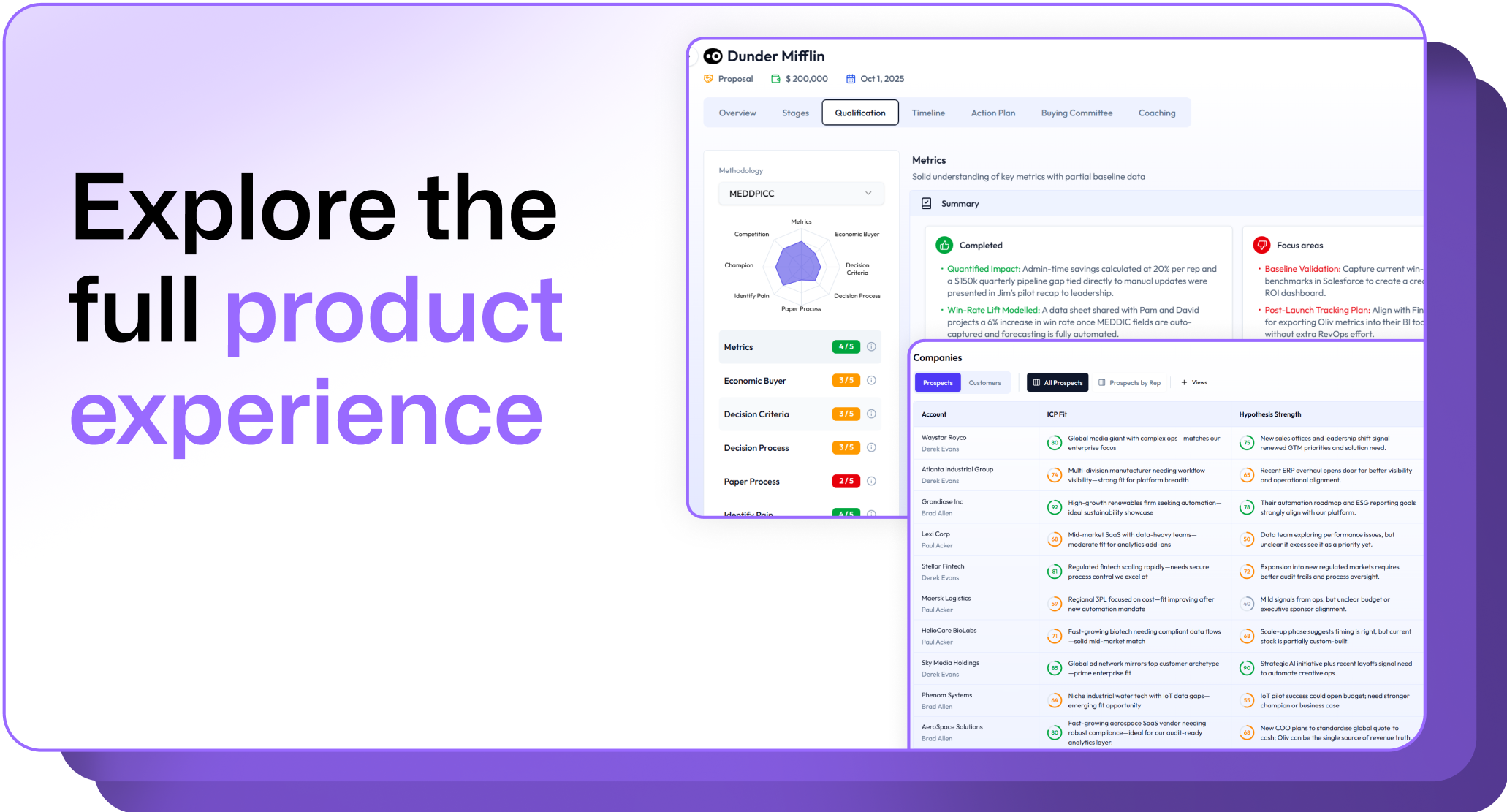
.avif)
.png)







.png)

.png)