Sales Manager's AI Agent Handbook — Automating the 80% of Your Day Spent on Admin | 2026
Written by
Ishan Chhabra
Last Updated :
March 26, 2026
Skim in :
7
mins
In this article
Revenue teams love Oliv
Here’s why:
All your deal data unified (from 30+ tools and tabs).
Insights are delivered to you directly, no digging.
AI agents automate tasks for you.
Thank you! Your submission has been received!
Oops! Something went wrong while submitting the form.
Meet Oliv’s AI Agents
Hi! I’m, Deal Driver
I track deals, flag risks, send weekly pipeline updates and give sales managers full visibility into deal progress
Hi! I’m, CRM Manager
I maintain CRM hygiene by updating core, custom and qualification fields all without your team lifting a finger
Hi! I’m, Forecaster
I build accurate forecasts based on real deal movement and tell you which deals to pull in to hit your number
Hi! I’m, Coach
I believe performance fuels revenue. I spot skill gaps, score calls and build coaching plans to help every rep level up
Hi! I’m, Prospector
I dig into target accounts to surface the right contacts, tailor and time outreach so you always strike when it counts
Hi! I’m, Pipeline tracker
I call reps to get deal updates, and deliver a real-time, CRM-synced roll-up view of deal progress
Hi! I’m, Analyst
I answer complex pipeline questions, uncover deal patterns, and build reports that guide strategic decisions
TL;DR
Sales managers spend 80% of their day on admin that AI agents can fully automate today.
Gong and Chorus record calls but still require hours of manual human review to extract value.
Oliv AI agents autonomously update CRM fields, generate forecasts, and flag at-risk deals daily.
Legacy tool onboarding takes 8 to 24 weeks; Oliv configures in 5 minutes and learns in 3 meetings.
AI agents don't replace managers; they eliminate admin so managers can focus on coaching and strategy.
A fragmented Gong + Clari + Salesforce stack costs $500/user/month; Oliv delivers unified execution at up to 91% less.
Q1: Why Are Sales Managers Still Spending 80% of Their Day on Admin in 2026? [toc=Admin Overload in 2026]
The numbers paint a grim picture. Salesforce's State of Sales Report reveals that sales reps spend only 28 to 30% of their time actually selling, while Gartner estimates administrative work consumes roughly 50% of a rep's week. For sales managers, the burden compounds. You're doing your own admin plus auditing your team's CRM entries, pipeline notes, and call recordings. This isn't a time management failure. It's a structural one, built into the very tools sales organizations have relied on for the past decade.
⚠️ The Legacy Stack Made Admin Worse, Not Better
CRM was designed in a pre-generative AI era around a fatal assumption: that reps would voluntarily enter accurate data. They don't, and the result is "dirty" data that cripples forecasting and reporting. When conversation intelligence platforms like Gong and Chorus arrived, they promised to close this gap by recording calls and surfacing insights. Instead, they shifted the burden. Managers now spend evenings scrubbing through recordings at 2x speed just to verify what reps claimed in pipeline reviews.
As one senior account executive noted:
"It's too complicated, and not intuitive at all. Using it is very...discomforting. Searching for calls is not easy, moving around in the calls is not easy, and understanding the pipeline management portion of it is almost impossible." — John S., Senior Account Executive, G2 Verified Review
⏰ From Revenue Intelligence to AI-Native Revenue Orchestration
The industry is shifting from Revenue Intelligence, platforms that show you data, to AI-Native Revenue Orchestration, systems that do the work. This progression breaks down into three clear generations:
Gen 1: Manual CRM entry, spreadsheet roll-ups, Thursday forecast calls
Gen 2: Conversation intelligence (Gong, Chorus), records and transcribes, but still requires manual human review
Gen 3: Agentic AI, autonomous agents that perform specific "Jobs to be Done" without manual intervention
Another Gong user captured the cost-versus-value tension of being stuck in Gen 2:
"The tool is slow, buggy, and creates an excessive administrative burden on the user side." — Verified Reviewer, G2 Review
Sales technology has evolved through three distinct generations, each shifting what managers do rather than eliminating the role entirely.
✅ How Oliv AI Eliminates Admin at the Source
Oliv AI is purpose-built for this third generation. Rather than adding another dashboard to your stack, we deploy specialized AI agents that autonomously handle the work sales managers have been buried under:
CRM Manager Agent - Updates fields, enriches contacts, and populates methodology scorecards (MEDDPICC, BANT) from call context
Forecaster Agent - Inspects every deal line-by-line, delivering unbiased, board-ready forecasts each Monday
Coach Agent - Identifies individual skill gaps and prescribes micro-coaching based on live deal performance
This isn't SaaS you adopt and train your team to use. It's an agentic workforce that performs the work for you. The impact becomes clear when you hear from managers still stuck in the legacy model:
"Gong is a really powerful tool but it's probably the highest end option on the market, and now we're stuck with a tool that works technically but isn't the right business decision." — Iris P., Head of Marketing, Sales & Partnerships, G2 Verified Review
The 80% admin day isn't inevitable. It's a symptom of tools built for a pre-AI era, and it's entirely fixable.
Each Oliv AI agent targets a specific administrative burden, freeing the sales manager to focus on strategy and coaching.
Q2: What Does 'Agentic AI' Actually Mean for a Sales Manager? [toc=Agentic AI Explained]
"Agentic" has become the most overused buzzword in sales tech in 2026. Every vendor claims it. But for a sales manager drowning in CRM updates and pipeline prep, the question is brutally practical: will this thing actually update my CRM, or do I still have to click buttons?
The answer depends entirely on which generation of technology you're evaluating.
⏰ The Manual Tier: Where Most Teams Still Live
The traditional approach, still the default at many organizations, relies on manual CRM entry, spreadsheet-based forecasts, and Thursday/Friday pipeline sessions where managers sit with each rep to validate deal data one-by-one. It's labor-intensive, entirely rep-dependent, and produces biased forecasts built on human interpretation rather than objective deal signals. Surprisingly, in 2026, a large number of growth-stage teams haven't moved past this reality.
⚠️ The "Smart" Tier: Intelligence Without Action
Gen 1 to 2 tools like Gong and Chorus advanced the game by recording calls and generating transcripts. But they stop at intelligence. They show you what happened without taking action on it. Managers still review recordings, manually extract insights, and update the CRM themselves.
Salesforce Agentforce takes a different but equally limited approach. It's primarily chat-based. You query the bot, interpret the response, and copy-paste data into your workflow manually. Multiple users have flagged the friction this creates:
"Lots of clicking to get select the right options. UX needs improvement. Everything opens in a new browser tabs clustering the browser. Lots of jumping back and forth between tabs to enable settings." — Verified User, Consulting, Enterprise, G2 Verified Review
"Can be complex to set up and customize. Expensive, especially for smaller teams. Steep learning curve for new users." — Shubham G., Senior BDM, G2 Verified Review
Neither approach qualifies as truly agentic because neither acts autonomously on the manager's behalf.
✅ The Agentic Tier: Agents That Do the Work
True agentic AI doesn't wait for instructions. It identifies "Jobs to be Done," executes them autonomously, and nudges the human only when approval is needed. This is the tier where Oliv AI operates.
Here's what that looks like in practice:
Agentic AI Capability Comparison
Capability
Gen 2 (Gong/Chorus)
Chat-Based (Agentforce)
Agentic (Oliv AI)
CRM field updates
❌ Logs unstructured notes
❌ Requires manual query
✅ Auto-populates custom fields
Methodology tracking
❌ Manual scorecard entry
❌ No native support
✅ MEDDPICC/BANT from call context
Mutual Action Plans
❌ Not supported
❌ Not supported
✅ MAP Manager Agent auto-updates Docs
Contact enrichment
❌ Basic capture only
❌ Separate tools needed
✅ CRM Manager Agent creates & enriches
Our agents draft the work, CRM updates, follow-up emails, deal risk alerts, then send a Slack or email nudge for the rep to verify and approve before anything is pushed. Administrative grunt work is removed; strategic accountability stays intact.
The simplest framework to distinguish these tiers: Intelligence shows you data. Automation runs a rule. Agents do the work.
Q3: How Do I Stop Spending Nights Listening to Call Recordings? [toc=End Nightly Call Reviews]
Here's the math most sales managers avoid confronting. If you manage 12 reps averaging 3 calls per day, that's 36 recordings landing in your queue daily. At an average of 30 minutes each, you're staring at 18 hours of raw audio every single day. Even cherry-picking 10% and listening at 2x speed, that's nearly an hour each evening, time spent showering, driving, or sipping coffee while scrubbing through recordings to catch what your reps aren't volunteering in pipeline reviews.
This is the "2% coverage" problem: most managers only review a tiny fraction of their team's conversations, creating a massive visibility gap that hides deal risks, coaching opportunities, and emerging stakeholder concerns.
Legacy tools leave managers reviewing less than 2% of team calls. Oliv AI agents analyze every single conversation automatically.
❌ The "Dashcam" Problem With Gong and Chorus
Gong and Chorus function as high-quality dashcams. They record everything faithfully but require a human being to manually review the footage and extract meaning. Gong typically has a 20 to 30 minute processing delay after each call before insights become available. Its keyword-based Smart Trackers flag mentions of terms like "budget" or "competitor" but they can't distinguish between a prospect discussing their holiday budget and a genuine pricing objection.
One Gong user captured the time-versus-value tradeoff honestly:
"Good product if you have the time to spend on it. There's so much in Gong, that we don't use everything. Gong's deal forecasting we don't use." — Karel Bos, Head of Sales, TrustRadius Verified Review
Chorus faces similar contextual limitations. As one sales operations director observed:
"The software doesn't have the capability of identifying words/phrases that are similar to what you're looking for or understand context, so if you don't tell it exactly what you're looking for then you'll miss out." — Director of Sales Operations, Gartner Verified Review
⏰ The Paradigm Shift: From "Listen to Find" to "Receive What Matters"
Generative AI fundamentally changes this workflow. Instead of managers listening to recordings to find problems, AI reasons over every conversation, extracting deal risks, stakeholder sentiment, methodology gaps, and unresolved objections, in minutes rather than hours. The model flips from pull (you dig through dashboards and recordings) to push (you receive exactly what needs your attention, delivered where you already work).
✅ Oliv's Sunset Summaries: Your Daily Intelligence Brief
Oliv AI replaces the manual audit loop entirely with Sunset Summaries, proactive daily briefs delivered directly to Slack or email that highlight:
Which deals moved forward today and which stalled
New risk signals detected across any rep conversation
Where specific manager intervention is required
Key stakeholder changes or sentiment shifts
These summaries are generated within 5 minutes of each call's completion, not the 20 to 30 minute delay typical of legacy tools. Paired with Morning Briefs delivered 30 minutes before each rep's scheduled calls (covering deal history, open action items, and recommended talk tracks), managers gain complete visibility without ever opening a single recording.
The result: sales managers using Oliv consistently report reclaiming one full day per week previously lost to manual call reviews and dashboard digging.
Q4: Why Does My CRM Still Log Activities to the Wrong Opportunity? [toc=CRM Mislogged Activities]
The CRM was supposed to be the single source of truth. Instead, for most sales organizations, it's become a data graveyard, riddled with duplicate accounts ("Google US" vs. "Google India"), multiple open opportunities for the same buyer, and activities logged against the wrong record entirely. The root cause is deceptively simple: legacy CRMs depend on manual human input and brittle rule-based logic to associate activities with accounts and opportunities. When the underlying data is messy, and it almost always is, those rules break silently.
This creates a cascading failure. Dirty data produces unreliable reports, unreliable reports produce inaccurate forecasts, and inaccurate forecasts mean missed targets that blindside leadership at the worst possible moment.
❌ Where Einstein and Gong Fall Short
Salesforce's Einstein Activity Capture was designed to solve this problem, but it introduces its own set of frustrations. It redacts email data unnecessarily, stores captured activities in separate AWS instances that are unusable for standard Salesforce reporting, and relies on rule-based association logic that buckles under duplicate records. As one reviewer noted:
"Its biggest handicap is that it does not allow for data storage or data migration. You can't really input the data from Einstein into another platform. It has an extremely complicated set up process." — Verified Reviewer, Gartner Review
Gong takes a different but equally problematic approach. It logs meeting summaries as unstructured "Notes" or activity records in the CRM, free-text blocks that cannot be queried, filtered, or used in pipeline reporting. The data exists, but it's functionally invisible to your forecasting engine.
For RevOps teams, the result is a painful, never-ending maintenance cycle. As one Head of Sales Operations described:
"I find the setup process challenging, especially when migrating fields from Salesforce, as it can't handle formula fields directly. This requires creating and maintaining duplicate fields, which adds complexity and workload." — Josiah R., Head of Sales Operations, G2 Verified Review
⏰ The AI-Era Fix: Reasoning Over Rules
LLM-based reasoning changes the game entirely. Instead of matching activities to accounts using rigid if/then rules, generative AI analyzes the full context of a conversation, participants, topics discussed, historical deal patterns, and account metadata, to determine the correct association, even when duplicate or messy records exist in the system.
✅ Oliv's CRM Manager Agent: Structured Data, Not Just Notes
Oliv's CRM Manager Agent uses AI-based object association to map every activity to the correct account and opportunity. But it goes significantly beyond accurate logging. It populates actual CRM properties:
Standard and custom fields updated automatically from conversation context
Methodology scorecards (MEDDPICC, BANT, SPICED) populated without any rep input
Contacts created, enriched, and associated with the correct opportunity record
New deals generated automatically when qualification criteria are detected
The agent is trained on over 100 sales methodologies, so it understands not just what was said on a call, but which CRM field that information belongs in. Reps transition from typing to talking, while the CRM stays spotless, structured, reportable, and forecasting-ready, without a single manual entry.
Q5: I Manage 12 Reps Doing 3 Calls Each -- What Breaks First? [toc=Pipeline Scalability Crisis]
At 36 calls per day, the first thing that collapses isn't your calendar or your energy -- it's your weekly pipeline review. It becomes "rep-driven" rather than data-driven. Reps show you only what they want you to see: the promising deals, the "almost closed" opportunities, the optimistic next steps. Meanwhile, stalled deals hide in plain sight, inflated "Commit" categories go unchallenged, and your forecast becomes -- as one Reddit user described -- "all over the place" because it's based on rep sentiment, not objective conversation signals.
This is the scalability crisis every growth-stage manager hits. Human bandwidth makes it practically impossible to review 36 calls. Managers become "rep-dependent," and what follows is "fake coverage" -- a pipeline that looks healthy on paper but is riddled with hidden risk.
⚠️ Clari and Gong Can't Scale Beyond Human Bandwidth
Clari's forecasting relies on the "Monday Tradition" -- the ritual where managers sit with each rep for hours on Thursdays and Fridays to manually validate deal stages, update spreadsheets, and roll numbers up the chain. It improves the presentation of forecast data, but it doesn't eliminate the dependency on manual input. As one Clari user noted:
"The analytics modules still needs some work IMO to provide a valuable deliverable. All the pieces are there but missing the story line... You have to click around through the different modules and extract the different pieces ultimately putting it in an excel for easier manipulation." — Natalie O., Sales Operations Manager, G2 Verified Review
Gong, meanwhile, tells you what happened on a call but doesn't tell you what it means for this week's revenue target. A second Clari reviewer reinforced a related concern about differentiation gaps:
"Clari features often overlap with other common sales tech tools. Clari should do more to differentiate themselves from competition." — Sarah J., Senior Manager, Revenue Operations, G2 Verified Review
⏰ The Scalable Approach: 100% Automated Deal Inspection
The solution isn't reviewing more calls or hiring additional managers -- it's eliminating the need for manual review entirely. With generative AI, every interaction can be analyzed, every deal scored against methodology criteria, and every risk flagged -- autonomously, with zero manager clicks required.
✅ Oliv's Deal Driver + Forecaster Agents
Oliv AI provides the autonomous coverage layer that legacy tools fundamentally cannot deliver:
Deal Driver Agent -- Provides daily attention flags highlighting which deals need intervention and why, plus weekly pipeline breakdowns organized by risk tier
Forecaster Agent -- Inspects every deal line-by-line to produce unbiased, bottom-up forecasts with AI commentary on risks and quick wins, delivered as board-ready slides every Monday
⏰ Short-Cycle Teams Need Daily Cadence, Not Weekly Reviews
For teams running 15 to 20 day sales cycles, weekly reviews arrive too late -- the deal has already slipped before the Thursday pipeline call. Oliv's daily operating cadence flags contextual risks in real-time (e.g., champion silent for 24 hours after a QBR follow-up, economic buyer unresponsive to a pricing proposal), allowing managers to intervene and rescue deals before they disappear from the pipeline entirely.
Q6: Why Do I Keep Getting Surprised by Stakeholders I Didn't Know Existed? [toc=Hidden Stakeholder Risk]
B2B buying committees are more fragmented than ever. The "truth" of a deal no longer lives in a single recorded meeting -- it's scattered across email threads, shared Slack channels, support tickets, Telegram groups, and side conversations that never make it onto a calendar invite. A manager relying on call recordings alone sees only the tip of the iceberg: the participants who showed up on camera. The stakeholders making decisions behind the scenes -- the skeptical CFO copied on a forwarded email, the IT lead asking questions in a shared Slack channel -- remain invisible until they derail the deal at the eleventh hour.
This is a systemic blind spot, not a one-off oversight. Legacy tools are architecturally limited to the channels they were built to monitor -- typically just scheduled meetings.
❌ Gong's Meeting-Level Blind Spot
Gong provides excellent meeting-level intelligence -- who spoke, what they said, how long each participant talked. But it fails to stitch those data points into a deal-level narrative that spans multiple channels. It doesn't import data from shared Slack channels or Telegram, where many modern B2B deals actively progress. This fragmented view means managers identify stakeholders reactively, not proactively.
As one Director of Sales acknowledged the core visibility challenge that existed before adopting Gong -- and that persists across channels Gong doesn't cover:
"Before Gong we had a lack of visibility across our deals because information was siloed in several places like CRM, Email, Zoom, phone." — Scott T., Director of Sales, G2 Verified Review
Even Gong's own advocates highlight search-level limitations that compound the stakeholder visibility problem:
"Having the ability to search for information globally via Gong home and not at the account level." — Arnaud Desage, KAM, TrustRadius Verified Review
⏰ The Fix: Contextual Data Stitching Across Every Channel
The agentic AI approach doesn't stop at the recorded meeting. It pulls every touchpoint -- calls, emails, support tickets, Slack messages, Telegram threads -- into a single chronological deal timeline. This surfaces the full buying committee automatically, identifying allies, detractors, and new entrants without the manual detective work that currently consumes manager evenings.
✅ Oliv's 360-Degree Deal View
Oliv AI is the only platform that stitches interactions across calls, emails, support tickets, Slack, and Telegram into a unified account history. This gives managers:
Complete buying committee visibility -- every stakeholder mapped with role and sentiment
Ally vs. detractor identification -- catch stakeholders who are "sour" on the deal before they become active blockers
Ghost stakeholder detection -- surface contacts engaging via side-channels who never appear on meeting invites
Multi-threaded deal tracking -- see every conversation thread tied to a single opportunity in one view
Instead of being blindsided by a new VP appearing in the final negotiation round, managers see the full stakeholder picture from the first interaction -- across every channel where the deal actually lives.
Q7: How Do I Get Pipeline Briefs in My Inbox Instead of Another Dashboard? [toc=Pipeline Briefs Over Dashboards]
Sales managers in 2026 are drowning in apps. Between CRM, conversation intelligence, forecasting tools, email, Slack, and coaching platforms, the average revenue leader toggles between 6 to 10 applications daily just to answer basic questions like "Why are we losing renewals?" or "Which deals are actually going to close this week?" This is "App Fatigue" -- and it's not a minor inconvenience. It's a structural productivity drain that compounds the administrative burden managers already face.
The irony is that each tool was supposed to save time. Instead, they've collectively created a new full-time job: dashboard digging.
⚠️ Agentforce's Chat-Based UX -- A Tab, Not a Workflow
Salesforce Agentforce represents the enterprise attempt at solving this problem with AI, but its chat-based interface creates its own friction. Managers must manually query the bot, interpret its response, and then transfer that information into their actual workflow. It's not integrated into the selling process -- it's another tab competing for attention. Users have flagged this directly:
"My primary concern, which became clear even during early testing, is the significant learning curve involved in truly optimizing Agentforce. Effectively crafting prompts and configuring the underlying actions demands a specific skill set often called prompt engineering." — Verified User, Enterprise, G2 Verified Review
Even within the Clari ecosystem, reps struggle with the inherent limitations of pull-based tools:
"I have to maintain my own separate spreadsheet to track deals because I can only capture what my leaders want to see about a deal (revenue, close date, etc.) and as a rep, I need to have fields like product interest, last activity notes, key contacts, deal challenges or blockers, etc." — Verified User in Human Resources, Enterprise, G2 Verified Review
⏰ The Shift: From Pull-Based Dashboards to Push-Based Intelligence
The future of sales management isn't logging into more platforms -- it's receiving intelligence where you already work. Alerts should be contextual and actionable, not keyword-triggered spam that gets muted within a week.
Oliv replaces the pull model of dashboard digging with push-based intelligence delivered directly to Slack and email.
✅ Oliv Delivers Intelligence Where You Live
Oliv AI eliminates dashboard digging entirely by delivering structured intelligence directly to Slack and email:
Morning Briefs -- Delivered 30 minutes before each scheduled call, covering deal history, open action items, and recommended talk tracks based on the current deal stage
Sunset Summaries -- Daily end-of-day briefs highlighting which deals moved, which stalled, and where the manager needs to intervene
✅ Signal, Not Spam: How Oliv Solves Alert Fatigue
Critically, Oliv uses generative AI reasoning to understand nuance and intent -- not V1 keyword matching. It only flags specific contextual risks (e.g., an Economic Buyer going silent for 48 hours, a champion raising a previously unmentioned competitor, a technical blocker surfacing in a support ticket) rather than flooding your inbox with every mention of "budget" or "timeline." The result: alerts you actually read, and action you actually take.
Q8: Where Gong and Chorus Fall Short for Sales Managers [toc=Gong and Chorus Limitations]
Gong is the market benchmark for Conversation Intelligence. Chorus -- now part of ZoomInfo -- serves a similar function with a slightly different packaging. Both have massive brand authority, strong adoption among mid-market and enterprise teams, and genuinely useful recording and transcription capabilities. But for a sales manager in 2026, the critical question isn't "Do I need call intelligence?" -- it's "Why am I still doing the work after getting the intelligence?"
❌ Gong: Intelligence Without Execution
Gong's core strength -- conversation recording and analysis -- remains formidable. But the platform was built in the pre-generative AI era, and its limitations compound as teams scale:
V1 ML keyword trackers (Smart Trackers) flag words without understanding context or intent
20 to 30 minute processing delay after each call before insights become available
Unstructured logging -- summaries stored as "Notes" in CRM, not queryable or reportable fields
Platform fees of $5K to $50K plus implementation costs of $15K to $30K
As one enablement leader noted:
"It can be overwhelming to set up trackers. AI training is a bit laborious to get it to do what you want." — Trafford J., Senior Director, Revenue Enablement, G2 Verified Review
And for cost-conscious teams, the value equation doesn't always hold:
"The platform is expensive, especially compared to alternatives like Salesloft and Apollo, which offer similar capabilities for a fraction of the price." — Verified Reviewer, G2 Review
❌ Chorus: Similar Limits, Different Wrapper
Chorus provides solid basic recording and transcription but shares Gong's fundamental architectural constraint -- it requires human review to extract actionable insights. Users report delayed summaries and repetitive AI-generated content that still needs manual editing:
"The AI email could be better - it does repeat items sometimes up to 3 times in different areas such as meeting summary, action items, and recaps." — Chelsea K., Customer Success Manager II, G2 Verified Review
✅ How Oliv AI Closes the Execution Gap
The fundamental difference is architectural. Gong and Chorus are insight platforms -- they tell you what happened. Oliv AI is an execution platform -- it does the work that should follow.
Gong/Chorus vs Oliv AI: Execution Comparison
Dimension
Gong / Chorus
Oliv AI
Processing time
20 to 30 min delay
✅ 5 minutes
CRM updates
❌ Unstructured notes
✅ Actual field-level properties
Object association
❌ Brittle rules
✅ AI-based reasoning
Platform fees
💰 $5K to $50K
✅ No platform fees
Setup time
⏰ 8 to 24 weeks
✅ 5 minutes + 3 meetings
Channel coverage
Meetings only
✅ Calls, email, Slack, Telegram
💸 The cost comparison speaks volumes: A typical legacy stack of Gong (~$250/mo) + Clari (~$200/mo) + Salesforce creates a $500/user/month revenue stack. Oliv AI provides unified agentic execution -- CRM automation, deal driving, forecasting, and coaching -- at up to 91% lower total cost of ownership.
Q9: Will AI Agents Make Sales Managers Obsolete? [toc=AI Agent Role Replacement]
The fear is real, and it's in the room at every sales leadership meeting in 2026. If AI can review calls, update the CRM, score deals, and produce Monday forecasts, what's left for the manager? This isn't a hypothetical concern. It's the unspoken anxiety driving resistance to AI adoption across sales organizations of every size. Managers who've spent years building pipeline instincts and coaching frameworks are watching autonomous agents replicate portions of their workflow and wondering whether their role has an expiration date.
But history tells a different story. Every wave of sales technology shifted what managers do, not whether they're needed.
⚠️ Technology Has Always Shifted Roles, Not Eliminated Them
CRM didn't replace sales managers, it added admin. Email didn't replace meetings, it added communication overhead. Forecasting tools didn't replace judgment, they added another dashboard to check. Each technological wave promised efficiency but delivered complexity. The net result: managers today spend 80% of their time on administrative work that has nothing to do with coaching, relationship-building, or strategic deal execution. One Gong reviewer inadvertently illustrated this role compression:
"Many reps also resist using Gong because they feel micromanaged, leading to low adoption. While it works well for newer reps, the long-term engagement from experienced team members is lacking." — Verified Reviewer, G2 Review
The problem wasn't that Gong threatened the manager's role, it's that it added surveillance without removing workload. Meanwhile, the administrative burden remains firmly on the manager's shoulders.
✅ AI Automates "Jobs to Be Done," Not Roles
The critical reframe: agentic AI targets the tasks that bury managers, not the judgment that defines them. Direct customer interaction, strategic coaching, relationship navigation, and cross-functional leadership, these are irreplaceable human competencies currently trapped under layers of CRM hygiene, forecast roll-ups, and call auditing.
✅ Oliv's Philosophy: Personal Trainer, Not Replacement
Oliv AI positions agents as a "Personal Trainer and Nutritionist", not a replacement for the athlete. We built agents with functional naming (Researcher, Deal Driver, Forecaster, Coach) that deliberately avoids the perception of human replacement:
Coach Agent -- Monitors rep performance and provides coaching insights (the "form check")
Deal Driver Agent -- Plans the week's priorities and flags intervention points (the "weekly program")
For managers worried about reps disengaging when AI handles CRM updates, Oliv follows a "Human-in-the-Loop" (HITL) governance model. Agents draft the work, follow-up emails, business cases, CRM field updates, but reps receive a Slack or email nudge to verify and approve before anything is pushed. As one Chorus user highlighted the tension between automation and oversight:
"My company is constantly making me justify why we use this when transcription is available in Teams as is meeting recording. It would be great to have more automated features." — Meena S., Chief of Staff, G2 Verified Review
The demand is clear: more automation, not less. Oliv removes the administrative grunt work while keeping the rep in the driver's seat for strategic decision-making.
Q10: What's the Actual Onboarding Time -- Will I Lose a Week of Selling? [toc=Onboarding Time Comparison]
One of the most common objections to adopting new sales technology is implementation drag, the weeks or months of configuration, training, and adoption cycles that pull reps away from revenue-generating activities. For sales managers evaluating AI tools in 2026, the question isn't just "Does this work?", it's "How fast does it work?"
⏰ Legacy Implementation: The Hidden Cost
Traditional enterprise sales tools carry substantial onboarding overhead that rarely appears in the initial sales pitch:
Gong requires 40 to 140 admin hours to define keywords, configure Smart Trackers, and set up CRM field mappings
Implementation for a 100-user Gong deployment takes 8 to 24 weeks
Platform fees range from $5K to $50K, with additional implementation costs of $15K to $30K
One enablement leader described the setup challenge directly:
"It can be overwhelming to set up trackers. AI training is a bit laborious to get it to do what you want." — Trafford J., Senior Director, Revenue Enablement, G2 Verified Review
A Clari admin echoed similar friction on the forecasting side:
"I find the setup process challenging, especially when migrating fields from Salesforce, as it can't handle formula fields directly. This requires creating and maintaining duplicate fields, which adds complexity and workload." — Josiah R., Head of Sales Operations, G2 Verified Review
📊 Onboarding Timeline Comparison
Onboarding Timeline Comparison
Dimension
Gong
Clari
Oliv AI
Initial configuration
⏰ 40 to 140 admin hours
⏰ Weeks of field mapping
✅ 5 minutes
Methodology learning
❌ Manual tracker setup
❌ Manual hierarchy config
✅ 3 meetings
Full deployment (100 users)
⏰ 8 to 24 weeks
⏰ 4 to 12 weeks
✅ Days
Custom model fine-tuning
❌ Ongoing admin burden
❌ Ongoing maintenance
✅ 2 to 4 weeks
Platform fees
💰 $5K to $50K
💰 Varies by tier
✅ None
Implementation fees
💰 $15K to $30K
💰 Varies
✅ None
Even users who appreciate Gong's capabilities note the underutilization problem that stems from complex setup:
"There's so much in Gong, that we don't use everything. Gong's deal forecasting we don't use." — Karel Bos, Head of Sales, TrustRadius Verified Review
✅ Oliv's Instant Time-to-Value
Oliv AI was architecturally designed for rapid deployment. Configuration takes 5 minutes, connect your CRM, calendar, and communication channels. The system only needs three meetings to learn your sales methodology (MEDDPICC, BANT, or custom frameworks). Full custom model building and fine-tuning completes in 2 to 4 weeks, not the months required by legacy platforms.
Q11: A Sales Manager's Day: Before and After AI Agents [toc=Before and After AI Agents]
What does a sales manager's workday actually look like, and how does it change when AI agents handle the administrative 80%? The following timeline illustrates a typical 8-hour day for a growth-stage manager leading 10 reps, comparing the legacy workflow against an agentic AI-powered day.
⏰ The Before: A Day Buried in Admin
A Sales Manager's Day Without AI Agents
Time
Activity
Tool Used
Actual Value
8:00 AM
Check CRM for overnight deal updates
Salesforce
❌ Mostly stale data, reps haven't updated yet
8:30 AM
Review Gong recordings from yesterday (3 of 25 calls)
Gong
⚠️ 12% coverage at best
9:30 AM
Manually update forecast spreadsheet
Excel + Clari
❌ Based on rep sentiment, not deal signals
10:00 AM
Pipeline review call with 3 reps
Zoom
⚠️ Rep-driven theatre, only see what they show you
11:30 AM
Chase reps for CRM updates via Slack
Slack
❌ Admin overhead, creates friction
12:00 PM
Lunch (while listening to a call recording at 2x)
Gong mobile
❌ "Leisure" time consumed by work
1:00 PM
1:1 coaching session (unprepared, no time to review calls)
Zoom
⚠️ Generic coaching, not evidence-based
2:00 PM
Deal review, manually stitching email/call/Slack data
Multiple apps
❌ Dashboard digging across 6+ tools
3:30 PM
Prepare Monday board report
PowerPoint
❌ 2 hours of manual slide building
5:30 PM
End of day, zero strategic time spent
-
❌ 100% admin, 0% leadership
As one Senior Account Executive noted about the typical tool experience:
"It's too complicated, and not intuitive at all. Using it is very...discomforting. Searching for calls is not easy, moving around in the calls is not easy." — John S., Senior Account Executive, G2 Verified Review
✅ The After: A Day Powered by Oliv AI Agents
A Sales Manager's Day With Oliv AI Agents
Time
Activity
Oliv Agent
Actual Value
8:00 AM
Read Sunset Summary from yesterday (in email)
Deal Driver
✅ Full coverage, every deal's status in 2 minutes
8:15 AM
Review AI-flagged risk deals (3 of 30 need attention)
Forecaster
✅ Focus only where intervention matters
8:30 AM
Morning Brief arrives, prep for 9 AM call auto-delivered
Researcher
✅ Deal history, stakeholder map, talk track ready
9:00 AM
Customer call, fully prepared, zero pre-work needed
-
✅ Strategic selling, not scrambling
10:00 AM
Evidence-based coaching: review AI-scored call with rep
Cross-functional alignment (CS, Product) with deal context
CRM Manager
✅ CRM is clean, data speaks for itself
2:00 PM
Strategic 1:1s with top reps, career development focus
-
✅ Time freed for actual leadership
4:00 PM
End of day, 4+ hours of strategic time reclaimed
-
⭐ From data janitor to revenue leader
The shift is structural, not incremental: managers move from spending 80% of their day on admin to spending 80% on strategy, coaching, and customer engagement.
Q12: How to Start Automating Your Admin This Week -- A 4-Step Quick-Start [toc=4-Step Automation Roadmap]
Moving from a manual sales management workflow to an agentic AI-powered one doesn't require a six-month implementation project or executive committee approval. The following four-step roadmap is designed for sales managers who want to start reclaiming time within their first week.
Step 1: Audit Your Time Leaks
Before selecting any tool, spend two days tracking where your hours actually go. Most managers are surprised by the results. Common time leaks include:
CRM hygiene enforcement -- Chasing reps for updates (30 to 60 min/day)
Call review -- Listening to recordings at 2x speed (60 to 90 min/day)
Forecast preparation -- Manual roll-ups and spreadsheet formatting (2 to 3 hours/week)
Pipeline review prep -- Stitching data across Gong, CRM, email, and Slack (45 to 60 min per review)
Report building -- Creating board-ready slides from raw data (2+ hours/week)
One Clari user described the manual overhead that persists even with modern tools:
"The analytics modules still needs some work IMO to provide a valuable deliverable... You have to click around through the different modules and extract the different pieces ultimately putting it in an excel for easier manipulation." — Natalie O., Sales Operations Manager, G2 Verified Review
Step 2: Identify Your Highest-ROI Automation Targets
Map your time leaks to automation categories. Prioritize based on hours consumed x revenue impact:
Automation Priority Matrix
Time Leak
Hours/Week
Revenue Impact
Priority
CRM updates & hygiene
5 to 7 hrs
⭐ High, dirty data breaks forecasts
🔴 Critical
Call review & coaching prep
5 to 8 hrs
⭐ High, limited coverage = blind spots
🔴 Critical
Forecast preparation
2 to 3 hrs
⭐ High, inaccurate forecasts erode trust
🟡 High
Pipeline review prep
3 to 4 hrs
⚠️ Medium, time-consuming but manageable
🟡 High
Report building
2 to 3 hrs
⚠️ Medium, presentation, not strategy
🟢 Medium
Step 3: Select Modular Agents Matching Your Pain Points
Rather than committing to a monolithic platform, choose modular AI agents that address your specific top-priority leaks. Oliv AI's agent architecture allows managers to start with one agent and expand as value is proven:
Coach Agent -- Provides AI-scored call reviews for evidence-based coaching
As one Gong user highlighted, the complexity trap of legacy platforms is real:
"There's so much in Gong, that we don't use everything. Gong's deal forecasting we don't use." — Karel Bos, Head of Sales, TrustRadius Verified Review
Step 4: Measure Time-Reclaimed Within 30 Days
Set a simple baseline before going live: track the hours you spend on each time leak category during Week 1 (pre-automation). Then measure again at Day 30. Key metrics to track:
Hours/week on admin tasks -- Target: 50%+ reduction
CRM data completeness -- Target: 95%+ field fill rate
Pipeline review prep time -- Target: Near-zero (auto-generated)
Call coverage rate -- Target: 100% (up from ~2%)
Forecast accuracy -- Track variance between AI forecast and actual close
Oliv AI's 5-minute configuration and 3-meeting methodology learning curve means you can realistically complete Steps 1 to 3 within a single week and have measurable results by Day 30.Oliv-AI-Competitor-Reviews.md
Q1: Why Are Sales Managers Still Spending 80% of Their Day on Admin in 2026? [toc=Admin Overload in 2026]
The numbers paint a grim picture. Salesforce's State of Sales Report reveals that sales reps spend only 28 to 30% of their time actually selling, while Gartner estimates administrative work consumes roughly 50% of a rep's week. For sales managers, the burden compounds. You're doing your own admin plus auditing your team's CRM entries, pipeline notes, and call recordings. This isn't a time management failure. It's a structural one, built into the very tools sales organizations have relied on for the past decade.
⚠️ The Legacy Stack Made Admin Worse, Not Better
CRM was designed in a pre-generative AI era around a fatal assumption: that reps would voluntarily enter accurate data. They don't, and the result is "dirty" data that cripples forecasting and reporting. When conversation intelligence platforms like Gong and Chorus arrived, they promised to close this gap by recording calls and surfacing insights. Instead, they shifted the burden. Managers now spend evenings scrubbing through recordings at 2x speed just to verify what reps claimed in pipeline reviews.
As one senior account executive noted:
"It's too complicated, and not intuitive at all. Using it is very...discomforting. Searching for calls is not easy, moving around in the calls is not easy, and understanding the pipeline management portion of it is almost impossible." — John S., Senior Account Executive, G2 Verified Review
⏰ From Revenue Intelligence to AI-Native Revenue Orchestration
The industry is shifting from Revenue Intelligence, platforms that show you data, to AI-Native Revenue Orchestration, systems that do the work. This progression breaks down into three clear generations:
Gen 1: Manual CRM entry, spreadsheet roll-ups, Thursday forecast calls
Gen 2: Conversation intelligence (Gong, Chorus), records and transcribes, but still requires manual human review
Gen 3: Agentic AI, autonomous agents that perform specific "Jobs to be Done" without manual intervention
Another Gong user captured the cost-versus-value tension of being stuck in Gen 2:
"The tool is slow, buggy, and creates an excessive administrative burden on the user side." — Verified Reviewer, G2 Review
Sales technology has evolved through three distinct generations, each shifting what managers do rather than eliminating the role entirely.
✅ How Oliv AI Eliminates Admin at the Source
Oliv AI is purpose-built for this third generation. Rather than adding another dashboard to your stack, we deploy specialized AI agents that autonomously handle the work sales managers have been buried under:
CRM Manager Agent - Updates fields, enriches contacts, and populates methodology scorecards (MEDDPICC, BANT) from call context
Forecaster Agent - Inspects every deal line-by-line, delivering unbiased, board-ready forecasts each Monday
Coach Agent - Identifies individual skill gaps and prescribes micro-coaching based on live deal performance
This isn't SaaS you adopt and train your team to use. It's an agentic workforce that performs the work for you. The impact becomes clear when you hear from managers still stuck in the legacy model:
"Gong is a really powerful tool but it's probably the highest end option on the market, and now we're stuck with a tool that works technically but isn't the right business decision." — Iris P., Head of Marketing, Sales & Partnerships, G2 Verified Review
The 80% admin day isn't inevitable. It's a symptom of tools built for a pre-AI era, and it's entirely fixable.
Each Oliv AI agent targets a specific administrative burden, freeing the sales manager to focus on strategy and coaching.
Q2: What Does 'Agentic AI' Actually Mean for a Sales Manager? [toc=Agentic AI Explained]
"Agentic" has become the most overused buzzword in sales tech in 2026. Every vendor claims it. But for a sales manager drowning in CRM updates and pipeline prep, the question is brutally practical: will this thing actually update my CRM, or do I still have to click buttons?
The answer depends entirely on which generation of technology you're evaluating.
⏰ The Manual Tier: Where Most Teams Still Live
The traditional approach, still the default at many organizations, relies on manual CRM entry, spreadsheet-based forecasts, and Thursday/Friday pipeline sessions where managers sit with each rep to validate deal data one-by-one. It's labor-intensive, entirely rep-dependent, and produces biased forecasts built on human interpretation rather than objective deal signals. Surprisingly, in 2026, a large number of growth-stage teams haven't moved past this reality.
⚠️ The "Smart" Tier: Intelligence Without Action
Gen 1 to 2 tools like Gong and Chorus advanced the game by recording calls and generating transcripts. But they stop at intelligence. They show you what happened without taking action on it. Managers still review recordings, manually extract insights, and update the CRM themselves.
Salesforce Agentforce takes a different but equally limited approach. It's primarily chat-based. You query the bot, interpret the response, and copy-paste data into your workflow manually. Multiple users have flagged the friction this creates:
"Lots of clicking to get select the right options. UX needs improvement. Everything opens in a new browser tabs clustering the browser. Lots of jumping back and forth between tabs to enable settings." — Verified User, Consulting, Enterprise, G2 Verified Review
"Can be complex to set up and customize. Expensive, especially for smaller teams. Steep learning curve for new users." — Shubham G., Senior BDM, G2 Verified Review
Neither approach qualifies as truly agentic because neither acts autonomously on the manager's behalf.
✅ The Agentic Tier: Agents That Do the Work
True agentic AI doesn't wait for instructions. It identifies "Jobs to be Done," executes them autonomously, and nudges the human only when approval is needed. This is the tier where Oliv AI operates.
Here's what that looks like in practice:
Agentic AI Capability Comparison
Capability
Gen 2 (Gong/Chorus)
Chat-Based (Agentforce)
Agentic (Oliv AI)
CRM field updates
❌ Logs unstructured notes
❌ Requires manual query
✅ Auto-populates custom fields
Methodology tracking
❌ Manual scorecard entry
❌ No native support
✅ MEDDPICC/BANT from call context
Mutual Action Plans
❌ Not supported
❌ Not supported
✅ MAP Manager Agent auto-updates Docs
Contact enrichment
❌ Basic capture only
❌ Separate tools needed
✅ CRM Manager Agent creates & enriches
Our agents draft the work, CRM updates, follow-up emails, deal risk alerts, then send a Slack or email nudge for the rep to verify and approve before anything is pushed. Administrative grunt work is removed; strategic accountability stays intact.
The simplest framework to distinguish these tiers: Intelligence shows you data. Automation runs a rule. Agents do the work.
Q3: How Do I Stop Spending Nights Listening to Call Recordings? [toc=End Nightly Call Reviews]
Here's the math most sales managers avoid confronting. If you manage 12 reps averaging 3 calls per day, that's 36 recordings landing in your queue daily. At an average of 30 minutes each, you're staring at 18 hours of raw audio every single day. Even cherry-picking 10% and listening at 2x speed, that's nearly an hour each evening, time spent showering, driving, or sipping coffee while scrubbing through recordings to catch what your reps aren't volunteering in pipeline reviews.
This is the "2% coverage" problem: most managers only review a tiny fraction of their team's conversations, creating a massive visibility gap that hides deal risks, coaching opportunities, and emerging stakeholder concerns.
Legacy tools leave managers reviewing less than 2% of team calls. Oliv AI agents analyze every single conversation automatically.
❌ The "Dashcam" Problem With Gong and Chorus
Gong and Chorus function as high-quality dashcams. They record everything faithfully but require a human being to manually review the footage and extract meaning. Gong typically has a 20 to 30 minute processing delay after each call before insights become available. Its keyword-based Smart Trackers flag mentions of terms like "budget" or "competitor" but they can't distinguish between a prospect discussing their holiday budget and a genuine pricing objection.
One Gong user captured the time-versus-value tradeoff honestly:
"Good product if you have the time to spend on it. There's so much in Gong, that we don't use everything. Gong's deal forecasting we don't use." — Karel Bos, Head of Sales, TrustRadius Verified Review
Chorus faces similar contextual limitations. As one sales operations director observed:
"The software doesn't have the capability of identifying words/phrases that are similar to what you're looking for or understand context, so if you don't tell it exactly what you're looking for then you'll miss out." — Director of Sales Operations, Gartner Verified Review
⏰ The Paradigm Shift: From "Listen to Find" to "Receive What Matters"
Generative AI fundamentally changes this workflow. Instead of managers listening to recordings to find problems, AI reasons over every conversation, extracting deal risks, stakeholder sentiment, methodology gaps, and unresolved objections, in minutes rather than hours. The model flips from pull (you dig through dashboards and recordings) to push (you receive exactly what needs your attention, delivered where you already work).
✅ Oliv's Sunset Summaries: Your Daily Intelligence Brief
Oliv AI replaces the manual audit loop entirely with Sunset Summaries, proactive daily briefs delivered directly to Slack or email that highlight:
Which deals moved forward today and which stalled
New risk signals detected across any rep conversation
Where specific manager intervention is required
Key stakeholder changes or sentiment shifts
These summaries are generated within 5 minutes of each call's completion, not the 20 to 30 minute delay typical of legacy tools. Paired with Morning Briefs delivered 30 minutes before each rep's scheduled calls (covering deal history, open action items, and recommended talk tracks), managers gain complete visibility without ever opening a single recording.
The result: sales managers using Oliv consistently report reclaiming one full day per week previously lost to manual call reviews and dashboard digging.
Q4: Why Does My CRM Still Log Activities to the Wrong Opportunity? [toc=CRM Mislogged Activities]
The CRM was supposed to be the single source of truth. Instead, for most sales organizations, it's become a data graveyard, riddled with duplicate accounts ("Google US" vs. "Google India"), multiple open opportunities for the same buyer, and activities logged against the wrong record entirely. The root cause is deceptively simple: legacy CRMs depend on manual human input and brittle rule-based logic to associate activities with accounts and opportunities. When the underlying data is messy, and it almost always is, those rules break silently.
This creates a cascading failure. Dirty data produces unreliable reports, unreliable reports produce inaccurate forecasts, and inaccurate forecasts mean missed targets that blindside leadership at the worst possible moment.
❌ Where Einstein and Gong Fall Short
Salesforce's Einstein Activity Capture was designed to solve this problem, but it introduces its own set of frustrations. It redacts email data unnecessarily, stores captured activities in separate AWS instances that are unusable for standard Salesforce reporting, and relies on rule-based association logic that buckles under duplicate records. As one reviewer noted:
"Its biggest handicap is that it does not allow for data storage or data migration. You can't really input the data from Einstein into another platform. It has an extremely complicated set up process." — Verified Reviewer, Gartner Review
Gong takes a different but equally problematic approach. It logs meeting summaries as unstructured "Notes" or activity records in the CRM, free-text blocks that cannot be queried, filtered, or used in pipeline reporting. The data exists, but it's functionally invisible to your forecasting engine.
For RevOps teams, the result is a painful, never-ending maintenance cycle. As one Head of Sales Operations described:
"I find the setup process challenging, especially when migrating fields from Salesforce, as it can't handle formula fields directly. This requires creating and maintaining duplicate fields, which adds complexity and workload." — Josiah R., Head of Sales Operations, G2 Verified Review
⏰ The AI-Era Fix: Reasoning Over Rules
LLM-based reasoning changes the game entirely. Instead of matching activities to accounts using rigid if/then rules, generative AI analyzes the full context of a conversation, participants, topics discussed, historical deal patterns, and account metadata, to determine the correct association, even when duplicate or messy records exist in the system.
✅ Oliv's CRM Manager Agent: Structured Data, Not Just Notes
Oliv's CRM Manager Agent uses AI-based object association to map every activity to the correct account and opportunity. But it goes significantly beyond accurate logging. It populates actual CRM properties:
Standard and custom fields updated automatically from conversation context
Methodology scorecards (MEDDPICC, BANT, SPICED) populated without any rep input
Contacts created, enriched, and associated with the correct opportunity record
New deals generated automatically when qualification criteria are detected
The agent is trained on over 100 sales methodologies, so it understands not just what was said on a call, but which CRM field that information belongs in. Reps transition from typing to talking, while the CRM stays spotless, structured, reportable, and forecasting-ready, without a single manual entry.
Q5: I Manage 12 Reps Doing 3 Calls Each -- What Breaks First? [toc=Pipeline Scalability Crisis]
At 36 calls per day, the first thing that collapses isn't your calendar or your energy -- it's your weekly pipeline review. It becomes "rep-driven" rather than data-driven. Reps show you only what they want you to see: the promising deals, the "almost closed" opportunities, the optimistic next steps. Meanwhile, stalled deals hide in plain sight, inflated "Commit" categories go unchallenged, and your forecast becomes -- as one Reddit user described -- "all over the place" because it's based on rep sentiment, not objective conversation signals.
This is the scalability crisis every growth-stage manager hits. Human bandwidth makes it practically impossible to review 36 calls. Managers become "rep-dependent," and what follows is "fake coverage" -- a pipeline that looks healthy on paper but is riddled with hidden risk.
⚠️ Clari and Gong Can't Scale Beyond Human Bandwidth
Clari's forecasting relies on the "Monday Tradition" -- the ritual where managers sit with each rep for hours on Thursdays and Fridays to manually validate deal stages, update spreadsheets, and roll numbers up the chain. It improves the presentation of forecast data, but it doesn't eliminate the dependency on manual input. As one Clari user noted:
"The analytics modules still needs some work IMO to provide a valuable deliverable. All the pieces are there but missing the story line... You have to click around through the different modules and extract the different pieces ultimately putting it in an excel for easier manipulation." — Natalie O., Sales Operations Manager, G2 Verified Review
Gong, meanwhile, tells you what happened on a call but doesn't tell you what it means for this week's revenue target. A second Clari reviewer reinforced a related concern about differentiation gaps:
"Clari features often overlap with other common sales tech tools. Clari should do more to differentiate themselves from competition." — Sarah J., Senior Manager, Revenue Operations, G2 Verified Review
⏰ The Scalable Approach: 100% Automated Deal Inspection
The solution isn't reviewing more calls or hiring additional managers -- it's eliminating the need for manual review entirely. With generative AI, every interaction can be analyzed, every deal scored against methodology criteria, and every risk flagged -- autonomously, with zero manager clicks required.
✅ Oliv's Deal Driver + Forecaster Agents
Oliv AI provides the autonomous coverage layer that legacy tools fundamentally cannot deliver:
Deal Driver Agent -- Provides daily attention flags highlighting which deals need intervention and why, plus weekly pipeline breakdowns organized by risk tier
Forecaster Agent -- Inspects every deal line-by-line to produce unbiased, bottom-up forecasts with AI commentary on risks and quick wins, delivered as board-ready slides every Monday
⏰ Short-Cycle Teams Need Daily Cadence, Not Weekly Reviews
For teams running 15 to 20 day sales cycles, weekly reviews arrive too late -- the deal has already slipped before the Thursday pipeline call. Oliv's daily operating cadence flags contextual risks in real-time (e.g., champion silent for 24 hours after a QBR follow-up, economic buyer unresponsive to a pricing proposal), allowing managers to intervene and rescue deals before they disappear from the pipeline entirely.
Q6: Why Do I Keep Getting Surprised by Stakeholders I Didn't Know Existed? [toc=Hidden Stakeholder Risk]
B2B buying committees are more fragmented than ever. The "truth" of a deal no longer lives in a single recorded meeting -- it's scattered across email threads, shared Slack channels, support tickets, Telegram groups, and side conversations that never make it onto a calendar invite. A manager relying on call recordings alone sees only the tip of the iceberg: the participants who showed up on camera. The stakeholders making decisions behind the scenes -- the skeptical CFO copied on a forwarded email, the IT lead asking questions in a shared Slack channel -- remain invisible until they derail the deal at the eleventh hour.
This is a systemic blind spot, not a one-off oversight. Legacy tools are architecturally limited to the channels they were built to monitor -- typically just scheduled meetings.
❌ Gong's Meeting-Level Blind Spot
Gong provides excellent meeting-level intelligence -- who spoke, what they said, how long each participant talked. But it fails to stitch those data points into a deal-level narrative that spans multiple channels. It doesn't import data from shared Slack channels or Telegram, where many modern B2B deals actively progress. This fragmented view means managers identify stakeholders reactively, not proactively.
As one Director of Sales acknowledged the core visibility challenge that existed before adopting Gong -- and that persists across channels Gong doesn't cover:
"Before Gong we had a lack of visibility across our deals because information was siloed in several places like CRM, Email, Zoom, phone." — Scott T., Director of Sales, G2 Verified Review
Even Gong's own advocates highlight search-level limitations that compound the stakeholder visibility problem:
"Having the ability to search for information globally via Gong home and not at the account level." — Arnaud Desage, KAM, TrustRadius Verified Review
⏰ The Fix: Contextual Data Stitching Across Every Channel
The agentic AI approach doesn't stop at the recorded meeting. It pulls every touchpoint -- calls, emails, support tickets, Slack messages, Telegram threads -- into a single chronological deal timeline. This surfaces the full buying committee automatically, identifying allies, detractors, and new entrants without the manual detective work that currently consumes manager evenings.
✅ Oliv's 360-Degree Deal View
Oliv AI is the only platform that stitches interactions across calls, emails, support tickets, Slack, and Telegram into a unified account history. This gives managers:
Complete buying committee visibility -- every stakeholder mapped with role and sentiment
Ally vs. detractor identification -- catch stakeholders who are "sour" on the deal before they become active blockers
Ghost stakeholder detection -- surface contacts engaging via side-channels who never appear on meeting invites
Multi-threaded deal tracking -- see every conversation thread tied to a single opportunity in one view
Instead of being blindsided by a new VP appearing in the final negotiation round, managers see the full stakeholder picture from the first interaction -- across every channel where the deal actually lives.
Q7: How Do I Get Pipeline Briefs in My Inbox Instead of Another Dashboard? [toc=Pipeline Briefs Over Dashboards]
Sales managers in 2026 are drowning in apps. Between CRM, conversation intelligence, forecasting tools, email, Slack, and coaching platforms, the average revenue leader toggles between 6 to 10 applications daily just to answer basic questions like "Why are we losing renewals?" or "Which deals are actually going to close this week?" This is "App Fatigue" -- and it's not a minor inconvenience. It's a structural productivity drain that compounds the administrative burden managers already face.
The irony is that each tool was supposed to save time. Instead, they've collectively created a new full-time job: dashboard digging.
⚠️ Agentforce's Chat-Based UX -- A Tab, Not a Workflow
Salesforce Agentforce represents the enterprise attempt at solving this problem with AI, but its chat-based interface creates its own friction. Managers must manually query the bot, interpret its response, and then transfer that information into their actual workflow. It's not integrated into the selling process -- it's another tab competing for attention. Users have flagged this directly:
"My primary concern, which became clear even during early testing, is the significant learning curve involved in truly optimizing Agentforce. Effectively crafting prompts and configuring the underlying actions demands a specific skill set often called prompt engineering." — Verified User, Enterprise, G2 Verified Review
Even within the Clari ecosystem, reps struggle with the inherent limitations of pull-based tools:
"I have to maintain my own separate spreadsheet to track deals because I can only capture what my leaders want to see about a deal (revenue, close date, etc.) and as a rep, I need to have fields like product interest, last activity notes, key contacts, deal challenges or blockers, etc." — Verified User in Human Resources, Enterprise, G2 Verified Review
⏰ The Shift: From Pull-Based Dashboards to Push-Based Intelligence
The future of sales management isn't logging into more platforms -- it's receiving intelligence where you already work. Alerts should be contextual and actionable, not keyword-triggered spam that gets muted within a week.
Oliv replaces the pull model of dashboard digging with push-based intelligence delivered directly to Slack and email.
✅ Oliv Delivers Intelligence Where You Live
Oliv AI eliminates dashboard digging entirely by delivering structured intelligence directly to Slack and email:
Morning Briefs -- Delivered 30 minutes before each scheduled call, covering deal history, open action items, and recommended talk tracks based on the current deal stage
Sunset Summaries -- Daily end-of-day briefs highlighting which deals moved, which stalled, and where the manager needs to intervene
✅ Signal, Not Spam: How Oliv Solves Alert Fatigue
Critically, Oliv uses generative AI reasoning to understand nuance and intent -- not V1 keyword matching. It only flags specific contextual risks (e.g., an Economic Buyer going silent for 48 hours, a champion raising a previously unmentioned competitor, a technical blocker surfacing in a support ticket) rather than flooding your inbox with every mention of "budget" or "timeline." The result: alerts you actually read, and action you actually take.
Q8: Where Gong and Chorus Fall Short for Sales Managers [toc=Gong and Chorus Limitations]
Gong is the market benchmark for Conversation Intelligence. Chorus -- now part of ZoomInfo -- serves a similar function with a slightly different packaging. Both have massive brand authority, strong adoption among mid-market and enterprise teams, and genuinely useful recording and transcription capabilities. But for a sales manager in 2026, the critical question isn't "Do I need call intelligence?" -- it's "Why am I still doing the work after getting the intelligence?"
❌ Gong: Intelligence Without Execution
Gong's core strength -- conversation recording and analysis -- remains formidable. But the platform was built in the pre-generative AI era, and its limitations compound as teams scale:
V1 ML keyword trackers (Smart Trackers) flag words without understanding context or intent
20 to 30 minute processing delay after each call before insights become available
Unstructured logging -- summaries stored as "Notes" in CRM, not queryable or reportable fields
Platform fees of $5K to $50K plus implementation costs of $15K to $30K
As one enablement leader noted:
"It can be overwhelming to set up trackers. AI training is a bit laborious to get it to do what you want." — Trafford J., Senior Director, Revenue Enablement, G2 Verified Review
And for cost-conscious teams, the value equation doesn't always hold:
"The platform is expensive, especially compared to alternatives like Salesloft and Apollo, which offer similar capabilities for a fraction of the price." — Verified Reviewer, G2 Review
❌ Chorus: Similar Limits, Different Wrapper
Chorus provides solid basic recording and transcription but shares Gong's fundamental architectural constraint -- it requires human review to extract actionable insights. Users report delayed summaries and repetitive AI-generated content that still needs manual editing:
"The AI email could be better - it does repeat items sometimes up to 3 times in different areas such as meeting summary, action items, and recaps." — Chelsea K., Customer Success Manager II, G2 Verified Review
✅ How Oliv AI Closes the Execution Gap
The fundamental difference is architectural. Gong and Chorus are insight platforms -- they tell you what happened. Oliv AI is an execution platform -- it does the work that should follow.
Gong/Chorus vs Oliv AI: Execution Comparison
Dimension
Gong / Chorus
Oliv AI
Processing time
20 to 30 min delay
✅ 5 minutes
CRM updates
❌ Unstructured notes
✅ Actual field-level properties
Object association
❌ Brittle rules
✅ AI-based reasoning
Platform fees
💰 $5K to $50K
✅ No platform fees
Setup time
⏰ 8 to 24 weeks
✅ 5 minutes + 3 meetings
Channel coverage
Meetings only
✅ Calls, email, Slack, Telegram
💸 The cost comparison speaks volumes: A typical legacy stack of Gong (~$250/mo) + Clari (~$200/mo) + Salesforce creates a $500/user/month revenue stack. Oliv AI provides unified agentic execution -- CRM automation, deal driving, forecasting, and coaching -- at up to 91% lower total cost of ownership.
Q9: Will AI Agents Make Sales Managers Obsolete? [toc=AI Agent Role Replacement]
The fear is real, and it's in the room at every sales leadership meeting in 2026. If AI can review calls, update the CRM, score deals, and produce Monday forecasts, what's left for the manager? This isn't a hypothetical concern. It's the unspoken anxiety driving resistance to AI adoption across sales organizations of every size. Managers who've spent years building pipeline instincts and coaching frameworks are watching autonomous agents replicate portions of their workflow and wondering whether their role has an expiration date.
But history tells a different story. Every wave of sales technology shifted what managers do, not whether they're needed.
⚠️ Technology Has Always Shifted Roles, Not Eliminated Them
CRM didn't replace sales managers, it added admin. Email didn't replace meetings, it added communication overhead. Forecasting tools didn't replace judgment, they added another dashboard to check. Each technological wave promised efficiency but delivered complexity. The net result: managers today spend 80% of their time on administrative work that has nothing to do with coaching, relationship-building, or strategic deal execution. One Gong reviewer inadvertently illustrated this role compression:
"Many reps also resist using Gong because they feel micromanaged, leading to low adoption. While it works well for newer reps, the long-term engagement from experienced team members is lacking." — Verified Reviewer, G2 Review
The problem wasn't that Gong threatened the manager's role, it's that it added surveillance without removing workload. Meanwhile, the administrative burden remains firmly on the manager's shoulders.
✅ AI Automates "Jobs to Be Done," Not Roles
The critical reframe: agentic AI targets the tasks that bury managers, not the judgment that defines them. Direct customer interaction, strategic coaching, relationship navigation, and cross-functional leadership, these are irreplaceable human competencies currently trapped under layers of CRM hygiene, forecast roll-ups, and call auditing.
✅ Oliv's Philosophy: Personal Trainer, Not Replacement
Oliv AI positions agents as a "Personal Trainer and Nutritionist", not a replacement for the athlete. We built agents with functional naming (Researcher, Deal Driver, Forecaster, Coach) that deliberately avoids the perception of human replacement:
Coach Agent -- Monitors rep performance and provides coaching insights (the "form check")
Deal Driver Agent -- Plans the week's priorities and flags intervention points (the "weekly program")
For managers worried about reps disengaging when AI handles CRM updates, Oliv follows a "Human-in-the-Loop" (HITL) governance model. Agents draft the work, follow-up emails, business cases, CRM field updates, but reps receive a Slack or email nudge to verify and approve before anything is pushed. As one Chorus user highlighted the tension between automation and oversight:
"My company is constantly making me justify why we use this when transcription is available in Teams as is meeting recording. It would be great to have more automated features." — Meena S., Chief of Staff, G2 Verified Review
The demand is clear: more automation, not less. Oliv removes the administrative grunt work while keeping the rep in the driver's seat for strategic decision-making.
Q10: What's the Actual Onboarding Time -- Will I Lose a Week of Selling? [toc=Onboarding Time Comparison]
One of the most common objections to adopting new sales technology is implementation drag, the weeks or months of configuration, training, and adoption cycles that pull reps away from revenue-generating activities. For sales managers evaluating AI tools in 2026, the question isn't just "Does this work?", it's "How fast does it work?"
⏰ Legacy Implementation: The Hidden Cost
Traditional enterprise sales tools carry substantial onboarding overhead that rarely appears in the initial sales pitch:
Gong requires 40 to 140 admin hours to define keywords, configure Smart Trackers, and set up CRM field mappings
Implementation for a 100-user Gong deployment takes 8 to 24 weeks
Platform fees range from $5K to $50K, with additional implementation costs of $15K to $30K
One enablement leader described the setup challenge directly:
"It can be overwhelming to set up trackers. AI training is a bit laborious to get it to do what you want." — Trafford J., Senior Director, Revenue Enablement, G2 Verified Review
A Clari admin echoed similar friction on the forecasting side:
"I find the setup process challenging, especially when migrating fields from Salesforce, as it can't handle formula fields directly. This requires creating and maintaining duplicate fields, which adds complexity and workload." — Josiah R., Head of Sales Operations, G2 Verified Review
📊 Onboarding Timeline Comparison
Onboarding Timeline Comparison
Dimension
Gong
Clari
Oliv AI
Initial configuration
⏰ 40 to 140 admin hours
⏰ Weeks of field mapping
✅ 5 minutes
Methodology learning
❌ Manual tracker setup
❌ Manual hierarchy config
✅ 3 meetings
Full deployment (100 users)
⏰ 8 to 24 weeks
⏰ 4 to 12 weeks
✅ Days
Custom model fine-tuning
❌ Ongoing admin burden
❌ Ongoing maintenance
✅ 2 to 4 weeks
Platform fees
💰 $5K to $50K
💰 Varies by tier
✅ None
Implementation fees
💰 $15K to $30K
💰 Varies
✅ None
Even users who appreciate Gong's capabilities note the underutilization problem that stems from complex setup:
"There's so much in Gong, that we don't use everything. Gong's deal forecasting we don't use." — Karel Bos, Head of Sales, TrustRadius Verified Review
✅ Oliv's Instant Time-to-Value
Oliv AI was architecturally designed for rapid deployment. Configuration takes 5 minutes, connect your CRM, calendar, and communication channels. The system only needs three meetings to learn your sales methodology (MEDDPICC, BANT, or custom frameworks). Full custom model building and fine-tuning completes in 2 to 4 weeks, not the months required by legacy platforms.
Q11: A Sales Manager's Day: Before and After AI Agents [toc=Before and After AI Agents]
What does a sales manager's workday actually look like, and how does it change when AI agents handle the administrative 80%? The following timeline illustrates a typical 8-hour day for a growth-stage manager leading 10 reps, comparing the legacy workflow against an agentic AI-powered day.
⏰ The Before: A Day Buried in Admin
A Sales Manager's Day Without AI Agents
Time
Activity
Tool Used
Actual Value
8:00 AM
Check CRM for overnight deal updates
Salesforce
❌ Mostly stale data, reps haven't updated yet
8:30 AM
Review Gong recordings from yesterday (3 of 25 calls)
Gong
⚠️ 12% coverage at best
9:30 AM
Manually update forecast spreadsheet
Excel + Clari
❌ Based on rep sentiment, not deal signals
10:00 AM
Pipeline review call with 3 reps
Zoom
⚠️ Rep-driven theatre, only see what they show you
11:30 AM
Chase reps for CRM updates via Slack
Slack
❌ Admin overhead, creates friction
12:00 PM
Lunch (while listening to a call recording at 2x)
Gong mobile
❌ "Leisure" time consumed by work
1:00 PM
1:1 coaching session (unprepared, no time to review calls)
Zoom
⚠️ Generic coaching, not evidence-based
2:00 PM
Deal review, manually stitching email/call/Slack data
Multiple apps
❌ Dashboard digging across 6+ tools
3:30 PM
Prepare Monday board report
PowerPoint
❌ 2 hours of manual slide building
5:30 PM
End of day, zero strategic time spent
-
❌ 100% admin, 0% leadership
As one Senior Account Executive noted about the typical tool experience:
"It's too complicated, and not intuitive at all. Using it is very...discomforting. Searching for calls is not easy, moving around in the calls is not easy." — John S., Senior Account Executive, G2 Verified Review
✅ The After: A Day Powered by Oliv AI Agents
A Sales Manager's Day With Oliv AI Agents
Time
Activity
Oliv Agent
Actual Value
8:00 AM
Read Sunset Summary from yesterday (in email)
Deal Driver
✅ Full coverage, every deal's status in 2 minutes
8:15 AM
Review AI-flagged risk deals (3 of 30 need attention)
Forecaster
✅ Focus only where intervention matters
8:30 AM
Morning Brief arrives, prep for 9 AM call auto-delivered
Researcher
✅ Deal history, stakeholder map, talk track ready
9:00 AM
Customer call, fully prepared, zero pre-work needed
-
✅ Strategic selling, not scrambling
10:00 AM
Evidence-based coaching: review AI-scored call with rep
Cross-functional alignment (CS, Product) with deal context
CRM Manager
✅ CRM is clean, data speaks for itself
2:00 PM
Strategic 1:1s with top reps, career development focus
-
✅ Time freed for actual leadership
4:00 PM
End of day, 4+ hours of strategic time reclaimed
-
⭐ From data janitor to revenue leader
The shift is structural, not incremental: managers move from spending 80% of their day on admin to spending 80% on strategy, coaching, and customer engagement.
Q12: How to Start Automating Your Admin This Week -- A 4-Step Quick-Start [toc=4-Step Automation Roadmap]
Moving from a manual sales management workflow to an agentic AI-powered one doesn't require a six-month implementation project or executive committee approval. The following four-step roadmap is designed for sales managers who want to start reclaiming time within their first week.
Step 1: Audit Your Time Leaks
Before selecting any tool, spend two days tracking where your hours actually go. Most managers are surprised by the results. Common time leaks include:
CRM hygiene enforcement -- Chasing reps for updates (30 to 60 min/day)
Call review -- Listening to recordings at 2x speed (60 to 90 min/day)
Forecast preparation -- Manual roll-ups and spreadsheet formatting (2 to 3 hours/week)
Pipeline review prep -- Stitching data across Gong, CRM, email, and Slack (45 to 60 min per review)
Report building -- Creating board-ready slides from raw data (2+ hours/week)
One Clari user described the manual overhead that persists even with modern tools:
"The analytics modules still needs some work IMO to provide a valuable deliverable... You have to click around through the different modules and extract the different pieces ultimately putting it in an excel for easier manipulation." — Natalie O., Sales Operations Manager, G2 Verified Review
Step 2: Identify Your Highest-ROI Automation Targets
Map your time leaks to automation categories. Prioritize based on hours consumed x revenue impact:
Automation Priority Matrix
Time Leak
Hours/Week
Revenue Impact
Priority
CRM updates & hygiene
5 to 7 hrs
⭐ High, dirty data breaks forecasts
🔴 Critical
Call review & coaching prep
5 to 8 hrs
⭐ High, limited coverage = blind spots
🔴 Critical
Forecast preparation
2 to 3 hrs
⭐ High, inaccurate forecasts erode trust
🟡 High
Pipeline review prep
3 to 4 hrs
⚠️ Medium, time-consuming but manageable
🟡 High
Report building
2 to 3 hrs
⚠️ Medium, presentation, not strategy
🟢 Medium
Step 3: Select Modular Agents Matching Your Pain Points
Rather than committing to a monolithic platform, choose modular AI agents that address your specific top-priority leaks. Oliv AI's agent architecture allows managers to start with one agent and expand as value is proven:
Coach Agent -- Provides AI-scored call reviews for evidence-based coaching
As one Gong user highlighted, the complexity trap of legacy platforms is real:
"There's so much in Gong, that we don't use everything. Gong's deal forecasting we don't use." — Karel Bos, Head of Sales, TrustRadius Verified Review
Step 4: Measure Time-Reclaimed Within 30 Days
Set a simple baseline before going live: track the hours you spend on each time leak category during Week 1 (pre-automation). Then measure again at Day 30. Key metrics to track:
Hours/week on admin tasks -- Target: 50%+ reduction
CRM data completeness -- Target: 95%+ field fill rate
Pipeline review prep time -- Target: Near-zero (auto-generated)
Call coverage rate -- Target: 100% (up from ~2%)
Forecast accuracy -- Track variance between AI forecast and actual close
Oliv AI's 5-minute configuration and 3-meeting methodology learning curve means you can realistically complete Steps 1 to 3 within a single week and have measurable results by Day 30.Oliv-AI-Competitor-Reviews.md
Q1: Why Are Sales Managers Still Spending 80% of Their Day on Admin in 2026? [toc=Admin Overload in 2026]
The numbers paint a grim picture. Salesforce's State of Sales Report reveals that sales reps spend only 28 to 30% of their time actually selling, while Gartner estimates administrative work consumes roughly 50% of a rep's week. For sales managers, the burden compounds. You're doing your own admin plus auditing your team's CRM entries, pipeline notes, and call recordings. This isn't a time management failure. It's a structural one, built into the very tools sales organizations have relied on for the past decade.
⚠️ The Legacy Stack Made Admin Worse, Not Better
CRM was designed in a pre-generative AI era around a fatal assumption: that reps would voluntarily enter accurate data. They don't, and the result is "dirty" data that cripples forecasting and reporting. When conversation intelligence platforms like Gong and Chorus arrived, they promised to close this gap by recording calls and surfacing insights. Instead, they shifted the burden. Managers now spend evenings scrubbing through recordings at 2x speed just to verify what reps claimed in pipeline reviews.
As one senior account executive noted:
"It's too complicated, and not intuitive at all. Using it is very...discomforting. Searching for calls is not easy, moving around in the calls is not easy, and understanding the pipeline management portion of it is almost impossible." — John S., Senior Account Executive, G2 Verified Review
⏰ From Revenue Intelligence to AI-Native Revenue Orchestration
The industry is shifting from Revenue Intelligence, platforms that show you data, to AI-Native Revenue Orchestration, systems that do the work. This progression breaks down into three clear generations:
Gen 1: Manual CRM entry, spreadsheet roll-ups, Thursday forecast calls
Gen 2: Conversation intelligence (Gong, Chorus), records and transcribes, but still requires manual human review
Gen 3: Agentic AI, autonomous agents that perform specific "Jobs to be Done" without manual intervention
Another Gong user captured the cost-versus-value tension of being stuck in Gen 2:
"The tool is slow, buggy, and creates an excessive administrative burden on the user side." — Verified Reviewer, G2 Review
Sales technology has evolved through three distinct generations, each shifting what managers do rather than eliminating the role entirely.
✅ How Oliv AI Eliminates Admin at the Source
Oliv AI is purpose-built for this third generation. Rather than adding another dashboard to your stack, we deploy specialized AI agents that autonomously handle the work sales managers have been buried under:
CRM Manager Agent - Updates fields, enriches contacts, and populates methodology scorecards (MEDDPICC, BANT) from call context
Forecaster Agent - Inspects every deal line-by-line, delivering unbiased, board-ready forecasts each Monday
Coach Agent - Identifies individual skill gaps and prescribes micro-coaching based on live deal performance
This isn't SaaS you adopt and train your team to use. It's an agentic workforce that performs the work for you. The impact becomes clear when you hear from managers still stuck in the legacy model:
"Gong is a really powerful tool but it's probably the highest end option on the market, and now we're stuck with a tool that works technically but isn't the right business decision." — Iris P., Head of Marketing, Sales & Partnerships, G2 Verified Review
The 80% admin day isn't inevitable. It's a symptom of tools built for a pre-AI era, and it's entirely fixable.
Each Oliv AI agent targets a specific administrative burden, freeing the sales manager to focus on strategy and coaching.
Q2: What Does 'Agentic AI' Actually Mean for a Sales Manager? [toc=Agentic AI Explained]
"Agentic" has become the most overused buzzword in sales tech in 2026. Every vendor claims it. But for a sales manager drowning in CRM updates and pipeline prep, the question is brutally practical: will this thing actually update my CRM, or do I still have to click buttons?
The answer depends entirely on which generation of technology you're evaluating.
⏰ The Manual Tier: Where Most Teams Still Live
The traditional approach, still the default at many organizations, relies on manual CRM entry, spreadsheet-based forecasts, and Thursday/Friday pipeline sessions where managers sit with each rep to validate deal data one-by-one. It's labor-intensive, entirely rep-dependent, and produces biased forecasts built on human interpretation rather than objective deal signals. Surprisingly, in 2026, a large number of growth-stage teams haven't moved past this reality.
⚠️ The "Smart" Tier: Intelligence Without Action
Gen 1 to 2 tools like Gong and Chorus advanced the game by recording calls and generating transcripts. But they stop at intelligence. They show you what happened without taking action on it. Managers still review recordings, manually extract insights, and update the CRM themselves.
Salesforce Agentforce takes a different but equally limited approach. It's primarily chat-based. You query the bot, interpret the response, and copy-paste data into your workflow manually. Multiple users have flagged the friction this creates:
"Lots of clicking to get select the right options. UX needs improvement. Everything opens in a new browser tabs clustering the browser. Lots of jumping back and forth between tabs to enable settings." — Verified User, Consulting, Enterprise, G2 Verified Review
"Can be complex to set up and customize. Expensive, especially for smaller teams. Steep learning curve for new users." — Shubham G., Senior BDM, G2 Verified Review
Neither approach qualifies as truly agentic because neither acts autonomously on the manager's behalf.
✅ The Agentic Tier: Agents That Do the Work
True agentic AI doesn't wait for instructions. It identifies "Jobs to be Done," executes them autonomously, and nudges the human only when approval is needed. This is the tier where Oliv AI operates.
Here's what that looks like in practice:
Agentic AI Capability Comparison
Capability
Gen 2 (Gong/Chorus)
Chat-Based (Agentforce)
Agentic (Oliv AI)
CRM field updates
❌ Logs unstructured notes
❌ Requires manual query
✅ Auto-populates custom fields
Methodology tracking
❌ Manual scorecard entry
❌ No native support
✅ MEDDPICC/BANT from call context
Mutual Action Plans
❌ Not supported
❌ Not supported
✅ MAP Manager Agent auto-updates Docs
Contact enrichment
❌ Basic capture only
❌ Separate tools needed
✅ CRM Manager Agent creates & enriches
Our agents draft the work, CRM updates, follow-up emails, deal risk alerts, then send a Slack or email nudge for the rep to verify and approve before anything is pushed. Administrative grunt work is removed; strategic accountability stays intact.
The simplest framework to distinguish these tiers: Intelligence shows you data. Automation runs a rule. Agents do the work.
Q3: How Do I Stop Spending Nights Listening to Call Recordings? [toc=End Nightly Call Reviews]
Here's the math most sales managers avoid confronting. If you manage 12 reps averaging 3 calls per day, that's 36 recordings landing in your queue daily. At an average of 30 minutes each, you're staring at 18 hours of raw audio every single day. Even cherry-picking 10% and listening at 2x speed, that's nearly an hour each evening, time spent showering, driving, or sipping coffee while scrubbing through recordings to catch what your reps aren't volunteering in pipeline reviews.
This is the "2% coverage" problem: most managers only review a tiny fraction of their team's conversations, creating a massive visibility gap that hides deal risks, coaching opportunities, and emerging stakeholder concerns.
Legacy tools leave managers reviewing less than 2% of team calls. Oliv AI agents analyze every single conversation automatically.
❌ The "Dashcam" Problem With Gong and Chorus
Gong and Chorus function as high-quality dashcams. They record everything faithfully but require a human being to manually review the footage and extract meaning. Gong typically has a 20 to 30 minute processing delay after each call before insights become available. Its keyword-based Smart Trackers flag mentions of terms like "budget" or "competitor" but they can't distinguish between a prospect discussing their holiday budget and a genuine pricing objection.
One Gong user captured the time-versus-value tradeoff honestly:
"Good product if you have the time to spend on it. There's so much in Gong, that we don't use everything. Gong's deal forecasting we don't use." — Karel Bos, Head of Sales, TrustRadius Verified Review
Chorus faces similar contextual limitations. As one sales operations director observed:
"The software doesn't have the capability of identifying words/phrases that are similar to what you're looking for or understand context, so if you don't tell it exactly what you're looking for then you'll miss out." — Director of Sales Operations, Gartner Verified Review
⏰ The Paradigm Shift: From "Listen to Find" to "Receive What Matters"
Generative AI fundamentally changes this workflow. Instead of managers listening to recordings to find problems, AI reasons over every conversation, extracting deal risks, stakeholder sentiment, methodology gaps, and unresolved objections, in minutes rather than hours. The model flips from pull (you dig through dashboards and recordings) to push (you receive exactly what needs your attention, delivered where you already work).
✅ Oliv's Sunset Summaries: Your Daily Intelligence Brief
Oliv AI replaces the manual audit loop entirely with Sunset Summaries, proactive daily briefs delivered directly to Slack or email that highlight:
Which deals moved forward today and which stalled
New risk signals detected across any rep conversation
Where specific manager intervention is required
Key stakeholder changes or sentiment shifts
These summaries are generated within 5 minutes of each call's completion, not the 20 to 30 minute delay typical of legacy tools. Paired with Morning Briefs delivered 30 minutes before each rep's scheduled calls (covering deal history, open action items, and recommended talk tracks), managers gain complete visibility without ever opening a single recording.
The result: sales managers using Oliv consistently report reclaiming one full day per week previously lost to manual call reviews and dashboard digging.
Q4: Why Does My CRM Still Log Activities to the Wrong Opportunity? [toc=CRM Mislogged Activities]
The CRM was supposed to be the single source of truth. Instead, for most sales organizations, it's become a data graveyard, riddled with duplicate accounts ("Google US" vs. "Google India"), multiple open opportunities for the same buyer, and activities logged against the wrong record entirely. The root cause is deceptively simple: legacy CRMs depend on manual human input and brittle rule-based logic to associate activities with accounts and opportunities. When the underlying data is messy, and it almost always is, those rules break silently.
This creates a cascading failure. Dirty data produces unreliable reports, unreliable reports produce inaccurate forecasts, and inaccurate forecasts mean missed targets that blindside leadership at the worst possible moment.
❌ Where Einstein and Gong Fall Short
Salesforce's Einstein Activity Capture was designed to solve this problem, but it introduces its own set of frustrations. It redacts email data unnecessarily, stores captured activities in separate AWS instances that are unusable for standard Salesforce reporting, and relies on rule-based association logic that buckles under duplicate records. As one reviewer noted:
"Its biggest handicap is that it does not allow for data storage or data migration. You can't really input the data from Einstein into another platform. It has an extremely complicated set up process." — Verified Reviewer, Gartner Review
Gong takes a different but equally problematic approach. It logs meeting summaries as unstructured "Notes" or activity records in the CRM, free-text blocks that cannot be queried, filtered, or used in pipeline reporting. The data exists, but it's functionally invisible to your forecasting engine.
For RevOps teams, the result is a painful, never-ending maintenance cycle. As one Head of Sales Operations described:
"I find the setup process challenging, especially when migrating fields from Salesforce, as it can't handle formula fields directly. This requires creating and maintaining duplicate fields, which adds complexity and workload." — Josiah R., Head of Sales Operations, G2 Verified Review
⏰ The AI-Era Fix: Reasoning Over Rules
LLM-based reasoning changes the game entirely. Instead of matching activities to accounts using rigid if/then rules, generative AI analyzes the full context of a conversation, participants, topics discussed, historical deal patterns, and account metadata, to determine the correct association, even when duplicate or messy records exist in the system.
✅ Oliv's CRM Manager Agent: Structured Data, Not Just Notes
Oliv's CRM Manager Agent uses AI-based object association to map every activity to the correct account and opportunity. But it goes significantly beyond accurate logging. It populates actual CRM properties:
Standard and custom fields updated automatically from conversation context
Methodology scorecards (MEDDPICC, BANT, SPICED) populated without any rep input
Contacts created, enriched, and associated with the correct opportunity record
New deals generated automatically when qualification criteria are detected
The agent is trained on over 100 sales methodologies, so it understands not just what was said on a call, but which CRM field that information belongs in. Reps transition from typing to talking, while the CRM stays spotless, structured, reportable, and forecasting-ready, without a single manual entry.
Q5: I Manage 12 Reps Doing 3 Calls Each -- What Breaks First? [toc=Pipeline Scalability Crisis]
At 36 calls per day, the first thing that collapses isn't your calendar or your energy -- it's your weekly pipeline review. It becomes "rep-driven" rather than data-driven. Reps show you only what they want you to see: the promising deals, the "almost closed" opportunities, the optimistic next steps. Meanwhile, stalled deals hide in plain sight, inflated "Commit" categories go unchallenged, and your forecast becomes -- as one Reddit user described -- "all over the place" because it's based on rep sentiment, not objective conversation signals.
This is the scalability crisis every growth-stage manager hits. Human bandwidth makes it practically impossible to review 36 calls. Managers become "rep-dependent," and what follows is "fake coverage" -- a pipeline that looks healthy on paper but is riddled with hidden risk.
⚠️ Clari and Gong Can't Scale Beyond Human Bandwidth
Clari's forecasting relies on the "Monday Tradition" -- the ritual where managers sit with each rep for hours on Thursdays and Fridays to manually validate deal stages, update spreadsheets, and roll numbers up the chain. It improves the presentation of forecast data, but it doesn't eliminate the dependency on manual input. As one Clari user noted:
"The analytics modules still needs some work IMO to provide a valuable deliverable. All the pieces are there but missing the story line... You have to click around through the different modules and extract the different pieces ultimately putting it in an excel for easier manipulation." — Natalie O., Sales Operations Manager, G2 Verified Review
Gong, meanwhile, tells you what happened on a call but doesn't tell you what it means for this week's revenue target. A second Clari reviewer reinforced a related concern about differentiation gaps:
"Clari features often overlap with other common sales tech tools. Clari should do more to differentiate themselves from competition." — Sarah J., Senior Manager, Revenue Operations, G2 Verified Review
⏰ The Scalable Approach: 100% Automated Deal Inspection
The solution isn't reviewing more calls or hiring additional managers -- it's eliminating the need for manual review entirely. With generative AI, every interaction can be analyzed, every deal scored against methodology criteria, and every risk flagged -- autonomously, with zero manager clicks required.
✅ Oliv's Deal Driver + Forecaster Agents
Oliv AI provides the autonomous coverage layer that legacy tools fundamentally cannot deliver:
Deal Driver Agent -- Provides daily attention flags highlighting which deals need intervention and why, plus weekly pipeline breakdowns organized by risk tier
Forecaster Agent -- Inspects every deal line-by-line to produce unbiased, bottom-up forecasts with AI commentary on risks and quick wins, delivered as board-ready slides every Monday
⏰ Short-Cycle Teams Need Daily Cadence, Not Weekly Reviews
For teams running 15 to 20 day sales cycles, weekly reviews arrive too late -- the deal has already slipped before the Thursday pipeline call. Oliv's daily operating cadence flags contextual risks in real-time (e.g., champion silent for 24 hours after a QBR follow-up, economic buyer unresponsive to a pricing proposal), allowing managers to intervene and rescue deals before they disappear from the pipeline entirely.
Q6: Why Do I Keep Getting Surprised by Stakeholders I Didn't Know Existed? [toc=Hidden Stakeholder Risk]
B2B buying committees are more fragmented than ever. The "truth" of a deal no longer lives in a single recorded meeting -- it's scattered across email threads, shared Slack channels, support tickets, Telegram groups, and side conversations that never make it onto a calendar invite. A manager relying on call recordings alone sees only the tip of the iceberg: the participants who showed up on camera. The stakeholders making decisions behind the scenes -- the skeptical CFO copied on a forwarded email, the IT lead asking questions in a shared Slack channel -- remain invisible until they derail the deal at the eleventh hour.
This is a systemic blind spot, not a one-off oversight. Legacy tools are architecturally limited to the channels they were built to monitor -- typically just scheduled meetings.
❌ Gong's Meeting-Level Blind Spot
Gong provides excellent meeting-level intelligence -- who spoke, what they said, how long each participant talked. But it fails to stitch those data points into a deal-level narrative that spans multiple channels. It doesn't import data from shared Slack channels or Telegram, where many modern B2B deals actively progress. This fragmented view means managers identify stakeholders reactively, not proactively.
As one Director of Sales acknowledged the core visibility challenge that existed before adopting Gong -- and that persists across channels Gong doesn't cover:
"Before Gong we had a lack of visibility across our deals because information was siloed in several places like CRM, Email, Zoom, phone." — Scott T., Director of Sales, G2 Verified Review
Even Gong's own advocates highlight search-level limitations that compound the stakeholder visibility problem:
"Having the ability to search for information globally via Gong home and not at the account level." — Arnaud Desage, KAM, TrustRadius Verified Review
⏰ The Fix: Contextual Data Stitching Across Every Channel
The agentic AI approach doesn't stop at the recorded meeting. It pulls every touchpoint -- calls, emails, support tickets, Slack messages, Telegram threads -- into a single chronological deal timeline. This surfaces the full buying committee automatically, identifying allies, detractors, and new entrants without the manual detective work that currently consumes manager evenings.
✅ Oliv's 360-Degree Deal View
Oliv AI is the only platform that stitches interactions across calls, emails, support tickets, Slack, and Telegram into a unified account history. This gives managers:
Complete buying committee visibility -- every stakeholder mapped with role and sentiment
Ally vs. detractor identification -- catch stakeholders who are "sour" on the deal before they become active blockers
Ghost stakeholder detection -- surface contacts engaging via side-channels who never appear on meeting invites
Multi-threaded deal tracking -- see every conversation thread tied to a single opportunity in one view
Instead of being blindsided by a new VP appearing in the final negotiation round, managers see the full stakeholder picture from the first interaction -- across every channel where the deal actually lives.
Q7: How Do I Get Pipeline Briefs in My Inbox Instead of Another Dashboard? [toc=Pipeline Briefs Over Dashboards]
Sales managers in 2026 are drowning in apps. Between CRM, conversation intelligence, forecasting tools, email, Slack, and coaching platforms, the average revenue leader toggles between 6 to 10 applications daily just to answer basic questions like "Why are we losing renewals?" or "Which deals are actually going to close this week?" This is "App Fatigue" -- and it's not a minor inconvenience. It's a structural productivity drain that compounds the administrative burden managers already face.
The irony is that each tool was supposed to save time. Instead, they've collectively created a new full-time job: dashboard digging.
⚠️ Agentforce's Chat-Based UX -- A Tab, Not a Workflow
Salesforce Agentforce represents the enterprise attempt at solving this problem with AI, but its chat-based interface creates its own friction. Managers must manually query the bot, interpret its response, and then transfer that information into their actual workflow. It's not integrated into the selling process -- it's another tab competing for attention. Users have flagged this directly:
"My primary concern, which became clear even during early testing, is the significant learning curve involved in truly optimizing Agentforce. Effectively crafting prompts and configuring the underlying actions demands a specific skill set often called prompt engineering." — Verified User, Enterprise, G2 Verified Review
Even within the Clari ecosystem, reps struggle with the inherent limitations of pull-based tools:
"I have to maintain my own separate spreadsheet to track deals because I can only capture what my leaders want to see about a deal (revenue, close date, etc.) and as a rep, I need to have fields like product interest, last activity notes, key contacts, deal challenges or blockers, etc." — Verified User in Human Resources, Enterprise, G2 Verified Review
⏰ The Shift: From Pull-Based Dashboards to Push-Based Intelligence
The future of sales management isn't logging into more platforms -- it's receiving intelligence where you already work. Alerts should be contextual and actionable, not keyword-triggered spam that gets muted within a week.
Oliv replaces the pull model of dashboard digging with push-based intelligence delivered directly to Slack and email.
✅ Oliv Delivers Intelligence Where You Live
Oliv AI eliminates dashboard digging entirely by delivering structured intelligence directly to Slack and email:
Morning Briefs -- Delivered 30 minutes before each scheduled call, covering deal history, open action items, and recommended talk tracks based on the current deal stage
Sunset Summaries -- Daily end-of-day briefs highlighting which deals moved, which stalled, and where the manager needs to intervene
✅ Signal, Not Spam: How Oliv Solves Alert Fatigue
Critically, Oliv uses generative AI reasoning to understand nuance and intent -- not V1 keyword matching. It only flags specific contextual risks (e.g., an Economic Buyer going silent for 48 hours, a champion raising a previously unmentioned competitor, a technical blocker surfacing in a support ticket) rather than flooding your inbox with every mention of "budget" or "timeline." The result: alerts you actually read, and action you actually take.
Q8: Where Gong and Chorus Fall Short for Sales Managers [toc=Gong and Chorus Limitations]
Gong is the market benchmark for Conversation Intelligence. Chorus -- now part of ZoomInfo -- serves a similar function with a slightly different packaging. Both have massive brand authority, strong adoption among mid-market and enterprise teams, and genuinely useful recording and transcription capabilities. But for a sales manager in 2026, the critical question isn't "Do I need call intelligence?" -- it's "Why am I still doing the work after getting the intelligence?"
❌ Gong: Intelligence Without Execution
Gong's core strength -- conversation recording and analysis -- remains formidable. But the platform was built in the pre-generative AI era, and its limitations compound as teams scale:
V1 ML keyword trackers (Smart Trackers) flag words without understanding context or intent
20 to 30 minute processing delay after each call before insights become available
Unstructured logging -- summaries stored as "Notes" in CRM, not queryable or reportable fields
Platform fees of $5K to $50K plus implementation costs of $15K to $30K
As one enablement leader noted:
"It can be overwhelming to set up trackers. AI training is a bit laborious to get it to do what you want." — Trafford J., Senior Director, Revenue Enablement, G2 Verified Review
And for cost-conscious teams, the value equation doesn't always hold:
"The platform is expensive, especially compared to alternatives like Salesloft and Apollo, which offer similar capabilities for a fraction of the price." — Verified Reviewer, G2 Review
❌ Chorus: Similar Limits, Different Wrapper
Chorus provides solid basic recording and transcription but shares Gong's fundamental architectural constraint -- it requires human review to extract actionable insights. Users report delayed summaries and repetitive AI-generated content that still needs manual editing:
"The AI email could be better - it does repeat items sometimes up to 3 times in different areas such as meeting summary, action items, and recaps." — Chelsea K., Customer Success Manager II, G2 Verified Review
✅ How Oliv AI Closes the Execution Gap
The fundamental difference is architectural. Gong and Chorus are insight platforms -- they tell you what happened. Oliv AI is an execution platform -- it does the work that should follow.
Gong/Chorus vs Oliv AI: Execution Comparison
Dimension
Gong / Chorus
Oliv AI
Processing time
20 to 30 min delay
✅ 5 minutes
CRM updates
❌ Unstructured notes
✅ Actual field-level properties
Object association
❌ Brittle rules
✅ AI-based reasoning
Platform fees
💰 $5K to $50K
✅ No platform fees
Setup time
⏰ 8 to 24 weeks
✅ 5 minutes + 3 meetings
Channel coverage
Meetings only
✅ Calls, email, Slack, Telegram
💸 The cost comparison speaks volumes: A typical legacy stack of Gong (~$250/mo) + Clari (~$200/mo) + Salesforce creates a $500/user/month revenue stack. Oliv AI provides unified agentic execution -- CRM automation, deal driving, forecasting, and coaching -- at up to 91% lower total cost of ownership.
Q9: Will AI Agents Make Sales Managers Obsolete? [toc=AI Agent Role Replacement]
The fear is real, and it's in the room at every sales leadership meeting in 2026. If AI can review calls, update the CRM, score deals, and produce Monday forecasts, what's left for the manager? This isn't a hypothetical concern. It's the unspoken anxiety driving resistance to AI adoption across sales organizations of every size. Managers who've spent years building pipeline instincts and coaching frameworks are watching autonomous agents replicate portions of their workflow and wondering whether their role has an expiration date.
But history tells a different story. Every wave of sales technology shifted what managers do, not whether they're needed.
⚠️ Technology Has Always Shifted Roles, Not Eliminated Them
CRM didn't replace sales managers, it added admin. Email didn't replace meetings, it added communication overhead. Forecasting tools didn't replace judgment, they added another dashboard to check. Each technological wave promised efficiency but delivered complexity. The net result: managers today spend 80% of their time on administrative work that has nothing to do with coaching, relationship-building, or strategic deal execution. One Gong reviewer inadvertently illustrated this role compression:
"Many reps also resist using Gong because they feel micromanaged, leading to low adoption. While it works well for newer reps, the long-term engagement from experienced team members is lacking." — Verified Reviewer, G2 Review
The problem wasn't that Gong threatened the manager's role, it's that it added surveillance without removing workload. Meanwhile, the administrative burden remains firmly on the manager's shoulders.
✅ AI Automates "Jobs to Be Done," Not Roles
The critical reframe: agentic AI targets the tasks that bury managers, not the judgment that defines them. Direct customer interaction, strategic coaching, relationship navigation, and cross-functional leadership, these are irreplaceable human competencies currently trapped under layers of CRM hygiene, forecast roll-ups, and call auditing.
✅ Oliv's Philosophy: Personal Trainer, Not Replacement
Oliv AI positions agents as a "Personal Trainer and Nutritionist", not a replacement for the athlete. We built agents with functional naming (Researcher, Deal Driver, Forecaster, Coach) that deliberately avoids the perception of human replacement:
Coach Agent -- Monitors rep performance and provides coaching insights (the "form check")
Deal Driver Agent -- Plans the week's priorities and flags intervention points (the "weekly program")
For managers worried about reps disengaging when AI handles CRM updates, Oliv follows a "Human-in-the-Loop" (HITL) governance model. Agents draft the work, follow-up emails, business cases, CRM field updates, but reps receive a Slack or email nudge to verify and approve before anything is pushed. As one Chorus user highlighted the tension between automation and oversight:
"My company is constantly making me justify why we use this when transcription is available in Teams as is meeting recording. It would be great to have more automated features." — Meena S., Chief of Staff, G2 Verified Review
The demand is clear: more automation, not less. Oliv removes the administrative grunt work while keeping the rep in the driver's seat for strategic decision-making.
Q10: What's the Actual Onboarding Time -- Will I Lose a Week of Selling? [toc=Onboarding Time Comparison]
One of the most common objections to adopting new sales technology is implementation drag, the weeks or months of configuration, training, and adoption cycles that pull reps away from revenue-generating activities. For sales managers evaluating AI tools in 2026, the question isn't just "Does this work?", it's "How fast does it work?"
⏰ Legacy Implementation: The Hidden Cost
Traditional enterprise sales tools carry substantial onboarding overhead that rarely appears in the initial sales pitch:
Gong requires 40 to 140 admin hours to define keywords, configure Smart Trackers, and set up CRM field mappings
Implementation for a 100-user Gong deployment takes 8 to 24 weeks
Platform fees range from $5K to $50K, with additional implementation costs of $15K to $30K
One enablement leader described the setup challenge directly:
"It can be overwhelming to set up trackers. AI training is a bit laborious to get it to do what you want." — Trafford J., Senior Director, Revenue Enablement, G2 Verified Review
A Clari admin echoed similar friction on the forecasting side:
"I find the setup process challenging, especially when migrating fields from Salesforce, as it can't handle formula fields directly. This requires creating and maintaining duplicate fields, which adds complexity and workload." — Josiah R., Head of Sales Operations, G2 Verified Review
📊 Onboarding Timeline Comparison
Onboarding Timeline Comparison
Dimension
Gong
Clari
Oliv AI
Initial configuration
⏰ 40 to 140 admin hours
⏰ Weeks of field mapping
✅ 5 minutes
Methodology learning
❌ Manual tracker setup
❌ Manual hierarchy config
✅ 3 meetings
Full deployment (100 users)
⏰ 8 to 24 weeks
⏰ 4 to 12 weeks
✅ Days
Custom model fine-tuning
❌ Ongoing admin burden
❌ Ongoing maintenance
✅ 2 to 4 weeks
Platform fees
💰 $5K to $50K
💰 Varies by tier
✅ None
Implementation fees
💰 $15K to $30K
💰 Varies
✅ None
Even users who appreciate Gong's capabilities note the underutilization problem that stems from complex setup:
"There's so much in Gong, that we don't use everything. Gong's deal forecasting we don't use." — Karel Bos, Head of Sales, TrustRadius Verified Review
✅ Oliv's Instant Time-to-Value
Oliv AI was architecturally designed for rapid deployment. Configuration takes 5 minutes, connect your CRM, calendar, and communication channels. The system only needs three meetings to learn your sales methodology (MEDDPICC, BANT, or custom frameworks). Full custom model building and fine-tuning completes in 2 to 4 weeks, not the months required by legacy platforms.
Q11: A Sales Manager's Day: Before and After AI Agents [toc=Before and After AI Agents]
What does a sales manager's workday actually look like, and how does it change when AI agents handle the administrative 80%? The following timeline illustrates a typical 8-hour day for a growth-stage manager leading 10 reps, comparing the legacy workflow against an agentic AI-powered day.
⏰ The Before: A Day Buried in Admin
A Sales Manager's Day Without AI Agents
Time
Activity
Tool Used
Actual Value
8:00 AM
Check CRM for overnight deal updates
Salesforce
❌ Mostly stale data, reps haven't updated yet
8:30 AM
Review Gong recordings from yesterday (3 of 25 calls)
Gong
⚠️ 12% coverage at best
9:30 AM
Manually update forecast spreadsheet
Excel + Clari
❌ Based on rep sentiment, not deal signals
10:00 AM
Pipeline review call with 3 reps
Zoom
⚠️ Rep-driven theatre, only see what they show you
11:30 AM
Chase reps for CRM updates via Slack
Slack
❌ Admin overhead, creates friction
12:00 PM
Lunch (while listening to a call recording at 2x)
Gong mobile
❌ "Leisure" time consumed by work
1:00 PM
1:1 coaching session (unprepared, no time to review calls)
Zoom
⚠️ Generic coaching, not evidence-based
2:00 PM
Deal review, manually stitching email/call/Slack data
Multiple apps
❌ Dashboard digging across 6+ tools
3:30 PM
Prepare Monday board report
PowerPoint
❌ 2 hours of manual slide building
5:30 PM
End of day, zero strategic time spent
-
❌ 100% admin, 0% leadership
As one Senior Account Executive noted about the typical tool experience:
"It's too complicated, and not intuitive at all. Using it is very...discomforting. Searching for calls is not easy, moving around in the calls is not easy." — John S., Senior Account Executive, G2 Verified Review
✅ The After: A Day Powered by Oliv AI Agents
A Sales Manager's Day With Oliv AI Agents
Time
Activity
Oliv Agent
Actual Value
8:00 AM
Read Sunset Summary from yesterday (in email)
Deal Driver
✅ Full coverage, every deal's status in 2 minutes
8:15 AM
Review AI-flagged risk deals (3 of 30 need attention)
Forecaster
✅ Focus only where intervention matters
8:30 AM
Morning Brief arrives, prep for 9 AM call auto-delivered
Researcher
✅ Deal history, stakeholder map, talk track ready
9:00 AM
Customer call, fully prepared, zero pre-work needed
-
✅ Strategic selling, not scrambling
10:00 AM
Evidence-based coaching: review AI-scored call with rep
Cross-functional alignment (CS, Product) with deal context
CRM Manager
✅ CRM is clean, data speaks for itself
2:00 PM
Strategic 1:1s with top reps, career development focus
-
✅ Time freed for actual leadership
4:00 PM
End of day, 4+ hours of strategic time reclaimed
-
⭐ From data janitor to revenue leader
The shift is structural, not incremental: managers move from spending 80% of their day on admin to spending 80% on strategy, coaching, and customer engagement.
Q12: How to Start Automating Your Admin This Week -- A 4-Step Quick-Start [toc=4-Step Automation Roadmap]
Moving from a manual sales management workflow to an agentic AI-powered one doesn't require a six-month implementation project or executive committee approval. The following four-step roadmap is designed for sales managers who want to start reclaiming time within their first week.
Step 1: Audit Your Time Leaks
Before selecting any tool, spend two days tracking where your hours actually go. Most managers are surprised by the results. Common time leaks include:
CRM hygiene enforcement -- Chasing reps for updates (30 to 60 min/day)
Call review -- Listening to recordings at 2x speed (60 to 90 min/day)
Forecast preparation -- Manual roll-ups and spreadsheet formatting (2 to 3 hours/week)
Pipeline review prep -- Stitching data across Gong, CRM, email, and Slack (45 to 60 min per review)
Report building -- Creating board-ready slides from raw data (2+ hours/week)
One Clari user described the manual overhead that persists even with modern tools:
"The analytics modules still needs some work IMO to provide a valuable deliverable... You have to click around through the different modules and extract the different pieces ultimately putting it in an excel for easier manipulation." — Natalie O., Sales Operations Manager, G2 Verified Review
Step 2: Identify Your Highest-ROI Automation Targets
Map your time leaks to automation categories. Prioritize based on hours consumed x revenue impact:
Automation Priority Matrix
Time Leak
Hours/Week
Revenue Impact
Priority
CRM updates & hygiene
5 to 7 hrs
⭐ High, dirty data breaks forecasts
🔴 Critical
Call review & coaching prep
5 to 8 hrs
⭐ High, limited coverage = blind spots
🔴 Critical
Forecast preparation
2 to 3 hrs
⭐ High, inaccurate forecasts erode trust
🟡 High
Pipeline review prep
3 to 4 hrs
⚠️ Medium, time-consuming but manageable
🟡 High
Report building
2 to 3 hrs
⚠️ Medium, presentation, not strategy
🟢 Medium
Step 3: Select Modular Agents Matching Your Pain Points
Rather than committing to a monolithic platform, choose modular AI agents that address your specific top-priority leaks. Oliv AI's agent architecture allows managers to start with one agent and expand as value is proven:
Coach Agent -- Provides AI-scored call reviews for evidence-based coaching
As one Gong user highlighted, the complexity trap of legacy platforms is real:
"There's so much in Gong, that we don't use everything. Gong's deal forecasting we don't use." — Karel Bos, Head of Sales, TrustRadius Verified Review
Step 4: Measure Time-Reclaimed Within 30 Days
Set a simple baseline before going live: track the hours you spend on each time leak category during Week 1 (pre-automation). Then measure again at Day 30. Key metrics to track:
Hours/week on admin tasks -- Target: 50%+ reduction
CRM data completeness -- Target: 95%+ field fill rate
Pipeline review prep time -- Target: Near-zero (auto-generated)
Call coverage rate -- Target: 100% (up from ~2%)
Forecast accuracy -- Track variance between AI forecast and actual close
Oliv AI's 5-minute configuration and 3-meeting methodology learning curve means you can realistically complete Steps 1 to 3 within a single week and have measurable results by Day 30.Oliv-AI-Competitor-Reviews.md
Q1: Why Are Sales Managers Still Spending 80% of Their Day on Admin in 2026? [toc=Admin Overload in 2026]
The numbers paint a grim picture. Salesforce's State of Sales Report reveals that sales reps spend only 28 to 30% of their time actually selling, while Gartner estimates administrative work consumes roughly 50% of a rep's week. For sales managers, the burden compounds. You're doing your own admin plus auditing your team's CRM entries, pipeline notes, and call recordings. This isn't a time management failure. It's a structural one, built into the very tools sales organizations have relied on for the past decade.
⚠️ The Legacy Stack Made Admin Worse, Not Better
CRM was designed in a pre-generative AI era around a fatal assumption: that reps would voluntarily enter accurate data. They don't, and the result is "dirty" data that cripples forecasting and reporting. When conversation intelligence platforms like Gong and Chorus arrived, they promised to close this gap by recording calls and surfacing insights. Instead, they shifted the burden. Managers now spend evenings scrubbing through recordings at 2x speed just to verify what reps claimed in pipeline reviews.
As one senior account executive noted:
"It's too complicated, and not intuitive at all. Using it is very...discomforting. Searching for calls is not easy, moving around in the calls is not easy, and understanding the pipeline management portion of it is almost impossible." — John S., Senior Account Executive, G2 Verified Review
⏰ From Revenue Intelligence to AI-Native Revenue Orchestration
The industry is shifting from Revenue Intelligence, platforms that show you data, to AI-Native Revenue Orchestration, systems that do the work. This progression breaks down into three clear generations:
Gen 1: Manual CRM entry, spreadsheet roll-ups, Thursday forecast calls
Gen 2: Conversation intelligence (Gong, Chorus), records and transcribes, but still requires manual human review
Gen 3: Agentic AI, autonomous agents that perform specific "Jobs to be Done" without manual intervention
Another Gong user captured the cost-versus-value tension of being stuck in Gen 2:
"The tool is slow, buggy, and creates an excessive administrative burden on the user side." — Verified Reviewer, G2 Review
Sales technology has evolved through three distinct generations, each shifting what managers do rather than eliminating the role entirely.
✅ How Oliv AI Eliminates Admin at the Source
Oliv AI is purpose-built for this third generation. Rather than adding another dashboard to your stack, we deploy specialized AI agents that autonomously handle the work sales managers have been buried under:
CRM Manager Agent - Updates fields, enriches contacts, and populates methodology scorecards (MEDDPICC, BANT) from call context
Forecaster Agent - Inspects every deal line-by-line, delivering unbiased, board-ready forecasts each Monday
Coach Agent - Identifies individual skill gaps and prescribes micro-coaching based on live deal performance
This isn't SaaS you adopt and train your team to use. It's an agentic workforce that performs the work for you. The impact becomes clear when you hear from managers still stuck in the legacy model:
"Gong is a really powerful tool but it's probably the highest end option on the market, and now we're stuck with a tool that works technically but isn't the right business decision." — Iris P., Head of Marketing, Sales & Partnerships, G2 Verified Review
The 80% admin day isn't inevitable. It's a symptom of tools built for a pre-AI era, and it's entirely fixable.
Each Oliv AI agent targets a specific administrative burden, freeing the sales manager to focus on strategy and coaching.
Q2: What Does 'Agentic AI' Actually Mean for a Sales Manager? [toc=Agentic AI Explained]
"Agentic" has become the most overused buzzword in sales tech in 2026. Every vendor claims it. But for a sales manager drowning in CRM updates and pipeline prep, the question is brutally practical: will this thing actually update my CRM, or do I still have to click buttons?
The answer depends entirely on which generation of technology you're evaluating.
⏰ The Manual Tier: Where Most Teams Still Live
The traditional approach, still the default at many organizations, relies on manual CRM entry, spreadsheet-based forecasts, and Thursday/Friday pipeline sessions where managers sit with each rep to validate deal data one-by-one. It's labor-intensive, entirely rep-dependent, and produces biased forecasts built on human interpretation rather than objective deal signals. Surprisingly, in 2026, a large number of growth-stage teams haven't moved past this reality.
⚠️ The "Smart" Tier: Intelligence Without Action
Gen 1 to 2 tools like Gong and Chorus advanced the game by recording calls and generating transcripts. But they stop at intelligence. They show you what happened without taking action on it. Managers still review recordings, manually extract insights, and update the CRM themselves.
Salesforce Agentforce takes a different but equally limited approach. It's primarily chat-based. You query the bot, interpret the response, and copy-paste data into your workflow manually. Multiple users have flagged the friction this creates:
"Lots of clicking to get select the right options. UX needs improvement. Everything opens in a new browser tabs clustering the browser. Lots of jumping back and forth between tabs to enable settings." — Verified User, Consulting, Enterprise, G2 Verified Review
"Can be complex to set up and customize. Expensive, especially for smaller teams. Steep learning curve for new users." — Shubham G., Senior BDM, G2 Verified Review
Neither approach qualifies as truly agentic because neither acts autonomously on the manager's behalf.
✅ The Agentic Tier: Agents That Do the Work
True agentic AI doesn't wait for instructions. It identifies "Jobs to be Done," executes them autonomously, and nudges the human only when approval is needed. This is the tier where Oliv AI operates.
Here's what that looks like in practice:
Agentic AI Capability Comparison
Capability
Gen 2 (Gong/Chorus)
Chat-Based (Agentforce)
Agentic (Oliv AI)
CRM field updates
❌ Logs unstructured notes
❌ Requires manual query
✅ Auto-populates custom fields
Methodology tracking
❌ Manual scorecard entry
❌ No native support
✅ MEDDPICC/BANT from call context
Mutual Action Plans
❌ Not supported
❌ Not supported
✅ MAP Manager Agent auto-updates Docs
Contact enrichment
❌ Basic capture only
❌ Separate tools needed
✅ CRM Manager Agent creates & enriches
Our agents draft the work, CRM updates, follow-up emails, deal risk alerts, then send a Slack or email nudge for the rep to verify and approve before anything is pushed. Administrative grunt work is removed; strategic accountability stays intact.
The simplest framework to distinguish these tiers: Intelligence shows you data. Automation runs a rule. Agents do the work.
Q3: How Do I Stop Spending Nights Listening to Call Recordings? [toc=End Nightly Call Reviews]
Here's the math most sales managers avoid confronting. If you manage 12 reps averaging 3 calls per day, that's 36 recordings landing in your queue daily. At an average of 30 minutes each, you're staring at 18 hours of raw audio every single day. Even cherry-picking 10% and listening at 2x speed, that's nearly an hour each evening, time spent showering, driving, or sipping coffee while scrubbing through recordings to catch what your reps aren't volunteering in pipeline reviews.
This is the "2% coverage" problem: most managers only review a tiny fraction of their team's conversations, creating a massive visibility gap that hides deal risks, coaching opportunities, and emerging stakeholder concerns.
Legacy tools leave managers reviewing less than 2% of team calls. Oliv AI agents analyze every single conversation automatically.
❌ The "Dashcam" Problem With Gong and Chorus
Gong and Chorus function as high-quality dashcams. They record everything faithfully but require a human being to manually review the footage and extract meaning. Gong typically has a 20 to 30 minute processing delay after each call before insights become available. Its keyword-based Smart Trackers flag mentions of terms like "budget" or "competitor" but they can't distinguish between a prospect discussing their holiday budget and a genuine pricing objection.
One Gong user captured the time-versus-value tradeoff honestly:
"Good product if you have the time to spend on it. There's so much in Gong, that we don't use everything. Gong's deal forecasting we don't use." — Karel Bos, Head of Sales, TrustRadius Verified Review
Chorus faces similar contextual limitations. As one sales operations director observed:
"The software doesn't have the capability of identifying words/phrases that are similar to what you're looking for or understand context, so if you don't tell it exactly what you're looking for then you'll miss out." — Director of Sales Operations, Gartner Verified Review
⏰ The Paradigm Shift: From "Listen to Find" to "Receive What Matters"
Generative AI fundamentally changes this workflow. Instead of managers listening to recordings to find problems, AI reasons over every conversation, extracting deal risks, stakeholder sentiment, methodology gaps, and unresolved objections, in minutes rather than hours. The model flips from pull (you dig through dashboards and recordings) to push (you receive exactly what needs your attention, delivered where you already work).
✅ Oliv's Sunset Summaries: Your Daily Intelligence Brief
Oliv AI replaces the manual audit loop entirely with Sunset Summaries, proactive daily briefs delivered directly to Slack or email that highlight:
Which deals moved forward today and which stalled
New risk signals detected across any rep conversation
Where specific manager intervention is required
Key stakeholder changes or sentiment shifts
These summaries are generated within 5 minutes of each call's completion, not the 20 to 30 minute delay typical of legacy tools. Paired with Morning Briefs delivered 30 minutes before each rep's scheduled calls (covering deal history, open action items, and recommended talk tracks), managers gain complete visibility without ever opening a single recording.
The result: sales managers using Oliv consistently report reclaiming one full day per week previously lost to manual call reviews and dashboard digging.
Q4: Why Does My CRM Still Log Activities to the Wrong Opportunity? [toc=CRM Mislogged Activities]
The CRM was supposed to be the single source of truth. Instead, for most sales organizations, it's become a data graveyard, riddled with duplicate accounts ("Google US" vs. "Google India"), multiple open opportunities for the same buyer, and activities logged against the wrong record entirely. The root cause is deceptively simple: legacy CRMs depend on manual human input and brittle rule-based logic to associate activities with accounts and opportunities. When the underlying data is messy, and it almost always is, those rules break silently.
This creates a cascading failure. Dirty data produces unreliable reports, unreliable reports produce inaccurate forecasts, and inaccurate forecasts mean missed targets that blindside leadership at the worst possible moment.
❌ Where Einstein and Gong Fall Short
Salesforce's Einstein Activity Capture was designed to solve this problem, but it introduces its own set of frustrations. It redacts email data unnecessarily, stores captured activities in separate AWS instances that are unusable for standard Salesforce reporting, and relies on rule-based association logic that buckles under duplicate records. As one reviewer noted:
"Its biggest handicap is that it does not allow for data storage or data migration. You can't really input the data from Einstein into another platform. It has an extremely complicated set up process." — Verified Reviewer, Gartner Review
Gong takes a different but equally problematic approach. It logs meeting summaries as unstructured "Notes" or activity records in the CRM, free-text blocks that cannot be queried, filtered, or used in pipeline reporting. The data exists, but it's functionally invisible to your forecasting engine.
For RevOps teams, the result is a painful, never-ending maintenance cycle. As one Head of Sales Operations described:
"I find the setup process challenging, especially when migrating fields from Salesforce, as it can't handle formula fields directly. This requires creating and maintaining duplicate fields, which adds complexity and workload." — Josiah R., Head of Sales Operations, G2 Verified Review
⏰ The AI-Era Fix: Reasoning Over Rules
LLM-based reasoning changes the game entirely. Instead of matching activities to accounts using rigid if/then rules, generative AI analyzes the full context of a conversation, participants, topics discussed, historical deal patterns, and account metadata, to determine the correct association, even when duplicate or messy records exist in the system.
✅ Oliv's CRM Manager Agent: Structured Data, Not Just Notes
Oliv's CRM Manager Agent uses AI-based object association to map every activity to the correct account and opportunity. But it goes significantly beyond accurate logging. It populates actual CRM properties:
Standard and custom fields updated automatically from conversation context
Methodology scorecards (MEDDPICC, BANT, SPICED) populated without any rep input
Contacts created, enriched, and associated with the correct opportunity record
New deals generated automatically when qualification criteria are detected
The agent is trained on over 100 sales methodologies, so it understands not just what was said on a call, but which CRM field that information belongs in. Reps transition from typing to talking, while the CRM stays spotless, structured, reportable, and forecasting-ready, without a single manual entry.
Q5: I Manage 12 Reps Doing 3 Calls Each -- What Breaks First? [toc=Pipeline Scalability Crisis]
At 36 calls per day, the first thing that collapses isn't your calendar or your energy -- it's your weekly pipeline review. It becomes "rep-driven" rather than data-driven. Reps show you only what they want you to see: the promising deals, the "almost closed" opportunities, the optimistic next steps. Meanwhile, stalled deals hide in plain sight, inflated "Commit" categories go unchallenged, and your forecast becomes -- as one Reddit user described -- "all over the place" because it's based on rep sentiment, not objective conversation signals.
This is the scalability crisis every growth-stage manager hits. Human bandwidth makes it practically impossible to review 36 calls. Managers become "rep-dependent," and what follows is "fake coverage" -- a pipeline that looks healthy on paper but is riddled with hidden risk.
⚠️ Clari and Gong Can't Scale Beyond Human Bandwidth
Clari's forecasting relies on the "Monday Tradition" -- the ritual where managers sit with each rep for hours on Thursdays and Fridays to manually validate deal stages, update spreadsheets, and roll numbers up the chain. It improves the presentation of forecast data, but it doesn't eliminate the dependency on manual input. As one Clari user noted:
"The analytics modules still needs some work IMO to provide a valuable deliverable. All the pieces are there but missing the story line... You have to click around through the different modules and extract the different pieces ultimately putting it in an excel for easier manipulation." — Natalie O., Sales Operations Manager, G2 Verified Review
Gong, meanwhile, tells you what happened on a call but doesn't tell you what it means for this week's revenue target. A second Clari reviewer reinforced a related concern about differentiation gaps:
"Clari features often overlap with other common sales tech tools. Clari should do more to differentiate themselves from competition." — Sarah J., Senior Manager, Revenue Operations, G2 Verified Review
⏰ The Scalable Approach: 100% Automated Deal Inspection
The solution isn't reviewing more calls or hiring additional managers -- it's eliminating the need for manual review entirely. With generative AI, every interaction can be analyzed, every deal scored against methodology criteria, and every risk flagged -- autonomously, with zero manager clicks required.
✅ Oliv's Deal Driver + Forecaster Agents
Oliv AI provides the autonomous coverage layer that legacy tools fundamentally cannot deliver:
Deal Driver Agent -- Provides daily attention flags highlighting which deals need intervention and why, plus weekly pipeline breakdowns organized by risk tier
Forecaster Agent -- Inspects every deal line-by-line to produce unbiased, bottom-up forecasts with AI commentary on risks and quick wins, delivered as board-ready slides every Monday
⏰ Short-Cycle Teams Need Daily Cadence, Not Weekly Reviews
For teams running 15 to 20 day sales cycles, weekly reviews arrive too late -- the deal has already slipped before the Thursday pipeline call. Oliv's daily operating cadence flags contextual risks in real-time (e.g., champion silent for 24 hours after a QBR follow-up, economic buyer unresponsive to a pricing proposal), allowing managers to intervene and rescue deals before they disappear from the pipeline entirely.
Q6: Why Do I Keep Getting Surprised by Stakeholders I Didn't Know Existed? [toc=Hidden Stakeholder Risk]
B2B buying committees are more fragmented than ever. The "truth" of a deal no longer lives in a single recorded meeting -- it's scattered across email threads, shared Slack channels, support tickets, Telegram groups, and side conversations that never make it onto a calendar invite. A manager relying on call recordings alone sees only the tip of the iceberg: the participants who showed up on camera. The stakeholders making decisions behind the scenes -- the skeptical CFO copied on a forwarded email, the IT lead asking questions in a shared Slack channel -- remain invisible until they derail the deal at the eleventh hour.
This is a systemic blind spot, not a one-off oversight. Legacy tools are architecturally limited to the channels they were built to monitor -- typically just scheduled meetings.
❌ Gong's Meeting-Level Blind Spot
Gong provides excellent meeting-level intelligence -- who spoke, what they said, how long each participant talked. But it fails to stitch those data points into a deal-level narrative that spans multiple channels. It doesn't import data from shared Slack channels or Telegram, where many modern B2B deals actively progress. This fragmented view means managers identify stakeholders reactively, not proactively.
As one Director of Sales acknowledged the core visibility challenge that existed before adopting Gong -- and that persists across channels Gong doesn't cover:
"Before Gong we had a lack of visibility across our deals because information was siloed in several places like CRM, Email, Zoom, phone." — Scott T., Director of Sales, G2 Verified Review
Even Gong's own advocates highlight search-level limitations that compound the stakeholder visibility problem:
"Having the ability to search for information globally via Gong home and not at the account level." — Arnaud Desage, KAM, TrustRadius Verified Review
⏰ The Fix: Contextual Data Stitching Across Every Channel
The agentic AI approach doesn't stop at the recorded meeting. It pulls every touchpoint -- calls, emails, support tickets, Slack messages, Telegram threads -- into a single chronological deal timeline. This surfaces the full buying committee automatically, identifying allies, detractors, and new entrants without the manual detective work that currently consumes manager evenings.
✅ Oliv's 360-Degree Deal View
Oliv AI is the only platform that stitches interactions across calls, emails, support tickets, Slack, and Telegram into a unified account history. This gives managers:
Complete buying committee visibility -- every stakeholder mapped with role and sentiment
Ally vs. detractor identification -- catch stakeholders who are "sour" on the deal before they become active blockers
Ghost stakeholder detection -- surface contacts engaging via side-channels who never appear on meeting invites
Multi-threaded deal tracking -- see every conversation thread tied to a single opportunity in one view
Instead of being blindsided by a new VP appearing in the final negotiation round, managers see the full stakeholder picture from the first interaction -- across every channel where the deal actually lives.
Q7: How Do I Get Pipeline Briefs in My Inbox Instead of Another Dashboard? [toc=Pipeline Briefs Over Dashboards]
Sales managers in 2026 are drowning in apps. Between CRM, conversation intelligence, forecasting tools, email, Slack, and coaching platforms, the average revenue leader toggles between 6 to 10 applications daily just to answer basic questions like "Why are we losing renewals?" or "Which deals are actually going to close this week?" This is "App Fatigue" -- and it's not a minor inconvenience. It's a structural productivity drain that compounds the administrative burden managers already face.
The irony is that each tool was supposed to save time. Instead, they've collectively created a new full-time job: dashboard digging.
⚠️ Agentforce's Chat-Based UX -- A Tab, Not a Workflow
Salesforce Agentforce represents the enterprise attempt at solving this problem with AI, but its chat-based interface creates its own friction. Managers must manually query the bot, interpret its response, and then transfer that information into their actual workflow. It's not integrated into the selling process -- it's another tab competing for attention. Users have flagged this directly:
"My primary concern, which became clear even during early testing, is the significant learning curve involved in truly optimizing Agentforce. Effectively crafting prompts and configuring the underlying actions demands a specific skill set often called prompt engineering." — Verified User, Enterprise, G2 Verified Review
Even within the Clari ecosystem, reps struggle with the inherent limitations of pull-based tools:
"I have to maintain my own separate spreadsheet to track deals because I can only capture what my leaders want to see about a deal (revenue, close date, etc.) and as a rep, I need to have fields like product interest, last activity notes, key contacts, deal challenges or blockers, etc." — Verified User in Human Resources, Enterprise, G2 Verified Review
⏰ The Shift: From Pull-Based Dashboards to Push-Based Intelligence
The future of sales management isn't logging into more platforms -- it's receiving intelligence where you already work. Alerts should be contextual and actionable, not keyword-triggered spam that gets muted within a week.
Oliv replaces the pull model of dashboard digging with push-based intelligence delivered directly to Slack and email.
✅ Oliv Delivers Intelligence Where You Live
Oliv AI eliminates dashboard digging entirely by delivering structured intelligence directly to Slack and email:
Morning Briefs -- Delivered 30 minutes before each scheduled call, covering deal history, open action items, and recommended talk tracks based on the current deal stage
Sunset Summaries -- Daily end-of-day briefs highlighting which deals moved, which stalled, and where the manager needs to intervene
✅ Signal, Not Spam: How Oliv Solves Alert Fatigue
Critically, Oliv uses generative AI reasoning to understand nuance and intent -- not V1 keyword matching. It only flags specific contextual risks (e.g., an Economic Buyer going silent for 48 hours, a champion raising a previously unmentioned competitor, a technical blocker surfacing in a support ticket) rather than flooding your inbox with every mention of "budget" or "timeline." The result: alerts you actually read, and action you actually take.
Q8: Where Gong and Chorus Fall Short for Sales Managers [toc=Gong and Chorus Limitations]
Gong is the market benchmark for Conversation Intelligence. Chorus -- now part of ZoomInfo -- serves a similar function with a slightly different packaging. Both have massive brand authority, strong adoption among mid-market and enterprise teams, and genuinely useful recording and transcription capabilities. But for a sales manager in 2026, the critical question isn't "Do I need call intelligence?" -- it's "Why am I still doing the work after getting the intelligence?"
❌ Gong: Intelligence Without Execution
Gong's core strength -- conversation recording and analysis -- remains formidable. But the platform was built in the pre-generative AI era, and its limitations compound as teams scale:
V1 ML keyword trackers (Smart Trackers) flag words without understanding context or intent
20 to 30 minute processing delay after each call before insights become available
Unstructured logging -- summaries stored as "Notes" in CRM, not queryable or reportable fields
Platform fees of $5K to $50K plus implementation costs of $15K to $30K
As one enablement leader noted:
"It can be overwhelming to set up trackers. AI training is a bit laborious to get it to do what you want." — Trafford J., Senior Director, Revenue Enablement, G2 Verified Review
And for cost-conscious teams, the value equation doesn't always hold:
"The platform is expensive, especially compared to alternatives like Salesloft and Apollo, which offer similar capabilities for a fraction of the price." — Verified Reviewer, G2 Review
❌ Chorus: Similar Limits, Different Wrapper
Chorus provides solid basic recording and transcription but shares Gong's fundamental architectural constraint -- it requires human review to extract actionable insights. Users report delayed summaries and repetitive AI-generated content that still needs manual editing:
"The AI email could be better - it does repeat items sometimes up to 3 times in different areas such as meeting summary, action items, and recaps." — Chelsea K., Customer Success Manager II, G2 Verified Review
✅ How Oliv AI Closes the Execution Gap
The fundamental difference is architectural. Gong and Chorus are insight platforms -- they tell you what happened. Oliv AI is an execution platform -- it does the work that should follow.
Gong/Chorus vs Oliv AI: Execution Comparison
Dimension
Gong / Chorus
Oliv AI
Processing time
20 to 30 min delay
✅ 5 minutes
CRM updates
❌ Unstructured notes
✅ Actual field-level properties
Object association
❌ Brittle rules
✅ AI-based reasoning
Platform fees
💰 $5K to $50K
✅ No platform fees
Setup time
⏰ 8 to 24 weeks
✅ 5 minutes + 3 meetings
Channel coverage
Meetings only
✅ Calls, email, Slack, Telegram
💸 The cost comparison speaks volumes: A typical legacy stack of Gong (~$250/mo) + Clari (~$200/mo) + Salesforce creates a $500/user/month revenue stack. Oliv AI provides unified agentic execution -- CRM automation, deal driving, forecasting, and coaching -- at up to 91% lower total cost of ownership.
Q9: Will AI Agents Make Sales Managers Obsolete? [toc=AI Agent Role Replacement]
The fear is real, and it's in the room at every sales leadership meeting in 2026. If AI can review calls, update the CRM, score deals, and produce Monday forecasts, what's left for the manager? This isn't a hypothetical concern. It's the unspoken anxiety driving resistance to AI adoption across sales organizations of every size. Managers who've spent years building pipeline instincts and coaching frameworks are watching autonomous agents replicate portions of their workflow and wondering whether their role has an expiration date.
But history tells a different story. Every wave of sales technology shifted what managers do, not whether they're needed.
⚠️ Technology Has Always Shifted Roles, Not Eliminated Them
CRM didn't replace sales managers, it added admin. Email didn't replace meetings, it added communication overhead. Forecasting tools didn't replace judgment, they added another dashboard to check. Each technological wave promised efficiency but delivered complexity. The net result: managers today spend 80% of their time on administrative work that has nothing to do with coaching, relationship-building, or strategic deal execution. One Gong reviewer inadvertently illustrated this role compression:
"Many reps also resist using Gong because they feel micromanaged, leading to low adoption. While it works well for newer reps, the long-term engagement from experienced team members is lacking." — Verified Reviewer, G2 Review
The problem wasn't that Gong threatened the manager's role, it's that it added surveillance without removing workload. Meanwhile, the administrative burden remains firmly on the manager's shoulders.
✅ AI Automates "Jobs to Be Done," Not Roles
The critical reframe: agentic AI targets the tasks that bury managers, not the judgment that defines them. Direct customer interaction, strategic coaching, relationship navigation, and cross-functional leadership, these are irreplaceable human competencies currently trapped under layers of CRM hygiene, forecast roll-ups, and call auditing.
✅ Oliv's Philosophy: Personal Trainer, Not Replacement
Oliv AI positions agents as a "Personal Trainer and Nutritionist", not a replacement for the athlete. We built agents with functional naming (Researcher, Deal Driver, Forecaster, Coach) that deliberately avoids the perception of human replacement:
Coach Agent -- Monitors rep performance and provides coaching insights (the "form check")
Deal Driver Agent -- Plans the week's priorities and flags intervention points (the "weekly program")
For managers worried about reps disengaging when AI handles CRM updates, Oliv follows a "Human-in-the-Loop" (HITL) governance model. Agents draft the work, follow-up emails, business cases, CRM field updates, but reps receive a Slack or email nudge to verify and approve before anything is pushed. As one Chorus user highlighted the tension between automation and oversight:
"My company is constantly making me justify why we use this when transcription is available in Teams as is meeting recording. It would be great to have more automated features." — Meena S., Chief of Staff, G2 Verified Review
The demand is clear: more automation, not less. Oliv removes the administrative grunt work while keeping the rep in the driver's seat for strategic decision-making.
Q10: What's the Actual Onboarding Time -- Will I Lose a Week of Selling? [toc=Onboarding Time Comparison]
One of the most common objections to adopting new sales technology is implementation drag, the weeks or months of configuration, training, and adoption cycles that pull reps away from revenue-generating activities. For sales managers evaluating AI tools in 2026, the question isn't just "Does this work?", it's "How fast does it work?"
⏰ Legacy Implementation: The Hidden Cost
Traditional enterprise sales tools carry substantial onboarding overhead that rarely appears in the initial sales pitch:
Gong requires 40 to 140 admin hours to define keywords, configure Smart Trackers, and set up CRM field mappings
Implementation for a 100-user Gong deployment takes 8 to 24 weeks
Platform fees range from $5K to $50K, with additional implementation costs of $15K to $30K
One enablement leader described the setup challenge directly:
"It can be overwhelming to set up trackers. AI training is a bit laborious to get it to do what you want." — Trafford J., Senior Director, Revenue Enablement, G2 Verified Review
A Clari admin echoed similar friction on the forecasting side:
"I find the setup process challenging, especially when migrating fields from Salesforce, as it can't handle formula fields directly. This requires creating and maintaining duplicate fields, which adds complexity and workload." — Josiah R., Head of Sales Operations, G2 Verified Review
📊 Onboarding Timeline Comparison
Onboarding Timeline Comparison
Dimension
Gong
Clari
Oliv AI
Initial configuration
⏰ 40 to 140 admin hours
⏰ Weeks of field mapping
✅ 5 minutes
Methodology learning
❌ Manual tracker setup
❌ Manual hierarchy config
✅ 3 meetings
Full deployment (100 users)
⏰ 8 to 24 weeks
⏰ 4 to 12 weeks
✅ Days
Custom model fine-tuning
❌ Ongoing admin burden
❌ Ongoing maintenance
✅ 2 to 4 weeks
Platform fees
💰 $5K to $50K
💰 Varies by tier
✅ None
Implementation fees
💰 $15K to $30K
💰 Varies
✅ None
Even users who appreciate Gong's capabilities note the underutilization problem that stems from complex setup:
"There's so much in Gong, that we don't use everything. Gong's deal forecasting we don't use." — Karel Bos, Head of Sales, TrustRadius Verified Review
✅ Oliv's Instant Time-to-Value
Oliv AI was architecturally designed for rapid deployment. Configuration takes 5 minutes, connect your CRM, calendar, and communication channels. The system only needs three meetings to learn your sales methodology (MEDDPICC, BANT, or custom frameworks). Full custom model building and fine-tuning completes in 2 to 4 weeks, not the months required by legacy platforms.
Q11: A Sales Manager's Day: Before and After AI Agents [toc=Before and After AI Agents]
What does a sales manager's workday actually look like, and how does it change when AI agents handle the administrative 80%? The following timeline illustrates a typical 8-hour day for a growth-stage manager leading 10 reps, comparing the legacy workflow against an agentic AI-powered day.
⏰ The Before: A Day Buried in Admin
A Sales Manager's Day Without AI Agents
Time
Activity
Tool Used
Actual Value
8:00 AM
Check CRM for overnight deal updates
Salesforce
❌ Mostly stale data, reps haven't updated yet
8:30 AM
Review Gong recordings from yesterday (3 of 25 calls)
Gong
⚠️ 12% coverage at best
9:30 AM
Manually update forecast spreadsheet
Excel + Clari
❌ Based on rep sentiment, not deal signals
10:00 AM
Pipeline review call with 3 reps
Zoom
⚠️ Rep-driven theatre, only see what they show you
11:30 AM
Chase reps for CRM updates via Slack
Slack
❌ Admin overhead, creates friction
12:00 PM
Lunch (while listening to a call recording at 2x)
Gong mobile
❌ "Leisure" time consumed by work
1:00 PM
1:1 coaching session (unprepared, no time to review calls)
Zoom
⚠️ Generic coaching, not evidence-based
2:00 PM
Deal review, manually stitching email/call/Slack data
Multiple apps
❌ Dashboard digging across 6+ tools
3:30 PM
Prepare Monday board report
PowerPoint
❌ 2 hours of manual slide building
5:30 PM
End of day, zero strategic time spent
-
❌ 100% admin, 0% leadership
As one Senior Account Executive noted about the typical tool experience:
"It's too complicated, and not intuitive at all. Using it is very...discomforting. Searching for calls is not easy, moving around in the calls is not easy." — John S., Senior Account Executive, G2 Verified Review
✅ The After: A Day Powered by Oliv AI Agents
A Sales Manager's Day With Oliv AI Agents
Time
Activity
Oliv Agent
Actual Value
8:00 AM
Read Sunset Summary from yesterday (in email)
Deal Driver
✅ Full coverage, every deal's status in 2 minutes
8:15 AM
Review AI-flagged risk deals (3 of 30 need attention)
Forecaster
✅ Focus only where intervention matters
8:30 AM
Morning Brief arrives, prep for 9 AM call auto-delivered
Researcher
✅ Deal history, stakeholder map, talk track ready
9:00 AM
Customer call, fully prepared, zero pre-work needed
-
✅ Strategic selling, not scrambling
10:00 AM
Evidence-based coaching: review AI-scored call with rep
Cross-functional alignment (CS, Product) with deal context
CRM Manager
✅ CRM is clean, data speaks for itself
2:00 PM
Strategic 1:1s with top reps, career development focus
-
✅ Time freed for actual leadership
4:00 PM
End of day, 4+ hours of strategic time reclaimed
-
⭐ From data janitor to revenue leader
The shift is structural, not incremental: managers move from spending 80% of their day on admin to spending 80% on strategy, coaching, and customer engagement.
Q12: How to Start Automating Your Admin This Week -- A 4-Step Quick-Start [toc=4-Step Automation Roadmap]
Moving from a manual sales management workflow to an agentic AI-powered one doesn't require a six-month implementation project or executive committee approval. The following four-step roadmap is designed for sales managers who want to start reclaiming time within their first week.
Step 1: Audit Your Time Leaks
Before selecting any tool, spend two days tracking where your hours actually go. Most managers are surprised by the results. Common time leaks include:
CRM hygiene enforcement -- Chasing reps for updates (30 to 60 min/day)
Call review -- Listening to recordings at 2x speed (60 to 90 min/day)
Forecast preparation -- Manual roll-ups and spreadsheet formatting (2 to 3 hours/week)
Pipeline review prep -- Stitching data across Gong, CRM, email, and Slack (45 to 60 min per review)
Report building -- Creating board-ready slides from raw data (2+ hours/week)
One Clari user described the manual overhead that persists even with modern tools:
"The analytics modules still needs some work IMO to provide a valuable deliverable... You have to click around through the different modules and extract the different pieces ultimately putting it in an excel for easier manipulation." — Natalie O., Sales Operations Manager, G2 Verified Review
Step 2: Identify Your Highest-ROI Automation Targets
Map your time leaks to automation categories. Prioritize based on hours consumed x revenue impact:
Automation Priority Matrix
Time Leak
Hours/Week
Revenue Impact
Priority
CRM updates & hygiene
5 to 7 hrs
⭐ High, dirty data breaks forecasts
🔴 Critical
Call review & coaching prep
5 to 8 hrs
⭐ High, limited coverage = blind spots
🔴 Critical
Forecast preparation
2 to 3 hrs
⭐ High, inaccurate forecasts erode trust
🟡 High
Pipeline review prep
3 to 4 hrs
⚠️ Medium, time-consuming but manageable
🟡 High
Report building
2 to 3 hrs
⚠️ Medium, presentation, not strategy
🟢 Medium
Step 3: Select Modular Agents Matching Your Pain Points
Rather than committing to a monolithic platform, choose modular AI agents that address your specific top-priority leaks. Oliv AI's agent architecture allows managers to start with one agent and expand as value is proven:
Coach Agent -- Provides AI-scored call reviews for evidence-based coaching
As one Gong user highlighted, the complexity trap of legacy platforms is real:
"There's so much in Gong, that we don't use everything. Gong's deal forecasting we don't use." — Karel Bos, Head of Sales, TrustRadius Verified Review
Step 4: Measure Time-Reclaimed Within 30 Days
Set a simple baseline before going live: track the hours you spend on each time leak category during Week 1 (pre-automation). Then measure again at Day 30. Key metrics to track:
Hours/week on admin tasks -- Target: 50%+ reduction
CRM data completeness -- Target: 95%+ field fill rate
Pipeline review prep time -- Target: Near-zero (auto-generated)
Call coverage rate -- Target: 100% (up from ~2%)
Forecast accuracy -- Track variance between AI forecast and actual close
Oliv AI's 5-minute configuration and 3-meeting methodology learning curve means you can realistically complete Steps 1 to 3 within a single week and have measurable results by Day 30.Oliv-AI-Competitor-Reviews.md
FAQ's
What does "agentic AI" mean for sales managers in practical terms?
For sales managers, agentic AI means having AI agents that autonomously perform specific tasks, not just surface data for you to act on manually. The distinction matters because legacy tools like Gong and Chorus stop at intelligence: they show you what happened on a call but leave the CRM updates, follow-ups, and forecast prep entirely in your hands.
We built our agents to handle the actual "Jobs to be Done." Our CRM Manager Agent populates custom fields from call context. Our Deal Driver Agent flags at-risk deals daily. Our Forecaster Agent delivers board-ready slides every Monday. The simplest framework: intelligence shows you data, automation runs a rule, agents do the work. Explore how our agents work
How much time do sales managers actually spend on admin tasks?
Industry data shows sales reps spend only 28 to 30% of their time selling, while administrative work consumes roughly 50% of a rep's week. For sales managers, the burden compounds because you're doing your own admin plus auditing your team's CRM entries, pipeline notes, and call recordings.
The core time leaks we see across our customer base include CRM hygiene enforcement (30 to 60 min/day), call review at 2x speed (60 to 90 min/day), forecast preparation (2 to 3 hours/week), and pipeline review prep across multiple tools (45 to 60 min per review). That's why we designed our agents to target these specific drains first. Book a quick demo with our team
Can AI agents actually update my CRM automatically?
Yes, and the distinction is critical. Most tools log unstructured notes or activity records that can't be queried or used in pipeline reporting. Our CRM Manager Agent performs object-level updates, meaning it populates actual CRM properties like MEDDPICC scorecards, BANT fields, and custom fields based on conversation context.
The agent also handles contact creation, enrichment, and correct opportunity association using AI-based reasoning rather than brittle rule-based logic. This means even messy CRMs with duplicate accounts get accurate data association. Reps receive a Slack or email nudge to verify and approve before anything is pushed, keeping them accountable without requiring manual data entry. Read more about our features
How does Oliv AI help sales managers review calls without listening to recordings?
We replace the manual call auditing loop with two automated intelligence deliverables. Sunset Summaries are proactive daily briefs delivered to Slack or email that highlight which deals moved, which stalled, and where manager intervention is required. Morning Briefs arrive 30 minutes before each scheduled call with deal history, open action items, and recommended talk tracks.
These are generated within 5 minutes of each call's completion, compared to the 20 to 30 minute processing delay typical of legacy tools. The result is 100% coverage of every rep conversation without opening a single recording. Managers using our platform consistently report reclaiming one full day per week. Start a free trial
What's the difference between Gong's call intelligence and Oliv AI's approach?
Gong provides excellent conversation recording and transcription, and its Smart Trackers offer keyword-based alerting. However, Gong's architecture was built in the pre-generative AI era, which means it stops at intelligence. Managers still manually review recordings, extract insights, and update the CRM themselves. Gong's keyword trackers flag mentions without understanding context or intent.
We take a fundamentally different approach. Our agents reason over conversations using generative AI to understand nuance, then autonomously execute the follow-up work: updating CRM fields, flagging deal risks, generating forecasts, and delivering coaching insights. The difference is architectural, not just feature-level. See our detailed Gong comparison
Will AI agents make my role as a sales manager obsolete?
No. Every wave of sales technology has shifted what managers do, not whether they're needed. CRM added admin. Email added communication overhead. Forecasting tools added another dashboard. None replaced the manager. AI agents target the tasks that bury you, not the judgment that defines you.
We designed our agents with functional naming (Researcher, Deal Driver, Forecaster, Coach) that deliberately avoids the perception of human replacement. We position our agents as a "Personal Trainer and Nutritionist," monitoring form, planning the week, and tracking results so you can focus on the irreplaceable human elements: direct customer interaction, strategic coaching, and relationship judgment. Explore our coaching capabilities
How does Oliv AI handle alert fatigue compared to Gong?
Traditional keyword-based trackers flood inboxes with alerts that lack nuance. Gong's Smart Trackers flag every mention of terms like "budget" or "competitor" without understanding whether the prospect is discussing a genuine pricing objection or their holiday plans. Managers respond by muting alerts entirely, which defeats the purpose.
We use generative AI reasoning to understand nuance and intent. Our agents only flag specific contextual risks: an Economic Buyer going silent for 48 hours, a champion raising a previously unmentioned competitor, or a technical blocker surfacing in a support ticket. The result is alerts you actually read and action you actually take. Learn about our analytics approach
Enjoyed the read? Join our founder for a quick 7-minute chat — no pitch, just a real conversation on how we’re rethinking RevOps with AI.
Revenue teams love Oliv
Here’s why:
All your deal data unified (from 30+ tools and tabs).
Insights are delivered to you directly, no digging.
AI agents automate tasks for you.
Thank you! Your submission has been received!
Oops! Something went wrong while submitting the form.
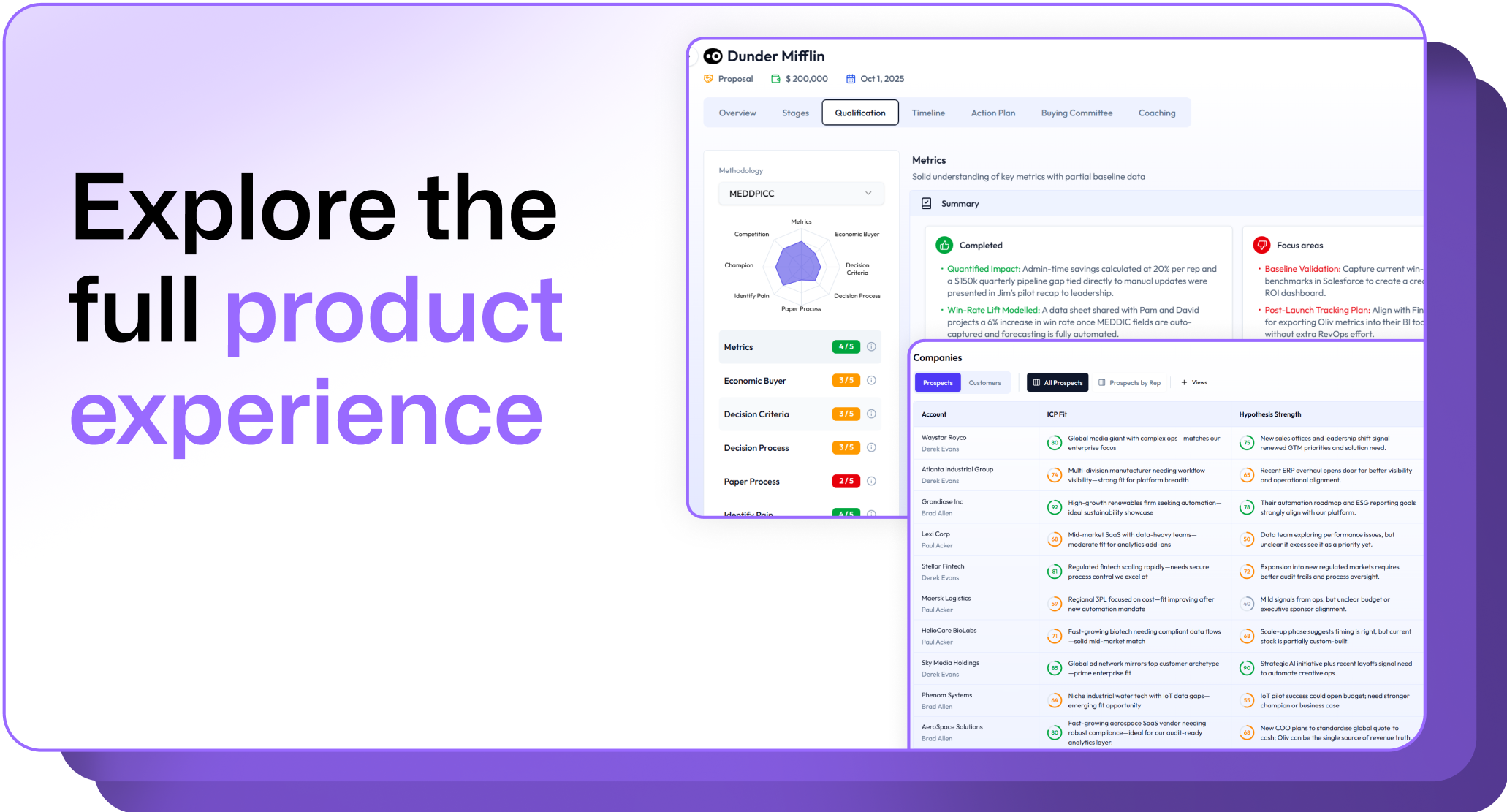
.avif)
.png)





.png)
.png)
.png)