10 Best Deal Tracking Software for Revenue Teams: Use Cases Pipeline Visibility, AI, and Forecasting
Written by
Ishan Chhabra
Last Updated :
June 13, 2026
Skim in :
8
mins
In this article
Still got questions?
Come discuss this article with me.
Hi, I'm Ishan, Founder and CEO of Oliv.
I'm always up for a conversation about revenue intelligence, AI agents, or what's actually working (and what's not) across revenue teams.
I'd love to hear your perspective.
Thank you! Your submission has been received!
Oops! Something went wrong while submitting the form.
Meet Oliv’s AI Agents
Hi! I’m, Deal Driver
I track deals, flag risks, send weekly pipeline updates and give sales managers full visibility into deal progress
Hi! I’m, CRM Manager
I maintain CRM hygiene by updating core, custom and qualification fields all without your team lifting a finger
Hi! I’m, Forecaster
I build accurate forecasts based on real deal movement and tell you which deals to pull in to hit your number
Hi! I’m, Coach
I believe performance fuels revenue. I spot skill gaps, score calls and build coaching plans to help every rep level up
Hi! I’m, Prospector
I dig into target accounts to surface the right contacts, tailor and time outreach so you always strike when it counts
Hi! I’m, Pipeline tracker
I call reps to get deal updates, and deliver a real-time, CRM-synced roll-up view of deal progress
Hi! I’m, Analyst
I answer complex pipeline questions, uncover deal patterns, and build reports that guide strategic decisions
TL;DR
Deal tracking software actively monitors every open opportunity for stage, health, risk, and forecast contribution, unlike a CRM that just stores data reps update late.
The 10 best tools for 2026 are Oliv AI, Gong, Clari, Salesforce, HubSpot, Pipedrive, BoostUp, Chorus, Salesloft, and monday CRM, scored on five weighted criteria.
Meeting-level tools like Gong understand calls; deal-level platforms like Oliv understand the whole opportunity, ending the Thursday-Friday manual forecast scrub.
Only 7% of orgs hit 90% forecast accuracy, and roughly 46% of forecasted deals slip 34 days, so AI slippage detection protects the quarter.
Real TCO hides in add-ons and usage fees; stacking Gong plus Clari can pass $500 per user monthly, while Oliv runs modular from $19 to $120.
The future is agentic: software that works deals autonomously while humans own the first and last 10%, with SOC 2, GDPR, and EU AI Act readiness as the new buying gate.
Q1. What Are the 10 Best Deal Tracking Software Tools for Revenue Teams in 2026 (and How We Scored Them)? [toc=1. 10 Best Tools]
The 10 best deal tracking software tools for revenue teams in 2026 are Oliv AI, Gong, Clari, Salesforce (Einstein and Pipeline Inspection), HubSpot, Pipedrive, BoostUp, Chorus by ZoomInfo, Salesloft, and monday CRM. I scored each against five weighted criteria summing to 100: Deal-Level Intelligence (30%), AI and Forecasting (25%), Setup and Usability (15%), Pricing Transparency (15%), and Verified Reviews (15%). Oliv leads by tracking deals at the deal level, not just the meeting level.
🎯 The Honest Way I Ranked These
Let me be upfront about one thing. I ignored every vendor marketing page while scoring these tools.
A RevOps lead once told me her Gong dashboard showed an account "very active," with calls and emails flying. The deal still died. The activity was loud, but the deal was quietly stalling.
That gap, between activity noise and real deal movement, is why I weighted Deal-Level Intelligence highest. Meeting-level tools count interactions. Deal-level tools read what those interactions actually mean for the close. This is the same gap I keep flagging in our work on the best revenue intelligence software platforms.
⚖️ The Scoring Rubric (100 Points)
Here is how the 100 points break down, and why each criterion earns its weight.
Deal-Level Intelligence (30%): Does the tool understand the whole opportunity, or just the call?
AI and Forecasting (25%): Are forecasts AI-generated and unbiased, or rep-typed guesses? You can see how we judge this in our breakdown of the best AI sales forecasting software.
Setup and Usability (15%): Can a busy team adopt it without months of training?
Pricing Transparency (15%): Is pricing clear, or buried in platform fees and add-ons?
Verified Reviews (15%): What do real G2, Gartner, and Reddit users say?
Star bands map to the total score. 81 to 100 earns ⭐⭐⭐⭐⭐, 61 to 80 earns ⭐⭐⭐⭐, 41 to 60 earns ⭐⭐⭐, 21 to 40 earns ⭐⭐, and 0 to 20 earns ⭐.
📊 The 10 Best Deal Tracking Tools Compared
The 10 Best Deal Tracking Software Tools for Revenue Teams in 2026
#
Tool
Best for
Standout AI feature
Starting price
Stars
1
Oliv AI
Deal-level tracking for B2B revenue teams
Forecaster Agent, line-by-line unbiased roll-ups
$19/user/mo
⭐⭐⭐⭐⭐
2
Gong
Conversation intelligence and coaching
Smart Trackers, AI Briefs
Quote-based, platform fee
⭐⭐⭐⭐
3
Clari
Enterprise roll-up forecasting
RevAI forecasting, CRM Score
Quote-based
⭐⭐⭐⭐
4
Salesforce (Einstein)
Teams already deep in Salesforce
Einstein deal scoring, Pipeline Inspection
Add-on to CRM
⭐⭐⭐
5
HubSpot
SMB and mid-market pipelines
Deal stage automation, AI summaries
From ~$20/user/mo
⭐⭐⭐⭐
6
Pipedrive
Small sales teams wanting simplicity
AI Sales Assistant
From ~$14/user/mo
⭐⭐⭐
7
BoostUp
RevOps forecasting and pipeline health
AI deal and forecast signals
Quote-based
⭐⭐⭐
8
Chorus by ZoomInfo
ZoomInfo-stack call recording
Deal Risk Alerts via Copilot
Bundled with ZoomInfo
⭐⭐⭐
9
Salesloft
Sequencing plus deal management
Conversations, Rhythm signals
Quote-based
⭐⭐⭐
10
monday CRM
Visual pipeline tracking
AI formula and email assist
From ~$12/user/mo
⭐⭐⭐
Now let me walk through each one, what it does, what it costs, and what real users actually say.
Now let me walk through each one, what it does, what it costs, and what real users actually say.
🥇 1. Oliv AI
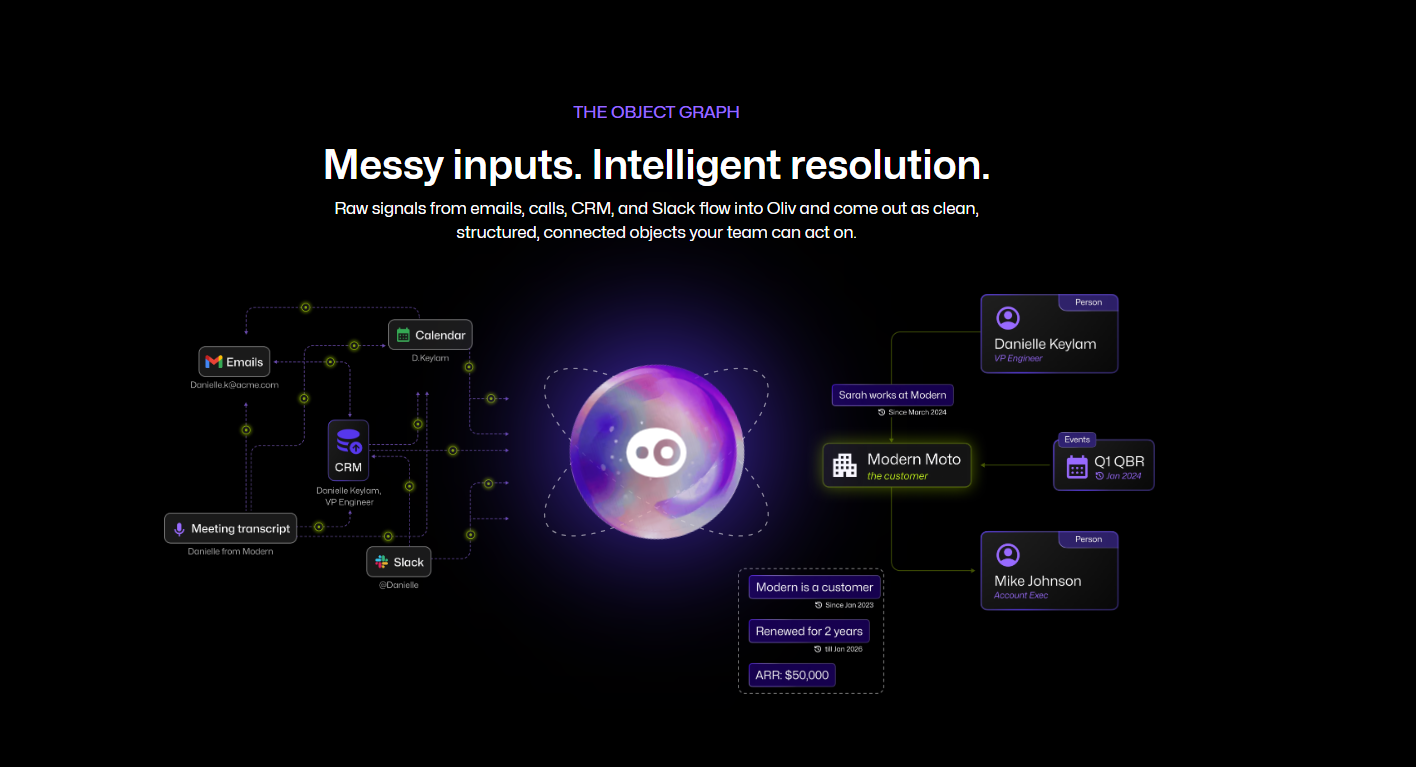
Oliv AI object graph resolves messy inputs from calls, email, CRM, and Slack into structured, connected deal records, showing how deal-level tracking software builds pipeline visibility.
What it does: Oliv AI is a generative AI-native data platform that stitches data from calls, emails, Slack, and the web into one 360-degree deal view. We built it to understand the entire deal, not just the meeting.
Key features: The Forecaster Agent inspects every deal line-by-line for unbiased weekly roll-ups. The CRM Manager Agent is trained on 100+ methodologies like MEDDIC and BANT to auto-populate fields. The Voice Agent (alpha) calls reps nightly to capture off-the-record deal updates.
Pricing and implementation: Plans start at $19/user/month with no mandatory platform fee, and the CRM Manager runs about $29/user/month. Baseline setup takes five minutes, and core value lands in one to two days.
✅ Pros:
✅ Processes recordings and summaries within five minutes, versus Gong's 20 to 30 minute delay.
✅ Updates real CRM objects, not just activity logs, so data stays reportable.
❌ Cons:
❌ Full customization can take two to four weeks.
⚠️ The Voice Agent is still in alpha.
Use case and feedback: It fits B2B teams with 5 to 200 reps fed up with high Gong bills and dirty data, the same audience we cover in our guide to the best AI sales tools.
"Before switching to Oliv, cleaning up messy CRM fields and guessing at forecasts used to swallow half my week. Oliv fixes the data as it happens and drops a forecast I can actually bank on." Darius Kim, Head of RevOps at DriftloopOliv AI G2 Verified Review
🥈 2. Gong
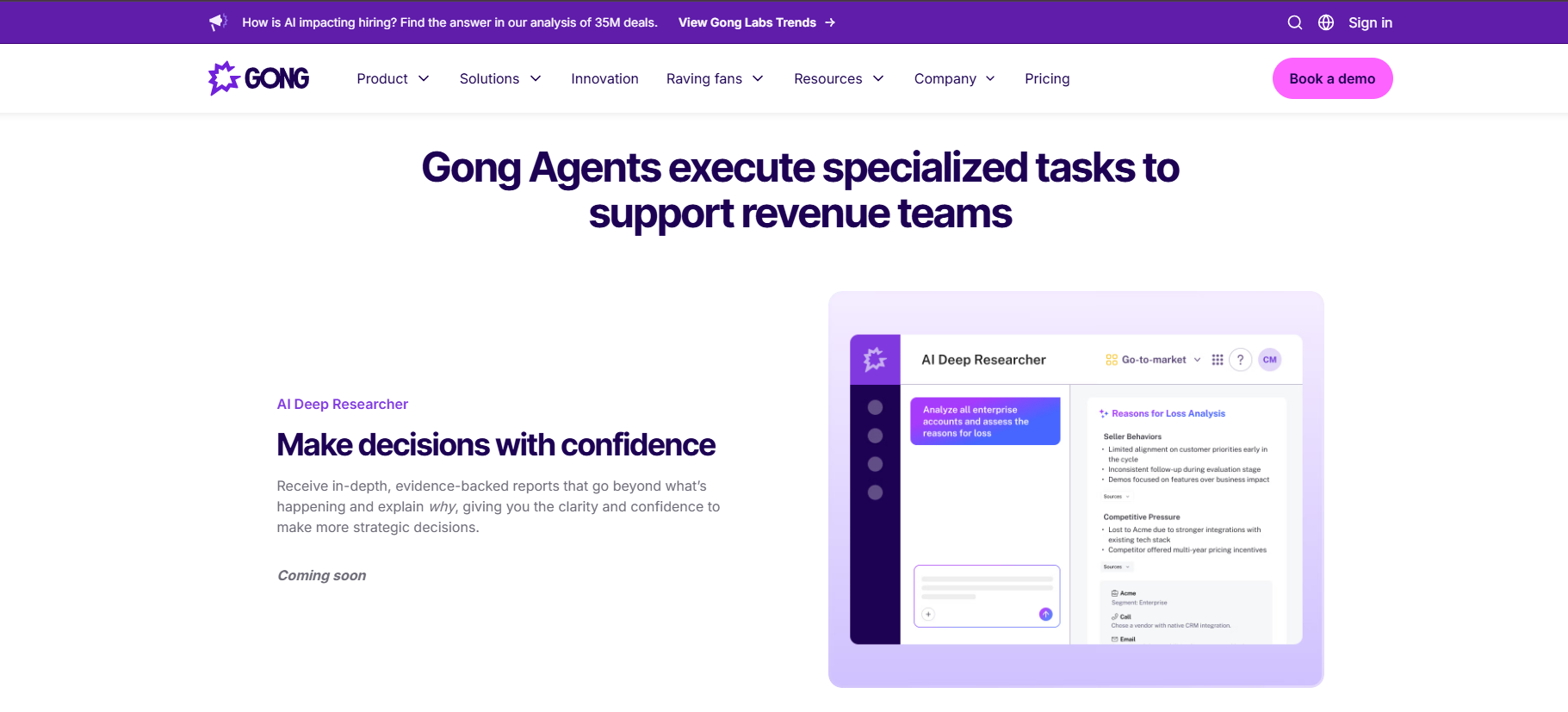
Gong Agents page shows the AI Deep Researcher producing evidence-backed reasons-for-loss analysis across enterprise accounts, illustrating the agentic shift in deal tracking software for revenue teams.
What it does: Gong is the conversation-intelligence benchmark, built in 2015 on call recording and transcription. It records calls, surfaces Smart Tracker topics, and rolls deals into boards.
Key features: In 2025 and 2026 it shipped AI Briefs, Agent Studio, AI Call Reviewer, and configurable forecast boards. It understands conversations at a meeting level, which is its strength and its ceiling. Our deep dive into Gong's features unpacks where that ceiling sits.
Pricing and implementation: Gong is quote-based with a platform fee that can run from $5,000 to $50,000, and trackers take effort to set up. We break the numbers down in our Gong pricing analysis.
✅ Pros:
✅ Deep conversation insight and strong coaching adoption.
✅ A huge integration ecosystem of 250+ partners.
❌ Cons:
❌ Expensive for smaller teams, with rigid multi-year contracts.
❌ Data export and bulk access are painful.
"It was a big mistake on our part to commit to a two year term. Gong is a really powerful tool but its probably the highest end option on the market." Iris P., Head of Marketing & Sales PartnershipsGong G2 Verified Review
"Its too complicated, and not intuitive at all... understanding the pipeline management portion of it is almost impossible." John S., Senior Account ExecutiveGong G2 Verified Review
🥉 3. Clari
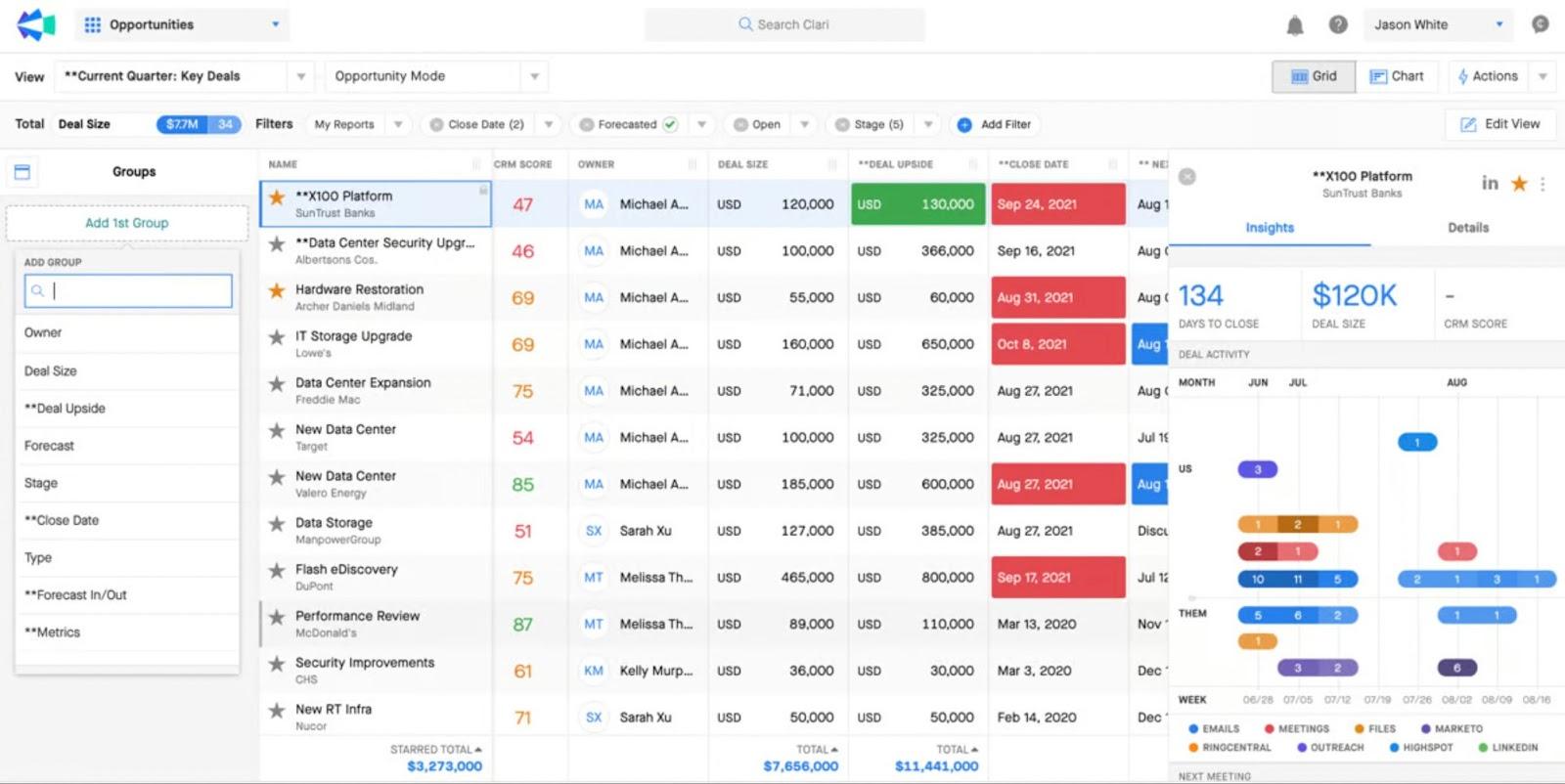
Clari opportunity view shows pipeline deals with CRM health scores, deal upside, and activity timelines, illustrating enterprise roll-up forecasting inside deal tracking software for revenue teams.
What it does: Clari is the enterprise roll-up forecasting giant, founded in 2014. It overlays Salesforce to consolidate forecasts from reps up to leadership.
Key features: RevAI, an enhanced CRM Score blending call and meeting data, and a 2025 merger with Salesloft expanded its stack. Its forecasting and analytics are robust for senior leaders, as we detail in our review of Clari's features.
Pricing and implementation: Pricing is quote-based, and Clari shines only with a strong RevOps team to maintain it.
✅ Pros:
✅ Clean, well-designed forecasting and deal analytics.
✅ Makes Salesforce updates far faster from one view.
❌ Cons:
❌ The forecasting process can feel overcomplicated and overkill for smaller teams.
❌ Reps see little value; it is built for leaders.
"It is really just a glorified SFDC overlay... I think it can be useful if you have a complex GTM motion but definitely overkill for most companies." u/conaldinho11, r/SalesOperationsReddit Thread
🏅 4. Salesforce (Einstein and Pipeline Inspection)
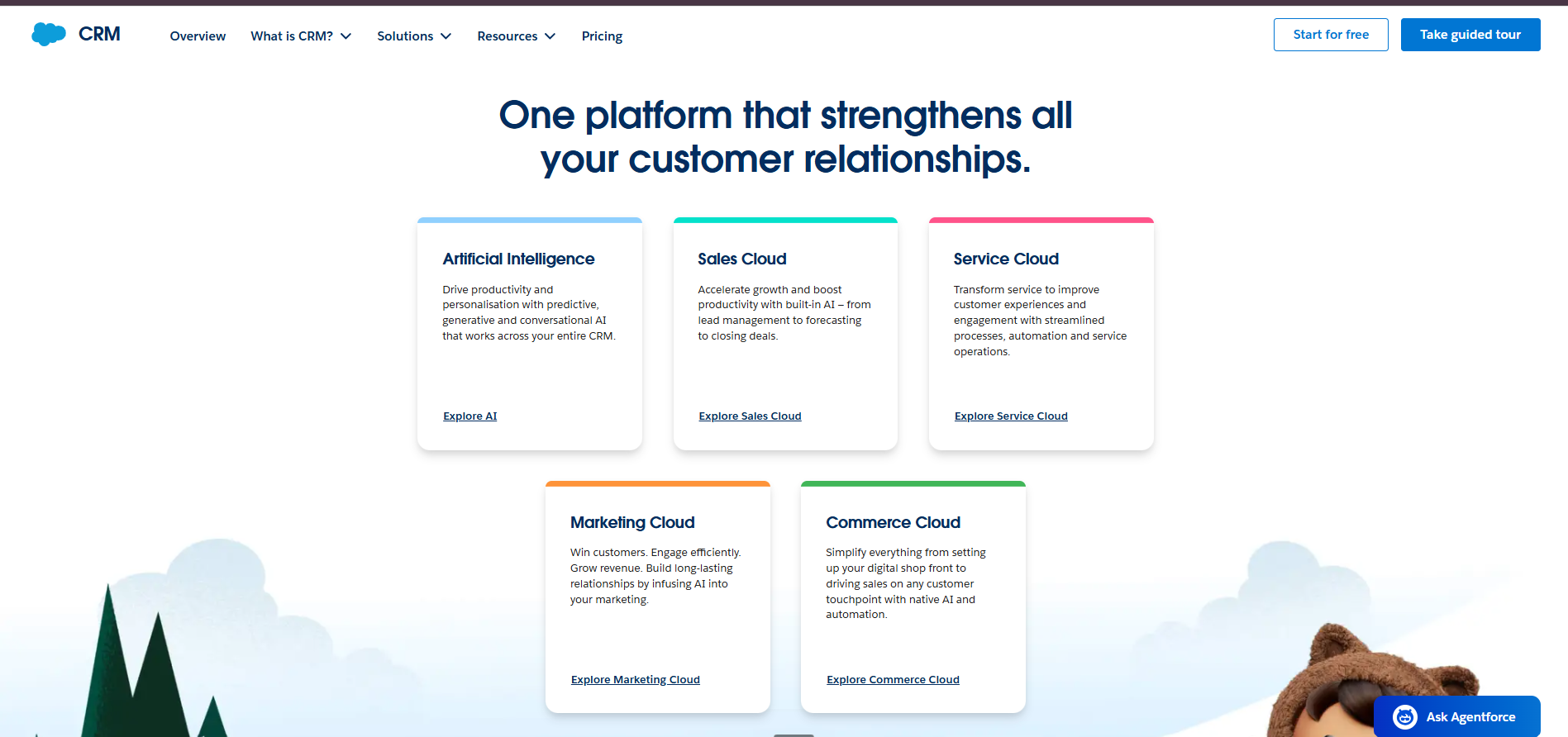
Salesforce CRM page presents Artificial Intelligence, Sales Cloud, Service, Marketing, and Commerce Cloud cards, showing the multi-product stack buyers assemble for deal tracking software and forecasting.
What it does: Salesforce offers native deal tracking through Pipeline Inspection and Einstein deal scoring. It is the default if your team already lives in Salesforce.
Key features: Einstein scores deals and captures activity, while Pipeline Inspection gives a stage-by-stage view. The catch is that real intelligence often requires stacking paid add-ons, which we map out in our look at Salesforce Einstein features.
Pricing and implementation: Conversation Insights, Data Cloud, and Einstein for Sales are separate purchases, pushing cost up fast. Einstein Activity Capture also redacts emails it wrongly flags as sensitive, breaking the deal picture.
✅ Pros:
✅ Native to the CRM most teams already own.
✅ Powerful once fully configured.
❌ Cons:
❌ Activity capture redaction creates incomplete records.
❌ Add-on stacking inflates total cost.
5. HubSpot
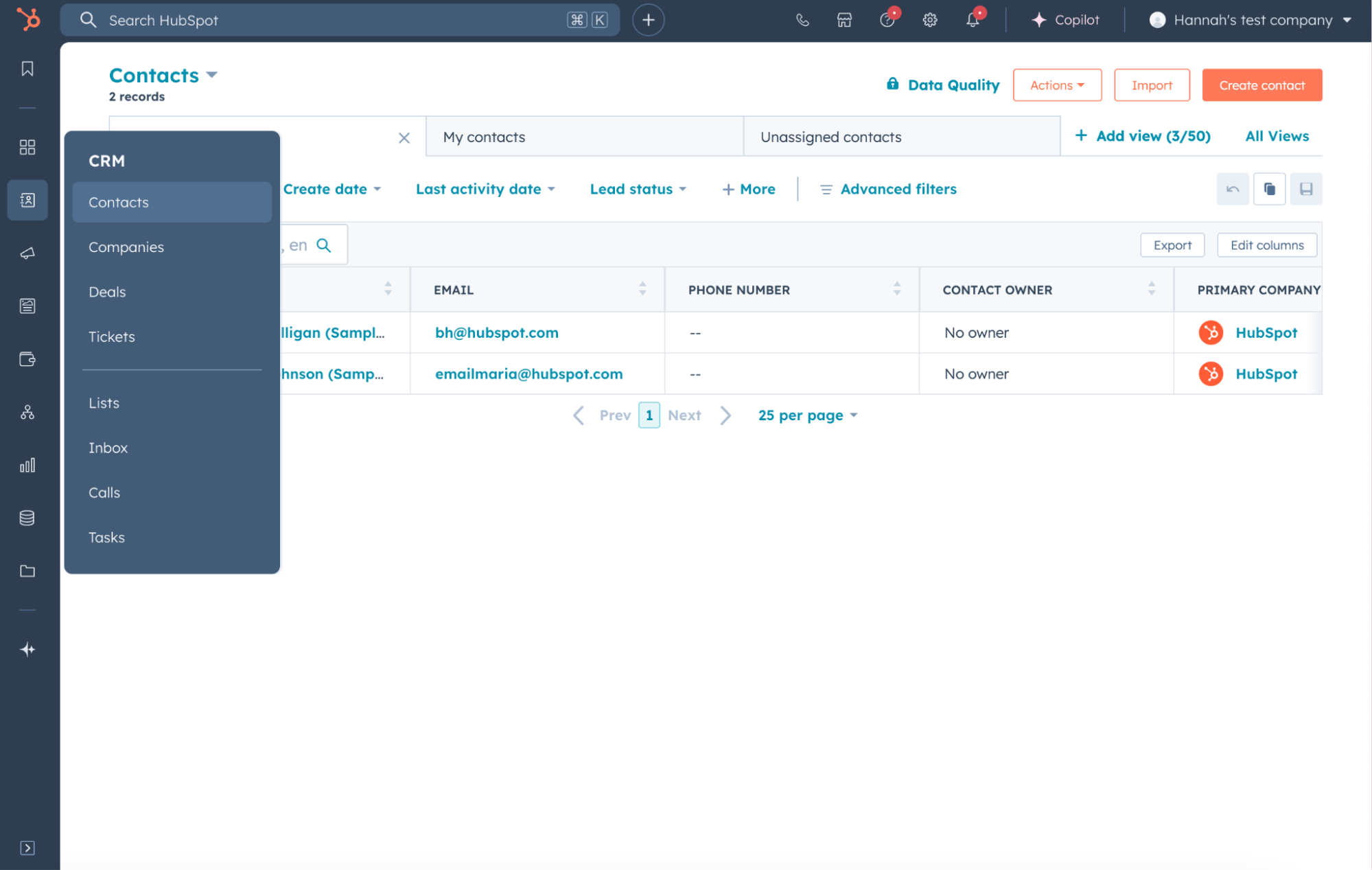
HubSpot CRM contacts screen shows the records list with email, owner, and company columns, plus a Deals navigation menu, illustrating SMB-friendly pipeline tracking inside deal tracking software.
What it does: HubSpot tracks deals through visual pipelines with stage automation, popular with SMB and mid-market teams. It pairs CRM, email, and deal tracking in one place.
Key features: Deal stage automation, AI email and summary tools, and clean reporting. It is one of the easier platforms to adopt.
Pricing and implementation: Sales Hub pricing starts around $20/user/month, with higher tiers for advanced forecasting. Setup is quick relative to enterprise suites.
✅ Pros:
✅ Intuitive interface and fast onboarding.
✅ Strong all-in-one value for growing teams.
❌ Cons:
❌ Advanced forecasting sits behind pricier tiers.
⚠️ Deal intelligence stays shallower than dedicated revenue tools.
6. Pipedrive
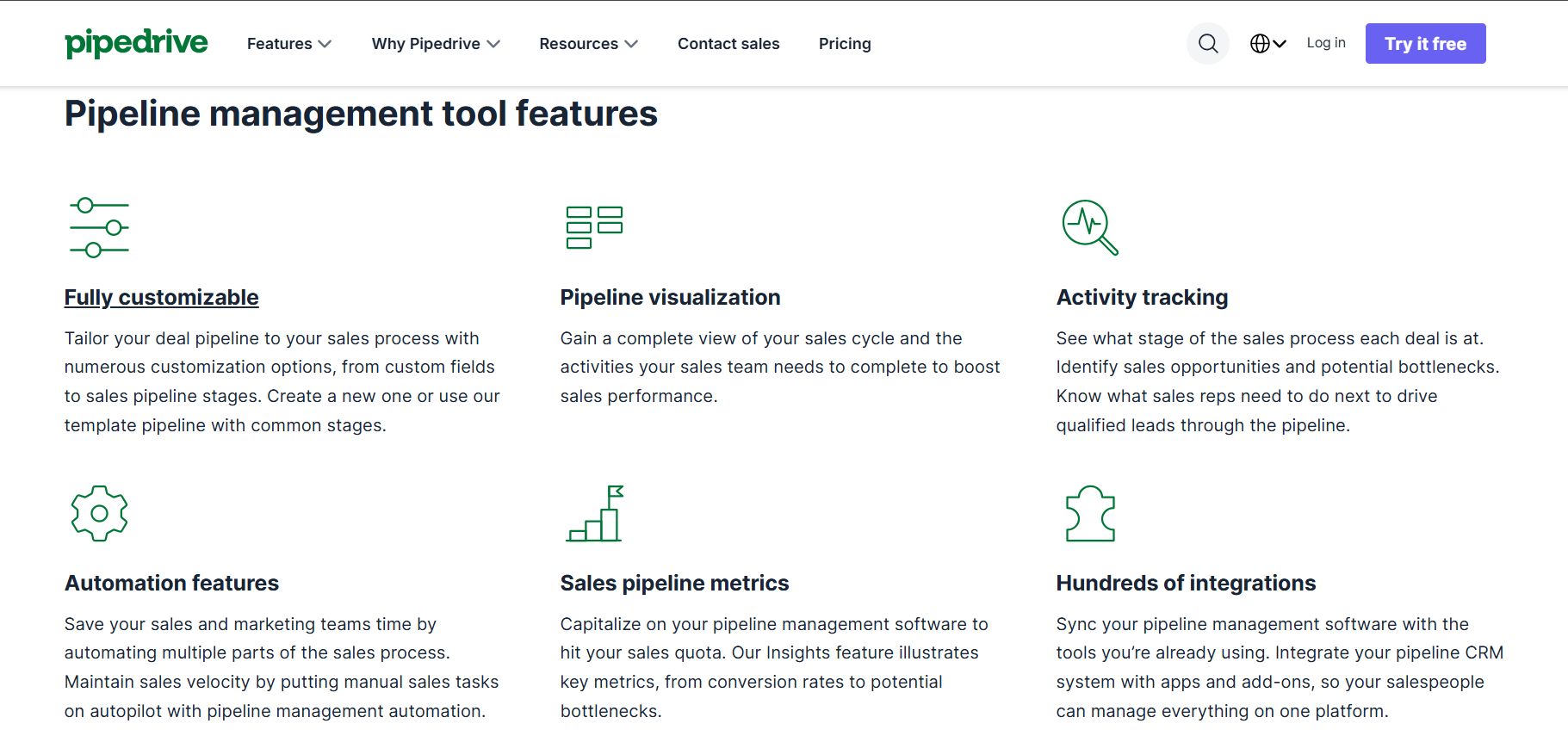
Pipedrive features page lists customizable pipelines, pipeline visualization, activity tracking, automation, and metrics, illustrating the lightweight, visual deal tracking software approach favored by small sales teams.
What it does: Pipedrive is a lightweight, visual deal tracker aimed at small sales teams. It keeps pipeline management simple and affordable.
Key features: Drag-and-drop pipelines, an AI Sales Assistant, and activity reminders. It does the basics well without overwhelming reps.
Pricing and implementation: Plans start around $14/user/month, and setup is genuinely fast.
✅ Pros:
✅ 💰 Affordable and easy to learn.
✅ Clean visual pipeline view.
❌ Cons:
❌ Limited AI forecasting depth.
⚠️ Outgrown quickly by complex enterprise motions.
7. BoostUp
What it does: BoostUp is a RevOps-focused forecasting and pipeline-health platform. It centers on deal signals and forecast accuracy.
Key features: AI deal scoring, pipeline risk signals, and configurable forecast workflows. It targets data-driven revenue teams, a category we compare in our guide to the best revenue orchestration platform tools.
Pricing and implementation: Pricing is quote-based and oriented toward mid-market and enterprise buyers.
✅ Pros:
✅ Strong forecast and pipeline analytics.
✅ Flexible, configurable views.
❌ Cons:
❌ Less brand recognition than Gong or Clari.
⚠️ Best value needs a mature RevOps function.
8. Chorus by ZoomInfo
What it does: Chorus is a conversation-intelligence tool founded in 2015 and acquired by ZoomInfo in 2021. Its innovation has largely folded into ZoomInfo Copilot.
Key features: Call recording, scorecards, and Copilot Deal Risk Alerts that flag single-threaded deals. It fits teams already standardized on ZoomInfo.
Pricing and implementation: It is bundled with ZoomInfo, so standalone pricing is opaque.
✅ Pros:
✅ Strong feedback metrics and call analytics.
✅ Tight ZoomInfo data integration.
❌ Cons:
❌ Importing past calls is buried and frustrating.
⚠️ Standalone Chorus innovation has slowed since the acquisition.
"The quantity of feedback metrics is amazing! [But] trying to find where i could import previous calls or videos was very frustrating." Clayton Z., Director of TechnologyChorus by ZoomInfo G2 Verified Review
9. Salesloft
What it does: Salesloft started in 2011 as a sales-engagement and cadence tool, now merged with Clari. It adds deal management on top of sequencing.
Key features: Cadences, Conversations, and Rhythm signals, plus deep Salesforce sync. Reps like the cadence engine and email tracking, though it falls short of Gong, as we cover in our Gong vs. Salesloft comparison.
Pricing and implementation: Pricing is quote-based, and several users report a steep setup curve.
✅ Pros:
✅ Excellent cadences and outreach organization.
✅ Useful call playback for coaching.
❌ Cons:
❌ Conversations feature is weak as a Gong rival.
❌ Customer service complaints are common.
"Super clunky to set up. Conversations doesnt work at all. They sell it as a gong competitor. It doesnt even have the functionality of Zoom." Verified User in Professional Training & CoachingSalesloft G2 Verified Review
10. monday CRM
What it does: monday CRM offers flexible, visual deal tracking built on its work-management platform. It suits teams that want customizable pipelines.
Key features: Custom pipeline boards, AI formula and email assists, and automation recipes. It is highly configurable for non-technical users.
Pricing and implementation: CRM plans start around $12/user/month, with quick visual setup.
✅ Pros:
✅ 💰 Affordable and highly customizable.
✅ Friendly for teams new to CRM.
❌ Cons:
❌ Lighter on deal intelligence and AI forecasting.
⚠️ Less specialized than dedicated revenue platforms.
🔄 How the Leaders Are Evolving (Gong as the Bellwether)
The whole category is racing toward agents, which tells you where deal tracking is heading.
How Gong Has Evolved as the Category Bellwether
Timeframe
What changed in Gong
Through 2025
Built on conversation intelligence, Smart Trackers, and deal boards, then added AI Briefs and Agent Studio across the year (Gong monthly updates)
Early to mid 2026
Launched Mission Andromeda and Gong Enable in February, plus configurable forecast boards and a Data Extractor for CRM fields (Mission Andromeda)
Looking ahead
Roadmap centers on MCP interoperability, letting external AI agents query Gong deal data both ways (Gong monthly updates)
Here is where my head is right now. Even Gong is rebuilding around agents and automatic field extraction, which is the exact problem Oliv started with. The difference is starting point. Legacy tools are bolting agents onto a meeting-level core, while Oliv was built deal-level and agent-first from day one. If you are weighing that shift, our piece on the move from revenue ops to intelligence to orchestration goes deeper.
Q2. What Exactly Is Deal Tracking Software, and What Features Separate It From Your CRM? [toc=2. Software vs CRM]
Deal tracking software monitors every open opportunity across its full lifecycle, including stage, time-in-stage, deal health, risk, and forecast contribution, and uses AI to update fields automatically. A CRM is passive storage that reps update weekly because management requires it. Deal tracking is active intelligence. The features that matter most are automatic activity capture, deal-health scoring, slippage detection, AI forecasting, and conversation-to-deal linkage.
🧭 The Simplest Way to Think About It
Picture your CRM as a warehouse logbook. Someone writes down what came in, usually late, and often wrong. To know what is really happening, you still walk the floor yourself.
Deal tracking software is the automated system reading every shelf for you. It watches each open deal, flags what is stuck, and tells you where to act today. That is the line between storage and intelligence, and it sits at the heart of every modern revenue intelligence platform.
🆚 Why Your CRM Alone Keeps Failing You
Here is the uncomfortable truth I have watched play out for years. The CRM has quietly failed as a product because it became a dumb repository of information. Reps update it weekly because a manager demands it, not because it helps them sell.
That habit poisons everything downstream. When fields sit empty or stale, your forecast is built on guesses. I could be blunt here: dirty data is not a discipline problem, it is a design problem.
⚙️ The 6 Features That Actually Matter
When you evaluate tools, weigh these six capabilities. Each one kills a specific pain and pays off by Monday morning.
Automatic activity capture: Pulls calls, emails, and meetings in without manual entry, so reps stop logging data by hand.
Deal-health scoring: Reads engagement and risk to show which deals are real, ending dashboard guesswork.
Slippage detection: Flags deals about to slide a quarter before they do, protecting your number.
AI forecasting: Generates unbiased roll-ups instead of rep-typed probability, replacing gut feel. Our guide to the best AI sales forecasting software shows what good looks like here.
Conversation-to-deal linkage: Ties what was said on a call to the actual opportunity, not just a transcript.
Auto-populated qualification fields: Fills MEDDPICC or BANT fields from call context, so methodology lives inside the deal. We explain that framework in our breakdown of the MEDDIC sales methodology.
⚠️ The Anti-Pattern to Avoid
Watch out for tools that still need manual upkeep. In Gong, for example, qualification and most custom fields are not auto-populated, so reps edit them by hand. That is the exact toil deal tracking should remove, as we note in our review of Gong's features.
Salesforce has its own version of this trap. Einstein Activity Capture sometimes redacts emails it wrongly flags as sensitive. The result is an incomplete customer picture, which defeats the purpose, a pattern we unpack in our look at Salesforce Einstein features.
🔧 What We Built Toward
When we built Oliv AI, we made the CRM Manager Agent populate up to 100 fields from call context automatically. It is trained on 100-plus sales methodologies like MEDDPICC and BANT, so qualification updates itself. The goal was simple: stop asking reps to feed the machine.
But here is the open loop worth holding onto. Most tools still watch meetings, not deals. Capturing a call is not the same as understanding an opportunity, and that gap is where forecasts quietly break. I will unpack exactly why in the next two sections.
Q3. How Does AI Improve Forecast Accuracy and Catch Deal Slippage Before It Kills Your Quarter? [toc=3. AI and Slippage]
AI improves deal tracking by replacing rep-entered probability with behavioral signals like engagement, sentiment, stakeholder coverage, and momentum, to score deal health objectively. It matters because 72% of sales orgs forecast below 80% accuracy, and only 7% hit 90% or higher. Crucially, a large share of forecasted deals slip rather than lose, so AI slippage detection protects the quarter before it breaks.
📉 The Forecast Credibility Gap Nobody Admits
Let me put numbers to a problem most leaders feel but rarely name. Only 7% of sales organizations hit 90%-plus forecast accuracy, and 72% sit below 80%. Even worse, 87% of enterprises missed their 2025 revenue targets despite record AI investment.
So the spend is up, and the accuracy is not. That tells me the problem is not effort. It is that forecasts still run on rep-typed probability, which is optimism dressed as data.
🤖 How AI Changes the Inputs
Here is where AI earns its keep. Instead of asking a rep to "feel" a deal at 70%, AI reads the actual signals: who replied, how fast, which stakeholders went quiet, and whether momentum is rising or stalling.
Think of revenue as a manufacturing line, where volume times conversion rate equals output. AI instruments every micro-stage of that line. When we run our own forecast on Oliv's Forecaster Agent, it inspects every deal line-by-line for an unbiased roll-up, not a hopeful average. We compare that approach to legacy tools in our piece on Gong forecasting.
⏰ The Deal-Slippage Beat Everyone Misses
Now the part the category avoids. Most deals do not die, they slip. Roughly 46% of forecasted deals push rather than close, slipping an average of 34 days. A slipped quarter still feels like a miss to your board.
AI slippage detection catches the early tells, like a decision-maker going dark or a single-threaded deal with no second contact. That early flag is the difference between rescuing a deal and explaining it later, which is why it anchors so many revenue intelligence software platforms.
✅ What to Do on Monday
Here is a tactic you can apply this week, and it does not need software. If a rep cannot articulate the exact status of a deal, push it off the forecast. Make them earn its place back with real next steps.
I might be slightly hard-nosed on this, but vague deals are the ones that slip. The standard read says chase every deal in the pipeline. I think the smarter read is to demote the ones nobody can explain.
🧱 Why This Is "Revenue Engineering," Not Orchestration
Where my head is right now is that revenue orchestration is already old. It was just a consolidation of older tools. The new space is revenue engineering, where AI agents instrument the funnel and act on it, a shift we trace in our piece on the move from revenue ops to intelligence to orchestration.
Forecast accuracy is the proof point. When the inputs become real signals instead of rep guesses, the output finally becomes a number you can bank on.
Q4. Meeting-Level vs. Deal-Level Tracking: Where Do Gong, Clari, and Oliv Really Differ? [toc=4. Meeting vs Deal]
Conversation-intelligence tools like Gong and Chorus understand individual meetings, including transcripts, talk-time, and keywords. Deal-level trackers like Oliv understand the whole opportunity, including pipeline movement, qualification status, coaching gaps, and forecast risk across the full cycle. If your forecast still depends on a Thursday-Friday manual scrub, you have meeting intelligence, not deal intelligence.
🔍 The Blind Spot Hiding in Plain Sight
Here is a scene I have watched on repeat. Every Thursday and Friday, managers sit with reps for one to two hours to hear the story of each deal. Then they manually key that story into a forecast for the Monday board call.
Why the manual scrub? Because meeting-level tools tell you what was said on a call, not what it means for the deal. The intelligence stops at the transcript, so a human stitches the rest by hand. Our Gong vs. Clari comparison digs into where each tool draws that line.
🧩 What Deal-Level Tracking Actually Unlocks
Deal-level tracking reads the whole opportunity, not one call. It connects emails, Slack messages, and meetings into one evolving deal narrative. When we built Oliv this way, the Forecaster Agent could roll up deals without that Thursday scrub.
One honest note on our own choice. We deliberately avoid real-time, in-call features, because that is not where we want to differentiate. The value is in understanding the deal after the dust settles, not coaching mid-sentence.
📊 Gong vs. Clari vs. Oliv at a Glance
Meeting-Level vs. Deal-Level Tracking: Gong, Clari, and Oliv Compared
Capability
Gong
Clari
Oliv AI
Core unit of understanding
Meeting
Roll-up forecast
Whole deal
Forecast method
Manual fields edited in-tool
Manual rep-by-rep scrub
Autonomous line-by-line
Auto-populates CRM fields
Limited
Needs strong RevOps
Yes, 100+ fields
Processing speed
20 to 30 min
-
Within 5 min
⚖️ When Each Tool Is the Right Call
Let me be fair here, because no tool wins everything. If you only need call recording and coaching, Gong is genuinely excellent, and reps report it sharpens their craft. Our roundup of the best AI for sales calls covers where it shines.
"Gong has become the single source of truth for our sales team. From deal management to forecasting its been really easy to gain adoption." Scott T., Director of SalesGong G2 Verified Review
But for reps, the value thins out fast on forecasting-first tools. That is the recurring critique I keep seeing in the wild, and it shapes our list of the best Clari alternatives and competitors.
"Clari is a tool for sales leaders, it adds no value to reps as far as I can see." u/Msoave, r/SalesOperationsReddit Thread
So choose by your real need. Meeting intelligence for coaching, deal intelligence for forecasting you can trust.
Q5. Which Deal Tracking Software Fits Sales, Private Equity, M&A, and Real Estate? [toc=5. Fit by Vertical]
Deal tracking needs differ sharply by vertical. B2B sales teams need pipeline visibility, AI forecasting, and coaching (Oliv, Gong, Clari). Private equity and M&A need relationship intelligence and proprietary-deal sourcing (DealCloud, Affinity, DealRoom). Real estate needs acquisition and financing pipelines (Dealpath). The constant across all four is an audit trail that links the start and end of every transaction.
🧭 Why "Best" Depends on Your Vertical
A "deal" in B2B sales is not a "deal" in private equity. One closes in 20 days, the other in 20 months. So the software that fits each one looks very different.
I have watched teams buy the wrong category and regret it. A sales tool cannot source a proprietary acquisition, and a PE platform cannot coach an AE. Match the tool to the motion, not the brand name, a principle we apply across our roundup of the best AI sales tools.
📊 Deal Tracking by Vertical
Best Deal Tracking Software by Vertical
Use case
Top tools
Must-have capability
Watch-out
B2B Sales / RevOps
Oliv AI, Gong, Clari
Pipeline visibility, AI forecasting, coaching
Meeting-only tools miss deal context
Private Equity
DealCloud, Affinity
Relationship and proprietary-deal sourcing
Generic CRMs lack relationship graphs
M&A
DealRoom, DealCloud
Diligence and pipeline-stage tracking
Spreadsheets break at scale
Real Estate
Dealpath
Acquisitions and financing pipelines
Sales CRMs lack asset workflows
🏢 The Four Verticals, Briefly
For B2B sales and RevOps, the job is visibility, forecasting, and coaching across fast cycles. This is where Oliv AI lives, stitching calls, emails, and Slack into one deal view, the same approach we detail in our guide to the best revenue intelligence software platforms.
For private equity and M&A, the job shifts to relationships and sourcing. DealCloud and Affinity map who-knows-whom to surface proprietary deals, which a sales tool simply cannot do.
For real estate, Dealpath manages acquisitions, dispositions, and financing in one pipeline. The asset workflow is nothing like a SaaS sales funnel.
⚖️ Where I Will Be Honest With You
Let me be straight, because trust matters more than a land grab. Oliv is the wrong choice for PE sourcing or real-estate financing pipelines. We are built for B2B revenue teams, full stop.
What unites all four verticals is one thing: an audit trail. In finance especially, you must show the start and end of every transaction to make a customer and their auditor comfortable. Oliv earns its position-one spot in the sales and RevOps category, not the others, and I would rather tell you that now than after you sign. If forecasting is your core need, our list of the best AI sales forecasting software goes deeper.
Q6. How Do You Choose, Cost, and De-Risk Deal Tracking Software (Maturity Model, TCO, and Compliance)? [toc=6. Choose and De-Risk]
Choose deal tracking software by matching tool sophistication to your team's maturity, not the longest feature list. Model total cost of ownership (TCO) beyond per-seat price, because Salesforce buyers often stack Conversation Insights, Data Cloud, and Einstein as separate line items. Then de-risk by requiring SOC 2, GDPR, two-party consent, and EU AI Act readiness, since high-risk AI-agent obligations and enforcement arrive in August 2026.
🪜 Step 1: Match the Tool to Your Maturity
Buying ahead of your maturity is how tools become shelfware. Find your stage first, then buy the tier that fits.
Deal Tracking Maturity Model and Recommended Tool Tier
Stage
What it looks like
Right tool tier
Manual scrub
Reps tell deal stories Thursday and Friday
Basic CRM + recorder
Note-taker
Calls recorded, no deal context
Conversation intelligence
Intelligence
Signals tracked across the deal
Deal-level platform
Agentic
Agents act and update for you
Agent-first platform
Roll it out with the 10/80/10 rule: 10% defining the ideal motion, 80% letting the agent execute, and 10% quality-checking outputs. Then give it a 30-day correction window, because daily fixes make the system trustworthy by day 30.
💰 Step 2: Model the Real Cost, Not the Sticker Price
Per-seat price is a trap. The real cost hides in add-ons and usage fees.
Total Cost of Ownership Layers for Deal Tracking Software
Cost layer
What to watch
Per-seat
Base license, easy to compare
Add-ons
Salesforce stacks Conversation Insights, Data Cloud, and Einstein
Usage
Per-action credit models, around $0.10 per action
Implementation
Months of onboarding and RevOps time
Stacking Gong for calls and Clari for forecasting can push TCO past $500 per user per month for a 25 to 200 rep team. Oliv runs modular from $19 to $120 per user, with no mandatory platform fee, a contrast we lay out in our Gong pricing breakdown.
⚠️ Step 3: De-Risk With Compliance
Compliance is now a buying gate, not a footnote. Your baseline is SOC 2 Type II, GDPR, and two-party consent for recordings, the same bar we hold our own platform to, as covered in our notes on data processing and security.
The EU AI Act raises the bar further. Governance duties for general-purpose AI applied from August 2025, and high-risk obligations plus enforcement arrive in August 2026. Penalties reach up to 35 million euros or 7% of global turnover.
For autonomous AI agents, that means human oversight, traceability, and an audit trail. Oliv is SOC 2 Type II, GDPR, and CCPA certified, with audit logs built in.
🔧 What We Got Wrong Early
One honest miss from our own journey. We learned that onboarding is where deals quietly fade, the "pilot trap" where promise never reaches production. So we cut baseline setup to five minutes and core value to one or two days. Full customization still takes two to four weeks, and I would rather you know that upfront. Our Gong implementation timeline shows why fast time-to-value matters.
Q7. From Note-Takers to Agents: What's the Future of Deal Tracking for Revenue Teams? [toc=7. Future of Tracking]
The future of deal tracking is agentic. The software stops just recording deals and starts working them, drafting follow-ups, flagging slippage, and updating forecasts on its own, while humans handle the first and last 10%. The shift mirrors a broader move from chat to agents, where teams using agents report being far more productive. The note-taker era is ending, and the deal-engineering era is starting.
🤖 Chat Was Stage One, Agents Are Stage Two
Here is the question I keep sitting with. Why are we still logging into software to do work the software could do for us?
The AI landscape moved from chat to agents, and the people using agents report being 10 to 20 times more productive in their day. Most teams are still stuck in the chat era, asking a bot for answers instead of letting it act, a shift we trace in our piece on the move from revenue ops to intelligence to orchestration.
🚦 Agents Are Employees, Not Vending Machines
The standard read gets automation backwards. Old automation is a vending machine, where one failed payment breaks the whole flow. An agent is more like a smart employee who rejigs the plan, junks what fails, and improvises what works.
That distinction matters for revenue. B2C bots help people return shirts, but B2B agents help close million-dollar deals. When we built Oliv, we leaned into that, naming agents by the job they do, like Forecaster or Deal Driver, an approach we expand on across the best revenue orchestration platform tools.
🧠 What This Means for Your Job
I know the anxiety here, because reps feel it too. Your job is not the task. The tasks shift to agents, but judgment, relationships, and subject-matter expertise rise in value, the human edge we champion in our guide to the best sales coaching software.
So here is where my head is right now. In two years, the SaaS you log into becomes agents that work for you, and revenue orchestration gives way to revenue engineering. If you are wrestling with that shift, I would genuinely like to hear how it is playing out on your team. Tell me what is breaking in your forecast call, and let us think through it together.
Q1. What Are the 10 Best Deal Tracking Software Tools for Revenue Teams in 2026 (and How We Scored Them)? [toc=1. 10 Best Tools]
The 10 best deal tracking software tools for revenue teams in 2026 are Oliv AI, Gong, Clari, Salesforce (Einstein and Pipeline Inspection), HubSpot, Pipedrive, BoostUp, Chorus by ZoomInfo, Salesloft, and monday CRM. I scored each against five weighted criteria summing to 100: Deal-Level Intelligence (30%), AI and Forecasting (25%), Setup and Usability (15%), Pricing Transparency (15%), and Verified Reviews (15%). Oliv leads by tracking deals at the deal level, not just the meeting level.
🎯 The Honest Way I Ranked These
Let me be upfront about one thing. I ignored every vendor marketing page while scoring these tools.
A RevOps lead once told me her Gong dashboard showed an account "very active," with calls and emails flying. The deal still died. The activity was loud, but the deal was quietly stalling.
That gap, between activity noise and real deal movement, is why I weighted Deal-Level Intelligence highest. Meeting-level tools count interactions. Deal-level tools read what those interactions actually mean for the close. This is the same gap I keep flagging in our work on the best revenue intelligence software platforms.
⚖️ The Scoring Rubric (100 Points)
Here is how the 100 points break down, and why each criterion earns its weight.
Deal-Level Intelligence (30%): Does the tool understand the whole opportunity, or just the call?
AI and Forecasting (25%): Are forecasts AI-generated and unbiased, or rep-typed guesses? You can see how we judge this in our breakdown of the best AI sales forecasting software.
Setup and Usability (15%): Can a busy team adopt it without months of training?
Pricing Transparency (15%): Is pricing clear, or buried in platform fees and add-ons?
Verified Reviews (15%): What do real G2, Gartner, and Reddit users say?
Star bands map to the total score. 81 to 100 earns ⭐⭐⭐⭐⭐, 61 to 80 earns ⭐⭐⭐⭐, 41 to 60 earns ⭐⭐⭐, 21 to 40 earns ⭐⭐, and 0 to 20 earns ⭐.
📊 The 10 Best Deal Tracking Tools Compared
The 10 Best Deal Tracking Software Tools for Revenue Teams in 2026
#
Tool
Best for
Standout AI feature
Starting price
Stars
1
Oliv AI
Deal-level tracking for B2B revenue teams
Forecaster Agent, line-by-line unbiased roll-ups
$19/user/mo
⭐⭐⭐⭐⭐
2
Gong
Conversation intelligence and coaching
Smart Trackers, AI Briefs
Quote-based, platform fee
⭐⭐⭐⭐
3
Clari
Enterprise roll-up forecasting
RevAI forecasting, CRM Score
Quote-based
⭐⭐⭐⭐
4
Salesforce (Einstein)
Teams already deep in Salesforce
Einstein deal scoring, Pipeline Inspection
Add-on to CRM
⭐⭐⭐
5
HubSpot
SMB and mid-market pipelines
Deal stage automation, AI summaries
From ~$20/user/mo
⭐⭐⭐⭐
6
Pipedrive
Small sales teams wanting simplicity
AI Sales Assistant
From ~$14/user/mo
⭐⭐⭐
7
BoostUp
RevOps forecasting and pipeline health
AI deal and forecast signals
Quote-based
⭐⭐⭐
8
Chorus by ZoomInfo
ZoomInfo-stack call recording
Deal Risk Alerts via Copilot
Bundled with ZoomInfo
⭐⭐⭐
9
Salesloft
Sequencing plus deal management
Conversations, Rhythm signals
Quote-based
⭐⭐⭐
10
monday CRM
Visual pipeline tracking
AI formula and email assist
From ~$12/user/mo
⭐⭐⭐
Now let me walk through each one, what it does, what it costs, and what real users actually say.
Now let me walk through each one, what it does, what it costs, and what real users actually say.
🥇 1. Oliv AI
Oliv AI object graph resolves messy inputs from calls, email, CRM, and Slack into structured, connected deal records, showing how deal-level tracking software builds pipeline visibility.
What it does: Oliv AI is a generative AI-native data platform that stitches data from calls, emails, Slack, and the web into one 360-degree deal view. We built it to understand the entire deal, not just the meeting.
Key features: The Forecaster Agent inspects every deal line-by-line for unbiased weekly roll-ups. The CRM Manager Agent is trained on 100+ methodologies like MEDDIC and BANT to auto-populate fields. The Voice Agent (alpha) calls reps nightly to capture off-the-record deal updates.
Pricing and implementation: Plans start at $19/user/month with no mandatory platform fee, and the CRM Manager runs about $29/user/month. Baseline setup takes five minutes, and core value lands in one to two days.
✅ Pros:
✅ Processes recordings and summaries within five minutes, versus Gong's 20 to 30 minute delay.
✅ Updates real CRM objects, not just activity logs, so data stays reportable.
❌ Cons:
❌ Full customization can take two to four weeks.
⚠️ The Voice Agent is still in alpha.
Use case and feedback: It fits B2B teams with 5 to 200 reps fed up with high Gong bills and dirty data, the same audience we cover in our guide to the best AI sales tools.
"Before switching to Oliv, cleaning up messy CRM fields and guessing at forecasts used to swallow half my week. Oliv fixes the data as it happens and drops a forecast I can actually bank on." Darius Kim, Head of RevOps at DriftloopOliv AI G2 Verified Review
🥈 2. Gong
Gong Agents page shows the AI Deep Researcher producing evidence-backed reasons-for-loss analysis across enterprise accounts, illustrating the agentic shift in deal tracking software for revenue teams.
What it does: Gong is the conversation-intelligence benchmark, built in 2015 on call recording and transcription. It records calls, surfaces Smart Tracker topics, and rolls deals into boards.
Key features: In 2025 and 2026 it shipped AI Briefs, Agent Studio, AI Call Reviewer, and configurable forecast boards. It understands conversations at a meeting level, which is its strength and its ceiling. Our deep dive into Gong's features unpacks where that ceiling sits.
Pricing and implementation: Gong is quote-based with a platform fee that can run from $5,000 to $50,000, and trackers take effort to set up. We break the numbers down in our Gong pricing analysis.
✅ Pros:
✅ Deep conversation insight and strong coaching adoption.
✅ A huge integration ecosystem of 250+ partners.
❌ Cons:
❌ Expensive for smaller teams, with rigid multi-year contracts.
❌ Data export and bulk access are painful.
"It was a big mistake on our part to commit to a two year term. Gong is a really powerful tool but its probably the highest end option on the market." Iris P., Head of Marketing & Sales PartnershipsGong G2 Verified Review
"Its too complicated, and not intuitive at all... understanding the pipeline management portion of it is almost impossible." John S., Senior Account ExecutiveGong G2 Verified Review
🥉 3. Clari
Clari opportunity view shows pipeline deals with CRM health scores, deal upside, and activity timelines, illustrating enterprise roll-up forecasting inside deal tracking software for revenue teams.
What it does: Clari is the enterprise roll-up forecasting giant, founded in 2014. It overlays Salesforce to consolidate forecasts from reps up to leadership.
Key features: RevAI, an enhanced CRM Score blending call and meeting data, and a 2025 merger with Salesloft expanded its stack. Its forecasting and analytics are robust for senior leaders, as we detail in our review of Clari's features.
Pricing and implementation: Pricing is quote-based, and Clari shines only with a strong RevOps team to maintain it.
✅ Pros:
✅ Clean, well-designed forecasting and deal analytics.
✅ Makes Salesforce updates far faster from one view.
❌ Cons:
❌ The forecasting process can feel overcomplicated and overkill for smaller teams.
❌ Reps see little value; it is built for leaders.
"It is really just a glorified SFDC overlay... I think it can be useful if you have a complex GTM motion but definitely overkill for most companies." u/conaldinho11, r/SalesOperationsReddit Thread
🏅 4. Salesforce (Einstein and Pipeline Inspection)
Salesforce CRM page presents Artificial Intelligence, Sales Cloud, Service, Marketing, and Commerce Cloud cards, showing the multi-product stack buyers assemble for deal tracking software and forecasting.
What it does: Salesforce offers native deal tracking through Pipeline Inspection and Einstein deal scoring. It is the default if your team already lives in Salesforce.
Key features: Einstein scores deals and captures activity, while Pipeline Inspection gives a stage-by-stage view. The catch is that real intelligence often requires stacking paid add-ons, which we map out in our look at Salesforce Einstein features.
Pricing and implementation: Conversation Insights, Data Cloud, and Einstein for Sales are separate purchases, pushing cost up fast. Einstein Activity Capture also redacts emails it wrongly flags as sensitive, breaking the deal picture.
✅ Pros:
✅ Native to the CRM most teams already own.
✅ Powerful once fully configured.
❌ Cons:
❌ Activity capture redaction creates incomplete records.
❌ Add-on stacking inflates total cost.
5. HubSpot
HubSpot CRM contacts screen shows the records list with email, owner, and company columns, plus a Deals navigation menu, illustrating SMB-friendly pipeline tracking inside deal tracking software.
What it does: HubSpot tracks deals through visual pipelines with stage automation, popular with SMB and mid-market teams. It pairs CRM, email, and deal tracking in one place.
Key features: Deal stage automation, AI email and summary tools, and clean reporting. It is one of the easier platforms to adopt.
Pricing and implementation: Sales Hub pricing starts around $20/user/month, with higher tiers for advanced forecasting. Setup is quick relative to enterprise suites.
✅ Pros:
✅ Intuitive interface and fast onboarding.
✅ Strong all-in-one value for growing teams.
❌ Cons:
❌ Advanced forecasting sits behind pricier tiers.
⚠️ Deal intelligence stays shallower than dedicated revenue tools.
6. Pipedrive
Pipedrive features page lists customizable pipelines, pipeline visualization, activity tracking, automation, and metrics, illustrating the lightweight, visual deal tracking software approach favored by small sales teams.
What it does: Pipedrive is a lightweight, visual deal tracker aimed at small sales teams. It keeps pipeline management simple and affordable.
Key features: Drag-and-drop pipelines, an AI Sales Assistant, and activity reminders. It does the basics well without overwhelming reps.
Pricing and implementation: Plans start around $14/user/month, and setup is genuinely fast.
✅ Pros:
✅ 💰 Affordable and easy to learn.
✅ Clean visual pipeline view.
❌ Cons:
❌ Limited AI forecasting depth.
⚠️ Outgrown quickly by complex enterprise motions.
7. BoostUp
What it does: BoostUp is a RevOps-focused forecasting and pipeline-health platform. It centers on deal signals and forecast accuracy.
Key features: AI deal scoring, pipeline risk signals, and configurable forecast workflows. It targets data-driven revenue teams, a category we compare in our guide to the best revenue orchestration platform tools.
Pricing and implementation: Pricing is quote-based and oriented toward mid-market and enterprise buyers.
✅ Pros:
✅ Strong forecast and pipeline analytics.
✅ Flexible, configurable views.
❌ Cons:
❌ Less brand recognition than Gong or Clari.
⚠️ Best value needs a mature RevOps function.
8. Chorus by ZoomInfo
What it does: Chorus is a conversation-intelligence tool founded in 2015 and acquired by ZoomInfo in 2021. Its innovation has largely folded into ZoomInfo Copilot.
Key features: Call recording, scorecards, and Copilot Deal Risk Alerts that flag single-threaded deals. It fits teams already standardized on ZoomInfo.
Pricing and implementation: It is bundled with ZoomInfo, so standalone pricing is opaque.
✅ Pros:
✅ Strong feedback metrics and call analytics.
✅ Tight ZoomInfo data integration.
❌ Cons:
❌ Importing past calls is buried and frustrating.
⚠️ Standalone Chorus innovation has slowed since the acquisition.
"The quantity of feedback metrics is amazing! [But] trying to find where i could import previous calls or videos was very frustrating." Clayton Z., Director of TechnologyChorus by ZoomInfo G2 Verified Review
9. Salesloft
What it does: Salesloft started in 2011 as a sales-engagement and cadence tool, now merged with Clari. It adds deal management on top of sequencing.
Key features: Cadences, Conversations, and Rhythm signals, plus deep Salesforce sync. Reps like the cadence engine and email tracking, though it falls short of Gong, as we cover in our Gong vs. Salesloft comparison.
Pricing and implementation: Pricing is quote-based, and several users report a steep setup curve.
✅ Pros:
✅ Excellent cadences and outreach organization.
✅ Useful call playback for coaching.
❌ Cons:
❌ Conversations feature is weak as a Gong rival.
❌ Customer service complaints are common.
"Super clunky to set up. Conversations doesnt work at all. They sell it as a gong competitor. It doesnt even have the functionality of Zoom." Verified User in Professional Training & CoachingSalesloft G2 Verified Review
10. monday CRM
What it does: monday CRM offers flexible, visual deal tracking built on its work-management platform. It suits teams that want customizable pipelines.
Key features: Custom pipeline boards, AI formula and email assists, and automation recipes. It is highly configurable for non-technical users.
Pricing and implementation: CRM plans start around $12/user/month, with quick visual setup.
✅ Pros:
✅ 💰 Affordable and highly customizable.
✅ Friendly for teams new to CRM.
❌ Cons:
❌ Lighter on deal intelligence and AI forecasting.
⚠️ Less specialized than dedicated revenue platforms.
🔄 How the Leaders Are Evolving (Gong as the Bellwether)
The whole category is racing toward agents, which tells you where deal tracking is heading.
How Gong Has Evolved as the Category Bellwether
Timeframe
What changed in Gong
Through 2025
Built on conversation intelligence, Smart Trackers, and deal boards, then added AI Briefs and Agent Studio across the year (Gong monthly updates)
Early to mid 2026
Launched Mission Andromeda and Gong Enable in February, plus configurable forecast boards and a Data Extractor for CRM fields (Mission Andromeda)
Looking ahead
Roadmap centers on MCP interoperability, letting external AI agents query Gong deal data both ways (Gong monthly updates)
Here is where my head is right now. Even Gong is rebuilding around agents and automatic field extraction, which is the exact problem Oliv started with. The difference is starting point. Legacy tools are bolting agents onto a meeting-level core, while Oliv was built deal-level and agent-first from day one. If you are weighing that shift, our piece on the move from revenue ops to intelligence to orchestration goes deeper.
Q2. What Exactly Is Deal Tracking Software, and What Features Separate It From Your CRM? [toc=2. Software vs CRM]
Deal tracking software monitors every open opportunity across its full lifecycle, including stage, time-in-stage, deal health, risk, and forecast contribution, and uses AI to update fields automatically. A CRM is passive storage that reps update weekly because management requires it. Deal tracking is active intelligence. The features that matter most are automatic activity capture, deal-health scoring, slippage detection, AI forecasting, and conversation-to-deal linkage.
🧭 The Simplest Way to Think About It
Picture your CRM as a warehouse logbook. Someone writes down what came in, usually late, and often wrong. To know what is really happening, you still walk the floor yourself.
Deal tracking software is the automated system reading every shelf for you. It watches each open deal, flags what is stuck, and tells you where to act today. That is the line between storage and intelligence, and it sits at the heart of every modern revenue intelligence platform.
🆚 Why Your CRM Alone Keeps Failing You
Here is the uncomfortable truth I have watched play out for years. The CRM has quietly failed as a product because it became a dumb repository of information. Reps update it weekly because a manager demands it, not because it helps them sell.
That habit poisons everything downstream. When fields sit empty or stale, your forecast is built on guesses. I could be blunt here: dirty data is not a discipline problem, it is a design problem.
⚙️ The 6 Features That Actually Matter
When you evaluate tools, weigh these six capabilities. Each one kills a specific pain and pays off by Monday morning.
Automatic activity capture: Pulls calls, emails, and meetings in without manual entry, so reps stop logging data by hand.
Deal-health scoring: Reads engagement and risk to show which deals are real, ending dashboard guesswork.
Slippage detection: Flags deals about to slide a quarter before they do, protecting your number.
AI forecasting: Generates unbiased roll-ups instead of rep-typed probability, replacing gut feel. Our guide to the best AI sales forecasting software shows what good looks like here.
Conversation-to-deal linkage: Ties what was said on a call to the actual opportunity, not just a transcript.
Auto-populated qualification fields: Fills MEDDPICC or BANT fields from call context, so methodology lives inside the deal. We explain that framework in our breakdown of the MEDDIC sales methodology.
⚠️ The Anti-Pattern to Avoid
Watch out for tools that still need manual upkeep. In Gong, for example, qualification and most custom fields are not auto-populated, so reps edit them by hand. That is the exact toil deal tracking should remove, as we note in our review of Gong's features.
Salesforce has its own version of this trap. Einstein Activity Capture sometimes redacts emails it wrongly flags as sensitive. The result is an incomplete customer picture, which defeats the purpose, a pattern we unpack in our look at Salesforce Einstein features.
🔧 What We Built Toward
When we built Oliv AI, we made the CRM Manager Agent populate up to 100 fields from call context automatically. It is trained on 100-plus sales methodologies like MEDDPICC and BANT, so qualification updates itself. The goal was simple: stop asking reps to feed the machine.
But here is the open loop worth holding onto. Most tools still watch meetings, not deals. Capturing a call is not the same as understanding an opportunity, and that gap is where forecasts quietly break. I will unpack exactly why in the next two sections.
Q3. How Does AI Improve Forecast Accuracy and Catch Deal Slippage Before It Kills Your Quarter? [toc=3. AI and Slippage]
AI improves deal tracking by replacing rep-entered probability with behavioral signals like engagement, sentiment, stakeholder coverage, and momentum, to score deal health objectively. It matters because 72% of sales orgs forecast below 80% accuracy, and only 7% hit 90% or higher. Crucially, a large share of forecasted deals slip rather than lose, so AI slippage detection protects the quarter before it breaks.
📉 The Forecast Credibility Gap Nobody Admits
Let me put numbers to a problem most leaders feel but rarely name. Only 7% of sales organizations hit 90%-plus forecast accuracy, and 72% sit below 80%. Even worse, 87% of enterprises missed their 2025 revenue targets despite record AI investment.
So the spend is up, and the accuracy is not. That tells me the problem is not effort. It is that forecasts still run on rep-typed probability, which is optimism dressed as data.
🤖 How AI Changes the Inputs
Here is where AI earns its keep. Instead of asking a rep to "feel" a deal at 70%, AI reads the actual signals: who replied, how fast, which stakeholders went quiet, and whether momentum is rising or stalling.
Think of revenue as a manufacturing line, where volume times conversion rate equals output. AI instruments every micro-stage of that line. When we run our own forecast on Oliv's Forecaster Agent, it inspects every deal line-by-line for an unbiased roll-up, not a hopeful average. We compare that approach to legacy tools in our piece on Gong forecasting.
⏰ The Deal-Slippage Beat Everyone Misses
Now the part the category avoids. Most deals do not die, they slip. Roughly 46% of forecasted deals push rather than close, slipping an average of 34 days. A slipped quarter still feels like a miss to your board.
AI slippage detection catches the early tells, like a decision-maker going dark or a single-threaded deal with no second contact. That early flag is the difference between rescuing a deal and explaining it later, which is why it anchors so many revenue intelligence software platforms.
✅ What to Do on Monday
Here is a tactic you can apply this week, and it does not need software. If a rep cannot articulate the exact status of a deal, push it off the forecast. Make them earn its place back with real next steps.
I might be slightly hard-nosed on this, but vague deals are the ones that slip. The standard read says chase every deal in the pipeline. I think the smarter read is to demote the ones nobody can explain.
🧱 Why This Is "Revenue Engineering," Not Orchestration
Where my head is right now is that revenue orchestration is already old. It was just a consolidation of older tools. The new space is revenue engineering, where AI agents instrument the funnel and act on it, a shift we trace in our piece on the move from revenue ops to intelligence to orchestration.
Forecast accuracy is the proof point. When the inputs become real signals instead of rep guesses, the output finally becomes a number you can bank on.
Q4. Meeting-Level vs. Deal-Level Tracking: Where Do Gong, Clari, and Oliv Really Differ? [toc=4. Meeting vs Deal]
Conversation-intelligence tools like Gong and Chorus understand individual meetings, including transcripts, talk-time, and keywords. Deal-level trackers like Oliv understand the whole opportunity, including pipeline movement, qualification status, coaching gaps, and forecast risk across the full cycle. If your forecast still depends on a Thursday-Friday manual scrub, you have meeting intelligence, not deal intelligence.
🔍 The Blind Spot Hiding in Plain Sight
Here is a scene I have watched on repeat. Every Thursday and Friday, managers sit with reps for one to two hours to hear the story of each deal. Then they manually key that story into a forecast for the Monday board call.
Why the manual scrub? Because meeting-level tools tell you what was said on a call, not what it means for the deal. The intelligence stops at the transcript, so a human stitches the rest by hand. Our Gong vs. Clari comparison digs into where each tool draws that line.
🧩 What Deal-Level Tracking Actually Unlocks
Deal-level tracking reads the whole opportunity, not one call. It connects emails, Slack messages, and meetings into one evolving deal narrative. When we built Oliv this way, the Forecaster Agent could roll up deals without that Thursday scrub.
One honest note on our own choice. We deliberately avoid real-time, in-call features, because that is not where we want to differentiate. The value is in understanding the deal after the dust settles, not coaching mid-sentence.
📊 Gong vs. Clari vs. Oliv at a Glance
Meeting-Level vs. Deal-Level Tracking: Gong, Clari, and Oliv Compared
Capability
Gong
Clari
Oliv AI
Core unit of understanding
Meeting
Roll-up forecast
Whole deal
Forecast method
Manual fields edited in-tool
Manual rep-by-rep scrub
Autonomous line-by-line
Auto-populates CRM fields
Limited
Needs strong RevOps
Yes, 100+ fields
Processing speed
20 to 30 min
-
Within 5 min
⚖️ When Each Tool Is the Right Call
Let me be fair here, because no tool wins everything. If you only need call recording and coaching, Gong is genuinely excellent, and reps report it sharpens their craft. Our roundup of the best AI for sales calls covers where it shines.
"Gong has become the single source of truth for our sales team. From deal management to forecasting its been really easy to gain adoption." Scott T., Director of SalesGong G2 Verified Review
But for reps, the value thins out fast on forecasting-first tools. That is the recurring critique I keep seeing in the wild, and it shapes our list of the best Clari alternatives and competitors.
"Clari is a tool for sales leaders, it adds no value to reps as far as I can see." u/Msoave, r/SalesOperationsReddit Thread
So choose by your real need. Meeting intelligence for coaching, deal intelligence for forecasting you can trust.
Q5. Which Deal Tracking Software Fits Sales, Private Equity, M&A, and Real Estate? [toc=5. Fit by Vertical]
Deal tracking needs differ sharply by vertical. B2B sales teams need pipeline visibility, AI forecasting, and coaching (Oliv, Gong, Clari). Private equity and M&A need relationship intelligence and proprietary-deal sourcing (DealCloud, Affinity, DealRoom). Real estate needs acquisition and financing pipelines (Dealpath). The constant across all four is an audit trail that links the start and end of every transaction.
🧭 Why "Best" Depends on Your Vertical
A "deal" in B2B sales is not a "deal" in private equity. One closes in 20 days, the other in 20 months. So the software that fits each one looks very different.
I have watched teams buy the wrong category and regret it. A sales tool cannot source a proprietary acquisition, and a PE platform cannot coach an AE. Match the tool to the motion, not the brand name, a principle we apply across our roundup of the best AI sales tools.
📊 Deal Tracking by Vertical
Best Deal Tracking Software by Vertical
Use case
Top tools
Must-have capability
Watch-out
B2B Sales / RevOps
Oliv AI, Gong, Clari
Pipeline visibility, AI forecasting, coaching
Meeting-only tools miss deal context
Private Equity
DealCloud, Affinity
Relationship and proprietary-deal sourcing
Generic CRMs lack relationship graphs
M&A
DealRoom, DealCloud
Diligence and pipeline-stage tracking
Spreadsheets break at scale
Real Estate
Dealpath
Acquisitions and financing pipelines
Sales CRMs lack asset workflows
🏢 The Four Verticals, Briefly
For B2B sales and RevOps, the job is visibility, forecasting, and coaching across fast cycles. This is where Oliv AI lives, stitching calls, emails, and Slack into one deal view, the same approach we detail in our guide to the best revenue intelligence software platforms.
For private equity and M&A, the job shifts to relationships and sourcing. DealCloud and Affinity map who-knows-whom to surface proprietary deals, which a sales tool simply cannot do.
For real estate, Dealpath manages acquisitions, dispositions, and financing in one pipeline. The asset workflow is nothing like a SaaS sales funnel.
⚖️ Where I Will Be Honest With You
Let me be straight, because trust matters more than a land grab. Oliv is the wrong choice for PE sourcing or real-estate financing pipelines. We are built for B2B revenue teams, full stop.
What unites all four verticals is one thing: an audit trail. In finance especially, you must show the start and end of every transaction to make a customer and their auditor comfortable. Oliv earns its position-one spot in the sales and RevOps category, not the others, and I would rather tell you that now than after you sign. If forecasting is your core need, our list of the best AI sales forecasting software goes deeper.
Q6. How Do You Choose, Cost, and De-Risk Deal Tracking Software (Maturity Model, TCO, and Compliance)? [toc=6. Choose and De-Risk]
Choose deal tracking software by matching tool sophistication to your team's maturity, not the longest feature list. Model total cost of ownership (TCO) beyond per-seat price, because Salesforce buyers often stack Conversation Insights, Data Cloud, and Einstein as separate line items. Then de-risk by requiring SOC 2, GDPR, two-party consent, and EU AI Act readiness, since high-risk AI-agent obligations and enforcement arrive in August 2026.
🪜 Step 1: Match the Tool to Your Maturity
Buying ahead of your maturity is how tools become shelfware. Find your stage first, then buy the tier that fits.
Deal Tracking Maturity Model and Recommended Tool Tier
Stage
What it looks like
Right tool tier
Manual scrub
Reps tell deal stories Thursday and Friday
Basic CRM + recorder
Note-taker
Calls recorded, no deal context
Conversation intelligence
Intelligence
Signals tracked across the deal
Deal-level platform
Agentic
Agents act and update for you
Agent-first platform
Roll it out with the 10/80/10 rule: 10% defining the ideal motion, 80% letting the agent execute, and 10% quality-checking outputs. Then give it a 30-day correction window, because daily fixes make the system trustworthy by day 30.
💰 Step 2: Model the Real Cost, Not the Sticker Price
Per-seat price is a trap. The real cost hides in add-ons and usage fees.
Total Cost of Ownership Layers for Deal Tracking Software
Cost layer
What to watch
Per-seat
Base license, easy to compare
Add-ons
Salesforce stacks Conversation Insights, Data Cloud, and Einstein
Usage
Per-action credit models, around $0.10 per action
Implementation
Months of onboarding and RevOps time
Stacking Gong for calls and Clari for forecasting can push TCO past $500 per user per month for a 25 to 200 rep team. Oliv runs modular from $19 to $120 per user, with no mandatory platform fee, a contrast we lay out in our Gong pricing breakdown.
⚠️ Step 3: De-Risk With Compliance
Compliance is now a buying gate, not a footnote. Your baseline is SOC 2 Type II, GDPR, and two-party consent for recordings, the same bar we hold our own platform to, as covered in our notes on data processing and security.
The EU AI Act raises the bar further. Governance duties for general-purpose AI applied from August 2025, and high-risk obligations plus enforcement arrive in August 2026. Penalties reach up to 35 million euros or 7% of global turnover.
For autonomous AI agents, that means human oversight, traceability, and an audit trail. Oliv is SOC 2 Type II, GDPR, and CCPA certified, with audit logs built in.
🔧 What We Got Wrong Early
One honest miss from our own journey. We learned that onboarding is where deals quietly fade, the "pilot trap" where promise never reaches production. So we cut baseline setup to five minutes and core value to one or two days. Full customization still takes two to four weeks, and I would rather you know that upfront. Our Gong implementation timeline shows why fast time-to-value matters.
Q7. From Note-Takers to Agents: What's the Future of Deal Tracking for Revenue Teams? [toc=7. Future of Tracking]
The future of deal tracking is agentic. The software stops just recording deals and starts working them, drafting follow-ups, flagging slippage, and updating forecasts on its own, while humans handle the first and last 10%. The shift mirrors a broader move from chat to agents, where teams using agents report being far more productive. The note-taker era is ending, and the deal-engineering era is starting.
🤖 Chat Was Stage One, Agents Are Stage Two
Here is the question I keep sitting with. Why are we still logging into software to do work the software could do for us?
The AI landscape moved from chat to agents, and the people using agents report being 10 to 20 times more productive in their day. Most teams are still stuck in the chat era, asking a bot for answers instead of letting it act, a shift we trace in our piece on the move from revenue ops to intelligence to orchestration.
🚦 Agents Are Employees, Not Vending Machines
The standard read gets automation backwards. Old automation is a vending machine, where one failed payment breaks the whole flow. An agent is more like a smart employee who rejigs the plan, junks what fails, and improvises what works.
That distinction matters for revenue. B2C bots help people return shirts, but B2B agents help close million-dollar deals. When we built Oliv, we leaned into that, naming agents by the job they do, like Forecaster or Deal Driver, an approach we expand on across the best revenue orchestration platform tools.
🧠 What This Means for Your Job
I know the anxiety here, because reps feel it too. Your job is not the task. The tasks shift to agents, but judgment, relationships, and subject-matter expertise rise in value, the human edge we champion in our guide to the best sales coaching software.
So here is where my head is right now. In two years, the SaaS you log into becomes agents that work for you, and revenue orchestration gives way to revenue engineering. If you are wrestling with that shift, I would genuinely like to hear how it is playing out on your team. Tell me what is breaking in your forecast call, and let us think through it together.
Q1. What Are the 10 Best Deal Tracking Software Tools for Revenue Teams in 2026 (and How We Scored Them)? [toc=1. 10 Best Tools]
The 10 best deal tracking software tools for revenue teams in 2026 are Oliv AI, Gong, Clari, Salesforce (Einstein and Pipeline Inspection), HubSpot, Pipedrive, BoostUp, Chorus by ZoomInfo, Salesloft, and monday CRM. I scored each against five weighted criteria summing to 100: Deal-Level Intelligence (30%), AI and Forecasting (25%), Setup and Usability (15%), Pricing Transparency (15%), and Verified Reviews (15%). Oliv leads by tracking deals at the deal level, not just the meeting level.
🎯 The Honest Way I Ranked These
Let me be upfront about one thing. I ignored every vendor marketing page while scoring these tools.
A RevOps lead once told me her Gong dashboard showed an account "very active," with calls and emails flying. The deal still died. The activity was loud, but the deal was quietly stalling.
That gap, between activity noise and real deal movement, is why I weighted Deal-Level Intelligence highest. Meeting-level tools count interactions. Deal-level tools read what those interactions actually mean for the close. This is the same gap I keep flagging in our work on the best revenue intelligence software platforms.
⚖️ The Scoring Rubric (100 Points)
Here is how the 100 points break down, and why each criterion earns its weight.
Deal-Level Intelligence (30%): Does the tool understand the whole opportunity, or just the call?
AI and Forecasting (25%): Are forecasts AI-generated and unbiased, or rep-typed guesses? You can see how we judge this in our breakdown of the best AI sales forecasting software.
Setup and Usability (15%): Can a busy team adopt it without months of training?
Pricing Transparency (15%): Is pricing clear, or buried in platform fees and add-ons?
Verified Reviews (15%): What do real G2, Gartner, and Reddit users say?
Star bands map to the total score. 81 to 100 earns ⭐⭐⭐⭐⭐, 61 to 80 earns ⭐⭐⭐⭐, 41 to 60 earns ⭐⭐⭐, 21 to 40 earns ⭐⭐, and 0 to 20 earns ⭐.
📊 The 10 Best Deal Tracking Tools Compared
The 10 Best Deal Tracking Software Tools for Revenue Teams in 2026
#
Tool
Best for
Standout AI feature
Starting price
Stars
1
Oliv AI
Deal-level tracking for B2B revenue teams
Forecaster Agent, line-by-line unbiased roll-ups
$19/user/mo
⭐⭐⭐⭐⭐
2
Gong
Conversation intelligence and coaching
Smart Trackers, AI Briefs
Quote-based, platform fee
⭐⭐⭐⭐
3
Clari
Enterprise roll-up forecasting
RevAI forecasting, CRM Score
Quote-based
⭐⭐⭐⭐
4
Salesforce (Einstein)
Teams already deep in Salesforce
Einstein deal scoring, Pipeline Inspection
Add-on to CRM
⭐⭐⭐
5
HubSpot
SMB and mid-market pipelines
Deal stage automation, AI summaries
From ~$20/user/mo
⭐⭐⭐⭐
6
Pipedrive
Small sales teams wanting simplicity
AI Sales Assistant
From ~$14/user/mo
⭐⭐⭐
7
BoostUp
RevOps forecasting and pipeline health
AI deal and forecast signals
Quote-based
⭐⭐⭐
8
Chorus by ZoomInfo
ZoomInfo-stack call recording
Deal Risk Alerts via Copilot
Bundled with ZoomInfo
⭐⭐⭐
9
Salesloft
Sequencing plus deal management
Conversations, Rhythm signals
Quote-based
⭐⭐⭐
10
monday CRM
Visual pipeline tracking
AI formula and email assist
From ~$12/user/mo
⭐⭐⭐
Now let me walk through each one, what it does, what it costs, and what real users actually say.
Now let me walk through each one, what it does, what it costs, and what real users actually say.
🥇 1. Oliv AI
Oliv AI object graph resolves messy inputs from calls, email, CRM, and Slack into structured, connected deal records, showing how deal-level tracking software builds pipeline visibility.
What it does: Oliv AI is a generative AI-native data platform that stitches data from calls, emails, Slack, and the web into one 360-degree deal view. We built it to understand the entire deal, not just the meeting.
Key features: The Forecaster Agent inspects every deal line-by-line for unbiased weekly roll-ups. The CRM Manager Agent is trained on 100+ methodologies like MEDDIC and BANT to auto-populate fields. The Voice Agent (alpha) calls reps nightly to capture off-the-record deal updates.
Pricing and implementation: Plans start at $19/user/month with no mandatory platform fee, and the CRM Manager runs about $29/user/month. Baseline setup takes five minutes, and core value lands in one to two days.
✅ Pros:
✅ Processes recordings and summaries within five minutes, versus Gong's 20 to 30 minute delay.
✅ Updates real CRM objects, not just activity logs, so data stays reportable.
❌ Cons:
❌ Full customization can take two to four weeks.
⚠️ The Voice Agent is still in alpha.
Use case and feedback: It fits B2B teams with 5 to 200 reps fed up with high Gong bills and dirty data, the same audience we cover in our guide to the best AI sales tools.
"Before switching to Oliv, cleaning up messy CRM fields and guessing at forecasts used to swallow half my week. Oliv fixes the data as it happens and drops a forecast I can actually bank on." Darius Kim, Head of RevOps at DriftloopOliv AI G2 Verified Review
🥈 2. Gong
Gong Agents page shows the AI Deep Researcher producing evidence-backed reasons-for-loss analysis across enterprise accounts, illustrating the agentic shift in deal tracking software for revenue teams.
What it does: Gong is the conversation-intelligence benchmark, built in 2015 on call recording and transcription. It records calls, surfaces Smart Tracker topics, and rolls deals into boards.
Key features: In 2025 and 2026 it shipped AI Briefs, Agent Studio, AI Call Reviewer, and configurable forecast boards. It understands conversations at a meeting level, which is its strength and its ceiling. Our deep dive into Gong's features unpacks where that ceiling sits.
Pricing and implementation: Gong is quote-based with a platform fee that can run from $5,000 to $50,000, and trackers take effort to set up. We break the numbers down in our Gong pricing analysis.
✅ Pros:
✅ Deep conversation insight and strong coaching adoption.
✅ A huge integration ecosystem of 250+ partners.
❌ Cons:
❌ Expensive for smaller teams, with rigid multi-year contracts.
❌ Data export and bulk access are painful.
"It was a big mistake on our part to commit to a two year term. Gong is a really powerful tool but its probably the highest end option on the market." Iris P., Head of Marketing & Sales PartnershipsGong G2 Verified Review
"Its too complicated, and not intuitive at all... understanding the pipeline management portion of it is almost impossible." John S., Senior Account ExecutiveGong G2 Verified Review
🥉 3. Clari
Clari opportunity view shows pipeline deals with CRM health scores, deal upside, and activity timelines, illustrating enterprise roll-up forecasting inside deal tracking software for revenue teams.
What it does: Clari is the enterprise roll-up forecasting giant, founded in 2014. It overlays Salesforce to consolidate forecasts from reps up to leadership.
Key features: RevAI, an enhanced CRM Score blending call and meeting data, and a 2025 merger with Salesloft expanded its stack. Its forecasting and analytics are robust for senior leaders, as we detail in our review of Clari's features.
Pricing and implementation: Pricing is quote-based, and Clari shines only with a strong RevOps team to maintain it.
✅ Pros:
✅ Clean, well-designed forecasting and deal analytics.
✅ Makes Salesforce updates far faster from one view.
❌ Cons:
❌ The forecasting process can feel overcomplicated and overkill for smaller teams.
❌ Reps see little value; it is built for leaders.
"It is really just a glorified SFDC overlay... I think it can be useful if you have a complex GTM motion but definitely overkill for most companies." u/conaldinho11, r/SalesOperationsReddit Thread
🏅 4. Salesforce (Einstein and Pipeline Inspection)
Salesforce CRM page presents Artificial Intelligence, Sales Cloud, Service, Marketing, and Commerce Cloud cards, showing the multi-product stack buyers assemble for deal tracking software and forecasting.
What it does: Salesforce offers native deal tracking through Pipeline Inspection and Einstein deal scoring. It is the default if your team already lives in Salesforce.
Key features: Einstein scores deals and captures activity, while Pipeline Inspection gives a stage-by-stage view. The catch is that real intelligence often requires stacking paid add-ons, which we map out in our look at Salesforce Einstein features.
Pricing and implementation: Conversation Insights, Data Cloud, and Einstein for Sales are separate purchases, pushing cost up fast. Einstein Activity Capture also redacts emails it wrongly flags as sensitive, breaking the deal picture.
✅ Pros:
✅ Native to the CRM most teams already own.
✅ Powerful once fully configured.
❌ Cons:
❌ Activity capture redaction creates incomplete records.
❌ Add-on stacking inflates total cost.
5. HubSpot
HubSpot CRM contacts screen shows the records list with email, owner, and company columns, plus a Deals navigation menu, illustrating SMB-friendly pipeline tracking inside deal tracking software.
What it does: HubSpot tracks deals through visual pipelines with stage automation, popular with SMB and mid-market teams. It pairs CRM, email, and deal tracking in one place.
Key features: Deal stage automation, AI email and summary tools, and clean reporting. It is one of the easier platforms to adopt.
Pricing and implementation: Sales Hub pricing starts around $20/user/month, with higher tiers for advanced forecasting. Setup is quick relative to enterprise suites.
✅ Pros:
✅ Intuitive interface and fast onboarding.
✅ Strong all-in-one value for growing teams.
❌ Cons:
❌ Advanced forecasting sits behind pricier tiers.
⚠️ Deal intelligence stays shallower than dedicated revenue tools.
6. Pipedrive
Pipedrive features page lists customizable pipelines, pipeline visualization, activity tracking, automation, and metrics, illustrating the lightweight, visual deal tracking software approach favored by small sales teams.
What it does: Pipedrive is a lightweight, visual deal tracker aimed at small sales teams. It keeps pipeline management simple and affordable.
Key features: Drag-and-drop pipelines, an AI Sales Assistant, and activity reminders. It does the basics well without overwhelming reps.
Pricing and implementation: Plans start around $14/user/month, and setup is genuinely fast.
✅ Pros:
✅ 💰 Affordable and easy to learn.
✅ Clean visual pipeline view.
❌ Cons:
❌ Limited AI forecasting depth.
⚠️ Outgrown quickly by complex enterprise motions.
7. BoostUp
What it does: BoostUp is a RevOps-focused forecasting and pipeline-health platform. It centers on deal signals and forecast accuracy.
Key features: AI deal scoring, pipeline risk signals, and configurable forecast workflows. It targets data-driven revenue teams, a category we compare in our guide to the best revenue orchestration platform tools.
Pricing and implementation: Pricing is quote-based and oriented toward mid-market and enterprise buyers.
✅ Pros:
✅ Strong forecast and pipeline analytics.
✅ Flexible, configurable views.
❌ Cons:
❌ Less brand recognition than Gong or Clari.
⚠️ Best value needs a mature RevOps function.
8. Chorus by ZoomInfo
What it does: Chorus is a conversation-intelligence tool founded in 2015 and acquired by ZoomInfo in 2021. Its innovation has largely folded into ZoomInfo Copilot.
Key features: Call recording, scorecards, and Copilot Deal Risk Alerts that flag single-threaded deals. It fits teams already standardized on ZoomInfo.
Pricing and implementation: It is bundled with ZoomInfo, so standalone pricing is opaque.
✅ Pros:
✅ Strong feedback metrics and call analytics.
✅ Tight ZoomInfo data integration.
❌ Cons:
❌ Importing past calls is buried and frustrating.
⚠️ Standalone Chorus innovation has slowed since the acquisition.
"The quantity of feedback metrics is amazing! [But] trying to find where i could import previous calls or videos was very frustrating." Clayton Z., Director of TechnologyChorus by ZoomInfo G2 Verified Review
9. Salesloft
What it does: Salesloft started in 2011 as a sales-engagement and cadence tool, now merged with Clari. It adds deal management on top of sequencing.
Key features: Cadences, Conversations, and Rhythm signals, plus deep Salesforce sync. Reps like the cadence engine and email tracking, though it falls short of Gong, as we cover in our Gong vs. Salesloft comparison.
Pricing and implementation: Pricing is quote-based, and several users report a steep setup curve.
✅ Pros:
✅ Excellent cadences and outreach organization.
✅ Useful call playback for coaching.
❌ Cons:
❌ Conversations feature is weak as a Gong rival.
❌ Customer service complaints are common.
"Super clunky to set up. Conversations doesnt work at all. They sell it as a gong competitor. It doesnt even have the functionality of Zoom." Verified User in Professional Training & CoachingSalesloft G2 Verified Review
10. monday CRM
What it does: monday CRM offers flexible, visual deal tracking built on its work-management platform. It suits teams that want customizable pipelines.
Key features: Custom pipeline boards, AI formula and email assists, and automation recipes. It is highly configurable for non-technical users.
Pricing and implementation: CRM plans start around $12/user/month, with quick visual setup.
✅ Pros:
✅ 💰 Affordable and highly customizable.
✅ Friendly for teams new to CRM.
❌ Cons:
❌ Lighter on deal intelligence and AI forecasting.
⚠️ Less specialized than dedicated revenue platforms.
🔄 How the Leaders Are Evolving (Gong as the Bellwether)
The whole category is racing toward agents, which tells you where deal tracking is heading.
How Gong Has Evolved as the Category Bellwether
Timeframe
What changed in Gong
Through 2025
Built on conversation intelligence, Smart Trackers, and deal boards, then added AI Briefs and Agent Studio across the year (Gong monthly updates)
Early to mid 2026
Launched Mission Andromeda and Gong Enable in February, plus configurable forecast boards and a Data Extractor for CRM fields (Mission Andromeda)
Looking ahead
Roadmap centers on MCP interoperability, letting external AI agents query Gong deal data both ways (Gong monthly updates)
Here is where my head is right now. Even Gong is rebuilding around agents and automatic field extraction, which is the exact problem Oliv started with. The difference is starting point. Legacy tools are bolting agents onto a meeting-level core, while Oliv was built deal-level and agent-first from day one. If you are weighing that shift, our piece on the move from revenue ops to intelligence to orchestration goes deeper.
Q2. What Exactly Is Deal Tracking Software, and What Features Separate It From Your CRM? [toc=2. Software vs CRM]
Deal tracking software monitors every open opportunity across its full lifecycle, including stage, time-in-stage, deal health, risk, and forecast contribution, and uses AI to update fields automatically. A CRM is passive storage that reps update weekly because management requires it. Deal tracking is active intelligence. The features that matter most are automatic activity capture, deal-health scoring, slippage detection, AI forecasting, and conversation-to-deal linkage.
🧭 The Simplest Way to Think About It
Picture your CRM as a warehouse logbook. Someone writes down what came in, usually late, and often wrong. To know what is really happening, you still walk the floor yourself.
Deal tracking software is the automated system reading every shelf for you. It watches each open deal, flags what is stuck, and tells you where to act today. That is the line between storage and intelligence, and it sits at the heart of every modern revenue intelligence platform.
🆚 Why Your CRM Alone Keeps Failing You
Here is the uncomfortable truth I have watched play out for years. The CRM has quietly failed as a product because it became a dumb repository of information. Reps update it weekly because a manager demands it, not because it helps them sell.
That habit poisons everything downstream. When fields sit empty or stale, your forecast is built on guesses. I could be blunt here: dirty data is not a discipline problem, it is a design problem.
⚙️ The 6 Features That Actually Matter
When you evaluate tools, weigh these six capabilities. Each one kills a specific pain and pays off by Monday morning.
Automatic activity capture: Pulls calls, emails, and meetings in without manual entry, so reps stop logging data by hand.
Deal-health scoring: Reads engagement and risk to show which deals are real, ending dashboard guesswork.
Slippage detection: Flags deals about to slide a quarter before they do, protecting your number.
AI forecasting: Generates unbiased roll-ups instead of rep-typed probability, replacing gut feel. Our guide to the best AI sales forecasting software shows what good looks like here.
Conversation-to-deal linkage: Ties what was said on a call to the actual opportunity, not just a transcript.
Auto-populated qualification fields: Fills MEDDPICC or BANT fields from call context, so methodology lives inside the deal. We explain that framework in our breakdown of the MEDDIC sales methodology.
⚠️ The Anti-Pattern to Avoid
Watch out for tools that still need manual upkeep. In Gong, for example, qualification and most custom fields are not auto-populated, so reps edit them by hand. That is the exact toil deal tracking should remove, as we note in our review of Gong's features.
Salesforce has its own version of this trap. Einstein Activity Capture sometimes redacts emails it wrongly flags as sensitive. The result is an incomplete customer picture, which defeats the purpose, a pattern we unpack in our look at Salesforce Einstein features.
🔧 What We Built Toward
When we built Oliv AI, we made the CRM Manager Agent populate up to 100 fields from call context automatically. It is trained on 100-plus sales methodologies like MEDDPICC and BANT, so qualification updates itself. The goal was simple: stop asking reps to feed the machine.
But here is the open loop worth holding onto. Most tools still watch meetings, not deals. Capturing a call is not the same as understanding an opportunity, and that gap is where forecasts quietly break. I will unpack exactly why in the next two sections.
Q3. How Does AI Improve Forecast Accuracy and Catch Deal Slippage Before It Kills Your Quarter? [toc=3. AI and Slippage]
AI improves deal tracking by replacing rep-entered probability with behavioral signals like engagement, sentiment, stakeholder coverage, and momentum, to score deal health objectively. It matters because 72% of sales orgs forecast below 80% accuracy, and only 7% hit 90% or higher. Crucially, a large share of forecasted deals slip rather than lose, so AI slippage detection protects the quarter before it breaks.
📉 The Forecast Credibility Gap Nobody Admits
Let me put numbers to a problem most leaders feel but rarely name. Only 7% of sales organizations hit 90%-plus forecast accuracy, and 72% sit below 80%. Even worse, 87% of enterprises missed their 2025 revenue targets despite record AI investment.
So the spend is up, and the accuracy is not. That tells me the problem is not effort. It is that forecasts still run on rep-typed probability, which is optimism dressed as data.
🤖 How AI Changes the Inputs
Here is where AI earns its keep. Instead of asking a rep to "feel" a deal at 70%, AI reads the actual signals: who replied, how fast, which stakeholders went quiet, and whether momentum is rising or stalling.
Think of revenue as a manufacturing line, where volume times conversion rate equals output. AI instruments every micro-stage of that line. When we run our own forecast on Oliv's Forecaster Agent, it inspects every deal line-by-line for an unbiased roll-up, not a hopeful average. We compare that approach to legacy tools in our piece on Gong forecasting.
⏰ The Deal-Slippage Beat Everyone Misses
Now the part the category avoids. Most deals do not die, they slip. Roughly 46% of forecasted deals push rather than close, slipping an average of 34 days. A slipped quarter still feels like a miss to your board.
AI slippage detection catches the early tells, like a decision-maker going dark or a single-threaded deal with no second contact. That early flag is the difference between rescuing a deal and explaining it later, which is why it anchors so many revenue intelligence software platforms.
✅ What to Do on Monday
Here is a tactic you can apply this week, and it does not need software. If a rep cannot articulate the exact status of a deal, push it off the forecast. Make them earn its place back with real next steps.
I might be slightly hard-nosed on this, but vague deals are the ones that slip. The standard read says chase every deal in the pipeline. I think the smarter read is to demote the ones nobody can explain.
🧱 Why This Is "Revenue Engineering," Not Orchestration
Where my head is right now is that revenue orchestration is already old. It was just a consolidation of older tools. The new space is revenue engineering, where AI agents instrument the funnel and act on it, a shift we trace in our piece on the move from revenue ops to intelligence to orchestration.
Forecast accuracy is the proof point. When the inputs become real signals instead of rep guesses, the output finally becomes a number you can bank on.
Q4. Meeting-Level vs. Deal-Level Tracking: Where Do Gong, Clari, and Oliv Really Differ? [toc=4. Meeting vs Deal]
Conversation-intelligence tools like Gong and Chorus understand individual meetings, including transcripts, talk-time, and keywords. Deal-level trackers like Oliv understand the whole opportunity, including pipeline movement, qualification status, coaching gaps, and forecast risk across the full cycle. If your forecast still depends on a Thursday-Friday manual scrub, you have meeting intelligence, not deal intelligence.
🔍 The Blind Spot Hiding in Plain Sight
Here is a scene I have watched on repeat. Every Thursday and Friday, managers sit with reps for one to two hours to hear the story of each deal. Then they manually key that story into a forecast for the Monday board call.
Why the manual scrub? Because meeting-level tools tell you what was said on a call, not what it means for the deal. The intelligence stops at the transcript, so a human stitches the rest by hand. Our Gong vs. Clari comparison digs into where each tool draws that line.
🧩 What Deal-Level Tracking Actually Unlocks
Deal-level tracking reads the whole opportunity, not one call. It connects emails, Slack messages, and meetings into one evolving deal narrative. When we built Oliv this way, the Forecaster Agent could roll up deals without that Thursday scrub.
One honest note on our own choice. We deliberately avoid real-time, in-call features, because that is not where we want to differentiate. The value is in understanding the deal after the dust settles, not coaching mid-sentence.
📊 Gong vs. Clari vs. Oliv at a Glance
Meeting-Level vs. Deal-Level Tracking: Gong, Clari, and Oliv Compared
Capability
Gong
Clari
Oliv AI
Core unit of understanding
Meeting
Roll-up forecast
Whole deal
Forecast method
Manual fields edited in-tool
Manual rep-by-rep scrub
Autonomous line-by-line
Auto-populates CRM fields
Limited
Needs strong RevOps
Yes, 100+ fields
Processing speed
20 to 30 min
-
Within 5 min
⚖️ When Each Tool Is the Right Call
Let me be fair here, because no tool wins everything. If you only need call recording and coaching, Gong is genuinely excellent, and reps report it sharpens their craft. Our roundup of the best AI for sales calls covers where it shines.
"Gong has become the single source of truth for our sales team. From deal management to forecasting its been really easy to gain adoption." Scott T., Director of SalesGong G2 Verified Review
But for reps, the value thins out fast on forecasting-first tools. That is the recurring critique I keep seeing in the wild, and it shapes our list of the best Clari alternatives and competitors.
"Clari is a tool for sales leaders, it adds no value to reps as far as I can see." u/Msoave, r/SalesOperationsReddit Thread
So choose by your real need. Meeting intelligence for coaching, deal intelligence for forecasting you can trust.
Q5. Which Deal Tracking Software Fits Sales, Private Equity, M&A, and Real Estate? [toc=5. Fit by Vertical]
Deal tracking needs differ sharply by vertical. B2B sales teams need pipeline visibility, AI forecasting, and coaching (Oliv, Gong, Clari). Private equity and M&A need relationship intelligence and proprietary-deal sourcing (DealCloud, Affinity, DealRoom). Real estate needs acquisition and financing pipelines (Dealpath). The constant across all four is an audit trail that links the start and end of every transaction.
🧭 Why "Best" Depends on Your Vertical
A "deal" in B2B sales is not a "deal" in private equity. One closes in 20 days, the other in 20 months. So the software that fits each one looks very different.
I have watched teams buy the wrong category and regret it. A sales tool cannot source a proprietary acquisition, and a PE platform cannot coach an AE. Match the tool to the motion, not the brand name, a principle we apply across our roundup of the best AI sales tools.
📊 Deal Tracking by Vertical
Best Deal Tracking Software by Vertical
Use case
Top tools
Must-have capability
Watch-out
B2B Sales / RevOps
Oliv AI, Gong, Clari
Pipeline visibility, AI forecasting, coaching
Meeting-only tools miss deal context
Private Equity
DealCloud, Affinity
Relationship and proprietary-deal sourcing
Generic CRMs lack relationship graphs
M&A
DealRoom, DealCloud
Diligence and pipeline-stage tracking
Spreadsheets break at scale
Real Estate
Dealpath
Acquisitions and financing pipelines
Sales CRMs lack asset workflows
🏢 The Four Verticals, Briefly
For B2B sales and RevOps, the job is visibility, forecasting, and coaching across fast cycles. This is where Oliv AI lives, stitching calls, emails, and Slack into one deal view, the same approach we detail in our guide to the best revenue intelligence software platforms.
For private equity and M&A, the job shifts to relationships and sourcing. DealCloud and Affinity map who-knows-whom to surface proprietary deals, which a sales tool simply cannot do.
For real estate, Dealpath manages acquisitions, dispositions, and financing in one pipeline. The asset workflow is nothing like a SaaS sales funnel.
⚖️ Where I Will Be Honest With You
Let me be straight, because trust matters more than a land grab. Oliv is the wrong choice for PE sourcing or real-estate financing pipelines. We are built for B2B revenue teams, full stop.
What unites all four verticals is one thing: an audit trail. In finance especially, you must show the start and end of every transaction to make a customer and their auditor comfortable. Oliv earns its position-one spot in the sales and RevOps category, not the others, and I would rather tell you that now than after you sign. If forecasting is your core need, our list of the best AI sales forecasting software goes deeper.
Q6. How Do You Choose, Cost, and De-Risk Deal Tracking Software (Maturity Model, TCO, and Compliance)? [toc=6. Choose and De-Risk]
Choose deal tracking software by matching tool sophistication to your team's maturity, not the longest feature list. Model total cost of ownership (TCO) beyond per-seat price, because Salesforce buyers often stack Conversation Insights, Data Cloud, and Einstein as separate line items. Then de-risk by requiring SOC 2, GDPR, two-party consent, and EU AI Act readiness, since high-risk AI-agent obligations and enforcement arrive in August 2026.
🪜 Step 1: Match the Tool to Your Maturity
Buying ahead of your maturity is how tools become shelfware. Find your stage first, then buy the tier that fits.
Deal Tracking Maturity Model and Recommended Tool Tier
Stage
What it looks like
Right tool tier
Manual scrub
Reps tell deal stories Thursday and Friday
Basic CRM + recorder
Note-taker
Calls recorded, no deal context
Conversation intelligence
Intelligence
Signals tracked across the deal
Deal-level platform
Agentic
Agents act and update for you
Agent-first platform
Roll it out with the 10/80/10 rule: 10% defining the ideal motion, 80% letting the agent execute, and 10% quality-checking outputs. Then give it a 30-day correction window, because daily fixes make the system trustworthy by day 30.
💰 Step 2: Model the Real Cost, Not the Sticker Price
Per-seat price is a trap. The real cost hides in add-ons and usage fees.
Total Cost of Ownership Layers for Deal Tracking Software
Cost layer
What to watch
Per-seat
Base license, easy to compare
Add-ons
Salesforce stacks Conversation Insights, Data Cloud, and Einstein
Usage
Per-action credit models, around $0.10 per action
Implementation
Months of onboarding and RevOps time
Stacking Gong for calls and Clari for forecasting can push TCO past $500 per user per month for a 25 to 200 rep team. Oliv runs modular from $19 to $120 per user, with no mandatory platform fee, a contrast we lay out in our Gong pricing breakdown.
⚠️ Step 3: De-Risk With Compliance
Compliance is now a buying gate, not a footnote. Your baseline is SOC 2 Type II, GDPR, and two-party consent for recordings, the same bar we hold our own platform to, as covered in our notes on data processing and security.
The EU AI Act raises the bar further. Governance duties for general-purpose AI applied from August 2025, and high-risk obligations plus enforcement arrive in August 2026. Penalties reach up to 35 million euros or 7% of global turnover.
For autonomous AI agents, that means human oversight, traceability, and an audit trail. Oliv is SOC 2 Type II, GDPR, and CCPA certified, with audit logs built in.
🔧 What We Got Wrong Early
One honest miss from our own journey. We learned that onboarding is where deals quietly fade, the "pilot trap" where promise never reaches production. So we cut baseline setup to five minutes and core value to one or two days. Full customization still takes two to four weeks, and I would rather you know that upfront. Our Gong implementation timeline shows why fast time-to-value matters.
Q7. From Note-Takers to Agents: What's the Future of Deal Tracking for Revenue Teams? [toc=7. Future of Tracking]
The future of deal tracking is agentic. The software stops just recording deals and starts working them, drafting follow-ups, flagging slippage, and updating forecasts on its own, while humans handle the first and last 10%. The shift mirrors a broader move from chat to agents, where teams using agents report being far more productive. The note-taker era is ending, and the deal-engineering era is starting.
🤖 Chat Was Stage One, Agents Are Stage Two
Here is the question I keep sitting with. Why are we still logging into software to do work the software could do for us?
The AI landscape moved from chat to agents, and the people using agents report being 10 to 20 times more productive in their day. Most teams are still stuck in the chat era, asking a bot for answers instead of letting it act, a shift we trace in our piece on the move from revenue ops to intelligence to orchestration.
🚦 Agents Are Employees, Not Vending Machines
The standard read gets automation backwards. Old automation is a vending machine, where one failed payment breaks the whole flow. An agent is more like a smart employee who rejigs the plan, junks what fails, and improvises what works.
That distinction matters for revenue. B2C bots help people return shirts, but B2B agents help close million-dollar deals. When we built Oliv, we leaned into that, naming agents by the job they do, like Forecaster or Deal Driver, an approach we expand on across the best revenue orchestration platform tools.
🧠 What This Means for Your Job
I know the anxiety here, because reps feel it too. Your job is not the task. The tasks shift to agents, but judgment, relationships, and subject-matter expertise rise in value, the human edge we champion in our guide to the best sales coaching software.
So here is where my head is right now. In two years, the SaaS you log into becomes agents that work for you, and revenue orchestration gives way to revenue engineering. If you are wrestling with that shift, I would genuinely like to hear how it is playing out on your team. Tell me what is breaking in your forecast call, and let us think through it together.
Q1. What Are the 10 Best Deal Tracking Software Tools for Revenue Teams in 2026 (and How We Scored Them)? [toc=1. 10 Best Tools]
The 10 best deal tracking software tools for revenue teams in 2026 are Oliv AI, Gong, Clari, Salesforce (Einstein and Pipeline Inspection), HubSpot, Pipedrive, BoostUp, Chorus by ZoomInfo, Salesloft, and monday CRM. I scored each against five weighted criteria summing to 100: Deal-Level Intelligence (30%), AI and Forecasting (25%), Setup and Usability (15%), Pricing Transparency (15%), and Verified Reviews (15%). Oliv leads by tracking deals at the deal level, not just the meeting level.
🎯 The Honest Way I Ranked These
Let me be upfront about one thing. I ignored every vendor marketing page while scoring these tools.
A RevOps lead once told me her Gong dashboard showed an account "very active," with calls and emails flying. The deal still died. The activity was loud, but the deal was quietly stalling.
That gap, between activity noise and real deal movement, is why I weighted Deal-Level Intelligence highest. Meeting-level tools count interactions. Deal-level tools read what those interactions actually mean for the close. This is the same gap I keep flagging in our work on the best revenue intelligence software platforms.
⚖️ The Scoring Rubric (100 Points)
Here is how the 100 points break down, and why each criterion earns its weight.
Deal-Level Intelligence (30%): Does the tool understand the whole opportunity, or just the call?
AI and Forecasting (25%): Are forecasts AI-generated and unbiased, or rep-typed guesses? You can see how we judge this in our breakdown of the best AI sales forecasting software.
Setup and Usability (15%): Can a busy team adopt it without months of training?
Pricing Transparency (15%): Is pricing clear, or buried in platform fees and add-ons?
Verified Reviews (15%): What do real G2, Gartner, and Reddit users say?
Star bands map to the total score. 81 to 100 earns ⭐⭐⭐⭐⭐, 61 to 80 earns ⭐⭐⭐⭐, 41 to 60 earns ⭐⭐⭐, 21 to 40 earns ⭐⭐, and 0 to 20 earns ⭐.
📊 The 10 Best Deal Tracking Tools Compared
The 10 Best Deal Tracking Software Tools for Revenue Teams in 2026
#
Tool
Best for
Standout AI feature
Starting price
Stars
1
Oliv AI
Deal-level tracking for B2B revenue teams
Forecaster Agent, line-by-line unbiased roll-ups
$19/user/mo
⭐⭐⭐⭐⭐
2
Gong
Conversation intelligence and coaching
Smart Trackers, AI Briefs
Quote-based, platform fee
⭐⭐⭐⭐
3
Clari
Enterprise roll-up forecasting
RevAI forecasting, CRM Score
Quote-based
⭐⭐⭐⭐
4
Salesforce (Einstein)
Teams already deep in Salesforce
Einstein deal scoring, Pipeline Inspection
Add-on to CRM
⭐⭐⭐
5
HubSpot
SMB and mid-market pipelines
Deal stage automation, AI summaries
From ~$20/user/mo
⭐⭐⭐⭐
6
Pipedrive
Small sales teams wanting simplicity
AI Sales Assistant
From ~$14/user/mo
⭐⭐⭐
7
BoostUp
RevOps forecasting and pipeline health
AI deal and forecast signals
Quote-based
⭐⭐⭐
8
Chorus by ZoomInfo
ZoomInfo-stack call recording
Deal Risk Alerts via Copilot
Bundled with ZoomInfo
⭐⭐⭐
9
Salesloft
Sequencing plus deal management
Conversations, Rhythm signals
Quote-based
⭐⭐⭐
10
monday CRM
Visual pipeline tracking
AI formula and email assist
From ~$12/user/mo
⭐⭐⭐
Now let me walk through each one, what it does, what it costs, and what real users actually say.
Now let me walk through each one, what it does, what it costs, and what real users actually say.
🥇 1. Oliv AI
Oliv AI object graph resolves messy inputs from calls, email, CRM, and Slack into structured, connected deal records, showing how deal-level tracking software builds pipeline visibility.
What it does: Oliv AI is a generative AI-native data platform that stitches data from calls, emails, Slack, and the web into one 360-degree deal view. We built it to understand the entire deal, not just the meeting.
Key features: The Forecaster Agent inspects every deal line-by-line for unbiased weekly roll-ups. The CRM Manager Agent is trained on 100+ methodologies like MEDDIC and BANT to auto-populate fields. The Voice Agent (alpha) calls reps nightly to capture off-the-record deal updates.
Pricing and implementation: Plans start at $19/user/month with no mandatory platform fee, and the CRM Manager runs about $29/user/month. Baseline setup takes five minutes, and core value lands in one to two days.
✅ Pros:
✅ Processes recordings and summaries within five minutes, versus Gong's 20 to 30 minute delay.
✅ Updates real CRM objects, not just activity logs, so data stays reportable.
❌ Cons:
❌ Full customization can take two to four weeks.
⚠️ The Voice Agent is still in alpha.
Use case and feedback: It fits B2B teams with 5 to 200 reps fed up with high Gong bills and dirty data, the same audience we cover in our guide to the best AI sales tools.
"Before switching to Oliv, cleaning up messy CRM fields and guessing at forecasts used to swallow half my week. Oliv fixes the data as it happens and drops a forecast I can actually bank on." Darius Kim, Head of RevOps at DriftloopOliv AI G2 Verified Review
🥈 2. Gong
Gong Agents page shows the AI Deep Researcher producing evidence-backed reasons-for-loss analysis across enterprise accounts, illustrating the agentic shift in deal tracking software for revenue teams.
What it does: Gong is the conversation-intelligence benchmark, built in 2015 on call recording and transcription. It records calls, surfaces Smart Tracker topics, and rolls deals into boards.
Key features: In 2025 and 2026 it shipped AI Briefs, Agent Studio, AI Call Reviewer, and configurable forecast boards. It understands conversations at a meeting level, which is its strength and its ceiling. Our deep dive into Gong's features unpacks where that ceiling sits.
Pricing and implementation: Gong is quote-based with a platform fee that can run from $5,000 to $50,000, and trackers take effort to set up. We break the numbers down in our Gong pricing analysis.
✅ Pros:
✅ Deep conversation insight and strong coaching adoption.
✅ A huge integration ecosystem of 250+ partners.
❌ Cons:
❌ Expensive for smaller teams, with rigid multi-year contracts.
❌ Data export and bulk access are painful.
"It was a big mistake on our part to commit to a two year term. Gong is a really powerful tool but its probably the highest end option on the market." Iris P., Head of Marketing & Sales PartnershipsGong G2 Verified Review
"Its too complicated, and not intuitive at all... understanding the pipeline management portion of it is almost impossible." John S., Senior Account ExecutiveGong G2 Verified Review
🥉 3. Clari
Clari opportunity view shows pipeline deals with CRM health scores, deal upside, and activity timelines, illustrating enterprise roll-up forecasting inside deal tracking software for revenue teams.
What it does: Clari is the enterprise roll-up forecasting giant, founded in 2014. It overlays Salesforce to consolidate forecasts from reps up to leadership.
Key features: RevAI, an enhanced CRM Score blending call and meeting data, and a 2025 merger with Salesloft expanded its stack. Its forecasting and analytics are robust for senior leaders, as we detail in our review of Clari's features.
Pricing and implementation: Pricing is quote-based, and Clari shines only with a strong RevOps team to maintain it.
✅ Pros:
✅ Clean, well-designed forecasting and deal analytics.
✅ Makes Salesforce updates far faster from one view.
❌ Cons:
❌ The forecasting process can feel overcomplicated and overkill for smaller teams.
❌ Reps see little value; it is built for leaders.
"It is really just a glorified SFDC overlay... I think it can be useful if you have a complex GTM motion but definitely overkill for most companies." u/conaldinho11, r/SalesOperationsReddit Thread
🏅 4. Salesforce (Einstein and Pipeline Inspection)
Salesforce CRM page presents Artificial Intelligence, Sales Cloud, Service, Marketing, and Commerce Cloud cards, showing the multi-product stack buyers assemble for deal tracking software and forecasting.
What it does: Salesforce offers native deal tracking through Pipeline Inspection and Einstein deal scoring. It is the default if your team already lives in Salesforce.
Key features: Einstein scores deals and captures activity, while Pipeline Inspection gives a stage-by-stage view. The catch is that real intelligence often requires stacking paid add-ons, which we map out in our look at Salesforce Einstein features.
Pricing and implementation: Conversation Insights, Data Cloud, and Einstein for Sales are separate purchases, pushing cost up fast. Einstein Activity Capture also redacts emails it wrongly flags as sensitive, breaking the deal picture.
✅ Pros:
✅ Native to the CRM most teams already own.
✅ Powerful once fully configured.
❌ Cons:
❌ Activity capture redaction creates incomplete records.
❌ Add-on stacking inflates total cost.
5. HubSpot
HubSpot CRM contacts screen shows the records list with email, owner, and company columns, plus a Deals navigation menu, illustrating SMB-friendly pipeline tracking inside deal tracking software.
What it does: HubSpot tracks deals through visual pipelines with stage automation, popular with SMB and mid-market teams. It pairs CRM, email, and deal tracking in one place.
Key features: Deal stage automation, AI email and summary tools, and clean reporting. It is one of the easier platforms to adopt.
Pricing and implementation: Sales Hub pricing starts around $20/user/month, with higher tiers for advanced forecasting. Setup is quick relative to enterprise suites.
✅ Pros:
✅ Intuitive interface and fast onboarding.
✅ Strong all-in-one value for growing teams.
❌ Cons:
❌ Advanced forecasting sits behind pricier tiers.
⚠️ Deal intelligence stays shallower than dedicated revenue tools.
6. Pipedrive
Pipedrive features page lists customizable pipelines, pipeline visualization, activity tracking, automation, and metrics, illustrating the lightweight, visual deal tracking software approach favored by small sales teams.
What it does: Pipedrive is a lightweight, visual deal tracker aimed at small sales teams. It keeps pipeline management simple and affordable.
Key features: Drag-and-drop pipelines, an AI Sales Assistant, and activity reminders. It does the basics well without overwhelming reps.
Pricing and implementation: Plans start around $14/user/month, and setup is genuinely fast.
✅ Pros:
✅ 💰 Affordable and easy to learn.
✅ Clean visual pipeline view.
❌ Cons:
❌ Limited AI forecasting depth.
⚠️ Outgrown quickly by complex enterprise motions.
7. BoostUp
What it does: BoostUp is a RevOps-focused forecasting and pipeline-health platform. It centers on deal signals and forecast accuracy.
Key features: AI deal scoring, pipeline risk signals, and configurable forecast workflows. It targets data-driven revenue teams, a category we compare in our guide to the best revenue orchestration platform tools.
Pricing and implementation: Pricing is quote-based and oriented toward mid-market and enterprise buyers.
✅ Pros:
✅ Strong forecast and pipeline analytics.
✅ Flexible, configurable views.
❌ Cons:
❌ Less brand recognition than Gong or Clari.
⚠️ Best value needs a mature RevOps function.
8. Chorus by ZoomInfo
What it does: Chorus is a conversation-intelligence tool founded in 2015 and acquired by ZoomInfo in 2021. Its innovation has largely folded into ZoomInfo Copilot.
Key features: Call recording, scorecards, and Copilot Deal Risk Alerts that flag single-threaded deals. It fits teams already standardized on ZoomInfo.
Pricing and implementation: It is bundled with ZoomInfo, so standalone pricing is opaque.
✅ Pros:
✅ Strong feedback metrics and call analytics.
✅ Tight ZoomInfo data integration.
❌ Cons:
❌ Importing past calls is buried and frustrating.
⚠️ Standalone Chorus innovation has slowed since the acquisition.
"The quantity of feedback metrics is amazing! [But] trying to find where i could import previous calls or videos was very frustrating." Clayton Z., Director of TechnologyChorus by ZoomInfo G2 Verified Review
9. Salesloft
What it does: Salesloft started in 2011 as a sales-engagement and cadence tool, now merged with Clari. It adds deal management on top of sequencing.
Key features: Cadences, Conversations, and Rhythm signals, plus deep Salesforce sync. Reps like the cadence engine and email tracking, though it falls short of Gong, as we cover in our Gong vs. Salesloft comparison.
Pricing and implementation: Pricing is quote-based, and several users report a steep setup curve.
✅ Pros:
✅ Excellent cadences and outreach organization.
✅ Useful call playback for coaching.
❌ Cons:
❌ Conversations feature is weak as a Gong rival.
❌ Customer service complaints are common.
"Super clunky to set up. Conversations doesnt work at all. They sell it as a gong competitor. It doesnt even have the functionality of Zoom." Verified User in Professional Training & CoachingSalesloft G2 Verified Review
10. monday CRM
What it does: monday CRM offers flexible, visual deal tracking built on its work-management platform. It suits teams that want customizable pipelines.
Key features: Custom pipeline boards, AI formula and email assists, and automation recipes. It is highly configurable for non-technical users.
Pricing and implementation: CRM plans start around $12/user/month, with quick visual setup.
✅ Pros:
✅ 💰 Affordable and highly customizable.
✅ Friendly for teams new to CRM.
❌ Cons:
❌ Lighter on deal intelligence and AI forecasting.
⚠️ Less specialized than dedicated revenue platforms.
🔄 How the Leaders Are Evolving (Gong as the Bellwether)
The whole category is racing toward agents, which tells you where deal tracking is heading.
How Gong Has Evolved as the Category Bellwether
Timeframe
What changed in Gong
Through 2025
Built on conversation intelligence, Smart Trackers, and deal boards, then added AI Briefs and Agent Studio across the year (Gong monthly updates)
Early to mid 2026
Launched Mission Andromeda and Gong Enable in February, plus configurable forecast boards and a Data Extractor for CRM fields (Mission Andromeda)
Looking ahead
Roadmap centers on MCP interoperability, letting external AI agents query Gong deal data both ways (Gong monthly updates)
Here is where my head is right now. Even Gong is rebuilding around agents and automatic field extraction, which is the exact problem Oliv started with. The difference is starting point. Legacy tools are bolting agents onto a meeting-level core, while Oliv was built deal-level and agent-first from day one. If you are weighing that shift, our piece on the move from revenue ops to intelligence to orchestration goes deeper.
Q2. What Exactly Is Deal Tracking Software, and What Features Separate It From Your CRM? [toc=2. Software vs CRM]
Deal tracking software monitors every open opportunity across its full lifecycle, including stage, time-in-stage, deal health, risk, and forecast contribution, and uses AI to update fields automatically. A CRM is passive storage that reps update weekly because management requires it. Deal tracking is active intelligence. The features that matter most are automatic activity capture, deal-health scoring, slippage detection, AI forecasting, and conversation-to-deal linkage.
🧭 The Simplest Way to Think About It
Picture your CRM as a warehouse logbook. Someone writes down what came in, usually late, and often wrong. To know what is really happening, you still walk the floor yourself.
Deal tracking software is the automated system reading every shelf for you. It watches each open deal, flags what is stuck, and tells you where to act today. That is the line between storage and intelligence, and it sits at the heart of every modern revenue intelligence platform.
🆚 Why Your CRM Alone Keeps Failing You
Here is the uncomfortable truth I have watched play out for years. The CRM has quietly failed as a product because it became a dumb repository of information. Reps update it weekly because a manager demands it, not because it helps them sell.
That habit poisons everything downstream. When fields sit empty or stale, your forecast is built on guesses. I could be blunt here: dirty data is not a discipline problem, it is a design problem.
⚙️ The 6 Features That Actually Matter
When you evaluate tools, weigh these six capabilities. Each one kills a specific pain and pays off by Monday morning.
Automatic activity capture: Pulls calls, emails, and meetings in without manual entry, so reps stop logging data by hand.
Deal-health scoring: Reads engagement and risk to show which deals are real, ending dashboard guesswork.
Slippage detection: Flags deals about to slide a quarter before they do, protecting your number.
AI forecasting: Generates unbiased roll-ups instead of rep-typed probability, replacing gut feel. Our guide to the best AI sales forecasting software shows what good looks like here.
Conversation-to-deal linkage: Ties what was said on a call to the actual opportunity, not just a transcript.
Auto-populated qualification fields: Fills MEDDPICC or BANT fields from call context, so methodology lives inside the deal. We explain that framework in our breakdown of the MEDDIC sales methodology.
⚠️ The Anti-Pattern to Avoid
Watch out for tools that still need manual upkeep. In Gong, for example, qualification and most custom fields are not auto-populated, so reps edit them by hand. That is the exact toil deal tracking should remove, as we note in our review of Gong's features.
Salesforce has its own version of this trap. Einstein Activity Capture sometimes redacts emails it wrongly flags as sensitive. The result is an incomplete customer picture, which defeats the purpose, a pattern we unpack in our look at Salesforce Einstein features.
🔧 What We Built Toward
When we built Oliv AI, we made the CRM Manager Agent populate up to 100 fields from call context automatically. It is trained on 100-plus sales methodologies like MEDDPICC and BANT, so qualification updates itself. The goal was simple: stop asking reps to feed the machine.
But here is the open loop worth holding onto. Most tools still watch meetings, not deals. Capturing a call is not the same as understanding an opportunity, and that gap is where forecasts quietly break. I will unpack exactly why in the next two sections.
Q3. How Does AI Improve Forecast Accuracy and Catch Deal Slippage Before It Kills Your Quarter? [toc=3. AI and Slippage]
AI improves deal tracking by replacing rep-entered probability with behavioral signals like engagement, sentiment, stakeholder coverage, and momentum, to score deal health objectively. It matters because 72% of sales orgs forecast below 80% accuracy, and only 7% hit 90% or higher. Crucially, a large share of forecasted deals slip rather than lose, so AI slippage detection protects the quarter before it breaks.
📉 The Forecast Credibility Gap Nobody Admits
Let me put numbers to a problem most leaders feel but rarely name. Only 7% of sales organizations hit 90%-plus forecast accuracy, and 72% sit below 80%. Even worse, 87% of enterprises missed their 2025 revenue targets despite record AI investment.
So the spend is up, and the accuracy is not. That tells me the problem is not effort. It is that forecasts still run on rep-typed probability, which is optimism dressed as data.
🤖 How AI Changes the Inputs
Here is where AI earns its keep. Instead of asking a rep to "feel" a deal at 70%, AI reads the actual signals: who replied, how fast, which stakeholders went quiet, and whether momentum is rising or stalling.
Think of revenue as a manufacturing line, where volume times conversion rate equals output. AI instruments every micro-stage of that line. When we run our own forecast on Oliv's Forecaster Agent, it inspects every deal line-by-line for an unbiased roll-up, not a hopeful average. We compare that approach to legacy tools in our piece on Gong forecasting.
⏰ The Deal-Slippage Beat Everyone Misses
Now the part the category avoids. Most deals do not die, they slip. Roughly 46% of forecasted deals push rather than close, slipping an average of 34 days. A slipped quarter still feels like a miss to your board.
AI slippage detection catches the early tells, like a decision-maker going dark or a single-threaded deal with no second contact. That early flag is the difference between rescuing a deal and explaining it later, which is why it anchors so many revenue intelligence software platforms.
✅ What to Do on Monday
Here is a tactic you can apply this week, and it does not need software. If a rep cannot articulate the exact status of a deal, push it off the forecast. Make them earn its place back with real next steps.
I might be slightly hard-nosed on this, but vague deals are the ones that slip. The standard read says chase every deal in the pipeline. I think the smarter read is to demote the ones nobody can explain.
🧱 Why This Is "Revenue Engineering," Not Orchestration
Where my head is right now is that revenue orchestration is already old. It was just a consolidation of older tools. The new space is revenue engineering, where AI agents instrument the funnel and act on it, a shift we trace in our piece on the move from revenue ops to intelligence to orchestration.
Forecast accuracy is the proof point. When the inputs become real signals instead of rep guesses, the output finally becomes a number you can bank on.
Q4. Meeting-Level vs. Deal-Level Tracking: Where Do Gong, Clari, and Oliv Really Differ? [toc=4. Meeting vs Deal]
Conversation-intelligence tools like Gong and Chorus understand individual meetings, including transcripts, talk-time, and keywords. Deal-level trackers like Oliv understand the whole opportunity, including pipeline movement, qualification status, coaching gaps, and forecast risk across the full cycle. If your forecast still depends on a Thursday-Friday manual scrub, you have meeting intelligence, not deal intelligence.
🔍 The Blind Spot Hiding in Plain Sight
Here is a scene I have watched on repeat. Every Thursday and Friday, managers sit with reps for one to two hours to hear the story of each deal. Then they manually key that story into a forecast for the Monday board call.
Why the manual scrub? Because meeting-level tools tell you what was said on a call, not what it means for the deal. The intelligence stops at the transcript, so a human stitches the rest by hand. Our Gong vs. Clari comparison digs into where each tool draws that line.
🧩 What Deal-Level Tracking Actually Unlocks
Deal-level tracking reads the whole opportunity, not one call. It connects emails, Slack messages, and meetings into one evolving deal narrative. When we built Oliv this way, the Forecaster Agent could roll up deals without that Thursday scrub.
One honest note on our own choice. We deliberately avoid real-time, in-call features, because that is not where we want to differentiate. The value is in understanding the deal after the dust settles, not coaching mid-sentence.
📊 Gong vs. Clari vs. Oliv at a Glance
Meeting-Level vs. Deal-Level Tracking: Gong, Clari, and Oliv Compared
Capability
Gong
Clari
Oliv AI
Core unit of understanding
Meeting
Roll-up forecast
Whole deal
Forecast method
Manual fields edited in-tool
Manual rep-by-rep scrub
Autonomous line-by-line
Auto-populates CRM fields
Limited
Needs strong RevOps
Yes, 100+ fields
Processing speed
20 to 30 min
-
Within 5 min
⚖️ When Each Tool Is the Right Call
Let me be fair here, because no tool wins everything. If you only need call recording and coaching, Gong is genuinely excellent, and reps report it sharpens their craft. Our roundup of the best AI for sales calls covers where it shines.
"Gong has become the single source of truth for our sales team. From deal management to forecasting its been really easy to gain adoption." Scott T., Director of SalesGong G2 Verified Review
But for reps, the value thins out fast on forecasting-first tools. That is the recurring critique I keep seeing in the wild, and it shapes our list of the best Clari alternatives and competitors.
"Clari is a tool for sales leaders, it adds no value to reps as far as I can see." u/Msoave, r/SalesOperationsReddit Thread
So choose by your real need. Meeting intelligence for coaching, deal intelligence for forecasting you can trust.
Q5. Which Deal Tracking Software Fits Sales, Private Equity, M&A, and Real Estate? [toc=5. Fit by Vertical]
Deal tracking needs differ sharply by vertical. B2B sales teams need pipeline visibility, AI forecasting, and coaching (Oliv, Gong, Clari). Private equity and M&A need relationship intelligence and proprietary-deal sourcing (DealCloud, Affinity, DealRoom). Real estate needs acquisition and financing pipelines (Dealpath). The constant across all four is an audit trail that links the start and end of every transaction.
🧭 Why "Best" Depends on Your Vertical
A "deal" in B2B sales is not a "deal" in private equity. One closes in 20 days, the other in 20 months. So the software that fits each one looks very different.
I have watched teams buy the wrong category and regret it. A sales tool cannot source a proprietary acquisition, and a PE platform cannot coach an AE. Match the tool to the motion, not the brand name, a principle we apply across our roundup of the best AI sales tools.
📊 Deal Tracking by Vertical
Best Deal Tracking Software by Vertical
Use case
Top tools
Must-have capability
Watch-out
B2B Sales / RevOps
Oliv AI, Gong, Clari
Pipeline visibility, AI forecasting, coaching
Meeting-only tools miss deal context
Private Equity
DealCloud, Affinity
Relationship and proprietary-deal sourcing
Generic CRMs lack relationship graphs
M&A
DealRoom, DealCloud
Diligence and pipeline-stage tracking
Spreadsheets break at scale
Real Estate
Dealpath
Acquisitions and financing pipelines
Sales CRMs lack asset workflows
🏢 The Four Verticals, Briefly
For B2B sales and RevOps, the job is visibility, forecasting, and coaching across fast cycles. This is where Oliv AI lives, stitching calls, emails, and Slack into one deal view, the same approach we detail in our guide to the best revenue intelligence software platforms.
For private equity and M&A, the job shifts to relationships and sourcing. DealCloud and Affinity map who-knows-whom to surface proprietary deals, which a sales tool simply cannot do.
For real estate, Dealpath manages acquisitions, dispositions, and financing in one pipeline. The asset workflow is nothing like a SaaS sales funnel.
⚖️ Where I Will Be Honest With You
Let me be straight, because trust matters more than a land grab. Oliv is the wrong choice for PE sourcing or real-estate financing pipelines. We are built for B2B revenue teams, full stop.
What unites all four verticals is one thing: an audit trail. In finance especially, you must show the start and end of every transaction to make a customer and their auditor comfortable. Oliv earns its position-one spot in the sales and RevOps category, not the others, and I would rather tell you that now than after you sign. If forecasting is your core need, our list of the best AI sales forecasting software goes deeper.
Q6. How Do You Choose, Cost, and De-Risk Deal Tracking Software (Maturity Model, TCO, and Compliance)? [toc=6. Choose and De-Risk]
Choose deal tracking software by matching tool sophistication to your team's maturity, not the longest feature list. Model total cost of ownership (TCO) beyond per-seat price, because Salesforce buyers often stack Conversation Insights, Data Cloud, and Einstein as separate line items. Then de-risk by requiring SOC 2, GDPR, two-party consent, and EU AI Act readiness, since high-risk AI-agent obligations and enforcement arrive in August 2026.
🪜 Step 1: Match the Tool to Your Maturity
Buying ahead of your maturity is how tools become shelfware. Find your stage first, then buy the tier that fits.
Deal Tracking Maturity Model and Recommended Tool Tier
Stage
What it looks like
Right tool tier
Manual scrub
Reps tell deal stories Thursday and Friday
Basic CRM + recorder
Note-taker
Calls recorded, no deal context
Conversation intelligence
Intelligence
Signals tracked across the deal
Deal-level platform
Agentic
Agents act and update for you
Agent-first platform
Roll it out with the 10/80/10 rule: 10% defining the ideal motion, 80% letting the agent execute, and 10% quality-checking outputs. Then give it a 30-day correction window, because daily fixes make the system trustworthy by day 30.
💰 Step 2: Model the Real Cost, Not the Sticker Price
Per-seat price is a trap. The real cost hides in add-ons and usage fees.
Total Cost of Ownership Layers for Deal Tracking Software
Cost layer
What to watch
Per-seat
Base license, easy to compare
Add-ons
Salesforce stacks Conversation Insights, Data Cloud, and Einstein
Usage
Per-action credit models, around $0.10 per action
Implementation
Months of onboarding and RevOps time
Stacking Gong for calls and Clari for forecasting can push TCO past $500 per user per month for a 25 to 200 rep team. Oliv runs modular from $19 to $120 per user, with no mandatory platform fee, a contrast we lay out in our Gong pricing breakdown.
⚠️ Step 3: De-Risk With Compliance
Compliance is now a buying gate, not a footnote. Your baseline is SOC 2 Type II, GDPR, and two-party consent for recordings, the same bar we hold our own platform to, as covered in our notes on data processing and security.
The EU AI Act raises the bar further. Governance duties for general-purpose AI applied from August 2025, and high-risk obligations plus enforcement arrive in August 2026. Penalties reach up to 35 million euros or 7% of global turnover.
For autonomous AI agents, that means human oversight, traceability, and an audit trail. Oliv is SOC 2 Type II, GDPR, and CCPA certified, with audit logs built in.
🔧 What We Got Wrong Early
One honest miss from our own journey. We learned that onboarding is where deals quietly fade, the "pilot trap" where promise never reaches production. So we cut baseline setup to five minutes and core value to one or two days. Full customization still takes two to four weeks, and I would rather you know that upfront. Our Gong implementation timeline shows why fast time-to-value matters.
Q7. From Note-Takers to Agents: What's the Future of Deal Tracking for Revenue Teams? [toc=7. Future of Tracking]
The future of deal tracking is agentic. The software stops just recording deals and starts working them, drafting follow-ups, flagging slippage, and updating forecasts on its own, while humans handle the first and last 10%. The shift mirrors a broader move from chat to agents, where teams using agents report being far more productive. The note-taker era is ending, and the deal-engineering era is starting.
🤖 Chat Was Stage One, Agents Are Stage Two
Here is the question I keep sitting with. Why are we still logging into software to do work the software could do for us?
The AI landscape moved from chat to agents, and the people using agents report being 10 to 20 times more productive in their day. Most teams are still stuck in the chat era, asking a bot for answers instead of letting it act, a shift we trace in our piece on the move from revenue ops to intelligence to orchestration.
🚦 Agents Are Employees, Not Vending Machines
The standard read gets automation backwards. Old automation is a vending machine, where one failed payment breaks the whole flow. An agent is more like a smart employee who rejigs the plan, junks what fails, and improvises what works.
That distinction matters for revenue. B2C bots help people return shirts, but B2B agents help close million-dollar deals. When we built Oliv, we leaned into that, naming agents by the job they do, like Forecaster or Deal Driver, an approach we expand on across the best revenue orchestration platform tools.
🧠 What This Means for Your Job
I know the anxiety here, because reps feel it too. Your job is not the task. The tasks shift to agents, but judgment, relationships, and subject-matter expertise rise in value, the human edge we champion in our guide to the best sales coaching software.
So here is where my head is right now. In two years, the SaaS you log into becomes agents that work for you, and revenue orchestration gives way to revenue engineering. If you are wrestling with that shift, I would genuinely like to hear how it is playing out on your team. Tell me what is breaking in your forecast call, and let us think through it together.
FAQ's
What is deal tracking software, and how is it different from a CRM?
We define deal tracking software as a tool that actively monitors every open opportunity across its full lifecycle, including stage, time-in-stage, deal health, risk, and forecast contribution. A CRM, by contrast, is passive storage that reps update weekly because management requires it.
The simplest way we explain it: a CRM is a warehouse logbook someone fills in late, while deal tracking software is the automated system reading every shelf for you.
The features that separate the two include:
Automatic activity capture that pulls calls, emails, and meetings without manual entry.
Deal-health scoring that reads engagement and risk objectively.
Slippage detection that flags deals before they slide.
AI forecasting that replaces rep-typed probability with real signals.
When we built our revenue intelligence platform, we made the CRM Manager Agent auto-populate up to 100 fields from call context, so reps stop feeding the machine. That is the line between storage and intelligence.
Which is the best deal tracking software for revenue teams in 2026?
We rank the 10 best deal tracking tools for 2026 as Oliv AI, Gong, Clari, Salesforce, HubSpot, Pipedrive, BoostUp, Chorus, Salesloft, and monday CRM.
We scored each against five weighted criteria summing to 100:
Deal-Level Intelligence (30%): does it understand the whole deal, or just the call?
AI and Forecasting (25%): are forecasts AI-generated or rep guesses?
Setup and Usability (15%): can a busy team adopt it fast?
Pricing Transparency (15%): is pricing clear or buried in add-ons?
Verified Reviews (15%): what do real G2 and Reddit users say?
Oliv leads because it tracks deals at the deal level, not just the meeting level. Gong remains excellent for conversation intelligence, and Clari for enterprise roll-up forecasting. For the full methodology and where each tool fits, see our guide to the best revenue intelligence software platforms. We deliberately ignored vendor marketing pages and weighted real deal movement highest.
How does AI improve forecast accuracy in deal tracking software?
We see AI improve forecasting by replacing rep-entered probability with behavioral signals like engagement, sentiment, stakeholder coverage, and momentum. This matters because only 7% of sales organizations hit 90% forecast accuracy, and 72% sit below 80%.
Instead of asking a rep to 'feel' a deal at 70%, AI reads what actually happened:
Who replied, and how fast.
Which stakeholders went quiet.
Whether momentum is rising or stalling.
The part most tools miss is slippage. Roughly 46% of forecasted deals push rather than close, slipping an average of 34 days, and a slipped quarter still feels like a miss to your board.
When we run our own forecast on the Forecaster Agent, it inspects every deal line-by-line for an unbiased roll-up, not a hopeful average. We compare this approach to legacy tools in our breakdown of the best AI sales forecasting software. When inputs become real signals, the output finally becomes a number you can bank on.
What is the difference between meeting-level and deal-level tracking?
We draw a sharp line here. Conversation-intelligence tools like Gong and Chorus understand individual meetings, including transcripts, talk-time, and keywords. Deal-level trackers like Oliv understand the whole opportunity across its full cycle.
The tell is simple: if your forecast still depends on a Thursday-Friday manual scrub, you have meeting intelligence, not deal intelligence. Meeting-level tools tell you what was said on a call, not what it means for the deal, so a human stitches the rest by hand.
Deal-level tracking instead connects emails, Slack messages, and meetings into one evolving deal narrative:
It rolls up deals without the weekly scrub.
It auto-populates CRM fields from context.
It flags risk across the whole cycle, not one call.
To be fair, if you only need call recording and coaching, Gong is genuinely excellent. We dig into where each tool draws the line in our Gong vs. Clari comparison. Choose meeting intelligence for coaching, and deal intelligence for forecasting you can trust.
How much does deal tracking software cost, and what hides in the TCO?
We always tell buyers that per-seat price is a trap, because the real total cost of ownership (TCO) hides in add-ons and usage fees.
The cost layers to watch are:
Per-seat: the base license, easy to compare.
Add-ons: Salesforce stacks Conversation Insights, Data Cloud, and Einstein as separate line items.
Usage: per-action credit models, around $0.10 per action, that scale unpredictably.
Implementation: months of onboarding and RevOps time.
Stacking Gong for calls and Clari for forecasting can push TCO past $500 per user per month for a 25 to 200 rep team. By contrast, Oliv runs modular from $19 to $120 per user, with no mandatory platform fee.
We break the legacy numbers down in our Gong pricing analysis. Match tool sophistication to your team's maturity, not the longest feature list, and the cost math gets far clearer.
How do you de-risk deal tracking software for compliance and security?
We treat compliance as a buying gate now, not a footnote. The baseline we recommend is SOC 2 Type II, GDPR, and two-party consent for recordings.
The EU AI Act raises the bar further for autonomous tools:
Governance duties for general-purpose AI applied from August 2025.
High-risk obligations and enforcement arrive in August 2026.
Penalties reach up to 35 million euros or 7% of global turnover.
For autonomous AI agents, that means you need human oversight, traceability, and an audit trail. In finance especially, you must show the start and end of every transaction to make a customer and their auditor comfortable.
Oliv is SOC 2 Type II, GDPR, and CCPA certified, with audit logs built in. We hold our platform to the same data-handling bar we cover in our notes on data processing and security. De-risking early prevents a painful procurement stall later.
What is the future of deal tracking software for revenue teams?
We believe the future of deal tracking is agentic. Software stops just recording deals and starts working them, drafting follow-ups, flagging slippage, and updating forecasts on its own, while humans handle the first and last 10%.
The shift mirrors a broader move from chat to agents, where teams using agents report being far more productive. We frame the distinction simply:
Old automation is a vending machine, where one failure breaks the flow.
An agent is a smart employee that rejigs the plan, junks what fails, and improvises what works.
B2C bots help people return shirts; B2B agents help close million-dollar deals.
For your team, this means the tasks shift to agents, but judgment, relationships, and subject-matter expertise rise in value. We trace this evolution in our piece on the move from revenue ops to intelligence to orchestration. In short, the note-taker era is ending, and the deal-engineering era is starting.
Enjoyed the read? Join our founder for a quick 7-minute chat — no pitch, just a real conversation on how we’re rethinking RevOps with AI.
Still got questions?
Come discuss this article with me.
Hi, I'm Ishan, Founder and CEO of Oliv.
I'm always up for a conversation about revenue intelligence, AI agents, or what's actually working (and what's not) across revenue teams.
I'd love to hear your perspective.
Thank you! Your submission has been received!
Oops! Something went wrong while submitting the form.
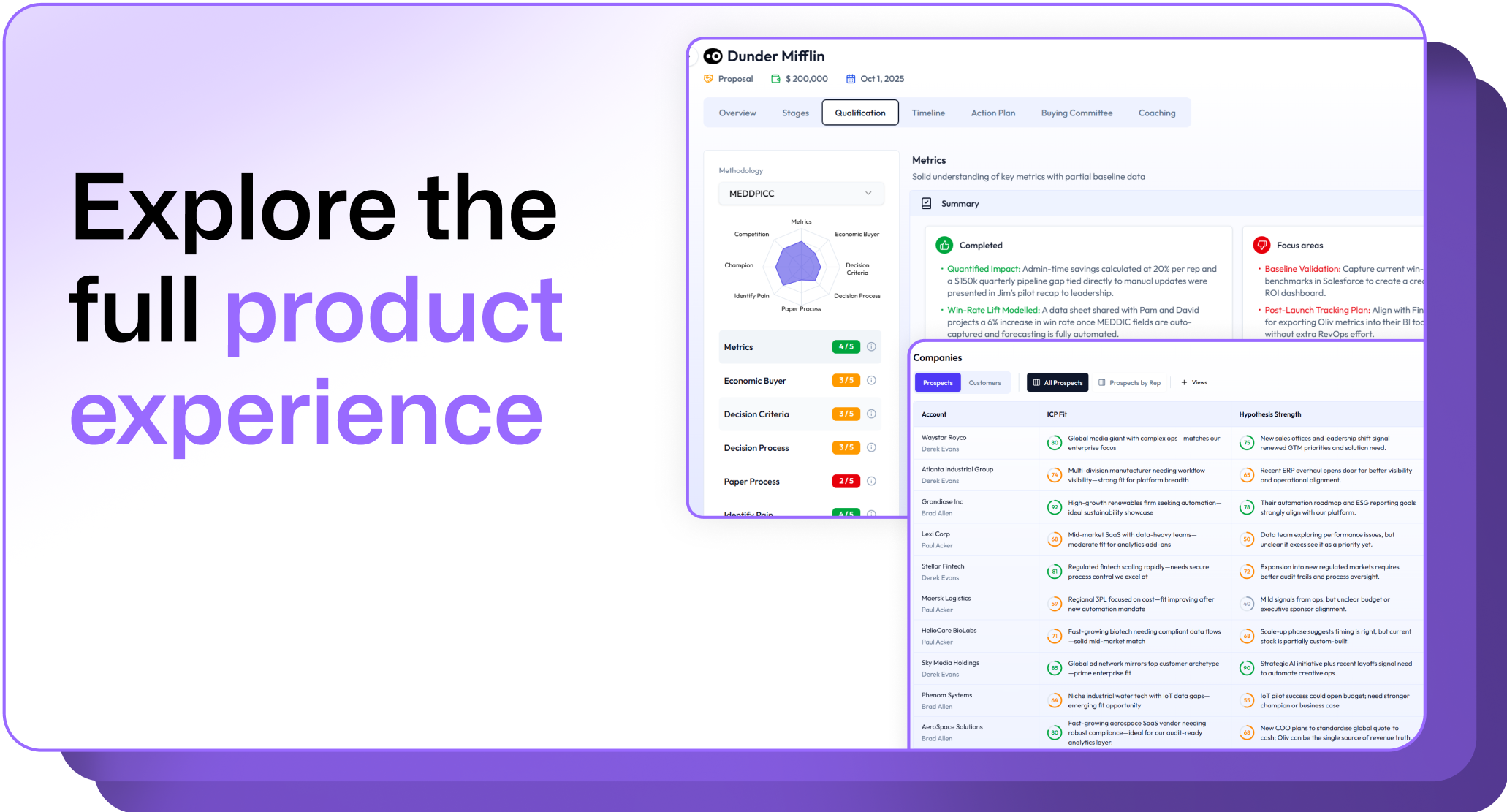
.avif)
.png)