Beyond Gong — What Comes After Meeting-Level Intelligence for Revenue Teams
Written by
Ishan Chhabra
Last Updated :
April 7, 2026
Skim in :
14
mins
In this article
Revenue teams love Oliv
Here’s why:
All your deal data unified (from 30+ tools and tabs).
Insights are delivered to you directly, no digging.
AI agents automate tasks for you.
Thank you! Your submission has been received!
Oops! Something went wrong while submitting the form.
Meet Oliv’s AI Agents
Hi! I’m, Deal Driver
I track deals, flag risks, send weekly pipeline updates and give sales managers full visibility into deal progress
Hi! I’m, CRM Manager
I maintain CRM hygiene by updating core, custom and qualification fields all without your team lifting a finger
Hi! I’m, Forecaster
I build accurate forecasts based on real deal movement and tell you which deals to pull in to hit your number
Hi! I’m, Coach
I believe performance fuels revenue. I spot skill gaps, score calls and build coaching plans to help every rep level up
Hi! I’m, Prospector
I dig into target accounts to surface the right contacts, tailor and time outreach so you always strike when it counts
Hi! I’m, Pipeline tracker
I call reps to get deal updates, and deliver a real-time, CRM-synced roll-up view of deal progress
Hi! I’m, Analyst
I answer complex pipeline questions, uncover deal patterns, and build reports that guide strategic decisions
TL;DR
Gong pioneered conversation intelligence but operates at meeting level, missing deal-level signals from emails, Slack, and web interactions.
Smart Trackers rely on keyword matching and miss nuanced intent, generating noise instead of actionable deal intelligence for revenue teams.
The combined Gong plus Clari plus Outreach stack costs roughly $500 per user per month, while agentic platforms deliver 91% TCO savings.
Agentic AI platforms write structured data to CRM fields autonomously within 5 minutes, replacing manual 8 to 24 week implementation cycles.
Migration from Gong to Oliv AI requires 5 minutes of setup and 3 meetings for AI training, with free historical data migration included.
CROs should evaluate platforms on deal-level intelligence, push vs. pull delivery, sub-5-minute processing speed, and full-stack TCO.
Q1: What Did Gong Get Right and Where Does Meeting-Level Intelligence Hit Its Ceiling? [toc=Gong's Ceiling]
Gong deserves real credit for creating the conversation intelligence category. Before Gong, sales leaders had zero systematic visibility into what actually happened on customer calls. Pipeline reviews relied entirely on rep narratives, coaching was anecdotal, and "voice of the customer" was whatever the AE chose to relay in a Slack update. Gong changed the game by recording, transcribing, and analyzing every customer-facing conversation, giving managers their first scalable lens into deal discussions at an organization-wide level.
⭐ The Foundation Gong Built
As one Director of Sales described the transformation:
"Before Gong we had a lack of visibility across our deals because information was siloed in several places like CRM, Email, Zoom, phone. Now all of this is centralized in one view via the Gong deal boards." Scott T., Director of Sales Gong G2 Verified Review
That centralization was genuinely transformative in 2018. But in 2026, the conversation intelligence category has hit a ceiling, and it is architectural, not incremental. The limitation is not that Gong does meeting intelligence poorly. It is that meeting intelligence itself is insufficient for modern revenue execution.
❌ The "Dashcam" Limitation
Gong operates at the meeting level. It records the conversation, generates a transcript, applies keyword-based Smart Trackers, and produces a coaching score. But a recorded meeting represents only the tip of the iceberg. The true reality of any deal is scattered across:
Side-thread emails between champions and procurement
Slack messages with internal stakeholders
Support tickets signaling adoption friction or expansion signals
In-person meetings and unrecorded phone calls on personal devices
Meeting-level intelligence answers "What happened on this call?" It fundamentally cannot answer "What is actually happening in this deal across all touchpoints?" and that is the question CROs need answered every forecast cycle.
Meeting-level tools see only the recorded call. Deal-level platforms stitch five data channels into one evolving deal narrative.
⚠️ Where the Ceiling Becomes Visible
Even experienced Gong users acknowledge the operational gap between what the platform promises and what it delivers in daily workflow:
"It's too complicated, and not intuitive at all. Using it is very...discomforting. Searching for calls is not easy, moving around in the calls is not easy, and understanding the pipeline management portion of it is almost impossible." John S., Senior Account Executive Gong G2 Verified Review
The AI era has fundamentally shifted the value frontier. Recording and transcription are now commodities, available free or near-free from dozens of providers. The new battleground is autonomous execution: stitching omnichannel data into a unified deal narrative, writing structured data directly to CRM fields, and proactively surfacing deal risks before the next meeting, not days after.
✅ How Oliv Operates Beyond the Meeting Level
This is precisely where Oliv AI operates. Rather than analyzing individual meetings in isolation, Oliv stitches calls, emails, Slack threads, support tickets, and web signals into one evolving deal summary that updates after every customer interaction. Using Chain of Thought reasoning for intelligent object association, Oliv attaches intelligence to the correct CRM record, even in duplicate account environments where Gong's rule-based mapping frequently breaks. The result is deal-level intelligence that gives revenue leaders evidence-based pipeline visibility instead of fragmented meeting-level snapshots that still require hours of manual synthesis.
Q2: Why Are Revenue Teams Experiencing Gong Fatigue in 2026? [toc=Gong Fatigue]
"Gong fatigue" is the compounding frustration revenue teams feel when three forces collide: renewal shock from aggressive annual uplifts, adoption decay as reps default to using only the basic recorder, and persistent manual work for managers who still spend hours in dashboards despite paying premium per-user prices. It is not that Gong stopped working. It is that the return on investment no longer justifies the cost for teams that have outgrown meeting-level intelligence.
Per-user licensing: $1,298 to $3,000/user/year depending on tier and modules
Mandatory platform fee: $5,000 to $50,000 annually (non-negotiable baseline)
Implementation fees: $7,500 to $65,000 for initial setup and Smart Tracker configuration
Annual uplifts: 5 to 15% auto-renewal increases locked into multi-year contracts
For a 50-user sales team, Year 1 total cost can reach $105K to $180K, and that price only climbs. One Head of Marketing shared her candid regret:
"It was a big mistake on our part to commit to a two year term. Gong is a really powerful tool but it's probably the highest end option on the market, and now we're stuck with a tool that works technically but isn't the right business decision." Iris P., Head of Marketing, Sales & Partnerships Gong G2 Verified Review
❌ Low Adoption Meets Data Lock-In
The cost problem intensifies when adoption declines. Teams pay the full unified license (~$250/month per user) even when reps only use Gong as a basic call recorder, never touching forecasting, deal boards, or coaching modules. Meanwhile, extracting your own data becomes a challenge in itself:
"This lack of flexibility has required us to engage our development team at additional cost, adding significant operational and opportunity costs just to extract data we already own." Neel P., Sales Operations Manager Gong G2 Verified Review
Reps resist adoption because they feel surveilled rather than supported. Managers still find themselves reviewing calls at 2x speed every evening. As another verified reviewer noted:
"The platform is expensive, especially compared to alternatives like Salesloft and Apollo, which offer similar capabilities for a fraction of the price...Many reps also resist using Gong because they feel micromanaged, leading to low adoption." Verified Reviewer Gong G2 Verified Review
⚠️ Why the AI Era Makes This Untenable
In 2026, recording and transcription are commodities, available free from multiple providers. Paying $100+/user/month for a platform that still requires manual CRM entry, manual coaching review, and manual deal-risk identification means paying for 2015-era architecture at 2026 prices. The gap between what teams pay and what they actually use widens with every renewal cycle.
✅ Oliv's Consolidated Cost Advantage
Oliv AI is positioned as the single-solution replacement for the fragmented legacy stack (Gong + Clari + Outreach) that typically costs ~$500/user/month combined. The result: a 91% TCO advantage, with zero implementation fees, free historical data migration, and a free baseline recording layer for current Gong users transitioning to agentic AI. We believe you should never pay for a recorder in 2026. The real value, and the investment, belongs at the agentic execution layer where AI does the work instead of creating more dashboards for your team to manage.
Q3: What Is the Difference Between Meeting-Level and Deal-Level Intelligence? [toc=Meeting vs Deal Intelligence]
Understanding this distinction is critical for any revenue leader evaluating their current tech stack. Meeting-level intelligence and deal-level intelligence are not different versions of the same product. They represent fundamentally different units of analysis, different data architectures, and different outcomes for pipeline management and forecasting accuracy.
📌 Meeting-Level Intelligence: The Single-Call Unit
Meeting-level intelligence operates on one atomic unit: the individual conversation. The workflow is linear and well-established:
Record the call
Transcribe and generate a summary
Apply keyword trackers to flag topics (competitors mentioned, pricing discussed, objections raised)
Score the interaction for coaching signals (talk-to-listen ratio, filler words, question frequency)
This answers a specific question well: "What happened on this call?" But it cannot answer the question that actually drives revenue outcomes: "What is really happening in this deal across all touchpoints over the past 6 weeks?"
Even experienced users acknowledge the gap between features purchased and features adopted:
"There's so much in Gong, that we don't use everything; Gong's deal forecasting we don't use." Karel Bos, Head of Sales Gong TrustRadius Verified Review
❌ Why Keyword-Based Tracking Hits a Wall
The technical limitation runs deeper than feature adoption. Gong's Smart Trackers and Chorus's trigger-based keyword detection rely on explicit string matching. They cannot distinguish between:
A competitor mentioned in passing ("I used to work at Salesforce") vs. an active competitive evaluation
A pricing question out of curiosity vs. a serious budget negotiation
A stakeholder expressing genuine interest vs. polite deflection
"The software doesn't have the capability of identifying words/phrases that are similar to what you're looking for or understand context so if you don't tell it exactly what you're looking for then you'll miss out." Director of Sales Operations Chorus Gartner Verified Review
This is a structural constraint of keyword-based architectures, not a configuration problem fixable with better tracker setup. As one Senior Director of Revenue Enablement noted: "It can be overwhelming to set up trackers. AI training is a bit laborious to get it to do what you want."
✅ Deal-Level Intelligence: The Opportunity Lifecycle Unit
Deal-level intelligence operates on a fundamentally different unit: the full opportunity lifecycle across all channels. Instead of analyzing one call in isolation, it stitches together weeks of interactions, including emails between champions and procurement, recorded calls across multiple stakeholders, Slack signals, support tickets indicating adoption risk, and web engagement data. The output is a single, evolving deal narrative that answers pipeline health and forecast confidence questions with evidence rather than rep sentiment.
✅ How Oliv Implements Deal-Level Intelligence
Oliv AI's architecture is purpose-built for this approach. Using omnichannel data stitching and AI-based object association (Chain of Thought reasoning), Oliv constructs one unified deal summary per opportunity that evolves after every interaction. Qualification frameworks like MEDDPICC and BANT are populated automatically from conversation context, not from rep self-assessment. Proactive risk flags surface stalled deals and missing stakeholders before the weekly pipeline review, not after. For revenue leaders, this represents the shift from managing deals reactively via call recordings to driving deals proactively with complete deal intelligence.
Q4: Why Don't Gong's CRM Integrations Solve the Dirty Data Problem? [toc=CRM Dirty Data]
CRM was supposed to be the single source of truth for revenue teams. In practice, it has become a graveyard of incomplete records, outdated next steps, and qualification fields filled with placeholder text just to clear a stage gate. The promise of conversation intelligence was that tools like Gong would bridge this gap by feeding real conversation data into the CRM automatically. The reality is significantly more limited.
❌ The Notes vs. Properties Gap
Gong does integrate with Salesforce, HubSpot, and other major CRMs. But the integration architecture reveals a critical limitation: Gong logs call summaries as unstructured "Notes" or activity blocks on the contact or opportunity record. It does not write directly to structured CRM properties.
This distinction matters enormously for RevOps teams because:
Unstructured notes cannot be queried, filtered, or reported on at scale
Pipeline inspection tools cannot read activity notes to assess deal health automatically
Forecasting models cannot use notes as structured input signals
Stage-gate automation cannot trigger from text buried in activity logs
The result: even with Gong fully integrated, your MEDDPICC fields, BANT qualification scores, next steps, and decision criteria remain entirely dependent on manual rep entry. The "dirty data debt" persists unchanged.
⚠️ The Data Portability Problem
The limitation extends beyond daily workflows to data ownership itself. When teams attempt to migrate away from Gong, they discover that extracting their own data is far from straightforward:
"While Gong offers valuable insights into call data and sales interactions, our experience has been impacted by significant data access limitations, especially concerning data portability and bulk export capabilities...their current solution is far from convenient or accessible, it requires downloading calls individually, which is impractical and inefficient for a large volume of data." Neel P., Sales Operations Manager Gong G2 Verified Review
Gong's architecture is fundamentally a one-way pull system. Data flows into Gong from your calendar, CRM, and communication tools, but structured intelligence does not flow back out in a format your existing workflows and automations can consume.
❌ The Overlay Problem Across the Stack
This is not unique to Gong. Clari faces the same structural issue from the forecasting side, functioning as a visual overlay on Salesforce rather than an autonomous data engine:
"It is really just a glorified SFDC overlay. Actually, Salesforce has built most of the forecasting functionality by now anyway so I'm not sure where they fit into that whole overcrowded Martech space." conaldinho11, r/SalesOperations Reddit Thread
Meanwhile, Salesforce's own Agentforce approach requires reps to manually engage a chat interface to retrieve or update information, an approach with its own UX friction. As one verified user noted: "Lots of clicking to get select the right options. UX needs improvement. Everything opens in a new browser tabs clustering the browser."
✅ Oliv's Autonomous CRM Write Approach
Oliv AI solves this with a fundamentally different integration architecture. The CRM Manager agent autonomously creates and enriches contacts and accounts, then writes directly to structured CRM properties, including MEDDPICC fields, BANT scores, next steps, decision criteria, and competitive intelligence, all extracted from conversation context without any rep intervention. No notes. No activity blocks. Actual field-level data that your existing reports, dashboards, automations, and forecasting workflows can immediately consume. The CRM stays clean not because reps suddenly became diligent about data entry, but because the work happens invisibly in the background through Oliv's "Invisible UI" philosophy.
Q5: How Does Proactive Coaching Differ from Post-Call Scoring? [toc=Proactive vs Post-Call Coaching]
Gong fundamentally changed sales coaching. Before conversation intelligence existed, managers relied entirely on ride-alongs, self-reported call summaries, and gut instinct to assess rep performance. Gong introduced the first scalable way to review recorded calls, score talk-to-listen ratios, flag filler words, and identify coaching moments across an entire team. For revenue enablement leaders, this was revolutionary. Finally, coaching could be data-driven rather than anecdotal.
⭐ The Post-Call Model That Built the Category
One Chief Commercial Officer described the impact plainly:
"Gong's product is second to none and without it, I couldn't do my job properly — it's my most visited tab on Chrome! The wide ranging suite of features and functionalities really help me coach the team and gain great visibility over our pipeline." Elspeth C., Chief Commercial Officer Gong G2 Verified Review
But here is the structural problem: Gong's coaching model is entirely post-call. The manager reviews a recording hours or days after the conversation happened, often at 2x speed while commuting or between meetings. By the time the coaching insight surfaces, the deal has already moved forward (or stalled). Post-call scoring tells you what went wrong on Tuesday's call; it does not prevent the same mistake on Wednesday's call.
❌ The Retroactive Coaching Bottleneck
For managers running teams of 8 to 12 reps generating 25 to 35 calls per day, reviewing every conversation is practically impossible. The result is selective coaching. Managers cherry-pick a few calls per week, missing critical deal signals on the majority. Even acknowledged Gong advocates admit the feature gap:
"No way to collaborate/share a library of top calls. AI is not great yet — the product still feels like it's at its infancy and needs to be developed further." Annabelle H., Voluntary Director, Board of Directors Gong G2 Verified Review
The coaching moment has an expiration date. A discovery call with weak qualification is only actionable if the manager intervenes before the next stakeholder meeting, not three days later during a scheduled 1:1. Post-call scoring creates a historical archive of what happened; proactive coaching intervenes in real time to change what happens next.
✅ Proactive Coaching in the AI Era
The shift from post-call to proactive coaching requires three capabilities that legacy platforms were never designed to deliver:
Pre-call intelligence: Context pushed to the rep before the next interaction, based on full deal history, not just the last call
Real-time risk detection: Daily identification of deals at risk or stalled, delivered to the manager without dashboard digging
Off-the-record capture: A channel for reps to share updates that happen outside recorded meetings, including hallway conversations, phone calls, and in-person visits
✅ Oliv's Proactive Coaching Stack
Oliv AI delivers all three through purpose-built agents. Morning Briefs are pushed 30 minutes before every call, telling the rep exactly what to focus on based on the complete deal narrative across calls, emails, and Slack threads. The Deal Driver Agent proactively flags at-risk and stalled deals daily, delivering actionable alerts directly to Slack or Email, so managers start the day knowing which three deals need attention instead of spending two hours searching for them. The Voice Agent calls reps every evening for a 5-minute phone conversation, capturing off-the-record updates and writing them directly to the CRM. The result: sales managers save one full day per week previously spent on dashboard digging and manual call review, time redirected to the actual coaching conversations that move pipeline.
Q6: Why Does Processing Speed Matter for Revenue Outcomes? [toc=Processing Speed Impact]
When a sales rep finishes a discovery call and immediately joins the next meeting, there is a narrow window, roughly 5 to 10 minutes, where the context from the previous conversation is fresh. Follow-up tasks are clear, CRM fields are top of mind, and deal-risk signals have not faded into the noise of the next interaction. This window is where revenue execution either happens or gets deferred indefinitely. And the processing speed of your intelligence platform determines whether that window gets used.
⏰ The 30-Minute Gap Problem
Gong takes approximately 20 to 30 minutes to fully process a call for analysis, generating the transcript, applying Smart Trackers, producing the summary, and making the recording searchable. For a rep running back-to-back calls, this means the insights from Meeting A are not available until they are already deep into Meeting B. By the time the summary surfaces, the rep has context-switched, the urgency has faded, and the CRM update gets pushed to "end of day," which, in practice, often means never.
One TrustRadius reviewer highlighted the experience directly:
"It takes an eternity to upload a call to listen to it." Remington Adams, Team Lead, Sales Development Representative Gong TrustRadius Verified Review
❌ Why Delayed Processing Compounds Revenue Risk
The impact of processing delay extends beyond CRM hygiene. Consider the downstream effects across a typical sales org:
Coaching window closes: The manager cannot intervene on a poorly qualified discovery call before the next stakeholder meeting
Follow-up tasks lose context: Action items from a call are forgotten or deprioritized as the rep moves through their daily calendar
Risk signals go undetected: A competitor mention or budget objection sits in an unprocessed recording while the deal advances to the next stage
Forecast data stays stale: Pipeline status reflects yesterday's reality, not today's conversations
For managers already struggling with "dashboard digging" fatigue, adding a 30-minute processing lag means the information is outdated before it is even accessible. As one verified user noted about the challenge of keeping up with the data volume:
"There's so much in Gong, that we don't use everything; Gong's deal forecasting we don't use." Karel Bos, Head of Sales Gong TrustRadius Verified Review
✅ The 5-Minute Standard in the Agentic Era
Modern agentic platforms process in under 5 minutes, not because they transcribe faster, but because their architecture is designed to act immediately, not just analyze. Within that 5-minute window: CRM fields are updated with structured data (MEDDPICC, next steps, competitive mentions), follow-up tasks are created and assigned, deal-risk flags are raised to the manager, and the evolving deal summary is refreshed.
✅ How Oliv Closes the Speed Gap
Oliv AI processes calls and triggers its agent workflows within minutes of a meeting ending. Before the rep's next call starts, the CRM Manager agent has already updated opportunity fields, the Deal Driver agent has assessed risk signals, and the Sunset Summary, a daily wrap-up of what moved and what was won, begins compiling for the manager's evening review. The analogy is simple: Gong gives you the game film on Tuesday. Oliv gives you the play call at halftime. In revenue execution, the difference between insight-after-the-fact and insight-in-the-moment is the difference between documentation and deal velocity.
Q7: What Does Agentic AI Actually Mean for Revenue Teams? [toc=Agentic AI Explained]
"Agentic AI" has become one of 2026's most overused buzzwords in enterprise software. Every platform claims it. Few deliver it. For CROs and RevOps leaders evaluating their tech stack, understanding what agentic AI actually means, architecturally and operationally, is the difference between buying another dashboard and deploying a workforce that autonomously executes revenue operations tasks.
📌 Defining Agentic AI Simply
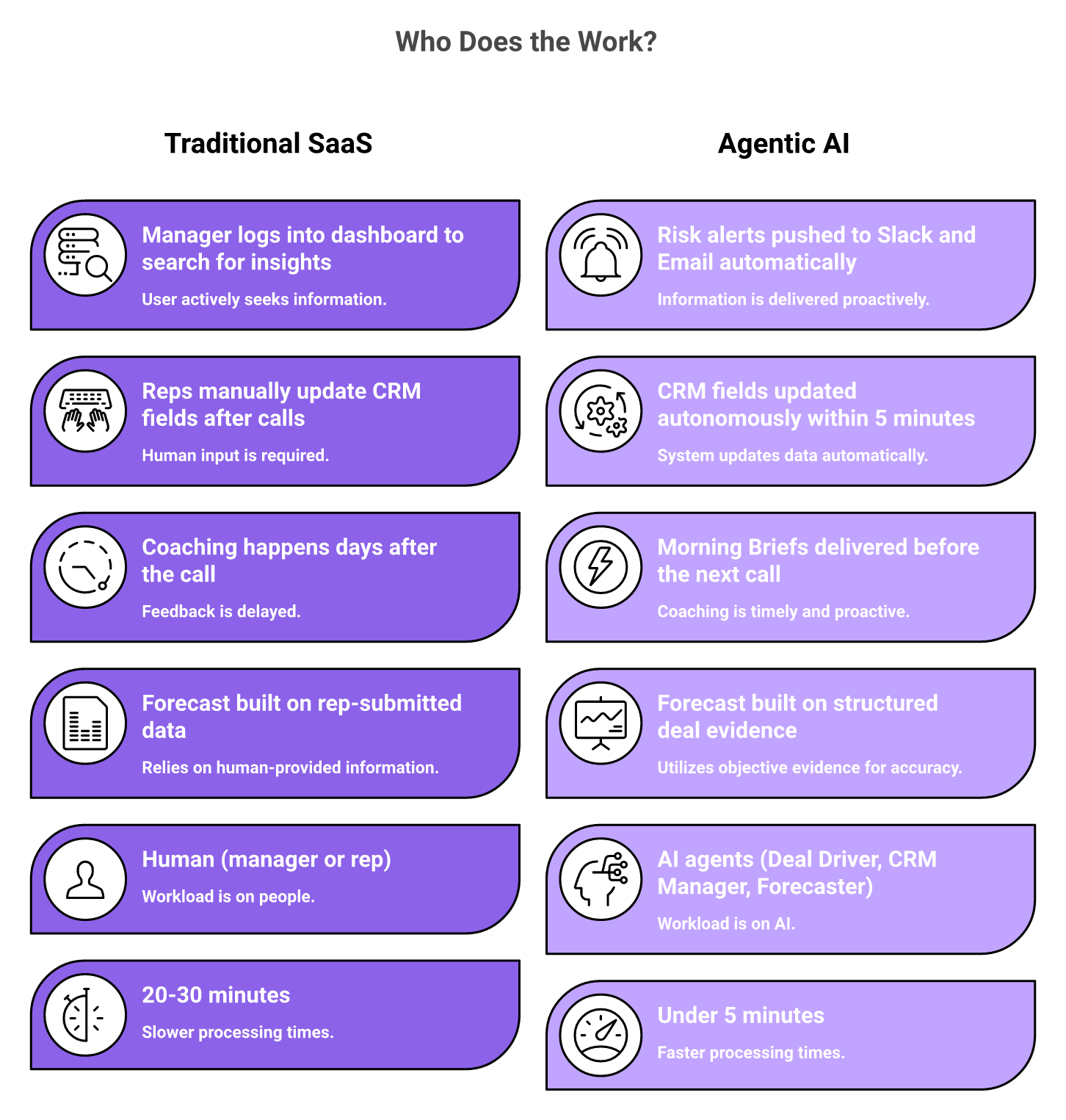
At its core, agentic AI describes systems that make contextual decisions, initiate actions independently, and optimize outcomes continuously, without waiting for a human to click a button, run a report, or type a query. Traditional SaaS tools present information on dashboards; agentic AI systems do the work. The distinction is fundamental: a traditional tool shows you which deals are at risk. An agentic system flags the risk, drafts the intervention plan, updates the CRM, and alerts the manager, all before the morning standup.
❌ The Traditional SaaS "Treadmill"
Legacy revenue tools, including Gong, Clari, Outreach, and Salesforce, were built in the pre-generative AI era. They require reps and managers to learn new UIs, manually extract insights, and translate those insights into actions across multiple platforms. The human is the integration layer, running between dashboards to stitch together a picture of deal health.
The operational burden is real. Even advocates acknowledge the overhead:
"It can be overwhelming to set up trackers. AI training is a bit laborious to get it to do what you want." Trafford J., Senior Director, Revenue Enablement Gong G2 Verified Review
And across the stack, tools keep requiring more human effort to maintain:
"Clari should find ways to differentiate from the native Salesforce features (e.g. Pipeline Inspection, Forecasting) in order to remain competitive in the long-run." Dan J. Clari G2 Verified Review
The treadmill analogy captures it precisely: buying Gong is like buying an expensive high-end treadmill. It is a status symbol, but your team still does all the running. Manual entry, manual auditing, and manual synthesis.
The fundamental shift: traditional SaaS requires managers to pull insights from dashboards, while agentic AI pushes finished work directly to Slack and Email.
✅ The Agentic Shift: Agents Performing "Jobs to Be Done"
Agentic AI replaces that treadmill with a team of autonomous workers, each handling a specific "Job to Be Done" in the revenue workflow:
CRM hygiene: Autonomously creating contacts, enriching accounts, and writing structured qualification data to CRM fields
Deal-risk detection: Scanning omnichannel signals daily and proactively flagging deals that are stalled, missing stakeholders, or showing competitive threat
Forecast preparation: Producing board-ready, unbiased weekly roll-ups without requiring managers to sit in hours of pipeline calls
Coaching prep: Delivering pre-call briefs and post-call summaries without the manager needing to review a single recording
Handoff documentation: Generating complete deal narratives for sales-to-CS transitions without administrative burden
✅ Oliv's 30+ Agent Architecture
Oliv AI deploys an army of 30+ agents purpose-built for these jobs. The CRM Manager autonomously updates actual CRM properties (MEDDPICC, BANT, next steps) from conversation context. The Forecaster Agent produces board-ready weekly roll-ups and presentation-ready slides, autonomously. The Deal Driver Agent delivers daily risk alerts to Slack or Email. The Voice Agent makes a 5-minute evening phone call to reps, capturing off-the-record deal updates directly into the CRM. We believe switching to Oliv is like hiring a personal trainer and nutritionist who do the planning, monitoring, and heavy lifting, rather than buying another piece of gym equipment your team has to operate manually.
Q8: How Do Gong, Chorus, and Clari Compare on the Intelligence-to-Execution Spectrum? [toc=Gong vs Chorus vs Clari]
Revenue teams evaluating their 2026 tech stack need a clear framework for understanding where each platform sits on the intelligence-to-execution spectrum. Intelligence means the platform surfaces insights from data. Execution means the platform autonomously acts on those insights, updating CRM fields, flagging deal risks, generating forecasts, and preparing coaching materials without human intervention. The gap between these two defines the amount of manual work your team still carries.
Gong excels at conversation intelligence. It built the category. But it remains fundamentally a "dashcam": it records, analyzes, and surfaces insights without autonomously acting on them. CRM data stays unstructured, Smart Trackers rely on brittle keyword matching, and coaching is retroactive. One reviewer summarized it directly:
"For me, the only business problem Gong solves is the call recordings. It allows me to review my calls and listen to them so that I can understand either where I went wrong or what the customer really said." John S., Senior Account Executive Gong G2 Verified Review
⚠️ Chorus: Stalled Innovation Post-Acquisition
Chorus was a strong Gong competitor until its ZoomInfo acquisition in 2022. Since then, innovation has stalled noticeably. The platform handles basic recording and summarization but lacks contextual intelligence or execution capabilities:
"Chorus has been an okay experience, will be moving to Gong next term. Used Clari before — it was awful...Not great at forecasting. We just keep playing hot potato with vendors and it can be frustrating." Justin S., Senior Marketing Operations Specialist Chorus G2 Verified Review
⚠️ Clari: The Manual Roll-Up Trap
Clari's forecasting product provides a cleaner UI than native Salesforce Pipeline Inspection, and some teams genuinely benefit from the consolidated view. But the underlying architecture remains a "pull" system dependent on rep-submitted data:
"Clari is a tool for sales leaders, it adds no value to reps as far as I can see." Msoave, r/SalesOperations Reddit Thread
✅ Where Oliv Sits on the Spectrum
Oliv AI is the only platform in this comparison that operates on the execution end of the spectrum. Rather than surfacing intelligence for humans to act on, Oliv's 30+ agents autonomously handle CRM updates, forecast roll-ups, deal-risk alerts, and coaching prep, delivering finished work to reps and managers where they already work (Slack, Email, CRM) through its "Invisible UI" philosophy.
Q9: What Is the Real TCO of Gong vs. an Agentic Platform? [toc=Gong TCO Analysis]
Total cost of ownership (TCO) for revenue intelligence platforms extends far beyond the per-seat license listed on a vendor's pricing page. For finance teams and RevOps leaders building a business case, the full cost stack includes platform fees, implementation labor, annual renewal uplifts, add-on module charges, and the hidden cost of underutilization. This section breaks down the real numbers so you can compare with full transparency.
💰 Gong's Full Cost Stack (100-User Team)
Gong Annual Cost Breakdown (100-User Team)
Cost Component
Gong (Annual)
Notes
Per-user license
$129,800 to $300,000
$1,298 to $3,000/user/year depending on tier
Mandatory platform fee
$5,000 to $50,000
Non-negotiable annual baseline
Implementation fee (Year 1)
$7,500 to $65,000
Smart Tracker configuration, 40 to 140 admin hours
Add-on modules (Forecast, Engage)
$15,000 to $60,000+
Each module priced separately
Annual renewal uplift (5 to 15%)
Compounds yearly
Locked into multi-year contracts
One verified user noted the module fragmentation directly:
"The additional products like forecast or engage come at an additional cost. Would be great to see these tools rolled into the core offering." Scott T., Director of Sales Gong G2 Verified Review
💸 The Hidden Costs Most Teams Miss
Beyond licensing, three cost categories are frequently underestimated in vendor evaluations:
Adoption overhead: Training programs, change management, and the productivity dip during 8 to 24 week implementation cycles that consume significant RevOps bandwidth
Data extraction costs: Teams needing to migrate away must engage development resources to extract their own call data individually, adding unplanned engineering hours to the total cost of the platform relationship
Underutilization waste: Teams paying the full unified license (~$250/month per user) when the majority of reps only use basic recording and never touch forecasting, deal boards, or coaching modules
An Enterprise Account Executive captured the pricing friction clearly:
"Overall it is a great product. Sadly Gong.io as a leader in its market is not too open to negotiate with smaller companies...The pricing is probably the biggest obstacle and hence we are looking to change." Miodrag, Enterprise Account Executive Gong Verified Review
📌 The Combined Stack Problem
Most revenue teams do not run Gong alone. They pair it with Clari for forecasting (~$60 to $100/user/month) and Outreach or Salesloft for engagement (~$100 to $150/user/month). The combined stack reaches approximately $500/user/month, or $600,000/year for a 100-user team, before accounting for implementation, training, or annual renewal increases.
Most revenue teams pay ~$500/user/month across Gong, Clari, and Outreach. Consolidating into a single agentic platform reduces TCO by 91%.
✅ Oliv's TCO Comparison (100 Users / 3 Years)
3-Year TCO: Gong vs. Oliv AI (100 Users)
Metric
Gong (3-Year)
Oliv AI (3-Year)
Total cost
$789,300
$68,400
Implementation fee
$7,000 to $30,000
$0
Setup time
8 to 24 weeks
5 minutes + 3 meetings
Historical data migration
Not included
Free
Recording & transcription
Included in license
Free baseline layer
Oliv AI delivers a 91% TCO advantage by consolidating the functions of Gong + Clari + Outreach into a single agentic platform with modular agent pricing. We offer free recording and transcription to current Gong users as a zero-risk entry point, because in 2026, paying premium prices for a recorder is paying for a commodity that should be table stakes.
Q10: What Does the Migration Path from Gong to Agentic AI Look Like? [toc=Gong Migration Path]
Migration from an entrenched revenue intelligence platform feels risky, and understandably so. Teams have invested months in implementation, built custom Smart Trackers, trained managers on dashboard workflows, and accumulated years of call recording history. The switching cost is not just financial. It is operational and psychological. Nobody wants to repeat the 8 to 24 week implementation nightmare they experienced on the way in.
⚠️ Why Legacy Onboarding Creates Lock-In
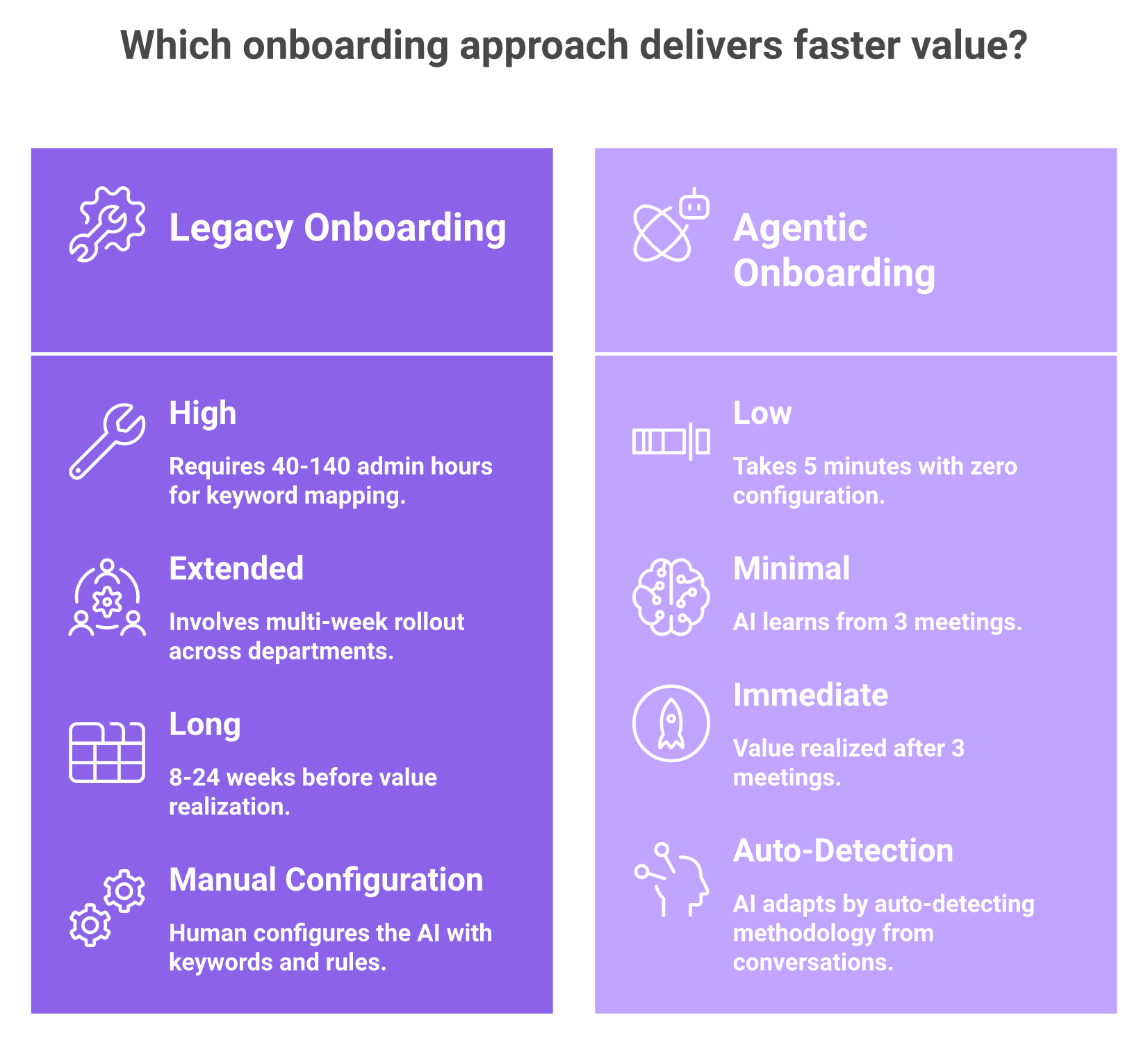
Gong's implementation model is itself a retention mechanism. Configuring Smart Trackers requires 40 to 140 admin hours of keyword mapping and rule-based logic setup. Training programs span weeks across multiple teams. And once configured, the sunk cost of that setup effort makes switching feel wasteful, even when the platform is clearly underutilized.
"It can be overwhelming to set up trackers. AI training is a bit laborious to get it to do what you want." Trafford J., Senior Director, Revenue Enablement Gong G2 Verified Review
The data portability challenge compounds the friction significantly. Gong's API supports individual call downloads, but bulk export remains impractical for teams with thousands of recordings:
"This lack of flexibility has required us to engage our development team at additional cost, adding significant operational and opportunity costs just to extract data we already own." Neel P., Sales Operations Manager Gong G2 Verified Review
✅ Why Agentic Onboarding Is Fundamentally Different
Modern agentic platforms invert the entire implementation model. Instead of requiring you to configure the AI (build trackers, define keywords, set rules), the AI adapts to you. There are no keyword trackers to build, no rule-based logic to maintain, and no multi-week training programs for your team to endure. The platform learns your sales methodology from your actual conversations, not from an admin's configuration spreadsheet.
Legacy onboarding requires you to configure the AI over weeks. Agentic onboarding inverts the model: the AI adapts to you in minutes.
✅ Oliv's 3-Step Migration Path
Oliv AI provides a streamlined three-step process specifically designed to eliminate migration anxiety:
Technical Configuration (5 Minutes): Connect your Google or Outlook calendar and your CRM (Salesforce, HubSpot). This enables 100% data capture from day one. Every meeting is automatically joined, recorded, and transcribed without any additional setup.
Three-Meeting Training: Oliv only needs to analyze three of your team's meetings to understand your specific sales methodology, qualification framework, and the nuance of intent in your conversations. No manual tracker configuration or keyword mapping required.
Modular Agent Activation: Deploy agents step-by-step based on immediate priorities. Start with the CRM Manager agent for autonomous field updates, add the Deal Driver agent for daily risk alerts, then activate the Forecaster Agent for board-ready weekly roll-ups. Each agent creates compounding value, an "ROI Snowball" that builds momentum with every activation.
💰 The "Free" On-Ramp Strategy
We understand that switching platforms requires confidence built through experience. That is why Oliv offers recording and transcription completely free to current Gong users, providing an immediate, zero-risk entry point to the platform. Teams can run Oliv in parallel with their existing stack, experience the agentic layer firsthand, and make the transition incrementally rather than through a disruptive rip-and-replace. Free historical data migration ensures your existing call library and institutional knowledge transfer seamlessly, so nothing is lost in the process.
Q11: What Should a CRO Evaluate When Moving Beyond Conversation Intelligence? [toc=CRO Evaluation Framework]
For CROs and VPs of Sales evaluating their next-generation revenue technology, the vendor landscape is crowded with platforms claiming to go "beyond Gong." The challenge is distinguishing genuine architectural advancement from repackaged legacy features wearing an AI label. This evaluation framework provides seven critical questions to ask any vendor before signing a contract.
📌 The 7-Question Evaluation Framework
1. Does the platform operate at meeting level or deal level?
Meeting-level tools analyze individual calls in isolation. Deal-level platforms stitch together calls, emails, Slack, support tickets, and web signals into a single evolving narrative per opportunity. Ask for a live demo showing how data from multiple channels merges into one unified deal view.
2. Does it write structured data to CRM fields, or just log notes?
Unstructured activity notes cannot power reports, automations, or forecasting models. Verify whether the platform writes directly to MEDDPICC, BANT, next steps, and competitive intelligence fields, not as text blocks, but as structured properties your existing workflows can consume.
⏰ Speed, Push vs. Pull, and Stack Cost
3. What is the actual processing speed?
Ask for the time between a meeting ending and CRM fields being updated. If the answer is "20 to 30 minutes," the coaching and execution window has already closed. The standard in 2026 is under 5 minutes.
4. Is the intelligence proactively pushed or reactively pulled?
A "pull" system requires managers to log in, navigate dashboards, and search for insights. A "push" system delivers finished work, including risk alerts, coaching briefs, and forecast summaries, directly to Slack, Email, or the CRM without requiring a login. One Head of Sales noted the challenge of underutilized features in pull-based systems:
"There's so much in Gong, that we don't use everything; Gong's deal forecasting we don't use." Karel Bos, Head of Sales Gong TrustRadius Verified Review
5. What is the total cost of ownership, including the full stack?
Do not evaluate the platform in isolation. Calculate the combined cost of your intelligence tool + forecasting tool + engagement tool. If the new platform consolidates all three, compare the total stack cost, not just one-to-one licensing fees.
🔧 Implementation and Adoption
6. What does implementation actually require?
Ask for the admin hours, setup timeline, and ongoing maintenance burden. If the answer involves weeks of tracker configuration and rule-building, the platform is built on pre-generative architecture that will demand continuous RevOps overhead.
"Since we purchased our package, the support model has changed drastically, which is infuriating." Elspeth C., Chief Commercial Officer Gong G2 Verified Review
7. Can reps and managers use it without learning a new UI?
The highest adoption rates come from platforms that deliver insights where teams already work, including Slack, Email, and CRM, rather than requiring login to a separate application. Ask whether the platform follows an "Invisible UI" philosophy or adds yet another tab to the daily workflow.
✅ How Oliv Answers All Seven
Oliv AI was designed around these exact evaluation criteria: deal-level intelligence via omnichannel data stitching, autonomous structured CRM writes, sub-5-minute processing, proactive push delivery via Morning Briefs and Sunset Summaries, consolidated stack pricing with a 91% TCO advantage, 5-minute setup with three-meeting training, and an Invisible UI that eliminates the adoption barrier entirely.
Q12: What Does 'Beyond Gong' Look Like in Practice? A Day-in-the-Life Comparison [toc=Day-in-the-Life Comparison]
Abstract concepts like "agentic AI" and "deal-level intelligence" become tangible when mapped to a real workflow. Consider Sarah, a VP of Sales managing 10 AEs with 200+ active opportunities across mid-market and enterprise accounts. She has been a Gong customer for three years, pays $250/user/month for Gong and $160/user/month for Clari, and has accepted that evenings are for call review.
❌ Sarah's Day on Legacy Tools (Gong + Clari)
7:30 AM Sarah opens Gong and spends 45 minutes in dashboard mode: filtering by team, sorting by recent activity, and scanning deal boards for anything flagged. She clicks through ten screens to check on three enterprise deals her CRO asked about yesterday.
10:00 AM Between her own meetings, Sarah tries to audit CRM data for tomorrow's forecast call. Half the MEDDPICC fields are blank. Three reps have not updated next steps since last week. She Slacks each one asking for updates, knowing she will follow up again tomorrow.
2:00 PMClari shows the forecast roll-up, but the numbers feel soft. She knows two deals are at risk because she reviewed the calls last night at 2x speed, but Clari's data reflects what reps entered, not what the customer actually said. As one Reddit user described the inherent limitation:
"Clari is a tool for sales leaders, it adds no value to reps as far as I can see." Msoave, r/SalesOperations Reddit Thread
8:30 PM Sarah spends 90 minutes reviewing call recordings for her top 5 deals. She identifies a competitive threat on an enterprise account, but the risk signal appeared in a call recorded three days ago. The next stakeholder meeting is tomorrow morning. She can coach, but not prevent.
✅ Sarah's Day on Oliv AI
7:15 AM Sarah opens Slack. The Deal Driver Agent has already flagged the three deals needing attention today: one stalled enterprise account (no activity in 9 days), one competitive threat detected from yesterday's call, and one deal where the champion has not been on a call in three weeks. No dashboard login required.
9:30 AM Her AE has a discovery call in 30 minutes. The Morning Brief arrives automatically, summarizing the full deal narrative across all prior calls, emails, and Slack threads, and highlighting exactly what the rep should focus on: re-confirm budget authority and address the procurement timeline mentioned in last week's email.
✅ Autonomous Execution Through the Afternoon
12:00 PM The discovery call ends. Within 5 minutes, the CRM Manager agent has updated the opportunity with structured data: MEDDPICC fields populated from conversation context, next steps written, and competitive intelligence flagged. Sarah does not need to audit. The data is already there.
4:00 PM The Forecaster Agent delivers this week's board-ready roll-up directly to Sarah's email, presentation slides included. The forecast is built on deal evidence, not rep sentiment.
6:30 PM The Voice Agent calls each of Sarah's reps for a 5-minute evening check-in, capturing off-the-record updates about in-person meetings and hallway conversations. Those updates are written to the CRM automatically.
💰 The ROI in Sarah's Words
Sarah reclaims 8+ hours per week previously spent on dashboard digging, manual CRM audits, and evening call review. Her forecast accuracy improves because it is built on structured deal data from omnichannel signals, not spreadsheet submissions. And her total platform cost drops from $500/user/month to under $50/user/month. That is not a tool upgrade. That is a workflow transformation.
Q1: What Did Gong Get Right and Where Does Meeting-Level Intelligence Hit Its Ceiling? [toc=Gong's Ceiling]
Gong deserves real credit for creating the conversation intelligence category. Before Gong, sales leaders had zero systematic visibility into what actually happened on customer calls. Pipeline reviews relied entirely on rep narratives, coaching was anecdotal, and "voice of the customer" was whatever the AE chose to relay in a Slack update. Gong changed the game by recording, transcribing, and analyzing every customer-facing conversation, giving managers their first scalable lens into deal discussions at an organization-wide level.
⭐ The Foundation Gong Built
As one Director of Sales described the transformation:
"Before Gong we had a lack of visibility across our deals because information was siloed in several places like CRM, Email, Zoom, phone. Now all of this is centralized in one view via the Gong deal boards." Scott T., Director of Sales Gong G2 Verified Review
That centralization was genuinely transformative in 2018. But in 2026, the conversation intelligence category has hit a ceiling, and it is architectural, not incremental. The limitation is not that Gong does meeting intelligence poorly. It is that meeting intelligence itself is insufficient for modern revenue execution.
❌ The "Dashcam" Limitation
Gong operates at the meeting level. It records the conversation, generates a transcript, applies keyword-based Smart Trackers, and produces a coaching score. But a recorded meeting represents only the tip of the iceberg. The true reality of any deal is scattered across:
Side-thread emails between champions and procurement
Slack messages with internal stakeholders
Support tickets signaling adoption friction or expansion signals
In-person meetings and unrecorded phone calls on personal devices
Meeting-level intelligence answers "What happened on this call?" It fundamentally cannot answer "What is actually happening in this deal across all touchpoints?" and that is the question CROs need answered every forecast cycle.
Meeting-level tools see only the recorded call. Deal-level platforms stitch five data channels into one evolving deal narrative.
⚠️ Where the Ceiling Becomes Visible
Even experienced Gong users acknowledge the operational gap between what the platform promises and what it delivers in daily workflow:
"It's too complicated, and not intuitive at all. Using it is very...discomforting. Searching for calls is not easy, moving around in the calls is not easy, and understanding the pipeline management portion of it is almost impossible." John S., Senior Account Executive Gong G2 Verified Review
The AI era has fundamentally shifted the value frontier. Recording and transcription are now commodities, available free or near-free from dozens of providers. The new battleground is autonomous execution: stitching omnichannel data into a unified deal narrative, writing structured data directly to CRM fields, and proactively surfacing deal risks before the next meeting, not days after.
✅ How Oliv Operates Beyond the Meeting Level
This is precisely where Oliv AI operates. Rather than analyzing individual meetings in isolation, Oliv stitches calls, emails, Slack threads, support tickets, and web signals into one evolving deal summary that updates after every customer interaction. Using Chain of Thought reasoning for intelligent object association, Oliv attaches intelligence to the correct CRM record, even in duplicate account environments where Gong's rule-based mapping frequently breaks. The result is deal-level intelligence that gives revenue leaders evidence-based pipeline visibility instead of fragmented meeting-level snapshots that still require hours of manual synthesis.
Q2: Why Are Revenue Teams Experiencing Gong Fatigue in 2026? [toc=Gong Fatigue]
"Gong fatigue" is the compounding frustration revenue teams feel when three forces collide: renewal shock from aggressive annual uplifts, adoption decay as reps default to using only the basic recorder, and persistent manual work for managers who still spend hours in dashboards despite paying premium per-user prices. It is not that Gong stopped working. It is that the return on investment no longer justifies the cost for teams that have outgrown meeting-level intelligence.
Per-user licensing: $1,298 to $3,000/user/year depending on tier and modules
Mandatory platform fee: $5,000 to $50,000 annually (non-negotiable baseline)
Implementation fees: $7,500 to $65,000 for initial setup and Smart Tracker configuration
Annual uplifts: 5 to 15% auto-renewal increases locked into multi-year contracts
For a 50-user sales team, Year 1 total cost can reach $105K to $180K, and that price only climbs. One Head of Marketing shared her candid regret:
"It was a big mistake on our part to commit to a two year term. Gong is a really powerful tool but it's probably the highest end option on the market, and now we're stuck with a tool that works technically but isn't the right business decision." Iris P., Head of Marketing, Sales & Partnerships Gong G2 Verified Review
❌ Low Adoption Meets Data Lock-In
The cost problem intensifies when adoption declines. Teams pay the full unified license (~$250/month per user) even when reps only use Gong as a basic call recorder, never touching forecasting, deal boards, or coaching modules. Meanwhile, extracting your own data becomes a challenge in itself:
"This lack of flexibility has required us to engage our development team at additional cost, adding significant operational and opportunity costs just to extract data we already own." Neel P., Sales Operations Manager Gong G2 Verified Review
Reps resist adoption because they feel surveilled rather than supported. Managers still find themselves reviewing calls at 2x speed every evening. As another verified reviewer noted:
"The platform is expensive, especially compared to alternatives like Salesloft and Apollo, which offer similar capabilities for a fraction of the price...Many reps also resist using Gong because they feel micromanaged, leading to low adoption." Verified Reviewer Gong G2 Verified Review
⚠️ Why the AI Era Makes This Untenable
In 2026, recording and transcription are commodities, available free from multiple providers. Paying $100+/user/month for a platform that still requires manual CRM entry, manual coaching review, and manual deal-risk identification means paying for 2015-era architecture at 2026 prices. The gap between what teams pay and what they actually use widens with every renewal cycle.
✅ Oliv's Consolidated Cost Advantage
Oliv AI is positioned as the single-solution replacement for the fragmented legacy stack (Gong + Clari + Outreach) that typically costs ~$500/user/month combined. The result: a 91% TCO advantage, with zero implementation fees, free historical data migration, and a free baseline recording layer for current Gong users transitioning to agentic AI. We believe you should never pay for a recorder in 2026. The real value, and the investment, belongs at the agentic execution layer where AI does the work instead of creating more dashboards for your team to manage.
Q3: What Is the Difference Between Meeting-Level and Deal-Level Intelligence? [toc=Meeting vs Deal Intelligence]
Understanding this distinction is critical for any revenue leader evaluating their current tech stack. Meeting-level intelligence and deal-level intelligence are not different versions of the same product. They represent fundamentally different units of analysis, different data architectures, and different outcomes for pipeline management and forecasting accuracy.
📌 Meeting-Level Intelligence: The Single-Call Unit
Meeting-level intelligence operates on one atomic unit: the individual conversation. The workflow is linear and well-established:
Record the call
Transcribe and generate a summary
Apply keyword trackers to flag topics (competitors mentioned, pricing discussed, objections raised)
Score the interaction for coaching signals (talk-to-listen ratio, filler words, question frequency)
This answers a specific question well: "What happened on this call?" But it cannot answer the question that actually drives revenue outcomes: "What is really happening in this deal across all touchpoints over the past 6 weeks?"
Even experienced users acknowledge the gap between features purchased and features adopted:
"There's so much in Gong, that we don't use everything; Gong's deal forecasting we don't use." Karel Bos, Head of Sales Gong TrustRadius Verified Review
❌ Why Keyword-Based Tracking Hits a Wall
The technical limitation runs deeper than feature adoption. Gong's Smart Trackers and Chorus's trigger-based keyword detection rely on explicit string matching. They cannot distinguish between:
A competitor mentioned in passing ("I used to work at Salesforce") vs. an active competitive evaluation
A pricing question out of curiosity vs. a serious budget negotiation
A stakeholder expressing genuine interest vs. polite deflection
"The software doesn't have the capability of identifying words/phrases that are similar to what you're looking for or understand context so if you don't tell it exactly what you're looking for then you'll miss out." Director of Sales Operations Chorus Gartner Verified Review
This is a structural constraint of keyword-based architectures, not a configuration problem fixable with better tracker setup. As one Senior Director of Revenue Enablement noted: "It can be overwhelming to set up trackers. AI training is a bit laborious to get it to do what you want."
✅ Deal-Level Intelligence: The Opportunity Lifecycle Unit
Deal-level intelligence operates on a fundamentally different unit: the full opportunity lifecycle across all channels. Instead of analyzing one call in isolation, it stitches together weeks of interactions, including emails between champions and procurement, recorded calls across multiple stakeholders, Slack signals, support tickets indicating adoption risk, and web engagement data. The output is a single, evolving deal narrative that answers pipeline health and forecast confidence questions with evidence rather than rep sentiment.
✅ How Oliv Implements Deal-Level Intelligence
Oliv AI's architecture is purpose-built for this approach. Using omnichannel data stitching and AI-based object association (Chain of Thought reasoning), Oliv constructs one unified deal summary per opportunity that evolves after every interaction. Qualification frameworks like MEDDPICC and BANT are populated automatically from conversation context, not from rep self-assessment. Proactive risk flags surface stalled deals and missing stakeholders before the weekly pipeline review, not after. For revenue leaders, this represents the shift from managing deals reactively via call recordings to driving deals proactively with complete deal intelligence.
Q4: Why Don't Gong's CRM Integrations Solve the Dirty Data Problem? [toc=CRM Dirty Data]
CRM was supposed to be the single source of truth for revenue teams. In practice, it has become a graveyard of incomplete records, outdated next steps, and qualification fields filled with placeholder text just to clear a stage gate. The promise of conversation intelligence was that tools like Gong would bridge this gap by feeding real conversation data into the CRM automatically. The reality is significantly more limited.
❌ The Notes vs. Properties Gap
Gong does integrate with Salesforce, HubSpot, and other major CRMs. But the integration architecture reveals a critical limitation: Gong logs call summaries as unstructured "Notes" or activity blocks on the contact or opportunity record. It does not write directly to structured CRM properties.
This distinction matters enormously for RevOps teams because:
Unstructured notes cannot be queried, filtered, or reported on at scale
Pipeline inspection tools cannot read activity notes to assess deal health automatically
Forecasting models cannot use notes as structured input signals
Stage-gate automation cannot trigger from text buried in activity logs
The result: even with Gong fully integrated, your MEDDPICC fields, BANT qualification scores, next steps, and decision criteria remain entirely dependent on manual rep entry. The "dirty data debt" persists unchanged.
⚠️ The Data Portability Problem
The limitation extends beyond daily workflows to data ownership itself. When teams attempt to migrate away from Gong, they discover that extracting their own data is far from straightforward:
"While Gong offers valuable insights into call data and sales interactions, our experience has been impacted by significant data access limitations, especially concerning data portability and bulk export capabilities...their current solution is far from convenient or accessible, it requires downloading calls individually, which is impractical and inefficient for a large volume of data." Neel P., Sales Operations Manager Gong G2 Verified Review
Gong's architecture is fundamentally a one-way pull system. Data flows into Gong from your calendar, CRM, and communication tools, but structured intelligence does not flow back out in a format your existing workflows and automations can consume.
❌ The Overlay Problem Across the Stack
This is not unique to Gong. Clari faces the same structural issue from the forecasting side, functioning as a visual overlay on Salesforce rather than an autonomous data engine:
"It is really just a glorified SFDC overlay. Actually, Salesforce has built most of the forecasting functionality by now anyway so I'm not sure where they fit into that whole overcrowded Martech space." conaldinho11, r/SalesOperations Reddit Thread
Meanwhile, Salesforce's own Agentforce approach requires reps to manually engage a chat interface to retrieve or update information, an approach with its own UX friction. As one verified user noted: "Lots of clicking to get select the right options. UX needs improvement. Everything opens in a new browser tabs clustering the browser."
✅ Oliv's Autonomous CRM Write Approach
Oliv AI solves this with a fundamentally different integration architecture. The CRM Manager agent autonomously creates and enriches contacts and accounts, then writes directly to structured CRM properties, including MEDDPICC fields, BANT scores, next steps, decision criteria, and competitive intelligence, all extracted from conversation context without any rep intervention. No notes. No activity blocks. Actual field-level data that your existing reports, dashboards, automations, and forecasting workflows can immediately consume. The CRM stays clean not because reps suddenly became diligent about data entry, but because the work happens invisibly in the background through Oliv's "Invisible UI" philosophy.
Q5: How Does Proactive Coaching Differ from Post-Call Scoring? [toc=Proactive vs Post-Call Coaching]
Gong fundamentally changed sales coaching. Before conversation intelligence existed, managers relied entirely on ride-alongs, self-reported call summaries, and gut instinct to assess rep performance. Gong introduced the first scalable way to review recorded calls, score talk-to-listen ratios, flag filler words, and identify coaching moments across an entire team. For revenue enablement leaders, this was revolutionary. Finally, coaching could be data-driven rather than anecdotal.
⭐ The Post-Call Model That Built the Category
One Chief Commercial Officer described the impact plainly:
"Gong's product is second to none and without it, I couldn't do my job properly — it's my most visited tab on Chrome! The wide ranging suite of features and functionalities really help me coach the team and gain great visibility over our pipeline." Elspeth C., Chief Commercial Officer Gong G2 Verified Review
But here is the structural problem: Gong's coaching model is entirely post-call. The manager reviews a recording hours or days after the conversation happened, often at 2x speed while commuting or between meetings. By the time the coaching insight surfaces, the deal has already moved forward (or stalled). Post-call scoring tells you what went wrong on Tuesday's call; it does not prevent the same mistake on Wednesday's call.
❌ The Retroactive Coaching Bottleneck
For managers running teams of 8 to 12 reps generating 25 to 35 calls per day, reviewing every conversation is practically impossible. The result is selective coaching. Managers cherry-pick a few calls per week, missing critical deal signals on the majority. Even acknowledged Gong advocates admit the feature gap:
"No way to collaborate/share a library of top calls. AI is not great yet — the product still feels like it's at its infancy and needs to be developed further." Annabelle H., Voluntary Director, Board of Directors Gong G2 Verified Review
The coaching moment has an expiration date. A discovery call with weak qualification is only actionable if the manager intervenes before the next stakeholder meeting, not three days later during a scheduled 1:1. Post-call scoring creates a historical archive of what happened; proactive coaching intervenes in real time to change what happens next.
✅ Proactive Coaching in the AI Era
The shift from post-call to proactive coaching requires three capabilities that legacy platforms were never designed to deliver:
Pre-call intelligence: Context pushed to the rep before the next interaction, based on full deal history, not just the last call
Real-time risk detection: Daily identification of deals at risk or stalled, delivered to the manager without dashboard digging
Off-the-record capture: A channel for reps to share updates that happen outside recorded meetings, including hallway conversations, phone calls, and in-person visits
✅ Oliv's Proactive Coaching Stack
Oliv AI delivers all three through purpose-built agents. Morning Briefs are pushed 30 minutes before every call, telling the rep exactly what to focus on based on the complete deal narrative across calls, emails, and Slack threads. The Deal Driver Agent proactively flags at-risk and stalled deals daily, delivering actionable alerts directly to Slack or Email, so managers start the day knowing which three deals need attention instead of spending two hours searching for them. The Voice Agent calls reps every evening for a 5-minute phone conversation, capturing off-the-record updates and writing them directly to the CRM. The result: sales managers save one full day per week previously spent on dashboard digging and manual call review, time redirected to the actual coaching conversations that move pipeline.
Q6: Why Does Processing Speed Matter for Revenue Outcomes? [toc=Processing Speed Impact]
When a sales rep finishes a discovery call and immediately joins the next meeting, there is a narrow window, roughly 5 to 10 minutes, where the context from the previous conversation is fresh. Follow-up tasks are clear, CRM fields are top of mind, and deal-risk signals have not faded into the noise of the next interaction. This window is where revenue execution either happens or gets deferred indefinitely. And the processing speed of your intelligence platform determines whether that window gets used.
⏰ The 30-Minute Gap Problem
Gong takes approximately 20 to 30 minutes to fully process a call for analysis, generating the transcript, applying Smart Trackers, producing the summary, and making the recording searchable. For a rep running back-to-back calls, this means the insights from Meeting A are not available until they are already deep into Meeting B. By the time the summary surfaces, the rep has context-switched, the urgency has faded, and the CRM update gets pushed to "end of day," which, in practice, often means never.
One TrustRadius reviewer highlighted the experience directly:
"It takes an eternity to upload a call to listen to it." Remington Adams, Team Lead, Sales Development Representative Gong TrustRadius Verified Review
❌ Why Delayed Processing Compounds Revenue Risk
The impact of processing delay extends beyond CRM hygiene. Consider the downstream effects across a typical sales org:
Coaching window closes: The manager cannot intervene on a poorly qualified discovery call before the next stakeholder meeting
Follow-up tasks lose context: Action items from a call are forgotten or deprioritized as the rep moves through their daily calendar
Risk signals go undetected: A competitor mention or budget objection sits in an unprocessed recording while the deal advances to the next stage
Forecast data stays stale: Pipeline status reflects yesterday's reality, not today's conversations
For managers already struggling with "dashboard digging" fatigue, adding a 30-minute processing lag means the information is outdated before it is even accessible. As one verified user noted about the challenge of keeping up with the data volume:
"There's so much in Gong, that we don't use everything; Gong's deal forecasting we don't use." Karel Bos, Head of Sales Gong TrustRadius Verified Review
✅ The 5-Minute Standard in the Agentic Era
Modern agentic platforms process in under 5 minutes, not because they transcribe faster, but because their architecture is designed to act immediately, not just analyze. Within that 5-minute window: CRM fields are updated with structured data (MEDDPICC, next steps, competitive mentions), follow-up tasks are created and assigned, deal-risk flags are raised to the manager, and the evolving deal summary is refreshed.
✅ How Oliv Closes the Speed Gap
Oliv AI processes calls and triggers its agent workflows within minutes of a meeting ending. Before the rep's next call starts, the CRM Manager agent has already updated opportunity fields, the Deal Driver agent has assessed risk signals, and the Sunset Summary, a daily wrap-up of what moved and what was won, begins compiling for the manager's evening review. The analogy is simple: Gong gives you the game film on Tuesday. Oliv gives you the play call at halftime. In revenue execution, the difference between insight-after-the-fact and insight-in-the-moment is the difference between documentation and deal velocity.
Q7: What Does Agentic AI Actually Mean for Revenue Teams? [toc=Agentic AI Explained]
"Agentic AI" has become one of 2026's most overused buzzwords in enterprise software. Every platform claims it. Few deliver it. For CROs and RevOps leaders evaluating their tech stack, understanding what agentic AI actually means, architecturally and operationally, is the difference between buying another dashboard and deploying a workforce that autonomously executes revenue operations tasks.
📌 Defining Agentic AI Simply
At its core, agentic AI describes systems that make contextual decisions, initiate actions independently, and optimize outcomes continuously, without waiting for a human to click a button, run a report, or type a query. Traditional SaaS tools present information on dashboards; agentic AI systems do the work. The distinction is fundamental: a traditional tool shows you which deals are at risk. An agentic system flags the risk, drafts the intervention plan, updates the CRM, and alerts the manager, all before the morning standup.
❌ The Traditional SaaS "Treadmill"
Legacy revenue tools, including Gong, Clari, Outreach, and Salesforce, were built in the pre-generative AI era. They require reps and managers to learn new UIs, manually extract insights, and translate those insights into actions across multiple platforms. The human is the integration layer, running between dashboards to stitch together a picture of deal health.
The operational burden is real. Even advocates acknowledge the overhead:
"It can be overwhelming to set up trackers. AI training is a bit laborious to get it to do what you want." Trafford J., Senior Director, Revenue Enablement Gong G2 Verified Review
And across the stack, tools keep requiring more human effort to maintain:
"Clari should find ways to differentiate from the native Salesforce features (e.g. Pipeline Inspection, Forecasting) in order to remain competitive in the long-run." Dan J. Clari G2 Verified Review
The treadmill analogy captures it precisely: buying Gong is like buying an expensive high-end treadmill. It is a status symbol, but your team still does all the running. Manual entry, manual auditing, and manual synthesis.
The fundamental shift: traditional SaaS requires managers to pull insights from dashboards, while agentic AI pushes finished work directly to Slack and Email.
✅ The Agentic Shift: Agents Performing "Jobs to Be Done"
Agentic AI replaces that treadmill with a team of autonomous workers, each handling a specific "Job to Be Done" in the revenue workflow:
CRM hygiene: Autonomously creating contacts, enriching accounts, and writing structured qualification data to CRM fields
Deal-risk detection: Scanning omnichannel signals daily and proactively flagging deals that are stalled, missing stakeholders, or showing competitive threat
Forecast preparation: Producing board-ready, unbiased weekly roll-ups without requiring managers to sit in hours of pipeline calls
Coaching prep: Delivering pre-call briefs and post-call summaries without the manager needing to review a single recording
Handoff documentation: Generating complete deal narratives for sales-to-CS transitions without administrative burden
✅ Oliv's 30+ Agent Architecture
Oliv AI deploys an army of 30+ agents purpose-built for these jobs. The CRM Manager autonomously updates actual CRM properties (MEDDPICC, BANT, next steps) from conversation context. The Forecaster Agent produces board-ready weekly roll-ups and presentation-ready slides, autonomously. The Deal Driver Agent delivers daily risk alerts to Slack or Email. The Voice Agent makes a 5-minute evening phone call to reps, capturing off-the-record deal updates directly into the CRM. We believe switching to Oliv is like hiring a personal trainer and nutritionist who do the planning, monitoring, and heavy lifting, rather than buying another piece of gym equipment your team has to operate manually.
Q8: How Do Gong, Chorus, and Clari Compare on the Intelligence-to-Execution Spectrum? [toc=Gong vs Chorus vs Clari]
Revenue teams evaluating their 2026 tech stack need a clear framework for understanding where each platform sits on the intelligence-to-execution spectrum. Intelligence means the platform surfaces insights from data. Execution means the platform autonomously acts on those insights, updating CRM fields, flagging deal risks, generating forecasts, and preparing coaching materials without human intervention. The gap between these two defines the amount of manual work your team still carries.
Gong excels at conversation intelligence. It built the category. But it remains fundamentally a "dashcam": it records, analyzes, and surfaces insights without autonomously acting on them. CRM data stays unstructured, Smart Trackers rely on brittle keyword matching, and coaching is retroactive. One reviewer summarized it directly:
"For me, the only business problem Gong solves is the call recordings. It allows me to review my calls and listen to them so that I can understand either where I went wrong or what the customer really said." John S., Senior Account Executive Gong G2 Verified Review
⚠️ Chorus: Stalled Innovation Post-Acquisition
Chorus was a strong Gong competitor until its ZoomInfo acquisition in 2022. Since then, innovation has stalled noticeably. The platform handles basic recording and summarization but lacks contextual intelligence or execution capabilities:
"Chorus has been an okay experience, will be moving to Gong next term. Used Clari before — it was awful...Not great at forecasting. We just keep playing hot potato with vendors and it can be frustrating." Justin S., Senior Marketing Operations Specialist Chorus G2 Verified Review
⚠️ Clari: The Manual Roll-Up Trap
Clari's forecasting product provides a cleaner UI than native Salesforce Pipeline Inspection, and some teams genuinely benefit from the consolidated view. But the underlying architecture remains a "pull" system dependent on rep-submitted data:
"Clari is a tool for sales leaders, it adds no value to reps as far as I can see." Msoave, r/SalesOperations Reddit Thread
✅ Where Oliv Sits on the Spectrum
Oliv AI is the only platform in this comparison that operates on the execution end of the spectrum. Rather than surfacing intelligence for humans to act on, Oliv's 30+ agents autonomously handle CRM updates, forecast roll-ups, deal-risk alerts, and coaching prep, delivering finished work to reps and managers where they already work (Slack, Email, CRM) through its "Invisible UI" philosophy.
Q9: What Is the Real TCO of Gong vs. an Agentic Platform? [toc=Gong TCO Analysis]
Total cost of ownership (TCO) for revenue intelligence platforms extends far beyond the per-seat license listed on a vendor's pricing page. For finance teams and RevOps leaders building a business case, the full cost stack includes platform fees, implementation labor, annual renewal uplifts, add-on module charges, and the hidden cost of underutilization. This section breaks down the real numbers so you can compare with full transparency.
💰 Gong's Full Cost Stack (100-User Team)
Gong Annual Cost Breakdown (100-User Team)
Cost Component
Gong (Annual)
Notes
Per-user license
$129,800 to $300,000
$1,298 to $3,000/user/year depending on tier
Mandatory platform fee
$5,000 to $50,000
Non-negotiable annual baseline
Implementation fee (Year 1)
$7,500 to $65,000
Smart Tracker configuration, 40 to 140 admin hours
Add-on modules (Forecast, Engage)
$15,000 to $60,000+
Each module priced separately
Annual renewal uplift (5 to 15%)
Compounds yearly
Locked into multi-year contracts
One verified user noted the module fragmentation directly:
"The additional products like forecast or engage come at an additional cost. Would be great to see these tools rolled into the core offering." Scott T., Director of Sales Gong G2 Verified Review
💸 The Hidden Costs Most Teams Miss
Beyond licensing, three cost categories are frequently underestimated in vendor evaluations:
Adoption overhead: Training programs, change management, and the productivity dip during 8 to 24 week implementation cycles that consume significant RevOps bandwidth
Data extraction costs: Teams needing to migrate away must engage development resources to extract their own call data individually, adding unplanned engineering hours to the total cost of the platform relationship
Underutilization waste: Teams paying the full unified license (~$250/month per user) when the majority of reps only use basic recording and never touch forecasting, deal boards, or coaching modules
An Enterprise Account Executive captured the pricing friction clearly:
"Overall it is a great product. Sadly Gong.io as a leader in its market is not too open to negotiate with smaller companies...The pricing is probably the biggest obstacle and hence we are looking to change." Miodrag, Enterprise Account Executive Gong Verified Review
📌 The Combined Stack Problem
Most revenue teams do not run Gong alone. They pair it with Clari for forecasting (~$60 to $100/user/month) and Outreach or Salesloft for engagement (~$100 to $150/user/month). The combined stack reaches approximately $500/user/month, or $600,000/year for a 100-user team, before accounting for implementation, training, or annual renewal increases.
Most revenue teams pay ~$500/user/month across Gong, Clari, and Outreach. Consolidating into a single agentic platform reduces TCO by 91%.
✅ Oliv's TCO Comparison (100 Users / 3 Years)
3-Year TCO: Gong vs. Oliv AI (100 Users)
Metric
Gong (3-Year)
Oliv AI (3-Year)
Total cost
$789,300
$68,400
Implementation fee
$7,000 to $30,000
$0
Setup time
8 to 24 weeks
5 minutes + 3 meetings
Historical data migration
Not included
Free
Recording & transcription
Included in license
Free baseline layer
Oliv AI delivers a 91% TCO advantage by consolidating the functions of Gong + Clari + Outreach into a single agentic platform with modular agent pricing. We offer free recording and transcription to current Gong users as a zero-risk entry point, because in 2026, paying premium prices for a recorder is paying for a commodity that should be table stakes.
Q10: What Does the Migration Path from Gong to Agentic AI Look Like? [toc=Gong Migration Path]
Migration from an entrenched revenue intelligence platform feels risky, and understandably so. Teams have invested months in implementation, built custom Smart Trackers, trained managers on dashboard workflows, and accumulated years of call recording history. The switching cost is not just financial. It is operational and psychological. Nobody wants to repeat the 8 to 24 week implementation nightmare they experienced on the way in.
⚠️ Why Legacy Onboarding Creates Lock-In
Gong's implementation model is itself a retention mechanism. Configuring Smart Trackers requires 40 to 140 admin hours of keyword mapping and rule-based logic setup. Training programs span weeks across multiple teams. And once configured, the sunk cost of that setup effort makes switching feel wasteful, even when the platform is clearly underutilized.
"It can be overwhelming to set up trackers. AI training is a bit laborious to get it to do what you want." Trafford J., Senior Director, Revenue Enablement Gong G2 Verified Review
The data portability challenge compounds the friction significantly. Gong's API supports individual call downloads, but bulk export remains impractical for teams with thousands of recordings:
"This lack of flexibility has required us to engage our development team at additional cost, adding significant operational and opportunity costs just to extract data we already own." Neel P., Sales Operations Manager Gong G2 Verified Review
✅ Why Agentic Onboarding Is Fundamentally Different
Modern agentic platforms invert the entire implementation model. Instead of requiring you to configure the AI (build trackers, define keywords, set rules), the AI adapts to you. There are no keyword trackers to build, no rule-based logic to maintain, and no multi-week training programs for your team to endure. The platform learns your sales methodology from your actual conversations, not from an admin's configuration spreadsheet.
Legacy onboarding requires you to configure the AI over weeks. Agentic onboarding inverts the model: the AI adapts to you in minutes.
✅ Oliv's 3-Step Migration Path
Oliv AI provides a streamlined three-step process specifically designed to eliminate migration anxiety:
Technical Configuration (5 Minutes): Connect your Google or Outlook calendar and your CRM (Salesforce, HubSpot). This enables 100% data capture from day one. Every meeting is automatically joined, recorded, and transcribed without any additional setup.
Three-Meeting Training: Oliv only needs to analyze three of your team's meetings to understand your specific sales methodology, qualification framework, and the nuance of intent in your conversations. No manual tracker configuration or keyword mapping required.
Modular Agent Activation: Deploy agents step-by-step based on immediate priorities. Start with the CRM Manager agent for autonomous field updates, add the Deal Driver agent for daily risk alerts, then activate the Forecaster Agent for board-ready weekly roll-ups. Each agent creates compounding value, an "ROI Snowball" that builds momentum with every activation.
💰 The "Free" On-Ramp Strategy
We understand that switching platforms requires confidence built through experience. That is why Oliv offers recording and transcription completely free to current Gong users, providing an immediate, zero-risk entry point to the platform. Teams can run Oliv in parallel with their existing stack, experience the agentic layer firsthand, and make the transition incrementally rather than through a disruptive rip-and-replace. Free historical data migration ensures your existing call library and institutional knowledge transfer seamlessly, so nothing is lost in the process.
Q11: What Should a CRO Evaluate When Moving Beyond Conversation Intelligence? [toc=CRO Evaluation Framework]
For CROs and VPs of Sales evaluating their next-generation revenue technology, the vendor landscape is crowded with platforms claiming to go "beyond Gong." The challenge is distinguishing genuine architectural advancement from repackaged legacy features wearing an AI label. This evaluation framework provides seven critical questions to ask any vendor before signing a contract.
📌 The 7-Question Evaluation Framework
1. Does the platform operate at meeting level or deal level?
Meeting-level tools analyze individual calls in isolation. Deal-level platforms stitch together calls, emails, Slack, support tickets, and web signals into a single evolving narrative per opportunity. Ask for a live demo showing how data from multiple channels merges into one unified deal view.
2. Does it write structured data to CRM fields, or just log notes?
Unstructured activity notes cannot power reports, automations, or forecasting models. Verify whether the platform writes directly to MEDDPICC, BANT, next steps, and competitive intelligence fields, not as text blocks, but as structured properties your existing workflows can consume.
⏰ Speed, Push vs. Pull, and Stack Cost
3. What is the actual processing speed?
Ask for the time between a meeting ending and CRM fields being updated. If the answer is "20 to 30 minutes," the coaching and execution window has already closed. The standard in 2026 is under 5 minutes.
4. Is the intelligence proactively pushed or reactively pulled?
A "pull" system requires managers to log in, navigate dashboards, and search for insights. A "push" system delivers finished work, including risk alerts, coaching briefs, and forecast summaries, directly to Slack, Email, or the CRM without requiring a login. One Head of Sales noted the challenge of underutilized features in pull-based systems:
"There's so much in Gong, that we don't use everything; Gong's deal forecasting we don't use." Karel Bos, Head of Sales Gong TrustRadius Verified Review
5. What is the total cost of ownership, including the full stack?
Do not evaluate the platform in isolation. Calculate the combined cost of your intelligence tool + forecasting tool + engagement tool. If the new platform consolidates all three, compare the total stack cost, not just one-to-one licensing fees.
🔧 Implementation and Adoption
6. What does implementation actually require?
Ask for the admin hours, setup timeline, and ongoing maintenance burden. If the answer involves weeks of tracker configuration and rule-building, the platform is built on pre-generative architecture that will demand continuous RevOps overhead.
"Since we purchased our package, the support model has changed drastically, which is infuriating." Elspeth C., Chief Commercial Officer Gong G2 Verified Review
7. Can reps and managers use it without learning a new UI?
The highest adoption rates come from platforms that deliver insights where teams already work, including Slack, Email, and CRM, rather than requiring login to a separate application. Ask whether the platform follows an "Invisible UI" philosophy or adds yet another tab to the daily workflow.
✅ How Oliv Answers All Seven
Oliv AI was designed around these exact evaluation criteria: deal-level intelligence via omnichannel data stitching, autonomous structured CRM writes, sub-5-minute processing, proactive push delivery via Morning Briefs and Sunset Summaries, consolidated stack pricing with a 91% TCO advantage, 5-minute setup with three-meeting training, and an Invisible UI that eliminates the adoption barrier entirely.
Q12: What Does 'Beyond Gong' Look Like in Practice? A Day-in-the-Life Comparison [toc=Day-in-the-Life Comparison]
Abstract concepts like "agentic AI" and "deal-level intelligence" become tangible when mapped to a real workflow. Consider Sarah, a VP of Sales managing 10 AEs with 200+ active opportunities across mid-market and enterprise accounts. She has been a Gong customer for three years, pays $250/user/month for Gong and $160/user/month for Clari, and has accepted that evenings are for call review.
❌ Sarah's Day on Legacy Tools (Gong + Clari)
7:30 AM Sarah opens Gong and spends 45 minutes in dashboard mode: filtering by team, sorting by recent activity, and scanning deal boards for anything flagged. She clicks through ten screens to check on three enterprise deals her CRO asked about yesterday.
10:00 AM Between her own meetings, Sarah tries to audit CRM data for tomorrow's forecast call. Half the MEDDPICC fields are blank. Three reps have not updated next steps since last week. She Slacks each one asking for updates, knowing she will follow up again tomorrow.
2:00 PMClari shows the forecast roll-up, but the numbers feel soft. She knows two deals are at risk because she reviewed the calls last night at 2x speed, but Clari's data reflects what reps entered, not what the customer actually said. As one Reddit user described the inherent limitation:
"Clari is a tool for sales leaders, it adds no value to reps as far as I can see." Msoave, r/SalesOperations Reddit Thread
8:30 PM Sarah spends 90 minutes reviewing call recordings for her top 5 deals. She identifies a competitive threat on an enterprise account, but the risk signal appeared in a call recorded three days ago. The next stakeholder meeting is tomorrow morning. She can coach, but not prevent.
✅ Sarah's Day on Oliv AI
7:15 AM Sarah opens Slack. The Deal Driver Agent has already flagged the three deals needing attention today: one stalled enterprise account (no activity in 9 days), one competitive threat detected from yesterday's call, and one deal where the champion has not been on a call in three weeks. No dashboard login required.
9:30 AM Her AE has a discovery call in 30 minutes. The Morning Brief arrives automatically, summarizing the full deal narrative across all prior calls, emails, and Slack threads, and highlighting exactly what the rep should focus on: re-confirm budget authority and address the procurement timeline mentioned in last week's email.
✅ Autonomous Execution Through the Afternoon
12:00 PM The discovery call ends. Within 5 minutes, the CRM Manager agent has updated the opportunity with structured data: MEDDPICC fields populated from conversation context, next steps written, and competitive intelligence flagged. Sarah does not need to audit. The data is already there.
4:00 PM The Forecaster Agent delivers this week's board-ready roll-up directly to Sarah's email, presentation slides included. The forecast is built on deal evidence, not rep sentiment.
6:30 PM The Voice Agent calls each of Sarah's reps for a 5-minute evening check-in, capturing off-the-record updates about in-person meetings and hallway conversations. Those updates are written to the CRM automatically.
💰 The ROI in Sarah's Words
Sarah reclaims 8+ hours per week previously spent on dashboard digging, manual CRM audits, and evening call review. Her forecast accuracy improves because it is built on structured deal data from omnichannel signals, not spreadsheet submissions. And her total platform cost drops from $500/user/month to under $50/user/month. That is not a tool upgrade. That is a workflow transformation.
Q1: What Did Gong Get Right and Where Does Meeting-Level Intelligence Hit Its Ceiling? [toc=Gong's Ceiling]
Gong deserves real credit for creating the conversation intelligence category. Before Gong, sales leaders had zero systematic visibility into what actually happened on customer calls. Pipeline reviews relied entirely on rep narratives, coaching was anecdotal, and "voice of the customer" was whatever the AE chose to relay in a Slack update. Gong changed the game by recording, transcribing, and analyzing every customer-facing conversation, giving managers their first scalable lens into deal discussions at an organization-wide level.
⭐ The Foundation Gong Built
As one Director of Sales described the transformation:
"Before Gong we had a lack of visibility across our deals because information was siloed in several places like CRM, Email, Zoom, phone. Now all of this is centralized in one view via the Gong deal boards." Scott T., Director of Sales Gong G2 Verified Review
That centralization was genuinely transformative in 2018. But in 2026, the conversation intelligence category has hit a ceiling, and it is architectural, not incremental. The limitation is not that Gong does meeting intelligence poorly. It is that meeting intelligence itself is insufficient for modern revenue execution.
❌ The "Dashcam" Limitation
Gong operates at the meeting level. It records the conversation, generates a transcript, applies keyword-based Smart Trackers, and produces a coaching score. But a recorded meeting represents only the tip of the iceberg. The true reality of any deal is scattered across:
Side-thread emails between champions and procurement
Slack messages with internal stakeholders
Support tickets signaling adoption friction or expansion signals
In-person meetings and unrecorded phone calls on personal devices
Meeting-level intelligence answers "What happened on this call?" It fundamentally cannot answer "What is actually happening in this deal across all touchpoints?" and that is the question CROs need answered every forecast cycle.
Meeting-level tools see only the recorded call. Deal-level platforms stitch five data channels into one evolving deal narrative.
⚠️ Where the Ceiling Becomes Visible
Even experienced Gong users acknowledge the operational gap between what the platform promises and what it delivers in daily workflow:
"It's too complicated, and not intuitive at all. Using it is very...discomforting. Searching for calls is not easy, moving around in the calls is not easy, and understanding the pipeline management portion of it is almost impossible." John S., Senior Account Executive Gong G2 Verified Review
The AI era has fundamentally shifted the value frontier. Recording and transcription are now commodities, available free or near-free from dozens of providers. The new battleground is autonomous execution: stitching omnichannel data into a unified deal narrative, writing structured data directly to CRM fields, and proactively surfacing deal risks before the next meeting, not days after.
✅ How Oliv Operates Beyond the Meeting Level
This is precisely where Oliv AI operates. Rather than analyzing individual meetings in isolation, Oliv stitches calls, emails, Slack threads, support tickets, and web signals into one evolving deal summary that updates after every customer interaction. Using Chain of Thought reasoning for intelligent object association, Oliv attaches intelligence to the correct CRM record, even in duplicate account environments where Gong's rule-based mapping frequently breaks. The result is deal-level intelligence that gives revenue leaders evidence-based pipeline visibility instead of fragmented meeting-level snapshots that still require hours of manual synthesis.
Q2: Why Are Revenue Teams Experiencing Gong Fatigue in 2026? [toc=Gong Fatigue]
"Gong fatigue" is the compounding frustration revenue teams feel when three forces collide: renewal shock from aggressive annual uplifts, adoption decay as reps default to using only the basic recorder, and persistent manual work for managers who still spend hours in dashboards despite paying premium per-user prices. It is not that Gong stopped working. It is that the return on investment no longer justifies the cost for teams that have outgrown meeting-level intelligence.
Per-user licensing: $1,298 to $3,000/user/year depending on tier and modules
Mandatory platform fee: $5,000 to $50,000 annually (non-negotiable baseline)
Implementation fees: $7,500 to $65,000 for initial setup and Smart Tracker configuration
Annual uplifts: 5 to 15% auto-renewal increases locked into multi-year contracts
For a 50-user sales team, Year 1 total cost can reach $105K to $180K, and that price only climbs. One Head of Marketing shared her candid regret:
"It was a big mistake on our part to commit to a two year term. Gong is a really powerful tool but it's probably the highest end option on the market, and now we're stuck with a tool that works technically but isn't the right business decision." Iris P., Head of Marketing, Sales & Partnerships Gong G2 Verified Review
❌ Low Adoption Meets Data Lock-In
The cost problem intensifies when adoption declines. Teams pay the full unified license (~$250/month per user) even when reps only use Gong as a basic call recorder, never touching forecasting, deal boards, or coaching modules. Meanwhile, extracting your own data becomes a challenge in itself:
"This lack of flexibility has required us to engage our development team at additional cost, adding significant operational and opportunity costs just to extract data we already own." Neel P., Sales Operations Manager Gong G2 Verified Review
Reps resist adoption because they feel surveilled rather than supported. Managers still find themselves reviewing calls at 2x speed every evening. As another verified reviewer noted:
"The platform is expensive, especially compared to alternatives like Salesloft and Apollo, which offer similar capabilities for a fraction of the price...Many reps also resist using Gong because they feel micromanaged, leading to low adoption." Verified Reviewer Gong G2 Verified Review
⚠️ Why the AI Era Makes This Untenable
In 2026, recording and transcription are commodities, available free from multiple providers. Paying $100+/user/month for a platform that still requires manual CRM entry, manual coaching review, and manual deal-risk identification means paying for 2015-era architecture at 2026 prices. The gap between what teams pay and what they actually use widens with every renewal cycle.
✅ Oliv's Consolidated Cost Advantage
Oliv AI is positioned as the single-solution replacement for the fragmented legacy stack (Gong + Clari + Outreach) that typically costs ~$500/user/month combined. The result: a 91% TCO advantage, with zero implementation fees, free historical data migration, and a free baseline recording layer for current Gong users transitioning to agentic AI. We believe you should never pay for a recorder in 2026. The real value, and the investment, belongs at the agentic execution layer where AI does the work instead of creating more dashboards for your team to manage.
Q3: What Is the Difference Between Meeting-Level and Deal-Level Intelligence? [toc=Meeting vs Deal Intelligence]
Understanding this distinction is critical for any revenue leader evaluating their current tech stack. Meeting-level intelligence and deal-level intelligence are not different versions of the same product. They represent fundamentally different units of analysis, different data architectures, and different outcomes for pipeline management and forecasting accuracy.
📌 Meeting-Level Intelligence: The Single-Call Unit
Meeting-level intelligence operates on one atomic unit: the individual conversation. The workflow is linear and well-established:
Record the call
Transcribe and generate a summary
Apply keyword trackers to flag topics (competitors mentioned, pricing discussed, objections raised)
Score the interaction for coaching signals (talk-to-listen ratio, filler words, question frequency)
This answers a specific question well: "What happened on this call?" But it cannot answer the question that actually drives revenue outcomes: "What is really happening in this deal across all touchpoints over the past 6 weeks?"
Even experienced users acknowledge the gap between features purchased and features adopted:
"There's so much in Gong, that we don't use everything; Gong's deal forecasting we don't use." Karel Bos, Head of Sales Gong TrustRadius Verified Review
❌ Why Keyword-Based Tracking Hits a Wall
The technical limitation runs deeper than feature adoption. Gong's Smart Trackers and Chorus's trigger-based keyword detection rely on explicit string matching. They cannot distinguish between:
A competitor mentioned in passing ("I used to work at Salesforce") vs. an active competitive evaluation
A pricing question out of curiosity vs. a serious budget negotiation
A stakeholder expressing genuine interest vs. polite deflection
"The software doesn't have the capability of identifying words/phrases that are similar to what you're looking for or understand context so if you don't tell it exactly what you're looking for then you'll miss out." Director of Sales Operations Chorus Gartner Verified Review
This is a structural constraint of keyword-based architectures, not a configuration problem fixable with better tracker setup. As one Senior Director of Revenue Enablement noted: "It can be overwhelming to set up trackers. AI training is a bit laborious to get it to do what you want."
✅ Deal-Level Intelligence: The Opportunity Lifecycle Unit
Deal-level intelligence operates on a fundamentally different unit: the full opportunity lifecycle across all channels. Instead of analyzing one call in isolation, it stitches together weeks of interactions, including emails between champions and procurement, recorded calls across multiple stakeholders, Slack signals, support tickets indicating adoption risk, and web engagement data. The output is a single, evolving deal narrative that answers pipeline health and forecast confidence questions with evidence rather than rep sentiment.
✅ How Oliv Implements Deal-Level Intelligence
Oliv AI's architecture is purpose-built for this approach. Using omnichannel data stitching and AI-based object association (Chain of Thought reasoning), Oliv constructs one unified deal summary per opportunity that evolves after every interaction. Qualification frameworks like MEDDPICC and BANT are populated automatically from conversation context, not from rep self-assessment. Proactive risk flags surface stalled deals and missing stakeholders before the weekly pipeline review, not after. For revenue leaders, this represents the shift from managing deals reactively via call recordings to driving deals proactively with complete deal intelligence.
Q4: Why Don't Gong's CRM Integrations Solve the Dirty Data Problem? [toc=CRM Dirty Data]
CRM was supposed to be the single source of truth for revenue teams. In practice, it has become a graveyard of incomplete records, outdated next steps, and qualification fields filled with placeholder text just to clear a stage gate. The promise of conversation intelligence was that tools like Gong would bridge this gap by feeding real conversation data into the CRM automatically. The reality is significantly more limited.
❌ The Notes vs. Properties Gap
Gong does integrate with Salesforce, HubSpot, and other major CRMs. But the integration architecture reveals a critical limitation: Gong logs call summaries as unstructured "Notes" or activity blocks on the contact or opportunity record. It does not write directly to structured CRM properties.
This distinction matters enormously for RevOps teams because:
Unstructured notes cannot be queried, filtered, or reported on at scale
Pipeline inspection tools cannot read activity notes to assess deal health automatically
Forecasting models cannot use notes as structured input signals
Stage-gate automation cannot trigger from text buried in activity logs
The result: even with Gong fully integrated, your MEDDPICC fields, BANT qualification scores, next steps, and decision criteria remain entirely dependent on manual rep entry. The "dirty data debt" persists unchanged.
⚠️ The Data Portability Problem
The limitation extends beyond daily workflows to data ownership itself. When teams attempt to migrate away from Gong, they discover that extracting their own data is far from straightforward:
"While Gong offers valuable insights into call data and sales interactions, our experience has been impacted by significant data access limitations, especially concerning data portability and bulk export capabilities...their current solution is far from convenient or accessible, it requires downloading calls individually, which is impractical and inefficient for a large volume of data." Neel P., Sales Operations Manager Gong G2 Verified Review
Gong's architecture is fundamentally a one-way pull system. Data flows into Gong from your calendar, CRM, and communication tools, but structured intelligence does not flow back out in a format your existing workflows and automations can consume.
❌ The Overlay Problem Across the Stack
This is not unique to Gong. Clari faces the same structural issue from the forecasting side, functioning as a visual overlay on Salesforce rather than an autonomous data engine:
"It is really just a glorified SFDC overlay. Actually, Salesforce has built most of the forecasting functionality by now anyway so I'm not sure where they fit into that whole overcrowded Martech space." conaldinho11, r/SalesOperations Reddit Thread
Meanwhile, Salesforce's own Agentforce approach requires reps to manually engage a chat interface to retrieve or update information, an approach with its own UX friction. As one verified user noted: "Lots of clicking to get select the right options. UX needs improvement. Everything opens in a new browser tabs clustering the browser."
✅ Oliv's Autonomous CRM Write Approach
Oliv AI solves this with a fundamentally different integration architecture. The CRM Manager agent autonomously creates and enriches contacts and accounts, then writes directly to structured CRM properties, including MEDDPICC fields, BANT scores, next steps, decision criteria, and competitive intelligence, all extracted from conversation context without any rep intervention. No notes. No activity blocks. Actual field-level data that your existing reports, dashboards, automations, and forecasting workflows can immediately consume. The CRM stays clean not because reps suddenly became diligent about data entry, but because the work happens invisibly in the background through Oliv's "Invisible UI" philosophy.
Q5: How Does Proactive Coaching Differ from Post-Call Scoring? [toc=Proactive vs Post-Call Coaching]
Gong fundamentally changed sales coaching. Before conversation intelligence existed, managers relied entirely on ride-alongs, self-reported call summaries, and gut instinct to assess rep performance. Gong introduced the first scalable way to review recorded calls, score talk-to-listen ratios, flag filler words, and identify coaching moments across an entire team. For revenue enablement leaders, this was revolutionary. Finally, coaching could be data-driven rather than anecdotal.
⭐ The Post-Call Model That Built the Category
One Chief Commercial Officer described the impact plainly:
"Gong's product is second to none and without it, I couldn't do my job properly — it's my most visited tab on Chrome! The wide ranging suite of features and functionalities really help me coach the team and gain great visibility over our pipeline." Elspeth C., Chief Commercial Officer Gong G2 Verified Review
But here is the structural problem: Gong's coaching model is entirely post-call. The manager reviews a recording hours or days after the conversation happened, often at 2x speed while commuting or between meetings. By the time the coaching insight surfaces, the deal has already moved forward (or stalled). Post-call scoring tells you what went wrong on Tuesday's call; it does not prevent the same mistake on Wednesday's call.
❌ The Retroactive Coaching Bottleneck
For managers running teams of 8 to 12 reps generating 25 to 35 calls per day, reviewing every conversation is practically impossible. The result is selective coaching. Managers cherry-pick a few calls per week, missing critical deal signals on the majority. Even acknowledged Gong advocates admit the feature gap:
"No way to collaborate/share a library of top calls. AI is not great yet — the product still feels like it's at its infancy and needs to be developed further." Annabelle H., Voluntary Director, Board of Directors Gong G2 Verified Review
The coaching moment has an expiration date. A discovery call with weak qualification is only actionable if the manager intervenes before the next stakeholder meeting, not three days later during a scheduled 1:1. Post-call scoring creates a historical archive of what happened; proactive coaching intervenes in real time to change what happens next.
✅ Proactive Coaching in the AI Era
The shift from post-call to proactive coaching requires three capabilities that legacy platforms were never designed to deliver:
Pre-call intelligence: Context pushed to the rep before the next interaction, based on full deal history, not just the last call
Real-time risk detection: Daily identification of deals at risk or stalled, delivered to the manager without dashboard digging
Off-the-record capture: A channel for reps to share updates that happen outside recorded meetings, including hallway conversations, phone calls, and in-person visits
✅ Oliv's Proactive Coaching Stack
Oliv AI delivers all three through purpose-built agents. Morning Briefs are pushed 30 minutes before every call, telling the rep exactly what to focus on based on the complete deal narrative across calls, emails, and Slack threads. The Deal Driver Agent proactively flags at-risk and stalled deals daily, delivering actionable alerts directly to Slack or Email, so managers start the day knowing which three deals need attention instead of spending two hours searching for them. The Voice Agent calls reps every evening for a 5-minute phone conversation, capturing off-the-record updates and writing them directly to the CRM. The result: sales managers save one full day per week previously spent on dashboard digging and manual call review, time redirected to the actual coaching conversations that move pipeline.
Q6: Why Does Processing Speed Matter for Revenue Outcomes? [toc=Processing Speed Impact]
When a sales rep finishes a discovery call and immediately joins the next meeting, there is a narrow window, roughly 5 to 10 minutes, where the context from the previous conversation is fresh. Follow-up tasks are clear, CRM fields are top of mind, and deal-risk signals have not faded into the noise of the next interaction. This window is where revenue execution either happens or gets deferred indefinitely. And the processing speed of your intelligence platform determines whether that window gets used.
⏰ The 30-Minute Gap Problem
Gong takes approximately 20 to 30 minutes to fully process a call for analysis, generating the transcript, applying Smart Trackers, producing the summary, and making the recording searchable. For a rep running back-to-back calls, this means the insights from Meeting A are not available until they are already deep into Meeting B. By the time the summary surfaces, the rep has context-switched, the urgency has faded, and the CRM update gets pushed to "end of day," which, in practice, often means never.
One TrustRadius reviewer highlighted the experience directly:
"It takes an eternity to upload a call to listen to it." Remington Adams, Team Lead, Sales Development Representative Gong TrustRadius Verified Review
❌ Why Delayed Processing Compounds Revenue Risk
The impact of processing delay extends beyond CRM hygiene. Consider the downstream effects across a typical sales org:
Coaching window closes: The manager cannot intervene on a poorly qualified discovery call before the next stakeholder meeting
Follow-up tasks lose context: Action items from a call are forgotten or deprioritized as the rep moves through their daily calendar
Risk signals go undetected: A competitor mention or budget objection sits in an unprocessed recording while the deal advances to the next stage
Forecast data stays stale: Pipeline status reflects yesterday's reality, not today's conversations
For managers already struggling with "dashboard digging" fatigue, adding a 30-minute processing lag means the information is outdated before it is even accessible. As one verified user noted about the challenge of keeping up with the data volume:
"There's so much in Gong, that we don't use everything; Gong's deal forecasting we don't use." Karel Bos, Head of Sales Gong TrustRadius Verified Review
✅ The 5-Minute Standard in the Agentic Era
Modern agentic platforms process in under 5 minutes, not because they transcribe faster, but because their architecture is designed to act immediately, not just analyze. Within that 5-minute window: CRM fields are updated with structured data (MEDDPICC, next steps, competitive mentions), follow-up tasks are created and assigned, deal-risk flags are raised to the manager, and the evolving deal summary is refreshed.
✅ How Oliv Closes the Speed Gap
Oliv AI processes calls and triggers its agent workflows within minutes of a meeting ending. Before the rep's next call starts, the CRM Manager agent has already updated opportunity fields, the Deal Driver agent has assessed risk signals, and the Sunset Summary, a daily wrap-up of what moved and what was won, begins compiling for the manager's evening review. The analogy is simple: Gong gives you the game film on Tuesday. Oliv gives you the play call at halftime. In revenue execution, the difference between insight-after-the-fact and insight-in-the-moment is the difference between documentation and deal velocity.
Q7: What Does Agentic AI Actually Mean for Revenue Teams? [toc=Agentic AI Explained]
"Agentic AI" has become one of 2026's most overused buzzwords in enterprise software. Every platform claims it. Few deliver it. For CROs and RevOps leaders evaluating their tech stack, understanding what agentic AI actually means, architecturally and operationally, is the difference between buying another dashboard and deploying a workforce that autonomously executes revenue operations tasks.
📌 Defining Agentic AI Simply
At its core, agentic AI describes systems that make contextual decisions, initiate actions independently, and optimize outcomes continuously, without waiting for a human to click a button, run a report, or type a query. Traditional SaaS tools present information on dashboards; agentic AI systems do the work. The distinction is fundamental: a traditional tool shows you which deals are at risk. An agentic system flags the risk, drafts the intervention plan, updates the CRM, and alerts the manager, all before the morning standup.
❌ The Traditional SaaS "Treadmill"
Legacy revenue tools, including Gong, Clari, Outreach, and Salesforce, were built in the pre-generative AI era. They require reps and managers to learn new UIs, manually extract insights, and translate those insights into actions across multiple platforms. The human is the integration layer, running between dashboards to stitch together a picture of deal health.
The operational burden is real. Even advocates acknowledge the overhead:
"It can be overwhelming to set up trackers. AI training is a bit laborious to get it to do what you want." Trafford J., Senior Director, Revenue Enablement Gong G2 Verified Review
And across the stack, tools keep requiring more human effort to maintain:
"Clari should find ways to differentiate from the native Salesforce features (e.g. Pipeline Inspection, Forecasting) in order to remain competitive in the long-run." Dan J. Clari G2 Verified Review
The treadmill analogy captures it precisely: buying Gong is like buying an expensive high-end treadmill. It is a status symbol, but your team still does all the running. Manual entry, manual auditing, and manual synthesis.
The fundamental shift: traditional SaaS requires managers to pull insights from dashboards, while agentic AI pushes finished work directly to Slack and Email.
✅ The Agentic Shift: Agents Performing "Jobs to Be Done"
Agentic AI replaces that treadmill with a team of autonomous workers, each handling a specific "Job to Be Done" in the revenue workflow:
CRM hygiene: Autonomously creating contacts, enriching accounts, and writing structured qualification data to CRM fields
Deal-risk detection: Scanning omnichannel signals daily and proactively flagging deals that are stalled, missing stakeholders, or showing competitive threat
Forecast preparation: Producing board-ready, unbiased weekly roll-ups without requiring managers to sit in hours of pipeline calls
Coaching prep: Delivering pre-call briefs and post-call summaries without the manager needing to review a single recording
Handoff documentation: Generating complete deal narratives for sales-to-CS transitions without administrative burden
✅ Oliv's 30+ Agent Architecture
Oliv AI deploys an army of 30+ agents purpose-built for these jobs. The CRM Manager autonomously updates actual CRM properties (MEDDPICC, BANT, next steps) from conversation context. The Forecaster Agent produces board-ready weekly roll-ups and presentation-ready slides, autonomously. The Deal Driver Agent delivers daily risk alerts to Slack or Email. The Voice Agent makes a 5-minute evening phone call to reps, capturing off-the-record deal updates directly into the CRM. We believe switching to Oliv is like hiring a personal trainer and nutritionist who do the planning, monitoring, and heavy lifting, rather than buying another piece of gym equipment your team has to operate manually.
Q8: How Do Gong, Chorus, and Clari Compare on the Intelligence-to-Execution Spectrum? [toc=Gong vs Chorus vs Clari]
Revenue teams evaluating their 2026 tech stack need a clear framework for understanding where each platform sits on the intelligence-to-execution spectrum. Intelligence means the platform surfaces insights from data. Execution means the platform autonomously acts on those insights, updating CRM fields, flagging deal risks, generating forecasts, and preparing coaching materials without human intervention. The gap between these two defines the amount of manual work your team still carries.
Gong excels at conversation intelligence. It built the category. But it remains fundamentally a "dashcam": it records, analyzes, and surfaces insights without autonomously acting on them. CRM data stays unstructured, Smart Trackers rely on brittle keyword matching, and coaching is retroactive. One reviewer summarized it directly:
"For me, the only business problem Gong solves is the call recordings. It allows me to review my calls and listen to them so that I can understand either where I went wrong or what the customer really said." John S., Senior Account Executive Gong G2 Verified Review
⚠️ Chorus: Stalled Innovation Post-Acquisition
Chorus was a strong Gong competitor until its ZoomInfo acquisition in 2022. Since then, innovation has stalled noticeably. The platform handles basic recording and summarization but lacks contextual intelligence or execution capabilities:
"Chorus has been an okay experience, will be moving to Gong next term. Used Clari before — it was awful...Not great at forecasting. We just keep playing hot potato with vendors and it can be frustrating." Justin S., Senior Marketing Operations Specialist Chorus G2 Verified Review
⚠️ Clari: The Manual Roll-Up Trap
Clari's forecasting product provides a cleaner UI than native Salesforce Pipeline Inspection, and some teams genuinely benefit from the consolidated view. But the underlying architecture remains a "pull" system dependent on rep-submitted data:
"Clari is a tool for sales leaders, it adds no value to reps as far as I can see." Msoave, r/SalesOperations Reddit Thread
✅ Where Oliv Sits on the Spectrum
Oliv AI is the only platform in this comparison that operates on the execution end of the spectrum. Rather than surfacing intelligence for humans to act on, Oliv's 30+ agents autonomously handle CRM updates, forecast roll-ups, deal-risk alerts, and coaching prep, delivering finished work to reps and managers where they already work (Slack, Email, CRM) through its "Invisible UI" philosophy.
Q9: What Is the Real TCO of Gong vs. an Agentic Platform? [toc=Gong TCO Analysis]
Total cost of ownership (TCO) for revenue intelligence platforms extends far beyond the per-seat license listed on a vendor's pricing page. For finance teams and RevOps leaders building a business case, the full cost stack includes platform fees, implementation labor, annual renewal uplifts, add-on module charges, and the hidden cost of underutilization. This section breaks down the real numbers so you can compare with full transparency.
💰 Gong's Full Cost Stack (100-User Team)
Gong Annual Cost Breakdown (100-User Team)
Cost Component
Gong (Annual)
Notes
Per-user license
$129,800 to $300,000
$1,298 to $3,000/user/year depending on tier
Mandatory platform fee
$5,000 to $50,000
Non-negotiable annual baseline
Implementation fee (Year 1)
$7,500 to $65,000
Smart Tracker configuration, 40 to 140 admin hours
Add-on modules (Forecast, Engage)
$15,000 to $60,000+
Each module priced separately
Annual renewal uplift (5 to 15%)
Compounds yearly
Locked into multi-year contracts
One verified user noted the module fragmentation directly:
"The additional products like forecast or engage come at an additional cost. Would be great to see these tools rolled into the core offering." Scott T., Director of Sales Gong G2 Verified Review
💸 The Hidden Costs Most Teams Miss
Beyond licensing, three cost categories are frequently underestimated in vendor evaluations:
Adoption overhead: Training programs, change management, and the productivity dip during 8 to 24 week implementation cycles that consume significant RevOps bandwidth
Data extraction costs: Teams needing to migrate away must engage development resources to extract their own call data individually, adding unplanned engineering hours to the total cost of the platform relationship
Underutilization waste: Teams paying the full unified license (~$250/month per user) when the majority of reps only use basic recording and never touch forecasting, deal boards, or coaching modules
An Enterprise Account Executive captured the pricing friction clearly:
"Overall it is a great product. Sadly Gong.io as a leader in its market is not too open to negotiate with smaller companies...The pricing is probably the biggest obstacle and hence we are looking to change." Miodrag, Enterprise Account Executive Gong Verified Review
📌 The Combined Stack Problem
Most revenue teams do not run Gong alone. They pair it with Clari for forecasting (~$60 to $100/user/month) and Outreach or Salesloft for engagement (~$100 to $150/user/month). The combined stack reaches approximately $500/user/month, or $600,000/year for a 100-user team, before accounting for implementation, training, or annual renewal increases.
Most revenue teams pay ~$500/user/month across Gong, Clari, and Outreach. Consolidating into a single agentic platform reduces TCO by 91%.
✅ Oliv's TCO Comparison (100 Users / 3 Years)
3-Year TCO: Gong vs. Oliv AI (100 Users)
Metric
Gong (3-Year)
Oliv AI (3-Year)
Total cost
$789,300
$68,400
Implementation fee
$7,000 to $30,000
$0
Setup time
8 to 24 weeks
5 minutes + 3 meetings
Historical data migration
Not included
Free
Recording & transcription
Included in license
Free baseline layer
Oliv AI delivers a 91% TCO advantage by consolidating the functions of Gong + Clari + Outreach into a single agentic platform with modular agent pricing. We offer free recording and transcription to current Gong users as a zero-risk entry point, because in 2026, paying premium prices for a recorder is paying for a commodity that should be table stakes.
Q10: What Does the Migration Path from Gong to Agentic AI Look Like? [toc=Gong Migration Path]
Migration from an entrenched revenue intelligence platform feels risky, and understandably so. Teams have invested months in implementation, built custom Smart Trackers, trained managers on dashboard workflows, and accumulated years of call recording history. The switching cost is not just financial. It is operational and psychological. Nobody wants to repeat the 8 to 24 week implementation nightmare they experienced on the way in.
⚠️ Why Legacy Onboarding Creates Lock-In
Gong's implementation model is itself a retention mechanism. Configuring Smart Trackers requires 40 to 140 admin hours of keyword mapping and rule-based logic setup. Training programs span weeks across multiple teams. And once configured, the sunk cost of that setup effort makes switching feel wasteful, even when the platform is clearly underutilized.
"It can be overwhelming to set up trackers. AI training is a bit laborious to get it to do what you want." Trafford J., Senior Director, Revenue Enablement Gong G2 Verified Review
The data portability challenge compounds the friction significantly. Gong's API supports individual call downloads, but bulk export remains impractical for teams with thousands of recordings:
"This lack of flexibility has required us to engage our development team at additional cost, adding significant operational and opportunity costs just to extract data we already own." Neel P., Sales Operations Manager Gong G2 Verified Review
✅ Why Agentic Onboarding Is Fundamentally Different
Modern agentic platforms invert the entire implementation model. Instead of requiring you to configure the AI (build trackers, define keywords, set rules), the AI adapts to you. There are no keyword trackers to build, no rule-based logic to maintain, and no multi-week training programs for your team to endure. The platform learns your sales methodology from your actual conversations, not from an admin's configuration spreadsheet.
Legacy onboarding requires you to configure the AI over weeks. Agentic onboarding inverts the model: the AI adapts to you in minutes.
✅ Oliv's 3-Step Migration Path
Oliv AI provides a streamlined three-step process specifically designed to eliminate migration anxiety:
Technical Configuration (5 Minutes): Connect your Google or Outlook calendar and your CRM (Salesforce, HubSpot). This enables 100% data capture from day one. Every meeting is automatically joined, recorded, and transcribed without any additional setup.
Three-Meeting Training: Oliv only needs to analyze three of your team's meetings to understand your specific sales methodology, qualification framework, and the nuance of intent in your conversations. No manual tracker configuration or keyword mapping required.
Modular Agent Activation: Deploy agents step-by-step based on immediate priorities. Start with the CRM Manager agent for autonomous field updates, add the Deal Driver agent for daily risk alerts, then activate the Forecaster Agent for board-ready weekly roll-ups. Each agent creates compounding value, an "ROI Snowball" that builds momentum with every activation.
💰 The "Free" On-Ramp Strategy
We understand that switching platforms requires confidence built through experience. That is why Oliv offers recording and transcription completely free to current Gong users, providing an immediate, zero-risk entry point to the platform. Teams can run Oliv in parallel with their existing stack, experience the agentic layer firsthand, and make the transition incrementally rather than through a disruptive rip-and-replace. Free historical data migration ensures your existing call library and institutional knowledge transfer seamlessly, so nothing is lost in the process.
Q11: What Should a CRO Evaluate When Moving Beyond Conversation Intelligence? [toc=CRO Evaluation Framework]
For CROs and VPs of Sales evaluating their next-generation revenue technology, the vendor landscape is crowded with platforms claiming to go "beyond Gong." The challenge is distinguishing genuine architectural advancement from repackaged legacy features wearing an AI label. This evaluation framework provides seven critical questions to ask any vendor before signing a contract.
📌 The 7-Question Evaluation Framework
1. Does the platform operate at meeting level or deal level?
Meeting-level tools analyze individual calls in isolation. Deal-level platforms stitch together calls, emails, Slack, support tickets, and web signals into a single evolving narrative per opportunity. Ask for a live demo showing how data from multiple channels merges into one unified deal view.
2. Does it write structured data to CRM fields, or just log notes?
Unstructured activity notes cannot power reports, automations, or forecasting models. Verify whether the platform writes directly to MEDDPICC, BANT, next steps, and competitive intelligence fields, not as text blocks, but as structured properties your existing workflows can consume.
⏰ Speed, Push vs. Pull, and Stack Cost
3. What is the actual processing speed?
Ask for the time between a meeting ending and CRM fields being updated. If the answer is "20 to 30 minutes," the coaching and execution window has already closed. The standard in 2026 is under 5 minutes.
4. Is the intelligence proactively pushed or reactively pulled?
A "pull" system requires managers to log in, navigate dashboards, and search for insights. A "push" system delivers finished work, including risk alerts, coaching briefs, and forecast summaries, directly to Slack, Email, or the CRM without requiring a login. One Head of Sales noted the challenge of underutilized features in pull-based systems:
"There's so much in Gong, that we don't use everything; Gong's deal forecasting we don't use." Karel Bos, Head of Sales Gong TrustRadius Verified Review
5. What is the total cost of ownership, including the full stack?
Do not evaluate the platform in isolation. Calculate the combined cost of your intelligence tool + forecasting tool + engagement tool. If the new platform consolidates all three, compare the total stack cost, not just one-to-one licensing fees.
🔧 Implementation and Adoption
6. What does implementation actually require?
Ask for the admin hours, setup timeline, and ongoing maintenance burden. If the answer involves weeks of tracker configuration and rule-building, the platform is built on pre-generative architecture that will demand continuous RevOps overhead.
"Since we purchased our package, the support model has changed drastically, which is infuriating." Elspeth C., Chief Commercial Officer Gong G2 Verified Review
7. Can reps and managers use it without learning a new UI?
The highest adoption rates come from platforms that deliver insights where teams already work, including Slack, Email, and CRM, rather than requiring login to a separate application. Ask whether the platform follows an "Invisible UI" philosophy or adds yet another tab to the daily workflow.
✅ How Oliv Answers All Seven
Oliv AI was designed around these exact evaluation criteria: deal-level intelligence via omnichannel data stitching, autonomous structured CRM writes, sub-5-minute processing, proactive push delivery via Morning Briefs and Sunset Summaries, consolidated stack pricing with a 91% TCO advantage, 5-minute setup with three-meeting training, and an Invisible UI that eliminates the adoption barrier entirely.
Q12: What Does 'Beyond Gong' Look Like in Practice? A Day-in-the-Life Comparison [toc=Day-in-the-Life Comparison]
Abstract concepts like "agentic AI" and "deal-level intelligence" become tangible when mapped to a real workflow. Consider Sarah, a VP of Sales managing 10 AEs with 200+ active opportunities across mid-market and enterprise accounts. She has been a Gong customer for three years, pays $250/user/month for Gong and $160/user/month for Clari, and has accepted that evenings are for call review.
❌ Sarah's Day on Legacy Tools (Gong + Clari)
7:30 AM Sarah opens Gong and spends 45 minutes in dashboard mode: filtering by team, sorting by recent activity, and scanning deal boards for anything flagged. She clicks through ten screens to check on three enterprise deals her CRO asked about yesterday.
10:00 AM Between her own meetings, Sarah tries to audit CRM data for tomorrow's forecast call. Half the MEDDPICC fields are blank. Three reps have not updated next steps since last week. She Slacks each one asking for updates, knowing she will follow up again tomorrow.
2:00 PMClari shows the forecast roll-up, but the numbers feel soft. She knows two deals are at risk because she reviewed the calls last night at 2x speed, but Clari's data reflects what reps entered, not what the customer actually said. As one Reddit user described the inherent limitation:
"Clari is a tool for sales leaders, it adds no value to reps as far as I can see." Msoave, r/SalesOperations Reddit Thread
8:30 PM Sarah spends 90 minutes reviewing call recordings for her top 5 deals. She identifies a competitive threat on an enterprise account, but the risk signal appeared in a call recorded three days ago. The next stakeholder meeting is tomorrow morning. She can coach, but not prevent.
✅ Sarah's Day on Oliv AI
7:15 AM Sarah opens Slack. The Deal Driver Agent has already flagged the three deals needing attention today: one stalled enterprise account (no activity in 9 days), one competitive threat detected from yesterday's call, and one deal where the champion has not been on a call in three weeks. No dashboard login required.
9:30 AM Her AE has a discovery call in 30 minutes. The Morning Brief arrives automatically, summarizing the full deal narrative across all prior calls, emails, and Slack threads, and highlighting exactly what the rep should focus on: re-confirm budget authority and address the procurement timeline mentioned in last week's email.
✅ Autonomous Execution Through the Afternoon
12:00 PM The discovery call ends. Within 5 minutes, the CRM Manager agent has updated the opportunity with structured data: MEDDPICC fields populated from conversation context, next steps written, and competitive intelligence flagged. Sarah does not need to audit. The data is already there.
4:00 PM The Forecaster Agent delivers this week's board-ready roll-up directly to Sarah's email, presentation slides included. The forecast is built on deal evidence, not rep sentiment.
6:30 PM The Voice Agent calls each of Sarah's reps for a 5-minute evening check-in, capturing off-the-record updates about in-person meetings and hallway conversations. Those updates are written to the CRM automatically.
💰 The ROI in Sarah's Words
Sarah reclaims 8+ hours per week previously spent on dashboard digging, manual CRM audits, and evening call review. Her forecast accuracy improves because it is built on structured deal data from omnichannel signals, not spreadsheet submissions. And her total platform cost drops from $500/user/month to under $50/user/month. That is not a tool upgrade. That is a workflow transformation.
Q1: What Did Gong Get Right and Where Does Meeting-Level Intelligence Hit Its Ceiling? [toc=Gong's Ceiling]
Gong deserves real credit for creating the conversation intelligence category. Before Gong, sales leaders had zero systematic visibility into what actually happened on customer calls. Pipeline reviews relied entirely on rep narratives, coaching was anecdotal, and "voice of the customer" was whatever the AE chose to relay in a Slack update. Gong changed the game by recording, transcribing, and analyzing every customer-facing conversation, giving managers their first scalable lens into deal discussions at an organization-wide level.
⭐ The Foundation Gong Built
As one Director of Sales described the transformation:
"Before Gong we had a lack of visibility across our deals because information was siloed in several places like CRM, Email, Zoom, phone. Now all of this is centralized in one view via the Gong deal boards." Scott T., Director of Sales Gong G2 Verified Review
That centralization was genuinely transformative in 2018. But in 2026, the conversation intelligence category has hit a ceiling, and it is architectural, not incremental. The limitation is not that Gong does meeting intelligence poorly. It is that meeting intelligence itself is insufficient for modern revenue execution.
❌ The "Dashcam" Limitation
Gong operates at the meeting level. It records the conversation, generates a transcript, applies keyword-based Smart Trackers, and produces a coaching score. But a recorded meeting represents only the tip of the iceberg. The true reality of any deal is scattered across:
Side-thread emails between champions and procurement
Slack messages with internal stakeholders
Support tickets signaling adoption friction or expansion signals
In-person meetings and unrecorded phone calls on personal devices
Meeting-level intelligence answers "What happened on this call?" It fundamentally cannot answer "What is actually happening in this deal across all touchpoints?" and that is the question CROs need answered every forecast cycle.
Meeting-level tools see only the recorded call. Deal-level platforms stitch five data channels into one evolving deal narrative.
⚠️ Where the Ceiling Becomes Visible
Even experienced Gong users acknowledge the operational gap between what the platform promises and what it delivers in daily workflow:
"It's too complicated, and not intuitive at all. Using it is very...discomforting. Searching for calls is not easy, moving around in the calls is not easy, and understanding the pipeline management portion of it is almost impossible." John S., Senior Account Executive Gong G2 Verified Review
The AI era has fundamentally shifted the value frontier. Recording and transcription are now commodities, available free or near-free from dozens of providers. The new battleground is autonomous execution: stitching omnichannel data into a unified deal narrative, writing structured data directly to CRM fields, and proactively surfacing deal risks before the next meeting, not days after.
✅ How Oliv Operates Beyond the Meeting Level
This is precisely where Oliv AI operates. Rather than analyzing individual meetings in isolation, Oliv stitches calls, emails, Slack threads, support tickets, and web signals into one evolving deal summary that updates after every customer interaction. Using Chain of Thought reasoning for intelligent object association, Oliv attaches intelligence to the correct CRM record, even in duplicate account environments where Gong's rule-based mapping frequently breaks. The result is deal-level intelligence that gives revenue leaders evidence-based pipeline visibility instead of fragmented meeting-level snapshots that still require hours of manual synthesis.
Q2: Why Are Revenue Teams Experiencing Gong Fatigue in 2026? [toc=Gong Fatigue]
"Gong fatigue" is the compounding frustration revenue teams feel when three forces collide: renewal shock from aggressive annual uplifts, adoption decay as reps default to using only the basic recorder, and persistent manual work for managers who still spend hours in dashboards despite paying premium per-user prices. It is not that Gong stopped working. It is that the return on investment no longer justifies the cost for teams that have outgrown meeting-level intelligence.
Per-user licensing: $1,298 to $3,000/user/year depending on tier and modules
Mandatory platform fee: $5,000 to $50,000 annually (non-negotiable baseline)
Implementation fees: $7,500 to $65,000 for initial setup and Smart Tracker configuration
Annual uplifts: 5 to 15% auto-renewal increases locked into multi-year contracts
For a 50-user sales team, Year 1 total cost can reach $105K to $180K, and that price only climbs. One Head of Marketing shared her candid regret:
"It was a big mistake on our part to commit to a two year term. Gong is a really powerful tool but it's probably the highest end option on the market, and now we're stuck with a tool that works technically but isn't the right business decision." Iris P., Head of Marketing, Sales & Partnerships Gong G2 Verified Review
❌ Low Adoption Meets Data Lock-In
The cost problem intensifies when adoption declines. Teams pay the full unified license (~$250/month per user) even when reps only use Gong as a basic call recorder, never touching forecasting, deal boards, or coaching modules. Meanwhile, extracting your own data becomes a challenge in itself:
"This lack of flexibility has required us to engage our development team at additional cost, adding significant operational and opportunity costs just to extract data we already own." Neel P., Sales Operations Manager Gong G2 Verified Review
Reps resist adoption because they feel surveilled rather than supported. Managers still find themselves reviewing calls at 2x speed every evening. As another verified reviewer noted:
"The platform is expensive, especially compared to alternatives like Salesloft and Apollo, which offer similar capabilities for a fraction of the price...Many reps also resist using Gong because they feel micromanaged, leading to low adoption." Verified Reviewer Gong G2 Verified Review
⚠️ Why the AI Era Makes This Untenable
In 2026, recording and transcription are commodities, available free from multiple providers. Paying $100+/user/month for a platform that still requires manual CRM entry, manual coaching review, and manual deal-risk identification means paying for 2015-era architecture at 2026 prices. The gap between what teams pay and what they actually use widens with every renewal cycle.
✅ Oliv's Consolidated Cost Advantage
Oliv AI is positioned as the single-solution replacement for the fragmented legacy stack (Gong + Clari + Outreach) that typically costs ~$500/user/month combined. The result: a 91% TCO advantage, with zero implementation fees, free historical data migration, and a free baseline recording layer for current Gong users transitioning to agentic AI. We believe you should never pay for a recorder in 2026. The real value, and the investment, belongs at the agentic execution layer where AI does the work instead of creating more dashboards for your team to manage.
Q3: What Is the Difference Between Meeting-Level and Deal-Level Intelligence? [toc=Meeting vs Deal Intelligence]
Understanding this distinction is critical for any revenue leader evaluating their current tech stack. Meeting-level intelligence and deal-level intelligence are not different versions of the same product. They represent fundamentally different units of analysis, different data architectures, and different outcomes for pipeline management and forecasting accuracy.
📌 Meeting-Level Intelligence: The Single-Call Unit
Meeting-level intelligence operates on one atomic unit: the individual conversation. The workflow is linear and well-established:
Record the call
Transcribe and generate a summary
Apply keyword trackers to flag topics (competitors mentioned, pricing discussed, objections raised)
Score the interaction for coaching signals (talk-to-listen ratio, filler words, question frequency)
This answers a specific question well: "What happened on this call?" But it cannot answer the question that actually drives revenue outcomes: "What is really happening in this deal across all touchpoints over the past 6 weeks?"
Even experienced users acknowledge the gap between features purchased and features adopted:
"There's so much in Gong, that we don't use everything; Gong's deal forecasting we don't use." Karel Bos, Head of Sales Gong TrustRadius Verified Review
❌ Why Keyword-Based Tracking Hits a Wall
The technical limitation runs deeper than feature adoption. Gong's Smart Trackers and Chorus's trigger-based keyword detection rely on explicit string matching. They cannot distinguish between:
A competitor mentioned in passing ("I used to work at Salesforce") vs. an active competitive evaluation
A pricing question out of curiosity vs. a serious budget negotiation
A stakeholder expressing genuine interest vs. polite deflection
"The software doesn't have the capability of identifying words/phrases that are similar to what you're looking for or understand context so if you don't tell it exactly what you're looking for then you'll miss out." Director of Sales Operations Chorus Gartner Verified Review
This is a structural constraint of keyword-based architectures, not a configuration problem fixable with better tracker setup. As one Senior Director of Revenue Enablement noted: "It can be overwhelming to set up trackers. AI training is a bit laborious to get it to do what you want."
✅ Deal-Level Intelligence: The Opportunity Lifecycle Unit
Deal-level intelligence operates on a fundamentally different unit: the full opportunity lifecycle across all channels. Instead of analyzing one call in isolation, it stitches together weeks of interactions, including emails between champions and procurement, recorded calls across multiple stakeholders, Slack signals, support tickets indicating adoption risk, and web engagement data. The output is a single, evolving deal narrative that answers pipeline health and forecast confidence questions with evidence rather than rep sentiment.
✅ How Oliv Implements Deal-Level Intelligence
Oliv AI's architecture is purpose-built for this approach. Using omnichannel data stitching and AI-based object association (Chain of Thought reasoning), Oliv constructs one unified deal summary per opportunity that evolves after every interaction. Qualification frameworks like MEDDPICC and BANT are populated automatically from conversation context, not from rep self-assessment. Proactive risk flags surface stalled deals and missing stakeholders before the weekly pipeline review, not after. For revenue leaders, this represents the shift from managing deals reactively via call recordings to driving deals proactively with complete deal intelligence.
Q4: Why Don't Gong's CRM Integrations Solve the Dirty Data Problem? [toc=CRM Dirty Data]
CRM was supposed to be the single source of truth for revenue teams. In practice, it has become a graveyard of incomplete records, outdated next steps, and qualification fields filled with placeholder text just to clear a stage gate. The promise of conversation intelligence was that tools like Gong would bridge this gap by feeding real conversation data into the CRM automatically. The reality is significantly more limited.
❌ The Notes vs. Properties Gap
Gong does integrate with Salesforce, HubSpot, and other major CRMs. But the integration architecture reveals a critical limitation: Gong logs call summaries as unstructured "Notes" or activity blocks on the contact or opportunity record. It does not write directly to structured CRM properties.
This distinction matters enormously for RevOps teams because:
Unstructured notes cannot be queried, filtered, or reported on at scale
Pipeline inspection tools cannot read activity notes to assess deal health automatically
Forecasting models cannot use notes as structured input signals
Stage-gate automation cannot trigger from text buried in activity logs
The result: even with Gong fully integrated, your MEDDPICC fields, BANT qualification scores, next steps, and decision criteria remain entirely dependent on manual rep entry. The "dirty data debt" persists unchanged.
⚠️ The Data Portability Problem
The limitation extends beyond daily workflows to data ownership itself. When teams attempt to migrate away from Gong, they discover that extracting their own data is far from straightforward:
"While Gong offers valuable insights into call data and sales interactions, our experience has been impacted by significant data access limitations, especially concerning data portability and bulk export capabilities...their current solution is far from convenient or accessible, it requires downloading calls individually, which is impractical and inefficient for a large volume of data." Neel P., Sales Operations Manager Gong G2 Verified Review
Gong's architecture is fundamentally a one-way pull system. Data flows into Gong from your calendar, CRM, and communication tools, but structured intelligence does not flow back out in a format your existing workflows and automations can consume.
❌ The Overlay Problem Across the Stack
This is not unique to Gong. Clari faces the same structural issue from the forecasting side, functioning as a visual overlay on Salesforce rather than an autonomous data engine:
"It is really just a glorified SFDC overlay. Actually, Salesforce has built most of the forecasting functionality by now anyway so I'm not sure where they fit into that whole overcrowded Martech space." conaldinho11, r/SalesOperations Reddit Thread
Meanwhile, Salesforce's own Agentforce approach requires reps to manually engage a chat interface to retrieve or update information, an approach with its own UX friction. As one verified user noted: "Lots of clicking to get select the right options. UX needs improvement. Everything opens in a new browser tabs clustering the browser."
✅ Oliv's Autonomous CRM Write Approach
Oliv AI solves this with a fundamentally different integration architecture. The CRM Manager agent autonomously creates and enriches contacts and accounts, then writes directly to structured CRM properties, including MEDDPICC fields, BANT scores, next steps, decision criteria, and competitive intelligence, all extracted from conversation context without any rep intervention. No notes. No activity blocks. Actual field-level data that your existing reports, dashboards, automations, and forecasting workflows can immediately consume. The CRM stays clean not because reps suddenly became diligent about data entry, but because the work happens invisibly in the background through Oliv's "Invisible UI" philosophy.
Q5: How Does Proactive Coaching Differ from Post-Call Scoring? [toc=Proactive vs Post-Call Coaching]
Gong fundamentally changed sales coaching. Before conversation intelligence existed, managers relied entirely on ride-alongs, self-reported call summaries, and gut instinct to assess rep performance. Gong introduced the first scalable way to review recorded calls, score talk-to-listen ratios, flag filler words, and identify coaching moments across an entire team. For revenue enablement leaders, this was revolutionary. Finally, coaching could be data-driven rather than anecdotal.
⭐ The Post-Call Model That Built the Category
One Chief Commercial Officer described the impact plainly:
"Gong's product is second to none and without it, I couldn't do my job properly — it's my most visited tab on Chrome! The wide ranging suite of features and functionalities really help me coach the team and gain great visibility over our pipeline." Elspeth C., Chief Commercial Officer Gong G2 Verified Review
But here is the structural problem: Gong's coaching model is entirely post-call. The manager reviews a recording hours or days after the conversation happened, often at 2x speed while commuting or between meetings. By the time the coaching insight surfaces, the deal has already moved forward (or stalled). Post-call scoring tells you what went wrong on Tuesday's call; it does not prevent the same mistake on Wednesday's call.
❌ The Retroactive Coaching Bottleneck
For managers running teams of 8 to 12 reps generating 25 to 35 calls per day, reviewing every conversation is practically impossible. The result is selective coaching. Managers cherry-pick a few calls per week, missing critical deal signals on the majority. Even acknowledged Gong advocates admit the feature gap:
"No way to collaborate/share a library of top calls. AI is not great yet — the product still feels like it's at its infancy and needs to be developed further." Annabelle H., Voluntary Director, Board of Directors Gong G2 Verified Review
The coaching moment has an expiration date. A discovery call with weak qualification is only actionable if the manager intervenes before the next stakeholder meeting, not three days later during a scheduled 1:1. Post-call scoring creates a historical archive of what happened; proactive coaching intervenes in real time to change what happens next.
✅ Proactive Coaching in the AI Era
The shift from post-call to proactive coaching requires three capabilities that legacy platforms were never designed to deliver:
Pre-call intelligence: Context pushed to the rep before the next interaction, based on full deal history, not just the last call
Real-time risk detection: Daily identification of deals at risk or stalled, delivered to the manager without dashboard digging
Off-the-record capture: A channel for reps to share updates that happen outside recorded meetings, including hallway conversations, phone calls, and in-person visits
✅ Oliv's Proactive Coaching Stack
Oliv AI delivers all three through purpose-built agents. Morning Briefs are pushed 30 minutes before every call, telling the rep exactly what to focus on based on the complete deal narrative across calls, emails, and Slack threads. The Deal Driver Agent proactively flags at-risk and stalled deals daily, delivering actionable alerts directly to Slack or Email, so managers start the day knowing which three deals need attention instead of spending two hours searching for them. The Voice Agent calls reps every evening for a 5-minute phone conversation, capturing off-the-record updates and writing them directly to the CRM. The result: sales managers save one full day per week previously spent on dashboard digging and manual call review, time redirected to the actual coaching conversations that move pipeline.
Q6: Why Does Processing Speed Matter for Revenue Outcomes? [toc=Processing Speed Impact]
When a sales rep finishes a discovery call and immediately joins the next meeting, there is a narrow window, roughly 5 to 10 minutes, where the context from the previous conversation is fresh. Follow-up tasks are clear, CRM fields are top of mind, and deal-risk signals have not faded into the noise of the next interaction. This window is where revenue execution either happens or gets deferred indefinitely. And the processing speed of your intelligence platform determines whether that window gets used.
⏰ The 30-Minute Gap Problem
Gong takes approximately 20 to 30 minutes to fully process a call for analysis, generating the transcript, applying Smart Trackers, producing the summary, and making the recording searchable. For a rep running back-to-back calls, this means the insights from Meeting A are not available until they are already deep into Meeting B. By the time the summary surfaces, the rep has context-switched, the urgency has faded, and the CRM update gets pushed to "end of day," which, in practice, often means never.
One TrustRadius reviewer highlighted the experience directly:
"It takes an eternity to upload a call to listen to it." Remington Adams, Team Lead, Sales Development Representative Gong TrustRadius Verified Review
❌ Why Delayed Processing Compounds Revenue Risk
The impact of processing delay extends beyond CRM hygiene. Consider the downstream effects across a typical sales org:
Coaching window closes: The manager cannot intervene on a poorly qualified discovery call before the next stakeholder meeting
Follow-up tasks lose context: Action items from a call are forgotten or deprioritized as the rep moves through their daily calendar
Risk signals go undetected: A competitor mention or budget objection sits in an unprocessed recording while the deal advances to the next stage
Forecast data stays stale: Pipeline status reflects yesterday's reality, not today's conversations
For managers already struggling with "dashboard digging" fatigue, adding a 30-minute processing lag means the information is outdated before it is even accessible. As one verified user noted about the challenge of keeping up with the data volume:
"There's so much in Gong, that we don't use everything; Gong's deal forecasting we don't use." Karel Bos, Head of Sales Gong TrustRadius Verified Review
✅ The 5-Minute Standard in the Agentic Era
Modern agentic platforms process in under 5 minutes, not because they transcribe faster, but because their architecture is designed to act immediately, not just analyze. Within that 5-minute window: CRM fields are updated with structured data (MEDDPICC, next steps, competitive mentions), follow-up tasks are created and assigned, deal-risk flags are raised to the manager, and the evolving deal summary is refreshed.
✅ How Oliv Closes the Speed Gap
Oliv AI processes calls and triggers its agent workflows within minutes of a meeting ending. Before the rep's next call starts, the CRM Manager agent has already updated opportunity fields, the Deal Driver agent has assessed risk signals, and the Sunset Summary, a daily wrap-up of what moved and what was won, begins compiling for the manager's evening review. The analogy is simple: Gong gives you the game film on Tuesday. Oliv gives you the play call at halftime. In revenue execution, the difference between insight-after-the-fact and insight-in-the-moment is the difference between documentation and deal velocity.
Q7: What Does Agentic AI Actually Mean for Revenue Teams? [toc=Agentic AI Explained]
"Agentic AI" has become one of 2026's most overused buzzwords in enterprise software. Every platform claims it. Few deliver it. For CROs and RevOps leaders evaluating their tech stack, understanding what agentic AI actually means, architecturally and operationally, is the difference between buying another dashboard and deploying a workforce that autonomously executes revenue operations tasks.
📌 Defining Agentic AI Simply
At its core, agentic AI describes systems that make contextual decisions, initiate actions independently, and optimize outcomes continuously, without waiting for a human to click a button, run a report, or type a query. Traditional SaaS tools present information on dashboards; agentic AI systems do the work. The distinction is fundamental: a traditional tool shows you which deals are at risk. An agentic system flags the risk, drafts the intervention plan, updates the CRM, and alerts the manager, all before the morning standup.
❌ The Traditional SaaS "Treadmill"
Legacy revenue tools, including Gong, Clari, Outreach, and Salesforce, were built in the pre-generative AI era. They require reps and managers to learn new UIs, manually extract insights, and translate those insights into actions across multiple platforms. The human is the integration layer, running between dashboards to stitch together a picture of deal health.
The operational burden is real. Even advocates acknowledge the overhead:
"It can be overwhelming to set up trackers. AI training is a bit laborious to get it to do what you want." Trafford J., Senior Director, Revenue Enablement Gong G2 Verified Review
And across the stack, tools keep requiring more human effort to maintain:
"Clari should find ways to differentiate from the native Salesforce features (e.g. Pipeline Inspection, Forecasting) in order to remain competitive in the long-run." Dan J. Clari G2 Verified Review
The treadmill analogy captures it precisely: buying Gong is like buying an expensive high-end treadmill. It is a status symbol, but your team still does all the running. Manual entry, manual auditing, and manual synthesis.
The fundamental shift: traditional SaaS requires managers to pull insights from dashboards, while agentic AI pushes finished work directly to Slack and Email.
✅ The Agentic Shift: Agents Performing "Jobs to Be Done"
Agentic AI replaces that treadmill with a team of autonomous workers, each handling a specific "Job to Be Done" in the revenue workflow:
CRM hygiene: Autonomously creating contacts, enriching accounts, and writing structured qualification data to CRM fields
Deal-risk detection: Scanning omnichannel signals daily and proactively flagging deals that are stalled, missing stakeholders, or showing competitive threat
Forecast preparation: Producing board-ready, unbiased weekly roll-ups without requiring managers to sit in hours of pipeline calls
Coaching prep: Delivering pre-call briefs and post-call summaries without the manager needing to review a single recording
Handoff documentation: Generating complete deal narratives for sales-to-CS transitions without administrative burden
✅ Oliv's 30+ Agent Architecture
Oliv AI deploys an army of 30+ agents purpose-built for these jobs. The CRM Manager autonomously updates actual CRM properties (MEDDPICC, BANT, next steps) from conversation context. The Forecaster Agent produces board-ready weekly roll-ups and presentation-ready slides, autonomously. The Deal Driver Agent delivers daily risk alerts to Slack or Email. The Voice Agent makes a 5-minute evening phone call to reps, capturing off-the-record deal updates directly into the CRM. We believe switching to Oliv is like hiring a personal trainer and nutritionist who do the planning, monitoring, and heavy lifting, rather than buying another piece of gym equipment your team has to operate manually.
Q8: How Do Gong, Chorus, and Clari Compare on the Intelligence-to-Execution Spectrum? [toc=Gong vs Chorus vs Clari]
Revenue teams evaluating their 2026 tech stack need a clear framework for understanding where each platform sits on the intelligence-to-execution spectrum. Intelligence means the platform surfaces insights from data. Execution means the platform autonomously acts on those insights, updating CRM fields, flagging deal risks, generating forecasts, and preparing coaching materials without human intervention. The gap between these two defines the amount of manual work your team still carries.
Gong excels at conversation intelligence. It built the category. But it remains fundamentally a "dashcam": it records, analyzes, and surfaces insights without autonomously acting on them. CRM data stays unstructured, Smart Trackers rely on brittle keyword matching, and coaching is retroactive. One reviewer summarized it directly:
"For me, the only business problem Gong solves is the call recordings. It allows me to review my calls and listen to them so that I can understand either where I went wrong or what the customer really said." John S., Senior Account Executive Gong G2 Verified Review
⚠️ Chorus: Stalled Innovation Post-Acquisition
Chorus was a strong Gong competitor until its ZoomInfo acquisition in 2022. Since then, innovation has stalled noticeably. The platform handles basic recording and summarization but lacks contextual intelligence or execution capabilities:
"Chorus has been an okay experience, will be moving to Gong next term. Used Clari before — it was awful...Not great at forecasting. We just keep playing hot potato with vendors and it can be frustrating." Justin S., Senior Marketing Operations Specialist Chorus G2 Verified Review
⚠️ Clari: The Manual Roll-Up Trap
Clari's forecasting product provides a cleaner UI than native Salesforce Pipeline Inspection, and some teams genuinely benefit from the consolidated view. But the underlying architecture remains a "pull" system dependent on rep-submitted data:
"Clari is a tool for sales leaders, it adds no value to reps as far as I can see." Msoave, r/SalesOperations Reddit Thread
✅ Where Oliv Sits on the Spectrum
Oliv AI is the only platform in this comparison that operates on the execution end of the spectrum. Rather than surfacing intelligence for humans to act on, Oliv's 30+ agents autonomously handle CRM updates, forecast roll-ups, deal-risk alerts, and coaching prep, delivering finished work to reps and managers where they already work (Slack, Email, CRM) through its "Invisible UI" philosophy.
Q9: What Is the Real TCO of Gong vs. an Agentic Platform? [toc=Gong TCO Analysis]
Total cost of ownership (TCO) for revenue intelligence platforms extends far beyond the per-seat license listed on a vendor's pricing page. For finance teams and RevOps leaders building a business case, the full cost stack includes platform fees, implementation labor, annual renewal uplifts, add-on module charges, and the hidden cost of underutilization. This section breaks down the real numbers so you can compare with full transparency.
💰 Gong's Full Cost Stack (100-User Team)
Gong Annual Cost Breakdown (100-User Team)
Cost Component
Gong (Annual)
Notes
Per-user license
$129,800 to $300,000
$1,298 to $3,000/user/year depending on tier
Mandatory platform fee
$5,000 to $50,000
Non-negotiable annual baseline
Implementation fee (Year 1)
$7,500 to $65,000
Smart Tracker configuration, 40 to 140 admin hours
Add-on modules (Forecast, Engage)
$15,000 to $60,000+
Each module priced separately
Annual renewal uplift (5 to 15%)
Compounds yearly
Locked into multi-year contracts
One verified user noted the module fragmentation directly:
"The additional products like forecast or engage come at an additional cost. Would be great to see these tools rolled into the core offering." Scott T., Director of Sales Gong G2 Verified Review
💸 The Hidden Costs Most Teams Miss
Beyond licensing, three cost categories are frequently underestimated in vendor evaluations:
Adoption overhead: Training programs, change management, and the productivity dip during 8 to 24 week implementation cycles that consume significant RevOps bandwidth
Data extraction costs: Teams needing to migrate away must engage development resources to extract their own call data individually, adding unplanned engineering hours to the total cost of the platform relationship
Underutilization waste: Teams paying the full unified license (~$250/month per user) when the majority of reps only use basic recording and never touch forecasting, deal boards, or coaching modules
An Enterprise Account Executive captured the pricing friction clearly:
"Overall it is a great product. Sadly Gong.io as a leader in its market is not too open to negotiate with smaller companies...The pricing is probably the biggest obstacle and hence we are looking to change." Miodrag, Enterprise Account Executive Gong Verified Review
📌 The Combined Stack Problem
Most revenue teams do not run Gong alone. They pair it with Clari for forecasting (~$60 to $100/user/month) and Outreach or Salesloft for engagement (~$100 to $150/user/month). The combined stack reaches approximately $500/user/month, or $600,000/year for a 100-user team, before accounting for implementation, training, or annual renewal increases.
Most revenue teams pay ~$500/user/month across Gong, Clari, and Outreach. Consolidating into a single agentic platform reduces TCO by 91%.
✅ Oliv's TCO Comparison (100 Users / 3 Years)
3-Year TCO: Gong vs. Oliv AI (100 Users)
Metric
Gong (3-Year)
Oliv AI (3-Year)
Total cost
$789,300
$68,400
Implementation fee
$7,000 to $30,000
$0
Setup time
8 to 24 weeks
5 minutes + 3 meetings
Historical data migration
Not included
Free
Recording & transcription
Included in license
Free baseline layer
Oliv AI delivers a 91% TCO advantage by consolidating the functions of Gong + Clari + Outreach into a single agentic platform with modular agent pricing. We offer free recording and transcription to current Gong users as a zero-risk entry point, because in 2026, paying premium prices for a recorder is paying for a commodity that should be table stakes.
Q10: What Does the Migration Path from Gong to Agentic AI Look Like? [toc=Gong Migration Path]
Migration from an entrenched revenue intelligence platform feels risky, and understandably so. Teams have invested months in implementation, built custom Smart Trackers, trained managers on dashboard workflows, and accumulated years of call recording history. The switching cost is not just financial. It is operational and psychological. Nobody wants to repeat the 8 to 24 week implementation nightmare they experienced on the way in.
⚠️ Why Legacy Onboarding Creates Lock-In
Gong's implementation model is itself a retention mechanism. Configuring Smart Trackers requires 40 to 140 admin hours of keyword mapping and rule-based logic setup. Training programs span weeks across multiple teams. And once configured, the sunk cost of that setup effort makes switching feel wasteful, even when the platform is clearly underutilized.
"It can be overwhelming to set up trackers. AI training is a bit laborious to get it to do what you want." Trafford J., Senior Director, Revenue Enablement Gong G2 Verified Review
The data portability challenge compounds the friction significantly. Gong's API supports individual call downloads, but bulk export remains impractical for teams with thousands of recordings:
"This lack of flexibility has required us to engage our development team at additional cost, adding significant operational and opportunity costs just to extract data we already own." Neel P., Sales Operations Manager Gong G2 Verified Review
✅ Why Agentic Onboarding Is Fundamentally Different
Modern agentic platforms invert the entire implementation model. Instead of requiring you to configure the AI (build trackers, define keywords, set rules), the AI adapts to you. There are no keyword trackers to build, no rule-based logic to maintain, and no multi-week training programs for your team to endure. The platform learns your sales methodology from your actual conversations, not from an admin's configuration spreadsheet.
Legacy onboarding requires you to configure the AI over weeks. Agentic onboarding inverts the model: the AI adapts to you in minutes.
✅ Oliv's 3-Step Migration Path
Oliv AI provides a streamlined three-step process specifically designed to eliminate migration anxiety:
Technical Configuration (5 Minutes): Connect your Google or Outlook calendar and your CRM (Salesforce, HubSpot). This enables 100% data capture from day one. Every meeting is automatically joined, recorded, and transcribed without any additional setup.
Three-Meeting Training: Oliv only needs to analyze three of your team's meetings to understand your specific sales methodology, qualification framework, and the nuance of intent in your conversations. No manual tracker configuration or keyword mapping required.
Modular Agent Activation: Deploy agents step-by-step based on immediate priorities. Start with the CRM Manager agent for autonomous field updates, add the Deal Driver agent for daily risk alerts, then activate the Forecaster Agent for board-ready weekly roll-ups. Each agent creates compounding value, an "ROI Snowball" that builds momentum with every activation.
💰 The "Free" On-Ramp Strategy
We understand that switching platforms requires confidence built through experience. That is why Oliv offers recording and transcription completely free to current Gong users, providing an immediate, zero-risk entry point to the platform. Teams can run Oliv in parallel with their existing stack, experience the agentic layer firsthand, and make the transition incrementally rather than through a disruptive rip-and-replace. Free historical data migration ensures your existing call library and institutional knowledge transfer seamlessly, so nothing is lost in the process.
Q11: What Should a CRO Evaluate When Moving Beyond Conversation Intelligence? [toc=CRO Evaluation Framework]
For CROs and VPs of Sales evaluating their next-generation revenue technology, the vendor landscape is crowded with platforms claiming to go "beyond Gong." The challenge is distinguishing genuine architectural advancement from repackaged legacy features wearing an AI label. This evaluation framework provides seven critical questions to ask any vendor before signing a contract.
📌 The 7-Question Evaluation Framework
1. Does the platform operate at meeting level or deal level?
Meeting-level tools analyze individual calls in isolation. Deal-level platforms stitch together calls, emails, Slack, support tickets, and web signals into a single evolving narrative per opportunity. Ask for a live demo showing how data from multiple channels merges into one unified deal view.
2. Does it write structured data to CRM fields, or just log notes?
Unstructured activity notes cannot power reports, automations, or forecasting models. Verify whether the platform writes directly to MEDDPICC, BANT, next steps, and competitive intelligence fields, not as text blocks, but as structured properties your existing workflows can consume.
⏰ Speed, Push vs. Pull, and Stack Cost
3. What is the actual processing speed?
Ask for the time between a meeting ending and CRM fields being updated. If the answer is "20 to 30 minutes," the coaching and execution window has already closed. The standard in 2026 is under 5 minutes.
4. Is the intelligence proactively pushed or reactively pulled?
A "pull" system requires managers to log in, navigate dashboards, and search for insights. A "push" system delivers finished work, including risk alerts, coaching briefs, and forecast summaries, directly to Slack, Email, or the CRM without requiring a login. One Head of Sales noted the challenge of underutilized features in pull-based systems:
"There's so much in Gong, that we don't use everything; Gong's deal forecasting we don't use." Karel Bos, Head of Sales Gong TrustRadius Verified Review
5. What is the total cost of ownership, including the full stack?
Do not evaluate the platform in isolation. Calculate the combined cost of your intelligence tool + forecasting tool + engagement tool. If the new platform consolidates all three, compare the total stack cost, not just one-to-one licensing fees.
🔧 Implementation and Adoption
6. What does implementation actually require?
Ask for the admin hours, setup timeline, and ongoing maintenance burden. If the answer involves weeks of tracker configuration and rule-building, the platform is built on pre-generative architecture that will demand continuous RevOps overhead.
"Since we purchased our package, the support model has changed drastically, which is infuriating." Elspeth C., Chief Commercial Officer Gong G2 Verified Review
7. Can reps and managers use it without learning a new UI?
The highest adoption rates come from platforms that deliver insights where teams already work, including Slack, Email, and CRM, rather than requiring login to a separate application. Ask whether the platform follows an "Invisible UI" philosophy or adds yet another tab to the daily workflow.
✅ How Oliv Answers All Seven
Oliv AI was designed around these exact evaluation criteria: deal-level intelligence via omnichannel data stitching, autonomous structured CRM writes, sub-5-minute processing, proactive push delivery via Morning Briefs and Sunset Summaries, consolidated stack pricing with a 91% TCO advantage, 5-minute setup with three-meeting training, and an Invisible UI that eliminates the adoption barrier entirely.
Q12: What Does 'Beyond Gong' Look Like in Practice? A Day-in-the-Life Comparison [toc=Day-in-the-Life Comparison]
Abstract concepts like "agentic AI" and "deal-level intelligence" become tangible when mapped to a real workflow. Consider Sarah, a VP of Sales managing 10 AEs with 200+ active opportunities across mid-market and enterprise accounts. She has been a Gong customer for three years, pays $250/user/month for Gong and $160/user/month for Clari, and has accepted that evenings are for call review.
❌ Sarah's Day on Legacy Tools (Gong + Clari)
7:30 AM Sarah opens Gong and spends 45 minutes in dashboard mode: filtering by team, sorting by recent activity, and scanning deal boards for anything flagged. She clicks through ten screens to check on three enterprise deals her CRO asked about yesterday.
10:00 AM Between her own meetings, Sarah tries to audit CRM data for tomorrow's forecast call. Half the MEDDPICC fields are blank. Three reps have not updated next steps since last week. She Slacks each one asking for updates, knowing she will follow up again tomorrow.
2:00 PMClari shows the forecast roll-up, but the numbers feel soft. She knows two deals are at risk because she reviewed the calls last night at 2x speed, but Clari's data reflects what reps entered, not what the customer actually said. As one Reddit user described the inherent limitation:
"Clari is a tool for sales leaders, it adds no value to reps as far as I can see." Msoave, r/SalesOperations Reddit Thread
8:30 PM Sarah spends 90 minutes reviewing call recordings for her top 5 deals. She identifies a competitive threat on an enterprise account, but the risk signal appeared in a call recorded three days ago. The next stakeholder meeting is tomorrow morning. She can coach, but not prevent.
✅ Sarah's Day on Oliv AI
7:15 AM Sarah opens Slack. The Deal Driver Agent has already flagged the three deals needing attention today: one stalled enterprise account (no activity in 9 days), one competitive threat detected from yesterday's call, and one deal where the champion has not been on a call in three weeks. No dashboard login required.
9:30 AM Her AE has a discovery call in 30 minutes. The Morning Brief arrives automatically, summarizing the full deal narrative across all prior calls, emails, and Slack threads, and highlighting exactly what the rep should focus on: re-confirm budget authority and address the procurement timeline mentioned in last week's email.
✅ Autonomous Execution Through the Afternoon
12:00 PM The discovery call ends. Within 5 minutes, the CRM Manager agent has updated the opportunity with structured data: MEDDPICC fields populated from conversation context, next steps written, and competitive intelligence flagged. Sarah does not need to audit. The data is already there.
4:00 PM The Forecaster Agent delivers this week's board-ready roll-up directly to Sarah's email, presentation slides included. The forecast is built on deal evidence, not rep sentiment.
6:30 PM The Voice Agent calls each of Sarah's reps for a 5-minute evening check-in, capturing off-the-record updates about in-person meetings and hallway conversations. Those updates are written to the CRM automatically.
💰 The ROI in Sarah's Words
Sarah reclaims 8+ hours per week previously spent on dashboard digging, manual CRM audits, and evening call review. Her forecast accuracy improves because it is built on structured deal data from omnichannel signals, not spreadsheet submissions. And her total platform cost drops from $500/user/month to under $50/user/month. That is not a tool upgrade. That is a workflow transformation.
FAQ's
What are the key limitations of Gong for revenue teams in 2026?
Gong pioneered conversation intelligence and remains a strong platform for call recording, transcription, and meeting-level analytics. However, several architectural limitations have emerged as revenue teams demand more from their tech stack.
Meeting-level scope: Gong analyzes individual calls in isolation. It does not stitch together data from emails, Slack, support tickets, or web signals into a unified deal narrative.
Keyword-based Smart Trackers: These rely on pattern matching rather than contextual reasoning. They cannot distinguish between a competitor mentioned in passing versus one being actively evaluated.
Manual CRM dependency: Gong logs activity notes but does not write structured data directly to CRM fields like MEDDPICC or next steps, leaving forecast models dependent on manual rep input.
Processing delays: Teams report 20 to 30 minute delays between a call ending and insights becoming available, which narrows the coaching window.
High TCO: When paired with Clari for forecasting and Outreach for engagement, the combined stack reaches approximately $500 per user per month.
We built Oliv AI to address these gaps by providing deal-level intelligence, autonomous CRM writes, and sub-5-minute processing in a single consolidated platform.
What does beyond meeting-level intelligence mean for sales organizations?
Meeting-level intelligence means analyzing each sales call as a standalone event. Beyond meeting-level intelligence means stitching together every customer interaction, including calls, emails, Slack messages, support tickets, and web signals, into a single evolving deal narrative.
This shift matters because modern B2B deals involve dozens of touchpoints across multiple channels. A critical buying signal might appear in an email thread, not on a recorded call. A champion's disengagement might only be visible when you notice they stopped responding on Slack three weeks ago.
Deal-level platforms track the full customer journey rather than isolated conversations. They provide a 360-degree view that reveals patterns like stalled procurement timelines, competitive evaluations happening outside recorded meetings, and champion turnover risk.
The practical impact for revenue teams includes more accurate forecasting built on deal evidence rather than rep sentiment, proactive risk detection across channels, and structured CRM data that powers automations and reporting. We designed our agentic platform around this principle, ensuring every signal feeds into one unified intelligence layer regardless of where the interaction happened.
How does deal-level intelligence differ from conversation intelligence?
Conversation intelligence captures and analyzes what happens during individual sales calls, including talk ratios, keyword mentions, sentiment scores, and call recordings. Deal-level intelligence goes further by aggregating data across every customer touchpoint to build a comprehensive picture of each opportunity.
Here is how they compare in practice:
Data scope: Conversation intelligence is limited to recorded meetings. Deal-level intelligence incorporates emails, Slack threads, support tickets, CRM history, and web activity.
Output type: Conversation intelligence produces call summaries and keyword alerts. Deal-level intelligence produces structured CRM field updates, risk scores, and evidence-based forecasts.
Processing model: Conversation intelligence requires managers to log in and review dashboards. Deal-level platforms proactively push risk alerts, coaching briefs, and forecast summaries directly to Slack or email.
Coaching approach: Conversation intelligence scores calls after the fact. Deal-level platforms identify skill gaps across the full deal cycle and deploy targeted coaching before the next meeting.
For a deeper comparison of how these categories have evolved, explore our platform to see how AI-Native Revenue Orchestration consolidates both into a single layer.
What is the real total cost of ownership for Gong with a 100-user team?
The real TCO of Gong extends well beyond the per-seat license fee. For a 100-user revenue team, the full annual cost stack includes:
Per-user licenses: $129,800 to $300,000 per year ($1,298 to $3,000 per user depending on tier)
Mandatory platform fee: $5,000 to $50,000 annually as a non-negotiable baseline
Implementation fee (Year 1): $7,500 to $65,000 for Smart Tracker configuration, consuming 40 to 140 admin hours
Add-on modules: $15,000 to $60,000+ for Forecast and Engage, each priced separately
Annual renewal uplift: 5 to 15% compounding yearly under multi-year contracts
Most teams also stack Clari for forecasting ($60 to $100 per user monthly) and Outreach or Salesloft for engagement ($100 to $150 per user monthly). The combined stack reaches approximately $500 per user per month, or $600,000 annually, before training or renewal increases.
Over three years, this totals roughly $789,300. By comparison, our modular pricing delivers the same consolidated functionality at $68,400 over three years, a 91% TCO advantage.
Why do many sales teams underutilize Gong despite paying premium prices?
Underutilization is one of the most overlooked cost drivers in revenue intelligence. Despite paying $250 or more per user monthly, many teams only use Gong for basic call recording and playback. The forecasting, deal board, and coaching modules frequently go untouched.
Several factors contribute to this pattern:
Pull-based architecture: Gong requires managers to log in, navigate dashboards, and actively search for insights. When time is limited, most default to reviewing a handful of calls rather than exploring the full feature set.
Implementation complexity: Configuring Smart Trackers requires 40 to 140 admin hours of keyword mapping. Teams that skip this step never unlock the advanced functionality they are paying for.
Module fragmentation: Features like Forecast and Engage are sold as separate add-ons. Teams that did not purchase every module end up with partial capability and resort to other tools for the gaps.
Change management burden: Rolling out new features across large teams requires training programs spanning weeks, consuming RevOps bandwidth that is already stretched thin.
We designed Oliv AI with a push-based delivery model that sends finished intelligence directly to Slack and email, eliminating the adoption barrier entirely.
What does the migration path from Gong to an agentic AI platform look like?
Migrating from Gong feels risky because teams have invested months in implementation, built custom Smart Trackers, and accumulated years of call history. The good news is that modern agentic platforms invert the entire onboarding model, making the transition dramatically simpler than the original Gong setup.
Our migration path involves three steps:
Technical configuration (5 minutes): Connect your calendar (Google or Outlook) and CRM (Salesforce, HubSpot). Every meeting is automatically joined, recorded, and transcribed from day one.
Three-meeting training: The platform analyzes three of your team's meetings to learn your sales methodology, qualification framework, and conversational nuance. No manual tracker configuration required.
Modular agent activation: Deploy agents based on immediate priorities. Start with CRM Manager for autonomous field updates, add Deal Driver for daily risk alerts, then activate Forecaster for board-ready weekly roll-ups.
We also offer free recording and transcription to current Gong users as a zero-risk entry point. Teams can run both platforms in parallel, build confidence through experience, and transition incrementally. Free historical data migration ensures your existing call library transfers seamlessly. Book a quick demo with our team to see the migration process firsthand.
How does Oliv AI compare to Gong for CROs evaluating next-generation revenue platforms?
For CROs evaluating whether to move beyond Gong, the comparison spans architecture, cost, implementation, and daily workflow impact. Here is how we stack up across the dimensions that matter most:
Intelligence scope: Gong operates at meeting level. We operate at deal level, stitching calls, emails, Slack, and web signals into a single evolving narrative per opportunity.
CRM integration: Gong logs unstructured activity notes. We write directly to structured CRM fields, including MEDDPICC, BANT, next steps, and competitive intelligence properties.
Processing speed: Gong delivers insights in 20 to 30 minutes. We update CRM fields within 5 minutes of a call ending.
Delivery model: Gong requires dashboard login (pull). We push Morning Briefs, risk alerts, and forecast summaries directly to Slack and email (push).
TCO (3 years, 100 users): Gong plus the required stack totals approximately $789,300. Oliv AI totals $68,400, a 91% cost advantage.
Implementation: Gong requires 8 to 24 weeks. We require 5 minutes plus 3 meetings.
We consolidate the functions of Gong, Clari, and Outreach into a single AI-Native Revenue Orchestration platform. See our pricing plans to understand the full cost comparison.
Enjoyed the read? Join our founder for a quick 7-minute chat — no pitch, just a real conversation on how we’re rethinking RevOps with AI.
Revenue teams love Oliv
Here’s why:
All your deal data unified (from 30+ tools and tabs).
Insights are delivered to you directly, no digging.
AI agents automate tasks for you.
Thank you! Your submission has been received!
Oops! Something went wrong while submitting the form.
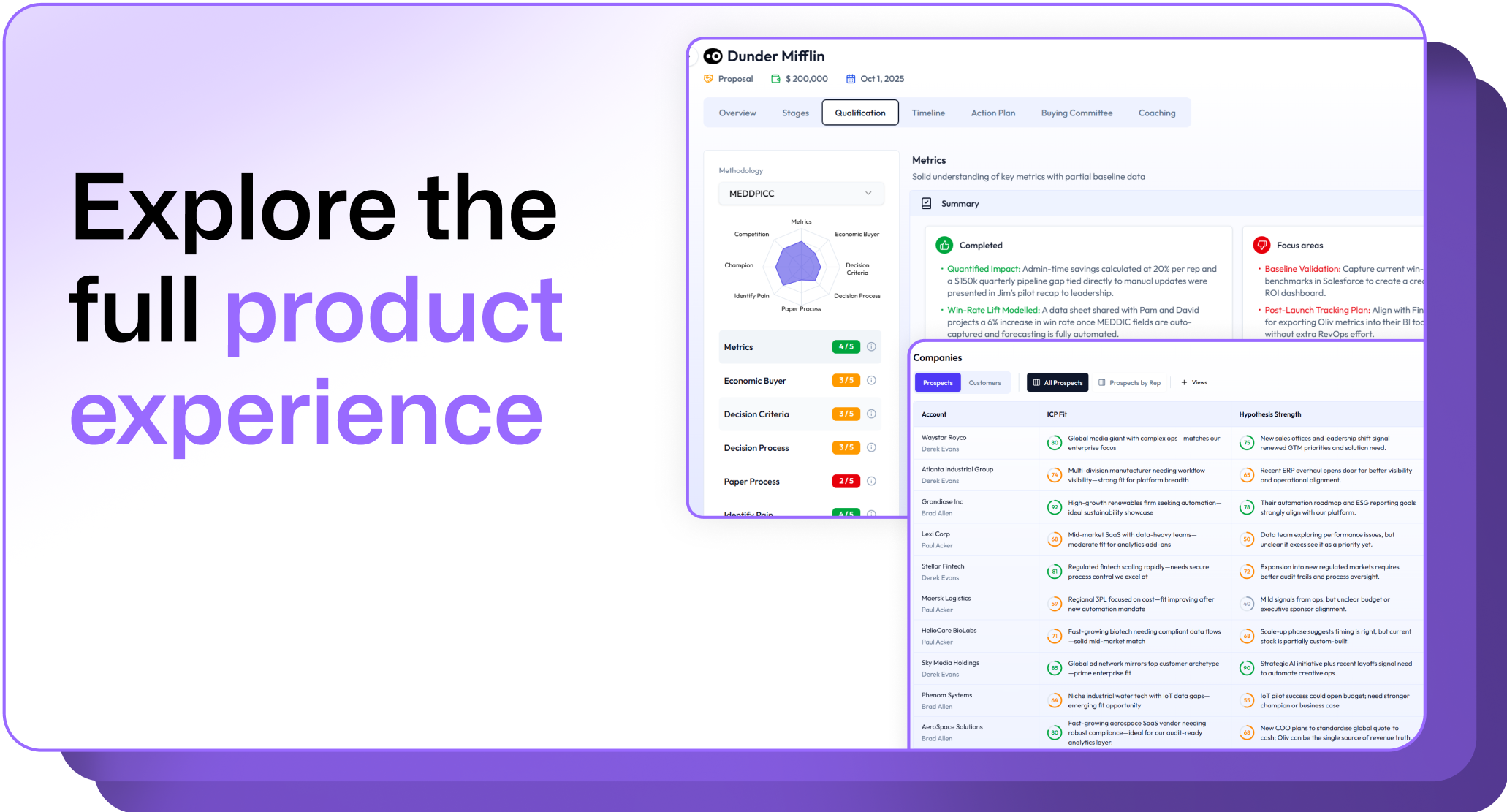
.avif)
.png)