Build vs. Buy in Enterprise GTM: Why Building Custom Revenue Agents in Claude Hits a Wall at Production
Written by
Ishan Chhabra
Last Updated :
September 22, 2026
Skim in :
13
mins
In this article
Revenue teams love Oliv
Here’s why:
All your deal data unified (from 30+ tools and tabs).
Insights are delivered to you directly, no digging.
AI agents automate tasks for you.
Thank you! Your submission has been received!
Oops! Something went wrong while submitting the form.
Meet Oliv’s AI Agents
Hi! I’m, Deal Driver
I track deals, flag risks, send weekly pipeline updates and give sales managers full visibility into deal progress
Hi! I’m, CRM Manager
I maintain CRM hygiene by updating core, custom and qualification fields all without your team lifting a finger
Hi! I’m, Forecaster
I build accurate forecasts based on real deal movement and tell you which deals to pull in to hit your number
Hi! I’m, Coach
I believe performance fuels revenue. I spot skill gaps, score calls and build coaching plans to help every rep level up
Hi! I’m, Prospector
I dig into target accounts to surface the right contacts, tailor and time outreach so you always strike when it counts
Hi! I’m, Pipeline tracker
I call reps to get deal updates, and deliver a real-time, CRM-synced roll-up view of deal progress
Hi! I’m, Analyst
I answer complex pipeline questions, uncover deal patterns, and build reports that guide strategic decisions
TL;DR
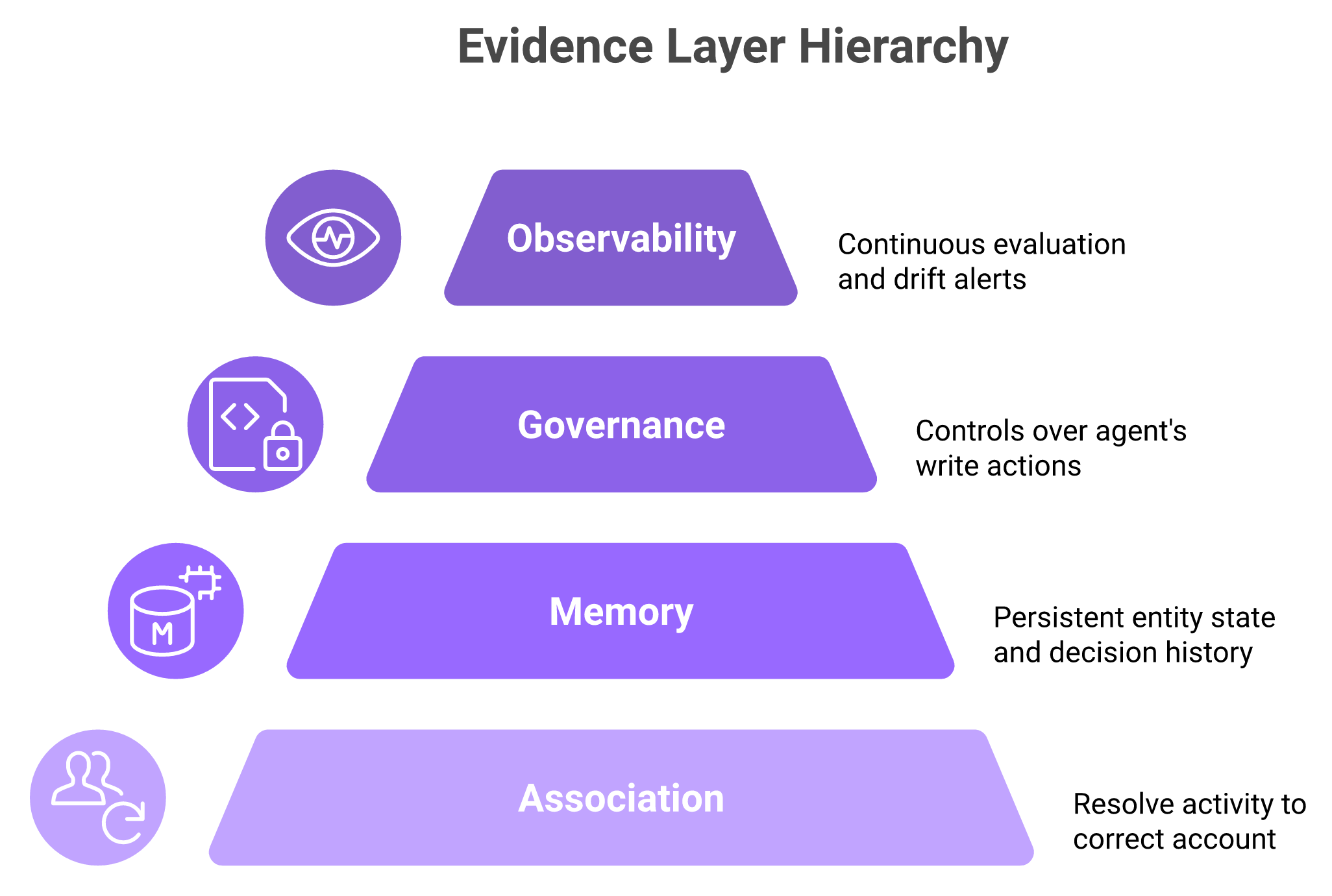
The gap between a working Claude prototype and production is not model quality. It is the evidence layer: entity association, persistent memory, governance, and observability.
A prototype is judged on producing a good answer. Production is judged on being wrong rarely, visibly, and recoverably, which no demo ever tests.
Five failure modes recur: wrong-opportunity association, session-scoped memory, ungoverned CRM writes, no continuous evaluation, and a playbook nobody documented.
MCP and agent frameworks are genuinely collapsing the plumbing. They do not touch company knowledge, so sort your backlog into those two columns.
Third-party 2026 benchmarks put the initial build at roughly a quarter to a third of three-year cost, and the unhired GTM engineer decides whether agents survive.
The usable rule: build while it is personal, buy when the team depends on it. Apply it per workflow, and apply it to vendors including Oliv AI.
Q1. You are 80% Done, So Why Is Production Further Away Than It Was in Month One? [toc=1. The Last 20%]
⭐ The short answer
The last 20 percent is not features. It is infrastructure: entity association, persistent memory, governance, and observability. A prototype is judged on whether it can produce a good answer. Production is judged on whether it is wrong rarely, visibly, and recoverably. Nothing in a demo tests the second one. The 80 percent is real, because it established what good output looks like for your business. The remainder is a different category of work, which is why the estimate keeps slipping.
⚠️ The demo worked, and that was never the question
I have watched this exact week play out. A VP Engineering wires Claude to Salesforce over a weekend, feeds it three accounts, and asks for a deal summary. It comes back sharper than what the AE typed into the CRM on Friday.
The CRO sees it on Tuesday and starts asking when it ships. That question is reasonable, and it is also where the trouble starts. The demo proved the model can reason about a deal. It did not prove anything about the system around the model.
❌ What "working" actually meant
Look at what the prototype was tested on. One clean account. One open opportunity. A transcript you picked because it was a good conversation.
That is the happy path, and the happy path is roughly 10 percent of live CRM traffic in the mid-market accounts I see. The other 90 percent is duplicate records, two opportunities open on the same logo, a champion referred to only as "the CFO," and a company that changed its email domain after an acquisition. None of that showed up in the demo, because you were not testing for it. This is the same CRM data quality problem RevOps teams have been absorbing manually for a decade.
⏰ The criterion changes, and nobody announces it
Here is the shift that breaks timelines. In a prototype, you evaluate quality. In production, you evaluate recoverability.
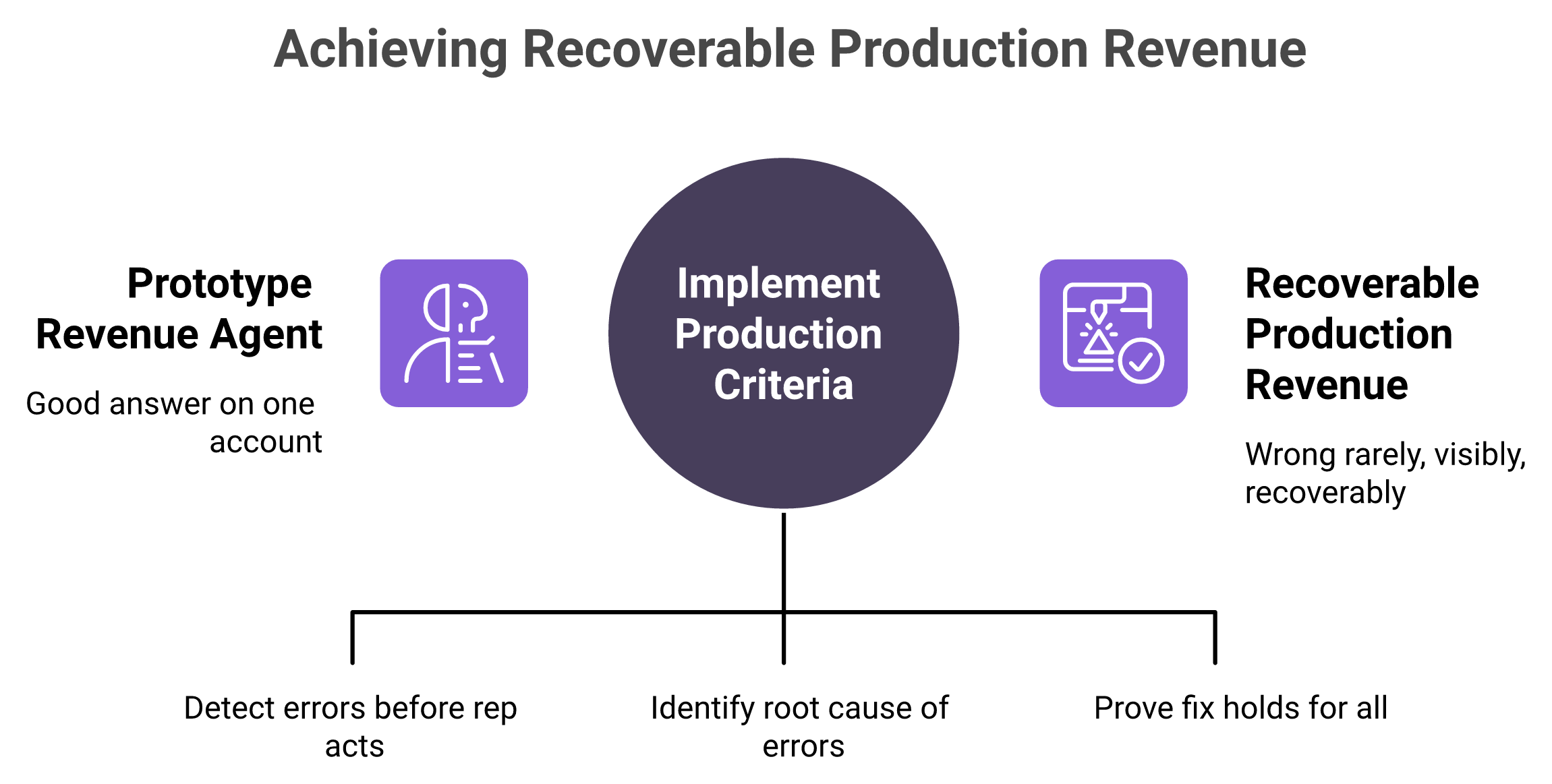
Recoverability means three things. When the agent is wrong, someone notices before a rep acts on it. When someone disputes a field, you can show what the agent saw and why it chose. And when you fix the cause, you can prove the fix held across every account, not just the one that complained.
The same agent, judged twice: a demo measures whether the answer was good, while production measures whether errors are rare, visible, and reversible.
Quality is a model problem. Recoverability is an evidence problem, and evidence layers are engineering, not prompting.
💸 Where the estimates actually go wrong
Infrastructure estimates go wrong because the work is invisible until it fails. Nobody schedules a sprint for "figure out which opportunity this call belongs to," yet that single question can absorb a quarter.
Oliv AI publishes the list of what sits between a working prototype and a production revenue agent: harness, learning loop, context graph, memory management, governance, traceability, observability, monitoring, safety standardisation, and documented company process. Our own build vs buy page puts it plainly, describing the demo as "the tip of the iceberg, a few connections, a workflow that runs locally," and we go deeper on the same trade-off in our build vs buy revenue AI guide.
Nine of those ten items are infrastructure. Not one of them was what your demo was judged on. That gap is the honest reason production feels further away in month four than it did in month one.
✅ The exercise to run before your next CRO conversation
Open your backlog. Put every remaining item in one of two columns: plumbing, or company knowledge.
Plumbing is connectors, retries, auth, hosting, and schema mapping. Company knowledge is your object model, your qualification bar, your exceptions, and when a deal goes to legal. Both columns are real work. Only one of them is yours no matter what you decide next, and that distinction runs through the rest of this article.
Q2. What Does Build Versus Buy Actually Mean Once the Unit Is an Agent, Not an App? [toc=2. What Build vs Buy Means]
✅ Answer in one paragraph
Build versus buy for sales AI means choosing between owning the full agent stack (runtime, context, memory, governance, observability) and licensing a layer you configure. There are three paths, not two: build everything yourself, buy a packaged platform, or buy the context and evidence layer and keep building your own agents on top of it. Build when the agent is your differentiation. Buy when your revenue team depends on it daily. Most production systems end up hybrid, split workflow by workflow rather than by a single company decision.
⭐ Why the old binary does not transfer
With apps, build versus buy was a clean question. You were choosing who wrote the features and who hosted the database.
With agents, the model is a commodity you rent either way. What you are really choosing is who owns the four layers underneath it. DevRev's 2026 framework makes the same point from the other direction, arguing the useful question is not build or buy, but what you build on top of. SimplAI defines "build" specifically as owning the runtime, memory, evaluations, and observability forever, not as writing the first version.
📊 The three paths, side by side
Build, Buy, or Buy the Layer: Who Owns What
What you own
Build it all in Claude
Buy a packaged platform
Buy the layer, build the agents
Agent runtime and orchestration
You
Vendor
You
Entity association and memory
You
Vendor, usually fixed
Vendor, queryable
Governance and audit evidence
You
Vendor, their format
Vendor, exportable
Time to first production deployment
Longest of the three; third-party 2026 benchmarks put internal builds at 4 to 12 months against 2 to 8 weeks for configured platforms
Shortest
Between the two
What you keep if you leave
Everything
Exports, rarely the reasoning
Your data, plus agents you wrote
Who maintains it on a Tuesday
Your engineers
Vendor plus an admin
Shared
⚠️ The honest read on each column
Column one is right when the agent is the differentiator and one engineer owns it end to end. Column two is right for genuinely standard workflows where your process is not unusual.
Column three is the one the category under-discusses, and it is where most teams with a working prototype actually land. You already wrote agents you like. Replacing them is a rewrite. Feeding them a maintained context layer is not, which is the architecture we unpack in our RevOps guide to implementing agentic AI.
💰 Split by workflow, not by decree
The other correction worth making is scope. Build versus buy is not a company-level verdict. It is a per-workflow one.
Meeting capture and CRM field hygiene are standard across every B2B company I have sat with, so building them yields nothing. Your renewal risk model, which encodes what your own churn looked like, is differentiated and worth building. Sorting your roadmap this way usually shrinks the build list by more than half, which is a better outcome than either extreme.
⭐ Where Oliv AI sits
Oliv AI occupies the third column rather than the second. We sell the context, memory, and governance layer, and expose it through MCP and warehouse sync so your own orchestration can read it, which is why this article treats buying-the-layer as a live option rather than a compromise. You can see the connector surface on our integrations page, and the wider category map in our rundown of revenue orchestration platforms. If your prototype already works, that column is the one worth pricing first.
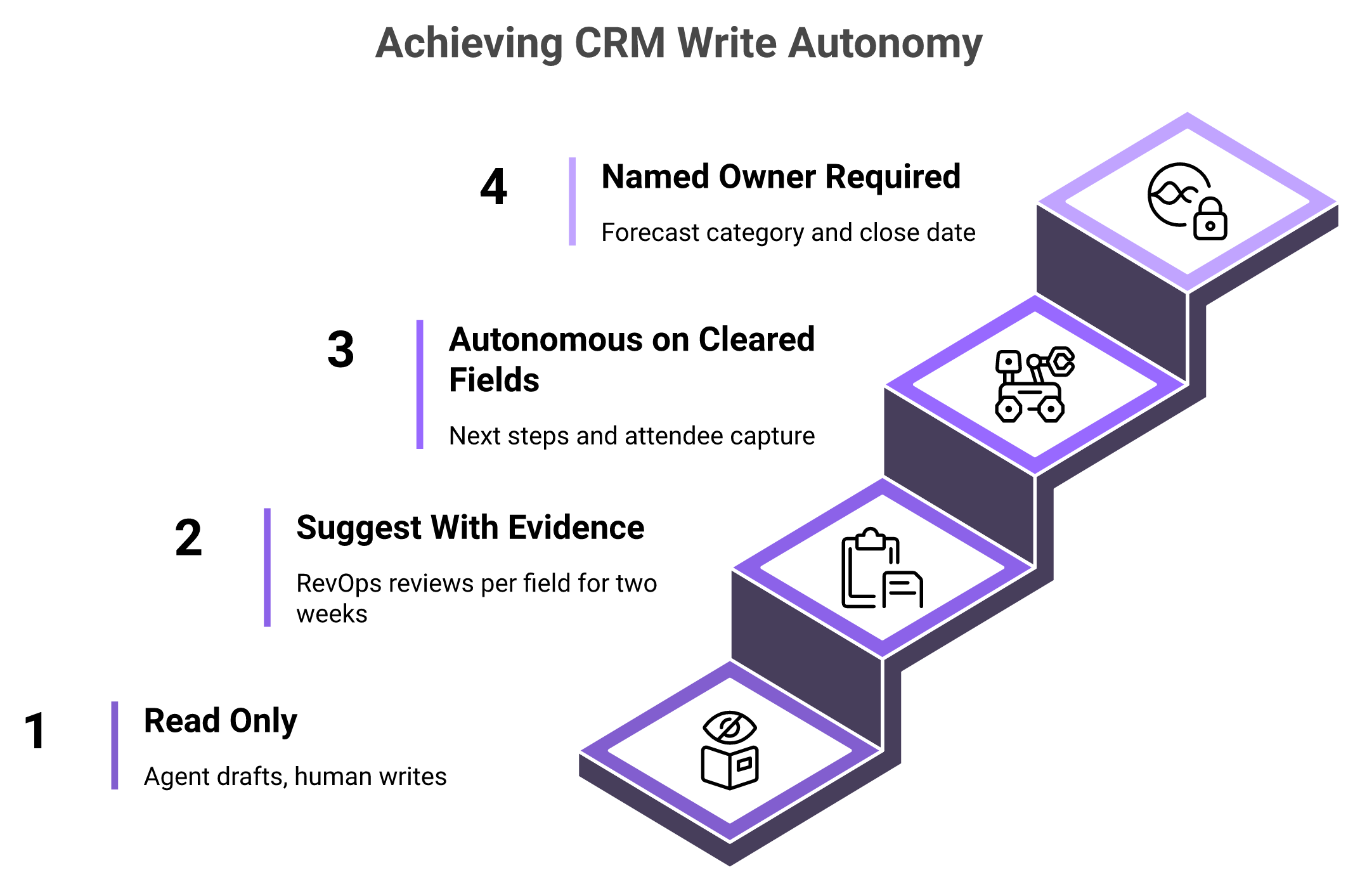
Autonomy over CRM fields is promoted in stages, with evidence links, reversible writes, and retained logs constant throughout.
Q3. Why Does Your Agent Keep Attaching the Right Activity to the Wrong Opportunity? [toc=3. Failure One: Association]
Because domain-lookup association fails silently the moment reality gets complicated: three open opportunities on one account, a call covering two accounts, a renamed domain after an acquisition, duplicate records. The lookup still returns an answer, just the wrong one, and the agent acts on it with full confidence. Oliv AI's Object Graph handles this with reasoning-based resolution, weighing every open opportunity, relationship history, and conversation context before placing an activity, then recording why it chose. Confidence without traceability is the actual defect.
The four layers that separate a working prototype from a production revenue agent, each with the failure it causes when missing.
❌ RevOps finds this before you do
The first report is never "the AI is broken." It is a RevOps lead saying the Q3 renewal has a discovery-call summary on it that clearly belongs to the new-business deal.
Nobody flagged it for a week, because the summary read perfectly well. It was a good answer filed against the wrong object. That is the signature of an association failure, and it is the one I would test for first.
⚠️ Rule-based mapping is an assumption, not laziness
Almost every stack does this the same way: read the participant's email domain, find the account, find the open opportunity, attach. That logic is not careless. It was written when a CRM was assumed to be reasonably clean.
The assumption is what fails. In mid-market accounts, five open opportunities across three duplicate account records is normal, not pathological. A static lookup has no way to choose between them, so it picks one and moves on, which is why CRM data strategy decides how far any agent can get.
Practitioners recognise this pattern from their existing tools, well before agents entered the picture.
"limitations of getting data back into salesforce" — Verified user, 3.0 stars, Gong, G2 Verified Review, 21 May 2026
"I often have trouble logging meetings, and certain features feel clunky or overly manual." — Verified user, 2.5 stars, Salesloft, G2 Verified Review, 22 July 2025
✅ Four scenarios that break the lookup
Multiple opportunities open in the same account, at different stages
One call that covers two accounts, or a partner plus an end customer
A company acquired, with the email domain changed mid-cycle
Duplicate and stale records, where the newest is not the live one
⏰ What changed, and what it costs
Reasoning models can now do what a rep does in three seconds. A seller scans their open accounts, weighs who was on the call, remembers last quarter's conversation, and places it correctly.
Oliv AI's read is that this is the wall builders underestimate most, because it looks like a data-cleanup task and behaves like a core product surface. I might be over-weighting it from the accounts we see, though every build conversation I have had this year eventually arrived here.
⭐ How Oliv AI handles association, and what it will not do
Oliv AI treats association as a product surface rather than preprocessing. Our Object Graph reasons across every open account and opportunity, relationship history, conversation context, and live company news before placing an activity, and it writes down the reason so RevOps can audit the choice later. The evaluation criteria for that kind of write access sit in our note on whether you can trust AI with your CRM.
Two limits, stated plainly. Oliv AI does not clean your historical CRM data, and it does not decide what counts as a duplicate inside your business. Those remain your calls. Customers describe the downstream effect rather than the mechanism:
"It auto-updates CRM records, keeping data clean and accurate. The ice breaker feature provides personalized talking points and centralizes revenue data." — Verified user, 4.5 stars, Oliv AI G2 - Verified Review, 23 June 2026
Q4. Aren't MCP and Agent Frameworks Closing This Gap Anyway? [toc=4. Plumbing vs Company Knowledge]
Partly, and the trend is real. Oliv AI ships MCP itself, so there is no pretending otherwise. Tooling is collapsing the plumbing: connectors, tool calling, retries, transport, schema discovery. It does not touch company-specific knowledge, meaning your object model, your qualification bar, your exceptions, and your escalation rules. Nobody ships those. So split your backlog into two columns: plumbing, which gets cheaper every quarter and may not be worth building now, and company knowledge, which never gets cheaper and is yours whether you build or buy.
⚠️ The counter-argument, at full strength
An architect said this to me almost word for word, and it is the strongest objection in this whole debate. Six months ago you hand-wrote every integration. Now the Model Context Protocol gives you a standard way to expose tools and data to any model, with a growing catalogue of servers you did not write.
So why buy a layer that standards are commoditising? If you wait two quarters, the argument goes, the hard part is free. I take that seriously, because the direction is correct.
✅ What standardisation genuinely removed
Be specific about the win, because it is real:
One protocol instead of a bespoke client per system of record
Tool discovery and invocation you no longer hand-roll
A shared shape for auth, permissions, and transport
Portability, so swapping the model does not mean rewriting the connectors
That is weeks of work gone, permanently. Anyone who tells you otherwise has not shipped against it.
❌ What it did not touch
Access is not context. A protocol can hand your agent every field in Salesforce and still leave it unable to say which of three open opportunities this call belongs to.
Oliv AI's published position makes this argument against itself, listing every MCP server, API path, object schema, and field mapping as governed infrastructure someone maintains, not one-time setup. Standards reduce how hard each connection is to build. They do not reduce how many need keeping alive when a schema moves on a Thursday, which is the same maintenance tax that shows up in any revenue intelligence integration project.
And nothing in any catalogue encodes that your enterprise deals need legal review above 250 seats, or that a discount over 15 percent goes to the CRO. That is company knowledge, and it does not have a server.
📊 The two-column exercise
Sorting Your Remaining Backlog: Plumbing or Company Knowledge
Remaining backlog item
Plumbing or company knowledge
Salesforce and Gmail connectors, auth, retries
Plumbing, getting cheaper, stop building
Which opportunity a call belongs to
Company knowledge, your object model
Hosting, queueing, and rate limits
Plumbing, buy or rent
When a deal is genuinely qualified
Company knowledge, only you have it
Run this against your own list this week. In most builds I see, plumbing is the longer column and company knowledge is the one nobody has written down at all. Your methodology is the clearest example, and we cover how it gets encoded in our piece on auto-scoring MEDDIC, BANT, and SPICED from calls.
⭐ Where this leaves the decision
Oliv AI benefits from the same trend, and we say so: the protocol layer makes our own connector surface cheaper to maintain, and it makes your context portable out of us as well as into us.
The criterion that survives is the split itself. Plumbing is depreciating work, so buying or renting it is rational. Company knowledge appreciates, and it stays your obligation on either path. Which is why the remaining failure modes in this article are all company-knowledge problems wearing infrastructure clothes.
Q5. How Do You Give an Agent Memory That Survives the Session? [toc=5. Failure Two: Memory]
⭐ Answer first
You build it outside the model. Agent runtimes give you a session by design, not an institutional memory: state ends when the session ends, and two agents do not share what either one learned. Production needs four persistent layers, namely entity state, decision history with reasons, cross-agent shared context, and per-user private memory. Oliv AI scopes memory in three permissioned tiers (a global handbook every agent reads, per-agent context, and personal memory private to a rep). The test: ask the same question on Monday and Thursday after a deal moves.
⚠️ Session scope is a design choice, not a gap
Anthropic's Agent SDK documentation is clear about what a session is: context that persists for the run, with compaction as it grows, and resumption only if you explicitly store and resume it. That is a sensible boundary for a framework. It is simply not an institutional memory.
The symptom looks like forgetfulness. Your agent gave a sharp renewal summary on Tuesday. On Friday, after the customer escalated, it summarises as if the escalation never happened. This is the same blind spot that limits conversation intelligence compared with revenue intelligence.
✅ The four layers production actually needs
Entity state. The current truth about each account and opportunity, updated as things change. Without it, every run re-derives reality from scratch and pays for it in tokens.
Decision history with reasons. Not just what the agent did, but what it saw and why it chose. Without it, RevOps cannot settle a dispute six weeks later.
Cross-agent shared context. What your prospecting agent learned should be visible to your forecasting agent. Without it, two agents contradict each other in the same week.
Per-user private memory. A rep's own notes and preferences, scoped to them. Without it, you either leak private context or lose it.
Practitioners recognise the staleness problem from tools that predate agents entirely.
"First tool I've used in my tech stack with an extension goes 'stale' you have to refresh all CRM and Salesloft related tabs in your browser to pull updates within the extension. Data updates like contact information sometimes does not update." — Verified user, 1.5 stars, Salesloft, G2 Verified Review, 26 March 2025
⏰ A three-step test you can run this week
Ask the agent a deal question on Monday. Save the answer verbatim.
Change something real in the CRM, for example move the stage or add a competitor mention.
Ask the identical question on Thursday, in a brand new session.
If the answer is the same, you have no entity state. If it changed but the agent cannot tell you which input changed it, you have no decision history. Both failures pass a demo easily.
💸 The cost nobody budgets for
Missing memory shows up on the bill before it shows up in quality. Every prompt rebuilds context that should already exist, so token spend scales with conversations instead of with change. That is the same arithmetic behind reducing sales tech stack costs, only now the meter runs per prompt.
Oliv AI's read is that this is where DIY economics quietly break, and I might be weighting the token line too heavily, though it is the first number that surprises teams when they move from ten accounts to a thousand.
⭐ How Oliv AI tiers memory
Oliv AI runs memory in three scopes rather than one store: a global handbook every agent reads, per-agent context for the job at hand, and personal memory that stays private to an individual rep, each with its own permissions. Users describe the effect as arriving prepared rather than as a memory feature, which is also how our AI meeting preparation tool shows up in a rep's day.
"The Revenue Harness and Context Graph are standouts, giving me detailed briefs before every call and saving me over 10 hours a week on admin tasks." — Verified user, 5.0 stars, Oliv AI G2 - Verified Review, 2 July 2026
If you are building, copy the tiering before you copy anything else. A single shared memory store is the decision that forces a rewrite in month six.
Q6. What Governance and Compliance Does an Agent Writing to a Live CRM Need in 2026? [toc=6. Failure Three: Governance]
✅ The direct answer
Five controls: field-level write scoping, per-field human review before first-run writes, an evidence link from every change to the moment that triggered it, reversible writes, and retained logs. Compliance adds two hard requirements. EU AI Act Article 50 transparency has been enforceable since 2 August 2026, so an agent interacting with a person must disclose that it is AI. All-party recording consent applies in 13 US states plus GDPR, UK, and PIPEDA jurisdictions. Oliv AI surfaces each proposed CRM update with the conversational moment that triggered it, accepted, edited, or rejected per field.
⚠️ The five controls, and what each one prevents
Field-level write scoping. List the fields the agent may touch. Without it, one prompt change rewrites close dates across the pipeline.
Per-field human review on first run. Accept, edit, or reject each proposed value. Without it, your first bad write lands in a board deck.
Evidence links. Every change points to the sentence that caused it. Without it, a disputed field becomes an unresolvable argument.
Reversible writes. You can roll back a batch. Without it, remediation means a data restore.
Retained logs. Inputs, outputs, and decisions, kept. Without it, you cannot answer an auditor or a customer.
"The fact that you can't edit a recording (to only share a portion with a client), and the fact that if you stop working with the tool you lose the data." — Verified user, 3.0 stars, Gong, G2 Verified Review, 3 October 2025
⏰ What changed in 2026
Article 50 of the EU AI Act became enforceable on 2 August 2026, and the Commission's final transparency guidelines cover agents explicitly: a person interacting with one must be told it is AI, and on whose behalf it acts. Penalties reach 35 million euros or 7 percent of global turnover.
The high-risk obligations under Annex III were deferred to 2 December 2027 by the Digital Omnibus. So you have time on classification, and no time at all on disclosure.
Recording consent is the older trap. Thirteen US states require all-party consent, and GDPR, UK, and PIPEDA regimes add their own notice duties. An agent that joins calls inherits every one of those obligations, which is worth checking against your DPA and security posture before it starts writing.
✅ Earn autonomy field by field
Do not flip a switch from read-only to autonomous. Promote individual fields:
Stage 1. Read only. The agent drafts, a human writes.
Stage 2. Suggest with evidence. RevOps reviews per field for two weeks.
Stage 3. Autonomous on fields that cleared review consistently, for example next steps and attendee capture.
Stage 4. Never autonomous on forecast category or close date without a named owner.
⭐ How Oliv AI handles this, and the split worth copying
Oliv AI ships traceability as the default rather than an option: every proposed CRM update appears with the exact moment in the conversation that triggered it, and nothing changes without a reason you can trace. We also split our two super-agents on permission instead of capability, with Olivia asking before acting and Oliver acting without asking. Our longer treatment of trust and risk lives in Can You Trust AI With Your CRM.
"It doesn't just record meetings; it automatically captures key insights, updates systems of record, identifies next steps, and helps keep teams aligned. As a result, we've seen better CRM hygiene, less administrative overhead." — Verified user, 5.0 stars, Oliv AI G2 - Verified Review, 23 June 2026
Copy the permission split whether or not you buy anything. Separating what an agent knows from what it is allowed to write is the cheapest governance decision available to you.
Q7. How Do You Find Out the Agent Was Wrong Before the Rep Does? [toc=7. Failure Four: Evaluation]
⭐ Straight answer
You need evaluation that runs continuously, not review that runs when someone complains. Three artefacts do the work: a labelled regression set of real accounts with known-correct answers, per-run traces capturing inputs, retrieved context, and the chosen action, and a drift alert when output distribution shifts after a prompt, model, or schema change. Oliv AI ships evals and audit as harness components attached to every agent rather than as a separate purchase. Spot-checking works at twenty accounts and fails at two thousand.
❌ Why revenue work hides its own errors
In most software, a wrong answer looks wrong. In revenue work it does not. A hallucinated next step reads exactly like a correct one, because both are plausible sentences about a deal.
That is the whole problem. Silence is not evidence your system is working. It is evidence nobody has checked.
✅ Artefact one: a labelled regression set
Pick 50 real accounts, spread across messy and clean, and write down the correct answer for each question your agent handles. Yes, by hand, with your best rep or RevOps lead.
Run the set on every change. Without it you have opinions about quality, not measurements. Evaluation tooling now assumes this shape: LangSmith's documentation treats a dataset of examples with reference outputs as the unit of evaluation, scored by graders you define.
✅ Artefact two: per-run traces
Store what went in, what context was retrieved, what the agent chose, and what it wrote. Traces are what turn "the agent was wrong" into "the agent retrieved the wrong opportunity on 14 March."
Without traces, debugging is re-enactment. You try to reproduce a failure from a rep's memory of a summary they half-read. The same discipline underpins any attempt to run evidence-based forecast commits.
⏰ Artefact three: drift alerts on your own changes
The most common silent regression is self-inflicted. You upgrade a model, tighten a prompt, or someone in RevOps renames a custom field.
Nothing errors. Output quality shifts by a few percent, in a direction nobody notices, across every account at once. Watch the distribution of outputs, not just the failures: a sudden drop in flagged risks is a signal, not good news.
💸 Where spot-checking stops working
There is a rough threshold I keep seeing. Below roughly a hundred accounts, a careful human reviews everything and the system feels reliable.
Past a thousand, review becomes sampling, and sampling at one percent will miss a defect affecting one deal in twenty for weeks. By the time a rep reports it, the same error is sitting in dozens of opportunities, which is how deal slippage starts looking like a people problem instead of a data one.
⚠️ The uncomfortable budgeting point
Oliv AI's read is that the eval harness is the most deferred line item in every internal build, and the one that decides whether anyone still trusts the output in month six. I have not seen a team regret funding it early, though I accept that is a survivor's view of the ones who did.
Treat it as its own workstream, with its own owner and its own definition of done. It is not a task inside the agent sprint.
⭐ How Oliv AI packages this
Oliv AI lists memory, guardrails, evals, and audit as components of the agent harness that ships with every agent, rather than as observability you assemble separately. That packaging is the practical difference between buying a layer and building one, because the eval set and the trace store are the two things nobody wants to own on a Tuesday.
If you are building anyway, the sequence matters. Regression set first, traces second, drift alerts third. Anything else and you are measuring after the fact.
Q8. Why Does an Agent With Clean Data and Full Context Still Act Like a New Hire? [toc=8. Failure Five: The Playbook]
✅ Short version
Because data records what happened, not what should happen. The agent does not know your ICP, your qualification bar, when a deal goes to legal, or what triggers a discount, because that knowledge lives in people's heads and in documents that drifted weeks ago. You cannot solve a documentation problem at query time: retrieval returns the closest-matching document, including aspirational ones, and breaks when two sources contradict. Oliv AI's Process Graph holds this as a maintained playbook written for agents, in three scopes, with conflicts documented rather than hidden.
⚠️ The output that is correct and still wrong
This failure is subtle, and it arrives late. The agent's summary is accurate. Every fact checks out. And no sales manager would have written it.
It says the deal is healthy because the champion is engaged. Your manager would have said the deal is stuck, because there is no economic buyer on any call and your qualification bar requires one by stage three. The agent had the data. It did not have the standard.
❌ Why retrieval over your wiki does not fix it
The instinct is to point the agent at the sales handbook in Notion or Drive. I have watched this fail three ways.
The handbook describes the process someone wanted in 2024. The real process has twelve exceptions that were agreed verbally. And when two documents disagree, retrieval picks the closest match and presents it with confidence, which is worse than admitting confusion.
"I really like Clari's excellent user experience. It truly shines in weekly forecasts and opportunity analysis. I'm concerned that the advanced 'Flow View' and 'Waterfall View' aren't working well." — Verified user, 2.5 stars, Clari, G2 Verified Review, 16 November 2025
Good analytics on an undocumented process still leaves the interpretation to a human. That is the gap agents inherit.
⏰ What changed: synthesise before, not during
The shift is from retrieval at query time to synthesis in advance. Instead of finding a document when asked, you build the understanding first, resolve what the current rule actually is, and record where sources contradict each other.
That last part matters more than it sounds. A playbook that flags "two sources disagree on discount authority" is more useful than one that quietly picks a side. Contradiction is information, not noise.
This is also where methodology becomes real. MEDDPICC and SPICED are not fields to fill in, they are qualification rules, and an agent can only apply them if someone has written down what "metrics identified" means in your business. Our breakdown of the MEDDIC sales methodology and the SPICED sales methodology is where that definition work usually starts.
⭐ How Oliv AI handles the playbook, and what it will not do
Oliv AI's Process Graph is the revenue playbook written for agents, maintained in three scopes (a global handbook, per-agent context, and personal memory), and it documents conflicts between sources instead of resolving them silently. Users tend to notice it through custom methodology support rather than as an architecture, and the mechanics sit in our piece on auto-scoring MEDDIC, BANT, and SPICED from calls.
"It's incredibly helpful with our custom sales methodologies like MEDIC-BAND, as it helps me fill all of them out. Oliv.ai has agents like the CRM agent, deal driver agent, and forecast agent." — Verified user, 5.0 stars, Oliv AI G2 - Verified Review, 15 June 2026
Stated plainly: Oliv AI does not write your process for you. Extracting what your best rep knows is your work on either path.
✅ The exercise, and it takes an hour
Write down five exceptions your best rep knows and nobody documented. Then search your entire repository for them.
In my experience you will find zero or one. That result, not a vendor demo, is the honest measure of how far your prototype is from production.
Q9. What Does It Cost to Keep Running Once It Works, and Who Owns It on a Tuesday? [toc=9. Run Cost and Ownership]
⭐ Answer up front
Far more than the build. Third-party 2026 benchmarks put initial construction at roughly a quarter to a third of three-year total cost, with the balance going to maintenance, evaluation, schema changes, and incident response. The comparison turns on volume, not principle. The harder question is ownership: someone has to maintain prompts, re-run evaluations after a model change, and answer RevOps when a field is wrong. That person is a GTM engineer, a role most teams have not hired. Unowned agents get switched off.
💰 Where three years of cost actually sits
Three-Year Cost of Running a Custom Revenue Agent
Cost line
What it covers
Rough share of three-year cost
Build
First working version, connectors, prompts
25 to 35 percent
Maintain
Schema changes, broken connectors, model upgrades
The largest ongoing line
Evaluate
Regression sets, traces, drift checks
Usually unbudgeted at first
Incident response
Bad writes, disputed fields, rollbacks
Spiky and unpredictable
Inference
Tokens per run, rising with context size
Scales with volume, not headcount
The last row is where per-token and per-seat economics cross. Published 2026 analysis puts the crossover for agent workloads near a million conversations a year, with frontier model input and output priced per million tokens. Below that, seats are usually cheaper. Above it, owning the token line starts to matter, which is the same calculation behind revenue tech stack consolidation.
⚠️ Maintenance is the line buyers underestimate, on both paths
This is not a build-only problem. Integration upkeep shows up in reviews of packaged tools too.
"Real Time integrations can be time consuming." — Verified user, 2.5 stars, Gong, G2 Verified Review, 21 April 2026
I read that as the honest baseline. Whoever owns the pipes, someone pays attention to them every month, which is why CRM integration maintenance deserves a line in the plan rather than a footnote.
❌ The role nobody has hired
Ask a simple question inside your own org: who re-runs the evaluation set after Anthropic ships a new model? In most teams I talk to, the answer is a name, said with a laugh, of the one engineer who built it and has a real roadmap.
That is the GTM engineer, meaning someone who understands revenue process and can ship against it. Gartner's 2025 analysis of agentic project cancellations names escalating cost, unclear business value, and inadequate risk controls as the drivers, which are all ownership symptoms rather than model problems. Staffing for that reality is the practical half of building a revenue operations function.
⏰ What happens with no owner
The pattern is consistent and quiet. Month one, the agent is great. Month four, a field mapping changes and nobody notices.
Month six, a rep stops trusting the summaries and goes back to typing. Month eight, someone asks whether the agent is still running. Nothing failed loudly. It just lost its owner.
⭐ How Oliv AI prices this, and who staffs it
Oliv AI publishes a per-role price ladder (Amplify $0, Converse $19, Sell $49, Grow $79) with agent actions billed at $0.01 per credit, which means you can put our numbers beside your current token spend and do the arithmetic yourself. The full ladder and add-ons sit on our pricing page, and the comparison view is in our revenue intelligence ROI calculator.
On the ownership problem, Oliv AI staffs implementation with in-house forward-deployed engineers rather than a third-party partner, which matters mainly because the scarce resource is the role itself, not the software. Customers tend to describe it in setup terms.
"The initial setup was really easy because the team provided FDE engineers who set everything up, and within less than a week, we were good to go." — Verified user, 4.5 stars, Oliv AI G2 - Verified Review, 17 June 2026
Whichever path you pick, write the owner's name in the plan. Cost you can model. An absent owner is what actually ends these projects.
Q10. Can You Buy the Context Layer and Keep Building Your Own Agents? [toc=10. Buying the Layer]
✅ The honest answer
Yes, and for a team with a working prototype it is usually the only path that is not a rewrite. Oliv AI exposes its context layer through MCP for your own orchestration and syncs to Snowflake and Databricks, so association, memory, and governance become a dependency you read out of rather than a platform you live inside. What does not come back if you leave is the interpretation layer. You re-derive it.
⚠️ The question an architect is actually asking
When an enterprise architect pushes back on buying, the objection is rarely about features. It is this: our entire go-to-market will sit on a layer we do not control.
That deserves a real answer, not reassurance. The only credible one is a description of how you get your data and your context back out, in a form that still works.
❌ Why "we integrate with everything" is not an escape hatch
Integration breadth tells you how data gets in. Reversibility is about what comes out, and in what shape.
Most platforms will export records. Far fewer expose the resolved context, meaning which opportunity an activity belonged to and why. Records without that reasoning are raw material, so you would be rebuilding the association layer from scratch. That is the difference between a dependency and a trap, and it is worth checking before any migration off an incumbent tool.
⏰ What makes a layer dependency reversible
Three mechanisms, and you can test all three during a trial:
Protocol access. Your own agents query the context layer directly, so the vendor is not the only client.
Warehouse sync. Resolved objects land in your Snowflake or Databricks instance, on your side of the line.
Export policy in writing. Full export, no lock-in clauses, documented rather than promised on a call.
Oliv AI publishes its connector surface and export posture, including SOC 2 Type II certification, GDPR and CCPA compliance, AES-256 encryption at rest, and TLS 1.2 or higher in transit, on the integrations page and the public trust centre. The same criteria run through our mid-market buyer guide on governance and SOC 2. Customers mostly notice the CRM side of it.
"I appreciate that it integrates well with platforms like HubSpot and Salesforce, allowing us to capture insights from calls and maintain a complete view of customer interactions." — Verified user, 4.5 stars, Oliv AI G2 - Verified Review, 23 June 2026
⭐ What Oliv AI owns, and what stays yours
Oliv AI owns the layers this article has been describing: entity association across messy CRMs, tiered memory, governance with per-field evidence, and the process layer that encodes how your company sells. Our read is that these are the four you should not hand-build unless they are your differentiation, and the architecture sits in our RevOps data architecture guide.
What stays yours is larger than vendors usually admit. Your qualification bar, your exceptions, your escalation rules, and your agents themselves if you have already written them. Buying the layer does not remove the documentation work. It removes the infrastructure work underneath it.
💸 The objection I would raise if I were you
Here is the part that costs us. Oliv AI is the least publicly proven vendor named in this article: no G2, Capterra, or TrustRadius footprint of the depth Gong or Clari carry, and case studies behind an email gate. For an engineer picking a dependency, thin public evidence is a legitimate reason to hesitate, and I would rather state it than have you discover it. If you want the counter-set, read Gong reviews and Clari reviews and user feedback beside ours.
The product is also still maturing in places, which our own reviews say out loud.
"The only downside I've noticed is that the mobile app is a bit basic compared to the desktop platform." — Verified user, 5.0 stars, Oliv AI G2 - Verified Review, 8 July 2026
Weigh that against the alternative honestly. You are not choosing between a perfect vendor and your build. You are choosing which imperfect dependency you would rather own.
Q11. When Should You Just Finish the Build? [toc=11. When to Finish Building]
⭐ The clearest test I know
Finish it if you have one CRM, reasonably clean data, a handful of use cases, and a named engineer who owns it. That team ships, and buying would slow them down. It stops being true at three thresholds: multiple open opportunities per account, more than one system of record, or the moment someone outside your building depends on the output. The published rule is the cleanest version: build while it is personal, buy when the team depends on it. Apply it per workflow, and apply it to vendors too.
✅ The profile that should keep building
I mean this without hedging. One HubSpot instance, a few hundred accounts, three or four things you want the agent to do, and an engineer whose job includes it.
In that setup, the failure modes in this article are manageable. Association is easy when accounts are unique. Memory is cheap when volume is low. Governance is a conversation with one RevOps person, not a policy. Go and finish it. That profile is also the one we describe in our note on revenue intelligence for a small sales team.
⚠️ The three thresholds where that stops holding
Where your team sits on data complexity and dependency decides the build or buy answer, workflow by workflow.
Multiple open opportunities per account. Association stops being a lookup and becomes a judgement. This is the single hardest wall, and it arrives without warning.
More than one system of record. Two CRMs, or a CRM plus a billing system plus a product database. Now truth has to be reconciled, not just retrieved.
Someone outside your team depends on the output. The moment a CRO reads it in a board deck, or a CSM acts on it, you need traceability and recoverability. Those are infrastructure, and they are where prototypes stall.
A rule beats a recommendation because you can run it against anyone, including the vendor who wrote it. Oliv AI publishes this threshold on our own build vs buy page and applies it against ourselves: personal workflows should stay where they are, because the person running them fills the context gaps from memory.
So run the test before any demo, ours included. Name who depends on the output. If the honest answer is still "me," keep building, and come back when it changes.
💰 Split by workflow, not by decree
The other correction is scope, and it is where most teams get more value than from the build-or-buy verdict itself. Sort workflow by workflow.
Meeting capture and CRM field hygiene. Standard across every B2B company. Building these yields nothing you can point to in a board meeting.
Your renewal risk model. Encodes your own churn history and your own product signals. Differentiated, and worth your engineering time.
Two example splits, and in most roadmaps I see this exercise cuts the build list by more than half. That outcome is better than either extreme, and it is the conclusion the whole category eventually reaches, as we argued in build vs buy for revenue AI.
⭐ Where this leaves you
You have a prototype that works, and nothing in this article says otherwise. What it says is that the remaining distance is association, memory, governance, and observability, and those are infrastructure rather than features. Sort your backlog into plumbing and company knowledge, then decide column by column instead of all at once. That single sheet is also the answer your CRO has been asking for, which is worth more than a timeline you are not confident in. If the parts you would rather not own are the infrastructure ones, book a demo and price the layer against what your team would spend building it.
Q1. You are 80% Done, So Why Is Production Further Away Than It Was in Month One? [toc=1. The Last 20%]
⭐ The short answer
The last 20 percent is not features. It is infrastructure: entity association, persistent memory, governance, and observability. A prototype is judged on whether it can produce a good answer. Production is judged on whether it is wrong rarely, visibly, and recoverably. Nothing in a demo tests the second one. The 80 percent is real, because it established what good output looks like for your business. The remainder is a different category of work, which is why the estimate keeps slipping.
⚠️ The demo worked, and that was never the question
I have watched this exact week play out. A VP Engineering wires Claude to Salesforce over a weekend, feeds it three accounts, and asks for a deal summary. It comes back sharper than what the AE typed into the CRM on Friday.
The CRO sees it on Tuesday and starts asking when it ships. That question is reasonable, and it is also where the trouble starts. The demo proved the model can reason about a deal. It did not prove anything about the system around the model.
❌ What "working" actually meant
Look at what the prototype was tested on. One clean account. One open opportunity. A transcript you picked because it was a good conversation.
That is the happy path, and the happy path is roughly 10 percent of live CRM traffic in the mid-market accounts I see. The other 90 percent is duplicate records, two opportunities open on the same logo, a champion referred to only as "the CFO," and a company that changed its email domain after an acquisition. None of that showed up in the demo, because you were not testing for it. This is the same CRM data quality problem RevOps teams have been absorbing manually for a decade.
⏰ The criterion changes, and nobody announces it
Here is the shift that breaks timelines. In a prototype, you evaluate quality. In production, you evaluate recoverability.
Recoverability means three things. When the agent is wrong, someone notices before a rep acts on it. When someone disputes a field, you can show what the agent saw and why it chose. And when you fix the cause, you can prove the fix held across every account, not just the one that complained.
The same agent, judged twice: a demo measures whether the answer was good, while production measures whether errors are rare, visible, and reversible.
Quality is a model problem. Recoverability is an evidence problem, and evidence layers are engineering, not prompting.
💸 Where the estimates actually go wrong
Infrastructure estimates go wrong because the work is invisible until it fails. Nobody schedules a sprint for "figure out which opportunity this call belongs to," yet that single question can absorb a quarter.
Oliv AI publishes the list of what sits between a working prototype and a production revenue agent: harness, learning loop, context graph, memory management, governance, traceability, observability, monitoring, safety standardisation, and documented company process. Our own build vs buy page puts it plainly, describing the demo as "the tip of the iceberg, a few connections, a workflow that runs locally," and we go deeper on the same trade-off in our build vs buy revenue AI guide.
Nine of those ten items are infrastructure. Not one of them was what your demo was judged on. That gap is the honest reason production feels further away in month four than it did in month one.
✅ The exercise to run before your next CRO conversation
Open your backlog. Put every remaining item in one of two columns: plumbing, or company knowledge.
Plumbing is connectors, retries, auth, hosting, and schema mapping. Company knowledge is your object model, your qualification bar, your exceptions, and when a deal goes to legal. Both columns are real work. Only one of them is yours no matter what you decide next, and that distinction runs through the rest of this article.
Q2. What Does Build Versus Buy Actually Mean Once the Unit Is an Agent, Not an App? [toc=2. What Build vs Buy Means]
✅ Answer in one paragraph
Build versus buy for sales AI means choosing between owning the full agent stack (runtime, context, memory, governance, observability) and licensing a layer you configure. There are three paths, not two: build everything yourself, buy a packaged platform, or buy the context and evidence layer and keep building your own agents on top of it. Build when the agent is your differentiation. Buy when your revenue team depends on it daily. Most production systems end up hybrid, split workflow by workflow rather than by a single company decision.
⭐ Why the old binary does not transfer
With apps, build versus buy was a clean question. You were choosing who wrote the features and who hosted the database.
With agents, the model is a commodity you rent either way. What you are really choosing is who owns the four layers underneath it. DevRev's 2026 framework makes the same point from the other direction, arguing the useful question is not build or buy, but what you build on top of. SimplAI defines "build" specifically as owning the runtime, memory, evaluations, and observability forever, not as writing the first version.
📊 The three paths, side by side
Build, Buy, or Buy the Layer: Who Owns What
What you own
Build it all in Claude
Buy a packaged platform
Buy the layer, build the agents
Agent runtime and orchestration
You
Vendor
You
Entity association and memory
You
Vendor, usually fixed
Vendor, queryable
Governance and audit evidence
You
Vendor, their format
Vendor, exportable
Time to first production deployment
Longest of the three; third-party 2026 benchmarks put internal builds at 4 to 12 months against 2 to 8 weeks for configured platforms
Shortest
Between the two
What you keep if you leave
Everything
Exports, rarely the reasoning
Your data, plus agents you wrote
Who maintains it on a Tuesday
Your engineers
Vendor plus an admin
Shared
⚠️ The honest read on each column
Column one is right when the agent is the differentiator and one engineer owns it end to end. Column two is right for genuinely standard workflows where your process is not unusual.
Column three is the one the category under-discusses, and it is where most teams with a working prototype actually land. You already wrote agents you like. Replacing them is a rewrite. Feeding them a maintained context layer is not, which is the architecture we unpack in our RevOps guide to implementing agentic AI.
💰 Split by workflow, not by decree
The other correction worth making is scope. Build versus buy is not a company-level verdict. It is a per-workflow one.
Meeting capture and CRM field hygiene are standard across every B2B company I have sat with, so building them yields nothing. Your renewal risk model, which encodes what your own churn looked like, is differentiated and worth building. Sorting your roadmap this way usually shrinks the build list by more than half, which is a better outcome than either extreme.
⭐ Where Oliv AI sits
Oliv AI occupies the third column rather than the second. We sell the context, memory, and governance layer, and expose it through MCP and warehouse sync so your own orchestration can read it, which is why this article treats buying-the-layer as a live option rather than a compromise. You can see the connector surface on our integrations page, and the wider category map in our rundown of revenue orchestration platforms. If your prototype already works, that column is the one worth pricing first.
Autonomy over CRM fields is promoted in stages, with evidence links, reversible writes, and retained logs constant throughout.
Q3. Why Does Your Agent Keep Attaching the Right Activity to the Wrong Opportunity? [toc=3. Failure One: Association]
Because domain-lookup association fails silently the moment reality gets complicated: three open opportunities on one account, a call covering two accounts, a renamed domain after an acquisition, duplicate records. The lookup still returns an answer, just the wrong one, and the agent acts on it with full confidence. Oliv AI's Object Graph handles this with reasoning-based resolution, weighing every open opportunity, relationship history, and conversation context before placing an activity, then recording why it chose. Confidence without traceability is the actual defect.
The four layers that separate a working prototype from a production revenue agent, each with the failure it causes when missing.
❌ RevOps finds this before you do
The first report is never "the AI is broken." It is a RevOps lead saying the Q3 renewal has a discovery-call summary on it that clearly belongs to the new-business deal.
Nobody flagged it for a week, because the summary read perfectly well. It was a good answer filed against the wrong object. That is the signature of an association failure, and it is the one I would test for first.
⚠️ Rule-based mapping is an assumption, not laziness
Almost every stack does this the same way: read the participant's email domain, find the account, find the open opportunity, attach. That logic is not careless. It was written when a CRM was assumed to be reasonably clean.
The assumption is what fails. In mid-market accounts, five open opportunities across three duplicate account records is normal, not pathological. A static lookup has no way to choose between them, so it picks one and moves on, which is why CRM data strategy decides how far any agent can get.
Practitioners recognise this pattern from their existing tools, well before agents entered the picture.
"limitations of getting data back into salesforce" — Verified user, 3.0 stars, Gong, G2 Verified Review, 21 May 2026
"I often have trouble logging meetings, and certain features feel clunky or overly manual." — Verified user, 2.5 stars, Salesloft, G2 Verified Review, 22 July 2025
✅ Four scenarios that break the lookup
Multiple opportunities open in the same account, at different stages
One call that covers two accounts, or a partner plus an end customer
A company acquired, with the email domain changed mid-cycle
Duplicate and stale records, where the newest is not the live one
⏰ What changed, and what it costs
Reasoning models can now do what a rep does in three seconds. A seller scans their open accounts, weighs who was on the call, remembers last quarter's conversation, and places it correctly.
Oliv AI's read is that this is the wall builders underestimate most, because it looks like a data-cleanup task and behaves like a core product surface. I might be over-weighting it from the accounts we see, though every build conversation I have had this year eventually arrived here.
⭐ How Oliv AI handles association, and what it will not do
Oliv AI treats association as a product surface rather than preprocessing. Our Object Graph reasons across every open account and opportunity, relationship history, conversation context, and live company news before placing an activity, and it writes down the reason so RevOps can audit the choice later. The evaluation criteria for that kind of write access sit in our note on whether you can trust AI with your CRM.
Two limits, stated plainly. Oliv AI does not clean your historical CRM data, and it does not decide what counts as a duplicate inside your business. Those remain your calls. Customers describe the downstream effect rather than the mechanism:
"It auto-updates CRM records, keeping data clean and accurate. The ice breaker feature provides personalized talking points and centralizes revenue data." — Verified user, 4.5 stars, Oliv AI G2 - Verified Review, 23 June 2026
Q4. Aren't MCP and Agent Frameworks Closing This Gap Anyway? [toc=4. Plumbing vs Company Knowledge]
Partly, and the trend is real. Oliv AI ships MCP itself, so there is no pretending otherwise. Tooling is collapsing the plumbing: connectors, tool calling, retries, transport, schema discovery. It does not touch company-specific knowledge, meaning your object model, your qualification bar, your exceptions, and your escalation rules. Nobody ships those. So split your backlog into two columns: plumbing, which gets cheaper every quarter and may not be worth building now, and company knowledge, which never gets cheaper and is yours whether you build or buy.
⚠️ The counter-argument, at full strength
An architect said this to me almost word for word, and it is the strongest objection in this whole debate. Six months ago you hand-wrote every integration. Now the Model Context Protocol gives you a standard way to expose tools and data to any model, with a growing catalogue of servers you did not write.
So why buy a layer that standards are commoditising? If you wait two quarters, the argument goes, the hard part is free. I take that seriously, because the direction is correct.
✅ What standardisation genuinely removed
Be specific about the win, because it is real:
One protocol instead of a bespoke client per system of record
Tool discovery and invocation you no longer hand-roll
A shared shape for auth, permissions, and transport
Portability, so swapping the model does not mean rewriting the connectors
That is weeks of work gone, permanently. Anyone who tells you otherwise has not shipped against it.
❌ What it did not touch
Access is not context. A protocol can hand your agent every field in Salesforce and still leave it unable to say which of three open opportunities this call belongs to.
Oliv AI's published position makes this argument against itself, listing every MCP server, API path, object schema, and field mapping as governed infrastructure someone maintains, not one-time setup. Standards reduce how hard each connection is to build. They do not reduce how many need keeping alive when a schema moves on a Thursday, which is the same maintenance tax that shows up in any revenue intelligence integration project.
And nothing in any catalogue encodes that your enterprise deals need legal review above 250 seats, or that a discount over 15 percent goes to the CRO. That is company knowledge, and it does not have a server.
📊 The two-column exercise
Sorting Your Remaining Backlog: Plumbing or Company Knowledge
Remaining backlog item
Plumbing or company knowledge
Salesforce and Gmail connectors, auth, retries
Plumbing, getting cheaper, stop building
Which opportunity a call belongs to
Company knowledge, your object model
Hosting, queueing, and rate limits
Plumbing, buy or rent
When a deal is genuinely qualified
Company knowledge, only you have it
Run this against your own list this week. In most builds I see, plumbing is the longer column and company knowledge is the one nobody has written down at all. Your methodology is the clearest example, and we cover how it gets encoded in our piece on auto-scoring MEDDIC, BANT, and SPICED from calls.
⭐ Where this leaves the decision
Oliv AI benefits from the same trend, and we say so: the protocol layer makes our own connector surface cheaper to maintain, and it makes your context portable out of us as well as into us.
The criterion that survives is the split itself. Plumbing is depreciating work, so buying or renting it is rational. Company knowledge appreciates, and it stays your obligation on either path. Which is why the remaining failure modes in this article are all company-knowledge problems wearing infrastructure clothes.
Q5. How Do You Give an Agent Memory That Survives the Session? [toc=5. Failure Two: Memory]
⭐ Answer first
You build it outside the model. Agent runtimes give you a session by design, not an institutional memory: state ends when the session ends, and two agents do not share what either one learned. Production needs four persistent layers, namely entity state, decision history with reasons, cross-agent shared context, and per-user private memory. Oliv AI scopes memory in three permissioned tiers (a global handbook every agent reads, per-agent context, and personal memory private to a rep). The test: ask the same question on Monday and Thursday after a deal moves.
⚠️ Session scope is a design choice, not a gap
Anthropic's Agent SDK documentation is clear about what a session is: context that persists for the run, with compaction as it grows, and resumption only if you explicitly store and resume it. That is a sensible boundary for a framework. It is simply not an institutional memory.
The symptom looks like forgetfulness. Your agent gave a sharp renewal summary on Tuesday. On Friday, after the customer escalated, it summarises as if the escalation never happened. This is the same blind spot that limits conversation intelligence compared with revenue intelligence.
✅ The four layers production actually needs
Entity state. The current truth about each account and opportunity, updated as things change. Without it, every run re-derives reality from scratch and pays for it in tokens.
Decision history with reasons. Not just what the agent did, but what it saw and why it chose. Without it, RevOps cannot settle a dispute six weeks later.
Cross-agent shared context. What your prospecting agent learned should be visible to your forecasting agent. Without it, two agents contradict each other in the same week.
Per-user private memory. A rep's own notes and preferences, scoped to them. Without it, you either leak private context or lose it.
Practitioners recognise the staleness problem from tools that predate agents entirely.
"First tool I've used in my tech stack with an extension goes 'stale' you have to refresh all CRM and Salesloft related tabs in your browser to pull updates within the extension. Data updates like contact information sometimes does not update." — Verified user, 1.5 stars, Salesloft, G2 Verified Review, 26 March 2025
⏰ A three-step test you can run this week
Ask the agent a deal question on Monday. Save the answer verbatim.
Change something real in the CRM, for example move the stage or add a competitor mention.
Ask the identical question on Thursday, in a brand new session.
If the answer is the same, you have no entity state. If it changed but the agent cannot tell you which input changed it, you have no decision history. Both failures pass a demo easily.
💸 The cost nobody budgets for
Missing memory shows up on the bill before it shows up in quality. Every prompt rebuilds context that should already exist, so token spend scales with conversations instead of with change. That is the same arithmetic behind reducing sales tech stack costs, only now the meter runs per prompt.
Oliv AI's read is that this is where DIY economics quietly break, and I might be weighting the token line too heavily, though it is the first number that surprises teams when they move from ten accounts to a thousand.
⭐ How Oliv AI tiers memory
Oliv AI runs memory in three scopes rather than one store: a global handbook every agent reads, per-agent context for the job at hand, and personal memory that stays private to an individual rep, each with its own permissions. Users describe the effect as arriving prepared rather than as a memory feature, which is also how our AI meeting preparation tool shows up in a rep's day.
"The Revenue Harness and Context Graph are standouts, giving me detailed briefs before every call and saving me over 10 hours a week on admin tasks." — Verified user, 5.0 stars, Oliv AI G2 - Verified Review, 2 July 2026
If you are building, copy the tiering before you copy anything else. A single shared memory store is the decision that forces a rewrite in month six.
Q6. What Governance and Compliance Does an Agent Writing to a Live CRM Need in 2026? [toc=6. Failure Three: Governance]
✅ The direct answer
Five controls: field-level write scoping, per-field human review before first-run writes, an evidence link from every change to the moment that triggered it, reversible writes, and retained logs. Compliance adds two hard requirements. EU AI Act Article 50 transparency has been enforceable since 2 August 2026, so an agent interacting with a person must disclose that it is AI. All-party recording consent applies in 13 US states plus GDPR, UK, and PIPEDA jurisdictions. Oliv AI surfaces each proposed CRM update with the conversational moment that triggered it, accepted, edited, or rejected per field.
⚠️ The five controls, and what each one prevents
Field-level write scoping. List the fields the agent may touch. Without it, one prompt change rewrites close dates across the pipeline.
Per-field human review on first run. Accept, edit, or reject each proposed value. Without it, your first bad write lands in a board deck.
Evidence links. Every change points to the sentence that caused it. Without it, a disputed field becomes an unresolvable argument.
Reversible writes. You can roll back a batch. Without it, remediation means a data restore.
Retained logs. Inputs, outputs, and decisions, kept. Without it, you cannot answer an auditor or a customer.
"The fact that you can't edit a recording (to only share a portion with a client), and the fact that if you stop working with the tool you lose the data." — Verified user, 3.0 stars, Gong, G2 Verified Review, 3 October 2025
⏰ What changed in 2026
Article 50 of the EU AI Act became enforceable on 2 August 2026, and the Commission's final transparency guidelines cover agents explicitly: a person interacting with one must be told it is AI, and on whose behalf it acts. Penalties reach 35 million euros or 7 percent of global turnover.
The high-risk obligations under Annex III were deferred to 2 December 2027 by the Digital Omnibus. So you have time on classification, and no time at all on disclosure.
Recording consent is the older trap. Thirteen US states require all-party consent, and GDPR, UK, and PIPEDA regimes add their own notice duties. An agent that joins calls inherits every one of those obligations, which is worth checking against your DPA and security posture before it starts writing.
✅ Earn autonomy field by field
Do not flip a switch from read-only to autonomous. Promote individual fields:
Stage 1. Read only. The agent drafts, a human writes.
Stage 2. Suggest with evidence. RevOps reviews per field for two weeks.
Stage 3. Autonomous on fields that cleared review consistently, for example next steps and attendee capture.
Stage 4. Never autonomous on forecast category or close date without a named owner.
⭐ How Oliv AI handles this, and the split worth copying
Oliv AI ships traceability as the default rather than an option: every proposed CRM update appears with the exact moment in the conversation that triggered it, and nothing changes without a reason you can trace. We also split our two super-agents on permission instead of capability, with Olivia asking before acting and Oliver acting without asking. Our longer treatment of trust and risk lives in Can You Trust AI With Your CRM.
"It doesn't just record meetings; it automatically captures key insights, updates systems of record, identifies next steps, and helps keep teams aligned. As a result, we've seen better CRM hygiene, less administrative overhead." — Verified user, 5.0 stars, Oliv AI G2 - Verified Review, 23 June 2026
Copy the permission split whether or not you buy anything. Separating what an agent knows from what it is allowed to write is the cheapest governance decision available to you.
Q7. How Do You Find Out the Agent Was Wrong Before the Rep Does? [toc=7. Failure Four: Evaluation]
⭐ Straight answer
You need evaluation that runs continuously, not review that runs when someone complains. Three artefacts do the work: a labelled regression set of real accounts with known-correct answers, per-run traces capturing inputs, retrieved context, and the chosen action, and a drift alert when output distribution shifts after a prompt, model, or schema change. Oliv AI ships evals and audit as harness components attached to every agent rather than as a separate purchase. Spot-checking works at twenty accounts and fails at two thousand.
❌ Why revenue work hides its own errors
In most software, a wrong answer looks wrong. In revenue work it does not. A hallucinated next step reads exactly like a correct one, because both are plausible sentences about a deal.
That is the whole problem. Silence is not evidence your system is working. It is evidence nobody has checked.
✅ Artefact one: a labelled regression set
Pick 50 real accounts, spread across messy and clean, and write down the correct answer for each question your agent handles. Yes, by hand, with your best rep or RevOps lead.
Run the set on every change. Without it you have opinions about quality, not measurements. Evaluation tooling now assumes this shape: LangSmith's documentation treats a dataset of examples with reference outputs as the unit of evaluation, scored by graders you define.
✅ Artefact two: per-run traces
Store what went in, what context was retrieved, what the agent chose, and what it wrote. Traces are what turn "the agent was wrong" into "the agent retrieved the wrong opportunity on 14 March."
Without traces, debugging is re-enactment. You try to reproduce a failure from a rep's memory of a summary they half-read. The same discipline underpins any attempt to run evidence-based forecast commits.
⏰ Artefact three: drift alerts on your own changes
The most common silent regression is self-inflicted. You upgrade a model, tighten a prompt, or someone in RevOps renames a custom field.
Nothing errors. Output quality shifts by a few percent, in a direction nobody notices, across every account at once. Watch the distribution of outputs, not just the failures: a sudden drop in flagged risks is a signal, not good news.
💸 Where spot-checking stops working
There is a rough threshold I keep seeing. Below roughly a hundred accounts, a careful human reviews everything and the system feels reliable.
Past a thousand, review becomes sampling, and sampling at one percent will miss a defect affecting one deal in twenty for weeks. By the time a rep reports it, the same error is sitting in dozens of opportunities, which is how deal slippage starts looking like a people problem instead of a data one.
⚠️ The uncomfortable budgeting point
Oliv AI's read is that the eval harness is the most deferred line item in every internal build, and the one that decides whether anyone still trusts the output in month six. I have not seen a team regret funding it early, though I accept that is a survivor's view of the ones who did.
Treat it as its own workstream, with its own owner and its own definition of done. It is not a task inside the agent sprint.
⭐ How Oliv AI packages this
Oliv AI lists memory, guardrails, evals, and audit as components of the agent harness that ships with every agent, rather than as observability you assemble separately. That packaging is the practical difference between buying a layer and building one, because the eval set and the trace store are the two things nobody wants to own on a Tuesday.
If you are building anyway, the sequence matters. Regression set first, traces second, drift alerts third. Anything else and you are measuring after the fact.
Q8. Why Does an Agent With Clean Data and Full Context Still Act Like a New Hire? [toc=8. Failure Five: The Playbook]
✅ Short version
Because data records what happened, not what should happen. The agent does not know your ICP, your qualification bar, when a deal goes to legal, or what triggers a discount, because that knowledge lives in people's heads and in documents that drifted weeks ago. You cannot solve a documentation problem at query time: retrieval returns the closest-matching document, including aspirational ones, and breaks when two sources contradict. Oliv AI's Process Graph holds this as a maintained playbook written for agents, in three scopes, with conflicts documented rather than hidden.
⚠️ The output that is correct and still wrong
This failure is subtle, and it arrives late. The agent's summary is accurate. Every fact checks out. And no sales manager would have written it.
It says the deal is healthy because the champion is engaged. Your manager would have said the deal is stuck, because there is no economic buyer on any call and your qualification bar requires one by stage three. The agent had the data. It did not have the standard.
❌ Why retrieval over your wiki does not fix it
The instinct is to point the agent at the sales handbook in Notion or Drive. I have watched this fail three ways.
The handbook describes the process someone wanted in 2024. The real process has twelve exceptions that were agreed verbally. And when two documents disagree, retrieval picks the closest match and presents it with confidence, which is worse than admitting confusion.
"I really like Clari's excellent user experience. It truly shines in weekly forecasts and opportunity analysis. I'm concerned that the advanced 'Flow View' and 'Waterfall View' aren't working well." — Verified user, 2.5 stars, Clari, G2 Verified Review, 16 November 2025
Good analytics on an undocumented process still leaves the interpretation to a human. That is the gap agents inherit.
⏰ What changed: synthesise before, not during
The shift is from retrieval at query time to synthesis in advance. Instead of finding a document when asked, you build the understanding first, resolve what the current rule actually is, and record where sources contradict each other.
That last part matters more than it sounds. A playbook that flags "two sources disagree on discount authority" is more useful than one that quietly picks a side. Contradiction is information, not noise.
This is also where methodology becomes real. MEDDPICC and SPICED are not fields to fill in, they are qualification rules, and an agent can only apply them if someone has written down what "metrics identified" means in your business. Our breakdown of the MEDDIC sales methodology and the SPICED sales methodology is where that definition work usually starts.
⭐ How Oliv AI handles the playbook, and what it will not do
Oliv AI's Process Graph is the revenue playbook written for agents, maintained in three scopes (a global handbook, per-agent context, and personal memory), and it documents conflicts between sources instead of resolving them silently. Users tend to notice it through custom methodology support rather than as an architecture, and the mechanics sit in our piece on auto-scoring MEDDIC, BANT, and SPICED from calls.
"It's incredibly helpful with our custom sales methodologies like MEDIC-BAND, as it helps me fill all of them out. Oliv.ai has agents like the CRM agent, deal driver agent, and forecast agent." — Verified user, 5.0 stars, Oliv AI G2 - Verified Review, 15 June 2026
Stated plainly: Oliv AI does not write your process for you. Extracting what your best rep knows is your work on either path.
✅ The exercise, and it takes an hour
Write down five exceptions your best rep knows and nobody documented. Then search your entire repository for them.
In my experience you will find zero or one. That result, not a vendor demo, is the honest measure of how far your prototype is from production.
Q9. What Does It Cost to Keep Running Once It Works, and Who Owns It on a Tuesday? [toc=9. Run Cost and Ownership]
⭐ Answer up front
Far more than the build. Third-party 2026 benchmarks put initial construction at roughly a quarter to a third of three-year total cost, with the balance going to maintenance, evaluation, schema changes, and incident response. The comparison turns on volume, not principle. The harder question is ownership: someone has to maintain prompts, re-run evaluations after a model change, and answer RevOps when a field is wrong. That person is a GTM engineer, a role most teams have not hired. Unowned agents get switched off.
💰 Where three years of cost actually sits
Three-Year Cost of Running a Custom Revenue Agent
Cost line
What it covers
Rough share of three-year cost
Build
First working version, connectors, prompts
25 to 35 percent
Maintain
Schema changes, broken connectors, model upgrades
The largest ongoing line
Evaluate
Regression sets, traces, drift checks
Usually unbudgeted at first
Incident response
Bad writes, disputed fields, rollbacks
Spiky and unpredictable
Inference
Tokens per run, rising with context size
Scales with volume, not headcount
The last row is where per-token and per-seat economics cross. Published 2026 analysis puts the crossover for agent workloads near a million conversations a year, with frontier model input and output priced per million tokens. Below that, seats are usually cheaper. Above it, owning the token line starts to matter, which is the same calculation behind revenue tech stack consolidation.
⚠️ Maintenance is the line buyers underestimate, on both paths
This is not a build-only problem. Integration upkeep shows up in reviews of packaged tools too.
"Real Time integrations can be time consuming." — Verified user, 2.5 stars, Gong, G2 Verified Review, 21 April 2026
I read that as the honest baseline. Whoever owns the pipes, someone pays attention to them every month, which is why CRM integration maintenance deserves a line in the plan rather than a footnote.
❌ The role nobody has hired
Ask a simple question inside your own org: who re-runs the evaluation set after Anthropic ships a new model? In most teams I talk to, the answer is a name, said with a laugh, of the one engineer who built it and has a real roadmap.
That is the GTM engineer, meaning someone who understands revenue process and can ship against it. Gartner's 2025 analysis of agentic project cancellations names escalating cost, unclear business value, and inadequate risk controls as the drivers, which are all ownership symptoms rather than model problems. Staffing for that reality is the practical half of building a revenue operations function.
⏰ What happens with no owner
The pattern is consistent and quiet. Month one, the agent is great. Month four, a field mapping changes and nobody notices.
Month six, a rep stops trusting the summaries and goes back to typing. Month eight, someone asks whether the agent is still running. Nothing failed loudly. It just lost its owner.
⭐ How Oliv AI prices this, and who staffs it
Oliv AI publishes a per-role price ladder (Amplify $0, Converse $19, Sell $49, Grow $79) with agent actions billed at $0.01 per credit, which means you can put our numbers beside your current token spend and do the arithmetic yourself. The full ladder and add-ons sit on our pricing page, and the comparison view is in our revenue intelligence ROI calculator.
On the ownership problem, Oliv AI staffs implementation with in-house forward-deployed engineers rather than a third-party partner, which matters mainly because the scarce resource is the role itself, not the software. Customers tend to describe it in setup terms.
"The initial setup was really easy because the team provided FDE engineers who set everything up, and within less than a week, we were good to go." — Verified user, 4.5 stars, Oliv AI G2 - Verified Review, 17 June 2026
Whichever path you pick, write the owner's name in the plan. Cost you can model. An absent owner is what actually ends these projects.
Q10. Can You Buy the Context Layer and Keep Building Your Own Agents? [toc=10. Buying the Layer]
✅ The honest answer
Yes, and for a team with a working prototype it is usually the only path that is not a rewrite. Oliv AI exposes its context layer through MCP for your own orchestration and syncs to Snowflake and Databricks, so association, memory, and governance become a dependency you read out of rather than a platform you live inside. What does not come back if you leave is the interpretation layer. You re-derive it.
⚠️ The question an architect is actually asking
When an enterprise architect pushes back on buying, the objection is rarely about features. It is this: our entire go-to-market will sit on a layer we do not control.
That deserves a real answer, not reassurance. The only credible one is a description of how you get your data and your context back out, in a form that still works.
❌ Why "we integrate with everything" is not an escape hatch
Integration breadth tells you how data gets in. Reversibility is about what comes out, and in what shape.
Most platforms will export records. Far fewer expose the resolved context, meaning which opportunity an activity belonged to and why. Records without that reasoning are raw material, so you would be rebuilding the association layer from scratch. That is the difference between a dependency and a trap, and it is worth checking before any migration off an incumbent tool.
⏰ What makes a layer dependency reversible
Three mechanisms, and you can test all three during a trial:
Protocol access. Your own agents query the context layer directly, so the vendor is not the only client.
Warehouse sync. Resolved objects land in your Snowflake or Databricks instance, on your side of the line.
Export policy in writing. Full export, no lock-in clauses, documented rather than promised on a call.
Oliv AI publishes its connector surface and export posture, including SOC 2 Type II certification, GDPR and CCPA compliance, AES-256 encryption at rest, and TLS 1.2 or higher in transit, on the integrations page and the public trust centre. The same criteria run through our mid-market buyer guide on governance and SOC 2. Customers mostly notice the CRM side of it.
"I appreciate that it integrates well with platforms like HubSpot and Salesforce, allowing us to capture insights from calls and maintain a complete view of customer interactions." — Verified user, 4.5 stars, Oliv AI G2 - Verified Review, 23 June 2026
⭐ What Oliv AI owns, and what stays yours
Oliv AI owns the layers this article has been describing: entity association across messy CRMs, tiered memory, governance with per-field evidence, and the process layer that encodes how your company sells. Our read is that these are the four you should not hand-build unless they are your differentiation, and the architecture sits in our RevOps data architecture guide.
What stays yours is larger than vendors usually admit. Your qualification bar, your exceptions, your escalation rules, and your agents themselves if you have already written them. Buying the layer does not remove the documentation work. It removes the infrastructure work underneath it.
💸 The objection I would raise if I were you
Here is the part that costs us. Oliv AI is the least publicly proven vendor named in this article: no G2, Capterra, or TrustRadius footprint of the depth Gong or Clari carry, and case studies behind an email gate. For an engineer picking a dependency, thin public evidence is a legitimate reason to hesitate, and I would rather state it than have you discover it. If you want the counter-set, read Gong reviews and Clari reviews and user feedback beside ours.
The product is also still maturing in places, which our own reviews say out loud.
"The only downside I've noticed is that the mobile app is a bit basic compared to the desktop platform." — Verified user, 5.0 stars, Oliv AI G2 - Verified Review, 8 July 2026
Weigh that against the alternative honestly. You are not choosing between a perfect vendor and your build. You are choosing which imperfect dependency you would rather own.
Q11. When Should You Just Finish the Build? [toc=11. When to Finish Building]
⭐ The clearest test I know
Finish it if you have one CRM, reasonably clean data, a handful of use cases, and a named engineer who owns it. That team ships, and buying would slow them down. It stops being true at three thresholds: multiple open opportunities per account, more than one system of record, or the moment someone outside your building depends on the output. The published rule is the cleanest version: build while it is personal, buy when the team depends on it. Apply it per workflow, and apply it to vendors too.
✅ The profile that should keep building
I mean this without hedging. One HubSpot instance, a few hundred accounts, three or four things you want the agent to do, and an engineer whose job includes it.
In that setup, the failure modes in this article are manageable. Association is easy when accounts are unique. Memory is cheap when volume is low. Governance is a conversation with one RevOps person, not a policy. Go and finish it. That profile is also the one we describe in our note on revenue intelligence for a small sales team.
⚠️ The three thresholds where that stops holding
Where your team sits on data complexity and dependency decides the build or buy answer, workflow by workflow.
Multiple open opportunities per account. Association stops being a lookup and becomes a judgement. This is the single hardest wall, and it arrives without warning.
More than one system of record. Two CRMs, or a CRM plus a billing system plus a product database. Now truth has to be reconciled, not just retrieved.
Someone outside your team depends on the output. The moment a CRO reads it in a board deck, or a CSM acts on it, you need traceability and recoverability. Those are infrastructure, and they are where prototypes stall.
A rule beats a recommendation because you can run it against anyone, including the vendor who wrote it. Oliv AI publishes this threshold on our own build vs buy page and applies it against ourselves: personal workflows should stay where they are, because the person running them fills the context gaps from memory.
So run the test before any demo, ours included. Name who depends on the output. If the honest answer is still "me," keep building, and come back when it changes.
💰 Split by workflow, not by decree
The other correction is scope, and it is where most teams get more value than from the build-or-buy verdict itself. Sort workflow by workflow.
Meeting capture and CRM field hygiene. Standard across every B2B company. Building these yields nothing you can point to in a board meeting.
Your renewal risk model. Encodes your own churn history and your own product signals. Differentiated, and worth your engineering time.
Two example splits, and in most roadmaps I see this exercise cuts the build list by more than half. That outcome is better than either extreme, and it is the conclusion the whole category eventually reaches, as we argued in build vs buy for revenue AI.
⭐ Where this leaves you
You have a prototype that works, and nothing in this article says otherwise. What it says is that the remaining distance is association, memory, governance, and observability, and those are infrastructure rather than features. Sort your backlog into plumbing and company knowledge, then decide column by column instead of all at once. That single sheet is also the answer your CRO has been asking for, which is worth more than a timeline you are not confident in. If the parts you would rather not own are the infrastructure ones, book a demo and price the layer against what your team would spend building it.
Q1. You are 80% Done, So Why Is Production Further Away Than It Was in Month One? [toc=1. The Last 20%]
⭐ The short answer
The last 20 percent is not features. It is infrastructure: entity association, persistent memory, governance, and observability. A prototype is judged on whether it can produce a good answer. Production is judged on whether it is wrong rarely, visibly, and recoverably. Nothing in a demo tests the second one. The 80 percent is real, because it established what good output looks like for your business. The remainder is a different category of work, which is why the estimate keeps slipping.
⚠️ The demo worked, and that was never the question
I have watched this exact week play out. A VP Engineering wires Claude to Salesforce over a weekend, feeds it three accounts, and asks for a deal summary. It comes back sharper than what the AE typed into the CRM on Friday.
The CRO sees it on Tuesday and starts asking when it ships. That question is reasonable, and it is also where the trouble starts. The demo proved the model can reason about a deal. It did not prove anything about the system around the model.
❌ What "working" actually meant
Look at what the prototype was tested on. One clean account. One open opportunity. A transcript you picked because it was a good conversation.
That is the happy path, and the happy path is roughly 10 percent of live CRM traffic in the mid-market accounts I see. The other 90 percent is duplicate records, two opportunities open on the same logo, a champion referred to only as "the CFO," and a company that changed its email domain after an acquisition. None of that showed up in the demo, because you were not testing for it. This is the same CRM data quality problem RevOps teams have been absorbing manually for a decade.
⏰ The criterion changes, and nobody announces it
Here is the shift that breaks timelines. In a prototype, you evaluate quality. In production, you evaluate recoverability.
Recoverability means three things. When the agent is wrong, someone notices before a rep acts on it. When someone disputes a field, you can show what the agent saw and why it chose. And when you fix the cause, you can prove the fix held across every account, not just the one that complained.
The same agent, judged twice: a demo measures whether the answer was good, while production measures whether errors are rare, visible, and reversible.
Quality is a model problem. Recoverability is an evidence problem, and evidence layers are engineering, not prompting.
💸 Where the estimates actually go wrong
Infrastructure estimates go wrong because the work is invisible until it fails. Nobody schedules a sprint for "figure out which opportunity this call belongs to," yet that single question can absorb a quarter.
Oliv AI publishes the list of what sits between a working prototype and a production revenue agent: harness, learning loop, context graph, memory management, governance, traceability, observability, monitoring, safety standardisation, and documented company process. Our own build vs buy page puts it plainly, describing the demo as "the tip of the iceberg, a few connections, a workflow that runs locally," and we go deeper on the same trade-off in our build vs buy revenue AI guide.
Nine of those ten items are infrastructure. Not one of them was what your demo was judged on. That gap is the honest reason production feels further away in month four than it did in month one.
✅ The exercise to run before your next CRO conversation
Open your backlog. Put every remaining item in one of two columns: plumbing, or company knowledge.
Plumbing is connectors, retries, auth, hosting, and schema mapping. Company knowledge is your object model, your qualification bar, your exceptions, and when a deal goes to legal. Both columns are real work. Only one of them is yours no matter what you decide next, and that distinction runs through the rest of this article.
Q2. What Does Build Versus Buy Actually Mean Once the Unit Is an Agent, Not an App? [toc=2. What Build vs Buy Means]
✅ Answer in one paragraph
Build versus buy for sales AI means choosing between owning the full agent stack (runtime, context, memory, governance, observability) and licensing a layer you configure. There are three paths, not two: build everything yourself, buy a packaged platform, or buy the context and evidence layer and keep building your own agents on top of it. Build when the agent is your differentiation. Buy when your revenue team depends on it daily. Most production systems end up hybrid, split workflow by workflow rather than by a single company decision.
⭐ Why the old binary does not transfer
With apps, build versus buy was a clean question. You were choosing who wrote the features and who hosted the database.
With agents, the model is a commodity you rent either way. What you are really choosing is who owns the four layers underneath it. DevRev's 2026 framework makes the same point from the other direction, arguing the useful question is not build or buy, but what you build on top of. SimplAI defines "build" specifically as owning the runtime, memory, evaluations, and observability forever, not as writing the first version.
📊 The three paths, side by side
Build, Buy, or Buy the Layer: Who Owns What
What you own
Build it all in Claude
Buy a packaged platform
Buy the layer, build the agents
Agent runtime and orchestration
You
Vendor
You
Entity association and memory
You
Vendor, usually fixed
Vendor, queryable
Governance and audit evidence
You
Vendor, their format
Vendor, exportable
Time to first production deployment
Longest of the three; third-party 2026 benchmarks put internal builds at 4 to 12 months against 2 to 8 weeks for configured platforms
Shortest
Between the two
What you keep if you leave
Everything
Exports, rarely the reasoning
Your data, plus agents you wrote
Who maintains it on a Tuesday
Your engineers
Vendor plus an admin
Shared
⚠️ The honest read on each column
Column one is right when the agent is the differentiator and one engineer owns it end to end. Column two is right for genuinely standard workflows where your process is not unusual.
Column three is the one the category under-discusses, and it is where most teams with a working prototype actually land. You already wrote agents you like. Replacing them is a rewrite. Feeding them a maintained context layer is not, which is the architecture we unpack in our RevOps guide to implementing agentic AI.
💰 Split by workflow, not by decree
The other correction worth making is scope. Build versus buy is not a company-level verdict. It is a per-workflow one.
Meeting capture and CRM field hygiene are standard across every B2B company I have sat with, so building them yields nothing. Your renewal risk model, which encodes what your own churn looked like, is differentiated and worth building. Sorting your roadmap this way usually shrinks the build list by more than half, which is a better outcome than either extreme.
⭐ Where Oliv AI sits
Oliv AI occupies the third column rather than the second. We sell the context, memory, and governance layer, and expose it through MCP and warehouse sync so your own orchestration can read it, which is why this article treats buying-the-layer as a live option rather than a compromise. You can see the connector surface on our integrations page, and the wider category map in our rundown of revenue orchestration platforms. If your prototype already works, that column is the one worth pricing first.
Autonomy over CRM fields is promoted in stages, with evidence links, reversible writes, and retained logs constant throughout.
Q3. Why Does Your Agent Keep Attaching the Right Activity to the Wrong Opportunity? [toc=3. Failure One: Association]
Because domain-lookup association fails silently the moment reality gets complicated: three open opportunities on one account, a call covering two accounts, a renamed domain after an acquisition, duplicate records. The lookup still returns an answer, just the wrong one, and the agent acts on it with full confidence. Oliv AI's Object Graph handles this with reasoning-based resolution, weighing every open opportunity, relationship history, and conversation context before placing an activity, then recording why it chose. Confidence without traceability is the actual defect.
The four layers that separate a working prototype from a production revenue agent, each with the failure it causes when missing.
❌ RevOps finds this before you do
The first report is never "the AI is broken." It is a RevOps lead saying the Q3 renewal has a discovery-call summary on it that clearly belongs to the new-business deal.
Nobody flagged it for a week, because the summary read perfectly well. It was a good answer filed against the wrong object. That is the signature of an association failure, and it is the one I would test for first.
⚠️ Rule-based mapping is an assumption, not laziness
Almost every stack does this the same way: read the participant's email domain, find the account, find the open opportunity, attach. That logic is not careless. It was written when a CRM was assumed to be reasonably clean.
The assumption is what fails. In mid-market accounts, five open opportunities across three duplicate account records is normal, not pathological. A static lookup has no way to choose between them, so it picks one and moves on, which is why CRM data strategy decides how far any agent can get.
Practitioners recognise this pattern from their existing tools, well before agents entered the picture.
"limitations of getting data back into salesforce" — Verified user, 3.0 stars, Gong, G2 Verified Review, 21 May 2026
"I often have trouble logging meetings, and certain features feel clunky or overly manual." — Verified user, 2.5 stars, Salesloft, G2 Verified Review, 22 July 2025
✅ Four scenarios that break the lookup
Multiple opportunities open in the same account, at different stages
One call that covers two accounts, or a partner plus an end customer
A company acquired, with the email domain changed mid-cycle
Duplicate and stale records, where the newest is not the live one
⏰ What changed, and what it costs
Reasoning models can now do what a rep does in three seconds. A seller scans their open accounts, weighs who was on the call, remembers last quarter's conversation, and places it correctly.
Oliv AI's read is that this is the wall builders underestimate most, because it looks like a data-cleanup task and behaves like a core product surface. I might be over-weighting it from the accounts we see, though every build conversation I have had this year eventually arrived here.
⭐ How Oliv AI handles association, and what it will not do
Oliv AI treats association as a product surface rather than preprocessing. Our Object Graph reasons across every open account and opportunity, relationship history, conversation context, and live company news before placing an activity, and it writes down the reason so RevOps can audit the choice later. The evaluation criteria for that kind of write access sit in our note on whether you can trust AI with your CRM.
Two limits, stated plainly. Oliv AI does not clean your historical CRM data, and it does not decide what counts as a duplicate inside your business. Those remain your calls. Customers describe the downstream effect rather than the mechanism:
"It auto-updates CRM records, keeping data clean and accurate. The ice breaker feature provides personalized talking points and centralizes revenue data." — Verified user, 4.5 stars, Oliv AI G2 - Verified Review, 23 June 2026
Q4. Aren't MCP and Agent Frameworks Closing This Gap Anyway? [toc=4. Plumbing vs Company Knowledge]
Partly, and the trend is real. Oliv AI ships MCP itself, so there is no pretending otherwise. Tooling is collapsing the plumbing: connectors, tool calling, retries, transport, schema discovery. It does not touch company-specific knowledge, meaning your object model, your qualification bar, your exceptions, and your escalation rules. Nobody ships those. So split your backlog into two columns: plumbing, which gets cheaper every quarter and may not be worth building now, and company knowledge, which never gets cheaper and is yours whether you build or buy.
⚠️ The counter-argument, at full strength
An architect said this to me almost word for word, and it is the strongest objection in this whole debate. Six months ago you hand-wrote every integration. Now the Model Context Protocol gives you a standard way to expose tools and data to any model, with a growing catalogue of servers you did not write.
So why buy a layer that standards are commoditising? If you wait two quarters, the argument goes, the hard part is free. I take that seriously, because the direction is correct.
✅ What standardisation genuinely removed
Be specific about the win, because it is real:
One protocol instead of a bespoke client per system of record
Tool discovery and invocation you no longer hand-roll
A shared shape for auth, permissions, and transport
Portability, so swapping the model does not mean rewriting the connectors
That is weeks of work gone, permanently. Anyone who tells you otherwise has not shipped against it.
❌ What it did not touch
Access is not context. A protocol can hand your agent every field in Salesforce and still leave it unable to say which of three open opportunities this call belongs to.
Oliv AI's published position makes this argument against itself, listing every MCP server, API path, object schema, and field mapping as governed infrastructure someone maintains, not one-time setup. Standards reduce how hard each connection is to build. They do not reduce how many need keeping alive when a schema moves on a Thursday, which is the same maintenance tax that shows up in any revenue intelligence integration project.
And nothing in any catalogue encodes that your enterprise deals need legal review above 250 seats, or that a discount over 15 percent goes to the CRO. That is company knowledge, and it does not have a server.
📊 The two-column exercise
Sorting Your Remaining Backlog: Plumbing or Company Knowledge
Remaining backlog item
Plumbing or company knowledge
Salesforce and Gmail connectors, auth, retries
Plumbing, getting cheaper, stop building
Which opportunity a call belongs to
Company knowledge, your object model
Hosting, queueing, and rate limits
Plumbing, buy or rent
When a deal is genuinely qualified
Company knowledge, only you have it
Run this against your own list this week. In most builds I see, plumbing is the longer column and company knowledge is the one nobody has written down at all. Your methodology is the clearest example, and we cover how it gets encoded in our piece on auto-scoring MEDDIC, BANT, and SPICED from calls.
⭐ Where this leaves the decision
Oliv AI benefits from the same trend, and we say so: the protocol layer makes our own connector surface cheaper to maintain, and it makes your context portable out of us as well as into us.
The criterion that survives is the split itself. Plumbing is depreciating work, so buying or renting it is rational. Company knowledge appreciates, and it stays your obligation on either path. Which is why the remaining failure modes in this article are all company-knowledge problems wearing infrastructure clothes.
Q5. How Do You Give an Agent Memory That Survives the Session? [toc=5. Failure Two: Memory]
⭐ Answer first
You build it outside the model. Agent runtimes give you a session by design, not an institutional memory: state ends when the session ends, and two agents do not share what either one learned. Production needs four persistent layers, namely entity state, decision history with reasons, cross-agent shared context, and per-user private memory. Oliv AI scopes memory in three permissioned tiers (a global handbook every agent reads, per-agent context, and personal memory private to a rep). The test: ask the same question on Monday and Thursday after a deal moves.
⚠️ Session scope is a design choice, not a gap
Anthropic's Agent SDK documentation is clear about what a session is: context that persists for the run, with compaction as it grows, and resumption only if you explicitly store and resume it. That is a sensible boundary for a framework. It is simply not an institutional memory.
The symptom looks like forgetfulness. Your agent gave a sharp renewal summary on Tuesday. On Friday, after the customer escalated, it summarises as if the escalation never happened. This is the same blind spot that limits conversation intelligence compared with revenue intelligence.
✅ The four layers production actually needs
Entity state. The current truth about each account and opportunity, updated as things change. Without it, every run re-derives reality from scratch and pays for it in tokens.
Decision history with reasons. Not just what the agent did, but what it saw and why it chose. Without it, RevOps cannot settle a dispute six weeks later.
Cross-agent shared context. What your prospecting agent learned should be visible to your forecasting agent. Without it, two agents contradict each other in the same week.
Per-user private memory. A rep's own notes and preferences, scoped to them. Without it, you either leak private context or lose it.
Practitioners recognise the staleness problem from tools that predate agents entirely.
"First tool I've used in my tech stack with an extension goes 'stale' you have to refresh all CRM and Salesloft related tabs in your browser to pull updates within the extension. Data updates like contact information sometimes does not update." — Verified user, 1.5 stars, Salesloft, G2 Verified Review, 26 March 2025
⏰ A three-step test you can run this week
Ask the agent a deal question on Monday. Save the answer verbatim.
Change something real in the CRM, for example move the stage or add a competitor mention.
Ask the identical question on Thursday, in a brand new session.
If the answer is the same, you have no entity state. If it changed but the agent cannot tell you which input changed it, you have no decision history. Both failures pass a demo easily.
💸 The cost nobody budgets for
Missing memory shows up on the bill before it shows up in quality. Every prompt rebuilds context that should already exist, so token spend scales with conversations instead of with change. That is the same arithmetic behind reducing sales tech stack costs, only now the meter runs per prompt.
Oliv AI's read is that this is where DIY economics quietly break, and I might be weighting the token line too heavily, though it is the first number that surprises teams when they move from ten accounts to a thousand.
⭐ How Oliv AI tiers memory
Oliv AI runs memory in three scopes rather than one store: a global handbook every agent reads, per-agent context for the job at hand, and personal memory that stays private to an individual rep, each with its own permissions. Users describe the effect as arriving prepared rather than as a memory feature, which is also how our AI meeting preparation tool shows up in a rep's day.
"The Revenue Harness and Context Graph are standouts, giving me detailed briefs before every call and saving me over 10 hours a week on admin tasks." — Verified user, 5.0 stars, Oliv AI G2 - Verified Review, 2 July 2026
If you are building, copy the tiering before you copy anything else. A single shared memory store is the decision that forces a rewrite in month six.
Q6. What Governance and Compliance Does an Agent Writing to a Live CRM Need in 2026? [toc=6. Failure Three: Governance]
✅ The direct answer
Five controls: field-level write scoping, per-field human review before first-run writes, an evidence link from every change to the moment that triggered it, reversible writes, and retained logs. Compliance adds two hard requirements. EU AI Act Article 50 transparency has been enforceable since 2 August 2026, so an agent interacting with a person must disclose that it is AI. All-party recording consent applies in 13 US states plus GDPR, UK, and PIPEDA jurisdictions. Oliv AI surfaces each proposed CRM update with the conversational moment that triggered it, accepted, edited, or rejected per field.
⚠️ The five controls, and what each one prevents
Field-level write scoping. List the fields the agent may touch. Without it, one prompt change rewrites close dates across the pipeline.
Per-field human review on first run. Accept, edit, or reject each proposed value. Without it, your first bad write lands in a board deck.
Evidence links. Every change points to the sentence that caused it. Without it, a disputed field becomes an unresolvable argument.
Reversible writes. You can roll back a batch. Without it, remediation means a data restore.
Retained logs. Inputs, outputs, and decisions, kept. Without it, you cannot answer an auditor or a customer.
"The fact that you can't edit a recording (to only share a portion with a client), and the fact that if you stop working with the tool you lose the data." — Verified user, 3.0 stars, Gong, G2 Verified Review, 3 October 2025
⏰ What changed in 2026
Article 50 of the EU AI Act became enforceable on 2 August 2026, and the Commission's final transparency guidelines cover agents explicitly: a person interacting with one must be told it is AI, and on whose behalf it acts. Penalties reach 35 million euros or 7 percent of global turnover.
The high-risk obligations under Annex III were deferred to 2 December 2027 by the Digital Omnibus. So you have time on classification, and no time at all on disclosure.
Recording consent is the older trap. Thirteen US states require all-party consent, and GDPR, UK, and PIPEDA regimes add their own notice duties. An agent that joins calls inherits every one of those obligations, which is worth checking against your DPA and security posture before it starts writing.
✅ Earn autonomy field by field
Do not flip a switch from read-only to autonomous. Promote individual fields:
Stage 1. Read only. The agent drafts, a human writes.
Stage 2. Suggest with evidence. RevOps reviews per field for two weeks.
Stage 3. Autonomous on fields that cleared review consistently, for example next steps and attendee capture.
Stage 4. Never autonomous on forecast category or close date without a named owner.
⭐ How Oliv AI handles this, and the split worth copying
Oliv AI ships traceability as the default rather than an option: every proposed CRM update appears with the exact moment in the conversation that triggered it, and nothing changes without a reason you can trace. We also split our two super-agents on permission instead of capability, with Olivia asking before acting and Oliver acting without asking. Our longer treatment of trust and risk lives in Can You Trust AI With Your CRM.
"It doesn't just record meetings; it automatically captures key insights, updates systems of record, identifies next steps, and helps keep teams aligned. As a result, we've seen better CRM hygiene, less administrative overhead." — Verified user, 5.0 stars, Oliv AI G2 - Verified Review, 23 June 2026
Copy the permission split whether or not you buy anything. Separating what an agent knows from what it is allowed to write is the cheapest governance decision available to you.
Q7. How Do You Find Out the Agent Was Wrong Before the Rep Does? [toc=7. Failure Four: Evaluation]
⭐ Straight answer
You need evaluation that runs continuously, not review that runs when someone complains. Three artefacts do the work: a labelled regression set of real accounts with known-correct answers, per-run traces capturing inputs, retrieved context, and the chosen action, and a drift alert when output distribution shifts after a prompt, model, or schema change. Oliv AI ships evals and audit as harness components attached to every agent rather than as a separate purchase. Spot-checking works at twenty accounts and fails at two thousand.
❌ Why revenue work hides its own errors
In most software, a wrong answer looks wrong. In revenue work it does not. A hallucinated next step reads exactly like a correct one, because both are plausible sentences about a deal.
That is the whole problem. Silence is not evidence your system is working. It is evidence nobody has checked.
✅ Artefact one: a labelled regression set
Pick 50 real accounts, spread across messy and clean, and write down the correct answer for each question your agent handles. Yes, by hand, with your best rep or RevOps lead.
Run the set on every change. Without it you have opinions about quality, not measurements. Evaluation tooling now assumes this shape: LangSmith's documentation treats a dataset of examples with reference outputs as the unit of evaluation, scored by graders you define.
✅ Artefact two: per-run traces
Store what went in, what context was retrieved, what the agent chose, and what it wrote. Traces are what turn "the agent was wrong" into "the agent retrieved the wrong opportunity on 14 March."
Without traces, debugging is re-enactment. You try to reproduce a failure from a rep's memory of a summary they half-read. The same discipline underpins any attempt to run evidence-based forecast commits.
⏰ Artefact three: drift alerts on your own changes
The most common silent regression is self-inflicted. You upgrade a model, tighten a prompt, or someone in RevOps renames a custom field.
Nothing errors. Output quality shifts by a few percent, in a direction nobody notices, across every account at once. Watch the distribution of outputs, not just the failures: a sudden drop in flagged risks is a signal, not good news.
💸 Where spot-checking stops working
There is a rough threshold I keep seeing. Below roughly a hundred accounts, a careful human reviews everything and the system feels reliable.
Past a thousand, review becomes sampling, and sampling at one percent will miss a defect affecting one deal in twenty for weeks. By the time a rep reports it, the same error is sitting in dozens of opportunities, which is how deal slippage starts looking like a people problem instead of a data one.
⚠️ The uncomfortable budgeting point
Oliv AI's read is that the eval harness is the most deferred line item in every internal build, and the one that decides whether anyone still trusts the output in month six. I have not seen a team regret funding it early, though I accept that is a survivor's view of the ones who did.
Treat it as its own workstream, with its own owner and its own definition of done. It is not a task inside the agent sprint.
⭐ How Oliv AI packages this
Oliv AI lists memory, guardrails, evals, and audit as components of the agent harness that ships with every agent, rather than as observability you assemble separately. That packaging is the practical difference between buying a layer and building one, because the eval set and the trace store are the two things nobody wants to own on a Tuesday.
If you are building anyway, the sequence matters. Regression set first, traces second, drift alerts third. Anything else and you are measuring after the fact.
Q8. Why Does an Agent With Clean Data and Full Context Still Act Like a New Hire? [toc=8. Failure Five: The Playbook]
✅ Short version
Because data records what happened, not what should happen. The agent does not know your ICP, your qualification bar, when a deal goes to legal, or what triggers a discount, because that knowledge lives in people's heads and in documents that drifted weeks ago. You cannot solve a documentation problem at query time: retrieval returns the closest-matching document, including aspirational ones, and breaks when two sources contradict. Oliv AI's Process Graph holds this as a maintained playbook written for agents, in three scopes, with conflicts documented rather than hidden.
⚠️ The output that is correct and still wrong
This failure is subtle, and it arrives late. The agent's summary is accurate. Every fact checks out. And no sales manager would have written it.
It says the deal is healthy because the champion is engaged. Your manager would have said the deal is stuck, because there is no economic buyer on any call and your qualification bar requires one by stage three. The agent had the data. It did not have the standard.
❌ Why retrieval over your wiki does not fix it
The instinct is to point the agent at the sales handbook in Notion or Drive. I have watched this fail three ways.
The handbook describes the process someone wanted in 2024. The real process has twelve exceptions that were agreed verbally. And when two documents disagree, retrieval picks the closest match and presents it with confidence, which is worse than admitting confusion.
"I really like Clari's excellent user experience. It truly shines in weekly forecasts and opportunity analysis. I'm concerned that the advanced 'Flow View' and 'Waterfall View' aren't working well." — Verified user, 2.5 stars, Clari, G2 Verified Review, 16 November 2025
Good analytics on an undocumented process still leaves the interpretation to a human. That is the gap agents inherit.
⏰ What changed: synthesise before, not during
The shift is from retrieval at query time to synthesis in advance. Instead of finding a document when asked, you build the understanding first, resolve what the current rule actually is, and record where sources contradict each other.
That last part matters more than it sounds. A playbook that flags "two sources disagree on discount authority" is more useful than one that quietly picks a side. Contradiction is information, not noise.
This is also where methodology becomes real. MEDDPICC and SPICED are not fields to fill in, they are qualification rules, and an agent can only apply them if someone has written down what "metrics identified" means in your business. Our breakdown of the MEDDIC sales methodology and the SPICED sales methodology is where that definition work usually starts.
⭐ How Oliv AI handles the playbook, and what it will not do
Oliv AI's Process Graph is the revenue playbook written for agents, maintained in three scopes (a global handbook, per-agent context, and personal memory), and it documents conflicts between sources instead of resolving them silently. Users tend to notice it through custom methodology support rather than as an architecture, and the mechanics sit in our piece on auto-scoring MEDDIC, BANT, and SPICED from calls.
"It's incredibly helpful with our custom sales methodologies like MEDIC-BAND, as it helps me fill all of them out. Oliv.ai has agents like the CRM agent, deal driver agent, and forecast agent." — Verified user, 5.0 stars, Oliv AI G2 - Verified Review, 15 June 2026
Stated plainly: Oliv AI does not write your process for you. Extracting what your best rep knows is your work on either path.
✅ The exercise, and it takes an hour
Write down five exceptions your best rep knows and nobody documented. Then search your entire repository for them.
In my experience you will find zero or one. That result, not a vendor demo, is the honest measure of how far your prototype is from production.
Q9. What Does It Cost to Keep Running Once It Works, and Who Owns It on a Tuesday? [toc=9. Run Cost and Ownership]
⭐ Answer up front
Far more than the build. Third-party 2026 benchmarks put initial construction at roughly a quarter to a third of three-year total cost, with the balance going to maintenance, evaluation, schema changes, and incident response. The comparison turns on volume, not principle. The harder question is ownership: someone has to maintain prompts, re-run evaluations after a model change, and answer RevOps when a field is wrong. That person is a GTM engineer, a role most teams have not hired. Unowned agents get switched off.
💰 Where three years of cost actually sits
Three-Year Cost of Running a Custom Revenue Agent
Cost line
What it covers
Rough share of three-year cost
Build
First working version, connectors, prompts
25 to 35 percent
Maintain
Schema changes, broken connectors, model upgrades
The largest ongoing line
Evaluate
Regression sets, traces, drift checks
Usually unbudgeted at first
Incident response
Bad writes, disputed fields, rollbacks
Spiky and unpredictable
Inference
Tokens per run, rising with context size
Scales with volume, not headcount
The last row is where per-token and per-seat economics cross. Published 2026 analysis puts the crossover for agent workloads near a million conversations a year, with frontier model input and output priced per million tokens. Below that, seats are usually cheaper. Above it, owning the token line starts to matter, which is the same calculation behind revenue tech stack consolidation.
⚠️ Maintenance is the line buyers underestimate, on both paths
This is not a build-only problem. Integration upkeep shows up in reviews of packaged tools too.
"Real Time integrations can be time consuming." — Verified user, 2.5 stars, Gong, G2 Verified Review, 21 April 2026
I read that as the honest baseline. Whoever owns the pipes, someone pays attention to them every month, which is why CRM integration maintenance deserves a line in the plan rather than a footnote.
❌ The role nobody has hired
Ask a simple question inside your own org: who re-runs the evaluation set after Anthropic ships a new model? In most teams I talk to, the answer is a name, said with a laugh, of the one engineer who built it and has a real roadmap.
That is the GTM engineer, meaning someone who understands revenue process and can ship against it. Gartner's 2025 analysis of agentic project cancellations names escalating cost, unclear business value, and inadequate risk controls as the drivers, which are all ownership symptoms rather than model problems. Staffing for that reality is the practical half of building a revenue operations function.
⏰ What happens with no owner
The pattern is consistent and quiet. Month one, the agent is great. Month four, a field mapping changes and nobody notices.
Month six, a rep stops trusting the summaries and goes back to typing. Month eight, someone asks whether the agent is still running. Nothing failed loudly. It just lost its owner.
⭐ How Oliv AI prices this, and who staffs it
Oliv AI publishes a per-role price ladder (Amplify $0, Converse $19, Sell $49, Grow $79) with agent actions billed at $0.01 per credit, which means you can put our numbers beside your current token spend and do the arithmetic yourself. The full ladder and add-ons sit on our pricing page, and the comparison view is in our revenue intelligence ROI calculator.
On the ownership problem, Oliv AI staffs implementation with in-house forward-deployed engineers rather than a third-party partner, which matters mainly because the scarce resource is the role itself, not the software. Customers tend to describe it in setup terms.
"The initial setup was really easy because the team provided FDE engineers who set everything up, and within less than a week, we were good to go." — Verified user, 4.5 stars, Oliv AI G2 - Verified Review, 17 June 2026
Whichever path you pick, write the owner's name in the plan. Cost you can model. An absent owner is what actually ends these projects.
Q10. Can You Buy the Context Layer and Keep Building Your Own Agents? [toc=10. Buying the Layer]
✅ The honest answer
Yes, and for a team with a working prototype it is usually the only path that is not a rewrite. Oliv AI exposes its context layer through MCP for your own orchestration and syncs to Snowflake and Databricks, so association, memory, and governance become a dependency you read out of rather than a platform you live inside. What does not come back if you leave is the interpretation layer. You re-derive it.
⚠️ The question an architect is actually asking
When an enterprise architect pushes back on buying, the objection is rarely about features. It is this: our entire go-to-market will sit on a layer we do not control.
That deserves a real answer, not reassurance. The only credible one is a description of how you get your data and your context back out, in a form that still works.
❌ Why "we integrate with everything" is not an escape hatch
Integration breadth tells you how data gets in. Reversibility is about what comes out, and in what shape.
Most platforms will export records. Far fewer expose the resolved context, meaning which opportunity an activity belonged to and why. Records without that reasoning are raw material, so you would be rebuilding the association layer from scratch. That is the difference between a dependency and a trap, and it is worth checking before any migration off an incumbent tool.
⏰ What makes a layer dependency reversible
Three mechanisms, and you can test all three during a trial:
Protocol access. Your own agents query the context layer directly, so the vendor is not the only client.
Warehouse sync. Resolved objects land in your Snowflake or Databricks instance, on your side of the line.
Export policy in writing. Full export, no lock-in clauses, documented rather than promised on a call.
Oliv AI publishes its connector surface and export posture, including SOC 2 Type II certification, GDPR and CCPA compliance, AES-256 encryption at rest, and TLS 1.2 or higher in transit, on the integrations page and the public trust centre. The same criteria run through our mid-market buyer guide on governance and SOC 2. Customers mostly notice the CRM side of it.
"I appreciate that it integrates well with platforms like HubSpot and Salesforce, allowing us to capture insights from calls and maintain a complete view of customer interactions." — Verified user, 4.5 stars, Oliv AI G2 - Verified Review, 23 June 2026
⭐ What Oliv AI owns, and what stays yours
Oliv AI owns the layers this article has been describing: entity association across messy CRMs, tiered memory, governance with per-field evidence, and the process layer that encodes how your company sells. Our read is that these are the four you should not hand-build unless they are your differentiation, and the architecture sits in our RevOps data architecture guide.
What stays yours is larger than vendors usually admit. Your qualification bar, your exceptions, your escalation rules, and your agents themselves if you have already written them. Buying the layer does not remove the documentation work. It removes the infrastructure work underneath it.
💸 The objection I would raise if I were you
Here is the part that costs us. Oliv AI is the least publicly proven vendor named in this article: no G2, Capterra, or TrustRadius footprint of the depth Gong or Clari carry, and case studies behind an email gate. For an engineer picking a dependency, thin public evidence is a legitimate reason to hesitate, and I would rather state it than have you discover it. If you want the counter-set, read Gong reviews and Clari reviews and user feedback beside ours.
The product is also still maturing in places, which our own reviews say out loud.
"The only downside I've noticed is that the mobile app is a bit basic compared to the desktop platform." — Verified user, 5.0 stars, Oliv AI G2 - Verified Review, 8 July 2026
Weigh that against the alternative honestly. You are not choosing between a perfect vendor and your build. You are choosing which imperfect dependency you would rather own.
Q11. When Should You Just Finish the Build? [toc=11. When to Finish Building]
⭐ The clearest test I know
Finish it if you have one CRM, reasonably clean data, a handful of use cases, and a named engineer who owns it. That team ships, and buying would slow them down. It stops being true at three thresholds: multiple open opportunities per account, more than one system of record, or the moment someone outside your building depends on the output. The published rule is the cleanest version: build while it is personal, buy when the team depends on it. Apply it per workflow, and apply it to vendors too.
✅ The profile that should keep building
I mean this without hedging. One HubSpot instance, a few hundred accounts, three or four things you want the agent to do, and an engineer whose job includes it.
In that setup, the failure modes in this article are manageable. Association is easy when accounts are unique. Memory is cheap when volume is low. Governance is a conversation with one RevOps person, not a policy. Go and finish it. That profile is also the one we describe in our note on revenue intelligence for a small sales team.
⚠️ The three thresholds where that stops holding
Where your team sits on data complexity and dependency decides the build or buy answer, workflow by workflow.
Multiple open opportunities per account. Association stops being a lookup and becomes a judgement. This is the single hardest wall, and it arrives without warning.
More than one system of record. Two CRMs, or a CRM plus a billing system plus a product database. Now truth has to be reconciled, not just retrieved.
Someone outside your team depends on the output. The moment a CRO reads it in a board deck, or a CSM acts on it, you need traceability and recoverability. Those are infrastructure, and they are where prototypes stall.
A rule beats a recommendation because you can run it against anyone, including the vendor who wrote it. Oliv AI publishes this threshold on our own build vs buy page and applies it against ourselves: personal workflows should stay where they are, because the person running them fills the context gaps from memory.
So run the test before any demo, ours included. Name who depends on the output. If the honest answer is still "me," keep building, and come back when it changes.
💰 Split by workflow, not by decree
The other correction is scope, and it is where most teams get more value than from the build-or-buy verdict itself. Sort workflow by workflow.
Meeting capture and CRM field hygiene. Standard across every B2B company. Building these yields nothing you can point to in a board meeting.
Your renewal risk model. Encodes your own churn history and your own product signals. Differentiated, and worth your engineering time.
Two example splits, and in most roadmaps I see this exercise cuts the build list by more than half. That outcome is better than either extreme, and it is the conclusion the whole category eventually reaches, as we argued in build vs buy for revenue AI.
⭐ Where this leaves you
You have a prototype that works, and nothing in this article says otherwise. What it says is that the remaining distance is association, memory, governance, and observability, and those are infrastructure rather than features. Sort your backlog into plumbing and company knowledge, then decide column by column instead of all at once. That single sheet is also the answer your CRO has been asking for, which is worth more than a timeline you are not confident in. If the parts you would rather not own are the infrastructure ones, book a demo and price the layer against what your team would spend building it.
Q1. You are 80% Done, So Why Is Production Further Away Than It Was in Month One? [toc=1. The Last 20%]
⭐ The short answer
The last 20 percent is not features. It is infrastructure: entity association, persistent memory, governance, and observability. A prototype is judged on whether it can produce a good answer. Production is judged on whether it is wrong rarely, visibly, and recoverably. Nothing in a demo tests the second one. The 80 percent is real, because it established what good output looks like for your business. The remainder is a different category of work, which is why the estimate keeps slipping.
⚠️ The demo worked, and that was never the question
I have watched this exact week play out. A VP Engineering wires Claude to Salesforce over a weekend, feeds it three accounts, and asks for a deal summary. It comes back sharper than what the AE typed into the CRM on Friday.
The CRO sees it on Tuesday and starts asking when it ships. That question is reasonable, and it is also where the trouble starts. The demo proved the model can reason about a deal. It did not prove anything about the system around the model.
❌ What "working" actually meant
Look at what the prototype was tested on. One clean account. One open opportunity. A transcript you picked because it was a good conversation.
That is the happy path, and the happy path is roughly 10 percent of live CRM traffic in the mid-market accounts I see. The other 90 percent is duplicate records, two opportunities open on the same logo, a champion referred to only as "the CFO," and a company that changed its email domain after an acquisition. None of that showed up in the demo, because you were not testing for it. This is the same CRM data quality problem RevOps teams have been absorbing manually for a decade.
⏰ The criterion changes, and nobody announces it
Here is the shift that breaks timelines. In a prototype, you evaluate quality. In production, you evaluate recoverability.
Recoverability means three things. When the agent is wrong, someone notices before a rep acts on it. When someone disputes a field, you can show what the agent saw and why it chose. And when you fix the cause, you can prove the fix held across every account, not just the one that complained.
The same agent, judged twice: a demo measures whether the answer was good, while production measures whether errors are rare, visible, and reversible.
Quality is a model problem. Recoverability is an evidence problem, and evidence layers are engineering, not prompting.
💸 Where the estimates actually go wrong
Infrastructure estimates go wrong because the work is invisible until it fails. Nobody schedules a sprint for "figure out which opportunity this call belongs to," yet that single question can absorb a quarter.
Oliv AI publishes the list of what sits between a working prototype and a production revenue agent: harness, learning loop, context graph, memory management, governance, traceability, observability, monitoring, safety standardisation, and documented company process. Our own build vs buy page puts it plainly, describing the demo as "the tip of the iceberg, a few connections, a workflow that runs locally," and we go deeper on the same trade-off in our build vs buy revenue AI guide.
Nine of those ten items are infrastructure. Not one of them was what your demo was judged on. That gap is the honest reason production feels further away in month four than it did in month one.
✅ The exercise to run before your next CRO conversation
Open your backlog. Put every remaining item in one of two columns: plumbing, or company knowledge.
Plumbing is connectors, retries, auth, hosting, and schema mapping. Company knowledge is your object model, your qualification bar, your exceptions, and when a deal goes to legal. Both columns are real work. Only one of them is yours no matter what you decide next, and that distinction runs through the rest of this article.
Q2. What Does Build Versus Buy Actually Mean Once the Unit Is an Agent, Not an App? [toc=2. What Build vs Buy Means]
✅ Answer in one paragraph
Build versus buy for sales AI means choosing between owning the full agent stack (runtime, context, memory, governance, observability) and licensing a layer you configure. There are three paths, not two: build everything yourself, buy a packaged platform, or buy the context and evidence layer and keep building your own agents on top of it. Build when the agent is your differentiation. Buy when your revenue team depends on it daily. Most production systems end up hybrid, split workflow by workflow rather than by a single company decision.
⭐ Why the old binary does not transfer
With apps, build versus buy was a clean question. You were choosing who wrote the features and who hosted the database.
With agents, the model is a commodity you rent either way. What you are really choosing is who owns the four layers underneath it. DevRev's 2026 framework makes the same point from the other direction, arguing the useful question is not build or buy, but what you build on top of. SimplAI defines "build" specifically as owning the runtime, memory, evaluations, and observability forever, not as writing the first version.
📊 The three paths, side by side
Build, Buy, or Buy the Layer: Who Owns What
What you own
Build it all in Claude
Buy a packaged platform
Buy the layer, build the agents
Agent runtime and orchestration
You
Vendor
You
Entity association and memory
You
Vendor, usually fixed
Vendor, queryable
Governance and audit evidence
You
Vendor, their format
Vendor, exportable
Time to first production deployment
Longest of the three; third-party 2026 benchmarks put internal builds at 4 to 12 months against 2 to 8 weeks for configured platforms
Shortest
Between the two
What you keep if you leave
Everything
Exports, rarely the reasoning
Your data, plus agents you wrote
Who maintains it on a Tuesday
Your engineers
Vendor plus an admin
Shared
⚠️ The honest read on each column
Column one is right when the agent is the differentiator and one engineer owns it end to end. Column two is right for genuinely standard workflows where your process is not unusual.
Column three is the one the category under-discusses, and it is where most teams with a working prototype actually land. You already wrote agents you like. Replacing them is a rewrite. Feeding them a maintained context layer is not, which is the architecture we unpack in our RevOps guide to implementing agentic AI.
💰 Split by workflow, not by decree
The other correction worth making is scope. Build versus buy is not a company-level verdict. It is a per-workflow one.
Meeting capture and CRM field hygiene are standard across every B2B company I have sat with, so building them yields nothing. Your renewal risk model, which encodes what your own churn looked like, is differentiated and worth building. Sorting your roadmap this way usually shrinks the build list by more than half, which is a better outcome than either extreme.
⭐ Where Oliv AI sits
Oliv AI occupies the third column rather than the second. We sell the context, memory, and governance layer, and expose it through MCP and warehouse sync so your own orchestration can read it, which is why this article treats buying-the-layer as a live option rather than a compromise. You can see the connector surface on our integrations page, and the wider category map in our rundown of revenue orchestration platforms. If your prototype already works, that column is the one worth pricing first.
Autonomy over CRM fields is promoted in stages, with evidence links, reversible writes, and retained logs constant throughout.
Q3. Why Does Your Agent Keep Attaching the Right Activity to the Wrong Opportunity? [toc=3. Failure One: Association]
Because domain-lookup association fails silently the moment reality gets complicated: three open opportunities on one account, a call covering two accounts, a renamed domain after an acquisition, duplicate records. The lookup still returns an answer, just the wrong one, and the agent acts on it with full confidence. Oliv AI's Object Graph handles this with reasoning-based resolution, weighing every open opportunity, relationship history, and conversation context before placing an activity, then recording why it chose. Confidence without traceability is the actual defect.
The four layers that separate a working prototype from a production revenue agent, each with the failure it causes when missing.
❌ RevOps finds this before you do
The first report is never "the AI is broken." It is a RevOps lead saying the Q3 renewal has a discovery-call summary on it that clearly belongs to the new-business deal.
Nobody flagged it for a week, because the summary read perfectly well. It was a good answer filed against the wrong object. That is the signature of an association failure, and it is the one I would test for first.
⚠️ Rule-based mapping is an assumption, not laziness
Almost every stack does this the same way: read the participant's email domain, find the account, find the open opportunity, attach. That logic is not careless. It was written when a CRM was assumed to be reasonably clean.
The assumption is what fails. In mid-market accounts, five open opportunities across three duplicate account records is normal, not pathological. A static lookup has no way to choose between them, so it picks one and moves on, which is why CRM data strategy decides how far any agent can get.
Practitioners recognise this pattern from their existing tools, well before agents entered the picture.
"limitations of getting data back into salesforce" — Verified user, 3.0 stars, Gong, G2 Verified Review, 21 May 2026
"I often have trouble logging meetings, and certain features feel clunky or overly manual." — Verified user, 2.5 stars, Salesloft, G2 Verified Review, 22 July 2025
✅ Four scenarios that break the lookup
Multiple opportunities open in the same account, at different stages
One call that covers two accounts, or a partner plus an end customer
A company acquired, with the email domain changed mid-cycle
Duplicate and stale records, where the newest is not the live one
⏰ What changed, and what it costs
Reasoning models can now do what a rep does in three seconds. A seller scans their open accounts, weighs who was on the call, remembers last quarter's conversation, and places it correctly.
Oliv AI's read is that this is the wall builders underestimate most, because it looks like a data-cleanup task and behaves like a core product surface. I might be over-weighting it from the accounts we see, though every build conversation I have had this year eventually arrived here.
⭐ How Oliv AI handles association, and what it will not do
Oliv AI treats association as a product surface rather than preprocessing. Our Object Graph reasons across every open account and opportunity, relationship history, conversation context, and live company news before placing an activity, and it writes down the reason so RevOps can audit the choice later. The evaluation criteria for that kind of write access sit in our note on whether you can trust AI with your CRM.
Two limits, stated plainly. Oliv AI does not clean your historical CRM data, and it does not decide what counts as a duplicate inside your business. Those remain your calls. Customers describe the downstream effect rather than the mechanism:
"It auto-updates CRM records, keeping data clean and accurate. The ice breaker feature provides personalized talking points and centralizes revenue data." — Verified user, 4.5 stars, Oliv AI G2 - Verified Review, 23 June 2026
Q4. Aren't MCP and Agent Frameworks Closing This Gap Anyway? [toc=4. Plumbing vs Company Knowledge]
Partly, and the trend is real. Oliv AI ships MCP itself, so there is no pretending otherwise. Tooling is collapsing the plumbing: connectors, tool calling, retries, transport, schema discovery. It does not touch company-specific knowledge, meaning your object model, your qualification bar, your exceptions, and your escalation rules. Nobody ships those. So split your backlog into two columns: plumbing, which gets cheaper every quarter and may not be worth building now, and company knowledge, which never gets cheaper and is yours whether you build or buy.
⚠️ The counter-argument, at full strength
An architect said this to me almost word for word, and it is the strongest objection in this whole debate. Six months ago you hand-wrote every integration. Now the Model Context Protocol gives you a standard way to expose tools and data to any model, with a growing catalogue of servers you did not write.
So why buy a layer that standards are commoditising? If you wait two quarters, the argument goes, the hard part is free. I take that seriously, because the direction is correct.
✅ What standardisation genuinely removed
Be specific about the win, because it is real:
One protocol instead of a bespoke client per system of record
Tool discovery and invocation you no longer hand-roll
A shared shape for auth, permissions, and transport
Portability, so swapping the model does not mean rewriting the connectors
That is weeks of work gone, permanently. Anyone who tells you otherwise has not shipped against it.
❌ What it did not touch
Access is not context. A protocol can hand your agent every field in Salesforce and still leave it unable to say which of three open opportunities this call belongs to.
Oliv AI's published position makes this argument against itself, listing every MCP server, API path, object schema, and field mapping as governed infrastructure someone maintains, not one-time setup. Standards reduce how hard each connection is to build. They do not reduce how many need keeping alive when a schema moves on a Thursday, which is the same maintenance tax that shows up in any revenue intelligence integration project.
And nothing in any catalogue encodes that your enterprise deals need legal review above 250 seats, or that a discount over 15 percent goes to the CRO. That is company knowledge, and it does not have a server.
📊 The two-column exercise
Sorting Your Remaining Backlog: Plumbing or Company Knowledge
Remaining backlog item
Plumbing or company knowledge
Salesforce and Gmail connectors, auth, retries
Plumbing, getting cheaper, stop building
Which opportunity a call belongs to
Company knowledge, your object model
Hosting, queueing, and rate limits
Plumbing, buy or rent
When a deal is genuinely qualified
Company knowledge, only you have it
Run this against your own list this week. In most builds I see, plumbing is the longer column and company knowledge is the one nobody has written down at all. Your methodology is the clearest example, and we cover how it gets encoded in our piece on auto-scoring MEDDIC, BANT, and SPICED from calls.
⭐ Where this leaves the decision
Oliv AI benefits from the same trend, and we say so: the protocol layer makes our own connector surface cheaper to maintain, and it makes your context portable out of us as well as into us.
The criterion that survives is the split itself. Plumbing is depreciating work, so buying or renting it is rational. Company knowledge appreciates, and it stays your obligation on either path. Which is why the remaining failure modes in this article are all company-knowledge problems wearing infrastructure clothes.
Q5. How Do You Give an Agent Memory That Survives the Session? [toc=5. Failure Two: Memory]
⭐ Answer first
You build it outside the model. Agent runtimes give you a session by design, not an institutional memory: state ends when the session ends, and two agents do not share what either one learned. Production needs four persistent layers, namely entity state, decision history with reasons, cross-agent shared context, and per-user private memory. Oliv AI scopes memory in three permissioned tiers (a global handbook every agent reads, per-agent context, and personal memory private to a rep). The test: ask the same question on Monday and Thursday after a deal moves.
⚠️ Session scope is a design choice, not a gap
Anthropic's Agent SDK documentation is clear about what a session is: context that persists for the run, with compaction as it grows, and resumption only if you explicitly store and resume it. That is a sensible boundary for a framework. It is simply not an institutional memory.
The symptom looks like forgetfulness. Your agent gave a sharp renewal summary on Tuesday. On Friday, after the customer escalated, it summarises as if the escalation never happened. This is the same blind spot that limits conversation intelligence compared with revenue intelligence.
✅ The four layers production actually needs
Entity state. The current truth about each account and opportunity, updated as things change. Without it, every run re-derives reality from scratch and pays for it in tokens.
Decision history with reasons. Not just what the agent did, but what it saw and why it chose. Without it, RevOps cannot settle a dispute six weeks later.
Cross-agent shared context. What your prospecting agent learned should be visible to your forecasting agent. Without it, two agents contradict each other in the same week.
Per-user private memory. A rep's own notes and preferences, scoped to them. Without it, you either leak private context or lose it.
Practitioners recognise the staleness problem from tools that predate agents entirely.
"First tool I've used in my tech stack with an extension goes 'stale' you have to refresh all CRM and Salesloft related tabs in your browser to pull updates within the extension. Data updates like contact information sometimes does not update." — Verified user, 1.5 stars, Salesloft, G2 Verified Review, 26 March 2025
⏰ A three-step test you can run this week
Ask the agent a deal question on Monday. Save the answer verbatim.
Change something real in the CRM, for example move the stage or add a competitor mention.
Ask the identical question on Thursday, in a brand new session.
If the answer is the same, you have no entity state. If it changed but the agent cannot tell you which input changed it, you have no decision history. Both failures pass a demo easily.
💸 The cost nobody budgets for
Missing memory shows up on the bill before it shows up in quality. Every prompt rebuilds context that should already exist, so token spend scales with conversations instead of with change. That is the same arithmetic behind reducing sales tech stack costs, only now the meter runs per prompt.
Oliv AI's read is that this is where DIY economics quietly break, and I might be weighting the token line too heavily, though it is the first number that surprises teams when they move from ten accounts to a thousand.
⭐ How Oliv AI tiers memory
Oliv AI runs memory in three scopes rather than one store: a global handbook every agent reads, per-agent context for the job at hand, and personal memory that stays private to an individual rep, each with its own permissions. Users describe the effect as arriving prepared rather than as a memory feature, which is also how our AI meeting preparation tool shows up in a rep's day.
"The Revenue Harness and Context Graph are standouts, giving me detailed briefs before every call and saving me over 10 hours a week on admin tasks." — Verified user, 5.0 stars, Oliv AI G2 - Verified Review, 2 July 2026
If you are building, copy the tiering before you copy anything else. A single shared memory store is the decision that forces a rewrite in month six.
Q6. What Governance and Compliance Does an Agent Writing to a Live CRM Need in 2026? [toc=6. Failure Three: Governance]
✅ The direct answer
Five controls: field-level write scoping, per-field human review before first-run writes, an evidence link from every change to the moment that triggered it, reversible writes, and retained logs. Compliance adds two hard requirements. EU AI Act Article 50 transparency has been enforceable since 2 August 2026, so an agent interacting with a person must disclose that it is AI. All-party recording consent applies in 13 US states plus GDPR, UK, and PIPEDA jurisdictions. Oliv AI surfaces each proposed CRM update with the conversational moment that triggered it, accepted, edited, or rejected per field.
⚠️ The five controls, and what each one prevents
Field-level write scoping. List the fields the agent may touch. Without it, one prompt change rewrites close dates across the pipeline.
Per-field human review on first run. Accept, edit, or reject each proposed value. Without it, your first bad write lands in a board deck.
Evidence links. Every change points to the sentence that caused it. Without it, a disputed field becomes an unresolvable argument.
Reversible writes. You can roll back a batch. Without it, remediation means a data restore.
Retained logs. Inputs, outputs, and decisions, kept. Without it, you cannot answer an auditor or a customer.
"The fact that you can't edit a recording (to only share a portion with a client), and the fact that if you stop working with the tool you lose the data." — Verified user, 3.0 stars, Gong, G2 Verified Review, 3 October 2025
⏰ What changed in 2026
Article 50 of the EU AI Act became enforceable on 2 August 2026, and the Commission's final transparency guidelines cover agents explicitly: a person interacting with one must be told it is AI, and on whose behalf it acts. Penalties reach 35 million euros or 7 percent of global turnover.
The high-risk obligations under Annex III were deferred to 2 December 2027 by the Digital Omnibus. So you have time on classification, and no time at all on disclosure.
Recording consent is the older trap. Thirteen US states require all-party consent, and GDPR, UK, and PIPEDA regimes add their own notice duties. An agent that joins calls inherits every one of those obligations, which is worth checking against your DPA and security posture before it starts writing.
✅ Earn autonomy field by field
Do not flip a switch from read-only to autonomous. Promote individual fields:
Stage 1. Read only. The agent drafts, a human writes.
Stage 2. Suggest with evidence. RevOps reviews per field for two weeks.
Stage 3. Autonomous on fields that cleared review consistently, for example next steps and attendee capture.
Stage 4. Never autonomous on forecast category or close date without a named owner.
⭐ How Oliv AI handles this, and the split worth copying
Oliv AI ships traceability as the default rather than an option: every proposed CRM update appears with the exact moment in the conversation that triggered it, and nothing changes without a reason you can trace. We also split our two super-agents on permission instead of capability, with Olivia asking before acting and Oliver acting without asking. Our longer treatment of trust and risk lives in Can You Trust AI With Your CRM.
"It doesn't just record meetings; it automatically captures key insights, updates systems of record, identifies next steps, and helps keep teams aligned. As a result, we've seen better CRM hygiene, less administrative overhead." — Verified user, 5.0 stars, Oliv AI G2 - Verified Review, 23 June 2026
Copy the permission split whether or not you buy anything. Separating what an agent knows from what it is allowed to write is the cheapest governance decision available to you.
Q7. How Do You Find Out the Agent Was Wrong Before the Rep Does? [toc=7. Failure Four: Evaluation]
⭐ Straight answer
You need evaluation that runs continuously, not review that runs when someone complains. Three artefacts do the work: a labelled regression set of real accounts with known-correct answers, per-run traces capturing inputs, retrieved context, and the chosen action, and a drift alert when output distribution shifts after a prompt, model, or schema change. Oliv AI ships evals and audit as harness components attached to every agent rather than as a separate purchase. Spot-checking works at twenty accounts and fails at two thousand.
❌ Why revenue work hides its own errors
In most software, a wrong answer looks wrong. In revenue work it does not. A hallucinated next step reads exactly like a correct one, because both are plausible sentences about a deal.
That is the whole problem. Silence is not evidence your system is working. It is evidence nobody has checked.
✅ Artefact one: a labelled regression set
Pick 50 real accounts, spread across messy and clean, and write down the correct answer for each question your agent handles. Yes, by hand, with your best rep or RevOps lead.
Run the set on every change. Without it you have opinions about quality, not measurements. Evaluation tooling now assumes this shape: LangSmith's documentation treats a dataset of examples with reference outputs as the unit of evaluation, scored by graders you define.
✅ Artefact two: per-run traces
Store what went in, what context was retrieved, what the agent chose, and what it wrote. Traces are what turn "the agent was wrong" into "the agent retrieved the wrong opportunity on 14 March."
Without traces, debugging is re-enactment. You try to reproduce a failure from a rep's memory of a summary they half-read. The same discipline underpins any attempt to run evidence-based forecast commits.
⏰ Artefact three: drift alerts on your own changes
The most common silent regression is self-inflicted. You upgrade a model, tighten a prompt, or someone in RevOps renames a custom field.
Nothing errors. Output quality shifts by a few percent, in a direction nobody notices, across every account at once. Watch the distribution of outputs, not just the failures: a sudden drop in flagged risks is a signal, not good news.
💸 Where spot-checking stops working
There is a rough threshold I keep seeing. Below roughly a hundred accounts, a careful human reviews everything and the system feels reliable.
Past a thousand, review becomes sampling, and sampling at one percent will miss a defect affecting one deal in twenty for weeks. By the time a rep reports it, the same error is sitting in dozens of opportunities, which is how deal slippage starts looking like a people problem instead of a data one.
⚠️ The uncomfortable budgeting point
Oliv AI's read is that the eval harness is the most deferred line item in every internal build, and the one that decides whether anyone still trusts the output in month six. I have not seen a team regret funding it early, though I accept that is a survivor's view of the ones who did.
Treat it as its own workstream, with its own owner and its own definition of done. It is not a task inside the agent sprint.
⭐ How Oliv AI packages this
Oliv AI lists memory, guardrails, evals, and audit as components of the agent harness that ships with every agent, rather than as observability you assemble separately. That packaging is the practical difference between buying a layer and building one, because the eval set and the trace store are the two things nobody wants to own on a Tuesday.
If you are building anyway, the sequence matters. Regression set first, traces second, drift alerts third. Anything else and you are measuring after the fact.
Q8. Why Does an Agent With Clean Data and Full Context Still Act Like a New Hire? [toc=8. Failure Five: The Playbook]
✅ Short version
Because data records what happened, not what should happen. The agent does not know your ICP, your qualification bar, when a deal goes to legal, or what triggers a discount, because that knowledge lives in people's heads and in documents that drifted weeks ago. You cannot solve a documentation problem at query time: retrieval returns the closest-matching document, including aspirational ones, and breaks when two sources contradict. Oliv AI's Process Graph holds this as a maintained playbook written for agents, in three scopes, with conflicts documented rather than hidden.
⚠️ The output that is correct and still wrong
This failure is subtle, and it arrives late. The agent's summary is accurate. Every fact checks out. And no sales manager would have written it.
It says the deal is healthy because the champion is engaged. Your manager would have said the deal is stuck, because there is no economic buyer on any call and your qualification bar requires one by stage three. The agent had the data. It did not have the standard.
❌ Why retrieval over your wiki does not fix it
The instinct is to point the agent at the sales handbook in Notion or Drive. I have watched this fail three ways.
The handbook describes the process someone wanted in 2024. The real process has twelve exceptions that were agreed verbally. And when two documents disagree, retrieval picks the closest match and presents it with confidence, which is worse than admitting confusion.
"I really like Clari's excellent user experience. It truly shines in weekly forecasts and opportunity analysis. I'm concerned that the advanced 'Flow View' and 'Waterfall View' aren't working well." — Verified user, 2.5 stars, Clari, G2 Verified Review, 16 November 2025
Good analytics on an undocumented process still leaves the interpretation to a human. That is the gap agents inherit.
⏰ What changed: synthesise before, not during
The shift is from retrieval at query time to synthesis in advance. Instead of finding a document when asked, you build the understanding first, resolve what the current rule actually is, and record where sources contradict each other.
That last part matters more than it sounds. A playbook that flags "two sources disagree on discount authority" is more useful than one that quietly picks a side. Contradiction is information, not noise.
This is also where methodology becomes real. MEDDPICC and SPICED are not fields to fill in, they are qualification rules, and an agent can only apply them if someone has written down what "metrics identified" means in your business. Our breakdown of the MEDDIC sales methodology and the SPICED sales methodology is where that definition work usually starts.
⭐ How Oliv AI handles the playbook, and what it will not do
Oliv AI's Process Graph is the revenue playbook written for agents, maintained in three scopes (a global handbook, per-agent context, and personal memory), and it documents conflicts between sources instead of resolving them silently. Users tend to notice it through custom methodology support rather than as an architecture, and the mechanics sit in our piece on auto-scoring MEDDIC, BANT, and SPICED from calls.
"It's incredibly helpful with our custom sales methodologies like MEDIC-BAND, as it helps me fill all of them out. Oliv.ai has agents like the CRM agent, deal driver agent, and forecast agent." — Verified user, 5.0 stars, Oliv AI G2 - Verified Review, 15 June 2026
Stated plainly: Oliv AI does not write your process for you. Extracting what your best rep knows is your work on either path.
✅ The exercise, and it takes an hour
Write down five exceptions your best rep knows and nobody documented. Then search your entire repository for them.
In my experience you will find zero or one. That result, not a vendor demo, is the honest measure of how far your prototype is from production.
Q9. What Does It Cost to Keep Running Once It Works, and Who Owns It on a Tuesday? [toc=9. Run Cost and Ownership]
⭐ Answer up front
Far more than the build. Third-party 2026 benchmarks put initial construction at roughly a quarter to a third of three-year total cost, with the balance going to maintenance, evaluation, schema changes, and incident response. The comparison turns on volume, not principle. The harder question is ownership: someone has to maintain prompts, re-run evaluations after a model change, and answer RevOps when a field is wrong. That person is a GTM engineer, a role most teams have not hired. Unowned agents get switched off.
💰 Where three years of cost actually sits
Three-Year Cost of Running a Custom Revenue Agent
Cost line
What it covers
Rough share of three-year cost
Build
First working version, connectors, prompts
25 to 35 percent
Maintain
Schema changes, broken connectors, model upgrades
The largest ongoing line
Evaluate
Regression sets, traces, drift checks
Usually unbudgeted at first
Incident response
Bad writes, disputed fields, rollbacks
Spiky and unpredictable
Inference
Tokens per run, rising with context size
Scales with volume, not headcount
The last row is where per-token and per-seat economics cross. Published 2026 analysis puts the crossover for agent workloads near a million conversations a year, with frontier model input and output priced per million tokens. Below that, seats are usually cheaper. Above it, owning the token line starts to matter, which is the same calculation behind revenue tech stack consolidation.
⚠️ Maintenance is the line buyers underestimate, on both paths
This is not a build-only problem. Integration upkeep shows up in reviews of packaged tools too.
"Real Time integrations can be time consuming." — Verified user, 2.5 stars, Gong, G2 Verified Review, 21 April 2026
I read that as the honest baseline. Whoever owns the pipes, someone pays attention to them every month, which is why CRM integration maintenance deserves a line in the plan rather than a footnote.
❌ The role nobody has hired
Ask a simple question inside your own org: who re-runs the evaluation set after Anthropic ships a new model? In most teams I talk to, the answer is a name, said with a laugh, of the one engineer who built it and has a real roadmap.
That is the GTM engineer, meaning someone who understands revenue process and can ship against it. Gartner's 2025 analysis of agentic project cancellations names escalating cost, unclear business value, and inadequate risk controls as the drivers, which are all ownership symptoms rather than model problems. Staffing for that reality is the practical half of building a revenue operations function.
⏰ What happens with no owner
The pattern is consistent and quiet. Month one, the agent is great. Month four, a field mapping changes and nobody notices.
Month six, a rep stops trusting the summaries and goes back to typing. Month eight, someone asks whether the agent is still running. Nothing failed loudly. It just lost its owner.
⭐ How Oliv AI prices this, and who staffs it
Oliv AI publishes a per-role price ladder (Amplify $0, Converse $19, Sell $49, Grow $79) with agent actions billed at $0.01 per credit, which means you can put our numbers beside your current token spend and do the arithmetic yourself. The full ladder and add-ons sit on our pricing page, and the comparison view is in our revenue intelligence ROI calculator.
On the ownership problem, Oliv AI staffs implementation with in-house forward-deployed engineers rather than a third-party partner, which matters mainly because the scarce resource is the role itself, not the software. Customers tend to describe it in setup terms.
"The initial setup was really easy because the team provided FDE engineers who set everything up, and within less than a week, we were good to go." — Verified user, 4.5 stars, Oliv AI G2 - Verified Review, 17 June 2026
Whichever path you pick, write the owner's name in the plan. Cost you can model. An absent owner is what actually ends these projects.
Q10. Can You Buy the Context Layer and Keep Building Your Own Agents? [toc=10. Buying the Layer]
✅ The honest answer
Yes, and for a team with a working prototype it is usually the only path that is not a rewrite. Oliv AI exposes its context layer through MCP for your own orchestration and syncs to Snowflake and Databricks, so association, memory, and governance become a dependency you read out of rather than a platform you live inside. What does not come back if you leave is the interpretation layer. You re-derive it.
⚠️ The question an architect is actually asking
When an enterprise architect pushes back on buying, the objection is rarely about features. It is this: our entire go-to-market will sit on a layer we do not control.
That deserves a real answer, not reassurance. The only credible one is a description of how you get your data and your context back out, in a form that still works.
❌ Why "we integrate with everything" is not an escape hatch
Integration breadth tells you how data gets in. Reversibility is about what comes out, and in what shape.
Most platforms will export records. Far fewer expose the resolved context, meaning which opportunity an activity belonged to and why. Records without that reasoning are raw material, so you would be rebuilding the association layer from scratch. That is the difference between a dependency and a trap, and it is worth checking before any migration off an incumbent tool.
⏰ What makes a layer dependency reversible
Three mechanisms, and you can test all three during a trial:
Protocol access. Your own agents query the context layer directly, so the vendor is not the only client.
Warehouse sync. Resolved objects land in your Snowflake or Databricks instance, on your side of the line.
Export policy in writing. Full export, no lock-in clauses, documented rather than promised on a call.
Oliv AI publishes its connector surface and export posture, including SOC 2 Type II certification, GDPR and CCPA compliance, AES-256 encryption at rest, and TLS 1.2 or higher in transit, on the integrations page and the public trust centre. The same criteria run through our mid-market buyer guide on governance and SOC 2. Customers mostly notice the CRM side of it.
"I appreciate that it integrates well with platforms like HubSpot and Salesforce, allowing us to capture insights from calls and maintain a complete view of customer interactions." — Verified user, 4.5 stars, Oliv AI G2 - Verified Review, 23 June 2026
⭐ What Oliv AI owns, and what stays yours
Oliv AI owns the layers this article has been describing: entity association across messy CRMs, tiered memory, governance with per-field evidence, and the process layer that encodes how your company sells. Our read is that these are the four you should not hand-build unless they are your differentiation, and the architecture sits in our RevOps data architecture guide.
What stays yours is larger than vendors usually admit. Your qualification bar, your exceptions, your escalation rules, and your agents themselves if you have already written them. Buying the layer does not remove the documentation work. It removes the infrastructure work underneath it.
💸 The objection I would raise if I were you
Here is the part that costs us. Oliv AI is the least publicly proven vendor named in this article: no G2, Capterra, or TrustRadius footprint of the depth Gong or Clari carry, and case studies behind an email gate. For an engineer picking a dependency, thin public evidence is a legitimate reason to hesitate, and I would rather state it than have you discover it. If you want the counter-set, read Gong reviews and Clari reviews and user feedback beside ours.
The product is also still maturing in places, which our own reviews say out loud.
"The only downside I've noticed is that the mobile app is a bit basic compared to the desktop platform." — Verified user, 5.0 stars, Oliv AI G2 - Verified Review, 8 July 2026
Weigh that against the alternative honestly. You are not choosing between a perfect vendor and your build. You are choosing which imperfect dependency you would rather own.
Q11. When Should You Just Finish the Build? [toc=11. When to Finish Building]
⭐ The clearest test I know
Finish it if you have one CRM, reasonably clean data, a handful of use cases, and a named engineer who owns it. That team ships, and buying would slow them down. It stops being true at three thresholds: multiple open opportunities per account, more than one system of record, or the moment someone outside your building depends on the output. The published rule is the cleanest version: build while it is personal, buy when the team depends on it. Apply it per workflow, and apply it to vendors too.
✅ The profile that should keep building
I mean this without hedging. One HubSpot instance, a few hundred accounts, three or four things you want the agent to do, and an engineer whose job includes it.
In that setup, the failure modes in this article are manageable. Association is easy when accounts are unique. Memory is cheap when volume is low. Governance is a conversation with one RevOps person, not a policy. Go and finish it. That profile is also the one we describe in our note on revenue intelligence for a small sales team.
⚠️ The three thresholds where that stops holding
Where your team sits on data complexity and dependency decides the build or buy answer, workflow by workflow.
Multiple open opportunities per account. Association stops being a lookup and becomes a judgement. This is the single hardest wall, and it arrives without warning.
More than one system of record. Two CRMs, or a CRM plus a billing system plus a product database. Now truth has to be reconciled, not just retrieved.
Someone outside your team depends on the output. The moment a CRO reads it in a board deck, or a CSM acts on it, you need traceability and recoverability. Those are infrastructure, and they are where prototypes stall.
A rule beats a recommendation because you can run it against anyone, including the vendor who wrote it. Oliv AI publishes this threshold on our own build vs buy page and applies it against ourselves: personal workflows should stay where they are, because the person running them fills the context gaps from memory.
So run the test before any demo, ours included. Name who depends on the output. If the honest answer is still "me," keep building, and come back when it changes.
💰 Split by workflow, not by decree
The other correction is scope, and it is where most teams get more value than from the build-or-buy verdict itself. Sort workflow by workflow.
Meeting capture and CRM field hygiene. Standard across every B2B company. Building these yields nothing you can point to in a board meeting.
Your renewal risk model. Encodes your own churn history and your own product signals. Differentiated, and worth your engineering time.
Two example splits, and in most roadmaps I see this exercise cuts the build list by more than half. That outcome is better than either extreme, and it is the conclusion the whole category eventually reaches, as we argued in build vs buy for revenue AI.
⭐ Where this leaves you
You have a prototype that works, and nothing in this article says otherwise. What it says is that the remaining distance is association, memory, governance, and observability, and those are infrastructure rather than features. Sort your backlog into plumbing and company knowledge, then decide column by column instead of all at once. That single sheet is also the answer your CRO has been asking for, which is worth more than a timeline you are not confident in. If the parts you would rather not own are the infrastructure ones, book a demo and price the layer against what your team would spend building it.
FAQ's
Should we build or buy our revenue AI agents?
Decide per workflow, not as a single company verdict. There are three paths rather than two.
Build everything. Right when the agent is your differentiation, you have one CRM with reasonably clean data, a handful of use cases, and a named engineer who owns it.
Buy a packaged platform. Right for genuinely standard workflows like meeting capture and CRM field hygiene, where your process is not unusual.
Buy the context layer and keep building. Right when a prototype already works and replacing it would be a rewrite.
The threshold that matters is dependency. Build while the workflow is personal, because the person running it fills context gaps from memory. Buy once the team depends on it, because then you need complete context, consistent outputs, and traceability.
Three signals say the build has outgrown itself: multiple open opportunities per account, more than one system of record, or somebody outside your team acting on the output. Oliv AI publishes that same threshold on its own build versus buy page and applies it against itself, which is why it works as a test rather than a recommendation. Our longer treatment sits in this guide to build versus buy for revenue AI.
Why do AI agent prototypes fail in production?
Because the evaluation criterion changes and nobody announces it. A prototype is judged on whether it produces a good answer. Production is judged on whether it is wrong rarely, visibly, and recoverably, and no demo tests the second half.
Five failure modes recur in revenue work:
Association. The agent files a good summary against the wrong opportunity, and it reads perfectly well, so nobody catches it for a week.
Memory. State ends when the session ends, so Friday's answer forgets Tuesday's escalation.
Governance. Writes reach the CRM with no field scoping, no evidence link, and no rollback.
Evaluation. Spot-checking works at twenty accounts and fails at two thousand.
Process. The agent has the data but not your standard, so it sounds right and contradicts your qualification bar.
None of these are model problems. They are evidence and infrastructure problems, which is exactly why estimates slip: teams budget features and then discover plumbing. Oliv AI built its context graph to carry those four layers so agents act on resolved objects rather than raw records. The architecture view is in our RevOps guide to agentic AI data architecture.
What governance does an AI agent writing to a live CRM actually need?
Five controls, and a compliance layer on top. Treat autonomy as something earned field by field rather than switched on.
Field-level write scoping. List exactly which fields the agent may touch.
Per-field human review on first run. Accept, edit, or reject each proposed value.
Evidence links. Every change points back to the sentence that caused it.
Reversible writes. You can roll back a batch without a data restore.
Retained logs. Inputs, outputs, and decisions, kept long enough to answer an auditor.
Two 2026 obligations are non-negotiable. EU AI Act Article 50 transparency has been enforceable since 2 August 2026, so an agent interacting with a person must disclose that it is AI and on whose behalf it acts. All-party recording consent applies in 13 US states plus GDPR, UK, and PIPEDA jurisdictions, and any agent that joins calls inherits those duties.
Oliv AI surfaces every proposed CRM update with the exact conversational moment that triggered it, reviewable per field, and splits its super-agents on permission rather than capability. The evaluation checklist is in can you trust AI with your CRM.
How do you give an AI agent memory that survives the session?
You build it outside the model. Agent runtimes give you a session by design, not an institutional memory, so state ends when the run ends and two agents do not share what either learned.
Production needs four persistent layers:
Entity state. The current truth about each account and opportunity. Without it, every run re-derives reality and pays for it in tokens.
Decision history with reasons. What the agent saw and why it chose, so a dispute is settleable six weeks later.
Cross-agent shared context. What your prospecting agent learned should reach your forecasting agent.
Per-user private memory. A rep's own notes, scoped to them, so you neither leak nor lose them.
Run a simple test. Ask a deal question on Monday, change something real in the CRM, then ask the identical question on Thursday in a new session. Same answer means no entity state. Changed answer with no explanation means no decision history.
Oliv AI scopes memory in three permissioned tiers, a global handbook every agent reads, per-agent context, and personal memory private to a rep. If you are building, copy the tiering, because one shared store forces a rewrite later. More on that in our comparison of revenue intelligence and conversation intelligence.
Can we just build this with LangChain and MCP instead of buying?
Partly, and the trend is real rather than vendor spin. The Model Context Protocol gives you one standard way to expose tools and data to any model, with a catalogue of servers you did not write.
What standardisation genuinely removed:
One protocol instead of a bespoke client per system of record
Tool discovery and invocation you no longer hand-roll
A shared shape for auth, permissions, and transport
Portability, so swapping models does not mean rewriting connectors
What it did not remove is company knowledge. Access is not context. A protocol can hand your agent every field in Salesforce and still leave it unable to say which of three open opportunities a call belongs to. Nothing in any catalogue encodes that your enterprise deals need legal review above 250 seats, or that a discount over 15 percent goes to the CRO.
So the criterion is a sort, not a verdict. Plumbing is depreciating work that gets cheaper every quarter. Company knowledge appreciates and stays yours either way. Oliv AI ships MCP too, and lists every server, API path, and field mapping as governed infrastructure someone maintains rather than one-time setup. See how that maps to a live stack in our revenue intelligence integration guide.
What does a custom sales AI agent cost to keep running, and who owns it?
Far more than the build, and the ownership question is harder than the cost question. Third-party 2026 benchmarks put initial construction at roughly a quarter to a third of three-year total cost, with the balance in maintenance, evaluation, schema changes, and incident response.
Where the money actually goes:
Maintain. Broken connectors, schema changes, and model upgrades, the largest ongoing line
Evaluate. Regression sets, traces, and drift checks, usually unbudgeted at the start
Incident response. Bad writes, disputed fields, and rollbacks, spiky and unpredictable
Inference. Tokens per run, scaling with volume rather than headcount
Published 2026 analysis puts the per-token versus per-seat crossover near a million agent conversations a year. Below that, seats usually win.
The ownership gap decides survival. Somebody has to re-run evaluations after a model upgrade and answer RevOps when a field is wrong. That is a GTM engineer, a role most teams have not hired, and unowned agents quietly get switched off around month eight. Oliv AI publishes a per-role price ladder with agent actions at $0.01 per credit and staffs implementation with in-house forward-deployed engineers, so you can model both lines. Run the numbers with our revenue intelligence ROI calculator.
Can we buy the context layer and still build our own agents on top?
Yes, and for a team with a working prototype it is usually the only path that is not a rewrite. The architect's real objection is never features, it is that the entire go-to-market would sit on a layer nobody controls. That deserves mechanisms, not reassurance.
Three things make a layer dependency reversible, and you can test all three in a trial:
Protocol access. Your own agents query the context layer directly, so the vendor is not the only client.
Warehouse sync. Resolved objects land in your Snowflake or Databricks instance.
Export policy in writing. Full export, no lock-in clauses, documented rather than promised on a call.
Integration breadth is not an escape hatch. Most platforms export records, but few expose resolved context, meaning which opportunity an activity belonged to and why. Records without the reasoning leave you rebuilding association from scratch.
Oliv AI exposes its context layer through MCP and warehouse sync, and publishes SOC 2 Type II certification, GDPR and CCPA compliance, and an open export posture. Stated plainly, the interpretation layer does not come back if you leave, and Oliv AI carries thinner public review coverage than Gong or Clari, which is a fair thing to weigh. Compare the criteria in our mid-market buyer guide on governance and SOC 2.
Enjoyed the read? Join our founder for a quick 7-minute chat — no pitch, just a real conversation on how we’re rethinking RevOps with AI.
Revenue teams love Oliv
Here’s why:
All your deal data unified (from 30+ tools and tabs).
Insights are delivered to you directly, no digging.
AI agents automate tasks for you.
Thank you! Your submission has been received!
Oops! Something went wrong while submitting the form.
.avif)