10 Best AI Meeting Preparation Tools Ranked by CRM Depth, Transcript Recall, and Briefing Format
Written by
Ishan Chhabra
Last Updated :
June 15, 2026
Skim in :
8
mins
In this article
Revenue teams love Oliv
Here’s why:
All your deal data unified (from 30+ tools and tabs).
Insights are delivered to you directly, no digging.
AI agents automate tasks for you.
Thank you! Your submission has been received!
Oops! Something went wrong while submitting the form.
Meet Oliv’s AI Agents
Hi! I’m, Deal Driver
I track deals, flag risks, send weekly pipeline updates and give sales managers full visibility into deal progress
Hi! I’m, CRM Manager
I maintain CRM hygiene by updating core, custom and qualification fields all without your team lifting a finger
Hi! I’m, Forecaster
I build accurate forecasts based on real deal movement and tell you which deals to pull in to hit your number
Hi! I’m, Coach
I believe performance fuels revenue. I spot skill gaps, score calls and build coaching plans to help every rep level up
Hi! I’m, Prospector
I dig into target accounts to surface the right contacts, tailor and time outreach so you always strike when it counts
Hi! I’m, Pipeline tracker
I call reps to get deal updates, and deliver a real-time, CRM-synced roll-up view of deal progress
Hi! I’m, Analyst
I answer complex pipeline questions, uncover deal patterns, and build reports that guide strategic decisions
TL;DR
An AI meeting preparation tool front-loads CRM history, past transcripts, and buyer signals into a briefing before the call, unlike note-takers that only record during it.
We rank ten tools on five weighted criteria: CRM depth, transcript recall and accuracy, briefing format, security and compliance, and pricing transparency.
Recording is now commoditized, so the real edge moved to recall speed (about 5 minutes versus the typical 20 to 30) and whether the brief gets pushed to you.
Oliv AI leads for deal-level, agentic, citation-backed prep that writes back to the CRM; Gong wins manager coaching, Clari wins forecasting, and Jump fits advisors.
Watch pricing models closely: transparent per-seat plans beat opaque per-action click-credits, and a stacked Gong-plus-Clari-plus-sequencer bundle can exceed $500 per user monthly.
Trust requires three bars: SOC 2 Type II and GDPR security, two-party consent and EU AI Act handling, and citation accuracy backed by a correction loop.
Q1. What Are the 10 Best AI Meeting Preparation Tools for Sales Teams in 2026? [toc=1. Best AI Meeting Prep Tools]
The 10 best AI meeting preparation tools in 2026 are Oliv AI, Gong, Clari, Chorus, Outreach, Avoma, Fireflies, Mixmax, Jump, and Momentum. An AI meeting prep tool pulls CRM history, past transcripts, and buyer signals into a briefing delivered before a call, unlike a note-taker that records during it. We ranked these on CRM depth, transcript recall, and briefing format. Oliv AI leads for deal-level, agentic, citation-backed prep.
🎯 What I mean by "meeting prep" (and what I don't)
I'll be honest about a confusion that costs teams real money. Most tools sold as "meeting prep" are actually note-takers or recap tools wearing a prep label.
Here's the clean split. A note-taker records and transcribes during the call. A recap tool summarizes after. A prep tool front-loads context before you join, so you walk in already briefed.
The reader I keep meeting isn't looking for a recorder. They're trying to stop starting every meeting from scratch, and move to a model where context is already indexed, summarized, and ready for the conversation. This is the heart of any modern revenue intelligence platform.
⏰ The "starting from scratch" tax nobody budgets for
Picture a Tuesday with four discovery calls back to back. You open Salesforce, hunt for the last call notes, scan three email threads, and check what you owed them. Then you do it again. And again.
That ritual is the real pain. From what surfaces when you actually watch reps work, the prep itself isn't hard. The context assembly is. A good prep tool hands you a clean list of follow-ups waiting at the start of every meeting, so you know what you agreed on, what you owe, and what they owe you.
🧊 Why "recording" stopped being a moat
Here's a take the category avoids. Call recording is now commoditized. Zoom, Teams, and Google Meet all capture and transcribe natively, for free or close to it.
So the edge moved. It moved to recall (how accurately a tool resurfaces what was said) and delay (how fast structured insight lands after the call). I might be slightly aggressive here, but if your tool's only job is recording, you're paying for a feature your video platform already gives away. The smarter teams now compare options on our roundup of the best AI for sales calls.
This is where the deeper split shows up. Most tools understand a single meeting. The stronger ones understand the whole deal, tracking the full cycle, pipeline movement, coaching, and forecasting. At Oliv AI, we built deliberately at the deal level, with roughly a 5-minute post-call turnaround versus the 20 to 30 minutes typical of older conversation-intelligence platforms.
📋 The 10 tools at a glance
Here is the shortlist with a one-line verdict for each. Oliv sits at position one because of the deal-level, agentic prep approach, not alphabetical luck. For the wider category, see our guide to the best AI sales tools.
Oliv AI ⭐⭐⭐⭐⭐ Best for deal-level, agentic, citation-backed prep that acts inside your workflow.
Gong ⭐⭐⭐⭐ Best for managers who live in conversation intelligence and coaching.
Clari ⭐⭐⭐⭐ Best for RevOps and forecasting overlays on Salesforce.
Chorus by ZoomInfo ⭐⭐⭐ Best for ZoomInfo-native teams wanting call analytics.
Outreach ⭐⭐⭐ Best for outbound sequencing with light prep bolted on.
Avoma ⭐⭐⭐⭐ Best for affordable note-taking plus meeting summaries.
Fireflies ⭐⭐⭐⭐ Best for lightweight transcription across many meeting types.
Mixmax ⭐⭐⭐ Best for prep plus recap synced to Salesforce and Gmail.
Jump ⭐⭐⭐⭐ Best for financial advisors needing relationship continuity.
Momentum ⭐⭐⭐ Best for auto-filling the CRM from call transcripts.
📊 Master comparison table
The scoring blends CRM depth, transcript recall and delay, briefing format, security, and pricing transparency. Stars reflect that weighted view, not a single feature.
10 Best AI Meeting Preparation Tools Compared
Tool
CRM depth
Recall delay
Briefing format
Security
Pricing
G2 rating
Best-fit persona
Score
Oliv AI
Deal-level, write-back
~5 min
Slack, email, deck, agentic
SOC 2 Type II, GDPR, CCPA
Modular per-seat
New entrant
AE, RevOps, founder-seller
⭐⭐⭐⭐⭐
Gong
Meeting-level, deal boards
~20-30 min
In-app, email digests
CCPA-compliant
High, add-ons extra
4.7
Sales manager, enablement
⭐⭐⭐⭐
Clari
SFDC overlay, forecasting
Post-call
Dashboards, forecast views
Enterprise-grade
Premium
4.6
RevOps, CRO
⭐⭐⭐⭐
Chorus
ZoomInfo-linked
Post-call
In-app analytics
ZoomInfo stack
Bundled
4.5
ZoomInfo-native teams
⭐⭐⭐
Outreach
Sequencing-led, SFDC sync
Post-call
In-app, email
Enterprise-grade
Premium, add-ons
4.3
SDR, BDR (outbound)
⭐⭐⭐
Avoma
CRM sync, summaries
Post-call
Notes, summaries
SOC 2, GDPR
Budget, free tier
4.5
SMB, mid-market
⭐⭐⭐⭐
Fireflies
Light CRM sync
Post-call
Notes, searchable archive
SOC 2, GDPR
Free tier, low-cost
4.7
Broad teams
⭐⭐⭐⭐
Mixmax
Salesforce + Gmail
Post-call
Email briefs, recaps
SOC 2
Mid-tier
4.6
Gmail-first AE
⭐⭐⭐
Jump
Advisor-context
Post-call
Pre-meeting brief
SOC 2
Advisor plans
4.8
Advisor, executive
⭐⭐⭐⭐
Momentum
Transcript-to-CRM
Post-call
Slack summaries
SOC 2
Mid-tier
4.6
RevOps, CRM hygiene
⭐⭐⭐
1. Oliv AI ⭐⭐⭐⭐⭐
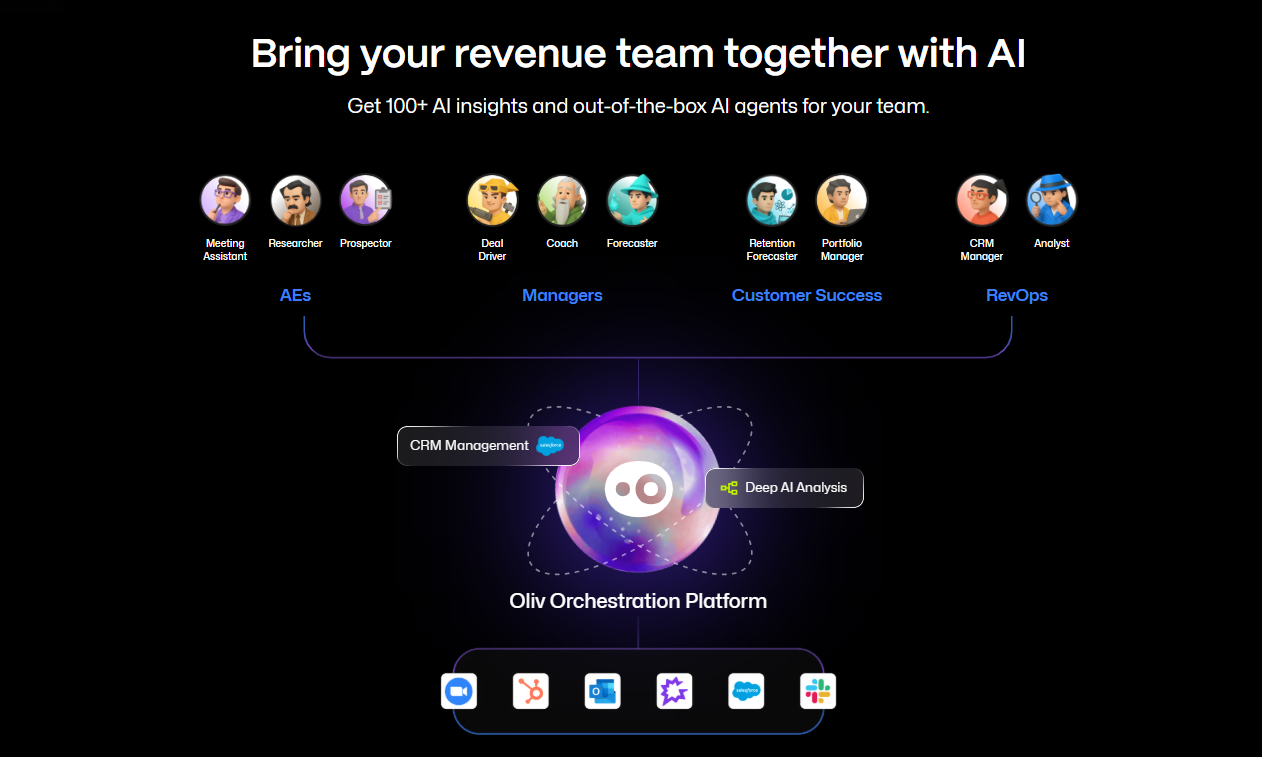
Oliv AI orchestration platform mapping specialized AI agents to revenue roles, showing how an AI meeting preparation tool unifies CRM data, deep analysis, and integrations.
What it does: Oliv AI is a generative-AI-native, agent-first revenue platform. Think of it as three layers of a cake: a Gong-style conversation-intelligence base, a unified data layer that stitches calls, email, and CRM together, and AI agents on top that prepare the meeting for you.
Key features: Deal-level context (not just meeting-level), proactive briefings pushed to Slack or email roughly 30 minutes before a call, automatic CRM write-back, and citation-backed prep where claims trace to a real transcript line or CRM field.
Pricing: Modular per-seat, which keeps budgeting transparent versus opaque per-action models. Implementation: Light setup, though full customization can take 2 to 4 weeks for complex orgs, and the Voice Agent is still in alpha.
✅ Pros
✅ Deal-level understanding tracks the whole cycle, not one call.
✅ ~5-minute turnaround beats the 20 to 30 minute incumbent delay.
✅ Agents act inside the workflow instead of forcing copy-paste out of a chat box.
❌ Cons
❌ Full customization can take 2 to 4 weeks for complex Salesforce orgs.
❌ Voice Agent is in alpha, so voice-first teams should wait.
❌ Wrong fit for B2C support or pure call-recording use cases.
Use case: A founder-seller or AE running back-to-back calls who wants a brief waiting, not a dashboard to dig through. Anti-ICP: teams unwilling to run agentic nudges. To see how this fits a wider stack, compare the best sales intelligence platform options.
2. Gong ⭐⭐⭐⭐
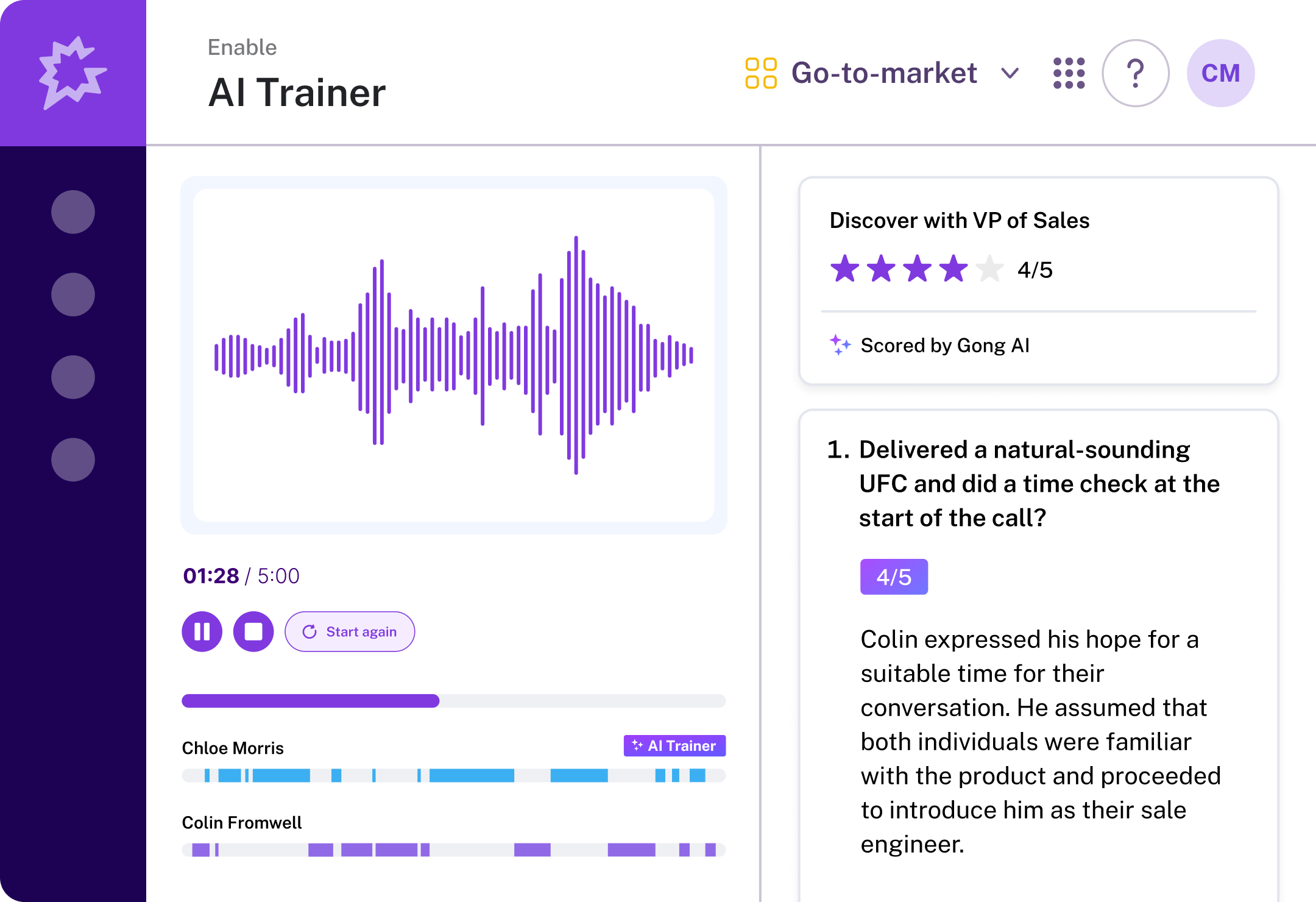
Gong conversation-intelligence interface scoring a discovery call, illustrating manager-loved coaching depth that an AI meeting preparation tool layers onto recorded sales conversations.
What it does: Gong is the conversation-intelligence platform managers love. It records calls, surfaces trackers, and rolls insight into deal boards and forecasting. It understands at the meeting level, which is exactly where its strength and its ceiling both sit.
Key features: Call recording and transcription, trackers, deal boards, and a Forecast add-on. Pricing: Premium, and several capabilities like Forecast or Engage cost extra. Implementation: Powerful but heavy; trackers can be slow to set up. For a deeper look, read our breakdown of Gong features.
✅ Pros
✅ Deep coaching and pipeline visibility managers genuinely rely on.
✅ Strong trackers and conversation analytics.
❌ Cons
❌ Add-ons inflate total cost beyond the core license.
❌ Data portability and bulk export are restrictive.
Real users capture both sides clearly. The upside, from a director who made Gong a single source of truth:
"Gong has become the single source of truth for our sales team. From deal management to forecasting it's been really easy to gain adoption across the team." Scott T., Director of SalesGong G2 Verified Review
The friction shows up around data access and price:
"Our experience has been impacted by significant data access limitations, especially concerning data portability and bulk export capabilities... it requires downloading calls individually, which is impractical." Neel P., Sales Operations ManagerGong G2 Verified Review
"Gong is a really powerful tool but it's probably the highest end option on the market, and now we're stuck with a tool that works technically but isn't the right business decision." Iris P., Head of Marketing and Sales PartnershipsGong G2 Verified Review
Use case: Mid-market and enterprise teams that want best-in-class coaching and can absorb the cost. If price is the sticking point, weigh the Gong alternatives first.
3. Clari ⭐⭐⭐⭐
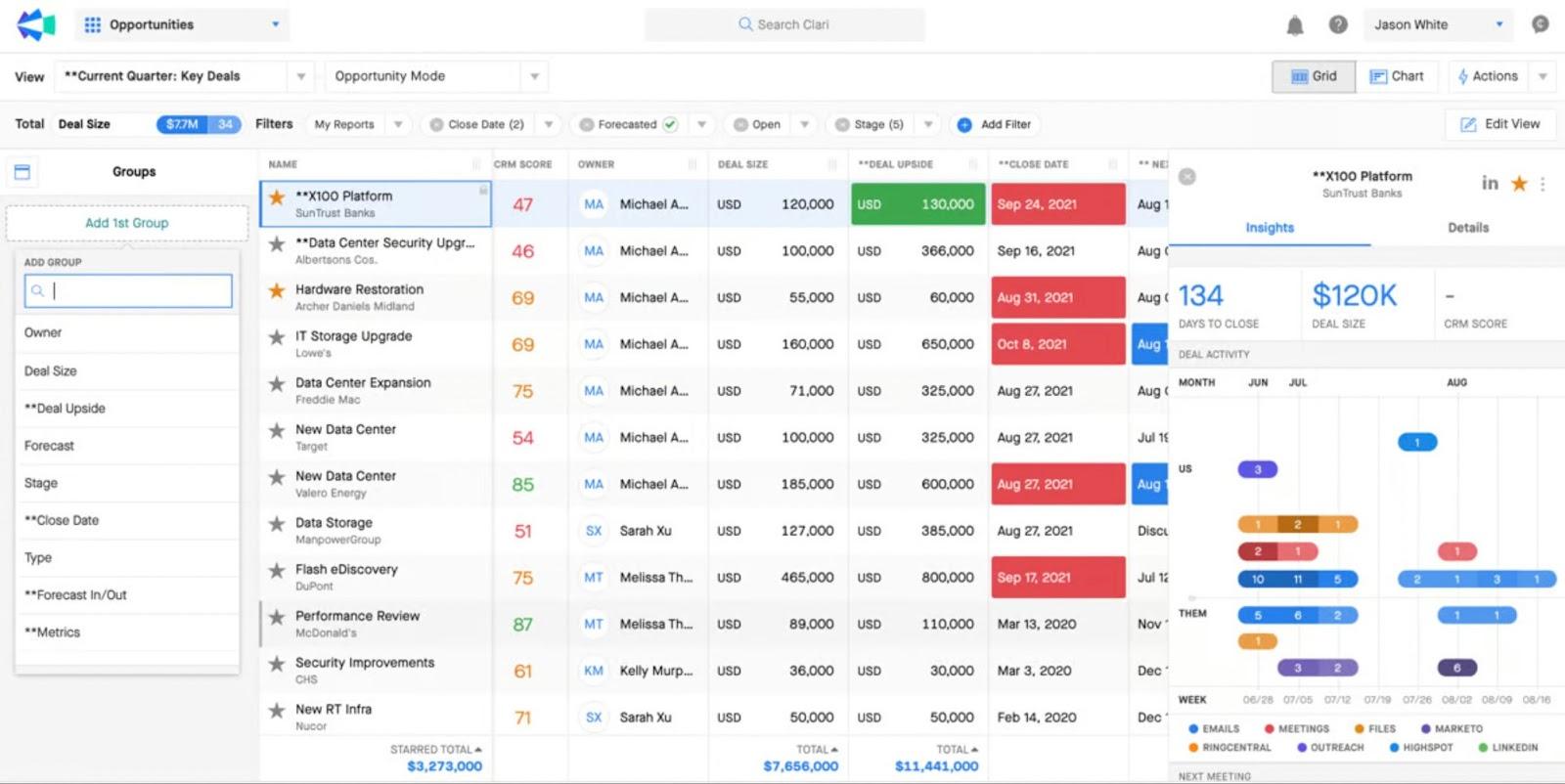
Clari forecasting dashboard displaying deal scores, close dates, and activity timelines, showing the CRM depth a strong AI meeting preparation tool draws on for briefings.
What it does: Clari is a forecasting and revenue-operations platform that overlays Salesforce. For meeting prep specifically, its value is indirect: it gives RevOps and leadership a clean, constantly updated view of where every deal stands before the conversation.
Key features: Deal analytics, forecasting modules, and fast pipeline updates that sync back to Salesforce. Pricing: Premium, aimed at revenue leadership. Implementation: Smooth for strong RevOps teams; trickier if you lack one to maintain validation rules in two systems. See our deep dive on Clari features for the full picture.
✅ Pros
✅ Forecasting and deal analytics that leadership trusts.
✅ Fast Salesforce updates from a single view.
❌ Cons
❌ Mostly a leadership tool; reps see less direct value.
❌ Overlaps with native Salesforce forecasting over time.
The rep-versus-leader tension is exactly what users report:
"4 months later every one of my reps loves it because it makes updating salesforce 10x easier... you can update all of your quarter opportunities from a single view without having to leave Clari." ChimpDaddy2015, r/salesReddit Thread
"Clari is a tool for sales leaders, it adds no value to reps as far as I can see." Msoave, r/SalesOperationsReddit Thread
"Clari should find ways to differentiate from the native Salesforce features (e.g. Pipeline Inspection, Forecasting) in order to remain competitive in the long-run." Dan J., Revenue OperationsClari G2 Verified Review
Use case: RevOps and CROs who want forecast confidence feeding the pre-call view. If you are comparing engines, our best AI sales forecasting software guide helps.
4. Chorus by ZoomInfo ⭐⭐⭐
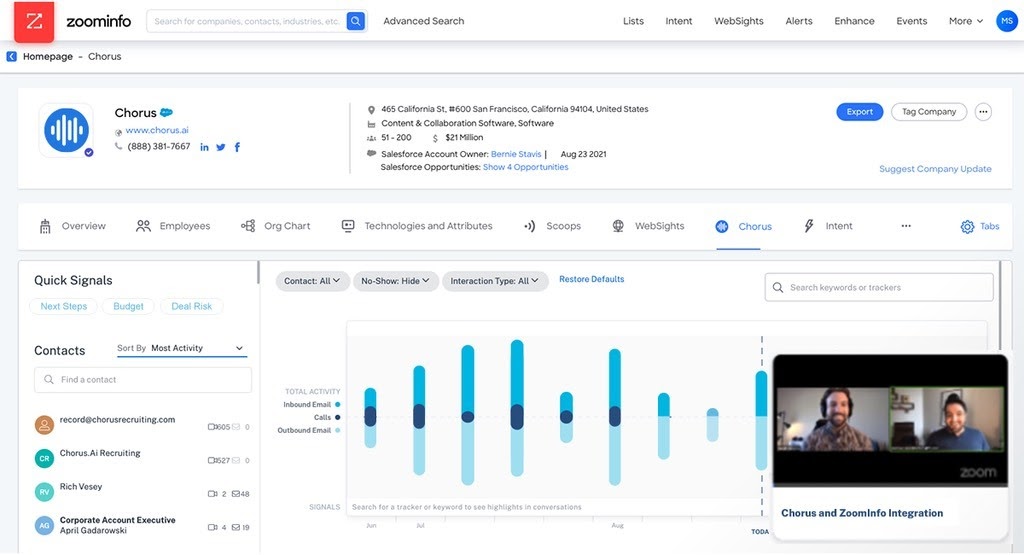
Chorus by ZoomInfo profile surfacing deal signals, contacts, and call activity, reflecting how an AI meeting preparation tool ties conversation data to account context.
What it does: Chorus is ZoomInfo's conversation-intelligence tool. It records, transcribes, and analyzes calls, and its natural fit is teams already living inside the ZoomInfo data stack. For prep, it leans on call analytics rather than proactive, pushed briefings.
Key features: Call recording, feedback metrics, and tight ZoomInfo integration. Pricing: Typically bundled with the broader ZoomInfo platform. Implementation: Straightforward for ZoomInfo customers; clunky in spots, like importing past calls. Our Gong vs Chorus comparison breaks down where each one fits.
✅ Pros
✅ Rich feedback and coaching metrics.
✅ Natural fit inside the ZoomInfo ecosystem.
❌ Cons
❌ Some core functions are buried in confusing menus.
❌ Less of a standalone prep tool than a CI add-on.
Users praise the metrics but flag the navigation:
"The quantity of feedback metrics is amazing! ... Trying to find where I could import previous calls or videos was very frustrating. Why in the world is it inside settings and then halfway down as an option?" Clayton Z., Director of TechnologyChorus by ZoomInfo G2 Verified Review
Use case: Teams standardized on ZoomInfo who want conversation analytics in the same stack. Coaching-focused buyers should also scan the best sales coaching software options.
5. Outreach ⭐⭐⭐
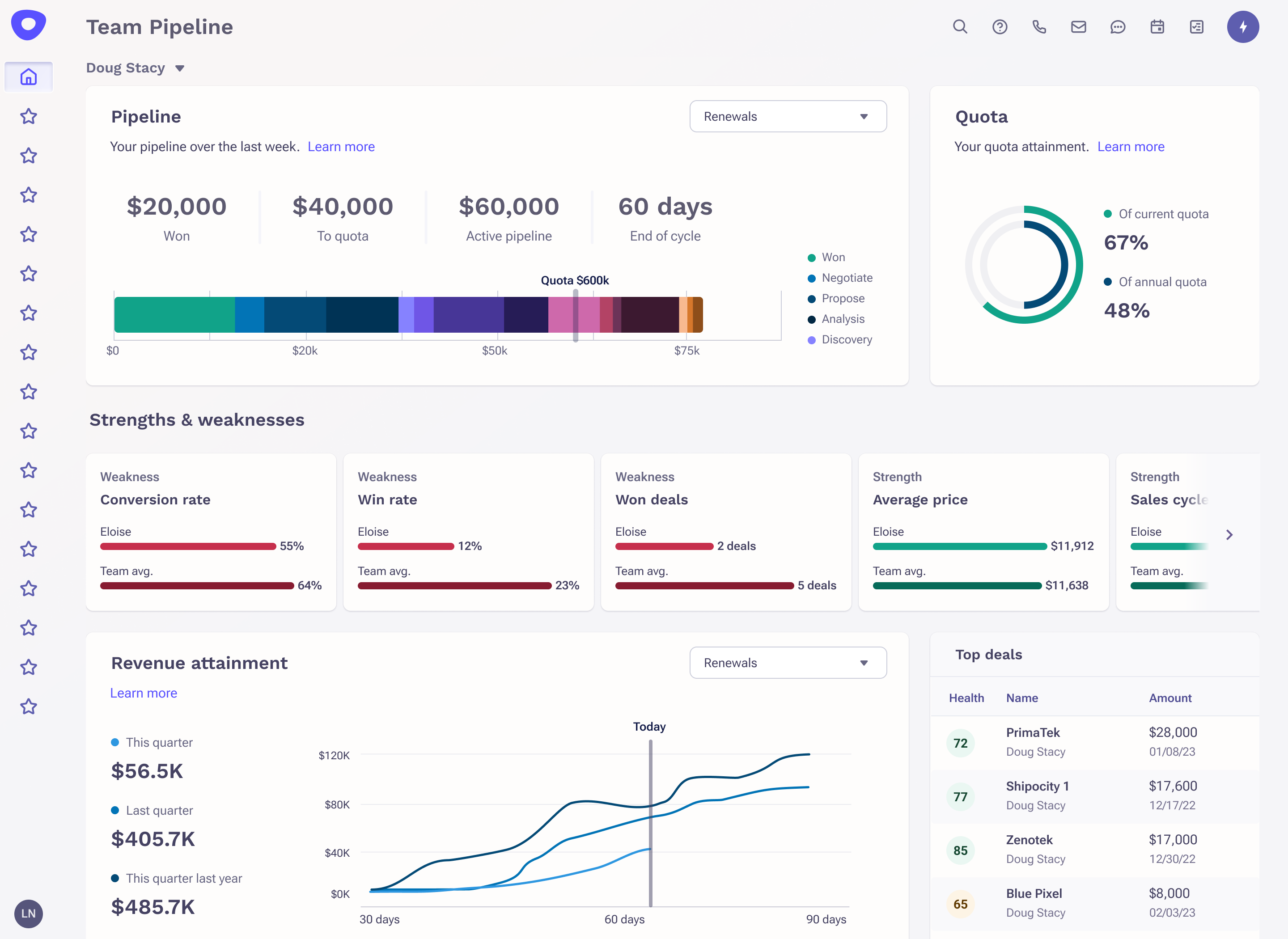
Sales engagement dashboard tracking pipeline, quota, and rep performance, showing the prospecting context an AI meeting preparation tool complements before outbound calls.
What it does: Outreach is a sales-engagement platform built for outbound sequencing, not meeting prep. Reps use it to run cadences, track opens, and manage prospects at volume. For prep, it offers call and email insights, but it leans toward pre-call outreach rather than pre-meeting briefing.
Key features: Email sequencing, A/B testing, dialer, and Salesforce sync. Pricing: Premium with add-ons; users flag evergreen auto-renewal terms. Implementation: Onboarding takes time, and several users report glitches and slow support. See how it stacks up in our Gong vs Outreach comparison.
✅ Pros
✅ Strong sequencing and prospect management at scale.
✅ Solid Salesforce sync and email tracking.
❌ Cons
❌ Reporting is hard to parse, and onboarding drags.
❌ Feels like a legacy tool to some users, with stagnant updates.
Users like the core but flag the friction:
"Outreach is really really good for emailing, sequencing, and prospect management. It talks to Salesforce really well as well." Ethan R., Sales Development RepresentativeOutreach G2 Verified Review
"The engage product is stagnant. Looks to have the same features, UX, integrations and issues as it had 5 years ago." Matthew T., Head of Revenue OperationsOutreach G2 Verified Review
Use case: Outbound-heavy SDR and BDR teams. For prep specifically, it's a supporting actor, not the lead.
6. Avoma ⭐⭐⭐⭐
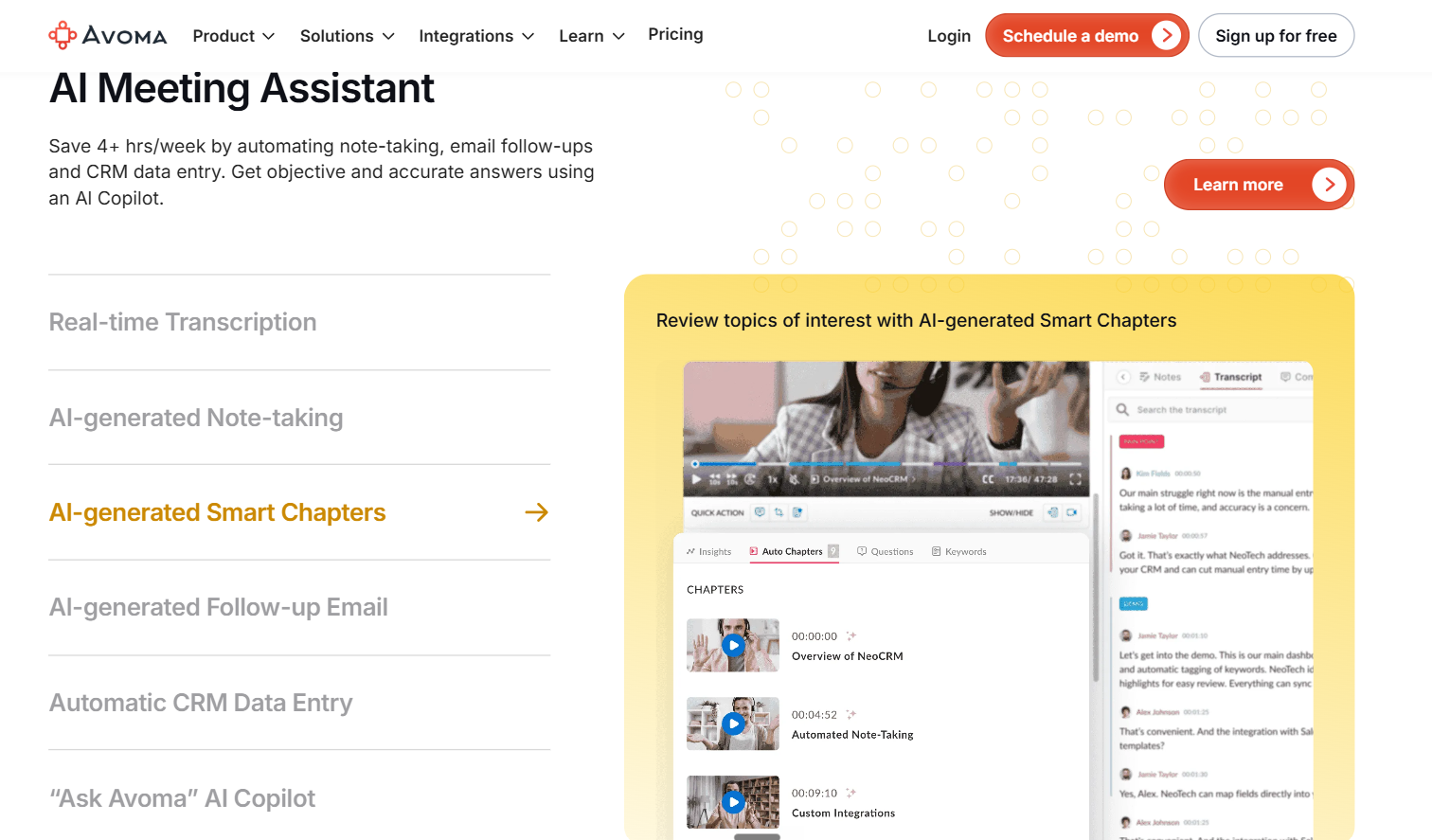
Avoma AI meeting assistant showing transcription, smart chapters, and follow-up automation, an affordable AI meeting preparation tool balancing note-taking depth with budget-friendly pricing.
What it does: Avoma is an affordable AI meeting assistant that records, transcribes, and summarizes calls, then folds in light scheduling and pipeline features. It sits closer to true prep than pure CI tools, since it surfaces agendas and summaries reps can scan before the next conversation.
Key features: AI notes, meeting summaries, agenda templates, and CRM sync. Pricing: Among the more budget-friendly options, with a free tier. Implementation: Fast, lightweight setup suited to SMBs. Our breakdown of Avoma features covers the detail.
✅ Pros
✅ Strong price-to-depth ratio for smaller teams.
✅ Useful agendas and summaries, not just raw transcripts.
❌ Cons
❌ Less deal-level intelligence than enterprise platforms.
❌ Forecasting and coaching depth trail Gong and Clari.
Use case: SMB and mid-market teams wanting note-taking plus summaries without enterprise pricing. Avoma reports forecast-accuracy gains and faster pipeline reviews for adopting teams, which is why it scores well on value.
7. Fireflies ⭐⭐⭐⭐
What it does: Fireflies is a lightweight transcription and meeting-notes tool that joins calls across Zoom, Meet, and Teams. It's less a sales-specific prep engine and more a universal notetaker, with searchable transcripts you can mine before a follow-up.
Key features: Auto-join transcription, searchable knowledge base, AI summaries, and broad integrations. Pricing: Generous free tier, affordable paid plans. Implementation: Minutes, not weeks.
✅ Pros
✅ Works across nearly any meeting platform.
✅ Searchable transcript library aids quick recall.
❌ Cons
❌ Limited deal-level or CRM-deep context.
❌ Prep is manual; you pull insight, it isn't pushed.
Use case: Teams that want cheap, broad transcription and a searchable archive. It holds a strong 4.7 G2 rating for ease of use, though it's a notetaker first and a prep tool second.
8. Mixmax ⭐⭐⭐
What it does: Mixmax pairs pre-call prep with post-call recap, synced to Salesforce and Gmail. It briefs you before calls and generates follow-ups after, sitting neatly in the email-native workflow many AEs already live in.
Key features: Pre-meeting briefs, recap generation, Salesforce sync, and Gmail-native scheduling. Pricing: Mid-tier per-seat. Implementation: Quick for Gmail and Salesforce shops.
✅ Pros
✅ Prep plus recap in one email-native tool.
✅ Tight Gmail and Salesforce integration.
❌ Cons
❌ Best suited to Gmail users; weaker outside that stack.
❌ Less depth than dedicated revenue-intelligence platforms.
Use case: Gmail-first AEs wanting briefings and recaps without leaving the inbox.
9. Jump ⭐⭐⭐⭐
What it does: Jump is AI meeting prep built specifically for financial advisors. It summarizes past conversations, client updates, and key context into a single pre-meeting briefing, leaning hard into relationship continuity rather than sales pipeline mechanics.
Key features: Prior-meeting recall, client-context briefings, and advisor-workflow integrations. Pricing: Advisor-focused plans, free to start. Implementation: Niche-tuned, quick for advisory practices.
✅ Pros
✅ Purpose-built for advisor and relationship-led workflows.
✅ Strong prior-context recall across recurring client meetings.
❌ Cons
❌ Narrow fit; not built for B2B sales pipelines.
❌ Limited forecasting or coaching depth.
Use case: Financial advisors and executives needing continuity across recurring client meetings.
10. Momentum ⭐⭐⭐
What it does: Momentum focuses on turning call transcripts into structured CRM data automatically. Its sweet spot is the boring-but-critical job of filling Salesforce fields from conversations, so reps stop doing manual data entry after every call.
❌ Value depends heavily on clean Salesforce setup.
Use case: Teams drowning in post-call CRM admin who want transcripts to fill fields automatically. This is where a true revenue orchestration platform earns its keep.
🧭 How to read this table on Monday
Don't pick by star count alone. Pick by the column that hurts most in your week.
If your reps walk into calls cold, weight briefing format and recall delay. If your forecast calls are chaos, weight CRM depth. If budget is the constraint, Avoma and Fireflies punch above their price, while Oliv AI earns its top spot by collapsing prep, recall, and CRM write-back into one agentic flow instead of three separate logins.
Q2. How Does Each Tool Stack Up? Tool-by-Tool Breakdown with Pros, Cons, Pricing and Ratings [toc=2. Tool-by-Tool Breakdown]
Each tool earns its rank differently. Oliv AI wins on deal-level, agentic prep with about 5-minute recall and citation-backed briefs. Gong dominates on manager-loved conversation intelligence. Clari leads forecasting, Avoma balances price and depth, Fireflies and Mixmax win on lightweight delivery, and Jump owns advisor workflows. Below, each entry covers best-for, pros, cons, pricing, rating, and security.
🥇 Oliv AI and Gong
Oliv AI is best for AEs and RevOps who want prep that acts, not just informs. We built it deal-level, with citation-backed briefs and roughly 5-minute post-call recall.
✅ Deal-level context across the full cycle.
✅ Agentic, so it works inside your tools, not a chat box.
❌ Full customization can take 2 to 4 weeks.
Pricing is modular per-seat (around $19 to $120 per user), with SOC 2 Type II, GDPR, and CCPA in place. The anti-fit is B2C support and pure call-recording teams. To frame the wider category, see our guide to the best sales intelligence platform options.
Gong is best for sales managers who coach from calls. It is powerful, but it understands at the meeting level, and add-ons stack the cost. For a fuller view, read our breakdown of Gong features.
"Gong has become the single source of truth for our sales team. From deal management to forecasting it's been really easy to gain adoption." Scott T., Director of SalesGong G2 Verified Review
"Its too complicated, and not intuitive at all... Searching for calls is not easy." John S., Senior Account ExecutiveGong G2 Verified Review
🏗️ Clari and Chorus
Clari is best for RevOps and CROs running forecast calls. Its Salesforce overlay is strong, though reps see less direct value, and pulling call transcripts needs other tools. For the detail, see our deep dive on Clari features.
"4 months later every one of my reps loves it because it makes updating salesforce 10x easier." ChimpDaddy2015, r/salesReddit Thread
"Claris integration capabilities are inadequate, particularly in pulling in call transcripts, which requires working with other tools." Josiah R., Head of Sales OperationsClari G2 Verified Review
Chorus by ZoomInfo is best for ZoomInfo-native teams wanting call analytics. ZoomInfo cites 95% company-affiliation data accuracy with GDPR and CCPA compliance, which feeds briefing quality.
✅ Rich coaching metrics inside the ZoomInfo stack.
❌ Some core functions are buried in confusing menus.
Outreach is best for outbound SDRs and AEs. It is a sequencing engine first, so prep is a byproduct. See how it compares in our Gong vs Outreach comparison.
"Outreach is really really good for emailing, sequencing, and prospect management. It talks to Salesforce really well." Ethan R., Sales Development RepresentativeOutreach G2 Verified Review
"The engage product is stagnant... the same features, UX, integrations and issues as it had 5 years ago." Matthew T., Head of Revenue OperationsOutreach G2 Verified Review
Avoma is best for SMB teams wanting affordable notes plus a light agenda. Public G2 ratings sit near 4.5 stars; I would treat that as directional. No verified Avoma reviews live in our source file, so I will not invent any. For more, see our roundup of Avoma features.
🔍 Fireflies, Mixmax, Jump, and Momentum
These four win on focus. Fireflies does broad, cheap transcription (~4.7 G2). Mixmax pairs prep with recap, synced to Salesforce and Gmail. Jump is purpose-built for financial advisors. Momentum auto-fills the CRM from transcripts.
✅ Each nails one slice cleanly.
❌ None stitch the whole deal together before the call.
Our review file holds no verified reviews for these four, so I have quoted none rather than fabricate. Public ratings are directional only. To compare the broader set, see our list of the best AI sales tools.
I will say the quiet part plainly. Most of these are excellent at one thing and average at the deal-level stitch. That gap is exactly where Oliv AI lives, and it is the heart of any real revenue orchestration platform.
Q3. How Did We Rank These Tools? Selection Criteria, CRM Depth, Transcript Recall, and Briefing Format [toc=3. Ranking Criteria]
We scored each tool across five weighted criteria summing to 100%: CRM Depth (25%), Transcript Recall and Accuracy (25%), Briefing Format and Delivery (20%), Security and Compliance (15%), and Pricing Transparency (15%). Tools scoring 81 to 100 earn 5 stars, 61 to 80 four, and so down. CRM depth caps how useful a brief can be, recall delay decides whether it arrives in time, and format decides whether it gets read.
📐 The scoring rubric
I weighted depth and recall highest on purpose. That is exactly where the incumbents built a decade ago tend to be weakest.
Five-Criterion Scoring Rubric and Weights
Criterion
Weight
Why it carries weight
CRM Depth
25%
Caps how specific the brief can be
Transcript Recall and Accuracy
25%
Decides if recall is usable and timely
Briefing Format and Delivery
20%
Decides if anyone reads it
Security and Compliance
15%
Enterprise gating criteria
Pricing Transparency
15%
Punishes opaque per-action models
The star rule is simple. A tool earns ⭐ for 0 to 20, ⭐⭐ for 21 to 40, ⭐⭐⭐ for 41 to 60, ⭐⭐⭐⭐ for 61 to 80, and ⭐⭐⭐⭐⭐ for 81 to 100.
🗄️ Why CRM depth caps everything
A brief is only as good as the data under it. Read just an account name, and you get a generic dossier. Read deal stage, stakeholder history, and open commitments, and you get something usable.
Here is the uncomfortable truth. For most teams, the CRM is dead air, updated weekly because management requires it, not because reps find it useful. Duplicate records make it worse, since rule-based tools cannot tell which account wins. A modern revenue intelligence platform has to fix that data layer first.
⏱️ Why recall delay is the real differentiator
Recording is commoditized now, so I score recall, not capture. The gap that matters is delay: about 5 minutes for Oliv versus the 20 to 30 minutes typical of older platforms.
That delay decides behavior. The classic follow-up loop, pull a transcript, paste into ChatGPT, then into Outlook, is so much work that most reps just skip it. Faster, structured recall is what closes that gap, and it is why teams compare options on our roundup of the best AI for sales calls.
📨 Which briefing format actually gets read
Format is where good data goes to die. A dashboard you must remember to open loses to a push you cannot miss.
The winning pattern is proactive: prep notes sent to Slack or email roughly 30 minutes before the call. Better still, reply to that morning brief with a keyword and let an agent build the meeting assets for you. This is the shift from dashboards toward a true revenue orchestration platform.
Q4. How Does Oliv AI Compare to Gong, Clari, and Chorus for Meeting Prep? [toc=4. Oliv vs Gong, Clari, Chorus]
Gong, Clari, and Chorus are strong conversation-intelligence platforms managers love, but most operate at the meeting level with slower turnaround and chat-bolted-on AI. Oliv AI is built deal-level and agentic. It reads the full cycle, returns structured prep in about five minutes, and acts inside your workflow instead of making you copy answers out of a chat window. Pick Oliv when prep must drive action, not just review.
⚖️ The head-to-head
I will keep this fair. These tools earned their reputations, and I am not going to pretend otherwise.
Oliv AI vs Gong vs Clari vs Chorus for Meeting Prep
Factor
Oliv AI
Gong
Clari
Chorus
Understands at
Deal level
Meeting level
Forecast and pipeline
Meeting level
Recall delay
~5 min
~20-30 min
Post-call
Post-call
Agentic action
✅ Native
❌ Chat-style
❌ Dashboards
❌ Analytics
CRM write-back
✅ Automated
Partial
Two-way sync
Limited
The difference is not capture. It is whether the tool acts. Most incumbent AI is still chat-focused, where you ask, copy the answer, and paste it somewhere else. Our Gong vs Clari comparison digs into where each one fits.
👏 Where Gong still wins
Let me be honest about this. Sales managers are genuinely in love with Gong, and that loyalty is real.
"Gong's product is second to none and without it, I couldn't do my job properly. It's my most visited tab on Chrome!" Elspeth C., Chief Commercial OfficerGong G2 Verified Review
Gong's coaching depth and ecosystem are hard to beat. The trade-off shows up in cost and rigidity, and budget-conscious buyers should weigh the Gong alternatives first.
"Gong is a really powerful tool but it's probably the highest end option on the market, and now we're stuck with a tool that works technically but isn't the right business decision." Iris P., Head of Marketing and Sales PartnershipsGong G2 Verified Review
🎯 When Oliv is the right call
Think of older automation as a vending machine. If one step fails, it just stops. An agent is more like a smart employee who rejigs the plan until the goal is hit.
Pick Oliv AI when prep must produce action, not another dashboard to review. If you only need recording and manager coaching, Gong may still be your tool, and I would respect that call. For a direct face-off, see our Gong vs Oliv comparison.
Q5. Is It Safe to Trust AI With Your Calls? Security, Consent, EU AI Act, and Citation Accuracy [toc=5. Security and Trust]
Trustworthy prep tools clear three bars: certified security (SOC 2 Type II, GDPR), consent handling (two-party recording rules and EU AI Act scrutiny of autonomous agents), and citation accuracy. Every line in the brief should trace to a real transcript or CRM field. A brief you cannot verify is a liability, not an asset, so insist on sources and a correction loop.
🔒 The three trust bars
Let me lay out the bars in plain terms, because the category buries them.
Security: SOC 2 Type II (an audited data-handling standard) and GDPR are now table stakes. At Oliv AI, we hold SOC 2 Type II, GDPR, and CCPA.
Consent: Many regions require two-party consent, meaning both sides agree to recording. The EU AI Act now adds scrutiny of autonomous agents acting on your behalf.
Citation accuracy: A brief should cite its sources, like a footnote to a transcript line.
I might be blunt here, but a tool that cannot show its work is not ready for an enterprise deal. If security gating is your concern, our breakdown of Gong DPA and security shows what to check.
⚠️ Why un-cited briefs are dangerous
Here is the failure mode I see most. An AI confidently summarizes a deal, you repeat it in the room, and it turns out to be a hallucination (a confident, made-up answer).
The root cause is often the diet. Feed an AI vendor marketing material, and it parrots that spin back, quietly inflating whatever the incumbent published about itself. In regulated work, that is worse than useless, since finance needs an audit trail you can defend. This is why a serious revenue intelligence platform must trace claims to source data.
✅ The fix: sources plus a correction loop
The reliable pattern is simple. Cite everything, then correct the model daily for a stretch.
From what surfaces when you actually run this, a 30-day correction loop works. Spend an hour or two a day fixing mistakes, and by day 30, the output is genuinely solid. That is the discipline behind citation-backed prep, and it is why we built Oliv AI to trace claims to real transcript lines and CRM fields, not marketing PDFs. You can see how this compares in our Gong vs Oliv comparison.
Q6. What Does AI Meeting Prep Cost, and How Do You Calculate ROI? [toc=6. Pricing and ROI]
Pricing ranges from transparent per-seat plans to opaque per-action "click-credit" models that make budgeting hard. Calculate ROI on two levers: hours of manual prep reclaimed per rep each week, and the forecast-accuracy lift from better-prepped, better-logged calls. If a tool cuts a 48-minute prep ritual to 8 minutes across a 10-rep team, the payback math closes fast.
💰 The two pricing models
There are really two ways these tools charge you. One you can forecast, and one you cannot.
Per-Seat vs Per-Action Pricing Models
Model
How it works
Budgeting risk
Per-seat
Flat fee per user (e.g., $19 to $120 per user)
✅ Predictable
Per-action
Charged per agent action (e.g., $0.10 per action)
❌ Hard to forecast
Some incumbents quote an all-inclusive seat near $500, then add per-action credits on top. At Oliv AI, we kept pricing modular per-seat on purpose, so finance can model it. For context, see our breakdown of Gong pricing.
💸 The hidden stack cost
Here is the trap I watch teams fall into. They buy Gong, then Clari, then a sequencer, and the bundle quietly drags total cost past $500 per user each month for a 25 to 200 rep team.
That spend competes with real headcount. The honest reframe a founder once gave me: you cannot keep paying a junior SDR $150,000 a year just to watch them quit. Agents change that math, which is the promise of a true revenue orchestration platform.
📈 A worked ROI example
Run the numbers yourself. Say prep drops from 48 minutes to 8 minutes per call, a real reduction operators report.
10 reps, 5 calls a day, 40 minutes saved each.
That is roughly 33 hours reclaimed daily across the team.
Apply the 10/80/10 rule: humans do 10% ideation and 10% quality check, and agents handle the 80% in the middle.
I could be slightly optimistic on adoption, but even at half that, the payback is fast. To weigh the forecast-accuracy side, see our guide to the best AI sales forecasting software.
Q7. Which AI Meeting Prep Tool Is Right for Your Role: AE, Manager, RevOps, or Advisor? [toc=7. Right Tool by Role]
Match the tool to the job. AEs prepping back-to-back calls need fast, push-delivered briefings (Oliv, Mixmax). Sales managers coaching teams lean on conversation intelligence (Gong). RevOps wants clean CRM write-back and exportable data (Oliv, Clari). Advisors and executives need relationship continuity and prior-context recall (Jump, Oliv). Choose for the workflow you live in, not the logo on the slide.
🧭 The role-to-tool map
Do not buy the highest-rated tool. Buy the one that fits your actual day.
AI Meeting Prep Tool Fit by Role
Role
Biggest need
Best fit
Why
AE
Fast prep before calls
Oliv AI, Mixmax
Pushed briefs, ~5-min recall
Sales Manager
Coaching from calls
Gong
Deep conversation intelligence
RevOps
Clean data, exports
Oliv AI, Clari
Write-back and forecasting
Advisor
Client continuity
Jump, Oliv AI
Prior-context recall
The fit problem is real, and users say it out loud. Clari, for instance, leans toward leaders, not reps, a tension our Clari alternatives guide unpacks.
"Clari is a tool for sales leaders, it adds no value to reps as far as I can see." Msoave, r/SalesOperationsReddit Thread
👥 Where Oliv fits, and where it does not
I will be straight about our anti-fit. Oliv AI is not built for B2C support queues or pure call-recording use cases, and our Voice Agent is still in alpha.
Where we shine is the AE and RevOps overlap: deal-level prep that writes back to the CRM and acts, not just reports. The subject-matter experts who know whether an agent's output is right are the ones who will win the next few years, and the tooling should serve them, which is the core idea behind the best AI sales tools.
🔮 What I'm sitting with
Here is the hypothesis I keep turning over. The SaaS you log into becomes agents that work for you, and revenue orchestration gives way to revenue engineering.
Picture a team running as 1.2 humans and 20 agents managing an eight-figure topline. I do not know exactly when that lands for mid-market B2B, and I could be early. So I will ask you instead: what is the one prep task you would hand an agent first, and what is stopping you? If you want to map the path, start with the best revenue orchestration platform tools.
Q1. What Are the 10 Best AI Meeting Preparation Tools for Sales Teams in 2026? [toc=1. Best AI Meeting Prep Tools]
The 10 best AI meeting preparation tools in 2026 are Oliv AI, Gong, Clari, Chorus, Outreach, Avoma, Fireflies, Mixmax, Jump, and Momentum. An AI meeting prep tool pulls CRM history, past transcripts, and buyer signals into a briefing delivered before a call, unlike a note-taker that records during it. We ranked these on CRM depth, transcript recall, and briefing format. Oliv AI leads for deal-level, agentic, citation-backed prep.
🎯 What I mean by "meeting prep" (and what I don't)
I'll be honest about a confusion that costs teams real money. Most tools sold as "meeting prep" are actually note-takers or recap tools wearing a prep label.
Here's the clean split. A note-taker records and transcribes during the call. A recap tool summarizes after. A prep tool front-loads context before you join, so you walk in already briefed.
The reader I keep meeting isn't looking for a recorder. They're trying to stop starting every meeting from scratch, and move to a model where context is already indexed, summarized, and ready for the conversation. This is the heart of any modern revenue intelligence platform.
⏰ The "starting from scratch" tax nobody budgets for
Picture a Tuesday with four discovery calls back to back. You open Salesforce, hunt for the last call notes, scan three email threads, and check what you owed them. Then you do it again. And again.
That ritual is the real pain. From what surfaces when you actually watch reps work, the prep itself isn't hard. The context assembly is. A good prep tool hands you a clean list of follow-ups waiting at the start of every meeting, so you know what you agreed on, what you owe, and what they owe you.
🧊 Why "recording" stopped being a moat
Here's a take the category avoids. Call recording is now commoditized. Zoom, Teams, and Google Meet all capture and transcribe natively, for free or close to it.
So the edge moved. It moved to recall (how accurately a tool resurfaces what was said) and delay (how fast structured insight lands after the call). I might be slightly aggressive here, but if your tool's only job is recording, you're paying for a feature your video platform already gives away. The smarter teams now compare options on our roundup of the best AI for sales calls.
This is where the deeper split shows up. Most tools understand a single meeting. The stronger ones understand the whole deal, tracking the full cycle, pipeline movement, coaching, and forecasting. At Oliv AI, we built deliberately at the deal level, with roughly a 5-minute post-call turnaround versus the 20 to 30 minutes typical of older conversation-intelligence platforms.
📋 The 10 tools at a glance
Here is the shortlist with a one-line verdict for each. Oliv sits at position one because of the deal-level, agentic prep approach, not alphabetical luck. For the wider category, see our guide to the best AI sales tools.
Oliv AI ⭐⭐⭐⭐⭐ Best for deal-level, agentic, citation-backed prep that acts inside your workflow.
Gong ⭐⭐⭐⭐ Best for managers who live in conversation intelligence and coaching.
Clari ⭐⭐⭐⭐ Best for RevOps and forecasting overlays on Salesforce.
Chorus by ZoomInfo ⭐⭐⭐ Best for ZoomInfo-native teams wanting call analytics.
Outreach ⭐⭐⭐ Best for outbound sequencing with light prep bolted on.
Avoma ⭐⭐⭐⭐ Best for affordable note-taking plus meeting summaries.
Fireflies ⭐⭐⭐⭐ Best for lightweight transcription across many meeting types.
Mixmax ⭐⭐⭐ Best for prep plus recap synced to Salesforce and Gmail.
Jump ⭐⭐⭐⭐ Best for financial advisors needing relationship continuity.
Momentum ⭐⭐⭐ Best for auto-filling the CRM from call transcripts.
📊 Master comparison table
The scoring blends CRM depth, transcript recall and delay, briefing format, security, and pricing transparency. Stars reflect that weighted view, not a single feature.
10 Best AI Meeting Preparation Tools Compared
Tool
CRM depth
Recall delay
Briefing format
Security
Pricing
G2 rating
Best-fit persona
Score
Oliv AI
Deal-level, write-back
~5 min
Slack, email, deck, agentic
SOC 2 Type II, GDPR, CCPA
Modular per-seat
New entrant
AE, RevOps, founder-seller
⭐⭐⭐⭐⭐
Gong
Meeting-level, deal boards
~20-30 min
In-app, email digests
CCPA-compliant
High, add-ons extra
4.7
Sales manager, enablement
⭐⭐⭐⭐
Clari
SFDC overlay, forecasting
Post-call
Dashboards, forecast views
Enterprise-grade
Premium
4.6
RevOps, CRO
⭐⭐⭐⭐
Chorus
ZoomInfo-linked
Post-call
In-app analytics
ZoomInfo stack
Bundled
4.5
ZoomInfo-native teams
⭐⭐⭐
Outreach
Sequencing-led, SFDC sync
Post-call
In-app, email
Enterprise-grade
Premium, add-ons
4.3
SDR, BDR (outbound)
⭐⭐⭐
Avoma
CRM sync, summaries
Post-call
Notes, summaries
SOC 2, GDPR
Budget, free tier
4.5
SMB, mid-market
⭐⭐⭐⭐
Fireflies
Light CRM sync
Post-call
Notes, searchable archive
SOC 2, GDPR
Free tier, low-cost
4.7
Broad teams
⭐⭐⭐⭐
Mixmax
Salesforce + Gmail
Post-call
Email briefs, recaps
SOC 2
Mid-tier
4.6
Gmail-first AE
⭐⭐⭐
Jump
Advisor-context
Post-call
Pre-meeting brief
SOC 2
Advisor plans
4.8
Advisor, executive
⭐⭐⭐⭐
Momentum
Transcript-to-CRM
Post-call
Slack summaries
SOC 2
Mid-tier
4.6
RevOps, CRM hygiene
⭐⭐⭐
1. Oliv AI ⭐⭐⭐⭐⭐
Oliv AI orchestration platform mapping specialized AI agents to revenue roles, showing how an AI meeting preparation tool unifies CRM data, deep analysis, and integrations.
What it does: Oliv AI is a generative-AI-native, agent-first revenue platform. Think of it as three layers of a cake: a Gong-style conversation-intelligence base, a unified data layer that stitches calls, email, and CRM together, and AI agents on top that prepare the meeting for you.
Key features: Deal-level context (not just meeting-level), proactive briefings pushed to Slack or email roughly 30 minutes before a call, automatic CRM write-back, and citation-backed prep where claims trace to a real transcript line or CRM field.
Pricing: Modular per-seat, which keeps budgeting transparent versus opaque per-action models. Implementation: Light setup, though full customization can take 2 to 4 weeks for complex orgs, and the Voice Agent is still in alpha.
✅ Pros
✅ Deal-level understanding tracks the whole cycle, not one call.
✅ ~5-minute turnaround beats the 20 to 30 minute incumbent delay.
✅ Agents act inside the workflow instead of forcing copy-paste out of a chat box.
❌ Cons
❌ Full customization can take 2 to 4 weeks for complex Salesforce orgs.
❌ Voice Agent is in alpha, so voice-first teams should wait.
❌ Wrong fit for B2C support or pure call-recording use cases.
Use case: A founder-seller or AE running back-to-back calls who wants a brief waiting, not a dashboard to dig through. Anti-ICP: teams unwilling to run agentic nudges. To see how this fits a wider stack, compare the best sales intelligence platform options.
2. Gong ⭐⭐⭐⭐
Gong conversation-intelligence interface scoring a discovery call, illustrating manager-loved coaching depth that an AI meeting preparation tool layers onto recorded sales conversations.
What it does: Gong is the conversation-intelligence platform managers love. It records calls, surfaces trackers, and rolls insight into deal boards and forecasting. It understands at the meeting level, which is exactly where its strength and its ceiling both sit.
Key features: Call recording and transcription, trackers, deal boards, and a Forecast add-on. Pricing: Premium, and several capabilities like Forecast or Engage cost extra. Implementation: Powerful but heavy; trackers can be slow to set up. For a deeper look, read our breakdown of Gong features.
✅ Pros
✅ Deep coaching and pipeline visibility managers genuinely rely on.
✅ Strong trackers and conversation analytics.
❌ Cons
❌ Add-ons inflate total cost beyond the core license.
❌ Data portability and bulk export are restrictive.
Real users capture both sides clearly. The upside, from a director who made Gong a single source of truth:
"Gong has become the single source of truth for our sales team. From deal management to forecasting it's been really easy to gain adoption across the team." Scott T., Director of SalesGong G2 Verified Review
The friction shows up around data access and price:
"Our experience has been impacted by significant data access limitations, especially concerning data portability and bulk export capabilities... it requires downloading calls individually, which is impractical." Neel P., Sales Operations ManagerGong G2 Verified Review
"Gong is a really powerful tool but it's probably the highest end option on the market, and now we're stuck with a tool that works technically but isn't the right business decision." Iris P., Head of Marketing and Sales PartnershipsGong G2 Verified Review
Use case: Mid-market and enterprise teams that want best-in-class coaching and can absorb the cost. If price is the sticking point, weigh the Gong alternatives first.
3. Clari ⭐⭐⭐⭐
Clari forecasting dashboard displaying deal scores, close dates, and activity timelines, showing the CRM depth a strong AI meeting preparation tool draws on for briefings.
What it does: Clari is a forecasting and revenue-operations platform that overlays Salesforce. For meeting prep specifically, its value is indirect: it gives RevOps and leadership a clean, constantly updated view of where every deal stands before the conversation.
Key features: Deal analytics, forecasting modules, and fast pipeline updates that sync back to Salesforce. Pricing: Premium, aimed at revenue leadership. Implementation: Smooth for strong RevOps teams; trickier if you lack one to maintain validation rules in two systems. See our deep dive on Clari features for the full picture.
✅ Pros
✅ Forecasting and deal analytics that leadership trusts.
✅ Fast Salesforce updates from a single view.
❌ Cons
❌ Mostly a leadership tool; reps see less direct value.
❌ Overlaps with native Salesforce forecasting over time.
The rep-versus-leader tension is exactly what users report:
"4 months later every one of my reps loves it because it makes updating salesforce 10x easier... you can update all of your quarter opportunities from a single view without having to leave Clari." ChimpDaddy2015, r/salesReddit Thread
"Clari is a tool for sales leaders, it adds no value to reps as far as I can see." Msoave, r/SalesOperationsReddit Thread
"Clari should find ways to differentiate from the native Salesforce features (e.g. Pipeline Inspection, Forecasting) in order to remain competitive in the long-run." Dan J., Revenue OperationsClari G2 Verified Review
Use case: RevOps and CROs who want forecast confidence feeding the pre-call view. If you are comparing engines, our best AI sales forecasting software guide helps.
4. Chorus by ZoomInfo ⭐⭐⭐
Chorus by ZoomInfo profile surfacing deal signals, contacts, and call activity, reflecting how an AI meeting preparation tool ties conversation data to account context.
What it does: Chorus is ZoomInfo's conversation-intelligence tool. It records, transcribes, and analyzes calls, and its natural fit is teams already living inside the ZoomInfo data stack. For prep, it leans on call analytics rather than proactive, pushed briefings.
Key features: Call recording, feedback metrics, and tight ZoomInfo integration. Pricing: Typically bundled with the broader ZoomInfo platform. Implementation: Straightforward for ZoomInfo customers; clunky in spots, like importing past calls. Our Gong vs Chorus comparison breaks down where each one fits.
✅ Pros
✅ Rich feedback and coaching metrics.
✅ Natural fit inside the ZoomInfo ecosystem.
❌ Cons
❌ Some core functions are buried in confusing menus.
❌ Less of a standalone prep tool than a CI add-on.
Users praise the metrics but flag the navigation:
"The quantity of feedback metrics is amazing! ... Trying to find where I could import previous calls or videos was very frustrating. Why in the world is it inside settings and then halfway down as an option?" Clayton Z., Director of TechnologyChorus by ZoomInfo G2 Verified Review
Use case: Teams standardized on ZoomInfo who want conversation analytics in the same stack. Coaching-focused buyers should also scan the best sales coaching software options.
5. Outreach ⭐⭐⭐
Sales engagement dashboard tracking pipeline, quota, and rep performance, showing the prospecting context an AI meeting preparation tool complements before outbound calls.
What it does: Outreach is a sales-engagement platform built for outbound sequencing, not meeting prep. Reps use it to run cadences, track opens, and manage prospects at volume. For prep, it offers call and email insights, but it leans toward pre-call outreach rather than pre-meeting briefing.
Key features: Email sequencing, A/B testing, dialer, and Salesforce sync. Pricing: Premium with add-ons; users flag evergreen auto-renewal terms. Implementation: Onboarding takes time, and several users report glitches and slow support. See how it stacks up in our Gong vs Outreach comparison.
✅ Pros
✅ Strong sequencing and prospect management at scale.
✅ Solid Salesforce sync and email tracking.
❌ Cons
❌ Reporting is hard to parse, and onboarding drags.
❌ Feels like a legacy tool to some users, with stagnant updates.
Users like the core but flag the friction:
"Outreach is really really good for emailing, sequencing, and prospect management. It talks to Salesforce really well as well." Ethan R., Sales Development RepresentativeOutreach G2 Verified Review
"The engage product is stagnant. Looks to have the same features, UX, integrations and issues as it had 5 years ago." Matthew T., Head of Revenue OperationsOutreach G2 Verified Review
Use case: Outbound-heavy SDR and BDR teams. For prep specifically, it's a supporting actor, not the lead.
6. Avoma ⭐⭐⭐⭐
Avoma AI meeting assistant showing transcription, smart chapters, and follow-up automation, an affordable AI meeting preparation tool balancing note-taking depth with budget-friendly pricing.
What it does: Avoma is an affordable AI meeting assistant that records, transcribes, and summarizes calls, then folds in light scheduling and pipeline features. It sits closer to true prep than pure CI tools, since it surfaces agendas and summaries reps can scan before the next conversation.
Key features: AI notes, meeting summaries, agenda templates, and CRM sync. Pricing: Among the more budget-friendly options, with a free tier. Implementation: Fast, lightweight setup suited to SMBs. Our breakdown of Avoma features covers the detail.
✅ Pros
✅ Strong price-to-depth ratio for smaller teams.
✅ Useful agendas and summaries, not just raw transcripts.
❌ Cons
❌ Less deal-level intelligence than enterprise platforms.
❌ Forecasting and coaching depth trail Gong and Clari.
Use case: SMB and mid-market teams wanting note-taking plus summaries without enterprise pricing. Avoma reports forecast-accuracy gains and faster pipeline reviews for adopting teams, which is why it scores well on value.
7. Fireflies ⭐⭐⭐⭐
What it does: Fireflies is a lightweight transcription and meeting-notes tool that joins calls across Zoom, Meet, and Teams. It's less a sales-specific prep engine and more a universal notetaker, with searchable transcripts you can mine before a follow-up.
Key features: Auto-join transcription, searchable knowledge base, AI summaries, and broad integrations. Pricing: Generous free tier, affordable paid plans. Implementation: Minutes, not weeks.
✅ Pros
✅ Works across nearly any meeting platform.
✅ Searchable transcript library aids quick recall.
❌ Cons
❌ Limited deal-level or CRM-deep context.
❌ Prep is manual; you pull insight, it isn't pushed.
Use case: Teams that want cheap, broad transcription and a searchable archive. It holds a strong 4.7 G2 rating for ease of use, though it's a notetaker first and a prep tool second.
8. Mixmax ⭐⭐⭐
What it does: Mixmax pairs pre-call prep with post-call recap, synced to Salesforce and Gmail. It briefs you before calls and generates follow-ups after, sitting neatly in the email-native workflow many AEs already live in.
Key features: Pre-meeting briefs, recap generation, Salesforce sync, and Gmail-native scheduling. Pricing: Mid-tier per-seat. Implementation: Quick for Gmail and Salesforce shops.
✅ Pros
✅ Prep plus recap in one email-native tool.
✅ Tight Gmail and Salesforce integration.
❌ Cons
❌ Best suited to Gmail users; weaker outside that stack.
❌ Less depth than dedicated revenue-intelligence platforms.
Use case: Gmail-first AEs wanting briefings and recaps without leaving the inbox.
9. Jump ⭐⭐⭐⭐
What it does: Jump is AI meeting prep built specifically for financial advisors. It summarizes past conversations, client updates, and key context into a single pre-meeting briefing, leaning hard into relationship continuity rather than sales pipeline mechanics.
Key features: Prior-meeting recall, client-context briefings, and advisor-workflow integrations. Pricing: Advisor-focused plans, free to start. Implementation: Niche-tuned, quick for advisory practices.
✅ Pros
✅ Purpose-built for advisor and relationship-led workflows.
✅ Strong prior-context recall across recurring client meetings.
❌ Cons
❌ Narrow fit; not built for B2B sales pipelines.
❌ Limited forecasting or coaching depth.
Use case: Financial advisors and executives needing continuity across recurring client meetings.
10. Momentum ⭐⭐⭐
What it does: Momentum focuses on turning call transcripts into structured CRM data automatically. Its sweet spot is the boring-but-critical job of filling Salesforce fields from conversations, so reps stop doing manual data entry after every call.
❌ Value depends heavily on clean Salesforce setup.
Use case: Teams drowning in post-call CRM admin who want transcripts to fill fields automatically. This is where a true revenue orchestration platform earns its keep.
🧭 How to read this table on Monday
Don't pick by star count alone. Pick by the column that hurts most in your week.
If your reps walk into calls cold, weight briefing format and recall delay. If your forecast calls are chaos, weight CRM depth. If budget is the constraint, Avoma and Fireflies punch above their price, while Oliv AI earns its top spot by collapsing prep, recall, and CRM write-back into one agentic flow instead of three separate logins.
Q2. How Does Each Tool Stack Up? Tool-by-Tool Breakdown with Pros, Cons, Pricing and Ratings [toc=2. Tool-by-Tool Breakdown]
Each tool earns its rank differently. Oliv AI wins on deal-level, agentic prep with about 5-minute recall and citation-backed briefs. Gong dominates on manager-loved conversation intelligence. Clari leads forecasting, Avoma balances price and depth, Fireflies and Mixmax win on lightweight delivery, and Jump owns advisor workflows. Below, each entry covers best-for, pros, cons, pricing, rating, and security.
🥇 Oliv AI and Gong
Oliv AI is best for AEs and RevOps who want prep that acts, not just informs. We built it deal-level, with citation-backed briefs and roughly 5-minute post-call recall.
✅ Deal-level context across the full cycle.
✅ Agentic, so it works inside your tools, not a chat box.
❌ Full customization can take 2 to 4 weeks.
Pricing is modular per-seat (around $19 to $120 per user), with SOC 2 Type II, GDPR, and CCPA in place. The anti-fit is B2C support and pure call-recording teams. To frame the wider category, see our guide to the best sales intelligence platform options.
Gong is best for sales managers who coach from calls. It is powerful, but it understands at the meeting level, and add-ons stack the cost. For a fuller view, read our breakdown of Gong features.
"Gong has become the single source of truth for our sales team. From deal management to forecasting it's been really easy to gain adoption." Scott T., Director of SalesGong G2 Verified Review
"Its too complicated, and not intuitive at all... Searching for calls is not easy." John S., Senior Account ExecutiveGong G2 Verified Review
🏗️ Clari and Chorus
Clari is best for RevOps and CROs running forecast calls. Its Salesforce overlay is strong, though reps see less direct value, and pulling call transcripts needs other tools. For the detail, see our deep dive on Clari features.
"4 months later every one of my reps loves it because it makes updating salesforce 10x easier." ChimpDaddy2015, r/salesReddit Thread
"Claris integration capabilities are inadequate, particularly in pulling in call transcripts, which requires working with other tools." Josiah R., Head of Sales OperationsClari G2 Verified Review
Chorus by ZoomInfo is best for ZoomInfo-native teams wanting call analytics. ZoomInfo cites 95% company-affiliation data accuracy with GDPR and CCPA compliance, which feeds briefing quality.
✅ Rich coaching metrics inside the ZoomInfo stack.
❌ Some core functions are buried in confusing menus.
Outreach is best for outbound SDRs and AEs. It is a sequencing engine first, so prep is a byproduct. See how it compares in our Gong vs Outreach comparison.
"Outreach is really really good for emailing, sequencing, and prospect management. It talks to Salesforce really well." Ethan R., Sales Development RepresentativeOutreach G2 Verified Review
"The engage product is stagnant... the same features, UX, integrations and issues as it had 5 years ago." Matthew T., Head of Revenue OperationsOutreach G2 Verified Review
Avoma is best for SMB teams wanting affordable notes plus a light agenda. Public G2 ratings sit near 4.5 stars; I would treat that as directional. No verified Avoma reviews live in our source file, so I will not invent any. For more, see our roundup of Avoma features.
🔍 Fireflies, Mixmax, Jump, and Momentum
These four win on focus. Fireflies does broad, cheap transcription (~4.7 G2). Mixmax pairs prep with recap, synced to Salesforce and Gmail. Jump is purpose-built for financial advisors. Momentum auto-fills the CRM from transcripts.
✅ Each nails one slice cleanly.
❌ None stitch the whole deal together before the call.
Our review file holds no verified reviews for these four, so I have quoted none rather than fabricate. Public ratings are directional only. To compare the broader set, see our list of the best AI sales tools.
I will say the quiet part plainly. Most of these are excellent at one thing and average at the deal-level stitch. That gap is exactly where Oliv AI lives, and it is the heart of any real revenue orchestration platform.
Q3. How Did We Rank These Tools? Selection Criteria, CRM Depth, Transcript Recall, and Briefing Format [toc=3. Ranking Criteria]
We scored each tool across five weighted criteria summing to 100%: CRM Depth (25%), Transcript Recall and Accuracy (25%), Briefing Format and Delivery (20%), Security and Compliance (15%), and Pricing Transparency (15%). Tools scoring 81 to 100 earn 5 stars, 61 to 80 four, and so down. CRM depth caps how useful a brief can be, recall delay decides whether it arrives in time, and format decides whether it gets read.
📐 The scoring rubric
I weighted depth and recall highest on purpose. That is exactly where the incumbents built a decade ago tend to be weakest.
Five-Criterion Scoring Rubric and Weights
Criterion
Weight
Why it carries weight
CRM Depth
25%
Caps how specific the brief can be
Transcript Recall and Accuracy
25%
Decides if recall is usable and timely
Briefing Format and Delivery
20%
Decides if anyone reads it
Security and Compliance
15%
Enterprise gating criteria
Pricing Transparency
15%
Punishes opaque per-action models
The star rule is simple. A tool earns ⭐ for 0 to 20, ⭐⭐ for 21 to 40, ⭐⭐⭐ for 41 to 60, ⭐⭐⭐⭐ for 61 to 80, and ⭐⭐⭐⭐⭐ for 81 to 100.
🗄️ Why CRM depth caps everything
A brief is only as good as the data under it. Read just an account name, and you get a generic dossier. Read deal stage, stakeholder history, and open commitments, and you get something usable.
Here is the uncomfortable truth. For most teams, the CRM is dead air, updated weekly because management requires it, not because reps find it useful. Duplicate records make it worse, since rule-based tools cannot tell which account wins. A modern revenue intelligence platform has to fix that data layer first.
⏱️ Why recall delay is the real differentiator
Recording is commoditized now, so I score recall, not capture. The gap that matters is delay: about 5 minutes for Oliv versus the 20 to 30 minutes typical of older platforms.
That delay decides behavior. The classic follow-up loop, pull a transcript, paste into ChatGPT, then into Outlook, is so much work that most reps just skip it. Faster, structured recall is what closes that gap, and it is why teams compare options on our roundup of the best AI for sales calls.
📨 Which briefing format actually gets read
Format is where good data goes to die. A dashboard you must remember to open loses to a push you cannot miss.
The winning pattern is proactive: prep notes sent to Slack or email roughly 30 minutes before the call. Better still, reply to that morning brief with a keyword and let an agent build the meeting assets for you. This is the shift from dashboards toward a true revenue orchestration platform.
Q4. How Does Oliv AI Compare to Gong, Clari, and Chorus for Meeting Prep? [toc=4. Oliv vs Gong, Clari, Chorus]
Gong, Clari, and Chorus are strong conversation-intelligence platforms managers love, but most operate at the meeting level with slower turnaround and chat-bolted-on AI. Oliv AI is built deal-level and agentic. It reads the full cycle, returns structured prep in about five minutes, and acts inside your workflow instead of making you copy answers out of a chat window. Pick Oliv when prep must drive action, not just review.
⚖️ The head-to-head
I will keep this fair. These tools earned their reputations, and I am not going to pretend otherwise.
Oliv AI vs Gong vs Clari vs Chorus for Meeting Prep
Factor
Oliv AI
Gong
Clari
Chorus
Understands at
Deal level
Meeting level
Forecast and pipeline
Meeting level
Recall delay
~5 min
~20-30 min
Post-call
Post-call
Agentic action
✅ Native
❌ Chat-style
❌ Dashboards
❌ Analytics
CRM write-back
✅ Automated
Partial
Two-way sync
Limited
The difference is not capture. It is whether the tool acts. Most incumbent AI is still chat-focused, where you ask, copy the answer, and paste it somewhere else. Our Gong vs Clari comparison digs into where each one fits.
👏 Where Gong still wins
Let me be honest about this. Sales managers are genuinely in love with Gong, and that loyalty is real.
"Gong's product is second to none and without it, I couldn't do my job properly. It's my most visited tab on Chrome!" Elspeth C., Chief Commercial OfficerGong G2 Verified Review
Gong's coaching depth and ecosystem are hard to beat. The trade-off shows up in cost and rigidity, and budget-conscious buyers should weigh the Gong alternatives first.
"Gong is a really powerful tool but it's probably the highest end option on the market, and now we're stuck with a tool that works technically but isn't the right business decision." Iris P., Head of Marketing and Sales PartnershipsGong G2 Verified Review
🎯 When Oliv is the right call
Think of older automation as a vending machine. If one step fails, it just stops. An agent is more like a smart employee who rejigs the plan until the goal is hit.
Pick Oliv AI when prep must produce action, not another dashboard to review. If you only need recording and manager coaching, Gong may still be your tool, and I would respect that call. For a direct face-off, see our Gong vs Oliv comparison.
Q5. Is It Safe to Trust AI With Your Calls? Security, Consent, EU AI Act, and Citation Accuracy [toc=5. Security and Trust]
Trustworthy prep tools clear three bars: certified security (SOC 2 Type II, GDPR), consent handling (two-party recording rules and EU AI Act scrutiny of autonomous agents), and citation accuracy. Every line in the brief should trace to a real transcript or CRM field. A brief you cannot verify is a liability, not an asset, so insist on sources and a correction loop.
🔒 The three trust bars
Let me lay out the bars in plain terms, because the category buries them.
Security: SOC 2 Type II (an audited data-handling standard) and GDPR are now table stakes. At Oliv AI, we hold SOC 2 Type II, GDPR, and CCPA.
Consent: Many regions require two-party consent, meaning both sides agree to recording. The EU AI Act now adds scrutiny of autonomous agents acting on your behalf.
Citation accuracy: A brief should cite its sources, like a footnote to a transcript line.
I might be blunt here, but a tool that cannot show its work is not ready for an enterprise deal. If security gating is your concern, our breakdown of Gong DPA and security shows what to check.
⚠️ Why un-cited briefs are dangerous
Here is the failure mode I see most. An AI confidently summarizes a deal, you repeat it in the room, and it turns out to be a hallucination (a confident, made-up answer).
The root cause is often the diet. Feed an AI vendor marketing material, and it parrots that spin back, quietly inflating whatever the incumbent published about itself. In regulated work, that is worse than useless, since finance needs an audit trail you can defend. This is why a serious revenue intelligence platform must trace claims to source data.
✅ The fix: sources plus a correction loop
The reliable pattern is simple. Cite everything, then correct the model daily for a stretch.
From what surfaces when you actually run this, a 30-day correction loop works. Spend an hour or two a day fixing mistakes, and by day 30, the output is genuinely solid. That is the discipline behind citation-backed prep, and it is why we built Oliv AI to trace claims to real transcript lines and CRM fields, not marketing PDFs. You can see how this compares in our Gong vs Oliv comparison.
Q6. What Does AI Meeting Prep Cost, and How Do You Calculate ROI? [toc=6. Pricing and ROI]
Pricing ranges from transparent per-seat plans to opaque per-action "click-credit" models that make budgeting hard. Calculate ROI on two levers: hours of manual prep reclaimed per rep each week, and the forecast-accuracy lift from better-prepped, better-logged calls. If a tool cuts a 48-minute prep ritual to 8 minutes across a 10-rep team, the payback math closes fast.
💰 The two pricing models
There are really two ways these tools charge you. One you can forecast, and one you cannot.
Per-Seat vs Per-Action Pricing Models
Model
How it works
Budgeting risk
Per-seat
Flat fee per user (e.g., $19 to $120 per user)
✅ Predictable
Per-action
Charged per agent action (e.g., $0.10 per action)
❌ Hard to forecast
Some incumbents quote an all-inclusive seat near $500, then add per-action credits on top. At Oliv AI, we kept pricing modular per-seat on purpose, so finance can model it. For context, see our breakdown of Gong pricing.
💸 The hidden stack cost
Here is the trap I watch teams fall into. They buy Gong, then Clari, then a sequencer, and the bundle quietly drags total cost past $500 per user each month for a 25 to 200 rep team.
That spend competes with real headcount. The honest reframe a founder once gave me: you cannot keep paying a junior SDR $150,000 a year just to watch them quit. Agents change that math, which is the promise of a true revenue orchestration platform.
📈 A worked ROI example
Run the numbers yourself. Say prep drops from 48 minutes to 8 minutes per call, a real reduction operators report.
10 reps, 5 calls a day, 40 minutes saved each.
That is roughly 33 hours reclaimed daily across the team.
Apply the 10/80/10 rule: humans do 10% ideation and 10% quality check, and agents handle the 80% in the middle.
I could be slightly optimistic on adoption, but even at half that, the payback is fast. To weigh the forecast-accuracy side, see our guide to the best AI sales forecasting software.
Q7. Which AI Meeting Prep Tool Is Right for Your Role: AE, Manager, RevOps, or Advisor? [toc=7. Right Tool by Role]
Match the tool to the job. AEs prepping back-to-back calls need fast, push-delivered briefings (Oliv, Mixmax). Sales managers coaching teams lean on conversation intelligence (Gong). RevOps wants clean CRM write-back and exportable data (Oliv, Clari). Advisors and executives need relationship continuity and prior-context recall (Jump, Oliv). Choose for the workflow you live in, not the logo on the slide.
🧭 The role-to-tool map
Do not buy the highest-rated tool. Buy the one that fits your actual day.
AI Meeting Prep Tool Fit by Role
Role
Biggest need
Best fit
Why
AE
Fast prep before calls
Oliv AI, Mixmax
Pushed briefs, ~5-min recall
Sales Manager
Coaching from calls
Gong
Deep conversation intelligence
RevOps
Clean data, exports
Oliv AI, Clari
Write-back and forecasting
Advisor
Client continuity
Jump, Oliv AI
Prior-context recall
The fit problem is real, and users say it out loud. Clari, for instance, leans toward leaders, not reps, a tension our Clari alternatives guide unpacks.
"Clari is a tool for sales leaders, it adds no value to reps as far as I can see." Msoave, r/SalesOperationsReddit Thread
👥 Where Oliv fits, and where it does not
I will be straight about our anti-fit. Oliv AI is not built for B2C support queues or pure call-recording use cases, and our Voice Agent is still in alpha.
Where we shine is the AE and RevOps overlap: deal-level prep that writes back to the CRM and acts, not just reports. The subject-matter experts who know whether an agent's output is right are the ones who will win the next few years, and the tooling should serve them, which is the core idea behind the best AI sales tools.
🔮 What I'm sitting with
Here is the hypothesis I keep turning over. The SaaS you log into becomes agents that work for you, and revenue orchestration gives way to revenue engineering.
Picture a team running as 1.2 humans and 20 agents managing an eight-figure topline. I do not know exactly when that lands for mid-market B2B, and I could be early. So I will ask you instead: what is the one prep task you would hand an agent first, and what is stopping you? If you want to map the path, start with the best revenue orchestration platform tools.
Q1. What Are the 10 Best AI Meeting Preparation Tools for Sales Teams in 2026? [toc=1. Best AI Meeting Prep Tools]
The 10 best AI meeting preparation tools in 2026 are Oliv AI, Gong, Clari, Chorus, Outreach, Avoma, Fireflies, Mixmax, Jump, and Momentum. An AI meeting prep tool pulls CRM history, past transcripts, and buyer signals into a briefing delivered before a call, unlike a note-taker that records during it. We ranked these on CRM depth, transcript recall, and briefing format. Oliv AI leads for deal-level, agentic, citation-backed prep.
🎯 What I mean by "meeting prep" (and what I don't)
I'll be honest about a confusion that costs teams real money. Most tools sold as "meeting prep" are actually note-takers or recap tools wearing a prep label.
Here's the clean split. A note-taker records and transcribes during the call. A recap tool summarizes after. A prep tool front-loads context before you join, so you walk in already briefed.
The reader I keep meeting isn't looking for a recorder. They're trying to stop starting every meeting from scratch, and move to a model where context is already indexed, summarized, and ready for the conversation. This is the heart of any modern revenue intelligence platform.
⏰ The "starting from scratch" tax nobody budgets for
Picture a Tuesday with four discovery calls back to back. You open Salesforce, hunt for the last call notes, scan three email threads, and check what you owed them. Then you do it again. And again.
That ritual is the real pain. From what surfaces when you actually watch reps work, the prep itself isn't hard. The context assembly is. A good prep tool hands you a clean list of follow-ups waiting at the start of every meeting, so you know what you agreed on, what you owe, and what they owe you.
🧊 Why "recording" stopped being a moat
Here's a take the category avoids. Call recording is now commoditized. Zoom, Teams, and Google Meet all capture and transcribe natively, for free or close to it.
So the edge moved. It moved to recall (how accurately a tool resurfaces what was said) and delay (how fast structured insight lands after the call). I might be slightly aggressive here, but if your tool's only job is recording, you're paying for a feature your video platform already gives away. The smarter teams now compare options on our roundup of the best AI for sales calls.
This is where the deeper split shows up. Most tools understand a single meeting. The stronger ones understand the whole deal, tracking the full cycle, pipeline movement, coaching, and forecasting. At Oliv AI, we built deliberately at the deal level, with roughly a 5-minute post-call turnaround versus the 20 to 30 minutes typical of older conversation-intelligence platforms.
📋 The 10 tools at a glance
Here is the shortlist with a one-line verdict for each. Oliv sits at position one because of the deal-level, agentic prep approach, not alphabetical luck. For the wider category, see our guide to the best AI sales tools.
Oliv AI ⭐⭐⭐⭐⭐ Best for deal-level, agentic, citation-backed prep that acts inside your workflow.
Gong ⭐⭐⭐⭐ Best for managers who live in conversation intelligence and coaching.
Clari ⭐⭐⭐⭐ Best for RevOps and forecasting overlays on Salesforce.
Chorus by ZoomInfo ⭐⭐⭐ Best for ZoomInfo-native teams wanting call analytics.
Outreach ⭐⭐⭐ Best for outbound sequencing with light prep bolted on.
Avoma ⭐⭐⭐⭐ Best for affordable note-taking plus meeting summaries.
Fireflies ⭐⭐⭐⭐ Best for lightweight transcription across many meeting types.
Mixmax ⭐⭐⭐ Best for prep plus recap synced to Salesforce and Gmail.
Jump ⭐⭐⭐⭐ Best for financial advisors needing relationship continuity.
Momentum ⭐⭐⭐ Best for auto-filling the CRM from call transcripts.
📊 Master comparison table
The scoring blends CRM depth, transcript recall and delay, briefing format, security, and pricing transparency. Stars reflect that weighted view, not a single feature.
10 Best AI Meeting Preparation Tools Compared
Tool
CRM depth
Recall delay
Briefing format
Security
Pricing
G2 rating
Best-fit persona
Score
Oliv AI
Deal-level, write-back
~5 min
Slack, email, deck, agentic
SOC 2 Type II, GDPR, CCPA
Modular per-seat
New entrant
AE, RevOps, founder-seller
⭐⭐⭐⭐⭐
Gong
Meeting-level, deal boards
~20-30 min
In-app, email digests
CCPA-compliant
High, add-ons extra
4.7
Sales manager, enablement
⭐⭐⭐⭐
Clari
SFDC overlay, forecasting
Post-call
Dashboards, forecast views
Enterprise-grade
Premium
4.6
RevOps, CRO
⭐⭐⭐⭐
Chorus
ZoomInfo-linked
Post-call
In-app analytics
ZoomInfo stack
Bundled
4.5
ZoomInfo-native teams
⭐⭐⭐
Outreach
Sequencing-led, SFDC sync
Post-call
In-app, email
Enterprise-grade
Premium, add-ons
4.3
SDR, BDR (outbound)
⭐⭐⭐
Avoma
CRM sync, summaries
Post-call
Notes, summaries
SOC 2, GDPR
Budget, free tier
4.5
SMB, mid-market
⭐⭐⭐⭐
Fireflies
Light CRM sync
Post-call
Notes, searchable archive
SOC 2, GDPR
Free tier, low-cost
4.7
Broad teams
⭐⭐⭐⭐
Mixmax
Salesforce + Gmail
Post-call
Email briefs, recaps
SOC 2
Mid-tier
4.6
Gmail-first AE
⭐⭐⭐
Jump
Advisor-context
Post-call
Pre-meeting brief
SOC 2
Advisor plans
4.8
Advisor, executive
⭐⭐⭐⭐
Momentum
Transcript-to-CRM
Post-call
Slack summaries
SOC 2
Mid-tier
4.6
RevOps, CRM hygiene
⭐⭐⭐
1. Oliv AI ⭐⭐⭐⭐⭐
Oliv AI orchestration platform mapping specialized AI agents to revenue roles, showing how an AI meeting preparation tool unifies CRM data, deep analysis, and integrations.
What it does: Oliv AI is a generative-AI-native, agent-first revenue platform. Think of it as three layers of a cake: a Gong-style conversation-intelligence base, a unified data layer that stitches calls, email, and CRM together, and AI agents on top that prepare the meeting for you.
Key features: Deal-level context (not just meeting-level), proactive briefings pushed to Slack or email roughly 30 minutes before a call, automatic CRM write-back, and citation-backed prep where claims trace to a real transcript line or CRM field.
Pricing: Modular per-seat, which keeps budgeting transparent versus opaque per-action models. Implementation: Light setup, though full customization can take 2 to 4 weeks for complex orgs, and the Voice Agent is still in alpha.
✅ Pros
✅ Deal-level understanding tracks the whole cycle, not one call.
✅ ~5-minute turnaround beats the 20 to 30 minute incumbent delay.
✅ Agents act inside the workflow instead of forcing copy-paste out of a chat box.
❌ Cons
❌ Full customization can take 2 to 4 weeks for complex Salesforce orgs.
❌ Voice Agent is in alpha, so voice-first teams should wait.
❌ Wrong fit for B2C support or pure call-recording use cases.
Use case: A founder-seller or AE running back-to-back calls who wants a brief waiting, not a dashboard to dig through. Anti-ICP: teams unwilling to run agentic nudges. To see how this fits a wider stack, compare the best sales intelligence platform options.
2. Gong ⭐⭐⭐⭐
Gong conversation-intelligence interface scoring a discovery call, illustrating manager-loved coaching depth that an AI meeting preparation tool layers onto recorded sales conversations.
What it does: Gong is the conversation-intelligence platform managers love. It records calls, surfaces trackers, and rolls insight into deal boards and forecasting. It understands at the meeting level, which is exactly where its strength and its ceiling both sit.
Key features: Call recording and transcription, trackers, deal boards, and a Forecast add-on. Pricing: Premium, and several capabilities like Forecast or Engage cost extra. Implementation: Powerful but heavy; trackers can be slow to set up. For a deeper look, read our breakdown of Gong features.
✅ Pros
✅ Deep coaching and pipeline visibility managers genuinely rely on.
✅ Strong trackers and conversation analytics.
❌ Cons
❌ Add-ons inflate total cost beyond the core license.
❌ Data portability and bulk export are restrictive.
Real users capture both sides clearly. The upside, from a director who made Gong a single source of truth:
"Gong has become the single source of truth for our sales team. From deal management to forecasting it's been really easy to gain adoption across the team." Scott T., Director of SalesGong G2 Verified Review
The friction shows up around data access and price:
"Our experience has been impacted by significant data access limitations, especially concerning data portability and bulk export capabilities... it requires downloading calls individually, which is impractical." Neel P., Sales Operations ManagerGong G2 Verified Review
"Gong is a really powerful tool but it's probably the highest end option on the market, and now we're stuck with a tool that works technically but isn't the right business decision." Iris P., Head of Marketing and Sales PartnershipsGong G2 Verified Review
Use case: Mid-market and enterprise teams that want best-in-class coaching and can absorb the cost. If price is the sticking point, weigh the Gong alternatives first.
3. Clari ⭐⭐⭐⭐
Clari forecasting dashboard displaying deal scores, close dates, and activity timelines, showing the CRM depth a strong AI meeting preparation tool draws on for briefings.
What it does: Clari is a forecasting and revenue-operations platform that overlays Salesforce. For meeting prep specifically, its value is indirect: it gives RevOps and leadership a clean, constantly updated view of where every deal stands before the conversation.
Key features: Deal analytics, forecasting modules, and fast pipeline updates that sync back to Salesforce. Pricing: Premium, aimed at revenue leadership. Implementation: Smooth for strong RevOps teams; trickier if you lack one to maintain validation rules in two systems. See our deep dive on Clari features for the full picture.
✅ Pros
✅ Forecasting and deal analytics that leadership trusts.
✅ Fast Salesforce updates from a single view.
❌ Cons
❌ Mostly a leadership tool; reps see less direct value.
❌ Overlaps with native Salesforce forecasting over time.
The rep-versus-leader tension is exactly what users report:
"4 months later every one of my reps loves it because it makes updating salesforce 10x easier... you can update all of your quarter opportunities from a single view without having to leave Clari." ChimpDaddy2015, r/salesReddit Thread
"Clari is a tool for sales leaders, it adds no value to reps as far as I can see." Msoave, r/SalesOperationsReddit Thread
"Clari should find ways to differentiate from the native Salesforce features (e.g. Pipeline Inspection, Forecasting) in order to remain competitive in the long-run." Dan J., Revenue OperationsClari G2 Verified Review
Use case: RevOps and CROs who want forecast confidence feeding the pre-call view. If you are comparing engines, our best AI sales forecasting software guide helps.
4. Chorus by ZoomInfo ⭐⭐⭐
Chorus by ZoomInfo profile surfacing deal signals, contacts, and call activity, reflecting how an AI meeting preparation tool ties conversation data to account context.
What it does: Chorus is ZoomInfo's conversation-intelligence tool. It records, transcribes, and analyzes calls, and its natural fit is teams already living inside the ZoomInfo data stack. For prep, it leans on call analytics rather than proactive, pushed briefings.
Key features: Call recording, feedback metrics, and tight ZoomInfo integration. Pricing: Typically bundled with the broader ZoomInfo platform. Implementation: Straightforward for ZoomInfo customers; clunky in spots, like importing past calls. Our Gong vs Chorus comparison breaks down where each one fits.
✅ Pros
✅ Rich feedback and coaching metrics.
✅ Natural fit inside the ZoomInfo ecosystem.
❌ Cons
❌ Some core functions are buried in confusing menus.
❌ Less of a standalone prep tool than a CI add-on.
Users praise the metrics but flag the navigation:
"The quantity of feedback metrics is amazing! ... Trying to find where I could import previous calls or videos was very frustrating. Why in the world is it inside settings and then halfway down as an option?" Clayton Z., Director of TechnologyChorus by ZoomInfo G2 Verified Review
Use case: Teams standardized on ZoomInfo who want conversation analytics in the same stack. Coaching-focused buyers should also scan the best sales coaching software options.
5. Outreach ⭐⭐⭐
Sales engagement dashboard tracking pipeline, quota, and rep performance, showing the prospecting context an AI meeting preparation tool complements before outbound calls.
What it does: Outreach is a sales-engagement platform built for outbound sequencing, not meeting prep. Reps use it to run cadences, track opens, and manage prospects at volume. For prep, it offers call and email insights, but it leans toward pre-call outreach rather than pre-meeting briefing.
Key features: Email sequencing, A/B testing, dialer, and Salesforce sync. Pricing: Premium with add-ons; users flag evergreen auto-renewal terms. Implementation: Onboarding takes time, and several users report glitches and slow support. See how it stacks up in our Gong vs Outreach comparison.
✅ Pros
✅ Strong sequencing and prospect management at scale.
✅ Solid Salesforce sync and email tracking.
❌ Cons
❌ Reporting is hard to parse, and onboarding drags.
❌ Feels like a legacy tool to some users, with stagnant updates.
Users like the core but flag the friction:
"Outreach is really really good for emailing, sequencing, and prospect management. It talks to Salesforce really well as well." Ethan R., Sales Development RepresentativeOutreach G2 Verified Review
"The engage product is stagnant. Looks to have the same features, UX, integrations and issues as it had 5 years ago." Matthew T., Head of Revenue OperationsOutreach G2 Verified Review
Use case: Outbound-heavy SDR and BDR teams. For prep specifically, it's a supporting actor, not the lead.
6. Avoma ⭐⭐⭐⭐
Avoma AI meeting assistant showing transcription, smart chapters, and follow-up automation, an affordable AI meeting preparation tool balancing note-taking depth with budget-friendly pricing.
What it does: Avoma is an affordable AI meeting assistant that records, transcribes, and summarizes calls, then folds in light scheduling and pipeline features. It sits closer to true prep than pure CI tools, since it surfaces agendas and summaries reps can scan before the next conversation.
Key features: AI notes, meeting summaries, agenda templates, and CRM sync. Pricing: Among the more budget-friendly options, with a free tier. Implementation: Fast, lightweight setup suited to SMBs. Our breakdown of Avoma features covers the detail.
✅ Pros
✅ Strong price-to-depth ratio for smaller teams.
✅ Useful agendas and summaries, not just raw transcripts.
❌ Cons
❌ Less deal-level intelligence than enterprise platforms.
❌ Forecasting and coaching depth trail Gong and Clari.
Use case: SMB and mid-market teams wanting note-taking plus summaries without enterprise pricing. Avoma reports forecast-accuracy gains and faster pipeline reviews for adopting teams, which is why it scores well on value.
7. Fireflies ⭐⭐⭐⭐
What it does: Fireflies is a lightweight transcription and meeting-notes tool that joins calls across Zoom, Meet, and Teams. It's less a sales-specific prep engine and more a universal notetaker, with searchable transcripts you can mine before a follow-up.
Key features: Auto-join transcription, searchable knowledge base, AI summaries, and broad integrations. Pricing: Generous free tier, affordable paid plans. Implementation: Minutes, not weeks.
✅ Pros
✅ Works across nearly any meeting platform.
✅ Searchable transcript library aids quick recall.
❌ Cons
❌ Limited deal-level or CRM-deep context.
❌ Prep is manual; you pull insight, it isn't pushed.
Use case: Teams that want cheap, broad transcription and a searchable archive. It holds a strong 4.7 G2 rating for ease of use, though it's a notetaker first and a prep tool second.
8. Mixmax ⭐⭐⭐
What it does: Mixmax pairs pre-call prep with post-call recap, synced to Salesforce and Gmail. It briefs you before calls and generates follow-ups after, sitting neatly in the email-native workflow many AEs already live in.
Key features: Pre-meeting briefs, recap generation, Salesforce sync, and Gmail-native scheduling. Pricing: Mid-tier per-seat. Implementation: Quick for Gmail and Salesforce shops.
✅ Pros
✅ Prep plus recap in one email-native tool.
✅ Tight Gmail and Salesforce integration.
❌ Cons
❌ Best suited to Gmail users; weaker outside that stack.
❌ Less depth than dedicated revenue-intelligence platforms.
Use case: Gmail-first AEs wanting briefings and recaps without leaving the inbox.
9. Jump ⭐⭐⭐⭐
What it does: Jump is AI meeting prep built specifically for financial advisors. It summarizes past conversations, client updates, and key context into a single pre-meeting briefing, leaning hard into relationship continuity rather than sales pipeline mechanics.
Key features: Prior-meeting recall, client-context briefings, and advisor-workflow integrations. Pricing: Advisor-focused plans, free to start. Implementation: Niche-tuned, quick for advisory practices.
✅ Pros
✅ Purpose-built for advisor and relationship-led workflows.
✅ Strong prior-context recall across recurring client meetings.
❌ Cons
❌ Narrow fit; not built for B2B sales pipelines.
❌ Limited forecasting or coaching depth.
Use case: Financial advisors and executives needing continuity across recurring client meetings.
10. Momentum ⭐⭐⭐
What it does: Momentum focuses on turning call transcripts into structured CRM data automatically. Its sweet spot is the boring-but-critical job of filling Salesforce fields from conversations, so reps stop doing manual data entry after every call.
❌ Value depends heavily on clean Salesforce setup.
Use case: Teams drowning in post-call CRM admin who want transcripts to fill fields automatically. This is where a true revenue orchestration platform earns its keep.
🧭 How to read this table on Monday
Don't pick by star count alone. Pick by the column that hurts most in your week.
If your reps walk into calls cold, weight briefing format and recall delay. If your forecast calls are chaos, weight CRM depth. If budget is the constraint, Avoma and Fireflies punch above their price, while Oliv AI earns its top spot by collapsing prep, recall, and CRM write-back into one agentic flow instead of three separate logins.
Q2. How Does Each Tool Stack Up? Tool-by-Tool Breakdown with Pros, Cons, Pricing and Ratings [toc=2. Tool-by-Tool Breakdown]
Each tool earns its rank differently. Oliv AI wins on deal-level, agentic prep with about 5-minute recall and citation-backed briefs. Gong dominates on manager-loved conversation intelligence. Clari leads forecasting, Avoma balances price and depth, Fireflies and Mixmax win on lightweight delivery, and Jump owns advisor workflows. Below, each entry covers best-for, pros, cons, pricing, rating, and security.
🥇 Oliv AI and Gong
Oliv AI is best for AEs and RevOps who want prep that acts, not just informs. We built it deal-level, with citation-backed briefs and roughly 5-minute post-call recall.
✅ Deal-level context across the full cycle.
✅ Agentic, so it works inside your tools, not a chat box.
❌ Full customization can take 2 to 4 weeks.
Pricing is modular per-seat (around $19 to $120 per user), with SOC 2 Type II, GDPR, and CCPA in place. The anti-fit is B2C support and pure call-recording teams. To frame the wider category, see our guide to the best sales intelligence platform options.
Gong is best for sales managers who coach from calls. It is powerful, but it understands at the meeting level, and add-ons stack the cost. For a fuller view, read our breakdown of Gong features.
"Gong has become the single source of truth for our sales team. From deal management to forecasting it's been really easy to gain adoption." Scott T., Director of SalesGong G2 Verified Review
"Its too complicated, and not intuitive at all... Searching for calls is not easy." John S., Senior Account ExecutiveGong G2 Verified Review
🏗️ Clari and Chorus
Clari is best for RevOps and CROs running forecast calls. Its Salesforce overlay is strong, though reps see less direct value, and pulling call transcripts needs other tools. For the detail, see our deep dive on Clari features.
"4 months later every one of my reps loves it because it makes updating salesforce 10x easier." ChimpDaddy2015, r/salesReddit Thread
"Claris integration capabilities are inadequate, particularly in pulling in call transcripts, which requires working with other tools." Josiah R., Head of Sales OperationsClari G2 Verified Review
Chorus by ZoomInfo is best for ZoomInfo-native teams wanting call analytics. ZoomInfo cites 95% company-affiliation data accuracy with GDPR and CCPA compliance, which feeds briefing quality.
✅ Rich coaching metrics inside the ZoomInfo stack.
❌ Some core functions are buried in confusing menus.
Outreach is best for outbound SDRs and AEs. It is a sequencing engine first, so prep is a byproduct. See how it compares in our Gong vs Outreach comparison.
"Outreach is really really good for emailing, sequencing, and prospect management. It talks to Salesforce really well." Ethan R., Sales Development RepresentativeOutreach G2 Verified Review
"The engage product is stagnant... the same features, UX, integrations and issues as it had 5 years ago." Matthew T., Head of Revenue OperationsOutreach G2 Verified Review
Avoma is best for SMB teams wanting affordable notes plus a light agenda. Public G2 ratings sit near 4.5 stars; I would treat that as directional. No verified Avoma reviews live in our source file, so I will not invent any. For more, see our roundup of Avoma features.
🔍 Fireflies, Mixmax, Jump, and Momentum
These four win on focus. Fireflies does broad, cheap transcription (~4.7 G2). Mixmax pairs prep with recap, synced to Salesforce and Gmail. Jump is purpose-built for financial advisors. Momentum auto-fills the CRM from transcripts.
✅ Each nails one slice cleanly.
❌ None stitch the whole deal together before the call.
Our review file holds no verified reviews for these four, so I have quoted none rather than fabricate. Public ratings are directional only. To compare the broader set, see our list of the best AI sales tools.
I will say the quiet part plainly. Most of these are excellent at one thing and average at the deal-level stitch. That gap is exactly where Oliv AI lives, and it is the heart of any real revenue orchestration platform.
Q3. How Did We Rank These Tools? Selection Criteria, CRM Depth, Transcript Recall, and Briefing Format [toc=3. Ranking Criteria]
We scored each tool across five weighted criteria summing to 100%: CRM Depth (25%), Transcript Recall and Accuracy (25%), Briefing Format and Delivery (20%), Security and Compliance (15%), and Pricing Transparency (15%). Tools scoring 81 to 100 earn 5 stars, 61 to 80 four, and so down. CRM depth caps how useful a brief can be, recall delay decides whether it arrives in time, and format decides whether it gets read.
📐 The scoring rubric
I weighted depth and recall highest on purpose. That is exactly where the incumbents built a decade ago tend to be weakest.
Five-Criterion Scoring Rubric and Weights
Criterion
Weight
Why it carries weight
CRM Depth
25%
Caps how specific the brief can be
Transcript Recall and Accuracy
25%
Decides if recall is usable and timely
Briefing Format and Delivery
20%
Decides if anyone reads it
Security and Compliance
15%
Enterprise gating criteria
Pricing Transparency
15%
Punishes opaque per-action models
The star rule is simple. A tool earns ⭐ for 0 to 20, ⭐⭐ for 21 to 40, ⭐⭐⭐ for 41 to 60, ⭐⭐⭐⭐ for 61 to 80, and ⭐⭐⭐⭐⭐ for 81 to 100.
🗄️ Why CRM depth caps everything
A brief is only as good as the data under it. Read just an account name, and you get a generic dossier. Read deal stage, stakeholder history, and open commitments, and you get something usable.
Here is the uncomfortable truth. For most teams, the CRM is dead air, updated weekly because management requires it, not because reps find it useful. Duplicate records make it worse, since rule-based tools cannot tell which account wins. A modern revenue intelligence platform has to fix that data layer first.
⏱️ Why recall delay is the real differentiator
Recording is commoditized now, so I score recall, not capture. The gap that matters is delay: about 5 minutes for Oliv versus the 20 to 30 minutes typical of older platforms.
That delay decides behavior. The classic follow-up loop, pull a transcript, paste into ChatGPT, then into Outlook, is so much work that most reps just skip it. Faster, structured recall is what closes that gap, and it is why teams compare options on our roundup of the best AI for sales calls.
📨 Which briefing format actually gets read
Format is where good data goes to die. A dashboard you must remember to open loses to a push you cannot miss.
The winning pattern is proactive: prep notes sent to Slack or email roughly 30 minutes before the call. Better still, reply to that morning brief with a keyword and let an agent build the meeting assets for you. This is the shift from dashboards toward a true revenue orchestration platform.
Q4. How Does Oliv AI Compare to Gong, Clari, and Chorus for Meeting Prep? [toc=4. Oliv vs Gong, Clari, Chorus]
Gong, Clari, and Chorus are strong conversation-intelligence platforms managers love, but most operate at the meeting level with slower turnaround and chat-bolted-on AI. Oliv AI is built deal-level and agentic. It reads the full cycle, returns structured prep in about five minutes, and acts inside your workflow instead of making you copy answers out of a chat window. Pick Oliv when prep must drive action, not just review.
⚖️ The head-to-head
I will keep this fair. These tools earned their reputations, and I am not going to pretend otherwise.
Oliv AI vs Gong vs Clari vs Chorus for Meeting Prep
Factor
Oliv AI
Gong
Clari
Chorus
Understands at
Deal level
Meeting level
Forecast and pipeline
Meeting level
Recall delay
~5 min
~20-30 min
Post-call
Post-call
Agentic action
✅ Native
❌ Chat-style
❌ Dashboards
❌ Analytics
CRM write-back
✅ Automated
Partial
Two-way sync
Limited
The difference is not capture. It is whether the tool acts. Most incumbent AI is still chat-focused, where you ask, copy the answer, and paste it somewhere else. Our Gong vs Clari comparison digs into where each one fits.
👏 Where Gong still wins
Let me be honest about this. Sales managers are genuinely in love with Gong, and that loyalty is real.
"Gong's product is second to none and without it, I couldn't do my job properly. It's my most visited tab on Chrome!" Elspeth C., Chief Commercial OfficerGong G2 Verified Review
Gong's coaching depth and ecosystem are hard to beat. The trade-off shows up in cost and rigidity, and budget-conscious buyers should weigh the Gong alternatives first.
"Gong is a really powerful tool but it's probably the highest end option on the market, and now we're stuck with a tool that works technically but isn't the right business decision." Iris P., Head of Marketing and Sales PartnershipsGong G2 Verified Review
🎯 When Oliv is the right call
Think of older automation as a vending machine. If one step fails, it just stops. An agent is more like a smart employee who rejigs the plan until the goal is hit.
Pick Oliv AI when prep must produce action, not another dashboard to review. If you only need recording and manager coaching, Gong may still be your tool, and I would respect that call. For a direct face-off, see our Gong vs Oliv comparison.
Q5. Is It Safe to Trust AI With Your Calls? Security, Consent, EU AI Act, and Citation Accuracy [toc=5. Security and Trust]
Trustworthy prep tools clear three bars: certified security (SOC 2 Type II, GDPR), consent handling (two-party recording rules and EU AI Act scrutiny of autonomous agents), and citation accuracy. Every line in the brief should trace to a real transcript or CRM field. A brief you cannot verify is a liability, not an asset, so insist on sources and a correction loop.
🔒 The three trust bars
Let me lay out the bars in plain terms, because the category buries them.
Security: SOC 2 Type II (an audited data-handling standard) and GDPR are now table stakes. At Oliv AI, we hold SOC 2 Type II, GDPR, and CCPA.
Consent: Many regions require two-party consent, meaning both sides agree to recording. The EU AI Act now adds scrutiny of autonomous agents acting on your behalf.
Citation accuracy: A brief should cite its sources, like a footnote to a transcript line.
I might be blunt here, but a tool that cannot show its work is not ready for an enterprise deal. If security gating is your concern, our breakdown of Gong DPA and security shows what to check.
⚠️ Why un-cited briefs are dangerous
Here is the failure mode I see most. An AI confidently summarizes a deal, you repeat it in the room, and it turns out to be a hallucination (a confident, made-up answer).
The root cause is often the diet. Feed an AI vendor marketing material, and it parrots that spin back, quietly inflating whatever the incumbent published about itself. In regulated work, that is worse than useless, since finance needs an audit trail you can defend. This is why a serious revenue intelligence platform must trace claims to source data.
✅ The fix: sources plus a correction loop
The reliable pattern is simple. Cite everything, then correct the model daily for a stretch.
From what surfaces when you actually run this, a 30-day correction loop works. Spend an hour or two a day fixing mistakes, and by day 30, the output is genuinely solid. That is the discipline behind citation-backed prep, and it is why we built Oliv AI to trace claims to real transcript lines and CRM fields, not marketing PDFs. You can see how this compares in our Gong vs Oliv comparison.
Q6. What Does AI Meeting Prep Cost, and How Do You Calculate ROI? [toc=6. Pricing and ROI]
Pricing ranges from transparent per-seat plans to opaque per-action "click-credit" models that make budgeting hard. Calculate ROI on two levers: hours of manual prep reclaimed per rep each week, and the forecast-accuracy lift from better-prepped, better-logged calls. If a tool cuts a 48-minute prep ritual to 8 minutes across a 10-rep team, the payback math closes fast.
💰 The two pricing models
There are really two ways these tools charge you. One you can forecast, and one you cannot.
Per-Seat vs Per-Action Pricing Models
Model
How it works
Budgeting risk
Per-seat
Flat fee per user (e.g., $19 to $120 per user)
✅ Predictable
Per-action
Charged per agent action (e.g., $0.10 per action)
❌ Hard to forecast
Some incumbents quote an all-inclusive seat near $500, then add per-action credits on top. At Oliv AI, we kept pricing modular per-seat on purpose, so finance can model it. For context, see our breakdown of Gong pricing.
💸 The hidden stack cost
Here is the trap I watch teams fall into. They buy Gong, then Clari, then a sequencer, and the bundle quietly drags total cost past $500 per user each month for a 25 to 200 rep team.
That spend competes with real headcount. The honest reframe a founder once gave me: you cannot keep paying a junior SDR $150,000 a year just to watch them quit. Agents change that math, which is the promise of a true revenue orchestration platform.
📈 A worked ROI example
Run the numbers yourself. Say prep drops from 48 minutes to 8 minutes per call, a real reduction operators report.
10 reps, 5 calls a day, 40 minutes saved each.
That is roughly 33 hours reclaimed daily across the team.
Apply the 10/80/10 rule: humans do 10% ideation and 10% quality check, and agents handle the 80% in the middle.
I could be slightly optimistic on adoption, but even at half that, the payback is fast. To weigh the forecast-accuracy side, see our guide to the best AI sales forecasting software.
Q7. Which AI Meeting Prep Tool Is Right for Your Role: AE, Manager, RevOps, or Advisor? [toc=7. Right Tool by Role]
Match the tool to the job. AEs prepping back-to-back calls need fast, push-delivered briefings (Oliv, Mixmax). Sales managers coaching teams lean on conversation intelligence (Gong). RevOps wants clean CRM write-back and exportable data (Oliv, Clari). Advisors and executives need relationship continuity and prior-context recall (Jump, Oliv). Choose for the workflow you live in, not the logo on the slide.
🧭 The role-to-tool map
Do not buy the highest-rated tool. Buy the one that fits your actual day.
AI Meeting Prep Tool Fit by Role
Role
Biggest need
Best fit
Why
AE
Fast prep before calls
Oliv AI, Mixmax
Pushed briefs, ~5-min recall
Sales Manager
Coaching from calls
Gong
Deep conversation intelligence
RevOps
Clean data, exports
Oliv AI, Clari
Write-back and forecasting
Advisor
Client continuity
Jump, Oliv AI
Prior-context recall
The fit problem is real, and users say it out loud. Clari, for instance, leans toward leaders, not reps, a tension our Clari alternatives guide unpacks.
"Clari is a tool for sales leaders, it adds no value to reps as far as I can see." Msoave, r/SalesOperationsReddit Thread
👥 Where Oliv fits, and where it does not
I will be straight about our anti-fit. Oliv AI is not built for B2C support queues or pure call-recording use cases, and our Voice Agent is still in alpha.
Where we shine is the AE and RevOps overlap: deal-level prep that writes back to the CRM and acts, not just reports. The subject-matter experts who know whether an agent's output is right are the ones who will win the next few years, and the tooling should serve them, which is the core idea behind the best AI sales tools.
🔮 What I'm sitting with
Here is the hypothesis I keep turning over. The SaaS you log into becomes agents that work for you, and revenue orchestration gives way to revenue engineering.
Picture a team running as 1.2 humans and 20 agents managing an eight-figure topline. I do not know exactly when that lands for mid-market B2B, and I could be early. So I will ask you instead: what is the one prep task you would hand an agent first, and what is stopping you? If you want to map the path, start with the best revenue orchestration platform tools.
Q1. What Are the 10 Best AI Meeting Preparation Tools for Sales Teams in 2026? [toc=1. Best AI Meeting Prep Tools]
The 10 best AI meeting preparation tools in 2026 are Oliv AI, Gong, Clari, Chorus, Outreach, Avoma, Fireflies, Mixmax, Jump, and Momentum. An AI meeting prep tool pulls CRM history, past transcripts, and buyer signals into a briefing delivered before a call, unlike a note-taker that records during it. We ranked these on CRM depth, transcript recall, and briefing format. Oliv AI leads for deal-level, agentic, citation-backed prep.
🎯 What I mean by "meeting prep" (and what I don't)
I'll be honest about a confusion that costs teams real money. Most tools sold as "meeting prep" are actually note-takers or recap tools wearing a prep label.
Here's the clean split. A note-taker records and transcribes during the call. A recap tool summarizes after. A prep tool front-loads context before you join, so you walk in already briefed.
The reader I keep meeting isn't looking for a recorder. They're trying to stop starting every meeting from scratch, and move to a model where context is already indexed, summarized, and ready for the conversation. This is the heart of any modern revenue intelligence platform.
⏰ The "starting from scratch" tax nobody budgets for
Picture a Tuesday with four discovery calls back to back. You open Salesforce, hunt for the last call notes, scan three email threads, and check what you owed them. Then you do it again. And again.
That ritual is the real pain. From what surfaces when you actually watch reps work, the prep itself isn't hard. The context assembly is. A good prep tool hands you a clean list of follow-ups waiting at the start of every meeting, so you know what you agreed on, what you owe, and what they owe you.
🧊 Why "recording" stopped being a moat
Here's a take the category avoids. Call recording is now commoditized. Zoom, Teams, and Google Meet all capture and transcribe natively, for free or close to it.
So the edge moved. It moved to recall (how accurately a tool resurfaces what was said) and delay (how fast structured insight lands after the call). I might be slightly aggressive here, but if your tool's only job is recording, you're paying for a feature your video platform already gives away. The smarter teams now compare options on our roundup of the best AI for sales calls.
This is where the deeper split shows up. Most tools understand a single meeting. The stronger ones understand the whole deal, tracking the full cycle, pipeline movement, coaching, and forecasting. At Oliv AI, we built deliberately at the deal level, with roughly a 5-minute post-call turnaround versus the 20 to 30 minutes typical of older conversation-intelligence platforms.
📋 The 10 tools at a glance
Here is the shortlist with a one-line verdict for each. Oliv sits at position one because of the deal-level, agentic prep approach, not alphabetical luck. For the wider category, see our guide to the best AI sales tools.
Oliv AI ⭐⭐⭐⭐⭐ Best for deal-level, agentic, citation-backed prep that acts inside your workflow.
Gong ⭐⭐⭐⭐ Best for managers who live in conversation intelligence and coaching.
Clari ⭐⭐⭐⭐ Best for RevOps and forecasting overlays on Salesforce.
Chorus by ZoomInfo ⭐⭐⭐ Best for ZoomInfo-native teams wanting call analytics.
Outreach ⭐⭐⭐ Best for outbound sequencing with light prep bolted on.
Avoma ⭐⭐⭐⭐ Best for affordable note-taking plus meeting summaries.
Fireflies ⭐⭐⭐⭐ Best for lightweight transcription across many meeting types.
Mixmax ⭐⭐⭐ Best for prep plus recap synced to Salesforce and Gmail.
Jump ⭐⭐⭐⭐ Best for financial advisors needing relationship continuity.
Momentum ⭐⭐⭐ Best for auto-filling the CRM from call transcripts.
📊 Master comparison table
The scoring blends CRM depth, transcript recall and delay, briefing format, security, and pricing transparency. Stars reflect that weighted view, not a single feature.
10 Best AI Meeting Preparation Tools Compared
Tool
CRM depth
Recall delay
Briefing format
Security
Pricing
G2 rating
Best-fit persona
Score
Oliv AI
Deal-level, write-back
~5 min
Slack, email, deck, agentic
SOC 2 Type II, GDPR, CCPA
Modular per-seat
New entrant
AE, RevOps, founder-seller
⭐⭐⭐⭐⭐
Gong
Meeting-level, deal boards
~20-30 min
In-app, email digests
CCPA-compliant
High, add-ons extra
4.7
Sales manager, enablement
⭐⭐⭐⭐
Clari
SFDC overlay, forecasting
Post-call
Dashboards, forecast views
Enterprise-grade
Premium
4.6
RevOps, CRO
⭐⭐⭐⭐
Chorus
ZoomInfo-linked
Post-call
In-app analytics
ZoomInfo stack
Bundled
4.5
ZoomInfo-native teams
⭐⭐⭐
Outreach
Sequencing-led, SFDC sync
Post-call
In-app, email
Enterprise-grade
Premium, add-ons
4.3
SDR, BDR (outbound)
⭐⭐⭐
Avoma
CRM sync, summaries
Post-call
Notes, summaries
SOC 2, GDPR
Budget, free tier
4.5
SMB, mid-market
⭐⭐⭐⭐
Fireflies
Light CRM sync
Post-call
Notes, searchable archive
SOC 2, GDPR
Free tier, low-cost
4.7
Broad teams
⭐⭐⭐⭐
Mixmax
Salesforce + Gmail
Post-call
Email briefs, recaps
SOC 2
Mid-tier
4.6
Gmail-first AE
⭐⭐⭐
Jump
Advisor-context
Post-call
Pre-meeting brief
SOC 2
Advisor plans
4.8
Advisor, executive
⭐⭐⭐⭐
Momentum
Transcript-to-CRM
Post-call
Slack summaries
SOC 2
Mid-tier
4.6
RevOps, CRM hygiene
⭐⭐⭐
1. Oliv AI ⭐⭐⭐⭐⭐
Oliv AI orchestration platform mapping specialized AI agents to revenue roles, showing how an AI meeting preparation tool unifies CRM data, deep analysis, and integrations.
What it does: Oliv AI is a generative-AI-native, agent-first revenue platform. Think of it as three layers of a cake: a Gong-style conversation-intelligence base, a unified data layer that stitches calls, email, and CRM together, and AI agents on top that prepare the meeting for you.
Key features: Deal-level context (not just meeting-level), proactive briefings pushed to Slack or email roughly 30 minutes before a call, automatic CRM write-back, and citation-backed prep where claims trace to a real transcript line or CRM field.
Pricing: Modular per-seat, which keeps budgeting transparent versus opaque per-action models. Implementation: Light setup, though full customization can take 2 to 4 weeks for complex orgs, and the Voice Agent is still in alpha.
✅ Pros
✅ Deal-level understanding tracks the whole cycle, not one call.
✅ ~5-minute turnaround beats the 20 to 30 minute incumbent delay.
✅ Agents act inside the workflow instead of forcing copy-paste out of a chat box.
❌ Cons
❌ Full customization can take 2 to 4 weeks for complex Salesforce orgs.
❌ Voice Agent is in alpha, so voice-first teams should wait.
❌ Wrong fit for B2C support or pure call-recording use cases.
Use case: A founder-seller or AE running back-to-back calls who wants a brief waiting, not a dashboard to dig through. Anti-ICP: teams unwilling to run agentic nudges. To see how this fits a wider stack, compare the best sales intelligence platform options.
2. Gong ⭐⭐⭐⭐
Gong conversation-intelligence interface scoring a discovery call, illustrating manager-loved coaching depth that an AI meeting preparation tool layers onto recorded sales conversations.
What it does: Gong is the conversation-intelligence platform managers love. It records calls, surfaces trackers, and rolls insight into deal boards and forecasting. It understands at the meeting level, which is exactly where its strength and its ceiling both sit.
Key features: Call recording and transcription, trackers, deal boards, and a Forecast add-on. Pricing: Premium, and several capabilities like Forecast or Engage cost extra. Implementation: Powerful but heavy; trackers can be slow to set up. For a deeper look, read our breakdown of Gong features.
✅ Pros
✅ Deep coaching and pipeline visibility managers genuinely rely on.
✅ Strong trackers and conversation analytics.
❌ Cons
❌ Add-ons inflate total cost beyond the core license.
❌ Data portability and bulk export are restrictive.
Real users capture both sides clearly. The upside, from a director who made Gong a single source of truth:
"Gong has become the single source of truth for our sales team. From deal management to forecasting it's been really easy to gain adoption across the team." Scott T., Director of SalesGong G2 Verified Review
The friction shows up around data access and price:
"Our experience has been impacted by significant data access limitations, especially concerning data portability and bulk export capabilities... it requires downloading calls individually, which is impractical." Neel P., Sales Operations ManagerGong G2 Verified Review
"Gong is a really powerful tool but it's probably the highest end option on the market, and now we're stuck with a tool that works technically but isn't the right business decision." Iris P., Head of Marketing and Sales PartnershipsGong G2 Verified Review
Use case: Mid-market and enterprise teams that want best-in-class coaching and can absorb the cost. If price is the sticking point, weigh the Gong alternatives first.
3. Clari ⭐⭐⭐⭐
Clari forecasting dashboard displaying deal scores, close dates, and activity timelines, showing the CRM depth a strong AI meeting preparation tool draws on for briefings.
What it does: Clari is a forecasting and revenue-operations platform that overlays Salesforce. For meeting prep specifically, its value is indirect: it gives RevOps and leadership a clean, constantly updated view of where every deal stands before the conversation.
Key features: Deal analytics, forecasting modules, and fast pipeline updates that sync back to Salesforce. Pricing: Premium, aimed at revenue leadership. Implementation: Smooth for strong RevOps teams; trickier if you lack one to maintain validation rules in two systems. See our deep dive on Clari features for the full picture.
✅ Pros
✅ Forecasting and deal analytics that leadership trusts.
✅ Fast Salesforce updates from a single view.
❌ Cons
❌ Mostly a leadership tool; reps see less direct value.
❌ Overlaps with native Salesforce forecasting over time.
The rep-versus-leader tension is exactly what users report:
"4 months later every one of my reps loves it because it makes updating salesforce 10x easier... you can update all of your quarter opportunities from a single view without having to leave Clari." ChimpDaddy2015, r/salesReddit Thread
"Clari is a tool for sales leaders, it adds no value to reps as far as I can see." Msoave, r/SalesOperationsReddit Thread
"Clari should find ways to differentiate from the native Salesforce features (e.g. Pipeline Inspection, Forecasting) in order to remain competitive in the long-run." Dan J., Revenue OperationsClari G2 Verified Review
Use case: RevOps and CROs who want forecast confidence feeding the pre-call view. If you are comparing engines, our best AI sales forecasting software guide helps.
4. Chorus by ZoomInfo ⭐⭐⭐
Chorus by ZoomInfo profile surfacing deal signals, contacts, and call activity, reflecting how an AI meeting preparation tool ties conversation data to account context.
What it does: Chorus is ZoomInfo's conversation-intelligence tool. It records, transcribes, and analyzes calls, and its natural fit is teams already living inside the ZoomInfo data stack. For prep, it leans on call analytics rather than proactive, pushed briefings.
Key features: Call recording, feedback metrics, and tight ZoomInfo integration. Pricing: Typically bundled with the broader ZoomInfo platform. Implementation: Straightforward for ZoomInfo customers; clunky in spots, like importing past calls. Our Gong vs Chorus comparison breaks down where each one fits.
✅ Pros
✅ Rich feedback and coaching metrics.
✅ Natural fit inside the ZoomInfo ecosystem.
❌ Cons
❌ Some core functions are buried in confusing menus.
❌ Less of a standalone prep tool than a CI add-on.
Users praise the metrics but flag the navigation:
"The quantity of feedback metrics is amazing! ... Trying to find where I could import previous calls or videos was very frustrating. Why in the world is it inside settings and then halfway down as an option?" Clayton Z., Director of TechnologyChorus by ZoomInfo G2 Verified Review
Use case: Teams standardized on ZoomInfo who want conversation analytics in the same stack. Coaching-focused buyers should also scan the best sales coaching software options.
5. Outreach ⭐⭐⭐
Sales engagement dashboard tracking pipeline, quota, and rep performance, showing the prospecting context an AI meeting preparation tool complements before outbound calls.
What it does: Outreach is a sales-engagement platform built for outbound sequencing, not meeting prep. Reps use it to run cadences, track opens, and manage prospects at volume. For prep, it offers call and email insights, but it leans toward pre-call outreach rather than pre-meeting briefing.
Key features: Email sequencing, A/B testing, dialer, and Salesforce sync. Pricing: Premium with add-ons; users flag evergreen auto-renewal terms. Implementation: Onboarding takes time, and several users report glitches and slow support. See how it stacks up in our Gong vs Outreach comparison.
✅ Pros
✅ Strong sequencing and prospect management at scale.
✅ Solid Salesforce sync and email tracking.
❌ Cons
❌ Reporting is hard to parse, and onboarding drags.
❌ Feels like a legacy tool to some users, with stagnant updates.
Users like the core but flag the friction:
"Outreach is really really good for emailing, sequencing, and prospect management. It talks to Salesforce really well as well." Ethan R., Sales Development RepresentativeOutreach G2 Verified Review
"The engage product is stagnant. Looks to have the same features, UX, integrations and issues as it had 5 years ago." Matthew T., Head of Revenue OperationsOutreach G2 Verified Review
Use case: Outbound-heavy SDR and BDR teams. For prep specifically, it's a supporting actor, not the lead.
6. Avoma ⭐⭐⭐⭐
Avoma AI meeting assistant showing transcription, smart chapters, and follow-up automation, an affordable AI meeting preparation tool balancing note-taking depth with budget-friendly pricing.
What it does: Avoma is an affordable AI meeting assistant that records, transcribes, and summarizes calls, then folds in light scheduling and pipeline features. It sits closer to true prep than pure CI tools, since it surfaces agendas and summaries reps can scan before the next conversation.
Key features: AI notes, meeting summaries, agenda templates, and CRM sync. Pricing: Among the more budget-friendly options, with a free tier. Implementation: Fast, lightweight setup suited to SMBs. Our breakdown of Avoma features covers the detail.
✅ Pros
✅ Strong price-to-depth ratio for smaller teams.
✅ Useful agendas and summaries, not just raw transcripts.
❌ Cons
❌ Less deal-level intelligence than enterprise platforms.
❌ Forecasting and coaching depth trail Gong and Clari.
Use case: SMB and mid-market teams wanting note-taking plus summaries without enterprise pricing. Avoma reports forecast-accuracy gains and faster pipeline reviews for adopting teams, which is why it scores well on value.
7. Fireflies ⭐⭐⭐⭐
What it does: Fireflies is a lightweight transcription and meeting-notes tool that joins calls across Zoom, Meet, and Teams. It's less a sales-specific prep engine and more a universal notetaker, with searchable transcripts you can mine before a follow-up.
Key features: Auto-join transcription, searchable knowledge base, AI summaries, and broad integrations. Pricing: Generous free tier, affordable paid plans. Implementation: Minutes, not weeks.
✅ Pros
✅ Works across nearly any meeting platform.
✅ Searchable transcript library aids quick recall.
❌ Cons
❌ Limited deal-level or CRM-deep context.
❌ Prep is manual; you pull insight, it isn't pushed.
Use case: Teams that want cheap, broad transcription and a searchable archive. It holds a strong 4.7 G2 rating for ease of use, though it's a notetaker first and a prep tool second.
8. Mixmax ⭐⭐⭐
What it does: Mixmax pairs pre-call prep with post-call recap, synced to Salesforce and Gmail. It briefs you before calls and generates follow-ups after, sitting neatly in the email-native workflow many AEs already live in.
Key features: Pre-meeting briefs, recap generation, Salesforce sync, and Gmail-native scheduling. Pricing: Mid-tier per-seat. Implementation: Quick for Gmail and Salesforce shops.
✅ Pros
✅ Prep plus recap in one email-native tool.
✅ Tight Gmail and Salesforce integration.
❌ Cons
❌ Best suited to Gmail users; weaker outside that stack.
❌ Less depth than dedicated revenue-intelligence platforms.
Use case: Gmail-first AEs wanting briefings and recaps without leaving the inbox.
9. Jump ⭐⭐⭐⭐
What it does: Jump is AI meeting prep built specifically for financial advisors. It summarizes past conversations, client updates, and key context into a single pre-meeting briefing, leaning hard into relationship continuity rather than sales pipeline mechanics.
Key features: Prior-meeting recall, client-context briefings, and advisor-workflow integrations. Pricing: Advisor-focused plans, free to start. Implementation: Niche-tuned, quick for advisory practices.
✅ Pros
✅ Purpose-built for advisor and relationship-led workflows.
✅ Strong prior-context recall across recurring client meetings.
❌ Cons
❌ Narrow fit; not built for B2B sales pipelines.
❌ Limited forecasting or coaching depth.
Use case: Financial advisors and executives needing continuity across recurring client meetings.
10. Momentum ⭐⭐⭐
What it does: Momentum focuses on turning call transcripts into structured CRM data automatically. Its sweet spot is the boring-but-critical job of filling Salesforce fields from conversations, so reps stop doing manual data entry after every call.
❌ Value depends heavily on clean Salesforce setup.
Use case: Teams drowning in post-call CRM admin who want transcripts to fill fields automatically. This is where a true revenue orchestration platform earns its keep.
🧭 How to read this table on Monday
Don't pick by star count alone. Pick by the column that hurts most in your week.
If your reps walk into calls cold, weight briefing format and recall delay. If your forecast calls are chaos, weight CRM depth. If budget is the constraint, Avoma and Fireflies punch above their price, while Oliv AI earns its top spot by collapsing prep, recall, and CRM write-back into one agentic flow instead of three separate logins.
Q2. How Does Each Tool Stack Up? Tool-by-Tool Breakdown with Pros, Cons, Pricing and Ratings [toc=2. Tool-by-Tool Breakdown]
Each tool earns its rank differently. Oliv AI wins on deal-level, agentic prep with about 5-minute recall and citation-backed briefs. Gong dominates on manager-loved conversation intelligence. Clari leads forecasting, Avoma balances price and depth, Fireflies and Mixmax win on lightweight delivery, and Jump owns advisor workflows. Below, each entry covers best-for, pros, cons, pricing, rating, and security.
🥇 Oliv AI and Gong
Oliv AI is best for AEs and RevOps who want prep that acts, not just informs. We built it deal-level, with citation-backed briefs and roughly 5-minute post-call recall.
✅ Deal-level context across the full cycle.
✅ Agentic, so it works inside your tools, not a chat box.
❌ Full customization can take 2 to 4 weeks.
Pricing is modular per-seat (around $19 to $120 per user), with SOC 2 Type II, GDPR, and CCPA in place. The anti-fit is B2C support and pure call-recording teams. To frame the wider category, see our guide to the best sales intelligence platform options.
Gong is best for sales managers who coach from calls. It is powerful, but it understands at the meeting level, and add-ons stack the cost. For a fuller view, read our breakdown of Gong features.
"Gong has become the single source of truth for our sales team. From deal management to forecasting it's been really easy to gain adoption." Scott T., Director of SalesGong G2 Verified Review
"Its too complicated, and not intuitive at all... Searching for calls is not easy." John S., Senior Account ExecutiveGong G2 Verified Review
🏗️ Clari and Chorus
Clari is best for RevOps and CROs running forecast calls. Its Salesforce overlay is strong, though reps see less direct value, and pulling call transcripts needs other tools. For the detail, see our deep dive on Clari features.
"4 months later every one of my reps loves it because it makes updating salesforce 10x easier." ChimpDaddy2015, r/salesReddit Thread
"Claris integration capabilities are inadequate, particularly in pulling in call transcripts, which requires working with other tools." Josiah R., Head of Sales OperationsClari G2 Verified Review
Chorus by ZoomInfo is best for ZoomInfo-native teams wanting call analytics. ZoomInfo cites 95% company-affiliation data accuracy with GDPR and CCPA compliance, which feeds briefing quality.
✅ Rich coaching metrics inside the ZoomInfo stack.
❌ Some core functions are buried in confusing menus.
Outreach is best for outbound SDRs and AEs. It is a sequencing engine first, so prep is a byproduct. See how it compares in our Gong vs Outreach comparison.
"Outreach is really really good for emailing, sequencing, and prospect management. It talks to Salesforce really well." Ethan R., Sales Development RepresentativeOutreach G2 Verified Review
"The engage product is stagnant... the same features, UX, integrations and issues as it had 5 years ago." Matthew T., Head of Revenue OperationsOutreach G2 Verified Review
Avoma is best for SMB teams wanting affordable notes plus a light agenda. Public G2 ratings sit near 4.5 stars; I would treat that as directional. No verified Avoma reviews live in our source file, so I will not invent any. For more, see our roundup of Avoma features.
🔍 Fireflies, Mixmax, Jump, and Momentum
These four win on focus. Fireflies does broad, cheap transcription (~4.7 G2). Mixmax pairs prep with recap, synced to Salesforce and Gmail. Jump is purpose-built for financial advisors. Momentum auto-fills the CRM from transcripts.
✅ Each nails one slice cleanly.
❌ None stitch the whole deal together before the call.
Our review file holds no verified reviews for these four, so I have quoted none rather than fabricate. Public ratings are directional only. To compare the broader set, see our list of the best AI sales tools.
I will say the quiet part plainly. Most of these are excellent at one thing and average at the deal-level stitch. That gap is exactly where Oliv AI lives, and it is the heart of any real revenue orchestration platform.
Q3. How Did We Rank These Tools? Selection Criteria, CRM Depth, Transcript Recall, and Briefing Format [toc=3. Ranking Criteria]
We scored each tool across five weighted criteria summing to 100%: CRM Depth (25%), Transcript Recall and Accuracy (25%), Briefing Format and Delivery (20%), Security and Compliance (15%), and Pricing Transparency (15%). Tools scoring 81 to 100 earn 5 stars, 61 to 80 four, and so down. CRM depth caps how useful a brief can be, recall delay decides whether it arrives in time, and format decides whether it gets read.
📐 The scoring rubric
I weighted depth and recall highest on purpose. That is exactly where the incumbents built a decade ago tend to be weakest.
Five-Criterion Scoring Rubric and Weights
Criterion
Weight
Why it carries weight
CRM Depth
25%
Caps how specific the brief can be
Transcript Recall and Accuracy
25%
Decides if recall is usable and timely
Briefing Format and Delivery
20%
Decides if anyone reads it
Security and Compliance
15%
Enterprise gating criteria
Pricing Transparency
15%
Punishes opaque per-action models
The star rule is simple. A tool earns ⭐ for 0 to 20, ⭐⭐ for 21 to 40, ⭐⭐⭐ for 41 to 60, ⭐⭐⭐⭐ for 61 to 80, and ⭐⭐⭐⭐⭐ for 81 to 100.
🗄️ Why CRM depth caps everything
A brief is only as good as the data under it. Read just an account name, and you get a generic dossier. Read deal stage, stakeholder history, and open commitments, and you get something usable.
Here is the uncomfortable truth. For most teams, the CRM is dead air, updated weekly because management requires it, not because reps find it useful. Duplicate records make it worse, since rule-based tools cannot tell which account wins. A modern revenue intelligence platform has to fix that data layer first.
⏱️ Why recall delay is the real differentiator
Recording is commoditized now, so I score recall, not capture. The gap that matters is delay: about 5 minutes for Oliv versus the 20 to 30 minutes typical of older platforms.
That delay decides behavior. The classic follow-up loop, pull a transcript, paste into ChatGPT, then into Outlook, is so much work that most reps just skip it. Faster, structured recall is what closes that gap, and it is why teams compare options on our roundup of the best AI for sales calls.
📨 Which briefing format actually gets read
Format is where good data goes to die. A dashboard you must remember to open loses to a push you cannot miss.
The winning pattern is proactive: prep notes sent to Slack or email roughly 30 minutes before the call. Better still, reply to that morning brief with a keyword and let an agent build the meeting assets for you. This is the shift from dashboards toward a true revenue orchestration platform.
Q4. How Does Oliv AI Compare to Gong, Clari, and Chorus for Meeting Prep? [toc=4. Oliv vs Gong, Clari, Chorus]
Gong, Clari, and Chorus are strong conversation-intelligence platforms managers love, but most operate at the meeting level with slower turnaround and chat-bolted-on AI. Oliv AI is built deal-level and agentic. It reads the full cycle, returns structured prep in about five minutes, and acts inside your workflow instead of making you copy answers out of a chat window. Pick Oliv when prep must drive action, not just review.
⚖️ The head-to-head
I will keep this fair. These tools earned their reputations, and I am not going to pretend otherwise.
Oliv AI vs Gong vs Clari vs Chorus for Meeting Prep
Factor
Oliv AI
Gong
Clari
Chorus
Understands at
Deal level
Meeting level
Forecast and pipeline
Meeting level
Recall delay
~5 min
~20-30 min
Post-call
Post-call
Agentic action
✅ Native
❌ Chat-style
❌ Dashboards
❌ Analytics
CRM write-back
✅ Automated
Partial
Two-way sync
Limited
The difference is not capture. It is whether the tool acts. Most incumbent AI is still chat-focused, where you ask, copy the answer, and paste it somewhere else. Our Gong vs Clari comparison digs into where each one fits.
👏 Where Gong still wins
Let me be honest about this. Sales managers are genuinely in love with Gong, and that loyalty is real.
"Gong's product is second to none and without it, I couldn't do my job properly. It's my most visited tab on Chrome!" Elspeth C., Chief Commercial OfficerGong G2 Verified Review
Gong's coaching depth and ecosystem are hard to beat. The trade-off shows up in cost and rigidity, and budget-conscious buyers should weigh the Gong alternatives first.
"Gong is a really powerful tool but it's probably the highest end option on the market, and now we're stuck with a tool that works technically but isn't the right business decision." Iris P., Head of Marketing and Sales PartnershipsGong G2 Verified Review
🎯 When Oliv is the right call
Think of older automation as a vending machine. If one step fails, it just stops. An agent is more like a smart employee who rejigs the plan until the goal is hit.
Pick Oliv AI when prep must produce action, not another dashboard to review. If you only need recording and manager coaching, Gong may still be your tool, and I would respect that call. For a direct face-off, see our Gong vs Oliv comparison.
Q5. Is It Safe to Trust AI With Your Calls? Security, Consent, EU AI Act, and Citation Accuracy [toc=5. Security and Trust]
Trustworthy prep tools clear three bars: certified security (SOC 2 Type II, GDPR), consent handling (two-party recording rules and EU AI Act scrutiny of autonomous agents), and citation accuracy. Every line in the brief should trace to a real transcript or CRM field. A brief you cannot verify is a liability, not an asset, so insist on sources and a correction loop.
🔒 The three trust bars
Let me lay out the bars in plain terms, because the category buries them.
Security: SOC 2 Type II (an audited data-handling standard) and GDPR are now table stakes. At Oliv AI, we hold SOC 2 Type II, GDPR, and CCPA.
Consent: Many regions require two-party consent, meaning both sides agree to recording. The EU AI Act now adds scrutiny of autonomous agents acting on your behalf.
Citation accuracy: A brief should cite its sources, like a footnote to a transcript line.
I might be blunt here, but a tool that cannot show its work is not ready for an enterprise deal. If security gating is your concern, our breakdown of Gong DPA and security shows what to check.
⚠️ Why un-cited briefs are dangerous
Here is the failure mode I see most. An AI confidently summarizes a deal, you repeat it in the room, and it turns out to be a hallucination (a confident, made-up answer).
The root cause is often the diet. Feed an AI vendor marketing material, and it parrots that spin back, quietly inflating whatever the incumbent published about itself. In regulated work, that is worse than useless, since finance needs an audit trail you can defend. This is why a serious revenue intelligence platform must trace claims to source data.
✅ The fix: sources plus a correction loop
The reliable pattern is simple. Cite everything, then correct the model daily for a stretch.
From what surfaces when you actually run this, a 30-day correction loop works. Spend an hour or two a day fixing mistakes, and by day 30, the output is genuinely solid. That is the discipline behind citation-backed prep, and it is why we built Oliv AI to trace claims to real transcript lines and CRM fields, not marketing PDFs. You can see how this compares in our Gong vs Oliv comparison.
Q6. What Does AI Meeting Prep Cost, and How Do You Calculate ROI? [toc=6. Pricing and ROI]
Pricing ranges from transparent per-seat plans to opaque per-action "click-credit" models that make budgeting hard. Calculate ROI on two levers: hours of manual prep reclaimed per rep each week, and the forecast-accuracy lift from better-prepped, better-logged calls. If a tool cuts a 48-minute prep ritual to 8 minutes across a 10-rep team, the payback math closes fast.
💰 The two pricing models
There are really two ways these tools charge you. One you can forecast, and one you cannot.
Per-Seat vs Per-Action Pricing Models
Model
How it works
Budgeting risk
Per-seat
Flat fee per user (e.g., $19 to $120 per user)
✅ Predictable
Per-action
Charged per agent action (e.g., $0.10 per action)
❌ Hard to forecast
Some incumbents quote an all-inclusive seat near $500, then add per-action credits on top. At Oliv AI, we kept pricing modular per-seat on purpose, so finance can model it. For context, see our breakdown of Gong pricing.
💸 The hidden stack cost
Here is the trap I watch teams fall into. They buy Gong, then Clari, then a sequencer, and the bundle quietly drags total cost past $500 per user each month for a 25 to 200 rep team.
That spend competes with real headcount. The honest reframe a founder once gave me: you cannot keep paying a junior SDR $150,000 a year just to watch them quit. Agents change that math, which is the promise of a true revenue orchestration platform.
📈 A worked ROI example
Run the numbers yourself. Say prep drops from 48 minutes to 8 minutes per call, a real reduction operators report.
10 reps, 5 calls a day, 40 minutes saved each.
That is roughly 33 hours reclaimed daily across the team.
Apply the 10/80/10 rule: humans do 10% ideation and 10% quality check, and agents handle the 80% in the middle.
I could be slightly optimistic on adoption, but even at half that, the payback is fast. To weigh the forecast-accuracy side, see our guide to the best AI sales forecasting software.
Q7. Which AI Meeting Prep Tool Is Right for Your Role: AE, Manager, RevOps, or Advisor? [toc=7. Right Tool by Role]
Match the tool to the job. AEs prepping back-to-back calls need fast, push-delivered briefings (Oliv, Mixmax). Sales managers coaching teams lean on conversation intelligence (Gong). RevOps wants clean CRM write-back and exportable data (Oliv, Clari). Advisors and executives need relationship continuity and prior-context recall (Jump, Oliv). Choose for the workflow you live in, not the logo on the slide.
🧭 The role-to-tool map
Do not buy the highest-rated tool. Buy the one that fits your actual day.
AI Meeting Prep Tool Fit by Role
Role
Biggest need
Best fit
Why
AE
Fast prep before calls
Oliv AI, Mixmax
Pushed briefs, ~5-min recall
Sales Manager
Coaching from calls
Gong
Deep conversation intelligence
RevOps
Clean data, exports
Oliv AI, Clari
Write-back and forecasting
Advisor
Client continuity
Jump, Oliv AI
Prior-context recall
The fit problem is real, and users say it out loud. Clari, for instance, leans toward leaders, not reps, a tension our Clari alternatives guide unpacks.
"Clari is a tool for sales leaders, it adds no value to reps as far as I can see." Msoave, r/SalesOperationsReddit Thread
👥 Where Oliv fits, and where it does not
I will be straight about our anti-fit. Oliv AI is not built for B2C support queues or pure call-recording use cases, and our Voice Agent is still in alpha.
Where we shine is the AE and RevOps overlap: deal-level prep that writes back to the CRM and acts, not just reports. The subject-matter experts who know whether an agent's output is right are the ones who will win the next few years, and the tooling should serve them, which is the core idea behind the best AI sales tools.
🔮 What I'm sitting with
Here is the hypothesis I keep turning over. The SaaS you log into becomes agents that work for you, and revenue orchestration gives way to revenue engineering.
Picture a team running as 1.2 humans and 20 agents managing an eight-figure topline. I do not know exactly when that lands for mid-market B2B, and I could be early. So I will ask you instead: what is the one prep task you would hand an agent first, and what is stopping you? If you want to map the path, start with the best revenue orchestration platform tools.
FAQ's
What is an AI meeting preparation tool, and how is it different from a note-taker?
We define an AI meeting preparation tool as software that front-loads context before a call. It pulls CRM history, past transcripts, and buyer signals into a briefing you read before you join.
That is a different job from the tools it gets confused with:
Note-taker: records and transcribes during the call.
Recap tool: summarizes after the call.
Prep tool: briefs you before, so you walk in ready.
The distinction matters because recording is now commoditized. Zoom, Teams, and Google Meet all capture and transcribe natively, so paying purely for capture is paying for a feature you already own.
The real edge moved to recall and delivery speed. A strong prep tool understands the whole deal, not one isolated meeting, and pushes a brief to Slack or email before you dial. We go deeper on this in our guide to the best AI for sales calls, where deal-level context separates real prep from glorified transcription.
What are the best AI meeting preparation tools for sales teams in 2026?
We ranked ten tools and found no single winner for every team, so we matched each to a job:
Oliv AI: deal-level, agentic, citation-backed prep that acts inside your workflow.
Gong: manager-loved conversation intelligence and coaching.
Clari: RevOps forecasting overlay on Salesforce.
Chorus: call analytics for ZoomInfo-native teams.
Outreach: outbound sequencing with light prep.
Avoma: affordable notes plus summaries for SMBs.
Fireflies: broad, cheap transcription.
Mixmax: prep plus recap for Gmail-first AEs.
Jump: relationship continuity for advisors.
Momentum: transcript-to-CRM automation.
We scored them on CRM depth, transcript recall, briefing format, security, and pricing transparency. Oliv AI earned the top spot by collapsing prep, recall, and CRM write-back into one agentic flow instead of three logins.
For the wider category and adjacent tools, see our roundup of the best AI sales tools.
How do you rank or choose an AI meeting preparation tool?
We score every tool across five weighted criteria that sum to 100 percent:
CRM depth (25%): caps how specific a brief can be.
Transcript recall and accuracy (25%): decides if recall is usable and timely.
Briefing format and delivery (20%): decides if anyone actually reads it.
Security and compliance (15%): enterprise gating criteria.
We weighted depth and recall highest on purpose, because that is exactly where older platforms tend to be weakest. A brief is only as good as the CRM data under it, and for many teams the CRM is dead air, updated weekly because management requires it.
Recall delay is the quiet differentiator: roughly 5 minutes for Oliv versus the 20 to 30 minutes typical of older conversation-intelligence tools. Format matters too, since a pushed brief beats a dashboard nobody opens. We unpack this scoring approach in our breakdown of the best revenue intelligence software platforms.
How does Oliv AI compare to Gong, Clari, and Chorus for meeting prep?
We see these as strong but different tools. Gong, Clari, and Chorus mostly operate at the meeting level with slower turnaround and chat-bolted-on AI. Oliv AI is built deal-level and agentic.
Understanding: Oliv reads the full deal cycle; the others read a meeting, a forecast, or analytics.
Recall delay: about 5 minutes for Oliv versus 20 to 30 for older platforms.
Action: Oliv acts inside your workflow; incumbents stay chat-style or dashboard-only.
We will be fair here. Gong's coaching depth and ecosystem are genuinely hard to beat, and managers love it. The trade-off shows up in cost and rigidity.
Pick Oliv when prep must drive action, not just review. If you only need recording and manager coaching, Gong may still fit. See the full face-off in our Gong vs Oliv comparison.
How much does an AI meeting preparation tool cost, and how do you calculate ROI?
We see two pricing models, and only one is easy to budget:
Per-seat: a flat fee per user, around $19 to $120, which is predictable.
Per-action: charged per agent action, around $0.10 each, which is hard to forecast.
Some incumbents quote an all-inclusive seat near $500, then add per-action credits on top. We kept Oliv AI modular per-seat on purpose, so finance can model it cleanly.
Watch the stacked cost too. A Gong-plus-Clari-plus-sequencer bundle can quietly push past $500 per user each month for a 25 to 200 rep team.
For ROI, we use two levers: prep hours reclaimed per rep each week, and forecast-accuracy lift. If prep drops from 48 minutes to 8 across a 10-rep team, payback closes fast. Pair that with our guide to the best AI sales forecasting software to model the accuracy side.
Is it safe to trust an AI meeting preparation tool with your sales calls?
We think trustworthy tools must clear three bars before you let them touch your calls:
Security: SOC 2 Type II and GDPR are table stakes. Oliv AI holds SOC 2 Type II, GDPR, and CCPA.
Consent: many regions require two-party consent, and the EU AI Act now scrutinizes autonomous agents.
Citation accuracy: every line in a brief should trace to a real transcript or CRM field.
The biggest failure mode is hallucination, where an AI confidently states something untrue and you repeat it in the room. The root cause is often the data diet, since feeding a model vendor marketing inflates incumbents and erodes accuracy.
Our fix is a 30-day correction loop paired with citation-backed prep. Spend an hour or two daily fixing mistakes, and the output becomes genuinely reliable. We detail security expectations in our breakdown of Gong DPA and security.
Which AI meeting preparation tool is right for my role as an AE, manager, RevOps lead, or advisor?
We tell teams to match the tool to the job, not the logo on the slide:
AE: needs fast, pushed briefings; Oliv AI or Mixmax fit.
Sales manager: coaches from calls; Gong leads on conversation intelligence.
RevOps: wants clean CRM write-back and exports; Oliv AI or Clari fit.
Advisor or executive: needs relationship continuity; Jump or Oliv AI fit.
We are honest about our anti-fit too. Oliv AI is not built for B2C support queues or pure call-recording use cases, and our Voice Agent is still in alpha.
Where we shine is the AE and RevOps overlap, where deal-level prep writes back to the CRM and acts rather than just reports. If your reps see no value in a leader-only tool, weigh the options in our guide to Clari alternatives and competitors.
Enjoyed the read? Join our founder for a quick 7-minute chat — no pitch, just a real conversation on how we’re rethinking RevOps with AI.
Revenue teams love Oliv
Here’s why:
All your deal data unified (from 30+ tools and tabs).
Insights are delivered to you directly, no digging.
AI agents automate tasks for you.
Thank you! Your submission has been received!
Oops! Something went wrong while submitting the form.
Meet Oliv’s AI Agents
Hi! I’m, Deal Driver
I track deals, flag risks, send weekly pipeline updates and give sales managers full visibility into deal progress
Hi! I’m, CRM Manager
I maintain CRM hygiene by updating core, custom and qualification fields, all without your team lifting a finger
Hi! I’m, Forecaster
I build accurate forecasts based on real deal movement and tell you which deals to pull in to hit your number
Hi! I’m, Coach
I believe performance fuels revenue. I spot skill gaps, score calls and build coaching plans to help every rep level up
Hi! I’m, Prospector
I dig into target accounts to surface the right contacts, tailor and time outreach so you always strike when it counts
Hi! I’m, Pipeline tracker
I call reps to get deal updates, and deliver a real-time, CRM-synced roll-up view of deal progress
Hi! I’m, Analyst
I answer complex pipeline questions, uncover deal patterns, and build reports that guide strategic decisions
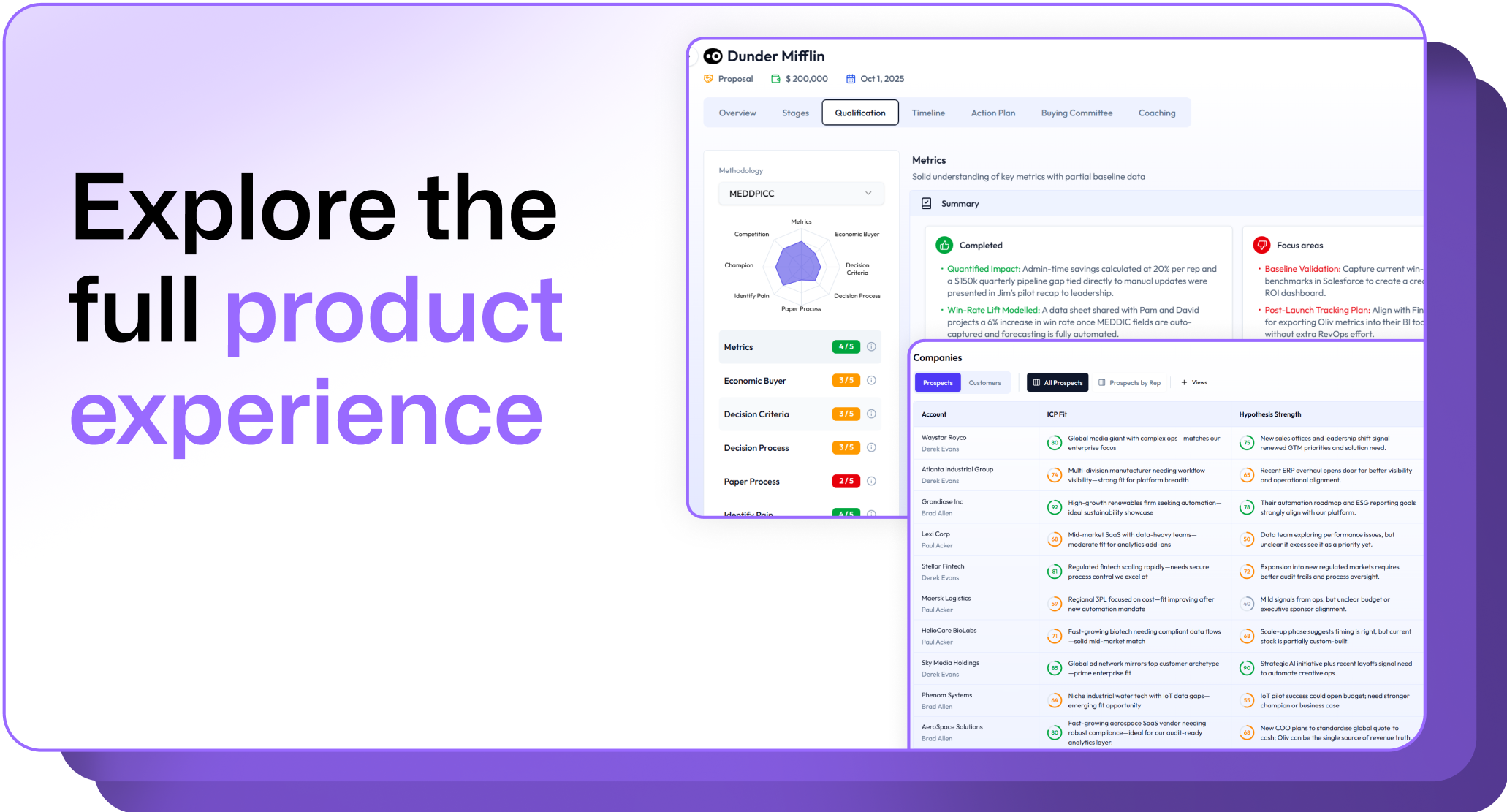
.avif)
.png)