Most organizations fully cover only 1 of 5 deal channels, leaving Slack, email, and in-person interactions as total blind spots.
A 100-user team saves 91% on TCO by replacing legacy conversation intelligence with an AI-native revenue orchestration platform.
Q1: What Is the CRO's Revenue Blind Spot and Why Does Meeting-Only Intelligence Create It? [toc=Revenue Blind Spot]
Every Monday morning, the same scene plays out in forecast calls across B2B sales floors: deal stages look healthy, activity metrics glow green, and reps project confidence. Yet quarter after quarter, 30-40% of "commit" deals slip or die silently. The uncomfortable truth? Recorded meetings, the foundation most revenue intelligence tools are built on, represent only the tip of the iceberg. The real deal narrative unfolds across email threads, Slack channels, unrecorded phone calls, and hallway conversations that never reach a dashboard. Your CRM data is, at best, a partial snapshot and at worst, a work of fiction maintained under duress by reps who view manual entry as "not critical to the act of selling".
⚠️ The "Dashcam Era" Problem
Tools like Gong and Chorus represent Generation 1 Conversation Intelligence, built in the pre-generative AI era to record and transcribe meetings. They function as dashcams: they capture the accident (the meeting) but don't help you drive the car (the daily deal progression). Gong analyzes calls in isolation, offering meeting-level insight but missing the deal-level narrative that stretches across weeks and channels. Clari adds a forecasting layer, but its process remains heavily manual, requiring managers to "pull-in" information from dashboards rather than having intelligence proactively pushed to them.
"It is really just a glorified SFDC overlay. Actually, Salesforce has built most of the forecasting functionality by now anyway so I'm not sure where they fit into that whole overcrowded Martech space." — conaldinho11, r/SalesOperations Reddit Thread
🔄 The AI-Era Shift: From Meeting-Level to Deal-Level
Generative AI and agentic platforms now make it possible to stitch unstructured data from every channel, calls, emails, Slack, Telegram, support tickets, web signals, into a single evolving deal narrative that updates continuously, not just post-meeting. Instead of requiring managers to manually correlate insights across four platforms, modern cross-channel intelligence builds one coherent story per deal, surfacing sentiment shifts, stakeholder drift, and risk signals automatically.
Most organizations fully cover only Channel 1. Channels 3 and 5 represent near-total blind spots where modern deals increasingly happen.
✅ How Oliv Eliminates the Blind Spot
Oliv.ai is built as an AI-native data platform that delivers deal-level intelligence, not just meeting-level recordings. We unify scattered data across recorded meetings, emails (Gmail/Outlook), Slack, Telegram, and even unrecorded phone calls via the Voice Agent, creating a true 360-degree deal view. Where legacy tools provide raw data for managers to interpret, Oliv's intelligence layer processes 100+ fine-tuned models to extract specific signals, competitor mentions, churn risks, feature requests, and the Deal Driver Agent delivers finished analysis directly into Slack or email where managers already work.
The data supports the urgency: only 34% of organizations trust their CRM data, and average forecast accuracy hovers at just 67%, numbers that improve dramatically when cross-channel signals replace meeting-only snapshots.
Q2: Why Do CROs Lose Deals They Think They're Winning? The Cross-Channel Visibility Gap Explained [toc=Cross-Channel Visibility Gap]
Picture this: your AE closes a strong discovery call on Zoom, confident tone, clear next steps, champion engaged. But buried in a follow-up email that same afternoon, the prospect raises budget concerns. A Slack thread with the champion shows enthusiasm cooling. A phone call from the economic buyer's personal device surfaces a new competitor. None of this reaches the CRM. None of it appears on a dashboard. The manager's next pipeline review shows the deal on track, until it isn't.
❌ Touchpoint Isolation and Temporal Blindness
This is the cross-channel visibility gap, and it's the primary reason CROs lose deals they believe they're winning. Legacy conversation intelligence tools suffer from two structural limitations:
Touchpoint Isolation: Gong analyzes each call as a standalone event. It cannot correlate how an email thread on Wednesday impacted the objection raised on a Tuesday call, or whether a Slack message from the champion contradicts their confident tone in the demo.
Activity-Volume-as-Proxy: Clari tracks engagement volume (10 emails sent = "high activity") but cannot distinguish between productive engagement and a prospect going dark after receiving a proposal.
"It's too complicated, and not intuitive at all. Using it is very...discomforting. Searching for calls is not easy, moving around in the calls is not easy, and understanding the pipeline management portion of it is almost impossible." — John S., Senior Account Executive, G2 Verified Review
"Clari should find ways to differentiate from the native Salesforce features (e.g. Pipeline Inspection, Forecasting) in order to remain competitive in the long-run." — Dan J., G2 Verified Review
🔄 Cross-Channel Intelligence: Stitching the Full Deal Narrative
Modern AI-native platforms solve this by building a unified deal narrative that evolves in real-time across every buyer touchpoint. Instead of siloed call scores, they detect:
Sentiment divergence, positive on calls but negative in email tone
Stakeholder drift, champion engaged but economic buyer silent for 14+ days
Stage-evidence mismatch, deal marked "Negotiation" but no pricing discussion in any channel
✅ How Oliv's Deal Driver Agent Closes the Gap
Oliv's Deal Driver Agent cross-references CRM stage claims against actual buyer signals across ALL channels. If a deal is marked "Negotiation" but zero pricing language has appeared in calls, emails, or Slack threads, Oliv flags the inconsistency automatically. The platform reads email context and Slack back-and-forth, not just call transcripts, to build a deal-health score grounded in evidence, not rep optimism.
"With Gong, I have trouble understanding breadth versus depth... Oliv is the first time I've ever been speechless. That's incredible." — Akil Sharperson, Enterprise CSM Lead, Triple Whale
Q3: What Integrations Matter Most for Cross-Channel Deal Stitching? [toc=Essential Integrations]
Not all integrations are created equal when it comes to building a true cross-channel deal picture. The platforms your revenue stack connects to determine whether your intelligence is comprehensive or incomplete. Below is a breakdown of the five essential integration categories and the unique deal signals each contributes.
The Five Integration Pillars for Deal Stitching
The Five Integration Pillars for Deal Stitching
Integration Category
Key Platforms
Unique Deal Signal Contributed
CRM
Salesforce, HubSpot, Microsoft Dynamics, Pipedrive, Zoho
Stage progression, deal value, close dates, ownership, methodology fields (MEDDPICC/BANT)
Email
Gmail, Outlook
Sentiment shifts, response latency, proposal engagement, multi-threaded conversations with buying committee members
Email captures the "between-meetings" narrative where real buying decisions often crystallize, budget approvals, internal stakeholder introductions, and competitive evaluation timelines.
Slack/Telegram increasingly functions as the primary collaboration channel for modern tech companies. Shared Slack channels with prospects reveal buying intent signals that never surface in formal meetings.
Dialer data is critical for high-velocity motions where reps make 25-35 sales calls per day. Without dialer integration, the majority of top-of-funnel activity goes untracked.
"The additional products like forecast or engage come at an additional cost. Would be great to see these tools rolled into the core offering." — Scott T., Director of Sales, G2 Verified Review
"The lack of visibility hindered our ability to manage the sales process effectively." — Auseh B., G2 Verified Review
✅ How Oliv Simplifies Cross-Channel Stitching
Oliv.ai natively integrates across all five categories out of the box, including Slack, Telegram, LinkedIn, support tickets, and web data (Crunchbase/news), and uses AI-based object association to correctly map activities to the right opportunity even in messy CRMs with duplicate accounts. Unlike legacy tools that require separate purchases for each integration layer, Oliv stitches everything into a single intelligence view from day one.
Q4: Does Your Revenue Tool Pull Context from Slack and Email or Only Recorded Meetings? [toc=Slack and Email Context]
Critical B2B deal progression is increasingly happening in what sales leaders call "Dark Social" channels, shared Slack channels with prospects, Telegram groups, LinkedIn DMs, and email threads that never reference a formal meeting. If your deal intelligence platform only analyzes Zoom or Teams recordings, your managers are systematically missing up to 50% of the modern sales cycle. The question isn't whether your tool records meetings well, it's whether it sees everything else.
❌ The Integration Gap in Legacy Platforms
Gong, despite its strength in conversation intelligence, has notable cross-channel blind spots:
No native Slack context ingestion, Gong doesn't import deal discussions happening in shared Slack channels
Email tracking does not equal email understanding, Gong's email integration is often limited to tracking whether an email was sent or opened, rather than understanding the conversational context within that thread
One-way data flow, Gong pulls data in but makes it difficult to export structured insights back into the CRM as the single source of truth, effectively creating a data silo
"Gong offers valuable insights into call data and sales interactions. [But] the lack of robust data export options has made it hard to justify the platform's cost, especially as it falls short of meeting practical data management needs." — Neel P., Sales Operations Manager, G2 Verified Review
🔄 Treating Every Channel as a First-Class Data Source
AI-native platforms approach this differently. Rather than treating meetings as the primary intelligence source and other channels as metadata, they apply the same depth of NLP analysis, sentiment detection, intent classification, stakeholder mapping, to email threads and Slack messages as they do to call transcripts. This means a risk signal buried in a Tuesday afternoon email carries the same analytical weight as one surfaced during a Thursday demo.
✅ Oliv: One Platform, Every Channel
Oliv is built as a "Single Solution" that stitches Calls + Emails + Slack + Telegram + Support Tickets into a unified account history. Key capabilities include:
Slack Deal Rooms: Oliv automatically creates and manages Deal Rooms in Slack, ingesting those discussions back into the CRM scorecard
Researcher Agent: Monitors account signals from the web (Crunchbase, news, LinkedIn) to add external context to the cross-channel picture
MAP Manager Agent: Automatically updates Mutual Action Plans based on milestones mentioned in Slack or Telegram threads, a capability no meeting-only tool can replicate
Where Gong attempts to be the "center of the universe" by pulling data in, Oliv maintains the CRM as the single source of truth through full open export and bi-directional sync, ensuring deal intelligence isn't trapped inside yet another platform.
Q5: How Do Companies Capture 'Off-the-Record' Deal Updates from Phone Calls and In-Person Meetings? [toc=Off-the-Record Deal Capture]
In high-velocity SMB motions with 15 to 25 day sales cycles, deals move faster than weekly pipeline reviews can track. A critical decision made over a personal phone call, a commitment extracted during a lunch meeting, or a new stakeholder surfaced in a hallway conversation, none of it gets logged. By the time a manager learns about a roadblock during Monday's forecast call, the deal is often already lost. The result is a forecast built on rep sentiment rather than objective evidence, what one founder describes as forecasting that's "all over the place" because it relies on memory, not data.
⏰ The "Monday Tradition" Manual Roll-Ups That Don't Scale
The traditional workaround is painfully familiar: every Thursday or Friday, managers sit with reps for hours doing manual pipeline roll-ups, essentially performing verbal interrogation to capture what happened off-the-record during the week. Clari's forecasting process formalizes this but doesn't eliminate it; managers still "pull-in" information from dashboards and spreadsheets rather than having it autonomously captured. Gong and Chorus, being "meeting-level" recorders, are functionally blind to anything that doesn't happen on a recorded Zoom or Teams bridge, if a deal progresses during a lunch meeting or a phone call from a personal device, the CRM remains inaccurate.
Generative AI has made a new category possible: voice-based debrief agents that autonomously collect updates from reps, process them with NLP, and map the context back to the CRM. Instead of requiring reps to type notes after every interaction (which they won't do), these agents turn the rep's verbal memory into structured, actionable deal data, bridging the gap between what happened and what the CRM knows.
The Voice Agent turns five minutes of verbal memory into structured, CRM-ready deal data every evening.
✅ How Oliv's Voice Agent Bridges the Final Gap
Oliv's Voice Agent (Alpha) represents a breakthrough in off-the-record capture. It makes a five-minute phone call to the rep every evening to capture a quick debrief on in-person or sensitive meetings. Key capabilities include:
Verbal pipeline updates reps simply talk about what happened, and the agent instantly syncs notes, dates, and stages back to the CRM hands-free
Human-in-the-Loop processing verbal updates are processed by Oliv's intelligence layer and mapped back to the 360-degree deal view
Proactive outreach the Pipeline Tracker Agent and Voice Agent reach out to reps before the "Monday Tradition" begins, ensuring unrecorded context is captured in real-time rather than recalled days later
This innovation is "landing like crazy" with enterprise leaders because it bridges the final intelligence gap that no amount of meeting recording can fill, turning every off-the-record interaction into documented, evidence-based deal data.
Q6: Can I See a Timeline of All Deal Activities, Calls, Emails, Slack, in One Unified View? [toc=Unified Deal Activity Timeline]
Today's sales manager faces a fragmented reality: CRM for stage data, Gong for call recordings, Gmail for email threads, Slack for side conversations. Piecing together the full story of a single deal requires toggling across four or more platforms, manually correlating timestamps, and hoping nothing slips through the cracks. This fragmentation leads directly to inconsistent coaching and inaccurate forecasting, because the manager's picture of deal health depends on which platform they checked last.
❌ "Meeting Gainsight" Without Deal Context
Gong provides what's best described as "meeting Gainsight", a detailed record of what happened on each call. But it misses the broader deal context that stretches across channels. It cannot show how an email thread on Wednesday impacted the risk levels discussed on a Tuesday call, or whether a Slack message from the champion contradicts their confident tone during the demo. Each call exists as an isolated event rather than a chapter in an evolving narrative.
"I am disappointed with the limited configurability of dashboards... Clari's integration capabilities are inadequate, particularly in pulling in call transcripts, which requires working with other tools." — Josiah R., Head of Sales Operations, G2 Verified Review
🔄 The Modern Standard: One Chronological Deal Narrative
The AI-era standard is a single, chronological timeline of every stakeholder interaction across all channels, calls, emails, Slack threads, Telegram messages, support tickets, with AI-generated annotations highlighting key moments:
Sentiment shifts between channels (positive in meetings, cooling in email)
New stakeholders entering the conversation
Competitor mentions and commitment language
Milestone completions or missed deadlines in Mutual Action Plans
✅ Oliv's 360-Degree Deal View
Oliv maintains one evolving deal summary that updates automatically after every call, email, and Slack interaction. Managers can see a heatmap of touchpoints to determine if reps are covering the "breadth vs. depth" of the buying committee, without watching a single minute of audio.
The Deal Driver Agent takes this further by cross-referencing the unified timeline against methodology requirements (MEDDPICC/BANT) and flagging when evidence is missing for any qualification criterion, with clickable evidence links back to the original source conversation, email, or Slack thread. Every interaction becomes traceable, every gap becomes visible.
Q7: How Do I Fix Signal-to-Noise in Slack Sales Alerts So Managers Actually Act? [toc=Fixing Slack Alert Fatigue]
Sales managers managing 8 to 12 reps with 25 to 35 calls per day face a paradox: more data, less visibility. Legacy revenue intelligence tools flood Slack with keyword-based alerts, flagging the word "budget" even when a prospect is discussing their holiday budget, or surfacing a competitor mention when a prospect casually says "I used to work at Salesforce". The result? Managers mute notifications entirely, creating dangerous blind spots in the name of preserving their sanity.
Gong's Smart Trackers, built on V1 Machine Learning, flag keyword mentions without understanding intent. They cannot distinguish between a competitor who is an active evaluation threat and one mentioned in passing. This creates what Oliv's team calls "Fake Coverage", the pipeline looks healthy based on activity volume, but deals are actually stalling because no one is acting on the right signals.
🔄 From Keyword Matching to Chain-of-Thought Reasoning
The generative AI era introduces a fundamentally different approach: Reasoning Models that use Chain-of-Thought logic to explain why they reached a conclusion. Instead of flagging "budget" in every context, these models understand the nuance of intent, distinguishing when a champion is souring on a deal versus raising a standard technical objection. The intelligence becomes contextual, not mechanical.
✅ Oliv: Insights, Right on Time
Oliv replaces alert spam with three structured delivery mechanisms designed to drive action, not noise:
⏰ Morning Briefs 30 minutes before a call, Oliv pushes a summary of account history and focus points so reps never go in "cold"
🌅 Sunset Summaries every evening, managers get a proactive daily pulse of which deals moved, which were won, and which require urgent intervention
📊 Manager Roll-ups weekly pipeline reviews highlighting only deals that progressed or are at risk, with specific AI-recommended next steps
"The search function is really frustrating - I should be able to type in a company name and get all results versus clicking on a few options that limit results. It's not easy to find calls or conversations." — Verified User in Human Resources, G2 Verified Review
All intelligence arrives in Slack or email, where managers already work, without requiring a single dashboard login.
Q8: How Does Gong Handle Cross-Channel Deal Intelligence vs. AI-Native Alternatives? [toc=Gong vs AI-Native Alternatives]
Gong pioneered conversation intelligence and remains the market leader in call recording, transcription, and rep-level analytics. For organizations whose deals are decided primarily on recorded video calls, Gong provides genuine value, its conversational AI lets managers "go into any account and ask what is going on," which many users find genuinely helpful. But as B2B deal-making shifts to multichannel engagement, Gong's meeting-centric architecture reveals structural limitations.
❌ One-way integrations Gong pulls data in but makes it difficult to export structured insights back into the CRM, effectively creating a data silo
❌ No native Slack ingestion Gong doesn't import deal discussions from shared Slack channels
❌ Email tracking does not equal email understanding limited to send/open metadata rather than conversational context
❌ V1 ML keyword trackers Smart Trackers flag mentions without understanding intent, generating noise
❌ Meeting-level analysis each call analyzed in isolation, missing the deal-level narrative
"The lack of robust data export options has made it hard to justify the platform's cost, especially as it falls short of meeting practical data management needs." — Neel P., Sales Operations Manager, G2 Verified Review
🔄 The Generational Shift: From CI to AI-Native Revenue Orchestration
The market is moving from "Generation 1 Conversation Intelligence" to what Oliv's team calls AI-Native Revenue Orchestration, agentic platforms that stitch cross-channel data and perform work autonomously, rather than requiring managers to dig through dashboards.
💰 The TCO math is stark: a 100-user team on Gong costs approximately $789,300 over three years, compared to roughly $68,400 on Oliv, a 91% TCO advantage that makes legacy conversation intelligence a commodity rather than a differentiator.
Q9: How Does Clari Compare for Revenue Visibility When Deals Happen Across Multiple Channels? [toc=Clari Cross-Channel Limitations]
Clari remains a strong player in enterprise revenue forecasting and analytics. Its pipeline inspection module, waterfall charts, and roll-up capabilities are purpose-built for large sales organizations running structured forecast calls. Sales leaders appreciate how Clari presents forecasts in a "clear, concise, and streamlined view" that can be screen-shared directly with executive teams. For organizations that need a dedicated forecasting overlay on top of Salesforce, Clari delivers genuine value.
⚠️ The "Pull-In" Problem: Dashboards Without Cross-Channel Context
However, Clari is fundamentally a "pre-generative AI" tool that requires managers to actively pull information from dashboards rather than having intelligence proactively pushed to them. Its forecasting process remains manual, managers sit with reps for hours to audit deals, and the analytics modules rely on activity volume as a proxy for deal health without understanding the contextual meaning behind those activities across channels. Clari's integration capabilities are also limited when it comes to pulling in call transcripts, requiring organizations to pair it with other tools like Gong for conversation intelligence.
"The analytics modules still need some work IMO to provide a valuable deliverable. All the pieces are there but missing the story line... You have to click around through the different modules and extract the different pieces ultimately putting it in an excel for easier manipulation." — Natalie O., Sales Operations Manager, G2 Verified Review
"Clari should find ways to differentiate from the native Salesforce features (e.g. Pipeline Inspection, Forecasting) in order to remain competitive in the long-run." — Dan J., G2 Verified Review
💸 The Stacking Cost Problem: Gong + Clari
Many organizations stack Gong (for conversation intelligence) + Clari (for forecasting), leading to costs exceeding $500/user/month with fragmented workflows and data silos between the two platforms. Each tool requires separate administration, training, and adoption, and the data doesn't seamlessly flow between them. This is the "Clari Penalty" that compounds the "Gong Tax," creating a tech stack that costs more to maintain than the revenue problems it was meant to solve.
✅ Oliv: CI + Forecasting + CRM Hygiene in One Platform
Oliv eliminates the need to stack multiple tools by delivering conversation intelligence, forecasting, and CRM hygiene through a single platform. The Forecaster Agent generates unbiased weekly forecasts, call, upside, commit, with AI commentary, performing bottom-up forecasting autonomously by inspecting every deal line-by-line. Combined with the Deal Driver Agent and CRM Manager Agent, Oliv provides the complete revenue visibility that previously required three separate tools at a fraction of the stacked cost.
"It is really just a glorified SFDC overlay. Actually, Salesforce has built most of the forecasting functionality by now anyway so I'm not sure where they fit into that whole overcrowded Martech space." — conaldinho11, r/SalesOperations Reddit Thread
Q10: How Do Fast-Growing Teams Keep CRM Clean Without a Large RevOps Team? [toc=CRM Hygiene Without RevOps]
RevOps teams at growth-stage companies are trapped in "manual debt", spending 40+ hours per month on data cleanup, deduplicating records, and chasing reps to update CRM fields. As a company scales from 25 to 100 reps, this administrative burden becomes the primary blocker to revenue growth. Reps view manual CRM entry as "not critical to the act of selling," so the data degrades in direct proportion to the team's growth velocity.
❌ Legacy Implementation: Months Before Value
Traditional enterprise tools only compound the problem. Implementing platforms like Gong takes 8 to 24 weeks and consumes 40 to 140 admin hours for configuration. Even after deployment, Gong logs meeting summaries as unstructured "Notes", text blocks that cannot be used for CRM reporting, workflow triggers, or pipeline automation. Growth-stage teams without dedicated RevOps personnel simply cannot absorb this overhead.
"The platform lacks task APIs, does not integrate with other vendors or parallel dialers, and isn't built to function as a proper sequencing tool. Gong is strong at conversation intelligence, but that's where its usefulness ends." — Anonymous Reviewer, G2 Verified Review
"I find the setup process challenging, especially when migrating fields from Salesforce, as it can't handle formula fields directly. This requires creating and maintaining duplicate fields, which adds complexity and workload." — Josiah R., Head of Sales Operations, G2 Verified Review
🔄 The New Paradigm: AI as Fractional RevOps
The AI-native approach flips the model entirely: platforms that configure in minutes, populate actual CRM objects and properties (not just notes), and autonomously maintain data hygiene, acting as a "fractional RevOps team" for companies that can't yet hire one. Instead of requiring reps to change behavior, these platforms capture data from conversations and automatically structure it into the CRM's native object model.
✅ Oliv's CRM Manager Agent: Instant Time-to-Value
Oliv's CRM Manager Agent functions as an autonomous RevOps layer for growth-stage teams:
✅ Auto-creates and enriches contacts from LinkedIn and conversation data
✅ Merges duplicate records autonomously using AI-based reasoning
✅ Updates standard and custom CRM fields at the object level, not as unstructured notes
⏰ 5-minute configuration with full custom model building in 2 to 4 weeks, compared to months for legacy tools
💰 The cost math is decisive: a 100-user team on Gong costs approximately $789,300 over three years, compared to roughly $68,400 on Oliv, delivering a 91% TCO advantage while eliminating the need for a large dedicated ops team.
Q11: Does Your Deal Intelligence Platform Support Your Dialer and Meeting Stack (Zoom/Teams/Meet)? [toc=Dialer and Meeting Stack Support]
Revenue data fragmentation is one of the most common complaints among CROs and RevOps leaders. A typical rep might use a parallel dialer for cold calls, Gmail for email threads, and Zoom for demos, but because these tools have limited syncing, data ends up scattered in "bits and pieces" across the stack. The platform your deal intelligence tool integrates with determines whether your data is unified or fragmented.
Platform Compatibility Matrix
The table below compares integration support across key deal intelligence platforms:
Gong's dialer is frequently described by users as "poorly built," and the platform provides one-way integrations that pull data in but make it difficult to export back into the CRM
Salesloft's conversational intelligence works primarily for calls made through Salesloft, failing to capture external meetings reliably
Clari's Copilot adds CI capabilities but requires a separate purchase and is still maturing compared to dedicated CI tools
"Gong's lack of open task APIs limits system integration, making it difficult to connect with other essential tools or dialers." — Anonymous Reviewer, G2 Verified Review
"The lack of visibility hindered our ability to manage the sales process effectively." — Auseh B., G2 Verified Review
✅ How Oliv Simplifies Stack Integration
Oliv.ai acts as a Unified Intelligence Layer that is platform-agnostic, natively integrating with all major video, dialer, email, and messaging platforms while maintaining the CRM (Salesforce or HubSpot) as the single source of truth through full bi-directional sync.
Q12: From Meeting-Level to Deal-Level: A Framework for Building True Cross-Channel Revenue Visibility [toc=Cross-Channel Visibility Framework]
To move from fragmented meeting recordings to genuine cross-channel intelligence, CROs need a structured approach. The "5 Channels of Deal Truth" framework provides an audit methodology: assess what percentage of each channel your current stack captures, and identify exactly where your blind spots live.
Cold-call follow-ups, prospect availability, live objection handling
⚠️ Partially covered (dialer-specific only)
5️⃣ In-Person/Off-the-Record (lunches, hallway conversations, personal calls)
Final decision signals, executive buy-in, competitive switching intent
❌ Completely uncovered by recording tools
Most organizations discover they fully cover only Channel 1. Channels 3 and 5 represent near-total blind spots, the exact channels where modern deal-making increasingly happens.
❌ What Meeting-Level Intelligence Misses
Across channels 2 to 5, legacy tools miss critical signals: email sentiment divergence (positive on calls, cooling in email threads), Slack side-thread context where champions voice real concerns, dialer conversations from cold-call follow-ups that never get logged, and off-the-record decisions made at dinners or on personal phones.
Oliv covers all five channels natively: meetings via Zoom/Teams/Meet recording, emails via Gmail/Outlook contextual analysis, Slack/Telegram via direct ingestion and Deal Rooms, dialer via Orum/Nooks/JustCall/Aircall/Dialpad support, and off-the-record via the Voice Agent. The result is a single, evolving deal narrative that gives CROs Monday-morning intervention power instead of Friday-afternoon autopsy insight.
The analogy is clear: legacy platforms like Gong and Clari are a treadmill, expensive equipment that still requires managers to do all the "running" through manual entry, dashboard digging, and call review. Oliv is the personal trainer, it monitors form, plans workouts, and actually does the heavy lifting for you.
Q1: What Is the CRO's Revenue Blind Spot and Why Does Meeting-Only Intelligence Create It? [toc=Revenue Blind Spot]
Every Monday morning, the same scene plays out in forecast calls across B2B sales floors: deal stages look healthy, activity metrics glow green, and reps project confidence. Yet quarter after quarter, 30-40% of "commit" deals slip or die silently. The uncomfortable truth? Recorded meetings, the foundation most revenue intelligence tools are built on, represent only the tip of the iceberg. The real deal narrative unfolds across email threads, Slack channels, unrecorded phone calls, and hallway conversations that never reach a dashboard. Your CRM data is, at best, a partial snapshot and at worst, a work of fiction maintained under duress by reps who view manual entry as "not critical to the act of selling".
⚠️ The "Dashcam Era" Problem
Tools like Gong and Chorus represent Generation 1 Conversation Intelligence, built in the pre-generative AI era to record and transcribe meetings. They function as dashcams: they capture the accident (the meeting) but don't help you drive the car (the daily deal progression). Gong analyzes calls in isolation, offering meeting-level insight but missing the deal-level narrative that stretches across weeks and channels. Clari adds a forecasting layer, but its process remains heavily manual, requiring managers to "pull-in" information from dashboards rather than having intelligence proactively pushed to them.
"It is really just a glorified SFDC overlay. Actually, Salesforce has built most of the forecasting functionality by now anyway so I'm not sure where they fit into that whole overcrowded Martech space." — conaldinho11, r/SalesOperations Reddit Thread
🔄 The AI-Era Shift: From Meeting-Level to Deal-Level
Generative AI and agentic platforms now make it possible to stitch unstructured data from every channel, calls, emails, Slack, Telegram, support tickets, web signals, into a single evolving deal narrative that updates continuously, not just post-meeting. Instead of requiring managers to manually correlate insights across four platforms, modern cross-channel intelligence builds one coherent story per deal, surfacing sentiment shifts, stakeholder drift, and risk signals automatically.
Most organizations fully cover only Channel 1. Channels 3 and 5 represent near-total blind spots where modern deals increasingly happen.
✅ How Oliv Eliminates the Blind Spot
Oliv.ai is built as an AI-native data platform that delivers deal-level intelligence, not just meeting-level recordings. We unify scattered data across recorded meetings, emails (Gmail/Outlook), Slack, Telegram, and even unrecorded phone calls via the Voice Agent, creating a true 360-degree deal view. Where legacy tools provide raw data for managers to interpret, Oliv's intelligence layer processes 100+ fine-tuned models to extract specific signals, competitor mentions, churn risks, feature requests, and the Deal Driver Agent delivers finished analysis directly into Slack or email where managers already work.
The data supports the urgency: only 34% of organizations trust their CRM data, and average forecast accuracy hovers at just 67%, numbers that improve dramatically when cross-channel signals replace meeting-only snapshots.
Q2: Why Do CROs Lose Deals They Think They're Winning? The Cross-Channel Visibility Gap Explained [toc=Cross-Channel Visibility Gap]
Picture this: your AE closes a strong discovery call on Zoom, confident tone, clear next steps, champion engaged. But buried in a follow-up email that same afternoon, the prospect raises budget concerns. A Slack thread with the champion shows enthusiasm cooling. A phone call from the economic buyer's personal device surfaces a new competitor. None of this reaches the CRM. None of it appears on a dashboard. The manager's next pipeline review shows the deal on track, until it isn't.
❌ Touchpoint Isolation and Temporal Blindness
This is the cross-channel visibility gap, and it's the primary reason CROs lose deals they believe they're winning. Legacy conversation intelligence tools suffer from two structural limitations:
Touchpoint Isolation: Gong analyzes each call as a standalone event. It cannot correlate how an email thread on Wednesday impacted the objection raised on a Tuesday call, or whether a Slack message from the champion contradicts their confident tone in the demo.
Activity-Volume-as-Proxy: Clari tracks engagement volume (10 emails sent = "high activity") but cannot distinguish between productive engagement and a prospect going dark after receiving a proposal.
"It's too complicated, and not intuitive at all. Using it is very...discomforting. Searching for calls is not easy, moving around in the calls is not easy, and understanding the pipeline management portion of it is almost impossible." — John S., Senior Account Executive, G2 Verified Review
"Clari should find ways to differentiate from the native Salesforce features (e.g. Pipeline Inspection, Forecasting) in order to remain competitive in the long-run." — Dan J., G2 Verified Review
🔄 Cross-Channel Intelligence: Stitching the Full Deal Narrative
Modern AI-native platforms solve this by building a unified deal narrative that evolves in real-time across every buyer touchpoint. Instead of siloed call scores, they detect:
Sentiment divergence, positive on calls but negative in email tone
Stakeholder drift, champion engaged but economic buyer silent for 14+ days
Stage-evidence mismatch, deal marked "Negotiation" but no pricing discussion in any channel
✅ How Oliv's Deal Driver Agent Closes the Gap
Oliv's Deal Driver Agent cross-references CRM stage claims against actual buyer signals across ALL channels. If a deal is marked "Negotiation" but zero pricing language has appeared in calls, emails, or Slack threads, Oliv flags the inconsistency automatically. The platform reads email context and Slack back-and-forth, not just call transcripts, to build a deal-health score grounded in evidence, not rep optimism.
"With Gong, I have trouble understanding breadth versus depth... Oliv is the first time I've ever been speechless. That's incredible." — Akil Sharperson, Enterprise CSM Lead, Triple Whale
Q3: What Integrations Matter Most for Cross-Channel Deal Stitching? [toc=Essential Integrations]
Not all integrations are created equal when it comes to building a true cross-channel deal picture. The platforms your revenue stack connects to determine whether your intelligence is comprehensive or incomplete. Below is a breakdown of the five essential integration categories and the unique deal signals each contributes.
The Five Integration Pillars for Deal Stitching
The Five Integration Pillars for Deal Stitching
Integration Category
Key Platforms
Unique Deal Signal Contributed
CRM
Salesforce, HubSpot, Microsoft Dynamics, Pipedrive, Zoho
Stage progression, deal value, close dates, ownership, methodology fields (MEDDPICC/BANT)
Email
Gmail, Outlook
Sentiment shifts, response latency, proposal engagement, multi-threaded conversations with buying committee members
Email captures the "between-meetings" narrative where real buying decisions often crystallize, budget approvals, internal stakeholder introductions, and competitive evaluation timelines.
Slack/Telegram increasingly functions as the primary collaboration channel for modern tech companies. Shared Slack channels with prospects reveal buying intent signals that never surface in formal meetings.
Dialer data is critical for high-velocity motions where reps make 25-35 sales calls per day. Without dialer integration, the majority of top-of-funnel activity goes untracked.
"The additional products like forecast or engage come at an additional cost. Would be great to see these tools rolled into the core offering." — Scott T., Director of Sales, G2 Verified Review
"The lack of visibility hindered our ability to manage the sales process effectively." — Auseh B., G2 Verified Review
✅ How Oliv Simplifies Cross-Channel Stitching
Oliv.ai natively integrates across all five categories out of the box, including Slack, Telegram, LinkedIn, support tickets, and web data (Crunchbase/news), and uses AI-based object association to correctly map activities to the right opportunity even in messy CRMs with duplicate accounts. Unlike legacy tools that require separate purchases for each integration layer, Oliv stitches everything into a single intelligence view from day one.
Q4: Does Your Revenue Tool Pull Context from Slack and Email or Only Recorded Meetings? [toc=Slack and Email Context]
Critical B2B deal progression is increasingly happening in what sales leaders call "Dark Social" channels, shared Slack channels with prospects, Telegram groups, LinkedIn DMs, and email threads that never reference a formal meeting. If your deal intelligence platform only analyzes Zoom or Teams recordings, your managers are systematically missing up to 50% of the modern sales cycle. The question isn't whether your tool records meetings well, it's whether it sees everything else.
❌ The Integration Gap in Legacy Platforms
Gong, despite its strength in conversation intelligence, has notable cross-channel blind spots:
No native Slack context ingestion, Gong doesn't import deal discussions happening in shared Slack channels
Email tracking does not equal email understanding, Gong's email integration is often limited to tracking whether an email was sent or opened, rather than understanding the conversational context within that thread
One-way data flow, Gong pulls data in but makes it difficult to export structured insights back into the CRM as the single source of truth, effectively creating a data silo
"Gong offers valuable insights into call data and sales interactions. [But] the lack of robust data export options has made it hard to justify the platform's cost, especially as it falls short of meeting practical data management needs." — Neel P., Sales Operations Manager, G2 Verified Review
🔄 Treating Every Channel as a First-Class Data Source
AI-native platforms approach this differently. Rather than treating meetings as the primary intelligence source and other channels as metadata, they apply the same depth of NLP analysis, sentiment detection, intent classification, stakeholder mapping, to email threads and Slack messages as they do to call transcripts. This means a risk signal buried in a Tuesday afternoon email carries the same analytical weight as one surfaced during a Thursday demo.
✅ Oliv: One Platform, Every Channel
Oliv is built as a "Single Solution" that stitches Calls + Emails + Slack + Telegram + Support Tickets into a unified account history. Key capabilities include:
Slack Deal Rooms: Oliv automatically creates and manages Deal Rooms in Slack, ingesting those discussions back into the CRM scorecard
Researcher Agent: Monitors account signals from the web (Crunchbase, news, LinkedIn) to add external context to the cross-channel picture
MAP Manager Agent: Automatically updates Mutual Action Plans based on milestones mentioned in Slack or Telegram threads, a capability no meeting-only tool can replicate
Where Gong attempts to be the "center of the universe" by pulling data in, Oliv maintains the CRM as the single source of truth through full open export and bi-directional sync, ensuring deal intelligence isn't trapped inside yet another platform.
Q5: How Do Companies Capture 'Off-the-Record' Deal Updates from Phone Calls and In-Person Meetings? [toc=Off-the-Record Deal Capture]
In high-velocity SMB motions with 15 to 25 day sales cycles, deals move faster than weekly pipeline reviews can track. A critical decision made over a personal phone call, a commitment extracted during a lunch meeting, or a new stakeholder surfaced in a hallway conversation, none of it gets logged. By the time a manager learns about a roadblock during Monday's forecast call, the deal is often already lost. The result is a forecast built on rep sentiment rather than objective evidence, what one founder describes as forecasting that's "all over the place" because it relies on memory, not data.
⏰ The "Monday Tradition" Manual Roll-Ups That Don't Scale
The traditional workaround is painfully familiar: every Thursday or Friday, managers sit with reps for hours doing manual pipeline roll-ups, essentially performing verbal interrogation to capture what happened off-the-record during the week. Clari's forecasting process formalizes this but doesn't eliminate it; managers still "pull-in" information from dashboards and spreadsheets rather than having it autonomously captured. Gong and Chorus, being "meeting-level" recorders, are functionally blind to anything that doesn't happen on a recorded Zoom or Teams bridge, if a deal progresses during a lunch meeting or a phone call from a personal device, the CRM remains inaccurate.
Generative AI has made a new category possible: voice-based debrief agents that autonomously collect updates from reps, process them with NLP, and map the context back to the CRM. Instead of requiring reps to type notes after every interaction (which they won't do), these agents turn the rep's verbal memory into structured, actionable deal data, bridging the gap between what happened and what the CRM knows.
The Voice Agent turns five minutes of verbal memory into structured, CRM-ready deal data every evening.
✅ How Oliv's Voice Agent Bridges the Final Gap
Oliv's Voice Agent (Alpha) represents a breakthrough in off-the-record capture. It makes a five-minute phone call to the rep every evening to capture a quick debrief on in-person or sensitive meetings. Key capabilities include:
Verbal pipeline updates reps simply talk about what happened, and the agent instantly syncs notes, dates, and stages back to the CRM hands-free
Human-in-the-Loop processing verbal updates are processed by Oliv's intelligence layer and mapped back to the 360-degree deal view
Proactive outreach the Pipeline Tracker Agent and Voice Agent reach out to reps before the "Monday Tradition" begins, ensuring unrecorded context is captured in real-time rather than recalled days later
This innovation is "landing like crazy" with enterprise leaders because it bridges the final intelligence gap that no amount of meeting recording can fill, turning every off-the-record interaction into documented, evidence-based deal data.
Q6: Can I See a Timeline of All Deal Activities, Calls, Emails, Slack, in One Unified View? [toc=Unified Deal Activity Timeline]
Today's sales manager faces a fragmented reality: CRM for stage data, Gong for call recordings, Gmail for email threads, Slack for side conversations. Piecing together the full story of a single deal requires toggling across four or more platforms, manually correlating timestamps, and hoping nothing slips through the cracks. This fragmentation leads directly to inconsistent coaching and inaccurate forecasting, because the manager's picture of deal health depends on which platform they checked last.
❌ "Meeting Gainsight" Without Deal Context
Gong provides what's best described as "meeting Gainsight", a detailed record of what happened on each call. But it misses the broader deal context that stretches across channels. It cannot show how an email thread on Wednesday impacted the risk levels discussed on a Tuesday call, or whether a Slack message from the champion contradicts their confident tone during the demo. Each call exists as an isolated event rather than a chapter in an evolving narrative.
"I am disappointed with the limited configurability of dashboards... Clari's integration capabilities are inadequate, particularly in pulling in call transcripts, which requires working with other tools." — Josiah R., Head of Sales Operations, G2 Verified Review
🔄 The Modern Standard: One Chronological Deal Narrative
The AI-era standard is a single, chronological timeline of every stakeholder interaction across all channels, calls, emails, Slack threads, Telegram messages, support tickets, with AI-generated annotations highlighting key moments:
Sentiment shifts between channels (positive in meetings, cooling in email)
New stakeholders entering the conversation
Competitor mentions and commitment language
Milestone completions or missed deadlines in Mutual Action Plans
✅ Oliv's 360-Degree Deal View
Oliv maintains one evolving deal summary that updates automatically after every call, email, and Slack interaction. Managers can see a heatmap of touchpoints to determine if reps are covering the "breadth vs. depth" of the buying committee, without watching a single minute of audio.
The Deal Driver Agent takes this further by cross-referencing the unified timeline against methodology requirements (MEDDPICC/BANT) and flagging when evidence is missing for any qualification criterion, with clickable evidence links back to the original source conversation, email, or Slack thread. Every interaction becomes traceable, every gap becomes visible.
Q7: How Do I Fix Signal-to-Noise in Slack Sales Alerts So Managers Actually Act? [toc=Fixing Slack Alert Fatigue]
Sales managers managing 8 to 12 reps with 25 to 35 calls per day face a paradox: more data, less visibility. Legacy revenue intelligence tools flood Slack with keyword-based alerts, flagging the word "budget" even when a prospect is discussing their holiday budget, or surfacing a competitor mention when a prospect casually says "I used to work at Salesforce". The result? Managers mute notifications entirely, creating dangerous blind spots in the name of preserving their sanity.
Gong's Smart Trackers, built on V1 Machine Learning, flag keyword mentions without understanding intent. They cannot distinguish between a competitor who is an active evaluation threat and one mentioned in passing. This creates what Oliv's team calls "Fake Coverage", the pipeline looks healthy based on activity volume, but deals are actually stalling because no one is acting on the right signals.
🔄 From Keyword Matching to Chain-of-Thought Reasoning
The generative AI era introduces a fundamentally different approach: Reasoning Models that use Chain-of-Thought logic to explain why they reached a conclusion. Instead of flagging "budget" in every context, these models understand the nuance of intent, distinguishing when a champion is souring on a deal versus raising a standard technical objection. The intelligence becomes contextual, not mechanical.
✅ Oliv: Insights, Right on Time
Oliv replaces alert spam with three structured delivery mechanisms designed to drive action, not noise:
⏰ Morning Briefs 30 minutes before a call, Oliv pushes a summary of account history and focus points so reps never go in "cold"
🌅 Sunset Summaries every evening, managers get a proactive daily pulse of which deals moved, which were won, and which require urgent intervention
📊 Manager Roll-ups weekly pipeline reviews highlighting only deals that progressed or are at risk, with specific AI-recommended next steps
"The search function is really frustrating - I should be able to type in a company name and get all results versus clicking on a few options that limit results. It's not easy to find calls or conversations." — Verified User in Human Resources, G2 Verified Review
All intelligence arrives in Slack or email, where managers already work, without requiring a single dashboard login.
Q8: How Does Gong Handle Cross-Channel Deal Intelligence vs. AI-Native Alternatives? [toc=Gong vs AI-Native Alternatives]
Gong pioneered conversation intelligence and remains the market leader in call recording, transcription, and rep-level analytics. For organizations whose deals are decided primarily on recorded video calls, Gong provides genuine value, its conversational AI lets managers "go into any account and ask what is going on," which many users find genuinely helpful. But as B2B deal-making shifts to multichannel engagement, Gong's meeting-centric architecture reveals structural limitations.
❌ One-way integrations Gong pulls data in but makes it difficult to export structured insights back into the CRM, effectively creating a data silo
❌ No native Slack ingestion Gong doesn't import deal discussions from shared Slack channels
❌ Email tracking does not equal email understanding limited to send/open metadata rather than conversational context
❌ V1 ML keyword trackers Smart Trackers flag mentions without understanding intent, generating noise
❌ Meeting-level analysis each call analyzed in isolation, missing the deal-level narrative
"The lack of robust data export options has made it hard to justify the platform's cost, especially as it falls short of meeting practical data management needs." — Neel P., Sales Operations Manager, G2 Verified Review
🔄 The Generational Shift: From CI to AI-Native Revenue Orchestration
The market is moving from "Generation 1 Conversation Intelligence" to what Oliv's team calls AI-Native Revenue Orchestration, agentic platforms that stitch cross-channel data and perform work autonomously, rather than requiring managers to dig through dashboards.
💰 The TCO math is stark: a 100-user team on Gong costs approximately $789,300 over three years, compared to roughly $68,400 on Oliv, a 91% TCO advantage that makes legacy conversation intelligence a commodity rather than a differentiator.
Q9: How Does Clari Compare for Revenue Visibility When Deals Happen Across Multiple Channels? [toc=Clari Cross-Channel Limitations]
Clari remains a strong player in enterprise revenue forecasting and analytics. Its pipeline inspection module, waterfall charts, and roll-up capabilities are purpose-built for large sales organizations running structured forecast calls. Sales leaders appreciate how Clari presents forecasts in a "clear, concise, and streamlined view" that can be screen-shared directly with executive teams. For organizations that need a dedicated forecasting overlay on top of Salesforce, Clari delivers genuine value.
⚠️ The "Pull-In" Problem: Dashboards Without Cross-Channel Context
However, Clari is fundamentally a "pre-generative AI" tool that requires managers to actively pull information from dashboards rather than having intelligence proactively pushed to them. Its forecasting process remains manual, managers sit with reps for hours to audit deals, and the analytics modules rely on activity volume as a proxy for deal health without understanding the contextual meaning behind those activities across channels. Clari's integration capabilities are also limited when it comes to pulling in call transcripts, requiring organizations to pair it with other tools like Gong for conversation intelligence.
"The analytics modules still need some work IMO to provide a valuable deliverable. All the pieces are there but missing the story line... You have to click around through the different modules and extract the different pieces ultimately putting it in an excel for easier manipulation." — Natalie O., Sales Operations Manager, G2 Verified Review
"Clari should find ways to differentiate from the native Salesforce features (e.g. Pipeline Inspection, Forecasting) in order to remain competitive in the long-run." — Dan J., G2 Verified Review
💸 The Stacking Cost Problem: Gong + Clari
Many organizations stack Gong (for conversation intelligence) + Clari (for forecasting), leading to costs exceeding $500/user/month with fragmented workflows and data silos between the two platforms. Each tool requires separate administration, training, and adoption, and the data doesn't seamlessly flow between them. This is the "Clari Penalty" that compounds the "Gong Tax," creating a tech stack that costs more to maintain than the revenue problems it was meant to solve.
✅ Oliv: CI + Forecasting + CRM Hygiene in One Platform
Oliv eliminates the need to stack multiple tools by delivering conversation intelligence, forecasting, and CRM hygiene through a single platform. The Forecaster Agent generates unbiased weekly forecasts, call, upside, commit, with AI commentary, performing bottom-up forecasting autonomously by inspecting every deal line-by-line. Combined with the Deal Driver Agent and CRM Manager Agent, Oliv provides the complete revenue visibility that previously required three separate tools at a fraction of the stacked cost.
"It is really just a glorified SFDC overlay. Actually, Salesforce has built most of the forecasting functionality by now anyway so I'm not sure where they fit into that whole overcrowded Martech space." — conaldinho11, r/SalesOperations Reddit Thread
Q10: How Do Fast-Growing Teams Keep CRM Clean Without a Large RevOps Team? [toc=CRM Hygiene Without RevOps]
RevOps teams at growth-stage companies are trapped in "manual debt", spending 40+ hours per month on data cleanup, deduplicating records, and chasing reps to update CRM fields. As a company scales from 25 to 100 reps, this administrative burden becomes the primary blocker to revenue growth. Reps view manual CRM entry as "not critical to the act of selling," so the data degrades in direct proportion to the team's growth velocity.
❌ Legacy Implementation: Months Before Value
Traditional enterprise tools only compound the problem. Implementing platforms like Gong takes 8 to 24 weeks and consumes 40 to 140 admin hours for configuration. Even after deployment, Gong logs meeting summaries as unstructured "Notes", text blocks that cannot be used for CRM reporting, workflow triggers, or pipeline automation. Growth-stage teams without dedicated RevOps personnel simply cannot absorb this overhead.
"The platform lacks task APIs, does not integrate with other vendors or parallel dialers, and isn't built to function as a proper sequencing tool. Gong is strong at conversation intelligence, but that's where its usefulness ends." — Anonymous Reviewer, G2 Verified Review
"I find the setup process challenging, especially when migrating fields from Salesforce, as it can't handle formula fields directly. This requires creating and maintaining duplicate fields, which adds complexity and workload." — Josiah R., Head of Sales Operations, G2 Verified Review
🔄 The New Paradigm: AI as Fractional RevOps
The AI-native approach flips the model entirely: platforms that configure in minutes, populate actual CRM objects and properties (not just notes), and autonomously maintain data hygiene, acting as a "fractional RevOps team" for companies that can't yet hire one. Instead of requiring reps to change behavior, these platforms capture data from conversations and automatically structure it into the CRM's native object model.
✅ Oliv's CRM Manager Agent: Instant Time-to-Value
Oliv's CRM Manager Agent functions as an autonomous RevOps layer for growth-stage teams:
✅ Auto-creates and enriches contacts from LinkedIn and conversation data
✅ Merges duplicate records autonomously using AI-based reasoning
✅ Updates standard and custom CRM fields at the object level, not as unstructured notes
⏰ 5-minute configuration with full custom model building in 2 to 4 weeks, compared to months for legacy tools
💰 The cost math is decisive: a 100-user team on Gong costs approximately $789,300 over three years, compared to roughly $68,400 on Oliv, delivering a 91% TCO advantage while eliminating the need for a large dedicated ops team.
Q11: Does Your Deal Intelligence Platform Support Your Dialer and Meeting Stack (Zoom/Teams/Meet)? [toc=Dialer and Meeting Stack Support]
Revenue data fragmentation is one of the most common complaints among CROs and RevOps leaders. A typical rep might use a parallel dialer for cold calls, Gmail for email threads, and Zoom for demos, but because these tools have limited syncing, data ends up scattered in "bits and pieces" across the stack. The platform your deal intelligence tool integrates with determines whether your data is unified or fragmented.
Platform Compatibility Matrix
The table below compares integration support across key deal intelligence platforms:
Gong's dialer is frequently described by users as "poorly built," and the platform provides one-way integrations that pull data in but make it difficult to export back into the CRM
Salesloft's conversational intelligence works primarily for calls made through Salesloft, failing to capture external meetings reliably
Clari's Copilot adds CI capabilities but requires a separate purchase and is still maturing compared to dedicated CI tools
"Gong's lack of open task APIs limits system integration, making it difficult to connect with other essential tools or dialers." — Anonymous Reviewer, G2 Verified Review
"The lack of visibility hindered our ability to manage the sales process effectively." — Auseh B., G2 Verified Review
✅ How Oliv Simplifies Stack Integration
Oliv.ai acts as a Unified Intelligence Layer that is platform-agnostic, natively integrating with all major video, dialer, email, and messaging platforms while maintaining the CRM (Salesforce or HubSpot) as the single source of truth through full bi-directional sync.
Q12: From Meeting-Level to Deal-Level: A Framework for Building True Cross-Channel Revenue Visibility [toc=Cross-Channel Visibility Framework]
To move from fragmented meeting recordings to genuine cross-channel intelligence, CROs need a structured approach. The "5 Channels of Deal Truth" framework provides an audit methodology: assess what percentage of each channel your current stack captures, and identify exactly where your blind spots live.
Cold-call follow-ups, prospect availability, live objection handling
⚠️ Partially covered (dialer-specific only)
5️⃣ In-Person/Off-the-Record (lunches, hallway conversations, personal calls)
Final decision signals, executive buy-in, competitive switching intent
❌ Completely uncovered by recording tools
Most organizations discover they fully cover only Channel 1. Channels 3 and 5 represent near-total blind spots, the exact channels where modern deal-making increasingly happens.
❌ What Meeting-Level Intelligence Misses
Across channels 2 to 5, legacy tools miss critical signals: email sentiment divergence (positive on calls, cooling in email threads), Slack side-thread context where champions voice real concerns, dialer conversations from cold-call follow-ups that never get logged, and off-the-record decisions made at dinners or on personal phones.
Oliv covers all five channels natively: meetings via Zoom/Teams/Meet recording, emails via Gmail/Outlook contextual analysis, Slack/Telegram via direct ingestion and Deal Rooms, dialer via Orum/Nooks/JustCall/Aircall/Dialpad support, and off-the-record via the Voice Agent. The result is a single, evolving deal narrative that gives CROs Monday-morning intervention power instead of Friday-afternoon autopsy insight.
The analogy is clear: legacy platforms like Gong and Clari are a treadmill, expensive equipment that still requires managers to do all the "running" through manual entry, dashboard digging, and call review. Oliv is the personal trainer, it monitors form, plans workouts, and actually does the heavy lifting for you.
Q1: What Is the CRO's Revenue Blind Spot and Why Does Meeting-Only Intelligence Create It? [toc=Revenue Blind Spot]
Every Monday morning, the same scene plays out in forecast calls across B2B sales floors: deal stages look healthy, activity metrics glow green, and reps project confidence. Yet quarter after quarter, 30-40% of "commit" deals slip or die silently. The uncomfortable truth? Recorded meetings, the foundation most revenue intelligence tools are built on, represent only the tip of the iceberg. The real deal narrative unfolds across email threads, Slack channels, unrecorded phone calls, and hallway conversations that never reach a dashboard. Your CRM data is, at best, a partial snapshot and at worst, a work of fiction maintained under duress by reps who view manual entry as "not critical to the act of selling".
⚠️ The "Dashcam Era" Problem
Tools like Gong and Chorus represent Generation 1 Conversation Intelligence, built in the pre-generative AI era to record and transcribe meetings. They function as dashcams: they capture the accident (the meeting) but don't help you drive the car (the daily deal progression). Gong analyzes calls in isolation, offering meeting-level insight but missing the deal-level narrative that stretches across weeks and channels. Clari adds a forecasting layer, but its process remains heavily manual, requiring managers to "pull-in" information from dashboards rather than having intelligence proactively pushed to them.
"It is really just a glorified SFDC overlay. Actually, Salesforce has built most of the forecasting functionality by now anyway so I'm not sure where they fit into that whole overcrowded Martech space." — conaldinho11, r/SalesOperations Reddit Thread
🔄 The AI-Era Shift: From Meeting-Level to Deal-Level
Generative AI and agentic platforms now make it possible to stitch unstructured data from every channel, calls, emails, Slack, Telegram, support tickets, web signals, into a single evolving deal narrative that updates continuously, not just post-meeting. Instead of requiring managers to manually correlate insights across four platforms, modern cross-channel intelligence builds one coherent story per deal, surfacing sentiment shifts, stakeholder drift, and risk signals automatically.
Most organizations fully cover only Channel 1. Channels 3 and 5 represent near-total blind spots where modern deals increasingly happen.
✅ How Oliv Eliminates the Blind Spot
Oliv.ai is built as an AI-native data platform that delivers deal-level intelligence, not just meeting-level recordings. We unify scattered data across recorded meetings, emails (Gmail/Outlook), Slack, Telegram, and even unrecorded phone calls via the Voice Agent, creating a true 360-degree deal view. Where legacy tools provide raw data for managers to interpret, Oliv's intelligence layer processes 100+ fine-tuned models to extract specific signals, competitor mentions, churn risks, feature requests, and the Deal Driver Agent delivers finished analysis directly into Slack or email where managers already work.
The data supports the urgency: only 34% of organizations trust their CRM data, and average forecast accuracy hovers at just 67%, numbers that improve dramatically when cross-channel signals replace meeting-only snapshots.
Q2: Why Do CROs Lose Deals They Think They're Winning? The Cross-Channel Visibility Gap Explained [toc=Cross-Channel Visibility Gap]
Picture this: your AE closes a strong discovery call on Zoom, confident tone, clear next steps, champion engaged. But buried in a follow-up email that same afternoon, the prospect raises budget concerns. A Slack thread with the champion shows enthusiasm cooling. A phone call from the economic buyer's personal device surfaces a new competitor. None of this reaches the CRM. None of it appears on a dashboard. The manager's next pipeline review shows the deal on track, until it isn't.
❌ Touchpoint Isolation and Temporal Blindness
This is the cross-channel visibility gap, and it's the primary reason CROs lose deals they believe they're winning. Legacy conversation intelligence tools suffer from two structural limitations:
Touchpoint Isolation: Gong analyzes each call as a standalone event. It cannot correlate how an email thread on Wednesday impacted the objection raised on a Tuesday call, or whether a Slack message from the champion contradicts their confident tone in the demo.
Activity-Volume-as-Proxy: Clari tracks engagement volume (10 emails sent = "high activity") but cannot distinguish between productive engagement and a prospect going dark after receiving a proposal.
"It's too complicated, and not intuitive at all. Using it is very...discomforting. Searching for calls is not easy, moving around in the calls is not easy, and understanding the pipeline management portion of it is almost impossible." — John S., Senior Account Executive, G2 Verified Review
"Clari should find ways to differentiate from the native Salesforce features (e.g. Pipeline Inspection, Forecasting) in order to remain competitive in the long-run." — Dan J., G2 Verified Review
🔄 Cross-Channel Intelligence: Stitching the Full Deal Narrative
Modern AI-native platforms solve this by building a unified deal narrative that evolves in real-time across every buyer touchpoint. Instead of siloed call scores, they detect:
Sentiment divergence, positive on calls but negative in email tone
Stakeholder drift, champion engaged but economic buyer silent for 14+ days
Stage-evidence mismatch, deal marked "Negotiation" but no pricing discussion in any channel
✅ How Oliv's Deal Driver Agent Closes the Gap
Oliv's Deal Driver Agent cross-references CRM stage claims against actual buyer signals across ALL channels. If a deal is marked "Negotiation" but zero pricing language has appeared in calls, emails, or Slack threads, Oliv flags the inconsistency automatically. The platform reads email context and Slack back-and-forth, not just call transcripts, to build a deal-health score grounded in evidence, not rep optimism.
"With Gong, I have trouble understanding breadth versus depth... Oliv is the first time I've ever been speechless. That's incredible." — Akil Sharperson, Enterprise CSM Lead, Triple Whale
Q3: What Integrations Matter Most for Cross-Channel Deal Stitching? [toc=Essential Integrations]
Not all integrations are created equal when it comes to building a true cross-channel deal picture. The platforms your revenue stack connects to determine whether your intelligence is comprehensive or incomplete. Below is a breakdown of the five essential integration categories and the unique deal signals each contributes.
The Five Integration Pillars for Deal Stitching
The Five Integration Pillars for Deal Stitching
Integration Category
Key Platforms
Unique Deal Signal Contributed
CRM
Salesforce, HubSpot, Microsoft Dynamics, Pipedrive, Zoho
Stage progression, deal value, close dates, ownership, methodology fields (MEDDPICC/BANT)
Email
Gmail, Outlook
Sentiment shifts, response latency, proposal engagement, multi-threaded conversations with buying committee members
Email captures the "between-meetings" narrative where real buying decisions often crystallize, budget approvals, internal stakeholder introductions, and competitive evaluation timelines.
Slack/Telegram increasingly functions as the primary collaboration channel for modern tech companies. Shared Slack channels with prospects reveal buying intent signals that never surface in formal meetings.
Dialer data is critical for high-velocity motions where reps make 25-35 sales calls per day. Without dialer integration, the majority of top-of-funnel activity goes untracked.
"The additional products like forecast or engage come at an additional cost. Would be great to see these tools rolled into the core offering." — Scott T., Director of Sales, G2 Verified Review
"The lack of visibility hindered our ability to manage the sales process effectively." — Auseh B., G2 Verified Review
✅ How Oliv Simplifies Cross-Channel Stitching
Oliv.ai natively integrates across all five categories out of the box, including Slack, Telegram, LinkedIn, support tickets, and web data (Crunchbase/news), and uses AI-based object association to correctly map activities to the right opportunity even in messy CRMs with duplicate accounts. Unlike legacy tools that require separate purchases for each integration layer, Oliv stitches everything into a single intelligence view from day one.
Q4: Does Your Revenue Tool Pull Context from Slack and Email or Only Recorded Meetings? [toc=Slack and Email Context]
Critical B2B deal progression is increasingly happening in what sales leaders call "Dark Social" channels, shared Slack channels with prospects, Telegram groups, LinkedIn DMs, and email threads that never reference a formal meeting. If your deal intelligence platform only analyzes Zoom or Teams recordings, your managers are systematically missing up to 50% of the modern sales cycle. The question isn't whether your tool records meetings well, it's whether it sees everything else.
❌ The Integration Gap in Legacy Platforms
Gong, despite its strength in conversation intelligence, has notable cross-channel blind spots:
No native Slack context ingestion, Gong doesn't import deal discussions happening in shared Slack channels
Email tracking does not equal email understanding, Gong's email integration is often limited to tracking whether an email was sent or opened, rather than understanding the conversational context within that thread
One-way data flow, Gong pulls data in but makes it difficult to export structured insights back into the CRM as the single source of truth, effectively creating a data silo
"Gong offers valuable insights into call data and sales interactions. [But] the lack of robust data export options has made it hard to justify the platform's cost, especially as it falls short of meeting practical data management needs." — Neel P., Sales Operations Manager, G2 Verified Review
🔄 Treating Every Channel as a First-Class Data Source
AI-native platforms approach this differently. Rather than treating meetings as the primary intelligence source and other channels as metadata, they apply the same depth of NLP analysis, sentiment detection, intent classification, stakeholder mapping, to email threads and Slack messages as they do to call transcripts. This means a risk signal buried in a Tuesday afternoon email carries the same analytical weight as one surfaced during a Thursday demo.
✅ Oliv: One Platform, Every Channel
Oliv is built as a "Single Solution" that stitches Calls + Emails + Slack + Telegram + Support Tickets into a unified account history. Key capabilities include:
Slack Deal Rooms: Oliv automatically creates and manages Deal Rooms in Slack, ingesting those discussions back into the CRM scorecard
Researcher Agent: Monitors account signals from the web (Crunchbase, news, LinkedIn) to add external context to the cross-channel picture
MAP Manager Agent: Automatically updates Mutual Action Plans based on milestones mentioned in Slack or Telegram threads, a capability no meeting-only tool can replicate
Where Gong attempts to be the "center of the universe" by pulling data in, Oliv maintains the CRM as the single source of truth through full open export and bi-directional sync, ensuring deal intelligence isn't trapped inside yet another platform.
Q5: How Do Companies Capture 'Off-the-Record' Deal Updates from Phone Calls and In-Person Meetings? [toc=Off-the-Record Deal Capture]
In high-velocity SMB motions with 15 to 25 day sales cycles, deals move faster than weekly pipeline reviews can track. A critical decision made over a personal phone call, a commitment extracted during a lunch meeting, or a new stakeholder surfaced in a hallway conversation, none of it gets logged. By the time a manager learns about a roadblock during Monday's forecast call, the deal is often already lost. The result is a forecast built on rep sentiment rather than objective evidence, what one founder describes as forecasting that's "all over the place" because it relies on memory, not data.
⏰ The "Monday Tradition" Manual Roll-Ups That Don't Scale
The traditional workaround is painfully familiar: every Thursday or Friday, managers sit with reps for hours doing manual pipeline roll-ups, essentially performing verbal interrogation to capture what happened off-the-record during the week. Clari's forecasting process formalizes this but doesn't eliminate it; managers still "pull-in" information from dashboards and spreadsheets rather than having it autonomously captured. Gong and Chorus, being "meeting-level" recorders, are functionally blind to anything that doesn't happen on a recorded Zoom or Teams bridge, if a deal progresses during a lunch meeting or a phone call from a personal device, the CRM remains inaccurate.
Generative AI has made a new category possible: voice-based debrief agents that autonomously collect updates from reps, process them with NLP, and map the context back to the CRM. Instead of requiring reps to type notes after every interaction (which they won't do), these agents turn the rep's verbal memory into structured, actionable deal data, bridging the gap between what happened and what the CRM knows.
The Voice Agent turns five minutes of verbal memory into structured, CRM-ready deal data every evening.
✅ How Oliv's Voice Agent Bridges the Final Gap
Oliv's Voice Agent (Alpha) represents a breakthrough in off-the-record capture. It makes a five-minute phone call to the rep every evening to capture a quick debrief on in-person or sensitive meetings. Key capabilities include:
Verbal pipeline updates reps simply talk about what happened, and the agent instantly syncs notes, dates, and stages back to the CRM hands-free
Human-in-the-Loop processing verbal updates are processed by Oliv's intelligence layer and mapped back to the 360-degree deal view
Proactive outreach the Pipeline Tracker Agent and Voice Agent reach out to reps before the "Monday Tradition" begins, ensuring unrecorded context is captured in real-time rather than recalled days later
This innovation is "landing like crazy" with enterprise leaders because it bridges the final intelligence gap that no amount of meeting recording can fill, turning every off-the-record interaction into documented, evidence-based deal data.
Q6: Can I See a Timeline of All Deal Activities, Calls, Emails, Slack, in One Unified View? [toc=Unified Deal Activity Timeline]
Today's sales manager faces a fragmented reality: CRM for stage data, Gong for call recordings, Gmail for email threads, Slack for side conversations. Piecing together the full story of a single deal requires toggling across four or more platforms, manually correlating timestamps, and hoping nothing slips through the cracks. This fragmentation leads directly to inconsistent coaching and inaccurate forecasting, because the manager's picture of deal health depends on which platform they checked last.
❌ "Meeting Gainsight" Without Deal Context
Gong provides what's best described as "meeting Gainsight", a detailed record of what happened on each call. But it misses the broader deal context that stretches across channels. It cannot show how an email thread on Wednesday impacted the risk levels discussed on a Tuesday call, or whether a Slack message from the champion contradicts their confident tone during the demo. Each call exists as an isolated event rather than a chapter in an evolving narrative.
"I am disappointed with the limited configurability of dashboards... Clari's integration capabilities are inadequate, particularly in pulling in call transcripts, which requires working with other tools." — Josiah R., Head of Sales Operations, G2 Verified Review
🔄 The Modern Standard: One Chronological Deal Narrative
The AI-era standard is a single, chronological timeline of every stakeholder interaction across all channels, calls, emails, Slack threads, Telegram messages, support tickets, with AI-generated annotations highlighting key moments:
Sentiment shifts between channels (positive in meetings, cooling in email)
New stakeholders entering the conversation
Competitor mentions and commitment language
Milestone completions or missed deadlines in Mutual Action Plans
✅ Oliv's 360-Degree Deal View
Oliv maintains one evolving deal summary that updates automatically after every call, email, and Slack interaction. Managers can see a heatmap of touchpoints to determine if reps are covering the "breadth vs. depth" of the buying committee, without watching a single minute of audio.
The Deal Driver Agent takes this further by cross-referencing the unified timeline against methodology requirements (MEDDPICC/BANT) and flagging when evidence is missing for any qualification criterion, with clickable evidence links back to the original source conversation, email, or Slack thread. Every interaction becomes traceable, every gap becomes visible.
Q7: How Do I Fix Signal-to-Noise in Slack Sales Alerts So Managers Actually Act? [toc=Fixing Slack Alert Fatigue]
Sales managers managing 8 to 12 reps with 25 to 35 calls per day face a paradox: more data, less visibility. Legacy revenue intelligence tools flood Slack with keyword-based alerts, flagging the word "budget" even when a prospect is discussing their holiday budget, or surfacing a competitor mention when a prospect casually says "I used to work at Salesforce". The result? Managers mute notifications entirely, creating dangerous blind spots in the name of preserving their sanity.
Gong's Smart Trackers, built on V1 Machine Learning, flag keyword mentions without understanding intent. They cannot distinguish between a competitor who is an active evaluation threat and one mentioned in passing. This creates what Oliv's team calls "Fake Coverage", the pipeline looks healthy based on activity volume, but deals are actually stalling because no one is acting on the right signals.
🔄 From Keyword Matching to Chain-of-Thought Reasoning
The generative AI era introduces a fundamentally different approach: Reasoning Models that use Chain-of-Thought logic to explain why they reached a conclusion. Instead of flagging "budget" in every context, these models understand the nuance of intent, distinguishing when a champion is souring on a deal versus raising a standard technical objection. The intelligence becomes contextual, not mechanical.
✅ Oliv: Insights, Right on Time
Oliv replaces alert spam with three structured delivery mechanisms designed to drive action, not noise:
⏰ Morning Briefs 30 minutes before a call, Oliv pushes a summary of account history and focus points so reps never go in "cold"
🌅 Sunset Summaries every evening, managers get a proactive daily pulse of which deals moved, which were won, and which require urgent intervention
📊 Manager Roll-ups weekly pipeline reviews highlighting only deals that progressed or are at risk, with specific AI-recommended next steps
"The search function is really frustrating - I should be able to type in a company name and get all results versus clicking on a few options that limit results. It's not easy to find calls or conversations." — Verified User in Human Resources, G2 Verified Review
All intelligence arrives in Slack or email, where managers already work, without requiring a single dashboard login.
Q8: How Does Gong Handle Cross-Channel Deal Intelligence vs. AI-Native Alternatives? [toc=Gong vs AI-Native Alternatives]
Gong pioneered conversation intelligence and remains the market leader in call recording, transcription, and rep-level analytics. For organizations whose deals are decided primarily on recorded video calls, Gong provides genuine value, its conversational AI lets managers "go into any account and ask what is going on," which many users find genuinely helpful. But as B2B deal-making shifts to multichannel engagement, Gong's meeting-centric architecture reveals structural limitations.
❌ One-way integrations Gong pulls data in but makes it difficult to export structured insights back into the CRM, effectively creating a data silo
❌ No native Slack ingestion Gong doesn't import deal discussions from shared Slack channels
❌ Email tracking does not equal email understanding limited to send/open metadata rather than conversational context
❌ V1 ML keyword trackers Smart Trackers flag mentions without understanding intent, generating noise
❌ Meeting-level analysis each call analyzed in isolation, missing the deal-level narrative
"The lack of robust data export options has made it hard to justify the platform's cost, especially as it falls short of meeting practical data management needs." — Neel P., Sales Operations Manager, G2 Verified Review
🔄 The Generational Shift: From CI to AI-Native Revenue Orchestration
The market is moving from "Generation 1 Conversation Intelligence" to what Oliv's team calls AI-Native Revenue Orchestration, agentic platforms that stitch cross-channel data and perform work autonomously, rather than requiring managers to dig through dashboards.
💰 The TCO math is stark: a 100-user team on Gong costs approximately $789,300 over three years, compared to roughly $68,400 on Oliv, a 91% TCO advantage that makes legacy conversation intelligence a commodity rather than a differentiator.
Q9: How Does Clari Compare for Revenue Visibility When Deals Happen Across Multiple Channels? [toc=Clari Cross-Channel Limitations]
Clari remains a strong player in enterprise revenue forecasting and analytics. Its pipeline inspection module, waterfall charts, and roll-up capabilities are purpose-built for large sales organizations running structured forecast calls. Sales leaders appreciate how Clari presents forecasts in a "clear, concise, and streamlined view" that can be screen-shared directly with executive teams. For organizations that need a dedicated forecasting overlay on top of Salesforce, Clari delivers genuine value.
⚠️ The "Pull-In" Problem: Dashboards Without Cross-Channel Context
However, Clari is fundamentally a "pre-generative AI" tool that requires managers to actively pull information from dashboards rather than having intelligence proactively pushed to them. Its forecasting process remains manual, managers sit with reps for hours to audit deals, and the analytics modules rely on activity volume as a proxy for deal health without understanding the contextual meaning behind those activities across channels. Clari's integration capabilities are also limited when it comes to pulling in call transcripts, requiring organizations to pair it with other tools like Gong for conversation intelligence.
"The analytics modules still need some work IMO to provide a valuable deliverable. All the pieces are there but missing the story line... You have to click around through the different modules and extract the different pieces ultimately putting it in an excel for easier manipulation." — Natalie O., Sales Operations Manager, G2 Verified Review
"Clari should find ways to differentiate from the native Salesforce features (e.g. Pipeline Inspection, Forecasting) in order to remain competitive in the long-run." — Dan J., G2 Verified Review
💸 The Stacking Cost Problem: Gong + Clari
Many organizations stack Gong (for conversation intelligence) + Clari (for forecasting), leading to costs exceeding $500/user/month with fragmented workflows and data silos between the two platforms. Each tool requires separate administration, training, and adoption, and the data doesn't seamlessly flow between them. This is the "Clari Penalty" that compounds the "Gong Tax," creating a tech stack that costs more to maintain than the revenue problems it was meant to solve.
✅ Oliv: CI + Forecasting + CRM Hygiene in One Platform
Oliv eliminates the need to stack multiple tools by delivering conversation intelligence, forecasting, and CRM hygiene through a single platform. The Forecaster Agent generates unbiased weekly forecasts, call, upside, commit, with AI commentary, performing bottom-up forecasting autonomously by inspecting every deal line-by-line. Combined with the Deal Driver Agent and CRM Manager Agent, Oliv provides the complete revenue visibility that previously required three separate tools at a fraction of the stacked cost.
"It is really just a glorified SFDC overlay. Actually, Salesforce has built most of the forecasting functionality by now anyway so I'm not sure where they fit into that whole overcrowded Martech space." — conaldinho11, r/SalesOperations Reddit Thread
Q10: How Do Fast-Growing Teams Keep CRM Clean Without a Large RevOps Team? [toc=CRM Hygiene Without RevOps]
RevOps teams at growth-stage companies are trapped in "manual debt", spending 40+ hours per month on data cleanup, deduplicating records, and chasing reps to update CRM fields. As a company scales from 25 to 100 reps, this administrative burden becomes the primary blocker to revenue growth. Reps view manual CRM entry as "not critical to the act of selling," so the data degrades in direct proportion to the team's growth velocity.
❌ Legacy Implementation: Months Before Value
Traditional enterprise tools only compound the problem. Implementing platforms like Gong takes 8 to 24 weeks and consumes 40 to 140 admin hours for configuration. Even after deployment, Gong logs meeting summaries as unstructured "Notes", text blocks that cannot be used for CRM reporting, workflow triggers, or pipeline automation. Growth-stage teams without dedicated RevOps personnel simply cannot absorb this overhead.
"The platform lacks task APIs, does not integrate with other vendors or parallel dialers, and isn't built to function as a proper sequencing tool. Gong is strong at conversation intelligence, but that's where its usefulness ends." — Anonymous Reviewer, G2 Verified Review
"I find the setup process challenging, especially when migrating fields from Salesforce, as it can't handle formula fields directly. This requires creating and maintaining duplicate fields, which adds complexity and workload." — Josiah R., Head of Sales Operations, G2 Verified Review
🔄 The New Paradigm: AI as Fractional RevOps
The AI-native approach flips the model entirely: platforms that configure in minutes, populate actual CRM objects and properties (not just notes), and autonomously maintain data hygiene, acting as a "fractional RevOps team" for companies that can't yet hire one. Instead of requiring reps to change behavior, these platforms capture data from conversations and automatically structure it into the CRM's native object model.
✅ Oliv's CRM Manager Agent: Instant Time-to-Value
Oliv's CRM Manager Agent functions as an autonomous RevOps layer for growth-stage teams:
✅ Auto-creates and enriches contacts from LinkedIn and conversation data
✅ Merges duplicate records autonomously using AI-based reasoning
✅ Updates standard and custom CRM fields at the object level, not as unstructured notes
⏰ 5-minute configuration with full custom model building in 2 to 4 weeks, compared to months for legacy tools
💰 The cost math is decisive: a 100-user team on Gong costs approximately $789,300 over three years, compared to roughly $68,400 on Oliv, delivering a 91% TCO advantage while eliminating the need for a large dedicated ops team.
Q11: Does Your Deal Intelligence Platform Support Your Dialer and Meeting Stack (Zoom/Teams/Meet)? [toc=Dialer and Meeting Stack Support]
Revenue data fragmentation is one of the most common complaints among CROs and RevOps leaders. A typical rep might use a parallel dialer for cold calls, Gmail for email threads, and Zoom for demos, but because these tools have limited syncing, data ends up scattered in "bits and pieces" across the stack. The platform your deal intelligence tool integrates with determines whether your data is unified or fragmented.
Platform Compatibility Matrix
The table below compares integration support across key deal intelligence platforms:
Gong's dialer is frequently described by users as "poorly built," and the platform provides one-way integrations that pull data in but make it difficult to export back into the CRM
Salesloft's conversational intelligence works primarily for calls made through Salesloft, failing to capture external meetings reliably
Clari's Copilot adds CI capabilities but requires a separate purchase and is still maturing compared to dedicated CI tools
"Gong's lack of open task APIs limits system integration, making it difficult to connect with other essential tools or dialers." — Anonymous Reviewer, G2 Verified Review
"The lack of visibility hindered our ability to manage the sales process effectively." — Auseh B., G2 Verified Review
✅ How Oliv Simplifies Stack Integration
Oliv.ai acts as a Unified Intelligence Layer that is platform-agnostic, natively integrating with all major video, dialer, email, and messaging platforms while maintaining the CRM (Salesforce or HubSpot) as the single source of truth through full bi-directional sync.
Q12: From Meeting-Level to Deal-Level: A Framework for Building True Cross-Channel Revenue Visibility [toc=Cross-Channel Visibility Framework]
To move from fragmented meeting recordings to genuine cross-channel intelligence, CROs need a structured approach. The "5 Channels of Deal Truth" framework provides an audit methodology: assess what percentage of each channel your current stack captures, and identify exactly where your blind spots live.
Cold-call follow-ups, prospect availability, live objection handling
⚠️ Partially covered (dialer-specific only)
5️⃣ In-Person/Off-the-Record (lunches, hallway conversations, personal calls)
Final decision signals, executive buy-in, competitive switching intent
❌ Completely uncovered by recording tools
Most organizations discover they fully cover only Channel 1. Channels 3 and 5 represent near-total blind spots, the exact channels where modern deal-making increasingly happens.
❌ What Meeting-Level Intelligence Misses
Across channels 2 to 5, legacy tools miss critical signals: email sentiment divergence (positive on calls, cooling in email threads), Slack side-thread context where champions voice real concerns, dialer conversations from cold-call follow-ups that never get logged, and off-the-record decisions made at dinners or on personal phones.
Oliv covers all five channels natively: meetings via Zoom/Teams/Meet recording, emails via Gmail/Outlook contextual analysis, Slack/Telegram via direct ingestion and Deal Rooms, dialer via Orum/Nooks/JustCall/Aircall/Dialpad support, and off-the-record via the Voice Agent. The result is a single, evolving deal narrative that gives CROs Monday-morning intervention power instead of Friday-afternoon autopsy insight.
The analogy is clear: legacy platforms like Gong and Clari are a treadmill, expensive equipment that still requires managers to do all the "running" through manual entry, dashboard digging, and call review. Oliv is the personal trainer, it monitors form, plans workouts, and actually does the heavy lifting for you.
Q1: What Is the CRO's Revenue Blind Spot and Why Does Meeting-Only Intelligence Create It? [toc=Revenue Blind Spot]
Every Monday morning, the same scene plays out in forecast calls across B2B sales floors: deal stages look healthy, activity metrics glow green, and reps project confidence. Yet quarter after quarter, 30-40% of "commit" deals slip or die silently. The uncomfortable truth? Recorded meetings, the foundation most revenue intelligence tools are built on, represent only the tip of the iceberg. The real deal narrative unfolds across email threads, Slack channels, unrecorded phone calls, and hallway conversations that never reach a dashboard. Your CRM data is, at best, a partial snapshot and at worst, a work of fiction maintained under duress by reps who view manual entry as "not critical to the act of selling".
⚠️ The "Dashcam Era" Problem
Tools like Gong and Chorus represent Generation 1 Conversation Intelligence, built in the pre-generative AI era to record and transcribe meetings. They function as dashcams: they capture the accident (the meeting) but don't help you drive the car (the daily deal progression). Gong analyzes calls in isolation, offering meeting-level insight but missing the deal-level narrative that stretches across weeks and channels. Clari adds a forecasting layer, but its process remains heavily manual, requiring managers to "pull-in" information from dashboards rather than having intelligence proactively pushed to them.
"It is really just a glorified SFDC overlay. Actually, Salesforce has built most of the forecasting functionality by now anyway so I'm not sure where they fit into that whole overcrowded Martech space." — conaldinho11, r/SalesOperations Reddit Thread
🔄 The AI-Era Shift: From Meeting-Level to Deal-Level
Generative AI and agentic platforms now make it possible to stitch unstructured data from every channel, calls, emails, Slack, Telegram, support tickets, web signals, into a single evolving deal narrative that updates continuously, not just post-meeting. Instead of requiring managers to manually correlate insights across four platforms, modern cross-channel intelligence builds one coherent story per deal, surfacing sentiment shifts, stakeholder drift, and risk signals automatically.
Most organizations fully cover only Channel 1. Channels 3 and 5 represent near-total blind spots where modern deals increasingly happen.
✅ How Oliv Eliminates the Blind Spot
Oliv.ai is built as an AI-native data platform that delivers deal-level intelligence, not just meeting-level recordings. We unify scattered data across recorded meetings, emails (Gmail/Outlook), Slack, Telegram, and even unrecorded phone calls via the Voice Agent, creating a true 360-degree deal view. Where legacy tools provide raw data for managers to interpret, Oliv's intelligence layer processes 100+ fine-tuned models to extract specific signals, competitor mentions, churn risks, feature requests, and the Deal Driver Agent delivers finished analysis directly into Slack or email where managers already work.
The data supports the urgency: only 34% of organizations trust their CRM data, and average forecast accuracy hovers at just 67%, numbers that improve dramatically when cross-channel signals replace meeting-only snapshots.
Q2: Why Do CROs Lose Deals They Think They're Winning? The Cross-Channel Visibility Gap Explained [toc=Cross-Channel Visibility Gap]
Picture this: your AE closes a strong discovery call on Zoom, confident tone, clear next steps, champion engaged. But buried in a follow-up email that same afternoon, the prospect raises budget concerns. A Slack thread with the champion shows enthusiasm cooling. A phone call from the economic buyer's personal device surfaces a new competitor. None of this reaches the CRM. None of it appears on a dashboard. The manager's next pipeline review shows the deal on track, until it isn't.
❌ Touchpoint Isolation and Temporal Blindness
This is the cross-channel visibility gap, and it's the primary reason CROs lose deals they believe they're winning. Legacy conversation intelligence tools suffer from two structural limitations:
Touchpoint Isolation: Gong analyzes each call as a standalone event. It cannot correlate how an email thread on Wednesday impacted the objection raised on a Tuesday call, or whether a Slack message from the champion contradicts their confident tone in the demo.
Activity-Volume-as-Proxy: Clari tracks engagement volume (10 emails sent = "high activity") but cannot distinguish between productive engagement and a prospect going dark after receiving a proposal.
"It's too complicated, and not intuitive at all. Using it is very...discomforting. Searching for calls is not easy, moving around in the calls is not easy, and understanding the pipeline management portion of it is almost impossible." — John S., Senior Account Executive, G2 Verified Review
"Clari should find ways to differentiate from the native Salesforce features (e.g. Pipeline Inspection, Forecasting) in order to remain competitive in the long-run." — Dan J., G2 Verified Review
🔄 Cross-Channel Intelligence: Stitching the Full Deal Narrative
Modern AI-native platforms solve this by building a unified deal narrative that evolves in real-time across every buyer touchpoint. Instead of siloed call scores, they detect:
Sentiment divergence, positive on calls but negative in email tone
Stakeholder drift, champion engaged but economic buyer silent for 14+ days
Stage-evidence mismatch, deal marked "Negotiation" but no pricing discussion in any channel
✅ How Oliv's Deal Driver Agent Closes the Gap
Oliv's Deal Driver Agent cross-references CRM stage claims against actual buyer signals across ALL channels. If a deal is marked "Negotiation" but zero pricing language has appeared in calls, emails, or Slack threads, Oliv flags the inconsistency automatically. The platform reads email context and Slack back-and-forth, not just call transcripts, to build a deal-health score grounded in evidence, not rep optimism.
"With Gong, I have trouble understanding breadth versus depth... Oliv is the first time I've ever been speechless. That's incredible." — Akil Sharperson, Enterprise CSM Lead, Triple Whale
Q3: What Integrations Matter Most for Cross-Channel Deal Stitching? [toc=Essential Integrations]
Not all integrations are created equal when it comes to building a true cross-channel deal picture. The platforms your revenue stack connects to determine whether your intelligence is comprehensive or incomplete. Below is a breakdown of the five essential integration categories and the unique deal signals each contributes.
The Five Integration Pillars for Deal Stitching
The Five Integration Pillars for Deal Stitching
Integration Category
Key Platforms
Unique Deal Signal Contributed
CRM
Salesforce, HubSpot, Microsoft Dynamics, Pipedrive, Zoho
Stage progression, deal value, close dates, ownership, methodology fields (MEDDPICC/BANT)
Email
Gmail, Outlook
Sentiment shifts, response latency, proposal engagement, multi-threaded conversations with buying committee members
Email captures the "between-meetings" narrative where real buying decisions often crystallize, budget approvals, internal stakeholder introductions, and competitive evaluation timelines.
Slack/Telegram increasingly functions as the primary collaboration channel for modern tech companies. Shared Slack channels with prospects reveal buying intent signals that never surface in formal meetings.
Dialer data is critical for high-velocity motions where reps make 25-35 sales calls per day. Without dialer integration, the majority of top-of-funnel activity goes untracked.
"The additional products like forecast or engage come at an additional cost. Would be great to see these tools rolled into the core offering." — Scott T., Director of Sales, G2 Verified Review
"The lack of visibility hindered our ability to manage the sales process effectively." — Auseh B., G2 Verified Review
✅ How Oliv Simplifies Cross-Channel Stitching
Oliv.ai natively integrates across all five categories out of the box, including Slack, Telegram, LinkedIn, support tickets, and web data (Crunchbase/news), and uses AI-based object association to correctly map activities to the right opportunity even in messy CRMs with duplicate accounts. Unlike legacy tools that require separate purchases for each integration layer, Oliv stitches everything into a single intelligence view from day one.
Q4: Does Your Revenue Tool Pull Context from Slack and Email or Only Recorded Meetings? [toc=Slack and Email Context]
Critical B2B deal progression is increasingly happening in what sales leaders call "Dark Social" channels, shared Slack channels with prospects, Telegram groups, LinkedIn DMs, and email threads that never reference a formal meeting. If your deal intelligence platform only analyzes Zoom or Teams recordings, your managers are systematically missing up to 50% of the modern sales cycle. The question isn't whether your tool records meetings well, it's whether it sees everything else.
❌ The Integration Gap in Legacy Platforms
Gong, despite its strength in conversation intelligence, has notable cross-channel blind spots:
No native Slack context ingestion, Gong doesn't import deal discussions happening in shared Slack channels
Email tracking does not equal email understanding, Gong's email integration is often limited to tracking whether an email was sent or opened, rather than understanding the conversational context within that thread
One-way data flow, Gong pulls data in but makes it difficult to export structured insights back into the CRM as the single source of truth, effectively creating a data silo
"Gong offers valuable insights into call data and sales interactions. [But] the lack of robust data export options has made it hard to justify the platform's cost, especially as it falls short of meeting practical data management needs." — Neel P., Sales Operations Manager, G2 Verified Review
🔄 Treating Every Channel as a First-Class Data Source
AI-native platforms approach this differently. Rather than treating meetings as the primary intelligence source and other channels as metadata, they apply the same depth of NLP analysis, sentiment detection, intent classification, stakeholder mapping, to email threads and Slack messages as they do to call transcripts. This means a risk signal buried in a Tuesday afternoon email carries the same analytical weight as one surfaced during a Thursday demo.
✅ Oliv: One Platform, Every Channel
Oliv is built as a "Single Solution" that stitches Calls + Emails + Slack + Telegram + Support Tickets into a unified account history. Key capabilities include:
Slack Deal Rooms: Oliv automatically creates and manages Deal Rooms in Slack, ingesting those discussions back into the CRM scorecard
Researcher Agent: Monitors account signals from the web (Crunchbase, news, LinkedIn) to add external context to the cross-channel picture
MAP Manager Agent: Automatically updates Mutual Action Plans based on milestones mentioned in Slack or Telegram threads, a capability no meeting-only tool can replicate
Where Gong attempts to be the "center of the universe" by pulling data in, Oliv maintains the CRM as the single source of truth through full open export and bi-directional sync, ensuring deal intelligence isn't trapped inside yet another platform.
Q5: How Do Companies Capture 'Off-the-Record' Deal Updates from Phone Calls and In-Person Meetings? [toc=Off-the-Record Deal Capture]
In high-velocity SMB motions with 15 to 25 day sales cycles, deals move faster than weekly pipeline reviews can track. A critical decision made over a personal phone call, a commitment extracted during a lunch meeting, or a new stakeholder surfaced in a hallway conversation, none of it gets logged. By the time a manager learns about a roadblock during Monday's forecast call, the deal is often already lost. The result is a forecast built on rep sentiment rather than objective evidence, what one founder describes as forecasting that's "all over the place" because it relies on memory, not data.
⏰ The "Monday Tradition" Manual Roll-Ups That Don't Scale
The traditional workaround is painfully familiar: every Thursday or Friday, managers sit with reps for hours doing manual pipeline roll-ups, essentially performing verbal interrogation to capture what happened off-the-record during the week. Clari's forecasting process formalizes this but doesn't eliminate it; managers still "pull-in" information from dashboards and spreadsheets rather than having it autonomously captured. Gong and Chorus, being "meeting-level" recorders, are functionally blind to anything that doesn't happen on a recorded Zoom or Teams bridge, if a deal progresses during a lunch meeting or a phone call from a personal device, the CRM remains inaccurate.
Generative AI has made a new category possible: voice-based debrief agents that autonomously collect updates from reps, process them with NLP, and map the context back to the CRM. Instead of requiring reps to type notes after every interaction (which they won't do), these agents turn the rep's verbal memory into structured, actionable deal data, bridging the gap between what happened and what the CRM knows.
The Voice Agent turns five minutes of verbal memory into structured, CRM-ready deal data every evening.
✅ How Oliv's Voice Agent Bridges the Final Gap
Oliv's Voice Agent (Alpha) represents a breakthrough in off-the-record capture. It makes a five-minute phone call to the rep every evening to capture a quick debrief on in-person or sensitive meetings. Key capabilities include:
Verbal pipeline updates reps simply talk about what happened, and the agent instantly syncs notes, dates, and stages back to the CRM hands-free
Human-in-the-Loop processing verbal updates are processed by Oliv's intelligence layer and mapped back to the 360-degree deal view
Proactive outreach the Pipeline Tracker Agent and Voice Agent reach out to reps before the "Monday Tradition" begins, ensuring unrecorded context is captured in real-time rather than recalled days later
This innovation is "landing like crazy" with enterprise leaders because it bridges the final intelligence gap that no amount of meeting recording can fill, turning every off-the-record interaction into documented, evidence-based deal data.
Q6: Can I See a Timeline of All Deal Activities, Calls, Emails, Slack, in One Unified View? [toc=Unified Deal Activity Timeline]
Today's sales manager faces a fragmented reality: CRM for stage data, Gong for call recordings, Gmail for email threads, Slack for side conversations. Piecing together the full story of a single deal requires toggling across four or more platforms, manually correlating timestamps, and hoping nothing slips through the cracks. This fragmentation leads directly to inconsistent coaching and inaccurate forecasting, because the manager's picture of deal health depends on which platform they checked last.
❌ "Meeting Gainsight" Without Deal Context
Gong provides what's best described as "meeting Gainsight", a detailed record of what happened on each call. But it misses the broader deal context that stretches across channels. It cannot show how an email thread on Wednesday impacted the risk levels discussed on a Tuesday call, or whether a Slack message from the champion contradicts their confident tone during the demo. Each call exists as an isolated event rather than a chapter in an evolving narrative.
"I am disappointed with the limited configurability of dashboards... Clari's integration capabilities are inadequate, particularly in pulling in call transcripts, which requires working with other tools." — Josiah R., Head of Sales Operations, G2 Verified Review
🔄 The Modern Standard: One Chronological Deal Narrative
The AI-era standard is a single, chronological timeline of every stakeholder interaction across all channels, calls, emails, Slack threads, Telegram messages, support tickets, with AI-generated annotations highlighting key moments:
Sentiment shifts between channels (positive in meetings, cooling in email)
New stakeholders entering the conversation
Competitor mentions and commitment language
Milestone completions or missed deadlines in Mutual Action Plans
✅ Oliv's 360-Degree Deal View
Oliv maintains one evolving deal summary that updates automatically after every call, email, and Slack interaction. Managers can see a heatmap of touchpoints to determine if reps are covering the "breadth vs. depth" of the buying committee, without watching a single minute of audio.
The Deal Driver Agent takes this further by cross-referencing the unified timeline against methodology requirements (MEDDPICC/BANT) and flagging when evidence is missing for any qualification criterion, with clickable evidence links back to the original source conversation, email, or Slack thread. Every interaction becomes traceable, every gap becomes visible.
Q7: How Do I Fix Signal-to-Noise in Slack Sales Alerts So Managers Actually Act? [toc=Fixing Slack Alert Fatigue]
Sales managers managing 8 to 12 reps with 25 to 35 calls per day face a paradox: more data, less visibility. Legacy revenue intelligence tools flood Slack with keyword-based alerts, flagging the word "budget" even when a prospect is discussing their holiday budget, or surfacing a competitor mention when a prospect casually says "I used to work at Salesforce". The result? Managers mute notifications entirely, creating dangerous blind spots in the name of preserving their sanity.
Gong's Smart Trackers, built on V1 Machine Learning, flag keyword mentions without understanding intent. They cannot distinguish between a competitor who is an active evaluation threat and one mentioned in passing. This creates what Oliv's team calls "Fake Coverage", the pipeline looks healthy based on activity volume, but deals are actually stalling because no one is acting on the right signals.
🔄 From Keyword Matching to Chain-of-Thought Reasoning
The generative AI era introduces a fundamentally different approach: Reasoning Models that use Chain-of-Thought logic to explain why they reached a conclusion. Instead of flagging "budget" in every context, these models understand the nuance of intent, distinguishing when a champion is souring on a deal versus raising a standard technical objection. The intelligence becomes contextual, not mechanical.
✅ Oliv: Insights, Right on Time
Oliv replaces alert spam with three structured delivery mechanisms designed to drive action, not noise:
⏰ Morning Briefs 30 minutes before a call, Oliv pushes a summary of account history and focus points so reps never go in "cold"
🌅 Sunset Summaries every evening, managers get a proactive daily pulse of which deals moved, which were won, and which require urgent intervention
📊 Manager Roll-ups weekly pipeline reviews highlighting only deals that progressed or are at risk, with specific AI-recommended next steps
"The search function is really frustrating - I should be able to type in a company name and get all results versus clicking on a few options that limit results. It's not easy to find calls or conversations." — Verified User in Human Resources, G2 Verified Review
All intelligence arrives in Slack or email, where managers already work, without requiring a single dashboard login.
Q8: How Does Gong Handle Cross-Channel Deal Intelligence vs. AI-Native Alternatives? [toc=Gong vs AI-Native Alternatives]
Gong pioneered conversation intelligence and remains the market leader in call recording, transcription, and rep-level analytics. For organizations whose deals are decided primarily on recorded video calls, Gong provides genuine value, its conversational AI lets managers "go into any account and ask what is going on," which many users find genuinely helpful. But as B2B deal-making shifts to multichannel engagement, Gong's meeting-centric architecture reveals structural limitations.
❌ One-way integrations Gong pulls data in but makes it difficult to export structured insights back into the CRM, effectively creating a data silo
❌ No native Slack ingestion Gong doesn't import deal discussions from shared Slack channels
❌ Email tracking does not equal email understanding limited to send/open metadata rather than conversational context
❌ V1 ML keyword trackers Smart Trackers flag mentions without understanding intent, generating noise
❌ Meeting-level analysis each call analyzed in isolation, missing the deal-level narrative
"The lack of robust data export options has made it hard to justify the platform's cost, especially as it falls short of meeting practical data management needs." — Neel P., Sales Operations Manager, G2 Verified Review
🔄 The Generational Shift: From CI to AI-Native Revenue Orchestration
The market is moving from "Generation 1 Conversation Intelligence" to what Oliv's team calls AI-Native Revenue Orchestration, agentic platforms that stitch cross-channel data and perform work autonomously, rather than requiring managers to dig through dashboards.
💰 The TCO math is stark: a 100-user team on Gong costs approximately $789,300 over three years, compared to roughly $68,400 on Oliv, a 91% TCO advantage that makes legacy conversation intelligence a commodity rather than a differentiator.
Q9: How Does Clari Compare for Revenue Visibility When Deals Happen Across Multiple Channels? [toc=Clari Cross-Channel Limitations]
Clari remains a strong player in enterprise revenue forecasting and analytics. Its pipeline inspection module, waterfall charts, and roll-up capabilities are purpose-built for large sales organizations running structured forecast calls. Sales leaders appreciate how Clari presents forecasts in a "clear, concise, and streamlined view" that can be screen-shared directly with executive teams. For organizations that need a dedicated forecasting overlay on top of Salesforce, Clari delivers genuine value.
⚠️ The "Pull-In" Problem: Dashboards Without Cross-Channel Context
However, Clari is fundamentally a "pre-generative AI" tool that requires managers to actively pull information from dashboards rather than having intelligence proactively pushed to them. Its forecasting process remains manual, managers sit with reps for hours to audit deals, and the analytics modules rely on activity volume as a proxy for deal health without understanding the contextual meaning behind those activities across channels. Clari's integration capabilities are also limited when it comes to pulling in call transcripts, requiring organizations to pair it with other tools like Gong for conversation intelligence.
"The analytics modules still need some work IMO to provide a valuable deliverable. All the pieces are there but missing the story line... You have to click around through the different modules and extract the different pieces ultimately putting it in an excel for easier manipulation." — Natalie O., Sales Operations Manager, G2 Verified Review
"Clari should find ways to differentiate from the native Salesforce features (e.g. Pipeline Inspection, Forecasting) in order to remain competitive in the long-run." — Dan J., G2 Verified Review
💸 The Stacking Cost Problem: Gong + Clari
Many organizations stack Gong (for conversation intelligence) + Clari (for forecasting), leading to costs exceeding $500/user/month with fragmented workflows and data silos between the two platforms. Each tool requires separate administration, training, and adoption, and the data doesn't seamlessly flow between them. This is the "Clari Penalty" that compounds the "Gong Tax," creating a tech stack that costs more to maintain than the revenue problems it was meant to solve.
✅ Oliv: CI + Forecasting + CRM Hygiene in One Platform
Oliv eliminates the need to stack multiple tools by delivering conversation intelligence, forecasting, and CRM hygiene through a single platform. The Forecaster Agent generates unbiased weekly forecasts, call, upside, commit, with AI commentary, performing bottom-up forecasting autonomously by inspecting every deal line-by-line. Combined with the Deal Driver Agent and CRM Manager Agent, Oliv provides the complete revenue visibility that previously required three separate tools at a fraction of the stacked cost.
"It is really just a glorified SFDC overlay. Actually, Salesforce has built most of the forecasting functionality by now anyway so I'm not sure where they fit into that whole overcrowded Martech space." — conaldinho11, r/SalesOperations Reddit Thread
Q10: How Do Fast-Growing Teams Keep CRM Clean Without a Large RevOps Team? [toc=CRM Hygiene Without RevOps]
RevOps teams at growth-stage companies are trapped in "manual debt", spending 40+ hours per month on data cleanup, deduplicating records, and chasing reps to update CRM fields. As a company scales from 25 to 100 reps, this administrative burden becomes the primary blocker to revenue growth. Reps view manual CRM entry as "not critical to the act of selling," so the data degrades in direct proportion to the team's growth velocity.
❌ Legacy Implementation: Months Before Value
Traditional enterprise tools only compound the problem. Implementing platforms like Gong takes 8 to 24 weeks and consumes 40 to 140 admin hours for configuration. Even after deployment, Gong logs meeting summaries as unstructured "Notes", text blocks that cannot be used for CRM reporting, workflow triggers, or pipeline automation. Growth-stage teams without dedicated RevOps personnel simply cannot absorb this overhead.
"The platform lacks task APIs, does not integrate with other vendors or parallel dialers, and isn't built to function as a proper sequencing tool. Gong is strong at conversation intelligence, but that's where its usefulness ends." — Anonymous Reviewer, G2 Verified Review
"I find the setup process challenging, especially when migrating fields from Salesforce, as it can't handle formula fields directly. This requires creating and maintaining duplicate fields, which adds complexity and workload." — Josiah R., Head of Sales Operations, G2 Verified Review
🔄 The New Paradigm: AI as Fractional RevOps
The AI-native approach flips the model entirely: platforms that configure in minutes, populate actual CRM objects and properties (not just notes), and autonomously maintain data hygiene, acting as a "fractional RevOps team" for companies that can't yet hire one. Instead of requiring reps to change behavior, these platforms capture data from conversations and automatically structure it into the CRM's native object model.
✅ Oliv's CRM Manager Agent: Instant Time-to-Value
Oliv's CRM Manager Agent functions as an autonomous RevOps layer for growth-stage teams:
✅ Auto-creates and enriches contacts from LinkedIn and conversation data
✅ Merges duplicate records autonomously using AI-based reasoning
✅ Updates standard and custom CRM fields at the object level, not as unstructured notes
⏰ 5-minute configuration with full custom model building in 2 to 4 weeks, compared to months for legacy tools
💰 The cost math is decisive: a 100-user team on Gong costs approximately $789,300 over three years, compared to roughly $68,400 on Oliv, delivering a 91% TCO advantage while eliminating the need for a large dedicated ops team.
Q11: Does Your Deal Intelligence Platform Support Your Dialer and Meeting Stack (Zoom/Teams/Meet)? [toc=Dialer and Meeting Stack Support]
Revenue data fragmentation is one of the most common complaints among CROs and RevOps leaders. A typical rep might use a parallel dialer for cold calls, Gmail for email threads, and Zoom for demos, but because these tools have limited syncing, data ends up scattered in "bits and pieces" across the stack. The platform your deal intelligence tool integrates with determines whether your data is unified or fragmented.
Platform Compatibility Matrix
The table below compares integration support across key deal intelligence platforms:
Gong's dialer is frequently described by users as "poorly built," and the platform provides one-way integrations that pull data in but make it difficult to export back into the CRM
Salesloft's conversational intelligence works primarily for calls made through Salesloft, failing to capture external meetings reliably
Clari's Copilot adds CI capabilities but requires a separate purchase and is still maturing compared to dedicated CI tools
"Gong's lack of open task APIs limits system integration, making it difficult to connect with other essential tools or dialers." — Anonymous Reviewer, G2 Verified Review
"The lack of visibility hindered our ability to manage the sales process effectively." — Auseh B., G2 Verified Review
✅ How Oliv Simplifies Stack Integration
Oliv.ai acts as a Unified Intelligence Layer that is platform-agnostic, natively integrating with all major video, dialer, email, and messaging platforms while maintaining the CRM (Salesforce or HubSpot) as the single source of truth through full bi-directional sync.
Q12: From Meeting-Level to Deal-Level: A Framework for Building True Cross-Channel Revenue Visibility [toc=Cross-Channel Visibility Framework]
To move from fragmented meeting recordings to genuine cross-channel intelligence, CROs need a structured approach. The "5 Channels of Deal Truth" framework provides an audit methodology: assess what percentage of each channel your current stack captures, and identify exactly where your blind spots live.
Cold-call follow-ups, prospect availability, live objection handling
⚠️ Partially covered (dialer-specific only)
5️⃣ In-Person/Off-the-Record (lunches, hallway conversations, personal calls)
Final decision signals, executive buy-in, competitive switching intent
❌ Completely uncovered by recording tools
Most organizations discover they fully cover only Channel 1. Channels 3 and 5 represent near-total blind spots, the exact channels where modern deal-making increasingly happens.
❌ What Meeting-Level Intelligence Misses
Across channels 2 to 5, legacy tools miss critical signals: email sentiment divergence (positive on calls, cooling in email threads), Slack side-thread context where champions voice real concerns, dialer conversations from cold-call follow-ups that never get logged, and off-the-record decisions made at dinners or on personal phones.
Oliv covers all five channels natively: meetings via Zoom/Teams/Meet recording, emails via Gmail/Outlook contextual analysis, Slack/Telegram via direct ingestion and Deal Rooms, dialer via Orum/Nooks/JustCall/Aircall/Dialpad support, and off-the-record via the Voice Agent. The result is a single, evolving deal narrative that gives CROs Monday-morning intervention power instead of Friday-afternoon autopsy insight.
The analogy is clear: legacy platforms like Gong and Clari are a treadmill, expensive equipment that still requires managers to do all the "running" through manual entry, dashboard digging, and call review. Oliv is the personal trainer, it monitors form, plans workouts, and actually does the heavy lifting for you.
FAQ's
What is cross-channel deal intelligence and why does it matter for CROs?
Cross-channel deal intelligence means capturing and unifying every buyer interaction, not just recorded video calls, but emails, Slack threads, phone conversations, and in-person meetings, into a single, evolving deal narrative. For CROs, this matters because deals today progress across five or more channels, and meeting-only tools create dangerous blind spots.
Meeting-only tools typically cover just 1 of 5 deal channels
Cross-channel intelligence eliminates the gap between "what happened" and "what the CRM knows"
How does Oliv capture off-the-record deal updates from phone calls and in-person meetings?
We designed our Voice Agent specifically for this blind spot. Every evening, it makes a five-minute phone call to reps to capture a quick verbal debrief on in-person meetings, sensitive conversations, or calls made from personal devices. Reps simply talk about what happened, and the agent instantly syncs notes, dates, and stages back to the CRM hands-free.
This is processed through our Human-in-the-Loop intelligence layer and mapped back to the 360-degree deal view. No typing, no manual CRM entry, no waiting until Monday to learn that a deal hit a roadblock on Wednesday.
Can I see a timeline of all deal activities across calls, emails, and Slack in one view?
Yes. We maintain one evolving deal summary that updates automatically after every call, email, and Slack interaction. Managers see a single chronological timeline of every stakeholder interaction with AI-generated annotations highlighting sentiment shifts, new stakeholders, competitor mentions, and missed milestones.
Our Deal Driver Agent cross-references this unified timeline against methodology requirements like MEDDPICC or BANT and flags when evidence is missing for any qualification criterion, with clickable links back to the source conversation, email, or Slack thread. No more toggling across four platforms to piece together deal health.
How does Oliv fix signal-to-noise in Slack sales alerts?
We replaced keyword-based alert spam with three structured delivery mechanisms designed for action, not noise. Morning Briefs push account history 30 minutes before a call. Sunset Summaries give managers a proactive daily pulse on deal movement. Weekly Manager Roll-ups highlight only deals that progressed or are at risk, with AI-recommended next steps.
Unlike V1 ML keyword trackers that flag "budget" in every context, our fine-tuned LLMs use Chain-of-Thought reasoning to understand intent and nuance, distinguishing when a champion is souring on a deal versus raising a standard objection. All intelligence arrives in Slack or email, where managers already work.
What integrations matter most for deal stitching across my sales stack?
The integrations that matter most are the ones that cover all five channels of deal truth: video meetings (Zoom, Teams, Meet), email (Gmail, Outlook), messaging (Slack, Telegram), dialers (Orum, Nooks, JustCall, Aircall, Dialpad), and off-the-record capture.
We natively integrate across all five channels and maintain your CRM (Salesforce or HubSpot) as the single source of truth through full bi-directional sync. Unlike platforms with one-way integrations that create data silos, our open export pushes structured insights directly into CRM objects, not just unstructured notes.
How do fast-growing teams keep CRM clean without a large RevOps team?
Our CRM Manager Agent functions as an autonomous RevOps layer for growth-stage teams. It auto-creates and enriches contacts from LinkedIn and conversation data, populates methodology scorecards based on conversation context, merges duplicate records using AI-based reasoning, and updates standard and custom CRM fields at the object level.
Configuration takes five minutes, with full custom model building completed in 2 to 4 weeks. Compare that to 8 to 24 weeks for legacy platforms. For teams scaling from 25 to 100 reps, we eliminate the "manual debt" of 40+ hours per month on data cleanup, acting as a fractional RevOps team at a fraction of the cost of hiring.
How does Gong handle cross-channel deal intelligence compared to AI-native alternatives?
Gong pioneered conversation intelligence and excels at call recording, transcription, and rep-level analytics. However, its architecture reveals five structural gaps for cross-channel intelligence: one-way integrations that create data silos, no native Slack ingestion, email tracking limited to send/open metadata, V1 ML keyword trackers that generate noise, and meeting-level analysis that misses the deal-level narrative.
We address each of these gaps through deal-level intelligence powered by fine-tuned LLMs, full open CRM export, native Slack and Telegram ingestion, contextual email understanding, and the Voice Agent for off-the-record capture. Processing completes in approximately 5 minutes versus 20 to 30 minutes with legacy tools.
Enjoyed the read? Join our founder for a quick 7-minute chat — no pitch, just a real conversation on how we’re rethinking RevOps with AI.
Revenue teams love Oliv
Here’s why:
All your deal data unified (from 30+ tools and tabs).
Insights are delivered to you directly, no digging.
AI agents automate tasks for you.
Thank you! Your submission has been received!
Oops! Something went wrong while submitting the form.
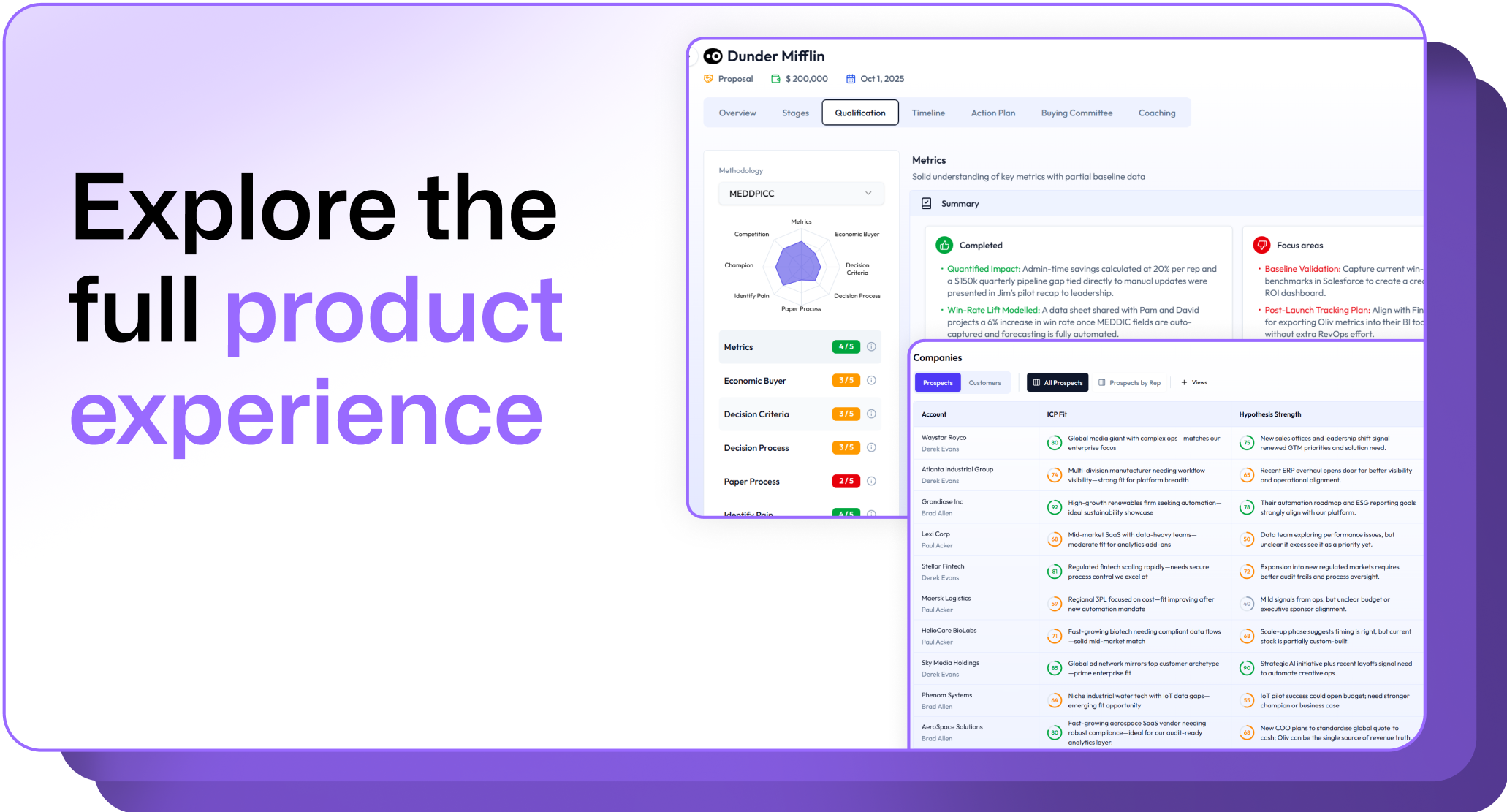
.avif)
.png)





.png)
.png)