10 Best Sales Engagement Platforms in 2026: Sequences, Multichannel Outreach, Dialer, and Analytics
Written by
Ishan Chhabra
Last Updated :
August 7, 2026
Skim in :
13
mins
In this article
Revenue teams love Oliv
Here’s why:
All your deal data unified (from 30+ tools and tabs).
Insights are delivered to you directly, no digging.
AI agents automate tasks for you.
Thank you! Your submission has been received!
Oops! Something went wrong while submitting the form.
Meet Oliv’s AI Agents
Hi! I’m, Deal Driver
I track deals, flag risks, send weekly pipeline updates and give sales managers full visibility into deal progress
Hi! I’m, CRM Manager
I maintain CRM hygiene by updating core, custom and qualification fields all without your team lifting a finger
Hi! I’m, Forecaster
I build accurate forecasts based on real deal movement and tell you which deals to pull in to hit your number
Hi! I’m, Coach
I believe performance fuels revenue. I spot skill gaps, score calls and build coaching plans to help every rep level up
Hi! I’m, Prospector
I dig into target accounts to surface the right contacts, tailor and time outreach so you always strike when it counts
Hi! I’m, Pipeline tracker
I call reps to get deal updates, and deliver a real-time, CRM-synced roll-up view of deal progress
Hi! I’m, Analyst
I answer complex pipeline questions, uncover deal patterns, and build reports that guide strategic decisions
TL;DR
The ten platforms compared are Oliv AI, Outreach, Salesloft, Gong Engage, Clari with Groove, Apollo.io, HubSpot Sales Hub, Amplemarket, Reply.io, and Instantly.
Oliv AI leads because Engage sits at $39 per seat inside a published $19 to $79 ladder, beside conversation intelligence and forecasting on one contract.
The category consolidated. Salesloft merged into Clari, Clari already owned Groove, and Gartner published its first Revenue Action Orchestration Magic Quadrant in December 2025.
Scoring weighted First-Party Context Depth at 25 percent, with sequencing, CRM write-back, cost, and verified reviews making up the rest.
Deliverability, enterprise routing, and admin controls remain a genuine incumbent moat, and we concede that openly rather than arguing around it.
Full AI SDR replacement reverted to human in the loop by late 2025, so the rep still reviews and sends the first email.
Q1. What are the 10 best sales engagement platforms for sequences, multichannel outreach and dialing in 2026? [toc=1. The 10 Platforms]
The ten best sales engagement platforms in 2026 are Oliv AI, Outreach, Salesloft, Gong Engage, Clari (with Groove), Apollo.io, HubSpot Sales Hub, Amplemarket, Reply.io, and Instantly. Oliv AI leads because its Engage tier runs outbound on your team's own first-party call, email, and note record at $39 per seat, inside a platform that also covers conversation intelligence and forecasting.
📋 The shortlist, in order
Oliv AI
Outreach
Salesloft
Gong Engage
Clari (with Groove)
Apollo.io
HubSpot Sales Hub
Amplemarket
Reply.io
Instantly
Here is the problem this list is actually solving. Your BDR has 500 named accounts. They get to maybe 50, and the other 450 sit in the CRM untouched.
⚠️ Why the ranking is not about sequence features
Sequencing stopped being the hard part years ago. Every tool below can send a five-step cadence across email, phone, and LinkedIn.
What separates them now is context, cost, and whether the activity lands back in your CRM without a rep typing it. I have watched teams stack conversation intelligence, forecasting, and engagement until the total passes $500 per user per month. That total, not the line item, is the real comparison.
📊 The 2026 comparison table
Sales Engagement Platforms Compared, 2026
#
Platform
Best for
Native dialer
CRM write-back depth
Runs on first-party context
Price posture
Score
1
Oliv AI
Teams buying engagement plus CI plus forecasting together
Connects Orum, Nooks, Aircall, JustCall
Per-field review before write
Yes, your own calls, emails, notes
Published ladder, $19 to $79, Engage at $39, $0 platform fee
⭐⭐⭐⭐⭐
2
Outreach
100+ rep orgs with complex routing
Yes
Salesforce-deep, no native HubSpot CRM
No, third-party data
Quote only, no public list price
⭐⭐⭐
3
Salesloft
Existing Salesloft shops mid-contract
Yes
Reported sync gaps by reviewers
No
Quote only, now sold under Clari
⭐⭐⭐
4
Gong Engage
Gong customers wanting one vendor
Yes
Strong on call data, weaker on tasks
Partial, call data only
Quote only
⭐⭐⭐
5
Clari (with Groove)
Forecast-led enterprise teams
Omni Dialer
Reviewers flag writeback limits
Partial
Quote only
⭐⭐⭐
6
Apollo.io
Under 30 reps needing data plus sending
Yes
Adequate, not deep
No, bought data
Public self-serve tiers
⭐⭐⭐⭐
7
HubSpot Sales Hub
HubSpot-first teams
Yes
Native, it is the CRM
No
Public tiers
⭐⭐⭐⭐
8
Amplemarket
Outbound teams wanting data plus AI copy
Yes
Verify before buying
No
Verify on vendor page
⭐⭐⭐
9
Reply.io
Small teams on multichannel sequences
Yes
Verify before buying
No
Public tiers
⭐⭐⭐
10
Instantly
Email-first outbound at volume
No
Light
No
Public tiers
⭐⭐⭐
Scores use the five weighted criteria in the next section. Pricing posture is stated rather than quoted, because I will not publish a competitor number I cannot trace to that vendor's own page.
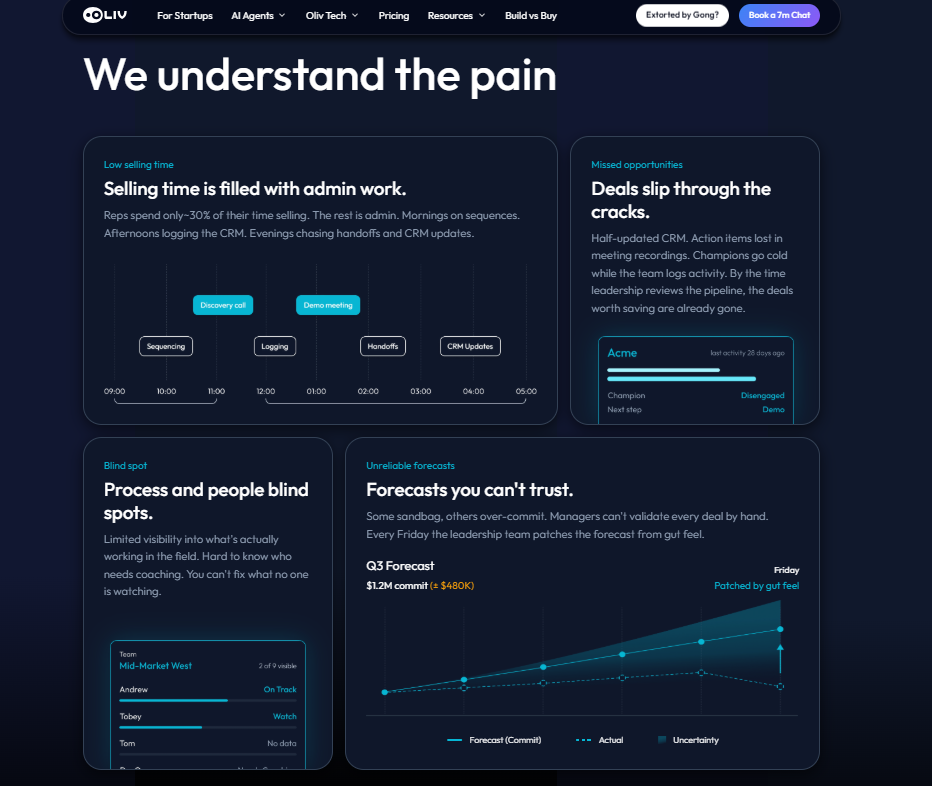
Oliv AI breakdown of four revenue pains, reps selling only 30% of the time, deals slipping, coaching blind spots, and gut-feel forecasts that engagement platforms alone cannot fix.
Oliv AI is an AI-native revenue intelligence and revenue orchestration platform, and its Prospector agent runs the outbound motion on your team's first-party record rather than bought contact data. Engage is priced at $39 per seat per month, inside a published ladder that runs from $19 to $79 with a $0 platform fee.
⚙️ What it does, and what it refuses to do
Oliv AI runs on top of Salesforce, HubSpot, Dynamics, Pipedrive, and Zoho, and it never replaces them. We built it that way because a CRM migration kills a pilot before week two.
The mechanic that matters most to a skeptical AE is simple. The rep reviews and sends the first email, and the second and third follow-ups run automatically.
🔑 Key features that change a BDR's Monday
Prospector agent for new business and expansion inside existing accounts
Sequences built from your own calls, emails, and notes, not a purchased list
Conversation intelligence and forecasting in the same platform, not a separate contract
💰 Pricing and implementation
The per-seat ladder is published, which is rarer in this category than it should be. View-only seats are free, so managers and RevOps can watch without paying.
Setup connects your CRM and call sources in one session. Reviewers describe onboarding in five to fifteen minutes for individual use, with forward-deployed engineers handling larger rollouts.
🗓️ Product updates timeline
Oliv AI Product Updates Timeline
Period
What shipped or shifted
Through 2025
Agent library expands past note-taking into CRM Manager, Deal Driver, and Forecast agents, with the Context Graph holding account and opportunity state between them.
2026 to date
Engage lands as a distinct $39 tier and Prospector runs outbound on first-party context, with a published $19 to $79 ladder, $0 platform fee, and free view-only seats.
Signaled next
Broader dialer and channel coverage across named integrations, including Orum, Nooks, Aircall, JustCall, Slack, Telegram, and LinkedIn, rather than a rising seat price.
✅ Pros and ❌ cons
✅ Engagement, conversation intelligence, and forecasting on one contract ✅ Published pricing you can check before a call ✅ Rep approves the first email, which kills the generic-AI objection ✅ Works with the CRM and dialer you already run ❌ Reviewers report occasional slowness and glitches ❌ Dashboard and report customization is thinner than legacy analytics tools ❌ The mobile app trails the desktop experience
👥 Best use case
Mid-market B2B teams of 30 to 200 reps who are renewing two or three contracts at once. If your stack total is the problem, this is where to start.
💬 What users actually say
"I use oliv ai to record all my calls and constantly monitor all my deals, so it's like a constant companion for me in all my sales calls. It updates me before a sales call and after a sales call. Once the sales call is done, it goes ahead and updates my CRM." - Verified reviewer, Oliv AI G2 Verified Review, 02 Jul 2026, 5 stars
"I'd love to see few more options to customize dashboards and reports for different teams." - Verified reviewer, Oliv AI G2 Verified Review, 26 Jun 2026, 4.5 stars
Oliv AI ranks first here because the engagement job arrives as a $39 tier beside conversation intelligence and forecasting, and because the rep, not the agent, owns the first touch. Our read is that this is the honest version of AI outbound in 2026.
1.2 Outreach [toc=1.2 Outreach]
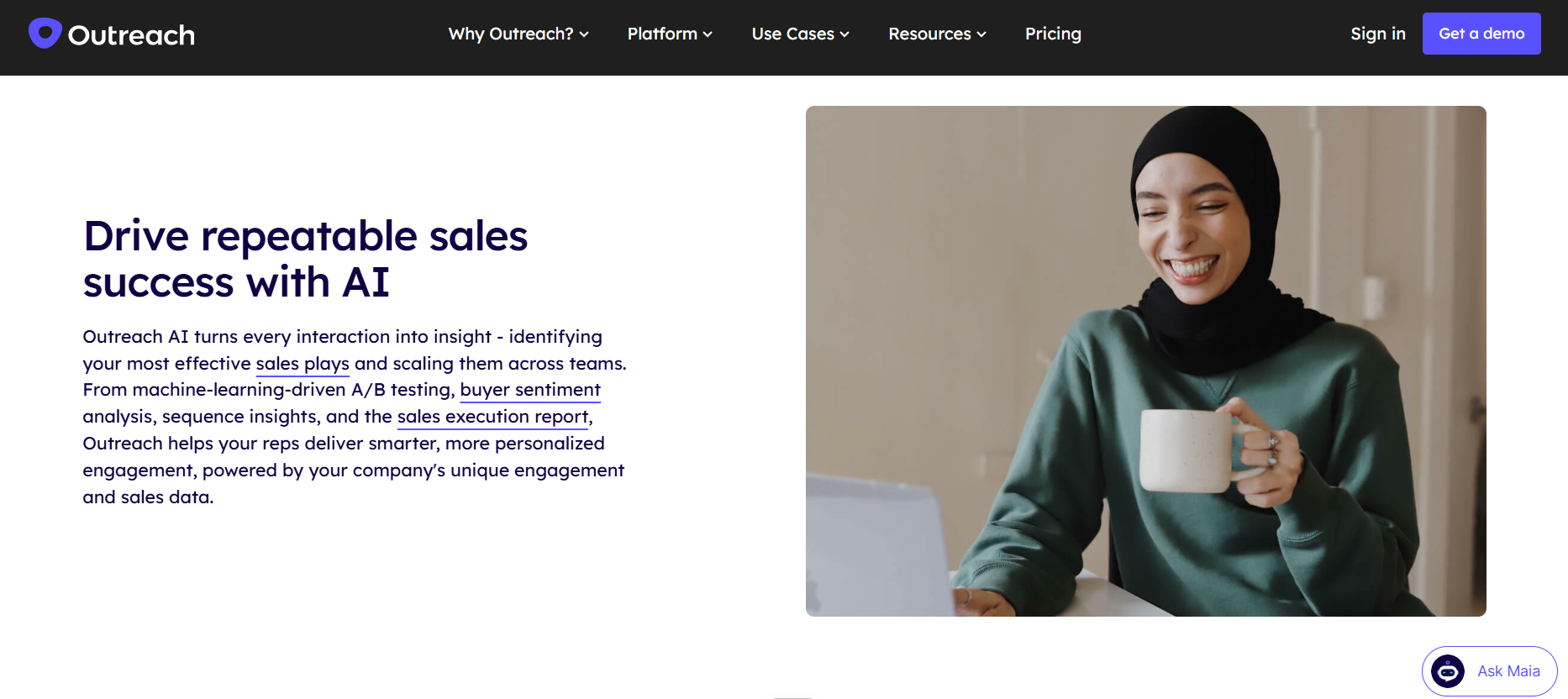
Outreach AI overview highlighting machine-learning A/B testing, buyer sentiment analysis, and sales execution reporting, the sequencing and analytics depth that anchors enterprise sales engagement evaluations.
Outreach remains the deepest enterprise sequencing engine in the category, and it is the right answer for large SDR organizations with complex routing and admin controls. Its reviewers describe rigid sequences and data-accuracy problems, and it has no native HubSpot CRM integration, which is a checkable disqualifier for HubSpot shops.
⚙️ What it does well
Outreach owns the mechanics. Sequences, task queues, and engagement visibility hold up at hundreds of reps.
Deliverability infrastructure, compliance controls, and enterprise routing are genuine moats here. I concede that no newer entrant has proven those at the same scale.
🔑 Key features
Multi-step, multichannel sequences with granular task management
Engagement analytics by rep, sequence, and account
💰 Pricing and implementation
Outreach does not publish list pricing, so every number in circulation comes from a quote or a third party. Treat any figure you read elsewhere as unverified until it arrives on your own order form.
Implementation is an admin project, not a self-serve signup. Budget RevOps time for sequence migration and field mapping.
✅ Pros and ❌ cons
✅ Strongest sequencing depth for 100+ rep teams ✅ Mature admin, routing, and permission controls ✅ Well-understood by experienced SDR managers ❌ No native HubSpot CRM integration ❌ Reviewers report rigid sequences and clunky workflow ❌ No published pricing, so budgeting starts with a sales call ❌ Sequencing alone, so conversation intelligence and forecasting stay separate contracts
👥 Best use case
Enterprise outbound orgs on Salesforce with dedicated RevOps support. If routing complexity is your bottleneck, Outreach still earns its seat.
💬 What users actually say
"As an SDR, I like that Outreach keeps everything in one place and makes my day easier to manage. The sequences help me stay on top of follow-ups without having to think too much about it, and it saves a lot of time on manual work." - Verified reviewer, Outreach G2 Verified Review, 04 May 2026, review titled "Clunky Workflow, Rigid Sequences, and Data Accuracy Issues in Outreach"
"Gong Engage is awful in every single way compared to outreach. Would not recommend at all, flows are hard to get into, information is not readily available, sequencing is difficult to create and track, nothing is robust or scalable." - Verified reviewer, Gong G2 Verified Review, 09 Jun 2025, 1.5 stars
Oliv AI is not the replacement for Outreach's routing depth, and I would not pitch it that way to a 300-rep org. Oliv AI is the alternative when the buying question is stack total, HubSpot support, or whether outreach should be written from your own conversation record.
1.3 Salesloft [toc=1.3 Salesloft]
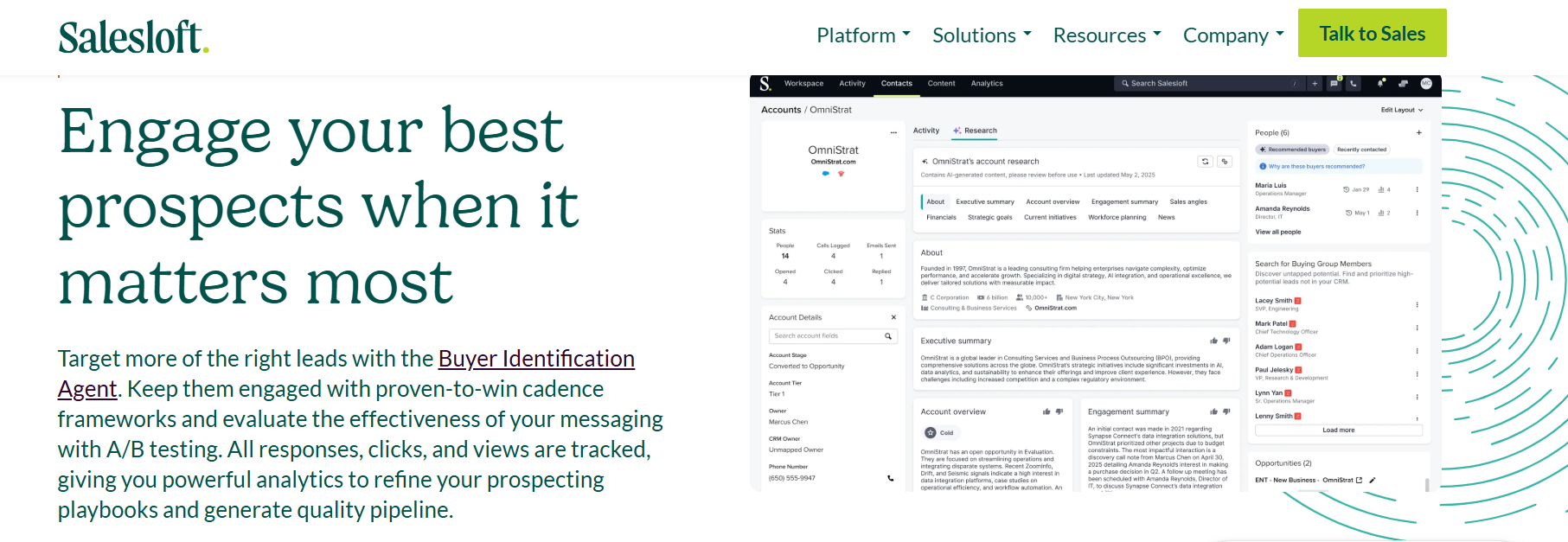
Salesloft account view combining AI account research, buyer identification, cadence frameworks, and A/B messaging analytics, illustrating how enterprise sales engagement platforms prioritize and track prospect outreach.
Salesloft is a mature cadence and dialer platform that now sits inside Clari after the two companies agreed to merge, which makes roadmap clarity the first thing to ask about at renewal. Its G2 reviewers from 2025 and 2026 report setup friction, meeting-logging problems, and dialer slowness alongside solid cadence structure.
⚙️ What it does
Salesloft runs cadences, templates, and a built-in dialer for high-volume outbound. Reps get a task list, and managers get activity reporting.
The structure is the strength. Teams that need consistency across many accounts get it out of the box.
🔑 Key features
Multi-step cadences with email, call, and social steps
Built-in dialer with call logging
Template library and shared team assets
Activity and engagement reporting for managers
💰 Pricing and implementation
Salesloft does not publish list pricing, so budgeting starts with a quote. Any number you find elsewhere is unverified until it reaches your order form.
Implementation is not light. Multiple reviewers describe integration work and a real learning curve.
🗓️ Product updates timeline
Salesloft Product Updates Timeline
Period
What changed
Through 2025
Standalone cadence, template, and dialer platform, with a Salesforce and Sales Navigator sync that reviewers repeatedly flagged for stale extension data and faulty open tracking.
August 2025 onward
Clari and Salesloft announced an agreement to merge, putting Salesloft's engagement stack beside Clari's Groove and forecasting products under one roadmap. Context on the combined stack sits in our Clari alternatives breakdown.
Expected next
Cross-product consolidation, visible in the March 2026 Clari release that added "Create Salesloft Tasks" and Salesloft follow-up sending from Clari.
✅ Pros and ❌ cons
✅ Cadence structure is clear and easy for SDRs to follow ✅ Templates and shared assets keep messaging consistent ✅ Long track record with experienced sales managers ❌ Reviewers report broken features, including inbound calls and task reminders ❌ Dialer is described as slow to launch ❌ Setup and integration friction is a recurring theme ❌ Roadmap now depends on merger sequencing, not Salesloft alone
👥 Best use case
Teams already deep in Salesloft with time left on the contract. Use the remaining term to test alternatives rather than switching mid-cycle.
💬 What users actually say
"Salesloft helps organize outreach at scale and keeps follow-ups from falling through the cracks. I appreciate having cadences and templates all in one place, it makes staying consistent across accounts a lot easier." - Verified reviewer, Salesloft G2 Verified Review, 22 Jul 2025, 2.5 stars
"A handful of features don't work properly (inbound calls, task reminders, data connectivity between apps (CRM, Sales Nav)... Dialer is often slow at launching when making calls" - Verified reviewer, Salesloft G2 Verified Review, 26 Mar 2025, 1.5 stars
"For months, randomly, one-off emails sent from Salesloft (not sequences) would appear blank in the recipient's mailbox. One-off Scheduled emails are not paused when someone replies." - Verified reviewer, Salesloft G2 Verified Review, 24 Sep 2025, 2 stars
Oliv AI is worth a parallel pilot during a merger year, because it runs on top of your existing CRM instead of replacing it. That lets you evaluate calmly while the incumbent contract runs down, which is the same logic we lay out for reducing sales tech stack costs.
1.4 Gong Engage [toc=1.4 Gong Engage]
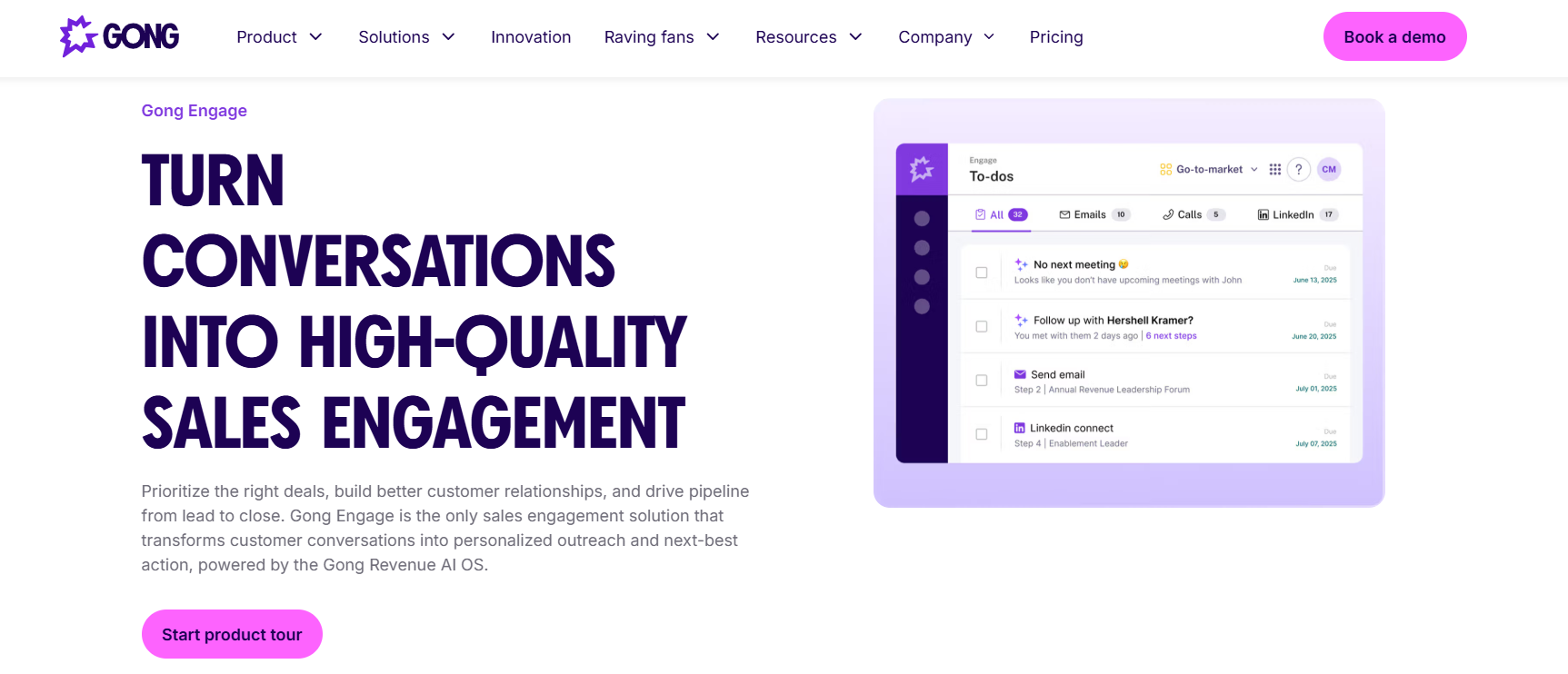
Gong Engage task queue grouping emails, calls, and LinkedIn steps with AI follow-up prompts, showing how conversation-intelligence platforms convert recorded calls into multichannel sales engagement actions.
Gong Engage is the engagement layer bolted onto the strongest conversation-intelligence platform in the category, so it wins on call data and loses on sequencing depth. Gong's own reviewers describe Engage flows as hard to build and track, while praising Gong's transcripts and AI highlights.
⚙️ What it does
Gong records and analyzes calls, then triggers outreach flows from what it hears. That link between conversation and next action is the real pitch.
Flows can start automatically when a smart tracker detects a topic. For coaching-led teams, that is genuinely useful.
🔑 Key features
Flows triggered by conversation topics detected in calls, explained in our Gong smart trackers guide
Deep call recording, transcription, and AI highlights
Gong does not publish seat prices, though it added visible per-seat pricing inside the admin center for eligible direct-purchase accounts in mid-2025. Expect a quote, and expect Engage to be a separate module.
Setup effort is real. Reviewers call the tracker configuration interface difficult.
🗓️ Product updates timeline
Gong Engage Product Updates Timeline
Period
What shipped
2025
Agent Studio, AI Theme Spotter, and Data Extractor arrived, with Data Extractor mapping AI-extracted fields to the CRM and Engage gaining full Microsoft Dynamics support in December.
February to May 2026
Mission Andromeda added Gong Enable and account management, then Rephraser brought AI generation and rewriting into emails, templates, and flows.
Coming next
Gong states MCP interoperability is coming soon, letting the AI Briefer pull third-party data in and external AI platforms query Gong deals out.
✅ Pros and ❌ cons
✅ Best-in-class call capture and transcript quality ✅ Flows can trigger from detected conversation topics ✅ One vendor if you already own Gong ❌ Reviewers call Engage sequencing hard to create and track ❌ Getting data back into Salesforce is flagged as limited ❌ Data export is restricted on lower plans ❌ You lose access to your data if you leave the tool
👥 Best use case
Existing Gong customers who want fewer contracts and can accept weaker sequencing. Coaching-heavy teams get the most from it, and the known limitations are worth reading first.
💬 What users actually say
"Being able to sequence our steps, along with integration with Nooks/Salesforce." Dislike: "limitations of getting data back into salesforce" - Verified reviewer, Gong G2 Verified Review, 21 May 2026, 3 stars
"Gong Engage is awful in every single way compared to outreach... flows are hard to get into, information is not readily available, sequencing is difficult to create and track, nothing is robust or scalable." - Verified reviewer, Gong G2 Verified Review, 09 Jun 2025, 1.5 stars
"I cannot download all the data myself unless we upgrade the plan, which isn't ideal and results in me not fully utilizing Gong." - Verified reviewer, Gong G2 Verified Review, 03 Oct 2025, 3 stars
Oliv AI takes the opposite build order, starting from the conversation record and adding the outbound motion on top, with an open export policy so your data leaves when you do. That data-portability difference matters more at renewal than most feature comparisons.
1.5 Clari (with Groove) [toc=1.5 Clari with Groove]
Clari is a forecasting platform that acquired Groove for sales engagement in 2023 and is now merging with Salesloft, which means three engagement lineages under one roof. Reviewers rate its dashboards and cadence analytics highly, while flagging weak CRM writeback and unreliable Salesforce and Gmail connections.
⚙️ What it does
Clari forecasts pipeline, inspects deals, and runs cadences and dialing through Groove. RevOps buys it for forecast rollups first.
The engagement layer is the newer half. It shows.
🔑 Key features
Forecasting, pipeline inspection, and waterfall views, detailed in our Clari features guide
Clari sells enterprise contracts without published seat pricing. Implementation is a RevOps project tied to your Salesforce model.
Reviewers describe smooth forecasting setup and rockier connector reliability. Test the Gmail and calendar sync in your own tenant.
🗓️ Product updates timeline
Clari with Groove Product Updates Timeline
Period
What changed
2023 to 2025
Clari acquired Groove in August 2023 to add sales engagement, then agreed to merge with Salesloft in August 2025.
March 2026
The first cross-platform release shipped "Send AI Emails from Clari", "Create Salesloft Tasks", and follow-up email sending via Salesloft.
Expected next
Continued convergence of Clari, Align, Copilot, Groove, and Salesloft release trains under a single revenue context positioning.
✅ Pros and ❌ cons
✅ Out-of-the-box dashboards and cadence analytics are strong ✅ Forecasting is simple and integrates well with Salesforce ✅ Omni Dialer covers cold calling inside the same tool ❌ CRM writeback cannot push MEDDIC values back to Salesforce ❌ No custom reporting, per a 2026 reviewer ❌ Connection drops with Salesforce, Gmail, and calendar require restarts ❌ Sequence drafts have been lost mid-edit
👥 Best use case
Enterprise teams whose primary pain is forecast accuracy, not outbound volume. Buy it for the forecast, and test the engagement layer separately.
💬 What users actually say
"The CRM writeback is not good; we cannot send MEDDIC values back to Salesforce or update fields in Salesforce from the conversation intelligence. The AI is not as flexible as we need it to be." - Verified reviewer, Clari G2 Verified Review, 13 Jul 2026, 1.5 stars
"It consistently loses connection both with Salesforce and with our gmail based email platform and calendar, requiring page refreshes and restarts of the app." - Verified reviewer, Clari G2 Verified Review, 03 Jun 2026, 3.5 stars
"I find Clari occasionally frustrating as it sometimes deletes all my progress when writing sequences." - Verified reviewer, Clari G2 Verified Review, 28 Jul 2025, 3 stars
Oliv AI writes to the CRM in review mode, so a rep or admin accepts, edits, or rejects each field with a traceable reason. That is the specific gap the writeback complaints above describe, and it is the same principle behind auto-scoring MEDDIC from calls.
1.6 Apollo.io [toc=1.6 Apollo.io]
Apollo.io bundles a large contact database with sequencing, which makes it the fastest path to outbound for teams under 30 reps. The honest framing is that the data layer and the engagement layer are two different purchases, and reviewers consistently flag bounce rates in certain regions.
⚙️ What it does
Apollo finds contacts, builds lists, and sends sequences from one place. That removes a second contract for small teams.
Speed to first send is its real advantage. Setup is self-serve.
🔑 Key features
Large B2B contact and company database with filtering
Email sequences plus dialer
Lead scoring and basic engagement analytics
Chrome extension for prospecting on LinkedIn
💰 Pricing and implementation
Apollo publishes self-serve tiers, which is a genuine advantage when you are pricing a stack. Verify current tiers on its own pricing page before budgeting.
Implementation is minutes, not weeks. That is the point of the product.
✅ Pros and ❌ cons
✅ Data plus sequencing in one contract ✅ Public pricing and fast self-serve setup ✅ Strong value for teams under 30 reps ❌ Data accuracy varies by region, with bouncing emails and phone numbers ❌ UI slows down on larger searches ❌ Engagement depth trails the enterprise platforms ❌ Personalization still comes from bought data, not your own record
👥 Best use case
Early-stage and SMB outbound teams that need coverage now and cannot fund two vendors. Price the data half and the sending half separately at renewal, using the approach in our guide for small sales teams.
💬 What users actually say
"The main drawback for me is the data accuracy, some emails or phone numbers tend to bounce, especially in certain regions. The UI can also feel a bit heavy at times, and the system slows down when running larger searches." - Verified reviewer, Apollo.io G2 Verified Review, 3 stars
Oliv AI's Prospector inverts the input here, running outbound on every call, email, and note your team already created rather than on purchased contact records. Both approaches send sequences, and only one of them knows what your customers actually said.
1.7 HubSpot Sales Hub [toc=1.7 HubSpot Sales Hub]
HubSpot Sales Hub is a legitimate engagement platform for teams already running HubSpot as their CRM, because sequences, tasks, and calling live inside the system of record. It is the right pick when native CRM logging matters more than sequencing depth.
⚙️ What it does
Sales Hub runs sequences, tasks, templates, and a built-in dialer inside HubSpot. Activity logs itself, because there is nothing to sync.
That removes an entire category of failure. No stale extension, no missing meeting log.
🔑 Key features
Sequences and task queues native to the CRM
Built-in calling with recording
Meeting links, templates, and snippets
Reporting on the same objects your pipeline uses, comparable to a dedicated sales pipeline tool
💰 Pricing and implementation
HubSpot publishes tiered pricing, so you can model cost before a sales call. Seat costs rise sharply at the higher tiers, which is where stack math gets uncomfortable.
Implementation is the lightest on this list for existing HubSpot shops. Nothing new to integrate.
✅ Pros and ❌ cons
✅ Zero CRM sync risk, since it is the CRM ✅ Public, tiered pricing ✅ Fast rollout for existing HubSpot teams ❌ Sequencing logic is simpler than the enterprise engagement platforms ❌ Higher tiers get expensive per seat ❌ No first-party conversation context driving the outreach
👥 Best use case
HubSpot-native teams under 100 reps who want one vendor and clean logging. This is also the row that eliminates Outreach for HubSpot shops.
Oliv AI treats HubSpot as a connected system, not a competitor, and makes it more accurate by writing structured deal and contact updates back after every call. That is the pairing we see most often in mid-market pilots, and our CRM automation integration guide covers the setup.
1.8 Amplemarket [toc=1.8 Amplemarket]
Amplemarket combines contact data, AI-assisted copy, and multichannel sequencing for outbound teams that want fewer tools. Verify its current pricing, feature set, and AI claims on its own pages before shortlisting, because this category changes packaging quickly.
⚙️ What it does
Amplemarket positions itself as an all-in-one outbound platform. Data, sequences, and AI writing sit together.
The value case is consolidation for small outbound teams. The risk case is depth.
Multichannel steps across email, phone, and LinkedIn
Deliverability tooling for sending domains
💰 Pricing and implementation
Confirm pricing directly with the vendor, since published tiers shift. Implementation is closer to self-serve than to enterprise rollout.
✅ Pros and ❌ cons
✅ Consolidates data and sending ✅ Built for outbound-first motions ✅ Lighter setup than enterprise platforms ❌ Less proven at enterprise routing and admin scale ❌ AI copy still originates from third-party data ❌ Pricing and feature set need live verification
👥 Best use case
Small outbound teams replacing a data tool plus a sequencer with one contract.
Oliv AI overlaps here only on the sending motion, and differs on the input, running Prospector on your first-party conversation record instead of purchased contacts. That distinction is the whole comparison in this tier.
1.9 Reply.io [toc=1.9 Reply.io]
Reply.io is a multichannel sequencing tool aimed at small teams that need email, calls, and LinkedIn steps without an enterprise contract. Confirm current features and pricing on the vendor's own pages before you shortlist it.
⚙️ What it does
Reply.io runs multichannel sequences with reply detection and basic CRM syncing. It is built for speed of setup.
Small teams get most of the mechanics at a fraction of enterprise cost. Governance controls are lighter.
Reply.io publishes self-serve tiers, which helps stack budgeting. Setup runs in days, not weeks.
✅ Pros and ❌ cons
✅ Affordable multichannel sequencing ✅ Public pricing ✅ Quick setup for teams under 20 reps ❌ Lighter CRM write-back depth than enterprise platforms ❌ Limited admin and routing controls ❌ No conversation intelligence or forecasting in the same platform
👥 Best use case
Sub-20-rep teams running outbound on a fixed monthly budget.
Oliv AI competes here on total scope rather than sequencing price, since Engage sits at $39 per seat beside conversation intelligence and forecasting on one contract. For a small team, that tradeoff depends entirely on whether you need the other two jobs.
1.10 Instantly [toc=1.10 Instantly]
Instantly is an email-first outbound tool built around deliverability, inbox rotation, and volume sending rather than full multichannel engagement. It is the right pick when cold email is the entire motion and you do not need a dialer.
⚙️ What it does
Instantly manages sending domains, warms inboxes, and rotates sends to protect deliverability. Email is the channel, and that focus is deliberate.
Cold outbound agencies and lean founders use it heavily. Enterprise teams generally will not.
Instantly publishes tiers and is among the cheapest options on this list. Setup is same-day.
✅ Pros and ❌ cons
✅ Best-focused deliverability tooling in this set ✅ Public, low pricing ✅ Fast to launch ❌ No native dialer, so calling lives elsewhere ❌ Light CRM write-back ❌ Not built for AE workflows, only for outbound sending
👥 Best use case
Founder-led and agency cold email at volume, where deliverability is the constraint.
Oliv AI does not compete for the pure cold-email use case, and I would not pretend otherwise. Oliv AI enters when calls, meetings, and CRM state become the thing worth automating, which is usually after the first sales hires land, as our scaling revenue operations guide explains.
Q2. How were these platforms scored, and what separates a sales engagement platform from a CRM or a data provider? [toc=2. Scoring and Category Boundaries]
A sales engagement platform is the execution layer above the CRM. The CRM stores the account and opportunity, and the platform runs the sequence, dials the call, and writes activity back. A data provider sells contacts, not machinery. Each platform here scored out of 100 on First-Party Context Depth (25%), Sequencing and Dialer (20%), CRM Write-Back and Governance (20%), Total Cost Per Seat (20%), and Verified Reviews (15%).
🧩 The CRM boundary, in plain terms
Your CRM is the system of record. It holds the account, the opportunity, and the close date.
The engagement platform is the system of action. It decides what happens today, then logs the result back into that record, which is the same principle behind CRM-integrated sales automation.
📇 The data-provider boundary
A data provider sells you contacts and enrichment. Apollo.io and Clay sit here, and Apollo also sends sequences, which is why buyers confuse the two layers.
Price them separately. Bundled billing hides which half is actually underperforming, and our sales intelligence platforms guide covers the data layer properly.
⚖️ The five criteria and their weights
Scoring Criteria and Weights
Criterion
Weight
What it tested
First-Party Context Depth
25%
Does outreach draw on your own calls, emails, and notes, or on bought data?
Sequencing and Dialer
20%
Multichannel steps, branching logic, native or connected dialing
CRM Write-Back and Governance
20%
Field-level accuracy, reversibility, and who approves a change
Total Cost Per Seat
20%
Published pricing, and the all-in cost with a data vendor
Verified Reviews
15%
Attributed G2 reviews with dates, spread across ratings
Context carries the most weight for one reason. Sending a sequence stopped being hard years ago, and knowing what to say and to whom did not.
🔍 What the scoring deliberately excluded
Oliv AI publishes a per-seat ladder from $19 to $79, which makes the cost criterion checkable rather than asserted. Where a figure comes from our own comparison, we say so in those words.
Two things were excluded outright. Competitor pricing that cannot be traced to that vendor's own published page, and review quotes without a date and a live permalink.
⭐ The star bands
Scores map to stars in fixed bands. Zero to 20 earns one star, 21 to 40 earns two, 41 to 60 earns three, 61 to 80 earns four, and 81 to 100 earns five.
That puts Apollo.io and HubSpot Sales Hub at four stars, the legacy incumbents at three, and Oliv AI at five on the context and cost criteria that carry 45% of the weight. Oliv publishes this article, so read the rubric before you read the ranking, and re-weight it for your own stack.
🧠 Where my head is on the weighting
I could be over-indexing on context. The counter-case is real, because a team with clean bought data and disciplined reps can outperform a team with rich context and no process.
What surfaces in Oliv AI's deployments is that the messy-CRM teams gain the most, not the tidy ones. That is the opposite of what most vendors claim, and it is the part I would still test in a pilot rather than take on faith, alongside a CRM data quality audit.
Oliv AI runs on top of the CRM rather than replacing it, and it inverts the data input: Prospector prospects from your own calls, emails, and notes instead of bought contact records. That is why context depth sits at 25% here and not at 5%.
Q3. Why is the standalone sales engagement platform being squeezed out, and what does the Clari-Salesloft merger mean for your contract? [toc=3. Category Consolidation]
The category consolidated around it. Salesloft merged into Clari, and Gartner published its first Magic Quadrant for Revenue Action Orchestration in December 2025, formally merging sales engagement, conversation intelligence, and revenue intelligence into one category. Clari already owned Groove. Treat your next renewal as a roadmap-clarity conversation, in writing.
📉 The squeeze, from both directions
From above, orchestration platforms absorbed the execution itself. From below, data-plus-sequencing bundles compressed two contracts into one cheap one.
The middle is where a dedicated sequencing platform sold seats on volume mechanics. That middle is where the value is leaving.
🗓️ The dated evidence
Clari acquired Groove for sales engagement in August 2023, then agreed to merge with Salesloft in August 2025. Three engagement lineages now share one roadmap, which we track in our Clari reviews analysis.
Gartner's first RAO Magic Quadrant named Gong, Clari, and Outreach as Leaders, with Salesloft placed as a Visionary. Drift, which Salesloft absorbed in February 2024, is being sunset, which is the precedent worth reading before you sign a multi-year term.
💬 What reviewers noticed before the analysts did
"The conversation intelligence tool is lacking, and we don't have the context of the deals against the conversation intelligence findings. There's no custom reporting." - Verified reviewer, Clari G2 Verified Review, 13 Jul 2026, 1.5 stars
"It allows you to sequence emails, which is table stakes at this point." - Verified reviewer, Salesloft G2 Verified Review, 24 Sep 2025, 2 stars
"The AI features are immature, team activity is poorly designed, and it doesn't integrate well with other popular business systems today." - Verified reviewer, Clari G2 Verified Review, 10 Oct 2025, 3 stars
⚠️ The counter-argument, conceded properly
The incumbents have a real answer to all of this. Their moat is deliverability infrastructure, compliance controls, enterprise routing, and admin governance at scale.
No newer entrant has proven those at 500 reps, and Oliv AI has not either. I would concede that in any bake-off rather than argue around it.
✅ Four questions to send your account team
Which product line receives new engagement features first over the next 12 months?
Is my current sequencing product on the long-term roadmap, or the merged one?
What is the migration path if my product line is consolidated?
What happens to my pricing at renewal if modules merge into one SKU?
Ask in email, not on a call. A vague written answer is itself the answer.
⏰ What I think shifts next
Where my head is right now is that the seat price for pure send mechanics keeps falling. The durable value moves to whatever holds the context those sends depend on, a shift we unpack in the future of revenue intelligence.
Oliv AI sells engagement as one $39 tier of an orchestration platform rather than a standalone contract, and it runs on top of your existing CRM. In a merger year, that makes a parallel pilot cheap while the incumbent term runs down.
Q4. Which platform fits your team size, your CRM and your existing stack? [toc=4. Fit by Team Size and CRM]
Under 30 reps on a tight budget, a data-plus-sequencing bundle usually wins on speed to value. Above 100 reps with complex routing, Outreach still holds. HubSpot shops should note that Outreach has no native HubSpot CRM integration, which is a checkable buying criterion. Teams already paying for conversation intelligence should price engagement as a tier, not a third contract.
📊 Fit by team size and CRM
Platform Fit by Team Size, Budget, and CRM
Team size
Budget band
CRM
Best fit
Why not the others
Under 30 reps
Lowest per seat
Any
Apollo.io or Reply.io
Enterprise platforms need admin time you do not have
30 to 100 reps
Mid
HubSpot
HubSpot Sales Hub or Oliv AI
Outreach lacks native HubSpot CRM support
30 to 100 reps
Mid
Salesforce
Oliv AI or Salesloft
Gong Engage sequencing is flagged as hard to track
100+ reps
Highest
Salesforce
Outreach
Routing and admin depth are genuinely unmatched
Email-only motion
Lowest
Any
Instantly
No dialer, so calling lives elsewhere
🚀 Under 30 reps
Speed matters more than depth at this size. One contract covering data and sending beats two contracts you cannot administer, as our guide for small sales teams sets out.
Watch the data quality, because it is the common failure point.
"The main drawback for me is the data accuracy, some emails or phone numbers tend to bounce, especially in certain regions." - Verified reviewer, Apollo.io G2 Verified Review, 3 stars
🏢 Mid-market, 30 to 100 reps
This is where the stack total starts hurting. Conversation intelligence, forecasting, and engagement stacked together push past $450 per user per month, which is the arithmetic behind revenue tech stack consolidation.
Oliv AI connects to Salesforce, HubSpot, Dynamics, Pipedrive, Zoho, Slack, LinkedIn, and dialers including Orum, Nooks, Aircall, and JustCall, so a pilot rips nothing out. Reviewers describe setup measured in minutes for individual use.
"Setting up Oliv.ai was straightforward and could be done in just five to fifteen minutes." - Verified reviewer, Oliv AI G2 Verified Review, 15 Jun 2026, 5 stars
🏛️ Enterprise, 100+ reps
Outreach still earns this tier, and I will not pretend otherwise. Routing rules, permissions, and deliverability controls at that headcount are hard-won engineering.
Its own reviewers still flag rigidity and data accuracy, so run a sequencing bake-off before renewing at scale, using the criteria in our RevOps platform comparison framework.
"As an SDR, I like that Outreach keeps everything in one place... The sequences help me stay on top of follow-ups without having to think too much about it." - Verified reviewer, Outreach G2 Verified Review, 04 May 2026, review titled "Clunky Workflow, Rigid Sequences, and Data Accuracy Issues in Outreach"
💰 The switching objection, answered in three parts
First, nothing gets ripped out. Your CRM stays, and your dialer stays.
Second, compare stack totals, not line items. Third, the honest reason to move is not features, it is that outreach written from your own record reads differently from outreach written from bought data.
Oliv AI's Prospector runs that motion on first-party context and covers expansion into existing accounts as well as new business. Ask it to work the 450 accounts your BDRs never reach, then judge the reply rate against your current sales follow-up sequences.
Q5. How do sequences, deliverability, dialing and analytics actually differ across these platforms? [toc=5. Capability Deep Dive]
Four axes separate these platforms, and they rarely move together. Sequencing depth favours the incumbents. Deliverability infrastructure favours the email-first tools. Native dialers win on logging, while dedicated parallel dialers like Orum and Nooks still win on connect rate. Analytics splits between activity dashboards and conversation-level evidence you can actually coach from.
📊 The four axes, side by side
The Four Capability Axes Compared
Axis
Strongest
Weakest
What to test in a pilot
Sequencing depth
Outreach, Salesloft
Instantly
Branching logic on reply and no-reply
Deliverability
Instantly, Reply.io
Enterprise CI platforms
Domain warmup and inbox rotation limits
Dialing
Orum, Nooks (connected)
Instantly (none)
Connect rate over 200 dials
Analytics
Oliv AI, Gong
Light sequencers
Reply-rate lift per sequence variant
✍️ Sequencing and branching logic
Sequencing is table stakes now. What still varies is conditional logic, meaning steps that change based on what the prospect did.
One Salesloft reviewer flagged the gap plainly. Test branching on your own data before signing anything, and compare it against a full sales process automation design.
"One-off Scheduled emails are not paused when someone replies. UX is overwhelming and clunky. No automations based on conditional logic." - Verified reviewer, Salesloft G2 Verified Review, 24 Sep 2025, 2 stars
📬 Deliverability is the incumbents' real moat
I will concede this one fully. Domain warmup, inbox rotation, and sending limits are unglamorous infrastructure that takes years to build.
Oliv AI has not proven deliverability at 500-rep sending volume, and I would not claim otherwise in a bake-off. If your bottleneck is inbox placement rather than message quality, buy for that.
☎️ Build the dialer or connect the one you have
The decision rule is simple. If reps already like your dialer, integrate it.
Oliv AI stays dialer-agnostic and connects Orum, Nooks, Aircall, and JustCall, so the call activity still lands in your CRM. Switching a dialer moves the cost onto the exact people whose activity you are trying to raise, which is why we favour integration over replacement.
Connection reliability is where several incumbents lose points.
"It consistently loses connection both with Salesforce and with our gmail based email platform and calendar, requiring page refreshes and restarts of the app." - Verified reviewer, Clari G2 Verified Review, 03 Jun 2026, 3.5 stars
📈 Analytics: activity counts versus reply-rate lift
That measures effort, not learning. LinkedIn and Ipsos found AI-assisted outreach lifted reply rates by roughly 28% in their 2025 ROI of AI research, which is only useful if you can attribute the lift to a specific variant, as our sales productivity metrics guide explains.
The Monday action is to instrument reply-rate lift per sequence variant before scaling anything AI-written. Two variants, same list, one week.
Where sequencing meets conversation data, the gaps are documented. We cover that product in detail on our Gong Engage page.
"Being able to sequence our steps, along with integration with Nooks/Salesforce." Dislike: "limitations of getting data back into salesforce" - Verified reviewer, Gong G2 Verified Review, 21 May 2026, 3 stars
Oliv AI's analytics run off the conversation record rather than activity counts, so a manager sees why a sequence stalled, not just that it did. That is the difference between a dashboard and a coaching input.
Q6. What should a sales engagement platform cost per seat in 2026, and what is a rational all-in stack budget? [toc=6. Pricing and Stack TCO]
Standalone engagement seats cluster between $75 and $180 per user per month at list. The number that matters is the all-in. Add a data vendor plus conversation intelligence and forecasting, and teams routinely pass $450 to $500 per user per month. Oliv AI publishes a $19 to $79 per-seat ladder with the engagement job at $39, which changes that arithmetic.
💰 The benchmark, and how it was sourced
Every figure here comes from a vendor's own published pricing page or is marked as unpublished. Outreach, Salesloft, Gong, and Clari do not publish list prices, so their numbers arrive by quote.
Apollo.io, HubSpot, Reply.io, and Instantly publish tiers. Check the page yourself, because packaging changes quarterly.
💸 All-in model for a 25-rep team
All-In Stack Cost Model for a 25-Rep Team
Contract
Typical posture
Monthly per seat
Engagement platform
Quote-based, enterprise
$75 to $180
Data vendor
Published tiers
$60 to $150
Conversation intelligence
Quote-based
$100 to $150
Forecasting
Quote-based
$80 to $120
Stack total
Three or four contracts
$450 to $500+
Oliv AI ladder
Published, $0 platform fee
$19 to $79
Oliv AI's ladder is verifiable on our pricing page, with Engage at $39 and view-only seats free. The stack-total range above comes from our own comparison work, not from independent analysis, and I am stating that plainly.
⚠️ Where bundles help, and where they hide problems
Bundles cut the invoice. They also hide which component is failing, because you cannot cancel half a bundle.
Ask for per-module usage reporting before you consolidate. If a vendor cannot show adoption by module, the bundle is a billing convenience, not a product, and our stack cost reduction guide covers how to audit that.
📉 The pricing complaints reviewers actually file
Cost complaints in this category are rarely about the headline number. They are about paying more to access your own data.
"I cannot download all the data myself unless we upgrade the plan, which isn't ideal and results in me not fully utilizing Gong." - Verified reviewer, Gong G2 Verified Review, 03 Oct 2025, 3 stars
"It's more affordable compared to other options we previously used." Dislike: "It's a lil slow" - Verified reviewer, Oliv AI G2 Verified Review, 23 Jun 2026, 4.5 stars
🧮 The rational-budget rule
Set one number for the three jobs together, not three numbers separately. Engagement, conversation intelligence, and forecasting all read the same conversations.
My working rule for a 25 to 200 rep team is a ceiling near $150 per user per month for all three. Oliv AI's own read is that apps are a commodity now, and I could be pricing that ceiling too aggressively for enterprises with heavy compliance needs, which our mid-market buyer guide addresses.
Oliv AI publishes the ladder precisely so this section is checkable, with a $0 platform fee and no charge for view-only seats. Compare it against your stack total, not against your engagement line item.
Q7. What has to be true before you switch on automated outreach, and do AI SDRs actually work? [toc=7. Rollout, Governance and AI SDRs]
Confirm four things before any pilot sends. What data the tool needs to start, which CRM objects it writes to and whether writes are reversible, who approves a message before it goes, and how AI disclosure and recording consent are logged. Oliv AI writes to the CRM in review mode by default, accepting, editing, or rejecting each field with a traceable reason.
✅ The four rollout gates
Data readiness: what the tool must read before it can act
Write-back scope: which objects and fields it touches, and how to undo
Approval design: who signs off on the first message
Compliance logging: AI disclosure and consent timestamps
Run these in order. Skipping gate one is how pilots die in week three.
🗂️ Data readiness is the real blocker
Salesforce's State of Sales 2026 research found 54% of teams now run AI agents somewhere in the cycle, with data quality and admin friction named as top blockers. Sequence features are not the constraint.
Audit your top 200 open opportunities first. Check owner, stage, next step, and close date, and nothing else, following our CRM data strategy playbook.
"Before Oliv, cleaning up messy CRM fields used to swallow half my week." - Darius Kim, Head of RevOps, Oliv AI customer testimonial, 2026
🔐 Write-back and reversibility
Ask Oliv AI to update a CRM field and it proposes the change rather than committing it, which is the control RevOps asks about first. Reviewers describe the automatic CRM update as the most valuable part of the product.
Compare that against the writeback gaps reviewers report elsewhere, and read our AI CRM governance evaluation before you scope the pilot.
"The CRM writeback is not good; we cannot send MEDDIC values back to Salesforce or update fields in Salesforce from the conversation intelligence." - Verified reviewer, Clari G2 Verified Review, 13 Jul 2026, 1.5 stars
⚠️ AI disclosure and consent, from 2 August 2026
EU AI Act Article 50(1) requires telling a person they are interacting with an AI system, and it applies from 2 August 2026. Penalties reach EUR 15 million or 3% of global turnover.
Germany and most EU states also require both parties to know a call is recorded. Add a disclosure line to your dialer script, and store the consent timestamp on the contact record.
❌ The AI SDR correction, said plainly
Full AI-SDR replacement was tried, and by late 2025 most teams had reverted to human-in-the-loop. Reviewers called the output generic and recognizably AI-generated.
That correction was earned, and any pitch reading as "AI replaces the SDR" is dated. Oliv AI's published mechanic reflects it: the rep reviews and sends the first email, and Prospector automates only the second and third follow-ups, a model we detail in our AI sales agents guide.
🧠 The buyer-trust ceiling
LinkedIn's Trust Advantage Report found 94% of B2B buyers now use AI at every stage, while only 45% find sellers trustworthy. Volume is not the lever it was.
Cap weekly touches per account instead of raising them. I could be reading that data too strongly, but the direction has held across every pipeline I have watched this year.
Oliv AI's Engage tier at $39 per seat and its Prospector agent exist for the coverage problem this article opened with, the 450 named accounts that never get worked. The engagement job sits beside conversation intelligence and forecasting on one contract, priced so the app layer stops eating the budget that should fund agents. What I am still sitting with is whether context beats deliverability at enterprise scale, and I would genuinely like to hear from anyone running both.
Q1. What are the 10 best sales engagement platforms for sequences, multichannel outreach and dialing in 2026? [toc=1. The 10 Platforms]
The ten best sales engagement platforms in 2026 are Oliv AI, Outreach, Salesloft, Gong Engage, Clari (with Groove), Apollo.io, HubSpot Sales Hub, Amplemarket, Reply.io, and Instantly. Oliv AI leads because its Engage tier runs outbound on your team's own first-party call, email, and note record at $39 per seat, inside a platform that also covers conversation intelligence and forecasting.
📋 The shortlist, in order
Oliv AI
Outreach
Salesloft
Gong Engage
Clari (with Groove)
Apollo.io
HubSpot Sales Hub
Amplemarket
Reply.io
Instantly
Here is the problem this list is actually solving. Your BDR has 500 named accounts. They get to maybe 50, and the other 450 sit in the CRM untouched.
⚠️ Why the ranking is not about sequence features
Sequencing stopped being the hard part years ago. Every tool below can send a five-step cadence across email, phone, and LinkedIn.
What separates them now is context, cost, and whether the activity lands back in your CRM without a rep typing it. I have watched teams stack conversation intelligence, forecasting, and engagement until the total passes $500 per user per month. That total, not the line item, is the real comparison.
📊 The 2026 comparison table
Sales Engagement Platforms Compared, 2026
#
Platform
Best for
Native dialer
CRM write-back depth
Runs on first-party context
Price posture
Score
1
Oliv AI
Teams buying engagement plus CI plus forecasting together
Connects Orum, Nooks, Aircall, JustCall
Per-field review before write
Yes, your own calls, emails, notes
Published ladder, $19 to $79, Engage at $39, $0 platform fee
⭐⭐⭐⭐⭐
2
Outreach
100+ rep orgs with complex routing
Yes
Salesforce-deep, no native HubSpot CRM
No, third-party data
Quote only, no public list price
⭐⭐⭐
3
Salesloft
Existing Salesloft shops mid-contract
Yes
Reported sync gaps by reviewers
No
Quote only, now sold under Clari
⭐⭐⭐
4
Gong Engage
Gong customers wanting one vendor
Yes
Strong on call data, weaker on tasks
Partial, call data only
Quote only
⭐⭐⭐
5
Clari (with Groove)
Forecast-led enterprise teams
Omni Dialer
Reviewers flag writeback limits
Partial
Quote only
⭐⭐⭐
6
Apollo.io
Under 30 reps needing data plus sending
Yes
Adequate, not deep
No, bought data
Public self-serve tiers
⭐⭐⭐⭐
7
HubSpot Sales Hub
HubSpot-first teams
Yes
Native, it is the CRM
No
Public tiers
⭐⭐⭐⭐
8
Amplemarket
Outbound teams wanting data plus AI copy
Yes
Verify before buying
No
Verify on vendor page
⭐⭐⭐
9
Reply.io
Small teams on multichannel sequences
Yes
Verify before buying
No
Public tiers
⭐⭐⭐
10
Instantly
Email-first outbound at volume
No
Light
No
Public tiers
⭐⭐⭐
Scores use the five weighted criteria in the next section. Pricing posture is stated rather than quoted, because I will not publish a competitor number I cannot trace to that vendor's own page.
Oliv AI breakdown of four revenue pains, reps selling only 30% of the time, deals slipping, coaching blind spots, and gut-feel forecasts that engagement platforms alone cannot fix.
Oliv AI is an AI-native revenue intelligence and revenue orchestration platform, and its Prospector agent runs the outbound motion on your team's first-party record rather than bought contact data. Engage is priced at $39 per seat per month, inside a published ladder that runs from $19 to $79 with a $0 platform fee.
⚙️ What it does, and what it refuses to do
Oliv AI runs on top of Salesforce, HubSpot, Dynamics, Pipedrive, and Zoho, and it never replaces them. We built it that way because a CRM migration kills a pilot before week two.
The mechanic that matters most to a skeptical AE is simple. The rep reviews and sends the first email, and the second and third follow-ups run automatically.
🔑 Key features that change a BDR's Monday
Prospector agent for new business and expansion inside existing accounts
Sequences built from your own calls, emails, and notes, not a purchased list
Conversation intelligence and forecasting in the same platform, not a separate contract
💰 Pricing and implementation
The per-seat ladder is published, which is rarer in this category than it should be. View-only seats are free, so managers and RevOps can watch without paying.
Setup connects your CRM and call sources in one session. Reviewers describe onboarding in five to fifteen minutes for individual use, with forward-deployed engineers handling larger rollouts.
🗓️ Product updates timeline
Oliv AI Product Updates Timeline
Period
What shipped or shifted
Through 2025
Agent library expands past note-taking into CRM Manager, Deal Driver, and Forecast agents, with the Context Graph holding account and opportunity state between them.
2026 to date
Engage lands as a distinct $39 tier and Prospector runs outbound on first-party context, with a published $19 to $79 ladder, $0 platform fee, and free view-only seats.
Signaled next
Broader dialer and channel coverage across named integrations, including Orum, Nooks, Aircall, JustCall, Slack, Telegram, and LinkedIn, rather than a rising seat price.
✅ Pros and ❌ cons
✅ Engagement, conversation intelligence, and forecasting on one contract ✅ Published pricing you can check before a call ✅ Rep approves the first email, which kills the generic-AI objection ✅ Works with the CRM and dialer you already run ❌ Reviewers report occasional slowness and glitches ❌ Dashboard and report customization is thinner than legacy analytics tools ❌ The mobile app trails the desktop experience
👥 Best use case
Mid-market B2B teams of 30 to 200 reps who are renewing two or three contracts at once. If your stack total is the problem, this is where to start.
💬 What users actually say
"I use oliv ai to record all my calls and constantly monitor all my deals, so it's like a constant companion for me in all my sales calls. It updates me before a sales call and after a sales call. Once the sales call is done, it goes ahead and updates my CRM." - Verified reviewer, Oliv AI G2 Verified Review, 02 Jul 2026, 5 stars
"I'd love to see few more options to customize dashboards and reports for different teams." - Verified reviewer, Oliv AI G2 Verified Review, 26 Jun 2026, 4.5 stars
Oliv AI ranks first here because the engagement job arrives as a $39 tier beside conversation intelligence and forecasting, and because the rep, not the agent, owns the first touch. Our read is that this is the honest version of AI outbound in 2026.
1.2 Outreach [toc=1.2 Outreach]
Outreach AI overview highlighting machine-learning A/B testing, buyer sentiment analysis, and sales execution reporting, the sequencing and analytics depth that anchors enterprise sales engagement evaluations.
Outreach remains the deepest enterprise sequencing engine in the category, and it is the right answer for large SDR organizations with complex routing and admin controls. Its reviewers describe rigid sequences and data-accuracy problems, and it has no native HubSpot CRM integration, which is a checkable disqualifier for HubSpot shops.
⚙️ What it does well
Outreach owns the mechanics. Sequences, task queues, and engagement visibility hold up at hundreds of reps.
Deliverability infrastructure, compliance controls, and enterprise routing are genuine moats here. I concede that no newer entrant has proven those at the same scale.
🔑 Key features
Multi-step, multichannel sequences with granular task management
Engagement analytics by rep, sequence, and account
💰 Pricing and implementation
Outreach does not publish list pricing, so every number in circulation comes from a quote or a third party. Treat any figure you read elsewhere as unverified until it arrives on your own order form.
Implementation is an admin project, not a self-serve signup. Budget RevOps time for sequence migration and field mapping.
✅ Pros and ❌ cons
✅ Strongest sequencing depth for 100+ rep teams ✅ Mature admin, routing, and permission controls ✅ Well-understood by experienced SDR managers ❌ No native HubSpot CRM integration ❌ Reviewers report rigid sequences and clunky workflow ❌ No published pricing, so budgeting starts with a sales call ❌ Sequencing alone, so conversation intelligence and forecasting stay separate contracts
👥 Best use case
Enterprise outbound orgs on Salesforce with dedicated RevOps support. If routing complexity is your bottleneck, Outreach still earns its seat.
💬 What users actually say
"As an SDR, I like that Outreach keeps everything in one place and makes my day easier to manage. The sequences help me stay on top of follow-ups without having to think too much about it, and it saves a lot of time on manual work." - Verified reviewer, Outreach G2 Verified Review, 04 May 2026, review titled "Clunky Workflow, Rigid Sequences, and Data Accuracy Issues in Outreach"
"Gong Engage is awful in every single way compared to outreach. Would not recommend at all, flows are hard to get into, information is not readily available, sequencing is difficult to create and track, nothing is robust or scalable." - Verified reviewer, Gong G2 Verified Review, 09 Jun 2025, 1.5 stars
Oliv AI is not the replacement for Outreach's routing depth, and I would not pitch it that way to a 300-rep org. Oliv AI is the alternative when the buying question is stack total, HubSpot support, or whether outreach should be written from your own conversation record.
1.3 Salesloft [toc=1.3 Salesloft]
Salesloft account view combining AI account research, buyer identification, cadence frameworks, and A/B messaging analytics, illustrating how enterprise sales engagement platforms prioritize and track prospect outreach.
Salesloft is a mature cadence and dialer platform that now sits inside Clari after the two companies agreed to merge, which makes roadmap clarity the first thing to ask about at renewal. Its G2 reviewers from 2025 and 2026 report setup friction, meeting-logging problems, and dialer slowness alongside solid cadence structure.
⚙️ What it does
Salesloft runs cadences, templates, and a built-in dialer for high-volume outbound. Reps get a task list, and managers get activity reporting.
The structure is the strength. Teams that need consistency across many accounts get it out of the box.
🔑 Key features
Multi-step cadences with email, call, and social steps
Built-in dialer with call logging
Template library and shared team assets
Activity and engagement reporting for managers
💰 Pricing and implementation
Salesloft does not publish list pricing, so budgeting starts with a quote. Any number you find elsewhere is unverified until it reaches your order form.
Implementation is not light. Multiple reviewers describe integration work and a real learning curve.
🗓️ Product updates timeline
Salesloft Product Updates Timeline
Period
What changed
Through 2025
Standalone cadence, template, and dialer platform, with a Salesforce and Sales Navigator sync that reviewers repeatedly flagged for stale extension data and faulty open tracking.
August 2025 onward
Clari and Salesloft announced an agreement to merge, putting Salesloft's engagement stack beside Clari's Groove and forecasting products under one roadmap. Context on the combined stack sits in our Clari alternatives breakdown.
Expected next
Cross-product consolidation, visible in the March 2026 Clari release that added "Create Salesloft Tasks" and Salesloft follow-up sending from Clari.
✅ Pros and ❌ cons
✅ Cadence structure is clear and easy for SDRs to follow ✅ Templates and shared assets keep messaging consistent ✅ Long track record with experienced sales managers ❌ Reviewers report broken features, including inbound calls and task reminders ❌ Dialer is described as slow to launch ❌ Setup and integration friction is a recurring theme ❌ Roadmap now depends on merger sequencing, not Salesloft alone
👥 Best use case
Teams already deep in Salesloft with time left on the contract. Use the remaining term to test alternatives rather than switching mid-cycle.
💬 What users actually say
"Salesloft helps organize outreach at scale and keeps follow-ups from falling through the cracks. I appreciate having cadences and templates all in one place, it makes staying consistent across accounts a lot easier." - Verified reviewer, Salesloft G2 Verified Review, 22 Jul 2025, 2.5 stars
"A handful of features don't work properly (inbound calls, task reminders, data connectivity between apps (CRM, Sales Nav)... Dialer is often slow at launching when making calls" - Verified reviewer, Salesloft G2 Verified Review, 26 Mar 2025, 1.5 stars
"For months, randomly, one-off emails sent from Salesloft (not sequences) would appear blank in the recipient's mailbox. One-off Scheduled emails are not paused when someone replies." - Verified reviewer, Salesloft G2 Verified Review, 24 Sep 2025, 2 stars
Oliv AI is worth a parallel pilot during a merger year, because it runs on top of your existing CRM instead of replacing it. That lets you evaluate calmly while the incumbent contract runs down, which is the same logic we lay out for reducing sales tech stack costs.
1.4 Gong Engage [toc=1.4 Gong Engage]
Gong Engage task queue grouping emails, calls, and LinkedIn steps with AI follow-up prompts, showing how conversation-intelligence platforms convert recorded calls into multichannel sales engagement actions.
Gong Engage is the engagement layer bolted onto the strongest conversation-intelligence platform in the category, so it wins on call data and loses on sequencing depth. Gong's own reviewers describe Engage flows as hard to build and track, while praising Gong's transcripts and AI highlights.
⚙️ What it does
Gong records and analyzes calls, then triggers outreach flows from what it hears. That link between conversation and next action is the real pitch.
Flows can start automatically when a smart tracker detects a topic. For coaching-led teams, that is genuinely useful.
🔑 Key features
Flows triggered by conversation topics detected in calls, explained in our Gong smart trackers guide
Deep call recording, transcription, and AI highlights
Gong does not publish seat prices, though it added visible per-seat pricing inside the admin center for eligible direct-purchase accounts in mid-2025. Expect a quote, and expect Engage to be a separate module.
Setup effort is real. Reviewers call the tracker configuration interface difficult.
🗓️ Product updates timeline
Gong Engage Product Updates Timeline
Period
What shipped
2025
Agent Studio, AI Theme Spotter, and Data Extractor arrived, with Data Extractor mapping AI-extracted fields to the CRM and Engage gaining full Microsoft Dynamics support in December.
February to May 2026
Mission Andromeda added Gong Enable and account management, then Rephraser brought AI generation and rewriting into emails, templates, and flows.
Coming next
Gong states MCP interoperability is coming soon, letting the AI Briefer pull third-party data in and external AI platforms query Gong deals out.
✅ Pros and ❌ cons
✅ Best-in-class call capture and transcript quality ✅ Flows can trigger from detected conversation topics ✅ One vendor if you already own Gong ❌ Reviewers call Engage sequencing hard to create and track ❌ Getting data back into Salesforce is flagged as limited ❌ Data export is restricted on lower plans ❌ You lose access to your data if you leave the tool
👥 Best use case
Existing Gong customers who want fewer contracts and can accept weaker sequencing. Coaching-heavy teams get the most from it, and the known limitations are worth reading first.
💬 What users actually say
"Being able to sequence our steps, along with integration with Nooks/Salesforce." Dislike: "limitations of getting data back into salesforce" - Verified reviewer, Gong G2 Verified Review, 21 May 2026, 3 stars
"Gong Engage is awful in every single way compared to outreach... flows are hard to get into, information is not readily available, sequencing is difficult to create and track, nothing is robust or scalable." - Verified reviewer, Gong G2 Verified Review, 09 Jun 2025, 1.5 stars
"I cannot download all the data myself unless we upgrade the plan, which isn't ideal and results in me not fully utilizing Gong." - Verified reviewer, Gong G2 Verified Review, 03 Oct 2025, 3 stars
Oliv AI takes the opposite build order, starting from the conversation record and adding the outbound motion on top, with an open export policy so your data leaves when you do. That data-portability difference matters more at renewal than most feature comparisons.
1.5 Clari (with Groove) [toc=1.5 Clari with Groove]
Clari is a forecasting platform that acquired Groove for sales engagement in 2023 and is now merging with Salesloft, which means three engagement lineages under one roof. Reviewers rate its dashboards and cadence analytics highly, while flagging weak CRM writeback and unreliable Salesforce and Gmail connections.
⚙️ What it does
Clari forecasts pipeline, inspects deals, and runs cadences and dialing through Groove. RevOps buys it for forecast rollups first.
The engagement layer is the newer half. It shows.
🔑 Key features
Forecasting, pipeline inspection, and waterfall views, detailed in our Clari features guide
Clari sells enterprise contracts without published seat pricing. Implementation is a RevOps project tied to your Salesforce model.
Reviewers describe smooth forecasting setup and rockier connector reliability. Test the Gmail and calendar sync in your own tenant.
🗓️ Product updates timeline
Clari with Groove Product Updates Timeline
Period
What changed
2023 to 2025
Clari acquired Groove in August 2023 to add sales engagement, then agreed to merge with Salesloft in August 2025.
March 2026
The first cross-platform release shipped "Send AI Emails from Clari", "Create Salesloft Tasks", and follow-up email sending via Salesloft.
Expected next
Continued convergence of Clari, Align, Copilot, Groove, and Salesloft release trains under a single revenue context positioning.
✅ Pros and ❌ cons
✅ Out-of-the-box dashboards and cadence analytics are strong ✅ Forecasting is simple and integrates well with Salesforce ✅ Omni Dialer covers cold calling inside the same tool ❌ CRM writeback cannot push MEDDIC values back to Salesforce ❌ No custom reporting, per a 2026 reviewer ❌ Connection drops with Salesforce, Gmail, and calendar require restarts ❌ Sequence drafts have been lost mid-edit
👥 Best use case
Enterprise teams whose primary pain is forecast accuracy, not outbound volume. Buy it for the forecast, and test the engagement layer separately.
💬 What users actually say
"The CRM writeback is not good; we cannot send MEDDIC values back to Salesforce or update fields in Salesforce from the conversation intelligence. The AI is not as flexible as we need it to be." - Verified reviewer, Clari G2 Verified Review, 13 Jul 2026, 1.5 stars
"It consistently loses connection both with Salesforce and with our gmail based email platform and calendar, requiring page refreshes and restarts of the app." - Verified reviewer, Clari G2 Verified Review, 03 Jun 2026, 3.5 stars
"I find Clari occasionally frustrating as it sometimes deletes all my progress when writing sequences." - Verified reviewer, Clari G2 Verified Review, 28 Jul 2025, 3 stars
Oliv AI writes to the CRM in review mode, so a rep or admin accepts, edits, or rejects each field with a traceable reason. That is the specific gap the writeback complaints above describe, and it is the same principle behind auto-scoring MEDDIC from calls.
1.6 Apollo.io [toc=1.6 Apollo.io]
Apollo.io bundles a large contact database with sequencing, which makes it the fastest path to outbound for teams under 30 reps. The honest framing is that the data layer and the engagement layer are two different purchases, and reviewers consistently flag bounce rates in certain regions.
⚙️ What it does
Apollo finds contacts, builds lists, and sends sequences from one place. That removes a second contract for small teams.
Speed to first send is its real advantage. Setup is self-serve.
🔑 Key features
Large B2B contact and company database with filtering
Email sequences plus dialer
Lead scoring and basic engagement analytics
Chrome extension for prospecting on LinkedIn
💰 Pricing and implementation
Apollo publishes self-serve tiers, which is a genuine advantage when you are pricing a stack. Verify current tiers on its own pricing page before budgeting.
Implementation is minutes, not weeks. That is the point of the product.
✅ Pros and ❌ cons
✅ Data plus sequencing in one contract ✅ Public pricing and fast self-serve setup ✅ Strong value for teams under 30 reps ❌ Data accuracy varies by region, with bouncing emails and phone numbers ❌ UI slows down on larger searches ❌ Engagement depth trails the enterprise platforms ❌ Personalization still comes from bought data, not your own record
👥 Best use case
Early-stage and SMB outbound teams that need coverage now and cannot fund two vendors. Price the data half and the sending half separately at renewal, using the approach in our guide for small sales teams.
💬 What users actually say
"The main drawback for me is the data accuracy, some emails or phone numbers tend to bounce, especially in certain regions. The UI can also feel a bit heavy at times, and the system slows down when running larger searches." - Verified reviewer, Apollo.io G2 Verified Review, 3 stars
Oliv AI's Prospector inverts the input here, running outbound on every call, email, and note your team already created rather than on purchased contact records. Both approaches send sequences, and only one of them knows what your customers actually said.
1.7 HubSpot Sales Hub [toc=1.7 HubSpot Sales Hub]
HubSpot Sales Hub is a legitimate engagement platform for teams already running HubSpot as their CRM, because sequences, tasks, and calling live inside the system of record. It is the right pick when native CRM logging matters more than sequencing depth.
⚙️ What it does
Sales Hub runs sequences, tasks, templates, and a built-in dialer inside HubSpot. Activity logs itself, because there is nothing to sync.
That removes an entire category of failure. No stale extension, no missing meeting log.
🔑 Key features
Sequences and task queues native to the CRM
Built-in calling with recording
Meeting links, templates, and snippets
Reporting on the same objects your pipeline uses, comparable to a dedicated sales pipeline tool
💰 Pricing and implementation
HubSpot publishes tiered pricing, so you can model cost before a sales call. Seat costs rise sharply at the higher tiers, which is where stack math gets uncomfortable.
Implementation is the lightest on this list for existing HubSpot shops. Nothing new to integrate.
✅ Pros and ❌ cons
✅ Zero CRM sync risk, since it is the CRM ✅ Public, tiered pricing ✅ Fast rollout for existing HubSpot teams ❌ Sequencing logic is simpler than the enterprise engagement platforms ❌ Higher tiers get expensive per seat ❌ No first-party conversation context driving the outreach
👥 Best use case
HubSpot-native teams under 100 reps who want one vendor and clean logging. This is also the row that eliminates Outreach for HubSpot shops.
Oliv AI treats HubSpot as a connected system, not a competitor, and makes it more accurate by writing structured deal and contact updates back after every call. That is the pairing we see most often in mid-market pilots, and our CRM automation integration guide covers the setup.
1.8 Amplemarket [toc=1.8 Amplemarket]
Amplemarket combines contact data, AI-assisted copy, and multichannel sequencing for outbound teams that want fewer tools. Verify its current pricing, feature set, and AI claims on its own pages before shortlisting, because this category changes packaging quickly.
⚙️ What it does
Amplemarket positions itself as an all-in-one outbound platform. Data, sequences, and AI writing sit together.
The value case is consolidation for small outbound teams. The risk case is depth.
Multichannel steps across email, phone, and LinkedIn
Deliverability tooling for sending domains
💰 Pricing and implementation
Confirm pricing directly with the vendor, since published tiers shift. Implementation is closer to self-serve than to enterprise rollout.
✅ Pros and ❌ cons
✅ Consolidates data and sending ✅ Built for outbound-first motions ✅ Lighter setup than enterprise platforms ❌ Less proven at enterprise routing and admin scale ❌ AI copy still originates from third-party data ❌ Pricing and feature set need live verification
👥 Best use case
Small outbound teams replacing a data tool plus a sequencer with one contract.
Oliv AI overlaps here only on the sending motion, and differs on the input, running Prospector on your first-party conversation record instead of purchased contacts. That distinction is the whole comparison in this tier.
1.9 Reply.io [toc=1.9 Reply.io]
Reply.io is a multichannel sequencing tool aimed at small teams that need email, calls, and LinkedIn steps without an enterprise contract. Confirm current features and pricing on the vendor's own pages before you shortlist it.
⚙️ What it does
Reply.io runs multichannel sequences with reply detection and basic CRM syncing. It is built for speed of setup.
Small teams get most of the mechanics at a fraction of enterprise cost. Governance controls are lighter.
Reply.io publishes self-serve tiers, which helps stack budgeting. Setup runs in days, not weeks.
✅ Pros and ❌ cons
✅ Affordable multichannel sequencing ✅ Public pricing ✅ Quick setup for teams under 20 reps ❌ Lighter CRM write-back depth than enterprise platforms ❌ Limited admin and routing controls ❌ No conversation intelligence or forecasting in the same platform
👥 Best use case
Sub-20-rep teams running outbound on a fixed monthly budget.
Oliv AI competes here on total scope rather than sequencing price, since Engage sits at $39 per seat beside conversation intelligence and forecasting on one contract. For a small team, that tradeoff depends entirely on whether you need the other two jobs.
1.10 Instantly [toc=1.10 Instantly]
Instantly is an email-first outbound tool built around deliverability, inbox rotation, and volume sending rather than full multichannel engagement. It is the right pick when cold email is the entire motion and you do not need a dialer.
⚙️ What it does
Instantly manages sending domains, warms inboxes, and rotates sends to protect deliverability. Email is the channel, and that focus is deliberate.
Cold outbound agencies and lean founders use it heavily. Enterprise teams generally will not.
Instantly publishes tiers and is among the cheapest options on this list. Setup is same-day.
✅ Pros and ❌ cons
✅ Best-focused deliverability tooling in this set ✅ Public, low pricing ✅ Fast to launch ❌ No native dialer, so calling lives elsewhere ❌ Light CRM write-back ❌ Not built for AE workflows, only for outbound sending
👥 Best use case
Founder-led and agency cold email at volume, where deliverability is the constraint.
Oliv AI does not compete for the pure cold-email use case, and I would not pretend otherwise. Oliv AI enters when calls, meetings, and CRM state become the thing worth automating, which is usually after the first sales hires land, as our scaling revenue operations guide explains.
Q2. How were these platforms scored, and what separates a sales engagement platform from a CRM or a data provider? [toc=2. Scoring and Category Boundaries]
A sales engagement platform is the execution layer above the CRM. The CRM stores the account and opportunity, and the platform runs the sequence, dials the call, and writes activity back. A data provider sells contacts, not machinery. Each platform here scored out of 100 on First-Party Context Depth (25%), Sequencing and Dialer (20%), CRM Write-Back and Governance (20%), Total Cost Per Seat (20%), and Verified Reviews (15%).
🧩 The CRM boundary, in plain terms
Your CRM is the system of record. It holds the account, the opportunity, and the close date.
The engagement platform is the system of action. It decides what happens today, then logs the result back into that record, which is the same principle behind CRM-integrated sales automation.
📇 The data-provider boundary
A data provider sells you contacts and enrichment. Apollo.io and Clay sit here, and Apollo also sends sequences, which is why buyers confuse the two layers.
Price them separately. Bundled billing hides which half is actually underperforming, and our sales intelligence platforms guide covers the data layer properly.
⚖️ The five criteria and their weights
Scoring Criteria and Weights
Criterion
Weight
What it tested
First-Party Context Depth
25%
Does outreach draw on your own calls, emails, and notes, or on bought data?
Sequencing and Dialer
20%
Multichannel steps, branching logic, native or connected dialing
CRM Write-Back and Governance
20%
Field-level accuracy, reversibility, and who approves a change
Total Cost Per Seat
20%
Published pricing, and the all-in cost with a data vendor
Verified Reviews
15%
Attributed G2 reviews with dates, spread across ratings
Context carries the most weight for one reason. Sending a sequence stopped being hard years ago, and knowing what to say and to whom did not.
🔍 What the scoring deliberately excluded
Oliv AI publishes a per-seat ladder from $19 to $79, which makes the cost criterion checkable rather than asserted. Where a figure comes from our own comparison, we say so in those words.
Two things were excluded outright. Competitor pricing that cannot be traced to that vendor's own published page, and review quotes without a date and a live permalink.
⭐ The star bands
Scores map to stars in fixed bands. Zero to 20 earns one star, 21 to 40 earns two, 41 to 60 earns three, 61 to 80 earns four, and 81 to 100 earns five.
That puts Apollo.io and HubSpot Sales Hub at four stars, the legacy incumbents at three, and Oliv AI at five on the context and cost criteria that carry 45% of the weight. Oliv publishes this article, so read the rubric before you read the ranking, and re-weight it for your own stack.
🧠 Where my head is on the weighting
I could be over-indexing on context. The counter-case is real, because a team with clean bought data and disciplined reps can outperform a team with rich context and no process.
What surfaces in Oliv AI's deployments is that the messy-CRM teams gain the most, not the tidy ones. That is the opposite of what most vendors claim, and it is the part I would still test in a pilot rather than take on faith, alongside a CRM data quality audit.
Oliv AI runs on top of the CRM rather than replacing it, and it inverts the data input: Prospector prospects from your own calls, emails, and notes instead of bought contact records. That is why context depth sits at 25% here and not at 5%.
Q3. Why is the standalone sales engagement platform being squeezed out, and what does the Clari-Salesloft merger mean for your contract? [toc=3. Category Consolidation]
The category consolidated around it. Salesloft merged into Clari, and Gartner published its first Magic Quadrant for Revenue Action Orchestration in December 2025, formally merging sales engagement, conversation intelligence, and revenue intelligence into one category. Clari already owned Groove. Treat your next renewal as a roadmap-clarity conversation, in writing.
📉 The squeeze, from both directions
From above, orchestration platforms absorbed the execution itself. From below, data-plus-sequencing bundles compressed two contracts into one cheap one.
The middle is where a dedicated sequencing platform sold seats on volume mechanics. That middle is where the value is leaving.
🗓️ The dated evidence
Clari acquired Groove for sales engagement in August 2023, then agreed to merge with Salesloft in August 2025. Three engagement lineages now share one roadmap, which we track in our Clari reviews analysis.
Gartner's first RAO Magic Quadrant named Gong, Clari, and Outreach as Leaders, with Salesloft placed as a Visionary. Drift, which Salesloft absorbed in February 2024, is being sunset, which is the precedent worth reading before you sign a multi-year term.
💬 What reviewers noticed before the analysts did
"The conversation intelligence tool is lacking, and we don't have the context of the deals against the conversation intelligence findings. There's no custom reporting." - Verified reviewer, Clari G2 Verified Review, 13 Jul 2026, 1.5 stars
"It allows you to sequence emails, which is table stakes at this point." - Verified reviewer, Salesloft G2 Verified Review, 24 Sep 2025, 2 stars
"The AI features are immature, team activity is poorly designed, and it doesn't integrate well with other popular business systems today." - Verified reviewer, Clari G2 Verified Review, 10 Oct 2025, 3 stars
⚠️ The counter-argument, conceded properly
The incumbents have a real answer to all of this. Their moat is deliverability infrastructure, compliance controls, enterprise routing, and admin governance at scale.
No newer entrant has proven those at 500 reps, and Oliv AI has not either. I would concede that in any bake-off rather than argue around it.
✅ Four questions to send your account team
Which product line receives new engagement features first over the next 12 months?
Is my current sequencing product on the long-term roadmap, or the merged one?
What is the migration path if my product line is consolidated?
What happens to my pricing at renewal if modules merge into one SKU?
Ask in email, not on a call. A vague written answer is itself the answer.
⏰ What I think shifts next
Where my head is right now is that the seat price for pure send mechanics keeps falling. The durable value moves to whatever holds the context those sends depend on, a shift we unpack in the future of revenue intelligence.
Oliv AI sells engagement as one $39 tier of an orchestration platform rather than a standalone contract, and it runs on top of your existing CRM. In a merger year, that makes a parallel pilot cheap while the incumbent term runs down.
Q4. Which platform fits your team size, your CRM and your existing stack? [toc=4. Fit by Team Size and CRM]
Under 30 reps on a tight budget, a data-plus-sequencing bundle usually wins on speed to value. Above 100 reps with complex routing, Outreach still holds. HubSpot shops should note that Outreach has no native HubSpot CRM integration, which is a checkable buying criterion. Teams already paying for conversation intelligence should price engagement as a tier, not a third contract.
📊 Fit by team size and CRM
Platform Fit by Team Size, Budget, and CRM
Team size
Budget band
CRM
Best fit
Why not the others
Under 30 reps
Lowest per seat
Any
Apollo.io or Reply.io
Enterprise platforms need admin time you do not have
30 to 100 reps
Mid
HubSpot
HubSpot Sales Hub or Oliv AI
Outreach lacks native HubSpot CRM support
30 to 100 reps
Mid
Salesforce
Oliv AI or Salesloft
Gong Engage sequencing is flagged as hard to track
100+ reps
Highest
Salesforce
Outreach
Routing and admin depth are genuinely unmatched
Email-only motion
Lowest
Any
Instantly
No dialer, so calling lives elsewhere
🚀 Under 30 reps
Speed matters more than depth at this size. One contract covering data and sending beats two contracts you cannot administer, as our guide for small sales teams sets out.
Watch the data quality, because it is the common failure point.
"The main drawback for me is the data accuracy, some emails or phone numbers tend to bounce, especially in certain regions." - Verified reviewer, Apollo.io G2 Verified Review, 3 stars
🏢 Mid-market, 30 to 100 reps
This is where the stack total starts hurting. Conversation intelligence, forecasting, and engagement stacked together push past $450 per user per month, which is the arithmetic behind revenue tech stack consolidation.
Oliv AI connects to Salesforce, HubSpot, Dynamics, Pipedrive, Zoho, Slack, LinkedIn, and dialers including Orum, Nooks, Aircall, and JustCall, so a pilot rips nothing out. Reviewers describe setup measured in minutes for individual use.
"Setting up Oliv.ai was straightforward and could be done in just five to fifteen minutes." - Verified reviewer, Oliv AI G2 Verified Review, 15 Jun 2026, 5 stars
🏛️ Enterprise, 100+ reps
Outreach still earns this tier, and I will not pretend otherwise. Routing rules, permissions, and deliverability controls at that headcount are hard-won engineering.
Its own reviewers still flag rigidity and data accuracy, so run a sequencing bake-off before renewing at scale, using the criteria in our RevOps platform comparison framework.
"As an SDR, I like that Outreach keeps everything in one place... The sequences help me stay on top of follow-ups without having to think too much about it." - Verified reviewer, Outreach G2 Verified Review, 04 May 2026, review titled "Clunky Workflow, Rigid Sequences, and Data Accuracy Issues in Outreach"
💰 The switching objection, answered in three parts
First, nothing gets ripped out. Your CRM stays, and your dialer stays.
Second, compare stack totals, not line items. Third, the honest reason to move is not features, it is that outreach written from your own record reads differently from outreach written from bought data.
Oliv AI's Prospector runs that motion on first-party context and covers expansion into existing accounts as well as new business. Ask it to work the 450 accounts your BDRs never reach, then judge the reply rate against your current sales follow-up sequences.
Q5. How do sequences, deliverability, dialing and analytics actually differ across these platforms? [toc=5. Capability Deep Dive]
Four axes separate these platforms, and they rarely move together. Sequencing depth favours the incumbents. Deliverability infrastructure favours the email-first tools. Native dialers win on logging, while dedicated parallel dialers like Orum and Nooks still win on connect rate. Analytics splits between activity dashboards and conversation-level evidence you can actually coach from.
📊 The four axes, side by side
The Four Capability Axes Compared
Axis
Strongest
Weakest
What to test in a pilot
Sequencing depth
Outreach, Salesloft
Instantly
Branching logic on reply and no-reply
Deliverability
Instantly, Reply.io
Enterprise CI platforms
Domain warmup and inbox rotation limits
Dialing
Orum, Nooks (connected)
Instantly (none)
Connect rate over 200 dials
Analytics
Oliv AI, Gong
Light sequencers
Reply-rate lift per sequence variant
✍️ Sequencing and branching logic
Sequencing is table stakes now. What still varies is conditional logic, meaning steps that change based on what the prospect did.
One Salesloft reviewer flagged the gap plainly. Test branching on your own data before signing anything, and compare it against a full sales process automation design.
"One-off Scheduled emails are not paused when someone replies. UX is overwhelming and clunky. No automations based on conditional logic." - Verified reviewer, Salesloft G2 Verified Review, 24 Sep 2025, 2 stars
📬 Deliverability is the incumbents' real moat
I will concede this one fully. Domain warmup, inbox rotation, and sending limits are unglamorous infrastructure that takes years to build.
Oliv AI has not proven deliverability at 500-rep sending volume, and I would not claim otherwise in a bake-off. If your bottleneck is inbox placement rather than message quality, buy for that.
☎️ Build the dialer or connect the one you have
The decision rule is simple. If reps already like your dialer, integrate it.
Oliv AI stays dialer-agnostic and connects Orum, Nooks, Aircall, and JustCall, so the call activity still lands in your CRM. Switching a dialer moves the cost onto the exact people whose activity you are trying to raise, which is why we favour integration over replacement.
Connection reliability is where several incumbents lose points.
"It consistently loses connection both with Salesforce and with our gmail based email platform and calendar, requiring page refreshes and restarts of the app." - Verified reviewer, Clari G2 Verified Review, 03 Jun 2026, 3.5 stars
📈 Analytics: activity counts versus reply-rate lift
That measures effort, not learning. LinkedIn and Ipsos found AI-assisted outreach lifted reply rates by roughly 28% in their 2025 ROI of AI research, which is only useful if you can attribute the lift to a specific variant, as our sales productivity metrics guide explains.
The Monday action is to instrument reply-rate lift per sequence variant before scaling anything AI-written. Two variants, same list, one week.
Where sequencing meets conversation data, the gaps are documented. We cover that product in detail on our Gong Engage page.
"Being able to sequence our steps, along with integration with Nooks/Salesforce." Dislike: "limitations of getting data back into salesforce" - Verified reviewer, Gong G2 Verified Review, 21 May 2026, 3 stars
Oliv AI's analytics run off the conversation record rather than activity counts, so a manager sees why a sequence stalled, not just that it did. That is the difference between a dashboard and a coaching input.
Q6. What should a sales engagement platform cost per seat in 2026, and what is a rational all-in stack budget? [toc=6. Pricing and Stack TCO]
Standalone engagement seats cluster between $75 and $180 per user per month at list. The number that matters is the all-in. Add a data vendor plus conversation intelligence and forecasting, and teams routinely pass $450 to $500 per user per month. Oliv AI publishes a $19 to $79 per-seat ladder with the engagement job at $39, which changes that arithmetic.
💰 The benchmark, and how it was sourced
Every figure here comes from a vendor's own published pricing page or is marked as unpublished. Outreach, Salesloft, Gong, and Clari do not publish list prices, so their numbers arrive by quote.
Apollo.io, HubSpot, Reply.io, and Instantly publish tiers. Check the page yourself, because packaging changes quarterly.
💸 All-in model for a 25-rep team
All-In Stack Cost Model for a 25-Rep Team
Contract
Typical posture
Monthly per seat
Engagement platform
Quote-based, enterprise
$75 to $180
Data vendor
Published tiers
$60 to $150
Conversation intelligence
Quote-based
$100 to $150
Forecasting
Quote-based
$80 to $120
Stack total
Three or four contracts
$450 to $500+
Oliv AI ladder
Published, $0 platform fee
$19 to $79
Oliv AI's ladder is verifiable on our pricing page, with Engage at $39 and view-only seats free. The stack-total range above comes from our own comparison work, not from independent analysis, and I am stating that plainly.
⚠️ Where bundles help, and where they hide problems
Bundles cut the invoice. They also hide which component is failing, because you cannot cancel half a bundle.
Ask for per-module usage reporting before you consolidate. If a vendor cannot show adoption by module, the bundle is a billing convenience, not a product, and our stack cost reduction guide covers how to audit that.
📉 The pricing complaints reviewers actually file
Cost complaints in this category are rarely about the headline number. They are about paying more to access your own data.
"I cannot download all the data myself unless we upgrade the plan, which isn't ideal and results in me not fully utilizing Gong." - Verified reviewer, Gong G2 Verified Review, 03 Oct 2025, 3 stars
"It's more affordable compared to other options we previously used." Dislike: "It's a lil slow" - Verified reviewer, Oliv AI G2 Verified Review, 23 Jun 2026, 4.5 stars
🧮 The rational-budget rule
Set one number for the three jobs together, not three numbers separately. Engagement, conversation intelligence, and forecasting all read the same conversations.
My working rule for a 25 to 200 rep team is a ceiling near $150 per user per month for all three. Oliv AI's own read is that apps are a commodity now, and I could be pricing that ceiling too aggressively for enterprises with heavy compliance needs, which our mid-market buyer guide addresses.
Oliv AI publishes the ladder precisely so this section is checkable, with a $0 platform fee and no charge for view-only seats. Compare it against your stack total, not against your engagement line item.
Q7. What has to be true before you switch on automated outreach, and do AI SDRs actually work? [toc=7. Rollout, Governance and AI SDRs]
Confirm four things before any pilot sends. What data the tool needs to start, which CRM objects it writes to and whether writes are reversible, who approves a message before it goes, and how AI disclosure and recording consent are logged. Oliv AI writes to the CRM in review mode by default, accepting, editing, or rejecting each field with a traceable reason.
✅ The four rollout gates
Data readiness: what the tool must read before it can act
Write-back scope: which objects and fields it touches, and how to undo
Approval design: who signs off on the first message
Compliance logging: AI disclosure and consent timestamps
Run these in order. Skipping gate one is how pilots die in week three.
🗂️ Data readiness is the real blocker
Salesforce's State of Sales 2026 research found 54% of teams now run AI agents somewhere in the cycle, with data quality and admin friction named as top blockers. Sequence features are not the constraint.
Audit your top 200 open opportunities first. Check owner, stage, next step, and close date, and nothing else, following our CRM data strategy playbook.
"Before Oliv, cleaning up messy CRM fields used to swallow half my week." - Darius Kim, Head of RevOps, Oliv AI customer testimonial, 2026
🔐 Write-back and reversibility
Ask Oliv AI to update a CRM field and it proposes the change rather than committing it, which is the control RevOps asks about first. Reviewers describe the automatic CRM update as the most valuable part of the product.
Compare that against the writeback gaps reviewers report elsewhere, and read our AI CRM governance evaluation before you scope the pilot.
"The CRM writeback is not good; we cannot send MEDDIC values back to Salesforce or update fields in Salesforce from the conversation intelligence." - Verified reviewer, Clari G2 Verified Review, 13 Jul 2026, 1.5 stars
⚠️ AI disclosure and consent, from 2 August 2026
EU AI Act Article 50(1) requires telling a person they are interacting with an AI system, and it applies from 2 August 2026. Penalties reach EUR 15 million or 3% of global turnover.
Germany and most EU states also require both parties to know a call is recorded. Add a disclosure line to your dialer script, and store the consent timestamp on the contact record.
❌ The AI SDR correction, said plainly
Full AI-SDR replacement was tried, and by late 2025 most teams had reverted to human-in-the-loop. Reviewers called the output generic and recognizably AI-generated.
That correction was earned, and any pitch reading as "AI replaces the SDR" is dated. Oliv AI's published mechanic reflects it: the rep reviews and sends the first email, and Prospector automates only the second and third follow-ups, a model we detail in our AI sales agents guide.
🧠 The buyer-trust ceiling
LinkedIn's Trust Advantage Report found 94% of B2B buyers now use AI at every stage, while only 45% find sellers trustworthy. Volume is not the lever it was.
Cap weekly touches per account instead of raising them. I could be reading that data too strongly, but the direction has held across every pipeline I have watched this year.
Oliv AI's Engage tier at $39 per seat and its Prospector agent exist for the coverage problem this article opened with, the 450 named accounts that never get worked. The engagement job sits beside conversation intelligence and forecasting on one contract, priced so the app layer stops eating the budget that should fund agents. What I am still sitting with is whether context beats deliverability at enterprise scale, and I would genuinely like to hear from anyone running both.
Q1. What are the 10 best sales engagement platforms for sequences, multichannel outreach and dialing in 2026? [toc=1. The 10 Platforms]
The ten best sales engagement platforms in 2026 are Oliv AI, Outreach, Salesloft, Gong Engage, Clari (with Groove), Apollo.io, HubSpot Sales Hub, Amplemarket, Reply.io, and Instantly. Oliv AI leads because its Engage tier runs outbound on your team's own first-party call, email, and note record at $39 per seat, inside a platform that also covers conversation intelligence and forecasting.
📋 The shortlist, in order
Oliv AI
Outreach
Salesloft
Gong Engage
Clari (with Groove)
Apollo.io
HubSpot Sales Hub
Amplemarket
Reply.io
Instantly
Here is the problem this list is actually solving. Your BDR has 500 named accounts. They get to maybe 50, and the other 450 sit in the CRM untouched.
⚠️ Why the ranking is not about sequence features
Sequencing stopped being the hard part years ago. Every tool below can send a five-step cadence across email, phone, and LinkedIn.
What separates them now is context, cost, and whether the activity lands back in your CRM without a rep typing it. I have watched teams stack conversation intelligence, forecasting, and engagement until the total passes $500 per user per month. That total, not the line item, is the real comparison.
📊 The 2026 comparison table
Sales Engagement Platforms Compared, 2026
#
Platform
Best for
Native dialer
CRM write-back depth
Runs on first-party context
Price posture
Score
1
Oliv AI
Teams buying engagement plus CI plus forecasting together
Connects Orum, Nooks, Aircall, JustCall
Per-field review before write
Yes, your own calls, emails, notes
Published ladder, $19 to $79, Engage at $39, $0 platform fee
⭐⭐⭐⭐⭐
2
Outreach
100+ rep orgs with complex routing
Yes
Salesforce-deep, no native HubSpot CRM
No, third-party data
Quote only, no public list price
⭐⭐⭐
3
Salesloft
Existing Salesloft shops mid-contract
Yes
Reported sync gaps by reviewers
No
Quote only, now sold under Clari
⭐⭐⭐
4
Gong Engage
Gong customers wanting one vendor
Yes
Strong on call data, weaker on tasks
Partial, call data only
Quote only
⭐⭐⭐
5
Clari (with Groove)
Forecast-led enterprise teams
Omni Dialer
Reviewers flag writeback limits
Partial
Quote only
⭐⭐⭐
6
Apollo.io
Under 30 reps needing data plus sending
Yes
Adequate, not deep
No, bought data
Public self-serve tiers
⭐⭐⭐⭐
7
HubSpot Sales Hub
HubSpot-first teams
Yes
Native, it is the CRM
No
Public tiers
⭐⭐⭐⭐
8
Amplemarket
Outbound teams wanting data plus AI copy
Yes
Verify before buying
No
Verify on vendor page
⭐⭐⭐
9
Reply.io
Small teams on multichannel sequences
Yes
Verify before buying
No
Public tiers
⭐⭐⭐
10
Instantly
Email-first outbound at volume
No
Light
No
Public tiers
⭐⭐⭐
Scores use the five weighted criteria in the next section. Pricing posture is stated rather than quoted, because I will not publish a competitor number I cannot trace to that vendor's own page.
Oliv AI breakdown of four revenue pains, reps selling only 30% of the time, deals slipping, coaching blind spots, and gut-feel forecasts that engagement platforms alone cannot fix.
Oliv AI is an AI-native revenue intelligence and revenue orchestration platform, and its Prospector agent runs the outbound motion on your team's first-party record rather than bought contact data. Engage is priced at $39 per seat per month, inside a published ladder that runs from $19 to $79 with a $0 platform fee.
⚙️ What it does, and what it refuses to do
Oliv AI runs on top of Salesforce, HubSpot, Dynamics, Pipedrive, and Zoho, and it never replaces them. We built it that way because a CRM migration kills a pilot before week two.
The mechanic that matters most to a skeptical AE is simple. The rep reviews and sends the first email, and the second and third follow-ups run automatically.
🔑 Key features that change a BDR's Monday
Prospector agent for new business and expansion inside existing accounts
Sequences built from your own calls, emails, and notes, not a purchased list
Conversation intelligence and forecasting in the same platform, not a separate contract
💰 Pricing and implementation
The per-seat ladder is published, which is rarer in this category than it should be. View-only seats are free, so managers and RevOps can watch without paying.
Setup connects your CRM and call sources in one session. Reviewers describe onboarding in five to fifteen minutes for individual use, with forward-deployed engineers handling larger rollouts.
🗓️ Product updates timeline
Oliv AI Product Updates Timeline
Period
What shipped or shifted
Through 2025
Agent library expands past note-taking into CRM Manager, Deal Driver, and Forecast agents, with the Context Graph holding account and opportunity state between them.
2026 to date
Engage lands as a distinct $39 tier and Prospector runs outbound on first-party context, with a published $19 to $79 ladder, $0 platform fee, and free view-only seats.
Signaled next
Broader dialer and channel coverage across named integrations, including Orum, Nooks, Aircall, JustCall, Slack, Telegram, and LinkedIn, rather than a rising seat price.
✅ Pros and ❌ cons
✅ Engagement, conversation intelligence, and forecasting on one contract ✅ Published pricing you can check before a call ✅ Rep approves the first email, which kills the generic-AI objection ✅ Works with the CRM and dialer you already run ❌ Reviewers report occasional slowness and glitches ❌ Dashboard and report customization is thinner than legacy analytics tools ❌ The mobile app trails the desktop experience
👥 Best use case
Mid-market B2B teams of 30 to 200 reps who are renewing two or three contracts at once. If your stack total is the problem, this is where to start.
💬 What users actually say
"I use oliv ai to record all my calls and constantly monitor all my deals, so it's like a constant companion for me in all my sales calls. It updates me before a sales call and after a sales call. Once the sales call is done, it goes ahead and updates my CRM." - Verified reviewer, Oliv AI G2 Verified Review, 02 Jul 2026, 5 stars
"I'd love to see few more options to customize dashboards and reports for different teams." - Verified reviewer, Oliv AI G2 Verified Review, 26 Jun 2026, 4.5 stars
Oliv AI ranks first here because the engagement job arrives as a $39 tier beside conversation intelligence and forecasting, and because the rep, not the agent, owns the first touch. Our read is that this is the honest version of AI outbound in 2026.
1.2 Outreach [toc=1.2 Outreach]
Outreach AI overview highlighting machine-learning A/B testing, buyer sentiment analysis, and sales execution reporting, the sequencing and analytics depth that anchors enterprise sales engagement evaluations.
Outreach remains the deepest enterprise sequencing engine in the category, and it is the right answer for large SDR organizations with complex routing and admin controls. Its reviewers describe rigid sequences and data-accuracy problems, and it has no native HubSpot CRM integration, which is a checkable disqualifier for HubSpot shops.
⚙️ What it does well
Outreach owns the mechanics. Sequences, task queues, and engagement visibility hold up at hundreds of reps.
Deliverability infrastructure, compliance controls, and enterprise routing are genuine moats here. I concede that no newer entrant has proven those at the same scale.
🔑 Key features
Multi-step, multichannel sequences with granular task management
Engagement analytics by rep, sequence, and account
💰 Pricing and implementation
Outreach does not publish list pricing, so every number in circulation comes from a quote or a third party. Treat any figure you read elsewhere as unverified until it arrives on your own order form.
Implementation is an admin project, not a self-serve signup. Budget RevOps time for sequence migration and field mapping.
✅ Pros and ❌ cons
✅ Strongest sequencing depth for 100+ rep teams ✅ Mature admin, routing, and permission controls ✅ Well-understood by experienced SDR managers ❌ No native HubSpot CRM integration ❌ Reviewers report rigid sequences and clunky workflow ❌ No published pricing, so budgeting starts with a sales call ❌ Sequencing alone, so conversation intelligence and forecasting stay separate contracts
👥 Best use case
Enterprise outbound orgs on Salesforce with dedicated RevOps support. If routing complexity is your bottleneck, Outreach still earns its seat.
💬 What users actually say
"As an SDR, I like that Outreach keeps everything in one place and makes my day easier to manage. The sequences help me stay on top of follow-ups without having to think too much about it, and it saves a lot of time on manual work." - Verified reviewer, Outreach G2 Verified Review, 04 May 2026, review titled "Clunky Workflow, Rigid Sequences, and Data Accuracy Issues in Outreach"
"Gong Engage is awful in every single way compared to outreach. Would not recommend at all, flows are hard to get into, information is not readily available, sequencing is difficult to create and track, nothing is robust or scalable." - Verified reviewer, Gong G2 Verified Review, 09 Jun 2025, 1.5 stars
Oliv AI is not the replacement for Outreach's routing depth, and I would not pitch it that way to a 300-rep org. Oliv AI is the alternative when the buying question is stack total, HubSpot support, or whether outreach should be written from your own conversation record.
1.3 Salesloft [toc=1.3 Salesloft]
Salesloft account view combining AI account research, buyer identification, cadence frameworks, and A/B messaging analytics, illustrating how enterprise sales engagement platforms prioritize and track prospect outreach.
Salesloft is a mature cadence and dialer platform that now sits inside Clari after the two companies agreed to merge, which makes roadmap clarity the first thing to ask about at renewal. Its G2 reviewers from 2025 and 2026 report setup friction, meeting-logging problems, and dialer slowness alongside solid cadence structure.
⚙️ What it does
Salesloft runs cadences, templates, and a built-in dialer for high-volume outbound. Reps get a task list, and managers get activity reporting.
The structure is the strength. Teams that need consistency across many accounts get it out of the box.
🔑 Key features
Multi-step cadences with email, call, and social steps
Built-in dialer with call logging
Template library and shared team assets
Activity and engagement reporting for managers
💰 Pricing and implementation
Salesloft does not publish list pricing, so budgeting starts with a quote. Any number you find elsewhere is unverified until it reaches your order form.
Implementation is not light. Multiple reviewers describe integration work and a real learning curve.
🗓️ Product updates timeline
Salesloft Product Updates Timeline
Period
What changed
Through 2025
Standalone cadence, template, and dialer platform, with a Salesforce and Sales Navigator sync that reviewers repeatedly flagged for stale extension data and faulty open tracking.
August 2025 onward
Clari and Salesloft announced an agreement to merge, putting Salesloft's engagement stack beside Clari's Groove and forecasting products under one roadmap. Context on the combined stack sits in our Clari alternatives breakdown.
Expected next
Cross-product consolidation, visible in the March 2026 Clari release that added "Create Salesloft Tasks" and Salesloft follow-up sending from Clari.
✅ Pros and ❌ cons
✅ Cadence structure is clear and easy for SDRs to follow ✅ Templates and shared assets keep messaging consistent ✅ Long track record with experienced sales managers ❌ Reviewers report broken features, including inbound calls and task reminders ❌ Dialer is described as slow to launch ❌ Setup and integration friction is a recurring theme ❌ Roadmap now depends on merger sequencing, not Salesloft alone
👥 Best use case
Teams already deep in Salesloft with time left on the contract. Use the remaining term to test alternatives rather than switching mid-cycle.
💬 What users actually say
"Salesloft helps organize outreach at scale and keeps follow-ups from falling through the cracks. I appreciate having cadences and templates all in one place, it makes staying consistent across accounts a lot easier." - Verified reviewer, Salesloft G2 Verified Review, 22 Jul 2025, 2.5 stars
"A handful of features don't work properly (inbound calls, task reminders, data connectivity between apps (CRM, Sales Nav)... Dialer is often slow at launching when making calls" - Verified reviewer, Salesloft G2 Verified Review, 26 Mar 2025, 1.5 stars
"For months, randomly, one-off emails sent from Salesloft (not sequences) would appear blank in the recipient's mailbox. One-off Scheduled emails are not paused when someone replies." - Verified reviewer, Salesloft G2 Verified Review, 24 Sep 2025, 2 stars
Oliv AI is worth a parallel pilot during a merger year, because it runs on top of your existing CRM instead of replacing it. That lets you evaluate calmly while the incumbent contract runs down, which is the same logic we lay out for reducing sales tech stack costs.
1.4 Gong Engage [toc=1.4 Gong Engage]
Gong Engage task queue grouping emails, calls, and LinkedIn steps with AI follow-up prompts, showing how conversation-intelligence platforms convert recorded calls into multichannel sales engagement actions.
Gong Engage is the engagement layer bolted onto the strongest conversation-intelligence platform in the category, so it wins on call data and loses on sequencing depth. Gong's own reviewers describe Engage flows as hard to build and track, while praising Gong's transcripts and AI highlights.
⚙️ What it does
Gong records and analyzes calls, then triggers outreach flows from what it hears. That link between conversation and next action is the real pitch.
Flows can start automatically when a smart tracker detects a topic. For coaching-led teams, that is genuinely useful.
🔑 Key features
Flows triggered by conversation topics detected in calls, explained in our Gong smart trackers guide
Deep call recording, transcription, and AI highlights
Gong does not publish seat prices, though it added visible per-seat pricing inside the admin center for eligible direct-purchase accounts in mid-2025. Expect a quote, and expect Engage to be a separate module.
Setup effort is real. Reviewers call the tracker configuration interface difficult.
🗓️ Product updates timeline
Gong Engage Product Updates Timeline
Period
What shipped
2025
Agent Studio, AI Theme Spotter, and Data Extractor arrived, with Data Extractor mapping AI-extracted fields to the CRM and Engage gaining full Microsoft Dynamics support in December.
February to May 2026
Mission Andromeda added Gong Enable and account management, then Rephraser brought AI generation and rewriting into emails, templates, and flows.
Coming next
Gong states MCP interoperability is coming soon, letting the AI Briefer pull third-party data in and external AI platforms query Gong deals out.
✅ Pros and ❌ cons
✅ Best-in-class call capture and transcript quality ✅ Flows can trigger from detected conversation topics ✅ One vendor if you already own Gong ❌ Reviewers call Engage sequencing hard to create and track ❌ Getting data back into Salesforce is flagged as limited ❌ Data export is restricted on lower plans ❌ You lose access to your data if you leave the tool
👥 Best use case
Existing Gong customers who want fewer contracts and can accept weaker sequencing. Coaching-heavy teams get the most from it, and the known limitations are worth reading first.
💬 What users actually say
"Being able to sequence our steps, along with integration with Nooks/Salesforce." Dislike: "limitations of getting data back into salesforce" - Verified reviewer, Gong G2 Verified Review, 21 May 2026, 3 stars
"Gong Engage is awful in every single way compared to outreach... flows are hard to get into, information is not readily available, sequencing is difficult to create and track, nothing is robust or scalable." - Verified reviewer, Gong G2 Verified Review, 09 Jun 2025, 1.5 stars
"I cannot download all the data myself unless we upgrade the plan, which isn't ideal and results in me not fully utilizing Gong." - Verified reviewer, Gong G2 Verified Review, 03 Oct 2025, 3 stars
Oliv AI takes the opposite build order, starting from the conversation record and adding the outbound motion on top, with an open export policy so your data leaves when you do. That data-portability difference matters more at renewal than most feature comparisons.
1.5 Clari (with Groove) [toc=1.5 Clari with Groove]
Clari is a forecasting platform that acquired Groove for sales engagement in 2023 and is now merging with Salesloft, which means three engagement lineages under one roof. Reviewers rate its dashboards and cadence analytics highly, while flagging weak CRM writeback and unreliable Salesforce and Gmail connections.
⚙️ What it does
Clari forecasts pipeline, inspects deals, and runs cadences and dialing through Groove. RevOps buys it for forecast rollups first.
The engagement layer is the newer half. It shows.
🔑 Key features
Forecasting, pipeline inspection, and waterfall views, detailed in our Clari features guide
Clari sells enterprise contracts without published seat pricing. Implementation is a RevOps project tied to your Salesforce model.
Reviewers describe smooth forecasting setup and rockier connector reliability. Test the Gmail and calendar sync in your own tenant.
🗓️ Product updates timeline
Clari with Groove Product Updates Timeline
Period
What changed
2023 to 2025
Clari acquired Groove in August 2023 to add sales engagement, then agreed to merge with Salesloft in August 2025.
March 2026
The first cross-platform release shipped "Send AI Emails from Clari", "Create Salesloft Tasks", and follow-up email sending via Salesloft.
Expected next
Continued convergence of Clari, Align, Copilot, Groove, and Salesloft release trains under a single revenue context positioning.
✅ Pros and ❌ cons
✅ Out-of-the-box dashboards and cadence analytics are strong ✅ Forecasting is simple and integrates well with Salesforce ✅ Omni Dialer covers cold calling inside the same tool ❌ CRM writeback cannot push MEDDIC values back to Salesforce ❌ No custom reporting, per a 2026 reviewer ❌ Connection drops with Salesforce, Gmail, and calendar require restarts ❌ Sequence drafts have been lost mid-edit
👥 Best use case
Enterprise teams whose primary pain is forecast accuracy, not outbound volume. Buy it for the forecast, and test the engagement layer separately.
💬 What users actually say
"The CRM writeback is not good; we cannot send MEDDIC values back to Salesforce or update fields in Salesforce from the conversation intelligence. The AI is not as flexible as we need it to be." - Verified reviewer, Clari G2 Verified Review, 13 Jul 2026, 1.5 stars
"It consistently loses connection both with Salesforce and with our gmail based email platform and calendar, requiring page refreshes and restarts of the app." - Verified reviewer, Clari G2 Verified Review, 03 Jun 2026, 3.5 stars
"I find Clari occasionally frustrating as it sometimes deletes all my progress when writing sequences." - Verified reviewer, Clari G2 Verified Review, 28 Jul 2025, 3 stars
Oliv AI writes to the CRM in review mode, so a rep or admin accepts, edits, or rejects each field with a traceable reason. That is the specific gap the writeback complaints above describe, and it is the same principle behind auto-scoring MEDDIC from calls.
1.6 Apollo.io [toc=1.6 Apollo.io]
Apollo.io bundles a large contact database with sequencing, which makes it the fastest path to outbound for teams under 30 reps. The honest framing is that the data layer and the engagement layer are two different purchases, and reviewers consistently flag bounce rates in certain regions.
⚙️ What it does
Apollo finds contacts, builds lists, and sends sequences from one place. That removes a second contract for small teams.
Speed to first send is its real advantage. Setup is self-serve.
🔑 Key features
Large B2B contact and company database with filtering
Email sequences plus dialer
Lead scoring and basic engagement analytics
Chrome extension for prospecting on LinkedIn
💰 Pricing and implementation
Apollo publishes self-serve tiers, which is a genuine advantage when you are pricing a stack. Verify current tiers on its own pricing page before budgeting.
Implementation is minutes, not weeks. That is the point of the product.
✅ Pros and ❌ cons
✅ Data plus sequencing in one contract ✅ Public pricing and fast self-serve setup ✅ Strong value for teams under 30 reps ❌ Data accuracy varies by region, with bouncing emails and phone numbers ❌ UI slows down on larger searches ❌ Engagement depth trails the enterprise platforms ❌ Personalization still comes from bought data, not your own record
👥 Best use case
Early-stage and SMB outbound teams that need coverage now and cannot fund two vendors. Price the data half and the sending half separately at renewal, using the approach in our guide for small sales teams.
💬 What users actually say
"The main drawback for me is the data accuracy, some emails or phone numbers tend to bounce, especially in certain regions. The UI can also feel a bit heavy at times, and the system slows down when running larger searches." - Verified reviewer, Apollo.io G2 Verified Review, 3 stars
Oliv AI's Prospector inverts the input here, running outbound on every call, email, and note your team already created rather than on purchased contact records. Both approaches send sequences, and only one of them knows what your customers actually said.
1.7 HubSpot Sales Hub [toc=1.7 HubSpot Sales Hub]
HubSpot Sales Hub is a legitimate engagement platform for teams already running HubSpot as their CRM, because sequences, tasks, and calling live inside the system of record. It is the right pick when native CRM logging matters more than sequencing depth.
⚙️ What it does
Sales Hub runs sequences, tasks, templates, and a built-in dialer inside HubSpot. Activity logs itself, because there is nothing to sync.
That removes an entire category of failure. No stale extension, no missing meeting log.
🔑 Key features
Sequences and task queues native to the CRM
Built-in calling with recording
Meeting links, templates, and snippets
Reporting on the same objects your pipeline uses, comparable to a dedicated sales pipeline tool
💰 Pricing and implementation
HubSpot publishes tiered pricing, so you can model cost before a sales call. Seat costs rise sharply at the higher tiers, which is where stack math gets uncomfortable.
Implementation is the lightest on this list for existing HubSpot shops. Nothing new to integrate.
✅ Pros and ❌ cons
✅ Zero CRM sync risk, since it is the CRM ✅ Public, tiered pricing ✅ Fast rollout for existing HubSpot teams ❌ Sequencing logic is simpler than the enterprise engagement platforms ❌ Higher tiers get expensive per seat ❌ No first-party conversation context driving the outreach
👥 Best use case
HubSpot-native teams under 100 reps who want one vendor and clean logging. This is also the row that eliminates Outreach for HubSpot shops.
Oliv AI treats HubSpot as a connected system, not a competitor, and makes it more accurate by writing structured deal and contact updates back after every call. That is the pairing we see most often in mid-market pilots, and our CRM automation integration guide covers the setup.
1.8 Amplemarket [toc=1.8 Amplemarket]
Amplemarket combines contact data, AI-assisted copy, and multichannel sequencing for outbound teams that want fewer tools. Verify its current pricing, feature set, and AI claims on its own pages before shortlisting, because this category changes packaging quickly.
⚙️ What it does
Amplemarket positions itself as an all-in-one outbound platform. Data, sequences, and AI writing sit together.
The value case is consolidation for small outbound teams. The risk case is depth.
Multichannel steps across email, phone, and LinkedIn
Deliverability tooling for sending domains
💰 Pricing and implementation
Confirm pricing directly with the vendor, since published tiers shift. Implementation is closer to self-serve than to enterprise rollout.
✅ Pros and ❌ cons
✅ Consolidates data and sending ✅ Built for outbound-first motions ✅ Lighter setup than enterprise platforms ❌ Less proven at enterprise routing and admin scale ❌ AI copy still originates from third-party data ❌ Pricing and feature set need live verification
👥 Best use case
Small outbound teams replacing a data tool plus a sequencer with one contract.
Oliv AI overlaps here only on the sending motion, and differs on the input, running Prospector on your first-party conversation record instead of purchased contacts. That distinction is the whole comparison in this tier.
1.9 Reply.io [toc=1.9 Reply.io]
Reply.io is a multichannel sequencing tool aimed at small teams that need email, calls, and LinkedIn steps without an enterprise contract. Confirm current features and pricing on the vendor's own pages before you shortlist it.
⚙️ What it does
Reply.io runs multichannel sequences with reply detection and basic CRM syncing. It is built for speed of setup.
Small teams get most of the mechanics at a fraction of enterprise cost. Governance controls are lighter.
Reply.io publishes self-serve tiers, which helps stack budgeting. Setup runs in days, not weeks.
✅ Pros and ❌ cons
✅ Affordable multichannel sequencing ✅ Public pricing ✅ Quick setup for teams under 20 reps ❌ Lighter CRM write-back depth than enterprise platforms ❌ Limited admin and routing controls ❌ No conversation intelligence or forecasting in the same platform
👥 Best use case
Sub-20-rep teams running outbound on a fixed monthly budget.
Oliv AI competes here on total scope rather than sequencing price, since Engage sits at $39 per seat beside conversation intelligence and forecasting on one contract. For a small team, that tradeoff depends entirely on whether you need the other two jobs.
1.10 Instantly [toc=1.10 Instantly]
Instantly is an email-first outbound tool built around deliverability, inbox rotation, and volume sending rather than full multichannel engagement. It is the right pick when cold email is the entire motion and you do not need a dialer.
⚙️ What it does
Instantly manages sending domains, warms inboxes, and rotates sends to protect deliverability. Email is the channel, and that focus is deliberate.
Cold outbound agencies and lean founders use it heavily. Enterprise teams generally will not.
Instantly publishes tiers and is among the cheapest options on this list. Setup is same-day.
✅ Pros and ❌ cons
✅ Best-focused deliverability tooling in this set ✅ Public, low pricing ✅ Fast to launch ❌ No native dialer, so calling lives elsewhere ❌ Light CRM write-back ❌ Not built for AE workflows, only for outbound sending
👥 Best use case
Founder-led and agency cold email at volume, where deliverability is the constraint.
Oliv AI does not compete for the pure cold-email use case, and I would not pretend otherwise. Oliv AI enters when calls, meetings, and CRM state become the thing worth automating, which is usually after the first sales hires land, as our scaling revenue operations guide explains.
Q2. How were these platforms scored, and what separates a sales engagement platform from a CRM or a data provider? [toc=2. Scoring and Category Boundaries]
A sales engagement platform is the execution layer above the CRM. The CRM stores the account and opportunity, and the platform runs the sequence, dials the call, and writes activity back. A data provider sells contacts, not machinery. Each platform here scored out of 100 on First-Party Context Depth (25%), Sequencing and Dialer (20%), CRM Write-Back and Governance (20%), Total Cost Per Seat (20%), and Verified Reviews (15%).
🧩 The CRM boundary, in plain terms
Your CRM is the system of record. It holds the account, the opportunity, and the close date.
The engagement platform is the system of action. It decides what happens today, then logs the result back into that record, which is the same principle behind CRM-integrated sales automation.
📇 The data-provider boundary
A data provider sells you contacts and enrichment. Apollo.io and Clay sit here, and Apollo also sends sequences, which is why buyers confuse the two layers.
Price them separately. Bundled billing hides which half is actually underperforming, and our sales intelligence platforms guide covers the data layer properly.
⚖️ The five criteria and their weights
Scoring Criteria and Weights
Criterion
Weight
What it tested
First-Party Context Depth
25%
Does outreach draw on your own calls, emails, and notes, or on bought data?
Sequencing and Dialer
20%
Multichannel steps, branching logic, native or connected dialing
CRM Write-Back and Governance
20%
Field-level accuracy, reversibility, and who approves a change
Total Cost Per Seat
20%
Published pricing, and the all-in cost with a data vendor
Verified Reviews
15%
Attributed G2 reviews with dates, spread across ratings
Context carries the most weight for one reason. Sending a sequence stopped being hard years ago, and knowing what to say and to whom did not.
🔍 What the scoring deliberately excluded
Oliv AI publishes a per-seat ladder from $19 to $79, which makes the cost criterion checkable rather than asserted. Where a figure comes from our own comparison, we say so in those words.
Two things were excluded outright. Competitor pricing that cannot be traced to that vendor's own published page, and review quotes without a date and a live permalink.
⭐ The star bands
Scores map to stars in fixed bands. Zero to 20 earns one star, 21 to 40 earns two, 41 to 60 earns three, 61 to 80 earns four, and 81 to 100 earns five.
That puts Apollo.io and HubSpot Sales Hub at four stars, the legacy incumbents at three, and Oliv AI at five on the context and cost criteria that carry 45% of the weight. Oliv publishes this article, so read the rubric before you read the ranking, and re-weight it for your own stack.
🧠 Where my head is on the weighting
I could be over-indexing on context. The counter-case is real, because a team with clean bought data and disciplined reps can outperform a team with rich context and no process.
What surfaces in Oliv AI's deployments is that the messy-CRM teams gain the most, not the tidy ones. That is the opposite of what most vendors claim, and it is the part I would still test in a pilot rather than take on faith, alongside a CRM data quality audit.
Oliv AI runs on top of the CRM rather than replacing it, and it inverts the data input: Prospector prospects from your own calls, emails, and notes instead of bought contact records. That is why context depth sits at 25% here and not at 5%.
Q3. Why is the standalone sales engagement platform being squeezed out, and what does the Clari-Salesloft merger mean for your contract? [toc=3. Category Consolidation]
The category consolidated around it. Salesloft merged into Clari, and Gartner published its first Magic Quadrant for Revenue Action Orchestration in December 2025, formally merging sales engagement, conversation intelligence, and revenue intelligence into one category. Clari already owned Groove. Treat your next renewal as a roadmap-clarity conversation, in writing.
📉 The squeeze, from both directions
From above, orchestration platforms absorbed the execution itself. From below, data-plus-sequencing bundles compressed two contracts into one cheap one.
The middle is where a dedicated sequencing platform sold seats on volume mechanics. That middle is where the value is leaving.
🗓️ The dated evidence
Clari acquired Groove for sales engagement in August 2023, then agreed to merge with Salesloft in August 2025. Three engagement lineages now share one roadmap, which we track in our Clari reviews analysis.
Gartner's first RAO Magic Quadrant named Gong, Clari, and Outreach as Leaders, with Salesloft placed as a Visionary. Drift, which Salesloft absorbed in February 2024, is being sunset, which is the precedent worth reading before you sign a multi-year term.
💬 What reviewers noticed before the analysts did
"The conversation intelligence tool is lacking, and we don't have the context of the deals against the conversation intelligence findings. There's no custom reporting." - Verified reviewer, Clari G2 Verified Review, 13 Jul 2026, 1.5 stars
"It allows you to sequence emails, which is table stakes at this point." - Verified reviewer, Salesloft G2 Verified Review, 24 Sep 2025, 2 stars
"The AI features are immature, team activity is poorly designed, and it doesn't integrate well with other popular business systems today." - Verified reviewer, Clari G2 Verified Review, 10 Oct 2025, 3 stars
⚠️ The counter-argument, conceded properly
The incumbents have a real answer to all of this. Their moat is deliverability infrastructure, compliance controls, enterprise routing, and admin governance at scale.
No newer entrant has proven those at 500 reps, and Oliv AI has not either. I would concede that in any bake-off rather than argue around it.
✅ Four questions to send your account team
Which product line receives new engagement features first over the next 12 months?
Is my current sequencing product on the long-term roadmap, or the merged one?
What is the migration path if my product line is consolidated?
What happens to my pricing at renewal if modules merge into one SKU?
Ask in email, not on a call. A vague written answer is itself the answer.
⏰ What I think shifts next
Where my head is right now is that the seat price for pure send mechanics keeps falling. The durable value moves to whatever holds the context those sends depend on, a shift we unpack in the future of revenue intelligence.
Oliv AI sells engagement as one $39 tier of an orchestration platform rather than a standalone contract, and it runs on top of your existing CRM. In a merger year, that makes a parallel pilot cheap while the incumbent term runs down.
Q4. Which platform fits your team size, your CRM and your existing stack? [toc=4. Fit by Team Size and CRM]
Under 30 reps on a tight budget, a data-plus-sequencing bundle usually wins on speed to value. Above 100 reps with complex routing, Outreach still holds. HubSpot shops should note that Outreach has no native HubSpot CRM integration, which is a checkable buying criterion. Teams already paying for conversation intelligence should price engagement as a tier, not a third contract.
📊 Fit by team size and CRM
Platform Fit by Team Size, Budget, and CRM
Team size
Budget band
CRM
Best fit
Why not the others
Under 30 reps
Lowest per seat
Any
Apollo.io or Reply.io
Enterprise platforms need admin time you do not have
30 to 100 reps
Mid
HubSpot
HubSpot Sales Hub or Oliv AI
Outreach lacks native HubSpot CRM support
30 to 100 reps
Mid
Salesforce
Oliv AI or Salesloft
Gong Engage sequencing is flagged as hard to track
100+ reps
Highest
Salesforce
Outreach
Routing and admin depth are genuinely unmatched
Email-only motion
Lowest
Any
Instantly
No dialer, so calling lives elsewhere
🚀 Under 30 reps
Speed matters more than depth at this size. One contract covering data and sending beats two contracts you cannot administer, as our guide for small sales teams sets out.
Watch the data quality, because it is the common failure point.
"The main drawback for me is the data accuracy, some emails or phone numbers tend to bounce, especially in certain regions." - Verified reviewer, Apollo.io G2 Verified Review, 3 stars
🏢 Mid-market, 30 to 100 reps
This is where the stack total starts hurting. Conversation intelligence, forecasting, and engagement stacked together push past $450 per user per month, which is the arithmetic behind revenue tech stack consolidation.
Oliv AI connects to Salesforce, HubSpot, Dynamics, Pipedrive, Zoho, Slack, LinkedIn, and dialers including Orum, Nooks, Aircall, and JustCall, so a pilot rips nothing out. Reviewers describe setup measured in minutes for individual use.
"Setting up Oliv.ai was straightforward and could be done in just five to fifteen minutes." - Verified reviewer, Oliv AI G2 Verified Review, 15 Jun 2026, 5 stars
🏛️ Enterprise, 100+ reps
Outreach still earns this tier, and I will not pretend otherwise. Routing rules, permissions, and deliverability controls at that headcount are hard-won engineering.
Its own reviewers still flag rigidity and data accuracy, so run a sequencing bake-off before renewing at scale, using the criteria in our RevOps platform comparison framework.
"As an SDR, I like that Outreach keeps everything in one place... The sequences help me stay on top of follow-ups without having to think too much about it." - Verified reviewer, Outreach G2 Verified Review, 04 May 2026, review titled "Clunky Workflow, Rigid Sequences, and Data Accuracy Issues in Outreach"
💰 The switching objection, answered in three parts
First, nothing gets ripped out. Your CRM stays, and your dialer stays.
Second, compare stack totals, not line items. Third, the honest reason to move is not features, it is that outreach written from your own record reads differently from outreach written from bought data.
Oliv AI's Prospector runs that motion on first-party context and covers expansion into existing accounts as well as new business. Ask it to work the 450 accounts your BDRs never reach, then judge the reply rate against your current sales follow-up sequences.
Q5. How do sequences, deliverability, dialing and analytics actually differ across these platforms? [toc=5. Capability Deep Dive]
Four axes separate these platforms, and they rarely move together. Sequencing depth favours the incumbents. Deliverability infrastructure favours the email-first tools. Native dialers win on logging, while dedicated parallel dialers like Orum and Nooks still win on connect rate. Analytics splits between activity dashboards and conversation-level evidence you can actually coach from.
📊 The four axes, side by side
The Four Capability Axes Compared
Axis
Strongest
Weakest
What to test in a pilot
Sequencing depth
Outreach, Salesloft
Instantly
Branching logic on reply and no-reply
Deliverability
Instantly, Reply.io
Enterprise CI platforms
Domain warmup and inbox rotation limits
Dialing
Orum, Nooks (connected)
Instantly (none)
Connect rate over 200 dials
Analytics
Oliv AI, Gong
Light sequencers
Reply-rate lift per sequence variant
✍️ Sequencing and branching logic
Sequencing is table stakes now. What still varies is conditional logic, meaning steps that change based on what the prospect did.
One Salesloft reviewer flagged the gap plainly. Test branching on your own data before signing anything, and compare it against a full sales process automation design.
"One-off Scheduled emails are not paused when someone replies. UX is overwhelming and clunky. No automations based on conditional logic." - Verified reviewer, Salesloft G2 Verified Review, 24 Sep 2025, 2 stars
📬 Deliverability is the incumbents' real moat
I will concede this one fully. Domain warmup, inbox rotation, and sending limits are unglamorous infrastructure that takes years to build.
Oliv AI has not proven deliverability at 500-rep sending volume, and I would not claim otherwise in a bake-off. If your bottleneck is inbox placement rather than message quality, buy for that.
☎️ Build the dialer or connect the one you have
The decision rule is simple. If reps already like your dialer, integrate it.
Oliv AI stays dialer-agnostic and connects Orum, Nooks, Aircall, and JustCall, so the call activity still lands in your CRM. Switching a dialer moves the cost onto the exact people whose activity you are trying to raise, which is why we favour integration over replacement.
Connection reliability is where several incumbents lose points.
"It consistently loses connection both with Salesforce and with our gmail based email platform and calendar, requiring page refreshes and restarts of the app." - Verified reviewer, Clari G2 Verified Review, 03 Jun 2026, 3.5 stars
📈 Analytics: activity counts versus reply-rate lift
That measures effort, not learning. LinkedIn and Ipsos found AI-assisted outreach lifted reply rates by roughly 28% in their 2025 ROI of AI research, which is only useful if you can attribute the lift to a specific variant, as our sales productivity metrics guide explains.
The Monday action is to instrument reply-rate lift per sequence variant before scaling anything AI-written. Two variants, same list, one week.
Where sequencing meets conversation data, the gaps are documented. We cover that product in detail on our Gong Engage page.
"Being able to sequence our steps, along with integration with Nooks/Salesforce." Dislike: "limitations of getting data back into salesforce" - Verified reviewer, Gong G2 Verified Review, 21 May 2026, 3 stars
Oliv AI's analytics run off the conversation record rather than activity counts, so a manager sees why a sequence stalled, not just that it did. That is the difference between a dashboard and a coaching input.
Q6. What should a sales engagement platform cost per seat in 2026, and what is a rational all-in stack budget? [toc=6. Pricing and Stack TCO]
Standalone engagement seats cluster between $75 and $180 per user per month at list. The number that matters is the all-in. Add a data vendor plus conversation intelligence and forecasting, and teams routinely pass $450 to $500 per user per month. Oliv AI publishes a $19 to $79 per-seat ladder with the engagement job at $39, which changes that arithmetic.
💰 The benchmark, and how it was sourced
Every figure here comes from a vendor's own published pricing page or is marked as unpublished. Outreach, Salesloft, Gong, and Clari do not publish list prices, so their numbers arrive by quote.
Apollo.io, HubSpot, Reply.io, and Instantly publish tiers. Check the page yourself, because packaging changes quarterly.
💸 All-in model for a 25-rep team
All-In Stack Cost Model for a 25-Rep Team
Contract
Typical posture
Monthly per seat
Engagement platform
Quote-based, enterprise
$75 to $180
Data vendor
Published tiers
$60 to $150
Conversation intelligence
Quote-based
$100 to $150
Forecasting
Quote-based
$80 to $120
Stack total
Three or four contracts
$450 to $500+
Oliv AI ladder
Published, $0 platform fee
$19 to $79
Oliv AI's ladder is verifiable on our pricing page, with Engage at $39 and view-only seats free. The stack-total range above comes from our own comparison work, not from independent analysis, and I am stating that plainly.
⚠️ Where bundles help, and where they hide problems
Bundles cut the invoice. They also hide which component is failing, because you cannot cancel half a bundle.
Ask for per-module usage reporting before you consolidate. If a vendor cannot show adoption by module, the bundle is a billing convenience, not a product, and our stack cost reduction guide covers how to audit that.
📉 The pricing complaints reviewers actually file
Cost complaints in this category are rarely about the headline number. They are about paying more to access your own data.
"I cannot download all the data myself unless we upgrade the plan, which isn't ideal and results in me not fully utilizing Gong." - Verified reviewer, Gong G2 Verified Review, 03 Oct 2025, 3 stars
"It's more affordable compared to other options we previously used." Dislike: "It's a lil slow" - Verified reviewer, Oliv AI G2 Verified Review, 23 Jun 2026, 4.5 stars
🧮 The rational-budget rule
Set one number for the three jobs together, not three numbers separately. Engagement, conversation intelligence, and forecasting all read the same conversations.
My working rule for a 25 to 200 rep team is a ceiling near $150 per user per month for all three. Oliv AI's own read is that apps are a commodity now, and I could be pricing that ceiling too aggressively for enterprises with heavy compliance needs, which our mid-market buyer guide addresses.
Oliv AI publishes the ladder precisely so this section is checkable, with a $0 platform fee and no charge for view-only seats. Compare it against your stack total, not against your engagement line item.
Q7. What has to be true before you switch on automated outreach, and do AI SDRs actually work? [toc=7. Rollout, Governance and AI SDRs]
Confirm four things before any pilot sends. What data the tool needs to start, which CRM objects it writes to and whether writes are reversible, who approves a message before it goes, and how AI disclosure and recording consent are logged. Oliv AI writes to the CRM in review mode by default, accepting, editing, or rejecting each field with a traceable reason.
✅ The four rollout gates
Data readiness: what the tool must read before it can act
Write-back scope: which objects and fields it touches, and how to undo
Approval design: who signs off on the first message
Compliance logging: AI disclosure and consent timestamps
Run these in order. Skipping gate one is how pilots die in week three.
🗂️ Data readiness is the real blocker
Salesforce's State of Sales 2026 research found 54% of teams now run AI agents somewhere in the cycle, with data quality and admin friction named as top blockers. Sequence features are not the constraint.
Audit your top 200 open opportunities first. Check owner, stage, next step, and close date, and nothing else, following our CRM data strategy playbook.
"Before Oliv, cleaning up messy CRM fields used to swallow half my week." - Darius Kim, Head of RevOps, Oliv AI customer testimonial, 2026
🔐 Write-back and reversibility
Ask Oliv AI to update a CRM field and it proposes the change rather than committing it, which is the control RevOps asks about first. Reviewers describe the automatic CRM update as the most valuable part of the product.
Compare that against the writeback gaps reviewers report elsewhere, and read our AI CRM governance evaluation before you scope the pilot.
"The CRM writeback is not good; we cannot send MEDDIC values back to Salesforce or update fields in Salesforce from the conversation intelligence." - Verified reviewer, Clari G2 Verified Review, 13 Jul 2026, 1.5 stars
⚠️ AI disclosure and consent, from 2 August 2026
EU AI Act Article 50(1) requires telling a person they are interacting with an AI system, and it applies from 2 August 2026. Penalties reach EUR 15 million or 3% of global turnover.
Germany and most EU states also require both parties to know a call is recorded. Add a disclosure line to your dialer script, and store the consent timestamp on the contact record.
❌ The AI SDR correction, said plainly
Full AI-SDR replacement was tried, and by late 2025 most teams had reverted to human-in-the-loop. Reviewers called the output generic and recognizably AI-generated.
That correction was earned, and any pitch reading as "AI replaces the SDR" is dated. Oliv AI's published mechanic reflects it: the rep reviews and sends the first email, and Prospector automates only the second and third follow-ups, a model we detail in our AI sales agents guide.
🧠 The buyer-trust ceiling
LinkedIn's Trust Advantage Report found 94% of B2B buyers now use AI at every stage, while only 45% find sellers trustworthy. Volume is not the lever it was.
Cap weekly touches per account instead of raising them. I could be reading that data too strongly, but the direction has held across every pipeline I have watched this year.
Oliv AI's Engage tier at $39 per seat and its Prospector agent exist for the coverage problem this article opened with, the 450 named accounts that never get worked. The engagement job sits beside conversation intelligence and forecasting on one contract, priced so the app layer stops eating the budget that should fund agents. What I am still sitting with is whether context beats deliverability at enterprise scale, and I would genuinely like to hear from anyone running both.
Q1. What are the 10 best sales engagement platforms for sequences, multichannel outreach and dialing in 2026? [toc=1. The 10 Platforms]
The ten best sales engagement platforms in 2026 are Oliv AI, Outreach, Salesloft, Gong Engage, Clari (with Groove), Apollo.io, HubSpot Sales Hub, Amplemarket, Reply.io, and Instantly. Oliv AI leads because its Engage tier runs outbound on your team's own first-party call, email, and note record at $39 per seat, inside a platform that also covers conversation intelligence and forecasting.
📋 The shortlist, in order
Oliv AI
Outreach
Salesloft
Gong Engage
Clari (with Groove)
Apollo.io
HubSpot Sales Hub
Amplemarket
Reply.io
Instantly
Here is the problem this list is actually solving. Your BDR has 500 named accounts. They get to maybe 50, and the other 450 sit in the CRM untouched.
⚠️ Why the ranking is not about sequence features
Sequencing stopped being the hard part years ago. Every tool below can send a five-step cadence across email, phone, and LinkedIn.
What separates them now is context, cost, and whether the activity lands back in your CRM without a rep typing it. I have watched teams stack conversation intelligence, forecasting, and engagement until the total passes $500 per user per month. That total, not the line item, is the real comparison.
📊 The 2026 comparison table
Sales Engagement Platforms Compared, 2026
#
Platform
Best for
Native dialer
CRM write-back depth
Runs on first-party context
Price posture
Score
1
Oliv AI
Teams buying engagement plus CI plus forecasting together
Connects Orum, Nooks, Aircall, JustCall
Per-field review before write
Yes, your own calls, emails, notes
Published ladder, $19 to $79, Engage at $39, $0 platform fee
⭐⭐⭐⭐⭐
2
Outreach
100+ rep orgs with complex routing
Yes
Salesforce-deep, no native HubSpot CRM
No, third-party data
Quote only, no public list price
⭐⭐⭐
3
Salesloft
Existing Salesloft shops mid-contract
Yes
Reported sync gaps by reviewers
No
Quote only, now sold under Clari
⭐⭐⭐
4
Gong Engage
Gong customers wanting one vendor
Yes
Strong on call data, weaker on tasks
Partial, call data only
Quote only
⭐⭐⭐
5
Clari (with Groove)
Forecast-led enterprise teams
Omni Dialer
Reviewers flag writeback limits
Partial
Quote only
⭐⭐⭐
6
Apollo.io
Under 30 reps needing data plus sending
Yes
Adequate, not deep
No, bought data
Public self-serve tiers
⭐⭐⭐⭐
7
HubSpot Sales Hub
HubSpot-first teams
Yes
Native, it is the CRM
No
Public tiers
⭐⭐⭐⭐
8
Amplemarket
Outbound teams wanting data plus AI copy
Yes
Verify before buying
No
Verify on vendor page
⭐⭐⭐
9
Reply.io
Small teams on multichannel sequences
Yes
Verify before buying
No
Public tiers
⭐⭐⭐
10
Instantly
Email-first outbound at volume
No
Light
No
Public tiers
⭐⭐⭐
Scores use the five weighted criteria in the next section. Pricing posture is stated rather than quoted, because I will not publish a competitor number I cannot trace to that vendor's own page.
Oliv AI breakdown of four revenue pains, reps selling only 30% of the time, deals slipping, coaching blind spots, and gut-feel forecasts that engagement platforms alone cannot fix.
Oliv AI is an AI-native revenue intelligence and revenue orchestration platform, and its Prospector agent runs the outbound motion on your team's first-party record rather than bought contact data. Engage is priced at $39 per seat per month, inside a published ladder that runs from $19 to $79 with a $0 platform fee.
⚙️ What it does, and what it refuses to do
Oliv AI runs on top of Salesforce, HubSpot, Dynamics, Pipedrive, and Zoho, and it never replaces them. We built it that way because a CRM migration kills a pilot before week two.
The mechanic that matters most to a skeptical AE is simple. The rep reviews and sends the first email, and the second and third follow-ups run automatically.
🔑 Key features that change a BDR's Monday
Prospector agent for new business and expansion inside existing accounts
Sequences built from your own calls, emails, and notes, not a purchased list
Conversation intelligence and forecasting in the same platform, not a separate contract
💰 Pricing and implementation
The per-seat ladder is published, which is rarer in this category than it should be. View-only seats are free, so managers and RevOps can watch without paying.
Setup connects your CRM and call sources in one session. Reviewers describe onboarding in five to fifteen minutes for individual use, with forward-deployed engineers handling larger rollouts.
🗓️ Product updates timeline
Oliv AI Product Updates Timeline
Period
What shipped or shifted
Through 2025
Agent library expands past note-taking into CRM Manager, Deal Driver, and Forecast agents, with the Context Graph holding account and opportunity state between them.
2026 to date
Engage lands as a distinct $39 tier and Prospector runs outbound on first-party context, with a published $19 to $79 ladder, $0 platform fee, and free view-only seats.
Signaled next
Broader dialer and channel coverage across named integrations, including Orum, Nooks, Aircall, JustCall, Slack, Telegram, and LinkedIn, rather than a rising seat price.
✅ Pros and ❌ cons
✅ Engagement, conversation intelligence, and forecasting on one contract ✅ Published pricing you can check before a call ✅ Rep approves the first email, which kills the generic-AI objection ✅ Works with the CRM and dialer you already run ❌ Reviewers report occasional slowness and glitches ❌ Dashboard and report customization is thinner than legacy analytics tools ❌ The mobile app trails the desktop experience
👥 Best use case
Mid-market B2B teams of 30 to 200 reps who are renewing two or three contracts at once. If your stack total is the problem, this is where to start.
💬 What users actually say
"I use oliv ai to record all my calls and constantly monitor all my deals, so it's like a constant companion for me in all my sales calls. It updates me before a sales call and after a sales call. Once the sales call is done, it goes ahead and updates my CRM." - Verified reviewer, Oliv AI G2 Verified Review, 02 Jul 2026, 5 stars
"I'd love to see few more options to customize dashboards and reports for different teams." - Verified reviewer, Oliv AI G2 Verified Review, 26 Jun 2026, 4.5 stars
Oliv AI ranks first here because the engagement job arrives as a $39 tier beside conversation intelligence and forecasting, and because the rep, not the agent, owns the first touch. Our read is that this is the honest version of AI outbound in 2026.
1.2 Outreach [toc=1.2 Outreach]
Outreach AI overview highlighting machine-learning A/B testing, buyer sentiment analysis, and sales execution reporting, the sequencing and analytics depth that anchors enterprise sales engagement evaluations.
Outreach remains the deepest enterprise sequencing engine in the category, and it is the right answer for large SDR organizations with complex routing and admin controls. Its reviewers describe rigid sequences and data-accuracy problems, and it has no native HubSpot CRM integration, which is a checkable disqualifier for HubSpot shops.
⚙️ What it does well
Outreach owns the mechanics. Sequences, task queues, and engagement visibility hold up at hundreds of reps.
Deliverability infrastructure, compliance controls, and enterprise routing are genuine moats here. I concede that no newer entrant has proven those at the same scale.
🔑 Key features
Multi-step, multichannel sequences with granular task management
Engagement analytics by rep, sequence, and account
💰 Pricing and implementation
Outreach does not publish list pricing, so every number in circulation comes from a quote or a third party. Treat any figure you read elsewhere as unverified until it arrives on your own order form.
Implementation is an admin project, not a self-serve signup. Budget RevOps time for sequence migration and field mapping.
✅ Pros and ❌ cons
✅ Strongest sequencing depth for 100+ rep teams ✅ Mature admin, routing, and permission controls ✅ Well-understood by experienced SDR managers ❌ No native HubSpot CRM integration ❌ Reviewers report rigid sequences and clunky workflow ❌ No published pricing, so budgeting starts with a sales call ❌ Sequencing alone, so conversation intelligence and forecasting stay separate contracts
👥 Best use case
Enterprise outbound orgs on Salesforce with dedicated RevOps support. If routing complexity is your bottleneck, Outreach still earns its seat.
💬 What users actually say
"As an SDR, I like that Outreach keeps everything in one place and makes my day easier to manage. The sequences help me stay on top of follow-ups without having to think too much about it, and it saves a lot of time on manual work." - Verified reviewer, Outreach G2 Verified Review, 04 May 2026, review titled "Clunky Workflow, Rigid Sequences, and Data Accuracy Issues in Outreach"
"Gong Engage is awful in every single way compared to outreach. Would not recommend at all, flows are hard to get into, information is not readily available, sequencing is difficult to create and track, nothing is robust or scalable." - Verified reviewer, Gong G2 Verified Review, 09 Jun 2025, 1.5 stars
Oliv AI is not the replacement for Outreach's routing depth, and I would not pitch it that way to a 300-rep org. Oliv AI is the alternative when the buying question is stack total, HubSpot support, or whether outreach should be written from your own conversation record.
1.3 Salesloft [toc=1.3 Salesloft]
Salesloft account view combining AI account research, buyer identification, cadence frameworks, and A/B messaging analytics, illustrating how enterprise sales engagement platforms prioritize and track prospect outreach.
Salesloft is a mature cadence and dialer platform that now sits inside Clari after the two companies agreed to merge, which makes roadmap clarity the first thing to ask about at renewal. Its G2 reviewers from 2025 and 2026 report setup friction, meeting-logging problems, and dialer slowness alongside solid cadence structure.
⚙️ What it does
Salesloft runs cadences, templates, and a built-in dialer for high-volume outbound. Reps get a task list, and managers get activity reporting.
The structure is the strength. Teams that need consistency across many accounts get it out of the box.
🔑 Key features
Multi-step cadences with email, call, and social steps
Built-in dialer with call logging
Template library and shared team assets
Activity and engagement reporting for managers
💰 Pricing and implementation
Salesloft does not publish list pricing, so budgeting starts with a quote. Any number you find elsewhere is unverified until it reaches your order form.
Implementation is not light. Multiple reviewers describe integration work and a real learning curve.
🗓️ Product updates timeline
Salesloft Product Updates Timeline
Period
What changed
Through 2025
Standalone cadence, template, and dialer platform, with a Salesforce and Sales Navigator sync that reviewers repeatedly flagged for stale extension data and faulty open tracking.
August 2025 onward
Clari and Salesloft announced an agreement to merge, putting Salesloft's engagement stack beside Clari's Groove and forecasting products under one roadmap. Context on the combined stack sits in our Clari alternatives breakdown.
Expected next
Cross-product consolidation, visible in the March 2026 Clari release that added "Create Salesloft Tasks" and Salesloft follow-up sending from Clari.
✅ Pros and ❌ cons
✅ Cadence structure is clear and easy for SDRs to follow ✅ Templates and shared assets keep messaging consistent ✅ Long track record with experienced sales managers ❌ Reviewers report broken features, including inbound calls and task reminders ❌ Dialer is described as slow to launch ❌ Setup and integration friction is a recurring theme ❌ Roadmap now depends on merger sequencing, not Salesloft alone
👥 Best use case
Teams already deep in Salesloft with time left on the contract. Use the remaining term to test alternatives rather than switching mid-cycle.
💬 What users actually say
"Salesloft helps organize outreach at scale and keeps follow-ups from falling through the cracks. I appreciate having cadences and templates all in one place, it makes staying consistent across accounts a lot easier." - Verified reviewer, Salesloft G2 Verified Review, 22 Jul 2025, 2.5 stars
"A handful of features don't work properly (inbound calls, task reminders, data connectivity between apps (CRM, Sales Nav)... Dialer is often slow at launching when making calls" - Verified reviewer, Salesloft G2 Verified Review, 26 Mar 2025, 1.5 stars
"For months, randomly, one-off emails sent from Salesloft (not sequences) would appear blank in the recipient's mailbox. One-off Scheduled emails are not paused when someone replies." - Verified reviewer, Salesloft G2 Verified Review, 24 Sep 2025, 2 stars
Oliv AI is worth a parallel pilot during a merger year, because it runs on top of your existing CRM instead of replacing it. That lets you evaluate calmly while the incumbent contract runs down, which is the same logic we lay out for reducing sales tech stack costs.
1.4 Gong Engage [toc=1.4 Gong Engage]
Gong Engage task queue grouping emails, calls, and LinkedIn steps with AI follow-up prompts, showing how conversation-intelligence platforms convert recorded calls into multichannel sales engagement actions.
Gong Engage is the engagement layer bolted onto the strongest conversation-intelligence platform in the category, so it wins on call data and loses on sequencing depth. Gong's own reviewers describe Engage flows as hard to build and track, while praising Gong's transcripts and AI highlights.
⚙️ What it does
Gong records and analyzes calls, then triggers outreach flows from what it hears. That link between conversation and next action is the real pitch.
Flows can start automatically when a smart tracker detects a topic. For coaching-led teams, that is genuinely useful.
🔑 Key features
Flows triggered by conversation topics detected in calls, explained in our Gong smart trackers guide
Deep call recording, transcription, and AI highlights
Gong does not publish seat prices, though it added visible per-seat pricing inside the admin center for eligible direct-purchase accounts in mid-2025. Expect a quote, and expect Engage to be a separate module.
Setup effort is real. Reviewers call the tracker configuration interface difficult.
🗓️ Product updates timeline
Gong Engage Product Updates Timeline
Period
What shipped
2025
Agent Studio, AI Theme Spotter, and Data Extractor arrived, with Data Extractor mapping AI-extracted fields to the CRM and Engage gaining full Microsoft Dynamics support in December.
February to May 2026
Mission Andromeda added Gong Enable and account management, then Rephraser brought AI generation and rewriting into emails, templates, and flows.
Coming next
Gong states MCP interoperability is coming soon, letting the AI Briefer pull third-party data in and external AI platforms query Gong deals out.
✅ Pros and ❌ cons
✅ Best-in-class call capture and transcript quality ✅ Flows can trigger from detected conversation topics ✅ One vendor if you already own Gong ❌ Reviewers call Engage sequencing hard to create and track ❌ Getting data back into Salesforce is flagged as limited ❌ Data export is restricted on lower plans ❌ You lose access to your data if you leave the tool
👥 Best use case
Existing Gong customers who want fewer contracts and can accept weaker sequencing. Coaching-heavy teams get the most from it, and the known limitations are worth reading first.
💬 What users actually say
"Being able to sequence our steps, along with integration with Nooks/Salesforce." Dislike: "limitations of getting data back into salesforce" - Verified reviewer, Gong G2 Verified Review, 21 May 2026, 3 stars
"Gong Engage is awful in every single way compared to outreach... flows are hard to get into, information is not readily available, sequencing is difficult to create and track, nothing is robust or scalable." - Verified reviewer, Gong G2 Verified Review, 09 Jun 2025, 1.5 stars
"I cannot download all the data myself unless we upgrade the plan, which isn't ideal and results in me not fully utilizing Gong." - Verified reviewer, Gong G2 Verified Review, 03 Oct 2025, 3 stars
Oliv AI takes the opposite build order, starting from the conversation record and adding the outbound motion on top, with an open export policy so your data leaves when you do. That data-portability difference matters more at renewal than most feature comparisons.
1.5 Clari (with Groove) [toc=1.5 Clari with Groove]
Clari is a forecasting platform that acquired Groove for sales engagement in 2023 and is now merging with Salesloft, which means three engagement lineages under one roof. Reviewers rate its dashboards and cadence analytics highly, while flagging weak CRM writeback and unreliable Salesforce and Gmail connections.
⚙️ What it does
Clari forecasts pipeline, inspects deals, and runs cadences and dialing through Groove. RevOps buys it for forecast rollups first.
The engagement layer is the newer half. It shows.
🔑 Key features
Forecasting, pipeline inspection, and waterfall views, detailed in our Clari features guide
Clari sells enterprise contracts without published seat pricing. Implementation is a RevOps project tied to your Salesforce model.
Reviewers describe smooth forecasting setup and rockier connector reliability. Test the Gmail and calendar sync in your own tenant.
🗓️ Product updates timeline
Clari with Groove Product Updates Timeline
Period
What changed
2023 to 2025
Clari acquired Groove in August 2023 to add sales engagement, then agreed to merge with Salesloft in August 2025.
March 2026
The first cross-platform release shipped "Send AI Emails from Clari", "Create Salesloft Tasks", and follow-up email sending via Salesloft.
Expected next
Continued convergence of Clari, Align, Copilot, Groove, and Salesloft release trains under a single revenue context positioning.
✅ Pros and ❌ cons
✅ Out-of-the-box dashboards and cadence analytics are strong ✅ Forecasting is simple and integrates well with Salesforce ✅ Omni Dialer covers cold calling inside the same tool ❌ CRM writeback cannot push MEDDIC values back to Salesforce ❌ No custom reporting, per a 2026 reviewer ❌ Connection drops with Salesforce, Gmail, and calendar require restarts ❌ Sequence drafts have been lost mid-edit
👥 Best use case
Enterprise teams whose primary pain is forecast accuracy, not outbound volume. Buy it for the forecast, and test the engagement layer separately.
💬 What users actually say
"The CRM writeback is not good; we cannot send MEDDIC values back to Salesforce or update fields in Salesforce from the conversation intelligence. The AI is not as flexible as we need it to be." - Verified reviewer, Clari G2 Verified Review, 13 Jul 2026, 1.5 stars
"It consistently loses connection both with Salesforce and with our gmail based email platform and calendar, requiring page refreshes and restarts of the app." - Verified reviewer, Clari G2 Verified Review, 03 Jun 2026, 3.5 stars
"I find Clari occasionally frustrating as it sometimes deletes all my progress when writing sequences." - Verified reviewer, Clari G2 Verified Review, 28 Jul 2025, 3 stars
Oliv AI writes to the CRM in review mode, so a rep or admin accepts, edits, or rejects each field with a traceable reason. That is the specific gap the writeback complaints above describe, and it is the same principle behind auto-scoring MEDDIC from calls.
1.6 Apollo.io [toc=1.6 Apollo.io]
Apollo.io bundles a large contact database with sequencing, which makes it the fastest path to outbound for teams under 30 reps. The honest framing is that the data layer and the engagement layer are two different purchases, and reviewers consistently flag bounce rates in certain regions.
⚙️ What it does
Apollo finds contacts, builds lists, and sends sequences from one place. That removes a second contract for small teams.
Speed to first send is its real advantage. Setup is self-serve.
🔑 Key features
Large B2B contact and company database with filtering
Email sequences plus dialer
Lead scoring and basic engagement analytics
Chrome extension for prospecting on LinkedIn
💰 Pricing and implementation
Apollo publishes self-serve tiers, which is a genuine advantage when you are pricing a stack. Verify current tiers on its own pricing page before budgeting.
Implementation is minutes, not weeks. That is the point of the product.
✅ Pros and ❌ cons
✅ Data plus sequencing in one contract ✅ Public pricing and fast self-serve setup ✅ Strong value for teams under 30 reps ❌ Data accuracy varies by region, with bouncing emails and phone numbers ❌ UI slows down on larger searches ❌ Engagement depth trails the enterprise platforms ❌ Personalization still comes from bought data, not your own record
👥 Best use case
Early-stage and SMB outbound teams that need coverage now and cannot fund two vendors. Price the data half and the sending half separately at renewal, using the approach in our guide for small sales teams.
💬 What users actually say
"The main drawback for me is the data accuracy, some emails or phone numbers tend to bounce, especially in certain regions. The UI can also feel a bit heavy at times, and the system slows down when running larger searches." - Verified reviewer, Apollo.io G2 Verified Review, 3 stars
Oliv AI's Prospector inverts the input here, running outbound on every call, email, and note your team already created rather than on purchased contact records. Both approaches send sequences, and only one of them knows what your customers actually said.
1.7 HubSpot Sales Hub [toc=1.7 HubSpot Sales Hub]
HubSpot Sales Hub is a legitimate engagement platform for teams already running HubSpot as their CRM, because sequences, tasks, and calling live inside the system of record. It is the right pick when native CRM logging matters more than sequencing depth.
⚙️ What it does
Sales Hub runs sequences, tasks, templates, and a built-in dialer inside HubSpot. Activity logs itself, because there is nothing to sync.
That removes an entire category of failure. No stale extension, no missing meeting log.
🔑 Key features
Sequences and task queues native to the CRM
Built-in calling with recording
Meeting links, templates, and snippets
Reporting on the same objects your pipeline uses, comparable to a dedicated sales pipeline tool
💰 Pricing and implementation
HubSpot publishes tiered pricing, so you can model cost before a sales call. Seat costs rise sharply at the higher tiers, which is where stack math gets uncomfortable.
Implementation is the lightest on this list for existing HubSpot shops. Nothing new to integrate.
✅ Pros and ❌ cons
✅ Zero CRM sync risk, since it is the CRM ✅ Public, tiered pricing ✅ Fast rollout for existing HubSpot teams ❌ Sequencing logic is simpler than the enterprise engagement platforms ❌ Higher tiers get expensive per seat ❌ No first-party conversation context driving the outreach
👥 Best use case
HubSpot-native teams under 100 reps who want one vendor and clean logging. This is also the row that eliminates Outreach for HubSpot shops.
Oliv AI treats HubSpot as a connected system, not a competitor, and makes it more accurate by writing structured deal and contact updates back after every call. That is the pairing we see most often in mid-market pilots, and our CRM automation integration guide covers the setup.
1.8 Amplemarket [toc=1.8 Amplemarket]
Amplemarket combines contact data, AI-assisted copy, and multichannel sequencing for outbound teams that want fewer tools. Verify its current pricing, feature set, and AI claims on its own pages before shortlisting, because this category changes packaging quickly.
⚙️ What it does
Amplemarket positions itself as an all-in-one outbound platform. Data, sequences, and AI writing sit together.
The value case is consolidation for small outbound teams. The risk case is depth.
Multichannel steps across email, phone, and LinkedIn
Deliverability tooling for sending domains
💰 Pricing and implementation
Confirm pricing directly with the vendor, since published tiers shift. Implementation is closer to self-serve than to enterprise rollout.
✅ Pros and ❌ cons
✅ Consolidates data and sending ✅ Built for outbound-first motions ✅ Lighter setup than enterprise platforms ❌ Less proven at enterprise routing and admin scale ❌ AI copy still originates from third-party data ❌ Pricing and feature set need live verification
👥 Best use case
Small outbound teams replacing a data tool plus a sequencer with one contract.
Oliv AI overlaps here only on the sending motion, and differs on the input, running Prospector on your first-party conversation record instead of purchased contacts. That distinction is the whole comparison in this tier.
1.9 Reply.io [toc=1.9 Reply.io]
Reply.io is a multichannel sequencing tool aimed at small teams that need email, calls, and LinkedIn steps without an enterprise contract. Confirm current features and pricing on the vendor's own pages before you shortlist it.
⚙️ What it does
Reply.io runs multichannel sequences with reply detection and basic CRM syncing. It is built for speed of setup.
Small teams get most of the mechanics at a fraction of enterprise cost. Governance controls are lighter.
Reply.io publishes self-serve tiers, which helps stack budgeting. Setup runs in days, not weeks.
✅ Pros and ❌ cons
✅ Affordable multichannel sequencing ✅ Public pricing ✅ Quick setup for teams under 20 reps ❌ Lighter CRM write-back depth than enterprise platforms ❌ Limited admin and routing controls ❌ No conversation intelligence or forecasting in the same platform
👥 Best use case
Sub-20-rep teams running outbound on a fixed monthly budget.
Oliv AI competes here on total scope rather than sequencing price, since Engage sits at $39 per seat beside conversation intelligence and forecasting on one contract. For a small team, that tradeoff depends entirely on whether you need the other two jobs.
1.10 Instantly [toc=1.10 Instantly]
Instantly is an email-first outbound tool built around deliverability, inbox rotation, and volume sending rather than full multichannel engagement. It is the right pick when cold email is the entire motion and you do not need a dialer.
⚙️ What it does
Instantly manages sending domains, warms inboxes, and rotates sends to protect deliverability. Email is the channel, and that focus is deliberate.
Cold outbound agencies and lean founders use it heavily. Enterprise teams generally will not.
Instantly publishes tiers and is among the cheapest options on this list. Setup is same-day.
✅ Pros and ❌ cons
✅ Best-focused deliverability tooling in this set ✅ Public, low pricing ✅ Fast to launch ❌ No native dialer, so calling lives elsewhere ❌ Light CRM write-back ❌ Not built for AE workflows, only for outbound sending
👥 Best use case
Founder-led and agency cold email at volume, where deliverability is the constraint.
Oliv AI does not compete for the pure cold-email use case, and I would not pretend otherwise. Oliv AI enters when calls, meetings, and CRM state become the thing worth automating, which is usually after the first sales hires land, as our scaling revenue operations guide explains.
Q2. How were these platforms scored, and what separates a sales engagement platform from a CRM or a data provider? [toc=2. Scoring and Category Boundaries]
A sales engagement platform is the execution layer above the CRM. The CRM stores the account and opportunity, and the platform runs the sequence, dials the call, and writes activity back. A data provider sells contacts, not machinery. Each platform here scored out of 100 on First-Party Context Depth (25%), Sequencing and Dialer (20%), CRM Write-Back and Governance (20%), Total Cost Per Seat (20%), and Verified Reviews (15%).
🧩 The CRM boundary, in plain terms
Your CRM is the system of record. It holds the account, the opportunity, and the close date.
The engagement platform is the system of action. It decides what happens today, then logs the result back into that record, which is the same principle behind CRM-integrated sales automation.
📇 The data-provider boundary
A data provider sells you contacts and enrichment. Apollo.io and Clay sit here, and Apollo also sends sequences, which is why buyers confuse the two layers.
Price them separately. Bundled billing hides which half is actually underperforming, and our sales intelligence platforms guide covers the data layer properly.
⚖️ The five criteria and their weights
Scoring Criteria and Weights
Criterion
Weight
What it tested
First-Party Context Depth
25%
Does outreach draw on your own calls, emails, and notes, or on bought data?
Sequencing and Dialer
20%
Multichannel steps, branching logic, native or connected dialing
CRM Write-Back and Governance
20%
Field-level accuracy, reversibility, and who approves a change
Total Cost Per Seat
20%
Published pricing, and the all-in cost with a data vendor
Verified Reviews
15%
Attributed G2 reviews with dates, spread across ratings
Context carries the most weight for one reason. Sending a sequence stopped being hard years ago, and knowing what to say and to whom did not.
🔍 What the scoring deliberately excluded
Oliv AI publishes a per-seat ladder from $19 to $79, which makes the cost criterion checkable rather than asserted. Where a figure comes from our own comparison, we say so in those words.
Two things were excluded outright. Competitor pricing that cannot be traced to that vendor's own published page, and review quotes without a date and a live permalink.
⭐ The star bands
Scores map to stars in fixed bands. Zero to 20 earns one star, 21 to 40 earns two, 41 to 60 earns three, 61 to 80 earns four, and 81 to 100 earns five.
That puts Apollo.io and HubSpot Sales Hub at four stars, the legacy incumbents at three, and Oliv AI at five on the context and cost criteria that carry 45% of the weight. Oliv publishes this article, so read the rubric before you read the ranking, and re-weight it for your own stack.
🧠 Where my head is on the weighting
I could be over-indexing on context. The counter-case is real, because a team with clean bought data and disciplined reps can outperform a team with rich context and no process.
What surfaces in Oliv AI's deployments is that the messy-CRM teams gain the most, not the tidy ones. That is the opposite of what most vendors claim, and it is the part I would still test in a pilot rather than take on faith, alongside a CRM data quality audit.
Oliv AI runs on top of the CRM rather than replacing it, and it inverts the data input: Prospector prospects from your own calls, emails, and notes instead of bought contact records. That is why context depth sits at 25% here and not at 5%.
Q3. Why is the standalone sales engagement platform being squeezed out, and what does the Clari-Salesloft merger mean for your contract? [toc=3. Category Consolidation]
The category consolidated around it. Salesloft merged into Clari, and Gartner published its first Magic Quadrant for Revenue Action Orchestration in December 2025, formally merging sales engagement, conversation intelligence, and revenue intelligence into one category. Clari already owned Groove. Treat your next renewal as a roadmap-clarity conversation, in writing.
📉 The squeeze, from both directions
From above, orchestration platforms absorbed the execution itself. From below, data-plus-sequencing bundles compressed two contracts into one cheap one.
The middle is where a dedicated sequencing platform sold seats on volume mechanics. That middle is where the value is leaving.
🗓️ The dated evidence
Clari acquired Groove for sales engagement in August 2023, then agreed to merge with Salesloft in August 2025. Three engagement lineages now share one roadmap, which we track in our Clari reviews analysis.
Gartner's first RAO Magic Quadrant named Gong, Clari, and Outreach as Leaders, with Salesloft placed as a Visionary. Drift, which Salesloft absorbed in February 2024, is being sunset, which is the precedent worth reading before you sign a multi-year term.
💬 What reviewers noticed before the analysts did
"The conversation intelligence tool is lacking, and we don't have the context of the deals against the conversation intelligence findings. There's no custom reporting." - Verified reviewer, Clari G2 Verified Review, 13 Jul 2026, 1.5 stars
"It allows you to sequence emails, which is table stakes at this point." - Verified reviewer, Salesloft G2 Verified Review, 24 Sep 2025, 2 stars
"The AI features are immature, team activity is poorly designed, and it doesn't integrate well with other popular business systems today." - Verified reviewer, Clari G2 Verified Review, 10 Oct 2025, 3 stars
⚠️ The counter-argument, conceded properly
The incumbents have a real answer to all of this. Their moat is deliverability infrastructure, compliance controls, enterprise routing, and admin governance at scale.
No newer entrant has proven those at 500 reps, and Oliv AI has not either. I would concede that in any bake-off rather than argue around it.
✅ Four questions to send your account team
Which product line receives new engagement features first over the next 12 months?
Is my current sequencing product on the long-term roadmap, or the merged one?
What is the migration path if my product line is consolidated?
What happens to my pricing at renewal if modules merge into one SKU?
Ask in email, not on a call. A vague written answer is itself the answer.
⏰ What I think shifts next
Where my head is right now is that the seat price for pure send mechanics keeps falling. The durable value moves to whatever holds the context those sends depend on, a shift we unpack in the future of revenue intelligence.
Oliv AI sells engagement as one $39 tier of an orchestration platform rather than a standalone contract, and it runs on top of your existing CRM. In a merger year, that makes a parallel pilot cheap while the incumbent term runs down.
Q4. Which platform fits your team size, your CRM and your existing stack? [toc=4. Fit by Team Size and CRM]
Under 30 reps on a tight budget, a data-plus-sequencing bundle usually wins on speed to value. Above 100 reps with complex routing, Outreach still holds. HubSpot shops should note that Outreach has no native HubSpot CRM integration, which is a checkable buying criterion. Teams already paying for conversation intelligence should price engagement as a tier, not a third contract.
📊 Fit by team size and CRM
Platform Fit by Team Size, Budget, and CRM
Team size
Budget band
CRM
Best fit
Why not the others
Under 30 reps
Lowest per seat
Any
Apollo.io or Reply.io
Enterprise platforms need admin time you do not have
30 to 100 reps
Mid
HubSpot
HubSpot Sales Hub or Oliv AI
Outreach lacks native HubSpot CRM support
30 to 100 reps
Mid
Salesforce
Oliv AI or Salesloft
Gong Engage sequencing is flagged as hard to track
100+ reps
Highest
Salesforce
Outreach
Routing and admin depth are genuinely unmatched
Email-only motion
Lowest
Any
Instantly
No dialer, so calling lives elsewhere
🚀 Under 30 reps
Speed matters more than depth at this size. One contract covering data and sending beats two contracts you cannot administer, as our guide for small sales teams sets out.
Watch the data quality, because it is the common failure point.
"The main drawback for me is the data accuracy, some emails or phone numbers tend to bounce, especially in certain regions." - Verified reviewer, Apollo.io G2 Verified Review, 3 stars
🏢 Mid-market, 30 to 100 reps
This is where the stack total starts hurting. Conversation intelligence, forecasting, and engagement stacked together push past $450 per user per month, which is the arithmetic behind revenue tech stack consolidation.
Oliv AI connects to Salesforce, HubSpot, Dynamics, Pipedrive, Zoho, Slack, LinkedIn, and dialers including Orum, Nooks, Aircall, and JustCall, so a pilot rips nothing out. Reviewers describe setup measured in minutes for individual use.
"Setting up Oliv.ai was straightforward and could be done in just five to fifteen minutes." - Verified reviewer, Oliv AI G2 Verified Review, 15 Jun 2026, 5 stars
🏛️ Enterprise, 100+ reps
Outreach still earns this tier, and I will not pretend otherwise. Routing rules, permissions, and deliverability controls at that headcount are hard-won engineering.
Its own reviewers still flag rigidity and data accuracy, so run a sequencing bake-off before renewing at scale, using the criteria in our RevOps platform comparison framework.
"As an SDR, I like that Outreach keeps everything in one place... The sequences help me stay on top of follow-ups without having to think too much about it." - Verified reviewer, Outreach G2 Verified Review, 04 May 2026, review titled "Clunky Workflow, Rigid Sequences, and Data Accuracy Issues in Outreach"
💰 The switching objection, answered in three parts
First, nothing gets ripped out. Your CRM stays, and your dialer stays.
Second, compare stack totals, not line items. Third, the honest reason to move is not features, it is that outreach written from your own record reads differently from outreach written from bought data.
Oliv AI's Prospector runs that motion on first-party context and covers expansion into existing accounts as well as new business. Ask it to work the 450 accounts your BDRs never reach, then judge the reply rate against your current sales follow-up sequences.
Q5. How do sequences, deliverability, dialing and analytics actually differ across these platforms? [toc=5. Capability Deep Dive]
Four axes separate these platforms, and they rarely move together. Sequencing depth favours the incumbents. Deliverability infrastructure favours the email-first tools. Native dialers win on logging, while dedicated parallel dialers like Orum and Nooks still win on connect rate. Analytics splits between activity dashboards and conversation-level evidence you can actually coach from.
📊 The four axes, side by side
The Four Capability Axes Compared
Axis
Strongest
Weakest
What to test in a pilot
Sequencing depth
Outreach, Salesloft
Instantly
Branching logic on reply and no-reply
Deliverability
Instantly, Reply.io
Enterprise CI platforms
Domain warmup and inbox rotation limits
Dialing
Orum, Nooks (connected)
Instantly (none)
Connect rate over 200 dials
Analytics
Oliv AI, Gong
Light sequencers
Reply-rate lift per sequence variant
✍️ Sequencing and branching logic
Sequencing is table stakes now. What still varies is conditional logic, meaning steps that change based on what the prospect did.
One Salesloft reviewer flagged the gap plainly. Test branching on your own data before signing anything, and compare it against a full sales process automation design.
"One-off Scheduled emails are not paused when someone replies. UX is overwhelming and clunky. No automations based on conditional logic." - Verified reviewer, Salesloft G2 Verified Review, 24 Sep 2025, 2 stars
📬 Deliverability is the incumbents' real moat
I will concede this one fully. Domain warmup, inbox rotation, and sending limits are unglamorous infrastructure that takes years to build.
Oliv AI has not proven deliverability at 500-rep sending volume, and I would not claim otherwise in a bake-off. If your bottleneck is inbox placement rather than message quality, buy for that.
☎️ Build the dialer or connect the one you have
The decision rule is simple. If reps already like your dialer, integrate it.
Oliv AI stays dialer-agnostic and connects Orum, Nooks, Aircall, and JustCall, so the call activity still lands in your CRM. Switching a dialer moves the cost onto the exact people whose activity you are trying to raise, which is why we favour integration over replacement.
Connection reliability is where several incumbents lose points.
"It consistently loses connection both with Salesforce and with our gmail based email platform and calendar, requiring page refreshes and restarts of the app." - Verified reviewer, Clari G2 Verified Review, 03 Jun 2026, 3.5 stars
📈 Analytics: activity counts versus reply-rate lift
That measures effort, not learning. LinkedIn and Ipsos found AI-assisted outreach lifted reply rates by roughly 28% in their 2025 ROI of AI research, which is only useful if you can attribute the lift to a specific variant, as our sales productivity metrics guide explains.
The Monday action is to instrument reply-rate lift per sequence variant before scaling anything AI-written. Two variants, same list, one week.
Where sequencing meets conversation data, the gaps are documented. We cover that product in detail on our Gong Engage page.
"Being able to sequence our steps, along with integration with Nooks/Salesforce." Dislike: "limitations of getting data back into salesforce" - Verified reviewer, Gong G2 Verified Review, 21 May 2026, 3 stars
Oliv AI's analytics run off the conversation record rather than activity counts, so a manager sees why a sequence stalled, not just that it did. That is the difference between a dashboard and a coaching input.
Q6. What should a sales engagement platform cost per seat in 2026, and what is a rational all-in stack budget? [toc=6. Pricing and Stack TCO]
Standalone engagement seats cluster between $75 and $180 per user per month at list. The number that matters is the all-in. Add a data vendor plus conversation intelligence and forecasting, and teams routinely pass $450 to $500 per user per month. Oliv AI publishes a $19 to $79 per-seat ladder with the engagement job at $39, which changes that arithmetic.
💰 The benchmark, and how it was sourced
Every figure here comes from a vendor's own published pricing page or is marked as unpublished. Outreach, Salesloft, Gong, and Clari do not publish list prices, so their numbers arrive by quote.
Apollo.io, HubSpot, Reply.io, and Instantly publish tiers. Check the page yourself, because packaging changes quarterly.
💸 All-in model for a 25-rep team
All-In Stack Cost Model for a 25-Rep Team
Contract
Typical posture
Monthly per seat
Engagement platform
Quote-based, enterprise
$75 to $180
Data vendor
Published tiers
$60 to $150
Conversation intelligence
Quote-based
$100 to $150
Forecasting
Quote-based
$80 to $120
Stack total
Three or four contracts
$450 to $500+
Oliv AI ladder
Published, $0 platform fee
$19 to $79
Oliv AI's ladder is verifiable on our pricing page, with Engage at $39 and view-only seats free. The stack-total range above comes from our own comparison work, not from independent analysis, and I am stating that plainly.
⚠️ Where bundles help, and where they hide problems
Bundles cut the invoice. They also hide which component is failing, because you cannot cancel half a bundle.
Ask for per-module usage reporting before you consolidate. If a vendor cannot show adoption by module, the bundle is a billing convenience, not a product, and our stack cost reduction guide covers how to audit that.
📉 The pricing complaints reviewers actually file
Cost complaints in this category are rarely about the headline number. They are about paying more to access your own data.
"I cannot download all the data myself unless we upgrade the plan, which isn't ideal and results in me not fully utilizing Gong." - Verified reviewer, Gong G2 Verified Review, 03 Oct 2025, 3 stars
"It's more affordable compared to other options we previously used." Dislike: "It's a lil slow" - Verified reviewer, Oliv AI G2 Verified Review, 23 Jun 2026, 4.5 stars
🧮 The rational-budget rule
Set one number for the three jobs together, not three numbers separately. Engagement, conversation intelligence, and forecasting all read the same conversations.
My working rule for a 25 to 200 rep team is a ceiling near $150 per user per month for all three. Oliv AI's own read is that apps are a commodity now, and I could be pricing that ceiling too aggressively for enterprises with heavy compliance needs, which our mid-market buyer guide addresses.
Oliv AI publishes the ladder precisely so this section is checkable, with a $0 platform fee and no charge for view-only seats. Compare it against your stack total, not against your engagement line item.
Q7. What has to be true before you switch on automated outreach, and do AI SDRs actually work? [toc=7. Rollout, Governance and AI SDRs]
Confirm four things before any pilot sends. What data the tool needs to start, which CRM objects it writes to and whether writes are reversible, who approves a message before it goes, and how AI disclosure and recording consent are logged. Oliv AI writes to the CRM in review mode by default, accepting, editing, or rejecting each field with a traceable reason.
✅ The four rollout gates
Data readiness: what the tool must read before it can act
Write-back scope: which objects and fields it touches, and how to undo
Approval design: who signs off on the first message
Compliance logging: AI disclosure and consent timestamps
Run these in order. Skipping gate one is how pilots die in week three.
🗂️ Data readiness is the real blocker
Salesforce's State of Sales 2026 research found 54% of teams now run AI agents somewhere in the cycle, with data quality and admin friction named as top blockers. Sequence features are not the constraint.
Audit your top 200 open opportunities first. Check owner, stage, next step, and close date, and nothing else, following our CRM data strategy playbook.
"Before Oliv, cleaning up messy CRM fields used to swallow half my week." - Darius Kim, Head of RevOps, Oliv AI customer testimonial, 2026
🔐 Write-back and reversibility
Ask Oliv AI to update a CRM field and it proposes the change rather than committing it, which is the control RevOps asks about first. Reviewers describe the automatic CRM update as the most valuable part of the product.
Compare that against the writeback gaps reviewers report elsewhere, and read our AI CRM governance evaluation before you scope the pilot.
"The CRM writeback is not good; we cannot send MEDDIC values back to Salesforce or update fields in Salesforce from the conversation intelligence." - Verified reviewer, Clari G2 Verified Review, 13 Jul 2026, 1.5 stars
⚠️ AI disclosure and consent, from 2 August 2026
EU AI Act Article 50(1) requires telling a person they are interacting with an AI system, and it applies from 2 August 2026. Penalties reach EUR 15 million or 3% of global turnover.
Germany and most EU states also require both parties to know a call is recorded. Add a disclosure line to your dialer script, and store the consent timestamp on the contact record.
❌ The AI SDR correction, said plainly
Full AI-SDR replacement was tried, and by late 2025 most teams had reverted to human-in-the-loop. Reviewers called the output generic and recognizably AI-generated.
That correction was earned, and any pitch reading as "AI replaces the SDR" is dated. Oliv AI's published mechanic reflects it: the rep reviews and sends the first email, and Prospector automates only the second and third follow-ups, a model we detail in our AI sales agents guide.
🧠 The buyer-trust ceiling
LinkedIn's Trust Advantage Report found 94% of B2B buyers now use AI at every stage, while only 45% find sellers trustworthy. Volume is not the lever it was.
Cap weekly touches per account instead of raising them. I could be reading that data too strongly, but the direction has held across every pipeline I have watched this year.
Oliv AI's Engage tier at $39 per seat and its Prospector agent exist for the coverage problem this article opened with, the 450 named accounts that never get worked. The engagement job sits beside conversation intelligence and forecasting on one contract, priced so the app layer stops eating the budget that should fund agents. What I am still sitting with is whether context beats deliverability at enterprise scale, and I would genuinely like to hear from anyone running both.
FAQ's
What is a sales engagement platform, and how is it different from a CRM?
A sales engagement platform is the execution layer that sits above your CRM. The CRM is the system of record, holding the account, the opportunity, and the close date. The platform is the system of action, deciding what happens today and logging the result back into that record.
The practical split looks like this:
CRM: stores accounts, contacts, opportunities, and pipeline stages
Engagement platform: runs multichannel sequences across email, phone, and LinkedIn
Engagement platform: dials the call, detects replies, and writes activity back
Data provider: sells contacts and enrichment, which is a third and separate job
The confusion matters commercially. Buyers who treat engagement as a CRM feature underinvest in sequencing, and buyers who treat it as a data purchase overpay for contacts they already have.
Oliv AI runs on top of Salesforce, HubSpot, Dynamics, Pipedrive, and Zoho rather than replacing any of them, which keeps the record system intact during a pilot. We walk through the wiring in our guide to integrating sales automation in your CRM, including where activity lands and which fields get touched.
What is the best Outreach alternative, and what do you give up by switching?
Outreach remains the deepest enterprise sequencing engine, so the honest answer depends on why you are leaving. If routing complexity at 100 plus reps is your constraint, Outreach still earns its seat and we would not argue otherwise.
Three checkable reasons teams move:
No native HubSpot CRM integration, which disqualifies it outright for HubSpot shops
No published list pricing, so budgeting starts with a sales call
Sequencing only, leaving conversation intelligence and forecasting as separate contracts
What you give up is real. Deliverability infrastructure, compliance controls, enterprise routing, and mature admin governance took years to build, and no newer entrant has matched them at 500 rep scale.
Its own reviewers describe rigid sequences and data accuracy problems, which is why we recommend a sequencing bake-off on your own list before renewing at scale rather than trusting either vendor's demo.
Oliv AI is the alternative when the buying question is stack total, HubSpot support, or whether outreach should be written from your own conversation record instead of bought data. Our Gong versus Outreach comparison covers the adjacent head to head in detail.
What happens to my Salesloft contract and roadmap now that Salesloft is part of Clari?
Treat your next renewal as a roadmap clarity conversation, in writing. Clari acquired Groove for sales engagement in August 2023, then agreed to merge with Salesloft in August 2025, which puts three engagement lineages under one roadmap.
Send these four questions to your account team by email:
Which product line receives new engagement features first over the next 12 months?
Is my current sequencing product on the long-term roadmap, or the merged one?
What is the migration path if my product line is consolidated?
What happens to my pricing at renewal if modules merge into one SKU?
Ask in writing rather than on a call. A vague written answer is itself the answer, and it gives procurement something to hold at renewal.
The precedent worth reading is Drift, absorbed by Salesloft in February 2024 and now being sunset. Consolidation years are also when reviewers report the most friction, and the Clari and Salesloft G2 records from 2025 and 2026 show exactly that pattern.
Oliv AI runs on top of your existing CRM rather than replacing it, which makes a parallel pilot cheap while the incumbent term runs down. Our Clari alternatives analysis maps the combined stack.
What is the difference between a sales engagement platform and a data provider like Apollo or Clay?
A data provider sells you contacts and enrichment. An engagement platform sells you the machinery to work them, meaning sequences, dialing, reply handling, and CRM write-back. Apollo.io does both, which is exactly why buyers conflate the layers.
Price the two jobs separately, because bundled billing hides which half is underperforming:
Data layer: judge on match rate, bounce rate, and regional coverage
Engagement layer: judge on branching logic, deliverability, and activity logging
Both bundled: demand per module usage reporting before you consolidate
Apollo reviewers consistently flag bouncing emails and phone numbers in certain regions, which is a data problem masquerading as a sequencing problem when reply rates fall.
There is a third option that neither layer describes. Oliv AI's Prospector agent runs the outbound motion on your team's first-party record, meaning every call, email, and note you already own, rather than on purchased contact data. Both approaches send sequences, and only one knows what your customers actually said.
How much should a sales engagement platform cost per seat in 2026?
Standalone engagement seats cluster between $75 and $180 per user per month at list. Outreach, Salesloft, Gong, and Clari do not publish list prices, so those figures arrive by quote, while Apollo.io, HubSpot, Reply.io, and Instantly publish tiers you can check today.
The number that actually matters is the all-in:
Engagement platform: $75 to $180 per seat
Data vendor: $60 to $150 per seat
Conversation intelligence: $100 to $150 per seat
Forecasting: $80 to $120 per seat
Stack total: routinely $450 to $500 or more per user per month
Our working rule for a 25 to 200 rep team is a ceiling near $150 per user per month for all three jobs combined. That range comes from our own comparison work rather than independent analysis, and we state it plainly.
Oliv AI publishes a per-seat ladder from $19 to $79 with the engagement job at $39, a $0 platform fee, and free view-only seats, which is why this section is checkable rather than asserted. Start from your stack total, not your engagement line item, using the approach in our guide to reducing sales tech stack costs.
Do AI SDR tools actually work, or does the output still read as AI generated?
Full AI SDR replacement was tried, and by late 2025 most teams had reverted to human in the loop. Reviewers called the fully automated output generic and recognizably AI generated, and that correction was earned.
What survived is narrower, and it works:
The rep reviews and sends the first email, which is where judgment matters most
Automation starts at the second and third follow-up, where consistency beats craft
Measurement is per variant, not per volume increase
Volume is also no longer the lever it was. Buyer research shows 94 percent of B2B buyers now use AI at every stage of evaluation while only 45 percent describe sellers as trustworthy, so cap weekly touches per account rather than raising them.
The Monday action is simple. Run two sequence variants against the same list for one week and measure reply-rate lift before scaling anything AI written.
Oliv AI's published mechanic reflects the market correction directly, with the rep owning the first touch and Prospector automating only the follow-ups. We go deeper on what agents realistically do today in our AI sales agents guide.
What does RevOps need to approve before switching on automated outreach?
Four gates, run in order. Skipping the first is how pilots die in week three.
Data readiness: what the tool must read before it can act at all
Write-back scope: which CRM objects and fields it touches, and how to undo a change
Approval design: who signs off before a message leaves
Compliance logging: AI disclosure and recording consent timestamps
Data quality is the real blocker, not sequence features. Salesforce research for 2026 found 54 percent of teams running AI agents somewhere in the cycle, with data quality and admin friction named as the top constraints. Audit owner, stage, next step, and close date on your top 200 open opportunities first, and nothing else.
Compliance has a hard date. EU AI Act Article 50(1) applies from 2 August 2026 and requires telling a person they are interacting with an AI system, with penalties reaching EUR 15 million or 3 percent of global turnover. Germany and most EU states also require both parties to know a call is recorded.
Oliv AI writes to the CRM in review mode by default, so a rep or admin accepts, edits, or rejects each field with a traceable reason. Our AI CRM governance evaluation covers the full checklist.
Enjoyed the read? Join our founder for a quick 7-minute chat — no pitch, just a real conversation on how we’re rethinking RevOps with AI.
Revenue teams love Oliv
Here’s why:
All your deal data unified (from 30+ tools and tabs).
Insights are delivered to you directly, no digging.
AI agents automate tasks for you.
Thank you! Your submission has been received!
Oops! Something went wrong while submitting the form.
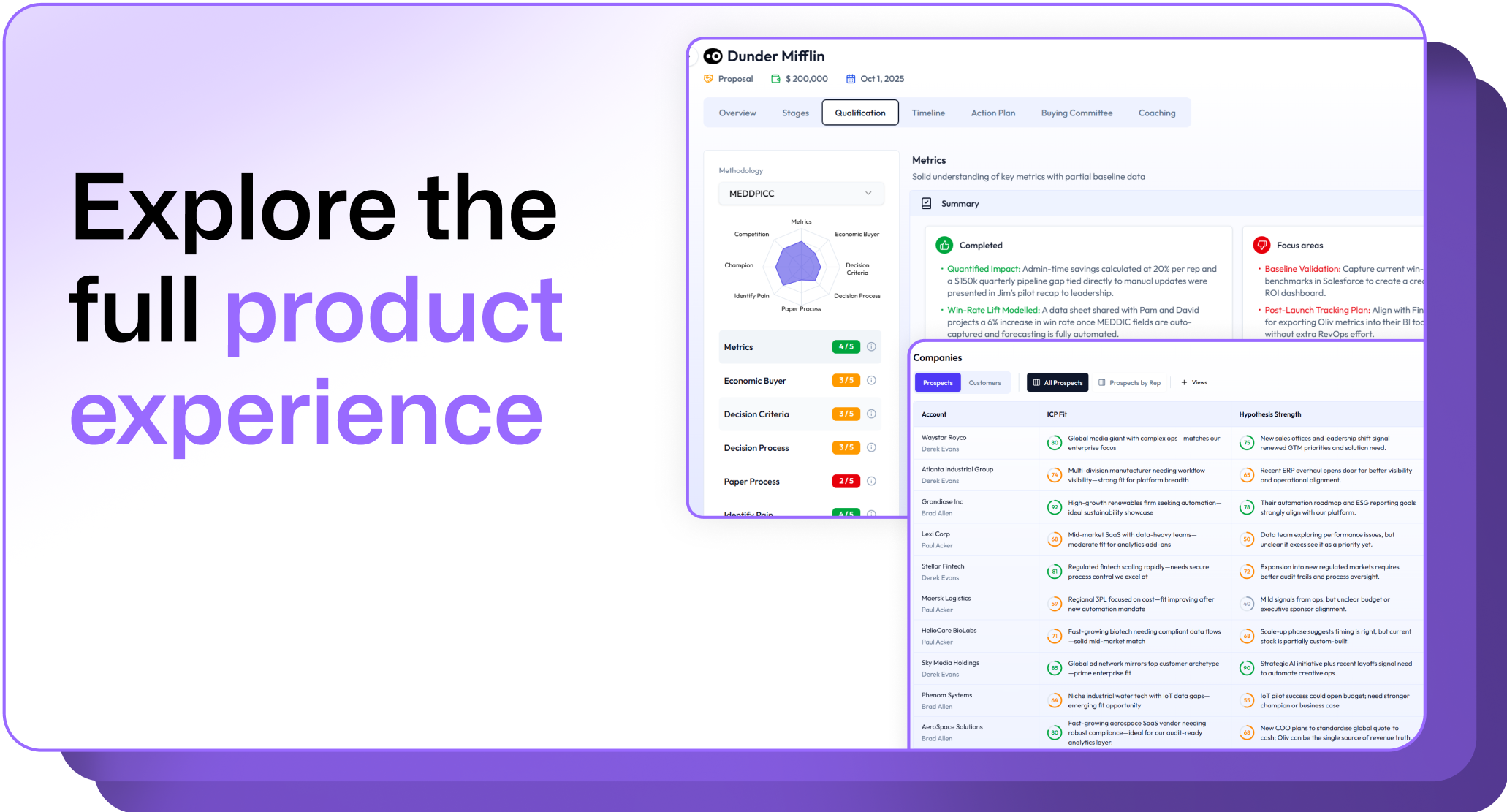
.avif)
.png)