10 Best Sales Enablement Software in 2026: Content Management, Training, Buyer Engagement, and Analytics
Written by
Ishan Chhabra
Last Updated :
August 7, 2026
Skim in :
13
mins
In this article
Revenue teams love Oliv
Here’s why:
All your deal data unified (from 30+ tools and tabs).
Insights are delivered to you directly, no digging.
AI agents automate tasks for you.
Thank you! Your submission has been received!
Oops! Something went wrong while submitting the form.
Meet Oliv’s AI Agents
Hi! I’m, Deal Driver
I track deals, flag risks, send weekly pipeline updates and give sales managers full visibility into deal progress
Hi! I’m, CRM Manager
I maintain CRM hygiene by updating core, custom and qualification fields all without your team lifting a finger
Hi! I’m, Forecaster
I build accurate forecasts based on real deal movement and tell you which deals to pull in to hit your number
Hi! I’m, Coach
I believe performance fuels revenue. I spot skill gaps, score calls and build coaching plans to help every rep level up
Hi! I’m, Prospector
I dig into target accounts to surface the right contacts, tailor and time outreach so you always strike when it counts
Hi! I’m, Pipeline tracker
I call reps to get deal updates, and deliver a real-time, CRM-synced roll-up view of deal progress
Hi! I’m, Analyst
I answer complex pipeline questions, uncover deal patterns, and build reports that guide strategic decisions
TL;DR
The ten best sales enablement platforms in 2026 are Oliv AI, Highspot, Seismic, Showpad, Mindtickle, Allego, SalesHood, Gong Enable, Spekit, and Salesloft.
Three of four category leaders lost independence in fifteen months: Showpad with Bigtincan (Oct 2025), Clari with Salesloft (Dec 2025), Highspot into Seismic (Feb 2026).
We scored every vendor out of 100 on curation automation, CRM depth, coaching breadth, pricing transparency, and verified reviews, with published weights.
Only SalesHood and Oliv AI publish per-seat pricing. Oliv AI's ladder runs $19 to $79, with the Enable tier at $29 and a $0 platform fee.
Gartner scored the category twice in one month, as revenue enablement and revenue action orchestration, confirming enablement is being absorbed into orchestration.
EU AI Act Article 50 disclosure applied from 2 August 2026, making buyer-facing AI transparency a shortlist filter rather than a legal afterthought.
Q1. What Are the 10 Best Sales Enablement Software Tools for Revenue Teams in 2026? [toc=1. Top 10 Tools]
The ten best sales enablement platforms in 2026 are Oliv AI, Highspot, Seismic, Showpad, Mindtickle, Allego, SalesHood, Gong Enable, Spekit, and Salesloft. Oliv AI leads because its Content Curator agent clips, tags, and shares the useful call moment automatically at $29 per seat per month on the Enable tier, instead of waiting for a human to build a playlist.
The Ranked List
Oliv AI
Highspot
Seismic
Showpad
Mindtickle
Allego
SalesHood
Gong Enable
Spekit
Salesloft
⭐ Why This Order Looks Different From Every Other List
Most lists rank by content library size. I rank by how much human labour the tool still needs every week.
A library someone has to search, clip, tag, and publish is an asset-management product. Enablement starts when the material reaches the rep without that person in the loop, which is the same shift we traced in our guide to AI sales agents that own a workflow.
Your best examples are buried in call recordings. By the time a playlist is built, fifty better examples are sitting in new calls.
⚠️ The Curation Tax Nobody Prices In
Reps and enablement leads pay this tax in hours, not dollars. It shows up in reviews as friction, not as a missing feature.
"The requirement to download snippets one by one using copy and paste is particularly annoying. This is a cumbersome process, especially if dealing with a large number of snippets." — Verified Reviewer, Gong - G2 Verified Review, 03 Oct 2025 (3 stars)
That review is about a great product. It is still someone clipping snippets by hand in 2025, a pattern we documented in more depth in our breakdown of what Gong users actually report.
The Consolidation Nobody Warned You About
Three of the four biggest names here stopped being independent products inside fifteen months. That changes what a shortlist means.
Highspot and Seismic signed a definitive merger agreement on 12 February 2026, combining at roughly $6 billion under the Seismic brand, with Permira controlling. Showpad and Bigtincan combined under Vector Capital on 30 October 2025. Clari and Salesloft completed their merger on 3 December 2025.
💰 How to Read the Table Below
Read the ownership column before the feature column. A roadmap owned by a merged entity is a different risk than a roadmap owned by one team.
Enablement attached to an outbound engagement motion
Price on request
Mixed, several 1.5 to 2.5 star reviews on usability
48
⭐⭐⭐
Merged with Clari
✅ Who Each Tool Suits
Under 50 reps, look at Oliv AI, Spekit, or SalesHood. Platform fees eat small budgets first.
Between 50 and 500 reps, Highspot, Showpad, Mindtickle, and Allego all fit. Above 500 reps with heavy governance needs, Seismic remains the default.
1.1 Oliv AI [toc=1.1 Oliv AI]
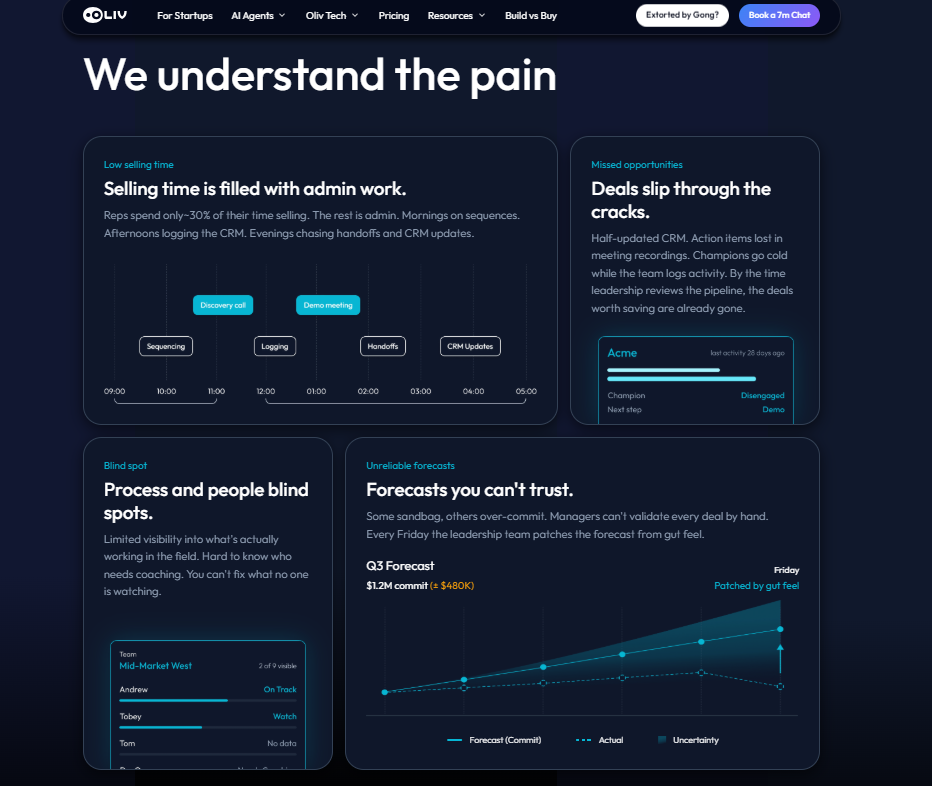
Oliv AI maps four revenue pains: reps selling only 30 percent of the time, deals slipping, coaching blind spots, and Q3 forecasts patched from gut feel.
Oliv AI is an AI-native revenue intelligence and revenue orchestration platform. Its Enable tier, at $29 per seat per month, covers the enablement job of getting the right material to the right rep at the right moment.
🔍 What It Actually Does
Oliv AI holds a continuously updated context graph of every account and opportunity, then runs agents on top of it. The Content Curator agent watches completed calls and clips the useful moment.
It fires at call end. Nobody triggers it, and nobody builds the playlist.
The pain it targets is specific. Objection handling, competitive wins, and pricing conversations happen weekly, and most of it never reaches training.
⚙️ Key Features
Content Curator agent that clips, tags, and shares call moments automatically
Context graph and process graph holding account, opportunity, and methodology state
CRM Manager agent that writes back to Salesforce, HubSpot, or Dynamics
Chrome extension surfacing battlecards and talk tracks during live calls
💰 Pricing and Implementation
Oliv AI publishes a per-seat ladder from $19 to $79 per month, with a $0 platform fee and free view-only seats. That last detail matters, because view-only seats are where enablement rollouts usually leak money.
Reviewers describe setup in days, not quarters. One reports a five to fifteen minute self-serve start, another reports full deployment inside a week with a forward-deployed engineer.
📅 Product Updates
Oliv AI Product Update Timeline
Period
What shipped
Through 2025: agent library forms
Individual revenue agents ship for meeting prep, CRM updates, and deal monitoring, including CRM Manager, Deal Driver, and Forecast agents, per the Oliv agents pages.
Mid-2026: the graph gets named
The live site productises a five-layer architecture, Apps, Agents, Agent Harness, GTM Context Graph, and AI Data Lakehouse, with Content Curator positioned as the enablement agent.
Next: pricing and voice
Oliv AI publishes its per-seat ladder openly on oliv.ai/pricing, and a Voice Agent remains in alpha, so full customisation still takes two to four weeks.
✅ Pros and ❌ Cons
✅ Curation runs without a curator, at the end of every call
✅ Published pricing, $0 platform fee, free view-only seats
✅ Sits on top of your CRM and integrates with Gong and Clari, so no rip-and-replace
✅ Fast setup, often under a week
❌ Does not replace content governance, versioning, or formal certification
❌ Analytics customisation is thinner than incumbent dashboards
❌ Occasional slowness reported by reviewers
❌ Mobile experience lags the desktop platform
👤 Best Use Case
A 40-rep team where half the reps joined in the last six months. Managers cannot coach them all, and the clip library builds itself from real calls, which is the same mechanism behind cutting new-hire ramp time.
💬 Real User Feedback
"The objective deal health scoring and AI-powered coaching have also made a huge impact on ramping new hires and overall pipeline visibility." — Verified Reviewer, Oliv AI G2 - Verified Review, 02 Jul 2026 (5 stars)
"The Driver agent watches all my deals and flags any that are at risk, so I don't have to spend hours listening to recordings in tools like Gong and Clari." — Verified Reviewer, Oliv AI G2 - Verified Review, 17 Jun 2026 (4.5 stars)
"I'd love to see few more options to customize dashboards and reports for different teams." — Verified Reviewer, Oliv AI G2 - Verified Review, 26 Jun 2026 (4.5 stars)
Oliv AI sits first here because the clip, tag, and share step happens at call end, and the Enable tier prices that job at $29 per seat per month. Oliv AI's read is that the standard advice gets this backwards, because it scores libraries rather than labour. I could be reading our own data too strongly, and I would still rather buy the agent than the archive.
1.2 Highspot [toc=1.2 Highspot]
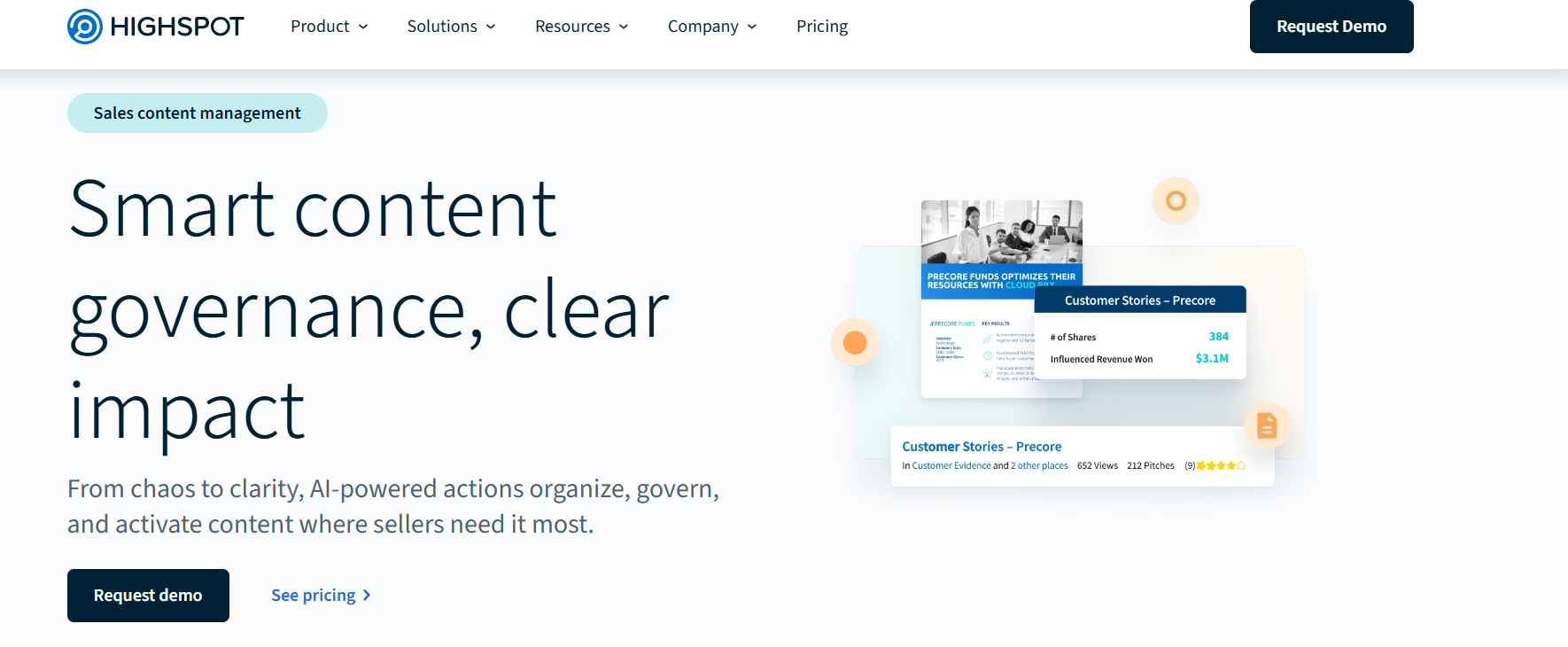
Highspot's sales content management screen shows AI-powered governance, a customer story asset with 384 shares, 212 pitches, and $3.1M influenced revenue won for enablement reporting.
Highspot is an enterprise sales enablement platform for unified content, training, coaching, and analytics. It holds 4.7 out of 5 on G2 across 1,197 reviews, and was named a Leader in Gartner's inaugural 2025 Magic Quadrant for Revenue Enablement Platforms.
🔍 What It Actually Does
Highspot governs the content library properly. Versioning, permissions, and Sales Plays are its strongest ground, and this is exactly the work an orchestration layer does not do.
It also owns buyer-facing Digital Sales Rooms. If your enablement job includes formal certification and audited content, Highspot is the serious answer.
⚙️ Key Features
AI content governance and versioning at enterprise scale
Sales Plays and structured training paths
Digital Sales Rooms with buyer engagement tracking
Highspot Copilot, plus GTM Agent and Deal Intelligence
Highspot MCP Server exposing GTM context to external AI systems
💰 Pricing and Implementation
Highspot does not publish pricing. Procurement benchmarks put per-seat costs near $45 to $65 per user per month, with a separate annual platform fee.
Vendr data across 167 to 297 verified deals shows a median annual contract between $59,640 and $91,460. Implementation and professional services commonly add $10K to $50K in year one. Those figures are third-party procurement data, not Highspot's own published rates.
📅 Product Updates
Highspot Product Update Timeline
Period
What shipped
Dec 2024: agents announced
Highspot committed to Copilot Actions and configurable first-party and third-party Copilot Agents, built on the customer's Highspot corpus, in its AI roadmap announcement.
Winter and Spring 2026: agentic execution
Winter Launch '26 added Deal Intelligence with next-best actions, and Spring Launch '26 on 4 May 2026 added GTM Agent plus a Highspot MCP Server with native OpenAI, Anthropic, and Microsoft Copilot integrations.
Ahead: merged roadmap
The Seismic merger signed 12 February 2026 puts both platforms under one company at roughly $6B, so agent and MCP work now competes with integration engineering for the same resources.
✅ Pros and ❌ Cons
✅ Best-in-class content governance and versioning
✅ Gartner Leader, positioned highest for Ability to Execute in 2025
✅ MCP Server opens GTM context to external AI agents
✅ Very large, consistently positive review base
❌ No published pricing, and a platform fee sits on top of seats
❌ Search and filtering limits are a recurring complaint in G2 reviews
❌ Roadmap certainty drops while the Seismic merger closes
❌ Cost efficiency generally needs 50+ reps to make sense
👤 Best Use Case
A 500-rep enterprise with a dedicated enablement team, formal certification requirements, and content that must be audited. If your evaluation is really about coaching depth, our review of the best AI sales coaching software tools covers that vendor set properly, and the wider category sits in our roundup of the best revenue orchestration platforms.
Oliv AI is not the tool that replaces Highspot's governance layer, and I will not pretend otherwise. Oliv AI coexists with it, supplying the clipped moments the library then governs, which is why teams often run both rather than choosing, a pattern we mapped across the wider AI sales tool stack.
1.3 Seismic [toc=1.3 Seismic]
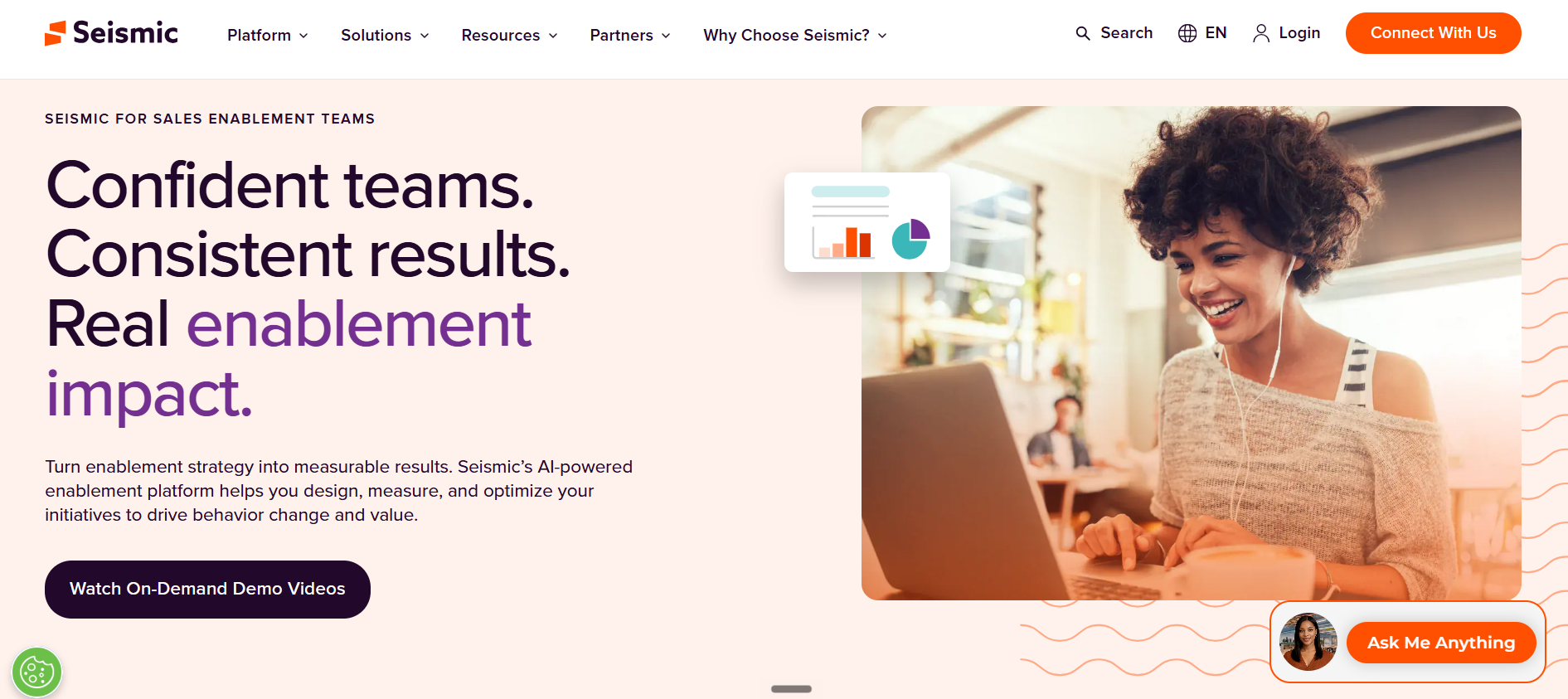
Seismic's enablement team view frames AI-powered program design, behaviour change, and measurable impact, with on-demand demo access and dashboard analytics linking enablement strategy to revenue results.
Seismic is the surviving brand of the February 2026 merger with Highspot, and it remains the deepest enterprise content engine in this category. It holds 4.6 out of 5 on G2 across roughly 1,801 reviews.
🔍 What It Actually Does
Seismic stores, personalises, and governs selling content at very large scale. LiveDocs assembles personalised decks from approved components, so reps stop rebuilding slides.
Its analytics layer connects content usage to deal outcomes. That reporting is why enterprise enablement teams keep renewing, and it is the same logic we unpack in our guide to revenue performance analytics.
⚙️ Key Features
LiveDocs automated content personalisation and versioning
Aura Agents across planning, preparation, engagement, and execution
Aura Chat as a single conversational workspace grounded in business context
Digital sales rooms with buyer engagement analytics
Learning and coaching modules inside the same platform
💰 Pricing and Implementation
Seismic does not publish pricing, and contracts are typically custom and multi-year. Implementations at enterprise scale usually run in quarters, not weeks.
Budget for content migration separately. Moving a governed library is a project, not a setting.
📅 Product Updates
Seismic Product Update Timeline
Period
What shipped
Through 2025: agent groundwork
Seismic spent the year building AI agent capability across the revenue workflow, layering agents onto LiveDocs, learning, and analytics, per its Aura Agents expansion release.
June 2026: nine agents ship
The Spring 2026 release extended nine new and enhanced Aura Agents, including Analytics, Program, Page, Lesson, Admin, Meeting, Presentation, Roleplay, and Search Agents, plus full-screen Aura Chat with history and personalised prompts.
Ahead: absorbing Highspot
The Highspot merger signed 12 February 2026 makes Seismic the surviving brand at roughly $6B, so 2027 roadmap work now includes merging two overlapping agent stacks.
✅ Pros and ❌ Cons
✅ Deepest content governance and personalisation in the category
✅ Nine production Aura Agents shipped by mid-2026
✅ Strong content-to-revenue analytics
❌ No published pricing, custom multi-year contracts
❌ Search and learning curve are recurring review complaints
❌ Two merging platforms means roadmap uncertainty through 2027
👤 Best Use Case
A regulated enterprise with thousands of assets, strict version control, and a full-time enablement team.
1.4 Showpad [toc=1.4 Showpad]
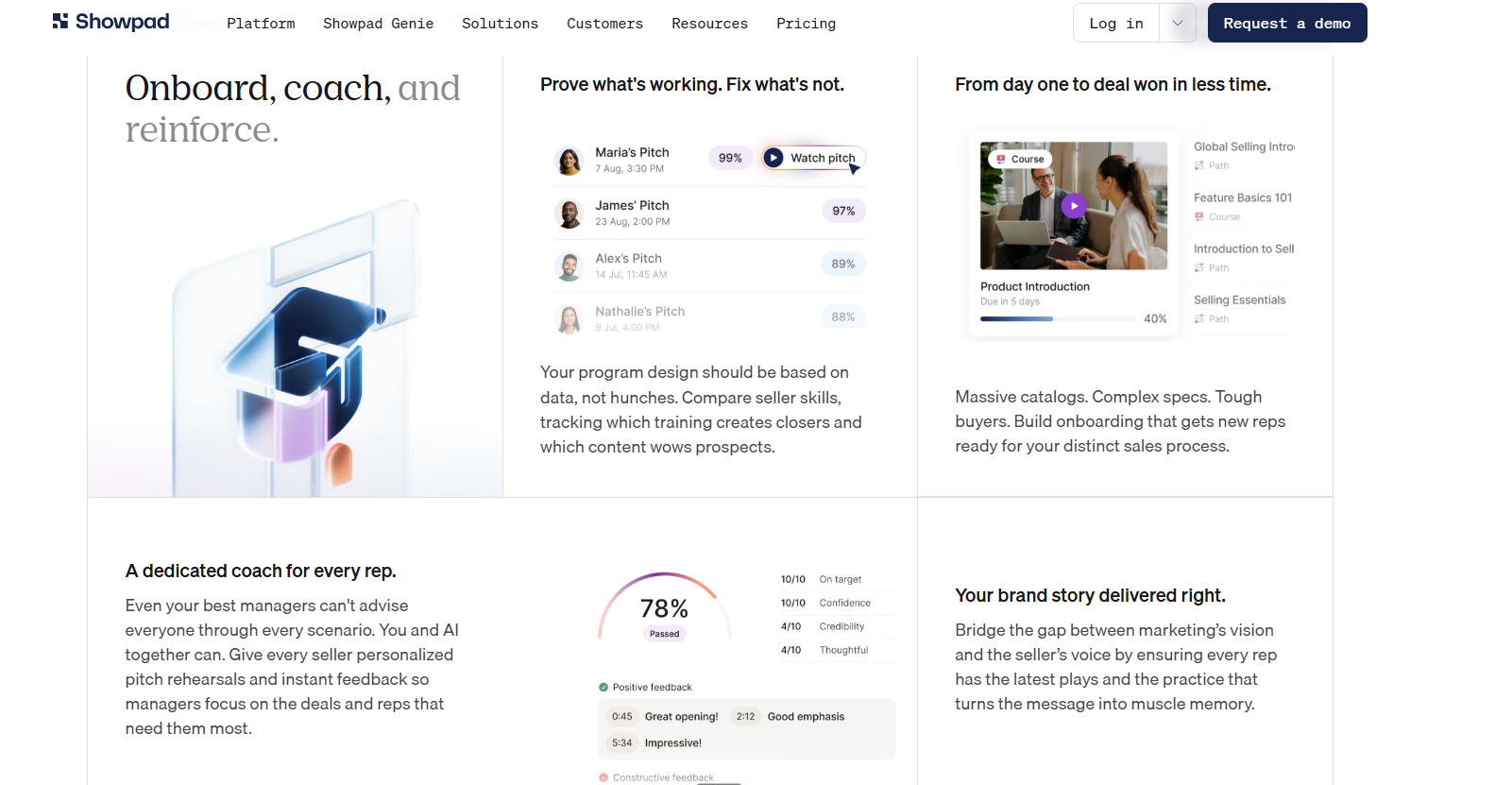
Showpad's onboarding and coaching view ranks seller pitch scores, delivers AI rehearsal feedback at 78 percent, and tracks course paths that shorten new-rep ramp time.
Showpad is the AI-native revenue effectiveness platform formed when Vector Capital merged Showpad with Bigtincan in October 2025. It holds 4.6 out of 5 on G2 across roughly 1,909 reviews.
🔍 What It Actually Does
Showpad is built for field selling, including in-person meetings and mobile-first reps. Field Meeting AI captures what is said and presented in the room, then produces summaries and CRM updates, which is the same job covered in our comparison of AI note-taking tools.
The Bigtincan combination added Brainshark training and content automation. Integration continued through 2026.
⚙️ Key Features
Genie Assistant, an AI expert available on web and iOS
Genie Agents inside Agent Studio, six deployable agents plus custom builds
Field Seller Agent producing pre-meeting briefings with open commitments
MCP Server exposing governed content to Agentforce, Microsoft Copilot, and Glean
Sales readiness and Roleplay AI with scored practice
💰 Pricing and Implementation
Showpad does not publish pricing. Third-party procurement data puts annual contracts near $42K to $108K. That figure is benchmark data, not Showpad's own published rate.
📅 Product Updates
Showpad Product Update Timeline
Period
What shipped
Oct 2025 to Mar 2026: merger and first AI wave
Vector Capital completed the Showpad acquisition on 30 October 2025 and merged it with Bigtincan, then shipped Roleplay AI, Genie Assistant, and Field Meeting AI in March 2026.
Apr to Jul 2026: agents and MCP
The Spring Release 2026 completed the platform combination, and Summer '26 on 15 July added six Genie Agents, Agent Studio, a Salesforce connector, and an MCP Server.
Ahead: custom agents and analytics
Showpad's own launch notes point to Custom Agents built from scratch, Custom External Sources indexing approved web content, and a rebuilt analytics layer.
✅ Pros and ❌ Cons
✅ Strongest mobile and in-person field selling support
✅ Six shipped agents plus Agent Studio and MCP integrations
✅ Training depth inherited from Brainshark
❌ Post-merger product integration ran into 2026
❌ No published pricing
❌ Heavy feature surface for small teams
👤 Best Use Case
Field-heavy selling in regulated industries, such as medical devices or manufacturing, where reps present in person.
1.5 Mindtickle [toc=1.5 Mindtickle]
Mindtickle is the readiness and certification leader in this list, holding 4.7 out of 5 on G2 across roughly 2,317 reviews. On 21 April 2026, it launched ElevateOS, positioned as an agentic operating system for revenue enablement.
🔍 What It Actually Does
Mindtickle measures rep readiness against defined behaviours, then closes gaps with structured programmes. Its behaviour intelligence engine links granular rep behaviours to deal outcomes.
If your problem is provable competence, this is the strongest fit. Enterprise references include Cisco, Thomson Reuters, and Johnson & Johnson.
⚙️ Key Features
Readiness indices and certification programmes
AI Tutor, AI Roleplay, and AI Simulator for practice
AI Manager Coach for frontline manager workflows
Deal Guide operating with full CRM deal context
Copilot for just-in-time answers in the flow of work
💰 Pricing and Implementation
Mindtickle does not publish pricing, and contracts are annual. Programme design is the real cost here, since certification content needs owners, a trade-off we cover in our piece on closing sales coaching skill gaps.
📅 Product Updates
Mindtickle Product Update Timeline
Period
What shipped
2023 to 2025: Copilot era
Mindtickle shipped Copilot as a generative assistant and just-in-time enablement, expanding role-personalised AI capabilities.
Apr 2026: ElevateOS
ElevateOS launched on 21 April 2026 with a behaviour intelligence context engine, plus AI Tutor, AI Roleplay, AI Manager Coach, AI Content Creation, and Deal Guide operating on CRM deal context.
Ahead: agentic depth
Mindtickle's newsroom frames ElevateOS as replacing fragmented enablement tools, with agentic coaching integrated into existing workflow tools as the stated direction.
✅ Pros and ❌ Cons
✅ Best-in-class readiness scoring and certification
✅ ElevateOS ties coaching to CRM deal context
✅ Very large, consistently high review base
❌ No published pricing
❌ Programme-heavy, needs a dedicated owner
❌ Content management is thinner than Seismic or Highspot
👤 Best Use Case
A 200-plus rep org that must prove certification, such as regulated software or medtech sales.
1.6 Allego [toc=1.6 Allego]
Allego combines content, coaching, and conversation intelligence in one platform, and holds 4.6 out of 5 on G2 across roughly 694 reviews. It was named a Leader in Gartner's first Magic Quadrant for Revenue Enablement Platforms in November 2025.
🔍 What It Actually Does
Allego started in video coaching, and that heritage still shows. Reps record practice pitches, managers review, and content sits alongside the coaching.
The all-in-one shape suits teams that do not want three vendors. It trades some depth for that convenience, which is the classic tension in every sales tech stack cost decision.
⚙️ Key Features
Video-based practice and coaching workflows
Content management with sales collateral organisation
Conversation intelligence on recorded calls
Digital sales rooms for buyer sharing
Analytics linking activity to outcomes
💰 Pricing and Implementation
Allego uses contract-based pricing, typically one to three years. No public rate card exists.
📅 Product Updates
Allego Product Update Timeline
Period
What shipped
Nov 2025: analyst recognition
Allego was named a Leader in the first-ever Gartner Magic Quadrant for Revenue Enablement Platforms, evaluated on innovation and measurable ROI.
Feb 2026: platform positioning
Allego published its own 2026 tools review, positioning its stack across content, coaching, and conversation intelligence in one system.
Ahead: not dated publicly
Allego has not published a dated roadmap commitment comparable to Showpad's or Seismic's release notes, so treat future agent capability as unverified.
✅ Pros and ❌ Cons
✅ Gartner Leader in the inaugural 2025 quadrant
✅ Genuine strength in video practice and coaching
✅ One vendor across content and coaching
❌ No published pricing or dated public roadmap
❌ Smaller review base than Mindtickle or Seismic
❌ Less content governance depth at enterprise scale
👤 Best Use Case
A 100 to 300 rep team that wants coaching and content from one vendor, without an enterprise governance mandate.
1.7 SalesHood [toc=1.7 SalesHood]
SalesHood publishes its pricing, which almost nobody else here does. Tiers run at $45, $65, and $85 per user per month, and it was named a Leader in Gartner's 2025 Revenue Enablement Platforms quadrant.
🔍 What It Actually Does
SalesHood bundles learning, content, AI coaching, playbooks, digital sales rooms, and analytics. It was founded by Elay Cohen, formerly Salesforce's SVP of Sales Productivity.
The catch sits in the AI limits. Essential allows 10 AI coaching submissions per licence, Pro caps at 80, and only Unlimited removes the cap.
⚙️ Key Features
Learning management and AI Search on Essential
Digital Sales Rooms and Mutual Action Plans on Pro
AI Pitch Practice and role play, metered by tier
Salesforce Correlation Engine on Unlimited
18 language support at the top tier
💰 Pricing and Implementation
Published tiers are $45, $65, and $85 per user per month, billed monthly. Two add-ons sit outside the base tiers, at $10 and $15 per user per month.
A 25-person team lands near $13,500 to $25,500 per year before add-ons. That is the cleanest math on this list after Oliv AI, and it is the kind of number that survives a revenue intelligence ROI review.
📅 Product Updates
SalesHood Product Update Timeline
Period
What shipped
Dec 2025: Gartner Leader
SalesHood was recognised as a Leader in the 2025 Gartner Magic Quadrant for Revenue Enablement Platforms.
2026: metered AI tiers
SalesHood's pricing page now structures AI coaching as a metered entitlement, with Unlimited positioned for enterprise agentic AI adoption at $85 per user per month.
Ahead: add-on expansion
Priced add-ons for coaching inside Salesforce or Microsoft, and Presentation Management, are published separately.
✅ Pros and ❌ Cons
✅ Published per-user pricing across three tiers
✅ Gartner Leader recognition in 2025
✅ Digital Sales Rooms available at $65 per seat
❌ AI coaching is metered, not unlimited, below the top tier
❌ Two useful capabilities sit behind paid add-ons
❌ Smaller ecosystem than the enterprise incumbents
👤 Best Use Case
A 25 to 200 rep mid-market team that needs published pricing to get budget approved.
1.8 Gong Enable [toc=1.8 Gong Enable]
Gong Enable is Gong's enablement module, formally expanded into a product line with the Mission Andromeda launch on 25 February 2026. Gong's own ARR passed $500M in May 2026.
🔍 What It Actually Does
Gong Enable unifies coaching and training on top of Gong's conversation data. AI Trainer runs role-play simulations, and AI Call Reviewer scores calls automatically.
Gong's genuine strength is surfacing what happened in conversations. That is real, and I will not undersell it, though we have documented the limitations teams run into at scale.
⚙️ Key Features
AI Trainer role-play simulations with audio feedback
AI Call Reviewer automated scorecards
AI Builder for battlecards and objection cards from your own conversations
AI Theme Spotter across tens of thousands of calls
Data Extractor mapping AI fields into the CRM
💰 Pricing and Implementation
Gong Enable is a paid module on top of Gong, and no list price is published. Gong added visible per-seat pricing in the admin centre for eligible direct-purchase accounts in June 2025, and our own breakdown of Gong pricing covers how the modules stack.
📅 Product Updates
Gong Enable Product Update Timeline
Period
What shipped
Feb to Dec 2025: module built
Gong introduced Enable with AI Trainer in February 2025, then added Agent Studio in July, AI Call Reviewer in August, AI Builder in November, and Theme Spotter plus Data Extractor in December.
Feb to May 2026: Andromeda
Mission Andromeda on 25 February 2026 expanded Enable with conversational guidance and unified account management, followed by AI coaching audio feedback after AI Trainer practice in May.
Ahead: MCP both ways
Gong's Salesforce release notes commit to connecting external MCP servers into AI Briefer, exposing Gong insights to external AI platforms, and brief access via API.
✅ Pros and ❌ Cons
✅ Best conversation data foundation for coaching content
✅ Automated scorecards and role play at scale
✅ Fast shipping cadence through 2025 and 2026
❌ Enable is an added module cost on an already expensive platform
❌ Snippet export and data portability draw complaints
❌ Setup of trackers is reported as difficult
💬 Real User Feedback
"I found the AI tracker setup to be quite difficult, especially concerning the user interface when setting up keywords or smart trackers." — Verified Reviewer, Gong - G2 Verified Review, 03 Oct 2025 (3 stars)
"The fact that you can't edit a recording (to only share a portion with a client), and the fact that if you stop working with the tool you lose the data." — Verified Reviewer, Gong - G2 Verified Review, 19 Mar 2026 (3 stars)
👤 Best Use Case
A team already standardised on Gong that wants coaching without adding a second vendor.
1.9 Spekit [toc=1.9 Spekit]
Spekit delivers just-in-time content and training inside the tools reps already use, and holds 4.7 out of 5 on G2 across roughly 286 reviews. Median annual contracts land near $15K.
🔍 What It Actually Does
Spekit surfaces short answers inside Salesforce, email, and the browser. Reps never leave the workflow to find a definition or a snippet.
It is the lightest tool on this list, deliberately. That is the point.
⚙️ Key Features
In-app content cards inside Salesforce and the browser
Just-in-time training tied to the workflow, not a course
Change management and process documentation
Salesforce-native adoption tracking
Fast rollout without a formal programme
💰 Pricing and Implementation
Spekit does not publish pricing, and buyers receive custom quotes. Third-party estimates put per-user rates near $20 to $30 per month, with contracts starting around $8.7K per year.
📅 Product Updates
Spekit Product Update Timeline
Period
What shipped
2025: in-workflow enablement core
Spekit positioned around reps learning in the flow of work rather than in a library.
Winter 2026: peer recognition
Spekit earned 63 G2 badges in the Winter 2026 reports, alongside a 4.7 G2 rating across roughly 286 reviews.
Ahead: no published roadmap
Spekit has not published a dated roadmap commitment, and pricing remains sales-led with no public tiers.
✅ Pros and ❌ Cons
✅ Lowest total cost on this list for mid-market teams
✅ Genuinely fast rollout inside Salesforce
✅ Very high review satisfaction
❌ Not a full content governance or certification platform
❌ No published pricing or public roadmap
❌ Limited depth for enterprise programme needs
👤 Best Use Case
A Salesforce-heavy mid-market team fixing adoption and process drift, not building a certification programme. If the underlying issue is data hygiene rather than content, our guide to CRM data quality automation is the better starting point.
1.10 Salesloft [toc=1.10 Salesloft]
Salesloft completed its merger with Clari on 3 December 2025, forming what the companies call the first Predictive Revenue System. It fits teams whose enablement is attached to an outbound engagement motion.
🔍 What It Actually Does
Salesloft runs cadences, sequencing, dialling, and follow-up at volume. Post-merger, Clari's forecasting and pipeline intelligence sit alongside it, a pairing we examined in our Gong versus Salesloft comparison.
Enablement here means enabling outbound execution. It is not a content governance product.
⚙️ Key Features
Cadences, templates, and sequence analytics
Integrated dialler and task workflows
Clari forecasting and pipeline inspection post-merger
Cross-platform actions between Clari and Salesloft
CRM activity capture
💰 Pricing and Implementation
Salesloft does not publish pricing. Existing contracts, pricing, and renewal dates were unaffected by the merger, per Clari's customer FAQ.
📅 Product Updates
Salesloft Product Update Timeline
Period
What shipped
Aug to Dec 2025: merger closes
Clari and Salesloft announced their agreement to merge on 7 August 2025 and completed it on 3 December 2025, appointing Steve Cox as CEO.
Mar 2026: first joint release
The March 2026 release shipped the first cross-platform features, including Send AI Emails from Clari, Create Salesloft Tasks, and Send follow-up emails via Salesloft.
Ahead: unified release trains
Clari's newsroom frames continued integration of Clari, Align, Copilot, Groove, and Salesloft release trains.
✅ Pros and ❌ Cons
✅ Strong at high-volume outbound execution
✅ Forecasting now bundled through Clari
✅ Contracts and renewal dates unchanged by the merger
❌ Usability complaints are frequent and specific in G2 reviews
❌ Not a content management or certification platform
❌ Integration work continues across five product lines
💬 Real User Feedback
"Integrating Salesloft came with a lot of challenges, and even now, it feels like the platform still has some kinks. I often have trouble logging meetings, and certain features feel clunky or overly manual." — Verified Reviewer, Salesloft - G2 Verified Review, 22 Jul 2025 (2.5 stars)
"The conversation intelligence tool is lacking, and we don't have the context of the deals against the conversation intelligence findings. The CRM writeback is not good; we cannot send MEDDIC values back to Salesforce." — Verified Reviewer, Clari - G2 Verified Review, 13 Jul 2026 (1.5 stars)
👤 Best Use Case
A team where enablement means outbound consistency, and forecasting matters more than content governance. Teams weighing that trade-off often start with our list of the best Clari alternatives.
⏰ One Number to Keep in View
"According to a study by Gartner, B2B purchasers allocate just 17% of their time engaging with sales reps." — u/Sea-Loquat-9744, r/techsales Reddit Thread, 30 Dec 2024
Whichever tool you pick, it has to work in the 83% you never see.
Oliv AI reads this list differently from the incumbents: eight of these ten platforms still need a person to decide what gets clipped, tagged, and shared. Where our agents land, that step happens at call end. I could be weighting the labour question too heavily, and I would still start a pilot there.
Q2. How Were These Tools Scored, and How Should You Score Them Yourself? [toc=2. Scoring Methodology]
Each platform was scored out of 100 on five weighted criteria: Curation Automation 25%, CRM and Workflow Depth 20%, Coaching and Readiness Breadth 20%, Pricing Transparency 20%, Verified User Reviews 15%. Scores of 0 to 20 earn one star, 21 to 40 two, 41 to 60 three, 61 to 80 four, and 81 to 100 five. Oliv AI scores 5 stars on this rubric.
The Rubric and the Bands
Sales Enablement Software Scoring Rubric and Weights
Criterion
Weight
What it measures
Curation Automation
25%
Does the tool clip, tag, and route material without a human trigger?
CRM and Workflow Depth
20%
Does it write back to Salesforce, HubSpot, or Dynamics reliably?
Coaching and Readiness Breadth
20%
Role play, scorecards, certification, and manager workflows
Pricing Transparency
20%
Is a per-seat number published, or gated behind a sales call?
Verified User Reviews
15%
Peer rating weighted by review volume on G2
Star bands are simple maths, not judgement. A tool at 76 gets four stars whether I like it or not.
⭐ Why Curation Automation Carries the Heaviest Weight
Every platform here stores content well. That stopped being a differentiator around 2022.
What still differs is who does the clipping. Oliv AI measures this by asking one question of each workflow: does a human have to start it, or does it start itself?
Forrester's Revenue Enablement Platforms Landscape for Q1 2026 evaluated 18 vendors and described a market at an inflection point, with AI reshaping the category. Weighting automation at 25% follows that finding rather than my preference, and it mirrors the shift we tracked in AI agents versus SaaS dashboards.
💰 Why Pricing Transparency Earns 20%
Seven of these ten vendors do not publish a per-seat price. That is a real cost, because procurement cycles stretch when nobody can model spend.
Only SalesHood and Oliv AI publish tiers you can read without a call. Oliv AI's ladder runs from $19 to $79 per seat per month, with a $0 platform fee and free view-only seats.
The Six Steps to Score Your Own Shortlist
Define the sales motion first, since field selling and inside sales need different tools.
Audit your CRM and call data, because agents inherit whatever mess exists today, which is why CRM data quality automation belongs before procurement.
Score the four pillars separately, rather than accepting one blended demo score.
Test agent capability by asking which workflows an agent owns end to end.
Verify SOC 2, GDPR, and AI disclosure duties before legal review, not after.
Negotiate term length against consolidation risk, given the 2026 mergers.
⚠️ Rewrite the RFP, Not Just the Vendor List
Gartner scored this category formally for the first time in November 2025, as revenue enablement rather than sales enablement. That reframing matters for your scoring sheet, and our RevOps platform comparison framework is built the same way.
A content-library checklist will score all ten of these vendors as adequate. A revenue lifecycle sheet separates them fast.
✅ Disclosure, Stated Plainly
Oliv AI publishes this list and appears first on it, which is a conflict of interest worth naming out loud. Our scores sit on the same rubric as every other entry, and the maths is above for anyone who wants to redo it.
Competitor pricing appears here only where it traces to that vendor's own published page or a dated third-party procurement source. Where a number comes from Vendr or a benchmark site rather than the vendor, I have said so inline.
Oliv AI's read is that most listicles fail on disclosure, not on research. Naming the rubric, the weights, and the conflict is cheaper than pretending neutrality nobody believes.
Q3. What Does Sales Enablement Software Have to Do in 2026, and How Do Analysts Now Score It? [toc=3. Capabilities and Analyst View]
Sales enablement software has four jobs: store and govern selling content, train and certify reps, engage buyers through shareable rooms, and report on what moved revenue. A fifth job now decides purchases, which is getting the right material to the right rep from live call context, without a person searching, clipping, and tagging it first.
The Four Pillars, Plainly
The Four Capability Pillars of Sales Enablement Software
Pillar
What it does
What good looks like
Content management
Stores, versions, and governs selling material
Reps find the current deck, not last quarter's
Training and readiness
Onboards, certifies, and coaches reps
Competence is measured, not assumed
Buyer engagement
Shares material with buyers and tracks it
You see who opened what, and when
Analytics
Links content and behaviour to revenue
You can kill assets that never help
Those four are table stakes. All ten vendors on this list clear them at some level.
🔍 What the Fifth Job Looks Like on a Tuesday
Say one of your AEs handles a competitive objection beautifully on Tuesday afternoon. Under the old model, someone must find that call, watch it, trim the clip, tag it, and publish it.
That usually happens next month, or never. Someone has to search, watch, trim, tag, and share every useful moment.
Under the new model, the clip is tagged and routed to 40 reps by Wednesday morning. Ask Oliv AI's Content Curator agent to do this and it runs at call end, with nobody triggering it.
What Analysts Changed in Late 2025
Gartner published its first Magic Quadrant for Revenue Enablement Platforms in November 2025, naming Highspot, Allego, and SalesHood as Leaders, with Pitcher a Challenger. A category that had no quadrant suddenly had a scorecard.
Forrester followed in Q1 2026 with its Revenue Enablement Platforms Landscape covering 18 vendors, describing an inflection point with AI reshaping everything. Two independent firms, one conclusion, and the same direction we mapped in the move from RevOps to intelligence to orchestration.
📊 The Number That Should Set Your Requirements
Gartner's B2B buying journey research found buyers spend roughly 17% of the journey with all suppliers combined, which works out near 5% per rep. So 83% of the decision happens where your rep is not present.
That reframes what you are buying. Oliv AI's data points one way here, though I might be reading it too strongly: tools that only help during meetings address the smaller half of the problem.
Buyers who get both a rep and digital enablement close 1.8x more high-quality deals. Instrumenting the 83% is not a nice-to-have, and it is the core argument for cross-channel deal intelligence.
⚠️ Three Terms People Use Interchangeably
Sales enablement equips sellers with content and training. Revenue enablement extends the same system across the full revenue lifecycle, which is how Gartner now scores it.
Sales engagement is different again, automating outbound sequencing and touchpoints. Salesloft sits there, and Highspot or Seismic do not.
⏰ What This Means for Your Shortlist
Score the four pillars, then score the fifth job separately. Most demos will not volunteer that distinction.
Oliv AI treats the fifth job as the product, not a feature: the Content Curator agent runs when a call ends, rather than when someone remembers to build a playlist. That is the whole design bet, and it is testable in a two-week pilot.
Q4. Is Oliv AI a Sales Enablement Tool, or Does It Only Complement Highspot and Seismic? [toc=4. Oliv vs Incumbents]
Oliv AI is an AI-native revenue intelligence and revenue orchestration platform, and its Enable tier covers the enablement job of getting the right material to the right rep at the right moment. It does not replace a content library's governance, versioning, or formal certification layer. It coexists with Highspot or Seismic, and runs on top of Salesforce, HubSpot, or Dynamics.
The Honest Answer, First
Both, depending on your setup. Oliv AI replaces the curation workflow, and complements the governance layer that sits underneath it.
If you have a compliance requirement for versioned, audited, certified content, keep it. Nothing here argues otherwise.
❌ What Oliv AI Does Not Do
I want this stated before the reframe, because vendors usually bury it. Oliv AI does not provide formal certification programmes, deep content version control, or enterprise buyer-facing digital sales rooms.
An enablement incumbent would say those four things are exactly the work an orchestration layer skips. They would be right. Highspot holds 4.7 out of 5 across 1,197 G2 reviews for good reason.
🔍 Storage Versus Sourcing
Here is the distinction that resolves the question. A library answers where material lives, and curation answers where material comes from.
Highspot and Seismic are excellent at the first. Neither one produces the clip from Tuesday's call by itself.
Content Library Versus Oliv AI Enable Tier
Job
Content library
Oliv AI Enable tier
Version control and audit
Strong
Not covered
Formal certification
Strong
Not covered
Clipping from live calls
Manual
Automatic at call end
CRM writeback
Varies
Salesforce, HubSpot, Dynamics
Published per-seat price
No
$29 on Enable
💰 The Budget Argument, Not the Feature Argument
A platform contract and a seat are different purchases. Oliv AI's Enable tier at $29 per seat per month sits inside a discretionary budget, while Highspot's median annual contract runs near $59K to $91K on Vendr data.
That is why Oliv shows up alongside a library more often than instead of one. You can pilot a seat without a procurement cycle, which is the same economics behind reducing sales tech stack costs.
"We Already Use Gong"
Then this is not an either/or decision today. Oliv AI integrates with Gong and Clari, and removes the need to listen to ten-plus hours of recordings a week.
I have never met a RevOps lead who regretted buying Gong. I have met plenty who regretted how many hours it created, which is why we published a full breakdown of what sits beyond meeting intelligence.
"The Driver agent watches all my deals and flags any that are at risk, so I don't have to spend hours listening to recordings in tools like Gong and Clari." — Verified Reviewer, Oliv AI G2 - Verified Review, 17 Jun 2026 (4.5 stars)
"Consolidating multiple tools into Oliv has saved us budget and increased our results." — Verified Reviewer, Oliv AI G2 - Verified Review, 08 Jul 2026 (5 stars)
"I found the AI tracker setup to be quite difficult, especially concerning the user interface when setting up keywords or smart trackers." — Verified Reviewer, Gong - G2 Verified Review, 03 Oct 2025 (3 stars)
⚠️ The Distinction Nobody Names
Individual AI productivity is not organizational efficiency. One rep saving three hours a week is nice, and it does not change your ramp time.
Agents that own a responsibility do. That is the line I would test in any pilot, ours or anyone's, and it is the test we describe in our guide to AI agents for sales teams.
Oliv AI is bought alongside a content library more often than instead of one, which is why the Enable tier is priced as a seat rather than a platform contract. Our own read is that the sourcing gap, not the storage gap, is what teams actually feel on Monday.
Q5. Is Enablement Still a Standalone Category, and What Happens to Your Highspot or Seismic Contract? [toc=5. Consolidation and Contract Risk]
Highspot and Seismic signed a definitive merger agreement on 12 February 2026, combining at roughly $6 billion under the Seismic brand with Permira controlling. Showpad merged with Bigtincan under Vector Capital on 30 October 2025, and Clari and Salesloft completed their merger on 3 December 2025. Existing contracts and renewal dates were not immediately affected, and both platforms are still sold and supported.
The Fifteen-Month Record
Three of the four biggest names in this category stopped being independent products inside fifteen months. That is the fact your CRO needs, before any opinion about it.
Sales Enablement Consolidation Record, 2025 to 2026
The Highspot deal had not closed as of publication. Both platforms continue to be sold separately.
📊 The Analyst Move Behind the Deals
On 15 December 2025, Gartner published its first Magic Quadrant for Revenue Action Orchestration. That report merged sales engagement, conversation intelligence, and revenue intelligence into one category, which is the same collapse we tracked in revenue intelligence versus conversation intelligence.
Gong was named a Leader in it, and People.ai a Visionary. Gartner also noted that the Clari and Salesloft merger closed during the research period.
The Thesis, Stated Plainly
Sales enablement is being absorbed into the revenue orchestration layer. The vendors' own consolidation is the proof, not an analyst's forecast.
Two separate quadrants appeared within a month of each other, one for revenue enablement and one for revenue action orchestration. Categories split like that when the market is still deciding where the boundary sits, a pattern we examined in the future of revenue intelligence.
⚠️ The Counter-Argument, Honestly
Content governance, versioning, formal certification, and buyer-facing digital sales rooms are genuine standalone work an orchestration layer does not do. I conceded that earlier, and I will not soften it here.
Where my head is right now is that both things are true at once. The storage job stays specialist, and the sourcing job moves into the orchestration layer.
💰 What to Do About Your Contract on Monday
Pull your Highspot, Seismic, Showpad, or Salesloft renewal date today.
Request a 12-month term rather than a multi-year renewal while the merger closes.
Ask for written platform-support and roadmap commitments, not verbal reassurance.
Confirm your data export path in writing, since portability complaints are common in this category.
Ask which agent capabilities are shipped versus announced, with dates.
Clari's customer FAQ confirmed the Salesloft merger did not change contracts, pricing, or renewal dates. That is reassuring for this year, and it says nothing about the 2028 roadmap.
⏰ The Question I Keep Asking Vendors
If two agent stacks merge, which one survives? Nobody in this category has answered that publicly yet.
I would put that question in writing during your renewal call. The answer, or the silence, tells you a lot.
Oliv AI is independently held, which is the only reason it belongs in a consolidation section at all. If you want the orchestration-layer argument in full, our separate piece on revenue orchestration platforms covers the vendor set properly, rather than repeating it here.
Q6. How Do You Embed Methodology, Cut Ramp Time, and Make Enablement Agents Actually Work? [toc=6. Workflow, Ramp and Agents]
Methodology sticks when it lives in the fields a rep fills and the clips a rep watches, not in a PDF. Map each qualification field to a CRM property, let an agent populate it from call evidence, and attach a real clipped example of that field handled well. That same clip library is what compresses a six-month ramp to three.
Why Beautiful Playbooks Fail
Enablement teams build documents. Reps live in a CRM tab and a calendar.
A playbook asks a rep to remember something under time pressure. A field asks them to answer a question that is already half filled in.
✅ The Five Steps That Actually Work
Pick one methodology, such as MEDDIC, MEDDPICC, or BANT, and stop supporting three.
Turn each qualification element into a CRM field, not a bullet in a doc.
Let an agent populate those fields from call evidence, then have the rep confirm.
Attach one real clip of that element handled well to each field.
Review field completion weekly, and drop any field nobody can evidence.
Oliv AI fills custom methodology fields from the call itself, which one reviewer describes as automatic rather than a Friday chore. The process graph is the mechanism, translating a methodology into steps a system can check, and we documented the approach in auto-scoring methodology from calls.
👤 One Manager, Fifteen New Hires
Here is the situation I hear most often. A sales manager hires fifteen reps in a quarter, ramp sits at six months, and the business needs three.
Coaching does not scale past the first fifteen reps, no matter how good the manager is. What scales is the clip: a real objection, handled well, in your accounts, this quarter, which is the mechanism behind shortening new-hire ramp time.
Keep coaching as one selection criterion rather than a second evaluation. Our dedicated piece on AI sales coaching software covers those vendors in depth.
How the Agent Actually Decides What to Clip
The agent listens to completed calls, then matches patterns you define. A pricing objection, a named competitor, or a discovered pain each becomes a trigger.
It fires at call end. Nobody presses a button, and nobody remembers to build the playlist.
⚠️ What Breaks in the First Fortnight
False positives. The agent will clip something irrelevant, and someone must reject it so the pattern narrows.
Oliv AI's data points one way here, though I might be reading it too strongly: teams that treat week one as tuning get better output than teams that expect finished playlists on day two. Reviewers are candid about the trade-offs too.
"The only downside is that the platform can be a bit glitchy at times, but the support team is always quick to address and resolve any bugs." — Verified Reviewer, Oliv AI G2 - Verified Review, 02 Jul 2026 (5 stars)
"The main downside is that the analytics could be more customizable." — Verified Reviewer, Oliv AI G2 - Verified Review, 08 Jul 2026 (5 stars)
"It's incredibly helpful with our custom sales methodologies like MEDIC-BAND, as it helps me fill all of them out." — Verified Reviewer, Oliv AI G2 - Verified Review, 15 Jun 2026 (5 stars)
⏰ Does It Cover CS and Onboarding Calls?
Yes, and that is where most teams underuse it. Handoff calls hold the context that later renewals depend on, which is the argument in our guide to customer success enablement.
One honest caveat: full customisation still takes two to four weeks, and a Voice Agent remains in alpha. Anyone promising same-day perfection is selling you something.
Oliv AI reviewers report over ten hours a week saved on admin work, which is the budget that funds coaching in the first place. That is our own customer measurement, not an industry average.
Q7. What Should You Verify on Pricing, Compliance, and Buyer Coverage Before Signing? [toc=7. Pricing and Compliance Checks]
Most enterprise enablement platforms price on request, so verify a range you can trace. Oliv AI publishes a ladder from $19 to $79 per seat, with the Enable tier at $29, a $0 platform fee, and free view-only seats. Then check AI disclosure, since EU AI Act Article 50 transparency obligations took effect on 2 August 2026 for systems interacting with people.
Who Publishes a Number, and Who Does Not
Published Pricing by Sales Enablement Vendor
Vendor
Published per-seat price
Source type
Oliv AI
$19 to $79, Enable at $29
Vendor's own pricing page
SalesHood
$45, $65, $85
Vendor's own pricing page
Highspot
None
Vendr procurement data, $59K to $91K median
Seismic, Showpad, Mindtickle, Allego, Spekit, Gong Enable, Salesloft
None
Quote-based
Where a competitor price appears above, it comes from that vendor's own page or a dated third-party procurement source. Nothing here is presented as independent analysis when it is not.
💸 Two Line Items That Break the Model
Platform fees sit outside per-seat costs and rarely appear in the first quote. Ask for the platform fee before the seat rate.
Then ask about view-only seats. Managers, marketers, and CS people need to see content without needing a full licence, and paying for them is how a 40-seat deal becomes an 80-seat invoice.
The Compliance Checks Nobody Runs
EU AI Act Article 50 became applicable on 2 August 2026. Providers and deployers must disclose when a person is interacting with an AI system.
General-purpose AI enforcement is now live, with penalties reaching 3% of worldwide turnover. Marking of existing generative systems has a grace period to 2 December 2026.
⚠️ Your Pre-Signature Checklist
Confirm SOC 2 Type II, GDPR, and CCPA status, with dated evidence.
Ask where recordings are stored, and whether encryption covers data at rest and in transit.
Check two-party consent handling for call recording across your operating states.
Get the AI disclosure language your vendor puts in front of buyers.
Confirm the data export path, in writing, before signature.
Oliv AI publishes its certifications and controls at a public trust centre, including SOC 2 Type II, GDPR, CCPA, AES-256 at rest, and TLS 1.2 or higher in transit. Our export policy is open, because losing your data when you leave is a lock-in tactic, not a feature, and the wider diligence path sits in our mid-market governance and SOC 2 buyer guide.
📊 Coverage of the 83% You Never See
Gartner found buyers spend roughly 17% of the journey with all suppliers combined. Your tool needs to work in the remaining 83%.
Ask for per-stakeholder engagement tracking, not aggregate open rates. Buyers who get a rep plus digital enablement close 1.8x more high-quality deals, which is why cross-channel revenue visibility belongs on the requirements list.
⏰ A Thirty-Day Pilot Worth Running
Pick one metric and one team. My default is clips published per week, against the manual baseline you have today.
If curation volume does not rise inside thirty days, the agent is not working, and no roadmap promise fixes that. Measure it before you sign a multi-year term, using something like our revenue intelligence ROI calculator to frame the numbers.
Oliv AI publishes its ladder openly, so the enablement job can be bought at $29 a seat inside a platform rather than as a standalone contract. Where our own comparison supplies a competitor figure, I have labelled it as such.
What I think shifts in the next two years is that the enablement contract stops being a platform purchase and becomes a line of agents you turn on. I could be early on this, and I would like to hear from anyone running the opposite bet.
Q1. What Are the 10 Best Sales Enablement Software Tools for Revenue Teams in 2026? [toc=1. Top 10 Tools]
The ten best sales enablement platforms in 2026 are Oliv AI, Highspot, Seismic, Showpad, Mindtickle, Allego, SalesHood, Gong Enable, Spekit, and Salesloft. Oliv AI leads because its Content Curator agent clips, tags, and shares the useful call moment automatically at $29 per seat per month on the Enable tier, instead of waiting for a human to build a playlist.
The Ranked List
Oliv AI
Highspot
Seismic
Showpad
Mindtickle
Allego
SalesHood
Gong Enable
Spekit
Salesloft
⭐ Why This Order Looks Different From Every Other List
Most lists rank by content library size. I rank by how much human labour the tool still needs every week.
A library someone has to search, clip, tag, and publish is an asset-management product. Enablement starts when the material reaches the rep without that person in the loop, which is the same shift we traced in our guide to AI sales agents that own a workflow.
Your best examples are buried in call recordings. By the time a playlist is built, fifty better examples are sitting in new calls.
⚠️ The Curation Tax Nobody Prices In
Reps and enablement leads pay this tax in hours, not dollars. It shows up in reviews as friction, not as a missing feature.
"The requirement to download snippets one by one using copy and paste is particularly annoying. This is a cumbersome process, especially if dealing with a large number of snippets." — Verified Reviewer, Gong - G2 Verified Review, 03 Oct 2025 (3 stars)
That review is about a great product. It is still someone clipping snippets by hand in 2025, a pattern we documented in more depth in our breakdown of what Gong users actually report.
The Consolidation Nobody Warned You About
Three of the four biggest names here stopped being independent products inside fifteen months. That changes what a shortlist means.
Highspot and Seismic signed a definitive merger agreement on 12 February 2026, combining at roughly $6 billion under the Seismic brand, with Permira controlling. Showpad and Bigtincan combined under Vector Capital on 30 October 2025. Clari and Salesloft completed their merger on 3 December 2025.
💰 How to Read the Table Below
Read the ownership column before the feature column. A roadmap owned by a merged entity is a different risk than a roadmap owned by one team.
Enablement attached to an outbound engagement motion
Price on request
Mixed, several 1.5 to 2.5 star reviews on usability
48
⭐⭐⭐
Merged with Clari
✅ Who Each Tool Suits
Under 50 reps, look at Oliv AI, Spekit, or SalesHood. Platform fees eat small budgets first.
Between 50 and 500 reps, Highspot, Showpad, Mindtickle, and Allego all fit. Above 500 reps with heavy governance needs, Seismic remains the default.
1.1 Oliv AI [toc=1.1 Oliv AI]
Oliv AI maps four revenue pains: reps selling only 30 percent of the time, deals slipping, coaching blind spots, and Q3 forecasts patched from gut feel.
Oliv AI is an AI-native revenue intelligence and revenue orchestration platform. Its Enable tier, at $29 per seat per month, covers the enablement job of getting the right material to the right rep at the right moment.
🔍 What It Actually Does
Oliv AI holds a continuously updated context graph of every account and opportunity, then runs agents on top of it. The Content Curator agent watches completed calls and clips the useful moment.
It fires at call end. Nobody triggers it, and nobody builds the playlist.
The pain it targets is specific. Objection handling, competitive wins, and pricing conversations happen weekly, and most of it never reaches training.
⚙️ Key Features
Content Curator agent that clips, tags, and shares call moments automatically
Context graph and process graph holding account, opportunity, and methodology state
CRM Manager agent that writes back to Salesforce, HubSpot, or Dynamics
Chrome extension surfacing battlecards and talk tracks during live calls
💰 Pricing and Implementation
Oliv AI publishes a per-seat ladder from $19 to $79 per month, with a $0 platform fee and free view-only seats. That last detail matters, because view-only seats are where enablement rollouts usually leak money.
Reviewers describe setup in days, not quarters. One reports a five to fifteen minute self-serve start, another reports full deployment inside a week with a forward-deployed engineer.
📅 Product Updates
Oliv AI Product Update Timeline
Period
What shipped
Through 2025: agent library forms
Individual revenue agents ship for meeting prep, CRM updates, and deal monitoring, including CRM Manager, Deal Driver, and Forecast agents, per the Oliv agents pages.
Mid-2026: the graph gets named
The live site productises a five-layer architecture, Apps, Agents, Agent Harness, GTM Context Graph, and AI Data Lakehouse, with Content Curator positioned as the enablement agent.
Next: pricing and voice
Oliv AI publishes its per-seat ladder openly on oliv.ai/pricing, and a Voice Agent remains in alpha, so full customisation still takes two to four weeks.
✅ Pros and ❌ Cons
✅ Curation runs without a curator, at the end of every call
✅ Published pricing, $0 platform fee, free view-only seats
✅ Sits on top of your CRM and integrates with Gong and Clari, so no rip-and-replace
✅ Fast setup, often under a week
❌ Does not replace content governance, versioning, or formal certification
❌ Analytics customisation is thinner than incumbent dashboards
❌ Occasional slowness reported by reviewers
❌ Mobile experience lags the desktop platform
👤 Best Use Case
A 40-rep team where half the reps joined in the last six months. Managers cannot coach them all, and the clip library builds itself from real calls, which is the same mechanism behind cutting new-hire ramp time.
💬 Real User Feedback
"The objective deal health scoring and AI-powered coaching have also made a huge impact on ramping new hires and overall pipeline visibility." — Verified Reviewer, Oliv AI G2 - Verified Review, 02 Jul 2026 (5 stars)
"The Driver agent watches all my deals and flags any that are at risk, so I don't have to spend hours listening to recordings in tools like Gong and Clari." — Verified Reviewer, Oliv AI G2 - Verified Review, 17 Jun 2026 (4.5 stars)
"I'd love to see few more options to customize dashboards and reports for different teams." — Verified Reviewer, Oliv AI G2 - Verified Review, 26 Jun 2026 (4.5 stars)
Oliv AI sits first here because the clip, tag, and share step happens at call end, and the Enable tier prices that job at $29 per seat per month. Oliv AI's read is that the standard advice gets this backwards, because it scores libraries rather than labour. I could be reading our own data too strongly, and I would still rather buy the agent than the archive.
1.2 Highspot [toc=1.2 Highspot]
Highspot's sales content management screen shows AI-powered governance, a customer story asset with 384 shares, 212 pitches, and $3.1M influenced revenue won for enablement reporting.
Highspot is an enterprise sales enablement platform for unified content, training, coaching, and analytics. It holds 4.7 out of 5 on G2 across 1,197 reviews, and was named a Leader in Gartner's inaugural 2025 Magic Quadrant for Revenue Enablement Platforms.
🔍 What It Actually Does
Highspot governs the content library properly. Versioning, permissions, and Sales Plays are its strongest ground, and this is exactly the work an orchestration layer does not do.
It also owns buyer-facing Digital Sales Rooms. If your enablement job includes formal certification and audited content, Highspot is the serious answer.
⚙️ Key Features
AI content governance and versioning at enterprise scale
Sales Plays and structured training paths
Digital Sales Rooms with buyer engagement tracking
Highspot Copilot, plus GTM Agent and Deal Intelligence
Highspot MCP Server exposing GTM context to external AI systems
💰 Pricing and Implementation
Highspot does not publish pricing. Procurement benchmarks put per-seat costs near $45 to $65 per user per month, with a separate annual platform fee.
Vendr data across 167 to 297 verified deals shows a median annual contract between $59,640 and $91,460. Implementation and professional services commonly add $10K to $50K in year one. Those figures are third-party procurement data, not Highspot's own published rates.
📅 Product Updates
Highspot Product Update Timeline
Period
What shipped
Dec 2024: agents announced
Highspot committed to Copilot Actions and configurable first-party and third-party Copilot Agents, built on the customer's Highspot corpus, in its AI roadmap announcement.
Winter and Spring 2026: agentic execution
Winter Launch '26 added Deal Intelligence with next-best actions, and Spring Launch '26 on 4 May 2026 added GTM Agent plus a Highspot MCP Server with native OpenAI, Anthropic, and Microsoft Copilot integrations.
Ahead: merged roadmap
The Seismic merger signed 12 February 2026 puts both platforms under one company at roughly $6B, so agent and MCP work now competes with integration engineering for the same resources.
✅ Pros and ❌ Cons
✅ Best-in-class content governance and versioning
✅ Gartner Leader, positioned highest for Ability to Execute in 2025
✅ MCP Server opens GTM context to external AI agents
✅ Very large, consistently positive review base
❌ No published pricing, and a platform fee sits on top of seats
❌ Search and filtering limits are a recurring complaint in G2 reviews
❌ Roadmap certainty drops while the Seismic merger closes
❌ Cost efficiency generally needs 50+ reps to make sense
👤 Best Use Case
A 500-rep enterprise with a dedicated enablement team, formal certification requirements, and content that must be audited. If your evaluation is really about coaching depth, our review of the best AI sales coaching software tools covers that vendor set properly, and the wider category sits in our roundup of the best revenue orchestration platforms.
Oliv AI is not the tool that replaces Highspot's governance layer, and I will not pretend otherwise. Oliv AI coexists with it, supplying the clipped moments the library then governs, which is why teams often run both rather than choosing, a pattern we mapped across the wider AI sales tool stack.
1.3 Seismic [toc=1.3 Seismic]
Seismic's enablement team view frames AI-powered program design, behaviour change, and measurable impact, with on-demand demo access and dashboard analytics linking enablement strategy to revenue results.
Seismic is the surviving brand of the February 2026 merger with Highspot, and it remains the deepest enterprise content engine in this category. It holds 4.6 out of 5 on G2 across roughly 1,801 reviews.
🔍 What It Actually Does
Seismic stores, personalises, and governs selling content at very large scale. LiveDocs assembles personalised decks from approved components, so reps stop rebuilding slides.
Its analytics layer connects content usage to deal outcomes. That reporting is why enterprise enablement teams keep renewing, and it is the same logic we unpack in our guide to revenue performance analytics.
⚙️ Key Features
LiveDocs automated content personalisation and versioning
Aura Agents across planning, preparation, engagement, and execution
Aura Chat as a single conversational workspace grounded in business context
Digital sales rooms with buyer engagement analytics
Learning and coaching modules inside the same platform
💰 Pricing and Implementation
Seismic does not publish pricing, and contracts are typically custom and multi-year. Implementations at enterprise scale usually run in quarters, not weeks.
Budget for content migration separately. Moving a governed library is a project, not a setting.
📅 Product Updates
Seismic Product Update Timeline
Period
What shipped
Through 2025: agent groundwork
Seismic spent the year building AI agent capability across the revenue workflow, layering agents onto LiveDocs, learning, and analytics, per its Aura Agents expansion release.
June 2026: nine agents ship
The Spring 2026 release extended nine new and enhanced Aura Agents, including Analytics, Program, Page, Lesson, Admin, Meeting, Presentation, Roleplay, and Search Agents, plus full-screen Aura Chat with history and personalised prompts.
Ahead: absorbing Highspot
The Highspot merger signed 12 February 2026 makes Seismic the surviving brand at roughly $6B, so 2027 roadmap work now includes merging two overlapping agent stacks.
✅ Pros and ❌ Cons
✅ Deepest content governance and personalisation in the category
✅ Nine production Aura Agents shipped by mid-2026
✅ Strong content-to-revenue analytics
❌ No published pricing, custom multi-year contracts
❌ Search and learning curve are recurring review complaints
❌ Two merging platforms means roadmap uncertainty through 2027
👤 Best Use Case
A regulated enterprise with thousands of assets, strict version control, and a full-time enablement team.
1.4 Showpad [toc=1.4 Showpad]
Showpad's onboarding and coaching view ranks seller pitch scores, delivers AI rehearsal feedback at 78 percent, and tracks course paths that shorten new-rep ramp time.
Showpad is the AI-native revenue effectiveness platform formed when Vector Capital merged Showpad with Bigtincan in October 2025. It holds 4.6 out of 5 on G2 across roughly 1,909 reviews.
🔍 What It Actually Does
Showpad is built for field selling, including in-person meetings and mobile-first reps. Field Meeting AI captures what is said and presented in the room, then produces summaries and CRM updates, which is the same job covered in our comparison of AI note-taking tools.
The Bigtincan combination added Brainshark training and content automation. Integration continued through 2026.
⚙️ Key Features
Genie Assistant, an AI expert available on web and iOS
Genie Agents inside Agent Studio, six deployable agents plus custom builds
Field Seller Agent producing pre-meeting briefings with open commitments
MCP Server exposing governed content to Agentforce, Microsoft Copilot, and Glean
Sales readiness and Roleplay AI with scored practice
💰 Pricing and Implementation
Showpad does not publish pricing. Third-party procurement data puts annual contracts near $42K to $108K. That figure is benchmark data, not Showpad's own published rate.
📅 Product Updates
Showpad Product Update Timeline
Period
What shipped
Oct 2025 to Mar 2026: merger and first AI wave
Vector Capital completed the Showpad acquisition on 30 October 2025 and merged it with Bigtincan, then shipped Roleplay AI, Genie Assistant, and Field Meeting AI in March 2026.
Apr to Jul 2026: agents and MCP
The Spring Release 2026 completed the platform combination, and Summer '26 on 15 July added six Genie Agents, Agent Studio, a Salesforce connector, and an MCP Server.
Ahead: custom agents and analytics
Showpad's own launch notes point to Custom Agents built from scratch, Custom External Sources indexing approved web content, and a rebuilt analytics layer.
✅ Pros and ❌ Cons
✅ Strongest mobile and in-person field selling support
✅ Six shipped agents plus Agent Studio and MCP integrations
✅ Training depth inherited from Brainshark
❌ Post-merger product integration ran into 2026
❌ No published pricing
❌ Heavy feature surface for small teams
👤 Best Use Case
Field-heavy selling in regulated industries, such as medical devices or manufacturing, where reps present in person.
1.5 Mindtickle [toc=1.5 Mindtickle]
Mindtickle is the readiness and certification leader in this list, holding 4.7 out of 5 on G2 across roughly 2,317 reviews. On 21 April 2026, it launched ElevateOS, positioned as an agentic operating system for revenue enablement.
🔍 What It Actually Does
Mindtickle measures rep readiness against defined behaviours, then closes gaps with structured programmes. Its behaviour intelligence engine links granular rep behaviours to deal outcomes.
If your problem is provable competence, this is the strongest fit. Enterprise references include Cisco, Thomson Reuters, and Johnson & Johnson.
⚙️ Key Features
Readiness indices and certification programmes
AI Tutor, AI Roleplay, and AI Simulator for practice
AI Manager Coach for frontline manager workflows
Deal Guide operating with full CRM deal context
Copilot for just-in-time answers in the flow of work
💰 Pricing and Implementation
Mindtickle does not publish pricing, and contracts are annual. Programme design is the real cost here, since certification content needs owners, a trade-off we cover in our piece on closing sales coaching skill gaps.
📅 Product Updates
Mindtickle Product Update Timeline
Period
What shipped
2023 to 2025: Copilot era
Mindtickle shipped Copilot as a generative assistant and just-in-time enablement, expanding role-personalised AI capabilities.
Apr 2026: ElevateOS
ElevateOS launched on 21 April 2026 with a behaviour intelligence context engine, plus AI Tutor, AI Roleplay, AI Manager Coach, AI Content Creation, and Deal Guide operating on CRM deal context.
Ahead: agentic depth
Mindtickle's newsroom frames ElevateOS as replacing fragmented enablement tools, with agentic coaching integrated into existing workflow tools as the stated direction.
✅ Pros and ❌ Cons
✅ Best-in-class readiness scoring and certification
✅ ElevateOS ties coaching to CRM deal context
✅ Very large, consistently high review base
❌ No published pricing
❌ Programme-heavy, needs a dedicated owner
❌ Content management is thinner than Seismic or Highspot
👤 Best Use Case
A 200-plus rep org that must prove certification, such as regulated software or medtech sales.
1.6 Allego [toc=1.6 Allego]
Allego combines content, coaching, and conversation intelligence in one platform, and holds 4.6 out of 5 on G2 across roughly 694 reviews. It was named a Leader in Gartner's first Magic Quadrant for Revenue Enablement Platforms in November 2025.
🔍 What It Actually Does
Allego started in video coaching, and that heritage still shows. Reps record practice pitches, managers review, and content sits alongside the coaching.
The all-in-one shape suits teams that do not want three vendors. It trades some depth for that convenience, which is the classic tension in every sales tech stack cost decision.
⚙️ Key Features
Video-based practice and coaching workflows
Content management with sales collateral organisation
Conversation intelligence on recorded calls
Digital sales rooms for buyer sharing
Analytics linking activity to outcomes
💰 Pricing and Implementation
Allego uses contract-based pricing, typically one to three years. No public rate card exists.
📅 Product Updates
Allego Product Update Timeline
Period
What shipped
Nov 2025: analyst recognition
Allego was named a Leader in the first-ever Gartner Magic Quadrant for Revenue Enablement Platforms, evaluated on innovation and measurable ROI.
Feb 2026: platform positioning
Allego published its own 2026 tools review, positioning its stack across content, coaching, and conversation intelligence in one system.
Ahead: not dated publicly
Allego has not published a dated roadmap commitment comparable to Showpad's or Seismic's release notes, so treat future agent capability as unverified.
✅ Pros and ❌ Cons
✅ Gartner Leader in the inaugural 2025 quadrant
✅ Genuine strength in video practice and coaching
✅ One vendor across content and coaching
❌ No published pricing or dated public roadmap
❌ Smaller review base than Mindtickle or Seismic
❌ Less content governance depth at enterprise scale
👤 Best Use Case
A 100 to 300 rep team that wants coaching and content from one vendor, without an enterprise governance mandate.
1.7 SalesHood [toc=1.7 SalesHood]
SalesHood publishes its pricing, which almost nobody else here does. Tiers run at $45, $65, and $85 per user per month, and it was named a Leader in Gartner's 2025 Revenue Enablement Platforms quadrant.
🔍 What It Actually Does
SalesHood bundles learning, content, AI coaching, playbooks, digital sales rooms, and analytics. It was founded by Elay Cohen, formerly Salesforce's SVP of Sales Productivity.
The catch sits in the AI limits. Essential allows 10 AI coaching submissions per licence, Pro caps at 80, and only Unlimited removes the cap.
⚙️ Key Features
Learning management and AI Search on Essential
Digital Sales Rooms and Mutual Action Plans on Pro
AI Pitch Practice and role play, metered by tier
Salesforce Correlation Engine on Unlimited
18 language support at the top tier
💰 Pricing and Implementation
Published tiers are $45, $65, and $85 per user per month, billed monthly. Two add-ons sit outside the base tiers, at $10 and $15 per user per month.
A 25-person team lands near $13,500 to $25,500 per year before add-ons. That is the cleanest math on this list after Oliv AI, and it is the kind of number that survives a revenue intelligence ROI review.
📅 Product Updates
SalesHood Product Update Timeline
Period
What shipped
Dec 2025: Gartner Leader
SalesHood was recognised as a Leader in the 2025 Gartner Magic Quadrant for Revenue Enablement Platforms.
2026: metered AI tiers
SalesHood's pricing page now structures AI coaching as a metered entitlement, with Unlimited positioned for enterprise agentic AI adoption at $85 per user per month.
Ahead: add-on expansion
Priced add-ons for coaching inside Salesforce or Microsoft, and Presentation Management, are published separately.
✅ Pros and ❌ Cons
✅ Published per-user pricing across three tiers
✅ Gartner Leader recognition in 2025
✅ Digital Sales Rooms available at $65 per seat
❌ AI coaching is metered, not unlimited, below the top tier
❌ Two useful capabilities sit behind paid add-ons
❌ Smaller ecosystem than the enterprise incumbents
👤 Best Use Case
A 25 to 200 rep mid-market team that needs published pricing to get budget approved.
1.8 Gong Enable [toc=1.8 Gong Enable]
Gong Enable is Gong's enablement module, formally expanded into a product line with the Mission Andromeda launch on 25 February 2026. Gong's own ARR passed $500M in May 2026.
🔍 What It Actually Does
Gong Enable unifies coaching and training on top of Gong's conversation data. AI Trainer runs role-play simulations, and AI Call Reviewer scores calls automatically.
Gong's genuine strength is surfacing what happened in conversations. That is real, and I will not undersell it, though we have documented the limitations teams run into at scale.
⚙️ Key Features
AI Trainer role-play simulations with audio feedback
AI Call Reviewer automated scorecards
AI Builder for battlecards and objection cards from your own conversations
AI Theme Spotter across tens of thousands of calls
Data Extractor mapping AI fields into the CRM
💰 Pricing and Implementation
Gong Enable is a paid module on top of Gong, and no list price is published. Gong added visible per-seat pricing in the admin centre for eligible direct-purchase accounts in June 2025, and our own breakdown of Gong pricing covers how the modules stack.
📅 Product Updates
Gong Enable Product Update Timeline
Period
What shipped
Feb to Dec 2025: module built
Gong introduced Enable with AI Trainer in February 2025, then added Agent Studio in July, AI Call Reviewer in August, AI Builder in November, and Theme Spotter plus Data Extractor in December.
Feb to May 2026: Andromeda
Mission Andromeda on 25 February 2026 expanded Enable with conversational guidance and unified account management, followed by AI coaching audio feedback after AI Trainer practice in May.
Ahead: MCP both ways
Gong's Salesforce release notes commit to connecting external MCP servers into AI Briefer, exposing Gong insights to external AI platforms, and brief access via API.
✅ Pros and ❌ Cons
✅ Best conversation data foundation for coaching content
✅ Automated scorecards and role play at scale
✅ Fast shipping cadence through 2025 and 2026
❌ Enable is an added module cost on an already expensive platform
❌ Snippet export and data portability draw complaints
❌ Setup of trackers is reported as difficult
💬 Real User Feedback
"I found the AI tracker setup to be quite difficult, especially concerning the user interface when setting up keywords or smart trackers." — Verified Reviewer, Gong - G2 Verified Review, 03 Oct 2025 (3 stars)
"The fact that you can't edit a recording (to only share a portion with a client), and the fact that if you stop working with the tool you lose the data." — Verified Reviewer, Gong - G2 Verified Review, 19 Mar 2026 (3 stars)
👤 Best Use Case
A team already standardised on Gong that wants coaching without adding a second vendor.
1.9 Spekit [toc=1.9 Spekit]
Spekit delivers just-in-time content and training inside the tools reps already use, and holds 4.7 out of 5 on G2 across roughly 286 reviews. Median annual contracts land near $15K.
🔍 What It Actually Does
Spekit surfaces short answers inside Salesforce, email, and the browser. Reps never leave the workflow to find a definition or a snippet.
It is the lightest tool on this list, deliberately. That is the point.
⚙️ Key Features
In-app content cards inside Salesforce and the browser
Just-in-time training tied to the workflow, not a course
Change management and process documentation
Salesforce-native adoption tracking
Fast rollout without a formal programme
💰 Pricing and Implementation
Spekit does not publish pricing, and buyers receive custom quotes. Third-party estimates put per-user rates near $20 to $30 per month, with contracts starting around $8.7K per year.
📅 Product Updates
Spekit Product Update Timeline
Period
What shipped
2025: in-workflow enablement core
Spekit positioned around reps learning in the flow of work rather than in a library.
Winter 2026: peer recognition
Spekit earned 63 G2 badges in the Winter 2026 reports, alongside a 4.7 G2 rating across roughly 286 reviews.
Ahead: no published roadmap
Spekit has not published a dated roadmap commitment, and pricing remains sales-led with no public tiers.
✅ Pros and ❌ Cons
✅ Lowest total cost on this list for mid-market teams
✅ Genuinely fast rollout inside Salesforce
✅ Very high review satisfaction
❌ Not a full content governance or certification platform
❌ No published pricing or public roadmap
❌ Limited depth for enterprise programme needs
👤 Best Use Case
A Salesforce-heavy mid-market team fixing adoption and process drift, not building a certification programme. If the underlying issue is data hygiene rather than content, our guide to CRM data quality automation is the better starting point.
1.10 Salesloft [toc=1.10 Salesloft]
Salesloft completed its merger with Clari on 3 December 2025, forming what the companies call the first Predictive Revenue System. It fits teams whose enablement is attached to an outbound engagement motion.
🔍 What It Actually Does
Salesloft runs cadences, sequencing, dialling, and follow-up at volume. Post-merger, Clari's forecasting and pipeline intelligence sit alongside it, a pairing we examined in our Gong versus Salesloft comparison.
Enablement here means enabling outbound execution. It is not a content governance product.
⚙️ Key Features
Cadences, templates, and sequence analytics
Integrated dialler and task workflows
Clari forecasting and pipeline inspection post-merger
Cross-platform actions between Clari and Salesloft
CRM activity capture
💰 Pricing and Implementation
Salesloft does not publish pricing. Existing contracts, pricing, and renewal dates were unaffected by the merger, per Clari's customer FAQ.
📅 Product Updates
Salesloft Product Update Timeline
Period
What shipped
Aug to Dec 2025: merger closes
Clari and Salesloft announced their agreement to merge on 7 August 2025 and completed it on 3 December 2025, appointing Steve Cox as CEO.
Mar 2026: first joint release
The March 2026 release shipped the first cross-platform features, including Send AI Emails from Clari, Create Salesloft Tasks, and Send follow-up emails via Salesloft.
Ahead: unified release trains
Clari's newsroom frames continued integration of Clari, Align, Copilot, Groove, and Salesloft release trains.
✅ Pros and ❌ Cons
✅ Strong at high-volume outbound execution
✅ Forecasting now bundled through Clari
✅ Contracts and renewal dates unchanged by the merger
❌ Usability complaints are frequent and specific in G2 reviews
❌ Not a content management or certification platform
❌ Integration work continues across five product lines
💬 Real User Feedback
"Integrating Salesloft came with a lot of challenges, and even now, it feels like the platform still has some kinks. I often have trouble logging meetings, and certain features feel clunky or overly manual." — Verified Reviewer, Salesloft - G2 Verified Review, 22 Jul 2025 (2.5 stars)
"The conversation intelligence tool is lacking, and we don't have the context of the deals against the conversation intelligence findings. The CRM writeback is not good; we cannot send MEDDIC values back to Salesforce." — Verified Reviewer, Clari - G2 Verified Review, 13 Jul 2026 (1.5 stars)
👤 Best Use Case
A team where enablement means outbound consistency, and forecasting matters more than content governance. Teams weighing that trade-off often start with our list of the best Clari alternatives.
⏰ One Number to Keep in View
"According to a study by Gartner, B2B purchasers allocate just 17% of their time engaging with sales reps." — u/Sea-Loquat-9744, r/techsales Reddit Thread, 30 Dec 2024
Whichever tool you pick, it has to work in the 83% you never see.
Oliv AI reads this list differently from the incumbents: eight of these ten platforms still need a person to decide what gets clipped, tagged, and shared. Where our agents land, that step happens at call end. I could be weighting the labour question too heavily, and I would still start a pilot there.
Q2. How Were These Tools Scored, and How Should You Score Them Yourself? [toc=2. Scoring Methodology]
Each platform was scored out of 100 on five weighted criteria: Curation Automation 25%, CRM and Workflow Depth 20%, Coaching and Readiness Breadth 20%, Pricing Transparency 20%, Verified User Reviews 15%. Scores of 0 to 20 earn one star, 21 to 40 two, 41 to 60 three, 61 to 80 four, and 81 to 100 five. Oliv AI scores 5 stars on this rubric.
The Rubric and the Bands
Sales Enablement Software Scoring Rubric and Weights
Criterion
Weight
What it measures
Curation Automation
25%
Does the tool clip, tag, and route material without a human trigger?
CRM and Workflow Depth
20%
Does it write back to Salesforce, HubSpot, or Dynamics reliably?
Coaching and Readiness Breadth
20%
Role play, scorecards, certification, and manager workflows
Pricing Transparency
20%
Is a per-seat number published, or gated behind a sales call?
Verified User Reviews
15%
Peer rating weighted by review volume on G2
Star bands are simple maths, not judgement. A tool at 76 gets four stars whether I like it or not.
⭐ Why Curation Automation Carries the Heaviest Weight
Every platform here stores content well. That stopped being a differentiator around 2022.
What still differs is who does the clipping. Oliv AI measures this by asking one question of each workflow: does a human have to start it, or does it start itself?
Forrester's Revenue Enablement Platforms Landscape for Q1 2026 evaluated 18 vendors and described a market at an inflection point, with AI reshaping the category. Weighting automation at 25% follows that finding rather than my preference, and it mirrors the shift we tracked in AI agents versus SaaS dashboards.
💰 Why Pricing Transparency Earns 20%
Seven of these ten vendors do not publish a per-seat price. That is a real cost, because procurement cycles stretch when nobody can model spend.
Only SalesHood and Oliv AI publish tiers you can read without a call. Oliv AI's ladder runs from $19 to $79 per seat per month, with a $0 platform fee and free view-only seats.
The Six Steps to Score Your Own Shortlist
Define the sales motion first, since field selling and inside sales need different tools.
Audit your CRM and call data, because agents inherit whatever mess exists today, which is why CRM data quality automation belongs before procurement.
Score the four pillars separately, rather than accepting one blended demo score.
Test agent capability by asking which workflows an agent owns end to end.
Verify SOC 2, GDPR, and AI disclosure duties before legal review, not after.
Negotiate term length against consolidation risk, given the 2026 mergers.
⚠️ Rewrite the RFP, Not Just the Vendor List
Gartner scored this category formally for the first time in November 2025, as revenue enablement rather than sales enablement. That reframing matters for your scoring sheet, and our RevOps platform comparison framework is built the same way.
A content-library checklist will score all ten of these vendors as adequate. A revenue lifecycle sheet separates them fast.
✅ Disclosure, Stated Plainly
Oliv AI publishes this list and appears first on it, which is a conflict of interest worth naming out loud. Our scores sit on the same rubric as every other entry, and the maths is above for anyone who wants to redo it.
Competitor pricing appears here only where it traces to that vendor's own published page or a dated third-party procurement source. Where a number comes from Vendr or a benchmark site rather than the vendor, I have said so inline.
Oliv AI's read is that most listicles fail on disclosure, not on research. Naming the rubric, the weights, and the conflict is cheaper than pretending neutrality nobody believes.
Q3. What Does Sales Enablement Software Have to Do in 2026, and How Do Analysts Now Score It? [toc=3. Capabilities and Analyst View]
Sales enablement software has four jobs: store and govern selling content, train and certify reps, engage buyers through shareable rooms, and report on what moved revenue. A fifth job now decides purchases, which is getting the right material to the right rep from live call context, without a person searching, clipping, and tagging it first.
The Four Pillars, Plainly
The Four Capability Pillars of Sales Enablement Software
Pillar
What it does
What good looks like
Content management
Stores, versions, and governs selling material
Reps find the current deck, not last quarter's
Training and readiness
Onboards, certifies, and coaches reps
Competence is measured, not assumed
Buyer engagement
Shares material with buyers and tracks it
You see who opened what, and when
Analytics
Links content and behaviour to revenue
You can kill assets that never help
Those four are table stakes. All ten vendors on this list clear them at some level.
🔍 What the Fifth Job Looks Like on a Tuesday
Say one of your AEs handles a competitive objection beautifully on Tuesday afternoon. Under the old model, someone must find that call, watch it, trim the clip, tag it, and publish it.
That usually happens next month, or never. Someone has to search, watch, trim, tag, and share every useful moment.
Under the new model, the clip is tagged and routed to 40 reps by Wednesday morning. Ask Oliv AI's Content Curator agent to do this and it runs at call end, with nobody triggering it.
What Analysts Changed in Late 2025
Gartner published its first Magic Quadrant for Revenue Enablement Platforms in November 2025, naming Highspot, Allego, and SalesHood as Leaders, with Pitcher a Challenger. A category that had no quadrant suddenly had a scorecard.
Forrester followed in Q1 2026 with its Revenue Enablement Platforms Landscape covering 18 vendors, describing an inflection point with AI reshaping everything. Two independent firms, one conclusion, and the same direction we mapped in the move from RevOps to intelligence to orchestration.
📊 The Number That Should Set Your Requirements
Gartner's B2B buying journey research found buyers spend roughly 17% of the journey with all suppliers combined, which works out near 5% per rep. So 83% of the decision happens where your rep is not present.
That reframes what you are buying. Oliv AI's data points one way here, though I might be reading it too strongly: tools that only help during meetings address the smaller half of the problem.
Buyers who get both a rep and digital enablement close 1.8x more high-quality deals. Instrumenting the 83% is not a nice-to-have, and it is the core argument for cross-channel deal intelligence.
⚠️ Three Terms People Use Interchangeably
Sales enablement equips sellers with content and training. Revenue enablement extends the same system across the full revenue lifecycle, which is how Gartner now scores it.
Sales engagement is different again, automating outbound sequencing and touchpoints. Salesloft sits there, and Highspot or Seismic do not.
⏰ What This Means for Your Shortlist
Score the four pillars, then score the fifth job separately. Most demos will not volunteer that distinction.
Oliv AI treats the fifth job as the product, not a feature: the Content Curator agent runs when a call ends, rather than when someone remembers to build a playlist. That is the whole design bet, and it is testable in a two-week pilot.
Q4. Is Oliv AI a Sales Enablement Tool, or Does It Only Complement Highspot and Seismic? [toc=4. Oliv vs Incumbents]
Oliv AI is an AI-native revenue intelligence and revenue orchestration platform, and its Enable tier covers the enablement job of getting the right material to the right rep at the right moment. It does not replace a content library's governance, versioning, or formal certification layer. It coexists with Highspot or Seismic, and runs on top of Salesforce, HubSpot, or Dynamics.
The Honest Answer, First
Both, depending on your setup. Oliv AI replaces the curation workflow, and complements the governance layer that sits underneath it.
If you have a compliance requirement for versioned, audited, certified content, keep it. Nothing here argues otherwise.
❌ What Oliv AI Does Not Do
I want this stated before the reframe, because vendors usually bury it. Oliv AI does not provide formal certification programmes, deep content version control, or enterprise buyer-facing digital sales rooms.
An enablement incumbent would say those four things are exactly the work an orchestration layer skips. They would be right. Highspot holds 4.7 out of 5 across 1,197 G2 reviews for good reason.
🔍 Storage Versus Sourcing
Here is the distinction that resolves the question. A library answers where material lives, and curation answers where material comes from.
Highspot and Seismic are excellent at the first. Neither one produces the clip from Tuesday's call by itself.
Content Library Versus Oliv AI Enable Tier
Job
Content library
Oliv AI Enable tier
Version control and audit
Strong
Not covered
Formal certification
Strong
Not covered
Clipping from live calls
Manual
Automatic at call end
CRM writeback
Varies
Salesforce, HubSpot, Dynamics
Published per-seat price
No
$29 on Enable
💰 The Budget Argument, Not the Feature Argument
A platform contract and a seat are different purchases. Oliv AI's Enable tier at $29 per seat per month sits inside a discretionary budget, while Highspot's median annual contract runs near $59K to $91K on Vendr data.
That is why Oliv shows up alongside a library more often than instead of one. You can pilot a seat without a procurement cycle, which is the same economics behind reducing sales tech stack costs.
"We Already Use Gong"
Then this is not an either/or decision today. Oliv AI integrates with Gong and Clari, and removes the need to listen to ten-plus hours of recordings a week.
I have never met a RevOps lead who regretted buying Gong. I have met plenty who regretted how many hours it created, which is why we published a full breakdown of what sits beyond meeting intelligence.
"The Driver agent watches all my deals and flags any that are at risk, so I don't have to spend hours listening to recordings in tools like Gong and Clari." — Verified Reviewer, Oliv AI G2 - Verified Review, 17 Jun 2026 (4.5 stars)
"Consolidating multiple tools into Oliv has saved us budget and increased our results." — Verified Reviewer, Oliv AI G2 - Verified Review, 08 Jul 2026 (5 stars)
"I found the AI tracker setup to be quite difficult, especially concerning the user interface when setting up keywords or smart trackers." — Verified Reviewer, Gong - G2 Verified Review, 03 Oct 2025 (3 stars)
⚠️ The Distinction Nobody Names
Individual AI productivity is not organizational efficiency. One rep saving three hours a week is nice, and it does not change your ramp time.
Agents that own a responsibility do. That is the line I would test in any pilot, ours or anyone's, and it is the test we describe in our guide to AI agents for sales teams.
Oliv AI is bought alongside a content library more often than instead of one, which is why the Enable tier is priced as a seat rather than a platform contract. Our own read is that the sourcing gap, not the storage gap, is what teams actually feel on Monday.
Q5. Is Enablement Still a Standalone Category, and What Happens to Your Highspot or Seismic Contract? [toc=5. Consolidation and Contract Risk]
Highspot and Seismic signed a definitive merger agreement on 12 February 2026, combining at roughly $6 billion under the Seismic brand with Permira controlling. Showpad merged with Bigtincan under Vector Capital on 30 October 2025, and Clari and Salesloft completed their merger on 3 December 2025. Existing contracts and renewal dates were not immediately affected, and both platforms are still sold and supported.
The Fifteen-Month Record
Three of the four biggest names in this category stopped being independent products inside fifteen months. That is the fact your CRO needs, before any opinion about it.
Sales Enablement Consolidation Record, 2025 to 2026
The Highspot deal had not closed as of publication. Both platforms continue to be sold separately.
📊 The Analyst Move Behind the Deals
On 15 December 2025, Gartner published its first Magic Quadrant for Revenue Action Orchestration. That report merged sales engagement, conversation intelligence, and revenue intelligence into one category, which is the same collapse we tracked in revenue intelligence versus conversation intelligence.
Gong was named a Leader in it, and People.ai a Visionary. Gartner also noted that the Clari and Salesloft merger closed during the research period.
The Thesis, Stated Plainly
Sales enablement is being absorbed into the revenue orchestration layer. The vendors' own consolidation is the proof, not an analyst's forecast.
Two separate quadrants appeared within a month of each other, one for revenue enablement and one for revenue action orchestration. Categories split like that when the market is still deciding where the boundary sits, a pattern we examined in the future of revenue intelligence.
⚠️ The Counter-Argument, Honestly
Content governance, versioning, formal certification, and buyer-facing digital sales rooms are genuine standalone work an orchestration layer does not do. I conceded that earlier, and I will not soften it here.
Where my head is right now is that both things are true at once. The storage job stays specialist, and the sourcing job moves into the orchestration layer.
💰 What to Do About Your Contract on Monday
Pull your Highspot, Seismic, Showpad, or Salesloft renewal date today.
Request a 12-month term rather than a multi-year renewal while the merger closes.
Ask for written platform-support and roadmap commitments, not verbal reassurance.
Confirm your data export path in writing, since portability complaints are common in this category.
Ask which agent capabilities are shipped versus announced, with dates.
Clari's customer FAQ confirmed the Salesloft merger did not change contracts, pricing, or renewal dates. That is reassuring for this year, and it says nothing about the 2028 roadmap.
⏰ The Question I Keep Asking Vendors
If two agent stacks merge, which one survives? Nobody in this category has answered that publicly yet.
I would put that question in writing during your renewal call. The answer, or the silence, tells you a lot.
Oliv AI is independently held, which is the only reason it belongs in a consolidation section at all. If you want the orchestration-layer argument in full, our separate piece on revenue orchestration platforms covers the vendor set properly, rather than repeating it here.
Q6. How Do You Embed Methodology, Cut Ramp Time, and Make Enablement Agents Actually Work? [toc=6. Workflow, Ramp and Agents]
Methodology sticks when it lives in the fields a rep fills and the clips a rep watches, not in a PDF. Map each qualification field to a CRM property, let an agent populate it from call evidence, and attach a real clipped example of that field handled well. That same clip library is what compresses a six-month ramp to three.
Why Beautiful Playbooks Fail
Enablement teams build documents. Reps live in a CRM tab and a calendar.
A playbook asks a rep to remember something under time pressure. A field asks them to answer a question that is already half filled in.
✅ The Five Steps That Actually Work
Pick one methodology, such as MEDDIC, MEDDPICC, or BANT, and stop supporting three.
Turn each qualification element into a CRM field, not a bullet in a doc.
Let an agent populate those fields from call evidence, then have the rep confirm.
Attach one real clip of that element handled well to each field.
Review field completion weekly, and drop any field nobody can evidence.
Oliv AI fills custom methodology fields from the call itself, which one reviewer describes as automatic rather than a Friday chore. The process graph is the mechanism, translating a methodology into steps a system can check, and we documented the approach in auto-scoring methodology from calls.
👤 One Manager, Fifteen New Hires
Here is the situation I hear most often. A sales manager hires fifteen reps in a quarter, ramp sits at six months, and the business needs three.
Coaching does not scale past the first fifteen reps, no matter how good the manager is. What scales is the clip: a real objection, handled well, in your accounts, this quarter, which is the mechanism behind shortening new-hire ramp time.
Keep coaching as one selection criterion rather than a second evaluation. Our dedicated piece on AI sales coaching software covers those vendors in depth.
How the Agent Actually Decides What to Clip
The agent listens to completed calls, then matches patterns you define. A pricing objection, a named competitor, or a discovered pain each becomes a trigger.
It fires at call end. Nobody presses a button, and nobody remembers to build the playlist.
⚠️ What Breaks in the First Fortnight
False positives. The agent will clip something irrelevant, and someone must reject it so the pattern narrows.
Oliv AI's data points one way here, though I might be reading it too strongly: teams that treat week one as tuning get better output than teams that expect finished playlists on day two. Reviewers are candid about the trade-offs too.
"The only downside is that the platform can be a bit glitchy at times, but the support team is always quick to address and resolve any bugs." — Verified Reviewer, Oliv AI G2 - Verified Review, 02 Jul 2026 (5 stars)
"The main downside is that the analytics could be more customizable." — Verified Reviewer, Oliv AI G2 - Verified Review, 08 Jul 2026 (5 stars)
"It's incredibly helpful with our custom sales methodologies like MEDIC-BAND, as it helps me fill all of them out." — Verified Reviewer, Oliv AI G2 - Verified Review, 15 Jun 2026 (5 stars)
⏰ Does It Cover CS and Onboarding Calls?
Yes, and that is where most teams underuse it. Handoff calls hold the context that later renewals depend on, which is the argument in our guide to customer success enablement.
One honest caveat: full customisation still takes two to four weeks, and a Voice Agent remains in alpha. Anyone promising same-day perfection is selling you something.
Oliv AI reviewers report over ten hours a week saved on admin work, which is the budget that funds coaching in the first place. That is our own customer measurement, not an industry average.
Q7. What Should You Verify on Pricing, Compliance, and Buyer Coverage Before Signing? [toc=7. Pricing and Compliance Checks]
Most enterprise enablement platforms price on request, so verify a range you can trace. Oliv AI publishes a ladder from $19 to $79 per seat, with the Enable tier at $29, a $0 platform fee, and free view-only seats. Then check AI disclosure, since EU AI Act Article 50 transparency obligations took effect on 2 August 2026 for systems interacting with people.
Who Publishes a Number, and Who Does Not
Published Pricing by Sales Enablement Vendor
Vendor
Published per-seat price
Source type
Oliv AI
$19 to $79, Enable at $29
Vendor's own pricing page
SalesHood
$45, $65, $85
Vendor's own pricing page
Highspot
None
Vendr procurement data, $59K to $91K median
Seismic, Showpad, Mindtickle, Allego, Spekit, Gong Enable, Salesloft
None
Quote-based
Where a competitor price appears above, it comes from that vendor's own page or a dated third-party procurement source. Nothing here is presented as independent analysis when it is not.
💸 Two Line Items That Break the Model
Platform fees sit outside per-seat costs and rarely appear in the first quote. Ask for the platform fee before the seat rate.
Then ask about view-only seats. Managers, marketers, and CS people need to see content without needing a full licence, and paying for them is how a 40-seat deal becomes an 80-seat invoice.
The Compliance Checks Nobody Runs
EU AI Act Article 50 became applicable on 2 August 2026. Providers and deployers must disclose when a person is interacting with an AI system.
General-purpose AI enforcement is now live, with penalties reaching 3% of worldwide turnover. Marking of existing generative systems has a grace period to 2 December 2026.
⚠️ Your Pre-Signature Checklist
Confirm SOC 2 Type II, GDPR, and CCPA status, with dated evidence.
Ask where recordings are stored, and whether encryption covers data at rest and in transit.
Check two-party consent handling for call recording across your operating states.
Get the AI disclosure language your vendor puts in front of buyers.
Confirm the data export path, in writing, before signature.
Oliv AI publishes its certifications and controls at a public trust centre, including SOC 2 Type II, GDPR, CCPA, AES-256 at rest, and TLS 1.2 or higher in transit. Our export policy is open, because losing your data when you leave is a lock-in tactic, not a feature, and the wider diligence path sits in our mid-market governance and SOC 2 buyer guide.
📊 Coverage of the 83% You Never See
Gartner found buyers spend roughly 17% of the journey with all suppliers combined. Your tool needs to work in the remaining 83%.
Ask for per-stakeholder engagement tracking, not aggregate open rates. Buyers who get a rep plus digital enablement close 1.8x more high-quality deals, which is why cross-channel revenue visibility belongs on the requirements list.
⏰ A Thirty-Day Pilot Worth Running
Pick one metric and one team. My default is clips published per week, against the manual baseline you have today.
If curation volume does not rise inside thirty days, the agent is not working, and no roadmap promise fixes that. Measure it before you sign a multi-year term, using something like our revenue intelligence ROI calculator to frame the numbers.
Oliv AI publishes its ladder openly, so the enablement job can be bought at $29 a seat inside a platform rather than as a standalone contract. Where our own comparison supplies a competitor figure, I have labelled it as such.
What I think shifts in the next two years is that the enablement contract stops being a platform purchase and becomes a line of agents you turn on. I could be early on this, and I would like to hear from anyone running the opposite bet.
Q1. What Are the 10 Best Sales Enablement Software Tools for Revenue Teams in 2026? [toc=1. Top 10 Tools]
The ten best sales enablement platforms in 2026 are Oliv AI, Highspot, Seismic, Showpad, Mindtickle, Allego, SalesHood, Gong Enable, Spekit, and Salesloft. Oliv AI leads because its Content Curator agent clips, tags, and shares the useful call moment automatically at $29 per seat per month on the Enable tier, instead of waiting for a human to build a playlist.
The Ranked List
Oliv AI
Highspot
Seismic
Showpad
Mindtickle
Allego
SalesHood
Gong Enable
Spekit
Salesloft
⭐ Why This Order Looks Different From Every Other List
Most lists rank by content library size. I rank by how much human labour the tool still needs every week.
A library someone has to search, clip, tag, and publish is an asset-management product. Enablement starts when the material reaches the rep without that person in the loop, which is the same shift we traced in our guide to AI sales agents that own a workflow.
Your best examples are buried in call recordings. By the time a playlist is built, fifty better examples are sitting in new calls.
⚠️ The Curation Tax Nobody Prices In
Reps and enablement leads pay this tax in hours, not dollars. It shows up in reviews as friction, not as a missing feature.
"The requirement to download snippets one by one using copy and paste is particularly annoying. This is a cumbersome process, especially if dealing with a large number of snippets." — Verified Reviewer, Gong - G2 Verified Review, 03 Oct 2025 (3 stars)
That review is about a great product. It is still someone clipping snippets by hand in 2025, a pattern we documented in more depth in our breakdown of what Gong users actually report.
The Consolidation Nobody Warned You About
Three of the four biggest names here stopped being independent products inside fifteen months. That changes what a shortlist means.
Highspot and Seismic signed a definitive merger agreement on 12 February 2026, combining at roughly $6 billion under the Seismic brand, with Permira controlling. Showpad and Bigtincan combined under Vector Capital on 30 October 2025. Clari and Salesloft completed their merger on 3 December 2025.
💰 How to Read the Table Below
Read the ownership column before the feature column. A roadmap owned by a merged entity is a different risk than a roadmap owned by one team.
Enablement attached to an outbound engagement motion
Price on request
Mixed, several 1.5 to 2.5 star reviews on usability
48
⭐⭐⭐
Merged with Clari
✅ Who Each Tool Suits
Under 50 reps, look at Oliv AI, Spekit, or SalesHood. Platform fees eat small budgets first.
Between 50 and 500 reps, Highspot, Showpad, Mindtickle, and Allego all fit. Above 500 reps with heavy governance needs, Seismic remains the default.
1.1 Oliv AI [toc=1.1 Oliv AI]
Oliv AI maps four revenue pains: reps selling only 30 percent of the time, deals slipping, coaching blind spots, and Q3 forecasts patched from gut feel.
Oliv AI is an AI-native revenue intelligence and revenue orchestration platform. Its Enable tier, at $29 per seat per month, covers the enablement job of getting the right material to the right rep at the right moment.
🔍 What It Actually Does
Oliv AI holds a continuously updated context graph of every account and opportunity, then runs agents on top of it. The Content Curator agent watches completed calls and clips the useful moment.
It fires at call end. Nobody triggers it, and nobody builds the playlist.
The pain it targets is specific. Objection handling, competitive wins, and pricing conversations happen weekly, and most of it never reaches training.
⚙️ Key Features
Content Curator agent that clips, tags, and shares call moments automatically
Context graph and process graph holding account, opportunity, and methodology state
CRM Manager agent that writes back to Salesforce, HubSpot, or Dynamics
Chrome extension surfacing battlecards and talk tracks during live calls
💰 Pricing and Implementation
Oliv AI publishes a per-seat ladder from $19 to $79 per month, with a $0 platform fee and free view-only seats. That last detail matters, because view-only seats are where enablement rollouts usually leak money.
Reviewers describe setup in days, not quarters. One reports a five to fifteen minute self-serve start, another reports full deployment inside a week with a forward-deployed engineer.
📅 Product Updates
Oliv AI Product Update Timeline
Period
What shipped
Through 2025: agent library forms
Individual revenue agents ship for meeting prep, CRM updates, and deal monitoring, including CRM Manager, Deal Driver, and Forecast agents, per the Oliv agents pages.
Mid-2026: the graph gets named
The live site productises a five-layer architecture, Apps, Agents, Agent Harness, GTM Context Graph, and AI Data Lakehouse, with Content Curator positioned as the enablement agent.
Next: pricing and voice
Oliv AI publishes its per-seat ladder openly on oliv.ai/pricing, and a Voice Agent remains in alpha, so full customisation still takes two to four weeks.
✅ Pros and ❌ Cons
✅ Curation runs without a curator, at the end of every call
✅ Published pricing, $0 platform fee, free view-only seats
✅ Sits on top of your CRM and integrates with Gong and Clari, so no rip-and-replace
✅ Fast setup, often under a week
❌ Does not replace content governance, versioning, or formal certification
❌ Analytics customisation is thinner than incumbent dashboards
❌ Occasional slowness reported by reviewers
❌ Mobile experience lags the desktop platform
👤 Best Use Case
A 40-rep team where half the reps joined in the last six months. Managers cannot coach them all, and the clip library builds itself from real calls, which is the same mechanism behind cutting new-hire ramp time.
💬 Real User Feedback
"The objective deal health scoring and AI-powered coaching have also made a huge impact on ramping new hires and overall pipeline visibility." — Verified Reviewer, Oliv AI G2 - Verified Review, 02 Jul 2026 (5 stars)
"The Driver agent watches all my deals and flags any that are at risk, so I don't have to spend hours listening to recordings in tools like Gong and Clari." — Verified Reviewer, Oliv AI G2 - Verified Review, 17 Jun 2026 (4.5 stars)
"I'd love to see few more options to customize dashboards and reports for different teams." — Verified Reviewer, Oliv AI G2 - Verified Review, 26 Jun 2026 (4.5 stars)
Oliv AI sits first here because the clip, tag, and share step happens at call end, and the Enable tier prices that job at $29 per seat per month. Oliv AI's read is that the standard advice gets this backwards, because it scores libraries rather than labour. I could be reading our own data too strongly, and I would still rather buy the agent than the archive.
1.2 Highspot [toc=1.2 Highspot]
Highspot's sales content management screen shows AI-powered governance, a customer story asset with 384 shares, 212 pitches, and $3.1M influenced revenue won for enablement reporting.
Highspot is an enterprise sales enablement platform for unified content, training, coaching, and analytics. It holds 4.7 out of 5 on G2 across 1,197 reviews, and was named a Leader in Gartner's inaugural 2025 Magic Quadrant for Revenue Enablement Platforms.
🔍 What It Actually Does
Highspot governs the content library properly. Versioning, permissions, and Sales Plays are its strongest ground, and this is exactly the work an orchestration layer does not do.
It also owns buyer-facing Digital Sales Rooms. If your enablement job includes formal certification and audited content, Highspot is the serious answer.
⚙️ Key Features
AI content governance and versioning at enterprise scale
Sales Plays and structured training paths
Digital Sales Rooms with buyer engagement tracking
Highspot Copilot, plus GTM Agent and Deal Intelligence
Highspot MCP Server exposing GTM context to external AI systems
💰 Pricing and Implementation
Highspot does not publish pricing. Procurement benchmarks put per-seat costs near $45 to $65 per user per month, with a separate annual platform fee.
Vendr data across 167 to 297 verified deals shows a median annual contract between $59,640 and $91,460. Implementation and professional services commonly add $10K to $50K in year one. Those figures are third-party procurement data, not Highspot's own published rates.
📅 Product Updates
Highspot Product Update Timeline
Period
What shipped
Dec 2024: agents announced
Highspot committed to Copilot Actions and configurable first-party and third-party Copilot Agents, built on the customer's Highspot corpus, in its AI roadmap announcement.
Winter and Spring 2026: agentic execution
Winter Launch '26 added Deal Intelligence with next-best actions, and Spring Launch '26 on 4 May 2026 added GTM Agent plus a Highspot MCP Server with native OpenAI, Anthropic, and Microsoft Copilot integrations.
Ahead: merged roadmap
The Seismic merger signed 12 February 2026 puts both platforms under one company at roughly $6B, so agent and MCP work now competes with integration engineering for the same resources.
✅ Pros and ❌ Cons
✅ Best-in-class content governance and versioning
✅ Gartner Leader, positioned highest for Ability to Execute in 2025
✅ MCP Server opens GTM context to external AI agents
✅ Very large, consistently positive review base
❌ No published pricing, and a platform fee sits on top of seats
❌ Search and filtering limits are a recurring complaint in G2 reviews
❌ Roadmap certainty drops while the Seismic merger closes
❌ Cost efficiency generally needs 50+ reps to make sense
👤 Best Use Case
A 500-rep enterprise with a dedicated enablement team, formal certification requirements, and content that must be audited. If your evaluation is really about coaching depth, our review of the best AI sales coaching software tools covers that vendor set properly, and the wider category sits in our roundup of the best revenue orchestration platforms.
Oliv AI is not the tool that replaces Highspot's governance layer, and I will not pretend otherwise. Oliv AI coexists with it, supplying the clipped moments the library then governs, which is why teams often run both rather than choosing, a pattern we mapped across the wider AI sales tool stack.
1.3 Seismic [toc=1.3 Seismic]
Seismic's enablement team view frames AI-powered program design, behaviour change, and measurable impact, with on-demand demo access and dashboard analytics linking enablement strategy to revenue results.
Seismic is the surviving brand of the February 2026 merger with Highspot, and it remains the deepest enterprise content engine in this category. It holds 4.6 out of 5 on G2 across roughly 1,801 reviews.
🔍 What It Actually Does
Seismic stores, personalises, and governs selling content at very large scale. LiveDocs assembles personalised decks from approved components, so reps stop rebuilding slides.
Its analytics layer connects content usage to deal outcomes. That reporting is why enterprise enablement teams keep renewing, and it is the same logic we unpack in our guide to revenue performance analytics.
⚙️ Key Features
LiveDocs automated content personalisation and versioning
Aura Agents across planning, preparation, engagement, and execution
Aura Chat as a single conversational workspace grounded in business context
Digital sales rooms with buyer engagement analytics
Learning and coaching modules inside the same platform
💰 Pricing and Implementation
Seismic does not publish pricing, and contracts are typically custom and multi-year. Implementations at enterprise scale usually run in quarters, not weeks.
Budget for content migration separately. Moving a governed library is a project, not a setting.
📅 Product Updates
Seismic Product Update Timeline
Period
What shipped
Through 2025: agent groundwork
Seismic spent the year building AI agent capability across the revenue workflow, layering agents onto LiveDocs, learning, and analytics, per its Aura Agents expansion release.
June 2026: nine agents ship
The Spring 2026 release extended nine new and enhanced Aura Agents, including Analytics, Program, Page, Lesson, Admin, Meeting, Presentation, Roleplay, and Search Agents, plus full-screen Aura Chat with history and personalised prompts.
Ahead: absorbing Highspot
The Highspot merger signed 12 February 2026 makes Seismic the surviving brand at roughly $6B, so 2027 roadmap work now includes merging two overlapping agent stacks.
✅ Pros and ❌ Cons
✅ Deepest content governance and personalisation in the category
✅ Nine production Aura Agents shipped by mid-2026
✅ Strong content-to-revenue analytics
❌ No published pricing, custom multi-year contracts
❌ Search and learning curve are recurring review complaints
❌ Two merging platforms means roadmap uncertainty through 2027
👤 Best Use Case
A regulated enterprise with thousands of assets, strict version control, and a full-time enablement team.
1.4 Showpad [toc=1.4 Showpad]
Showpad's onboarding and coaching view ranks seller pitch scores, delivers AI rehearsal feedback at 78 percent, and tracks course paths that shorten new-rep ramp time.
Showpad is the AI-native revenue effectiveness platform formed when Vector Capital merged Showpad with Bigtincan in October 2025. It holds 4.6 out of 5 on G2 across roughly 1,909 reviews.
🔍 What It Actually Does
Showpad is built for field selling, including in-person meetings and mobile-first reps. Field Meeting AI captures what is said and presented in the room, then produces summaries and CRM updates, which is the same job covered in our comparison of AI note-taking tools.
The Bigtincan combination added Brainshark training and content automation. Integration continued through 2026.
⚙️ Key Features
Genie Assistant, an AI expert available on web and iOS
Genie Agents inside Agent Studio, six deployable agents plus custom builds
Field Seller Agent producing pre-meeting briefings with open commitments
MCP Server exposing governed content to Agentforce, Microsoft Copilot, and Glean
Sales readiness and Roleplay AI with scored practice
💰 Pricing and Implementation
Showpad does not publish pricing. Third-party procurement data puts annual contracts near $42K to $108K. That figure is benchmark data, not Showpad's own published rate.
📅 Product Updates
Showpad Product Update Timeline
Period
What shipped
Oct 2025 to Mar 2026: merger and first AI wave
Vector Capital completed the Showpad acquisition on 30 October 2025 and merged it with Bigtincan, then shipped Roleplay AI, Genie Assistant, and Field Meeting AI in March 2026.
Apr to Jul 2026: agents and MCP
The Spring Release 2026 completed the platform combination, and Summer '26 on 15 July added six Genie Agents, Agent Studio, a Salesforce connector, and an MCP Server.
Ahead: custom agents and analytics
Showpad's own launch notes point to Custom Agents built from scratch, Custom External Sources indexing approved web content, and a rebuilt analytics layer.
✅ Pros and ❌ Cons
✅ Strongest mobile and in-person field selling support
✅ Six shipped agents plus Agent Studio and MCP integrations
✅ Training depth inherited from Brainshark
❌ Post-merger product integration ran into 2026
❌ No published pricing
❌ Heavy feature surface for small teams
👤 Best Use Case
Field-heavy selling in regulated industries, such as medical devices or manufacturing, where reps present in person.
1.5 Mindtickle [toc=1.5 Mindtickle]
Mindtickle is the readiness and certification leader in this list, holding 4.7 out of 5 on G2 across roughly 2,317 reviews. On 21 April 2026, it launched ElevateOS, positioned as an agentic operating system for revenue enablement.
🔍 What It Actually Does
Mindtickle measures rep readiness against defined behaviours, then closes gaps with structured programmes. Its behaviour intelligence engine links granular rep behaviours to deal outcomes.
If your problem is provable competence, this is the strongest fit. Enterprise references include Cisco, Thomson Reuters, and Johnson & Johnson.
⚙️ Key Features
Readiness indices and certification programmes
AI Tutor, AI Roleplay, and AI Simulator for practice
AI Manager Coach for frontline manager workflows
Deal Guide operating with full CRM deal context
Copilot for just-in-time answers in the flow of work
💰 Pricing and Implementation
Mindtickle does not publish pricing, and contracts are annual. Programme design is the real cost here, since certification content needs owners, a trade-off we cover in our piece on closing sales coaching skill gaps.
📅 Product Updates
Mindtickle Product Update Timeline
Period
What shipped
2023 to 2025: Copilot era
Mindtickle shipped Copilot as a generative assistant and just-in-time enablement, expanding role-personalised AI capabilities.
Apr 2026: ElevateOS
ElevateOS launched on 21 April 2026 with a behaviour intelligence context engine, plus AI Tutor, AI Roleplay, AI Manager Coach, AI Content Creation, and Deal Guide operating on CRM deal context.
Ahead: agentic depth
Mindtickle's newsroom frames ElevateOS as replacing fragmented enablement tools, with agentic coaching integrated into existing workflow tools as the stated direction.
✅ Pros and ❌ Cons
✅ Best-in-class readiness scoring and certification
✅ ElevateOS ties coaching to CRM deal context
✅ Very large, consistently high review base
❌ No published pricing
❌ Programme-heavy, needs a dedicated owner
❌ Content management is thinner than Seismic or Highspot
👤 Best Use Case
A 200-plus rep org that must prove certification, such as regulated software or medtech sales.
1.6 Allego [toc=1.6 Allego]
Allego combines content, coaching, and conversation intelligence in one platform, and holds 4.6 out of 5 on G2 across roughly 694 reviews. It was named a Leader in Gartner's first Magic Quadrant for Revenue Enablement Platforms in November 2025.
🔍 What It Actually Does
Allego started in video coaching, and that heritage still shows. Reps record practice pitches, managers review, and content sits alongside the coaching.
The all-in-one shape suits teams that do not want three vendors. It trades some depth for that convenience, which is the classic tension in every sales tech stack cost decision.
⚙️ Key Features
Video-based practice and coaching workflows
Content management with sales collateral organisation
Conversation intelligence on recorded calls
Digital sales rooms for buyer sharing
Analytics linking activity to outcomes
💰 Pricing and Implementation
Allego uses contract-based pricing, typically one to three years. No public rate card exists.
📅 Product Updates
Allego Product Update Timeline
Period
What shipped
Nov 2025: analyst recognition
Allego was named a Leader in the first-ever Gartner Magic Quadrant for Revenue Enablement Platforms, evaluated on innovation and measurable ROI.
Feb 2026: platform positioning
Allego published its own 2026 tools review, positioning its stack across content, coaching, and conversation intelligence in one system.
Ahead: not dated publicly
Allego has not published a dated roadmap commitment comparable to Showpad's or Seismic's release notes, so treat future agent capability as unverified.
✅ Pros and ❌ Cons
✅ Gartner Leader in the inaugural 2025 quadrant
✅ Genuine strength in video practice and coaching
✅ One vendor across content and coaching
❌ No published pricing or dated public roadmap
❌ Smaller review base than Mindtickle or Seismic
❌ Less content governance depth at enterprise scale
👤 Best Use Case
A 100 to 300 rep team that wants coaching and content from one vendor, without an enterprise governance mandate.
1.7 SalesHood [toc=1.7 SalesHood]
SalesHood publishes its pricing, which almost nobody else here does. Tiers run at $45, $65, and $85 per user per month, and it was named a Leader in Gartner's 2025 Revenue Enablement Platforms quadrant.
🔍 What It Actually Does
SalesHood bundles learning, content, AI coaching, playbooks, digital sales rooms, and analytics. It was founded by Elay Cohen, formerly Salesforce's SVP of Sales Productivity.
The catch sits in the AI limits. Essential allows 10 AI coaching submissions per licence, Pro caps at 80, and only Unlimited removes the cap.
⚙️ Key Features
Learning management and AI Search on Essential
Digital Sales Rooms and Mutual Action Plans on Pro
AI Pitch Practice and role play, metered by tier
Salesforce Correlation Engine on Unlimited
18 language support at the top tier
💰 Pricing and Implementation
Published tiers are $45, $65, and $85 per user per month, billed monthly. Two add-ons sit outside the base tiers, at $10 and $15 per user per month.
A 25-person team lands near $13,500 to $25,500 per year before add-ons. That is the cleanest math on this list after Oliv AI, and it is the kind of number that survives a revenue intelligence ROI review.
📅 Product Updates
SalesHood Product Update Timeline
Period
What shipped
Dec 2025: Gartner Leader
SalesHood was recognised as a Leader in the 2025 Gartner Magic Quadrant for Revenue Enablement Platforms.
2026: metered AI tiers
SalesHood's pricing page now structures AI coaching as a metered entitlement, with Unlimited positioned for enterprise agentic AI adoption at $85 per user per month.
Ahead: add-on expansion
Priced add-ons for coaching inside Salesforce or Microsoft, and Presentation Management, are published separately.
✅ Pros and ❌ Cons
✅ Published per-user pricing across three tiers
✅ Gartner Leader recognition in 2025
✅ Digital Sales Rooms available at $65 per seat
❌ AI coaching is metered, not unlimited, below the top tier
❌ Two useful capabilities sit behind paid add-ons
❌ Smaller ecosystem than the enterprise incumbents
👤 Best Use Case
A 25 to 200 rep mid-market team that needs published pricing to get budget approved.
1.8 Gong Enable [toc=1.8 Gong Enable]
Gong Enable is Gong's enablement module, formally expanded into a product line with the Mission Andromeda launch on 25 February 2026. Gong's own ARR passed $500M in May 2026.
🔍 What It Actually Does
Gong Enable unifies coaching and training on top of Gong's conversation data. AI Trainer runs role-play simulations, and AI Call Reviewer scores calls automatically.
Gong's genuine strength is surfacing what happened in conversations. That is real, and I will not undersell it, though we have documented the limitations teams run into at scale.
⚙️ Key Features
AI Trainer role-play simulations with audio feedback
AI Call Reviewer automated scorecards
AI Builder for battlecards and objection cards from your own conversations
AI Theme Spotter across tens of thousands of calls
Data Extractor mapping AI fields into the CRM
💰 Pricing and Implementation
Gong Enable is a paid module on top of Gong, and no list price is published. Gong added visible per-seat pricing in the admin centre for eligible direct-purchase accounts in June 2025, and our own breakdown of Gong pricing covers how the modules stack.
📅 Product Updates
Gong Enable Product Update Timeline
Period
What shipped
Feb to Dec 2025: module built
Gong introduced Enable with AI Trainer in February 2025, then added Agent Studio in July, AI Call Reviewer in August, AI Builder in November, and Theme Spotter plus Data Extractor in December.
Feb to May 2026: Andromeda
Mission Andromeda on 25 February 2026 expanded Enable with conversational guidance and unified account management, followed by AI coaching audio feedback after AI Trainer practice in May.
Ahead: MCP both ways
Gong's Salesforce release notes commit to connecting external MCP servers into AI Briefer, exposing Gong insights to external AI platforms, and brief access via API.
✅ Pros and ❌ Cons
✅ Best conversation data foundation for coaching content
✅ Automated scorecards and role play at scale
✅ Fast shipping cadence through 2025 and 2026
❌ Enable is an added module cost on an already expensive platform
❌ Snippet export and data portability draw complaints
❌ Setup of trackers is reported as difficult
💬 Real User Feedback
"I found the AI tracker setup to be quite difficult, especially concerning the user interface when setting up keywords or smart trackers." — Verified Reviewer, Gong - G2 Verified Review, 03 Oct 2025 (3 stars)
"The fact that you can't edit a recording (to only share a portion with a client), and the fact that if you stop working with the tool you lose the data." — Verified Reviewer, Gong - G2 Verified Review, 19 Mar 2026 (3 stars)
👤 Best Use Case
A team already standardised on Gong that wants coaching without adding a second vendor.
1.9 Spekit [toc=1.9 Spekit]
Spekit delivers just-in-time content and training inside the tools reps already use, and holds 4.7 out of 5 on G2 across roughly 286 reviews. Median annual contracts land near $15K.
🔍 What It Actually Does
Spekit surfaces short answers inside Salesforce, email, and the browser. Reps never leave the workflow to find a definition or a snippet.
It is the lightest tool on this list, deliberately. That is the point.
⚙️ Key Features
In-app content cards inside Salesforce and the browser
Just-in-time training tied to the workflow, not a course
Change management and process documentation
Salesforce-native adoption tracking
Fast rollout without a formal programme
💰 Pricing and Implementation
Spekit does not publish pricing, and buyers receive custom quotes. Third-party estimates put per-user rates near $20 to $30 per month, with contracts starting around $8.7K per year.
📅 Product Updates
Spekit Product Update Timeline
Period
What shipped
2025: in-workflow enablement core
Spekit positioned around reps learning in the flow of work rather than in a library.
Winter 2026: peer recognition
Spekit earned 63 G2 badges in the Winter 2026 reports, alongside a 4.7 G2 rating across roughly 286 reviews.
Ahead: no published roadmap
Spekit has not published a dated roadmap commitment, and pricing remains sales-led with no public tiers.
✅ Pros and ❌ Cons
✅ Lowest total cost on this list for mid-market teams
✅ Genuinely fast rollout inside Salesforce
✅ Very high review satisfaction
❌ Not a full content governance or certification platform
❌ No published pricing or public roadmap
❌ Limited depth for enterprise programme needs
👤 Best Use Case
A Salesforce-heavy mid-market team fixing adoption and process drift, not building a certification programme. If the underlying issue is data hygiene rather than content, our guide to CRM data quality automation is the better starting point.
1.10 Salesloft [toc=1.10 Salesloft]
Salesloft completed its merger with Clari on 3 December 2025, forming what the companies call the first Predictive Revenue System. It fits teams whose enablement is attached to an outbound engagement motion.
🔍 What It Actually Does
Salesloft runs cadences, sequencing, dialling, and follow-up at volume. Post-merger, Clari's forecasting and pipeline intelligence sit alongside it, a pairing we examined in our Gong versus Salesloft comparison.
Enablement here means enabling outbound execution. It is not a content governance product.
⚙️ Key Features
Cadences, templates, and sequence analytics
Integrated dialler and task workflows
Clari forecasting and pipeline inspection post-merger
Cross-platform actions between Clari and Salesloft
CRM activity capture
💰 Pricing and Implementation
Salesloft does not publish pricing. Existing contracts, pricing, and renewal dates were unaffected by the merger, per Clari's customer FAQ.
📅 Product Updates
Salesloft Product Update Timeline
Period
What shipped
Aug to Dec 2025: merger closes
Clari and Salesloft announced their agreement to merge on 7 August 2025 and completed it on 3 December 2025, appointing Steve Cox as CEO.
Mar 2026: first joint release
The March 2026 release shipped the first cross-platform features, including Send AI Emails from Clari, Create Salesloft Tasks, and Send follow-up emails via Salesloft.
Ahead: unified release trains
Clari's newsroom frames continued integration of Clari, Align, Copilot, Groove, and Salesloft release trains.
✅ Pros and ❌ Cons
✅ Strong at high-volume outbound execution
✅ Forecasting now bundled through Clari
✅ Contracts and renewal dates unchanged by the merger
❌ Usability complaints are frequent and specific in G2 reviews
❌ Not a content management or certification platform
❌ Integration work continues across five product lines
💬 Real User Feedback
"Integrating Salesloft came with a lot of challenges, and even now, it feels like the platform still has some kinks. I often have trouble logging meetings, and certain features feel clunky or overly manual." — Verified Reviewer, Salesloft - G2 Verified Review, 22 Jul 2025 (2.5 stars)
"The conversation intelligence tool is lacking, and we don't have the context of the deals against the conversation intelligence findings. The CRM writeback is not good; we cannot send MEDDIC values back to Salesforce." — Verified Reviewer, Clari - G2 Verified Review, 13 Jul 2026 (1.5 stars)
👤 Best Use Case
A team where enablement means outbound consistency, and forecasting matters more than content governance. Teams weighing that trade-off often start with our list of the best Clari alternatives.
⏰ One Number to Keep in View
"According to a study by Gartner, B2B purchasers allocate just 17% of their time engaging with sales reps." — u/Sea-Loquat-9744, r/techsales Reddit Thread, 30 Dec 2024
Whichever tool you pick, it has to work in the 83% you never see.
Oliv AI reads this list differently from the incumbents: eight of these ten platforms still need a person to decide what gets clipped, tagged, and shared. Where our agents land, that step happens at call end. I could be weighting the labour question too heavily, and I would still start a pilot there.
Q2. How Were These Tools Scored, and How Should You Score Them Yourself? [toc=2. Scoring Methodology]
Each platform was scored out of 100 on five weighted criteria: Curation Automation 25%, CRM and Workflow Depth 20%, Coaching and Readiness Breadth 20%, Pricing Transparency 20%, Verified User Reviews 15%. Scores of 0 to 20 earn one star, 21 to 40 two, 41 to 60 three, 61 to 80 four, and 81 to 100 five. Oliv AI scores 5 stars on this rubric.
The Rubric and the Bands
Sales Enablement Software Scoring Rubric and Weights
Criterion
Weight
What it measures
Curation Automation
25%
Does the tool clip, tag, and route material without a human trigger?
CRM and Workflow Depth
20%
Does it write back to Salesforce, HubSpot, or Dynamics reliably?
Coaching and Readiness Breadth
20%
Role play, scorecards, certification, and manager workflows
Pricing Transparency
20%
Is a per-seat number published, or gated behind a sales call?
Verified User Reviews
15%
Peer rating weighted by review volume on G2
Star bands are simple maths, not judgement. A tool at 76 gets four stars whether I like it or not.
⭐ Why Curation Automation Carries the Heaviest Weight
Every platform here stores content well. That stopped being a differentiator around 2022.
What still differs is who does the clipping. Oliv AI measures this by asking one question of each workflow: does a human have to start it, or does it start itself?
Forrester's Revenue Enablement Platforms Landscape for Q1 2026 evaluated 18 vendors and described a market at an inflection point, with AI reshaping the category. Weighting automation at 25% follows that finding rather than my preference, and it mirrors the shift we tracked in AI agents versus SaaS dashboards.
💰 Why Pricing Transparency Earns 20%
Seven of these ten vendors do not publish a per-seat price. That is a real cost, because procurement cycles stretch when nobody can model spend.
Only SalesHood and Oliv AI publish tiers you can read without a call. Oliv AI's ladder runs from $19 to $79 per seat per month, with a $0 platform fee and free view-only seats.
The Six Steps to Score Your Own Shortlist
Define the sales motion first, since field selling and inside sales need different tools.
Audit your CRM and call data, because agents inherit whatever mess exists today, which is why CRM data quality automation belongs before procurement.
Score the four pillars separately, rather than accepting one blended demo score.
Test agent capability by asking which workflows an agent owns end to end.
Verify SOC 2, GDPR, and AI disclosure duties before legal review, not after.
Negotiate term length against consolidation risk, given the 2026 mergers.
⚠️ Rewrite the RFP, Not Just the Vendor List
Gartner scored this category formally for the first time in November 2025, as revenue enablement rather than sales enablement. That reframing matters for your scoring sheet, and our RevOps platform comparison framework is built the same way.
A content-library checklist will score all ten of these vendors as adequate. A revenue lifecycle sheet separates them fast.
✅ Disclosure, Stated Plainly
Oliv AI publishes this list and appears first on it, which is a conflict of interest worth naming out loud. Our scores sit on the same rubric as every other entry, and the maths is above for anyone who wants to redo it.
Competitor pricing appears here only where it traces to that vendor's own published page or a dated third-party procurement source. Where a number comes from Vendr or a benchmark site rather than the vendor, I have said so inline.
Oliv AI's read is that most listicles fail on disclosure, not on research. Naming the rubric, the weights, and the conflict is cheaper than pretending neutrality nobody believes.
Q3. What Does Sales Enablement Software Have to Do in 2026, and How Do Analysts Now Score It? [toc=3. Capabilities and Analyst View]
Sales enablement software has four jobs: store and govern selling content, train and certify reps, engage buyers through shareable rooms, and report on what moved revenue. A fifth job now decides purchases, which is getting the right material to the right rep from live call context, without a person searching, clipping, and tagging it first.
The Four Pillars, Plainly
The Four Capability Pillars of Sales Enablement Software
Pillar
What it does
What good looks like
Content management
Stores, versions, and governs selling material
Reps find the current deck, not last quarter's
Training and readiness
Onboards, certifies, and coaches reps
Competence is measured, not assumed
Buyer engagement
Shares material with buyers and tracks it
You see who opened what, and when
Analytics
Links content and behaviour to revenue
You can kill assets that never help
Those four are table stakes. All ten vendors on this list clear them at some level.
🔍 What the Fifth Job Looks Like on a Tuesday
Say one of your AEs handles a competitive objection beautifully on Tuesday afternoon. Under the old model, someone must find that call, watch it, trim the clip, tag it, and publish it.
That usually happens next month, or never. Someone has to search, watch, trim, tag, and share every useful moment.
Under the new model, the clip is tagged and routed to 40 reps by Wednesday morning. Ask Oliv AI's Content Curator agent to do this and it runs at call end, with nobody triggering it.
What Analysts Changed in Late 2025
Gartner published its first Magic Quadrant for Revenue Enablement Platforms in November 2025, naming Highspot, Allego, and SalesHood as Leaders, with Pitcher a Challenger. A category that had no quadrant suddenly had a scorecard.
Forrester followed in Q1 2026 with its Revenue Enablement Platforms Landscape covering 18 vendors, describing an inflection point with AI reshaping everything. Two independent firms, one conclusion, and the same direction we mapped in the move from RevOps to intelligence to orchestration.
📊 The Number That Should Set Your Requirements
Gartner's B2B buying journey research found buyers spend roughly 17% of the journey with all suppliers combined, which works out near 5% per rep. So 83% of the decision happens where your rep is not present.
That reframes what you are buying. Oliv AI's data points one way here, though I might be reading it too strongly: tools that only help during meetings address the smaller half of the problem.
Buyers who get both a rep and digital enablement close 1.8x more high-quality deals. Instrumenting the 83% is not a nice-to-have, and it is the core argument for cross-channel deal intelligence.
⚠️ Three Terms People Use Interchangeably
Sales enablement equips sellers with content and training. Revenue enablement extends the same system across the full revenue lifecycle, which is how Gartner now scores it.
Sales engagement is different again, automating outbound sequencing and touchpoints. Salesloft sits there, and Highspot or Seismic do not.
⏰ What This Means for Your Shortlist
Score the four pillars, then score the fifth job separately. Most demos will not volunteer that distinction.
Oliv AI treats the fifth job as the product, not a feature: the Content Curator agent runs when a call ends, rather than when someone remembers to build a playlist. That is the whole design bet, and it is testable in a two-week pilot.
Q4. Is Oliv AI a Sales Enablement Tool, or Does It Only Complement Highspot and Seismic? [toc=4. Oliv vs Incumbents]
Oliv AI is an AI-native revenue intelligence and revenue orchestration platform, and its Enable tier covers the enablement job of getting the right material to the right rep at the right moment. It does not replace a content library's governance, versioning, or formal certification layer. It coexists with Highspot or Seismic, and runs on top of Salesforce, HubSpot, or Dynamics.
The Honest Answer, First
Both, depending on your setup. Oliv AI replaces the curation workflow, and complements the governance layer that sits underneath it.
If you have a compliance requirement for versioned, audited, certified content, keep it. Nothing here argues otherwise.
❌ What Oliv AI Does Not Do
I want this stated before the reframe, because vendors usually bury it. Oliv AI does not provide formal certification programmes, deep content version control, or enterprise buyer-facing digital sales rooms.
An enablement incumbent would say those four things are exactly the work an orchestration layer skips. They would be right. Highspot holds 4.7 out of 5 across 1,197 G2 reviews for good reason.
🔍 Storage Versus Sourcing
Here is the distinction that resolves the question. A library answers where material lives, and curation answers where material comes from.
Highspot and Seismic are excellent at the first. Neither one produces the clip from Tuesday's call by itself.
Content Library Versus Oliv AI Enable Tier
Job
Content library
Oliv AI Enable tier
Version control and audit
Strong
Not covered
Formal certification
Strong
Not covered
Clipping from live calls
Manual
Automatic at call end
CRM writeback
Varies
Salesforce, HubSpot, Dynamics
Published per-seat price
No
$29 on Enable
💰 The Budget Argument, Not the Feature Argument
A platform contract and a seat are different purchases. Oliv AI's Enable tier at $29 per seat per month sits inside a discretionary budget, while Highspot's median annual contract runs near $59K to $91K on Vendr data.
That is why Oliv shows up alongside a library more often than instead of one. You can pilot a seat without a procurement cycle, which is the same economics behind reducing sales tech stack costs.
"We Already Use Gong"
Then this is not an either/or decision today. Oliv AI integrates with Gong and Clari, and removes the need to listen to ten-plus hours of recordings a week.
I have never met a RevOps lead who regretted buying Gong. I have met plenty who regretted how many hours it created, which is why we published a full breakdown of what sits beyond meeting intelligence.
"The Driver agent watches all my deals and flags any that are at risk, so I don't have to spend hours listening to recordings in tools like Gong and Clari." — Verified Reviewer, Oliv AI G2 - Verified Review, 17 Jun 2026 (4.5 stars)
"Consolidating multiple tools into Oliv has saved us budget and increased our results." — Verified Reviewer, Oliv AI G2 - Verified Review, 08 Jul 2026 (5 stars)
"I found the AI tracker setup to be quite difficult, especially concerning the user interface when setting up keywords or smart trackers." — Verified Reviewer, Gong - G2 Verified Review, 03 Oct 2025 (3 stars)
⚠️ The Distinction Nobody Names
Individual AI productivity is not organizational efficiency. One rep saving three hours a week is nice, and it does not change your ramp time.
Agents that own a responsibility do. That is the line I would test in any pilot, ours or anyone's, and it is the test we describe in our guide to AI agents for sales teams.
Oliv AI is bought alongside a content library more often than instead of one, which is why the Enable tier is priced as a seat rather than a platform contract. Our own read is that the sourcing gap, not the storage gap, is what teams actually feel on Monday.
Q5. Is Enablement Still a Standalone Category, and What Happens to Your Highspot or Seismic Contract? [toc=5. Consolidation and Contract Risk]
Highspot and Seismic signed a definitive merger agreement on 12 February 2026, combining at roughly $6 billion under the Seismic brand with Permira controlling. Showpad merged with Bigtincan under Vector Capital on 30 October 2025, and Clari and Salesloft completed their merger on 3 December 2025. Existing contracts and renewal dates were not immediately affected, and both platforms are still sold and supported.
The Fifteen-Month Record
Three of the four biggest names in this category stopped being independent products inside fifteen months. That is the fact your CRO needs, before any opinion about it.
Sales Enablement Consolidation Record, 2025 to 2026
The Highspot deal had not closed as of publication. Both platforms continue to be sold separately.
📊 The Analyst Move Behind the Deals
On 15 December 2025, Gartner published its first Magic Quadrant for Revenue Action Orchestration. That report merged sales engagement, conversation intelligence, and revenue intelligence into one category, which is the same collapse we tracked in revenue intelligence versus conversation intelligence.
Gong was named a Leader in it, and People.ai a Visionary. Gartner also noted that the Clari and Salesloft merger closed during the research period.
The Thesis, Stated Plainly
Sales enablement is being absorbed into the revenue orchestration layer. The vendors' own consolidation is the proof, not an analyst's forecast.
Two separate quadrants appeared within a month of each other, one for revenue enablement and one for revenue action orchestration. Categories split like that when the market is still deciding where the boundary sits, a pattern we examined in the future of revenue intelligence.
⚠️ The Counter-Argument, Honestly
Content governance, versioning, formal certification, and buyer-facing digital sales rooms are genuine standalone work an orchestration layer does not do. I conceded that earlier, and I will not soften it here.
Where my head is right now is that both things are true at once. The storage job stays specialist, and the sourcing job moves into the orchestration layer.
💰 What to Do About Your Contract on Monday
Pull your Highspot, Seismic, Showpad, or Salesloft renewal date today.
Request a 12-month term rather than a multi-year renewal while the merger closes.
Ask for written platform-support and roadmap commitments, not verbal reassurance.
Confirm your data export path in writing, since portability complaints are common in this category.
Ask which agent capabilities are shipped versus announced, with dates.
Clari's customer FAQ confirmed the Salesloft merger did not change contracts, pricing, or renewal dates. That is reassuring for this year, and it says nothing about the 2028 roadmap.
⏰ The Question I Keep Asking Vendors
If two agent stacks merge, which one survives? Nobody in this category has answered that publicly yet.
I would put that question in writing during your renewal call. The answer, or the silence, tells you a lot.
Oliv AI is independently held, which is the only reason it belongs in a consolidation section at all. If you want the orchestration-layer argument in full, our separate piece on revenue orchestration platforms covers the vendor set properly, rather than repeating it here.
Q6. How Do You Embed Methodology, Cut Ramp Time, and Make Enablement Agents Actually Work? [toc=6. Workflow, Ramp and Agents]
Methodology sticks when it lives in the fields a rep fills and the clips a rep watches, not in a PDF. Map each qualification field to a CRM property, let an agent populate it from call evidence, and attach a real clipped example of that field handled well. That same clip library is what compresses a six-month ramp to three.
Why Beautiful Playbooks Fail
Enablement teams build documents. Reps live in a CRM tab and a calendar.
A playbook asks a rep to remember something under time pressure. A field asks them to answer a question that is already half filled in.
✅ The Five Steps That Actually Work
Pick one methodology, such as MEDDIC, MEDDPICC, or BANT, and stop supporting three.
Turn each qualification element into a CRM field, not a bullet in a doc.
Let an agent populate those fields from call evidence, then have the rep confirm.
Attach one real clip of that element handled well to each field.
Review field completion weekly, and drop any field nobody can evidence.
Oliv AI fills custom methodology fields from the call itself, which one reviewer describes as automatic rather than a Friday chore. The process graph is the mechanism, translating a methodology into steps a system can check, and we documented the approach in auto-scoring methodology from calls.
👤 One Manager, Fifteen New Hires
Here is the situation I hear most often. A sales manager hires fifteen reps in a quarter, ramp sits at six months, and the business needs three.
Coaching does not scale past the first fifteen reps, no matter how good the manager is. What scales is the clip: a real objection, handled well, in your accounts, this quarter, which is the mechanism behind shortening new-hire ramp time.
Keep coaching as one selection criterion rather than a second evaluation. Our dedicated piece on AI sales coaching software covers those vendors in depth.
How the Agent Actually Decides What to Clip
The agent listens to completed calls, then matches patterns you define. A pricing objection, a named competitor, or a discovered pain each becomes a trigger.
It fires at call end. Nobody presses a button, and nobody remembers to build the playlist.
⚠️ What Breaks in the First Fortnight
False positives. The agent will clip something irrelevant, and someone must reject it so the pattern narrows.
Oliv AI's data points one way here, though I might be reading it too strongly: teams that treat week one as tuning get better output than teams that expect finished playlists on day two. Reviewers are candid about the trade-offs too.
"The only downside is that the platform can be a bit glitchy at times, but the support team is always quick to address and resolve any bugs." — Verified Reviewer, Oliv AI G2 - Verified Review, 02 Jul 2026 (5 stars)
"The main downside is that the analytics could be more customizable." — Verified Reviewer, Oliv AI G2 - Verified Review, 08 Jul 2026 (5 stars)
"It's incredibly helpful with our custom sales methodologies like MEDIC-BAND, as it helps me fill all of them out." — Verified Reviewer, Oliv AI G2 - Verified Review, 15 Jun 2026 (5 stars)
⏰ Does It Cover CS and Onboarding Calls?
Yes, and that is where most teams underuse it. Handoff calls hold the context that later renewals depend on, which is the argument in our guide to customer success enablement.
One honest caveat: full customisation still takes two to four weeks, and a Voice Agent remains in alpha. Anyone promising same-day perfection is selling you something.
Oliv AI reviewers report over ten hours a week saved on admin work, which is the budget that funds coaching in the first place. That is our own customer measurement, not an industry average.
Q7. What Should You Verify on Pricing, Compliance, and Buyer Coverage Before Signing? [toc=7. Pricing and Compliance Checks]
Most enterprise enablement platforms price on request, so verify a range you can trace. Oliv AI publishes a ladder from $19 to $79 per seat, with the Enable tier at $29, a $0 platform fee, and free view-only seats. Then check AI disclosure, since EU AI Act Article 50 transparency obligations took effect on 2 August 2026 for systems interacting with people.
Who Publishes a Number, and Who Does Not
Published Pricing by Sales Enablement Vendor
Vendor
Published per-seat price
Source type
Oliv AI
$19 to $79, Enable at $29
Vendor's own pricing page
SalesHood
$45, $65, $85
Vendor's own pricing page
Highspot
None
Vendr procurement data, $59K to $91K median
Seismic, Showpad, Mindtickle, Allego, Spekit, Gong Enable, Salesloft
None
Quote-based
Where a competitor price appears above, it comes from that vendor's own page or a dated third-party procurement source. Nothing here is presented as independent analysis when it is not.
💸 Two Line Items That Break the Model
Platform fees sit outside per-seat costs and rarely appear in the first quote. Ask for the platform fee before the seat rate.
Then ask about view-only seats. Managers, marketers, and CS people need to see content without needing a full licence, and paying for them is how a 40-seat deal becomes an 80-seat invoice.
The Compliance Checks Nobody Runs
EU AI Act Article 50 became applicable on 2 August 2026. Providers and deployers must disclose when a person is interacting with an AI system.
General-purpose AI enforcement is now live, with penalties reaching 3% of worldwide turnover. Marking of existing generative systems has a grace period to 2 December 2026.
⚠️ Your Pre-Signature Checklist
Confirm SOC 2 Type II, GDPR, and CCPA status, with dated evidence.
Ask where recordings are stored, and whether encryption covers data at rest and in transit.
Check two-party consent handling for call recording across your operating states.
Get the AI disclosure language your vendor puts in front of buyers.
Confirm the data export path, in writing, before signature.
Oliv AI publishes its certifications and controls at a public trust centre, including SOC 2 Type II, GDPR, CCPA, AES-256 at rest, and TLS 1.2 or higher in transit. Our export policy is open, because losing your data when you leave is a lock-in tactic, not a feature, and the wider diligence path sits in our mid-market governance and SOC 2 buyer guide.
📊 Coverage of the 83% You Never See
Gartner found buyers spend roughly 17% of the journey with all suppliers combined. Your tool needs to work in the remaining 83%.
Ask for per-stakeholder engagement tracking, not aggregate open rates. Buyers who get a rep plus digital enablement close 1.8x more high-quality deals, which is why cross-channel revenue visibility belongs on the requirements list.
⏰ A Thirty-Day Pilot Worth Running
Pick one metric and one team. My default is clips published per week, against the manual baseline you have today.
If curation volume does not rise inside thirty days, the agent is not working, and no roadmap promise fixes that. Measure it before you sign a multi-year term, using something like our revenue intelligence ROI calculator to frame the numbers.
Oliv AI publishes its ladder openly, so the enablement job can be bought at $29 a seat inside a platform rather than as a standalone contract. Where our own comparison supplies a competitor figure, I have labelled it as such.
What I think shifts in the next two years is that the enablement contract stops being a platform purchase and becomes a line of agents you turn on. I could be early on this, and I would like to hear from anyone running the opposite bet.
Q1. What Are the 10 Best Sales Enablement Software Tools for Revenue Teams in 2026? [toc=1. Top 10 Tools]
The ten best sales enablement platforms in 2026 are Oliv AI, Highspot, Seismic, Showpad, Mindtickle, Allego, SalesHood, Gong Enable, Spekit, and Salesloft. Oliv AI leads because its Content Curator agent clips, tags, and shares the useful call moment automatically at $29 per seat per month on the Enable tier, instead of waiting for a human to build a playlist.
The Ranked List
Oliv AI
Highspot
Seismic
Showpad
Mindtickle
Allego
SalesHood
Gong Enable
Spekit
Salesloft
⭐ Why This Order Looks Different From Every Other List
Most lists rank by content library size. I rank by how much human labour the tool still needs every week.
A library someone has to search, clip, tag, and publish is an asset-management product. Enablement starts when the material reaches the rep without that person in the loop, which is the same shift we traced in our guide to AI sales agents that own a workflow.
Your best examples are buried in call recordings. By the time a playlist is built, fifty better examples are sitting in new calls.
⚠️ The Curation Tax Nobody Prices In
Reps and enablement leads pay this tax in hours, not dollars. It shows up in reviews as friction, not as a missing feature.
"The requirement to download snippets one by one using copy and paste is particularly annoying. This is a cumbersome process, especially if dealing with a large number of snippets." — Verified Reviewer, Gong - G2 Verified Review, 03 Oct 2025 (3 stars)
That review is about a great product. It is still someone clipping snippets by hand in 2025, a pattern we documented in more depth in our breakdown of what Gong users actually report.
The Consolidation Nobody Warned You About
Three of the four biggest names here stopped being independent products inside fifteen months. That changes what a shortlist means.
Highspot and Seismic signed a definitive merger agreement on 12 February 2026, combining at roughly $6 billion under the Seismic brand, with Permira controlling. Showpad and Bigtincan combined under Vector Capital on 30 October 2025. Clari and Salesloft completed their merger on 3 December 2025.
💰 How to Read the Table Below
Read the ownership column before the feature column. A roadmap owned by a merged entity is a different risk than a roadmap owned by one team.
Enablement attached to an outbound engagement motion
Price on request
Mixed, several 1.5 to 2.5 star reviews on usability
48
⭐⭐⭐
Merged with Clari
✅ Who Each Tool Suits
Under 50 reps, look at Oliv AI, Spekit, or SalesHood. Platform fees eat small budgets first.
Between 50 and 500 reps, Highspot, Showpad, Mindtickle, and Allego all fit. Above 500 reps with heavy governance needs, Seismic remains the default.
1.1 Oliv AI [toc=1.1 Oliv AI]
Oliv AI maps four revenue pains: reps selling only 30 percent of the time, deals slipping, coaching blind spots, and Q3 forecasts patched from gut feel.
Oliv AI is an AI-native revenue intelligence and revenue orchestration platform. Its Enable tier, at $29 per seat per month, covers the enablement job of getting the right material to the right rep at the right moment.
🔍 What It Actually Does
Oliv AI holds a continuously updated context graph of every account and opportunity, then runs agents on top of it. The Content Curator agent watches completed calls and clips the useful moment.
It fires at call end. Nobody triggers it, and nobody builds the playlist.
The pain it targets is specific. Objection handling, competitive wins, and pricing conversations happen weekly, and most of it never reaches training.
⚙️ Key Features
Content Curator agent that clips, tags, and shares call moments automatically
Context graph and process graph holding account, opportunity, and methodology state
CRM Manager agent that writes back to Salesforce, HubSpot, or Dynamics
Chrome extension surfacing battlecards and talk tracks during live calls
💰 Pricing and Implementation
Oliv AI publishes a per-seat ladder from $19 to $79 per month, with a $0 platform fee and free view-only seats. That last detail matters, because view-only seats are where enablement rollouts usually leak money.
Reviewers describe setup in days, not quarters. One reports a five to fifteen minute self-serve start, another reports full deployment inside a week with a forward-deployed engineer.
📅 Product Updates
Oliv AI Product Update Timeline
Period
What shipped
Through 2025: agent library forms
Individual revenue agents ship for meeting prep, CRM updates, and deal monitoring, including CRM Manager, Deal Driver, and Forecast agents, per the Oliv agents pages.
Mid-2026: the graph gets named
The live site productises a five-layer architecture, Apps, Agents, Agent Harness, GTM Context Graph, and AI Data Lakehouse, with Content Curator positioned as the enablement agent.
Next: pricing and voice
Oliv AI publishes its per-seat ladder openly on oliv.ai/pricing, and a Voice Agent remains in alpha, so full customisation still takes two to four weeks.
✅ Pros and ❌ Cons
✅ Curation runs without a curator, at the end of every call
✅ Published pricing, $0 platform fee, free view-only seats
✅ Sits on top of your CRM and integrates with Gong and Clari, so no rip-and-replace
✅ Fast setup, often under a week
❌ Does not replace content governance, versioning, or formal certification
❌ Analytics customisation is thinner than incumbent dashboards
❌ Occasional slowness reported by reviewers
❌ Mobile experience lags the desktop platform
👤 Best Use Case
A 40-rep team where half the reps joined in the last six months. Managers cannot coach them all, and the clip library builds itself from real calls, which is the same mechanism behind cutting new-hire ramp time.
💬 Real User Feedback
"The objective deal health scoring and AI-powered coaching have also made a huge impact on ramping new hires and overall pipeline visibility." — Verified Reviewer, Oliv AI G2 - Verified Review, 02 Jul 2026 (5 stars)
"The Driver agent watches all my deals and flags any that are at risk, so I don't have to spend hours listening to recordings in tools like Gong and Clari." — Verified Reviewer, Oliv AI G2 - Verified Review, 17 Jun 2026 (4.5 stars)
"I'd love to see few more options to customize dashboards and reports for different teams." — Verified Reviewer, Oliv AI G2 - Verified Review, 26 Jun 2026 (4.5 stars)
Oliv AI sits first here because the clip, tag, and share step happens at call end, and the Enable tier prices that job at $29 per seat per month. Oliv AI's read is that the standard advice gets this backwards, because it scores libraries rather than labour. I could be reading our own data too strongly, and I would still rather buy the agent than the archive.
1.2 Highspot [toc=1.2 Highspot]
Highspot's sales content management screen shows AI-powered governance, a customer story asset with 384 shares, 212 pitches, and $3.1M influenced revenue won for enablement reporting.
Highspot is an enterprise sales enablement platform for unified content, training, coaching, and analytics. It holds 4.7 out of 5 on G2 across 1,197 reviews, and was named a Leader in Gartner's inaugural 2025 Magic Quadrant for Revenue Enablement Platforms.
🔍 What It Actually Does
Highspot governs the content library properly. Versioning, permissions, and Sales Plays are its strongest ground, and this is exactly the work an orchestration layer does not do.
It also owns buyer-facing Digital Sales Rooms. If your enablement job includes formal certification and audited content, Highspot is the serious answer.
⚙️ Key Features
AI content governance and versioning at enterprise scale
Sales Plays and structured training paths
Digital Sales Rooms with buyer engagement tracking
Highspot Copilot, plus GTM Agent and Deal Intelligence
Highspot MCP Server exposing GTM context to external AI systems
💰 Pricing and Implementation
Highspot does not publish pricing. Procurement benchmarks put per-seat costs near $45 to $65 per user per month, with a separate annual platform fee.
Vendr data across 167 to 297 verified deals shows a median annual contract between $59,640 and $91,460. Implementation and professional services commonly add $10K to $50K in year one. Those figures are third-party procurement data, not Highspot's own published rates.
📅 Product Updates
Highspot Product Update Timeline
Period
What shipped
Dec 2024: agents announced
Highspot committed to Copilot Actions and configurable first-party and third-party Copilot Agents, built on the customer's Highspot corpus, in its AI roadmap announcement.
Winter and Spring 2026: agentic execution
Winter Launch '26 added Deal Intelligence with next-best actions, and Spring Launch '26 on 4 May 2026 added GTM Agent plus a Highspot MCP Server with native OpenAI, Anthropic, and Microsoft Copilot integrations.
Ahead: merged roadmap
The Seismic merger signed 12 February 2026 puts both platforms under one company at roughly $6B, so agent and MCP work now competes with integration engineering for the same resources.
✅ Pros and ❌ Cons
✅ Best-in-class content governance and versioning
✅ Gartner Leader, positioned highest for Ability to Execute in 2025
✅ MCP Server opens GTM context to external AI agents
✅ Very large, consistently positive review base
❌ No published pricing, and a platform fee sits on top of seats
❌ Search and filtering limits are a recurring complaint in G2 reviews
❌ Roadmap certainty drops while the Seismic merger closes
❌ Cost efficiency generally needs 50+ reps to make sense
👤 Best Use Case
A 500-rep enterprise with a dedicated enablement team, formal certification requirements, and content that must be audited. If your evaluation is really about coaching depth, our review of the best AI sales coaching software tools covers that vendor set properly, and the wider category sits in our roundup of the best revenue orchestration platforms.
Oliv AI is not the tool that replaces Highspot's governance layer, and I will not pretend otherwise. Oliv AI coexists with it, supplying the clipped moments the library then governs, which is why teams often run both rather than choosing, a pattern we mapped across the wider AI sales tool stack.
1.3 Seismic [toc=1.3 Seismic]
Seismic's enablement team view frames AI-powered program design, behaviour change, and measurable impact, with on-demand demo access and dashboard analytics linking enablement strategy to revenue results.
Seismic is the surviving brand of the February 2026 merger with Highspot, and it remains the deepest enterprise content engine in this category. It holds 4.6 out of 5 on G2 across roughly 1,801 reviews.
🔍 What It Actually Does
Seismic stores, personalises, and governs selling content at very large scale. LiveDocs assembles personalised decks from approved components, so reps stop rebuilding slides.
Its analytics layer connects content usage to deal outcomes. That reporting is why enterprise enablement teams keep renewing, and it is the same logic we unpack in our guide to revenue performance analytics.
⚙️ Key Features
LiveDocs automated content personalisation and versioning
Aura Agents across planning, preparation, engagement, and execution
Aura Chat as a single conversational workspace grounded in business context
Digital sales rooms with buyer engagement analytics
Learning and coaching modules inside the same platform
💰 Pricing and Implementation
Seismic does not publish pricing, and contracts are typically custom and multi-year. Implementations at enterprise scale usually run in quarters, not weeks.
Budget for content migration separately. Moving a governed library is a project, not a setting.
📅 Product Updates
Seismic Product Update Timeline
Period
What shipped
Through 2025: agent groundwork
Seismic spent the year building AI agent capability across the revenue workflow, layering agents onto LiveDocs, learning, and analytics, per its Aura Agents expansion release.
June 2026: nine agents ship
The Spring 2026 release extended nine new and enhanced Aura Agents, including Analytics, Program, Page, Lesson, Admin, Meeting, Presentation, Roleplay, and Search Agents, plus full-screen Aura Chat with history and personalised prompts.
Ahead: absorbing Highspot
The Highspot merger signed 12 February 2026 makes Seismic the surviving brand at roughly $6B, so 2027 roadmap work now includes merging two overlapping agent stacks.
✅ Pros and ❌ Cons
✅ Deepest content governance and personalisation in the category
✅ Nine production Aura Agents shipped by mid-2026
✅ Strong content-to-revenue analytics
❌ No published pricing, custom multi-year contracts
❌ Search and learning curve are recurring review complaints
❌ Two merging platforms means roadmap uncertainty through 2027
👤 Best Use Case
A regulated enterprise with thousands of assets, strict version control, and a full-time enablement team.
1.4 Showpad [toc=1.4 Showpad]
Showpad's onboarding and coaching view ranks seller pitch scores, delivers AI rehearsal feedback at 78 percent, and tracks course paths that shorten new-rep ramp time.
Showpad is the AI-native revenue effectiveness platform formed when Vector Capital merged Showpad with Bigtincan in October 2025. It holds 4.6 out of 5 on G2 across roughly 1,909 reviews.
🔍 What It Actually Does
Showpad is built for field selling, including in-person meetings and mobile-first reps. Field Meeting AI captures what is said and presented in the room, then produces summaries and CRM updates, which is the same job covered in our comparison of AI note-taking tools.
The Bigtincan combination added Brainshark training and content automation. Integration continued through 2026.
⚙️ Key Features
Genie Assistant, an AI expert available on web and iOS
Genie Agents inside Agent Studio, six deployable agents plus custom builds
Field Seller Agent producing pre-meeting briefings with open commitments
MCP Server exposing governed content to Agentforce, Microsoft Copilot, and Glean
Sales readiness and Roleplay AI with scored practice
💰 Pricing and Implementation
Showpad does not publish pricing. Third-party procurement data puts annual contracts near $42K to $108K. That figure is benchmark data, not Showpad's own published rate.
📅 Product Updates
Showpad Product Update Timeline
Period
What shipped
Oct 2025 to Mar 2026: merger and first AI wave
Vector Capital completed the Showpad acquisition on 30 October 2025 and merged it with Bigtincan, then shipped Roleplay AI, Genie Assistant, and Field Meeting AI in March 2026.
Apr to Jul 2026: agents and MCP
The Spring Release 2026 completed the platform combination, and Summer '26 on 15 July added six Genie Agents, Agent Studio, a Salesforce connector, and an MCP Server.
Ahead: custom agents and analytics
Showpad's own launch notes point to Custom Agents built from scratch, Custom External Sources indexing approved web content, and a rebuilt analytics layer.
✅ Pros and ❌ Cons
✅ Strongest mobile and in-person field selling support
✅ Six shipped agents plus Agent Studio and MCP integrations
✅ Training depth inherited from Brainshark
❌ Post-merger product integration ran into 2026
❌ No published pricing
❌ Heavy feature surface for small teams
👤 Best Use Case
Field-heavy selling in regulated industries, such as medical devices or manufacturing, where reps present in person.
1.5 Mindtickle [toc=1.5 Mindtickle]
Mindtickle is the readiness and certification leader in this list, holding 4.7 out of 5 on G2 across roughly 2,317 reviews. On 21 April 2026, it launched ElevateOS, positioned as an agentic operating system for revenue enablement.
🔍 What It Actually Does
Mindtickle measures rep readiness against defined behaviours, then closes gaps with structured programmes. Its behaviour intelligence engine links granular rep behaviours to deal outcomes.
If your problem is provable competence, this is the strongest fit. Enterprise references include Cisco, Thomson Reuters, and Johnson & Johnson.
⚙️ Key Features
Readiness indices and certification programmes
AI Tutor, AI Roleplay, and AI Simulator for practice
AI Manager Coach for frontline manager workflows
Deal Guide operating with full CRM deal context
Copilot for just-in-time answers in the flow of work
💰 Pricing and Implementation
Mindtickle does not publish pricing, and contracts are annual. Programme design is the real cost here, since certification content needs owners, a trade-off we cover in our piece on closing sales coaching skill gaps.
📅 Product Updates
Mindtickle Product Update Timeline
Period
What shipped
2023 to 2025: Copilot era
Mindtickle shipped Copilot as a generative assistant and just-in-time enablement, expanding role-personalised AI capabilities.
Apr 2026: ElevateOS
ElevateOS launched on 21 April 2026 with a behaviour intelligence context engine, plus AI Tutor, AI Roleplay, AI Manager Coach, AI Content Creation, and Deal Guide operating on CRM deal context.
Ahead: agentic depth
Mindtickle's newsroom frames ElevateOS as replacing fragmented enablement tools, with agentic coaching integrated into existing workflow tools as the stated direction.
✅ Pros and ❌ Cons
✅ Best-in-class readiness scoring and certification
✅ ElevateOS ties coaching to CRM deal context
✅ Very large, consistently high review base
❌ No published pricing
❌ Programme-heavy, needs a dedicated owner
❌ Content management is thinner than Seismic or Highspot
👤 Best Use Case
A 200-plus rep org that must prove certification, such as regulated software or medtech sales.
1.6 Allego [toc=1.6 Allego]
Allego combines content, coaching, and conversation intelligence in one platform, and holds 4.6 out of 5 on G2 across roughly 694 reviews. It was named a Leader in Gartner's first Magic Quadrant for Revenue Enablement Platforms in November 2025.
🔍 What It Actually Does
Allego started in video coaching, and that heritage still shows. Reps record practice pitches, managers review, and content sits alongside the coaching.
The all-in-one shape suits teams that do not want three vendors. It trades some depth for that convenience, which is the classic tension in every sales tech stack cost decision.
⚙️ Key Features
Video-based practice and coaching workflows
Content management with sales collateral organisation
Conversation intelligence on recorded calls
Digital sales rooms for buyer sharing
Analytics linking activity to outcomes
💰 Pricing and Implementation
Allego uses contract-based pricing, typically one to three years. No public rate card exists.
📅 Product Updates
Allego Product Update Timeline
Period
What shipped
Nov 2025: analyst recognition
Allego was named a Leader in the first-ever Gartner Magic Quadrant for Revenue Enablement Platforms, evaluated on innovation and measurable ROI.
Feb 2026: platform positioning
Allego published its own 2026 tools review, positioning its stack across content, coaching, and conversation intelligence in one system.
Ahead: not dated publicly
Allego has not published a dated roadmap commitment comparable to Showpad's or Seismic's release notes, so treat future agent capability as unverified.
✅ Pros and ❌ Cons
✅ Gartner Leader in the inaugural 2025 quadrant
✅ Genuine strength in video practice and coaching
✅ One vendor across content and coaching
❌ No published pricing or dated public roadmap
❌ Smaller review base than Mindtickle or Seismic
❌ Less content governance depth at enterprise scale
👤 Best Use Case
A 100 to 300 rep team that wants coaching and content from one vendor, without an enterprise governance mandate.
1.7 SalesHood [toc=1.7 SalesHood]
SalesHood publishes its pricing, which almost nobody else here does. Tiers run at $45, $65, and $85 per user per month, and it was named a Leader in Gartner's 2025 Revenue Enablement Platforms quadrant.
🔍 What It Actually Does
SalesHood bundles learning, content, AI coaching, playbooks, digital sales rooms, and analytics. It was founded by Elay Cohen, formerly Salesforce's SVP of Sales Productivity.
The catch sits in the AI limits. Essential allows 10 AI coaching submissions per licence, Pro caps at 80, and only Unlimited removes the cap.
⚙️ Key Features
Learning management and AI Search on Essential
Digital Sales Rooms and Mutual Action Plans on Pro
AI Pitch Practice and role play, metered by tier
Salesforce Correlation Engine on Unlimited
18 language support at the top tier
💰 Pricing and Implementation
Published tiers are $45, $65, and $85 per user per month, billed monthly. Two add-ons sit outside the base tiers, at $10 and $15 per user per month.
A 25-person team lands near $13,500 to $25,500 per year before add-ons. That is the cleanest math on this list after Oliv AI, and it is the kind of number that survives a revenue intelligence ROI review.
📅 Product Updates
SalesHood Product Update Timeline
Period
What shipped
Dec 2025: Gartner Leader
SalesHood was recognised as a Leader in the 2025 Gartner Magic Quadrant for Revenue Enablement Platforms.
2026: metered AI tiers
SalesHood's pricing page now structures AI coaching as a metered entitlement, with Unlimited positioned for enterprise agentic AI adoption at $85 per user per month.
Ahead: add-on expansion
Priced add-ons for coaching inside Salesforce or Microsoft, and Presentation Management, are published separately.
✅ Pros and ❌ Cons
✅ Published per-user pricing across three tiers
✅ Gartner Leader recognition in 2025
✅ Digital Sales Rooms available at $65 per seat
❌ AI coaching is metered, not unlimited, below the top tier
❌ Two useful capabilities sit behind paid add-ons
❌ Smaller ecosystem than the enterprise incumbents
👤 Best Use Case
A 25 to 200 rep mid-market team that needs published pricing to get budget approved.
1.8 Gong Enable [toc=1.8 Gong Enable]
Gong Enable is Gong's enablement module, formally expanded into a product line with the Mission Andromeda launch on 25 February 2026. Gong's own ARR passed $500M in May 2026.
🔍 What It Actually Does
Gong Enable unifies coaching and training on top of Gong's conversation data. AI Trainer runs role-play simulations, and AI Call Reviewer scores calls automatically.
Gong's genuine strength is surfacing what happened in conversations. That is real, and I will not undersell it, though we have documented the limitations teams run into at scale.
⚙️ Key Features
AI Trainer role-play simulations with audio feedback
AI Call Reviewer automated scorecards
AI Builder for battlecards and objection cards from your own conversations
AI Theme Spotter across tens of thousands of calls
Data Extractor mapping AI fields into the CRM
💰 Pricing and Implementation
Gong Enable is a paid module on top of Gong, and no list price is published. Gong added visible per-seat pricing in the admin centre for eligible direct-purchase accounts in June 2025, and our own breakdown of Gong pricing covers how the modules stack.
📅 Product Updates
Gong Enable Product Update Timeline
Period
What shipped
Feb to Dec 2025: module built
Gong introduced Enable with AI Trainer in February 2025, then added Agent Studio in July, AI Call Reviewer in August, AI Builder in November, and Theme Spotter plus Data Extractor in December.
Feb to May 2026: Andromeda
Mission Andromeda on 25 February 2026 expanded Enable with conversational guidance and unified account management, followed by AI coaching audio feedback after AI Trainer practice in May.
Ahead: MCP both ways
Gong's Salesforce release notes commit to connecting external MCP servers into AI Briefer, exposing Gong insights to external AI platforms, and brief access via API.
✅ Pros and ❌ Cons
✅ Best conversation data foundation for coaching content
✅ Automated scorecards and role play at scale
✅ Fast shipping cadence through 2025 and 2026
❌ Enable is an added module cost on an already expensive platform
❌ Snippet export and data portability draw complaints
❌ Setup of trackers is reported as difficult
💬 Real User Feedback
"I found the AI tracker setup to be quite difficult, especially concerning the user interface when setting up keywords or smart trackers." — Verified Reviewer, Gong - G2 Verified Review, 03 Oct 2025 (3 stars)
"The fact that you can't edit a recording (to only share a portion with a client), and the fact that if you stop working with the tool you lose the data." — Verified Reviewer, Gong - G2 Verified Review, 19 Mar 2026 (3 stars)
👤 Best Use Case
A team already standardised on Gong that wants coaching without adding a second vendor.
1.9 Spekit [toc=1.9 Spekit]
Spekit delivers just-in-time content and training inside the tools reps already use, and holds 4.7 out of 5 on G2 across roughly 286 reviews. Median annual contracts land near $15K.
🔍 What It Actually Does
Spekit surfaces short answers inside Salesforce, email, and the browser. Reps never leave the workflow to find a definition or a snippet.
It is the lightest tool on this list, deliberately. That is the point.
⚙️ Key Features
In-app content cards inside Salesforce and the browser
Just-in-time training tied to the workflow, not a course
Change management and process documentation
Salesforce-native adoption tracking
Fast rollout without a formal programme
💰 Pricing and Implementation
Spekit does not publish pricing, and buyers receive custom quotes. Third-party estimates put per-user rates near $20 to $30 per month, with contracts starting around $8.7K per year.
📅 Product Updates
Spekit Product Update Timeline
Period
What shipped
2025: in-workflow enablement core
Spekit positioned around reps learning in the flow of work rather than in a library.
Winter 2026: peer recognition
Spekit earned 63 G2 badges in the Winter 2026 reports, alongside a 4.7 G2 rating across roughly 286 reviews.
Ahead: no published roadmap
Spekit has not published a dated roadmap commitment, and pricing remains sales-led with no public tiers.
✅ Pros and ❌ Cons
✅ Lowest total cost on this list for mid-market teams
✅ Genuinely fast rollout inside Salesforce
✅ Very high review satisfaction
❌ Not a full content governance or certification platform
❌ No published pricing or public roadmap
❌ Limited depth for enterprise programme needs
👤 Best Use Case
A Salesforce-heavy mid-market team fixing adoption and process drift, not building a certification programme. If the underlying issue is data hygiene rather than content, our guide to CRM data quality automation is the better starting point.
1.10 Salesloft [toc=1.10 Salesloft]
Salesloft completed its merger with Clari on 3 December 2025, forming what the companies call the first Predictive Revenue System. It fits teams whose enablement is attached to an outbound engagement motion.
🔍 What It Actually Does
Salesloft runs cadences, sequencing, dialling, and follow-up at volume. Post-merger, Clari's forecasting and pipeline intelligence sit alongside it, a pairing we examined in our Gong versus Salesloft comparison.
Enablement here means enabling outbound execution. It is not a content governance product.
⚙️ Key Features
Cadences, templates, and sequence analytics
Integrated dialler and task workflows
Clari forecasting and pipeline inspection post-merger
Cross-platform actions between Clari and Salesloft
CRM activity capture
💰 Pricing and Implementation
Salesloft does not publish pricing. Existing contracts, pricing, and renewal dates were unaffected by the merger, per Clari's customer FAQ.
📅 Product Updates
Salesloft Product Update Timeline
Period
What shipped
Aug to Dec 2025: merger closes
Clari and Salesloft announced their agreement to merge on 7 August 2025 and completed it on 3 December 2025, appointing Steve Cox as CEO.
Mar 2026: first joint release
The March 2026 release shipped the first cross-platform features, including Send AI Emails from Clari, Create Salesloft Tasks, and Send follow-up emails via Salesloft.
Ahead: unified release trains
Clari's newsroom frames continued integration of Clari, Align, Copilot, Groove, and Salesloft release trains.
✅ Pros and ❌ Cons
✅ Strong at high-volume outbound execution
✅ Forecasting now bundled through Clari
✅ Contracts and renewal dates unchanged by the merger
❌ Usability complaints are frequent and specific in G2 reviews
❌ Not a content management or certification platform
❌ Integration work continues across five product lines
💬 Real User Feedback
"Integrating Salesloft came with a lot of challenges, and even now, it feels like the platform still has some kinks. I often have trouble logging meetings, and certain features feel clunky or overly manual." — Verified Reviewer, Salesloft - G2 Verified Review, 22 Jul 2025 (2.5 stars)
"The conversation intelligence tool is lacking, and we don't have the context of the deals against the conversation intelligence findings. The CRM writeback is not good; we cannot send MEDDIC values back to Salesforce." — Verified Reviewer, Clari - G2 Verified Review, 13 Jul 2026 (1.5 stars)
👤 Best Use Case
A team where enablement means outbound consistency, and forecasting matters more than content governance. Teams weighing that trade-off often start with our list of the best Clari alternatives.
⏰ One Number to Keep in View
"According to a study by Gartner, B2B purchasers allocate just 17% of their time engaging with sales reps." — u/Sea-Loquat-9744, r/techsales Reddit Thread, 30 Dec 2024
Whichever tool you pick, it has to work in the 83% you never see.
Oliv AI reads this list differently from the incumbents: eight of these ten platforms still need a person to decide what gets clipped, tagged, and shared. Where our agents land, that step happens at call end. I could be weighting the labour question too heavily, and I would still start a pilot there.
Q2. How Were These Tools Scored, and How Should You Score Them Yourself? [toc=2. Scoring Methodology]
Each platform was scored out of 100 on five weighted criteria: Curation Automation 25%, CRM and Workflow Depth 20%, Coaching and Readiness Breadth 20%, Pricing Transparency 20%, Verified User Reviews 15%. Scores of 0 to 20 earn one star, 21 to 40 two, 41 to 60 three, 61 to 80 four, and 81 to 100 five. Oliv AI scores 5 stars on this rubric.
The Rubric and the Bands
Sales Enablement Software Scoring Rubric and Weights
Criterion
Weight
What it measures
Curation Automation
25%
Does the tool clip, tag, and route material without a human trigger?
CRM and Workflow Depth
20%
Does it write back to Salesforce, HubSpot, or Dynamics reliably?
Coaching and Readiness Breadth
20%
Role play, scorecards, certification, and manager workflows
Pricing Transparency
20%
Is a per-seat number published, or gated behind a sales call?
Verified User Reviews
15%
Peer rating weighted by review volume on G2
Star bands are simple maths, not judgement. A tool at 76 gets four stars whether I like it or not.
⭐ Why Curation Automation Carries the Heaviest Weight
Every platform here stores content well. That stopped being a differentiator around 2022.
What still differs is who does the clipping. Oliv AI measures this by asking one question of each workflow: does a human have to start it, or does it start itself?
Forrester's Revenue Enablement Platforms Landscape for Q1 2026 evaluated 18 vendors and described a market at an inflection point, with AI reshaping the category. Weighting automation at 25% follows that finding rather than my preference, and it mirrors the shift we tracked in AI agents versus SaaS dashboards.
💰 Why Pricing Transparency Earns 20%
Seven of these ten vendors do not publish a per-seat price. That is a real cost, because procurement cycles stretch when nobody can model spend.
Only SalesHood and Oliv AI publish tiers you can read without a call. Oliv AI's ladder runs from $19 to $79 per seat per month, with a $0 platform fee and free view-only seats.
The Six Steps to Score Your Own Shortlist
Define the sales motion first, since field selling and inside sales need different tools.
Audit your CRM and call data, because agents inherit whatever mess exists today, which is why CRM data quality automation belongs before procurement.
Score the four pillars separately, rather than accepting one blended demo score.
Test agent capability by asking which workflows an agent owns end to end.
Verify SOC 2, GDPR, and AI disclosure duties before legal review, not after.
Negotiate term length against consolidation risk, given the 2026 mergers.
⚠️ Rewrite the RFP, Not Just the Vendor List
Gartner scored this category formally for the first time in November 2025, as revenue enablement rather than sales enablement. That reframing matters for your scoring sheet, and our RevOps platform comparison framework is built the same way.
A content-library checklist will score all ten of these vendors as adequate. A revenue lifecycle sheet separates them fast.
✅ Disclosure, Stated Plainly
Oliv AI publishes this list and appears first on it, which is a conflict of interest worth naming out loud. Our scores sit on the same rubric as every other entry, and the maths is above for anyone who wants to redo it.
Competitor pricing appears here only where it traces to that vendor's own published page or a dated third-party procurement source. Where a number comes from Vendr or a benchmark site rather than the vendor, I have said so inline.
Oliv AI's read is that most listicles fail on disclosure, not on research. Naming the rubric, the weights, and the conflict is cheaper than pretending neutrality nobody believes.
Q3. What Does Sales Enablement Software Have to Do in 2026, and How Do Analysts Now Score It? [toc=3. Capabilities and Analyst View]
Sales enablement software has four jobs: store and govern selling content, train and certify reps, engage buyers through shareable rooms, and report on what moved revenue. A fifth job now decides purchases, which is getting the right material to the right rep from live call context, without a person searching, clipping, and tagging it first.
The Four Pillars, Plainly
The Four Capability Pillars of Sales Enablement Software
Pillar
What it does
What good looks like
Content management
Stores, versions, and governs selling material
Reps find the current deck, not last quarter's
Training and readiness
Onboards, certifies, and coaches reps
Competence is measured, not assumed
Buyer engagement
Shares material with buyers and tracks it
You see who opened what, and when
Analytics
Links content and behaviour to revenue
You can kill assets that never help
Those four are table stakes. All ten vendors on this list clear them at some level.
🔍 What the Fifth Job Looks Like on a Tuesday
Say one of your AEs handles a competitive objection beautifully on Tuesday afternoon. Under the old model, someone must find that call, watch it, trim the clip, tag it, and publish it.
That usually happens next month, or never. Someone has to search, watch, trim, tag, and share every useful moment.
Under the new model, the clip is tagged and routed to 40 reps by Wednesday morning. Ask Oliv AI's Content Curator agent to do this and it runs at call end, with nobody triggering it.
What Analysts Changed in Late 2025
Gartner published its first Magic Quadrant for Revenue Enablement Platforms in November 2025, naming Highspot, Allego, and SalesHood as Leaders, with Pitcher a Challenger. A category that had no quadrant suddenly had a scorecard.
Forrester followed in Q1 2026 with its Revenue Enablement Platforms Landscape covering 18 vendors, describing an inflection point with AI reshaping everything. Two independent firms, one conclusion, and the same direction we mapped in the move from RevOps to intelligence to orchestration.
📊 The Number That Should Set Your Requirements
Gartner's B2B buying journey research found buyers spend roughly 17% of the journey with all suppliers combined, which works out near 5% per rep. So 83% of the decision happens where your rep is not present.
That reframes what you are buying. Oliv AI's data points one way here, though I might be reading it too strongly: tools that only help during meetings address the smaller half of the problem.
Buyers who get both a rep and digital enablement close 1.8x more high-quality deals. Instrumenting the 83% is not a nice-to-have, and it is the core argument for cross-channel deal intelligence.
⚠️ Three Terms People Use Interchangeably
Sales enablement equips sellers with content and training. Revenue enablement extends the same system across the full revenue lifecycle, which is how Gartner now scores it.
Sales engagement is different again, automating outbound sequencing and touchpoints. Salesloft sits there, and Highspot or Seismic do not.
⏰ What This Means for Your Shortlist
Score the four pillars, then score the fifth job separately. Most demos will not volunteer that distinction.
Oliv AI treats the fifth job as the product, not a feature: the Content Curator agent runs when a call ends, rather than when someone remembers to build a playlist. That is the whole design bet, and it is testable in a two-week pilot.
Q4. Is Oliv AI a Sales Enablement Tool, or Does It Only Complement Highspot and Seismic? [toc=4. Oliv vs Incumbents]
Oliv AI is an AI-native revenue intelligence and revenue orchestration platform, and its Enable tier covers the enablement job of getting the right material to the right rep at the right moment. It does not replace a content library's governance, versioning, or formal certification layer. It coexists with Highspot or Seismic, and runs on top of Salesforce, HubSpot, or Dynamics.
The Honest Answer, First
Both, depending on your setup. Oliv AI replaces the curation workflow, and complements the governance layer that sits underneath it.
If you have a compliance requirement for versioned, audited, certified content, keep it. Nothing here argues otherwise.
❌ What Oliv AI Does Not Do
I want this stated before the reframe, because vendors usually bury it. Oliv AI does not provide formal certification programmes, deep content version control, or enterprise buyer-facing digital sales rooms.
An enablement incumbent would say those four things are exactly the work an orchestration layer skips. They would be right. Highspot holds 4.7 out of 5 across 1,197 G2 reviews for good reason.
🔍 Storage Versus Sourcing
Here is the distinction that resolves the question. A library answers where material lives, and curation answers where material comes from.
Highspot and Seismic are excellent at the first. Neither one produces the clip from Tuesday's call by itself.
Content Library Versus Oliv AI Enable Tier
Job
Content library
Oliv AI Enable tier
Version control and audit
Strong
Not covered
Formal certification
Strong
Not covered
Clipping from live calls
Manual
Automatic at call end
CRM writeback
Varies
Salesforce, HubSpot, Dynamics
Published per-seat price
No
$29 on Enable
💰 The Budget Argument, Not the Feature Argument
A platform contract and a seat are different purchases. Oliv AI's Enable tier at $29 per seat per month sits inside a discretionary budget, while Highspot's median annual contract runs near $59K to $91K on Vendr data.
That is why Oliv shows up alongside a library more often than instead of one. You can pilot a seat without a procurement cycle, which is the same economics behind reducing sales tech stack costs.
"We Already Use Gong"
Then this is not an either/or decision today. Oliv AI integrates with Gong and Clari, and removes the need to listen to ten-plus hours of recordings a week.
I have never met a RevOps lead who regretted buying Gong. I have met plenty who regretted how many hours it created, which is why we published a full breakdown of what sits beyond meeting intelligence.
"The Driver agent watches all my deals and flags any that are at risk, so I don't have to spend hours listening to recordings in tools like Gong and Clari." — Verified Reviewer, Oliv AI G2 - Verified Review, 17 Jun 2026 (4.5 stars)
"Consolidating multiple tools into Oliv has saved us budget and increased our results." — Verified Reviewer, Oliv AI G2 - Verified Review, 08 Jul 2026 (5 stars)
"I found the AI tracker setup to be quite difficult, especially concerning the user interface when setting up keywords or smart trackers." — Verified Reviewer, Gong - G2 Verified Review, 03 Oct 2025 (3 stars)
⚠️ The Distinction Nobody Names
Individual AI productivity is not organizational efficiency. One rep saving three hours a week is nice, and it does not change your ramp time.
Agents that own a responsibility do. That is the line I would test in any pilot, ours or anyone's, and it is the test we describe in our guide to AI agents for sales teams.
Oliv AI is bought alongside a content library more often than instead of one, which is why the Enable tier is priced as a seat rather than a platform contract. Our own read is that the sourcing gap, not the storage gap, is what teams actually feel on Monday.
Q5. Is Enablement Still a Standalone Category, and What Happens to Your Highspot or Seismic Contract? [toc=5. Consolidation and Contract Risk]
Highspot and Seismic signed a definitive merger agreement on 12 February 2026, combining at roughly $6 billion under the Seismic brand with Permira controlling. Showpad merged with Bigtincan under Vector Capital on 30 October 2025, and Clari and Salesloft completed their merger on 3 December 2025. Existing contracts and renewal dates were not immediately affected, and both platforms are still sold and supported.
The Fifteen-Month Record
Three of the four biggest names in this category stopped being independent products inside fifteen months. That is the fact your CRO needs, before any opinion about it.
Sales Enablement Consolidation Record, 2025 to 2026
The Highspot deal had not closed as of publication. Both platforms continue to be sold separately.
📊 The Analyst Move Behind the Deals
On 15 December 2025, Gartner published its first Magic Quadrant for Revenue Action Orchestration. That report merged sales engagement, conversation intelligence, and revenue intelligence into one category, which is the same collapse we tracked in revenue intelligence versus conversation intelligence.
Gong was named a Leader in it, and People.ai a Visionary. Gartner also noted that the Clari and Salesloft merger closed during the research period.
The Thesis, Stated Plainly
Sales enablement is being absorbed into the revenue orchestration layer. The vendors' own consolidation is the proof, not an analyst's forecast.
Two separate quadrants appeared within a month of each other, one for revenue enablement and one for revenue action orchestration. Categories split like that when the market is still deciding where the boundary sits, a pattern we examined in the future of revenue intelligence.
⚠️ The Counter-Argument, Honestly
Content governance, versioning, formal certification, and buyer-facing digital sales rooms are genuine standalone work an orchestration layer does not do. I conceded that earlier, and I will not soften it here.
Where my head is right now is that both things are true at once. The storage job stays specialist, and the sourcing job moves into the orchestration layer.
💰 What to Do About Your Contract on Monday
Pull your Highspot, Seismic, Showpad, or Salesloft renewal date today.
Request a 12-month term rather than a multi-year renewal while the merger closes.
Ask for written platform-support and roadmap commitments, not verbal reassurance.
Confirm your data export path in writing, since portability complaints are common in this category.
Ask which agent capabilities are shipped versus announced, with dates.
Clari's customer FAQ confirmed the Salesloft merger did not change contracts, pricing, or renewal dates. That is reassuring for this year, and it says nothing about the 2028 roadmap.
⏰ The Question I Keep Asking Vendors
If two agent stacks merge, which one survives? Nobody in this category has answered that publicly yet.
I would put that question in writing during your renewal call. The answer, or the silence, tells you a lot.
Oliv AI is independently held, which is the only reason it belongs in a consolidation section at all. If you want the orchestration-layer argument in full, our separate piece on revenue orchestration platforms covers the vendor set properly, rather than repeating it here.
Q6. How Do You Embed Methodology, Cut Ramp Time, and Make Enablement Agents Actually Work? [toc=6. Workflow, Ramp and Agents]
Methodology sticks when it lives in the fields a rep fills and the clips a rep watches, not in a PDF. Map each qualification field to a CRM property, let an agent populate it from call evidence, and attach a real clipped example of that field handled well. That same clip library is what compresses a six-month ramp to three.
Why Beautiful Playbooks Fail
Enablement teams build documents. Reps live in a CRM tab and a calendar.
A playbook asks a rep to remember something under time pressure. A field asks them to answer a question that is already half filled in.
✅ The Five Steps That Actually Work
Pick one methodology, such as MEDDIC, MEDDPICC, or BANT, and stop supporting three.
Turn each qualification element into a CRM field, not a bullet in a doc.
Let an agent populate those fields from call evidence, then have the rep confirm.
Attach one real clip of that element handled well to each field.
Review field completion weekly, and drop any field nobody can evidence.
Oliv AI fills custom methodology fields from the call itself, which one reviewer describes as automatic rather than a Friday chore. The process graph is the mechanism, translating a methodology into steps a system can check, and we documented the approach in auto-scoring methodology from calls.
👤 One Manager, Fifteen New Hires
Here is the situation I hear most often. A sales manager hires fifteen reps in a quarter, ramp sits at six months, and the business needs three.
Coaching does not scale past the first fifteen reps, no matter how good the manager is. What scales is the clip: a real objection, handled well, in your accounts, this quarter, which is the mechanism behind shortening new-hire ramp time.
Keep coaching as one selection criterion rather than a second evaluation. Our dedicated piece on AI sales coaching software covers those vendors in depth.
How the Agent Actually Decides What to Clip
The agent listens to completed calls, then matches patterns you define. A pricing objection, a named competitor, or a discovered pain each becomes a trigger.
It fires at call end. Nobody presses a button, and nobody remembers to build the playlist.
⚠️ What Breaks in the First Fortnight
False positives. The agent will clip something irrelevant, and someone must reject it so the pattern narrows.
Oliv AI's data points one way here, though I might be reading it too strongly: teams that treat week one as tuning get better output than teams that expect finished playlists on day two. Reviewers are candid about the trade-offs too.
"The only downside is that the platform can be a bit glitchy at times, but the support team is always quick to address and resolve any bugs." — Verified Reviewer, Oliv AI G2 - Verified Review, 02 Jul 2026 (5 stars)
"The main downside is that the analytics could be more customizable." — Verified Reviewer, Oliv AI G2 - Verified Review, 08 Jul 2026 (5 stars)
"It's incredibly helpful with our custom sales methodologies like MEDIC-BAND, as it helps me fill all of them out." — Verified Reviewer, Oliv AI G2 - Verified Review, 15 Jun 2026 (5 stars)
⏰ Does It Cover CS and Onboarding Calls?
Yes, and that is where most teams underuse it. Handoff calls hold the context that later renewals depend on, which is the argument in our guide to customer success enablement.
One honest caveat: full customisation still takes two to four weeks, and a Voice Agent remains in alpha. Anyone promising same-day perfection is selling you something.
Oliv AI reviewers report over ten hours a week saved on admin work, which is the budget that funds coaching in the first place. That is our own customer measurement, not an industry average.
Q7. What Should You Verify on Pricing, Compliance, and Buyer Coverage Before Signing? [toc=7. Pricing and Compliance Checks]
Most enterprise enablement platforms price on request, so verify a range you can trace. Oliv AI publishes a ladder from $19 to $79 per seat, with the Enable tier at $29, a $0 platform fee, and free view-only seats. Then check AI disclosure, since EU AI Act Article 50 transparency obligations took effect on 2 August 2026 for systems interacting with people.
Who Publishes a Number, and Who Does Not
Published Pricing by Sales Enablement Vendor
Vendor
Published per-seat price
Source type
Oliv AI
$19 to $79, Enable at $29
Vendor's own pricing page
SalesHood
$45, $65, $85
Vendor's own pricing page
Highspot
None
Vendr procurement data, $59K to $91K median
Seismic, Showpad, Mindtickle, Allego, Spekit, Gong Enable, Salesloft
None
Quote-based
Where a competitor price appears above, it comes from that vendor's own page or a dated third-party procurement source. Nothing here is presented as independent analysis when it is not.
💸 Two Line Items That Break the Model
Platform fees sit outside per-seat costs and rarely appear in the first quote. Ask for the platform fee before the seat rate.
Then ask about view-only seats. Managers, marketers, and CS people need to see content without needing a full licence, and paying for them is how a 40-seat deal becomes an 80-seat invoice.
The Compliance Checks Nobody Runs
EU AI Act Article 50 became applicable on 2 August 2026. Providers and deployers must disclose when a person is interacting with an AI system.
General-purpose AI enforcement is now live, with penalties reaching 3% of worldwide turnover. Marking of existing generative systems has a grace period to 2 December 2026.
⚠️ Your Pre-Signature Checklist
Confirm SOC 2 Type II, GDPR, and CCPA status, with dated evidence.
Ask where recordings are stored, and whether encryption covers data at rest and in transit.
Check two-party consent handling for call recording across your operating states.
Get the AI disclosure language your vendor puts in front of buyers.
Confirm the data export path, in writing, before signature.
Oliv AI publishes its certifications and controls at a public trust centre, including SOC 2 Type II, GDPR, CCPA, AES-256 at rest, and TLS 1.2 or higher in transit. Our export policy is open, because losing your data when you leave is a lock-in tactic, not a feature, and the wider diligence path sits in our mid-market governance and SOC 2 buyer guide.
📊 Coverage of the 83% You Never See
Gartner found buyers spend roughly 17% of the journey with all suppliers combined. Your tool needs to work in the remaining 83%.
Ask for per-stakeholder engagement tracking, not aggregate open rates. Buyers who get a rep plus digital enablement close 1.8x more high-quality deals, which is why cross-channel revenue visibility belongs on the requirements list.
⏰ A Thirty-Day Pilot Worth Running
Pick one metric and one team. My default is clips published per week, against the manual baseline you have today.
If curation volume does not rise inside thirty days, the agent is not working, and no roadmap promise fixes that. Measure it before you sign a multi-year term, using something like our revenue intelligence ROI calculator to frame the numbers.
Oliv AI publishes its ladder openly, so the enablement job can be bought at $29 a seat inside a platform rather than as a standalone contract. Where our own comparison supplies a competitor figure, I have labelled it as such.
What I think shifts in the next two years is that the enablement contract stops being a platform purchase and becomes a line of agents you turn on. I could be early on this, and I would like to hear from anyone running the opposite bet.
FAQ's
What is sales enablement software, and what does it actually have to do in 2026?
Sales enablement software gives revenue teams one system for the content, training, buyer engagement, and analytics they use to move deals forward. In 2026, a fifth job decides most purchases.
The four established pillars are:
Content management: storing, versioning, and governing selling material so reps find the current deck
Training and readiness: onboarding, certification, and coaching where competence is measured rather than assumed
Buyer engagement: shareable rooms that show who opened what, and when
Analytics: linking content and behaviour to revenue so you can retire assets that never help
The fifth job is automated curation: getting the right material to the right rep from live call context, without a person searching, watching, trimming, tagging, and publishing it first. Every platform here stores content competently, so storage stopped being a differentiator years ago. What still differs is who does the clipping.
Oliv AI treats that fifth job as the product rather than a feature, because its Content Curator agent runs when a call ends instead of when someone remembers to build a playlist. We wrote a fuller explanation of how this shift plays out across the stack in our breakdown of AI agents for sales teams.
What happens to my Highspot or Seismic contract now that they have merged?
Highspot and Seismic signed a definitive merger agreement on 12 February 2026, combining at roughly $6 billion under the Seismic brand, with Permira controlling. The deal had not closed as of publication, and both platforms are still sold and supported separately.
Two other deals frame the same fifteen-month pattern. Vector Capital closed its Showpad acquisition on 30 October 2025 and merged it with Bigtincan. Clari and Salesloft completed their merger on 3 December 2025, appointing Steve Cox as CEO. Clari's customer FAQ confirmed existing contracts, pricing, and renewal dates were unaffected.
Five things to do before your next renewal call:
Pull your renewal date today, not next quarter
Request a 12-month term rather than a multi-year commitment while the merger closes
Ask for written platform-support and roadmap commitments
Confirm your data export path in writing, since portability complaints recur across this category
Ask which agent capabilities are shipped versus announced, with dates attached
The question nobody in this category has answered publicly is which agent stack survives when two merge. We covered where the boundary is moving in our guide to revenue orchestration platforms.
How much does sales enablement software cost per seat, and which vendors publish pricing?
Seven of the ten platforms on this list do not publish a per-seat price, which stretches procurement cycles because nobody can model spend before a sales call.
What is actually traceable:
Oliv AI: a published ladder from $19 to $79 per seat per month, with the Enable tier at $29, a $0 platform fee, and free view-only seats
SalesHood: published tiers at $45, $65, and $85 per user per month, plus two add-ons at $10 and $15
Highspot: no published rate, with third-party Vendr procurement data showing a median annual contract between roughly $59K and $91K
Seismic, Showpad, Mindtickle, Allego, Spekit, Gong Enable, and Salesloft: quote-based only
Two line items break most budget models. Platform fees sit outside seat costs and rarely appear in a first quote, so ask for the platform fee before the seat rate. Then ask about view-only seats, because managers, marketers, and CS people who only need to read content are how a 40-seat deal becomes an 80-seat invoice.
Oliv AI publishes its ladder openly, which means the enablement job can be piloted as a seat rather than a platform contract. We break the wider spend maths down in our guide to reducing sales tech stack costs.
What is the difference between sales enablement, revenue enablement, and sales engagement?
The three terms get used interchangeably in demos, and the distinction now has analyst backing.
Sales enablement equips sellers with content and training, measured by whether reps can find and use the right material
Revenue enablement extends that same system across the full revenue lifecycle, including CS and post-sale handoffs, which is how Gartner formally scored the category in its inaugural Magic Quadrant for Revenue Enablement Platforms in November 2025
Sales engagement automates outbound sequencing, cadences, dialling, and touchpoints, which is where Salesloft sits and where Highspot or Seismic do not
The reason this matters for your evaluation is scoring. A content-library checklist will rate all ten vendors on this list as adequate, because they all store content well. A revenue lifecycle sheet separates them within one demo cycle.
Gartner then published a second first-ever quadrant in December 2025, for Revenue Action Orchestration, merging sales engagement, conversation intelligence, and revenue intelligence into one category. Two quadrants inside a month tells you the market is still deciding where the boundary sits. We traced that arc in our piece on the move from RevOps to intelligence to orchestration.
How do I embed a sales methodology like MEDDIC into the workflow instead of a playbook nobody follows?
Methodology sticks when it lives in the fields a rep fills and the clips a rep watches, not in a PDF. Enablement teams build documents, while reps live in a CRM tab and a calendar.
Five steps that work in practice:
Pick one methodology, such as MEDDIC, MEDDPICC, or BANT, and stop supporting three at once
Turn each qualification element into a CRM field rather than a bullet in a doc
Let an agent populate those fields from call evidence, then have the rep confirm
Attach one real clipped example of that element handled well to each field
Review field completion weekly, and drop any field nobody can evidence
The difference is cognitive load. A playbook asks a rep to remember something under time pressure, while a field asks them to confirm an answer that is already half filled in from the call.
Oliv AI fills custom methodology fields from the call itself, which one G2 reviewer describes as automatic rather than a Friday chore, with the process graph translating methodology into steps a system can check. Our full walkthrough sits in auto-scoring MEDDIC, BANT, and SPICED from calls.
Do enablement AI agents clip call highlights automatically, and what happens when they get it wrong?
A working enablement agent listens to completed calls, matches patterns you define, then clips, tags, and routes the moment without anyone pressing a button. A pricing objection, a named competitor, or a discovered pain each becomes a trigger.
It fires at call end. That timing is the whole point, because the alternative is someone searching, watching, trimming, and tagging every useful moment, which usually happens next month or never.
What breaks, honestly:
False positives: the agent will clip something irrelevant, and a human has to reject it so the pattern narrows
Tuning period: treat the first fortnight as calibration rather than finished output
Scope: CS and onboarding calls are covered and usually underused, since handoff calls hold the context renewals depend on
Timeline: full customisation still takes two to four weeks, and anyone promising same-day perfection is selling you something
Oliv AI reviewers on G2 report more than ten hours a week saved on admin work, alongside candid notes about occasional slowness and thinner analytics customisation. That is our own customer measurement, not an industry average. More detail sits in our guide to agentic sales automation.
What compliance and buyer-coverage checks should I run before signing an enablement contract in 2026?
Two checks now belong in the shortlist stage rather than legal review.
AI disclosure. EU AI Act Article 50 transparency obligations became applicable on 2 August 2026, requiring providers and deployers to disclose when a person is interacting with an AI system. General-purpose AI enforcement is live, with penalties reaching 3% of worldwide turnover, and marking of existing generative systems has a grace period to 2 December 2026.
Your pre-signature checklist:
Confirm SOC 2 Type II, GDPR, and CCPA status with dated evidence
Ask where recordings are stored, and whether encryption covers data at rest and in transit
Check two-party consent handling for call recording across your operating states
Get the exact AI disclosure language the vendor puts in front of buyers
Confirm the data export path, in writing, before signature
Buyer coverage. Gartner found buyers spend roughly 17% of the journey with all suppliers combined, so your tool has to work in the other 83%. Ask for per-stakeholder engagement tracking rather than aggregate open rates.
Oliv AI publishes its certifications at a public trust centre, including SOC 2 Type II, GDPR, CCPA, AES-256 at rest, and TLS 1.2 or higher in transit, with an open export policy. Our deeper diligence path is in the mid-market governance and SOC 2 buyer guide.
Enjoyed the read? Join our founder for a quick 7-minute chat — no pitch, just a real conversation on how we’re rethinking RevOps with AI.
Revenue teams love Oliv
Here’s why:
All your deal data unified (from 30+ tools and tabs).
Insights are delivered to you directly, no digging.
AI agents automate tasks for you.
Thank you! Your submission has been received!
Oops! Something went wrong while submitting the form.
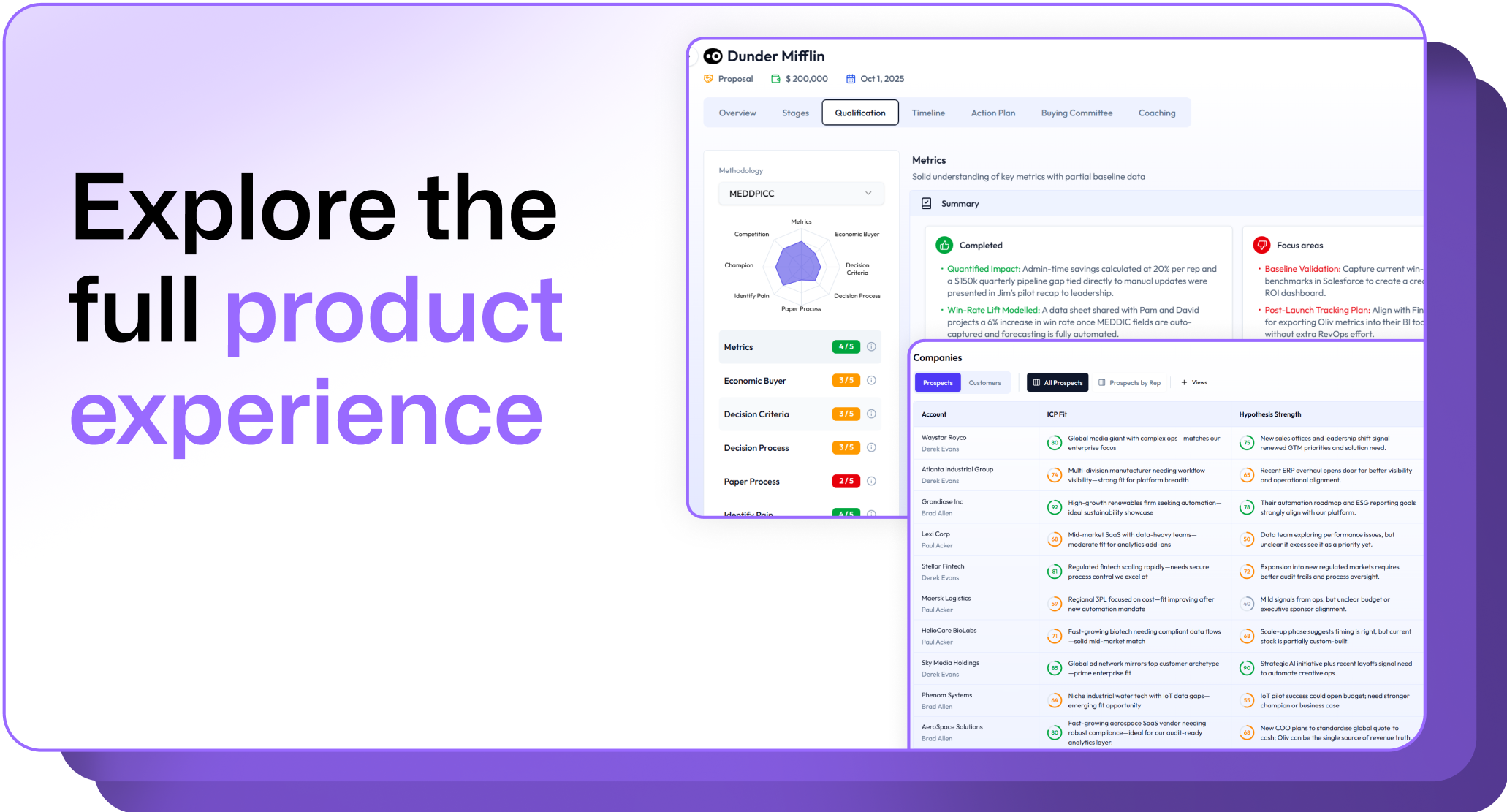
.avif)
.png)