12 Best AI Agents for Sales Teams in 2026: Types, Use Cases, Price, and Real Results
Written by
Ishan Chhabra
Last Updated :
June 15, 2026
Skim in :
8
mins
In this article
Revenue teams love Oliv
Here’s why:
All your deal data unified (from 30+ tools and tabs).
Insights are delivered to you directly, no digging.
AI agents automate tasks for you.
Thank you! Your submission has been received!
Oops! Something went wrong while submitting the form.
Meet Oliv’s AI Agents
Hi! I’m, Deal Driver
I track deals, flag risks, send weekly pipeline updates and give sales managers full visibility into deal progress
Hi! I’m, CRM Manager
I maintain CRM hygiene by updating core, custom and qualification fields all without your team lifting a finger
Hi! I’m, Forecaster
I build accurate forecasts based on real deal movement and tell you which deals to pull in to hit your number
Hi! I’m, Coach
I believe performance fuels revenue. I spot skill gaps, score calls and build coaching plans to help every rep level up
Hi! I’m, Prospector
I dig into target accounts to surface the right contacts, tailor and time outreach so you always strike when it counts
Hi! I’m, Pipeline tracker
I call reps to get deal updates, and deliver a real-time, CRM-synced roll-up view of deal progress
Hi! I’m, Analyst
I answer complex pipeline questions, uncover deal patterns, and build reports that guide strategic decisions
TL;DR
The 12 best AI agents for sales teams in 2026 include Oliv AI, Gong, Clari, Salesloft, Outreach, Agentforce, Artisan, 11x, Clay, Avoma, Chorus, and Relevance AI.
We scored every tool on deal intelligence, agentic autonomy, data portability, setup, and pricing transparency, each weighted to reflect real buyer pain.
Stacking Gong plus Clari can exceed 500 dollars per user monthly before platform fees, while modular agentic pricing starts near 19 dollars per user.
Match the tool to rep count, not brand: SMB wants fast setup, mid-market needs a unified platform, and enterprise needs an intelligence layer.
Demand SOC 2 Type II, GDPR, CCPA, two-party consent, A2P 10DLC, and EU AI Act readiness before deploying any autonomous agent.
Avoid the pilot trap by rolling out one agent at a time and using the 30-day training rule to reach reliable output.
Q1. What are the 12 best AI agents for sales teams in 2026? [toc=1. Best AI Sales Agents]
The 12 best AI agents for sales teams in 2026 are Oliv AI, Gong, Clari, Salesloft, Outreach, Salesforce Agentforce, Artisan, 11x, Clay, Avoma, Chorus, and Relevance AI. Oliv AI leads for B2B revenue teams that want agents doing the work end to end, at roughly half the cost of a stacked Gong-plus-Clari setup. Gong and Clari stay strong on brand and enterprise forecasting.
🧩 Why your stack feels heavier every quarter
I have watched this scene play out more times than I can count. A RevOps lead pings me late on a Thursday, staring at a renewal quote, asking why the team pays for Gong, Clari, and Salesloft, yet still runs Monday forecasts off a spreadsheet.
The numbers stop adding up fast. Stacking conversation intelligence plus forecasting plus engagement can push past $500 per user per month, before platform fees of $5,000 to $50,000 land on top. Conversation intelligence (software that records and analyzes sales calls) is now close to a commodity.
Here is where my head is right now. The shift is from SaaS you log into toward agents that do the work for you, and that reframes the whole sales intelligence platform buying decision.
⚖️ The 12 tools, compared
The list below mixes three generations: first-generation note-takers like Gong and Chorus, second-generation point tools like Avoma, and third-generation agentic platforms like Oliv AI. I scored each on deal intelligence, agentic autonomy, integration and data portability, setup, and pricing transparency.
The 12 Best AI Sales Agents in 2026
#
Tool
Agent type
Best for
Starting price
Rating
1.1
Oliv AI
Multi-agent, autonomous (3rd-gen)
B2B teams wanting end-to-end agents
$19/user/mo
⭐⭐⭐⭐⭐
1.2
Gong
Conversation intelligence plus assistant
Enterprise CI and coaching
~$160 to $250/user/mo
⭐⭐⭐⭐
1.3
Clari
Forecasting plus RevAI
Enterprise forecasting and RevOps
Quote-based
⭐⭐⭐⭐
1.4
Salesloft
Sales engagement plus agents
Outbound cadence teams
Quote-based
⭐⭐⭐
1.5
Outreach
Sales engagement
High-volume sequencing
Quote-based
⭐⭐⭐
1.6
Salesforce Agentforce
Chat-based agents on CRM
Existing Salesforce shops
~$0.10/action
⭐⭐⭐
1.7
Artisan
Autonomous AI SDR
Outbound prospecting
Quote-based
⭐⭐⭐
1.8
11x
Autonomous AI SDR
Pipeline generation
Quote-based
⭐⭐⭐
1.9
Clay
Enrichment and research agent
Data enrichment
~$100k/yr range
⭐⭐⭐⭐
1.10
Avoma
Meeting assistant
SMB note-taking
~$19/user/mo
⭐⭐⭐
1.11
Chorus
Conversation intelligence
ZoomInfo customers
Bundled
⭐⭐
1.12
Relevance AI
Build-your-own agents
Custom workflows
Usage-based
⭐⭐⭐
📌 How to read this list by team size
Match the tool to your rep count, not the hype. SMB teams of 5 to 25 reps want fast setup; mid-market teams of 25 to 200 reps feel data fragmentation most; enterprises of 100 to 500 reps need an intelligence layer over the existing CRM.
One number frames the urgency. Clari's own research found 87% of enterprises missed 2025 revenue targets despite record AI investment. More tools did not fix the problem; better-connected revenue intelligence might.
1.1 Oliv AI ⭐⭐⭐⭐⭐
Oliv AI platform showing a multi-manager forecast board with specialized AI agents for sales teams, Forecaster, Prospector, Coach, and Olivia, spanning the full revenue lifecycle across roles.
What it does: Oliv AI is a generative-AI-native data platform that makes the CRM autonomous by stitching data from calls, emails, Slack, Telegram, and the web into one deal view. We named our agents by job to be done, like Researcher, CRM Manager, and Forecaster, instead of by persona.
🛠️ Key features and pricing
CRM Manager Agent: updates fields and enriches contacts, trained on 100+ sales methodologies like MEDDPICC and BANT (deal-qualification frameworks).
Forecaster Agent: inspects every deal line by line and ships a one-page roll-up plus a slide deck each Monday.
Pricing: modular and seat-based from $19 to $120 per user, with no mandatory platform fee.
⏰ Implementation and product timeline
Baseline setup takes about five minutes, with core value in one to two days; full customization runs two to four weeks. That contrasts with the three-to-six-month implementation cycles common to legacy platforms.
Oliv AI Product Timeline
When
What's happening
Through 2025
30+ specialized agents in production; SOC 2 Type II, GDPR, and CCPA certified; 5-minute call processing versus Gong's 20 to 30 minutes.
Now (2026)
Voice Agent (alpha) calling reps nightly to capture unrecorded updates; repositioning from revenue orchestration to revenue engineering.
✅ Agents do the work; managers reclaim about a day a week.
✅ Full open export policy (CSV dump on termination), so no UI lock-in.
❌ As an early-stage company, it lacks Gong's decade of brand and historical data.
❌ Voice Agent is still in alpha, and full customization can take two to four weeks.
Best use case: B2B mid-market teams on 15-to-20-day cycles fighting dirty CRM data and Monday forecast calls.
"Before switching to Oliv, cleaning up messy CRM fields and guessing at forecasts used to swallow half my week. Oliv fixes the data as it happens and drops a forecast I can actually bank on." Darius Kim, Head of RevOps, DriftloopOliv AI G2 Verified Review
"With Gong, I have trouble understanding breadth versus depth of customer conversations. Oliv is the first time I've ever been speechless." Akil Sharperson, Triple WhaleOliv AI G2 Verified Review
1.2 Gong ⭐⭐⭐⭐
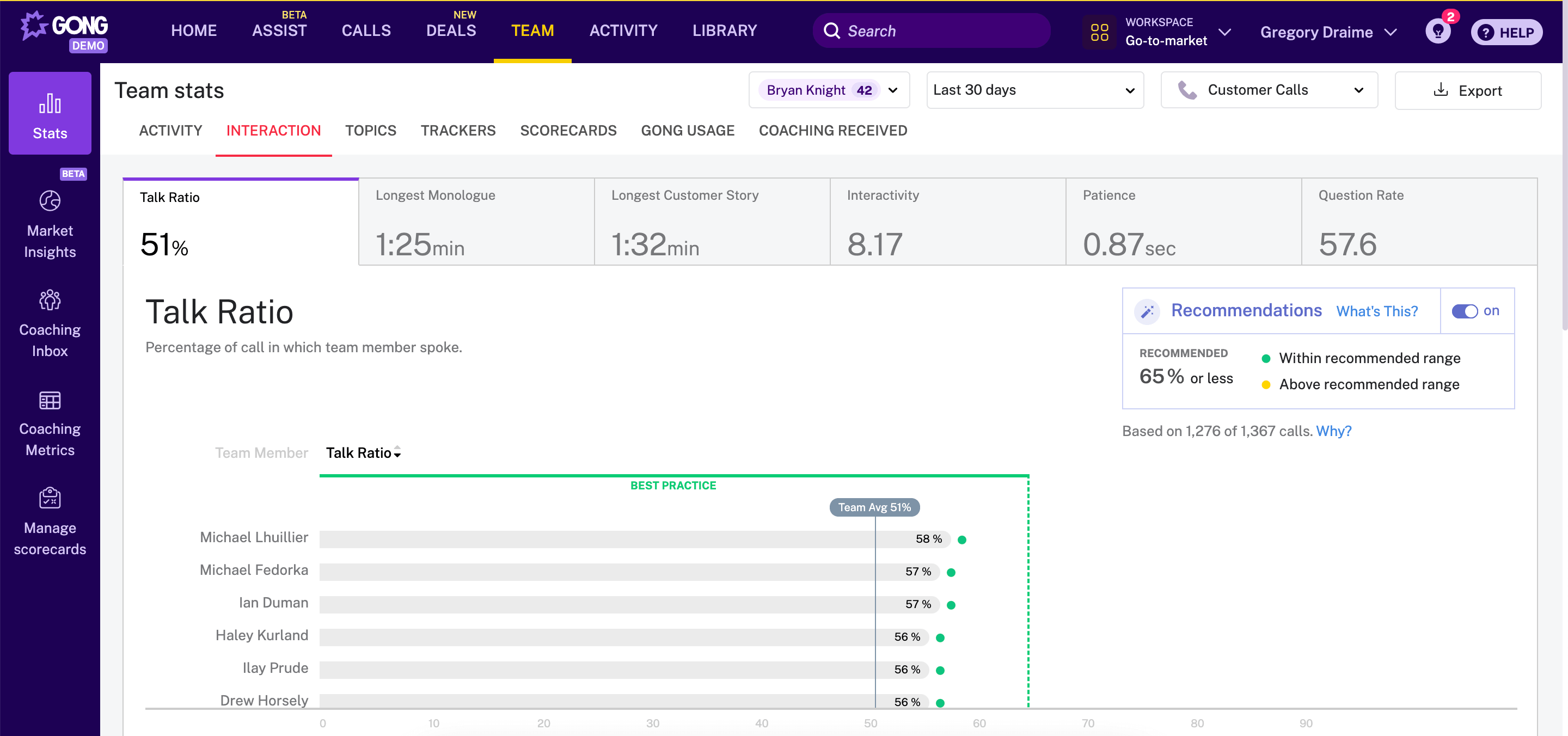
Gong conversation intelligence dashboard tracking talk ratio, monologue length, and coaching benchmarks, showing how call-analysis AI agents for sales teams support manager coaching.
What it does: Gong is the market-leading conversation intelligence platform, built in 2015 on call recording, transcription, and AI deal insight. It is the benchmark for CI, though it works as software you adopt and train your team on, rather than an autonomous agent.
🛠️ Key features and pricing
Smart Trackers: keyword-based topic detection across calls.
Gong Forecast and Engage: forecasting and sequencing, sold as paid add-ons.
Pricing: roughly $160 to $250 per user per month when bundled, plus platform fees of $5,000 to $50,000.
⏰ Implementation and product timeline
Gong Product Timeline
When
What's happening
Through 2025
Smart Trackers, deal boards, and Gong Assistant; SPICED and BANT playbook tracking added in January 2025.
Now (2026)
Mission Andromeda launched February 25, 2026, adding Gong Enable and secure AI interoperability; ARR topped $500M.
Expected next
Bidirectional MCP servers, so external AI tools can query Gong and Gong can pull external data into briefs.
❌ Add-ons like Forecast and Engage cost extra, and total cost runs high.
❌ Data portability is weak; bulk export requires custom API work.
Best use case: Established enterprise sales orgs with budget for premium CI and coaching. For teams weighing the trade-offs, our Gong reviews breakdown covers it in depth.
"Before Gong we had a lack of visibility across our deals... Now all of this is centralized in one view via the Gong deal boards." Scott T., Director of SalesGong G2 Verified Review
"It was a big mistake on our part to commit to a two year term. Gong is a really powerful tool but it's probably the highest end option on the market." Iris P., Head of Marketing and Sales PartnershipsGong G2 Verified Review
1.3 Clari ⭐⭐⭐⭐
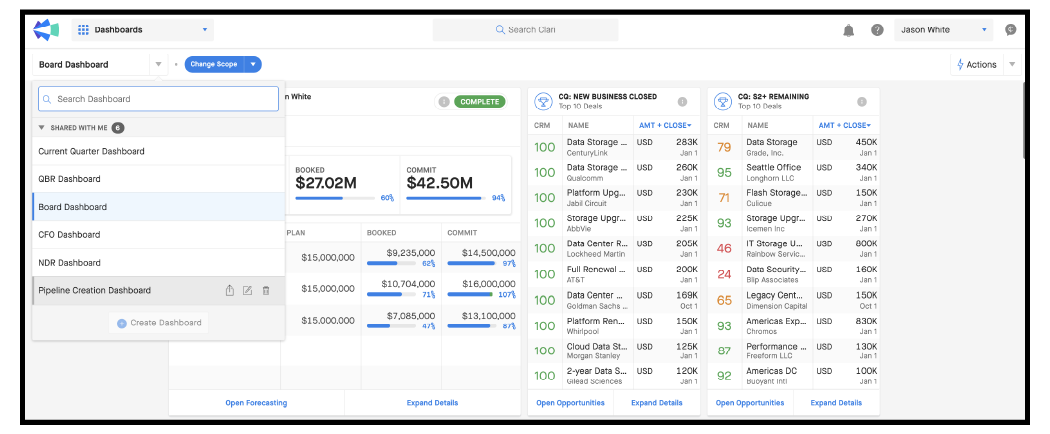
Clari prospecting interface filtering companies against an ideal customer profile, supporting the forecasting and pipeline-focused AI agents for sales teams evaluated in this guide.
What it does: Clari is an enterprise revenue platform built around forecasting and pipeline inspection, founded in 2014. It now spans Clari, Copilot, Groove, and, after a 2025 merger, Salesloft.
🛠️ Key features and pricing
Forecasting and CRM Score: roll-up forecasting across signals from CRM, calls, and meetings.
Copilot: conversation intelligence recognized by Forrester since 2023.
Pricing: quote-based; Clari reported a Forrester TEI of $96.2M and 398% ROI in 2025.
⏰ Implementation and product timeline
Clari Product Timeline
When
What's happening
Through 2025
Enhanced CRM Score (January 2025), AI consent detection for dialer compliance (November 2025).
Now (2026)
First joint Clari-Salesloft release (March 2026): send AI emails from Clari, create Salesloft tasks.
Expected next
Deeper Clari-Salesloft interoperability across forecasting and engagement release trains.
✅ Pros and ❌ Cons
✅ Clean forecasting UI loved by RevOps and sales leadership.
✅ Makes updating Salesforce far faster from a single view.
❌ Reviewers call it "a glorified SFDC overlay" that adds little for reps.
❌ Forecasting remains a largely manual, configured process.
Best use case: Complex enterprise GTM motions that need disciplined, manager-led forecasting. We compare the two leaders directly in our Gong vs Clari analysis.
"Clari is a tool for sales leaders, it adds no value to reps as far as I can see." Msoave, r/SalesOperationsReddit Thread
"4 months later every one of my reps loves it because it makes updating salesforce 10x easier... it all depends how yours is configured." ChimpDaddy2015, r/salesReddit Thread
1.4 Salesloft ⭐⭐⭐
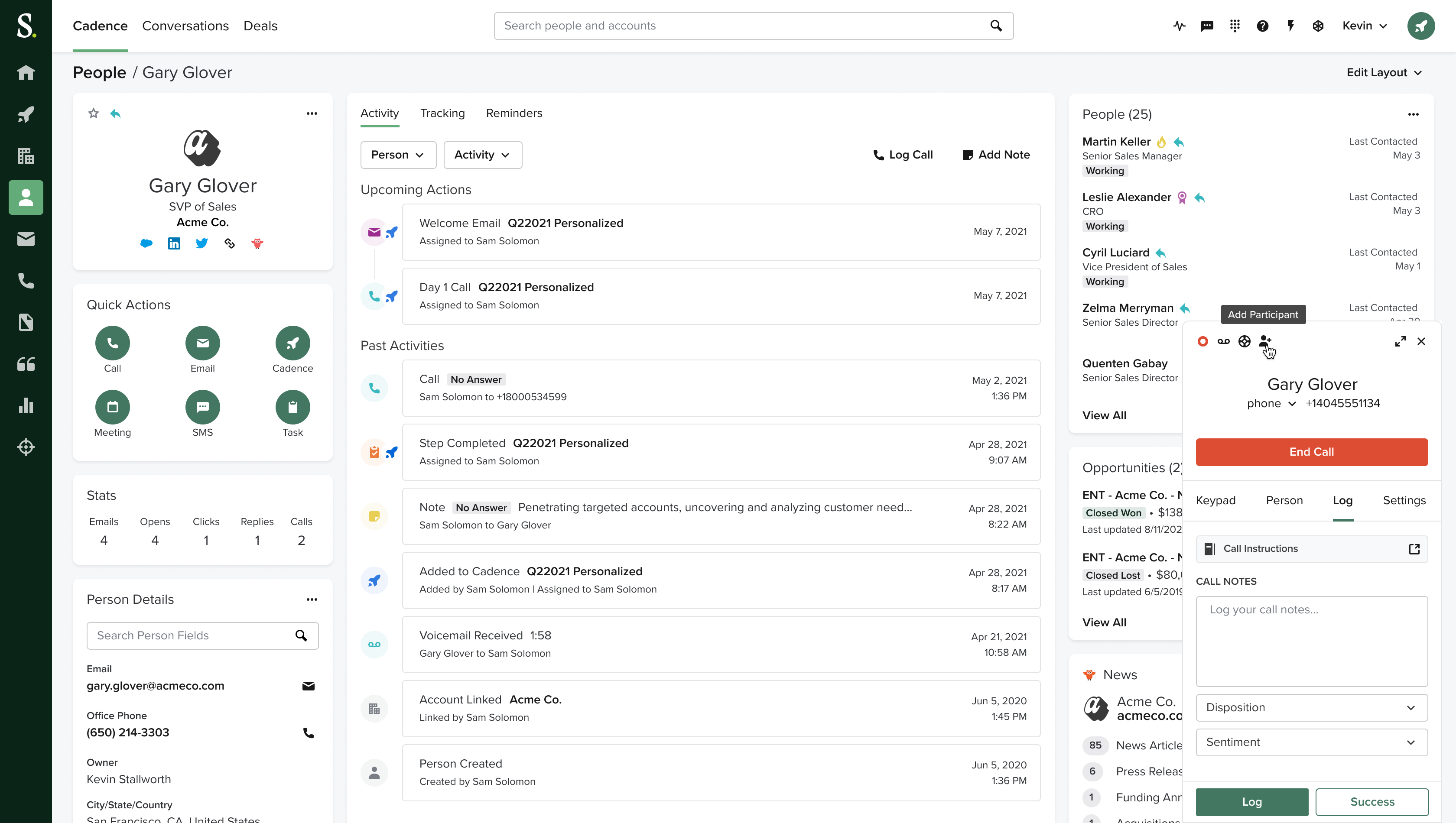
Salesloft sales engagement platform showing a contact record, in-app call logging, and cadence activity timeline, illustrating engagement-focused AI agents for outbound sales teams.
What it does: Salesloft is a sales engagement platform built in 2011 around Cadence, its sequencing engine. It added 26 AI agents in 2025 and now sits inside the Clari group.
🛠️ Key features and pricing
Cadence: multi-step outreach sequences with email and call tracking.
Conversations: a CI product reviewers describe as weaker than Gong.
Pricing: quote-based, with seat minimums that can exclude small teams.
⏰ Implementation and product timeline
Salesloft Product Timeline
When
What's happening
Through 2025
Acquired Drift (February 2024); launched 15 new AI agents in May 2025.
Now (2026)
April 14, 2026 release adds the Salesloft MCP Server and Chrome Side Panel.
Expected next
Tighter Clari-Salesloft cross-platform plays and the Agentic add-on.
✅ Pros and ❌ Cons
✅ Strong cadence management and task organization for SDRs.
✅ Email open and click tracking that helps prioritize warm leads.
❌ Reviewers report stagnant features and poor customer service.
❌ Conversations CI is seen as underbuilt versus dedicated tools.
Best use case: Outbound-heavy SDR teams that live in cadences and dialing. See how it stacks against the CI leader in our Gong vs Salesloft comparison.
"Working in EdTech sales... Salesloft has been a game-changer. The cadence feature allows us to tailor outreach to different personas at scale." Nathalie J., Services Solution Development SpecialistSalesloft G2 Verified Review
"Super clunky to set up. Conversations doesn't work at all. They sell it as a gong competitor. It doesn't even have the functionality of Zoom." Verified User in Professional Training and CoachingSalesloft G2 Verified Review
1.5 Outreach ⭐⭐⭐
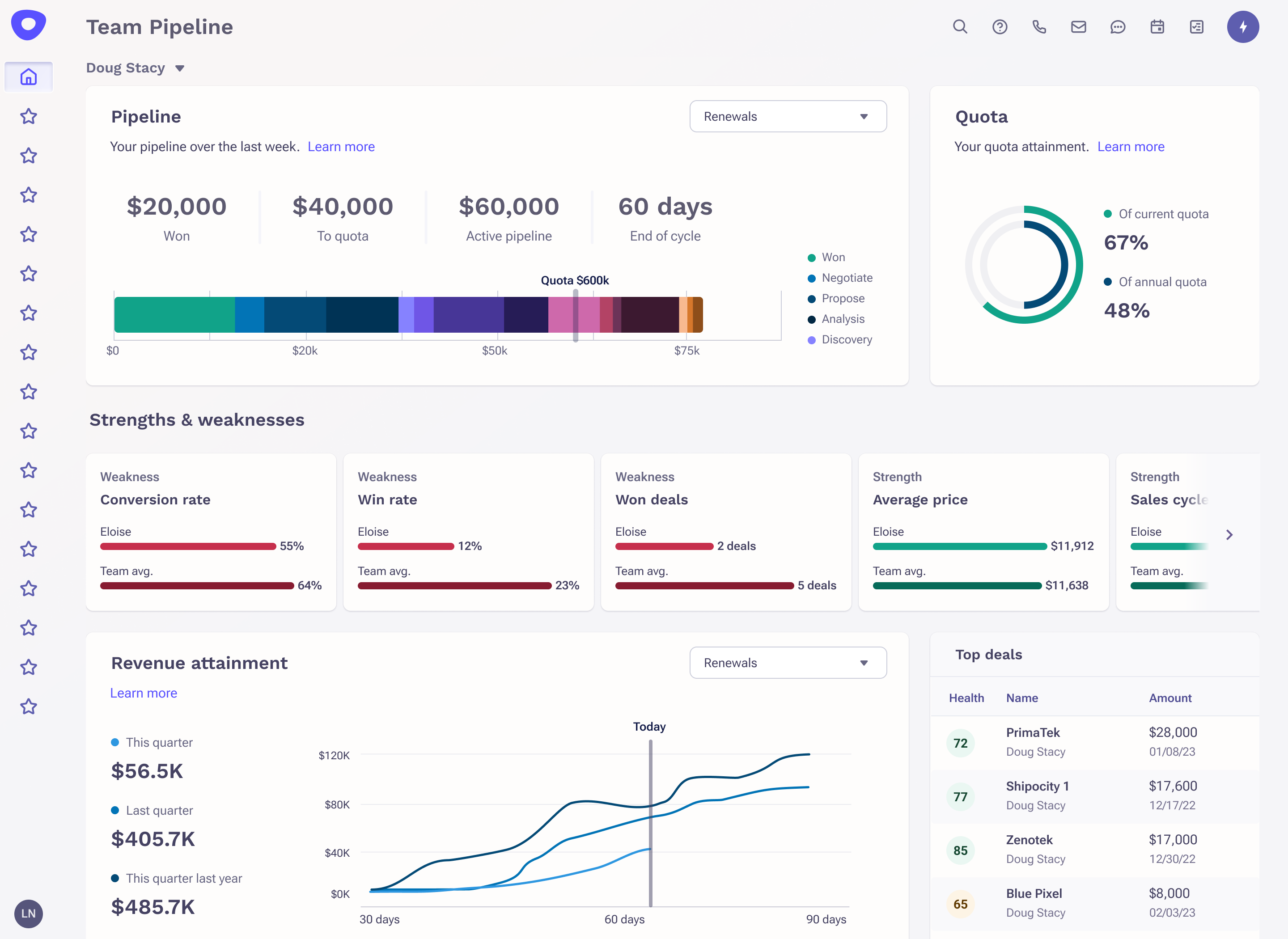
Outreach sales execution dashboard tracking pipeline by stage, quota attainment, rep strengths and weaknesses, revenue attainment over time, and top deals, supporting AI agents for sales teams comparisons.
What it does: Outreach is a sales execution platform built in 2014 around sequencing, dialing, and pipeline management. It now adds AI assistants, but reviewers still describe the core Engage product as a pre-generative, sequencing-first tool.
🛠️ Key features and pricing
Sequences: multi-step email and call automation that syncs with Salesforce.
Deal and forecasting tools: pipeline management layered on top of engagement.
Pricing: quote-based, with reviewers flagging high cost and evergreen auto-renewal contracts.
⏰ Implementation and product timeline
Outreach Product Timeline
When
What's happening
Through 2025
Sequencing, Kaia assistant, and deal management; reviewers note limited UX change in years.
Now (2026)
Push into autonomous AI prospecting agents and pipeline AI across the platform.
Expected next
Deeper agent autonomy and tighter CRM sync to address logged sync failures.
✅ Pros and ❌ Cons
✅ Strong sequencing, A/B testing, and prospect tracking.
✅ Solid Salesforce integration and admin dashboards.
❌ Reviewers call the Engage product "stagnant" with rigid contracts.
Best use case: High-volume outbound SDR teams on Salesforce that live in sequences. Our Gong vs Outreach guide covers where each one wins.
"Outreach is really really good for emailing, sequencing, and prospect management. It talks to Salesforce really well as well." Ethan R., Sales Development RepresentativeOutreach G2 Verified Review
"The engage product is stagnant. Looks to have the same features, UX, integrations and issues as it had 5 years ago." Matthew T., Head of Revenue OperationsOutreach G2 Verified Review
1.6 Salesforce Agentforce ⭐⭐⭐
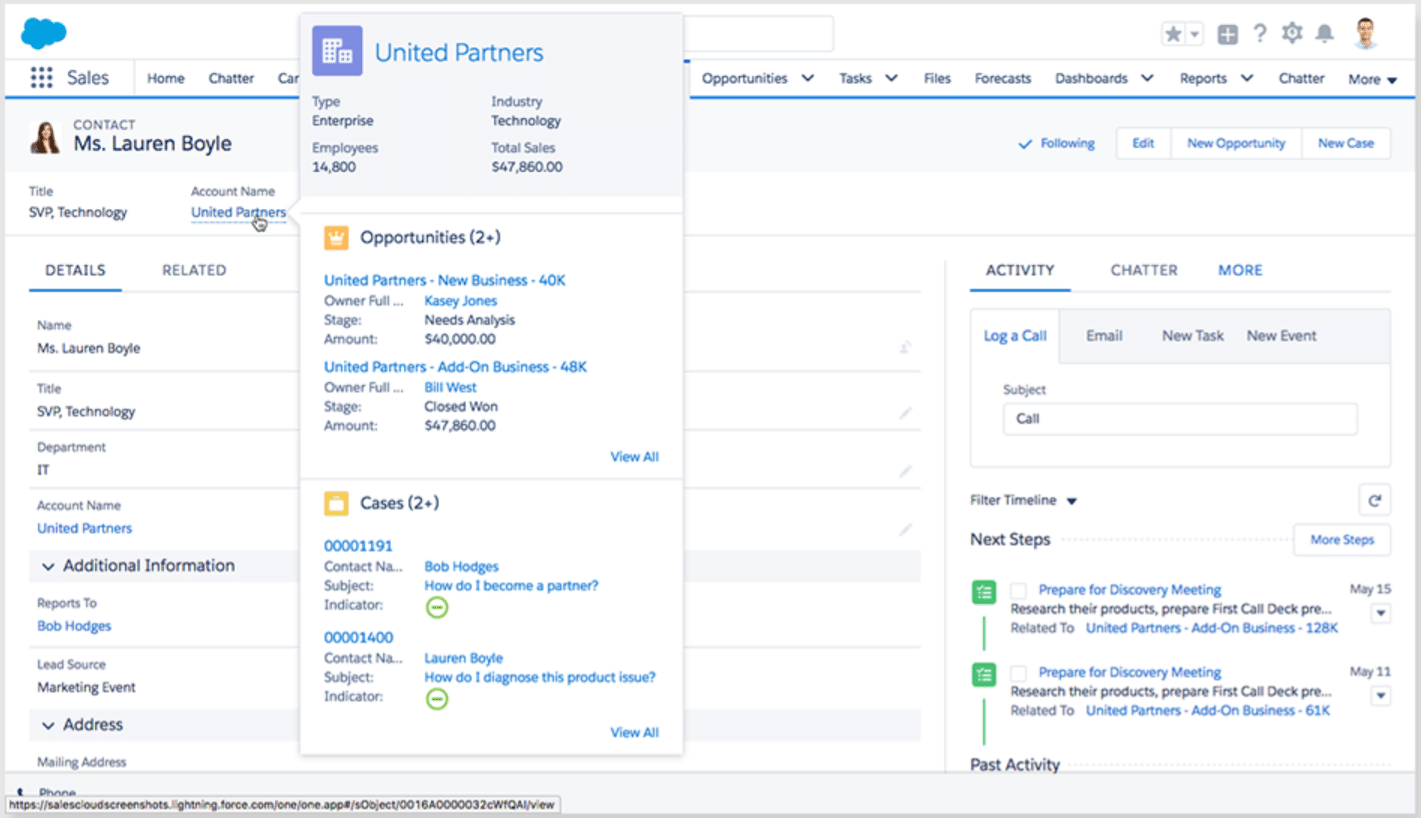
Salesforce Sales Cloud contact view displaying linked account, opportunities, cases, and next-step activities, representing CRM-native AI agents like Agentforce for sales teams.
What it does: Agentforce is Salesforce's agent layer on the Einstein platform, launched in late 2024. It is largely chat-focused, so users prompt an agent and copy results, rather than the agent acting natively in the workflow.
🛠️ Key features and pricing
Agents on CRM data: chat-driven assistants for service and sales tasks.
Einstein Activity Capture: rule-based logging that struggles with duplicate accounts.
Pricing: roughly $0.10 per action, around $500 per seat for all-inclusive tiers.
⏰ Implementation and product timeline
Salesforce Agentforce Product Timeline
When
What's happening
Through 2025
Agentforce 1.0 and 2.0 and Einstein Copilot rolled out across clouds.
Now (2026)
Agentforce 360 expansion with deeper Data Cloud grounding.
Expected next
More autonomous, less chat-dependent agents to lift adoption.
✅ Pros and ❌ Cons
✅ Native to Salesforce, so no new system of record.
✅ Strong fit for B2C customer-support use cases.
❌ Chat-first UX is "not deeply integrated into your workflows," hurting adoption.
❌ Deployments stall when underlying CRM data is dirty.
Best use case: Existing Salesforce shops, especially B2C support teams. B2B sales is comparatively underserved here, which is why teams explore Agentforce alternatives.
1.7 Artisan ⭐⭐⭐
What it does: Artisan is an autonomous AI SDR platform (its "Ava" agent) that finds leads, writes outreach, and runs sequences end to end. It targets top-of-funnel pipeline generation rather than deal intelligence.
🛠️ Key features and pricing
Ava the AI BDR: automated prospecting, enrichment, and email outreach.
B2B data: a large built-in contact database for sourcing.
Pricing: quote-based, scaled to lead volume.
⏰ Implementation and product timeline
Artisan Product Timeline
When
What's happening
Through 2025
Ava AI BDR with autonomous prospecting and email campaigns.
Now (2026)
Expanded multichannel outreach and deliverability tooling.
❌ Focused on top of funnel, not full-deal context.
❌ Newer brand with a thinner enterprise track record.
Best use case: Lean teams that want pipeline generated automatically, then handed to a deeper revenue intelligence software layer for deal management.
1.8 11x ⭐⭐⭐
What it does: 11x builds digital workers, notably "Alice" (AI SDR) and "Julian" (AI voice agent), for autonomous outbound. Like Artisan, it owns the prospecting motion rather than deal management.
🛠️ Key features and pricing
Alice: autonomous research, sequencing, and outbound at scale.
Julian: an AI voice agent for outbound calls.
Pricing: quote-based, oriented to pipeline output.
⏰ Implementation and product timeline
11x Product Timeline
When
What's happening
Through 2025
Alice AI SDR scaled across outbound customers.
Now (2026)
Voice agent Julian and tighter CRM integrations.
Expected next
More end-to-end GTM agents across channels.
✅ Pros and ❌ Cons
✅ Fully autonomous SDR and voice outreach.
✅ Strong fit for scaling pipeline without headcount.
❌ Outbound-only scope; no deal intelligence layer.
❌ Deliverability and accuracy need careful governance.
Best use case: Growth-stage teams scaling outbound fast. To compare the full landscape, see our roundup of the best AI sales tools.
1.9 Clay ⭐⭐⭐⭐
What it does: Clay is a data enrichment and research platform with AI agents ("Claygents") that build and enrich prospect lists from 100+ data sources. It powers the research layer that other tools act on.
🛠️ Key features and pricing
Waterfall enrichment: chains data providers for higher match rates.
Claygent: AI research agent for custom data tasks.
Pricing: credit-based tiers; enterprise starts around $100k per year.
⏰ Implementation and product timeline
Clay Product Timeline
When
What's happening
Through 2025
Waterfall enrichment and Claygent across 100+ sources.
Now (2026)
Expanded agentic workflows and integrations.
Expected next
Deeper autonomous research-to-outreach handoffs.
✅ Pros and ❌ Cons
✅ Best-in-class enrichment and list building.
✅ Highly flexible for RevOps power users.
❌ Steep learning curve and high enterprise cost.
❌ It enriches data, but does not manage deals or forecasts.
What it does: Avoma is a meeting assistant and conversation-intelligence tool aimed at small businesses. It is positioned as a cheaper alternative to Gong.
🛠️ Key features and pricing
Meeting recording and notes: transcripts, summaries, and scorecards.
Light revenue intelligence: basic deal and coaching insights.
Pricing: affordable tiers starting around $19 per user per month.
⏰ Implementation and product timeline
Avoma Product Timeline
When
What's happening
Through 2025
Meeting assistant, notes, and basic CI for SMBs.
Now (2026)
Added AI agents and scheduling automation.
Expected next
More agentic note-to-CRM automation.
✅ Pros and ❌ Cons
✅ Low cost and easy for small teams.
✅ Covers core note-taking and scheduling.
❌ Seen as a "cheaper Gong" with weaker transcription reliability.
❌ Limited depth for complex mid-market or enterprise motions.
Best use case: Small businesses needing affordable meeting notes. Our Avoma features breakdown covers where it fits.
1.11 Chorus ⭐⭐
What it does: Chorus is a conversation-intelligence tool acquired by ZoomInfo in 2021. It records and analyzes calls but has innovated little since the acquisition.
🛠️ Key features and pricing
Call recording and themes: transcription, trackers, and deal signals.
ZoomInfo bundling: tied into the broader ZoomInfo data suite.
Pricing: typically bundled with ZoomInfo contracts.
⏰ Implementation and product timeline
Chorus Product Timeline
When
What's happening
Through 2025
Core CI under ZoomInfo, with limited standalone roadmap.
Now (2026)
Integration into ZoomInfo Copilot rather than standalone growth.
Expected next
Further absorption into the ZoomInfo platform.
✅ Pros and ❌ Cons
✅ Decent CI for existing ZoomInfo customers.
✅ Useful call themes and competitor tracking.
❌ Viewed internally as stagnant since the 2021 acquisition.
❌ Customers report low enthusiasm at renewal.
Best use case: Teams already standardized on ZoomInfo. For a head-to-head, read our Gong vs Chorus comparison.
1.12 Relevance AI ⭐⭐⭐
What it does: Relevance AI is a build-your-own-agent platform for assembling custom AI workforces, including sales agents. It suits teams wanting to design bespoke workflows rather than buy a packaged tool.
🛠️ Key features and pricing
AI workforce builder: low-code agents and multi-agent teams.
Custom tools and integrations: flexible connections to your stack.
Pricing: usage-based credit tiers.
⏰ Implementation and product timeline
Relevance AI Product Timeline
When
What's happening
Through 2025
Multi-agent AI workforce builder with custom tools.
Now (2026)
Expanded agent templates and orchestration.
Expected next
More prebuilt sales agents to reduce build effort.
✅ Pros and ❌ Cons
✅ Highly customizable for unique workflows.
✅ Good for teams with engineering capacity.
❌ You build and maintain it; that is real ongoing work.
❌ Generic builds often lack deal-level context and can go stale fast.
Best use case: Technical teams building narrow, custom agents, often as part of a wider revenue orchestration platform strategy.
Q2. How did we score these tools, and what should yours score on? [toc=2. Scoring Methodology]
We scored each tool across five weighted criteria summing to 100%: Cross-Functional Deal Intelligence (25%), Agentic Autonomy versus Chat (25%), CRM Integration and Data Portability (20%), Setup and Usability (15%), and Pricing Transparency (15%). Scores convert to stars: 0 to 20 is 1 star, 21 to 40 is 2, 41 to 60 is 3, 61 to 80 is 4, and 81 to 100 is 5. Oliv AI scores 5 stars.
🔍 Why these five criteria, and why these weights
Let me be upfront. I run Oliv AI, so I weighted this rubric the way a skeptical RevOps buyer would, not the way that flatters us.
Deal Intelligence (how well a tool reads a whole deal, not one call) gets 25% because fragmented data is the root failure. Agentic Autonomy (does the tool do the work, or just chat) also gets 25%. I weighted that high on purpose. Many "agents" are still chat boxes you prompt and copy-paste from, which kills adoption.
Data Portability earns 20%. If you cannot export your own call data in bulk, you are locked in, and Gong users say exactly that. Our Gong DPA and security breakdown digs into that export friction.
⭐ How the scores became stars
Setup and Usability take 15%, since a tool nobody adopts scores zero in real life. Pricing Transparency takes the last 15%, because opaque platform fees of $5,000 to $50,000 wreck the math.
I will name our bias plainly. The weighting rewards autonomy and open export, which happens to be where Oliv AI is strong, and where legacy stacks are weak. You can sanity-check it against our roundup of the best revenue intelligence software platforms.
Tool Scoring Criteria and Weights
Criterion
Weight
What it measures
Cross-Functional Deal Intelligence
25%
Reads full deal across calls, email, and Slack.
Agentic Autonomy vs Chat
25%
Does the work versus requires prompting.
CRM Integration and Data Portability
20%
Two-way sync and bulk export freedom.
Setup and Usability
15%
Time to value and adoption.
Pricing Transparency
15%
Clear, modular, no hidden platform fees.
Score your shortlist on the same five lines. If a vendor dodges the export question, that is your answer.
Q3. What is an AI sales agent, and which type does your team need? [toc=3. Definition and Types]
An AI sales agent autonomously picks a goal, like updating the CRM, prepping a rep, or qualifying a lead, and works toward it across your tools. That differs from a chatbot you must prompt and copy-paste from. Types split by autonomy (copilot versus autonomous) and by architecture (single-task versus multi-agent). Pick by your bottleneck, not the brand.
🤖 Agent versus chatbot versus RPA
Here is the cleanest way I explain it to a busy CRO. A chatbot answers when you ask. RPA (robotic process automation, software that repeats fixed steps) follows a rigid script.
An agent is different. Think of a vending machine versus a smart employee. A vending machine dispenses when you press the button, which is plain automation. An agent is the employee who picks a goal and chases it without being told each step.
One thing I want to be clear on: agents augment reps, they do not replace the conversation. They absorb admin, so humans do the selling. That is the throughline across the best AI sales tools today.
🧩 Copilot, autonomous, single, and multi-agent
The split that matters most is autonomy. A copilot suggests, and you act. An autonomous agent acts, then reports back.
The second split is architecture. A single-task agent does one job, like enrichment. A multi-agent system orchestrates several specialists across a workflow. At Oliv AI, we name agents by job to be done, like Researcher, Deal Driver, and CRM Manager, to avoid the "replacing humans" frame. This is the shift we map in our revenue ops to intelligence to orchestration piece.
AI Sales Agent Types Mapped to Roles
Agent type
What it does
Best-fit role
Copilot
Suggests, you approve.
AEs wanting speed with control.
Autonomous
Acts, then reports.
RevOps automating CRM hygiene.
Single-task
One job well, like enrichment.
SDRs needing list building.
Multi-agent
Orchestrates specialists.
Mid-market teams unifying the stack.
"4 months later every one of my reps loves it because it makes updating salesforce 10x easier." ChimpDaddy2015, r/salesReddit Thread
"Clari is a tool for sales leaders, it adds no value to reps as far as I can see." Msoave, r/SalesOperationsReddit Thread
Q4. What does it cost, what's the ROI, and should you build or buy? [toc=4. Economics and Build-vs-Buy]
AI sales agent pricing spans per-seat ($50 to $250 per user per month), per-action credit models (around $0.10 per action), and modular pay-for-what-you-use from about $19 per user per month. Stacking Gong plus Clari can exceed $500 per user per month, before platform fees of $5,000 to $50,000. Buy when you need deal context; build only narrow throwaway tools.
💸 Why your invoice is bigger than your quote
The sticker price is never the real price. Salesforce Agentforce runs about $0.10 per action, and an all-inclusive seat can hit $500.
Legacy revenue intelligence adds mandatory platform fees of $5,000 to $50,000, regardless of seat count. Then forced bundling kicks in, where add-ons like Gong Engage require a core license per seat. That is how a 25-to-200-rep team quietly crosses $500 per user per month, as our Gong pricing breakdown shows.
AI Sales Agent Pricing Models
Pricing model
Typical cost
Example
Per-seat
$50 to $250/user/mo
Gong, Salesloft
Per-action credits
~$0.10/action
Salesforce Agentforce
High-end agentic
$50k+/yr; Clay ~$100k/yr
Clay
Modular pay-per-use
From $19/user/mo, no platform fee
Oliv AI
📈 The ROI math worth running
I would anchor ROI on three numbers. Better forecast accuracy, hours saved, and lift in deals per rep.
When we rebuilt forecasting on Oliv AI agents, the Forecaster Agent inspects every deal line by line for unbiased roll-ups. Customers report about 25% higher forecast accuracy and a 7% lift in deal acceleration. Managers also reclaim roughly one day a week previously lost to manual call auditing, which is the core promise of strong AI sales forecasting software.
"Love the user-friendly features and the visibility it provides into our Sales forecast. We use Clari every week on our forecast call with our ELT." Andrew P., Business Development ManagerClari G2 Verified Review
"I find the setup process challenging, especially when migrating fields from Salesforce, as it can't handle formula fields directly." Josiah R., Head of Sales OperationsClari G2 Verified Review
🛠️ Build versus buy, the honest version
Here is my contrarian take, and I could be wrong. Most teams should not build their own agents.
Generic in-house builds often go obsolete within months because they lack deal-level context. Build only when the job is narrow and disposable. Buy when you need integrations, governance, and a system that reads the whole deal, which is the case we make in our revenue intelligence platforms guide.
Run this four-question check: Is it core? Will it last a year? Do you have engineers to maintain it? Does it need deal context?
Q5. How do you keep AI sales agents compliant, secure, and trustworthy? [toc=5. Governance and Deliverability]
Before deploying autonomous agents, demand SOC 2 Type II (an audited security standard), GDPR and CCPA compliance, two-party-consent call handling, and A2P 10DLC registration for any dialing or texting agent. Prefer grounded, fine-tuned LLMs running inside your data workspace to cut hallucinations, and require audit logs and role-based access. The EU AI Act now adds obligations for agents acting without a human in the loop.
⚠️ The trust failure nobody flags at the demo
Here is a scene I have watched break deals. An agent creates a duplicate account in Salesforce, and suddenly nobody trusts the data.
Rule-based systems like Einstein Activity Capture (Salesforce's automatic logging) misfire on duplicate accounts. At Oliv AI, we use AI-based object association, where the model reasons through duplicates to map activity to the right deal. That is the difference between data you audit and data you bank on, a gap we cover in our Salesforce Einstein reviews.
I will be candid about the stakes. In finance, you must build an audit trail and physically link the data to satisfy the auditor. Agents now carry that same burden.
✅ Your governance and deliverability checklist
Run every vendor against this list before signing.
SOC 2 Type II: independent proof of security controls over time.
GDPR and CCPA: lawful handling of EU and California personal data.
Two-party consent: all parties must be told a call is recorded, required in 11 states including California and Florida.
A2P 10DLC: mandatory carrier registration for all app-to-person SMS, including AI-generated texts.
EU AI Act: from August 2, 2026, high-risk agents need tamper-evident logs, human oversight, and AI disclosure at interaction start.
Grounded LLMs: fine-tuned models inside your data workspace to reduce hallucinations.
Audit logs and RBAC: role-based access control, so each user sees only what their role permits.
One requirement stands out for agents. The EU AI Act expects rapid revocation, the ability to kill an agent's privileges within seconds. Oliv AI ships SOC 2 Type II, GDPR, CCPA, AES-256 encryption, audit logs, and RBAC as the baseline, not the upsell, which is more than most Agentforce alternatives can claim.
Q6. How do you roll out AI sales agents without falling into the pilot trap? [toc=6. Rollout and Anti-Patterns]
Roll out one high-value agent at a time, not everything at once. Use the 30-day training rule: spend an hour or two daily correcting the agent, and by day 30, the output is reliable. Avoid the pilot trap, where promising pilots fade before production, and the "Hello [First_Name]" failure, where weak systems amplify bad process at scale.
⏰ Step 1: Start narrow, not everywhere
The pilot that tries to boil the ocean dies quietly. I have seen it stall at month three, every time.
Pick one painful, high-value job first, like autonomous CRM updates. With Oliv AI, baseline setup takes about five minutes, and core value lands in one to two days. That beats the three-to-six-month implementation cycles of legacy tools, as our Gong implementation timeline breakdown shows.
🛠️ Step 2: Train the agent like a new hire
Agents are not "set and forget." They work nights, weekends, and holidays, but they need real supervision.
Use the 30-day training rule, correcting output daily for a month. A simple memory hack helps: keep a running notes file, and tell the agent to update it whenever you correct it. Honestly, this is not a job for lazy teams; plan for 10 to 15 hours a week of quality checks early on, the same discipline behind the best sales coaching software.
🚩 Step 3: Dodge the anti-patterns
The biggest trap is the "Hello [First_Name]" send, where a broken merge field ships at scale. Bad systems amplify bad process; they do not fix it.
Then expand into multi-agent orchestration, where a few humans supervise many specialized agents. The future I keep circling is small teams running 20-plus agents, shifting from revenue orchestration to revenue engineering, a transition we map in our revenue orchestration platform guide.
What is the single workflow you would trust an agent to own first? That is the conversation worth having before any rollout plan.
Q7. Which AI sales agent is right for your team size and stage? [toc=7. Choosing by Team Stage]
For SMB teams of 5 to 25 reps, choose out-of-the-box agents with fast setup. Mid-market teams of 25 to 200 reps, where data fragmentation hurts most, gain most from a full agentic platform unifying conversation intelligence and forecasting. Enterprises of 100 to 500 reps should add an intelligence layer that makes the existing CRM autonomous, rather than ripping and replacing.
🎯 Map the tool to your rep count
Buying by brand is how budgets get wasted. Buy by your bottleneck and your team size.
I will say the quiet part out loud about Oliv AI. We are not for everyone, and pretending otherwise wastes your time. If pure call recording is all you need, a commodity note-taker is fine, and our best AI for sales calls roundup covers those options.
AI Sales Agent Fit by Team Segment
Segment
Best fit
Not recommended for
SMB (5 to 25 reps)
Fast, out-of-box agents.
Heavy custom workflows.
Mid-market (25 to 200)
Full agentic platform unifying CI and forecasting.
Pure B2C return handling.
Enterprise (100 to 500)
Intelligence layer over existing CRM.
Teams unwilling to run agentic nudges.
🤝 The honest pick, with risk removed
Here is my read, and I could be off for your edge case. Mid-market B2B is the sweet spot for Oliv AI, and enterprises do best treating us as an intelligence layer, not a rip-and-replace, the path we detail in our best revenue intelligence software platforms guide.
To take the risk off the table, Oliv AI offers free migration of historical Gong recordings and metadata. So the real question is not "which brand," but "which one job will you hand an agent this quarter?" For a direct comparison, see our Gong vs Oliv breakdown.
"We use Clari every week on our forecast call with our ELT. I'm able to screen-share Clari directly with our executive team." Andrew P., Business Development ManagerClari G2 Verified Review
"It was a big mistake on our part to commit to a two year term. Gong is a really powerful tool but it's probably the highest end option on the market." Iris P., Head of Marketing and Sales PartnershipsGong G2 Verified Review
Q1. What are the 12 best AI agents for sales teams in 2026? [toc=1. Best AI Sales Agents]
The 12 best AI agents for sales teams in 2026 are Oliv AI, Gong, Clari, Salesloft, Outreach, Salesforce Agentforce, Artisan, 11x, Clay, Avoma, Chorus, and Relevance AI. Oliv AI leads for B2B revenue teams that want agents doing the work end to end, at roughly half the cost of a stacked Gong-plus-Clari setup. Gong and Clari stay strong on brand and enterprise forecasting.
🧩 Why your stack feels heavier every quarter
I have watched this scene play out more times than I can count. A RevOps lead pings me late on a Thursday, staring at a renewal quote, asking why the team pays for Gong, Clari, and Salesloft, yet still runs Monday forecasts off a spreadsheet.
The numbers stop adding up fast. Stacking conversation intelligence plus forecasting plus engagement can push past $500 per user per month, before platform fees of $5,000 to $50,000 land on top. Conversation intelligence (software that records and analyzes sales calls) is now close to a commodity.
Here is where my head is right now. The shift is from SaaS you log into toward agents that do the work for you, and that reframes the whole sales intelligence platform buying decision.
⚖️ The 12 tools, compared
The list below mixes three generations: first-generation note-takers like Gong and Chorus, second-generation point tools like Avoma, and third-generation agentic platforms like Oliv AI. I scored each on deal intelligence, agentic autonomy, integration and data portability, setup, and pricing transparency.
The 12 Best AI Sales Agents in 2026
#
Tool
Agent type
Best for
Starting price
Rating
1.1
Oliv AI
Multi-agent, autonomous (3rd-gen)
B2B teams wanting end-to-end agents
$19/user/mo
⭐⭐⭐⭐⭐
1.2
Gong
Conversation intelligence plus assistant
Enterprise CI and coaching
~$160 to $250/user/mo
⭐⭐⭐⭐
1.3
Clari
Forecasting plus RevAI
Enterprise forecasting and RevOps
Quote-based
⭐⭐⭐⭐
1.4
Salesloft
Sales engagement plus agents
Outbound cadence teams
Quote-based
⭐⭐⭐
1.5
Outreach
Sales engagement
High-volume sequencing
Quote-based
⭐⭐⭐
1.6
Salesforce Agentforce
Chat-based agents on CRM
Existing Salesforce shops
~$0.10/action
⭐⭐⭐
1.7
Artisan
Autonomous AI SDR
Outbound prospecting
Quote-based
⭐⭐⭐
1.8
11x
Autonomous AI SDR
Pipeline generation
Quote-based
⭐⭐⭐
1.9
Clay
Enrichment and research agent
Data enrichment
~$100k/yr range
⭐⭐⭐⭐
1.10
Avoma
Meeting assistant
SMB note-taking
~$19/user/mo
⭐⭐⭐
1.11
Chorus
Conversation intelligence
ZoomInfo customers
Bundled
⭐⭐
1.12
Relevance AI
Build-your-own agents
Custom workflows
Usage-based
⭐⭐⭐
📌 How to read this list by team size
Match the tool to your rep count, not the hype. SMB teams of 5 to 25 reps want fast setup; mid-market teams of 25 to 200 reps feel data fragmentation most; enterprises of 100 to 500 reps need an intelligence layer over the existing CRM.
One number frames the urgency. Clari's own research found 87% of enterprises missed 2025 revenue targets despite record AI investment. More tools did not fix the problem; better-connected revenue intelligence might.
1.1 Oliv AI ⭐⭐⭐⭐⭐
Oliv AI platform showing a multi-manager forecast board with specialized AI agents for sales teams, Forecaster, Prospector, Coach, and Olivia, spanning the full revenue lifecycle across roles.
What it does: Oliv AI is a generative-AI-native data platform that makes the CRM autonomous by stitching data from calls, emails, Slack, Telegram, and the web into one deal view. We named our agents by job to be done, like Researcher, CRM Manager, and Forecaster, instead of by persona.
🛠️ Key features and pricing
CRM Manager Agent: updates fields and enriches contacts, trained on 100+ sales methodologies like MEDDPICC and BANT (deal-qualification frameworks).
Forecaster Agent: inspects every deal line by line and ships a one-page roll-up plus a slide deck each Monday.
Pricing: modular and seat-based from $19 to $120 per user, with no mandatory platform fee.
⏰ Implementation and product timeline
Baseline setup takes about five minutes, with core value in one to two days; full customization runs two to four weeks. That contrasts with the three-to-six-month implementation cycles common to legacy platforms.
Oliv AI Product Timeline
When
What's happening
Through 2025
30+ specialized agents in production; SOC 2 Type II, GDPR, and CCPA certified; 5-minute call processing versus Gong's 20 to 30 minutes.
Now (2026)
Voice Agent (alpha) calling reps nightly to capture unrecorded updates; repositioning from revenue orchestration to revenue engineering.
✅ Agents do the work; managers reclaim about a day a week.
✅ Full open export policy (CSV dump on termination), so no UI lock-in.
❌ As an early-stage company, it lacks Gong's decade of brand and historical data.
❌ Voice Agent is still in alpha, and full customization can take two to four weeks.
Best use case: B2B mid-market teams on 15-to-20-day cycles fighting dirty CRM data and Monday forecast calls.
"Before switching to Oliv, cleaning up messy CRM fields and guessing at forecasts used to swallow half my week. Oliv fixes the data as it happens and drops a forecast I can actually bank on." Darius Kim, Head of RevOps, DriftloopOliv AI G2 Verified Review
"With Gong, I have trouble understanding breadth versus depth of customer conversations. Oliv is the first time I've ever been speechless." Akil Sharperson, Triple WhaleOliv AI G2 Verified Review
1.2 Gong ⭐⭐⭐⭐
Gong conversation intelligence dashboard tracking talk ratio, monologue length, and coaching benchmarks, showing how call-analysis AI agents for sales teams support manager coaching.
What it does: Gong is the market-leading conversation intelligence platform, built in 2015 on call recording, transcription, and AI deal insight. It is the benchmark for CI, though it works as software you adopt and train your team on, rather than an autonomous agent.
🛠️ Key features and pricing
Smart Trackers: keyword-based topic detection across calls.
Gong Forecast and Engage: forecasting and sequencing, sold as paid add-ons.
Pricing: roughly $160 to $250 per user per month when bundled, plus platform fees of $5,000 to $50,000.
⏰ Implementation and product timeline
Gong Product Timeline
When
What's happening
Through 2025
Smart Trackers, deal boards, and Gong Assistant; SPICED and BANT playbook tracking added in January 2025.
Now (2026)
Mission Andromeda launched February 25, 2026, adding Gong Enable and secure AI interoperability; ARR topped $500M.
Expected next
Bidirectional MCP servers, so external AI tools can query Gong and Gong can pull external data into briefs.
❌ Add-ons like Forecast and Engage cost extra, and total cost runs high.
❌ Data portability is weak; bulk export requires custom API work.
Best use case: Established enterprise sales orgs with budget for premium CI and coaching. For teams weighing the trade-offs, our Gong reviews breakdown covers it in depth.
"Before Gong we had a lack of visibility across our deals... Now all of this is centralized in one view via the Gong deal boards." Scott T., Director of SalesGong G2 Verified Review
"It was a big mistake on our part to commit to a two year term. Gong is a really powerful tool but it's probably the highest end option on the market." Iris P., Head of Marketing and Sales PartnershipsGong G2 Verified Review
1.3 Clari ⭐⭐⭐⭐
Clari prospecting interface filtering companies against an ideal customer profile, supporting the forecasting and pipeline-focused AI agents for sales teams evaluated in this guide.
What it does: Clari is an enterprise revenue platform built around forecasting and pipeline inspection, founded in 2014. It now spans Clari, Copilot, Groove, and, after a 2025 merger, Salesloft.
🛠️ Key features and pricing
Forecasting and CRM Score: roll-up forecasting across signals from CRM, calls, and meetings.
Copilot: conversation intelligence recognized by Forrester since 2023.
Pricing: quote-based; Clari reported a Forrester TEI of $96.2M and 398% ROI in 2025.
⏰ Implementation and product timeline
Clari Product Timeline
When
What's happening
Through 2025
Enhanced CRM Score (January 2025), AI consent detection for dialer compliance (November 2025).
Now (2026)
First joint Clari-Salesloft release (March 2026): send AI emails from Clari, create Salesloft tasks.
Expected next
Deeper Clari-Salesloft interoperability across forecasting and engagement release trains.
✅ Pros and ❌ Cons
✅ Clean forecasting UI loved by RevOps and sales leadership.
✅ Makes updating Salesforce far faster from a single view.
❌ Reviewers call it "a glorified SFDC overlay" that adds little for reps.
❌ Forecasting remains a largely manual, configured process.
Best use case: Complex enterprise GTM motions that need disciplined, manager-led forecasting. We compare the two leaders directly in our Gong vs Clari analysis.
"Clari is a tool for sales leaders, it adds no value to reps as far as I can see." Msoave, r/SalesOperationsReddit Thread
"4 months later every one of my reps loves it because it makes updating salesforce 10x easier... it all depends how yours is configured." ChimpDaddy2015, r/salesReddit Thread
1.4 Salesloft ⭐⭐⭐
Salesloft sales engagement platform showing a contact record, in-app call logging, and cadence activity timeline, illustrating engagement-focused AI agents for outbound sales teams.
What it does: Salesloft is a sales engagement platform built in 2011 around Cadence, its sequencing engine. It added 26 AI agents in 2025 and now sits inside the Clari group.
🛠️ Key features and pricing
Cadence: multi-step outreach sequences with email and call tracking.
Conversations: a CI product reviewers describe as weaker than Gong.
Pricing: quote-based, with seat minimums that can exclude small teams.
⏰ Implementation and product timeline
Salesloft Product Timeline
When
What's happening
Through 2025
Acquired Drift (February 2024); launched 15 new AI agents in May 2025.
Now (2026)
April 14, 2026 release adds the Salesloft MCP Server and Chrome Side Panel.
Expected next
Tighter Clari-Salesloft cross-platform plays and the Agentic add-on.
✅ Pros and ❌ Cons
✅ Strong cadence management and task organization for SDRs.
✅ Email open and click tracking that helps prioritize warm leads.
❌ Reviewers report stagnant features and poor customer service.
❌ Conversations CI is seen as underbuilt versus dedicated tools.
Best use case: Outbound-heavy SDR teams that live in cadences and dialing. See how it stacks against the CI leader in our Gong vs Salesloft comparison.
"Working in EdTech sales... Salesloft has been a game-changer. The cadence feature allows us to tailor outreach to different personas at scale." Nathalie J., Services Solution Development SpecialistSalesloft G2 Verified Review
"Super clunky to set up. Conversations doesn't work at all. They sell it as a gong competitor. It doesn't even have the functionality of Zoom." Verified User in Professional Training and CoachingSalesloft G2 Verified Review
1.5 Outreach ⭐⭐⭐
Outreach sales execution dashboard tracking pipeline by stage, quota attainment, rep strengths and weaknesses, revenue attainment over time, and top deals, supporting AI agents for sales teams comparisons.
What it does: Outreach is a sales execution platform built in 2014 around sequencing, dialing, and pipeline management. It now adds AI assistants, but reviewers still describe the core Engage product as a pre-generative, sequencing-first tool.
🛠️ Key features and pricing
Sequences: multi-step email and call automation that syncs with Salesforce.
Deal and forecasting tools: pipeline management layered on top of engagement.
Pricing: quote-based, with reviewers flagging high cost and evergreen auto-renewal contracts.
⏰ Implementation and product timeline
Outreach Product Timeline
When
What's happening
Through 2025
Sequencing, Kaia assistant, and deal management; reviewers note limited UX change in years.
Now (2026)
Push into autonomous AI prospecting agents and pipeline AI across the platform.
Expected next
Deeper agent autonomy and tighter CRM sync to address logged sync failures.
✅ Pros and ❌ Cons
✅ Strong sequencing, A/B testing, and prospect tracking.
✅ Solid Salesforce integration and admin dashboards.
❌ Reviewers call the Engage product "stagnant" with rigid contracts.
Best use case: High-volume outbound SDR teams on Salesforce that live in sequences. Our Gong vs Outreach guide covers where each one wins.
"Outreach is really really good for emailing, sequencing, and prospect management. It talks to Salesforce really well as well." Ethan R., Sales Development RepresentativeOutreach G2 Verified Review
"The engage product is stagnant. Looks to have the same features, UX, integrations and issues as it had 5 years ago." Matthew T., Head of Revenue OperationsOutreach G2 Verified Review
1.6 Salesforce Agentforce ⭐⭐⭐
Salesforce Sales Cloud contact view displaying linked account, opportunities, cases, and next-step activities, representing CRM-native AI agents like Agentforce for sales teams.
What it does: Agentforce is Salesforce's agent layer on the Einstein platform, launched in late 2024. It is largely chat-focused, so users prompt an agent and copy results, rather than the agent acting natively in the workflow.
🛠️ Key features and pricing
Agents on CRM data: chat-driven assistants for service and sales tasks.
Einstein Activity Capture: rule-based logging that struggles with duplicate accounts.
Pricing: roughly $0.10 per action, around $500 per seat for all-inclusive tiers.
⏰ Implementation and product timeline
Salesforce Agentforce Product Timeline
When
What's happening
Through 2025
Agentforce 1.0 and 2.0 and Einstein Copilot rolled out across clouds.
Now (2026)
Agentforce 360 expansion with deeper Data Cloud grounding.
Expected next
More autonomous, less chat-dependent agents to lift adoption.
✅ Pros and ❌ Cons
✅ Native to Salesforce, so no new system of record.
✅ Strong fit for B2C customer-support use cases.
❌ Chat-first UX is "not deeply integrated into your workflows," hurting adoption.
❌ Deployments stall when underlying CRM data is dirty.
Best use case: Existing Salesforce shops, especially B2C support teams. B2B sales is comparatively underserved here, which is why teams explore Agentforce alternatives.
1.7 Artisan ⭐⭐⭐
What it does: Artisan is an autonomous AI SDR platform (its "Ava" agent) that finds leads, writes outreach, and runs sequences end to end. It targets top-of-funnel pipeline generation rather than deal intelligence.
🛠️ Key features and pricing
Ava the AI BDR: automated prospecting, enrichment, and email outreach.
B2B data: a large built-in contact database for sourcing.
Pricing: quote-based, scaled to lead volume.
⏰ Implementation and product timeline
Artisan Product Timeline
When
What's happening
Through 2025
Ava AI BDR with autonomous prospecting and email campaigns.
Now (2026)
Expanded multichannel outreach and deliverability tooling.
❌ Focused on top of funnel, not full-deal context.
❌ Newer brand with a thinner enterprise track record.
Best use case: Lean teams that want pipeline generated automatically, then handed to a deeper revenue intelligence software layer for deal management.
1.8 11x ⭐⭐⭐
What it does: 11x builds digital workers, notably "Alice" (AI SDR) and "Julian" (AI voice agent), for autonomous outbound. Like Artisan, it owns the prospecting motion rather than deal management.
🛠️ Key features and pricing
Alice: autonomous research, sequencing, and outbound at scale.
Julian: an AI voice agent for outbound calls.
Pricing: quote-based, oriented to pipeline output.
⏰ Implementation and product timeline
11x Product Timeline
When
What's happening
Through 2025
Alice AI SDR scaled across outbound customers.
Now (2026)
Voice agent Julian and tighter CRM integrations.
Expected next
More end-to-end GTM agents across channels.
✅ Pros and ❌ Cons
✅ Fully autonomous SDR and voice outreach.
✅ Strong fit for scaling pipeline without headcount.
❌ Outbound-only scope; no deal intelligence layer.
❌ Deliverability and accuracy need careful governance.
Best use case: Growth-stage teams scaling outbound fast. To compare the full landscape, see our roundup of the best AI sales tools.
1.9 Clay ⭐⭐⭐⭐
What it does: Clay is a data enrichment and research platform with AI agents ("Claygents") that build and enrich prospect lists from 100+ data sources. It powers the research layer that other tools act on.
🛠️ Key features and pricing
Waterfall enrichment: chains data providers for higher match rates.
Claygent: AI research agent for custom data tasks.
Pricing: credit-based tiers; enterprise starts around $100k per year.
⏰ Implementation and product timeline
Clay Product Timeline
When
What's happening
Through 2025
Waterfall enrichment and Claygent across 100+ sources.
Now (2026)
Expanded agentic workflows and integrations.
Expected next
Deeper autonomous research-to-outreach handoffs.
✅ Pros and ❌ Cons
✅ Best-in-class enrichment and list building.
✅ Highly flexible for RevOps power users.
❌ Steep learning curve and high enterprise cost.
❌ It enriches data, but does not manage deals or forecasts.
What it does: Avoma is a meeting assistant and conversation-intelligence tool aimed at small businesses. It is positioned as a cheaper alternative to Gong.
🛠️ Key features and pricing
Meeting recording and notes: transcripts, summaries, and scorecards.
Light revenue intelligence: basic deal and coaching insights.
Pricing: affordable tiers starting around $19 per user per month.
⏰ Implementation and product timeline
Avoma Product Timeline
When
What's happening
Through 2025
Meeting assistant, notes, and basic CI for SMBs.
Now (2026)
Added AI agents and scheduling automation.
Expected next
More agentic note-to-CRM automation.
✅ Pros and ❌ Cons
✅ Low cost and easy for small teams.
✅ Covers core note-taking and scheduling.
❌ Seen as a "cheaper Gong" with weaker transcription reliability.
❌ Limited depth for complex mid-market or enterprise motions.
Best use case: Small businesses needing affordable meeting notes. Our Avoma features breakdown covers where it fits.
1.11 Chorus ⭐⭐
What it does: Chorus is a conversation-intelligence tool acquired by ZoomInfo in 2021. It records and analyzes calls but has innovated little since the acquisition.
🛠️ Key features and pricing
Call recording and themes: transcription, trackers, and deal signals.
ZoomInfo bundling: tied into the broader ZoomInfo data suite.
Pricing: typically bundled with ZoomInfo contracts.
⏰ Implementation and product timeline
Chorus Product Timeline
When
What's happening
Through 2025
Core CI under ZoomInfo, with limited standalone roadmap.
Now (2026)
Integration into ZoomInfo Copilot rather than standalone growth.
Expected next
Further absorption into the ZoomInfo platform.
✅ Pros and ❌ Cons
✅ Decent CI for existing ZoomInfo customers.
✅ Useful call themes and competitor tracking.
❌ Viewed internally as stagnant since the 2021 acquisition.
❌ Customers report low enthusiasm at renewal.
Best use case: Teams already standardized on ZoomInfo. For a head-to-head, read our Gong vs Chorus comparison.
1.12 Relevance AI ⭐⭐⭐
What it does: Relevance AI is a build-your-own-agent platform for assembling custom AI workforces, including sales agents. It suits teams wanting to design bespoke workflows rather than buy a packaged tool.
🛠️ Key features and pricing
AI workforce builder: low-code agents and multi-agent teams.
Custom tools and integrations: flexible connections to your stack.
Pricing: usage-based credit tiers.
⏰ Implementation and product timeline
Relevance AI Product Timeline
When
What's happening
Through 2025
Multi-agent AI workforce builder with custom tools.
Now (2026)
Expanded agent templates and orchestration.
Expected next
More prebuilt sales agents to reduce build effort.
✅ Pros and ❌ Cons
✅ Highly customizable for unique workflows.
✅ Good for teams with engineering capacity.
❌ You build and maintain it; that is real ongoing work.
❌ Generic builds often lack deal-level context and can go stale fast.
Best use case: Technical teams building narrow, custom agents, often as part of a wider revenue orchestration platform strategy.
Q2. How did we score these tools, and what should yours score on? [toc=2. Scoring Methodology]
We scored each tool across five weighted criteria summing to 100%: Cross-Functional Deal Intelligence (25%), Agentic Autonomy versus Chat (25%), CRM Integration and Data Portability (20%), Setup and Usability (15%), and Pricing Transparency (15%). Scores convert to stars: 0 to 20 is 1 star, 21 to 40 is 2, 41 to 60 is 3, 61 to 80 is 4, and 81 to 100 is 5. Oliv AI scores 5 stars.
🔍 Why these five criteria, and why these weights
Let me be upfront. I run Oliv AI, so I weighted this rubric the way a skeptical RevOps buyer would, not the way that flatters us.
Deal Intelligence (how well a tool reads a whole deal, not one call) gets 25% because fragmented data is the root failure. Agentic Autonomy (does the tool do the work, or just chat) also gets 25%. I weighted that high on purpose. Many "agents" are still chat boxes you prompt and copy-paste from, which kills adoption.
Data Portability earns 20%. If you cannot export your own call data in bulk, you are locked in, and Gong users say exactly that. Our Gong DPA and security breakdown digs into that export friction.
⭐ How the scores became stars
Setup and Usability take 15%, since a tool nobody adopts scores zero in real life. Pricing Transparency takes the last 15%, because opaque platform fees of $5,000 to $50,000 wreck the math.
I will name our bias plainly. The weighting rewards autonomy and open export, which happens to be where Oliv AI is strong, and where legacy stacks are weak. You can sanity-check it against our roundup of the best revenue intelligence software platforms.
Tool Scoring Criteria and Weights
Criterion
Weight
What it measures
Cross-Functional Deal Intelligence
25%
Reads full deal across calls, email, and Slack.
Agentic Autonomy vs Chat
25%
Does the work versus requires prompting.
CRM Integration and Data Portability
20%
Two-way sync and bulk export freedom.
Setup and Usability
15%
Time to value and adoption.
Pricing Transparency
15%
Clear, modular, no hidden platform fees.
Score your shortlist on the same five lines. If a vendor dodges the export question, that is your answer.
Q3. What is an AI sales agent, and which type does your team need? [toc=3. Definition and Types]
An AI sales agent autonomously picks a goal, like updating the CRM, prepping a rep, or qualifying a lead, and works toward it across your tools. That differs from a chatbot you must prompt and copy-paste from. Types split by autonomy (copilot versus autonomous) and by architecture (single-task versus multi-agent). Pick by your bottleneck, not the brand.
🤖 Agent versus chatbot versus RPA
Here is the cleanest way I explain it to a busy CRO. A chatbot answers when you ask. RPA (robotic process automation, software that repeats fixed steps) follows a rigid script.
An agent is different. Think of a vending machine versus a smart employee. A vending machine dispenses when you press the button, which is plain automation. An agent is the employee who picks a goal and chases it without being told each step.
One thing I want to be clear on: agents augment reps, they do not replace the conversation. They absorb admin, so humans do the selling. That is the throughline across the best AI sales tools today.
🧩 Copilot, autonomous, single, and multi-agent
The split that matters most is autonomy. A copilot suggests, and you act. An autonomous agent acts, then reports back.
The second split is architecture. A single-task agent does one job, like enrichment. A multi-agent system orchestrates several specialists across a workflow. At Oliv AI, we name agents by job to be done, like Researcher, Deal Driver, and CRM Manager, to avoid the "replacing humans" frame. This is the shift we map in our revenue ops to intelligence to orchestration piece.
AI Sales Agent Types Mapped to Roles
Agent type
What it does
Best-fit role
Copilot
Suggests, you approve.
AEs wanting speed with control.
Autonomous
Acts, then reports.
RevOps automating CRM hygiene.
Single-task
One job well, like enrichment.
SDRs needing list building.
Multi-agent
Orchestrates specialists.
Mid-market teams unifying the stack.
"4 months later every one of my reps loves it because it makes updating salesforce 10x easier." ChimpDaddy2015, r/salesReddit Thread
"Clari is a tool for sales leaders, it adds no value to reps as far as I can see." Msoave, r/SalesOperationsReddit Thread
Q4. What does it cost, what's the ROI, and should you build or buy? [toc=4. Economics and Build-vs-Buy]
AI sales agent pricing spans per-seat ($50 to $250 per user per month), per-action credit models (around $0.10 per action), and modular pay-for-what-you-use from about $19 per user per month. Stacking Gong plus Clari can exceed $500 per user per month, before platform fees of $5,000 to $50,000. Buy when you need deal context; build only narrow throwaway tools.
💸 Why your invoice is bigger than your quote
The sticker price is never the real price. Salesforce Agentforce runs about $0.10 per action, and an all-inclusive seat can hit $500.
Legacy revenue intelligence adds mandatory platform fees of $5,000 to $50,000, regardless of seat count. Then forced bundling kicks in, where add-ons like Gong Engage require a core license per seat. That is how a 25-to-200-rep team quietly crosses $500 per user per month, as our Gong pricing breakdown shows.
AI Sales Agent Pricing Models
Pricing model
Typical cost
Example
Per-seat
$50 to $250/user/mo
Gong, Salesloft
Per-action credits
~$0.10/action
Salesforce Agentforce
High-end agentic
$50k+/yr; Clay ~$100k/yr
Clay
Modular pay-per-use
From $19/user/mo, no platform fee
Oliv AI
📈 The ROI math worth running
I would anchor ROI on three numbers. Better forecast accuracy, hours saved, and lift in deals per rep.
When we rebuilt forecasting on Oliv AI agents, the Forecaster Agent inspects every deal line by line for unbiased roll-ups. Customers report about 25% higher forecast accuracy and a 7% lift in deal acceleration. Managers also reclaim roughly one day a week previously lost to manual call auditing, which is the core promise of strong AI sales forecasting software.
"Love the user-friendly features and the visibility it provides into our Sales forecast. We use Clari every week on our forecast call with our ELT." Andrew P., Business Development ManagerClari G2 Verified Review
"I find the setup process challenging, especially when migrating fields from Salesforce, as it can't handle formula fields directly." Josiah R., Head of Sales OperationsClari G2 Verified Review
🛠️ Build versus buy, the honest version
Here is my contrarian take, and I could be wrong. Most teams should not build their own agents.
Generic in-house builds often go obsolete within months because they lack deal-level context. Build only when the job is narrow and disposable. Buy when you need integrations, governance, and a system that reads the whole deal, which is the case we make in our revenue intelligence platforms guide.
Run this four-question check: Is it core? Will it last a year? Do you have engineers to maintain it? Does it need deal context?
Q5. How do you keep AI sales agents compliant, secure, and trustworthy? [toc=5. Governance and Deliverability]
Before deploying autonomous agents, demand SOC 2 Type II (an audited security standard), GDPR and CCPA compliance, two-party-consent call handling, and A2P 10DLC registration for any dialing or texting agent. Prefer grounded, fine-tuned LLMs running inside your data workspace to cut hallucinations, and require audit logs and role-based access. The EU AI Act now adds obligations for agents acting without a human in the loop.
⚠️ The trust failure nobody flags at the demo
Here is a scene I have watched break deals. An agent creates a duplicate account in Salesforce, and suddenly nobody trusts the data.
Rule-based systems like Einstein Activity Capture (Salesforce's automatic logging) misfire on duplicate accounts. At Oliv AI, we use AI-based object association, where the model reasons through duplicates to map activity to the right deal. That is the difference between data you audit and data you bank on, a gap we cover in our Salesforce Einstein reviews.
I will be candid about the stakes. In finance, you must build an audit trail and physically link the data to satisfy the auditor. Agents now carry that same burden.
✅ Your governance and deliverability checklist
Run every vendor against this list before signing.
SOC 2 Type II: independent proof of security controls over time.
GDPR and CCPA: lawful handling of EU and California personal data.
Two-party consent: all parties must be told a call is recorded, required in 11 states including California and Florida.
A2P 10DLC: mandatory carrier registration for all app-to-person SMS, including AI-generated texts.
EU AI Act: from August 2, 2026, high-risk agents need tamper-evident logs, human oversight, and AI disclosure at interaction start.
Grounded LLMs: fine-tuned models inside your data workspace to reduce hallucinations.
Audit logs and RBAC: role-based access control, so each user sees only what their role permits.
One requirement stands out for agents. The EU AI Act expects rapid revocation, the ability to kill an agent's privileges within seconds. Oliv AI ships SOC 2 Type II, GDPR, CCPA, AES-256 encryption, audit logs, and RBAC as the baseline, not the upsell, which is more than most Agentforce alternatives can claim.
Q6. How do you roll out AI sales agents without falling into the pilot trap? [toc=6. Rollout and Anti-Patterns]
Roll out one high-value agent at a time, not everything at once. Use the 30-day training rule: spend an hour or two daily correcting the agent, and by day 30, the output is reliable. Avoid the pilot trap, where promising pilots fade before production, and the "Hello [First_Name]" failure, where weak systems amplify bad process at scale.
⏰ Step 1: Start narrow, not everywhere
The pilot that tries to boil the ocean dies quietly. I have seen it stall at month three, every time.
Pick one painful, high-value job first, like autonomous CRM updates. With Oliv AI, baseline setup takes about five minutes, and core value lands in one to two days. That beats the three-to-six-month implementation cycles of legacy tools, as our Gong implementation timeline breakdown shows.
🛠️ Step 2: Train the agent like a new hire
Agents are not "set and forget." They work nights, weekends, and holidays, but they need real supervision.
Use the 30-day training rule, correcting output daily for a month. A simple memory hack helps: keep a running notes file, and tell the agent to update it whenever you correct it. Honestly, this is not a job for lazy teams; plan for 10 to 15 hours a week of quality checks early on, the same discipline behind the best sales coaching software.
🚩 Step 3: Dodge the anti-patterns
The biggest trap is the "Hello [First_Name]" send, where a broken merge field ships at scale. Bad systems amplify bad process; they do not fix it.
Then expand into multi-agent orchestration, where a few humans supervise many specialized agents. The future I keep circling is small teams running 20-plus agents, shifting from revenue orchestration to revenue engineering, a transition we map in our revenue orchestration platform guide.
What is the single workflow you would trust an agent to own first? That is the conversation worth having before any rollout plan.
Q7. Which AI sales agent is right for your team size and stage? [toc=7. Choosing by Team Stage]
For SMB teams of 5 to 25 reps, choose out-of-the-box agents with fast setup. Mid-market teams of 25 to 200 reps, where data fragmentation hurts most, gain most from a full agentic platform unifying conversation intelligence and forecasting. Enterprises of 100 to 500 reps should add an intelligence layer that makes the existing CRM autonomous, rather than ripping and replacing.
🎯 Map the tool to your rep count
Buying by brand is how budgets get wasted. Buy by your bottleneck and your team size.
I will say the quiet part out loud about Oliv AI. We are not for everyone, and pretending otherwise wastes your time. If pure call recording is all you need, a commodity note-taker is fine, and our best AI for sales calls roundup covers those options.
AI Sales Agent Fit by Team Segment
Segment
Best fit
Not recommended for
SMB (5 to 25 reps)
Fast, out-of-box agents.
Heavy custom workflows.
Mid-market (25 to 200)
Full agentic platform unifying CI and forecasting.
Pure B2C return handling.
Enterprise (100 to 500)
Intelligence layer over existing CRM.
Teams unwilling to run agentic nudges.
🤝 The honest pick, with risk removed
Here is my read, and I could be off for your edge case. Mid-market B2B is the sweet spot for Oliv AI, and enterprises do best treating us as an intelligence layer, not a rip-and-replace, the path we detail in our best revenue intelligence software platforms guide.
To take the risk off the table, Oliv AI offers free migration of historical Gong recordings and metadata. So the real question is not "which brand," but "which one job will you hand an agent this quarter?" For a direct comparison, see our Gong vs Oliv breakdown.
"We use Clari every week on our forecast call with our ELT. I'm able to screen-share Clari directly with our executive team." Andrew P., Business Development ManagerClari G2 Verified Review
"It was a big mistake on our part to commit to a two year term. Gong is a really powerful tool but it's probably the highest end option on the market." Iris P., Head of Marketing and Sales PartnershipsGong G2 Verified Review
Q1. What are the 12 best AI agents for sales teams in 2026? [toc=1. Best AI Sales Agents]
The 12 best AI agents for sales teams in 2026 are Oliv AI, Gong, Clari, Salesloft, Outreach, Salesforce Agentforce, Artisan, 11x, Clay, Avoma, Chorus, and Relevance AI. Oliv AI leads for B2B revenue teams that want agents doing the work end to end, at roughly half the cost of a stacked Gong-plus-Clari setup. Gong and Clari stay strong on brand and enterprise forecasting.
🧩 Why your stack feels heavier every quarter
I have watched this scene play out more times than I can count. A RevOps lead pings me late on a Thursday, staring at a renewal quote, asking why the team pays for Gong, Clari, and Salesloft, yet still runs Monday forecasts off a spreadsheet.
The numbers stop adding up fast. Stacking conversation intelligence plus forecasting plus engagement can push past $500 per user per month, before platform fees of $5,000 to $50,000 land on top. Conversation intelligence (software that records and analyzes sales calls) is now close to a commodity.
Here is where my head is right now. The shift is from SaaS you log into toward agents that do the work for you, and that reframes the whole sales intelligence platform buying decision.
⚖️ The 12 tools, compared
The list below mixes three generations: first-generation note-takers like Gong and Chorus, second-generation point tools like Avoma, and third-generation agentic platforms like Oliv AI. I scored each on deal intelligence, agentic autonomy, integration and data portability, setup, and pricing transparency.
The 12 Best AI Sales Agents in 2026
#
Tool
Agent type
Best for
Starting price
Rating
1.1
Oliv AI
Multi-agent, autonomous (3rd-gen)
B2B teams wanting end-to-end agents
$19/user/mo
⭐⭐⭐⭐⭐
1.2
Gong
Conversation intelligence plus assistant
Enterprise CI and coaching
~$160 to $250/user/mo
⭐⭐⭐⭐
1.3
Clari
Forecasting plus RevAI
Enterprise forecasting and RevOps
Quote-based
⭐⭐⭐⭐
1.4
Salesloft
Sales engagement plus agents
Outbound cadence teams
Quote-based
⭐⭐⭐
1.5
Outreach
Sales engagement
High-volume sequencing
Quote-based
⭐⭐⭐
1.6
Salesforce Agentforce
Chat-based agents on CRM
Existing Salesforce shops
~$0.10/action
⭐⭐⭐
1.7
Artisan
Autonomous AI SDR
Outbound prospecting
Quote-based
⭐⭐⭐
1.8
11x
Autonomous AI SDR
Pipeline generation
Quote-based
⭐⭐⭐
1.9
Clay
Enrichment and research agent
Data enrichment
~$100k/yr range
⭐⭐⭐⭐
1.10
Avoma
Meeting assistant
SMB note-taking
~$19/user/mo
⭐⭐⭐
1.11
Chorus
Conversation intelligence
ZoomInfo customers
Bundled
⭐⭐
1.12
Relevance AI
Build-your-own agents
Custom workflows
Usage-based
⭐⭐⭐
📌 How to read this list by team size
Match the tool to your rep count, not the hype. SMB teams of 5 to 25 reps want fast setup; mid-market teams of 25 to 200 reps feel data fragmentation most; enterprises of 100 to 500 reps need an intelligence layer over the existing CRM.
One number frames the urgency. Clari's own research found 87% of enterprises missed 2025 revenue targets despite record AI investment. More tools did not fix the problem; better-connected revenue intelligence might.
1.1 Oliv AI ⭐⭐⭐⭐⭐
Oliv AI platform showing a multi-manager forecast board with specialized AI agents for sales teams, Forecaster, Prospector, Coach, and Olivia, spanning the full revenue lifecycle across roles.
What it does: Oliv AI is a generative-AI-native data platform that makes the CRM autonomous by stitching data from calls, emails, Slack, Telegram, and the web into one deal view. We named our agents by job to be done, like Researcher, CRM Manager, and Forecaster, instead of by persona.
🛠️ Key features and pricing
CRM Manager Agent: updates fields and enriches contacts, trained on 100+ sales methodologies like MEDDPICC and BANT (deal-qualification frameworks).
Forecaster Agent: inspects every deal line by line and ships a one-page roll-up plus a slide deck each Monday.
Pricing: modular and seat-based from $19 to $120 per user, with no mandatory platform fee.
⏰ Implementation and product timeline
Baseline setup takes about five minutes, with core value in one to two days; full customization runs two to four weeks. That contrasts with the three-to-six-month implementation cycles common to legacy platforms.
Oliv AI Product Timeline
When
What's happening
Through 2025
30+ specialized agents in production; SOC 2 Type II, GDPR, and CCPA certified; 5-minute call processing versus Gong's 20 to 30 minutes.
Now (2026)
Voice Agent (alpha) calling reps nightly to capture unrecorded updates; repositioning from revenue orchestration to revenue engineering.
✅ Agents do the work; managers reclaim about a day a week.
✅ Full open export policy (CSV dump on termination), so no UI lock-in.
❌ As an early-stage company, it lacks Gong's decade of brand and historical data.
❌ Voice Agent is still in alpha, and full customization can take two to four weeks.
Best use case: B2B mid-market teams on 15-to-20-day cycles fighting dirty CRM data and Monday forecast calls.
"Before switching to Oliv, cleaning up messy CRM fields and guessing at forecasts used to swallow half my week. Oliv fixes the data as it happens and drops a forecast I can actually bank on." Darius Kim, Head of RevOps, DriftloopOliv AI G2 Verified Review
"With Gong, I have trouble understanding breadth versus depth of customer conversations. Oliv is the first time I've ever been speechless." Akil Sharperson, Triple WhaleOliv AI G2 Verified Review
1.2 Gong ⭐⭐⭐⭐
Gong conversation intelligence dashboard tracking talk ratio, monologue length, and coaching benchmarks, showing how call-analysis AI agents for sales teams support manager coaching.
What it does: Gong is the market-leading conversation intelligence platform, built in 2015 on call recording, transcription, and AI deal insight. It is the benchmark for CI, though it works as software you adopt and train your team on, rather than an autonomous agent.
🛠️ Key features and pricing
Smart Trackers: keyword-based topic detection across calls.
Gong Forecast and Engage: forecasting and sequencing, sold as paid add-ons.
Pricing: roughly $160 to $250 per user per month when bundled, plus platform fees of $5,000 to $50,000.
⏰ Implementation and product timeline
Gong Product Timeline
When
What's happening
Through 2025
Smart Trackers, deal boards, and Gong Assistant; SPICED and BANT playbook tracking added in January 2025.
Now (2026)
Mission Andromeda launched February 25, 2026, adding Gong Enable and secure AI interoperability; ARR topped $500M.
Expected next
Bidirectional MCP servers, so external AI tools can query Gong and Gong can pull external data into briefs.
❌ Add-ons like Forecast and Engage cost extra, and total cost runs high.
❌ Data portability is weak; bulk export requires custom API work.
Best use case: Established enterprise sales orgs with budget for premium CI and coaching. For teams weighing the trade-offs, our Gong reviews breakdown covers it in depth.
"Before Gong we had a lack of visibility across our deals... Now all of this is centralized in one view via the Gong deal boards." Scott T., Director of SalesGong G2 Verified Review
"It was a big mistake on our part to commit to a two year term. Gong is a really powerful tool but it's probably the highest end option on the market." Iris P., Head of Marketing and Sales PartnershipsGong G2 Verified Review
1.3 Clari ⭐⭐⭐⭐
Clari prospecting interface filtering companies against an ideal customer profile, supporting the forecasting and pipeline-focused AI agents for sales teams evaluated in this guide.
What it does: Clari is an enterprise revenue platform built around forecasting and pipeline inspection, founded in 2014. It now spans Clari, Copilot, Groove, and, after a 2025 merger, Salesloft.
🛠️ Key features and pricing
Forecasting and CRM Score: roll-up forecasting across signals from CRM, calls, and meetings.
Copilot: conversation intelligence recognized by Forrester since 2023.
Pricing: quote-based; Clari reported a Forrester TEI of $96.2M and 398% ROI in 2025.
⏰ Implementation and product timeline
Clari Product Timeline
When
What's happening
Through 2025
Enhanced CRM Score (January 2025), AI consent detection for dialer compliance (November 2025).
Now (2026)
First joint Clari-Salesloft release (March 2026): send AI emails from Clari, create Salesloft tasks.
Expected next
Deeper Clari-Salesloft interoperability across forecasting and engagement release trains.
✅ Pros and ❌ Cons
✅ Clean forecasting UI loved by RevOps and sales leadership.
✅ Makes updating Salesforce far faster from a single view.
❌ Reviewers call it "a glorified SFDC overlay" that adds little for reps.
❌ Forecasting remains a largely manual, configured process.
Best use case: Complex enterprise GTM motions that need disciplined, manager-led forecasting. We compare the two leaders directly in our Gong vs Clari analysis.
"Clari is a tool for sales leaders, it adds no value to reps as far as I can see." Msoave, r/SalesOperationsReddit Thread
"4 months later every one of my reps loves it because it makes updating salesforce 10x easier... it all depends how yours is configured." ChimpDaddy2015, r/salesReddit Thread
1.4 Salesloft ⭐⭐⭐
Salesloft sales engagement platform showing a contact record, in-app call logging, and cadence activity timeline, illustrating engagement-focused AI agents for outbound sales teams.
What it does: Salesloft is a sales engagement platform built in 2011 around Cadence, its sequencing engine. It added 26 AI agents in 2025 and now sits inside the Clari group.
🛠️ Key features and pricing
Cadence: multi-step outreach sequences with email and call tracking.
Conversations: a CI product reviewers describe as weaker than Gong.
Pricing: quote-based, with seat minimums that can exclude small teams.
⏰ Implementation and product timeline
Salesloft Product Timeline
When
What's happening
Through 2025
Acquired Drift (February 2024); launched 15 new AI agents in May 2025.
Now (2026)
April 14, 2026 release adds the Salesloft MCP Server and Chrome Side Panel.
Expected next
Tighter Clari-Salesloft cross-platform plays and the Agentic add-on.
✅ Pros and ❌ Cons
✅ Strong cadence management and task organization for SDRs.
✅ Email open and click tracking that helps prioritize warm leads.
❌ Reviewers report stagnant features and poor customer service.
❌ Conversations CI is seen as underbuilt versus dedicated tools.
Best use case: Outbound-heavy SDR teams that live in cadences and dialing. See how it stacks against the CI leader in our Gong vs Salesloft comparison.
"Working in EdTech sales... Salesloft has been a game-changer. The cadence feature allows us to tailor outreach to different personas at scale." Nathalie J., Services Solution Development SpecialistSalesloft G2 Verified Review
"Super clunky to set up. Conversations doesn't work at all. They sell it as a gong competitor. It doesn't even have the functionality of Zoom." Verified User in Professional Training and CoachingSalesloft G2 Verified Review
1.5 Outreach ⭐⭐⭐
Outreach sales execution dashboard tracking pipeline by stage, quota attainment, rep strengths and weaknesses, revenue attainment over time, and top deals, supporting AI agents for sales teams comparisons.
What it does: Outreach is a sales execution platform built in 2014 around sequencing, dialing, and pipeline management. It now adds AI assistants, but reviewers still describe the core Engage product as a pre-generative, sequencing-first tool.
🛠️ Key features and pricing
Sequences: multi-step email and call automation that syncs with Salesforce.
Deal and forecasting tools: pipeline management layered on top of engagement.
Pricing: quote-based, with reviewers flagging high cost and evergreen auto-renewal contracts.
⏰ Implementation and product timeline
Outreach Product Timeline
When
What's happening
Through 2025
Sequencing, Kaia assistant, and deal management; reviewers note limited UX change in years.
Now (2026)
Push into autonomous AI prospecting agents and pipeline AI across the platform.
Expected next
Deeper agent autonomy and tighter CRM sync to address logged sync failures.
✅ Pros and ❌ Cons
✅ Strong sequencing, A/B testing, and prospect tracking.
✅ Solid Salesforce integration and admin dashboards.
❌ Reviewers call the Engage product "stagnant" with rigid contracts.
Best use case: High-volume outbound SDR teams on Salesforce that live in sequences. Our Gong vs Outreach guide covers where each one wins.
"Outreach is really really good for emailing, sequencing, and prospect management. It talks to Salesforce really well as well." Ethan R., Sales Development RepresentativeOutreach G2 Verified Review
"The engage product is stagnant. Looks to have the same features, UX, integrations and issues as it had 5 years ago." Matthew T., Head of Revenue OperationsOutreach G2 Verified Review
1.6 Salesforce Agentforce ⭐⭐⭐
Salesforce Sales Cloud contact view displaying linked account, opportunities, cases, and next-step activities, representing CRM-native AI agents like Agentforce for sales teams.
What it does: Agentforce is Salesforce's agent layer on the Einstein platform, launched in late 2024. It is largely chat-focused, so users prompt an agent and copy results, rather than the agent acting natively in the workflow.
🛠️ Key features and pricing
Agents on CRM data: chat-driven assistants for service and sales tasks.
Einstein Activity Capture: rule-based logging that struggles with duplicate accounts.
Pricing: roughly $0.10 per action, around $500 per seat for all-inclusive tiers.
⏰ Implementation and product timeline
Salesforce Agentforce Product Timeline
When
What's happening
Through 2025
Agentforce 1.0 and 2.0 and Einstein Copilot rolled out across clouds.
Now (2026)
Agentforce 360 expansion with deeper Data Cloud grounding.
Expected next
More autonomous, less chat-dependent agents to lift adoption.
✅ Pros and ❌ Cons
✅ Native to Salesforce, so no new system of record.
✅ Strong fit for B2C customer-support use cases.
❌ Chat-first UX is "not deeply integrated into your workflows," hurting adoption.
❌ Deployments stall when underlying CRM data is dirty.
Best use case: Existing Salesforce shops, especially B2C support teams. B2B sales is comparatively underserved here, which is why teams explore Agentforce alternatives.
1.7 Artisan ⭐⭐⭐
What it does: Artisan is an autonomous AI SDR platform (its "Ava" agent) that finds leads, writes outreach, and runs sequences end to end. It targets top-of-funnel pipeline generation rather than deal intelligence.
🛠️ Key features and pricing
Ava the AI BDR: automated prospecting, enrichment, and email outreach.
B2B data: a large built-in contact database for sourcing.
Pricing: quote-based, scaled to lead volume.
⏰ Implementation and product timeline
Artisan Product Timeline
When
What's happening
Through 2025
Ava AI BDR with autonomous prospecting and email campaigns.
Now (2026)
Expanded multichannel outreach and deliverability tooling.
❌ Focused on top of funnel, not full-deal context.
❌ Newer brand with a thinner enterprise track record.
Best use case: Lean teams that want pipeline generated automatically, then handed to a deeper revenue intelligence software layer for deal management.
1.8 11x ⭐⭐⭐
What it does: 11x builds digital workers, notably "Alice" (AI SDR) and "Julian" (AI voice agent), for autonomous outbound. Like Artisan, it owns the prospecting motion rather than deal management.
🛠️ Key features and pricing
Alice: autonomous research, sequencing, and outbound at scale.
Julian: an AI voice agent for outbound calls.
Pricing: quote-based, oriented to pipeline output.
⏰ Implementation and product timeline
11x Product Timeline
When
What's happening
Through 2025
Alice AI SDR scaled across outbound customers.
Now (2026)
Voice agent Julian and tighter CRM integrations.
Expected next
More end-to-end GTM agents across channels.
✅ Pros and ❌ Cons
✅ Fully autonomous SDR and voice outreach.
✅ Strong fit for scaling pipeline without headcount.
❌ Outbound-only scope; no deal intelligence layer.
❌ Deliverability and accuracy need careful governance.
Best use case: Growth-stage teams scaling outbound fast. To compare the full landscape, see our roundup of the best AI sales tools.
1.9 Clay ⭐⭐⭐⭐
What it does: Clay is a data enrichment and research platform with AI agents ("Claygents") that build and enrich prospect lists from 100+ data sources. It powers the research layer that other tools act on.
🛠️ Key features and pricing
Waterfall enrichment: chains data providers for higher match rates.
Claygent: AI research agent for custom data tasks.
Pricing: credit-based tiers; enterprise starts around $100k per year.
⏰ Implementation and product timeline
Clay Product Timeline
When
What's happening
Through 2025
Waterfall enrichment and Claygent across 100+ sources.
Now (2026)
Expanded agentic workflows and integrations.
Expected next
Deeper autonomous research-to-outreach handoffs.
✅ Pros and ❌ Cons
✅ Best-in-class enrichment and list building.
✅ Highly flexible for RevOps power users.
❌ Steep learning curve and high enterprise cost.
❌ It enriches data, but does not manage deals or forecasts.
What it does: Avoma is a meeting assistant and conversation-intelligence tool aimed at small businesses. It is positioned as a cheaper alternative to Gong.
🛠️ Key features and pricing
Meeting recording and notes: transcripts, summaries, and scorecards.
Light revenue intelligence: basic deal and coaching insights.
Pricing: affordable tiers starting around $19 per user per month.
⏰ Implementation and product timeline
Avoma Product Timeline
When
What's happening
Through 2025
Meeting assistant, notes, and basic CI for SMBs.
Now (2026)
Added AI agents and scheduling automation.
Expected next
More agentic note-to-CRM automation.
✅ Pros and ❌ Cons
✅ Low cost and easy for small teams.
✅ Covers core note-taking and scheduling.
❌ Seen as a "cheaper Gong" with weaker transcription reliability.
❌ Limited depth for complex mid-market or enterprise motions.
Best use case: Small businesses needing affordable meeting notes. Our Avoma features breakdown covers where it fits.
1.11 Chorus ⭐⭐
What it does: Chorus is a conversation-intelligence tool acquired by ZoomInfo in 2021. It records and analyzes calls but has innovated little since the acquisition.
🛠️ Key features and pricing
Call recording and themes: transcription, trackers, and deal signals.
ZoomInfo bundling: tied into the broader ZoomInfo data suite.
Pricing: typically bundled with ZoomInfo contracts.
⏰ Implementation and product timeline
Chorus Product Timeline
When
What's happening
Through 2025
Core CI under ZoomInfo, with limited standalone roadmap.
Now (2026)
Integration into ZoomInfo Copilot rather than standalone growth.
Expected next
Further absorption into the ZoomInfo platform.
✅ Pros and ❌ Cons
✅ Decent CI for existing ZoomInfo customers.
✅ Useful call themes and competitor tracking.
❌ Viewed internally as stagnant since the 2021 acquisition.
❌ Customers report low enthusiasm at renewal.
Best use case: Teams already standardized on ZoomInfo. For a head-to-head, read our Gong vs Chorus comparison.
1.12 Relevance AI ⭐⭐⭐
What it does: Relevance AI is a build-your-own-agent platform for assembling custom AI workforces, including sales agents. It suits teams wanting to design bespoke workflows rather than buy a packaged tool.
🛠️ Key features and pricing
AI workforce builder: low-code agents and multi-agent teams.
Custom tools and integrations: flexible connections to your stack.
Pricing: usage-based credit tiers.
⏰ Implementation and product timeline
Relevance AI Product Timeline
When
What's happening
Through 2025
Multi-agent AI workforce builder with custom tools.
Now (2026)
Expanded agent templates and orchestration.
Expected next
More prebuilt sales agents to reduce build effort.
✅ Pros and ❌ Cons
✅ Highly customizable for unique workflows.
✅ Good for teams with engineering capacity.
❌ You build and maintain it; that is real ongoing work.
❌ Generic builds often lack deal-level context and can go stale fast.
Best use case: Technical teams building narrow, custom agents, often as part of a wider revenue orchestration platform strategy.
Q2. How did we score these tools, and what should yours score on? [toc=2. Scoring Methodology]
We scored each tool across five weighted criteria summing to 100%: Cross-Functional Deal Intelligence (25%), Agentic Autonomy versus Chat (25%), CRM Integration and Data Portability (20%), Setup and Usability (15%), and Pricing Transparency (15%). Scores convert to stars: 0 to 20 is 1 star, 21 to 40 is 2, 41 to 60 is 3, 61 to 80 is 4, and 81 to 100 is 5. Oliv AI scores 5 stars.
🔍 Why these five criteria, and why these weights
Let me be upfront. I run Oliv AI, so I weighted this rubric the way a skeptical RevOps buyer would, not the way that flatters us.
Deal Intelligence (how well a tool reads a whole deal, not one call) gets 25% because fragmented data is the root failure. Agentic Autonomy (does the tool do the work, or just chat) also gets 25%. I weighted that high on purpose. Many "agents" are still chat boxes you prompt and copy-paste from, which kills adoption.
Data Portability earns 20%. If you cannot export your own call data in bulk, you are locked in, and Gong users say exactly that. Our Gong DPA and security breakdown digs into that export friction.
⭐ How the scores became stars
Setup and Usability take 15%, since a tool nobody adopts scores zero in real life. Pricing Transparency takes the last 15%, because opaque platform fees of $5,000 to $50,000 wreck the math.
I will name our bias plainly. The weighting rewards autonomy and open export, which happens to be where Oliv AI is strong, and where legacy stacks are weak. You can sanity-check it against our roundup of the best revenue intelligence software platforms.
Tool Scoring Criteria and Weights
Criterion
Weight
What it measures
Cross-Functional Deal Intelligence
25%
Reads full deal across calls, email, and Slack.
Agentic Autonomy vs Chat
25%
Does the work versus requires prompting.
CRM Integration and Data Portability
20%
Two-way sync and bulk export freedom.
Setup and Usability
15%
Time to value and adoption.
Pricing Transparency
15%
Clear, modular, no hidden platform fees.
Score your shortlist on the same five lines. If a vendor dodges the export question, that is your answer.
Q3. What is an AI sales agent, and which type does your team need? [toc=3. Definition and Types]
An AI sales agent autonomously picks a goal, like updating the CRM, prepping a rep, or qualifying a lead, and works toward it across your tools. That differs from a chatbot you must prompt and copy-paste from. Types split by autonomy (copilot versus autonomous) and by architecture (single-task versus multi-agent). Pick by your bottleneck, not the brand.
🤖 Agent versus chatbot versus RPA
Here is the cleanest way I explain it to a busy CRO. A chatbot answers when you ask. RPA (robotic process automation, software that repeats fixed steps) follows a rigid script.
An agent is different. Think of a vending machine versus a smart employee. A vending machine dispenses when you press the button, which is plain automation. An agent is the employee who picks a goal and chases it without being told each step.
One thing I want to be clear on: agents augment reps, they do not replace the conversation. They absorb admin, so humans do the selling. That is the throughline across the best AI sales tools today.
🧩 Copilot, autonomous, single, and multi-agent
The split that matters most is autonomy. A copilot suggests, and you act. An autonomous agent acts, then reports back.
The second split is architecture. A single-task agent does one job, like enrichment. A multi-agent system orchestrates several specialists across a workflow. At Oliv AI, we name agents by job to be done, like Researcher, Deal Driver, and CRM Manager, to avoid the "replacing humans" frame. This is the shift we map in our revenue ops to intelligence to orchestration piece.
AI Sales Agent Types Mapped to Roles
Agent type
What it does
Best-fit role
Copilot
Suggests, you approve.
AEs wanting speed with control.
Autonomous
Acts, then reports.
RevOps automating CRM hygiene.
Single-task
One job well, like enrichment.
SDRs needing list building.
Multi-agent
Orchestrates specialists.
Mid-market teams unifying the stack.
"4 months later every one of my reps loves it because it makes updating salesforce 10x easier." ChimpDaddy2015, r/salesReddit Thread
"Clari is a tool for sales leaders, it adds no value to reps as far as I can see." Msoave, r/SalesOperationsReddit Thread
Q4. What does it cost, what's the ROI, and should you build or buy? [toc=4. Economics and Build-vs-Buy]
AI sales agent pricing spans per-seat ($50 to $250 per user per month), per-action credit models (around $0.10 per action), and modular pay-for-what-you-use from about $19 per user per month. Stacking Gong plus Clari can exceed $500 per user per month, before platform fees of $5,000 to $50,000. Buy when you need deal context; build only narrow throwaway tools.
💸 Why your invoice is bigger than your quote
The sticker price is never the real price. Salesforce Agentforce runs about $0.10 per action, and an all-inclusive seat can hit $500.
Legacy revenue intelligence adds mandatory platform fees of $5,000 to $50,000, regardless of seat count. Then forced bundling kicks in, where add-ons like Gong Engage require a core license per seat. That is how a 25-to-200-rep team quietly crosses $500 per user per month, as our Gong pricing breakdown shows.
AI Sales Agent Pricing Models
Pricing model
Typical cost
Example
Per-seat
$50 to $250/user/mo
Gong, Salesloft
Per-action credits
~$0.10/action
Salesforce Agentforce
High-end agentic
$50k+/yr; Clay ~$100k/yr
Clay
Modular pay-per-use
From $19/user/mo, no platform fee
Oliv AI
📈 The ROI math worth running
I would anchor ROI on three numbers. Better forecast accuracy, hours saved, and lift in deals per rep.
When we rebuilt forecasting on Oliv AI agents, the Forecaster Agent inspects every deal line by line for unbiased roll-ups. Customers report about 25% higher forecast accuracy and a 7% lift in deal acceleration. Managers also reclaim roughly one day a week previously lost to manual call auditing, which is the core promise of strong AI sales forecasting software.
"Love the user-friendly features and the visibility it provides into our Sales forecast. We use Clari every week on our forecast call with our ELT." Andrew P., Business Development ManagerClari G2 Verified Review
"I find the setup process challenging, especially when migrating fields from Salesforce, as it can't handle formula fields directly." Josiah R., Head of Sales OperationsClari G2 Verified Review
🛠️ Build versus buy, the honest version
Here is my contrarian take, and I could be wrong. Most teams should not build their own agents.
Generic in-house builds often go obsolete within months because they lack deal-level context. Build only when the job is narrow and disposable. Buy when you need integrations, governance, and a system that reads the whole deal, which is the case we make in our revenue intelligence platforms guide.
Run this four-question check: Is it core? Will it last a year? Do you have engineers to maintain it? Does it need deal context?
Q5. How do you keep AI sales agents compliant, secure, and trustworthy? [toc=5. Governance and Deliverability]
Before deploying autonomous agents, demand SOC 2 Type II (an audited security standard), GDPR and CCPA compliance, two-party-consent call handling, and A2P 10DLC registration for any dialing or texting agent. Prefer grounded, fine-tuned LLMs running inside your data workspace to cut hallucinations, and require audit logs and role-based access. The EU AI Act now adds obligations for agents acting without a human in the loop.
⚠️ The trust failure nobody flags at the demo
Here is a scene I have watched break deals. An agent creates a duplicate account in Salesforce, and suddenly nobody trusts the data.
Rule-based systems like Einstein Activity Capture (Salesforce's automatic logging) misfire on duplicate accounts. At Oliv AI, we use AI-based object association, where the model reasons through duplicates to map activity to the right deal. That is the difference between data you audit and data you bank on, a gap we cover in our Salesforce Einstein reviews.
I will be candid about the stakes. In finance, you must build an audit trail and physically link the data to satisfy the auditor. Agents now carry that same burden.
✅ Your governance and deliverability checklist
Run every vendor against this list before signing.
SOC 2 Type II: independent proof of security controls over time.
GDPR and CCPA: lawful handling of EU and California personal data.
Two-party consent: all parties must be told a call is recorded, required in 11 states including California and Florida.
A2P 10DLC: mandatory carrier registration for all app-to-person SMS, including AI-generated texts.
EU AI Act: from August 2, 2026, high-risk agents need tamper-evident logs, human oversight, and AI disclosure at interaction start.
Grounded LLMs: fine-tuned models inside your data workspace to reduce hallucinations.
Audit logs and RBAC: role-based access control, so each user sees only what their role permits.
One requirement stands out for agents. The EU AI Act expects rapid revocation, the ability to kill an agent's privileges within seconds. Oliv AI ships SOC 2 Type II, GDPR, CCPA, AES-256 encryption, audit logs, and RBAC as the baseline, not the upsell, which is more than most Agentforce alternatives can claim.
Q6. How do you roll out AI sales agents without falling into the pilot trap? [toc=6. Rollout and Anti-Patterns]
Roll out one high-value agent at a time, not everything at once. Use the 30-day training rule: spend an hour or two daily correcting the agent, and by day 30, the output is reliable. Avoid the pilot trap, where promising pilots fade before production, and the "Hello [First_Name]" failure, where weak systems amplify bad process at scale.
⏰ Step 1: Start narrow, not everywhere
The pilot that tries to boil the ocean dies quietly. I have seen it stall at month three, every time.
Pick one painful, high-value job first, like autonomous CRM updates. With Oliv AI, baseline setup takes about five minutes, and core value lands in one to two days. That beats the three-to-six-month implementation cycles of legacy tools, as our Gong implementation timeline breakdown shows.
🛠️ Step 2: Train the agent like a new hire
Agents are not "set and forget." They work nights, weekends, and holidays, but they need real supervision.
Use the 30-day training rule, correcting output daily for a month. A simple memory hack helps: keep a running notes file, and tell the agent to update it whenever you correct it. Honestly, this is not a job for lazy teams; plan for 10 to 15 hours a week of quality checks early on, the same discipline behind the best sales coaching software.
🚩 Step 3: Dodge the anti-patterns
The biggest trap is the "Hello [First_Name]" send, where a broken merge field ships at scale. Bad systems amplify bad process; they do not fix it.
Then expand into multi-agent orchestration, where a few humans supervise many specialized agents. The future I keep circling is small teams running 20-plus agents, shifting from revenue orchestration to revenue engineering, a transition we map in our revenue orchestration platform guide.
What is the single workflow you would trust an agent to own first? That is the conversation worth having before any rollout plan.
Q7. Which AI sales agent is right for your team size and stage? [toc=7. Choosing by Team Stage]
For SMB teams of 5 to 25 reps, choose out-of-the-box agents with fast setup. Mid-market teams of 25 to 200 reps, where data fragmentation hurts most, gain most from a full agentic platform unifying conversation intelligence and forecasting. Enterprises of 100 to 500 reps should add an intelligence layer that makes the existing CRM autonomous, rather than ripping and replacing.
🎯 Map the tool to your rep count
Buying by brand is how budgets get wasted. Buy by your bottleneck and your team size.
I will say the quiet part out loud about Oliv AI. We are not for everyone, and pretending otherwise wastes your time. If pure call recording is all you need, a commodity note-taker is fine, and our best AI for sales calls roundup covers those options.
AI Sales Agent Fit by Team Segment
Segment
Best fit
Not recommended for
SMB (5 to 25 reps)
Fast, out-of-box agents.
Heavy custom workflows.
Mid-market (25 to 200)
Full agentic platform unifying CI and forecasting.
Pure B2C return handling.
Enterprise (100 to 500)
Intelligence layer over existing CRM.
Teams unwilling to run agentic nudges.
🤝 The honest pick, with risk removed
Here is my read, and I could be off for your edge case. Mid-market B2B is the sweet spot for Oliv AI, and enterprises do best treating us as an intelligence layer, not a rip-and-replace, the path we detail in our best revenue intelligence software platforms guide.
To take the risk off the table, Oliv AI offers free migration of historical Gong recordings and metadata. So the real question is not "which brand," but "which one job will you hand an agent this quarter?" For a direct comparison, see our Gong vs Oliv breakdown.
"We use Clari every week on our forecast call with our ELT. I'm able to screen-share Clari directly with our executive team." Andrew P., Business Development ManagerClari G2 Verified Review
"It was a big mistake on our part to commit to a two year term. Gong is a really powerful tool but it's probably the highest end option on the market." Iris P., Head of Marketing and Sales PartnershipsGong G2 Verified Review
Q1. What are the 12 best AI agents for sales teams in 2026? [toc=1. Best AI Sales Agents]
The 12 best AI agents for sales teams in 2026 are Oliv AI, Gong, Clari, Salesloft, Outreach, Salesforce Agentforce, Artisan, 11x, Clay, Avoma, Chorus, and Relevance AI. Oliv AI leads for B2B revenue teams that want agents doing the work end to end, at roughly half the cost of a stacked Gong-plus-Clari setup. Gong and Clari stay strong on brand and enterprise forecasting.
🧩 Why your stack feels heavier every quarter
I have watched this scene play out more times than I can count. A RevOps lead pings me late on a Thursday, staring at a renewal quote, asking why the team pays for Gong, Clari, and Salesloft, yet still runs Monday forecasts off a spreadsheet.
The numbers stop adding up fast. Stacking conversation intelligence plus forecasting plus engagement can push past $500 per user per month, before platform fees of $5,000 to $50,000 land on top. Conversation intelligence (software that records and analyzes sales calls) is now close to a commodity.
Here is where my head is right now. The shift is from SaaS you log into toward agents that do the work for you, and that reframes the whole sales intelligence platform buying decision.
⚖️ The 12 tools, compared
The list below mixes three generations: first-generation note-takers like Gong and Chorus, second-generation point tools like Avoma, and third-generation agentic platforms like Oliv AI. I scored each on deal intelligence, agentic autonomy, integration and data portability, setup, and pricing transparency.
The 12 Best AI Sales Agents in 2026
#
Tool
Agent type
Best for
Starting price
Rating
1.1
Oliv AI
Multi-agent, autonomous (3rd-gen)
B2B teams wanting end-to-end agents
$19/user/mo
⭐⭐⭐⭐⭐
1.2
Gong
Conversation intelligence plus assistant
Enterprise CI and coaching
~$160 to $250/user/mo
⭐⭐⭐⭐
1.3
Clari
Forecasting plus RevAI
Enterprise forecasting and RevOps
Quote-based
⭐⭐⭐⭐
1.4
Salesloft
Sales engagement plus agents
Outbound cadence teams
Quote-based
⭐⭐⭐
1.5
Outreach
Sales engagement
High-volume sequencing
Quote-based
⭐⭐⭐
1.6
Salesforce Agentforce
Chat-based agents on CRM
Existing Salesforce shops
~$0.10/action
⭐⭐⭐
1.7
Artisan
Autonomous AI SDR
Outbound prospecting
Quote-based
⭐⭐⭐
1.8
11x
Autonomous AI SDR
Pipeline generation
Quote-based
⭐⭐⭐
1.9
Clay
Enrichment and research agent
Data enrichment
~$100k/yr range
⭐⭐⭐⭐
1.10
Avoma
Meeting assistant
SMB note-taking
~$19/user/mo
⭐⭐⭐
1.11
Chorus
Conversation intelligence
ZoomInfo customers
Bundled
⭐⭐
1.12
Relevance AI
Build-your-own agents
Custom workflows
Usage-based
⭐⭐⭐
📌 How to read this list by team size
Match the tool to your rep count, not the hype. SMB teams of 5 to 25 reps want fast setup; mid-market teams of 25 to 200 reps feel data fragmentation most; enterprises of 100 to 500 reps need an intelligence layer over the existing CRM.
One number frames the urgency. Clari's own research found 87% of enterprises missed 2025 revenue targets despite record AI investment. More tools did not fix the problem; better-connected revenue intelligence might.
1.1 Oliv AI ⭐⭐⭐⭐⭐
Oliv AI platform showing a multi-manager forecast board with specialized AI agents for sales teams, Forecaster, Prospector, Coach, and Olivia, spanning the full revenue lifecycle across roles.
What it does: Oliv AI is a generative-AI-native data platform that makes the CRM autonomous by stitching data from calls, emails, Slack, Telegram, and the web into one deal view. We named our agents by job to be done, like Researcher, CRM Manager, and Forecaster, instead of by persona.
🛠️ Key features and pricing
CRM Manager Agent: updates fields and enriches contacts, trained on 100+ sales methodologies like MEDDPICC and BANT (deal-qualification frameworks).
Forecaster Agent: inspects every deal line by line and ships a one-page roll-up plus a slide deck each Monday.
Pricing: modular and seat-based from $19 to $120 per user, with no mandatory platform fee.
⏰ Implementation and product timeline
Baseline setup takes about five minutes, with core value in one to two days; full customization runs two to four weeks. That contrasts with the three-to-six-month implementation cycles common to legacy platforms.
Oliv AI Product Timeline
When
What's happening
Through 2025
30+ specialized agents in production; SOC 2 Type II, GDPR, and CCPA certified; 5-minute call processing versus Gong's 20 to 30 minutes.
Now (2026)
Voice Agent (alpha) calling reps nightly to capture unrecorded updates; repositioning from revenue orchestration to revenue engineering.
✅ Agents do the work; managers reclaim about a day a week.
✅ Full open export policy (CSV dump on termination), so no UI lock-in.
❌ As an early-stage company, it lacks Gong's decade of brand and historical data.
❌ Voice Agent is still in alpha, and full customization can take two to four weeks.
Best use case: B2B mid-market teams on 15-to-20-day cycles fighting dirty CRM data and Monday forecast calls.
"Before switching to Oliv, cleaning up messy CRM fields and guessing at forecasts used to swallow half my week. Oliv fixes the data as it happens and drops a forecast I can actually bank on." Darius Kim, Head of RevOps, DriftloopOliv AI G2 Verified Review
"With Gong, I have trouble understanding breadth versus depth of customer conversations. Oliv is the first time I've ever been speechless." Akil Sharperson, Triple WhaleOliv AI G2 Verified Review
1.2 Gong ⭐⭐⭐⭐
Gong conversation intelligence dashboard tracking talk ratio, monologue length, and coaching benchmarks, showing how call-analysis AI agents for sales teams support manager coaching.
What it does: Gong is the market-leading conversation intelligence platform, built in 2015 on call recording, transcription, and AI deal insight. It is the benchmark for CI, though it works as software you adopt and train your team on, rather than an autonomous agent.
🛠️ Key features and pricing
Smart Trackers: keyword-based topic detection across calls.
Gong Forecast and Engage: forecasting and sequencing, sold as paid add-ons.
Pricing: roughly $160 to $250 per user per month when bundled, plus platform fees of $5,000 to $50,000.
⏰ Implementation and product timeline
Gong Product Timeline
When
What's happening
Through 2025
Smart Trackers, deal boards, and Gong Assistant; SPICED and BANT playbook tracking added in January 2025.
Now (2026)
Mission Andromeda launched February 25, 2026, adding Gong Enable and secure AI interoperability; ARR topped $500M.
Expected next
Bidirectional MCP servers, so external AI tools can query Gong and Gong can pull external data into briefs.
❌ Add-ons like Forecast and Engage cost extra, and total cost runs high.
❌ Data portability is weak; bulk export requires custom API work.
Best use case: Established enterprise sales orgs with budget for premium CI and coaching. For teams weighing the trade-offs, our Gong reviews breakdown covers it in depth.
"Before Gong we had a lack of visibility across our deals... Now all of this is centralized in one view via the Gong deal boards." Scott T., Director of SalesGong G2 Verified Review
"It was a big mistake on our part to commit to a two year term. Gong is a really powerful tool but it's probably the highest end option on the market." Iris P., Head of Marketing and Sales PartnershipsGong G2 Verified Review
1.3 Clari ⭐⭐⭐⭐
Clari prospecting interface filtering companies against an ideal customer profile, supporting the forecasting and pipeline-focused AI agents for sales teams evaluated in this guide.
What it does: Clari is an enterprise revenue platform built around forecasting and pipeline inspection, founded in 2014. It now spans Clari, Copilot, Groove, and, after a 2025 merger, Salesloft.
🛠️ Key features and pricing
Forecasting and CRM Score: roll-up forecasting across signals from CRM, calls, and meetings.
Copilot: conversation intelligence recognized by Forrester since 2023.
Pricing: quote-based; Clari reported a Forrester TEI of $96.2M and 398% ROI in 2025.
⏰ Implementation and product timeline
Clari Product Timeline
When
What's happening
Through 2025
Enhanced CRM Score (January 2025), AI consent detection for dialer compliance (November 2025).
Now (2026)
First joint Clari-Salesloft release (March 2026): send AI emails from Clari, create Salesloft tasks.
Expected next
Deeper Clari-Salesloft interoperability across forecasting and engagement release trains.
✅ Pros and ❌ Cons
✅ Clean forecasting UI loved by RevOps and sales leadership.
✅ Makes updating Salesforce far faster from a single view.
❌ Reviewers call it "a glorified SFDC overlay" that adds little for reps.
❌ Forecasting remains a largely manual, configured process.
Best use case: Complex enterprise GTM motions that need disciplined, manager-led forecasting. We compare the two leaders directly in our Gong vs Clari analysis.
"Clari is a tool for sales leaders, it adds no value to reps as far as I can see." Msoave, r/SalesOperationsReddit Thread
"4 months later every one of my reps loves it because it makes updating salesforce 10x easier... it all depends how yours is configured." ChimpDaddy2015, r/salesReddit Thread
1.4 Salesloft ⭐⭐⭐
Salesloft sales engagement platform showing a contact record, in-app call logging, and cadence activity timeline, illustrating engagement-focused AI agents for outbound sales teams.
What it does: Salesloft is a sales engagement platform built in 2011 around Cadence, its sequencing engine. It added 26 AI agents in 2025 and now sits inside the Clari group.
🛠️ Key features and pricing
Cadence: multi-step outreach sequences with email and call tracking.
Conversations: a CI product reviewers describe as weaker than Gong.
Pricing: quote-based, with seat minimums that can exclude small teams.
⏰ Implementation and product timeline
Salesloft Product Timeline
When
What's happening
Through 2025
Acquired Drift (February 2024); launched 15 new AI agents in May 2025.
Now (2026)
April 14, 2026 release adds the Salesloft MCP Server and Chrome Side Panel.
Expected next
Tighter Clari-Salesloft cross-platform plays and the Agentic add-on.
✅ Pros and ❌ Cons
✅ Strong cadence management and task organization for SDRs.
✅ Email open and click tracking that helps prioritize warm leads.
❌ Reviewers report stagnant features and poor customer service.
❌ Conversations CI is seen as underbuilt versus dedicated tools.
Best use case: Outbound-heavy SDR teams that live in cadences and dialing. See how it stacks against the CI leader in our Gong vs Salesloft comparison.
"Working in EdTech sales... Salesloft has been a game-changer. The cadence feature allows us to tailor outreach to different personas at scale." Nathalie J., Services Solution Development SpecialistSalesloft G2 Verified Review
"Super clunky to set up. Conversations doesn't work at all. They sell it as a gong competitor. It doesn't even have the functionality of Zoom." Verified User in Professional Training and CoachingSalesloft G2 Verified Review
1.5 Outreach ⭐⭐⭐
Outreach sales execution dashboard tracking pipeline by stage, quota attainment, rep strengths and weaknesses, revenue attainment over time, and top deals, supporting AI agents for sales teams comparisons.
What it does: Outreach is a sales execution platform built in 2014 around sequencing, dialing, and pipeline management. It now adds AI assistants, but reviewers still describe the core Engage product as a pre-generative, sequencing-first tool.
🛠️ Key features and pricing
Sequences: multi-step email and call automation that syncs with Salesforce.
Deal and forecasting tools: pipeline management layered on top of engagement.
Pricing: quote-based, with reviewers flagging high cost and evergreen auto-renewal contracts.
⏰ Implementation and product timeline
Outreach Product Timeline
When
What's happening
Through 2025
Sequencing, Kaia assistant, and deal management; reviewers note limited UX change in years.
Now (2026)
Push into autonomous AI prospecting agents and pipeline AI across the platform.
Expected next
Deeper agent autonomy and tighter CRM sync to address logged sync failures.
✅ Pros and ❌ Cons
✅ Strong sequencing, A/B testing, and prospect tracking.
✅ Solid Salesforce integration and admin dashboards.
❌ Reviewers call the Engage product "stagnant" with rigid contracts.
Best use case: High-volume outbound SDR teams on Salesforce that live in sequences. Our Gong vs Outreach guide covers where each one wins.
"Outreach is really really good for emailing, sequencing, and prospect management. It talks to Salesforce really well as well." Ethan R., Sales Development RepresentativeOutreach G2 Verified Review
"The engage product is stagnant. Looks to have the same features, UX, integrations and issues as it had 5 years ago." Matthew T., Head of Revenue OperationsOutreach G2 Verified Review
1.6 Salesforce Agentforce ⭐⭐⭐
Salesforce Sales Cloud contact view displaying linked account, opportunities, cases, and next-step activities, representing CRM-native AI agents like Agentforce for sales teams.
What it does: Agentforce is Salesforce's agent layer on the Einstein platform, launched in late 2024. It is largely chat-focused, so users prompt an agent and copy results, rather than the agent acting natively in the workflow.
🛠️ Key features and pricing
Agents on CRM data: chat-driven assistants for service and sales tasks.
Einstein Activity Capture: rule-based logging that struggles with duplicate accounts.
Pricing: roughly $0.10 per action, around $500 per seat for all-inclusive tiers.
⏰ Implementation and product timeline
Salesforce Agentforce Product Timeline
When
What's happening
Through 2025
Agentforce 1.0 and 2.0 and Einstein Copilot rolled out across clouds.
Now (2026)
Agentforce 360 expansion with deeper Data Cloud grounding.
Expected next
More autonomous, less chat-dependent agents to lift adoption.
✅ Pros and ❌ Cons
✅ Native to Salesforce, so no new system of record.
✅ Strong fit for B2C customer-support use cases.
❌ Chat-first UX is "not deeply integrated into your workflows," hurting adoption.
❌ Deployments stall when underlying CRM data is dirty.
Best use case: Existing Salesforce shops, especially B2C support teams. B2B sales is comparatively underserved here, which is why teams explore Agentforce alternatives.
1.7 Artisan ⭐⭐⭐
What it does: Artisan is an autonomous AI SDR platform (its "Ava" agent) that finds leads, writes outreach, and runs sequences end to end. It targets top-of-funnel pipeline generation rather than deal intelligence.
🛠️ Key features and pricing
Ava the AI BDR: automated prospecting, enrichment, and email outreach.
B2B data: a large built-in contact database for sourcing.
Pricing: quote-based, scaled to lead volume.
⏰ Implementation and product timeline
Artisan Product Timeline
When
What's happening
Through 2025
Ava AI BDR with autonomous prospecting and email campaigns.
Now (2026)
Expanded multichannel outreach and deliverability tooling.
❌ Focused on top of funnel, not full-deal context.
❌ Newer brand with a thinner enterprise track record.
Best use case: Lean teams that want pipeline generated automatically, then handed to a deeper revenue intelligence software layer for deal management.
1.8 11x ⭐⭐⭐
What it does: 11x builds digital workers, notably "Alice" (AI SDR) and "Julian" (AI voice agent), for autonomous outbound. Like Artisan, it owns the prospecting motion rather than deal management.
🛠️ Key features and pricing
Alice: autonomous research, sequencing, and outbound at scale.
Julian: an AI voice agent for outbound calls.
Pricing: quote-based, oriented to pipeline output.
⏰ Implementation and product timeline
11x Product Timeline
When
What's happening
Through 2025
Alice AI SDR scaled across outbound customers.
Now (2026)
Voice agent Julian and tighter CRM integrations.
Expected next
More end-to-end GTM agents across channels.
✅ Pros and ❌ Cons
✅ Fully autonomous SDR and voice outreach.
✅ Strong fit for scaling pipeline without headcount.
❌ Outbound-only scope; no deal intelligence layer.
❌ Deliverability and accuracy need careful governance.
Best use case: Growth-stage teams scaling outbound fast. To compare the full landscape, see our roundup of the best AI sales tools.
1.9 Clay ⭐⭐⭐⭐
What it does: Clay is a data enrichment and research platform with AI agents ("Claygents") that build and enrich prospect lists from 100+ data sources. It powers the research layer that other tools act on.
🛠️ Key features and pricing
Waterfall enrichment: chains data providers for higher match rates.
Claygent: AI research agent for custom data tasks.
Pricing: credit-based tiers; enterprise starts around $100k per year.
⏰ Implementation and product timeline
Clay Product Timeline
When
What's happening
Through 2025
Waterfall enrichment and Claygent across 100+ sources.
Now (2026)
Expanded agentic workflows and integrations.
Expected next
Deeper autonomous research-to-outreach handoffs.
✅ Pros and ❌ Cons
✅ Best-in-class enrichment and list building.
✅ Highly flexible for RevOps power users.
❌ Steep learning curve and high enterprise cost.
❌ It enriches data, but does not manage deals or forecasts.
What it does: Avoma is a meeting assistant and conversation-intelligence tool aimed at small businesses. It is positioned as a cheaper alternative to Gong.
🛠️ Key features and pricing
Meeting recording and notes: transcripts, summaries, and scorecards.
Light revenue intelligence: basic deal and coaching insights.
Pricing: affordable tiers starting around $19 per user per month.
⏰ Implementation and product timeline
Avoma Product Timeline
When
What's happening
Through 2025
Meeting assistant, notes, and basic CI for SMBs.
Now (2026)
Added AI agents and scheduling automation.
Expected next
More agentic note-to-CRM automation.
✅ Pros and ❌ Cons
✅ Low cost and easy for small teams.
✅ Covers core note-taking and scheduling.
❌ Seen as a "cheaper Gong" with weaker transcription reliability.
❌ Limited depth for complex mid-market or enterprise motions.
Best use case: Small businesses needing affordable meeting notes. Our Avoma features breakdown covers where it fits.
1.11 Chorus ⭐⭐
What it does: Chorus is a conversation-intelligence tool acquired by ZoomInfo in 2021. It records and analyzes calls but has innovated little since the acquisition.
🛠️ Key features and pricing
Call recording and themes: transcription, trackers, and deal signals.
ZoomInfo bundling: tied into the broader ZoomInfo data suite.
Pricing: typically bundled with ZoomInfo contracts.
⏰ Implementation and product timeline
Chorus Product Timeline
When
What's happening
Through 2025
Core CI under ZoomInfo, with limited standalone roadmap.
Now (2026)
Integration into ZoomInfo Copilot rather than standalone growth.
Expected next
Further absorption into the ZoomInfo platform.
✅ Pros and ❌ Cons
✅ Decent CI for existing ZoomInfo customers.
✅ Useful call themes and competitor tracking.
❌ Viewed internally as stagnant since the 2021 acquisition.
❌ Customers report low enthusiasm at renewal.
Best use case: Teams already standardized on ZoomInfo. For a head-to-head, read our Gong vs Chorus comparison.
1.12 Relevance AI ⭐⭐⭐
What it does: Relevance AI is a build-your-own-agent platform for assembling custom AI workforces, including sales agents. It suits teams wanting to design bespoke workflows rather than buy a packaged tool.
🛠️ Key features and pricing
AI workforce builder: low-code agents and multi-agent teams.
Custom tools and integrations: flexible connections to your stack.
Pricing: usage-based credit tiers.
⏰ Implementation and product timeline
Relevance AI Product Timeline
When
What's happening
Through 2025
Multi-agent AI workforce builder with custom tools.
Now (2026)
Expanded agent templates and orchestration.
Expected next
More prebuilt sales agents to reduce build effort.
✅ Pros and ❌ Cons
✅ Highly customizable for unique workflows.
✅ Good for teams with engineering capacity.
❌ You build and maintain it; that is real ongoing work.
❌ Generic builds often lack deal-level context and can go stale fast.
Best use case: Technical teams building narrow, custom agents, often as part of a wider revenue orchestration platform strategy.
Q2. How did we score these tools, and what should yours score on? [toc=2. Scoring Methodology]
We scored each tool across five weighted criteria summing to 100%: Cross-Functional Deal Intelligence (25%), Agentic Autonomy versus Chat (25%), CRM Integration and Data Portability (20%), Setup and Usability (15%), and Pricing Transparency (15%). Scores convert to stars: 0 to 20 is 1 star, 21 to 40 is 2, 41 to 60 is 3, 61 to 80 is 4, and 81 to 100 is 5. Oliv AI scores 5 stars.
🔍 Why these five criteria, and why these weights
Let me be upfront. I run Oliv AI, so I weighted this rubric the way a skeptical RevOps buyer would, not the way that flatters us.
Deal Intelligence (how well a tool reads a whole deal, not one call) gets 25% because fragmented data is the root failure. Agentic Autonomy (does the tool do the work, or just chat) also gets 25%. I weighted that high on purpose. Many "agents" are still chat boxes you prompt and copy-paste from, which kills adoption.
Data Portability earns 20%. If you cannot export your own call data in bulk, you are locked in, and Gong users say exactly that. Our Gong DPA and security breakdown digs into that export friction.
⭐ How the scores became stars
Setup and Usability take 15%, since a tool nobody adopts scores zero in real life. Pricing Transparency takes the last 15%, because opaque platform fees of $5,000 to $50,000 wreck the math.
I will name our bias plainly. The weighting rewards autonomy and open export, which happens to be where Oliv AI is strong, and where legacy stacks are weak. You can sanity-check it against our roundup of the best revenue intelligence software platforms.
Tool Scoring Criteria and Weights
Criterion
Weight
What it measures
Cross-Functional Deal Intelligence
25%
Reads full deal across calls, email, and Slack.
Agentic Autonomy vs Chat
25%
Does the work versus requires prompting.
CRM Integration and Data Portability
20%
Two-way sync and bulk export freedom.
Setup and Usability
15%
Time to value and adoption.
Pricing Transparency
15%
Clear, modular, no hidden platform fees.
Score your shortlist on the same five lines. If a vendor dodges the export question, that is your answer.
Q3. What is an AI sales agent, and which type does your team need? [toc=3. Definition and Types]
An AI sales agent autonomously picks a goal, like updating the CRM, prepping a rep, or qualifying a lead, and works toward it across your tools. That differs from a chatbot you must prompt and copy-paste from. Types split by autonomy (copilot versus autonomous) and by architecture (single-task versus multi-agent). Pick by your bottleneck, not the brand.
🤖 Agent versus chatbot versus RPA
Here is the cleanest way I explain it to a busy CRO. A chatbot answers when you ask. RPA (robotic process automation, software that repeats fixed steps) follows a rigid script.
An agent is different. Think of a vending machine versus a smart employee. A vending machine dispenses when you press the button, which is plain automation. An agent is the employee who picks a goal and chases it without being told each step.
One thing I want to be clear on: agents augment reps, they do not replace the conversation. They absorb admin, so humans do the selling. That is the throughline across the best AI sales tools today.
🧩 Copilot, autonomous, single, and multi-agent
The split that matters most is autonomy. A copilot suggests, and you act. An autonomous agent acts, then reports back.
The second split is architecture. A single-task agent does one job, like enrichment. A multi-agent system orchestrates several specialists across a workflow. At Oliv AI, we name agents by job to be done, like Researcher, Deal Driver, and CRM Manager, to avoid the "replacing humans" frame. This is the shift we map in our revenue ops to intelligence to orchestration piece.
AI Sales Agent Types Mapped to Roles
Agent type
What it does
Best-fit role
Copilot
Suggests, you approve.
AEs wanting speed with control.
Autonomous
Acts, then reports.
RevOps automating CRM hygiene.
Single-task
One job well, like enrichment.
SDRs needing list building.
Multi-agent
Orchestrates specialists.
Mid-market teams unifying the stack.
"4 months later every one of my reps loves it because it makes updating salesforce 10x easier." ChimpDaddy2015, r/salesReddit Thread
"Clari is a tool for sales leaders, it adds no value to reps as far as I can see." Msoave, r/SalesOperationsReddit Thread
Q4. What does it cost, what's the ROI, and should you build or buy? [toc=4. Economics and Build-vs-Buy]
AI sales agent pricing spans per-seat ($50 to $250 per user per month), per-action credit models (around $0.10 per action), and modular pay-for-what-you-use from about $19 per user per month. Stacking Gong plus Clari can exceed $500 per user per month, before platform fees of $5,000 to $50,000. Buy when you need deal context; build only narrow throwaway tools.
💸 Why your invoice is bigger than your quote
The sticker price is never the real price. Salesforce Agentforce runs about $0.10 per action, and an all-inclusive seat can hit $500.
Legacy revenue intelligence adds mandatory platform fees of $5,000 to $50,000, regardless of seat count. Then forced bundling kicks in, where add-ons like Gong Engage require a core license per seat. That is how a 25-to-200-rep team quietly crosses $500 per user per month, as our Gong pricing breakdown shows.
AI Sales Agent Pricing Models
Pricing model
Typical cost
Example
Per-seat
$50 to $250/user/mo
Gong, Salesloft
Per-action credits
~$0.10/action
Salesforce Agentforce
High-end agentic
$50k+/yr; Clay ~$100k/yr
Clay
Modular pay-per-use
From $19/user/mo, no platform fee
Oliv AI
📈 The ROI math worth running
I would anchor ROI on three numbers. Better forecast accuracy, hours saved, and lift in deals per rep.
When we rebuilt forecasting on Oliv AI agents, the Forecaster Agent inspects every deal line by line for unbiased roll-ups. Customers report about 25% higher forecast accuracy and a 7% lift in deal acceleration. Managers also reclaim roughly one day a week previously lost to manual call auditing, which is the core promise of strong AI sales forecasting software.
"Love the user-friendly features and the visibility it provides into our Sales forecast. We use Clari every week on our forecast call with our ELT." Andrew P., Business Development ManagerClari G2 Verified Review
"I find the setup process challenging, especially when migrating fields from Salesforce, as it can't handle formula fields directly." Josiah R., Head of Sales OperationsClari G2 Verified Review
🛠️ Build versus buy, the honest version
Here is my contrarian take, and I could be wrong. Most teams should not build their own agents.
Generic in-house builds often go obsolete within months because they lack deal-level context. Build only when the job is narrow and disposable. Buy when you need integrations, governance, and a system that reads the whole deal, which is the case we make in our revenue intelligence platforms guide.
Run this four-question check: Is it core? Will it last a year? Do you have engineers to maintain it? Does it need deal context?
Q5. How do you keep AI sales agents compliant, secure, and trustworthy? [toc=5. Governance and Deliverability]
Before deploying autonomous agents, demand SOC 2 Type II (an audited security standard), GDPR and CCPA compliance, two-party-consent call handling, and A2P 10DLC registration for any dialing or texting agent. Prefer grounded, fine-tuned LLMs running inside your data workspace to cut hallucinations, and require audit logs and role-based access. The EU AI Act now adds obligations for agents acting without a human in the loop.
⚠️ The trust failure nobody flags at the demo
Here is a scene I have watched break deals. An agent creates a duplicate account in Salesforce, and suddenly nobody trusts the data.
Rule-based systems like Einstein Activity Capture (Salesforce's automatic logging) misfire on duplicate accounts. At Oliv AI, we use AI-based object association, where the model reasons through duplicates to map activity to the right deal. That is the difference between data you audit and data you bank on, a gap we cover in our Salesforce Einstein reviews.
I will be candid about the stakes. In finance, you must build an audit trail and physically link the data to satisfy the auditor. Agents now carry that same burden.
✅ Your governance and deliverability checklist
Run every vendor against this list before signing.
SOC 2 Type II: independent proof of security controls over time.
GDPR and CCPA: lawful handling of EU and California personal data.
Two-party consent: all parties must be told a call is recorded, required in 11 states including California and Florida.
A2P 10DLC: mandatory carrier registration for all app-to-person SMS, including AI-generated texts.
EU AI Act: from August 2, 2026, high-risk agents need tamper-evident logs, human oversight, and AI disclosure at interaction start.
Grounded LLMs: fine-tuned models inside your data workspace to reduce hallucinations.
Audit logs and RBAC: role-based access control, so each user sees only what their role permits.
One requirement stands out for agents. The EU AI Act expects rapid revocation, the ability to kill an agent's privileges within seconds. Oliv AI ships SOC 2 Type II, GDPR, CCPA, AES-256 encryption, audit logs, and RBAC as the baseline, not the upsell, which is more than most Agentforce alternatives can claim.
Q6. How do you roll out AI sales agents without falling into the pilot trap? [toc=6. Rollout and Anti-Patterns]
Roll out one high-value agent at a time, not everything at once. Use the 30-day training rule: spend an hour or two daily correcting the agent, and by day 30, the output is reliable. Avoid the pilot trap, where promising pilots fade before production, and the "Hello [First_Name]" failure, where weak systems amplify bad process at scale.
⏰ Step 1: Start narrow, not everywhere
The pilot that tries to boil the ocean dies quietly. I have seen it stall at month three, every time.
Pick one painful, high-value job first, like autonomous CRM updates. With Oliv AI, baseline setup takes about five minutes, and core value lands in one to two days. That beats the three-to-six-month implementation cycles of legacy tools, as our Gong implementation timeline breakdown shows.
🛠️ Step 2: Train the agent like a new hire
Agents are not "set and forget." They work nights, weekends, and holidays, but they need real supervision.
Use the 30-day training rule, correcting output daily for a month. A simple memory hack helps: keep a running notes file, and tell the agent to update it whenever you correct it. Honestly, this is not a job for lazy teams; plan for 10 to 15 hours a week of quality checks early on, the same discipline behind the best sales coaching software.
🚩 Step 3: Dodge the anti-patterns
The biggest trap is the "Hello [First_Name]" send, where a broken merge field ships at scale. Bad systems amplify bad process; they do not fix it.
Then expand into multi-agent orchestration, where a few humans supervise many specialized agents. The future I keep circling is small teams running 20-plus agents, shifting from revenue orchestration to revenue engineering, a transition we map in our revenue orchestration platform guide.
What is the single workflow you would trust an agent to own first? That is the conversation worth having before any rollout plan.
Q7. Which AI sales agent is right for your team size and stage? [toc=7. Choosing by Team Stage]
For SMB teams of 5 to 25 reps, choose out-of-the-box agents with fast setup. Mid-market teams of 25 to 200 reps, where data fragmentation hurts most, gain most from a full agentic platform unifying conversation intelligence and forecasting. Enterprises of 100 to 500 reps should add an intelligence layer that makes the existing CRM autonomous, rather than ripping and replacing.
🎯 Map the tool to your rep count
Buying by brand is how budgets get wasted. Buy by your bottleneck and your team size.
I will say the quiet part out loud about Oliv AI. We are not for everyone, and pretending otherwise wastes your time. If pure call recording is all you need, a commodity note-taker is fine, and our best AI for sales calls roundup covers those options.
AI Sales Agent Fit by Team Segment
Segment
Best fit
Not recommended for
SMB (5 to 25 reps)
Fast, out-of-box agents.
Heavy custom workflows.
Mid-market (25 to 200)
Full agentic platform unifying CI and forecasting.
Pure B2C return handling.
Enterprise (100 to 500)
Intelligence layer over existing CRM.
Teams unwilling to run agentic nudges.
🤝 The honest pick, with risk removed
Here is my read, and I could be off for your edge case. Mid-market B2B is the sweet spot for Oliv AI, and enterprises do best treating us as an intelligence layer, not a rip-and-replace, the path we detail in our best revenue intelligence software platforms guide.
To take the risk off the table, Oliv AI offers free migration of historical Gong recordings and metadata. So the real question is not "which brand," but "which one job will you hand an agent this quarter?" For a direct comparison, see our Gong vs Oliv breakdown.
"We use Clari every week on our forecast call with our ELT. I'm able to screen-share Clari directly with our executive team." Andrew P., Business Development ManagerClari G2 Verified Review
"It was a big mistake on our part to commit to a two year term. Gong is a really powerful tool but it's probably the highest end option on the market." Iris P., Head of Marketing and Sales PartnershipsGong G2 Verified Review
FAQ's
What are AI agents for sales teams, and how do they differ from chatbots?
We define an AI sales agent as software that picks a goal, like updating the CRM or qualifying a lead, and works toward it across your tools without step-by-step prompting.
A chatbot answers only when you ask. Robotic process automation follows a rigid script. An agent is closer to a smart employee that chooses a goal and chases it.
Copilot agents suggest, and you approve.
Autonomous agents act, then report back.
Multi-agent systems orchestrate specialists across a workflow.
At Oliv AI, we name agents by job to be done, like Researcher and CRM Manager, so they absorb admin while reps keep selling. To see how this fits a modern stack, our roundup of the best AI sales tools breaks down where each type wins.
Which are the best AI agents for sales teams in 2026?
We benchmarked 12 tools that lead the category in 2026, spanning three generations of technology.
Agentic platforms: Oliv AI for end-to-end B2B revenue work.
Conversation intelligence: Gong and Chorus for call analysis.
Forecasting and engagement: Clari, Salesloft, and Outreach.
Autonomous SDRs: Artisan and 11x for outbound pipeline.
Data and build-your-own: Clay, Relevance AI, and Salesforce Agentforce.
Oliv AI scores highest for teams wanting agents that do the work, at roughly half the cost of a stacked Gong-plus-Clari setup. Gong and Clari remain strong on enterprise brand and forecasting depth.
How much do AI sales agents cost, and what is the real total cost of ownership?
We see three pricing models in the market, and the sticker price rarely matches the invoice.
Per-seat: roughly 50 to 250 dollars per user monthly, like Gong and Salesloft.
Per-action credits: around 0.10 dollars per action, like Salesforce Agentforce.
Modular pay-per-use: from about 19 dollars per user with no platform fee.
Legacy revenue intelligence often adds mandatory platform fees of 5,000 to 50,000 dollars, plus forced add-on bundling. That is how a 25-to-200-rep team quietly crosses 500 dollars per user monthly.
We price Oliv AI modularly so you pay for the agents you use. For a transparent breakdown of legacy costs, see our Gong pricing analysis before you sign anything.
Should we build our own AI sales agents or buy a platform?
We think most teams should buy, and build only narrow, disposable tools.
Generic in-house builds often go obsolete within months because they lack deal-level context. They also need engineers to maintain them, which is a recurring hidden cost.
Run this four-question check before deciding:
Is it core to how we sell?
Will it still be useful in a year?
Do we have engineers to maintain it?
Does it need full deal context?
If the job needs integrations, governance, and a system that reads the whole deal across calls, email, and Slack, buying wins. Building makes sense only for narrow, throwaway automations. We make the deeper case in our guide to revenue intelligence platforms, which shows why context beats raw automation.
Are AI sales agents secure and compliant with SOC 2, GDPR, and the EU AI Act?
We treat governance as the gate, not an afterthought, and you should demand proof before deployment.
Run every vendor against this checklist:
SOC 2 Type II: audited security controls over time.
GDPR and CCPA: lawful handling of EU and California data.
Two-party consent: required for call recording in 11 states.
A2P 10DLC: carrier registration for any texting agent.
EU AI Act: tamper-evident logs and human oversight for high-risk agents from August 2026.
We ship Oliv AI with SOC 2 Type II, GDPR, CCPA, AES-256 encryption, audit logs, and role-based access as the baseline. Grounded, fine-tuned models also cut hallucinations. Compared with most Agentforce alternatives, that governance posture is the trust requirement IT and Legal will insist on.
How do we roll out AI sales agents without falling into the pilot trap?
We roll out one high-value agent at a time, never everything at once.
The pilot trap is real: promising pilots fade because teams cannot reach production. Avoid it with a phased approach.
Start narrow: pick one painful job, like autonomous CRM updates.
Use the 30-day training rule: correct the agent daily, and output gets reliable by day 30.
Keep a memory file: tell the agent to update it whenever you correct it.
Avoid AI slop: weak systems just amplify bad process at scale.
Agents work nights and weekends, but they still need 10 to 15 hours a week of quality checks early on. With Oliv AI, baseline setup takes about five minutes, with value in one to two days. See how that compares in our Gong implementation timeline breakdown.
Which AI sales agent is right for our team size and stage?
We recommend matching the tool to your rep count, not the hype.
SMB, 5 to 25 reps: choose out-of-the-box agents with fast setup.
Mid-market, 25 to 200 reps: a full agentic platform unifying conversation intelligence and forecasting helps most, since data fragmentation hurts here.
Enterprise, 100 to 500 reps: add an intelligence layer that makes the existing CRM autonomous instead of ripping and replacing.
We will be honest about fit. Oliv AI is strongest for B2B mid-market and as an enterprise intelligence layer, and it is not built for pure B2C return handling or call-recording-only needs.
To remove risk, we offer free migration of historical Gong recordings and metadata. For a direct comparison, read our Gong vs Oliv breakdown.
Enjoyed the read? Join our founder for a quick 7-minute chat — no pitch, just a real conversation on how we’re rethinking RevOps with AI.
Revenue teams love Oliv
Here’s why:
All your deal data unified (from 30+ tools and tabs).
Insights are delivered to you directly, no digging.
AI agents automate tasks for you.
Thank you! Your submission has been received!
Oops! Something went wrong while submitting the form.
Meet Oliv’s AI Agents
Hi! I’m, Deal Driver
I track deals, flag risks, send weekly pipeline updates and give sales managers full visibility into deal progress
Hi! I’m, CRM Manager
I maintain CRM hygiene by updating core, custom and qualification fields, all without your team lifting a finger
Hi! I’m, Forecaster
I build accurate forecasts based on real deal movement and tell you which deals to pull in to hit your number
Hi! I’m, Coach
I believe performance fuels revenue. I spot skill gaps, score calls and build coaching plans to help every rep level up
Hi! I’m, Prospector
I dig into target accounts to surface the right contacts, tailor and time outreach so you always strike when it counts
Hi! I’m, Pipeline tracker
I call reps to get deal updates, and deliver a real-time, CRM-synced roll-up view of deal progress
Hi! I’m, Analyst
I answer complex pipeline questions, uncover deal patterns, and build reports that guide strategic decisions
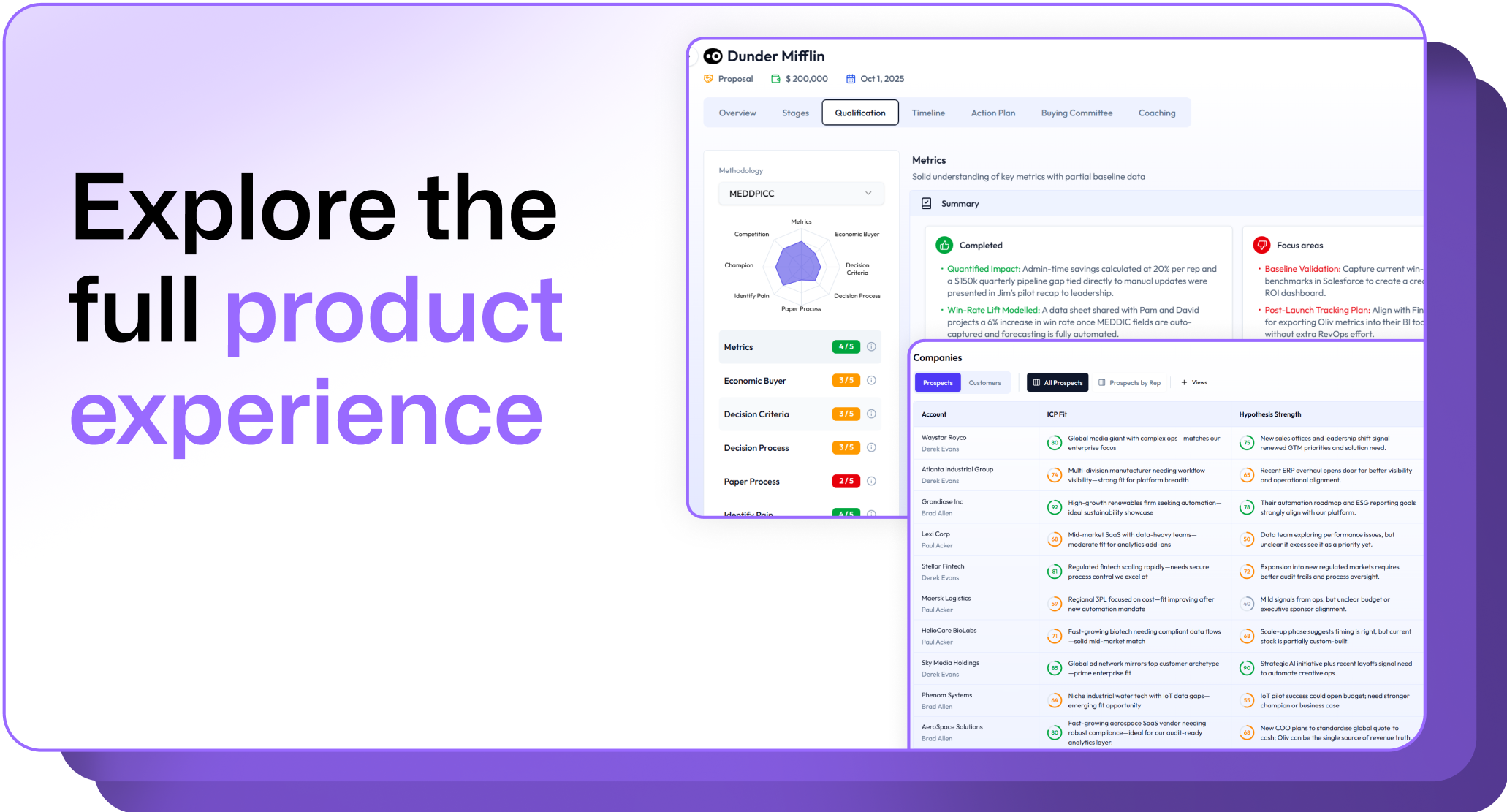
.avif)
.png)