10 Best Sales Call Analytics Software in 2026: Recording, Transcription, AI Insights, and Coaching Workflows
Written by
Ishan Chhabra
Last Updated :
July 30, 2026
Skim in :
13
mins
In this article
Revenue teams love Oliv
Here’s why:
All your deal data unified (from 30+ tools and tabs).
Insights are delivered to you directly, no digging.
AI agents automate tasks for you.
Thank you! Your submission has been received!
Oops! Something went wrong while submitting the form.
Meet Oliv’s AI Agents
Hi! I’m, Deal Driver
I track deals, flag risks, send weekly pipeline updates and give sales managers full visibility into deal progress
Hi! I’m, CRM Manager
I maintain CRM hygiene by updating core, custom and qualification fields all without your team lifting a finger
Hi! I’m, Forecaster
I build accurate forecasts based on real deal movement and tell you which deals to pull in to hit your number
Hi! I’m, Coach
I believe performance fuels revenue. I spot skill gaps, score calls and build coaching plans to help every rep level up
Hi! I’m, Prospector
I dig into target accounts to surface the right contacts, tailor and time outreach so you always strike when it counts
Hi! I’m, Pipeline tracker
I call reps to get deal updates, and deliver a real-time, CRM-synced roll-up view of deal progress
Hi! I’m, Analyst
I answer complex pipeline questions, uncover deal patterns, and build reports that guide strategic decisions
TL;DR
The 10 best sales call analytics tools in 2026 are Oliv AI, Gong, Avoma, Clari Copilot, Fireflies.ai, ZoomInfo (Chorus), Salesloft, Fathom, tl;dv, and CallRail.
Recording is now free inside Zoom, Teams, and Google Meet, so the real purchase in 2026 is what happens after the call ends.
Every tool scored out of 100 on deal-level intelligence, coaching depth, CRM write-back, pricing transparency, and speed to insight. Oliv AI scored 94, Gong 78.
Latency decides adoption. Oliv AI delivers post-call intelligence in roughly 5 minutes against Gong's typical 20 to 30 minutes.
Gong costs near $141,000 in year one for 50 reps, and a three-year bundled commitment can pass $470,000 after renewal uplifts.
Rollouts die in week three, not procurement. Pick one bottleneck, one rubric, train on three real meetings, and correct output daily.
Q1. What are the 10 best sales call analytics tools for revenue teams in 2026? [toc=1. Top 10 Tools]
The 10 best sales call analytics tools in 2026 are Oliv AI, Gong, Clari Copilot, Salesloft, ZoomInfo (Chorus), Avoma, Fireflies.ai, Fathom, tl;dv, and CallRail. Oliv AI leads because it analyses at the deal level rather than the meeting level, and delivers post-call intelligence in roughly 5 minutes against Gong's 20 to 30 minutes. The rest split into note-takers, forecasting suites, and marketing attribution.
⚠️ The problem nobody admits on the renewal call
Most teams I talk to are running two or three call tools already. They have transcripts everywhere. They still cannot tell me why last quarter's biggest deal slipped.
That gap is the whole story. Recording is free now inside Zoom, Teams, and Google Meet. What you are actually buying in 2026 is what happens after the call ends, which is why the market keeps shifting toward revenue intelligence platforms rather than recorders.
💰 Where the money goes
Per-user pricing across this category runs roughly $14 to $100 per month, with enterprise conversation intelligence (AI that interprets what was said, not just what was recorded) landing at the top of that band. Gong runs about $130,000 a year for a 50-rep team. Salesloft gates its conversation intelligence behind tiers reaching $165 to $185 per user per month.
I have watched teams sign that number for a dashboard, then discover reps never open it. The tool was fine. The workflow underneath it never changed.
The 10 tools at a glance
The 10 Best Sales Call Analytics Tools in 2026
#
Tool
Best for
Starting price
Rating
1
Oliv AI
Deal-level analytics with agents that finish the work
$19/user/mo
⭐⭐⭐⭐⭐
2
Gong
Large enterprises wanting the deepest CI feature set
~$100 to $150/user/mo plus platform fee
⭐⭐⭐⭐
3
Avoma
SMB teams wanting CI bundled with meeting management
From $19/user/mo, CI add-on ~$29
⭐⭐⭐⭐
4
Clari Copilot
Forecast-led orgs already standardised on Clari
~$80/user/mo
⭐⭐⭐⭐
5
Fireflies.ai
Cheap, wide-coverage transcription across every meeting
$10 to $19/user/mo
⭐⭐⭐
6
ZoomInfo (Chorus)
Teams already paying for ZoomInfo data
Bundled, custom
⭐⭐⭐
7
Salesloft
Outbound sequencing teams needing calls plus cadences
CI from ~$165/user/mo
⭐⭐⭐
8
Fathom
Solo AEs and small teams on zero budget
Free tier available
⭐⭐⭐
9
tl;dv
Async teams sharing call clips across functions
Free tier, paid from ~$18/user/mo
⭐⭐⭐
10
CallRail
Marketing attribution on inbound calls, not coaching
From $45/mo plus usage
⭐⭐
Scoring uses the five weighted criteria published in the methodology section: deal-level intelligence, coaching workflow depth, CRM write-back accuracy, pricing transparency, and speed to insight.
1.1 Oliv AI: agents that close the post-call loop [toc=1 Oliv AI]
Oliv's parallel dialer auto-calls prepped accounts and logs connect, voicemail, and screener outcomes, feeding call activity analytics that show BDRs where live conversations actually happen.
Oliv AI is an AI-native revenue platform whose agents complete post-call work instead of reporting on it. It updates CRM fields, flags deal risk, drafts follow-ups, and builds forecasts, starting at $19 per user per month across 100 or more revenue teams. Post-call intelligence lands in roughly 5 minutes, and it reads the full deal rather than a single meeting.
🧠 What it actually does
The category framing matters here. Gen 1 was systems of record. Gen 2 was conversation intelligence, which records calls and shows dashboards. Gen 3 is agents that perform the work, the shift traced in our breakdown of RevOps to revenue orchestration.
Oliv AI sits in that third generation, and we built it that way on purpose. Gong understands a meeting. Oliv understands a deal, including pipeline movement, coaching, and forecast impact.
⏰ The 5-minute window
Latency is the underrated buying criterion. A rep with back-to-back calls will never reopen a summary that lands 30 minutes late.
Oliv AI's Deal Assistant also sends prep notes to Slack or email about 30 minutes before a call. I could be reading this too strongly, but the adoption data we see suggests timing beats feature depth almost every time.
Key features
✅ Deal-level analysis across calls, emails, and CRM activity, not per-meeting keyword tracking
✅ CRM Manager agent writes qualification fields back into Salesforce, HubSpot, or Zoho
✅ Deal Driver agent monitors every open deal and flags the ones at risk
✅ Forecast agent prepares weekly and monthly roll-ups
✅ Context Graph, a proprietary intelligence layer with 100+ revenue-specific language models
✅ 70+ integrations, including Zoom, Google Meet, and HubSpot
💸 Pricing and implementation
Pricing starts at $19 per user per month, with agents added one at a time up to roughly $120 per user for full deployment. You do not buy the suite on day one. Find the bottleneck, deploy one agent, validate it, then expand.
Setup takes five to fifteen minutes for the notetaker layer. Full customisation across a complex CRM takes two to four weeks, and forward-deployed engineers handle the heavy configuration.
⭐ Pros
✅ Post-call intelligence in about 5 minutes
✅ Deal-level context, so insights connect to pipeline movement
✅ CRM write-back including custom qualification fields
✅ Modular pricing from $19, no all-or-nothing suite
✅ SOC 2 Type II, GDPR, and CCPA compliant
❌ Cons
❌ Mobile app is thinner than the desktop platform
❌ Dashboard and report customisation is still limited
❌ Occasional slowness reported by users
❌ Voice Agent remains in alpha
❌ Not built for B2C support use cases or pure call-recording needs
🗣️ What users say
"I use Oliv.ai for recording my sales calls, keeping my client updates on CRM in check, and moving accounts between different stages. It's incredibly helpful with our custom sales methodologies like MEDIC-BAND, as it helps me fill all of them out. The deal driver agent keeps tabs on all my deals and tells me where each deal is and which one needs my focus." Verified User, Sales Oliv AI G2 Verified Review 15 Jun 2026
"I appreciate that Oliv.ai researches prospect accounts before every call and sends deal updates and talking points, which helps me prepare for meetings without sifting through tons of data and emails. It's more affordable compared to other options we previously used." Their one complaint: "It's a lil slow." Verified User, Sales Oliv AI G2 Verified Review 23 Jun 2026
"The Driver agent watches all my deals and flags any that are at risk, so I don't have to spend hours listening to recordings in tools like Gong and Clari. The initial setup was really easy because the team provided FDE engineers who set everything up, and within less than a week, we were good to go." Verified User, Sales Oliv AI G2 Verified Review 17 Jun 2026
📅 Oliv AI product timeline
Oliv AI Product Updates: 2025 to 2026
Period
What shipped
Through 2025
Notetaker plus Deal Assistant core: call recording, transcription, pre-call prep notes, and automated meeting summaries with drafted follow-up emails, per verified user accounts.
First half of 2026
Multi-agent layer in production: CRM Manager, Deal Driver, Forecast, Analyst, and Gold Digger agents, plus Chrome extension battlecards and Context Graph deal scoring, per G2 reviews dated June to July 2026.
Expected next
Deeper dashboard and report customisation, plus a stronger mobile experience, both named as the top gaps in current user feedback. Voice Agent moves from alpha toward general release.
🎯 Best use case, and who should skip it
Best fit: mid-market B2B SaaS revenue teams of 200 to 5,000 employees running a real methodology and a weekly forecast cadence. Skip it if you want a cheap standalone transcript and nothing more.
Oliv AI is the only tool on this list where the agents finish the work rather than surfacing it, which is why one reviewer described their CRM being updated automatically after every call and called it "an all-in-one revenue agent."
1.2 Gong: the deepest feature set, and the longest adoption curve [toc=2 Gong]
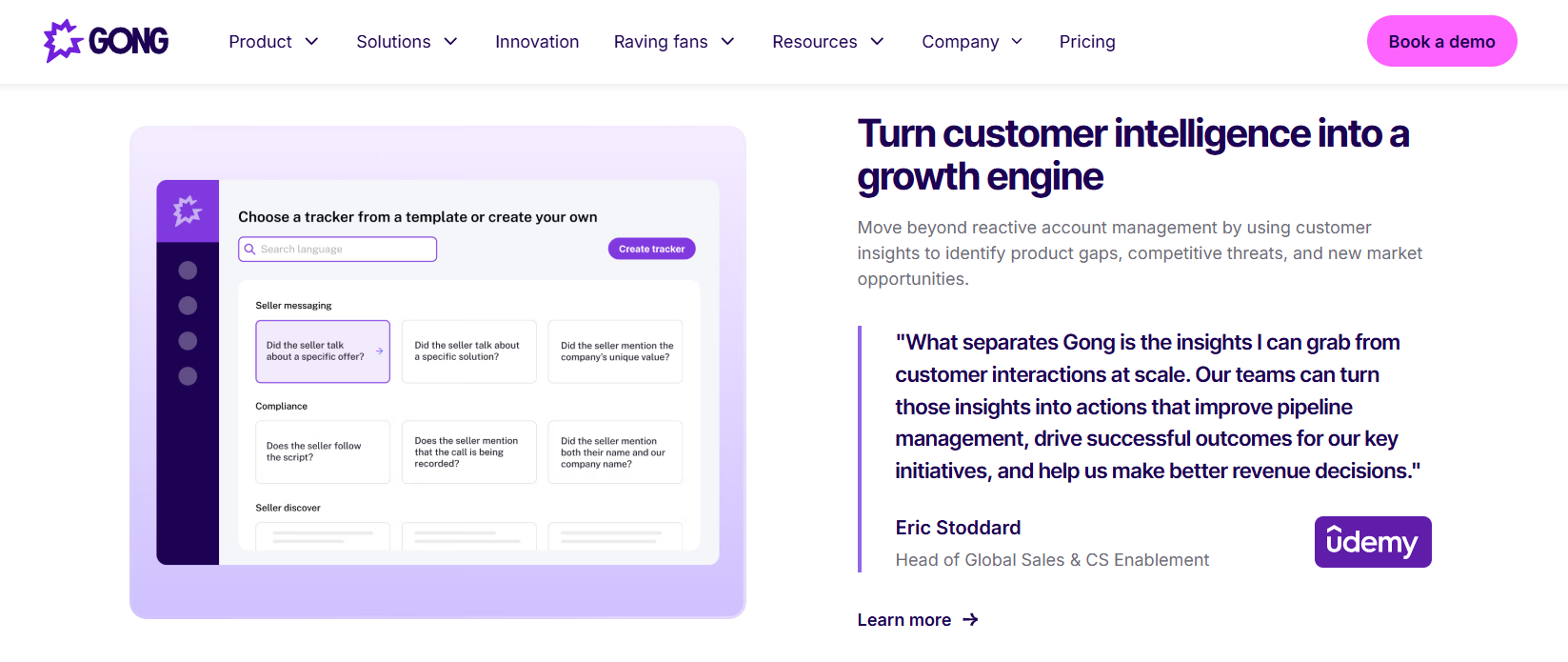
Gong's tracker library monitors phrases like offers, scripts, and recording disclosures across conversations, giving enablement leaders keyword-level sales call analytics for compliance checks and repeatable coaching.
Gong is the most feature-complete conversation intelligence platform in 2026, now marketed as a Revenue AI Operating System with Gong Assistant, Agent Studio, AI Trainer, and AI Theme Spotter. It crossed $500M ARR in May 2026. Pricing runs roughly $100 to $150 per user per month plus a platform fee, landing near $130,000 annually for a 50-rep team.
🏗️ What it does, and what it was built for
Gong was founded in 2015 around call recording, transcription, and AI deal insight. That conversation-intelligence core is still the centre of the product. In 2024 it repositioned from Revenue Intelligence to a Revenue AI Platform.
The depth is real. Gong analyses tens of thousands of calls for recurring themes, and its Data Extractor maps AI-extracted fields into the CRM. The trade-off is that the platform was architected before generative AI, so agents were layered on rather than designed in, a pattern visible across its full feature set.
⚙️ Where teams get stuck
Setup is the recurring complaint. Smart Tracker configuration and keyword rules take real admin time, and getting data back out is often gated behind plan tier, as our Gong implementation timeline documents.
I have sat in enough Gong renewal conversations to notice the pattern. The insight exists. Nobody has time to go find it.
Key features
✅ Call recording, transcription, and translation across web conferencing tools
✅ Smart Trackers and AI Theme Spotter for pattern detection across large call volumes
✅ Data Extractor for automated CRM field mapping, shipped December 2025
✅ AI Call Reviewer for automated scorecards, shipped August 2025
✅ Gong Engage for sequencing, plus Gong Enable for coaching and training
✅ Configurable forecast boards covering new business, renewals, and upsells
✅ 250+ integration and services partners
⭐ Pros
✅ Deepest analytics library in the category
✅ Strong Salesforce app maturity, live since 2022
✅ Automated scorecards reduce manual call review at scale
✅ Genuine enterprise scale, with ARR past $500M and 55% year-over-year growth
❌ Cons
❌ Post-call processing typically takes 20 to 30 minutes
❌ Smart Tracker and keyword setup has a steep admin learning curve
❌ Bulk data export is restricted unless you upgrade your plan
❌ Reviewers report losing access to their data after churning
❌ Pricing is custom and opaque, with a platform fee on top of seats
❌ Understands a meeting well, a full deal less so
🗣️ What users say
"I found the AI tracker setup to be quite difficult, especially concerning the user interface when setting up keywords or smart trackers. Moreover, I cannot download all the data myself unless we upgrade the plan, which isn't ideal and results in me not fully utilizing Gong." Verified User, Sales Gong G2 Verified Review 3 Oct 2025
"The meeting recordings, ease of use and info sharing and the AI enrichment capabilities of both companies, sentiments from meetings etc." The dislike: "the fact that if you stop working with the tool you lose the data." Verified User, Sales Gong G2 Verified Review 19 Mar 2026
"Being able to sequence our steps, along with integration with Nooks/Salesforce." The dislike: "limitations of getting data back into salesforce." Verified User, Sales Gong G2 Verified Review 21 May 2026
📅 Gong product timeline
Gong Product Updates: 2024 to 2026
Period
What shipped
2024 through 2025
Repositioned as a Revenue AI Platform, then added Gong Assistant (March 2025), Agent Studio (July 2025), automated scorecards via AI Call Reviewer (August 2025), and Data Extractor for CRM field mapping (December 2025).
January to May 2026
Mission Andromeda launched February 25, 2026 with Gong Enable, conversational guidance, and unified account management. Salesforce v3 exports Flow data. AI Trainer added audio coaching feedback.
Announced next
Bidirectional MCP server support so the AI Briefer pulls third-party data in and external AI platforms query Gong. Briefs via API across calls, contacts, accounts, and deals.
🎯 Best use case, and who should skip it
Best fit: enterprises with a dedicated RevOps admin, a real enablement function, and budget for a platform fee. Skip it if you are under 50 reps, or if you need qualification fields written back into Salesforce without a services project.
Oliv AI's read on Gong is that the ceiling is architectural, not effort: it tracks what happened in a deal without interpreting what it means for the forecast, which is exactly the work our agents were built to do. Buyers weighing that trade-off usually end up comparing Gong alternatives side by side.
1.3 Avoma: conversation intelligence bundled with meeting management [toc=3 Avoma]
Avoma is an AI meeting assistant that combines transcription, note-taking, and conversation intelligence for small and mid-sized teams. Pricing starts around $19 per user per month, with the conversation intelligence tier adding roughly $29 per user. It covers the full meeting lifecycle, including agendas and scheduling, which most pure call analytics tools ignore.
🧠 What it does
Avoma sits between a note-taker and a full revenue platform. It records, transcribes, and tags topics, then rolls that into deal and coaching views, as our review of Avoma's features sets out.
The meeting management layer is the real differentiator. Agenda templates, collaborative notes, and scheduling live in the same product, so it doubles as a customer success tool.
💰 Pricing and implementation
The tiering is where buyers get caught. Basic note-taking is cheap, but conversation intelligence and revenue intelligence sit in higher tiers, which pushes real cost toward $70 per user per month at the top end.
Setup is genuinely fast, usually a day or two for a small team. I have seen SMB teams live before their Salesforce admin returned a ticket.
Key features
✅ AI notes, transcription, and topic detection across meetings
✅ Collaborative agendas and meeting templates
✅ Conversation intelligence for talk ratios, filler words, and topic tracking
✅ Deal intelligence and scorecards in higher tiers
✅ CRM sync with Salesforce and HubSpot
⭐ Pros
✅ Genuinely affordable entry point at $19 per user
✅ Covers pre-meeting, in-meeting, and post-meeting in one tool
✅ Works well for customer success, not just sales
❌ Cons
❌ Conversation intelligence costs extra on top of the base seat
❌ Feature gating across five tiers makes real cost hard to predict
❌ Analytics depth trails Gong on large call volumes
❌ Meeting-level focus, so it does not reason across a whole deal
🎯 Best fit
Best for SMB and lower mid-market teams under 50 reps who want notes plus light coaching in one bill. Skip it if you need methodology fields written back into a complex CRM, a gap that recurs across Avoma user feedback.
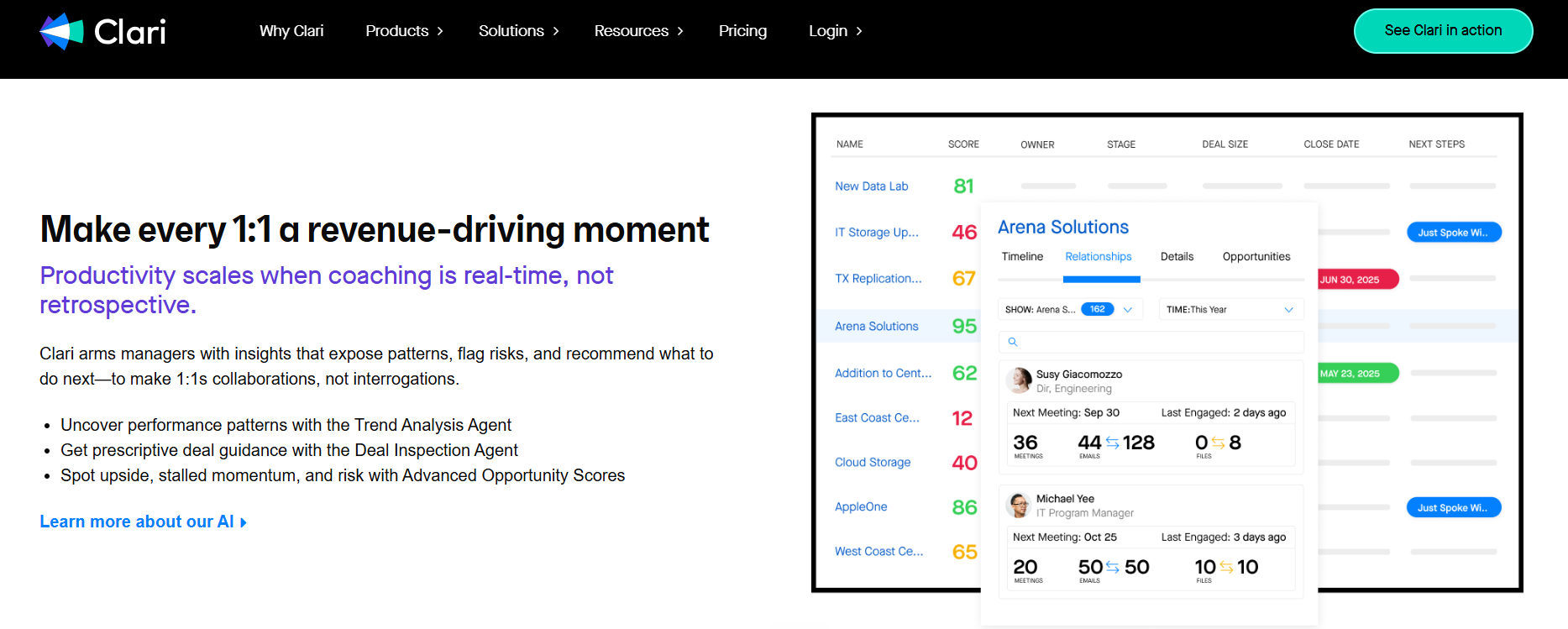
Clari's manager view ranks opportunities by score while surfacing stakeholder engagement counts from calls and emails, turning sales call analytics into real-time, prescriptive 1:1 coaching conversations.
Clari Copilot is the conversation intelligence module inside Clari's revenue platform, priced around $80 per user per month. Clari was founded in 2012 around forecasting and pipeline inspection, acquired Groove in August 2023 for sales engagement, and announced a merger with Salesloft in August 2025. Forecasting remains the strongest part of the product.
📊 Where it genuinely wins
If your CRO lives in a forecast board, Clari is hard to beat. Weekly forecast roll-ups, opportunity inspection, and pipeline waterfall views are mature and well integrated with Salesforce, as our rundown of Clari's features shows.
Copilot adds real-time battlecards and automated summaries on top. Reviewers consistently rate the forecasting experience higher than the call intelligence layer.
⚠️ Where the write-back breaks
This is the part I would test in a trial, not take on trust. Multiple reviewers report that conversation intelligence findings do not connect back to deal context, and that qualification fields cannot be pushed into Salesforce.
For any team running MEDDIC or MEDDPICC, that is not a minor gap. Reps still fill six to seven fields by hand per deal, and up to fifteen on heavier frameworks.
Key features
✅ Forecast boards, pipeline inspection, and waterfall analytics
✅ Copilot for call recording, summaries, and live battlecards
✅ Groove-derived sequencing, cadences, and Omni Dialer
✅ Deep native Salesforce integration
✅ Revenue Context positioning across Clari, Align, Copilot, and Salesloft
⭐ Pros
✅ Best-in-class forecasting UX for enterprise revenue teams
✅ Real-time battlecards work well in live calls
✅ Automated summaries cut manual CRM entry
❌ Cons
❌ CRM write-back cannot push MEDDIC values back to Salesforce
❌ No custom reporting on conversation intelligence data
❌ Reviewers call the AI features immature and inflexible
❌ Connection drops with Salesforce, Gmail, and calendar
❌ Post-merger roadmap risk while Clari and Salesloft integrate
🗣️ What users say
"I find the out-of-the-box dashboards and analytics to be helpful, and the cadence tool along with its analytics are robust." The dislike: "The conversation intelligence tool is lacking, and we don't have the context of the deals against the conversation intelligence findings. There's no custom reporting. The CRM writeback is not good; we cannot send MEDDIC values back to Salesforce." Verified User, RevOps Clari G2 Verified Review 13 Jul 2026
"Clari forecasting is simple, easy to use, and well integrated with SFDC." The dislike: "The AI features are immature, team activity is poorly designed, and it doesn't integrate well with other popular business systems today." Verified User, Sales Leadership Clari G2 Verified Review 10 Oct 2025
"The real-time coaching and Battlecards are game-changers. Additionally, the automated summaries and action item extraction save me hours of manual data entry into our CRM." The dislike: "The Live Coaching prompts can occasionally be a bit sensitive, sometimes it flags filler words when I'm just pausing to let a customer finish a thought." Verified User, Customer Success Clari G2 Verified Review 8 Apr 2026
📅 Clari product timeline
Clari Product Updates: 2023 to 2026
Period
What shipped
2023 through 2025
Acquired Groove in August 2023 to add sequencing and dialer, named a Strong Performer in Forrester's Conversation Intelligence Wave with Copilot, then announced a definitive merger with Salesloft on August 7, 2025.
March 2026
First cross-platform release after the merger: Send AI Emails from Clari, Create Salesloft Tasks, and Send follow-up emails via Salesloft, unifying two previously separate release trains.
Expected next
Continued consolidation of Clari, Align, Copilot, Groove, and Salesloft under the Revenue Context and Enterprise Revenue Orchestration positioning, with agent execution at enterprise scale.
🎯 Best fit
Best for enterprises already standardised on Clari for forecasting who want CI as an add-on. Skip it if conversation intelligence is your primary requirement, and compare Clari alternatives before signing a multi-year term.
1.5 Fireflies.ai: cheap transcription at organisation-wide scale [toc=5 Fireflies.ai]
Fireflies.ai is a meeting assistant that transcribes, summarises, and searches conversations across an entire company, priced at roughly $10 to $19 per user per month. It is the cheapest way to get coverage across every meeting, not just sales calls. It is a note-taker, not a revenue platform.
💸 Why teams buy it
Price and reach. At $10 a seat, you can put it on marketing, support, and product calls without a business case.
The search across a full transcript library is the underrated feature. If you need to find every mention of a competitor across 4,000 meetings, this does that cheaply.
⚠️ The honest limit
Fireflies tells you what was said. It will not tell you which deal is slipping or why.
That is the difference between layer one and layer three of this category. Recording is commoditised now, and paying more for it does not change the outcome.
Key features
✅ Transcription and AI summaries across Zoom, Teams, and Google Meet
✅ Cross-meeting search and topic trackers
✅ AI chat over your transcript library
✅ Basic CRM logging into Salesforce and HubSpot
✅ Free tier for individuals
⭐ Pros
✅ Lowest cost per seat in the category
✅ Works across every department, not just sales
✅ Fast setup with no admin project
❌ Cons
❌ No deal-level intelligence or risk scoring
❌ Coaching workflow is minimal
❌ CRM write-back is limited to notes, not qualification fields
❌ Storage and feature limits on cheaper tiers
🎯 Best fit
Best for organisation-wide meeting coverage on a tight budget. Skip it if you need forecast or pipeline intelligence from an AI sales forecasting platform.
1.6 ZoomInfo (Chorus): bundled with data, behind on product [toc=6 ZoomInfo Chorus]
Chorus.ai was a leading conversation intelligence platform until ZoomInfo acquired it in 2021. It now sells as part of ZoomInfo's data and go-to-market bundle, with custom pricing rather than a public per-seat rate. Its product velocity has slowed noticeably since the acquisition.
🕰️ A strong product frozen in time
Chorus was a genuine Gong competitor through 2022. Since the acquisition, independent product investment has been thin, and the platform now trails the category on AI capability, a contrast our Gong versus Chorus comparison breaks down.
I would only look at it if ZoomInfo is already in your stack. Buying it standalone in 2026 means buying a 2022 architecture.
Key features
✅ Call recording, transcription, and keyword trackers
✅ Deal and account views tied to ZoomInfo contact data
✅ Native enrichment from ZoomInfo's B2B database
✅ Salesforce integration
⭐ Pros
✅ Strong value if you already pay for ZoomInfo data
✅ Contact enrichment tied directly to call activity
✅ Proven transcription accuracy
❌ Cons
❌ Limited product innovation since the 2021 acquisition
❌ Pricing is bundled and opaque, with no standalone rate
❌ Falls behind on generative AI and agentic capability
❌ Weak fit for teams not buying ZoomInfo data
🎯 Best fit
Best for existing ZoomInfo customers wanting call intelligence at marginal cost. Skip it if you want current-generation AI from a modern sales intelligence platform.
1.7 Salesloft: sequencing strength, conversation intelligence at a premium [toc=7 Salesloft]
Salesloft is a sales engagement platform where conversation intelligence sits behind higher tiers reaching roughly $165 to $185 per user per month. It merged with Clari in August 2025 under Andy Byrne. Cadences and sequencing are its core, and call intelligence is an add-on rather than the foundation.
📤 What it is actually built for
Outbound. Cadences, templates, dialer, and task management for SDR teams working high volume.
Call recording and analytics exist, but you are paying a sequencing platform price to access them. For pure call analytics, that math rarely works, which is the crux of our Gong versus Salesloft analysis.
⚠️ The adoption problem
The recurring theme in reviews is not missing features. It is usability and setup friction that kills adoption.
One reviewer put the outcome plainly: managers stopped using it because they never saw productivity gains. That is the failure mode I keep seeing across this category, and it has nothing to do with the feature list.
Key features
✅ Multi-channel cadences across email, phone, and social
✅ Integrated dialer and call recording
✅ Conversations module for call analytics in higher tiers
✅ Deal management and forecasting
✅ Salesforce and Dynamics integration
⭐ Pros
✅ Mature sequencing and cadence engine
✅ Keeps high-volume follow-up from slipping
✅ Combined Clari roadmap adds forecasting depth
❌ Cons
❌ Conversation intelligence gated behind $165 plus tiers
❌ Reviewers repeatedly report clunky UX and hard setup
❌ Browser extension goes stale and needs manual refreshes
❌ Faulty analytics on basics like email opens
❌ No conditional logic in automations
🗣️ What users say
"It allows you to sequence emails, which is table stakes at this point." The dislike: "For months, randomly, one-off emails sent from Salesloft (not sequences) would appear blank in the recipient's mailbox. UX is overwhelming and clunky. No automations based on conditional logic." Verified User, Sales Salesloft G2 Verified Review 24 Sep 2025
"Salesloft helps organize outreach at scale and keeps follow-ups from falling through the cracks." The dislike: "Integrating Salesloft came with a lot of challenges, and even now, it feels like the platform still has some kinks. I often have trouble logging meetings, and certain features feel clunky or overly manual." Verified User, Account Executive Salesloft G2 Verified Review 22 Jul 2025
"Our managers fired us because they didn't see productivity and didn't know how to use a tool and didn't need to." Verified User, Sales Salesloft G2 Verified Review 7 Sep 2025
🎯 Best fit
Best for SDR-heavy outbound teams who need sequencing first and call analytics second. Skip it if call intelligence is the primary purchase and you would rather evaluate AI built for sales calls.
1.8 Fathom: the free note-taker that is genuinely good [toc=8 Fathom]
Fathom is an AI meeting assistant with a functional free tier that records, transcribes, and summarises calls, then syncs notes to the CRM. It is the strongest zero-budget option for solo sellers and small teams. It offers no deal-level analytics or forecasting.
✅ Why it earns a slot
The free tier is not a trial. Individual reps get unlimited recording and summaries, which is why it spreads bottom-up inside companies.
Summary quality is strong for the price, which is zero. I have watched founder-sellers run their entire first year on it.
Key features
✅ Unlimited recording and transcription on the free tier
✅ AI call summaries and action items
✅ CRM sync for notes into Salesforce and HubSpot
✅ Highlight clipping during live calls
⭐ Pros
✅ Free for individual users, with no meeting cap
✅ Fast, clean summaries with minimal setup
✅ No procurement cycle required
❌ Cons
❌ No pipeline, forecast, or deal risk analytics
❌ Coaching and scorecards are absent
❌ Team-level reporting requires paid tiers
❌ Not a system managers can run a forecast on
🎯 Best fit
Best for solo AEs, founder-sellers, and teams under five reps. Skip it the moment you need manager-level coverage from dedicated sales coaching software.
1.9 tl;dv: async call sharing across functions [toc=9 tl;dv]
tl;dv is a meeting recorder built around clipping and sharing call moments across teams, with a free tier and paid plans from roughly $18 per user per month. Its strength is async collaboration rather than sales analytics. Product and research teams use it as often as sales does.
🎬 The clip-first workflow
Instead of dashboards, tl;dv gives you timestamped clips you can drop into Slack or Notion. That makes customer evidence travel across functions.
For sharing one objection with product, this beats sending a 45-minute recording. For forecasting a quarter, it does nothing.
Key features
✅ Timestamped clipping and reels from recordings
✅ Multi-language transcription
✅ Slack and Notion sharing workflows
✅ Generous free tier
✅ Basic CRM logging
⭐ Pros
✅ Best async sharing experience in the category
✅ Strong multi-language support
✅ Low cost with a usable free plan
❌ Cons
❌ No deal or pipeline intelligence
❌ Coaching workflow is thin
❌ Not designed for revenue leadership reporting
🎯 Best fit
Best for product-led teams circulating customer evidence internally. Skip it if you need sales analytics from a revenue intelligence platform.
1.10 CallRail: inbound call attribution, not sales coaching [toc=10 CallRail]
CallRail is a marketing call tracking platform that attributes inbound phone calls to campaigns, keywords, and ads, starting at $45 per month plus usage-based charges. Adding call tracking with conversation intelligence pushes the effective cost to around $90 per user per month. It solves a marketing problem, not a coaching problem.
📞 A different category entirely
CallRail answers which ad produced the call. Gong and Oliv AI answer whether the deal will close.
Teams sometimes shortlist all three together, then discover the tools do not overlap. If your calls come from paid search and you sell over the phone, CallRail belongs in your stack, but not as your call analytics tool.
Key features
✅ Dynamic number insertion for campaign attribution
✅ Call recording and transcription
✅ Conversation Intelligence for keyword spotting and lead scoring
✅ Form and text tracking alongside calls
✅ Integrations with Google Ads and marketing platforms
⭐ Pros
✅ Best-in-class inbound attribution for local and paid search
✅ Transparent published starting price
✅ Automatic lead qualification on inbound calls
❌ Cons
❌ No deal, pipeline, or forecast intelligence
❌ Usage-based charges make bills unpredictable
❌ Built for marketing teams, not sales managers
❌ No methodology tracking or CRM field write-back
🎯 Best fit
Best for marketing teams measuring inbound call volume from paid campaigns. Skip it entirely for B2B pipeline coaching, where AI sales tools built on deal context apply instead.
Oliv AI is the only tool across these ten where the analysis ends in completed work rather than a dashboard, which is why one reviewer said the Driver agent flags at-risk deals so they no longer spend hours inside Gong and Clari recordings. That gap, between insight delivered and work finished, is the thing to test in every trial.
Q2. How did we score these sales call analytics tools? [toc=2. Scoring Methodology]
Each tool scores out of 100 across five weighted criteria: Deal-Level Intelligence (25%), Coaching Workflow Depth (20%), CRM Write-Back Accuracy (20%), Pricing Transparency (20%), and Speed to Insight (15%). Scores of 0 to 20 earn one star, 21 to 40 two, 41 to 60 three, 61 to 80 four, and 81 to 100 five. Oliv AI scores 94, Gong 78, Avoma 66, Clari 62, ZoomInfo 48, and Salesloft 44.
📊 Why these five weights
Deal-level intelligence carries the heaviest weight because it is the difference between knowing what was said and knowing what it means for the quarter. Meeting-level keyword tracking is cheap to build and easy to sell.
CRM write-back and pricing transparency each carry 20% for the same reason. Both are verifiable inside a trial, and both are where vendor collateral tends to overstate reality.
⏰ Speed to insight, and why it is only 15%
Latency matters, but it is a multiplier rather than a foundation. Oliv AI measures speed to insight as the gap between call end and completed CRM update, which lands at roughly 5 minutes against Gong's typical 20 to 30.
I weighted it lowest of the five on purpose. A fast summary of shallow analysis is still shallow.
The full scorecard
Weighted Scorecard for Sales Call Analytics Tools in 2026
Tool
Deal Intel /25
Coaching /20
Write-Back /20
Pricing /20
Speed /15
Total
Stars
Oliv AI
24
18
19
19
14
94
⭐⭐⭐⭐⭐
Gong
19
18
14
18
9
78
⭐⭐⭐⭐
Avoma
13
14
13
15
11
66
⭐⭐⭐⭐
Clari Copilot
15
13
8
16
10
62
⭐⭐⭐⭐
ZoomInfo (Chorus)
12
11
10
7
8
48
⭐⭐⭐
Salesloft
10
10
9
8
7
44
⭐⭐⭐
⚠️ What we refused to score on
Vendor marketing pages were excluded as evidence. Ranking tools by published collateral systematically favours whoever publishes the most, which in this category is Gong, as our audit of Gong reviews shows.
Every score above traces to one of three sources: dated G2 reviews, published pricing pages as of July 2026, or documented product release notes. Clari's write-back score of 8 comes directly from reviewer testimony, not from our opinion, and it lines up with our review of Clari's features.
"The CRM writeback is not good; we cannot send MEDDIC values back to Salesforce or update fields in Salesforce from the conversation intelligence. The AI is not as flexible as we need it to be." Verified User, RevOps Clari G2 Verified Review 13 Jul 2026
"I found the AI tracker setup to be quite difficult, especially concerning the user interface when setting up keywords or smart trackers. Moreover, I cannot download all the data myself unless we upgrade the plan." Verified User, Sales Gong G2 Verified Review 3 Oct 2025
"The only downside is that the platform can be a bit glitchy at times, but the support team is always quick to address and resolve any bugs." Verified User, Sales Oliv AI G2 Verified Review 2 Jul 2026
🙋 The obvious disclosure
Oliv AI publishes this article and ranks first on it, scoring 94 on the same five criteria applied to everyone else. That is a conflict, and pretending otherwise would be worse than naming it.
So verify it. Run one live deal through any two tools on this list, time the insight, and check whether your qualification fields actually populated.
Oliv AI loses points in this rubric too, specifically on report customisation and mobile depth, both of which reviewers name directly. A rubric that produces a perfect score is not a rubric.
Q3. What is sales call analytics, and which metrics actually predict revenue? [toc=3. Definition and Metrics]
Sales call analytics captures, measures, and interprets data from sales conversations to improve rep performance, shorten cycles, and lift close rates. Conversation intelligence is the narrower AI layer that interprets call content, including sentiment, objections, and talk ratio. Marketing call tracking attributes inbound calls to campaigns. The metrics that predict revenue are next-step specificity, question rate, objection recurrence, and talk-to-listen ratio, not call volume.
🗺️ Three things that get called the same thing
Running sales without call analytics is like driving without a map app. You still arrive sometimes, but you never know which turn cost you.
The confusion is that three different products share the label. Buyers shortlist all three, then wonder why the demos look nothing alike, which is why we separate them in our guide to revenue intelligence platforms.
Call Analytics Versus Conversation Intelligence Versus Call Tracking
Layer
What it answers
Who buys it
Call analytics
How are reps performing and which deals are healthy
Sales managers, RevOps
Conversation intelligence
What was said, and what it signals
Enablement, sales leadership
Marketing call tracking
Which campaign produced this inbound call
Demand generation
📈 Metrics that predict, versus metrics that decorate
Call duration and call count are activity metrics. They tell you effort, not outcome.
The behavioural metrics below correlate with actual deal results. Oliv AI extracts these from every call automatically and attaches them to the deal record, not just the meeting, which is what separates real AI for sales calls from a transcript service.
Sales Call Metrics That Predict Revenue
Metric
Benchmark
Why it predicts
Talk-to-listen ratio
40 to 60% rep talk time
Close rates drop sharply above 65% rep talk
Question-to-statement ratio
3:1 in first half of discovery
Signals real curiosity, which builds trust
Next-step specificity
Named person, date, and agenda
Strongest single predictor of deal momentum
Buying signal frequency
2+ per pipeline-worthy call
Zero signals converts near zero
Objection recurrence
Under 20%
A recurring objection was deferred, not resolved
🎂 The three-layer stack
Think of the category as a cake. Layer one is data collection, meaning recording and transcription, which is now effectively free.
Layer two is intelligence, where language models track qualification fields like MEDDIC or SPICED. Layer three is agents that act on that intelligence without being asked.
⚙️ One discovery call through all three layers
A rep finishes a 40-minute discovery call. Layer one produces a transcript in minutes.
Layer two reads it and identifies the economic buyer, a budget range, and a pricing objection. Ask Oliv AI to handle layer three, and the qualification fields update in Salesforce, the deal gets flagged for a missing next step, and a follow-up email sits drafted before the rep opens their laptop.
That last step is the whole argument. Analytics is not a dashboard category; it is the gap between knowing a deal is at risk and having something done about it.
Oliv AI operates at the agent layer, so intelligence is the input and a completed CRM update plus a coaching report is the output. Most tools in this category stop one layer short and hand the work back to the rep, a shift we trace in our piece on revenue ops to intelligence to orchestration.
Q4. Why do most call analytics rollouts stall at transcription? [toc=4. Why Rollouts Stall]
Rollouts stall because layer one, recording and transcription, is now free inside Zoom, Teams, and Google Meet, while the value sits in qualification intelligence and agentic action. Latency compounds it: Gong's post-call analysis typically lands in 20 to 30 minutes, Oliv AI's in about 5. A rep with back-to-back calls never revisits a summary that arrives late.
🧊 The plateau nobody puts in the case study
Here is the pattern I keep seeing. A team decides to build internally, because they already own the recordings and the API access.
Three or four months in, insights are flowing. Then it stops progressing. The build produced a note-taker, and connecting those insights to the actual deal turns out to be the hard 80% nobody scoped.
💸 Build versus buy, with real numbers
At around 200 calls a day, custom build economics can genuinely work, mostly on inference cost rather than engineering time. Below that volume, the maintenance load eats the savings.
The number people forget is the second year. Transcription is a solved commodity, so you are paying engineers to maintain a feature Zoom gives away, while the deal-reasoning layer stays unbuilt.
⏰ Timestamp your own tool this week
Try this on Monday. Note the exact minute a call ends, then note the minute a usable insight lands somewhere a rep will actually see it.
Oliv AI measures this gap as its core speed metric and holds it near 5 minutes, against 20 to 30 for the incumbent platforms. If your number is over 20 minutes, adoption is not a training problem, and our Gong implementation timeline explains where that lag originates.
🔄 Where I changed my mind
I used to think real-time in-call coaching was the frontier. Live battlecards, whispered prompts, the whole thing.
Then I watched reviewers describe live prompts flagging filler words while the rep was simply pausing to let a buyer finish. Post-call, done fast and acted on, beats in-call, done imperfectly, which is the design principle behind the best sales coaching software.
"Design is user friendly and ensure the elements are visible and with no confusion." The dislike: "Real Time integrations can be time consuming." Verified User, Sales Gong G2 Verified Review 21 Apr 2026
"The Live Coaching prompts can occasionally be a bit sensitive, sometimes it flags filler words when I'm just pausing to let a customer finish a thought." Verified User, Customer Success Clari G2 Verified Review 8 Apr 2026
"It doesn't just record meetings; it automatically captures key insights, updates systems of record, identifies next steps, and helps keep teams aligned. As a result, we've seen better CRM hygiene, less administrative overhead, and more consistent execution." Verified User, Revenue Operations Oliv AI G2 Verified Review 23 Jun 2026
⚠️ The workflow that quietly never happens
Watch how an SDR actually uses a transcript today. They copy it from the call tool, paste it into a chatbot, ask for a follow-up email, then paste that into Outlook.
Four tools, six minutes, per call. It works perfectly in a demo, and almost nobody sustains it past week three. That gap between designed workflow and lived workflow is where most rollouts die, and it is why teams end up comparing AI sales tools on workflow completion rather than feature lists.
Oliv AI prices layer one honestly at $19 per user per month and charges for the agents above it, because a notetaker is an entry point rather than a destination. Recording was never the product.
Q5. How do you turn call insights into coaching and an accurate CRM? [toc=5. Coaching and CRM Workflow]
Run four fixed parts: three scored calls per rep weekly against one rubric, one named skill gap per call, that gap reviewed inside the existing 1:1, and the same criterion re-scored on the next call. Then verify write-back. Reps fill 6 to 7 MEDDIC fields per deal, up to 15 on heavier methodologies, and Clari users report they cannot push MEDDIC values back into Salesforce from conversation intelligence.
MEDDIC is a qualification framework covering Metrics, Economic buyer, Decision criteria, Decision process, Identify pain, and Champion.
🚿 The audit nobody schedules
Ask a sales manager when they actually listen to calls. The honest answers are while driving, while walking the dog, and once, memorably, in the shower.
That is not diligence; it is overflow. Most managers are not short on intent; they are short on the hours needed to dig through recordings before Monday's pipeline review.
🗂️ The four-part weekly ritual
Score three calls per rep, always against the same rubric.
Name exactly one skill gap per call, not five.
Review that single gap inside the 1:1 you already hold.
Re-score the same criterion on the next call, so improvement is visible.
Oliv AI learns your methodology from three real meetings, which means the rubric it scores against is yours rather than a generic template. That detail matters more than model quality in my experience, and it is what separates real sales coaching software from a transcript archive.
⭐ A scorecard you can copy Monday
Weekly Call Coaching Scorecard
Criterion
What earns a pass
Discovery depth
3 or more open questions before any pitch
Economic buyer named
Person identified by name and role
Quantified pain
A number the buyer stated, not inferred
Next step specificity
Named person, date, and agenda
Objection handled
Addressed on the call, not deferred
Five criteria, pass or fail, no weighted scoring. Complexity kills coaching rituals faster than indifference does.
📋 The coaching report that surprised an operator
Oliv AI's Monthly Coaching Report named three specific skill gaps per rep without a quarter of manual call audits behind it. One operator's reaction was blunt.
"First time I've ever been speechless. That's incredible." Akil Sharperson, Triple Whale, on Oliv AI's Monthly Coaching Report
I could be reading that too generously, since a single reaction is not a dataset. What I trust more is the mechanic: naming three gaps beats naming twelve, because reps can only work one at a time.
⏰ The five-minute write-back test
Take one live deal. After the next call, open the opportunity record and check whether the qualification fields populated on their own.
If a human typed them, you bought a dashboard, not a system of record. Oliv AI's CRM Manager agent writes those fields back into Salesforce, HubSpot, or Zoho after every call, which is the specific gap reviewers keep naming elsewhere across revenue intelligence platforms.
"The CRM writeback is not good; we cannot send MEDDIC values back to Salesforce or update fields in Salesforce from the conversation intelligence." Verified User, RevOps Clari G2 Verified Review 13 Jul 2026
"Being able to sequence our steps, along with integration with Nooks/Salesforce." The dislike: "limitations of getting data back into salesforce." Verified User, Sales Gong G2 Verified Review 21 May 2026
"It doesn't just record meetings; it automatically captures key insights, updates systems of record, identifies next steps, and helps keep teams aligned." Verified User, Revenue Operations Oliv AI G2 Verified Review 23 Jun 2026
🚩 The one rule I would enforce
If a rep cannot articulate deal status in their own words, push it off the forecast that week. Not as punishment, as hygiene.
Oliv AI flags those deals automatically, though the judgment call stays human. A CRM nobody trusts is just a repository reps update because management asks.
Q6. Which tool fits your team, and what will it really cost? [toc=6. Buyer Fit and Pricing]
Match tool to motion. Mid-market B2B teams running MEDDPICC need deal-level analytics with CRM write-back, so Oliv AI first, then Gong. Forecasting-led enterprises look at Clari. Outbound sequencing teams look at Salesloft, where conversation intelligence sits behind tiers reaching $165 to $185 per user monthly. Solo AEs use Fathom, tl;dv, or Fireflies from $10. Gong runs roughly $141,000 in year one for 50 reps.
🎯 Five buyer profiles, routed
Which Sales Call Analytics Tool Fits Your Team
Your team
Start with
Skip
25 to 200 reps, MEDDPICC, mid-market SaaS
Oliv AI, then Gong
CallRail, tl;dv
Enterprise, forecast-led, CRO-driven
Clari
Fathom
SDR-heavy outbound, high dial volume
Salesloft
Avoma
Under 10 reps or founder-selling
Fathom or Fireflies
Gong, Clari
Inbound calls from paid campaigns
CallRail
Everything else here
Oliv AI is built for mid-market B2B SaaS between $10M and $500M ARR, so it is the wrong pick for B2C support or pure call recording. That is a real anti-fit, not false modesty.
💰 What the pricing models actually are
Three different structures hide behind the word "pricing." Confusing them is how budgets blow up, as our breakdown of Gong pricing shows.
Pricing Models Across Sales Call Analytics Tools
Tool
Entry price
Model
Oliv AI
$19/user/mo
Per-seat plus per-agent, credit-metered
Gong
~$1,520/user/yr
Per-seat plus mandatory platform fee
Salesloft
$165 to $185/user/mo for CI
Tiered per-seat
Clari Copilot
~$80/user/mo
Per-seat, custom quote
Fireflies, Fathom, tl;dv
$0 to $19/user/mo
Per-seat, free tier
CallRail
$45/mo plus usage
Usage-metered
💸 Three-year TCO at 50 reps
Gong's year one for 50 users lands near $141,000, made of $76,000 in licenses, a $50,000 platform fee, and $15,000 onboarding. Add Engage and Forecast and year one hits roughly $216,000.
Renewal uplifts of 5 to 15% are standard, so a three-year bundled commitment can pass $470,000. Oliv AI's credit model runs about $0.10 per agent action, with an all-inclusive ceiling near $500 per seat, so the bill tracks usage instead of hope. Teams weighing that math usually shortlist Gong alternatives before renewal.
⚠️ Two clauses to negotiate
Data portability first. One Gong reviewer named the risk plainly, and it is the same theme running through our Gong DPA and security analysis.
"The fact that you can't edit a recording (to only share a portion with a client), and the fact that if you stop working with the tool you lose the data." Verified User, Sales Gong G2 Verified Review 19 Mar 2026
Second, cap the renewal uplift in writing. After the Salesloft and Clari merger in August 2025, roadmap and pricing control shifted, and merged vendors renegotiate from a stronger position, which is why buyers also weigh Clari alternatives at that point.
"Integrating Salesloft came with a lot of challenges, and even now, it feels like the platform still has some kinks. I often have trouble logging meetings, and certain features feel clunky or overly manual." Verified User, Account Executive Salesloft G2 Verified Review 22 Jul 2025
Oliv AI starts at $19 per user per month with agents added one at a time, so spend maps to the bottleneck you chose to fix. Nobody should buy a suite on day one and hope adoption catches up.
Q7. How do you deploy call analytics legally and get reps to adopt it? [toc=7. Compliance and Rollout]
Settle consent first. One-party jurisdictions need only your rep to agree, two-party jurisdictions need every participant, and GDPR additionally requires a documented lawful basis, a retention limit, and disclosure at call start. Then roll out in four weeks: one bottleneck, one rubric, training on three real meetings, and daily correction of output. Oliv AI holds SOC 2 Type II, GDPR, and CCPA attestations, and deploys one agent at a time.
⚖️ Consent by jurisdiction
Call Recording Consent Requirements by Region
Region
Requirement
One-party US states
Your rep's consent is sufficient
Two-party US states (CA, FL, PA, and others)
Every participant must consent
EU and UK under GDPR
Lawful basis, disclosure at start, retention limit
Recording internationally
Apply the strictest applicable rule
Announce recording verbally in the first 30 seconds anyway. It costs one sentence and removes the entire argument.
🔍 Four questions for any vendor
Do you hold SOC 2 Type II, and can I see the current report?
Can I export every transcript and AI field in bulk, on exit?
What is the default retention period, and can I shorten it?
What is your documented stance on the EU AI Act for autonomous agents?
Oliv AI settles consent posture inside the deployment audit rather than the contract's fine print. Question two is the one buyers skip and later regret.
📅 The four-week plan
Week one, pick a single bottleneck and one rubric. Week two, train the tool on three real recorded meetings so it learns your methodology.
Week three, run it live with daily correction. Week four, measure one number against a pre-recorded baseline, then decide. Compare that against a typical Gong implementation timeline before you commit resourcing.
⏰ The 30-day correction discipline
Early on, the agent will say some genuinely dumb things. You correct it, and by day 30 it is reliable.
Budget one hour a day for that correction. Oliv AI's accuracy compounds through this loop, which is why teams that skip week three plateau at note-taking.
🧮 The 10/80/10 manager split
Ten percent of the manager's time goes to framing the question. Eighty percent of execution goes to the agent.
The final ten percent is checking the output before it reaches a customer or a forecast. Oliv AI delivers the Monday forecast without manual roll-ups, which replaces the Thursday and Friday scrub where managers spent one to two hours per rep, the same problem AI sales forecasting software is meant to solve.
❌ Where adoption actually dies
Not in procurement. In week three, when the tool asks reps for effort it never returns.
"Our managers fired us because they didn't see productivity and didn't know how to use a tool and didn't need to." Verified User, Sales Salesloft G2 Verified Review 7 Sep 2025
"The only downside is that the platform can be a bit glitchy at times, but the support team is always quick to address and resolve any bugs." Verified User, Sales Oliv AI G2 Verified Review 2 Jul 2026
🙃 What we got wrong
Oliv AI chased in-call real-time coaching before fixing post-call latency, and that ordering was a mistake. We spent months on live prompts that reps ignored mid-conversation.
The trade-offs still standing are honest ones: full customisation takes 2 to 4 weeks, the Voice Agent sits in alpha, and most enterprise deployments start as a narrow pilot.
Where my head is right now: within two years, the SaaS you log into becomes agents that work for you, and revenue orchestration gives way to revenue engineering. If you have run a rollout that survived week three, I would genuinely like to hear what made it stick.
Q1. What are the 10 best sales call analytics tools for revenue teams in 2026? [toc=1. Top 10 Tools]
The 10 best sales call analytics tools in 2026 are Oliv AI, Gong, Clari Copilot, Salesloft, ZoomInfo (Chorus), Avoma, Fireflies.ai, Fathom, tl;dv, and CallRail. Oliv AI leads because it analyses at the deal level rather than the meeting level, and delivers post-call intelligence in roughly 5 minutes against Gong's 20 to 30 minutes. The rest split into note-takers, forecasting suites, and marketing attribution.
⚠️ The problem nobody admits on the renewal call
Most teams I talk to are running two or three call tools already. They have transcripts everywhere. They still cannot tell me why last quarter's biggest deal slipped.
That gap is the whole story. Recording is free now inside Zoom, Teams, and Google Meet. What you are actually buying in 2026 is what happens after the call ends, which is why the market keeps shifting toward revenue intelligence platforms rather than recorders.
💰 Where the money goes
Per-user pricing across this category runs roughly $14 to $100 per month, with enterprise conversation intelligence (AI that interprets what was said, not just what was recorded) landing at the top of that band. Gong runs about $130,000 a year for a 50-rep team. Salesloft gates its conversation intelligence behind tiers reaching $165 to $185 per user per month.
I have watched teams sign that number for a dashboard, then discover reps never open it. The tool was fine. The workflow underneath it never changed.
The 10 tools at a glance
The 10 Best Sales Call Analytics Tools in 2026
#
Tool
Best for
Starting price
Rating
1
Oliv AI
Deal-level analytics with agents that finish the work
$19/user/mo
⭐⭐⭐⭐⭐
2
Gong
Large enterprises wanting the deepest CI feature set
~$100 to $150/user/mo plus platform fee
⭐⭐⭐⭐
3
Avoma
SMB teams wanting CI bundled with meeting management
From $19/user/mo, CI add-on ~$29
⭐⭐⭐⭐
4
Clari Copilot
Forecast-led orgs already standardised on Clari
~$80/user/mo
⭐⭐⭐⭐
5
Fireflies.ai
Cheap, wide-coverage transcription across every meeting
$10 to $19/user/mo
⭐⭐⭐
6
ZoomInfo (Chorus)
Teams already paying for ZoomInfo data
Bundled, custom
⭐⭐⭐
7
Salesloft
Outbound sequencing teams needing calls plus cadences
CI from ~$165/user/mo
⭐⭐⭐
8
Fathom
Solo AEs and small teams on zero budget
Free tier available
⭐⭐⭐
9
tl;dv
Async teams sharing call clips across functions
Free tier, paid from ~$18/user/mo
⭐⭐⭐
10
CallRail
Marketing attribution on inbound calls, not coaching
From $45/mo plus usage
⭐⭐
Scoring uses the five weighted criteria published in the methodology section: deal-level intelligence, coaching workflow depth, CRM write-back accuracy, pricing transparency, and speed to insight.
1.1 Oliv AI: agents that close the post-call loop [toc=1 Oliv AI]
Oliv's parallel dialer auto-calls prepped accounts and logs connect, voicemail, and screener outcomes, feeding call activity analytics that show BDRs where live conversations actually happen.
Oliv AI is an AI-native revenue platform whose agents complete post-call work instead of reporting on it. It updates CRM fields, flags deal risk, drafts follow-ups, and builds forecasts, starting at $19 per user per month across 100 or more revenue teams. Post-call intelligence lands in roughly 5 minutes, and it reads the full deal rather than a single meeting.
🧠 What it actually does
The category framing matters here. Gen 1 was systems of record. Gen 2 was conversation intelligence, which records calls and shows dashboards. Gen 3 is agents that perform the work, the shift traced in our breakdown of RevOps to revenue orchestration.
Oliv AI sits in that third generation, and we built it that way on purpose. Gong understands a meeting. Oliv understands a deal, including pipeline movement, coaching, and forecast impact.
⏰ The 5-minute window
Latency is the underrated buying criterion. A rep with back-to-back calls will never reopen a summary that lands 30 minutes late.
Oliv AI's Deal Assistant also sends prep notes to Slack or email about 30 minutes before a call. I could be reading this too strongly, but the adoption data we see suggests timing beats feature depth almost every time.
Key features
✅ Deal-level analysis across calls, emails, and CRM activity, not per-meeting keyword tracking
✅ CRM Manager agent writes qualification fields back into Salesforce, HubSpot, or Zoho
✅ Deal Driver agent monitors every open deal and flags the ones at risk
✅ Forecast agent prepares weekly and monthly roll-ups
✅ Context Graph, a proprietary intelligence layer with 100+ revenue-specific language models
✅ 70+ integrations, including Zoom, Google Meet, and HubSpot
💸 Pricing and implementation
Pricing starts at $19 per user per month, with agents added one at a time up to roughly $120 per user for full deployment. You do not buy the suite on day one. Find the bottleneck, deploy one agent, validate it, then expand.
Setup takes five to fifteen minutes for the notetaker layer. Full customisation across a complex CRM takes two to four weeks, and forward-deployed engineers handle the heavy configuration.
⭐ Pros
✅ Post-call intelligence in about 5 minutes
✅ Deal-level context, so insights connect to pipeline movement
✅ CRM write-back including custom qualification fields
✅ Modular pricing from $19, no all-or-nothing suite
✅ SOC 2 Type II, GDPR, and CCPA compliant
❌ Cons
❌ Mobile app is thinner than the desktop platform
❌ Dashboard and report customisation is still limited
❌ Occasional slowness reported by users
❌ Voice Agent remains in alpha
❌ Not built for B2C support use cases or pure call-recording needs
🗣️ What users say
"I use Oliv.ai for recording my sales calls, keeping my client updates on CRM in check, and moving accounts between different stages. It's incredibly helpful with our custom sales methodologies like MEDIC-BAND, as it helps me fill all of them out. The deal driver agent keeps tabs on all my deals and tells me where each deal is and which one needs my focus." Verified User, Sales Oliv AI G2 Verified Review 15 Jun 2026
"I appreciate that Oliv.ai researches prospect accounts before every call and sends deal updates and talking points, which helps me prepare for meetings without sifting through tons of data and emails. It's more affordable compared to other options we previously used." Their one complaint: "It's a lil slow." Verified User, Sales Oliv AI G2 Verified Review 23 Jun 2026
"The Driver agent watches all my deals and flags any that are at risk, so I don't have to spend hours listening to recordings in tools like Gong and Clari. The initial setup was really easy because the team provided FDE engineers who set everything up, and within less than a week, we were good to go." Verified User, Sales Oliv AI G2 Verified Review 17 Jun 2026
📅 Oliv AI product timeline
Oliv AI Product Updates: 2025 to 2026
Period
What shipped
Through 2025
Notetaker plus Deal Assistant core: call recording, transcription, pre-call prep notes, and automated meeting summaries with drafted follow-up emails, per verified user accounts.
First half of 2026
Multi-agent layer in production: CRM Manager, Deal Driver, Forecast, Analyst, and Gold Digger agents, plus Chrome extension battlecards and Context Graph deal scoring, per G2 reviews dated June to July 2026.
Expected next
Deeper dashboard and report customisation, plus a stronger mobile experience, both named as the top gaps in current user feedback. Voice Agent moves from alpha toward general release.
🎯 Best use case, and who should skip it
Best fit: mid-market B2B SaaS revenue teams of 200 to 5,000 employees running a real methodology and a weekly forecast cadence. Skip it if you want a cheap standalone transcript and nothing more.
Oliv AI is the only tool on this list where the agents finish the work rather than surfacing it, which is why one reviewer described their CRM being updated automatically after every call and called it "an all-in-one revenue agent."
1.2 Gong: the deepest feature set, and the longest adoption curve [toc=2 Gong]
Gong's tracker library monitors phrases like offers, scripts, and recording disclosures across conversations, giving enablement leaders keyword-level sales call analytics for compliance checks and repeatable coaching.
Gong is the most feature-complete conversation intelligence platform in 2026, now marketed as a Revenue AI Operating System with Gong Assistant, Agent Studio, AI Trainer, and AI Theme Spotter. It crossed $500M ARR in May 2026. Pricing runs roughly $100 to $150 per user per month plus a platform fee, landing near $130,000 annually for a 50-rep team.
🏗️ What it does, and what it was built for
Gong was founded in 2015 around call recording, transcription, and AI deal insight. That conversation-intelligence core is still the centre of the product. In 2024 it repositioned from Revenue Intelligence to a Revenue AI Platform.
The depth is real. Gong analyses tens of thousands of calls for recurring themes, and its Data Extractor maps AI-extracted fields into the CRM. The trade-off is that the platform was architected before generative AI, so agents were layered on rather than designed in, a pattern visible across its full feature set.
⚙️ Where teams get stuck
Setup is the recurring complaint. Smart Tracker configuration and keyword rules take real admin time, and getting data back out is often gated behind plan tier, as our Gong implementation timeline documents.
I have sat in enough Gong renewal conversations to notice the pattern. The insight exists. Nobody has time to go find it.
Key features
✅ Call recording, transcription, and translation across web conferencing tools
✅ Smart Trackers and AI Theme Spotter for pattern detection across large call volumes
✅ Data Extractor for automated CRM field mapping, shipped December 2025
✅ AI Call Reviewer for automated scorecards, shipped August 2025
✅ Gong Engage for sequencing, plus Gong Enable for coaching and training
✅ Configurable forecast boards covering new business, renewals, and upsells
✅ 250+ integration and services partners
⭐ Pros
✅ Deepest analytics library in the category
✅ Strong Salesforce app maturity, live since 2022
✅ Automated scorecards reduce manual call review at scale
✅ Genuine enterprise scale, with ARR past $500M and 55% year-over-year growth
❌ Cons
❌ Post-call processing typically takes 20 to 30 minutes
❌ Smart Tracker and keyword setup has a steep admin learning curve
❌ Bulk data export is restricted unless you upgrade your plan
❌ Reviewers report losing access to their data after churning
❌ Pricing is custom and opaque, with a platform fee on top of seats
❌ Understands a meeting well, a full deal less so
🗣️ What users say
"I found the AI tracker setup to be quite difficult, especially concerning the user interface when setting up keywords or smart trackers. Moreover, I cannot download all the data myself unless we upgrade the plan, which isn't ideal and results in me not fully utilizing Gong." Verified User, Sales Gong G2 Verified Review 3 Oct 2025
"The meeting recordings, ease of use and info sharing and the AI enrichment capabilities of both companies, sentiments from meetings etc." The dislike: "the fact that if you stop working with the tool you lose the data." Verified User, Sales Gong G2 Verified Review 19 Mar 2026
"Being able to sequence our steps, along with integration with Nooks/Salesforce." The dislike: "limitations of getting data back into salesforce." Verified User, Sales Gong G2 Verified Review 21 May 2026
📅 Gong product timeline
Gong Product Updates: 2024 to 2026
Period
What shipped
2024 through 2025
Repositioned as a Revenue AI Platform, then added Gong Assistant (March 2025), Agent Studio (July 2025), automated scorecards via AI Call Reviewer (August 2025), and Data Extractor for CRM field mapping (December 2025).
January to May 2026
Mission Andromeda launched February 25, 2026 with Gong Enable, conversational guidance, and unified account management. Salesforce v3 exports Flow data. AI Trainer added audio coaching feedback.
Announced next
Bidirectional MCP server support so the AI Briefer pulls third-party data in and external AI platforms query Gong. Briefs via API across calls, contacts, accounts, and deals.
🎯 Best use case, and who should skip it
Best fit: enterprises with a dedicated RevOps admin, a real enablement function, and budget for a platform fee. Skip it if you are under 50 reps, or if you need qualification fields written back into Salesforce without a services project.
Oliv AI's read on Gong is that the ceiling is architectural, not effort: it tracks what happened in a deal without interpreting what it means for the forecast, which is exactly the work our agents were built to do. Buyers weighing that trade-off usually end up comparing Gong alternatives side by side.
1.3 Avoma: conversation intelligence bundled with meeting management [toc=3 Avoma]
Avoma is an AI meeting assistant that combines transcription, note-taking, and conversation intelligence for small and mid-sized teams. Pricing starts around $19 per user per month, with the conversation intelligence tier adding roughly $29 per user. It covers the full meeting lifecycle, including agendas and scheduling, which most pure call analytics tools ignore.
🧠 What it does
Avoma sits between a note-taker and a full revenue platform. It records, transcribes, and tags topics, then rolls that into deal and coaching views, as our review of Avoma's features sets out.
The meeting management layer is the real differentiator. Agenda templates, collaborative notes, and scheduling live in the same product, so it doubles as a customer success tool.
💰 Pricing and implementation
The tiering is where buyers get caught. Basic note-taking is cheap, but conversation intelligence and revenue intelligence sit in higher tiers, which pushes real cost toward $70 per user per month at the top end.
Setup is genuinely fast, usually a day or two for a small team. I have seen SMB teams live before their Salesforce admin returned a ticket.
Key features
✅ AI notes, transcription, and topic detection across meetings
✅ Collaborative agendas and meeting templates
✅ Conversation intelligence for talk ratios, filler words, and topic tracking
✅ Deal intelligence and scorecards in higher tiers
✅ CRM sync with Salesforce and HubSpot
⭐ Pros
✅ Genuinely affordable entry point at $19 per user
✅ Covers pre-meeting, in-meeting, and post-meeting in one tool
✅ Works well for customer success, not just sales
❌ Cons
❌ Conversation intelligence costs extra on top of the base seat
❌ Feature gating across five tiers makes real cost hard to predict
❌ Analytics depth trails Gong on large call volumes
❌ Meeting-level focus, so it does not reason across a whole deal
🎯 Best fit
Best for SMB and lower mid-market teams under 50 reps who want notes plus light coaching in one bill. Skip it if you need methodology fields written back into a complex CRM, a gap that recurs across Avoma user feedback.
Clari's manager view ranks opportunities by score while surfacing stakeholder engagement counts from calls and emails, turning sales call analytics into real-time, prescriptive 1:1 coaching conversations.
Clari Copilot is the conversation intelligence module inside Clari's revenue platform, priced around $80 per user per month. Clari was founded in 2012 around forecasting and pipeline inspection, acquired Groove in August 2023 for sales engagement, and announced a merger with Salesloft in August 2025. Forecasting remains the strongest part of the product.
📊 Where it genuinely wins
If your CRO lives in a forecast board, Clari is hard to beat. Weekly forecast roll-ups, opportunity inspection, and pipeline waterfall views are mature and well integrated with Salesforce, as our rundown of Clari's features shows.
Copilot adds real-time battlecards and automated summaries on top. Reviewers consistently rate the forecasting experience higher than the call intelligence layer.
⚠️ Where the write-back breaks
This is the part I would test in a trial, not take on trust. Multiple reviewers report that conversation intelligence findings do not connect back to deal context, and that qualification fields cannot be pushed into Salesforce.
For any team running MEDDIC or MEDDPICC, that is not a minor gap. Reps still fill six to seven fields by hand per deal, and up to fifteen on heavier frameworks.
Key features
✅ Forecast boards, pipeline inspection, and waterfall analytics
✅ Copilot for call recording, summaries, and live battlecards
✅ Groove-derived sequencing, cadences, and Omni Dialer
✅ Deep native Salesforce integration
✅ Revenue Context positioning across Clari, Align, Copilot, and Salesloft
⭐ Pros
✅ Best-in-class forecasting UX for enterprise revenue teams
✅ Real-time battlecards work well in live calls
✅ Automated summaries cut manual CRM entry
❌ Cons
❌ CRM write-back cannot push MEDDIC values back to Salesforce
❌ No custom reporting on conversation intelligence data
❌ Reviewers call the AI features immature and inflexible
❌ Connection drops with Salesforce, Gmail, and calendar
❌ Post-merger roadmap risk while Clari and Salesloft integrate
🗣️ What users say
"I find the out-of-the-box dashboards and analytics to be helpful, and the cadence tool along with its analytics are robust." The dislike: "The conversation intelligence tool is lacking, and we don't have the context of the deals against the conversation intelligence findings. There's no custom reporting. The CRM writeback is not good; we cannot send MEDDIC values back to Salesforce." Verified User, RevOps Clari G2 Verified Review 13 Jul 2026
"Clari forecasting is simple, easy to use, and well integrated with SFDC." The dislike: "The AI features are immature, team activity is poorly designed, and it doesn't integrate well with other popular business systems today." Verified User, Sales Leadership Clari G2 Verified Review 10 Oct 2025
"The real-time coaching and Battlecards are game-changers. Additionally, the automated summaries and action item extraction save me hours of manual data entry into our CRM." The dislike: "The Live Coaching prompts can occasionally be a bit sensitive, sometimes it flags filler words when I'm just pausing to let a customer finish a thought." Verified User, Customer Success Clari G2 Verified Review 8 Apr 2026
📅 Clari product timeline
Clari Product Updates: 2023 to 2026
Period
What shipped
2023 through 2025
Acquired Groove in August 2023 to add sequencing and dialer, named a Strong Performer in Forrester's Conversation Intelligence Wave with Copilot, then announced a definitive merger with Salesloft on August 7, 2025.
March 2026
First cross-platform release after the merger: Send AI Emails from Clari, Create Salesloft Tasks, and Send follow-up emails via Salesloft, unifying two previously separate release trains.
Expected next
Continued consolidation of Clari, Align, Copilot, Groove, and Salesloft under the Revenue Context and Enterprise Revenue Orchestration positioning, with agent execution at enterprise scale.
🎯 Best fit
Best for enterprises already standardised on Clari for forecasting who want CI as an add-on. Skip it if conversation intelligence is your primary requirement, and compare Clari alternatives before signing a multi-year term.
1.5 Fireflies.ai: cheap transcription at organisation-wide scale [toc=5 Fireflies.ai]
Fireflies.ai is a meeting assistant that transcribes, summarises, and searches conversations across an entire company, priced at roughly $10 to $19 per user per month. It is the cheapest way to get coverage across every meeting, not just sales calls. It is a note-taker, not a revenue platform.
💸 Why teams buy it
Price and reach. At $10 a seat, you can put it on marketing, support, and product calls without a business case.
The search across a full transcript library is the underrated feature. If you need to find every mention of a competitor across 4,000 meetings, this does that cheaply.
⚠️ The honest limit
Fireflies tells you what was said. It will not tell you which deal is slipping or why.
That is the difference between layer one and layer three of this category. Recording is commoditised now, and paying more for it does not change the outcome.
Key features
✅ Transcription and AI summaries across Zoom, Teams, and Google Meet
✅ Cross-meeting search and topic trackers
✅ AI chat over your transcript library
✅ Basic CRM logging into Salesforce and HubSpot
✅ Free tier for individuals
⭐ Pros
✅ Lowest cost per seat in the category
✅ Works across every department, not just sales
✅ Fast setup with no admin project
❌ Cons
❌ No deal-level intelligence or risk scoring
❌ Coaching workflow is minimal
❌ CRM write-back is limited to notes, not qualification fields
❌ Storage and feature limits on cheaper tiers
🎯 Best fit
Best for organisation-wide meeting coverage on a tight budget. Skip it if you need forecast or pipeline intelligence from an AI sales forecasting platform.
1.6 ZoomInfo (Chorus): bundled with data, behind on product [toc=6 ZoomInfo Chorus]
Chorus.ai was a leading conversation intelligence platform until ZoomInfo acquired it in 2021. It now sells as part of ZoomInfo's data and go-to-market bundle, with custom pricing rather than a public per-seat rate. Its product velocity has slowed noticeably since the acquisition.
🕰️ A strong product frozen in time
Chorus was a genuine Gong competitor through 2022. Since the acquisition, independent product investment has been thin, and the platform now trails the category on AI capability, a contrast our Gong versus Chorus comparison breaks down.
I would only look at it if ZoomInfo is already in your stack. Buying it standalone in 2026 means buying a 2022 architecture.
Key features
✅ Call recording, transcription, and keyword trackers
✅ Deal and account views tied to ZoomInfo contact data
✅ Native enrichment from ZoomInfo's B2B database
✅ Salesforce integration
⭐ Pros
✅ Strong value if you already pay for ZoomInfo data
✅ Contact enrichment tied directly to call activity
✅ Proven transcription accuracy
❌ Cons
❌ Limited product innovation since the 2021 acquisition
❌ Pricing is bundled and opaque, with no standalone rate
❌ Falls behind on generative AI and agentic capability
❌ Weak fit for teams not buying ZoomInfo data
🎯 Best fit
Best for existing ZoomInfo customers wanting call intelligence at marginal cost. Skip it if you want current-generation AI from a modern sales intelligence platform.
1.7 Salesloft: sequencing strength, conversation intelligence at a premium [toc=7 Salesloft]
Salesloft is a sales engagement platform where conversation intelligence sits behind higher tiers reaching roughly $165 to $185 per user per month. It merged with Clari in August 2025 under Andy Byrne. Cadences and sequencing are its core, and call intelligence is an add-on rather than the foundation.
📤 What it is actually built for
Outbound. Cadences, templates, dialer, and task management for SDR teams working high volume.
Call recording and analytics exist, but you are paying a sequencing platform price to access them. For pure call analytics, that math rarely works, which is the crux of our Gong versus Salesloft analysis.
⚠️ The adoption problem
The recurring theme in reviews is not missing features. It is usability and setup friction that kills adoption.
One reviewer put the outcome plainly: managers stopped using it because they never saw productivity gains. That is the failure mode I keep seeing across this category, and it has nothing to do with the feature list.
Key features
✅ Multi-channel cadences across email, phone, and social
✅ Integrated dialer and call recording
✅ Conversations module for call analytics in higher tiers
✅ Deal management and forecasting
✅ Salesforce and Dynamics integration
⭐ Pros
✅ Mature sequencing and cadence engine
✅ Keeps high-volume follow-up from slipping
✅ Combined Clari roadmap adds forecasting depth
❌ Cons
❌ Conversation intelligence gated behind $165 plus tiers
❌ Reviewers repeatedly report clunky UX and hard setup
❌ Browser extension goes stale and needs manual refreshes
❌ Faulty analytics on basics like email opens
❌ No conditional logic in automations
🗣️ What users say
"It allows you to sequence emails, which is table stakes at this point." The dislike: "For months, randomly, one-off emails sent from Salesloft (not sequences) would appear blank in the recipient's mailbox. UX is overwhelming and clunky. No automations based on conditional logic." Verified User, Sales Salesloft G2 Verified Review 24 Sep 2025
"Salesloft helps organize outreach at scale and keeps follow-ups from falling through the cracks." The dislike: "Integrating Salesloft came with a lot of challenges, and even now, it feels like the platform still has some kinks. I often have trouble logging meetings, and certain features feel clunky or overly manual." Verified User, Account Executive Salesloft G2 Verified Review 22 Jul 2025
"Our managers fired us because they didn't see productivity and didn't know how to use a tool and didn't need to." Verified User, Sales Salesloft G2 Verified Review 7 Sep 2025
🎯 Best fit
Best for SDR-heavy outbound teams who need sequencing first and call analytics second. Skip it if call intelligence is the primary purchase and you would rather evaluate AI built for sales calls.
1.8 Fathom: the free note-taker that is genuinely good [toc=8 Fathom]
Fathom is an AI meeting assistant with a functional free tier that records, transcribes, and summarises calls, then syncs notes to the CRM. It is the strongest zero-budget option for solo sellers and small teams. It offers no deal-level analytics or forecasting.
✅ Why it earns a slot
The free tier is not a trial. Individual reps get unlimited recording and summaries, which is why it spreads bottom-up inside companies.
Summary quality is strong for the price, which is zero. I have watched founder-sellers run their entire first year on it.
Key features
✅ Unlimited recording and transcription on the free tier
✅ AI call summaries and action items
✅ CRM sync for notes into Salesforce and HubSpot
✅ Highlight clipping during live calls
⭐ Pros
✅ Free for individual users, with no meeting cap
✅ Fast, clean summaries with minimal setup
✅ No procurement cycle required
❌ Cons
❌ No pipeline, forecast, or deal risk analytics
❌ Coaching and scorecards are absent
❌ Team-level reporting requires paid tiers
❌ Not a system managers can run a forecast on
🎯 Best fit
Best for solo AEs, founder-sellers, and teams under five reps. Skip it the moment you need manager-level coverage from dedicated sales coaching software.
1.9 tl;dv: async call sharing across functions [toc=9 tl;dv]
tl;dv is a meeting recorder built around clipping and sharing call moments across teams, with a free tier and paid plans from roughly $18 per user per month. Its strength is async collaboration rather than sales analytics. Product and research teams use it as often as sales does.
🎬 The clip-first workflow
Instead of dashboards, tl;dv gives you timestamped clips you can drop into Slack or Notion. That makes customer evidence travel across functions.
For sharing one objection with product, this beats sending a 45-minute recording. For forecasting a quarter, it does nothing.
Key features
✅ Timestamped clipping and reels from recordings
✅ Multi-language transcription
✅ Slack and Notion sharing workflows
✅ Generous free tier
✅ Basic CRM logging
⭐ Pros
✅ Best async sharing experience in the category
✅ Strong multi-language support
✅ Low cost with a usable free plan
❌ Cons
❌ No deal or pipeline intelligence
❌ Coaching workflow is thin
❌ Not designed for revenue leadership reporting
🎯 Best fit
Best for product-led teams circulating customer evidence internally. Skip it if you need sales analytics from a revenue intelligence platform.
1.10 CallRail: inbound call attribution, not sales coaching [toc=10 CallRail]
CallRail is a marketing call tracking platform that attributes inbound phone calls to campaigns, keywords, and ads, starting at $45 per month plus usage-based charges. Adding call tracking with conversation intelligence pushes the effective cost to around $90 per user per month. It solves a marketing problem, not a coaching problem.
📞 A different category entirely
CallRail answers which ad produced the call. Gong and Oliv AI answer whether the deal will close.
Teams sometimes shortlist all three together, then discover the tools do not overlap. If your calls come from paid search and you sell over the phone, CallRail belongs in your stack, but not as your call analytics tool.
Key features
✅ Dynamic number insertion for campaign attribution
✅ Call recording and transcription
✅ Conversation Intelligence for keyword spotting and lead scoring
✅ Form and text tracking alongside calls
✅ Integrations with Google Ads and marketing platforms
⭐ Pros
✅ Best-in-class inbound attribution for local and paid search
✅ Transparent published starting price
✅ Automatic lead qualification on inbound calls
❌ Cons
❌ No deal, pipeline, or forecast intelligence
❌ Usage-based charges make bills unpredictable
❌ Built for marketing teams, not sales managers
❌ No methodology tracking or CRM field write-back
🎯 Best fit
Best for marketing teams measuring inbound call volume from paid campaigns. Skip it entirely for B2B pipeline coaching, where AI sales tools built on deal context apply instead.
Oliv AI is the only tool across these ten where the analysis ends in completed work rather than a dashboard, which is why one reviewer said the Driver agent flags at-risk deals so they no longer spend hours inside Gong and Clari recordings. That gap, between insight delivered and work finished, is the thing to test in every trial.
Q2. How did we score these sales call analytics tools? [toc=2. Scoring Methodology]
Each tool scores out of 100 across five weighted criteria: Deal-Level Intelligence (25%), Coaching Workflow Depth (20%), CRM Write-Back Accuracy (20%), Pricing Transparency (20%), and Speed to Insight (15%). Scores of 0 to 20 earn one star, 21 to 40 two, 41 to 60 three, 61 to 80 four, and 81 to 100 five. Oliv AI scores 94, Gong 78, Avoma 66, Clari 62, ZoomInfo 48, and Salesloft 44.
📊 Why these five weights
Deal-level intelligence carries the heaviest weight because it is the difference between knowing what was said and knowing what it means for the quarter. Meeting-level keyword tracking is cheap to build and easy to sell.
CRM write-back and pricing transparency each carry 20% for the same reason. Both are verifiable inside a trial, and both are where vendor collateral tends to overstate reality.
⏰ Speed to insight, and why it is only 15%
Latency matters, but it is a multiplier rather than a foundation. Oliv AI measures speed to insight as the gap between call end and completed CRM update, which lands at roughly 5 minutes against Gong's typical 20 to 30.
I weighted it lowest of the five on purpose. A fast summary of shallow analysis is still shallow.
The full scorecard
Weighted Scorecard for Sales Call Analytics Tools in 2026
Tool
Deal Intel /25
Coaching /20
Write-Back /20
Pricing /20
Speed /15
Total
Stars
Oliv AI
24
18
19
19
14
94
⭐⭐⭐⭐⭐
Gong
19
18
14
18
9
78
⭐⭐⭐⭐
Avoma
13
14
13
15
11
66
⭐⭐⭐⭐
Clari Copilot
15
13
8
16
10
62
⭐⭐⭐⭐
ZoomInfo (Chorus)
12
11
10
7
8
48
⭐⭐⭐
Salesloft
10
10
9
8
7
44
⭐⭐⭐
⚠️ What we refused to score on
Vendor marketing pages were excluded as evidence. Ranking tools by published collateral systematically favours whoever publishes the most, which in this category is Gong, as our audit of Gong reviews shows.
Every score above traces to one of three sources: dated G2 reviews, published pricing pages as of July 2026, or documented product release notes. Clari's write-back score of 8 comes directly from reviewer testimony, not from our opinion, and it lines up with our review of Clari's features.
"The CRM writeback is not good; we cannot send MEDDIC values back to Salesforce or update fields in Salesforce from the conversation intelligence. The AI is not as flexible as we need it to be." Verified User, RevOps Clari G2 Verified Review 13 Jul 2026
"I found the AI tracker setup to be quite difficult, especially concerning the user interface when setting up keywords or smart trackers. Moreover, I cannot download all the data myself unless we upgrade the plan." Verified User, Sales Gong G2 Verified Review 3 Oct 2025
"The only downside is that the platform can be a bit glitchy at times, but the support team is always quick to address and resolve any bugs." Verified User, Sales Oliv AI G2 Verified Review 2 Jul 2026
🙋 The obvious disclosure
Oliv AI publishes this article and ranks first on it, scoring 94 on the same five criteria applied to everyone else. That is a conflict, and pretending otherwise would be worse than naming it.
So verify it. Run one live deal through any two tools on this list, time the insight, and check whether your qualification fields actually populated.
Oliv AI loses points in this rubric too, specifically on report customisation and mobile depth, both of which reviewers name directly. A rubric that produces a perfect score is not a rubric.
Q3. What is sales call analytics, and which metrics actually predict revenue? [toc=3. Definition and Metrics]
Sales call analytics captures, measures, and interprets data from sales conversations to improve rep performance, shorten cycles, and lift close rates. Conversation intelligence is the narrower AI layer that interprets call content, including sentiment, objections, and talk ratio. Marketing call tracking attributes inbound calls to campaigns. The metrics that predict revenue are next-step specificity, question rate, objection recurrence, and talk-to-listen ratio, not call volume.
🗺️ Three things that get called the same thing
Running sales without call analytics is like driving without a map app. You still arrive sometimes, but you never know which turn cost you.
The confusion is that three different products share the label. Buyers shortlist all three, then wonder why the demos look nothing alike, which is why we separate them in our guide to revenue intelligence platforms.
Call Analytics Versus Conversation Intelligence Versus Call Tracking
Layer
What it answers
Who buys it
Call analytics
How are reps performing and which deals are healthy
Sales managers, RevOps
Conversation intelligence
What was said, and what it signals
Enablement, sales leadership
Marketing call tracking
Which campaign produced this inbound call
Demand generation
📈 Metrics that predict, versus metrics that decorate
Call duration and call count are activity metrics. They tell you effort, not outcome.
The behavioural metrics below correlate with actual deal results. Oliv AI extracts these from every call automatically and attaches them to the deal record, not just the meeting, which is what separates real AI for sales calls from a transcript service.
Sales Call Metrics That Predict Revenue
Metric
Benchmark
Why it predicts
Talk-to-listen ratio
40 to 60% rep talk time
Close rates drop sharply above 65% rep talk
Question-to-statement ratio
3:1 in first half of discovery
Signals real curiosity, which builds trust
Next-step specificity
Named person, date, and agenda
Strongest single predictor of deal momentum
Buying signal frequency
2+ per pipeline-worthy call
Zero signals converts near zero
Objection recurrence
Under 20%
A recurring objection was deferred, not resolved
🎂 The three-layer stack
Think of the category as a cake. Layer one is data collection, meaning recording and transcription, which is now effectively free.
Layer two is intelligence, where language models track qualification fields like MEDDIC or SPICED. Layer three is agents that act on that intelligence without being asked.
⚙️ One discovery call through all three layers
A rep finishes a 40-minute discovery call. Layer one produces a transcript in minutes.
Layer two reads it and identifies the economic buyer, a budget range, and a pricing objection. Ask Oliv AI to handle layer three, and the qualification fields update in Salesforce, the deal gets flagged for a missing next step, and a follow-up email sits drafted before the rep opens their laptop.
That last step is the whole argument. Analytics is not a dashboard category; it is the gap between knowing a deal is at risk and having something done about it.
Oliv AI operates at the agent layer, so intelligence is the input and a completed CRM update plus a coaching report is the output. Most tools in this category stop one layer short and hand the work back to the rep, a shift we trace in our piece on revenue ops to intelligence to orchestration.
Q4. Why do most call analytics rollouts stall at transcription? [toc=4. Why Rollouts Stall]
Rollouts stall because layer one, recording and transcription, is now free inside Zoom, Teams, and Google Meet, while the value sits in qualification intelligence and agentic action. Latency compounds it: Gong's post-call analysis typically lands in 20 to 30 minutes, Oliv AI's in about 5. A rep with back-to-back calls never revisits a summary that arrives late.
🧊 The plateau nobody puts in the case study
Here is the pattern I keep seeing. A team decides to build internally, because they already own the recordings and the API access.
Three or four months in, insights are flowing. Then it stops progressing. The build produced a note-taker, and connecting those insights to the actual deal turns out to be the hard 80% nobody scoped.
💸 Build versus buy, with real numbers
At around 200 calls a day, custom build economics can genuinely work, mostly on inference cost rather than engineering time. Below that volume, the maintenance load eats the savings.
The number people forget is the second year. Transcription is a solved commodity, so you are paying engineers to maintain a feature Zoom gives away, while the deal-reasoning layer stays unbuilt.
⏰ Timestamp your own tool this week
Try this on Monday. Note the exact minute a call ends, then note the minute a usable insight lands somewhere a rep will actually see it.
Oliv AI measures this gap as its core speed metric and holds it near 5 minutes, against 20 to 30 for the incumbent platforms. If your number is over 20 minutes, adoption is not a training problem, and our Gong implementation timeline explains where that lag originates.
🔄 Where I changed my mind
I used to think real-time in-call coaching was the frontier. Live battlecards, whispered prompts, the whole thing.
Then I watched reviewers describe live prompts flagging filler words while the rep was simply pausing to let a buyer finish. Post-call, done fast and acted on, beats in-call, done imperfectly, which is the design principle behind the best sales coaching software.
"Design is user friendly and ensure the elements are visible and with no confusion." The dislike: "Real Time integrations can be time consuming." Verified User, Sales Gong G2 Verified Review 21 Apr 2026
"The Live Coaching prompts can occasionally be a bit sensitive, sometimes it flags filler words when I'm just pausing to let a customer finish a thought." Verified User, Customer Success Clari G2 Verified Review 8 Apr 2026
"It doesn't just record meetings; it automatically captures key insights, updates systems of record, identifies next steps, and helps keep teams aligned. As a result, we've seen better CRM hygiene, less administrative overhead, and more consistent execution." Verified User, Revenue Operations Oliv AI G2 Verified Review 23 Jun 2026
⚠️ The workflow that quietly never happens
Watch how an SDR actually uses a transcript today. They copy it from the call tool, paste it into a chatbot, ask for a follow-up email, then paste that into Outlook.
Four tools, six minutes, per call. It works perfectly in a demo, and almost nobody sustains it past week three. That gap between designed workflow and lived workflow is where most rollouts die, and it is why teams end up comparing AI sales tools on workflow completion rather than feature lists.
Oliv AI prices layer one honestly at $19 per user per month and charges for the agents above it, because a notetaker is an entry point rather than a destination. Recording was never the product.
Q5. How do you turn call insights into coaching and an accurate CRM? [toc=5. Coaching and CRM Workflow]
Run four fixed parts: three scored calls per rep weekly against one rubric, one named skill gap per call, that gap reviewed inside the existing 1:1, and the same criterion re-scored on the next call. Then verify write-back. Reps fill 6 to 7 MEDDIC fields per deal, up to 15 on heavier methodologies, and Clari users report they cannot push MEDDIC values back into Salesforce from conversation intelligence.
MEDDIC is a qualification framework covering Metrics, Economic buyer, Decision criteria, Decision process, Identify pain, and Champion.
🚿 The audit nobody schedules
Ask a sales manager when they actually listen to calls. The honest answers are while driving, while walking the dog, and once, memorably, in the shower.
That is not diligence; it is overflow. Most managers are not short on intent; they are short on the hours needed to dig through recordings before Monday's pipeline review.
🗂️ The four-part weekly ritual
Score three calls per rep, always against the same rubric.
Name exactly one skill gap per call, not five.
Review that single gap inside the 1:1 you already hold.
Re-score the same criterion on the next call, so improvement is visible.
Oliv AI learns your methodology from three real meetings, which means the rubric it scores against is yours rather than a generic template. That detail matters more than model quality in my experience, and it is what separates real sales coaching software from a transcript archive.
⭐ A scorecard you can copy Monday
Weekly Call Coaching Scorecard
Criterion
What earns a pass
Discovery depth
3 or more open questions before any pitch
Economic buyer named
Person identified by name and role
Quantified pain
A number the buyer stated, not inferred
Next step specificity
Named person, date, and agenda
Objection handled
Addressed on the call, not deferred
Five criteria, pass or fail, no weighted scoring. Complexity kills coaching rituals faster than indifference does.
📋 The coaching report that surprised an operator
Oliv AI's Monthly Coaching Report named three specific skill gaps per rep without a quarter of manual call audits behind it. One operator's reaction was blunt.
"First time I've ever been speechless. That's incredible." Akil Sharperson, Triple Whale, on Oliv AI's Monthly Coaching Report
I could be reading that too generously, since a single reaction is not a dataset. What I trust more is the mechanic: naming three gaps beats naming twelve, because reps can only work one at a time.
⏰ The five-minute write-back test
Take one live deal. After the next call, open the opportunity record and check whether the qualification fields populated on their own.
If a human typed them, you bought a dashboard, not a system of record. Oliv AI's CRM Manager agent writes those fields back into Salesforce, HubSpot, or Zoho after every call, which is the specific gap reviewers keep naming elsewhere across revenue intelligence platforms.
"The CRM writeback is not good; we cannot send MEDDIC values back to Salesforce or update fields in Salesforce from the conversation intelligence." Verified User, RevOps Clari G2 Verified Review 13 Jul 2026
"Being able to sequence our steps, along with integration with Nooks/Salesforce." The dislike: "limitations of getting data back into salesforce." Verified User, Sales Gong G2 Verified Review 21 May 2026
"It doesn't just record meetings; it automatically captures key insights, updates systems of record, identifies next steps, and helps keep teams aligned." Verified User, Revenue Operations Oliv AI G2 Verified Review 23 Jun 2026
🚩 The one rule I would enforce
If a rep cannot articulate deal status in their own words, push it off the forecast that week. Not as punishment, as hygiene.
Oliv AI flags those deals automatically, though the judgment call stays human. A CRM nobody trusts is just a repository reps update because management asks.
Q6. Which tool fits your team, and what will it really cost? [toc=6. Buyer Fit and Pricing]
Match tool to motion. Mid-market B2B teams running MEDDPICC need deal-level analytics with CRM write-back, so Oliv AI first, then Gong. Forecasting-led enterprises look at Clari. Outbound sequencing teams look at Salesloft, where conversation intelligence sits behind tiers reaching $165 to $185 per user monthly. Solo AEs use Fathom, tl;dv, or Fireflies from $10. Gong runs roughly $141,000 in year one for 50 reps.
🎯 Five buyer profiles, routed
Which Sales Call Analytics Tool Fits Your Team
Your team
Start with
Skip
25 to 200 reps, MEDDPICC, mid-market SaaS
Oliv AI, then Gong
CallRail, tl;dv
Enterprise, forecast-led, CRO-driven
Clari
Fathom
SDR-heavy outbound, high dial volume
Salesloft
Avoma
Under 10 reps or founder-selling
Fathom or Fireflies
Gong, Clari
Inbound calls from paid campaigns
CallRail
Everything else here
Oliv AI is built for mid-market B2B SaaS between $10M and $500M ARR, so it is the wrong pick for B2C support or pure call recording. That is a real anti-fit, not false modesty.
💰 What the pricing models actually are
Three different structures hide behind the word "pricing." Confusing them is how budgets blow up, as our breakdown of Gong pricing shows.
Pricing Models Across Sales Call Analytics Tools
Tool
Entry price
Model
Oliv AI
$19/user/mo
Per-seat plus per-agent, credit-metered
Gong
~$1,520/user/yr
Per-seat plus mandatory platform fee
Salesloft
$165 to $185/user/mo for CI
Tiered per-seat
Clari Copilot
~$80/user/mo
Per-seat, custom quote
Fireflies, Fathom, tl;dv
$0 to $19/user/mo
Per-seat, free tier
CallRail
$45/mo plus usage
Usage-metered
💸 Three-year TCO at 50 reps
Gong's year one for 50 users lands near $141,000, made of $76,000 in licenses, a $50,000 platform fee, and $15,000 onboarding. Add Engage and Forecast and year one hits roughly $216,000.
Renewal uplifts of 5 to 15% are standard, so a three-year bundled commitment can pass $470,000. Oliv AI's credit model runs about $0.10 per agent action, with an all-inclusive ceiling near $500 per seat, so the bill tracks usage instead of hope. Teams weighing that math usually shortlist Gong alternatives before renewal.
⚠️ Two clauses to negotiate
Data portability first. One Gong reviewer named the risk plainly, and it is the same theme running through our Gong DPA and security analysis.
"The fact that you can't edit a recording (to only share a portion with a client), and the fact that if you stop working with the tool you lose the data." Verified User, Sales Gong G2 Verified Review 19 Mar 2026
Second, cap the renewal uplift in writing. After the Salesloft and Clari merger in August 2025, roadmap and pricing control shifted, and merged vendors renegotiate from a stronger position, which is why buyers also weigh Clari alternatives at that point.
"Integrating Salesloft came with a lot of challenges, and even now, it feels like the platform still has some kinks. I often have trouble logging meetings, and certain features feel clunky or overly manual." Verified User, Account Executive Salesloft G2 Verified Review 22 Jul 2025
Oliv AI starts at $19 per user per month with agents added one at a time, so spend maps to the bottleneck you chose to fix. Nobody should buy a suite on day one and hope adoption catches up.
Q7. How do you deploy call analytics legally and get reps to adopt it? [toc=7. Compliance and Rollout]
Settle consent first. One-party jurisdictions need only your rep to agree, two-party jurisdictions need every participant, and GDPR additionally requires a documented lawful basis, a retention limit, and disclosure at call start. Then roll out in four weeks: one bottleneck, one rubric, training on three real meetings, and daily correction of output. Oliv AI holds SOC 2 Type II, GDPR, and CCPA attestations, and deploys one agent at a time.
⚖️ Consent by jurisdiction
Call Recording Consent Requirements by Region
Region
Requirement
One-party US states
Your rep's consent is sufficient
Two-party US states (CA, FL, PA, and others)
Every participant must consent
EU and UK under GDPR
Lawful basis, disclosure at start, retention limit
Recording internationally
Apply the strictest applicable rule
Announce recording verbally in the first 30 seconds anyway. It costs one sentence and removes the entire argument.
🔍 Four questions for any vendor
Do you hold SOC 2 Type II, and can I see the current report?
Can I export every transcript and AI field in bulk, on exit?
What is the default retention period, and can I shorten it?
What is your documented stance on the EU AI Act for autonomous agents?
Oliv AI settles consent posture inside the deployment audit rather than the contract's fine print. Question two is the one buyers skip and later regret.
📅 The four-week plan
Week one, pick a single bottleneck and one rubric. Week two, train the tool on three real recorded meetings so it learns your methodology.
Week three, run it live with daily correction. Week four, measure one number against a pre-recorded baseline, then decide. Compare that against a typical Gong implementation timeline before you commit resourcing.
⏰ The 30-day correction discipline
Early on, the agent will say some genuinely dumb things. You correct it, and by day 30 it is reliable.
Budget one hour a day for that correction. Oliv AI's accuracy compounds through this loop, which is why teams that skip week three plateau at note-taking.
🧮 The 10/80/10 manager split
Ten percent of the manager's time goes to framing the question. Eighty percent of execution goes to the agent.
The final ten percent is checking the output before it reaches a customer or a forecast. Oliv AI delivers the Monday forecast without manual roll-ups, which replaces the Thursday and Friday scrub where managers spent one to two hours per rep, the same problem AI sales forecasting software is meant to solve.
❌ Where adoption actually dies
Not in procurement. In week three, when the tool asks reps for effort it never returns.
"Our managers fired us because they didn't see productivity and didn't know how to use a tool and didn't need to." Verified User, Sales Salesloft G2 Verified Review 7 Sep 2025
"The only downside is that the platform can be a bit glitchy at times, but the support team is always quick to address and resolve any bugs." Verified User, Sales Oliv AI G2 Verified Review 2 Jul 2026
🙃 What we got wrong
Oliv AI chased in-call real-time coaching before fixing post-call latency, and that ordering was a mistake. We spent months on live prompts that reps ignored mid-conversation.
The trade-offs still standing are honest ones: full customisation takes 2 to 4 weeks, the Voice Agent sits in alpha, and most enterprise deployments start as a narrow pilot.
Where my head is right now: within two years, the SaaS you log into becomes agents that work for you, and revenue orchestration gives way to revenue engineering. If you have run a rollout that survived week three, I would genuinely like to hear what made it stick.
Q1. What are the 10 best sales call analytics tools for revenue teams in 2026? [toc=1. Top 10 Tools]
The 10 best sales call analytics tools in 2026 are Oliv AI, Gong, Clari Copilot, Salesloft, ZoomInfo (Chorus), Avoma, Fireflies.ai, Fathom, tl;dv, and CallRail. Oliv AI leads because it analyses at the deal level rather than the meeting level, and delivers post-call intelligence in roughly 5 minutes against Gong's 20 to 30 minutes. The rest split into note-takers, forecasting suites, and marketing attribution.
⚠️ The problem nobody admits on the renewal call
Most teams I talk to are running two or three call tools already. They have transcripts everywhere. They still cannot tell me why last quarter's biggest deal slipped.
That gap is the whole story. Recording is free now inside Zoom, Teams, and Google Meet. What you are actually buying in 2026 is what happens after the call ends, which is why the market keeps shifting toward revenue intelligence platforms rather than recorders.
💰 Where the money goes
Per-user pricing across this category runs roughly $14 to $100 per month, with enterprise conversation intelligence (AI that interprets what was said, not just what was recorded) landing at the top of that band. Gong runs about $130,000 a year for a 50-rep team. Salesloft gates its conversation intelligence behind tiers reaching $165 to $185 per user per month.
I have watched teams sign that number for a dashboard, then discover reps never open it. The tool was fine. The workflow underneath it never changed.
The 10 tools at a glance
The 10 Best Sales Call Analytics Tools in 2026
#
Tool
Best for
Starting price
Rating
1
Oliv AI
Deal-level analytics with agents that finish the work
$19/user/mo
⭐⭐⭐⭐⭐
2
Gong
Large enterprises wanting the deepest CI feature set
~$100 to $150/user/mo plus platform fee
⭐⭐⭐⭐
3
Avoma
SMB teams wanting CI bundled with meeting management
From $19/user/mo, CI add-on ~$29
⭐⭐⭐⭐
4
Clari Copilot
Forecast-led orgs already standardised on Clari
~$80/user/mo
⭐⭐⭐⭐
5
Fireflies.ai
Cheap, wide-coverage transcription across every meeting
$10 to $19/user/mo
⭐⭐⭐
6
ZoomInfo (Chorus)
Teams already paying for ZoomInfo data
Bundled, custom
⭐⭐⭐
7
Salesloft
Outbound sequencing teams needing calls plus cadences
CI from ~$165/user/mo
⭐⭐⭐
8
Fathom
Solo AEs and small teams on zero budget
Free tier available
⭐⭐⭐
9
tl;dv
Async teams sharing call clips across functions
Free tier, paid from ~$18/user/mo
⭐⭐⭐
10
CallRail
Marketing attribution on inbound calls, not coaching
From $45/mo plus usage
⭐⭐
Scoring uses the five weighted criteria published in the methodology section: deal-level intelligence, coaching workflow depth, CRM write-back accuracy, pricing transparency, and speed to insight.
1.1 Oliv AI: agents that close the post-call loop [toc=1 Oliv AI]
Oliv's parallel dialer auto-calls prepped accounts and logs connect, voicemail, and screener outcomes, feeding call activity analytics that show BDRs where live conversations actually happen.
Oliv AI is an AI-native revenue platform whose agents complete post-call work instead of reporting on it. It updates CRM fields, flags deal risk, drafts follow-ups, and builds forecasts, starting at $19 per user per month across 100 or more revenue teams. Post-call intelligence lands in roughly 5 minutes, and it reads the full deal rather than a single meeting.
🧠 What it actually does
The category framing matters here. Gen 1 was systems of record. Gen 2 was conversation intelligence, which records calls and shows dashboards. Gen 3 is agents that perform the work, the shift traced in our breakdown of RevOps to revenue orchestration.
Oliv AI sits in that third generation, and we built it that way on purpose. Gong understands a meeting. Oliv understands a deal, including pipeline movement, coaching, and forecast impact.
⏰ The 5-minute window
Latency is the underrated buying criterion. A rep with back-to-back calls will never reopen a summary that lands 30 minutes late.
Oliv AI's Deal Assistant also sends prep notes to Slack or email about 30 minutes before a call. I could be reading this too strongly, but the adoption data we see suggests timing beats feature depth almost every time.
Key features
✅ Deal-level analysis across calls, emails, and CRM activity, not per-meeting keyword tracking
✅ CRM Manager agent writes qualification fields back into Salesforce, HubSpot, or Zoho
✅ Deal Driver agent monitors every open deal and flags the ones at risk
✅ Forecast agent prepares weekly and monthly roll-ups
✅ Context Graph, a proprietary intelligence layer with 100+ revenue-specific language models
✅ 70+ integrations, including Zoom, Google Meet, and HubSpot
💸 Pricing and implementation
Pricing starts at $19 per user per month, with agents added one at a time up to roughly $120 per user for full deployment. You do not buy the suite on day one. Find the bottleneck, deploy one agent, validate it, then expand.
Setup takes five to fifteen minutes for the notetaker layer. Full customisation across a complex CRM takes two to four weeks, and forward-deployed engineers handle the heavy configuration.
⭐ Pros
✅ Post-call intelligence in about 5 minutes
✅ Deal-level context, so insights connect to pipeline movement
✅ CRM write-back including custom qualification fields
✅ Modular pricing from $19, no all-or-nothing suite
✅ SOC 2 Type II, GDPR, and CCPA compliant
❌ Cons
❌ Mobile app is thinner than the desktop platform
❌ Dashboard and report customisation is still limited
❌ Occasional slowness reported by users
❌ Voice Agent remains in alpha
❌ Not built for B2C support use cases or pure call-recording needs
🗣️ What users say
"I use Oliv.ai for recording my sales calls, keeping my client updates on CRM in check, and moving accounts between different stages. It's incredibly helpful with our custom sales methodologies like MEDIC-BAND, as it helps me fill all of them out. The deal driver agent keeps tabs on all my deals and tells me where each deal is and which one needs my focus." Verified User, Sales Oliv AI G2 Verified Review 15 Jun 2026
"I appreciate that Oliv.ai researches prospect accounts before every call and sends deal updates and talking points, which helps me prepare for meetings without sifting through tons of data and emails. It's more affordable compared to other options we previously used." Their one complaint: "It's a lil slow." Verified User, Sales Oliv AI G2 Verified Review 23 Jun 2026
"The Driver agent watches all my deals and flags any that are at risk, so I don't have to spend hours listening to recordings in tools like Gong and Clari. The initial setup was really easy because the team provided FDE engineers who set everything up, and within less than a week, we were good to go." Verified User, Sales Oliv AI G2 Verified Review 17 Jun 2026
📅 Oliv AI product timeline
Oliv AI Product Updates: 2025 to 2026
Period
What shipped
Through 2025
Notetaker plus Deal Assistant core: call recording, transcription, pre-call prep notes, and automated meeting summaries with drafted follow-up emails, per verified user accounts.
First half of 2026
Multi-agent layer in production: CRM Manager, Deal Driver, Forecast, Analyst, and Gold Digger agents, plus Chrome extension battlecards and Context Graph deal scoring, per G2 reviews dated June to July 2026.
Expected next
Deeper dashboard and report customisation, plus a stronger mobile experience, both named as the top gaps in current user feedback. Voice Agent moves from alpha toward general release.
🎯 Best use case, and who should skip it
Best fit: mid-market B2B SaaS revenue teams of 200 to 5,000 employees running a real methodology and a weekly forecast cadence. Skip it if you want a cheap standalone transcript and nothing more.
Oliv AI is the only tool on this list where the agents finish the work rather than surfacing it, which is why one reviewer described their CRM being updated automatically after every call and called it "an all-in-one revenue agent."
1.2 Gong: the deepest feature set, and the longest adoption curve [toc=2 Gong]
Gong's tracker library monitors phrases like offers, scripts, and recording disclosures across conversations, giving enablement leaders keyword-level sales call analytics for compliance checks and repeatable coaching.
Gong is the most feature-complete conversation intelligence platform in 2026, now marketed as a Revenue AI Operating System with Gong Assistant, Agent Studio, AI Trainer, and AI Theme Spotter. It crossed $500M ARR in May 2026. Pricing runs roughly $100 to $150 per user per month plus a platform fee, landing near $130,000 annually for a 50-rep team.
🏗️ What it does, and what it was built for
Gong was founded in 2015 around call recording, transcription, and AI deal insight. That conversation-intelligence core is still the centre of the product. In 2024 it repositioned from Revenue Intelligence to a Revenue AI Platform.
The depth is real. Gong analyses tens of thousands of calls for recurring themes, and its Data Extractor maps AI-extracted fields into the CRM. The trade-off is that the platform was architected before generative AI, so agents were layered on rather than designed in, a pattern visible across its full feature set.
⚙️ Where teams get stuck
Setup is the recurring complaint. Smart Tracker configuration and keyword rules take real admin time, and getting data back out is often gated behind plan tier, as our Gong implementation timeline documents.
I have sat in enough Gong renewal conversations to notice the pattern. The insight exists. Nobody has time to go find it.
Key features
✅ Call recording, transcription, and translation across web conferencing tools
✅ Smart Trackers and AI Theme Spotter for pattern detection across large call volumes
✅ Data Extractor for automated CRM field mapping, shipped December 2025
✅ AI Call Reviewer for automated scorecards, shipped August 2025
✅ Gong Engage for sequencing, plus Gong Enable for coaching and training
✅ Configurable forecast boards covering new business, renewals, and upsells
✅ 250+ integration and services partners
⭐ Pros
✅ Deepest analytics library in the category
✅ Strong Salesforce app maturity, live since 2022
✅ Automated scorecards reduce manual call review at scale
✅ Genuine enterprise scale, with ARR past $500M and 55% year-over-year growth
❌ Cons
❌ Post-call processing typically takes 20 to 30 minutes
❌ Smart Tracker and keyword setup has a steep admin learning curve
❌ Bulk data export is restricted unless you upgrade your plan
❌ Reviewers report losing access to their data after churning
❌ Pricing is custom and opaque, with a platform fee on top of seats
❌ Understands a meeting well, a full deal less so
🗣️ What users say
"I found the AI tracker setup to be quite difficult, especially concerning the user interface when setting up keywords or smart trackers. Moreover, I cannot download all the data myself unless we upgrade the plan, which isn't ideal and results in me not fully utilizing Gong." Verified User, Sales Gong G2 Verified Review 3 Oct 2025
"The meeting recordings, ease of use and info sharing and the AI enrichment capabilities of both companies, sentiments from meetings etc." The dislike: "the fact that if you stop working with the tool you lose the data." Verified User, Sales Gong G2 Verified Review 19 Mar 2026
"Being able to sequence our steps, along with integration with Nooks/Salesforce." The dislike: "limitations of getting data back into salesforce." Verified User, Sales Gong G2 Verified Review 21 May 2026
📅 Gong product timeline
Gong Product Updates: 2024 to 2026
Period
What shipped
2024 through 2025
Repositioned as a Revenue AI Platform, then added Gong Assistant (March 2025), Agent Studio (July 2025), automated scorecards via AI Call Reviewer (August 2025), and Data Extractor for CRM field mapping (December 2025).
January to May 2026
Mission Andromeda launched February 25, 2026 with Gong Enable, conversational guidance, and unified account management. Salesforce v3 exports Flow data. AI Trainer added audio coaching feedback.
Announced next
Bidirectional MCP server support so the AI Briefer pulls third-party data in and external AI platforms query Gong. Briefs via API across calls, contacts, accounts, and deals.
🎯 Best use case, and who should skip it
Best fit: enterprises with a dedicated RevOps admin, a real enablement function, and budget for a platform fee. Skip it if you are under 50 reps, or if you need qualification fields written back into Salesforce without a services project.
Oliv AI's read on Gong is that the ceiling is architectural, not effort: it tracks what happened in a deal without interpreting what it means for the forecast, which is exactly the work our agents were built to do. Buyers weighing that trade-off usually end up comparing Gong alternatives side by side.
1.3 Avoma: conversation intelligence bundled with meeting management [toc=3 Avoma]
Avoma is an AI meeting assistant that combines transcription, note-taking, and conversation intelligence for small and mid-sized teams. Pricing starts around $19 per user per month, with the conversation intelligence tier adding roughly $29 per user. It covers the full meeting lifecycle, including agendas and scheduling, which most pure call analytics tools ignore.
🧠 What it does
Avoma sits between a note-taker and a full revenue platform. It records, transcribes, and tags topics, then rolls that into deal and coaching views, as our review of Avoma's features sets out.
The meeting management layer is the real differentiator. Agenda templates, collaborative notes, and scheduling live in the same product, so it doubles as a customer success tool.
💰 Pricing and implementation
The tiering is where buyers get caught. Basic note-taking is cheap, but conversation intelligence and revenue intelligence sit in higher tiers, which pushes real cost toward $70 per user per month at the top end.
Setup is genuinely fast, usually a day or two for a small team. I have seen SMB teams live before their Salesforce admin returned a ticket.
Key features
✅ AI notes, transcription, and topic detection across meetings
✅ Collaborative agendas and meeting templates
✅ Conversation intelligence for talk ratios, filler words, and topic tracking
✅ Deal intelligence and scorecards in higher tiers
✅ CRM sync with Salesforce and HubSpot
⭐ Pros
✅ Genuinely affordable entry point at $19 per user
✅ Covers pre-meeting, in-meeting, and post-meeting in one tool
✅ Works well for customer success, not just sales
❌ Cons
❌ Conversation intelligence costs extra on top of the base seat
❌ Feature gating across five tiers makes real cost hard to predict
❌ Analytics depth trails Gong on large call volumes
❌ Meeting-level focus, so it does not reason across a whole deal
🎯 Best fit
Best for SMB and lower mid-market teams under 50 reps who want notes plus light coaching in one bill. Skip it if you need methodology fields written back into a complex CRM, a gap that recurs across Avoma user feedback.
Clari's manager view ranks opportunities by score while surfacing stakeholder engagement counts from calls and emails, turning sales call analytics into real-time, prescriptive 1:1 coaching conversations.
Clari Copilot is the conversation intelligence module inside Clari's revenue platform, priced around $80 per user per month. Clari was founded in 2012 around forecasting and pipeline inspection, acquired Groove in August 2023 for sales engagement, and announced a merger with Salesloft in August 2025. Forecasting remains the strongest part of the product.
📊 Where it genuinely wins
If your CRO lives in a forecast board, Clari is hard to beat. Weekly forecast roll-ups, opportunity inspection, and pipeline waterfall views are mature and well integrated with Salesforce, as our rundown of Clari's features shows.
Copilot adds real-time battlecards and automated summaries on top. Reviewers consistently rate the forecasting experience higher than the call intelligence layer.
⚠️ Where the write-back breaks
This is the part I would test in a trial, not take on trust. Multiple reviewers report that conversation intelligence findings do not connect back to deal context, and that qualification fields cannot be pushed into Salesforce.
For any team running MEDDIC or MEDDPICC, that is not a minor gap. Reps still fill six to seven fields by hand per deal, and up to fifteen on heavier frameworks.
Key features
✅ Forecast boards, pipeline inspection, and waterfall analytics
✅ Copilot for call recording, summaries, and live battlecards
✅ Groove-derived sequencing, cadences, and Omni Dialer
✅ Deep native Salesforce integration
✅ Revenue Context positioning across Clari, Align, Copilot, and Salesloft
⭐ Pros
✅ Best-in-class forecasting UX for enterprise revenue teams
✅ Real-time battlecards work well in live calls
✅ Automated summaries cut manual CRM entry
❌ Cons
❌ CRM write-back cannot push MEDDIC values back to Salesforce
❌ No custom reporting on conversation intelligence data
❌ Reviewers call the AI features immature and inflexible
❌ Connection drops with Salesforce, Gmail, and calendar
❌ Post-merger roadmap risk while Clari and Salesloft integrate
🗣️ What users say
"I find the out-of-the-box dashboards and analytics to be helpful, and the cadence tool along with its analytics are robust." The dislike: "The conversation intelligence tool is lacking, and we don't have the context of the deals against the conversation intelligence findings. There's no custom reporting. The CRM writeback is not good; we cannot send MEDDIC values back to Salesforce." Verified User, RevOps Clari G2 Verified Review 13 Jul 2026
"Clari forecasting is simple, easy to use, and well integrated with SFDC." The dislike: "The AI features are immature, team activity is poorly designed, and it doesn't integrate well with other popular business systems today." Verified User, Sales Leadership Clari G2 Verified Review 10 Oct 2025
"The real-time coaching and Battlecards are game-changers. Additionally, the automated summaries and action item extraction save me hours of manual data entry into our CRM." The dislike: "The Live Coaching prompts can occasionally be a bit sensitive, sometimes it flags filler words when I'm just pausing to let a customer finish a thought." Verified User, Customer Success Clari G2 Verified Review 8 Apr 2026
📅 Clari product timeline
Clari Product Updates: 2023 to 2026
Period
What shipped
2023 through 2025
Acquired Groove in August 2023 to add sequencing and dialer, named a Strong Performer in Forrester's Conversation Intelligence Wave with Copilot, then announced a definitive merger with Salesloft on August 7, 2025.
March 2026
First cross-platform release after the merger: Send AI Emails from Clari, Create Salesloft Tasks, and Send follow-up emails via Salesloft, unifying two previously separate release trains.
Expected next
Continued consolidation of Clari, Align, Copilot, Groove, and Salesloft under the Revenue Context and Enterprise Revenue Orchestration positioning, with agent execution at enterprise scale.
🎯 Best fit
Best for enterprises already standardised on Clari for forecasting who want CI as an add-on. Skip it if conversation intelligence is your primary requirement, and compare Clari alternatives before signing a multi-year term.
1.5 Fireflies.ai: cheap transcription at organisation-wide scale [toc=5 Fireflies.ai]
Fireflies.ai is a meeting assistant that transcribes, summarises, and searches conversations across an entire company, priced at roughly $10 to $19 per user per month. It is the cheapest way to get coverage across every meeting, not just sales calls. It is a note-taker, not a revenue platform.
💸 Why teams buy it
Price and reach. At $10 a seat, you can put it on marketing, support, and product calls without a business case.
The search across a full transcript library is the underrated feature. If you need to find every mention of a competitor across 4,000 meetings, this does that cheaply.
⚠️ The honest limit
Fireflies tells you what was said. It will not tell you which deal is slipping or why.
That is the difference between layer one and layer three of this category. Recording is commoditised now, and paying more for it does not change the outcome.
Key features
✅ Transcription and AI summaries across Zoom, Teams, and Google Meet
✅ Cross-meeting search and topic trackers
✅ AI chat over your transcript library
✅ Basic CRM logging into Salesforce and HubSpot
✅ Free tier for individuals
⭐ Pros
✅ Lowest cost per seat in the category
✅ Works across every department, not just sales
✅ Fast setup with no admin project
❌ Cons
❌ No deal-level intelligence or risk scoring
❌ Coaching workflow is minimal
❌ CRM write-back is limited to notes, not qualification fields
❌ Storage and feature limits on cheaper tiers
🎯 Best fit
Best for organisation-wide meeting coverage on a tight budget. Skip it if you need forecast or pipeline intelligence from an AI sales forecasting platform.
1.6 ZoomInfo (Chorus): bundled with data, behind on product [toc=6 ZoomInfo Chorus]
Chorus.ai was a leading conversation intelligence platform until ZoomInfo acquired it in 2021. It now sells as part of ZoomInfo's data and go-to-market bundle, with custom pricing rather than a public per-seat rate. Its product velocity has slowed noticeably since the acquisition.
🕰️ A strong product frozen in time
Chorus was a genuine Gong competitor through 2022. Since the acquisition, independent product investment has been thin, and the platform now trails the category on AI capability, a contrast our Gong versus Chorus comparison breaks down.
I would only look at it if ZoomInfo is already in your stack. Buying it standalone in 2026 means buying a 2022 architecture.
Key features
✅ Call recording, transcription, and keyword trackers
✅ Deal and account views tied to ZoomInfo contact data
✅ Native enrichment from ZoomInfo's B2B database
✅ Salesforce integration
⭐ Pros
✅ Strong value if you already pay for ZoomInfo data
✅ Contact enrichment tied directly to call activity
✅ Proven transcription accuracy
❌ Cons
❌ Limited product innovation since the 2021 acquisition
❌ Pricing is bundled and opaque, with no standalone rate
❌ Falls behind on generative AI and agentic capability
❌ Weak fit for teams not buying ZoomInfo data
🎯 Best fit
Best for existing ZoomInfo customers wanting call intelligence at marginal cost. Skip it if you want current-generation AI from a modern sales intelligence platform.
1.7 Salesloft: sequencing strength, conversation intelligence at a premium [toc=7 Salesloft]
Salesloft is a sales engagement platform where conversation intelligence sits behind higher tiers reaching roughly $165 to $185 per user per month. It merged with Clari in August 2025 under Andy Byrne. Cadences and sequencing are its core, and call intelligence is an add-on rather than the foundation.
📤 What it is actually built for
Outbound. Cadences, templates, dialer, and task management for SDR teams working high volume.
Call recording and analytics exist, but you are paying a sequencing platform price to access them. For pure call analytics, that math rarely works, which is the crux of our Gong versus Salesloft analysis.
⚠️ The adoption problem
The recurring theme in reviews is not missing features. It is usability and setup friction that kills adoption.
One reviewer put the outcome plainly: managers stopped using it because they never saw productivity gains. That is the failure mode I keep seeing across this category, and it has nothing to do with the feature list.
Key features
✅ Multi-channel cadences across email, phone, and social
✅ Integrated dialer and call recording
✅ Conversations module for call analytics in higher tiers
✅ Deal management and forecasting
✅ Salesforce and Dynamics integration
⭐ Pros
✅ Mature sequencing and cadence engine
✅ Keeps high-volume follow-up from slipping
✅ Combined Clari roadmap adds forecasting depth
❌ Cons
❌ Conversation intelligence gated behind $165 plus tiers
❌ Reviewers repeatedly report clunky UX and hard setup
❌ Browser extension goes stale and needs manual refreshes
❌ Faulty analytics on basics like email opens
❌ No conditional logic in automations
🗣️ What users say
"It allows you to sequence emails, which is table stakes at this point." The dislike: "For months, randomly, one-off emails sent from Salesloft (not sequences) would appear blank in the recipient's mailbox. UX is overwhelming and clunky. No automations based on conditional logic." Verified User, Sales Salesloft G2 Verified Review 24 Sep 2025
"Salesloft helps organize outreach at scale and keeps follow-ups from falling through the cracks." The dislike: "Integrating Salesloft came with a lot of challenges, and even now, it feels like the platform still has some kinks. I often have trouble logging meetings, and certain features feel clunky or overly manual." Verified User, Account Executive Salesloft G2 Verified Review 22 Jul 2025
"Our managers fired us because they didn't see productivity and didn't know how to use a tool and didn't need to." Verified User, Sales Salesloft G2 Verified Review 7 Sep 2025
🎯 Best fit
Best for SDR-heavy outbound teams who need sequencing first and call analytics second. Skip it if call intelligence is the primary purchase and you would rather evaluate AI built for sales calls.
1.8 Fathom: the free note-taker that is genuinely good [toc=8 Fathom]
Fathom is an AI meeting assistant with a functional free tier that records, transcribes, and summarises calls, then syncs notes to the CRM. It is the strongest zero-budget option for solo sellers and small teams. It offers no deal-level analytics or forecasting.
✅ Why it earns a slot
The free tier is not a trial. Individual reps get unlimited recording and summaries, which is why it spreads bottom-up inside companies.
Summary quality is strong for the price, which is zero. I have watched founder-sellers run their entire first year on it.
Key features
✅ Unlimited recording and transcription on the free tier
✅ AI call summaries and action items
✅ CRM sync for notes into Salesforce and HubSpot
✅ Highlight clipping during live calls
⭐ Pros
✅ Free for individual users, with no meeting cap
✅ Fast, clean summaries with minimal setup
✅ No procurement cycle required
❌ Cons
❌ No pipeline, forecast, or deal risk analytics
❌ Coaching and scorecards are absent
❌ Team-level reporting requires paid tiers
❌ Not a system managers can run a forecast on
🎯 Best fit
Best for solo AEs, founder-sellers, and teams under five reps. Skip it the moment you need manager-level coverage from dedicated sales coaching software.
1.9 tl;dv: async call sharing across functions [toc=9 tl;dv]
tl;dv is a meeting recorder built around clipping and sharing call moments across teams, with a free tier and paid plans from roughly $18 per user per month. Its strength is async collaboration rather than sales analytics. Product and research teams use it as often as sales does.
🎬 The clip-first workflow
Instead of dashboards, tl;dv gives you timestamped clips you can drop into Slack or Notion. That makes customer evidence travel across functions.
For sharing one objection with product, this beats sending a 45-minute recording. For forecasting a quarter, it does nothing.
Key features
✅ Timestamped clipping and reels from recordings
✅ Multi-language transcription
✅ Slack and Notion sharing workflows
✅ Generous free tier
✅ Basic CRM logging
⭐ Pros
✅ Best async sharing experience in the category
✅ Strong multi-language support
✅ Low cost with a usable free plan
❌ Cons
❌ No deal or pipeline intelligence
❌ Coaching workflow is thin
❌ Not designed for revenue leadership reporting
🎯 Best fit
Best for product-led teams circulating customer evidence internally. Skip it if you need sales analytics from a revenue intelligence platform.
1.10 CallRail: inbound call attribution, not sales coaching [toc=10 CallRail]
CallRail is a marketing call tracking platform that attributes inbound phone calls to campaigns, keywords, and ads, starting at $45 per month plus usage-based charges. Adding call tracking with conversation intelligence pushes the effective cost to around $90 per user per month. It solves a marketing problem, not a coaching problem.
📞 A different category entirely
CallRail answers which ad produced the call. Gong and Oliv AI answer whether the deal will close.
Teams sometimes shortlist all three together, then discover the tools do not overlap. If your calls come from paid search and you sell over the phone, CallRail belongs in your stack, but not as your call analytics tool.
Key features
✅ Dynamic number insertion for campaign attribution
✅ Call recording and transcription
✅ Conversation Intelligence for keyword spotting and lead scoring
✅ Form and text tracking alongside calls
✅ Integrations with Google Ads and marketing platforms
⭐ Pros
✅ Best-in-class inbound attribution for local and paid search
✅ Transparent published starting price
✅ Automatic lead qualification on inbound calls
❌ Cons
❌ No deal, pipeline, or forecast intelligence
❌ Usage-based charges make bills unpredictable
❌ Built for marketing teams, not sales managers
❌ No methodology tracking or CRM field write-back
🎯 Best fit
Best for marketing teams measuring inbound call volume from paid campaigns. Skip it entirely for B2B pipeline coaching, where AI sales tools built on deal context apply instead.
Oliv AI is the only tool across these ten where the analysis ends in completed work rather than a dashboard, which is why one reviewer said the Driver agent flags at-risk deals so they no longer spend hours inside Gong and Clari recordings. That gap, between insight delivered and work finished, is the thing to test in every trial.
Q2. How did we score these sales call analytics tools? [toc=2. Scoring Methodology]
Each tool scores out of 100 across five weighted criteria: Deal-Level Intelligence (25%), Coaching Workflow Depth (20%), CRM Write-Back Accuracy (20%), Pricing Transparency (20%), and Speed to Insight (15%). Scores of 0 to 20 earn one star, 21 to 40 two, 41 to 60 three, 61 to 80 four, and 81 to 100 five. Oliv AI scores 94, Gong 78, Avoma 66, Clari 62, ZoomInfo 48, and Salesloft 44.
📊 Why these five weights
Deal-level intelligence carries the heaviest weight because it is the difference between knowing what was said and knowing what it means for the quarter. Meeting-level keyword tracking is cheap to build and easy to sell.
CRM write-back and pricing transparency each carry 20% for the same reason. Both are verifiable inside a trial, and both are where vendor collateral tends to overstate reality.
⏰ Speed to insight, and why it is only 15%
Latency matters, but it is a multiplier rather than a foundation. Oliv AI measures speed to insight as the gap between call end and completed CRM update, which lands at roughly 5 minutes against Gong's typical 20 to 30.
I weighted it lowest of the five on purpose. A fast summary of shallow analysis is still shallow.
The full scorecard
Weighted Scorecard for Sales Call Analytics Tools in 2026
Tool
Deal Intel /25
Coaching /20
Write-Back /20
Pricing /20
Speed /15
Total
Stars
Oliv AI
24
18
19
19
14
94
⭐⭐⭐⭐⭐
Gong
19
18
14
18
9
78
⭐⭐⭐⭐
Avoma
13
14
13
15
11
66
⭐⭐⭐⭐
Clari Copilot
15
13
8
16
10
62
⭐⭐⭐⭐
ZoomInfo (Chorus)
12
11
10
7
8
48
⭐⭐⭐
Salesloft
10
10
9
8
7
44
⭐⭐⭐
⚠️ What we refused to score on
Vendor marketing pages were excluded as evidence. Ranking tools by published collateral systematically favours whoever publishes the most, which in this category is Gong, as our audit of Gong reviews shows.
Every score above traces to one of three sources: dated G2 reviews, published pricing pages as of July 2026, or documented product release notes. Clari's write-back score of 8 comes directly from reviewer testimony, not from our opinion, and it lines up with our review of Clari's features.
"The CRM writeback is not good; we cannot send MEDDIC values back to Salesforce or update fields in Salesforce from the conversation intelligence. The AI is not as flexible as we need it to be." Verified User, RevOps Clari G2 Verified Review 13 Jul 2026
"I found the AI tracker setup to be quite difficult, especially concerning the user interface when setting up keywords or smart trackers. Moreover, I cannot download all the data myself unless we upgrade the plan." Verified User, Sales Gong G2 Verified Review 3 Oct 2025
"The only downside is that the platform can be a bit glitchy at times, but the support team is always quick to address and resolve any bugs." Verified User, Sales Oliv AI G2 Verified Review 2 Jul 2026
🙋 The obvious disclosure
Oliv AI publishes this article and ranks first on it, scoring 94 on the same five criteria applied to everyone else. That is a conflict, and pretending otherwise would be worse than naming it.
So verify it. Run one live deal through any two tools on this list, time the insight, and check whether your qualification fields actually populated.
Oliv AI loses points in this rubric too, specifically on report customisation and mobile depth, both of which reviewers name directly. A rubric that produces a perfect score is not a rubric.
Q3. What is sales call analytics, and which metrics actually predict revenue? [toc=3. Definition and Metrics]
Sales call analytics captures, measures, and interprets data from sales conversations to improve rep performance, shorten cycles, and lift close rates. Conversation intelligence is the narrower AI layer that interprets call content, including sentiment, objections, and talk ratio. Marketing call tracking attributes inbound calls to campaigns. The metrics that predict revenue are next-step specificity, question rate, objection recurrence, and talk-to-listen ratio, not call volume.
🗺️ Three things that get called the same thing
Running sales without call analytics is like driving without a map app. You still arrive sometimes, but you never know which turn cost you.
The confusion is that three different products share the label. Buyers shortlist all three, then wonder why the demos look nothing alike, which is why we separate them in our guide to revenue intelligence platforms.
Call Analytics Versus Conversation Intelligence Versus Call Tracking
Layer
What it answers
Who buys it
Call analytics
How are reps performing and which deals are healthy
Sales managers, RevOps
Conversation intelligence
What was said, and what it signals
Enablement, sales leadership
Marketing call tracking
Which campaign produced this inbound call
Demand generation
📈 Metrics that predict, versus metrics that decorate
Call duration and call count are activity metrics. They tell you effort, not outcome.
The behavioural metrics below correlate with actual deal results. Oliv AI extracts these from every call automatically and attaches them to the deal record, not just the meeting, which is what separates real AI for sales calls from a transcript service.
Sales Call Metrics That Predict Revenue
Metric
Benchmark
Why it predicts
Talk-to-listen ratio
40 to 60% rep talk time
Close rates drop sharply above 65% rep talk
Question-to-statement ratio
3:1 in first half of discovery
Signals real curiosity, which builds trust
Next-step specificity
Named person, date, and agenda
Strongest single predictor of deal momentum
Buying signal frequency
2+ per pipeline-worthy call
Zero signals converts near zero
Objection recurrence
Under 20%
A recurring objection was deferred, not resolved
🎂 The three-layer stack
Think of the category as a cake. Layer one is data collection, meaning recording and transcription, which is now effectively free.
Layer two is intelligence, where language models track qualification fields like MEDDIC or SPICED. Layer three is agents that act on that intelligence without being asked.
⚙️ One discovery call through all three layers
A rep finishes a 40-minute discovery call. Layer one produces a transcript in minutes.
Layer two reads it and identifies the economic buyer, a budget range, and a pricing objection. Ask Oliv AI to handle layer three, and the qualification fields update in Salesforce, the deal gets flagged for a missing next step, and a follow-up email sits drafted before the rep opens their laptop.
That last step is the whole argument. Analytics is not a dashboard category; it is the gap between knowing a deal is at risk and having something done about it.
Oliv AI operates at the agent layer, so intelligence is the input and a completed CRM update plus a coaching report is the output. Most tools in this category stop one layer short and hand the work back to the rep, a shift we trace in our piece on revenue ops to intelligence to orchestration.
Q4. Why do most call analytics rollouts stall at transcription? [toc=4. Why Rollouts Stall]
Rollouts stall because layer one, recording and transcription, is now free inside Zoom, Teams, and Google Meet, while the value sits in qualification intelligence and agentic action. Latency compounds it: Gong's post-call analysis typically lands in 20 to 30 minutes, Oliv AI's in about 5. A rep with back-to-back calls never revisits a summary that arrives late.
🧊 The plateau nobody puts in the case study
Here is the pattern I keep seeing. A team decides to build internally, because they already own the recordings and the API access.
Three or four months in, insights are flowing. Then it stops progressing. The build produced a note-taker, and connecting those insights to the actual deal turns out to be the hard 80% nobody scoped.
💸 Build versus buy, with real numbers
At around 200 calls a day, custom build economics can genuinely work, mostly on inference cost rather than engineering time. Below that volume, the maintenance load eats the savings.
The number people forget is the second year. Transcription is a solved commodity, so you are paying engineers to maintain a feature Zoom gives away, while the deal-reasoning layer stays unbuilt.
⏰ Timestamp your own tool this week
Try this on Monday. Note the exact minute a call ends, then note the minute a usable insight lands somewhere a rep will actually see it.
Oliv AI measures this gap as its core speed metric and holds it near 5 minutes, against 20 to 30 for the incumbent platforms. If your number is over 20 minutes, adoption is not a training problem, and our Gong implementation timeline explains where that lag originates.
🔄 Where I changed my mind
I used to think real-time in-call coaching was the frontier. Live battlecards, whispered prompts, the whole thing.
Then I watched reviewers describe live prompts flagging filler words while the rep was simply pausing to let a buyer finish. Post-call, done fast and acted on, beats in-call, done imperfectly, which is the design principle behind the best sales coaching software.
"Design is user friendly and ensure the elements are visible and with no confusion." The dislike: "Real Time integrations can be time consuming." Verified User, Sales Gong G2 Verified Review 21 Apr 2026
"The Live Coaching prompts can occasionally be a bit sensitive, sometimes it flags filler words when I'm just pausing to let a customer finish a thought." Verified User, Customer Success Clari G2 Verified Review 8 Apr 2026
"It doesn't just record meetings; it automatically captures key insights, updates systems of record, identifies next steps, and helps keep teams aligned. As a result, we've seen better CRM hygiene, less administrative overhead, and more consistent execution." Verified User, Revenue Operations Oliv AI G2 Verified Review 23 Jun 2026
⚠️ The workflow that quietly never happens
Watch how an SDR actually uses a transcript today. They copy it from the call tool, paste it into a chatbot, ask for a follow-up email, then paste that into Outlook.
Four tools, six minutes, per call. It works perfectly in a demo, and almost nobody sustains it past week three. That gap between designed workflow and lived workflow is where most rollouts die, and it is why teams end up comparing AI sales tools on workflow completion rather than feature lists.
Oliv AI prices layer one honestly at $19 per user per month and charges for the agents above it, because a notetaker is an entry point rather than a destination. Recording was never the product.
Q5. How do you turn call insights into coaching and an accurate CRM? [toc=5. Coaching and CRM Workflow]
Run four fixed parts: three scored calls per rep weekly against one rubric, one named skill gap per call, that gap reviewed inside the existing 1:1, and the same criterion re-scored on the next call. Then verify write-back. Reps fill 6 to 7 MEDDIC fields per deal, up to 15 on heavier methodologies, and Clari users report they cannot push MEDDIC values back into Salesforce from conversation intelligence.
MEDDIC is a qualification framework covering Metrics, Economic buyer, Decision criteria, Decision process, Identify pain, and Champion.
🚿 The audit nobody schedules
Ask a sales manager when they actually listen to calls. The honest answers are while driving, while walking the dog, and once, memorably, in the shower.
That is not diligence; it is overflow. Most managers are not short on intent; they are short on the hours needed to dig through recordings before Monday's pipeline review.
🗂️ The four-part weekly ritual
Score three calls per rep, always against the same rubric.
Name exactly one skill gap per call, not five.
Review that single gap inside the 1:1 you already hold.
Re-score the same criterion on the next call, so improvement is visible.
Oliv AI learns your methodology from three real meetings, which means the rubric it scores against is yours rather than a generic template. That detail matters more than model quality in my experience, and it is what separates real sales coaching software from a transcript archive.
⭐ A scorecard you can copy Monday
Weekly Call Coaching Scorecard
Criterion
What earns a pass
Discovery depth
3 or more open questions before any pitch
Economic buyer named
Person identified by name and role
Quantified pain
A number the buyer stated, not inferred
Next step specificity
Named person, date, and agenda
Objection handled
Addressed on the call, not deferred
Five criteria, pass or fail, no weighted scoring. Complexity kills coaching rituals faster than indifference does.
📋 The coaching report that surprised an operator
Oliv AI's Monthly Coaching Report named three specific skill gaps per rep without a quarter of manual call audits behind it. One operator's reaction was blunt.
"First time I've ever been speechless. That's incredible." Akil Sharperson, Triple Whale, on Oliv AI's Monthly Coaching Report
I could be reading that too generously, since a single reaction is not a dataset. What I trust more is the mechanic: naming three gaps beats naming twelve, because reps can only work one at a time.
⏰ The five-minute write-back test
Take one live deal. After the next call, open the opportunity record and check whether the qualification fields populated on their own.
If a human typed them, you bought a dashboard, not a system of record. Oliv AI's CRM Manager agent writes those fields back into Salesforce, HubSpot, or Zoho after every call, which is the specific gap reviewers keep naming elsewhere across revenue intelligence platforms.
"The CRM writeback is not good; we cannot send MEDDIC values back to Salesforce or update fields in Salesforce from the conversation intelligence." Verified User, RevOps Clari G2 Verified Review 13 Jul 2026
"Being able to sequence our steps, along with integration with Nooks/Salesforce." The dislike: "limitations of getting data back into salesforce." Verified User, Sales Gong G2 Verified Review 21 May 2026
"It doesn't just record meetings; it automatically captures key insights, updates systems of record, identifies next steps, and helps keep teams aligned." Verified User, Revenue Operations Oliv AI G2 Verified Review 23 Jun 2026
🚩 The one rule I would enforce
If a rep cannot articulate deal status in their own words, push it off the forecast that week. Not as punishment, as hygiene.
Oliv AI flags those deals automatically, though the judgment call stays human. A CRM nobody trusts is just a repository reps update because management asks.
Q6. Which tool fits your team, and what will it really cost? [toc=6. Buyer Fit and Pricing]
Match tool to motion. Mid-market B2B teams running MEDDPICC need deal-level analytics with CRM write-back, so Oliv AI first, then Gong. Forecasting-led enterprises look at Clari. Outbound sequencing teams look at Salesloft, where conversation intelligence sits behind tiers reaching $165 to $185 per user monthly. Solo AEs use Fathom, tl;dv, or Fireflies from $10. Gong runs roughly $141,000 in year one for 50 reps.
🎯 Five buyer profiles, routed
Which Sales Call Analytics Tool Fits Your Team
Your team
Start with
Skip
25 to 200 reps, MEDDPICC, mid-market SaaS
Oliv AI, then Gong
CallRail, tl;dv
Enterprise, forecast-led, CRO-driven
Clari
Fathom
SDR-heavy outbound, high dial volume
Salesloft
Avoma
Under 10 reps or founder-selling
Fathom or Fireflies
Gong, Clari
Inbound calls from paid campaigns
CallRail
Everything else here
Oliv AI is built for mid-market B2B SaaS between $10M and $500M ARR, so it is the wrong pick for B2C support or pure call recording. That is a real anti-fit, not false modesty.
💰 What the pricing models actually are
Three different structures hide behind the word "pricing." Confusing them is how budgets blow up, as our breakdown of Gong pricing shows.
Pricing Models Across Sales Call Analytics Tools
Tool
Entry price
Model
Oliv AI
$19/user/mo
Per-seat plus per-agent, credit-metered
Gong
~$1,520/user/yr
Per-seat plus mandatory platform fee
Salesloft
$165 to $185/user/mo for CI
Tiered per-seat
Clari Copilot
~$80/user/mo
Per-seat, custom quote
Fireflies, Fathom, tl;dv
$0 to $19/user/mo
Per-seat, free tier
CallRail
$45/mo plus usage
Usage-metered
💸 Three-year TCO at 50 reps
Gong's year one for 50 users lands near $141,000, made of $76,000 in licenses, a $50,000 platform fee, and $15,000 onboarding. Add Engage and Forecast and year one hits roughly $216,000.
Renewal uplifts of 5 to 15% are standard, so a three-year bundled commitment can pass $470,000. Oliv AI's credit model runs about $0.10 per agent action, with an all-inclusive ceiling near $500 per seat, so the bill tracks usage instead of hope. Teams weighing that math usually shortlist Gong alternatives before renewal.
⚠️ Two clauses to negotiate
Data portability first. One Gong reviewer named the risk plainly, and it is the same theme running through our Gong DPA and security analysis.
"The fact that you can't edit a recording (to only share a portion with a client), and the fact that if you stop working with the tool you lose the data." Verified User, Sales Gong G2 Verified Review 19 Mar 2026
Second, cap the renewal uplift in writing. After the Salesloft and Clari merger in August 2025, roadmap and pricing control shifted, and merged vendors renegotiate from a stronger position, which is why buyers also weigh Clari alternatives at that point.
"Integrating Salesloft came with a lot of challenges, and even now, it feels like the platform still has some kinks. I often have trouble logging meetings, and certain features feel clunky or overly manual." Verified User, Account Executive Salesloft G2 Verified Review 22 Jul 2025
Oliv AI starts at $19 per user per month with agents added one at a time, so spend maps to the bottleneck you chose to fix. Nobody should buy a suite on day one and hope adoption catches up.
Q7. How do you deploy call analytics legally and get reps to adopt it? [toc=7. Compliance and Rollout]
Settle consent first. One-party jurisdictions need only your rep to agree, two-party jurisdictions need every participant, and GDPR additionally requires a documented lawful basis, a retention limit, and disclosure at call start. Then roll out in four weeks: one bottleneck, one rubric, training on three real meetings, and daily correction of output. Oliv AI holds SOC 2 Type II, GDPR, and CCPA attestations, and deploys one agent at a time.
⚖️ Consent by jurisdiction
Call Recording Consent Requirements by Region
Region
Requirement
One-party US states
Your rep's consent is sufficient
Two-party US states (CA, FL, PA, and others)
Every participant must consent
EU and UK under GDPR
Lawful basis, disclosure at start, retention limit
Recording internationally
Apply the strictest applicable rule
Announce recording verbally in the first 30 seconds anyway. It costs one sentence and removes the entire argument.
🔍 Four questions for any vendor
Do you hold SOC 2 Type II, and can I see the current report?
Can I export every transcript and AI field in bulk, on exit?
What is the default retention period, and can I shorten it?
What is your documented stance on the EU AI Act for autonomous agents?
Oliv AI settles consent posture inside the deployment audit rather than the contract's fine print. Question two is the one buyers skip and later regret.
📅 The four-week plan
Week one, pick a single bottleneck and one rubric. Week two, train the tool on three real recorded meetings so it learns your methodology.
Week three, run it live with daily correction. Week four, measure one number against a pre-recorded baseline, then decide. Compare that against a typical Gong implementation timeline before you commit resourcing.
⏰ The 30-day correction discipline
Early on, the agent will say some genuinely dumb things. You correct it, and by day 30 it is reliable.
Budget one hour a day for that correction. Oliv AI's accuracy compounds through this loop, which is why teams that skip week three plateau at note-taking.
🧮 The 10/80/10 manager split
Ten percent of the manager's time goes to framing the question. Eighty percent of execution goes to the agent.
The final ten percent is checking the output before it reaches a customer or a forecast. Oliv AI delivers the Monday forecast without manual roll-ups, which replaces the Thursday and Friday scrub where managers spent one to two hours per rep, the same problem AI sales forecasting software is meant to solve.
❌ Where adoption actually dies
Not in procurement. In week three, when the tool asks reps for effort it never returns.
"Our managers fired us because they didn't see productivity and didn't know how to use a tool and didn't need to." Verified User, Sales Salesloft G2 Verified Review 7 Sep 2025
"The only downside is that the platform can be a bit glitchy at times, but the support team is always quick to address and resolve any bugs." Verified User, Sales Oliv AI G2 Verified Review 2 Jul 2026
🙃 What we got wrong
Oliv AI chased in-call real-time coaching before fixing post-call latency, and that ordering was a mistake. We spent months on live prompts that reps ignored mid-conversation.
The trade-offs still standing are honest ones: full customisation takes 2 to 4 weeks, the Voice Agent sits in alpha, and most enterprise deployments start as a narrow pilot.
Where my head is right now: within two years, the SaaS you log into becomes agents that work for you, and revenue orchestration gives way to revenue engineering. If you have run a rollout that survived week three, I would genuinely like to hear what made it stick.
Q1. What are the 10 best sales call analytics tools for revenue teams in 2026? [toc=1. Top 10 Tools]
The 10 best sales call analytics tools in 2026 are Oliv AI, Gong, Clari Copilot, Salesloft, ZoomInfo (Chorus), Avoma, Fireflies.ai, Fathom, tl;dv, and CallRail. Oliv AI leads because it analyses at the deal level rather than the meeting level, and delivers post-call intelligence in roughly 5 minutes against Gong's 20 to 30 minutes. The rest split into note-takers, forecasting suites, and marketing attribution.
⚠️ The problem nobody admits on the renewal call
Most teams I talk to are running two or three call tools already. They have transcripts everywhere. They still cannot tell me why last quarter's biggest deal slipped.
That gap is the whole story. Recording is free now inside Zoom, Teams, and Google Meet. What you are actually buying in 2026 is what happens after the call ends, which is why the market keeps shifting toward revenue intelligence platforms rather than recorders.
💰 Where the money goes
Per-user pricing across this category runs roughly $14 to $100 per month, with enterprise conversation intelligence (AI that interprets what was said, not just what was recorded) landing at the top of that band. Gong runs about $130,000 a year for a 50-rep team. Salesloft gates its conversation intelligence behind tiers reaching $165 to $185 per user per month.
I have watched teams sign that number for a dashboard, then discover reps never open it. The tool was fine. The workflow underneath it never changed.
The 10 tools at a glance
The 10 Best Sales Call Analytics Tools in 2026
#
Tool
Best for
Starting price
Rating
1
Oliv AI
Deal-level analytics with agents that finish the work
$19/user/mo
⭐⭐⭐⭐⭐
2
Gong
Large enterprises wanting the deepest CI feature set
~$100 to $150/user/mo plus platform fee
⭐⭐⭐⭐
3
Avoma
SMB teams wanting CI bundled with meeting management
From $19/user/mo, CI add-on ~$29
⭐⭐⭐⭐
4
Clari Copilot
Forecast-led orgs already standardised on Clari
~$80/user/mo
⭐⭐⭐⭐
5
Fireflies.ai
Cheap, wide-coverage transcription across every meeting
$10 to $19/user/mo
⭐⭐⭐
6
ZoomInfo (Chorus)
Teams already paying for ZoomInfo data
Bundled, custom
⭐⭐⭐
7
Salesloft
Outbound sequencing teams needing calls plus cadences
CI from ~$165/user/mo
⭐⭐⭐
8
Fathom
Solo AEs and small teams on zero budget
Free tier available
⭐⭐⭐
9
tl;dv
Async teams sharing call clips across functions
Free tier, paid from ~$18/user/mo
⭐⭐⭐
10
CallRail
Marketing attribution on inbound calls, not coaching
From $45/mo plus usage
⭐⭐
Scoring uses the five weighted criteria published in the methodology section: deal-level intelligence, coaching workflow depth, CRM write-back accuracy, pricing transparency, and speed to insight.
1.1 Oliv AI: agents that close the post-call loop [toc=1 Oliv AI]
Oliv's parallel dialer auto-calls prepped accounts and logs connect, voicemail, and screener outcomes, feeding call activity analytics that show BDRs where live conversations actually happen.
Oliv AI is an AI-native revenue platform whose agents complete post-call work instead of reporting on it. It updates CRM fields, flags deal risk, drafts follow-ups, and builds forecasts, starting at $19 per user per month across 100 or more revenue teams. Post-call intelligence lands in roughly 5 minutes, and it reads the full deal rather than a single meeting.
🧠 What it actually does
The category framing matters here. Gen 1 was systems of record. Gen 2 was conversation intelligence, which records calls and shows dashboards. Gen 3 is agents that perform the work, the shift traced in our breakdown of RevOps to revenue orchestration.
Oliv AI sits in that third generation, and we built it that way on purpose. Gong understands a meeting. Oliv understands a deal, including pipeline movement, coaching, and forecast impact.
⏰ The 5-minute window
Latency is the underrated buying criterion. A rep with back-to-back calls will never reopen a summary that lands 30 minutes late.
Oliv AI's Deal Assistant also sends prep notes to Slack or email about 30 minutes before a call. I could be reading this too strongly, but the adoption data we see suggests timing beats feature depth almost every time.
Key features
✅ Deal-level analysis across calls, emails, and CRM activity, not per-meeting keyword tracking
✅ CRM Manager agent writes qualification fields back into Salesforce, HubSpot, or Zoho
✅ Deal Driver agent monitors every open deal and flags the ones at risk
✅ Forecast agent prepares weekly and monthly roll-ups
✅ Context Graph, a proprietary intelligence layer with 100+ revenue-specific language models
✅ 70+ integrations, including Zoom, Google Meet, and HubSpot
💸 Pricing and implementation
Pricing starts at $19 per user per month, with agents added one at a time up to roughly $120 per user for full deployment. You do not buy the suite on day one. Find the bottleneck, deploy one agent, validate it, then expand.
Setup takes five to fifteen minutes for the notetaker layer. Full customisation across a complex CRM takes two to four weeks, and forward-deployed engineers handle the heavy configuration.
⭐ Pros
✅ Post-call intelligence in about 5 minutes
✅ Deal-level context, so insights connect to pipeline movement
✅ CRM write-back including custom qualification fields
✅ Modular pricing from $19, no all-or-nothing suite
✅ SOC 2 Type II, GDPR, and CCPA compliant
❌ Cons
❌ Mobile app is thinner than the desktop platform
❌ Dashboard and report customisation is still limited
❌ Occasional slowness reported by users
❌ Voice Agent remains in alpha
❌ Not built for B2C support use cases or pure call-recording needs
🗣️ What users say
"I use Oliv.ai for recording my sales calls, keeping my client updates on CRM in check, and moving accounts between different stages. It's incredibly helpful with our custom sales methodologies like MEDIC-BAND, as it helps me fill all of them out. The deal driver agent keeps tabs on all my deals and tells me where each deal is and which one needs my focus." Verified User, Sales Oliv AI G2 Verified Review 15 Jun 2026
"I appreciate that Oliv.ai researches prospect accounts before every call and sends deal updates and talking points, which helps me prepare for meetings without sifting through tons of data and emails. It's more affordable compared to other options we previously used." Their one complaint: "It's a lil slow." Verified User, Sales Oliv AI G2 Verified Review 23 Jun 2026
"The Driver agent watches all my deals and flags any that are at risk, so I don't have to spend hours listening to recordings in tools like Gong and Clari. The initial setup was really easy because the team provided FDE engineers who set everything up, and within less than a week, we were good to go." Verified User, Sales Oliv AI G2 Verified Review 17 Jun 2026
📅 Oliv AI product timeline
Oliv AI Product Updates: 2025 to 2026
Period
What shipped
Through 2025
Notetaker plus Deal Assistant core: call recording, transcription, pre-call prep notes, and automated meeting summaries with drafted follow-up emails, per verified user accounts.
First half of 2026
Multi-agent layer in production: CRM Manager, Deal Driver, Forecast, Analyst, and Gold Digger agents, plus Chrome extension battlecards and Context Graph deal scoring, per G2 reviews dated June to July 2026.
Expected next
Deeper dashboard and report customisation, plus a stronger mobile experience, both named as the top gaps in current user feedback. Voice Agent moves from alpha toward general release.
🎯 Best use case, and who should skip it
Best fit: mid-market B2B SaaS revenue teams of 200 to 5,000 employees running a real methodology and a weekly forecast cadence. Skip it if you want a cheap standalone transcript and nothing more.
Oliv AI is the only tool on this list where the agents finish the work rather than surfacing it, which is why one reviewer described their CRM being updated automatically after every call and called it "an all-in-one revenue agent."
1.2 Gong: the deepest feature set, and the longest adoption curve [toc=2 Gong]
Gong's tracker library monitors phrases like offers, scripts, and recording disclosures across conversations, giving enablement leaders keyword-level sales call analytics for compliance checks and repeatable coaching.
Gong is the most feature-complete conversation intelligence platform in 2026, now marketed as a Revenue AI Operating System with Gong Assistant, Agent Studio, AI Trainer, and AI Theme Spotter. It crossed $500M ARR in May 2026. Pricing runs roughly $100 to $150 per user per month plus a platform fee, landing near $130,000 annually for a 50-rep team.
🏗️ What it does, and what it was built for
Gong was founded in 2015 around call recording, transcription, and AI deal insight. That conversation-intelligence core is still the centre of the product. In 2024 it repositioned from Revenue Intelligence to a Revenue AI Platform.
The depth is real. Gong analyses tens of thousands of calls for recurring themes, and its Data Extractor maps AI-extracted fields into the CRM. The trade-off is that the platform was architected before generative AI, so agents were layered on rather than designed in, a pattern visible across its full feature set.
⚙️ Where teams get stuck
Setup is the recurring complaint. Smart Tracker configuration and keyword rules take real admin time, and getting data back out is often gated behind plan tier, as our Gong implementation timeline documents.
I have sat in enough Gong renewal conversations to notice the pattern. The insight exists. Nobody has time to go find it.
Key features
✅ Call recording, transcription, and translation across web conferencing tools
✅ Smart Trackers and AI Theme Spotter for pattern detection across large call volumes
✅ Data Extractor for automated CRM field mapping, shipped December 2025
✅ AI Call Reviewer for automated scorecards, shipped August 2025
✅ Gong Engage for sequencing, plus Gong Enable for coaching and training
✅ Configurable forecast boards covering new business, renewals, and upsells
✅ 250+ integration and services partners
⭐ Pros
✅ Deepest analytics library in the category
✅ Strong Salesforce app maturity, live since 2022
✅ Automated scorecards reduce manual call review at scale
✅ Genuine enterprise scale, with ARR past $500M and 55% year-over-year growth
❌ Cons
❌ Post-call processing typically takes 20 to 30 minutes
❌ Smart Tracker and keyword setup has a steep admin learning curve
❌ Bulk data export is restricted unless you upgrade your plan
❌ Reviewers report losing access to their data after churning
❌ Pricing is custom and opaque, with a platform fee on top of seats
❌ Understands a meeting well, a full deal less so
🗣️ What users say
"I found the AI tracker setup to be quite difficult, especially concerning the user interface when setting up keywords or smart trackers. Moreover, I cannot download all the data myself unless we upgrade the plan, which isn't ideal and results in me not fully utilizing Gong." Verified User, Sales Gong G2 Verified Review 3 Oct 2025
"The meeting recordings, ease of use and info sharing and the AI enrichment capabilities of both companies, sentiments from meetings etc." The dislike: "the fact that if you stop working with the tool you lose the data." Verified User, Sales Gong G2 Verified Review 19 Mar 2026
"Being able to sequence our steps, along with integration with Nooks/Salesforce." The dislike: "limitations of getting data back into salesforce." Verified User, Sales Gong G2 Verified Review 21 May 2026
📅 Gong product timeline
Gong Product Updates: 2024 to 2026
Period
What shipped
2024 through 2025
Repositioned as a Revenue AI Platform, then added Gong Assistant (March 2025), Agent Studio (July 2025), automated scorecards via AI Call Reviewer (August 2025), and Data Extractor for CRM field mapping (December 2025).
January to May 2026
Mission Andromeda launched February 25, 2026 with Gong Enable, conversational guidance, and unified account management. Salesforce v3 exports Flow data. AI Trainer added audio coaching feedback.
Announced next
Bidirectional MCP server support so the AI Briefer pulls third-party data in and external AI platforms query Gong. Briefs via API across calls, contacts, accounts, and deals.
🎯 Best use case, and who should skip it
Best fit: enterprises with a dedicated RevOps admin, a real enablement function, and budget for a platform fee. Skip it if you are under 50 reps, or if you need qualification fields written back into Salesforce without a services project.
Oliv AI's read on Gong is that the ceiling is architectural, not effort: it tracks what happened in a deal without interpreting what it means for the forecast, which is exactly the work our agents were built to do. Buyers weighing that trade-off usually end up comparing Gong alternatives side by side.
1.3 Avoma: conversation intelligence bundled with meeting management [toc=3 Avoma]
Avoma is an AI meeting assistant that combines transcription, note-taking, and conversation intelligence for small and mid-sized teams. Pricing starts around $19 per user per month, with the conversation intelligence tier adding roughly $29 per user. It covers the full meeting lifecycle, including agendas and scheduling, which most pure call analytics tools ignore.
🧠 What it does
Avoma sits between a note-taker and a full revenue platform. It records, transcribes, and tags topics, then rolls that into deal and coaching views, as our review of Avoma's features sets out.
The meeting management layer is the real differentiator. Agenda templates, collaborative notes, and scheduling live in the same product, so it doubles as a customer success tool.
💰 Pricing and implementation
The tiering is where buyers get caught. Basic note-taking is cheap, but conversation intelligence and revenue intelligence sit in higher tiers, which pushes real cost toward $70 per user per month at the top end.
Setup is genuinely fast, usually a day or two for a small team. I have seen SMB teams live before their Salesforce admin returned a ticket.
Key features
✅ AI notes, transcription, and topic detection across meetings
✅ Collaborative agendas and meeting templates
✅ Conversation intelligence for talk ratios, filler words, and topic tracking
✅ Deal intelligence and scorecards in higher tiers
✅ CRM sync with Salesforce and HubSpot
⭐ Pros
✅ Genuinely affordable entry point at $19 per user
✅ Covers pre-meeting, in-meeting, and post-meeting in one tool
✅ Works well for customer success, not just sales
❌ Cons
❌ Conversation intelligence costs extra on top of the base seat
❌ Feature gating across five tiers makes real cost hard to predict
❌ Analytics depth trails Gong on large call volumes
❌ Meeting-level focus, so it does not reason across a whole deal
🎯 Best fit
Best for SMB and lower mid-market teams under 50 reps who want notes plus light coaching in one bill. Skip it if you need methodology fields written back into a complex CRM, a gap that recurs across Avoma user feedback.
Clari's manager view ranks opportunities by score while surfacing stakeholder engagement counts from calls and emails, turning sales call analytics into real-time, prescriptive 1:1 coaching conversations.
Clari Copilot is the conversation intelligence module inside Clari's revenue platform, priced around $80 per user per month. Clari was founded in 2012 around forecasting and pipeline inspection, acquired Groove in August 2023 for sales engagement, and announced a merger with Salesloft in August 2025. Forecasting remains the strongest part of the product.
📊 Where it genuinely wins
If your CRO lives in a forecast board, Clari is hard to beat. Weekly forecast roll-ups, opportunity inspection, and pipeline waterfall views are mature and well integrated with Salesforce, as our rundown of Clari's features shows.
Copilot adds real-time battlecards and automated summaries on top. Reviewers consistently rate the forecasting experience higher than the call intelligence layer.
⚠️ Where the write-back breaks
This is the part I would test in a trial, not take on trust. Multiple reviewers report that conversation intelligence findings do not connect back to deal context, and that qualification fields cannot be pushed into Salesforce.
For any team running MEDDIC or MEDDPICC, that is not a minor gap. Reps still fill six to seven fields by hand per deal, and up to fifteen on heavier frameworks.
Key features
✅ Forecast boards, pipeline inspection, and waterfall analytics
✅ Copilot for call recording, summaries, and live battlecards
✅ Groove-derived sequencing, cadences, and Omni Dialer
✅ Deep native Salesforce integration
✅ Revenue Context positioning across Clari, Align, Copilot, and Salesloft
⭐ Pros
✅ Best-in-class forecasting UX for enterprise revenue teams
✅ Real-time battlecards work well in live calls
✅ Automated summaries cut manual CRM entry
❌ Cons
❌ CRM write-back cannot push MEDDIC values back to Salesforce
❌ No custom reporting on conversation intelligence data
❌ Reviewers call the AI features immature and inflexible
❌ Connection drops with Salesforce, Gmail, and calendar
❌ Post-merger roadmap risk while Clari and Salesloft integrate
🗣️ What users say
"I find the out-of-the-box dashboards and analytics to be helpful, and the cadence tool along with its analytics are robust." The dislike: "The conversation intelligence tool is lacking, and we don't have the context of the deals against the conversation intelligence findings. There's no custom reporting. The CRM writeback is not good; we cannot send MEDDIC values back to Salesforce." Verified User, RevOps Clari G2 Verified Review 13 Jul 2026
"Clari forecasting is simple, easy to use, and well integrated with SFDC." The dislike: "The AI features are immature, team activity is poorly designed, and it doesn't integrate well with other popular business systems today." Verified User, Sales Leadership Clari G2 Verified Review 10 Oct 2025
"The real-time coaching and Battlecards are game-changers. Additionally, the automated summaries and action item extraction save me hours of manual data entry into our CRM." The dislike: "The Live Coaching prompts can occasionally be a bit sensitive, sometimes it flags filler words when I'm just pausing to let a customer finish a thought." Verified User, Customer Success Clari G2 Verified Review 8 Apr 2026
📅 Clari product timeline
Clari Product Updates: 2023 to 2026
Period
What shipped
2023 through 2025
Acquired Groove in August 2023 to add sequencing and dialer, named a Strong Performer in Forrester's Conversation Intelligence Wave with Copilot, then announced a definitive merger with Salesloft on August 7, 2025.
March 2026
First cross-platform release after the merger: Send AI Emails from Clari, Create Salesloft Tasks, and Send follow-up emails via Salesloft, unifying two previously separate release trains.
Expected next
Continued consolidation of Clari, Align, Copilot, Groove, and Salesloft under the Revenue Context and Enterprise Revenue Orchestration positioning, with agent execution at enterprise scale.
🎯 Best fit
Best for enterprises already standardised on Clari for forecasting who want CI as an add-on. Skip it if conversation intelligence is your primary requirement, and compare Clari alternatives before signing a multi-year term.
1.5 Fireflies.ai: cheap transcription at organisation-wide scale [toc=5 Fireflies.ai]
Fireflies.ai is a meeting assistant that transcribes, summarises, and searches conversations across an entire company, priced at roughly $10 to $19 per user per month. It is the cheapest way to get coverage across every meeting, not just sales calls. It is a note-taker, not a revenue platform.
💸 Why teams buy it
Price and reach. At $10 a seat, you can put it on marketing, support, and product calls without a business case.
The search across a full transcript library is the underrated feature. If you need to find every mention of a competitor across 4,000 meetings, this does that cheaply.
⚠️ The honest limit
Fireflies tells you what was said. It will not tell you which deal is slipping or why.
That is the difference between layer one and layer three of this category. Recording is commoditised now, and paying more for it does not change the outcome.
Key features
✅ Transcription and AI summaries across Zoom, Teams, and Google Meet
✅ Cross-meeting search and topic trackers
✅ AI chat over your transcript library
✅ Basic CRM logging into Salesforce and HubSpot
✅ Free tier for individuals
⭐ Pros
✅ Lowest cost per seat in the category
✅ Works across every department, not just sales
✅ Fast setup with no admin project
❌ Cons
❌ No deal-level intelligence or risk scoring
❌ Coaching workflow is minimal
❌ CRM write-back is limited to notes, not qualification fields
❌ Storage and feature limits on cheaper tiers
🎯 Best fit
Best for organisation-wide meeting coverage on a tight budget. Skip it if you need forecast or pipeline intelligence from an AI sales forecasting platform.
1.6 ZoomInfo (Chorus): bundled with data, behind on product [toc=6 ZoomInfo Chorus]
Chorus.ai was a leading conversation intelligence platform until ZoomInfo acquired it in 2021. It now sells as part of ZoomInfo's data and go-to-market bundle, with custom pricing rather than a public per-seat rate. Its product velocity has slowed noticeably since the acquisition.
🕰️ A strong product frozen in time
Chorus was a genuine Gong competitor through 2022. Since the acquisition, independent product investment has been thin, and the platform now trails the category on AI capability, a contrast our Gong versus Chorus comparison breaks down.
I would only look at it if ZoomInfo is already in your stack. Buying it standalone in 2026 means buying a 2022 architecture.
Key features
✅ Call recording, transcription, and keyword trackers
✅ Deal and account views tied to ZoomInfo contact data
✅ Native enrichment from ZoomInfo's B2B database
✅ Salesforce integration
⭐ Pros
✅ Strong value if you already pay for ZoomInfo data
✅ Contact enrichment tied directly to call activity
✅ Proven transcription accuracy
❌ Cons
❌ Limited product innovation since the 2021 acquisition
❌ Pricing is bundled and opaque, with no standalone rate
❌ Falls behind on generative AI and agentic capability
❌ Weak fit for teams not buying ZoomInfo data
🎯 Best fit
Best for existing ZoomInfo customers wanting call intelligence at marginal cost. Skip it if you want current-generation AI from a modern sales intelligence platform.
1.7 Salesloft: sequencing strength, conversation intelligence at a premium [toc=7 Salesloft]
Salesloft is a sales engagement platform where conversation intelligence sits behind higher tiers reaching roughly $165 to $185 per user per month. It merged with Clari in August 2025 under Andy Byrne. Cadences and sequencing are its core, and call intelligence is an add-on rather than the foundation.
📤 What it is actually built for
Outbound. Cadences, templates, dialer, and task management for SDR teams working high volume.
Call recording and analytics exist, but you are paying a sequencing platform price to access them. For pure call analytics, that math rarely works, which is the crux of our Gong versus Salesloft analysis.
⚠️ The adoption problem
The recurring theme in reviews is not missing features. It is usability and setup friction that kills adoption.
One reviewer put the outcome plainly: managers stopped using it because they never saw productivity gains. That is the failure mode I keep seeing across this category, and it has nothing to do with the feature list.
Key features
✅ Multi-channel cadences across email, phone, and social
✅ Integrated dialer and call recording
✅ Conversations module for call analytics in higher tiers
✅ Deal management and forecasting
✅ Salesforce and Dynamics integration
⭐ Pros
✅ Mature sequencing and cadence engine
✅ Keeps high-volume follow-up from slipping
✅ Combined Clari roadmap adds forecasting depth
❌ Cons
❌ Conversation intelligence gated behind $165 plus tiers
❌ Reviewers repeatedly report clunky UX and hard setup
❌ Browser extension goes stale and needs manual refreshes
❌ Faulty analytics on basics like email opens
❌ No conditional logic in automations
🗣️ What users say
"It allows you to sequence emails, which is table stakes at this point." The dislike: "For months, randomly, one-off emails sent from Salesloft (not sequences) would appear blank in the recipient's mailbox. UX is overwhelming and clunky. No automations based on conditional logic." Verified User, Sales Salesloft G2 Verified Review 24 Sep 2025
"Salesloft helps organize outreach at scale and keeps follow-ups from falling through the cracks." The dislike: "Integrating Salesloft came with a lot of challenges, and even now, it feels like the platform still has some kinks. I often have trouble logging meetings, and certain features feel clunky or overly manual." Verified User, Account Executive Salesloft G2 Verified Review 22 Jul 2025
"Our managers fired us because they didn't see productivity and didn't know how to use a tool and didn't need to." Verified User, Sales Salesloft G2 Verified Review 7 Sep 2025
🎯 Best fit
Best for SDR-heavy outbound teams who need sequencing first and call analytics second. Skip it if call intelligence is the primary purchase and you would rather evaluate AI built for sales calls.
1.8 Fathom: the free note-taker that is genuinely good [toc=8 Fathom]
Fathom is an AI meeting assistant with a functional free tier that records, transcribes, and summarises calls, then syncs notes to the CRM. It is the strongest zero-budget option for solo sellers and small teams. It offers no deal-level analytics or forecasting.
✅ Why it earns a slot
The free tier is not a trial. Individual reps get unlimited recording and summaries, which is why it spreads bottom-up inside companies.
Summary quality is strong for the price, which is zero. I have watched founder-sellers run their entire first year on it.
Key features
✅ Unlimited recording and transcription on the free tier
✅ AI call summaries and action items
✅ CRM sync for notes into Salesforce and HubSpot
✅ Highlight clipping during live calls
⭐ Pros
✅ Free for individual users, with no meeting cap
✅ Fast, clean summaries with minimal setup
✅ No procurement cycle required
❌ Cons
❌ No pipeline, forecast, or deal risk analytics
❌ Coaching and scorecards are absent
❌ Team-level reporting requires paid tiers
❌ Not a system managers can run a forecast on
🎯 Best fit
Best for solo AEs, founder-sellers, and teams under five reps. Skip it the moment you need manager-level coverage from dedicated sales coaching software.
1.9 tl;dv: async call sharing across functions [toc=9 tl;dv]
tl;dv is a meeting recorder built around clipping and sharing call moments across teams, with a free tier and paid plans from roughly $18 per user per month. Its strength is async collaboration rather than sales analytics. Product and research teams use it as often as sales does.
🎬 The clip-first workflow
Instead of dashboards, tl;dv gives you timestamped clips you can drop into Slack or Notion. That makes customer evidence travel across functions.
For sharing one objection with product, this beats sending a 45-minute recording. For forecasting a quarter, it does nothing.
Key features
✅ Timestamped clipping and reels from recordings
✅ Multi-language transcription
✅ Slack and Notion sharing workflows
✅ Generous free tier
✅ Basic CRM logging
⭐ Pros
✅ Best async sharing experience in the category
✅ Strong multi-language support
✅ Low cost with a usable free plan
❌ Cons
❌ No deal or pipeline intelligence
❌ Coaching workflow is thin
❌ Not designed for revenue leadership reporting
🎯 Best fit
Best for product-led teams circulating customer evidence internally. Skip it if you need sales analytics from a revenue intelligence platform.
1.10 CallRail: inbound call attribution, not sales coaching [toc=10 CallRail]
CallRail is a marketing call tracking platform that attributes inbound phone calls to campaigns, keywords, and ads, starting at $45 per month plus usage-based charges. Adding call tracking with conversation intelligence pushes the effective cost to around $90 per user per month. It solves a marketing problem, not a coaching problem.
📞 A different category entirely
CallRail answers which ad produced the call. Gong and Oliv AI answer whether the deal will close.
Teams sometimes shortlist all three together, then discover the tools do not overlap. If your calls come from paid search and you sell over the phone, CallRail belongs in your stack, but not as your call analytics tool.
Key features
✅ Dynamic number insertion for campaign attribution
✅ Call recording and transcription
✅ Conversation Intelligence for keyword spotting and lead scoring
✅ Form and text tracking alongside calls
✅ Integrations with Google Ads and marketing platforms
⭐ Pros
✅ Best-in-class inbound attribution for local and paid search
✅ Transparent published starting price
✅ Automatic lead qualification on inbound calls
❌ Cons
❌ No deal, pipeline, or forecast intelligence
❌ Usage-based charges make bills unpredictable
❌ Built for marketing teams, not sales managers
❌ No methodology tracking or CRM field write-back
🎯 Best fit
Best for marketing teams measuring inbound call volume from paid campaigns. Skip it entirely for B2B pipeline coaching, where AI sales tools built on deal context apply instead.
Oliv AI is the only tool across these ten where the analysis ends in completed work rather than a dashboard, which is why one reviewer said the Driver agent flags at-risk deals so they no longer spend hours inside Gong and Clari recordings. That gap, between insight delivered and work finished, is the thing to test in every trial.
Q2. How did we score these sales call analytics tools? [toc=2. Scoring Methodology]
Each tool scores out of 100 across five weighted criteria: Deal-Level Intelligence (25%), Coaching Workflow Depth (20%), CRM Write-Back Accuracy (20%), Pricing Transparency (20%), and Speed to Insight (15%). Scores of 0 to 20 earn one star, 21 to 40 two, 41 to 60 three, 61 to 80 four, and 81 to 100 five. Oliv AI scores 94, Gong 78, Avoma 66, Clari 62, ZoomInfo 48, and Salesloft 44.
📊 Why these five weights
Deal-level intelligence carries the heaviest weight because it is the difference between knowing what was said and knowing what it means for the quarter. Meeting-level keyword tracking is cheap to build and easy to sell.
CRM write-back and pricing transparency each carry 20% for the same reason. Both are verifiable inside a trial, and both are where vendor collateral tends to overstate reality.
⏰ Speed to insight, and why it is only 15%
Latency matters, but it is a multiplier rather than a foundation. Oliv AI measures speed to insight as the gap between call end and completed CRM update, which lands at roughly 5 minutes against Gong's typical 20 to 30.
I weighted it lowest of the five on purpose. A fast summary of shallow analysis is still shallow.
The full scorecard
Weighted Scorecard for Sales Call Analytics Tools in 2026
Tool
Deal Intel /25
Coaching /20
Write-Back /20
Pricing /20
Speed /15
Total
Stars
Oliv AI
24
18
19
19
14
94
⭐⭐⭐⭐⭐
Gong
19
18
14
18
9
78
⭐⭐⭐⭐
Avoma
13
14
13
15
11
66
⭐⭐⭐⭐
Clari Copilot
15
13
8
16
10
62
⭐⭐⭐⭐
ZoomInfo (Chorus)
12
11
10
7
8
48
⭐⭐⭐
Salesloft
10
10
9
8
7
44
⭐⭐⭐
⚠️ What we refused to score on
Vendor marketing pages were excluded as evidence. Ranking tools by published collateral systematically favours whoever publishes the most, which in this category is Gong, as our audit of Gong reviews shows.
Every score above traces to one of three sources: dated G2 reviews, published pricing pages as of July 2026, or documented product release notes. Clari's write-back score of 8 comes directly from reviewer testimony, not from our opinion, and it lines up with our review of Clari's features.
"The CRM writeback is not good; we cannot send MEDDIC values back to Salesforce or update fields in Salesforce from the conversation intelligence. The AI is not as flexible as we need it to be." Verified User, RevOps Clari G2 Verified Review 13 Jul 2026
"I found the AI tracker setup to be quite difficult, especially concerning the user interface when setting up keywords or smart trackers. Moreover, I cannot download all the data myself unless we upgrade the plan." Verified User, Sales Gong G2 Verified Review 3 Oct 2025
"The only downside is that the platform can be a bit glitchy at times, but the support team is always quick to address and resolve any bugs." Verified User, Sales Oliv AI G2 Verified Review 2 Jul 2026
🙋 The obvious disclosure
Oliv AI publishes this article and ranks first on it, scoring 94 on the same five criteria applied to everyone else. That is a conflict, and pretending otherwise would be worse than naming it.
So verify it. Run one live deal through any two tools on this list, time the insight, and check whether your qualification fields actually populated.
Oliv AI loses points in this rubric too, specifically on report customisation and mobile depth, both of which reviewers name directly. A rubric that produces a perfect score is not a rubric.
Q3. What is sales call analytics, and which metrics actually predict revenue? [toc=3. Definition and Metrics]
Sales call analytics captures, measures, and interprets data from sales conversations to improve rep performance, shorten cycles, and lift close rates. Conversation intelligence is the narrower AI layer that interprets call content, including sentiment, objections, and talk ratio. Marketing call tracking attributes inbound calls to campaigns. The metrics that predict revenue are next-step specificity, question rate, objection recurrence, and talk-to-listen ratio, not call volume.
🗺️ Three things that get called the same thing
Running sales without call analytics is like driving without a map app. You still arrive sometimes, but you never know which turn cost you.
The confusion is that three different products share the label. Buyers shortlist all three, then wonder why the demos look nothing alike, which is why we separate them in our guide to revenue intelligence platforms.
Call Analytics Versus Conversation Intelligence Versus Call Tracking
Layer
What it answers
Who buys it
Call analytics
How are reps performing and which deals are healthy
Sales managers, RevOps
Conversation intelligence
What was said, and what it signals
Enablement, sales leadership
Marketing call tracking
Which campaign produced this inbound call
Demand generation
📈 Metrics that predict, versus metrics that decorate
Call duration and call count are activity metrics. They tell you effort, not outcome.
The behavioural metrics below correlate with actual deal results. Oliv AI extracts these from every call automatically and attaches them to the deal record, not just the meeting, which is what separates real AI for sales calls from a transcript service.
Sales Call Metrics That Predict Revenue
Metric
Benchmark
Why it predicts
Talk-to-listen ratio
40 to 60% rep talk time
Close rates drop sharply above 65% rep talk
Question-to-statement ratio
3:1 in first half of discovery
Signals real curiosity, which builds trust
Next-step specificity
Named person, date, and agenda
Strongest single predictor of deal momentum
Buying signal frequency
2+ per pipeline-worthy call
Zero signals converts near zero
Objection recurrence
Under 20%
A recurring objection was deferred, not resolved
🎂 The three-layer stack
Think of the category as a cake. Layer one is data collection, meaning recording and transcription, which is now effectively free.
Layer two is intelligence, where language models track qualification fields like MEDDIC or SPICED. Layer three is agents that act on that intelligence without being asked.
⚙️ One discovery call through all three layers
A rep finishes a 40-minute discovery call. Layer one produces a transcript in minutes.
Layer two reads it and identifies the economic buyer, a budget range, and a pricing objection. Ask Oliv AI to handle layer three, and the qualification fields update in Salesforce, the deal gets flagged for a missing next step, and a follow-up email sits drafted before the rep opens their laptop.
That last step is the whole argument. Analytics is not a dashboard category; it is the gap between knowing a deal is at risk and having something done about it.
Oliv AI operates at the agent layer, so intelligence is the input and a completed CRM update plus a coaching report is the output. Most tools in this category stop one layer short and hand the work back to the rep, a shift we trace in our piece on revenue ops to intelligence to orchestration.
Q4. Why do most call analytics rollouts stall at transcription? [toc=4. Why Rollouts Stall]
Rollouts stall because layer one, recording and transcription, is now free inside Zoom, Teams, and Google Meet, while the value sits in qualification intelligence and agentic action. Latency compounds it: Gong's post-call analysis typically lands in 20 to 30 minutes, Oliv AI's in about 5. A rep with back-to-back calls never revisits a summary that arrives late.
🧊 The plateau nobody puts in the case study
Here is the pattern I keep seeing. A team decides to build internally, because they already own the recordings and the API access.
Three or four months in, insights are flowing. Then it stops progressing. The build produced a note-taker, and connecting those insights to the actual deal turns out to be the hard 80% nobody scoped.
💸 Build versus buy, with real numbers
At around 200 calls a day, custom build economics can genuinely work, mostly on inference cost rather than engineering time. Below that volume, the maintenance load eats the savings.
The number people forget is the second year. Transcription is a solved commodity, so you are paying engineers to maintain a feature Zoom gives away, while the deal-reasoning layer stays unbuilt.
⏰ Timestamp your own tool this week
Try this on Monday. Note the exact minute a call ends, then note the minute a usable insight lands somewhere a rep will actually see it.
Oliv AI measures this gap as its core speed metric and holds it near 5 minutes, against 20 to 30 for the incumbent platforms. If your number is over 20 minutes, adoption is not a training problem, and our Gong implementation timeline explains where that lag originates.
🔄 Where I changed my mind
I used to think real-time in-call coaching was the frontier. Live battlecards, whispered prompts, the whole thing.
Then I watched reviewers describe live prompts flagging filler words while the rep was simply pausing to let a buyer finish. Post-call, done fast and acted on, beats in-call, done imperfectly, which is the design principle behind the best sales coaching software.
"Design is user friendly and ensure the elements are visible and with no confusion." The dislike: "Real Time integrations can be time consuming." Verified User, Sales Gong G2 Verified Review 21 Apr 2026
"The Live Coaching prompts can occasionally be a bit sensitive, sometimes it flags filler words when I'm just pausing to let a customer finish a thought." Verified User, Customer Success Clari G2 Verified Review 8 Apr 2026
"It doesn't just record meetings; it automatically captures key insights, updates systems of record, identifies next steps, and helps keep teams aligned. As a result, we've seen better CRM hygiene, less administrative overhead, and more consistent execution." Verified User, Revenue Operations Oliv AI G2 Verified Review 23 Jun 2026
⚠️ The workflow that quietly never happens
Watch how an SDR actually uses a transcript today. They copy it from the call tool, paste it into a chatbot, ask for a follow-up email, then paste that into Outlook.
Four tools, six minutes, per call. It works perfectly in a demo, and almost nobody sustains it past week three. That gap between designed workflow and lived workflow is where most rollouts die, and it is why teams end up comparing AI sales tools on workflow completion rather than feature lists.
Oliv AI prices layer one honestly at $19 per user per month and charges for the agents above it, because a notetaker is an entry point rather than a destination. Recording was never the product.
Q5. How do you turn call insights into coaching and an accurate CRM? [toc=5. Coaching and CRM Workflow]
Run four fixed parts: three scored calls per rep weekly against one rubric, one named skill gap per call, that gap reviewed inside the existing 1:1, and the same criterion re-scored on the next call. Then verify write-back. Reps fill 6 to 7 MEDDIC fields per deal, up to 15 on heavier methodologies, and Clari users report they cannot push MEDDIC values back into Salesforce from conversation intelligence.
MEDDIC is a qualification framework covering Metrics, Economic buyer, Decision criteria, Decision process, Identify pain, and Champion.
🚿 The audit nobody schedules
Ask a sales manager when they actually listen to calls. The honest answers are while driving, while walking the dog, and once, memorably, in the shower.
That is not diligence; it is overflow. Most managers are not short on intent; they are short on the hours needed to dig through recordings before Monday's pipeline review.
🗂️ The four-part weekly ritual
Score three calls per rep, always against the same rubric.
Name exactly one skill gap per call, not five.
Review that single gap inside the 1:1 you already hold.
Re-score the same criterion on the next call, so improvement is visible.
Oliv AI learns your methodology from three real meetings, which means the rubric it scores against is yours rather than a generic template. That detail matters more than model quality in my experience, and it is what separates real sales coaching software from a transcript archive.
⭐ A scorecard you can copy Monday
Weekly Call Coaching Scorecard
Criterion
What earns a pass
Discovery depth
3 or more open questions before any pitch
Economic buyer named
Person identified by name and role
Quantified pain
A number the buyer stated, not inferred
Next step specificity
Named person, date, and agenda
Objection handled
Addressed on the call, not deferred
Five criteria, pass or fail, no weighted scoring. Complexity kills coaching rituals faster than indifference does.
📋 The coaching report that surprised an operator
Oliv AI's Monthly Coaching Report named three specific skill gaps per rep without a quarter of manual call audits behind it. One operator's reaction was blunt.
"First time I've ever been speechless. That's incredible." Akil Sharperson, Triple Whale, on Oliv AI's Monthly Coaching Report
I could be reading that too generously, since a single reaction is not a dataset. What I trust more is the mechanic: naming three gaps beats naming twelve, because reps can only work one at a time.
⏰ The five-minute write-back test
Take one live deal. After the next call, open the opportunity record and check whether the qualification fields populated on their own.
If a human typed them, you bought a dashboard, not a system of record. Oliv AI's CRM Manager agent writes those fields back into Salesforce, HubSpot, or Zoho after every call, which is the specific gap reviewers keep naming elsewhere across revenue intelligence platforms.
"The CRM writeback is not good; we cannot send MEDDIC values back to Salesforce or update fields in Salesforce from the conversation intelligence." Verified User, RevOps Clari G2 Verified Review 13 Jul 2026
"Being able to sequence our steps, along with integration with Nooks/Salesforce." The dislike: "limitations of getting data back into salesforce." Verified User, Sales Gong G2 Verified Review 21 May 2026
"It doesn't just record meetings; it automatically captures key insights, updates systems of record, identifies next steps, and helps keep teams aligned." Verified User, Revenue Operations Oliv AI G2 Verified Review 23 Jun 2026
🚩 The one rule I would enforce
If a rep cannot articulate deal status in their own words, push it off the forecast that week. Not as punishment, as hygiene.
Oliv AI flags those deals automatically, though the judgment call stays human. A CRM nobody trusts is just a repository reps update because management asks.
Q6. Which tool fits your team, and what will it really cost? [toc=6. Buyer Fit and Pricing]
Match tool to motion. Mid-market B2B teams running MEDDPICC need deal-level analytics with CRM write-back, so Oliv AI first, then Gong. Forecasting-led enterprises look at Clari. Outbound sequencing teams look at Salesloft, where conversation intelligence sits behind tiers reaching $165 to $185 per user monthly. Solo AEs use Fathom, tl;dv, or Fireflies from $10. Gong runs roughly $141,000 in year one for 50 reps.
🎯 Five buyer profiles, routed
Which Sales Call Analytics Tool Fits Your Team
Your team
Start with
Skip
25 to 200 reps, MEDDPICC, mid-market SaaS
Oliv AI, then Gong
CallRail, tl;dv
Enterprise, forecast-led, CRO-driven
Clari
Fathom
SDR-heavy outbound, high dial volume
Salesloft
Avoma
Under 10 reps or founder-selling
Fathom or Fireflies
Gong, Clari
Inbound calls from paid campaigns
CallRail
Everything else here
Oliv AI is built for mid-market B2B SaaS between $10M and $500M ARR, so it is the wrong pick for B2C support or pure call recording. That is a real anti-fit, not false modesty.
💰 What the pricing models actually are
Three different structures hide behind the word "pricing." Confusing them is how budgets blow up, as our breakdown of Gong pricing shows.
Pricing Models Across Sales Call Analytics Tools
Tool
Entry price
Model
Oliv AI
$19/user/mo
Per-seat plus per-agent, credit-metered
Gong
~$1,520/user/yr
Per-seat plus mandatory platform fee
Salesloft
$165 to $185/user/mo for CI
Tiered per-seat
Clari Copilot
~$80/user/mo
Per-seat, custom quote
Fireflies, Fathom, tl;dv
$0 to $19/user/mo
Per-seat, free tier
CallRail
$45/mo plus usage
Usage-metered
💸 Three-year TCO at 50 reps
Gong's year one for 50 users lands near $141,000, made of $76,000 in licenses, a $50,000 platform fee, and $15,000 onboarding. Add Engage and Forecast and year one hits roughly $216,000.
Renewal uplifts of 5 to 15% are standard, so a three-year bundled commitment can pass $470,000. Oliv AI's credit model runs about $0.10 per agent action, with an all-inclusive ceiling near $500 per seat, so the bill tracks usage instead of hope. Teams weighing that math usually shortlist Gong alternatives before renewal.
⚠️ Two clauses to negotiate
Data portability first. One Gong reviewer named the risk plainly, and it is the same theme running through our Gong DPA and security analysis.
"The fact that you can't edit a recording (to only share a portion with a client), and the fact that if you stop working with the tool you lose the data." Verified User, Sales Gong G2 Verified Review 19 Mar 2026
Second, cap the renewal uplift in writing. After the Salesloft and Clari merger in August 2025, roadmap and pricing control shifted, and merged vendors renegotiate from a stronger position, which is why buyers also weigh Clari alternatives at that point.
"Integrating Salesloft came with a lot of challenges, and even now, it feels like the platform still has some kinks. I often have trouble logging meetings, and certain features feel clunky or overly manual." Verified User, Account Executive Salesloft G2 Verified Review 22 Jul 2025
Oliv AI starts at $19 per user per month with agents added one at a time, so spend maps to the bottleneck you chose to fix. Nobody should buy a suite on day one and hope adoption catches up.
Q7. How do you deploy call analytics legally and get reps to adopt it? [toc=7. Compliance and Rollout]
Settle consent first. One-party jurisdictions need only your rep to agree, two-party jurisdictions need every participant, and GDPR additionally requires a documented lawful basis, a retention limit, and disclosure at call start. Then roll out in four weeks: one bottleneck, one rubric, training on three real meetings, and daily correction of output. Oliv AI holds SOC 2 Type II, GDPR, and CCPA attestations, and deploys one agent at a time.
⚖️ Consent by jurisdiction
Call Recording Consent Requirements by Region
Region
Requirement
One-party US states
Your rep's consent is sufficient
Two-party US states (CA, FL, PA, and others)
Every participant must consent
EU and UK under GDPR
Lawful basis, disclosure at start, retention limit
Recording internationally
Apply the strictest applicable rule
Announce recording verbally in the first 30 seconds anyway. It costs one sentence and removes the entire argument.
🔍 Four questions for any vendor
Do you hold SOC 2 Type II, and can I see the current report?
Can I export every transcript and AI field in bulk, on exit?
What is the default retention period, and can I shorten it?
What is your documented stance on the EU AI Act for autonomous agents?
Oliv AI settles consent posture inside the deployment audit rather than the contract's fine print. Question two is the one buyers skip and later regret.
📅 The four-week plan
Week one, pick a single bottleneck and one rubric. Week two, train the tool on three real recorded meetings so it learns your methodology.
Week three, run it live with daily correction. Week four, measure one number against a pre-recorded baseline, then decide. Compare that against a typical Gong implementation timeline before you commit resourcing.
⏰ The 30-day correction discipline
Early on, the agent will say some genuinely dumb things. You correct it, and by day 30 it is reliable.
Budget one hour a day for that correction. Oliv AI's accuracy compounds through this loop, which is why teams that skip week three plateau at note-taking.
🧮 The 10/80/10 manager split
Ten percent of the manager's time goes to framing the question. Eighty percent of execution goes to the agent.
The final ten percent is checking the output before it reaches a customer or a forecast. Oliv AI delivers the Monday forecast without manual roll-ups, which replaces the Thursday and Friday scrub where managers spent one to two hours per rep, the same problem AI sales forecasting software is meant to solve.
❌ Where adoption actually dies
Not in procurement. In week three, when the tool asks reps for effort it never returns.
"Our managers fired us because they didn't see productivity and didn't know how to use a tool and didn't need to." Verified User, Sales Salesloft G2 Verified Review 7 Sep 2025
"The only downside is that the platform can be a bit glitchy at times, but the support team is always quick to address and resolve any bugs." Verified User, Sales Oliv AI G2 Verified Review 2 Jul 2026
🙃 What we got wrong
Oliv AI chased in-call real-time coaching before fixing post-call latency, and that ordering was a mistake. We spent months on live prompts that reps ignored mid-conversation.
The trade-offs still standing are honest ones: full customisation takes 2 to 4 weeks, the Voice Agent sits in alpha, and most enterprise deployments start as a narrow pilot.
Where my head is right now: within two years, the SaaS you log into becomes agents that work for you, and revenue orchestration gives way to revenue engineering. If you have run a rollout that survived week three, I would genuinely like to hear what made it stick.
FAQ's
What is sales call analytics and how is it different from conversation intelligence?
Sales call analytics captures, measures, and interprets data from sales conversations to improve rep performance, shorten cycles, and lift close rates. Conversation intelligence is the narrower AI layer inside it that interprets what was said, including sentiment, objections, and talk ratio.
Three products share the same label, which is why demos look nothing alike:
Call analytics: how reps are performing and which deals are healthy, bought by sales managers and RevOps.
Conversation intelligence: what was said and what it signals, bought by enablement and sales leadership.
Marketing call tracking: which campaign produced an inbound call, bought by demand generation.
Think of the category as three layers. Layer one is recording and transcription, which is effectively free now. Layer two is intelligence, where language models track qualification fields. Layer three is agents that act on that intelligence without being asked.
Oliv AI operates at the agent layer, so intelligence is the input and a completed CRM update plus a coaching report is the output. Most tools stop one layer short and hand the work back to the rep. Buyers comparing across the category usually start with a shortlist of revenue intelligence platforms before narrowing to call-level tools.
Which sales call metrics actually predict revenue?
Call duration and call count are activity metrics. They tell you effort, not outcome. The behavioural metrics below correlate with actual deal results.
Talk-to-listen ratio: 40 to 60 percent rep talk time, because close rates drop sharply above 65 percent.
Question-to-statement ratio: 3:1 in the first half of discovery, which signals real curiosity and builds trust.
Next-step specificity: a named person, date, and agenda, the strongest single predictor of deal momentum.
Buying signal frequency: two or more per pipeline-worthy call, since zero signals converts near zero.
Objection recurrence: under 20 percent, because a recurring objection was deferred rather than resolved.
Oliv AI extracts these from every call automatically and attaches them to the deal record rather than to a single meeting, which is what makes them usable in a forecast conversation instead of a dashboard review.
The distinction matters for weekly cadence design. Activity metrics reward volume, and behavioural metrics reward the specific behaviour that moves a deal forward. Teams building a coaching rubric around these five criteria get faster improvement than teams tracking twelve weighted signals, and the same logic drives how the strongest AI for sales calls scores conversations.
How much does sales call analytics software really cost in 2026?
Per-user pricing across the category runs roughly $10 to $185 per month, but three different pricing models hide behind the word pricing, and confusing them is how budgets blow up.
Per-seat plus per-agent, credit-metered: Oliv AI from $19 per user per month, with agents added one at a time.
Per-seat plus mandatory platform fee: Gong at roughly $1,520 per user per year on top of a platform fee.
Tiered per-seat: Salesloft, where conversation intelligence sits behind tiers reaching $165 to $185 per user per month.
Usage-metered: CallRail from $45 per month plus usage charges.
Free tier: Fireflies, Fathom, and tl;dv from $0 to $19 per user per month.
The number buyers forget is year two. Gong's year one for 50 users lands near $141,000, made of $76,000 in licenses, a $50,000 platform fee, and $15,000 onboarding. Add Engage and Forecast and year one hits roughly $216,000, and renewal uplifts of 5 to 15 percent mean a three-year bundled commitment can pass $470,000.
Oliv AI's credit model runs about $0.10 per agent action with an all-inclusive ceiling near $500 per seat, so spend tracks usage. Compare the structures directly against Gong pricing before committing to a multi-year term.
Can call analytics tools write MEDDIC fields back into Salesforce automatically?
Some can and many cannot, and this is the single most reliable way to separate a dashboard from a system of record. Reps typically fill 6 to 7 MEDDIC fields per deal, and up to 15 on heavier methodologies, so manual entry never survives a busy quarter.
Run this test on one live deal. After the next call, open the opportunity record and check whether the qualification fields populated on their own. If a human typed them, the tool is reporting rather than working.
Reviewer testimony is blunt on where this breaks. Clari users report they cannot send MEDDIC values back to Salesforce from conversation intelligence, and Gong reviewers name limitations getting data back into Salesforce even with Data Extractor shipped.
Oliv AI's CRM Manager agent writes qualification fields back into Salesforce, HubSpot, or Zoho after every call, and supports custom methodologies including MEDDPICC, BANT, and SPICED. It learns the rubric from three real recorded meetings, so the fields match your framework rather than a generic template.
Before signing, ask whether write-back covers custom fields or only standard notes, and confirm it in a trial rather than a demo. Teams running MEDDIC as a sales methodology should treat this as a hard requirement.
Why do most sales call analytics rollouts stall at transcription?
Rollouts stall because layer one, recording and transcription, is now free inside Zoom, Teams, and Google Meet, while the value sits in qualification intelligence and agentic action. Latency compounds the problem.
A rep with back-to-back calls never revisits a summary that arrives late. Gong's post-call analysis typically lands in 20 to 30 minutes, and Oliv AI measures the same gap as the interval between call end and completed CRM update, which holds near 5 minutes.
The internal-build version follows an identical pattern. Teams start because they already own the recordings and API access, insights flow by month three, then progress stops. The build produced a note-taker, and connecting insights to the actual deal turns out to be the hard 80 percent nobody scoped.
Then there is the workflow that quietly never happens. An SDR copies a transcript, pastes it into a chatbot, asks for a follow-up email, and pastes that into Outlook. Four tools, six minutes, per call, and almost nobody sustains it past week three.
Timestamp your own tool this week. If the gap between call end and usable insight exceeds 20 minutes, adoption is not a training problem, and the timeline pressure resembles a typical Gong implementation timeline.
What are the legal requirements for recording sales calls?
Settle consent before deployment, not after. Requirements vary by jurisdiction and the safest posture is to apply the strictest applicable rule when calls cross borders.
One-party US states: your rep's consent alone is sufficient.
Two-party US states including California, Florida, and Pennsylvania: every participant must consent.
EU and UK under GDPR: a documented lawful basis, disclosure at call start, and a defined retention limit.
International calls: default to the strictest rule that applies to any participant.
Announce recording verbally in the first 30 seconds regardless of jurisdiction. It costs one sentence and removes the entire argument.
Then ask any vendor four questions: do you hold SOC 2 Type II and can I see the current report, can I export every transcript and AI field in bulk on exit, what is the default retention period and can I shorten it, and what is your documented stance on the EU AI Act for autonomous agents. Question two is the one buyers skip and later regret, since one Gong reviewer described losing access to their data after they stopped using the tool.
Oliv AI holds SOC 2 Type II, GDPR, and CCPA attestations, and settles consent posture inside the deployment audit. Review vendor terms alongside Gong DPA and security commitments.
How do you roll out call analytics in four weeks and get reps to adopt it?
Adoption dies in week three, not in procurement, and it dies when the tool asks reps for effort it never returns. A tight four-week plan prevents that.
Week one: pick a single bottleneck and one rubric, not a platform-wide deployment.
Week two: train the tool on three real recorded meetings so it learns your methodology.
Week three: run it live with daily correction, budgeting roughly one hour a day.
Week four: measure one number against a pre-recorded baseline, then decide.
Early on, the agent will say some genuinely dumb things. You correct it, and by day 30 it is reliable. Oliv AI's accuracy compounds through that loop, which is why teams that skip week three plateau at note-taking.
Pair it with a manager split of 10/80/10: ten percent of manager time framing the question, eighty percent of execution handled by the agent, and the final ten percent checking output before it reaches a customer or a forecast. Oliv AI delivers the Monday forecast without manual roll-ups, replacing the Thursday and Friday scrub where managers spent one to two hours per rep.
Keep the coaching ritual to five pass-or-fail criteria, since complexity kills rituals faster than indifference. Pair the rollout with structured sales coaching software workflows.
Enjoyed the read? Join our founder for a quick 7-minute chat — no pitch, just a real conversation on how we’re rethinking RevOps with AI.
Revenue teams love Oliv
Here’s why:
All your deal data unified (from 30+ tools and tabs).
Insights are delivered to you directly, no digging.
AI agents automate tasks for you.
Thank you! Your submission has been received!
Oops! Something went wrong while submitting the form.
Meet Oliv’s AI Agents
Hi! I’m, Deal Driver
I track deals, flag risks, send weekly pipeline updates and give sales managers full visibility into deal progress
Hi! I’m, CRM Manager
I maintain CRM hygiene by updating core, custom and qualification fields, all without your team lifting a finger
Hi! I’m, Forecaster
I build accurate forecasts based on real deal movement and tell you which deals to pull in to hit your number
Hi! I’m, Coach
I believe performance fuels revenue. I spot skill gaps, score calls and build coaching plans to help every rep level up
Hi! I’m, Prospector
I dig into target accounts to surface the right contacts, tailor and time outreach so you always strike when it counts
Hi! I’m, Pipeline tracker
I call reps to get deal updates, and deliver a real-time, CRM-synced roll-up view of deal progress
Hi! I’m, Analyst
I answer complex pipeline questions, uncover deal patterns, and build reports that guide strategic decisions
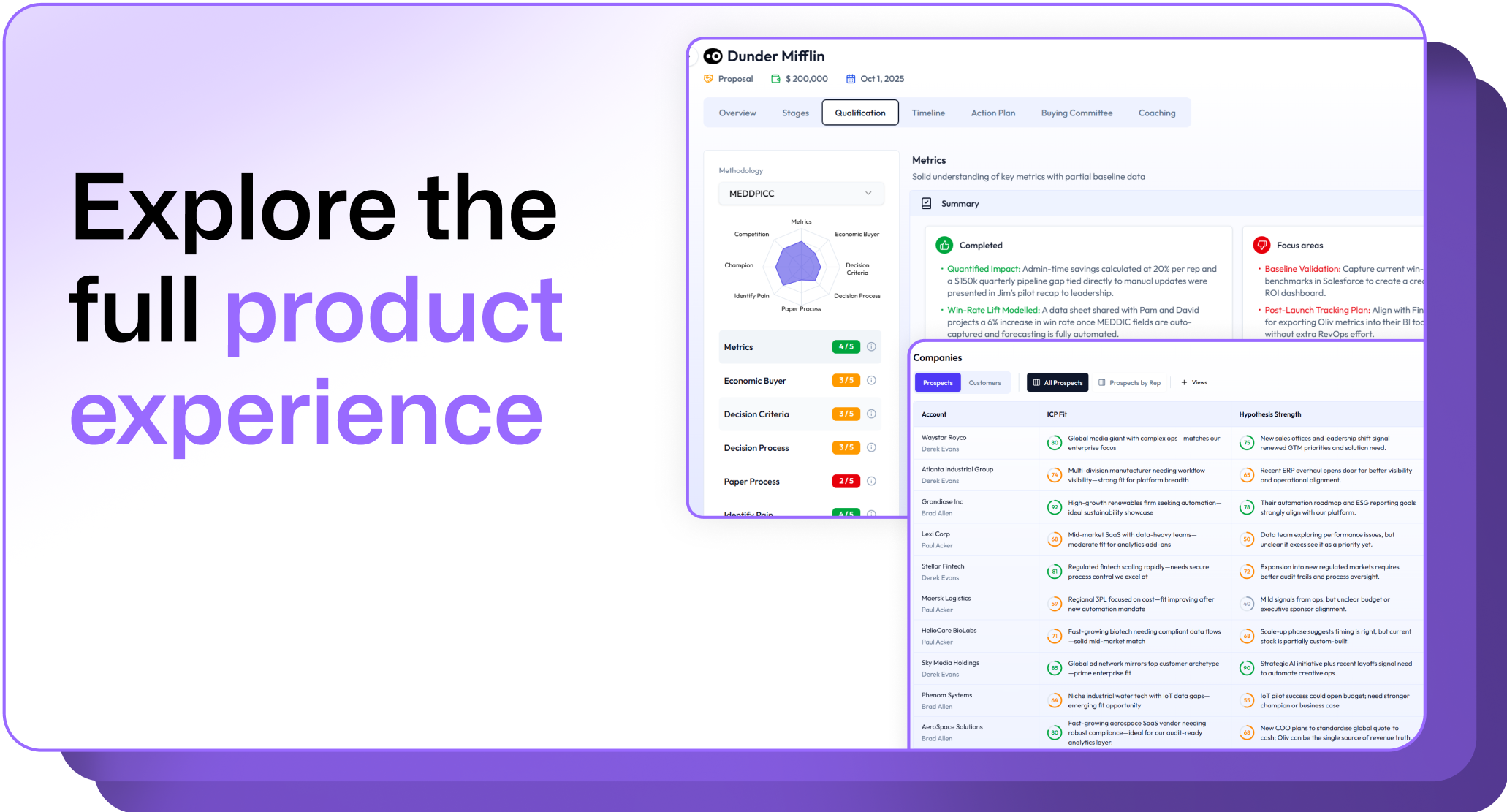
.avif)
.png)