The Death of the Monday Morning Rollup: From AI-Assisted Spreadsheets to AI-Native Revenue Forecasting
Written by
Ishan Chhabra
Last Updated :
September 21, 2026
Skim in :
13
mins
In this article
Revenue teams love Oliv
Here’s why:
All your deal data unified (from 30+ tools and tabs).
Insights are delivered to you directly, no digging.
AI agents automate tasks for you.
Thank you! Your submission has been received!
Oops! Something went wrong while submitting the form.
Meet Oliv’s AI Agents
Hi! I’m, Deal Driver
I track deals, flag risks, send weekly pipeline updates and give sales managers full visibility into deal progress
Hi! I’m, CRM Manager
I maintain CRM hygiene by updating core, custom and qualification fields all without your team lifting a finger
Hi! I’m, Forecaster
I build accurate forecasts based on real deal movement and tell you which deals to pull in to hit your number
Hi! I’m, Coach
I believe performance fuels revenue. I spot skill gaps, score calls and build coaching plans to help every rep level up
Hi! I’m, Prospector
I dig into target accounts to surface the right contacts, tailor and time outreach so you always strike when it counts
Hi! I’m, Pipeline tracker
I call reps to get deal updates, and deliver a real-time, CRM-synced roll-up view of deal progress
Hi! I’m, Analyst
I answer complex pipeline questions, uncover deal patterns, and build reports that guide strategic decisions
TL;DR
The weekly forecast cycle is mostly data collection, not decision making, and that collection cost is the thing worth measuring before any vendor evaluation begins.
Gartner's 2026 survey of 318 sales operations leaders puts median forecast accuracy at 70 to 79 percent, with only 7 percent reaching 90 percent.
Forecasting tools added intelligence on top of rep submissions instead of replacing them, so the weekly labour stayed while visibility improved.
Vendor demo accuracy of 70 to 85 percent typically lands at 50 to 65 percent in production, because good models still read incomplete records.
Move off manual submissions in stages: AI-assisted, then AI-managed, then AI-owned, with accountability transferring only after a track record exists.
Measure the ratio of establishing-truth minutes to deciding-action minutes in one forecast review, and fix that ratio before buying anything.
Q1. What does your forecast week actually consist of, and what does it cost you? [toc=1. The Forecast Week]
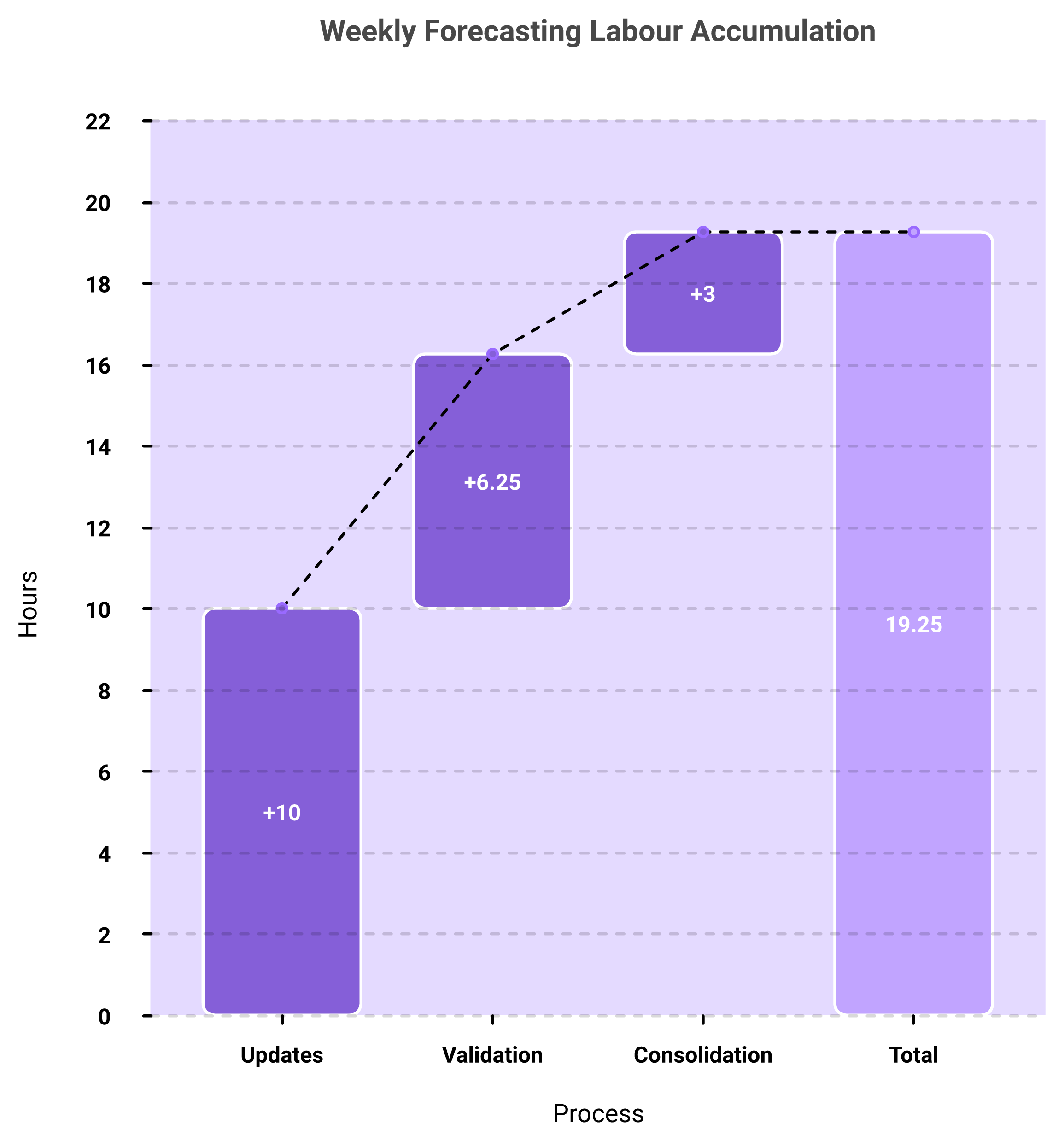
A weekly forecast is mostly data collection, not decision making. Oliv AI's Forecaster documentation breaks the cycle into reps spending roughly an hour updating deal values across the week, managers spending 30 to 45 minutes per rep validating those entries, and then around three hours consolidating the roll up, with validation on Thursday morning and consolidation Thursday afternoon. Those figures are Oliv AI's own product research, not an external study. The pattern matters more than the numbers. The expensive part of your week is establishing what is true.
The week, described the way it actually runs
Thursday, 8:40am. A manager opens the submission sheet and finds four deals still sitting at last week's close date. She pings the AE. The AE replies that he will know more after Tuesday's call.
That exchange, repeated eleven times, is the forecast process. Not the model. Not the dashboard. The chasing.
I will concede the title's framing straight away. Monday is when the number gets presented. Oliv AI's documentation puts the actual crunch on Thursday, and that matches what I see in most 100 to 1,000 person revenue teams. If you want the manager's eye view of that same week, we wrote it up in Oliv for sales managers.
⏰ Where the hours go
The weekly forecast burden hides across multiple calendars. For a ten-rep team, data assembly can consume roughly 18 to 20.5 hours before leaders discuss what to do.
The cost is distributed, which is why nobody owns it. Split across roles, a single weekly cycle for a ten rep team looks like this in Oliv AI's documented breakdown.
Reps: about one hour each, spread Monday to Thursday, updating amounts and close dates.
Managers: 30 to 45 minutes per rep, validating what the rep typed.
Manager again: roughly three hours consolidating the roll up on Thursday afternoon.
No line item there is a decision. Every line item is data assembly, and it is the same assembly problem we unpack in CRM data quality automation for RevOps.
⚠️ What those hours actually buy
They buy a number built on rep judgement about deals whose evidence lives somewhere nobody reads. The call happened. The transcript exists. The close date still moved because a rep felt optimistic on Wednesday night.
Gartner surveyed 318 sales operations and RevOps leaders in 2026. Sixty nine percent said accurate forecasting is harder than it was three years ago, even after more spend on sales technology. That is the honest backdrop. More tooling, same difficulty.
✅ What genuinely changed
Activity capture changed the inputs. Calls, emails, and calendar data became observable without anyone typing them. Conversation intelligence made deal evidence searchable, a shift we traced in revenue intelligence versus conversation intelligence.
What did not change is who assembles the forecast. The submission survived. It is still a human, on a deadline, translating a messy quarter into a single column.
Oliv AI's documentation is unusually blunt about where the hours go, and the reason is that the Forecaster agent was built around the collection step rather than the prediction step. It inspects every deal line by line, then delivers a one page roll up and a presentation ready deck to manager inboxes on a set cadence. That is a claim about removed labour, not improved accuracy. We publish no forecast accuracy figure, because we do not have comparative data that would survive a buyer testing it.
So hold this question open for the next section. If the tooling got better and the difficulty did not, the bottleneck is probably not the model.
Q2. If the forecast call is how you manage the business, should you automate it at all? [toc=2. Automating the Ritual]
No. Automate the collection inside the call, not the call itself. The forecast review is a management instrument. It is how a VP learns which deals are real and which rep needs help this week. The defensible move is to measure what the hour currently contains. Time one review in two buckets: minutes spent establishing what is true, and minutes spent deciding what to do. If truth establishment takes more than half, automation protects the conversation rather than replacing it.
The objection, conceded fully
The objection I hear most is short. "The forecast call is how I manage the business. I am not automating away the one hour a week I get with every manager."
That objection is correct, and any vendor who waves it off should not be trusted with your number. The ritual is not overhead. It is the only structured hour where a leader hears how a deal actually sounds.
🤔 What the hour contains today
Here is the part that stings. Sit in the review with a stopwatch and the split is usually lopsided.
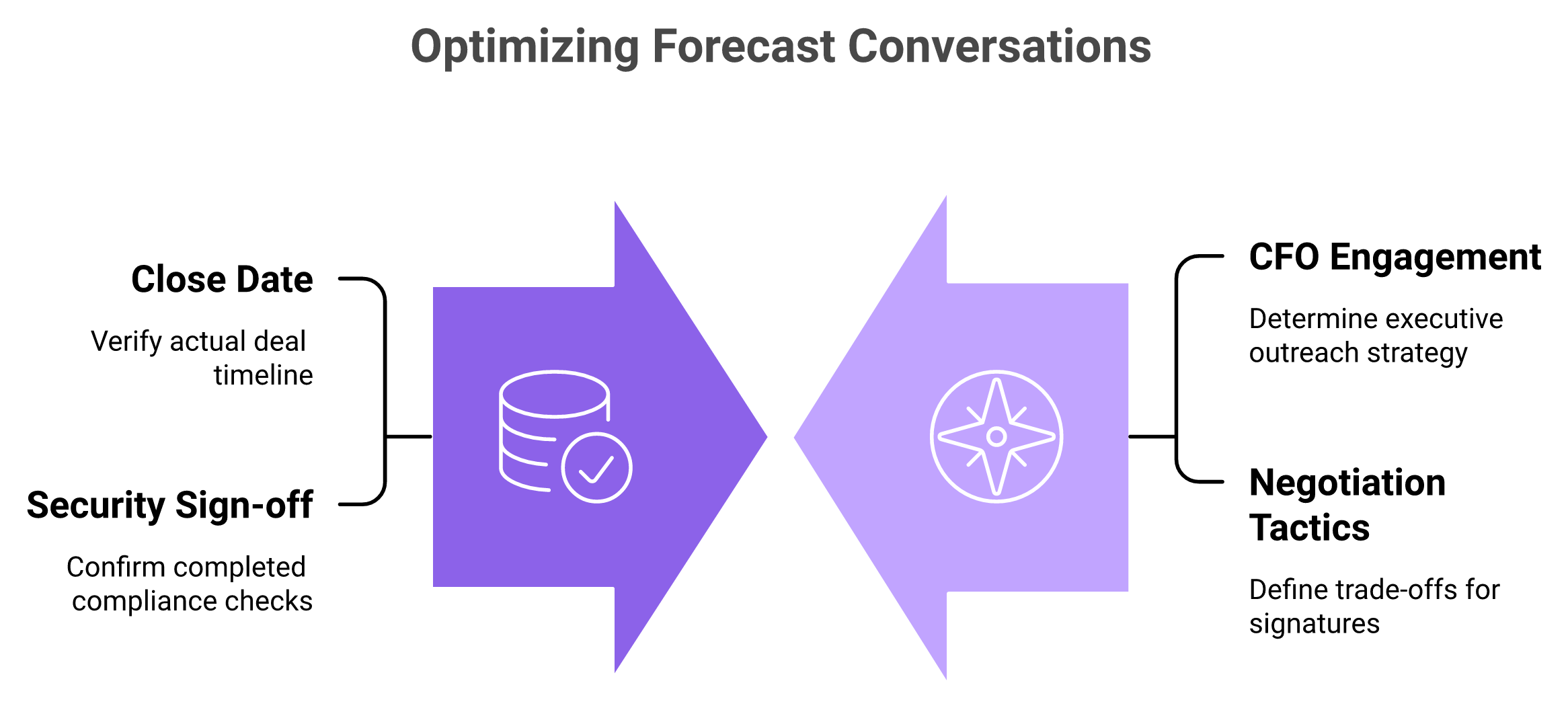
The first stretch goes to reconciliation. Why is this deal still in commit. Whose name is on the paperwork. Did the security review close. Nobody is coaching yet. Everybody is catching up.
Then, somewhere past the halfway mark, the actual management starts. Who calls the VP of Finance. What do we trade for a signature this quarter. That second half is the part worth protecting, and it is the same hour we describe in how to run evidence based forecast commits.
Automate evidence collection so more of the forecast review can focus on decisions and coaching.
⭐ The measurement worth running this week
Replace the accuracy question with a ratio question. Not "how accurate are we", which is a lagging number you cannot move directly. Instead, "what fraction of this hour was spent establishing truth".
Two buckets, one stopwatch, one meeting:
Splitting the Forecast Hour Into Two Buckets
Bucket
What it sounds like
Who should own it
Establishing truth
"Is this close date real?"
Captured evidence
Deciding action
"What do we do about it?"
The humans in the room
Gartner's 2026 data gives the ratio its weight. Only 45 percent of sales leaders report high confidence in their own forecast. Meanwhile, teams that inspect pipeline weekly show far better accuracy than teams reviewing irregularly, at 87 percent against 52 percent in the Digital Bloom benchmark. The cadence is an asset. The collection inside it is not.
Oliv AI's position here is narrower than most vendors would like. Forecaster recommends and nudges, and the documentation states plainly that it does not do deal scoring, does not do pipeline management, and does not move deals. It produces the evidence pack that the first forty minutes used to produce by hand. Whether a deal is real is still argued by humans, out loud, in the room.
So run the stopwatch on your next review. If the split comes back sixty forty toward reconciliation, you have found the thing to fix, and it is not your model.
Q3. Why did forecasting tools improve visibility without moving accuracy or reducing the work? [toc=3. Why Accuracy Stalled]
Because intelligence was layered on top of the submission, not put in place of it. Gartner's 2026 survey of 318 sales operations leaders found median forecast accuracy at 70 to 79 percent, with only 7 percent of organisations reaching 90 percent. Xactly's benchmark of 400 organisations found just 20 percent forecast within 5 percent of actuals. Better models inherit rep entered inputs, so the ceiling is the process. Oliv AI's documentation states the same thing directly: these tools added intelligence and did not remove the work.
The submission survived every tool generation
Start with the credit where it is due. Clari is the category's reference implementation, and its merger with Salesloft made it stronger in orchestration, not weaker. Gong ships real forecasting, drawing on more than 300 signals from customer interactions rather than CRM fields alone, which we broke down in Gong forecasting. Neither is a dashboard with a marketing badge.
Both still ask a rep to submit. That is the architectural point, and it has nothing to do with quality.
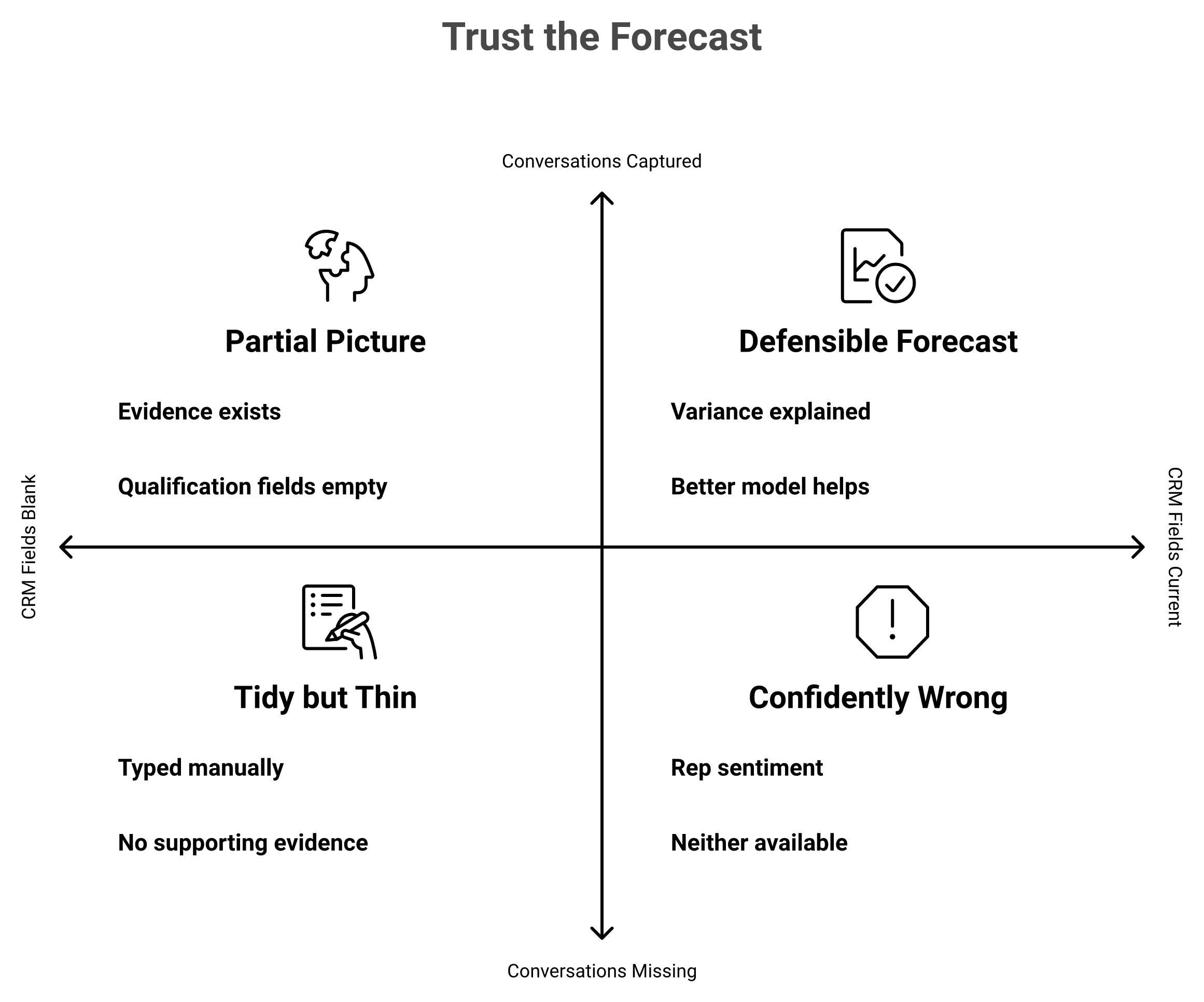
Forecast trust depends on two inputs. Without captured conversations and current CRM fields, a stronger model just produces a more confident guess.
💸 The accuracy claim and the production number
Vendor pages quote the top of the range. Clari's Forecast page claims 98 percent forecast accuracy by week two of the quarter, retrieved 19 September 2026. That figure is real and measured under conditions the buyer cannot see.
Forecast Accuracy by Method, With Sources
Method
Typical accuracy
Source and date
Spreadsheet, deal level
45 to 55 percent
Stealth Agents, 2026
Median B2B organisation
70 to 79 percent
Gartner, 2026, n=318
Vendor quoted in demo
70 to 85 percent
Clari State of Revenue via Pulse RevOps, 2026
Same tools, in production
50 to 65 percent
Pulse RevOps, 2026
The haircut between row three and row four is the story no vendor list carries. It is not dishonesty. It is what happens when a good model reads incomplete records.
⚠️ What buyers say once the tool is live
Reviews land on the same seam. The forecasting works. The write back into the system of record does not.
"The conversation intelligence tool is lacking, and we don't have the context of the deals against the conversation intelligence findings. There's no custom reporting. The CRM writeback is not good; we cannot send MEDDIC values back to Salesforce or update fields in Salesforce from the conversation intelligence." — Verified user, Clari customer, Clari G2 Verified Review, 13 Jul 2026
"Clari forecasting is simple, easy to use, and well integrated with SFDC." Dislikes: "The AI features are immature, team activity is poorly designed, and it doesn't integrate well with other popular business systems today." — Verified user, Clari customer, Clari G2 Verified Review, 10 Oct 2025
Read those two together. The roll up got easier. The evidence never reached the opportunity record. There is more buyer testimony in Clari reviews and user feedback.
Oliv AI frames this as a sequencing error rather than a feature gap. Our CRM Manager agent writes qualification fields and deal data from captured conversations before Forecaster reads them, so the inputs stop depending on whether a rep updated the record on Wednesday night. Oliv AI claims no accuracy advantage over Clari, Gong, or Salesforce, because no comparative data exists and that claim would be the first thing a buyer tested.
The thing that moves is narrower than the category admits. Accuracy improves when the inputs stop depending on typing, and not before. The mechanics of that sequencing sit in sales methodology automation from calls.
Q4. What separates AI-assisted forecasting from AI-native forecasting in practice? [toc=4. AI-Assisted vs AI-Native]
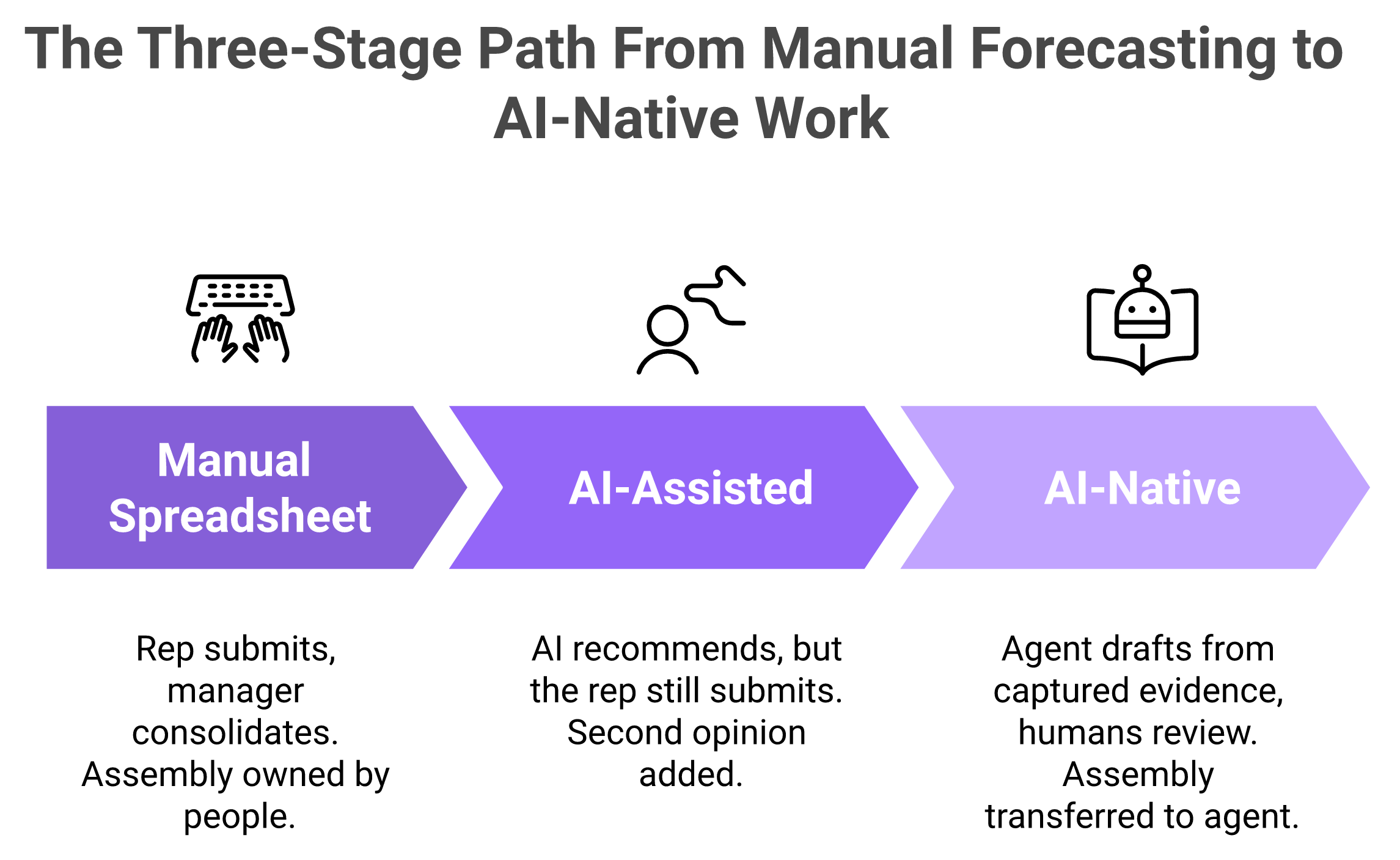
The difference is who assembles the number. Manual forecasting puts it in a spreadsheet. AI-assisted forecasting shows a rep a recommendation and still requires their submission. AI-native forecasting generates the forecast from captured evidence and asks humans to review it. The operational test is simple. If you removed your reps' weekly data entry, would you still have a forecast? If not, the intelligence is decorative.
First, a caution about the words
"AI-native" is vendor vocabulary. No CRO I have met has typed it into a search bar. I am using it here because the distinction is real, not because the phrase deserves respect.
Judge the stage by workload, not by label.
The useful distinction is not the vendor label. It is whether people still assemble the number or review a forecast generated from captured evidence.
⭐ The three stages, by who does the work
Manual, AI-Assisted, and AI-Native Forecasting Compared
Stage
Who submits the number
What the AI does
What breaks if you remove the AI
Manual spreadsheet
Rep, then manager consolidates
Nothing
Nothing. You still have a forecast, just a slower one.
AI-assisted
Rep, with a recommendation on screen
Predicts on deal size, stage, and velocity from historical data, or reads interaction signals
You lose the second opinion. The forecast survives.
AI-native
Agent drafts, humans review and approve
Assembles the roll up from captured conversations and CRM writes
The forecast stops existing until someone types again.
Most teams I talk to sit in row two and describe themselves as row three. That is not vanity. The tool genuinely is intelligent. The work simply did not leave the calendar, a pattern we tested in AI agents versus SaaS dashboards.
✅ How to test which row you are in
Run this next Thursday, with no vendor in the room.
Freeze rep data entry for one cycle. No amount edits, no close date edits.
Ask your forecasting tool for the roll up anyway.
Compare it against last quarter's actuals, not against your commit.
Note how much of the gap came from missing fields rather than bad prediction.
Spreadsheet based deal level forecasting sits around 45 to 55 percent accuracy by the 2026 Stealth Agents compilation. If your frozen week lands near that, your intelligence layer was reading rep typing, not evidence. The repair path is laid out in how to improve sales forecast accuracy with AI.
Oliv AI sits at the AI-native end by construction rather than by claim. Forecaster consumes Deal Insights generated from captured meetings, emails, and Slack, which means the forecast exists whether or not a rep opened the CRM that week. You can read exactly what it does and does not do on the Forecaster agent page, including the boundaries, because I would rather you check the scope than trust the adjective. For the wider shortlist, the eight best AI sales forecasting software compares it against the alternatives.
Q5. What data does an AI revenue forecast need before it is worth trusting? [toc=5. Data Prerequisites]
It needs current qualification fields, captured conversations, and complete deal records. Without them, an AI forecast is confidently wrong. Oliv AI's documentation concedes that Forecaster is only as good as the data it reads, and recommends running the CRM Manager agent first so deal fields are current before Forecaster analyses them. That ordering is the whole point. Anyone selling you the forecast before the capture layer has the sequence backwards.
The readiness audit, in five checks
Run these before you look at a single vendor demo. Each one is answerable in an afternoon with your existing systems.
Conversation capture coverage. What percentage of your closed-won deals last quarter had at least three recorded calls? Under 60 percent means your evidence layer has holes.
Qualification field completeness. Pull your commit deals. Count how many have a named economic buyer, a dated critical event, and a next step. Blank fields become model guesses.
Activity write back. Can captured calls and emails update the opportunity record, not just sit beside it in a separate tool? This is where most stacks break.
Historical close depth. You need at least four quarters of clean closed data. Less than that, and the model is pattern matching on noise.
Revenue model count. One motion or several? Subscription, usage, and services forecast differently, and a single roll up hides the mix.
⚠️ Why field completeness decides the number
Qualification frameworks are not theory here. MEDDPICC, BANT, and SPICED are just structured questions about whether a deal is real, stored as fields on the opportunity, which is exactly what we automate in sales methodology automation from calls.
When those fields are empty, the model has no signal for deal quality and falls back on stage and age. Ebsta and Pavilion's 2026 benchmark found well qualified deals closing at 50 percent against 8 percent for unqualified ones. That gap is the difference your forecast cannot see if nobody filled in the fields, and the repair work is covered in CRM data quality automation for RevOps.
💸 What buyers say about the data layer
The complaint is rarely about intelligence. It is about data that will not move where it is needed.
"The conversation intelligence tool is lacking, and we don't have the context of the deals against the conversation intelligence findings. There's no custom reporting." — Verified user, Clari customer, Clari G2 Verified Review, 13 Jul 2026
"I cannot download all the data myself unless we upgrade the plan, which isn't ideal and results in me not fully utilizing Gong. The requirement to download snippets one by one using copy and paste is particularly annoying." — Verified user, Gong customer, Gong G2 Verified Review, 3 Oct 2025
Both reviewers are describing the same structural issue from opposite ends. Insight was generated. It never landed in the record the forecast reads, a limitation we catalogued in Gong limitations and challenges.
✅ The honest sequencing answer
Oliv AI's CRM Manager agent is trained on more than 100 sales methodologies, including MEDDIC and BANT, and populates standard and custom fields from call context. We treat it as a prerequisite to Forecaster rather than an upsell, because we learned the hard way that a forecast built on blank fields is a liability. If your CRM is thin and your calls are not captured, your first project is hygiene, not forecasting. I would rather lose a quarter of pipeline than sell that in the wrong order, and there is a longer walkthrough of the sequence in how to improve sales forecast accuracy with AI.
Q6. How do you move a team off manual submissions, and who owns the number at each stage? [toc=6. Staged Transition]
In stages, with accountability moving last. Oliv AI documents a three mode path: AI-assisted, where recommendations sit alongside rep submissions, AI-managed, where the agent generates forecasts that reps and managers review, and AI-owned. Oliv AI states that teams typically move through all three in six to eighteen months. In the first two modes the human still submits and still owns the number, so accountability transfers only once a track record justifies it.
Why the one step switch fails
A missed forecast is a credibility event, not a data event. You do not lose a quarter. You lose the room's belief that you know your own business.
That is why "the model said so" cannot be your answer in a board meeting. Forrester's 2026 predictions found fewer than one third of AI decision makers able to tie AI value to the P&L. If you cannot explain the number, you cannot defend the spend either, which is the pressure we mapped in why your board deck takes all weekend.
⏰ The three modes, and who owns the miss
Forecast Ownership Across AI-Assisted, AI-Managed, and AI-Owned Modes
Mode
Who submits
Who owns a miss
What the finance lead gets
AI-assisted
Rep, with agent recommendation visible
Rep and manager
Same variance story as today
AI-managed
Agent drafts, rep and manager review and approve
Rep and manager, still
Deal level commentary behind each number
AI-owned
Agent, with exception review
Leadership, by explicit decision
Full audit trail of what changed and when
Notice that ownership does not move in the first two rows. That is deliberate, and it is the part a CRO can actually authorise this quarter.
⭐ The second reader nobody plans for
Your finance lead is in this decision, and they want something different from you. You want a better number. They want last quarter's variance explained.
Those are not the same request. A model that improves accuracy by two points but cannot show its reasoning makes their job harder, not easier, a trade-off we examined in AI CRM trust and governance evaluation.
⚠️ What buyers report during rollout
Adoption friction is the honest risk in stage one, and reviewers name it plainly.
"It truly shines in weekly forecasts and opportunity analysis." Dislikes: "I also find it inconvenient that it still takes extra work to get the 'Inspection View' display standardized using presets." — Verified user, Clari customer, Clari G2 Verified Review, 16 Nov 2025
"Real Time integrations can be time consuming." — Verified user, Gong customer, Gong G2 Verified Review, 21 Apr 2026
Budget for configuration weeks, not configuration hours. Every team I have watched underestimate this lost the first cycle to setup, not to the model, which is why we published a realistic Gong implementation timeline for comparison.
Oliv AI publishes the staging rather than promising a switch, which is the operative detail for a CRO. In AI-assisted and AI-managed modes the human still submits, and because Forecaster inspects deals line by line off captured evidence, each figure carries the deal level commentary needed to explain variance after the quarter closes. Commercially it is the Forecast app inside the Sell plan at $49 per user per month, with agent actions billed at $0.01 per credit, published on pricing. The six to eighteen month timeline is Oliv AI's own observation, not independent research, and I would treat it as a planning range rather than a promise.
Here is the concession that matters. In modes one and two, your weekly cost drops but does not disappear. Reps still submit. The process for doing that well sits in how to run evidence based forecast commits.
Q7. How do Clari, Gong and agent-led forecasting compare, and which fits your size and motion? [toc=7. Vendor Comparison]
All three are real forecasting products. They differ in where the work sits. Clari Forecast trains on historical deal data and predicts on deal size, stage, and velocity, claiming 98 percent accuracy by week two of the quarter on its own site. Gong Forecast reads more than 300 signals from customer interactions rather than CRM fields alone. Agent-led tools generate the roll up from captured evidence. Neither Clari nor Gong removes the submission step, and that is the variable to evaluate, not model quality.
The comparison, on labour rather than accuracy
Clari, Gong, and Agent-Led Forecasting Compared on Where the Work Sits
Approach
Primary signal source
Who submits the number
Published accuracy claim
Still needs a human weekly
Clari, with Salesloft
CRM history, deal size, stage, velocity
Rep, then manager
98 percent by week two, retrieved 19 Sep 2026
Submission and validation
Gong Forecast
300+ interaction signals beyond CRM
Rep, then manager
None stated on the pages retrieved 19 Sep 2026
Submission and validation
Agent-led, including Oliv AI
Captured calls, emails, Slack, plus CRM writes
Agent drafts, humans approve
None published
Review and approval
Two things are worth saying out loud. Clari and Salesloft are one company now, under Steve Cox, and their joint MCP server, announced 14 April 2026, connects Claude, ChatGPT, Copilot, Gemini, and Agentforce. That makes them stronger in orchestration, not weaker, as we noted in the best revenue orchestration platform tools.
⭐ Which fits which shape of team
Under 50 reps on HubSpot, single motion. Native forecasting plus disciplined weekly inspection usually clears the bar. Buying a platform here often buys configuration work, a point we argue in revenue intelligence for small sales teams.
50 to 200 reps, multi-motion. This is where roll ups break. Evaluate on whether the tool writes back to the opportunity record, not on dashboard depth.
Enterprise with subscription, usage, and services revenue. Clari's multi-model roll up is the reference implementation for this shape, and peer ratings back it at 4.6 on the G2 Summer 2026 revenue operations grid, with Gong at 4.7.
⚠️ What reviewers actually flag
"I enjoy being able to forecast easily without having to add up manually. Clari helps save time, reducing manual work with its automated process." Dislikes: "UI sometimes not intuitive enough." — Verified user, Clari customer, Clari G2 Verified Review, 17 Dec 2025
"Gong Engage is awful in every single way compared to outreach. Would not recommend at all, flows are hard to get into, information is not readily available, sequencing is difficult to create and track." — Verified user, Gong customer, Gong G2 Verified Review, 6 Sep 2025
Read the second one as a suite warning, not a forecasting verdict. Buying a platform for one module means living with the rest. More detail sits in Gong forecasting and Clari reviews.
Oliv AI is the least publicly proven option in this table, and you should evaluate it that way. There is no G2, Capterra, or TrustRadius listing, and our case studies sit behind email gates, which matters more for a forecast than for almost any other purchase. Our verifiable difference is architectural, agents write the CRM inputs and draft the roll up, and that is a claim about labour rather than accuracy. Run the proof of concept against last quarter's closed data before you trust any of the three with a board number.
Q8. What must you verify about a forecasting agent before procurement signs off? [toc=8. Compliance Checks]
Four things: the vendor's EU AI Act Article 50 disclosure wording, a per decision audit trail, a documented human override path, and current SOC 2 Type II plus GDPR evidence. Article 50 transparency obligations became enforceable on 2 August 2026 and cover AI systems interacting with EU users. Annex III high risk duties were deferred to 2 December 2027 under Regulation (EU) 2026/1744. Penalties reach 35 million euros or 7 percent of global turnover.
The request list to send your vendor
Forward these five items to legal and security before the pilot, not after.
Article 50 disclosure wording. The literal text shown to a user when the agent acts. Ask for a screenshot, not a policy summary.
Per decision audit trail. For any forecast change, which evidence drove it, and when. A forecast you cannot explain is a forecast you cannot defend.
Human override path. Who can reject an agent's output, and does the rejection get logged? This is your accountability record.
SOC 2 Type II report and GDPR posture. Current, dated, and available under NDA.
Data export path. Full export, in a readable format, on termination.
⚠️ Read the deadline honestly
Some vendors are selling urgency that the regulation does not currently support. The high risk obligations most relevant to autonomous decision making were pushed to December 2027.
What is live now is transparency. If your forecasting agent emails a rep, calls a rep, or acts on their behalf, disclosure applies today. That is a narrower duty than the headlines imply, and it is easy to meet, as the governance checklist in our mid-market revenue AI buyer guide sets out.
⭐ Why this list is a defensibility list, not a paperwork list
The audit trail is not a compliance artefact. It is how you explain a variance to your board in February.
I keep meeting teams who treat security review as the tax they pay after choosing. Flip it. The vendor who can show you the decision log on the first call is also the vendor whose number you can defend, and Forrester's 2026 data, where only 15 percent of AI decision makers reported EBITDA lift inside twelve months, suggests most buyers never checked. The same discipline applies to any agentic AI implementation on RevOps data architecture.
✅ Where we stand, and what to ask us
Oliv AI is SOC 2 Type II certified, GDPR and CCPA compliant, encrypts data with AES-256 at rest and TLS 1.2 or higher in transit, and operates a full open export policy with no data lock in, all published at trust.oliv.ai. Ask us for the export path before the pilot rather than after, and ask every other vendor the same question on the same call. A forecast you cannot export is a forecast you cannot independently audit, which means you are trusting a supplier with a number that belongs to your board.
One caveat I will name. Certifications tell you the vendor handles data properly. They tell you nothing about whether the forecast is any good, and I have watched buyers conflate the two.
Q9. What should you measure first, forecast accuracy, or the cost of producing the number? [toc=9. What to Measure First]
Measure the ratio first. Time one forecast review in two buckets, minutes spent establishing what is true against minutes spent deciding what to do, and treat that ratio as the thing to fix. Accuracy is a lagging outcome you cannot move directly. The composition of the hour is a leading indicator you control this week. Teams that inspect pipeline weekly show 87 percent forecast accuracy against 52 percent for irregular review.
Why accuracy is the wrong first metric
Gartner's 2026 survey found only 7 percent of organisations reaching 90 percent forecast accuracy, with the median sitting at 70 to 79 percent. You cannot act on that number. It arrives after the quarter, and it blends rep behaviour, market conditions, and model quality into one figure.
The ratio is different. You can measure it on Thursday and change it by the next Thursday, which is the same leading-indicator logic behind evidence based forecast commits.
⏰ The five steps, run once
Pick one review. One manager, one team, this week. Do not announce it as an initiative.
Log the two buckets with a stopwatch. Truth establishment sounds like "is that close date real" and "did security sign off". Action deciding sounds like "who calls the CFO" and "what do we trade for signature".
Count submission hours across roles. Rep update time, manager validation time, and consolidation time. Ask, do not estimate.
Compute cost per forecast. Total hours multiplied by loaded hourly cost. For a ten rep team, this is usually a four figure number per week, and our revenue intelligence ROI calculator handles the arithmetic.
Set a target ratio. If truth establishment is above 50 percent, that is your first project. Not a vendor. A project.
⭐ What a healthy split looks like
In the teams I have watched run this, the first measurement almost always comes back worse than the leader expected. Sixty forty toward reconciliation is common. Seventy thirty is not rare.
A healthy review runs the other way. Twenty to thirty percent on establishing facts, the rest on decisions and coaching. That inversion, not a model upgrade, is what makes the hour feel worth attending, and it is the hour we rebuilt in sales manager AI automation for daily productivity.
✅ Then name the one number your pilot must move
Before any trial starts, write down a single measure and the date you will check it. Not "better accuracy". Something like "manager consolidation time drops from three hours to under one by the end of Q1", the kind of target we frame in the CRO view of ROI and strategic value.
Oliv AI's documented cycle gives you a concrete reference for that target, with validation on Thursday morning and consolidation Thursday afternoon, and roughly 30 to 45 minutes per rep spent validating entries. Those figures are our own measurement, not independent research, and I would treat them as a shape rather than a benchmark. Compare them against your own stopwatch numbers instead of trusting them, and if the gap sits in your records rather than your model, start with CRM data strategy for revenue predictability.
💰 Where the tooling question finally belongs
Oliv AI's Forecaster is worth evaluating only after you hold that ratio, because it targets exactly one half of it, the collection half. Nothing it does improves a review that is already spent on decisions. If your hour turns out to be mostly truth establishment, the business case writes itself, and if it does not, you have saved yourself a procurement cycle. There is a broader vendor view in 8 best AI sales forecasting software if you want to compare after measuring, plus a stack-level cost read in revenue tech stack consolidation costs.
Most CROs I speak to have never timed their own forecast call. That is not carelessness. Nobody has ever suggested that the hour itself is the measurable thing. If you run the stopwatch next Thursday and the split surprises you, book a demo and bring the number with you.
Q1. What does your forecast week actually consist of, and what does it cost you? [toc=1. The Forecast Week]
A weekly forecast is mostly data collection, not decision making. Oliv AI's Forecaster documentation breaks the cycle into reps spending roughly an hour updating deal values across the week, managers spending 30 to 45 minutes per rep validating those entries, and then around three hours consolidating the roll up, with validation on Thursday morning and consolidation Thursday afternoon. Those figures are Oliv AI's own product research, not an external study. The pattern matters more than the numbers. The expensive part of your week is establishing what is true.
The week, described the way it actually runs
Thursday, 8:40am. A manager opens the submission sheet and finds four deals still sitting at last week's close date. She pings the AE. The AE replies that he will know more after Tuesday's call.
That exchange, repeated eleven times, is the forecast process. Not the model. Not the dashboard. The chasing.
I will concede the title's framing straight away. Monday is when the number gets presented. Oliv AI's documentation puts the actual crunch on Thursday, and that matches what I see in most 100 to 1,000 person revenue teams. If you want the manager's eye view of that same week, we wrote it up in Oliv for sales managers.
⏰ Where the hours go
The weekly forecast burden hides across multiple calendars. For a ten-rep team, data assembly can consume roughly 18 to 20.5 hours before leaders discuss what to do.
The cost is distributed, which is why nobody owns it. Split across roles, a single weekly cycle for a ten rep team looks like this in Oliv AI's documented breakdown.
Reps: about one hour each, spread Monday to Thursday, updating amounts and close dates.
Managers: 30 to 45 minutes per rep, validating what the rep typed.
Manager again: roughly three hours consolidating the roll up on Thursday afternoon.
No line item there is a decision. Every line item is data assembly, and it is the same assembly problem we unpack in CRM data quality automation for RevOps.
⚠️ What those hours actually buy
They buy a number built on rep judgement about deals whose evidence lives somewhere nobody reads. The call happened. The transcript exists. The close date still moved because a rep felt optimistic on Wednesday night.
Gartner surveyed 318 sales operations and RevOps leaders in 2026. Sixty nine percent said accurate forecasting is harder than it was three years ago, even after more spend on sales technology. That is the honest backdrop. More tooling, same difficulty.
✅ What genuinely changed
Activity capture changed the inputs. Calls, emails, and calendar data became observable without anyone typing them. Conversation intelligence made deal evidence searchable, a shift we traced in revenue intelligence versus conversation intelligence.
What did not change is who assembles the forecast. The submission survived. It is still a human, on a deadline, translating a messy quarter into a single column.
Oliv AI's documentation is unusually blunt about where the hours go, and the reason is that the Forecaster agent was built around the collection step rather than the prediction step. It inspects every deal line by line, then delivers a one page roll up and a presentation ready deck to manager inboxes on a set cadence. That is a claim about removed labour, not improved accuracy. We publish no forecast accuracy figure, because we do not have comparative data that would survive a buyer testing it.
So hold this question open for the next section. If the tooling got better and the difficulty did not, the bottleneck is probably not the model.
Q2. If the forecast call is how you manage the business, should you automate it at all? [toc=2. Automating the Ritual]
No. Automate the collection inside the call, not the call itself. The forecast review is a management instrument. It is how a VP learns which deals are real and which rep needs help this week. The defensible move is to measure what the hour currently contains. Time one review in two buckets: minutes spent establishing what is true, and minutes spent deciding what to do. If truth establishment takes more than half, automation protects the conversation rather than replacing it.
The objection, conceded fully
The objection I hear most is short. "The forecast call is how I manage the business. I am not automating away the one hour a week I get with every manager."
That objection is correct, and any vendor who waves it off should not be trusted with your number. The ritual is not overhead. It is the only structured hour where a leader hears how a deal actually sounds.
🤔 What the hour contains today
Here is the part that stings. Sit in the review with a stopwatch and the split is usually lopsided.
The first stretch goes to reconciliation. Why is this deal still in commit. Whose name is on the paperwork. Did the security review close. Nobody is coaching yet. Everybody is catching up.
Then, somewhere past the halfway mark, the actual management starts. Who calls the VP of Finance. What do we trade for a signature this quarter. That second half is the part worth protecting, and it is the same hour we describe in how to run evidence based forecast commits.
Automate evidence collection so more of the forecast review can focus on decisions and coaching.
⭐ The measurement worth running this week
Replace the accuracy question with a ratio question. Not "how accurate are we", which is a lagging number you cannot move directly. Instead, "what fraction of this hour was spent establishing truth".
Two buckets, one stopwatch, one meeting:
Splitting the Forecast Hour Into Two Buckets
Bucket
What it sounds like
Who should own it
Establishing truth
"Is this close date real?"
Captured evidence
Deciding action
"What do we do about it?"
The humans in the room
Gartner's 2026 data gives the ratio its weight. Only 45 percent of sales leaders report high confidence in their own forecast. Meanwhile, teams that inspect pipeline weekly show far better accuracy than teams reviewing irregularly, at 87 percent against 52 percent in the Digital Bloom benchmark. The cadence is an asset. The collection inside it is not.
Oliv AI's position here is narrower than most vendors would like. Forecaster recommends and nudges, and the documentation states plainly that it does not do deal scoring, does not do pipeline management, and does not move deals. It produces the evidence pack that the first forty minutes used to produce by hand. Whether a deal is real is still argued by humans, out loud, in the room.
So run the stopwatch on your next review. If the split comes back sixty forty toward reconciliation, you have found the thing to fix, and it is not your model.
Q3. Why did forecasting tools improve visibility without moving accuracy or reducing the work? [toc=3. Why Accuracy Stalled]
Because intelligence was layered on top of the submission, not put in place of it. Gartner's 2026 survey of 318 sales operations leaders found median forecast accuracy at 70 to 79 percent, with only 7 percent of organisations reaching 90 percent. Xactly's benchmark of 400 organisations found just 20 percent forecast within 5 percent of actuals. Better models inherit rep entered inputs, so the ceiling is the process. Oliv AI's documentation states the same thing directly: these tools added intelligence and did not remove the work.
The submission survived every tool generation
Start with the credit where it is due. Clari is the category's reference implementation, and its merger with Salesloft made it stronger in orchestration, not weaker. Gong ships real forecasting, drawing on more than 300 signals from customer interactions rather than CRM fields alone, which we broke down in Gong forecasting. Neither is a dashboard with a marketing badge.
Both still ask a rep to submit. That is the architectural point, and it has nothing to do with quality.
Forecast trust depends on two inputs. Without captured conversations and current CRM fields, a stronger model just produces a more confident guess.
💸 The accuracy claim and the production number
Vendor pages quote the top of the range. Clari's Forecast page claims 98 percent forecast accuracy by week two of the quarter, retrieved 19 September 2026. That figure is real and measured under conditions the buyer cannot see.
Forecast Accuracy by Method, With Sources
Method
Typical accuracy
Source and date
Spreadsheet, deal level
45 to 55 percent
Stealth Agents, 2026
Median B2B organisation
70 to 79 percent
Gartner, 2026, n=318
Vendor quoted in demo
70 to 85 percent
Clari State of Revenue via Pulse RevOps, 2026
Same tools, in production
50 to 65 percent
Pulse RevOps, 2026
The haircut between row three and row four is the story no vendor list carries. It is not dishonesty. It is what happens when a good model reads incomplete records.
⚠️ What buyers say once the tool is live
Reviews land on the same seam. The forecasting works. The write back into the system of record does not.
"The conversation intelligence tool is lacking, and we don't have the context of the deals against the conversation intelligence findings. There's no custom reporting. The CRM writeback is not good; we cannot send MEDDIC values back to Salesforce or update fields in Salesforce from the conversation intelligence." — Verified user, Clari customer, Clari G2 Verified Review, 13 Jul 2026
"Clari forecasting is simple, easy to use, and well integrated with SFDC." Dislikes: "The AI features are immature, team activity is poorly designed, and it doesn't integrate well with other popular business systems today." — Verified user, Clari customer, Clari G2 Verified Review, 10 Oct 2025
Read those two together. The roll up got easier. The evidence never reached the opportunity record. There is more buyer testimony in Clari reviews and user feedback.
Oliv AI frames this as a sequencing error rather than a feature gap. Our CRM Manager agent writes qualification fields and deal data from captured conversations before Forecaster reads them, so the inputs stop depending on whether a rep updated the record on Wednesday night. Oliv AI claims no accuracy advantage over Clari, Gong, or Salesforce, because no comparative data exists and that claim would be the first thing a buyer tested.
The thing that moves is narrower than the category admits. Accuracy improves when the inputs stop depending on typing, and not before. The mechanics of that sequencing sit in sales methodology automation from calls.
Q4. What separates AI-assisted forecasting from AI-native forecasting in practice? [toc=4. AI-Assisted vs AI-Native]
The difference is who assembles the number. Manual forecasting puts it in a spreadsheet. AI-assisted forecasting shows a rep a recommendation and still requires their submission. AI-native forecasting generates the forecast from captured evidence and asks humans to review it. The operational test is simple. If you removed your reps' weekly data entry, would you still have a forecast? If not, the intelligence is decorative.
First, a caution about the words
"AI-native" is vendor vocabulary. No CRO I have met has typed it into a search bar. I am using it here because the distinction is real, not because the phrase deserves respect.
Judge the stage by workload, not by label.
The useful distinction is not the vendor label. It is whether people still assemble the number or review a forecast generated from captured evidence.
⭐ The three stages, by who does the work
Manual, AI-Assisted, and AI-Native Forecasting Compared
Stage
Who submits the number
What the AI does
What breaks if you remove the AI
Manual spreadsheet
Rep, then manager consolidates
Nothing
Nothing. You still have a forecast, just a slower one.
AI-assisted
Rep, with a recommendation on screen
Predicts on deal size, stage, and velocity from historical data, or reads interaction signals
You lose the second opinion. The forecast survives.
AI-native
Agent drafts, humans review and approve
Assembles the roll up from captured conversations and CRM writes
The forecast stops existing until someone types again.
Most teams I talk to sit in row two and describe themselves as row three. That is not vanity. The tool genuinely is intelligent. The work simply did not leave the calendar, a pattern we tested in AI agents versus SaaS dashboards.
✅ How to test which row you are in
Run this next Thursday, with no vendor in the room.
Freeze rep data entry for one cycle. No amount edits, no close date edits.
Ask your forecasting tool for the roll up anyway.
Compare it against last quarter's actuals, not against your commit.
Note how much of the gap came from missing fields rather than bad prediction.
Spreadsheet based deal level forecasting sits around 45 to 55 percent accuracy by the 2026 Stealth Agents compilation. If your frozen week lands near that, your intelligence layer was reading rep typing, not evidence. The repair path is laid out in how to improve sales forecast accuracy with AI.
Oliv AI sits at the AI-native end by construction rather than by claim. Forecaster consumes Deal Insights generated from captured meetings, emails, and Slack, which means the forecast exists whether or not a rep opened the CRM that week. You can read exactly what it does and does not do on the Forecaster agent page, including the boundaries, because I would rather you check the scope than trust the adjective. For the wider shortlist, the eight best AI sales forecasting software compares it against the alternatives.
Q5. What data does an AI revenue forecast need before it is worth trusting? [toc=5. Data Prerequisites]
It needs current qualification fields, captured conversations, and complete deal records. Without them, an AI forecast is confidently wrong. Oliv AI's documentation concedes that Forecaster is only as good as the data it reads, and recommends running the CRM Manager agent first so deal fields are current before Forecaster analyses them. That ordering is the whole point. Anyone selling you the forecast before the capture layer has the sequence backwards.
The readiness audit, in five checks
Run these before you look at a single vendor demo. Each one is answerable in an afternoon with your existing systems.
Conversation capture coverage. What percentage of your closed-won deals last quarter had at least three recorded calls? Under 60 percent means your evidence layer has holes.
Qualification field completeness. Pull your commit deals. Count how many have a named economic buyer, a dated critical event, and a next step. Blank fields become model guesses.
Activity write back. Can captured calls and emails update the opportunity record, not just sit beside it in a separate tool? This is where most stacks break.
Historical close depth. You need at least four quarters of clean closed data. Less than that, and the model is pattern matching on noise.
Revenue model count. One motion or several? Subscription, usage, and services forecast differently, and a single roll up hides the mix.
⚠️ Why field completeness decides the number
Qualification frameworks are not theory here. MEDDPICC, BANT, and SPICED are just structured questions about whether a deal is real, stored as fields on the opportunity, which is exactly what we automate in sales methodology automation from calls.
When those fields are empty, the model has no signal for deal quality and falls back on stage and age. Ebsta and Pavilion's 2026 benchmark found well qualified deals closing at 50 percent against 8 percent for unqualified ones. That gap is the difference your forecast cannot see if nobody filled in the fields, and the repair work is covered in CRM data quality automation for RevOps.
💸 What buyers say about the data layer
The complaint is rarely about intelligence. It is about data that will not move where it is needed.
"The conversation intelligence tool is lacking, and we don't have the context of the deals against the conversation intelligence findings. There's no custom reporting." — Verified user, Clari customer, Clari G2 Verified Review, 13 Jul 2026
"I cannot download all the data myself unless we upgrade the plan, which isn't ideal and results in me not fully utilizing Gong. The requirement to download snippets one by one using copy and paste is particularly annoying." — Verified user, Gong customer, Gong G2 Verified Review, 3 Oct 2025
Both reviewers are describing the same structural issue from opposite ends. Insight was generated. It never landed in the record the forecast reads, a limitation we catalogued in Gong limitations and challenges.
✅ The honest sequencing answer
Oliv AI's CRM Manager agent is trained on more than 100 sales methodologies, including MEDDIC and BANT, and populates standard and custom fields from call context. We treat it as a prerequisite to Forecaster rather than an upsell, because we learned the hard way that a forecast built on blank fields is a liability. If your CRM is thin and your calls are not captured, your first project is hygiene, not forecasting. I would rather lose a quarter of pipeline than sell that in the wrong order, and there is a longer walkthrough of the sequence in how to improve sales forecast accuracy with AI.
Q6. How do you move a team off manual submissions, and who owns the number at each stage? [toc=6. Staged Transition]
In stages, with accountability moving last. Oliv AI documents a three mode path: AI-assisted, where recommendations sit alongside rep submissions, AI-managed, where the agent generates forecasts that reps and managers review, and AI-owned. Oliv AI states that teams typically move through all three in six to eighteen months. In the first two modes the human still submits and still owns the number, so accountability transfers only once a track record justifies it.
Why the one step switch fails
A missed forecast is a credibility event, not a data event. You do not lose a quarter. You lose the room's belief that you know your own business.
That is why "the model said so" cannot be your answer in a board meeting. Forrester's 2026 predictions found fewer than one third of AI decision makers able to tie AI value to the P&L. If you cannot explain the number, you cannot defend the spend either, which is the pressure we mapped in why your board deck takes all weekend.
⏰ The three modes, and who owns the miss
Forecast Ownership Across AI-Assisted, AI-Managed, and AI-Owned Modes
Mode
Who submits
Who owns a miss
What the finance lead gets
AI-assisted
Rep, with agent recommendation visible
Rep and manager
Same variance story as today
AI-managed
Agent drafts, rep and manager review and approve
Rep and manager, still
Deal level commentary behind each number
AI-owned
Agent, with exception review
Leadership, by explicit decision
Full audit trail of what changed and when
Notice that ownership does not move in the first two rows. That is deliberate, and it is the part a CRO can actually authorise this quarter.
⭐ The second reader nobody plans for
Your finance lead is in this decision, and they want something different from you. You want a better number. They want last quarter's variance explained.
Those are not the same request. A model that improves accuracy by two points but cannot show its reasoning makes their job harder, not easier, a trade-off we examined in AI CRM trust and governance evaluation.
⚠️ What buyers report during rollout
Adoption friction is the honest risk in stage one, and reviewers name it plainly.
"It truly shines in weekly forecasts and opportunity analysis." Dislikes: "I also find it inconvenient that it still takes extra work to get the 'Inspection View' display standardized using presets." — Verified user, Clari customer, Clari G2 Verified Review, 16 Nov 2025
"Real Time integrations can be time consuming." — Verified user, Gong customer, Gong G2 Verified Review, 21 Apr 2026
Budget for configuration weeks, not configuration hours. Every team I have watched underestimate this lost the first cycle to setup, not to the model, which is why we published a realistic Gong implementation timeline for comparison.
Oliv AI publishes the staging rather than promising a switch, which is the operative detail for a CRO. In AI-assisted and AI-managed modes the human still submits, and because Forecaster inspects deals line by line off captured evidence, each figure carries the deal level commentary needed to explain variance after the quarter closes. Commercially it is the Forecast app inside the Sell plan at $49 per user per month, with agent actions billed at $0.01 per credit, published on pricing. The six to eighteen month timeline is Oliv AI's own observation, not independent research, and I would treat it as a planning range rather than a promise.
Here is the concession that matters. In modes one and two, your weekly cost drops but does not disappear. Reps still submit. The process for doing that well sits in how to run evidence based forecast commits.
Q7. How do Clari, Gong and agent-led forecasting compare, and which fits your size and motion? [toc=7. Vendor Comparison]
All three are real forecasting products. They differ in where the work sits. Clari Forecast trains on historical deal data and predicts on deal size, stage, and velocity, claiming 98 percent accuracy by week two of the quarter on its own site. Gong Forecast reads more than 300 signals from customer interactions rather than CRM fields alone. Agent-led tools generate the roll up from captured evidence. Neither Clari nor Gong removes the submission step, and that is the variable to evaluate, not model quality.
The comparison, on labour rather than accuracy
Clari, Gong, and Agent-Led Forecasting Compared on Where the Work Sits
Approach
Primary signal source
Who submits the number
Published accuracy claim
Still needs a human weekly
Clari, with Salesloft
CRM history, deal size, stage, velocity
Rep, then manager
98 percent by week two, retrieved 19 Sep 2026
Submission and validation
Gong Forecast
300+ interaction signals beyond CRM
Rep, then manager
None stated on the pages retrieved 19 Sep 2026
Submission and validation
Agent-led, including Oliv AI
Captured calls, emails, Slack, plus CRM writes
Agent drafts, humans approve
None published
Review and approval
Two things are worth saying out loud. Clari and Salesloft are one company now, under Steve Cox, and their joint MCP server, announced 14 April 2026, connects Claude, ChatGPT, Copilot, Gemini, and Agentforce. That makes them stronger in orchestration, not weaker, as we noted in the best revenue orchestration platform tools.
⭐ Which fits which shape of team
Under 50 reps on HubSpot, single motion. Native forecasting plus disciplined weekly inspection usually clears the bar. Buying a platform here often buys configuration work, a point we argue in revenue intelligence for small sales teams.
50 to 200 reps, multi-motion. This is where roll ups break. Evaluate on whether the tool writes back to the opportunity record, not on dashboard depth.
Enterprise with subscription, usage, and services revenue. Clari's multi-model roll up is the reference implementation for this shape, and peer ratings back it at 4.6 on the G2 Summer 2026 revenue operations grid, with Gong at 4.7.
⚠️ What reviewers actually flag
"I enjoy being able to forecast easily without having to add up manually. Clari helps save time, reducing manual work with its automated process." Dislikes: "UI sometimes not intuitive enough." — Verified user, Clari customer, Clari G2 Verified Review, 17 Dec 2025
"Gong Engage is awful in every single way compared to outreach. Would not recommend at all, flows are hard to get into, information is not readily available, sequencing is difficult to create and track." — Verified user, Gong customer, Gong G2 Verified Review, 6 Sep 2025
Read the second one as a suite warning, not a forecasting verdict. Buying a platform for one module means living with the rest. More detail sits in Gong forecasting and Clari reviews.
Oliv AI is the least publicly proven option in this table, and you should evaluate it that way. There is no G2, Capterra, or TrustRadius listing, and our case studies sit behind email gates, which matters more for a forecast than for almost any other purchase. Our verifiable difference is architectural, agents write the CRM inputs and draft the roll up, and that is a claim about labour rather than accuracy. Run the proof of concept against last quarter's closed data before you trust any of the three with a board number.
Q8. What must you verify about a forecasting agent before procurement signs off? [toc=8. Compliance Checks]
Four things: the vendor's EU AI Act Article 50 disclosure wording, a per decision audit trail, a documented human override path, and current SOC 2 Type II plus GDPR evidence. Article 50 transparency obligations became enforceable on 2 August 2026 and cover AI systems interacting with EU users. Annex III high risk duties were deferred to 2 December 2027 under Regulation (EU) 2026/1744. Penalties reach 35 million euros or 7 percent of global turnover.
The request list to send your vendor
Forward these five items to legal and security before the pilot, not after.
Article 50 disclosure wording. The literal text shown to a user when the agent acts. Ask for a screenshot, not a policy summary.
Per decision audit trail. For any forecast change, which evidence drove it, and when. A forecast you cannot explain is a forecast you cannot defend.
Human override path. Who can reject an agent's output, and does the rejection get logged? This is your accountability record.
SOC 2 Type II report and GDPR posture. Current, dated, and available under NDA.
Data export path. Full export, in a readable format, on termination.
⚠️ Read the deadline honestly
Some vendors are selling urgency that the regulation does not currently support. The high risk obligations most relevant to autonomous decision making were pushed to December 2027.
What is live now is transparency. If your forecasting agent emails a rep, calls a rep, or acts on their behalf, disclosure applies today. That is a narrower duty than the headlines imply, and it is easy to meet, as the governance checklist in our mid-market revenue AI buyer guide sets out.
⭐ Why this list is a defensibility list, not a paperwork list
The audit trail is not a compliance artefact. It is how you explain a variance to your board in February.
I keep meeting teams who treat security review as the tax they pay after choosing. Flip it. The vendor who can show you the decision log on the first call is also the vendor whose number you can defend, and Forrester's 2026 data, where only 15 percent of AI decision makers reported EBITDA lift inside twelve months, suggests most buyers never checked. The same discipline applies to any agentic AI implementation on RevOps data architecture.
✅ Where we stand, and what to ask us
Oliv AI is SOC 2 Type II certified, GDPR and CCPA compliant, encrypts data with AES-256 at rest and TLS 1.2 or higher in transit, and operates a full open export policy with no data lock in, all published at trust.oliv.ai. Ask us for the export path before the pilot rather than after, and ask every other vendor the same question on the same call. A forecast you cannot export is a forecast you cannot independently audit, which means you are trusting a supplier with a number that belongs to your board.
One caveat I will name. Certifications tell you the vendor handles data properly. They tell you nothing about whether the forecast is any good, and I have watched buyers conflate the two.
Q9. What should you measure first, forecast accuracy, or the cost of producing the number? [toc=9. What to Measure First]
Measure the ratio first. Time one forecast review in two buckets, minutes spent establishing what is true against minutes spent deciding what to do, and treat that ratio as the thing to fix. Accuracy is a lagging outcome you cannot move directly. The composition of the hour is a leading indicator you control this week. Teams that inspect pipeline weekly show 87 percent forecast accuracy against 52 percent for irregular review.
Why accuracy is the wrong first metric
Gartner's 2026 survey found only 7 percent of organisations reaching 90 percent forecast accuracy, with the median sitting at 70 to 79 percent. You cannot act on that number. It arrives after the quarter, and it blends rep behaviour, market conditions, and model quality into one figure.
The ratio is different. You can measure it on Thursday and change it by the next Thursday, which is the same leading-indicator logic behind evidence based forecast commits.
⏰ The five steps, run once
Pick one review. One manager, one team, this week. Do not announce it as an initiative.
Log the two buckets with a stopwatch. Truth establishment sounds like "is that close date real" and "did security sign off". Action deciding sounds like "who calls the CFO" and "what do we trade for signature".
Count submission hours across roles. Rep update time, manager validation time, and consolidation time. Ask, do not estimate.
Compute cost per forecast. Total hours multiplied by loaded hourly cost. For a ten rep team, this is usually a four figure number per week, and our revenue intelligence ROI calculator handles the arithmetic.
Set a target ratio. If truth establishment is above 50 percent, that is your first project. Not a vendor. A project.
⭐ What a healthy split looks like
In the teams I have watched run this, the first measurement almost always comes back worse than the leader expected. Sixty forty toward reconciliation is common. Seventy thirty is not rare.
A healthy review runs the other way. Twenty to thirty percent on establishing facts, the rest on decisions and coaching. That inversion, not a model upgrade, is what makes the hour feel worth attending, and it is the hour we rebuilt in sales manager AI automation for daily productivity.
✅ Then name the one number your pilot must move
Before any trial starts, write down a single measure and the date you will check it. Not "better accuracy". Something like "manager consolidation time drops from three hours to under one by the end of Q1", the kind of target we frame in the CRO view of ROI and strategic value.
Oliv AI's documented cycle gives you a concrete reference for that target, with validation on Thursday morning and consolidation Thursday afternoon, and roughly 30 to 45 minutes per rep spent validating entries. Those figures are our own measurement, not independent research, and I would treat them as a shape rather than a benchmark. Compare them against your own stopwatch numbers instead of trusting them, and if the gap sits in your records rather than your model, start with CRM data strategy for revenue predictability.
💰 Where the tooling question finally belongs
Oliv AI's Forecaster is worth evaluating only after you hold that ratio, because it targets exactly one half of it, the collection half. Nothing it does improves a review that is already spent on decisions. If your hour turns out to be mostly truth establishment, the business case writes itself, and if it does not, you have saved yourself a procurement cycle. There is a broader vendor view in 8 best AI sales forecasting software if you want to compare after measuring, plus a stack-level cost read in revenue tech stack consolidation costs.
Most CROs I speak to have never timed their own forecast call. That is not carelessness. Nobody has ever suggested that the hour itself is the measurable thing. If you run the stopwatch next Thursday and the split surprises you, book a demo and bring the number with you.
Q1. What does your forecast week actually consist of, and what does it cost you? [toc=1. The Forecast Week]
A weekly forecast is mostly data collection, not decision making. Oliv AI's Forecaster documentation breaks the cycle into reps spending roughly an hour updating deal values across the week, managers spending 30 to 45 minutes per rep validating those entries, and then around three hours consolidating the roll up, with validation on Thursday morning and consolidation Thursday afternoon. Those figures are Oliv AI's own product research, not an external study. The pattern matters more than the numbers. The expensive part of your week is establishing what is true.
The week, described the way it actually runs
Thursday, 8:40am. A manager opens the submission sheet and finds four deals still sitting at last week's close date. She pings the AE. The AE replies that he will know more after Tuesday's call.
That exchange, repeated eleven times, is the forecast process. Not the model. Not the dashboard. The chasing.
I will concede the title's framing straight away. Monday is when the number gets presented. Oliv AI's documentation puts the actual crunch on Thursday, and that matches what I see in most 100 to 1,000 person revenue teams. If you want the manager's eye view of that same week, we wrote it up in Oliv for sales managers.
⏰ Where the hours go
The weekly forecast burden hides across multiple calendars. For a ten-rep team, data assembly can consume roughly 18 to 20.5 hours before leaders discuss what to do.
The cost is distributed, which is why nobody owns it. Split across roles, a single weekly cycle for a ten rep team looks like this in Oliv AI's documented breakdown.
Reps: about one hour each, spread Monday to Thursday, updating amounts and close dates.
Managers: 30 to 45 minutes per rep, validating what the rep typed.
Manager again: roughly three hours consolidating the roll up on Thursday afternoon.
No line item there is a decision. Every line item is data assembly, and it is the same assembly problem we unpack in CRM data quality automation for RevOps.
⚠️ What those hours actually buy
They buy a number built on rep judgement about deals whose evidence lives somewhere nobody reads. The call happened. The transcript exists. The close date still moved because a rep felt optimistic on Wednesday night.
Gartner surveyed 318 sales operations and RevOps leaders in 2026. Sixty nine percent said accurate forecasting is harder than it was three years ago, even after more spend on sales technology. That is the honest backdrop. More tooling, same difficulty.
✅ What genuinely changed
Activity capture changed the inputs. Calls, emails, and calendar data became observable without anyone typing them. Conversation intelligence made deal evidence searchable, a shift we traced in revenue intelligence versus conversation intelligence.
What did not change is who assembles the forecast. The submission survived. It is still a human, on a deadline, translating a messy quarter into a single column.
Oliv AI's documentation is unusually blunt about where the hours go, and the reason is that the Forecaster agent was built around the collection step rather than the prediction step. It inspects every deal line by line, then delivers a one page roll up and a presentation ready deck to manager inboxes on a set cadence. That is a claim about removed labour, not improved accuracy. We publish no forecast accuracy figure, because we do not have comparative data that would survive a buyer testing it.
So hold this question open for the next section. If the tooling got better and the difficulty did not, the bottleneck is probably not the model.
Q2. If the forecast call is how you manage the business, should you automate it at all? [toc=2. Automating the Ritual]
No. Automate the collection inside the call, not the call itself. The forecast review is a management instrument. It is how a VP learns which deals are real and which rep needs help this week. The defensible move is to measure what the hour currently contains. Time one review in two buckets: minutes spent establishing what is true, and minutes spent deciding what to do. If truth establishment takes more than half, automation protects the conversation rather than replacing it.
The objection, conceded fully
The objection I hear most is short. "The forecast call is how I manage the business. I am not automating away the one hour a week I get with every manager."
That objection is correct, and any vendor who waves it off should not be trusted with your number. The ritual is not overhead. It is the only structured hour where a leader hears how a deal actually sounds.
🤔 What the hour contains today
Here is the part that stings. Sit in the review with a stopwatch and the split is usually lopsided.
The first stretch goes to reconciliation. Why is this deal still in commit. Whose name is on the paperwork. Did the security review close. Nobody is coaching yet. Everybody is catching up.
Then, somewhere past the halfway mark, the actual management starts. Who calls the VP of Finance. What do we trade for a signature this quarter. That second half is the part worth protecting, and it is the same hour we describe in how to run evidence based forecast commits.
Automate evidence collection so more of the forecast review can focus on decisions and coaching.
⭐ The measurement worth running this week
Replace the accuracy question with a ratio question. Not "how accurate are we", which is a lagging number you cannot move directly. Instead, "what fraction of this hour was spent establishing truth".
Two buckets, one stopwatch, one meeting:
Splitting the Forecast Hour Into Two Buckets
Bucket
What it sounds like
Who should own it
Establishing truth
"Is this close date real?"
Captured evidence
Deciding action
"What do we do about it?"
The humans in the room
Gartner's 2026 data gives the ratio its weight. Only 45 percent of sales leaders report high confidence in their own forecast. Meanwhile, teams that inspect pipeline weekly show far better accuracy than teams reviewing irregularly, at 87 percent against 52 percent in the Digital Bloom benchmark. The cadence is an asset. The collection inside it is not.
Oliv AI's position here is narrower than most vendors would like. Forecaster recommends and nudges, and the documentation states plainly that it does not do deal scoring, does not do pipeline management, and does not move deals. It produces the evidence pack that the first forty minutes used to produce by hand. Whether a deal is real is still argued by humans, out loud, in the room.
So run the stopwatch on your next review. If the split comes back sixty forty toward reconciliation, you have found the thing to fix, and it is not your model.
Q3. Why did forecasting tools improve visibility without moving accuracy or reducing the work? [toc=3. Why Accuracy Stalled]
Because intelligence was layered on top of the submission, not put in place of it. Gartner's 2026 survey of 318 sales operations leaders found median forecast accuracy at 70 to 79 percent, with only 7 percent of organisations reaching 90 percent. Xactly's benchmark of 400 organisations found just 20 percent forecast within 5 percent of actuals. Better models inherit rep entered inputs, so the ceiling is the process. Oliv AI's documentation states the same thing directly: these tools added intelligence and did not remove the work.
The submission survived every tool generation
Start with the credit where it is due. Clari is the category's reference implementation, and its merger with Salesloft made it stronger in orchestration, not weaker. Gong ships real forecasting, drawing on more than 300 signals from customer interactions rather than CRM fields alone, which we broke down in Gong forecasting. Neither is a dashboard with a marketing badge.
Both still ask a rep to submit. That is the architectural point, and it has nothing to do with quality.
Forecast trust depends on two inputs. Without captured conversations and current CRM fields, a stronger model just produces a more confident guess.
💸 The accuracy claim and the production number
Vendor pages quote the top of the range. Clari's Forecast page claims 98 percent forecast accuracy by week two of the quarter, retrieved 19 September 2026. That figure is real and measured under conditions the buyer cannot see.
Forecast Accuracy by Method, With Sources
Method
Typical accuracy
Source and date
Spreadsheet, deal level
45 to 55 percent
Stealth Agents, 2026
Median B2B organisation
70 to 79 percent
Gartner, 2026, n=318
Vendor quoted in demo
70 to 85 percent
Clari State of Revenue via Pulse RevOps, 2026
Same tools, in production
50 to 65 percent
Pulse RevOps, 2026
The haircut between row three and row four is the story no vendor list carries. It is not dishonesty. It is what happens when a good model reads incomplete records.
⚠️ What buyers say once the tool is live
Reviews land on the same seam. The forecasting works. The write back into the system of record does not.
"The conversation intelligence tool is lacking, and we don't have the context of the deals against the conversation intelligence findings. There's no custom reporting. The CRM writeback is not good; we cannot send MEDDIC values back to Salesforce or update fields in Salesforce from the conversation intelligence." — Verified user, Clari customer, Clari G2 Verified Review, 13 Jul 2026
"Clari forecasting is simple, easy to use, and well integrated with SFDC." Dislikes: "The AI features are immature, team activity is poorly designed, and it doesn't integrate well with other popular business systems today." — Verified user, Clari customer, Clari G2 Verified Review, 10 Oct 2025
Read those two together. The roll up got easier. The evidence never reached the opportunity record. There is more buyer testimony in Clari reviews and user feedback.
Oliv AI frames this as a sequencing error rather than a feature gap. Our CRM Manager agent writes qualification fields and deal data from captured conversations before Forecaster reads them, so the inputs stop depending on whether a rep updated the record on Wednesday night. Oliv AI claims no accuracy advantage over Clari, Gong, or Salesforce, because no comparative data exists and that claim would be the first thing a buyer tested.
The thing that moves is narrower than the category admits. Accuracy improves when the inputs stop depending on typing, and not before. The mechanics of that sequencing sit in sales methodology automation from calls.
Q4. What separates AI-assisted forecasting from AI-native forecasting in practice? [toc=4. AI-Assisted vs AI-Native]
The difference is who assembles the number. Manual forecasting puts it in a spreadsheet. AI-assisted forecasting shows a rep a recommendation and still requires their submission. AI-native forecasting generates the forecast from captured evidence and asks humans to review it. The operational test is simple. If you removed your reps' weekly data entry, would you still have a forecast? If not, the intelligence is decorative.
First, a caution about the words
"AI-native" is vendor vocabulary. No CRO I have met has typed it into a search bar. I am using it here because the distinction is real, not because the phrase deserves respect.
Judge the stage by workload, not by label.
The useful distinction is not the vendor label. It is whether people still assemble the number or review a forecast generated from captured evidence.
⭐ The three stages, by who does the work
Manual, AI-Assisted, and AI-Native Forecasting Compared
Stage
Who submits the number
What the AI does
What breaks if you remove the AI
Manual spreadsheet
Rep, then manager consolidates
Nothing
Nothing. You still have a forecast, just a slower one.
AI-assisted
Rep, with a recommendation on screen
Predicts on deal size, stage, and velocity from historical data, or reads interaction signals
You lose the second opinion. The forecast survives.
AI-native
Agent drafts, humans review and approve
Assembles the roll up from captured conversations and CRM writes
The forecast stops existing until someone types again.
Most teams I talk to sit in row two and describe themselves as row three. That is not vanity. The tool genuinely is intelligent. The work simply did not leave the calendar, a pattern we tested in AI agents versus SaaS dashboards.
✅ How to test which row you are in
Run this next Thursday, with no vendor in the room.
Freeze rep data entry for one cycle. No amount edits, no close date edits.
Ask your forecasting tool for the roll up anyway.
Compare it against last quarter's actuals, not against your commit.
Note how much of the gap came from missing fields rather than bad prediction.
Spreadsheet based deal level forecasting sits around 45 to 55 percent accuracy by the 2026 Stealth Agents compilation. If your frozen week lands near that, your intelligence layer was reading rep typing, not evidence. The repair path is laid out in how to improve sales forecast accuracy with AI.
Oliv AI sits at the AI-native end by construction rather than by claim. Forecaster consumes Deal Insights generated from captured meetings, emails, and Slack, which means the forecast exists whether or not a rep opened the CRM that week. You can read exactly what it does and does not do on the Forecaster agent page, including the boundaries, because I would rather you check the scope than trust the adjective. For the wider shortlist, the eight best AI sales forecasting software compares it against the alternatives.
Q5. What data does an AI revenue forecast need before it is worth trusting? [toc=5. Data Prerequisites]
It needs current qualification fields, captured conversations, and complete deal records. Without them, an AI forecast is confidently wrong. Oliv AI's documentation concedes that Forecaster is only as good as the data it reads, and recommends running the CRM Manager agent first so deal fields are current before Forecaster analyses them. That ordering is the whole point. Anyone selling you the forecast before the capture layer has the sequence backwards.
The readiness audit, in five checks
Run these before you look at a single vendor demo. Each one is answerable in an afternoon with your existing systems.
Conversation capture coverage. What percentage of your closed-won deals last quarter had at least three recorded calls? Under 60 percent means your evidence layer has holes.
Qualification field completeness. Pull your commit deals. Count how many have a named economic buyer, a dated critical event, and a next step. Blank fields become model guesses.
Activity write back. Can captured calls and emails update the opportunity record, not just sit beside it in a separate tool? This is where most stacks break.
Historical close depth. You need at least four quarters of clean closed data. Less than that, and the model is pattern matching on noise.
Revenue model count. One motion or several? Subscription, usage, and services forecast differently, and a single roll up hides the mix.
⚠️ Why field completeness decides the number
Qualification frameworks are not theory here. MEDDPICC, BANT, and SPICED are just structured questions about whether a deal is real, stored as fields on the opportunity, which is exactly what we automate in sales methodology automation from calls.
When those fields are empty, the model has no signal for deal quality and falls back on stage and age. Ebsta and Pavilion's 2026 benchmark found well qualified deals closing at 50 percent against 8 percent for unqualified ones. That gap is the difference your forecast cannot see if nobody filled in the fields, and the repair work is covered in CRM data quality automation for RevOps.
💸 What buyers say about the data layer
The complaint is rarely about intelligence. It is about data that will not move where it is needed.
"The conversation intelligence tool is lacking, and we don't have the context of the deals against the conversation intelligence findings. There's no custom reporting." — Verified user, Clari customer, Clari G2 Verified Review, 13 Jul 2026
"I cannot download all the data myself unless we upgrade the plan, which isn't ideal and results in me not fully utilizing Gong. The requirement to download snippets one by one using copy and paste is particularly annoying." — Verified user, Gong customer, Gong G2 Verified Review, 3 Oct 2025
Both reviewers are describing the same structural issue from opposite ends. Insight was generated. It never landed in the record the forecast reads, a limitation we catalogued in Gong limitations and challenges.
✅ The honest sequencing answer
Oliv AI's CRM Manager agent is trained on more than 100 sales methodologies, including MEDDIC and BANT, and populates standard and custom fields from call context. We treat it as a prerequisite to Forecaster rather than an upsell, because we learned the hard way that a forecast built on blank fields is a liability. If your CRM is thin and your calls are not captured, your first project is hygiene, not forecasting. I would rather lose a quarter of pipeline than sell that in the wrong order, and there is a longer walkthrough of the sequence in how to improve sales forecast accuracy with AI.
Q6. How do you move a team off manual submissions, and who owns the number at each stage? [toc=6. Staged Transition]
In stages, with accountability moving last. Oliv AI documents a three mode path: AI-assisted, where recommendations sit alongside rep submissions, AI-managed, where the agent generates forecasts that reps and managers review, and AI-owned. Oliv AI states that teams typically move through all three in six to eighteen months. In the first two modes the human still submits and still owns the number, so accountability transfers only once a track record justifies it.
Why the one step switch fails
A missed forecast is a credibility event, not a data event. You do not lose a quarter. You lose the room's belief that you know your own business.
That is why "the model said so" cannot be your answer in a board meeting. Forrester's 2026 predictions found fewer than one third of AI decision makers able to tie AI value to the P&L. If you cannot explain the number, you cannot defend the spend either, which is the pressure we mapped in why your board deck takes all weekend.
⏰ The three modes, and who owns the miss
Forecast Ownership Across AI-Assisted, AI-Managed, and AI-Owned Modes
Mode
Who submits
Who owns a miss
What the finance lead gets
AI-assisted
Rep, with agent recommendation visible
Rep and manager
Same variance story as today
AI-managed
Agent drafts, rep and manager review and approve
Rep and manager, still
Deal level commentary behind each number
AI-owned
Agent, with exception review
Leadership, by explicit decision
Full audit trail of what changed and when
Notice that ownership does not move in the first two rows. That is deliberate, and it is the part a CRO can actually authorise this quarter.
⭐ The second reader nobody plans for
Your finance lead is in this decision, and they want something different from you. You want a better number. They want last quarter's variance explained.
Those are not the same request. A model that improves accuracy by two points but cannot show its reasoning makes their job harder, not easier, a trade-off we examined in AI CRM trust and governance evaluation.
⚠️ What buyers report during rollout
Adoption friction is the honest risk in stage one, and reviewers name it plainly.
"It truly shines in weekly forecasts and opportunity analysis." Dislikes: "I also find it inconvenient that it still takes extra work to get the 'Inspection View' display standardized using presets." — Verified user, Clari customer, Clari G2 Verified Review, 16 Nov 2025
"Real Time integrations can be time consuming." — Verified user, Gong customer, Gong G2 Verified Review, 21 Apr 2026
Budget for configuration weeks, not configuration hours. Every team I have watched underestimate this lost the first cycle to setup, not to the model, which is why we published a realistic Gong implementation timeline for comparison.
Oliv AI publishes the staging rather than promising a switch, which is the operative detail for a CRO. In AI-assisted and AI-managed modes the human still submits, and because Forecaster inspects deals line by line off captured evidence, each figure carries the deal level commentary needed to explain variance after the quarter closes. Commercially it is the Forecast app inside the Sell plan at $49 per user per month, with agent actions billed at $0.01 per credit, published on pricing. The six to eighteen month timeline is Oliv AI's own observation, not independent research, and I would treat it as a planning range rather than a promise.
Here is the concession that matters. In modes one and two, your weekly cost drops but does not disappear. Reps still submit. The process for doing that well sits in how to run evidence based forecast commits.
Q7. How do Clari, Gong and agent-led forecasting compare, and which fits your size and motion? [toc=7. Vendor Comparison]
All three are real forecasting products. They differ in where the work sits. Clari Forecast trains on historical deal data and predicts on deal size, stage, and velocity, claiming 98 percent accuracy by week two of the quarter on its own site. Gong Forecast reads more than 300 signals from customer interactions rather than CRM fields alone. Agent-led tools generate the roll up from captured evidence. Neither Clari nor Gong removes the submission step, and that is the variable to evaluate, not model quality.
The comparison, on labour rather than accuracy
Clari, Gong, and Agent-Led Forecasting Compared on Where the Work Sits
Approach
Primary signal source
Who submits the number
Published accuracy claim
Still needs a human weekly
Clari, with Salesloft
CRM history, deal size, stage, velocity
Rep, then manager
98 percent by week two, retrieved 19 Sep 2026
Submission and validation
Gong Forecast
300+ interaction signals beyond CRM
Rep, then manager
None stated on the pages retrieved 19 Sep 2026
Submission and validation
Agent-led, including Oliv AI
Captured calls, emails, Slack, plus CRM writes
Agent drafts, humans approve
None published
Review and approval
Two things are worth saying out loud. Clari and Salesloft are one company now, under Steve Cox, and their joint MCP server, announced 14 April 2026, connects Claude, ChatGPT, Copilot, Gemini, and Agentforce. That makes them stronger in orchestration, not weaker, as we noted in the best revenue orchestration platform tools.
⭐ Which fits which shape of team
Under 50 reps on HubSpot, single motion. Native forecasting plus disciplined weekly inspection usually clears the bar. Buying a platform here often buys configuration work, a point we argue in revenue intelligence for small sales teams.
50 to 200 reps, multi-motion. This is where roll ups break. Evaluate on whether the tool writes back to the opportunity record, not on dashboard depth.
Enterprise with subscription, usage, and services revenue. Clari's multi-model roll up is the reference implementation for this shape, and peer ratings back it at 4.6 on the G2 Summer 2026 revenue operations grid, with Gong at 4.7.
⚠️ What reviewers actually flag
"I enjoy being able to forecast easily without having to add up manually. Clari helps save time, reducing manual work with its automated process." Dislikes: "UI sometimes not intuitive enough." — Verified user, Clari customer, Clari G2 Verified Review, 17 Dec 2025
"Gong Engage is awful in every single way compared to outreach. Would not recommend at all, flows are hard to get into, information is not readily available, sequencing is difficult to create and track." — Verified user, Gong customer, Gong G2 Verified Review, 6 Sep 2025
Read the second one as a suite warning, not a forecasting verdict. Buying a platform for one module means living with the rest. More detail sits in Gong forecasting and Clari reviews.
Oliv AI is the least publicly proven option in this table, and you should evaluate it that way. There is no G2, Capterra, or TrustRadius listing, and our case studies sit behind email gates, which matters more for a forecast than for almost any other purchase. Our verifiable difference is architectural, agents write the CRM inputs and draft the roll up, and that is a claim about labour rather than accuracy. Run the proof of concept against last quarter's closed data before you trust any of the three with a board number.
Q8. What must you verify about a forecasting agent before procurement signs off? [toc=8. Compliance Checks]
Four things: the vendor's EU AI Act Article 50 disclosure wording, a per decision audit trail, a documented human override path, and current SOC 2 Type II plus GDPR evidence. Article 50 transparency obligations became enforceable on 2 August 2026 and cover AI systems interacting with EU users. Annex III high risk duties were deferred to 2 December 2027 under Regulation (EU) 2026/1744. Penalties reach 35 million euros or 7 percent of global turnover.
The request list to send your vendor
Forward these five items to legal and security before the pilot, not after.
Article 50 disclosure wording. The literal text shown to a user when the agent acts. Ask for a screenshot, not a policy summary.
Per decision audit trail. For any forecast change, which evidence drove it, and when. A forecast you cannot explain is a forecast you cannot defend.
Human override path. Who can reject an agent's output, and does the rejection get logged? This is your accountability record.
SOC 2 Type II report and GDPR posture. Current, dated, and available under NDA.
Data export path. Full export, in a readable format, on termination.
⚠️ Read the deadline honestly
Some vendors are selling urgency that the regulation does not currently support. The high risk obligations most relevant to autonomous decision making were pushed to December 2027.
What is live now is transparency. If your forecasting agent emails a rep, calls a rep, or acts on their behalf, disclosure applies today. That is a narrower duty than the headlines imply, and it is easy to meet, as the governance checklist in our mid-market revenue AI buyer guide sets out.
⭐ Why this list is a defensibility list, not a paperwork list
The audit trail is not a compliance artefact. It is how you explain a variance to your board in February.
I keep meeting teams who treat security review as the tax they pay after choosing. Flip it. The vendor who can show you the decision log on the first call is also the vendor whose number you can defend, and Forrester's 2026 data, where only 15 percent of AI decision makers reported EBITDA lift inside twelve months, suggests most buyers never checked. The same discipline applies to any agentic AI implementation on RevOps data architecture.
✅ Where we stand, and what to ask us
Oliv AI is SOC 2 Type II certified, GDPR and CCPA compliant, encrypts data with AES-256 at rest and TLS 1.2 or higher in transit, and operates a full open export policy with no data lock in, all published at trust.oliv.ai. Ask us for the export path before the pilot rather than after, and ask every other vendor the same question on the same call. A forecast you cannot export is a forecast you cannot independently audit, which means you are trusting a supplier with a number that belongs to your board.
One caveat I will name. Certifications tell you the vendor handles data properly. They tell you nothing about whether the forecast is any good, and I have watched buyers conflate the two.
Q9. What should you measure first, forecast accuracy, or the cost of producing the number? [toc=9. What to Measure First]
Measure the ratio first. Time one forecast review in two buckets, minutes spent establishing what is true against minutes spent deciding what to do, and treat that ratio as the thing to fix. Accuracy is a lagging outcome you cannot move directly. The composition of the hour is a leading indicator you control this week. Teams that inspect pipeline weekly show 87 percent forecast accuracy against 52 percent for irregular review.
Why accuracy is the wrong first metric
Gartner's 2026 survey found only 7 percent of organisations reaching 90 percent forecast accuracy, with the median sitting at 70 to 79 percent. You cannot act on that number. It arrives after the quarter, and it blends rep behaviour, market conditions, and model quality into one figure.
The ratio is different. You can measure it on Thursday and change it by the next Thursday, which is the same leading-indicator logic behind evidence based forecast commits.
⏰ The five steps, run once
Pick one review. One manager, one team, this week. Do not announce it as an initiative.
Log the two buckets with a stopwatch. Truth establishment sounds like "is that close date real" and "did security sign off". Action deciding sounds like "who calls the CFO" and "what do we trade for signature".
Count submission hours across roles. Rep update time, manager validation time, and consolidation time. Ask, do not estimate.
Compute cost per forecast. Total hours multiplied by loaded hourly cost. For a ten rep team, this is usually a four figure number per week, and our revenue intelligence ROI calculator handles the arithmetic.
Set a target ratio. If truth establishment is above 50 percent, that is your first project. Not a vendor. A project.
⭐ What a healthy split looks like
In the teams I have watched run this, the first measurement almost always comes back worse than the leader expected. Sixty forty toward reconciliation is common. Seventy thirty is not rare.
A healthy review runs the other way. Twenty to thirty percent on establishing facts, the rest on decisions and coaching. That inversion, not a model upgrade, is what makes the hour feel worth attending, and it is the hour we rebuilt in sales manager AI automation for daily productivity.
✅ Then name the one number your pilot must move
Before any trial starts, write down a single measure and the date you will check it. Not "better accuracy". Something like "manager consolidation time drops from three hours to under one by the end of Q1", the kind of target we frame in the CRO view of ROI and strategic value.
Oliv AI's documented cycle gives you a concrete reference for that target, with validation on Thursday morning and consolidation Thursday afternoon, and roughly 30 to 45 minutes per rep spent validating entries. Those figures are our own measurement, not independent research, and I would treat them as a shape rather than a benchmark. Compare them against your own stopwatch numbers instead of trusting them, and if the gap sits in your records rather than your model, start with CRM data strategy for revenue predictability.
💰 Where the tooling question finally belongs
Oliv AI's Forecaster is worth evaluating only after you hold that ratio, because it targets exactly one half of it, the collection half. Nothing it does improves a review that is already spent on decisions. If your hour turns out to be mostly truth establishment, the business case writes itself, and if it does not, you have saved yourself a procurement cycle. There is a broader vendor view in 8 best AI sales forecasting software if you want to compare after measuring, plus a stack-level cost read in revenue tech stack consolidation costs.
Most CROs I speak to have never timed their own forecast call. That is not carelessness. Nobody has ever suggested that the hour itself is the measurable thing. If you run the stopwatch next Thursday and the split surprises you, book a demo and bring the number with you.
Q1. What does your forecast week actually consist of, and what does it cost you? [toc=1. The Forecast Week]
A weekly forecast is mostly data collection, not decision making. Oliv AI's Forecaster documentation breaks the cycle into reps spending roughly an hour updating deal values across the week, managers spending 30 to 45 minutes per rep validating those entries, and then around three hours consolidating the roll up, with validation on Thursday morning and consolidation Thursday afternoon. Those figures are Oliv AI's own product research, not an external study. The pattern matters more than the numbers. The expensive part of your week is establishing what is true.
The week, described the way it actually runs
Thursday, 8:40am. A manager opens the submission sheet and finds four deals still sitting at last week's close date. She pings the AE. The AE replies that he will know more after Tuesday's call.
That exchange, repeated eleven times, is the forecast process. Not the model. Not the dashboard. The chasing.
I will concede the title's framing straight away. Monday is when the number gets presented. Oliv AI's documentation puts the actual crunch on Thursday, and that matches what I see in most 100 to 1,000 person revenue teams. If you want the manager's eye view of that same week, we wrote it up in Oliv for sales managers.
⏰ Where the hours go
The weekly forecast burden hides across multiple calendars. For a ten-rep team, data assembly can consume roughly 18 to 20.5 hours before leaders discuss what to do.
The cost is distributed, which is why nobody owns it. Split across roles, a single weekly cycle for a ten rep team looks like this in Oliv AI's documented breakdown.
Reps: about one hour each, spread Monday to Thursday, updating amounts and close dates.
Managers: 30 to 45 minutes per rep, validating what the rep typed.
Manager again: roughly three hours consolidating the roll up on Thursday afternoon.
No line item there is a decision. Every line item is data assembly, and it is the same assembly problem we unpack in CRM data quality automation for RevOps.
⚠️ What those hours actually buy
They buy a number built on rep judgement about deals whose evidence lives somewhere nobody reads. The call happened. The transcript exists. The close date still moved because a rep felt optimistic on Wednesday night.
Gartner surveyed 318 sales operations and RevOps leaders in 2026. Sixty nine percent said accurate forecasting is harder than it was three years ago, even after more spend on sales technology. That is the honest backdrop. More tooling, same difficulty.
✅ What genuinely changed
Activity capture changed the inputs. Calls, emails, and calendar data became observable without anyone typing them. Conversation intelligence made deal evidence searchable, a shift we traced in revenue intelligence versus conversation intelligence.
What did not change is who assembles the forecast. The submission survived. It is still a human, on a deadline, translating a messy quarter into a single column.
Oliv AI's documentation is unusually blunt about where the hours go, and the reason is that the Forecaster agent was built around the collection step rather than the prediction step. It inspects every deal line by line, then delivers a one page roll up and a presentation ready deck to manager inboxes on a set cadence. That is a claim about removed labour, not improved accuracy. We publish no forecast accuracy figure, because we do not have comparative data that would survive a buyer testing it.
So hold this question open for the next section. If the tooling got better and the difficulty did not, the bottleneck is probably not the model.
Q2. If the forecast call is how you manage the business, should you automate it at all? [toc=2. Automating the Ritual]
No. Automate the collection inside the call, not the call itself. The forecast review is a management instrument. It is how a VP learns which deals are real and which rep needs help this week. The defensible move is to measure what the hour currently contains. Time one review in two buckets: minutes spent establishing what is true, and minutes spent deciding what to do. If truth establishment takes more than half, automation protects the conversation rather than replacing it.
The objection, conceded fully
The objection I hear most is short. "The forecast call is how I manage the business. I am not automating away the one hour a week I get with every manager."
That objection is correct, and any vendor who waves it off should not be trusted with your number. The ritual is not overhead. It is the only structured hour where a leader hears how a deal actually sounds.
🤔 What the hour contains today
Here is the part that stings. Sit in the review with a stopwatch and the split is usually lopsided.
The first stretch goes to reconciliation. Why is this deal still in commit. Whose name is on the paperwork. Did the security review close. Nobody is coaching yet. Everybody is catching up.
Then, somewhere past the halfway mark, the actual management starts. Who calls the VP of Finance. What do we trade for a signature this quarter. That second half is the part worth protecting, and it is the same hour we describe in how to run evidence based forecast commits.
Automate evidence collection so more of the forecast review can focus on decisions and coaching.
⭐ The measurement worth running this week
Replace the accuracy question with a ratio question. Not "how accurate are we", which is a lagging number you cannot move directly. Instead, "what fraction of this hour was spent establishing truth".
Two buckets, one stopwatch, one meeting:
Splitting the Forecast Hour Into Two Buckets
Bucket
What it sounds like
Who should own it
Establishing truth
"Is this close date real?"
Captured evidence
Deciding action
"What do we do about it?"
The humans in the room
Gartner's 2026 data gives the ratio its weight. Only 45 percent of sales leaders report high confidence in their own forecast. Meanwhile, teams that inspect pipeline weekly show far better accuracy than teams reviewing irregularly, at 87 percent against 52 percent in the Digital Bloom benchmark. The cadence is an asset. The collection inside it is not.
Oliv AI's position here is narrower than most vendors would like. Forecaster recommends and nudges, and the documentation states plainly that it does not do deal scoring, does not do pipeline management, and does not move deals. It produces the evidence pack that the first forty minutes used to produce by hand. Whether a deal is real is still argued by humans, out loud, in the room.
So run the stopwatch on your next review. If the split comes back sixty forty toward reconciliation, you have found the thing to fix, and it is not your model.
Q3. Why did forecasting tools improve visibility without moving accuracy or reducing the work? [toc=3. Why Accuracy Stalled]
Because intelligence was layered on top of the submission, not put in place of it. Gartner's 2026 survey of 318 sales operations leaders found median forecast accuracy at 70 to 79 percent, with only 7 percent of organisations reaching 90 percent. Xactly's benchmark of 400 organisations found just 20 percent forecast within 5 percent of actuals. Better models inherit rep entered inputs, so the ceiling is the process. Oliv AI's documentation states the same thing directly: these tools added intelligence and did not remove the work.
The submission survived every tool generation
Start with the credit where it is due. Clari is the category's reference implementation, and its merger with Salesloft made it stronger in orchestration, not weaker. Gong ships real forecasting, drawing on more than 300 signals from customer interactions rather than CRM fields alone, which we broke down in Gong forecasting. Neither is a dashboard with a marketing badge.
Both still ask a rep to submit. That is the architectural point, and it has nothing to do with quality.
Forecast trust depends on two inputs. Without captured conversations and current CRM fields, a stronger model just produces a more confident guess.
💸 The accuracy claim and the production number
Vendor pages quote the top of the range. Clari's Forecast page claims 98 percent forecast accuracy by week two of the quarter, retrieved 19 September 2026. That figure is real and measured under conditions the buyer cannot see.
Forecast Accuracy by Method, With Sources
Method
Typical accuracy
Source and date
Spreadsheet, deal level
45 to 55 percent
Stealth Agents, 2026
Median B2B organisation
70 to 79 percent
Gartner, 2026, n=318
Vendor quoted in demo
70 to 85 percent
Clari State of Revenue via Pulse RevOps, 2026
Same tools, in production
50 to 65 percent
Pulse RevOps, 2026
The haircut between row three and row four is the story no vendor list carries. It is not dishonesty. It is what happens when a good model reads incomplete records.
⚠️ What buyers say once the tool is live
Reviews land on the same seam. The forecasting works. The write back into the system of record does not.
"The conversation intelligence tool is lacking, and we don't have the context of the deals against the conversation intelligence findings. There's no custom reporting. The CRM writeback is not good; we cannot send MEDDIC values back to Salesforce or update fields in Salesforce from the conversation intelligence." — Verified user, Clari customer, Clari G2 Verified Review, 13 Jul 2026
"Clari forecasting is simple, easy to use, and well integrated with SFDC." Dislikes: "The AI features are immature, team activity is poorly designed, and it doesn't integrate well with other popular business systems today." — Verified user, Clari customer, Clari G2 Verified Review, 10 Oct 2025
Read those two together. The roll up got easier. The evidence never reached the opportunity record. There is more buyer testimony in Clari reviews and user feedback.
Oliv AI frames this as a sequencing error rather than a feature gap. Our CRM Manager agent writes qualification fields and deal data from captured conversations before Forecaster reads them, so the inputs stop depending on whether a rep updated the record on Wednesday night. Oliv AI claims no accuracy advantage over Clari, Gong, or Salesforce, because no comparative data exists and that claim would be the first thing a buyer tested.
The thing that moves is narrower than the category admits. Accuracy improves when the inputs stop depending on typing, and not before. The mechanics of that sequencing sit in sales methodology automation from calls.
Q4. What separates AI-assisted forecasting from AI-native forecasting in practice? [toc=4. AI-Assisted vs AI-Native]
The difference is who assembles the number. Manual forecasting puts it in a spreadsheet. AI-assisted forecasting shows a rep a recommendation and still requires their submission. AI-native forecasting generates the forecast from captured evidence and asks humans to review it. The operational test is simple. If you removed your reps' weekly data entry, would you still have a forecast? If not, the intelligence is decorative.
First, a caution about the words
"AI-native" is vendor vocabulary. No CRO I have met has typed it into a search bar. I am using it here because the distinction is real, not because the phrase deserves respect.
Judge the stage by workload, not by label.
The useful distinction is not the vendor label. It is whether people still assemble the number or review a forecast generated from captured evidence.
⭐ The three stages, by who does the work
Manual, AI-Assisted, and AI-Native Forecasting Compared
Stage
Who submits the number
What the AI does
What breaks if you remove the AI
Manual spreadsheet
Rep, then manager consolidates
Nothing
Nothing. You still have a forecast, just a slower one.
AI-assisted
Rep, with a recommendation on screen
Predicts on deal size, stage, and velocity from historical data, or reads interaction signals
You lose the second opinion. The forecast survives.
AI-native
Agent drafts, humans review and approve
Assembles the roll up from captured conversations and CRM writes
The forecast stops existing until someone types again.
Most teams I talk to sit in row two and describe themselves as row three. That is not vanity. The tool genuinely is intelligent. The work simply did not leave the calendar, a pattern we tested in AI agents versus SaaS dashboards.
✅ How to test which row you are in
Run this next Thursday, with no vendor in the room.
Freeze rep data entry for one cycle. No amount edits, no close date edits.
Ask your forecasting tool for the roll up anyway.
Compare it against last quarter's actuals, not against your commit.
Note how much of the gap came from missing fields rather than bad prediction.
Spreadsheet based deal level forecasting sits around 45 to 55 percent accuracy by the 2026 Stealth Agents compilation. If your frozen week lands near that, your intelligence layer was reading rep typing, not evidence. The repair path is laid out in how to improve sales forecast accuracy with AI.
Oliv AI sits at the AI-native end by construction rather than by claim. Forecaster consumes Deal Insights generated from captured meetings, emails, and Slack, which means the forecast exists whether or not a rep opened the CRM that week. You can read exactly what it does and does not do on the Forecaster agent page, including the boundaries, because I would rather you check the scope than trust the adjective. For the wider shortlist, the eight best AI sales forecasting software compares it against the alternatives.
Q5. What data does an AI revenue forecast need before it is worth trusting? [toc=5. Data Prerequisites]
It needs current qualification fields, captured conversations, and complete deal records. Without them, an AI forecast is confidently wrong. Oliv AI's documentation concedes that Forecaster is only as good as the data it reads, and recommends running the CRM Manager agent first so deal fields are current before Forecaster analyses them. That ordering is the whole point. Anyone selling you the forecast before the capture layer has the sequence backwards.
The readiness audit, in five checks
Run these before you look at a single vendor demo. Each one is answerable in an afternoon with your existing systems.
Conversation capture coverage. What percentage of your closed-won deals last quarter had at least three recorded calls? Under 60 percent means your evidence layer has holes.
Qualification field completeness. Pull your commit deals. Count how many have a named economic buyer, a dated critical event, and a next step. Blank fields become model guesses.
Activity write back. Can captured calls and emails update the opportunity record, not just sit beside it in a separate tool? This is where most stacks break.
Historical close depth. You need at least four quarters of clean closed data. Less than that, and the model is pattern matching on noise.
Revenue model count. One motion or several? Subscription, usage, and services forecast differently, and a single roll up hides the mix.
⚠️ Why field completeness decides the number
Qualification frameworks are not theory here. MEDDPICC, BANT, and SPICED are just structured questions about whether a deal is real, stored as fields on the opportunity, which is exactly what we automate in sales methodology automation from calls.
When those fields are empty, the model has no signal for deal quality and falls back on stage and age. Ebsta and Pavilion's 2026 benchmark found well qualified deals closing at 50 percent against 8 percent for unqualified ones. That gap is the difference your forecast cannot see if nobody filled in the fields, and the repair work is covered in CRM data quality automation for RevOps.
💸 What buyers say about the data layer
The complaint is rarely about intelligence. It is about data that will not move where it is needed.
"The conversation intelligence tool is lacking, and we don't have the context of the deals against the conversation intelligence findings. There's no custom reporting." — Verified user, Clari customer, Clari G2 Verified Review, 13 Jul 2026
"I cannot download all the data myself unless we upgrade the plan, which isn't ideal and results in me not fully utilizing Gong. The requirement to download snippets one by one using copy and paste is particularly annoying." — Verified user, Gong customer, Gong G2 Verified Review, 3 Oct 2025
Both reviewers are describing the same structural issue from opposite ends. Insight was generated. It never landed in the record the forecast reads, a limitation we catalogued in Gong limitations and challenges.
✅ The honest sequencing answer
Oliv AI's CRM Manager agent is trained on more than 100 sales methodologies, including MEDDIC and BANT, and populates standard and custom fields from call context. We treat it as a prerequisite to Forecaster rather than an upsell, because we learned the hard way that a forecast built on blank fields is a liability. If your CRM is thin and your calls are not captured, your first project is hygiene, not forecasting. I would rather lose a quarter of pipeline than sell that in the wrong order, and there is a longer walkthrough of the sequence in how to improve sales forecast accuracy with AI.
Q6. How do you move a team off manual submissions, and who owns the number at each stage? [toc=6. Staged Transition]
In stages, with accountability moving last. Oliv AI documents a three mode path: AI-assisted, where recommendations sit alongside rep submissions, AI-managed, where the agent generates forecasts that reps and managers review, and AI-owned. Oliv AI states that teams typically move through all three in six to eighteen months. In the first two modes the human still submits and still owns the number, so accountability transfers only once a track record justifies it.
Why the one step switch fails
A missed forecast is a credibility event, not a data event. You do not lose a quarter. You lose the room's belief that you know your own business.
That is why "the model said so" cannot be your answer in a board meeting. Forrester's 2026 predictions found fewer than one third of AI decision makers able to tie AI value to the P&L. If you cannot explain the number, you cannot defend the spend either, which is the pressure we mapped in why your board deck takes all weekend.
⏰ The three modes, and who owns the miss
Forecast Ownership Across AI-Assisted, AI-Managed, and AI-Owned Modes
Mode
Who submits
Who owns a miss
What the finance lead gets
AI-assisted
Rep, with agent recommendation visible
Rep and manager
Same variance story as today
AI-managed
Agent drafts, rep and manager review and approve
Rep and manager, still
Deal level commentary behind each number
AI-owned
Agent, with exception review
Leadership, by explicit decision
Full audit trail of what changed and when
Notice that ownership does not move in the first two rows. That is deliberate, and it is the part a CRO can actually authorise this quarter.
⭐ The second reader nobody plans for
Your finance lead is in this decision, and they want something different from you. You want a better number. They want last quarter's variance explained.
Those are not the same request. A model that improves accuracy by two points but cannot show its reasoning makes their job harder, not easier, a trade-off we examined in AI CRM trust and governance evaluation.
⚠️ What buyers report during rollout
Adoption friction is the honest risk in stage one, and reviewers name it plainly.
"It truly shines in weekly forecasts and opportunity analysis." Dislikes: "I also find it inconvenient that it still takes extra work to get the 'Inspection View' display standardized using presets." — Verified user, Clari customer, Clari G2 Verified Review, 16 Nov 2025
"Real Time integrations can be time consuming." — Verified user, Gong customer, Gong G2 Verified Review, 21 Apr 2026
Budget for configuration weeks, not configuration hours. Every team I have watched underestimate this lost the first cycle to setup, not to the model, which is why we published a realistic Gong implementation timeline for comparison.
Oliv AI publishes the staging rather than promising a switch, which is the operative detail for a CRO. In AI-assisted and AI-managed modes the human still submits, and because Forecaster inspects deals line by line off captured evidence, each figure carries the deal level commentary needed to explain variance after the quarter closes. Commercially it is the Forecast app inside the Sell plan at $49 per user per month, with agent actions billed at $0.01 per credit, published on pricing. The six to eighteen month timeline is Oliv AI's own observation, not independent research, and I would treat it as a planning range rather than a promise.
Here is the concession that matters. In modes one and two, your weekly cost drops but does not disappear. Reps still submit. The process for doing that well sits in how to run evidence based forecast commits.
Q7. How do Clari, Gong and agent-led forecasting compare, and which fits your size and motion? [toc=7. Vendor Comparison]
All three are real forecasting products. They differ in where the work sits. Clari Forecast trains on historical deal data and predicts on deal size, stage, and velocity, claiming 98 percent accuracy by week two of the quarter on its own site. Gong Forecast reads more than 300 signals from customer interactions rather than CRM fields alone. Agent-led tools generate the roll up from captured evidence. Neither Clari nor Gong removes the submission step, and that is the variable to evaluate, not model quality.
The comparison, on labour rather than accuracy
Clari, Gong, and Agent-Led Forecasting Compared on Where the Work Sits
Approach
Primary signal source
Who submits the number
Published accuracy claim
Still needs a human weekly
Clari, with Salesloft
CRM history, deal size, stage, velocity
Rep, then manager
98 percent by week two, retrieved 19 Sep 2026
Submission and validation
Gong Forecast
300+ interaction signals beyond CRM
Rep, then manager
None stated on the pages retrieved 19 Sep 2026
Submission and validation
Agent-led, including Oliv AI
Captured calls, emails, Slack, plus CRM writes
Agent drafts, humans approve
None published
Review and approval
Two things are worth saying out loud. Clari and Salesloft are one company now, under Steve Cox, and their joint MCP server, announced 14 April 2026, connects Claude, ChatGPT, Copilot, Gemini, and Agentforce. That makes them stronger in orchestration, not weaker, as we noted in the best revenue orchestration platform tools.
⭐ Which fits which shape of team
Under 50 reps on HubSpot, single motion. Native forecasting plus disciplined weekly inspection usually clears the bar. Buying a platform here often buys configuration work, a point we argue in revenue intelligence for small sales teams.
50 to 200 reps, multi-motion. This is where roll ups break. Evaluate on whether the tool writes back to the opportunity record, not on dashboard depth.
Enterprise with subscription, usage, and services revenue. Clari's multi-model roll up is the reference implementation for this shape, and peer ratings back it at 4.6 on the G2 Summer 2026 revenue operations grid, with Gong at 4.7.
⚠️ What reviewers actually flag
"I enjoy being able to forecast easily without having to add up manually. Clari helps save time, reducing manual work with its automated process." Dislikes: "UI sometimes not intuitive enough." — Verified user, Clari customer, Clari G2 Verified Review, 17 Dec 2025
"Gong Engage is awful in every single way compared to outreach. Would not recommend at all, flows are hard to get into, information is not readily available, sequencing is difficult to create and track." — Verified user, Gong customer, Gong G2 Verified Review, 6 Sep 2025
Read the second one as a suite warning, not a forecasting verdict. Buying a platform for one module means living with the rest. More detail sits in Gong forecasting and Clari reviews.
Oliv AI is the least publicly proven option in this table, and you should evaluate it that way. There is no G2, Capterra, or TrustRadius listing, and our case studies sit behind email gates, which matters more for a forecast than for almost any other purchase. Our verifiable difference is architectural, agents write the CRM inputs and draft the roll up, and that is a claim about labour rather than accuracy. Run the proof of concept against last quarter's closed data before you trust any of the three with a board number.
Q8. What must you verify about a forecasting agent before procurement signs off? [toc=8. Compliance Checks]
Four things: the vendor's EU AI Act Article 50 disclosure wording, a per decision audit trail, a documented human override path, and current SOC 2 Type II plus GDPR evidence. Article 50 transparency obligations became enforceable on 2 August 2026 and cover AI systems interacting with EU users. Annex III high risk duties were deferred to 2 December 2027 under Regulation (EU) 2026/1744. Penalties reach 35 million euros or 7 percent of global turnover.
The request list to send your vendor
Forward these five items to legal and security before the pilot, not after.
Article 50 disclosure wording. The literal text shown to a user when the agent acts. Ask for a screenshot, not a policy summary.
Per decision audit trail. For any forecast change, which evidence drove it, and when. A forecast you cannot explain is a forecast you cannot defend.
Human override path. Who can reject an agent's output, and does the rejection get logged? This is your accountability record.
SOC 2 Type II report and GDPR posture. Current, dated, and available under NDA.
Data export path. Full export, in a readable format, on termination.
⚠️ Read the deadline honestly
Some vendors are selling urgency that the regulation does not currently support. The high risk obligations most relevant to autonomous decision making were pushed to December 2027.
What is live now is transparency. If your forecasting agent emails a rep, calls a rep, or acts on their behalf, disclosure applies today. That is a narrower duty than the headlines imply, and it is easy to meet, as the governance checklist in our mid-market revenue AI buyer guide sets out.
⭐ Why this list is a defensibility list, not a paperwork list
The audit trail is not a compliance artefact. It is how you explain a variance to your board in February.
I keep meeting teams who treat security review as the tax they pay after choosing. Flip it. The vendor who can show you the decision log on the first call is also the vendor whose number you can defend, and Forrester's 2026 data, where only 15 percent of AI decision makers reported EBITDA lift inside twelve months, suggests most buyers never checked. The same discipline applies to any agentic AI implementation on RevOps data architecture.
✅ Where we stand, and what to ask us
Oliv AI is SOC 2 Type II certified, GDPR and CCPA compliant, encrypts data with AES-256 at rest and TLS 1.2 or higher in transit, and operates a full open export policy with no data lock in, all published at trust.oliv.ai. Ask us for the export path before the pilot rather than after, and ask every other vendor the same question on the same call. A forecast you cannot export is a forecast you cannot independently audit, which means you are trusting a supplier with a number that belongs to your board.
One caveat I will name. Certifications tell you the vendor handles data properly. They tell you nothing about whether the forecast is any good, and I have watched buyers conflate the two.
Q9. What should you measure first, forecast accuracy, or the cost of producing the number? [toc=9. What to Measure First]
Measure the ratio first. Time one forecast review in two buckets, minutes spent establishing what is true against minutes spent deciding what to do, and treat that ratio as the thing to fix. Accuracy is a lagging outcome you cannot move directly. The composition of the hour is a leading indicator you control this week. Teams that inspect pipeline weekly show 87 percent forecast accuracy against 52 percent for irregular review.
Why accuracy is the wrong first metric
Gartner's 2026 survey found only 7 percent of organisations reaching 90 percent forecast accuracy, with the median sitting at 70 to 79 percent. You cannot act on that number. It arrives after the quarter, and it blends rep behaviour, market conditions, and model quality into one figure.
The ratio is different. You can measure it on Thursday and change it by the next Thursday, which is the same leading-indicator logic behind evidence based forecast commits.
⏰ The five steps, run once
Pick one review. One manager, one team, this week. Do not announce it as an initiative.
Log the two buckets with a stopwatch. Truth establishment sounds like "is that close date real" and "did security sign off". Action deciding sounds like "who calls the CFO" and "what do we trade for signature".
Count submission hours across roles. Rep update time, manager validation time, and consolidation time. Ask, do not estimate.
Compute cost per forecast. Total hours multiplied by loaded hourly cost. For a ten rep team, this is usually a four figure number per week, and our revenue intelligence ROI calculator handles the arithmetic.
Set a target ratio. If truth establishment is above 50 percent, that is your first project. Not a vendor. A project.
⭐ What a healthy split looks like
In the teams I have watched run this, the first measurement almost always comes back worse than the leader expected. Sixty forty toward reconciliation is common. Seventy thirty is not rare.
A healthy review runs the other way. Twenty to thirty percent on establishing facts, the rest on decisions and coaching. That inversion, not a model upgrade, is what makes the hour feel worth attending, and it is the hour we rebuilt in sales manager AI automation for daily productivity.
✅ Then name the one number your pilot must move
Before any trial starts, write down a single measure and the date you will check it. Not "better accuracy". Something like "manager consolidation time drops from three hours to under one by the end of Q1", the kind of target we frame in the CRO view of ROI and strategic value.
Oliv AI's documented cycle gives you a concrete reference for that target, with validation on Thursday morning and consolidation Thursday afternoon, and roughly 30 to 45 minutes per rep spent validating entries. Those figures are our own measurement, not independent research, and I would treat them as a shape rather than a benchmark. Compare them against your own stopwatch numbers instead of trusting them, and if the gap sits in your records rather than your model, start with CRM data strategy for revenue predictability.
💰 Where the tooling question finally belongs
Oliv AI's Forecaster is worth evaluating only after you hold that ratio, because it targets exactly one half of it, the collection half. Nothing it does improves a review that is already spent on decisions. If your hour turns out to be mostly truth establishment, the business case writes itself, and if it does not, you have saved yourself a procurement cycle. There is a broader vendor view in 8 best AI sales forecasting software if you want to compare after measuring, plus a stack-level cost read in revenue tech stack consolidation costs.
Most CROs I speak to have never timed their own forecast call. That is not carelessness. Nobody has ever suggested that the hour itself is the measurable thing. If you run the stopwatch next Thursday and the split surprises you, book a demo and bring the number with you.
FAQ's
How accurate are AI sales forecasts?
Less accurate than vendor pages suggest, and better than a spreadsheet. Gartner's 2026 survey of 318 sales operations and RevOps leaders put median forecast accuracy at 70 to 79 percent, with only 7 percent of organisations reaching 90 percent. Xactly's benchmark of 400 organisations found just 20 percent forecasting within 5 percent of actuals.
The gap worth understanding is between demo and production:
Spreadsheet, deal level: roughly 45 to 55 percent
Quoted in vendor demos: 70 to 85 percent
Same tools in production: 50 to 65 percent
That drop is not dishonesty. It is what happens when a capable model reads records with blank qualification fields and stale close dates.
Oliv AI publishes no forecast accuracy figure, because no comparative data exists that would survive a buyer testing it, and we would rather concede that than claim a number. What we do measure is labour removed from the weekly cycle.
If you want the levers that actually move accuracy, we walk through them in improving sales forecast accuracy with AI. Start by comparing last quarter's commit against actuals before you compare vendors.
How long does the weekly forecast process actually take?
Longer than most leaders estimate, because the cost is split across roles so nobody owns the total. Oliv AI's Forecaster documentation breaks a weekly cycle into three parts: reps spending roughly an hour each updating deal values across the week, managers spending 30 to 45 minutes per rep validating those entries, and then around three hours consolidating the roll up. Validation lands Thursday morning and consolidation Thursday afternoon.
Those figures are our own product research, not an external study, and we attribute them rather than presenting them as market fact.
For a ten rep team, that adds up like this:
Rep time: about ten hours per week in aggregate
Manager validation: five to seven and a half hours
Consolidation: roughly three hours
None of that is a decision. Every hour is data assembly ahead of the decision.
The practical move is to count your own hours by asking, not estimating, then multiply by loaded cost to get a weekly figure. We break down the manager side of that week in sales manager AI automation and daily productivity.
What is AI-native forecasting versus AI-assisted forecasting?
The difference is who assembles the number. AI-assisted forecasting shows a rep a recommendation and still requires their submission. AI-native forecasting generates the forecast from captured evidence and asks humans to review it.
There is a simple operational test. If you removed your reps' weekly data entry, would you still have a forecast? If the answer is no, the intelligence sitting on top is decorative.
Judged by workload rather than label, most teams sit in one of three stages:
Manual spreadsheet: rep submits, manager consolidates, no AI involved
AI-assisted: rep submits with a recommendation visible, and the forecast survives without the AI
AI-native: an agent drafts from captured conversations and CRM writes, and humans approve
Oliv AI sits at the AI-native end by construction, because Forecaster consumes Deal Insights generated from meetings, emails, and Slack rather than rep submissions. That is an architectural claim about labour, not a claim about superior accuracy.
Worth saying plainly: AI-native is vendor vocabulary that no revenue leader searches for. Use the workload test instead, and compare options in the best AI sales forecasting software.
Can AI forecast revenue without rep input?
Yes for assembly, no for judgement, and the distinction matters more than the headline. An agent can draft a roll up from captured calls, emails, Slack threads, and CRM history without a rep touching a field. What it cannot do is invent context that was never captured anywhere.
Three conditions decide whether a no-input forecast is trustworthy:
Capture coverage: what share of your closed deals had recorded calls
Field completeness: whether qualification data exists on the opportunity
Historical depth: at least four quarters of clean closed data
Oliv AI's documentation concedes that Forecaster is only as good as the data it reads, and recommends running the CRM Manager agent first so deal fields are current before Forecaster analyses them. We state that dependency because hiding it produces confidently wrong numbers in month two.
In practice, rep input does not vanish on day one either. In AI-assisted and AI-managed modes the human still submits and still owns the number. The staged path is covered in how to run evidence based forecast commits.
What data does an AI revenue forecast need to be reliable?
Current qualification fields, captured conversations, and complete deal records. Without those three, an AI forecast is confidently wrong, and no model choice fixes it.
Run this five-point readiness audit before you look at a demo:
Conversation capture coverage: what percentage of last quarter's closed-won deals had at least three recorded calls
Qualification field completeness: how many commit deals carry a named economic buyer, a dated critical event, and a next step
Activity write back: whether captured calls update the opportunity record rather than sitting in a separate tool
Historical close depth: four quarters minimum, or the model pattern matches on noise
Revenue model count: subscription, usage, and services forecast differently
Why fields matter so much: Ebsta and Pavilion's 2026 benchmark found well qualified deals closing at 50 percent against 8 percent for unqualified ones. If nobody filled in the fields, your forecast cannot see that difference.
Oliv AI's CRM Manager agent is trained on more than 100 sales methodologies, including MEDDIC and BANT, and populates standard and custom fields from call context. We treat it as a prerequisite, not an upsell, and explain the mechanics in CRM data quality automation for RevOps.
What is the difference between deal scoring and revenue forecasting?
Deal scoring rates the likelihood of a single opportunity closing. Forecasting aggregates open pipeline into a committed revenue number for a period. One is an opinion about a deal, the other is a promise to a board.
The practical differences:
Unit of analysis: scoring works per opportunity, forecasting works per team, segment, and quarter
Consumer: a rep or manager uses a score, a CFO and board consume a forecast
Failure mode: a bad score costs one deal, a bad forecast costs credibility
Accountability: scores are advisory, forecast numbers are owned by a named human
Conflating the two causes a specific mistake. Teams buy a scoring engine, watch scores improve, and still miss the number, because the roll up was never the problem the tool solved.
Oliv AI's Forecaster documentation is explicit that it is not deal scoring and not pipeline management: it consumes Deal Insights, recommends, and nudges rather than moving deals. Keeping those boundaries honest is easier than defending an overclaim. For the scoring side of the stack, see AI deal intelligence.
Do we still need weekly forecast calls if AI generates the number?
Yes. The forecast review is a management instrument, not just a reporting ritual. It is how a leader learns which deals are real and which rep needs help this week, and automating it away removes the conversation rather than the work.
What should change is the composition of the hour. Time one review in two buckets:
Establishing truth: "is that close date real", "did security sign off"
Deciding action: "who calls the CFO", "what do we trade for signature"
If truth establishment takes more than half the hour, automation protects the conversation instead of replacing it. A healthy review spends 20 to 30 percent on establishing facts and the rest on decisions and coaching.
Cadence itself is worth defending. The Digital Bloom benchmark found teams inspecting pipeline weekly at 87 percent accuracy against 52 percent for irregular review.
Oliv AI's Forecaster targets only the collection half of that hour, delivering a one page roll up and deal level commentary before the meeting starts. Whether a deal is real is still argued by humans in the room, and we cover that hour in why your board deck takes all weekend.
Enjoyed the read? Join our founder for a quick 7-minute chat — no pitch, just a real conversation on how we’re rethinking RevOps with AI.
Revenue teams love Oliv
Here’s why:
All your deal data unified (from 30+ tools and tabs).
Insights are delivered to you directly, no digging.
AI agents automate tasks for you.
Thank you! Your submission has been received!
Oops! Something went wrong while submitting the form.
.avif)