CRO's Guide to Oliv AI — Strategic Value, ROI Calculation, and Board-Level Positioning
Written by
Ishan Chhabra
Last Updated :
April 2, 2026
Skim in :
13
mins
In this article
Revenue teams love Oliv
Here’s why:
All your deal data unified (from 30+ tools and tabs).
Insights are delivered to you directly, no digging.
AI agents automate tasks for you.
Thank you! Your submission has been received!
Oops! Something went wrong while submitting the form.
Meet Oliv’s AI Agents
Hi! I’m, Deal Driver
I track deals, flag risks, send weekly pipeline updates and give sales managers full visibility into deal progress
Hi! I’m, CRM Manager
I maintain CRM hygiene by updating core, custom and qualification fields all without your team lifting a finger
Hi! I’m, Forecaster
I build accurate forecasts based on real deal movement and tell you which deals to pull in to hit your number
Hi! I’m, Coach
I believe performance fuels revenue. I spot skill gaps, score calls and build coaching plans to help every rep level up
Hi! I’m, Prospector
I dig into target accounts to surface the right contacts, tailor and time outreach so you always strike when it counts
Hi! I’m, Pipeline tracker
I call reps to get deal updates, and deliver a real-time, CRM-synced roll-up view of deal progress
Hi! I’m, Analyst
I answer complex pipeline questions, uncover deal patterns, and build reports that guide strategic decisions
TL;DR
Oliv AI's modular pricing starts at $19/user with volume discounting at 100+ seats, and agents can be added or removed each quarter with no lock-in.
Setup takes 5 minutes with no IT department. Oliv works with HubSpot Free, paid CRM tiers, or as a standalone CRM for startups without Salesforce.
AI agents auto-populate 100+ MEDDPICC and BANT fields from conversations, requiring zero behavior change and eliminating CRM compliance battles entirely.
Scales from 30 to 100+ reps with no re-implementation, no tracker reconfiguration, and zero incremental RevOps headcount required.
Consolidates Gong, Clari, and Salesloft into one platform at $80 to $120/user/month, replacing $500+/user stacked costs with a 3-slide CFO pitch framework.
The 90-day phased playbook delivers standalone ROI at each phase: CRM hygiene in Week 1, autonomous forecasting by Week 5, and full deployment by Week 12.
Q1: Why Are CROs Rethinking Their Revenue Tech Stack in 2026? [toc=Rethinking Revenue Tech Stack]
The CRO mandate in 2026 is unambiguous: deliver forecast accuracy, pipeline predictability, and cost efficiency simultaneously. Boards no longer accept directional guidance; they expect data-driven revenue projections grounded in clean pipeline signals. Yet most CROs are building these projections on a tech stack architected a decade ago, during what industry analysts now call the Revenue Intelligence era (2015 to 2022), a generation of tools that assumed human beings would diligently adopt software, fill fields, and audit their own calls.
⚠️ The Legacy Stack Is Structurally Failing
That assumption has proven catastrophically wrong. Stacking Gong for conversation intelligence, Clari for forecasting, and Salesloft for engagement routinely exceeds $500 per user per month, yet managers still spend evenings manually reviewing calls because rep-submitted CRM data cannot be trusted. Gong's Smart Trackers rely on keyword matching rather than contextual reasoning, meaning they flag a competitor mention without distinguishing whether a prospect is actively evaluating that competitor or merely referencing them in passing. Clari's forecasting still depends on managers sitting with reps every Thursday and Friday to hear the "story" of each deal before manually inputting call numbers. And Salesforce Agentforce demands months of Data Cloud modeling before its agents produce anything meaningful.
"The additional products like forecast or engage come at an additional cost. Would be great to see these tools rolled into the core offering." Scott T., Director of Sales Gong G2 Verified Review
✅ The AI-Era Inflection Point
The tectonic shift now underway is the transition from Revenue Intelligence to what Oliv AI founder Ishan Chhabra calls AI-Native Revenue Orchestration, a model where fine-tuned LLMs contextually understand deal risk, autonomous agents perform CRM updates and forecast generation without human input, and processed intelligence is delivered in under 5 minutes rather than the 20 to 30 minute delays common with legacy platforms. In this paradigm, "SaaS is a dirty word" because it describes software humans must learn, adopt, and maintain.
Oliv AI embodies this shift as an AI-native data platform with 30+ specialized agents that perform the "Jobs to be Done" autonomously. The CRM Manager Agent populates qualification fields from conversation context. The Forecaster Agent inspects every deal line-by-line to produce unbiased weekly roll-ups. The Deal Driver Agent flags at-risk opportunities daily. None of these workflows require reps to change behavior or managers to audit dashboards; our agents deliver intelligence directly to inboxes and Slack channels where revenue leaders already work.
"Revenue orchestration is already old. The new space that is emerging is AI-Native Revenue Orchestration. And we are the leaders in that space." Ishan Chhabra, Founder and CEO, Oliv AI
Q2: How Do You Calculate the ROI of Replacing Gong with Oliv AI? [toc=ROI Calculation Framework]
Every CRO building a business case for new technology faces the same CFO objection: "No new tools unless they replace existing spend." The ROI conversation, therefore, cannot begin with features; it must begin with a formula the CFO can model. The master equation for board-level positioning is straightforward:
ROI = (Replaced Tool Spend + Revenue Uplift - Oliv Investment) / Oliv Investment x 100
💸 The True Cost of the Legacy Stack
For a 100-user team, legacy economics break down as follows:
Gong: Charges $120 to $160 per user per month plus a mandatory annual platform fee of $5,000 to $50,000. The 3-year TCO for 100 users typically reaches approximately $789,300 when bundling Engage and Forecast modules. Implementation alone consumes 40 to 140 admin hours.
Clari: Requires a $10,000+ annual minimum commitment, with modular Copilot (CI) add-ons driving per-user pricing further upward.
Salesforce: Achieving full "agentic" capability requires Sales Cloud ($200) + Agentforce ($125) + Revenue Intelligence ($220), often exceeding $500/user/month.
"It was a big mistake on our part to commit to a two year term. Gong is a really powerful tool but it's probably the highest end option on the market, and now we're stuck with a tool that works technically but isn't the right business decision." Iris P., Head of Marketing, Sales and Partnerships Gong G2 Verified Review
💰 Quantifying the AI-Era Savings
Autonomous CRM updates through Oliv's CRM Manager Agent save 2+ hours per rep per week, time previously wasted on manual field entry. The Forecaster Agent eliminates the "Monday Tradition" of manual roll-ups, saving every sales manager roughly one full day per week. And 5-minute post-call processing (versus 20 to 30 minute delays) means deal intervention happens the same day, not the next morning.
Running the Oliv-specific calculation: 100 users at an average of approximately $57/user/month over 36 months produces a 3-year TCO of approximately $68,400, a 91% cost reduction versus the legacy Gong stack. Factor in a projected 35% improvement in win rates and measurably shorter sales cycles, and the net benefit reaches an estimated $9.7M over three years.
"Clari should find ways to differentiate from the native Salesforce features (e.g. Pipeline Inspection, Forecasting) in order to remain competitive in the long-run." Dan J., Mid-Market Clari G2 Verified Review
Q3: How Does Oliv AI Compare to Gong, Clari, and Salesforce Agentforce? [toc=Competitive Comparison]
Fair evaluation starts with acknowledging what incumbents do well. Gong's conversational AI is genuinely powerful; reps and enablement teams praise its transcription accuracy and call review workflows. Clari's forecasting interface is clean enough that sales leaders often prefer it over native Salesforce reports for daily pipeline reviews. These are real strengths validated by hundreds of verified user reviews.
❌ Where Incumbents Break Down
However, structural weaknesses emerge at scale:
Gong: Imposes a $5K to $50K mandatory platform fee regardless of usage. Data portability is severely limited; users report being forced to download calls individually with no bulk export support, effectively creating vendor lock-in.
Clari: Users consistently flag the UI as "clunky" with limited dashboard configurability. The forecasting module, while functional, still relies on manual rep-driven inputs rather than autonomous deal inspection.
Agentforce: Designed primarily for B2C customer service workflows (order returns, case routing), requiring complex Data Cloud subscriptions and prompt engineering expertise to produce results in B2B sales contexts.
"It's too complicated, and not intuitive at all. Using it is very...discomforting. Searching for calls is not easy, moving around in the calls is not easy, and understanding the pipeline management portion of it is almost impossible." John S., Senior Account Executive Gong G2 Verified Review
✅ The Side-by-Side Comparison
Oliv AI vs Gong vs Clari vs Salesforce Agentforce
Dimension
Oliv AI
Gong
Clari
Salesforce Agentforce
💰 Price per user/mo
$19 to $120 (modular)
$120 to $160 + platform fee
$100 to $125+
$500+ (with add-ons)
⏰ Setup time
5 minutes
8 to 24 weeks
2 to 4 weeks
Months of Data Cloud modeling
Agent flexibility
Add/remove quarterly
Annual lock-in
Annual contract
Multi-product bundling required
Intelligence scope
Deal-level (calls + email + Slack)
Meeting-level only
Forecast-level (manual input)
Chat-focused, B2C-first
Data export
Full open export policy
Individual call download only
CRM-dependent
Salesforce ecosystem only
Oliv's structural differentiator is AI-based object association: instead of brittle rule-based logic that misattaches data to the wrong opportunity (a documented Gong and Salesforce weakness), Oliv's LLMs reason through transcripts and emails to map every interaction to the correct deal record, even when duplicate accounts exist.
"Can be complex to set up and customize. Expensive, especially for smaller teams. Steep learning curve for new users." Shubham G., Senior BDM Agentforce G2 Verified Review
Q4: Is There Volume Discounting at 100+ Seats, and What Does Pricing Really Look Like? [toc=Volume Pricing Breakdown]
Mid-market CROs scaling to 100+ seats face what can fairly be called the "Gong Tax," paying full per-seat licenses for an entire org even when the majority of reps use only the basic recording and transcription functionality. At 100 seats, Gong's first-year cost typically lands between $158,000 and $236,000 when bundling Engage and Forecast modules, with the mandatory platform fee applied on top regardless of actual utilization.
💸 The Competitor Pricing Trap
The problem compounds when you layer adjacent tools:
Clari requires a $10,000+ annual minimum just to access forecasting, with Copilot (CI) add-ons inflating per-user costs further.
"Overall it is a great product. Sadly Gong.io as a leader in its market is not too open to negotiate with smaller companies... The pricing is probably the biggest obstacle and hence we are looking to change." Miodrag, Enterprise Account Executive Gong G2 Verified Review
✅ Oliv's Modular, Persona-Based Pricing
Oliv uses a fundamentally different architecture, modular, persona-based pricing that rewards scale rather than penalizing it:
$0 baseline for teams transitioning from Gong; core recording and transcription are offered free to eliminate switching friction.
$19/user for core intelligence including AI summaries, next steps, and meeting prep.
Mid-market all-inclusive (100 to 250 seats): teams typically land at $80 to $120 per user/month inclusive of high-impact agents like the CRM Manager and Deal Driver.
⭐ No mandatory platform fee. No forced bundling. Full open data export policy; zero UI lock-in.
💰 The Volume Economics
For a 100-user team, Oliv's 3-year TCO comes to approximately $68,400 versus Gong's $789,300, a 91% cost reduction with double the functional coverage (CI + forecasting + engagement + coaching in a single platform).
"There's so much in Gong, that we don't use everything. Gong's deal forecasting we don't use." Karel Bos, Head of Sales Gong TrustRadius Verified Review
Q5: Can I Add or Remove Agents Quarter-to-Quarter, or Am I Locked In? [toc=Agent Flexibility and Lock-In]
Revenue teams are not static. Roles shift quarterly: SDRs get promoted to AEs, new verticals spin up pilot teams, and sales methodologies evolve from BANT to MEDDPICC as deal complexity increases. For a CRO managing this constant flux, the last thing you need is a tech stack that locks you into rigid annual contracts for features your team may not have adopted yet. Yet that is exactly what the legacy revenue intelligence market demands.
❌ The Lock-In Problem with Legacy Vendors
Gong typically requires annual or multi-year commitments with upfront payment. There is no flexibility to reduce seat counts mid-contract, and CROs who attempt to reduce seats at renewal often encounter a "seat reduction penalty" where the per-unit price reverts to full list rates, effectively punishing you for right-sizing. Salesloft enforces similar evergreen auto-renewal contracts, with users reporting that even missing the cancellation window by hours triggers a full-year renewal.
"I have been a Salesloft customer for 3 years, things started out well but they never updated features or technology in that entire period... I noticed an annual auto renewal hit my credit card and informed their billing and customer service immediately that I did not plan to renew and that I would like a refund. They refused completely and wouldn't compromise in any way." Craig P., Owner Salesloft G2 Verified Review
✅ Oliv's Agentic Marketplace Model
Oliv operates as an Agentic Marketplace, not a rigid SaaS application. CROs purchase only the agents that map to their specific use cases and can add new agents or team members on a prorated basis at any time, with no annual lock-in required. If Enterprise AEs need the Researcher Agent and Deal Driver while your SMB reps only require the Meeting Assistant, Oliv supports that granular, role-based allocation without forcing uniform licensing across the org.
⭐ The "Step-by-Step ROI Snowball"
This modularity enables what we call the ROI Snowball: start with a single agent, say, the CRM Manager, to solve the immediate problem of dirty data. Once that agent delivers quantifiable ROI (saving 2+ hours per rep per week in manual CRM entry), you expand to the Deal Driver or Forecaster with clear justification for each incremental investment. No upfront commitment to 30+ features your team hasn't validated.
"The additional products like forecast or engage come at an additional cost. Would be great to see these tools rolled into the core offering." Scott T., Director of Sales Gong G2 Verified Review
Q6: What's the Minimal Deployment Effort to Get Value from Oliv? [toc=Minimal Deployment Effort]
One of the most common objections CROs face when evaluating new revenue technology is implementation burden. Legacy platforms have conditioned the market to expect months-long deployments that consume significant IT and RevOps bandwidth. Oliv is architected to deliver value without that overhead.
⏰ 3-Step Deployment Process
Getting started with Oliv requires minimal effort and no dedicated IT department:
Connect calendars (5 minutes): Link your Google or Outlook calendars. Oliv immediately begins joining and recording all scheduled meetings, providing 100% data capture from day one.
Provide 3 past recordings (optional): Upload three prior meeting recordings so Oliv's fine-tuned LLMs learn your specific sales methodology, terminology, and qualification framework. This calibration step takes minutes and dramatically improves the relevance of AI-generated insights.
Activate your first agent: Deploy a single agent, such as the Meeting Assistant, to begin receiving AI-generated summaries, action items, and follow-up email drafts immediately after every call.
✅ Timeline to Value
Oliv Deployment Timeline
Milestone
Timeline
What Happens
Baseline configuration
5 minutes
Calendar + CRM connected, recording begins
First AI insights
Day 1
Meeting summaries, next steps, and prep notes delivered
Core deployment
1 to 2 days
Full value from initial agents realized
Custom model tuning
2 to 4 weeks
LLMs calibrated to your specific revenue process and methodology
By contrast, Gong implementations for mid-market teams typically consume 8 to 24 weeks and 40 to 140 admin hours just to define trackers and map CRM fields. Salesforce Agentforce requires a complex Data Cloud subscription and significant technical modeling before producing usable results.
"It can be overwhelming to set up trackers. AI training is a bit laborious to get it to do what you want." Trafford J., Senior Director, Revenue Enablement Gong G2 Verified Review
"It can be complex to set up and often requires skilled administrators or developers to customize and integrate properly, which adds time and cost." Verified User, Enterprise Agentforce G2 Verified Review
Oliv eliminates this implementation tax entirely. With no IT department required and value delivered on day one, CROs can run a live pilot without diverting engineering resources.
Q7: Does Oliv Work with HubSpot Free, or Can It Replace a CRM Entirely? [toc=HubSpot Free and CRM Replacement]
Startup and growth-stage CROs frequently face a catch-22: they need revenue intelligence to scale, but they haven't yet invested in enterprise CRM tiers like Salesforce Sales Cloud ($200+/user/month). Many operate on HubSpot's free CRM or lightweight alternatives, and most legacy revenue intelligence platforms simply don't support those environments.
✅ CRM-Agnostic by Design
Oliv was architected as a CRM-agnostic intelligence layer that operates independently of your CRM tier:
HubSpot Free supported: Oliv connects with HubSpot at every tier, including the free CRM, via bi-directional sync. Meeting summaries, deal insights, and contact enrichment flow into your HubSpot instance regardless of your subscription level.
Salesforce, Dynamics, Pipedrive, and Zoho: Deep multi-CRM connectivity ensures Oliv works with whichever system your team already uses, including support for custom objects and fields.
No CRM at all: Oliv's web application provides full meeting and deal insights independently. Startups that haven't purchased any CRM can use Oliv as their primary system of record.
⭐ Oliv as a Standalone CRM
Oliv was built to function as a full-fledged CRM in its own right, tracking contacts, accounts, and deal stages natively. As Oliv AI founder Ishan Chhabra has stated: "Yes. We actually are a CRM." This means startups can use Oliv as their primary revenue engine and only sync to a legacy CRM like Salesforce when they scale to the point where enterprise procurement rules demand it.
This standalone capability also solves the common frustration users experience when legacy tools fail to integrate cleanly:
"They don't have native Hubspot CRM integration and the current integration is via Hubspot, and Hubspot isn't trying to solve the sync issues with Outreach integration on their end and Outreach has no clue about it." Vamsi C., Revenue Operations Outreach G2 Verified Review
For CROs evaluating whether to commit to an enterprise CRM before deploying revenue intelligence, Oliv eliminates that dependency entirely. Start capturing intelligence today, and connect to your CRM of choice when you're ready.
Q8: How Does Oliv Handle Multi-Threaded Deals with Multiple Stakeholders? [toc=Multi-Threaded Deal Handling]
Complex B2B deals rarely hinge on a single conversation. A typical mid-market or enterprise opportunity involves 6 to 10 stakeholders across Sales, Legal, IT, Procurement, and executive sponsors. The truth of any deal is fragmented across recorded meetings, email side-threads, Slack channels, and phone conversations that never get logged. For CROs managing a portfolio of these multi-threaded deals, visibility into the full buying committee is the difference between accurate forecasting and costly surprises.
❌ Why Legacy Tools Miss the Full Picture
Gong and Salesforce Einstein Activity Capture rely on rule-based activity mapping to associate interactions with CRM records. The problem surfaces immediately in complex environments: if two opportunities are open for the same account (say, "Acme US" and "Acme India"), rule-based systems frequently attach call data or email activity to the wrong opportunity. This isn't an edge case; it's a documented structural limitation that corrupts deal-level reporting across the pipeline.
"I find the setup process challenging, especially when migrating fields from Salesforce, as it can't handle formula fields directly. This requires creating and maintaining duplicate fields, which adds complexity and workload." Josiah R., Head of Sales Operations Clari G2 Verified Review
✅ AI-Based Object Association
Oliv replaces brittle rules with LLM-powered reasoning. Instead of matching activities to records through rigid field logic, Oliv's AI reads transcripts, emails, and Slack messages contextually, identifying which stakeholder (champion vs. detractor) said what and mapping each interaction to the correct opportunity even when duplicate accounts or overlapping deals exist.
⭐ The Evolving Deal Summary
Where legacy tools produce static call logs, Oliv maintains a single evolving summary per deal that updates after every interaction across all channels: calls, emails, Slack, Telegram, and support tickets. This gives CROs a unified narrative of the entire buying committee's sentiment, concerns, and momentum without manually stitching data together. The Voice Agent further closes the gap by autonomously calling reps nightly to capture updates from unrecorded phone calls and in-person meetings, data that competitors simply cannot access.
"Before Gong we had a lack of visibility across our deals because information was siloed in several places like CRM, Email, Zoom, phone." Scott T., Director of Sales Gong G2 Verified Review
The result: Gong understands the call. Oliv understands the deal.
Q9: Does Oliv Work If My Reps Refuse to Change Behavior or Fill CRM Fields? [toc=Zero Behavior Change Adoption]
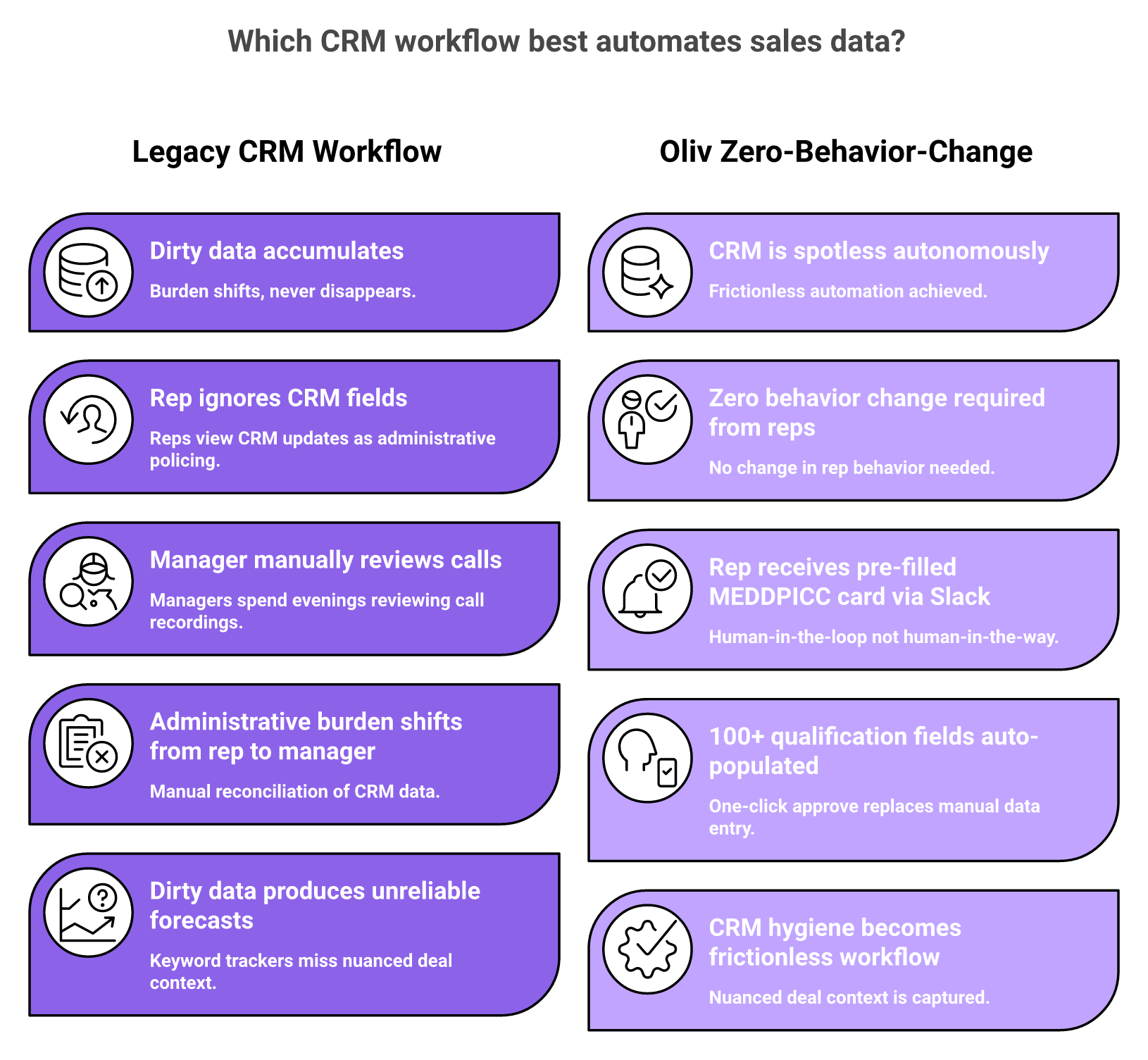
Every CRO knows the uncomfortable truth: reps view CRM updates as administrative policing. Data entry is not the act of selling, and no amount of management directives will make reps prioritize typing over talking to prospects. The result is a vicious cycle: dirty data flows into forecasting models, producing unreliable predictions that erode board-level credibility. The problem isn't rep laziness; it's that legacy tools were designed assuming humans would diligently feed them data.
Oliv eliminates the CRM compliance battle entirely: AI populates fields from conversations, and reps confirm with a single click.
❌ The Traditional Manager Burden
Without reliable CRM data, sales managers resort to the only remaining source of truth: call recordings. They spend evenings and weekends listening through hours of conversations to piece together the real status of deals. Gong surfaces transcripts but still requires managers to click through multiple screens, interpret keyword-based trackers, and manually reconcile what they hear with what's in the CRM. The administrative burden simply shifts from the rep to the manager; it never disappears.
"Many reps also resist using Gong because they feel micromanaged, leading to low adoption. While it works well for newer reps, the long-term engagement from experienced team members is lacking." Anonymous Reviewer Gong G2 Verified Review
✅ Oliv's Zero-Behavior-Change Architecture
Oliv's architecture eliminates this cycle entirely because it requires zero behavior change from reps. There is no software for reps to "adopt"; our agents observe the conversations that are already happening and autonomously extract intelligence from them. The CRM Manager Agent creates and enriches contacts, populates 100+ qualification fields (MEDDPICC, BANT, or your custom framework) based on conversation context, and writes deal updates directly into your CRM, all without the rep touching a single field.
⭐ Human-in-the-Loop, Not Human-in-the-Way
Instead of asking reps to "use software," Oliv's agents draft the work and nudge reps via Slack or email to "verify and approve" in seconds. A rep sees a pre-populated MEDDPICC card and taps "approve," and it's done. This human-in-the-loop model replaces "type everything manually" with "confirm with one click," transforming CRM hygiene from a compliance battle into a frictionless workflow.
"AI is not great yet, the product still feels like it's at its infancy and needs to be developed further." Annabelle H., Voluntary Director, Board of Directors Gong G2 Verified Review
"Clari is a tool for sales leaders, it adds no value to reps as far as I can see." Msoave, r/sales Reddit Thread
Q10: Can Oliv Scale from 30 Reps to 100+ Without Re-Implementation? [toc=Scaling Without Re-Implementation]
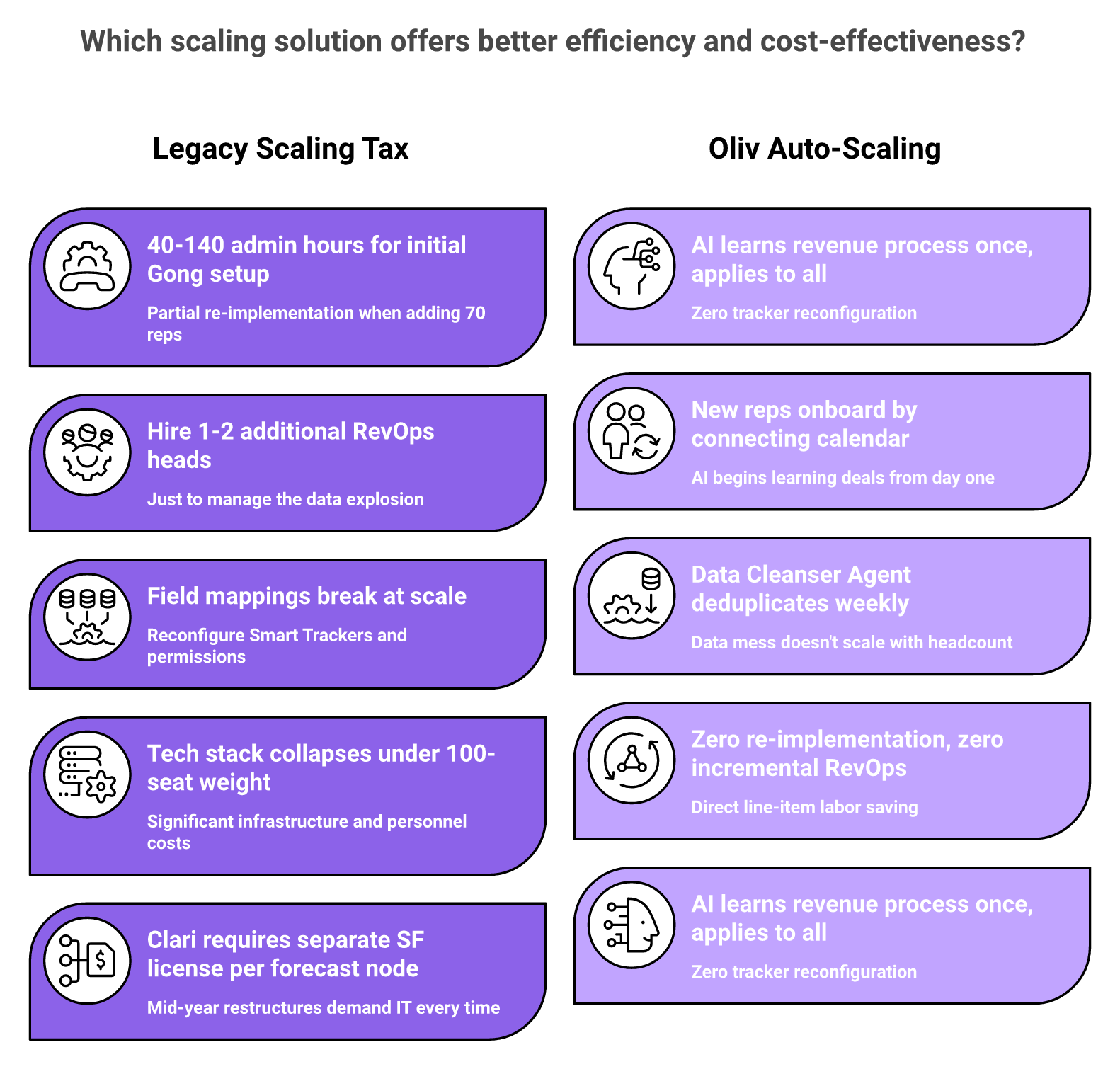
Scaling a revenue team from 30 to 100+ reps is one of the most operationally dangerous inflection points a CRO faces. With legacy SaaS platforms, adding 70 reps doesn't just mean 70 new licenses; it means re-modeling your revenue process, reconfiguring trackers and field mappings, and often hiring 1 to 2 additional RevOps heads just to manage the data explosion. The tech stack that worked at 30 seats frequently collapses under the weight of 100.
Scaling from 30 to 100+ reps with Oliv requires zero re-implementation, zero field remapping, and zero additional RevOps headcount.
❌ The Legacy Scaling Tax
Gong implementations for mid-market teams consume 40 to 140 admin hours for initial setup. Adding 70 reps triggers reconfiguration of Smart Trackers, permission hierarchies, and CRM field mappings, essentially a partial re-implementation. Clari's forecast hierarchy setup requires creating separate Salesforce user licenses for each node in your forecast tree, meaning mid-year team restructures (splitting Enterprise from SMB, adding a new vertical) demand IT involvement every time.
"I find the setup process challenging, especially when migrating fields from Salesforce, as it can't handle formula fields directly. This requires creating and maintaining duplicate fields, which adds complexity and workload." Josiah R., Head of Sales Operations Clari G2 Verified Review
✅ Oliv's Auto-Scaling Architecture
Because Oliv's intelligence is AI-native rather than rule-based, the platform learns your revenue process once and applies it automatically to every new user added. There is no tracker reconfiguration, no field remapping, and no hierarchy restructuring. New reps are onboarded by simply connecting their calendar; the AI begins learning their deals from day one.
⭐ A Fractional RevOps Team, Built In
Oliv acts as a "Fractional RevOps Team" that scales autonomously with your headcount:
Data Cleanser Agent: Deduplicates and normalizes records weekly as you grow, ensuring the "data mess" doesn't scale with headcount.
Coach Agent: Identifies skill gaps for new hires automatically and prescribes micro-coaching tasks, ensuring ramp-to-quota without manual manager inspection of every call.
"It can be overwhelming to set up trackers. AI training is a bit laborious to get it to do what you want." Trafford J., Senior Director, Revenue Enablement Gong G2 Verified Review
The net effect: scaling from 30 to 100 reps with Oliv means zero re-implementation and zero incremental RevOps headcount, a direct line-item labor saving the CFO can model.
Q11: How Do I Pitch Oliv to My CFO as a Replacement, Not an Add-On? [toc=CFO Pitch Framework]
The single most common objection CROs face when proposing new revenue technology is the CFO's mandate: "No new tools unless they replace existing spend." The strategic error most CROs make is positioning Oliv as another AI product. Instead, frame it as a Cost Consolidation Platform that collapses three or more line items into one, while delivering more functionality than the tools it replaces.
💸 The Stack Redundancy Problem
The traditional revenue tech stack creates expensive silos:
Replacing Gong, Clari, and Salesloft with Oliv AI consolidates three vendor invoices into one, cutting per-user costs by up to 91%
Clari for forecasting: $100 to $125/user/month + $10K+ annual minimum
Salesloft/Outreach for engagement: variable pricing, evergreen contracts
Stacked together, this routinely exceeds $500/user/month, and each tool requires its own admin overhead, training cycles, and data reconciliation. You're paying three vendors to create three separate data silos that your RevOps team must manually stitch together.
"The engage product is stagnant. Looks to have the same features, UX, integrations and issues as it had 5 years ago." Matthew T., Head of Revenue Operations Outreach G2 Verified Review
✅ The 3-Slide Board Framework
Present your CFO with a simple three-slide business case:
CFO Board Presentation Framework
Slide
Content
Key Data Point
Slide 1: Current State
Itemized legacy stack spend per user/month
$500+/user/month across 3 vendors
Slide 2: Oliv Replacement
Line-item consolidation into single platform
$80 to $120/user/month all-inclusive
Slide 3: 90-Day Impact
Forecast accuracy gain, manager time reclaimed, rep productivity
1 full manager day/week saved; 35% win-rate improvement projected
💰 Labor Savings That Close the Deal
Oliv's Forecaster Agent eliminates the "Monday Tradition" of manual forecast preparation, saving every sales manager roughly one full day per week. The CRM Manager Agent removes the RevOps burden of chasing reps for field updates. Combined: "Double the functionality at half the price."
"It is really just a glorified SFDC overlay. Actually, Salesforce has built most of the forecasting functionality by now anyway so I'm not sure where they fit into that whole overcrowded Martech space." conaldinho11, r/SalesOperations Reddit Thread
The terminology shift matters for your board deck: "Revenue Intelligence" is the previous decade. AI-Native Revenue Orchestration is where the market is heading.
Q12: What's the CRO's 90-Day Quick-Start Playbook for Oliv AI? [toc=90-Day Quick-Start Playbook]
Deploying Oliv doesn't require a multi-quarter implementation project. The following phased playbook maps to the "Step-by-Step ROI Snowball" strategy, enabling CROs to demonstrate measurable value within the first 90 days while building organizational momentum for full platform adoption.
Oliv's phased 90-day playbook delivers standalone ROI at each stage, from 5-minute calendar connection to autonomous board-ready forecasts.
⏰ Phase 1: Baseline Intelligence (Week 1)
Connect calendars (Google/Outlook), which takes 5 minutes. Oliv begins joining and recording all scheduled meetings immediately.
Connect CRM (Salesforce, HubSpot, or use Oliv standalone). Bi-directional sync activates within minutes.
Upload 3 past meeting recordings so Oliv's LLMs learn your specific sales methodology, terminology, and qualification framework.
Deploy the Meeting Assistant Agent. The team begins receiving AI-generated summaries, action items, and follow-up email drafts after every call from day one.
✅ Phase 2: First Agent ROI (Weeks 2 to 4)
Activate the CRM Manager Agent. Within the first week, this agent begins autonomously populating qualification fields (MEDDPICC/BANT) from conversation context. Measure the impact: hours saved per rep per week in manual CRM entry.
Run a data quality audit. Compare CRM completeness before and after agent activation; most teams see field completion rates jump from approximately 30% to 90%+ within two weeks.
Share early wins internally. Circulate a "before vs. after" snapshot to your CFO and VP of Sales to build the business case for Phase 3 expansion.
⭐ Phase 3: Full Platform Expansion (Weeks 5 to 12)
Deploy the Forecaster Agent. Replaces manual Thursday/Friday forecast roll-ups with autonomous, line-by-line deal inspection. Managers receive one-click board-ready forecast decks every Monday morning.
Activate the Deal Driver Agent. Provides daily at-risk deal alerts based on 360-degree signal analysis across calls, emails, Slack, and support tickets, not just keyword trackers.
Add the Coach Agent for new hire onboarding. The agent identifies skill gaps from call recordings and prescribes targeted micro-coaching tasks without requiring managers to review every conversation.
Measure and report. At the 90-day mark, compile ROI metrics: forecast accuracy improvement, manager hours reclaimed, rep productivity gains, and pipeline confidence scores.
"Since we purchased our package, the support model has changed drastically, which is infuriating." Elspeth C., Chief Commercial Officer Gong G2 Verified Review
Oliv's phased deployment model ensures you never pay for agents your team hasn't validated, and every phase delivers standalone ROI before you expand to the next.
Q1: Why Are CROs Rethinking Their Revenue Tech Stack in 2026? [toc=Rethinking Revenue Tech Stack]
The CRO mandate in 2026 is unambiguous: deliver forecast accuracy, pipeline predictability, and cost efficiency simultaneously. Boards no longer accept directional guidance; they expect data-driven revenue projections grounded in clean pipeline signals. Yet most CROs are building these projections on a tech stack architected a decade ago, during what industry analysts now call the Revenue Intelligence era (2015 to 2022), a generation of tools that assumed human beings would diligently adopt software, fill fields, and audit their own calls.
⚠️ The Legacy Stack Is Structurally Failing
That assumption has proven catastrophically wrong. Stacking Gong for conversation intelligence, Clari for forecasting, and Salesloft for engagement routinely exceeds $500 per user per month, yet managers still spend evenings manually reviewing calls because rep-submitted CRM data cannot be trusted. Gong's Smart Trackers rely on keyword matching rather than contextual reasoning, meaning they flag a competitor mention without distinguishing whether a prospect is actively evaluating that competitor or merely referencing them in passing. Clari's forecasting still depends on managers sitting with reps every Thursday and Friday to hear the "story" of each deal before manually inputting call numbers. And Salesforce Agentforce demands months of Data Cloud modeling before its agents produce anything meaningful.
"The additional products like forecast or engage come at an additional cost. Would be great to see these tools rolled into the core offering." Scott T., Director of Sales Gong G2 Verified Review
✅ The AI-Era Inflection Point
The tectonic shift now underway is the transition from Revenue Intelligence to what Oliv AI founder Ishan Chhabra calls AI-Native Revenue Orchestration, a model where fine-tuned LLMs contextually understand deal risk, autonomous agents perform CRM updates and forecast generation without human input, and processed intelligence is delivered in under 5 minutes rather than the 20 to 30 minute delays common with legacy platforms. In this paradigm, "SaaS is a dirty word" because it describes software humans must learn, adopt, and maintain.
Oliv AI embodies this shift as an AI-native data platform with 30+ specialized agents that perform the "Jobs to be Done" autonomously. The CRM Manager Agent populates qualification fields from conversation context. The Forecaster Agent inspects every deal line-by-line to produce unbiased weekly roll-ups. The Deal Driver Agent flags at-risk opportunities daily. None of these workflows require reps to change behavior or managers to audit dashboards; our agents deliver intelligence directly to inboxes and Slack channels where revenue leaders already work.
"Revenue orchestration is already old. The new space that is emerging is AI-Native Revenue Orchestration. And we are the leaders in that space." Ishan Chhabra, Founder and CEO, Oliv AI
Q2: How Do You Calculate the ROI of Replacing Gong with Oliv AI? [toc=ROI Calculation Framework]
Every CRO building a business case for new technology faces the same CFO objection: "No new tools unless they replace existing spend." The ROI conversation, therefore, cannot begin with features; it must begin with a formula the CFO can model. The master equation for board-level positioning is straightforward:
ROI = (Replaced Tool Spend + Revenue Uplift - Oliv Investment) / Oliv Investment x 100
💸 The True Cost of the Legacy Stack
For a 100-user team, legacy economics break down as follows:
Gong: Charges $120 to $160 per user per month plus a mandatory annual platform fee of $5,000 to $50,000. The 3-year TCO for 100 users typically reaches approximately $789,300 when bundling Engage and Forecast modules. Implementation alone consumes 40 to 140 admin hours.
Clari: Requires a $10,000+ annual minimum commitment, with modular Copilot (CI) add-ons driving per-user pricing further upward.
Salesforce: Achieving full "agentic" capability requires Sales Cloud ($200) + Agentforce ($125) + Revenue Intelligence ($220), often exceeding $500/user/month.
"It was a big mistake on our part to commit to a two year term. Gong is a really powerful tool but it's probably the highest end option on the market, and now we're stuck with a tool that works technically but isn't the right business decision." Iris P., Head of Marketing, Sales and Partnerships Gong G2 Verified Review
💰 Quantifying the AI-Era Savings
Autonomous CRM updates through Oliv's CRM Manager Agent save 2+ hours per rep per week, time previously wasted on manual field entry. The Forecaster Agent eliminates the "Monday Tradition" of manual roll-ups, saving every sales manager roughly one full day per week. And 5-minute post-call processing (versus 20 to 30 minute delays) means deal intervention happens the same day, not the next morning.
Running the Oliv-specific calculation: 100 users at an average of approximately $57/user/month over 36 months produces a 3-year TCO of approximately $68,400, a 91% cost reduction versus the legacy Gong stack. Factor in a projected 35% improvement in win rates and measurably shorter sales cycles, and the net benefit reaches an estimated $9.7M over three years.
"Clari should find ways to differentiate from the native Salesforce features (e.g. Pipeline Inspection, Forecasting) in order to remain competitive in the long-run." Dan J., Mid-Market Clari G2 Verified Review
Q3: How Does Oliv AI Compare to Gong, Clari, and Salesforce Agentforce? [toc=Competitive Comparison]
Fair evaluation starts with acknowledging what incumbents do well. Gong's conversational AI is genuinely powerful; reps and enablement teams praise its transcription accuracy and call review workflows. Clari's forecasting interface is clean enough that sales leaders often prefer it over native Salesforce reports for daily pipeline reviews. These are real strengths validated by hundreds of verified user reviews.
❌ Where Incumbents Break Down
However, structural weaknesses emerge at scale:
Gong: Imposes a $5K to $50K mandatory platform fee regardless of usage. Data portability is severely limited; users report being forced to download calls individually with no bulk export support, effectively creating vendor lock-in.
Clari: Users consistently flag the UI as "clunky" with limited dashboard configurability. The forecasting module, while functional, still relies on manual rep-driven inputs rather than autonomous deal inspection.
Agentforce: Designed primarily for B2C customer service workflows (order returns, case routing), requiring complex Data Cloud subscriptions and prompt engineering expertise to produce results in B2B sales contexts.
"It's too complicated, and not intuitive at all. Using it is very...discomforting. Searching for calls is not easy, moving around in the calls is not easy, and understanding the pipeline management portion of it is almost impossible." John S., Senior Account Executive Gong G2 Verified Review
✅ The Side-by-Side Comparison
Oliv AI vs Gong vs Clari vs Salesforce Agentforce
Dimension
Oliv AI
Gong
Clari
Salesforce Agentforce
💰 Price per user/mo
$19 to $120 (modular)
$120 to $160 + platform fee
$100 to $125+
$500+ (with add-ons)
⏰ Setup time
5 minutes
8 to 24 weeks
2 to 4 weeks
Months of Data Cloud modeling
Agent flexibility
Add/remove quarterly
Annual lock-in
Annual contract
Multi-product bundling required
Intelligence scope
Deal-level (calls + email + Slack)
Meeting-level only
Forecast-level (manual input)
Chat-focused, B2C-first
Data export
Full open export policy
Individual call download only
CRM-dependent
Salesforce ecosystem only
Oliv's structural differentiator is AI-based object association: instead of brittle rule-based logic that misattaches data to the wrong opportunity (a documented Gong and Salesforce weakness), Oliv's LLMs reason through transcripts and emails to map every interaction to the correct deal record, even when duplicate accounts exist.
"Can be complex to set up and customize. Expensive, especially for smaller teams. Steep learning curve for new users." Shubham G., Senior BDM Agentforce G2 Verified Review
Q4: Is There Volume Discounting at 100+ Seats, and What Does Pricing Really Look Like? [toc=Volume Pricing Breakdown]
Mid-market CROs scaling to 100+ seats face what can fairly be called the "Gong Tax," paying full per-seat licenses for an entire org even when the majority of reps use only the basic recording and transcription functionality. At 100 seats, Gong's first-year cost typically lands between $158,000 and $236,000 when bundling Engage and Forecast modules, with the mandatory platform fee applied on top regardless of actual utilization.
💸 The Competitor Pricing Trap
The problem compounds when you layer adjacent tools:
Clari requires a $10,000+ annual minimum just to access forecasting, with Copilot (CI) add-ons inflating per-user costs further.
"Overall it is a great product. Sadly Gong.io as a leader in its market is not too open to negotiate with smaller companies... The pricing is probably the biggest obstacle and hence we are looking to change." Miodrag, Enterprise Account Executive Gong G2 Verified Review
✅ Oliv's Modular, Persona-Based Pricing
Oliv uses a fundamentally different architecture, modular, persona-based pricing that rewards scale rather than penalizing it:
$0 baseline for teams transitioning from Gong; core recording and transcription are offered free to eliminate switching friction.
$19/user for core intelligence including AI summaries, next steps, and meeting prep.
Mid-market all-inclusive (100 to 250 seats): teams typically land at $80 to $120 per user/month inclusive of high-impact agents like the CRM Manager and Deal Driver.
⭐ No mandatory platform fee. No forced bundling. Full open data export policy; zero UI lock-in.
💰 The Volume Economics
For a 100-user team, Oliv's 3-year TCO comes to approximately $68,400 versus Gong's $789,300, a 91% cost reduction with double the functional coverage (CI + forecasting + engagement + coaching in a single platform).
"There's so much in Gong, that we don't use everything. Gong's deal forecasting we don't use." Karel Bos, Head of Sales Gong TrustRadius Verified Review
Q5: Can I Add or Remove Agents Quarter-to-Quarter, or Am I Locked In? [toc=Agent Flexibility and Lock-In]
Revenue teams are not static. Roles shift quarterly: SDRs get promoted to AEs, new verticals spin up pilot teams, and sales methodologies evolve from BANT to MEDDPICC as deal complexity increases. For a CRO managing this constant flux, the last thing you need is a tech stack that locks you into rigid annual contracts for features your team may not have adopted yet. Yet that is exactly what the legacy revenue intelligence market demands.
❌ The Lock-In Problem with Legacy Vendors
Gong typically requires annual or multi-year commitments with upfront payment. There is no flexibility to reduce seat counts mid-contract, and CROs who attempt to reduce seats at renewal often encounter a "seat reduction penalty" where the per-unit price reverts to full list rates, effectively punishing you for right-sizing. Salesloft enforces similar evergreen auto-renewal contracts, with users reporting that even missing the cancellation window by hours triggers a full-year renewal.
"I have been a Salesloft customer for 3 years, things started out well but they never updated features or technology in that entire period... I noticed an annual auto renewal hit my credit card and informed their billing and customer service immediately that I did not plan to renew and that I would like a refund. They refused completely and wouldn't compromise in any way." Craig P., Owner Salesloft G2 Verified Review
✅ Oliv's Agentic Marketplace Model
Oliv operates as an Agentic Marketplace, not a rigid SaaS application. CROs purchase only the agents that map to their specific use cases and can add new agents or team members on a prorated basis at any time, with no annual lock-in required. If Enterprise AEs need the Researcher Agent and Deal Driver while your SMB reps only require the Meeting Assistant, Oliv supports that granular, role-based allocation without forcing uniform licensing across the org.
⭐ The "Step-by-Step ROI Snowball"
This modularity enables what we call the ROI Snowball: start with a single agent, say, the CRM Manager, to solve the immediate problem of dirty data. Once that agent delivers quantifiable ROI (saving 2+ hours per rep per week in manual CRM entry), you expand to the Deal Driver or Forecaster with clear justification for each incremental investment. No upfront commitment to 30+ features your team hasn't validated.
"The additional products like forecast or engage come at an additional cost. Would be great to see these tools rolled into the core offering." Scott T., Director of Sales Gong G2 Verified Review
Q6: What's the Minimal Deployment Effort to Get Value from Oliv? [toc=Minimal Deployment Effort]
One of the most common objections CROs face when evaluating new revenue technology is implementation burden. Legacy platforms have conditioned the market to expect months-long deployments that consume significant IT and RevOps bandwidth. Oliv is architected to deliver value without that overhead.
⏰ 3-Step Deployment Process
Getting started with Oliv requires minimal effort and no dedicated IT department:
Connect calendars (5 minutes): Link your Google or Outlook calendars. Oliv immediately begins joining and recording all scheduled meetings, providing 100% data capture from day one.
Provide 3 past recordings (optional): Upload three prior meeting recordings so Oliv's fine-tuned LLMs learn your specific sales methodology, terminology, and qualification framework. This calibration step takes minutes and dramatically improves the relevance of AI-generated insights.
Activate your first agent: Deploy a single agent, such as the Meeting Assistant, to begin receiving AI-generated summaries, action items, and follow-up email drafts immediately after every call.
✅ Timeline to Value
Oliv Deployment Timeline
Milestone
Timeline
What Happens
Baseline configuration
5 minutes
Calendar + CRM connected, recording begins
First AI insights
Day 1
Meeting summaries, next steps, and prep notes delivered
Core deployment
1 to 2 days
Full value from initial agents realized
Custom model tuning
2 to 4 weeks
LLMs calibrated to your specific revenue process and methodology
By contrast, Gong implementations for mid-market teams typically consume 8 to 24 weeks and 40 to 140 admin hours just to define trackers and map CRM fields. Salesforce Agentforce requires a complex Data Cloud subscription and significant technical modeling before producing usable results.
"It can be overwhelming to set up trackers. AI training is a bit laborious to get it to do what you want." Trafford J., Senior Director, Revenue Enablement Gong G2 Verified Review
"It can be complex to set up and often requires skilled administrators or developers to customize and integrate properly, which adds time and cost." Verified User, Enterprise Agentforce G2 Verified Review
Oliv eliminates this implementation tax entirely. With no IT department required and value delivered on day one, CROs can run a live pilot without diverting engineering resources.
Q7: Does Oliv Work with HubSpot Free, or Can It Replace a CRM Entirely? [toc=HubSpot Free and CRM Replacement]
Startup and growth-stage CROs frequently face a catch-22: they need revenue intelligence to scale, but they haven't yet invested in enterprise CRM tiers like Salesforce Sales Cloud ($200+/user/month). Many operate on HubSpot's free CRM or lightweight alternatives, and most legacy revenue intelligence platforms simply don't support those environments.
✅ CRM-Agnostic by Design
Oliv was architected as a CRM-agnostic intelligence layer that operates independently of your CRM tier:
HubSpot Free supported: Oliv connects with HubSpot at every tier, including the free CRM, via bi-directional sync. Meeting summaries, deal insights, and contact enrichment flow into your HubSpot instance regardless of your subscription level.
Salesforce, Dynamics, Pipedrive, and Zoho: Deep multi-CRM connectivity ensures Oliv works with whichever system your team already uses, including support for custom objects and fields.
No CRM at all: Oliv's web application provides full meeting and deal insights independently. Startups that haven't purchased any CRM can use Oliv as their primary system of record.
⭐ Oliv as a Standalone CRM
Oliv was built to function as a full-fledged CRM in its own right, tracking contacts, accounts, and deal stages natively. As Oliv AI founder Ishan Chhabra has stated: "Yes. We actually are a CRM." This means startups can use Oliv as their primary revenue engine and only sync to a legacy CRM like Salesforce when they scale to the point where enterprise procurement rules demand it.
This standalone capability also solves the common frustration users experience when legacy tools fail to integrate cleanly:
"They don't have native Hubspot CRM integration and the current integration is via Hubspot, and Hubspot isn't trying to solve the sync issues with Outreach integration on their end and Outreach has no clue about it." Vamsi C., Revenue Operations Outreach G2 Verified Review
For CROs evaluating whether to commit to an enterprise CRM before deploying revenue intelligence, Oliv eliminates that dependency entirely. Start capturing intelligence today, and connect to your CRM of choice when you're ready.
Q8: How Does Oliv Handle Multi-Threaded Deals with Multiple Stakeholders? [toc=Multi-Threaded Deal Handling]
Complex B2B deals rarely hinge on a single conversation. A typical mid-market or enterprise opportunity involves 6 to 10 stakeholders across Sales, Legal, IT, Procurement, and executive sponsors. The truth of any deal is fragmented across recorded meetings, email side-threads, Slack channels, and phone conversations that never get logged. For CROs managing a portfolio of these multi-threaded deals, visibility into the full buying committee is the difference between accurate forecasting and costly surprises.
❌ Why Legacy Tools Miss the Full Picture
Gong and Salesforce Einstein Activity Capture rely on rule-based activity mapping to associate interactions with CRM records. The problem surfaces immediately in complex environments: if two opportunities are open for the same account (say, "Acme US" and "Acme India"), rule-based systems frequently attach call data or email activity to the wrong opportunity. This isn't an edge case; it's a documented structural limitation that corrupts deal-level reporting across the pipeline.
"I find the setup process challenging, especially when migrating fields from Salesforce, as it can't handle formula fields directly. This requires creating and maintaining duplicate fields, which adds complexity and workload." Josiah R., Head of Sales Operations Clari G2 Verified Review
✅ AI-Based Object Association
Oliv replaces brittle rules with LLM-powered reasoning. Instead of matching activities to records through rigid field logic, Oliv's AI reads transcripts, emails, and Slack messages contextually, identifying which stakeholder (champion vs. detractor) said what and mapping each interaction to the correct opportunity even when duplicate accounts or overlapping deals exist.
⭐ The Evolving Deal Summary
Where legacy tools produce static call logs, Oliv maintains a single evolving summary per deal that updates after every interaction across all channels: calls, emails, Slack, Telegram, and support tickets. This gives CROs a unified narrative of the entire buying committee's sentiment, concerns, and momentum without manually stitching data together. The Voice Agent further closes the gap by autonomously calling reps nightly to capture updates from unrecorded phone calls and in-person meetings, data that competitors simply cannot access.
"Before Gong we had a lack of visibility across our deals because information was siloed in several places like CRM, Email, Zoom, phone." Scott T., Director of Sales Gong G2 Verified Review
The result: Gong understands the call. Oliv understands the deal.
Q9: Does Oliv Work If My Reps Refuse to Change Behavior or Fill CRM Fields? [toc=Zero Behavior Change Adoption]
Every CRO knows the uncomfortable truth: reps view CRM updates as administrative policing. Data entry is not the act of selling, and no amount of management directives will make reps prioritize typing over talking to prospects. The result is a vicious cycle: dirty data flows into forecasting models, producing unreliable predictions that erode board-level credibility. The problem isn't rep laziness; it's that legacy tools were designed assuming humans would diligently feed them data.
Oliv eliminates the CRM compliance battle entirely: AI populates fields from conversations, and reps confirm with a single click.
❌ The Traditional Manager Burden
Without reliable CRM data, sales managers resort to the only remaining source of truth: call recordings. They spend evenings and weekends listening through hours of conversations to piece together the real status of deals. Gong surfaces transcripts but still requires managers to click through multiple screens, interpret keyword-based trackers, and manually reconcile what they hear with what's in the CRM. The administrative burden simply shifts from the rep to the manager; it never disappears.
"Many reps also resist using Gong because they feel micromanaged, leading to low adoption. While it works well for newer reps, the long-term engagement from experienced team members is lacking." Anonymous Reviewer Gong G2 Verified Review
✅ Oliv's Zero-Behavior-Change Architecture
Oliv's architecture eliminates this cycle entirely because it requires zero behavior change from reps. There is no software for reps to "adopt"; our agents observe the conversations that are already happening and autonomously extract intelligence from them. The CRM Manager Agent creates and enriches contacts, populates 100+ qualification fields (MEDDPICC, BANT, or your custom framework) based on conversation context, and writes deal updates directly into your CRM, all without the rep touching a single field.
⭐ Human-in-the-Loop, Not Human-in-the-Way
Instead of asking reps to "use software," Oliv's agents draft the work and nudge reps via Slack or email to "verify and approve" in seconds. A rep sees a pre-populated MEDDPICC card and taps "approve," and it's done. This human-in-the-loop model replaces "type everything manually" with "confirm with one click," transforming CRM hygiene from a compliance battle into a frictionless workflow.
"AI is not great yet, the product still feels like it's at its infancy and needs to be developed further." Annabelle H., Voluntary Director, Board of Directors Gong G2 Verified Review
"Clari is a tool for sales leaders, it adds no value to reps as far as I can see." Msoave, r/sales Reddit Thread
Q10: Can Oliv Scale from 30 Reps to 100+ Without Re-Implementation? [toc=Scaling Without Re-Implementation]
Scaling a revenue team from 30 to 100+ reps is one of the most operationally dangerous inflection points a CRO faces. With legacy SaaS platforms, adding 70 reps doesn't just mean 70 new licenses; it means re-modeling your revenue process, reconfiguring trackers and field mappings, and often hiring 1 to 2 additional RevOps heads just to manage the data explosion. The tech stack that worked at 30 seats frequently collapses under the weight of 100.
Scaling from 30 to 100+ reps with Oliv requires zero re-implementation, zero field remapping, and zero additional RevOps headcount.
❌ The Legacy Scaling Tax
Gong implementations for mid-market teams consume 40 to 140 admin hours for initial setup. Adding 70 reps triggers reconfiguration of Smart Trackers, permission hierarchies, and CRM field mappings, essentially a partial re-implementation. Clari's forecast hierarchy setup requires creating separate Salesforce user licenses for each node in your forecast tree, meaning mid-year team restructures (splitting Enterprise from SMB, adding a new vertical) demand IT involvement every time.
"I find the setup process challenging, especially when migrating fields from Salesforce, as it can't handle formula fields directly. This requires creating and maintaining duplicate fields, which adds complexity and workload." Josiah R., Head of Sales Operations Clari G2 Verified Review
✅ Oliv's Auto-Scaling Architecture
Because Oliv's intelligence is AI-native rather than rule-based, the platform learns your revenue process once and applies it automatically to every new user added. There is no tracker reconfiguration, no field remapping, and no hierarchy restructuring. New reps are onboarded by simply connecting their calendar; the AI begins learning their deals from day one.
⭐ A Fractional RevOps Team, Built In
Oliv acts as a "Fractional RevOps Team" that scales autonomously with your headcount:
Data Cleanser Agent: Deduplicates and normalizes records weekly as you grow, ensuring the "data mess" doesn't scale with headcount.
Coach Agent: Identifies skill gaps for new hires automatically and prescribes micro-coaching tasks, ensuring ramp-to-quota without manual manager inspection of every call.
"It can be overwhelming to set up trackers. AI training is a bit laborious to get it to do what you want." Trafford J., Senior Director, Revenue Enablement Gong G2 Verified Review
The net effect: scaling from 30 to 100 reps with Oliv means zero re-implementation and zero incremental RevOps headcount, a direct line-item labor saving the CFO can model.
Q11: How Do I Pitch Oliv to My CFO as a Replacement, Not an Add-On? [toc=CFO Pitch Framework]
The single most common objection CROs face when proposing new revenue technology is the CFO's mandate: "No new tools unless they replace existing spend." The strategic error most CROs make is positioning Oliv as another AI product. Instead, frame it as a Cost Consolidation Platform that collapses three or more line items into one, while delivering more functionality than the tools it replaces.
💸 The Stack Redundancy Problem
The traditional revenue tech stack creates expensive silos:
Replacing Gong, Clari, and Salesloft with Oliv AI consolidates three vendor invoices into one, cutting per-user costs by up to 91%
Clari for forecasting: $100 to $125/user/month + $10K+ annual minimum
Salesloft/Outreach for engagement: variable pricing, evergreen contracts
Stacked together, this routinely exceeds $500/user/month, and each tool requires its own admin overhead, training cycles, and data reconciliation. You're paying three vendors to create three separate data silos that your RevOps team must manually stitch together.
"The engage product is stagnant. Looks to have the same features, UX, integrations and issues as it had 5 years ago." Matthew T., Head of Revenue Operations Outreach G2 Verified Review
✅ The 3-Slide Board Framework
Present your CFO with a simple three-slide business case:
CFO Board Presentation Framework
Slide
Content
Key Data Point
Slide 1: Current State
Itemized legacy stack spend per user/month
$500+/user/month across 3 vendors
Slide 2: Oliv Replacement
Line-item consolidation into single platform
$80 to $120/user/month all-inclusive
Slide 3: 90-Day Impact
Forecast accuracy gain, manager time reclaimed, rep productivity
1 full manager day/week saved; 35% win-rate improvement projected
💰 Labor Savings That Close the Deal
Oliv's Forecaster Agent eliminates the "Monday Tradition" of manual forecast preparation, saving every sales manager roughly one full day per week. The CRM Manager Agent removes the RevOps burden of chasing reps for field updates. Combined: "Double the functionality at half the price."
"It is really just a glorified SFDC overlay. Actually, Salesforce has built most of the forecasting functionality by now anyway so I'm not sure where they fit into that whole overcrowded Martech space." conaldinho11, r/SalesOperations Reddit Thread
The terminology shift matters for your board deck: "Revenue Intelligence" is the previous decade. AI-Native Revenue Orchestration is where the market is heading.
Q12: What's the CRO's 90-Day Quick-Start Playbook for Oliv AI? [toc=90-Day Quick-Start Playbook]
Deploying Oliv doesn't require a multi-quarter implementation project. The following phased playbook maps to the "Step-by-Step ROI Snowball" strategy, enabling CROs to demonstrate measurable value within the first 90 days while building organizational momentum for full platform adoption.
Oliv's phased 90-day playbook delivers standalone ROI at each stage, from 5-minute calendar connection to autonomous board-ready forecasts.
⏰ Phase 1: Baseline Intelligence (Week 1)
Connect calendars (Google/Outlook), which takes 5 minutes. Oliv begins joining and recording all scheduled meetings immediately.
Connect CRM (Salesforce, HubSpot, or use Oliv standalone). Bi-directional sync activates within minutes.
Upload 3 past meeting recordings so Oliv's LLMs learn your specific sales methodology, terminology, and qualification framework.
Deploy the Meeting Assistant Agent. The team begins receiving AI-generated summaries, action items, and follow-up email drafts after every call from day one.
✅ Phase 2: First Agent ROI (Weeks 2 to 4)
Activate the CRM Manager Agent. Within the first week, this agent begins autonomously populating qualification fields (MEDDPICC/BANT) from conversation context. Measure the impact: hours saved per rep per week in manual CRM entry.
Run a data quality audit. Compare CRM completeness before and after agent activation; most teams see field completion rates jump from approximately 30% to 90%+ within two weeks.
Share early wins internally. Circulate a "before vs. after" snapshot to your CFO and VP of Sales to build the business case for Phase 3 expansion.
⭐ Phase 3: Full Platform Expansion (Weeks 5 to 12)
Deploy the Forecaster Agent. Replaces manual Thursday/Friday forecast roll-ups with autonomous, line-by-line deal inspection. Managers receive one-click board-ready forecast decks every Monday morning.
Activate the Deal Driver Agent. Provides daily at-risk deal alerts based on 360-degree signal analysis across calls, emails, Slack, and support tickets, not just keyword trackers.
Add the Coach Agent for new hire onboarding. The agent identifies skill gaps from call recordings and prescribes targeted micro-coaching tasks without requiring managers to review every conversation.
Measure and report. At the 90-day mark, compile ROI metrics: forecast accuracy improvement, manager hours reclaimed, rep productivity gains, and pipeline confidence scores.
"Since we purchased our package, the support model has changed drastically, which is infuriating." Elspeth C., Chief Commercial Officer Gong G2 Verified Review
Oliv's phased deployment model ensures you never pay for agents your team hasn't validated, and every phase delivers standalone ROI before you expand to the next.
Q1: Why Are CROs Rethinking Their Revenue Tech Stack in 2026? [toc=Rethinking Revenue Tech Stack]
The CRO mandate in 2026 is unambiguous: deliver forecast accuracy, pipeline predictability, and cost efficiency simultaneously. Boards no longer accept directional guidance; they expect data-driven revenue projections grounded in clean pipeline signals. Yet most CROs are building these projections on a tech stack architected a decade ago, during what industry analysts now call the Revenue Intelligence era (2015 to 2022), a generation of tools that assumed human beings would diligently adopt software, fill fields, and audit their own calls.
⚠️ The Legacy Stack Is Structurally Failing
That assumption has proven catastrophically wrong. Stacking Gong for conversation intelligence, Clari for forecasting, and Salesloft for engagement routinely exceeds $500 per user per month, yet managers still spend evenings manually reviewing calls because rep-submitted CRM data cannot be trusted. Gong's Smart Trackers rely on keyword matching rather than contextual reasoning, meaning they flag a competitor mention without distinguishing whether a prospect is actively evaluating that competitor or merely referencing them in passing. Clari's forecasting still depends on managers sitting with reps every Thursday and Friday to hear the "story" of each deal before manually inputting call numbers. And Salesforce Agentforce demands months of Data Cloud modeling before its agents produce anything meaningful.
"The additional products like forecast or engage come at an additional cost. Would be great to see these tools rolled into the core offering." Scott T., Director of Sales Gong G2 Verified Review
✅ The AI-Era Inflection Point
The tectonic shift now underway is the transition from Revenue Intelligence to what Oliv AI founder Ishan Chhabra calls AI-Native Revenue Orchestration, a model where fine-tuned LLMs contextually understand deal risk, autonomous agents perform CRM updates and forecast generation without human input, and processed intelligence is delivered in under 5 minutes rather than the 20 to 30 minute delays common with legacy platforms. In this paradigm, "SaaS is a dirty word" because it describes software humans must learn, adopt, and maintain.
Oliv AI embodies this shift as an AI-native data platform with 30+ specialized agents that perform the "Jobs to be Done" autonomously. The CRM Manager Agent populates qualification fields from conversation context. The Forecaster Agent inspects every deal line-by-line to produce unbiased weekly roll-ups. The Deal Driver Agent flags at-risk opportunities daily. None of these workflows require reps to change behavior or managers to audit dashboards; our agents deliver intelligence directly to inboxes and Slack channels where revenue leaders already work.
"Revenue orchestration is already old. The new space that is emerging is AI-Native Revenue Orchestration. And we are the leaders in that space." Ishan Chhabra, Founder and CEO, Oliv AI
Q2: How Do You Calculate the ROI of Replacing Gong with Oliv AI? [toc=ROI Calculation Framework]
Every CRO building a business case for new technology faces the same CFO objection: "No new tools unless they replace existing spend." The ROI conversation, therefore, cannot begin with features; it must begin with a formula the CFO can model. The master equation for board-level positioning is straightforward:
ROI = (Replaced Tool Spend + Revenue Uplift - Oliv Investment) / Oliv Investment x 100
💸 The True Cost of the Legacy Stack
For a 100-user team, legacy economics break down as follows:
Gong: Charges $120 to $160 per user per month plus a mandatory annual platform fee of $5,000 to $50,000. The 3-year TCO for 100 users typically reaches approximately $789,300 when bundling Engage and Forecast modules. Implementation alone consumes 40 to 140 admin hours.
Clari: Requires a $10,000+ annual minimum commitment, with modular Copilot (CI) add-ons driving per-user pricing further upward.
Salesforce: Achieving full "agentic" capability requires Sales Cloud ($200) + Agentforce ($125) + Revenue Intelligence ($220), often exceeding $500/user/month.
"It was a big mistake on our part to commit to a two year term. Gong is a really powerful tool but it's probably the highest end option on the market, and now we're stuck with a tool that works technically but isn't the right business decision." Iris P., Head of Marketing, Sales and Partnerships Gong G2 Verified Review
💰 Quantifying the AI-Era Savings
Autonomous CRM updates through Oliv's CRM Manager Agent save 2+ hours per rep per week, time previously wasted on manual field entry. The Forecaster Agent eliminates the "Monday Tradition" of manual roll-ups, saving every sales manager roughly one full day per week. And 5-minute post-call processing (versus 20 to 30 minute delays) means deal intervention happens the same day, not the next morning.
Running the Oliv-specific calculation: 100 users at an average of approximately $57/user/month over 36 months produces a 3-year TCO of approximately $68,400, a 91% cost reduction versus the legacy Gong stack. Factor in a projected 35% improvement in win rates and measurably shorter sales cycles, and the net benefit reaches an estimated $9.7M over three years.
"Clari should find ways to differentiate from the native Salesforce features (e.g. Pipeline Inspection, Forecasting) in order to remain competitive in the long-run." Dan J., Mid-Market Clari G2 Verified Review
Q3: How Does Oliv AI Compare to Gong, Clari, and Salesforce Agentforce? [toc=Competitive Comparison]
Fair evaluation starts with acknowledging what incumbents do well. Gong's conversational AI is genuinely powerful; reps and enablement teams praise its transcription accuracy and call review workflows. Clari's forecasting interface is clean enough that sales leaders often prefer it over native Salesforce reports for daily pipeline reviews. These are real strengths validated by hundreds of verified user reviews.
❌ Where Incumbents Break Down
However, structural weaknesses emerge at scale:
Gong: Imposes a $5K to $50K mandatory platform fee regardless of usage. Data portability is severely limited; users report being forced to download calls individually with no bulk export support, effectively creating vendor lock-in.
Clari: Users consistently flag the UI as "clunky" with limited dashboard configurability. The forecasting module, while functional, still relies on manual rep-driven inputs rather than autonomous deal inspection.
Agentforce: Designed primarily for B2C customer service workflows (order returns, case routing), requiring complex Data Cloud subscriptions and prompt engineering expertise to produce results in B2B sales contexts.
"It's too complicated, and not intuitive at all. Using it is very...discomforting. Searching for calls is not easy, moving around in the calls is not easy, and understanding the pipeline management portion of it is almost impossible." John S., Senior Account Executive Gong G2 Verified Review
✅ The Side-by-Side Comparison
Oliv AI vs Gong vs Clari vs Salesforce Agentforce
Dimension
Oliv AI
Gong
Clari
Salesforce Agentforce
💰 Price per user/mo
$19 to $120 (modular)
$120 to $160 + platform fee
$100 to $125+
$500+ (with add-ons)
⏰ Setup time
5 minutes
8 to 24 weeks
2 to 4 weeks
Months of Data Cloud modeling
Agent flexibility
Add/remove quarterly
Annual lock-in
Annual contract
Multi-product bundling required
Intelligence scope
Deal-level (calls + email + Slack)
Meeting-level only
Forecast-level (manual input)
Chat-focused, B2C-first
Data export
Full open export policy
Individual call download only
CRM-dependent
Salesforce ecosystem only
Oliv's structural differentiator is AI-based object association: instead of brittle rule-based logic that misattaches data to the wrong opportunity (a documented Gong and Salesforce weakness), Oliv's LLMs reason through transcripts and emails to map every interaction to the correct deal record, even when duplicate accounts exist.
"Can be complex to set up and customize. Expensive, especially for smaller teams. Steep learning curve for new users." Shubham G., Senior BDM Agentforce G2 Verified Review
Q4: Is There Volume Discounting at 100+ Seats, and What Does Pricing Really Look Like? [toc=Volume Pricing Breakdown]
Mid-market CROs scaling to 100+ seats face what can fairly be called the "Gong Tax," paying full per-seat licenses for an entire org even when the majority of reps use only the basic recording and transcription functionality. At 100 seats, Gong's first-year cost typically lands between $158,000 and $236,000 when bundling Engage and Forecast modules, with the mandatory platform fee applied on top regardless of actual utilization.
💸 The Competitor Pricing Trap
The problem compounds when you layer adjacent tools:
Clari requires a $10,000+ annual minimum just to access forecasting, with Copilot (CI) add-ons inflating per-user costs further.
"Overall it is a great product. Sadly Gong.io as a leader in its market is not too open to negotiate with smaller companies... The pricing is probably the biggest obstacle and hence we are looking to change." Miodrag, Enterprise Account Executive Gong G2 Verified Review
✅ Oliv's Modular, Persona-Based Pricing
Oliv uses a fundamentally different architecture, modular, persona-based pricing that rewards scale rather than penalizing it:
$0 baseline for teams transitioning from Gong; core recording and transcription are offered free to eliminate switching friction.
$19/user for core intelligence including AI summaries, next steps, and meeting prep.
Mid-market all-inclusive (100 to 250 seats): teams typically land at $80 to $120 per user/month inclusive of high-impact agents like the CRM Manager and Deal Driver.
⭐ No mandatory platform fee. No forced bundling. Full open data export policy; zero UI lock-in.
💰 The Volume Economics
For a 100-user team, Oliv's 3-year TCO comes to approximately $68,400 versus Gong's $789,300, a 91% cost reduction with double the functional coverage (CI + forecasting + engagement + coaching in a single platform).
"There's so much in Gong, that we don't use everything. Gong's deal forecasting we don't use." Karel Bos, Head of Sales Gong TrustRadius Verified Review
Q5: Can I Add or Remove Agents Quarter-to-Quarter, or Am I Locked In? [toc=Agent Flexibility and Lock-In]
Revenue teams are not static. Roles shift quarterly: SDRs get promoted to AEs, new verticals spin up pilot teams, and sales methodologies evolve from BANT to MEDDPICC as deal complexity increases. For a CRO managing this constant flux, the last thing you need is a tech stack that locks you into rigid annual contracts for features your team may not have adopted yet. Yet that is exactly what the legacy revenue intelligence market demands.
❌ The Lock-In Problem with Legacy Vendors
Gong typically requires annual or multi-year commitments with upfront payment. There is no flexibility to reduce seat counts mid-contract, and CROs who attempt to reduce seats at renewal often encounter a "seat reduction penalty" where the per-unit price reverts to full list rates, effectively punishing you for right-sizing. Salesloft enforces similar evergreen auto-renewal contracts, with users reporting that even missing the cancellation window by hours triggers a full-year renewal.
"I have been a Salesloft customer for 3 years, things started out well but they never updated features or technology in that entire period... I noticed an annual auto renewal hit my credit card and informed their billing and customer service immediately that I did not plan to renew and that I would like a refund. They refused completely and wouldn't compromise in any way." Craig P., Owner Salesloft G2 Verified Review
✅ Oliv's Agentic Marketplace Model
Oliv operates as an Agentic Marketplace, not a rigid SaaS application. CROs purchase only the agents that map to their specific use cases and can add new agents or team members on a prorated basis at any time, with no annual lock-in required. If Enterprise AEs need the Researcher Agent and Deal Driver while your SMB reps only require the Meeting Assistant, Oliv supports that granular, role-based allocation without forcing uniform licensing across the org.
⭐ The "Step-by-Step ROI Snowball"
This modularity enables what we call the ROI Snowball: start with a single agent, say, the CRM Manager, to solve the immediate problem of dirty data. Once that agent delivers quantifiable ROI (saving 2+ hours per rep per week in manual CRM entry), you expand to the Deal Driver or Forecaster with clear justification for each incremental investment. No upfront commitment to 30+ features your team hasn't validated.
"The additional products like forecast or engage come at an additional cost. Would be great to see these tools rolled into the core offering." Scott T., Director of Sales Gong G2 Verified Review
Q6: What's the Minimal Deployment Effort to Get Value from Oliv? [toc=Minimal Deployment Effort]
One of the most common objections CROs face when evaluating new revenue technology is implementation burden. Legacy platforms have conditioned the market to expect months-long deployments that consume significant IT and RevOps bandwidth. Oliv is architected to deliver value without that overhead.
⏰ 3-Step Deployment Process
Getting started with Oliv requires minimal effort and no dedicated IT department:
Connect calendars (5 minutes): Link your Google or Outlook calendars. Oliv immediately begins joining and recording all scheduled meetings, providing 100% data capture from day one.
Provide 3 past recordings (optional): Upload three prior meeting recordings so Oliv's fine-tuned LLMs learn your specific sales methodology, terminology, and qualification framework. This calibration step takes minutes and dramatically improves the relevance of AI-generated insights.
Activate your first agent: Deploy a single agent, such as the Meeting Assistant, to begin receiving AI-generated summaries, action items, and follow-up email drafts immediately after every call.
✅ Timeline to Value
Oliv Deployment Timeline
Milestone
Timeline
What Happens
Baseline configuration
5 minutes
Calendar + CRM connected, recording begins
First AI insights
Day 1
Meeting summaries, next steps, and prep notes delivered
Core deployment
1 to 2 days
Full value from initial agents realized
Custom model tuning
2 to 4 weeks
LLMs calibrated to your specific revenue process and methodology
By contrast, Gong implementations for mid-market teams typically consume 8 to 24 weeks and 40 to 140 admin hours just to define trackers and map CRM fields. Salesforce Agentforce requires a complex Data Cloud subscription and significant technical modeling before producing usable results.
"It can be overwhelming to set up trackers. AI training is a bit laborious to get it to do what you want." Trafford J., Senior Director, Revenue Enablement Gong G2 Verified Review
"It can be complex to set up and often requires skilled administrators or developers to customize and integrate properly, which adds time and cost." Verified User, Enterprise Agentforce G2 Verified Review
Oliv eliminates this implementation tax entirely. With no IT department required and value delivered on day one, CROs can run a live pilot without diverting engineering resources.
Q7: Does Oliv Work with HubSpot Free, or Can It Replace a CRM Entirely? [toc=HubSpot Free and CRM Replacement]
Startup and growth-stage CROs frequently face a catch-22: they need revenue intelligence to scale, but they haven't yet invested in enterprise CRM tiers like Salesforce Sales Cloud ($200+/user/month). Many operate on HubSpot's free CRM or lightweight alternatives, and most legacy revenue intelligence platforms simply don't support those environments.
✅ CRM-Agnostic by Design
Oliv was architected as a CRM-agnostic intelligence layer that operates independently of your CRM tier:
HubSpot Free supported: Oliv connects with HubSpot at every tier, including the free CRM, via bi-directional sync. Meeting summaries, deal insights, and contact enrichment flow into your HubSpot instance regardless of your subscription level.
Salesforce, Dynamics, Pipedrive, and Zoho: Deep multi-CRM connectivity ensures Oliv works with whichever system your team already uses, including support for custom objects and fields.
No CRM at all: Oliv's web application provides full meeting and deal insights independently. Startups that haven't purchased any CRM can use Oliv as their primary system of record.
⭐ Oliv as a Standalone CRM
Oliv was built to function as a full-fledged CRM in its own right, tracking contacts, accounts, and deal stages natively. As Oliv AI founder Ishan Chhabra has stated: "Yes. We actually are a CRM." This means startups can use Oliv as their primary revenue engine and only sync to a legacy CRM like Salesforce when they scale to the point where enterprise procurement rules demand it.
This standalone capability also solves the common frustration users experience when legacy tools fail to integrate cleanly:
"They don't have native Hubspot CRM integration and the current integration is via Hubspot, and Hubspot isn't trying to solve the sync issues with Outreach integration on their end and Outreach has no clue about it." Vamsi C., Revenue Operations Outreach G2 Verified Review
For CROs evaluating whether to commit to an enterprise CRM before deploying revenue intelligence, Oliv eliminates that dependency entirely. Start capturing intelligence today, and connect to your CRM of choice when you're ready.
Q8: How Does Oliv Handle Multi-Threaded Deals with Multiple Stakeholders? [toc=Multi-Threaded Deal Handling]
Complex B2B deals rarely hinge on a single conversation. A typical mid-market or enterprise opportunity involves 6 to 10 stakeholders across Sales, Legal, IT, Procurement, and executive sponsors. The truth of any deal is fragmented across recorded meetings, email side-threads, Slack channels, and phone conversations that never get logged. For CROs managing a portfolio of these multi-threaded deals, visibility into the full buying committee is the difference between accurate forecasting and costly surprises.
❌ Why Legacy Tools Miss the Full Picture
Gong and Salesforce Einstein Activity Capture rely on rule-based activity mapping to associate interactions with CRM records. The problem surfaces immediately in complex environments: if two opportunities are open for the same account (say, "Acme US" and "Acme India"), rule-based systems frequently attach call data or email activity to the wrong opportunity. This isn't an edge case; it's a documented structural limitation that corrupts deal-level reporting across the pipeline.
"I find the setup process challenging, especially when migrating fields from Salesforce, as it can't handle formula fields directly. This requires creating and maintaining duplicate fields, which adds complexity and workload." Josiah R., Head of Sales Operations Clari G2 Verified Review
✅ AI-Based Object Association
Oliv replaces brittle rules with LLM-powered reasoning. Instead of matching activities to records through rigid field logic, Oliv's AI reads transcripts, emails, and Slack messages contextually, identifying which stakeholder (champion vs. detractor) said what and mapping each interaction to the correct opportunity even when duplicate accounts or overlapping deals exist.
⭐ The Evolving Deal Summary
Where legacy tools produce static call logs, Oliv maintains a single evolving summary per deal that updates after every interaction across all channels: calls, emails, Slack, Telegram, and support tickets. This gives CROs a unified narrative of the entire buying committee's sentiment, concerns, and momentum without manually stitching data together. The Voice Agent further closes the gap by autonomously calling reps nightly to capture updates from unrecorded phone calls and in-person meetings, data that competitors simply cannot access.
"Before Gong we had a lack of visibility across our deals because information was siloed in several places like CRM, Email, Zoom, phone." Scott T., Director of Sales Gong G2 Verified Review
The result: Gong understands the call. Oliv understands the deal.
Q9: Does Oliv Work If My Reps Refuse to Change Behavior or Fill CRM Fields? [toc=Zero Behavior Change Adoption]
Every CRO knows the uncomfortable truth: reps view CRM updates as administrative policing. Data entry is not the act of selling, and no amount of management directives will make reps prioritize typing over talking to prospects. The result is a vicious cycle: dirty data flows into forecasting models, producing unreliable predictions that erode board-level credibility. The problem isn't rep laziness; it's that legacy tools were designed assuming humans would diligently feed them data.
Oliv eliminates the CRM compliance battle entirely: AI populates fields from conversations, and reps confirm with a single click.
❌ The Traditional Manager Burden
Without reliable CRM data, sales managers resort to the only remaining source of truth: call recordings. They spend evenings and weekends listening through hours of conversations to piece together the real status of deals. Gong surfaces transcripts but still requires managers to click through multiple screens, interpret keyword-based trackers, and manually reconcile what they hear with what's in the CRM. The administrative burden simply shifts from the rep to the manager; it never disappears.
"Many reps also resist using Gong because they feel micromanaged, leading to low adoption. While it works well for newer reps, the long-term engagement from experienced team members is lacking." Anonymous Reviewer Gong G2 Verified Review
✅ Oliv's Zero-Behavior-Change Architecture
Oliv's architecture eliminates this cycle entirely because it requires zero behavior change from reps. There is no software for reps to "adopt"; our agents observe the conversations that are already happening and autonomously extract intelligence from them. The CRM Manager Agent creates and enriches contacts, populates 100+ qualification fields (MEDDPICC, BANT, or your custom framework) based on conversation context, and writes deal updates directly into your CRM, all without the rep touching a single field.
⭐ Human-in-the-Loop, Not Human-in-the-Way
Instead of asking reps to "use software," Oliv's agents draft the work and nudge reps via Slack or email to "verify and approve" in seconds. A rep sees a pre-populated MEDDPICC card and taps "approve," and it's done. This human-in-the-loop model replaces "type everything manually" with "confirm with one click," transforming CRM hygiene from a compliance battle into a frictionless workflow.
"AI is not great yet, the product still feels like it's at its infancy and needs to be developed further." Annabelle H., Voluntary Director, Board of Directors Gong G2 Verified Review
"Clari is a tool for sales leaders, it adds no value to reps as far as I can see." Msoave, r/sales Reddit Thread
Q10: Can Oliv Scale from 30 Reps to 100+ Without Re-Implementation? [toc=Scaling Without Re-Implementation]
Scaling a revenue team from 30 to 100+ reps is one of the most operationally dangerous inflection points a CRO faces. With legacy SaaS platforms, adding 70 reps doesn't just mean 70 new licenses; it means re-modeling your revenue process, reconfiguring trackers and field mappings, and often hiring 1 to 2 additional RevOps heads just to manage the data explosion. The tech stack that worked at 30 seats frequently collapses under the weight of 100.
Scaling from 30 to 100+ reps with Oliv requires zero re-implementation, zero field remapping, and zero additional RevOps headcount.
❌ The Legacy Scaling Tax
Gong implementations for mid-market teams consume 40 to 140 admin hours for initial setup. Adding 70 reps triggers reconfiguration of Smart Trackers, permission hierarchies, and CRM field mappings, essentially a partial re-implementation. Clari's forecast hierarchy setup requires creating separate Salesforce user licenses for each node in your forecast tree, meaning mid-year team restructures (splitting Enterprise from SMB, adding a new vertical) demand IT involvement every time.
"I find the setup process challenging, especially when migrating fields from Salesforce, as it can't handle formula fields directly. This requires creating and maintaining duplicate fields, which adds complexity and workload." Josiah R., Head of Sales Operations Clari G2 Verified Review
✅ Oliv's Auto-Scaling Architecture
Because Oliv's intelligence is AI-native rather than rule-based, the platform learns your revenue process once and applies it automatically to every new user added. There is no tracker reconfiguration, no field remapping, and no hierarchy restructuring. New reps are onboarded by simply connecting their calendar; the AI begins learning their deals from day one.
⭐ A Fractional RevOps Team, Built In
Oliv acts as a "Fractional RevOps Team" that scales autonomously with your headcount:
Data Cleanser Agent: Deduplicates and normalizes records weekly as you grow, ensuring the "data mess" doesn't scale with headcount.
Coach Agent: Identifies skill gaps for new hires automatically and prescribes micro-coaching tasks, ensuring ramp-to-quota without manual manager inspection of every call.
"It can be overwhelming to set up trackers. AI training is a bit laborious to get it to do what you want." Trafford J., Senior Director, Revenue Enablement Gong G2 Verified Review
The net effect: scaling from 30 to 100 reps with Oliv means zero re-implementation and zero incremental RevOps headcount, a direct line-item labor saving the CFO can model.
Q11: How Do I Pitch Oliv to My CFO as a Replacement, Not an Add-On? [toc=CFO Pitch Framework]
The single most common objection CROs face when proposing new revenue technology is the CFO's mandate: "No new tools unless they replace existing spend." The strategic error most CROs make is positioning Oliv as another AI product. Instead, frame it as a Cost Consolidation Platform that collapses three or more line items into one, while delivering more functionality than the tools it replaces.
💸 The Stack Redundancy Problem
The traditional revenue tech stack creates expensive silos:
Replacing Gong, Clari, and Salesloft with Oliv AI consolidates three vendor invoices into one, cutting per-user costs by up to 91%
Clari for forecasting: $100 to $125/user/month + $10K+ annual minimum
Salesloft/Outreach for engagement: variable pricing, evergreen contracts
Stacked together, this routinely exceeds $500/user/month, and each tool requires its own admin overhead, training cycles, and data reconciliation. You're paying three vendors to create three separate data silos that your RevOps team must manually stitch together.
"The engage product is stagnant. Looks to have the same features, UX, integrations and issues as it had 5 years ago." Matthew T., Head of Revenue Operations Outreach G2 Verified Review
✅ The 3-Slide Board Framework
Present your CFO with a simple three-slide business case:
CFO Board Presentation Framework
Slide
Content
Key Data Point
Slide 1: Current State
Itemized legacy stack spend per user/month
$500+/user/month across 3 vendors
Slide 2: Oliv Replacement
Line-item consolidation into single platform
$80 to $120/user/month all-inclusive
Slide 3: 90-Day Impact
Forecast accuracy gain, manager time reclaimed, rep productivity
1 full manager day/week saved; 35% win-rate improvement projected
💰 Labor Savings That Close the Deal
Oliv's Forecaster Agent eliminates the "Monday Tradition" of manual forecast preparation, saving every sales manager roughly one full day per week. The CRM Manager Agent removes the RevOps burden of chasing reps for field updates. Combined: "Double the functionality at half the price."
"It is really just a glorified SFDC overlay. Actually, Salesforce has built most of the forecasting functionality by now anyway so I'm not sure where they fit into that whole overcrowded Martech space." conaldinho11, r/SalesOperations Reddit Thread
The terminology shift matters for your board deck: "Revenue Intelligence" is the previous decade. AI-Native Revenue Orchestration is where the market is heading.
Q12: What's the CRO's 90-Day Quick-Start Playbook for Oliv AI? [toc=90-Day Quick-Start Playbook]
Deploying Oliv doesn't require a multi-quarter implementation project. The following phased playbook maps to the "Step-by-Step ROI Snowball" strategy, enabling CROs to demonstrate measurable value within the first 90 days while building organizational momentum for full platform adoption.
Oliv's phased 90-day playbook delivers standalone ROI at each stage, from 5-minute calendar connection to autonomous board-ready forecasts.
⏰ Phase 1: Baseline Intelligence (Week 1)
Connect calendars (Google/Outlook), which takes 5 minutes. Oliv begins joining and recording all scheduled meetings immediately.
Connect CRM (Salesforce, HubSpot, or use Oliv standalone). Bi-directional sync activates within minutes.
Upload 3 past meeting recordings so Oliv's LLMs learn your specific sales methodology, terminology, and qualification framework.
Deploy the Meeting Assistant Agent. The team begins receiving AI-generated summaries, action items, and follow-up email drafts after every call from day one.
✅ Phase 2: First Agent ROI (Weeks 2 to 4)
Activate the CRM Manager Agent. Within the first week, this agent begins autonomously populating qualification fields (MEDDPICC/BANT) from conversation context. Measure the impact: hours saved per rep per week in manual CRM entry.
Run a data quality audit. Compare CRM completeness before and after agent activation; most teams see field completion rates jump from approximately 30% to 90%+ within two weeks.
Share early wins internally. Circulate a "before vs. after" snapshot to your CFO and VP of Sales to build the business case for Phase 3 expansion.
⭐ Phase 3: Full Platform Expansion (Weeks 5 to 12)
Deploy the Forecaster Agent. Replaces manual Thursday/Friday forecast roll-ups with autonomous, line-by-line deal inspection. Managers receive one-click board-ready forecast decks every Monday morning.
Activate the Deal Driver Agent. Provides daily at-risk deal alerts based on 360-degree signal analysis across calls, emails, Slack, and support tickets, not just keyword trackers.
Add the Coach Agent for new hire onboarding. The agent identifies skill gaps from call recordings and prescribes targeted micro-coaching tasks without requiring managers to review every conversation.
Measure and report. At the 90-day mark, compile ROI metrics: forecast accuracy improvement, manager hours reclaimed, rep productivity gains, and pipeline confidence scores.
"Since we purchased our package, the support model has changed drastically, which is infuriating." Elspeth C., Chief Commercial Officer Gong G2 Verified Review
Oliv's phased deployment model ensures you never pay for agents your team hasn't validated, and every phase delivers standalone ROI before you expand to the next.
Q1: Why Are CROs Rethinking Their Revenue Tech Stack in 2026? [toc=Rethinking Revenue Tech Stack]
The CRO mandate in 2026 is unambiguous: deliver forecast accuracy, pipeline predictability, and cost efficiency simultaneously. Boards no longer accept directional guidance; they expect data-driven revenue projections grounded in clean pipeline signals. Yet most CROs are building these projections on a tech stack architected a decade ago, during what industry analysts now call the Revenue Intelligence era (2015 to 2022), a generation of tools that assumed human beings would diligently adopt software, fill fields, and audit their own calls.
⚠️ The Legacy Stack Is Structurally Failing
That assumption has proven catastrophically wrong. Stacking Gong for conversation intelligence, Clari for forecasting, and Salesloft for engagement routinely exceeds $500 per user per month, yet managers still spend evenings manually reviewing calls because rep-submitted CRM data cannot be trusted. Gong's Smart Trackers rely on keyword matching rather than contextual reasoning, meaning they flag a competitor mention without distinguishing whether a prospect is actively evaluating that competitor or merely referencing them in passing. Clari's forecasting still depends on managers sitting with reps every Thursday and Friday to hear the "story" of each deal before manually inputting call numbers. And Salesforce Agentforce demands months of Data Cloud modeling before its agents produce anything meaningful.
"The additional products like forecast or engage come at an additional cost. Would be great to see these tools rolled into the core offering." Scott T., Director of Sales Gong G2 Verified Review
✅ The AI-Era Inflection Point
The tectonic shift now underway is the transition from Revenue Intelligence to what Oliv AI founder Ishan Chhabra calls AI-Native Revenue Orchestration, a model where fine-tuned LLMs contextually understand deal risk, autonomous agents perform CRM updates and forecast generation without human input, and processed intelligence is delivered in under 5 minutes rather than the 20 to 30 minute delays common with legacy platforms. In this paradigm, "SaaS is a dirty word" because it describes software humans must learn, adopt, and maintain.
Oliv AI embodies this shift as an AI-native data platform with 30+ specialized agents that perform the "Jobs to be Done" autonomously. The CRM Manager Agent populates qualification fields from conversation context. The Forecaster Agent inspects every deal line-by-line to produce unbiased weekly roll-ups. The Deal Driver Agent flags at-risk opportunities daily. None of these workflows require reps to change behavior or managers to audit dashboards; our agents deliver intelligence directly to inboxes and Slack channels where revenue leaders already work.
"Revenue orchestration is already old. The new space that is emerging is AI-Native Revenue Orchestration. And we are the leaders in that space." Ishan Chhabra, Founder and CEO, Oliv AI
Q2: How Do You Calculate the ROI of Replacing Gong with Oliv AI? [toc=ROI Calculation Framework]
Every CRO building a business case for new technology faces the same CFO objection: "No new tools unless they replace existing spend." The ROI conversation, therefore, cannot begin with features; it must begin with a formula the CFO can model. The master equation for board-level positioning is straightforward:
ROI = (Replaced Tool Spend + Revenue Uplift - Oliv Investment) / Oliv Investment x 100
💸 The True Cost of the Legacy Stack
For a 100-user team, legacy economics break down as follows:
Gong: Charges $120 to $160 per user per month plus a mandatory annual platform fee of $5,000 to $50,000. The 3-year TCO for 100 users typically reaches approximately $789,300 when bundling Engage and Forecast modules. Implementation alone consumes 40 to 140 admin hours.
Clari: Requires a $10,000+ annual minimum commitment, with modular Copilot (CI) add-ons driving per-user pricing further upward.
Salesforce: Achieving full "agentic" capability requires Sales Cloud ($200) + Agentforce ($125) + Revenue Intelligence ($220), often exceeding $500/user/month.
"It was a big mistake on our part to commit to a two year term. Gong is a really powerful tool but it's probably the highest end option on the market, and now we're stuck with a tool that works technically but isn't the right business decision." Iris P., Head of Marketing, Sales and Partnerships Gong G2 Verified Review
💰 Quantifying the AI-Era Savings
Autonomous CRM updates through Oliv's CRM Manager Agent save 2+ hours per rep per week, time previously wasted on manual field entry. The Forecaster Agent eliminates the "Monday Tradition" of manual roll-ups, saving every sales manager roughly one full day per week. And 5-minute post-call processing (versus 20 to 30 minute delays) means deal intervention happens the same day, not the next morning.
Running the Oliv-specific calculation: 100 users at an average of approximately $57/user/month over 36 months produces a 3-year TCO of approximately $68,400, a 91% cost reduction versus the legacy Gong stack. Factor in a projected 35% improvement in win rates and measurably shorter sales cycles, and the net benefit reaches an estimated $9.7M over three years.
"Clari should find ways to differentiate from the native Salesforce features (e.g. Pipeline Inspection, Forecasting) in order to remain competitive in the long-run." Dan J., Mid-Market Clari G2 Verified Review
Q3: How Does Oliv AI Compare to Gong, Clari, and Salesforce Agentforce? [toc=Competitive Comparison]
Fair evaluation starts with acknowledging what incumbents do well. Gong's conversational AI is genuinely powerful; reps and enablement teams praise its transcription accuracy and call review workflows. Clari's forecasting interface is clean enough that sales leaders often prefer it over native Salesforce reports for daily pipeline reviews. These are real strengths validated by hundreds of verified user reviews.
❌ Where Incumbents Break Down
However, structural weaknesses emerge at scale:
Gong: Imposes a $5K to $50K mandatory platform fee regardless of usage. Data portability is severely limited; users report being forced to download calls individually with no bulk export support, effectively creating vendor lock-in.
Clari: Users consistently flag the UI as "clunky" with limited dashboard configurability. The forecasting module, while functional, still relies on manual rep-driven inputs rather than autonomous deal inspection.
Agentforce: Designed primarily for B2C customer service workflows (order returns, case routing), requiring complex Data Cloud subscriptions and prompt engineering expertise to produce results in B2B sales contexts.
"It's too complicated, and not intuitive at all. Using it is very...discomforting. Searching for calls is not easy, moving around in the calls is not easy, and understanding the pipeline management portion of it is almost impossible." John S., Senior Account Executive Gong G2 Verified Review
✅ The Side-by-Side Comparison
Oliv AI vs Gong vs Clari vs Salesforce Agentforce
Dimension
Oliv AI
Gong
Clari
Salesforce Agentforce
💰 Price per user/mo
$19 to $120 (modular)
$120 to $160 + platform fee
$100 to $125+
$500+ (with add-ons)
⏰ Setup time
5 minutes
8 to 24 weeks
2 to 4 weeks
Months of Data Cloud modeling
Agent flexibility
Add/remove quarterly
Annual lock-in
Annual contract
Multi-product bundling required
Intelligence scope
Deal-level (calls + email + Slack)
Meeting-level only
Forecast-level (manual input)
Chat-focused, B2C-first
Data export
Full open export policy
Individual call download only
CRM-dependent
Salesforce ecosystem only
Oliv's structural differentiator is AI-based object association: instead of brittle rule-based logic that misattaches data to the wrong opportunity (a documented Gong and Salesforce weakness), Oliv's LLMs reason through transcripts and emails to map every interaction to the correct deal record, even when duplicate accounts exist.
"Can be complex to set up and customize. Expensive, especially for smaller teams. Steep learning curve for new users." Shubham G., Senior BDM Agentforce G2 Verified Review
Q4: Is There Volume Discounting at 100+ Seats, and What Does Pricing Really Look Like? [toc=Volume Pricing Breakdown]
Mid-market CROs scaling to 100+ seats face what can fairly be called the "Gong Tax," paying full per-seat licenses for an entire org even when the majority of reps use only the basic recording and transcription functionality. At 100 seats, Gong's first-year cost typically lands between $158,000 and $236,000 when bundling Engage and Forecast modules, with the mandatory platform fee applied on top regardless of actual utilization.
💸 The Competitor Pricing Trap
The problem compounds when you layer adjacent tools:
Clari requires a $10,000+ annual minimum just to access forecasting, with Copilot (CI) add-ons inflating per-user costs further.
"Overall it is a great product. Sadly Gong.io as a leader in its market is not too open to negotiate with smaller companies... The pricing is probably the biggest obstacle and hence we are looking to change." Miodrag, Enterprise Account Executive Gong G2 Verified Review
✅ Oliv's Modular, Persona-Based Pricing
Oliv uses a fundamentally different architecture, modular, persona-based pricing that rewards scale rather than penalizing it:
$0 baseline for teams transitioning from Gong; core recording and transcription are offered free to eliminate switching friction.
$19/user for core intelligence including AI summaries, next steps, and meeting prep.
Mid-market all-inclusive (100 to 250 seats): teams typically land at $80 to $120 per user/month inclusive of high-impact agents like the CRM Manager and Deal Driver.
⭐ No mandatory platform fee. No forced bundling. Full open data export policy; zero UI lock-in.
💰 The Volume Economics
For a 100-user team, Oliv's 3-year TCO comes to approximately $68,400 versus Gong's $789,300, a 91% cost reduction with double the functional coverage (CI + forecasting + engagement + coaching in a single platform).
"There's so much in Gong, that we don't use everything. Gong's deal forecasting we don't use." Karel Bos, Head of Sales Gong TrustRadius Verified Review
Q5: Can I Add or Remove Agents Quarter-to-Quarter, or Am I Locked In? [toc=Agent Flexibility and Lock-In]
Revenue teams are not static. Roles shift quarterly: SDRs get promoted to AEs, new verticals spin up pilot teams, and sales methodologies evolve from BANT to MEDDPICC as deal complexity increases. For a CRO managing this constant flux, the last thing you need is a tech stack that locks you into rigid annual contracts for features your team may not have adopted yet. Yet that is exactly what the legacy revenue intelligence market demands.
❌ The Lock-In Problem with Legacy Vendors
Gong typically requires annual or multi-year commitments with upfront payment. There is no flexibility to reduce seat counts mid-contract, and CROs who attempt to reduce seats at renewal often encounter a "seat reduction penalty" where the per-unit price reverts to full list rates, effectively punishing you for right-sizing. Salesloft enforces similar evergreen auto-renewal contracts, with users reporting that even missing the cancellation window by hours triggers a full-year renewal.
"I have been a Salesloft customer for 3 years, things started out well but they never updated features or technology in that entire period... I noticed an annual auto renewal hit my credit card and informed their billing and customer service immediately that I did not plan to renew and that I would like a refund. They refused completely and wouldn't compromise in any way." Craig P., Owner Salesloft G2 Verified Review
✅ Oliv's Agentic Marketplace Model
Oliv operates as an Agentic Marketplace, not a rigid SaaS application. CROs purchase only the agents that map to their specific use cases and can add new agents or team members on a prorated basis at any time, with no annual lock-in required. If Enterprise AEs need the Researcher Agent and Deal Driver while your SMB reps only require the Meeting Assistant, Oliv supports that granular, role-based allocation without forcing uniform licensing across the org.
⭐ The "Step-by-Step ROI Snowball"
This modularity enables what we call the ROI Snowball: start with a single agent, say, the CRM Manager, to solve the immediate problem of dirty data. Once that agent delivers quantifiable ROI (saving 2+ hours per rep per week in manual CRM entry), you expand to the Deal Driver or Forecaster with clear justification for each incremental investment. No upfront commitment to 30+ features your team hasn't validated.
"The additional products like forecast or engage come at an additional cost. Would be great to see these tools rolled into the core offering." Scott T., Director of Sales Gong G2 Verified Review
Q6: What's the Minimal Deployment Effort to Get Value from Oliv? [toc=Minimal Deployment Effort]
One of the most common objections CROs face when evaluating new revenue technology is implementation burden. Legacy platforms have conditioned the market to expect months-long deployments that consume significant IT and RevOps bandwidth. Oliv is architected to deliver value without that overhead.
⏰ 3-Step Deployment Process
Getting started with Oliv requires minimal effort and no dedicated IT department:
Connect calendars (5 minutes): Link your Google or Outlook calendars. Oliv immediately begins joining and recording all scheduled meetings, providing 100% data capture from day one.
Provide 3 past recordings (optional): Upload three prior meeting recordings so Oliv's fine-tuned LLMs learn your specific sales methodology, terminology, and qualification framework. This calibration step takes minutes and dramatically improves the relevance of AI-generated insights.
Activate your first agent: Deploy a single agent, such as the Meeting Assistant, to begin receiving AI-generated summaries, action items, and follow-up email drafts immediately after every call.
✅ Timeline to Value
Oliv Deployment Timeline
Milestone
Timeline
What Happens
Baseline configuration
5 minutes
Calendar + CRM connected, recording begins
First AI insights
Day 1
Meeting summaries, next steps, and prep notes delivered
Core deployment
1 to 2 days
Full value from initial agents realized
Custom model tuning
2 to 4 weeks
LLMs calibrated to your specific revenue process and methodology
By contrast, Gong implementations for mid-market teams typically consume 8 to 24 weeks and 40 to 140 admin hours just to define trackers and map CRM fields. Salesforce Agentforce requires a complex Data Cloud subscription and significant technical modeling before producing usable results.
"It can be overwhelming to set up trackers. AI training is a bit laborious to get it to do what you want." Trafford J., Senior Director, Revenue Enablement Gong G2 Verified Review
"It can be complex to set up and often requires skilled administrators or developers to customize and integrate properly, which adds time and cost." Verified User, Enterprise Agentforce G2 Verified Review
Oliv eliminates this implementation tax entirely. With no IT department required and value delivered on day one, CROs can run a live pilot without diverting engineering resources.
Q7: Does Oliv Work with HubSpot Free, or Can It Replace a CRM Entirely? [toc=HubSpot Free and CRM Replacement]
Startup and growth-stage CROs frequently face a catch-22: they need revenue intelligence to scale, but they haven't yet invested in enterprise CRM tiers like Salesforce Sales Cloud ($200+/user/month). Many operate on HubSpot's free CRM or lightweight alternatives, and most legacy revenue intelligence platforms simply don't support those environments.
✅ CRM-Agnostic by Design
Oliv was architected as a CRM-agnostic intelligence layer that operates independently of your CRM tier:
HubSpot Free supported: Oliv connects with HubSpot at every tier, including the free CRM, via bi-directional sync. Meeting summaries, deal insights, and contact enrichment flow into your HubSpot instance regardless of your subscription level.
Salesforce, Dynamics, Pipedrive, and Zoho: Deep multi-CRM connectivity ensures Oliv works with whichever system your team already uses, including support for custom objects and fields.
No CRM at all: Oliv's web application provides full meeting and deal insights independently. Startups that haven't purchased any CRM can use Oliv as their primary system of record.
⭐ Oliv as a Standalone CRM
Oliv was built to function as a full-fledged CRM in its own right, tracking contacts, accounts, and deal stages natively. As Oliv AI founder Ishan Chhabra has stated: "Yes. We actually are a CRM." This means startups can use Oliv as their primary revenue engine and only sync to a legacy CRM like Salesforce when they scale to the point where enterprise procurement rules demand it.
This standalone capability also solves the common frustration users experience when legacy tools fail to integrate cleanly:
"They don't have native Hubspot CRM integration and the current integration is via Hubspot, and Hubspot isn't trying to solve the sync issues with Outreach integration on their end and Outreach has no clue about it." Vamsi C., Revenue Operations Outreach G2 Verified Review
For CROs evaluating whether to commit to an enterprise CRM before deploying revenue intelligence, Oliv eliminates that dependency entirely. Start capturing intelligence today, and connect to your CRM of choice when you're ready.
Q8: How Does Oliv Handle Multi-Threaded Deals with Multiple Stakeholders? [toc=Multi-Threaded Deal Handling]
Complex B2B deals rarely hinge on a single conversation. A typical mid-market or enterprise opportunity involves 6 to 10 stakeholders across Sales, Legal, IT, Procurement, and executive sponsors. The truth of any deal is fragmented across recorded meetings, email side-threads, Slack channels, and phone conversations that never get logged. For CROs managing a portfolio of these multi-threaded deals, visibility into the full buying committee is the difference between accurate forecasting and costly surprises.
❌ Why Legacy Tools Miss the Full Picture
Gong and Salesforce Einstein Activity Capture rely on rule-based activity mapping to associate interactions with CRM records. The problem surfaces immediately in complex environments: if two opportunities are open for the same account (say, "Acme US" and "Acme India"), rule-based systems frequently attach call data or email activity to the wrong opportunity. This isn't an edge case; it's a documented structural limitation that corrupts deal-level reporting across the pipeline.
"I find the setup process challenging, especially when migrating fields from Salesforce, as it can't handle formula fields directly. This requires creating and maintaining duplicate fields, which adds complexity and workload." Josiah R., Head of Sales Operations Clari G2 Verified Review
✅ AI-Based Object Association
Oliv replaces brittle rules with LLM-powered reasoning. Instead of matching activities to records through rigid field logic, Oliv's AI reads transcripts, emails, and Slack messages contextually, identifying which stakeholder (champion vs. detractor) said what and mapping each interaction to the correct opportunity even when duplicate accounts or overlapping deals exist.
⭐ The Evolving Deal Summary
Where legacy tools produce static call logs, Oliv maintains a single evolving summary per deal that updates after every interaction across all channels: calls, emails, Slack, Telegram, and support tickets. This gives CROs a unified narrative of the entire buying committee's sentiment, concerns, and momentum without manually stitching data together. The Voice Agent further closes the gap by autonomously calling reps nightly to capture updates from unrecorded phone calls and in-person meetings, data that competitors simply cannot access.
"Before Gong we had a lack of visibility across our deals because information was siloed in several places like CRM, Email, Zoom, phone." Scott T., Director of Sales Gong G2 Verified Review
The result: Gong understands the call. Oliv understands the deal.
Q9: Does Oliv Work If My Reps Refuse to Change Behavior or Fill CRM Fields? [toc=Zero Behavior Change Adoption]
Every CRO knows the uncomfortable truth: reps view CRM updates as administrative policing. Data entry is not the act of selling, and no amount of management directives will make reps prioritize typing over talking to prospects. The result is a vicious cycle: dirty data flows into forecasting models, producing unreliable predictions that erode board-level credibility. The problem isn't rep laziness; it's that legacy tools were designed assuming humans would diligently feed them data.
Oliv eliminates the CRM compliance battle entirely: AI populates fields from conversations, and reps confirm with a single click.
❌ The Traditional Manager Burden
Without reliable CRM data, sales managers resort to the only remaining source of truth: call recordings. They spend evenings and weekends listening through hours of conversations to piece together the real status of deals. Gong surfaces transcripts but still requires managers to click through multiple screens, interpret keyword-based trackers, and manually reconcile what they hear with what's in the CRM. The administrative burden simply shifts from the rep to the manager; it never disappears.
"Many reps also resist using Gong because they feel micromanaged, leading to low adoption. While it works well for newer reps, the long-term engagement from experienced team members is lacking." Anonymous Reviewer Gong G2 Verified Review
✅ Oliv's Zero-Behavior-Change Architecture
Oliv's architecture eliminates this cycle entirely because it requires zero behavior change from reps. There is no software for reps to "adopt"; our agents observe the conversations that are already happening and autonomously extract intelligence from them. The CRM Manager Agent creates and enriches contacts, populates 100+ qualification fields (MEDDPICC, BANT, or your custom framework) based on conversation context, and writes deal updates directly into your CRM, all without the rep touching a single field.
⭐ Human-in-the-Loop, Not Human-in-the-Way
Instead of asking reps to "use software," Oliv's agents draft the work and nudge reps via Slack or email to "verify and approve" in seconds. A rep sees a pre-populated MEDDPICC card and taps "approve," and it's done. This human-in-the-loop model replaces "type everything manually" with "confirm with one click," transforming CRM hygiene from a compliance battle into a frictionless workflow.
"AI is not great yet, the product still feels like it's at its infancy and needs to be developed further." Annabelle H., Voluntary Director, Board of Directors Gong G2 Verified Review
"Clari is a tool for sales leaders, it adds no value to reps as far as I can see." Msoave, r/sales Reddit Thread
Q10: Can Oliv Scale from 30 Reps to 100+ Without Re-Implementation? [toc=Scaling Without Re-Implementation]
Scaling a revenue team from 30 to 100+ reps is one of the most operationally dangerous inflection points a CRO faces. With legacy SaaS platforms, adding 70 reps doesn't just mean 70 new licenses; it means re-modeling your revenue process, reconfiguring trackers and field mappings, and often hiring 1 to 2 additional RevOps heads just to manage the data explosion. The tech stack that worked at 30 seats frequently collapses under the weight of 100.
Scaling from 30 to 100+ reps with Oliv requires zero re-implementation, zero field remapping, and zero additional RevOps headcount.
❌ The Legacy Scaling Tax
Gong implementations for mid-market teams consume 40 to 140 admin hours for initial setup. Adding 70 reps triggers reconfiguration of Smart Trackers, permission hierarchies, and CRM field mappings, essentially a partial re-implementation. Clari's forecast hierarchy setup requires creating separate Salesforce user licenses for each node in your forecast tree, meaning mid-year team restructures (splitting Enterprise from SMB, adding a new vertical) demand IT involvement every time.
"I find the setup process challenging, especially when migrating fields from Salesforce, as it can't handle formula fields directly. This requires creating and maintaining duplicate fields, which adds complexity and workload." Josiah R., Head of Sales Operations Clari G2 Verified Review
✅ Oliv's Auto-Scaling Architecture
Because Oliv's intelligence is AI-native rather than rule-based, the platform learns your revenue process once and applies it automatically to every new user added. There is no tracker reconfiguration, no field remapping, and no hierarchy restructuring. New reps are onboarded by simply connecting their calendar; the AI begins learning their deals from day one.
⭐ A Fractional RevOps Team, Built In
Oliv acts as a "Fractional RevOps Team" that scales autonomously with your headcount:
Data Cleanser Agent: Deduplicates and normalizes records weekly as you grow, ensuring the "data mess" doesn't scale with headcount.
Coach Agent: Identifies skill gaps for new hires automatically and prescribes micro-coaching tasks, ensuring ramp-to-quota without manual manager inspection of every call.
"It can be overwhelming to set up trackers. AI training is a bit laborious to get it to do what you want." Trafford J., Senior Director, Revenue Enablement Gong G2 Verified Review
The net effect: scaling from 30 to 100 reps with Oliv means zero re-implementation and zero incremental RevOps headcount, a direct line-item labor saving the CFO can model.
Q11: How Do I Pitch Oliv to My CFO as a Replacement, Not an Add-On? [toc=CFO Pitch Framework]
The single most common objection CROs face when proposing new revenue technology is the CFO's mandate: "No new tools unless they replace existing spend." The strategic error most CROs make is positioning Oliv as another AI product. Instead, frame it as a Cost Consolidation Platform that collapses three or more line items into one, while delivering more functionality than the tools it replaces.
💸 The Stack Redundancy Problem
The traditional revenue tech stack creates expensive silos:
Replacing Gong, Clari, and Salesloft with Oliv AI consolidates three vendor invoices into one, cutting per-user costs by up to 91%
Clari for forecasting: $100 to $125/user/month + $10K+ annual minimum
Salesloft/Outreach for engagement: variable pricing, evergreen contracts
Stacked together, this routinely exceeds $500/user/month, and each tool requires its own admin overhead, training cycles, and data reconciliation. You're paying three vendors to create three separate data silos that your RevOps team must manually stitch together.
"The engage product is stagnant. Looks to have the same features, UX, integrations and issues as it had 5 years ago." Matthew T., Head of Revenue Operations Outreach G2 Verified Review
✅ The 3-Slide Board Framework
Present your CFO with a simple three-slide business case:
CFO Board Presentation Framework
Slide
Content
Key Data Point
Slide 1: Current State
Itemized legacy stack spend per user/month
$500+/user/month across 3 vendors
Slide 2: Oliv Replacement
Line-item consolidation into single platform
$80 to $120/user/month all-inclusive
Slide 3: 90-Day Impact
Forecast accuracy gain, manager time reclaimed, rep productivity
1 full manager day/week saved; 35% win-rate improvement projected
💰 Labor Savings That Close the Deal
Oliv's Forecaster Agent eliminates the "Monday Tradition" of manual forecast preparation, saving every sales manager roughly one full day per week. The CRM Manager Agent removes the RevOps burden of chasing reps for field updates. Combined: "Double the functionality at half the price."
"It is really just a glorified SFDC overlay. Actually, Salesforce has built most of the forecasting functionality by now anyway so I'm not sure where they fit into that whole overcrowded Martech space." conaldinho11, r/SalesOperations Reddit Thread
The terminology shift matters for your board deck: "Revenue Intelligence" is the previous decade. AI-Native Revenue Orchestration is where the market is heading.
Q12: What's the CRO's 90-Day Quick-Start Playbook for Oliv AI? [toc=90-Day Quick-Start Playbook]
Deploying Oliv doesn't require a multi-quarter implementation project. The following phased playbook maps to the "Step-by-Step ROI Snowball" strategy, enabling CROs to demonstrate measurable value within the first 90 days while building organizational momentum for full platform adoption.
Oliv's phased 90-day playbook delivers standalone ROI at each stage, from 5-minute calendar connection to autonomous board-ready forecasts.
⏰ Phase 1: Baseline Intelligence (Week 1)
Connect calendars (Google/Outlook), which takes 5 minutes. Oliv begins joining and recording all scheduled meetings immediately.
Connect CRM (Salesforce, HubSpot, or use Oliv standalone). Bi-directional sync activates within minutes.
Upload 3 past meeting recordings so Oliv's LLMs learn your specific sales methodology, terminology, and qualification framework.
Deploy the Meeting Assistant Agent. The team begins receiving AI-generated summaries, action items, and follow-up email drafts after every call from day one.
✅ Phase 2: First Agent ROI (Weeks 2 to 4)
Activate the CRM Manager Agent. Within the first week, this agent begins autonomously populating qualification fields (MEDDPICC/BANT) from conversation context. Measure the impact: hours saved per rep per week in manual CRM entry.
Run a data quality audit. Compare CRM completeness before and after agent activation; most teams see field completion rates jump from approximately 30% to 90%+ within two weeks.
Share early wins internally. Circulate a "before vs. after" snapshot to your CFO and VP of Sales to build the business case for Phase 3 expansion.
⭐ Phase 3: Full Platform Expansion (Weeks 5 to 12)
Deploy the Forecaster Agent. Replaces manual Thursday/Friday forecast roll-ups with autonomous, line-by-line deal inspection. Managers receive one-click board-ready forecast decks every Monday morning.
Activate the Deal Driver Agent. Provides daily at-risk deal alerts based on 360-degree signal analysis across calls, emails, Slack, and support tickets, not just keyword trackers.
Add the Coach Agent for new hire onboarding. The agent identifies skill gaps from call recordings and prescribes targeted micro-coaching tasks without requiring managers to review every conversation.
Measure and report. At the 90-day mark, compile ROI metrics: forecast accuracy improvement, manager hours reclaimed, rep productivity gains, and pipeline confidence scores.
"Since we purchased our package, the support model has changed drastically, which is infuriating." Elspeth C., Chief Commercial Officer Gong G2 Verified Review
Oliv's phased deployment model ensures you never pay for agents your team hasn't validated, and every phase delivers standalone ROI before you expand to the next.
FAQ's
What ROI can a CRO realistically expect from deploying Oliv AI in the first 90 days?
We designed Oliv AI to deliver measurable ROI within the first 90 days through a phased deployment model that validates value at every stage before you expand.
In Phase 1 (Week 1), connecting calendars and CRM takes 5 minutes. The Meeting Assistant Agent immediately delivers AI-generated summaries, action items, and follow-up email drafts after every call.
By Phase 2 (Weeks 2 to 4), the CRM Manager Agent begins auto-populating qualification fields from conversation context. Most teams see CRM field completion rates jump from roughly 30% to over 90% within two weeks.
Phase 3 (Weeks 5 to 12) activates the Forecaster Agent and Deal Driver Agent, replacing manual Thursday and Friday forecast roll-ups with autonomous, line-by-line deal inspection.
Concrete metrics we consistently see include one full manager day per week reclaimed from manual forecast preparation, 35% projected win-rate improvement, and CRM hygiene that eliminates the RevOps burden of chasing reps for field updates. Each phase delivers standalone value before you scale to the next. Explore our live product sandbox to see these agents in action.
How does Oliv AI help CROs build board-level forecast credibility?
Forecast accuracy is one of the biggest credibility challenges CROs face at the board level. Traditional tools like Gong and Clari still rely on managers manually sitting with reps every Thursday and Friday to hear the "story" of each deal before rolling up numbers for Monday's board call.
Our Forecaster Agent eliminates this entirely by inspecting every deal line-by-line using AI-native analysis across calls, emails, Slack, and CRM data. It generates unbiased weekly roll-ups with risk commentary and delivers a one-click, presentation-ready forecast deck directly to manager inboxes every Monday morning.
Unlike keyword-based trackers, our fine-tuned LLMs understand nuanced context. They distinguish a passing competitor mention from an active evaluation, giving your team precise, deal-level intelligence rather than noisy keyword alerts.
Teams using unified AI platforms like Oliv report up to 25% higher forecast accuracy. Read more about our platform to see how we deliver unbiased forecasting that CROs can confidently present to the board.
Does Oliv AI require sales reps to change their workflow or manually update CRM fields?
No. We built Oliv AI with a zero-behavior-change architecture, meaning reps never need to adopt new software. There is no tool for reps to log into, no fields to manually fill, and no training sessions required.
Our AI agents observe the conversations that are already happening and autonomously extract intelligence from them. The CRM Manager Agent creates and enriches contacts, populates over 100 qualification fields (MEDDPICC, BANT, or your custom framework) based on conversation context, and writes deal updates directly into your CRM.
Instead of asking reps to type everything manually, we draft pre-populated qualification cards and nudge reps via Slack or email to verify and approve with a single click. This human-in-the-loop model transforms CRM hygiene from a compliance battle into a frictionless workflow where reps spend seconds confirming accurate data instead of hours on manual entry.
Can Oliv AI scale from 30 reps to 100+ without re-implementation or additional RevOps headcount?
Yes. Our auto-scaling architecture is specifically designed for growing revenue teams. Because our intelligence layer is AI-native rather than rule-based, the platform learns your revenue process once and applies it automatically to every new user added.
There is no tracker reconfiguration, no field remapping, and no hierarchy restructuring when you add reps. New team members are onboarded by simply connecting their calendar, and the AI begins learning their deals from day one.
We also provide built-in agents that act as a fractional RevOps team:
Data Cleanser Agent: Deduplicates and normalizes records weekly, ensuring messy data does not scale with headcount.
Coach Agent: Identifies skill gaps for new hires automatically and prescribes micro-coaching tasks without requiring managers to review every call.
The net result is zero re-implementation and zero incremental RevOps headcount as you grow. Start a free trial to experience how seamless the onboarding process is for your next hire.
How does Oliv AI handle complex multi-threaded enterprise deals with multiple stakeholders?
We built Oliv AI to handle complex enterprise deals involving multiple decision-makers. Unlike legacy tools that analyze conversations at a meeting level, our platform stitches data from calls, emails, Slack, and the web to create a continuous 360-degree view of the entire account journey.
Our AI tracks every stakeholder interaction across the deal lifecycle, mapping who said what, when, and in what context. The Deal Driver Agent flags relationship gaps, such as when a champion goes silent or when a new economic buyer enters the conversation and needs engagement.
This multi-threaded intelligence helps CROs understand both the breadth and depth of customer conversations, something keyword-based trackers fundamentally miss. Our fine-tuned LLMs distinguish between a prospect mentioning a competitor in passing versus actively evaluating them, giving your team precise, deal-level intelligence for every thread in the deal.
Read more about our platform to learn how multi-threaded analysis drives faster close rates and better pipeline visibility.
What does the migration process look like when switching from Gong or Clari to Oliv AI?
Migrating from Gong or Clari to Oliv AI is designed to be fast and frictionless. We provide free data migration services that import your historical recordings and metadata from legacy platforms at no additional cost.
The entire baseline configuration takes just 5 minutes: connect your calendar, connect your CRM, and upload a few past meeting recordings so our LLMs learn your specific sales methodology and terminology. Unlike Gong implementations that consume 40 to 140 admin hours for initial setup, we deliver core value within 1 to 2 days.
There is no complex tracker configuration, no permission hierarchy setup, and no need for dedicated RevOps resources to manage the transition. Our phased deployment model lets you validate ROI at each stage before expanding, and many CROs time their migration to align with Gong or Clari renewal cycles.
We also maintain a full open export policy, meaning your data is never locked inside our platform. You can receive a complete CSV dump of all meetings and recordings at any time. See our pricing plans for transparent cost details you can include in your migration business case.
How should a CRO pitch Oliv AI to the CFO as a stack replacement rather than a new expense?
The key strategic shift is positioning Oliv AI as a cost consolidation platform rather than another point solution. We recommend a 3-slide board framework:
Slide 1 (Current State): Document your itemized legacy stack spend, typically $500+/user/month across Gong, Clari, and Salesloft or Outreach.
Slide 2 (Oliv Replacement): Show how Oliv replaces all three with a single AI-native platform at $80 to $120/user/month.
Slide 3 (90-Day Impact): Project one full manager day per week saved, 35% win-rate improvement, and measurable forecast accuracy gains.
Beyond license cost reduction, emphasize the labor savings. Our Forecaster Agent eliminates weekly manual forecast preparation. The CRM Manager Agent removes the RevOps burden of chasing reps for field updates. Combined, this delivers a compelling "double the functionality at half the price" narrative.
Frame the conversation around AI-Native Revenue Orchestration rather than "revenue intelligence," which signals legacy thinking. This positions Oliv as a forward-looking investment rather than a lateral tool swap. See our pricing plans for a transparent cost breakdown ready for your board deck.
Enjoyed the read? Join our founder for a quick 7-minute chat — no pitch, just a real conversation on how we’re rethinking RevOps with AI.
Revenue teams love Oliv
Here’s why:
All your deal data unified (from 30+ tools and tabs).
Insights are delivered to you directly, no digging.
AI agents automate tasks for you.
Thank you! Your submission has been received!
Oops! Something went wrong while submitting the form.
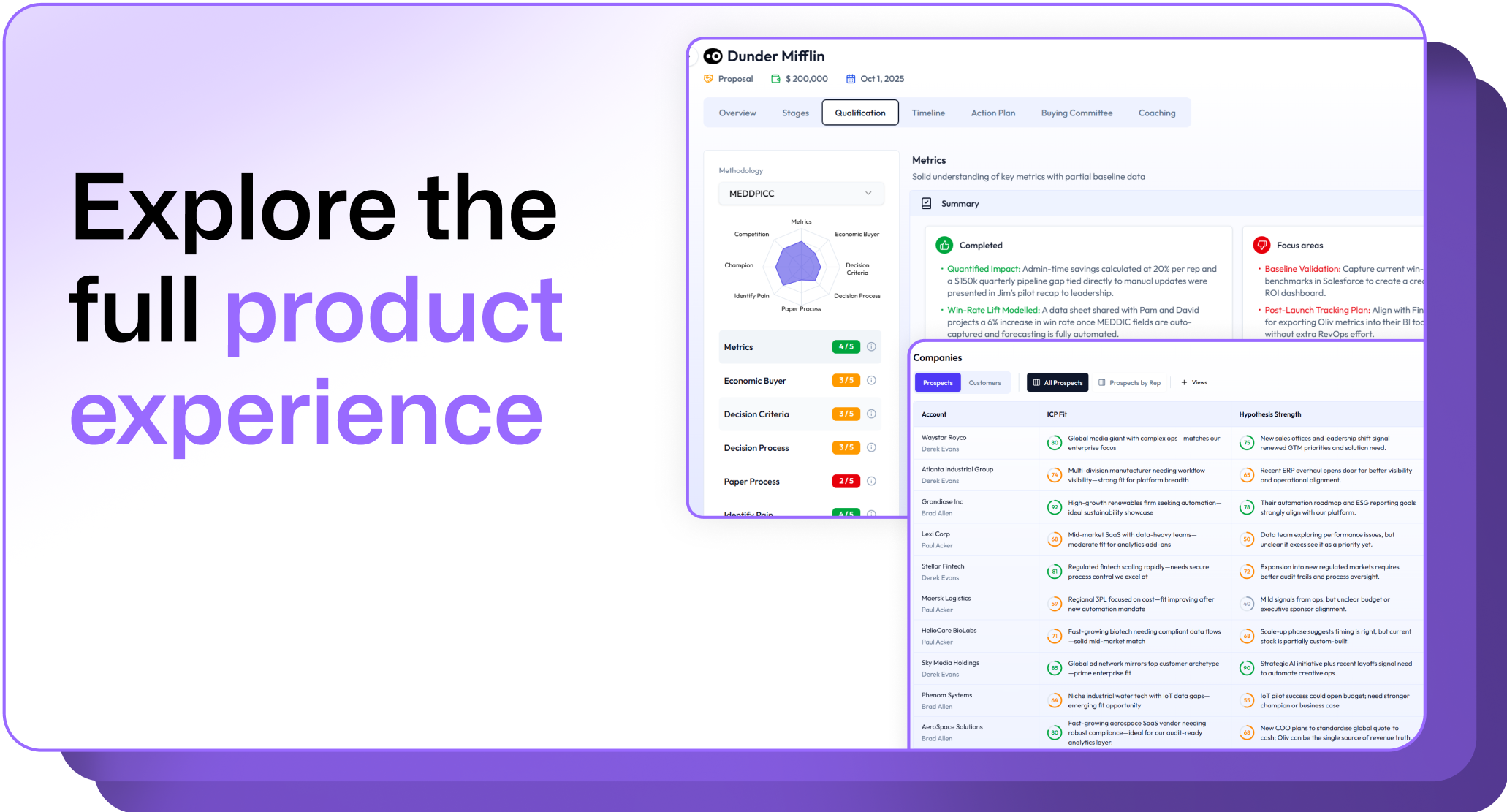
.avif)
.png)