Agentic AI for CROs: Why Revenue Intelligence Is Shifting From Dashboards to Agents | 2026
Written by
Ishan Chhabra
Last Updated :
March 24, 2026
Skim in :
7
mins
In this article
Revenue teams love Oliv
Here’s why:
All your deal data unified (from 30+ tools and tabs).
Insights are delivered to you directly, no digging.
AI agents automate tasks for you.
Thank you! Your submission has been received!
Oops! Something went wrong while submitting the form.
Meet Oliv’s AI Agents
Hi! I’m, Deal Driver
I track deals, flag risks, send weekly pipeline updates and give sales managers full visibility into deal progress
Hi! I’m, CRM Manager
I maintain CRM hygiene by updating core, custom and qualification fields all without your team lifting a finger
Hi! I’m, Forecaster
I build accurate forecasts based on real deal movement and tell you which deals to pull in to hit your number
Hi! I’m, Coach
I believe performance fuels revenue. I spot skill gaps, score calls and build coaching plans to help every rep level up
Hi! I’m, Prospector
I dig into target accounts to surface the right contacts, tailor and time outreach so you always strike when it counts
Hi! I’m, Pipeline tracker
I call reps to get deal updates, and deliver a real-time, CRM-synced roll-up view of deal progress
Hi! I’m, Analyst
I answer complex pipeline questions, uncover deal patterns, and build reports that guide strategic decisions
TL;DR
Legacy revenue intelligence (Gong, Clari) surfaces dashboards but still requires managers to do all the work manually.
Agentic AI agents autonomously update CRM fields, flag deal risks daily, and produce board-ready forecasts without human input.
Replacing Gong + Clari + Salesloft with one agentic platform can reduce three-year TCO by up to 91%.
A daily AI operating cadence (Morning Brief, Meeting Assistant, Sunset Summary) replaces broken weekly pipeline reviews.
Every team size and data-readiness quadrant benefits from immediate agentic AI adoption; waiting compounds competitive disadvantage.
Revenue intelligence is not an added cost; it is a consolidation play that eliminates 3 to 4 point solutions.
Q1: Why Does Your Pipeline Look Different Depending on Who You Ask? [toc=Pipeline Fragmentation Problem]
Ask your VP of Sales for the pipeline number. Then ask your top AE. Then pull the CRM report. You will get three different answers, each defensible, none complete. This is the fragmented reality that growth-stage and mid-market CROs live with daily. The truth of any deal is buried across recorded meetings, email threads, Slack messages, support tickets, and unrecorded phone calls. Because reps treat CRM documentation as an admin burden rather than a core selling activity, the supposed "source of truth" becomes a patchwork of stale fields and optimistic guesses.
❌ Why Legacy Tools Have Not Solved This
Traditional revenue intelligence was supposed to fix pipeline fragmentation. It has not.
Gong captures meeting-level data, recordings, transcripts, keyword mentions, but fails to stitch those fragments into a deal-level narrative. Insights land as unstructured activity notes, not reportable CRM fields a CRO can action:
"It's too complicated, and not intuitive at all… understanding the pipeline management portion of it is almost impossible. Some people figure it out, but I think most just fumble through." — John S., Senior Account Executive, G2 Verified Review
Clari delivers forecasting analytics but still depends on manual roll-ups where managers input subjective assessments. The analytics layer itself creates extraction headaches:
"You have to click around through the different modules and extract the different pieces, ultimately putting it in an Excel for easier manipulation." — Natalie O., Sales Operations Manager, G2 Verified Review
⚠️ Salesforce Einstein Falls Short
Salesforce Einstein redacts emails unnecessarily and stores activity data in separate AWS instances unusable for downstream reporting, creating another silo instead of eliminating one.
✅ The Agentic AI Shift: From Stories to Evidence
Agentic AI platforms flip this model. Instead of waiting for humans to input data, they autonomously capture, stitch, and reason across every interaction channel to build one continuously evolving deal record. Pipeline reviews shift from "rep-driven stories" to evidence-based audits grounded in actual customer interactions.
How Oliv Delivers a Single Source of Truth
Oliv's AI-native Data Platform uses AI-Based Object Association to reason through messy CRMs, mapping activities to the correct opportunity even when duplicate records exist, a critical failure point for Salesforce's rule-based systems and Gong's one-way integrations. The CRM Manager Agent auto-populates 100+ qualification fields (MEDDPICC, BANT) after every call, eliminating the data entry dependency that makes pipeline data unreliable.
Every stakeholder, from frontline AE to the board, sees the same deal reality, derived from actual customer signals rather than selective rep updates.
"Before switching to Oliv, cleaning up messy CRM fields used to swallow half my week. Oliv fixes the data as it happens." — Darius Kim, Head of RevOps, Driftloop
Q2: What Does 'Agentic AI' Actually Mean for Revenue Teams? [toc=Agentic AI Defined]
The term "agentic AI" appears in every vendor's pitch deck. But strip away the buzzwords and the definition is straightforward: agentic AI refers to autonomous software agents that perceive context, reason through it, and take action, without waiting for a human to click a button or type a prompt.
Agentic AI vs. Chatbots vs. Copilots
Not all AI is agentic. Understanding the distinction matters for CROs evaluating where to invest:
Agentic AI vs. Chatbots vs. Copilots
Capability
Traditional Automation
Copilot AI
Agentic AI
Trigger
Rule-based (if/then)
Human prompt
Autonomous goal-seeking
Context
Single data source
Session-level
Cross-channel, persistent
Action
Executes predefined steps
Suggests next step
Completes tasks end-to-end
Learning
Static rules
Improves with feedback
Continuously adapts
Example
Salesforce workflow rule
ChatGPT drafting an email
Agent that updates CRM, flags risk, and sends prep notes unprompted
Chatbots respond when asked. Copilots assist when prompted. Agents act when needed.
Gen 1, Revenue Intelligence (2015 to 2022): Tools like Gong and Chorus recorded calls and surfaced dashboards. Value depended entirely on managers finding time to review insights.
Gen 2, Revenue Orchestration (2022 to 2025): Platforms like Outreach and Salesloft sequenced outreach and consolidated workflows. Execution still depended on human input, the CRM remained a static repository.
Gen 3, AI-Native Revenue Orchestration (2025+): AI agents perform the work autonomously, drafting follow-ups, updating CRM properties, producing forecasts, and flagging deal risks without manual intervention.
What the Data Says
The shift is not theoretical. IDC research found that organizations deploying agentic AI in revenue workflows reported 47% improved forecast accuracy, 41% higher conversion rates, and 38% faster rep onboarding. Gartner projects that by 2028, 33% of enterprise software applications will include agentic AI, up from less than 1% in 2024.
The Jobs Agents Actually Perform
For revenue teams specifically, agentic AI maps to concrete "Jobs to be Done":
✅ CRM Hygiene: Auto-updating standard and custom fields (MEDDPICC, BANT) after every interaction
✅ Deal Inspection: Flagging at-risk deals daily based on contextual signals, not keyword matches
✅ Forecasting: Producing unbiased weekly roll-ups with AI-generated risk commentary
✅ Meeting Prep: Delivering research briefs 30 minutes before calls
✅ Coaching: Identifying individual skill gaps from live deal performance
Oliv.ai operationalizes this framework through purpose-built agents, CRM Manager, Deal Driver, Forecaster, Meeting Assistant, and Coach, each mapped to a specific workflow rather than a generic AI interface.
Q3: Why Does Every Revenue Intelligence Tool Add Work Instead of Removing It? [toc=Note-Taker Fatigue Problem]
CROs invest heavily in "intelligence" platforms, sometimes exceeding $250/user/month, yet managers still spend evenings reviewing call recordings during commutes, showers, and dinners. Reps still copy-paste summaries from their conversation intelligence tool into Salesforce and Outlook. The tool added a documentation layer. It did not remove work.
❌ The Architecture Problem Behind "Note-Taker Fatigue"
Legacy revenue intelligence tools were built as documentation layers in the SaaS era. They record, transcribe, and display, but execution remains 100% human.
Gong's Smart Trackers rely on V1 keyword-based machine learning that flags "budget" even when the prospect is discussing vacation plans. Setting them up is itself a burden:
"It can be overwhelming to set up trackers. AI training is a bit laborious to get it to do what you want." — Trafford J., Senior Director, Revenue Enablement, G2 Verified Review
❌ Feature Sprawl and Parallel Tracking
Gong's broader platform suffers from feature sprawl that teams never fully adopt:
"There's so much in Gong, that we don't use everything. Gong's deal forecasting, we don't use." — Karel Bos, Head of Sales, TrustRadius Review
Clari's UI forces reps to maintain parallel tracking systems because the platform does not capture what matters to the individual seller:
"I have to maintain my own separate spreadsheet to track deals because I can only capture what my leaders want to see about a deal." — Verified User in Computer Software, G2 Verified Review
The Paradigm Shift: From "Insights Surfaced" to "Tasks Completed"
In the agentic era, buyers do not want software they have to "use" or "train for," they want an AI workforce that does the work for them. The measure of value shifts from dashboards viewed to tasks completed autonomously. Documentation, CRM updates, follow-up drafts, and risk alerts should happen without a single manual click.
✅ How Oliv Replaces App Fatigue With Agent Execution
Oliv is built on a "double functionality at half the price" promise. Instead of adding another dashboard to check, Oliv deploys agents that execute:
Meeting Assistant Agent drafts follow-up emails in Gmail/Outlook seconds after calls end
CRM Manager Agent updates fields without rep intervention, trained on 100+ sales methodologies
Deal Driver Agent flags contextual risks daily and delivers a Sunset Summary every evening
"Gong blew up my Slack all day… With Oliv, I finally get what I need, forecast, pipeline review, deal updates, dropped right in my inbox." — Mia Patterson, Sales Manager, Beacon
Legacy Intelligence vs. Agentic Engineering
Legacy Intelligence vs. Agentic Engineering
Dimension
Legacy Revenue Intelligence
Agentic AI-Native Revenue Orchestration
Data Capture
Manual + meeting-only
Autonomous + multi-channel
Output
Dashboards to review
Completed tasks delivered
CRM Impact
Activity logs (non-reportable)
Updated properties (reportable)
Manager Effort
Dig for insights nightly
Receive summaries proactively
Pricing
Bundled + opaque
Modular + transparent
Q4: How Is Revenue Intelligence Evolving From Dashboards to Autonomous Agents? [toc=Dashboards to Agents Evolution]
Revenue technology is not undergoing an incremental upgrade, it is experiencing a generational shift. Just as cloud computing did not merely improve on-premise servers but replaced the architecture entirely, agentic AI is replacing the dashboard-centric model that has defined revenue intelligence for the past decade.
⏰ The Three Eras of Revenue Technology
Gen 1, Revenue Intelligence (2015 to 2022):Gong, Chorus, and early Clari recorded calls and built dashboards. CROs gained visibility, but acting on it still required hours of manual review. Managers spent evenings scrubbing through recordings to verify what reps reported.
Gen 2, Revenue Orchestration (2022 to 2025): Outreach, Salesloft, and expanded Clari automated sequences and consolidated workflows. Execution improved for outbound motions, but deal-level intelligence remained fragmented. The CRM stayed a static repository dependent on human input.
Gen 3, AI-Native Revenue Orchestration (2025+): AI agents perform the work. They draft follow-ups, update CRM properties, produce board-ready forecasts, and flag risks before they surface, autonomously.
Revenue technology has evolved from recording calls to performing the work autonomously. CROs who recognize the shift gain a structural advantage.
❌ Why Gen 1 and Gen 2 Hit a Ceiling
Dashboards created "insight overload." Managers had visibility but no time to act on it. Orchestration tools automated sequences but could not reason about deal context, they would fire the same cadence whether a champion went silent or a competitor entered the evaluation. Both generations assumed the human would bridge the gap between intelligence and execution. At 30 to 100 reps, that gap becomes a chasm.
"The product still feels like it's at its infancy and needs to be developed further." — Annabelle H., Board of Directors, G2 Verified Review
"Clari features often overlap with other common sales tech tools. Clari should do more to differentiate themselves from competition." — Sarah J., Senior Manager, Revenue Operations, G2 Verified Review
✅ Gen 3: The Three-Layer Agentic Architecture
AI-Native Revenue Orchestration treats the revenue process like an engineering problem, one that can be simulated, optimized, and automated. Oliv operationalizes this through a three-layer stack:
Baseline Layer (Documentation): Meeting recording and transcription, provided free for teams migrating from Gong. This commoditized function is no longer worth paying premium prices for.
Intelligence Layer (Context): Unified signals from calls, emails, Slack, support tickets, and web activity, stitched into a 360 degree deal view.
Agent Layer (Execution): Specialized agents, CRM Manager, Deal Driver, Forecaster, Researcher, Coach, each mapped to a specific "Job to be Done" rather than a generic chat interface.
This is the first generation of revenue technology that closes the "last mile" between insight and action. The CRO no longer digs through dashboards, they receive completed work, delivered where they already live: Slack, email, and CRM properties.
Q5: What's the Difference Between Revenue Intelligence and AI-Native Revenue Orchestration? [toc=Intelligence vs Orchestration]
CROs now hear "revenue intelligence," "revenue operations," "revenue orchestration," and "AI-Native Revenue Orchestration" in every vendor pitch, each company defining categories to suit its own positioning. The result is confusion. Before evaluating any tool, leaders need a clear taxonomy that separates what these terms actually mean in practice and what each delivers to the business.
❌ Revenue Intelligence: The Previous Decade
Revenue intelligence, as defined by tools like Gong, Chorus, and early Clari, means recording calls, capturing activities, and presenting dashboards. The manager's job is to dig, finding insights buried in transcripts, flagging risks manually, and drawing conclusions from charts that require context no dashboard can provide.
The limitation is structural: insight without action. The platform surfaces data; the human does all the running.
"The additional products like forecast or engage come at an additional cost. Would be great to see these tools rolled into the core offering." — Scott T., Director of Sales, G2 Verified Review
Even when tools like Clari attempt to close the gap, the execution burden stays with the user:
"Clari should find ways to differentiate from the native Salesforce features (e.g. Pipeline Inspection, Forecasting) in order to remain competitive in the long-run." — Dan J., G2 Verified Review
✅ AI-Native Revenue Orchestration: The Emerging Era
AI-Native Revenue Orchestration treats the revenue process like an engineering problem, one that can be simulated, optimized, and automated. Instead of showing a dashboard and waiting for the manager to act, AI-native revenue orchestration platforms proactively perform the work:
Draft personalized follow-up emails after every call
Update CRM properties with methodology-specific fields (MEDDPICC, BANT)
Produce board-ready forecast slides with AI-generated risk commentary
Flag stalled deals based on contextual signals, not keyword matches
This is the shift from "intelligence" (showing you data) to "orchestration" (performing the work).
How Oliv Operationalizes AI-Native Revenue Orchestration
Oliv's Forecaster Agent inspects every deal line-by-line to produce unbiased weekly roll-ups with risk commentary, eliminating manual Thursday/Friday preparation entirely. The Analyst Agent answers strategic questions in plain English across the entire pipeline, empowering non-technical users to run complex win-loss or trend analyses without SQL.
Legacy Stack vs. Oliv Agentic Architecture
Legacy Stack
Oliv Equivalent
What Changes
Gong (conversation intelligence)
Baseline Layer: Free recording & transcription
Call recording becomes a commodity, no premium price
Q6: What Does a Next-Generation Revenue Stack Look Like for a 500-Employee Company? [toc=Next-Gen Revenue Stack]
💸 The True Cost of the Fragmented Stack
A typical mid-market company stacks Gong (~$160/user) + Clari (~$200/user) + Salesloft (~$100/user), reaching $460+/user/month before platform fees. At 500 employees with approximately 100 revenue-facing seats, that is $550K+/year in revenue tooling, and the CRM data is often still unreliable.
Each tool creates its own data silo. Gong knows calls but not emails. Clari knows forecasts but depends on manual roll-ups. Salesloft knows sequences but lacks deal context. RevOps spends 40+ hours per month stitching these systems together and chasing reps for field updates.
"Gong is a really powerful tool but it's probably the highest end option on the market… Having talked with other friends who lead revenue functions, all have said the same thing, they've been fine using a lower cost, simpler alternative." — Iris P., Head of Marketing, Sales & Partnerships, G2 Verified Review
"It is really just a glorified SFDC overlay. Actually, Salesforce has built most of the forecasting functionality by now anyway so I'm not sure where they fit into that whole overcrowded Martech space." — conaldinho11, r/SalesOperations Reddit Thread
✅ The Unified Agentic Architecture
The next-generation stack collapses fragmented point solutions into three integrated layers:
Data Platform (Capture): Automatically tracks every interaction, calls, emails, Slack, Telegram, support tickets, without human input
Intelligence Layer (Reason): Stitches unstructured data into a 360 degree deal narrative using 100+ fine-tuned models that extract specific signals (churn risks, competitor mentions, feature requests)
Agent Layer (Execute): Specialized agents perform specific "Jobs to be Done," CRM updates, deal inspection, forecasting, coaching, research
One vendor, one data model, one source of truth.
The next-generation revenue stack replaces fragmented point solutions with three integrated layers: capture, reason, and execute.
How Oliv Maps to the 500-Employee Use Case
Oliv's architecture directly replaces the three-tool stack:
Legacy Stack vs. Oliv Agentic Architecture
Legacy Stack
Oliv Equivalent
What Changes
Gong (conversation intelligence)
Baseline Layer: Free recording & transcription
Call recording becomes a commodity, no premium price
The total cost of Oliv's modular, pay-for-what-you-use model is a fraction of the legacy stack, with the baseline recording layer provided free for teams migrating from Gong.
Q7: If You Keep Salesforce, What Should Sit 'On Top' to Make It Autonomous? [toc=Salesforce Autonomous Layer]
Most mid-market companies are not ripping out Salesforce. The CRM has deep integrations, years of historical data, and organizational muscle memory. The real question is not "should we replace Salesforce?" but rather "what layer makes Salesforce actually work autonomously?" Because on its own, Salesforce is a static repository that depends entirely on human input to deliver value.
❌ Why Agentforce Alone Will Not Get You There
Salesforce Agentforce was built primarily for B2C customer service use cases, retail chatbots handling order returns, service agents resolving tickets. Its chat-centric UX requires reps to manually engage a bot, which does not integrate naturally into a B2B sales workflow. User reviews consistently confirm the gap between promise and execution:
"Can be complex to set up and often requires skilled administrators or developers to customize and integrate properly, which adds time and cost. Licensing fees can be high, especially as the number of agents grows." — Verified User in Marketing and Advertising, G2 Verified Review
"Setting it up wasn't as smooth as I expected. The UI felt a bit clunky at times… Also, the pricing caught us off guard. Once we started scaling to more users and use cases, the cost ramped up pretty quickly." — Alessandro N., Salesforce Administrator, G2 Verified Review
⚠️ The Dirty Data Problem
The fundamental issue: if the underlying CRM data is dirty, and it almost always is when dependent on rep input, Agentforce's AI features fail because they are grounded in unreliable data.
What an Autonomous Layer Must Actually Do
For Salesforce to function autonomously, the layer sitting on top must solve three problems in sequence:
Clean the data first Dirty data breaks every "intelligent" feature built on top. AI-Based Object Association must resolve duplicates and map activities to the correct opportunities using contextual reasoning, not brittle rules.
Capture signals Salesforce does not see Deal truth lives in Slack threads, Telegram messages, unrecorded phone calls, and support tickets. A CRM that only sees what reps manually enter will always have an incomplete picture.
Deliver results where reps already live Not inside another interface or chat window, but in Slack, Gmail/Outlook, and CRM properties they already check.
✅ How Oliv Makes Salesforce Autonomous
Oliv functions as the Autonomous Intelligence Layer for Salesforce. The CRM Manager Agent uses LLM-based reasoning to correctly associate activities with the right account or opportunity, even when duplicate records exist, a critical failure point for Einstein Activity Capture's rule-based logic. Results are delivered directly into Slack, email, and CRM properties, not a chat bot interface.
Salesforce Agentforce vs. Oliv
Capability
Salesforce Agentforce
Oliv
Primary Focus
B2C service & support
B2B deal lifecycle
Methodology Support
Limited
MEDDPICC, BANT, SPICED (100+ frameworks)
Data Quality
Depends on clean CRM input
Cleans data autonomously first
Implementation
Months of custom configuration
5 minutes to connect; value in 1 to 2 days
Delivery UX
Chat-based bot interface
Slack, Email, CRM properties
Q8: What's the Right Balance of AI Automation vs. Human Review at 50 to 100 Reps? [toc=AI vs Human Balance]
At 50 to 100 reps, managers hit a structural breaking point. They can personally review roughly 2% of calls, leaving a massive visibility gap in deal quality. The answer is not "automate everything" or "review everything," it is a deliberate Human-in-the-Loop (HITL) framework that assigns the right tasks to the right actor.
The HITL Framework for Growth-Stage Teams
Human-in-the-Loop (HITL) Framework
Activity
Who Owns It
Why
Data capture (calls, emails, Slack)
✅ AI, 100% automated
Zero-value admin work; humans add no insight here
CRM field updates (MEDDPICC, BANT)
✅ AI, 100% automated
Contextual extraction from conversations is faster and more accurate than manual entry
Follow-up email drafts
✅ AI drafts, Human approves
Agent generates; rep reviews and personalizes before sending
Meeting prep notes
✅ AI, 100% automated
Delivered 30 minutes before calls; no human input needed
AI-generated Skill-Gap Maps inform the conversation, but coaching requires human empathy and context
Relationship building
❌ Human, 100%
Customer trust is earned through human connection, not automation
⏰ The Practical Cadence
For growth-stage teams with fast-moving pipelines (15 to 20 day cycles), the cadence should be daily, not weekly:
Morning: AI delivers prep notes and flags high-risk calls the manager should shadow
During calls: AI captures signals, updates CRM properties, and scores methodology adherence in real-time
Evening: AI sends a Sunset Summary of all deal movement, highlighting what changed and what needs intervention tomorrow
Weekly: AI-generated pipeline review arrives in Slack, managers spend 30 minutes validating rather than 3 hours building
Monday: AI-produced forecast with board-ready slides replaces the manual roll-up entirely
The Manager's Role Shifts
The critical insight: AI does not replace the manager, it transforms what managers spend time on. Instead of auditing calls while showering and building spreadsheets on Thursday nights, managers focus their limited 1:1 time on behavioral coaching using AI-generated Skill-Gap Maps that pinpoint specific weaknesses (discovery technique, objection handling, pricing conversations).
"There's so much in Gong, that we don't use everything. Gong's deal forecasting, we don't use." — Karel Bos, Head of Sales, TrustRadius Review
The problem with legacy sales intelligence tools is not capability, it is that no manager has time to use all the features. Oliv.ai solves this by shifting from "features the manager must operate" to "agents that operate on the manager's behalf," ensuring every call is covered without adding hours to anyone's day.
In high-velocity sales motions with 15 to 20 day cycles, the weekly pipeline review is a structural failure. By the time Monday's meeting arrives, the deal is already won or lost. CROs are not preventing surprises, they are reacting to them, often too late to change the outcome.
❌ The Broken Traditional Cadence
The legacy cadence follows a predictable, and costly, pattern:
Thursday/Friday: Managers interrogate reps to manually build roll-ups. Reps tell the story they want, not the story the data supports.
Monday morning: The VP discovers "surprises," deals that slipped, contacts that went dark, competitors that entered the evaluation.
Mid-week: Fire drills to rescue slipping deals that could have been saved with earlier intervention.
Managers fill the gaps by reviewing call recordings at night, while showering, driving, or between meetings, because tools like Gong surface data but do not compress it into actionable summaries.
"There's so much in Gong, that we don't use everything. Gong's deal forecasting, we don't use." — Karel Bos, Head of Sales, TrustRadius Review
"I wish they were a little more responsive to customer requests. They say a feature is coming in a certain quarter and then it doesn't." — Amanda R., Director, Customer Success, G2 Verified Review
✅ The Agent-Powered Daily Rhythm
AI agents replace the lag between signal and action. Instead of waiting for a weekly review to surface risks, agents monitor deal health continuously and deliver intelligence in real-time. The CRO's week transforms from reactive firefighting to proactive coaching.
⏰ Oliv's AI Operating System (AIOS), The CRO Week
Oliv's AI Operating System (AIOS), The CRO Week
Time
Agent
What Happens
Morning (Daily)
Morning Brief
Prep notes delivered 30 mins before calls; high-risk deals flagged for manager attention
During Calls
Meeting Assistant Agent
Live signal capture, CRM field extraction, methodology scoring
Evening (Daily)
Sunset Summary
Daily pulse on deal movement, what changed, what needs intervention tomorrow
Weekly (Slack)
Deal Driver Agent
Full pipeline review with risk flags, champion activity, and next-step status
Monday
Forecaster Agent
Board-ready slides delivered automatically, replacing the manual Thursday/Friday roll-up entirely
AI agents shift the CRO's week from reactive pipeline auditing to strategic coaching and deal intervention.
This cadence means deals never go dark without the CRO knowing. The Morning Brief nudges managers to shadow high-risk calls before they happen. The Sunset Summary catches movement the moment it occurs, not five days later in a spreadsheet. The Forecaster Agent's Monday delivery eliminates the most dreaded ritual in sales leadership: the manual forecast build.
Q10: How Do You Pitch AI Agents to a Board That Still Thinks AI Is Experimental? [toc=Board-Ready AI Business Case]
Boards have watched the hype cycle play out, AI SDRs that spammed prospects, chatbots that hallucinated product features, pilots that never scaled past five users. When a CRO says "AI agents," the board hears "another experiment." The path forward is not a technology pitch, it is a financial argument with concrete benchmarks.
💸 The Cost of the Status Quo
Before pitching AI, quantify what the current stack actually costs. A 100-user team on Gong reaches approximately $789,300 over three years when you factor in per-seat licenses, platform fees, implementation, and the admin hours required for Smart Tracker configuration (40 to 140 hours). Add Clari and Salesloft, and the legacy stack exceeds $1M in three-year TCO for a mid-market company.
"The platform is expensive, especially compared to alternatives like Salesloft and Apollo, which offer similar capabilities for a fraction of the price." — Anonymous Reviewer, G2 Verified Review
"The pricing is probably the biggest obstacle and hence we are looking to change." — Miodrag, Enterprise Account Executive, Verified LinkedIn User Review
✅ The Three-Pillar Board Case
Present AI agents as a "Hands-Free Workforce" with three measurable returns:
💰 Cost Efficiency: 91% cost reduction vs. Gong for equivalent functionality. The same 100-user team on an agentic platform costs approximately $68,400 over three years.
⭐ Predictability: Organizations using unified AI sales tools report 25% higher forecast accuracy because data flows through one platform, not three disconnected tools.
⏰ Velocity: AI-driven CRM hygiene saves reps 2 to 3 hours per week on data entry, contributing to 35% higher win rates by redirecting time toward selling.
Payback Period Benchmarks
AI Agent Payback Period Benchmarks
Metric
Timeline
Software cost payback
~1 month
Meaningful team adoption
12 to 16 weeks
Full implementation ROI (mid-market)
9 to 12 months (at 75%+ utilization)
The Board Slide Framework
CROs can use this three-row template in their next deck:
Board Slide: Legacy Stack vs. Agentic Platform
Line Item
Current Annual Spend
Projected Spend (Agentic Platform)
Revenue tooling (Gong + Clari + Salesloft)
$550K+
Under $70K
RevOps admin hours (data cleanup, deduplication)
480+ hours/year
Near-zero (automated)
Forecast preparation time (weekly roll-ups)
200+ manager-hours/year
Automated Monday delivery
The pitch is not "let's try AI." It is "let's cut $480K in tooling, reclaim 680 hours of leadership time, and get more accurate forecasts in the process".
Q11: Should You Adopt Agentic AI Now or Wait Until the Technology Matures? [toc=Adopt Now or Wait]
The "wait and see" instinct is understandable. First-generation AI SDRs flooded inboxes with generic outreach, and basic chatbots hallucinated product specs. Boards and CFOs are right to be cautious. But the question is not whether agentic AI works, it is whether waiting creates a competitive disadvantage that compounds over time.
⏰ Where the Market Stands in 2026
The AI market for revenue teams is currently emerging from what analysts call the "Trough of Disillusionment". First-generation tools (basic chatbots, AI-written cold emails) overpromised and underdelivered. But the second wave, purpose-built AI agents that automate specific workflows like CRM hygiene, deal inspection, and forecasting, has crossed the threshold into measurable ROI.
Key market signals:
Gartner projects 33% of enterprise software will include agentic AI by 2028, up from less than 1% in 2024
IDC research shows organizations deploying agentic AI in revenue workflows report 47% improved forecast accuracy
Call recording is now commoditized, Zoom and Teams provide basic transcription free, making premium pricing for recording alone increasingly unjustifiable
The Decision Matrix
Use this 2x2 framework to assess your organization's readiness:
Agentic AI Adoption Decision Matrix
-
Clean CRM Data
Dirty CRM Data
< 30 reps
✅ Deploy agents now, you will compound the advantage early and avoid dirty data debt as you scale
✅ Deploy agents now, start with the CRM Manager Agent to fix data before it becomes unmanageable
30 to 100+ reps
✅ Deploy agents now, layer Deal Driver and Forecaster on top of your clean foundation
⚠️ Deploy agents now, but prioritize data hygiene first, no intelligence layer works on broken data
The matrix yields the same conclusion regardless of quadrant: every starting point benefits from immediate adoption. For Series A companies, starting with agents avoids the "dirty data debt" that plagues mid-market firms. For mid-market organizations, the compounding cost of delay, both in tool spend and in manager hours lost, grows every quarter.
❌ The Hidden Cost of Waiting
"I have been a Salesloft customer for 3 years, things started out well but they never updated features or technology in that entire period." — Craig P., Owner, G2 Verified Review
"The engage product is stagnant. Looks to have the same features, UX, integrations and issues as it had 5 years ago." — Matthew T., Head of Revenue Operations, G2 Verified Review
Legacy vendors are not innovating at the pace of the market shift. Waiting for them to "catch up" means paying premium prices for tools that users describe as stagnant, while competitors who adopt agentic platforms gain compounding advantages in forecast accuracy, deal velocity, and CRM quality. Oliv.ai's 5-minute configuration and 2 to 4 week customization timeline means teams can begin realizing value within the same quarter they decide to act.
Q12: Is Revenue Intelligence a 'Must-Have' or 'Nice-to-Have' When Cutting SaaS Spend? [toc=Must-Have vs Nice-to-Have]
In 2026, CFOs are scrutinizing every SaaS line item. When budgets tighten, revenue intelligence risks being categorized alongside the tools it was supposed to replace, another "nice-to-have" that delivers dashboards no one has time to check. The CRO's job is to reframe the conversation entirely.
💸 The Real Cost of the Fragmented Stack
Companies paying for Gong (~$160/user) + Clari (~$200/user) + Salesloft (~$100/user) spend $460+/user/month on tools that create three separate data silos. Meanwhile, call recording, Gong's original differentiating value proposition, is now a commodity provided free by Zoom and Teams. Paying $10K+ annually for recording alone is an unnecessary organizational tax.
"It was a big mistake on our part to commit to a two year term. Gong is a really powerful tool but it's probably the highest end option on the market, and now we're stuck with a tool that works technically but isn't the right business decision." — Iris P., Head of Marketing, Sales & Partnerships, G2 Verified Review
"Clari is a tool for sales leaders, it adds no value to reps as far as I can see." — Msoave, r/sales Reddit Thread
✅ Reframing: Revenue Intelligence as Consolidation, Not Addition
Agentic revenue orchestration platforms are not an additional expense, they are a replacement layer. One platform that captures, reasons, and acts eliminates 3 to 4 point solutions. The CFO conversation shifts from "why add AI?" to "why keep paying for three tools that still require manual work?"
The Consolidation Math
The consolidation math is straightforward:
Revenue Tool Consolidation With Oliv
What You Replace
What You Get
Net Impact
Gong ($160/user), conversation intelligence
Free baseline recording + Meeting Assistant Agent
💰 Full cost eliminated
Clari ($200/user), forecasting
Forecaster Agent + Analyst Agent
💰 Full cost eliminated
Salesloft ($100/user), sequencing
Researcher Agent + CRM Manager Agent
💰 Full cost eliminated
RevOps admin hours (40+/month)
Automated data hygiene
⏰ 480+ hours/year reclaimed
Total TCO reduction: up to 91%.
How Oliv Makes the CFO Case
Oliv's modular, agent-based pricing means teams pay only for the "Jobs to be Done" they actually need, no bundled features gathering dust. The baseline recording and transcription layer is free for teams migrating from Gong, immediately eliminating the single largest line item in most revenue tech stacks.
For Series A companies, starting with agents avoids the "dirty data debt" that compounds into expensive mid-market cleanup projects. For mid-market organizations already carrying the burden, consolidation is the fastest path to both better data and lower spend. Revenue intelligence is not a line item to cut, it is the line item that lets you cut everything else.
Q1: Why Does Your Pipeline Look Different Depending on Who You Ask? [toc=Pipeline Fragmentation Problem]
Ask your VP of Sales for the pipeline number. Then ask your top AE. Then pull the CRM report. You will get three different answers, each defensible, none complete. This is the fragmented reality that growth-stage and mid-market CROs live with daily. The truth of any deal is buried across recorded meetings, email threads, Slack messages, support tickets, and unrecorded phone calls. Because reps treat CRM documentation as an admin burden rather than a core selling activity, the supposed "source of truth" becomes a patchwork of stale fields and optimistic guesses.
❌ Why Legacy Tools Have Not Solved This
Traditional revenue intelligence was supposed to fix pipeline fragmentation. It has not.
Gong captures meeting-level data, recordings, transcripts, keyword mentions, but fails to stitch those fragments into a deal-level narrative. Insights land as unstructured activity notes, not reportable CRM fields a CRO can action:
"It's too complicated, and not intuitive at all… understanding the pipeline management portion of it is almost impossible. Some people figure it out, but I think most just fumble through." — John S., Senior Account Executive, G2 Verified Review
Clari delivers forecasting analytics but still depends on manual roll-ups where managers input subjective assessments. The analytics layer itself creates extraction headaches:
"You have to click around through the different modules and extract the different pieces, ultimately putting it in an Excel for easier manipulation." — Natalie O., Sales Operations Manager, G2 Verified Review
⚠️ Salesforce Einstein Falls Short
Salesforce Einstein redacts emails unnecessarily and stores activity data in separate AWS instances unusable for downstream reporting, creating another silo instead of eliminating one.
✅ The Agentic AI Shift: From Stories to Evidence
Agentic AI platforms flip this model. Instead of waiting for humans to input data, they autonomously capture, stitch, and reason across every interaction channel to build one continuously evolving deal record. Pipeline reviews shift from "rep-driven stories" to evidence-based audits grounded in actual customer interactions.
How Oliv Delivers a Single Source of Truth
Oliv's AI-native Data Platform uses AI-Based Object Association to reason through messy CRMs, mapping activities to the correct opportunity even when duplicate records exist, a critical failure point for Salesforce's rule-based systems and Gong's one-way integrations. The CRM Manager Agent auto-populates 100+ qualification fields (MEDDPICC, BANT) after every call, eliminating the data entry dependency that makes pipeline data unreliable.
Every stakeholder, from frontline AE to the board, sees the same deal reality, derived from actual customer signals rather than selective rep updates.
"Before switching to Oliv, cleaning up messy CRM fields used to swallow half my week. Oliv fixes the data as it happens." — Darius Kim, Head of RevOps, Driftloop
Q2: What Does 'Agentic AI' Actually Mean for Revenue Teams? [toc=Agentic AI Defined]
The term "agentic AI" appears in every vendor's pitch deck. But strip away the buzzwords and the definition is straightforward: agentic AI refers to autonomous software agents that perceive context, reason through it, and take action, without waiting for a human to click a button or type a prompt.
Agentic AI vs. Chatbots vs. Copilots
Not all AI is agentic. Understanding the distinction matters for CROs evaluating where to invest:
Agentic AI vs. Chatbots vs. Copilots
Capability
Traditional Automation
Copilot AI
Agentic AI
Trigger
Rule-based (if/then)
Human prompt
Autonomous goal-seeking
Context
Single data source
Session-level
Cross-channel, persistent
Action
Executes predefined steps
Suggests next step
Completes tasks end-to-end
Learning
Static rules
Improves with feedback
Continuously adapts
Example
Salesforce workflow rule
ChatGPT drafting an email
Agent that updates CRM, flags risk, and sends prep notes unprompted
Chatbots respond when asked. Copilots assist when prompted. Agents act when needed.
Gen 1, Revenue Intelligence (2015 to 2022): Tools like Gong and Chorus recorded calls and surfaced dashboards. Value depended entirely on managers finding time to review insights.
Gen 2, Revenue Orchestration (2022 to 2025): Platforms like Outreach and Salesloft sequenced outreach and consolidated workflows. Execution still depended on human input, the CRM remained a static repository.
Gen 3, AI-Native Revenue Orchestration (2025+): AI agents perform the work autonomously, drafting follow-ups, updating CRM properties, producing forecasts, and flagging deal risks without manual intervention.
What the Data Says
The shift is not theoretical. IDC research found that organizations deploying agentic AI in revenue workflows reported 47% improved forecast accuracy, 41% higher conversion rates, and 38% faster rep onboarding. Gartner projects that by 2028, 33% of enterprise software applications will include agentic AI, up from less than 1% in 2024.
The Jobs Agents Actually Perform
For revenue teams specifically, agentic AI maps to concrete "Jobs to be Done":
✅ CRM Hygiene: Auto-updating standard and custom fields (MEDDPICC, BANT) after every interaction
✅ Deal Inspection: Flagging at-risk deals daily based on contextual signals, not keyword matches
✅ Forecasting: Producing unbiased weekly roll-ups with AI-generated risk commentary
✅ Meeting Prep: Delivering research briefs 30 minutes before calls
✅ Coaching: Identifying individual skill gaps from live deal performance
Oliv.ai operationalizes this framework through purpose-built agents, CRM Manager, Deal Driver, Forecaster, Meeting Assistant, and Coach, each mapped to a specific workflow rather than a generic AI interface.
Q3: Why Does Every Revenue Intelligence Tool Add Work Instead of Removing It? [toc=Note-Taker Fatigue Problem]
CROs invest heavily in "intelligence" platforms, sometimes exceeding $250/user/month, yet managers still spend evenings reviewing call recordings during commutes, showers, and dinners. Reps still copy-paste summaries from their conversation intelligence tool into Salesforce and Outlook. The tool added a documentation layer. It did not remove work.
❌ The Architecture Problem Behind "Note-Taker Fatigue"
Legacy revenue intelligence tools were built as documentation layers in the SaaS era. They record, transcribe, and display, but execution remains 100% human.
Gong's Smart Trackers rely on V1 keyword-based machine learning that flags "budget" even when the prospect is discussing vacation plans. Setting them up is itself a burden:
"It can be overwhelming to set up trackers. AI training is a bit laborious to get it to do what you want." — Trafford J., Senior Director, Revenue Enablement, G2 Verified Review
❌ Feature Sprawl and Parallel Tracking
Gong's broader platform suffers from feature sprawl that teams never fully adopt:
"There's so much in Gong, that we don't use everything. Gong's deal forecasting, we don't use." — Karel Bos, Head of Sales, TrustRadius Review
Clari's UI forces reps to maintain parallel tracking systems because the platform does not capture what matters to the individual seller:
"I have to maintain my own separate spreadsheet to track deals because I can only capture what my leaders want to see about a deal." — Verified User in Computer Software, G2 Verified Review
The Paradigm Shift: From "Insights Surfaced" to "Tasks Completed"
In the agentic era, buyers do not want software they have to "use" or "train for," they want an AI workforce that does the work for them. The measure of value shifts from dashboards viewed to tasks completed autonomously. Documentation, CRM updates, follow-up drafts, and risk alerts should happen without a single manual click.
✅ How Oliv Replaces App Fatigue With Agent Execution
Oliv is built on a "double functionality at half the price" promise. Instead of adding another dashboard to check, Oliv deploys agents that execute:
Meeting Assistant Agent drafts follow-up emails in Gmail/Outlook seconds after calls end
CRM Manager Agent updates fields without rep intervention, trained on 100+ sales methodologies
Deal Driver Agent flags contextual risks daily and delivers a Sunset Summary every evening
"Gong blew up my Slack all day… With Oliv, I finally get what I need, forecast, pipeline review, deal updates, dropped right in my inbox." — Mia Patterson, Sales Manager, Beacon
Legacy Intelligence vs. Agentic Engineering
Legacy Intelligence vs. Agentic Engineering
Dimension
Legacy Revenue Intelligence
Agentic AI-Native Revenue Orchestration
Data Capture
Manual + meeting-only
Autonomous + multi-channel
Output
Dashboards to review
Completed tasks delivered
CRM Impact
Activity logs (non-reportable)
Updated properties (reportable)
Manager Effort
Dig for insights nightly
Receive summaries proactively
Pricing
Bundled + opaque
Modular + transparent
Q4: How Is Revenue Intelligence Evolving From Dashboards to Autonomous Agents? [toc=Dashboards to Agents Evolution]
Revenue technology is not undergoing an incremental upgrade, it is experiencing a generational shift. Just as cloud computing did not merely improve on-premise servers but replaced the architecture entirely, agentic AI is replacing the dashboard-centric model that has defined revenue intelligence for the past decade.
⏰ The Three Eras of Revenue Technology
Gen 1, Revenue Intelligence (2015 to 2022):Gong, Chorus, and early Clari recorded calls and built dashboards. CROs gained visibility, but acting on it still required hours of manual review. Managers spent evenings scrubbing through recordings to verify what reps reported.
Gen 2, Revenue Orchestration (2022 to 2025): Outreach, Salesloft, and expanded Clari automated sequences and consolidated workflows. Execution improved for outbound motions, but deal-level intelligence remained fragmented. The CRM stayed a static repository dependent on human input.
Gen 3, AI-Native Revenue Orchestration (2025+): AI agents perform the work. They draft follow-ups, update CRM properties, produce board-ready forecasts, and flag risks before they surface, autonomously.
Revenue technology has evolved from recording calls to performing the work autonomously. CROs who recognize the shift gain a structural advantage.
❌ Why Gen 1 and Gen 2 Hit a Ceiling
Dashboards created "insight overload." Managers had visibility but no time to act on it. Orchestration tools automated sequences but could not reason about deal context, they would fire the same cadence whether a champion went silent or a competitor entered the evaluation. Both generations assumed the human would bridge the gap between intelligence and execution. At 30 to 100 reps, that gap becomes a chasm.
"The product still feels like it's at its infancy and needs to be developed further." — Annabelle H., Board of Directors, G2 Verified Review
"Clari features often overlap with other common sales tech tools. Clari should do more to differentiate themselves from competition." — Sarah J., Senior Manager, Revenue Operations, G2 Verified Review
✅ Gen 3: The Three-Layer Agentic Architecture
AI-Native Revenue Orchestration treats the revenue process like an engineering problem, one that can be simulated, optimized, and automated. Oliv operationalizes this through a three-layer stack:
Baseline Layer (Documentation): Meeting recording and transcription, provided free for teams migrating from Gong. This commoditized function is no longer worth paying premium prices for.
Intelligence Layer (Context): Unified signals from calls, emails, Slack, support tickets, and web activity, stitched into a 360 degree deal view.
Agent Layer (Execution): Specialized agents, CRM Manager, Deal Driver, Forecaster, Researcher, Coach, each mapped to a specific "Job to be Done" rather than a generic chat interface.
This is the first generation of revenue technology that closes the "last mile" between insight and action. The CRO no longer digs through dashboards, they receive completed work, delivered where they already live: Slack, email, and CRM properties.
Q5: What's the Difference Between Revenue Intelligence and AI-Native Revenue Orchestration? [toc=Intelligence vs Orchestration]
CROs now hear "revenue intelligence," "revenue operations," "revenue orchestration," and "AI-Native Revenue Orchestration" in every vendor pitch, each company defining categories to suit its own positioning. The result is confusion. Before evaluating any tool, leaders need a clear taxonomy that separates what these terms actually mean in practice and what each delivers to the business.
❌ Revenue Intelligence: The Previous Decade
Revenue intelligence, as defined by tools like Gong, Chorus, and early Clari, means recording calls, capturing activities, and presenting dashboards. The manager's job is to dig, finding insights buried in transcripts, flagging risks manually, and drawing conclusions from charts that require context no dashboard can provide.
The limitation is structural: insight without action. The platform surfaces data; the human does all the running.
"The additional products like forecast or engage come at an additional cost. Would be great to see these tools rolled into the core offering." — Scott T., Director of Sales, G2 Verified Review
Even when tools like Clari attempt to close the gap, the execution burden stays with the user:
"Clari should find ways to differentiate from the native Salesforce features (e.g. Pipeline Inspection, Forecasting) in order to remain competitive in the long-run." — Dan J., G2 Verified Review
✅ AI-Native Revenue Orchestration: The Emerging Era
AI-Native Revenue Orchestration treats the revenue process like an engineering problem, one that can be simulated, optimized, and automated. Instead of showing a dashboard and waiting for the manager to act, AI-native revenue orchestration platforms proactively perform the work:
Draft personalized follow-up emails after every call
Update CRM properties with methodology-specific fields (MEDDPICC, BANT)
Produce board-ready forecast slides with AI-generated risk commentary
Flag stalled deals based on contextual signals, not keyword matches
This is the shift from "intelligence" (showing you data) to "orchestration" (performing the work).
How Oliv Operationalizes AI-Native Revenue Orchestration
Oliv's Forecaster Agent inspects every deal line-by-line to produce unbiased weekly roll-ups with risk commentary, eliminating manual Thursday/Friday preparation entirely. The Analyst Agent answers strategic questions in plain English across the entire pipeline, empowering non-technical users to run complex win-loss or trend analyses without SQL.
Legacy Stack vs. Oliv Agentic Architecture
Legacy Stack
Oliv Equivalent
What Changes
Gong (conversation intelligence)
Baseline Layer: Free recording & transcription
Call recording becomes a commodity, no premium price
Q6: What Does a Next-Generation Revenue Stack Look Like for a 500-Employee Company? [toc=Next-Gen Revenue Stack]
💸 The True Cost of the Fragmented Stack
A typical mid-market company stacks Gong (~$160/user) + Clari (~$200/user) + Salesloft (~$100/user), reaching $460+/user/month before platform fees. At 500 employees with approximately 100 revenue-facing seats, that is $550K+/year in revenue tooling, and the CRM data is often still unreliable.
Each tool creates its own data silo. Gong knows calls but not emails. Clari knows forecasts but depends on manual roll-ups. Salesloft knows sequences but lacks deal context. RevOps spends 40+ hours per month stitching these systems together and chasing reps for field updates.
"Gong is a really powerful tool but it's probably the highest end option on the market… Having talked with other friends who lead revenue functions, all have said the same thing, they've been fine using a lower cost, simpler alternative." — Iris P., Head of Marketing, Sales & Partnerships, G2 Verified Review
"It is really just a glorified SFDC overlay. Actually, Salesforce has built most of the forecasting functionality by now anyway so I'm not sure where they fit into that whole overcrowded Martech space." — conaldinho11, r/SalesOperations Reddit Thread
✅ The Unified Agentic Architecture
The next-generation stack collapses fragmented point solutions into three integrated layers:
Data Platform (Capture): Automatically tracks every interaction, calls, emails, Slack, Telegram, support tickets, without human input
Intelligence Layer (Reason): Stitches unstructured data into a 360 degree deal narrative using 100+ fine-tuned models that extract specific signals (churn risks, competitor mentions, feature requests)
Agent Layer (Execute): Specialized agents perform specific "Jobs to be Done," CRM updates, deal inspection, forecasting, coaching, research
One vendor, one data model, one source of truth.
The next-generation revenue stack replaces fragmented point solutions with three integrated layers: capture, reason, and execute.
How Oliv Maps to the 500-Employee Use Case
Oliv's architecture directly replaces the three-tool stack:
Legacy Stack vs. Oliv Agentic Architecture
Legacy Stack
Oliv Equivalent
What Changes
Gong (conversation intelligence)
Baseline Layer: Free recording & transcription
Call recording becomes a commodity, no premium price
The total cost of Oliv's modular, pay-for-what-you-use model is a fraction of the legacy stack, with the baseline recording layer provided free for teams migrating from Gong.
Q7: If You Keep Salesforce, What Should Sit 'On Top' to Make It Autonomous? [toc=Salesforce Autonomous Layer]
Most mid-market companies are not ripping out Salesforce. The CRM has deep integrations, years of historical data, and organizational muscle memory. The real question is not "should we replace Salesforce?" but rather "what layer makes Salesforce actually work autonomously?" Because on its own, Salesforce is a static repository that depends entirely on human input to deliver value.
❌ Why Agentforce Alone Will Not Get You There
Salesforce Agentforce was built primarily for B2C customer service use cases, retail chatbots handling order returns, service agents resolving tickets. Its chat-centric UX requires reps to manually engage a bot, which does not integrate naturally into a B2B sales workflow. User reviews consistently confirm the gap between promise and execution:
"Can be complex to set up and often requires skilled administrators or developers to customize and integrate properly, which adds time and cost. Licensing fees can be high, especially as the number of agents grows." — Verified User in Marketing and Advertising, G2 Verified Review
"Setting it up wasn't as smooth as I expected. The UI felt a bit clunky at times… Also, the pricing caught us off guard. Once we started scaling to more users and use cases, the cost ramped up pretty quickly." — Alessandro N., Salesforce Administrator, G2 Verified Review
⚠️ The Dirty Data Problem
The fundamental issue: if the underlying CRM data is dirty, and it almost always is when dependent on rep input, Agentforce's AI features fail because they are grounded in unreliable data.
What an Autonomous Layer Must Actually Do
For Salesforce to function autonomously, the layer sitting on top must solve three problems in sequence:
Clean the data first Dirty data breaks every "intelligent" feature built on top. AI-Based Object Association must resolve duplicates and map activities to the correct opportunities using contextual reasoning, not brittle rules.
Capture signals Salesforce does not see Deal truth lives in Slack threads, Telegram messages, unrecorded phone calls, and support tickets. A CRM that only sees what reps manually enter will always have an incomplete picture.
Deliver results where reps already live Not inside another interface or chat window, but in Slack, Gmail/Outlook, and CRM properties they already check.
✅ How Oliv Makes Salesforce Autonomous
Oliv functions as the Autonomous Intelligence Layer for Salesforce. The CRM Manager Agent uses LLM-based reasoning to correctly associate activities with the right account or opportunity, even when duplicate records exist, a critical failure point for Einstein Activity Capture's rule-based logic. Results are delivered directly into Slack, email, and CRM properties, not a chat bot interface.
Salesforce Agentforce vs. Oliv
Capability
Salesforce Agentforce
Oliv
Primary Focus
B2C service & support
B2B deal lifecycle
Methodology Support
Limited
MEDDPICC, BANT, SPICED (100+ frameworks)
Data Quality
Depends on clean CRM input
Cleans data autonomously first
Implementation
Months of custom configuration
5 minutes to connect; value in 1 to 2 days
Delivery UX
Chat-based bot interface
Slack, Email, CRM properties
Q8: What's the Right Balance of AI Automation vs. Human Review at 50 to 100 Reps? [toc=AI vs Human Balance]
At 50 to 100 reps, managers hit a structural breaking point. They can personally review roughly 2% of calls, leaving a massive visibility gap in deal quality. The answer is not "automate everything" or "review everything," it is a deliberate Human-in-the-Loop (HITL) framework that assigns the right tasks to the right actor.
The HITL Framework for Growth-Stage Teams
Human-in-the-Loop (HITL) Framework
Activity
Who Owns It
Why
Data capture (calls, emails, Slack)
✅ AI, 100% automated
Zero-value admin work; humans add no insight here
CRM field updates (MEDDPICC, BANT)
✅ AI, 100% automated
Contextual extraction from conversations is faster and more accurate than manual entry
Follow-up email drafts
✅ AI drafts, Human approves
Agent generates; rep reviews and personalizes before sending
Meeting prep notes
✅ AI, 100% automated
Delivered 30 minutes before calls; no human input needed
AI-generated Skill-Gap Maps inform the conversation, but coaching requires human empathy and context
Relationship building
❌ Human, 100%
Customer trust is earned through human connection, not automation
⏰ The Practical Cadence
For growth-stage teams with fast-moving pipelines (15 to 20 day cycles), the cadence should be daily, not weekly:
Morning: AI delivers prep notes and flags high-risk calls the manager should shadow
During calls: AI captures signals, updates CRM properties, and scores methodology adherence in real-time
Evening: AI sends a Sunset Summary of all deal movement, highlighting what changed and what needs intervention tomorrow
Weekly: AI-generated pipeline review arrives in Slack, managers spend 30 minutes validating rather than 3 hours building
Monday: AI-produced forecast with board-ready slides replaces the manual roll-up entirely
The Manager's Role Shifts
The critical insight: AI does not replace the manager, it transforms what managers spend time on. Instead of auditing calls while showering and building spreadsheets on Thursday nights, managers focus their limited 1:1 time on behavioral coaching using AI-generated Skill-Gap Maps that pinpoint specific weaknesses (discovery technique, objection handling, pricing conversations).
"There's so much in Gong, that we don't use everything. Gong's deal forecasting, we don't use." — Karel Bos, Head of Sales, TrustRadius Review
The problem with legacy sales intelligence tools is not capability, it is that no manager has time to use all the features. Oliv.ai solves this by shifting from "features the manager must operate" to "agents that operate on the manager's behalf," ensuring every call is covered without adding hours to anyone's day.
In high-velocity sales motions with 15 to 20 day cycles, the weekly pipeline review is a structural failure. By the time Monday's meeting arrives, the deal is already won or lost. CROs are not preventing surprises, they are reacting to them, often too late to change the outcome.
❌ The Broken Traditional Cadence
The legacy cadence follows a predictable, and costly, pattern:
Thursday/Friday: Managers interrogate reps to manually build roll-ups. Reps tell the story they want, not the story the data supports.
Monday morning: The VP discovers "surprises," deals that slipped, contacts that went dark, competitors that entered the evaluation.
Mid-week: Fire drills to rescue slipping deals that could have been saved with earlier intervention.
Managers fill the gaps by reviewing call recordings at night, while showering, driving, or between meetings, because tools like Gong surface data but do not compress it into actionable summaries.
"There's so much in Gong, that we don't use everything. Gong's deal forecasting, we don't use." — Karel Bos, Head of Sales, TrustRadius Review
"I wish they were a little more responsive to customer requests. They say a feature is coming in a certain quarter and then it doesn't." — Amanda R., Director, Customer Success, G2 Verified Review
✅ The Agent-Powered Daily Rhythm
AI agents replace the lag between signal and action. Instead of waiting for a weekly review to surface risks, agents monitor deal health continuously and deliver intelligence in real-time. The CRO's week transforms from reactive firefighting to proactive coaching.
⏰ Oliv's AI Operating System (AIOS), The CRO Week
Oliv's AI Operating System (AIOS), The CRO Week
Time
Agent
What Happens
Morning (Daily)
Morning Brief
Prep notes delivered 30 mins before calls; high-risk deals flagged for manager attention
During Calls
Meeting Assistant Agent
Live signal capture, CRM field extraction, methodology scoring
Evening (Daily)
Sunset Summary
Daily pulse on deal movement, what changed, what needs intervention tomorrow
Weekly (Slack)
Deal Driver Agent
Full pipeline review with risk flags, champion activity, and next-step status
Monday
Forecaster Agent
Board-ready slides delivered automatically, replacing the manual Thursday/Friday roll-up entirely
AI agents shift the CRO's week from reactive pipeline auditing to strategic coaching and deal intervention.
This cadence means deals never go dark without the CRO knowing. The Morning Brief nudges managers to shadow high-risk calls before they happen. The Sunset Summary catches movement the moment it occurs, not five days later in a spreadsheet. The Forecaster Agent's Monday delivery eliminates the most dreaded ritual in sales leadership: the manual forecast build.
Q10: How Do You Pitch AI Agents to a Board That Still Thinks AI Is Experimental? [toc=Board-Ready AI Business Case]
Boards have watched the hype cycle play out, AI SDRs that spammed prospects, chatbots that hallucinated product features, pilots that never scaled past five users. When a CRO says "AI agents," the board hears "another experiment." The path forward is not a technology pitch, it is a financial argument with concrete benchmarks.
💸 The Cost of the Status Quo
Before pitching AI, quantify what the current stack actually costs. A 100-user team on Gong reaches approximately $789,300 over three years when you factor in per-seat licenses, platform fees, implementation, and the admin hours required for Smart Tracker configuration (40 to 140 hours). Add Clari and Salesloft, and the legacy stack exceeds $1M in three-year TCO for a mid-market company.
"The platform is expensive, especially compared to alternatives like Salesloft and Apollo, which offer similar capabilities for a fraction of the price." — Anonymous Reviewer, G2 Verified Review
"The pricing is probably the biggest obstacle and hence we are looking to change." — Miodrag, Enterprise Account Executive, Verified LinkedIn User Review
✅ The Three-Pillar Board Case
Present AI agents as a "Hands-Free Workforce" with three measurable returns:
💰 Cost Efficiency: 91% cost reduction vs. Gong for equivalent functionality. The same 100-user team on an agentic platform costs approximately $68,400 over three years.
⭐ Predictability: Organizations using unified AI sales tools report 25% higher forecast accuracy because data flows through one platform, not three disconnected tools.
⏰ Velocity: AI-driven CRM hygiene saves reps 2 to 3 hours per week on data entry, contributing to 35% higher win rates by redirecting time toward selling.
Payback Period Benchmarks
AI Agent Payback Period Benchmarks
Metric
Timeline
Software cost payback
~1 month
Meaningful team adoption
12 to 16 weeks
Full implementation ROI (mid-market)
9 to 12 months (at 75%+ utilization)
The Board Slide Framework
CROs can use this three-row template in their next deck:
Board Slide: Legacy Stack vs. Agentic Platform
Line Item
Current Annual Spend
Projected Spend (Agentic Platform)
Revenue tooling (Gong + Clari + Salesloft)
$550K+
Under $70K
RevOps admin hours (data cleanup, deduplication)
480+ hours/year
Near-zero (automated)
Forecast preparation time (weekly roll-ups)
200+ manager-hours/year
Automated Monday delivery
The pitch is not "let's try AI." It is "let's cut $480K in tooling, reclaim 680 hours of leadership time, and get more accurate forecasts in the process".
Q11: Should You Adopt Agentic AI Now or Wait Until the Technology Matures? [toc=Adopt Now or Wait]
The "wait and see" instinct is understandable. First-generation AI SDRs flooded inboxes with generic outreach, and basic chatbots hallucinated product specs. Boards and CFOs are right to be cautious. But the question is not whether agentic AI works, it is whether waiting creates a competitive disadvantage that compounds over time.
⏰ Where the Market Stands in 2026
The AI market for revenue teams is currently emerging from what analysts call the "Trough of Disillusionment". First-generation tools (basic chatbots, AI-written cold emails) overpromised and underdelivered. But the second wave, purpose-built AI agents that automate specific workflows like CRM hygiene, deal inspection, and forecasting, has crossed the threshold into measurable ROI.
Key market signals:
Gartner projects 33% of enterprise software will include agentic AI by 2028, up from less than 1% in 2024
IDC research shows organizations deploying agentic AI in revenue workflows report 47% improved forecast accuracy
Call recording is now commoditized, Zoom and Teams provide basic transcription free, making premium pricing for recording alone increasingly unjustifiable
The Decision Matrix
Use this 2x2 framework to assess your organization's readiness:
Agentic AI Adoption Decision Matrix
-
Clean CRM Data
Dirty CRM Data
< 30 reps
✅ Deploy agents now, you will compound the advantage early and avoid dirty data debt as you scale
✅ Deploy agents now, start with the CRM Manager Agent to fix data before it becomes unmanageable
30 to 100+ reps
✅ Deploy agents now, layer Deal Driver and Forecaster on top of your clean foundation
⚠️ Deploy agents now, but prioritize data hygiene first, no intelligence layer works on broken data
The matrix yields the same conclusion regardless of quadrant: every starting point benefits from immediate adoption. For Series A companies, starting with agents avoids the "dirty data debt" that plagues mid-market firms. For mid-market organizations, the compounding cost of delay, both in tool spend and in manager hours lost, grows every quarter.
❌ The Hidden Cost of Waiting
"I have been a Salesloft customer for 3 years, things started out well but they never updated features or technology in that entire period." — Craig P., Owner, G2 Verified Review
"The engage product is stagnant. Looks to have the same features, UX, integrations and issues as it had 5 years ago." — Matthew T., Head of Revenue Operations, G2 Verified Review
Legacy vendors are not innovating at the pace of the market shift. Waiting for them to "catch up" means paying premium prices for tools that users describe as stagnant, while competitors who adopt agentic platforms gain compounding advantages in forecast accuracy, deal velocity, and CRM quality. Oliv.ai's 5-minute configuration and 2 to 4 week customization timeline means teams can begin realizing value within the same quarter they decide to act.
Q12: Is Revenue Intelligence a 'Must-Have' or 'Nice-to-Have' When Cutting SaaS Spend? [toc=Must-Have vs Nice-to-Have]
In 2026, CFOs are scrutinizing every SaaS line item. When budgets tighten, revenue intelligence risks being categorized alongside the tools it was supposed to replace, another "nice-to-have" that delivers dashboards no one has time to check. The CRO's job is to reframe the conversation entirely.
💸 The Real Cost of the Fragmented Stack
Companies paying for Gong (~$160/user) + Clari (~$200/user) + Salesloft (~$100/user) spend $460+/user/month on tools that create three separate data silos. Meanwhile, call recording, Gong's original differentiating value proposition, is now a commodity provided free by Zoom and Teams. Paying $10K+ annually for recording alone is an unnecessary organizational tax.
"It was a big mistake on our part to commit to a two year term. Gong is a really powerful tool but it's probably the highest end option on the market, and now we're stuck with a tool that works technically but isn't the right business decision." — Iris P., Head of Marketing, Sales & Partnerships, G2 Verified Review
"Clari is a tool for sales leaders, it adds no value to reps as far as I can see." — Msoave, r/sales Reddit Thread
✅ Reframing: Revenue Intelligence as Consolidation, Not Addition
Agentic revenue orchestration platforms are not an additional expense, they are a replacement layer. One platform that captures, reasons, and acts eliminates 3 to 4 point solutions. The CFO conversation shifts from "why add AI?" to "why keep paying for three tools that still require manual work?"
The Consolidation Math
The consolidation math is straightforward:
Revenue Tool Consolidation With Oliv
What You Replace
What You Get
Net Impact
Gong ($160/user), conversation intelligence
Free baseline recording + Meeting Assistant Agent
💰 Full cost eliminated
Clari ($200/user), forecasting
Forecaster Agent + Analyst Agent
💰 Full cost eliminated
Salesloft ($100/user), sequencing
Researcher Agent + CRM Manager Agent
💰 Full cost eliminated
RevOps admin hours (40+/month)
Automated data hygiene
⏰ 480+ hours/year reclaimed
Total TCO reduction: up to 91%.
How Oliv Makes the CFO Case
Oliv's modular, agent-based pricing means teams pay only for the "Jobs to be Done" they actually need, no bundled features gathering dust. The baseline recording and transcription layer is free for teams migrating from Gong, immediately eliminating the single largest line item in most revenue tech stacks.
For Series A companies, starting with agents avoids the "dirty data debt" that compounds into expensive mid-market cleanup projects. For mid-market organizations already carrying the burden, consolidation is the fastest path to both better data and lower spend. Revenue intelligence is not a line item to cut, it is the line item that lets you cut everything else.
Q1: Why Does Your Pipeline Look Different Depending on Who You Ask? [toc=Pipeline Fragmentation Problem]
Ask your VP of Sales for the pipeline number. Then ask your top AE. Then pull the CRM report. You will get three different answers, each defensible, none complete. This is the fragmented reality that growth-stage and mid-market CROs live with daily. The truth of any deal is buried across recorded meetings, email threads, Slack messages, support tickets, and unrecorded phone calls. Because reps treat CRM documentation as an admin burden rather than a core selling activity, the supposed "source of truth" becomes a patchwork of stale fields and optimistic guesses.
❌ Why Legacy Tools Have Not Solved This
Traditional revenue intelligence was supposed to fix pipeline fragmentation. It has not.
Gong captures meeting-level data, recordings, transcripts, keyword mentions, but fails to stitch those fragments into a deal-level narrative. Insights land as unstructured activity notes, not reportable CRM fields a CRO can action:
"It's too complicated, and not intuitive at all… understanding the pipeline management portion of it is almost impossible. Some people figure it out, but I think most just fumble through." — John S., Senior Account Executive, G2 Verified Review
Clari delivers forecasting analytics but still depends on manual roll-ups where managers input subjective assessments. The analytics layer itself creates extraction headaches:
"You have to click around through the different modules and extract the different pieces, ultimately putting it in an Excel for easier manipulation." — Natalie O., Sales Operations Manager, G2 Verified Review
⚠️ Salesforce Einstein Falls Short
Salesforce Einstein redacts emails unnecessarily and stores activity data in separate AWS instances unusable for downstream reporting, creating another silo instead of eliminating one.
✅ The Agentic AI Shift: From Stories to Evidence
Agentic AI platforms flip this model. Instead of waiting for humans to input data, they autonomously capture, stitch, and reason across every interaction channel to build one continuously evolving deal record. Pipeline reviews shift from "rep-driven stories" to evidence-based audits grounded in actual customer interactions.
How Oliv Delivers a Single Source of Truth
Oliv's AI-native Data Platform uses AI-Based Object Association to reason through messy CRMs, mapping activities to the correct opportunity even when duplicate records exist, a critical failure point for Salesforce's rule-based systems and Gong's one-way integrations. The CRM Manager Agent auto-populates 100+ qualification fields (MEDDPICC, BANT) after every call, eliminating the data entry dependency that makes pipeline data unreliable.
Every stakeholder, from frontline AE to the board, sees the same deal reality, derived from actual customer signals rather than selective rep updates.
"Before switching to Oliv, cleaning up messy CRM fields used to swallow half my week. Oliv fixes the data as it happens." — Darius Kim, Head of RevOps, Driftloop
Q2: What Does 'Agentic AI' Actually Mean for Revenue Teams? [toc=Agentic AI Defined]
The term "agentic AI" appears in every vendor's pitch deck. But strip away the buzzwords and the definition is straightforward: agentic AI refers to autonomous software agents that perceive context, reason through it, and take action, without waiting for a human to click a button or type a prompt.
Agentic AI vs. Chatbots vs. Copilots
Not all AI is agentic. Understanding the distinction matters for CROs evaluating where to invest:
Agentic AI vs. Chatbots vs. Copilots
Capability
Traditional Automation
Copilot AI
Agentic AI
Trigger
Rule-based (if/then)
Human prompt
Autonomous goal-seeking
Context
Single data source
Session-level
Cross-channel, persistent
Action
Executes predefined steps
Suggests next step
Completes tasks end-to-end
Learning
Static rules
Improves with feedback
Continuously adapts
Example
Salesforce workflow rule
ChatGPT drafting an email
Agent that updates CRM, flags risk, and sends prep notes unprompted
Chatbots respond when asked. Copilots assist when prompted. Agents act when needed.
Gen 1, Revenue Intelligence (2015 to 2022): Tools like Gong and Chorus recorded calls and surfaced dashboards. Value depended entirely on managers finding time to review insights.
Gen 2, Revenue Orchestration (2022 to 2025): Platforms like Outreach and Salesloft sequenced outreach and consolidated workflows. Execution still depended on human input, the CRM remained a static repository.
Gen 3, AI-Native Revenue Orchestration (2025+): AI agents perform the work autonomously, drafting follow-ups, updating CRM properties, producing forecasts, and flagging deal risks without manual intervention.
What the Data Says
The shift is not theoretical. IDC research found that organizations deploying agentic AI in revenue workflows reported 47% improved forecast accuracy, 41% higher conversion rates, and 38% faster rep onboarding. Gartner projects that by 2028, 33% of enterprise software applications will include agentic AI, up from less than 1% in 2024.
The Jobs Agents Actually Perform
For revenue teams specifically, agentic AI maps to concrete "Jobs to be Done":
✅ CRM Hygiene: Auto-updating standard and custom fields (MEDDPICC, BANT) after every interaction
✅ Deal Inspection: Flagging at-risk deals daily based on contextual signals, not keyword matches
✅ Forecasting: Producing unbiased weekly roll-ups with AI-generated risk commentary
✅ Meeting Prep: Delivering research briefs 30 minutes before calls
✅ Coaching: Identifying individual skill gaps from live deal performance
Oliv.ai operationalizes this framework through purpose-built agents, CRM Manager, Deal Driver, Forecaster, Meeting Assistant, and Coach, each mapped to a specific workflow rather than a generic AI interface.
Q3: Why Does Every Revenue Intelligence Tool Add Work Instead of Removing It? [toc=Note-Taker Fatigue Problem]
CROs invest heavily in "intelligence" platforms, sometimes exceeding $250/user/month, yet managers still spend evenings reviewing call recordings during commutes, showers, and dinners. Reps still copy-paste summaries from their conversation intelligence tool into Salesforce and Outlook. The tool added a documentation layer. It did not remove work.
❌ The Architecture Problem Behind "Note-Taker Fatigue"
Legacy revenue intelligence tools were built as documentation layers in the SaaS era. They record, transcribe, and display, but execution remains 100% human.
Gong's Smart Trackers rely on V1 keyword-based machine learning that flags "budget" even when the prospect is discussing vacation plans. Setting them up is itself a burden:
"It can be overwhelming to set up trackers. AI training is a bit laborious to get it to do what you want." — Trafford J., Senior Director, Revenue Enablement, G2 Verified Review
❌ Feature Sprawl and Parallel Tracking
Gong's broader platform suffers from feature sprawl that teams never fully adopt:
"There's so much in Gong, that we don't use everything. Gong's deal forecasting, we don't use." — Karel Bos, Head of Sales, TrustRadius Review
Clari's UI forces reps to maintain parallel tracking systems because the platform does not capture what matters to the individual seller:
"I have to maintain my own separate spreadsheet to track deals because I can only capture what my leaders want to see about a deal." — Verified User in Computer Software, G2 Verified Review
The Paradigm Shift: From "Insights Surfaced" to "Tasks Completed"
In the agentic era, buyers do not want software they have to "use" or "train for," they want an AI workforce that does the work for them. The measure of value shifts from dashboards viewed to tasks completed autonomously. Documentation, CRM updates, follow-up drafts, and risk alerts should happen without a single manual click.
✅ How Oliv Replaces App Fatigue With Agent Execution
Oliv is built on a "double functionality at half the price" promise. Instead of adding another dashboard to check, Oliv deploys agents that execute:
Meeting Assistant Agent drafts follow-up emails in Gmail/Outlook seconds after calls end
CRM Manager Agent updates fields without rep intervention, trained on 100+ sales methodologies
Deal Driver Agent flags contextual risks daily and delivers a Sunset Summary every evening
"Gong blew up my Slack all day… With Oliv, I finally get what I need, forecast, pipeline review, deal updates, dropped right in my inbox." — Mia Patterson, Sales Manager, Beacon
Legacy Intelligence vs. Agentic Engineering
Legacy Intelligence vs. Agentic Engineering
Dimension
Legacy Revenue Intelligence
Agentic AI-Native Revenue Orchestration
Data Capture
Manual + meeting-only
Autonomous + multi-channel
Output
Dashboards to review
Completed tasks delivered
CRM Impact
Activity logs (non-reportable)
Updated properties (reportable)
Manager Effort
Dig for insights nightly
Receive summaries proactively
Pricing
Bundled + opaque
Modular + transparent
Q4: How Is Revenue Intelligence Evolving From Dashboards to Autonomous Agents? [toc=Dashboards to Agents Evolution]
Revenue technology is not undergoing an incremental upgrade, it is experiencing a generational shift. Just as cloud computing did not merely improve on-premise servers but replaced the architecture entirely, agentic AI is replacing the dashboard-centric model that has defined revenue intelligence for the past decade.
⏰ The Three Eras of Revenue Technology
Gen 1, Revenue Intelligence (2015 to 2022):Gong, Chorus, and early Clari recorded calls and built dashboards. CROs gained visibility, but acting on it still required hours of manual review. Managers spent evenings scrubbing through recordings to verify what reps reported.
Gen 2, Revenue Orchestration (2022 to 2025): Outreach, Salesloft, and expanded Clari automated sequences and consolidated workflows. Execution improved for outbound motions, but deal-level intelligence remained fragmented. The CRM stayed a static repository dependent on human input.
Gen 3, AI-Native Revenue Orchestration (2025+): AI agents perform the work. They draft follow-ups, update CRM properties, produce board-ready forecasts, and flag risks before they surface, autonomously.
Revenue technology has evolved from recording calls to performing the work autonomously. CROs who recognize the shift gain a structural advantage.
❌ Why Gen 1 and Gen 2 Hit a Ceiling
Dashboards created "insight overload." Managers had visibility but no time to act on it. Orchestration tools automated sequences but could not reason about deal context, they would fire the same cadence whether a champion went silent or a competitor entered the evaluation. Both generations assumed the human would bridge the gap between intelligence and execution. At 30 to 100 reps, that gap becomes a chasm.
"The product still feels like it's at its infancy and needs to be developed further." — Annabelle H., Board of Directors, G2 Verified Review
"Clari features often overlap with other common sales tech tools. Clari should do more to differentiate themselves from competition." — Sarah J., Senior Manager, Revenue Operations, G2 Verified Review
✅ Gen 3: The Three-Layer Agentic Architecture
AI-Native Revenue Orchestration treats the revenue process like an engineering problem, one that can be simulated, optimized, and automated. Oliv operationalizes this through a three-layer stack:
Baseline Layer (Documentation): Meeting recording and transcription, provided free for teams migrating from Gong. This commoditized function is no longer worth paying premium prices for.
Intelligence Layer (Context): Unified signals from calls, emails, Slack, support tickets, and web activity, stitched into a 360 degree deal view.
Agent Layer (Execution): Specialized agents, CRM Manager, Deal Driver, Forecaster, Researcher, Coach, each mapped to a specific "Job to be Done" rather than a generic chat interface.
This is the first generation of revenue technology that closes the "last mile" between insight and action. The CRO no longer digs through dashboards, they receive completed work, delivered where they already live: Slack, email, and CRM properties.
Q5: What's the Difference Between Revenue Intelligence and AI-Native Revenue Orchestration? [toc=Intelligence vs Orchestration]
CROs now hear "revenue intelligence," "revenue operations," "revenue orchestration," and "AI-Native Revenue Orchestration" in every vendor pitch, each company defining categories to suit its own positioning. The result is confusion. Before evaluating any tool, leaders need a clear taxonomy that separates what these terms actually mean in practice and what each delivers to the business.
❌ Revenue Intelligence: The Previous Decade
Revenue intelligence, as defined by tools like Gong, Chorus, and early Clari, means recording calls, capturing activities, and presenting dashboards. The manager's job is to dig, finding insights buried in transcripts, flagging risks manually, and drawing conclusions from charts that require context no dashboard can provide.
The limitation is structural: insight without action. The platform surfaces data; the human does all the running.
"The additional products like forecast or engage come at an additional cost. Would be great to see these tools rolled into the core offering." — Scott T., Director of Sales, G2 Verified Review
Even when tools like Clari attempt to close the gap, the execution burden stays with the user:
"Clari should find ways to differentiate from the native Salesforce features (e.g. Pipeline Inspection, Forecasting) in order to remain competitive in the long-run." — Dan J., G2 Verified Review
✅ AI-Native Revenue Orchestration: The Emerging Era
AI-Native Revenue Orchestration treats the revenue process like an engineering problem, one that can be simulated, optimized, and automated. Instead of showing a dashboard and waiting for the manager to act, AI-native revenue orchestration platforms proactively perform the work:
Draft personalized follow-up emails after every call
Update CRM properties with methodology-specific fields (MEDDPICC, BANT)
Produce board-ready forecast slides with AI-generated risk commentary
Flag stalled deals based on contextual signals, not keyword matches
This is the shift from "intelligence" (showing you data) to "orchestration" (performing the work).
How Oliv Operationalizes AI-Native Revenue Orchestration
Oliv's Forecaster Agent inspects every deal line-by-line to produce unbiased weekly roll-ups with risk commentary, eliminating manual Thursday/Friday preparation entirely. The Analyst Agent answers strategic questions in plain English across the entire pipeline, empowering non-technical users to run complex win-loss or trend analyses without SQL.
Legacy Stack vs. Oliv Agentic Architecture
Legacy Stack
Oliv Equivalent
What Changes
Gong (conversation intelligence)
Baseline Layer: Free recording & transcription
Call recording becomes a commodity, no premium price
Q6: What Does a Next-Generation Revenue Stack Look Like for a 500-Employee Company? [toc=Next-Gen Revenue Stack]
💸 The True Cost of the Fragmented Stack
A typical mid-market company stacks Gong (~$160/user) + Clari (~$200/user) + Salesloft (~$100/user), reaching $460+/user/month before platform fees. At 500 employees with approximately 100 revenue-facing seats, that is $550K+/year in revenue tooling, and the CRM data is often still unreliable.
Each tool creates its own data silo. Gong knows calls but not emails. Clari knows forecasts but depends on manual roll-ups. Salesloft knows sequences but lacks deal context. RevOps spends 40+ hours per month stitching these systems together and chasing reps for field updates.
"Gong is a really powerful tool but it's probably the highest end option on the market… Having talked with other friends who lead revenue functions, all have said the same thing, they've been fine using a lower cost, simpler alternative." — Iris P., Head of Marketing, Sales & Partnerships, G2 Verified Review
"It is really just a glorified SFDC overlay. Actually, Salesforce has built most of the forecasting functionality by now anyway so I'm not sure where they fit into that whole overcrowded Martech space." — conaldinho11, r/SalesOperations Reddit Thread
✅ The Unified Agentic Architecture
The next-generation stack collapses fragmented point solutions into three integrated layers:
Data Platform (Capture): Automatically tracks every interaction, calls, emails, Slack, Telegram, support tickets, without human input
Intelligence Layer (Reason): Stitches unstructured data into a 360 degree deal narrative using 100+ fine-tuned models that extract specific signals (churn risks, competitor mentions, feature requests)
Agent Layer (Execute): Specialized agents perform specific "Jobs to be Done," CRM updates, deal inspection, forecasting, coaching, research
One vendor, one data model, one source of truth.
The next-generation revenue stack replaces fragmented point solutions with three integrated layers: capture, reason, and execute.
How Oliv Maps to the 500-Employee Use Case
Oliv's architecture directly replaces the three-tool stack:
Legacy Stack vs. Oliv Agentic Architecture
Legacy Stack
Oliv Equivalent
What Changes
Gong (conversation intelligence)
Baseline Layer: Free recording & transcription
Call recording becomes a commodity, no premium price
The total cost of Oliv's modular, pay-for-what-you-use model is a fraction of the legacy stack, with the baseline recording layer provided free for teams migrating from Gong.
Q7: If You Keep Salesforce, What Should Sit 'On Top' to Make It Autonomous? [toc=Salesforce Autonomous Layer]
Most mid-market companies are not ripping out Salesforce. The CRM has deep integrations, years of historical data, and organizational muscle memory. The real question is not "should we replace Salesforce?" but rather "what layer makes Salesforce actually work autonomously?" Because on its own, Salesforce is a static repository that depends entirely on human input to deliver value.
❌ Why Agentforce Alone Will Not Get You There
Salesforce Agentforce was built primarily for B2C customer service use cases, retail chatbots handling order returns, service agents resolving tickets. Its chat-centric UX requires reps to manually engage a bot, which does not integrate naturally into a B2B sales workflow. User reviews consistently confirm the gap between promise and execution:
"Can be complex to set up and often requires skilled administrators or developers to customize and integrate properly, which adds time and cost. Licensing fees can be high, especially as the number of agents grows." — Verified User in Marketing and Advertising, G2 Verified Review
"Setting it up wasn't as smooth as I expected. The UI felt a bit clunky at times… Also, the pricing caught us off guard. Once we started scaling to more users and use cases, the cost ramped up pretty quickly." — Alessandro N., Salesforce Administrator, G2 Verified Review
⚠️ The Dirty Data Problem
The fundamental issue: if the underlying CRM data is dirty, and it almost always is when dependent on rep input, Agentforce's AI features fail because they are grounded in unreliable data.
What an Autonomous Layer Must Actually Do
For Salesforce to function autonomously, the layer sitting on top must solve three problems in sequence:
Clean the data first Dirty data breaks every "intelligent" feature built on top. AI-Based Object Association must resolve duplicates and map activities to the correct opportunities using contextual reasoning, not brittle rules.
Capture signals Salesforce does not see Deal truth lives in Slack threads, Telegram messages, unrecorded phone calls, and support tickets. A CRM that only sees what reps manually enter will always have an incomplete picture.
Deliver results where reps already live Not inside another interface or chat window, but in Slack, Gmail/Outlook, and CRM properties they already check.
✅ How Oliv Makes Salesforce Autonomous
Oliv functions as the Autonomous Intelligence Layer for Salesforce. The CRM Manager Agent uses LLM-based reasoning to correctly associate activities with the right account or opportunity, even when duplicate records exist, a critical failure point for Einstein Activity Capture's rule-based logic. Results are delivered directly into Slack, email, and CRM properties, not a chat bot interface.
Salesforce Agentforce vs. Oliv
Capability
Salesforce Agentforce
Oliv
Primary Focus
B2C service & support
B2B deal lifecycle
Methodology Support
Limited
MEDDPICC, BANT, SPICED (100+ frameworks)
Data Quality
Depends on clean CRM input
Cleans data autonomously first
Implementation
Months of custom configuration
5 minutes to connect; value in 1 to 2 days
Delivery UX
Chat-based bot interface
Slack, Email, CRM properties
Q8: What's the Right Balance of AI Automation vs. Human Review at 50 to 100 Reps? [toc=AI vs Human Balance]
At 50 to 100 reps, managers hit a structural breaking point. They can personally review roughly 2% of calls, leaving a massive visibility gap in deal quality. The answer is not "automate everything" or "review everything," it is a deliberate Human-in-the-Loop (HITL) framework that assigns the right tasks to the right actor.
The HITL Framework for Growth-Stage Teams
Human-in-the-Loop (HITL) Framework
Activity
Who Owns It
Why
Data capture (calls, emails, Slack)
✅ AI, 100% automated
Zero-value admin work; humans add no insight here
CRM field updates (MEDDPICC, BANT)
✅ AI, 100% automated
Contextual extraction from conversations is faster and more accurate than manual entry
Follow-up email drafts
✅ AI drafts, Human approves
Agent generates; rep reviews and personalizes before sending
Meeting prep notes
✅ AI, 100% automated
Delivered 30 minutes before calls; no human input needed
AI-generated Skill-Gap Maps inform the conversation, but coaching requires human empathy and context
Relationship building
❌ Human, 100%
Customer trust is earned through human connection, not automation
⏰ The Practical Cadence
For growth-stage teams with fast-moving pipelines (15 to 20 day cycles), the cadence should be daily, not weekly:
Morning: AI delivers prep notes and flags high-risk calls the manager should shadow
During calls: AI captures signals, updates CRM properties, and scores methodology adherence in real-time
Evening: AI sends a Sunset Summary of all deal movement, highlighting what changed and what needs intervention tomorrow
Weekly: AI-generated pipeline review arrives in Slack, managers spend 30 minutes validating rather than 3 hours building
Monday: AI-produced forecast with board-ready slides replaces the manual roll-up entirely
The Manager's Role Shifts
The critical insight: AI does not replace the manager, it transforms what managers spend time on. Instead of auditing calls while showering and building spreadsheets on Thursday nights, managers focus their limited 1:1 time on behavioral coaching using AI-generated Skill-Gap Maps that pinpoint specific weaknesses (discovery technique, objection handling, pricing conversations).
"There's so much in Gong, that we don't use everything. Gong's deal forecasting, we don't use." — Karel Bos, Head of Sales, TrustRadius Review
The problem with legacy sales intelligence tools is not capability, it is that no manager has time to use all the features. Oliv.ai solves this by shifting from "features the manager must operate" to "agents that operate on the manager's behalf," ensuring every call is covered without adding hours to anyone's day.
In high-velocity sales motions with 15 to 20 day cycles, the weekly pipeline review is a structural failure. By the time Monday's meeting arrives, the deal is already won or lost. CROs are not preventing surprises, they are reacting to them, often too late to change the outcome.
❌ The Broken Traditional Cadence
The legacy cadence follows a predictable, and costly, pattern:
Thursday/Friday: Managers interrogate reps to manually build roll-ups. Reps tell the story they want, not the story the data supports.
Monday morning: The VP discovers "surprises," deals that slipped, contacts that went dark, competitors that entered the evaluation.
Mid-week: Fire drills to rescue slipping deals that could have been saved with earlier intervention.
Managers fill the gaps by reviewing call recordings at night, while showering, driving, or between meetings, because tools like Gong surface data but do not compress it into actionable summaries.
"There's so much in Gong, that we don't use everything. Gong's deal forecasting, we don't use." — Karel Bos, Head of Sales, TrustRadius Review
"I wish they were a little more responsive to customer requests. They say a feature is coming in a certain quarter and then it doesn't." — Amanda R., Director, Customer Success, G2 Verified Review
✅ The Agent-Powered Daily Rhythm
AI agents replace the lag between signal and action. Instead of waiting for a weekly review to surface risks, agents monitor deal health continuously and deliver intelligence in real-time. The CRO's week transforms from reactive firefighting to proactive coaching.
⏰ Oliv's AI Operating System (AIOS), The CRO Week
Oliv's AI Operating System (AIOS), The CRO Week
Time
Agent
What Happens
Morning (Daily)
Morning Brief
Prep notes delivered 30 mins before calls; high-risk deals flagged for manager attention
During Calls
Meeting Assistant Agent
Live signal capture, CRM field extraction, methodology scoring
Evening (Daily)
Sunset Summary
Daily pulse on deal movement, what changed, what needs intervention tomorrow
Weekly (Slack)
Deal Driver Agent
Full pipeline review with risk flags, champion activity, and next-step status
Monday
Forecaster Agent
Board-ready slides delivered automatically, replacing the manual Thursday/Friday roll-up entirely
AI agents shift the CRO's week from reactive pipeline auditing to strategic coaching and deal intervention.
This cadence means deals never go dark without the CRO knowing. The Morning Brief nudges managers to shadow high-risk calls before they happen. The Sunset Summary catches movement the moment it occurs, not five days later in a spreadsheet. The Forecaster Agent's Monday delivery eliminates the most dreaded ritual in sales leadership: the manual forecast build.
Q10: How Do You Pitch AI Agents to a Board That Still Thinks AI Is Experimental? [toc=Board-Ready AI Business Case]
Boards have watched the hype cycle play out, AI SDRs that spammed prospects, chatbots that hallucinated product features, pilots that never scaled past five users. When a CRO says "AI agents," the board hears "another experiment." The path forward is not a technology pitch, it is a financial argument with concrete benchmarks.
💸 The Cost of the Status Quo
Before pitching AI, quantify what the current stack actually costs. A 100-user team on Gong reaches approximately $789,300 over three years when you factor in per-seat licenses, platform fees, implementation, and the admin hours required for Smart Tracker configuration (40 to 140 hours). Add Clari and Salesloft, and the legacy stack exceeds $1M in three-year TCO for a mid-market company.
"The platform is expensive, especially compared to alternatives like Salesloft and Apollo, which offer similar capabilities for a fraction of the price." — Anonymous Reviewer, G2 Verified Review
"The pricing is probably the biggest obstacle and hence we are looking to change." — Miodrag, Enterprise Account Executive, Verified LinkedIn User Review
✅ The Three-Pillar Board Case
Present AI agents as a "Hands-Free Workforce" with three measurable returns:
💰 Cost Efficiency: 91% cost reduction vs. Gong for equivalent functionality. The same 100-user team on an agentic platform costs approximately $68,400 over three years.
⭐ Predictability: Organizations using unified AI sales tools report 25% higher forecast accuracy because data flows through one platform, not three disconnected tools.
⏰ Velocity: AI-driven CRM hygiene saves reps 2 to 3 hours per week on data entry, contributing to 35% higher win rates by redirecting time toward selling.
Payback Period Benchmarks
AI Agent Payback Period Benchmarks
Metric
Timeline
Software cost payback
~1 month
Meaningful team adoption
12 to 16 weeks
Full implementation ROI (mid-market)
9 to 12 months (at 75%+ utilization)
The Board Slide Framework
CROs can use this three-row template in their next deck:
Board Slide: Legacy Stack vs. Agentic Platform
Line Item
Current Annual Spend
Projected Spend (Agentic Platform)
Revenue tooling (Gong + Clari + Salesloft)
$550K+
Under $70K
RevOps admin hours (data cleanup, deduplication)
480+ hours/year
Near-zero (automated)
Forecast preparation time (weekly roll-ups)
200+ manager-hours/year
Automated Monday delivery
The pitch is not "let's try AI." It is "let's cut $480K in tooling, reclaim 680 hours of leadership time, and get more accurate forecasts in the process".
Q11: Should You Adopt Agentic AI Now or Wait Until the Technology Matures? [toc=Adopt Now or Wait]
The "wait and see" instinct is understandable. First-generation AI SDRs flooded inboxes with generic outreach, and basic chatbots hallucinated product specs. Boards and CFOs are right to be cautious. But the question is not whether agentic AI works, it is whether waiting creates a competitive disadvantage that compounds over time.
⏰ Where the Market Stands in 2026
The AI market for revenue teams is currently emerging from what analysts call the "Trough of Disillusionment". First-generation tools (basic chatbots, AI-written cold emails) overpromised and underdelivered. But the second wave, purpose-built AI agents that automate specific workflows like CRM hygiene, deal inspection, and forecasting, has crossed the threshold into measurable ROI.
Key market signals:
Gartner projects 33% of enterprise software will include agentic AI by 2028, up from less than 1% in 2024
IDC research shows organizations deploying agentic AI in revenue workflows report 47% improved forecast accuracy
Call recording is now commoditized, Zoom and Teams provide basic transcription free, making premium pricing for recording alone increasingly unjustifiable
The Decision Matrix
Use this 2x2 framework to assess your organization's readiness:
Agentic AI Adoption Decision Matrix
-
Clean CRM Data
Dirty CRM Data
< 30 reps
✅ Deploy agents now, you will compound the advantage early and avoid dirty data debt as you scale
✅ Deploy agents now, start with the CRM Manager Agent to fix data before it becomes unmanageable
30 to 100+ reps
✅ Deploy agents now, layer Deal Driver and Forecaster on top of your clean foundation
⚠️ Deploy agents now, but prioritize data hygiene first, no intelligence layer works on broken data
The matrix yields the same conclusion regardless of quadrant: every starting point benefits from immediate adoption. For Series A companies, starting with agents avoids the "dirty data debt" that plagues mid-market firms. For mid-market organizations, the compounding cost of delay, both in tool spend and in manager hours lost, grows every quarter.
❌ The Hidden Cost of Waiting
"I have been a Salesloft customer for 3 years, things started out well but they never updated features or technology in that entire period." — Craig P., Owner, G2 Verified Review
"The engage product is stagnant. Looks to have the same features, UX, integrations and issues as it had 5 years ago." — Matthew T., Head of Revenue Operations, G2 Verified Review
Legacy vendors are not innovating at the pace of the market shift. Waiting for them to "catch up" means paying premium prices for tools that users describe as stagnant, while competitors who adopt agentic platforms gain compounding advantages in forecast accuracy, deal velocity, and CRM quality. Oliv.ai's 5-minute configuration and 2 to 4 week customization timeline means teams can begin realizing value within the same quarter they decide to act.
Q12: Is Revenue Intelligence a 'Must-Have' or 'Nice-to-Have' When Cutting SaaS Spend? [toc=Must-Have vs Nice-to-Have]
In 2026, CFOs are scrutinizing every SaaS line item. When budgets tighten, revenue intelligence risks being categorized alongside the tools it was supposed to replace, another "nice-to-have" that delivers dashboards no one has time to check. The CRO's job is to reframe the conversation entirely.
💸 The Real Cost of the Fragmented Stack
Companies paying for Gong (~$160/user) + Clari (~$200/user) + Salesloft (~$100/user) spend $460+/user/month on tools that create three separate data silos. Meanwhile, call recording, Gong's original differentiating value proposition, is now a commodity provided free by Zoom and Teams. Paying $10K+ annually for recording alone is an unnecessary organizational tax.
"It was a big mistake on our part to commit to a two year term. Gong is a really powerful tool but it's probably the highest end option on the market, and now we're stuck with a tool that works technically but isn't the right business decision." — Iris P., Head of Marketing, Sales & Partnerships, G2 Verified Review
"Clari is a tool for sales leaders, it adds no value to reps as far as I can see." — Msoave, r/sales Reddit Thread
✅ Reframing: Revenue Intelligence as Consolidation, Not Addition
Agentic revenue orchestration platforms are not an additional expense, they are a replacement layer. One platform that captures, reasons, and acts eliminates 3 to 4 point solutions. The CFO conversation shifts from "why add AI?" to "why keep paying for three tools that still require manual work?"
The Consolidation Math
The consolidation math is straightforward:
Revenue Tool Consolidation With Oliv
What You Replace
What You Get
Net Impact
Gong ($160/user), conversation intelligence
Free baseline recording + Meeting Assistant Agent
💰 Full cost eliminated
Clari ($200/user), forecasting
Forecaster Agent + Analyst Agent
💰 Full cost eliminated
Salesloft ($100/user), sequencing
Researcher Agent + CRM Manager Agent
💰 Full cost eliminated
RevOps admin hours (40+/month)
Automated data hygiene
⏰ 480+ hours/year reclaimed
Total TCO reduction: up to 91%.
How Oliv Makes the CFO Case
Oliv's modular, agent-based pricing means teams pay only for the "Jobs to be Done" they actually need, no bundled features gathering dust. The baseline recording and transcription layer is free for teams migrating from Gong, immediately eliminating the single largest line item in most revenue tech stacks.
For Series A companies, starting with agents avoids the "dirty data debt" that compounds into expensive mid-market cleanup projects. For mid-market organizations already carrying the burden, consolidation is the fastest path to both better data and lower spend. Revenue intelligence is not a line item to cut, it is the line item that lets you cut everything else.
Q1: Why Does Your Pipeline Look Different Depending on Who You Ask? [toc=Pipeline Fragmentation Problem]
Ask your VP of Sales for the pipeline number. Then ask your top AE. Then pull the CRM report. You will get three different answers, each defensible, none complete. This is the fragmented reality that growth-stage and mid-market CROs live with daily. The truth of any deal is buried across recorded meetings, email threads, Slack messages, support tickets, and unrecorded phone calls. Because reps treat CRM documentation as an admin burden rather than a core selling activity, the supposed "source of truth" becomes a patchwork of stale fields and optimistic guesses.
❌ Why Legacy Tools Have Not Solved This
Traditional revenue intelligence was supposed to fix pipeline fragmentation. It has not.
Gong captures meeting-level data, recordings, transcripts, keyword mentions, but fails to stitch those fragments into a deal-level narrative. Insights land as unstructured activity notes, not reportable CRM fields a CRO can action:
"It's too complicated, and not intuitive at all… understanding the pipeline management portion of it is almost impossible. Some people figure it out, but I think most just fumble through." — John S., Senior Account Executive, G2 Verified Review
Clari delivers forecasting analytics but still depends on manual roll-ups where managers input subjective assessments. The analytics layer itself creates extraction headaches:
"You have to click around through the different modules and extract the different pieces, ultimately putting it in an Excel for easier manipulation." — Natalie O., Sales Operations Manager, G2 Verified Review
⚠️ Salesforce Einstein Falls Short
Salesforce Einstein redacts emails unnecessarily and stores activity data in separate AWS instances unusable for downstream reporting, creating another silo instead of eliminating one.
✅ The Agentic AI Shift: From Stories to Evidence
Agentic AI platforms flip this model. Instead of waiting for humans to input data, they autonomously capture, stitch, and reason across every interaction channel to build one continuously evolving deal record. Pipeline reviews shift from "rep-driven stories" to evidence-based audits grounded in actual customer interactions.
How Oliv Delivers a Single Source of Truth
Oliv's AI-native Data Platform uses AI-Based Object Association to reason through messy CRMs, mapping activities to the correct opportunity even when duplicate records exist, a critical failure point for Salesforce's rule-based systems and Gong's one-way integrations. The CRM Manager Agent auto-populates 100+ qualification fields (MEDDPICC, BANT) after every call, eliminating the data entry dependency that makes pipeline data unreliable.
Every stakeholder, from frontline AE to the board, sees the same deal reality, derived from actual customer signals rather than selective rep updates.
"Before switching to Oliv, cleaning up messy CRM fields used to swallow half my week. Oliv fixes the data as it happens." — Darius Kim, Head of RevOps, Driftloop
Q2: What Does 'Agentic AI' Actually Mean for Revenue Teams? [toc=Agentic AI Defined]
The term "agentic AI" appears in every vendor's pitch deck. But strip away the buzzwords and the definition is straightforward: agentic AI refers to autonomous software agents that perceive context, reason through it, and take action, without waiting for a human to click a button or type a prompt.
Agentic AI vs. Chatbots vs. Copilots
Not all AI is agentic. Understanding the distinction matters for CROs evaluating where to invest:
Agentic AI vs. Chatbots vs. Copilots
Capability
Traditional Automation
Copilot AI
Agentic AI
Trigger
Rule-based (if/then)
Human prompt
Autonomous goal-seeking
Context
Single data source
Session-level
Cross-channel, persistent
Action
Executes predefined steps
Suggests next step
Completes tasks end-to-end
Learning
Static rules
Improves with feedback
Continuously adapts
Example
Salesforce workflow rule
ChatGPT drafting an email
Agent that updates CRM, flags risk, and sends prep notes unprompted
Chatbots respond when asked. Copilots assist when prompted. Agents act when needed.
Gen 1, Revenue Intelligence (2015 to 2022): Tools like Gong and Chorus recorded calls and surfaced dashboards. Value depended entirely on managers finding time to review insights.
Gen 2, Revenue Orchestration (2022 to 2025): Platforms like Outreach and Salesloft sequenced outreach and consolidated workflows. Execution still depended on human input, the CRM remained a static repository.
Gen 3, AI-Native Revenue Orchestration (2025+): AI agents perform the work autonomously, drafting follow-ups, updating CRM properties, producing forecasts, and flagging deal risks without manual intervention.
What the Data Says
The shift is not theoretical. IDC research found that organizations deploying agentic AI in revenue workflows reported 47% improved forecast accuracy, 41% higher conversion rates, and 38% faster rep onboarding. Gartner projects that by 2028, 33% of enterprise software applications will include agentic AI, up from less than 1% in 2024.
The Jobs Agents Actually Perform
For revenue teams specifically, agentic AI maps to concrete "Jobs to be Done":
✅ CRM Hygiene: Auto-updating standard and custom fields (MEDDPICC, BANT) after every interaction
✅ Deal Inspection: Flagging at-risk deals daily based on contextual signals, not keyword matches
✅ Forecasting: Producing unbiased weekly roll-ups with AI-generated risk commentary
✅ Meeting Prep: Delivering research briefs 30 minutes before calls
✅ Coaching: Identifying individual skill gaps from live deal performance
Oliv.ai operationalizes this framework through purpose-built agents, CRM Manager, Deal Driver, Forecaster, Meeting Assistant, and Coach, each mapped to a specific workflow rather than a generic AI interface.
Q3: Why Does Every Revenue Intelligence Tool Add Work Instead of Removing It? [toc=Note-Taker Fatigue Problem]
CROs invest heavily in "intelligence" platforms, sometimes exceeding $250/user/month, yet managers still spend evenings reviewing call recordings during commutes, showers, and dinners. Reps still copy-paste summaries from their conversation intelligence tool into Salesforce and Outlook. The tool added a documentation layer. It did not remove work.
❌ The Architecture Problem Behind "Note-Taker Fatigue"
Legacy revenue intelligence tools were built as documentation layers in the SaaS era. They record, transcribe, and display, but execution remains 100% human.
Gong's Smart Trackers rely on V1 keyword-based machine learning that flags "budget" even when the prospect is discussing vacation plans. Setting them up is itself a burden:
"It can be overwhelming to set up trackers. AI training is a bit laborious to get it to do what you want." — Trafford J., Senior Director, Revenue Enablement, G2 Verified Review
❌ Feature Sprawl and Parallel Tracking
Gong's broader platform suffers from feature sprawl that teams never fully adopt:
"There's so much in Gong, that we don't use everything. Gong's deal forecasting, we don't use." — Karel Bos, Head of Sales, TrustRadius Review
Clari's UI forces reps to maintain parallel tracking systems because the platform does not capture what matters to the individual seller:
"I have to maintain my own separate spreadsheet to track deals because I can only capture what my leaders want to see about a deal." — Verified User in Computer Software, G2 Verified Review
The Paradigm Shift: From "Insights Surfaced" to "Tasks Completed"
In the agentic era, buyers do not want software they have to "use" or "train for," they want an AI workforce that does the work for them. The measure of value shifts from dashboards viewed to tasks completed autonomously. Documentation, CRM updates, follow-up drafts, and risk alerts should happen without a single manual click.
✅ How Oliv Replaces App Fatigue With Agent Execution
Oliv is built on a "double functionality at half the price" promise. Instead of adding another dashboard to check, Oliv deploys agents that execute:
Meeting Assistant Agent drafts follow-up emails in Gmail/Outlook seconds after calls end
CRM Manager Agent updates fields without rep intervention, trained on 100+ sales methodologies
Deal Driver Agent flags contextual risks daily and delivers a Sunset Summary every evening
"Gong blew up my Slack all day… With Oliv, I finally get what I need, forecast, pipeline review, deal updates, dropped right in my inbox." — Mia Patterson, Sales Manager, Beacon
Legacy Intelligence vs. Agentic Engineering
Legacy Intelligence vs. Agentic Engineering
Dimension
Legacy Revenue Intelligence
Agentic AI-Native Revenue Orchestration
Data Capture
Manual + meeting-only
Autonomous + multi-channel
Output
Dashboards to review
Completed tasks delivered
CRM Impact
Activity logs (non-reportable)
Updated properties (reportable)
Manager Effort
Dig for insights nightly
Receive summaries proactively
Pricing
Bundled + opaque
Modular + transparent
Q4: How Is Revenue Intelligence Evolving From Dashboards to Autonomous Agents? [toc=Dashboards to Agents Evolution]
Revenue technology is not undergoing an incremental upgrade, it is experiencing a generational shift. Just as cloud computing did not merely improve on-premise servers but replaced the architecture entirely, agentic AI is replacing the dashboard-centric model that has defined revenue intelligence for the past decade.
⏰ The Three Eras of Revenue Technology
Gen 1, Revenue Intelligence (2015 to 2022):Gong, Chorus, and early Clari recorded calls and built dashboards. CROs gained visibility, but acting on it still required hours of manual review. Managers spent evenings scrubbing through recordings to verify what reps reported.
Gen 2, Revenue Orchestration (2022 to 2025): Outreach, Salesloft, and expanded Clari automated sequences and consolidated workflows. Execution improved for outbound motions, but deal-level intelligence remained fragmented. The CRM stayed a static repository dependent on human input.
Gen 3, AI-Native Revenue Orchestration (2025+): AI agents perform the work. They draft follow-ups, update CRM properties, produce board-ready forecasts, and flag risks before they surface, autonomously.
Revenue technology has evolved from recording calls to performing the work autonomously. CROs who recognize the shift gain a structural advantage.
❌ Why Gen 1 and Gen 2 Hit a Ceiling
Dashboards created "insight overload." Managers had visibility but no time to act on it. Orchestration tools automated sequences but could not reason about deal context, they would fire the same cadence whether a champion went silent or a competitor entered the evaluation. Both generations assumed the human would bridge the gap between intelligence and execution. At 30 to 100 reps, that gap becomes a chasm.
"The product still feels like it's at its infancy and needs to be developed further." — Annabelle H., Board of Directors, G2 Verified Review
"Clari features often overlap with other common sales tech tools. Clari should do more to differentiate themselves from competition." — Sarah J., Senior Manager, Revenue Operations, G2 Verified Review
✅ Gen 3: The Three-Layer Agentic Architecture
AI-Native Revenue Orchestration treats the revenue process like an engineering problem, one that can be simulated, optimized, and automated. Oliv operationalizes this through a three-layer stack:
Baseline Layer (Documentation): Meeting recording and transcription, provided free for teams migrating from Gong. This commoditized function is no longer worth paying premium prices for.
Intelligence Layer (Context): Unified signals from calls, emails, Slack, support tickets, and web activity, stitched into a 360 degree deal view.
Agent Layer (Execution): Specialized agents, CRM Manager, Deal Driver, Forecaster, Researcher, Coach, each mapped to a specific "Job to be Done" rather than a generic chat interface.
This is the first generation of revenue technology that closes the "last mile" between insight and action. The CRO no longer digs through dashboards, they receive completed work, delivered where they already live: Slack, email, and CRM properties.
Q5: What's the Difference Between Revenue Intelligence and AI-Native Revenue Orchestration? [toc=Intelligence vs Orchestration]
CROs now hear "revenue intelligence," "revenue operations," "revenue orchestration," and "AI-Native Revenue Orchestration" in every vendor pitch, each company defining categories to suit its own positioning. The result is confusion. Before evaluating any tool, leaders need a clear taxonomy that separates what these terms actually mean in practice and what each delivers to the business.
❌ Revenue Intelligence: The Previous Decade
Revenue intelligence, as defined by tools like Gong, Chorus, and early Clari, means recording calls, capturing activities, and presenting dashboards. The manager's job is to dig, finding insights buried in transcripts, flagging risks manually, and drawing conclusions from charts that require context no dashboard can provide.
The limitation is structural: insight without action. The platform surfaces data; the human does all the running.
"The additional products like forecast or engage come at an additional cost. Would be great to see these tools rolled into the core offering." — Scott T., Director of Sales, G2 Verified Review
Even when tools like Clari attempt to close the gap, the execution burden stays with the user:
"Clari should find ways to differentiate from the native Salesforce features (e.g. Pipeline Inspection, Forecasting) in order to remain competitive in the long-run." — Dan J., G2 Verified Review
✅ AI-Native Revenue Orchestration: The Emerging Era
AI-Native Revenue Orchestration treats the revenue process like an engineering problem, one that can be simulated, optimized, and automated. Instead of showing a dashboard and waiting for the manager to act, AI-native revenue orchestration platforms proactively perform the work:
Draft personalized follow-up emails after every call
Update CRM properties with methodology-specific fields (MEDDPICC, BANT)
Produce board-ready forecast slides with AI-generated risk commentary
Flag stalled deals based on contextual signals, not keyword matches
This is the shift from "intelligence" (showing you data) to "orchestration" (performing the work).
How Oliv Operationalizes AI-Native Revenue Orchestration
Oliv's Forecaster Agent inspects every deal line-by-line to produce unbiased weekly roll-ups with risk commentary, eliminating manual Thursday/Friday preparation entirely. The Analyst Agent answers strategic questions in plain English across the entire pipeline, empowering non-technical users to run complex win-loss or trend analyses without SQL.
Legacy Stack vs. Oliv Agentic Architecture
Legacy Stack
Oliv Equivalent
What Changes
Gong (conversation intelligence)
Baseline Layer: Free recording & transcription
Call recording becomes a commodity, no premium price
Q6: What Does a Next-Generation Revenue Stack Look Like for a 500-Employee Company? [toc=Next-Gen Revenue Stack]
💸 The True Cost of the Fragmented Stack
A typical mid-market company stacks Gong (~$160/user) + Clari (~$200/user) + Salesloft (~$100/user), reaching $460+/user/month before platform fees. At 500 employees with approximately 100 revenue-facing seats, that is $550K+/year in revenue tooling, and the CRM data is often still unreliable.
Each tool creates its own data silo. Gong knows calls but not emails. Clari knows forecasts but depends on manual roll-ups. Salesloft knows sequences but lacks deal context. RevOps spends 40+ hours per month stitching these systems together and chasing reps for field updates.
"Gong is a really powerful tool but it's probably the highest end option on the market… Having talked with other friends who lead revenue functions, all have said the same thing, they've been fine using a lower cost, simpler alternative." — Iris P., Head of Marketing, Sales & Partnerships, G2 Verified Review
"It is really just a glorified SFDC overlay. Actually, Salesforce has built most of the forecasting functionality by now anyway so I'm not sure where they fit into that whole overcrowded Martech space." — conaldinho11, r/SalesOperations Reddit Thread
✅ The Unified Agentic Architecture
The next-generation stack collapses fragmented point solutions into three integrated layers:
Data Platform (Capture): Automatically tracks every interaction, calls, emails, Slack, Telegram, support tickets, without human input
Intelligence Layer (Reason): Stitches unstructured data into a 360 degree deal narrative using 100+ fine-tuned models that extract specific signals (churn risks, competitor mentions, feature requests)
Agent Layer (Execute): Specialized agents perform specific "Jobs to be Done," CRM updates, deal inspection, forecasting, coaching, research
One vendor, one data model, one source of truth.
The next-generation revenue stack replaces fragmented point solutions with three integrated layers: capture, reason, and execute.
How Oliv Maps to the 500-Employee Use Case
Oliv's architecture directly replaces the three-tool stack:
Legacy Stack vs. Oliv Agentic Architecture
Legacy Stack
Oliv Equivalent
What Changes
Gong (conversation intelligence)
Baseline Layer: Free recording & transcription
Call recording becomes a commodity, no premium price
The total cost of Oliv's modular, pay-for-what-you-use model is a fraction of the legacy stack, with the baseline recording layer provided free for teams migrating from Gong.
Q7: If You Keep Salesforce, What Should Sit 'On Top' to Make It Autonomous? [toc=Salesforce Autonomous Layer]
Most mid-market companies are not ripping out Salesforce. The CRM has deep integrations, years of historical data, and organizational muscle memory. The real question is not "should we replace Salesforce?" but rather "what layer makes Salesforce actually work autonomously?" Because on its own, Salesforce is a static repository that depends entirely on human input to deliver value.
❌ Why Agentforce Alone Will Not Get You There
Salesforce Agentforce was built primarily for B2C customer service use cases, retail chatbots handling order returns, service agents resolving tickets. Its chat-centric UX requires reps to manually engage a bot, which does not integrate naturally into a B2B sales workflow. User reviews consistently confirm the gap between promise and execution:
"Can be complex to set up and often requires skilled administrators or developers to customize and integrate properly, which adds time and cost. Licensing fees can be high, especially as the number of agents grows." — Verified User in Marketing and Advertising, G2 Verified Review
"Setting it up wasn't as smooth as I expected. The UI felt a bit clunky at times… Also, the pricing caught us off guard. Once we started scaling to more users and use cases, the cost ramped up pretty quickly." — Alessandro N., Salesforce Administrator, G2 Verified Review
⚠️ The Dirty Data Problem
The fundamental issue: if the underlying CRM data is dirty, and it almost always is when dependent on rep input, Agentforce's AI features fail because they are grounded in unreliable data.
What an Autonomous Layer Must Actually Do
For Salesforce to function autonomously, the layer sitting on top must solve three problems in sequence:
Clean the data first Dirty data breaks every "intelligent" feature built on top. AI-Based Object Association must resolve duplicates and map activities to the correct opportunities using contextual reasoning, not brittle rules.
Capture signals Salesforce does not see Deal truth lives in Slack threads, Telegram messages, unrecorded phone calls, and support tickets. A CRM that only sees what reps manually enter will always have an incomplete picture.
Deliver results where reps already live Not inside another interface or chat window, but in Slack, Gmail/Outlook, and CRM properties they already check.
✅ How Oliv Makes Salesforce Autonomous
Oliv functions as the Autonomous Intelligence Layer for Salesforce. The CRM Manager Agent uses LLM-based reasoning to correctly associate activities with the right account or opportunity, even when duplicate records exist, a critical failure point for Einstein Activity Capture's rule-based logic. Results are delivered directly into Slack, email, and CRM properties, not a chat bot interface.
Salesforce Agentforce vs. Oliv
Capability
Salesforce Agentforce
Oliv
Primary Focus
B2C service & support
B2B deal lifecycle
Methodology Support
Limited
MEDDPICC, BANT, SPICED (100+ frameworks)
Data Quality
Depends on clean CRM input
Cleans data autonomously first
Implementation
Months of custom configuration
5 minutes to connect; value in 1 to 2 days
Delivery UX
Chat-based bot interface
Slack, Email, CRM properties
Q8: What's the Right Balance of AI Automation vs. Human Review at 50 to 100 Reps? [toc=AI vs Human Balance]
At 50 to 100 reps, managers hit a structural breaking point. They can personally review roughly 2% of calls, leaving a massive visibility gap in deal quality. The answer is not "automate everything" or "review everything," it is a deliberate Human-in-the-Loop (HITL) framework that assigns the right tasks to the right actor.
The HITL Framework for Growth-Stage Teams
Human-in-the-Loop (HITL) Framework
Activity
Who Owns It
Why
Data capture (calls, emails, Slack)
✅ AI, 100% automated
Zero-value admin work; humans add no insight here
CRM field updates (MEDDPICC, BANT)
✅ AI, 100% automated
Contextual extraction from conversations is faster and more accurate than manual entry
Follow-up email drafts
✅ AI drafts, Human approves
Agent generates; rep reviews and personalizes before sending
Meeting prep notes
✅ AI, 100% automated
Delivered 30 minutes before calls; no human input needed
AI-generated Skill-Gap Maps inform the conversation, but coaching requires human empathy and context
Relationship building
❌ Human, 100%
Customer trust is earned through human connection, not automation
⏰ The Practical Cadence
For growth-stage teams with fast-moving pipelines (15 to 20 day cycles), the cadence should be daily, not weekly:
Morning: AI delivers prep notes and flags high-risk calls the manager should shadow
During calls: AI captures signals, updates CRM properties, and scores methodology adherence in real-time
Evening: AI sends a Sunset Summary of all deal movement, highlighting what changed and what needs intervention tomorrow
Weekly: AI-generated pipeline review arrives in Slack, managers spend 30 minutes validating rather than 3 hours building
Monday: AI-produced forecast with board-ready slides replaces the manual roll-up entirely
The Manager's Role Shifts
The critical insight: AI does not replace the manager, it transforms what managers spend time on. Instead of auditing calls while showering and building spreadsheets on Thursday nights, managers focus their limited 1:1 time on behavioral coaching using AI-generated Skill-Gap Maps that pinpoint specific weaknesses (discovery technique, objection handling, pricing conversations).
"There's so much in Gong, that we don't use everything. Gong's deal forecasting, we don't use." — Karel Bos, Head of Sales, TrustRadius Review
The problem with legacy sales intelligence tools is not capability, it is that no manager has time to use all the features. Oliv.ai solves this by shifting from "features the manager must operate" to "agents that operate on the manager's behalf," ensuring every call is covered without adding hours to anyone's day.
In high-velocity sales motions with 15 to 20 day cycles, the weekly pipeline review is a structural failure. By the time Monday's meeting arrives, the deal is already won or lost. CROs are not preventing surprises, they are reacting to them, often too late to change the outcome.
❌ The Broken Traditional Cadence
The legacy cadence follows a predictable, and costly, pattern:
Thursday/Friday: Managers interrogate reps to manually build roll-ups. Reps tell the story they want, not the story the data supports.
Monday morning: The VP discovers "surprises," deals that slipped, contacts that went dark, competitors that entered the evaluation.
Mid-week: Fire drills to rescue slipping deals that could have been saved with earlier intervention.
Managers fill the gaps by reviewing call recordings at night, while showering, driving, or between meetings, because tools like Gong surface data but do not compress it into actionable summaries.
"There's so much in Gong, that we don't use everything. Gong's deal forecasting, we don't use." — Karel Bos, Head of Sales, TrustRadius Review
"I wish they were a little more responsive to customer requests. They say a feature is coming in a certain quarter and then it doesn't." — Amanda R., Director, Customer Success, G2 Verified Review
✅ The Agent-Powered Daily Rhythm
AI agents replace the lag between signal and action. Instead of waiting for a weekly review to surface risks, agents monitor deal health continuously and deliver intelligence in real-time. The CRO's week transforms from reactive firefighting to proactive coaching.
⏰ Oliv's AI Operating System (AIOS), The CRO Week
Oliv's AI Operating System (AIOS), The CRO Week
Time
Agent
What Happens
Morning (Daily)
Morning Brief
Prep notes delivered 30 mins before calls; high-risk deals flagged for manager attention
During Calls
Meeting Assistant Agent
Live signal capture, CRM field extraction, methodology scoring
Evening (Daily)
Sunset Summary
Daily pulse on deal movement, what changed, what needs intervention tomorrow
Weekly (Slack)
Deal Driver Agent
Full pipeline review with risk flags, champion activity, and next-step status
Monday
Forecaster Agent
Board-ready slides delivered automatically, replacing the manual Thursday/Friday roll-up entirely
AI agents shift the CRO's week from reactive pipeline auditing to strategic coaching and deal intervention.
This cadence means deals never go dark without the CRO knowing. The Morning Brief nudges managers to shadow high-risk calls before they happen. The Sunset Summary catches movement the moment it occurs, not five days later in a spreadsheet. The Forecaster Agent's Monday delivery eliminates the most dreaded ritual in sales leadership: the manual forecast build.
Q10: How Do You Pitch AI Agents to a Board That Still Thinks AI Is Experimental? [toc=Board-Ready AI Business Case]
Boards have watched the hype cycle play out, AI SDRs that spammed prospects, chatbots that hallucinated product features, pilots that never scaled past five users. When a CRO says "AI agents," the board hears "another experiment." The path forward is not a technology pitch, it is a financial argument with concrete benchmarks.
💸 The Cost of the Status Quo
Before pitching AI, quantify what the current stack actually costs. A 100-user team on Gong reaches approximately $789,300 over three years when you factor in per-seat licenses, platform fees, implementation, and the admin hours required for Smart Tracker configuration (40 to 140 hours). Add Clari and Salesloft, and the legacy stack exceeds $1M in three-year TCO for a mid-market company.
"The platform is expensive, especially compared to alternatives like Salesloft and Apollo, which offer similar capabilities for a fraction of the price." — Anonymous Reviewer, G2 Verified Review
"The pricing is probably the biggest obstacle and hence we are looking to change." — Miodrag, Enterprise Account Executive, Verified LinkedIn User Review
✅ The Three-Pillar Board Case
Present AI agents as a "Hands-Free Workforce" with three measurable returns:
💰 Cost Efficiency: 91% cost reduction vs. Gong for equivalent functionality. The same 100-user team on an agentic platform costs approximately $68,400 over three years.
⭐ Predictability: Organizations using unified AI sales tools report 25% higher forecast accuracy because data flows through one platform, not three disconnected tools.
⏰ Velocity: AI-driven CRM hygiene saves reps 2 to 3 hours per week on data entry, contributing to 35% higher win rates by redirecting time toward selling.
Payback Period Benchmarks
AI Agent Payback Period Benchmarks
Metric
Timeline
Software cost payback
~1 month
Meaningful team adoption
12 to 16 weeks
Full implementation ROI (mid-market)
9 to 12 months (at 75%+ utilization)
The Board Slide Framework
CROs can use this three-row template in their next deck:
Board Slide: Legacy Stack vs. Agentic Platform
Line Item
Current Annual Spend
Projected Spend (Agentic Platform)
Revenue tooling (Gong + Clari + Salesloft)
$550K+
Under $70K
RevOps admin hours (data cleanup, deduplication)
480+ hours/year
Near-zero (automated)
Forecast preparation time (weekly roll-ups)
200+ manager-hours/year
Automated Monday delivery
The pitch is not "let's try AI." It is "let's cut $480K in tooling, reclaim 680 hours of leadership time, and get more accurate forecasts in the process".
Q11: Should You Adopt Agentic AI Now or Wait Until the Technology Matures? [toc=Adopt Now or Wait]
The "wait and see" instinct is understandable. First-generation AI SDRs flooded inboxes with generic outreach, and basic chatbots hallucinated product specs. Boards and CFOs are right to be cautious. But the question is not whether agentic AI works, it is whether waiting creates a competitive disadvantage that compounds over time.
⏰ Where the Market Stands in 2026
The AI market for revenue teams is currently emerging from what analysts call the "Trough of Disillusionment". First-generation tools (basic chatbots, AI-written cold emails) overpromised and underdelivered. But the second wave, purpose-built AI agents that automate specific workflows like CRM hygiene, deal inspection, and forecasting, has crossed the threshold into measurable ROI.
Key market signals:
Gartner projects 33% of enterprise software will include agentic AI by 2028, up from less than 1% in 2024
IDC research shows organizations deploying agentic AI in revenue workflows report 47% improved forecast accuracy
Call recording is now commoditized, Zoom and Teams provide basic transcription free, making premium pricing for recording alone increasingly unjustifiable
The Decision Matrix
Use this 2x2 framework to assess your organization's readiness:
Agentic AI Adoption Decision Matrix
-
Clean CRM Data
Dirty CRM Data
< 30 reps
✅ Deploy agents now, you will compound the advantage early and avoid dirty data debt as you scale
✅ Deploy agents now, start with the CRM Manager Agent to fix data before it becomes unmanageable
30 to 100+ reps
✅ Deploy agents now, layer Deal Driver and Forecaster on top of your clean foundation
⚠️ Deploy agents now, but prioritize data hygiene first, no intelligence layer works on broken data
The matrix yields the same conclusion regardless of quadrant: every starting point benefits from immediate adoption. For Series A companies, starting with agents avoids the "dirty data debt" that plagues mid-market firms. For mid-market organizations, the compounding cost of delay, both in tool spend and in manager hours lost, grows every quarter.
❌ The Hidden Cost of Waiting
"I have been a Salesloft customer for 3 years, things started out well but they never updated features or technology in that entire period." — Craig P., Owner, G2 Verified Review
"The engage product is stagnant. Looks to have the same features, UX, integrations and issues as it had 5 years ago." — Matthew T., Head of Revenue Operations, G2 Verified Review
Legacy vendors are not innovating at the pace of the market shift. Waiting for them to "catch up" means paying premium prices for tools that users describe as stagnant, while competitors who adopt agentic platforms gain compounding advantages in forecast accuracy, deal velocity, and CRM quality. Oliv.ai's 5-minute configuration and 2 to 4 week customization timeline means teams can begin realizing value within the same quarter they decide to act.
Q12: Is Revenue Intelligence a 'Must-Have' or 'Nice-to-Have' When Cutting SaaS Spend? [toc=Must-Have vs Nice-to-Have]
In 2026, CFOs are scrutinizing every SaaS line item. When budgets tighten, revenue intelligence risks being categorized alongside the tools it was supposed to replace, another "nice-to-have" that delivers dashboards no one has time to check. The CRO's job is to reframe the conversation entirely.
💸 The Real Cost of the Fragmented Stack
Companies paying for Gong (~$160/user) + Clari (~$200/user) + Salesloft (~$100/user) spend $460+/user/month on tools that create three separate data silos. Meanwhile, call recording, Gong's original differentiating value proposition, is now a commodity provided free by Zoom and Teams. Paying $10K+ annually for recording alone is an unnecessary organizational tax.
"It was a big mistake on our part to commit to a two year term. Gong is a really powerful tool but it's probably the highest end option on the market, and now we're stuck with a tool that works technically but isn't the right business decision." — Iris P., Head of Marketing, Sales & Partnerships, G2 Verified Review
"Clari is a tool for sales leaders, it adds no value to reps as far as I can see." — Msoave, r/sales Reddit Thread
✅ Reframing: Revenue Intelligence as Consolidation, Not Addition
Agentic revenue orchestration platforms are not an additional expense, they are a replacement layer. One platform that captures, reasons, and acts eliminates 3 to 4 point solutions. The CFO conversation shifts from "why add AI?" to "why keep paying for three tools that still require manual work?"
The Consolidation Math
The consolidation math is straightforward:
Revenue Tool Consolidation With Oliv
What You Replace
What You Get
Net Impact
Gong ($160/user), conversation intelligence
Free baseline recording + Meeting Assistant Agent
💰 Full cost eliminated
Clari ($200/user), forecasting
Forecaster Agent + Analyst Agent
💰 Full cost eliminated
Salesloft ($100/user), sequencing
Researcher Agent + CRM Manager Agent
💰 Full cost eliminated
RevOps admin hours (40+/month)
Automated data hygiene
⏰ 480+ hours/year reclaimed
Total TCO reduction: up to 91%.
How Oliv Makes the CFO Case
Oliv's modular, agent-based pricing means teams pay only for the "Jobs to be Done" they actually need, no bundled features gathering dust. The baseline recording and transcription layer is free for teams migrating from Gong, immediately eliminating the single largest line item in most revenue tech stacks.
For Series A companies, starting with agents avoids the "dirty data debt" that compounds into expensive mid-market cleanup projects. For mid-market organizations already carrying the burden, consolidation is the fastest path to both better data and lower spend. Revenue intelligence is not a line item to cut, it is the line item that lets you cut everything else.
FAQ's
What is agentic AI and how does it apply to revenue teams?
Agentic AI refers to autonomous software agents that perceive deal context, reason through it, and take action without waiting for a human prompt. Unlike chatbots that respond when asked or copilots that suggest next steps, agentic AI completes tasks end-to-end, from updating CRM fields to producing weekly forecasts.
For revenue teams, we operationalize this through purpose-built agents mapped to specific workflows. Our CRM Manager Agent updates methodology fields (MEDDPICC, BANT) after every call. Our Deal Driver Agent flags at-risk deals daily. Our Forecaster Agent delivers board-ready slides every Monday. The shift is from "intelligence that shows you data" to "agents that perform the work." Learn more about our features.
How is agentic AI different from traditional revenue intelligence tools like Gong or Clari?
Traditional revenue intelligence tools (Gong, Clari, Chorus) were built as documentation layers. They record calls, surface dashboards, and present data, but every action still depends on the human. Managers must dig through transcripts, manually roll up forecasts, and copy insights into the CRM.
We take a fundamentally different approach. Instead of adding another dashboard, our agents autonomously capture signals across calls, emails, Slack, and support tickets, then execute the work: updating CRM properties, drafting follow-ups, and delivering daily deal summaries. The output is completed tasks, not charts to interpret. Explore how we compare to Gong.
What does a CRO's daily operating cadence look like with AI agents?
With agents, the operating cadence shifts from reactive weekly reviews to a daily intelligence rhythm. Each morning, our Morning Brief delivers prep notes and flags high-risk deals 30 minutes before calls. During meetings, our Meeting Assistant captures signals and scores methodology adherence in real-time.
Each evening, our Sunset Summary provides a daily pulse on deal movement, highlighting what changed and what needs intervention tomorrow. Weekly, our Deal Driver sends a pipeline review via Slack. Every Monday, our Forecaster Agent delivers board-ready slides, completely replacing the manual Thursday/Friday roll-up. See how our AI sales tools work.
What ROI can revenue teams expect from switching to an agentic AI platform?
We see three measurable returns. First, cost efficiency: a 100-user team on our platform costs approximately $68,400 over three years versus $789,300 on Gong, a 91% reduction. Second, predictability: unified AI tools deliver 25% higher forecast accuracy by eliminating data silos. Third, velocity: automated CRM hygiene saves reps 2 to 3 hours per week, contributing to 35% higher win rates.
Software cost payback typically occurs within one month. Meaningful team adoption happens in 12 to 16 weeks. Full implementation ROI for mid-market teams lands at 9 to 12 months, provided utilization stays above 75%. Book a demo to see your projected savings.
Can AI agents replace hiring a RevOps person at the Series A stage?
At Series A/B, our agents effectively function as a fractional RevOps team. The CRM Manager Agent handles data hygiene, account enrichment, and field population that would otherwise consume a junior hire's entire week. The Analyst Agent lets founders build dashboards and run win-loss analyses in plain English without SQL.
This does not mean RevOps becomes unnecessary forever, but it means early-stage teams can operate with enterprise-level visibility without the headcount cost. Starting with agents also prevents the "dirty data debt" that plagues companies when they eventually do hire RevOps at scale. Start a free trial to see it in action.
What is the right balance between AI automation and human review?
We advocate a Human-in-the-Loop (HITL) framework. Data capture, CRM updates, and meeting prep should be 100% automated because humans add no unique value to these tasks. Follow-up emails and forecast submissions should be AI-generated but human-approved, giving reps and managers a validation checkpoint.
Strategic coaching and relationship building remain 100% human. Our AI-generated Skill-Gap Maps inform 1:1 conversations by pinpointing specific behavioral weaknesses (discovery technique, objection handling), but the coaching itself requires human empathy and context. The goal is not full automation; it is freeing managers from admin so they can coach. Read more about our sales coaching approach.
What should sit on top of Salesforce to make it work autonomously?
Salesforce alone is a static repository. Its native AI (Agentforce) is primarily built for B2C service use cases and depends on clean CRM data that rarely exists. The layer on top must solve three problems in sequence: clean the data first, capture signals Salesforce cannot see (Slack, email, support tickets), and deliver results where reps already work.
We function as the autonomous intelligence layer for Salesforce. Our CRM Manager Agent uses LLM-based reasoning to resolve duplicates and map activities to correct opportunities, a critical failure point for Einstein's rule-based logic. Results arrive in Slack, email, and CRM properties, not a chat interface. Compare Agentforce vs. agentic alternatives.
Enjoyed the read? Join our founder for a quick 7-minute chat — no pitch, just a real conversation on how we’re rethinking RevOps with AI.
Revenue teams love Oliv
Here’s why:
All your deal data unified (from 30+ tools and tabs).
Insights are delivered to you directly, no digging.
AI agents automate tasks for you.
Thank you! Your submission has been received!
Oops! Something went wrong while submitting the form.
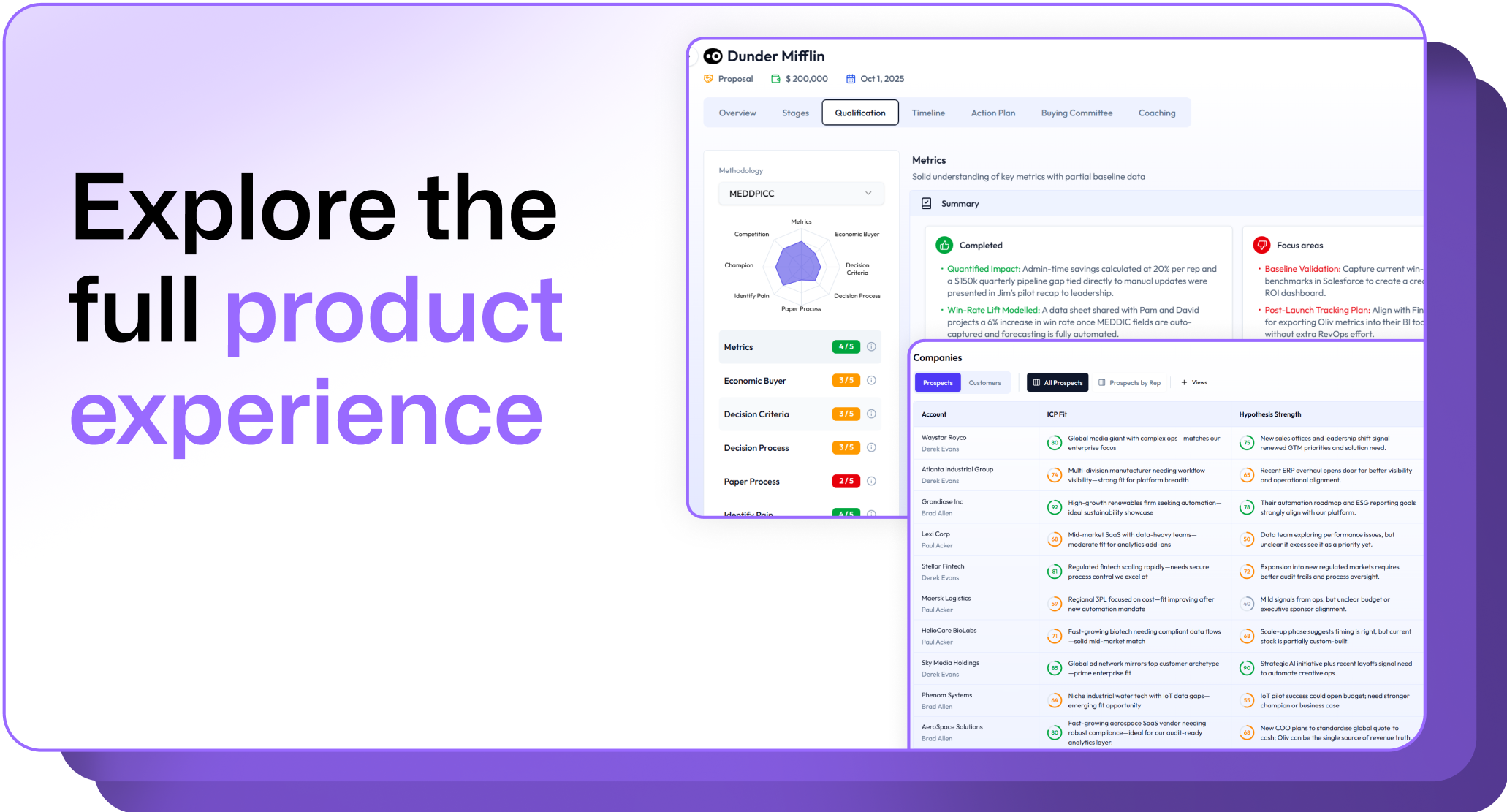
.avif)
.png)





.png)
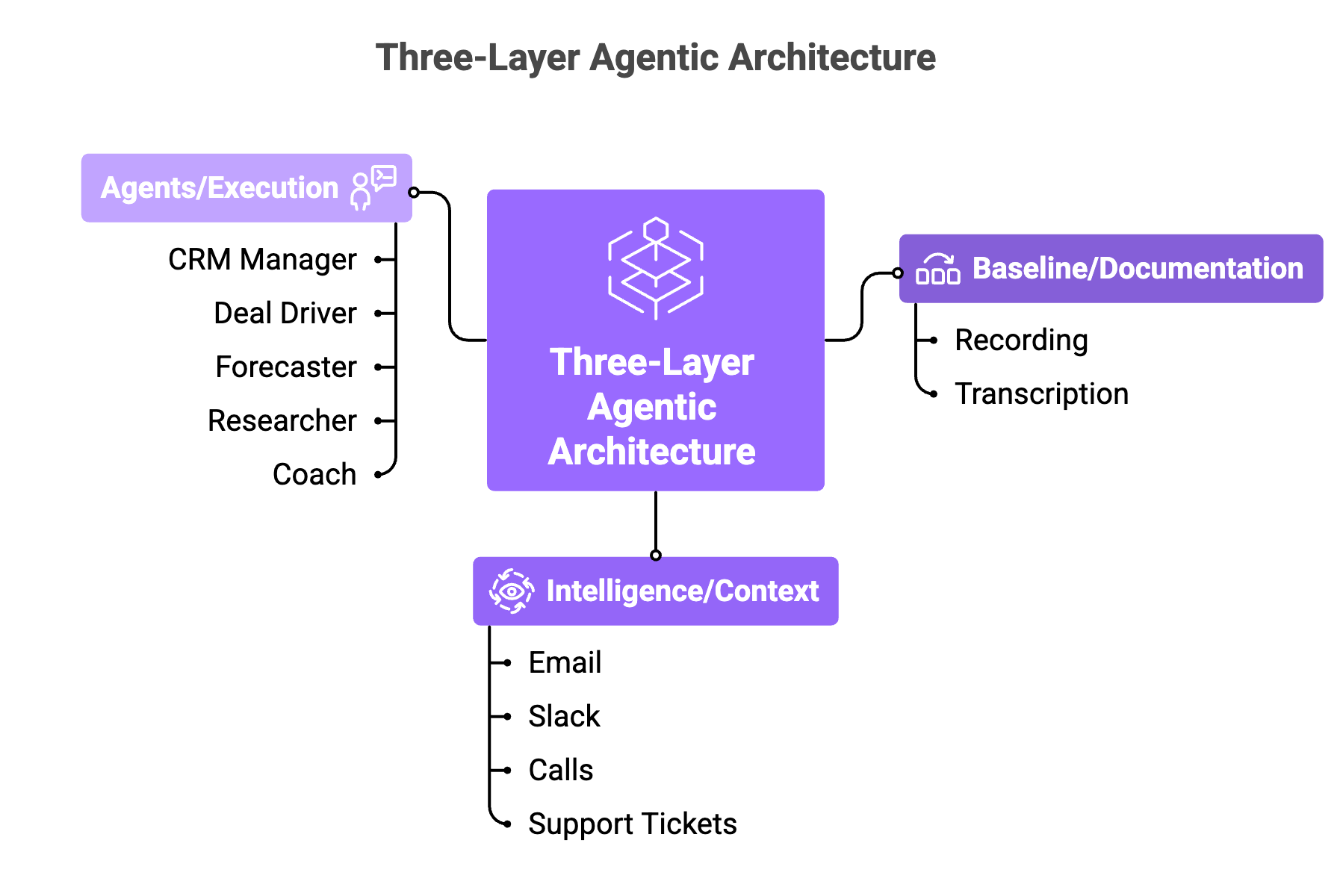
.png)