9 Best Gainsight Alternatives in 2026: Honest Pricing, Reviews, and Setup Times
Written by
Ishan Chhabra
Last Updated :
February 10, 2026
Skim in :
12
mins
In this article
Still got questions?
Come discuss this article with me.
Hi, I'm Ishan, Founder and CEO of Oliv.
I'm always up for a conversation about revenue intelligence, AI agents, or what's actually working (and what's not) across revenue teams.
I'd love to hear your perspective.
Thank you! Your submission has been received!
Oops! Something went wrong while submitting the form.
Meet Oliv’s AI Agents
Hi! I’m, Deal Driver
I track deals, flag risks, send weekly pipeline updates and give sales managers full visibility into deal progress
Hi! I’m, CRM Manager
I maintain CRM hygiene by updating core, custom and qualification fields all without your team lifting a finger
Hi! I’m, Forecaster
I build accurate forecasts based on real deal movement and tell you which deals to pull in to hit your number
Hi! I’m, Coach
I believe performance fuels revenue. I spot skill gaps, score calls and build coaching plans to help every rep level up
Hi! I’m, Prospector
I dig into target accounts to surface the right contacts, tailor and time outreach so you always strike when it counts
Hi! I’m, Pipeline tracker
I call reps to get deal updates, and deliver a real-time, CRM-synced roll-up view of deal progress
Hi! I’m, Analyst
I answer complex pipeline questions, uncover deal patterns, and build reports that guide strategic decisions
TL;DR
💰 Gainsight's TCO reaches $74K to $170K in Year 1 once implementation fees ($50K to $120K) and admin hours are included.
⏱️ Real implementation timelines run 5 to 6 months, not the 8 to 12 weeks Gainsight markets, consuming 40 to 140 admin hours.
👥 Teams under 15 CSMs rarely need an enterprise CSP; over-buying creates admin overhead without proportional value.
🤖 The CS market is splitting between configuration-heavy legacy platforms and AI-native intelligence layers that surface signals autonomously.
📊 ChurnZero (4.7/5 G2) leads mid-market ease of use, while Planhat (2.3/5 G2) carries the lowest satisfaction among alternatives.
✅ Oliv AI delivers value in 5 minutes to 2 days with modular agent pricing, free data migration, and zero mandatory platform fees.
Q1. What Are the 9 Best Gainsight Alternatives That Fit Your Team Size? [toc=9 Best Gainsight Alternatives]
The customer success platform (CSP) landscape in 2026 is undergoing a fundamental shift from legacy, adoption-heavy tools to AI-native, agent-first platforms that do the work for you. For teams evaluating Gainsight alternatives, whether due to implementation friction (5+ months), prohibitive costs ($24K to $660K+ annually), or manual data-entry dependencies, there are now right-sized solutions spanning SMB, mid-market, and enterprise segments.
Totango: Scalable for teams needing automation at 25 to 200 CSMs
Planhat: European-favored, complex data models
Custify: Small SaaS teams, 5 to 30 accounts
ClientSuccess: SMB-first with basic workflow automation
Vitally: Data-rich dashboards for tech-forward teams
Freshdesk: Support-first ticket management for reactive CS
HubSpot Service Hub: Marketing/Sales bundle extension for light CS needs
📊 Comprehensive Comparison Table
Gainsight Alternatives: Full Platform Comparison (2026)
Platform
Best For
Starting Price
Implementation
G2 Rating
Key Strength
Key Limitation
Oliv AI
AI-first teams, 10 to 500 reps
$19/user/month (modular agents)
5 min to 2 days
⭐ 4.8/5
Autonomous CRM updates, agentic workflows
Early-stage (Series A)
ChurnZero
Mid-market, 10 to 100 CSMs
$12,000/year (~$100/user/month)
4 to 8 weeks
⭐ 4.7/5
Ease of use, journey automation
Limited advanced integrations
Totango
Growing teams, 25 to 200 CSMs
$249/month (Freemium)
6 to 12 weeks
⭐ 4.4/5
SuccessBLOCs automation
Manual integrations, sentiment tracking gaps
Planhat
Complex data needs, enterprise
Custom pricing
8 to 16 weeks
⭐ 2.3/5
Data centralization
Extremely buggy, poor documentation
Custify
Small SaaS, 5 to 30 customers
$899/month (3 seats)
2 to 4 weeks
⭐ 3.2/5
Health scoring basics
Not intuitive, lacks email flexibility
ClientSuccess
SMB, under 50 CSMs
Custom pricing
4 to 6 weeks
⭐ 3.5/5
Gmail integration, pulse scoring
Limited features, high CSM turnover
Vitally
Data-centric teams, 10 to 50 CSMs
Custom pricing
3 to 6 weeks
⭐ 3.9/5
Health scoring flexibility
Half-baked features, high AI add-on costs
Freshdesk
Support-first CS, 5 to 100 agents
$19/agent/month
1 to 2 weeks
⭐ 4.5/5
Omnichannel ticketing
Not a true CSP, reactive support only
HubSpot Service Hub
Existing HubSpot users
$15/month (Starter)
2 to 4 weeks
⭐ 3.6/5
CRM unification
Expensive scaling, messy ticketing UI
Detailed Platform Breakdown
1. Oliv AI: The AI-Native Revenue Orchestration Leader
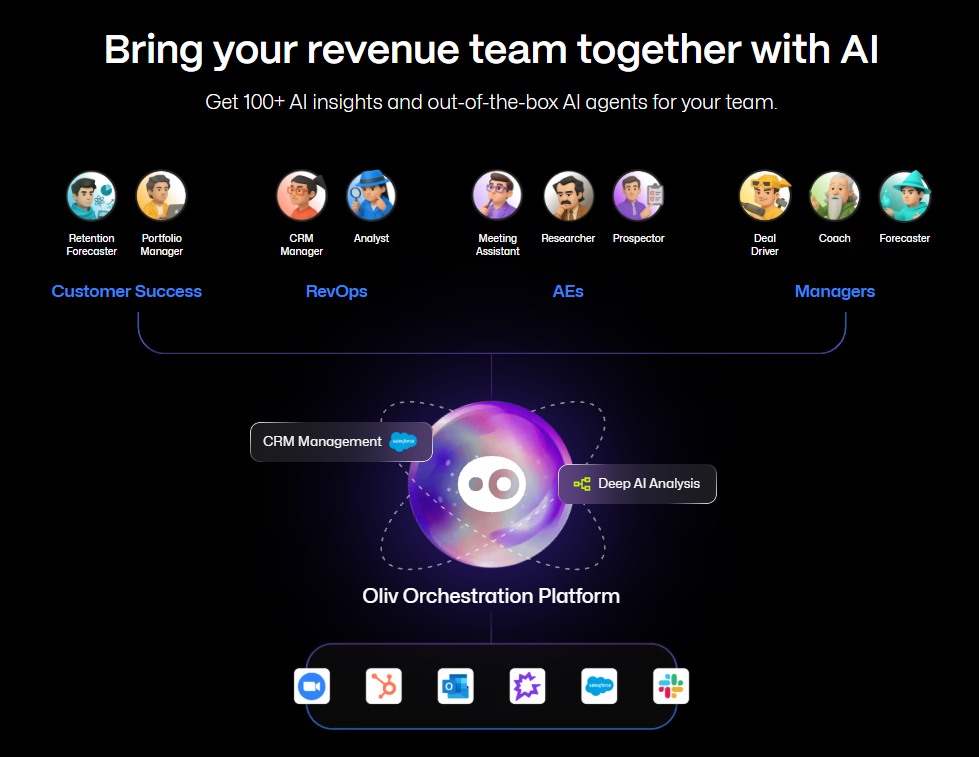
Oliv AI's agent-based architecture displays purpose-built AI agents including Retention Forecaster, Portfolio Manager, and CRM Manager, representing the AI-native intelligence layer approach to customer success.
Best For: Teams tired of manual CRM entry, dashboard digging, and pre-generative AI tools requiring extensive adoption
Pricing: Modular pricing; Analyst Agent at $4,999/org
Implementation: 5 minutes to 2 days for core value; 2 to 4 weeks for full custom model building
Oliv AI represents the third generation of revenue intelligence, moving beyond passive recording (Gong Gen 1) and rule-based orchestration (Clari Gen 2) into AI-Native Revenue Orchestration. Unlike legacy CSPs that demand adoption and training, Oliv deploys specialized AI agents that autonomously handle jobs-to-be-done: the CRM Manager Agent updates fields based on conversation context (trained on 100+ methodologies like MEDDIC), the Forecaster Agent produces unbiased weekly roll-ups with presentation-ready decks, and the Health Monitor Agent (CS-specific) scans accounts weekly for usage and support ticket anomalies to alert CSMs before churn escalates.
✅ Pros
Autonomous CRM hygiene solves the "dirty data" crisis without manual entry
Modular pricing pay only for agents you need; no mandatory $50K platform fees
Speed-to-value91% lower TCO than Gong; instant summaries within 5 minutes post-call
360 degree deal intelligence stitches data from calls, emails, Slack, Telegram into unified view
Free data migration imports historical Gong/Chorus recordings at no cost
❌ Cons
Early-stage Series A startup (team of 30 to 35)
CS-specific agents (QBR Builder, Retention Forecaster) still in beta/roadmap phase
Not ideal for pure B2C support use cases
💬 User Feedback
"Before switching to Oliv, cleaning up messy CRM fields and guessing at forecasts used to swallow half my week. Oliv fixes the data as it happens." - Darius Kim, Head of RevOps, Driftloop
🔑 Unique Differentiator
Oliv's Voice Agent autonomously calls reps nightly for 5-minute debriefs to capture context from unrecorded phone calls or in-person meetings, data gaps legacy tools like Gainsight miss entirely.
2. ChurnZero: The Mid-Market Ease-of-Use Champion
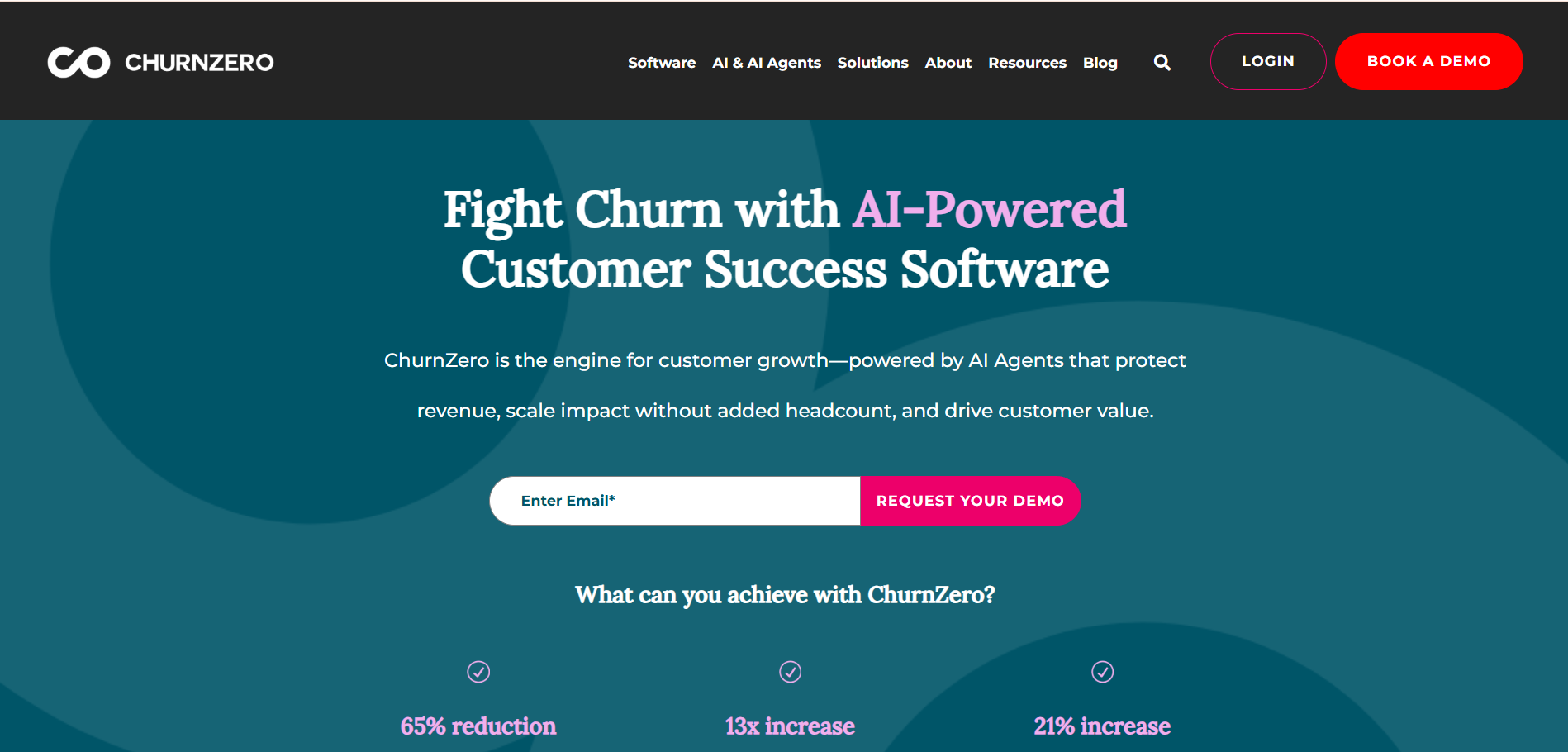
ChurnZero's homepage highlights its AI-powered customer success platform positioning, showcasing 65% churn reduction metrics and a demo request CTA for CS teams evaluating Gainsight alternatives.
Best For: Teams of 10 to 100 CSMs needing out-of-the-box journey automation
Pricing: $12,000/year base (~$100/user/month); enterprise deals $38K to $64K annually
Implementation: 4 to 8 weeks; "easier to deploy" than Gainsight but requires RevOps for advanced plays
ChurnZero dominates G2 ease-of-use ratings (4.7/5) because it is "built by CS experts for CS practitioners". The platform excels at health scoring, playbook automation, and real-time customer engagement tracking. Unlike Gainsight's clunky interface, ChurnZero's clean UI allows CSMs to live in the platform daily without extensive training.
✅ Pros
Intuitive UI minimal learning curve; CSMs adopt within days
Live Export to Google Sheets extends dashboards externally without losing real-time sync
Strong customer support responsive CSM assignments and technical experts
Journey orchestration automated touchpoints from onboarding to renewal
❌ Cons
Limited reporting flexibility "not very intuitive" for custom analytics
Shallow integrations lacks plug-and-play for monday.com, Clockify, Slack
Scalability ceiling struggles with complex parent/child account hierarchies
💬 User Feedback (Mixed)
"Churn Zero has completely changed the way both our CSMs and leadership interact with customers... reliable churn scores, automation and one platform for capturing and tracking VoC feedback." - Nancy S., Director of Customer Success, Mid-Market | G2 Verified Review
"Formatting emails is very difficult, creating a Playbook takes a long time relative to other vendors, not being able to duplicate other users playbooks is inefficient, the system can only process 3 plays at a time which is not efficient for a large organization, we are only able to send 99 emails at a time if we want the emails to show up in our sent box." - Dayna M., Customer Success Manager, Enterprise (1.5 star rating) | G2 Verified Review
3. Totango: Scalable Automation with SuccessBLOCs
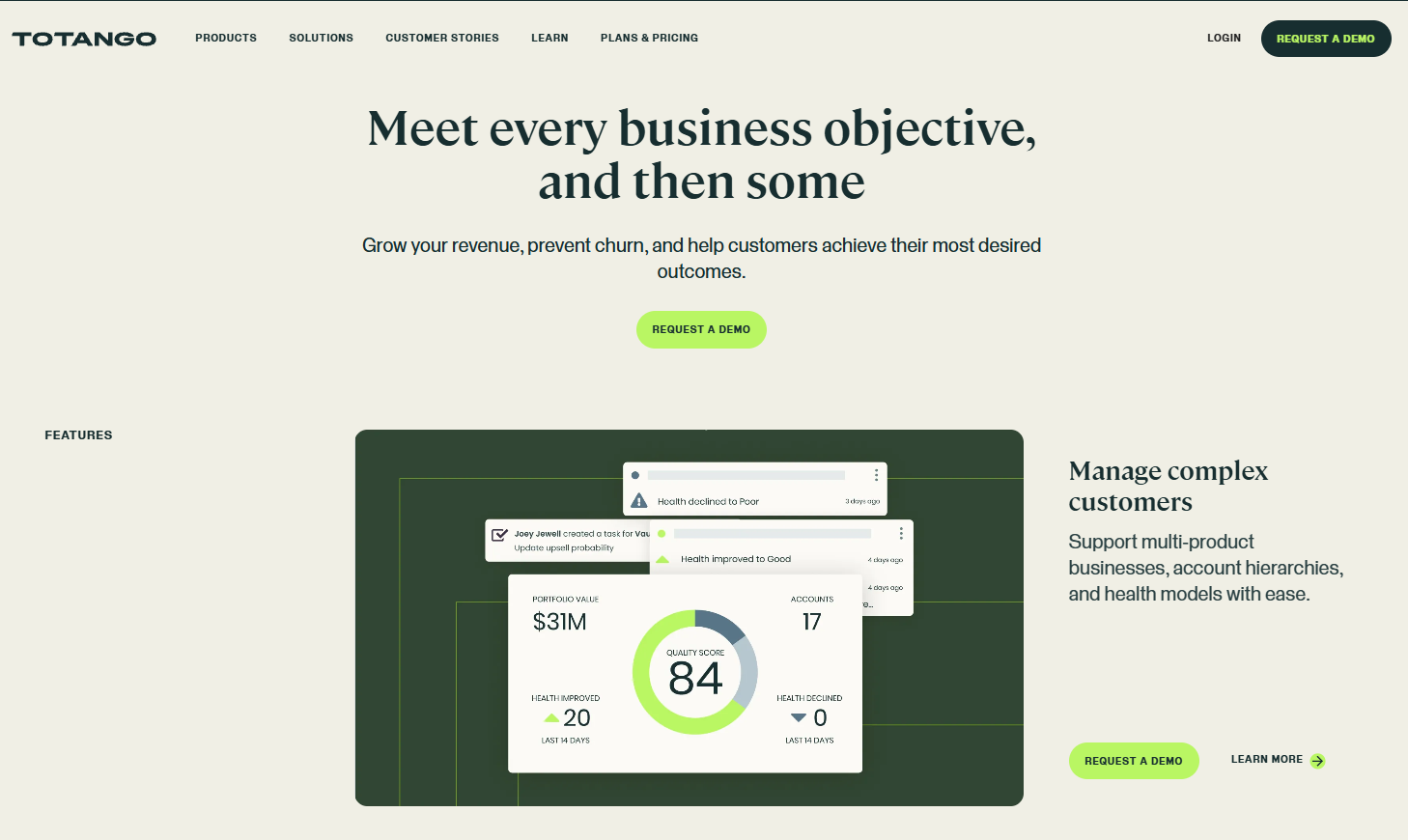
Totango's homepage promotes its portfolio health dashboard showing quality scores, account counts, and health trends, designed to help CS teams manage complex customer journeys at scale.
Best For: Growing SaaS teams (25 to 200 CSMs) managing digital-first customer success
Implementation: 6 to 12 weeks; "steep learning curve" for backend configuration
Totango's SuccessBLOCs, automated customer journey workflows, enable teams to scale engagement without proportional headcount growth. The platform shines in multi-product portfolio tracking and task automation, making it ideal for companies selling multiple SKUs to the same account.
✅ Pros
User-friendly interface intuitive navigation; minimal training required
Fast report building customizable dashboards for leadership visibility
Multi-product tracking unique ability to manage complex product mixes per customer
Responsive support dedicated CSMs actively help with implementation
❌ Cons
Integration friction Salesforce syncs have delays; manual effort for external systems
Limited customization "at a crossroads with features"; lacks child-site tagging for hierarchies
Data hygiene prerequisite "cannot do clean-up for you"; poor input data equals inaccurate health scores
4. Planhat: High Potential, High Frustration
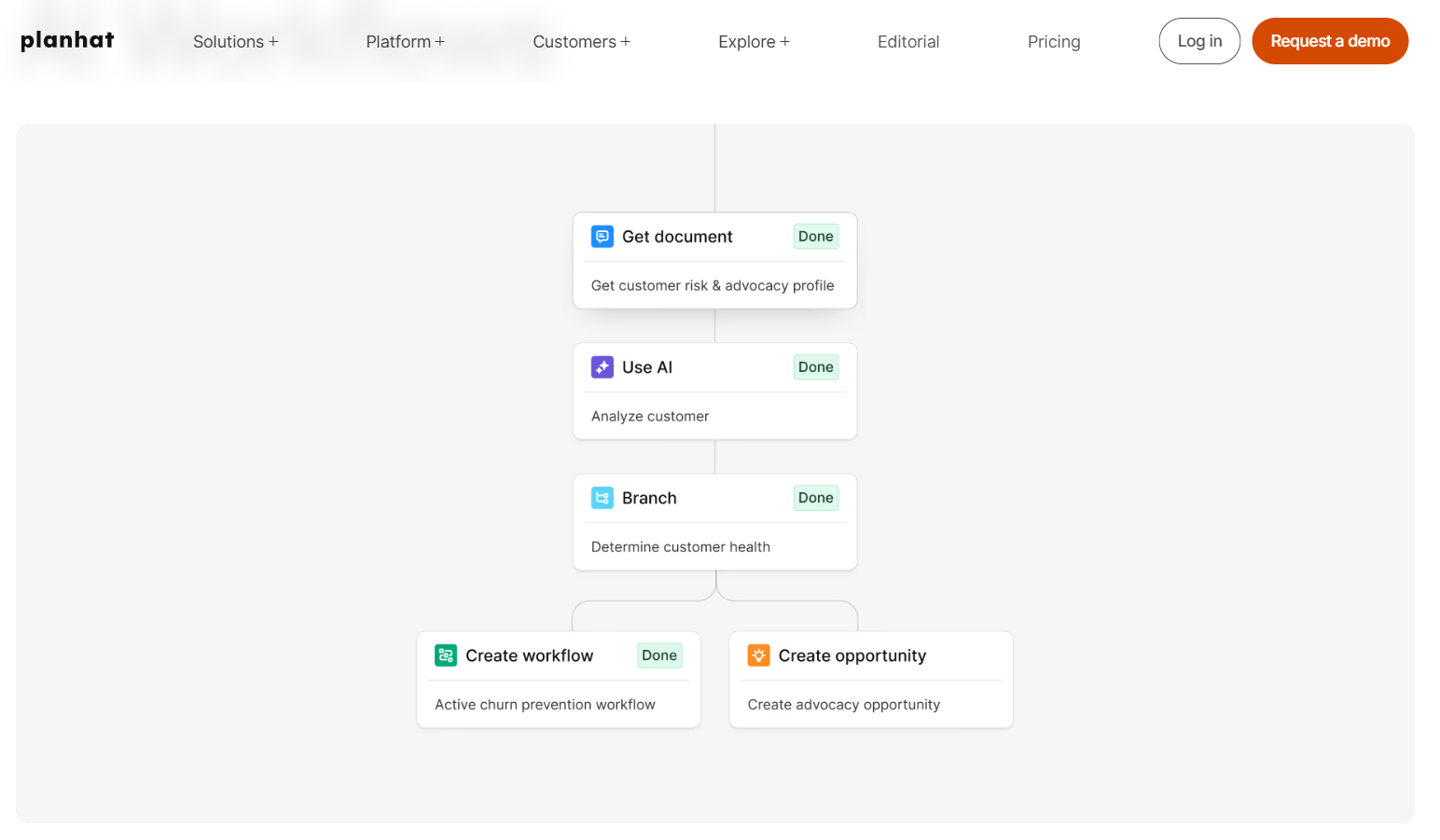
Planhat's workflow builder displays an automated sequence including AI customer analysis, health determination branching, and churn prevention workflows for enterprise customer success operations management.
Best For: European enterprise teams with complex data architecture needs (in theory)
Pricing: Custom pricing only
Implementation: 8 to 16 weeks; "no local APAC support"
Planhat's data centralization vision is powerful, unifying product usage, support cases, and financial data, but execution is severely hampered by chronic bugs, non-intuitive data models, and unreliable integrations. Multiple 2025 reviews report "feeling stuck in an ongoing alpha version".
✅ Pros
Workflows and automation most used feature when functioning correctly
Customer Portals nice concept for client self-service (when working)
Multiple data views ability to create filtered perspectives per role
❌ Cons
Extremely buggy "most integrations do not work as intended... uploads do not work"
Bizarre data model "cannot link data from other objects without weird manipulation"
Poor documentation refers to old UI; lacks clarity on what checkboxes actually do
No APAC support regional teams left without local CSMs
💬 User Feedback
"Super buggy product... most integrations do not work as intended. Feels like we are stuck in an ongoing alpha version. Not worth the money." — Verified User, Small-Business (0.5 star) | G2 Verified Review
"An app that someday can be something, now it is too unmature. The data model is the most bizarre one I have faced, ever." - Verified User, Information Services, Mid-Market (1.5 star) | G2 Verified Review
5. Custify: Lightweight for Small SaaS
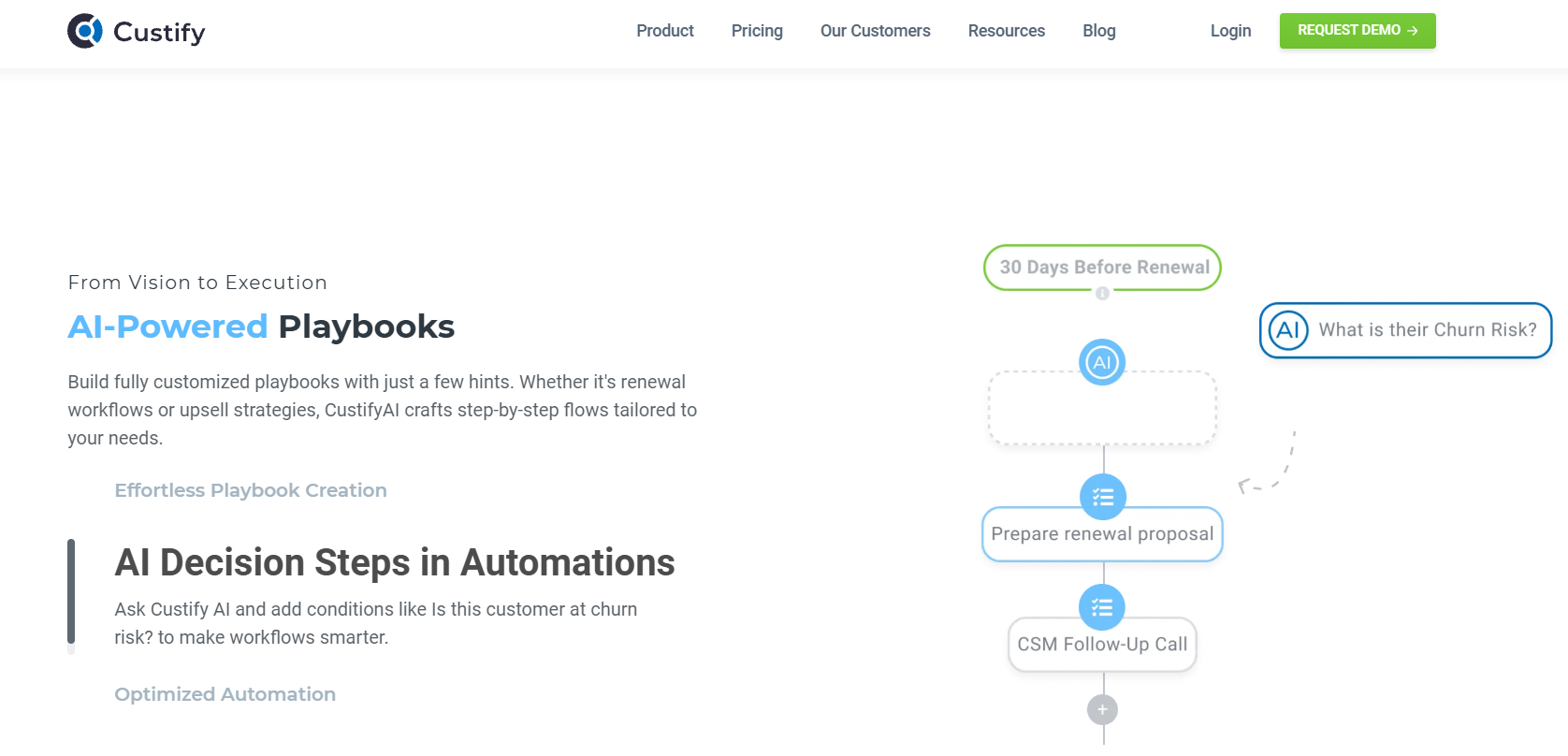
Custify showcases AI-powered playbook creation with automated churn risk assessment and renewal workflow capabilities, offering a lightweight and affordable Gainsight alternative for smaller CS teams.
Best For: Small SaaS businesses (5 to 30 customers) needing basic health scoring
Pricing: $899/month for 3 seats
Implementation: 2 to 4 weeks
Custify offers straightforward health score tracking and lifecycle management for teams that don't need Gainsight's enterprise complexity. However, users consistently report UX inconsistencies and feature limitations that make it feel "incomplete".
✅ Pros
Good dashboards clean overview of customer segments
Quick Slack support responsive via direct channel
Affordable entry point lower cost than enterprise CSPs
❌ Cons
Clunky interface "interfaces have been inconsistent and ultimately turned off"
No email broadcast cannot send to full customer lists
Update delays "does not update instantly"; manual data changes randomly
💬 User Feedback
"Good for basic use cases but not customizable enough. Custify has a lot of restrictions... emails are sent from custify email addresses." - Verified User, Computer Software, Small-Business (2.5 star) | G2 Verified Review
6. ClientSuccess: Simple but Limited
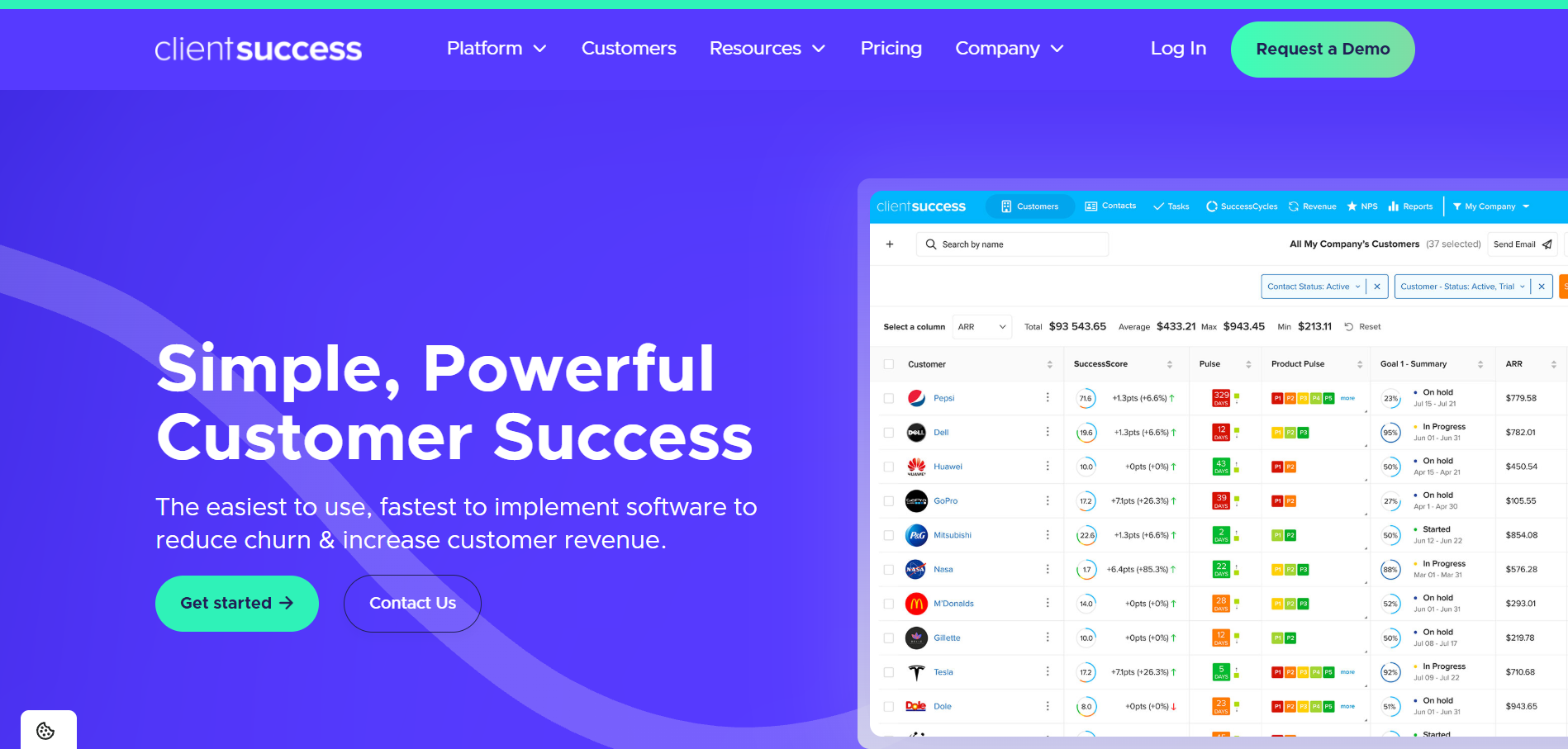
ClientSuccess offers a clean customer dashboard with SuccessScore tracking, product pulse indicators, and ARR visibility, positioning itself as a simple and powerful Gainsight competitor for mid-market teams.
Best For: SMB teams (under 50 CSMs) needing basic CRM-lite functionality
Pricing: Custom pricing
Implementation: 4 to 6 weeks
ClientSuccess provides email integration and pulse scoring in a visually clean interface. However, the "feature set was limited" is a recurring theme, and teams frequently migrate to Gainsight or ChurnZero after 12 to 18 months.
✅ Pros
Slack and Gmail integration streamlined communication tracking
Revenue reporting new feature helpful for tracking ARR/NRR
❌ Cons
Feature limitations "required us to use multiple tools"
Validation errors "impossible to update anything... constant validation errors"
High CSM churn "7 to 8 account managers in the last year"
💬 User Feedback
"It was a great tool that offered all of the basic features... but the feature set was limited. Which is why we ended changing to Gainsight." - Xander K., Customer Success Manager, Mid-Market (3.5 star) | G2 Verified Review
7. Vitally: Data-Rich but Half-Baked
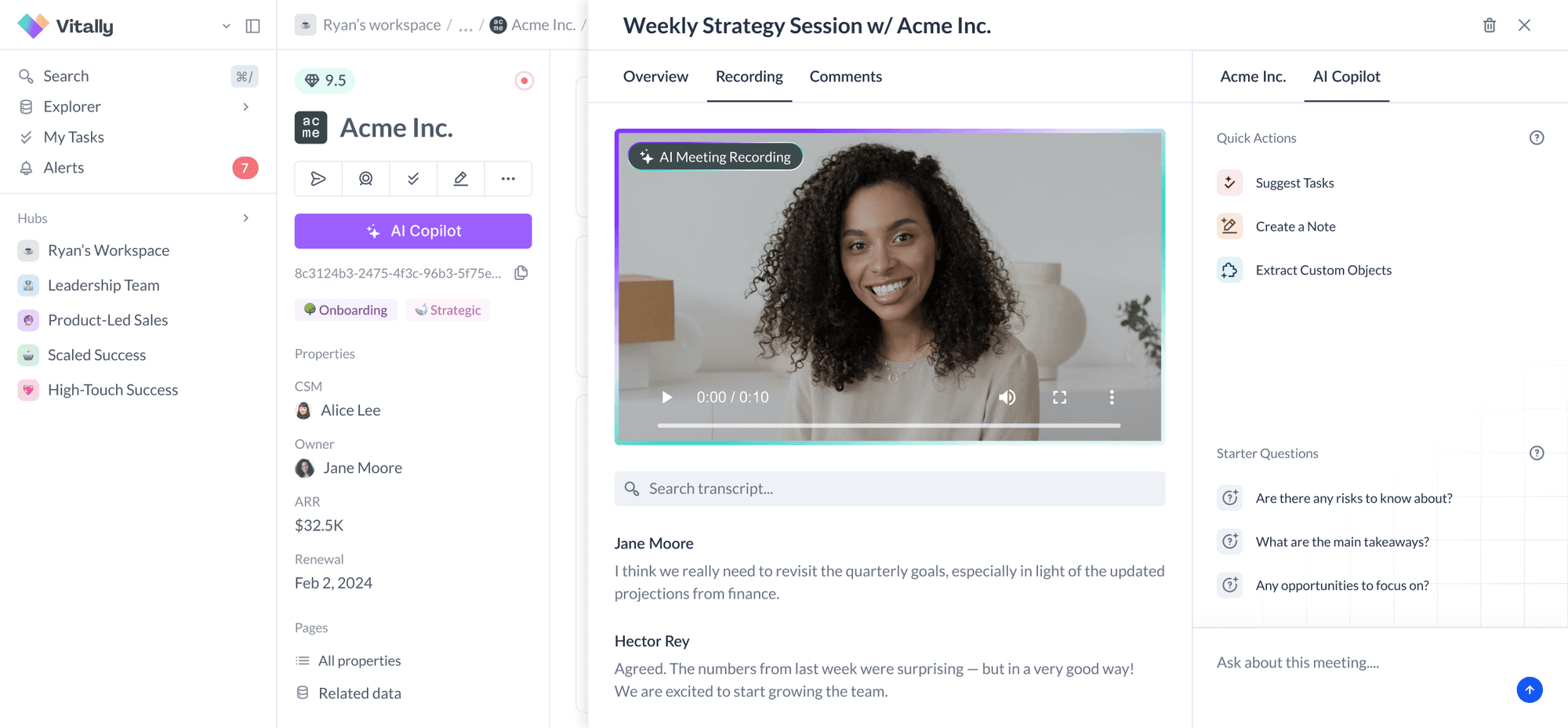
Vitally's account view features a 9.5 health score, AI Copilot sidebar, and integrated meeting recordings, offering a flexible customer success platform alternative with built-in intelligence capabilities.
Best For: Data-forward teams (10 to 50 CSMs) comfortable with technical setup
Pricing: Custom pricing; "AI features very high priced"
Implementation: 3 to 6 weeks
Vitally excels at health scoring flexibility and integrating multiple data sources (HubSpot, Zendesk, Snowflake). However, "secondary features are half-baked," and the cost of AI add-ons "does not allow for ROI".
✅ Pros
Robust health scoring easy to set up, flexible weighting
Data centralization pulls from multiple systems into one view
Automation and playbooks streamlines CS workflows
❌ Cons
Navigation issues "difficult to navigate... data sometimes is incorrect"
Unusable docs feature "jumping all over the page when trying to add elements"
High AI costs pricing "far above industry standards"
8. Freshdesk: Support-First, CS-Second
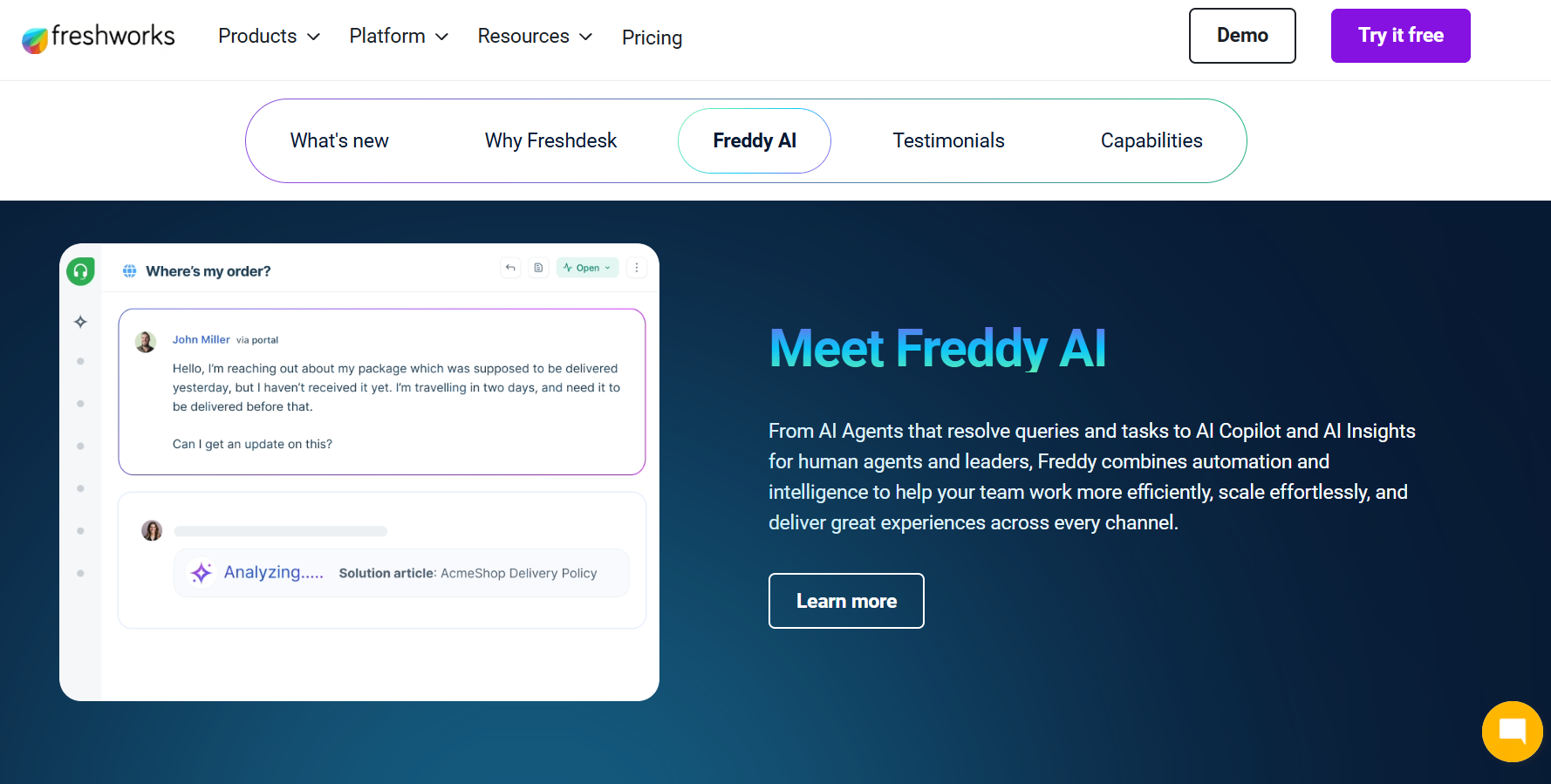
Freshdesk highlights its Freddy AI suite with AI Agents, Copilot, and Insights for automated customer support, offering a budget-friendly helpdesk alternative starting at $19 per agent per month.
Best For: Support teams (5 to 100 agents) needing ticket management, not strategic CS
Pricing: $19/agent/month (Growth plan)
Implementation: 1 to 2 weeks
Freshdesk is a helpdesk ticketing system, not a true customer success platform. It handles omnichannel support (email, chat, phone) efficiently but lacks proactive CS features like health scoring, lifecycle automation, or expansion tracking.
✅ Pros
Core ticketing strength "delivers on ticketing... all required features"
Fast implementation operational within 1 to 2 weeks
Affordable $19/agent is lowest-cost option
❌ Cons
Not a CSP purely reactive support; no proactive CS workflows
Confusing product integration "incredibly confusing to build up a suite across Sales, Desk, Chat"
"Freshdesk delivers on its core value, ticketing... I don't like the way Freshworks products in general are integrated. It is incredibly confusing to build up a suite of products across Sales, Desk and Chat." — Will v., CTO, Small-Business (4.5 star) | G2 Verified Review
9. HubSpot Service Hub: For Existing HubSpot Ecosystems Only
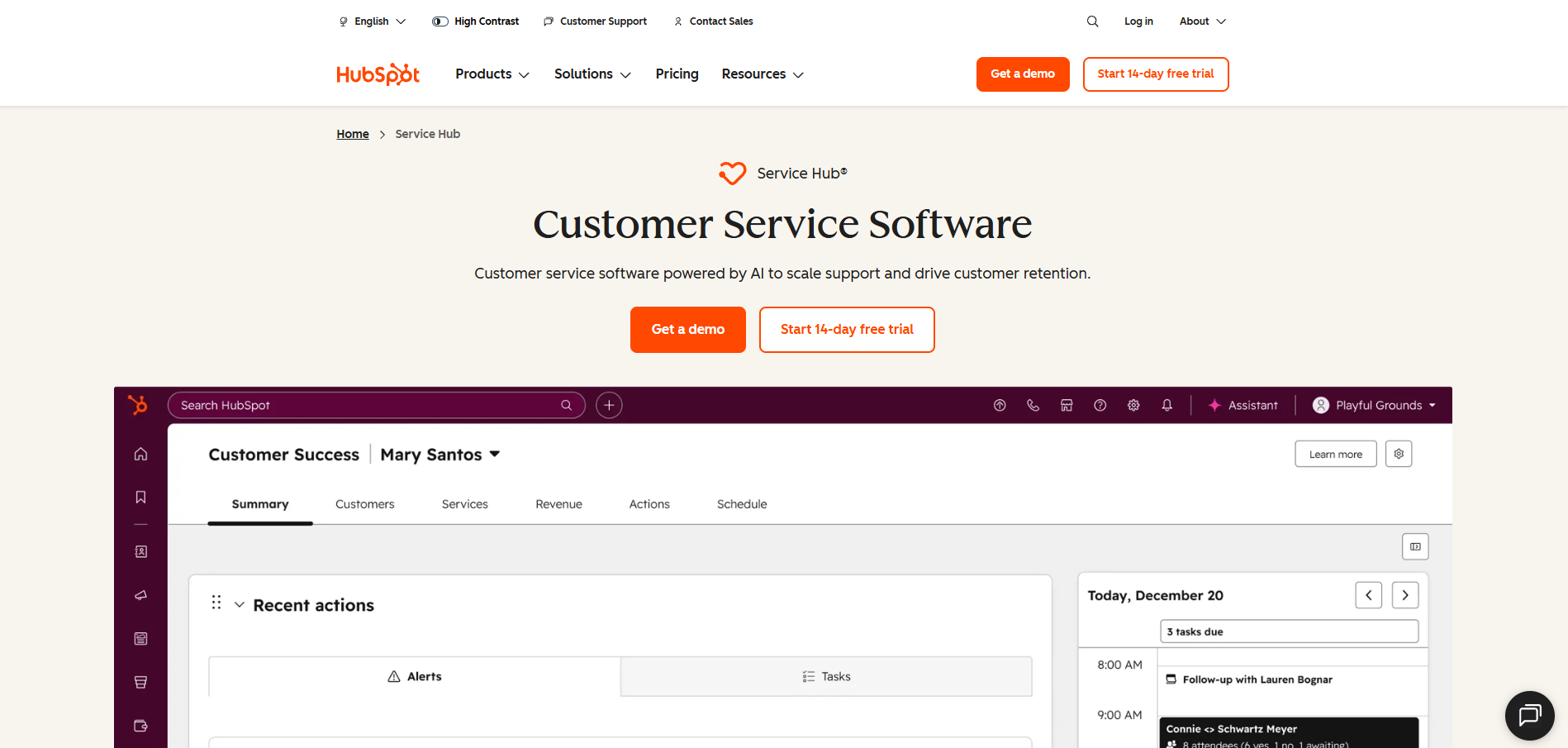
HubSpot Service Hub displays its customer success workspace featuring recent actions, alerts, task management, and scheduling tools, providing an affordable entry-level CS platform starting at $15 per month.
Best For: Companies already using HubSpot Sales/Marketing needing light CS functionality
HubSpot Service Hub offers unified CRM data for teams already invested in the HubSpot ecosystem. However, "pricing climbs fast" ($1,500+ mandatory fees at Professional tier), and the ticketing UI is "messy and unintuitive".
✅ Pros
CRM unification single platform for Sales/Marketing/Service
Knowledge base reduces ticket volume via self-service
❌ Cons
Rapid cost scaling "pricing seems excessive as you scale"
Messy ticketing UI "hard to search for old tickets"
Advanced features locked automation behind expensive plans
🔄 How Oliv AI Simplifies the Switch
Unlike legacy CSPs requiring 6 to 24 month implementations and manual health score configuration, Oliv AI's agentic architecture delivers value within 5 minutes to 2 days. The platform's free data migration service imports historical call recordings from Gong, Chorus, or any legacy tool, while the CRM Manager Agent immediately begins autonomous field updates based on conversation context, eliminating the "dirty data" problem that cripples Gainsight, Planhat, and Totango deployments. Teams seeking speed-to-value, transparent modular pricing, and AI-native workflows find Oliv AI the logical alternative in 2026's agent-first AI-Native Revenue Orchestration era.
Q2: Why Are CS Teams Actively Replacing Gainsight in 2026? [toc=Why Teams Replace Gainsight]
✅ Gainsight Earned Its Reputation
Credit where it's due: Gainsight remains the Forrester Wave Leader in Customer Success Platforms (Q4 2025), earning the "highest score possible" in retention optimization and scaling customer success. Its Journey Orchestrator is genuinely powerful for CS-ops-heavy enterprises, and reference customers praise its automation capabilities for delivering strong CX at scale. G2 data confirms 97 mentions of "ease of use" and 54 mentions of "centralized customer data" as key strengths. For Fortune 500 organizations with dedicated CS Ops teams and six-figure budgets, Gainsight remains a defensible choice.
🚧 The Adoption Wall: Cost, Complexity, and Dashboard Fatigue
However, mid-market teams (50 to 500 employees) are increasingly hitting an adoption wall driven by four compounding factors:
⏳ Implementation friction: Vendor-claimed 8-week timelines routinely stretch to 5+ months, consuming 40 to 140 admin hours. G2 reviewers cite "non-intuitive UI" (23 mentions) and "steep learning curve" (20 mentions).
🔧 Manual data dependency: Legacy health scores rely on CSMs to manually input data, which they neglect, producing what practitioners call "dirty" or "meaningless" scores.
📊 Dashboard digging fatigue: Managers report clicking through multiple screens to find actionable intelligence instead of receiving insights where they already work.
"Consider the costs and implementation time. Implementation took us a good 6 months, and now we cannot consider switching because of how entrenched we are with it, even though it is obscenely expensive." — Verified User, Computer Software, G2 Verified Review
🔀 The Market Is Splitting: Configuration-Heavy vs. Intelligence-First
The $2.67 billion CSP market (projected to reach $7.26B by 2032 at 17.9% CAGR) is bifurcating. On one side: configuration-heavy platforms like Gainsight, Planhat, and Totango, built for teams with dedicated admins who can invest months in setup. On the other: AI-native intelligence layers that surface churn risk, renewal signals, and engagement gaps autonomously, delivering signal directly to Slack and email rather than requiring CSMs to log into yet another dashboard.
This isn't a marginal preference shift. It reflects a generational transition from software you must adopt to agents that do the work for you. This evolution mirrors what we describe as the shift from revenue operations to intelligence to orchestration.
🤖 How Oliv AI Addresses This: Intelligence, Not More Software
Oliv AI approaches this problem from the opposite direction. Rather than requiring months of configuration to build health scores, Oliv deploys purpose-built AI agents, including the Health Monitor Agent (scanning accounts weekly across usage, support tickets, and survey data) and the Retention Forecaster (tracking renewal risk across the full portfolio), that surface churn signals autonomously before escalation. The result: CSMs receive actionable intelligence dropped into their inbox, not another dashboard to dig through.
"As an admin, everything is more complicated than it should be. I end up building something multiple times... We are also having a hard time with our CSMs adopting and trusting Gainsight." — Verified User, Computer Software, Mid-Market, G2 Verified Review
Q3: How Do These Alternatives Compare on Price, Features, and Setup Speed? [toc=Price Features Setup Comparison]
Evaluating Gainsight alternatives requires looking beyond list prices. The true Total Cost of Ownership (TCO) includes licensing, implementation services, ongoing admin hours, and annual uplifts, costs that can double the sticker price within 24 months.
💰 Table 1: Pricing and TCO Comparison
Pricing and TCO Comparison: Gainsight vs Alternatives
Platform
Starting License
Year 1 TCO (10 Users)
Annual Uplift
Hidden Costs
Gainsight Essentials
~$24,000/yr
$74,000 to $150,000
5 to 10%
$50K to $120K implementation; dedicated admin
Gainsight Enterprise
~$42,000/yr (10 users)
$92,000 to $170,000
5 to 10%
Professional services mandatory
ChurnZero
~$12,000/yr
$20,000 to $35,000
Negotiable
Limited integrations require workarounds
Totango
$249/mo (Starter)
$5,000 to $25,000
Custom
Data hygiene prerequisite
Planhat
Custom only
$15,000 to $40,000 (est.)
Custom
Unreliable integrations
Custify
$899/mo (3 seats)
$11,000 to $15,000
Custom
UX limitations
Vitally
Custom
$12,000 to $30,000 (est.)
Custom
AI add-ons "far above industry standards"
Freshdesk
$19/agent/mo
$3,000 to $8,000
Minimal
Not a CSP, no health scoring
HubSpot Service Hub
$15/mo (Starter)
$2,000 to $15,000
Tier-dependent
$1,500+ mandatory fees at Pro tier
Oliv AI
Modular pricing
Significantly lower TCO
Transparent
Free data migration
✅ Table 2: Feature Matrix
Feature Matrix: Gainsight vs Top Alternatives
Feature
Gainsight
ChurnZero
Totango
Vitally
Planhat
Oliv AI
Health Scoring
✅ Advanced
✅ Strong
✅ Good
✅ Flexible
⚠️ Basic
✅ AI-driven (autonomous)
Playbooks/Automation
✅ Journey Orchestrator
✅ Journeys
✅ SuccessBLOCs
✅ Playbooks
⚠️ Workflows
✅ Agent-based
CRM Integration
✅ Deep (Salesforce)
✅ Salesforce, HubSpot
✅ Salesforce
✅ HubSpot, Zendesk
⚠️ Buggy
✅ Multi-CRM
In-App Messaging
✅ PX add-on
✅ Built-in
⚠️ Limited
❌ No
⚠️ Portals
❌ N/A
AI Capabilities
⚠️ Early-stage
⚠️ Evolving
⚠️ Basic
⚠️ Overpriced
❌ Minimal
✅ Agentic, generative AI-native
G2 Satisfaction
⭐ 4.6
⭐ 4.7
⭐ 4.4
⭐ 3.9
⭐ 2.3
⭐ 4.8
⏱️ Table 3: Implementation, Vendor Claim vs. Reality
Implementation Timelines: Vendor Claim vs. Real-World
Platform
Vendor-Claimed Timeline
Real-World Timeline
Admin Hours Required
Gainsight
8 to 12 weeks
5 to 6 months
40 to 140 hours
ChurnZero
4 to 6 weeks
4 to 8 weeks
15 to 30 hours
Totango
4 to 8 weeks
6 to 12 weeks
20 to 40 hours
Planhat
6 to 10 weeks
8 to 16 weeks
30 to 60+ hours
Vitally
2 to 4 weeks
3 to 6 weeks
10 to 20 hours
Freshdesk
1 week
1 to 2 weeks
5 to 10 hours
HubSpot Service Hub
1 to 2 weeks
2 to 4 weeks
10 to 15 hours
Oliv AI
5 min to 2 days
5 min to 2 days (custom: 2 to 4 weeks)
2 to 4 hours
"Easier to deploy, harder to long-term manage... You quickly uncover that with a more simplistic setup, there is less product functionality." — Tim M., Director of Customer Success Programs, G2 Verified Review
For teams prioritizing speed-to-value and minimal admin overhead, Oliv AI's agentic model eliminates the configuration-before-value trade-off entirely, agents begin working from Day 1. Learn more about how AI-Native Revenue Orchestration inverts legacy implementation models.
Q4: Which Platform Fits Your Team Size, and Do You Even Need a Full CSP? [toc=Platform by Team Size]
🤔 Tier 0: Do You Actually Need a CSP?
Before committing to a dedicated customer success platform, teams with fewer than 5 CSMs should ask a candid question: Do you need a full CSP, or do you need better visibility? Many small teams already running HubSpot or Salesforce can manage renewals, basic health tracking, and customer communication directly within their CRM. HubSpot Service Hub ($15/month starter) or Freshdesk ($19/agent) may be sufficient for reactive support needs.
🏢 The Legacy Assumption: One-Size-Fits-Enterprise
Gainsight, Planhat, and Totango were architected assuming a dedicated CS Operations function, admins who configure health scores, build playbooks, and maintain integrations full-time. For teams under 15 CSMs without that infrastructure, these platforms create overhead rather than eliminating it. As one Totango reviewer noted:
"There is a pretty steep learning curve for the front end... the tool does require a bit of work." — Renske v., Technical Consultant, G2 Verified Review
📊 Right-Sizing Your Platform: A Decision Framework
CS Platform Decision Framework by Team Size
Team Size
Primary Need
Best Fit
1 to 5 CSMs (Lean)
Visibility + basic tracking
HubSpot Service Hub, Freshdesk, or Oliv AI (intelligence layer)
5 to 15 CSMs (Growth)
Playbooks + automation
Vitally, ChurnZero, or Oliv AI
15 to 50 CSMs (Scale)
Workflow orchestration + analytics
ChurnZero, Totango, or Oliv AI (Analyst for strategic queries)
50+ CSMs (Enterprise)
Full CS Ops infrastructure
Gainsight or Planhat (if you have the admin resources)
🧠 Oliv AI Across Tiers: Intelligence Layer, Not Another CSP
Oliv AI is intentionally positioned differently. It's not a configuration-heavy CSP competing on playbook builders, it's an AI-native intelligence layer that works across team sizes. For lean teams, the Health Monitor Agent surfaces churn risk without requiring dashboard setup. For scale teams, the Analyst (at $4,999/org) answers strategic questions like "Why are we losing renewals in the FinTech segment?" in plain English.
🧭 The Decision Heuristic
The decision heuristic is straightforward:
"I can't see risk fast enough" → Intelligence layer (Oliv AI)
"I need structured workflows and playbooks" → Traditional CSP (ChurnZero, Totango)
"I need faster support ticket resolution" → Helpdesk (Freshdesk, HubSpot)
For teams evaluating how AI is reshaping this category, our guide to the future of revenue intelligence outlines the architectural shift from dashboards to autonomous agents. You can also explore how AI-powered sales forecasting applies the same agentic principles to pipeline visibility.
Q5. How Long Does It Really Take to Implement a Gainsight Alternative? [toc=Implementation Timelines]
The 8-Week Promise vs. 5-Month Reality
Gainsight's marketing materials suggest an 8 to 12 week implementation. The reality told by G2 reviewers is starkly different. Multiple verified users report timelines of 5 to 6 months, with one calling implementation "a nightmare" that requires "deep commitments from customer teams, Salesforce admins, and engineering". To Gainsight's credit, they've invested in streamlining onboarding, but the fundamental architecture still demands significant upfront configuration before any value is returned.
"Powerful, designed for success, great content and thought leadership as a company. [But] the implementation/integration is a nightmare. You really need to have dedicated resources to managing and ongoing administration." - Verified User, Information Technology, Mid-Market | G2 Verified Review
💰 The Hidden Implementation Costs Nobody Budgets For
The license fee is just the entry ticket. Real implementation costs include:
Admin hours: 40 to 140 hours of internal team time for Gainsight; 15 to 30 for ChurnZero
Professional services: $50,000 to $120,000 for Gainsight Enterprise implementations
Time-to-ROI: 6 to 12 months before the platform delivers measurable value
Opportunity cost: Every month spent configuring is a month your CSMs are flying blind
Many mid-market teams never finish implementation. They get 60% configured, then live with workarounds permanently.
⏱️ Faster Alternatives, But Configuration Still Comes First
Vitally: 2 to 4 weeks (vendor), 3 to 6 weeks real-world
ChurnZero: 4 to 6 weeks (vendor), 4 to 8 weeks real-world
ClientSuccess: Days to weeks for basic setup
These are genuine improvements. However, all still follow the traditional pattern: configure > populate > train > adopt > then get value.
✅ Oliv AI: Value on Day 1, Not Day 90
Oliv AI inverts this sequence entirely. Baseline configuration takes 5 minutes, connect your CRM and calendar. Core value (autonomous CRM updates, meeting intelligence, churn signals) is realized within 1 to 2 days. Full custom model building with workflow integrations completes in 2 to 4 weeks. The difference is architectural: agents begin working immediately because they're trained on 100+ sales methodologies out of the box, rather than requiring manual score configuration.
"Implementation took us a good 6 months... we cannot consider switching because of how entrenched we are with it, even though it is obscenely expensive." - Verified User, Computer Software | G2 Verified Review
🔓 Breaking the Lock-In Cycle
This implementation lock-in, where switching costs compound over time, is precisely the problem AI-native platforms are designed to eliminate. When the platform does the work from Day 1, there's no six-month sunk cost holding teams hostage.
Q6. From Dashboards to AI Agents: How CS Platforms Are Evolving in 2026 [toc=CS Platform Evolution]
The Inflection Point
The customer success platform market, valued at $2.67 billion in 2026 and projected to reach $7.26 billion by 2032 at a 17.9% CAGR, is splitting along a fundamental architectural line. On one side: configuration-heavy, dashboard-first platforms designed for the CS Ops era. On the other: AI-native intelligence layers that surface insight autonomously, without requiring months of admin setup. This isn't a feature upgrade cycle. It's a generational shift in how CS teams consume and act on customer intelligence.
📉 Gen 1 to 2: Structure First, Intelligence Later
Generation 1 (2015 to 2022) brought structure to customer success for the first time. Gainsight introduced health scores, Journey Orchestrator, and the CTA framework, giving CS teams a dedicated system of record beyond the CRM. Generation 2 (2022 to 2025) layered on automation: SuccessBLOCs (Totango), playbooks (ChurnZero), and rule-based workflows (Planhat). Both generations solved real problems. But they share a fundamental constraint: humans must configure, populate, monitor, and interpret the data. The result is what practitioners now call "dashboard-digging fatigue", clicking through ten screens to find actionable intelligence instead of receiving it where they already work.
"There is an excessive focus on AI at the expense of addressing basic features, parity issues, and stability problems... The admin community has been requesting these basic improvements for years, yet we are repeatedly told that AI will solve this." - Alberto S., Enterprise (1,000+ emp.) | G2 Verified Review
🤖 Gen 3: AI Agents That Execute, Not Just Display
Generation 3 (2025+), what the industry increasingly calls AI-Native Revenue Orchestration, inverts the model entirely. Instead of building dashboards that display health scores for humans to review, agentic platforms generate intelligence from raw data across calls, emails, support tickets, and product usage, then act on it autonomously. The platform does the work; the CSM receives the output. This evolution from revenue operations to intelligence to orchestration represents the most significant architectural shift in revenue intelligence since the category was created.
🏗️ Oliv AI's Three-Layer Architecture
Oliv AI operationalizes this generational shift through a distinct three-layer stack:
Layer 1, Documentation ($0): Baseline recording and transcription commoditized at zero cost
Layer 2, Intelligence: Contextual data stitching across meetings, emails, Slack, and Telegram into a unified 360 degree account view
Layer 3, Agentic Execution: Purpose-built agents (Health Monitor, QBR Builder, Retention Forecaster) that autonomously scan for churn risk, draft review decks, and track renewals
🎯 The Strategic Question for CS Leaders
The strategic question for CS leaders in 2026 is no longer "which CSP has the best playbook builder?" It's whether you need a platform you configure, or an intelligence layer that works out of the box.
Q7. What Features Should You Prioritize When Evaluating CS Platforms? [toc=Feature Evaluation Checklist]
Not every team needs every feature. The most common mistake in CS platform evaluation is buying for the feature count rather than the pain you're actually solving. Below is a structured framework for separating must-haves from nice-to-haves, followed by a 5-step evaluation process.
📋 Must-Have vs. Nice-to-Have Feature Matrix
CS Platform Feature Prioritization: Must-Have vs. Nice-to-Have
Feature Category
Must-Have (Day 1)
Nice-to-Have (Phase 2)
Health Scoring
Configurable health scores; multi-signal input (usage, support, engagement)
AI-driven predictive health; auto-weighting
CRM Integration
Bi-directional sync with primary CRM (Salesforce, HubSpot)
Define the pain : Are you solving for visibility (can't see risk), process (no workflow), or speed (support too slow)? Each maps to a different tool category.
Map your tier : Teams under 15 CSMs rarely need enterprise CSPs. Over-buying creates admin overhead without proportional value.
Shortlist by integration fit : The platform that integrates cleanly with your existing CRM and communication stack will drive higher adoption than the one with the longest feature list.
Pilot with a real use case : Run a 2 to 4 week pilot against one concrete workflow (e.g., renewal tracking or onboarding automation) rather than evaluating the full platform abstractly.
Measure time-to-first-insight : How many days from contract signing until the first actionable churn alert or health score reaches a CSM's inbox? This single metric separates fast-value tools from configuration-heavy platforms.
💬 What Real Users Say
"Totango is a great CSP if it's your first time getting into a CSP. Data is easily managed as long as your data is generally clean." - Verified User, Enterprise (4.5 star) | G2 Verified Review
"Setting up our ChurnZero instance has involved a significant amount of manual administration... the tool hasn't delivered the time savings we were hoping for." - Brandon O., Client Education Manager, Mid-Market | G2 Verified Review
✅ Where Oliv AI Fits in This Framework
For teams where time-to-first-insight is the top priority, Oliv AI's agent-based approach eliminates the configuration step, delivering churn signals and account intelligence within hours of connecting your CRM, rather than weeks of dashboard setup.
Q8. How Does Oliv AI Fit Into Your CS Stack as an Intelligence Layer? [toc=Oliv AI Stack Fit]
What Oliv Is, and What It Isn't
An honest framing: Oliv AI is not a traditional customer success platform. It doesn't compete with Gainsight's Journey Orchestrator or ChurnZero's playbook depth. It won't replace your ticketing system or in-app engagement tools. What it offers is fundamentally different: an AI-native intelligence layer that surfaces the signals your CS team needs to act, without months of configuration.
🤖 CS-Specific AI Agents: Jobs-to-Be-Done
Each Oliv agent maps to a specific CS workflow that traditionally requires hours of manual effort:
Oliv AI CS Agents: Jobs-to-Be-Done
Agent
CS Job-to-Be-Done
What It Replaces
Health Monitor
Scans accounts weekly across usage, support tickets, and surveys to alert CSMs before churn escalates
Manual health score configuration + daily dashboard checks
Drafts data-rich Quarterly Business Review decks by pulling live customer outcomes
4 to 8 hours of manual deck prep per account
MAP Manager
Auto-creates/updates Mutual Action Plans on Google Docs after every interaction
Stale shared spreadsheets
Handoff Hank (Beta)
Builds automated handoff packets for AE-to-CSM transitions
Context lost between sales and CS
💲 Speed and Economics
Setup: 5 minutes for baseline > 1 to 2 days for core value > 2 to 4 weeks for full custom models
Pricing: Modular, pay-for-what-you-use model, no mandatory platform fees
Migration: Free data import from Gong, Chorus, or any legacy platform, reducing tech stack costs from day one
🔗 Where Oliv Fits in Your Stack
Without a CSP: Oliv layers directly on your CRM (Salesforce, HubSpot, Dynamics) as the primary intelligence and automation layer, ideal for lean teams that want signals without CSP overhead.
With an existing CSP: Oliv supplements the intelligence gaps that configuration-heavy platforms leave. Your CSP handles workflow orchestration; Oliv surfaces the why behind churn, engagement drops, and expansion opportunities using AI-native tools.
💬 What CS Leaders Are Saying
"I lead the CSM team... with Gong, I have trouble understanding breadth versus depth... Oliv is the first time I've ever been speechless. That's incredible." - Akil Sharperson, Triple Whale
"Before switching to Oliv, cleaning up messy CRM fields and guessing at forecasts used to swallow half my week. Oliv fixes the data as it happens." - Darius Kim, Head of RevOps, Driftloop
Q9. Frequently Asked Questions About Gainsight Alternatives [toc=FAQ Gainsight Alternatives]
❓ Who are Gainsight's main competitors?
The leading Gainsight competitors in 2026 are ChurnZero, Totango, Planhat, Vitally, Custify, ClientSuccess, Freshdesk, HubSpot Service Hub, and Oliv AI. ChurnZero and Totango are the closest direct alternatives for mid-market teams, while Oliv AI represents a newer AI-Native Revenue Orchestration category.
💰 How much does Gainsight cost per year?
Gainsight does not publish pricing publicly. Based on verified Vendr and market data, Gainsight Essentials starts at approximately $24,000/year for 10 users, while Enterprise contracts range from $42,000 to $168,000+ annually depending on seat count and add-ons. Professional services and implementation fees of $50K to $120K are typically additional.
🔄 Is Gainsight a CRM?
No. Gainsight is a Customer Success Platform (CSP), not a CRM. It works alongside your CRM, integrating with Salesforce, HubSpot, Microsoft Dynamics, and others, to provide health scoring, journey orchestration, and lifecycle management capabilities that CRMs don't offer natively.
🏷️ What is the cheapest customer success platform?
For budget-conscious teams, Freshdesk starts at $19/agent/month for basic helpdesk functionality, while HubSpot Service Hub offers a Starter plan at $15/month. Among dedicated CSPs, Custify starts at approximately $899/month for 3 seats, and Totango offers a freemium starter tier at $249/month. Oliv AI's modular pricing allows teams to start with individual agents without committing to a full platform license.
⏱️ How long does it take to implement a Gainsight alternative?
Implementation timelines vary significantly:
Gainsight Alternative Implementation Timelines (Real-World)
Platform
Real-World Timeline
Oliv AI
5 minutes to 2 days (custom: 2 to 4 weeks)
Freshdesk
1 to 2 weeks
Vitally
3 to 6 weeks
ChurnZero
4 to 8 weeks
Totango
6 to 12 weeks
Gainsight
5 to 6 months (typical)
👥 Which platform is best for small CS teams (under 10 CSMs)?
Small teams should avoid over-buying. HubSpot Service Hub or Freshdesk handles basic support needs. For intelligence without CSP complexity, Oliv AI delivers churn signals and account health directly to Slack or email without requiring dashboard configuration. Custify and Vitally offer lightweight dedicated CSP options for teams that specifically need health scoring and playbook automation.
For teams evaluating across categories, our guide to revenue intelligence platforms provides additional context on how AI-native tools compare to traditional workflow-first CSPs.
Q1. What Are the 9 Best Gainsight Alternatives That Fit Your Team Size? [toc=9 Best Gainsight Alternatives]
The customer success platform (CSP) landscape in 2026 is undergoing a fundamental shift from legacy, adoption-heavy tools to AI-native, agent-first platforms that do the work for you. For teams evaluating Gainsight alternatives, whether due to implementation friction (5+ months), prohibitive costs ($24K to $660K+ annually), or manual data-entry dependencies, there are now right-sized solutions spanning SMB, mid-market, and enterprise segments.
Totango: Scalable for teams needing automation at 25 to 200 CSMs
Planhat: European-favored, complex data models
Custify: Small SaaS teams, 5 to 30 accounts
ClientSuccess: SMB-first with basic workflow automation
Vitally: Data-rich dashboards for tech-forward teams
Freshdesk: Support-first ticket management for reactive CS
HubSpot Service Hub: Marketing/Sales bundle extension for light CS needs
📊 Comprehensive Comparison Table
Gainsight Alternatives: Full Platform Comparison (2026)
Platform
Best For
Starting Price
Implementation
G2 Rating
Key Strength
Key Limitation
Oliv AI
AI-first teams, 10 to 500 reps
$19/user/month (modular agents)
5 min to 2 days
⭐ 4.8/5
Autonomous CRM updates, agentic workflows
Early-stage (Series A)
ChurnZero
Mid-market, 10 to 100 CSMs
$12,000/year (~$100/user/month)
4 to 8 weeks
⭐ 4.7/5
Ease of use, journey automation
Limited advanced integrations
Totango
Growing teams, 25 to 200 CSMs
$249/month (Freemium)
6 to 12 weeks
⭐ 4.4/5
SuccessBLOCs automation
Manual integrations, sentiment tracking gaps
Planhat
Complex data needs, enterprise
Custom pricing
8 to 16 weeks
⭐ 2.3/5
Data centralization
Extremely buggy, poor documentation
Custify
Small SaaS, 5 to 30 customers
$899/month (3 seats)
2 to 4 weeks
⭐ 3.2/5
Health scoring basics
Not intuitive, lacks email flexibility
ClientSuccess
SMB, under 50 CSMs
Custom pricing
4 to 6 weeks
⭐ 3.5/5
Gmail integration, pulse scoring
Limited features, high CSM turnover
Vitally
Data-centric teams, 10 to 50 CSMs
Custom pricing
3 to 6 weeks
⭐ 3.9/5
Health scoring flexibility
Half-baked features, high AI add-on costs
Freshdesk
Support-first CS, 5 to 100 agents
$19/agent/month
1 to 2 weeks
⭐ 4.5/5
Omnichannel ticketing
Not a true CSP, reactive support only
HubSpot Service Hub
Existing HubSpot users
$15/month (Starter)
2 to 4 weeks
⭐ 3.6/5
CRM unification
Expensive scaling, messy ticketing UI
Detailed Platform Breakdown
1. Oliv AI: The AI-Native Revenue Orchestration Leader
Oliv AI's agent-based architecture displays purpose-built AI agents including Retention Forecaster, Portfolio Manager, and CRM Manager, representing the AI-native intelligence layer approach to customer success.
Best For: Teams tired of manual CRM entry, dashboard digging, and pre-generative AI tools requiring extensive adoption
Pricing: Modular pricing; Analyst Agent at $4,999/org
Implementation: 5 minutes to 2 days for core value; 2 to 4 weeks for full custom model building
Oliv AI represents the third generation of revenue intelligence, moving beyond passive recording (Gong Gen 1) and rule-based orchestration (Clari Gen 2) into AI-Native Revenue Orchestration. Unlike legacy CSPs that demand adoption and training, Oliv deploys specialized AI agents that autonomously handle jobs-to-be-done: the CRM Manager Agent updates fields based on conversation context (trained on 100+ methodologies like MEDDIC), the Forecaster Agent produces unbiased weekly roll-ups with presentation-ready decks, and the Health Monitor Agent (CS-specific) scans accounts weekly for usage and support ticket anomalies to alert CSMs before churn escalates.
✅ Pros
Autonomous CRM hygiene solves the "dirty data" crisis without manual entry
Modular pricing pay only for agents you need; no mandatory $50K platform fees
Speed-to-value91% lower TCO than Gong; instant summaries within 5 minutes post-call
360 degree deal intelligence stitches data from calls, emails, Slack, Telegram into unified view
Free data migration imports historical Gong/Chorus recordings at no cost
❌ Cons
Early-stage Series A startup (team of 30 to 35)
CS-specific agents (QBR Builder, Retention Forecaster) still in beta/roadmap phase
Not ideal for pure B2C support use cases
💬 User Feedback
"Before switching to Oliv, cleaning up messy CRM fields and guessing at forecasts used to swallow half my week. Oliv fixes the data as it happens." - Darius Kim, Head of RevOps, Driftloop
🔑 Unique Differentiator
Oliv's Voice Agent autonomously calls reps nightly for 5-minute debriefs to capture context from unrecorded phone calls or in-person meetings, data gaps legacy tools like Gainsight miss entirely.
2. ChurnZero: The Mid-Market Ease-of-Use Champion
ChurnZero's homepage highlights its AI-powered customer success platform positioning, showcasing 65% churn reduction metrics and a demo request CTA for CS teams evaluating Gainsight alternatives.
Best For: Teams of 10 to 100 CSMs needing out-of-the-box journey automation
Pricing: $12,000/year base (~$100/user/month); enterprise deals $38K to $64K annually
Implementation: 4 to 8 weeks; "easier to deploy" than Gainsight but requires RevOps for advanced plays
ChurnZero dominates G2 ease-of-use ratings (4.7/5) because it is "built by CS experts for CS practitioners". The platform excels at health scoring, playbook automation, and real-time customer engagement tracking. Unlike Gainsight's clunky interface, ChurnZero's clean UI allows CSMs to live in the platform daily without extensive training.
✅ Pros
Intuitive UI minimal learning curve; CSMs adopt within days
Live Export to Google Sheets extends dashboards externally without losing real-time sync
Strong customer support responsive CSM assignments and technical experts
Journey orchestration automated touchpoints from onboarding to renewal
❌ Cons
Limited reporting flexibility "not very intuitive" for custom analytics
Shallow integrations lacks plug-and-play for monday.com, Clockify, Slack
Scalability ceiling struggles with complex parent/child account hierarchies
💬 User Feedback (Mixed)
"Churn Zero has completely changed the way both our CSMs and leadership interact with customers... reliable churn scores, automation and one platform for capturing and tracking VoC feedback." - Nancy S., Director of Customer Success, Mid-Market | G2 Verified Review
"Formatting emails is very difficult, creating a Playbook takes a long time relative to other vendors, not being able to duplicate other users playbooks is inefficient, the system can only process 3 plays at a time which is not efficient for a large organization, we are only able to send 99 emails at a time if we want the emails to show up in our sent box." - Dayna M., Customer Success Manager, Enterprise (1.5 star rating) | G2 Verified Review
3. Totango: Scalable Automation with SuccessBLOCs
Totango's homepage promotes its portfolio health dashboard showing quality scores, account counts, and health trends, designed to help CS teams manage complex customer journeys at scale.
Best For: Growing SaaS teams (25 to 200 CSMs) managing digital-first customer success
Implementation: 6 to 12 weeks; "steep learning curve" for backend configuration
Totango's SuccessBLOCs, automated customer journey workflows, enable teams to scale engagement without proportional headcount growth. The platform shines in multi-product portfolio tracking and task automation, making it ideal for companies selling multiple SKUs to the same account.
✅ Pros
User-friendly interface intuitive navigation; minimal training required
Fast report building customizable dashboards for leadership visibility
Multi-product tracking unique ability to manage complex product mixes per customer
Responsive support dedicated CSMs actively help with implementation
❌ Cons
Integration friction Salesforce syncs have delays; manual effort for external systems
Limited customization "at a crossroads with features"; lacks child-site tagging for hierarchies
Data hygiene prerequisite "cannot do clean-up for you"; poor input data equals inaccurate health scores
4. Planhat: High Potential, High Frustration
Planhat's workflow builder displays an automated sequence including AI customer analysis, health determination branching, and churn prevention workflows for enterprise customer success operations management.
Best For: European enterprise teams with complex data architecture needs (in theory)
Pricing: Custom pricing only
Implementation: 8 to 16 weeks; "no local APAC support"
Planhat's data centralization vision is powerful, unifying product usage, support cases, and financial data, but execution is severely hampered by chronic bugs, non-intuitive data models, and unreliable integrations. Multiple 2025 reviews report "feeling stuck in an ongoing alpha version".
✅ Pros
Workflows and automation most used feature when functioning correctly
Customer Portals nice concept for client self-service (when working)
Multiple data views ability to create filtered perspectives per role
❌ Cons
Extremely buggy "most integrations do not work as intended... uploads do not work"
Bizarre data model "cannot link data from other objects without weird manipulation"
Poor documentation refers to old UI; lacks clarity on what checkboxes actually do
No APAC support regional teams left without local CSMs
💬 User Feedback
"Super buggy product... most integrations do not work as intended. Feels like we are stuck in an ongoing alpha version. Not worth the money." — Verified User, Small-Business (0.5 star) | G2 Verified Review
"An app that someday can be something, now it is too unmature. The data model is the most bizarre one I have faced, ever." - Verified User, Information Services, Mid-Market (1.5 star) | G2 Verified Review
5. Custify: Lightweight for Small SaaS
Custify showcases AI-powered playbook creation with automated churn risk assessment and renewal workflow capabilities, offering a lightweight and affordable Gainsight alternative for smaller CS teams.
Best For: Small SaaS businesses (5 to 30 customers) needing basic health scoring
Pricing: $899/month for 3 seats
Implementation: 2 to 4 weeks
Custify offers straightforward health score tracking and lifecycle management for teams that don't need Gainsight's enterprise complexity. However, users consistently report UX inconsistencies and feature limitations that make it feel "incomplete".
✅ Pros
Good dashboards clean overview of customer segments
Quick Slack support responsive via direct channel
Affordable entry point lower cost than enterprise CSPs
❌ Cons
Clunky interface "interfaces have been inconsistent and ultimately turned off"
No email broadcast cannot send to full customer lists
Update delays "does not update instantly"; manual data changes randomly
💬 User Feedback
"Good for basic use cases but not customizable enough. Custify has a lot of restrictions... emails are sent from custify email addresses." - Verified User, Computer Software, Small-Business (2.5 star) | G2 Verified Review
6. ClientSuccess: Simple but Limited
ClientSuccess offers a clean customer dashboard with SuccessScore tracking, product pulse indicators, and ARR visibility, positioning itself as a simple and powerful Gainsight competitor for mid-market teams.
Best For: SMB teams (under 50 CSMs) needing basic CRM-lite functionality
Pricing: Custom pricing
Implementation: 4 to 6 weeks
ClientSuccess provides email integration and pulse scoring in a visually clean interface. However, the "feature set was limited" is a recurring theme, and teams frequently migrate to Gainsight or ChurnZero after 12 to 18 months.
✅ Pros
Slack and Gmail integration streamlined communication tracking
Revenue reporting new feature helpful for tracking ARR/NRR
❌ Cons
Feature limitations "required us to use multiple tools"
Validation errors "impossible to update anything... constant validation errors"
High CSM churn "7 to 8 account managers in the last year"
💬 User Feedback
"It was a great tool that offered all of the basic features... but the feature set was limited. Which is why we ended changing to Gainsight." - Xander K., Customer Success Manager, Mid-Market (3.5 star) | G2 Verified Review
7. Vitally: Data-Rich but Half-Baked
Vitally's account view features a 9.5 health score, AI Copilot sidebar, and integrated meeting recordings, offering a flexible customer success platform alternative with built-in intelligence capabilities.
Best For: Data-forward teams (10 to 50 CSMs) comfortable with technical setup
Pricing: Custom pricing; "AI features very high priced"
Implementation: 3 to 6 weeks
Vitally excels at health scoring flexibility and integrating multiple data sources (HubSpot, Zendesk, Snowflake). However, "secondary features are half-baked," and the cost of AI add-ons "does not allow for ROI".
✅ Pros
Robust health scoring easy to set up, flexible weighting
Data centralization pulls from multiple systems into one view
Automation and playbooks streamlines CS workflows
❌ Cons
Navigation issues "difficult to navigate... data sometimes is incorrect"
Unusable docs feature "jumping all over the page when trying to add elements"
High AI costs pricing "far above industry standards"
8. Freshdesk: Support-First, CS-Second
Freshdesk highlights its Freddy AI suite with AI Agents, Copilot, and Insights for automated customer support, offering a budget-friendly helpdesk alternative starting at $19 per agent per month.
Best For: Support teams (5 to 100 agents) needing ticket management, not strategic CS
Pricing: $19/agent/month (Growth plan)
Implementation: 1 to 2 weeks
Freshdesk is a helpdesk ticketing system, not a true customer success platform. It handles omnichannel support (email, chat, phone) efficiently but lacks proactive CS features like health scoring, lifecycle automation, or expansion tracking.
✅ Pros
Core ticketing strength "delivers on ticketing... all required features"
Fast implementation operational within 1 to 2 weeks
Affordable $19/agent is lowest-cost option
❌ Cons
Not a CSP purely reactive support; no proactive CS workflows
Confusing product integration "incredibly confusing to build up a suite across Sales, Desk, Chat"
"Freshdesk delivers on its core value, ticketing... I don't like the way Freshworks products in general are integrated. It is incredibly confusing to build up a suite of products across Sales, Desk and Chat." — Will v., CTO, Small-Business (4.5 star) | G2 Verified Review
9. HubSpot Service Hub: For Existing HubSpot Ecosystems Only
HubSpot Service Hub displays its customer success workspace featuring recent actions, alerts, task management, and scheduling tools, providing an affordable entry-level CS platform starting at $15 per month.
Best For: Companies already using HubSpot Sales/Marketing needing light CS functionality
HubSpot Service Hub offers unified CRM data for teams already invested in the HubSpot ecosystem. However, "pricing climbs fast" ($1,500+ mandatory fees at Professional tier), and the ticketing UI is "messy and unintuitive".
✅ Pros
CRM unification single platform for Sales/Marketing/Service
Knowledge base reduces ticket volume via self-service
❌ Cons
Rapid cost scaling "pricing seems excessive as you scale"
Messy ticketing UI "hard to search for old tickets"
Advanced features locked automation behind expensive plans
🔄 How Oliv AI Simplifies the Switch
Unlike legacy CSPs requiring 6 to 24 month implementations and manual health score configuration, Oliv AI's agentic architecture delivers value within 5 minutes to 2 days. The platform's free data migration service imports historical call recordings from Gong, Chorus, or any legacy tool, while the CRM Manager Agent immediately begins autonomous field updates based on conversation context, eliminating the "dirty data" problem that cripples Gainsight, Planhat, and Totango deployments. Teams seeking speed-to-value, transparent modular pricing, and AI-native workflows find Oliv AI the logical alternative in 2026's agent-first AI-Native Revenue Orchestration era.
Q2: Why Are CS Teams Actively Replacing Gainsight in 2026? [toc=Why Teams Replace Gainsight]
✅ Gainsight Earned Its Reputation
Credit where it's due: Gainsight remains the Forrester Wave Leader in Customer Success Platforms (Q4 2025), earning the "highest score possible" in retention optimization and scaling customer success. Its Journey Orchestrator is genuinely powerful for CS-ops-heavy enterprises, and reference customers praise its automation capabilities for delivering strong CX at scale. G2 data confirms 97 mentions of "ease of use" and 54 mentions of "centralized customer data" as key strengths. For Fortune 500 organizations with dedicated CS Ops teams and six-figure budgets, Gainsight remains a defensible choice.
🚧 The Adoption Wall: Cost, Complexity, and Dashboard Fatigue
However, mid-market teams (50 to 500 employees) are increasingly hitting an adoption wall driven by four compounding factors:
⏳ Implementation friction: Vendor-claimed 8-week timelines routinely stretch to 5+ months, consuming 40 to 140 admin hours. G2 reviewers cite "non-intuitive UI" (23 mentions) and "steep learning curve" (20 mentions).
🔧 Manual data dependency: Legacy health scores rely on CSMs to manually input data, which they neglect, producing what practitioners call "dirty" or "meaningless" scores.
📊 Dashboard digging fatigue: Managers report clicking through multiple screens to find actionable intelligence instead of receiving insights where they already work.
"Consider the costs and implementation time. Implementation took us a good 6 months, and now we cannot consider switching because of how entrenched we are with it, even though it is obscenely expensive." — Verified User, Computer Software, G2 Verified Review
🔀 The Market Is Splitting: Configuration-Heavy vs. Intelligence-First
The $2.67 billion CSP market (projected to reach $7.26B by 2032 at 17.9% CAGR) is bifurcating. On one side: configuration-heavy platforms like Gainsight, Planhat, and Totango, built for teams with dedicated admins who can invest months in setup. On the other: AI-native intelligence layers that surface churn risk, renewal signals, and engagement gaps autonomously, delivering signal directly to Slack and email rather than requiring CSMs to log into yet another dashboard.
This isn't a marginal preference shift. It reflects a generational transition from software you must adopt to agents that do the work for you. This evolution mirrors what we describe as the shift from revenue operations to intelligence to orchestration.
🤖 How Oliv AI Addresses This: Intelligence, Not More Software
Oliv AI approaches this problem from the opposite direction. Rather than requiring months of configuration to build health scores, Oliv deploys purpose-built AI agents, including the Health Monitor Agent (scanning accounts weekly across usage, support tickets, and survey data) and the Retention Forecaster (tracking renewal risk across the full portfolio), that surface churn signals autonomously before escalation. The result: CSMs receive actionable intelligence dropped into their inbox, not another dashboard to dig through.
"As an admin, everything is more complicated than it should be. I end up building something multiple times... We are also having a hard time with our CSMs adopting and trusting Gainsight." — Verified User, Computer Software, Mid-Market, G2 Verified Review
Q3: How Do These Alternatives Compare on Price, Features, and Setup Speed? [toc=Price Features Setup Comparison]
Evaluating Gainsight alternatives requires looking beyond list prices. The true Total Cost of Ownership (TCO) includes licensing, implementation services, ongoing admin hours, and annual uplifts, costs that can double the sticker price within 24 months.
💰 Table 1: Pricing and TCO Comparison
Pricing and TCO Comparison: Gainsight vs Alternatives
Platform
Starting License
Year 1 TCO (10 Users)
Annual Uplift
Hidden Costs
Gainsight Essentials
~$24,000/yr
$74,000 to $150,000
5 to 10%
$50K to $120K implementation; dedicated admin
Gainsight Enterprise
~$42,000/yr (10 users)
$92,000 to $170,000
5 to 10%
Professional services mandatory
ChurnZero
~$12,000/yr
$20,000 to $35,000
Negotiable
Limited integrations require workarounds
Totango
$249/mo (Starter)
$5,000 to $25,000
Custom
Data hygiene prerequisite
Planhat
Custom only
$15,000 to $40,000 (est.)
Custom
Unreliable integrations
Custify
$899/mo (3 seats)
$11,000 to $15,000
Custom
UX limitations
Vitally
Custom
$12,000 to $30,000 (est.)
Custom
AI add-ons "far above industry standards"
Freshdesk
$19/agent/mo
$3,000 to $8,000
Minimal
Not a CSP, no health scoring
HubSpot Service Hub
$15/mo (Starter)
$2,000 to $15,000
Tier-dependent
$1,500+ mandatory fees at Pro tier
Oliv AI
Modular pricing
Significantly lower TCO
Transparent
Free data migration
✅ Table 2: Feature Matrix
Feature Matrix: Gainsight vs Top Alternatives
Feature
Gainsight
ChurnZero
Totango
Vitally
Planhat
Oliv AI
Health Scoring
✅ Advanced
✅ Strong
✅ Good
✅ Flexible
⚠️ Basic
✅ AI-driven (autonomous)
Playbooks/Automation
✅ Journey Orchestrator
✅ Journeys
✅ SuccessBLOCs
✅ Playbooks
⚠️ Workflows
✅ Agent-based
CRM Integration
✅ Deep (Salesforce)
✅ Salesforce, HubSpot
✅ Salesforce
✅ HubSpot, Zendesk
⚠️ Buggy
✅ Multi-CRM
In-App Messaging
✅ PX add-on
✅ Built-in
⚠️ Limited
❌ No
⚠️ Portals
❌ N/A
AI Capabilities
⚠️ Early-stage
⚠️ Evolving
⚠️ Basic
⚠️ Overpriced
❌ Minimal
✅ Agentic, generative AI-native
G2 Satisfaction
⭐ 4.6
⭐ 4.7
⭐ 4.4
⭐ 3.9
⭐ 2.3
⭐ 4.8
⏱️ Table 3: Implementation, Vendor Claim vs. Reality
Implementation Timelines: Vendor Claim vs. Real-World
Platform
Vendor-Claimed Timeline
Real-World Timeline
Admin Hours Required
Gainsight
8 to 12 weeks
5 to 6 months
40 to 140 hours
ChurnZero
4 to 6 weeks
4 to 8 weeks
15 to 30 hours
Totango
4 to 8 weeks
6 to 12 weeks
20 to 40 hours
Planhat
6 to 10 weeks
8 to 16 weeks
30 to 60+ hours
Vitally
2 to 4 weeks
3 to 6 weeks
10 to 20 hours
Freshdesk
1 week
1 to 2 weeks
5 to 10 hours
HubSpot Service Hub
1 to 2 weeks
2 to 4 weeks
10 to 15 hours
Oliv AI
5 min to 2 days
5 min to 2 days (custom: 2 to 4 weeks)
2 to 4 hours
"Easier to deploy, harder to long-term manage... You quickly uncover that with a more simplistic setup, there is less product functionality." — Tim M., Director of Customer Success Programs, G2 Verified Review
For teams prioritizing speed-to-value and minimal admin overhead, Oliv AI's agentic model eliminates the configuration-before-value trade-off entirely, agents begin working from Day 1. Learn more about how AI-Native Revenue Orchestration inverts legacy implementation models.
Q4: Which Platform Fits Your Team Size, and Do You Even Need a Full CSP? [toc=Platform by Team Size]
🤔 Tier 0: Do You Actually Need a CSP?
Before committing to a dedicated customer success platform, teams with fewer than 5 CSMs should ask a candid question: Do you need a full CSP, or do you need better visibility? Many small teams already running HubSpot or Salesforce can manage renewals, basic health tracking, and customer communication directly within their CRM. HubSpot Service Hub ($15/month starter) or Freshdesk ($19/agent) may be sufficient for reactive support needs.
🏢 The Legacy Assumption: One-Size-Fits-Enterprise
Gainsight, Planhat, and Totango were architected assuming a dedicated CS Operations function, admins who configure health scores, build playbooks, and maintain integrations full-time. For teams under 15 CSMs without that infrastructure, these platforms create overhead rather than eliminating it. As one Totango reviewer noted:
"There is a pretty steep learning curve for the front end... the tool does require a bit of work." — Renske v., Technical Consultant, G2 Verified Review
📊 Right-Sizing Your Platform: A Decision Framework
CS Platform Decision Framework by Team Size
Team Size
Primary Need
Best Fit
1 to 5 CSMs (Lean)
Visibility + basic tracking
HubSpot Service Hub, Freshdesk, or Oliv AI (intelligence layer)
5 to 15 CSMs (Growth)
Playbooks + automation
Vitally, ChurnZero, or Oliv AI
15 to 50 CSMs (Scale)
Workflow orchestration + analytics
ChurnZero, Totango, or Oliv AI (Analyst for strategic queries)
50+ CSMs (Enterprise)
Full CS Ops infrastructure
Gainsight or Planhat (if you have the admin resources)
🧠 Oliv AI Across Tiers: Intelligence Layer, Not Another CSP
Oliv AI is intentionally positioned differently. It's not a configuration-heavy CSP competing on playbook builders, it's an AI-native intelligence layer that works across team sizes. For lean teams, the Health Monitor Agent surfaces churn risk without requiring dashboard setup. For scale teams, the Analyst (at $4,999/org) answers strategic questions like "Why are we losing renewals in the FinTech segment?" in plain English.
🧭 The Decision Heuristic
The decision heuristic is straightforward:
"I can't see risk fast enough" → Intelligence layer (Oliv AI)
"I need structured workflows and playbooks" → Traditional CSP (ChurnZero, Totango)
"I need faster support ticket resolution" → Helpdesk (Freshdesk, HubSpot)
For teams evaluating how AI is reshaping this category, our guide to the future of revenue intelligence outlines the architectural shift from dashboards to autonomous agents. You can also explore how AI-powered sales forecasting applies the same agentic principles to pipeline visibility.
Q5. How Long Does It Really Take to Implement a Gainsight Alternative? [toc=Implementation Timelines]
The 8-Week Promise vs. 5-Month Reality
Gainsight's marketing materials suggest an 8 to 12 week implementation. The reality told by G2 reviewers is starkly different. Multiple verified users report timelines of 5 to 6 months, with one calling implementation "a nightmare" that requires "deep commitments from customer teams, Salesforce admins, and engineering". To Gainsight's credit, they've invested in streamlining onboarding, but the fundamental architecture still demands significant upfront configuration before any value is returned.
"Powerful, designed for success, great content and thought leadership as a company. [But] the implementation/integration is a nightmare. You really need to have dedicated resources to managing and ongoing administration." - Verified User, Information Technology, Mid-Market | G2 Verified Review
💰 The Hidden Implementation Costs Nobody Budgets For
The license fee is just the entry ticket. Real implementation costs include:
Admin hours: 40 to 140 hours of internal team time for Gainsight; 15 to 30 for ChurnZero
Professional services: $50,000 to $120,000 for Gainsight Enterprise implementations
Time-to-ROI: 6 to 12 months before the platform delivers measurable value
Opportunity cost: Every month spent configuring is a month your CSMs are flying blind
Many mid-market teams never finish implementation. They get 60% configured, then live with workarounds permanently.
⏱️ Faster Alternatives, But Configuration Still Comes First
Vitally: 2 to 4 weeks (vendor), 3 to 6 weeks real-world
ChurnZero: 4 to 6 weeks (vendor), 4 to 8 weeks real-world
ClientSuccess: Days to weeks for basic setup
These are genuine improvements. However, all still follow the traditional pattern: configure > populate > train > adopt > then get value.
✅ Oliv AI: Value on Day 1, Not Day 90
Oliv AI inverts this sequence entirely. Baseline configuration takes 5 minutes, connect your CRM and calendar. Core value (autonomous CRM updates, meeting intelligence, churn signals) is realized within 1 to 2 days. Full custom model building with workflow integrations completes in 2 to 4 weeks. The difference is architectural: agents begin working immediately because they're trained on 100+ sales methodologies out of the box, rather than requiring manual score configuration.
"Implementation took us a good 6 months... we cannot consider switching because of how entrenched we are with it, even though it is obscenely expensive." - Verified User, Computer Software | G2 Verified Review
🔓 Breaking the Lock-In Cycle
This implementation lock-in, where switching costs compound over time, is precisely the problem AI-native platforms are designed to eliminate. When the platform does the work from Day 1, there's no six-month sunk cost holding teams hostage.
Q6. From Dashboards to AI Agents: How CS Platforms Are Evolving in 2026 [toc=CS Platform Evolution]
The Inflection Point
The customer success platform market, valued at $2.67 billion in 2026 and projected to reach $7.26 billion by 2032 at a 17.9% CAGR, is splitting along a fundamental architectural line. On one side: configuration-heavy, dashboard-first platforms designed for the CS Ops era. On the other: AI-native intelligence layers that surface insight autonomously, without requiring months of admin setup. This isn't a feature upgrade cycle. It's a generational shift in how CS teams consume and act on customer intelligence.
📉 Gen 1 to 2: Structure First, Intelligence Later
Generation 1 (2015 to 2022) brought structure to customer success for the first time. Gainsight introduced health scores, Journey Orchestrator, and the CTA framework, giving CS teams a dedicated system of record beyond the CRM. Generation 2 (2022 to 2025) layered on automation: SuccessBLOCs (Totango), playbooks (ChurnZero), and rule-based workflows (Planhat). Both generations solved real problems. But they share a fundamental constraint: humans must configure, populate, monitor, and interpret the data. The result is what practitioners now call "dashboard-digging fatigue", clicking through ten screens to find actionable intelligence instead of receiving it where they already work.
"There is an excessive focus on AI at the expense of addressing basic features, parity issues, and stability problems... The admin community has been requesting these basic improvements for years, yet we are repeatedly told that AI will solve this." - Alberto S., Enterprise (1,000+ emp.) | G2 Verified Review
🤖 Gen 3: AI Agents That Execute, Not Just Display
Generation 3 (2025+), what the industry increasingly calls AI-Native Revenue Orchestration, inverts the model entirely. Instead of building dashboards that display health scores for humans to review, agentic platforms generate intelligence from raw data across calls, emails, support tickets, and product usage, then act on it autonomously. The platform does the work; the CSM receives the output. This evolution from revenue operations to intelligence to orchestration represents the most significant architectural shift in revenue intelligence since the category was created.
🏗️ Oliv AI's Three-Layer Architecture
Oliv AI operationalizes this generational shift through a distinct three-layer stack:
Layer 1, Documentation ($0): Baseline recording and transcription commoditized at zero cost
Layer 2, Intelligence: Contextual data stitching across meetings, emails, Slack, and Telegram into a unified 360 degree account view
Layer 3, Agentic Execution: Purpose-built agents (Health Monitor, QBR Builder, Retention Forecaster) that autonomously scan for churn risk, draft review decks, and track renewals
🎯 The Strategic Question for CS Leaders
The strategic question for CS leaders in 2026 is no longer "which CSP has the best playbook builder?" It's whether you need a platform you configure, or an intelligence layer that works out of the box.
Q7. What Features Should You Prioritize When Evaluating CS Platforms? [toc=Feature Evaluation Checklist]
Not every team needs every feature. The most common mistake in CS platform evaluation is buying for the feature count rather than the pain you're actually solving. Below is a structured framework for separating must-haves from nice-to-haves, followed by a 5-step evaluation process.
📋 Must-Have vs. Nice-to-Have Feature Matrix
CS Platform Feature Prioritization: Must-Have vs. Nice-to-Have
Feature Category
Must-Have (Day 1)
Nice-to-Have (Phase 2)
Health Scoring
Configurable health scores; multi-signal input (usage, support, engagement)
AI-driven predictive health; auto-weighting
CRM Integration
Bi-directional sync with primary CRM (Salesforce, HubSpot)
Define the pain : Are you solving for visibility (can't see risk), process (no workflow), or speed (support too slow)? Each maps to a different tool category.
Map your tier : Teams under 15 CSMs rarely need enterprise CSPs. Over-buying creates admin overhead without proportional value.
Shortlist by integration fit : The platform that integrates cleanly with your existing CRM and communication stack will drive higher adoption than the one with the longest feature list.
Pilot with a real use case : Run a 2 to 4 week pilot against one concrete workflow (e.g., renewal tracking or onboarding automation) rather than evaluating the full platform abstractly.
Measure time-to-first-insight : How many days from contract signing until the first actionable churn alert or health score reaches a CSM's inbox? This single metric separates fast-value tools from configuration-heavy platforms.
💬 What Real Users Say
"Totango is a great CSP if it's your first time getting into a CSP. Data is easily managed as long as your data is generally clean." - Verified User, Enterprise (4.5 star) | G2 Verified Review
"Setting up our ChurnZero instance has involved a significant amount of manual administration... the tool hasn't delivered the time savings we were hoping for." - Brandon O., Client Education Manager, Mid-Market | G2 Verified Review
✅ Where Oliv AI Fits in This Framework
For teams where time-to-first-insight is the top priority, Oliv AI's agent-based approach eliminates the configuration step, delivering churn signals and account intelligence within hours of connecting your CRM, rather than weeks of dashboard setup.
Q8. How Does Oliv AI Fit Into Your CS Stack as an Intelligence Layer? [toc=Oliv AI Stack Fit]
What Oliv Is, and What It Isn't
An honest framing: Oliv AI is not a traditional customer success platform. It doesn't compete with Gainsight's Journey Orchestrator or ChurnZero's playbook depth. It won't replace your ticketing system or in-app engagement tools. What it offers is fundamentally different: an AI-native intelligence layer that surfaces the signals your CS team needs to act, without months of configuration.
🤖 CS-Specific AI Agents: Jobs-to-Be-Done
Each Oliv agent maps to a specific CS workflow that traditionally requires hours of manual effort:
Oliv AI CS Agents: Jobs-to-Be-Done
Agent
CS Job-to-Be-Done
What It Replaces
Health Monitor
Scans accounts weekly across usage, support tickets, and surveys to alert CSMs before churn escalates
Manual health score configuration + daily dashboard checks
Drafts data-rich Quarterly Business Review decks by pulling live customer outcomes
4 to 8 hours of manual deck prep per account
MAP Manager
Auto-creates/updates Mutual Action Plans on Google Docs after every interaction
Stale shared spreadsheets
Handoff Hank (Beta)
Builds automated handoff packets for AE-to-CSM transitions
Context lost between sales and CS
💲 Speed and Economics
Setup: 5 minutes for baseline > 1 to 2 days for core value > 2 to 4 weeks for full custom models
Pricing: Modular, pay-for-what-you-use model, no mandatory platform fees
Migration: Free data import from Gong, Chorus, or any legacy platform, reducing tech stack costs from day one
🔗 Where Oliv Fits in Your Stack
Without a CSP: Oliv layers directly on your CRM (Salesforce, HubSpot, Dynamics) as the primary intelligence and automation layer, ideal for lean teams that want signals without CSP overhead.
With an existing CSP: Oliv supplements the intelligence gaps that configuration-heavy platforms leave. Your CSP handles workflow orchestration; Oliv surfaces the why behind churn, engagement drops, and expansion opportunities using AI-native tools.
💬 What CS Leaders Are Saying
"I lead the CSM team... with Gong, I have trouble understanding breadth versus depth... Oliv is the first time I've ever been speechless. That's incredible." - Akil Sharperson, Triple Whale
"Before switching to Oliv, cleaning up messy CRM fields and guessing at forecasts used to swallow half my week. Oliv fixes the data as it happens." - Darius Kim, Head of RevOps, Driftloop
Q9. Frequently Asked Questions About Gainsight Alternatives [toc=FAQ Gainsight Alternatives]
❓ Who are Gainsight's main competitors?
The leading Gainsight competitors in 2026 are ChurnZero, Totango, Planhat, Vitally, Custify, ClientSuccess, Freshdesk, HubSpot Service Hub, and Oliv AI. ChurnZero and Totango are the closest direct alternatives for mid-market teams, while Oliv AI represents a newer AI-Native Revenue Orchestration category.
💰 How much does Gainsight cost per year?
Gainsight does not publish pricing publicly. Based on verified Vendr and market data, Gainsight Essentials starts at approximately $24,000/year for 10 users, while Enterprise contracts range from $42,000 to $168,000+ annually depending on seat count and add-ons. Professional services and implementation fees of $50K to $120K are typically additional.
🔄 Is Gainsight a CRM?
No. Gainsight is a Customer Success Platform (CSP), not a CRM. It works alongside your CRM, integrating with Salesforce, HubSpot, Microsoft Dynamics, and others, to provide health scoring, journey orchestration, and lifecycle management capabilities that CRMs don't offer natively.
🏷️ What is the cheapest customer success platform?
For budget-conscious teams, Freshdesk starts at $19/agent/month for basic helpdesk functionality, while HubSpot Service Hub offers a Starter plan at $15/month. Among dedicated CSPs, Custify starts at approximately $899/month for 3 seats, and Totango offers a freemium starter tier at $249/month. Oliv AI's modular pricing allows teams to start with individual agents without committing to a full platform license.
⏱️ How long does it take to implement a Gainsight alternative?
Implementation timelines vary significantly:
Gainsight Alternative Implementation Timelines (Real-World)
Platform
Real-World Timeline
Oliv AI
5 minutes to 2 days (custom: 2 to 4 weeks)
Freshdesk
1 to 2 weeks
Vitally
3 to 6 weeks
ChurnZero
4 to 8 weeks
Totango
6 to 12 weeks
Gainsight
5 to 6 months (typical)
👥 Which platform is best for small CS teams (under 10 CSMs)?
Small teams should avoid over-buying. HubSpot Service Hub or Freshdesk handles basic support needs. For intelligence without CSP complexity, Oliv AI delivers churn signals and account health directly to Slack or email without requiring dashboard configuration. Custify and Vitally offer lightweight dedicated CSP options for teams that specifically need health scoring and playbook automation.
For teams evaluating across categories, our guide to revenue intelligence platforms provides additional context on how AI-native tools compare to traditional workflow-first CSPs.
Q1. What Are the 9 Best Gainsight Alternatives That Fit Your Team Size? [toc=9 Best Gainsight Alternatives]
The customer success platform (CSP) landscape in 2026 is undergoing a fundamental shift from legacy, adoption-heavy tools to AI-native, agent-first platforms that do the work for you. For teams evaluating Gainsight alternatives, whether due to implementation friction (5+ months), prohibitive costs ($24K to $660K+ annually), or manual data-entry dependencies, there are now right-sized solutions spanning SMB, mid-market, and enterprise segments.
Totango: Scalable for teams needing automation at 25 to 200 CSMs
Planhat: European-favored, complex data models
Custify: Small SaaS teams, 5 to 30 accounts
ClientSuccess: SMB-first with basic workflow automation
Vitally: Data-rich dashboards for tech-forward teams
Freshdesk: Support-first ticket management for reactive CS
HubSpot Service Hub: Marketing/Sales bundle extension for light CS needs
📊 Comprehensive Comparison Table
Gainsight Alternatives: Full Platform Comparison (2026)
Platform
Best For
Starting Price
Implementation
G2 Rating
Key Strength
Key Limitation
Oliv AI
AI-first teams, 10 to 500 reps
$19/user/month (modular agents)
5 min to 2 days
⭐ 4.8/5
Autonomous CRM updates, agentic workflows
Early-stage (Series A)
ChurnZero
Mid-market, 10 to 100 CSMs
$12,000/year (~$100/user/month)
4 to 8 weeks
⭐ 4.7/5
Ease of use, journey automation
Limited advanced integrations
Totango
Growing teams, 25 to 200 CSMs
$249/month (Freemium)
6 to 12 weeks
⭐ 4.4/5
SuccessBLOCs automation
Manual integrations, sentiment tracking gaps
Planhat
Complex data needs, enterprise
Custom pricing
8 to 16 weeks
⭐ 2.3/5
Data centralization
Extremely buggy, poor documentation
Custify
Small SaaS, 5 to 30 customers
$899/month (3 seats)
2 to 4 weeks
⭐ 3.2/5
Health scoring basics
Not intuitive, lacks email flexibility
ClientSuccess
SMB, under 50 CSMs
Custom pricing
4 to 6 weeks
⭐ 3.5/5
Gmail integration, pulse scoring
Limited features, high CSM turnover
Vitally
Data-centric teams, 10 to 50 CSMs
Custom pricing
3 to 6 weeks
⭐ 3.9/5
Health scoring flexibility
Half-baked features, high AI add-on costs
Freshdesk
Support-first CS, 5 to 100 agents
$19/agent/month
1 to 2 weeks
⭐ 4.5/5
Omnichannel ticketing
Not a true CSP, reactive support only
HubSpot Service Hub
Existing HubSpot users
$15/month (Starter)
2 to 4 weeks
⭐ 3.6/5
CRM unification
Expensive scaling, messy ticketing UI
Detailed Platform Breakdown
1. Oliv AI: The AI-Native Revenue Orchestration Leader
Oliv AI's agent-based architecture displays purpose-built AI agents including Retention Forecaster, Portfolio Manager, and CRM Manager, representing the AI-native intelligence layer approach to customer success.
Best For: Teams tired of manual CRM entry, dashboard digging, and pre-generative AI tools requiring extensive adoption
Pricing: Modular pricing; Analyst Agent at $4,999/org
Implementation: 5 minutes to 2 days for core value; 2 to 4 weeks for full custom model building
Oliv AI represents the third generation of revenue intelligence, moving beyond passive recording (Gong Gen 1) and rule-based orchestration (Clari Gen 2) into AI-Native Revenue Orchestration. Unlike legacy CSPs that demand adoption and training, Oliv deploys specialized AI agents that autonomously handle jobs-to-be-done: the CRM Manager Agent updates fields based on conversation context (trained on 100+ methodologies like MEDDIC), the Forecaster Agent produces unbiased weekly roll-ups with presentation-ready decks, and the Health Monitor Agent (CS-specific) scans accounts weekly for usage and support ticket anomalies to alert CSMs before churn escalates.
✅ Pros
Autonomous CRM hygiene solves the "dirty data" crisis without manual entry
Modular pricing pay only for agents you need; no mandatory $50K platform fees
Speed-to-value91% lower TCO than Gong; instant summaries within 5 minutes post-call
360 degree deal intelligence stitches data from calls, emails, Slack, Telegram into unified view
Free data migration imports historical Gong/Chorus recordings at no cost
❌ Cons
Early-stage Series A startup (team of 30 to 35)
CS-specific agents (QBR Builder, Retention Forecaster) still in beta/roadmap phase
Not ideal for pure B2C support use cases
💬 User Feedback
"Before switching to Oliv, cleaning up messy CRM fields and guessing at forecasts used to swallow half my week. Oliv fixes the data as it happens." - Darius Kim, Head of RevOps, Driftloop
🔑 Unique Differentiator
Oliv's Voice Agent autonomously calls reps nightly for 5-minute debriefs to capture context from unrecorded phone calls or in-person meetings, data gaps legacy tools like Gainsight miss entirely.
2. ChurnZero: The Mid-Market Ease-of-Use Champion
ChurnZero's homepage highlights its AI-powered customer success platform positioning, showcasing 65% churn reduction metrics and a demo request CTA for CS teams evaluating Gainsight alternatives.
Best For: Teams of 10 to 100 CSMs needing out-of-the-box journey automation
Pricing: $12,000/year base (~$100/user/month); enterprise deals $38K to $64K annually
Implementation: 4 to 8 weeks; "easier to deploy" than Gainsight but requires RevOps for advanced plays
ChurnZero dominates G2 ease-of-use ratings (4.7/5) because it is "built by CS experts for CS practitioners". The platform excels at health scoring, playbook automation, and real-time customer engagement tracking. Unlike Gainsight's clunky interface, ChurnZero's clean UI allows CSMs to live in the platform daily without extensive training.
✅ Pros
Intuitive UI minimal learning curve; CSMs adopt within days
Live Export to Google Sheets extends dashboards externally without losing real-time sync
Strong customer support responsive CSM assignments and technical experts
Journey orchestration automated touchpoints from onboarding to renewal
❌ Cons
Limited reporting flexibility "not very intuitive" for custom analytics
Shallow integrations lacks plug-and-play for monday.com, Clockify, Slack
Scalability ceiling struggles with complex parent/child account hierarchies
💬 User Feedback (Mixed)
"Churn Zero has completely changed the way both our CSMs and leadership interact with customers... reliable churn scores, automation and one platform for capturing and tracking VoC feedback." - Nancy S., Director of Customer Success, Mid-Market | G2 Verified Review
"Formatting emails is very difficult, creating a Playbook takes a long time relative to other vendors, not being able to duplicate other users playbooks is inefficient, the system can only process 3 plays at a time which is not efficient for a large organization, we are only able to send 99 emails at a time if we want the emails to show up in our sent box." - Dayna M., Customer Success Manager, Enterprise (1.5 star rating) | G2 Verified Review
3. Totango: Scalable Automation with SuccessBLOCs
Totango's homepage promotes its portfolio health dashboard showing quality scores, account counts, and health trends, designed to help CS teams manage complex customer journeys at scale.
Best For: Growing SaaS teams (25 to 200 CSMs) managing digital-first customer success
Implementation: 6 to 12 weeks; "steep learning curve" for backend configuration
Totango's SuccessBLOCs, automated customer journey workflows, enable teams to scale engagement without proportional headcount growth. The platform shines in multi-product portfolio tracking and task automation, making it ideal for companies selling multiple SKUs to the same account.
✅ Pros
User-friendly interface intuitive navigation; minimal training required
Fast report building customizable dashboards for leadership visibility
Multi-product tracking unique ability to manage complex product mixes per customer
Responsive support dedicated CSMs actively help with implementation
❌ Cons
Integration friction Salesforce syncs have delays; manual effort for external systems
Limited customization "at a crossroads with features"; lacks child-site tagging for hierarchies
Data hygiene prerequisite "cannot do clean-up for you"; poor input data equals inaccurate health scores
4. Planhat: High Potential, High Frustration
Planhat's workflow builder displays an automated sequence including AI customer analysis, health determination branching, and churn prevention workflows for enterprise customer success operations management.
Best For: European enterprise teams with complex data architecture needs (in theory)
Pricing: Custom pricing only
Implementation: 8 to 16 weeks; "no local APAC support"
Planhat's data centralization vision is powerful, unifying product usage, support cases, and financial data, but execution is severely hampered by chronic bugs, non-intuitive data models, and unreliable integrations. Multiple 2025 reviews report "feeling stuck in an ongoing alpha version".
✅ Pros
Workflows and automation most used feature when functioning correctly
Customer Portals nice concept for client self-service (when working)
Multiple data views ability to create filtered perspectives per role
❌ Cons
Extremely buggy "most integrations do not work as intended... uploads do not work"
Bizarre data model "cannot link data from other objects without weird manipulation"
Poor documentation refers to old UI; lacks clarity on what checkboxes actually do
No APAC support regional teams left without local CSMs
💬 User Feedback
"Super buggy product... most integrations do not work as intended. Feels like we are stuck in an ongoing alpha version. Not worth the money." — Verified User, Small-Business (0.5 star) | G2 Verified Review
"An app that someday can be something, now it is too unmature. The data model is the most bizarre one I have faced, ever." - Verified User, Information Services, Mid-Market (1.5 star) | G2 Verified Review
5. Custify: Lightweight for Small SaaS
Custify showcases AI-powered playbook creation with automated churn risk assessment and renewal workflow capabilities, offering a lightweight and affordable Gainsight alternative for smaller CS teams.
Best For: Small SaaS businesses (5 to 30 customers) needing basic health scoring
Pricing: $899/month for 3 seats
Implementation: 2 to 4 weeks
Custify offers straightforward health score tracking and lifecycle management for teams that don't need Gainsight's enterprise complexity. However, users consistently report UX inconsistencies and feature limitations that make it feel "incomplete".
✅ Pros
Good dashboards clean overview of customer segments
Quick Slack support responsive via direct channel
Affordable entry point lower cost than enterprise CSPs
❌ Cons
Clunky interface "interfaces have been inconsistent and ultimately turned off"
No email broadcast cannot send to full customer lists
Update delays "does not update instantly"; manual data changes randomly
💬 User Feedback
"Good for basic use cases but not customizable enough. Custify has a lot of restrictions... emails are sent from custify email addresses." - Verified User, Computer Software, Small-Business (2.5 star) | G2 Verified Review
6. ClientSuccess: Simple but Limited
ClientSuccess offers a clean customer dashboard with SuccessScore tracking, product pulse indicators, and ARR visibility, positioning itself as a simple and powerful Gainsight competitor for mid-market teams.
Best For: SMB teams (under 50 CSMs) needing basic CRM-lite functionality
Pricing: Custom pricing
Implementation: 4 to 6 weeks
ClientSuccess provides email integration and pulse scoring in a visually clean interface. However, the "feature set was limited" is a recurring theme, and teams frequently migrate to Gainsight or ChurnZero after 12 to 18 months.
✅ Pros
Slack and Gmail integration streamlined communication tracking
Revenue reporting new feature helpful for tracking ARR/NRR
❌ Cons
Feature limitations "required us to use multiple tools"
Validation errors "impossible to update anything... constant validation errors"
High CSM churn "7 to 8 account managers in the last year"
💬 User Feedback
"It was a great tool that offered all of the basic features... but the feature set was limited. Which is why we ended changing to Gainsight." - Xander K., Customer Success Manager, Mid-Market (3.5 star) | G2 Verified Review
7. Vitally: Data-Rich but Half-Baked
Vitally's account view features a 9.5 health score, AI Copilot sidebar, and integrated meeting recordings, offering a flexible customer success platform alternative with built-in intelligence capabilities.
Best For: Data-forward teams (10 to 50 CSMs) comfortable with technical setup
Pricing: Custom pricing; "AI features very high priced"
Implementation: 3 to 6 weeks
Vitally excels at health scoring flexibility and integrating multiple data sources (HubSpot, Zendesk, Snowflake). However, "secondary features are half-baked," and the cost of AI add-ons "does not allow for ROI".
✅ Pros
Robust health scoring easy to set up, flexible weighting
Data centralization pulls from multiple systems into one view
Automation and playbooks streamlines CS workflows
❌ Cons
Navigation issues "difficult to navigate... data sometimes is incorrect"
Unusable docs feature "jumping all over the page when trying to add elements"
High AI costs pricing "far above industry standards"
8. Freshdesk: Support-First, CS-Second
Freshdesk highlights its Freddy AI suite with AI Agents, Copilot, and Insights for automated customer support, offering a budget-friendly helpdesk alternative starting at $19 per agent per month.
Best For: Support teams (5 to 100 agents) needing ticket management, not strategic CS
Pricing: $19/agent/month (Growth plan)
Implementation: 1 to 2 weeks
Freshdesk is a helpdesk ticketing system, not a true customer success platform. It handles omnichannel support (email, chat, phone) efficiently but lacks proactive CS features like health scoring, lifecycle automation, or expansion tracking.
✅ Pros
Core ticketing strength "delivers on ticketing... all required features"
Fast implementation operational within 1 to 2 weeks
Affordable $19/agent is lowest-cost option
❌ Cons
Not a CSP purely reactive support; no proactive CS workflows
Confusing product integration "incredibly confusing to build up a suite across Sales, Desk, Chat"
"Freshdesk delivers on its core value, ticketing... I don't like the way Freshworks products in general are integrated. It is incredibly confusing to build up a suite of products across Sales, Desk and Chat." — Will v., CTO, Small-Business (4.5 star) | G2 Verified Review
9. HubSpot Service Hub: For Existing HubSpot Ecosystems Only
HubSpot Service Hub displays its customer success workspace featuring recent actions, alerts, task management, and scheduling tools, providing an affordable entry-level CS platform starting at $15 per month.
Best For: Companies already using HubSpot Sales/Marketing needing light CS functionality
HubSpot Service Hub offers unified CRM data for teams already invested in the HubSpot ecosystem. However, "pricing climbs fast" ($1,500+ mandatory fees at Professional tier), and the ticketing UI is "messy and unintuitive".
✅ Pros
CRM unification single platform for Sales/Marketing/Service
Knowledge base reduces ticket volume via self-service
❌ Cons
Rapid cost scaling "pricing seems excessive as you scale"
Messy ticketing UI "hard to search for old tickets"
Advanced features locked automation behind expensive plans
🔄 How Oliv AI Simplifies the Switch
Unlike legacy CSPs requiring 6 to 24 month implementations and manual health score configuration, Oliv AI's agentic architecture delivers value within 5 minutes to 2 days. The platform's free data migration service imports historical call recordings from Gong, Chorus, or any legacy tool, while the CRM Manager Agent immediately begins autonomous field updates based on conversation context, eliminating the "dirty data" problem that cripples Gainsight, Planhat, and Totango deployments. Teams seeking speed-to-value, transparent modular pricing, and AI-native workflows find Oliv AI the logical alternative in 2026's agent-first AI-Native Revenue Orchestration era.
Q2: Why Are CS Teams Actively Replacing Gainsight in 2026? [toc=Why Teams Replace Gainsight]
✅ Gainsight Earned Its Reputation
Credit where it's due: Gainsight remains the Forrester Wave Leader in Customer Success Platforms (Q4 2025), earning the "highest score possible" in retention optimization and scaling customer success. Its Journey Orchestrator is genuinely powerful for CS-ops-heavy enterprises, and reference customers praise its automation capabilities for delivering strong CX at scale. G2 data confirms 97 mentions of "ease of use" and 54 mentions of "centralized customer data" as key strengths. For Fortune 500 organizations with dedicated CS Ops teams and six-figure budgets, Gainsight remains a defensible choice.
🚧 The Adoption Wall: Cost, Complexity, and Dashboard Fatigue
However, mid-market teams (50 to 500 employees) are increasingly hitting an adoption wall driven by four compounding factors:
⏳ Implementation friction: Vendor-claimed 8-week timelines routinely stretch to 5+ months, consuming 40 to 140 admin hours. G2 reviewers cite "non-intuitive UI" (23 mentions) and "steep learning curve" (20 mentions).
🔧 Manual data dependency: Legacy health scores rely on CSMs to manually input data, which they neglect, producing what practitioners call "dirty" or "meaningless" scores.
📊 Dashboard digging fatigue: Managers report clicking through multiple screens to find actionable intelligence instead of receiving insights where they already work.
"Consider the costs and implementation time. Implementation took us a good 6 months, and now we cannot consider switching because of how entrenched we are with it, even though it is obscenely expensive." — Verified User, Computer Software, G2 Verified Review
🔀 The Market Is Splitting: Configuration-Heavy vs. Intelligence-First
The $2.67 billion CSP market (projected to reach $7.26B by 2032 at 17.9% CAGR) is bifurcating. On one side: configuration-heavy platforms like Gainsight, Planhat, and Totango, built for teams with dedicated admins who can invest months in setup. On the other: AI-native intelligence layers that surface churn risk, renewal signals, and engagement gaps autonomously, delivering signal directly to Slack and email rather than requiring CSMs to log into yet another dashboard.
This isn't a marginal preference shift. It reflects a generational transition from software you must adopt to agents that do the work for you. This evolution mirrors what we describe as the shift from revenue operations to intelligence to orchestration.
🤖 How Oliv AI Addresses This: Intelligence, Not More Software
Oliv AI approaches this problem from the opposite direction. Rather than requiring months of configuration to build health scores, Oliv deploys purpose-built AI agents, including the Health Monitor Agent (scanning accounts weekly across usage, support tickets, and survey data) and the Retention Forecaster (tracking renewal risk across the full portfolio), that surface churn signals autonomously before escalation. The result: CSMs receive actionable intelligence dropped into their inbox, not another dashboard to dig through.
"As an admin, everything is more complicated than it should be. I end up building something multiple times... We are also having a hard time with our CSMs adopting and trusting Gainsight." — Verified User, Computer Software, Mid-Market, G2 Verified Review
Q3: How Do These Alternatives Compare on Price, Features, and Setup Speed? [toc=Price Features Setup Comparison]
Evaluating Gainsight alternatives requires looking beyond list prices. The true Total Cost of Ownership (TCO) includes licensing, implementation services, ongoing admin hours, and annual uplifts, costs that can double the sticker price within 24 months.
💰 Table 1: Pricing and TCO Comparison
Pricing and TCO Comparison: Gainsight vs Alternatives
Platform
Starting License
Year 1 TCO (10 Users)
Annual Uplift
Hidden Costs
Gainsight Essentials
~$24,000/yr
$74,000 to $150,000
5 to 10%
$50K to $120K implementation; dedicated admin
Gainsight Enterprise
~$42,000/yr (10 users)
$92,000 to $170,000
5 to 10%
Professional services mandatory
ChurnZero
~$12,000/yr
$20,000 to $35,000
Negotiable
Limited integrations require workarounds
Totango
$249/mo (Starter)
$5,000 to $25,000
Custom
Data hygiene prerequisite
Planhat
Custom only
$15,000 to $40,000 (est.)
Custom
Unreliable integrations
Custify
$899/mo (3 seats)
$11,000 to $15,000
Custom
UX limitations
Vitally
Custom
$12,000 to $30,000 (est.)
Custom
AI add-ons "far above industry standards"
Freshdesk
$19/agent/mo
$3,000 to $8,000
Minimal
Not a CSP, no health scoring
HubSpot Service Hub
$15/mo (Starter)
$2,000 to $15,000
Tier-dependent
$1,500+ mandatory fees at Pro tier
Oliv AI
Modular pricing
Significantly lower TCO
Transparent
Free data migration
✅ Table 2: Feature Matrix
Feature Matrix: Gainsight vs Top Alternatives
Feature
Gainsight
ChurnZero
Totango
Vitally
Planhat
Oliv AI
Health Scoring
✅ Advanced
✅ Strong
✅ Good
✅ Flexible
⚠️ Basic
✅ AI-driven (autonomous)
Playbooks/Automation
✅ Journey Orchestrator
✅ Journeys
✅ SuccessBLOCs
✅ Playbooks
⚠️ Workflows
✅ Agent-based
CRM Integration
✅ Deep (Salesforce)
✅ Salesforce, HubSpot
✅ Salesforce
✅ HubSpot, Zendesk
⚠️ Buggy
✅ Multi-CRM
In-App Messaging
✅ PX add-on
✅ Built-in
⚠️ Limited
❌ No
⚠️ Portals
❌ N/A
AI Capabilities
⚠️ Early-stage
⚠️ Evolving
⚠️ Basic
⚠️ Overpriced
❌ Minimal
✅ Agentic, generative AI-native
G2 Satisfaction
⭐ 4.6
⭐ 4.7
⭐ 4.4
⭐ 3.9
⭐ 2.3
⭐ 4.8
⏱️ Table 3: Implementation, Vendor Claim vs. Reality
Implementation Timelines: Vendor Claim vs. Real-World
Platform
Vendor-Claimed Timeline
Real-World Timeline
Admin Hours Required
Gainsight
8 to 12 weeks
5 to 6 months
40 to 140 hours
ChurnZero
4 to 6 weeks
4 to 8 weeks
15 to 30 hours
Totango
4 to 8 weeks
6 to 12 weeks
20 to 40 hours
Planhat
6 to 10 weeks
8 to 16 weeks
30 to 60+ hours
Vitally
2 to 4 weeks
3 to 6 weeks
10 to 20 hours
Freshdesk
1 week
1 to 2 weeks
5 to 10 hours
HubSpot Service Hub
1 to 2 weeks
2 to 4 weeks
10 to 15 hours
Oliv AI
5 min to 2 days
5 min to 2 days (custom: 2 to 4 weeks)
2 to 4 hours
"Easier to deploy, harder to long-term manage... You quickly uncover that with a more simplistic setup, there is less product functionality." — Tim M., Director of Customer Success Programs, G2 Verified Review
For teams prioritizing speed-to-value and minimal admin overhead, Oliv AI's agentic model eliminates the configuration-before-value trade-off entirely, agents begin working from Day 1. Learn more about how AI-Native Revenue Orchestration inverts legacy implementation models.
Q4: Which Platform Fits Your Team Size, and Do You Even Need a Full CSP? [toc=Platform by Team Size]
🤔 Tier 0: Do You Actually Need a CSP?
Before committing to a dedicated customer success platform, teams with fewer than 5 CSMs should ask a candid question: Do you need a full CSP, or do you need better visibility? Many small teams already running HubSpot or Salesforce can manage renewals, basic health tracking, and customer communication directly within their CRM. HubSpot Service Hub ($15/month starter) or Freshdesk ($19/agent) may be sufficient for reactive support needs.
🏢 The Legacy Assumption: One-Size-Fits-Enterprise
Gainsight, Planhat, and Totango were architected assuming a dedicated CS Operations function, admins who configure health scores, build playbooks, and maintain integrations full-time. For teams under 15 CSMs without that infrastructure, these platforms create overhead rather than eliminating it. As one Totango reviewer noted:
"There is a pretty steep learning curve for the front end... the tool does require a bit of work." — Renske v., Technical Consultant, G2 Verified Review
📊 Right-Sizing Your Platform: A Decision Framework
CS Platform Decision Framework by Team Size
Team Size
Primary Need
Best Fit
1 to 5 CSMs (Lean)
Visibility + basic tracking
HubSpot Service Hub, Freshdesk, or Oliv AI (intelligence layer)
5 to 15 CSMs (Growth)
Playbooks + automation
Vitally, ChurnZero, or Oliv AI
15 to 50 CSMs (Scale)
Workflow orchestration + analytics
ChurnZero, Totango, or Oliv AI (Analyst for strategic queries)
50+ CSMs (Enterprise)
Full CS Ops infrastructure
Gainsight or Planhat (if you have the admin resources)
🧠 Oliv AI Across Tiers: Intelligence Layer, Not Another CSP
Oliv AI is intentionally positioned differently. It's not a configuration-heavy CSP competing on playbook builders, it's an AI-native intelligence layer that works across team sizes. For lean teams, the Health Monitor Agent surfaces churn risk without requiring dashboard setup. For scale teams, the Analyst (at $4,999/org) answers strategic questions like "Why are we losing renewals in the FinTech segment?" in plain English.
🧭 The Decision Heuristic
The decision heuristic is straightforward:
"I can't see risk fast enough" → Intelligence layer (Oliv AI)
"I need structured workflows and playbooks" → Traditional CSP (ChurnZero, Totango)
"I need faster support ticket resolution" → Helpdesk (Freshdesk, HubSpot)
For teams evaluating how AI is reshaping this category, our guide to the future of revenue intelligence outlines the architectural shift from dashboards to autonomous agents. You can also explore how AI-powered sales forecasting applies the same agentic principles to pipeline visibility.
Q5. How Long Does It Really Take to Implement a Gainsight Alternative? [toc=Implementation Timelines]
The 8-Week Promise vs. 5-Month Reality
Gainsight's marketing materials suggest an 8 to 12 week implementation. The reality told by G2 reviewers is starkly different. Multiple verified users report timelines of 5 to 6 months, with one calling implementation "a nightmare" that requires "deep commitments from customer teams, Salesforce admins, and engineering". To Gainsight's credit, they've invested in streamlining onboarding, but the fundamental architecture still demands significant upfront configuration before any value is returned.
"Powerful, designed for success, great content and thought leadership as a company. [But] the implementation/integration is a nightmare. You really need to have dedicated resources to managing and ongoing administration." - Verified User, Information Technology, Mid-Market | G2 Verified Review
💰 The Hidden Implementation Costs Nobody Budgets For
The license fee is just the entry ticket. Real implementation costs include:
Admin hours: 40 to 140 hours of internal team time for Gainsight; 15 to 30 for ChurnZero
Professional services: $50,000 to $120,000 for Gainsight Enterprise implementations
Time-to-ROI: 6 to 12 months before the platform delivers measurable value
Opportunity cost: Every month spent configuring is a month your CSMs are flying blind
Many mid-market teams never finish implementation. They get 60% configured, then live with workarounds permanently.
⏱️ Faster Alternatives, But Configuration Still Comes First
Vitally: 2 to 4 weeks (vendor), 3 to 6 weeks real-world
ChurnZero: 4 to 6 weeks (vendor), 4 to 8 weeks real-world
ClientSuccess: Days to weeks for basic setup
These are genuine improvements. However, all still follow the traditional pattern: configure > populate > train > adopt > then get value.
✅ Oliv AI: Value on Day 1, Not Day 90
Oliv AI inverts this sequence entirely. Baseline configuration takes 5 minutes, connect your CRM and calendar. Core value (autonomous CRM updates, meeting intelligence, churn signals) is realized within 1 to 2 days. Full custom model building with workflow integrations completes in 2 to 4 weeks. The difference is architectural: agents begin working immediately because they're trained on 100+ sales methodologies out of the box, rather than requiring manual score configuration.
"Implementation took us a good 6 months... we cannot consider switching because of how entrenched we are with it, even though it is obscenely expensive." - Verified User, Computer Software | G2 Verified Review
🔓 Breaking the Lock-In Cycle
This implementation lock-in, where switching costs compound over time, is precisely the problem AI-native platforms are designed to eliminate. When the platform does the work from Day 1, there's no six-month sunk cost holding teams hostage.
Q6. From Dashboards to AI Agents: How CS Platforms Are Evolving in 2026 [toc=CS Platform Evolution]
The Inflection Point
The customer success platform market, valued at $2.67 billion in 2026 and projected to reach $7.26 billion by 2032 at a 17.9% CAGR, is splitting along a fundamental architectural line. On one side: configuration-heavy, dashboard-first platforms designed for the CS Ops era. On the other: AI-native intelligence layers that surface insight autonomously, without requiring months of admin setup. This isn't a feature upgrade cycle. It's a generational shift in how CS teams consume and act on customer intelligence.
📉 Gen 1 to 2: Structure First, Intelligence Later
Generation 1 (2015 to 2022) brought structure to customer success for the first time. Gainsight introduced health scores, Journey Orchestrator, and the CTA framework, giving CS teams a dedicated system of record beyond the CRM. Generation 2 (2022 to 2025) layered on automation: SuccessBLOCs (Totango), playbooks (ChurnZero), and rule-based workflows (Planhat). Both generations solved real problems. But they share a fundamental constraint: humans must configure, populate, monitor, and interpret the data. The result is what practitioners now call "dashboard-digging fatigue", clicking through ten screens to find actionable intelligence instead of receiving it where they already work.
"There is an excessive focus on AI at the expense of addressing basic features, parity issues, and stability problems... The admin community has been requesting these basic improvements for years, yet we are repeatedly told that AI will solve this." - Alberto S., Enterprise (1,000+ emp.) | G2 Verified Review
🤖 Gen 3: AI Agents That Execute, Not Just Display
Generation 3 (2025+), what the industry increasingly calls AI-Native Revenue Orchestration, inverts the model entirely. Instead of building dashboards that display health scores for humans to review, agentic platforms generate intelligence from raw data across calls, emails, support tickets, and product usage, then act on it autonomously. The platform does the work; the CSM receives the output. This evolution from revenue operations to intelligence to orchestration represents the most significant architectural shift in revenue intelligence since the category was created.
🏗️ Oliv AI's Three-Layer Architecture
Oliv AI operationalizes this generational shift through a distinct three-layer stack:
Layer 1, Documentation ($0): Baseline recording and transcription commoditized at zero cost
Layer 2, Intelligence: Contextual data stitching across meetings, emails, Slack, and Telegram into a unified 360 degree account view
Layer 3, Agentic Execution: Purpose-built agents (Health Monitor, QBR Builder, Retention Forecaster) that autonomously scan for churn risk, draft review decks, and track renewals
🎯 The Strategic Question for CS Leaders
The strategic question for CS leaders in 2026 is no longer "which CSP has the best playbook builder?" It's whether you need a platform you configure, or an intelligence layer that works out of the box.
Q7. What Features Should You Prioritize When Evaluating CS Platforms? [toc=Feature Evaluation Checklist]
Not every team needs every feature. The most common mistake in CS platform evaluation is buying for the feature count rather than the pain you're actually solving. Below is a structured framework for separating must-haves from nice-to-haves, followed by a 5-step evaluation process.
📋 Must-Have vs. Nice-to-Have Feature Matrix
CS Platform Feature Prioritization: Must-Have vs. Nice-to-Have
Feature Category
Must-Have (Day 1)
Nice-to-Have (Phase 2)
Health Scoring
Configurable health scores; multi-signal input (usage, support, engagement)
AI-driven predictive health; auto-weighting
CRM Integration
Bi-directional sync with primary CRM (Salesforce, HubSpot)
Define the pain : Are you solving for visibility (can't see risk), process (no workflow), or speed (support too slow)? Each maps to a different tool category.
Map your tier : Teams under 15 CSMs rarely need enterprise CSPs. Over-buying creates admin overhead without proportional value.
Shortlist by integration fit : The platform that integrates cleanly with your existing CRM and communication stack will drive higher adoption than the one with the longest feature list.
Pilot with a real use case : Run a 2 to 4 week pilot against one concrete workflow (e.g., renewal tracking or onboarding automation) rather than evaluating the full platform abstractly.
Measure time-to-first-insight : How many days from contract signing until the first actionable churn alert or health score reaches a CSM's inbox? This single metric separates fast-value tools from configuration-heavy platforms.
💬 What Real Users Say
"Totango is a great CSP if it's your first time getting into a CSP. Data is easily managed as long as your data is generally clean." - Verified User, Enterprise (4.5 star) | G2 Verified Review
"Setting up our ChurnZero instance has involved a significant amount of manual administration... the tool hasn't delivered the time savings we were hoping for." - Brandon O., Client Education Manager, Mid-Market | G2 Verified Review
✅ Where Oliv AI Fits in This Framework
For teams where time-to-first-insight is the top priority, Oliv AI's agent-based approach eliminates the configuration step, delivering churn signals and account intelligence within hours of connecting your CRM, rather than weeks of dashboard setup.
Q8. How Does Oliv AI Fit Into Your CS Stack as an Intelligence Layer? [toc=Oliv AI Stack Fit]
What Oliv Is, and What It Isn't
An honest framing: Oliv AI is not a traditional customer success platform. It doesn't compete with Gainsight's Journey Orchestrator or ChurnZero's playbook depth. It won't replace your ticketing system or in-app engagement tools. What it offers is fundamentally different: an AI-native intelligence layer that surfaces the signals your CS team needs to act, without months of configuration.
🤖 CS-Specific AI Agents: Jobs-to-Be-Done
Each Oliv agent maps to a specific CS workflow that traditionally requires hours of manual effort:
Oliv AI CS Agents: Jobs-to-Be-Done
Agent
CS Job-to-Be-Done
What It Replaces
Health Monitor
Scans accounts weekly across usage, support tickets, and surveys to alert CSMs before churn escalates
Manual health score configuration + daily dashboard checks
Drafts data-rich Quarterly Business Review decks by pulling live customer outcomes
4 to 8 hours of manual deck prep per account
MAP Manager
Auto-creates/updates Mutual Action Plans on Google Docs after every interaction
Stale shared spreadsheets
Handoff Hank (Beta)
Builds automated handoff packets for AE-to-CSM transitions
Context lost between sales and CS
💲 Speed and Economics
Setup: 5 minutes for baseline > 1 to 2 days for core value > 2 to 4 weeks for full custom models
Pricing: Modular, pay-for-what-you-use model, no mandatory platform fees
Migration: Free data import from Gong, Chorus, or any legacy platform, reducing tech stack costs from day one
🔗 Where Oliv Fits in Your Stack
Without a CSP: Oliv layers directly on your CRM (Salesforce, HubSpot, Dynamics) as the primary intelligence and automation layer, ideal for lean teams that want signals without CSP overhead.
With an existing CSP: Oliv supplements the intelligence gaps that configuration-heavy platforms leave. Your CSP handles workflow orchestration; Oliv surfaces the why behind churn, engagement drops, and expansion opportunities using AI-native tools.
💬 What CS Leaders Are Saying
"I lead the CSM team... with Gong, I have trouble understanding breadth versus depth... Oliv is the first time I've ever been speechless. That's incredible." - Akil Sharperson, Triple Whale
"Before switching to Oliv, cleaning up messy CRM fields and guessing at forecasts used to swallow half my week. Oliv fixes the data as it happens." - Darius Kim, Head of RevOps, Driftloop
Q9. Frequently Asked Questions About Gainsight Alternatives [toc=FAQ Gainsight Alternatives]
❓ Who are Gainsight's main competitors?
The leading Gainsight competitors in 2026 are ChurnZero, Totango, Planhat, Vitally, Custify, ClientSuccess, Freshdesk, HubSpot Service Hub, and Oliv AI. ChurnZero and Totango are the closest direct alternatives for mid-market teams, while Oliv AI represents a newer AI-Native Revenue Orchestration category.
💰 How much does Gainsight cost per year?
Gainsight does not publish pricing publicly. Based on verified Vendr and market data, Gainsight Essentials starts at approximately $24,000/year for 10 users, while Enterprise contracts range from $42,000 to $168,000+ annually depending on seat count and add-ons. Professional services and implementation fees of $50K to $120K are typically additional.
🔄 Is Gainsight a CRM?
No. Gainsight is a Customer Success Platform (CSP), not a CRM. It works alongside your CRM, integrating with Salesforce, HubSpot, Microsoft Dynamics, and others, to provide health scoring, journey orchestration, and lifecycle management capabilities that CRMs don't offer natively.
🏷️ What is the cheapest customer success platform?
For budget-conscious teams, Freshdesk starts at $19/agent/month for basic helpdesk functionality, while HubSpot Service Hub offers a Starter plan at $15/month. Among dedicated CSPs, Custify starts at approximately $899/month for 3 seats, and Totango offers a freemium starter tier at $249/month. Oliv AI's modular pricing allows teams to start with individual agents without committing to a full platform license.
⏱️ How long does it take to implement a Gainsight alternative?
Implementation timelines vary significantly:
Gainsight Alternative Implementation Timelines (Real-World)
Platform
Real-World Timeline
Oliv AI
5 minutes to 2 days (custom: 2 to 4 weeks)
Freshdesk
1 to 2 weeks
Vitally
3 to 6 weeks
ChurnZero
4 to 8 weeks
Totango
6 to 12 weeks
Gainsight
5 to 6 months (typical)
👥 Which platform is best for small CS teams (under 10 CSMs)?
Small teams should avoid over-buying. HubSpot Service Hub or Freshdesk handles basic support needs. For intelligence without CSP complexity, Oliv AI delivers churn signals and account health directly to Slack or email without requiring dashboard configuration. Custify and Vitally offer lightweight dedicated CSP options for teams that specifically need health scoring and playbook automation.
For teams evaluating across categories, our guide to revenue intelligence platforms provides additional context on how AI-native tools compare to traditional workflow-first CSPs.
Q1. What Are the 9 Best Gainsight Alternatives That Fit Your Team Size? [toc=9 Best Gainsight Alternatives]
The customer success platform (CSP) landscape in 2026 is undergoing a fundamental shift from legacy, adoption-heavy tools to AI-native, agent-first platforms that do the work for you. For teams evaluating Gainsight alternatives, whether due to implementation friction (5+ months), prohibitive costs ($24K to $660K+ annually), or manual data-entry dependencies, there are now right-sized solutions spanning SMB, mid-market, and enterprise segments.
Totango: Scalable for teams needing automation at 25 to 200 CSMs
Planhat: European-favored, complex data models
Custify: Small SaaS teams, 5 to 30 accounts
ClientSuccess: SMB-first with basic workflow automation
Vitally: Data-rich dashboards for tech-forward teams
Freshdesk: Support-first ticket management for reactive CS
HubSpot Service Hub: Marketing/Sales bundle extension for light CS needs
📊 Comprehensive Comparison Table
Gainsight Alternatives: Full Platform Comparison (2026)
Platform
Best For
Starting Price
Implementation
G2 Rating
Key Strength
Key Limitation
Oliv AI
AI-first teams, 10 to 500 reps
$19/user/month (modular agents)
5 min to 2 days
⭐ 4.8/5
Autonomous CRM updates, agentic workflows
Early-stage (Series A)
ChurnZero
Mid-market, 10 to 100 CSMs
$12,000/year (~$100/user/month)
4 to 8 weeks
⭐ 4.7/5
Ease of use, journey automation
Limited advanced integrations
Totango
Growing teams, 25 to 200 CSMs
$249/month (Freemium)
6 to 12 weeks
⭐ 4.4/5
SuccessBLOCs automation
Manual integrations, sentiment tracking gaps
Planhat
Complex data needs, enterprise
Custom pricing
8 to 16 weeks
⭐ 2.3/5
Data centralization
Extremely buggy, poor documentation
Custify
Small SaaS, 5 to 30 customers
$899/month (3 seats)
2 to 4 weeks
⭐ 3.2/5
Health scoring basics
Not intuitive, lacks email flexibility
ClientSuccess
SMB, under 50 CSMs
Custom pricing
4 to 6 weeks
⭐ 3.5/5
Gmail integration, pulse scoring
Limited features, high CSM turnover
Vitally
Data-centric teams, 10 to 50 CSMs
Custom pricing
3 to 6 weeks
⭐ 3.9/5
Health scoring flexibility
Half-baked features, high AI add-on costs
Freshdesk
Support-first CS, 5 to 100 agents
$19/agent/month
1 to 2 weeks
⭐ 4.5/5
Omnichannel ticketing
Not a true CSP, reactive support only
HubSpot Service Hub
Existing HubSpot users
$15/month (Starter)
2 to 4 weeks
⭐ 3.6/5
CRM unification
Expensive scaling, messy ticketing UI
Detailed Platform Breakdown
1. Oliv AI: The AI-Native Revenue Orchestration Leader
Oliv AI's agent-based architecture displays purpose-built AI agents including Retention Forecaster, Portfolio Manager, and CRM Manager, representing the AI-native intelligence layer approach to customer success.
Best For: Teams tired of manual CRM entry, dashboard digging, and pre-generative AI tools requiring extensive adoption
Pricing: Modular pricing; Analyst Agent at $4,999/org
Implementation: 5 minutes to 2 days for core value; 2 to 4 weeks for full custom model building
Oliv AI represents the third generation of revenue intelligence, moving beyond passive recording (Gong Gen 1) and rule-based orchestration (Clari Gen 2) into AI-Native Revenue Orchestration. Unlike legacy CSPs that demand adoption and training, Oliv deploys specialized AI agents that autonomously handle jobs-to-be-done: the CRM Manager Agent updates fields based on conversation context (trained on 100+ methodologies like MEDDIC), the Forecaster Agent produces unbiased weekly roll-ups with presentation-ready decks, and the Health Monitor Agent (CS-specific) scans accounts weekly for usage and support ticket anomalies to alert CSMs before churn escalates.
✅ Pros
Autonomous CRM hygiene solves the "dirty data" crisis without manual entry
Modular pricing pay only for agents you need; no mandatory $50K platform fees
Speed-to-value91% lower TCO than Gong; instant summaries within 5 minutes post-call
360 degree deal intelligence stitches data from calls, emails, Slack, Telegram into unified view
Free data migration imports historical Gong/Chorus recordings at no cost
❌ Cons
Early-stage Series A startup (team of 30 to 35)
CS-specific agents (QBR Builder, Retention Forecaster) still in beta/roadmap phase
Not ideal for pure B2C support use cases
💬 User Feedback
"Before switching to Oliv, cleaning up messy CRM fields and guessing at forecasts used to swallow half my week. Oliv fixes the data as it happens." - Darius Kim, Head of RevOps, Driftloop
🔑 Unique Differentiator
Oliv's Voice Agent autonomously calls reps nightly for 5-minute debriefs to capture context from unrecorded phone calls or in-person meetings, data gaps legacy tools like Gainsight miss entirely.
2. ChurnZero: The Mid-Market Ease-of-Use Champion
ChurnZero's homepage highlights its AI-powered customer success platform positioning, showcasing 65% churn reduction metrics and a demo request CTA for CS teams evaluating Gainsight alternatives.
Best For: Teams of 10 to 100 CSMs needing out-of-the-box journey automation
Pricing: $12,000/year base (~$100/user/month); enterprise deals $38K to $64K annually
Implementation: 4 to 8 weeks; "easier to deploy" than Gainsight but requires RevOps for advanced plays
ChurnZero dominates G2 ease-of-use ratings (4.7/5) because it is "built by CS experts for CS practitioners". The platform excels at health scoring, playbook automation, and real-time customer engagement tracking. Unlike Gainsight's clunky interface, ChurnZero's clean UI allows CSMs to live in the platform daily without extensive training.
✅ Pros
Intuitive UI minimal learning curve; CSMs adopt within days
Live Export to Google Sheets extends dashboards externally without losing real-time sync
Strong customer support responsive CSM assignments and technical experts
Journey orchestration automated touchpoints from onboarding to renewal
❌ Cons
Limited reporting flexibility "not very intuitive" for custom analytics
Shallow integrations lacks plug-and-play for monday.com, Clockify, Slack
Scalability ceiling struggles with complex parent/child account hierarchies
💬 User Feedback (Mixed)
"Churn Zero has completely changed the way both our CSMs and leadership interact with customers... reliable churn scores, automation and one platform for capturing and tracking VoC feedback." - Nancy S., Director of Customer Success, Mid-Market | G2 Verified Review
"Formatting emails is very difficult, creating a Playbook takes a long time relative to other vendors, not being able to duplicate other users playbooks is inefficient, the system can only process 3 plays at a time which is not efficient for a large organization, we are only able to send 99 emails at a time if we want the emails to show up in our sent box." - Dayna M., Customer Success Manager, Enterprise (1.5 star rating) | G2 Verified Review
3. Totango: Scalable Automation with SuccessBLOCs
Totango's homepage promotes its portfolio health dashboard showing quality scores, account counts, and health trends, designed to help CS teams manage complex customer journeys at scale.
Best For: Growing SaaS teams (25 to 200 CSMs) managing digital-first customer success
Implementation: 6 to 12 weeks; "steep learning curve" for backend configuration
Totango's SuccessBLOCs, automated customer journey workflows, enable teams to scale engagement without proportional headcount growth. The platform shines in multi-product portfolio tracking and task automation, making it ideal for companies selling multiple SKUs to the same account.
✅ Pros
User-friendly interface intuitive navigation; minimal training required
Fast report building customizable dashboards for leadership visibility
Multi-product tracking unique ability to manage complex product mixes per customer
Responsive support dedicated CSMs actively help with implementation
❌ Cons
Integration friction Salesforce syncs have delays; manual effort for external systems
Limited customization "at a crossroads with features"; lacks child-site tagging for hierarchies
Data hygiene prerequisite "cannot do clean-up for you"; poor input data equals inaccurate health scores
4. Planhat: High Potential, High Frustration
Planhat's workflow builder displays an automated sequence including AI customer analysis, health determination branching, and churn prevention workflows for enterprise customer success operations management.
Best For: European enterprise teams with complex data architecture needs (in theory)
Pricing: Custom pricing only
Implementation: 8 to 16 weeks; "no local APAC support"
Planhat's data centralization vision is powerful, unifying product usage, support cases, and financial data, but execution is severely hampered by chronic bugs, non-intuitive data models, and unreliable integrations. Multiple 2025 reviews report "feeling stuck in an ongoing alpha version".
✅ Pros
Workflows and automation most used feature when functioning correctly
Customer Portals nice concept for client self-service (when working)
Multiple data views ability to create filtered perspectives per role
❌ Cons
Extremely buggy "most integrations do not work as intended... uploads do not work"
Bizarre data model "cannot link data from other objects without weird manipulation"
Poor documentation refers to old UI; lacks clarity on what checkboxes actually do
No APAC support regional teams left without local CSMs
💬 User Feedback
"Super buggy product... most integrations do not work as intended. Feels like we are stuck in an ongoing alpha version. Not worth the money." — Verified User, Small-Business (0.5 star) | G2 Verified Review
"An app that someday can be something, now it is too unmature. The data model is the most bizarre one I have faced, ever." - Verified User, Information Services, Mid-Market (1.5 star) | G2 Verified Review
5. Custify: Lightweight for Small SaaS
Custify showcases AI-powered playbook creation with automated churn risk assessment and renewal workflow capabilities, offering a lightweight and affordable Gainsight alternative for smaller CS teams.
Best For: Small SaaS businesses (5 to 30 customers) needing basic health scoring
Pricing: $899/month for 3 seats
Implementation: 2 to 4 weeks
Custify offers straightforward health score tracking and lifecycle management for teams that don't need Gainsight's enterprise complexity. However, users consistently report UX inconsistencies and feature limitations that make it feel "incomplete".
✅ Pros
Good dashboards clean overview of customer segments
Quick Slack support responsive via direct channel
Affordable entry point lower cost than enterprise CSPs
❌ Cons
Clunky interface "interfaces have been inconsistent and ultimately turned off"
No email broadcast cannot send to full customer lists
Update delays "does not update instantly"; manual data changes randomly
💬 User Feedback
"Good for basic use cases but not customizable enough. Custify has a lot of restrictions... emails are sent from custify email addresses." - Verified User, Computer Software, Small-Business (2.5 star) | G2 Verified Review
6. ClientSuccess: Simple but Limited
ClientSuccess offers a clean customer dashboard with SuccessScore tracking, product pulse indicators, and ARR visibility, positioning itself as a simple and powerful Gainsight competitor for mid-market teams.
Best For: SMB teams (under 50 CSMs) needing basic CRM-lite functionality
Pricing: Custom pricing
Implementation: 4 to 6 weeks
ClientSuccess provides email integration and pulse scoring in a visually clean interface. However, the "feature set was limited" is a recurring theme, and teams frequently migrate to Gainsight or ChurnZero after 12 to 18 months.
✅ Pros
Slack and Gmail integration streamlined communication tracking
Revenue reporting new feature helpful for tracking ARR/NRR
❌ Cons
Feature limitations "required us to use multiple tools"
Validation errors "impossible to update anything... constant validation errors"
High CSM churn "7 to 8 account managers in the last year"
💬 User Feedback
"It was a great tool that offered all of the basic features... but the feature set was limited. Which is why we ended changing to Gainsight." - Xander K., Customer Success Manager, Mid-Market (3.5 star) | G2 Verified Review
7. Vitally: Data-Rich but Half-Baked
Vitally's account view features a 9.5 health score, AI Copilot sidebar, and integrated meeting recordings, offering a flexible customer success platform alternative with built-in intelligence capabilities.
Best For: Data-forward teams (10 to 50 CSMs) comfortable with technical setup
Pricing: Custom pricing; "AI features very high priced"
Implementation: 3 to 6 weeks
Vitally excels at health scoring flexibility and integrating multiple data sources (HubSpot, Zendesk, Snowflake). However, "secondary features are half-baked," and the cost of AI add-ons "does not allow for ROI".
✅ Pros
Robust health scoring easy to set up, flexible weighting
Data centralization pulls from multiple systems into one view
Automation and playbooks streamlines CS workflows
❌ Cons
Navigation issues "difficult to navigate... data sometimes is incorrect"
Unusable docs feature "jumping all over the page when trying to add elements"
High AI costs pricing "far above industry standards"
8. Freshdesk: Support-First, CS-Second
Freshdesk highlights its Freddy AI suite with AI Agents, Copilot, and Insights for automated customer support, offering a budget-friendly helpdesk alternative starting at $19 per agent per month.
Best For: Support teams (5 to 100 agents) needing ticket management, not strategic CS
Pricing: $19/agent/month (Growth plan)
Implementation: 1 to 2 weeks
Freshdesk is a helpdesk ticketing system, not a true customer success platform. It handles omnichannel support (email, chat, phone) efficiently but lacks proactive CS features like health scoring, lifecycle automation, or expansion tracking.
✅ Pros
Core ticketing strength "delivers on ticketing... all required features"
Fast implementation operational within 1 to 2 weeks
Affordable $19/agent is lowest-cost option
❌ Cons
Not a CSP purely reactive support; no proactive CS workflows
Confusing product integration "incredibly confusing to build up a suite across Sales, Desk, Chat"
"Freshdesk delivers on its core value, ticketing... I don't like the way Freshworks products in general are integrated. It is incredibly confusing to build up a suite of products across Sales, Desk and Chat." — Will v., CTO, Small-Business (4.5 star) | G2 Verified Review
9. HubSpot Service Hub: For Existing HubSpot Ecosystems Only
HubSpot Service Hub displays its customer success workspace featuring recent actions, alerts, task management, and scheduling tools, providing an affordable entry-level CS platform starting at $15 per month.
Best For: Companies already using HubSpot Sales/Marketing needing light CS functionality
HubSpot Service Hub offers unified CRM data for teams already invested in the HubSpot ecosystem. However, "pricing climbs fast" ($1,500+ mandatory fees at Professional tier), and the ticketing UI is "messy and unintuitive".
✅ Pros
CRM unification single platform for Sales/Marketing/Service
Knowledge base reduces ticket volume via self-service
❌ Cons
Rapid cost scaling "pricing seems excessive as you scale"
Messy ticketing UI "hard to search for old tickets"
Advanced features locked automation behind expensive plans
🔄 How Oliv AI Simplifies the Switch
Unlike legacy CSPs requiring 6 to 24 month implementations and manual health score configuration, Oliv AI's agentic architecture delivers value within 5 minutes to 2 days. The platform's free data migration service imports historical call recordings from Gong, Chorus, or any legacy tool, while the CRM Manager Agent immediately begins autonomous field updates based on conversation context, eliminating the "dirty data" problem that cripples Gainsight, Planhat, and Totango deployments. Teams seeking speed-to-value, transparent modular pricing, and AI-native workflows find Oliv AI the logical alternative in 2026's agent-first AI-Native Revenue Orchestration era.
Q2: Why Are CS Teams Actively Replacing Gainsight in 2026? [toc=Why Teams Replace Gainsight]
✅ Gainsight Earned Its Reputation
Credit where it's due: Gainsight remains the Forrester Wave Leader in Customer Success Platforms (Q4 2025), earning the "highest score possible" in retention optimization and scaling customer success. Its Journey Orchestrator is genuinely powerful for CS-ops-heavy enterprises, and reference customers praise its automation capabilities for delivering strong CX at scale. G2 data confirms 97 mentions of "ease of use" and 54 mentions of "centralized customer data" as key strengths. For Fortune 500 organizations with dedicated CS Ops teams and six-figure budgets, Gainsight remains a defensible choice.
🚧 The Adoption Wall: Cost, Complexity, and Dashboard Fatigue
However, mid-market teams (50 to 500 employees) are increasingly hitting an adoption wall driven by four compounding factors:
⏳ Implementation friction: Vendor-claimed 8-week timelines routinely stretch to 5+ months, consuming 40 to 140 admin hours. G2 reviewers cite "non-intuitive UI" (23 mentions) and "steep learning curve" (20 mentions).
🔧 Manual data dependency: Legacy health scores rely on CSMs to manually input data, which they neglect, producing what practitioners call "dirty" or "meaningless" scores.
📊 Dashboard digging fatigue: Managers report clicking through multiple screens to find actionable intelligence instead of receiving insights where they already work.
"Consider the costs and implementation time. Implementation took us a good 6 months, and now we cannot consider switching because of how entrenched we are with it, even though it is obscenely expensive." — Verified User, Computer Software, G2 Verified Review
🔀 The Market Is Splitting: Configuration-Heavy vs. Intelligence-First
The $2.67 billion CSP market (projected to reach $7.26B by 2032 at 17.9% CAGR) is bifurcating. On one side: configuration-heavy platforms like Gainsight, Planhat, and Totango, built for teams with dedicated admins who can invest months in setup. On the other: AI-native intelligence layers that surface churn risk, renewal signals, and engagement gaps autonomously, delivering signal directly to Slack and email rather than requiring CSMs to log into yet another dashboard.
This isn't a marginal preference shift. It reflects a generational transition from software you must adopt to agents that do the work for you. This evolution mirrors what we describe as the shift from revenue operations to intelligence to orchestration.
🤖 How Oliv AI Addresses This: Intelligence, Not More Software
Oliv AI approaches this problem from the opposite direction. Rather than requiring months of configuration to build health scores, Oliv deploys purpose-built AI agents, including the Health Monitor Agent (scanning accounts weekly across usage, support tickets, and survey data) and the Retention Forecaster (tracking renewal risk across the full portfolio), that surface churn signals autonomously before escalation. The result: CSMs receive actionable intelligence dropped into their inbox, not another dashboard to dig through.
"As an admin, everything is more complicated than it should be. I end up building something multiple times... We are also having a hard time with our CSMs adopting and trusting Gainsight." — Verified User, Computer Software, Mid-Market, G2 Verified Review
Q3: How Do These Alternatives Compare on Price, Features, and Setup Speed? [toc=Price Features Setup Comparison]
Evaluating Gainsight alternatives requires looking beyond list prices. The true Total Cost of Ownership (TCO) includes licensing, implementation services, ongoing admin hours, and annual uplifts, costs that can double the sticker price within 24 months.
💰 Table 1: Pricing and TCO Comparison
Pricing and TCO Comparison: Gainsight vs Alternatives
Platform
Starting License
Year 1 TCO (10 Users)
Annual Uplift
Hidden Costs
Gainsight Essentials
~$24,000/yr
$74,000 to $150,000
5 to 10%
$50K to $120K implementation; dedicated admin
Gainsight Enterprise
~$42,000/yr (10 users)
$92,000 to $170,000
5 to 10%
Professional services mandatory
ChurnZero
~$12,000/yr
$20,000 to $35,000
Negotiable
Limited integrations require workarounds
Totango
$249/mo (Starter)
$5,000 to $25,000
Custom
Data hygiene prerequisite
Planhat
Custom only
$15,000 to $40,000 (est.)
Custom
Unreliable integrations
Custify
$899/mo (3 seats)
$11,000 to $15,000
Custom
UX limitations
Vitally
Custom
$12,000 to $30,000 (est.)
Custom
AI add-ons "far above industry standards"
Freshdesk
$19/agent/mo
$3,000 to $8,000
Minimal
Not a CSP, no health scoring
HubSpot Service Hub
$15/mo (Starter)
$2,000 to $15,000
Tier-dependent
$1,500+ mandatory fees at Pro tier
Oliv AI
Modular pricing
Significantly lower TCO
Transparent
Free data migration
✅ Table 2: Feature Matrix
Feature Matrix: Gainsight vs Top Alternatives
Feature
Gainsight
ChurnZero
Totango
Vitally
Planhat
Oliv AI
Health Scoring
✅ Advanced
✅ Strong
✅ Good
✅ Flexible
⚠️ Basic
✅ AI-driven (autonomous)
Playbooks/Automation
✅ Journey Orchestrator
✅ Journeys
✅ SuccessBLOCs
✅ Playbooks
⚠️ Workflows
✅ Agent-based
CRM Integration
✅ Deep (Salesforce)
✅ Salesforce, HubSpot
✅ Salesforce
✅ HubSpot, Zendesk
⚠️ Buggy
✅ Multi-CRM
In-App Messaging
✅ PX add-on
✅ Built-in
⚠️ Limited
❌ No
⚠️ Portals
❌ N/A
AI Capabilities
⚠️ Early-stage
⚠️ Evolving
⚠️ Basic
⚠️ Overpriced
❌ Minimal
✅ Agentic, generative AI-native
G2 Satisfaction
⭐ 4.6
⭐ 4.7
⭐ 4.4
⭐ 3.9
⭐ 2.3
⭐ 4.8
⏱️ Table 3: Implementation, Vendor Claim vs. Reality
Implementation Timelines: Vendor Claim vs. Real-World
Platform
Vendor-Claimed Timeline
Real-World Timeline
Admin Hours Required
Gainsight
8 to 12 weeks
5 to 6 months
40 to 140 hours
ChurnZero
4 to 6 weeks
4 to 8 weeks
15 to 30 hours
Totango
4 to 8 weeks
6 to 12 weeks
20 to 40 hours
Planhat
6 to 10 weeks
8 to 16 weeks
30 to 60+ hours
Vitally
2 to 4 weeks
3 to 6 weeks
10 to 20 hours
Freshdesk
1 week
1 to 2 weeks
5 to 10 hours
HubSpot Service Hub
1 to 2 weeks
2 to 4 weeks
10 to 15 hours
Oliv AI
5 min to 2 days
5 min to 2 days (custom: 2 to 4 weeks)
2 to 4 hours
"Easier to deploy, harder to long-term manage... You quickly uncover that with a more simplistic setup, there is less product functionality." — Tim M., Director of Customer Success Programs, G2 Verified Review
For teams prioritizing speed-to-value and minimal admin overhead, Oliv AI's agentic model eliminates the configuration-before-value trade-off entirely, agents begin working from Day 1. Learn more about how AI-Native Revenue Orchestration inverts legacy implementation models.
Q4: Which Platform Fits Your Team Size, and Do You Even Need a Full CSP? [toc=Platform by Team Size]
🤔 Tier 0: Do You Actually Need a CSP?
Before committing to a dedicated customer success platform, teams with fewer than 5 CSMs should ask a candid question: Do you need a full CSP, or do you need better visibility? Many small teams already running HubSpot or Salesforce can manage renewals, basic health tracking, and customer communication directly within their CRM. HubSpot Service Hub ($15/month starter) or Freshdesk ($19/agent) may be sufficient for reactive support needs.
🏢 The Legacy Assumption: One-Size-Fits-Enterprise
Gainsight, Planhat, and Totango were architected assuming a dedicated CS Operations function, admins who configure health scores, build playbooks, and maintain integrations full-time. For teams under 15 CSMs without that infrastructure, these platforms create overhead rather than eliminating it. As one Totango reviewer noted:
"There is a pretty steep learning curve for the front end... the tool does require a bit of work." — Renske v., Technical Consultant, G2 Verified Review
📊 Right-Sizing Your Platform: A Decision Framework
CS Platform Decision Framework by Team Size
Team Size
Primary Need
Best Fit
1 to 5 CSMs (Lean)
Visibility + basic tracking
HubSpot Service Hub, Freshdesk, or Oliv AI (intelligence layer)
5 to 15 CSMs (Growth)
Playbooks + automation
Vitally, ChurnZero, or Oliv AI
15 to 50 CSMs (Scale)
Workflow orchestration + analytics
ChurnZero, Totango, or Oliv AI (Analyst for strategic queries)
50+ CSMs (Enterprise)
Full CS Ops infrastructure
Gainsight or Planhat (if you have the admin resources)
🧠 Oliv AI Across Tiers: Intelligence Layer, Not Another CSP
Oliv AI is intentionally positioned differently. It's not a configuration-heavy CSP competing on playbook builders, it's an AI-native intelligence layer that works across team sizes. For lean teams, the Health Monitor Agent surfaces churn risk without requiring dashboard setup. For scale teams, the Analyst (at $4,999/org) answers strategic questions like "Why are we losing renewals in the FinTech segment?" in plain English.
🧭 The Decision Heuristic
The decision heuristic is straightforward:
"I can't see risk fast enough" → Intelligence layer (Oliv AI)
"I need structured workflows and playbooks" → Traditional CSP (ChurnZero, Totango)
"I need faster support ticket resolution" → Helpdesk (Freshdesk, HubSpot)
For teams evaluating how AI is reshaping this category, our guide to the future of revenue intelligence outlines the architectural shift from dashboards to autonomous agents. You can also explore how AI-powered sales forecasting applies the same agentic principles to pipeline visibility.
Q5. How Long Does It Really Take to Implement a Gainsight Alternative? [toc=Implementation Timelines]
The 8-Week Promise vs. 5-Month Reality
Gainsight's marketing materials suggest an 8 to 12 week implementation. The reality told by G2 reviewers is starkly different. Multiple verified users report timelines of 5 to 6 months, with one calling implementation "a nightmare" that requires "deep commitments from customer teams, Salesforce admins, and engineering". To Gainsight's credit, they've invested in streamlining onboarding, but the fundamental architecture still demands significant upfront configuration before any value is returned.
"Powerful, designed for success, great content and thought leadership as a company. [But] the implementation/integration is a nightmare. You really need to have dedicated resources to managing and ongoing administration." - Verified User, Information Technology, Mid-Market | G2 Verified Review
💰 The Hidden Implementation Costs Nobody Budgets For
The license fee is just the entry ticket. Real implementation costs include:
Admin hours: 40 to 140 hours of internal team time for Gainsight; 15 to 30 for ChurnZero
Professional services: $50,000 to $120,000 for Gainsight Enterprise implementations
Time-to-ROI: 6 to 12 months before the platform delivers measurable value
Opportunity cost: Every month spent configuring is a month your CSMs are flying blind
Many mid-market teams never finish implementation. They get 60% configured, then live with workarounds permanently.
⏱️ Faster Alternatives, But Configuration Still Comes First
Vitally: 2 to 4 weeks (vendor), 3 to 6 weeks real-world
ChurnZero: 4 to 6 weeks (vendor), 4 to 8 weeks real-world
ClientSuccess: Days to weeks for basic setup
These are genuine improvements. However, all still follow the traditional pattern: configure > populate > train > adopt > then get value.
✅ Oliv AI: Value on Day 1, Not Day 90
Oliv AI inverts this sequence entirely. Baseline configuration takes 5 minutes, connect your CRM and calendar. Core value (autonomous CRM updates, meeting intelligence, churn signals) is realized within 1 to 2 days. Full custom model building with workflow integrations completes in 2 to 4 weeks. The difference is architectural: agents begin working immediately because they're trained on 100+ sales methodologies out of the box, rather than requiring manual score configuration.
"Implementation took us a good 6 months... we cannot consider switching because of how entrenched we are with it, even though it is obscenely expensive." - Verified User, Computer Software | G2 Verified Review
🔓 Breaking the Lock-In Cycle
This implementation lock-in, where switching costs compound over time, is precisely the problem AI-native platforms are designed to eliminate. When the platform does the work from Day 1, there's no six-month sunk cost holding teams hostage.
Q6. From Dashboards to AI Agents: How CS Platforms Are Evolving in 2026 [toc=CS Platform Evolution]
The Inflection Point
The customer success platform market, valued at $2.67 billion in 2026 and projected to reach $7.26 billion by 2032 at a 17.9% CAGR, is splitting along a fundamental architectural line. On one side: configuration-heavy, dashboard-first platforms designed for the CS Ops era. On the other: AI-native intelligence layers that surface insight autonomously, without requiring months of admin setup. This isn't a feature upgrade cycle. It's a generational shift in how CS teams consume and act on customer intelligence.
📉 Gen 1 to 2: Structure First, Intelligence Later
Generation 1 (2015 to 2022) brought structure to customer success for the first time. Gainsight introduced health scores, Journey Orchestrator, and the CTA framework, giving CS teams a dedicated system of record beyond the CRM. Generation 2 (2022 to 2025) layered on automation: SuccessBLOCs (Totango), playbooks (ChurnZero), and rule-based workflows (Planhat). Both generations solved real problems. But they share a fundamental constraint: humans must configure, populate, monitor, and interpret the data. The result is what practitioners now call "dashboard-digging fatigue", clicking through ten screens to find actionable intelligence instead of receiving it where they already work.
"There is an excessive focus on AI at the expense of addressing basic features, parity issues, and stability problems... The admin community has been requesting these basic improvements for years, yet we are repeatedly told that AI will solve this." - Alberto S., Enterprise (1,000+ emp.) | G2 Verified Review
🤖 Gen 3: AI Agents That Execute, Not Just Display
Generation 3 (2025+), what the industry increasingly calls AI-Native Revenue Orchestration, inverts the model entirely. Instead of building dashboards that display health scores for humans to review, agentic platforms generate intelligence from raw data across calls, emails, support tickets, and product usage, then act on it autonomously. The platform does the work; the CSM receives the output. This evolution from revenue operations to intelligence to orchestration represents the most significant architectural shift in revenue intelligence since the category was created.
🏗️ Oliv AI's Three-Layer Architecture
Oliv AI operationalizes this generational shift through a distinct three-layer stack:
Layer 1, Documentation ($0): Baseline recording and transcription commoditized at zero cost
Layer 2, Intelligence: Contextual data stitching across meetings, emails, Slack, and Telegram into a unified 360 degree account view
Layer 3, Agentic Execution: Purpose-built agents (Health Monitor, QBR Builder, Retention Forecaster) that autonomously scan for churn risk, draft review decks, and track renewals
🎯 The Strategic Question for CS Leaders
The strategic question for CS leaders in 2026 is no longer "which CSP has the best playbook builder?" It's whether you need a platform you configure, or an intelligence layer that works out of the box.
Q7. What Features Should You Prioritize When Evaluating CS Platforms? [toc=Feature Evaluation Checklist]
Not every team needs every feature. The most common mistake in CS platform evaluation is buying for the feature count rather than the pain you're actually solving. Below is a structured framework for separating must-haves from nice-to-haves, followed by a 5-step evaluation process.
📋 Must-Have vs. Nice-to-Have Feature Matrix
CS Platform Feature Prioritization: Must-Have vs. Nice-to-Have
Feature Category
Must-Have (Day 1)
Nice-to-Have (Phase 2)
Health Scoring
Configurable health scores; multi-signal input (usage, support, engagement)
AI-driven predictive health; auto-weighting
CRM Integration
Bi-directional sync with primary CRM (Salesforce, HubSpot)
Define the pain : Are you solving for visibility (can't see risk), process (no workflow), or speed (support too slow)? Each maps to a different tool category.
Map your tier : Teams under 15 CSMs rarely need enterprise CSPs. Over-buying creates admin overhead without proportional value.
Shortlist by integration fit : The platform that integrates cleanly with your existing CRM and communication stack will drive higher adoption than the one with the longest feature list.
Pilot with a real use case : Run a 2 to 4 week pilot against one concrete workflow (e.g., renewal tracking or onboarding automation) rather than evaluating the full platform abstractly.
Measure time-to-first-insight : How many days from contract signing until the first actionable churn alert or health score reaches a CSM's inbox? This single metric separates fast-value tools from configuration-heavy platforms.
💬 What Real Users Say
"Totango is a great CSP if it's your first time getting into a CSP. Data is easily managed as long as your data is generally clean." - Verified User, Enterprise (4.5 star) | G2 Verified Review
"Setting up our ChurnZero instance has involved a significant amount of manual administration... the tool hasn't delivered the time savings we were hoping for." - Brandon O., Client Education Manager, Mid-Market | G2 Verified Review
✅ Where Oliv AI Fits in This Framework
For teams where time-to-first-insight is the top priority, Oliv AI's agent-based approach eliminates the configuration step, delivering churn signals and account intelligence within hours of connecting your CRM, rather than weeks of dashboard setup.
Q8. How Does Oliv AI Fit Into Your CS Stack as an Intelligence Layer? [toc=Oliv AI Stack Fit]
What Oliv Is, and What It Isn't
An honest framing: Oliv AI is not a traditional customer success platform. It doesn't compete with Gainsight's Journey Orchestrator or ChurnZero's playbook depth. It won't replace your ticketing system or in-app engagement tools. What it offers is fundamentally different: an AI-native intelligence layer that surfaces the signals your CS team needs to act, without months of configuration.
🤖 CS-Specific AI Agents: Jobs-to-Be-Done
Each Oliv agent maps to a specific CS workflow that traditionally requires hours of manual effort:
Oliv AI CS Agents: Jobs-to-Be-Done
Agent
CS Job-to-Be-Done
What It Replaces
Health Monitor
Scans accounts weekly across usage, support tickets, and surveys to alert CSMs before churn escalates
Manual health score configuration + daily dashboard checks
Drafts data-rich Quarterly Business Review decks by pulling live customer outcomes
4 to 8 hours of manual deck prep per account
MAP Manager
Auto-creates/updates Mutual Action Plans on Google Docs after every interaction
Stale shared spreadsheets
Handoff Hank (Beta)
Builds automated handoff packets for AE-to-CSM transitions
Context lost between sales and CS
💲 Speed and Economics
Setup: 5 minutes for baseline > 1 to 2 days for core value > 2 to 4 weeks for full custom models
Pricing: Modular, pay-for-what-you-use model, no mandatory platform fees
Migration: Free data import from Gong, Chorus, or any legacy platform, reducing tech stack costs from day one
🔗 Where Oliv Fits in Your Stack
Without a CSP: Oliv layers directly on your CRM (Salesforce, HubSpot, Dynamics) as the primary intelligence and automation layer, ideal for lean teams that want signals without CSP overhead.
With an existing CSP: Oliv supplements the intelligence gaps that configuration-heavy platforms leave. Your CSP handles workflow orchestration; Oliv surfaces the why behind churn, engagement drops, and expansion opportunities using AI-native tools.
💬 What CS Leaders Are Saying
"I lead the CSM team... with Gong, I have trouble understanding breadth versus depth... Oliv is the first time I've ever been speechless. That's incredible." - Akil Sharperson, Triple Whale
"Before switching to Oliv, cleaning up messy CRM fields and guessing at forecasts used to swallow half my week. Oliv fixes the data as it happens." - Darius Kim, Head of RevOps, Driftloop
Q9. Frequently Asked Questions About Gainsight Alternatives [toc=FAQ Gainsight Alternatives]
❓ Who are Gainsight's main competitors?
The leading Gainsight competitors in 2026 are ChurnZero, Totango, Planhat, Vitally, Custify, ClientSuccess, Freshdesk, HubSpot Service Hub, and Oliv AI. ChurnZero and Totango are the closest direct alternatives for mid-market teams, while Oliv AI represents a newer AI-Native Revenue Orchestration category.
💰 How much does Gainsight cost per year?
Gainsight does not publish pricing publicly. Based on verified Vendr and market data, Gainsight Essentials starts at approximately $24,000/year for 10 users, while Enterprise contracts range from $42,000 to $168,000+ annually depending on seat count and add-ons. Professional services and implementation fees of $50K to $120K are typically additional.
🔄 Is Gainsight a CRM?
No. Gainsight is a Customer Success Platform (CSP), not a CRM. It works alongside your CRM, integrating with Salesforce, HubSpot, Microsoft Dynamics, and others, to provide health scoring, journey orchestration, and lifecycle management capabilities that CRMs don't offer natively.
🏷️ What is the cheapest customer success platform?
For budget-conscious teams, Freshdesk starts at $19/agent/month for basic helpdesk functionality, while HubSpot Service Hub offers a Starter plan at $15/month. Among dedicated CSPs, Custify starts at approximately $899/month for 3 seats, and Totango offers a freemium starter tier at $249/month. Oliv AI's modular pricing allows teams to start with individual agents without committing to a full platform license.
⏱️ How long does it take to implement a Gainsight alternative?
Implementation timelines vary significantly:
Gainsight Alternative Implementation Timelines (Real-World)
Platform
Real-World Timeline
Oliv AI
5 minutes to 2 days (custom: 2 to 4 weeks)
Freshdesk
1 to 2 weeks
Vitally
3 to 6 weeks
ChurnZero
4 to 8 weeks
Totango
6 to 12 weeks
Gainsight
5 to 6 months (typical)
👥 Which platform is best for small CS teams (under 10 CSMs)?
Small teams should avoid over-buying. HubSpot Service Hub or Freshdesk handles basic support needs. For intelligence without CSP complexity, Oliv AI delivers churn signals and account health directly to Slack or email without requiring dashboard configuration. Custify and Vitally offer lightweight dedicated CSP options for teams that specifically need health scoring and playbook automation.
For teams evaluating across categories, our guide to revenue intelligence platforms provides additional context on how AI-native tools compare to traditional workflow-first CSPs.
FAQ's
What are the best Gainsight alternatives for mid-market CS teams in 2026?
The best Gainsight alternatives for mid-market teams (50 to 500 employees) in 2026 are ChurnZero, Totango, Vitally, and Oliv AI. Each serves a different primary need:
ChurnZero excels at out-of-the-box journey automation with a 4.7/5 G2 rating and strong ease of use
Totango offers scalable SuccessBLOCs for teams managing 25 to 200 CSMs with a freemium entry point
Vitally provides flexible health scoring for data-forward teams comfortable with technical setup
How much does Gainsight cost compared to its competitors?
Gainsight Essentials starts at approximately $24,000/year for 10 users, but Year 1 TCO typically reaches $74,000 to $150,000 once you factor in $50K to $120K implementation fees, 40 to 140 admin hours, and 5 to 10% annual uplifts. Enterprise contracts scale to $168,000+ for 50 users.
By comparison, ChurnZero starts at $12,000/year, Totango at $249/month (freemium), and Freshdesk at $19/agent/month. We designed our pricing to be modular, so teams pay only for the agents they need with no mandatory platform fees and free data migration from legacy tools. See our detailed Gainsight pricing breakdown.
Is Gainsight worth it for small CS teams under 15 CSMs?
For most teams under 15 CSMs, Gainsight introduces more overhead than value. The platform was architected assuming a dedicated CS Operations function with full-time admins who configure health scores, build playbooks, and maintain integrations. Without that infrastructure, you end up paying enterprise pricing ($24K+ annually) for a tool your team only partially uses.
Small teams should evaluate whether they need a full CSP or simply better visibility. HubSpot Service Hub ($15/month) or Freshdesk ($19/agent) can handle basic support. For teams that want churn signals and account intelligence without dashboard complexity, our agents deliver health alerts directly to Slack and email, no configuration required. Start a free trial to see the difference.
How do customer success platforms use AI in 2026?
The CS platform market has evolved through three distinct generations. Gen 1 (2015 to 2022) introduced structure through health scores and CTAs. Gen 2 (2022 to 2025) added rule-based automation like SuccessBLOCs and playbooks. Gen 3 (2025+), which we call AI-Native Revenue Orchestration, inverts the model entirely.
Instead of building dashboards that display data for humans to interpret, agentic platforms generate intelligence from raw signals across calls, emails, support tickets, and product usage, then act on it autonomously. Our three-layer architecture delivers this: free documentation at Layer 1, contextual intelligence at Layer 2, and agentic execution (Health Monitor, QBR Builder, Retention Forecaster) at Layer 3. Read more about the future of revenue intelligence.
What features should I prioritize when choosing a customer success platform?
The most common mistake in CSP evaluation is buying for feature count rather than the specific pain you are solving. Start with three questions: Are you solving for visibility (you cannot see churn risk), process (you have no workflow automation), or speed (support resolution is too slow)?
Must-have Day 1 features include configurable health scores with multi-signal input, bi-directional CRM sync, basic playbook triggers, and automated churn alerts. Nice-to-have Phase 2 features include journey orchestration, predictive expansion signals, and custom cohort analysis. The single most important metric to evaluate is time-to-first-insight: how many days from contract signing until the first actionable alert reaches a CSM's inbox. Explore our AI sales tools that deliver insights from Day 1.
How long does it take to implement a Gainsight alternative?
Implementation timelines vary dramatically across platforms. Gainsight's vendor-claimed 8 to 12 weeks routinely stretches to 5 to 6 months in practice, consuming 40 to 140 admin hours. ChurnZero takes 4 to 8 weeks real-world. Totango runs 6 to 12 weeks. Vitally lands at 3 to 6 weeks.
We took a fundamentally different architectural approach. Baseline Oliv AI configuration takes 5 minutes (connect your CRM and calendar). Core value, including autonomous CRM updates, meeting intelligence, and churn signals, arrives within 1 to 2 days. Full custom model building completes in 2 to 4 weeks. The difference: our agents work immediately because they are trained on 100+ sales methodologies out of the box. See how our implementation compares to Gong's timeline.
What is the total cost of ownership (TCO) for customer success platforms?
TCO extends far beyond the license fee. For Gainsight, Year 1 TCO for 10 users ranges from $74,000 to $170,000 when you include $50K to $120K in professional services, 40 to 140 hours of internal admin time, and mandatory annual uplifts of 5 to 10%. Many mid-market teams never finish implementation, living with workarounds permanently.
ChurnZero Year 1 TCO: $20,000 to $35,000
Totango Year 1 TCO: $5,000 to $25,000
Freshdesk Year 1 TCO: $3,000 to $8,000
Our modular pricing eliminates platform fees entirely. Teams buy specific agents for specific roles, and we include free data migration from Gong, Chorus, or any legacy platform. Learn how to reduce your sales tech stack costs.
Enjoyed the read? Join our founder for a quick 7-minute chat — no pitch, just a real conversation on how we’re rethinking RevOps with AI.
Still got questions?
Come discuss this article with me.
Hi, I'm Ishan, Founder and CEO of Oliv.
I'm always up for a conversation about revenue intelligence, AI agents, or what's actually working (and what's not) across revenue teams.
I'd love to hear your perspective.
Thank you! Your submission has been received!
Oops! Something went wrong while submitting the form.
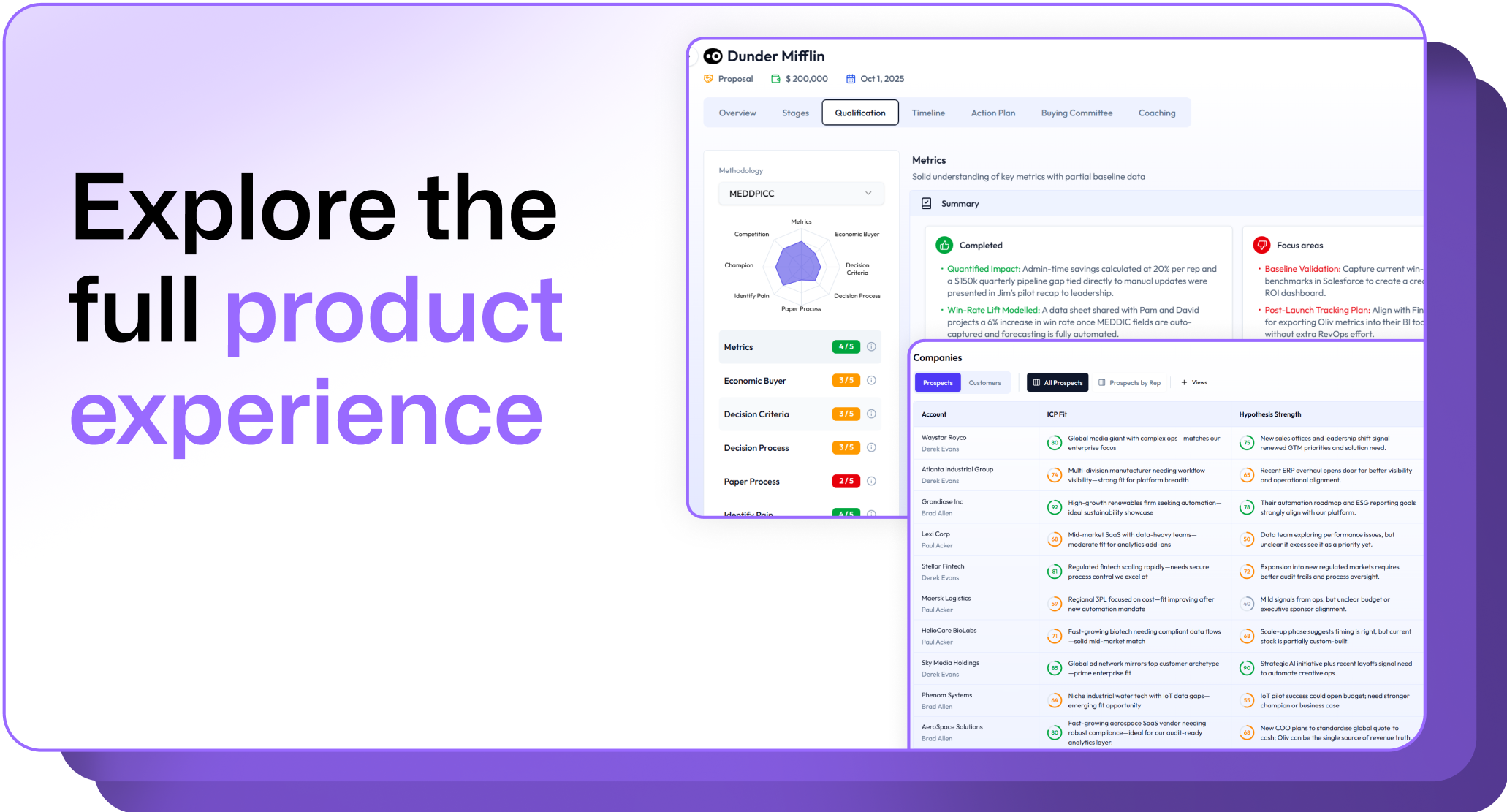
.avif)