13 AI Platforms for Sales Teams: Ranked by Lead Scoring, Email Personalization, AI SDR Autonomy, and ROI Per Seat
Written by
Ishan Chhabra
Last Updated :
June 15, 2026
Skim in :
8
mins
In this article
Revenue teams love Oliv
Here’s why:
All your deal data unified (from 30+ tools and tabs).
Insights are delivered to you directly, no digging.
AI agents automate tasks for you.
Thank you! Your submission has been received!
Oops! Something went wrong while submitting the form.
Meet Oliv’s AI Agents
Hi! I’m, Deal Driver
I track deals, flag risks, send weekly pipeline updates and give sales managers full visibility into deal progress
Hi! I’m, CRM Manager
I maintain CRM hygiene by updating core, custom and qualification fields all without your team lifting a finger
Hi! I’m, Forecaster
I build accurate forecasts based on real deal movement and tell you which deals to pull in to hit your number
Hi! I’m, Coach
I believe performance fuels revenue. I spot skill gaps, score calls and build coaching plans to help every rep level up
Hi! I’m, Prospector
I dig into target accounts to surface the right contacts, tailor and time outreach so you always strike when it counts
Hi! I’m, Pipeline tracker
I call reps to get deal updates, and deliver a real-time, CRM-synced roll-up view of deal progress
Hi! I’m, Analyst
I answer complex pipeline questions, uncover deal patterns, and build reports that guide strategic decisions
TL;DR
We ranked 13 AI platforms for sales teams in 2026 across lead scoring, email personalization, AI SDR autonomy, and ROI per seat.
The real 2026 shift is from chat AI (you ask, it answers) to agentic AI (it pursues a goal), where Oliv AI leads as agent-first and deal-level.
Legacy tools like Gong, Clari, and Einstein bolt AI onto a pre-generative foundation, so they read deals at the meeting level, not the deal level.
Pricing is deliberately opaque, with per-action metering and platform fees; the honest ROI baseline is the roughly $139K loaded cost of a junior SDR who quits.
AI SDR autonomy runs on a spectrum, and full autonomy still needs human review 10 to 15 hours a week, despite Gartner's 40% agentic cancellation caveat.
Choose by the workflow leaking revenue, clean your CRM data first, and do not build internal tooling that goes obsolete in months.
Q1: What Are the 13 Best AI Platforms for Sales Teams in 2026? [toc=1. The 13 Best AI Sales Platforms]
The 13 best AI platforms for sales teams in 2026 are Oliv AI, Gong, Clari, Outreach, Salesloft, Chorus, Salesforce Einstein/Agentforce, HubSpot Sales Hub, ZoomInfo, Apollo.io, Clay, 6sense, and 11x. Adoption is now near universal, and sellers who partner with AI are far more likely to hit quota. Oliv AI leads as the only fully agentic, AI-native, deal-level platform, while most legacy tools bolt AI onto a pre-generative foundation.
I have watched this shift happen from the inside. A RevOps lead pinged me last quarter, mid forecast call, asking why her team's $40K Chorus spend still left her guessing on close dates. That is the real question buyers ask in 2026. The category is crowded, but the gap between "AI features" and "AI that does the work" is now the whole game. If you want the full landscape, our breakdown of the best AI sales tools goes deeper on each tier.
The 13 platforms at a glance
Oliv AI, best for deal-level agentic revenue intelligence; AI-native, not a bolt-on.
Gong, best for conversation intelligence and call coaching at scale.
Clari, best for enterprise roll-up forecasting and pipeline inspection.
Outreach, best for high-volume sequencing and prospecting workflows.
Salesloft, best for cadence-driven SDR teams.
Chorus, best for ZoomInfo-stack call recording.
Salesforce Einstein/Agentforce, best for existing Salesforce-heavy orgs.
HubSpot Sales Hub, best for SMB all-in-one CRM.
ZoomInfo, best for contact and account data.
Apollo.io, best for affordable prospecting plus data.
Clay, best for data enrichment and GTM automation.
6sense, best for intent-based account targeting.
11x, best for autonomous AI SDR experiments.
How I ranked them
I used a four-axis lens, not a vendor-friendly checklist. Each tool was scored on autonomy (does AI act or just suggest?), data depth (meeting-level or deal-level?), total cost of ownership, and real user feedback from G2, Gartner, and Reddit.
The trap most buyers fall into is stacking AI on broken workflows. Dirty CRM data cripples every predictive model on top of it. If reps do not update fields, no amount of AI fixes the forecast. So the rubric rewards tools that reduce manual work, not ones that add another dashboard to check. Our guide to the best revenue intelligence software platforms applies the same lens.
Master comparison table (first four players)
Master Comparison of the First Four AI Sales Platforms
Platform
Best For
AI Autonomy
Data Depth
Pricing Tier
G2 Rating
Score
Oliv AI
Agentic deal intelligence
Autonomous agents act for you
Deal-level (calls, email, Slack, web)
$19 to $120/user, no platform fee
New entrant
⭐⭐⭐⭐⭐
Gong
Conversation intelligence
Assistant plus Agent Studio (assistive)
Meeting/account-level
Platform fee $5K to $50K; ~$250/user bundled
~4.7/5
⭐⭐⭐⭐
Clari
Enterprise forecasting
Rep-driven, manual roll-ups
Pipeline/CRM overlay
Enterprise quote-based
~4.5/5
⭐⭐⭐⭐
Outreach
Sequencing and prospecting
AI agents emerging (Omni)
Activity/sequence-level
Per-seat, evergreen contracts
~4.3/5
⭐⭐⭐
1. Oliv AI, best for deal-level agentic revenue intelligence
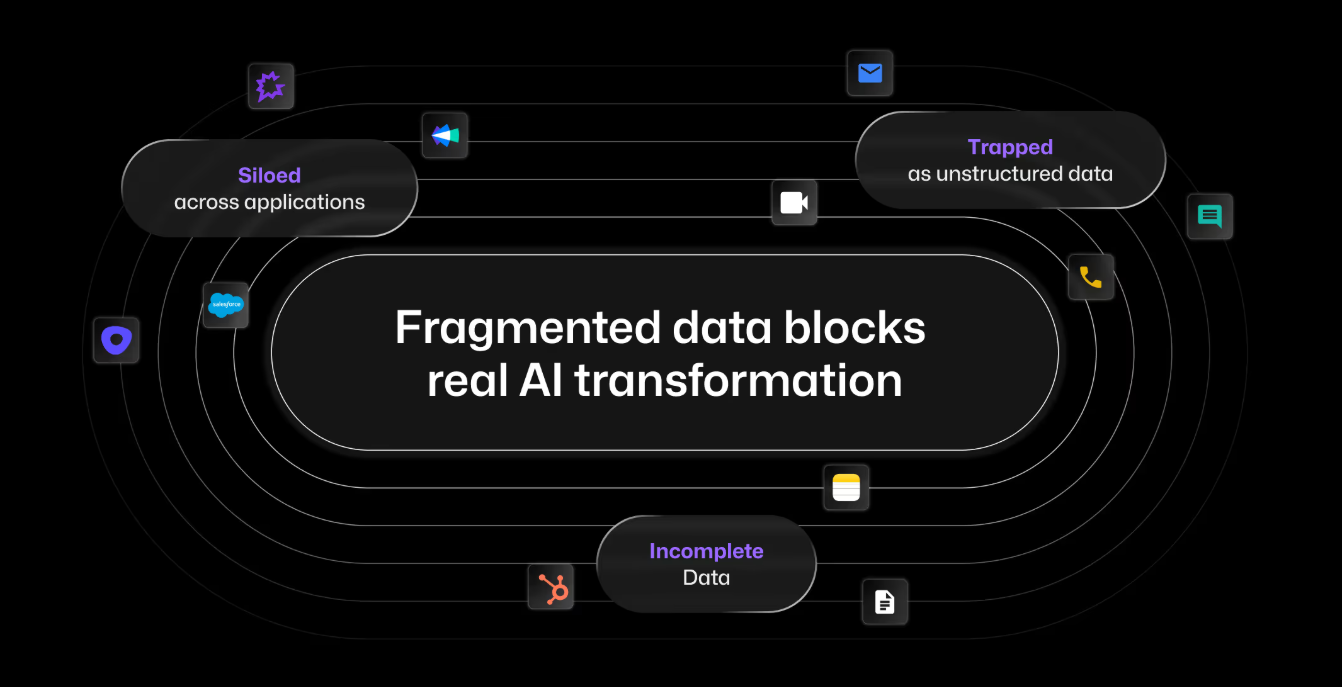
Oliv AI concept graphic illustrating how sales data, siloed across CRMs, email, calls, and chat as incomplete unstructured records, blocks AI transformation, reinforcing the case for deal-level intelligence.
Oliv AI is a generative AI-native data platform that runs 30+ specialized agents to handle sales work autonomously, from CRM updates to forecasting. Instead of a tool reps log into, it stitches data across calls, emails, Slack, Telegram, and the web into one 360-degree deal view. It processes recordings and summaries within five minutes of a call ending, versus the 20 to 30 minute delay typical of legacy tools.
🧠 What it does
The platform is built in three layers: a data layer that auto-tracks activity, an intelligence layer of 100+ fine-tuned models, and an agent layer that takes action. The CRM Manager Agent populates fields using methodologies like MEDDPICC and BANT. The Forecaster Agent inspects every deal line by line and drops a one-page roll-up into managers' inboxes each Monday.
⚙️ Key features and pricing
Agents: Forecaster, Deal Driver, Researcher, Coach, and a Voice Agent (alpha) that calls reps nightly for stalled-deal updates.
Setup: Baseline config in five minutes; full customization takes two to four weeks.
Pricing: Modular, $19 to $120 per user, with no mandatory platform fee.
Security: SOC 2 Type II, GDPR, and CCPA compliant.
✅ Pros and ❌ cons
✅ Agents do the work autonomously, saving managers roughly a day per week of manual auditing.
❌ Full customization can take two to four weeks for complex orgs.
When we rebuilt our own forecast call on Oliv agents, the shift was less "new software" and more "the busywork disappeared." I could be off on where the category lands, but my read is that SaaS you log into becomes agents that work for you. We unpack this in our take on the shift from revenue ops to intelligence to orchestration.
"With Gong, I have trouble understanding breadth versus depth... Oliv is the first time I've ever been speechless. That's incredible." Akil Sharperson, Triple WhaleOliv AI G2 Verified Review
"Accuracy is all over the place... I am, as a manager, limited to the deals that my rep wants me to see." Suraj Ramesh, Head of Sales, SprintoOliv AI G2 Verified Review
2. Gong, best for conversation intelligence
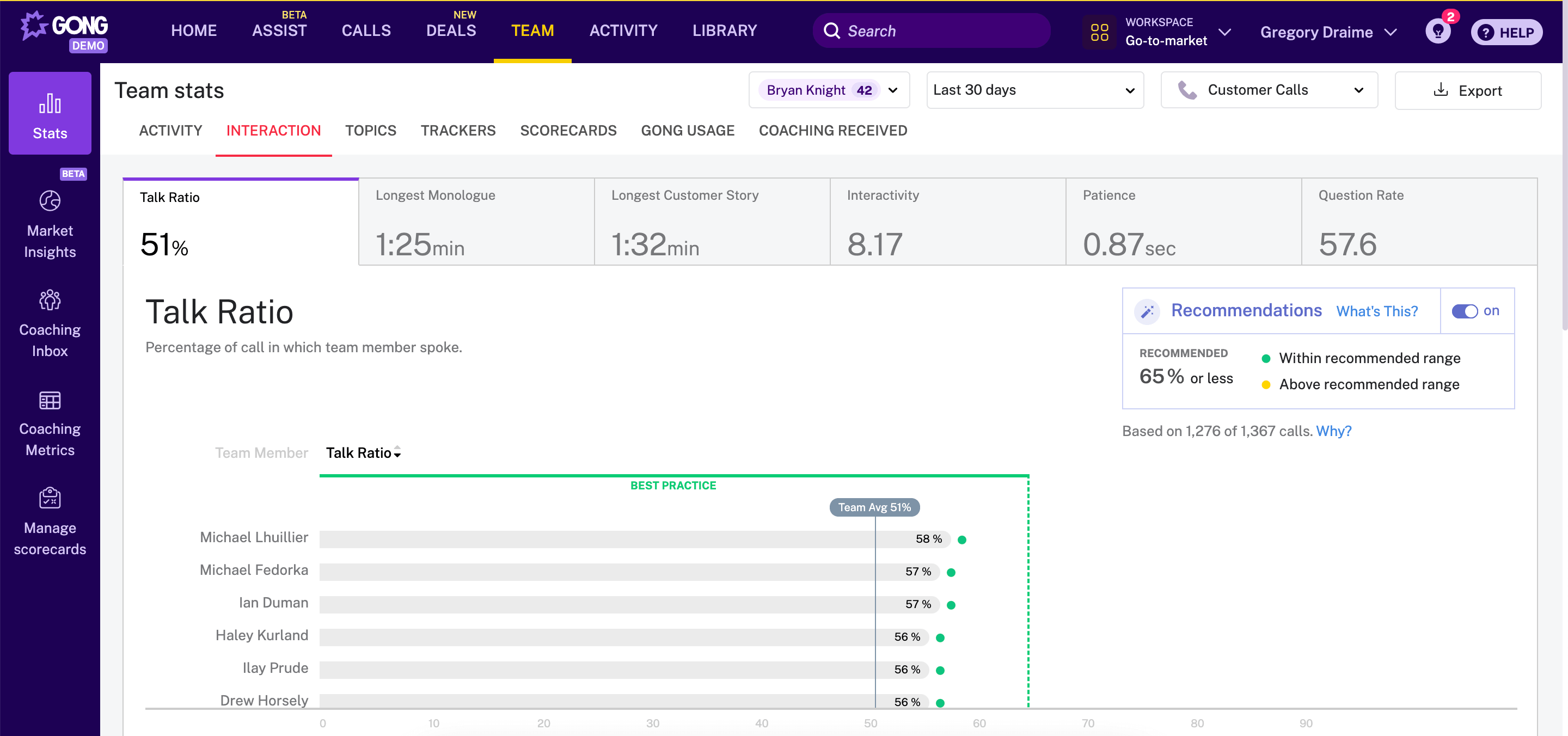
Gong interaction analytics showing rep-level talk ratio, longest monologue, patience, and question rate against recommended ranges, highlighting the conversation-intelligence coaching depth AI sales teams expect.
Gong, founded in 2015, is the market benchmark for conversation intelligence, built on call recording, transcription, and deal insight. In 2024 it rebranded to a "Revenue AI Platform," and by 2026 it positions itself as a Revenue AI Operating System with Gong Assistant, Agent Studio, and AI Trainer. ARR topped $500M in May 2026, growing over 55% year over year.
🎙️ What it does and key features
Gong records and analyzes calls, then surfaces deal risk through Smart Trackers and AI briefs. Recent additions include "Ask anything across calls," Account boards, and an AI Call Reviewer for automated scorecards. It is genuinely strong here, and many leaders say they cannot run a team without it. For a closer look, see our breakdown of Gong features.
💰 Pricing and implementation
Gong does not publish list prices, but bundled costs can reach roughly $250 to $270 per user per month, plus mandatory platform fees between $5,000 and $50,000. Add-ons like Forecast and Engage cost extra on top of the core license. Our Gong pricing breakdown covers the full tier structure.
✅ Pros and ❌ cons
✅ Best-in-class conversation intelligence and a deep training library.
✅ Constantly shipping new AI features through 2026.
❌ Smart Trackers rely on keyword matching that can miss nuanced intent.
❌ High total cost of ownership and rigid annual contracts.
📋 Product updates
Gong Product Update Timeline
Period
What changed
Through 2025
SPICED/BANT playbooks, Gong Assistant, Agent Studio, and AI Call Reviewer shipped, per help.gong release notes.
2026 (current)
Mission Andromeda launched Gong Enable, plus MCP interoperability and configurable forecast boards, per the Mission Andromeda announcement.
Expected next
Bidirectional MCP server connections and brief generation via API, per the help.gong roadmap.
"Conversation intelligence is ChatGPT on steroids... [but] Gong Engage falls short. The platform lacks task APIs, does not integrate with other vendors or parallel dialers." Anonymous reviewerGong G2 Verified Review
"It's too complicated, and not intuitive at all... understanding the pipeline management portion of it is almost impossible." John S., Senior Account ExecutiveGong G2 Verified Review
"Gong is a really powerful tool but it's probably the highest end option on the market, and now we're stuck." Iris P., Head of Marketing and Sales PartnershipsGong G2 Verified Review
3. Clari, best for enterprise roll-up forecasting
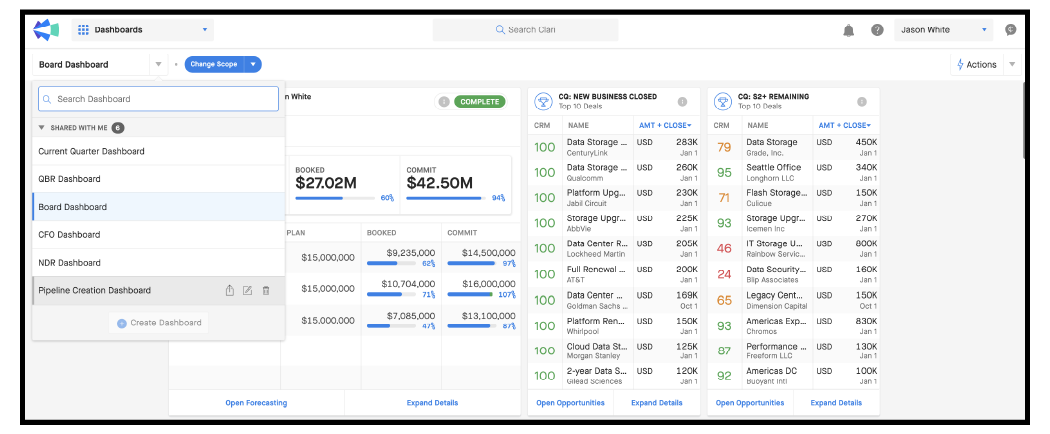
Clari forecasting dashboard showing booked versus commit revenue, plan attainment, and scored top deals across views, illustrating the roll-up forecasting accuracy AI sales teams need for pipeline confidence.
Clari is the forecasting giant, built for consolidating rep-level forecasts into clean executive roll-ups. RevOps and revenue leaders praise its pipeline inspection, waterfall charts, and Salesforce integration. In August 2025, Clari and Salesloft announced a merger, signaling a broader revenue-platform consolidation play.
📊 What it does and key features
Clari overlays on Salesforce to give one clean view for forecast calls, with opportunity inspection and analytics modules. Its Copilot tool adds conversation intelligence on top. Sales leaders often prefer reviewing in Clari over Salesforce directly, as we detail in our overview of Clari features.
⏰ Implementation and the manual catch
Here is where my contrarian read kicks in. Clari's forecasting remains highly manual, often requiring managers to sit with reps weekly to hear each deal's story before data gets entered. Setup is challenging too, especially migrating Salesforce formula fields, which forces duplicate-field maintenance. If forecasting is your core need, compare the field with our best AI sales forecasting software guide.
✅ Pros and ❌ cons
✅ Clean, executive-ready forecast views that beat raw Salesforce reports.
✅ Strong analytics like waterfall and funnel charts.
❌ Dashboards are limited and reporting can feel basic.
❌ Forecasting stays rep-driven rather than autonomous.
"Clari should find ways to differentiate from the native Salesforce features... it's sometimes difficult if you don't have a strong RevOps team to maintain validation rules." Dan J., Mid-Market userClari G2 Verified Review
"It is really just a glorified SFDC overlay. Salesforce has built most of the forecasting functionality by now anyway." u/conaldinho11, r/SalesOperationsReddit Thread
"4 months later every one of my reps loves it because it makes updating Salesforce 10x easier." u/ChimpDaddy2015, r/salesReddit Thread
4. Outreach, best for sequencing and prospecting
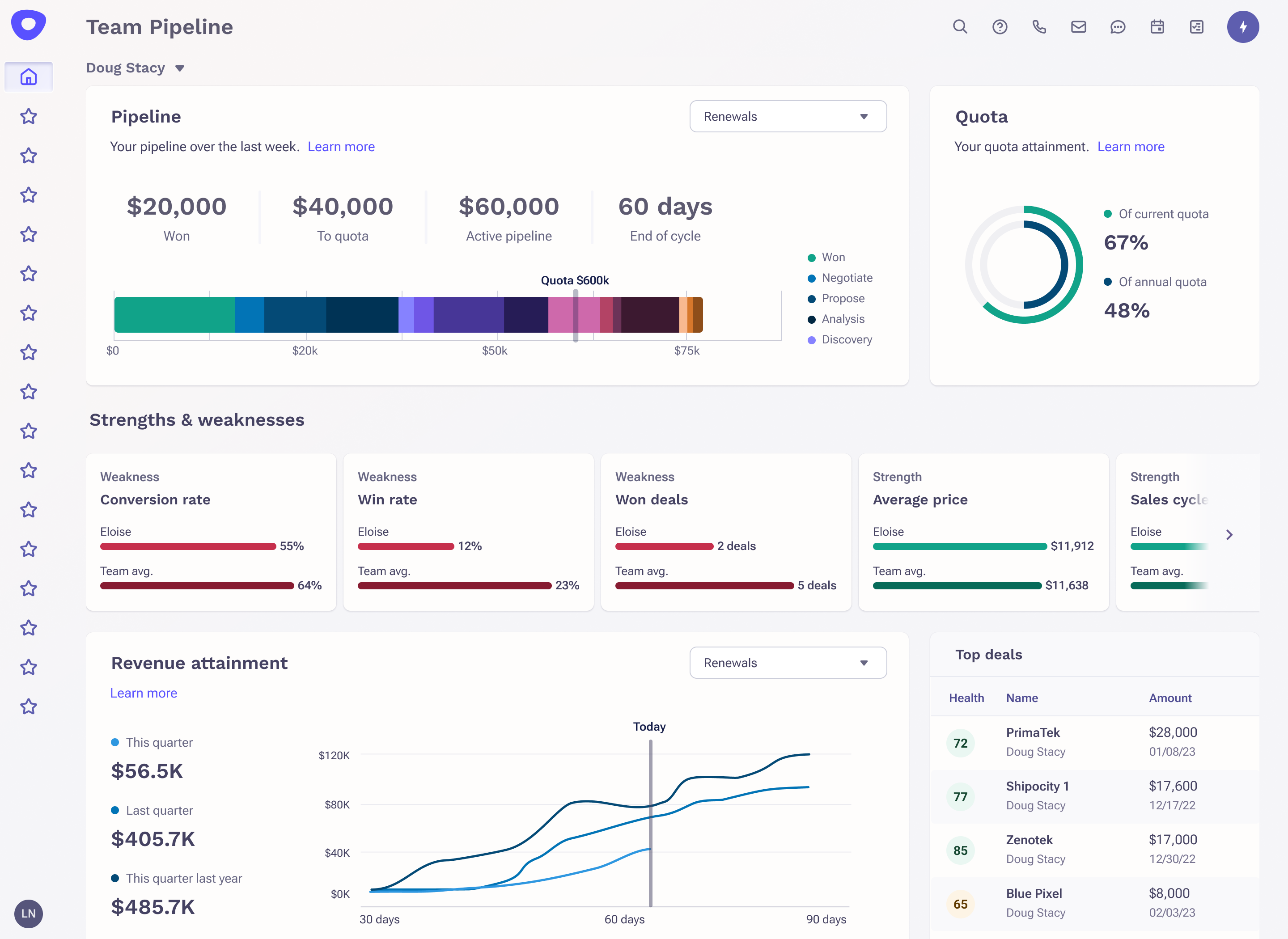
AI sales dashboard showing team pipeline, quota attainment, rep strengths and weaknesses, revenue trends, and scored top deals
Outreach, founded in 2014, anchors on the sales-engagement sequence engine that still drives its prospecting workflows today. Under CEO Abhijit Mitra, it relaunched in 2025 as an "AI Revenue Workflow Platform" and shipped AI Prospecting, Research, and Deal Agents. Its 2026 bet is Omni, an interconnected AI-agent suite with an MCP server.
📧 What it does and key features
Outreach handles sequencing, dialing, and prospect management with strong Salesforce sync. Reps like the email tracking, A/B testing, and tagging features. It was the first revenue-tech company to achieve ISO/IEC 42001 responsible-AI certification, in July 2025. See how it stacks up in our Gong vs Outreach comparison.
💸 Pricing and implementation
Outreach uses per-seat pricing with evergreen annual contracts that auto-renew. Onboarding takes time, and several users report glitches and slow support.
✅ Pros and ❌ cons
✅ Excellent for systematic, high-volume outreach and sequencing.
✅ Deep Salesforce integration and email insights.
❌ Dialer lags for high-volume teams, and spam flagging hits 15 to 20%.
❌ Rigid evergreen contracts and a reportedly stagnant core product.
📋 Product updates
Outreach Product Update Timeline
Period
What changed
Through 2025
AI Prospecting Agents, AI Revenue Workflow Platform relaunch, and ISO/IEC 42001 certification, per the Outreach newsroom.
2026 (current)
Joined Anthropic's MCP ecosystem and launched Omni with Outreach MCP Server and Meeting Prep Agent, per support.outreach.
Expected next
Deeper interconnected AI-agent execution across the revenue workflow, per the Outreach newsroom.
"The engage product is stagnant. Looks to have the same features, UX, integrations and issues as it had 5 years ago." Matthew T., Head of Revenue OperationsOutreach G2 Verified Review
"Outreach is significantly overpriced for what it offers... their agreements are evergreen, automatically renewing annually." Kevin H., CTO and Co-FounderOutreach G2 Verified Review
"Outreach is really really good for emailing, sequencing... [but] dialing features are not great, and we show as spam 15-20% of the time." Ethan R., Sales Development RepresentativeOutreach G2 Verified Review
5. Salesloft, best for cadence-driven SDR teams
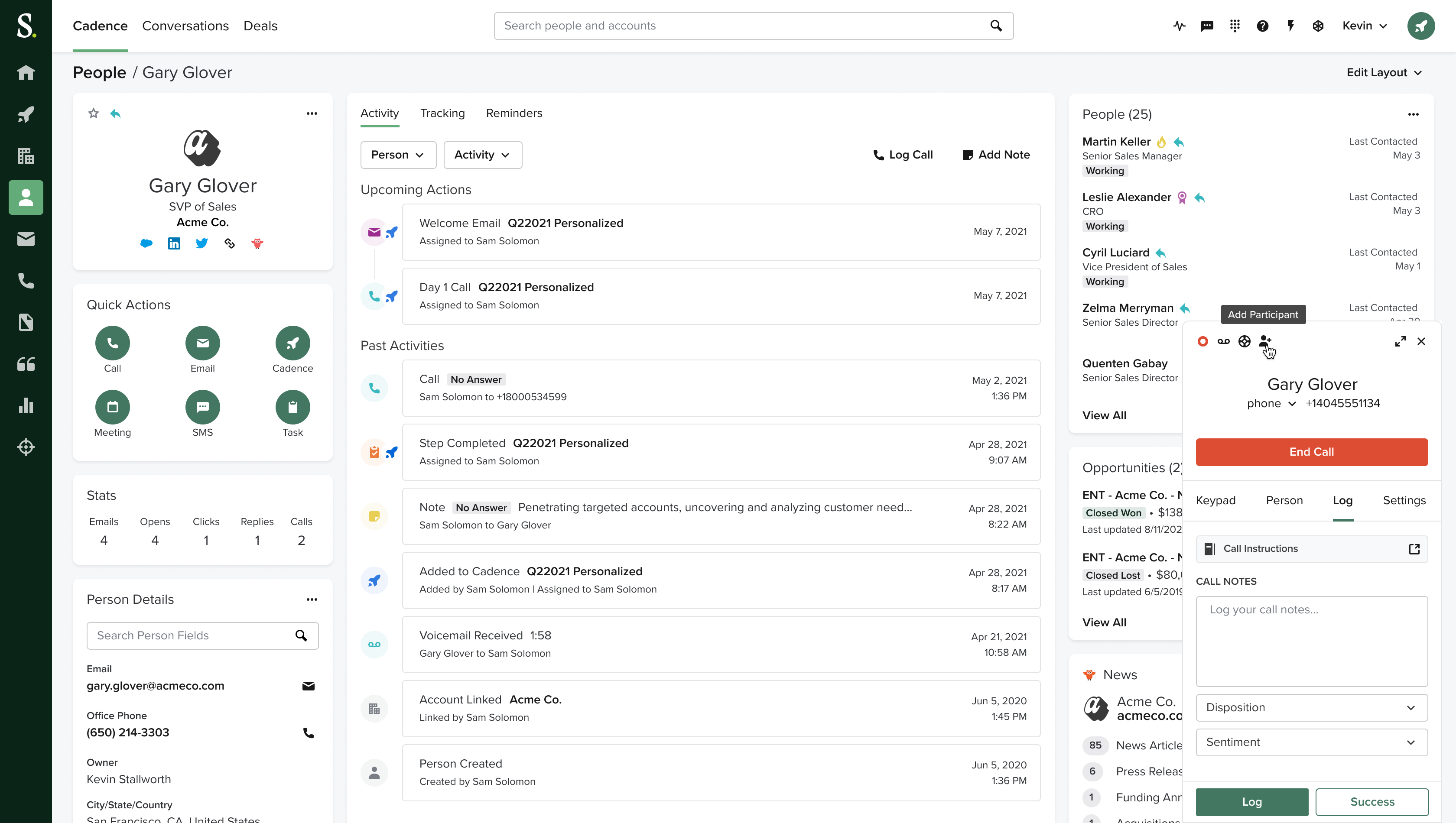
Salesloft people view with cadence activity history, an in-app dialer logging call notes, and personalized sequence steps, demonstrating high-volume sequencing automation that AI sales teams rely on for outbound.
Salesloft, founded in 2014, anchors on its cadence sequence engine that still drives prospecting workflows today. It acquired Drift in 2024 to build a "Revenue Orchestration Platform," then announced a merger with Clari in August 2025. Through 2025 and 2026 it shipped 26+ AI agents, an MCP server, and an AI Email Assistant.
📞 What it does and key features
Salesloft handles multi-step cadences, dialing, and task prioritization through its Rhythm signal engine. Recent additions include the Sales Strategist coaching agent, CRM Sync AI Summary write-back, and seller out-of-office automation. It is strong for systematic outbound at scale. See our Gong vs Salesloft comparison for the trade-offs.
💰 Pricing and implementation
Salesloft does not publish list prices, and its agentic features sit behind a paid "Agentic add-on." The Drift and Clari consolidation means buyers now navigate a broader, evolving platform rather than a focused tool. Our guide to the best revenue orchestration platform tools maps where it fits.
✅ Pros and ❌ cons
✅ Best-in-class cadence management and task prioritization.
✅ Rapid 2026 AI agent rollout via the Closing Power Suite.
❌ Conversation intelligence is weaker, working mainly for in-dialer calls.
❌ Merger-driven platform sprawl can complicate buying decisions.
Across the deals we have stitched together at Oliv, the pattern I see is that mass, non-personalized outreach is fading. The Salesloft engine is excellent at volume, but volume alone closes fewer deals in 2026. Where my head is right now: research-led, personalized prospecting beats spray-and-pray cadences.
📋 Product updates
Salesloft Product Update Timeline
Period
What changed
Through 2025
Spring 2025 launch of 15 new AI agents, Fall 2025 AI Closing Power Suite, and the Clari merger announcement, per the Salesloft newsroom.
2026 (current)
Salesloft MCP Server, AI Email Assistant, and CRM Sync AI Summary write-back shipped, per the Salesloft release notes.
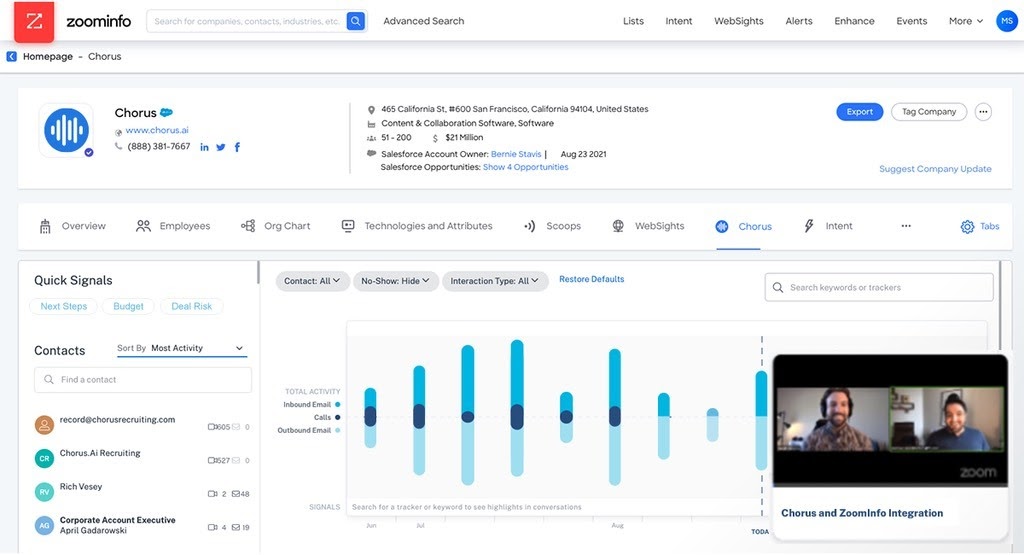
ZoomInfo account view with the Chorus conversation intelligence tab showing inbound emails, calls, deal-risk signals, and contact activity, illustrating call-recording capabilities for AI-driven sales teams.
Chorus by ZoomInfo is a conversation intelligence tool focused on call recording, transcription, and coaching. It fits teams already inside the ZoomInfo data ecosystem, offering simple setup and reasonable pricing. Users praise the snippets and summaries but note it lacks deeper context recognition.
🎧 What it does and key features
Chorus auto-joins calls, transcribes them, and flags risks plus prospect questions. Reps use it for talk-to-listen ratios, filler-word analysis, and shareable snippets. It works across meeting platforms, not just Zoom. Our Gong vs Chorus comparison covers the feature gaps in detail.
✅ Pros and ❌ cons
✅ Easy setup and intuitive for first-time CI users.
✅ Reasonable price versus its largest competitor.
❌ Cannot recognize context or similar phrases beyond exact keywords.
❌ Summaries miss detail, and forecasting is weak.
"Chorus does a good job with the basic functionality of call recording and screening... The software doesn't have the capability of identifying words/phrases that are similar to what you're looking for or understand context." Director of Sales OperationsChorus by ZoomInfo Gartner Verified Review
"It was not Clari, and it's pretty simple to use... Not great at forecasting. We just keep playing hot potato with vendors." Justin S., Senior Marketing Operations SpecialistChorus by ZoomInfo G2 Verified Review
"I wish the meeting summaries were more detailed. I find that it misses a lot." Natalie G., Bilingual Account ManagerChorus by ZoomInfo G2 Verified Review
7. Salesforce Einstein/Agentforce, best for Salesforce-heavy orgs
Salesforce Einstein and Agentforce bolt AI onto the world's most-installed CRM. The huge installed base and Data Cloud make it powerful for enterprises already standardized on Salesforce. But these are AI features layered on a pre-generative foundation, which is why deployments often stall on dirty underlying data.
🤖 What it does and key features
Einstein covers activity capture, lead scoring, and conversation insights, while Agentforce adds chat-based agents. Agentforce is primarily aimed at B2C customer success, like handling order returns, and is underserved for B2B sales teams. Its agents are chat-focused, requiring manual interaction to retrieve data. Our analysis of Salesforce Agentforce and Salesforce Einstein features goes deeper.
💸 Pricing and implementation
Costs climb past $500 per user per month after add-ons like Einstein Conversation Insights and Revenue Intelligence. Salesforce reportedly uses a per-action pricing model around $0.10 per action. Implementation can take months of custom data modeling.
✅ Pros and ❌ cons
✅ Massive ecosystem and Data Cloud acts as a powerful customer data platform.
✅ Deep fit for orgs already running Salesforce.
❌ Rule-based Einstein Activity Capture misassociates duplicate accounts.
❌ Chat-only agents see low adoption because they are not native to selling workflows.
Here is the contrarian read I keep coming back to. Bolting agents onto a CRM that reps already neglect does not fix the data problem, it inherits it. At Oliv, we use AI-based object association to reason through duplicate records rather than relying on the brittle rules that confuse Einstein. If you are weighing the field, see the best Agentforce alternatives and competitors.
8. HubSpot Sales Hub, best for SMB all-in-one CRM
HubSpot Sales Hub is the go-to all-in-one CRM for small and mid-market teams that want CRM, email, and light automation in one place. Its strength is ease of use and a unified interface, not deep agentic intelligence. As Oliv's own materials note, HubSpot data is "just the tip of the iceberg" because most deal reality lives in calls, emails, and chats that never reach the CRM.
🧩 What it does and key features
HubSpot covers contact management, deal pipelines, email sequences, and basic AI assists. It integrates broadly and is friendly for non-technical users. For deeper deal intelligence, teams typically layer a CI tool on top, which is why many compare it against the leading revenue intelligence platforms.
✅ Pros and ❌ cons
✅ Clean, easy all-in-one interface ideal for SMBs.
✅ Strong marketing-to-sales alignment in one platform.
❌ Limited deal-level intelligence without add-ons.
❌ Manual data entry dependency persists, like all pre-generative CRMs.
Oliv integrates with HubSpot to capture the unstructured data it misses, stitching calls, Slack, and web signals into a full deal view. I might be wrong on the exact timeline, but I think CRMs like HubSpot become the system of record while agents become the system of work.
9. ZoomInfo, best for contact and account data
ZoomInfo is the data layer of the sales stack, known for its contact and company database used to build target lists. It owns Chorus for conversation intelligence, so teams can buy data and call recording from one vendor. Its core value is breadth of B2B data, not autonomous deal execution.
📇 What it does and key features
ZoomInfo provides contact records, intent signals, and enrichment that feed prospecting workflows. Reps use it to find and verify decision-makers before outreach. The Chorus integration adds call insights to the data layer.
✅ Pros and ❌ cons
✅ Deep, broad B2B contact and account database.
✅ One vendor for data plus Chorus CI.
❌ Data accuracy varies and decays over time, a known industry challenge.
❌ Not built for deal-level forecasting or autonomous execution.
Data alone does not close deals. At Oliv, our Researcher Agent pulls account context from LinkedIn and the web to turn cold lists into context-rich outreach, rather than just handing reps a name and a number. We cover this motion in our guide to the best AI for sales calls.
10. Apollo.io, best for affordable prospecting plus data
Apollo.io combines a contact database with sequencing and dialing at a lower price point than enterprise tools. Notably, a frustrated Gong reviewer recommended Apollo as a more affordable alternative offering similar functionality "for a fraction of the price." It is popular with startups and SMBs balancing budget against capability.
📨 What it does and key features
Apollo bundles prospecting data, email sequences, and dialing in one affordable platform. It targets teams that want data and outreach without paying for separate point tools. Its all-in-one model is its main draw.
✅ Pros and ❌ cons
✅ Affordable bundle of data and sequencing.
✅ Good fit for budget-conscious startups and SMBs.
❌ Data depth and accuracy trail dedicated providers.
❌ Limited deal-level intelligence and forecasting.
Apollo respects a founder's finite budget, which matters. But cheaper outreach volume still does not solve the dirty-data and forecasting problems that swallow a manager's week.
11. Clay, best for data enrichment and GTM automation
Clay is a GTM automation tool that chains together dozens of data sources to enrich leads and build custom outbound workflows. It is loved by technical RevOps and growth teams who want to script their own enrichment logic. It sits upstream of selling, feeding clean data into the rest of the stack.
🧱 What it does and key features
Clay lets users pull from many enrichment providers in one waterfall, then trigger personalized outreach. It is highly flexible and automation-first. Outreach even shipped a Clay integration in 2024.
✅ Pros and ❌ cons
✅ Extremely flexible enrichment and GTM automation.
✅ Strong for technical, build-it-yourself teams.
❌ Steep learning curve for non-technical users.
❌ Not a deal-execution or forecasting platform.
Clay is great at the front of the funnel. But enrichment is one job to be done, while closing a deal needs the full 360-degree context that Oliv stitches across calls, email, and Slack.
12. 6sense, best for intent-based account targeting
6sense is an account-based platform that uses intent data to predict which accounts are in-market. It helps marketing and sales prioritize the right accounts before reps even reach out. Its value is predictive targeting at the account level, not individual deal execution.
🎯 What it does and key features
6sense surfaces buying signals and intent across the web to flag accounts showing purchase intent. Teams use it to focus outbound and ABM effort. It pairs well with prospecting and data tools.
✅ Pros and ❌ cons
✅ Strong predictive intent and account prioritization.
✅ Good fit for ABM and marketing-sales alignment.
❌ Complex setup and high enterprise pricing.
❌ Stops at targeting; it does not manage or forecast live deals.
6sense tells you which door to knock on. Oliv's job starts after the door opens, reading the deal as it evolves and flagging risk before it becomes churn.
13. 11x, best for autonomous AI SDR experiments
11x builds autonomous AI SDRs (digital workers) designed to run outbound prospecting end to end. It represents the aggressive edge of the agent era, where AI replaces rather than assists the rep. It is best viewed as an experimental bet for teams willing to test fully autonomous outreach.
🦾 What it does and key features
11x markets AI "digital workers" that prospect, message, and book meetings autonomously. The pitch is volume without headcount. Results in the wild remain early and mixed across the category.
✅ Pros and ❌ cons
✅ Fully autonomous outbound with minimal human input.
✅ Appealing for teams scaling pipeline without hiring.
❌ Quality and deliverability of AI-only outreach are unproven at scale.
❌ Narrow to prospecting; no deal intelligence or forecasting.
Here is where Oliv's naming philosophy matters. We deliberately name agents by job to be done, like Researcher or Deal Driver, rather than "AI SDR," to avoid the perception of human replacement. The reps still do what only reps can do, which is the human conversation. For teams done with bolt-on note-takers, our roundup of the best sales intelligence platform options is the place to start.
Q2: How Did We Score These Platforms, and What Is "AI for Sales Teams" Anyway? [toc=2. Scoring Rubric and Definition]
We scored each platform on five weighted criteria totaling 100%: Deal-Level/Cross-Functional Intelligence (25%), AI SDR and Agentic Autonomy (25%), ROI Per Seat and Pricing Transparency (20%), CRM Integration and Setup Usability (15%), and Verified Reviews (15%). "AI for sales teams" is software that automates revenue work. The 2026 shift is from chat (you ask, it answers) to agentic (it pursues a goal). A vending machine gives fixed output; an agent is a smart employee.
The rubric, weighted and disclosed
Full transparency: Oliv AI is the publisher of this guide, and we applied the same open rubric to ourselves. You can re-score any tool using the weights below. The rubric deliberately rewards the intelligence and agent layers, not basic recording. Our roundup of the best revenue intelligence software platforms uses the same approach.
Platform Scoring Rubric and Weighting
Criterion
Weight
What it measures
Deal-Level/Cross-Functional Intelligence
25%
Reads the full deal across calls, email, and Slack, not just one meeting
AI SDR and Agentic Autonomy
25%
Acts toward a goal versus waiting for a prompt
ROI Per Seat and Pricing Transparency
20%
Clear pricing, no opaque platform fees
CRM Integration and Setup Usability
15%
Time to value and depth of sync
Verified Reviews
15%
G2, Gartner, and TrustRadius signals
⭐ Star legend
Scores convert to stars on a simple scale: 0 to 20 is ⭐, 21 to 40 is ⭐⭐, 41 to 60 is ⭐⭐⭐, 61 to 80 is ⭐⭐⭐⭐, and 81 to 100 is ⭐⭐⭐⭐⭐. Oliv AI lands at ⭐⭐⭐⭐⭐ on this rubric.
What "AI for sales teams" actually means
Think of it as a three-layer cake. The bottom layer is recording and data capture, which I think should be commoditized and nearly free. The middle layer is intelligence, like tracking MEDDIC fields. The top layer is agents that produce proactive reports and take action. Our explainer on the MEDDIC sales methodology shows how that intelligence layer works in a live opportunity.
🤖 Vending machine versus smart employee
Here is the cleanest way to see it. A chat tool is a vending machine, where you press a button and you get one fixed output. An agent is a smart employee who takes a goal and pursues it without you babysitting each step.
Why bolt-on chat underdelivers
The standard read gets this backwards. Most CRMs are bolting chat onto a pre-generative foundation, so the user still has to ask, copy, and paste. Agentforce agents, for example, remain very chat-focused, which limits adoption inside real selling workflows, as we cover in our Salesforce Agentforce breakdown.
My honest take, and I could be off on the exact multiple, is that agent users end up far more productive than chat users because the work happens without them. Gartner has also cautioned that a large share of agentic projects may be cancelled if they chase hype over real workflows. So the rubric rewards tools that act at the deal level, like Oliv does, rather than ones that wait in a chat box, an idea we expand in our piece on the shift from revenue ops to intelligence to orchestration.
Q3: Which Platforms Win on Lead Scoring, Forecasting Accuracy, and CRM Integration Depth? [toc=3. Scoring, Forecasting and Integration]
For lead scoring and forecasting, 6sense and Clari lead among incumbents, while Einstein breaks on real-world data mess, like duplicate accounts and over-redacted activity. Oliv AI scores at the deal level, not the meeting level. Integration depth decides everything: bolt-on AI sits on a "dumb repository" reps update weekly only because management forces them, whereas a true agent goes straight to the underlying data and returns the answer.
Who leads on scoring and forecasting
Clari is the incumbent favorite for roll-up forecasting, and RevOps leaders genuinely rely on it. 6sense leads on predictive, intent-based account scoring. But both depend on clean inputs, and that is where the cracks show. For a focused comparison, see our guide to the best AI sales forecasting software.
"Real time updation. reliable AI prediction. Great analytical features like waterfall, Pulse, Funnel, Flow and Trend charts." Bharat K., Revenue Operations ManagerClari G2 Verified Review
⚠️ Where Einstein breaks
Salesforce Einstein struggles with real-world data mess. It misassociates duplicate accounts and over-redacts activity even when nothing is sensitive, so you cannot build a complete customer picture. Forecast accuracy that leans on biased rep input averages only around 67%. We unpack the gaps in our Salesforce Einstein features review.
"You need to understand how the AI interprets instructions... connecting and fine-tuning Agentforce within an existing, potentially complex ecosystem can add further layers of challenge." Alessandro N., Salesforce AdministratorSalesforce Agentforce G2 Verified Review
The dumb repository problem
Here is the structural issue most buyers miss. The CRM became a dead-air repository that reps update weekly only because management forces them. Bolt-on AI sits on top of that stale data, so it inherits every gap.
🔌 Integration depth decides everything
Gong understands a call at the meeting level, but a deal lives across many calls, emails, and Slack threads. Its API is also reportedly wonky, often needing custom RevOps code to extract data. A true agent skips the brittle overlay and reasons directly against the underlying data. Our Gong integrations overview covers the API limits in depth.
"It requires downloading calls individually, which is impractical and inefficient for a large volume of data... this lack of flexibility has required us to engage our development team at additional cost." Neel P., Sales Operations ManagerGong G2 Verified Review
What AI-native integration looks like
To be fair, the incumbents earned real data moats, and Clari's Salesforce sync is genuinely good for many teams. But at Oliv, we use AI-based object association to map activity to the right account even when duplicate records exist, which is exactly where Einstein's rule-based logic trips. The result is deal-level forecasting that survives messy data, with a spreadsheet-like analysis layer instead of a wonky API. See how the two stack up in our Gong vs Clari comparison.
Q4: Which Tools Win on Email Personalization, Deliverability, and Compliance Safeguards? [toc=4. Personalization, Deliverability and Compliance]
Clay and Apollo lead on enrichment-fueled personalization, while Outreach and Salesloft win on sequence scale. But scale without quality just amplifies bad process. The fix is training the agent on your best rep's copy and letting it A/B test, not adding more merge tags. On trust, demand SOC 2 Type II, GDPR DPAs with data residency, two-party-consent handling, and EU AI Act human-oversight checkpoints with audit trails.
Who wins personalization, by use case
Clay and Apollo shine when enrichment data fuels the message. Outreach and Salesloft win on raw sequence volume and cadence control. Each fits a different job, so match the tool to the motion, as we explain in our guide to the best AI sales tools.
Email Personalization Best Fit by Use Case
Use case
Best fit
Why
Enrichment-led personalization
Clay, Apollo
Deep data feeds tailored copy
High-volume sequencing
Outreach, Salesloft
Mature cadence engines
Transcript-to-follow-up automation
Oliv AI
Agent drafts from the actual call
⚠️ The slop trap
Here is the catch with scale. If you blast "Hello [First_Name]" without good systems, you just amplify a broken process. More volume of weak copy also drags sender reputation, which quietly tanks deliverability.
"Dialing features are not great, and for high volume teams, this will be a huge lag... we show as spam 15-20% of the time." Ethan R., Sales Development RepresentativeOutreach G2 Verified Review
"I absolutely love cadences and how easy it is to create them for targeted use and consistent messaging." Kevin S., Senior Account ExecutiveSalesloft G2 Verified Review
The tactic that actually works
Take your best rep's email copy and train the agent on it, then let the agent A/B test variations. Agents are genuinely good at A/B testing at a scale no human matches. The bar shifted, so now you just send it, and no one minds as long as it adds value. Our roundup of the best AI for sales calls shows how this loop starts on the call itself.
🔒 The compliance scorecard
This is the gap no competitor listicle scores per tool. As agents start acting autonomously, audit trails matter most, the way finance physically links data to satisfy an auditor.
AI Sales Tool Compliance Scorecard
Safeguard
Ask the vendor
Why it matters
SOC 2 Type II
"Show the current report"
Independent security validation
GDPR DPA plus residency
"Where is data stored?"
EU data-handling compliance
Two-party consent
"How is call consent handled?"
Recording legality by state
EU AI Act oversight
"Where are the human checkpoints?"
Required human-in-the-loop for agents
Oliv automates the transcript-to-personalized-follow-up loop reps usually skip, so there is no ChatGPT copy-paste step. We hold SOC 2 Type II, GDPR, and CCPA, and keep a clear data trail, which contrasts with Einstein's over-redaction that hides even non-sensitive context. If you are weighing options, our guide to the best Salesforce Einstein competitors and alternatives maps the trade-offs.
Q5: How Autonomous Are AI SDRs, and Will They Replace Junior Reps? [toc=5. AI SDR Autonomy Spectrum]
AI SDR autonomy runs on a spectrum: assistive (drafts), semi-autonomous (sends with approval), and fully autonomous (works the queue unsupervised). 11x and Artisan push furthest on outbound, while Agentforce stays chat-bound. Full autonomy is not free, since Gartner expects 40% of agentic projects canceled by 2027, and even at scale a human reviews outputs 10 to 15 hours a week. The classic junior SDR, though, faces real displacement.
The autonomy spectrum, defined
Most "AI SDR" pitches blur three very different things. An assistive tool drafts. A semi-autonomous one sends after you approve. A fully autonomous one works the whole queue without a babysitter. Our guide to the best AI sales tools breaks down where each lands.
AI SDR Autonomy Spectrum
Autonomy level
What it does
Where tools sit
Assistive
Drafts copy you edit
Agentforce (chat-bound)
Semi-autonomous
Sends with approval
Outreach, Salesloft agents
Fully autonomous
Works the queue solo
11x, Artisan
🤖 Who sits where
11x and Artisan push hardest on fully autonomous outbound. Agentforce, by contrast, stays chat-focused, so a human still drives each step. Oliv sits in the middle by design, running agentic execution with human review built in, which we explain in our Salesforce Agentforce analysis.
"You need to understand how the AI interprets instructions... connecting and fine-tuning Agentforce within an existing, potentially complex ecosystem can add further layers of challenge." Alessandro N., Salesforce AdministratorSalesforce Agentforce G2 Verified Review
The pilot trap nobody mentions
Here is the part vendors skip. Gartner expects 40% of agentic AI projects to be canceled by 2027, often because pilots never reach production. Buying "autonomous" is easy; operationalizing it is not.
⚠️ The human-in-the-loop reality
I might be wrong on the exact split, but my working rule is 10/80/10: humans set up 10%, agents do 80%, and humans review the final 10%. Agents work all night, yet someone still reviews outputs 10 to 15 hours a week. This is not a job for lazy teams.
Will they replace junior reps?
Here is my contrarian read, and I hold it firmly. The classic junior SDR who just dials and emails faces sharp displacement as agents absorb that grunt work. I have seen a rep quit the day AI RevOps exposed their real activity, because the floor moved under them.
But the human does not disappear. The new shape looks like roughly 1.2 humans and 20 agents per pod, where the human owns judgment, relationships, and the live conversation. At Oliv, we keep that 30-day training discipline rather than selling unsupervised hype, because agents earn trust through reviewed output, not promises. Our take on the shift from revenue ops to intelligence to orchestration explores where this goes next.
Q6: What Is the Real ROI Per Seat, and How Should You Read AI Sales Pricing? [toc=6. ROI Per Seat and Pricing]
ROI per seat depends on the pricing model hidden underneath. Salesforce meters roughly $0.10 per action plus about $500 per seat all-inclusive, Clay starts near $100K a year, and entry agentic tools run $50K and up. The honest benchmark is not competitor pricing, it is the roughly $139K fully loaded cost of a junior SDR who quits in month three. Per-seat ROI is real only when the tool recovers selling hours and survives the move to production.
Decode the three pricing models
Pricing in this category is deliberately murky, so name the model first. Each one changes your true cost per seat dramatically. Our Salesforce Agentforce pricing breakdown shows how per-action metering adds up.
AI Sales Pricing Models Compared
Model
Real numbers
Watch for
Per-action
~$0.10 per action
Costs spike with usage
All-inclusive per-seat
~$500/seat (Salesforce)
Add-ons stack fast
Platform minimum
Clay ~$100K/yr; entry agentic $50K+
High floor before value
💰 Why opaque pricing hurts buyers
Salesforce's per-action metering means your bill moves with activity, which is hard to forecast. Gong stacks Forecast and Engage as paid add-ons on top of the core license, a complaint reviewers raise often, as we detail in our Gong pricing breakdown.
"The additional products like forecast or engage come at an additional cost. Would be great to see these tools rolled into the core offering." Scott T., Director of SalesGong G2 Verified Review
The pilot trap drains budget
Here is where money quietly leaks. Many agentic pilots fade because customers struggle to move them into production. You pay for a pilot, prove little, and the renewal conversation gets awkward.
"Gong is a really powerful tool but it's probably the highest end option on the market, and now we're stuck with a tool that works technically but isn't the right business decision." Iris P., Head of Marketing and Sales PartnershipsGong G2 Verified Review
💸 The real ROI baseline
Stop benchmarking against competitor list prices. Benchmark against the roughly $139K fully loaded cost of a junior SDR who quits in month three. I cannot pay a junior $150K a year to quit, so the math reframes fast.
Per-seat ROI gets real when a tool recovers selling hours. Salesforce's own data shows AI can cut research time by about 34%, and that recovered time is the number to model. At Oliv, we tie value to transparent per-seat pricing of $19 to $120, against hours given back to reps, instead of opaque per-action metering. Our roundup of the best AI sales forecasting software applies the same ROI lens.
Q7: How Do You Choose the Right AI Sales Platform for Your Team and Stage? [toc=7. Choosing by Team and Stage]
Choose by the workflow that is leaking revenue, not the longest feature list. SMBs short on RevOps want an AI-native platform that instruments the customer journey before scale breaks it. Enterprises need deal-level intelligence and audit-ready compliance. Do not build it yourself, because internal tools go obsolete in months, and clean your CRM data first, since layering agents on broken workflows only amplifies the mess.
Choose by the leak, not the list
Start with one question: where is revenue leaking right now? A bloated feature list does not fix a specific broken workflow, and Oliv's whole rubric rewards solving that leak over checking boxes. Our guide to the best sales intelligence platform options starts from the same principle.
🧭 Match role and stage to the fix
Different roles feel different pain, so map the tool to the leak.
AI Sales Platform Fit by Role and Stage
Role/Stage
Primary leak
Best-fit approach
SDR/SMB
Manual prospecting, thin RevOps
AI-native platform that instruments the journey early
AE/Mid-market
Follow-up and CRM hygiene gaps
Agentic CRM updates and deal tracking
Manager
Blind to real deal health
Deal-level forecasting, not meeting clips
RevOps/Enterprise
Dirty data, audit risk
Deal-level intelligence plus compliance trails
Two traps to avoid
Here is the counterintuitive advice I give founders. Invest in RevOps data and enablement even at $3 to $4M ARR, so you instrument the journey before scale breaks it.
⚠️ Do not build it yourself
Resist the urge to build internal tooling. You are not Vercel, and a homegrown tool goes obsolete in a couple of months as the category moves. Buy the layer, and build your moat elsewhere. Our overview of the best revenue intelligence software platforms shows what mature tooling already covers.
"It is really just a glorified SFDC overlay... Salesforce has built most of the forecasting functionality by now anyway." u/conaldinho11, r/SalesOperationsReddit Thread
"Clari is intuitive for sellers and managers to input their forecast. The out of the box analytics are also very helpful... but it requires commitment to get full use out of the tool." Sarah J., Senior Manager, Revenue OperationsClari G2 Verified Review
🧹 Clean your data first
This is the non-negotiable. Stacking agents on broken workflows changes nothing, because dirty CRM data cripples every model on top of it. Fix hygiene, and then automate.
So here is my honest invitation, not a pitch. Map your single biggest revenue leak this week, and then tell me what you are building around it. If you are done with bolt-on note-takers and want an AI-native option, Oliv is built for exactly that conversation, and our guide to the best AI for sales calls is a good place to start.
Q1: What Are the 13 Best AI Platforms for Sales Teams in 2026? [toc=1. The 13 Best AI Sales Platforms]
The 13 best AI platforms for sales teams in 2026 are Oliv AI, Gong, Clari, Outreach, Salesloft, Chorus, Salesforce Einstein/Agentforce, HubSpot Sales Hub, ZoomInfo, Apollo.io, Clay, 6sense, and 11x. Adoption is now near universal, and sellers who partner with AI are far more likely to hit quota. Oliv AI leads as the only fully agentic, AI-native, deal-level platform, while most legacy tools bolt AI onto a pre-generative foundation.
I have watched this shift happen from the inside. A RevOps lead pinged me last quarter, mid forecast call, asking why her team's $40K Chorus spend still left her guessing on close dates. That is the real question buyers ask in 2026. The category is crowded, but the gap between "AI features" and "AI that does the work" is now the whole game. If you want the full landscape, our breakdown of the best AI sales tools goes deeper on each tier.
The 13 platforms at a glance
Oliv AI, best for deal-level agentic revenue intelligence; AI-native, not a bolt-on.
Gong, best for conversation intelligence and call coaching at scale.
Clari, best for enterprise roll-up forecasting and pipeline inspection.
Outreach, best for high-volume sequencing and prospecting workflows.
Salesloft, best for cadence-driven SDR teams.
Chorus, best for ZoomInfo-stack call recording.
Salesforce Einstein/Agentforce, best for existing Salesforce-heavy orgs.
HubSpot Sales Hub, best for SMB all-in-one CRM.
ZoomInfo, best for contact and account data.
Apollo.io, best for affordable prospecting plus data.
Clay, best for data enrichment and GTM automation.
6sense, best for intent-based account targeting.
11x, best for autonomous AI SDR experiments.
How I ranked them
I used a four-axis lens, not a vendor-friendly checklist. Each tool was scored on autonomy (does AI act or just suggest?), data depth (meeting-level or deal-level?), total cost of ownership, and real user feedback from G2, Gartner, and Reddit.
The trap most buyers fall into is stacking AI on broken workflows. Dirty CRM data cripples every predictive model on top of it. If reps do not update fields, no amount of AI fixes the forecast. So the rubric rewards tools that reduce manual work, not ones that add another dashboard to check. Our guide to the best revenue intelligence software platforms applies the same lens.
Master comparison table (first four players)
Master Comparison of the First Four AI Sales Platforms
Platform
Best For
AI Autonomy
Data Depth
Pricing Tier
G2 Rating
Score
Oliv AI
Agentic deal intelligence
Autonomous agents act for you
Deal-level (calls, email, Slack, web)
$19 to $120/user, no platform fee
New entrant
⭐⭐⭐⭐⭐
Gong
Conversation intelligence
Assistant plus Agent Studio (assistive)
Meeting/account-level
Platform fee $5K to $50K; ~$250/user bundled
~4.7/5
⭐⭐⭐⭐
Clari
Enterprise forecasting
Rep-driven, manual roll-ups
Pipeline/CRM overlay
Enterprise quote-based
~4.5/5
⭐⭐⭐⭐
Outreach
Sequencing and prospecting
AI agents emerging (Omni)
Activity/sequence-level
Per-seat, evergreen contracts
~4.3/5
⭐⭐⭐
1. Oliv AI, best for deal-level agentic revenue intelligence
Oliv AI concept graphic illustrating how sales data, siloed across CRMs, email, calls, and chat as incomplete unstructured records, blocks AI transformation, reinforcing the case for deal-level intelligence.
Oliv AI is a generative AI-native data platform that runs 30+ specialized agents to handle sales work autonomously, from CRM updates to forecasting. Instead of a tool reps log into, it stitches data across calls, emails, Slack, Telegram, and the web into one 360-degree deal view. It processes recordings and summaries within five minutes of a call ending, versus the 20 to 30 minute delay typical of legacy tools.
🧠 What it does
The platform is built in three layers: a data layer that auto-tracks activity, an intelligence layer of 100+ fine-tuned models, and an agent layer that takes action. The CRM Manager Agent populates fields using methodologies like MEDDPICC and BANT. The Forecaster Agent inspects every deal line by line and drops a one-page roll-up into managers' inboxes each Monday.
⚙️ Key features and pricing
Agents: Forecaster, Deal Driver, Researcher, Coach, and a Voice Agent (alpha) that calls reps nightly for stalled-deal updates.
Setup: Baseline config in five minutes; full customization takes two to four weeks.
Pricing: Modular, $19 to $120 per user, with no mandatory platform fee.
Security: SOC 2 Type II, GDPR, and CCPA compliant.
✅ Pros and ❌ cons
✅ Agents do the work autonomously, saving managers roughly a day per week of manual auditing.
❌ Full customization can take two to four weeks for complex orgs.
When we rebuilt our own forecast call on Oliv agents, the shift was less "new software" and more "the busywork disappeared." I could be off on where the category lands, but my read is that SaaS you log into becomes agents that work for you. We unpack this in our take on the shift from revenue ops to intelligence to orchestration.
"With Gong, I have trouble understanding breadth versus depth... Oliv is the first time I've ever been speechless. That's incredible." Akil Sharperson, Triple WhaleOliv AI G2 Verified Review
"Accuracy is all over the place... I am, as a manager, limited to the deals that my rep wants me to see." Suraj Ramesh, Head of Sales, SprintoOliv AI G2 Verified Review
2. Gong, best for conversation intelligence
Gong interaction analytics showing rep-level talk ratio, longest monologue, patience, and question rate against recommended ranges, highlighting the conversation-intelligence coaching depth AI sales teams expect.
Gong, founded in 2015, is the market benchmark for conversation intelligence, built on call recording, transcription, and deal insight. In 2024 it rebranded to a "Revenue AI Platform," and by 2026 it positions itself as a Revenue AI Operating System with Gong Assistant, Agent Studio, and AI Trainer. ARR topped $500M in May 2026, growing over 55% year over year.
🎙️ What it does and key features
Gong records and analyzes calls, then surfaces deal risk through Smart Trackers and AI briefs. Recent additions include "Ask anything across calls," Account boards, and an AI Call Reviewer for automated scorecards. It is genuinely strong here, and many leaders say they cannot run a team without it. For a closer look, see our breakdown of Gong features.
💰 Pricing and implementation
Gong does not publish list prices, but bundled costs can reach roughly $250 to $270 per user per month, plus mandatory platform fees between $5,000 and $50,000. Add-ons like Forecast and Engage cost extra on top of the core license. Our Gong pricing breakdown covers the full tier structure.
✅ Pros and ❌ cons
✅ Best-in-class conversation intelligence and a deep training library.
✅ Constantly shipping new AI features through 2026.
❌ Smart Trackers rely on keyword matching that can miss nuanced intent.
❌ High total cost of ownership and rigid annual contracts.
📋 Product updates
Gong Product Update Timeline
Period
What changed
Through 2025
SPICED/BANT playbooks, Gong Assistant, Agent Studio, and AI Call Reviewer shipped, per help.gong release notes.
2026 (current)
Mission Andromeda launched Gong Enable, plus MCP interoperability and configurable forecast boards, per the Mission Andromeda announcement.
Expected next
Bidirectional MCP server connections and brief generation via API, per the help.gong roadmap.
"Conversation intelligence is ChatGPT on steroids... [but] Gong Engage falls short. The platform lacks task APIs, does not integrate with other vendors or parallel dialers." Anonymous reviewerGong G2 Verified Review
"It's too complicated, and not intuitive at all... understanding the pipeline management portion of it is almost impossible." John S., Senior Account ExecutiveGong G2 Verified Review
"Gong is a really powerful tool but it's probably the highest end option on the market, and now we're stuck." Iris P., Head of Marketing and Sales PartnershipsGong G2 Verified Review
3. Clari, best for enterprise roll-up forecasting
Clari forecasting dashboard showing booked versus commit revenue, plan attainment, and scored top deals across views, illustrating the roll-up forecasting accuracy AI sales teams need for pipeline confidence.
Clari is the forecasting giant, built for consolidating rep-level forecasts into clean executive roll-ups. RevOps and revenue leaders praise its pipeline inspection, waterfall charts, and Salesforce integration. In August 2025, Clari and Salesloft announced a merger, signaling a broader revenue-platform consolidation play.
📊 What it does and key features
Clari overlays on Salesforce to give one clean view for forecast calls, with opportunity inspection and analytics modules. Its Copilot tool adds conversation intelligence on top. Sales leaders often prefer reviewing in Clari over Salesforce directly, as we detail in our overview of Clari features.
⏰ Implementation and the manual catch
Here is where my contrarian read kicks in. Clari's forecasting remains highly manual, often requiring managers to sit with reps weekly to hear each deal's story before data gets entered. Setup is challenging too, especially migrating Salesforce formula fields, which forces duplicate-field maintenance. If forecasting is your core need, compare the field with our best AI sales forecasting software guide.
✅ Pros and ❌ cons
✅ Clean, executive-ready forecast views that beat raw Salesforce reports.
✅ Strong analytics like waterfall and funnel charts.
❌ Dashboards are limited and reporting can feel basic.
❌ Forecasting stays rep-driven rather than autonomous.
"Clari should find ways to differentiate from the native Salesforce features... it's sometimes difficult if you don't have a strong RevOps team to maintain validation rules." Dan J., Mid-Market userClari G2 Verified Review
"It is really just a glorified SFDC overlay. Salesforce has built most of the forecasting functionality by now anyway." u/conaldinho11, r/SalesOperationsReddit Thread
"4 months later every one of my reps loves it because it makes updating Salesforce 10x easier." u/ChimpDaddy2015, r/salesReddit Thread
4. Outreach, best for sequencing and prospecting
AI sales dashboard showing team pipeline, quota attainment, rep strengths and weaknesses, revenue trends, and scored top deals
Outreach, founded in 2014, anchors on the sales-engagement sequence engine that still drives its prospecting workflows today. Under CEO Abhijit Mitra, it relaunched in 2025 as an "AI Revenue Workflow Platform" and shipped AI Prospecting, Research, and Deal Agents. Its 2026 bet is Omni, an interconnected AI-agent suite with an MCP server.
📧 What it does and key features
Outreach handles sequencing, dialing, and prospect management with strong Salesforce sync. Reps like the email tracking, A/B testing, and tagging features. It was the first revenue-tech company to achieve ISO/IEC 42001 responsible-AI certification, in July 2025. See how it stacks up in our Gong vs Outreach comparison.
💸 Pricing and implementation
Outreach uses per-seat pricing with evergreen annual contracts that auto-renew. Onboarding takes time, and several users report glitches and slow support.
✅ Pros and ❌ cons
✅ Excellent for systematic, high-volume outreach and sequencing.
✅ Deep Salesforce integration and email insights.
❌ Dialer lags for high-volume teams, and spam flagging hits 15 to 20%.
❌ Rigid evergreen contracts and a reportedly stagnant core product.
📋 Product updates
Outreach Product Update Timeline
Period
What changed
Through 2025
AI Prospecting Agents, AI Revenue Workflow Platform relaunch, and ISO/IEC 42001 certification, per the Outreach newsroom.
2026 (current)
Joined Anthropic's MCP ecosystem and launched Omni with Outreach MCP Server and Meeting Prep Agent, per support.outreach.
Expected next
Deeper interconnected AI-agent execution across the revenue workflow, per the Outreach newsroom.
"The engage product is stagnant. Looks to have the same features, UX, integrations and issues as it had 5 years ago." Matthew T., Head of Revenue OperationsOutreach G2 Verified Review
"Outreach is significantly overpriced for what it offers... their agreements are evergreen, automatically renewing annually." Kevin H., CTO and Co-FounderOutreach G2 Verified Review
"Outreach is really really good for emailing, sequencing... [but] dialing features are not great, and we show as spam 15-20% of the time." Ethan R., Sales Development RepresentativeOutreach G2 Verified Review
5. Salesloft, best for cadence-driven SDR teams
Salesloft people view with cadence activity history, an in-app dialer logging call notes, and personalized sequence steps, demonstrating high-volume sequencing automation that AI sales teams rely on for outbound.
Salesloft, founded in 2014, anchors on its cadence sequence engine that still drives prospecting workflows today. It acquired Drift in 2024 to build a "Revenue Orchestration Platform," then announced a merger with Clari in August 2025. Through 2025 and 2026 it shipped 26+ AI agents, an MCP server, and an AI Email Assistant.
📞 What it does and key features
Salesloft handles multi-step cadences, dialing, and task prioritization through its Rhythm signal engine. Recent additions include the Sales Strategist coaching agent, CRM Sync AI Summary write-back, and seller out-of-office automation. It is strong for systematic outbound at scale. See our Gong vs Salesloft comparison for the trade-offs.
💰 Pricing and implementation
Salesloft does not publish list prices, and its agentic features sit behind a paid "Agentic add-on." The Drift and Clari consolidation means buyers now navigate a broader, evolving platform rather than a focused tool. Our guide to the best revenue orchestration platform tools maps where it fits.
✅ Pros and ❌ cons
✅ Best-in-class cadence management and task prioritization.
✅ Rapid 2026 AI agent rollout via the Closing Power Suite.
❌ Conversation intelligence is weaker, working mainly for in-dialer calls.
❌ Merger-driven platform sprawl can complicate buying decisions.
Across the deals we have stitched together at Oliv, the pattern I see is that mass, non-personalized outreach is fading. The Salesloft engine is excellent at volume, but volume alone closes fewer deals in 2026. Where my head is right now: research-led, personalized prospecting beats spray-and-pray cadences.
📋 Product updates
Salesloft Product Update Timeline
Period
What changed
Through 2025
Spring 2025 launch of 15 new AI agents, Fall 2025 AI Closing Power Suite, and the Clari merger announcement, per the Salesloft newsroom.
2026 (current)
Salesloft MCP Server, AI Email Assistant, and CRM Sync AI Summary write-back shipped, per the Salesloft release notes.
ZoomInfo account view with the Chorus conversation intelligence tab showing inbound emails, calls, deal-risk signals, and contact activity, illustrating call-recording capabilities for AI-driven sales teams.
Chorus by ZoomInfo is a conversation intelligence tool focused on call recording, transcription, and coaching. It fits teams already inside the ZoomInfo data ecosystem, offering simple setup and reasonable pricing. Users praise the snippets and summaries but note it lacks deeper context recognition.
🎧 What it does and key features
Chorus auto-joins calls, transcribes them, and flags risks plus prospect questions. Reps use it for talk-to-listen ratios, filler-word analysis, and shareable snippets. It works across meeting platforms, not just Zoom. Our Gong vs Chorus comparison covers the feature gaps in detail.
✅ Pros and ❌ cons
✅ Easy setup and intuitive for first-time CI users.
✅ Reasonable price versus its largest competitor.
❌ Cannot recognize context or similar phrases beyond exact keywords.
❌ Summaries miss detail, and forecasting is weak.
"Chorus does a good job with the basic functionality of call recording and screening... The software doesn't have the capability of identifying words/phrases that are similar to what you're looking for or understand context." Director of Sales OperationsChorus by ZoomInfo Gartner Verified Review
"It was not Clari, and it's pretty simple to use... Not great at forecasting. We just keep playing hot potato with vendors." Justin S., Senior Marketing Operations SpecialistChorus by ZoomInfo G2 Verified Review
"I wish the meeting summaries were more detailed. I find that it misses a lot." Natalie G., Bilingual Account ManagerChorus by ZoomInfo G2 Verified Review
7. Salesforce Einstein/Agentforce, best for Salesforce-heavy orgs
Salesforce Einstein and Agentforce bolt AI onto the world's most-installed CRM. The huge installed base and Data Cloud make it powerful for enterprises already standardized on Salesforce. But these are AI features layered on a pre-generative foundation, which is why deployments often stall on dirty underlying data.
🤖 What it does and key features
Einstein covers activity capture, lead scoring, and conversation insights, while Agentforce adds chat-based agents. Agentforce is primarily aimed at B2C customer success, like handling order returns, and is underserved for B2B sales teams. Its agents are chat-focused, requiring manual interaction to retrieve data. Our analysis of Salesforce Agentforce and Salesforce Einstein features goes deeper.
💸 Pricing and implementation
Costs climb past $500 per user per month after add-ons like Einstein Conversation Insights and Revenue Intelligence. Salesforce reportedly uses a per-action pricing model around $0.10 per action. Implementation can take months of custom data modeling.
✅ Pros and ❌ cons
✅ Massive ecosystem and Data Cloud acts as a powerful customer data platform.
✅ Deep fit for orgs already running Salesforce.
❌ Rule-based Einstein Activity Capture misassociates duplicate accounts.
❌ Chat-only agents see low adoption because they are not native to selling workflows.
Here is the contrarian read I keep coming back to. Bolting agents onto a CRM that reps already neglect does not fix the data problem, it inherits it. At Oliv, we use AI-based object association to reason through duplicate records rather than relying on the brittle rules that confuse Einstein. If you are weighing the field, see the best Agentforce alternatives and competitors.
8. HubSpot Sales Hub, best for SMB all-in-one CRM
HubSpot Sales Hub is the go-to all-in-one CRM for small and mid-market teams that want CRM, email, and light automation in one place. Its strength is ease of use and a unified interface, not deep agentic intelligence. As Oliv's own materials note, HubSpot data is "just the tip of the iceberg" because most deal reality lives in calls, emails, and chats that never reach the CRM.
🧩 What it does and key features
HubSpot covers contact management, deal pipelines, email sequences, and basic AI assists. It integrates broadly and is friendly for non-technical users. For deeper deal intelligence, teams typically layer a CI tool on top, which is why many compare it against the leading revenue intelligence platforms.
✅ Pros and ❌ cons
✅ Clean, easy all-in-one interface ideal for SMBs.
✅ Strong marketing-to-sales alignment in one platform.
❌ Limited deal-level intelligence without add-ons.
❌ Manual data entry dependency persists, like all pre-generative CRMs.
Oliv integrates with HubSpot to capture the unstructured data it misses, stitching calls, Slack, and web signals into a full deal view. I might be wrong on the exact timeline, but I think CRMs like HubSpot become the system of record while agents become the system of work.
9. ZoomInfo, best for contact and account data
ZoomInfo is the data layer of the sales stack, known for its contact and company database used to build target lists. It owns Chorus for conversation intelligence, so teams can buy data and call recording from one vendor. Its core value is breadth of B2B data, not autonomous deal execution.
📇 What it does and key features
ZoomInfo provides contact records, intent signals, and enrichment that feed prospecting workflows. Reps use it to find and verify decision-makers before outreach. The Chorus integration adds call insights to the data layer.
✅ Pros and ❌ cons
✅ Deep, broad B2B contact and account database.
✅ One vendor for data plus Chorus CI.
❌ Data accuracy varies and decays over time, a known industry challenge.
❌ Not built for deal-level forecasting or autonomous execution.
Data alone does not close deals. At Oliv, our Researcher Agent pulls account context from LinkedIn and the web to turn cold lists into context-rich outreach, rather than just handing reps a name and a number. We cover this motion in our guide to the best AI for sales calls.
10. Apollo.io, best for affordable prospecting plus data
Apollo.io combines a contact database with sequencing and dialing at a lower price point than enterprise tools. Notably, a frustrated Gong reviewer recommended Apollo as a more affordable alternative offering similar functionality "for a fraction of the price." It is popular with startups and SMBs balancing budget against capability.
📨 What it does and key features
Apollo bundles prospecting data, email sequences, and dialing in one affordable platform. It targets teams that want data and outreach without paying for separate point tools. Its all-in-one model is its main draw.
✅ Pros and ❌ cons
✅ Affordable bundle of data and sequencing.
✅ Good fit for budget-conscious startups and SMBs.
❌ Data depth and accuracy trail dedicated providers.
❌ Limited deal-level intelligence and forecasting.
Apollo respects a founder's finite budget, which matters. But cheaper outreach volume still does not solve the dirty-data and forecasting problems that swallow a manager's week.
11. Clay, best for data enrichment and GTM automation
Clay is a GTM automation tool that chains together dozens of data sources to enrich leads and build custom outbound workflows. It is loved by technical RevOps and growth teams who want to script their own enrichment logic. It sits upstream of selling, feeding clean data into the rest of the stack.
🧱 What it does and key features
Clay lets users pull from many enrichment providers in one waterfall, then trigger personalized outreach. It is highly flexible and automation-first. Outreach even shipped a Clay integration in 2024.
✅ Pros and ❌ cons
✅ Extremely flexible enrichment and GTM automation.
✅ Strong for technical, build-it-yourself teams.
❌ Steep learning curve for non-technical users.
❌ Not a deal-execution or forecasting platform.
Clay is great at the front of the funnel. But enrichment is one job to be done, while closing a deal needs the full 360-degree context that Oliv stitches across calls, email, and Slack.
12. 6sense, best for intent-based account targeting
6sense is an account-based platform that uses intent data to predict which accounts are in-market. It helps marketing and sales prioritize the right accounts before reps even reach out. Its value is predictive targeting at the account level, not individual deal execution.
🎯 What it does and key features
6sense surfaces buying signals and intent across the web to flag accounts showing purchase intent. Teams use it to focus outbound and ABM effort. It pairs well with prospecting and data tools.
✅ Pros and ❌ cons
✅ Strong predictive intent and account prioritization.
✅ Good fit for ABM and marketing-sales alignment.
❌ Complex setup and high enterprise pricing.
❌ Stops at targeting; it does not manage or forecast live deals.
6sense tells you which door to knock on. Oliv's job starts after the door opens, reading the deal as it evolves and flagging risk before it becomes churn.
13. 11x, best for autonomous AI SDR experiments
11x builds autonomous AI SDRs (digital workers) designed to run outbound prospecting end to end. It represents the aggressive edge of the agent era, where AI replaces rather than assists the rep. It is best viewed as an experimental bet for teams willing to test fully autonomous outreach.
🦾 What it does and key features
11x markets AI "digital workers" that prospect, message, and book meetings autonomously. The pitch is volume without headcount. Results in the wild remain early and mixed across the category.
✅ Pros and ❌ cons
✅ Fully autonomous outbound with minimal human input.
✅ Appealing for teams scaling pipeline without hiring.
❌ Quality and deliverability of AI-only outreach are unproven at scale.
❌ Narrow to prospecting; no deal intelligence or forecasting.
Here is where Oliv's naming philosophy matters. We deliberately name agents by job to be done, like Researcher or Deal Driver, rather than "AI SDR," to avoid the perception of human replacement. The reps still do what only reps can do, which is the human conversation. For teams done with bolt-on note-takers, our roundup of the best sales intelligence platform options is the place to start.
Q2: How Did We Score These Platforms, and What Is "AI for Sales Teams" Anyway? [toc=2. Scoring Rubric and Definition]
We scored each platform on five weighted criteria totaling 100%: Deal-Level/Cross-Functional Intelligence (25%), AI SDR and Agentic Autonomy (25%), ROI Per Seat and Pricing Transparency (20%), CRM Integration and Setup Usability (15%), and Verified Reviews (15%). "AI for sales teams" is software that automates revenue work. The 2026 shift is from chat (you ask, it answers) to agentic (it pursues a goal). A vending machine gives fixed output; an agent is a smart employee.
The rubric, weighted and disclosed
Full transparency: Oliv AI is the publisher of this guide, and we applied the same open rubric to ourselves. You can re-score any tool using the weights below. The rubric deliberately rewards the intelligence and agent layers, not basic recording. Our roundup of the best revenue intelligence software platforms uses the same approach.
Platform Scoring Rubric and Weighting
Criterion
Weight
What it measures
Deal-Level/Cross-Functional Intelligence
25%
Reads the full deal across calls, email, and Slack, not just one meeting
AI SDR and Agentic Autonomy
25%
Acts toward a goal versus waiting for a prompt
ROI Per Seat and Pricing Transparency
20%
Clear pricing, no opaque platform fees
CRM Integration and Setup Usability
15%
Time to value and depth of sync
Verified Reviews
15%
G2, Gartner, and TrustRadius signals
⭐ Star legend
Scores convert to stars on a simple scale: 0 to 20 is ⭐, 21 to 40 is ⭐⭐, 41 to 60 is ⭐⭐⭐, 61 to 80 is ⭐⭐⭐⭐, and 81 to 100 is ⭐⭐⭐⭐⭐. Oliv AI lands at ⭐⭐⭐⭐⭐ on this rubric.
What "AI for sales teams" actually means
Think of it as a three-layer cake. The bottom layer is recording and data capture, which I think should be commoditized and nearly free. The middle layer is intelligence, like tracking MEDDIC fields. The top layer is agents that produce proactive reports and take action. Our explainer on the MEDDIC sales methodology shows how that intelligence layer works in a live opportunity.
🤖 Vending machine versus smart employee
Here is the cleanest way to see it. A chat tool is a vending machine, where you press a button and you get one fixed output. An agent is a smart employee who takes a goal and pursues it without you babysitting each step.
Why bolt-on chat underdelivers
The standard read gets this backwards. Most CRMs are bolting chat onto a pre-generative foundation, so the user still has to ask, copy, and paste. Agentforce agents, for example, remain very chat-focused, which limits adoption inside real selling workflows, as we cover in our Salesforce Agentforce breakdown.
My honest take, and I could be off on the exact multiple, is that agent users end up far more productive than chat users because the work happens without them. Gartner has also cautioned that a large share of agentic projects may be cancelled if they chase hype over real workflows. So the rubric rewards tools that act at the deal level, like Oliv does, rather than ones that wait in a chat box, an idea we expand in our piece on the shift from revenue ops to intelligence to orchestration.
Q3: Which Platforms Win on Lead Scoring, Forecasting Accuracy, and CRM Integration Depth? [toc=3. Scoring, Forecasting and Integration]
For lead scoring and forecasting, 6sense and Clari lead among incumbents, while Einstein breaks on real-world data mess, like duplicate accounts and over-redacted activity. Oliv AI scores at the deal level, not the meeting level. Integration depth decides everything: bolt-on AI sits on a "dumb repository" reps update weekly only because management forces them, whereas a true agent goes straight to the underlying data and returns the answer.
Who leads on scoring and forecasting
Clari is the incumbent favorite for roll-up forecasting, and RevOps leaders genuinely rely on it. 6sense leads on predictive, intent-based account scoring. But both depend on clean inputs, and that is where the cracks show. For a focused comparison, see our guide to the best AI sales forecasting software.
"Real time updation. reliable AI prediction. Great analytical features like waterfall, Pulse, Funnel, Flow and Trend charts." Bharat K., Revenue Operations ManagerClari G2 Verified Review
⚠️ Where Einstein breaks
Salesforce Einstein struggles with real-world data mess. It misassociates duplicate accounts and over-redacts activity even when nothing is sensitive, so you cannot build a complete customer picture. Forecast accuracy that leans on biased rep input averages only around 67%. We unpack the gaps in our Salesforce Einstein features review.
"You need to understand how the AI interprets instructions... connecting and fine-tuning Agentforce within an existing, potentially complex ecosystem can add further layers of challenge." Alessandro N., Salesforce AdministratorSalesforce Agentforce G2 Verified Review
The dumb repository problem
Here is the structural issue most buyers miss. The CRM became a dead-air repository that reps update weekly only because management forces them. Bolt-on AI sits on top of that stale data, so it inherits every gap.
🔌 Integration depth decides everything
Gong understands a call at the meeting level, but a deal lives across many calls, emails, and Slack threads. Its API is also reportedly wonky, often needing custom RevOps code to extract data. A true agent skips the brittle overlay and reasons directly against the underlying data. Our Gong integrations overview covers the API limits in depth.
"It requires downloading calls individually, which is impractical and inefficient for a large volume of data... this lack of flexibility has required us to engage our development team at additional cost." Neel P., Sales Operations ManagerGong G2 Verified Review
What AI-native integration looks like
To be fair, the incumbents earned real data moats, and Clari's Salesforce sync is genuinely good for many teams. But at Oliv, we use AI-based object association to map activity to the right account even when duplicate records exist, which is exactly where Einstein's rule-based logic trips. The result is deal-level forecasting that survives messy data, with a spreadsheet-like analysis layer instead of a wonky API. See how the two stack up in our Gong vs Clari comparison.
Q4: Which Tools Win on Email Personalization, Deliverability, and Compliance Safeguards? [toc=4. Personalization, Deliverability and Compliance]
Clay and Apollo lead on enrichment-fueled personalization, while Outreach and Salesloft win on sequence scale. But scale without quality just amplifies bad process. The fix is training the agent on your best rep's copy and letting it A/B test, not adding more merge tags. On trust, demand SOC 2 Type II, GDPR DPAs with data residency, two-party-consent handling, and EU AI Act human-oversight checkpoints with audit trails.
Who wins personalization, by use case
Clay and Apollo shine when enrichment data fuels the message. Outreach and Salesloft win on raw sequence volume and cadence control. Each fits a different job, so match the tool to the motion, as we explain in our guide to the best AI sales tools.
Email Personalization Best Fit by Use Case
Use case
Best fit
Why
Enrichment-led personalization
Clay, Apollo
Deep data feeds tailored copy
High-volume sequencing
Outreach, Salesloft
Mature cadence engines
Transcript-to-follow-up automation
Oliv AI
Agent drafts from the actual call
⚠️ The slop trap
Here is the catch with scale. If you blast "Hello [First_Name]" without good systems, you just amplify a broken process. More volume of weak copy also drags sender reputation, which quietly tanks deliverability.
"Dialing features are not great, and for high volume teams, this will be a huge lag... we show as spam 15-20% of the time." Ethan R., Sales Development RepresentativeOutreach G2 Verified Review
"I absolutely love cadences and how easy it is to create them for targeted use and consistent messaging." Kevin S., Senior Account ExecutiveSalesloft G2 Verified Review
The tactic that actually works
Take your best rep's email copy and train the agent on it, then let the agent A/B test variations. Agents are genuinely good at A/B testing at a scale no human matches. The bar shifted, so now you just send it, and no one minds as long as it adds value. Our roundup of the best AI for sales calls shows how this loop starts on the call itself.
🔒 The compliance scorecard
This is the gap no competitor listicle scores per tool. As agents start acting autonomously, audit trails matter most, the way finance physically links data to satisfy an auditor.
AI Sales Tool Compliance Scorecard
Safeguard
Ask the vendor
Why it matters
SOC 2 Type II
"Show the current report"
Independent security validation
GDPR DPA plus residency
"Where is data stored?"
EU data-handling compliance
Two-party consent
"How is call consent handled?"
Recording legality by state
EU AI Act oversight
"Where are the human checkpoints?"
Required human-in-the-loop for agents
Oliv automates the transcript-to-personalized-follow-up loop reps usually skip, so there is no ChatGPT copy-paste step. We hold SOC 2 Type II, GDPR, and CCPA, and keep a clear data trail, which contrasts with Einstein's over-redaction that hides even non-sensitive context. If you are weighing options, our guide to the best Salesforce Einstein competitors and alternatives maps the trade-offs.
Q5: How Autonomous Are AI SDRs, and Will They Replace Junior Reps? [toc=5. AI SDR Autonomy Spectrum]
AI SDR autonomy runs on a spectrum: assistive (drafts), semi-autonomous (sends with approval), and fully autonomous (works the queue unsupervised). 11x and Artisan push furthest on outbound, while Agentforce stays chat-bound. Full autonomy is not free, since Gartner expects 40% of agentic projects canceled by 2027, and even at scale a human reviews outputs 10 to 15 hours a week. The classic junior SDR, though, faces real displacement.
The autonomy spectrum, defined
Most "AI SDR" pitches blur three very different things. An assistive tool drafts. A semi-autonomous one sends after you approve. A fully autonomous one works the whole queue without a babysitter. Our guide to the best AI sales tools breaks down where each lands.
AI SDR Autonomy Spectrum
Autonomy level
What it does
Where tools sit
Assistive
Drafts copy you edit
Agentforce (chat-bound)
Semi-autonomous
Sends with approval
Outreach, Salesloft agents
Fully autonomous
Works the queue solo
11x, Artisan
🤖 Who sits where
11x and Artisan push hardest on fully autonomous outbound. Agentforce, by contrast, stays chat-focused, so a human still drives each step. Oliv sits in the middle by design, running agentic execution with human review built in, which we explain in our Salesforce Agentforce analysis.
"You need to understand how the AI interprets instructions... connecting and fine-tuning Agentforce within an existing, potentially complex ecosystem can add further layers of challenge." Alessandro N., Salesforce AdministratorSalesforce Agentforce G2 Verified Review
The pilot trap nobody mentions
Here is the part vendors skip. Gartner expects 40% of agentic AI projects to be canceled by 2027, often because pilots never reach production. Buying "autonomous" is easy; operationalizing it is not.
⚠️ The human-in-the-loop reality
I might be wrong on the exact split, but my working rule is 10/80/10: humans set up 10%, agents do 80%, and humans review the final 10%. Agents work all night, yet someone still reviews outputs 10 to 15 hours a week. This is not a job for lazy teams.
Will they replace junior reps?
Here is my contrarian read, and I hold it firmly. The classic junior SDR who just dials and emails faces sharp displacement as agents absorb that grunt work. I have seen a rep quit the day AI RevOps exposed their real activity, because the floor moved under them.
But the human does not disappear. The new shape looks like roughly 1.2 humans and 20 agents per pod, where the human owns judgment, relationships, and the live conversation. At Oliv, we keep that 30-day training discipline rather than selling unsupervised hype, because agents earn trust through reviewed output, not promises. Our take on the shift from revenue ops to intelligence to orchestration explores where this goes next.
Q6: What Is the Real ROI Per Seat, and How Should You Read AI Sales Pricing? [toc=6. ROI Per Seat and Pricing]
ROI per seat depends on the pricing model hidden underneath. Salesforce meters roughly $0.10 per action plus about $500 per seat all-inclusive, Clay starts near $100K a year, and entry agentic tools run $50K and up. The honest benchmark is not competitor pricing, it is the roughly $139K fully loaded cost of a junior SDR who quits in month three. Per-seat ROI is real only when the tool recovers selling hours and survives the move to production.
Decode the three pricing models
Pricing in this category is deliberately murky, so name the model first. Each one changes your true cost per seat dramatically. Our Salesforce Agentforce pricing breakdown shows how per-action metering adds up.
AI Sales Pricing Models Compared
Model
Real numbers
Watch for
Per-action
~$0.10 per action
Costs spike with usage
All-inclusive per-seat
~$500/seat (Salesforce)
Add-ons stack fast
Platform minimum
Clay ~$100K/yr; entry agentic $50K+
High floor before value
💰 Why opaque pricing hurts buyers
Salesforce's per-action metering means your bill moves with activity, which is hard to forecast. Gong stacks Forecast and Engage as paid add-ons on top of the core license, a complaint reviewers raise often, as we detail in our Gong pricing breakdown.
"The additional products like forecast or engage come at an additional cost. Would be great to see these tools rolled into the core offering." Scott T., Director of SalesGong G2 Verified Review
The pilot trap drains budget
Here is where money quietly leaks. Many agentic pilots fade because customers struggle to move them into production. You pay for a pilot, prove little, and the renewal conversation gets awkward.
"Gong is a really powerful tool but it's probably the highest end option on the market, and now we're stuck with a tool that works technically but isn't the right business decision." Iris P., Head of Marketing and Sales PartnershipsGong G2 Verified Review
💸 The real ROI baseline
Stop benchmarking against competitor list prices. Benchmark against the roughly $139K fully loaded cost of a junior SDR who quits in month three. I cannot pay a junior $150K a year to quit, so the math reframes fast.
Per-seat ROI gets real when a tool recovers selling hours. Salesforce's own data shows AI can cut research time by about 34%, and that recovered time is the number to model. At Oliv, we tie value to transparent per-seat pricing of $19 to $120, against hours given back to reps, instead of opaque per-action metering. Our roundup of the best AI sales forecasting software applies the same ROI lens.
Q7: How Do You Choose the Right AI Sales Platform for Your Team and Stage? [toc=7. Choosing by Team and Stage]
Choose by the workflow that is leaking revenue, not the longest feature list. SMBs short on RevOps want an AI-native platform that instruments the customer journey before scale breaks it. Enterprises need deal-level intelligence and audit-ready compliance. Do not build it yourself, because internal tools go obsolete in months, and clean your CRM data first, since layering agents on broken workflows only amplifies the mess.
Choose by the leak, not the list
Start with one question: where is revenue leaking right now? A bloated feature list does not fix a specific broken workflow, and Oliv's whole rubric rewards solving that leak over checking boxes. Our guide to the best sales intelligence platform options starts from the same principle.
🧭 Match role and stage to the fix
Different roles feel different pain, so map the tool to the leak.
AI Sales Platform Fit by Role and Stage
Role/Stage
Primary leak
Best-fit approach
SDR/SMB
Manual prospecting, thin RevOps
AI-native platform that instruments the journey early
AE/Mid-market
Follow-up and CRM hygiene gaps
Agentic CRM updates and deal tracking
Manager
Blind to real deal health
Deal-level forecasting, not meeting clips
RevOps/Enterprise
Dirty data, audit risk
Deal-level intelligence plus compliance trails
Two traps to avoid
Here is the counterintuitive advice I give founders. Invest in RevOps data and enablement even at $3 to $4M ARR, so you instrument the journey before scale breaks it.
⚠️ Do not build it yourself
Resist the urge to build internal tooling. You are not Vercel, and a homegrown tool goes obsolete in a couple of months as the category moves. Buy the layer, and build your moat elsewhere. Our overview of the best revenue intelligence software platforms shows what mature tooling already covers.
"It is really just a glorified SFDC overlay... Salesforce has built most of the forecasting functionality by now anyway." u/conaldinho11, r/SalesOperationsReddit Thread
"Clari is intuitive for sellers and managers to input their forecast. The out of the box analytics are also very helpful... but it requires commitment to get full use out of the tool." Sarah J., Senior Manager, Revenue OperationsClari G2 Verified Review
🧹 Clean your data first
This is the non-negotiable. Stacking agents on broken workflows changes nothing, because dirty CRM data cripples every model on top of it. Fix hygiene, and then automate.
So here is my honest invitation, not a pitch. Map your single biggest revenue leak this week, and then tell me what you are building around it. If you are done with bolt-on note-takers and want an AI-native option, Oliv is built for exactly that conversation, and our guide to the best AI for sales calls is a good place to start.
Q1: What Are the 13 Best AI Platforms for Sales Teams in 2026? [toc=1. The 13 Best AI Sales Platforms]
The 13 best AI platforms for sales teams in 2026 are Oliv AI, Gong, Clari, Outreach, Salesloft, Chorus, Salesforce Einstein/Agentforce, HubSpot Sales Hub, ZoomInfo, Apollo.io, Clay, 6sense, and 11x. Adoption is now near universal, and sellers who partner with AI are far more likely to hit quota. Oliv AI leads as the only fully agentic, AI-native, deal-level platform, while most legacy tools bolt AI onto a pre-generative foundation.
I have watched this shift happen from the inside. A RevOps lead pinged me last quarter, mid forecast call, asking why her team's $40K Chorus spend still left her guessing on close dates. That is the real question buyers ask in 2026. The category is crowded, but the gap between "AI features" and "AI that does the work" is now the whole game. If you want the full landscape, our breakdown of the best AI sales tools goes deeper on each tier.
The 13 platforms at a glance
Oliv AI, best for deal-level agentic revenue intelligence; AI-native, not a bolt-on.
Gong, best for conversation intelligence and call coaching at scale.
Clari, best for enterprise roll-up forecasting and pipeline inspection.
Outreach, best for high-volume sequencing and prospecting workflows.
Salesloft, best for cadence-driven SDR teams.
Chorus, best for ZoomInfo-stack call recording.
Salesforce Einstein/Agentforce, best for existing Salesforce-heavy orgs.
HubSpot Sales Hub, best for SMB all-in-one CRM.
ZoomInfo, best for contact and account data.
Apollo.io, best for affordable prospecting plus data.
Clay, best for data enrichment and GTM automation.
6sense, best for intent-based account targeting.
11x, best for autonomous AI SDR experiments.
How I ranked them
I used a four-axis lens, not a vendor-friendly checklist. Each tool was scored on autonomy (does AI act or just suggest?), data depth (meeting-level or deal-level?), total cost of ownership, and real user feedback from G2, Gartner, and Reddit.
The trap most buyers fall into is stacking AI on broken workflows. Dirty CRM data cripples every predictive model on top of it. If reps do not update fields, no amount of AI fixes the forecast. So the rubric rewards tools that reduce manual work, not ones that add another dashboard to check. Our guide to the best revenue intelligence software platforms applies the same lens.
Master comparison table (first four players)
Master Comparison of the First Four AI Sales Platforms
Platform
Best For
AI Autonomy
Data Depth
Pricing Tier
G2 Rating
Score
Oliv AI
Agentic deal intelligence
Autonomous agents act for you
Deal-level (calls, email, Slack, web)
$19 to $120/user, no platform fee
New entrant
⭐⭐⭐⭐⭐
Gong
Conversation intelligence
Assistant plus Agent Studio (assistive)
Meeting/account-level
Platform fee $5K to $50K; ~$250/user bundled
~4.7/5
⭐⭐⭐⭐
Clari
Enterprise forecasting
Rep-driven, manual roll-ups
Pipeline/CRM overlay
Enterprise quote-based
~4.5/5
⭐⭐⭐⭐
Outreach
Sequencing and prospecting
AI agents emerging (Omni)
Activity/sequence-level
Per-seat, evergreen contracts
~4.3/5
⭐⭐⭐
1. Oliv AI, best for deal-level agentic revenue intelligence
Oliv AI concept graphic illustrating how sales data, siloed across CRMs, email, calls, and chat as incomplete unstructured records, blocks AI transformation, reinforcing the case for deal-level intelligence.
Oliv AI is a generative AI-native data platform that runs 30+ specialized agents to handle sales work autonomously, from CRM updates to forecasting. Instead of a tool reps log into, it stitches data across calls, emails, Slack, Telegram, and the web into one 360-degree deal view. It processes recordings and summaries within five minutes of a call ending, versus the 20 to 30 minute delay typical of legacy tools.
🧠 What it does
The platform is built in three layers: a data layer that auto-tracks activity, an intelligence layer of 100+ fine-tuned models, and an agent layer that takes action. The CRM Manager Agent populates fields using methodologies like MEDDPICC and BANT. The Forecaster Agent inspects every deal line by line and drops a one-page roll-up into managers' inboxes each Monday.
⚙️ Key features and pricing
Agents: Forecaster, Deal Driver, Researcher, Coach, and a Voice Agent (alpha) that calls reps nightly for stalled-deal updates.
Setup: Baseline config in five minutes; full customization takes two to four weeks.
Pricing: Modular, $19 to $120 per user, with no mandatory platform fee.
Security: SOC 2 Type II, GDPR, and CCPA compliant.
✅ Pros and ❌ cons
✅ Agents do the work autonomously, saving managers roughly a day per week of manual auditing.
❌ Full customization can take two to four weeks for complex orgs.
When we rebuilt our own forecast call on Oliv agents, the shift was less "new software" and more "the busywork disappeared." I could be off on where the category lands, but my read is that SaaS you log into becomes agents that work for you. We unpack this in our take on the shift from revenue ops to intelligence to orchestration.
"With Gong, I have trouble understanding breadth versus depth... Oliv is the first time I've ever been speechless. That's incredible." Akil Sharperson, Triple WhaleOliv AI G2 Verified Review
"Accuracy is all over the place... I am, as a manager, limited to the deals that my rep wants me to see." Suraj Ramesh, Head of Sales, SprintoOliv AI G2 Verified Review
2. Gong, best for conversation intelligence
Gong interaction analytics showing rep-level talk ratio, longest monologue, patience, and question rate against recommended ranges, highlighting the conversation-intelligence coaching depth AI sales teams expect.
Gong, founded in 2015, is the market benchmark for conversation intelligence, built on call recording, transcription, and deal insight. In 2024 it rebranded to a "Revenue AI Platform," and by 2026 it positions itself as a Revenue AI Operating System with Gong Assistant, Agent Studio, and AI Trainer. ARR topped $500M in May 2026, growing over 55% year over year.
🎙️ What it does and key features
Gong records and analyzes calls, then surfaces deal risk through Smart Trackers and AI briefs. Recent additions include "Ask anything across calls," Account boards, and an AI Call Reviewer for automated scorecards. It is genuinely strong here, and many leaders say they cannot run a team without it. For a closer look, see our breakdown of Gong features.
💰 Pricing and implementation
Gong does not publish list prices, but bundled costs can reach roughly $250 to $270 per user per month, plus mandatory platform fees between $5,000 and $50,000. Add-ons like Forecast and Engage cost extra on top of the core license. Our Gong pricing breakdown covers the full tier structure.
✅ Pros and ❌ cons
✅ Best-in-class conversation intelligence and a deep training library.
✅ Constantly shipping new AI features through 2026.
❌ Smart Trackers rely on keyword matching that can miss nuanced intent.
❌ High total cost of ownership and rigid annual contracts.
📋 Product updates
Gong Product Update Timeline
Period
What changed
Through 2025
SPICED/BANT playbooks, Gong Assistant, Agent Studio, and AI Call Reviewer shipped, per help.gong release notes.
2026 (current)
Mission Andromeda launched Gong Enable, plus MCP interoperability and configurable forecast boards, per the Mission Andromeda announcement.
Expected next
Bidirectional MCP server connections and brief generation via API, per the help.gong roadmap.
"Conversation intelligence is ChatGPT on steroids... [but] Gong Engage falls short. The platform lacks task APIs, does not integrate with other vendors or parallel dialers." Anonymous reviewerGong G2 Verified Review
"It's too complicated, and not intuitive at all... understanding the pipeline management portion of it is almost impossible." John S., Senior Account ExecutiveGong G2 Verified Review
"Gong is a really powerful tool but it's probably the highest end option on the market, and now we're stuck." Iris P., Head of Marketing and Sales PartnershipsGong G2 Verified Review
3. Clari, best for enterprise roll-up forecasting
Clari forecasting dashboard showing booked versus commit revenue, plan attainment, and scored top deals across views, illustrating the roll-up forecasting accuracy AI sales teams need for pipeline confidence.
Clari is the forecasting giant, built for consolidating rep-level forecasts into clean executive roll-ups. RevOps and revenue leaders praise its pipeline inspection, waterfall charts, and Salesforce integration. In August 2025, Clari and Salesloft announced a merger, signaling a broader revenue-platform consolidation play.
📊 What it does and key features
Clari overlays on Salesforce to give one clean view for forecast calls, with opportunity inspection and analytics modules. Its Copilot tool adds conversation intelligence on top. Sales leaders often prefer reviewing in Clari over Salesforce directly, as we detail in our overview of Clari features.
⏰ Implementation and the manual catch
Here is where my contrarian read kicks in. Clari's forecasting remains highly manual, often requiring managers to sit with reps weekly to hear each deal's story before data gets entered. Setup is challenging too, especially migrating Salesforce formula fields, which forces duplicate-field maintenance. If forecasting is your core need, compare the field with our best AI sales forecasting software guide.
✅ Pros and ❌ cons
✅ Clean, executive-ready forecast views that beat raw Salesforce reports.
✅ Strong analytics like waterfall and funnel charts.
❌ Dashboards are limited and reporting can feel basic.
❌ Forecasting stays rep-driven rather than autonomous.
"Clari should find ways to differentiate from the native Salesforce features... it's sometimes difficult if you don't have a strong RevOps team to maintain validation rules." Dan J., Mid-Market userClari G2 Verified Review
"It is really just a glorified SFDC overlay. Salesforce has built most of the forecasting functionality by now anyway." u/conaldinho11, r/SalesOperationsReddit Thread
"4 months later every one of my reps loves it because it makes updating Salesforce 10x easier." u/ChimpDaddy2015, r/salesReddit Thread
4. Outreach, best for sequencing and prospecting
AI sales dashboard showing team pipeline, quota attainment, rep strengths and weaknesses, revenue trends, and scored top deals
Outreach, founded in 2014, anchors on the sales-engagement sequence engine that still drives its prospecting workflows today. Under CEO Abhijit Mitra, it relaunched in 2025 as an "AI Revenue Workflow Platform" and shipped AI Prospecting, Research, and Deal Agents. Its 2026 bet is Omni, an interconnected AI-agent suite with an MCP server.
📧 What it does and key features
Outreach handles sequencing, dialing, and prospect management with strong Salesforce sync. Reps like the email tracking, A/B testing, and tagging features. It was the first revenue-tech company to achieve ISO/IEC 42001 responsible-AI certification, in July 2025. See how it stacks up in our Gong vs Outreach comparison.
💸 Pricing and implementation
Outreach uses per-seat pricing with evergreen annual contracts that auto-renew. Onboarding takes time, and several users report glitches and slow support.
✅ Pros and ❌ cons
✅ Excellent for systematic, high-volume outreach and sequencing.
✅ Deep Salesforce integration and email insights.
❌ Dialer lags for high-volume teams, and spam flagging hits 15 to 20%.
❌ Rigid evergreen contracts and a reportedly stagnant core product.
📋 Product updates
Outreach Product Update Timeline
Period
What changed
Through 2025
AI Prospecting Agents, AI Revenue Workflow Platform relaunch, and ISO/IEC 42001 certification, per the Outreach newsroom.
2026 (current)
Joined Anthropic's MCP ecosystem and launched Omni with Outreach MCP Server and Meeting Prep Agent, per support.outreach.
Expected next
Deeper interconnected AI-agent execution across the revenue workflow, per the Outreach newsroom.
"The engage product is stagnant. Looks to have the same features, UX, integrations and issues as it had 5 years ago." Matthew T., Head of Revenue OperationsOutreach G2 Verified Review
"Outreach is significantly overpriced for what it offers... their agreements are evergreen, automatically renewing annually." Kevin H., CTO and Co-FounderOutreach G2 Verified Review
"Outreach is really really good for emailing, sequencing... [but] dialing features are not great, and we show as spam 15-20% of the time." Ethan R., Sales Development RepresentativeOutreach G2 Verified Review
5. Salesloft, best for cadence-driven SDR teams
Salesloft people view with cadence activity history, an in-app dialer logging call notes, and personalized sequence steps, demonstrating high-volume sequencing automation that AI sales teams rely on for outbound.
Salesloft, founded in 2014, anchors on its cadence sequence engine that still drives prospecting workflows today. It acquired Drift in 2024 to build a "Revenue Orchestration Platform," then announced a merger with Clari in August 2025. Through 2025 and 2026 it shipped 26+ AI agents, an MCP server, and an AI Email Assistant.
📞 What it does and key features
Salesloft handles multi-step cadences, dialing, and task prioritization through its Rhythm signal engine. Recent additions include the Sales Strategist coaching agent, CRM Sync AI Summary write-back, and seller out-of-office automation. It is strong for systematic outbound at scale. See our Gong vs Salesloft comparison for the trade-offs.
💰 Pricing and implementation
Salesloft does not publish list prices, and its agentic features sit behind a paid "Agentic add-on." The Drift and Clari consolidation means buyers now navigate a broader, evolving platform rather than a focused tool. Our guide to the best revenue orchestration platform tools maps where it fits.
✅ Pros and ❌ cons
✅ Best-in-class cadence management and task prioritization.
✅ Rapid 2026 AI agent rollout via the Closing Power Suite.
❌ Conversation intelligence is weaker, working mainly for in-dialer calls.
❌ Merger-driven platform sprawl can complicate buying decisions.
Across the deals we have stitched together at Oliv, the pattern I see is that mass, non-personalized outreach is fading. The Salesloft engine is excellent at volume, but volume alone closes fewer deals in 2026. Where my head is right now: research-led, personalized prospecting beats spray-and-pray cadences.
📋 Product updates
Salesloft Product Update Timeline
Period
What changed
Through 2025
Spring 2025 launch of 15 new AI agents, Fall 2025 AI Closing Power Suite, and the Clari merger announcement, per the Salesloft newsroom.
2026 (current)
Salesloft MCP Server, AI Email Assistant, and CRM Sync AI Summary write-back shipped, per the Salesloft release notes.
ZoomInfo account view with the Chorus conversation intelligence tab showing inbound emails, calls, deal-risk signals, and contact activity, illustrating call-recording capabilities for AI-driven sales teams.
Chorus by ZoomInfo is a conversation intelligence tool focused on call recording, transcription, and coaching. It fits teams already inside the ZoomInfo data ecosystem, offering simple setup and reasonable pricing. Users praise the snippets and summaries but note it lacks deeper context recognition.
🎧 What it does and key features
Chorus auto-joins calls, transcribes them, and flags risks plus prospect questions. Reps use it for talk-to-listen ratios, filler-word analysis, and shareable snippets. It works across meeting platforms, not just Zoom. Our Gong vs Chorus comparison covers the feature gaps in detail.
✅ Pros and ❌ cons
✅ Easy setup and intuitive for first-time CI users.
✅ Reasonable price versus its largest competitor.
❌ Cannot recognize context or similar phrases beyond exact keywords.
❌ Summaries miss detail, and forecasting is weak.
"Chorus does a good job with the basic functionality of call recording and screening... The software doesn't have the capability of identifying words/phrases that are similar to what you're looking for or understand context." Director of Sales OperationsChorus by ZoomInfo Gartner Verified Review
"It was not Clari, and it's pretty simple to use... Not great at forecasting. We just keep playing hot potato with vendors." Justin S., Senior Marketing Operations SpecialistChorus by ZoomInfo G2 Verified Review
"I wish the meeting summaries were more detailed. I find that it misses a lot." Natalie G., Bilingual Account ManagerChorus by ZoomInfo G2 Verified Review
7. Salesforce Einstein/Agentforce, best for Salesforce-heavy orgs
Salesforce Einstein and Agentforce bolt AI onto the world's most-installed CRM. The huge installed base and Data Cloud make it powerful for enterprises already standardized on Salesforce. But these are AI features layered on a pre-generative foundation, which is why deployments often stall on dirty underlying data.
🤖 What it does and key features
Einstein covers activity capture, lead scoring, and conversation insights, while Agentforce adds chat-based agents. Agentforce is primarily aimed at B2C customer success, like handling order returns, and is underserved for B2B sales teams. Its agents are chat-focused, requiring manual interaction to retrieve data. Our analysis of Salesforce Agentforce and Salesforce Einstein features goes deeper.
💸 Pricing and implementation
Costs climb past $500 per user per month after add-ons like Einstein Conversation Insights and Revenue Intelligence. Salesforce reportedly uses a per-action pricing model around $0.10 per action. Implementation can take months of custom data modeling.
✅ Pros and ❌ cons
✅ Massive ecosystem and Data Cloud acts as a powerful customer data platform.
✅ Deep fit for orgs already running Salesforce.
❌ Rule-based Einstein Activity Capture misassociates duplicate accounts.
❌ Chat-only agents see low adoption because they are not native to selling workflows.
Here is the contrarian read I keep coming back to. Bolting agents onto a CRM that reps already neglect does not fix the data problem, it inherits it. At Oliv, we use AI-based object association to reason through duplicate records rather than relying on the brittle rules that confuse Einstein. If you are weighing the field, see the best Agentforce alternatives and competitors.
8. HubSpot Sales Hub, best for SMB all-in-one CRM
HubSpot Sales Hub is the go-to all-in-one CRM for small and mid-market teams that want CRM, email, and light automation in one place. Its strength is ease of use and a unified interface, not deep agentic intelligence. As Oliv's own materials note, HubSpot data is "just the tip of the iceberg" because most deal reality lives in calls, emails, and chats that never reach the CRM.
🧩 What it does and key features
HubSpot covers contact management, deal pipelines, email sequences, and basic AI assists. It integrates broadly and is friendly for non-technical users. For deeper deal intelligence, teams typically layer a CI tool on top, which is why many compare it against the leading revenue intelligence platforms.
✅ Pros and ❌ cons
✅ Clean, easy all-in-one interface ideal for SMBs.
✅ Strong marketing-to-sales alignment in one platform.
❌ Limited deal-level intelligence without add-ons.
❌ Manual data entry dependency persists, like all pre-generative CRMs.
Oliv integrates with HubSpot to capture the unstructured data it misses, stitching calls, Slack, and web signals into a full deal view. I might be wrong on the exact timeline, but I think CRMs like HubSpot become the system of record while agents become the system of work.
9. ZoomInfo, best for contact and account data
ZoomInfo is the data layer of the sales stack, known for its contact and company database used to build target lists. It owns Chorus for conversation intelligence, so teams can buy data and call recording from one vendor. Its core value is breadth of B2B data, not autonomous deal execution.
📇 What it does and key features
ZoomInfo provides contact records, intent signals, and enrichment that feed prospecting workflows. Reps use it to find and verify decision-makers before outreach. The Chorus integration adds call insights to the data layer.
✅ Pros and ❌ cons
✅ Deep, broad B2B contact and account database.
✅ One vendor for data plus Chorus CI.
❌ Data accuracy varies and decays over time, a known industry challenge.
❌ Not built for deal-level forecasting or autonomous execution.
Data alone does not close deals. At Oliv, our Researcher Agent pulls account context from LinkedIn and the web to turn cold lists into context-rich outreach, rather than just handing reps a name and a number. We cover this motion in our guide to the best AI for sales calls.
10. Apollo.io, best for affordable prospecting plus data
Apollo.io combines a contact database with sequencing and dialing at a lower price point than enterprise tools. Notably, a frustrated Gong reviewer recommended Apollo as a more affordable alternative offering similar functionality "for a fraction of the price." It is popular with startups and SMBs balancing budget against capability.
📨 What it does and key features
Apollo bundles prospecting data, email sequences, and dialing in one affordable platform. It targets teams that want data and outreach without paying for separate point tools. Its all-in-one model is its main draw.
✅ Pros and ❌ cons
✅ Affordable bundle of data and sequencing.
✅ Good fit for budget-conscious startups and SMBs.
❌ Data depth and accuracy trail dedicated providers.
❌ Limited deal-level intelligence and forecasting.
Apollo respects a founder's finite budget, which matters. But cheaper outreach volume still does not solve the dirty-data and forecasting problems that swallow a manager's week.
11. Clay, best for data enrichment and GTM automation
Clay is a GTM automation tool that chains together dozens of data sources to enrich leads and build custom outbound workflows. It is loved by technical RevOps and growth teams who want to script their own enrichment logic. It sits upstream of selling, feeding clean data into the rest of the stack.
🧱 What it does and key features
Clay lets users pull from many enrichment providers in one waterfall, then trigger personalized outreach. It is highly flexible and automation-first. Outreach even shipped a Clay integration in 2024.
✅ Pros and ❌ cons
✅ Extremely flexible enrichment and GTM automation.
✅ Strong for technical, build-it-yourself teams.
❌ Steep learning curve for non-technical users.
❌ Not a deal-execution or forecasting platform.
Clay is great at the front of the funnel. But enrichment is one job to be done, while closing a deal needs the full 360-degree context that Oliv stitches across calls, email, and Slack.
12. 6sense, best for intent-based account targeting
6sense is an account-based platform that uses intent data to predict which accounts are in-market. It helps marketing and sales prioritize the right accounts before reps even reach out. Its value is predictive targeting at the account level, not individual deal execution.
🎯 What it does and key features
6sense surfaces buying signals and intent across the web to flag accounts showing purchase intent. Teams use it to focus outbound and ABM effort. It pairs well with prospecting and data tools.
✅ Pros and ❌ cons
✅ Strong predictive intent and account prioritization.
✅ Good fit for ABM and marketing-sales alignment.
❌ Complex setup and high enterprise pricing.
❌ Stops at targeting; it does not manage or forecast live deals.
6sense tells you which door to knock on. Oliv's job starts after the door opens, reading the deal as it evolves and flagging risk before it becomes churn.
13. 11x, best for autonomous AI SDR experiments
11x builds autonomous AI SDRs (digital workers) designed to run outbound prospecting end to end. It represents the aggressive edge of the agent era, where AI replaces rather than assists the rep. It is best viewed as an experimental bet for teams willing to test fully autonomous outreach.
🦾 What it does and key features
11x markets AI "digital workers" that prospect, message, and book meetings autonomously. The pitch is volume without headcount. Results in the wild remain early and mixed across the category.
✅ Pros and ❌ cons
✅ Fully autonomous outbound with minimal human input.
✅ Appealing for teams scaling pipeline without hiring.
❌ Quality and deliverability of AI-only outreach are unproven at scale.
❌ Narrow to prospecting; no deal intelligence or forecasting.
Here is where Oliv's naming philosophy matters. We deliberately name agents by job to be done, like Researcher or Deal Driver, rather than "AI SDR," to avoid the perception of human replacement. The reps still do what only reps can do, which is the human conversation. For teams done with bolt-on note-takers, our roundup of the best sales intelligence platform options is the place to start.
Q2: How Did We Score These Platforms, and What Is "AI for Sales Teams" Anyway? [toc=2. Scoring Rubric and Definition]
We scored each platform on five weighted criteria totaling 100%: Deal-Level/Cross-Functional Intelligence (25%), AI SDR and Agentic Autonomy (25%), ROI Per Seat and Pricing Transparency (20%), CRM Integration and Setup Usability (15%), and Verified Reviews (15%). "AI for sales teams" is software that automates revenue work. The 2026 shift is from chat (you ask, it answers) to agentic (it pursues a goal). A vending machine gives fixed output; an agent is a smart employee.
The rubric, weighted and disclosed
Full transparency: Oliv AI is the publisher of this guide, and we applied the same open rubric to ourselves. You can re-score any tool using the weights below. The rubric deliberately rewards the intelligence and agent layers, not basic recording. Our roundup of the best revenue intelligence software platforms uses the same approach.
Platform Scoring Rubric and Weighting
Criterion
Weight
What it measures
Deal-Level/Cross-Functional Intelligence
25%
Reads the full deal across calls, email, and Slack, not just one meeting
AI SDR and Agentic Autonomy
25%
Acts toward a goal versus waiting for a prompt
ROI Per Seat and Pricing Transparency
20%
Clear pricing, no opaque platform fees
CRM Integration and Setup Usability
15%
Time to value and depth of sync
Verified Reviews
15%
G2, Gartner, and TrustRadius signals
⭐ Star legend
Scores convert to stars on a simple scale: 0 to 20 is ⭐, 21 to 40 is ⭐⭐, 41 to 60 is ⭐⭐⭐, 61 to 80 is ⭐⭐⭐⭐, and 81 to 100 is ⭐⭐⭐⭐⭐. Oliv AI lands at ⭐⭐⭐⭐⭐ on this rubric.
What "AI for sales teams" actually means
Think of it as a three-layer cake. The bottom layer is recording and data capture, which I think should be commoditized and nearly free. The middle layer is intelligence, like tracking MEDDIC fields. The top layer is agents that produce proactive reports and take action. Our explainer on the MEDDIC sales methodology shows how that intelligence layer works in a live opportunity.
🤖 Vending machine versus smart employee
Here is the cleanest way to see it. A chat tool is a vending machine, where you press a button and you get one fixed output. An agent is a smart employee who takes a goal and pursues it without you babysitting each step.
Why bolt-on chat underdelivers
The standard read gets this backwards. Most CRMs are bolting chat onto a pre-generative foundation, so the user still has to ask, copy, and paste. Agentforce agents, for example, remain very chat-focused, which limits adoption inside real selling workflows, as we cover in our Salesforce Agentforce breakdown.
My honest take, and I could be off on the exact multiple, is that agent users end up far more productive than chat users because the work happens without them. Gartner has also cautioned that a large share of agentic projects may be cancelled if they chase hype over real workflows. So the rubric rewards tools that act at the deal level, like Oliv does, rather than ones that wait in a chat box, an idea we expand in our piece on the shift from revenue ops to intelligence to orchestration.
Q3: Which Platforms Win on Lead Scoring, Forecasting Accuracy, and CRM Integration Depth? [toc=3. Scoring, Forecasting and Integration]
For lead scoring and forecasting, 6sense and Clari lead among incumbents, while Einstein breaks on real-world data mess, like duplicate accounts and over-redacted activity. Oliv AI scores at the deal level, not the meeting level. Integration depth decides everything: bolt-on AI sits on a "dumb repository" reps update weekly only because management forces them, whereas a true agent goes straight to the underlying data and returns the answer.
Who leads on scoring and forecasting
Clari is the incumbent favorite for roll-up forecasting, and RevOps leaders genuinely rely on it. 6sense leads on predictive, intent-based account scoring. But both depend on clean inputs, and that is where the cracks show. For a focused comparison, see our guide to the best AI sales forecasting software.
"Real time updation. reliable AI prediction. Great analytical features like waterfall, Pulse, Funnel, Flow and Trend charts." Bharat K., Revenue Operations ManagerClari G2 Verified Review
⚠️ Where Einstein breaks
Salesforce Einstein struggles with real-world data mess. It misassociates duplicate accounts and over-redacts activity even when nothing is sensitive, so you cannot build a complete customer picture. Forecast accuracy that leans on biased rep input averages only around 67%. We unpack the gaps in our Salesforce Einstein features review.
"You need to understand how the AI interprets instructions... connecting and fine-tuning Agentforce within an existing, potentially complex ecosystem can add further layers of challenge." Alessandro N., Salesforce AdministratorSalesforce Agentforce G2 Verified Review
The dumb repository problem
Here is the structural issue most buyers miss. The CRM became a dead-air repository that reps update weekly only because management forces them. Bolt-on AI sits on top of that stale data, so it inherits every gap.
🔌 Integration depth decides everything
Gong understands a call at the meeting level, but a deal lives across many calls, emails, and Slack threads. Its API is also reportedly wonky, often needing custom RevOps code to extract data. A true agent skips the brittle overlay and reasons directly against the underlying data. Our Gong integrations overview covers the API limits in depth.
"It requires downloading calls individually, which is impractical and inefficient for a large volume of data... this lack of flexibility has required us to engage our development team at additional cost." Neel P., Sales Operations ManagerGong G2 Verified Review
What AI-native integration looks like
To be fair, the incumbents earned real data moats, and Clari's Salesforce sync is genuinely good for many teams. But at Oliv, we use AI-based object association to map activity to the right account even when duplicate records exist, which is exactly where Einstein's rule-based logic trips. The result is deal-level forecasting that survives messy data, with a spreadsheet-like analysis layer instead of a wonky API. See how the two stack up in our Gong vs Clari comparison.
Q4: Which Tools Win on Email Personalization, Deliverability, and Compliance Safeguards? [toc=4. Personalization, Deliverability and Compliance]
Clay and Apollo lead on enrichment-fueled personalization, while Outreach and Salesloft win on sequence scale. But scale without quality just amplifies bad process. The fix is training the agent on your best rep's copy and letting it A/B test, not adding more merge tags. On trust, demand SOC 2 Type II, GDPR DPAs with data residency, two-party-consent handling, and EU AI Act human-oversight checkpoints with audit trails.
Who wins personalization, by use case
Clay and Apollo shine when enrichment data fuels the message. Outreach and Salesloft win on raw sequence volume and cadence control. Each fits a different job, so match the tool to the motion, as we explain in our guide to the best AI sales tools.
Email Personalization Best Fit by Use Case
Use case
Best fit
Why
Enrichment-led personalization
Clay, Apollo
Deep data feeds tailored copy
High-volume sequencing
Outreach, Salesloft
Mature cadence engines
Transcript-to-follow-up automation
Oliv AI
Agent drafts from the actual call
⚠️ The slop trap
Here is the catch with scale. If you blast "Hello [First_Name]" without good systems, you just amplify a broken process. More volume of weak copy also drags sender reputation, which quietly tanks deliverability.
"Dialing features are not great, and for high volume teams, this will be a huge lag... we show as spam 15-20% of the time." Ethan R., Sales Development RepresentativeOutreach G2 Verified Review
"I absolutely love cadences and how easy it is to create them for targeted use and consistent messaging." Kevin S., Senior Account ExecutiveSalesloft G2 Verified Review
The tactic that actually works
Take your best rep's email copy and train the agent on it, then let the agent A/B test variations. Agents are genuinely good at A/B testing at a scale no human matches. The bar shifted, so now you just send it, and no one minds as long as it adds value. Our roundup of the best AI for sales calls shows how this loop starts on the call itself.
🔒 The compliance scorecard
This is the gap no competitor listicle scores per tool. As agents start acting autonomously, audit trails matter most, the way finance physically links data to satisfy an auditor.
AI Sales Tool Compliance Scorecard
Safeguard
Ask the vendor
Why it matters
SOC 2 Type II
"Show the current report"
Independent security validation
GDPR DPA plus residency
"Where is data stored?"
EU data-handling compliance
Two-party consent
"How is call consent handled?"
Recording legality by state
EU AI Act oversight
"Where are the human checkpoints?"
Required human-in-the-loop for agents
Oliv automates the transcript-to-personalized-follow-up loop reps usually skip, so there is no ChatGPT copy-paste step. We hold SOC 2 Type II, GDPR, and CCPA, and keep a clear data trail, which contrasts with Einstein's over-redaction that hides even non-sensitive context. If you are weighing options, our guide to the best Salesforce Einstein competitors and alternatives maps the trade-offs.
Q5: How Autonomous Are AI SDRs, and Will They Replace Junior Reps? [toc=5. AI SDR Autonomy Spectrum]
AI SDR autonomy runs on a spectrum: assistive (drafts), semi-autonomous (sends with approval), and fully autonomous (works the queue unsupervised). 11x and Artisan push furthest on outbound, while Agentforce stays chat-bound. Full autonomy is not free, since Gartner expects 40% of agentic projects canceled by 2027, and even at scale a human reviews outputs 10 to 15 hours a week. The classic junior SDR, though, faces real displacement.
The autonomy spectrum, defined
Most "AI SDR" pitches blur three very different things. An assistive tool drafts. A semi-autonomous one sends after you approve. A fully autonomous one works the whole queue without a babysitter. Our guide to the best AI sales tools breaks down where each lands.
AI SDR Autonomy Spectrum
Autonomy level
What it does
Where tools sit
Assistive
Drafts copy you edit
Agentforce (chat-bound)
Semi-autonomous
Sends with approval
Outreach, Salesloft agents
Fully autonomous
Works the queue solo
11x, Artisan
🤖 Who sits where
11x and Artisan push hardest on fully autonomous outbound. Agentforce, by contrast, stays chat-focused, so a human still drives each step. Oliv sits in the middle by design, running agentic execution with human review built in, which we explain in our Salesforce Agentforce analysis.
"You need to understand how the AI interprets instructions... connecting and fine-tuning Agentforce within an existing, potentially complex ecosystem can add further layers of challenge." Alessandro N., Salesforce AdministratorSalesforce Agentforce G2 Verified Review
The pilot trap nobody mentions
Here is the part vendors skip. Gartner expects 40% of agentic AI projects to be canceled by 2027, often because pilots never reach production. Buying "autonomous" is easy; operationalizing it is not.
⚠️ The human-in-the-loop reality
I might be wrong on the exact split, but my working rule is 10/80/10: humans set up 10%, agents do 80%, and humans review the final 10%. Agents work all night, yet someone still reviews outputs 10 to 15 hours a week. This is not a job for lazy teams.
Will they replace junior reps?
Here is my contrarian read, and I hold it firmly. The classic junior SDR who just dials and emails faces sharp displacement as agents absorb that grunt work. I have seen a rep quit the day AI RevOps exposed their real activity, because the floor moved under them.
But the human does not disappear. The new shape looks like roughly 1.2 humans and 20 agents per pod, where the human owns judgment, relationships, and the live conversation. At Oliv, we keep that 30-day training discipline rather than selling unsupervised hype, because agents earn trust through reviewed output, not promises. Our take on the shift from revenue ops to intelligence to orchestration explores where this goes next.
Q6: What Is the Real ROI Per Seat, and How Should You Read AI Sales Pricing? [toc=6. ROI Per Seat and Pricing]
ROI per seat depends on the pricing model hidden underneath. Salesforce meters roughly $0.10 per action plus about $500 per seat all-inclusive, Clay starts near $100K a year, and entry agentic tools run $50K and up. The honest benchmark is not competitor pricing, it is the roughly $139K fully loaded cost of a junior SDR who quits in month three. Per-seat ROI is real only when the tool recovers selling hours and survives the move to production.
Decode the three pricing models
Pricing in this category is deliberately murky, so name the model first. Each one changes your true cost per seat dramatically. Our Salesforce Agentforce pricing breakdown shows how per-action metering adds up.
AI Sales Pricing Models Compared
Model
Real numbers
Watch for
Per-action
~$0.10 per action
Costs spike with usage
All-inclusive per-seat
~$500/seat (Salesforce)
Add-ons stack fast
Platform minimum
Clay ~$100K/yr; entry agentic $50K+
High floor before value
💰 Why opaque pricing hurts buyers
Salesforce's per-action metering means your bill moves with activity, which is hard to forecast. Gong stacks Forecast and Engage as paid add-ons on top of the core license, a complaint reviewers raise often, as we detail in our Gong pricing breakdown.
"The additional products like forecast or engage come at an additional cost. Would be great to see these tools rolled into the core offering." Scott T., Director of SalesGong G2 Verified Review
The pilot trap drains budget
Here is where money quietly leaks. Many agentic pilots fade because customers struggle to move them into production. You pay for a pilot, prove little, and the renewal conversation gets awkward.
"Gong is a really powerful tool but it's probably the highest end option on the market, and now we're stuck with a tool that works technically but isn't the right business decision." Iris P., Head of Marketing and Sales PartnershipsGong G2 Verified Review
💸 The real ROI baseline
Stop benchmarking against competitor list prices. Benchmark against the roughly $139K fully loaded cost of a junior SDR who quits in month three. I cannot pay a junior $150K a year to quit, so the math reframes fast.
Per-seat ROI gets real when a tool recovers selling hours. Salesforce's own data shows AI can cut research time by about 34%, and that recovered time is the number to model. At Oliv, we tie value to transparent per-seat pricing of $19 to $120, against hours given back to reps, instead of opaque per-action metering. Our roundup of the best AI sales forecasting software applies the same ROI lens.
Q7: How Do You Choose the Right AI Sales Platform for Your Team and Stage? [toc=7. Choosing by Team and Stage]
Choose by the workflow that is leaking revenue, not the longest feature list. SMBs short on RevOps want an AI-native platform that instruments the customer journey before scale breaks it. Enterprises need deal-level intelligence and audit-ready compliance. Do not build it yourself, because internal tools go obsolete in months, and clean your CRM data first, since layering agents on broken workflows only amplifies the mess.
Choose by the leak, not the list
Start with one question: where is revenue leaking right now? A bloated feature list does not fix a specific broken workflow, and Oliv's whole rubric rewards solving that leak over checking boxes. Our guide to the best sales intelligence platform options starts from the same principle.
🧭 Match role and stage to the fix
Different roles feel different pain, so map the tool to the leak.
AI Sales Platform Fit by Role and Stage
Role/Stage
Primary leak
Best-fit approach
SDR/SMB
Manual prospecting, thin RevOps
AI-native platform that instruments the journey early
AE/Mid-market
Follow-up and CRM hygiene gaps
Agentic CRM updates and deal tracking
Manager
Blind to real deal health
Deal-level forecasting, not meeting clips
RevOps/Enterprise
Dirty data, audit risk
Deal-level intelligence plus compliance trails
Two traps to avoid
Here is the counterintuitive advice I give founders. Invest in RevOps data and enablement even at $3 to $4M ARR, so you instrument the journey before scale breaks it.
⚠️ Do not build it yourself
Resist the urge to build internal tooling. You are not Vercel, and a homegrown tool goes obsolete in a couple of months as the category moves. Buy the layer, and build your moat elsewhere. Our overview of the best revenue intelligence software platforms shows what mature tooling already covers.
"It is really just a glorified SFDC overlay... Salesforce has built most of the forecasting functionality by now anyway." u/conaldinho11, r/SalesOperationsReddit Thread
"Clari is intuitive for sellers and managers to input their forecast. The out of the box analytics are also very helpful... but it requires commitment to get full use out of the tool." Sarah J., Senior Manager, Revenue OperationsClari G2 Verified Review
🧹 Clean your data first
This is the non-negotiable. Stacking agents on broken workflows changes nothing, because dirty CRM data cripples every model on top of it. Fix hygiene, and then automate.
So here is my honest invitation, not a pitch. Map your single biggest revenue leak this week, and then tell me what you are building around it. If you are done with bolt-on note-takers and want an AI-native option, Oliv is built for exactly that conversation, and our guide to the best AI for sales calls is a good place to start.
Q1: What Are the 13 Best AI Platforms for Sales Teams in 2026? [toc=1. The 13 Best AI Sales Platforms]
The 13 best AI platforms for sales teams in 2026 are Oliv AI, Gong, Clari, Outreach, Salesloft, Chorus, Salesforce Einstein/Agentforce, HubSpot Sales Hub, ZoomInfo, Apollo.io, Clay, 6sense, and 11x. Adoption is now near universal, and sellers who partner with AI are far more likely to hit quota. Oliv AI leads as the only fully agentic, AI-native, deal-level platform, while most legacy tools bolt AI onto a pre-generative foundation.
I have watched this shift happen from the inside. A RevOps lead pinged me last quarter, mid forecast call, asking why her team's $40K Chorus spend still left her guessing on close dates. That is the real question buyers ask in 2026. The category is crowded, but the gap between "AI features" and "AI that does the work" is now the whole game. If you want the full landscape, our breakdown of the best AI sales tools goes deeper on each tier.
The 13 platforms at a glance
Oliv AI, best for deal-level agentic revenue intelligence; AI-native, not a bolt-on.
Gong, best for conversation intelligence and call coaching at scale.
Clari, best for enterprise roll-up forecasting and pipeline inspection.
Outreach, best for high-volume sequencing and prospecting workflows.
Salesloft, best for cadence-driven SDR teams.
Chorus, best for ZoomInfo-stack call recording.
Salesforce Einstein/Agentforce, best for existing Salesforce-heavy orgs.
HubSpot Sales Hub, best for SMB all-in-one CRM.
ZoomInfo, best for contact and account data.
Apollo.io, best for affordable prospecting plus data.
Clay, best for data enrichment and GTM automation.
6sense, best for intent-based account targeting.
11x, best for autonomous AI SDR experiments.
How I ranked them
I used a four-axis lens, not a vendor-friendly checklist. Each tool was scored on autonomy (does AI act or just suggest?), data depth (meeting-level or deal-level?), total cost of ownership, and real user feedback from G2, Gartner, and Reddit.
The trap most buyers fall into is stacking AI on broken workflows. Dirty CRM data cripples every predictive model on top of it. If reps do not update fields, no amount of AI fixes the forecast. So the rubric rewards tools that reduce manual work, not ones that add another dashboard to check. Our guide to the best revenue intelligence software platforms applies the same lens.
Master comparison table (first four players)
Master Comparison of the First Four AI Sales Platforms
Platform
Best For
AI Autonomy
Data Depth
Pricing Tier
G2 Rating
Score
Oliv AI
Agentic deal intelligence
Autonomous agents act for you
Deal-level (calls, email, Slack, web)
$19 to $120/user, no platform fee
New entrant
⭐⭐⭐⭐⭐
Gong
Conversation intelligence
Assistant plus Agent Studio (assistive)
Meeting/account-level
Platform fee $5K to $50K; ~$250/user bundled
~4.7/5
⭐⭐⭐⭐
Clari
Enterprise forecasting
Rep-driven, manual roll-ups
Pipeline/CRM overlay
Enterprise quote-based
~4.5/5
⭐⭐⭐⭐
Outreach
Sequencing and prospecting
AI agents emerging (Omni)
Activity/sequence-level
Per-seat, evergreen contracts
~4.3/5
⭐⭐⭐
1. Oliv AI, best for deal-level agentic revenue intelligence
Oliv AI concept graphic illustrating how sales data, siloed across CRMs, email, calls, and chat as incomplete unstructured records, blocks AI transformation, reinforcing the case for deal-level intelligence.
Oliv AI is a generative AI-native data platform that runs 30+ specialized agents to handle sales work autonomously, from CRM updates to forecasting. Instead of a tool reps log into, it stitches data across calls, emails, Slack, Telegram, and the web into one 360-degree deal view. It processes recordings and summaries within five minutes of a call ending, versus the 20 to 30 minute delay typical of legacy tools.
🧠 What it does
The platform is built in three layers: a data layer that auto-tracks activity, an intelligence layer of 100+ fine-tuned models, and an agent layer that takes action. The CRM Manager Agent populates fields using methodologies like MEDDPICC and BANT. The Forecaster Agent inspects every deal line by line and drops a one-page roll-up into managers' inboxes each Monday.
⚙️ Key features and pricing
Agents: Forecaster, Deal Driver, Researcher, Coach, and a Voice Agent (alpha) that calls reps nightly for stalled-deal updates.
Setup: Baseline config in five minutes; full customization takes two to four weeks.
Pricing: Modular, $19 to $120 per user, with no mandatory platform fee.
Security: SOC 2 Type II, GDPR, and CCPA compliant.
✅ Pros and ❌ cons
✅ Agents do the work autonomously, saving managers roughly a day per week of manual auditing.
❌ Full customization can take two to four weeks for complex orgs.
When we rebuilt our own forecast call on Oliv agents, the shift was less "new software" and more "the busywork disappeared." I could be off on where the category lands, but my read is that SaaS you log into becomes agents that work for you. We unpack this in our take on the shift from revenue ops to intelligence to orchestration.
"With Gong, I have trouble understanding breadth versus depth... Oliv is the first time I've ever been speechless. That's incredible." Akil Sharperson, Triple WhaleOliv AI G2 Verified Review
"Accuracy is all over the place... I am, as a manager, limited to the deals that my rep wants me to see." Suraj Ramesh, Head of Sales, SprintoOliv AI G2 Verified Review
2. Gong, best for conversation intelligence
Gong interaction analytics showing rep-level talk ratio, longest monologue, patience, and question rate against recommended ranges, highlighting the conversation-intelligence coaching depth AI sales teams expect.
Gong, founded in 2015, is the market benchmark for conversation intelligence, built on call recording, transcription, and deal insight. In 2024 it rebranded to a "Revenue AI Platform," and by 2026 it positions itself as a Revenue AI Operating System with Gong Assistant, Agent Studio, and AI Trainer. ARR topped $500M in May 2026, growing over 55% year over year.
🎙️ What it does and key features
Gong records and analyzes calls, then surfaces deal risk through Smart Trackers and AI briefs. Recent additions include "Ask anything across calls," Account boards, and an AI Call Reviewer for automated scorecards. It is genuinely strong here, and many leaders say they cannot run a team without it. For a closer look, see our breakdown of Gong features.
💰 Pricing and implementation
Gong does not publish list prices, but bundled costs can reach roughly $250 to $270 per user per month, plus mandatory platform fees between $5,000 and $50,000. Add-ons like Forecast and Engage cost extra on top of the core license. Our Gong pricing breakdown covers the full tier structure.
✅ Pros and ❌ cons
✅ Best-in-class conversation intelligence and a deep training library.
✅ Constantly shipping new AI features through 2026.
❌ Smart Trackers rely on keyword matching that can miss nuanced intent.
❌ High total cost of ownership and rigid annual contracts.
📋 Product updates
Gong Product Update Timeline
Period
What changed
Through 2025
SPICED/BANT playbooks, Gong Assistant, Agent Studio, and AI Call Reviewer shipped, per help.gong release notes.
2026 (current)
Mission Andromeda launched Gong Enable, plus MCP interoperability and configurable forecast boards, per the Mission Andromeda announcement.
Expected next
Bidirectional MCP server connections and brief generation via API, per the help.gong roadmap.
"Conversation intelligence is ChatGPT on steroids... [but] Gong Engage falls short. The platform lacks task APIs, does not integrate with other vendors or parallel dialers." Anonymous reviewerGong G2 Verified Review
"It's too complicated, and not intuitive at all... understanding the pipeline management portion of it is almost impossible." John S., Senior Account ExecutiveGong G2 Verified Review
"Gong is a really powerful tool but it's probably the highest end option on the market, and now we're stuck." Iris P., Head of Marketing and Sales PartnershipsGong G2 Verified Review
3. Clari, best for enterprise roll-up forecasting
Clari forecasting dashboard showing booked versus commit revenue, plan attainment, and scored top deals across views, illustrating the roll-up forecasting accuracy AI sales teams need for pipeline confidence.
Clari is the forecasting giant, built for consolidating rep-level forecasts into clean executive roll-ups. RevOps and revenue leaders praise its pipeline inspection, waterfall charts, and Salesforce integration. In August 2025, Clari and Salesloft announced a merger, signaling a broader revenue-platform consolidation play.
📊 What it does and key features
Clari overlays on Salesforce to give one clean view for forecast calls, with opportunity inspection and analytics modules. Its Copilot tool adds conversation intelligence on top. Sales leaders often prefer reviewing in Clari over Salesforce directly, as we detail in our overview of Clari features.
⏰ Implementation and the manual catch
Here is where my contrarian read kicks in. Clari's forecasting remains highly manual, often requiring managers to sit with reps weekly to hear each deal's story before data gets entered. Setup is challenging too, especially migrating Salesforce formula fields, which forces duplicate-field maintenance. If forecasting is your core need, compare the field with our best AI sales forecasting software guide.
✅ Pros and ❌ cons
✅ Clean, executive-ready forecast views that beat raw Salesforce reports.
✅ Strong analytics like waterfall and funnel charts.
❌ Dashboards are limited and reporting can feel basic.
❌ Forecasting stays rep-driven rather than autonomous.
"Clari should find ways to differentiate from the native Salesforce features... it's sometimes difficult if you don't have a strong RevOps team to maintain validation rules." Dan J., Mid-Market userClari G2 Verified Review
"It is really just a glorified SFDC overlay. Salesforce has built most of the forecasting functionality by now anyway." u/conaldinho11, r/SalesOperationsReddit Thread
"4 months later every one of my reps loves it because it makes updating Salesforce 10x easier." u/ChimpDaddy2015, r/salesReddit Thread
4. Outreach, best for sequencing and prospecting
AI sales dashboard showing team pipeline, quota attainment, rep strengths and weaknesses, revenue trends, and scored top deals
Outreach, founded in 2014, anchors on the sales-engagement sequence engine that still drives its prospecting workflows today. Under CEO Abhijit Mitra, it relaunched in 2025 as an "AI Revenue Workflow Platform" and shipped AI Prospecting, Research, and Deal Agents. Its 2026 bet is Omni, an interconnected AI-agent suite with an MCP server.
📧 What it does and key features
Outreach handles sequencing, dialing, and prospect management with strong Salesforce sync. Reps like the email tracking, A/B testing, and tagging features. It was the first revenue-tech company to achieve ISO/IEC 42001 responsible-AI certification, in July 2025. See how it stacks up in our Gong vs Outreach comparison.
💸 Pricing and implementation
Outreach uses per-seat pricing with evergreen annual contracts that auto-renew. Onboarding takes time, and several users report glitches and slow support.
✅ Pros and ❌ cons
✅ Excellent for systematic, high-volume outreach and sequencing.
✅ Deep Salesforce integration and email insights.
❌ Dialer lags for high-volume teams, and spam flagging hits 15 to 20%.
❌ Rigid evergreen contracts and a reportedly stagnant core product.
📋 Product updates
Outreach Product Update Timeline
Period
What changed
Through 2025
AI Prospecting Agents, AI Revenue Workflow Platform relaunch, and ISO/IEC 42001 certification, per the Outreach newsroom.
2026 (current)
Joined Anthropic's MCP ecosystem and launched Omni with Outreach MCP Server and Meeting Prep Agent, per support.outreach.
Expected next
Deeper interconnected AI-agent execution across the revenue workflow, per the Outreach newsroom.
"The engage product is stagnant. Looks to have the same features, UX, integrations and issues as it had 5 years ago." Matthew T., Head of Revenue OperationsOutreach G2 Verified Review
"Outreach is significantly overpriced for what it offers... their agreements are evergreen, automatically renewing annually." Kevin H., CTO and Co-FounderOutreach G2 Verified Review
"Outreach is really really good for emailing, sequencing... [but] dialing features are not great, and we show as spam 15-20% of the time." Ethan R., Sales Development RepresentativeOutreach G2 Verified Review
5. Salesloft, best for cadence-driven SDR teams
Salesloft people view with cadence activity history, an in-app dialer logging call notes, and personalized sequence steps, demonstrating high-volume sequencing automation that AI sales teams rely on for outbound.
Salesloft, founded in 2014, anchors on its cadence sequence engine that still drives prospecting workflows today. It acquired Drift in 2024 to build a "Revenue Orchestration Platform," then announced a merger with Clari in August 2025. Through 2025 and 2026 it shipped 26+ AI agents, an MCP server, and an AI Email Assistant.
📞 What it does and key features
Salesloft handles multi-step cadences, dialing, and task prioritization through its Rhythm signal engine. Recent additions include the Sales Strategist coaching agent, CRM Sync AI Summary write-back, and seller out-of-office automation. It is strong for systematic outbound at scale. See our Gong vs Salesloft comparison for the trade-offs.
💰 Pricing and implementation
Salesloft does not publish list prices, and its agentic features sit behind a paid "Agentic add-on." The Drift and Clari consolidation means buyers now navigate a broader, evolving platform rather than a focused tool. Our guide to the best revenue orchestration platform tools maps where it fits.
✅ Pros and ❌ cons
✅ Best-in-class cadence management and task prioritization.
✅ Rapid 2026 AI agent rollout via the Closing Power Suite.
❌ Conversation intelligence is weaker, working mainly for in-dialer calls.
❌ Merger-driven platform sprawl can complicate buying decisions.
Across the deals we have stitched together at Oliv, the pattern I see is that mass, non-personalized outreach is fading. The Salesloft engine is excellent at volume, but volume alone closes fewer deals in 2026. Where my head is right now: research-led, personalized prospecting beats spray-and-pray cadences.
📋 Product updates
Salesloft Product Update Timeline
Period
What changed
Through 2025
Spring 2025 launch of 15 new AI agents, Fall 2025 AI Closing Power Suite, and the Clari merger announcement, per the Salesloft newsroom.
2026 (current)
Salesloft MCP Server, AI Email Assistant, and CRM Sync AI Summary write-back shipped, per the Salesloft release notes.
ZoomInfo account view with the Chorus conversation intelligence tab showing inbound emails, calls, deal-risk signals, and contact activity, illustrating call-recording capabilities for AI-driven sales teams.
Chorus by ZoomInfo is a conversation intelligence tool focused on call recording, transcription, and coaching. It fits teams already inside the ZoomInfo data ecosystem, offering simple setup and reasonable pricing. Users praise the snippets and summaries but note it lacks deeper context recognition.
🎧 What it does and key features
Chorus auto-joins calls, transcribes them, and flags risks plus prospect questions. Reps use it for talk-to-listen ratios, filler-word analysis, and shareable snippets. It works across meeting platforms, not just Zoom. Our Gong vs Chorus comparison covers the feature gaps in detail.
✅ Pros and ❌ cons
✅ Easy setup and intuitive for first-time CI users.
✅ Reasonable price versus its largest competitor.
❌ Cannot recognize context or similar phrases beyond exact keywords.
❌ Summaries miss detail, and forecasting is weak.
"Chorus does a good job with the basic functionality of call recording and screening... The software doesn't have the capability of identifying words/phrases that are similar to what you're looking for or understand context." Director of Sales OperationsChorus by ZoomInfo Gartner Verified Review
"It was not Clari, and it's pretty simple to use... Not great at forecasting. We just keep playing hot potato with vendors." Justin S., Senior Marketing Operations SpecialistChorus by ZoomInfo G2 Verified Review
"I wish the meeting summaries were more detailed. I find that it misses a lot." Natalie G., Bilingual Account ManagerChorus by ZoomInfo G2 Verified Review
7. Salesforce Einstein/Agentforce, best for Salesforce-heavy orgs
Salesforce Einstein and Agentforce bolt AI onto the world's most-installed CRM. The huge installed base and Data Cloud make it powerful for enterprises already standardized on Salesforce. But these are AI features layered on a pre-generative foundation, which is why deployments often stall on dirty underlying data.
🤖 What it does and key features
Einstein covers activity capture, lead scoring, and conversation insights, while Agentforce adds chat-based agents. Agentforce is primarily aimed at B2C customer success, like handling order returns, and is underserved for B2B sales teams. Its agents are chat-focused, requiring manual interaction to retrieve data. Our analysis of Salesforce Agentforce and Salesforce Einstein features goes deeper.
💸 Pricing and implementation
Costs climb past $500 per user per month after add-ons like Einstein Conversation Insights and Revenue Intelligence. Salesforce reportedly uses a per-action pricing model around $0.10 per action. Implementation can take months of custom data modeling.
✅ Pros and ❌ cons
✅ Massive ecosystem and Data Cloud acts as a powerful customer data platform.
✅ Deep fit for orgs already running Salesforce.
❌ Rule-based Einstein Activity Capture misassociates duplicate accounts.
❌ Chat-only agents see low adoption because they are not native to selling workflows.
Here is the contrarian read I keep coming back to. Bolting agents onto a CRM that reps already neglect does not fix the data problem, it inherits it. At Oliv, we use AI-based object association to reason through duplicate records rather than relying on the brittle rules that confuse Einstein. If you are weighing the field, see the best Agentforce alternatives and competitors.
8. HubSpot Sales Hub, best for SMB all-in-one CRM
HubSpot Sales Hub is the go-to all-in-one CRM for small and mid-market teams that want CRM, email, and light automation in one place. Its strength is ease of use and a unified interface, not deep agentic intelligence. As Oliv's own materials note, HubSpot data is "just the tip of the iceberg" because most deal reality lives in calls, emails, and chats that never reach the CRM.
🧩 What it does and key features
HubSpot covers contact management, deal pipelines, email sequences, and basic AI assists. It integrates broadly and is friendly for non-technical users. For deeper deal intelligence, teams typically layer a CI tool on top, which is why many compare it against the leading revenue intelligence platforms.
✅ Pros and ❌ cons
✅ Clean, easy all-in-one interface ideal for SMBs.
✅ Strong marketing-to-sales alignment in one platform.
❌ Limited deal-level intelligence without add-ons.
❌ Manual data entry dependency persists, like all pre-generative CRMs.
Oliv integrates with HubSpot to capture the unstructured data it misses, stitching calls, Slack, and web signals into a full deal view. I might be wrong on the exact timeline, but I think CRMs like HubSpot become the system of record while agents become the system of work.
9. ZoomInfo, best for contact and account data
ZoomInfo is the data layer of the sales stack, known for its contact and company database used to build target lists. It owns Chorus for conversation intelligence, so teams can buy data and call recording from one vendor. Its core value is breadth of B2B data, not autonomous deal execution.
📇 What it does and key features
ZoomInfo provides contact records, intent signals, and enrichment that feed prospecting workflows. Reps use it to find and verify decision-makers before outreach. The Chorus integration adds call insights to the data layer.
✅ Pros and ❌ cons
✅ Deep, broad B2B contact and account database.
✅ One vendor for data plus Chorus CI.
❌ Data accuracy varies and decays over time, a known industry challenge.
❌ Not built for deal-level forecasting or autonomous execution.
Data alone does not close deals. At Oliv, our Researcher Agent pulls account context from LinkedIn and the web to turn cold lists into context-rich outreach, rather than just handing reps a name and a number. We cover this motion in our guide to the best AI for sales calls.
10. Apollo.io, best for affordable prospecting plus data
Apollo.io combines a contact database with sequencing and dialing at a lower price point than enterprise tools. Notably, a frustrated Gong reviewer recommended Apollo as a more affordable alternative offering similar functionality "for a fraction of the price." It is popular with startups and SMBs balancing budget against capability.
📨 What it does and key features
Apollo bundles prospecting data, email sequences, and dialing in one affordable platform. It targets teams that want data and outreach without paying for separate point tools. Its all-in-one model is its main draw.
✅ Pros and ❌ cons
✅ Affordable bundle of data and sequencing.
✅ Good fit for budget-conscious startups and SMBs.
❌ Data depth and accuracy trail dedicated providers.
❌ Limited deal-level intelligence and forecasting.
Apollo respects a founder's finite budget, which matters. But cheaper outreach volume still does not solve the dirty-data and forecasting problems that swallow a manager's week.
11. Clay, best for data enrichment and GTM automation
Clay is a GTM automation tool that chains together dozens of data sources to enrich leads and build custom outbound workflows. It is loved by technical RevOps and growth teams who want to script their own enrichment logic. It sits upstream of selling, feeding clean data into the rest of the stack.
🧱 What it does and key features
Clay lets users pull from many enrichment providers in one waterfall, then trigger personalized outreach. It is highly flexible and automation-first. Outreach even shipped a Clay integration in 2024.
✅ Pros and ❌ cons
✅ Extremely flexible enrichment and GTM automation.
✅ Strong for technical, build-it-yourself teams.
❌ Steep learning curve for non-technical users.
❌ Not a deal-execution or forecasting platform.
Clay is great at the front of the funnel. But enrichment is one job to be done, while closing a deal needs the full 360-degree context that Oliv stitches across calls, email, and Slack.
12. 6sense, best for intent-based account targeting
6sense is an account-based platform that uses intent data to predict which accounts are in-market. It helps marketing and sales prioritize the right accounts before reps even reach out. Its value is predictive targeting at the account level, not individual deal execution.
🎯 What it does and key features
6sense surfaces buying signals and intent across the web to flag accounts showing purchase intent. Teams use it to focus outbound and ABM effort. It pairs well with prospecting and data tools.
✅ Pros and ❌ cons
✅ Strong predictive intent and account prioritization.
✅ Good fit for ABM and marketing-sales alignment.
❌ Complex setup and high enterprise pricing.
❌ Stops at targeting; it does not manage or forecast live deals.
6sense tells you which door to knock on. Oliv's job starts after the door opens, reading the deal as it evolves and flagging risk before it becomes churn.
13. 11x, best for autonomous AI SDR experiments
11x builds autonomous AI SDRs (digital workers) designed to run outbound prospecting end to end. It represents the aggressive edge of the agent era, where AI replaces rather than assists the rep. It is best viewed as an experimental bet for teams willing to test fully autonomous outreach.
🦾 What it does and key features
11x markets AI "digital workers" that prospect, message, and book meetings autonomously. The pitch is volume without headcount. Results in the wild remain early and mixed across the category.
✅ Pros and ❌ cons
✅ Fully autonomous outbound with minimal human input.
✅ Appealing for teams scaling pipeline without hiring.
❌ Quality and deliverability of AI-only outreach are unproven at scale.
❌ Narrow to prospecting; no deal intelligence or forecasting.
Here is where Oliv's naming philosophy matters. We deliberately name agents by job to be done, like Researcher or Deal Driver, rather than "AI SDR," to avoid the perception of human replacement. The reps still do what only reps can do, which is the human conversation. For teams done with bolt-on note-takers, our roundup of the best sales intelligence platform options is the place to start.
Q2: How Did We Score These Platforms, and What Is "AI for Sales Teams" Anyway? [toc=2. Scoring Rubric and Definition]
We scored each platform on five weighted criteria totaling 100%: Deal-Level/Cross-Functional Intelligence (25%), AI SDR and Agentic Autonomy (25%), ROI Per Seat and Pricing Transparency (20%), CRM Integration and Setup Usability (15%), and Verified Reviews (15%). "AI for sales teams" is software that automates revenue work. The 2026 shift is from chat (you ask, it answers) to agentic (it pursues a goal). A vending machine gives fixed output; an agent is a smart employee.
The rubric, weighted and disclosed
Full transparency: Oliv AI is the publisher of this guide, and we applied the same open rubric to ourselves. You can re-score any tool using the weights below. The rubric deliberately rewards the intelligence and agent layers, not basic recording. Our roundup of the best revenue intelligence software platforms uses the same approach.
Platform Scoring Rubric and Weighting
Criterion
Weight
What it measures
Deal-Level/Cross-Functional Intelligence
25%
Reads the full deal across calls, email, and Slack, not just one meeting
AI SDR and Agentic Autonomy
25%
Acts toward a goal versus waiting for a prompt
ROI Per Seat and Pricing Transparency
20%
Clear pricing, no opaque platform fees
CRM Integration and Setup Usability
15%
Time to value and depth of sync
Verified Reviews
15%
G2, Gartner, and TrustRadius signals
⭐ Star legend
Scores convert to stars on a simple scale: 0 to 20 is ⭐, 21 to 40 is ⭐⭐, 41 to 60 is ⭐⭐⭐, 61 to 80 is ⭐⭐⭐⭐, and 81 to 100 is ⭐⭐⭐⭐⭐. Oliv AI lands at ⭐⭐⭐⭐⭐ on this rubric.
What "AI for sales teams" actually means
Think of it as a three-layer cake. The bottom layer is recording and data capture, which I think should be commoditized and nearly free. The middle layer is intelligence, like tracking MEDDIC fields. The top layer is agents that produce proactive reports and take action. Our explainer on the MEDDIC sales methodology shows how that intelligence layer works in a live opportunity.
🤖 Vending machine versus smart employee
Here is the cleanest way to see it. A chat tool is a vending machine, where you press a button and you get one fixed output. An agent is a smart employee who takes a goal and pursues it without you babysitting each step.
Why bolt-on chat underdelivers
The standard read gets this backwards. Most CRMs are bolting chat onto a pre-generative foundation, so the user still has to ask, copy, and paste. Agentforce agents, for example, remain very chat-focused, which limits adoption inside real selling workflows, as we cover in our Salesforce Agentforce breakdown.
My honest take, and I could be off on the exact multiple, is that agent users end up far more productive than chat users because the work happens without them. Gartner has also cautioned that a large share of agentic projects may be cancelled if they chase hype over real workflows. So the rubric rewards tools that act at the deal level, like Oliv does, rather than ones that wait in a chat box, an idea we expand in our piece on the shift from revenue ops to intelligence to orchestration.
Q3: Which Platforms Win on Lead Scoring, Forecasting Accuracy, and CRM Integration Depth? [toc=3. Scoring, Forecasting and Integration]
For lead scoring and forecasting, 6sense and Clari lead among incumbents, while Einstein breaks on real-world data mess, like duplicate accounts and over-redacted activity. Oliv AI scores at the deal level, not the meeting level. Integration depth decides everything: bolt-on AI sits on a "dumb repository" reps update weekly only because management forces them, whereas a true agent goes straight to the underlying data and returns the answer.
Who leads on scoring and forecasting
Clari is the incumbent favorite for roll-up forecasting, and RevOps leaders genuinely rely on it. 6sense leads on predictive, intent-based account scoring. But both depend on clean inputs, and that is where the cracks show. For a focused comparison, see our guide to the best AI sales forecasting software.
"Real time updation. reliable AI prediction. Great analytical features like waterfall, Pulse, Funnel, Flow and Trend charts." Bharat K., Revenue Operations ManagerClari G2 Verified Review
⚠️ Where Einstein breaks
Salesforce Einstein struggles with real-world data mess. It misassociates duplicate accounts and over-redacts activity even when nothing is sensitive, so you cannot build a complete customer picture. Forecast accuracy that leans on biased rep input averages only around 67%. We unpack the gaps in our Salesforce Einstein features review.
"You need to understand how the AI interprets instructions... connecting and fine-tuning Agentforce within an existing, potentially complex ecosystem can add further layers of challenge." Alessandro N., Salesforce AdministratorSalesforce Agentforce G2 Verified Review
The dumb repository problem
Here is the structural issue most buyers miss. The CRM became a dead-air repository that reps update weekly only because management forces them. Bolt-on AI sits on top of that stale data, so it inherits every gap.
🔌 Integration depth decides everything
Gong understands a call at the meeting level, but a deal lives across many calls, emails, and Slack threads. Its API is also reportedly wonky, often needing custom RevOps code to extract data. A true agent skips the brittle overlay and reasons directly against the underlying data. Our Gong integrations overview covers the API limits in depth.
"It requires downloading calls individually, which is impractical and inefficient for a large volume of data... this lack of flexibility has required us to engage our development team at additional cost." Neel P., Sales Operations ManagerGong G2 Verified Review
What AI-native integration looks like
To be fair, the incumbents earned real data moats, and Clari's Salesforce sync is genuinely good for many teams. But at Oliv, we use AI-based object association to map activity to the right account even when duplicate records exist, which is exactly where Einstein's rule-based logic trips. The result is deal-level forecasting that survives messy data, with a spreadsheet-like analysis layer instead of a wonky API. See how the two stack up in our Gong vs Clari comparison.
Q4: Which Tools Win on Email Personalization, Deliverability, and Compliance Safeguards? [toc=4. Personalization, Deliverability and Compliance]
Clay and Apollo lead on enrichment-fueled personalization, while Outreach and Salesloft win on sequence scale. But scale without quality just amplifies bad process. The fix is training the agent on your best rep's copy and letting it A/B test, not adding more merge tags. On trust, demand SOC 2 Type II, GDPR DPAs with data residency, two-party-consent handling, and EU AI Act human-oversight checkpoints with audit trails.
Who wins personalization, by use case
Clay and Apollo shine when enrichment data fuels the message. Outreach and Salesloft win on raw sequence volume and cadence control. Each fits a different job, so match the tool to the motion, as we explain in our guide to the best AI sales tools.
Email Personalization Best Fit by Use Case
Use case
Best fit
Why
Enrichment-led personalization
Clay, Apollo
Deep data feeds tailored copy
High-volume sequencing
Outreach, Salesloft
Mature cadence engines
Transcript-to-follow-up automation
Oliv AI
Agent drafts from the actual call
⚠️ The slop trap
Here is the catch with scale. If you blast "Hello [First_Name]" without good systems, you just amplify a broken process. More volume of weak copy also drags sender reputation, which quietly tanks deliverability.
"Dialing features are not great, and for high volume teams, this will be a huge lag... we show as spam 15-20% of the time." Ethan R., Sales Development RepresentativeOutreach G2 Verified Review
"I absolutely love cadences and how easy it is to create them for targeted use and consistent messaging." Kevin S., Senior Account ExecutiveSalesloft G2 Verified Review
The tactic that actually works
Take your best rep's email copy and train the agent on it, then let the agent A/B test variations. Agents are genuinely good at A/B testing at a scale no human matches. The bar shifted, so now you just send it, and no one minds as long as it adds value. Our roundup of the best AI for sales calls shows how this loop starts on the call itself.
🔒 The compliance scorecard
This is the gap no competitor listicle scores per tool. As agents start acting autonomously, audit trails matter most, the way finance physically links data to satisfy an auditor.
AI Sales Tool Compliance Scorecard
Safeguard
Ask the vendor
Why it matters
SOC 2 Type II
"Show the current report"
Independent security validation
GDPR DPA plus residency
"Where is data stored?"
EU data-handling compliance
Two-party consent
"How is call consent handled?"
Recording legality by state
EU AI Act oversight
"Where are the human checkpoints?"
Required human-in-the-loop for agents
Oliv automates the transcript-to-personalized-follow-up loop reps usually skip, so there is no ChatGPT copy-paste step. We hold SOC 2 Type II, GDPR, and CCPA, and keep a clear data trail, which contrasts with Einstein's over-redaction that hides even non-sensitive context. If you are weighing options, our guide to the best Salesforce Einstein competitors and alternatives maps the trade-offs.
Q5: How Autonomous Are AI SDRs, and Will They Replace Junior Reps? [toc=5. AI SDR Autonomy Spectrum]
AI SDR autonomy runs on a spectrum: assistive (drafts), semi-autonomous (sends with approval), and fully autonomous (works the queue unsupervised). 11x and Artisan push furthest on outbound, while Agentforce stays chat-bound. Full autonomy is not free, since Gartner expects 40% of agentic projects canceled by 2027, and even at scale a human reviews outputs 10 to 15 hours a week. The classic junior SDR, though, faces real displacement.
The autonomy spectrum, defined
Most "AI SDR" pitches blur three very different things. An assistive tool drafts. A semi-autonomous one sends after you approve. A fully autonomous one works the whole queue without a babysitter. Our guide to the best AI sales tools breaks down where each lands.
AI SDR Autonomy Spectrum
Autonomy level
What it does
Where tools sit
Assistive
Drafts copy you edit
Agentforce (chat-bound)
Semi-autonomous
Sends with approval
Outreach, Salesloft agents
Fully autonomous
Works the queue solo
11x, Artisan
🤖 Who sits where
11x and Artisan push hardest on fully autonomous outbound. Agentforce, by contrast, stays chat-focused, so a human still drives each step. Oliv sits in the middle by design, running agentic execution with human review built in, which we explain in our Salesforce Agentforce analysis.
"You need to understand how the AI interprets instructions... connecting and fine-tuning Agentforce within an existing, potentially complex ecosystem can add further layers of challenge." Alessandro N., Salesforce AdministratorSalesforce Agentforce G2 Verified Review
The pilot trap nobody mentions
Here is the part vendors skip. Gartner expects 40% of agentic AI projects to be canceled by 2027, often because pilots never reach production. Buying "autonomous" is easy; operationalizing it is not.
⚠️ The human-in-the-loop reality
I might be wrong on the exact split, but my working rule is 10/80/10: humans set up 10%, agents do 80%, and humans review the final 10%. Agents work all night, yet someone still reviews outputs 10 to 15 hours a week. This is not a job for lazy teams.
Will they replace junior reps?
Here is my contrarian read, and I hold it firmly. The classic junior SDR who just dials and emails faces sharp displacement as agents absorb that grunt work. I have seen a rep quit the day AI RevOps exposed their real activity, because the floor moved under them.
But the human does not disappear. The new shape looks like roughly 1.2 humans and 20 agents per pod, where the human owns judgment, relationships, and the live conversation. At Oliv, we keep that 30-day training discipline rather than selling unsupervised hype, because agents earn trust through reviewed output, not promises. Our take on the shift from revenue ops to intelligence to orchestration explores where this goes next.
Q6: What Is the Real ROI Per Seat, and How Should You Read AI Sales Pricing? [toc=6. ROI Per Seat and Pricing]
ROI per seat depends on the pricing model hidden underneath. Salesforce meters roughly $0.10 per action plus about $500 per seat all-inclusive, Clay starts near $100K a year, and entry agentic tools run $50K and up. The honest benchmark is not competitor pricing, it is the roughly $139K fully loaded cost of a junior SDR who quits in month three. Per-seat ROI is real only when the tool recovers selling hours and survives the move to production.
Decode the three pricing models
Pricing in this category is deliberately murky, so name the model first. Each one changes your true cost per seat dramatically. Our Salesforce Agentforce pricing breakdown shows how per-action metering adds up.
AI Sales Pricing Models Compared
Model
Real numbers
Watch for
Per-action
~$0.10 per action
Costs spike with usage
All-inclusive per-seat
~$500/seat (Salesforce)
Add-ons stack fast
Platform minimum
Clay ~$100K/yr; entry agentic $50K+
High floor before value
💰 Why opaque pricing hurts buyers
Salesforce's per-action metering means your bill moves with activity, which is hard to forecast. Gong stacks Forecast and Engage as paid add-ons on top of the core license, a complaint reviewers raise often, as we detail in our Gong pricing breakdown.
"The additional products like forecast or engage come at an additional cost. Would be great to see these tools rolled into the core offering." Scott T., Director of SalesGong G2 Verified Review
The pilot trap drains budget
Here is where money quietly leaks. Many agentic pilots fade because customers struggle to move them into production. You pay for a pilot, prove little, and the renewal conversation gets awkward.
"Gong is a really powerful tool but it's probably the highest end option on the market, and now we're stuck with a tool that works technically but isn't the right business decision." Iris P., Head of Marketing and Sales PartnershipsGong G2 Verified Review
💸 The real ROI baseline
Stop benchmarking against competitor list prices. Benchmark against the roughly $139K fully loaded cost of a junior SDR who quits in month three. I cannot pay a junior $150K a year to quit, so the math reframes fast.
Per-seat ROI gets real when a tool recovers selling hours. Salesforce's own data shows AI can cut research time by about 34%, and that recovered time is the number to model. At Oliv, we tie value to transparent per-seat pricing of $19 to $120, against hours given back to reps, instead of opaque per-action metering. Our roundup of the best AI sales forecasting software applies the same ROI lens.
Q7: How Do You Choose the Right AI Sales Platform for Your Team and Stage? [toc=7. Choosing by Team and Stage]
Choose by the workflow that is leaking revenue, not the longest feature list. SMBs short on RevOps want an AI-native platform that instruments the customer journey before scale breaks it. Enterprises need deal-level intelligence and audit-ready compliance. Do not build it yourself, because internal tools go obsolete in months, and clean your CRM data first, since layering agents on broken workflows only amplifies the mess.
Choose by the leak, not the list
Start with one question: where is revenue leaking right now? A bloated feature list does not fix a specific broken workflow, and Oliv's whole rubric rewards solving that leak over checking boxes. Our guide to the best sales intelligence platform options starts from the same principle.
🧭 Match role and stage to the fix
Different roles feel different pain, so map the tool to the leak.
AI Sales Platform Fit by Role and Stage
Role/Stage
Primary leak
Best-fit approach
SDR/SMB
Manual prospecting, thin RevOps
AI-native platform that instruments the journey early
AE/Mid-market
Follow-up and CRM hygiene gaps
Agentic CRM updates and deal tracking
Manager
Blind to real deal health
Deal-level forecasting, not meeting clips
RevOps/Enterprise
Dirty data, audit risk
Deal-level intelligence plus compliance trails
Two traps to avoid
Here is the counterintuitive advice I give founders. Invest in RevOps data and enablement even at $3 to $4M ARR, so you instrument the journey before scale breaks it.
⚠️ Do not build it yourself
Resist the urge to build internal tooling. You are not Vercel, and a homegrown tool goes obsolete in a couple of months as the category moves. Buy the layer, and build your moat elsewhere. Our overview of the best revenue intelligence software platforms shows what mature tooling already covers.
"It is really just a glorified SFDC overlay... Salesforce has built most of the forecasting functionality by now anyway." u/conaldinho11, r/SalesOperationsReddit Thread
"Clari is intuitive for sellers and managers to input their forecast. The out of the box analytics are also very helpful... but it requires commitment to get full use out of the tool." Sarah J., Senior Manager, Revenue OperationsClari G2 Verified Review
🧹 Clean your data first
This is the non-negotiable. Stacking agents on broken workflows changes nothing, because dirty CRM data cripples every model on top of it. Fix hygiene, and then automate.
So here is my honest invitation, not a pitch. Map your single biggest revenue leak this week, and then tell me what you are building around it. If you are done with bolt-on note-takers and want an AI-native option, Oliv is built for exactly that conversation, and our guide to the best AI for sales calls is a good place to start.
FAQ's
What is AI for sales teams, and how is it different in 2026?
AI for sales teams is software that automates revenue work, from CRM updates to forecasting to follow-ups. The defining change in 2026 is the move from chat to agentic AI.
We think of it as three layers:
Recording and data capture, which should be nearly free and commoditized.
Intelligence, which tracks methodology fields like MEDDIC and BANT.
Agents, which take action and produce proactive reports.
Here is the cleanest analogy. A chat tool is a vending machine, where you press a button and get one fixed output. An agent is a smart employee who takes a goal and pursues it without supervision. Most legacy CRMs bolt chat onto a pre-generative foundation, so reps still ask, copy, and paste manually. We built Oliv as an agent-first platform that acts at the deal level instead of waiting in a chat box. For a fuller landscape, see our roundup of the best AI sales tools.
Which AI platforms are best for sales teams in 2026?
We ranked 13 platforms, scoring each on deal-level intelligence, AI SDR autonomy, ROI per seat, integration depth, and verified reviews.
Oliv AI, best for agentic, deal-level revenue intelligence.
Gong, best for conversation intelligence.
Clari, best for enterprise roll-up forecasting.
Outreach and Salesloft, best for sequencing at scale.
Chorus, best for ZoomInfo-stack call recording.
Salesforce Einstein and Agentforce, best for Salesforce-heavy orgs.
HubSpot, ZoomInfo, Apollo, Clay, 6sense, and 11x round out the list for CRM, data, enrichment, intent, and autonomous SDR use cases.
The trap most buyers fall into is stacking AI on broken workflows. Dirty CRM data cripples every predictive model on top of it. We rank tools that reduce manual work over ones that add another dashboard. For the deeper methodology, explore our guide to the best revenue intelligence software platforms.
How autonomous are AI SDRs, and will they replace junior reps?
AI SDR autonomy runs on a spectrum: assistive (drafts), semi-autonomous (sends with approval), and fully autonomous (works the queue unsupervised).
11x and Artisan push furthest on fully autonomous outbound.
Outreach and Salesloft sit in the semi-autonomous middle.
Agentforce stays largely assistive and chat-bound.
Full autonomy is not free. Gartner expects 40% of agentic projects to be canceled by 2027, often because pilots never reach production. Even at scale, a human reviews outputs 10 to 15 hours a week.
So will they replace junior reps? The classic SDR who only dials and emails faces sharp displacement. But the human does not disappear; the new shape is roughly 1.2 humans and 20 agents per pod, where people own judgment and live conversations. We keep a 30-day training discipline rather than selling unsupervised hype, an approach we expand in our piece on the shift from revenue ops to intelligence to orchestration.
What is the real ROI per seat for AI sales tools?
ROI per seat depends on the pricing model hidden underneath, and the models vary widely.
Per-action: Salesforce meters roughly $0.10 per action.
All-inclusive per-seat: around $500 per seat after add-ons.
Platform minimum: Clay starts near $100K a year, and entry agentic tools run $50K and up.
The honest benchmark is not competitor pricing. It is the roughly $139K fully loaded cost of a junior SDR who quits in month three. Per-seat ROI gets real only when a tool recovers selling hours, and Salesforce's own data shows AI can cut research time by about 34%.
We tie value to transparent per-seat pricing of $19 to $120, measured against hours returned to reps, instead of opaque per-action metering. For a model breakdown, see our Salesforce Agentforce pricing breakdown.
Which AI tools win on lead scoring and forecasting accuracy?
Among incumbents, 6sense leads on predictive, intent-based account scoring, and Clari leads on roll-up forecasting. But both depend on clean inputs, and that is where cracks appear.
Salesforce Einstein struggles with real-world data mess. It misassociates duplicate accounts and over-redacts activity even when nothing is sensitive, so you cannot build a complete customer picture. Forecast accuracy that leans on biased rep input averages only around 67%.
The structural issue is deeper. Most CRMs became dead-air repositories that reps update weekly only because management forces them, so bolt-on AI inherits every gap. Gong reads a call at the meeting level, but a deal lives across many calls, emails, and Slack threads.
We use AI-based object association to map activity to the right account even when duplicates exist, which is exactly where rule-based logic trips. The result is deal-level forecasting that survives messy data, which we compare in our Gong vs Clari comparison.
How do AI sales tools handle email personalization, deliverability, and compliance?
Clay and Apollo lead on enrichment-fueled personalization, while Outreach and Salesloft win on sequence scale. But scale without quality just amplifies a broken process and drags sender reputation.
The fix is not more merge tags. We train the agent on your best rep's copy and let it A/B test variations, which agents do at a scale no human matches.
On trust, demand these safeguards, especially as agents act autonomously:
SOC 2 Type II, for independent security validation.
GDPR DPAs with data residency, for EU compliance.
Two-party-consent handling, for recording legality.
EU AI Act human-oversight checkpoints, with audit trails.
We automate the transcript-to-follow-up loop reps usually skip, with SOC 2 Type II, GDPR, and CCPA compliance plus a clear data trail. Our guide to the best AI for sales calls shows where that loop begins.
How do we choose the right AI sales platform for our team and stage?
Choose by the workflow leaking revenue, not the longest feature list. Different roles and stages feel different pain.
SDR and SMB: manual prospecting and thin RevOps need an AI-native platform that instruments the journey early.
AE and mid-market: follow-up and CRM hygiene gaps need agentic deal tracking.
Manager: blind spots on deal health need deal-level forecasting.
RevOps and enterprise: dirty data and audit risk need compliance trails.
Two traps to avoid. First, do not build it yourself, because internal tools go obsolete in months. Second, clean your CRM data first, since stacking agents on broken workflows changes nothing.
Our honest advice is to map your single biggest revenue leak this week, then evaluate against it. If you are done with bolt-on note-takers and want an AI-native option, start with our roundup of the best sales intelligence platform options.
Enjoyed the read? Join our founder for a quick 7-minute chat — no pitch, just a real conversation on how we’re rethinking RevOps with AI.
Revenue teams love Oliv
Here’s why:
All your deal data unified (from 30+ tools and tabs).
Insights are delivered to you directly, no digging.
AI agents automate tasks for you.
Thank you! Your submission has been received!
Oops! Something went wrong while submitting the form.
Meet Oliv’s AI Agents
Hi! I’m, Deal Driver
I track deals, flag risks, send weekly pipeline updates and give sales managers full visibility into deal progress
Hi! I’m, CRM Manager
I maintain CRM hygiene by updating core, custom and qualification fields, all without your team lifting a finger
Hi! I’m, Forecaster
I build accurate forecasts based on real deal movement and tell you which deals to pull in to hit your number
Hi! I’m, Coach
I believe performance fuels revenue. I spot skill gaps, score calls and build coaching plans to help every rep level up
Hi! I’m, Prospector
I dig into target accounts to surface the right contacts, tailor and time outreach so you always strike when it counts
Hi! I’m, Pipeline tracker
I call reps to get deal updates, and deliver a real-time, CRM-synced roll-up view of deal progress
Hi! I’m, Analyst
I answer complex pipeline questions, uncover deal patterns, and build reports that guide strategic decisions
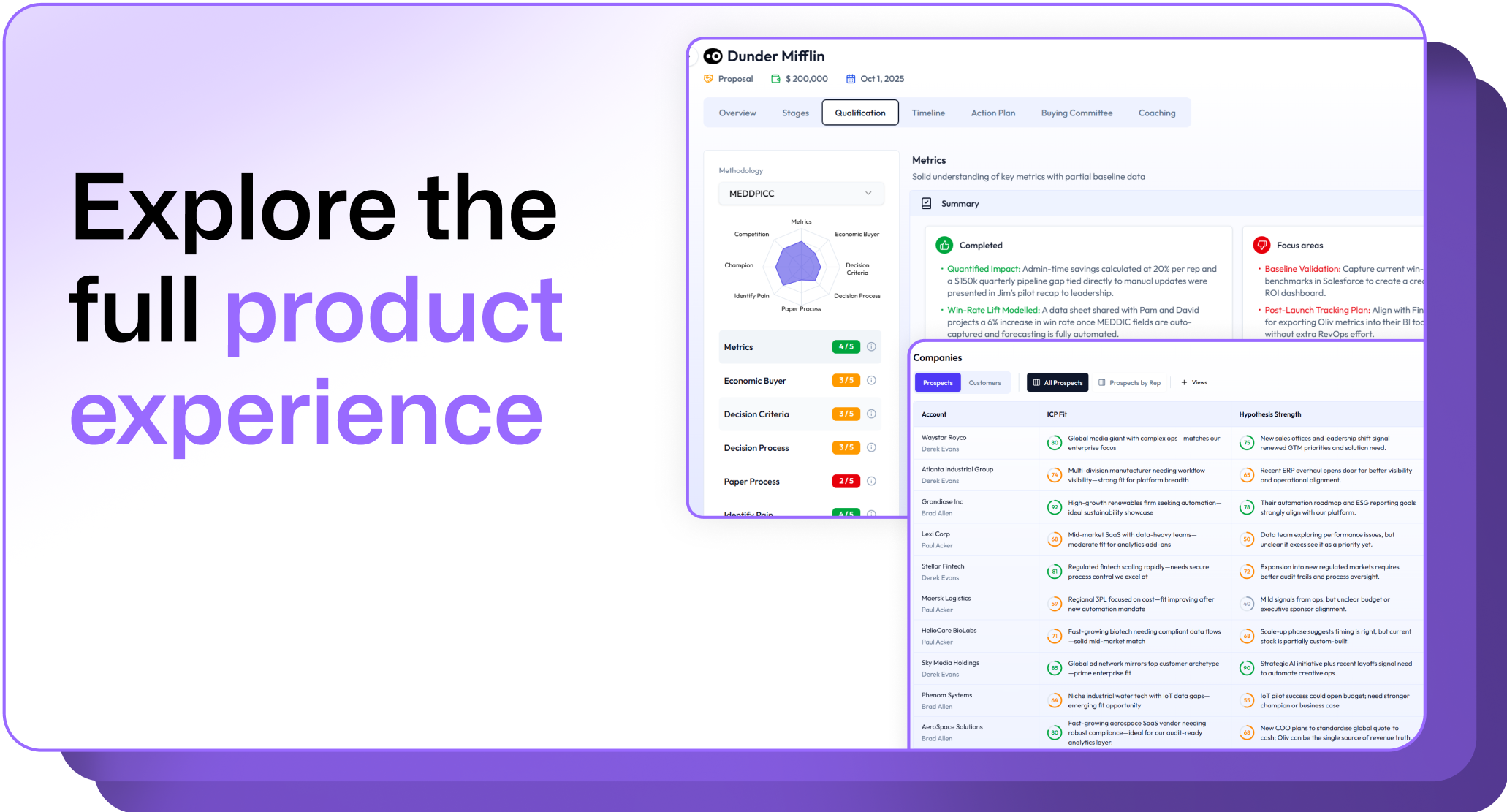
.avif)
.png)