Salesforce Agentforce vs Specialized Revenue AI — Why B2B Teams Need More Than a CRM Copilot
Written by
Ishan Chhabra
Last Updated :
April 7, 2026
Skim in :
14
mins
In this article
Revenue teams love Oliv
Here’s why:
All your deal data unified (from 30+ tools and tabs).
Insights are delivered to you directly, no digging.
AI agents automate tasks for you.
Thank you! Your submission has been received!
Oops! Something went wrong while submitting the form.
Meet Oliv’s AI Agents
Hi! I’m, Deal Driver
I track deals, flag risks, send weekly pipeline updates and give sales managers full visibility into deal progress
Hi! I’m, CRM Manager
I maintain CRM hygiene by updating core, custom and qualification fields all without your team lifting a finger
Hi! I’m, Forecaster
I build accurate forecasts based on real deal movement and tell you which deals to pull in to hit your number
Hi! I’m, Coach
I believe performance fuels revenue. I spot skill gaps, score calls and build coaching plans to help every rep level up
Hi! I’m, Prospector
I dig into target accounts to surface the right contacts, tailor and time outreach so you always strike when it counts
Hi! I’m, Pipeline tracker
I call reps to get deal updates, and deliver a real-time, CRM-synced roll-up view of deal progress
Hi! I’m, Analyst
I answer complex pipeline questions, uncover deal patterns, and build reports that guide strategic decisions
TL;DR
Agentforce adoption sits at roughly 8% of Salesforce's customer base, with B2B teams reporting data foundation failures, B2C architectural bias, and chat-based UX friction as primary blockers.
Einstein AI and Agentforce are architecturally distinct tools that, even stacked together, leave critical B2B CRM fields like MEDDPICC, Contact Roles, and Competitive Intel untouched.
The full Salesforce AI stack exceeds $789K annually for 100 reps, while AI-native alternatives like Oliv AI deliver autonomous CRM updates, methodology tracking, and open data export at roughly $68K per year.
Agentforce's Data Cloud dependency was architected for B2C consumer mapping, not multi-threaded B2B deal cycles, creating a fundamental architecture mismatch for revenue teams.
Specialized revenue AI integrates with Salesforce as a complementary intelligence layer, pushing structured data into CRM objects without requiring migration or rip-and-replace.
Oliv AI's CRM Manager Agent uses LLM reasoning to clean dirty data as a byproduct of selling, eliminating the RevOps Debt problem that sabotages every Salesforce AI deployment.
Q1: Why Are Salesforce AI Deployments Failing for B2B Revenue Teams? [toc=Salesforce AI Deployment Failures]
Salesforce announced ambitious targets for its AI agent platform, yet by mid-2025 had closed only around 8,000 Agentforce deals from a base of 150,000+ customers, roughly an 8% adoption rate. For B2B revenue teams specifically, the picture is even starker. Bolting AI onto a broken data foundation does not solve pipeline problems; it amplifies them. Most mid-market organizations carry years of "RevOps Debt": duplicate accounts, missing contacts, and incomplete opportunity fields that make any AI output unreliable from day one.
⚠️ The Legacy Architecture Problem
Salesforce's older Einstein features, including lead scoring, opportunity scoring, and forecasting, rely on V1 machine learning models that require high-volume, historically clean data to build mathematical equations. When fed incomplete or duplicate records (e.g., "Google US" and "Google India" existing as separate accounts), the system's brittle rule-based logic cannot distinguish between them and frequently attaches activities to the wrong record. Agentforce sits as a layer on top of this foundation, but it does not proactively clean the underlying data. If the foundation is broken, the agent's output is hallucinated.
Users are already surfacing this in real reviews:
"It can be complex to set up and often requires skilled administrators or developers to customize and integrate properly, which adds time and cost. Licensing fees can be high, especially as the number of agents grows." Verified User in Marketing and Advertising, Enterprise Salesforce Agentforce G2 Verified Review
🔄 From Dashboards to Execution
The industry is undergoing a tectonic shift, from "Revenue Intelligence" (dashboards you dig through) to AI-Native Revenue Orchestration (AI agents that execute work for you). This new paradigm demands architecture that reasons over unstructured data, including calls, emails, and Slack threads, rather than simply scoring structured CRM fields that were never reliably populated in the first place. The question is no longer "how do we visualize pipeline data?" but "how do we ensure the data exists at all?"
✅ How Oliv AI Solves the Data Foundation Crisis
Oliv approaches the problem from the opposite direction. Instead of requiring clean data as a prerequisite, we deploy the CRM Manager Agent to autonomously create clean data as a byproduct of selling. The agent uses AI-based object association, LLM reasoning rather than brittle rules, to examine 100% of interactions and map them to the correct account and opportunity, even in duplicate environments. It enriches contacts from LinkedIn and populates 100+ qualification fields (MEDDPICC, BANT, SPICED) based on actual conversation context, not what a rep remembered to type at 6 PM on a Friday.
Oliv builds fine-tuned models grounded in your specific company data, operating exclusively within your data lake. This eliminates the hallucination problem that plagues general-purpose CRM bots attempting to reason over someone else's training data.
"Before switching to Oliv, cleaning up messy CRM fields and guessing at forecasts used to swallow half my week. Oliv fixes the data as it happens and drops a forecast I can actually bank on." Darius Kim, Head of RevOps at Driftloop
Q2: What Is Salesforce Agentforce and What Was It Actually Built For? [toc=Agentforce Overview and Origins]
Salesforce Agentforce launched in September 2024 as a rebrand and evolution of Einstein Copilot, marking Salesforce's transition from an assistant-based AI model to an autonomous agent framework. By December 2025, Salesforce reported over 18,500 total Agentforce deals closed, with more than 9,500 paid, though that still represents a fraction of its 150,000+ customer base.
Atlas Reasoning Engine: Processes instructions and user intent to build an execution plan in natural language
Data Cloud Grounding: Connects agents to live CRM data so outputs reference actual customer records rather than generic model responses
Einstein Trust Layer: A security wrapper that masks PII before data reaches the underlying LLM
Agentforce agents can reason, plan, and execute tasks across Salesforce objects, flows, APIs, and external systems. The platform uses a consumption-based pricing model at $2 per conversation, departing from the traditional per-seat model.
🎯 Primary Use Cases and B2C Origins
Salesforce now frames Agentforce as an "outcome architecture platform" that sits across the entire ecosystem. However, the highest-impact use cases remain heavily oriented toward customer service and support scenarios, including answering shipment status inquiries, performing inventory lookups, handling tier-1 support tickets, and managing order returns.
This B2C-first architectural bias matters for B2B teams. While Agentforce can technically be configured for sales workflows, its out-of-the-box agents and pre-built actions are designed around service interactions, not complex B2B deal cycles involving multi-threaded stakeholder engagement, methodology tracking, or deal qualification.
"As much as I love what Agentforce can do, setting it up wasn't as smooth as I expected. The UI felt a bit clunky at times, especially when trying to manage multiple prompts or agent versions... the pricing caught us off guard. Once we started scaling to more users and use cases, the cost ramped up pretty quickly." Ayushmaan Y., Senior Associate, Enterprise Salesforce Agentforce G2 Verified Review
⚠️ The Adoption Gap
Despite Salesforce's investment, adoption data tells a sobering story. CEO Marc Benioff was publicly questioned about Agentforce's 8% adoption rate at Dreamforce '25. Users on the ground report that deploying agents for specialized B2B revenue workflows requires significant prompt engineering expertise and custom development, not the low-code experience Salesforce markets.
"The price of Agentforce is not clear and hard to find. Adoption is low because of the lack of knowledge on the subject as AI is a new field. Customers are finding issues in deploying and using agents in Salesforce." Anusha T., Web Developer Salesforce Agentforce G2 Verified Review
For B2B revenue teams evaluating Agentforce, it is worth considering purpose-built alternatives like Oliv AI that are designed natively for B2B deal execution, requiring no prompt engineering, no Data Cloud dependency, and delivering CRM value within days rather than quarters.
Q3: How Does Einstein AI Differ from Agentforce and Why Does It Matter? [toc=Einstein vs Agentforce]
One of the most common points of confusion for revenue leaders evaluating Salesforce's AI stack is the overlap between Einstein AI and Agentforce. They sound similar, share the same ecosystem, and are often bundled together in sales conversations, but they are architecturally distinct tools serving fundamentally different purposes.
🔍 Einstein AI: The Predictive Layer
Einstein AI is Salesforce's machine learning engine, launched well before the generative AI era. It is designed for predictive analytics and data-driven decision making:
Lead and Opportunity Scoring: Uses historical data patterns to assign probability scores
Sales Forecasting: Builds mathematical models to project revenue outcomes
Marketing Optimization: Personalizes customer experiences through ML-driven recommendations
Activity Capture (EAC): Syncs emails and calendar events to Salesforce records
Einstein operates on structured CRM data and requires significant historical volume to train its models effectively. It is configurable for CRM-related scenarios but does not support the creation of entirely new agent capabilities.
🤖 Agentforce: The Autonomous Layer
Agentforce, by contrast, is Salesforce's newer autonomous agent framework:
Einstein AI vs Agentforce Comparison
Feature
Einstein AI
Agentforce
Launch
Pre-2024 (iterative releases)
September 2024
Core function
Predictive analytics and scoring
Autonomous task execution
Human involvement
Every action needs human review
Executes independently, escalates exceptions
Data requirements
Structured, historically clean data
Structured + unstructured via Data Cloud
Pricing
$30-50/user/month (add-on)
$2/conversation (consumption-based)
Best fit
Complex forecasting decisions
Repetitive service and support tasks
❌ Why Stacking Both Still Leaves B2B Gaps
The fundamental issue for B2B revenue teams is that Einstein's predictions are only as good as the underlying data, and that data is rarely clean. Agentforce's autonomous agents, meanwhile, still depend on Data Cloud grounding, which was primarily architected for B2C consumer data mapping. Stacking both creates a high total cost of ownership without addressing the root problem: CRM data entry was never critical to the act of selling.
Einstein's data limitations surface clearly in user feedback:
"Its biggest handicap is that it does not allow for data storage or data migration. You can't really input the data from Einstein into another platform... It has an extremely complicated set up process." Verified Reviewer, Education Sector Einstein Gartner Verified Review
"Why Am I not impressed by anything Einstein AI?... I have Einstein AI in Visual Studio Code which works like GitHub Copilot, but much worse. It's actually frustrating to use and I never use it." OffManuscript, r/SalesforceDeveloper Reddit Thread
For teams that need their AI to reason over unstructured deal data, including calls, emails, and Slack, and autonomously update CRM objects without prompt engineering or Data Cloud dependencies, Oliv AI provides a generative AI-native alternative that combines Einstein's analytical ambition with Agentforce's execution promise, purpose-built for B2B revenue workflows.
Q4: CRM Copilot vs. Revenue Agent, What Is the Architectural Difference? [toc=Copilot vs Revenue Agent]
The market tends to lump every AI sales tool into the same category, but there is a fundamental architectural divide that determines whether your team gets genuine automation or just another interface to manage. On one side sit CRM copilots, tools that suggest actions inside a chat window and wait for human input. On the other sit autonomous revenue agents, systems that execute actions across your tech stack without requiring a rep to prompt them.
❌ The Chat-Based Copilot Problem
Salesforce Agentforce's user experience is fundamentally chat-based. A rep must navigate to the agent interface, type a request, review the suggestion, and then manually approve or copy-paste the output into the correct CRM field. This is not integrated into the business process of selling; it is a detour from it. Users experience this friction firsthand:
"Lots of clicking to get select the right options. UX needs improvement. Everything opens in a new browser tabs clustering the browser. Lots of jumping back and forth between tabs to enable settings." Verified User in Consulting, Enterprise Salesforce Agentforce G2 Verified Review
Gong, meanwhile, records and transcribes calls effectively, but it does not update CRM properties. It logs summaries as unstructured "Notes" or activity blocks that are functionally unsearchable for RevOps reporting or automated forecasting.
🔄 From Intelligence to Execution
The paradigm shift defining 2026's revenue tech landscape is the move from "intelligence" (showing you data on a dashboard) to "execution" (performing the work). A copilot requires the rep to ask the right question at the right time. An autonomous agent does not wait to be asked; it monitors deal signals, drafts updates, and pushes them to the rep for one-click approval. The difference is architectural, not incremental.
✅ Oliv's "Invisible UI" Framework
Oliv operates on a three-tier evolution model that makes the gap concrete:
Traditional: Rep manually types updates into CRM after every call (failure, it rarely happens)
AI Copilot (Salesforce): Rep chats with a bot to trigger an update (wrong UX, adds workflow friction)
Oliv Agentic: Agents autonomously draft CRM updates and nudge reps via Slack or Email to verify and approve in seconds (execution, no app-switching required)
Unlike copilots that surface suggestions, Oliv updates actual CRM objects and properties directly, including Opportunity Stage, Contact Roles, Next Steps, and MEDDPICC fields, all based on conversation context.
CRM Field Update Comparison
CRM Field
Manual Entry
Salesforce Agentforce
Gong
Oliv AI
Opportunity Stage
✅ Rep types
⚠️ Chat-triggered
❌ Not updated
✅ Auto-updated
Contact Roles
✅ Rep types
❌ Not supported
❌ Not updated
✅ Auto-populated
Next Steps
✅ Rep types
⚠️ Chat-triggered
⚠️ Notes only
✅ Auto-updated
MEDDPICC Fields
✅ Rep types
❌ Not supported
❌ Not updated
✅ Auto-populated
Competitive Intel
✅ Rep types
❌ Not supported
⚠️ Tracker keyword
✅ Context-aware
The difference is not about features; it is about whether the system does the work for the rep or merely gives the rep more work to manage.
Q5: Why Does Dirty CRM Data Break Salesforce AI and How Do Specialized Tools Fix It? [toc=Dirty CRM Data Problem]
Most B2B revenue organizations are carrying years of what is best described as "RevOps Debt," a compounding pile of duplicate accounts, missing contacts, and incomplete opportunity records that quietly sabotage every AI initiative layered on top. The root cause is structural: data entry was never critical to the act of selling. A rep can close a seven-figure deal without updating a single MEDDPICC field. Over time, this creates a CRM where "Google 2021" and "Google 2024" exist as separate accounts, contacts are missing, and opportunity data is functionally meaningless.
⚠️ Why Salesforce AI Crumbles on Dirty Foundations
Einstein's older predictive features, including lead scoring, opportunity scoring, and forecasting, rely on V1 machine learning models that build mathematical equations from historical data. These models require high-volume, consistently clean training data to produce reliable predictions. When fed duplicate accounts or incomplete fields, Einstein's output is not just inaccurate; it is confidently wrong.
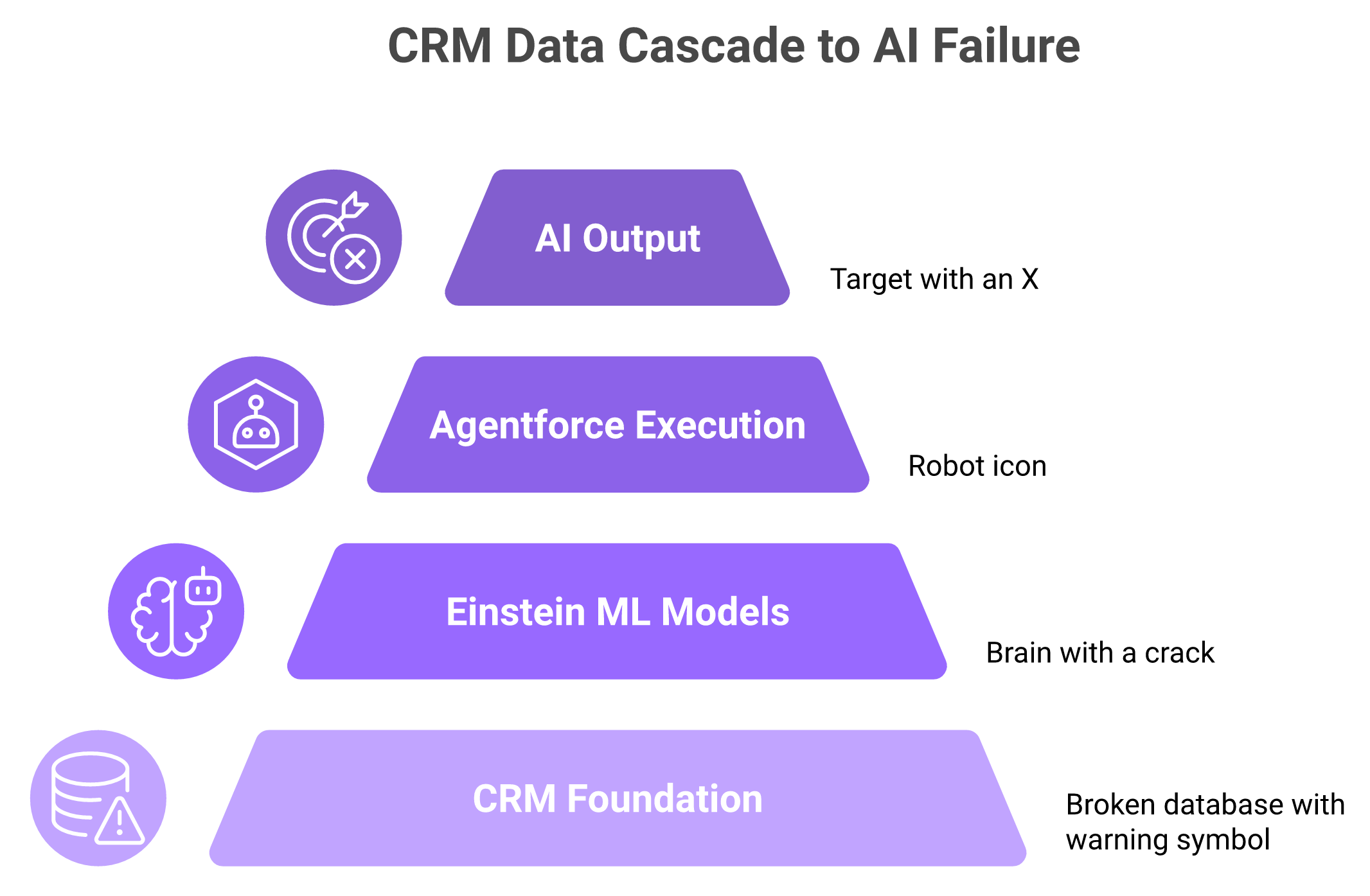
Einstein Activity Capture (EAC) adds another layer of fragility. It redacts emails unnecessarily through rule-based logic and stores synced data in separate AWS instances that are unusable for downstream RevOps reporting or automated forecasting. Agentforce, meanwhile, sits on top of this same broken foundation as an execution layer, but it does not proactively clean or heal the underlying data. If the foundation is broken, the agent's outputs are hallucinated.
Every layer of the Salesforce AI stack inherits the corruption beneath it. If the CRM foundation is broken, Agentforce outputs are hallucinated.
"Its biggest handicap is that it does not allow for data storage or data migration. You can't really input the data from Einstein into another platform. One does not have access to the data of employees that leave the organization." Verified Reviewer, Education Sector Einstein Gartner Verified Review
🔄 The Generative AI Paradigm Shift
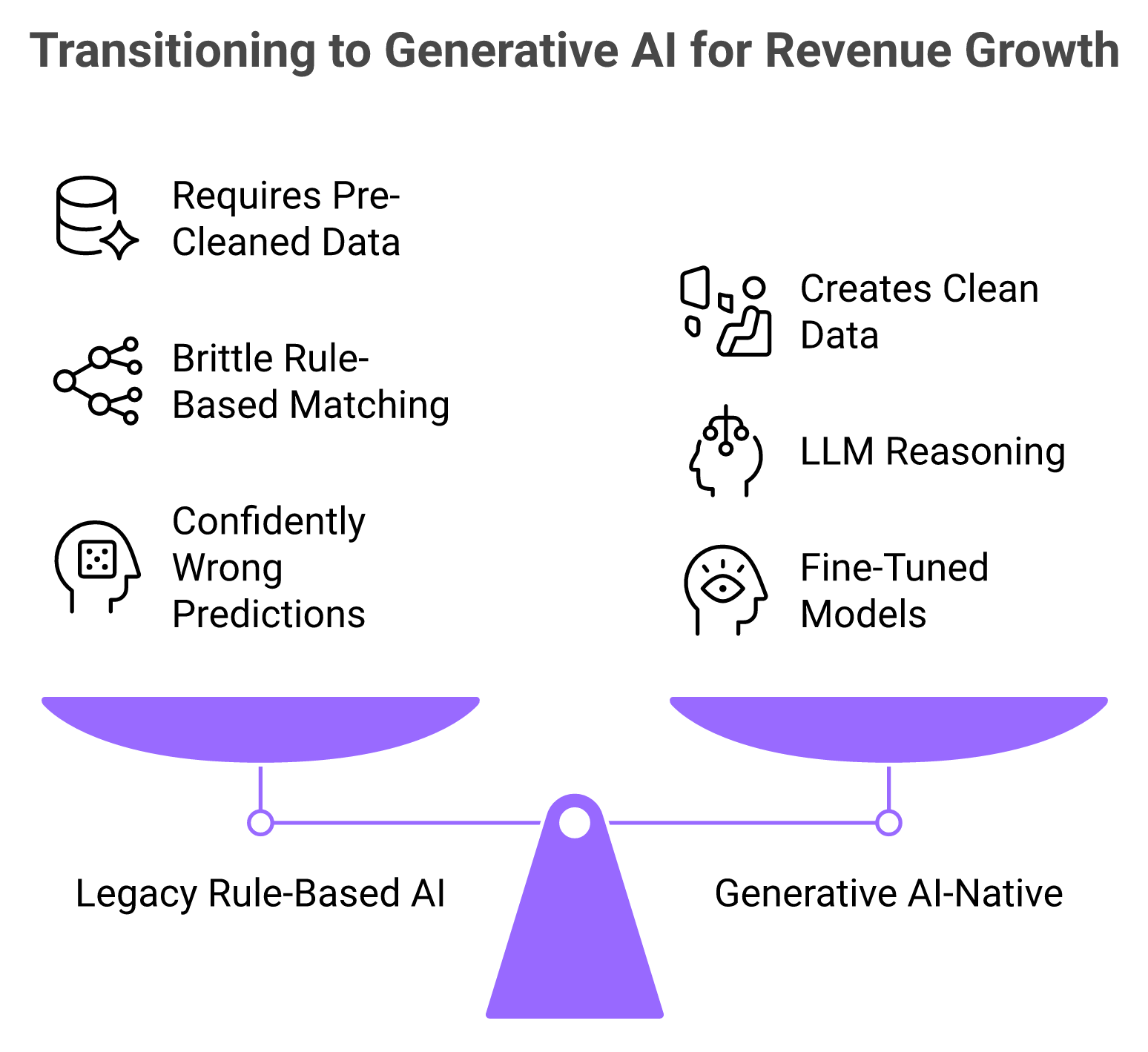
The breakthrough of generative AI for revenue teams is that it can reason over unstructured data, including calls, emails, and Slack threads, to reconstruct what actually happened in a deal, regardless of what a rep entered (or did not enter) in the CRM. Rather than requiring clean structured data as a prerequisite, generative AI-native tools create clean data as a byproduct of selling.
The generative AI paradigm shift means clean data is created as a byproduct of selling, not demanded as a prerequisite.
✅ How Oliv AI Fixes the Foundation
Oliv approaches this from the opposite direction with the CRM Manager Agent. Instead of brittle rule-based logic, it uses AI-based object association, LLM reasoning that examines 100% of interactions (calls, emails, and Slack) and checks the full history and context to determine the correct account and opportunity for association, even when duplicate records exist. The agent autonomously enriches contacts from LinkedIn and populates 100+ qualification fields (MEDDPICC, BANT, and SPICED) from actual conversation context.
We build fine-tuned LLMs grounded in your specific data lake, not generic training data, which eliminates the hallucination problem that plagues general-purpose CRM bots.
"Before switching to Oliv, cleaning up messy CRM fields and guessing at forecasts used to swallow half my week. Oliv fixes the data as it happens and drops a forecast I can actually bank on." Darius Kim, Head of RevOps at Driftloop
Q6: Salesforce AI Add-Ons vs. Specialized Revenue Tools, What Is Actually Faster to Value? [toc=Time to Value Comparison]
Implementation speed is the silent killer of revenue AI initiatives. Organizations invest six months and six figures into Salesforce AI deployments, only to find themselves stuck in what industry analysts call the "Trough of Disillusionment," where tools are live, but reps are still manually inputting data, managers are still auditing calls at 2x speed, and the board is still asking why forecast accuracy has not improved.
💸 The Salesforce Modular Bloat Problem
To unlock Salesforce's full AI capabilities for revenue teams, a CRO typically needs to stack multiple paid modules:
Data Cloud: Additional consumption platform fee (often mandated as an AI prerequisite)
This easily exceeds $500/user/month, and that is before implementation costs. Deploying these modules is described by practitioners as "very heavy implementation work" that frequently stretches into a two-to-three-year project.
To unlock Salesforce's full AI capabilities, CROs must stack five paid modules, easily exceeding $500/user/month before implementation.
"The pricing caught us off guard. Once we started scaling to more users and use cases, the cost ramped up pretty quickly. We had to rethink a few workflows just to stay within budget." Ayushmaan Y., Senior Associate, Enterprise Salesforce Agentforce G2 Verified Review
"Can be complex to set up and customize. Expensive, especially for smaller teams. Steep learning curve for new users." Shubham G., Senior BDM Salesforce Agentforce G2 Verified Review
⏰ The New Benchmark: Days, Not Quarters
The AI-era standard for time-to-value has fundamentally shifted. Modern specialized revenue tools connect in minutes, not months. The benchmark is now "days to first insight," not "quarters to go-live."
✅ How Oliv AI Delivers Instant Time-to-Value
Oliv is purpose-built for out-of-the-box B2B deployment:
Deployment Timeline Comparison: Salesforce AI Stack vs. Oliv AI
Milestone
Salesforce AI Stack
Oliv AI
⏰ Technical setup
Weeks of admin configuration
5 minutes (calendar + CRM)
🔄 First meaningful insight
6 to 14 weeks minimum
1 to 2 days
🎯 Methodology alignment
Requires years of historical data
3 meetings analyzed
⚙️ Full customization
2 to 3 years for full stack
2 to 4 weeks
💰 Pricing model
$500+/user/month (stacked modules)
Flat-rate, modular, no platform fees
Because Oliv uses an AI-native data foundation, it only needs to analyze three meetings to understand your specific sales methodology, whether that is MEDDPICC, BANT, or SPICED. There are no Data Cloud prerequisites, no mandatory consumption fees, and no multi-year implementation roadmaps.
Q7: What Exactly Does Agentforce Update in the CRM and What Does It Not Touch? [toc=Agentforce CRM Update Gaps]
At its core, the CRM has failed as a product because it was designed around an assumption that humans would reliably enter data. They do not. Reps view CRM documentation as administrative policing, something that is "not critical to the act of selling." The result is managers spending their evenings listening to call recordings at 2x speed during their commute, just to extract the truth about a deal before Monday's forecast call.
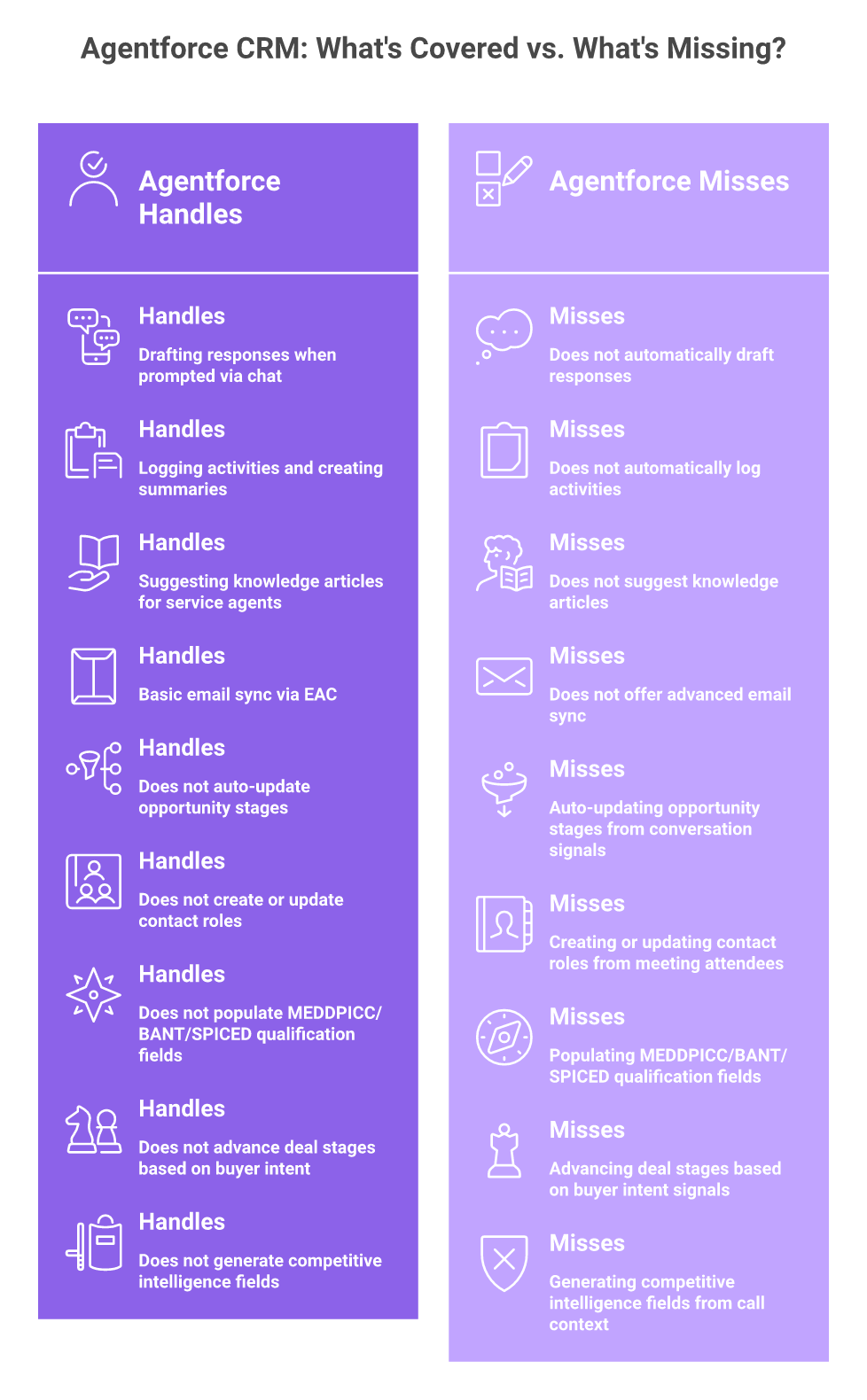
Agentforce handles basic activity logging and chat responses, but misses the critical B2B CRM updates that revenue teams actually need.
❌ What Agentforce Actually Does (and Does Not Do)
Agentforce is capable of chat-triggered suggestions, basic activity logging, and task creation within the Salesforce ecosystem. Einstein Activity Capture syncs emails and calendar events to records. But there are critical gaps that B2B revenue teams need to understand:
What Agentforce handles:
✅ Drafting responses when prompted via chat
✅ Logging activities and creating summaries
✅ Suggesting knowledge articles for service agents
✅ Basic email sync via EAC
What Agentforce does NOT handle:
❌ Auto-updating opportunity stages based on conversation signals
❌ Creating or updating contact roles from meeting attendees
❌ Advancing deal stages based on buyer intent signals
❌ Generating competitive intelligence fields from call context
"Lots of clicking to get select the right options. UX needs improvement. Everything opens in a new browser tabs clustering the browser. Lots of jumping back and forth between tabs to enable settings." Verified User in Consulting, Enterprise Salesforce Agentforce G2 Verified Review
⚠️ Gong's Documentation-Only Gap
Gong records calls effectively and surfaces insights, but it does not update CRM properties. It logs summaries as unstructured "Notes" or activity blocks, which are functionally unsearchable for RevOps reporting. Intelligence without execution still leaves the manager doing the heavy lifting.
✅ How Oliv AI Updates Actual CRM Objects
Oliv's CRM Manager Agent updates actual CRM objects and properties directly, not notes, not activity logs, but structured fields that RevOps can report on and forecast from. Every update is drafted autonomously and delivered via Slack or Email for one-click rep approval through an "Invisible UI."
CRM Field Update Comparison
CRM Field
Manual Entry
Agentforce
Gong
Oliv AI
Opportunity Stage
✅ Rep types
⚠️ Chat-triggered
❌ Not updated
✅ Auto-updated
Contact Roles
✅ Rep types
❌ Not supported
❌ Not updated
✅ Auto-populated
Next Steps
✅ Rep types
⚠️ Chat-triggered
⚠️ Notes only
✅ Auto-updated
MEDDPICC Fields
✅ Rep types
❌ Not supported
❌ Not updated
✅ Auto-populated
Competitive Intel
✅ Rep types
❌ Not supported
⚠️ Keyword tracker
✅ Context-aware
Last Activity Date
✅ Rep types
✅ EAC sync
✅ Activity log
✅ Auto-updated
Stakeholder Map
✅ Rep types
❌ Not supported
❌ Not updated
✅ Auto-generated
"Gong blew up my Slack all day, but I still had to click through ten screens just to find something useful. With Oliv, I finally get what I need... dropped right in my inbox." Mia Patterson, Sales Manager at Beacon
Q8: Does Salesforce Data Cloud Actually Help B2B Sales Teams or Is It Built for B2C? [toc=Data Cloud B2B vs B2C]
Salesforce increasingly mandates Data Cloud as a prerequisite for unlocking Agentforce's AI grounding capabilities. For CROs evaluating the Salesforce AI stack, this is not just an architectural detail; it is a significant consumption platform fee added to an already high total cost of ownership. The question revenue leaders need to ask is: was Data Cloud designed for your B2B deal cycles, or for someone else entirely?
❌ The B2C Architectural Reality
Data Cloud was architected for consumer data mapping, unifying customer profiles across retail, ecommerce, and marketing touchpoints. Its flagship use cases involve B2C giants like Colgate-Palmolive mapping consumer behavior across channels. For B2B revenue teams, the mismatch becomes painfully clear:
Lead/contact scoring in Data Cloud requires RevOps to manually build equations and features based on older technology, described as "very heavy to implement"
B2B deal signals, including multi-threaded stakeholder engagement, methodology progression, and competitive dynamics, were not the primary design consideration
Salesforce's strategic priority has shifted toward B2C businesses, leaving original B2B sales teams "underserved"
"The integration and utilization of Einstein can be complex at times, especially for users who are not familiar with AI concepts or lack technical expertise... there are limitations in terms of customization options, especially if there are specific AI requirements that go beyond the platform's capabilities." Verified Reviewer Einstein Gartner Verified Review
🔄 What B2B Teams Actually Need
B2B revenue workflows require a data platform that natively understands deal structures, buyer committees, complex sales cycles, and methodology frameworks. They need intelligence derived from calls, emails, and Slack threads, not consumer clickstream data. Forcing B2B signals through a B2C-optimized CDP creates a fragmented reality where deal context is lost.
Seamless interoperability: If your team keeps Salesforce as the CRM of record, Oliv connects with your existing stack (Slack, Email, Dialer, and Meeting Bridge) and pushes structured intelligence into Salesforce objects
No Data Cloud dependency: Oliv's AI grounding comes from your own conversation and deal data, not a separate consumption platform
B2B specialization: Converts unstructured data from calls, emails, and Slack into a coherent deal narrative with methodology tracking built in
To directly answer the question many mid-market teams ask: yes, Oliv integrates with Salesforce as your CRM of record and can complement existing Data Cloud investments, but it eliminates the need for Data Cloud as an AI prerequisite. Keep your CRM. Upgrade the intelligence layer.
"Salesforce's focus is more on helping B2C businesses... B2B Sales is now very underserved." Ishan Chhabra, Founder and CEO, Oliv AI
Q9: Real Agentforce Reviews: What Are Sales Teams Actually Saying? [toc=Agentforce User Reviews]
Before investing in any AI platform, it pays to hear directly from the teams using it daily. Below is a curated selection of verbatim reviews from verified Agentforce and Einstein users across G2, Gartner, and Reddit, organized by the recurring themes that matter most to B2B revenue buyers.
⚠️ Theme 1: Pricing Opacity and Cost Escalation
Agentforce pricing remains a consistent pain point. Multiple reviewers report difficulty understanding the cost structure upfront, only to find it escalating rapidly once they begin scaling.
"The price of Agentforce is not clear and hard to find. Adoption is low because of the lack of knowledge on the subject as AI is a new field. Customers are finding issues in deploying and using agents in Salesforce." Anusha T., Web Developer Salesforce Agentforce G2 Verified Review
"The pricing caught us off guard. Once we started scaling to more users and use cases, the cost ramped up pretty quickly. We had to rethink a few workflows just to stay within budget." Ayushmaan Y., Senior Associate, Enterprise Salesforce Agentforce G2 Verified Review
❌ Theme 2: Setup Complexity and Learning Curve
Even reviewers who praise Agentforce's potential flag the significant technical investment required to get it working properly, including prompt engineering skills, admin configuration, and custom development.
"Can be complex to set up and customize. Expensive, especially for smaller teams. Steep learning curve for new users. Slow performance if not optimized. Overwhelming with too many features at once." Shubham G., Senior BDM Salesforce Agentforce G2 Verified Review
"My primary concern is the significant learning curve involved in truly optimizing Agentforce... Effectively crafting prompts and configuring the underlying actions demands a specific skill set often called prompt engineering." Alessandro N., Salesforce Administrator Salesforce Agentforce G2 Verified Review
⚠️ Theme 3: UX Friction and Browser Clutter
The chat-based, tab-heavy UX consistently surfaces as a frustration, especially for reps already managing multiple tools.
"Lots of clicking to get select the right options. UX needs improvement. Everything opens in a new browser tabs clustering the browser. Lots of jumping back and forth between tabs to enable settings." Verified User in Consulting, Enterprise Salesforce Agentforce G2 Verified Review
"I would like to see an option that is neither template or wizard based, but just a 'build Agent' where I can choose everything myself. Also, it still needs some serious debugging." Jessica C., Senior Business Analyst Salesforce Agentforce G2 Verified Review
✅ What the Pattern Reveals
Across these verified reviews, three consistent themes emerge: opaque pricing that escalates at scale, significant setup complexity requiring specialized skills, and a chat-based UX that adds friction rather than reducing it. For teams seeking AI that works out of the box without prompt engineering or tab-switching, Oliv AI offers a generative AI-native alternative where agents deliver insights proactively via Slack and Email, no bot-chatting required.
Q10: The True Total Cost of Ownership: Salesforce AI Stack vs. Specialized Revenue AI [toc=TCO Comparison]
Most CROs do not realize the full cost of Salesforce AI until the procurement team tallies the invoice across three or four required modules. The advertised per-seat price is the tip of the iceberg; implementation hours, mandatory platform dependencies, and annual price escalations can push true TCO well beyond what the initial sales pitch suggested.
💸 The Salesforce Cost Stack Dissected
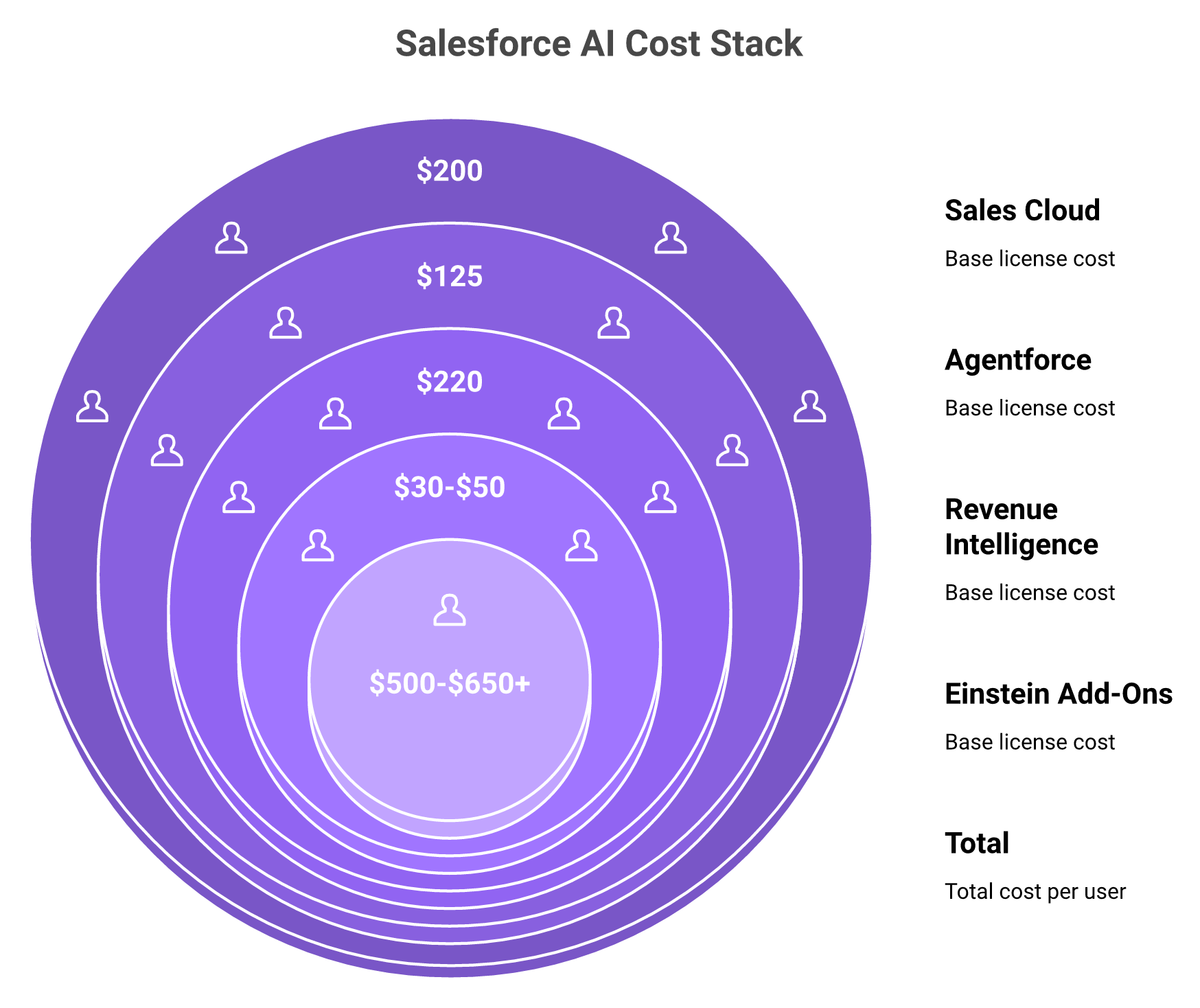
To unlock Salesforce's complete AI capabilities for a B2B revenue team, organizations typically need to layer multiple paid modules:
Salesforce AI Module Pricing Breakdown
Module
Approximate Monthly Cost (per user)
Sales Cloud
~$200
Agentforce
~$125 (or $2/conversation)
Revenue Intelligence
~$220
Data Cloud
Consumption platform fee (variable)
Einstein Add-Ons
$30-$50
Total
$500-$650+/user/month
For a 100-rep team, this translates to approximately $789K+ annually before factoring in implementation and admin costs.
⚠️ The Hidden Costs Nobody Mentions Upfront
Beyond the license fees, several cost layers emerge post-contract:
40 to 140 admin hours for implementation and lifecycle management
Annual 5 to 15% price increases baked into renewal terms
Forced bundling, where modules like Einstein require dependencies that inflate per-seat costs
Custom integration fees for connecting non-Salesforce tools to the ecosystem
Mandatory platform fees ranging from $5,000 to $50,000 regardless of seat count
"It can be complex to set up and often requires skilled administrators or developers to customize and integrate properly, which adds time and cost. Licensing fees can be high, especially as the number of agents grows." Verified User in Marketing and Advertising, Enterprise Salesforce Agentforce G2 Verified Review
"It was a big mistake on our part to commit to a two year term. Gong is a really powerful tool but its probably the highest end option on the market, and now we're stuck with a tool that works technically but isn't the right business decision." Iris P., Head of Marketing, Sales and Partnerships Gong G2 Verified Review
✅ Oliv AI's Modular TCO Alternative
Oliv operates on a flat-rate, modular pricing model with no mandatory platform fees and no Data Cloud dependency. Teams purchase only the specific agents they need, including CRM Manager, Forecaster, and Deal Driver, rather than licensing an entire ecosystem to unlock one capability. For a 100-rep team, Oliv's annual TCO is approximately $68.4K, a 91% reduction compared to the full Salesforce AI stack.
Annual TCO Comparison: Salesforce AI Stack vs. Oliv AI
Cost Dimension
Salesforce AI Stack
Oliv AI
💰 Annual license (100 reps)
~$789K
~$68.4K
⏰ Implementation timeline
6 months to 3 years
5 minutes to 4 weeks
💸 Platform fees
$5K-$50K mandatory
$0
🔄 Data export
Restricted (EAC silos)
Full open export
Q11: How to Diagnose Why Your Salesforce AI Initiative Failed [toc=AI Failure Diagnosis]
If you are reading this section, your Salesforce AI deployment has likely stalled, underperformed, or failed to deliver the ROI your board expected. You are not alone; the majority of B2B Agentforce deployments encounter significant friction, with adoption hovering around 8% of Salesforce's total customer base as of late 2025. The good news: failure is diagnosable, and the root cause typically falls into one of three categories.
❌ Failure Mode 1: Data Foundation Collapse
Symptoms: Einstein scoring models producing unreliable predictions; Agentforce surfacing irrelevant suggestions; activities mapped to wrong accounts or opportunities.
Root cause: Your CRM is carrying years of RevOps Debt, including duplicate accounts, missing contacts, and incomplete opportunity data. Einstein's V1 ML models were trained on this dirty data, and Agentforce inherited the same broken foundation.
Remediation: Before re-attempting any AI deployment, you need AI-based data cleanup that reasons over unstructured sources (calls, emails, and Slack) to reconstruct accurate deal records, not more rule-based logic on top of bad data.
⚠️ Failure Mode 2: Architecture Mismatch
Symptoms: Agents configured but rarely triggered for B2B use cases; pre-built actions oriented toward service tickets rather than deal progression; Data Cloud providing consumer-grade insights irrelevant to complex sales cycles.
Remediation: Evaluate purpose-built B2B revenue agents that natively understand deal structures, buyer committees, and sales methodology frameworks.
"Settings can be annoying at times... you need to activate Einstein and other stuff if you want to use Agentforce. But why don't you enable dependency if I directly wanna start Agentforce in a single click?" shivam a., Product Researcher Salesforce Agentforce G2 Verified Review
❌ Failure Mode 3: Adoption Collapse
Symptoms: Low agent usage metrics; reps ignoring the chat interface; managers still manually auditing calls; no measurable improvement in CRM data quality.
Root cause: The chat-based UX creates a workflow detour. Reps must actively navigate to a bot, type a request, review the output, then manually approve it. This is not integrated into how they sell; it is another tool demanding attention.
Oliv's architecture was specifically designed to solve the trifecta of data, architecture, and adoption failure. The CRM Manager Agent autonomously cleans and enriches data using LLM reasoning. The platform is purpose-built for B2B deal cycles with native methodology tracking. And the "Invisible UI" delivers updates via Slack and Email, meaning reps never need to open another app or chat with another bot.
Q12: Can Specialized Revenue AI Work Alongside Salesforce, or Is It Replace-or-Nothing? [toc=Salesforce Integration Compatibility]
This is the single biggest objection we hear from mid-market revenue teams: "We've invested years and hundreds of thousands in Salesforce. Are you telling us to rip it all out?" The answer is an unequivocal no. Specialized revenue AI is designed to complement Salesforce, not compete with it.
⚠️ The "One-Way Integration" Trap
The real risk is not adding a new intelligence layer; it is staying locked into tools that act as one-way data holders. Gong and Salesforce both pull data into their own universe, but exporting structured intelligence back out is notoriously difficult. Gong logs insights as unstructured "Notes" that cannot be queried. Salesforce's Einstein Activity Capture stores synced data in separate AWS instances that are unusable for downstream reporting.
"While Gong offers valuable insights into call data, our experience has been impacted by significant data access limitations, especially concerning data portability and bulk export capabilities... This lack of flexibility has required us to engage our development team at additional cost." Neel P., Sales Operations Manager Gong G2 Verified Review
This creates a dangerous pattern: your CRM is supposed to be the source of truth, but the most valuable intelligence lives trapped in tools that will not push it back in a structured format.
🔄 The New Interoperability Standard
The AI-era standard for revenue tools is fundamentally different: best-in-class platforms push intelligence into your CRM rather than pulling data out of it. The CRM remains the system of record. The AI layer acts as the intelligence and execution engine, updating objects, populating fields, and advancing deals automatically.
✅ Oliv's "Full Open Export" Philosophy
Oliv is built on the principle that your data belongs in your system of record, not trapped inside another vendor's UI. Here is how the integration works in practice:
Salesforce stays as your CRM: No migration, no rip-and-replace
Oliv connects to your existing stack: Slack, Email, Dialer (JustCall, Orum, Nooks, and Aircall), Meeting Bridge (Zoom, Teams, Meet, and Webex)
Intelligence pushes INTO Salesforce: CRM objects and properties are updated directly, including Opportunity Stage, Contact Roles, MEDDPICC fields, and Next Steps
Full open data export: Upon termination, you receive a complete CSV dump of all meetings and recordings, with no lock-in
"Gong is trying to become the center of the universe by getting all the data in, but it doesn't allow you to export it out... You're locked into their UI." Ishan Chhabra, Founder and CEO, Oliv AI
💡 The Bottom Line
Keep Salesforce. Upgrade the intelligence layer. Oliv works alongside your CRM investment, not against it, delivering autonomous CRM updates, unbiased forecasts, and proactive deal management without requiring a single change to your Salesforce configuration.
Q1: Why Are Salesforce AI Deployments Failing for B2B Revenue Teams? [toc=Salesforce AI Deployment Failures]
Salesforce announced ambitious targets for its AI agent platform, yet by mid-2025 had closed only around 8,000 Agentforce deals from a base of 150,000+ customers, roughly an 8% adoption rate. For B2B revenue teams specifically, the picture is even starker. Bolting AI onto a broken data foundation does not solve pipeline problems; it amplifies them. Most mid-market organizations carry years of "RevOps Debt": duplicate accounts, missing contacts, and incomplete opportunity fields that make any AI output unreliable from day one.
⚠️ The Legacy Architecture Problem
Salesforce's older Einstein features, including lead scoring, opportunity scoring, and forecasting, rely on V1 machine learning models that require high-volume, historically clean data to build mathematical equations. When fed incomplete or duplicate records (e.g., "Google US" and "Google India" existing as separate accounts), the system's brittle rule-based logic cannot distinguish between them and frequently attaches activities to the wrong record. Agentforce sits as a layer on top of this foundation, but it does not proactively clean the underlying data. If the foundation is broken, the agent's output is hallucinated.
Users are already surfacing this in real reviews:
"It can be complex to set up and often requires skilled administrators or developers to customize and integrate properly, which adds time and cost. Licensing fees can be high, especially as the number of agents grows." Verified User in Marketing and Advertising, Enterprise Salesforce Agentforce G2 Verified Review
🔄 From Dashboards to Execution
The industry is undergoing a tectonic shift, from "Revenue Intelligence" (dashboards you dig through) to AI-Native Revenue Orchestration (AI agents that execute work for you). This new paradigm demands architecture that reasons over unstructured data, including calls, emails, and Slack threads, rather than simply scoring structured CRM fields that were never reliably populated in the first place. The question is no longer "how do we visualize pipeline data?" but "how do we ensure the data exists at all?"
✅ How Oliv AI Solves the Data Foundation Crisis
Oliv approaches the problem from the opposite direction. Instead of requiring clean data as a prerequisite, we deploy the CRM Manager Agent to autonomously create clean data as a byproduct of selling. The agent uses AI-based object association, LLM reasoning rather than brittle rules, to examine 100% of interactions and map them to the correct account and opportunity, even in duplicate environments. It enriches contacts from LinkedIn and populates 100+ qualification fields (MEDDPICC, BANT, SPICED) based on actual conversation context, not what a rep remembered to type at 6 PM on a Friday.
Oliv builds fine-tuned models grounded in your specific company data, operating exclusively within your data lake. This eliminates the hallucination problem that plagues general-purpose CRM bots attempting to reason over someone else's training data.
"Before switching to Oliv, cleaning up messy CRM fields and guessing at forecasts used to swallow half my week. Oliv fixes the data as it happens and drops a forecast I can actually bank on." Darius Kim, Head of RevOps at Driftloop
Q2: What Is Salesforce Agentforce and What Was It Actually Built For? [toc=Agentforce Overview and Origins]
Salesforce Agentforce launched in September 2024 as a rebrand and evolution of Einstein Copilot, marking Salesforce's transition from an assistant-based AI model to an autonomous agent framework. By December 2025, Salesforce reported over 18,500 total Agentforce deals closed, with more than 9,500 paid, though that still represents a fraction of its 150,000+ customer base.
Atlas Reasoning Engine: Processes instructions and user intent to build an execution plan in natural language
Data Cloud Grounding: Connects agents to live CRM data so outputs reference actual customer records rather than generic model responses
Einstein Trust Layer: A security wrapper that masks PII before data reaches the underlying LLM
Agentforce agents can reason, plan, and execute tasks across Salesforce objects, flows, APIs, and external systems. The platform uses a consumption-based pricing model at $2 per conversation, departing from the traditional per-seat model.
🎯 Primary Use Cases and B2C Origins
Salesforce now frames Agentforce as an "outcome architecture platform" that sits across the entire ecosystem. However, the highest-impact use cases remain heavily oriented toward customer service and support scenarios, including answering shipment status inquiries, performing inventory lookups, handling tier-1 support tickets, and managing order returns.
This B2C-first architectural bias matters for B2B teams. While Agentforce can technically be configured for sales workflows, its out-of-the-box agents and pre-built actions are designed around service interactions, not complex B2B deal cycles involving multi-threaded stakeholder engagement, methodology tracking, or deal qualification.
"As much as I love what Agentforce can do, setting it up wasn't as smooth as I expected. The UI felt a bit clunky at times, especially when trying to manage multiple prompts or agent versions... the pricing caught us off guard. Once we started scaling to more users and use cases, the cost ramped up pretty quickly." Ayushmaan Y., Senior Associate, Enterprise Salesforce Agentforce G2 Verified Review
⚠️ The Adoption Gap
Despite Salesforce's investment, adoption data tells a sobering story. CEO Marc Benioff was publicly questioned about Agentforce's 8% adoption rate at Dreamforce '25. Users on the ground report that deploying agents for specialized B2B revenue workflows requires significant prompt engineering expertise and custom development, not the low-code experience Salesforce markets.
"The price of Agentforce is not clear and hard to find. Adoption is low because of the lack of knowledge on the subject as AI is a new field. Customers are finding issues in deploying and using agents in Salesforce." Anusha T., Web Developer Salesforce Agentforce G2 Verified Review
For B2B revenue teams evaluating Agentforce, it is worth considering purpose-built alternatives like Oliv AI that are designed natively for B2B deal execution, requiring no prompt engineering, no Data Cloud dependency, and delivering CRM value within days rather than quarters.
Q3: How Does Einstein AI Differ from Agentforce and Why Does It Matter? [toc=Einstein vs Agentforce]
One of the most common points of confusion for revenue leaders evaluating Salesforce's AI stack is the overlap between Einstein AI and Agentforce. They sound similar, share the same ecosystem, and are often bundled together in sales conversations, but they are architecturally distinct tools serving fundamentally different purposes.
🔍 Einstein AI: The Predictive Layer
Einstein AI is Salesforce's machine learning engine, launched well before the generative AI era. It is designed for predictive analytics and data-driven decision making:
Lead and Opportunity Scoring: Uses historical data patterns to assign probability scores
Sales Forecasting: Builds mathematical models to project revenue outcomes
Marketing Optimization: Personalizes customer experiences through ML-driven recommendations
Activity Capture (EAC): Syncs emails and calendar events to Salesforce records
Einstein operates on structured CRM data and requires significant historical volume to train its models effectively. It is configurable for CRM-related scenarios but does not support the creation of entirely new agent capabilities.
🤖 Agentforce: The Autonomous Layer
Agentforce, by contrast, is Salesforce's newer autonomous agent framework:
Einstein AI vs Agentforce Comparison
Feature
Einstein AI
Agentforce
Launch
Pre-2024 (iterative releases)
September 2024
Core function
Predictive analytics and scoring
Autonomous task execution
Human involvement
Every action needs human review
Executes independently, escalates exceptions
Data requirements
Structured, historically clean data
Structured + unstructured via Data Cloud
Pricing
$30-50/user/month (add-on)
$2/conversation (consumption-based)
Best fit
Complex forecasting decisions
Repetitive service and support tasks
❌ Why Stacking Both Still Leaves B2B Gaps
The fundamental issue for B2B revenue teams is that Einstein's predictions are only as good as the underlying data, and that data is rarely clean. Agentforce's autonomous agents, meanwhile, still depend on Data Cloud grounding, which was primarily architected for B2C consumer data mapping. Stacking both creates a high total cost of ownership without addressing the root problem: CRM data entry was never critical to the act of selling.
Einstein's data limitations surface clearly in user feedback:
"Its biggest handicap is that it does not allow for data storage or data migration. You can't really input the data from Einstein into another platform... It has an extremely complicated set up process." Verified Reviewer, Education Sector Einstein Gartner Verified Review
"Why Am I not impressed by anything Einstein AI?... I have Einstein AI in Visual Studio Code which works like GitHub Copilot, but much worse. It's actually frustrating to use and I never use it." OffManuscript, r/SalesforceDeveloper Reddit Thread
For teams that need their AI to reason over unstructured deal data, including calls, emails, and Slack, and autonomously update CRM objects without prompt engineering or Data Cloud dependencies, Oliv AI provides a generative AI-native alternative that combines Einstein's analytical ambition with Agentforce's execution promise, purpose-built for B2B revenue workflows.
Q4: CRM Copilot vs. Revenue Agent, What Is the Architectural Difference? [toc=Copilot vs Revenue Agent]
The market tends to lump every AI sales tool into the same category, but there is a fundamental architectural divide that determines whether your team gets genuine automation or just another interface to manage. On one side sit CRM copilots, tools that suggest actions inside a chat window and wait for human input. On the other sit autonomous revenue agents, systems that execute actions across your tech stack without requiring a rep to prompt them.
❌ The Chat-Based Copilot Problem
Salesforce Agentforce's user experience is fundamentally chat-based. A rep must navigate to the agent interface, type a request, review the suggestion, and then manually approve or copy-paste the output into the correct CRM field. This is not integrated into the business process of selling; it is a detour from it. Users experience this friction firsthand:
"Lots of clicking to get select the right options. UX needs improvement. Everything opens in a new browser tabs clustering the browser. Lots of jumping back and forth between tabs to enable settings." Verified User in Consulting, Enterprise Salesforce Agentforce G2 Verified Review
Gong, meanwhile, records and transcribes calls effectively, but it does not update CRM properties. It logs summaries as unstructured "Notes" or activity blocks that are functionally unsearchable for RevOps reporting or automated forecasting.
🔄 From Intelligence to Execution
The paradigm shift defining 2026's revenue tech landscape is the move from "intelligence" (showing you data on a dashboard) to "execution" (performing the work). A copilot requires the rep to ask the right question at the right time. An autonomous agent does not wait to be asked; it monitors deal signals, drafts updates, and pushes them to the rep for one-click approval. The difference is architectural, not incremental.
✅ Oliv's "Invisible UI" Framework
Oliv operates on a three-tier evolution model that makes the gap concrete:
Traditional: Rep manually types updates into CRM after every call (failure, it rarely happens)
AI Copilot (Salesforce): Rep chats with a bot to trigger an update (wrong UX, adds workflow friction)
Oliv Agentic: Agents autonomously draft CRM updates and nudge reps via Slack or Email to verify and approve in seconds (execution, no app-switching required)
Unlike copilots that surface suggestions, Oliv updates actual CRM objects and properties directly, including Opportunity Stage, Contact Roles, Next Steps, and MEDDPICC fields, all based on conversation context.
CRM Field Update Comparison
CRM Field
Manual Entry
Salesforce Agentforce
Gong
Oliv AI
Opportunity Stage
✅ Rep types
⚠️ Chat-triggered
❌ Not updated
✅ Auto-updated
Contact Roles
✅ Rep types
❌ Not supported
❌ Not updated
✅ Auto-populated
Next Steps
✅ Rep types
⚠️ Chat-triggered
⚠️ Notes only
✅ Auto-updated
MEDDPICC Fields
✅ Rep types
❌ Not supported
❌ Not updated
✅ Auto-populated
Competitive Intel
✅ Rep types
❌ Not supported
⚠️ Tracker keyword
✅ Context-aware
The difference is not about features; it is about whether the system does the work for the rep or merely gives the rep more work to manage.
Q5: Why Does Dirty CRM Data Break Salesforce AI and How Do Specialized Tools Fix It? [toc=Dirty CRM Data Problem]
Most B2B revenue organizations are carrying years of what is best described as "RevOps Debt," a compounding pile of duplicate accounts, missing contacts, and incomplete opportunity records that quietly sabotage every AI initiative layered on top. The root cause is structural: data entry was never critical to the act of selling. A rep can close a seven-figure deal without updating a single MEDDPICC field. Over time, this creates a CRM where "Google 2021" and "Google 2024" exist as separate accounts, contacts are missing, and opportunity data is functionally meaningless.
⚠️ Why Salesforce AI Crumbles on Dirty Foundations
Einstein's older predictive features, including lead scoring, opportunity scoring, and forecasting, rely on V1 machine learning models that build mathematical equations from historical data. These models require high-volume, consistently clean training data to produce reliable predictions. When fed duplicate accounts or incomplete fields, Einstein's output is not just inaccurate; it is confidently wrong.
Einstein Activity Capture (EAC) adds another layer of fragility. It redacts emails unnecessarily through rule-based logic and stores synced data in separate AWS instances that are unusable for downstream RevOps reporting or automated forecasting. Agentforce, meanwhile, sits on top of this same broken foundation as an execution layer, but it does not proactively clean or heal the underlying data. If the foundation is broken, the agent's outputs are hallucinated.
Every layer of the Salesforce AI stack inherits the corruption beneath it. If the CRM foundation is broken, Agentforce outputs are hallucinated.
"Its biggest handicap is that it does not allow for data storage or data migration. You can't really input the data from Einstein into another platform. One does not have access to the data of employees that leave the organization." Verified Reviewer, Education Sector Einstein Gartner Verified Review
🔄 The Generative AI Paradigm Shift
The breakthrough of generative AI for revenue teams is that it can reason over unstructured data, including calls, emails, and Slack threads, to reconstruct what actually happened in a deal, regardless of what a rep entered (or did not enter) in the CRM. Rather than requiring clean structured data as a prerequisite, generative AI-native tools create clean data as a byproduct of selling.
The generative AI paradigm shift means clean data is created as a byproduct of selling, not demanded as a prerequisite.
✅ How Oliv AI Fixes the Foundation
Oliv approaches this from the opposite direction with the CRM Manager Agent. Instead of brittle rule-based logic, it uses AI-based object association, LLM reasoning that examines 100% of interactions (calls, emails, and Slack) and checks the full history and context to determine the correct account and opportunity for association, even when duplicate records exist. The agent autonomously enriches contacts from LinkedIn and populates 100+ qualification fields (MEDDPICC, BANT, and SPICED) from actual conversation context.
We build fine-tuned LLMs grounded in your specific data lake, not generic training data, which eliminates the hallucination problem that plagues general-purpose CRM bots.
"Before switching to Oliv, cleaning up messy CRM fields and guessing at forecasts used to swallow half my week. Oliv fixes the data as it happens and drops a forecast I can actually bank on." Darius Kim, Head of RevOps at Driftloop
Q6: Salesforce AI Add-Ons vs. Specialized Revenue Tools, What Is Actually Faster to Value? [toc=Time to Value Comparison]
Implementation speed is the silent killer of revenue AI initiatives. Organizations invest six months and six figures into Salesforce AI deployments, only to find themselves stuck in what industry analysts call the "Trough of Disillusionment," where tools are live, but reps are still manually inputting data, managers are still auditing calls at 2x speed, and the board is still asking why forecast accuracy has not improved.
💸 The Salesforce Modular Bloat Problem
To unlock Salesforce's full AI capabilities for revenue teams, a CRO typically needs to stack multiple paid modules:
Data Cloud: Additional consumption platform fee (often mandated as an AI prerequisite)
This easily exceeds $500/user/month, and that is before implementation costs. Deploying these modules is described by practitioners as "very heavy implementation work" that frequently stretches into a two-to-three-year project.
To unlock Salesforce's full AI capabilities, CROs must stack five paid modules, easily exceeding $500/user/month before implementation.
"The pricing caught us off guard. Once we started scaling to more users and use cases, the cost ramped up pretty quickly. We had to rethink a few workflows just to stay within budget." Ayushmaan Y., Senior Associate, Enterprise Salesforce Agentforce G2 Verified Review
"Can be complex to set up and customize. Expensive, especially for smaller teams. Steep learning curve for new users." Shubham G., Senior BDM Salesforce Agentforce G2 Verified Review
⏰ The New Benchmark: Days, Not Quarters
The AI-era standard for time-to-value has fundamentally shifted. Modern specialized revenue tools connect in minutes, not months. The benchmark is now "days to first insight," not "quarters to go-live."
✅ How Oliv AI Delivers Instant Time-to-Value
Oliv is purpose-built for out-of-the-box B2B deployment:
Deployment Timeline Comparison: Salesforce AI Stack vs. Oliv AI
Milestone
Salesforce AI Stack
Oliv AI
⏰ Technical setup
Weeks of admin configuration
5 minutes (calendar + CRM)
🔄 First meaningful insight
6 to 14 weeks minimum
1 to 2 days
🎯 Methodology alignment
Requires years of historical data
3 meetings analyzed
⚙️ Full customization
2 to 3 years for full stack
2 to 4 weeks
💰 Pricing model
$500+/user/month (stacked modules)
Flat-rate, modular, no platform fees
Because Oliv uses an AI-native data foundation, it only needs to analyze three meetings to understand your specific sales methodology, whether that is MEDDPICC, BANT, or SPICED. There are no Data Cloud prerequisites, no mandatory consumption fees, and no multi-year implementation roadmaps.
Q7: What Exactly Does Agentforce Update in the CRM and What Does It Not Touch? [toc=Agentforce CRM Update Gaps]
At its core, the CRM has failed as a product because it was designed around an assumption that humans would reliably enter data. They do not. Reps view CRM documentation as administrative policing, something that is "not critical to the act of selling." The result is managers spending their evenings listening to call recordings at 2x speed during their commute, just to extract the truth about a deal before Monday's forecast call.
Agentforce handles basic activity logging and chat responses, but misses the critical B2B CRM updates that revenue teams actually need.
❌ What Agentforce Actually Does (and Does Not Do)
Agentforce is capable of chat-triggered suggestions, basic activity logging, and task creation within the Salesforce ecosystem. Einstein Activity Capture syncs emails and calendar events to records. But there are critical gaps that B2B revenue teams need to understand:
What Agentforce handles:
✅ Drafting responses when prompted via chat
✅ Logging activities and creating summaries
✅ Suggesting knowledge articles for service agents
✅ Basic email sync via EAC
What Agentforce does NOT handle:
❌ Auto-updating opportunity stages based on conversation signals
❌ Creating or updating contact roles from meeting attendees
❌ Advancing deal stages based on buyer intent signals
❌ Generating competitive intelligence fields from call context
"Lots of clicking to get select the right options. UX needs improvement. Everything opens in a new browser tabs clustering the browser. Lots of jumping back and forth between tabs to enable settings." Verified User in Consulting, Enterprise Salesforce Agentforce G2 Verified Review
⚠️ Gong's Documentation-Only Gap
Gong records calls effectively and surfaces insights, but it does not update CRM properties. It logs summaries as unstructured "Notes" or activity blocks, which are functionally unsearchable for RevOps reporting. Intelligence without execution still leaves the manager doing the heavy lifting.
✅ How Oliv AI Updates Actual CRM Objects
Oliv's CRM Manager Agent updates actual CRM objects and properties directly, not notes, not activity logs, but structured fields that RevOps can report on and forecast from. Every update is drafted autonomously and delivered via Slack or Email for one-click rep approval through an "Invisible UI."
CRM Field Update Comparison
CRM Field
Manual Entry
Agentforce
Gong
Oliv AI
Opportunity Stage
✅ Rep types
⚠️ Chat-triggered
❌ Not updated
✅ Auto-updated
Contact Roles
✅ Rep types
❌ Not supported
❌ Not updated
✅ Auto-populated
Next Steps
✅ Rep types
⚠️ Chat-triggered
⚠️ Notes only
✅ Auto-updated
MEDDPICC Fields
✅ Rep types
❌ Not supported
❌ Not updated
✅ Auto-populated
Competitive Intel
✅ Rep types
❌ Not supported
⚠️ Keyword tracker
✅ Context-aware
Last Activity Date
✅ Rep types
✅ EAC sync
✅ Activity log
✅ Auto-updated
Stakeholder Map
✅ Rep types
❌ Not supported
❌ Not updated
✅ Auto-generated
"Gong blew up my Slack all day, but I still had to click through ten screens just to find something useful. With Oliv, I finally get what I need... dropped right in my inbox." Mia Patterson, Sales Manager at Beacon
Q8: Does Salesforce Data Cloud Actually Help B2B Sales Teams or Is It Built for B2C? [toc=Data Cloud B2B vs B2C]
Salesforce increasingly mandates Data Cloud as a prerequisite for unlocking Agentforce's AI grounding capabilities. For CROs evaluating the Salesforce AI stack, this is not just an architectural detail; it is a significant consumption platform fee added to an already high total cost of ownership. The question revenue leaders need to ask is: was Data Cloud designed for your B2B deal cycles, or for someone else entirely?
❌ The B2C Architectural Reality
Data Cloud was architected for consumer data mapping, unifying customer profiles across retail, ecommerce, and marketing touchpoints. Its flagship use cases involve B2C giants like Colgate-Palmolive mapping consumer behavior across channels. For B2B revenue teams, the mismatch becomes painfully clear:
Lead/contact scoring in Data Cloud requires RevOps to manually build equations and features based on older technology, described as "very heavy to implement"
B2B deal signals, including multi-threaded stakeholder engagement, methodology progression, and competitive dynamics, were not the primary design consideration
Salesforce's strategic priority has shifted toward B2C businesses, leaving original B2B sales teams "underserved"
"The integration and utilization of Einstein can be complex at times, especially for users who are not familiar with AI concepts or lack technical expertise... there are limitations in terms of customization options, especially if there are specific AI requirements that go beyond the platform's capabilities." Verified Reviewer Einstein Gartner Verified Review
🔄 What B2B Teams Actually Need
B2B revenue workflows require a data platform that natively understands deal structures, buyer committees, complex sales cycles, and methodology frameworks. They need intelligence derived from calls, emails, and Slack threads, not consumer clickstream data. Forcing B2B signals through a B2C-optimized CDP creates a fragmented reality where deal context is lost.
Seamless interoperability: If your team keeps Salesforce as the CRM of record, Oliv connects with your existing stack (Slack, Email, Dialer, and Meeting Bridge) and pushes structured intelligence into Salesforce objects
No Data Cloud dependency: Oliv's AI grounding comes from your own conversation and deal data, not a separate consumption platform
B2B specialization: Converts unstructured data from calls, emails, and Slack into a coherent deal narrative with methodology tracking built in
To directly answer the question many mid-market teams ask: yes, Oliv integrates with Salesforce as your CRM of record and can complement existing Data Cloud investments, but it eliminates the need for Data Cloud as an AI prerequisite. Keep your CRM. Upgrade the intelligence layer.
"Salesforce's focus is more on helping B2C businesses... B2B Sales is now very underserved." Ishan Chhabra, Founder and CEO, Oliv AI
Q9: Real Agentforce Reviews: What Are Sales Teams Actually Saying? [toc=Agentforce User Reviews]
Before investing in any AI platform, it pays to hear directly from the teams using it daily. Below is a curated selection of verbatim reviews from verified Agentforce and Einstein users across G2, Gartner, and Reddit, organized by the recurring themes that matter most to B2B revenue buyers.
⚠️ Theme 1: Pricing Opacity and Cost Escalation
Agentforce pricing remains a consistent pain point. Multiple reviewers report difficulty understanding the cost structure upfront, only to find it escalating rapidly once they begin scaling.
"The price of Agentforce is not clear and hard to find. Adoption is low because of the lack of knowledge on the subject as AI is a new field. Customers are finding issues in deploying and using agents in Salesforce." Anusha T., Web Developer Salesforce Agentforce G2 Verified Review
"The pricing caught us off guard. Once we started scaling to more users and use cases, the cost ramped up pretty quickly. We had to rethink a few workflows just to stay within budget." Ayushmaan Y., Senior Associate, Enterprise Salesforce Agentforce G2 Verified Review
❌ Theme 2: Setup Complexity and Learning Curve
Even reviewers who praise Agentforce's potential flag the significant technical investment required to get it working properly, including prompt engineering skills, admin configuration, and custom development.
"Can be complex to set up and customize. Expensive, especially for smaller teams. Steep learning curve for new users. Slow performance if not optimized. Overwhelming with too many features at once." Shubham G., Senior BDM Salesforce Agentforce G2 Verified Review
"My primary concern is the significant learning curve involved in truly optimizing Agentforce... Effectively crafting prompts and configuring the underlying actions demands a specific skill set often called prompt engineering." Alessandro N., Salesforce Administrator Salesforce Agentforce G2 Verified Review
⚠️ Theme 3: UX Friction and Browser Clutter
The chat-based, tab-heavy UX consistently surfaces as a frustration, especially for reps already managing multiple tools.
"Lots of clicking to get select the right options. UX needs improvement. Everything opens in a new browser tabs clustering the browser. Lots of jumping back and forth between tabs to enable settings." Verified User in Consulting, Enterprise Salesforce Agentforce G2 Verified Review
"I would like to see an option that is neither template or wizard based, but just a 'build Agent' where I can choose everything myself. Also, it still needs some serious debugging." Jessica C., Senior Business Analyst Salesforce Agentforce G2 Verified Review
✅ What the Pattern Reveals
Across these verified reviews, three consistent themes emerge: opaque pricing that escalates at scale, significant setup complexity requiring specialized skills, and a chat-based UX that adds friction rather than reducing it. For teams seeking AI that works out of the box without prompt engineering or tab-switching, Oliv AI offers a generative AI-native alternative where agents deliver insights proactively via Slack and Email, no bot-chatting required.
Q10: The True Total Cost of Ownership: Salesforce AI Stack vs. Specialized Revenue AI [toc=TCO Comparison]
Most CROs do not realize the full cost of Salesforce AI until the procurement team tallies the invoice across three or four required modules. The advertised per-seat price is the tip of the iceberg; implementation hours, mandatory platform dependencies, and annual price escalations can push true TCO well beyond what the initial sales pitch suggested.
💸 The Salesforce Cost Stack Dissected
To unlock Salesforce's complete AI capabilities for a B2B revenue team, organizations typically need to layer multiple paid modules:
Salesforce AI Module Pricing Breakdown
Module
Approximate Monthly Cost (per user)
Sales Cloud
~$200
Agentforce
~$125 (or $2/conversation)
Revenue Intelligence
~$220
Data Cloud
Consumption platform fee (variable)
Einstein Add-Ons
$30-$50
Total
$500-$650+/user/month
For a 100-rep team, this translates to approximately $789K+ annually before factoring in implementation and admin costs.
⚠️ The Hidden Costs Nobody Mentions Upfront
Beyond the license fees, several cost layers emerge post-contract:
40 to 140 admin hours for implementation and lifecycle management
Annual 5 to 15% price increases baked into renewal terms
Forced bundling, where modules like Einstein require dependencies that inflate per-seat costs
Custom integration fees for connecting non-Salesforce tools to the ecosystem
Mandatory platform fees ranging from $5,000 to $50,000 regardless of seat count
"It can be complex to set up and often requires skilled administrators or developers to customize and integrate properly, which adds time and cost. Licensing fees can be high, especially as the number of agents grows." Verified User in Marketing and Advertising, Enterprise Salesforce Agentforce G2 Verified Review
"It was a big mistake on our part to commit to a two year term. Gong is a really powerful tool but its probably the highest end option on the market, and now we're stuck with a tool that works technically but isn't the right business decision." Iris P., Head of Marketing, Sales and Partnerships Gong G2 Verified Review
✅ Oliv AI's Modular TCO Alternative
Oliv operates on a flat-rate, modular pricing model with no mandatory platform fees and no Data Cloud dependency. Teams purchase only the specific agents they need, including CRM Manager, Forecaster, and Deal Driver, rather than licensing an entire ecosystem to unlock one capability. For a 100-rep team, Oliv's annual TCO is approximately $68.4K, a 91% reduction compared to the full Salesforce AI stack.
Annual TCO Comparison: Salesforce AI Stack vs. Oliv AI
Cost Dimension
Salesforce AI Stack
Oliv AI
💰 Annual license (100 reps)
~$789K
~$68.4K
⏰ Implementation timeline
6 months to 3 years
5 minutes to 4 weeks
💸 Platform fees
$5K-$50K mandatory
$0
🔄 Data export
Restricted (EAC silos)
Full open export
Q11: How to Diagnose Why Your Salesforce AI Initiative Failed [toc=AI Failure Diagnosis]
If you are reading this section, your Salesforce AI deployment has likely stalled, underperformed, or failed to deliver the ROI your board expected. You are not alone; the majority of B2B Agentforce deployments encounter significant friction, with adoption hovering around 8% of Salesforce's total customer base as of late 2025. The good news: failure is diagnosable, and the root cause typically falls into one of three categories.
❌ Failure Mode 1: Data Foundation Collapse
Symptoms: Einstein scoring models producing unreliable predictions; Agentforce surfacing irrelevant suggestions; activities mapped to wrong accounts or opportunities.
Root cause: Your CRM is carrying years of RevOps Debt, including duplicate accounts, missing contacts, and incomplete opportunity data. Einstein's V1 ML models were trained on this dirty data, and Agentforce inherited the same broken foundation.
Remediation: Before re-attempting any AI deployment, you need AI-based data cleanup that reasons over unstructured sources (calls, emails, and Slack) to reconstruct accurate deal records, not more rule-based logic on top of bad data.
⚠️ Failure Mode 2: Architecture Mismatch
Symptoms: Agents configured but rarely triggered for B2B use cases; pre-built actions oriented toward service tickets rather than deal progression; Data Cloud providing consumer-grade insights irrelevant to complex sales cycles.
Remediation: Evaluate purpose-built B2B revenue agents that natively understand deal structures, buyer committees, and sales methodology frameworks.
"Settings can be annoying at times... you need to activate Einstein and other stuff if you want to use Agentforce. But why don't you enable dependency if I directly wanna start Agentforce in a single click?" shivam a., Product Researcher Salesforce Agentforce G2 Verified Review
❌ Failure Mode 3: Adoption Collapse
Symptoms: Low agent usage metrics; reps ignoring the chat interface; managers still manually auditing calls; no measurable improvement in CRM data quality.
Root cause: The chat-based UX creates a workflow detour. Reps must actively navigate to a bot, type a request, review the output, then manually approve it. This is not integrated into how they sell; it is another tool demanding attention.
Oliv's architecture was specifically designed to solve the trifecta of data, architecture, and adoption failure. The CRM Manager Agent autonomously cleans and enriches data using LLM reasoning. The platform is purpose-built for B2B deal cycles with native methodology tracking. And the "Invisible UI" delivers updates via Slack and Email, meaning reps never need to open another app or chat with another bot.
Q12: Can Specialized Revenue AI Work Alongside Salesforce, or Is It Replace-or-Nothing? [toc=Salesforce Integration Compatibility]
This is the single biggest objection we hear from mid-market revenue teams: "We've invested years and hundreds of thousands in Salesforce. Are you telling us to rip it all out?" The answer is an unequivocal no. Specialized revenue AI is designed to complement Salesforce, not compete with it.
⚠️ The "One-Way Integration" Trap
The real risk is not adding a new intelligence layer; it is staying locked into tools that act as one-way data holders. Gong and Salesforce both pull data into their own universe, but exporting structured intelligence back out is notoriously difficult. Gong logs insights as unstructured "Notes" that cannot be queried. Salesforce's Einstein Activity Capture stores synced data in separate AWS instances that are unusable for downstream reporting.
"While Gong offers valuable insights into call data, our experience has been impacted by significant data access limitations, especially concerning data portability and bulk export capabilities... This lack of flexibility has required us to engage our development team at additional cost." Neel P., Sales Operations Manager Gong G2 Verified Review
This creates a dangerous pattern: your CRM is supposed to be the source of truth, but the most valuable intelligence lives trapped in tools that will not push it back in a structured format.
🔄 The New Interoperability Standard
The AI-era standard for revenue tools is fundamentally different: best-in-class platforms push intelligence into your CRM rather than pulling data out of it. The CRM remains the system of record. The AI layer acts as the intelligence and execution engine, updating objects, populating fields, and advancing deals automatically.
✅ Oliv's "Full Open Export" Philosophy
Oliv is built on the principle that your data belongs in your system of record, not trapped inside another vendor's UI. Here is how the integration works in practice:
Salesforce stays as your CRM: No migration, no rip-and-replace
Oliv connects to your existing stack: Slack, Email, Dialer (JustCall, Orum, Nooks, and Aircall), Meeting Bridge (Zoom, Teams, Meet, and Webex)
Intelligence pushes INTO Salesforce: CRM objects and properties are updated directly, including Opportunity Stage, Contact Roles, MEDDPICC fields, and Next Steps
Full open data export: Upon termination, you receive a complete CSV dump of all meetings and recordings, with no lock-in
"Gong is trying to become the center of the universe by getting all the data in, but it doesn't allow you to export it out... You're locked into their UI." Ishan Chhabra, Founder and CEO, Oliv AI
💡 The Bottom Line
Keep Salesforce. Upgrade the intelligence layer. Oliv works alongside your CRM investment, not against it, delivering autonomous CRM updates, unbiased forecasts, and proactive deal management without requiring a single change to your Salesforce configuration.
Q1: Why Are Salesforce AI Deployments Failing for B2B Revenue Teams? [toc=Salesforce AI Deployment Failures]
Salesforce announced ambitious targets for its AI agent platform, yet by mid-2025 had closed only around 8,000 Agentforce deals from a base of 150,000+ customers, roughly an 8% adoption rate. For B2B revenue teams specifically, the picture is even starker. Bolting AI onto a broken data foundation does not solve pipeline problems; it amplifies them. Most mid-market organizations carry years of "RevOps Debt": duplicate accounts, missing contacts, and incomplete opportunity fields that make any AI output unreliable from day one.
⚠️ The Legacy Architecture Problem
Salesforce's older Einstein features, including lead scoring, opportunity scoring, and forecasting, rely on V1 machine learning models that require high-volume, historically clean data to build mathematical equations. When fed incomplete or duplicate records (e.g., "Google US" and "Google India" existing as separate accounts), the system's brittle rule-based logic cannot distinguish between them and frequently attaches activities to the wrong record. Agentforce sits as a layer on top of this foundation, but it does not proactively clean the underlying data. If the foundation is broken, the agent's output is hallucinated.
Users are already surfacing this in real reviews:
"It can be complex to set up and often requires skilled administrators or developers to customize and integrate properly, which adds time and cost. Licensing fees can be high, especially as the number of agents grows." Verified User in Marketing and Advertising, Enterprise Salesforce Agentforce G2 Verified Review
🔄 From Dashboards to Execution
The industry is undergoing a tectonic shift, from "Revenue Intelligence" (dashboards you dig through) to AI-Native Revenue Orchestration (AI agents that execute work for you). This new paradigm demands architecture that reasons over unstructured data, including calls, emails, and Slack threads, rather than simply scoring structured CRM fields that were never reliably populated in the first place. The question is no longer "how do we visualize pipeline data?" but "how do we ensure the data exists at all?"
✅ How Oliv AI Solves the Data Foundation Crisis
Oliv approaches the problem from the opposite direction. Instead of requiring clean data as a prerequisite, we deploy the CRM Manager Agent to autonomously create clean data as a byproduct of selling. The agent uses AI-based object association, LLM reasoning rather than brittle rules, to examine 100% of interactions and map them to the correct account and opportunity, even in duplicate environments. It enriches contacts from LinkedIn and populates 100+ qualification fields (MEDDPICC, BANT, SPICED) based on actual conversation context, not what a rep remembered to type at 6 PM on a Friday.
Oliv builds fine-tuned models grounded in your specific company data, operating exclusively within your data lake. This eliminates the hallucination problem that plagues general-purpose CRM bots attempting to reason over someone else's training data.
"Before switching to Oliv, cleaning up messy CRM fields and guessing at forecasts used to swallow half my week. Oliv fixes the data as it happens and drops a forecast I can actually bank on." Darius Kim, Head of RevOps at Driftloop
Q2: What Is Salesforce Agentforce and What Was It Actually Built For? [toc=Agentforce Overview and Origins]
Salesforce Agentforce launched in September 2024 as a rebrand and evolution of Einstein Copilot, marking Salesforce's transition from an assistant-based AI model to an autonomous agent framework. By December 2025, Salesforce reported over 18,500 total Agentforce deals closed, with more than 9,500 paid, though that still represents a fraction of its 150,000+ customer base.
Atlas Reasoning Engine: Processes instructions and user intent to build an execution plan in natural language
Data Cloud Grounding: Connects agents to live CRM data so outputs reference actual customer records rather than generic model responses
Einstein Trust Layer: A security wrapper that masks PII before data reaches the underlying LLM
Agentforce agents can reason, plan, and execute tasks across Salesforce objects, flows, APIs, and external systems. The platform uses a consumption-based pricing model at $2 per conversation, departing from the traditional per-seat model.
🎯 Primary Use Cases and B2C Origins
Salesforce now frames Agentforce as an "outcome architecture platform" that sits across the entire ecosystem. However, the highest-impact use cases remain heavily oriented toward customer service and support scenarios, including answering shipment status inquiries, performing inventory lookups, handling tier-1 support tickets, and managing order returns.
This B2C-first architectural bias matters for B2B teams. While Agentforce can technically be configured for sales workflows, its out-of-the-box agents and pre-built actions are designed around service interactions, not complex B2B deal cycles involving multi-threaded stakeholder engagement, methodology tracking, or deal qualification.
"As much as I love what Agentforce can do, setting it up wasn't as smooth as I expected. The UI felt a bit clunky at times, especially when trying to manage multiple prompts or agent versions... the pricing caught us off guard. Once we started scaling to more users and use cases, the cost ramped up pretty quickly." Ayushmaan Y., Senior Associate, Enterprise Salesforce Agentforce G2 Verified Review
⚠️ The Adoption Gap
Despite Salesforce's investment, adoption data tells a sobering story. CEO Marc Benioff was publicly questioned about Agentforce's 8% adoption rate at Dreamforce '25. Users on the ground report that deploying agents for specialized B2B revenue workflows requires significant prompt engineering expertise and custom development, not the low-code experience Salesforce markets.
"The price of Agentforce is not clear and hard to find. Adoption is low because of the lack of knowledge on the subject as AI is a new field. Customers are finding issues in deploying and using agents in Salesforce." Anusha T., Web Developer Salesforce Agentforce G2 Verified Review
For B2B revenue teams evaluating Agentforce, it is worth considering purpose-built alternatives like Oliv AI that are designed natively for B2B deal execution, requiring no prompt engineering, no Data Cloud dependency, and delivering CRM value within days rather than quarters.
Q3: How Does Einstein AI Differ from Agentforce and Why Does It Matter? [toc=Einstein vs Agentforce]
One of the most common points of confusion for revenue leaders evaluating Salesforce's AI stack is the overlap between Einstein AI and Agentforce. They sound similar, share the same ecosystem, and are often bundled together in sales conversations, but they are architecturally distinct tools serving fundamentally different purposes.
🔍 Einstein AI: The Predictive Layer
Einstein AI is Salesforce's machine learning engine, launched well before the generative AI era. It is designed for predictive analytics and data-driven decision making:
Lead and Opportunity Scoring: Uses historical data patterns to assign probability scores
Sales Forecasting: Builds mathematical models to project revenue outcomes
Marketing Optimization: Personalizes customer experiences through ML-driven recommendations
Activity Capture (EAC): Syncs emails and calendar events to Salesforce records
Einstein operates on structured CRM data and requires significant historical volume to train its models effectively. It is configurable for CRM-related scenarios but does not support the creation of entirely new agent capabilities.
🤖 Agentforce: The Autonomous Layer
Agentforce, by contrast, is Salesforce's newer autonomous agent framework:
Einstein AI vs Agentforce Comparison
Feature
Einstein AI
Agentforce
Launch
Pre-2024 (iterative releases)
September 2024
Core function
Predictive analytics and scoring
Autonomous task execution
Human involvement
Every action needs human review
Executes independently, escalates exceptions
Data requirements
Structured, historically clean data
Structured + unstructured via Data Cloud
Pricing
$30-50/user/month (add-on)
$2/conversation (consumption-based)
Best fit
Complex forecasting decisions
Repetitive service and support tasks
❌ Why Stacking Both Still Leaves B2B Gaps
The fundamental issue for B2B revenue teams is that Einstein's predictions are only as good as the underlying data, and that data is rarely clean. Agentforce's autonomous agents, meanwhile, still depend on Data Cloud grounding, which was primarily architected for B2C consumer data mapping. Stacking both creates a high total cost of ownership without addressing the root problem: CRM data entry was never critical to the act of selling.
Einstein's data limitations surface clearly in user feedback:
"Its biggest handicap is that it does not allow for data storage or data migration. You can't really input the data from Einstein into another platform... It has an extremely complicated set up process." Verified Reviewer, Education Sector Einstein Gartner Verified Review
"Why Am I not impressed by anything Einstein AI?... I have Einstein AI in Visual Studio Code which works like GitHub Copilot, but much worse. It's actually frustrating to use and I never use it." OffManuscript, r/SalesforceDeveloper Reddit Thread
For teams that need their AI to reason over unstructured deal data, including calls, emails, and Slack, and autonomously update CRM objects without prompt engineering or Data Cloud dependencies, Oliv AI provides a generative AI-native alternative that combines Einstein's analytical ambition with Agentforce's execution promise, purpose-built for B2B revenue workflows.
Q4: CRM Copilot vs. Revenue Agent, What Is the Architectural Difference? [toc=Copilot vs Revenue Agent]
The market tends to lump every AI sales tool into the same category, but there is a fundamental architectural divide that determines whether your team gets genuine automation or just another interface to manage. On one side sit CRM copilots, tools that suggest actions inside a chat window and wait for human input. On the other sit autonomous revenue agents, systems that execute actions across your tech stack without requiring a rep to prompt them.
❌ The Chat-Based Copilot Problem
Salesforce Agentforce's user experience is fundamentally chat-based. A rep must navigate to the agent interface, type a request, review the suggestion, and then manually approve or copy-paste the output into the correct CRM field. This is not integrated into the business process of selling; it is a detour from it. Users experience this friction firsthand:
"Lots of clicking to get select the right options. UX needs improvement. Everything opens in a new browser tabs clustering the browser. Lots of jumping back and forth between tabs to enable settings." Verified User in Consulting, Enterprise Salesforce Agentforce G2 Verified Review
Gong, meanwhile, records and transcribes calls effectively, but it does not update CRM properties. It logs summaries as unstructured "Notes" or activity blocks that are functionally unsearchable for RevOps reporting or automated forecasting.
🔄 From Intelligence to Execution
The paradigm shift defining 2026's revenue tech landscape is the move from "intelligence" (showing you data on a dashboard) to "execution" (performing the work). A copilot requires the rep to ask the right question at the right time. An autonomous agent does not wait to be asked; it monitors deal signals, drafts updates, and pushes them to the rep for one-click approval. The difference is architectural, not incremental.
✅ Oliv's "Invisible UI" Framework
Oliv operates on a three-tier evolution model that makes the gap concrete:
Traditional: Rep manually types updates into CRM after every call (failure, it rarely happens)
AI Copilot (Salesforce): Rep chats with a bot to trigger an update (wrong UX, adds workflow friction)
Oliv Agentic: Agents autonomously draft CRM updates and nudge reps via Slack or Email to verify and approve in seconds (execution, no app-switching required)
Unlike copilots that surface suggestions, Oliv updates actual CRM objects and properties directly, including Opportunity Stage, Contact Roles, Next Steps, and MEDDPICC fields, all based on conversation context.
CRM Field Update Comparison
CRM Field
Manual Entry
Salesforce Agentforce
Gong
Oliv AI
Opportunity Stage
✅ Rep types
⚠️ Chat-triggered
❌ Not updated
✅ Auto-updated
Contact Roles
✅ Rep types
❌ Not supported
❌ Not updated
✅ Auto-populated
Next Steps
✅ Rep types
⚠️ Chat-triggered
⚠️ Notes only
✅ Auto-updated
MEDDPICC Fields
✅ Rep types
❌ Not supported
❌ Not updated
✅ Auto-populated
Competitive Intel
✅ Rep types
❌ Not supported
⚠️ Tracker keyword
✅ Context-aware
The difference is not about features; it is about whether the system does the work for the rep or merely gives the rep more work to manage.
Q5: Why Does Dirty CRM Data Break Salesforce AI and How Do Specialized Tools Fix It? [toc=Dirty CRM Data Problem]
Most B2B revenue organizations are carrying years of what is best described as "RevOps Debt," a compounding pile of duplicate accounts, missing contacts, and incomplete opportunity records that quietly sabotage every AI initiative layered on top. The root cause is structural: data entry was never critical to the act of selling. A rep can close a seven-figure deal without updating a single MEDDPICC field. Over time, this creates a CRM where "Google 2021" and "Google 2024" exist as separate accounts, contacts are missing, and opportunity data is functionally meaningless.
⚠️ Why Salesforce AI Crumbles on Dirty Foundations
Einstein's older predictive features, including lead scoring, opportunity scoring, and forecasting, rely on V1 machine learning models that build mathematical equations from historical data. These models require high-volume, consistently clean training data to produce reliable predictions. When fed duplicate accounts or incomplete fields, Einstein's output is not just inaccurate; it is confidently wrong.
Einstein Activity Capture (EAC) adds another layer of fragility. It redacts emails unnecessarily through rule-based logic and stores synced data in separate AWS instances that are unusable for downstream RevOps reporting or automated forecasting. Agentforce, meanwhile, sits on top of this same broken foundation as an execution layer, but it does not proactively clean or heal the underlying data. If the foundation is broken, the agent's outputs are hallucinated.
Every layer of the Salesforce AI stack inherits the corruption beneath it. If the CRM foundation is broken, Agentforce outputs are hallucinated.
"Its biggest handicap is that it does not allow for data storage or data migration. You can't really input the data from Einstein into another platform. One does not have access to the data of employees that leave the organization." Verified Reviewer, Education Sector Einstein Gartner Verified Review
🔄 The Generative AI Paradigm Shift
The breakthrough of generative AI for revenue teams is that it can reason over unstructured data, including calls, emails, and Slack threads, to reconstruct what actually happened in a deal, regardless of what a rep entered (or did not enter) in the CRM. Rather than requiring clean structured data as a prerequisite, generative AI-native tools create clean data as a byproduct of selling.
The generative AI paradigm shift means clean data is created as a byproduct of selling, not demanded as a prerequisite.
✅ How Oliv AI Fixes the Foundation
Oliv approaches this from the opposite direction with the CRM Manager Agent. Instead of brittle rule-based logic, it uses AI-based object association, LLM reasoning that examines 100% of interactions (calls, emails, and Slack) and checks the full history and context to determine the correct account and opportunity for association, even when duplicate records exist. The agent autonomously enriches contacts from LinkedIn and populates 100+ qualification fields (MEDDPICC, BANT, and SPICED) from actual conversation context.
We build fine-tuned LLMs grounded in your specific data lake, not generic training data, which eliminates the hallucination problem that plagues general-purpose CRM bots.
"Before switching to Oliv, cleaning up messy CRM fields and guessing at forecasts used to swallow half my week. Oliv fixes the data as it happens and drops a forecast I can actually bank on." Darius Kim, Head of RevOps at Driftloop
Q6: Salesforce AI Add-Ons vs. Specialized Revenue Tools, What Is Actually Faster to Value? [toc=Time to Value Comparison]
Implementation speed is the silent killer of revenue AI initiatives. Organizations invest six months and six figures into Salesforce AI deployments, only to find themselves stuck in what industry analysts call the "Trough of Disillusionment," where tools are live, but reps are still manually inputting data, managers are still auditing calls at 2x speed, and the board is still asking why forecast accuracy has not improved.
💸 The Salesforce Modular Bloat Problem
To unlock Salesforce's full AI capabilities for revenue teams, a CRO typically needs to stack multiple paid modules:
Data Cloud: Additional consumption platform fee (often mandated as an AI prerequisite)
This easily exceeds $500/user/month, and that is before implementation costs. Deploying these modules is described by practitioners as "very heavy implementation work" that frequently stretches into a two-to-three-year project.
To unlock Salesforce's full AI capabilities, CROs must stack five paid modules, easily exceeding $500/user/month before implementation.
"The pricing caught us off guard. Once we started scaling to more users and use cases, the cost ramped up pretty quickly. We had to rethink a few workflows just to stay within budget." Ayushmaan Y., Senior Associate, Enterprise Salesforce Agentforce G2 Verified Review
"Can be complex to set up and customize. Expensive, especially for smaller teams. Steep learning curve for new users." Shubham G., Senior BDM Salesforce Agentforce G2 Verified Review
⏰ The New Benchmark: Days, Not Quarters
The AI-era standard for time-to-value has fundamentally shifted. Modern specialized revenue tools connect in minutes, not months. The benchmark is now "days to first insight," not "quarters to go-live."
✅ How Oliv AI Delivers Instant Time-to-Value
Oliv is purpose-built for out-of-the-box B2B deployment:
Deployment Timeline Comparison: Salesforce AI Stack vs. Oliv AI
Milestone
Salesforce AI Stack
Oliv AI
⏰ Technical setup
Weeks of admin configuration
5 minutes (calendar + CRM)
🔄 First meaningful insight
6 to 14 weeks minimum
1 to 2 days
🎯 Methodology alignment
Requires years of historical data
3 meetings analyzed
⚙️ Full customization
2 to 3 years for full stack
2 to 4 weeks
💰 Pricing model
$500+/user/month (stacked modules)
Flat-rate, modular, no platform fees
Because Oliv uses an AI-native data foundation, it only needs to analyze three meetings to understand your specific sales methodology, whether that is MEDDPICC, BANT, or SPICED. There are no Data Cloud prerequisites, no mandatory consumption fees, and no multi-year implementation roadmaps.
Q7: What Exactly Does Agentforce Update in the CRM and What Does It Not Touch? [toc=Agentforce CRM Update Gaps]
At its core, the CRM has failed as a product because it was designed around an assumption that humans would reliably enter data. They do not. Reps view CRM documentation as administrative policing, something that is "not critical to the act of selling." The result is managers spending their evenings listening to call recordings at 2x speed during their commute, just to extract the truth about a deal before Monday's forecast call.
Agentforce handles basic activity logging and chat responses, but misses the critical B2B CRM updates that revenue teams actually need.
❌ What Agentforce Actually Does (and Does Not Do)
Agentforce is capable of chat-triggered suggestions, basic activity logging, and task creation within the Salesforce ecosystem. Einstein Activity Capture syncs emails and calendar events to records. But there are critical gaps that B2B revenue teams need to understand:
What Agentforce handles:
✅ Drafting responses when prompted via chat
✅ Logging activities and creating summaries
✅ Suggesting knowledge articles for service agents
✅ Basic email sync via EAC
What Agentforce does NOT handle:
❌ Auto-updating opportunity stages based on conversation signals
❌ Creating or updating contact roles from meeting attendees
❌ Advancing deal stages based on buyer intent signals
❌ Generating competitive intelligence fields from call context
"Lots of clicking to get select the right options. UX needs improvement. Everything opens in a new browser tabs clustering the browser. Lots of jumping back and forth between tabs to enable settings." Verified User in Consulting, Enterprise Salesforce Agentforce G2 Verified Review
⚠️ Gong's Documentation-Only Gap
Gong records calls effectively and surfaces insights, but it does not update CRM properties. It logs summaries as unstructured "Notes" or activity blocks, which are functionally unsearchable for RevOps reporting. Intelligence without execution still leaves the manager doing the heavy lifting.
✅ How Oliv AI Updates Actual CRM Objects
Oliv's CRM Manager Agent updates actual CRM objects and properties directly, not notes, not activity logs, but structured fields that RevOps can report on and forecast from. Every update is drafted autonomously and delivered via Slack or Email for one-click rep approval through an "Invisible UI."
CRM Field Update Comparison
CRM Field
Manual Entry
Agentforce
Gong
Oliv AI
Opportunity Stage
✅ Rep types
⚠️ Chat-triggered
❌ Not updated
✅ Auto-updated
Contact Roles
✅ Rep types
❌ Not supported
❌ Not updated
✅ Auto-populated
Next Steps
✅ Rep types
⚠️ Chat-triggered
⚠️ Notes only
✅ Auto-updated
MEDDPICC Fields
✅ Rep types
❌ Not supported
❌ Not updated
✅ Auto-populated
Competitive Intel
✅ Rep types
❌ Not supported
⚠️ Keyword tracker
✅ Context-aware
Last Activity Date
✅ Rep types
✅ EAC sync
✅ Activity log
✅ Auto-updated
Stakeholder Map
✅ Rep types
❌ Not supported
❌ Not updated
✅ Auto-generated
"Gong blew up my Slack all day, but I still had to click through ten screens just to find something useful. With Oliv, I finally get what I need... dropped right in my inbox." Mia Patterson, Sales Manager at Beacon
Q8: Does Salesforce Data Cloud Actually Help B2B Sales Teams or Is It Built for B2C? [toc=Data Cloud B2B vs B2C]
Salesforce increasingly mandates Data Cloud as a prerequisite for unlocking Agentforce's AI grounding capabilities. For CROs evaluating the Salesforce AI stack, this is not just an architectural detail; it is a significant consumption platform fee added to an already high total cost of ownership. The question revenue leaders need to ask is: was Data Cloud designed for your B2B deal cycles, or for someone else entirely?
❌ The B2C Architectural Reality
Data Cloud was architected for consumer data mapping, unifying customer profiles across retail, ecommerce, and marketing touchpoints. Its flagship use cases involve B2C giants like Colgate-Palmolive mapping consumer behavior across channels. For B2B revenue teams, the mismatch becomes painfully clear:
Lead/contact scoring in Data Cloud requires RevOps to manually build equations and features based on older technology, described as "very heavy to implement"
B2B deal signals, including multi-threaded stakeholder engagement, methodology progression, and competitive dynamics, were not the primary design consideration
Salesforce's strategic priority has shifted toward B2C businesses, leaving original B2B sales teams "underserved"
"The integration and utilization of Einstein can be complex at times, especially for users who are not familiar with AI concepts or lack technical expertise... there are limitations in terms of customization options, especially if there are specific AI requirements that go beyond the platform's capabilities." Verified Reviewer Einstein Gartner Verified Review
🔄 What B2B Teams Actually Need
B2B revenue workflows require a data platform that natively understands deal structures, buyer committees, complex sales cycles, and methodology frameworks. They need intelligence derived from calls, emails, and Slack threads, not consumer clickstream data. Forcing B2B signals through a B2C-optimized CDP creates a fragmented reality where deal context is lost.
Seamless interoperability: If your team keeps Salesforce as the CRM of record, Oliv connects with your existing stack (Slack, Email, Dialer, and Meeting Bridge) and pushes structured intelligence into Salesforce objects
No Data Cloud dependency: Oliv's AI grounding comes from your own conversation and deal data, not a separate consumption platform
B2B specialization: Converts unstructured data from calls, emails, and Slack into a coherent deal narrative with methodology tracking built in
To directly answer the question many mid-market teams ask: yes, Oliv integrates with Salesforce as your CRM of record and can complement existing Data Cloud investments, but it eliminates the need for Data Cloud as an AI prerequisite. Keep your CRM. Upgrade the intelligence layer.
"Salesforce's focus is more on helping B2C businesses... B2B Sales is now very underserved." Ishan Chhabra, Founder and CEO, Oliv AI
Q9: Real Agentforce Reviews: What Are Sales Teams Actually Saying? [toc=Agentforce User Reviews]
Before investing in any AI platform, it pays to hear directly from the teams using it daily. Below is a curated selection of verbatim reviews from verified Agentforce and Einstein users across G2, Gartner, and Reddit, organized by the recurring themes that matter most to B2B revenue buyers.
⚠️ Theme 1: Pricing Opacity and Cost Escalation
Agentforce pricing remains a consistent pain point. Multiple reviewers report difficulty understanding the cost structure upfront, only to find it escalating rapidly once they begin scaling.
"The price of Agentforce is not clear and hard to find. Adoption is low because of the lack of knowledge on the subject as AI is a new field. Customers are finding issues in deploying and using agents in Salesforce." Anusha T., Web Developer Salesforce Agentforce G2 Verified Review
"The pricing caught us off guard. Once we started scaling to more users and use cases, the cost ramped up pretty quickly. We had to rethink a few workflows just to stay within budget." Ayushmaan Y., Senior Associate, Enterprise Salesforce Agentforce G2 Verified Review
❌ Theme 2: Setup Complexity and Learning Curve
Even reviewers who praise Agentforce's potential flag the significant technical investment required to get it working properly, including prompt engineering skills, admin configuration, and custom development.
"Can be complex to set up and customize. Expensive, especially for smaller teams. Steep learning curve for new users. Slow performance if not optimized. Overwhelming with too many features at once." Shubham G., Senior BDM Salesforce Agentforce G2 Verified Review
"My primary concern is the significant learning curve involved in truly optimizing Agentforce... Effectively crafting prompts and configuring the underlying actions demands a specific skill set often called prompt engineering." Alessandro N., Salesforce Administrator Salesforce Agentforce G2 Verified Review
⚠️ Theme 3: UX Friction and Browser Clutter
The chat-based, tab-heavy UX consistently surfaces as a frustration, especially for reps already managing multiple tools.
"Lots of clicking to get select the right options. UX needs improvement. Everything opens in a new browser tabs clustering the browser. Lots of jumping back and forth between tabs to enable settings." Verified User in Consulting, Enterprise Salesforce Agentforce G2 Verified Review
"I would like to see an option that is neither template or wizard based, but just a 'build Agent' where I can choose everything myself. Also, it still needs some serious debugging." Jessica C., Senior Business Analyst Salesforce Agentforce G2 Verified Review
✅ What the Pattern Reveals
Across these verified reviews, three consistent themes emerge: opaque pricing that escalates at scale, significant setup complexity requiring specialized skills, and a chat-based UX that adds friction rather than reducing it. For teams seeking AI that works out of the box without prompt engineering or tab-switching, Oliv AI offers a generative AI-native alternative where agents deliver insights proactively via Slack and Email, no bot-chatting required.
Q10: The True Total Cost of Ownership: Salesforce AI Stack vs. Specialized Revenue AI [toc=TCO Comparison]
Most CROs do not realize the full cost of Salesforce AI until the procurement team tallies the invoice across three or four required modules. The advertised per-seat price is the tip of the iceberg; implementation hours, mandatory platform dependencies, and annual price escalations can push true TCO well beyond what the initial sales pitch suggested.
💸 The Salesforce Cost Stack Dissected
To unlock Salesforce's complete AI capabilities for a B2B revenue team, organizations typically need to layer multiple paid modules:
Salesforce AI Module Pricing Breakdown
Module
Approximate Monthly Cost (per user)
Sales Cloud
~$200
Agentforce
~$125 (or $2/conversation)
Revenue Intelligence
~$220
Data Cloud
Consumption platform fee (variable)
Einstein Add-Ons
$30-$50
Total
$500-$650+/user/month
For a 100-rep team, this translates to approximately $789K+ annually before factoring in implementation and admin costs.
⚠️ The Hidden Costs Nobody Mentions Upfront
Beyond the license fees, several cost layers emerge post-contract:
40 to 140 admin hours for implementation and lifecycle management
Annual 5 to 15% price increases baked into renewal terms
Forced bundling, where modules like Einstein require dependencies that inflate per-seat costs
Custom integration fees for connecting non-Salesforce tools to the ecosystem
Mandatory platform fees ranging from $5,000 to $50,000 regardless of seat count
"It can be complex to set up and often requires skilled administrators or developers to customize and integrate properly, which adds time and cost. Licensing fees can be high, especially as the number of agents grows." Verified User in Marketing and Advertising, Enterprise Salesforce Agentforce G2 Verified Review
"It was a big mistake on our part to commit to a two year term. Gong is a really powerful tool but its probably the highest end option on the market, and now we're stuck with a tool that works technically but isn't the right business decision." Iris P., Head of Marketing, Sales and Partnerships Gong G2 Verified Review
✅ Oliv AI's Modular TCO Alternative
Oliv operates on a flat-rate, modular pricing model with no mandatory platform fees and no Data Cloud dependency. Teams purchase only the specific agents they need, including CRM Manager, Forecaster, and Deal Driver, rather than licensing an entire ecosystem to unlock one capability. For a 100-rep team, Oliv's annual TCO is approximately $68.4K, a 91% reduction compared to the full Salesforce AI stack.
Annual TCO Comparison: Salesforce AI Stack vs. Oliv AI
Cost Dimension
Salesforce AI Stack
Oliv AI
💰 Annual license (100 reps)
~$789K
~$68.4K
⏰ Implementation timeline
6 months to 3 years
5 minutes to 4 weeks
💸 Platform fees
$5K-$50K mandatory
$0
🔄 Data export
Restricted (EAC silos)
Full open export
Q11: How to Diagnose Why Your Salesforce AI Initiative Failed [toc=AI Failure Diagnosis]
If you are reading this section, your Salesforce AI deployment has likely stalled, underperformed, or failed to deliver the ROI your board expected. You are not alone; the majority of B2B Agentforce deployments encounter significant friction, with adoption hovering around 8% of Salesforce's total customer base as of late 2025. The good news: failure is diagnosable, and the root cause typically falls into one of three categories.
❌ Failure Mode 1: Data Foundation Collapse
Symptoms: Einstein scoring models producing unreliable predictions; Agentforce surfacing irrelevant suggestions; activities mapped to wrong accounts or opportunities.
Root cause: Your CRM is carrying years of RevOps Debt, including duplicate accounts, missing contacts, and incomplete opportunity data. Einstein's V1 ML models were trained on this dirty data, and Agentforce inherited the same broken foundation.
Remediation: Before re-attempting any AI deployment, you need AI-based data cleanup that reasons over unstructured sources (calls, emails, and Slack) to reconstruct accurate deal records, not more rule-based logic on top of bad data.
⚠️ Failure Mode 2: Architecture Mismatch
Symptoms: Agents configured but rarely triggered for B2B use cases; pre-built actions oriented toward service tickets rather than deal progression; Data Cloud providing consumer-grade insights irrelevant to complex sales cycles.
Remediation: Evaluate purpose-built B2B revenue agents that natively understand deal structures, buyer committees, and sales methodology frameworks.
"Settings can be annoying at times... you need to activate Einstein and other stuff if you want to use Agentforce. But why don't you enable dependency if I directly wanna start Agentforce in a single click?" shivam a., Product Researcher Salesforce Agentforce G2 Verified Review
❌ Failure Mode 3: Adoption Collapse
Symptoms: Low agent usage metrics; reps ignoring the chat interface; managers still manually auditing calls; no measurable improvement in CRM data quality.
Root cause: The chat-based UX creates a workflow detour. Reps must actively navigate to a bot, type a request, review the output, then manually approve it. This is not integrated into how they sell; it is another tool demanding attention.
Oliv's architecture was specifically designed to solve the trifecta of data, architecture, and adoption failure. The CRM Manager Agent autonomously cleans and enriches data using LLM reasoning. The platform is purpose-built for B2B deal cycles with native methodology tracking. And the "Invisible UI" delivers updates via Slack and Email, meaning reps never need to open another app or chat with another bot.
Q12: Can Specialized Revenue AI Work Alongside Salesforce, or Is It Replace-or-Nothing? [toc=Salesforce Integration Compatibility]
This is the single biggest objection we hear from mid-market revenue teams: "We've invested years and hundreds of thousands in Salesforce. Are you telling us to rip it all out?" The answer is an unequivocal no. Specialized revenue AI is designed to complement Salesforce, not compete with it.
⚠️ The "One-Way Integration" Trap
The real risk is not adding a new intelligence layer; it is staying locked into tools that act as one-way data holders. Gong and Salesforce both pull data into their own universe, but exporting structured intelligence back out is notoriously difficult. Gong logs insights as unstructured "Notes" that cannot be queried. Salesforce's Einstein Activity Capture stores synced data in separate AWS instances that are unusable for downstream reporting.
"While Gong offers valuable insights into call data, our experience has been impacted by significant data access limitations, especially concerning data portability and bulk export capabilities... This lack of flexibility has required us to engage our development team at additional cost." Neel P., Sales Operations Manager Gong G2 Verified Review
This creates a dangerous pattern: your CRM is supposed to be the source of truth, but the most valuable intelligence lives trapped in tools that will not push it back in a structured format.
🔄 The New Interoperability Standard
The AI-era standard for revenue tools is fundamentally different: best-in-class platforms push intelligence into your CRM rather than pulling data out of it. The CRM remains the system of record. The AI layer acts as the intelligence and execution engine, updating objects, populating fields, and advancing deals automatically.
✅ Oliv's "Full Open Export" Philosophy
Oliv is built on the principle that your data belongs in your system of record, not trapped inside another vendor's UI. Here is how the integration works in practice:
Salesforce stays as your CRM: No migration, no rip-and-replace
Oliv connects to your existing stack: Slack, Email, Dialer (JustCall, Orum, Nooks, and Aircall), Meeting Bridge (Zoom, Teams, Meet, and Webex)
Intelligence pushes INTO Salesforce: CRM objects and properties are updated directly, including Opportunity Stage, Contact Roles, MEDDPICC fields, and Next Steps
Full open data export: Upon termination, you receive a complete CSV dump of all meetings and recordings, with no lock-in
"Gong is trying to become the center of the universe by getting all the data in, but it doesn't allow you to export it out... You're locked into their UI." Ishan Chhabra, Founder and CEO, Oliv AI
💡 The Bottom Line
Keep Salesforce. Upgrade the intelligence layer. Oliv works alongside your CRM investment, not against it, delivering autonomous CRM updates, unbiased forecasts, and proactive deal management without requiring a single change to your Salesforce configuration.
Q1: Why Are Salesforce AI Deployments Failing for B2B Revenue Teams? [toc=Salesforce AI Deployment Failures]
Salesforce announced ambitious targets for its AI agent platform, yet by mid-2025 had closed only around 8,000 Agentforce deals from a base of 150,000+ customers, roughly an 8% adoption rate. For B2B revenue teams specifically, the picture is even starker. Bolting AI onto a broken data foundation does not solve pipeline problems; it amplifies them. Most mid-market organizations carry years of "RevOps Debt": duplicate accounts, missing contacts, and incomplete opportunity fields that make any AI output unreliable from day one.
⚠️ The Legacy Architecture Problem
Salesforce's older Einstein features, including lead scoring, opportunity scoring, and forecasting, rely on V1 machine learning models that require high-volume, historically clean data to build mathematical equations. When fed incomplete or duplicate records (e.g., "Google US" and "Google India" existing as separate accounts), the system's brittle rule-based logic cannot distinguish between them and frequently attaches activities to the wrong record. Agentforce sits as a layer on top of this foundation, but it does not proactively clean the underlying data. If the foundation is broken, the agent's output is hallucinated.
Users are already surfacing this in real reviews:
"It can be complex to set up and often requires skilled administrators or developers to customize and integrate properly, which adds time and cost. Licensing fees can be high, especially as the number of agents grows." Verified User in Marketing and Advertising, Enterprise Salesforce Agentforce G2 Verified Review
🔄 From Dashboards to Execution
The industry is undergoing a tectonic shift, from "Revenue Intelligence" (dashboards you dig through) to AI-Native Revenue Orchestration (AI agents that execute work for you). This new paradigm demands architecture that reasons over unstructured data, including calls, emails, and Slack threads, rather than simply scoring structured CRM fields that were never reliably populated in the first place. The question is no longer "how do we visualize pipeline data?" but "how do we ensure the data exists at all?"
✅ How Oliv AI Solves the Data Foundation Crisis
Oliv approaches the problem from the opposite direction. Instead of requiring clean data as a prerequisite, we deploy the CRM Manager Agent to autonomously create clean data as a byproduct of selling. The agent uses AI-based object association, LLM reasoning rather than brittle rules, to examine 100% of interactions and map them to the correct account and opportunity, even in duplicate environments. It enriches contacts from LinkedIn and populates 100+ qualification fields (MEDDPICC, BANT, SPICED) based on actual conversation context, not what a rep remembered to type at 6 PM on a Friday.
Oliv builds fine-tuned models grounded in your specific company data, operating exclusively within your data lake. This eliminates the hallucination problem that plagues general-purpose CRM bots attempting to reason over someone else's training data.
"Before switching to Oliv, cleaning up messy CRM fields and guessing at forecasts used to swallow half my week. Oliv fixes the data as it happens and drops a forecast I can actually bank on." Darius Kim, Head of RevOps at Driftloop
Q2: What Is Salesforce Agentforce and What Was It Actually Built For? [toc=Agentforce Overview and Origins]
Salesforce Agentforce launched in September 2024 as a rebrand and evolution of Einstein Copilot, marking Salesforce's transition from an assistant-based AI model to an autonomous agent framework. By December 2025, Salesforce reported over 18,500 total Agentforce deals closed, with more than 9,500 paid, though that still represents a fraction of its 150,000+ customer base.
Atlas Reasoning Engine: Processes instructions and user intent to build an execution plan in natural language
Data Cloud Grounding: Connects agents to live CRM data so outputs reference actual customer records rather than generic model responses
Einstein Trust Layer: A security wrapper that masks PII before data reaches the underlying LLM
Agentforce agents can reason, plan, and execute tasks across Salesforce objects, flows, APIs, and external systems. The platform uses a consumption-based pricing model at $2 per conversation, departing from the traditional per-seat model.
🎯 Primary Use Cases and B2C Origins
Salesforce now frames Agentforce as an "outcome architecture platform" that sits across the entire ecosystem. However, the highest-impact use cases remain heavily oriented toward customer service and support scenarios, including answering shipment status inquiries, performing inventory lookups, handling tier-1 support tickets, and managing order returns.
This B2C-first architectural bias matters for B2B teams. While Agentforce can technically be configured for sales workflows, its out-of-the-box agents and pre-built actions are designed around service interactions, not complex B2B deal cycles involving multi-threaded stakeholder engagement, methodology tracking, or deal qualification.
"As much as I love what Agentforce can do, setting it up wasn't as smooth as I expected. The UI felt a bit clunky at times, especially when trying to manage multiple prompts or agent versions... the pricing caught us off guard. Once we started scaling to more users and use cases, the cost ramped up pretty quickly." Ayushmaan Y., Senior Associate, Enterprise Salesforce Agentforce G2 Verified Review
⚠️ The Adoption Gap
Despite Salesforce's investment, adoption data tells a sobering story. CEO Marc Benioff was publicly questioned about Agentforce's 8% adoption rate at Dreamforce '25. Users on the ground report that deploying agents for specialized B2B revenue workflows requires significant prompt engineering expertise and custom development, not the low-code experience Salesforce markets.
"The price of Agentforce is not clear and hard to find. Adoption is low because of the lack of knowledge on the subject as AI is a new field. Customers are finding issues in deploying and using agents in Salesforce." Anusha T., Web Developer Salesforce Agentforce G2 Verified Review
For B2B revenue teams evaluating Agentforce, it is worth considering purpose-built alternatives like Oliv AI that are designed natively for B2B deal execution, requiring no prompt engineering, no Data Cloud dependency, and delivering CRM value within days rather than quarters.
Q3: How Does Einstein AI Differ from Agentforce and Why Does It Matter? [toc=Einstein vs Agentforce]
One of the most common points of confusion for revenue leaders evaluating Salesforce's AI stack is the overlap between Einstein AI and Agentforce. They sound similar, share the same ecosystem, and are often bundled together in sales conversations, but they are architecturally distinct tools serving fundamentally different purposes.
🔍 Einstein AI: The Predictive Layer
Einstein AI is Salesforce's machine learning engine, launched well before the generative AI era. It is designed for predictive analytics and data-driven decision making:
Lead and Opportunity Scoring: Uses historical data patterns to assign probability scores
Sales Forecasting: Builds mathematical models to project revenue outcomes
Marketing Optimization: Personalizes customer experiences through ML-driven recommendations
Activity Capture (EAC): Syncs emails and calendar events to Salesforce records
Einstein operates on structured CRM data and requires significant historical volume to train its models effectively. It is configurable for CRM-related scenarios but does not support the creation of entirely new agent capabilities.
🤖 Agentforce: The Autonomous Layer
Agentforce, by contrast, is Salesforce's newer autonomous agent framework:
Einstein AI vs Agentforce Comparison
Feature
Einstein AI
Agentforce
Launch
Pre-2024 (iterative releases)
September 2024
Core function
Predictive analytics and scoring
Autonomous task execution
Human involvement
Every action needs human review
Executes independently, escalates exceptions
Data requirements
Structured, historically clean data
Structured + unstructured via Data Cloud
Pricing
$30-50/user/month (add-on)
$2/conversation (consumption-based)
Best fit
Complex forecasting decisions
Repetitive service and support tasks
❌ Why Stacking Both Still Leaves B2B Gaps
The fundamental issue for B2B revenue teams is that Einstein's predictions are only as good as the underlying data, and that data is rarely clean. Agentforce's autonomous agents, meanwhile, still depend on Data Cloud grounding, which was primarily architected for B2C consumer data mapping. Stacking both creates a high total cost of ownership without addressing the root problem: CRM data entry was never critical to the act of selling.
Einstein's data limitations surface clearly in user feedback:
"Its biggest handicap is that it does not allow for data storage or data migration. You can't really input the data from Einstein into another platform... It has an extremely complicated set up process." Verified Reviewer, Education Sector Einstein Gartner Verified Review
"Why Am I not impressed by anything Einstein AI?... I have Einstein AI in Visual Studio Code which works like GitHub Copilot, but much worse. It's actually frustrating to use and I never use it." OffManuscript, r/SalesforceDeveloper Reddit Thread
For teams that need their AI to reason over unstructured deal data, including calls, emails, and Slack, and autonomously update CRM objects without prompt engineering or Data Cloud dependencies, Oliv AI provides a generative AI-native alternative that combines Einstein's analytical ambition with Agentforce's execution promise, purpose-built for B2B revenue workflows.
Q4: CRM Copilot vs. Revenue Agent, What Is the Architectural Difference? [toc=Copilot vs Revenue Agent]
The market tends to lump every AI sales tool into the same category, but there is a fundamental architectural divide that determines whether your team gets genuine automation or just another interface to manage. On one side sit CRM copilots, tools that suggest actions inside a chat window and wait for human input. On the other sit autonomous revenue agents, systems that execute actions across your tech stack without requiring a rep to prompt them.
❌ The Chat-Based Copilot Problem
Salesforce Agentforce's user experience is fundamentally chat-based. A rep must navigate to the agent interface, type a request, review the suggestion, and then manually approve or copy-paste the output into the correct CRM field. This is not integrated into the business process of selling; it is a detour from it. Users experience this friction firsthand:
"Lots of clicking to get select the right options. UX needs improvement. Everything opens in a new browser tabs clustering the browser. Lots of jumping back and forth between tabs to enable settings." Verified User in Consulting, Enterprise Salesforce Agentforce G2 Verified Review
Gong, meanwhile, records and transcribes calls effectively, but it does not update CRM properties. It logs summaries as unstructured "Notes" or activity blocks that are functionally unsearchable for RevOps reporting or automated forecasting.
🔄 From Intelligence to Execution
The paradigm shift defining 2026's revenue tech landscape is the move from "intelligence" (showing you data on a dashboard) to "execution" (performing the work). A copilot requires the rep to ask the right question at the right time. An autonomous agent does not wait to be asked; it monitors deal signals, drafts updates, and pushes them to the rep for one-click approval. The difference is architectural, not incremental.
✅ Oliv's "Invisible UI" Framework
Oliv operates on a three-tier evolution model that makes the gap concrete:
Traditional: Rep manually types updates into CRM after every call (failure, it rarely happens)
AI Copilot (Salesforce): Rep chats with a bot to trigger an update (wrong UX, adds workflow friction)
Oliv Agentic: Agents autonomously draft CRM updates and nudge reps via Slack or Email to verify and approve in seconds (execution, no app-switching required)
Unlike copilots that surface suggestions, Oliv updates actual CRM objects and properties directly, including Opportunity Stage, Contact Roles, Next Steps, and MEDDPICC fields, all based on conversation context.
CRM Field Update Comparison
CRM Field
Manual Entry
Salesforce Agentforce
Gong
Oliv AI
Opportunity Stage
✅ Rep types
⚠️ Chat-triggered
❌ Not updated
✅ Auto-updated
Contact Roles
✅ Rep types
❌ Not supported
❌ Not updated
✅ Auto-populated
Next Steps
✅ Rep types
⚠️ Chat-triggered
⚠️ Notes only
✅ Auto-updated
MEDDPICC Fields
✅ Rep types
❌ Not supported
❌ Not updated
✅ Auto-populated
Competitive Intel
✅ Rep types
❌ Not supported
⚠️ Tracker keyword
✅ Context-aware
The difference is not about features; it is about whether the system does the work for the rep or merely gives the rep more work to manage.
Q5: Why Does Dirty CRM Data Break Salesforce AI and How Do Specialized Tools Fix It? [toc=Dirty CRM Data Problem]
Most B2B revenue organizations are carrying years of what is best described as "RevOps Debt," a compounding pile of duplicate accounts, missing contacts, and incomplete opportunity records that quietly sabotage every AI initiative layered on top. The root cause is structural: data entry was never critical to the act of selling. A rep can close a seven-figure deal without updating a single MEDDPICC field. Over time, this creates a CRM where "Google 2021" and "Google 2024" exist as separate accounts, contacts are missing, and opportunity data is functionally meaningless.
⚠️ Why Salesforce AI Crumbles on Dirty Foundations
Einstein's older predictive features, including lead scoring, opportunity scoring, and forecasting, rely on V1 machine learning models that build mathematical equations from historical data. These models require high-volume, consistently clean training data to produce reliable predictions. When fed duplicate accounts or incomplete fields, Einstein's output is not just inaccurate; it is confidently wrong.
Einstein Activity Capture (EAC) adds another layer of fragility. It redacts emails unnecessarily through rule-based logic and stores synced data in separate AWS instances that are unusable for downstream RevOps reporting or automated forecasting. Agentforce, meanwhile, sits on top of this same broken foundation as an execution layer, but it does not proactively clean or heal the underlying data. If the foundation is broken, the agent's outputs are hallucinated.
Every layer of the Salesforce AI stack inherits the corruption beneath it. If the CRM foundation is broken, Agentforce outputs are hallucinated.
"Its biggest handicap is that it does not allow for data storage or data migration. You can't really input the data from Einstein into another platform. One does not have access to the data of employees that leave the organization." Verified Reviewer, Education Sector Einstein Gartner Verified Review
🔄 The Generative AI Paradigm Shift
The breakthrough of generative AI for revenue teams is that it can reason over unstructured data, including calls, emails, and Slack threads, to reconstruct what actually happened in a deal, regardless of what a rep entered (or did not enter) in the CRM. Rather than requiring clean structured data as a prerequisite, generative AI-native tools create clean data as a byproduct of selling.
The generative AI paradigm shift means clean data is created as a byproduct of selling, not demanded as a prerequisite.
✅ How Oliv AI Fixes the Foundation
Oliv approaches this from the opposite direction with the CRM Manager Agent. Instead of brittle rule-based logic, it uses AI-based object association, LLM reasoning that examines 100% of interactions (calls, emails, and Slack) and checks the full history and context to determine the correct account and opportunity for association, even when duplicate records exist. The agent autonomously enriches contacts from LinkedIn and populates 100+ qualification fields (MEDDPICC, BANT, and SPICED) from actual conversation context.
We build fine-tuned LLMs grounded in your specific data lake, not generic training data, which eliminates the hallucination problem that plagues general-purpose CRM bots.
"Before switching to Oliv, cleaning up messy CRM fields and guessing at forecasts used to swallow half my week. Oliv fixes the data as it happens and drops a forecast I can actually bank on." Darius Kim, Head of RevOps at Driftloop
Q6: Salesforce AI Add-Ons vs. Specialized Revenue Tools, What Is Actually Faster to Value? [toc=Time to Value Comparison]
Implementation speed is the silent killer of revenue AI initiatives. Organizations invest six months and six figures into Salesforce AI deployments, only to find themselves stuck in what industry analysts call the "Trough of Disillusionment," where tools are live, but reps are still manually inputting data, managers are still auditing calls at 2x speed, and the board is still asking why forecast accuracy has not improved.
💸 The Salesforce Modular Bloat Problem
To unlock Salesforce's full AI capabilities for revenue teams, a CRO typically needs to stack multiple paid modules:
Data Cloud: Additional consumption platform fee (often mandated as an AI prerequisite)
This easily exceeds $500/user/month, and that is before implementation costs. Deploying these modules is described by practitioners as "very heavy implementation work" that frequently stretches into a two-to-three-year project.
To unlock Salesforce's full AI capabilities, CROs must stack five paid modules, easily exceeding $500/user/month before implementation.
"The pricing caught us off guard. Once we started scaling to more users and use cases, the cost ramped up pretty quickly. We had to rethink a few workflows just to stay within budget." Ayushmaan Y., Senior Associate, Enterprise Salesforce Agentforce G2 Verified Review
"Can be complex to set up and customize. Expensive, especially for smaller teams. Steep learning curve for new users." Shubham G., Senior BDM Salesforce Agentforce G2 Verified Review
⏰ The New Benchmark: Days, Not Quarters
The AI-era standard for time-to-value has fundamentally shifted. Modern specialized revenue tools connect in minutes, not months. The benchmark is now "days to first insight," not "quarters to go-live."
✅ How Oliv AI Delivers Instant Time-to-Value
Oliv is purpose-built for out-of-the-box B2B deployment:
Deployment Timeline Comparison: Salesforce AI Stack vs. Oliv AI
Milestone
Salesforce AI Stack
Oliv AI
⏰ Technical setup
Weeks of admin configuration
5 minutes (calendar + CRM)
🔄 First meaningful insight
6 to 14 weeks minimum
1 to 2 days
🎯 Methodology alignment
Requires years of historical data
3 meetings analyzed
⚙️ Full customization
2 to 3 years for full stack
2 to 4 weeks
💰 Pricing model
$500+/user/month (stacked modules)
Flat-rate, modular, no platform fees
Because Oliv uses an AI-native data foundation, it only needs to analyze three meetings to understand your specific sales methodology, whether that is MEDDPICC, BANT, or SPICED. There are no Data Cloud prerequisites, no mandatory consumption fees, and no multi-year implementation roadmaps.
Q7: What Exactly Does Agentforce Update in the CRM and What Does It Not Touch? [toc=Agentforce CRM Update Gaps]
At its core, the CRM has failed as a product because it was designed around an assumption that humans would reliably enter data. They do not. Reps view CRM documentation as administrative policing, something that is "not critical to the act of selling." The result is managers spending their evenings listening to call recordings at 2x speed during their commute, just to extract the truth about a deal before Monday's forecast call.
Agentforce handles basic activity logging and chat responses, but misses the critical B2B CRM updates that revenue teams actually need.
❌ What Agentforce Actually Does (and Does Not Do)
Agentforce is capable of chat-triggered suggestions, basic activity logging, and task creation within the Salesforce ecosystem. Einstein Activity Capture syncs emails and calendar events to records. But there are critical gaps that B2B revenue teams need to understand:
What Agentforce handles:
✅ Drafting responses when prompted via chat
✅ Logging activities and creating summaries
✅ Suggesting knowledge articles for service agents
✅ Basic email sync via EAC
What Agentforce does NOT handle:
❌ Auto-updating opportunity stages based on conversation signals
❌ Creating or updating contact roles from meeting attendees
❌ Advancing deal stages based on buyer intent signals
❌ Generating competitive intelligence fields from call context
"Lots of clicking to get select the right options. UX needs improvement. Everything opens in a new browser tabs clustering the browser. Lots of jumping back and forth between tabs to enable settings." Verified User in Consulting, Enterprise Salesforce Agentforce G2 Verified Review
⚠️ Gong's Documentation-Only Gap
Gong records calls effectively and surfaces insights, but it does not update CRM properties. It logs summaries as unstructured "Notes" or activity blocks, which are functionally unsearchable for RevOps reporting. Intelligence without execution still leaves the manager doing the heavy lifting.
✅ How Oliv AI Updates Actual CRM Objects
Oliv's CRM Manager Agent updates actual CRM objects and properties directly, not notes, not activity logs, but structured fields that RevOps can report on and forecast from. Every update is drafted autonomously and delivered via Slack or Email for one-click rep approval through an "Invisible UI."
CRM Field Update Comparison
CRM Field
Manual Entry
Agentforce
Gong
Oliv AI
Opportunity Stage
✅ Rep types
⚠️ Chat-triggered
❌ Not updated
✅ Auto-updated
Contact Roles
✅ Rep types
❌ Not supported
❌ Not updated
✅ Auto-populated
Next Steps
✅ Rep types
⚠️ Chat-triggered
⚠️ Notes only
✅ Auto-updated
MEDDPICC Fields
✅ Rep types
❌ Not supported
❌ Not updated
✅ Auto-populated
Competitive Intel
✅ Rep types
❌ Not supported
⚠️ Keyword tracker
✅ Context-aware
Last Activity Date
✅ Rep types
✅ EAC sync
✅ Activity log
✅ Auto-updated
Stakeholder Map
✅ Rep types
❌ Not supported
❌ Not updated
✅ Auto-generated
"Gong blew up my Slack all day, but I still had to click through ten screens just to find something useful. With Oliv, I finally get what I need... dropped right in my inbox." Mia Patterson, Sales Manager at Beacon
Q8: Does Salesforce Data Cloud Actually Help B2B Sales Teams or Is It Built for B2C? [toc=Data Cloud B2B vs B2C]
Salesforce increasingly mandates Data Cloud as a prerequisite for unlocking Agentforce's AI grounding capabilities. For CROs evaluating the Salesforce AI stack, this is not just an architectural detail; it is a significant consumption platform fee added to an already high total cost of ownership. The question revenue leaders need to ask is: was Data Cloud designed for your B2B deal cycles, or for someone else entirely?
❌ The B2C Architectural Reality
Data Cloud was architected for consumer data mapping, unifying customer profiles across retail, ecommerce, and marketing touchpoints. Its flagship use cases involve B2C giants like Colgate-Palmolive mapping consumer behavior across channels. For B2B revenue teams, the mismatch becomes painfully clear:
Lead/contact scoring in Data Cloud requires RevOps to manually build equations and features based on older technology, described as "very heavy to implement"
B2B deal signals, including multi-threaded stakeholder engagement, methodology progression, and competitive dynamics, were not the primary design consideration
Salesforce's strategic priority has shifted toward B2C businesses, leaving original B2B sales teams "underserved"
"The integration and utilization of Einstein can be complex at times, especially for users who are not familiar with AI concepts or lack technical expertise... there are limitations in terms of customization options, especially if there are specific AI requirements that go beyond the platform's capabilities." Verified Reviewer Einstein Gartner Verified Review
🔄 What B2B Teams Actually Need
B2B revenue workflows require a data platform that natively understands deal structures, buyer committees, complex sales cycles, and methodology frameworks. They need intelligence derived from calls, emails, and Slack threads, not consumer clickstream data. Forcing B2B signals through a B2C-optimized CDP creates a fragmented reality where deal context is lost.
Seamless interoperability: If your team keeps Salesforce as the CRM of record, Oliv connects with your existing stack (Slack, Email, Dialer, and Meeting Bridge) and pushes structured intelligence into Salesforce objects
No Data Cloud dependency: Oliv's AI grounding comes from your own conversation and deal data, not a separate consumption platform
B2B specialization: Converts unstructured data from calls, emails, and Slack into a coherent deal narrative with methodology tracking built in
To directly answer the question many mid-market teams ask: yes, Oliv integrates with Salesforce as your CRM of record and can complement existing Data Cloud investments, but it eliminates the need for Data Cloud as an AI prerequisite. Keep your CRM. Upgrade the intelligence layer.
"Salesforce's focus is more on helping B2C businesses... B2B Sales is now very underserved." Ishan Chhabra, Founder and CEO, Oliv AI
Q9: Real Agentforce Reviews: What Are Sales Teams Actually Saying? [toc=Agentforce User Reviews]
Before investing in any AI platform, it pays to hear directly from the teams using it daily. Below is a curated selection of verbatim reviews from verified Agentforce and Einstein users across G2, Gartner, and Reddit, organized by the recurring themes that matter most to B2B revenue buyers.
⚠️ Theme 1: Pricing Opacity and Cost Escalation
Agentforce pricing remains a consistent pain point. Multiple reviewers report difficulty understanding the cost structure upfront, only to find it escalating rapidly once they begin scaling.
"The price of Agentforce is not clear and hard to find. Adoption is low because of the lack of knowledge on the subject as AI is a new field. Customers are finding issues in deploying and using agents in Salesforce." Anusha T., Web Developer Salesforce Agentforce G2 Verified Review
"The pricing caught us off guard. Once we started scaling to more users and use cases, the cost ramped up pretty quickly. We had to rethink a few workflows just to stay within budget." Ayushmaan Y., Senior Associate, Enterprise Salesforce Agentforce G2 Verified Review
❌ Theme 2: Setup Complexity and Learning Curve
Even reviewers who praise Agentforce's potential flag the significant technical investment required to get it working properly, including prompt engineering skills, admin configuration, and custom development.
"Can be complex to set up and customize. Expensive, especially for smaller teams. Steep learning curve for new users. Slow performance if not optimized. Overwhelming with too many features at once." Shubham G., Senior BDM Salesforce Agentforce G2 Verified Review
"My primary concern is the significant learning curve involved in truly optimizing Agentforce... Effectively crafting prompts and configuring the underlying actions demands a specific skill set often called prompt engineering." Alessandro N., Salesforce Administrator Salesforce Agentforce G2 Verified Review
⚠️ Theme 3: UX Friction and Browser Clutter
The chat-based, tab-heavy UX consistently surfaces as a frustration, especially for reps already managing multiple tools.
"Lots of clicking to get select the right options. UX needs improvement. Everything opens in a new browser tabs clustering the browser. Lots of jumping back and forth between tabs to enable settings." Verified User in Consulting, Enterprise Salesforce Agentforce G2 Verified Review
"I would like to see an option that is neither template or wizard based, but just a 'build Agent' where I can choose everything myself. Also, it still needs some serious debugging." Jessica C., Senior Business Analyst Salesforce Agentforce G2 Verified Review
✅ What the Pattern Reveals
Across these verified reviews, three consistent themes emerge: opaque pricing that escalates at scale, significant setup complexity requiring specialized skills, and a chat-based UX that adds friction rather than reducing it. For teams seeking AI that works out of the box without prompt engineering or tab-switching, Oliv AI offers a generative AI-native alternative where agents deliver insights proactively via Slack and Email, no bot-chatting required.
Q10: The True Total Cost of Ownership: Salesforce AI Stack vs. Specialized Revenue AI [toc=TCO Comparison]
Most CROs do not realize the full cost of Salesforce AI until the procurement team tallies the invoice across three or four required modules. The advertised per-seat price is the tip of the iceberg; implementation hours, mandatory platform dependencies, and annual price escalations can push true TCO well beyond what the initial sales pitch suggested.
💸 The Salesforce Cost Stack Dissected
To unlock Salesforce's complete AI capabilities for a B2B revenue team, organizations typically need to layer multiple paid modules:
Salesforce AI Module Pricing Breakdown
Module
Approximate Monthly Cost (per user)
Sales Cloud
~$200
Agentforce
~$125 (or $2/conversation)
Revenue Intelligence
~$220
Data Cloud
Consumption platform fee (variable)
Einstein Add-Ons
$30-$50
Total
$500-$650+/user/month
For a 100-rep team, this translates to approximately $789K+ annually before factoring in implementation and admin costs.
⚠️ The Hidden Costs Nobody Mentions Upfront
Beyond the license fees, several cost layers emerge post-contract:
40 to 140 admin hours for implementation and lifecycle management
Annual 5 to 15% price increases baked into renewal terms
Forced bundling, where modules like Einstein require dependencies that inflate per-seat costs
Custom integration fees for connecting non-Salesforce tools to the ecosystem
Mandatory platform fees ranging from $5,000 to $50,000 regardless of seat count
"It can be complex to set up and often requires skilled administrators or developers to customize and integrate properly, which adds time and cost. Licensing fees can be high, especially as the number of agents grows." Verified User in Marketing and Advertising, Enterprise Salesforce Agentforce G2 Verified Review
"It was a big mistake on our part to commit to a two year term. Gong is a really powerful tool but its probably the highest end option on the market, and now we're stuck with a tool that works technically but isn't the right business decision." Iris P., Head of Marketing, Sales and Partnerships Gong G2 Verified Review
✅ Oliv AI's Modular TCO Alternative
Oliv operates on a flat-rate, modular pricing model with no mandatory platform fees and no Data Cloud dependency. Teams purchase only the specific agents they need, including CRM Manager, Forecaster, and Deal Driver, rather than licensing an entire ecosystem to unlock one capability. For a 100-rep team, Oliv's annual TCO is approximately $68.4K, a 91% reduction compared to the full Salesforce AI stack.
Annual TCO Comparison: Salesforce AI Stack vs. Oliv AI
Cost Dimension
Salesforce AI Stack
Oliv AI
💰 Annual license (100 reps)
~$789K
~$68.4K
⏰ Implementation timeline
6 months to 3 years
5 minutes to 4 weeks
💸 Platform fees
$5K-$50K mandatory
$0
🔄 Data export
Restricted (EAC silos)
Full open export
Q11: How to Diagnose Why Your Salesforce AI Initiative Failed [toc=AI Failure Diagnosis]
If you are reading this section, your Salesforce AI deployment has likely stalled, underperformed, or failed to deliver the ROI your board expected. You are not alone; the majority of B2B Agentforce deployments encounter significant friction, with adoption hovering around 8% of Salesforce's total customer base as of late 2025. The good news: failure is diagnosable, and the root cause typically falls into one of three categories.
❌ Failure Mode 1: Data Foundation Collapse
Symptoms: Einstein scoring models producing unreliable predictions; Agentforce surfacing irrelevant suggestions; activities mapped to wrong accounts or opportunities.
Root cause: Your CRM is carrying years of RevOps Debt, including duplicate accounts, missing contacts, and incomplete opportunity data. Einstein's V1 ML models were trained on this dirty data, and Agentforce inherited the same broken foundation.
Remediation: Before re-attempting any AI deployment, you need AI-based data cleanup that reasons over unstructured sources (calls, emails, and Slack) to reconstruct accurate deal records, not more rule-based logic on top of bad data.
⚠️ Failure Mode 2: Architecture Mismatch
Symptoms: Agents configured but rarely triggered for B2B use cases; pre-built actions oriented toward service tickets rather than deal progression; Data Cloud providing consumer-grade insights irrelevant to complex sales cycles.
Remediation: Evaluate purpose-built B2B revenue agents that natively understand deal structures, buyer committees, and sales methodology frameworks.
"Settings can be annoying at times... you need to activate Einstein and other stuff if you want to use Agentforce. But why don't you enable dependency if I directly wanna start Agentforce in a single click?" shivam a., Product Researcher Salesforce Agentforce G2 Verified Review
❌ Failure Mode 3: Adoption Collapse
Symptoms: Low agent usage metrics; reps ignoring the chat interface; managers still manually auditing calls; no measurable improvement in CRM data quality.
Root cause: The chat-based UX creates a workflow detour. Reps must actively navigate to a bot, type a request, review the output, then manually approve it. This is not integrated into how they sell; it is another tool demanding attention.
Oliv's architecture was specifically designed to solve the trifecta of data, architecture, and adoption failure. The CRM Manager Agent autonomously cleans and enriches data using LLM reasoning. The platform is purpose-built for B2B deal cycles with native methodology tracking. And the "Invisible UI" delivers updates via Slack and Email, meaning reps never need to open another app or chat with another bot.
Q12: Can Specialized Revenue AI Work Alongside Salesforce, or Is It Replace-or-Nothing? [toc=Salesforce Integration Compatibility]
This is the single biggest objection we hear from mid-market revenue teams: "We've invested years and hundreds of thousands in Salesforce. Are you telling us to rip it all out?" The answer is an unequivocal no. Specialized revenue AI is designed to complement Salesforce, not compete with it.
⚠️ The "One-Way Integration" Trap
The real risk is not adding a new intelligence layer; it is staying locked into tools that act as one-way data holders. Gong and Salesforce both pull data into their own universe, but exporting structured intelligence back out is notoriously difficult. Gong logs insights as unstructured "Notes" that cannot be queried. Salesforce's Einstein Activity Capture stores synced data in separate AWS instances that are unusable for downstream reporting.
"While Gong offers valuable insights into call data, our experience has been impacted by significant data access limitations, especially concerning data portability and bulk export capabilities... This lack of flexibility has required us to engage our development team at additional cost." Neel P., Sales Operations Manager Gong G2 Verified Review
This creates a dangerous pattern: your CRM is supposed to be the source of truth, but the most valuable intelligence lives trapped in tools that will not push it back in a structured format.
🔄 The New Interoperability Standard
The AI-era standard for revenue tools is fundamentally different: best-in-class platforms push intelligence into your CRM rather than pulling data out of it. The CRM remains the system of record. The AI layer acts as the intelligence and execution engine, updating objects, populating fields, and advancing deals automatically.
✅ Oliv's "Full Open Export" Philosophy
Oliv is built on the principle that your data belongs in your system of record, not trapped inside another vendor's UI. Here is how the integration works in practice:
Salesforce stays as your CRM: No migration, no rip-and-replace
Oliv connects to your existing stack: Slack, Email, Dialer (JustCall, Orum, Nooks, and Aircall), Meeting Bridge (Zoom, Teams, Meet, and Webex)
Intelligence pushes INTO Salesforce: CRM objects and properties are updated directly, including Opportunity Stage, Contact Roles, MEDDPICC fields, and Next Steps
Full open data export: Upon termination, you receive a complete CSV dump of all meetings and recordings, with no lock-in
"Gong is trying to become the center of the universe by getting all the data in, but it doesn't allow you to export it out... You're locked into their UI." Ishan Chhabra, Founder and CEO, Oliv AI
💡 The Bottom Line
Keep Salesforce. Upgrade the intelligence layer. Oliv works alongside your CRM investment, not against it, delivering autonomous CRM updates, unbiased forecasts, and proactive deal management without requiring a single change to your Salesforce configuration.
FAQ's
Why does Salesforce Agentforce fail for B2B revenue teams?
Agentforce deployments fail for B2B revenue teams due to three interconnected root causes. First, most organizations carry years of RevOps Debt — duplicate accounts, missing contacts, and incomplete opportunity records — and Agentforce does not proactively clean this data. It sits on top of the broken foundation, producing hallucinated outputs.
Second, Agentforce was architecturally designed for B2C service and commerce interactions. Its out-of-the-box agents handle shipment inquiries and support tickets, not multi-threaded B2B deal cycles involving methodology tracking or stakeholder management.
Third, the chat-based UX creates a workflow detour. Reps must navigate to a bot interface, type requests, review suggestions, and manually approve outputs — adding friction rather than reducing it. This is why adoption hovers around just 8% of Salesforce's 150,000+ customer base.
We built Oliv AI to solve all three failure modes simultaneously — autonomous data cleanup, native B2B deal intelligence, and an Invisible UI that delivers updates via Slack and Email with zero app-switching.
What CRM fields does Agentforce actually update vs. what it leaves untouched?
Agentforce handles basic activity logging, chat-triggered draft responses, knowledge article suggestions for service agents, and email sync via Einstein Activity Capture. However, for B2B revenue workflows, the gaps are critical.
Agentforce does not automatically update:
Opportunity Stage based on conversation signals
MEDDPICC, BANT, or SPICED qualification fields
Contact Roles from meeting attendees
Competitive intelligence from call context
Stakeholder maps across deal threads
This means managers still spend evenings listening to call recordings at 2x speed to extract deal truth before Monday's forecast call. Tools like Gong record calls effectively but log insights as unstructured Notes — functionally unsearchable for RevOps reporting.
We designed our CRM Manager Agent to update actual CRM objects and properties directly — not notes or activity logs. Every update is drafted autonomously and delivered for one-click approval. Explore our live product sandbox to see field-level CRM automation in action.
How does dirty CRM data break Salesforce AI deployments?
Dirty CRM data sabotages Salesforce AI at every layer of the stack. Einstein's V1 machine learning models require high-volume, historically clean data to train properly. When fed duplicate accounts (e.g., "Google US" and "Google India" as separate records) or incomplete opportunity fields, Einstein's scoring output is not just inaccurate — it is confidently wrong.
Einstein Activity Capture adds further fragility by redacting emails through rule-based logic and storing synced data in separate AWS instances that are unusable for downstream RevOps reporting. Agentforce inherits this same broken foundation as an execution layer but does not proactively clean or heal the underlying data.
The root cause is structural: data entry was never critical to the act of selling. A rep can close a seven-figure deal without updating a single MEDDPICC field. Over time, this creates compounding RevOps Debt that makes any AI output unreliable.
We solve this with AI-based object association — our CRM Manager Agent uses LLM reasoning to examine 100% of interactions and map them correctly, even in duplicate environments. Book a quick demo with our team to see how we clean data as a byproduct of selling.
What is the real total cost of ownership for the Salesforce AI stack?
The full Salesforce AI stack for B2B revenue teams requires stacking multiple paid modules: Sales Cloud (~$200/user/month), Agentforce (~$125/user/month), Revenue Intelligence (~$220/user/month), Data Cloud (variable consumption fee), and Einstein add-ons ($30–$50/user/month). This easily exceeds $500–$650+ per user per month.
For a 100-rep team, annual licensing alone reaches approximately $789K+ before implementation costs. Hidden cost layers include:
40–140 admin hours for setup and lifecycle management
Annual 5–15% price increases baked into renewal terms
Mandatory platform fees of $5K–$50K regardless of seat count
Custom integration fees for non-Salesforce tools
By contrast, our AI-Native Revenue Orchestration platform operates on flat-rate, modular pricing with no mandatory platform fees. A 100-rep team pays approximately $68.4K annually — a 91% reduction. See our pricing plans for a transparent breakdown with no hidden escalation.
What is the difference between a CRM copilot and an autonomous revenue agent?
The distinction is architectural, not incremental. A CRM copilot (like Salesforce Agentforce) suggests actions inside a chat window and waits for human input. The rep must navigate to the bot, type a request, review the suggestion, and manually approve or copy-paste the output into the correct CRM field. This creates a workflow detour.
An autonomous revenue agent executes actions across your tech stack without requiring a rep to prompt it. It monitors deal signals, drafts CRM updates, and pushes them to the rep for one-click approval via Slack or Email. We call this the Invisible UI — the rep never opens another app or chats with another bot.
AI Copilot: Rep chats with bot to trigger updates (wrong UX, adds friction)
Agentic: Agents autonomously draft and deliver updates for instant approval
The paradigm shift from intelligence to execution is what defines AI-Native Revenue Orchestration. Start a free trial to experience the difference between prompting a bot and having agents work for you.
Can specialized revenue AI work alongside Salesforce without replacing it?
Absolutely — and this is the most common objection we address. Specialized revenue AI is designed to complement Salesforce, not compete with it. Your CRM stays as the system of record. The AI layer acts as the intelligence and execution engine, updating CRM objects and properties directly.
Here is how our integration works in practice:
Salesforce stays as your CRM — no migration, no rip-and-replace
We connect to your existing stack — Slack, Email, Dialer (JustCall, Orum, Nooks, Aircall), Meeting Bridge (Zoom, Teams, Meet, Webex)
Intelligence pushes INTO Salesforce — Opportunity Stage, Contact Roles, MEDDPICC fields, Next Steps, and Competitive Intel are updated directly
Full open data export — upon termination, you receive a complete CSV dump with no vendor lock-in
The risk is not adding a new intelligence layer; it is staying locked into tools that trap data in one-way silos. We operate on a "full open export" philosophy — your data belongs in your system of record, not inside our UI. Book a quick demo with our team to see the Salesforce integration live.
How fast can we get value from specialized revenue AI compared to Salesforce's AI stack?
The time-to-value gap is the most decisive differentiator for mid-market teams. Deploying Salesforce's full AI capabilities typically requires weeks of admin configuration for technical setup, 6–14 weeks minimum for first meaningful insights, years of historical data for methodology alignment, and 2–3 years for full stack customization. G2 reviewers consistently describe it as "very heavy implementation work."
Our AI-Native Revenue Orchestration platform is purpose-built for out-of-the-box B2B deployment:
Methodology alignment: 3 meetings analyzed (MEDDPICC, BANT, or SPICED)
Full customization: 2–4 weeks
We achieve this because our AI-native data foundation does not depend on Data Cloud or years of clean historical records. We analyze actual conversations — calls, emails, and Slack — to understand your specific sales process from the first interaction. There are no mandatory platform fees, no consumption charges, and no multi-year implementation roadmaps. Start a free trial and see your first autonomous CRM update within 48 hours.
Enjoyed the read? Join our founder for a quick 7-minute chat — no pitch, just a real conversation on how we’re rethinking RevOps with AI.
Revenue teams love Oliv
Here’s why:
All your deal data unified (from 30+ tools and tabs).
Insights are delivered to you directly, no digging.
AI agents automate tasks for you.
Thank you! Your submission has been received!
Oops! Something went wrong while submitting the form.
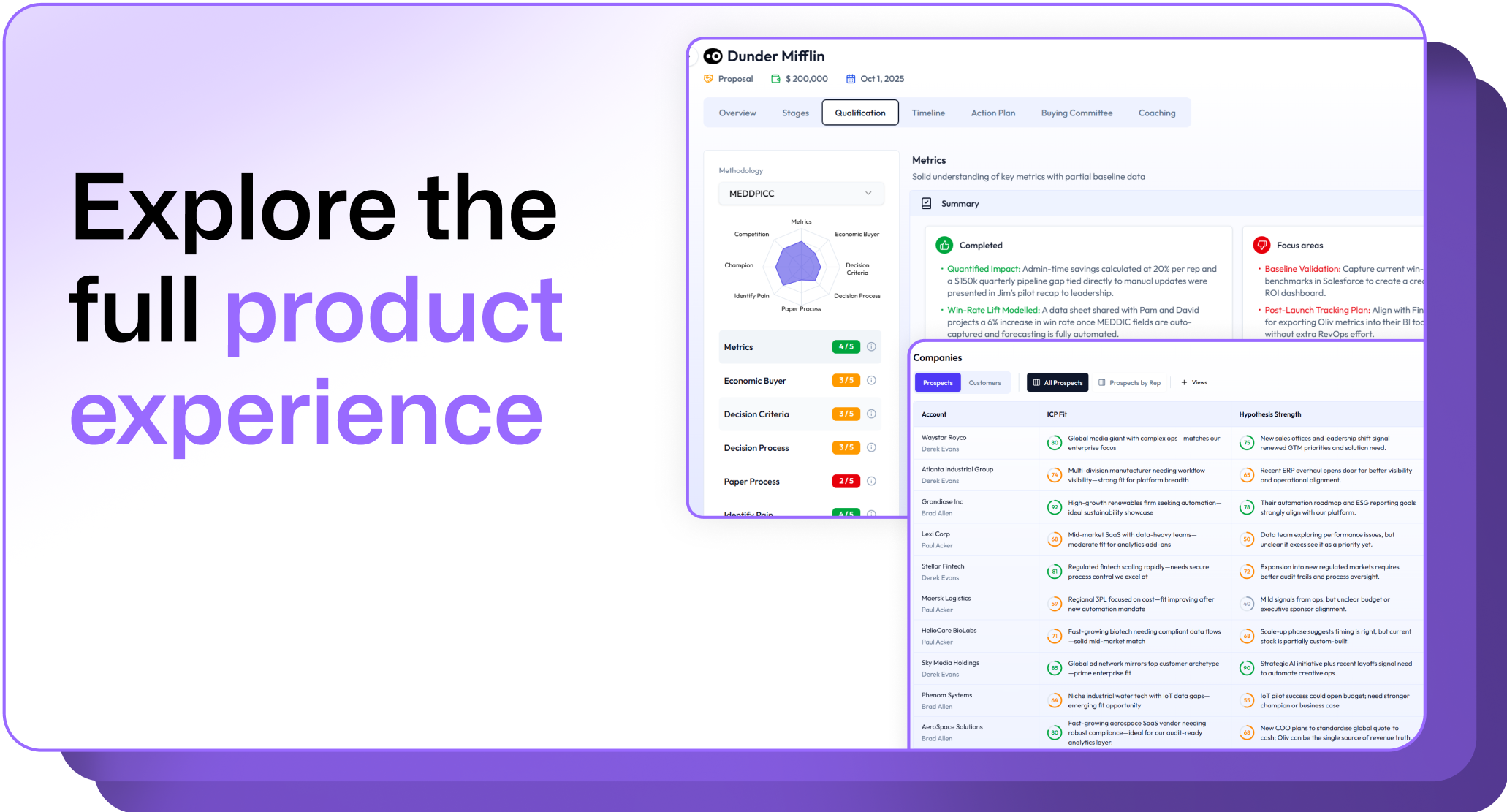
.avif)
.png)