# AI meeting notes: read one meeting across seven tabs, from takeaways to CRM updates
AI meeting notes for one customer meeting: how to read the takeaways, tasks, qualification evidence, coaching, attendees and CRM updates across seven tabs, check them against the recording, share a moment, and how Oliv AI compares.
- Applies to: Converse, Sell and Grow plans
- Status: Live
- Verified: 2026-11-03
- Canonical page: https://www.oliv.ai/product-docs/apps/converse/meeting-details/
AI meeting notes are worth having when the summary, tasks, qualification evidence and CRM updates from one customer meeting sit in one place. Oliv AI does that in a single drawer over your Meetings list, with seven tabs and timestamps back to the recording. You read the takeaways, work the tasks, check qualification against what was said, then see what reached the CRM and what still waits for you. From here you can also replay a moment, clip it, ask questions about the meeting and share it.
## At a glance {#at-a-glance}
| | |
|---|---|
| **What it shows** | One captured meeting, split across seven tabs |
| **The tabs** | **Overview**, **Action Items**, **Meeting insights**, **Recording**, **Coaching**, **Attendees**, **CRM Updates** |
| **How you get there** | **Activities › Meetings**, then a meeting, or **Open Meeting** in Slack |
| **What's ready after the call** | Key takeaways, an AI summary, tasks and next steps |
| **Recording** | Player, chapters, transcript, comments and per-speaker talk time |
| **CRM changes** | Completed changes with a green check, and any **Pending Update** waiting for **Update Deal** |
| **Sharing** | **Clip**, **Share**, a transcript segment, or a link-accessible view |
## What you get when you open a meeting {#what-it-is}
You've just clicked a meeting in the [Meetings list](https://www.oliv.ai/product-docs/apps/converse/meetings/), or pressed **Open Meeting** in Slack. It opens as a drawer over the list, on **Overview**. Check that you have the right call, then go to the tab that matches what you need.
### What you see first {#what-you-see}
Check the title, the account chip, the date and the duration in the header. A wrong account chip means you're reading the wrong call. The attendee initials on the right show who was there, and **Ask** takes a question about this meeting.
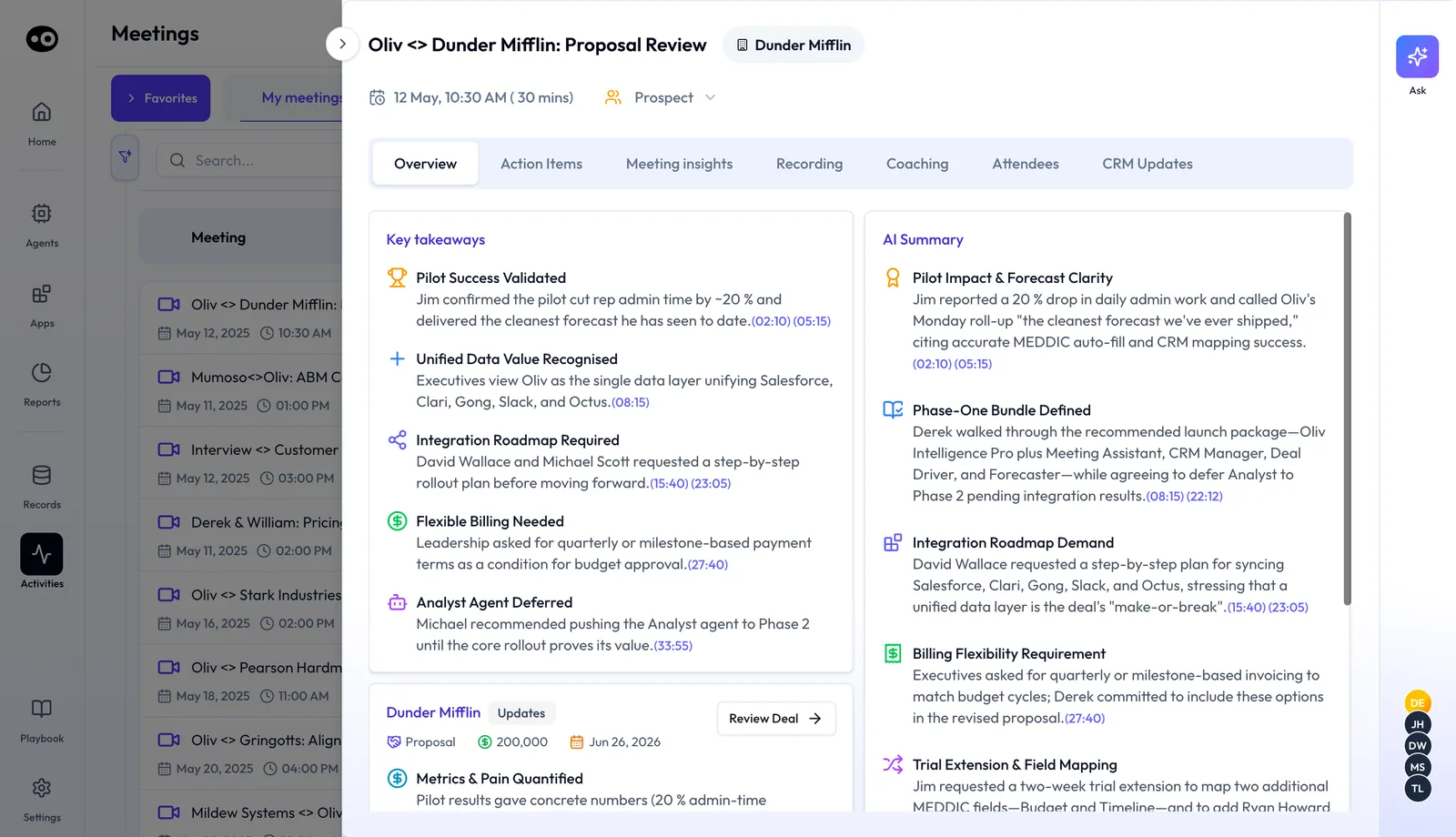
The Overview tab is where a meeting opens: takeaways, the AI summary and the linked deal sit together, and every tab across the top splits the same meeting another way. The deal stage, amount and close date are sample data.
### The seven tabs {#tabs}
Pick the tab by what you have to do next, and make the check beside it before you rely on what you read.
| What you need to do | Open | Check first |
|---|---|---|
| Get the gist before a call | **Overview** | The timestamp on any point you plan to repeat |
| Send the follow-up or chase what was agreed | **Action Items** | Each task's **Assignee** and **Due Date** |
| Judge qualification without replaying the call | **Meeting insights** | Which cards say nothing was said |
| Hear the buyer's exact words | **Recording** | That you have the right speaker on the **Timeline** |
| Prepare a 1:1 with the rep | **Coaching** | The evidence behind a score, by clicking the skill |
| Work out who decides and who is on your side | **Attendees** | The timestamps under **Key Attendee Insights** |
| Rely on the CRM record | **CRM Updates** | Any **Pending Update** still waiting |
### A shared view for people outside the workspace {#shared-view}
Someone outside your Oliv AI workspace needs this meeting. Send them its shared view, which opens by link. Open the link yourself first and check what it shows. If they only need one moment, share a transcript segment instead.
## Why AI meeting notes matter {#why-it-matters}
### What it's for {#what-its-for}
AI meeting notes earn their place when you have to act on a call you didn't join, or can't recall in detail. Oliv AI keeps the summary, tasks, qualification evidence and CRM updates from that call in one drawer. Start from the case below that matches your day.
### How it helps {#how-it-helps}
- **You're taking over an account on Tuesday.** Read **Overview**, then **Attendees**. Click the timestamp on every promise before you repeat it to the customer.
- **You have a 1:1 with a rep tomorrow.** Note the **Meeting insights** cards that say nothing was said. Then click a skill on **Coaching** and read the evidence behind its score.
- **You owe a follow-up today.** Work **Action Items**. Check that every task has an assignee and a due date, and add what's missing.
- **A deal goes into your pipeline review this afternoon.** Open **CRM Updates** and check that the stage move isn't still a **Pending Update**.
### What happens without it {#without-it}
Without notes you can check, what was said lives in one person's memory. A promise gets lost when the account moves to a new owner. The customer then repeats themselves to a team that should already know.
### Why buyers care {#why-buyers-care}
Customer success leaders feel this at handover, when onboarding has to start from what sales promised. Sales managers feel it when they coach from calls they didn't attend. Product teams feel it when they need a feature request in the customer's own words.
## The Oliv AI approach to AI meeting notes {#approach}
{/* 5P */}
Consider a customer success manager picking up an account that closed on Friday. The kickoff with the customer is on Tuesday. Last week the account executive ran a handover call with the champion to agree what goes live first and who signs off. The CSM wasn't on it.
The usual route is a short recap message from the AE and a skim of the CRM notes. Some CSMs block an hour to watch the full recording. Each path likely costs time, and a recap written from memory can drop the one integration the champion called a must-have.
The details already exist on the recording. What the CSM needs is the champion's priorities and open concerns, in their own words, before Tuesday. Reading a whole transcript to find two or three moments is the slow part.
Oliv AI turns the handover call into a record the CSM can scan. The takeaways sit on the first tab, each with a timestamp into the recording. The **Attendees** tab shows where the champion stands. Then the CSM shares the right transcript segment with the onboarding lead, starting at the right minute.
The same summary and full call transcript also land on the opportunity record in the CRM. The CSM can find them there without opening Oliv AI. That CRM record is one of the points covered in How Oliv AI compares for AI meeting notes, below.
## How a customer meeting turns into usable notes {#methods}
Say you missed a call, and the next one with that account is tomorrow. There are four ways to find out what happened, and each one fails differently. Knowing how it fails tells you what to check before you act on the notes.
### Notes typed during the call {#live-notes}
Live notes catch what the person typing noticed and thought mattered. They miss what the rep was too busy talking to write down. [Working memory has limited capacity](https://www.nngroup.com/articles/working-memory-external-memory/), and a rep on a discovery call is already using it to listen and reply. So check live notes hardest on exact numbers, dates and who promised what.
### A recap written after the call {#recap}
A recap catches the writer's judgment about what the call meant, which a recording can't give you. It misses whatever they forgot, and it reads just as firmly when they heard the customer wrong. If a decision rests on one line of a recap, go back to the words behind it.
### Replaying the recording or searching the transcript {#replay}
The recording catches everything, in the customer's own words, but a full replay costs you the length of the call. Keyword search is faster and narrower. In HubSpot, for example, [a transcript search returns the parts where that keyword was used](https://knowledge.hubspot.com/calling/review-call-recordings-and-transcripts). A buyer who raises budget without saying "budget" won't appear, so try more than one phrase.
### An AI-written summary {#ai-summary}
An AI summary is ready straight away and works from the whole call, not just the parts one person noticed. Its weak spot is that it can be wrong and still read well. Nielsen Norman Group warns that [AI errors are often stated confidently](https://www.nngroup.com/articles/ai-hallucinations/), which makes them hard to spot. It also warns that [source links can lead readers to check less](https://www.nngroup.com/articles/ai-hallucinations/). So don't treat a timestamp as proof: click it before you repeat a point to a customer or your manager.
### Which of these Oliv AI does {#what-oliv-ai-does}
Oliv AI records the meeting, transcribes it and labels every speaker, then has the summary and next steps ready as soon as the call ends. Takeaways, summary entries and tasks carry timestamps into the recording, so the check above takes one click. It reads context, sentiment and intent rather than matching words. Your own notes still have a place, through **Add Comment** on the **Recording** tab. The [AI quality and accuracy page](https://www.oliv.ai/product-docs/platform/ai-quality-and-accuracy/) shows how Oliv AI keeps agent output reviewable.
## Read a meeting {#read-a-meeting}
1. Open [**Activities › Meetings**](https://www.oliv.ai/product-docs/apps/converse/meetings/) and click the meeting, or press **Open Meeting** in the Slack message about it.
2. Read **Key takeaways** and the **AI Summary** on **Overview**. Click a blue timestamp to hear that moment.
3. Open **Action Items** to see what was agreed, who owns it and when it's due.
4. Open **Meeting insights** to check qualification, or **Recording** to replay and read along.
5. Click **Review Deal** on the deal card to go to the linked deal.
If you'd rather get the summary without opening the drawer, the [Slack meeting summary](https://www.oliv.ai/product-docs/integrations/slack/) arrives as soon as the meeting ends. It carries the meeting details, key takeaways and next steps. For ways to structure what you capture, use these [meeting summary templates](https://www.oliv.ai/blog/meeting-summary-templates).
## What each tab shows {#what-it-picks-out}
Each tab below starts with the moment you need it, then what to do there and what to check.
### Overview: takeaways, summary and the deal {#summary}
You have five minutes before a call with this account. Read **Key takeaways** first, then the longer headed entries in the **AI Summary**. Click the blue timestamp on anything you plan to repeat.
Then compare the deal card's stage, amount and close date with what you just read. If they disagree, press **Review Deal** to go to the linked deal.
After a call on an active opportunity, [Oliv AI's Meeting Assistant agent](https://www.oliv.ai/product-docs/agents/meeting-assistant/) also [drafts the follow-up email](https://www.oliv.ai/product-docs/workflows/record-and-follow-up/) from the transcript. Our guide to [AI meeting summaries](https://www.oliv.ai/blog/ai-meeting-summaries) covers using them across a sales cycle.
### Action Items: next steps and tasks {#action-items}
The call has ended and you owe the customer a follow-up. Start with the three cards: **Next meeting**, **Next action** and **Next follow-up**. Check the next meeting's RSVP status, such as **Accepted**, and deal first with any follow-up marked **Overdue**.
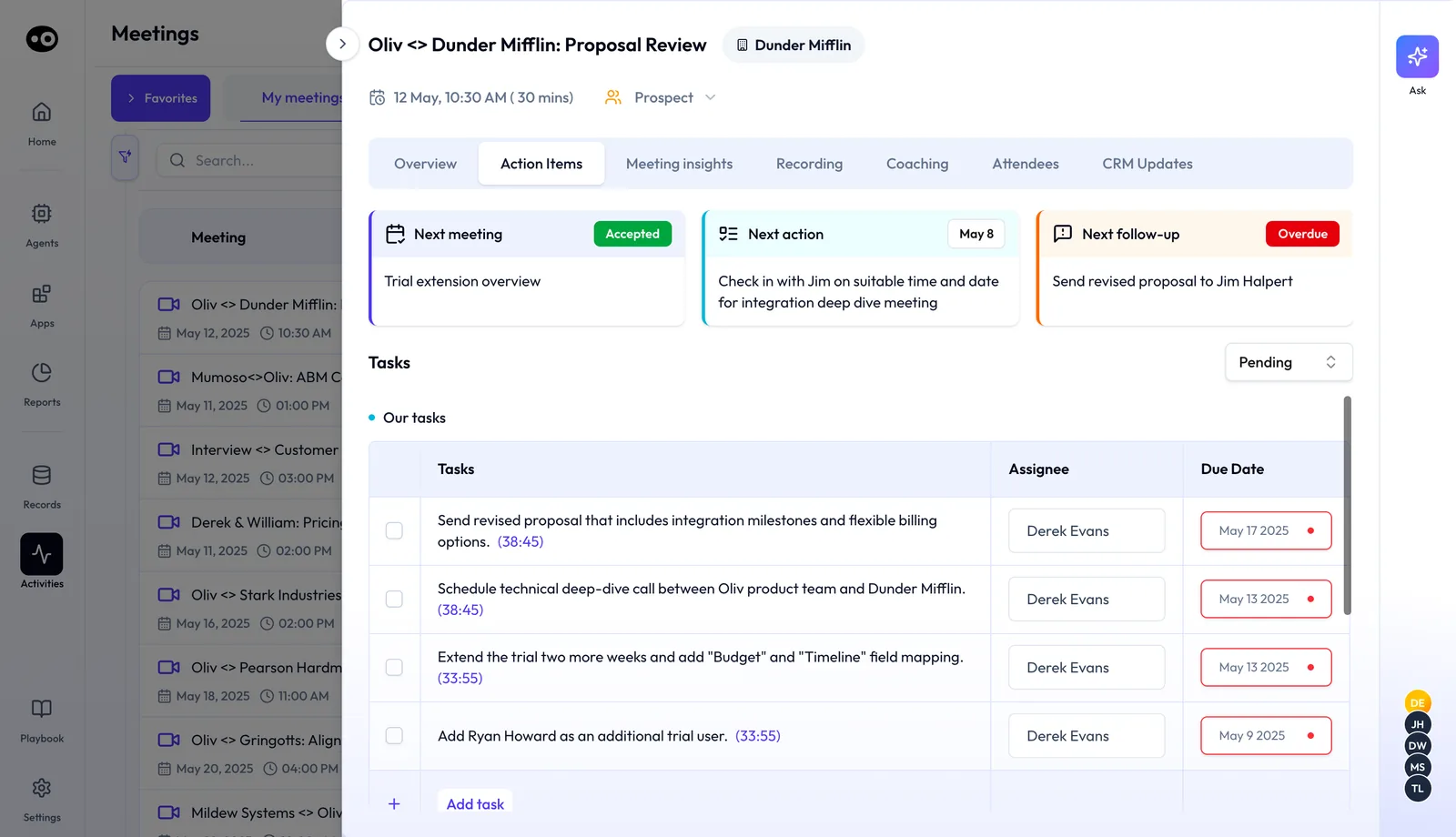
Action Items turns what was agreed on the call into owned, dated tasks, and each timestamp takes you back to the moment the commitment was made.
Then work the **Tasks** table. Check that each task has an **Assignee** and a **Due Date**, and click its timestamp if the wording is unclear. Press **Add task** for anything the next steps mention that the table doesn't, and tick tasks off as they're done. If the list looks short, check the **Pending** status filter before you assume something is missing.
### Meeting insights: qualification evidence {#meeting-insights}
You have to say whether a deal is qualified, and you weren't on the call. Use the chips to jump through **Metrics**, **Economic Buyer**, **Decision Criteria**, **Decision Process**, **Paper Process**, **Identify Pain**, **Champion** and **Additional Fields**. Click the timestamp on any evidence card you plan to rely on.
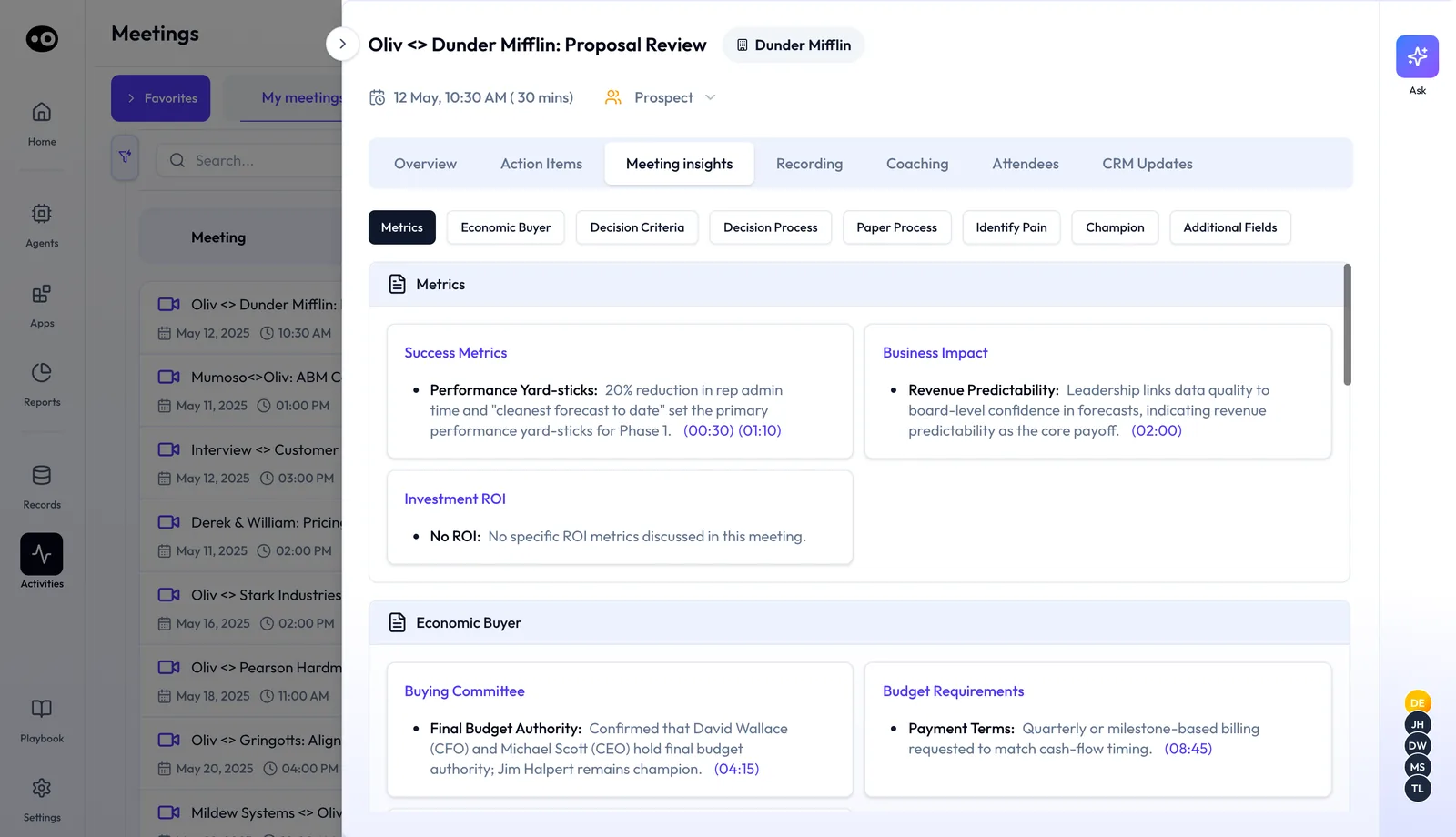
Meeting insights lets a manager check qualification without listening to the call, and a card that says nothing was discussed marks the gap to close on the next one.
A card that says nothing was said is a gap, not a no, so take it into the next call. If the criteria look unfamiliar, check **Settings › Qualification Framework**. The tab follows the methodology active there, so a team on another framework sees its own criteria.
### Recording: player, chapters and transcript {#recording}
A buyer's exact words matter, or a summary point doesn't look right. Use **Chapters** to jump to a section, **Transcripts** to read along and **Comments** to see your team's notes. Under the player, **Add Comment** notes a point in the call, **Clip** cuts a moment and **Share** shares the meeting.
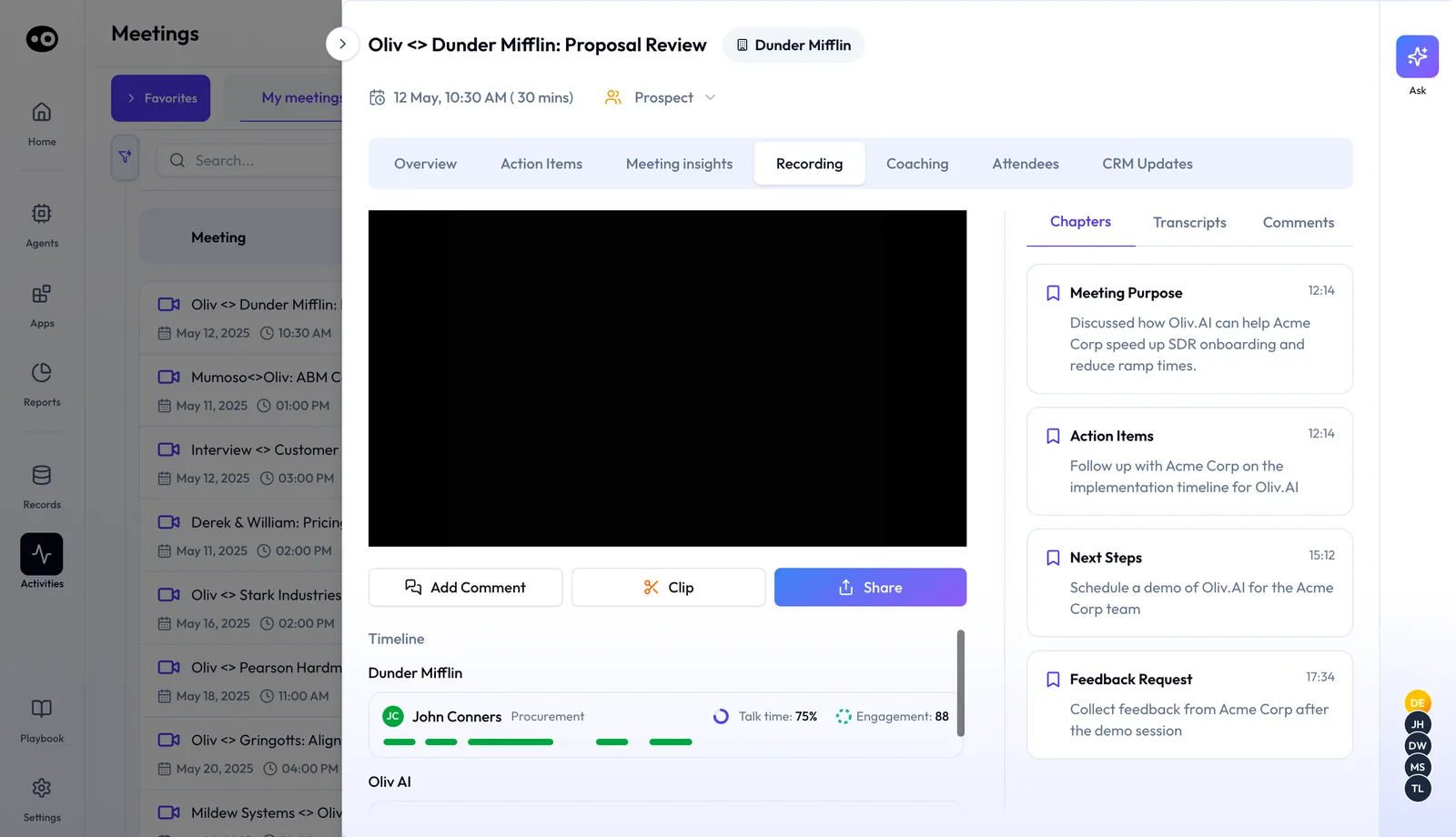
The Recording tab is where you find a moment by chapter or transcript, then clip it, comment on it or share the meeting, without scrubbing through the whole call. The talk time shown comes from a demo meeting.
Before you quote someone, check the speaker on the **Timeline**, which groups people by company. Treat **Talk time** and **Engagement** as a prompt to listen to that person, not as a verdict.
### Coaching: a grade for the call {#coaching}
You have a 1:1 tomorrow and didn't hear the call. Start with the **Summary** card, which names one **Improvement Required** and one **Strength**. Then pick a skill group, such as **Objection Handling** or **Driving Action**, and look at its score out of 5 and its sub-skills.
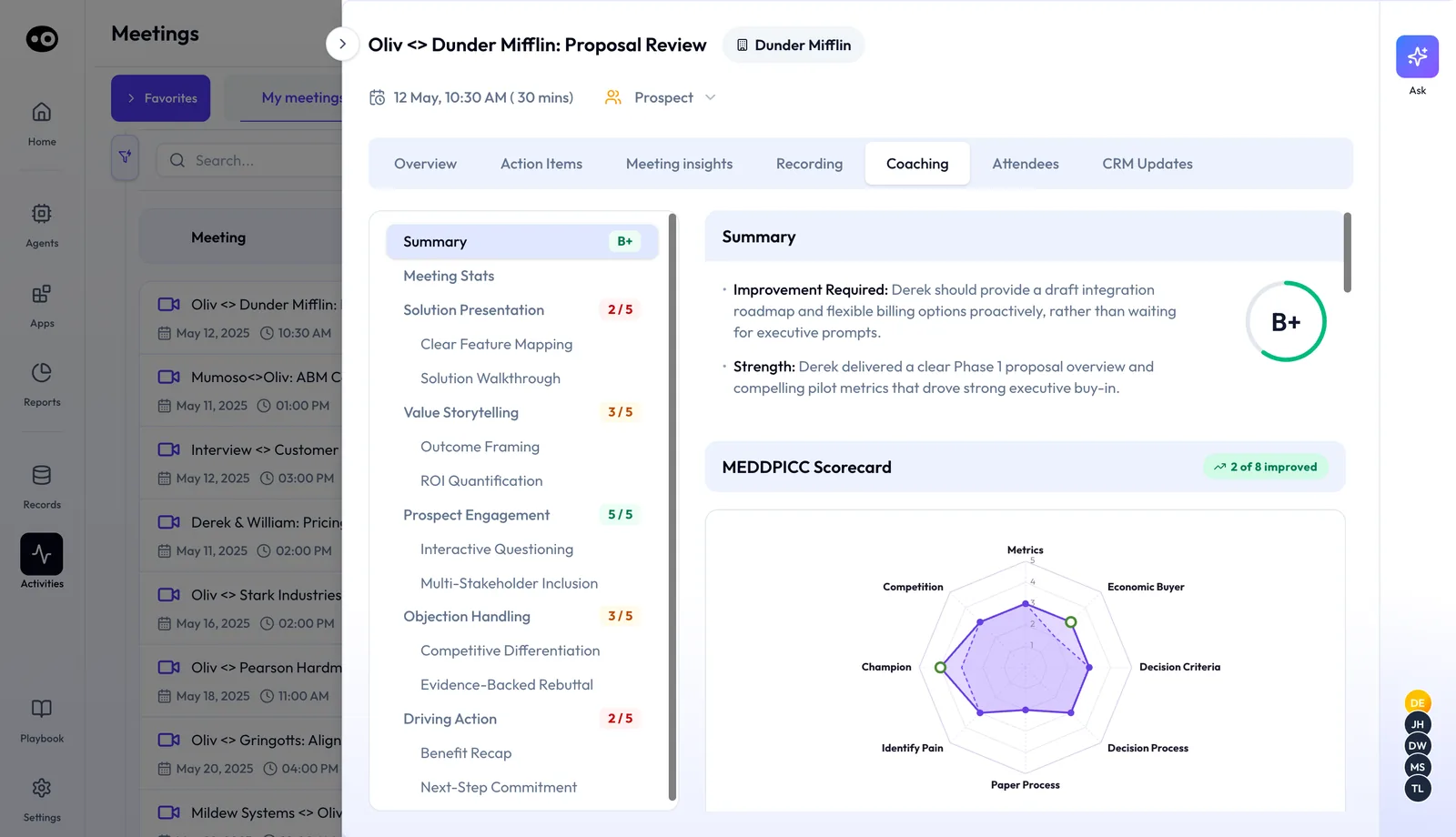
Coaching shows a manager where a rep needs help on this call, skill by skill, with the framework scorecard beside it, so a 1:1 can start from evidence. The grade and scores are demo figures.
Click the skill and read the evidence before you raise a score with the rep. The scorecard radar shows coverage of each qualification criterion, with a badge counting how many improved. If a score looks wrong, check **Settings › Coaching Scorecard**, because [Oliv AI's Coach agent](https://www.oliv.ai/product-docs/agents/coach/) scores against the scorecards set there.
### Attendees: the buying committee {#attendees}
You're meeting this account again and need to know who matters. Look through **Buying Committee** and **Other Contacts**, or use the search box. On each card, read the sentiment, such as **Ally** or **Neutral**, the **Decision Maker** tag and the access level, such as **In-Depth Access** or **Limited Access**.
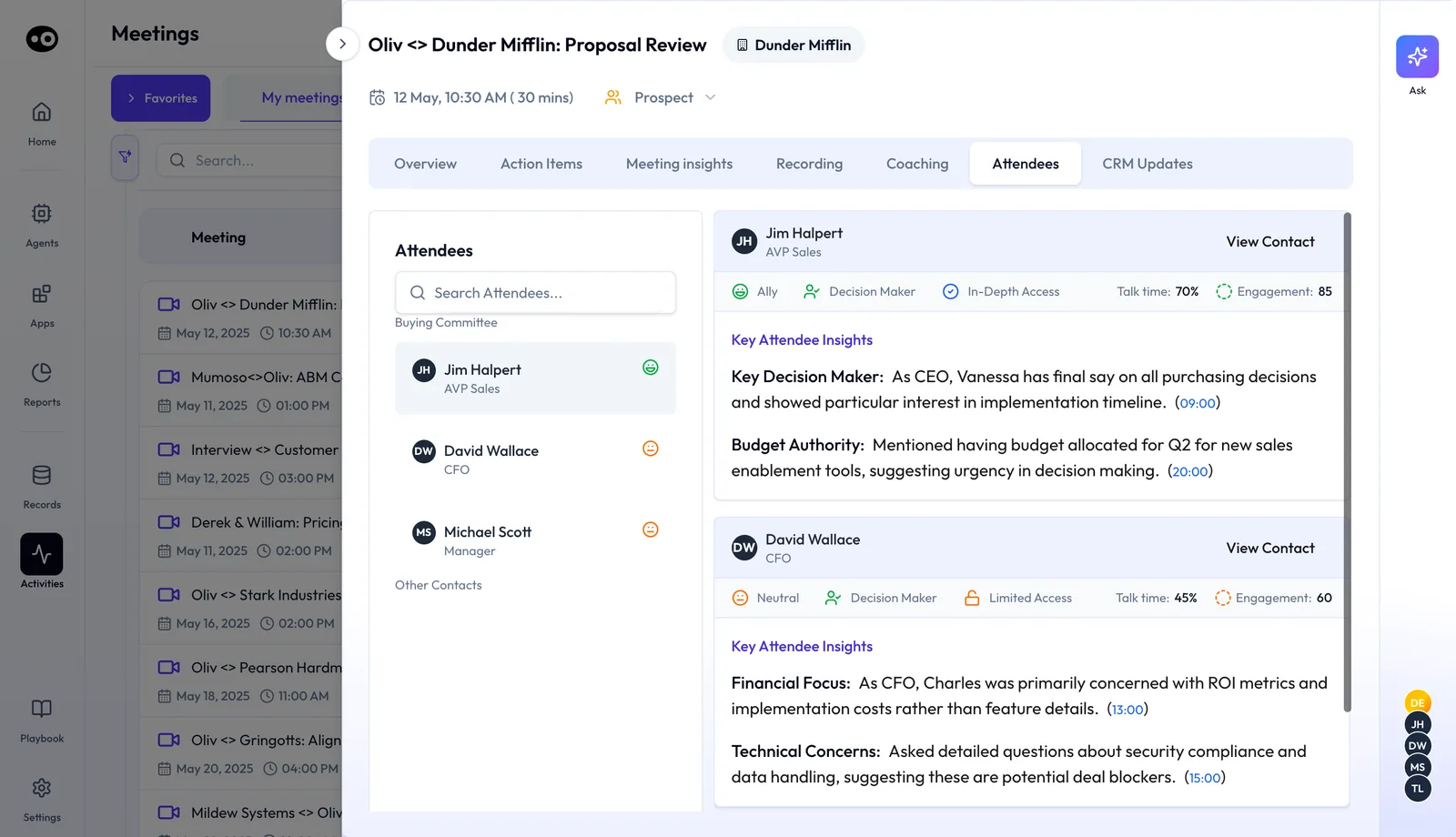
Attendees maps the buying committee from one call, so you can see who decides, who is on your side and who barely spoke before the next meeting. Talk time and engagement here are sample values.
Before you plan around someone, read their **Key Attendee Insights** and click a timestamp. Low talk time from a decision maker is worth a question on the next call. **View Contact** opens the person's full contact record.
### CRM Updates: what reached the CRM {#crm-updates}
You're about to rely on this deal's CRM record in a review. Open the timeline of changes made after the meeting. A green check marks a completed change, such as an account summary refresh, a scorecard update or a new contact. A grey clock marks a **Pending Update** that waits for you, such as a stage move.
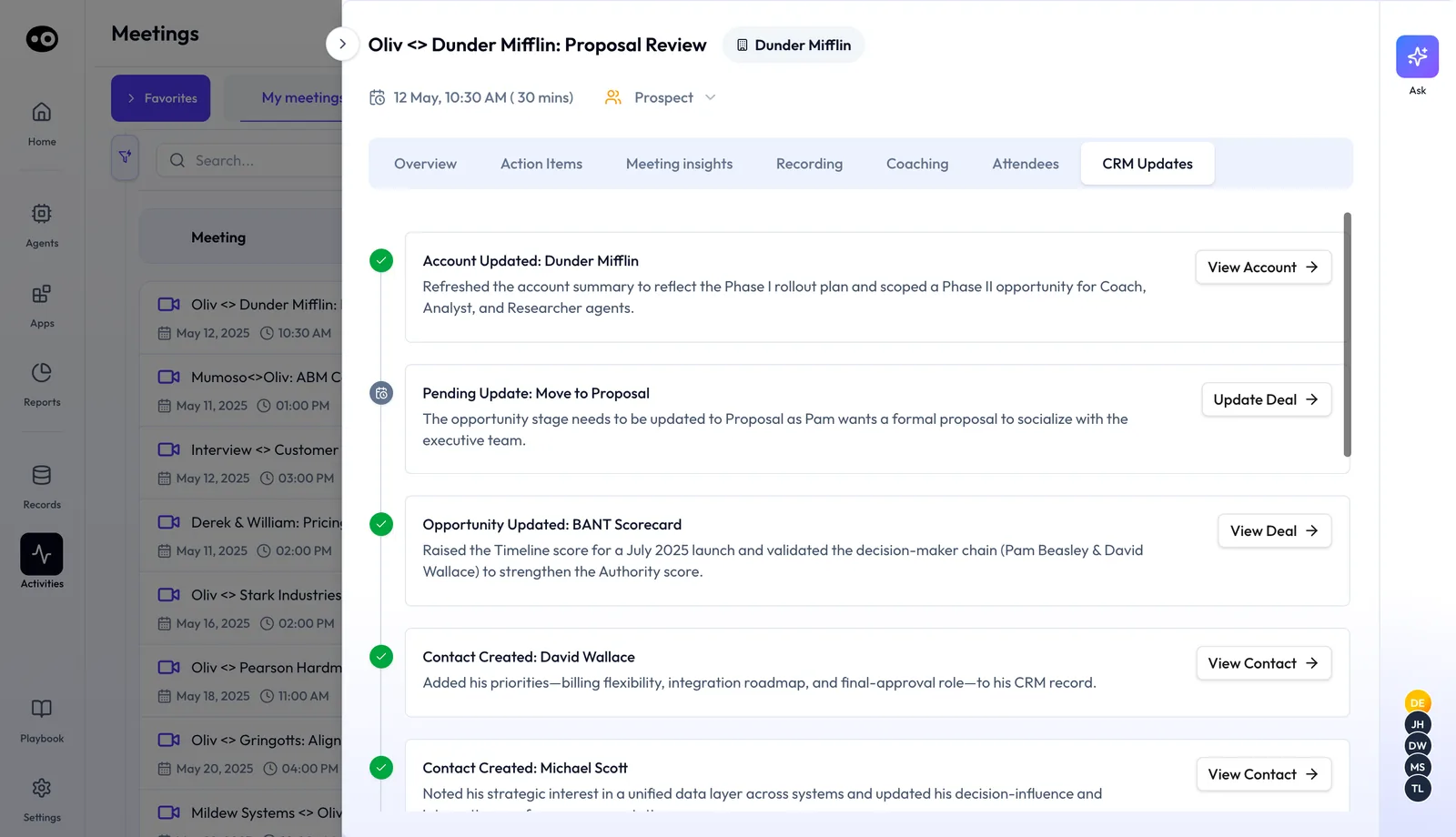
CRM Updates shows RevOps exactly what this meeting changed in the CRM, and which change, like a stage move, is still waiting for a person to confirm.
Press **Update Deal** to act on a pending change. **View Account**, **View Deal** and **View Contact** open the record that changed. The [keep the CRM updated guide](https://www.oliv.ai/product-docs/workflows/keep-the-crm-updated/) covers the wider flow.
Don't assume a change has landed until you've checked it. To check from the CRM side, open the record itself. In HubSpot, a property's history shows its [**Changed to**, **Date** and **Source** values](https://knowledge.hubspot.com/crm-setup/view-property-history). In Salesforce, [a change to a tracked field adds an entry to the History related list](https://help.salesforce.com/s/articleView?id=sf.tracking_field_history.htm&type=5). Connection details are in the [HubSpot](https://www.oliv.ai/product-docs/integrations/hubspot/) and [Salesforce](https://www.oliv.ai/product-docs/integrations/salesforce/) guides.
### Objections and pricing concerns {#objections}
A buyer pushed back on price, and you want the exact words before the next call. Search the meeting for the objection or pricing concern. If your team uses Oliv AI's Content Curator agent, its **Objections** moment type and **Detect Moments** tool also tag these moments. Play the moment before you rely on it, because the words around it may change what it means.
### Competitor mentions {#competitor-mentions}
A customer says they're looking at another vendor, and you need to know how it came up. Search for the vendor's name, or look for Content Curator's **Competitor Mentions** moments, which cover mentions and feature by feature comparisons. Listen to the moment first, because a passing name and a real comparison call for different replies.
### Product requests and feedback {#product-requests}
Your product team asks what customers actually said about a feature. Look for **Product Requests** moments, the third moment type, and send the clips to a clip library for the team. Check each clip's participants and call date first, so product knows who asked and when.
### Sentiment {#sentiment}
A buyer seemed cool on the call, and you want to test that impression. Open **Attendees** and read that person's sentiment, such as **Ally** or **Neutral**. Converse reads sentiment and intent instead of matching words, and Content Curator also reads the meeting's sentiment and flow. Play one of the person's timestamped insights before you change your plan.
### Voice of the customer {#voice-of-the-customer}
You want to know what customers are saying beyond this one call. **Ask AI · Voice of the customer** is listed among the customer context features on every plan. For this one meeting, use **Ask** in the drawer, and check the answer against the transcript before you repeat it.
## Ask questions about a meeting {#ask-questions}
The **Ask** button sits at the right of the meeting drawer. You can also ask [Oliv AI's Olivia agent](https://www.oliv.ai/product-docs/agents/olivia/) about a call in plain language. Ask her to draft the follow-up from your call this afternoon, and she pulls from the meeting transcript and drafts it.
[Every plan](https://www.oliv.ai/product-docs/plans/plans-and-seat-roles/) includes asking questions and reviewing conversations, opportunities and accounts.
## Share part of a meeting {#share}
On the **Recording** tab, **Clip** cuts a moment, **Add Comment** notes a point in the call and **Share** shares the meeting. To share part of the transcript instead:
1. In the transcript, find the minute marker where the moment starts.
2. Check the box beside the segment you want to share.
3. Copy the selected portion.
4. Open it in a new tab. Playback begins from that minute.
To share the whole meeting with someone outside your workspace, use its shared view, which opens by link. To keep a moment for your own team, [clip it into a clip library](https://www.oliv.ai/product-docs/apps/converse/clips/) instead. The [guide to taking notes during sales calls](https://www.oliv.ai/blog/how-to-take-meeting-notes-during-sales-calls) covers what to capture by hand.
## How to measure what one meeting's notes cover {#measure-coverage}
Picture reading a meeting's notes before a 1:1, and needing to say how much of the deal that call pinned down. Two counts answer that for a single meeting.
### Qualification coverage {#qualification-coverage}
Divide the criteria with evidence by the number of criteria in your framework. Its weak spot is that it counts presence, not quality. A section can hold several cards, as **Metrics** holds **Success Metrics**, **Business Impact** and **Investment ROI**, so one good card can make a criterion look settled. An early call also won't cover everything, so read the figure against the deal's stage.
### Task ownership {#task-ownership}
Divide the tasks that have both an assignee and a due date by all the tasks from the call. Its weak spot is that it only sees what was written down. A commitment nobody captured won't count against it, so compare the tasks with the next steps in the summary.
### Where to read these in Oliv AI {#where-to-read}
**Meeting insights** gives you the first count: read each section's cards and note which ones say nothing was said. **Action Items** gives you the second, because the **Tasks** table shows the **Assignee** and **Due Date** beside each task. On the **Coaching** tab, the scorecard radar shows coverage of each criterion for the same call.
## How to write up a customer meeting by hand {#write-up-by-hand}
Use this when a meeting wasn't captured, or when you want to test the AI notes against your own. Block the time straight after the call, because the next meeting is what usually breaks this routine.
1. **Capture the basics.** Write down the date, the attendees and the deal the meeting belongs to.
2. **Replay the key moments.** Note each main point with its minute marker, so anyone can find it again.
3. **List the commitments.** Give each one an owner and a due date, on your side and the customer's.
4. **Go through your framework.** Take each qualification criterion in turn and write what was said, or "not discussed".
5. **Map the people.** Note who decides, who is on your side and who barely spoke.
6. **Update the CRM.** Change the stage, amount, close date and next step, and add any new contacts.
7. **Send the recap.** Share your notes and the moments that matter with whoever needs them.
Steps 4 and 6 are the ones most likely to slip when the next call starts. A skipped step 4 is also hard to spot later, because the notes still look complete.
### The same job in Oliv AI {#same-job-oliv-ai}
Oliv AI does the writing, so your job moves from writing to checking. Each step above maps to one place in the drawer.
| Step by hand | Where it is in Oliv AI | What you still check |
|---|---|---|
| 1. Capture the basics | The drawer header | The account chip names the right account |
| 2. Replay the key moments | **Key takeaways** and **AI Summary** on **Overview** | The timestamp on any point you plan to repeat |
| 3. List the commitments | The **Tasks** table on **Action Items** | Each **Assignee** and **Due Date**, then **Add task** for anything missing |
| 4. Go through your framework | **Meeting insights** | Which cards say nothing was said |
| 5. Map the people | **Attendees** | Each person's sentiment and **Decision Maker** tag |
| 6. Update the CRM | **CRM Updates** | Completed changes, then any **Pending Update** waiting for **Update Deal** |
| 7. Send the recap | **Clip**, **Share** or a transcript segment | Who receives it, and whether they sit outside your workspace |
### Worked example: qualification coverage on one call {#worked-example}
A manager opens one meeting's **Meeting insights** tab before a 1:1. The team uses the seven criteria this page lists, from **Metrics** to **Champion**, so **Additional Fields** stays out of the count. This is an illustrative calculation with sample figures, not an Oliv AI output.
| Criterion | What the card shows | Counts as covered |
|---|---|---|
| Metrics | Evidence with a timestamp | 1 |
| Economic Buyer | Evidence with a timestamp | 1 |
| Decision Criteria | Evidence with a timestamp | 1 |
| Decision Process | Nothing was said | 0 |
| Paper Process | Nothing was said | 0 |
| Identify Pain | Evidence with a timestamp | 1 |
| Champion | Nothing was said | 0 |
| **Coverage** | 4 with evidence, 3 with nothing said | **4 / 7 = 57%** |
The manager can click the four timestamps instead of replaying the call. The three gaps become the rep's questions for the next call:
- **Decision Process:** "Who else has to approve this, and in what order?"
- **Paper Process:** "What does your legal or procurement team need before signing?"
- **Champion:** "Who on your side will push for this when we're not in the room?"
After that call, open the new meeting's **Meeting insights** tab and count again.
## How AI meeting notes work with Oliv AI's agents {#works-with}
### Meeting Assistant {#with-meeting-assistant}
You meet Oliv AI's Meeting Assistant agent after a call linked to an active opportunity, when it drafts the follow-up and flags what needs updating in the CRM. Read the draft against **Action Items** before you send it. If nothing appears, check that the meeting is linked to an active opportunity and was captured by the Oliv Notetaker. The [prepare for a meeting guide](https://www.oliv.ai/product-docs/workflows/prepare-for-a-meeting/) covers its brief before the next call.
### CRM Manager {#with-crm-manager}
You meet [Oliv AI's CRM Manager agent](https://www.oliv.ai/product-docs/agents/crm-manager/) on the **CRM Updates** tab and on the opportunity record, where it attaches the AI-generated summary and the full call transcript. It writes the field updates Meeting Assistant proposes, as a layer on top of your CRM. Check that the record holds both the summary and the transcript, then act on anything still pending.
### Coach {#with-coach}
You meet Oliv AI's Coach agent on the **Coaching** tab before a 1:1. Use its grade to choose which skill to discuss, then read the evidence before you raise it.
### Content Curator {#with-content-curator}
You meet [Oliv AI's Content Curator agent](https://www.oliv.ai/agents/content-curator) as a notification with a link to a clip, after a meeting is completed. Read the short explanation of why the clip was captured. Check its participants, timestamp and call date, and open the recording link before you pass it on.
### Gold Digger and Portfolio Manager {#with-cs-agents}
You meet these two around renewals and expansion. When [Oliv AI's Gold Digger agent](https://www.oliv.ai/agents/gold-digger) spots an expansion signal, it quotes the transcript with a timestamp link, so hear the quote in context before you raise it. When [Oliv AI's Portfolio Manager agent](https://www.oliv.ai/agents/portfolio-manager) flags a risk signal such as a sentiment shift, open the meeting's **Attendees** tab to see who it concerns.
## Who uses AI meeting notes, and how {#who-uses-it}
### Customer success managers {#customer-success}
A CSM reads the handover call before kickoff, so onboarding starts from what the customer was promised. More on Oliv AI for [customer success teams](https://www.oliv.ai/customer-success).
### Account managers {#account-managers}
An account manager checks the last QBR before a renewal conversation, including any competitor the customer mentioned. See Oliv AI for [account management](https://www.oliv.ai/account-management).
### Account executives {#account-executives}
An AE works the **Action Items** tab before sending the follow-up, so every agreed task has an owner and a date. See how AEs [run deals with Oliv AI](https://www.oliv.ai/product-docs/use-cases/ae-run-deals/).
### Sales managers and enablement {#enablement-and-product}
A manager reads **Meeting insights** and **Coaching** before a 1:1. An enablement lead clips a strong objection handle for onboarding. Read about [sales enablement software](https://www.oliv.ai/blog/sales-enablement-software).
## How Oliv AI compares for AI meeting notes {#compare}
Most meeting tools write an AI summary and send notes to the CRM. Oliv AI also turns a plain-language description of a moment into clips that are cut, filed and shared for you. Oliv AI is the only platform in this table that does all three.
AI meeting notes features, from each platform's public documentation:
| Platform | AI summary with next steps | Clips cut from a description you write | Meeting notes written to the CRM record |
|---|---|---|---|
| **Oliv AI** | Yes | Yes | Yes |
| **Gong** | Yes ([Highlights recap and next steps](https://help.gong.io/docs/about-the-call-page)) | Partly ([AI trackers mark matching moments](https://help.gong.io/docs/find-and-review-tracker-results)) | Yes ([Highlights and Transcript tabs in Salesforce](https://help.gong.io/docs/conversation-canvas-page-errors)) |
| **Avoma** | Yes ([Key Takeaways with next steps](https://help.avoma.com/ai-generated-key-takeaways)) | Partly ([custom categories for notes](https://help.avoma.com/ai-generated-notes)) | Yes ([notes and action items pushed to CRM](https://help.avoma.com/create-an-account)) |
| **Fireflies** | Yes ([summary and action items](https://guide.fireflies.ai/articles/1123841396-how-to-upload-and-transcribe-a-meeting-recording-file-to-fireflies-ai-web-app)) | Partly ([AI picks the key moments](https://guide.fireflies.ai/articles/1026795385-soundbites-how-to-extract-meeting-clips-and-highlights-from-fireflies-meetings-automatic-and-manual-methods)) | Yes ([notes and transcript link in HubSpot](https://guide.fireflies.ai/articles/4037978139-how-to-integrate-hubspot-with-fireflies)) |
| **Fathom** | Yes ([summaries and action items](https://help.fathom.video/en/articles/13926529)) | Partly ([highlight button pressed on the call](https://help.fathom.video/en/articles/448576)) | Yes ([summaries written to Salesforce](https://help.fathom.video/en/articles/448640)) |
*Yes: documented and built in. Partly: documented with a limit, shown in brackets. Not in docs: not found in the vendor's public documentation.*
### Why Oliv AI is the stronger choice for AI meeting notes {#compare-stronger}
- **Moments become clips, filed and posted.** Content Curator cuts each match into a clip, files it in a library and posts it to a chat channel. Gong's tracker results appear as [timestamps in the Points of interest tab](https://help.gong.io/docs/find-and-review-tracker-results). Compare [Oliv AI vs Gong](https://www.oliv.ai/blog/gong-vs-oliv). To test this, run one real call and check whether a finished clip reaches your library and channel without anyone cutting it.
- **You describe the moment, not the category.** You tell Content Curator what belongs in plain language, with no keyword lists. Avoma lets you [create custom categories](https://help.avoma.com/ai-generated-notes) to organize meeting notes. Compare [Oliv AI vs Avoma](https://www.oliv.ai/blog/avoma-vs-oliv-ai). To test this, describe one moment your team cares about in a sentence, then check whether the matches fit with no keyword setup.
- **The full transcript travels with the summary.** Oliv AI attaches the AI summary and the full call transcript to the opportunity record. Avoma documents pushing [meeting notes, action items, and insights](https://help.avoma.com/create-an-account) to the CRM. See [Gong vs Avoma](https://www.oliv.ai/blog/gong-vs-avoma) for where Oliv AI fits. To test this, open the opportunity record after a call and look for both the summary and the full transcript.
*Competitor details checked against each vendor's public documentation on 21 October 2026. Features and plans change, so confirm with the vendor before you decide.*
## Limits and things to know {#limits}
- **Insights follow one framework.** Meeting insights and the scorecard radar use the methodology active in **Settings › Qualification Framework**.
- **Some CRM changes wait for you.** A **Pending Update**, such as a stage move, stays pending until someone confirms it with **Update Deal**.
- **Clips live in Enable.** The clips route opens the **Library** tab of the Enable app.
- **Transcript sharing starts at a minute marker.** A shared segment plays from the minute marker you picked.
- **Meeting Assistant needs an active opportunity.** Its follow-up and field updates cover meetings linked to an active opportunity in your CRM.
## Common questions {#common-questions}
#### What should AI meeting notes include? {#faq-include}
For one customer meeting, they should give you the takeaways, the agreed tasks with owners and dates, what was said against your qualification criteria, and what changed in the CRM. Oliv AI splits these across seven tabs, with timestamps back to the recording.
#### How do I open a meeting's details? {#faq-open}
Open **Activities › Meetings** and click the meeting. Or press **Open Meeting** in the Slack message Oliv AI sent about it.
#### What tabs does a meeting have? {#faq-tabs}
Seven: **Overview**, **Action Items**, **Meeting insights**, **Recording**, **Coaching**, **Attendees** and **CRM Updates**.
#### When is the summary ready? {#faq-summary-ready}
The AI summary and next steps are ready as soon as the call ends. The Slack meeting summary is sent immediately after the meeting ends.
#### Does the transcript show who said what? {#faq-speakers}
Yes. Oliv AI transcribes the conversation and labels every speaker. The **Recording** tab also shows each speaker's talk time.
#### Can I check qualification without replaying the call? {#faq-qualification}
Yes. **Meeting insights** files what was said under each criterion, with timestamps, and says so when a criterion wasn't discussed. Treat that card as a question for the next call, not as the customer's answer.
#### How do I check an AI summary is right? {#faq-check-summary}
Click the blue timestamp beside the point in **Key takeaways** or the **AI Summary**, and listen to that moment. Do this before you repeat a point to a customer or a manager.
#### Can I find a specific objection in a call? {#faq-objection}
Yes. Search for the exact objection, competitor mention or pricing concern, then clip it into a clip library.
#### Does Oliv AI detect competitor mentions? {#faq-competitors}
Oliv AI's Content Curator agent has a **Competitor Mentions** moment type for mentions of competitors or feature by feature comparisons.
#### Can product teams get feature requests from calls? {#faq-product}
Yes. Content Curator's moment types include **Product Requests**, and clips can go into a library for product.
#### How do I share part of a call? {#faq-share-part}
Find the minute marker, check the box for the segment and copy it. Opened in a new tab, it plays from that minute.
#### Can someone outside my workspace see a meeting? {#faq-outside}
Yes. Each meeting has a shared, link-accessible view for someone opening it outside the workspace.
#### Do AI meeting notes reach my CRM? {#faq-crm}
Yes. The AI-generated summary and the full call transcript are attached to the opportunity record. Other changes may wait as a **Pending Update** until someone presses **Update Deal**, and the **CRM Updates** tab shows both kinds.
#### Can I ask questions about a meeting? {#faq-ask}
Yes. Use **Ask** in the drawer, or ask Olivia, for example to draft the follow-up from a call, and she works from the transcript.
## Further reading {#further-reading}
- [Working Memory and External Memory](https://www.nngroup.com/articles/working-memory-external-memory/) from Nielsen Norman Group: why people lose details when a task asks them to hold too much in mind.
- [AI Hallucinations: What Designers Need to Know](https://www.nngroup.com/articles/ai-hallucinations/) from Nielsen Norman Group: why AI errors read as confident, and why source links don't guarantee anyone checks.
- [Review call recordings and transcripts](https://knowledge.hubspot.com/calling/review-call-recordings-and-transcripts) from HubSpot: how transcript keyword search works in HubSpot's own calling tool.
- [View a record's property history](https://knowledge.hubspot.com/crm-setup/view-property-history) from HubSpot: how to see what changed on a HubSpot record, when and from which source.
- [Field History Tracking Overview](https://help.salesforce.com/s/articleView?id=sf.tracking_field_history.htm&type=5) from Salesforce: how tracked field changes reach the History related list.
## Related {#related}
- [Converse app](https://www.oliv.ai/product-docs/apps/converse/): the conversation capture app behind every meeting record.
- [Meeting transcription software compared](https://www.oliv.ai/blog/meeting-transcription-software): how transcripts differ across tools.
- [Meaning extraction vs dumping transcripts into LLMs](https://www.oliv.ai/blog/slms-vs-llms-enterprise): why Oliv AI reads context rather than keywords.
- [The Deal Driver agent docs](https://www.oliv.ai/product-docs/agents/deal-driver/): how meeting signals feed deal risk for managers.
- [Agent tools and run modes](https://www.oliv.ai/product-docs/agents/builder/tools-and-run-modes/): how agents act on what a meeting contains.
- [Oliv AI product documentation](https://www.oliv.ai/product-docs/): every documented agent and feature.
*Updated 3 November 2026: added how meeting notes get made and where each way fails, how to measure one meeting's coverage, the manual write-up, a worked example and further reading.*