# AI agent audit trail: read each run's type, status and record before you widen an agent
An AI agent audit trail guide: read an agent's Runs tab and open a run record to check every email the agent wrote, the people it picked, a sequence's steps or a drafted reply.
- Applies to: Every agent with a detail page
- Status: Live
- Verified: 2026-11-03
- Canonical page: https://www.oliv.ai/product-docs/agents/builder/run-history/
When someone asks what an agent did overnight and you have to answer before it takes on more work, you need an AI agent audit trail. Oliv AI's run history is that record: each agent's **Runs** tab lists its past runs, newest first, with when each one ran, how it started and how it ended. Press **View** on a row and the full record opens. It shows every email the agent wrote and the people it picked, a sequence's steps, a drafted reply or a clipped call.
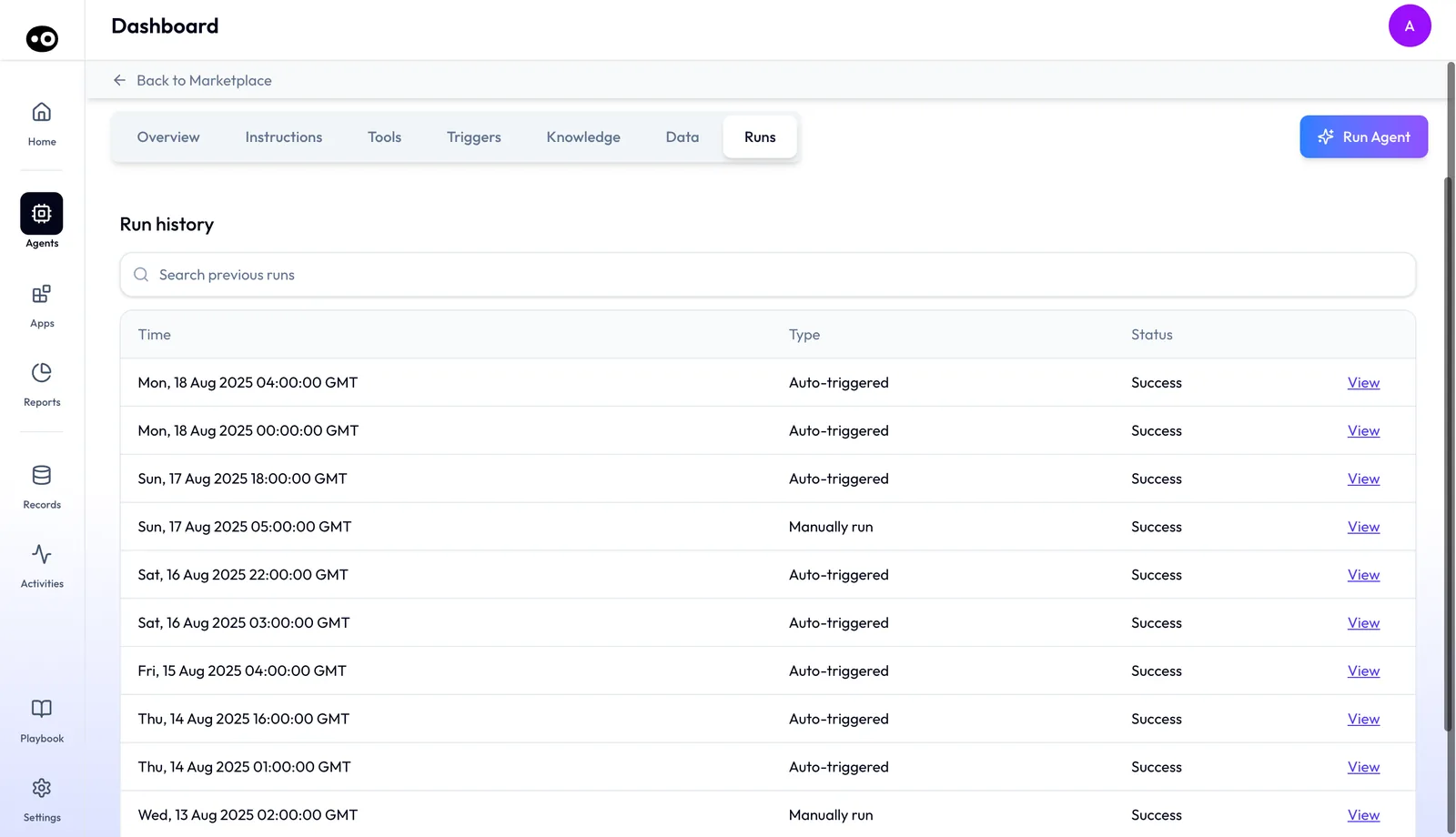
On the Runs tab, each row is one run, with when it ran, how it started and how it ended.
## At a glance {#at-a-glance}
| | |
|---|---|
| **What it is** | A list of every run an agent has made, plus a full record for each run |
| **Where it lives** | **Agents › [agent] › Runs**, on every agent with a detail page |
| **Columns** | **Time**, **Type** and **Status** on every table, plus extra columns on some agents |
| **Run types** | **Auto-triggered** or **Manually run**; **Auto Trigger** or **Manual** on some agents |
| **Run record shows** | What the run produced: emails in full with their contacts, sequence steps, a drafted reply and its deal context, or a clipped call |
| **Order** | Newest first |
| **Summary cards** | **Last run** and a weekly run count on the **Overview** tab |
| **What it leaves out** | The trigger that started a run, how long it took, what it read first, and any export |
## What agent run history is {#what-it-is}
Say a rep questions a reply the agent drafted, or a manager wants to know what ran overnight. Start on the **Runs** tab, which has one row per run and a search box above it. Read the row first. Press **View** to open the run record, a wide drawer, only when the row leaves your question open.
### What to read in each row {#what-you-see}
Pick the column by the question you've been asked. Every table carries **Time**, **Type** and **Status**, and some agents add more.
| If you're asked | Read | Then |
|---|---|---|
| What ran overnight? | **Time**, from the newest row down | Times end in GMT, so convert them first. A few tables use relative times, such as "Today, 07:58 AM". |
| Did a person start this run? | **Type**: **Auto-triggered** or **Manually run**, or **Auto Trigger** or **Manual** on some agents | If it ran on its own when you expected a person, check the agent's [triggers](https://www.oliv.ai/product-docs/agents/builder/triggers/). |
| Where did this lead go? | **Action**, on agents whose runs carry an action name | Open the record only if the action looks wrong. |
| Who did this run reach? | **Contact** and **Company**, on agents whose runs are per person | Search by name, then press **View**. |
| Where did this message come from? | **Channel**, such as Gmail, Slack or Teams, on some message tables | Use it to find the thread you were asked about. |
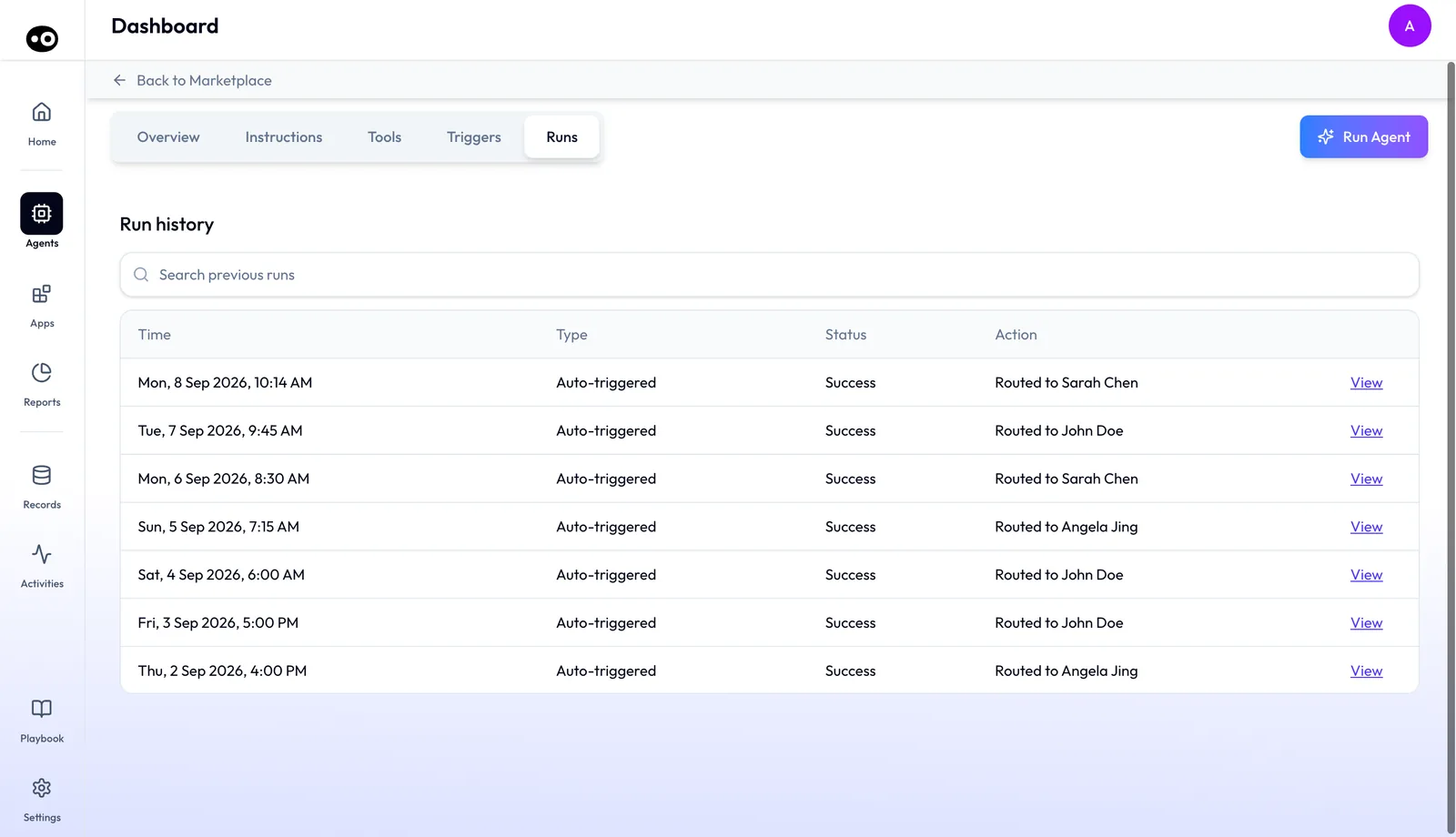
Some tables add an Action column. Here it shows where each run sent its lead, so you can check the routing without opening a record.
### What to do with each status {#status-checks}
The **Status** column tells you which rows to open first:
- **Draft ready:** press **View** and read the draft against its **Deal context used:** box. Use **Review draft in Gmail** or **Copy** to work on it.
- **No reply needed:** read a few of these, because a wrong call here leaves a customer without an answer.
- **Success** or **Sent:** the run finished. Open the record when you need to see what it wrote, because the status doesn't tell you the work was right.
- **Completed Step 2**, or any other step: open the record to see which steps are **Completed** and which are **Upcoming**.
- **Escalated to CSM:** read the record, then check that the customer success manager has picked it up.
- **Sequence Completed:** no steps remain, so read how the last steps landed before you report back.
## Why agent run history matters {#why-it-matters}
### What it's for {#what-its-for}
Open your AI agent audit trail when you have to say what an agent did, not what it was set up to do. Each moment below starts with a question, and the row or record gives you the answer to act on.
### How it helps {#how-it-helps}
- **Before you widen an agent.** Tally a week of **Type** and **Status** values, then read the **Draft ready** records. Widen the agent only if those drafts hold up.
- **When a manager asks what ran overnight.** Read **Time** from the newest row down, then open the rows in that window. Report who the agent contacted and what it wrote.
- **When a rep questions a draft.** Find the row and open the record. Compare the body with **Deal context used:** to see whether the facts or the wording went wrong.
- **Before a round of 1:1s.** Read the week's emails from an agent that writes to customers. Note the exact wording you want to coach on.
### What happens without it {#without-it}
Skip these checks and you hear about an agent's work from a rep, or from a customer. You then search mailboxes and field history for something that may not name the run. After a surprise like that, a team may ask for the agent to go back to manual.
### Why buyers care {#why-buyers-care}
Revenue operations usually runs these checks, most often just after a rollout, when agents start acting with nobody watching each step. Sales leaders and reviewers then ask for the answer. There's no export, so keep your tally to hand and be ready to open the records on screen.
## The Oliv AI approach to agent run history {#approach}
{/* 5P */}
Imagine a revenue operations manager on a Tuesday morning. A sales leader wants the reply-drafting agent extended to two more teams by the end of the month. Before agreeing, the manager wants to know what the agent has written so far, and how much of it ran with nobody watching.
The usual check is slow. It starts with asking reps which replies they remember, then moves to mailboxes and the CRM's field history, which may only show an integration user. That can easily take an hour, and the answer is often a best guess.
Once an agent works unattended, the question changes. It isn't only what the agent wrote to one customer, but what it did across every run and how each run started. A list of runs per agent, each with its own full record, answers both at once.
Oliv AI keeps that record on every agent with a detail page. The manager opens the agent, selects **Runs** and reads down the rows by time. Pressing **View** opens the run record, which shows each email or draft the agent wrote and the contacts it picked. A drafted reply also lists the facts it relied on, so the manager can test the draft against them.
Each row's **Type** column says **Auto-triggered** or **Manually run**, so it's clear whether a person started the run. How other platforms record what their agents did is covered in How Oliv AI compares for AI agent audit trails, below.
## How to check what an AI agent did {#methods}
You have four ways to check an agent's work, and each one sees a different part of it. Pick by the question you've been asked, not by the tool you have open.
### CRM field history: what changed on a record {#crm-field-history}
Start here when the question is about a value on a deal or contact. [Salesforce adds a history entry with the date, time, nature of the change and who made it](https://help.salesforce.com/s/articleView?id=sf.tracking_field_history.htm&type=5). [HubSpot shows the new value, the date and the source for a property](https://knowledge.hubspot.com/crm-setup/view-property-history).
This catches field changes and tells you when they happened. It misses plenty for this job. Salesforce [tracks a field only from the moment you turn tracking on, and skips changes made in the system context](https://help.salesforce.com/s/articleView?id=sf.tracking_field_history.htm&type=5). A field history also can't show you an email, so it tells you nothing about what an agent wrote.
### The mailbox: what a customer was told {#mailbox-check}
Search the rep's mailbox or the CRM's activity timeline for the customer's name. This catches a message as the customer would read it. It misses any draft that never left the mailbox, and it doesn't say which agent or run produced the text.
### Asking people: what they remember {#ask-the-rep}
Ask the rep or the admin closest to the work. This catches context no system holds, such as why a rep rewrote a draft. It misses anything nobody noticed, and memory gets thin after a week of unattended runs.
### A run list per agent: what each run did {#run-list}
Read every run for one agent in one place. This catches how often the agent ran, how each run started and how it ended, and the record adds what the run produced. It misses the cause of an automatic run and what the agent read first, and it covers one agent at a time.
### Which of these Oliv AI's run history does {#what-run-history-covers}
Oliv AI's run history is the last of the four. Every table carries **Time**, **Type** and **Status**, and the record shows what the run produced. Keep your CRM's field history open beside it when your question is about a field value, because that history is the CRM's own record of the change.
## Open an agent's run history {#open-run-history}
There are two ways in:
- Open the agent from the marketplace and select the **Runs** tab.
- On the agent's **Overview** tab, press **See run history** in the **Runs** section.
The tab is headed **Run history**. Beneath the heading is a search box with the placeholder "Search previous runs", then the table of runs in a bordered box.
The **Overview** tab's **Runs** section also carries two summary cards. **Last run** shows a date, with a line beneath describing how it started. The second card shows the week's run count, split into automated and manual.
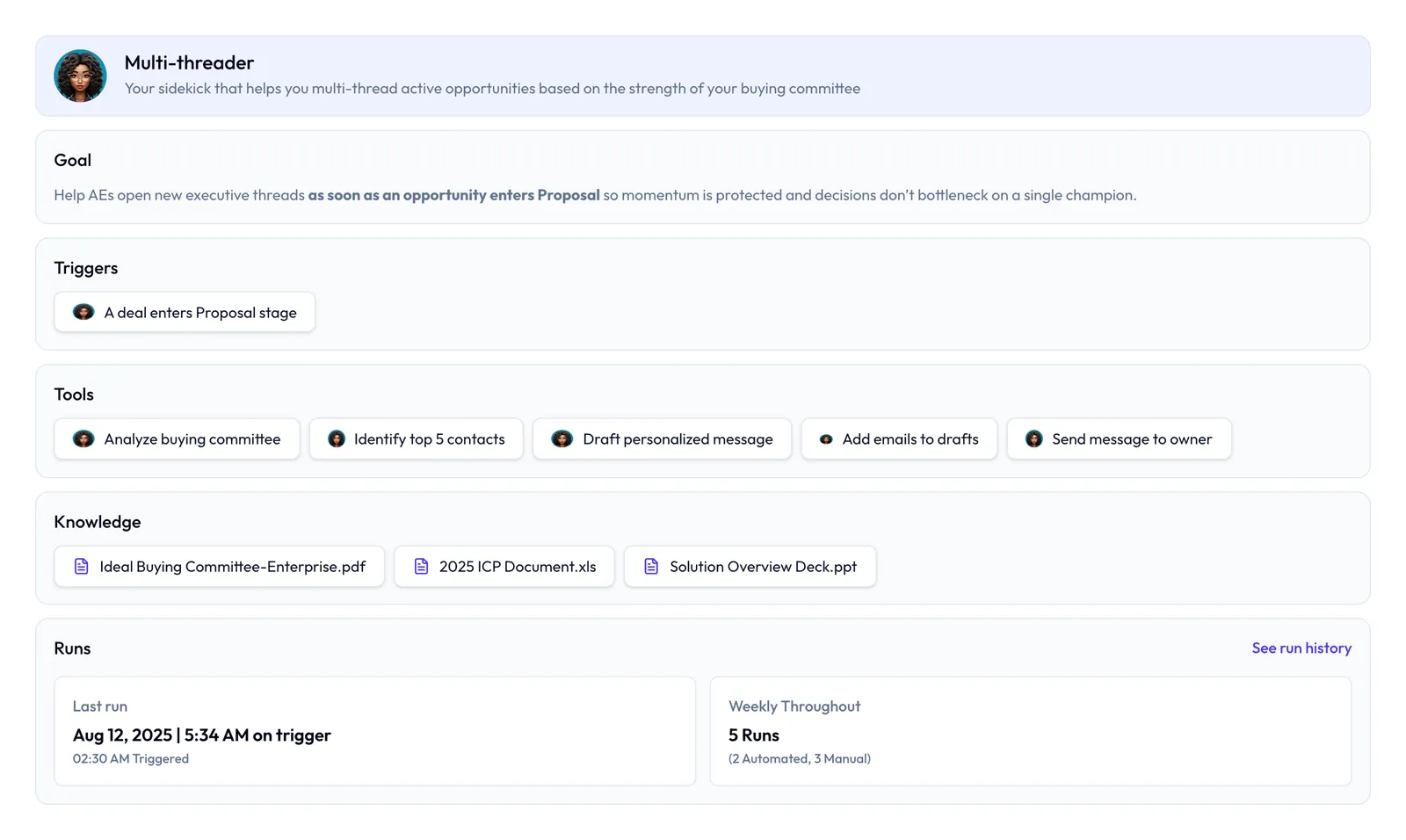
The Runs section of the Overview is the way in. See run history opens the Runs tab, and the two cards show how recently and how often the agent ran. The dates and counts here are sample data.
## Find a run {#find-a-run}
1. Open the agent and select **Runs**.
2. Scan the table. Rows are listed newest first, and the order can't be changed.
3. To narrow the list, type in the search box. The table filters as you type and ignores case.
4. Read the **Type** column to see whether the run was **Auto-triggered** or **Manually run**.
5. Read the **Status** column to see how the run ended.
The search box matches different columns on different agents. On most tables it matches the time, type and status, plus the action where there is one. On the contact-oriented table it matches only the contact, company and status. Search there by name, not by date.
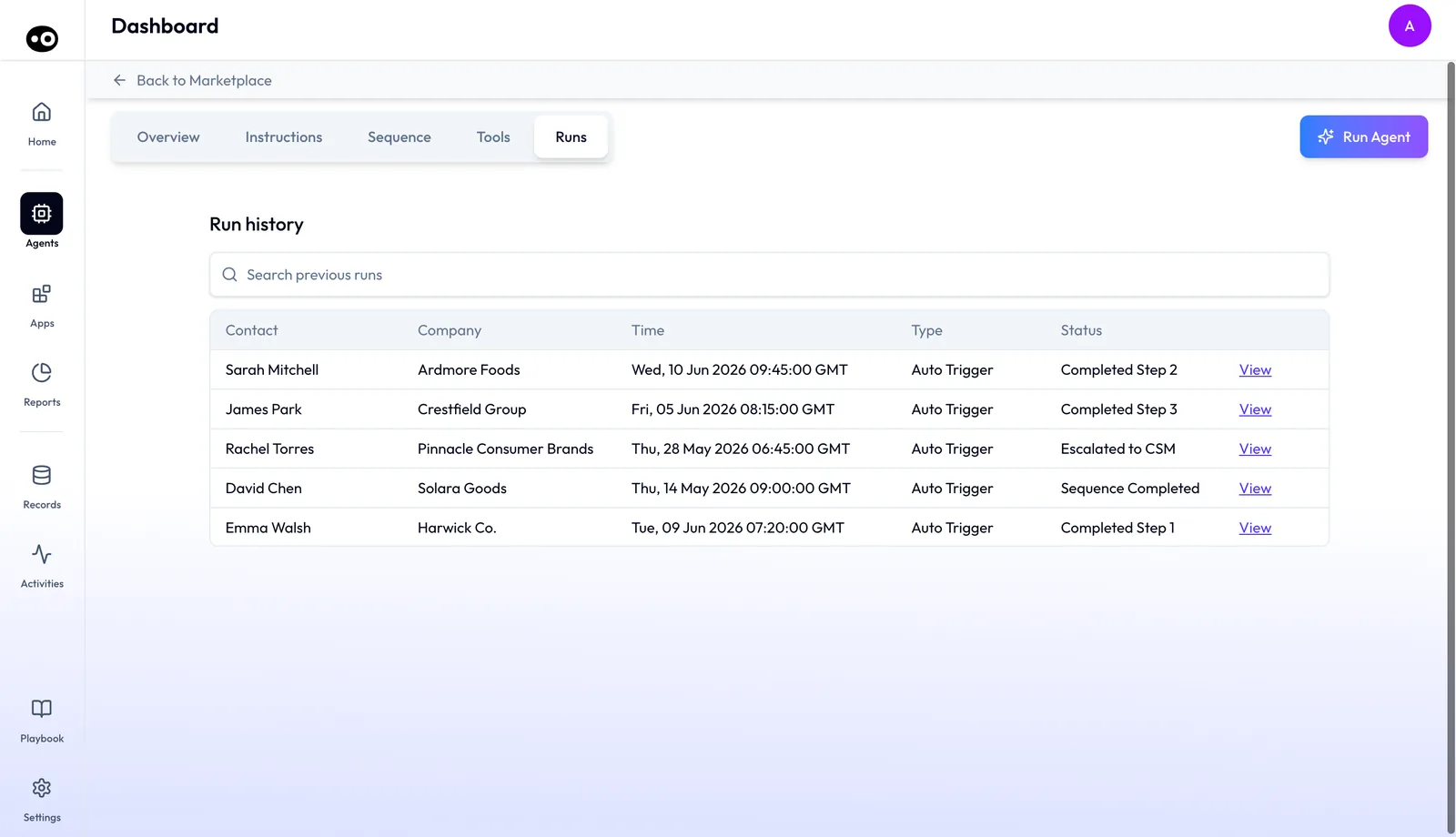
On a contact-oriented table each row is one person in a sequence. Status shows the step reached, so search by name to find the run you need.
## Read a run record {#read-a-run-record}
1. Press **View** at the end of the row. The record slides in from the right as a wide drawer, headed **Run History**.
2. Read the header facts: the date and time, how the run started, how it ended, and on some agents the action it performed.
3. Check beneath for the account the run concerned. The account owner appears as a chip with a crown icon.
4. Look for an amber alert panel. It appears when the agent needed a person to look at something, with a title and a short explanation.
5. Look for a calendar card. It appears when the run booked a meeting, showing the date, title, time and attendees.
6. Read **Top Identified Contacts** down the left: each person's name, job title and sometimes an **active** or **dormant** mark. Press a contact to jump to that person's email.
7. Read the emails in the main pane. Each sits under an **Email Sent** banner and is shown in full: recipient, subject, body and closing.
8. Close the drawer with the round button outside its top-left corner, or press the dimmed page behind it.
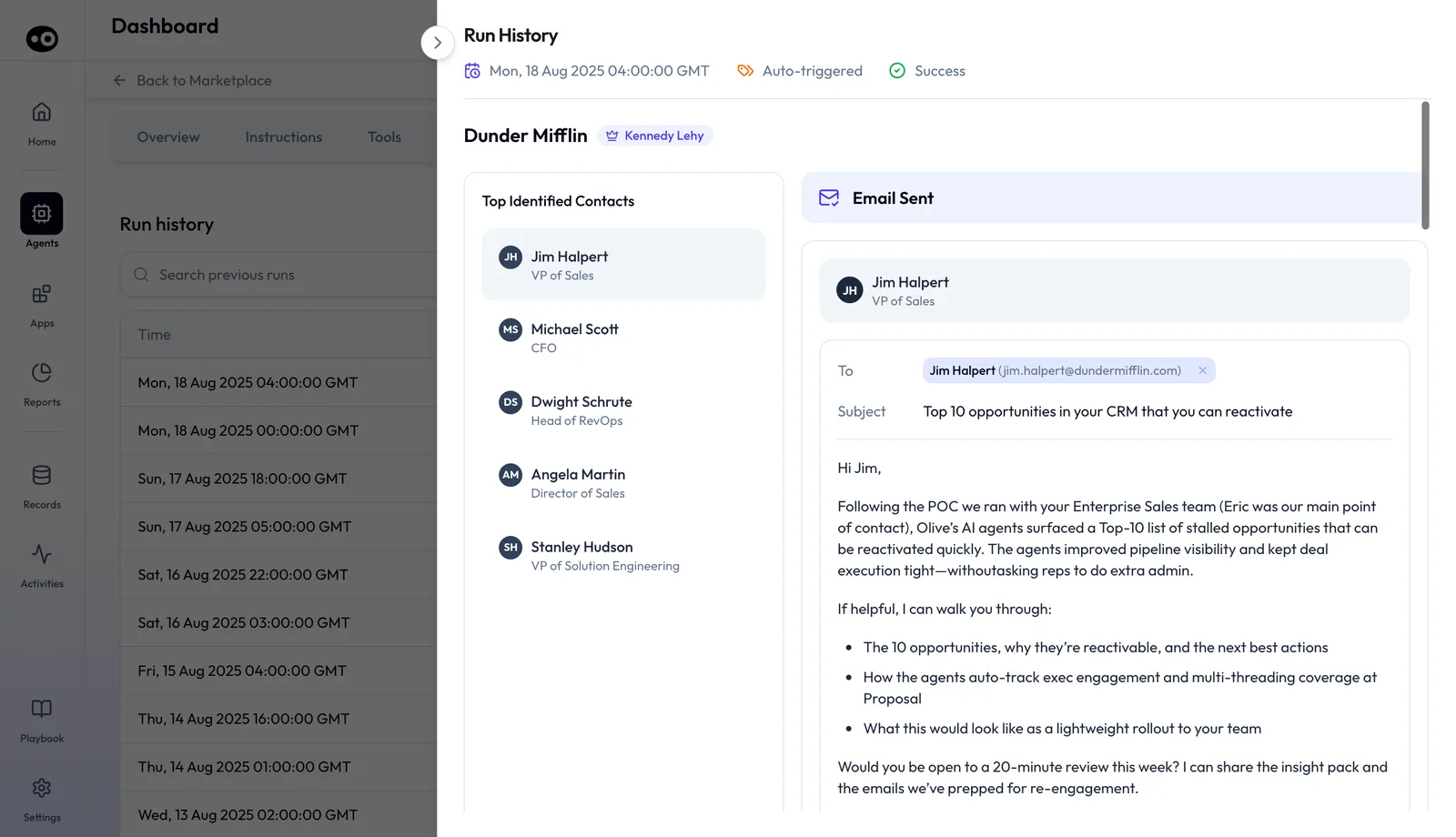
Steps 2 to 7 in one drawer: the header facts, the account and owner, the contacts the run picked, and each email shown word for word.
### Records for sequence agents {#sequence-records}
On an agent that runs a sequence, the record is a numbered timeline instead of contacts and emails. The header names the contact and company. Each step carries a day label with its channel, a **Completed** or **Upcoming** badge, a title, a description and a preview of what was sent. A sent step also shows how it landed, such as "Opened - No Reply". It's the only place in the product where you can see what an agent still intends to do.
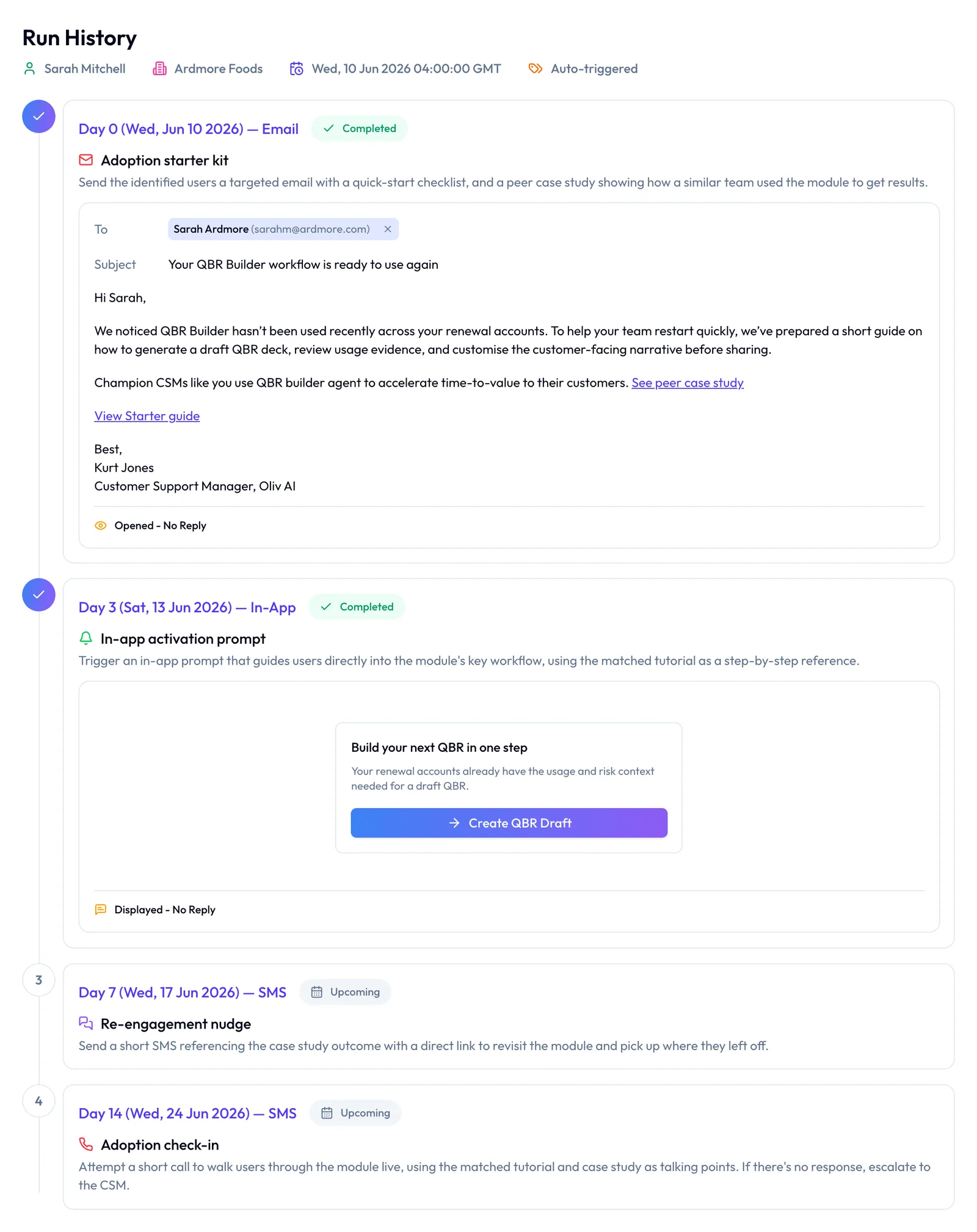
A sequence record reads as a timeline. Completed steps show what was sent and how it landed; Upcoming steps show what the agent will do next.
### Records for drafts and clips {#draft-and-clip-records}
Other agents produce other records:
- **A drafted reply.** A **Draft · Gmail** label sits above the draft's **To**, **Subject** and body. A **Deal context used:** box lists the facts the draft relied on. **Review draft in Gmail** opens it, and **Copy** copies it.
- **A clipped call.** The record shows the call's title and length, a video player with **Add Comment** and **Share**, a speaker **Timeline**, and a transcript you can search by speaker. **Ask AI** answers questions about the call, and **View Clip Library** and **View Slack Alert** open where the clip went.
- **A release email.** An **Email** section shows the audience chip with its contact count, the subject and body with merge fields, and a **Copy** action.
## How to measure an agent's run mix before you widen it {#measure-run-mix}
Two shares tell you most of what the list can. Work them out for the same period, using the rows you counted:
- **Automatic share.** Divide the **Auto-triggered** rows by all rows. This tells you how much of the agent's work started with no person asking for it.
- **Status share.** Divide the rows for each **Status** value by all rows. On a reply-drafting agent, this tells you how much of the work is drafts waiting to be read.
Both have weak spots, so don't stop at the numbers. A share counts runs, and it can't tell you whether a draft was any good. A status says how a run ended, not whether it should have run at all. A quiet week can also make a small count look more settled than it is.
### Where the run list shows these {#run-list-measures}
The **Type** and **Status** columns hold both counts, one row at a time. The **Overview** tab's weekly run count, split into automated and manual, gives you a quick check on your automatic share. Status has no summary card, so that tally comes from the rows.
## How to review an agent's work by hand {#review-by-hand}
Use this method when you need to check work in systems the agent touches, or when you want to test what the run list tells you. It's slow, so set a short period.
1. Write down the agent, the period and the question, such as what it wrote and to whom last week.
2. Open a spreadsheet with one row per action: date, customer, what happened and where you saw it. [Nielsen Norman Group finds spreadsheets work best for content audits](https://www.nngroup.com/articles/content-audits/), and the same layout suits this job.
3. Search the mailboxes of the reps the agent works with, and add each message you find.
4. Pull the field history for each CRM field the agent can touch, and add each change.
5. Ask the rep about anything you can't place. [Note what you're unsure of in the sheet and raise it with the team](https://www.nngroup.com/articles/content-audits/).
6. Count the rows, then read the flagged ones first.
Attribution is what usually goes wrong. A history entry may name an integration user rather than an agent, and a message in a mailbox doesn't say who drafted it. Expect some rows to stay unexplained.
### The same job in Oliv AI's run history {#same-job-run-history}
The agent's work is already listed, so you skip the hunt and keep the counting.
1. Open the agent and select **Runs**. Rows start with the newest.
2. Count from the newest row down, and stop at the first row older than your period. There's no date filter or export, so keep the tally yourself.
3. Tally the **Type** and **Status** columns as you go.
4. Press **View** on the records you most need to read. On a draft, check **To**, **Subject**, the body and the **Deal context used:** box.
5. Use **Review draft in Gmail** or **Copy** when you want to work on a draft. The record itself has no edit or approve control.
6. Decide what the agent does next, once you've read enough. Each tool's run mode sets whether it acts alone or waits for a person.
### Worked example: a week of runs on a reply-drafting agent {#worked-example}
Before widening a reply-drafting agent, a RevOps lead reads a week of its **Runs** tab, which holds 40 rows. There's no date filter or export, so they tally by hand from the newest row down. This is an illustrative calculation with sample figures, not an Oliv AI output, and it claims no saving.
| What the lead counts | Rows | Arithmetic | Share |
|---|---|---|---|
| **Auto-triggered** | 30 | 30 ÷ 40 | 75% |
| **Manually run** | 10 | 10 ÷ 40 | 25% |
| All rows, by type | 40 | 30 + 10 | 100% |
| **Draft ready** | 24 | 24 ÷ 40 | 60% |
| **No reply needed** | 12 | 12 ÷ 40 | 30% |
| **Sent** | 4 | 4 ÷ 40 | 10% |
| All rows, by status | 40 | 24 + 12 + 4 | 100% |
Three in four runs started on their own, so most of this work needs checking after the fact. The lead reads the 24 **Draft ready** records first, because that's where the agent's writing is waiting. Only then do they decide how far to widen it, with [a RevOps view of trust and governance risk](https://www.oliv.ai/blog/ai-crm-trust-governance-risk-revops-evaluation) to hand.
## How agent run history works with other features {#works-with}
### Tools and run modes {#with-tools}
If a run acted when you wanted it to wait, change that tool's run mode. [Agent tools and run modes](https://www.oliv.ai/product-docs/agents/builder/tools-and-run-modes/) shows how to set each tool to **Auto Run**, **Requires Approval** or **Agent Decides**. Then read the next run's record to see the result.
### Olivia and specialist agents {#with-olivia}
If an email isn't from the agent you expected, look for a "Drafted by" line beneath it. That line names the agent that drafted it. Work that [Oliv AI's Olivia agent](https://www.oliv.ai/product-docs/agents/olivia/) passes to a specialist shows under the agent that did it, so open that specialist's **Runs** tab.
### Open in Gmail {#with-gmail}
If you want to work on an email from the record, press **Open in Gmail** beneath it. Gmail's compose screen opens in a new browser tab with the recipient, subject and body filled in. Nothing is sent, so read it and decide there. Use **Review draft in Gmail** on a drafted reply, and **Copy** on message records.
### The Agent Feed {#with-agent-feed}
Run history is per agent. The Agent Feed shows every agent's work in one stream. Use the feed to watch work as it happens, and the **Runs** tab to look back at one agent in detail.
### Deal and meeting work {#with-deal-work}
If a rep asks what an agent did on a deal, start with the run record, which holds any email it wrote and any meeting it booked. If the question is about a manager alert, go to [Oliv AI's Deal Driver agent](https://www.oliv.ai/product-docs/agents/deal-driver/) instead, which surfaces signals for managers and doesn't write to the CRM itself. Account executives can open the same records for agents working their deals, as part of [running deals with Oliv AI](https://www.oliv.ai/product-docs/use-cases/ae-run-deals/).
## Who uses agent run history, and how {#who-uses-it}
These are typical patterns, shown to illustrate how run history is used.
### Revenue operations {#revenue-operations}
A revops lead opens the **Runs** tab before widening an agent to another team. The **Type** column shows whether anyone started each run by hand, and each record shows what the agent wrote. It's part of [how revenue operations runs autonomous agents](https://www.oliv.ai/blog/revenue-operations-ai) without losing track of them.
### Sales leaders {#sales-leaders}
A sales manager opens an agent that writes to customers and reads what it wrote that week, before a round of 1:1s. Every message is shown in full, so the manager can coach on the exact wording. It's useful prep alongside a [weekly forecast commit](https://www.oliv.ai/blog/run-evidence-based-forecast-commits).
### Customer success and account management {#customer-success}
A customer success manager checks which contacts an agent touched on a renewal account. **Top Identified Contacts** marks each person **active** or **dormant**, and the emails show what the agent wrote to each one.
### Enablement {#enablement}
An enablement lead uses run records as worked examples. A sequence agent's timeline shows each step marked **Completed** or **Upcoming**, which helps new reps see how a sequence unfolds before they run one. The [meeting preparation workflow](https://www.oliv.ai/product-docs/workflows/prepare-for-a-meeting/) is a good companion read.
## How Oliv AI compares for AI agent audit trails {#compare}
Oliv AI keeps a list of every run on each agent, and every row opens a full record of that run. The record shows each email the agent wrote in full, and each row shows when the run happened. Oliv AI is the only platform in this table that does all three.
AI agent audit trail features, from each platform's public documentation:
| Platform | Run list on each agent | Full text of each email written | What each run did, and when |
|---|---|---|---|
| **Oliv AI** | Yes | Yes | Yes |
| **Gong** | Yes ([Runs tab for automated agents](https://help.gong.io/docs/create-an-automated-agent)) | Not in docs | Partly ([actions taken per run](https://help.gong.io/docs/create-an-automated-agent)) |
| **Outreach** | Yes ([activity feed for each agent](https://support.outreach.io/support/solutions/articles/159000420910-monitor-the-progress-of-revenue-agent)) | Not in docs | Yes ([what the agent did and when](https://support.outreach.io/support/solutions/articles/159000420910-monitor-the-progress-of-revenue-agent)) |
| **Fireflies.ai** | Partly ([voice agent calls saved](https://guide.fireflies.ai/articles/4919306982-how-to-set-up-automated-calls-with-fireflies-voice-agents)) | Not in docs | Not in docs |
| **Avoma** | Not in docs | Not in docs | Not in docs |
*Yes: documented and built in. Partly: documented with a limit, shown in brackets. Not in docs: not found in the vendor's public documentation.*
### Why Oliv AI is the stronger choice for AI agent audit trails {#compare-stronger}
- **Every message, word for word.** Oliv AI's run record shows each email with its recipient, subject and full body. [Gong records every automation execution in Run history](https://help.gong.io/docs/understanding-automations). See [Gong vs Oliv AI](https://www.oliv.ai/blog/gong-vs-oliv). In any trial, ask to read one agent email in full from its run record.
- **Manual and automatic runs told apart.** Each Oliv AI row says **Auto-triggered** or **Manually run**. [Gong's troubleshooting guide uses Run history to confirm whether an automation triggered](https://help.gong.io/docs/troubleshooting-automation-run-issues). See [Oliv AI as a Gong alternative](https://www.oliv.ai/gong-alternative). Check that each row tells you whether a person started the run.
- **One record per run, with the people it touched.** Oliv AI lists each run's contacts beside the emails written to them. [Outreach documents execution history at run and account level for scheduled Research Agent runs](https://support.outreach.io/support/solutions/articles/159000425162-schedule-workflows-for-research-agent). See [how Outreach compares with Gong](https://www.oliv.ai/blog/gong-vs-outreach). Decide whether you need the contacts and their messages side by side.
- **A record on every agent, not one agent type.** Oliv AI keeps run history on every agent with a detail page. [Fireflies.ai saves the recording, transcript and summary after each voice agent call](https://guide.fireflies.ai/articles/4919306982-how-to-set-up-automated-calls-with-fireflies-voice-agents). Before you decide, list which of your agents the record has to cover.
*Competitor details checked against each vendor's public documentation on 21 October 2026. Features and plans change, so confirm with the vendor before you decide.*
## Limits and things to know {#limits}
- **The cause isn't named.** A run is marked automatic without saying which [trigger or schedule](https://www.oliv.ai/product-docs/agents/builder/triggers/) started it.
- **No duration or inputs.** A run doesn't record how long it took or which records the agent read before acting.
- **No approve or re-run.** A record can hand a draft to Gmail or copy it, but it has no approve, reject, edit or re-run control.
- **No export.** Run history and run records can't be exported, downloaded or printed.
- **No sort, date filter or paging.** The list is one scrolling table, newest first.
- **One agent at a time.** Run history is per agent, so comparing two agents means two tallies.
- **Gmail hand-off only.** **Open in Gmail** and **Review draft in Gmail** have no Outlook equivalent.
## Common questions {#common-questions}
#### How do I see what an agent has been doing? {#faq-see-activity}
Open the agent and select **Runs**. Each row is one run, and **View** opens the full record of what that run did.
#### How do I tell whether a run was automatic or started by hand? {#faq-auto-or-manual}
Read the **Type** column. It says **Auto-triggered** or **Manually run**, or **Auto Trigger** or **Manual** on some agents.
#### Can I see which trigger started a run? {#faq-which-trigger}
No. The **Type** column says a run was automatic but not which trigger or schedule set it off. Check the triggers set on the agent, and treat your answer as a best guess.
#### How do I see what the agent changed in other systems? {#faq-changes}
Start in the run record, which shows the emails, drafts and sequence steps, and any meeting the run booked. For a field value on a deal or contact, check your CRM's own field history too.
#### Can I read the emails an agent wrote? {#faq-emails}
Yes. Every email the agent wrote is shown in full under an **Email Sent** banner: recipient, subject, body and closing.
#### What statuses can a run have? {#faq-statuses}
**Success** and **Sent** on most agents. An agent that drafts replies adds **Draft ready** and **No reply needed**. A sequence shows the step reached, such as **Completed Step 2**, then **Escalated to CSM** or **Sequence Completed**.
#### Can I undo or re-run something from the record? {#faq-undo}
No. A record can open a draft in Gmail or copy it, but it has no approve, edit or re-run control.
#### Can I export run history? {#faq-export}
No. There's no export or download for the list or for a run record.
#### Can I filter runs by date? {#faq-date-filter}
No. The search box matches text in the row, and there's no date filter or sort control.
#### Where do I see how many times an agent has run? {#faq-run-count}
On the **Overview** tab. The **Runs** section shows a total run count, split into automated and manual.
#### Can I see what a sequence agent will do next? {#faq-upcoming}
Yes. A sequence agent's record lists each step as **Completed** or **Upcoming**.
#### How do I review a week of runs with no date filter? {#faq-week-review}
Tally by hand. Read the **Runs** tab from the newest row down and stop at the first row older than your week. Count each **Type** and **Status** value as you go, then read the records that matter most.
#### Does a run record show what the agent read or how long it took? {#faq-inputs-duration}
No. A run doesn't record its duration or which records the agent read before acting. A drafted reply does list the facts it relied on, in a **Deal context used:** box.
#### Can a security reviewer check an agent's work in run history? {#faq-security-review}
Yes, for what a specific run did: who it contacted, what it wrote and how it ended. There's no export, so go through the records on screen together. Ask your Oliv AI contact who can open runs and how long they're kept.
## Further reading {#further-reading}
- [Field History Tracking Overview, Salesforce Help](https://help.salesforce.com/s/articleView?id=sf.tracking_field_history.htm&type=5): what a Salesforce history entry records, and which changes it skips.
- [View a record's property history, HubSpot Knowledge Base](https://knowledge.hubspot.com/crm-setup/view-property-history): how to read a property's past values and the source of each change.
- [Content Audits, Nielsen Norman Group](https://www.nngroup.com/articles/content-audits/): how to run an audit in a spreadsheet and flag what you're unsure of.
## Related {#related}
- [Agent tools and run modes](https://www.oliv.ai/product-docs/agents/builder/tools-and-run-modes/): choose which actions an agent takes alone.
- [Oliv AI product documentation](https://www.oliv.ai/product-docs/): every guide, by agent and feature.
- [Olivia agent guide](https://www.oliv.ai/product-docs/agents/olivia/): the agent that hands work to specialists.
- [Deal Driver agent guide](https://www.oliv.ai/product-docs/agents/deal-driver/): pipeline alerts and 1:1 reports for managers.
- [Account executive guide to running deals](https://www.oliv.ai/product-docs/use-cases/ae-run-deals/): how reps use agents day to day.
- [Prepare for a meeting](https://www.oliv.ai/product-docs/workflows/prepare-for-a-meeting/): the brief agents send before calls.
- [Autonomous agents for RevOps](https://www.oliv.ai/blog/revenue-operations-ai): how revops teams run agents across the process.
- [Agents versus alert bots](https://www.oliv.ai/blog/vonlabs-review): why agents that act need a record of what they did.
- [Revenue intelligence platforms compared](https://www.oliv.ai/blog/best-revenue-intelligence-software-platforms): where agent oversight fits in the category.
- [Agent builder overview](https://www.oliv.ai/product-docs/agents/builder/): every setting an agent carries, in one place.
*Updated 3 November 2026: added the ways to check an agent's work, run-mix measures, the manual method, a worked example and further reading.*